KR102443172B1 - Systems and methods for supporting patching in a multi-tenant application server environment - Google Patents
Systems and methods for supporting patching in a multi-tenant application server environment Download PDFInfo
- Publication number
- KR102443172B1 KR102443172B1 KR1020177009297A KR20177009297A KR102443172B1 KR 102443172 B1 KR102443172 B1 KR 102443172B1 KR 1020177009297 A KR1020177009297 A KR 1020177009297A KR 20177009297 A KR20177009297 A KR 20177009297A KR 102443172 B1 KR102443172 B1 KR 102443172B1
- Authority
- KR
- South Korea
- Prior art keywords
- server
- managed server
- domain
- environment
- patch
- Prior art date
- Legal status (The legal status is an assumption and is not a legal conclusion. Google has not performed a legal analysis and makes no representation as to the accuracy of the status listed.)
- Active
Links
Images


Classifications
-
- G—PHYSICS
- G06—COMPUTING OR CALCULATING; COUNTING
- G06F—ELECTRIC DIGITAL DATA PROCESSING
- G06F9/00—Arrangements for program control, e.g. control units
- G06F9/06—Arrangements for program control, e.g. control units using stored programs, i.e. using an internal store of processing equipment to receive or retain programs
- G06F9/46—Multiprogramming arrangements
- G06F9/50—Allocation of resources, e.g. of the central processing unit [CPU]
- G06F9/5061—Partitioning or combining of resources
- G06F9/5077—Logical partitioning of resources; Management or configuration of virtualized resources
-
- G—PHYSICS
- G06—COMPUTING OR CALCULATING; COUNTING
- G06F—ELECTRIC DIGITAL DATA PROCESSING
- G06F11/00—Error detection; Error correction; Monitoring
- G06F11/07—Responding to the occurrence of a fault, e.g. fault tolerance
- G06F11/14—Error detection or correction of the data by redundancy in operation
-
- G—PHYSICS
- G06—COMPUTING OR CALCULATING; COUNTING
- G06F—ELECTRIC DIGITAL DATA PROCESSING
- G06F11/00—Error detection; Error correction; Monitoring
- G06F11/07—Responding to the occurrence of a fault, e.g. fault tolerance
- G06F11/14—Error detection or correction of the data by redundancy in operation
- G06F11/1402—Saving, restoring, recovering or retrying
- G06F11/1415—Saving, restoring, recovering or retrying at system level
- G06F11/1433—Saving, restoring, recovering or retrying at system level during software upgrading
-
- G—PHYSICS
- G06—COMPUTING OR CALCULATING; COUNTING
- G06F—ELECTRIC DIGITAL DATA PROCESSING
- G06F11/00—Error detection; Error correction; Monitoring
- G06F11/07—Responding to the occurrence of a fault, e.g. fault tolerance
- G06F11/14—Error detection or correction of the data by redundancy in operation
- G06F11/1402—Saving, restoring, recovering or retrying
- G06F11/1415—Saving, restoring, recovering or retrying at system level
- G06F11/1438—Restarting or rejuvenating
-
- G—PHYSICS
- G06—COMPUTING OR CALCULATING; COUNTING
- G06F—ELECTRIC DIGITAL DATA PROCESSING
- G06F8/00—Arrangements for software engineering
- G06F8/60—Software deployment
- G06F8/65—Updates
-
- G—PHYSICS
- G06—COMPUTING OR CALCULATING; COUNTING
- G06F—ELECTRIC DIGITAL DATA PROCESSING
- G06F8/00—Arrangements for software engineering
- G06F8/60—Software deployment
- G06F8/65—Updates
- G06F8/658—Incremental updates; Differential updates
-
- G—PHYSICS
- G06—COMPUTING OR CALCULATING; COUNTING
- G06F—ELECTRIC DIGITAL DATA PROCESSING
- G06F11/00—Error detection; Error correction; Monitoring
- G06F11/07—Responding to the occurrence of a fault, e.g. fault tolerance
- G06F11/16—Error detection or correction of the data by redundancy in hardware
- G06F11/20—Error detection or correction of the data by redundancy in hardware using active fault-masking, e.g. by switching out faulty elements or by switching in spare elements
- G06F11/202—Error detection or correction of the data by redundancy in hardware using active fault-masking, e.g. by switching out faulty elements or by switching in spare elements where processing functionality is redundant
Landscapes
- Engineering & Computer Science (AREA)
- Theoretical Computer Science (AREA)
- General Engineering & Computer Science (AREA)
- Software Systems (AREA)
- Physics & Mathematics (AREA)
- General Physics & Mathematics (AREA)
- Computer Security & Cryptography (AREA)
- Quality & Reliability (AREA)
- Stored Programmes (AREA)
- Debugging And Monitoring (AREA)
- Computer And Data Communications (AREA)
Abstract
하나의 실시예에 따르면, 멀티테넌트 어플리케이션 서버 환경에서 패치를 지원하는 시스템 및 방법이 본 명세서에 기술된다. 상기 시스템은 테넌트에 의한 사용을 위해 상기 테넌트와 하나 이상의 파티션들을 관련시킬 수 있고, 파티션은 도메인의 런타임 및 어드미니스트레이티브 서브디비전(administrative subdivision) 또는 슬라이스(slice)이다. 패치 프로세스는 어플리케이션 서버 클러스터링 환경에 의해 제공되는 고 가용성 특징들의 장점을 취하여, 인터럽션(interruption)이 없이 또는 다운타임이 영(zoro)인 채로 동작할 수 있게 하는 도메인의 능력을 유지하는 제어된 롤링 재시작에서 패치를 적용할 수 있다. 이 프로세스는 패치되지 않은 또는 이전 버전의 어플리케이션 서버, 어플리케이션 또는 가능한 롤백을 위한 다른 소프트웨어 컴포넌트를 보존하는 것 또는 복구불가능한 에러의 이벤트 시 자동 리버전을 제공하는 것을 포함하는 복잡한 또는 장기간 실행되는 태스크들을 자동화하기 위해 이용될 수 있다.According to one embodiment, a system and method for supporting patching in a multitenant application server environment is described herein. The system may associate one or more partitions with the tenant for use by the tenant, the partition being a runtime and an administrative subdivision or slice of a domain. The patch process takes advantage of the high availability features provided by the application server clustering environment, and maintains the domain's ability to operate with zero interruption or zero downtime, while maintaining controlled rolling. You can apply the patch on restart. This process automates complex or long-running tasks, including preserving unpatched or previous versions of application servers, applications, or other software components for possible rollbacks, or providing automatic revisions in the event of unrecoverable errors. can be used to

Description
저작권 공지Copyright Notice
본 명세서에서 개시된 부분은 저작권 보호를 받는 내용을 포함한다. 저작권자는 미국특허상표청의 특허 파일 또는 기록에 나타난 대로 본 특허 문서 또는 특허 개시내용을 어느 누군가가 팩시밀리 재생하는 것은 반대하지 않지만, 그 밖의 모든 것은 저작권으로 보호된다.The portions disclosed in this specification include content subject to copyright protection. The copyright holder does not object to any facsimile reproduction of this patent document or the patent disclosure by anyone as it appears in the patent files or records of the United States Patent and Trademark Office, but everything else is protected by copyright.
우선권 주장 및 관련 출원의 상호 참조Priority Claims and Cross-References to Related Applications
본 출원은 2014년 9월 24일자로 출원된 발명의 명칭이 "SYSTEM AND METHOD FOR MULTITENANT-AWARE PATCHING IN A MULTITENANT APPLICATION SERVER ENVIRONMENT"인 미국 가출원 제62/054,903호의 우선권의 이득을 주장하고, 2015년 1월 21일자로 출원된 발명의 명칭이 "SYSTEM AND METHOD FOR SUPPORTING MULTI-TENANCY IN AN APPLICATION SERVER, CLOUD, OR OTHER ENVIRONMENT"인 미국 특허 출원 제14/601,883호에 관계되며, 상기 출원들 각각은 본 명세서에 참조로서 포함된다.This application claims the benefit of priority of U.S. Provisional Application No. 62/054,903, entitled "SYSTEM AND METHOD FOR MULTITENANT-AWARE PATCHING IN A MULTITENANT APPLICATION SERVER ENVIRONMENT," filed on September 24, 2014, and This relates to U.S. Patent Application Serial No. 14/601,883, entitled "SYSTEM AND METHOD FOR SUPPORTING MULTI-TENANCY IN AN APPLICATION SERVER, CLOUD, OR OTHER ENVIRONMENT," filed on March 21, each of which is incorporated herein by reference. incorporated by reference.
기술분야technical field
본 발명의 실시예들은 일반적으로, 어플리케이션 서버들 및 클라우드 플랫폼 환경들에 관한 것이며, 특히 멀티테넌트 어플리케이션 서버 환경에서 패치를 지원하는 시스템 및 방법에 관한 것이다.Embodiments of the present invention relate generally to application servers and cloud platform environments, and more particularly to systems and methods for supporting patching in a multi-tenant application server environment.
어플리케이션 서버 및 다른 엔터프라이즈 컴퓨팅 환경들에서, 어드미니스트레이터(administrator)에 대한 일반적인 태스크는 복수의 도메인들을 지원하는 일련의 어플리케이션 서버 인스톨레이션들을 패치하는 것을 필요로 한다. 패치는 특정한 문제들에 대한 일회성 수정이나 주기적인 버전 업데이트를 포함할 수 있다. 어째서 패치가 인스톨될 필요가 있는지와는 관계없이, 어드미니스트레이터는 일반적으로 어플리케이션 다운타임(downtime)을 최소화하면서 패치를 롤아웃(rollout)하기 위해 도메인의 각 노드에서 복잡한 일련의 단계들을 수행해야 하는 바, 이 단계들은 패치 환경이 각 호스트 상에서 최신 상태가 되도록 하는 단계와, 호스트 상에서 실행되는 그러한 서버들을 셧다운(shut down)하는 단계와, 그 다음, 어플리케이션 서버 인스턴스를 패치하고 재시작하며, 패치가 정확하게 작동하는지 검증하는 단계를 포함한다. 패치는 복잡한 프로세스고 심지어는 단일 어플리케이션 서버 인스턴스의 경우에도 수 분(many minutes)(도메인의 모든 노드에 패치가 적용될 때에는 수 시간이 될 수 있음)을 소요할 수 있기 때문에, 프로세스가 시스템 다운타임 가능성의 위험을 갖는 사용자에게 불안감을 줄 수 있다.In application server and other enterprise computing environments, a common task for an administrator requires patching a set of application server installations that support multiple domains. Patches may include one-time fixes for specific issues or periodic version updates. Regardless of why the patch needs to be installed, the administrator typically has to perform a complex series of steps on each node in the domain to roll out the patch with minimal application downtime. , these steps ensure that the patching environment is up-to-date on each host, shutting down those servers running on the host, and then patching and restarting the application server instance and ensuring that the patch works correctly. It includes the step of verifying that Since patching is a complex process and can take many minutes even for a single application server instance (which can be hours when the patch is applied to all nodes in a domain), the process is prone to system downtime. may give anxiety to users who have the risk of
하나의 실시예에 따르면, 멀티테넌트 어플리케이션 서버 환경에서 패치를 지원하는 시스템 및 방법이 본 명세서에 기술된다. 상기 시스템은 테넌트에 의한 사용을 위해 상기 테넌트와 하나 이상의 파티션(partition)들을 관련시킬 수 있고, 파티션은 도메인의 런타임 및 어드미니스트레이티브 서브디비전(runtime and administrative subdivision) 또는 슬라이스(slice)이다. 패치 프로세스는 어플리케이션 서버 클러스터링 환경에 의해 제공되는 고 가용성 특징들의 장점을 취하여, 인터럽션(interruption)이 없이 또는 다운타임이 영(zoro)인 채로 동작할 수 있게 하는 도메인의 능력을 유지하는 제어된 롤링 재시작에서 패치를 적용할 수 있다. 이 프로세스는 패치되지 않은 또는 이전 버전의 어플리케이션 서버, 어플리케이션 또는 가능한 롤백을 위한 다른 소프트웨어 컴포넌트를 보존하는 것 또는 복구불가능한 에러의 이벤트 시 자동 리버전을 제공하는 것을 포함하는 복잡한 또는 장기간 실행되는 태스크들을 자동화하기 위해 이용될 수 있다.According to one embodiment, a system and method for supporting patching in a multitenant application server environment is described herein. The system may associate one or more partitions with the tenant for use by the tenant, the partition being a runtime and administrative subdivision or slice of a domain. The patch process takes advantage of the high availability features provided by the application server clustering environment, and maintains the domain's ability to operate with zero interruption or zero downtime, while maintaining controlled rolling. You can apply the patch on restart. This process automates complex or long-running tasks, including preserving unpatched or previous versions of application servers, applications, or other software components for possible rollbacks, or providing automatic revisions in the event of unrecoverable errors. can be used to
도 1은 하나의 실시예에 따른 어플리케이션 서버, 클라우드 또는 다른 환경에서 멀티-테넌시(multi-tenancy)를 지원하는 시스템을 도시한다.
도 2는 하나의 실시예에 따른 어플리케이션 서버, 클라우드 또는 다른 환경에서 멀티-테넌시를 지원하는 시스템을 더 도시한다.
도 3은 하나의 실시예에 따른 어플리케이션 서버, 클라우드 또는 다른 환경에서 멀티-테넌시를 지원하는 시스템을 더 도시한다.
도 4는 하나의 실시예에 따른 예시적인 멀티테넌트 환경에서 이용하기 위한 도메인 구성(domain configuration)을 도시한다.
도 5는 하나의 실시예에 따른 예시적인 멀티-테넌트 환경을 더 도시한다.
도 6은 하나의 실시예에 따른 패치에 대한 지원을 도시한다.
도 7은 하나의 실시예에 따른 세션 처리(session handling)에 대한 지원을 포함하는 패치를 위한 시스템을 더 도시한다.
도 8은 하나의 실시예에 따른 세션 호환 검출에 대한 지원을 포함하는 패치를 위한 시스템을 더 도시한다.
도 9는 하나의 실시예에 따른 패치를 위한 시스템을 더 도시한다.
도 10은 하나의 실시예에 따른 패치를 위한 시스템을 더 도시한다.
도 11은 하나의 실시예에 따른 패치를 위한 시스템을 더 도시한다.
도 12는 하나의 실시예에 따른 패치를 위한 시스템을 더 도시한다.
도 13은 하나의 실시예에 따른 패치 이벤트 다이어그램을 도시한다.
도 14는 하나의 실시예에 따른 다른 패치 이벤트 다이어그램을 도시한다.
도 15는 하나의 실시예에 따른 다른 패치 이벤트 다이어그램을 도시한다.
도 16은 하나의 실시예에 따른 패치를 위한 방법의 순서도를 도시한다.1 illustrates a system supporting multi-tenancy in an application server, cloud or other environment according to an embodiment.
2 further illustrates a system supporting multi-tenancy in an application server, cloud or other environment according to an embodiment.
3 further illustrates a system supporting multi-tenancy in an application server, cloud or other environment, according to an embodiment.
4 illustrates a domain configuration for use in an exemplary multitenant environment, according to one embodiment.
5 further illustrates an example multi-tenant environment, according to one embodiment.
6 illustrates support for a patch according to one embodiment.
7 further illustrates a system for patching including support for session handling according to one embodiment.
8 further illustrates a system for patching including support for session compatibility detection according to one embodiment.
9 further illustrates a system for patching according to one embodiment.
10 further illustrates a system for patching according to one embodiment.
11 further illustrates a system for patching according to one embodiment.
12 further illustrates a system for patching according to one embodiment.
13 shows a patch event diagram according to one embodiment.
14 shows another patch event diagram according to one embodiment.
15 shows another patch event diagram according to one embodiment.
16 shows a flowchart of a method for patching according to one embodiment.
하나의 실시예에 따르면, 멀티테넌트 어플리케이션 서버 환경에서 패치를 지원하는 시스템 및 방법이 본 명세서에 기술된다. 상기 시스템은 테넌트에 의한 사용을 위해 상기 테넌트와 하나 이상의 파티션들을 관련시킬 수 있고, 파티션은 도메인의 런타임 및 어드미니스트레이티브 서브디비전 또는 슬라이스이다. 패치 프로세스는 어플리케이션 서버 클러스터링 환경에 의해 제공되는 고 가용성 특징들의 장점을 취하여, 인터럽션이 없이 또는 다운타임이 영인 채로 동작할 수 있게 하는 도메인의 능력을 유지하는 제어된 롤링 재시작에서 패치를 적용할 수 있다. 이 프로세스는 패치되지 않은 또는 이전 버전의 어플리케이션 서버, 어플리케이션 또는 가능한 롤백을 위한 다른 소프트웨어 컴포넌트를 보존하는 것 또는 복구불가능한 에러의 이벤트 시 자동 리버전을 제공하는 것을 포함하는 복잡한 또는 장기간 실행되는 태스크들을 자동화하기 위해 이용될 수 있다.According to one embodiment, a system and method for supporting patching in a multitenant application server environment is described herein. The system may associate one or more partitions with the tenant for use by the tenant, a partition being a runtime and an administrative subdivision or slice of a domain. The patching process can take advantage of the high availability features provided by the application server clustering environment to apply patches in a controlled rolling restart that maintains the domain's ability to operate without interruption or with zero downtime. have. This process automates complex or long-running tasks, including preserving unpatched or previous versions of application servers, applications, or other software components for possible rollbacks, or providing automatic revisions in the event of unrecoverable errors. can be used to
어플리케이션 서버(예컨대, 멀티-테넌트, MT) 환경Application server (eg, multi-tenant, MT) environment
도 1은 하나의 실시예에 따른 어플리케이션 서버, 클라우드 또는 다른 환경에서 멀티-테넌시를 지원하는 시스템을 도시한다.1 illustrates a system supporting multi-tenancy in an application server, cloud or other environment according to an embodiment.
도 1에 도시된 바와 같이, 하나의 실시예에 따르면, 어플리케이션 서버(예컨대, 멀티-테넌트, MT) 환경(100) 또는, 소프트웨어 어플리케이션들의 개발 및 실행을 할 수 있게 하는 다른 컴퓨팅 환경은 어플리케이션 서버 도메인을 정의하기 위해 런타임 시 이용되는 도메인(102) 구성을 포함하고 이에 따라 동작하도록 구성될 수 있다. 1 , according to one embodiment, an application server (eg, multi-tenant, MT)
하나의 실시예에 따르면, 어플리케이션 서버는 런타임 시 이용하기 위해 정의되는 하나 이상의 파티션들(104)을 포함할 수 있다. 각각의 파티션은 글로벌하게 고유한 파티션 식별자(ID) 및 파티션 구성과 관련될 수 있고, 또한 리소스 그룹 템플릿(126)에 대한 참조와 함께 하나 이상의 리소스 그룹들(124) 및/또는 파티션별(partition-specific) 어플리케이션들 및 리소스들(128)을 포함할 수 있다. 도메인-레벨 리소스 그룹들, 어플리케이션들 및/또는 리소스들(140)은 또한, 옵션에 따라서는 리소스 그룹 템플릿을 참조하여 도메인 레벨에서 정의될 수 있다.According to one embodiment, the application server may include one or more partitions 104 that are defined for use at runtime. Each partition may be associated with a globally unique partition identifier (ID) and partition configuration, and may also be associated with one or more resource groups 124 and/or partition-by-partition along with a reference to a resource group template 126 . specific) applications and resources 128 . Domain-level resource groups, applications and/or
각각의 리소스 그룹 템플릿(160)은 하나 이상의 어플리케이션들 A(162), B(164), 리소스들 A(166), B(168) 및/또는 다른 전개가능한 어플리케이션들 또는 리소스들(170)을 정의할 수 있고, 리소스 그룹에 의해 참조될 수 있다. 예를 들어, 도 1에 도시된 바와 같이, 파티션(104) 내의 리소스 그룹(124)은 리소스 그룹 템플릿(160)을 참조(190)할 수 있다.Each resource group template 160 defines one or more applications A 162 , B 164 ,
일반적으로, 시스템 어드미니스트레이터는 파티션들, 도메인-레벨 리소스 그룹들 및 리소스 그룹 템플릿들 및 보안 영역(security realms)을 정의할 수 있고, 파티션 어드미니스트레이터는 예컨대, 파티션-레벨 리소스 그룹들을 생성, 파티션에 어플리케이션들을 전개(deploy) 또는 파티션에 대한 특정 영역을 참조함으로써, 자신만의 파티션의 양상들을 정의할 수 있다.In general, the system administrator can define partitions, domain-level resource groups and resource group templates and security realms, and the partition administrator can, for example, create partition-level resource groups; By deploying applications to a partition or referencing a specific area for a partition, you can define aspects of your own partition.
도 2는 하나의 실시예에 따른 어플리케이션 서버, 클라우드 또는 다른 환경에서 멀티-테넌시를 지원하는 시스템을 더 도시한다.2 further illustrates a system supporting multi-tenancy in an application server, cloud or other environment according to an embodiment.
도 2에 예시된 바와 같이, 하나의 실시예에 따르면, 파티션(202)은 예컨대, 리소스 그룹 템플릿(210)에 대한 참조(206)를 포함하는 리소스 그룹(205), 가상 타겟(예컨대, 가상 호스트) 정보(204) 및 플러그가능 데이터베이스(PDB: pluggable database) 정보(208)를 포함할 수 있다. 리소스 그룹 템플릿(예컨대, 210)은 예컨대, 자바 어드미니스트레이터 서버(JMS) 서버(213), 축적 전송(SAF: store-and-forward) 에이전트(215), 메일 세션 컴포넌트(216) 또는 자바 데이터베이스 연결(JDBC) 리소스(217)과 같은 리소스들과 함께 복수의 어플리케이션들 A(211) 및 B(212)을 정의할 수 있다.As illustrated in FIG. 2 , according to one embodiment, partition 202 includes, for example, a resource group 205 that includes a reference 206 to a resource group template 210 , a virtual target (eg, a virtual host). ) information 204 and pluggable database (PDB) information 208 . A resource group template (eg, 210 ) may include, for example, a Java Administrator Server (JMS) server 213 , a store-and-forward (SAF) agent 215 , a mail session component 216 , or a Java database connection. A plurality of applications A 211 and B 212 may be defined along with resources such as (JDBC) resource 217 .
도 2에 도시된 리소스 그룹 템플릿이 예로서 제공되며, 다른 실시예들에 따르면 다른 타입의 리소스 그룹 템플릿들 및 요소들이 제공될 수 있다.The resource group template shown in FIG. 2 is provided as an example, and other types of resource group templates and elements may be provided according to other embodiments.
하나의 실시예에 따르면, 파티션(예컨대, 202) 내의 리소스 그룹이 특정한 리소스 그룹 템플릿(예컨대, 210)을 참조(220)할 때, 특정한 파티션과 관련된 정보는 파티션별 정보(230), 예컨대 파티션별 PDB 정보를 나타내기 위해, 참조된 리소스 그룹 템플릿과 조합하여 이용될 수 있다. 그 다음, 파티션별 정보는 파티션에 의해 사용하기 위한 리소스들, 예컨대 PDB 리소스를 구성하기 위해 어플리케이션 서버에 의해 이용될 수 있다. 예를 들어, 파티션(202)과 관련된 파티션별 PDB 정보는 그 파티션에 의해 이용하기 위한 적절한 PDB(238)를 갖는 컨테이너 데이터베이스(CDB)(236)를 구성(232)하기 위해 어플리케이션 서버에 의해 이용될 수 있다.According to one embodiment, when a resource group in a partition (eg, 202) refers to (220) a specific resource group template (eg, 210), the specific partition-related information is partition-specific information (230), eg, by partition To indicate PDB information, it may be used in combination with a referenced resource group template. The partition-specific information can then be used by the application server to configure resources for use by the partition, such as a PDB resource. For example, partition-specific PDB information associated with partition 202 may be used by an application server to construct 232 a container database (CDB) 236 with an
마찬가지로, 하나의 실시예에 따르면, 특정한 파티션과 관련된 가상 타겟 정보는 파티션에 의해 이용하기 위한 파티션별 가상 타겟(240)(예컨대, baylandurgentcare.com)을 정의(239)하기 위해 이용될 수 있는 바, 이는 그 다음, URL(uniform resource locator), 예컨대, http://baylandurgentcare.com을 통해 액세스가능하게 될 수 있다.Similarly, according to one embodiment, virtual target information associated with a particular partition may be used to define 239 a per-partition virtual target 240 (eg, baylandurgentcare.com) for use by the partition, It may then be made accessible via a uniform resource locator (URL), such as http://baylandurgentcare.com.
도 3은 하나의 실시예에 따른 어플리케이션 서버, 클라우드 또는 다른 환경에서 멀티-테넌시를 지원하는 시스템을 더 도시한다.3 further illustrates a system supporting multi-tenancy in an application server, cloud or other environment, according to an embodiment.
하나의 실시예에 따르면, config.xml 구성 파일과 같은 시스템 구성이 파티션을 정의하기 위해 이용되는 바, 이 시스템 구성은 그 파티션 및/또는 다른 파티션 속성들과 관련된 리소스 그룹들에 대한 구성 요소들을 포함한다. 속성 이름/값 쌍들을 이용하여 파티션 당 값들이 특정될 수 있다.According to one embodiment, a system configuration, such as a config.xml configuration file, is used to define a partition, which includes components for resource groups associated with that partition and/or other partition properties. do. Per-partition values can be specified using attribute name/value pairs.
하나의 실시예에 따르면, 복수의 파티션들은 피관리 서버/클러스터(242) 내에서 또는 CDB(243)에게로의 액세스를 제공할 수 있고 웹 티어(web tier)(244)를 통해 액세스가능한 유사한 환경 내에서 실행될 수 있다. 이는 예컨대, 도메인 또는 파티션이 (CDB의) PDB들 중 하나 이상과 관련되도록 한다.According to one embodiment, the plurality of partitions may provide access to the CDB 243 or within the managed server/cluster 242 and within a similar environment accessible via a web tier 244 . can be executed in This allows, for example, a domain or partition to be associated with one or more of the PDBs (of the CDB).
하나의 실시예에 따르면, 이 예시적인 파티션 A(250) 및 파티션 B(260)에서 복수의 파티션들 각각은 그 파티션과 관련된 복수의 리소스들을 포함하도록 구성될 수 있다. 예를 들어, 파티션 A는 PDB A(259)와 관련된 데이터소스 A(257)와 함께 어플리케이션 A1(252), 어플리케이션 A2(254) 및 JMS A(256)를 포함하고 리소스 그룹(251)을 포함하도록 구성될 수 있고, 파티션은 가상 타겟 A(258)를 통해 액세스가능하다. 마찬가지로, 파티션 B(260)는 PDB B(269)와 관련된 데이터소스 B(266)와 함께 어플리케이션 B1(262), 어플리케이션 B2(264) 및 JMS B(266)를 포함하는 리소스 그룹(261)을 포함하도록 구성될 수 있고, 파티션은 가상 타겟 B(268)을 통해 액세스가능하다.According to one embodiment, each of the plurality of partitions in this exemplary partition A 250 and partition B 260 may be configured to include a plurality of resources associated with the partition. For example, partition A includes application A1 252 ,
상기 여러 예들은 CDB 및 PDB들의 이용을 예시하지만, 다른 실시예들에 따르면 다른 타입의 멀티테넌트 또는 비-멀티테넌트(non-multi-tenant) 데이터베이스들이 지원될 수 있고, 예컨대 스키마들(schemas)의 이용 또는 서로 다른 데이터베이스들의 이용을 통해 각각의 파티션에 대해 특정한 구성이 제공될 수 있다.While the above examples illustrate the use of CDB and PDBs, according to other embodiments other types of multitenant or non-multi-tenant databases may be supported, such as schemas A specific configuration may be provided for each partition through use or the use of different databases.
리소스들resources
하나의 실시예에 따르면, 리소스는 환경의 도메인에 대해 전개될 수 있는 시스템 리소스, 어플리케이션 또는 다른 리소스 또는 객체이다. 예를 들어, 하나의 실시예에 따르면, 리소스는 서버, 클러스터 또는 다른 어플리케이션 서버 타겟에 대해 전개될 수 있는 어플리케이션, JMS, JDBC, 자바메일, WLDF, 데이터 소스 또는 다른 시스템 리소스 또는 다른 타입의 객체일 수 있다.According to one embodiment, a resource is a system resource, application, or other resource or object that can be deployed over a domain of an environment. For example, according to one embodiment, the resource may be an application, JMS, JDBC, Javamail, WLDF, data source or other system resource or other type of object that can be deployed to a server, cluster or other application server target. can
파티션들partitions
하나의 실시예에 따르면, 파티션은, 파티션 식별자(ID) 및 구성과 관련될 수 있고 어플리케이션들을 포함하고 그리고/또는 리소스 그룹들 및 리소스 그룹 템플릿들의 이용을 통해 도메인 범위의(domain-wide) 리소스들을 참조할 수 있는 도메인의 런타임 및 어드미니스트레이티브 서브디비전 또는 슬라이드이다.According to one embodiment, a partition may be associated with a partition identifier (ID) and configuration and contains applications and/or domain-wide resources through the use of resource groups and resource group templates. Runtime and Administrative subdivisions or slides of domains that can be referenced.
일반적으로, 파티션은 자신만의 어플리케이션들을 포함하고, 리소스 그룹 템플릿들을 통해 도메인 범위의 어플리케이션들을 참조하며, 자신만의 구성을 가질 수 있다. 파티션가능한 엔티티들은 리소스들, 예컨대 JMS, JDBC, 자바메일, WLDF 리소스들, 및 JNDI 이름공간, 네트워크 트래픽, 작업 관리자들 및 보안 정책 및 영역들과 같은 다른 컴포넌트들을 포함할 수 있다. 멀티테넌트 환경의 맥락에서, 시스템은 테넌트와 관련된 파티션들의 어드미니스트레이티브 및 런타임 양상들(administrative and runtime aspects)에게 테넌트 액세스를 제공하도록 구성될 수 있다.In general, a partition contains its own applications, references domain-wide applications through resource group templates, and can have its own configuration. Partitionable entities may include resources such as JMS, JDBC, Javamail, WLDF resources, and other components such as the JNDI namespace, network traffic, task managers and security policies and realms. In the context of a multitenant environment, a system may be configured to provide tenant access to the administrative and runtime aspects of partitions associated with a tenant.
하나의 실시예에 따르면, 파티션 내의 각각의 리소스 그룹은 옵션에 따라서는, 리소스 그룹 템플릿을 참조할 수 있다. 파티션은 복수의 리소스 그룹들을 가질 수 있고, 이들 각각은 리소스 그룹 템플릿을 참조할 수 있다. 각각의 파티션은 파티션의 리소스 그룹들이 참조하는 리소스 그룹 템플릿들에 특정되지 않는 구성 데이터에 대한 속성들을 정의할 수 있다. 이는 파티션이 그 파티션으로 이용할 특정값들에 대한 리소스 그룹 템플릿에 정의된 전개가능한 리소스들의 바인딩으로서 역할을 하게 한다. 일부 경우들에서, 파티션은 리소스 그룹 템플릿에 의해 특정되는 구성 정보를 오버라이드(override)할 수 있다.According to one embodiment, each resource group in a partition may optionally refer to a resource group template. A partition may have multiple resource groups, each of which may reference a resource group template. Each partition may define properties for configuration data that are not specific to the resource group templates referenced by the partition's resource groups. This allows the partition to act as a binding of deployable resources defined in the resource group template to specific values to use with that partition. In some cases, a partition may override configuration information specified by a resource group template.
하나의 실시예에 따르면, 예컨대 config.xml 구성 파일에 의해 정의된 파티션 구성은 복수의 구성 요소들, 예컨대, 파티션을 정의하는 속성들 및 차일드 요소들을 포함하는 "partition", 상기 파티션에 대해 전개되는 어플리케이션들 및 리소스들을 포함하는 "resource-group", 해당 템플릿에 의해 정의되는 어플리케이션들 및 리소스들을 포함하는 "resource-group-template", 데이터베이스별 서비스 이름, 사용자 이름 및 패스워드를 포함하는 "jdbc-system-resource-override" 및 리소스 그룹 템플릿들 내의 매크로 교체(macro replacement)를 위해 이용될 수 있는 속성 키 값들을 포함하는 "partition-properties"을 포함할 수 있다.According to one embodiment, a partition configuration defined by, for example, a config.xml configuration file is a "partition" comprising a plurality of components, eg, attributes and child elements defining the partition, deployed for the partition. "resource-group" including applications and resources, "resource-group-template" including applications and resources defined by the template, "jdbc-system" including service name for each database, user name and password -resource-override" and "partition-properties" containing property key values that can be used for macro replacement in resource group templates.
시동 시, 시스템은 리소스 그룹 템플릿으로부터 각각의 리소스에 대한 파티션별 구성 요소들을 생성하기 위해 구성 파일에 의해 제공되는 정보를 이용할 수 있다.At startup, the system may use the information provided by the configuration file to create partition-specific components for each resource from the resource group template.
리소스 그룹들resource groups
하나의 실시예에 따르면, 리소스 그룹은 도메인 또는 파티션 레벨에서 정의될 수 있고 리소스 그룹 템플릿을 참조할 수 있는 전개가능한 리소스들의 명명된, 완전히 적격한 집합(named, fully-qualified collection)이다. 리소스 그룹 내의 리소스들은 어드미니스트레이터가 시작 또는 이 리소스들에 연결하기 위해 필요한 모든 정보, 예컨대 데이터 소스에 연결하기 위한 크리덴셜들 또는 어플리케이션에 대한 타겟팅 정보를 제공했다는 점에서 완전히 적격한(fully-qualified) 것으로 고려된다.According to one embodiment, a resource group is a named, fully-qualified collection of deployable resources that can be defined at a domain or partition level and can reference a resource group template. Resources within a resource group are fully-qualified in that the Administrator has provided all information needed to start or connect to these resources, such as credentials for connecting to a data source or targeting information for an application. ) is considered to be
시스템 어드미니스트레이터는 도메인 레벨에서 또는 파티션 레벨에서 리소스 그룹들을 선언할 수 있다. 도메인 레벨에서, 리소스 그룹은 그룹 관련 리소스들에 편리한 방식을 제공한다. 시스템은 비그룹화된 리소스들과 동일하게 도메인-레벨 리소스 그룹에서 선언된 리소스들을 관리할 수 있어서, 상기 리소스들은 시스템 시동 동안 시작되고, 시스템 셧-다운 동안 정지될 수 있다. 어드미니스트레이터는 또한, 그룹 내의 리소스를 개별적으로 정지, 시작 또는 제거할 수 있고, 그룹 상에서 동작함으로써 묵시적으로 상기 그룹 내의 모든 리소스들에 영향을 줄 수 있다. 예를 들어, 리소스 그룹을 정지시키는 것은 아직 정지되지 않은 그룹 내의 리소스들 모두를 정지시키고, 리소스 그룹을 시작시키는 것은 아직 시작되지 않은 그룹 내의 어떤 리소스들을 시작시키며, 리소스 그룹을 제거하는 것은 그룹에 포함된 리소스들 모두를 제거한다.The system administrator can declare resource groups at the domain level or at the partition level. At the domain level, resource groups provide a convenient way to group related resources. The system can manage resources declared in a domain-level resource group the same as ungrouped resources, so that the resources can be started during system startup and stopped during system shutdown. The administrator can also individually stop, start, or remove resources within a group, and by operating on a group implicitly affect all resources within the group. For example, stopping a resource group stops all resources in the group that are not yet stopped, starting a resource group starts some resources in the group that are not yet started, and removing a resource group is included in the group. Remove all resources.
파티션 레벨에서, 시스템 또는 파티션 어드미니스트레이터는 어떤 보안 제약들을 겪는 파티션 내의 0개 이상의 리소스 그룹들을 구성할 수 있다. 예를 들어, SaaS 사용 경우에서, 다양한 파티션-레벨 리소스 그룹들은 도메인-레벨 리소스 그룹을 참조할 수 있고, PaaS 사용 경우에서, 리소스 그룹 템플릿을 참조하는 것이 아니라, 해당 파티션 내에서만 이용가능해지는 어플리케이션들 및 이들의 관련 리소스들을 표시하는 파티션-레벨 리소스 그룹들이 생성될 수 있다.At the partition level, a system or partition administrator can configure zero or more resource groups within a partition that are subject to certain security constraints. For example, in the case of SaaS usage, various partition-level resource groups may reference a domain-level resource group, and in the case of PaaS usage, applications that are made available only within that partition, rather than referencing a resource group template. and partition-level resource groups representing their related resources may be created.
하나의 실시예에 따르면, 리소스 그룹화는 어플리케이션들 및 이 어플리케이션들이 도메인 내에서 별개의 어드미니스트레이티브 유닛으로서 이용하는 리소스들을 함께 그룹화하기 위해 이용될 수 있다. 예를 들어, 하기 기술되는 의료 기록들(MedRec) 어플리케이션에서, 리소스 그룹화는 MedRec 어플리케이션 및 이의 리소스들을 정의한다. 복수의 파티션들은 각각 파티션별 구성 정보를 이용하여 동일한 MedRec 리소스 그룹을 실행할 수 있어서, 각각의 MedRec 인스턴스의 일부인 어플리케이션들은 각각의 파티션에 특정적이게 된다.According to one embodiment, resource grouping may be used to group together applications and the resources they use as separate administrative units within a domain. For example, in the Medical Records (MedRec) application described below, a resource grouping defines the MedRec application and its resources. A plurality of partitions may each execute the same MedRec resource group using configuration information for each partition, so that applications that are part of each MedRec instance become specific to each partition.
리소스 그룹 템플릿들Resource group templates
하나의 실시예에 따르면, 리소스 그룹 템플릿은 리소스 그룹으로부터 참조될 수 있는 도메인 레벨에서 정의되는 전개가능한 리소스들의 집합이며, 이의 리소스들을 활성화시키기 위해 요구되는 정보의 일부는 파티션 레벨 구성의 사양을 지원할 수 있도록 템플릿 자체의 일부로서 저장되지 않을 수 있다. 도메인은 어떤 수의 리소스 그룹 템플릿들을 포함할 수 있고, 이 템플릿들 각각은 예컨대, 하나 이상의 관련 자바 어플리케이션들 및 이 어플리케이션들이 의존하는 리소스들을 포함할 수 있다. 이러한 리소스들에 관한 정보의 일부는 모든 파티션들에 걸쳐 동일할 수 있고, 다른 정보는 파티션 마다 다양할 수 있다. 모든 구성이 도메인 레벨에서 특정될 필요는 없는바 - 대신 파티션 레벨 구성이 매크로들 또는 속성 이름/값 쌍들의 이용을 통해 리소스 그룹 템플릿에 특정될 수 있다.According to one embodiment, the resource group template is a set of deployable resources defined at the domain level that can be referenced from the resource group, and some of the information required to activate the resources may support the specification of the partition level configuration. It may not be saved as part of the template itself. A domain may contain any number of resource group templates, each of which may contain, for example, one or more associated Java applications and the resources on which these applications depend. Some of the information about these resources may be the same across all partitions, and other information may vary from partition to partition. Not all configurations need be specified at the domain level - instead, partition level configurations can be specified in the resource group template through the use of macros or attribute name/value pairs.
하나의 실시예에 따르면, 특정한 리소스 그룹 템플릿은 하나 이상의 리소스 그룹들에 의해 참조될 수 있다. 일반적으로, 어떤 소정 파티션 내에서, 리소스 그룹 템플릿은 오직 한 번에 하나의 리소스 그룹에 의해 참조될 수 있는 바, 즉 동일한 파티션 내에서 복수의 리소스 그룹들에 의해 동시에 참조될 수 없다. 그러나, 리소스 그룹 템플릿은 다른 파티션 내의 다른 리소스 그룹에 의해 동시에 참조될 수 있다. 리소스 그룹을 포함하는 객체, 예컨대 도메인 또는 파티션은 리소스 그룹 템플릿 내의 어떤 토큰들의 값을 설정하기 위해 속성 이름/값 할당들을 이용할 수 있다. 시스템이 참조 리소스 그룹을 이용하여 리소스 그룹 템플릿을 활성화시킬 때, 이는 이 토큰들을 리소스 그룹 포함 객체에 설정된 값들과 교체할 수 있다. 일부 경우들에서, 시스템은 또한, 각각의 파티션/템플릿 조합에 대해 런타임 구성을 생성하기 위해 통계적으로 구성된 리소스 그룹 템플릿들 및 파티션들을 이용할 수 있다.According to one embodiment, a particular resource group template may be referenced by one or more resource groups. In general, within any given partition, a resource group template can only be referenced by one resource group at a time, that is, it cannot be referenced by multiple resource groups simultaneously within the same partition. However, a resource group template can be referenced simultaneously by different resource groups in different partitions. An object containing a resource group, such as a domain or partition, may use attribute name/value assignments to set the value of certain tokens in the resource group template. When the system uses a reference resource group to activate a resource group template, it can replace these tokens with values set in the resource group containing object. In some cases, the system may also use the statistically configured resource group templates and partitions to generate a runtime configuration for each partition/template combination.
예를 들어, SaaS 사용 경우에서, 시스템은 동일한 어플리케이션들 및 리소스들을 복수번 활성화시킬 수 있는 바, 이는 이 어플리케이션들 및 리소스들을 이용할 각각의 파티션에 대해 한번씩 활성화시키는 것을 포함한다. 어드미니스트레이터가 리소스 그룹 템플릿을 정의할 때, 이들은 다른 곳에 공급될 정보를 표시하기 위해 토큰들을 이용할 수 있다. 예를 들어, CRM-관련 데이터 리소스에 연결할 시 이용하기 위한 사용자이름이 \${CRMDataUsername}로서 리소스 그룹 템플릿에 표시될 수 있다.For example, in the case of SaaS usage, the system may activate the same applications and resources multiple times, including activating once for each partition that will use these applications and resources. When administrators define resource group templates, they can use tokens to indicate information to be supplied elsewhere. For example, the username to use when connecting to a CRM-related data resource may be displayed in the resource group template as \${CRMDataUsername}.
테넌트들tenants
하나의 실시예에 따르면, 멀티-테넌트(MT) 어플리케이션 서버 환경과 같은 멀티-테넌트 환경에서, 테넌트는 하나 이상의 파티션들 및/또는 하나 이상의 테넌트-인지 어플리케이션들에 의해 표시될 수 있거나 또는 그렇지 않으면 이와 관련될 수 있는 엔티티이다.According to one embodiment, in a multi-tenant environment, such as a multi-tenant (MT) application server environment, a tenant may be represented by one or more partitions and/or one or more tenant-aware applications or otherwise An entity that can be related.
예를 들어, 테넌트들은 서로 다른 외부의 회사들 또는 특정 기업 내의 서로 다른 부서들(예컨대, HR 및 재무 부서들)과 같은 별개의 사용자 조직들을 나타낼 수 있고, 이들 각각은 서로 다른 파티션과 관련될 수 있다. 글로벌 하게 고유한 테넌트 신원(테넌트 ID)는 특정한 시점에 특정한 테넌트와의 특정한 사용자의 관련성이다. 시스템은 예컨대, 사용자 신원 저장소를 참조함으로써 특정한 사용자가 어느 테넌트에 속하는지를 사용자 신원으로부터 도출할 수 있다. 사용자 신원은 시스템으로 하여금 이들로만 한정되는 것은 아니지만, 사용자가 속할 수 있는 테넌트를 포함하여 사용자가 수행하도록 인가된 그러한 동작(action)들을 실시할 수 있게 한다.For example, tenants may represent separate user organizations, such as different external companies or different departments within a particular enterprise (eg, HR and finance departments), each of which may be associated with a different partition. have. A globally unique tenant identity (tenant ID) is the association of a particular user with a particular tenant at a particular point in time. The system may derive from the user identity to which tenant a particular user belongs, for example, by referencing the user identity store. User identity enables the system to perform those actions the user is authorized to perform, including but not limited to tenants to which the user may belong.
하나의 실시예에 따르면, 시스템은 서로 다른 테넌트들의 관리 및 런타임이 서로 격리되게 한다. 예를 들어, 테넌트들은 자신의 어플리케이션들 및 이들이 액세스할 수 있는 리소스들의 일부 거동들을 구성할 수 있다. 시스템은 특정한 테넌트가 다른 테넌트에 속하는 아티팩트들을 어드미니스터(administer)할 수 없게 할 수 있고, 런타임 시 특정한 테넌트 대신 작동하는 어플리케이션들이 그 테넌트와 관련된 리소스들만 참조하고 다른 테넌트들과 관련된 리소스들을 참조하지 못하게 할 수 있다.According to one embodiment, the system allows the management and runtime of different tenants to be isolated from each other. For example, tenants may configure some behaviors of their applications and the resources they may access. The system may not allow a specific tenant to administer artifacts belonging to other tenants, and at runtime applications running on behalf of a specific tenant only reference resources related to that tenant and not resources related to other tenants. can make it impossible
하나의 실시예에 따르면, 테넌트-비인지 어플리케이션은 테넌트들을 분명하게(explicitly) 다루는 로직을 포함하지 않는 어플리케이션이어서, 상기 어플리케이션이 이용하는 어떤 리소스들은 어떤 사용자가 상기 어플리케이션이 응답하는 요청을 제출했는지에 관계없이 액세스가능할 수 있다. 이와는 대조적으로, 테넌트-인지 어플리케이션은 테넌트들을 분명하게 다루는 로직을 포함한다. 예를 들어, 사용자의 신원에 기초하여, 어플리케이션은 사용자가 속하는 테넌트를 도출할 수 있고, 그 정보를 테넌트별 리소스들에 액세스하기 위해 이용할 수 있다.According to one embodiment, a tenant-aware application is an application that does not contain logic to explicitly deal with tenants, so that what resources the application uses depends on which user has submitted the request to which the application responds. may be accessible without In contrast, tenant-aware applications contain logic to explicitly deal with tenants. For example, based on the user's identity, the application can derive the tenant to which the user belongs, and use that information to access tenant-specific resources.
하나의 실시예에 따르면, 시스템은 사용자들이 테넌트-인지형이도록 명시적으로 작성되는 어플리케이션들을 전개할 수 있게 하여서, 어플리케이션 개발자들은 현재의 테넌트의 테넌트 ID를 획득할 수 있다. 그 다음, 테넌트-인지 어플리케이션은 상기 어플리케이션의 단일 인스턴스를 이용하는 복수의 테넌트들을 처리하기 위해 테넌트 ID를 이용할 수 있다.According to one embodiment, the system allows users to deploy applications that are explicitly written to be tenant-aware, so that application developers can obtain the tenant ID of the current tenant. The tenant-aware application can then use the tenant ID to handle multiple tenants using a single instance of the application.
예를 들어, 단일 의사의 사무실 또는 병원을 지원하는 MedRec 어플리케이션은 두 개의 서로 다른 파티션들 또는 테넌트들, 예컨대 Bayland Urgent Care 테넌트 및 Valley Health 테넌트에 노출될 수 있는 바, 이들 각각은 기저 어플리케이션 코드를 변경함이 없이 예컨대, 별개의 PDB들과 같은 별개의 테넌트별 리소스들에 액세스할 수 있다.For example, a MedRec application supporting a single physician's office or hospital may be exposed to two different partitions or tenants, such as a Bayland Urgent Care tenant and a Valley Health tenant, each of which changes the underlying application code. separate tenant-specific resources, such as, for example, separate PDBs.
예시적인 도메인 구성 및 멀티-테넌트 환경Example domain configuration and multi-tenant environment
하나의 실시예에 따르면, 어플리케이션들은 도메인 레벨에서 리소스 그룹 템플릿에 대해 또는 파티션 범주의(scoped to) 또는 도메인 범위의 리소스 그룹에 대해 전개될 수 있다. 어플리케이션 구성은 어플리케이션 당 또는 파티션 당 특정되는 전개 계획들을 이용하여 오버라이드될 수 있다. 전개 계획들은 또한, 리소스 그룹의 일부로서 특정될 수 있다.According to one embodiment, applications may be deployed to a resource group template at the domain level or to a resource group scoped to or domain scoped to a partition. Application configuration can be overridden using deployment plans that are specified per application or per partition. Deployment plans may also be specified as part of a resource group.
도 4는 하나의 실시예에 따른 예시적인 멀티-테넌트 환경에서 이용하기 위한 도메인 구성을 도시한다.4 illustrates a domain configuration for use in an exemplary multi-tenant environment in accordance with one embodiment.
하나의 실시예에 따르면, 시스템이 파티션을 시작할 때, 이는 제공되는 구성에 따라 각각의 데이터베이스 인스턴스들에 대해 가상 타겟들(예컨대, 가상 호스트들) 및 연결 풀들을 생성하는 바, 이러한 생성은 각각의 파티션당 하나를 생성하는 것을 포함한다.According to one embodiment, when the system starts a partition, it creates virtual targets (eg, virtual hosts) and connection pools for each database instance according to a provided configuration, which creation is This involves creating one per partition.
전형적으로는, 각각의 리소스 그룹 템플릿은 하나 이상의 관련 어플리케이션들 및 이 어플리케이션들이 의존하는 리소스들을 포함할 수 있다. 각각의 파티션은 파티션과 관련된 특정 값들에 대한 리소스 그룹 템플릿들 내의 전개가능한 리소스들의 바인딩을 제공함으로써 상기 파티션이 참조하는 리소스 그룹 템플릿에 특정되지 않은 구성 데이터를 제공할 수 있는 바, 이는 일부 경우들에서, 상기 리소스 그룹 템플릿에 의해 특정된 특정 구성 정보를 오버라이드하는 것을 포함한다. 이는 시스템이 각각의 파티션이 정의한 속성 값들을 이용하여 각각의 파티션에 대해 서로 다르게 리소스 그룹 템플릿에 의해 표시되는 어플리케이션을 활성화시킬 수 있게 한다.Typically, each resource group template may include one or more related applications and the resources on which these applications depend. Each partition may provide configuration data that is not specific to the resource group template that the partition refers to by providing binding of deployable resources in resource group templates to specific values associated with the partition, which in some cases may be , overriding specific configuration information specified by the resource group template. This allows the system to activate the application represented by the resource group template differently for each partition using the attribute values defined by each partition.
일부 예들에서, 파티션은, 리소스 그룹 템플릿들을 참조하지 않거나 또는 자신만의 파티션 범주의 전개가능한 리소스들을 직접적으로 정의하는 리소스 그룹들을 포함할 수 있다. 파티션 내에 정의되는 어플리케이션들 및 데이터 소스들은 일반적으로, 그 파티션에게만 이용가능하다. 리소스들은 파티션들, <partitionName>/<resource JNDI name>, 또는 domain:<resource JNDI name>를 이용하여 파티션들에 걸쳐 액세스될 수 있도록 전개될 수 있다.In some examples, a partition may include resource groups that do not reference resource group templates or that directly define deployable resources of their own partition category. Applications and data sources defined within a partition are generally only available to that partition. Resources can be spread across partitions so that they can be accessed using partitions, <partitionName>/<resource JNDI name>, or domain:<resource JNDI name>.
예를 들어, MedRec 어플리케이션은 복수의 자바 어플리케이션들, 데이터 소스, JMS 서버 및 메일 세션을 포함할 수 있다. 복수의 테넌트들에 대해 MedRec 어플리케이션을 실행하기 위해, 시스템 어드미니스트레이터는 단일 MedRec 리소스 그룹 템플릿(286)을 정의할 수 있고, 상기 템플릿에 그러한 전개가능한 리소스들을 선언할 수 있다.For example, the MedRec application may include a plurality of Java applications, a data source, a JMS server, and a mail session. To run a MedRec application for multiple tenants, the system administrator can define a single MedRec resource group template 286 and declare such deployable resources in the template.
도메인 레벨의 전개가능한 리소스들과는 대조적으로, 리소스 그룹 템플릿에 선언된 전개가능한 리소스들은 템플릿에 완전히 구성되지 않을 수 있거나 또는 있는 그대로(as-is) 활성화되지 못할 수 있는 바, 그 이유는 이 리소스들에 일부 구성 정보가 결여되어 있기 때문이다.In contrast to domain-level deployable resources, deployable resources declared in a resource group template may not be fully configured in the template or may not be activated as-is because these resources This is because some configuration information is missing.
예를 들어, MedRec 리소스 그룹 템플릿은 어플리케이션들에 의해 이용되는 데이터 소스를 선언할 수 있지만, 이는 데이터베이스에 연결하기 위한 URL을 특정하지 않을 수 있다. 서로 다른 테넌트들과 관련된 파티션들, 예컨대 파티션 BUC-A(290)(Bayland Urgent Care, BUC) 및 파티션 VH-A(292)(Valley Health, VH)는 MedRec 리소스 그룹 템플릿을 참조(296, 297)하는 MedRec 리소스 그룹(293, 294)을 각각 포함함으로써 하나 이상의 리소스 그룹 템플릿들을 참조할 수 있다. 그 다음, 상기 참조는 Bayland Urgent Care 테넌트가 사용하기 위한 BUC-A 파티션과 관련된 가상 호스트 baylandurgentcare.com(304) 및 Valley Health 테넌트가 사용하기 위한 VH-A 파티션과 관련된 가상 호스트 valleyhealth.com(308)를 포함하는, 각각의 테넌트에 대한 가상 타겟들/가상 호스트들을 생성(302, 306)하기 위해 이용될 수 있다. For example, a MedRec resource group template may declare a data source used by applications, but it may not specify a URL to connect to a database. Partitions associated with different tenants, such as partition BUC-A 290 (Bayland Urgent Care, BUC) and partition VH-A 292 (Valley Health, VH), see MedRec
도 5는 하나의 실시예에 따른 예시적인 멀티-테넌트 환경을 더 도시한다. 도 5에 도시된 바와 같이 그리고 하나의 실시예에 따라 두 파티션들이 MedRec 리소스 그룹 템플릿을 참조하는 상기 예를 계속 들어, 서블릿 엔진(310)이 복수의 테넌트 환경들, 이 예에서는 Bayland Urgent Care Physician 테넌트 환경(320) 및 Valley Health Physician 테넌트 환경(330)을 지원하기 위해 이용될 수 있다.5 further illustrates an example multi-tenant environment, according to one embodiment. Continuing the above example in which both partitions refer to a MedRec resource group template as shown in Figure 5 and according to one embodiment, the servlet engine 310 is configured to support multiple tenant environments, in this example a Bayland Urgent Care Physician tenant. may be used to support environment 320 and Valley Health Physician tenant environment 330 .
하나의 실시예에 따르면, 각각의 파티션(321, 331)은 테넌트 환경에 대해 유입 트래픽을 수락할 서로 다른 가상 타겟, 및 파티션 및 이의 리소스들(324, 334)(이 예에서는 bayland urgent care 데이터베이스 또는 valley health 데이터베이스를 각각 포함)에 연결하기 위한 서로 다른 URL(322, 332)를 정의할 수 있다. 상기 데이터베이스 인스턴스들은 호환가능한 스키마를 이용할 수 있는 바, 그 이유는 동일한 어플리케이션 코드가 두 데이터베이스들에 대해 실행될 것이기 때문이다. 시스템이 파티션들을 시작할 때, 이는 가상 타겟들, 및 각각의 데이터베이스 인스턴스들에게로의 연결 풀들을 생성할 수 있다.According to one embodiment, each partition 321 , 331 has a different virtual target that will accept incoming traffic for the tenant environment, and the partition and its resources 324 , 334 (in this example the bayland urgent care database or You can define different URLs 322 and 332 for connecting to the valley health database, respectively). The database instances can use a compatible schema, since the same application code will be executed against both databases. When the system starts partitions, it can create virtual targets and connection pools to the respective database instances.
* * * * * * * * * ** * * * * * * * * *
멀티테넌트multi-tenant -인지 패치(-cognitive patch ( multitenantmultitenant -Aware Patching)-Aware Patching)
하나의 실시예에 따르면, 멀티테넌트 어플리케이션 서버 환경에서 패치를 지원하는 시스템 및 방법이 본 명세서에 기술된다. 상기 시스템은 테넌트에 의한 사용을 위해 상기 테넌트와 하나 이상의 파티션들을 관련시킬 수 있고, 파티션은 도메인의 런타임 및 어드미니스트레이티브 서브디비전 또는 슬라이스이다. 패치 프로세스는 어플리케이션 서버 클러스터링 환경에 의해 제공되는 고 가용성 특징들의 장점을 취하여, 인터럽션이 없이 또는 다운타임이 영인 채로 동작할 수 있게 하는 도메인의 능력을 유지하는 제어된 롤링 재시작에서 패치를 적용할 수 있다. 이 프로세스는 패치되지 않은 또는 이전 버전의 어플리케이션 서버, 어플리케이션 또는 가능한 롤백을 위한 다른 소프트웨어 컴포넌트를 보존하는 것 또는 복구불가능한 에러의 이벤트 시 자동 리버전을 제공하는 것을 포함하는 복잡한 또는 장기간 실행되는 태스크들을 자동화하기 위해 이용될 수 있다.According to one embodiment, a system and method for supporting patching in a multitenant application server environment is described herein. The system may associate one or more partitions with the tenant for use by the tenant, a partition being a runtime and an administrative subdivision or slice of a domain. The patching process can take advantage of the high availability features provided by the application server clustering environment to apply patches in a controlled rolling restart that maintains the domain's ability to operate without interruption or with zero downtime. have. This process automates complex or long-running tasks, including preserving unpatched or previous versions of application servers, applications, or other software components for possible rollbacks, or providing automatic revisions in the event of unrecoverable errors. can be used to
다양한 실시예에 따르면, 본 명세서에서 제공되는 패치 프로세스의 설명은 다음의 컨셉들 중 일부 또는 전부를 이용한다.According to various embodiments, the description of the patch process provided herein utilizes some or all of the following concepts.
PSU(patch set update): 패치 세트 업데이트patch set update (PSU): update a patch set
ZDT(zero downtime): 제로 다운타임Zero downtime (ZDT): Zero downtime
워크플로우: 오케스트레이션 프레임워크 또는 패치 오케스트레이터에 의해 실행되는 태스크들의 시퀀스.Workflow: A sequence of tasks executed by an orchestration framework or patch orchestrator.
패치 프리미티브(patching primitive): 패치 롤아웃의 재사용가능한 부분을 나타내는 논리 연산(logical operation).patching primitive: A logical operation that represents a reusable portion of a patch rollout.
아웃 오프 플레이스 패치(out of place patching): 예컨대, 프로덕션 서버들의 적은 다운타임을 요하고 필요한 경우 본래의 버전으로 더욱 쉽게 롤백할 수 있게 하는 능력을 제공하는 아웃 오브 밴드 패치 및 테스트(out of band patching and testing) 방식으로, 비프로덕션 서버 상에서 실행되고, 그 다음, 프로덕션 서버로 패치들을 밀어내기 전에 상기 패치들을 테스트 및 검증하는 Oracle Home의 패치.Out of place patching: For example, out of band patching that requires less downtime for production servers and provides the ability to more easily roll back to the original version if needed. and testing method, a patch on Oracle Home that runs on a non-production server, and then tests and validates the patches before pushing them to a production server.
도 6은 하나의 실시예에 따른 패치에 대한 지원을 도시한다.6 illustrates support for a patch according to one embodiment.
도 6에 예시된 바와 같이, 하나의 실시예에 따르면, 시스템은, (MS1, MS2 및 MS3으로서 표시된) 피관리 서버들(managed servers)의 제1 페일오버(failover) 그룹(404) 및 (MS4, MS5 및 MS6로서 표시된) 피관리 서버들의 제2 페일오버 그룹을 포함하여, 피관리 서버 또는 클러스터를 어드미니스터링(adminstering)하는 역할을 하는 어드미니스트레이션 서버(어드민 서버)(400)를 포함할 수 있다. 어드미니스트레이션 서버는 REST API(410) 또는 다른 타입의 인터페이스를 통해 클라이언트들에 의해 액세스될 수 있다.As illustrated in FIG. 6 , according to one embodiment, the system comprises: a first failover group 404 of managed servers (denoted as MS1 , MS2 and MS3 ) and (MS4 ) , including a second failover group of managed servers (denoted as MS5 and MS6), and an administration server (administrator server) 400 responsible for administering the managed server or cluster. can do. The administration server may be accessed by clients via a
하나의 실시예에 따르면, 시스템은 또한, 패치 오케스트레이션 프레임워크 또는 패치 오케스트레이터(420)을 포함하는 바, 이는 패치 워크플로우의 일부로서 하기에 더 기술되는 바와 같이 복수의 패치 프리미티브들을 이용하여 서로 다른 버전의 소프트웨어 컴포넌트들 또는 패치들을 롤아웃(roll out) 및/또는 적용하는 동작을 한다.According to one embodiment, the system also includes a patch orchestration framework or patch orchestrator 420 , which may be used with a plurality of patch primitives as part of the patch workflow Acts to roll out and/or apply versions of software components or patches.
일반적으로, 패치 오케스트레이터는 강건한 방식(robust manner)으로 동작하도록 그리고 태스크 재시도(retry) 및 롤백 시멘틱들과 같은 기능에 대한 지원을 포함하도록 설계된다.In general, a patch orchestrator is designed to operate in a robust manner and to include support for functions such as task retry and rollback semantics.
하나의 실시예에 따르면, 패치 오케스트레이션 프로세스는 어플리케이션 서버에 의해 제공되는 다양한 특징들을 레버리지(leverage)하여 고급 기능들(dvanced functionalities), 예컨대, 백워드 호환(backward-compatible)이 가능하지 않을 수 있는 어플리케이션 세션들을 처리하기 위한 능력, 서버를 셧 다운시키기 전에 종료시키기 위해 피관리 서버 내의 기존 세션들을 위해 대기하는 세션-인지 정상적 셧다운(session-aware graceful shutdown), 패치 윈도우 동안 복제된(replicated) 세션들의 자동 직렬화 해제를 턴 오프시키는 복제된 세션들의 지연 직렬화 해제(lazy de-serialization), 클러스터 재시작을 회피하기 위한 지연 직렬화 해제의 동적 턴 온/오프, 그룹 정보에 기초한 페일오버와 같은 기능들을 제공하는 바, 이들 각각의 특징 또는 기능은 하기에 더 설명된다.According to one embodiment, the patch orchestration process leverages various features provided by the application server to enable advanced functionalities, e.g., applications that may not be backward-compatible. Ability to handle sessions, session-aware graceful shutdown, which waits for existing sessions in the managed server to terminate before shutting down the server, automatic of replicated sessions during patch windows Provides functions such as lazy de-serialization of replicated sessions to turn off deserialization, dynamic turn on/off of lazy deserialization to avoid cluster restart, failover based on group information, Each of these features or functions is further described below.
하나의 실시예에 따르면, 패치 오케스트레이터에 의해 지원되는 패치 프리미티브들의 예들은 트래픽 디렉터 또는 다른 타입의 로드 밸런서(430), 예를 들어 오라클 트래픽 디렉터(OTD)와 통신하여 특정 서버로의 트래픽을 중지시키는 서버 중지(quiesce server)(422), 새로운 타겟을 포인팅하기 위해 홈 디렉토리 또는 다른 스토리지(예컨대, 오라클 홈)의 심볼적 링크(symlink)를 변경시키는 홈 업데이트(424), 앱 레디(ready app) 또는 유사한 프레임워크와 통신하고, 모든 등록된 어플리케이션들이 레디 상태일 때만 완료되는 앱들 레디 체크(426), 및 특정 서버에 트래픽을 전송하는 것을 재개하기 위해 예컨대 OTD와 통신하는 활성화 서버(428)를 포함할 수 있다.According to one embodiment, examples of patch primitives supported by the patch orchestrator communicate with a traffic director or other type of
하나의 실시예에 따르면, 패치 오케스트레이터는 자신의 프리미티브들 및 워크플로우와 함께, 예컨대 초기 패치된 또는 패치되지 않은(unpatched) 버전(452)으로부터 후속적으로 패치된 버전(454)으로 하나 이상의 피관리 서버들(451)에 대한 홈 디렉토리들 또는 다른 스토리지들(450)의 세트를 패치 또는 업데이트하도록 요구되는 정보를 포함하여 소프트웨어 컴포넌트들 또는 패치들의 서로 다른 버전들을 지원하기 위해 패치 데이터베이스(440)와 조합하여 이용될 수 있다.According to one embodiment, the patch orchestrator, along with its own primitives and workflow, for example, from an initially patched or unpatched version 452 to a subsequently patched
예를 들어, 도 6에 예시된 바와 같이, 클러스터는 상기에 기술된 바와 같이 피관리 서버들의 두 개의 페일오버 그룹들을 포함할 수 있고, 제1 페일오버 그룹 및 이의 선택된 피관리 서버들(MS1, MS2 및 MS3)의 선택은 패치된 버전의 홈 디렉토리를 이용하고, 제2 페일오버 그룹 및 다른 피관리 서버들(MS4, MS5 및 MS6)은 초기의 또는 패치되지 않은 버전의 홈 디렉토리를 이용한다.For example, as illustrated in FIG. 6 , the cluster may include two failover groups of managed servers as described above, and the first failover group and its selected managed servers MS1, The selection of MS2 and MS3) uses the home directory of the patched version, and the second failover group and other managed servers (MS4, MS5 and MS6) use the home directory of the original or unpatched version.
트래픽 디렉터 또는 로드 밸런서로부터의 요청은 페일오버 그룹 내의 어떤 서버에 페일오버할 수 있다. 하기에 더 기술되는 바와 같이, 하나의 실시예에 따르면, 지연 세션 직렬화 해제 기능은 두 개의 페일오버 그룹들 및 이들의 피관리 서버들에 걸친(span) 어떤 세션들의 페일오버를 정상적으로(gracefully) 처리하기 위해 이용될 수 있다.Requests from a traffic director or load balancer can fail over to any server in the failover group. As described further below, according to one embodiment, the deferred session deserialization function gracefully handles the failover of certain sessions spanning two failover groups and their managed servers. can be used to
도 7은 하나의 실시예에 따른 세션 처리에 대한 지원을 포함하는 패치를 위한 시스템을 더 도시한다.7 further illustrates a system for patching including support for session handling according to one embodiment.
전형적인 어플리케이션 서버 환경에서, 서버 인스턴스의 셧 다운 및 후속적인 재시작은 일부 시간을 소요할 수 있고, 아마 심지어는 몇 분을 소요할 수 있다. 이를 해소하기 위해, 하나의 실시예에 따르면, 시스템은, 활성 세션들이 상기 시스템 내의 다른 곳에 제공되는지를 결정하는 것과 그리고 만일 그렇지 않으면, 의도된 서버를 셧 다운시키기 전에 세션들을 이용가능하게 만드는 것을 포함하여, 셧 다운 시 수행될 수 있는 더욱 스마트한 세션 복제 프로세스를 포함한다.In a typical application server environment, a shutdown and subsequent restart of a server instance may take some time, perhaps even several minutes. To address this, according to one embodiment, the system includes determining if active sessions are provided elsewhere in the system and, if not, making the sessions available before shutting down the intended server. This includes a smarter session replication process that can be performed during shutdown.
도 7에 예시된 바와 같이, 하나의 실시예에 따르면, 트래픽 디렉터는 로드 밸런싱(452), 503 해더 검출(454), 동적 디스커버리(456) 및 건강 체크(458)와 같은 기능을 지원하고, 어플리케이션 서버 클러스터링 환경(460)은 동적 지연 세션 직렬화 해제(462), 세션 패치(464) 및 고아 세션 정리(orphaned session cleanup)(468)과 같은 기능을 지원하고, 웹 컨테이너(470)는 세션 호환 검출(472)과 같은 기능을 지원하고, 그리고 서버 수명 컴포넌트(480)는 셧 다운시 세션 복제(480) 및 모든 세션 대기(484)와 같은 기능을 지원한다.As illustrated in FIG. 7 , according to one embodiment, the traffic director supports functions such as load balancing 452 , 503
하나의 실시예에 따르면, 상기 컴포넌트들 각각은, 패치 전과 후의 패치 지원의 동적 턴 온 및 오프, 세션 패치, 복수의 백업들을 회피하기 위한 고아 세션 클린업, 어떻게 하나의 서버가 트래픽 디렉터에 503 메시지를 전송하여 다른 서버를 시도하도록 할 수 있는지를 포함하는 비호환가능한 세션들의 처리, 및 복수의 버전의 어플리케이션 서버, 어플리케이션 또는 다른 컴포넌트의 처리와 같은 다양한 상황들을 해소하기 위한 이들의 사용을 포함하여 하기에 더욱 상세히 기술된다.According to one embodiment, each of the above components provides dynamic turn on and off of patch support before and after patching, session patching, orphan session cleanup to avoid multiple backups, how one server sends a 503 message to the traffic director including their use to address a variety of situations, such as the handling of incompatible sessions, including whether they can be sent to try another server, and the handling of multiple versions of an application server, application, or other component. described in more detail.
예를 들어, 하나의 실시예에 따르면, 시스템은 서로 다른 버전의 어플리케이션 서버, 어플리케이션 또는 다른 컴포넌트들이 새로운 파티션을 생성하고 그리고 상기 어플리케이션 서버, 어플리케이션 또는 다른 컴포넌트의 다른 버전을 상기 새로운 파티션에서 셋업(set up)함으로써 다른 파티션들에 전개(deploy)될 수 있게 한다. 트래픽 디렉터는, 얼마나 많은 그리고/또는 어떤 타입의 트래픽이 새로운 버전의 어플리케이션 서버, 어플리케이션 또는 다른 컴포넌트 대비(versus) 구 버전의 어플리케이션 서버, 어플리케이션 또는 다른 컴포넌트에 디렉팅되어야 하는지를 제어하도록 구성될 수 있다.For example, according to one embodiment, the system allows different versions of an application server, application or other component to create a new partition and set different versions of the application server, application or other component in the new partition. up) so that it can be deployed to other partitions. The traffic director may be configured to control how much and/or what type of traffic should be directed to the old version of the application server, application or other component versus the new version of the application server, application or other component.
오직 두 개의 버전의 어플리케이션이 전개될 수 있는(그리고 하나의 버전의 어플리케이션이 철수(retirement)를 위해 표시될 필요가 있는) 어플리케이션의 프로덕션 재전개(production redeployment)와는 달리, 하나의 실시예에 따르면, 시스템은 두개 보다 많은 버전의 어플리케이션이 동시에 전개되고 활성화되게 할 수 있으며, 단 하나의 요건은 이들이 서로 다른 파티션들에 전개되어야 한다는 것이다. Unlike production redeployment of an application, where only two versions of the application can be deployed (and one version of the application needs to be marked for retirement), according to one embodiment, The system can allow more than two versions of an application to be deployed and active at the same time, the only requirement is that they must be deployed to different partitions.
하나의 실시예에 따르면, 시스템은 또한, 클러스터 레벨에서 특정한 패치 레벨을 유지하되 예컨대 일부 파티션들이 특정한 시간에 특정한 패치 레벨을 지원할 수 없음이 결정되는 경우 필요에 따라 다양한 클러스트들에 상기 파티션들을 이동시켜, 기본 로직(underlying logic)을 공유하기 위한 복수의 테넌트들의 능력을 지원한다.According to one embodiment, the system also maintains a particular patch level at the cluster level, but moves the partitions to various clusters as needed, for example when it is determined that some partitions cannot support a particular patch level at a particular time. , supporting the ability of multiple tenants to share underlying logic.
마찬가지로, 하나의 실시예에 따르면, 시스템은, 테스트 목적으로 하나의 노드에서 예컨대, 오라클 홈의 패치 레벨 버전을 이용하고 그 다음, 일단 테스트가 완료되면 필요에 따라 그 버전의 오라클 홈을 다른 노드들에 롤 아웃시키기 위한 능력을 지원한다.Likewise, according to one embodiment, the system uses, for example, a patch level version of an Oracle home on one node for testing purposes and then, once testing is complete, transfers that version of Oracle home to other nodes as needed. Supports the ability to roll out to
도 8은 또한, 하나의 실시예에 따른 세션 호환성 검출에 대한 지원을 포함하는 패치를 위한 시스템을 도시한다.8 also shows a system for patching including support for session compatibility detection according to one embodiment.
도 8에 도시된 바와 같이, 하나의 실시예 및 본 명세서에 예시된 예에 따르면, 클러스터(500)는, 패치된 서버들(502), 이용불가능한 서버들(504) 및 패치되지 않은 서버들(506)의 그룹들을 포함하는 복수의 그룹들에 제공되는 (MS1 내지 MS5로서 표시되는) 복수의 피관리 서버들을 포함할 수 있다.As shown in FIG. 8 , according to one embodiment and the example illustrated herein, cluster 500 includes fetched servers 502 , unavailable servers 504 , and unpatched servers ( 506 ) may include a plurality of managed servers (represented as MS1 to MS5) provided to a plurality of groups.
하나의 실시예에 따르면, 피관리 서버가 (MS3이 엑스 표시된 바와 같이) 이용불가능해질 때, 트래픽 디렉터(예컨대, OTD)는 MS3이 다운됨을 표시하는 에러 메시지(511)를 수신할 수 있다. 트래픽 디렉터는 다른 피관리 서버(MS2)에 컨택하는 것을 시도(512)할 수 있는 바, 상기 다른 피관리 서버는 직렬화 해제 에러를 검출할 시 웹 컨테이너로 하여금 예컨대, 페일오버그룹 해더 정보를 갖는 503 메시지를 리턴하게 할 것이다. 트래픽 디렉터는 이번에는 피관리 서버(MS4)에 503 헤더 정보에 기초하여 요청을 재시도(513)할 수 있다. 그 다음, MS4에서의 어플리케이션 서버는 MS2로부터 적절한 세션 정보(514)를 패치할 수 있고, 마지막으로 상기 요청에 응답(515)한다.According to one embodiment, when the managed server becomes unavailable (as MS3 is crossed), the traffic director (eg, OTD) may receive an error message 511 indicating that MS3 is down. The traffic director may attempt 512 to contact another managed server MS2, which, upon detecting a deserialization error, causes the web container to, for example, 503 with failover group header information. will return a message. The traffic director may retry 513 the request to the managed server MS4 this time based on the 503 header information. The application server at MS4 can then fetch the
하나의 실시예에 따르면, 프로세스는 하기에 더 기술되는 바와 같이 지연 세션 직렬화 해제(518) 기능의 이용을 레버리지할 수 있다.According to one embodiment, the process may leverage use of the delayed
도 9는 또한, 하나의 실시예에 따른 패치를 위한 시스템을 도시한다.9 also shows a system for patching according to one embodiment.
도 9에 도시된 바와 같이, 하나의 실시예에 따르면, 시스템은 도메인 내의 클러스터가 다른 홈 디렉토리, 예컨대 다른 오라클 홈을 이용할 수 있게 하고 그러므로, 다른 어플리케이션 서버(예컨대, WLS) 버전 또는 패치 버전을 이용하여 동작할 수 있게 한다. 클러스터에 대한 피관리 서버들은 동일한 도메인으로부터의 다른 클러스터들을 지원하는 어떤 피관리 서버들과 동일한 또는 서로 다른 호스트들에 상주할 수 있다.9 , according to one embodiment, the system allows clusters in a domain to use different home directories, such as different Oracle homes, and therefore use different application server (eg, WLS) versions or patch versions. to make it work. The managed servers for a cluster may reside on the same or different hosts as any managed servers supporting other clusters from the same domain.
특히, 도 9에 도시된 바와 같이, 시스템은 C1(530), C2(532) 및 C3(534)를 포함하는 복수의 클러스터들을 포함할 수 있고, 이들 각각은 파티션 A(562), 파티션 B(564), 파티션 C(566) 및 파티션 N(568)으로 표시된 하나 이상의 파티션들(550, 552, 554)을 동작시킨다.In particular, as shown in FIG. 9 , the system may include a plurality of
하나의 실시예에 따르면, 패치 데이터베이스(540)는 버전 A(542), 버전 B 패치 세트 1(PS1)(544) 및 버전 B 패치 세트 2(PS2)(546)로서 표시된 복수의 버전의 어플리케이션 서버, 어플리케이션 또는 다른 컴포넌트들에 대한 버전 또는 패치 정보를 포함할 수 있다.According to one embodiment, the
하나의 실시예에 따르면, 서로 다른 파티션들은 서로 다른 시간에 이주(migrate) 및/또는 패치될 수 있어서, 예컨대 파티션 A는 제1 버전 A의 특정한 어플리케이션 서버(예컨대, WLS)를 갖는 클러스터 C1으로부터 다른 버전 B PS1의 어플리케이션 서버를 갖는 클러스터 C2로 이주될 수 있다. 마찬가지로, 파티션 C는 버전 A의 어플리케이션 서버를 갖는 클러스터 C1으로부터 또다른 버전 B PS2의 어플리케이션 서버를 갖는 클러스터 C3로 이주될 수 있다.According to one embodiment, different partitions may be migrated and/or patched at different times such that for example partition A can be different from cluster C1 with a specific application server (eg WLS) of first version A. It can be migrated to cluster C2 with an application server of version B PS1. Similarly, partition C can be migrated from cluster C1 with application servers of version A to cluster C3 with application servers of another version B PS2.
하나의 실시예에 따르면, 이 패치 프로세스의 일부 장점들은 개별 파티션들이 동일한 리소스들을 공유하는 다른 파티션들에 영향을 끼침이 없이 더 새로운(예컨대, 패치된) 버전의 어플리케이션 서버, 어플리케이션 또는 다른 컴포넌트(예컨대, 더 새로운 버전의 WLS)에 이주될 수 있게 하는 것을 포함한다. 패치 프로세스는 또한, 패치된 버전의 WLS 대비 초기 버전의 WLS 어플리케이션 서버의 A/B 테스트 또는 특정한 버전의 WLS를 갖는 서로 다른 버전의 어플리케이션의 테스트를 가능하게 한다.According to one embodiment, some advantages of this patching process are that the newer (eg patched) version of an application server, application, or other component (eg, , to be migrated to a newer version of WLS). The patch process also enables A/B testing of an initial version of WLS application server versus a patched version of WLS, or testing of different versions of an application with a specific version of WLS.
하나의 실시예에 따르면, 일정 시간 기간 동안, 파티션은 두 개의 클러스터들(예컨대, 소스 및 타겟 클러스터)에서 동시적으로 "라이브(live)"인 것으로서 고려될 수 있는 바, 이는 어떤 기존 세션들이 완료되거나 또는 타임아웃되게 할 수 있다. 일단, 파티션 이주가 완료되면, 상기 파티션은 어떤 새로운(예컨대, 패치된) 버전의 어플리케이션 서버, 어플리케이션 또는 다른 컴포넌트를 포함하는 타겟 클러스터에만 이용가능해지게될 것이다.According to one embodiment, for a period of time, a partition may be considered as being "live" simultaneously in two clusters (eg, source and target cluster), which means that some existing sessions have completed or may time out. Once the partition migration is complete, the partition will only be available to the target cluster that contains some new (eg, patched) version of the application server, application, or other component.
도 10은 하나의 실시예에 따른 패치를 위한 시스템을 도시한다.10 shows a system for patching according to one embodiment.
도 10에 도시된 바와 같이, 하나의 실시예에 따르면, 어플리케이션 서버, 어플리케이션 또는 다른 컴포넌트가 실행되는 하나 이상의 컴퓨터 노드들 또는 서버들을 패치하기 위해, 이 노드들 상의 서버들은 먼저 정상적으로 셧다운된다.10 , according to one embodiment, in order to patch one or more computer nodes or servers on which an application server, application or other component is running, the servers on these nodes are first normally shut down.
단계(580)에서, 준비 스위치(prepare switch)(예컨대, prepareSwitchOracleHome) 프리미티브가 패치될 노드 또는 서버에서 콜(call)되는 바, 이는 상기 노드 또는 서버에 대한 노드 관리자가 자신의 홈 디렉토리(예컨대, 오라클 홈)의 스위칭을 수행할 스크리트를 셋업하도록 디렉팅한다. 이 단계는 노드 관리자에게 상기 노드 관리자가 동작을 수행하기 위해 요하는 파라미터들을 제공하기 위해 이용된다.In
단계(582)에서, 재시작 노드 관리자(예컨대, RestartNodeManager) 프리미티브에 대한 콜이 이루어지게 하고, 이 콜은 그 노드에서 상기 노드 관리자가 스크립트(예컨대, switchOracleHome script)에 대한 제어를 전달하게 하는 바, 이는 또한, 현재의 홈 디렉토리(예컨대, 오라클 홈)를 특정 디렉토리 경로로 이동(583)시키고, 패치된 어플리케이션 서버, 어플리케이션 또는 다른 컴포넌트 이미지를 본래의 위치 내로 추출하고 그 다음, 노드 관리자를 다시 시작시킬 것이다.At
단계(584)에서, 어서트 스위치(assert switch)(예컨대, AssertSwitchOracleHome) 프리미티브가 실행되고, 이는 홈(예컨대, 오라클 홈) 디렉토리들의 스위치(585)가 성공적으로 완료됨을 확인(confirm)할 것이다.At
단계(588)에서, 시작 서버(예컨대, StartServers) 프리미티브가 각각의 노드 또는 서버에 대해 콜되고, 레디 앱 체크(예컨대, ReadyAppCheck)가 (레디 앱 체크가 구성되는 경우) 성공적으로 리턴될 때까지 완료되지 않을 것이다. 이는 워크플로우가 어떤 더 많은 노드들 또는 서버들을 셧다운시키기 전에 그 노드에 패치된 어플리케이션 서버, 어플리케이션 또는 다른 컴포넌트들 모두가 요청들을 서비스할 수 있고 제한된 다운타임을 지원하거나 다운타임이 없음(즉, 제로 다운타임)을 지원하게 할 것이다.In
도 11 내지 12는 또한, 하나의 실시예에 따른 패치를 위한 시스템을 도시한다.11-12 also show a system for patching according to one embodiment.
도 11 내지 12에 도시된 바와 같이, 예시적인 실시예에 따르면, 시스템은 (어드민 노드(600)으로서 표시된) 자신만의 머신 상에서 스스로 실행되는 어드민 서버와 함께, (컴퓨터 노드들 1 내지 3로서 표시된) 세 개의 물리적 머신들 또는 노드들에 걸쳐 실행되는 클러스터(604) 내의 복수의 피관리 서버들을 포함할 수 있다. 동일한 머신 상의 클러스터 내의 피관리 서버들의 각각의 쌍은 동일한 로컬 도메인 디렉토리 및 동일한 로컬 홈(예컨대, 오라클 홈) 디렉토리를 공유한다. 각각의 머신은 자신만의 노드 관리자를 포함한다.11-12 , according to an exemplary embodiment, the system (denoted as computer nodes 1 through 3), with an admin server running itself on its own machine (denoted as admin node 600), ) may include a plurality of managed servers in the cluster 604 running across three physical machines or nodes. Each pair of managed servers in the cluster on the same machine share the same local domain directory and the same local home (eg, Oracle home) directory. Each machine has its own node manager.
하나의 실시예에 따르면, 초기에, 어드민 서버 및 피관리 서버들은 본래의 홈 디렉토리(602, 606, 607, 608)를 이용한다. 패치 프로세스는, 패치된 버전을 각각의 피관리 서버에 카피하고 그 다음, (서비스 인터럽션이 없이) 어드민 서버에 롤아웃을 수행함(610)으로써 진행될 수 있다.According to one embodiment, initially, the admin server and managed servers use the
하나의 실시예에 따르면, 피관리 서버들은, 심지어 일부 피관리 서버들이 일시적으로 셧다운되는 동안에도, 패치되는 어플리케이션 서버, 어플리케이션 또는 다른 컴포넌트의 페일오버를 제공할 수 있게 하기에 충분한 머신들에 걸쳐 충분하게 분배된다. 그 다음, 피관리 서버들은 패치되고, 패치된 공유 스토리지(616, 617, 618)를 포인팅하는 롤링 재시작이 수행된다. 프로세스는 결과적으로, 상태 복제로 인한 세션 손실들이 없게 하고 제한된 다운타임을 가능하게 하거나 다운타임이 없게(즉, 제로 다운타임이 가능하게) 한다.According to one embodiment, managed servers are sufficient across enough machines to be able to provide failover of an application server, application or other component being patched, even while some managed servers are temporarily shut down. is distributed generously Then, the managed servers are patched, and a rolling restart pointing to the patched shared
예시적인 exemplary 실시예Example
예시적인 실시예에 따르면, 아웃-오프-플레이스 패치는 인터럽션이 없이 동작하기 위한 도메인의 능력을 유지하는 제어된 롤링 재시작으로 패치들을 적용하기 위해 클러스터링에 구축된 기존 고 가용성 특징들의 장점을 취한다. 이 프로세스는, 복잡하고 장기간 실행되는 태스크들을 자동화하고, 롤백을 위해 패치되지 않은 (또는 이전) 버전을 보존하고, 복구불가능한 에러의 이벤트에서 자동 리버전을 제공함으로써 노출을 감소시키도록 설계된다. 상위 레벨에서, 상기 프로세스는, 도메인의 서버들에 의해 사용되는 오라클 홈 디렉토리 또는 디렉토리들을 클로닝(clone)하고, 제로 다운타임 호환가능 패치들을 복제 디렉토리들(duplicate directories)에 적용하고, 롤아웃을 처리할 오케스트레이션 태스크를 시작하는 것이다.According to an exemplary embodiment, out-of-place patching takes advantage of existing high availability features built into clustering to apply patches with a controlled rolling restart that maintains the domain's ability to operate without interruption. . This process is designed to reduce exposure by automating complex, long-running tasks, preserving unpatched (or older) versions for rollback, and providing automatic revisions in the event of unrecoverable errors. At a high level, the process clones the Oracle home directory or directories used by servers in the domain, applies zero downtime compatible patches to duplicate directories, and handles rollouts. To start an orchestration task.
하나의 실시예에 따르면, 롤아웃 태스크는 차례로 각각의 서버에 대해 다음을 코디네이션(coordination)할 것이다: 공통 도메인(디렉토리)을 공유하는 노드 상의 서버들을 정상적으로 셧다운, 서버와 관련된 노드 관리자를 재시작, 현재의 오라클 홈 디렉토리를 백업 위치로 이동시키고 특정 오라클 홈 디렉토리를 그 자리에 전개, 서버를 시작하고 그리고 구성된 경우 ReadyAppsCheck를 대기.According to one embodiment, the rollout task will, in turn, coordinate for each server: gracefully shutting down servers on nodes sharing a common domain (directory), restarting the node manager associated with the server, and Move the Oracle home directory to the backup location and deploy the specific Oracle home directory in place, start the server and wait for ReadyAppsCheck if configured.
일부 경우들에서, 서버들의 구성에 기초하여, 하나의 시간에 하나보다 많은 서버를 셧다운시키는 것이 바람직할 수 있다. 어떤 하나의 시간에 셧다운되는 서버들의 수는 롤아웃의 효과를 최소화하기 위해 가능한 작게 유지되어야 한다. 클러스터에는 업 상태(up)이고 요청들에 응답할 수 있는 적어도 하나의 서버가 항상 존재할 것이다.In some cases, based on the configuration of the servers, it may be desirable to shut down more than one server at a time. The number of servers that are shut down at any one time should be kept as small as possible to minimize the effect of a rollout. There will always be at least one server in the cluster that is up and able to respond to requests.
복구불가능한 에러의 이벤트 시, 롤아웃 태스크는 자신이 행한 어떤 변화를 자동으로 복귀시켜서(revert), 서버들이 자신의 본래의 상태(이전의 버전)으로 리턴될 것이다. 이는 에러가 진단 및 해결되는 동안 도메인이 완전히 이용가능하게 할 것이다. 롤백은 본래의 오라클 홈 디렉토리를 보존함으로써 가능해지고, 패치들이 본래의 디렉토리 대신 복제 디렉토리에 적용되는 이유 중 일부이다. 롤백 프로세스 동안 롤백이 완료되는 것을 금지시키는 다른 에러에 직면하면, 에러가 발생될 것이고, 프로세스는 조사(investigation)를 할 수 있도록 정지될 것이다. 일단 에러가 해결되면, 복귀 프로세스가 재개될 수 있다.In the event of an unrecoverable error, the rollout task will automatically revert any changes it has made, so that the servers will be returned to their original state (the previous version). This will make the domain fully available while errors are diagnosed and resolved. Rollback is made possible by preserving the original Oracle home directory, which is part of the reason patches are applied to the clone directory instead of the original directory. If another error is encountered during the rollback process that prevents the rollback from completing, an error will be raised and the process will be halted for investigation. Once the error is resolved, the reversion process can be resumed.
초기 Early 인스톨레이션installation 및 구성(Initial Installation and Configuration) and Configuration (Initial Installation and Configuration)
하나의 실시예에 따르면, 아웃-오브-플레이스 패치를 지원하기 위해, 충족되어야 하는 여러 요건들이 서버들에 걸친 어플리케이션 서버(예컨대, WLS)의 인스톨레이션에 대해 존재한다.According to one embodiment, in order to support out-of-place patching, there are several requirements that must be met for the installation of an application server (eg, WLS) across servers.
도메인에는 오라클 홈의 위치가 참조되는 많은 장소들이 존재한다. 이는 시작 스크립트들, 속성 파일들 및 xml 구성 파일들 내의 변수들(variables)을 포함한다. 일반적으로, 새로운 버전의 오라클 홈을 포인팅하기 위해 위치들의 모두를 발견하고 업데이트하는 것은 실용적이지 않다. 이러한 이유로, 하나의 실시예에 따르면, 롤아웃은, 기존 오라클 홈을 (사용자가 특정한 백업 위치에) 이동시키고 그리고 요구되는 오라클 홈을 그 자리에 확장시킴으로써 작용한다. 이러한 절차가 여전히 동작중인 피관리 서버들에 영향을 끼치지 않도록 하기 위해, 오라클 홈 디렉토리는 머신 상의 영향을 받는 피관리 서버들의 전부에 의해 이용되어야 하고 다른 머신들 상의 피관리 서버들에 의해서는 이용되지 않아야 한다. 오라클 홈은 또한, 노드 관리자 프로세스에 의해 기록가능(writable)한 위치에 있어야 한다. 이러한 조건들을 보장하기 위해, 오라클 홈 디렉토리는 영향을 받는 피관리 서버들에 로컬한 하드 드라이브 상에 인스톨될 수 있다.There are many places in the domain where the location of the Oracle home is referenced. This includes variables in startup scripts, properties files and xml configuration files. In general, it is not practical to discover and update all of the locations to point to the new version of the Oracle home. For this reason, according to one embodiment, the rollout works by moving the existing Oracle home (to the backup location specified by the user) and expanding the required Oracle home in its place. To ensure that this procedure does not affect managed servers that are still running, the Oracle home directory must be used by all affected managed servers on the machine and used by managed servers on other machines. shouldn't be The Oracle home must also be in a location writable by the node manager process. To ensure these conditions, the Oracle home directory can be installed on a hard drive local to the affected managed servers.
서버를 업그레이드하는 동안 업타입(uptime)을 유지하기 위한 핵심(key)은 클러스터들로 구성된 고가용성의 장점을 취하는 것이다. 클러스터 내의 최소 개수의 서버들이 모든 시간에 작동 상태(operational)를 유지해야 한다. 동일한 머신 상의 클러스터 내의 서버들이 (이들이 공통 도메인 디렉토리를 공유하는 경우) 함께 재시작될 필요가 있기 때문에, 클러스터 내의 서버들은 적어도 두 개의 서로 다른 물리적 머신들 상에서 호스팅됨이 요구되되, 클러스터 당 최소 세 개의 머신들이 권고된다. 이는 일부가 깨어 있는 상태로 유지(stay up)되게 하고 나머지는 롤링 재시작의 일부로서 다운되게 된다.The key to maintaining uptime during server upgrades is to take advantage of high availability in clusters. A minimum number of servers in the cluster must remain operational at all times. Since servers in a cluster on the same machine need to be restarted together (if they share a common domain directory), servers in a cluster are required to be hosted on at least two different physical machines, but at least three machines per cluster. are recommended This causes some to stay up and others to go down as part of a rolling restart.
요청을 처리하기 위해 서로 다른 머신들 상에서 이용가능한 서버들의 수를 결정할 때, 실행중이되 어드민 또는 스탠바이 모드에 있는 피관리 서버들을 배제시키는 것은 중요한 바, 이 서버들이 요청들에 응답하지 않을 것이기 때문이다.When determining the number of servers available on different machines to process requests, it is important to exclude managed servers that are running but are in admin or standby mode, since these servers will not respond to requests. to be.
롤아웃 프로세스는 어드민 서버 및 피관리 서버가 동시에 업데이트될 필요가 있는 경우 매우 복잡해질 수 있다. 이는 어드민 서버와 피관리 서버가 동일한 머신 상에서 실행되고 동일한 도메인 디렉토리를 공유하도록 구성되는 경우일 수 있다. 어드민 서버는 공유되는 오라클 홈 디렉토리로부터 실행 중일 수 있기 때문에 피관리 서버와 동시에 다운되게 할 필요가 있다. 이러한 제약은 피관리 서버별로 패치들을 롤아웃 할 수 있도록 피관리 서버의 인스톨레이션 홈이 격리되는 경우 적용되지 않을 것이다. 이러한 이유로 이 문제를 단순화시키는 두 가지 서로 다른 구성들이 지원된다.The rollout process can be very complicated if the admin server and managed server need to be updated at the same time. This may be the case when the admin server and the managed server run on the same machine and are configured to share the same domain directory. Since the admin server may be running from a shared Oracle home directory, it needs to be brought down at the same time as the managed server. This restriction will not be applied if the managed server's installation home is isolated so that patches can be rolled out for each managed server. For this reason, two different configurations are supported to simplify this problem.
1. 첫 번째는 어떤 피관리 서버들이 머신 상에서 실행됨이 없이 어드민 서버가 상기 머신 상에서 실행되게 하는 것이다. 이는 어드민 서버가 스스로 하나의 단계에서 업데이트될 수 있게 하며, 이것이 일단 완료되면, 다음 단계는 다른 머신들 상의 해당 도메인의 피관리 서버를 업데이트하는 것일 것이다.1. The first is to allow the admin server to run on the machine without any managed servers running on the machine. This allows the admin server to update itself in one step, and once this is done, the next step will be to update the managed server of that domain on the other machines.
2. 두 번째 구성은, 어드민 서버가 피관리 서버와 동일한 머신 상에서 실행될 수 있게 하되, 자신만의 별개의 도메인 디렉토리를 소진(run out of)하게 하는 것이다. 이는 다시, 어드민 서버가 개별적으로 업데이트될 수 있게 하며, 피관리 서버는 자체 단계에서 업데이트될 수 있다.2. The second configuration allows the admin server to run on the same machine as the managed server, but run out of its own separate domain directory. This again allows the admin server to be updated individually, and the managed server can be updated in its own stage.
도메인 내의 모든 서버들을 업데이트할 메커니즘을 제공하는 것에 추가적으로, 이 특징은 또한, 도메인 내의 개별적인 클러스터들을 업데이트하기 위한 능력을 제공한다. 사용자가 클러스터 롤아웃 모드를 이용하는 것을 시도할 때, 서로 다른 클러스터들을 서빙하는 단일 노드 상에 복수의 피관리 서버들이 존재하는 경우, 피관리 서버들은 이들이 서빙하는 클러스터에 따라 개별 도메인 디렉토리들을 가져야 한다. 이들의 도메인 디렉토리들은 또한, 개별적인 오라클 홈 디렉토리들을 포인팅해야 하며, 이들은 마찬가지로, 노드 관리자의 개별 인스턴스에 의해 관리되어야 한다. 이는, 클러스터에 대한 노드 상의 피관리 서버들 모두가 다운되게 되고 다른 클러스터를 서빙하고 (여전히 실행중인) 피관리 서버들의 오라클 홈 디렉토리에 영향을 끼침이 없이 자신의 오라클 홈 디렉토리를 업데이트되게 하도록 요구된다.In addition to providing a mechanism to update all servers within a domain, this feature also provides the ability to update individual clusters within a domain. When a user attempts to use the cluster rollout mode, if there are multiple managed servers on a single node serving different clusters, the managed servers must have separate domain directories according to the cluster they serve. Their domain directories must also point to individual Oracle home directories, which must likewise be managed by a separate instance of the node manager. This requires that all managed servers on the node for the cluster go down and update their Oracle home directory without affecting the Oracle home directory of the managed servers (still running) serving the other cluster. .
도메인 내에서 서로 다른 시간에 서로 다른 파티션들을 패치하는 것은 명시적으로(explicitly) 지원되지 않지만, 파티션들을 관리하고 클러스터 레벨 패치를 이용함으로써 달성하는 것이 가능하다. 파티션들이 그 환경에서 어떻게 이용되는지에 따라, 하나의 파티션을 업그레이드함이 없이 다른 파티션을 업그레이드하는 것이 바람직할 수 있다. 이의 예는, 각각의 파티션이 서로 다른 테넌트에 의해 이용되고 하나의 테넌트가 업그레이드할 필요가 있되 다른 테넌트는 이용가능한 유지관리 윈도우(maintenance window)를 가지지 않는 환경일 수 있다. 이러한 상황에서, 파티션 이주 특징은 파티션들을 분리하기 위해 이용될 수 있다. 업그레이드가 필요한 파티션은 (기존 또는 새롭게 생성된) 다른 클러스터에 이주될 수 있고, 클러스터 레벨 롤아웃은 새로운 클러스터 상에서 수행될 수 있다. 이를 달성하기 위한 가장 단순한 방식은 새로운 클러스터가 본래의 클러스터와 다른 물리적 머신들 상에 호스팅되는 경우인 바, 이는 도메인 디렉토리, 오라클 홈 및 노드 관리자가 오버랩되지 않게 할 것이다. 다른 물리적 리소스들이 이용가능하지 않은 경우, 이 절차는, 새로운 클러스터가 오라클 홈 디렉토리의 자신만의 카피를 포인팅하는 도메인 디렉토리의 자신만의 카피를 가지며 각각의 영향을 받는 머신 상에서 실행되는 노드 관리자의 자신만의 인스턴스를 가지는 한은 여전히 지원될 수 있다.Patching different partitions at different times within a domain is not explicitly supported, but is possible to achieve by managing the partitions and using cluster level patching. Depending on how the partitions are used in the environment, it may be desirable to upgrade one partition without upgrading another. An example of this could be an environment where each partition is used by a different tenant and one tenant needs to upgrade, but the other tenant does not have a maintenance window available. In this situation, the partition migration feature can be used to separate partitions. Partitions that need to be upgraded can be migrated to another cluster (either existing or newly created), and cluster-level rollouts can be performed on the new cluster. The simplest way to achieve this is if the new cluster is hosted on different physical machines than the original cluster, which will avoid overlapping domain directories, oracle home and node managers. If no other physical resources are available, this procedure is performed by the node administrator running on each affected machine, with the new cluster having its own copy of the domain directory pointing to its own copy of the Oracle home directory. It can still be supported as long as it has only instances.
하나의 실시예에 따르면, 노드 관리자는 현재의 오라클 홈을 특정된 백업 디렉토리에 이동시키고 새로운 오라클 홈을 추출 또는 그 자리에 카피하는 것을 담당한다. 노드 관리자는 또한, 새로운 디렉토리를 소진하기 위해 재시작되어야 한다. 이를 코디네이션하기 위해 각각의 노드는 자신만의 노드 관리자를 가져야한다.According to one embodiment, the node manager is responsible for moving the current Oracle home to a specified backup directory and extracting or copying the new Oracle home into its place. The node manager must also be restarted to exhaust the new directory. To coordinate this, each node must have its own node manager.
예를 들어, 상기 기술된 특징들 10 내지 12에서, 시스템은 자신 만의 머신 상에서 스스로 실행되는 어드민 서버와 함께, 세 개의 물리적 머신들에 걸쳐 실행되는 클러스터 내의 복수의 피관리 서버들을 포함한다. 동일한 머신 상의 클러스터 내의 피관리 서버들의 각각의 쌍은 동일한 로컬 도메인 디렉토리 및 동일한 로컬 오라클 홈 디렉토리를 공유하고, 각각의 머신은 자신만의 노드 관리자가 실행되게 한다.For example, in aspects 10 to 12 described above, the system includes a plurality of managed servers in a cluster running across three physical machines, with an admin server running on its own machine itself. Each pair of managed servers in the cluster on the same machine share the same local domain directory and the same local Oracle home directory, and each machine has its own node manager running.
클로닝cloning 및 and 클로닝된cloned 이미지 패치 image patch
하나의 실시예에 따르면, 기존 이미지를 클로닝하고 클로닝된 이미지를 패치하기 위해, 시스템은 기존 툴, 예컨대 기존 오라클 홈을 클로닝하기 위한 FMW 이동 스크립트들의 이용에 의존할 수 있다. 일단, 클로닝된 오라클 홈이 존재하면, 사용자는 이미지를 패치하기 위해 기존 OPatch 툴을 이용할 수 있다. FMW 이동 스크립트들로 오라클 홈을 클로닝하는 것이 아래에 설명된다.According to one embodiment, to clone an existing image and patch the cloned image, the system may rely on the use of an existing tool, such as FMW move scripts to clone an existing oracle home. Once the cloned oracle home exists, users can use the existing OPatch tool to patch the image. Cloning an Oracle home with FMW move scripts is described below.
1. WLS 인스톨의 아카이브를 만들기 위해 copyBinary.sh을 이용.1. Use copyBinary.sh to create an archive of your WLS installation.
2. WLS 인스톨의 클론을 만들기 위해 새로운 디렉토리에 pasteBinary.sh를 이용(중앙 인벤토리 파일을 업데이트). 일단, 클론이 생성되면, 상기 이용은 오라클 유니버셜 인스톨러를 실행시키고, 클론이 중앙 인벤토리에 등록됨을 알 수 있다.2. Use pasteBinary.sh in a new directory to clone the WLS installation (updating the central inventory file). Once the clone is created, the use runs the Oracle Universal Installer, and you can see that the clone is registered in a central inventory.
자동화된 automated 롤아웃rollout
상기 기술된 바와 같이, 하나의 실시예에 따르면, 제로 다운타임으로 업데이트를 롤 아웃하는 것은 대부분, 서버 클러스터링의 고가용성 특징들을 레버리지함으로써 가능해진다. 서버 클러스터링의 경우, 피관리 서버들 중 하나 이상은 어플리케이션이 다운타임을 겪게 함이 없이 오프라인일 수 있다. 사실 상, 정상적인 서버 셧다운의 경우, 심지어 단일 세션이 손실되는 것을 방지하는 것이 대부분의 경우에 가능하다. 서버들을 다운시키고(take down), 이들을 업데이트하고 그리고 이들을 서비스에 다시 가져오는 것의 코디네이션은, 패치 프리미티브들로서 지칭되는 커스텀 커맨드들을 생성하고 그리고 이들을 오케스트레이션 프레임워크를 이용하여 실행함으로써 처리될 수 있다. 상기 커맨드들은 도메인의 토폴로지를 분석하고, 서버들 및 노드 관리자들을 차례대로 안전하게 업데이트하기 위한 가장 양호한 방식을 결정하며, 오케스트레이션 프레임워크는 프로세스의 모니터링 및 에러 처리를 제공한다.As described above, according to one embodiment, rolling out updates with zero downtime is made possible mostly by leveraging the high availability features of server clustering. In the case of server clustering, one or more of the managed servers can be offline without causing the application to suffer downtime. In fact, in the case of a normal server shutdown, it is possible in most cases to prevent even a single session from being lost. The coordination of taking down servers, updating them and bringing them back to service can be handled by creating custom commands, referred to as patch primitives, and executing them using an orchestration framework. The commands analyze the topology of the domain and determine the best way to safely update the servers and node managers in turn, and the orchestration framework provides monitoring and error handling of the process.
하나의 실시예에 따르면, 이 메커니즘이 적적하게 작용하게 하기 위해, 업그레이드되는 클러스터 내의 피관리 서버들은 둘 이상의 물리적 머신들에 걸쳐 스프레드되어야 한다. 이는 동일한 머신에 의해 호스트되는 클러스터 내의 모든 서버들이 공통 도메인 디렉토리를 공유하고 따라서, 함께 다운되어야(bring down) 하기 때문이다. 다운타임을 회피하기 위해, 클러스터 내의 서버들 중 일부는 다른 서버들과 다른 머신 상에서 실행되어야 한다. 이 방식은 서비스 요청들에 이용가능한 일부 서버들이 항상 존재한다.According to one embodiment, for this mechanism to work properly, the managed servers in the cluster being upgraded must be spread across two or more physical machines. This is because all servers in a cluster hosted by the same machine share a common domain directory and therefore must be brought down together. To avoid downtime, some of the servers in the cluster must run on different machines than other servers. This way there are always some servers available for service requests.
이 기법에 의해 도입되는 다른 제약은, 클로닝된 오라클 홈에 적용되는 패치들은 이 서버들을 패치되지 않은 서버들과 여전히 호환가능한 상태로 두어야 한다는 요건이다. 특히, 패치 롤아웃 동안의 서버 고장(failing)의 이벤트 시, 사용자의 세션이 패치된 서버와 패치되지 않은 서버 간에 매끄럽게(seamlessly) 이주되는 것이 가능해야 한다.Another constraint introduced by this technique is the requirement that patches applied to a cloned oracle home leave these servers still compatible with unpatched servers. In particular, in the event of a server failing during patch rollout, it should be possible for a user's sessions to be seamlessly migrated between patched and unpatched servers.
하나의 실시예에 따르면, 이러한 방식으로 롤 아웃될 수 있는 여러 동작들이 존재한다. 이들은 패치된 오라클 홈을 롤아웃시키는 것, 서버들에 걸쳐 JAVAJHOME의 위치를 업데이트하는 것, 어플리케이션들을 업데이트된 버전들과 교체하는 것 그리고 단일 롤아웃에서의 이러한 동작들의 어떤 조합을 포함한다. 모든 서버들에 걸쳐 롤링 재시작을 수행하기 위한 능력이 또한 제공된다.According to one embodiment, there are several operations that can be rolled out in this manner. These include rolling out a patched Oracle home, updating the location of JAVAJHOME across servers, replacing applications with updated versions, and any combination of these actions in a single rollout. The ability to perform a rolling restart across all servers is also provided.
예시적인 패치 API들Exemplary patch APIs
하나의 실시예에 따르면, 업그레이드들 또는 패치들을 롤아웃하기 위해 이용될 수 있는 예시적인 패치 API들이 하기에 기술된다. 다른 실시예들에 따르면, 다른 그리고/또는 추가적인 패치 API가 지원될 수 있다.Exemplary patch APIs that can be used to roll out upgrades or patches, according to one embodiment, are described below. According to other embodiments, other and/or additional patch APIs may be supported.
rolloutUpdate(target, [rolloutOracleHome, backupOracleHome, isRollback], [javaHome], [applicationProperties], [options])rolloutUpdate(target, [rolloutOracleHome, backupOracleHome, isRollback], [javaHome], [applicationProperties], [options])
rolloutJavaHome(target, javaHome, [options])rolloutJavaHome(target, javaHome, [options])
rolloutApplications(target, applicationProperties, [options])rolloutApplications(target, applicationProperties, [options])
rolloutOracleHome(target, rolloutOracleHome, backupOracleHome, isRollback, [options])rolloutOracleHome(target, rolloutOracleHome, backupOracleHome, isRollback, [options])
rollingRestart(target)rollingRestart(target)
RolloutUpdateRolloutUpdate 커맨드command
하나의 실시예에 따르면, RolloutUpdate 커맨드는 오라클 홈, 자바 홈 및 서버들 상의 어플리케이션들을 업데이트하기 위한 능력을 제공한다. 또한, 이는 옵션적 파라미터들 중 어느 것이 특정되는지에 따라 이 변경들의 모든 조합을 가능하게 한다. 오라클 홈을 업데이트하기 위해, 사용자는 rolloutOracleHome, backupOracleHome 및 isRollback 파라미터들을 특정해야 한다. 자바홈을 업데이트하기 위해, 사용자는 javaHome 파라미터를 특정해야 한다. 어플리케이션들을 업데이트하기 위해, 사용자는 applicationProperties 파라미터를 특정해야 한다. isDryRun 및 autoRevertOnFailure 옵션들은 모든 경우에 유효하며 isSessionCompatible 옵션은 어플리케이션들 및/또는 오라클 홈이 수정되는 경우에만 고려될 것이다. 업데이트들이 단일 롤아웃 중에 수행될 수 있는 제약이 존재하지 않는다. 사용자가 Oracle Home 파리미터들, JavaHome 파라미터 또는 ApplicationProperties 파라미터를 특정하지 않으면, 롤링 재시작이 수행된다.According to one embodiment, the RolloutUpdate command provides the ability to update applications on Oracle Home, Java Home and Servers. It also enables any combination of these changes depending on which of the optional parameters are specified. To update the Oracle home, the user must specify the rolloutOracleHome, backupOracleHome and isRollback parameters. To update JavaHome, the user must specify the javaHome parameter. To update applications, the user must specify the applicationProperties parameter. The isDryRun and autoRevertOnFailure options are valid in all cases and the isSessionCompatible option will only be considered when applications and/or oracle home are modified. There is no constraint that updates can be performed during a single rollout. If the user does not specify Oracle Home parameters, JavaHome parameters, or ApplicationProperties parameters, a rolling restart is performed.
신택스syntax (syntax)(syntax)
rolloutUpdate(target, [rolloutOracleHome, backupOracleHome, isRollback], [javaHome], [applicationProperties], [options])rolloutUpdate(target, [rolloutOracleHome, backupOracleHome, isRollback], [javaHome], [applicationProperties], [options])
도메인의 이름 - 변경들은 도메인 내의 모든 서버들에 적용될 것이다
클러스터의 이름 또는 클러스터들의 쉼표 구분 리스트 - 변경들은 특정된 클러스터들 중 하나에 속하는 모든 서버들에 적용될 것이다
서버의 이름 또는 서버들의 쉼표 구분 리스트 - 변경들은 모든 특정된 서버들에 적용될 것이다How to specify which servers will be affected based on their domain, cluster or name
Name of domain - changes will be applied to all servers in the domain
Name of cluster or comma-separated list of clusters - changes will be applied to all servers belonging to one of the specified clusters
Name of server or comma-separated list of servers - changes will apply to all specified servers
아카이브는 전형적으로 copyBinary 스크립트로 생성되는 jar 파일이다The location of an archive or local directory containing the current Oracle home and the version of the Oracle home for the rollout to be replaced.
Archives are jar files that are typically created with the copyBinary script.
이 정보는 어드민 서버가 처음 또는 마지막으로 업데이트되어야 하는지를 결정하는 데 있어 중요하다
타겟이 도메인이고 롤아웃되는 오라클 홈이 현재의 오라클 홈보다 낮은 패치 버전을 가지면 TRUE, 그렇지 않으면 FALSEAllows users to specify that changes rolled out to a domain are made to a previous patch release of Oracle Home.
This information is important in determining if the admin server should be updated first or last
TRUE if the target is a domain and the Oracle home being rolled out has a lower patch version than the current Oracle home, FALSE otherwise.
{"applications":[
{
"applicationName":"App1", "patchedLocation":"/pathto/patchedLocation1", "backupLocation":"/pathto/backupLocation1"
},
{
"applicationName":"App2", "patchedLocation":"/pathto/patchedLocation2", "backupLocation":"/pathto/backupLocation2"
},
{
"applicationName":"App3", "patchedLocation":"/pathto/patchedLocation3", "backupLocation":"/pathto/backupLocation3"
}
]}Used to locate a readable file on the Admin Server that contains information about each application to be upgraded, which is a text file with application information specified in JSON format, as illustrated below:
{"applications":[
{
"applicationName":"App1", "patchedLocation":"/pathto/patchedLocation1", "backupLocation":"/pathto/backupLocation1"
},
{
"applicationName":"App2", "patchedLocation":"/pathto/patchedLocation2", "backupLocation":"/pathto/backupLocation2"
},
{
"applicationName":"App3", "patchedLocation":"/pathto/patchedLocation3", "backupLocation":"/pathto/backupLocation3"
}
]}
options
동작이 평가되되 실행되지 않는 경우 isDryRun = TRUE, 디폴트는 FALSE
동작이 실패시 자동으로 복귀되어야 하는 경우 autoRevertOnFailure = TRUE (디폴트), 동작이 실패시 정지되어 사용자가 이를 재개하길 대기해야 하는 경우 FALSE
오라클 홈의 패치된 버전과 패치되지 않은 버전 간에 세션들이 호환가능한(세션 처리 및 정상적인 서버 셧다운 시간들에 영향을 끼치는) 경우 isSessionCompatible = TRUE, 패치되지 않은 세션들을 보존하는 것에 대한 특별한 고려가 이루어져야 하는(롤아웃이 완료되는 데 소요되는 시간에 영향을 끼칠 수 있는) 경우 FALSE (디폴트)Optional. A comma-separated list of rollout options specified as name-value pairs. Valid options include:
isDryRun = TRUE if the action is evaluated but not run, defaults to FALSE
autoRevertOnFailure = TRUE (default) if the action should automatically revert on failure, FALSE if the action is stopped on failure and the user must wait for it to be resumed
isSessionCompatible = TRUE, if sessions are compatible (affecting session handling and normal server shutdown times) between patched and unpatched versions of Oracle Home, special consideration should be given to preserving unpatched sessions ( FALSE (default) if this may affect the time it takes for the rollout to complete
예시example
새로운 패치된 오라클 홈을 롤아웃:Rollout the new patched Oracle Home:
> progress = rolloutUpdate(DomainA, /pathto/wls1221p2.jar, /pathto/backupOfwls1221p1, FALSE)> progress = rolloutUpdate(DomainA, /pathto/wls1221p2.jar, /pathto/backupOfwls1221p1, FALSE)
본래의 오라클 홈으로 롤백Rollback to original oracle home
> progress = rolloutUpdate(DomainA, /pathto/backupOfwls1221p1, /pathto/backupOfwls1221p2-broken, TRUE)> progress = rolloutUpdate(DomainA, /pathto/backupOfwls1221p1, /pathto/backupOfwls1221p2-broken, TRUE)
새로운 버전의 자바만을 롤아웃Roll out only the new version of Java
> progress = rolloutUpdate(DomainA, javaHome=/pathto/jdk1.8.0_55)> progress = rolloutUpdate(DomainA, javaHome=/pathto/jdk1.8.0_55)
업그레이드된 어플리케이션들만을 롤아웃Roll out only upgraded applications
> progress = rolloutUpdate(DomainA, applicationProperties=/pathto/applicationProperties)> progress = rolloutUpdate(DomainA, applicationProperties=/pathto/applicationProperties)
새로운 버전의 자바를 갖는 새로운 패치된 오라클 홈을 롤아웃Rollout a new patched oracle home with a new version of Java
> progress = rolloutUpdate(DomainA, /pathto/wls1221p2.jar, /pathto/backupOfwls1221p1, FALSE, /pathto/jdk1.8.0_55)> progress = rolloutUpdate(DomainA, /pathto/wls1221p2.jar, /pathto/backupOfwls1221p1, FALSE, /pathto/jdk1.8.0_55)
새로운 패치된 오라클 홈, 새로운 버전의 자바 및 업그레이드된 어플리케이션들을 롤아웃New patched Oracle Home, rollout new versions of Java and upgraded applications
> progress = rolloutUpdate(DomainA, /pathto/wls1221p2.jar, /pathto/backupOfwls1221p1, FALSE, /pathto/jdk1.8.0_55, /pathto/applicationProperties)> progress = rolloutUpdate(DomainA, /pathto/wls1221p2.jar, /pathto/backupOfwls1221p1, FALSE, /pathto/jdk1.8.0_55, /pathto/applicationProperties)
RolloutOracleHomeRolloutOracleHome 커맨드command
하나의 실시예에 따르면, rolloutOracleHome 커맨드는 오라클 홈을 업데이트하기 위한 능력을 제공한다. rolloutOracleHome 태스크는 어느 서버들이 어떤 순서로 업데이트될 필요가 있는지를 알아내고 이 서버들을 안전하게 업데이트할 워크플로우를 생성하는 것을 담당한다. 이는 서버들의 정상적인 셧다운, 오라클 홈 디렉토리를 교체하는 것, 노드 관리자를 재시작하는 것 및 서버들을 다시 시작하는 것을 포함한다. 롤아웃 태스크는 상태에 대해 폴링될 수 있는 WorkflowProgressMBean을 리턴할 것이다.According to one embodiment, the rolloutOracleHome command provides the ability to update the Oracle Home. The rolloutOracleHome task is responsible for figuring out which servers need to be updated in what order and creating a workflow that will safely update these servers. This includes a normal shutdown of the servers, replacing the Oracle home directory, restarting the node manager and restarting the servers. The rollout task will return a WorkflowProgressMBean that can be polled for status.
신텍스Syntex
rolloutOracleHome(target, rolloutOracleHome, backupOracleHome, isRollback, [options])rolloutOracleHome(target, rolloutOracleHome, backupOracleHome, isRollback, [options])
도메인의 이름 - 변경들은 도메인 내의 모든 서버들에 적용될 것이다
클러스터의 이름 또는 클러스터들의 쉼표 구분 리스트 - 변경들은 특정된 클러스터들 중 하나에 속하는 모든 서버들에 적용될 것이다
서버의 이름 또는 서버들의 쉼표 구분 리스트 - 변경들은 모든 특정된 서버들에 적용될 것이다How to specify which servers will be affected based on their domain, cluster or name
Name of domain - changes will be applied to all servers in the domain
Name of cluster or comma-separated list of clusters - changes will be applied to all servers belonging to one of the specified clusters
Name of server or comma-separated list of servers - changes will apply to all specified servers
아카이브는 전형적으로 copyBinary 스크립트로 생성되는 jar 파일이다.The location of an archive or local directory containing the current Oracle home and the version of the Oracle home for the rollout to replace.
Archives are jar files that are typically created with the copyBinary script.
타겟이 도메인이고 롤아웃되는 오라클 홈이 현재의 오라클 홈보다 낮은 패치 버전을 가지면 TRUE, 그렇지 않으면 FALSEAllows users to specify that changes rolled out to a domain are made to a previous patch release of Oracle Home. This information is important in determining if the admin server should be updated first or last
TRUE if the target is a domain and the Oracle home being rolled out has a lower patch version than the current Oracle home, FALSE otherwise.
동작이 평가되되 실행되지 않는 경우 isDryRun = TRUE, 디폴트는 FALSE
동작이 실패시 자동으로 복귀되어야 하는 경우 autoRevertOnFailure = TRUE (디폴트), 동작이 실패시 정지되어 사용자가 이를 재개하길 대기해야 하는 경우 FALSE
오라클 홈의 패치된 버전과 패치되지 않은 버전 간에 세션들이 호환가능한(세션 처리 및 정상적인 서버 셧다운 시간들에 영향을 끼치는) 경우 isSessionCompatible = TRUE, 패치되지 않은 세션들을 보존하는 것에 대한 특별한 고려가 이루어져야 하는(롤아웃이 완료되는 데 소요되는 시간에 영향을 끼칠 수 있는) 경우 FALSE (디폴트)Optional. Comma-separated list of rollout options specified as name-value pairs. Valid options include:
isDryRun = TRUE if the action is evaluated but not run, defaults to FALSE
autoRevertOnFailure = TRUE (default) if the action should automatically revert on failure, FALSE if the action is stopped on failure and the user must wait for it to be resumed
isSessionCompatible = TRUE, if sessions are compatible (affecting session handling and normal server shutdown times) between patched and unpatched versions of Oracle Home, special consideration should be given to preserving unpatched sessions ( FALSE (default) if this may affect the time it takes for the rollout to complete
예시example
패치된 오라클 홈을 롤아웃rollout patched oracle home
> progress = rolloutOracleHome(DomainA, /pathto/wls1221p2.jar, /pathto/backupOfwls1221p1, FALSE)> progress = rolloutOracleHome(DomainA, /pathto/wls1221p2.jar, /pathto/backupOfwls1221p1, FALSE)
RolloutJavaHomeRolloutJavaHome 커맨드command
하나의 실시예에 따르면, rolloutJavaHome 커맨드는 영향을 받는 서버들에 의해 이용되는 자바홈을 업데이트하기 위한 능력을 제공한다. rolloutJavaHome 태스크는 어느 서버들이 어떤 순서로 업데이트될 필요가 있는지를 알아내고 이 서버들을 안전하게 업데이트할 워크플로우를 생성하는 것을 담당한다. 이는 서버들의 정상적인 셧다운, 이들이 사용하는 자바홈의 위치를 업데이트하는 것, 노드 관리자를 재시작하는 것 및 서버들을 다시 시작하는 것을 포함한다. 이 태스크는 상태에 대해 폴링될 수 있는 WorkflowProgressMBean을 리턴할 것이다.According to one embodiment, the rolloutJavaHome command provides the ability to update the JavaHome used by the affected servers. The rolloutJavaHome task is responsible for figuring out which servers need to be updated in what order and creating a workflow to safely update these servers. This includes a normal shutdown of the servers, updating the location of the JavaHome they use, restarting the node manager and restarting the servers. This task will return a WorkflowProgressMBean that can be polled for status.
신텍스Syntex
rolloutJavaHome(target, javaHome, [options])rolloutJavaHome(target, javaHome, [options])
도메인의 이름 - 변경들은 도메인 내의 모든 서버들에 적용될 것이다
클러스터의 이름 또는 클러스터들의 쉼표 구분 리스트 - 변경들은 특정된 클러스터들 중 하나에 속하는 모든 서버들에 적용될 것이다
서버의 이름 또는 서버들의 쉼표 구분 리스트 - 변경들은 모든 특정된 서버들에 적용될 것이다How to specify which servers will be affected based on their domain, cluster or name
Name of domain - changes will be applied to all servers in the domain
Name of cluster or comma-separated list of clusters - changes will be applied to all servers belonging to one of the specified clusters
Name of server or comma-separated list of servers - changes will apply to all specified servers
동작이 평가되되 실행되지 않는 경우 isDryRun = TRUE, 디폴트는 FALSE
동작이 실패시 자동으로 복귀되어야 하는 경우 autoRevertOnFailure = TRUE (디폴트), 동작이 실패시 정지되어 사용자가 이를 재개하길 대기해야 하는 경우 FALSE Optional. Comma-separated list of rollout options specified as name-value pairs. Valid options include:
isDryRun = TRUE if the action is evaluated but not run, defaults to FALSE
autoRevertOnFailure = TRUE (default) if the action should automatically revert on failure, FALSE if the action is stopped on failure and the user must wait for it to be resumed
예시example
자바의 최근 인스톨된 버전을 이용하기 위해 도메인 내의 모든 서버들 상의 자바홈을 업데이트Update JavaHome on all servers in the domain to use the latest installed version of Java.
> progress = rolloutJavaHome(DomainA, /pathto/jdk1.8.0_55)> progress = rolloutJavaHome(DomainA, /pathto/jdk1.8.0_55)
RolloutApplicationsRolloutApplications 커맨드command
하나의 실시예에 따르면, rolloutApplications 커맨드는 서버들 상에 전개되는 어플리케이션들을 업데이트하기 위한 능력을 제공한다. rolloutApplications 태스크는 어느 서버들이 어떤 순서로 업데이트될 필요가 있는지를 알아내고 이 서버들을 안전하게 업데이트할 워크플로우를 생성하는 것을 담당한다. 이는 서버들의 정상적인 셧다운, 어플리케이션들을 업데이트하는 것, 노드 관리자를 재시작하는 것 및 서버들을 다시 시작하는 것을 포함한다. 이 태스크는 상태에 대해 폴링될 수 있는 WorkflowProgressMBean을 리턴할 것이다.According to one embodiment, the rolloutApplications command provides the ability to update applications deployed on servers. The rolloutApplications task is responsible for figuring out which servers need to be updated in what order and creating a workflow to safely update these servers. This includes a normal shutdown of servers, updating applications, restarting node manager and restarting servers. This task will return a WorkflowProgressMBean that can be polled for status.
신텍스Syntex
rolloutApplications(target, applicationProperties, [options])rolloutApplications(target, applicationProperties, [options])
도메인의 이름 - 변경들은 도메인 내의 모든 서버들에 적용될 것이다
클러스터의 이름 또는 클러스터들의 쉼표 구분 리스트 - 변경들은 특정된 클러스터들 중 하나에 속하는 모든 서버들에 적용될 것이다
서버의 이름 또는 서버들의 쉼표 구분 리스트 - 변경들은 모든 특정된 서버들에 적용될 것이다How to specify which servers will be affected based on their domain, cluster or name
Name of domain - changes will be applied to all servers in the domain
Name of cluster or comma-separated list of clusters - changes will be applied to all servers belonging to one of the specified clusters
Name of server or comma-separated list of servers - changes will apply to all specified servers
"applications":[
{
"applicationName":"App1", "patchedLocation":"/pathto/patchedLocation1", "backupLocation":"/pathto/backupLocation1"
},
{
"applicationName":"App2", "patchedLocation":"/pathto/patchedLocation2", "backupLocation":"/pathto/backupLocation2"
},
{
"applicationName":"App3", "patchedLocation":"/pathto/patchedLocation3", "backupLocation":"/pathto/backupLocation3"
}
]Used to locate a readable file on the Admin Server that contains information about each application to be upgraded, which is a text file with application information specified in JSON format, as illustrated below:
"applications":[
{
"applicationName":"App1", "patchedLocation":"/pathto/patchedLocation1", "backupLocation":"/pathto/backupLocation1"
},
{
"applicationName":"App2", "patchedLocation":"/pathto/patchedLocation2", "backupLocation":"/pathto/backupLocation2"
},
{
"applicationName":"App3", "patchedLocation":"/pathto/patchedLocation3", "backupLocation":"/pathto/backupLocation3"
}
]
동작이 평가되되 실행되지 않는 경우 isDryRun = TRUE, 디폴트는 FALSE
동작이 실패시 자동으로 복귀되어야 하는 경우 autoRevertOnFailure = TRUE (디폴트), 동작이 실패시 정지되어 사용자가 이를 재개하길 대기해야 하는 경우 FALSE
오라클 홈의 패치된 버전과 패치되지 않은 버전 간에 세션들이 호환가능한(세션 처리 및 정상적인 서버 셧다운 시간들에 영향을 끼치는) 경우 isSessionCompatible = TRUE, 패치되지 않은 세션들을 보존하는 것에 대한 특별한 고려가 이루어져야 하는(롤아웃이 완료되는 데 소요되는 시간에 영향을 끼칠 수 있는) 경우 FALSE (디폴트)Optional. Comma-separated list of rollout options specified as name-value pairs. Valid options include:
isDryRun = TRUE if the action is evaluated but not run, defaults to FALSE
autoRevertOnFailure = TRUE (default) if the action should automatically revert on failure, FALSE if the action is stopped on failure and the user must wait for it to be resumed
isSessionCompatible = TRUE, if sessions are compatible (affecting session handling and normal server shutdown times) between patched and unpatched versions of Oracle Home, special consideration should be given to preserving unpatched sessions ( FALSE (default) if this may affect the time it takes for the rollout to complete
예시example
업그레이드된 어플리케이션들을 롤아웃Roll out upgraded applications
> progress = rolloutApplications(DomainA, /pathto/applicationProperties)> progress = rolloutApplications(DomainA, /pathto/applicationProperties)
RollingRestartRollingRestart 커맨드command
하나의 실시예에 따르면, rollingRestart 커맨드는 서버들을 순차적으로 재시작하기 위한 능력을 제공한다. rollingRestart 태스크는 어느 서버들이 어떤 순서로 업데이트될 필요가 있는지를 알아내고 이 서버들을 안전하게 업데이트할 워크플로우를 생성하는 것을 담당한다. 이는 서버들의 정상적인 셧다운, 어플리케이션들을 업데이트하는 것, 노드 관리자를 재시작하는 것 및 서버들을 다시 시작하는 것을 포함한다. 이 태스크는 상태에 대해 폴링될 수 있는 WorkflowProgressMBean을 리턴할 것이다.According to one embodiment, The rollingRestart command provides the ability to restart servers sequentially. The rollingRestart task is responsible for figuring out which servers need to be updated in what order and creating a workflow that will safely update these servers. This includes a normal shutdown of servers, updating applications, restarting node manager and restarting servers. This task will return a WorkflowProgressMBean that can be polled for status.
신텍스Syntex
rollingRestart(target, [options])rollingRestart(target, [options])
도메인의 이름 - 변경들은 도메인 내의 모든 서버들에 적용될 것이다
클러스터 또는 클러스터들의 쉼표 구분 리스트의 이름 - 변경들은 특정된 클러스터들 중 하나에 속하는 모든 서버들에 적용될 것이다
서버 또는 서버들의 쉼표 구분 리스트의 이름 - 변경들은 모든 특정된 서버들에 적용될 것이다How to specify which servers will be affected based on their domain, cluster or name
Name of domain - changes will be applied to all servers in the domain
Name of cluster or comma-separated list of clusters - changes will be applied to all servers belonging to one of the specified clusters
Name of server or comma-separated list of servers - changes will apply to all specified servers
동작이 평가되되 실행되지 않는 경우 isDryRun = TRUE, 디폴트는 FALSE
동작이 실패시 자동으로 복귀되어야 하는 경우 autoRevertOnFailure = TRUE (디폴트), 동작이 실패시 정지되어 사용자가 이를 재개하길 대기해야 하는 경우 FALSE Optional. Comma-separated list of rollout options specified as name-value pairs. Valid options include:
isDryRun = TRUE if the action is evaluated but not run, defaults to FALSE
autoRevertOnFailure = TRUE (default) if the action should automatically revert on failure, FALSE if the action is stopped on failure and the user must wait for it to be resumed
예시example
도메인 내의 모든 서버들의 롤링 재시작을 행함Perform a rolling restart of all servers in the domain
> progress = rollingRestart(DomainA)> progress = rollingRestart(DomainA)
자바 홈 Java Home 업데이트update
하나의 실시예에 따르면, 제로 다운타임 패치 특징은 특정된 타겟 내의 서버들에 대한 JAVA_HOME 설정을 업데이트하기 위한 메커니즘을 제공한다. 이 프로세스를 개시하기 위한 두 가지 방식들이 존재하는 바, 하나는 단독 커맨드 rolloutJavaHome를 이용하는 것이고, 나머지 하나는 rolloutUpdate 커맨드에 대한 옵션적인 JavaHome 파라미터를 특정함으로써 이루어진다. 후자를 이용할 때, 동일한 롤아웃에서 오라클 홈 및/또는 어플리케이션들을 업데이트하는 것이 가능하다. JAVA_HOME을 설정하는 기능은 마찬가지로 오라클 홈 또는 어플리케이션들이 업그레이드되는지에 관계없이 동일하다.According to one embodiment, the zero downtime patch feature provides a mechanism for updating the JAVA_HOME setting for servers within a specified target. There are two ways to initiate this process, using the standalone command rolloutJavaHome, and by specifying an optional JavaHome parameter to the rolloutUpdate command. When using the latter, it is possible to update Oracle Home and/or applications in the same rollout. The function of setting JAVA_HOME is the same regardless of whether the Oracle home or applications are upgraded.
하나의 실시예에 따르면, 오라클 홈을 업데이트하기 위한 상기 기술된 토폴로지 전제조건들(prerequisites)은 또한, 자바홈을 업데이트하는 것에 적용된다. 추가적으로, 이 기능을 제공할 수 있게 하기 위해, 포인팅할 JAVA_HOME을 설정하기 위한 자바의 버전이 로컬하게 액세스가능한 어떤 곳에 이미 인스톨되어야 함과 JAVA_HOME으로의 경로가 모든 영향을 받는 서버들에 대해 동일해야함이 요구된다. 서버들을 셧다운하기 전에 자바를 인스톨하는 것은 각각의 버전의 자바(현재 및 새로운 버전들)가 이들로의 별개의 고유한 경로를 가져야 함을 의미한다.According to one embodiment, the topology prerequisites described above for updating an Oracle home also apply to updating a Java home. Additionally, in order to be able to provide this functionality, a version of Java to set JAVA_HOME to point to must already be installed somewhere locally accessible and the path to JAVA_HOME must be the same for all affected servers. is required Installing Java before shutting down the servers means that each version of Java (current and new versions) must have a separate and unique path to them.
하나의 실시예에 따르면, 자바홈에 대한 변경을 롤아웃하기 위해, 동일한 오라클 홈을 공유하는 머신 상의 모든 서버들은 그 머신 상에서 실행되는 노드 관리자와 더불어, 함께 셧다운되어야 한다. 이들이 셧다운되는 동안, 네이티브 스크립트(native script)는 새로운 JAVA_HOME 위치를 이용하기 위해 오라클 홈 디렉토리 내의 스크립트들 모두를 업데이트하기 위하여 pasteBinary의 특별한 형태를 이용할 것이다. 그 다음, 자바 업데이트 스크립트는 JAVA_HOME에 대한 새로운 경로를 또한 이용하기 위해 도메인 디렉토리 내의 필수적인(requisite) 시작 스크립트들을 수정할 것이다. 그 다음, 해당 머신 상의 노드 관리자 및 서버들이 다시 시작될 것이다. JAVA_HOME에 대한 참조를 포함하는 오라클 홈 하의 모든 스크립트들은 특정된 JAVA_HOME을 포인팅할 것이다. JAVA_HOME에 대한 참조를 포함하는 현재의 도메인 디렉토리 하의 모든 스크립트들은 특정된 JAVA_HOME을 포인팅할 것이다.According to one embodiment, in order to roll out a change to a Javahome, all servers on a machine sharing the same Oracle home must be shut down, along with the node manager running on that machine. While they are shutting down, the native script will use a special form of pasteBinary to update all of the scripts in the Oracle home directory to use the new JAVA_HOME location. Then, the Java update script will modify the requisite startup scripts in the domain directory to also use the new path to JAVA_HOME. Then the node manager and servers on that machine will be restarted. All scripts under the Oracle home that contain a reference to JAVA_HOME will point to the specified JAVA_HOME. All scripts under the current domain directory that contain a reference to JAVA_HOME will point to the specified JAVA_HOME.
성공적으로 수행된 자바홈에 대한 변경을 롤백하는 가장 쉬운 방식은 단순히, 구 위치(old location)를 새로운 경로로서 이용하여 새로운 updateJavaHome 커맨드를 실행하는 것이다. 그러나 어떤 인스턴스들에서, 시스템은 오라클 홈 변경 - 이는 자바홈 역시 변경했음 - 을 롤백하는 것을 지원한다. 오라클 홈 스크립트를 원래 상태로 리턴하는 것은 오라클 홈 디렉토리를 이전 상태로 복원하는 것의 고유한 부분으로 발생한다. 사용자가 롤백 커맨드를 발행할 때 본래의 (원하는) 자바홈 위치를 특정하지 않을 수 있기 때문에 도메인 스크립트들을 롤백하는 것은 간단하지 않을 수 있다. 이 문제를 해결하기 위해 updateOracleHome 커맨드를 적용하여 오라클 홈 디렉토리가 백업 위치로 이동될 때 이는 "domainBackup"이라는 추가 디렉토리를 포함하게 되며, 상기 추가적인 디렉토리는 업데이트의 시간에 현재의 버전의 관련 도메인 스크립트들의 카피를 유지할 것이다. 이 방식에서, 사용자가 예의 백업 오라클 홈 위치로부터 향후에 롤백 커맨드를 수행하는 경우, 이 도메인 파일들은 제자리에 다시 카피될 수 있다. The easiest way to roll back a successful JavaHome change is to simply run the new updateJavaHome command using the old location as the new path. However, in some instances, the system supports rolling back changes to the Oracle home - which also changed the Java home. Returning the Oracle home scripts to their original state occurs as an inherent part of restoring the Oracle home directory to its previous state. Rolling back domain scripts may not be straightforward because the user may not specify the original (desired) JavaHome location when issuing the rollback command. To solve this problem, when the Oracle home directory is moved to the backup location by applying the updateOracleHome command, it contains an additional directory called "domainBackup", and the additional directory is a copy of the current version of the relevant domain scripts at the time of update. will keep In this way, if the user performs a rollback command in the future from the example backup Oracle home location, these domain files can be copied back in place.
어플리케이션들을the applications 업데이트update
상기 기술된 바와 같이, 하나의 실시예에 따르면, 제로 다운타임 패치 특징은 마찬가지로 어플리케이션 서버들에 전개되는 어플리케이션들을 업데이트하기 위한 메커니즘을 제공한다. 이를 위한 한가지 메커니즘은 이들을 오라클 홈 디렉토리에 포함시키고 노-스테이지(no-stage)가 이들을 그곳으로부터 전개하는 것이다. 이러한 방식으로 전개되는 어플리케이션들을 업데이트하는 것은 (업데이트된 어플리케이션이 포함된) 새로운 버전의 오라클 홈이 롤아웃될 때 발생한다. 이러한 방식으로 전개되는 어플리케이션들은 새로운 오라클 홈에 포함된 최신 버전이 롤아웃되게 하는 것 이외의 어떤 추가적인 정보 또는 단계를 요하지 않는다. 오라클 홈 디렉토리 외부의 어플리케이션들을 업데이트하는 프로세스는 스테이지식(staged) 및 노-스테이지식(no-staged) 어플리케이션들에 대해 서로 다르지만, 두 경우 모두, 현재 어플리케이션 디렉토리의 위치를 찾고, 해당 디렉토리를 백업 위치로 이동시키고, 새로운 버전의 어플리케이션을 포함하는 어플리케이션 디렉토리를 본래 것의 위치에 이동시키고, 필수적으로는 구 어플리케이션 코드를 새로운 어플리케이션 코드와 교체하는 것을 수반한다. 이러한 동작은 본래의 디렉토리가 액세스되는 동안에는 수행되지 않을 수 있어서, 영향받는 서버들은 이 절차 동안 셧다운되어야 한다. 그러나, 노드 관리자는 어플리케이션 코드에 독립적이기 때문에, 이 프로세스는 (오라클 홈 또는 자바홈을 업데이트하는 것과는 달리) 노드 관리자가 여전히 실행되는 동안 행해질 수 있다. 새로운 오라클 홈을 롤아웃하는 것과 유사하게, 요구되는 어떤 준비(preparation)가 존재한다. 예를 들어, 새로운 어플리케이션 코드를 포함하는 디렉토리는 롤아웃이 시작되기 전에 모든 영향을 받는 노드들에 배포되어야 하고, 이는 각각의 노드에 대해 동일한 경로에 있어야 한다.As described above, according to one embodiment, the zero downtime patch feature provides a mechanism for updating applications that are likewise deployed to application servers. One mechanism for this is to include them in the Oracle home directory and no-stage deploy them from there. Updating applications deployed in this way occurs when a new version of Oracle Home (which contains the updated application) is rolled out. Applications deployed in this way require no additional information or steps other than to have the latest version included in the new Oracle home rolled out. The process for updating applications outside of the Oracle home directory is different for staged and no-staged applications, but in both cases it finds the location of the current application directory and stores that directory as a backup location. , moving the application directory containing the new version of the application to its original location, essentially replacing the old application code with the new application code. This action may not be performed while the original directory is being accessed, so the affected servers must be shut down during this procedure. However, since the node manager is independent of the application code, this process can be done while the node manager is still running (as opposed to updating Oracle Home or Java Home). Similar to rolling out a new oracle home, there is some preparation required. For example, the directory containing the new application code must be distributed to all affected nodes before the rollout begins, and it must be in the same path for each node.
도 13 내지 16는 하나의 실시예에 따른 패치 이벤트 다이어그램들을 도시한다.13-16 show patch event diagrams according to one embodiment.
스테이지식, 노-스테이지 및 익스터널-스테이지(external-stage) 어플리케이션들이 서로 다르게 전개된다는 사실로 인해, 이들은 적절하게 업데이트되기 위해 서로 다른 처리(treatment)를 요한다. 모든 모드들에서, 새로운 어플리케이션 소스는 어드민 서버 상의 디렉토리로서 제공되어야 한다. 노-스테이지 및 익스터널-스테이지 모드들에서 전개되는 어플리케이션들에 대해, 새로운 어플리케이션 소스는 또한, 어드민 서버 상에 있기 때문에 동일한 경로로 각각의 노드에 사전에 배포되어야 한다.Due to the fact that staged, no-stage and external-stage applications are deployed differently, they require different treatments to be updated properly. In all modes, the new application source must be provided as a directory on the admin server. For applications deployed in no-stage and external-stage modes, the new application source must also be deployed in advance to each node in the same path as it is on the admin server.
스테이지식stage type 모드mode (Staged Mode)(Stage Mode)
스테이지식 모드의 실시예에 따르면, 어드민 노드(620) 및 어드민 서버(622) 간의 인터랙션, 및 노드 관리자(624) 및 (MS1 및 MS2로서 표시된) 두 개의 피관리 서버들을 포함하는 노드 1을 도시하는 도 13에 도시된 바와 같이, 스테이지 모드에서 어플리케이션들을 실행시키는 서버들은 어드민 서버로부터 직접적으로 자신의 소스를 얻는다. 어플리케이션들을 업데이트하기 위해, 상기 소스는 어드민 서버 상에서 먼저 업데이트되어야 하고, 그 다음, 서버가 어드민 모드에 있는 동안, 특정 타겟 재전개는, 각각의 서버의 소스를 업데이트하고 변경들을 적절하게 선택(pick up)하도록 각각의 서버를 트리거하기 위해 각각의 서버에 대해 개별적으로 콜될 것이다. 이러한 동작은 일관성을 위해 공통 클러스터 내의 공통 머신 상의 서버들을 함께 그룹화한다.According to an embodiment in staged mode, which depicts the interaction between an admin node 620 and an admin server 622, and node 1 comprising a
노-paddle- 스테이지stage 모드mode (No-stage Mode)(No-stage Mode)
노-스테이지 모드의 실시예에 따르면, 어드민 노드(630)와 어드민 서버(632) 사이의 인터랙션, 및 노드 관리자(634) 및 두 개의 피관리 서버들을 포함하는 노드 1을 마찬가지로 도시하는 도 14에 도시된 바와 같이, 노-스테이지 어플리케이션들은 서버가 시작될 때 서버의 머신 상의 디렉토리로부터 로딩된다. 여기서 어플리케이션 코드를 업데이트하기 위해, 동일한 어플리케이션 디렉토리를 포인팅하는 해당 머신 상의 모든 서버들은 동시에 셧다운되어야 한다. 그 다음, 디렉토리의 컨텐츠는 따로 이동되어 새로운 버전의 어플리케이션과 교체될 수 있다. 디렉토리를 교체함으로써 업데이트가 행해지기 때문에, 시스템은 노-스테이지 어플리케이션들에 대해 공유 스토리지 디렉토리를 이용하는 것을 지원하지 않을 수 있는 바, 이는 이렇게 하는 것이 디렉토리 외부에서 어플리케이션들을 여전히 실행시키는 다른 서버들에 대해 문제를 일으킬 수 있기 때문이다. 그 다음, 영향을 받은 서버들은 어드민 모드에서 시작될 것이며, 특정 타겟 재전개 커맨드가 각각의 서버에 대해 개별적으로 발행되어 각각의 서버가 변경들을 선택하도록 할 것이다.According to an embodiment of the no-stage mode, shown in FIG. 14 , which likewise shows the interaction between the admin node 630 and the admin server 632 , and node 1 including a
익스터널external -- 스테이지stage 모드mode (External-stage Mode)(External-stage Mode)
도 15에 도시된 바와 같이, 익스터널-스테이지 모드의 실시예에 따르면, 어드민 노드(640)와 어드민 서버(642) 사이의 인터랙션, 및 노드 관리자(644) 및 두 개의 피관리 서버들을 포함하는 노드 1을 마찬가지로 도시하는 도 15에 도시된 바와 같이, 익스터널-스테이지 어플리케이션들은 이들의 어플리케이션 소스가 워크플로우에 의해 업데이트될 필요가 있다는 것을 고려해 볼 때 노-스테이지 어플리케이션들과 유사하다. 그러나, 주요한 차이점은 익스터널-스테이지 어플리케이션 소스 디렉토리들이 서버의 스테이징 디렉토리에 위치된다는 점이며, 이로 인해, 각각의 서버는 업데이트할 디렉토리의 자신만의 카피를 가진다. 워크플로우는 다른 스테이지 모드들과 마찬가지로 공통 머신 상의 서버들을 함께 셧다운시키고, 그 다음, 각각의 영향받는 서버의 스테이지 디렉토리를 어드민 모드에서 시작하고 그리고 변경들을 선택하도록 서버를 트리거 하기 위해 특정한 타겟 재전개를 이용하기 전에 업데이트할 것이다.15 , according to an embodiment of the external-stage mode, an interaction between an admin node 640 and an admin server 642 , and a node including a
상기 프로세스들이 작동하기 위해, 어플리케이션 코드의 교체는 오직 서버들에 대해 행해져야 하는 바, 이들이 셧다운되기 때문이다. 따라서, 동일한 어플리케이션 디렉토리를 공유하는 어떤 서버들은 동시에 셧다운되어야 한다. 이는 서버들이 어플리케이션 디렉토리에 대해 공통의 공유 스토리지 위치를 이용하지 못하게 한다. 각각의 머신은 상기 어플리케이션 디렉토리의 로컬 카피뿐만 아니라 새로운 어플리케이션 디렉토리의 로컬 카피를 가져야 한다. 새로운 어플리케이션 디렉토리, 현재의 어플리케이션 디렉토리 및 백업 위치로의 경로는 모든 영향을 받는 서버들에 대해 동일해야만 한다. 또한, 어플리케이션들은 오라클 홈 디렉토리에 상주하지 못할 수 있다.For the processes to work, replacement of application code must be done only to servers, since they are shut down. Therefore, any servers sharing the same application directory must be shut down at the same time. This prevents the servers from using a common shared storage location for the application directory. Each machine must have a local copy of the application directory as well as a local copy of the new application directory. The path to the new application directory, current application directory, and backup location must be the same for all affected servers. Also, applications may not reside in the Oracle home directory.
롤아웃이 진행됨에 따라 그리고 서버들이 요청들을 여전히 서비스하는 동안, 어플리케이션들에 대한 변경들이 스태그드 방식(staggered manner)으로 서버들에 걸쳐 롤아웃 될 것이기 때문에, 롤아웃이 시작되기 전에 생성된 세션들이 어플리케이션의 더 새로운 버전과 호환되지 않을 수 있다. 이는 세션들이 롤아웃 동안 어떻게 처리되는지 그리고 서버들이 어떻게 셧다운되는지에 있어 어떤 복잡성(complication)을 도입하는 바, 이는 어플리케이션을 업데이트하는 것을 지원하는 커맨드들 내의 isSessionCompatible 플래그의 이용을 통해 해소될 수 있다. 구 버전의 어플리케이션들과 새로운 버전의 어플리케이션들 간의 세션들이 호환가능한 경우, 특정한 안전보장조치(safeguards)가 필요치 않을 것이며, 롤아웃은 더욱 효율적으로 완료될 것이다.As the rollout proceeds and while the servers are still servicing requests, the sessions created before the rollout begins are It may not be compatible with the new version. This introduces some complications in how sessions are handled during rollout and how servers are shut down, which can be addressed through the use of the isSessionCompatible flag in commands that support updating the application. If sessions between the old version of the application and the new version of the application are compatible, no specific safeguards will be required and the rollout will be completed more efficiently.
하나의 실시예에 따르면, 사용자로부터 세 조각의 정보가 일반적으로 요구되는 바, 이는 (config에서 더 많은 정보를 찾기(look up) 위해 이용되는) 어플리케이션 이름, (로컬 디렉토리여야 하는) 새로운/패치된 어플리케이션 코드의 위치, 및 (역시 로컬 디렉토리여야 하는) 현재의 어플리케이션 디렉토리가 백업될 위치이다. 현재의 어플리케이션 소스 위치 및 스테이지 모드는 각각의 서버 및 이의 어플리케이션들의 구성에 기초하여 워크플로우에 의해 계산될 수 있다.According to one embodiment, three pieces of information are typically requested from the user: the application name (used to look up more information in the config), the new/patched (which should be a local directory) The location of the application code, and where the current application directory (which should also be a local directory) will be backed up. The current application source location and stage mode may be calculated by the workflow based on the configuration of each server and its applications.
심지어, 이러한 감소된 세트의 정보는 커맨드 라인 상에 특정하기가 쉽지 않은 것으로 입증될 수 있다. 이를 해소하기 위해, 하나의 실시예에 따르면, 상기 정보는 커맨드를 발행하기 전에, 상기 커맨드가 실행될 때 상기 커맨드가 판독할 수 있는 위치에 사용자에 의해 텍스트 파일 내로 입력될 수 있다. 각각의 커맨드들에 대한 커맨드-라인 인수는 단순히, 이 파일로의 경로이다.Even this reduced set of information may prove difficult to specify on the command line. To address this, according to one embodiment, the information may be entered into a text file by the user in a location where the command can be read when the command is executed, prior to issuing the command. The command-line argument to each command is simply a path to this file.
다양한 실시예에 따르면, 파일을 정의하는 서로 다른 포맷들이 이용될 수 있는 바, 주요한 고려사항은 인간이 파일을 생성할 것이기 때문에 파일이 인간 친화적(human-friendly)일 필요가 있다는 것이다. 예를 들어, JSON은 인간 판독가능한 적절한 밸런스를 가지고, 조직(organize)하기 쉽고, 사용자가 각각의 어플리케이션의 속성에 대해 동일한 이름을 사용할 수 있게 하고, 일반적으로 알려져 있고 파싱하기 쉽다는 추가적인 이점을 가진다.According to various embodiments, different formats for defining a file may be used, the main consideration being that the file needs to be human-friendly since a human will create the file. For example, JSON has the added benefit of being human-readable, well-balanced, easy to organize, allowing users to use the same name for properties in each application, and being generally known and easy to parse. .
롤링 재시작rolling restart
하나의 실시예에 따르면, 제로 다운타임 패치 특징은 한번에 하나씩 서버들의 세트를 재시작하기 위한 메커니즘을 제공한다. 서버들 또는 오라클 홈 또는 도메인 디렉토리 상에서 행해지는 구성 변경이 존재하지 않기 때문에, 서버들은 심지어 공통 오라클 홈 디렉토리로부터 실행되는 동일한 머신 상의 복수의 서버들이 존재하는 경우에도 한번에 하나씩 다운될 것이다. 워크플로우에서 실패(failure)가 존재하는 경우, 이전에 영향을 받은 서버들로 복원하기 위한 본래의 상태가 존재하지 않기 때문에 상기 워크플로우가 복귀될 수 없는 이유도 이 때문이다.According to one embodiment, the zero downtime patch feature provides a mechanism for restarting a set of servers one at a time. Since there are no configuration changes made on the servers or on the Oracle home or domain directory, the servers will go down one at a time even if there are multiple servers on the same machine running from a common Oracle home directory. This is the reason why the workflow cannot be reverted if there is a failure in the workflow, because the original state for restoring to the previously affected servers does not exist.
진행 Progress 모니터링monitoring
하나의 실시예에 따르면, WLST 롤아웃 커맨드는 롤아웃 태스크의 진행을 모니터링하기 위해 쿼리(query)될 수 있는 WorkflowProgressMBean을 리턴한다.According to one embodiment, the WLST rollout command returns a WorkflowProgressMBean that can be queried to monitor the progress of the rollout task.
롤아웃rollout 구현 avatar
하나의 실시예에 따르면, 이 특징은 롤아웃 태스크를 달성하기 위해 여러 고레벨 동작들 또는 패치 프리미티브들을 도입한다. 이 동작들은 워크플로우에서 관리될 수 있도록 오케스트레이션 프레임워크로부터 인터페이스들을 구현할 수 있다. 패치 프리미티브들은 더 고레벨의 패치 프리미티브들에 의해 콜될 수 있다. 예를 들어, PatchNode 프리미티브는 ShutdownServer, 및 PrepareSwitchOracleHome, RestartNodeManager, AssertSwitchOracleHome, 및 StartServer와 같은 다른 프리미티브들을 콜할 수 있다.According to one embodiment, this feature introduces several high-level operations or patch primitives to achieve the rollout task. These operations can implement interfaces from the orchestration framework so that they can be managed in the workflow. Patch primitives can be called by higher level patch primitives. For example, the PatchNode primitive may call ShutdownServer and other primitives such as PrepareSwitchOracleHome, RestartNodeManager, AssertSwitchOracleHome, and StartServer.
하나의 실시예에 따르면, 롤아웃 WLST 콜은, 워크플로우를 생성하여 이를 실행을 위해 워크플로우 수명 관리자(예컨대, WorkflowLifecycleManager)에 패스하기 위해 PatchingFacadeMBean를 이용할 것이다. 상기 워크플로우는 프리미티브들을 통합하는 바, 예컨대, RolloutDirectory, 함께(동일한 클러스터, 동일한 머신) 업그레이드되어야 하는 서버 그룹들을 결정하는 CheckPrerequisites, 그리고 각각의 서버 그룹에 대해서는, 각각의 서버에 대한 (정상적인) ShutdownServer, 노드에 대해 한번 PrepareSwitchOracleHome, 노드에 대해 한번 RestartNodeManager, 노드에 대해 한번 AssertSwitchOracleHome 그리고 각각의 서버에 대해 StartServer을 통합할 것이다.According to one embodiment, the rollout WLST call will use the PatchingFacadeMBean to create a workflow and pass it to a workflow lifetime manager (eg, WorkflowLifecycleManager) for execution. The workflow incorporates primitives, e.g., RolloutDirectory, CheckPrerequisites to determine which groups of servers should be upgraded together (same cluster, same machine), and, for each server group, a (normal) ShutdownServer for each server, We will integrate PrepareSwitchOracleHome once for nodes, RestartNodeManager once for nodes, AssertSwitchOracleHome once for nodes and StartServer for each server.
하나의 실시예에 따르면, PatchServer 프리미티브는 한 번에 단일 서버를 패치하는 데 이용가능하다. 그러나, 오라클 홈을 롤아웃하는 것이 디렉토리를 공유하는 노드 상의 서버들 모두에 영향을 끼칠 것이기 때문에, 각각의 영향을 받는 노드 상의 서버들 모두를 포함하는 것이 요구된다. 이는 다른 컴퓨터에 의해 이용되기 위해 또는 부분적인 롤아웃으로부터 회복(recover)하기 위해 제공된다. 이는 영향을 받는 단일 서버들에 대해 프리미티브들을 콜하는 바, 즉 각각의 서버에 대해 (정상적인) ShutdownServer, 노드에 대해 한번 PrepareSwitchOracleHome, 노드에 대해 한번 RestartNodeManager, 노드에 대해 한번 AssertSwitchOracleHome 그리고 각각의 서버에 대해 StartServer을 콜할 것이다.According to one embodiment, the PatchServer primitive is available to patch a single server at a time. However, since rolling out the Oracle home will affect all of the servers on the node sharing the directory, it is required to include all of the servers on each affected node. It is provided for use by other computers or to recover from a partial rollout. It calls primitives for the single servers affected: (normal) ShutdownServer for each server, PrepareSwitchOracleHome once for node, RestartNodeManager once for node, AssertSwitchOracleHome once for node and StartServer for each server. will call
하나의 실시예에 따르면, 오라클 홈 디렉토리가 새로운 이미지에 의해 교체되는 방식은 다음을 포함한다. 1. 서버들이 정상적으로 셧다운된다. 2. PrepareSwitchOracleHome 프리미티브가 콜된다. 이 프리미티브는 해당 노드가 오라클 홈 디렉토리의 스위칭을 행할 스크립트를 셋업하도록 노드 관리자에게 알린다. 이 단계는 노드 관리자가 동작을 수행하기 위해 요하는 모든 파라미터들을 어떻게 얻는지에 관한 것이다. 3. 다음 단계는 RestartNodeManager 프리미티브를 콜하는 것이다. 이는 노드 관리자가 switchOracleHome 스크립트에 대한 제어를 전달할 수 있게 할 것이다. 그 스크립트는 현재의 오라클 홈으로부터 특정된 디렉토리 경로로 이동되고, 본래의 위치 내로 새로운 이미지를 추출하고 그 다음, 노드 관리자를 다시 시작할 것이다. 4. 실행될 다음 프리미티브는 AssertSwitchOracleHome 프리미티브이다. 이 프리미티브는 오라클 홈 디렉토리들의 스위칭이 성공적으로 완료됨을 확인할 것이다. 5. 콜되는 마지막 프리미티브는 StartServers이다. 이 프리미티브는 각각의 서버에 대해 콜되며, ReadyAppCheck가 (구성되는 경우) 성공적으로 리턴될 때까지 완료되지 않을 것이다. 이는, 워크플로우가 어떤 더 많은 서버들을 셧다운하기 전에 모든 어플리케이션들이 요청들을 서비스할 수 있게 할 것이다.According to one embodiment, the manner in which the Oracle home directory is replaced by the new image includes: 1. Servers are normally shut down. 2. The PrepareSwitchOracleHome primitive is called. This primitive tells the node manager to set up a script that will do the switch of the Oracle home directory on the node. This step is about how to get all the parameters the node manager needs to perform the operation. 3. The next step is to call the RestartNodeManager primitive. This will allow the node manager to pass control to the switchOracleHome script. The script will move from the current Oracle home to the specified directory path, extract the new image into the original location and then restart the node manager. 4. The next primitive to be executed is the AssertSwitchOracleHome primitive. This primitive will confirm that the switching of Oracle home directories has been completed successfully. 5. The last primitive to be called is StartServers. This primitive is called for each server and will not complete until ReadyAppCheck (if configured) returns successfully. This will allow all applications to service requests before the workflow shuts down any more servers.
에러 및 실패 처리(Error and Failure Handling)Error and Failure Handling
오라클 홈 디렉토리들을 업데이트하기 위해 롤링 재시작들을 코디네이션하기 위한 오케스트레이션 프레임워크를 이용하는 장점들 중 하나는, 프로세스가 많은 단계들을 수반할 수 있고 수 시간을 소요할 수 있다는 것이다. 요구되는 단계들을 수동으로 수행하는 것은 지루하고 시간소모적일 수 있고 따라서, 에러들 및 비효율성을 유발할 수 있다. 프로세스를 자동화하는 것은 인간의 에러가 도입될 기회를 감소시키고, 이는 프로세스를 수행하는 데 요구되는 시간이 더욱 효율적으로 이용되게 하고, 이는 여러 가지 실패 처리 옵션들을 제공하고, 그리고 최악의 경우에는, 이는 자체의 변경들 모두를 자체의 본래 상태로 자동으로 복귀시킬 수 있다. One of the advantages of using an orchestration framework to coordinate rolling restarts to update Oracle home directories is that the process can involve many steps and can take hours. Performing the required steps manually can be tedious and time consuming and thus introduce errors and inefficiencies. Automating the process reduces the chance for human error to be introduced, which allows the time required to perform the process to be used more efficiently, which provides several failure handling options, and at worst, it It can automatically return all of its changes to its original state.
하나의 실시예에 따르면, 복수의 커맨드들로 구성된 프리미티브(또는 프리미티브들)을 실행할 때, 실패가 처리될 수 있는 몇 가지 방식들이 존재한다. 개별적인 커맨드의 실패는 무시되거나 또는 프리미티브를 구성하기 위해 이용되는 설정들에 따라 재시도될 수 있다. (파일을 새로운 위치로 이동시키기 전에 본래의 위치로 다시 이동시키는 것과 같은) 로직적 복귀 동작을 갖는 각각의 프리미티브는 또한 커맨드 Revertlnterface를 이용하여 복귀 거동을 정의할 수 있다. 복구불가능한 에러(롤아웃 동작의 성공적인 완료를 하지 못하게 하거나 재시도 후 성공하지 못하는 에러)에 직면할 때, 완료된 단계들은 이들이 완료된 역순으로 복귀될 것이다. 이러한 복귀 페이즈 동안 추가적인 실패에 직면하면, 복귀 프로세스는 정지될 것이며, 이 문제는 오퍼레이터에 의해 수동으로 해결될 필요가 있을 것이다.According to one embodiment, when executing a primitive (or primitives) consisting of a plurality of commands, there are several ways in which failure may be handled. Failure of individual commands may be ignored or retried depending on the settings used to construct the primitive. Each primitive with a logical return operation (such as moving a file back to its original location before moving it to a new location) can also define the return behavior using the command Revertlnterface. When faced with an unrecoverable error (error that prevents successful completion of a rollout operation or fails to succeed after retries), completed steps will be reverted in the reverse order in which they were completed. If further failures are encountered during this reversion phase, the reversion process will be halted and this issue will need to be manually resolved by the operator.
하나의 실시예에 따르면, 사용자는 또한, 실패의 경우에 워크플로우가 자동으로 복귀되지 않아야 함을 특정할 수 있는 바, 이는 사용자에게 상기 워크플로우가 진행되지 못하게 하는 문제를 바로잡을(rectify) 기회를 제공한다. 사용자가 이를 행할 수 있는 경우, 사용자는 정지된 워크플로우 상에서 실행 메소드를 콜할 수 있고, 이는 마지막으로 성공적으로 완료된 커맨드로부터 전방향(forward)으로 이동할 것이다. 사용자가 워크플로우가 실패하도록 하는 에러를 클리어하지 못하는 경우, 사용자는 마지막으로 성공적으로 완료된 커맨드를 시작하여 워크플로우가 복귀되도록 하기 위해 정지된 워크플로우 상에서 revert를 콜할 수 있다. 워크플로우는 또한 이에 대한 취소(cancel)를 콜하거나 또는 복귀 동안 복구불가능한 에러와 직면함으로써 정지될 수 있다.According to one embodiment, the user can also specify that the workflow should not be automatically returned in case of failure, which gives the user an opportunity to rectify the problem that prevents the workflow from proceeding. provides If the user can do this, the user can call the execute method on the stopped workflow, which will move forward from the last successfully completed command. If the user fails to clear the error that caused the workflow to fail, the user can call revert on the stopped workflow to allow the workflow to return, starting the last successfully completed command. The workflow can also be stopped by calling cancel on it or encountering an unrecoverable error during return.
롤백rollback
일부 상황들에서, 이는 오라클 홈의 패치된 버전이 도메인 내의 모든 서버들에 성공적으로 롤아웃되되, 패치된 버전으로 실행되기 전에 패치 자체에 관한 문제가 발견되는 경우일 수 있다. 이 경우, 업데이트를 롤백하고 모든 서버들을 이전 버전으로 이동시키는 것이 바람직할 수 있다. 하나의 실시예에 따르면, 이 동작은 롤아웃 프로세스를 재실행하되, 이전 버전을 타겟 버전으로서 이용함으로써 달성될 수 있다. 어드민 서버가 항상 최상위 패치 레벨에 존재하게 하기 위해, 이는 이전의 패치를 클러스터에 먼저 롤아웃하고 그 다음, 어드민 서버에 개별적으로 롤아웃함으로써 행해져야 한다. 버전을 롤백하는 것에 관한 일부 잠재적인 문제들이 존재하는 바, 예를 들어, 새로운 버전에 도입된 특징들에 대한 구성 정보가 손실될 수 있고, 스키마 변경들을 변경취소(undoing)하는 것은 트랜잭션 데이터가 손실되게 할 수 잇다.In some circumstances, this may be the case when a patched version of Oracle Home is successfully rolled out to all servers in the domain, but issues with the patch itself are discovered before the patched version is run. In this case, it may be desirable to roll back the update and move all servers to the previous version. According to one embodiment, this action may be achieved by re-running the rollout process, using the previous version as the target version. To ensure that the admin server is always at the highest patch level, this must be done by rolling out the old patch first to the cluster and then individually to the admin server. There are some potential issues with rolling back a version, for example, configuration information for features introduced in a new version may be lost, and undoing schema changes results in loss of transactional data. can make it
패치 Facade들(Patching Facades)Patching Facades
하나의 실시예에 따르면, 시스템은 (POJO로서) 패치 facade들 및 PatchingFacadeMBean을 제공할 수 있다. MBean 버전은 비-MBean 버전에 대한 통과 지점(pass-through)으로서 역할을 하지만, pojo 대신 MBean들로서 진행 객체들을 리턴할 것이다. facade 내의 메소드들은, WorkflowLifecycleManager에 패스하기 위해 WorkflowBuilder를 생성하도록 PatchingWorkflowBuilder에서 적절한 메소드들을 콜하는 것을 처리하는 것을 포함하여 오케스트레이션 프레임워크의 지식을 캡슐화한다. 메소드는 노출된 패치 프리미티브들 각각에 대해 제공될 수 있어서 다른 컴포넌트들이 상위 레벨 콜들과 함께 이들을 직접적으로 콜할 수 있게 하고, 상기 상위 레벨 콜들은 여러 프리미티브들을 결합하기 위해 WorkflowBuilders을 생성할 것이다. 메소드들은 또한, 활성 및 완료된 워크플로우들의 리스트를 쿼리(query)할 수 있게 하고 그리고 워크플로우의 이름에 의해 워크플로우에 대한 진행을 찾아보기(look up) 위해 제공될 수 있다. 워크플로우는 시작될 때 콜러에 의해 이름을 할당받는 바, 이 이름은 워크플로우의 진행을 쿼리하기 위해 워크플로우를 식별하는 데 이용될 수 있기 때문에 고유해야만 한다.According to one embodiment, the system may provide patch facades (as a POJO) and a PatchingFacadeMBean. The MBean version will serve as a pass-through to the non-MBean version, but will return progress objects as MBeans instead of a pojo. The methods in the facade encapsulate knowledge of the orchestration framework, including handling calling the appropriate methods in PatchingWorkflowBuilder to create the WorkflowBuilder to pass to the WorkflowLifecycleManager. A method can be provided for each of the exposed patch primitives, allowing other components to directly call them with higher level calls, which will create WorkflowBuilders to combine multiple primitives. Methods may also be provided to allow querying a list of active and completed workflows and to look up progress for a workflow by the name of the workflow. A workflow must be unique because it is assigned a name by the caller when it is started, and this name can be used to identify the workflow to query its progress.
패치 patch 프리미티브primitive (Patching Primitive)(Patching Primitive)
하나의 실시예에 따르면, 패치 프리미티브들은 아웃-오브-플레이스 패치 솔루션에 의해 필요로 되는 롤링 재시작을 정상적으로 수행하기 위해 필요한 동작들이다. 각각의 프리미티브의 리스트, 및 이것이 무엇을 행하는지, 이것이 지원하는 내결함성 메커니즘들 및 이것이 요하는 속성들에 관한 설명이 하기에 기술된다.According to one embodiment, patch primitives are operations necessary to normally perform a rolling restart required by an out-of-place patch solution. A list of each primitive, and what it does, the fault tolerance mechanisms it supports, and a description of the properties it requires is described below.
재시도에 대한 지원 - 프리미티브가 처음에 실패하면 다시 시도되어야 하는 거동을 가지는 경우 이는 참(true)이다. 이는 도래할 서비스와 같이 전환중(transitioning)일 수 있는 다른 객체의 상태에 좌우되는 프리미티브에 대해 또는 신뢰할 수 없는 연결과 같은 간헐적인 실패들을 처리하기 위해 이용될 수 있다.Support for retries - This is true if the primitive has a behavior that should be retried if it fails the first time. This can be used for primitives that depend on the state of another object that may be transitioning, such as a service to come, or to handle intermittent failures such as unreliable connections.
복귀에 대한 지원 - 프리미티브가 속해 있는 워크플로우가 복귀되는 이벤트에서 수행될 수 있는 로직적 "동작취소(undo)" 동작를 가지는 경우 이는 참이다.프리미티브가 복귀 경우에 대해 어떤 특별한 거동을 정의한 경우, 이는 여기 기술될 것이다.Support for return - this is true if the workflow to which the primitive belongs has a logical "undo" action that can be performed on the event being returned. If a primitive has defined some special behavior for the return case, it will be described here.
커스토마이징된 재개(customized resume) - 워크플로우는 어드민 서버 재시작으로 인해 일시정지된 후 재개될 수 있다. 일부 전제조건들이 여전히 참으로 유지되는지를 확실히 하기 위해 이들을 다시 체크하기 위하여 프리미티브에 표준 재개 기능을 오버라이드할 기회를 허용하는 인터페이스가 존재한다. 프리미티브가 재개의 경우를 위해 어떤 특별한 거동을 정의한 경우, 이는 여기에 기술될 것이다.Customized resume - The workflow can be resumed after being paused due to an admin server restart. An interface exists that allows the opportunity to override the standard resume function on primitives to check again some preconditions to make sure they still hold true. If the primitive has defined any special behavior for the case of resume, this will be described here.
실패 무시 - 워크플로우의 일부로서 실행되되, 프리미티브가 성공적으로 완료되지 않은 경우 워크플로우가 복귀되지 않게 해야 하는 프리미티브에 대해 이는 참일 것이다. 이는 워크플로우의 성공이 중대하지 않는 동작을 시도하는 프리미티브에 의해 이용될 수 있다.Ignore Failure - This would be true for primitives that should be executed as part of a workflow, but should not cause the workflow to return if the primitive did not complete successfully. This can be exploited by primitives that attempt actions for which the success of the workflow is not critical.
하나의 실시예에 따르면, 각각의 프리미티브는 또한, isDryRun이라 불리는 필드를 체크한다. isDryRun 필드가 참으로 설정된 경우, 프리미티브는 실제로 작업을 수행함이 없이 수행하고자 했었던 작업을 로그할 것이다. 이는 일부 일관성 체크들 역시 수행할 수 있지만, 일부 일관성 체크들은 이 모드에서는 적용되지 않을 수 있다. 예를 들어, StartServer 프리미티브는 StopServer 프리미티브가 실제로 서버를 셧다운시킴을 예상할 수 없고, 따라서 서버가 다운됨을 확인하기 위해 체크를 수행하지 않을 것이다.According to one embodiment, each primitive also checks a field called isDryRun. If the isDryRun field is set to true, the primitive will log the operation it was trying to perform without actually performing the operation. It may also perform some consistency checks, but some consistency checks may not apply in this mode. For example, the StartServer primitive cannot expect the StopServer primitive to actually shut down the server, so it will not perform a check to make sure the server is down.
하나의 실시예에서, 발생할 수 있는 어떤 에러를 진단하고 어떤 노드들 및 서버들에 대해 어떤 프리미티브들이 실행되었는지를 검토함에 있어서 어드미니스트레이터들을 보조하기 위해, 각각의 프리미티브는 어떤 다른 관련 정보와 함께 최상위 레벨 워크플로우의 워크플로우 id, 실행되는 프리미티브의 타입 및 영향받는 타겟들을 나타내는 적어도 하나의 로그 메시지를 서버 로그에 출력하도록 요구된다.In one embodiment, to assist administrators in diagnosing any errors that may occur and reviewing which primitives were executed for which nodes and servers, each primitive is It is required to output at least one log message to the server log indicating the workflow id of the level workflow, the type of primitive being executed and the affected targets.
예시적인 패치 example patch 프리미티브들primitives
하나의 실시예에 따르면, 업그레이드들 또는 패치들을 롤아웃하기 위해 이용될 수 있는 예시적인 패치 프리미티브들이 하기에 기술된다. 다른 실시예들에 따르면, 다른 그리고/또는 추가적인 패치 프리미티브들이 지원될 수 있다.Exemplary patch primitives that may be used to roll out upgrades or patches, according to one embodiment, are described below. According to other embodiments, other and/or additional patch primitives may be supported.
셧다운서버shutdown server
하나의 실시예에 따르면, 이 프리미티브는 특정된 피관리 서버(managed server)를 정상적으로 셧다운시킨다. 이는 일반적으로, 피관리 서버가 "실행(RUNNING)" 상태로부터 "셧다운(SHUTDOWN)" 상태로 천이되면서도 프로세스 내의 작업이 정상적으로 처리될 수 있게 하는 장기 실행 프로세스이다. 프리미티브는 기본적으로, WLS 내의 정상적인 셧다운 특징에 의존한다. 서버를 실제로 셧다운시키기 전에, 프리미티브는 서버의 현재 상태(서버가 실행, 셧다운, 어드민 또는 스탠바이 상태인지)를 획득하고, lastServerState로 불리는 공유된 상태 속성을 업데이트할 것이다. 이는 적어도 서버가 시작되어야 하는지를 결정하기 위해 StartServer 프리미티브에 의해 이용될 것이다. ShutdownServer 프리미티브가 실행된 때 서버가 정지되지 않은 경우, StartServer 프리미티브는 서버를 시작하지 않을 것이다.According to one embodiment, this primitive normally shuts down the specified managed server. This is generally a long-running process that allows the job in the process to be normally processed while the managed server transitions from the "RUNNING" state to the "SHUTDOWN" state. Primitives basically rely on the normal shutdown feature in WLS. Before actually shutting down the server, the primitive will get the server's current state (whether the server is running, shut down, admin or standby) and update a shared state property called lastServerState. This will at least be used by the StartServer primitive to determine if the server should be started. If the server is not stopped when the ShutdownServer primitive is executed, the StartServer primitive will not start the server.
파라미터들parameters
프리미티브들에 대한 파라미터들은 어떤 공유된 상태 객체들과 같이 이름에 의해 패스된다. 이름에 대한 파라미터들 및 공유된 상태 객체들의 테이블이 아래에 제시된다.Parameters to primitives are passed by name just like any shared state objects. A table of parameters for name and shared state objects is presented below.
내결함성fault tolerance 지원(Fault Tolerance support) Fault Tolerance support
UpdateOracleHomeDirectoryUpdateOracleHomeDirectory
하나의 실시예에 따르면, 이 프리미티브는 오라클 홈 디렉토리를 새로운 디렉토리의 컨테츠들로 업데이트하는 작업을 수행한다. 현재의 오라클 홈 위치로부터 실행중인 어떤 프로세스가 먼저 셧다운되어야 한다. 노드 관리자는 외부 스크립트를 수동 제어(hand control)하는 바, 이는 일단 준비가 되면(in place), 새로운 디렉토리로부터 이를 재시작할 것이다.According to one embodiment, this primitive is responsible for updating the Oracle home directory with the contents of the new directory. Any processes running from the current Oracle home location must first be shut down. The node manager has hand control over the external script, which, once in place, will restart it from the new directory.
파라미터들parameters
프리미티브에 대한 파라미터들은 어떤 공유된 상태 객체들과 마찬가지로 이름에 의해 패스된다. 이름에 의한 파라미터들 및 공유된 상태 객체들의 테이블이 하기에 제시된다.Parameters to primitives are passed by name, just like any shared state object. A table of parameters by name and shared state objects is presented below.
내결함성fault tolerance 지원 support
PrepareSwitchOracleHomePrepareSwitchOracleHome
하나의 실시예에 따르면, 이 프리미티브는 노드 관리자에게 오라클 홈 디렉토리를 대체하고 노드 관리자를 재시작하는 데 사용될 스크립트를 설정하기 위해 필요한 파라미터들을 제공한다According to one embodiment, this primitive provides the node administrator with the necessary parameters to set up the script to be used to replace the Oracle home directory and restart the node administrator.
파라미터들parameters
프리미티브에 대한 파라미터들은 어떤 공유된 상태 객체들과 마찬가지로 이름에 의해 패스된다. 이름에 의한 파라미터들 및 공유된 상태 객체들의 테이블이 하기에 제시된다.Parameters to primitives are passed by name, just like any shared state object. A table of parameters by name and shared state objects is presented below.
내결함성fault tolerance 지원 support
AssertSwitchOracleHomeAssertSwitchOracleHome
하나의 실시예에 따르면, 프리미티브는 노드 관리자가 재시작 한 후 사용되어 오라클 홈이 성공적으로 업데이트되었는지를 확인한다. 이는 업데이트가 성공적이면 참을 리턴하고, 그렇지 않으면 실패한다.According to one embodiment, the primitive is used after the node manager restarts to verify that the oracle home has been successfully updated. It returns true if the update was successful, otherwise it fails.
파라미터들parameters
프리미티브에 대한 파라미터들은 어떤 공유된 상태 객체들과 마찬가지로 이름에 의해 패스된다. 이름에 의한 파라미터들 및 공유된 상태 객체들의 테이블이 하기에 제시된다.Parameters to primitives are passed by name, just like any shared state object. A table of parameters by name and shared state objects is presented below.
내결함성fault tolerance 지원 support
StartServerStartServer
하나의 실시예에 따르면, 이 프리미티브는 (새로운 경로 위치를 사용하여) 관리 서버를 시작한다. 서버는 여기에 문서화된 바와 같이, 스탠바이(STANDBY), 어드민(ADMIN) 또는 실행(RUNNING) 모드에서 시작하도록 구성될 수 있다. 이 정보는 구성에 유지되며 다음에 서버가 (재)시작 될 때 사용된다. 이 프리미티브를 통해 서버가 시작될 때, 이는 시작되도록 구성된 모드에 자동적으로 천이될 것이다. 디폴트 서버 시동 상태는 실행 상태이다.According to one embodiment, this primitive starts the management server (using the new path location). The server may be configured to start in STANDBY, ADMIN or RUNNING mode, as documented herein. This information is kept in the configuration and is used the next time the server is (re)started. When a server is started via this primitive, it will automatically transition to the mode it is configured to start. The default server startup state is the running state.
하나의 실시예에 따르면, 이 프리미티브는 또한, ShutdownServer 프리미티브가 콜되었을 때 서버가 이미 셧다운(SHUTDOWN) 상태에 있는지를 알기 위해 lastServerState 공유 속성의 값을 체크한다. 만일 그러하다면, 원래 상태를 보존하길 원하기 때문에 StartServer 프리미티브는 서버를 시작하지 않을 것이다.According to one embodiment, this primitive also checks the value of the lastServerState shared attribute to see if the server is already in the SHUTDOWN state when the ShutdownServer primitive is called. If so, the StartServer primitive will not start the server, since we want to preserve the original state.
파라미터들parameters
프리미티브에 대한 파라미터들은 어떤 공유된 상태 객체들과 마찬가지로 이름에 의해 패스된다. 이름에 의한 파라미터들 및 공유된 상태 객체들의 테이블이 하기에 제시된다.Parameters to primitives are passed by name, just like any shared state object. A table of parameters by name and shared state objects is presented below.
내결함성fault tolerance 지원 support
RestartNodeManagerRestartNodeManager
하나의 실시예에 따르면, 이 프리미티브는 노드 관리자를 재시작 할 것이다. Java 기반의 노드 관리자 프로세스는 startNodeManager 스크립트에 의해 인식되는 특정한 리턴 코드로 종료(exit)될 것이다. 이 반환 코드를 참조(see)할 시, startNodeManager 스크립트는 updateOracle Home 스크립트를 킥오프(kick off)할 것이다. 이 스크립트는 도메인 디렉토리에 상주하며, 현재의 오라클 홈 디렉토리를 특정된 백업 위치로 이동시키고 새로운 오라클 홈 디렉토리를 (새 디렉토리가 디렉토리가 아닌 아카이브인 경우 pasteBinary 사용하여) 장소로 이동시키는 역할을 한다. 그 다음, 이는 새로운 오라클 홈 디렉토리로부터 노드 관리자를 시작한다. updateOracleHome 스크립트가 아카이브를 추출하거나 새 디렉토리를 장소로 이동하는 에러에 직면하면, 이는 본래의 디렉토리를 장소로 이동하고 노드 관리자를 시작할 것이다.According to one embodiment, this primitive will restart the node manager. The Java-based node manager process will exit with a specific return code recognized by the startNodeManager script. When you see this return code, the startNodeManager script will kick off the updateOracle Home script. This script resides in the domain directory and is responsible for moving the current oracle home directory to the specified backup location and moving the new oracle home directory to that location (using pasteBinary if the new directory is an archive rather than a directory). Then, it starts the node manager from the new oracle home directory. If the updateOracleHome script encounters an error extracting the archive or moving the new directory to the location, it will move the original directory to the location and start the node manager.
파라미터들parameters
프리미티브에 대한 파라미터들은 어떤 공유된 상태 객체들과 마찬가지로 이름에 의해 패스된다. 이름에 의한 파라미터들 및 공유된 상태 객체들의 테이블이 하기에 제시된다.Parameters to primitives are passed by name, just like any shared state object. A table of parameters by name and shared state objects is presented below.
내결함성fault tolerance 지원 support
ExecScriptExecScript
하나의 실시예에 따르면, 이 프리미티브는 특정된 머신 상의 도메인/빈/패치 디렉토리로부터 커스텀 스크립트를 실행시킨다.According to one embodiment, this primitive runs a custom script from the domain/bin/patch directory on the specified machine.
파라미터들parameters
프리미티브에 대한 파라미터들은 어떤 공유된 상태 객체들과 마찬가지로 이름에 의해 패스된다. 이름에 의한 파라미터들 및 공유된 상태 객체들의 테이블이 하기에 제시된다.Parameters to primitives are passed by name, just like any shared state object. A table of parameters by name and shared state objects is presented below.
내결함성fault tolerance 지원 support
UpdateNodeDirectoryUpdateNodeDirectory
하나의 실시예에 따르면, 이 프리미티브는 개별 노드에 대한 오라클 홈 디렉토리를 업데이트하는 데 요구되는 모든 프리미티브들을 콜한다. 이는 ShutdownServer, UpdateOracleHomeDirectory, PrepareSwitchOracleHome, AssertSwitchOracleHome, RestartNodeManager, StartServer를 콜할 것이다.According to one embodiment, this primitive calls all primitives required to update the Oracle home directory for an individual node. This will call ShutdownServer, UpdateOracleHomeDirectory, PrepareSwitchOracleHome, AssertSwitchOracleHome, RestartNodeManager, StartServer.
파라미터들parameters
프리미티브에 대한 파라미터들은 어떤 공유된 상태 객체들과 마찬가지로 이름에 의해 패스된다. 이름에 의한 파라미터들 및 공유된 상태 객체들의 테이블이 하기에 제시된다.Parameters to primitives are passed by name, just like any shared state object. A table of parameters by name and shared state objects is presented below.
내결함성fault tolerance 지원 support
RolloutDirectoryRolloutDirectory
하나의 실시예에 따르면, 이는 도메인 또는 클러스터에 걸쳐 오라클 홈 업데이트를 롤아웃하기 위한 주요 최상위 레벨 프리미티브이다. 이는 롤아웃이 성공적이게 하기 위해 다른 모든 프리미티브를 조정한다. 이는 롤아웃 모드를 고려하여 업데이트 할 서버들을 결정하고, 서버들 및 노드 관리자가 올바른 시퀀스로 업데이트되게 한다. 이는 성공을 하지 못하게 할 수 있는 어떤 구성 문제들을 신속하게 발견하기 위한 시도의 제1 단계로서 checkPrerequisites를 콜할 것이다. 그 다음, 이는 각 노드에 대해 정확한 순서로 UpdateNode를 콜할 것이다According to one embodiment, this is the main top-level primitive for rolling out Oracle Home Updates across domains or clusters. It adjusts all other primitives for the rollout to be successful. This takes into account the rollout mode to determine which servers to update, and ensures that servers and node manager are updated in the correct sequence. This will call checkPrerequisites as the first step in an attempt to quickly discover any configuration issues that may prevent success. Then it will call UpdateNode in the correct order for each node.
파라미터들parameters
프리미티브에 대한 파라미터들은 어떤 공유된 상태 객체들과 마찬가지로 이름에 의해 패스된다. 이름에 의한 파라미터들 및 공유된 상태 객체들의 테이블이 하기에 제시된다.Parameters to primitives are passed by name, just like any shared state object. A table of parameters by name and shared state objects is presented below.
내결함성fault tolerance 지원 support
심볼적symbolic 링크들(Symbolic Links) Symbolic Links
전형적인 시스템에서, 도메인에 오라클 홈의 위치가 참조되는 어떤 위치들이 존재할 수 있다. 이는 시작 스크립트들, 속성 파일들 및 xml 구성 파일들 내의 변수를 포함한다. 하나의 실시예에 따르면, 오라클 홈 디렉토리에 대한 경로에서 심볼적 링크를 사용하는 것은 시스템이 단순히 심볼적 링크를 변경함으로써 오라클 홈의 위치를 업데이트 할 수 있게 한다. 이 방식으로, 시스템이 경로가 변경될 때 상기 경로를 참조하는 모든 파일을 추적하고 업데이트할 필요가 없다. 각 노드에서 오라클 홈을 포함하는 공유 저장소는 잠재적으로 공유 저장 디바이스 상의 공통 디렉토리에 인스톨된 복수의 어플리케이션 서버, 예컨대 WLS, 버전들을 노출하는 레벨에 마운트된다. 이 방식으로, 새로운 오라클홈 디렉토리들이 생성 및 패치될 수 있으며 노드들 중 어느 것 상의 마운트 포인트들을 변경해야 함이 없이 이용가능해질 것이다. symlink는 마운트 디렉토리를 통해 어플리케이션 서버의 특정 버전을 포인팅하도록 생성된다.In a typical system, there may be some locations in the domain where the location of the Oracle home is referenced. This includes variables in startup scripts, properties files and xml configuration files. According to one embodiment, using a symbolic link in the path to the Oracle home directory allows the system to update the location of the Oracle home simply by changing the symbolic link. In this way, there is no need for the system to keep track of and update all files referencing the path when the path changes. The shared storage containing the Oracle home on each node is mounted at a level that exposes multiple application servers, eg WLS, versions, potentially installed in a common directory on the shared storage device. In this way, new oracle home directories can be created and patched and made available without having to change the mount points on any of the nodes. A symlink is created to point to a specific version of the application server via the mount directory.
공유 저장소 상의 홈home on shared storage
하나의 실시예에 따르면, 롤아웃 오케스트레이션 태스크를 실행하기 위한 전구체(precursor)로서 복제 및 패치되어야 하는 디렉토리의 수를 최소화하기 위해, 오라클 홈이 패치될 모든 서버들에 의해 액세스가능한 공유 저장 디바이스 상에 위치되도록 권고된다. 이 방식으로, 단일 복제본이 만들어지고 패치될 수 있으며, 모든 서버들이 동일한 저장 포인트를 마운트할 수 있다. 제공된 저장소에는 일부 리던던시가 구성되어서, 모든 서버에 대해 단일 실패 포인트가 되지 않도록 권고된다. 또한, 모든 서버들이 동일한 경로를 사용하여 공유 저장소 이미지를 마운트해서, 각 서버에 대한 심볼적 링크가 동일한 방식으로 업데이트될 수 있도록 하는 것이 요구된다.According to one embodiment, the Oracle home is located on a shared storage device accessible by all servers to be patched in order to minimize the number of directories that need to be replicated and patched as precursors for executing rollout orchestration tasks. it is recommended to be In this way, a single replica can be created and patched, and all servers can mount the same storage point. It is recommended that the storage provided has some redundancy configured so that it does not become a single point of failure for all servers. It is also required that all servers use the same path to mount the shared storage image, so that the symbolic links to each server can be updated in the same way.
별개의 separate 시스템 상의on the system 클러스터 내의 서버 Servers within a cluster
상기 기술된 바와 같이, 하나의 실시예에 따르면, 서버를 업그레이드하는 동안 가동 시간(uptime)을 유지하기 위한 인자(factor)는 클러스터들로 구성된 고 가용성의 장점을 취한다. 하나의 실시예에 따르면, 클러스터 내의 최소 수의 서버들은 항상 동작적으로 유지되어야 한다. 동일한 머신 상의 클러스터 내의 서버들이 (공통 도메인 디렉토리 및 symlink를 공유하는 경우) 함께 재시작될 필요가 있기 때문에, 클러스터 내의 서버들은 적어도 2 개의 다른 물리적 머신들 상에 호스트되어야 하되, 클러스터 당 최소 3 개의 머신들이 권고된다. 이는 일부가 업 상태(up)를 유지하여 서비스를 제공할 수 있게 하며, 나머지는 롤링 재시작의 일부로서 다운된다. 요청들을 처리하기 위한 다른 머신들 상에서 이용가능한 서버들의 수를 결정할 때, 실행 중이되 어드민 또는 스탠바이 모드에 있는 피관리 서버는 요청들에 응답하지 않을 것이기 때문에 이들을 배제하는 것이 중요하다.As described above, according to one embodiment, a factor for maintaining uptime during server upgrade takes advantage of high availability of clusters. According to one embodiment, a minimum number of servers in the cluster must be kept operational at all times. Servers in a cluster must be hosted on at least 2 different physical machines, but with at least 3 machines per cluster, because servers in a cluster on the same machine need to be restarted together (if they share a common domain directory and symlink). Recommended. This allows some to stay up and provide service, while others go down as part of a rolling restart. When determining the number of servers available on other machines to process requests, it is important to exclude them because a managed server that is running but in admin or standby mode will not respond to requests.
어드민admin 서버 분리 Server Separation
어드민 서버 및 피관리 서버가 동시에 업데이트될 필요가 있는 경우, 롤아웃 프로세스는 매우 복잡할 수 있다. 예를 들어, 어드민 서버와 피관리 서버가 동일한 머신 상에서 실행되고 동일한 도메인 디렉토리를 공유하도록 구성된 경우가 그러한 경우일 수 있다. 어드민 서버는 공유된 심볼적 링크로부터 실행 중일 수 있기 때문에 피관리 서버와 동시에 다운되어야 할 수 있다. 이러한 제약은 피관리 서버 단위로 패치들을 롤아웃 할 수 있도록 피관리 서버의 인스톨레이션 홈들을 격리시킴으로써 해결될 수 있다. 하나의 실시예에 따르면, 이 문제를 단순화시키는 2 개의 다른 구성들이 지원된다.If the admin server and managed server need to be updated at the same time, the rollout process can be very complicated. This may be the case, for example, when the admin server and the managed server run on the same machine and are configured to share the same domain directory. Since the admin server may be running from a shared symbolic link, it may have to go down at the same time as the managed server. This limitation can be solved by isolating the installation homes of the managed server so that patches can be rolled out in units of the managed server. According to one embodiment, two different configurations are supported which simplify this problem.
제1 구성은 어떤 피관리 서버가 머신 상에서 실행됨이 없이 상기 머신 상에서 어드민 서버가 실행되게 하는 것이다. 이는, 어드민 서버가 스스로 한 단계 업데이트될 수 있게 하고, 일단 완료되면, 다음 단계는 다른 머신들 상에서 해당 도메인의 피관리 서버를 업데이트하는 것일 것이다.The first configuration is to allow the admin server to run on the machine without any managed server running on the machine. This will allow the admin server to update itself one step, and once done, the next step will be to update the managed server of that domain on other machines.
제2 구성은 어드민 서버가 피관리 서버와 동일한 머신 상에서 실행될 수 있게 하되, 어드민 서버가 자체 별개의 도메인 디렉토리 밖에서 실행되도록 하는 것이다. 이는 다시, 어드민 서버가 개별적으로 업데이트될 수 있게 하고, 피관리 서버는 자체 단계에서 업데이트될 수 있다.The second configuration allows the admin server to run on the same machine as the managed server, but allows the admin server to run outside its own separate domain directory. This again allows the admin server to be updated individually, and the managed server can be updated in its own stage.
클러스터-레벨 패치cluster-level patching
하나의 실시예에 따르면, 도메인 내의 모든 서버들을 업데이트할 메커니즘을 제공하는 것에 추가적으로, 시스템은 도메인 내의 개별 클러스터를 업데이트기 위한 능력을 제공할 수 있다. 사용자가 클러스터 롤아웃 모드를 사용하려고 시도할 때, 여러 클러스터들을 서빙하는 단일 서버 상에 복수의 피관리 서버들이 존재하는 경우, 피관리 서버들은 자신이 서빙하는 클러스터에 따라 별개의 도메인 디렉토리들을 가져야 한다. 이는, 클러스터에 대한 노드 상의 모든 피관리 서버들이 다운되고 다른 클러스터를 서빙하는(그리고 여전히 실행되는) 피관리 서버들의 symlink에 영향을 끼침이 없이 symlink로 하여금 업데이트되게 하도록 요구된다.According to one embodiment, in addition to providing a mechanism to update all servers within a domain, the system may provide the ability to update individual clusters within a domain. When a user attempts to use the cluster rollout mode, if a plurality of managed servers exist on a single server serving multiple clusters, the managed servers must have separate domain directories according to the cluster they serve. This is required so that all managed servers on the node for the cluster are down and the symlinks updated without affecting the symlinks of managed servers serving (and still running) other clusters.
롤아웃rollout 모드들mods
하나의 실시예에 따르면, 롤아웃은 서버를 정상적으로 셧다운하고 이의 오라클 홈 symlink를 변경하고, 그리고 이를 다시 시작하는 것을 포함한다. 이는 전체 도메인, 도메인 내의 단일 클러스터, 또는 개별 서버들에 적용될 수 있다. 이러한 모드들 중 어느 것에 대해, 공통 오라클 홈을 공유하는 단일 머신 상에서 업데이트되는 복수의 서버들이 존재하는 경우, 이들은 함께 셧다운되고 업데이트될 것이다. 또한, 서버의 오라클 홈이 업데이트될 때, 이의 관련 노드 관리자가 변경들을 적용(pick up)하기 위해 재시작될 것이다. 이러한 것이 엄격하게 필수적인 것은 아닌 경우들이 존재할 수 있지만, 이를 일관되게 행하는 것은 프로세스를 간략화시키고 결과적으로 오직 노드 관리자가 응답하지 않는 시간의 윈도우가 짧아지게 한다.According to one embodiment, the rollout involves gracefully shutting down the server, changing its oracle home symlink, and restarting it. This can apply to an entire domain, a single cluster within a domain, or individual servers. For either of these modes, if there are multiple servers being updated on a single machine sharing a common Oracle home, they will be shut down and updated together. Also, when the server's oracle home is updated, its associated node manager will be restarted to pick up the changes. There may be cases where this is not strictly necessary, but doing it consistently simplifies the process and results in a shorter window of time only when the node manager is not responding.
하나의 실시예에 따르면, 도메인 모드 롤아웃은 도메인 내의 어드민 서머 및 모든 피관리 서버들을 이들의 관련된 모든 노드 관리자와 함께 업데이트 할 것이다. 어드민 서버가 항상 이의 피관리 서버 중 어느 것의 최상위 패치 레벨에서 실행되는 것이 중요하다. 도메인 모드 롤아웃 중에 이 요건이 충족되게 하기 위해, 어드민 서버는 항상 피관리 서버들 전에 업데이트될 것이다.According to one embodiment, the domain mode rollout will update the admin summer and all managed servers in the domain along with all their associated node managers. It is important that the Admin Server always runs at the highest patch level of any of its managed servers. To ensure this requirement is met during domain mode rollout, the admin server will always be updated before the managed servers.
하나의 실시예에 따르면, 클러스터 모드 롤아웃은 어드민 서버를 업데이트하지 않고, 클러스터 내의 모든 피관리 서버들 및 그들의 관련 노드 관리자들을 업데이트 할 것이다.According to one embodiment, the cluster mode rollout will not update the admin server, but will update all managed servers in the cluster and their associated node managers.
하나의 실시예에 따르면, 서버 모드 롤아웃은 타겟 파라미터에 특정된 서버들에 영향을 미칠 것이다. 또한, 이는 이 서버들과 관련된 노드 관리자들을 업데이트할 것이다.According to one embodiment, the server mode rollout will affect the servers specified in the target parameter. It will also update the node managers associated with these servers.
WLSTWLST 커맨드 command 롤아웃rollout
하나의 실시예에 따르면, 롤아웃 작업은 어떤 서버들이 어떤 순서로 업데이트 될 필요가 있는지를 파악하고, 이 서버들을 안전하게 업데이트 할 워크플로우를 생성하는 것을 담당한다. 이는 노드를 중지(quiesc)시키는 것, 서버를 정상적으로 셧다운시키는 것, 오라클 홈 링크를 업데이트시키는 것, 노드 관리자를 재시작하는 것, 서버를 시작하는 것 및 노드를 정상적으로 활성화시키는 것을 포함한다. 롤아웃 태스크는 결과 MBean이 나중에 액세스될 수 있거나 다른 WLST 연결에 의해 액세스될 수 있도록 워크플로우 수명 주기 관리자 (예컨대, WorkflowLifeCycleManager, LCM)에 등록할 이름을 취한다. 롤아웃 태스크는 상태에 대해 폴링될 수 있는 WorkflowProgressMBean을 리턴할 것이다. 일부 예들이 아래에 제공된다.According to one embodiment, the rollout job is responsible for figuring out which servers need to be updated in which order, and creating a workflow to securely update these servers. This includes quiescing the node, shutting down the server gracefully, updating the oracle home link, restarting the node manager, starting the server and activating the node normally. The rollout task takes a name to register with the workflow lifecycle manager (eg, WorkflowLifeCycleManager, LCM) so that the resulting MBean can be accessed later or accessed by other WLST connections. The rollout task will return a WorkflowProgressMBean that can be polled for status. Some examples are provided below.
도메인에 걸쳐 롤아웃을 수행:Rollout across domains:
> progress = rollout('Domain1Rollout', /opt/OracleHome, /mnt/wls1214.01)> progress = rollout('Domain1Rollout', /opt/OracleHome, /mnt/wls1214.01)
클러스터에 걸쳐 롤아웃을 수행:Rollout across clusters:
> progress = rollout('Cluster1Rollout', /opt/OracleHome, /mnt/wls1214.01, 'Cluster', 'Cluster1')> progress = rollout('Cluster1Rollout', /opt/OracleHome, /mnt/wls1214.01, 'Cluster', 'Cluster1')
두 개의 특정 서버들에 롤아웃을 수행:Rollout to two specific servers:
> progress = rollout('MSRollout', /opt/OracleHome, /mnt/wls1214.01, 'Server', 'managedServer1, managedServer2')> progress = rollout('MSRollout', /opt/OracleHome, /mnt/wls1214.01, 'Server', 'managedServer1, managedServer2')
구성된 OTD 없이 도메인에 걸쳐 드라이 런(dry run) 또는 롤아웃을 수행:Perform a dry run or rollout across domains without a configured OTD:
> progress = rollout('Domain1Rollout', /opt/OracleHome, /mnt/wls1214.01, 'Domain', 'Domain1','isDryRun=true, useOTD=false')> progress = rollout('Domain1Rollout', /opt/OracleHome, /mnt/wls1214.01, 'Domain', 'Domain1','isDryRun=true, useOTD=false')
하나의 실시예에 따르면, WLST 롤아웃 커맨드는 롤아웃 태스크의 진행을 모니터하기 위해 쿼리될 수 있는 WorkflowProgressMBean을 반환한다. 이 정보는, 재연결할 필요가 있고 또한 워크플로우가 완료된 후에도 이용가능하게 유지되는 WLST 세션에게 이용가능하다.According to one embodiment, the WLST rollout command returns a WorkflowProgressMBean that can be queried to monitor the progress of the rollout task. This information is available to WLST sessions that need to reconnect and remain available after the workflow is complete.
노드 관리자node manager
하나의 실시예에 따르면, 자동 패치 롤아웃 솔루션은 원격 머신들 상의 환경들을 업데이트하기 위한 메커니즘을 필요로 한다. 하나의 실시예에 따르면, 오케스트레이션 프레임 워크는 어드민 서버로부터 실행될 수 있고 각 머신 상의 노드 관리자에게 위임하여 오라클 홈을 업데이트하고 새로운 바이너리를 활용(uptake)하기 위해 프로세스들을 재시작하는 것과 같은 태스크들을 이행할 수 있다.According to one embodiment, an automatic patch rollout solution requires a mechanism for updating environments on remote machines. According to one embodiment, the orchestration framework can run from an admin server and delegate to the node administrator on each machine to perform tasks such as updating the oracle home and restarting processes to uptake new binaries. have.
하나의 실시예에 따르면, 노드 관리자는 원격 머신 상에서 커스텀 패치 스크립트를 실행하여 오라클 홈으로의 심볼적 링크를 변경하기 위한 메카니즘으로서 기능 할 것이다. 스크립트는 도메인 당 머신 당 한 번 실행될 수 있다. 노드 관리자는 자동화된 서비스 마이그레이션 동안 기본 스크립트 실행을 할 수 있게 하기 위해 내부적으로 사용되는 API를 지원하는 바, 이는 상기 기술된 패치 기능을 지원하기 위해 레버리지 될 수 있다.According to one embodiment, the node manager will run a custom patch script on a remote machine to act as a mechanism to change the symbolic link to the Oracle home. Scripts can be run once per machine per domain. The node manager supports an API used internally to enable basic script execution during automated service migration, which can be leveraged to support the patching function described above.
하나의 실시예에 따르면, 심볼적 링크는 노드 관리자가 실행되는 동안 스위칭 될 것이지만, startNodeManager 스크립트들은 항상 심볼적 링크를 사용기 보다는, 실제 디렉토리 밖에서 실행되도록 설정될 것이다. 심볼적 링크는 패치된 바이너리를 활용할 수 있도록 노드 관리자를 재시작하는 데만 사용될 것이다. 도메인 또는 오라클 홈 외부의 노드 관리자 홈에 있는 페어런트 시작 스크립트는 심볼적 링크 위치를 사용하여 기본(base) startNodeManager 스크립트를 실행할 것이다. 상기 기본 스크립트는 실제 디렉토리에 설정된 WL_HOME과 함께 인스톨되며 모든 환경 값들은 해당 값을 사용하여 생성된다. 결과적으로, 도메인은 심볼적 링크 위치에서 실행되며, 노드 관리자는 오직 실제 디렉토리로부터 실행될 것이고 따라서, 심볼적 링크가 전환될 때 영향을 받지 않을 것이다.According to one embodiment, the symbolic link will be switched while the node manager is running, but startNodeManager scripts will always be configured to run outside the real directory, rather than using the symbolic link. The symbolic link will only be used to restart the node manager so that the patched binary is available. The parent start script in the node manager home outside the domain or Oracle home will use the symbolic link location to run the base startNodeManager script. The basic script is installed together with WL_HOME set in the actual directory, and all environment values are created using the corresponding values. As a result, the domain will run at the symbolic link location, and the node manager will only run from the real directory and thus will not be affected when the symbolic link is switched.
하나의 실시예에 따르면, 노드 관리자로부터 실행되는 시스템 컴포넌트들은 그들의 프로세스들이 패치를 지원할 수 있게 하기 위한 옵션들을 가질 것이다.According to one embodiment, system components running from the node manager will have options for enabling their processes to support patching.
먼저, 이들이 노드 관리자 환경을 사용하여 이들의 프로세스들을 시작하면, 이들은 심볼적 링크 변경으로부터 격리되고 노드 관리자 버전과 일관될 것이다. 이는, 심볼적 링크가 변경되는 동안 이들의 컴포넌트가 계속 실행될 수 있게 하고 새로운 오라클 홈 위치를 적용(pick up)하기 위해 오직 노드 관리자가 재시작된 후에 재시작될 수 있음을 의미한다.First, if they start their processes using the node manager environment, they will be isolated from symbolic link changes and consistent with the node manager version. This means that while symbolic links change, their components can continue to run and can only be restarted after the node manager is restarted to pick up the new oracle home location.
둘째로, 이들이 심볼적 링크를 보다 직접적으로 사용하고자 한다면, 이들은 WLS 사용과 같은 일부 시작 스크립트를 통해 도메인 자체로부터의 값 또는 LINK_MW_HOME과 같은 정의된 값으로서 노드 관리자 환경으로부터의 값을 얻을 필요가 있을 것이며, 이들의 프로세스가 심볼적 링크가 변경 전에 적절하게 셧다운되도록 할 필요가 있을 것이다. 또 다른 옵션은 이들이 자신의 경로 정보를 공급하고 이를 직접 관리할 수 있도록 하는 것이다. 예를 들어, OHS 인스톨은 "ohs.home"을 JAVA_OPTIONS 환경 플래그의 노드 관리자에게 패스한다. 이 값은 경로가 변경될 때 그리고 프로세스가 재시작될 때를 제어하는 자체 패치 프리미티브를 제공함으로써 패치 동안 관리되는 심볼적 링크일 수 있다.Second, if they want to use symbolic links more directly, they will need to get a value from the node manager environment either as a value from the domain itself through some startup script, such as using WLS, or as a defined value such as LINK_MW_HOME. , you will need to ensure that their processes are properly shut down before the symbolic link is changed. Another option is to allow them to supply their own route information and manage it themselves. For example, an OHS install passes "ohs.home" to the node manager in the JAVA_OPTIONS environment flag. This value can be a symbolic link managed during patching by providing its own patch primitives that control when paths are changed and when processes are restarted.
하나의 실시예에 따르면, 자동 롤아웃 패치의 일부로서, 노드 관리자는 예를 들어 "RESTART" 커맨드를 노드 관리자에게 발행함으로써 새로운 (패치된) WebLogic Server 이미지로부터 실행(runs off)될 수 있도록 재시작될 수 있다. 노드 관리자는 또한, 다른 옵션들을 특정하는 사용자 공급 스크립트와 같은 다른 방식들로 시작될 수 있다. 하나의 접근법은 종료 코드를 캡쳐하고 그 다음 심볼적 링크 위치에서 발견된 startNodeManager 스크립트를 실행하기 위해 기본 exitNodeManager 스크립트에 의존하는 것이다. 예를 들어, 유입 RESTART 커맨드는 코드 88로 JVM을 종료한다. 스크립트는 88을 보고, 스크립트 자체에 대한 어떤 변경들을 적용하기 위해 새로운 스크립트를 사용하여 다른 인스턴스를 시작하는 것을 시도한다. 이는, WL_HOME/server/bin 하의 기본 startNodeManager 스크립트에 대해서만 도메인 레벨 또는 다른 래퍼 스크립트들에 어떤 변경들을 적용하지 않을 것이다. 이는, 이 특정 토폴로지에서 심볼적 링크가 되는, 페어런트 스크립트에 의해 사용된 SCRIPTPATH를 실행함으로써 달성된다.According to one embodiment, as part of an automatic rollout patch, the node manager can be restarted so that it can run off from a new (patched) WebLogic Server image, for example by issuing a "RESTART" command to the node manager. have. The node manager may also be started in other ways, such as a user-supplied script specifying other options. One approach is to rely on the default exitNodeManager script to capture the exit code and then execute the startNodeManager script found at the symbolic link location. For example, an incoming RESTART command exits the JVM with code 88. The script sees 88 and tries to start another instance with the new script to apply any changes to the script itself. This will not apply any changes to domain level or other wrapper scripts only for the default startNodeManager script under WL_HOME/server/bin. This is achieved by running the SCRIPTPATH used by the parent script, which in this particular topology is a symbolic link.
하나의 실시예에 따르면, 자동 패치 롤아웃 솔루션에서, 롤아웃 커맨드는 모든 피관리 서버를 셧다운하고, 노드 관리자를 통해 커스텀 패치 스크립트를 실행하고, 모든 피관리 서버들을 시작하고, 노드 관리자를 재시작할 것이다. 노드 관리자 자체는, System.getenv () API 및/또는 ProcessBuilder.environment () API를 통해 시스템 속성들을 획득하고 이 값들을 새로운 프로세스가 생성될 때 이 새로운 프로세스에 구성된 값들과 함께 제공함으로써 자체 환경을 패스한다.According to one embodiment, in an automatic patch rollout solution, the rollout command will shut down all managed servers, run a custom patch script through the node manager, start all managed servers, and restart the node manager. The node manager itself passes its environment by obtaining system properties via the System.getenv() API and/or ProcessBuilder.environment() API and providing these values along with the values configured for the new process when it is created. do.
하나의 실시예에 따르면, 도메인은 노드 관리자가 자신의 오라클 홈 디렉토리의 원래 뷰를 유지하는 동안 스왑될 수 있는 오라클 홈 디렉토리에 대한 자신만의 고유의 심볼적 링크를 가진다. 이러한 토폴로지에서 노드 관리자는 부정확한 버전으로부터 바이너리들에 피관리 서버 포인터들을 제공할 수 있는 CLASSPATH 및 다른 값을 패스한다. 이는 WebLogic Server 및 오라클 홈에 특정적이지 않은 환경 값을 패스함으로써 해결될 수 있다.According to one embodiment, the domain has its own unique symbolic link to the oracle home directory that can be swapped while the node administrator maintains the original view of its oracle home directory. In this topology the node manager passes CLASSPATH and other values that can provide managed server pointers to binaries from the incorrect version. This can be addressed by passing environment values that are not specific to WebLogic Server and Oracle Home.
하나의 실시예에 따르면, 도메인 당 노드 관리자 및 머신 당 노드 관리자 모두에서, NodeManagerHome 디렉토리는 오라클 홈 디렉토리 외부에 위치될 것으로 예상된다. 디폴트로, 도메인 당 노드 관리자의 NodeManagerHome 디렉토리는 도메인 디렉토리 하의 서브디렉토리이다.According to one embodiment, in both per-domain node managers and per-machine node managers, the NodeManagerHome directory is expected to be located outside the Oracle home directory. By default, the node manager's NodeManagerHome directory per domain is a subdirectory under the domain directory.
노드관리자 재시작Restart node manager
하나의 실시예에 따르면, 시스템은 자바 기반의 노드 관리자 프로세스를 재시작하기 위한 자동화된 능력(capability)을 제공할 수 있다.According to one embodiment, the system may provide an automated capability to restart a Java-based node manager process.
자바 기반의 노드 관리자Java-based node manager
하나의 실시예에 따르면, 자바 기반의 노드 관리자는 NMClient로부터 발행되는 새로운 커맨드 "RESTART"을 수락할 것이다. NMServer는 restart 커맨드를 수신할 때, 특정 종료 코드 88로 종료될 것이다. 어떤 정상적인 셧다운 동작이 역시 취해져야 하되, 노드 관리자에 의해 시작된 피관리 프로세스는 실행 상태를 유지해야 한다. NMClient API는 다음을 제안한다.According to one embodiment, the Java based node manager will accept the new command "RESTART" issued from the NMClient. When NMServer receives the restart command, it will exit with a specific exit code of 88. Any normal shutdown action must also be taken, but the managed process started by the node manager must remain running. The NMClient API suggests the following.
/**/**
* Issue the RESTART command to the NMServer* Issue the RESTART command to the NMServer
* @param timeoutMillis the amount of time to wait for theNodeManager* @param timeoutMillis the amount of time to wait for theNodeManager
* process to be restarted and reachable before throwing anIO Exception* process to be restarted and reachable before throwing anIO Exception
* a value of 0 will return without blocking. Values must bepositive.* a value of 0 will return without blocking. Values must be positive.
*/*/
public void restart(long timeoutMillis) throws IO Exception;public void restart(long timeoutMillis) throws IO Exception;
startNodeManagerstartNodeManager 스크립트 script
하나의 실시예에 따르면, 자바 노드 관리자가 더이상 실행되지 않을 때, 공급된 startNodeManager 스크립트는 특정 코드, 88을 체크할 것이다. 88이 리턴된 코드일 때, 스크립트는 심볼적 링크 위치에서 발견되는 새로운 startNodeManager 스크립트를 런칭할 것이다. 바이너리들 및 스크립트들을 포함하는 모든 새로운 패치 파일은 별개의 위치에 위치될 것이며 심볼적 링크를 사용하여 이용가능할 것이다. 이는 파일들 중 어느 것도 겹쳐 쓰여지지(overwritten) 않아야 함을 의미한다. 재시작 시나리오는 다음 예제와 같이 스크립트될 수 있는 바, $WL_HOME은 심볼적 링크 위치를 포인팅한다.According to one embodiment, when the Java Node Manager is no longer running, the supplied startNodeManager script will check for a specific code, 88. When 88 is the returned code, the script will launch a new startNodeManager script found at the symbolic link location. All new patch files, including binaries and scripts, will be located in a separate location and made available using a symbolic link. This means that none of the files should be overwritten. The restart scenario can be scripted as in the following example, where $WL_HOME points to the symbolic link location.
"${JAVA_HOME}/bin/java" ${JAVA_PROPERTIES}"${JAVA_HOME}/bin/java" ${JAVA_PROPERTIES}
weblogic.NodeManagerweblogic.NodeManager
if [ $? -eq 88 ]; thenif [ $? -eq 88 ]; then
exec ${SCRIPT_PATH}/startNodeManager.shexec ${SCRIPT_PATH}/startNodeManager.sh
fifi
하나의 실시예에 따르면, 노드 관리자 프로세스를 시작하는 많은 다른 방법들은 WL_HOME/server/bin 디렉토리에 포함된 기본 startNodeManager 스크립트를 사용할 수 있다. domain/bin의 도메인 레벨 스크립트 및 커스텀 래퍼는 이 스크립트에 위임 해야하고 그 결과, 런칭을 위해 동일한 로직을 사용해야 하며, WLST startNodeManager 커맨드 역시 이 스크립트들을 사용할 수 있다.According to one embodiment, many other methods of starting the node manager process may use the default startNodeManager script included in the WL_HOME/server/bin directory. Domain level scripts and custom wrappers in domain/bin must delegate to this script, and as a result, the same logic must be used for launch, and the WLST startNodeManager command can also use these scripts.
도 16은 하나의 실시예에 따른, 패치를 위한 방법의 흐름도를 도시한다.16 shows a flow diagram of a method for patching, according to one embodiment.
도 16에 도시된 바와 같이, 단계(660)에서, 하나 이상의 파티션들을 지원하는 소프트웨어 어플리케이션의 실행을 위한 도메인을 포함하는 하나 이상의 컴퓨터에서 어플리케이션 서버 환경이 제공되며, 각 파티션은 도메인의 어드미니스트레이티브 및 런타임 서브디비전(dministrative and runtime subdivision)을 제공하고, 파티션은 옵션에 따라서는, 전개가능한 어플리케이션들 또는 리소스들의 집합을 가지고 그리고/또는 리소스 그룹 템플릿을 참조하는 하나 이상의 리소스 그룹들을 포함할 수 있다.As shown in Fig. 16, in
단계(662)에서, 어플리케이션 서버, 어플리케이션, 또는 다른 컴포넌트가 실행되는 하나 이상의 컴퓨터 노드들 또는 서버들은 정상적으로 셧다운되는 이 노드들 상의 서버들에 의해, 패치를 위해 준비된다.In
단계(664)에서, 스위치 준비(prepare switch)는 패치될 노드 또는 서버에서 콜되는 바, 이는 해당 노드 또는 서버에 대한 노드 관리자가 이의 홈 디렉토리의 스위칭을 수행할 스크립트를 셋업하게 하고 동작을 수행하기 위해 요하는 파라미터들을 노드 관리자에게 제공하도록 한다.In
단계(668)에서, 노드 관리자를 재시작하기 위한 콜이 이루어지는 바, 이는 노드 관리자가 현재의 홈 디렉토리(예를 들어, 오라클 홈)를 특정된 디렉토리 경로로 이동시킬 스크립트에 제어를 전달하고, 패치된 어플리케이션 서버, 어플리케이션 또는 다른 컴포넌트 이미지를 본래의 위치에 추출하고 그 다음, 노드 관리자를 다시 시작하게 한다. At
단계(672)에서, 스위치 어서트가 실행되는 바, 이는 홈(예를 들어, 오라클 홈) 디렉토리들의 스위칭이 성공적으로 완료되었음을 확인할 것이다.At
단계(674)에서, 워크 플로우가 더 이상의 노드들 또는 서버들을 셧 다운하기 전에 패치 된 어플리케이션 서버, 어플리케이션 또는 다른 컴포넌트들 모두가 요청들을 서비스할 수 있도록 하기 위해, 시작 서버가 각 노드 또는 서버에 대해 콜되는 바, 이는 제한된 다운타임을 지원하거나 또는 다운타임이 없음 즉, 제로 다운타임을 지원한다.In
* * * * * * * * * ** * * * * * * * * *
제로 Zero 다운타임downtime 패치 동안의 세션 복제 Session replication during patching
하나의 실시예에 따르면, 제로 다운 타임 패치 동안, "제로 다운 타임"을 보장하기 위해 세션 손실로부터 보호하는 것이 중요하다. 이는, 롤링 패치 프로세스 동안의 세션 복제 및 페일오버뿐만 아니라 어플리케이션 패치로 인한 세션 호환성 문제를 고려함을 의미한다.According to one embodiment, during a zero downtime fetch, it is important to protect against session loss to ensure "zero downtime". This means considering session compatibility issues due to application patching as well as session replication and failover during the rolling patch process.
전형적인 어플리케이션 서버(예를 들어, WLS) 환경에서, 시스템은 일반적으로 사용자 요청들 사이의 시간 동안 클러스터의 단 하나의 멤버가 다운되는 한, 세션이 클러스터 어딘가에서 이용 가능함을 보장하려고 한다. 주 서버가 충돌(crash)하고 그 다음, 보조 서버가 충돌하면, 세션이 손실될 수 있다. 주 서버의 모든 세션들이 단일의 보조(secondary) 서버로 복제되기 때문에, 세션 복제 분산이 클러스터 전반에서 고르게 이루어지지 않는다. 그러나 요청 페일오버는 균등하게(evenly) 분산된다. 이는, 요청들의 그룹이 다른 서버에 페일오버(fail over)됨에 따라, 균등한 부분(even portion)이 보조 서버, 및 클러스터에 걸친 나머지 서버들의 각각에 랜딩하게 됨을 의미한다. 그 다음, 각각의 서버는 수신된 요청의 해당 부분을 담당할 것이다. 세션의 카피를 갖지 않는 서버들은 세션을 패치해야 할 것이며, 그 다음, 백업 카피를 유지할 곳을 결정하기 위해 자체의 보조 선택 알고리즘을 사용할 것이다. 오래된 카피 또는 고아 카피(orphaned copy)은 타임 아웃될 때까지 그 자리에 남아 있는다. 최종 결과적으로, 요청들의 균등 분배는 복제 알고리즘이 아니더라도 메모리 내의 세션들이 또한, 어느 정도 균등하게 분산되도록 한다.In a typical application server (eg, WLS) environment, the system generally tries to ensure that a session is available somewhere in the cluster as long as only one member of the cluster goes down during the time between user requests. If the primary server crashes and then the secondary server crashes, the session can be lost. Because all sessions on the primary server are replicated to a single secondary server, session replication is not distributed evenly across the cluster. However, request failover is evenly distributed. This means that as a group of requests fails over to another server, an even portion will land on the secondary server, and each of the remaining servers across the cluster. Then, each server will be responsible for that part of the received request. Servers that do not have a copy of the session will have to patch the session and then use their own secondary selection algorithm to determine where to keep the backup copy. The old or orphaned copy remains in place until it times out. As a result, even distribution of requests ensures that sessions in memory are also distributed more or less evenly, even if not a replication algorithm.
비동기 복제는, 요청이 완료되었지만 세션 변경들이 복제되지 않은 별개의 윈도우(distinct window)들을 가진다. 이 시간의 윈도우는 또한, 서버 충돌로 인해 요청이 페일오버되거나 프런트 엔드에서 잘못 라우팅될 때마다 서빙되는 낡은 세션(stale session)들이 존재할 수 있음을 의미한다. 하나의 실시예에 따르면, 특정한 세션 ID에 대한 세션 객체를 발견하기 위한 알고리즘은 다음과 같다. 1. 세션 ROID에 대한 로컬 맵들을 체크하고 발견되면 이를 사용한다. 2. 주 서버(primary server) 또는 보조 서버(secondary server)로부터 세션을 획득하는 것을 시도하기 위해 클라이언트 쿠키의 JVMID들을 체크한다. 3. 이용가능할 때, 해당 서버로부터 세션을 획득하고, 주 서버가 되어, 선호하는 보조 서버에 복제한다. 4. 본래의 주/보조 서버로부터의 세션이 고아가 되며 무효 또는 타임아웃시에만 정리(clean up)된다. 5. 세션이 상기로부터 이용가능하지 않으면, 새 세션을 리턴한다.Asynchronous replication has distinct windows where the request is complete but session changes are not replicated. This window of time also means that there may be stale sessions served whenever a request fails over due to a server crash or is misrouted at the front end. According to one embodiment, an algorithm for discovering a session object for a specific session ID is as follows. 1. Check local maps for session ROID and use it if found. 2. Check JVMIDs in client cookie to try to acquire session from primary server or secondary server. 3. When available, it acquires a session from that server, becomes the primary server, and replicates it to the preferred secondary server. 4. Sessions from the original primary/secondary server are orphaned and cleaned up only on invalidity or timeout. 5. If no session is available from above, return a new session.
이는, 비록 쿠키가 유효한 주 또는 보조 서버를 포인팅할 수 있지만, 세션의 로컬 카피를 이용할 가능성이 존재함을 의미한다. 이는 페일오버가 발생하고 보조 서버가 아닌 서버가 요청을 처리할 때 발생할 수 있다. 본래의 보조 서버는 낡은 카피를 가지며, 다른 페일 오버가 해당 서버에 발생하면, 이 낡은 카피는 어떤 다른 카피 전에 발견되어 사용될 것이다.This means that although the cookie may point to a valid primary or secondary server, the possibility exists to use a local copy of the session. This can happen when a failover occurs and a server other than the secondary server handles the request. The original secondary server has an stale copy, and if another failover occurs on that server, this stale copy will be found and used before any other copies.
각각의 서버에 대한 보조 선택은 자동으로 또는 선호되는 후보 서버들, 원격 후보 서버들 및 로컬 후보 서버들의 구성된 값에 기초하여 보조 서버를 선정하는 것을 시도할 것이다. 추가의 구성이 없이 자동적인 선택은 전체 서버 리스트의 현재 서버의 인덱스 및 원격 서버 목록의 사이즈의 모듈로 연산(modulo operation)에 기초하여 다른 머신으로부터 서버를 선택할 것이다. 각각의 머신이 단일 서버를 포함하고 각각의 머신이 서버들과 비슷한 순서로 조직될 때, 이는 결과적으로, 각각의 서버가 목록에서 다음 서버에 복제되게 하는 바, server1에서 server2로, server2에서 server3로, server3에서 server4로 그리고 리스트에서 서버의 마지막 서버가 server1으로 복제될 때까지 복제된다. 프런트 엔드 서버가 셧다운으로 인해 주 서버에 대한 친화성(affinity)을 유지할 수 없을 때, 이는 요청들을 나머지 클러스터화된 서버들 간에 균등한 분포로 랜덤하게 리디렉션할 것이다.The secondary selection for each server will attempt to select a secondary server automatically or based on a configured value of preferred candidate servers, remote candidate servers and local candidate servers. Automatic selection without further configuration will select a server from another machine based on a modulo operation of the size of the remote server list and the index of the current server in the full server list. When each machine contains a single server and each machine is organized in a similar order to the servers, this results in each server being replicated to the next server in the list, from server1 to server2 and from server2 to server3. , from server3 to server4 and until the last server in the list is replicated to server1. When the front-end server cannot maintain affinity to the primary server due to a shutdown, it will randomly redirect requests to an even distribution among the remaining clustered servers.
제로 다운타임 패치 동안, 상위 계층 어플리케이션들을 포함하는 패치된 오라클 홈을 롤아웃하거나 또는 심지어는 오라클 홈 패치들과는 독립적으로 특정 어플리케이션 패치를 롤아웃하는 것이 가능하다. 이러한 어플리케이션들이 변경들을 포함할 때, 시스템은 세션 비호환성의 가능성으로부터 보호해야 한다. 세션 비호환성에 대한 일반적인 시나리오는 어플리케이션 프레임워크들의 사용으로 발생한다. 이러한 프레임워크의 새로운 버전으로 어플리케이션을 업데이트하는 것은 결과적으로, 클래스경로에 포함된 클래스에 대한 제어가 결여되게 한다. 어플리케이션 세션의 하나의 패치된 버전은 세션에 "patched.Foo" 클래스를 포함할 수 있는 반면, 어플리케이션 세션의 이전의 버전은 "unpatched.Bar" 클래스를 포함할 수 있다. 요청이 세션을 복제하려는 시도를 트리거할 때, 패치된 또는 패치되지 않은 서버에서 직렬화가 발생하고, 반대 상태의 서버에서 직렬화해제(deserialize)를 위한 시도가 발생할 수 있다. 클래스경로에 적절한 클래스들이 결여되어, 세션을 수신하는 서버는 직렬화해제 프로세스에 실패할 수 있다. 이는 결과적으로, 세션이 복제되지 않게 하고 로그 파일에 경고 메시지가 프린트되게 할 수 있다. 단일 서버에만 세션이 존재하는 경우, 이는 서버 셧다운 또는 서버 충돌에 대해 손실될 위험이 있을 수 있다.During a zero downtime patch, it is possible to roll out a patched Oracle home containing upper layer applications or even roll out a specific application patch independently of Oracle home patches. When these applications contain changes, the system must protect against the possibility of session incompatibilities. A common scenario for session incompatibility arises from the use of application frameworks. Updating an application with a new version of this framework results in a lack of control over the classes contained in the classpath. One patched version of an application session may contain a "patched.Foo" class in the session, whereas an older version of an application session may contain an "unpatched.Bar" class. When a request triggers an attempt to clone a session, serialization may occur on a patched or unpatched server, and an attempt to deserialize may occur on a server in the opposite state. The server receiving the session may fail the deserialization process because the classpath lacks appropriate classes. This can result in the session not being duplicated and a warning message printed in the log file. If a session exists on only a single server, it can be at risk of being lost in case of a server shutdown or server crash.
어플리케이션들을 패치할 때, 세션을 복제하는 능력은 중요하지만, 요청을 서빙하기 위해 세션이 일부 서버 상에서 성공적으로 직렬화해제되도록 하는 능력 역시 동일하게 중요하다. 서버가 셧다운된 후, 프런트 엔드는 요청을 균등한 분산으로 클러스터 내의 나머지 멤버들 중 하나에 랜덤하게 페일오버할 것이다. 일단, 서버가 요청을 수신하면, 이는 해당 세션의 카피를 유지하는 서버로부터 세션을 가져 오려(grap)고 시도할 것이다. 패치된 또는 패치되지 않은 서버가 반대 상태의 서버로부터 비롯된 세션을 로드하는 것을 시도할 때, 호환가능하지 않은 세션은 결과적으로, 직렬화해제 에러가 발생하게 하고 사용자는 자신의 세션 정보를 손실할 수 있다. 이러한 시나리오는, 클러스터의 다른 멤버들이 랜덤한 페일오버 요청을 처리하는 동안 서버가 셧다운되고 그 다음, 패치로 재시작되는 패치 롤아웃 프로세스 중에 종종 발생하게 된다. 이는 클러스터 멤버가 프런트 엔드 서버로부터 랜덤하게 선택될 것이기 때문에 어떤 페일오버 요청에 대한 경우일 수 있다. 또한, 느린(slow) 또는 지연(lazy) 클라이언트는 패치된 후 동일한 서버에 요청을 다시 보낼 수 있다. 이는, 패치된 서버가 일부 다른 서버 상에 저장된 "패치되지 않은 세션"을 로드하려고 시도하는 효과를 가질 것이다.When patching applications, the ability to replicate a session is important, but the ability to ensure that the session is successfully deserialized on some server to serve the request is equally important. After the server is shut down, the front end will randomly fail over the requests to one of the remaining members in the cluster with an even distribution. Once the server receives the request, it will try to grab the session from the server keeping a copy of that session. When a patched or unpatched server attempts to load a session that originates from a server in the opposite state, the incompatible session may result in a deserialization error and the user may lose their session information. . This scenario often occurs during the patch rollout process, where the server is shut down and then restarted with the patch while other members of the cluster are processing random failover requests. This could be the case for some failover requests because cluster members will be randomly chosen from the front-end server. Also, a slow or lazy client may send a request back to the same server after being patched. This will have the effect that the patched server will try to load the "unpatched session" stored on some other server.
제로 다운타임 패치는 각각의 노드를 롤링 방식으로 업데이트하는 바, 이 방식에서, server1은 셧다운되고, 패치되고 그 다음, 다음 노드로 계속하기 전에 재시작된다. 프로세스가 패치될 마지막 서버에 다다름에 따라, 오직 상기 마지막 서버 상에서 호환가능할 수 있는 패치되지 않은 서버 상에서 비롯된 세션들의 그룹이 존재한다. 이러한 세션들이 완료되기 전에 마지막 서버가 셧다운되면(타임아웃 또는 무효화), 이 세션들은 어떤 서버 상에 로드되지 않을 수 있고 손실될 것이다. 그러나, 세션들이 호환가능하면, 이들은 대기 없이 안전하게 셧다운될 수 있다.A zero downtime patch updates each node in a rolling fashion, in which server1 is shut down, patched and then restarted before continuing to the next node. As the process approaches the last server to be patched, there are groups of sessions originating on the unpatched server that are only compatible on that last server. If the last server shuts down (timeout or invalidated) before these sessions complete, these sessions may not be loaded on any server and will be lost. However, if the sessions are compatible, they can be safely shut down without waiting.
제로 다운타임 패치가 클러스터를 통해 롤링됨에 따라, 패치되는 서버는 자신의 주 세션들을 위험에 빠드리며 셧다운될 것이다. 이는 Server1이 셧다운될 때, 이의 세션들의 주 카피가 더 이상 이용가능하지 않기 때문이다. Server2가 보조 세션들을 호스팅하는 경우, 이들은 Server2 상의 주 상태로 승격되지만, 세션을 업데이트하기 위해 다른 요청이 들어올 때까지 세션들은 클러스터 내의 다른 서버에 복제되지 않는다. Server1을 재시작한 직후, 패치 롤아웃에서 다음 작업으로서 Server2는 셧다운될 수 있다. Server2가 셧다운되기 전에 다른 요청을 전송하지 않는 클라이언트는 자신의 세션 정보를 손실하게 된다.As the zero downtime patch is rolled through the cluster, the server being patched will be shut down, endangering its primary sessions. This is because when Server1 shuts down, the primary copy of its sessions is no longer available. When Server2 hosts secondary sessions, they are promoted to the primary state on Server2, but the sessions are not replicated to other servers in the cluster until another request comes in to update the session. Immediately after restarting Server1, Server2 can be shut down as the next operation in the patch rollout. A client that does not send another request before Server2 shuts down will lose its session information.
일 실시 예에 따르면, 기존 복제 서비스들에 대한 최소의 영향으로 세션 비호환성을 처리하기 위해, 패치 프레임워크는 각각의 서버에 연결되고, 일시적으로, 셧다운 시 세션들을 복제하고 이들을 페치하기 전에 고아 보조 서버들을 정리하기 위한 새로운 옵션과 함께 세션을 지연하여(lazily) 직렬화해제하기 위한 기존 옵션, 클러스터 와이드 세션 쿼리를 인에이블시킨다. 이러한 옵션들은 결합하여 세션이 클러스터에 걸쳐 적절하게 저장되고 패치 동안 세션 손실을 최소화하게 할 수 있다.According to one embodiment, in order to deal with session incompatibilities with minimal impact on existing replication services, a patching framework is connected to each server and temporarily replicates sessions on shutdown and assists orphans before fetching them. Enables cluster wide session queries, the old option to deserialize sessions lazily, along with a new option to clean up servers. These options can be combined to ensure that sessions are properly stored across the cluster and session loss is minimized during patching.
세션 손실을 회피하는 목표를 완전히 충족키기 위해, 시스템은 세션을 로드할 수 있는 서버가 요청을 서빙하게 해야한다. 하나의 실시예에 따르면, 이는 기존 세션 처리에 대한 최소한의 방해로 다시 행해질 것이다. 서버는 긍정적으로(optimistically) 세션을 로드하는 것을 시도하고, 이를 행할 수 없는 경우, 서버는 요청을 처리할 수 있는 503 응답 코드를 사용하여 적절한 서버들의 목록을 OTD에 통신할 것이다.To fully meet the goal of avoiding session loss, the system must have a server that can load the session serve the request. According to one embodiment, this will again be done with minimal disruption to existing session processing. The server will try to load the session optimistically, and if it can't, it will communicate to the OTD a list of appropriate servers using a 503 response code that can handle the request.
하나의 실시예에 따르면, 패치될 서버를 셧다운할 때, 세션 복제 옵션은 서버가 어떤 세션들이 보조 서버 상에서 모두 이용가능게 하는데 필수적인 이러한 세션들을 자동으로 복제하게 할 것이다. 패치 프레임워크가 클러스터에서 마지막 서버를 셧다운하려고 할 때, 이는 디폴트로, 해당 서버를 셧다운할 때 waitForAllSessions를 시그널링할 것이다. 이는 서버가 셧다운을 완료하기 전에 모든 세션들이 처리되어야 함을 웹 컨테이너에 시그널링 할 것이다. 사용자는 옵션에 따라서는, 모든 어플리케이션 패치들이 호환가능한 세션 클래스들을 가지며 따라서, 클러스터 내의 마지막 서버에 대해 대기가 요구되지 않음을 시그널링하기 위한 입력을 제공할 수 있다. According to one embodiment, when shutting down the server to be patched, the session replication option will cause the server to automatically replicate any sessions necessary to make them all available on the secondary server. When the patch framework attempts to shut down the last server in the cluster, it will, by default, signal waitForAllSessions when shutting down that server. This will signal to the web container that all sessions must be processed before the server completes the shutdown. The user may optionally provide an input to signal that all application patches have compatible session classes and thus no wait is required for the last server in the cluster.
지연 세션 직렬화해제(lazy session deserialization)는 엑사로직 플랫폼들과 같은 일부 시스템들 상에서 인에이블되는 성능 기반 특징이다. ReplicatedSessionData 객체들은 세션 속성들을 직렬화해제할지를 결정 결정하기 전에 LazySessionDeserialization이 활성화는지를 체크하기 위해 ClusterMBean에 쿼리한다. 인에이블될 때, 세션 속성들은 바이트 어레이로서 효과적으로 저장될 것이다. 그러한 바이트 어레이는 나중에 속성이 검색될 때 자동으로 직렬화해제 될 것이다.Lazy session deserialization is a performance-based feature that is enabled on some systems such as Exalogic platforms. ReplicatedSessionData objects query the ClusterMBean to check if LazySessionDeserialization is enabled before deciding whether to deserialize session properties. When enabled, session attributes will effectively be stored as a byte array. Such a byte array will be automatically deserialized later when the attribute is retrieved.
하나의 실시예에 따르면, 필요할 때만 세션을 로딩하는 이러한 능력의 장점을 취하기 위해, 기능성이 동적으로 만들어질 수 있다. 패치 프레임워크는 패치 프로세스 중 지연 세션 직렬화해제를 인에이블/디스에이블하는 역할을 가질 것이다. 이는 또한, 구성 값이기 때문에, ClusterMBean 구성이 이미 인에이블되지 않은 경우 프레임워크는 오직 설정을 변경하는 것을 시도한다. 그렇지 않으면 각 피관리 서버 상의 ClusterService는 런타임 값들을 수신하는 데 사용될 것인 바, 이 값은 인에이블 시, 구성된 값들보다 우선할 것이다. 이는, 심지어 LazyDeserialization가 오프된 때에도 ClusterService가 이를 턴 온할 수 있음을 의미한다. 그러나, 이는 사용자가 이를 온으로 구성했을 때에는 디스에이블시킬 수 없다. 이 값은 런타임 값일 것이기 때문에, 패치 프레임워크는 ClusterService를 복수 번 호출해야 할 것이다. 제1 통지는 클러스터 내의 어떤 서버들이 패치되기 전에 발생한다. 이는 ClusterService 상에서 LazySessionDeserialization을 설정하기 위해 RemoteClusterServicesOperations 인터페이스를 사용하여 클러스터 내의 각각의 서버에 연결될 것이다. 제2 통지는 서버가 패치 및 재시작된 후에 발생할 것이다. 재시작 후에, 서버는 다시 구성된 값을 사용하므로 LazySessionDeserialization을 인에이블하기 위해 런타임 설정을 재확립하는 것이 필요할 것이다. 패치 프로세스가 완료되면, 패치 프레임워크는 필요에 따라 지연지 세션 직렬화해제 옵션을 디스에이블할 것이다.According to one embodiment, to take advantage of this ability to load sessions only when needed, functionality can be created dynamically. The patch framework will have a role to enable/disable delayed session deserialization during the patch process. Since this is also a configuration value, the framework will only attempt to change the setting if the ClusterMBean configuration is not already enabled. Otherwise, ClusterService on each managed server will be used to receive runtime values, which will take precedence over the configured values when enabled. This means that ClusterService can turn it on even when LazyDeserialization is off. However, it cannot be disabled when the user configures it to be on. Since this value will be a runtime value, the patch framework will have to call ClusterService multiple times. The first notification occurs before any servers in the cluster are patched. It will connect to each server in the cluster using the RemoteClusterServicesOperations interface to configure LazySessionDeserialization on the ClusterService. A second notification will occur after the server is patched and restarted. After restart, the server will use the reconfigured values, so it will be necessary to re-establish the runtime settings to enable LazySessionDeserialization. When the patch process is complete, the patch framework will disable the deferred session deserialization option as needed.
하나의 실시예에 따르면, 패치 프레임워크는 서버들의 리스트의 쌍의 포맷으로, 서버들의 현재 상태에 관하여 클러스터의 각각의 멤버에게 알림(alert)할 것이다. 서버 이름들의 하나의 리스트는 그룹으로 간주될 것이고, 서버 이름들의 다른 리스트는 다른 그룹으로 간주될 것이다. 다시, 통지들이 필요한 두 가지 다른 포인트가 존재할 것이다. 제1 통지는 서버를 셧다운시키고 패치를 적용한 후에 발생될 것이다. 해당 서버를 재시작하기 전에, 클러스터는 패치된 리스트에 합류하는 새로 패치된 서버를 갖는 새로운 그룹을 통지받을 것이다. 이는, 패치된 서버가 재시작됨에 따라 실행중인 서버들이 낡은 정보를 가지지 않도록 할 것이다. 제2 통지는 서버가 시작된 직후에 발생할 것이며, 프레임워크는 모든 어플리케이션들이 준비될 때까지 대기한다. 목표는 서버가 세션 비호환성을 수반하는 요청을 정확하게 처리 할 수 있도록 가능한 빨리 상태를 통지받게 하는 것이다. 마지막으로 패치 프로세스가 완료된 후, 값들은 클러스터에게로의 최종 통지와 함께 null로 리셋될 것이다. 이는, 패치 전의 상태를 복원하여서 클러스터는 더 이상 패치가 진행 중이라고 가정하지 않으므로 거동은 다시 디폴트로 리턴될 수 있다.According to one embodiment, the patch framework will alert each member of the cluster about the current state of the servers, in the format of a pair of lists of servers. One list of server names will be considered a group, and another list of server names will be considered another group. Again, there will be two other points where notifications are needed. The first notification will be generated after shutting down the server and applying the patch. Before restarting that server, the cluster will be notified of a new group with the newly patched server joining the patched list. This will ensure that running servers will not have outdated information as the patched server is restarted. The second notification will occur immediately after the server is started, and the framework waits until all applications are ready. The goal is to be notified of the status as soon as possible so that the server can correctly process requests involving session incompatibilities. Finally, after the fetch process is complete, the values will be reset to null with a final notification to the cluster. This restores the state before the patch, so that the cluster no longer assumes that a patch is in progress, so the behavior can return to default again.
하나의 실시예에 따르면, 웹 컨테이너는 긍정적으로, 복제된 세션을 검색는 것을 시도할 것이다. 직렬화해제 오류가 발생하면, 웹 컨테이너는 현재의 서버 그룹들을 체크할 것이다. 현재의 서버 그룹들의 값은 패치가 현재 진행 중인지 여부를 나타낼 것이다. 웹 컨테이너는 현재의 서버가 속한 그룹을 식별하기 위해 그룹들의 컨텐츠들을 검사할 것이다. 현재의 서버 이름을 포함하지 않는 그룹은 현재의 서버가 호환가능하지 않고 따라서 다른 그룹이 호환가능해야 한다는 논리에 기초하여 호환가능한 그룹으로 간주될 것이다. 이는, 순방향(forward) 및 역(backward) 호환성 문제를 모두 서빙해야 한다. 일단, 웹 컨테이너가 세션이 가장 호환될 가능성이 큰 서버들의 그룹을 식별하면, 이는 해당 그룹의 서버들의 리스트를 갖는 "X-WebLogic-Cluster-FailoverGroup-List" 헤더와 함께 503 응답 코드를 반환할 것이다.According to one embodiment, the web container will positively attempt to retrieve a duplicated session. If a deserialization error occurs, the web container will check the current server groups. The value of the current server groups will indicate whether a patch is currently in progress. The web container will examine the contents of the groups to identify the group to which the current server belongs. A group that does not contain the current server name will be considered a compatible group based on the logic that the current server is not compatible and therefore other groups should be compatible. It should serve both forward and backward compatibility issues. Once the web container identifies the group of servers the session is most likely to be compatible with, it will return a 503 response code with a header "X-WebLogic-Cluster-FailoverGroup-List" with a list of servers in that group. .
하나의 실시예에 따르면, OTD는 서버 그룹을 포함하는 헤더와 함께 503을 수신 할 것이고, 요청을 리디렉션하기 위해 그 리스트로부터 서버들을 랜덤으로 선택할 것이다. OTD는 이것이 WLS가 가지지 않은 정보이므로 드레인 풀 내의 서버들을 처리해야 한다. 서버가 특정한 리스트(server-specified list)는 런타임시 생성된 클러스터 내의 현재의 멤버들을 포함할 것이다. 이는 클러스터에 합류하는 웹로직 서버의 동적인 발견과 유사하게 프론트 엔드에 의해 처리되어야 한다. 리스트는 본질적으로 동적이며 런타임 중에 변경될 수 있지만, 리스트는 패치 프로세스 시작시 알려진 모든 클러스터 멤버들을 포함할 것이다.According to one embodiment, the OTD will receive a 503 with a header containing a group of servers, and will randomly select servers from that list to redirect the request to. OTD has to deal with servers in the drain pool as this is information that WLS does not have. The server-specified list will contain the current members in the cluster created at runtime. This should be handled by the front end, similar to the dynamic discovery of weblogic servers joining the cluster. The list is dynamic in nature and can change during runtime, but the list will contain all known cluster members at the start of the patch process.
하나의 실시예에 따르면, 패치 프레임워크는 패치 동안 세션들의 적절한 처리를 가능하게 하는 역할을 가질 것이다. 셧다운 동안의 이러한 세션들의 복제는 클러스터 와이드 세션 쿼리 및 고아 보조 서버 정리를 모두 인에이블시키는 것에 좌우된다. 프레임워크는 오직, ClusterMBean 구성이 해당 설정을 인에이블하지 않은 경우에 어떤 설정을 변경하는 것을 시도할 것이다. 프레임워크는 패치 전에 각각의 서버에 연결되고 각각의 플래그를 인에이블시킬 것이다. 그 다음, 각각의 서버가 재시작됨에 따라, 플래그들은 다시 설정되어야 할 것이다. 마지막으로, 패치 프로세스가 완료된 후, 필요에 따라 설정이 복귀될 것이다.According to one embodiment, the patch framework will have a role to enable proper handling of sessions during patching. Replication of these sessions during shutdown depends on enabling both cluster wide session queries and orphan secondary server cleanup. The framework will only attempt to change any setting if the ClusterMBean configuration does not enable that setting. The framework will connect to each server before patching and enable each flag. Then, as each server is restarted, the flags will have to be set again. Finally, after the patching process is complete, the settings will be restored as needed.
하나의 실시예에 따르면, WLS-MT 클러스터링을 위해 이미 구현된 세션 페치는 클라이언트 쿠키를 업데이트함이 없이 세션을 보조 서버에 자동으로 복제하기 위해 이용되어서, 페일오버 요청이 클러스터의 어떤 멤버 상에 랜딩하게 되고, 세션을 발견하기 위한 어떤 메커니즘이 필요하게 될 것이다. 요청이 서버에 랜딩할 때의 거동은 다음과 같다. 1. 세션 ROID에 대해 로컬 맵을 체크하고, 발견되면 이를 사용한다. 2. 주 서버 또는 보조 서버로부터 세션을 획득하는 것을 시도하기 위해 클라이언트 쿠키의 JVMID를 체크한다. 3. 이용가능한 경우, 해당 서버로부터 세션을 획득하고, 주 서버가 되어, 선호되는 보조 서버에 복제한다. 4. 본래의 주/보조 서버 상의 고아 세션들을 처리하기 위한 새로운 메커니즘이 도입될 것이다. 5. 세션이 상기로부터 이용가능하지 않은 경우, 다음을 수행한다. SessionFetching이 인에이블되지 않으면, 새 세션을 리턴한다. SessionFetching이 인에이블된 경우, 브로드캐스트 쿼리를 클러스터에 전송한다. 제1 응답은 세션을 획득할 수 있는 서버를 식별하는 데 사용될 것이다. 주 서버가 되어 선호되는 보조 서버에 복제한다. ii. 본래의 주/보조 서버 상의 고아 세션들을 처리하기 위한 새로운 메커니즘이 도입될 것이다.According to one embodiment, session fetch already implemented for WLS-MT clustering is used to automatically replicate the session to the secondary server without updating the client cookie so that the failover request is landing on any member of the cluster. , and you will need some mechanism to discover the session. The behavior when a request lands on the server looks like this: 1. Check the local map for the session ROID and use it if found. 2. Check the JVMID in the client cookie to try to acquire a session from the primary or secondary server. 3. If available, it acquires a session from that server, becomes the primary server, and replicates it to the preferred secondary server. 4. A new mechanism will be introduced for handling orphaned sessions on the original primary/secondary server. 5. If the session is not available from above, do the following. If SessionFetching is not enabled, a new session is returned. When SessionFetching is enabled, broadcast queries are sent to the cluster. The first response will be used to identify a server that can acquire the session. It becomes the primary server and replicates to the preferred secondary server. ii. A new mechanism will be introduced for handling orphaned sessions on the original primary/secondary server.
하나의 실시예에 따르면, 서버 셧다운 동안, 다른 클러스터 멤버들에게 셧다운을 통지하기 직전에, ReplicationService는 상기 세션의 각각의 주 카피가 보조 서버에 복제되도록 할 것이다. 이는, 서버의 셧다운 동작 동안 세션이 손실되지 않게 할 것이다. 이는 오직, 본래의 주 서버가 재시작된 이래로 요청을 하지 않은(이는 클라이언트들이 새로운 보조 서버로 새로운 주 서버를 재확립하지 않음을 의미함) 클라이언트들에게만 영향을 끼칠 것이다. 마지막으로, 그러한 클라이언트가 리턴할 대, 세션은 클러스터 내의 일부 서버 상에서 이용가능할 것이다.According to one embodiment, during a server shutdown, just before notifying other cluster members of the shutdown, ReplicationService will cause each primary copy of the session to be replicated to the secondary server. This will ensure that no sessions are lost during the shutdown operation of the server. This will only affect clients that haven't made a request since the original primary was restarted (which means they will not re-establish a new primary with a new secondary). Finally, when such a client returns, the session will be available on some server in the cluster.
하나의 실시예에 따르면, 고아 세션들은 셧다운 또는 세션 페치 시 세션 복제에 고유하지 않다. 그러나 각각의 서버가 연속적으로 재시작되는 클러스터의 반복(iteration)으로 인해 이 문제는 발생할 가능성이 더욱 높다.According to one embodiment, orphan sessions are not unique to session replication upon shutdown or session fetch. However, this problem is more likely to occur due to iteration of the cluster where each server is restarted in succession.
고아 보조 서버로부터의 낡은 세션 데이터를 서빙할 확률을 처리하기 위해, 패치 후에 고아 보조 카피들을 정리하기 위한 메커니즘이 존재할 것이다. 패치 동안 이 기능이 인에이블되면, ReplicationService는 해당 세션을 패치한 후 고아 세션들의 정리를 처리할 백그라운드 프로세스를 트리거할 것이다. 백그라운드 프로세스는 세션 버전 번호, 세션이 발견된 타임스템프 정보, 세션과 관련되었을 수 있는 어떤 다른 서버, 및 새로운 보조 서버를 알고 있을 것이다. 이는, 세션의 현재의 카피들 제거함이 없이 버전 및 타임스탬프 정보에 기초하여 모든 낡은 카피들을 정리할 수 있게 할 것이다.To handle the probability of serving stale session data from an orphan secondary server, a mechanism will exist to clean up orphan secondary copies after patching. If this feature is enabled during patching, ReplicationService will trigger a background process that will handle the cleanup of orphaned sessions after patching that session. The background process will know the session version number, the timestamp information the session was found on, any other servers that may have been associated with the session, and the new secondary server. This will allow cleaning up all outdated copies based on version and timestamp information without removing the current copies of the session.
하나의 실시예에 따르면, 서버가 정상적으로 셧다운될 때, 사용자는 웹 컨테이너가 복제되지 않은 세션들의 완료를 기다리게 하기 위해 ignoreSessions = false를 특정할 수 있다. 그러나, 웹 컨테이너는 클러스터 어딘가에 세션 복제본 존재하기 때문에 복제된 세션을 기다리지 않을 것이다. 그러나, ZDT 패치의 경우, 세션이 호환가능하지 않고 서버가 클러스터의 마지막 패치되지 않은 서버인 경우, 서버는 호환가능한 세션들을 가진 유일한 서버가 되며, 이는 모든 세션들이 완료 될 때까지 기다려야 한다. 정상적인 셧다운을 위한 "waitForAllSessions" 플래그가 이러한 목적으로 도입된다.According to one embodiment, when the server is normally shut down, the user can specify ignoreSessions = false to have the web container wait for the completion of non-replicated sessions. However, the web container won't wait for a replicated session because a copy of the session exists somewhere in the cluster. However, in the case of ZDT patching, if the session is not compatible and the server is the last unpatched server in the cluster, the server will be the only server with compatible sessions, which has to wait until all sessions are complete. The "waitForAllSessions" flag for graceful shutdown is introduced for this purpose.
패치 프레임워크는 디폴트로, 클러스터의 마지막 서버에서 셧다운을 콜할 때 "waitForAllSessions" 부울(Boolean)을 특정할 것이다. 이는, 셧다운 시퀀스를 완료하기 전에 모든 세션들이 무효화되는 것을 대기하도록 웹 컨테이너에 시그널링할 것이다. 관련된 세션이 없는 모든 요청들이 503 응답에 의해 거부될 것이고, OTD는 503 응답을 받으면 이러한 요청들을 서빙하기 위해 클러스터 내의 다른 서버들을 시도할 것이다. 기존 세션들을 갖는 모든 요청들이 적절하게 서빙될 것이다. 웹 컨테이너는 세션들이 패치된 서버들 중 어느 것에서 호환가능하지 않을 수 있기 때문에 완료될 때까지 이 세션들 각각을 처리해야 한다.The patch framework will, by default, specify a "waitForAllSessions" Boolean when calling shutdown on the last server in the cluster. This will signal the web container to wait for all sessions to be invalidated before completing the shutdown sequence. All requests without an associated session will be rejected with a 503 response, and OTD will try other servers in the cluster to serve these requests upon receiving a 503 response. All requests with existing sessions will be served appropriately. The web container has to process each of these sessions until they complete, as the sessions may not be compatible on any of the patched servers.
사용자는 옵션에 따라서는, waitForAllSessions가 거짓(false)일 수 있음을 시그널링하기 위해, 패치 동작을 시작할 때 SessionCompatibility = true를 특정할 수 있다. waitForAllSessions 옵션은 기존 ignoreSessions 파라미터와 유사한 ServerLifeCycleRuntimeMBean에 추가된다. 다양한 실시예들에 따르면, 추가적인 파라미터들이 지원될 수 있는데, 예를 들어, 패치를 위해 다음 피관리 서버를 셧다운하기 시작하기 전에 얼마나 오래 기다리는지를 나타내는 타임 아웃 (delayBetweenNodes)이 지원될 수 있는 바, 이는 보조 세션들이 서버를 셧다운시키기 전에 복제되게 하는 데 유용할 수 있다.The user may optionally specify SessionCompatibility = true when starting the patch operation to signal that waitForAllSessions may be false. The waitForAllSessions option is added to the ServerLifeCycleRuntimeMBean similar to the existing ignoreSessions parameter. According to various embodiments, additional parameters may be supported, for example a timeout (delayBetweenNodes) indicating how long to wait before starting to shut down the next managed server for a patch, which may be supported. It can be useful to have auxiliary sessions replicated before shutting down the server.
* * * * * * * * * ** * * * * * * * * *
퀵 스타트 예시(Quick Start Example)Quick Start Example
하나의 실시예에 따르면, 제로 다운타임 패치는, 한 번에 하나의 노드에 변경들을 롤아웃하고, 트래픽 디렉터(예를 들어, OTD)가 변경이 완료될 때까지 유입 트래픽을 나머지 노드에 리다이렉트하게 함으로써 달성될 수 있다. 예를 들어, 오라클 홈의 패치를 위한 전형적인 시퀀스 동작들은 다음을 포함한다. 1. 관리자는 패치를 검증한다. 2. 오라클 홈 및 대표 도메인의 카피가 생성된다. 3. 패치는 테스트/검증 환경에 적용된다. 4. 테스트는 패치가 프로덕션을 위해 승인되도록 하기 위해 시행된다. 5. 검증된 오라클 홈은 스크립트를 사용하여 카피되며, 생성된 아카이브는 프로덕션 환경에 걸쳐 롤아웃될 패치된 "Gold Master"로 간주된다. 6. 생성된 오라클 홈 아카이브는 어드미니스트레이터에 의해 프로덕션 환경에 걸쳐 각각의 물리적 머신에 배포된다. 7. 어드미니스트레이터는 롤아웃 동작을 실행한다.According to one embodiment, zero downtime patching is achieved by rolling out changes to one node at a time and having a traffic director (eg, OTD) redirect incoming traffic to the remaining nodes until the changes are complete. can be achieved. For example, typical sequence operations for patching an Oracle home include: 1. The administrator verifies the patch. 2. A copy of the Oracle home and representative domain is created. 3. The patch is applied to the test/verification environment. 4. Testing is conducted to ensure that the patch is approved for production. 5. Verified Oracle Homes are copied using scripts, and the archives created are considered patched "Gold Masters" to be rolled out across production environments. 6. The created oracle home archive is distributed to each physical machine across the production environment by the administrator. 7. The administrator executes the rollout action.
JavaHome의 인스톨레이션/업데이트, 및 어플리케이션 소스들의 분배는 마찬가지로 이들 롤아웃 동작들에 대한 어드미니스트레이터에게 달려 있을 수 있다. 하나의 실시예에 따르면, 타겟 환경은 어드민 서버를 실행할 하나의 노드를 포함하여 3 개 이상의 물리적 머신들 또는 노드들을 포함해야 한다. 하나의 실시예에 따르면, 추가적인 요건들은 피관리 서버들이 제로 다운타임을 지원하기 위해 클러스터에 존재해야 한다는 것과, 각각의 노드는 이 서버가 어드민 서버를 실행시키는 것을 포함하여 자신의 노드 관리자가 실행되게 한다는 것과, 오라클 홈 디렉토리는 각각의 노드에, 바람직하게는 모든 노드 상에서 동일한 위치(예를 들어, /scratch/aime1/OracleHomes/wls1221)에 로컬하게 인스톨되어야 한다는 것과, 그리고 도메인 디렉토리는 오라클 홈 디렉토리의 외부에 존재해야 한다는 것을 포함한다.Installation/update of JavaHome, and distribution of application sources may likewise be up to the administrator for these rollout actions. According to one embodiment, the target environment should include three or more physical machines or nodes, including one node on which to run the Admin Server. According to one embodiment, additional requirements are that managed servers exist in the cluster to support zero downtime, and that each node has its own node manager running, including having this server running an admin server. that the Oracle home directory should be installed locally on each node, preferably in the same location (eg /scratch/aime1/OracleHomes/wls1221) on every node, and that the domain directory It includes having to exist outside.
어드미니스트레이터는 오라클 홈의 아카이브 jar을 생성하기 위해 이동 스크립트의 장점을 취하고 이 아카이브 jar을 각각의 원격 노드에 카피함으로써 모든 노드에서 인스톨 및 도메인을 복제해야 하는 것을 회피할 수 있다.Administrators can take advantage of the move script to create an archive jar of the Oracle home and copy this archive jar to each remote node, avoiding having to clone the install and domain on every node.
하나의 실시예에 따르면, 도메인은 적어도 2 개의 피관리 서버 및 적어도 3 개의 노드 관리자를 참조해야 한다. 도메인은, 도메인의 카피를 만들고, 원격 노드들 중 둘 모두에 해당 바이너리를 배포하고 그 다음, 각각의 원격 노드에서 언팩을 수행하는 것을 포함하여 팩/언팩 유틸리티들을 사용하여 복수의 노드들에 대해 복제될 수 있다.According to one embodiment, the domain should refer to at least two managed servers and at least three node managers. A domain is cloned across multiple nodes using pack/unpack utilities, including making a copy of the domain, distributing its binary to both of the remote nodes, and then performing an unpack on each remote node. can be
JavaHome 롤아웃이 성공하기 위해서는, 새로운 JavaHome이 영향을 받는 각 머신 상에 인스톨되어야 하며, 각각의 머신 상의 동일한 경로에 위치되어야 한다. 이는, 현재의 노드 관리자 및 피관리 서버들이 실행되는 동안 행해져야 해서, 인스톨은 기존 JavaHome 경로를 변경시키지 않아야 한다. 이를 돕기 위해, JavaHome은 symlink들을 포함하는 경로가 아닌 절대적 경로로서 특정되어야 한다.For the JavaHome rollout to succeed, the new JavaHome must be installed on each affected machine and located in the same path on each machine. This should be done while the current node manager and managed servers are running, so the installation should not change the existing JavaHome path. To help with this, JavaHome must be specified as an absolute path, not a path containing symlinks.
일단, 롤아웃 동작이 시작되면, 오라클 홈에 대한 어떤 변경들은 한 번에 하나의 노드에 적용될 것이다. 어드미니스트레이터는 요구되는 패치들을 적용하기 위해 아래에 더 기술되는 바와 같이, OPatch 툴을 사용할 수 있다. 일부 커스토머들은 Puppet 또는 Chef와 같은 파일의 배포를 도울 수 있는 준비된 툴들을 가질 수 있다.Once the rollout operation is initiated, any changes to the oracle home will be applied one node at a time. The administrator can use the OPatch tool, as further described below, to apply the required patches. Some customers may have ready-made tools, such as Puppet or Chef, that can help with the distribution of files.
* * * * * * * * * ** * * * * * * * * *
OPatch와의with OPatch 통합 integrated
하나의 실시예에 따르면, 시스템은 예를 들어 오라클 제품의 범위에 걸쳐 제로 다운타임 패치를 위한 커스토머-대면 프론트 엔드를 제공하기 위해 OpatchAuto와 같은 제품과 통합될 수 있다. 이러한 피쳐(feature)들을 통합시키는 것은 단일 인터페이스 하에서 더욱 완벽한 솔루션을 제공한다.According to one embodiment, the system may be integrated with a product such as OpatchAuto, for example, to provide a customer-facing front end for zero downtime patching across a range of Oracle products. Integrating these features provides a more complete solution under a single interface.
하나의 실시예에 따르면, OPatchAuto는 사용자가 예를 들어, WLS 컴포넌트들의 패치된 버전을 생성하고, 이들이 업데이트될 노드들에 액세스가능하게 하고, 그리고 패치 롤아웃을 인보크 및 모니터링 할 수 있게 하는 툴을 제공한다. 패치 인프라스트럭쳐는 서버들의 런타임 상태들 및 가용성을 관리하고, WLS 컴포넌트들 및 어플리케이션 소스들을 업데이트하며, 어떤 멀티-테넌시 문제를 해결하면서도, 활성 세션들이 보존되게 한다.According to one embodiment, OPatchAuto provides a tool that allows a user to, for example, create patched versions of WLS components, make them accessible to nodes to be updated, and invoke and monitor patch rollouts. to provide. The patch infrastructure manages the runtime states and availability of servers, updates WLS components and application sources, and solves any multi-tenancy issues, while allowing active sessions to be preserved.
일부 상황들에서, 커스토머는 비프로덕션 환경에서 검증 테스트를 수행하기 위해 롤아웃으로부터 패치된 아카이브들의 생성을 분리하길 원할 수 있거나 또는, 이들은 이 부분들을 결합하는 단일 동작을 원할 수 있다. 하나의 실시예에 따르면, OPatchAuto는 패치된 WLS 아카이브를 생성하고, 모든 노드들에 아카이브를 이용가능하게 하며, 그리고 별개의 또는 결합된 단계들로서 롤아웃을 개시하기 위한 능력을 제공한다. 사용자는 모든 노드에 배포될 패치된 바이너리를 생성하고, 모든 노드 상에서 패치된 바이너리를 스테이지하고, (WLS가 런타임 관리 및 롤아웃을 담당하게 하여) 서비스 다운타임이 없이 패치된 바이너리의 런타임 활성화를 수행하기 위해 OPatchAuto를 사용할 수 있다.In some situations, a customer may want to separate the creation of patched archives from a rollout to perform verification testing in a non-production environment, or they may want a single operation to combine these parts. According to one embodiment, OPatchAuto provides the ability to create a patched WLS archive, make the archive available to all nodes, and initiate a rollout as separate or combined steps. Users create patched binaries to be deployed to all nodes, stage patched binaries on all nodes, and perform runtime activation of patched binaries (with WLS responsible for runtime management and rollout) without service downtime. You can use OPatchAuto for this.
하나의 실시예에 따르면, OpatchAuto는, ZDT 패치가 토폴로지에 대해 지원되는지 여부를 결정할 수 있도록 패치 메타데이터를 검사하기 위한 능력을 제공하고, 테스트를 위해 오프라인 패치 환경을 생성하는 워크플로우 기능을 제공하는 것을 포함하여, WLS 환경에서 제로 다운타임 패치를 구동하는 엔트리 포인트로서 역할을 한다. 이는 프로덕션 환경으로부터 직접 또는 프로덕션 환경과 균등한 것으로 추정되는 기존 오라클 홈을 카피하기 위한 능력을 포함한다.According to one embodiment, OpatchAuto provides the ability to examine patch metadata to determine whether a ZDT patch is supported for a topology, and provides a workflow function to create an offline patch environment for testing. It serves as an entry point to drive zero downtime patches in a WLS environment. This includes the ability to copy an existing Oracle home that is presumed to be either directly from the production environment or equivalent to the production environment.
추가적으로, OPatchAuto는 성공적으로 패치되고 테스트된 오라클 홈 아카이브를 토폴로지의 다양한 노드에 분배하는 워크플로우 능력을 제공할 것이다. 이는, 언제든지 OPatchAuto로 개시될 수 있는 환경이 롤아웃을 위해 준비되게 할 것이다. OPatchAuto는 또한, 패치 롤아웃들을 개시하고 모니터링하기 위해 이용될 수 있다.Additionally, OPatchAuto will provide workflow capabilities to distribute successfully patched and tested Oracle home archives to various nodes in the topology. This will ensure that the environment, which can be initiated with OPatchAuto at any time, is ready for rollout. OPatchAuto can also be used to initiate and monitor patch rollouts.
패치 인프라스트럭쳐는 서버들이 업데이트될 순서를 결정하고, 패치 롤아웃의 단계들을 모니터링하고 진행할 때와 및 필요한 경우 복귀시킬 때를 결정하고, 세션이 보존되게 하고, 서버 수명 주기를 관리하고 패치된 오라클 홈 비트들에서 스와핑하고, 상태 업데이트들을 위해 OPatchAuto에 의해 쿼리될 표준 진행 객체를 제공하고, 그리고 어떤 서버들이 패치될 것이고 어떤 서버들이 패치되었는지에 관한 정보를 제공하기 위해 진행 객체를 강화(enhance)시키는 역할을 한다. 이 정보는 또한, 롤아웃이 실행을 시작하기 전에 진행 객체를 통해 이용가능해질 것이다.The patch infrastructure determines the order in which servers will be updated, monitors and determines when to proceed and when necessary to revert the phases of the patch rollout, ensures that sessions are preserved, manages the server lifecycle, and maintains the patched Oracle home bit. It serves to swap in the fields, provide a standard progress object to be queried by OPatchAuto for status updates, and enhance the progress object to provide information about which servers will be patched and which servers will be patched. do. This information will also be made available through the progress object before the rollout starts executing.
예시example
어플리케이션 서버(예컨대, WLS) 도메인은 MW_HOME 외부에 생성된다. OPatchAuto 월렛이 SSH/JMX을 통해 호스트에 연결하기 위해 생성된다.The application server (eg, WLS) domain is created outside of MW_HOME. An OPatchAuto wallet is created to connect to the host via SSH/JMX.

패치를 어드민 서버에 적용하고 패치된 오라클 홈 아웃-오브-플레이스에 기초하여 아카이브를 생성한다.Apply the patch to the admin server and create an archive based on the patched Oracle Home Out-of-Place.
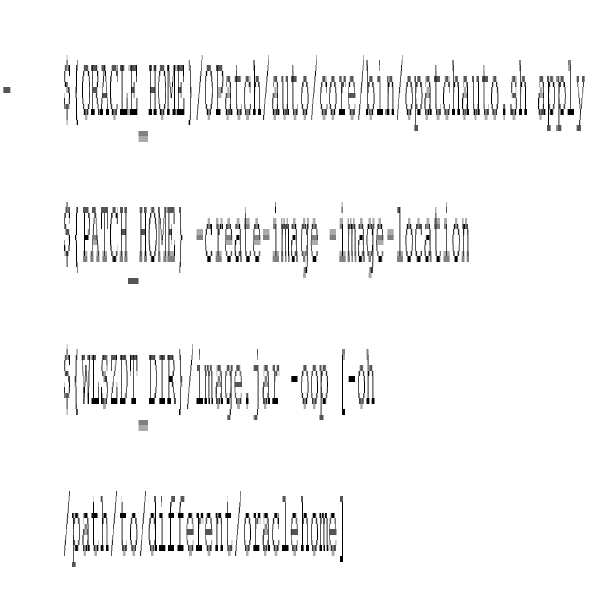
검증 후, 업데이트될 노드들 전부에 패치된 아카이브를 스테이지시킨다.After verification, stage the archived patched to all nodes to be updated.

전체 도메인 또는 특정한 클러스터에 롤아웃을 개시하고 모니터링한다.Initiate and monitor rollouts for the entire domain or specific clusters.
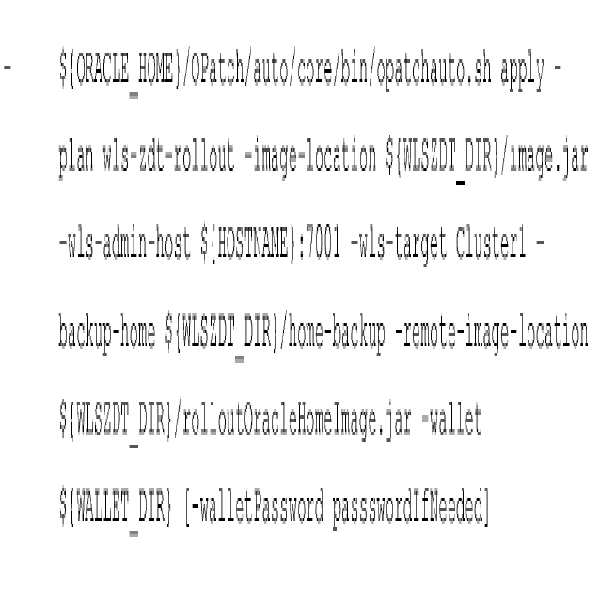
실패된 롤아웃들을 재개 또는 롤백한다.Resume or rollback failed rollouts.
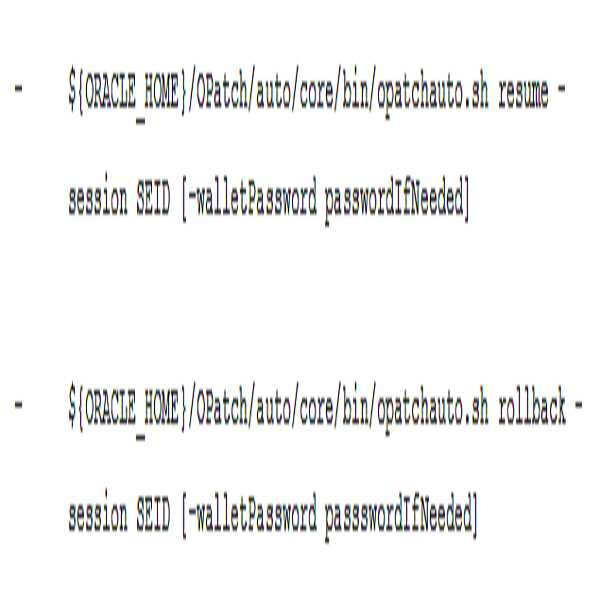
본 발명은 본 발명의 교시들에 따라 프로그램된 하나 이상의 프로세서들, 메모리 및/또는 컴퓨터 판독가능 저장 매체들을 포함하여 하나 이상의 종래의 범용 또는 특수용 디지털 컴퓨터, 컴퓨팅 디바이스, 머신 또는 마이크로프로세서를 이용하여 편리하게 구현될 수 있다. 적절한 소프트웨어 코딩이 소프트웨어 분야의 숙련자들에게 분명할 바와 같이 본 발명의 교시들에 기초하여 숙련된 프로그래머들에 의해 쉽게 준비될 수 있다.The present invention is conveniently provided using one or more conventional general purpose or special purpose digital computers, computing devices, machines or microprocessors, including one or more processors, memory and/or computer readable storage media programmed in accordance with the teachings of the present invention. can be implemented. Appropriate software coding can be readily prepared by skilled programmers based on the teachings of the present invention as will be apparent to those skilled in the software arts.
일부 실시예들에서, 본 발명은 컴퓨터 프로그램 물을 포함하는 바, 상기 컴퓨터 프로그램 물은 명령어들이 저장된/본 발명의 프로세스들 중 어느 것을 수행하도록 컴퓨터를 프로그래밍하기 위해 이용될 수 있는 비일시적 저장 매체 또는 컴퓨터 판독가능 매체(매체들)이다. 저장 매체는 이들로만 한정되는 것은 아니지만, 플로피 디스크(disk)들, 광학 디스크(disc)들, DVD, CD-ROM들, 마이크로드라이브 및 자기-광학 디스크(disk)들을 포함하는 어떤 타입의 디스크, ROM들, RAM들, EPROM들, EEPROM들, DRAM들, VRAM들, 플래시 메모리 디바이스들, 자기 또는 광학 카드들, (분자 메모리 IC들을 포함하는)나노시스템들 또는, 명령어들 및/또는 데이터를 저장하기에 적절한 어떤 타입의 매체 또는 디바이스를 포함할 수 있다.In some embodiments, the present invention comprises a computer program product, wherein the computer program product comprises a non-transitory storage medium having instructions stored thereon/usable to program a computer to perform any of the processes of the present invention or computer-readable media (media). Storage media are any type of disk, ROM, including, but not limited to, floppy disks, optical disks, DVD, CD-ROMs, microdrives and magneto-optical disks (disks). RAMs, EPROMs, EEPROMs, DRAMs, VRAMs, flash memory devices, magnetic or optical cards, nanosystems (including molecular memory ICs) or for storing instructions and/or data It may include any type of medium or device suitable for
본 발명의 상기 설명은 예시 및 설명을 목적으로 제공되었다. 본 설명은 완전한 것(exhaustive)으로 의도되거나 정확히 개시된 형태들로만 본 발명을 제한하고자 의도된 것이 아니다. 많은 수정들 및 변형들이 이 기술분야의 숙련자에게 분명할 것이다. 위 실시예들은 본 발명의 원리 및 이의 실용적 응용을 가장 잘 설명하기 위해 선택 및 기술되었으며, 그럼으로써 이 기술분야의 숙련자들은 본 발명에 대한 다양한 실시예들 및 고려되는 특별한 사용에 적합한 다양한 수정들을 이해할 수 있다. 본 발명의 범위는 다음의 특허 청구 범위 및 이의 균등물에 의해 한정되어야 함이 의도된다.The foregoing description of the invention has been presented for purposes of illustration and description. This description is not intended to be exhaustive or to limit the invention to the precise forms disclosed. Many modifications and variations will be apparent to those skilled in the art. The above embodiments have been chosen and described in order to best explain the principles of the invention and its practical application, so that those skilled in the art will understand various embodiments of the invention and various modifications suitable for the particular use contemplated. can It is intended that the scope of the present invention be limited by the following claims and their equivalents.
Claims (20)
상기 시스템은 하나 이상의 컴퓨터들을 포함하고, 상기 하나 이상의 컴퓨터들은, 복수의 파티션들을 지원하는 도메인의 일부로서 상기 하나 이상의 컴퓨터들 상에서 실행되는 어플리케이션 서버 환경 내에서 작동하는 복수의 피관리(managed) 서버 인스턴스들을 포함하며, 상기 하나 이상의 컴퓨터들은,
상기 어플리케이션 서버 환경 내에서 이용될 수 있는 복수의 전개가능한 리소스들(deployable resources),
도메인 내에서 전개가능한 리소스들의 그룹들을 정의하는 하나 이상의 리소스 그룹 템플릿들, 그리고
하나 이상의 파티션들을 포함하며, 각각의 파티션은 상기 도메인의 어드미니스트레이티브 및 런타임 서브디비전(administrative and runtime subdivision)을 제공하며, 상기 시스템은 테넌트(tenant)에 의한 이용을 위해, 하나 이상의 파티션들 및 리소스 그룹들을 상기 테넌트와 관련시킬 수 있고,
상기 시스템은 인터럽션(interruption)이 없이 상기 도메인의 오퍼레이션을 유지하는 제어된 방식으로 상기 복수의 피관리 서버 인스턴스들을 업데이트하도록 패치들을 적용하기 위해 어플리케이션 서버 환경에 구축된 가용성 특징들(availability features)의 장점을 취하는 패치 특징을 포함하며, 상기 시스템은,
상기 복수의 피관리 서버 인스턴스들에 대해 패치된 디렉토리로서 패치의 롤아웃(rollout)을 수행하는 동작,
각각의 피관리 서버 인스턴스에 대해, 피관리 서버 인스턴스를 셧-다운하고, 상기 패치된 디렉토리의 인스턴스를 사용하도록 상기 피관리 서버 인스턴스를 업데이트하고, 상기 피관리 서버 인스턴스를 업데이트하도록 상기 피관리 서버 인스턴스를 다시 시작하는 동작;
상기 복수의 피관리 서버 인스턴스들에 대한 패치의 롤아웃 동안, 특정 세션과 관련된 요청을 수신하면, 상기 요청을 프로세싱하기 위해 상기 복수의 피관리 서버 인스턴스들 중 제1 피관리 서버 인스턴스에서 상기 특정 세션을 로드하려고 시도하는 동작; 그리고
상기 복수의 피관리 서버 인스턴스들 중 제1 피관리 서버 인스턴스가 상기 특정 세션을 로드할 수 없는 경우, 상기 특정 세션을 로드할 수 있는 상기 복수의 피관리 서버 인스턴스들 중 다른 피관리 서버 인스턴스의 표시를 제공하고, 상기 요청을 프로세싱하기 위해, 상기 특정 세션이 상기 복수의 피관리 서버 인스턴스들 중 제2 피관리 서버 인스턴스에서 로드되도록 지시하는 동작을 포함하는 것을 특징으로 하는 멀티테넌트 어플리케이션 서버 환경에서 패치를 지원하는 시스템.A system that supports patching in a multi-tenant application server environment, comprising:
The system includes one or more computers, wherein the one or more computers are a plurality of managed server instances running within an application server environment running on the one or more computers as part of a domain supporting a plurality of partitions. comprising, the one or more computers comprising:
a plurality of deployable resources available within the application server environment;
one or more resource group templates defining groups of deployable resources within a domain; and
one or more partitions, each partition providing an administrative and runtime subdivision of the domain, the system comprising: one or more partitions and associate resource groups with the tenant;
The system is a system of availability features built into an application server environment to apply patches to update the plurality of managed server instances in a controlled manner that maintains operation of the domain without interruption. A patch feature that takes advantage of the system comprising:
performing a patch rollout as a patched directory for the plurality of managed server instances;
For each managed server instance, shut-down the managed server instance, update the managed server instance to use the instance of the patched directory, and the managed server instance to update the managed server instance to restart the action;
During rollout of a patch to the plurality of managed server instances, upon receiving a request related to a specific session, a first managed server instance of the plurality of managed server instances performs the specific session in order to process the request. an action that attempts to load; and
If a first managed server instance among the plurality of managed server instances cannot load the specific session, display of another managed server instance among the plurality of managed server instances capable of loading the specific session and instructing that the specific session be loaded from a second managed server instance among the plurality of managed server instances in order to process the request. systems that support it.
패치 프로세스의 모니터링 및 에러 처리를 제공하는 오케스트레이션 프레임워크(orchestration framework)를 더 포함하는 것을 특징으로 하는 멀티테넌트 어플리케이션 서버 환경에서 패치를 지원하는 시스템.According to claim 1,
A system supporting patching in a multi-tenant application server environment, further comprising an orchestration framework that provides monitoring and error handling of the patching process.
상기 어플리케이션 서버 환경은 Java EE 어플리케이션 서버를 포함하고, 각각의 리소스 그룹 템플릿은, 하나 이상의 관련 어플리케이션들 및 상기 하나 이상의 관련 어플리케이션들이 의존하는 리소스들을 포함하는 것을 특징으로 하는 멀티테넌트 어플리케이션 서버 환경에서 패치를 지원하는 시스템.According to claim 1,
The application server environment includes a Java EE application server, and each resource group template includes one or more related applications and resources on which the one or more related applications depend. Supported systems.
상기 멀티테넌트 어플리케이션 서버 환경 내에서 패치를 지원하는 노드 관리자를 더 포함하는 것을 특징으로 하는 멀티테넌트 어플리케이션 서버 환경에서 패치를 지원하는 시스템.According to claim 1,
The system for supporting patching in a multi-tenant application server environment, further comprising a node manager supporting patching in the multi-tenant application server environment.
상기 시스템은 클러스터화된 환경에서 노드들에 패치들을 적용하기 위해 이용되는 것을 특징으로 하는 멀티테넌트 어플리케이션 서버 환경에서 패치를 지원하는 시스템.According to claim 1,
and the system is used to apply patches to nodes in a clustered environment.
상기 시스템은, 클라우드 환경 내에서 동작하는 복수의 테넌트들을 지원하기 위해 상기 클라우드 환경 내에서 제공되는 것을 특징으로 하는 멀티테넌트 어플리케이션 서버 환경에서 패치를 지원하는 시스템.According to claim 1,
wherein the system is provided in the cloud environment to support a plurality of tenants operating in the cloud environment.
하나 이상의 컴퓨터들에서, 복수의 파티션들을 지원하는 도메인의 일부로서 상기 하나 이상의 컴퓨터들 상에서 실행되는 어플리케이션 서버 환경 내에서 작동하는 복수의 피관리(managed) 서버 인스턴스들을 비롯하여, 상기 어플리케이션 서버 환경 내에서 이용될 수 있는 복수의 전개가능한 리소스들과, 도메인 내에서 전개가능한 리소스들의 그룹들을 정의하는 하나 이상의 리소스 그룹 템플릿들과, 그리고 하나 이상의 파티션들을 제공하는 단계 - 각각의 파티션은 상기 도메인의 어드미니스트레이티브 및 런타임 서브디비전을 제공함 - 와; 그리고
테넌트(tenant)에 의한 이용을 위해, 하나 이상의 파티션들 및 리소스 그룹들을 상기 테넌트와 관련시키는 단계를 포함하고,
시스템은 인터럽션이 없이 상기 도메인의 오퍼레이션을 유지하는 제어된 방식으로 상기 복수의 피관리 서버 인스턴스들을 업데이트하도록 패치들을 적용하기 위해 어플리케이션 서버 환경에 구축된 가용성 특징들(availability features)의 장점을 취하는 패치 특징을 포함하며, 상기 시스템은,
상기 복수의 피관리 서버 인스턴스들에 대해 패치된 디렉토리로서 패치의 롤아웃(rollout)을 수행하는 동작,
각각의 피관리 서버 인스턴스에 대해, 피관리 서버 인스턴스를 셧-다운하고, 상기 패치된 디렉토리의 인스턴스를 사용하도록 상기 피관리 서버 인스턴스를 업데이트하고, 상기 피관리 서버 인스턴스를 업데이트하도록 상기 피관리 서버 인스턴스를 다시 시작하는 동작;
상기 복수의 피관리 서버 인스턴스들에 대한 패치의 롤아웃 동안, 특정 세션과 관련된 요청을 수신하면, 상기 요청을 프로세싱하기 위해 상기 복수의 피관리 서버 인스턴스들 중 제1 피관리 서버 인스턴스에서 상기 특정 세션을 로드하려고 시도하는 동작; 그리고
상기 복수의 피관리 서버 인스턴스들 중 제1 피관리 서버 인스턴스가 상기 특정 세션을 로드할 수 없는 경우, 상기 특정 세션을 로드할 수 있는 상기 복수의 피관리 서버 인스턴스들 중 다른 피관리 서버 인스턴스의 표시를 제공하고, 상기 요청을 프로세싱하기 위해, 상기 특정 세션이 상기 복수의 피관리 서버 인스턴스들 중 제2 피관리 서버 인스턴스에서 로드되도록 지시하는 동작을 포함하는 것을 특징으로 하는 멀티테넌트 어플리케이션 서버 환경에서 패치를 지원하는 방법.A method of supporting patching in a multi-tenant application server environment, comprising:
use within the application server environment, including a plurality of managed server instances running within the application server environment running on the one or more computers as part of a domain that supports a plurality of partitions on the one or more computers. providing a plurality of deployable resources capable of being deployed, one or more resource group templates defining groups of deployable resources within a domain, and one or more partitions, each partition being an administrator of the domain and runtime subdivisions; and
associating one or more partitions and resource groups with the tenant for use by a tenant;
The system is a patch that takes advantage of availability features built into the application server environment to apply patches to update the plurality of managed server instances in a controlled manner that maintains operation of the domain without interruption. A feature comprising: the system comprising:
performing a patch rollout as a patched directory for the plurality of managed server instances;
For each managed server instance, shut-down the managed server instance, update the managed server instance to use the instance of the patched directory, and the managed server instance to update the managed server instance to restart the action;
During rollout of a patch to the plurality of managed server instances, upon receiving a request related to a specific session, a first managed server instance of the plurality of managed server instances performs the specific session in order to process the request. an action that attempts to load; and
If a first managed server instance among the plurality of managed server instances cannot load the specific session, display of another managed server instance among the plurality of managed server instances capable of loading the specific session and instructing that the specific session be loaded from a second managed server instance among the plurality of managed server instances in order to process the request. How to support.
패치 프로세스의 모니터링 및 에러 처리를 제공하는 오케스트레이션 프레임워크를 이용하는 단계를 더 포함하는 것을 특징으로 하는 멀티테넌트 어플리케이션 서버 환경에서 패치를 지원하는 방법.8. The method of claim 7,
A method for supporting patching in a multi-tenant application server environment, further comprising using an orchestration framework that provides monitoring and error handling of the patch process.
상기 어플리케이션 서버 환경은 Java EE 어플리케이션 서버를 포함하고, 각각의 리소스 그룹 템플릿은, 하나 이상의 관련 어플리케이션들 및 상기 하나 이상의 관련어플리케이션들이 의존하는 리소스들을 포함하는 것을 특징으로 하는 멀티테넌트 어플리케이션 서버 환경에서 패치를 지원하는 방법.8. The method of claim 7,
The application server environment includes a Java EE application server, and each resource group template includes one or more related applications and resources on which the one or more related applications depend. How to apply.
상기 멀티테넌트 어플리케이션 서버 환경 내에서 패치를 지원하기 위해 노드 관리자를 이용하는 단계를 더 포함하는 것을 특징으로 하는 멀티테넌트 어플리케이션 서버 환경에서 패치를 지원하는 방법.8. The method of claim 7,
and using a node manager to support patching in the multi-tenant application server environment.
상기 방법은 클러스터화된 환경에서 노드들에 패치들을 적용하기 위해 이용되는 것을 특징으로 하는 멀티테넌트 어플리케이션 서버 환경에서 패치를 지원하는 방법.8. The method of claim 7,
wherein the method is used to apply patches to nodes in a clustered environment.
상기 방법은, 클라우드 환경 내에서 동작하는 복수의 테넌트들을 지원하기 위해 상기 클라우드 환경 내에서 수행되는 것을 특징으로 하는 멀티테넌트 어플리케이션 서버 환경에서 패치를 지원하는 방법.8. The method of claim 7,
wherein the method is performed in the cloud environment to support a plurality of tenants operating in the cloud environment.
복수의 파티션들을 지원하는 도메인의 일부로서 어플리케이션 서버 환경 내에서 작동하는 복수의 피관리(managed) 서버 인스턴스들과, 상기 어플리케이션 서버 환경 내에서 이용될 수 있는 복수의 전개가능한 리소스들과, 도메인 내에서 전개가능한 리소스들의 그룹들을 정의하는 하나 이상의 리소스 그룹 템플릿들과, 그리고 하나 이상의 파티션들을 제공하는 단계 - 각각의 파티션은 상기 도메인의 어드미니스트레이티브 및 런타임 서브디비전을 제공함 - 와; 그리고
테넌트(tenant)에 의한 이용을 위해, 하나 이상의 파티션들 및 리소스 그룹들을 상기 테넌트와 관련시키는 단계를 포함하고,
시스템은 인터럽션이 없이 상기 도메인의 오퍼레이션을 유지하는 제어된 방식으로 상기 복수의 피관리 서버 인스턴스들을 업데이트하도록 패치들을 적용하기 위해 어플리케이션 서버 환경에 구축된 가용성 특징들(availability features)의 장점을 취하는 패치 특징을 포함하며, 상기 시스템은,
상기 복수의 피관리 서버 인스턴스들에 대해 패치된 디렉토리로서 패치의 롤아웃(rollout)을 수행하는 동작,
각각의 피관리 서버 인스턴스에 대해, 피관리 서버 인스턴스를 셧-다운하고, 상기 패치된 디렉토리의 인스턴스를 사용하도록 상기 피관리 서버 인스턴스를 업데이트하고, 상기 피관리 서버 인스턴스를 업데이트하도록 상기 피관리 서버 인스턴스를 다시 시작하는 동작;
상기 복수의 피관리 서버 인스턴스들에 대한 패치의 롤아웃 동안, 특정 세션과 관련된 요청을 수신하면, 상기 요청을 프로세싱하기 위해 상기 복수의 피관리 서버 인스턴스들 중 제1 피관리 서버 인스턴스에서 상기 특정 세션을 로드하려고 시도하는 동작; 그리고
상기 복수의 피관리 서버 인스턴스들 중 제1 피관리 서버 인스턴스가 상기 특정 세션을 로드할 수 없는 경우, 상기 특정 세션을 로드할 수 있는 상기 복수의 피관리 서버 인스턴스들 중 다른 피관리 서버 인스턴스의 표시를 제공하고, 상기 요청을 프로세싱하기 위해, 상기 특정 세션이 상기 복수의 피관리 서버 인스턴스들 중 제2 피관리 서버 인스턴스에서 로드되도록 지시하는 동작을 포함하는 것을 특징으로 하는 멀티테넌트 어플리케이션 서버 환경에서 패치를 지원하는 것을 특징으로 하는 비일시적 컴퓨터 판독가능 저장 매체.A non-transitory computer readable storage medium having stored thereon instructions, which, when read and executed by one or more computers, cause the one or more computers to perform steps, the steps comprising:
a plurality of managed server instances operating in an application server environment as part of a domain supporting a plurality of partitions, a plurality of deployable resources available within the application server environment; providing one or more resource group templates defining groups of deployable resources, and one or more partitions, each partition providing an administrative and runtime subdivision of the domain; and
associating one or more partitions and resource groups with the tenant for use by a tenant;
The system is a patch that takes advantage of availability features built into the application server environment to apply patches to update the plurality of managed server instances in a controlled manner that maintains operation of the domain without interruption. A feature comprising: the system comprising:
performing a patch rollout as a patched directory for the plurality of managed server instances;
For each managed server instance, shut-down the managed server instance, update the managed server instance to use the instance of the patched directory, and the managed server instance to update the managed server instance to restart the action;
During rollout of a patch to the plurality of managed server instances, upon receiving a request related to a specific session, a first managed server instance of the plurality of managed server instances performs the specific session in order to process the request. an action that attempts to load; and
If a first managed server instance among the plurality of managed server instances cannot load the specific session, display of another managed server instance among the plurality of managed server instances capable of loading the specific session and instructing that the specific session be loaded from a second managed server instance among the plurality of managed server instances in order to process the request. A non-transitory computer-readable storage medium, characterized in that it supports.
패치 프로세스의 모니터링 및 에러 처리를 제공하는 오케스트레이션 프레임워크를 이용하는 단계를 더 포함하는 것을 특징으로 하는 비일시적 컴퓨터 판독가능 저장 매체.14. The method of claim 13,
and using an orchestration framework to provide monitoring and error handling of the patch process.
상기 어플리케이션 서버 환경은 Java EE 어플리케이션 서버를 포함하고, 각각의 리소스 그룹 템플릿은, 하나 이상의 관련 어플리케이션들 및 상기 하나 이상의 관련어플리케이션들이 의존하는 리소스들을 포함하는 것을 특징으로 하는 비일시적 컴퓨터 판독가능 저장 매체.14. The method of claim 13,
wherein the application server environment includes a Java EE application server, and each resource group template includes one or more related applications and resources on which the one or more related applications depend.
상기 멀티테넌트 어플리케이션 서버 환경 내에서 패치를 지원하기 위해 노드 관리자를 이용하는 단계를 더 포함하는 것을 특징으로 하는 비일시적 컴퓨터 판독가능 저장 매체.14. The method of claim 13,
and using a node manager to support patching within the multitenant application server environment.
상기 단계들은 클러스터화된 환경에서 노드들에 패치들을 적용하기 위해 이용되는 것을 특징으로 하는 비일시적 컴퓨터 판독가능 저장 매체.14. The method of claim 13,
wherein the steps are used to apply patches to nodes in a clustered environment.
상기 단계들은 클라우드 환경 내에서 동작하는 복수의 테넌트들을 지원하기 위해 상기 클라우드 환경 내에서 수행되는 것을 특징으로 하는 비일시적 컴퓨터 판독가능 저장 매체.14. The method of claim 13,
and the steps are performed within the cloud environment to support a plurality of tenants operating within the cloud environment.
Applications Claiming Priority (3)
| Application Number | Priority Date | Filing Date | Title |
|---|---|---|---|
| US201462054903P | 2014-09-24 | 2014-09-24 | |
| US62/054,903 | 2014-09-24 | ||
| PCT/US2015/052057 WO2016049376A1 (en) | 2014-09-24 | 2015-09-24 | System and method for supporting patching in a multitenant application server environment |
Publications (2)
| Publication Number | Publication Date |
|---|---|
| KR20170058955A KR20170058955A (en) | 2017-05-29 |
| KR102443172B1 true KR102443172B1 (en) | 2022-09-14 |
Family
ID=54291643
Family Applications (1)
| Application Number | Title | Priority Date | Filing Date |
|---|---|---|---|
| KR1020177009297A Active KR102443172B1 (en) | 2014-09-24 | 2015-09-24 | Systems and methods for supporting patching in a multi-tenant application server environment |
Country Status (6)
| Country | Link |
|---|---|
| US (4) | US9405530B2 (en) |
| EP (1) | EP3198431A1 (en) |
| JP (1) | JP6748638B2 (en) |
| KR (1) | KR102443172B1 (en) |
| CN (1) | CN106716360B (en) |
| WO (1) | WO2016049376A1 (en) |
Families Citing this family (83)
| Publication number | Priority date | Publication date | Assignee | Title |
|---|---|---|---|---|
| US20150081400A1 (en) * | 2013-09-19 | 2015-03-19 | Infosys Limited | Watching ARM |
| US10474998B2 (en) | 2014-01-21 | 2019-11-12 | Oracle International Corporation | System and method for messaging in a multitenant application server environment |
| US10103946B2 (en) | 2014-01-21 | 2018-10-16 | Oracle International Corporation | System and method for JMS integration in a multitenant application server environment |
| US10476938B2 (en) | 2014-01-21 | 2019-11-12 | Oracle International Corporation | System and method for multitenancy store in a multitenant application server environment |
| CN105900059B (en) | 2014-01-21 | 2019-06-07 | 甲骨文国际公司 | System and method for supporting multi-tenant in application server, cloud or other environment |
| US10187454B2 (en) | 2014-01-21 | 2019-01-22 | Oracle International Corporation | System and method for dynamic clustered JMS in an application server environment |
| US10873627B2 (en) | 2014-06-23 | 2020-12-22 | Oracle International Corporation | System and method for supporting use of an in-memory data grid with a multitenant application server environment |
| US10027550B2 (en) | 2014-06-23 | 2018-07-17 | Oracle International Corporation | System and method for multitenant-aware console for use in a multitenant application server environment |
| US11477278B2 (en) | 2014-06-24 | 2022-10-18 | Oracle International Corporation | System and method for supporting partitions in a multitenant application server environment |
| US10318280B2 (en) | 2014-09-24 | 2019-06-11 | Oracle International Corporation | System and method for supporting patching in a multitenant application server environment |
| KR102443172B1 (en) | 2014-09-24 | 2022-09-14 | 오라클 인터내셔날 코포레이션 | Systems and methods for supporting patching in a multi-tenant application server environment |
| US9747137B2 (en) | 2014-09-25 | 2017-08-29 | Oracle International Corporation | System and method for providing a partition file system in a multitenant application server environment |
| US10462068B2 (en) | 2014-09-25 | 2019-10-29 | Oracle International Corporation | System and method for tenant onboarding in a multitenant application server environment |
| US10348565B2 (en) | 2014-09-25 | 2019-07-09 | Oracle International Corporation | System and method for rule-based elasticity in a multitenant application server environment |
| US10382537B2 (en) | 2014-09-25 | 2019-08-13 | Oracle International Corporation | System and method for use of a global runtime in a multitenant application server environment |
| US11057272B2 (en) | 2014-09-26 | 2021-07-06 | Oracle International Corporation | System and method for transactions in a multitenant application server environment |
| US11188427B2 (en) * | 2014-09-26 | 2021-11-30 | Oracle International Corporation | System and method for transaction recovery in a multitenant application server environment |
| US10050903B2 (en) | 2014-09-26 | 2018-08-14 | Oracle International Corporation | System and method for multi-tenancy enablement of enterprise JAVA (TM) applications using resource proxies and application tenancy context |
| US10091135B2 (en) | 2014-09-26 | 2018-10-02 | Oracle International Corporation | System and method for multi-tenancy enablement of enterprise java applications using resource proxies and application tenancy context |
| US10250512B2 (en) | 2015-01-21 | 2019-04-02 | Oracle International Corporation | System and method for traffic director support in a multitenant application server environment |
| CN106302623B (en) * | 2015-06-12 | 2020-03-03 | 微软技术许可有限责任公司 | Tenant-controlled cloud updates |
| US10277622B2 (en) | 2015-07-13 | 2019-04-30 | CYBRIC Inc. | Enterprise level cybersecurity automatic remediation |
| US10148752B2 (en) | 2015-07-13 | 2018-12-04 | CYBRIC Inc. | Enterprise level security orchestration |
| US9900377B2 (en) | 2015-08-07 | 2018-02-20 | International Business Machines Corporation | Dynamic healthchecking load balancing gateway |
| US20170115978A1 (en) * | 2015-10-26 | 2017-04-27 | Microsoft Technology Licensing, Llc | Monitored upgrades using health information |
| US10671376B2 (en) * | 2016-03-15 | 2020-06-02 | Shenzhen Skyworth-Rgb Electronic Co., Ltd. | Server program hot upgrading method and device |
| US10001983B2 (en) * | 2016-07-27 | 2018-06-19 | Salesforce.Com, Inc. | Rolling version update deployment utilizing dynamic node allocation |
| US10310841B2 (en) * | 2016-09-16 | 2019-06-04 | Oracle International Corporation | System and method for handling lazy deserialization exceptions in an application server environment |
| US10872074B2 (en) | 2016-09-30 | 2020-12-22 | Microsoft Technology Licensing, Llc | Distributed availability groups of databases for data centers |
| US10360242B2 (en) | 2016-12-01 | 2019-07-23 | Bank Of America Corporation | Automated server analysis and patching for enabling relational database migration to a cloud network |
| CN106789249B (en) * | 2016-12-22 | 2019-12-10 | 北京五八信息技术有限公司 | Hot updating method, client and server |
| US10157053B2 (en) | 2017-02-14 | 2018-12-18 | Arris Enterprises Llc | Modified federation architecture with reduced update time |
| CN108733533B (en) * | 2017-04-18 | 2021-07-13 | 微软技术许可有限责任公司 | Optional manual scheduling of planned host maintenance |
| US10318279B2 (en) * | 2017-05-30 | 2019-06-11 | Microsoft Technology Licensing, Llc | Autonomous upgrade of deployed resources in a distributed computing environment |
| US10389603B2 (en) * | 2017-06-02 | 2019-08-20 | Microsoft Technology Licensing, Llc | Fast provisioning of tenants on a hosted service |
| CN109086125B (en) * | 2017-06-14 | 2021-01-22 | 杭州海康威视数字技术股份有限公司 | Picture analysis method, device and system, computer equipment and storage medium |
| US10579357B2 (en) | 2017-07-20 | 2020-03-03 | International Business Machines Corporation | Cognitive expected program code installation result assessment |
| WO2019018316A1 (en) * | 2017-07-21 | 2019-01-24 | CYBRIC Inc. | Enterprise level cybersecurity automatic remediation |
| US11237814B2 (en) * | 2017-08-17 | 2022-02-01 | Oracle International Corporation | System and method for supporting custom hooks during patching in an application server environment |
| US11075799B2 (en) | 2017-08-24 | 2021-07-27 | Oracle International Corporation | System and method for provisioning in a multi-tenant application server environment |
| US11416235B2 (en) * | 2017-09-28 | 2022-08-16 | Oracle International Corporation | System and method for managed server independence for deployment of software applications and libraries |
| US10540496B2 (en) | 2017-09-29 | 2020-01-21 | International Business Machines Corporation | Dynamic re-composition of patch groups using stream clustering |
| US10721296B2 (en) | 2017-12-04 | 2020-07-21 | International Business Machines Corporation | Optimized rolling restart of stateful services to minimize disruption |
| US11121872B2 (en) | 2018-01-23 | 2021-09-14 | Zeronorth, Inc. | Trusted verification of cybersecurity remediation |
| US11539748B2 (en) | 2018-01-23 | 2022-12-27 | Zeronorth, Inc. | Monitoring and reporting enterprise level cybersecurity remediation |
| US10379985B1 (en) * | 2018-02-01 | 2019-08-13 | EMC IP Holding Company LLC | Automating and monitoring rolling cluster reboots |
| US10289403B1 (en) | 2018-03-29 | 2019-05-14 | Microsoft Technology Licensing, Llc | Enhanced server farm patching system for enabling developers to override off-peak patching schedules |
| US10585659B2 (en) * | 2018-03-29 | 2020-03-10 | Microsoft Technology Licensing, Llc | Enabling tenant administrators to initiate request driven peak-hour builds to override off-peak patching schedules |
| CN108874503A (en) * | 2018-06-05 | 2018-11-23 | 国云科技股份有限公司 | A configuration proxy update method for cloud platform application clusters |
| US10785129B2 (en) | 2018-06-27 | 2020-09-22 | Oracle International Corporation | Computerized methods and systems for maintaining and modifying cloud computer services |
| US11115344B2 (en) | 2018-06-27 | 2021-09-07 | Oracle International Corporation | Computerized methods and systems for migrating cloud computer services |
| US11190599B2 (en) | 2018-06-27 | 2021-11-30 | Oracle International Corporation | Method and system for cloud service pre-provisioning |
| US10911367B2 (en) | 2018-06-27 | 2021-02-02 | Oracle International Corporation | Computerized methods and systems for managing cloud computer services |
| US11089098B2 (en) * | 2018-07-24 | 2021-08-10 | Vmware, Inc. | Migration as a service-based server and agent applications migration |
| US10579370B2 (en) * | 2018-08-03 | 2020-03-03 | EMC IP Company LLC | Method to disintegrate a monolith service to microservices |
| CN109739532B (en) * | 2018-12-13 | 2022-05-27 | 北京计算机技术及应用研究所 | Software updating method on domestic Linux operating system |
| US11119753B2 (en) * | 2019-05-06 | 2021-09-14 | Paypal, Inc. | Distributed autonomous patching system |
| US11379434B2 (en) * | 2019-05-13 | 2022-07-05 | Jpmorgan Chase Bank, N.A. | Efficient and automatic database patching using elevated privileges |
| US11907743B2 (en) | 2019-05-21 | 2024-02-20 | Oracle International Corporation | System and method for relocating customer virtual machine instances in a multi-tenant cloud service |
| US11281522B2 (en) * | 2019-08-30 | 2022-03-22 | Microsoft Technology Licensing, Llc | Automated detection and classification of dynamic service outages |
| US11609828B2 (en) | 2020-01-30 | 2023-03-21 | Rubrik, Inc. | Utilizing a tablespace to export to a native database recovery environment |
| US11604761B2 (en) * | 2020-01-30 | 2023-03-14 | Rubrik, Inc. | Utilizing a tablespace to export from a foreign database recovery environment |
| US11360860B2 (en) | 2020-01-30 | 2022-06-14 | Rubrik, Inc. | Exporting a database from a foreign database recovery environment |
| US11467925B2 (en) | 2020-01-30 | 2022-10-11 | Rubrik, Inc. | Exporting a database to a native database recovery environment |
| US11507392B2 (en) | 2020-02-26 | 2022-11-22 | Red Hat, Inc. | Automatically configuring computing clusters |
| US11436004B2 (en) | 2020-04-23 | 2022-09-06 | Red Hat, Inc. | Calculating a patch target on an application server |
| CN111580844B (en) * | 2020-05-09 | 2024-02-02 | 上海航天电子通讯设备研究所 | Software and hardware collaborative application program maintenance method supporting on-orbit dynamic update |
| CN114356316B (en) * | 2020-09-30 | 2024-11-15 | 华为技术有限公司 | Patch reuse method, system and electronic device |
| US11886867B2 (en) | 2020-11-12 | 2024-01-30 | International Business Machines Corporation | Workflow patching |
| US11556330B2 (en) | 2020-11-24 | 2023-01-17 | Kyndryl, Inc. | Analysis and implementation of security updates |
| CN112328331B (en) * | 2020-11-30 | 2023-03-24 | 中国航空工业集团公司西安航空计算技术研究所 | Method and device for replacing applications in partition mode |
| CN112698846B (en) * | 2020-12-30 | 2024-04-09 | 麒麟软件有限公司 | Method and system for automatically installing patches in Linux system |
| JP7240439B2 (en) * | 2021-04-30 | 2023-03-15 | 株式会社日立製作所 | Update device, update method and program |
| US11748087B2 (en) * | 2021-06-28 | 2023-09-05 | Okta, Inc. | Software update distribution within a multi-tenant architecture |
| CN113342400B (en) * | 2021-06-29 | 2022-05-17 | 上海哔哩哔哩科技有限公司 | Off-line package packing method and device and computer equipment |
| CN114461264B (en) * | 2021-07-22 | 2023-01-10 | 荣耀终端有限公司 | Patching method, patch generating method and related equipment |
| US20230044016A1 (en) * | 2021-08-03 | 2023-02-09 | Vertiv It Systems, Inc. | System and method for service management and container orchestration within a host environment |
| CN113641386A (en) * | 2021-08-17 | 2021-11-12 | 西安酷赛科技有限公司 | Method and system for upgrading based on error reporting frequency |
| US11645066B2 (en) | 2021-08-23 | 2023-05-09 | International Business Machines Corporation | Managing and distributing patches for multi-tenant applications |
| US11695655B1 (en) | 2023-01-20 | 2023-07-04 | Citigroup Technology, Inc. | Platform for automated management of servers |
| US12192081B2 (en) * | 2023-01-31 | 2025-01-07 | Salesforce, Inc. | De-centralized high risk actions on coordinated computer systems |
| US12271729B2 (en) * | 2023-02-28 | 2025-04-08 | Gm Cruise Holdings Llc | Progressive delivery of cluster infrastructure updates |
| WO2025127384A1 (en) * | 2023-12-12 | 2025-06-19 | 삼성전자주식회사 | Electronic device for performing data caching based on user data permissions and operating method thereof |
Citations (7)
| Publication number | Priority date | Publication date | Assignee | Title |
|---|---|---|---|---|
| JP2005092803A (en) * | 2003-09-19 | 2005-04-07 | Fujitsu Ltd | Apparatus and method for applying correction information to software |
| US20110265168A1 (en) | 2010-04-26 | 2011-10-27 | Vmware, Inc. | Policy engine for cloud platform |
| US20120147894A1 (en) | 2010-12-08 | 2012-06-14 | Mulligan John T | Methods and apparatus to provision cloud computing network elements |
| US20120254445A1 (en) | 2011-04-04 | 2012-10-04 | Hitachi, Ltd. | Control method for virtual machine and management computer |
| US20120324069A1 (en) | 2011-06-17 | 2012-12-20 | Microsoft Corporation | Middleware Services Framework for On-Premises and Cloud Deployment |
| US20130086235A1 (en) | 2011-09-30 | 2013-04-04 | James Michael Ferris | Systems and methods for generating cloud deployment targets based on predictive workload estimation |
| US20130326506A1 (en) | 2012-05-30 | 2013-12-05 | Michael P. McGrath | Mechanism for Controlling Capacity in a Multi-Tenant Platform-as-a-Service (Paas) Environment in a Cloud Computing System |
Family Cites Families (238)
| Publication number | Priority date | Publication date | Assignee | Title |
|---|---|---|---|---|
| JPH0397030A (en) * | 1989-09-11 | 1991-04-23 | Hitachi Ltd | Program modification method |
| US5838910A (en) | 1996-03-14 | 1998-11-17 | Domenikos; Steven D. | Systems and methods for executing application programs from a memory device linked to a server at an internet site |
| US6542926B2 (en) | 1998-06-10 | 2003-04-01 | Compaq Information Technologies Group, L.P. | Software partitioned multi-processor system with flexible resource sharing levels |
| US6247109B1 (en) | 1998-06-10 | 2001-06-12 | Compaq Computer Corp. | Dynamically assigning CPUs to different partitions each having an operation system instance in a shared memory space |
| AU5486800A (en) * | 1999-06-10 | 2001-01-02 | Alcatel Internetworking, Inc. | Policy based network architecture |
| US6845503B1 (en) | 1999-08-13 | 2005-01-18 | Sun Microsystems, Inc. | System and method for enabling atomic class loading in an application server environment |
| US8234650B1 (en) | 1999-08-23 | 2012-07-31 | Oracle America, Inc. | Approach for allocating resources to an apparatus |
| US6904593B1 (en) | 2000-03-24 | 2005-06-07 | Hewlett-Packard Development Company, L.P. | Method of administering software components using asynchronous messaging in a multi-platform, multi-programming language environment |
| WO2001073661A1 (en) * | 2000-03-27 | 2001-10-04 | Vertical*I Inc. | Business technology exchange and collaboration system |
| US6922685B2 (en) | 2000-05-22 | 2005-07-26 | Mci, Inc. | Method and system for managing partitioned data resources |
| US20020002635A1 (en) | 2000-06-30 | 2002-01-03 | Arto Astala | Presentation of an active window in a terminal and method of using same |
| US7370364B2 (en) | 2000-07-31 | 2008-05-06 | Ellacoya Networks, Inc. | Managing content resources |
| AU2001288757A1 (en) | 2000-09-01 | 2002-03-13 | Op40, Inc. | System, method, uses, products, program products, and business methods for distributed internet and distributed network services |
| US7222268B2 (en) | 2000-09-18 | 2007-05-22 | Enterasys Networks, Inc. | System resource availability manager |
| US7185364B2 (en) | 2001-03-21 | 2007-02-27 | Oracle International Corporation | Access system interface |
| US6931638B2 (en) | 2001-03-15 | 2005-08-16 | Sun Microsystems, Inc | Method and apparatus to facilitate sharing optimized instruction code in a multitasking virtual machine |
| US7165255B2 (en) | 2001-03-15 | 2007-01-16 | Sun Microsystems, Inc. | Method and apparatus for managing surplus memory in multitasking system |
| US7065755B2 (en) | 2001-03-15 | 2006-06-20 | Sun Microsystems, Inc. | Method and apparatus for removing class initialization barriers from shared compiled methods |
| US7003768B2 (en) | 2001-03-15 | 2006-02-21 | Sun Microsystems, Inc. | Method and apparatus for class intialization barriers and access to class variables in multitasking virtual machines |
| US20020184312A1 (en) | 2001-05-31 | 2002-12-05 | International Business Machines Corproration | Computer networks simultaneously sharing images and data with individual scan and reset by a plurality of users - systems, methods & program products |
| WO2002101510A2 (en) | 2001-06-13 | 2002-12-19 | Caminus Corporation | System architecture and method for energy industry trading and transaction management |
| US7130897B2 (en) | 2001-10-11 | 2006-10-31 | International Business Machines Corporation | Dynamic cluster versioning for a group |
| US6980980B1 (en) | 2002-01-16 | 2005-12-27 | Microsoft Corporation | Summary-detail cube architecture using horizontal partitioning of dimensions |
| US7725590B2 (en) | 2002-04-19 | 2010-05-25 | Computer Associates Think, Inc. | Web services broker |
| US6950825B2 (en) | 2002-05-30 | 2005-09-27 | International Business Machines Corporation | Fine grained role-based access to system resources |
| US7225462B2 (en) | 2002-06-26 | 2007-05-29 | Bellsouth Intellectual Property Corporation | Systems and methods for managing web user information |
| JP2004102379A (en) * | 2002-09-05 | 2004-04-02 | Hitachi Ltd | Patch application management program, method, and system |
| US6792460B2 (en) | 2002-10-02 | 2004-09-14 | Mercury Interactive Corporation | System and methods for monitoring application server performance |
| JP3862652B2 (en) | 2002-12-10 | 2006-12-27 | キヤノン株式会社 | Printing control method and information processing apparatus |
| US7379998B2 (en) | 2003-03-31 | 2008-05-27 | Jp Morgan Chase Bank | System and method for multi-platform queue queries |
| NO20032418D0 (en) | 2003-05-27 | 2003-05-27 | Ericsson Telefon Ab L M | Aggregation of non-blocking, durable state machines on an "EnterpriseJava Bean" platform |
| US7590984B2 (en) | 2003-05-29 | 2009-09-15 | International Business Machines Corporation | System and method for balancing a computing load among computing resources in a distributed computing problem |
| US8776050B2 (en) | 2003-08-20 | 2014-07-08 | Oracle International Corporation | Distributed virtual machine monitor for managing multiple virtual resources across multiple physical nodes |
| JP2007508623A (en) | 2003-10-08 | 2007-04-05 | ユニシス コーポレーション | Virtual data center that allocates and manages system resources across multiple nodes |
| GB2407658A (en) | 2003-10-31 | 2005-05-04 | Daniele Grazioli | Computer network for processing received event data |
| US8166152B1 (en) | 2003-12-30 | 2012-04-24 | Sap Ag | Architecture and method for monitoring system resources within an enterprise network |
| US7984442B2 (en) | 2004-01-29 | 2011-07-19 | Klingman Edwin E | Intelligent memory device multilevel ASCII interpreter |
| US20050216585A1 (en) | 2004-03-26 | 2005-09-29 | Tsvetelina Todorova | Monitor viewer for an enterprise network monitoring system |
| US7703019B2 (en) | 2004-03-26 | 2010-04-20 | Sap Ag | Visual administrator for specifying service references to support a service |
| US7657892B2 (en) | 2004-05-20 | 2010-02-02 | Bea Systems, Inc. | System and method for application server with self-tuned threading model |
| US7395458B2 (en) | 2004-05-21 | 2008-07-01 | Bea Systems, Inc. | Diagnostic instrumentation |
| US20050283658A1 (en) | 2004-05-21 | 2005-12-22 | Clark Thomas K | Method, apparatus and program storage device for providing failover for high availability in an N-way shared-nothing cluster system |
| US7752629B2 (en) | 2004-05-21 | 2010-07-06 | Bea Systems Inc. | System and method for application server with overload protection |
| US7562341B2 (en) | 2004-05-24 | 2009-07-14 | Sap Ag | Deploy callback system with bidirectional containers |
| EP1832976A4 (en) * | 2004-10-12 | 2009-04-29 | Fujitsu Ltd | SOFTWARE UPDATE PROGRAM, SOFTWARE UPDATE DEVICE, AND SOFTWARE UPDATE METHOD |
| US7606832B2 (en) | 2004-11-12 | 2009-10-20 | International Business Machines Corporation | System and method for orchestrating composite web services in constrained data flow environments |
| US7657870B2 (en) | 2005-02-25 | 2010-02-02 | International Business Machines Corporation | Method and apparatus for implementing dynamic function groups in a data processing system |
| US8387052B2 (en) | 2005-03-14 | 2013-02-26 | Qnx Software Systems Limited | Adaptive partitioning for operating system |
| US7454448B1 (en) | 2005-04-14 | 2008-11-18 | Sun Microsystems, Inc. | Synchronizing object promotion in a multi-tasking virtual machine with generational garbage collection |
| US8140816B2 (en) | 2005-05-12 | 2012-03-20 | International Business Machines Corporation | Utilizing partition resource requirements from workload estimation to automate partition software configuration and validation |
| US8402525B1 (en) | 2005-07-01 | 2013-03-19 | Verizon Services Corp. | Web services security system and method |
| US20070022203A1 (en) | 2005-07-19 | 2007-01-25 | International Business Machines Corporation | Method and apparatus for providing proxied JMX interfaces to highly available J2EE components |
| US7945677B2 (en) | 2005-09-06 | 2011-05-17 | Sap Ag | Connection manager capable of supporting both distributed computing sessions and non distributed computing sessions |
| US8429630B2 (en) | 2005-09-15 | 2013-04-23 | Ca, Inc. | Globally distributed utility computing cloud |
| US7765187B2 (en) | 2005-11-29 | 2010-07-27 | Emc Corporation | Replication of a consistency group of data storage objects from servers in a data network |
| US7707553B2 (en) | 2005-12-08 | 2010-04-27 | International Business Machines Corporation | Computer method and system for automatically creating tests for checking software |
| US7725446B2 (en) | 2005-12-19 | 2010-05-25 | International Business Machines Corporation | Commitment of transactions in a distributed system |
| US8255455B2 (en) | 2005-12-30 | 2012-08-28 | Sap Ag | Method and system for message oriented middleware virtual provider distribution |
| US20070156913A1 (en) | 2005-12-30 | 2007-07-05 | Hiroyuki Miyamoto | Method for enabling extension points through plug-ins |
| US7461231B2 (en) | 2006-01-12 | 2008-12-02 | International Business Machines Corporation | Autonomically adjusting one or more computer program configuration settings when resources in a logical partition change |
| US9497247B2 (en) | 2006-03-06 | 2016-11-15 | Ca, Inc. | Transferring session state information between two or more web-based applications of a server system |
| WO2007113542A1 (en) | 2006-03-31 | 2007-10-11 | British Telecommunications Public Limited Company | Server computer component |
| US8788569B2 (en) | 2006-03-31 | 2014-07-22 | British Telecommunications Public Limited Company | Server computer system running versions of an application simultaneously |
| US8250559B2 (en) | 2006-04-12 | 2012-08-21 | Oracle America, Inc. | Supporting per-program classpaths with class sharing in a multi-tasking virtual machine |
| US8924524B2 (en) | 2009-07-27 | 2014-12-30 | Vmware, Inc. | Automated network configuration of virtual machines in a virtual lab data environment |
| US20080022380A1 (en) | 2006-05-25 | 2008-01-24 | Gemalto, Inc. | Method of patching applications on small resource-constrained secure devices |
| US7962470B2 (en) | 2006-06-01 | 2011-06-14 | Sap Ag | System and method for searching web services |
| US7706303B2 (en) | 2006-06-26 | 2010-04-27 | Cisco Technology, Inc. | Port pooling |
| US20080071922A1 (en) | 2006-09-19 | 2008-03-20 | International Business Machines Corporation | Methods, systems, and computer program products to transparently dispatch requests to remote resources in a multiple application server environment |
| US8331351B2 (en) | 2007-01-05 | 2012-12-11 | International Business Machines Corporation | Communicating with session initiation protocol (SIP) application sessions using a message-oriented middleware system |
| US7870171B2 (en) | 2007-02-12 | 2011-01-11 | Oracle America, Inc. | Method and system for garbage collection in a multitasking environment |
| US7627621B2 (en) | 2007-02-12 | 2009-12-01 | Sun Microsystems, Inc. | Method and system for minor garbage collection |
| US8656386B1 (en) | 2007-03-13 | 2014-02-18 | Parallels IP Holdings GmbH | Method to share identical files in a common area for virtual machines having the same operating system version and using a copy on write to place a copy of the shared identical file in a private area of the corresponding virtual machine when a virtual machine attempts to modify the shared identical file |
| US8078704B2 (en) | 2007-04-12 | 2011-12-13 | Hewlett-Packard Development Company, L.P. | Provisioning of a service environment using web services |
| US8640146B2 (en) | 2007-05-31 | 2014-01-28 | Red Hat, Inc. | Providing extensive ability for describing a management interface |
| US8099737B2 (en) | 2007-06-05 | 2012-01-17 | Oracle International Corporation | Event processing finite state engine and language |
| US8782322B2 (en) | 2007-06-21 | 2014-07-15 | International Business Machines Corporation | Ranking of target server partitions for virtual server mobility operations |
| KR20090006572A (en) | 2007-07-12 | 2009-01-15 | 삼성전자주식회사 | Thread Pool Management Device and Method |
| US7975138B2 (en) | 2007-07-18 | 2011-07-05 | Oracle International Corporation | Systems and methods for mutually authenticated transaction coordination messages over insecure connections |
| US7756912B2 (en) | 2007-09-28 | 2010-07-13 | Oracle America, Inc. | Method and system for minor garbage collection in a multitasking environment |
| US20090094073A1 (en) | 2007-10-03 | 2009-04-09 | Yahoo! Inc. | Real time click (rtc) system and methods |
| US8701103B1 (en) | 2007-10-31 | 2014-04-15 | Wal-Mart Stores, Inc. | Method and system for minimizing or eliminating downtime when updating a website |
| US8424078B2 (en) | 2007-11-06 | 2013-04-16 | International Business Machines Corporation | Methodology for secure application partitioning enablement |
| US7974204B2 (en) | 2007-11-07 | 2011-07-05 | The Boeing Company | Quality of service management for message flows across multiple middleware environments |
| US9148488B2 (en) | 2007-11-08 | 2015-09-29 | Sap Ag | Configuration domains for the configuration of web services and consumer proxies |
| US20090144720A1 (en) | 2007-11-30 | 2009-06-04 | Sun Microsystems, Inc. | Cluster software upgrades |
| US8219687B2 (en) | 2008-01-04 | 2012-07-10 | International Business Machines Corporation | Implementing browser based hypertext transfer protocol session storage |
| JP5256744B2 (en) | 2008-01-16 | 2013-08-07 | 日本電気株式会社 | Resource allocation system, resource allocation method and program |
| US20090187899A1 (en) | 2008-01-23 | 2009-07-23 | International Business Machines Corporation | Method for intelligent patch scheduling using historic averages of virtual i/o utilization and predictive modeling |
| US8671404B2 (en) | 2008-02-12 | 2014-03-11 | Red Hat, Inc. | Distributing and managing virtual machines |
| WO2009114823A1 (en) | 2008-03-14 | 2009-09-17 | Terix Computer Service | Operating system patch metadata service and process for recommending system patches |
| JP4467624B2 (en) | 2008-03-24 | 2010-05-26 | 富士通株式会社 | Software update management program, software update management apparatus, and software update management method |
| US20090259999A1 (en) * | 2008-04-11 | 2009-10-15 | Oracle International Corporation | Method and system for applying a patch during application execution |
| US8352870B2 (en) | 2008-04-28 | 2013-01-08 | Microsoft Corporation | Conflict resolution |
| US8146091B2 (en) | 2008-05-01 | 2012-03-27 | International Business Machines Corporation | Expansion and contraction of logical partitions on virtualized hardware |
| US8255972B2 (en) | 2008-06-06 | 2012-08-28 | International Business Machines Corporation | Method to automatically map business function level policies to it management policies |
| US8869099B2 (en) | 2008-07-28 | 2014-10-21 | Infosys Limited | System and method of enabling multi-tenancy for software as a service application |
| CN101639835A (en) | 2008-07-30 | 2010-02-03 | 国际商业机器公司 | Method and device for partitioning application database in multi-tenant scene |
| WO2010029602A1 (en) * | 2008-09-12 | 2010-03-18 | 富士通株式会社 | Software patch application method, program, and device |
| US8453144B1 (en) | 2008-09-23 | 2013-05-28 | Gogrid, LLC | System and method for adapting a system configuration using an adaptive library |
| US8782204B2 (en) | 2008-11-28 | 2014-07-15 | Red Hat, Inc. | Monitoring hardware resources in a software provisioning environment |
| US9229707B2 (en) | 2008-12-18 | 2016-01-05 | Sap Se | Zero downtime mechanism for software upgrade of a distributed computer system |
| US20100176962A1 (en) | 2009-01-15 | 2010-07-15 | HCS KABLOLAMA SISTEMLERI SAN. ve TIC.A.S. | Cabling system and method for monitoring and managing physically connected devices over a data network |
| WO2010084126A1 (en) | 2009-01-26 | 2010-07-29 | International Business Machines Corporation | Method and system for selection of a runtime stack for deployment of a web service |
| US8060792B2 (en) | 2009-03-31 | 2011-11-15 | Amazon Technologies, Inc. | Monitoring and automated recovery of data instances |
| US9197417B2 (en) | 2009-04-24 | 2015-11-24 | Microsoft Technology Licensing, Llc | Hosted application sandbox model |
| US8375382B2 (en) * | 2009-05-13 | 2013-02-12 | International Business Machines Corporation | Enabling parallel websphere runtime versions |
| US20100325624A1 (en) | 2009-06-22 | 2010-12-23 | Stephen John Bartolo | Method and System for Application Portability |
| US20110125979A1 (en) | 2009-11-25 | 2011-05-26 | International Business Machines Corporation | Migrating Logical Partitions |
| US20110138374A1 (en) * | 2009-12-09 | 2011-06-09 | Suprio Pal | Downtime reduction for enterprise manager patching |
| US8856747B2 (en) | 2009-12-14 | 2014-10-07 | Sap Ag | Enterprise JavaBeans explorer |
| US8433802B2 (en) | 2010-01-26 | 2013-04-30 | International Business Machines Corporation | System and method for fair and economical resource partitioning using virtual hypervisor |
| CN102170457A (en) | 2010-02-26 | 2011-08-31 | 国际商业机器公司 | Method and device for providing service for tenants of application |
| US8898668B1 (en) | 2010-03-31 | 2014-11-25 | Netapp, Inc. | Redeploying baseline virtual machine to update a child virtual machine by creating and swapping a virtual disk comprising a clone of the baseline virtual machine |
| US8209955B2 (en) | 2010-04-07 | 2012-07-03 | Ford Global Technologies, Llc | Reduction of particulate, NOx, and ammonia emissions |
| JP5513997B2 (en) * | 2010-06-07 | 2014-06-04 | 日本電信電話株式会社 | Communication system and communication system update method |
| US8935317B2 (en) | 2010-06-23 | 2015-01-13 | Microsoft Corporation | Dynamic partitioning of applications between clients and servers |
| US8407689B2 (en) * | 2010-06-25 | 2013-03-26 | Microsoft Corporation | Updating nodes considering service model constraints |
| US8458346B2 (en) | 2010-07-30 | 2013-06-04 | Sap Ag | Multiplexer for multi-tenant architectures |
| US8812627B2 (en) | 2010-08-20 | 2014-08-19 | Adobe Systems Incorporated | System and method for installation and management of cloud-independent multi-tenant applications |
| US11048492B2 (en) * | 2010-08-24 | 2021-06-29 | Oracle International Corporation | Reducing downtime while patching binaries on a cluster |
| US9185054B2 (en) | 2010-09-15 | 2015-11-10 | Oracle International Corporation | System and method for providing zero buffer copying in a middleware machine environment |
| US8856460B2 (en) * | 2010-09-15 | 2014-10-07 | Oracle International Corporation | System and method for zero buffer copying in a middleware environment |
| US8775626B2 (en) | 2010-09-17 | 2014-07-08 | Microsoft Corporation | Using templates to configure cloud resources |
| US8949939B2 (en) | 2010-10-13 | 2015-02-03 | Salesforce.Com, Inc. | Methods and systems for provisioning access to customer organization data in a multi-tenant system |
| US20120102480A1 (en) | 2010-10-20 | 2012-04-26 | Microsoft Corporation | High availability of machines during patching |
| KR20120045586A (en) | 2010-10-29 | 2012-05-09 | 한국전자통신연구원 | Apparatus and method for setting saas(software as a service) applications for multi-tenant |
| US8443365B2 (en) | 2010-11-03 | 2013-05-14 | Hewlett-Packard Development Company, L.P. | Methods and systems to clone a virtual machine instance |
| US8751573B2 (en) | 2010-11-23 | 2014-06-10 | Sap Ag | Cloud-processing management with a landscape directory |
| US20120144044A1 (en) | 2010-12-06 | 2012-06-07 | Verizon Patent And Licensing Inc. | System for and method of dynamically deploying servers |
| US8577885B2 (en) | 2010-12-09 | 2013-11-05 | International Business Machines Corporation | Partitioning management of system resources across multiple users |
| US8793286B2 (en) | 2010-12-09 | 2014-07-29 | International Business Machines Corporation | Hierarchical multi-tenancy management of system resources in resource groups |
| US8863138B2 (en) | 2010-12-22 | 2014-10-14 | Intel Corporation | Application service performance in cloud computing |
| US8560699B1 (en) | 2010-12-28 | 2013-10-15 | Amazon Technologies, Inc. | Enforceable launch configurations |
| US9460169B2 (en) | 2011-01-12 | 2016-10-04 | International Business Machines Corporation | Multi-tenant audit awareness in support of cloud environments |
| US8843501B2 (en) | 2011-02-18 | 2014-09-23 | International Business Machines Corporation | Typed relevance scores in an identity resolution system |
| US8769071B2 (en) | 2011-02-25 | 2014-07-01 | Red Hat, Inc. | Dynamic mapping of identifiers in a multi-tenant computing system |
| EP2691869B1 (en) | 2011-03-30 | 2019-12-18 | Sybase 365, Inc. | System and method for dynamic throttling during bulk message delivery |
| US11099982B2 (en) | 2011-03-31 | 2021-08-24 | Oracle International Corporation | NUMA-aware garbage collection |
| JP5930847B2 (en) | 2011-06-29 | 2016-06-08 | キヤノン株式会社 | Server system, control method and program |
| US8954786B2 (en) | 2011-07-28 | 2015-02-10 | Oracle International Corporation | Failover data replication to a preferred list of instances |
| US8826222B2 (en) | 2011-08-02 | 2014-09-02 | International Business Machines Corporation | Pre-merge conflict avoidance |
| US8782762B2 (en) | 2011-08-17 | 2014-07-15 | International Business Machines Corporation | Building data security in a networked computing environment |
| CN102333115A (en) | 2011-09-01 | 2012-01-25 | 杭州湾云计算技术有限公司 | Method and device for transforming existing Web application into SaaS multi-tenant application |
| US8875157B2 (en) | 2011-09-09 | 2014-10-28 | Microsoft Corporation | Deployment of pre-scheduled tasks in clusters |
| US9766986B2 (en) | 2013-08-08 | 2017-09-19 | Architecture Technology Corporation | Fight-through nodes with disposable virtual machines and rollback of persistent state |
| US8635152B2 (en) | 2011-09-14 | 2014-01-21 | Microsoft Corporation | Multi tenancy for single tenancy applications |
| US8589481B2 (en) | 2011-09-14 | 2013-11-19 | Microsoft Corporation | Multi tenant access to applications |
| MX350877B (en) | 2011-09-19 | 2017-09-19 | Tata Consultancy Services Ltd | A computing platform for development and deployment of sensor data based applications and services. |
| US8892601B2 (en) | 2011-10-25 | 2014-11-18 | Microsoft Corporation | Creating web applications using cloud-based friction-free databases without requiring web hosting knowledge |
| US10114843B2 (en) | 2011-11-09 | 2018-10-30 | Sap Se | Content migration framework |
| US9055065B2 (en) | 2011-11-21 | 2015-06-09 | Red Hat, lnc. | Managing participant order in distributed transactions |
| CN102571916B (en) | 2011-12-02 | 2015-11-04 | 曙光信息产业(北京)有限公司 | A kind of framework of renting software of cloud memory space and method of operation |
| US8886781B2 (en) | 2011-12-13 | 2014-11-11 | Microsoft Corporation | Load balancing in cluster storage systems |
| US9154366B1 (en) | 2011-12-14 | 2015-10-06 | Sprint Communications Company L.P. | Server maintenance modeling in cloud computing |
| US10467058B2 (en) | 2011-12-20 | 2019-11-05 | Microsoft Technology Licensing, Llc | Sandboxing for multi-tenancy |
| US9038083B2 (en) | 2012-02-09 | 2015-05-19 | Citrix Systems, Inc. | Virtual machine provisioning based on tagged physical resources in a cloud computing environment |
| US9535764B2 (en) | 2012-02-15 | 2017-01-03 | Cisco Technology, Inc. | Resource allocation mechanism |
| CN102609271B (en) | 2012-02-20 | 2014-09-10 | 山东大学 | Metadata-driven visual SaaS (Software as a Service) application customizing method and metadata-driven visual SaaS application customizing system |
| CN102571821A (en) | 2012-02-22 | 2012-07-11 | 浪潮电子信息产业股份有限公司 | Cloud security access control model |
| US8756269B2 (en) | 2012-02-28 | 2014-06-17 | International Business Machines Corporation | Monitoring a path of a transaction across a composite application |
| US9052961B2 (en) | 2012-03-02 | 2015-06-09 | Vmware, Inc. | System to generate a deployment plan for a cloud infrastructure according to logical, multi-tier application blueprint |
| CN102638567B (en) | 2012-03-02 | 2015-05-20 | 深圳市朗科科技股份有限公司 | Multi-application cloud storage platform and cloud storage terminal |
| US9146944B2 (en) | 2012-03-16 | 2015-09-29 | Oracle International Corporation | Systems and methods for supporting transaction recovery based on a strict ordering of two-phase commit calls |
| US8972963B2 (en) * | 2012-03-28 | 2015-03-03 | International Business Machines Corporation | End-to-end patch automation and integration |
| US8959523B2 (en) | 2012-03-30 | 2015-02-17 | International Business Machines Corporation | Automated virtual machine placement planning using different placement solutions at different hierarchical tree levels |
| US10282196B2 (en) | 2012-04-06 | 2019-05-07 | Oracle International Corporation | System and method for moving enterprise software application components across environments |
| US8881149B2 (en) | 2012-04-11 | 2014-11-04 | International Business Machines Corporation | Control of java resource runtime usage |
| US8924799B2 (en) | 2012-04-16 | 2014-12-30 | Yahoo! Inc. | Method and system for providing a predefined content to a user |
| US8918448B2 (en) | 2012-05-11 | 2014-12-23 | International Business Machines Corporation | Application component decomposition and deployment |
| US20130339400A1 (en) | 2012-05-29 | 2013-12-19 | Salesforce.Com, Inc. | System and method for mobile multi-tenant database system management |
| US8850432B2 (en) | 2012-05-30 | 2014-09-30 | Red Hat, Inc. | Controlling utilization in a multi-tenant platform-as-a-service (PaaS) environment in a cloud computing system |
| CN103455512A (en) | 2012-05-31 | 2013-12-18 | 上海博腾信息科技有限公司 | Multi-tenant data management model for SAAS (software as a service) platform |
| US20130326494A1 (en) | 2012-06-01 | 2013-12-05 | Yonesy F. NUNEZ | System and method for distributed patch management |
| US8953441B2 (en) | 2012-06-06 | 2015-02-10 | Juniper Networks, Inc. | Re-routing network traffic after link failure |
| US8813225B1 (en) | 2012-06-15 | 2014-08-19 | Amazon Technologies, Inc. | Provider-arbitrated mandatory access control policies in cloud computing environments |
| GB2503464A (en) | 2012-06-27 | 2014-01-01 | Ibm | Allocating nodes in a service definition graph to resources in a resource catalogue according to node specific rules |
| US20150296030A1 (en) | 2012-07-03 | 2015-10-15 | Stephane Maes | Managing a multitenant cloud service |
| US9158913B2 (en) | 2012-07-09 | 2015-10-13 | Ca, Inc. | Managing virtual machines using owner digital signatures |
| US9325585B1 (en) | 2012-07-10 | 2016-04-26 | The Boeing Company | Mission-driven autonomous and adaptive resource management |
| GB2504487A (en) | 2012-07-30 | 2014-02-05 | Ibm | Automated network deployment of cloud services into a network by matching security requirements |
| US9509553B2 (en) | 2012-08-13 | 2016-11-29 | Intigua, Inc. | System and methods for management virtualization |
| US8984240B2 (en) | 2012-08-30 | 2015-03-17 | International Business Machines Corporation | Reducing page faults in host OS following a live partition mobility event |
| EP2893683A1 (en) | 2012-09-07 | 2015-07-15 | Oracle International Corporation | Ldap-based multi-customer in-cloud identity management system |
| US10225164B2 (en) | 2012-09-07 | 2019-03-05 | Oracle International Corporation | System and method for providing a cloud computing environment |
| US10122596B2 (en) | 2012-09-07 | 2018-11-06 | Oracle International Corporation | System and method for providing a service management engine for use with a cloud computing environment |
| US9160749B2 (en) | 2012-09-07 | 2015-10-13 | Oracle International Corporation | System and method for providing whitelist functionality for use with a cloud computing environment |
| US9424024B2 (en) | 2012-09-07 | 2016-08-23 | Oracle International Corporation | System and method for elasticity management of services with a cloud computing environment |
| US9621435B2 (en) | 2012-09-07 | 2017-04-11 | Oracle International Corporation | Declarative and extensible model for provisioning of cloud based services |
| US9348648B2 (en) | 2012-09-12 | 2016-05-24 | Salesforce.Com, Inc. | Providing a routing framework for facilitating dynamic workload scheduling and routing of message queues for fair management of resources for application servers in an on-demand services environment |
| US20140082470A1 (en) | 2012-09-19 | 2014-03-20 | 4Clicks Solutions, LLC | Spreadtree hierarchy system for spreadsheets and related methods |
| US9092270B2 (en) | 2012-09-25 | 2015-07-28 | Oracle International Corporation | Method of SOA performance tuning |
| US9336208B2 (en) | 2012-09-28 | 2016-05-10 | Oracle International Corporation | Synchronization of configuration changes between applications and their platforms |
| CN102923405B (en) | 2012-10-24 | 2015-07-08 | 三一重工股份有限公司 | Powder can and mixing plant |
| US9794337B2 (en) | 2012-10-30 | 2017-10-17 | International Business Machines Corporation | Balancing storage node utilization of a dispersed storage network |
| US9319285B2 (en) | 2012-11-09 | 2016-04-19 | Unisys Corporation | Optimizing partition placement in virtualized environments |
| US9015714B2 (en) | 2012-11-27 | 2015-04-21 | Citrix Systems, Inc. | Diagnostic virtual machine created to monitor cluster of hypervisors based on user requesting assistance from cluster administrator |
| US9292330B2 (en) | 2012-11-29 | 2016-03-22 | International Business Machines Corporation | Replacing virtual machine disks |
| US9479563B2 (en) | 2012-12-13 | 2016-10-25 | Salesforce.Com, Inc. | Adaptive configuration management databases |
| US20140310706A1 (en) | 2012-12-17 | 2014-10-16 | Unisys Corporation | Method for managing commodity computing |
| US20140188972A1 (en) | 2012-12-31 | 2014-07-03 | Oracle International Corporation | Modeling enterprise resources and associating metadata therewith |
| GB2510874B (en) * | 2013-02-15 | 2020-09-16 | Ncr Corp | Server system supporting remotely managed IT services |
| US10706025B2 (en) | 2013-02-28 | 2020-07-07 | Amazon Technologies, Inc. | Database system providing single-tenant and multi-tenant environments |
| US9843487B2 (en) | 2013-03-12 | 2017-12-12 | Oracle International Corporation | System and method for provisioning cloud services using a hybrid service management engine plugin |
| US9690566B2 (en) * | 2013-03-14 | 2017-06-27 | Oracle International Corporation | System and method for virtual assembly patching in a cloud environment |
| US9904533B2 (en) | 2013-03-15 | 2018-02-27 | Oracle International Corporation | Circular buffer of software versions |
| US20140280595A1 (en) | 2013-03-15 | 2014-09-18 | Polycom, Inc. | Cloud Based Elastic Load Allocation for Multi-media Conferencing |
| US20140278641A1 (en) | 2013-03-15 | 2014-09-18 | Fiserv, Inc. | Systems and methods for incident queue assignment and prioritization |
| US9634958B2 (en) | 2013-04-02 | 2017-04-25 | Amazon Technologies, Inc. | Burst capacity for user-defined pools |
| US9154488B2 (en) | 2013-05-03 | 2015-10-06 | Citrix Systems, Inc. | Secured access to resources using a proxy |
| US9596297B2 (en) | 2013-05-16 | 2017-03-14 | Toshiba Global Commerce Solutions Holdings Corporation | Managing communications in a multi-client, multi-server environment |
| WO2014189481A1 (en) | 2013-05-20 | 2014-11-27 | Empire Technology Development, Llc | Object migration between cloud environments |
| US9479449B2 (en) | 2013-06-03 | 2016-10-25 | Advanced Micro Devices, Inc. | Workload partitioning among heterogeneous processing nodes |
| US9419930B2 (en) | 2013-06-28 | 2016-08-16 | International Business Machines Corporation | Management of connections in a messaging environment |
| WO2015020648A1 (en) | 2013-08-07 | 2015-02-12 | Hitachi, Ltd. | Method and apparatus for dynamic monitoring condition control |
| US9396031B2 (en) | 2013-09-27 | 2016-07-19 | International Business Machines Corporation | Distributed UIMA cluster computing (DUCC) facility |
| US9461969B2 (en) | 2013-10-01 | 2016-10-04 | Racemi, Inc. | Migration of complex applications within a hybrid cloud environment |
| TWI502214B (en) | 2013-10-09 | 2015-10-01 | Largan Precision Co Ltd | Optical imaging lens assembly, optical imaging device and mobile terminal |
| US10031761B2 (en) | 2013-10-11 | 2018-07-24 | International Business Machines Corporation | Pluggable cloud enablement boot device and method |
| US10230580B2 (en) | 2013-10-30 | 2019-03-12 | Hewlett Packard Enterprise Development Lp | Management of the lifecycle of a cloud service modeled as a topology |
| CN105900059B (en) | 2014-01-21 | 2019-06-07 | 甲骨文国际公司 | System and method for supporting multi-tenant in application server, cloud or other environment |
| US10187454B2 (en) | 2014-01-21 | 2019-01-22 | Oracle International Corporation | System and method for dynamic clustered JMS in an application server environment |
| US9928111B2 (en) | 2014-06-23 | 2018-03-27 | Oracle International Corporation | System and method for configuration tagging in a multitenant application server environment |
| US9792099B2 (en) | 2014-06-24 | 2017-10-17 | Oracle International Corporation | System and method for supporting deployment in a multitenant application server environment |
| US9729401B2 (en) | 2014-08-22 | 2017-08-08 | Vmware, Inc. | Automatic remediation of poor-performing virtual machines for scalable applications |
| KR102443172B1 (en) | 2014-09-24 | 2022-09-14 | 오라클 인터내셔날 코포레이션 | Systems and methods for supporting patching in a multi-tenant application server environment |
| US10382537B2 (en) | 2014-09-25 | 2019-08-13 | Oracle International Corporation | System and method for use of a global runtime in a multitenant application server environment |
| US9747137B2 (en) | 2014-09-25 | 2017-08-29 | Oracle International Corporation | System and method for providing a partition file system in a multitenant application server environment |
| US10951655B2 (en) | 2014-09-26 | 2021-03-16 | Oracle International Corporation | System and method for dynamic reconfiguration in a multitenant application server environment |
| US9971671B2 (en) | 2014-09-26 | 2018-05-15 | Oracle International Corporation | System and method for dynamic debugging in a multitenant application server environment |
| US10178184B2 (en) | 2015-01-21 | 2019-01-08 | Oracle International Corporation | System and method for session handling in a multitenant application server environment |
| US9772837B2 (en) | 2015-06-29 | 2017-09-26 | Verizon Patent And Licensing Inc. | Dynamic delivery of code and fixes |
| US20170142228A1 (en) | 2015-11-12 | 2017-05-18 | International Business Machines Corporation | Server cluster patch tracking to facilitate code level matching of added servers |
| US9696985B1 (en) | 2016-01-06 | 2017-07-04 | International Business Machines Corporation | Patching of virtual machines within sequential time windows |
| US10374930B2 (en) | 2016-01-28 | 2019-08-06 | Microsoft Technology Licensing, Llc | Off-peak patching for enterprise stability |
| US10055219B1 (en) | 2016-04-07 | 2018-08-21 | Nutanix, Inc. | Dynamically preparing server-specific installation images using a virtual media source node |
| US10686688B2 (en) | 2016-07-22 | 2020-06-16 | Intel Corporation | Methods and apparatus to reduce static and dynamic fragmentation impact on software-defined infrastructure architectures |
| US10268513B2 (en) | 2016-12-23 | 2019-04-23 | Nice Ltd. | Computing resource allocation optimization |
-
2015
- 2015-09-24 KR KR1020177009297A patent/KR102443172B1/en active Active
- 2015-09-24 CN CN201580051272.7A patent/CN106716360B/en active Active
- 2015-09-24 JP JP2017516114A patent/JP6748638B2/en active Active
- 2015-09-24 EP EP15778471.1A patent/EP3198431A1/en not_active Ceased
- 2015-09-24 WO PCT/US2015/052057 patent/WO2016049376A1/en not_active Ceased
- 2015-09-24 US US14/864,695 patent/US9405530B2/en active Active
-
2016
- 2016-04-14 US US15/098,839 patent/US9916153B2/en active Active
-
2018
- 2018-02-07 US US15/890,601 patent/US10394550B2/en active Active
-
2019
- 2019-07-29 US US16/525,212 patent/US10853056B2/en active Active
Patent Citations (7)
| Publication number | Priority date | Publication date | Assignee | Title |
|---|---|---|---|---|
| JP2005092803A (en) * | 2003-09-19 | 2005-04-07 | Fujitsu Ltd | Apparatus and method for applying correction information to software |
| US20110265168A1 (en) | 2010-04-26 | 2011-10-27 | Vmware, Inc. | Policy engine for cloud platform |
| US20120147894A1 (en) | 2010-12-08 | 2012-06-14 | Mulligan John T | Methods and apparatus to provision cloud computing network elements |
| US20120254445A1 (en) | 2011-04-04 | 2012-10-04 | Hitachi, Ltd. | Control method for virtual machine and management computer |
| US20120324069A1 (en) | 2011-06-17 | 2012-12-20 | Microsoft Corporation | Middleware Services Framework for On-Premises and Cloud Deployment |
| US20130086235A1 (en) | 2011-09-30 | 2013-04-04 | James Michael Ferris | Systems and methods for generating cloud deployment targets based on predictive workload estimation |
| US20130326506A1 (en) | 2012-05-30 | 2013-12-05 | Michael P. McGrath | Mechanism for Controlling Capacity in a Multi-Tenant Platform-as-a-Service (Paas) Environment in a Cloud Computing System |
Also Published As
| Publication number | Publication date |
|---|---|
| JP6748638B2 (en) | 2020-09-02 |
| CN106716360B (en) | 2020-03-03 |
| KR20170058955A (en) | 2017-05-29 |
| US20160231998A1 (en) | 2016-08-11 |
| US20160085543A1 (en) | 2016-03-24 |
| WO2016049376A1 (en) | 2016-03-31 |
| US20180165087A1 (en) | 2018-06-14 |
| JP2017529628A (en) | 2017-10-05 |
| US9916153B2 (en) | 2018-03-13 |
| CN106716360A (en) | 2017-05-24 |
| US10853056B2 (en) | 2020-12-01 |
| US10394550B2 (en) | 2019-08-27 |
| EP3198431A1 (en) | 2017-08-02 |
| US20190347089A1 (en) | 2019-11-14 |
| US9405530B2 (en) | 2016-08-02 |
Similar Documents
| Publication | Publication Date | Title |
|---|---|---|
| US11880679B2 (en) | System and method for supporting patching in a multitenant application server environment | |
| US10853056B2 (en) | System and method for supporting patching in a multitenant application server environment | |
| US20220261419A1 (en) | Provisioning and managing replicated data instances | |
| US9311199B2 (en) | Replaying jobs at a secondary location of a service | |
| US11176008B2 (en) | Automatic configuration of a recovery service | |
| US10178184B2 (en) | System and method for session handling in a multitenant application server environment | |
| Shaw et al. | Clusterware |
Legal Events
| Date | Code | Title | Description |
|---|---|---|---|
| PA0105 | International application |
St.27 status event code: A-0-1-A10-A15-nap-PA0105 |
|
| PG1501 | Laying open of application |
St.27 status event code: A-1-1-Q10-Q12-nap-PG1501 |
|
| R18-X000 | Changes to party contact information recorded |
St.27 status event code: A-3-3-R10-R18-oth-X000 |
|
| PA0201 | Request for examination |
St.27 status event code: A-1-2-D10-D11-exm-PA0201 |
|
| P22-X000 | Classification modified |
St.27 status event code: A-2-2-P10-P22-nap-X000 |
|
| E902 | Notification of reason for refusal | ||
| PE0902 | Notice of grounds for rejection |
St.27 status event code: A-1-2-D10-D21-exm-PE0902 |
|
| T11-X000 | Administrative time limit extension requested |
St.27 status event code: U-3-3-T10-T11-oth-X000 |
|
| E13-X000 | Pre-grant limitation requested |
St.27 status event code: A-2-3-E10-E13-lim-X000 |
|
| P11-X000 | Amendment of application requested |
St.27 status event code: A-2-2-P10-P11-nap-X000 |
|
| P13-X000 | Application amended |
St.27 status event code: A-2-2-P10-P13-nap-X000 |
|
| E701 | Decision to grant or registration of patent right | ||
| PE0701 | Decision of registration |
St.27 status event code: A-1-2-D10-D22-exm-PE0701 |
|
| GRNT | Written decision to grant | ||
| PR0701 | Registration of establishment |
St.27 status event code: A-2-4-F10-F11-exm-PR0701 |
|
| PR1002 | Payment of registration fee |
St.27 status event code: A-2-2-U10-U12-oth-PR1002 Fee payment year number: 1 |
|
| PG1601 | Publication of registration |
St.27 status event code: A-4-4-Q10-Q13-nap-PG1601 |
|
| PR1001 | Payment of annual fee |
St.27 status event code: A-4-4-U10-U11-oth-PR1001 Fee payment year number: 4 |
|
| U11 | Full renewal or maintenance fee paid |
Free format text: ST27 STATUS EVENT CODE: A-4-4-U10-U11-OTH-PR1001 (AS PROVIDED BY THE NATIONAL OFFICE) Year of fee payment: 4 |