KR102420567B1 - Method and device for voice recognition - Google Patents
Method and device for voice recognition Download PDFInfo
- Publication number
- KR102420567B1 KR102420567B1 KR1020170175338A KR20170175338A KR102420567B1 KR 102420567 B1 KR102420567 B1 KR 102420567B1 KR 1020170175338 A KR1020170175338 A KR 1020170175338A KR 20170175338 A KR20170175338 A KR 20170175338A KR 102420567 B1 KR102420567 B1 KR 102420567B1
- Authority
- KR
- South Korea
- Prior art keywords
- voice
- data
- signal
- user
- voice signal
- Prior art date
- Legal status (The legal status is an assumption and is not a legal conclusion. Google has not performed a legal analysis and makes no representation as to the accuracy of the status listed.)
- Active
Links
Images


Classifications
-
- G—PHYSICS
- G10—MUSICAL INSTRUMENTS; ACOUSTICS
- G10L—SPEECH ANALYSIS TECHNIQUES OR SPEECH SYNTHESIS; SPEECH RECOGNITION; SPEECH OR VOICE PROCESSING TECHNIQUES; SPEECH OR AUDIO CODING OR DECODING
- G10L15/00—Speech recognition
- G10L15/08—Speech classification or search
- G10L15/16—Speech classification or search using artificial neural networks
-
- G—PHYSICS
- G10—MUSICAL INSTRUMENTS; ACOUSTICS
- G10L—SPEECH ANALYSIS TECHNIQUES OR SPEECH SYNTHESIS; SPEECH RECOGNITION; SPEECH OR VOICE PROCESSING TECHNIQUES; SPEECH OR AUDIO CODING OR DECODING
- G10L25/00—Speech or voice analysis techniques not restricted to a single one of groups G10L15/00 - G10L21/00
- G10L25/48—Speech or voice analysis techniques not restricted to a single one of groups G10L15/00 - G10L21/00 specially adapted for particular use
- G10L25/51—Speech or voice analysis techniques not restricted to a single one of groups G10L15/00 - G10L21/00 specially adapted for particular use for comparison or discrimination
-
- G—PHYSICS
- G10—MUSICAL INSTRUMENTS; ACOUSTICS
- G10L—SPEECH ANALYSIS TECHNIQUES OR SPEECH SYNTHESIS; SPEECH RECOGNITION; SPEECH OR VOICE PROCESSING TECHNIQUES; SPEECH OR AUDIO CODING OR DECODING
- G10L15/00—Speech recognition
- G10L15/22—Procedures used during a speech recognition process, e.g. man-machine dialogue
-
- G—PHYSICS
- G10—MUSICAL INSTRUMENTS; ACOUSTICS
- G10L—SPEECH ANALYSIS TECHNIQUES OR SPEECH SYNTHESIS; SPEECH RECOGNITION; SPEECH OR VOICE PROCESSING TECHNIQUES; SPEECH OR AUDIO CODING OR DECODING
- G10L15/00—Speech recognition
- G10L15/04—Segmentation; Word boundary detection
-
- G—PHYSICS
- G10—MUSICAL INSTRUMENTS; ACOUSTICS
- G10L—SPEECH ANALYSIS TECHNIQUES OR SPEECH SYNTHESIS; SPEECH RECOGNITION; SPEECH OR VOICE PROCESSING TECHNIQUES; SPEECH OR AUDIO CODING OR DECODING
- G10L15/00—Speech recognition
- G10L15/20—Speech recognition techniques specially adapted for robustness in adverse environments, e.g. in noise, of stress induced speech
-
- G—PHYSICS
- G10—MUSICAL INSTRUMENTS; ACOUSTICS
- G10L—SPEECH ANALYSIS TECHNIQUES OR SPEECH SYNTHESIS; SPEECH RECOGNITION; SPEECH OR VOICE PROCESSING TECHNIQUES; SPEECH OR AUDIO CODING OR DECODING
- G10L15/00—Speech recognition
- G10L15/24—Speech recognition using non-acoustical features
- G10L15/25—Speech recognition using non-acoustical features using position of the lips, movement of the lips or face analysis
-
- G—PHYSICS
- G10—MUSICAL INSTRUMENTS; ACOUSTICS
- G10L—SPEECH ANALYSIS TECHNIQUES OR SPEECH SYNTHESIS; SPEECH RECOGNITION; SPEECH OR VOICE PROCESSING TECHNIQUES; SPEECH OR AUDIO CODING OR DECODING
- G10L15/00—Speech recognition
- G10L15/28—Constructional details of speech recognition systems
-
- G—PHYSICS
- G10—MUSICAL INSTRUMENTS; ACOUSTICS
- G10L—SPEECH ANALYSIS TECHNIQUES OR SPEECH SYNTHESIS; SPEECH RECOGNITION; SPEECH OR VOICE PROCESSING TECHNIQUES; SPEECH OR AUDIO CODING OR DECODING
- G10L17/00—Speaker identification or verification techniques
-
- G—PHYSICS
- G10—MUSICAL INSTRUMENTS; ACOUSTICS
- G10L—SPEECH ANALYSIS TECHNIQUES OR SPEECH SYNTHESIS; SPEECH RECOGNITION; SPEECH OR VOICE PROCESSING TECHNIQUES; SPEECH OR AUDIO CODING OR DECODING
- G10L21/00—Speech or voice signal processing techniques to produce another audible or non-audible signal, e.g. visual or tactile, in order to modify its quality or its intelligibility
- G10L21/02—Speech enhancement, e.g. noise reduction or echo cancellation
- G10L21/0208—Noise filtering
-
- G—PHYSICS
- G10—MUSICAL INSTRUMENTS; ACOUSTICS
- G10L—SPEECH ANALYSIS TECHNIQUES OR SPEECH SYNTHESIS; SPEECH RECOGNITION; SPEECH OR VOICE PROCESSING TECHNIQUES; SPEECH OR AUDIO CODING OR DECODING
- G10L15/00—Speech recognition
- G10L15/22—Procedures used during a speech recognition process, e.g. man-machine dialogue
- G10L2015/223—Execution procedure of a spoken command
-
- G—PHYSICS
- G10—MUSICAL INSTRUMENTS; ACOUSTICS
- G10L—SPEECH ANALYSIS TECHNIQUES OR SPEECH SYNTHESIS; SPEECH RECOGNITION; SPEECH OR VOICE PROCESSING TECHNIQUES; SPEECH OR AUDIO CODING OR DECODING
- G10L25/00—Speech or voice analysis techniques not restricted to a single one of groups G10L15/00 - G10L21/00
- G10L25/27—Speech or voice analysis techniques not restricted to a single one of groups G10L15/00 - G10L21/00 characterised by the analysis technique
- G10L25/30—Speech or voice analysis techniques not restricted to a single one of groups G10L15/00 - G10L21/00 characterised by the analysis technique using neural networks
Landscapes
- Engineering & Computer Science (AREA)
- Multimedia (AREA)
- Audiology, Speech & Language Pathology (AREA)
- Human Computer Interaction (AREA)
- Physics & Mathematics (AREA)
- Acoustics & Sound (AREA)
- Health & Medical Sciences (AREA)
- Computational Linguistics (AREA)
- Signal Processing (AREA)
- Quality & Reliability (AREA)
- Artificial Intelligence (AREA)
- Evolutionary Computation (AREA)
- User Interface Of Digital Computer (AREA)
- Telephonic Communication Services (AREA)
Abstract
음성 인식 장치 및 방법이 제공된다. 음성 인식 장치는, 마이크로폰, 및 마이크로폰을 통해 음성 신호를 수신하고, 뉴럴 네트워크(Neural Network)를 기반으로 하는 데이터 인식 모델을 이용하여, 수신된 음성 신호를 분석함으로써 음성 특성 데이터를 생성하고, 음성 특성 데이터에 기초하여 음성 신호가 사용자로부터 발화된 음성인지 또는 외부 디바이스로부터 출력된 음성인지를 결정하고, 음성 신호를 사용자로부터 발화된 음성으로 결정함에 따라, 음성 신호를 사용자의 음성 명령으로 결정하고 음성 명령에 대응하는 동작을 수행하는 프로세서를 포함할 수 있다.
또한, 본 개시는 딥러닝 등의 기계 학습 알고리즘을 활용하는 인공지능(Artificial Intelligence, AI) 시스템 및 그 응용에 관련된 것이다.A voice recognition apparatus and method are provided. The voice recognition apparatus generates voice characteristic data by receiving a voice signal through a microphone and the microphone, and analyzing the received voice signal using a data recognition model based on a neural network, and the voice characteristic It is determined based on the data whether the voice signal is a voice uttered by the user or a voice output from an external device, and as the voice signal is determined as the voice uttered by the user, the voice signal is determined as the user's voice command and the voice command It may include a processor that performs an operation corresponding to .
In addition, the present disclosure relates to an artificial intelligence (AI) system using a machine learning algorithm such as deep learning and its application.
Description
본 개시는 음성 인식 장치 및 방법에 관한 것이다.The present disclosure relates to a voice recognition apparatus and method.
또한, 본 개시는 딥러닝 등의 기계 학습 알고리즘을 활용하는 인공지능(Artificial Intelligence, AI) 시스템 및 그 응용에 관련된 것이다.In addition, the present disclosure relates to an artificial intelligence (AI) system using a machine learning algorithm such as deep learning and its application.
인공지능(Artificial Intelligence, AI) 시스템은 인간 수준의 지능을 구현하는 컴퓨터 시스템이며, 기존 규칙 기반 스마트 시스템과 달리 기계가 스스로 학습하고 판단하며 똑똑해지는 시스템이다. 인공지능 시스템은 사용할수록 인식률이 향상되고 사용자 취향을 보다 정확하게 이해할 수 있게 되어, 기존 규칙 기반 스마트 시스템은 점차 딥러닝 기반 인공지능 시스템으로 대체되고 있다.An artificial intelligence (AI) system is a computer system that implements human-level intelligence, and unlike the existing rule-based smart system, the machine learns, judges, and becomes smarter by itself. As artificial intelligence systems are used, the recognition rate improves and users can understand user preferences more accurately, and the existing rule-based smart systems are gradually being replaced by deep learning-based artificial intelligence systems.
인공지능 기술은 기계학습(딥러닝) 및 기계학습을 활용한 요소 기술들로 구성된다.Artificial intelligence technology consists of machine learning (deep learning) and elemental technologies using machine learning.
기계학습은 입력 데이터들의 특징을 스스로 분류/학습하는 알고리즘 기술이며, 요소기술은 딥러닝 등의 기계학습 알고리즘을 활용하는 기술로서, 언어적 이해, 시각적 이해, 추론/예측, 지식 표현, 동작 제어 등의 기술 분야로 구성된다.Machine learning is an algorithm technology that classifies/learns characteristics of input data by itself, and element technology is a technology that uses machine learning algorithms such as deep learning, such as language understanding, visual understanding, reasoning/prediction, knowledge expression, motion control, etc. It consists of technical fields of
인공지능 기술이 응용되는 다양한 분야는 다음과 같다. 언어적 이해는 인간의 언어/문자를 인식하고 응용/처리하는 기술로서, 자연어 처리, 기계 번역, 대화시스템, 질의 응답, 음성 인식/합성 등을 포함한다. 시각적 이해는 사물을 인간의 시각처럼 인식하여 처리하는 기술로서, 객체 인식, 객체 추적, 영상 검색, 사람 인식, 장면 이해, 공간 이해, 영상 개선 등을 포함한다. 추론 예측은 정보를 판단하여 논리적으로 추론하고 예측하는 기술로서, 지식/확률 기반 추론, 최적화 예측, 선호 기반 계획, 추천 등을 포함한다. 지식 표현은 인간의 경험정보를 지식데이터로 자동화 처리하는 기술로서, 지식 구축(데이터 생성/분류), 지식 관리(데이터 활용) 등을 포함한다. 동작 제어는 차량의 자율 주행, 로봇의 움직임을 제어하는 기술로서, 움직임 제어(항법, 충돌, 주행), 조작 제어(행동 제어) 등을 포함한다.The various fields where artificial intelligence technology is applied are as follows. Linguistic understanding is a technology for recognizing and applying/processing human language/text, and includes natural language processing, machine translation, dialogue system, question and answer, and speech recognition/synthesis. Visual understanding is a technology for recognizing and processing objects like human vision, and includes object recognition, object tracking, image search, human recognition, scene understanding, spatial understanding, image improvement, and the like. Inferential prediction is a technology for logically reasoning and predicting by judging information, and includes knowledge/probability-based reasoning, optimization prediction, preference-based planning, and recommendation. Knowledge expression is a technology that automatically processes human experience information into knowledge data, and includes knowledge construction (data generation/classification) and knowledge management (data utilization). Motion control is a technology for controlling autonomous driving of a vehicle and movement of a robot, and includes motion control (navigation, collision, driving), manipulation control (action control), and the like.
최근, 음성 인식 분야에 있어서, 사용자의 음성 명령으로부터, 사용자의 의도를 파악하고 사용자가 원하는 서비스를 제공하는 음성 인식 장치에 대한 연구가 요구되고 있다. Recently, in the field of voice recognition, research on a voice recognition apparatus that detects a user's intention from a user's voice command and provides a service desired by the user is required.
음성 인식 장치 및 방법을 제공하는 데 있다. 또한, 상기 방법을 컴퓨터에서 실행시키기 위한 프로그램을 기록한 컴퓨터로 읽을 수 있는 기록매체를 제공하는 데 있다. 해결하려는 기술적 과제는 상기된 바와 같은 기술적 과제들로 한정되지 않으며, 또 다른 기술적 과제들이 존재할 수 있다.To provide a voice recognition apparatus and method. Another object of the present invention is to provide a computer-readable recording medium in which a program for executing the method in a computer is recorded. The technical problem to be solved is not limited to the technical problems as described above, and other technical problems may exist.
일 측면에 따른 음성 인식 장치는, 마이크로폰, 및 마이크로폰을 통해 음성 신호를 수신하고, 뉴럴 네트워크(Neural Network)를 기반으로 하는 데이터 인식 모델을 이용하여, 수신된 음성 신호를 분석함으로써 음성 특성 데이터를 생성하고, 음성 특성 데이터에 기초하여 음성 신호가 사용자로부터 발화된 음성인지 또는 외부 디바이스로부터 출력된 음성인지를 결정하고, 음성 신호를 사용자로부터 발화된 음성으로 결정함에 따라, 음성 신호를 사용자의 음성 명령으로 결정하고 음성 명령에 대응하는 동작을 수행하는 프로세서를 포함할 수 있다. A voice recognition apparatus according to an aspect generates voice characteristic data by receiving a voice signal through a microphone and the microphone, and analyzing the received voice signal using a data recognition model based on a neural network. and determining whether the voice signal is the voice uttered by the user or the voice output from the external device based on the voice characteristic data, and as the voice signal is determined as the voice uttered by the user, the voice signal is converted to the user's voice command and a processor for determining and performing an operation corresponding to the voice command.
다른 측면에 따른 음성 인식 장치의 동작 방법은, 마이크로폰을 통해 음성 신호를 수신하는 단계, 뉴럴 네트워크(Neural Network)를 기반으로 하는 데이터 인식 모델을 이용하여, 수신된 음성 신호를 분석함으로써 음성 특성 데이터를 생성하는 단계, 데이터 인식 모델을 이용하여, 음성 특성 데이터에 기초하여 음성 신호가 사용자로부터 발화된 음성인지 또는 외부 디바이스로부터 출력된 음성인지를 결정하는 단계, 및 음성 신호를 사용자로부터 발화된 음성으로 결정함에 따라, 음성 신호를 사용자의 음성 명령으로 결정하고 음성 명령에 대응하는 동작을 수행하는 단계를 포함할 수 있다. A method of operating a voice recognition apparatus according to another aspect includes: receiving a voice signal through a microphone; analyzing the received voice signal using a data recognition model based on a neural network to obtain voice characteristic data generating, using a data recognition model to determine whether the voice signal is a voice uttered by the user or a voice output from an external device based on voice characteristic data, and determining the voice signal as a voice uttered by the user based on the voice characteristic data Accordingly, the method may include determining the voice signal as the user's voice command and performing an operation corresponding to the voice command.
또 다른 측면에 따른 컴퓨터로 읽을 수 있는 기록매체는 상술한 방법을 컴퓨터에서 실행시키기 위한 프로그램을 기록한 기록매체를 포함한다.A computer-readable recording medium according to another aspect includes a recording medium recording a program for executing the above-described method in a computer.
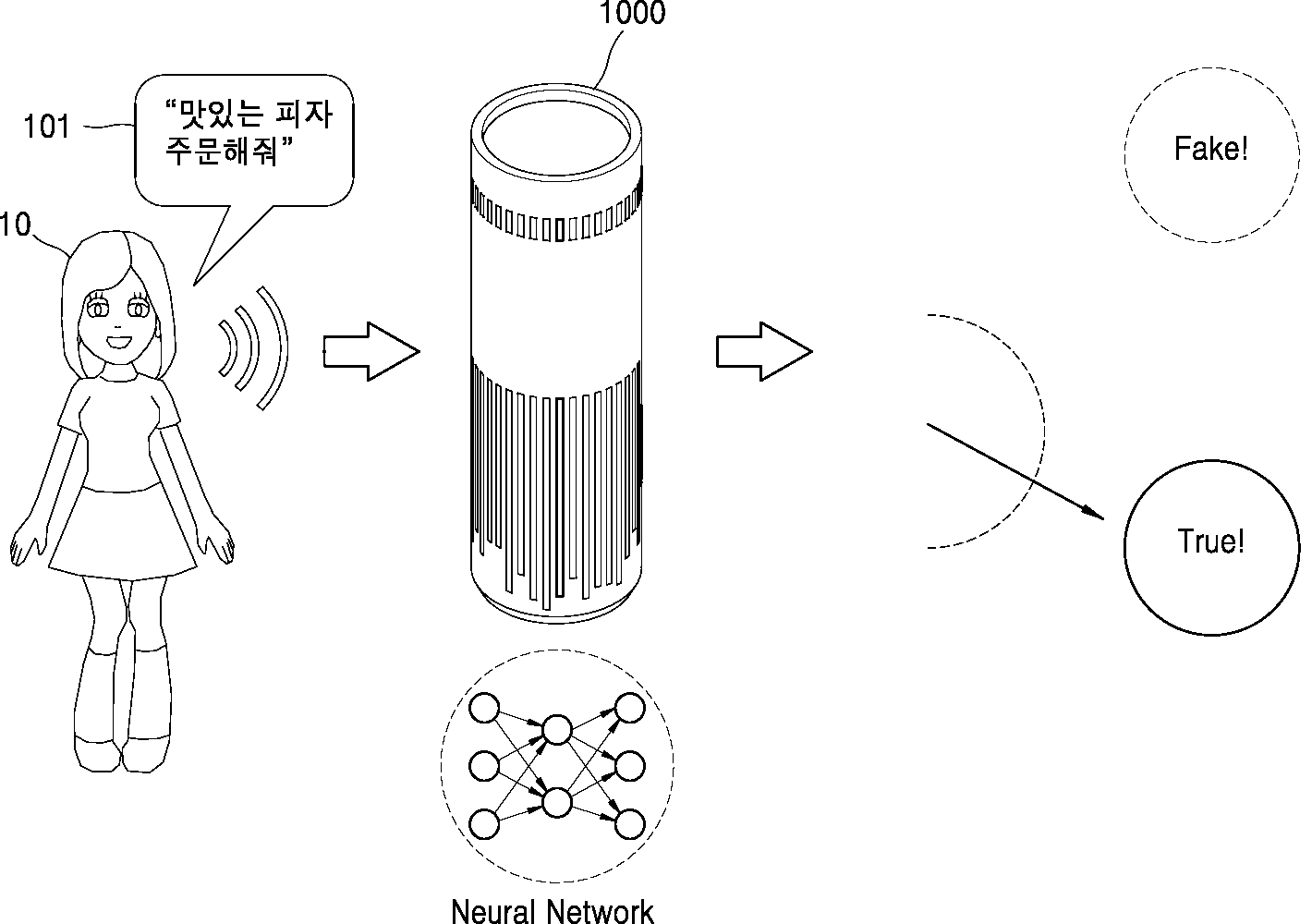
도 1은 일 실시 예에 따른 음성 인식 장치가 동작하는 일 예를 도시하는 도면이다.
도 2는 일 실시 예에 따른 음성 인식 장치의 동작 방법의 흐름도이다.
도 3a은 일 실시 예에 따른 음성 신호를 검출하는 예를 설명하기 위한 흐름도이다.
도 3b는 일 실시 예에 따른 음성 신호를 검출하는 예를 설명하기 위한 도면이다.
도 4a는 일 실시 예에 따른 사용자의 음성과 외부 디바이스의 음성을 구분하는 예를 설명하기 위한 흐름도이다.
도 4b는 일 실시 예에 따른 음성 인식 장치가 외부 디바이스의 음성을 필터링하는 일 예를 설명하기 위한 도면이다.
도 4c는 일 실시 예에 따라 동일한 사용자의 발화 소리와 녹음된 소리의 재생 소리의 구분을 설명하기 위한 도면이다.
도 5는 일 실시 예에 따른 음성 특성 데이터를 생성하는 일 예를 설명하기 위한 흐름도이다.
도 6은 일 실시 예에 따른 음성 특성 데이터를 생성하는 일 예를 설명하기 위한 도면이다.
도 7은 일 실시 예에 따른 음성 특성 데이터를 생성하는 다른 일 예를 설명하기 위한 흐름도이다.
도 8은 일 실시 예에 따른 음성 특성 데이터를 생성하는 다른 일 예를 설명하기 위한 도면이다.
도 9는 일 실시 예에 따른 음성 특성 데이터를 생성하는 다른 일 예를 설명하기 위한 흐름도이다.
도 10은 일 실시 예에 따른 음성 특성 데이터를 생성하는 다른 일 예를 설명하기 위한 도면이다.
도 11은 일 실시 예에 따른 주변 영상을 이용하여 사용자의 음성과 외부 디바이스의 음성을 구분하는 예를 설명하기 위한 흐름도이다.
도 12는 일 실시 예에 따른 주변 영상을 이용하여 사용자의 음성과 외부 디바이스의 음성을 구분하는 예를 설명하기 위한 도면이다.
도 13은 일 실시 예에 따른 음성 명령 권한이 부여된 사용자를 식별하는 예를 설명하기 위한 흐름도이다.
도 14는 다른 일 실시 예에 따른 음성 명령 권한이 부여된 사용자를 식별하는 예를 설명하기 위한 흐름도이다.
도 15는 일 실시 예에 따른 음성 명령 권한이 부여된 사용자를 식별하는 예를 설명하기 위한 도면이다.
도 16은 일 실시예에 따른 음성 인식 장치의 블록 구성도(block diagram)이다.
도 17는 일 실시예에 따른 음성 인식 장치의 상세 블록 구성도(block diagram)이다.
도 18은 일 실시예에 따른 프로세서의 블록도이다.
도 19는 일 실시예에 따른 데이터 학습부의 블록도이다.
도 20은 일 실시예에 따른 데이터 인식부의 블록도이다.
도 21은 일 실시예에 따른 음성 인식 장치 및 서버가 서로 연동함으로써 데이터를 학습하고 인식하는 예시를 나타내는 도면이다.1 is a diagram illustrating an example of an operation of a voice recognition apparatus according to an embodiment.
2 is a flowchart of a method of operating a voice recognition apparatus according to an exemplary embodiment.
3A is a flowchart illustrating an example of detecting a voice signal according to an embodiment.
3B is a diagram for explaining an example of detecting a voice signal according to an embodiment.
4A is a flowchart illustrating an example of distinguishing a user's voice from a voice of an external device according to an embodiment.
FIG. 4B is a diagram for describing an example in which a voice recognition apparatus filters a voice of an external device according to an embodiment.
4C is a diagram for explaining the distinction between a sound uttered by the same user and a sound reproduced by a recorded sound, according to an exemplary embodiment.
5 is a flowchart illustrating an example of generating voice characteristic data according to an embodiment.
6 is a diagram for explaining an example of generating voice characteristic data according to an embodiment.
7 is a flowchart illustrating another example of generating voice characteristic data according to an embodiment.
8 is a diagram for explaining another example of generating voice characteristic data according to an embodiment.
9 is a flowchart illustrating another example of generating voice characteristic data according to an embodiment.
10 is a diagram for explaining another example of generating voice characteristic data according to an embodiment.
11 is a flowchart illustrating an example of distinguishing a user's voice and an external device's voice using a surrounding image according to an embodiment.
12 is a diagram for explaining an example of distinguishing a user's voice from an external device's voice using a surrounding image, according to an embodiment.
13 is a flowchart illustrating an example of identifying a user to whom voice command authority is granted according to an embodiment.
14 is a flowchart illustrating an example of identifying a user to which voice command authority is granted according to another embodiment.
15 is a diagram for explaining an example of identifying a user to which voice command authority is granted, according to an embodiment.
16 is a block diagram of a speech recognition apparatus according to an exemplary embodiment.
17 is a detailed block diagram of a voice recognition apparatus according to an exemplary embodiment.
18 is a block diagram of a processor according to an embodiment.
19 is a block diagram of a data learning unit according to an exemplary embodiment.
20 is a block diagram of a data recognition unit according to an exemplary embodiment.
21 is a diagram illustrating an example of learning and recognizing data by interworking with a voice recognition apparatus and a server according to an embodiment.
실시 예들에서 사용되는 용어는 본 발명에서의 기능을 고려하면서 가능한 현재 널리 사용되는 일반적인 용어들을 선택하였으나, 이는 당 분야에 종사하는 기술자의 의도 또는 판례, 새로운 기술의 출현 등에 따라 달라질 수 있다. 또한, 특정한 경우는 출원인이 임의로 선정한 용어도 있으며, 이 경우 해당되는 발명의 설명 부분에서 상세히 그 의미를 기재할 것이다. 따라서 본 발명에서 사용되는 용어는 단순한 용어의 명칭이 아닌, 그 용어가 가지는 의미와 본 발명의 전반에 걸친 내용을 토대로 정의되어야 한다.Terms used in the embodiments are selected as currently widely used general terms as possible while considering functions in the present invention, but may vary according to intentions or precedents of those of ordinary skill in the art, emergence of new technologies, and the like. In addition, in a specific case, there is a term arbitrarily selected by the applicant, and in this case, the meaning will be described in detail in the description of the corresponding invention. Therefore, the term used in the present invention should be defined based on the meaning of the term and the overall content of the present invention, rather than the name of a simple term.
명세서 전체에서 어떤 부분이 어떤 구성요소를 “포함”한다고 할 때, 이는 특별히 반대되는 기재가 없는 한 다른 구성요소를 제외하는 것이 아니라 다른 구성요소를 더 포함할 수 있음을 의미한다. 또한, 명세서에 기재된 “…부”, “…모듈” 등의 용어는 적어도 하나의 기능이나 동작을 처리하는 단위를 의미하며, 이는 하드웨어 또는 소프트웨어로 구현되거나 하드웨어와 소프트웨어의 결합으로 구현될 수 있다.In the entire specification, when a part “includes” a certain component, it means that other components may be further included, rather than excluding other components, unless otherwise stated. In addition, the “… wealth", "… The term “module” means a unit that processes at least one function or operation, which may be implemented as hardware or software, or a combination of hardware and software.
아래에서는 첨부한 도면을 참고하여 본 발명의 실시 예에 대하여 본 발명이 속하는 기술 분야에서 통상의 지식을 가진 자가 용이하게 실시할 수 있도록 상세히 설명한다. 그러나 본 발명은 여러 가지 상이한 형태로 구현될 수 있으며 여기에서 설명하는 실시 예에 한정되지 않는다.Hereinafter, with reference to the accompanying drawings, embodiments of the present invention will be described in detail so that those of ordinary skill in the art can easily implement them. However, the present invention may be embodied in several different forms. and is not limited to the embodiments described herein.
이하에서는 도면을 참조하여 본 발명의 실시 예들을 상세히 설명한다.Hereinafter, embodiments of the present invention will be described in detail with reference to the drawings.
도 1은 일 실시 예에 따른 음성 인식 장치가 동작하는 일 예를 도시하는 도면이다.1 is a diagram illustrating an example of an operation of a voice recognition apparatus according to an embodiment.
일 실시 예에 따라, 음성 인식 장치(1000, 도 16, 17 참조)(이하, 음성 인식 장치(1000))는 사용자의 음성 명령을 인식할 수 있는 장치이다. 일 실시 예에 따른 음성 인식 장치(1000)는, 인식된 사용자의 음성 명령에 대응하는 기능을 수행할 수 있는 음성 인식 스피커일 수 있으며, 이에 한정되지 않는다. 예를 들어, 음성 인식 장치(1000)는, 사용자의 질문에 대한 답변을 제공(예컨대, 날씨 문답, 일정 관리 등) 할 수 있고, 웹 서버 등에 접속하여 상품을 주문하고 결재하는 서비스를 제공할 수 있으며, 이에 제한되지 않는다. 또한, 음성 인식 장치(1000)는 다른 장치들과 연결되어 다른 장치들을 제어하는 기능(예컨대, 가전 제품 제어 등)을 수행할 수도 있다. According to an embodiment, the voice recognition apparatus 1000 (refer to FIGS. 16 and 17 ) (hereinafter, the voice recognition apparatus 1000 ) is a device capable of recognizing a user's voice command. The
도 1을 참조하면, 일 실시 예에 따른 음성 인식 장치(1000)는, 사용자(10)의 음성(예컨대, “맛있는 피자 주문해줘”, 101) 입력을 수신하면, 수신된 음성 입력 신호가 사용자(10)로부터 직접 발화된 음성이 맞는지를 판단할 수 있다. Referring to FIG. 1 , when the
일 실시 예에 따라, 음성 인식 장치(1000)는, 수신된 음성 신호가 음성 인식 장치(1000)로부터 소정 거리 내에 있는 사용자(10)로부터 직접 발화된 음성 인지, 또는 다른 외부 디바이스(예컨대, TV, 라디오 등과 같은 음향 출력 장치)(미도시)(이하, 외부 디바이스 또는, 음향 출력 장치)로부터 출력된 음성인지를 판단하기 위해, 음성 신호 분석에 적용하도록 학습된 하나 이상의 데이터 인식 모델을 이용할 수 있다.According to an embodiment, the
일 실시 예에 따라, 음성 인식 장치(1000)는, DNN(Deep Neural Network), RNN(Recurrent Neural Network) 등의 뉴럴 네트워크(Neural Network)를 기반으로 하는 데이터 인식 모델을 이용할 수 있다. According to an embodiment, the
음성 인식 장치(1000)는 뉴럴 네트워크(Neural Network)를 기반으로 하는 하나 이상의 데이터 인식 모델을 이용하여, 마이크로폰(1620, 도 16, 17 참조)(이하, 마이크로폰(1620))을 통해 입력되는 음성 신호를 분석함으로써 음성 특성 데이터를 생성하고, 음성 특성 데이터에 기초하여 음성 신호가 사용자로부터 발화된 음성인지 또는 외부 장치로부터 출력된 음성인지를 결정할 수 있다.The
일 실시 예에 따라, 음성 특성 데이터는, 음성 신호의 파형, 주파수, 진폭 등의 음성 신호 특성을 분석함으로써 생성된 정보를 포함할 수 있다. 예를 들어, 음성 특성 데이터는, 음성 신호가 아날로그 신호인지, 디지털 신호인지, 압축된 신호로부터 복원된 신호인지, 전기적 노이즈(noise)가 포함되어 있는지 등에 관해 분석된 정보를 포함할 수 있다.According to an embodiment, the voice characteristic data may include information generated by analyzing voice signal characteristics such as a waveform, frequency, and amplitude of the voice signal. For example, the voice characteristic data may include information analyzed on whether the voice signal is an analog signal, a digital signal, a signal restored from a compressed signal, or whether electrical noise is included.
음성 특성 데이터에 관해서는, 후술할 도 5 내지 도 10에서 보다 상세히 설명하기로 한다. The voice characteristic data will be described in more detail with reference to FIGS. 5 to 10 to be described later.
일 실시 예에 따르면, 음성 인식 장치(1000)는, 수신된 음성 신호가 사용자로부터 직접 발화된 음성 명령이 아닌, 다른 음향 출력 장치(미도시)로부터 출력된 음성 신호인 것으로 판단하면, 수신된 음성 신호를 필터링(filtering)함으로써, 수신된 음성 신호를 음성 명령이 아닌 것으로 구분할 수 있다. According to an embodiment, if the
일 실시 예에 따라, 음성 인식 장치(1000)는 다른 음향 출력 장치(미도시)로부터 출력되는 사람의 음성 신호(예컨대, TV에서 출력되는 사용자 음성, 휴대폰에서 출력되는 녹음된 사용자 음성 등)를 수신하더라도, 음성 인식 장치(1000)에 대한 음성 명령으로 오인하지 않음으로써, 사용자가 의도하지 않은 동작을 음성 인식 장치가 불필요하게 수행하는 상황을 방지할 수 있다. According to an embodiment, the
도 1은 일 실시 예를 도시한 것으로서 이에 한정되지 않는다. 1 illustrates an exemplary embodiment, but is not limited thereto.
도 1에서는, 일 실시 예로서 음성 인식 장치(1000)를 음성 인식 스피커로 도시하고 있으나, 이에 제한되지 않는다.In FIG. 1 , the
일 실시 예에 따른 음성 인식 장치(1000)는 음성 인식 기능을 수행하는 전자 장치로 구현될 수 있다. 예를 들어, 음성 인식 장치(1000)는, 스마트 TV, 셋탑 박스, 휴대폰, 태블릿 PC, 디지털 카메라, 노트북 컴퓨터(laptop computer), 데스크탑, 전자책 단말기, 디지털 방송용 단말기, PDA(Personal Digital Assistants), PMP(Portable Multimedia Player), 네비게이션, MP3 플레이어, 착용형 기기(wearable device) 등과 같은 다양한 전자 장치로 구현될 수 있다. The
도 2는 일 실시 예에 따른 음성 인식 장치의 동작 방법의 흐름도이다.2 is a flowchart of a method of operating a voice recognition apparatus according to an exemplary embodiment.
도 2의 단계 S201에서, 음성 인식 장치(1000)는 음성 신호를 수신할 수 있다.In step S201 of FIG. 2 , the
일 실시 예에 따라, 음성 인식 장치(1000)는, 마이크로폰(1620, 도 16, 17 참조)(이하, 마이크로폰(1620))을 통해 음성 신호를 수신할 수 있다. 일 실시 예에 따라, 음성 인식 장치(1000)의 프로세서(1300, 도 16, 17 참조)(이하, 프로세서(1300))는, 음성 인식을 위한 애플리케이션을 실행하고, 실행된 애플리케이션을 제어함으로써 마이크로폰(1620)를 통하여 입력되는 음성 입력을 수신할 수 있다.According to an embodiment, the
단계 S202에서, 음성 인식 장치(1000)는 수신된 음성 신호를 분석함으로써 음성 특성 데이터를 생성할 수 있다.In operation S202 , the
사용자로부터 발화된 음성과 음향 출력 장치(예컨대, TV, 라디오 등)로부터 출력되는 음성은, 음성 신호의 파형, 주파수 등의 음성 신호의 특성이 상이할 수 있다. 예를 들어, 사용자로부터 발화된 음성 신호는 아날로그 신호이고, 음향 출력 장치로부터 출력되는 음성 신호는 압축된 디지털 신호의 복원 신호 일 수 있다. 또한, 사용자로부터 발화된 음성 신호와 달리, 음향 출력 장치로부터 출력되는 음성 신호는 전기적 노이즈가 포함되어 있을 수 있다. A voice uttered by a user and a voice output from a sound output device (eg, TV, radio, etc.) may have different characteristics of the voice signal, such as a waveform and frequency of the voice signal. For example, the voice signal uttered by the user may be an analog signal, and the voice signal output from the sound output device may be a restored signal of a compressed digital signal. Also, unlike the voice signal uttered by the user, the voice signal output from the sound output device may include electrical noise.
일 실시 예에 따라, 음성 인식 장치(1000)는, 음성 신호를 분석하여 음성 특성 데이터를 생성하기 위해, 뉴럴 네트워크(Neural Network)를 기반으로 하는 데이터 인식 모델을 이용할 수 있다. According to an embodiment, the
일 실시 예에 따라, 음성 인식 장치(1000)는, 하나 이상의 데이터 인식 모델을 이용하여, 입력된 음성 신호의 파형, 주파수 등을 분석함에 따라 획득된 정보를 포함하는 음성 특성 데이터를 생성할 수 있다. 예를 들어, 음성 특성 데이터는, 음성 신호가 아날로그 신호인지, 디지털 신호인지, 압축된 신호로부터 복원된 신호인지 등에 관한 정보를 포함할 수 있다.According to an embodiment, the
단계 S203에서, 음성 인식 장치(1000)는 음성 특성 데이터에 기초하여, 음성 신호가 사용자로부터 발화된 음성인지 또는 외부 디바이스로부터 출력된 음성인지를 결정할 수 있다.In operation S203 , the
일 실시 예에 따라, 음성 인식 장치(1000)는 음성 특성 데이터에 기초하여 음성 신호가 사용자로부터 발화된 음성인지 또는 외부 장치로부터 출력된 음성인지를 결정하기 위해, 뉴럴 네트워크(Neural Network)를 기반으로 하는 데이터 인식 모델을 이용할 수 있다.According to an embodiment, the
예를 들어, 음성 인식 장치(1000)는, 하나 이상의 데이터 인식 모델을 이용하여, 수신한 음성 신호 분석에 따라 음성 신호가 아날로그 신호이고 전기적 노이즈를 포함하지 않은 신호라는 정보를 포함하는 음성 특성 데이터에 기초하여, 음성 신호가 외부 디바이스로부터 출력된 음성이 아닌, 사용자로부터 직접 발화된 음성인 것으로 결정할 수 있다. For example, the
단계 S204에서, 음성 인식 장치(1000)는, 음성 신호를 사용자로부터 발화된 음성으로 결정함에 따라, 음성 신호를 사용자의 음성 명령으로 결정하고 음성 명령에 대응하는 동작을 수행할 수 있다. In operation S204 , the
일 실시 예에 따라, 음성 인식 장치(1000)는 음성 신호를 사용자의 음성 명령으로 결정하고, 음성 명령의 의미와 사용자의 의도를 판단하여 사용자의 음성 명령에 부합하는 기능을 수행할 수 있다. According to an embodiment, the
일 실시 예에 따라, 음성 인식 장치(1000)는 뉴럴 네트워크(Neural Network)를 기반으로 하는 데이터 인식 모델을 이용하여 사용자의 음성 명령을 분석하여 사용자의 의도에 맞는 동작을 수행할 수 있다. 예를 들어, 도 1에 도시한 바와 같이, 음성 인식 장치(1000)는 사용자의 음성 명령(“맛있는 피자 주문해줘”(101))에 따라, 피자를 주문할 수 있는 웹 사이트에 접속하고 사용자의 기호에 맞는 피자의 종류를 결정하여 주문 및 결제 기능을 수행할 수 있다.According to an embodiment, the
일 실시 예에 따르면, 음성 인식 장치(1000)가 수신한 음성 신호를 분석하여 음성 신호가 사용자로부터 직접 발화된 음성인 것으로 결정된 경우에 음성 명령을 수행하므로, 외부 디바이스의 음성 출력을 음성 명령으로 오인할 위험을 방지할 수 있다. 일 실시 예에 따르면, 사용자가 의도하지 않은 동작을 음성 인식 장치가 불필요하게 수행하는 상황을 방지할 수 있다. According to an embodiment, since the
도 1 내지 도 2는 일 실시 예를 도시한 것으로서 이에 한정되지 않는다. 1 to 2 illustrate an exemplary embodiment, but are not limited thereto.
도 3a은 일 실시 예에 따른 음성 신호를 검출하는 예를 설명하기 위한 흐름도이다. 도 3b는 일 실시 예에 따른 음성 신호를 검출하는 예를 설명하기 위한 도면이다. 도 3a의 흐름도를 설명하면서, 도 3b의 도면을 참조하여 설명하기로 한다.3A is a flowchart illustrating an example of detecting a voice signal according to an embodiment. 3B is a diagram for explaining an example of detecting a voice signal according to an embodiment. The flowchart of FIG. 3A will be described with reference to the drawing of FIG. 3B .
도 3의 단계 S301에서, 음성 인식 장치(1000)는, 마이크로폰(1620)을 통해 입력되는 소리를 수신할 수 있다.In step S301 of FIG. 3 , the
일 실시 예에 따라, 마이크로폰(1620)을 통해 입력되는 소리는, 사람의 목소리 뿐만 아니라, 주변의 소음을 포함할 수 있다.According to an embodiment, the sound input through the
도 3b를 참조하면, 예를 들어, 음성 인식 장치(1000)의 마이크로폰(1620)은, 자동차의 운행 또는 경적 소리(411), 사람의 음성 소리(412), 동물의 소리(413) 등을 포함하는 소리를 수신할 수 있다. 서로 다른 음원으로부터 발생된 각각의 소리는 서로 다른 파형을 가질 수 있다.Referring to FIG. 3B , for example, the
일 실시 예에 따라, 음성 인식 장치(1000)의 마이크로폰(1620)이 동작함에 따라, 마이크로폰(1620)을 통해 입력되는 소리는 통합된 음성 신호(414)로 인식될 수 있다.According to an embodiment, as the
도 3a의 단계 S302에서, 음성 인식 장치(1000)는, 수신된 소리로부터 음성 신호를 검출할 수 있다.In step S302 of FIG. 3A , the
도 3b를 참조하면, 예를 들어, 음성 인식 장치(1000)는 통합된 음성 신호(414)로부터 사람의 음성 소리(415)를 검출할 수 있다. 일 실시 예에 따라, 음성 인식 장치(1000)는 음성 신호 분석에 적용되는 하나 이상의 데이터 인식 모델을 이용하여, 수신된 음성 신호로부터 사람의 음성 신호만을 검출할 수 있다.Referring to FIG. 3B , for example, the
일 실시 예에 따라, 음성 인식 장치(1000)는 사람의 음성과 소음의 주파수 특성과 상대적 에너지를 분석함으로써, 사람의 음성과 소음을 구분할 수 있다. 음성 인식 장치(1000)는 입력되는 소리를 아주 작은 시간 단위로 분할하고 각 구간(frame)별로 소리의 주파수나 에너지가 어떻게 변하는지 분석할 수 있다.예를 들어, 소음과 음성을 구분하기 위해 영교차율(ZCR; Zero-Crossing Rate)이 이용될 수 있다. 소리를 시간 단위로 분할한 각 구간(frame) 별로 소리가 얼마나 자주 0점을 통과하는지 계산하고, 그 때의 에너지 값을 산출하여 소리의 특성을 파악할 수 있다.According to an embodiment, the
도 4a는 일 실시 예에 따른 사용자의 음성과 외부 디바이스의 음성을 구분하는 예를 설명하기 위한 흐름도이다. 도 4b는 일 실시 예에 따른 음성 인식 장치가 외부 디바이스의 음성을 필터링하는 일 예를 설명하기 위한 도면이다. 도 4a의 흐름도를 설명하면서, 도 4b의 도면을 참조하여 설명하기로 한다.4A is a flowchart illustrating an example of distinguishing a user's voice from a voice of an external device according to an embodiment. FIG. 4B is a diagram for describing an example in which a voice recognition apparatus filters a voice of an external device according to an embodiment. The flowchart of FIG. 4A will be described with reference to the drawing of FIG. 4B .
도 4a의 단계 S401에서, 음성 인식 장치(1000)는, 음성 특성 데이터에 기초하여 음성 신호가 사용자로부터 발화된 음성인지 또는 외부 디바이스로부터 출력된 음성인지를 결정할 수 있다.In step S401 of FIG. 4A , the
단계 S402에서, 음성 인식 장치(1000)는, 음성 신호를 사용자로부터 발화된 음성으로 결정함에 따라, 음성 신호를 사용자의 음성 명령으로 결정하고 음성 명령에 대응하는 동작을 수행할 수 있다.In step S402 , the
단계 S401, S402는, 도2의 단계 S203, S204에 관한 설명에서 상술하였으므로, 생략하기로 한다.Steps S401 and S402 have been described above in the description of steps S203 and S204 of FIG. 2, and thus will be omitted.
단계 S403에서, 음성 인식 장치(1000)는, 음성 신호를 외부 디바이스로부터 출력된 음성으로 결정함에 따라, 음성 신호를 필터링(filtering)할 수 있다. In operation S403 , the
일 실시 예에 따라, 음성 인식 장치(1000)는 수신한 음성 신호가 사용자로부터 직접 발화된 음성이 아닌, 주변의 음향 출력 장치(예컨대, TV, 라디오, 스마트 폰 등)으로부터 출력된 음성으로 결정함에 따라, 음성 신호가 사용자의 음성 명령이 아닌 것으로 판단하고 필터링(filtering)할 수 있다. 음성 인식 장치(1000)는 필터링(filtering)된 음성 신호에 대해서는 음성 명령의 의미를 분석하지 않으며 음성 명령에 따른 동작을 수행하지 않는다. According to an embodiment, the
도 4b를 참조하면, 예를 들어, 음성 인식 장치(1000)가 수신한 음성 신호(“맛있는 피자 주문해줘”(401))가 사용자로부터 직접 발화된 음성이 아닌, 외부 디바이스(200)(이하, 외부 디바이스(200) 또는, 음향 출력 장치(200))로부터 출력된 음성 신호인 것으로 판단함에 따라, 음성 신호의 의미를 분석하지 않고 추가적인 동작을 수행하지 않을 수 있다. Referring to FIG. 4B , for example, the voice signal (“Order a delicious pizza” 401) received by the
일 실시 예에 따르면, 사용자가 의도하지 않은 기능을 음성 인식 장치가 불필요하게 수행하는 상황을 방지할 수 있다.According to an embodiment, it is possible to prevent a situation in which the voice recognition apparatus unnecessarily performs a function not intended by the user.
도 4c는 일 실시 예에 따라 동일한 사용자의 발화 소리와 녹음된 소리의 재생 소리의 구분을 설명하기 위한 도면이다.4C is a diagram for explaining the distinction between a sound uttered by the same user and a sound reproduced by a recorded sound, according to an exemplary embodiment.
일 실시 예에 따라, 동일한 사용자의 목소리이더라도, 사용자로부터 직접 발화된 소리(421)와 녹음된 사용자의 목소리를 음향 출력 장치(예컨대, 휴대폰 등)에서 재생한 소리(422)는 음성 신호의 파형, 진폭, 주파수 등이 상이할 수 있다.According to an embodiment, even if it is the same user's voice, the
일 실시 예에 따라, 음성 인식 장치(1000)는 입력되는 소리를 아주 작은 시간 단위로 분할하고 각 구간(frame)별로 음성 신호의 주파수 특성 등을 분석함으로써, 사용자로부터 직접 발화된 소리인지 녹음된 음성의 재생 소리인지 구분할 수 있다.According to an embodiment, the
일 실시 예에 따라, 음성 인식 장치(1000)는 음성 신호 분석에 적용되는 하나 이상의 데이터 인식 모델을 이용하여, 수신된 음성 신호가 사용자로부터 직접 발화된 소리인지 녹음된 음성의 재생 소리인지 구분할 수 있다.According to an embodiment, the
도 3a 내지 도 4c는 일 실시 예를 도시한 것으로서 이에 한정되지 않는다.3A to 4C illustrate an exemplary embodiment, but are not limited thereto.
도 5는 일 실시 예에 따른 음성 특성 데이터를 생성하는 일 예를 설명하기 위한 흐름도이다. 도 6은 일 실시 예에 따른 음성 특성 데이터를 생성하는 일 예를 설명하기 위한 도면이다. 도 5의 흐름도를 설명하면서, 도 6의 도면을 참조하여 설명하기로 한다.5 is a flowchart illustrating an example of generating voice characteristic data according to an embodiment. 6 is a diagram for explaining an example of generating voice characteristic data according to an embodiment. The flowchart of FIG. 5 will be described with reference to the drawing of FIG. 6 .
도 5의 단계 S501에서, 음성 인식 장치(1000)는, 음성 신호를 수신할 수 있다.In step S501 of FIG. 5 , the
단계 S501는 도 2의 단계 S201에 관한 설명에서 상술하였으므로, 생략하기로 한다.Since step S501 has been described above in the description of step S201 of FIG. 2 , it will be omitted.
또한, 도 3의 S301, S302에서 상술한 바와 같이, 음성 인식 장치(1000)는 마이크로폰(1620)을 통해 입력된 소리로부터 음성 신호를 검출하는 단계를 수행할 수 있다.Also, as described above in steps S301 and S302 of FIG. 3 , the
단계 S502에서, 음성 인식 장치(1000)는, 음성 신호가 압축된 음성 신호로부터 복원된 신호인지를 분석함으로써 음성 특성 데이터를 생성할 수 있다. In operation S502, the
음향 출력 장치(200)가 출력하는 음성 신호는, 음향 출력 장치(200)의 메모리에 저장된 음성 파일을 재생하거나, 다른 장치 또는 서버로부터 수신되는 음성 파일을 재생함으로써 출력되는 음성 신호, 또는, 방송 수신부(1530, 도 17)를 통해 수신되는 방송 신호에 포함된 음성 신호일 수 있으며, 이에 한정되지 않는다.The audio signal output by the
일 실시 예에 따라 음향 출력 장치(200)가 출력하는 음성 신호는, 예컨대, CELP(code excited linear prediction)를 이용하여, 압축된 신호가 복원된 신호일 수 있다. 또한, 예컨대, 음향 출력 장치(200)가 출력하는 음성 신호는, MP3, AC3, AAC(Advanced Audio Coding) 등의 코덱을 이용하여, 압축된 신호가 복원된 복원 신호일 수 있다. 음성 신호를 압축 및 복원 하는 과정에서 신호의 손실이 발생할 수 있다. 예를 들어, 사람이 잘 듣지 못하는 주파수 영역에 있어서 신호의 손실이 발생할 수 있다. According to an embodiment, the audio signal output by the
음성 인식 장치(100)는 음성 신호가 압축된 음성 신호로부터 복원된 신호인지 분석한 정보를 포함하는 음성 특성 데이터를 생성할 수 있다.The voice recognition apparatus 100 may generate voice characteristic data including information analyzed whether the voice signal is a signal restored from the compressed voice signal.
도 6을 참조하면, 예를 들어, 음성 인식 장치(1000)는 음성 신호의 주파수, 파형 등을 분석함으로써, 압축된 디지털 신호인지(601) 또는 압축되지 않은 아날로그 신호(602)인지 구분할 수 있다. Referring to FIG. 6 , for example, the
일 실시 예에 따라, 음성 인식 장치(1000)는 음성 신호가 압축되지 않은 아날로그 신호인 것으로 판단되면, 사용자로부터 직접 발화된 음성 신호로 판단할 수 있다. 또는, 음성 인식 장치(100)는 사용자로부터 발화된 음성 신호일 확률이 높은 것으로 판단할 수 있다. According to an embodiment, when it is determined that the voice signal is an uncompressed analog signal, the
일 실시 예에 따라, 음성 인식 장치(100)는 뉴럴 네트워크(Neural Network)를 기반으로 하는 데이터 인식 모델을 이용하여, 음성 신호의 압축 적용 여부 또는 압축 적용 여부의 확률을 판단함으로써 음성 특성 데이터를 생성할 수 있다. 또한, 음성 인식 장치(100)는 데이터 인식 모델을 이용하여, 음성 특성 데이터에 기초하여, 음성 신호가 사용자로부터 발화된 음성인지 또는 음향 출력 장치(200)로부터 출력된 음성인지 판단할 수 있다. According to an embodiment, the voice recognition apparatus 100 generates voice characteristic data by determining whether compression is applied to a voice signal or a probability of whether compression is applied using a data recognition model based on a neural network. can do. Also, the voice recognition apparatus 100 may determine whether the voice signal is a voice uttered by a user or a voice output from the
또한, 음성 인식 장치(1000)는, 후술할 도 8 내지 도 15의 음성 신호 분석에 따라 생성되는 음성 특성 데이터에 포함된 적어도 하나의 정보를 함께 고려하여, 사용자로부터 발화된 음성인지 또는 외부 디바이스로부터 출력된 음성인지를 결정할 수 있다. In addition, the
도 5 내지 도 6은 일 실시 예를 도시한 것으로서 이에 한정되지 않는다.5 to 6 illustrate an exemplary embodiment, but are not limited thereto.
도 7은 일 실시 예에 따른 음성 특성 데이터를 생성하는 다른 일 예를 설명하기 위한 흐름도이다. 도 8은 일 실시 예에 따른 음성 특성 데이터를 생성하는 다른 일 예를 설명하기 위한 도면이다. 도 7의 흐름도를 설명하면서, 도 8의 도면을 참조하여 설명하기로 한다.7 is a flowchart illustrating another example of generating voice characteristic data according to an embodiment. 8 is a diagram for explaining another example of generating voice characteristic data according to an embodiment. The flowchart of FIG. 7 will be described with reference to the drawing of FIG. 8 .
도 7의 단계 S701에서, 음성 인식 장치(1000)는, 음성 신호를 수신할 수 있다.In step S701 of FIG. 7 , the
단계 S701은 도 2의 단계 S201에 관한 설명에서 상술하였으므로, 생략하기로 한다.Since step S701 has been described above in the description of step S201 of FIG. 2 , it will be omitted.
또한, 도 3의 S301, S302에서 상술한 바와 같이, 음성 인식 장치(1000)는 마이크로폰(1620)을 통해 입력된 소리로부터 음성 신호를 검출하는 단계를 수행할 수 있다.Also, as described above in steps S301 and S302 of FIG. 3 , the
단계 S702에서, 음성 인식 장치(1000)는, 음성 신호에 전기적 노이즈가 포함되었는지를 분석함으로써 음성 특성 데이터를 생성할 수 있다. In operation S702, the
음향 출력 장치(200)(예컨대, 스마트 폰 등)로부터 출력되는 음성 신호(예컨대, 사용자의 음성이 녹음된 음성 파일의 음성 신호)에는 전기적 노이즈가 포함되어 있을 수 있다. Electrical noise may be included in a voice signal (eg, a voice signal of a voice file in which a user's voice is recorded) output from the sound output device 200 (eg, a smart phone, etc.).
도 8을 참조하면, 예를 들어, 음성 인식 장치(100)는 음성 신호의 파형, 주파수 등을 분석함으로써 음성 신호에 전기적 노이즈가 포함된 신호인지(603) 또는 전기적 노이즈가 포함되지 않은 신호인지(604) 판단할 수 있다. 음성 인식 장치(100)는 음성 신호에 전기적 노이즈가 포함되었는지 분석한 정보를 포함하는 음성 특성 데이터를 생성할 수 있다.Referring to FIG. 8 , for example, the voice recognition apparatus 100 analyzes the waveform, frequency, etc. of the voice signal to determine whether the voice signal includes electrical noise (603) or a signal that does not include electrical noise (603). 604) can be judged. The voice recognition apparatus 100 may generate voice characteristic data including information analyzed whether electrical noise is included in the voice signal.
일 실시 예에 따라, 음성 인식 장치(100)는 뉴럴 네트워크(Neural Network)를 기반으로 하는 데이터 인식 모델을 이용하여, 음성 신호의 전기적 노이즈 포함 여부 또는 포함 여부의 확률을 판단함으로써 음성 특성 데이터를 생성할 수 있다. 또한, 음성 인식 장치(1000)는 데이터 인식 모델을 이용하여, 음성 특성 데이터에 기초하여, 음성 신호가 사용자로부터 발화된 음성인지 또는 음향 출력 장치(200)로부터 출력된 음성인지 판단할 수 있다. According to an embodiment, the voice recognition apparatus 100 generates voice characteristic data by determining whether a voice signal contains electrical noise or a probability of including it using a data recognition model based on a neural network. can do. Also, the
또한, 음성 인식 장치(1000)는, 도 5, 6, 7, 및 후술할 도 10 내지 도 15의 음성 신호 분석에 따라 생성되는 음성 특성 데이터에 포함된 적어도 하나의 정보를 함께 고려하여, 사용자로부터 발화된 음성인지 또는 외부 디바이스로부터 출력된 음성인지를 결정할 수 있다. In addition, the
도 7 내지 도 8은 일 실시 예를 도시한 것으로서 이에 한정되지 않는다.7 to 8 illustrate an exemplary embodiment, but are not limited thereto.
도 9는 일 실시 예에 따른 음성 특성 데이터를 생성하는 다른 일 예를 설명하기 위한 흐름도이다. 도 10은 일 실시 예에 따른 음성 특성 데이터를 생성하는 다른 일 예를 설명하기 위한 도면이다. 도 9의 흐름도를 설명하면서, 도 10의 도면을 참조하여 설명하기로 한다.9 is a flowchart illustrating another example of generating voice characteristic data according to an embodiment. 10 is a diagram for explaining another example of generating voice characteristic data according to an embodiment. The flowchart of FIG. 9 will be described with reference to the drawing of FIG. 10 .
도 9의 단계 S901에서, 음성 인식 장치(1000)는, 음성 신호를 수신할 수 있다.In step S901 of FIG. 9 , the
단계 S901은 도 2의 단계 S201에 관한 설명에서 상술하였으므로, 생략하기로 한다.Since step S901 has been described above in the description of step S201 of FIG. 2 , it will be omitted.
또한, 도 3의 S301, S302에서 상술한 바와 같이, 음성 인식 장치(1000)는 마이크로폰(1620)을 통해 입력된 소리로부터 음성 신호를 검출하는 단계를 수행할 수 있다.Also, as described above in steps S301 and S302 of FIG. 3 , the
단계 S902에서, 음성 인식 장치(1000)는, 수신된 음성 신호의 출력 위치를 분석함으로써 음성 특성 데이터를 생성할 수 있다.In operation S902, the
일 실시 예에 따르면, 음성 인식 장치(1000)는 외부 디바이스로부터 출력되는 음성 신호의 적어도 하나의 출력 위치를 미리 설정할 수 있다. According to an embodiment, the
예를 들어, 도 10을 참조하면, 음향 출력 장치(200)의 음성 출력 위치를 미리 설정하기 위해, 음향 출력 장치(200)가 음성 신호를 출력하도록 제어될 수 있다. 음성 인식 장치(1000)는 마이크로폰(1620, 도 17)을 통해 음성 신호를 수신하고 음성 신호가 출력되는 위치, 방향을 판단할 수 있다. 예를 들어, 음성 인식 장치(1000)는 외부 디바이스(200)로부터 출력되는 음성 신호의 출력 위치(1001)를 설정할 수 있다.For example, referring to FIG. 10 , in order to preset an audio output position of the
일 실시 예에 따라, 음성 인식 장치(1000)는 수신된 음성 신호의 출력 위치가 미리 설정된 출력 위치에 대응하는지 판단한 정보를 포함하는 음성 특성 데이터를 생성할 수 있다. According to an embodiment, the
예를 들어, 도 10을 참조하면, 음성 인식 장치(1000)는 음성 신호를 수신하면, 음성 신호의 출력 위치를 판단하고, 음성 신호의 출력 위치(1002, 1003)가 미리 설정된 출력 위치(1001)에 대응하는지 판단할 수 있다. For example, referring to FIG. 10 , upon receiving a voice signal, the
일 실시 예에 따라, 음성 인식 장치(1000)는 음성 신호의 출력 위치(1002, 1003)가 미리 설정된 외부 디바이스의 출력 위치(1001)와 일치하는지 또는 소정 범위 내에서 근접한지 판단함으로써, 음성 특성 데이터를 생성할 수 있다.According to an embodiment, the
음성 인식 장치(1000)는 음성 신호의 출력 위치(1003)가 미리 설정된 외부 디바이스의 출력 위치(1001)와 소정 범위를 벗어날 정도로 상이한 것으로 판단함에 따라, 사용자로부터 직접 발화된 음성으로 판단할 수 있다. 또는, 음성 인식 장치(100)는 사용자로부터 직접 발화된 음성일 확률이 높은 것으로 판단할 수 있다.As the
한편, 음성 인식 장치(1000)는 음성 신호의 출력 위치(1002)가 미리 설정된 외부 디바이스의 출력 위치(1001)와 소정 범위 내에서 근접한 것으로 판단함에 따라, 미리 설정된 음향 출력 장치(220)로부터 출력되는 음성 신호인 것으로 판단할 수 있다. 또는, 음성 인식 장치(1000)는 음향 출력 장치(220)로부터 출력되는 음성 신호일 확률이 높은 것으로 판단할 수 있다On the other hand, as the
또한, 일 실시 예에 따라, 음성 인식 장치(1000)는 수신된 음성 신호가 출력되는 출력 위치의 개수를 판단함으로써, 음성 특성 데이터를 생성할 수 있다.Also, according to an embodiment, the
음향 출력 장치가 다수의 외부 스피커와 연결되어 다수의 외부 스피커를 통해 음향 신호를 출력하는 경우, 여러 방향에서 음향을 출력할 수 있다.When the sound output device is connected to a plurality of external speakers to output sound signals through the plurality of external speakers, sound may be output in various directions.
예를 들어, 음성 인식 장치(1000)는 수신된 음성 신호가 출력되는 출력 위치가 복수 개로 판단되면, 외부 디바이스로부터 출력되는 음성 신호일 확률이 높은 것으로 판단할 수 있다. For example, when it is determined that there are a plurality of output positions to which the received voice signal is output, the
일 실시 예에 따라, 음성 인식 장치(100)는 뉴럴 네트워크(Neural Network)를 기반으로 하는 데이터 인식 모델을 이용하여, 음성 신호의 출력 위치, 출력 위치의 개수 등을 판단함으로써 음성 특성 데이터를 생성할 수 있다. 또한, 음성 인식 장치(1000)는 데이터 인식 모델을 이용하여, 음성 특성 데이터에 기초하여 음성 신호가 사용자로부터 발화된 음성인지 또는 음향 출력 장치(200)로부터 출력된 음성인지 판단할 수 있다. According to an embodiment, the voice recognition apparatus 100 may generate voice characteristic data by determining an output position of a voice signal, the number of output positions, etc. using a data recognition model based on a neural network. can Also, the
또한, 음성 인식 장치(1000)는, 도 5 내지 도 9 및 후술할 도 11 내지 도 15의 음성 신호 분석에 따라 생성되는 음성 특성 데이터에 포함된 적어도 하나의 정보를 함께 고려하여, 사용자로부터 발화된 음성인지 또는 외부 디바이스로부터 출력된 음성인지를 결정할 수 있다. In addition, the
도 9 내지 도 10은 일 실시 예를 도시한 것으로서 이에 한정되지 않는다.9 to 10 illustrate an exemplary embodiment, but are not limited thereto.
도 11은 일 실시 예에 따른 주변 영상을 이용하여 사용자의 음성과 외부 디바이스의 음성을 구분하는 예를 설명하기 위한 흐름도이다. 도 12는 일 실시 예에 따른 주변 영상을 이용하여 사용자의 음성과 외부 디바이스의 음성을 구분하는 예를 설명하기 위한 도면이다. 도 11의 흐름도를 설명하면서, 도 12의 도면을 참조하여 설명하기로 한다.11 is a flowchart illustrating an example of distinguishing a user's voice from an external device's voice using a surrounding image according to an embodiment. 12 is a diagram for explaining an example of distinguishing a user's voice and an external device's voice using a surrounding image, according to an embodiment. The flowchart of FIG. 11 will be described with reference to the drawing of FIG. 12 .
도 11의 단계 S1101에서, 음성 인식 장치(1000)는, 음성 인식 장치의 주변을 촬영할 수 있다.In step S1101 of FIG. 11 , the
일 실시 예에 따라, 음성 인식 장치(1000)는 카메라(1610, 도 17)(이하, 카메라(1610))를 포함할 수 있다. 음성 인식 장치(1000)는 카메라(1610)를 이용하여 음성 인식 장치(1000)의 주변을 촬영할 수 있다. According to an embodiment, the
단계 S1102에서, 음성 인식 장치(1000)는, 촬영된 주변 영상에 사용자 또는 외부 디바이스가 포함 되어 있는지 판단할 수 있다.In step S1102, the
도 12를 참조하면, 예를 들어, 음성 인식 장치(1000)가 촬영한 주변 영상에는 사용자(10) 또는 음향 출력 장치(예컨대, TV)(200)가 포함될 수 있다. Referring to FIG. 12 , for example, a
단계 S1103에서, 음성 인식 장치(1000)는, 음성 신호가 사용자로부터 발화된 음성인지 또는 외부 디바이스로부터 출력된 음성인지를 결정할 수 있다.In operation S1103 , the
도 12를 참조하면, 예를 들어, 음성 인식 장치(1000)는 촬영된 영상에 음향 출력 장치(200)가 포함된 것으로 판단하면, 음성 신호가 음향 출력 장치(200)로부터 출력된 음성일 확률이 높은 것으로 판단할 수 있다. 또한, 음성 인식 장치(1000)는 촬영된 영상에 사용자(10)가 포함된 것으로 판단하면, 음성 신호가 사용자(10)로부터 직접 발화된 음성일 확률이 높은 것으로 판단할 수 있다.12 , for example, when the
일 실시 예에 따라, 음성 인식 장치(1000)는 뉴럴 네트워크(Neural Network)를 기반으로 하는 데이터 인식 모델을 이용하여, 음성 인식 장치(1000)의 주변이 촬영된 영상을 분석함으로써, 음성 신호가 사용자로부터 발화된 음성인지 또는 음향 출력 장치(200)로부터 출력된 음성인지 판단할 수 있다. According to an embodiment, the
또한, 음성 인식 장치(1000)는, 도 5 내지 도 11 및 후술할 도 13 내지 도 15의 음성 신호 분석에 따라 생성되는 음성 특성 데이터에 포함된 적어도 하나의 정보를 함께 고려하여, 사용자로부터 발화된 음성인지 또는 외부 디바이스로부터 출력된 음성인지를 결정할 수 있다. In addition, the
도 11 내지 도 12는 일 실시 예를 도시한 것으로서 이에 한정되지 않는다.11 to 12 illustrate an exemplary embodiment, but are not limited thereto.
도 13은 일 실시 예에 따른 음성 명령 권한이 부여된 사용자를 식별하는 예를 설명하기 위한 흐름도이다. 도 14는 다른 일 실시 예에 따른 음성 명령 권한이 부여된 사용자를 식별하는 예를 설명하기 위한 흐름도이다. 도 15는 일 실시 예에 따른 음성 명령 권한이 부여된 사용자를 식별하는 예를 설명하기 위한 도면이다. 도 13, 도 14의 흐름도를 설명하면서, 도 15의 도면을 참조하여 설명하기로 한다.13 is a flowchart illustrating an example of identifying a user to whom voice command authority is granted according to an embodiment. 14 is a flowchart illustrating an example of identifying a user to which voice command authority is granted according to another embodiment. 15 is a diagram for explaining an example of identifying a user to whom voice command authority is granted, according to an embodiment. The flowchart of FIGS. 13 and 14 will be described with reference to the drawings of FIG. 15 .
일 실시 예에 따라, 음성 인식 장치(1000)는 음성 명령이 허용되도록 등록된 사용자의 음성 명령에 대해서만, 음성 명령에 대응하는 동작을 수행할 수 있다.According to an embodiment, the
도 13은 사용자 얼굴을 식별함으로써, 음성 명령 권한이 부여된 사용자의 음성 명령을 수행하는 예를 도시한다.13 illustrates an example of performing a voice command of a user to which voice command authority is granted by identifying a user's face.
도 13의 단계 S1301에서, 음성 인식 장치(1000)는, 음성 명령 권한이 부여된 등록된 사용자의 얼굴 식별 데이터를 미리 설정할 수 있다. In step S1301 of FIG. 13 , the
도 15를 참조하면, 예를 들어, 음성 인식 장치(1000)는 메모리(1700, 도 17)에, 음성 명령 권한이 부여된 등록된 사용자의 얼굴 식별 데이터(151)를 저장할 수 있다. Referring to FIG. 15 , for example, the
단계 S1302에서, 음성 인식 장치(1000)는, 음성 인식 장치의 주변을 촬영할 수 있다.In operation S1302, the
도 15를 참조하면, 예를 들어, 음성 인식 장치(1000)는 카메라(1610, 도 17 참조)를 포함할 수 있다. 음성 인식 장치(1000)는 카메라(1610)를 이용하여 주변을 촬영할 수 있다. Referring to FIG. 15 , for example, the
단계 S1303에서, 음성 인식 장치(1000)는, 촬영된 주변 영상에 포함된 사용자가 미리 설정된 얼굴 식별 데이터에 부합하는 것으로 결정할 수 있다. In operation S1303, the
도 15를 참조하면, 예를 들어, 음성 인식 자치(1000)는 촬영된 영상을 분석하여 영상 내에 포함된 사용자(20)의 얼굴을 인식함으로써, 미리 설정된 얼굴 식별 데이터(151)에 부합하는지 판단할 수 있다. Referring to FIG. 15 , for example, the voice recognition
일 실시 예에 따라, 음성 인식 장치(1000)는 뉴럴 네트워크(Neural Network)를 기반으로 하는 데이터 인식 모델을 이용하여, 영상 내에 포함된 사용자 얼굴을 인식하고, 메모리(1700)에 기 저장된, 등록된 사용자의 얼굴 식별 정보에 매칭되는지 인식할 수 있다. According to an embodiment, the
단계 S1304에서, 음성 인식 장치(1000)는, 음성 신호를 사용자의 음성 명령으로 결정하고 음성 명령에 대응하는 동작을 수행할 수 있다.In operation S1304, the
일 실시 예에 따라, 음성 인식 장치(1000)는 영상 내에 포함된 사용자의 얼굴이 미리 설정된 음성 명령 권한을 가진 사용자의 얼굴과 일치하는 것으로 판단함에 따라, 음성 신호의 의미를 분석하고 음성 명령에 따른 동작을 수행할 수 있다. According to an embodiment, the
한편, 도 15를 참조하면, 예를 들어, 음성 인식 장치(1000)는 인식된 사용자의 얼굴이 미리 설정된 음성 명령 권한을 가진 사용자의 얼굴과 일치하지 않는 것으로 판단함에 따라, 음성 신호를 음성 명령으로 판단하지 않고 필터링(filtering)할 수 있다. Meanwhile, referring to FIG. 15 , for example, the
도 14는 사용자 음성을 식별함으로써, 음성 명령 권한이 부여된 사용자의 음성 명령을 수행하는 예를 도시한다. 14 illustrates an example of performing a voice command of a user to which voice command authority is granted by identifying the user's voice.
도 14의 단계 S1401에서, 음성 인식 장치(1000)는, 음성 명령 권한이 부여된 등록된 사용자의 음성 식별 데이터를 미리 설정할 수 있다.In step S1401 of FIG. 14 , the
도 15를 참조하면, 예를 들어, 음성 인식 장치(1000)는 메모리(1700, 도 17)에, 음성 명령 권한이 부여된 등록된 사용자의 음성 식별 데이터(152)를 저장할 수 있다. Referring to FIG. 15 , for example, the
단계 S1402에서, 음성 인식 장치(1000)는, 음성 신호를 수신할 수 있다.In operation S1402, the
도 15를 참조하면, 예를 들어, 음성 인식 장치(1000)는 마이크로폰(1620, 도 17)을 이용하여 사용자(20)의 음성 신호를 수신할 수 있다. Referring to FIG. 15 , for example, the
단계 S1403에서, 음성 인식 장치(1000)는, 수신된 음성 신호가 미리 설정된 음성 식별 데이터에 부합하는 것으로 결정할 수 있다.In operation S1403, the
도 15를 참조하면, 예를 들어, 음성 인식 자치(1000)는 사용자(20)의 음성을 인식함으로써, 미리 설정된 음성 식별 데이터(152)에 부합하는지 판단할 수 있다. Referring to FIG. 15 , for example, the voice recognition
일 실시 예에 따라, 음성 인식 장치(1000)는 뉴럴 네트워크(Neural Network)를 기반으로 하는 데이터 인식 모델을 이용하여, 사용자의 음성을 인식하고, 메모리(1700)에 기 저장된 등록된 사용자의 음성 식별 정보에 매칭되는지 인식할 수 있다. According to an embodiment, the
단계 S1404에서, 음성 인식 장치(1000)는, 음성 신호를 사용자의 음성 명령으로 결정하고 음성 명령에 대응하는 동작을 수행할 수 있다.In operation S1404, the
일 실시 예에 따라, 음성 인식 장치(1000)는 인식된 사용자의 음성이 미리 설정된 음성 명령 권한을 가진 사용자의 음성과 일치하는 것으로 판단함에 따라, 음성 신호의 의미를 분석하고 음성 명령에 따른 동작을 수행할 수 있다. According to an embodiment, the
한편, 도 15를 참조하면, 예를 들어, 음성 인식 장치(1000)는 인식된 사용자(20)의 음성이 미리 설정된 음성 명령 권한을 가진 사용자의 음성(152)과 일치하지 않는 것으로 판단함에 따라, 음성 신호를 음성 명령으로 판단하지 않고 필터링(filtering)할 수 있다. Meanwhile, referring to FIG. 15 , for example, as the
또한, 일 실시 예에 따라, 음성 인식 장치(1000)는 음향 출력부(1220, 도 17)를 포함할 수 있다. 음성 인식 장치(1000)는 인식된 음성 또는 인식된 사용자 얼굴이 음성 명령 권한을 가진 사용자와 일치하지 않는 것으로 판단한 경우, 음향 출력부(1220)를 통해, 음성 명령 권한을 가진 사용자의 음성이 아님을 출력할 수 있다. 예컨대, 음성 인식 장치(1000)는 음향 출력부(1220)를 통해 “권한이 없는 사용자입니다”라는 메시지를 출력할 수 있다. Also, according to an embodiment, the
도 13 내지 도 15는 일 실시 예를 도시한 것으로서 이에 한정되지 않는다.13 to 15 illustrate an exemplary embodiment, but are not limited thereto.
도 16은 일 실시예에 따른 음성 인식 장치의 블록 구성도(block diagram)이다. 도 17는 일 실시예에 따른 음성 인식 장치의 상세 블록 구성도(block diagram)이다. 16 is a block diagram of a speech recognition apparatus according to an exemplary embodiment. 17 is a detailed block diagram of a voice recognition apparatus according to an exemplary embodiment.
도 16에 도시된 바와 같이, 일부 실시예에 따른 음성 인식 장치(1000)는 마이크로폰(1620) 및 프로세서(1300)를 포함할 수 있다. 그러나, 도 16에 도시된 구성 요소 모두가 음성 인식 장치(1000)의 필수 구성 요소인 것은 아니다. 도 16에 도시된 구성 요소보다 많은 구성 요소에 의해 음성 인식 장치(1000)가 구현될 수도 있고, 도 28에 도시된 구성 요소보다 적은 구성 요소에 의해 음성 인식 장치(1000)가 구현될 수도 있다.As shown in FIG. 16 , the
예를 들어, 도 17에 도시된 바와 같이, 일부 실시예에 따른 음성 인식 장치(1000)는, 마이크로폰(1620) 및 프로세서(1300) 이외에 사용자 입력부(1100), 출력부(1200), 센싱부(1400), 통신부(1500), A/V 입력부(1600) 및 메모리(1700)를 더 포함할 수도 있다. For example, as shown in FIG. 17 , the
사용자 입력부(1100)는, 사용자가 음성 인식 장치(1000)를 제어하기 위한 데이터를 입력하는 수단을 의미한다. 예를 들어, 사용자 입력부(1100)에는 키 패드(key pad), 돔 스위치 (dome switch), 터치 패드(접촉식 정전 용량 방식, 압력식 저항막 방식, 적외선 감지 방식, 표면 초음파 전도 방식, 적분식 장력 측정 방식, 피에조 효과 방식 등), 조그 휠, 조그 스위치 등이 있을 수 있으나 이에 한정되는 것은 아니다. 또한, 사용자 입력부(1100)는 마이크로폰(1620)과 연결되어 음성 인식 장치(1000)를 제어하기 위한 음성 입력을 수신할 수 있다. The
출력부(1200)는, 오디오 신호 또는 비디오 신호 또는 진동 신호를 출력할 수 있으며, 출력부(1200)는 디스플레이부(1210), 음향 출력부(1220), 및 진동 모터(1230)를 포함할 수 있다.The
디스플레이부(1210)는 음성 인식 장치(1000)에서 처리되는 정보를 표시 출력한다. 예를 들어, 디스플레이부(1210)는, 음성 인식 장치(1000)가 인식한 사용자의 음성 명령에 관한 정보 또는, 음성 명령에 따른 동작 수행 결과에 관한 정보를 표시할 수 있다. The
한편, 디스플레이부(1210)와 터치패드가 레이어 구조를 이루어 터치 스크린으로 구성되는 경우, 디스플레이부(1210)는 출력 장치 이외에 입력 장치로도 사용될 수 있다. 디스플레이부(1210)는 액정 디스플레이(liquid crystal display), 박막 트랜지스터 액정 디스플레이(thin film transistor-liquid crystal display), 유기 발광 다이오드(organic light-emitting diode), 플렉시블 디스플레이(flexible display), 3차원 디스플레이(3D display), 전기영동 디스플레이(electrophoretic display) 중에서 적어도 하나를 포함할 수 있다. On the other hand, when the
또한, 디스플레이부(1210)는 발광 소자(미도시)를 포함할 수 있다. 발광 소자(미도시)는 예를 들어, 발광 다이오드(Light emitting diode) 및 디스플레이 패널을 포함할 수 있으며, 이에 제한되지 않는다. Also, the
음향 출력부(1220)는 통신부(1500)로부터 수신되거나 메모리(1700)에 저장된 음향 데이터를 출력한다. 진동 모터(1230)는 진동 신호를 출력할 수 있다. The
일 실시 예에 따라, 음향 출력부(1220)는 음성 명령에 따른 동작 수행 결과에 관한 정보를 출력할 수 있다. According to an embodiment, the
또한, 일 실시 예에 따라, 음향 출력부(1220)는 음성 명령 권한을 가진 사용자의 음성이 아니라는 메시지를 출력할 수 있다. Also, according to an embodiment, the
프로세서(1300)는, 통상적으로 음성 인식 장치(1000)의 전반적인 동작을 제어한다. 예를 들어, 프로세서(1300)는, 메모리(1700)에 저장된 프로그램들을 실행함으로써, 사용자 입력부(1100), 출력부(1200), 센싱부(1400), 통신부(1500), A/V 입력부(1600) 등을 전반적으로 제어할 수 있다. 프로세서(1300)는, 도 1 내지 도 15에 설시된 음성 인식 장치(1000)의 기능을 수행하기 위하여, 음성 인식 장치(1000)의 동작을 제어할 수 있다. The
구체적으로, 프로세서(1300)는 마이크로폰(1620)을 통해 음성 신호를 수신할 수 있다. Specifically, the
또한, 프로세서(1300)는, 뉴럴 네트워크(Neural Network)를 기반으로 하는 데이터 인식 모델을 이용하여, 수신된 음성 신호를 분석함으로써 음성 특성 데이터를 생성하고, 음성 특성 데이터에 기초하여 음성 신호가 사용자로부터 발화된 음성인지 또는 외부 디바이스로부터 출력된 음성인지를 결정할 수 있다.In addition, the
또한, 프로세서(1300)는, 음성 신호를 사용자로부터 발화된 음성으로 결정함에 따라, 음성 신호를 사용자의 음성 명령으로 결정하고 음성 명령에 대응하는 동작을 수행할 수 있다. In addition, the
또한, 프로세서(1300)는, 음성 신호를 외부 디바이스로부터 출력된 음성으로 결정함에 따라, 음성 신호를 필터링(filtering)할 수 있다. Also, the
또한, 프로세서(1300)는, 음성 신호가 압축된 음성 신호로부터 복원된 신호인지를 분석함으로써 음성 특성 데이터를 생성할 수 있다. Also, the
또한, 프로세서(1300)는, 음성 신호에 전기적 노이즈가 포함되었는지를 분석함으로써 음성 특성 데이터를 생성할 수 있다. Also, the
또한, 프로세서(1300)는 수신된 음성 신호의 출력 위치를 분석함으로써 음성 특성 데이터를 생성할 수 있다. Also, the
또한, 프로세서(1300)는, 외부 디바이스로부터 출력되는 음성 신호의 적어도 하나의 출력 위치를 미리 설정하고, 수신된 음성 신호의 출력 위치가 미리 설정된 출력 위치에 대응하는지 판단함으로써 음성 특성 데이터를 생성할 수 있다.In addition, the
또한, 프로세서(1300)는, 수신된 음성 신호가 출력되는 출력 위치의 개수를 판단함으로써, 음성 특성 데이터를 생성할 수 있다. Also, the
또한, 프로세서(1300)는, 카메라(1610)를 이용하여 음성 인식 장치(1000)의 주변을 촬영하고, 촬영된 주변 영상에 사용자 또는 외부 디바이스(200)가 포함되어 있는지에 기초하여, 음성 신호가 사용자로부터 발화된 음성인지 또는 외부 디바이스(200)로부터 출력된 음성인지를 결정할 수 있다. In addition, the
또한, 프로세서(1300)는, 음성 명령 권한이 부여된 등록된 사용자의 얼굴 식별 데이터를 미리 설정하고, 촬영된 주변 영상에 포함된 사용자가 미리 설정된 얼굴 식별 데이터에 부합하는 것으로 결정함에 따라, 음성 신호를 사용자의 음성 명령으로 결정하고 음성 명령에 대응하는 동작을 수행할 수 있다.In addition, the
또한, 프로세서(1300)는, 음성 명령 권한이 부여된 등록된 사용자의 음성 식별 데이터를 미리 설정하고, 수신된 음성 신호가 미리 설정된 음성 식별 데이터에 부합하는 것으로 결정함에 따라, 음성 신호를 사용자의 음성 명령으로 결정하고 음성 명령에 대응하는 동작을 수행할 수 있다. In addition, the
센싱부(1400)는, 음성 인식 장치(1000)의 상태 또는 음성 인식 장치(1000) 주변의 상태를 감지하고, 감지된 정보를 프로세서(1300)로 전달할 수 있다. The
센싱부(1400)는, 지자기 센서(Magnetic sensor)(1410), 가속도 센서(Acceleration sensor)(1420), 온/습도 센서(1430), 적외선 센서(1440), 자이로스코프 센서(1450), 위치 센서(예컨대, GPS)(1460), 조도 센서(1495), 근접 센서(1480), 및 RGB 센서(illuminance sensor)(1490) 중 적어도 하나를 포함할 수 있으나, 이에 한정되는 것은 아니다. 각 센서들의 기능은 그 명칭으로부터 당업자가 직관적으로 추론할 수 있으므로, 구체적인 설명은 생략하기로 한다.The
통신부(1500)는, 음성 인식 장치(1000)가 외부와 통신을 하게 하는 하나 이상의 구성요소를 포함할 수 있다. 예를 들어, 통신부(1500)는, 근거리 통신부(1510), 이동 통신부(1520), 방송 수신부(1530)를 포함할 수 있다. The
근거리 통신부(short-range wireless communication unit)(151)는, 블루투스 통신부, BLE(Bluetooth Low Energy) 통신부, 근거리 무선 통신부(Near Field Communication unit), WLAN(와이파이) 통신부, 지그비(Zigbee) 통신부, 적외선(IrDA, infrared Data Association) 통신부, WFD(Wi-Fi Direct) 통신부, UWB(ultra wideband) 통신부, Ant+ 통신부 등을 포함할 수 있으나, 이에 한정되는 것은 아니다. Short-range
이동 통신부(1520)는, 이동 통신망 상에서 기지국, 외부의 단말, 서버 중 적어도 하나와 무선 신호를 송수신한다. 여기에서, 무선 신호는, 음성 호 신호, 화상 통화 호 신호 또는 문자/멀티미디어 메시지 송수신에 따른 다양한 형태의 데이터를 포함할 수 있다.The
방송 수신부(1530)는, 방송 채널을 통하여 외부로부터 방송 신호 및/또는 방송 관련된 정보를 수신한다. 방송 채널은 위성 채널, 지상파 채널을 포함할 수 있다. 구현 예에 따라서 음성 인식 장치(1000)가 방송 수신부(1530)를 포함하지 않을 수도 있다.The
A/V(Audio/Video) 입력부(1600)는 오디오 신호 또는 비디오 신호 입력을 위한 것으로, 이에는 카메라(1610)와 마이크로폰(1620) 등이 포함될 수 있다.The A/V (Audio/Video)
카메라(1610)은 화상 통화모드 또는 촬영 모드에서 이미지 센서를 통해 정지영상 또는 동영상 등의 화상 프레임을 얻을 수 있다. 이미지 센서를 통해 캡쳐된 이미지는 프로세서(1300) 또는 별도의 이미지 처리부(미도시)를 통해 처리될 수 있다. The
카메라(1610)에서 처리된 화상 프레임은 메모리(1700)에 저장되거나 통신부(1500)를 통하여 외부로 전송될 수 있다. 카메라(1610)는 단말기의 구성 태양에 따라 2개 이상이 구비될 수도 있다.The image frame processed by the
마이크로폰(1620)은, 외부의 음향 신호를 입력 받아 전기적인 음성 데이터로 처리한다. 예를 들어, 마이크로폰(1620)은 외부 디바이스 또는 화자로부터 음향 신호를 수신할 수 있다. 마이크로폰(1620)는 외부의 음향 신호를 입력 받는 과정에서 발생 되는 잡음(noise)를 제거하기 위한 다양한 잡음 제거 알고리즘을 이용할 수 있다. The
메모리(1700)는, 프로세서(1300)의 처리 및 제어를 위한 프로그램을 저장할 수 있고, 음성 인식 장치(1000)로 입력되거나 음성 인식 장치(1000)로부터 출력되는 데이터를 저장할 수도 있다. The
메모리(1700)는 플래시 메모리 타입(flash memory type), 하드디스크 타입(hard disk type), 멀티미디어 카드 마이크로 타입(multimedia card micro type), 카드 타입의 메모리(예를 들어 SD 또는 XD 메모리 등), 램(RAM, Random Access Memory) SRAM(Static Random Access Memory), 롬(ROM, Read-Only Memory), EEPROM(Electrically Erasable Programmable Read-Only Memory), PROM(Programmable Read-Only Memory), 자기 메모리, 자기 디스크, 광디스크 중 적어도 하나의 타입의 저장매체를 포함할 수 있다. The
메모리(1700)에 저장된 프로그램들은 그 기능에 따라 복수 개의 모듈들로 분류할 수 있는데, 예를 들어, UI 모듈(1710), 터치 스크린 모듈(1720), 알림 모듈(1730), 이미지 필터 모듈(1740) 등으로 분류될 수 있다. Programs stored in the
메모리(1700)는 등록 방향, 음영 방향, 홈 디바이스(2000)에 관한 정보, 우선 순위에 관한 정보 및 장소 정보 등을 저장할 수 있다. The
일 실시 예에 따라, 메모리(1700)는 음성 명령 권한이 부여된 등록된 사용자의 얼굴 식별 데이터, 음성 식별 데이터 등을 저장할 수 있다.According to an embodiment, the
또한, 일 실시 예에 따라, 메모리(1700)는 외부 디바이스(200)로부터 출력되는 음성 신호의 적어도 하나의 출력 위치, 방향 등을 저장할 수 있다. Also, according to an embodiment, the
UI 모듈(1710)은, 애플리케이션 별로 음성 인식 장치(1000)와 연동되는 특화된 UI, GUI 등을 제공할 수 있다. 터치 스크린 모듈(1720)은 사용자의 터치 스크린 상의 터치 제스처를 감지하고, 터치 제스처에 관한 정보를 프로세서(1300)로 전달할 수 있다. 일부 실시예에 따른 터치 스크린 모듈(1720)은 터치 코드를 인식하고 분석할 수 있다. 터치 스크린 모듈(1720)은 컨트롤러를 포함하는 별도의 하드웨어로 구성될 수도 있다.The
알림 모듈(1730)은 음성 인식 장치(1000)의 이벤트 발생을 알리기 위한 신호를 발생할 수 있다. 음성 인식 장치(1000)에서 발생되는 이벤트의 예로는 일정 알림, 음성 명령의 수행 완료 등 관련된 정보 알림, 키 신호 입력 등이 있다. 알림 모듈(1730)은 디스플레이부(1210)를 통해 비디오 신호 형태로 알림 신호를 출력할 수도 있고, 음향 출력부(1220)를 통해 오디오 신호 형태로 알림 신호를 출력할 수도 있고, 진동 모터(1230)를 통해 진동 신호 형태로 알림 신호를 출력할 수도 있다.The
외부 디바이스(200) 또한, 도 16 및 도 17에 개시된 장치 구성을 포함할 수 있다. The
도 18은 일 실시 예에 따른 프로세서(1300)의 블록도이다.18 is a block diagram of a
도 18을 참조하면, 일부 실시예에 따른 프로세서(1300)는 데이터 학습부(1310) 및 데이터 인식부(1320)를 포함할 수 있다.Referring to FIG. 18 , a
데이터 학습부(1310)는 상황 판단을 위한 기준을 학습할 수 있다. 데이터 학습부(1310)는 소정의 상황을 판단하기 위하여 어떤 데이터를 이용할 지, 데이터를 이용하여 상황을 어떻게 판단할 지에 관한 기준을 학습할 수 있다. 데이터 학습부(1310)는 학습에 이용될 데이터를 획득하고, 획득된 데이터를 후술할 데이터 인식 모델에 적용함으로써, 상황 판단을 위한 기준을 학습할 수 있다.The
데이터 인식부(1320)는 데이터에 기초한 상황을 판단할 수 있다. 데이터 인식부(1320)는 학습된 데이터 인식 모델을 이용하여, 소정의 데이터로부터 상황을 인식할 수 있다. 데이터 인식부(1320)는 학습에 의한 기 설정된 기준에 따라 소정의 데이터를 획득하고, 획득된 데이터를 입력 값으로 하여 데이터 인식 모델을 이용함으로써, 소정의 데이터에 기초한 소정의 상황을 판단할 수 있다. 또한, 획득된 데이터를 입력 값으로 하여 데이터 인식 모델에 의해 출력된 결과 값은, 데이터 인식 모델을 갱신하는데 이용될 수 있다.The
데이터 학습부(1310) 및 데이터 인식부(1320) 중 적어도 하나는, 적어도 하나의 하드웨어 칩 형태로 제작되어 전자 장치에 탑재될 수 있다. 예를 들어, 데이터 학습부(1310) 및 데이터 인식부(1320) 중 적어도 하나는 인공 지능(AI; artificial intelligence)을 위한 전용 하드웨어 칩 형태로 제작될 수도 있고, 또는 기존의 범용 프로세서(예: CPU 또는 application processor) 또는 그래픽 전용 프로세서(예: GPU)의 일부로 제작되어 전술한 각종 전자 장치에 탑재될 수도 있다.At least one of the
이 경우, 데이터 학습부(1310) 및 데이터 인식부(1320)는 하나의 전자 장치에 탑재될 수도 있으며, 또는 별개의 전자 장치들에 각각 탑재될 수도 있다. 예를 들어, 데이터 학습부(1310) 및 데이터 인식부(1320) 중 하나는 전자 장치에 포함되고, 나머지 하나는 서버에 포함될 수 있다. 또한, 데이터 학습부(1310) 및 데이터 인식부(1320)는 유선 또는 무선으로 통하여, 데이터 학습부(1310)가 구축한 모델 정보를 데이터 인식부(1320)로 제공할 수도 있고, 데이터 인식부(1320)로 입력된 데이터가 추가 학습 데이터로서 데이터 학습부(1310)로 제공될 수도 있다.In this case, the
한편, 데이터 학습부(1310) 및 데이터 인식부(1320) 중 적어도 하나는 소프트웨어 모듈로 구현될 수 있다. 데이터 학습부(1310) 및 데이터 인식부(1320) 중 적어도 하나가 소프트웨어 모듈(또는, 인스터력션(instruction) 포함하는 프로그램 모듈)로 구현되는 경우, 소프트웨어 모듈은 컴퓨터로 읽을 수 있는 판독 가능한 비일시적 판독 가능 기록매체(non-transitory computer readable media)에 저장될 수 있다. 또한, 이 경우, 적어도 하나의 소프트웨어 모듈은 OS(Operating System)에 의해 제공되거나, 소정의 애플리케이션에 의해 제공될 수 있다. 또는, 적어도 하나의 소프트웨어 모듈 중 일부는 OS(Operating System)에 의해 제공되고, 나머지 일부는 소정의 애플리케이션에 의해 제공될 수 있다. Meanwhile, at least one of the
도 19는 일 실시예에 따른 데이터 학습부의 블록도이다.19 is a block diagram of a data learning unit according to an exemplary embodiment.
도 19를 참조하면, 일부 실시예에 따른 데이터 학습부(1310)는 데이터 획득부(1310-1), 전처리부(1310-2), 학습 데이터 선택부(1310-3), 모델 학습부(1310-4) 및 모델 평가부(1310-5)를 포함할 수 있다.Referring to FIG. 19 , the
데이터 획득부(1310-1)는 상황 판단에 필요한 데이터를 획득할 수 있다. 데이터 획득부(1310-1)는 상황 판단을 위한 학습을 위하여 필요한 데이터를 획득할 수 있다.The data acquisition unit 1310-1 may acquire data necessary for situation determination. The data acquisition unit 1310-1 may acquire data necessary for learning for situation determination.
일 예로, 데이터 획득부(1310-1)는 전자 장치의 입력 기기(예: 마이크로폰, 카메라 또는 센서 등)를 통해 데이터를 입력 받을 수 있다. 또는, 데이터 획득부(1310-1)는 전자 장치와 통신하는 외부 장치를 통해 데이터를 획득할 수 있다. 또한, 데이터 획득부(1310-1)는 서버로부터 데이터를 수신할 수도 있다. For example, the data acquisition unit 1310-1 may receive data through an input device (eg, a microphone, a camera, or a sensor) of the electronic device. Alternatively, the data acquisition unit 1310-1 may acquire data through an external device communicating with the electronic device. Also, the data acquisition unit 1310-1 may receive data from a server.
일 실시 예에 따라, 데이터 획득부(1310-1)는 영상 프레임 또는 음성 신호를 획득할 수 있다. According to an embodiment, the data acquisition unit 1310-1 may acquire an image frame or an audio signal.
예를 들어, 데이터 획득부(1310-1)는 음성 인식 장치(1000)의 주변 영상을 입력 받을 수 있다. 주변 영상은 복수의 이미지(또는, 프레임(frame))들로 구성될 수 있다. 일 예로, 데이터 획득부(1310-1)는 데이터 학습부(1310)를 포함하는 음성 인식 장치의 카메라, 또는 데이터 학습부(1310)를 포함하는 음성 인식 장치와 통신 가능한 외부의 카메라(예로, CCTV 또는 블랙박스 등)를 통하여 동영상을 입력 받을 수 있다. 여기서, 카메라는 하나 이상의 이미지 센서(예: 전면 센서 또는 후면 센서), 렌즈, 이미지 시그널 프로세서(ISP), 또는 플래시(예: LED 또는 xenon lamp 등)를 포함할 수 있다.For example, the data acquisition unit 1310-1 may receive an image surrounding the
또한, 일 실시 예에 따라, 데이터 획득부(1310-1)는 마이크로폰(1620, 도 17)을 통해 입력되는 음성 신호를 획득할 수 있다. Also, according to an embodiment, the data acquisition unit 1310-1 may acquire a voice signal input through the microphone 1620 ( FIG. 17 ).
전처리부(1310-2)는 상황 판단을 위한 학습에 획득된 데이터가 이용될 수 있도록, 획득된 데이터를 전처리할 수 있다. 전처리부(1310-2)는 후술할 모델 학습부(1310-4)가 상황 판단을 위한 학습을 위하여 획득된 데이터를 이용할 수 있도록, 획득된 데이터를 기 설정된 포맷으로 가공할 수 있다. 예를 들어, 전처리부(1310-2)는 입력된 동영상의 적어도 일부를 구성하는 복수의 이미지(또는 프레임(frame))들 각각에 포함된 공통 영역을 기초로, 복수의 이미지들의 적어도 일부를 중첩하여 하나의 합성 이미지를 생성할 수 있다. 이 경우, 하나의 동영상에서 복수 개의 합성 이미지들이 생성될 수도 있다. 공통 영역은, 복수의 이미지들 각각에서 동일 또는 유사한 공통 오브젝트(예로, 물체, 동식물 또는 사람 등)를 포함한 영역이 될 수 있다. 또는, 공통 영역은, 복수의 이미지들 각각에서 색, 음영, RGB 값 또는 CMYK 값 등이 동일 또는 유사한 영역이 될 수 있다.The preprocessor 1310 - 2 may preprocess the acquired data so that the acquired data can be used for learning for situation determination. The preprocessor 1310-2 may process the acquired data into a preset format so that the model learning unit 1310-4, which will be described later, uses the acquired data for learning for situation determination. For example, the preprocessor 1310 - 2 overlaps at least a portion of the plurality of images based on a common area included in each of a plurality of images (or frames) constituting at least a portion of the input video. Thus, one composite image can be created. In this case, a plurality of composite images may be generated from one moving picture. The common area may be an area including the same or similar common object (eg, object, animal, plant, or person) in each of the plurality of images. Alternatively, the common area may be an area having the same or similar color, shading, RGB value, or CMYK value in each of the plurality of images.
학습 데이터 선택부(1310-3)는 전처리된 데이터 중에서 학습에 필요한 데이터를 선택할 수 있다. 선택된 데이터는 모델 학습부(1310-4)에 제공될 수 있다. 학습 데이터 선택부(1310-3)는 상황 판단을 위한 기 설정된 기준에 따라, 전처리된 데이터 중에서 학습에 필요한 데이터를 선택할 수 있다. 또한, 학습 데이터 선택부(1310-3)는 후술할 모델 학습부(1310-4)에 의한 학습에 의해 기 설정된 기준에 따라 데이터를 선택할 수도 있다.The learning data selection unit 1310 - 3 may select data required for learning from among the preprocessed data. The selected data may be provided to the model learning unit 1310 - 4 . The learning data selection unit 1310 - 3 may select data required for learning from among preprocessed data according to a preset criterion for situation determination. In addition, the training data selection unit 1310 - 3 may select data according to a preset criterion by learning by the model learning unit 1310 - 4 to be described later.
예를 들어, 음성 신호를 분석함으로써 생성된 음성 특성 데이터가 선택될 수 있다. 또한, 예를 들어, 음성 인식 장치(1000)의 주변을 촬영한 영상 데이터가 선택될 수 있다. For example, voice characteristic data generated by analyzing a voice signal may be selected. Also, for example, image data obtained by photographing the surroundings of the
모델 학습부(1310-4)는 학습 데이터에 기초하여 상황을 어떻게 판단할 지에 관한 기준을 학습할 수 있다. 또한, 모델 학습부(1310-4)는 상황 판단을 위하여 어떤 학습 데이터를 이용해야 하는 지에 대한 기준을 학습할 수도 있다.The model learning unit 1310 - 4 may learn a criterion regarding how to determine a situation based on the learning data. Also, the model learning unit 1310 - 4 may learn a criterion for which learning data to use for situation determination.
일 실시 예에 따라, 모델 학습부(1310-4)는 음성 특성 데이터에 기초하여, 음성 신호가 사용자로부터 발화된 음성인지 또는 외부 디바이스로부터 출력된 음성인지를 판단하기 위한 기준을 학습할 수 있다. According to an embodiment, the model learning unit 1310 - 4 may learn a criterion for determining whether a voice signal is a voice uttered by a user or a voice output from an external device, based on the voice characteristic data.
또한, 모델 학습부(1310-4)는 상황 판단에 이용되는 데이터 인식 모델을 학습 데이터를 이용하여 학습시킬 수 있다. 이 경우, 데이터 인식 모델은 미리 구축된 모델일 수 있다. 예를 들어, 데이터 인식 모델은 기본 학습 데이터(예를 들어, 샘플 이미지, 샘플 음성 신호 등)을 입력 받아 미리 구축된 모델일 수 있다.Also, the model learning unit 1310 - 4 may learn a data recognition model used for situation determination by using the training data. In this case, the data recognition model may be a pre-built model. For example, the data recognition model may be a model built in advance by receiving basic training data (eg, a sample image, a sample voice signal, etc.).
데이터 인식 모델은, 인식 모델의 적용 분야, 학습의 목적 또는 장치의 컴퓨터 성능 등을 고려하여 구축될 수 있다. 데이터 인식 모델은, 예를 들어, 신경망(Neural Network)을 기반으로 하는 모델일 수 있다. 예컨대, DNN(Deep Neural Network), RNN(Recurrent Neural Network), BRDNN(Bidirectional Recurrent Deep Neural Network)과 같은 모델이 데이터 인식 모델로서 사용될 수 있으나, 이에 한정되지 않는다.The data recognition model may be constructed in consideration of the field of application of the recognition model, the purpose of learning, or the computer performance of the device. The data recognition model may be, for example, a model based on a neural network. For example, a model such as a deep neural network (DNN), a recurrent neural network (RNN), or a bidirectional recurrent deep neural network (BRDNN) may be used as the data recognition model, but is not limited thereto.
다양한 실시예에 따르면, 모델 학습부(1310-4)는 미리 구축된 데이터 인식 모델이 복수 개가 존재하는 경우, 입력된 학습 데이터와 기본 학습 데이터의 관련성이 큰 데이터 인식 모델을 학습할 데이터 인식 모델로 결정할 수 있다. 이 경우, 기본 학습 데이터는 데이터의 타입 별로 기 분류되어 있을 수 있으며, 데이터 인식 모델은 데이터의 타입 별로 미리 구축되어 있을 수 있다. 예를 들어, 기본 학습 데이터는 학습 데이터가 생성된 지역, 학습 데이터가 생성된 시간, 학습 데이터의 크기, 학습 데이터의 장르, 학습 데이터의 생성자, 학습 데이터 내의 오브젝트의 종류 등과 같은 다양한 기준으로 기 분류되어 있을 수 있다. According to various embodiments, the model learning unit 1310 - 4 uses a data recognition model to learn a data recognition model having a high correlation between the input training data and the basic training data when there are a plurality of pre-built data recognition models. can decide In this case, the basic learning data may be pre-classified for each type of data, and the data recognition model may be previously built for each type of data. For example, the basic training data is pre-classified by various criteria such as the region where the training data is generated, the time when the training data is generated, the size of the training data, the genre of the training data, the creator of the training data, the type of object in the training data, etc. may have been
또한, 모델 학습부(1310-4)는, 예를 들어, 오류 역전파법(error back-propagation) 또는 경사 하강법(gradient descent)을 포함하는 학습 알고리즘 등을 이용하여 데이터 인식 모델을 학습시킬 수 있다.Also, the model learning unit 1310 - 4 may train the data recognition model using, for example, a learning algorithm including error back-propagation or gradient descent. .
또한, 모델 학습부(1310-4)는, 예를 들어, 학습 데이터를 입력 값으로 하는 지도 학습(supervised learning)을 통하여, 데이터 인식 모델을 학습시킬 수 있다. 또한, 모델 학습부(1310-4)는, 예를 들어, 별다른 지도 없이 상황 판단을 위해 필요한 데이터의 종류를 스스로 학습함으로써, 상황 판단을 위한 기준을 발견하는 비지도 학습(unsupervised learning)을 통하여, 데이터 인식 모델을 학습시킬 수 있다. 또한, 모델 학습부(1310-4)는, 예를 들어, 학습에 따른 상황 판단의 결과가 올바른 지에 대한 피드백을 이용하는 강화 학습(reinforcement learning)을 통하여, 데이터 인식 모델을 학습시킬 수 있다.Also, the model learning unit 1310 - 4 may train the data recognition model through supervised learning using, for example, learning data as an input value. In addition, the model learning unit 1310-4, for example, through unsupervised learning for discovering a criterion for situation determination by self-learning the type of data required for situation determination without any guidance, A data recognition model can be trained. Also, the model learning unit 1310 - 4 may train the data recognition model through, for example, reinforcement learning using feedback on whether the result of the situation determination according to the learning is correct.
또한, 데이터 인식 모델이 학습되면, 모델 학습부(1310-4)는 학습된 데이터 인식 모델을 저장할 수 있다. 이 경우, 모델 학습부(1310-4)는 학습된 데이터 인식 모델을 데이터 인식부(1320)를 포함하는 음성 인식 장치의 메모리에 저장할 수 있다. 또는, 모델 학습부(1310-4)는 학습된 데이터 인식 모델을 후술할 데이터 인식부(1320)를 포함하는 음성 인식 장치의 메모리에 저장할 수 있다. 또는, 모델 학습부(1310-4)는 학습된 데이터 인식 모델을 음성 인식 장치와 유선 또는 무선 네트워크로 연결되는 서버의 메모리에 저장할 수도 있다.Also, when the data recognition model is learned, the model learning unit 1310 - 4 may store the learned data recognition model. In this case, the model learning unit 1310 - 4 may store the learned data recognition model in the memory of the voice recognition device including the
이 경우, 학습된 데이터 인식 모델이 저장되는 메모리는, 예를 들면, 음성 인식 장치의 적어도 하나의 다른 구성요소에 관계된 명령 또는 데이터를 함께 저장할 수도 있다. 또한, 메모리는 소프트웨어 및/또는 프로그램을 저장할 수도 있다. 프로그램은, 예를 들면, 커널, 미들웨어, 어플리케이션 프로그래밍 인터페이스(API) 및/또는 어플리케이션 프로그램(또는 "어플리케이션") 등을 포함할 수 있다.In this case, the memory in which the learned data recognition model is stored may also store, for example, commands or data related to at least one other component of the voice recognition apparatus. The memory may also store software and/or programs. A program may include, for example, a kernel, middleware, an application programming interface (API) and/or an application program (or "application"), and the like.
모델 평가부(1310-5)는 데이터 인식 모델에 평가 데이터를 입력하고, 평가 데이터로부터 출력되는 인식 결과가 소정 기준을 만족하지 못하는 경우, 모델 학습부(1310-4)로 하여금 다시 학습하도록 할 수 있다. 이 경우, 평가 데이터는 데이터 인식 모델을 평가하기 위한 기 설정된 데이터일 수 있다. The model evaluator 1310-5 may input evaluation data into the data recognition model, and when the recognition result output from the evaluation data does not satisfy a predetermined criterion, may cause the model learning unit 1310-4 to learn again. have. In this case, the evaluation data may be preset data for evaluating the data recognition model.
예를 들어, 모델 평가부(1310-5)는 평가 데이터에 대한 학습된 데이터 인식 모델의 인식 결과 중에서, 인식 결과가 정확하지 않은 평가 데이터의 개수 또는 비율이 미리 설정된 임계치를 초과하는 경우 소정 기준을 만족하지 못한 것으로 평가할 수 있다. 예컨대, 소정 기준이 비율 2%로 정의되는 경우, 학습된 데이터 인식 모델이 총 1000개의 평가 데이터 중의 20개를 초과하는 평가 데이터에 대하여 잘못된 인식 결과를 출력하는 경우, 모델 평가부(1310-5)는 학습된 데이터 인식 모델이 적합하지 않은 것으로 평가할 수 있다.For example, the model evaluator 1310-5 sets a predetermined criterion when the number or ratio of the evaluation data for which the recognition result is not accurate among the recognition results of the learned data recognition model for the evaluation data exceeds a preset threshold. It can be evaluated as unsatisfactory. For example, when the predetermined criterion is defined as a ratio of 2%, when the learned data recognition model outputs an erroneous recognition result for more than 20 evaluation data out of a total of 1000 evaluation data, the model evaluation unit 1310-5 can be evaluated that the trained data recognition model is not suitable.
한편, 학습된 데이터 인식 모델이 복수 개가 존재하는 경우, 모델 평가부(1310-5)는 각각의 학습된 동영상 인식 모델에 대하여 소정 기준을 만족하는지를 평가하고, 소정 기준을 만족하는 모델을 최종 데이터 인식 모델로서 결정할 수 있다. 이 경우, 소정 기준을 만족하는 모델이 복수 개인 경우, 모델 평가부(1310-5)는 평가 점수가 높은 순으로 미리 설정된 어느 하나 또는 소정 개수의 모델을 최종 데이터 인식 모델로서 결정할 수 있다.On the other hand, when there are a plurality of learned data recognition models, the model evaluation unit 1310 - 5 evaluates whether each learned video recognition model satisfies a predetermined criterion, and recognizes a model that satisfies the predetermined criterion as final data can be determined as a model. In this case, when there are a plurality of models satisfying the predetermined criteria, the model evaluator 1310 - 5 may determine any one or a predetermined number of models preset in the order of the highest evaluation score as the final data recognition model.
한편, 데이터 학습부(1310) 내의 데이터 획득부(1310-1), 전처리부(1310-2), 학습 데이터 선택부(1310-3), 모델 학습부(1310-4) 및 모델 평가부(1310-5) 중 적어도 하나는, 적어도 하나의 하드웨어 칩 형태로 제작되어 음성 인식 장치에 탑재될 수 있다. 예를 들어, 데이터 획득부(1310-1), 전처리부(1310-2), 학습 데이터 선택부(1310-3), 모델 학습부(1310-4) 및 모델 평가부(1310-5) 중 적어도 하나는 인공 지능(AI; artificial intelligence)을 위한 전용 하드웨어 칩 형태로 제작될 수도 있고, 또는 기존의 범용 프로세서(예: CPU 또는 application processor) 또는 그래픽 전용 프로세서(예: GPU)의 일부로 제작되어 전술한 각종 전자 장치에 탑재될 수도 있다.On the other hand, in the
또한, 데이터 획득부(1310-1), 전처리부(1310-2), 학습 데이터 선택부(1310-3), 모델 학습부(1310-4) 및 모델 평가부(1310-5)는 하나의 전자 장치에 탑재될 수도 있으며, 또는 별개의 전자 장치들에 각각 탑재될 수도 있다. 예를 들어, 데이터 획득부(1310-1), 전처리부(1310-2), 학습 데이터 선택부(1310-3), 모델 학습부(1310-4) 및 모델 평가부(1310-5) 중 일부는 음성 인식 장치에 포함되고, 나머지 일부는 서버에 포함될 수 있다.In addition, the data acquisition unit 1310-1, the preprocessor 1310-2, the training data selection unit 1310-3, the model learning unit 1310-4, and the model evaluation unit 1310-5 are one electronic unit. It may be mounted on the device, or it may be mounted on separate electronic devices, respectively. For example, some of the data acquisition unit 1310-1, the preprocessor 1310-2, the training data selection unit 1310-3, the model learning unit 1310-4, and the model evaluation unit 1310-5 may be included in the voice recognition device, and the rest may be included in the server.
또한, 데이터 획득부(1310-1), 전처리부(1310-2), 학습 데이터 선택부(1310-3), 모델 학습부(1310-4) 및 모델 평가부(1310-5) 중 적어도 하나는 소프트웨어 모듈로 구현될 수 있다. 데이터 획득부(1310-1), 전처리부(1310-2), 학습 데이터 선택부(1310-3), 모델 학습부(1310-4) 및 모델 평가부(1310-5) 중 적어도 하나가 소프트웨어 모듈(또는, 인스터력션(instruction) 포함하는 프로그램 모듈)로 구현되는 경우, 소프트웨어 모듈은 컴퓨터로 읽을 수 있는 판독 가능한 비일시적 판독 가능 기록매체(non-transitory computer readable media)에 저장될 수 있다. 또한, 이 경우, 적어도 하나의 소프트웨어 모듈은 OS(Operating System)에 의해 제공되거나, 소정의 애플리케이션에 의해 제공될 수 있다. 또는, 적어도 하나의 소프트웨어 모듈 중 일부는 OS(Operating System)에 의해 제공되고, 나머지 일부는 소정의 애플리케이션에 의해 제공될 수 있다.In addition, at least one of the data acquisition unit 1310-1, the preprocessor 1310-2, the training data selection unit 1310-3, the model learning unit 1310-4, and the model evaluation unit 1310-5 is It may be implemented as a software module. At least one of the data acquisition unit 1310-1, the preprocessor 1310-2, the training data selection unit 1310-3, the model learning unit 1310-4, and the model evaluation unit 1310-5 is a software module When implemented as (or, a program module including instructions), the software module may be stored in a computer-readable non-transitory computer readable medium. Also, in this case, the at least one software module may be provided by an operating system (OS) or may be provided by a predetermined application. Alternatively, a part of the at least one software module may be provided by an operating system (OS), and the other part may be provided by a predetermined application.
도 20은 일 실시예에 따른 데이터 인식부의 블록도이다.20 is a block diagram of a data recognition unit according to an exemplary embodiment.
도 20을 참조하면, 일부 실시예에 따른 데이터 인식부(1320)는 데이터 획득부(1320-1), 전처리부(1320-2), 인식 데이터 선택부(1320-3), 인식 결과 제공부(1320-4) 및 모델 갱신부(1320-5)를 포함할 수 있다.Referring to FIG. 20 , the
데이터 획득부(1320-1)는 상황 판단에 필요한 데이터를 획득할 수 있으며, 전처리부(1320-2)는 상황 판단을 위해 획득된 데이터가 이용될 수 있도록, 획득된 데이터를 전처리할 수 있다. 전처리부(1320-2)는 후술할 인식 결과 제공부(1320-4)가 상황 판단을 위하여 획득된 데이터를 이용할 수 있도록, 획득된 데이터를 기 설정된 포맷으로 가공할 수 있다. The data acquisition unit 1320-1 may acquire data necessary for situation determination, and the preprocessor 1320-2 may pre-process the obtained data so that the acquired data may be used for situation determination. The preprocessor 1320-2 may process the acquired data into a preset format so that the recognition result providing unit 1320-4, which will be described later, uses the acquired data for situation determination.
인식 데이터 선택부(1320-3)는 전처리된 데이터 중에서 상황 판단에 필요한 데이터를 선택할 수 있다. 선택된 데이터는 인식 결과 제공부(1320-4)에게 제공될 수 있다. 인식 데이터 선택부(1320-3)는 상황 판단을 위한 기 설정된 기준에 따라, 전처리된 데이터 중에서 일부 또는 전부를 선택할 수 있다. 또한, 인식 데이터 선택부(1320-3)는 후술할 모델 학습부(1310-4)에 의한 학습에 의해 기 설정된 기준에 따라 데이터를 선택할 수도 있다.The recognition data selection unit 1320 - 3 may select data necessary for situation determination from among the pre-processed data. The selected data may be provided to the recognition result providing unit 1320 - 4 . The recognition data selection unit 1320 - 3 may select some or all of the preprocessed data according to a preset criterion for situation determination. Also, the recognition data selection unit 1320-3 may select data according to a preset criterion by learning by the model learning unit 1310-4, which will be described later.
인식 결과 제공부(1320-4)는 선택된 데이터를 데이터 인식 모델에 적용하여 상황을 판단할 수 있다. 인식 결과 제공부(1320-4)는 데이터의 인식 목적에 따른 인식 결과를 제공할 수 있다. 인식 결과 제공부(1320-4)는 인식 데이터 선택부(1320-3)에 의해 선택된 데이터를 입력 값으로 이용함으로써, 선택된 데이터를 데이터 인식 모델에 적용할 수 있다. 또한, 인식 결과는 데이터 인식 모델에 의해 결정될 수 있다.The recognition result providing unit 1320 - 4 may determine the situation by applying the selected data to the data recognition model. The recognition result providing unit 1320 - 4 may provide a recognition result according to the purpose of data recognition. The recognition result providing unit 1320 - 4 may apply the selected data to the data recognition model by using the data selected by the recognition data selecting unit 1320 - 3 as an input value. Also, the recognition result may be determined by a data recognition model.
일 실시 예에 따라, 인식된 음성 신호가 사용자로부터 발화된 음성인지, 인식된 음성 신호가 음성 명령 권한이 부여된 등록된 사용자의 음성인지는, 텍스트, 음성, 동영상, 이미지 또는 명령어(예로, 어플리케이션 실행 명령어, 모듈 기능 실행 명령어 등) 등으로 제공될 수 있다.According to an embodiment, whether the recognized voice signal is a voice uttered by the user or whether the recognized voice signal is the voice of a registered user to which voice command authority is granted is a text, voice, video, image, or command (eg, an application It may be provided as an execution command, a module function execution command, etc.).
또한, 일 실시 예에 따라, 인식된 음성 명령에 따른 동작 수행의 결과는, 텍스트, 음성, 동영상, 이미지 또는 명령어(예로, 어플리케이션 실행 명령어, 모듈 기능 실행 명령어 등) 등으로 제공될 수 있다.Also, according to an embodiment, the result of performing the operation according to the recognized voice command may be provided as text, voice, video, image, or a command (eg, an application execution command, a module function execution command, etc.).
모델 갱신부(1320-5)는 인식 결과 제공부(1320-4)에 의해 제공되는 인식 결과에 대한 평가에 기초하여, 데이터 인식 모델이 갱신되도록 할 수 있다. 예를 들어, 모델 갱신부(1320-5)는 인식 결과 제공부(1320-4)에 의해 제공되는 인식 결과를 모델 학습부(1310-4)에게 제공함으로써, 모델 학습부(1310-4)가 데이터 인식 모델을 갱신하도록 할 수 있다.The model updater 1320 - 5 may update the data recognition model based on the evaluation of the recognition result provided by the recognition result providing unit 1320 - 4 . For example, the model updating unit 1320-5 provides the recognition result provided by the recognition result providing unit 1320-4 to the model learning unit 1310-4, so that the model learning unit 1310-4 is You can update the data recognition model.
한편, 데이터 인식부(1320) 내의 데이터 획득부(1320-1), 전처리부(1320-2), 인식 데이터 선택부(1320-3), 인식 결과 제공부(1320-4) 및 모델 갱신부(1320-5) 중 적어도 하나는, 적어도 하나의 하드웨어 칩 형태로 제작되어 전자 장치에 탑재될 수 있다. 예를 들어, 데이터 획득부(1320-1), 전처리부(1320-2), 인식 데이터 선택부(1320-3), 인식 결과 제공부(1320-4) 및 모델 갱신부(1320-5) 중 적어도 하나는 인공 지능(AI; artificial intelligence)을 위한 전용 하드웨어 칩 형태로 제작될 수도 있고, 또는 기존의 범용 프로세서(예: CPU 또는 application processor) 또는 그래픽 전용 프로세서(예: GPU)의 일부로 제작되어 전술한 각종 전자 장치에 탑재될 수도 있다.On the other hand, in the
또한, 데이터 획득부(1320-1), 전처리부(1320-2), 인식 데이터 선택부(1320-3), 인식 결과 제공부(1320-4) 및 모델 갱신부(1320-5)는 하나의 전자 장치에 탑재될 수도 있으며, 또는 별개의 전자 장치들에 각각 탑재될 수도 있다. 예를 들어, 데이터 획득부(1320-1), 전처리부(1320-2), 인식 데이터 선택부(1320-3), 인식 결과 제공부(1320-4) 및 모델 갱신부(1320-5) 중 일부는 전자 장치에 포함되고, 나머지 일부는 서버에 포함될 수 있다.In addition, the data acquisition unit 1320-1, the preprocessor 1320-2, the recognition data selection unit 1320-3, the recognition result providing unit 1320-4, and the model update unit 1320-5 are one It may be mounted on an electronic device, or may be mounted on separate electronic devices, respectively. For example, among the data acquisition unit 1320-1, the preprocessor 1320-2, the recognition data selection unit 1320-3, the recognition result providing unit 1320-4, and the model update unit 1320-5 Some may be included in the electronic device, and some may be included in the server.
또한, 데이터 획득부(1320-1), 전처리부(1320-2), 인식 데이터 선택부(1320-3), 인식 결과 제공부(1320-4) 및 모델 갱신부(1320-5) 중 적어도 하나는 소프트웨어 모듈로 구현될 수 있다. 데이터 획득부(1320-1), 전처리부(1320-2), 인식 데이터 선택부(1320-3), 인식 결과 제공부(1320-4) 및 모델 갱신부(1320-5) 중 적어도 하나가 소프트웨어 모듈(또는, 인스터력션(instruction) 포함하는 프로그램 모듈)로 구현되는 경우, 소프트웨어 모듈은 컴퓨터로 읽을 수 있는 판독 가능한 비일시적 판독 가능 기록매체(non-transitory computer readable media)에 저장될 수 있다. 또한, 이 경우, 적어도 하나의 소프트웨어 모듈은 OS(Operating System)에 의해 제공되거나, 소정의 애플리케이션에 의해 제공될 수 있다. 또는, 적어도 하나의 소프트웨어 모듈 중 일부는 OS(Operating System)에 의해 제공되고, 나머지 일부는 소정의 애플리케이션에 의해 제공될 수 있다.In addition, at least one of the data acquisition unit 1320-1, the preprocessor 1320-2, the recognition data selection unit 1320-3, the recognition result providing unit 1320-4, and the model update unit 1320-5 may be implemented as a software module. At least one of the data acquisition unit 1320-1, the preprocessor 1320-2, the recognition data selection unit 1320-3, the recognition result providing unit 1320-4, and the model update unit 1320-5 is software. When implemented as a module (or a program module including instructions), the software module may be stored in a computer-readable non-transitory computer readable medium. Also, in this case, the at least one software module may be provided by an operating system (OS) or may be provided by a predetermined application. Alternatively, a part of the at least one software module may be provided by an operating system (OS), and the other part may be provided by a predetermined application.
도 21은 일 실시예에 따른 음성 인식 장치 및 서버가 서로 연동함으로써 데이터를 학습하고 인식하는 예시를 나타내는 도면이다.21 is a diagram illustrating an example of learning and recognizing data by interworking with a voice recognition apparatus and a server according to an embodiment.
도 21은 일부 실시 예에 따른 음성 인식 장치(1000) 및 서버(2000)가 서로 연동함으로써 데이터를 학습하고 인식하는 예시를 나타내는 도면이다.21 is a diagram illustrating an example of learning and recognizing data by interworking with the
도 21을 참조하면, 서버(2000)는 상황 판단을 위한 기준을 학습할 수 있으며, 음성 인식 장치(1000)는 서버(2000)에 의한 학습 결과에 기초하여 상황을 판단할 수 있다.Referring to FIG. 21 , the
이 경우, 서버(2000)의 모델 학습부(2340)는 도 19에 도시된 데이터 학습부(1310)의 기능을 수행할 수 있다. 서버(2000)의 모델 학습부(2340)는 소정의 상황을 판단하기 위하여 어떤 데이터를 이용할 지, 데이터를 이용하여 상황을 어떻게 판단할 지에 관한 기준을 학습할 수 있다. 모델 학습부(2340)는 학습에 이용될 데이터를 획득하고, 획득된 데이터를 후술할 데이터 인식 모델에 적용함으로써, 상황 판단을 위한 기준을 학습할 수 있다.In this case, the
또한, 음성 인식 장치(1000)의 인식 결과 제공부(1320-4)는 인식 데이터 선택부(1320-3)에 의해 선택된 데이터를 서버(2000)에 의해 생성된 데이터 인식 모델에 적용하여 상황을 판단할 수 있다. 예를 들어, 인식 결과 제공부(1320-4)는 인식 데이터 선택부(1320-3)에 의해 선택된 데이터를 서버(2000)에게 전송하고, 서버(2000)가 인식 데이터 선택부(1320-3)에 의해 선택된 데이터를 인식 모델에 적용하여 상황을 판단할 것을 요청할 수 있다. 또한, 인식 결과 제공부(1320-4)는 서버(2000)에 의해 판단된 상황에 관한 정보를 서버(2000)로부터 수신할 수 있다. In addition, the recognition result providing unit 1320 - 4 of the
예를 들어, 음성 인식 장치(100)는 음성 특성 데이터를 서버(2000)에게 전송하고, 서버(2000)가 음성 특성 데이터를 데이터 인식 모델에 적용하여 음성 신호가 사용자로부터 발화된 음성인지 또는 외부 디바이스로부터 출력된 음성인지를 판단할 것을 요청할 수 있다. 또한, 전자 장치(100)는 서버(2000)에 의해 판단된, 음성 신호가 사용자로부터 발화된 음성인지 또는 외부 디바이스로부터 출력된 음성인지를 서버(2000)로부터 수신할 수 있다. For example, the voice recognition apparatus 100 transmits voice characteristic data to the
또는, 음성 인식 장치(1000)의 인식 결과 제공부(1320-4)는 서버(2000)에 의해 생성된 인식 모델을 서버(2000)로부터 수신하고, 수신된 인식 모델을 이용하여 상황을 판단할 수 있다. 이 경우, 음성 인식 장치(1000)의 인식 결과 제공부(1320-4)는 인식 데이터 선택부(1320-3)에 의해 선택된 데이터를 서버(2000)로부터 수신된 데이터 인식 모델에 적용하여 상황을 판단할 수 있다. Alternatively, the recognition result providing unit 1320-4 of the
예를 들어, 음성 인식 장치(1000)는 음성 특성 데이터를, 서버(2000)로부터 수신된 데이터 인식 모델에 적용하여, 음성 신호가 사용자로부터 발화된 음성인지 또는 외부 디바이스로부터 출력된 음성인지를 학습할 수 있다. For example, the
상기 살펴 본 실시 예들에 따른 장치는 프로세서, 프로그램 데이터를 저장하고 실행하는 메모리, 디스크 드라이브와 같은 영구 저장부(permanent storage), 외부 장치와 통신하는 통신 포트, 터치 패널, 키(key), 버튼 등과 같은 사용자 인터페이스 장치 등을 포함할 수 있다. 소프트웨어 모듈 또는 알고리즘으로 구현되는 방법들은 상기 프로세서상에서 실행 가능한 컴퓨터가 읽을 수 있는 코드들 또는 프로그램 명령들로서 컴퓨터가 읽을 수 있는 기록 매체 상에 저장될 수 있다. 여기서 컴퓨터가 읽을 수 있는 기록 매체로 마그네틱 저장 매체(예컨대, ROM(read-only memory), RAM(random-access memory), 플로피 디스크, 하드 디스크 등) 및 광학적 판독 매체(예컨대, 시디롬(CD-ROM), 디브이디(DVD: Digital Versatile Disc)) 등이 있다. 컴퓨터가 읽을 수 있는 기록 매체는 네트워크로 연결된 컴퓨터 시스템들에 분산되어, 분산 방식으로 컴퓨터가 판독 가능한 코드가 저장되고 실행될 수 있다. 매체는 컴퓨터에 의해 판독가능하며, 메모리에 저장되고, 프로세서에서 실행될 수 있다. The device according to the above-described embodiments includes a processor, a memory for storing and executing program data, a permanent storage such as a disk drive, a communication port for communicating with an external device, a touch panel, a key, a button, etc. It may include the same user interface device and the like. Methods implemented as software modules or algorithms may be stored on a computer-readable recording medium as computer-readable codes or program instructions executable on the processor. Here, the computer-readable recording medium includes a magnetic storage medium (eg, read-only memory (ROM), random-access memory (RAM), floppy disk, hard disk, etc.) and an optically readable medium (eg, CD-ROM). ), DVD (Digital Versatile Disc), and the like. The computer-readable recording medium is distributed among network-connected computer systems, so that the computer-readable code can be stored and executed in a distributed manner. The medium may be readable by a computer, stored in a memory, and executed on a processor.
본 실시 예는 기능적인 블록 구성들 및 다양한 처리 단계들로 나타내어질 수 있다. 이러한 기능 블록들은 특정 기능들을 실행하는 다양한 개수의 하드웨어 또는/및 소프트웨어 구성들로 구현될 수 있다. 예를 들어, 실시 예는 하나 이상의 마이크로프로세서들의 제어 또는 다른 제어 장치들에 의해서 다양한 기능들을 실행할 수 있는, 메모리, 프로세싱, 로직(logic), 룩 업 테이블(look-up table) 등과 같은 직접 회로 구성들을 채용할 수 있다. 구성 요소들이 소프트웨어 프로그래밍 또는 소프트웨어 요소들로 실행될 수 있는 것과 유사하게, 본 실시 예는 데이터 구조, 프로세스들, 루틴들 또는 다른 프로그래밍 구성들의 조합으로 구현되는 다양한 알고리즘을 포함하여, C, C++, 자바(Java), 어셈블러(assembler) 등과 같은 프로그래밍 또는 스크립팅 언어로 구현될 수 있다. 기능적인 측면들은 하나 이상의 프로세서들에서 실행되는 알고리즘으로 구현될 수 있다. 또한, 본 실시 예는 전자적인 환경 설정, 신호 처리, 및/또는 데이터 처리 등을 위하여 종래 기술을 채용할 수 있다. “매커니즘”, “요소”, “수단”, “구성”과 같은 용어는 넓게 사용될 수 있으며, 기계적이고 물리적인 구성들로서 한정되는 것은 아니다. 상기 용어는 프로세서 등과 연계하여 소프트웨어의 일련의 처리들(routines)의 의미를 포함할 수 있다.This embodiment may be represented by functional block configurations and various processing steps. These functional blocks may be implemented in any number of hardware and/or software configurations that perform specific functions. For example, an embodiment may be an integrated circuit configuration, such as memory, processing, logic, look-up table, etc., capable of executing various functions by the control of one or more microprocessors or other control devices. can be hired Similar to how components may be implemented as software programming or software components, this embodiment includes various algorithms implemented in a combination of data structures, processes, routines or other programming constructs, including C, C++, Java ( Java), assembler, etc. may be implemented in a programming or scripting language. Functional aspects may be implemented in an algorithm running on one or more processors. In addition, the present embodiment may employ the prior art for electronic environment setting, signal processing, and/or data processing. Terms such as “mechanism”, “element”, “means” and “configuration” may be used broadly and are not limited to mechanical and physical configurations. The term may include the meaning of a series of routines of software in connection with a processor or the like.
1000 : 음성 인식 장치
1300 : 프로세서 1000: speech recognition device
1300 : Processor
Claims (20)
마이크로폰; 및
상기 마이크로폰을 통해 음성 신호를 수신하고,
뉴럴 네트워크(Neural Network)를 기반으로 하는 데이터 인식 모델을 이용하여, 상기 수신된 음성 신호를 분석함으로써 음성 특성 데이터를 생성하고, 상기 음성 특성 데이터에 기초하여 상기 음성 신호가 사용자로부터 발화된 음성인지 또는 외부 디바이스로부터 출력된 음성인지를 결정하고,
상기 음성 신호를 상기 사용자로부터 발화된 음성으로 결정함에 따라, 상기 음성 신호를 상기 사용자의 음성 명령으로 결정하고 상기 음성 명령에 대응하는 동작을 수행하는, 프로세서를 포함하고,
상기 프로세서는, 상기 음성 신호를 압축 및 복원하는 과정에서 발생한 신호의 손실이 있는지 여부를 기초로 상기 음성 신호가 압축된 음성 신호로부터 복원된 신호인지를 분석함으로써 상기 음성 특성 데이터를 생성하는, 음성 인식 장치.
A voice recognition device comprising:
microphone; and
receiving a voice signal through the microphone;
Using a data recognition model based on a neural network, the received voice signal is analyzed to generate voice characteristic data, and based on the voice characteristic data, whether the voice signal is a voice uttered by a user or Determining whether the voice is output from an external device,
and a processor configured to determine the voice signal as a voice command of the user and perform an operation corresponding to the voice command as the voice signal is determined as the voice uttered by the user,
The processor generates the voice characteristic data by analyzing whether the voice signal is a signal restored from the compressed voice signal based on whether there is a loss of a signal generated in the process of compressing and restoring the voice signal. Device.
상기 프로세서는,
상기 음성 신호를 상기 외부 디바이스로부터 출력된 음성으로 결정함에 따라, 상기 음성 신호를 필터링(filtering)하는, 음성 인식 장치.
The method of claim 1,
The processor is
and filtering the voice signal as the voice signal is determined as the voice output from the external device.
상기 프로세서는,
상기 음성 신호에 전기적 노이즈가 포함되었는지를 분석함으로써 상기 음성 특성 데이터를 생성하는, 음성 인식 장치.
The method of claim 1,
The processor is
and generating the voice characteristic data by analyzing whether electrical noise is included in the voice signal.
상기 프로세서는,
상기 수신된 음성 신호의 출력 위치를 분석함으로써 상기 음성 특성 데이터를 생성하는, 음성 인식 장치.
The method of claim 1,
The processor is
and generating the voice characteristic data by analyzing an output position of the received voice signal.
상기 프로세서는,
상기 외부 디바이스로부터 출력되는 음성 신호의 적어도 하나의 출력 위치를 미리 설정하고,
상기 수신된 음성 신호의 출력 위치가 상기 미리 설정된 출력 위치에 대응하는지 판단함으로써 상기 음성 특성 데이터를 생성하는, 음성 인식 장치.
6. The method of claim 5,
The processor is
at least one output position of the voice signal output from the external device is preset,
and generating the voice characteristic data by determining whether an output position of the received voice signal corresponds to the preset output position.
상기 프로세서는,
상기 수신된 음성 신호가 출력되는 출력 위치의 개수를 판단함으로써, 상기 음성 특성 데이터를 생성하는, 음성 인식 장치.
6. The method of claim 5,
The processor is
and generating the voice characteristic data by determining the number of output positions to which the received voice signal is output.
카메라를 더 포함하고,
상기 프로세서는,
상기 카메라를 이용하여 상기 음성 인식 장치의 주변을 촬영하고,
상기 촬영된 주변 영상에 상기 사용자 또는 상기 외부 디바이스가 포함되어 있는지에 기초하여, 상기 음성 신호가 상기 사용자로부터 발화된 음성인지 또는 상기 외부 디바이스로부터 출력된 음성인지를 결정하는, 음성 인식 장치.
The method of claim 1,
further including a camera,
The processor is
Taking pictures of the surroundings of the voice recognition device using the camera,
A voice recognition apparatus for determining whether the voice signal is a voice uttered by the user or a voice output from the external device, based on whether the user or the external device is included in the captured surrounding image.
상기 프로세서는,
음성 명령 권한이 부여된 등록된 사용자의 얼굴 식별 데이터를 미리 설정하고,
상기 촬영된 주변 영상에 포함된 상기 사용자가 상기 미리 설정된 얼굴 식별 데이터에 부합하는 것으로 결정함에 따라, 상기 음성 신호를 상기 사용자의 음성 명령으로 결정하고 상기 음성 명령에 대응하는 동작을 수행하는, 음성 인식 장치.
9. The method of claim 8,
The processor is
preset face identification data of a registered user with voice command permission;
In response to determining that the user included in the captured surrounding image matches the preset face identification data, determining the voice signal as the user's voice command and performing an operation corresponding to the voice command Device.
상기 프로세서는,
음성 명령 권한이 부여된 등록된 사용자의 음성 식별 데이터를 미리 설정하고,
상기 수신된 음성 신호가 상기 미리 설정된 음성 식별 데이터에 부합하는 것으로 결정함에 따라, 상기 음성 신호를 상기 사용자의 음성 명령으로 결정하고 상기 음성 명령에 대응하는 동작을 수행하는, 음성 인식 장치.
The method of claim 1,
The processor is
preset voice identification data of registered users who are authorized to voice commands;
and, in response to determining that the received voice signal matches the preset voice identification data, determine the voice signal as the user's voice command and perform an operation corresponding to the voice command.
마이크로폰을 통해 음성 신호를 수신하는 단계;
뉴럴 네트워크(Neural Network)를 기반으로 하는 데이터 인식 모델을 이용하여, 상기 수신된 음성 신호를 분석함으로써 음성 특성 데이터를 생성하는 단계;
상기 데이터 인식 모델을 이용하여, 상기 음성 특성 데이터에 기초하여 상기 음성 신호가 사용자로부터 발화된 음성인지 또는 외부 디바이스로부터 출력된 음성인지를 결정하는 단계; 및
상기 음성 신호를 상기 사용자로부터 발화된 음성으로 결정함에 따라, 상기 음성 신호를 상기 사용자의 음성 명령으로 결정하고 상기 음성 명령에 대응하는 동작을 수행하는 단계를 포함하고,
상기 음성 특성 데이터를 생성하는 단계는, 상기 음성 신호를 압축 및 복원하는 과정에서 발생한 신호의 손실이 있는지 여부를 기초로 상기 음성 신호가 압축된 음성 신호로부터 복원된 신호인지를 분석함으로써 상기 음성 특성 데이터를 생성하는, 방법.
A method of operating a voice recognition device, comprising:
receiving a voice signal through a microphone;
generating voice characteristic data by analyzing the received voice signal using a data recognition model based on a neural network;
determining whether the voice signal is a voice uttered by a user or a voice output from an external device based on the voice characteristic data using the data recognition model; and
In accordance with determining the voice signal as the voice uttered by the user, determining the voice signal as the user's voice command and performing an operation corresponding to the voice command,
The generating of the voice characteristic data may include analyzing whether the voice signal is a signal reconstructed from the compressed voice signal based on whether there is a loss of a signal generated in the process of compressing and restoring the voice signal by analyzing the voice characteristic data. How to create.
상기 음성 신호를 상기 외부 디바이스로부터 출력된 음성으로 결정함에 따라, 상기 음성 신호를 필터링(filtering)하는 단계를 더 포함하는, 방법.
12. The method of claim 11,
According to determining the voice signal as the voice output from the external device, the method further comprising the step of filtering the voice signal (filtering).
상기 음성 특성 데이터를 생성하는 단계는,
상기 음성 신호에 전기적 노이즈가 포함되었는지를 분석함으로써 상기 음성 특성 데이터를 생성하는, 방법.
12. The method of claim 11,
The generating of the voice characteristic data includes:
and generating the voice characteristic data by analyzing whether electrical noise is included in the voice signal.
상기 음성 특성 데이터를 생성하는 단계는,
상기 수신된 음성 신호의 출력 위치를 분석함으로써 상기 음성 특성 데이터를 생성하는, 방법.
12. The method of claim 11,
The generating of the voice characteristic data includes:
and generating the speech characteristic data by analyzing an output position of the received speech signal.
상기 음성 특성 데이터를 생성하는 단계는,
상기 외부 디바이스로부터 출력되는 음성 신호의 적어도 하나의 출력 위치를 미리 설정하고,
상기 수신된 음성 신호의 출력 위치가 상기 미리 설정된 출력 위치에 대응하는지 판단함으로써 상기 음성 특성 데이터를 생성하는, 방법.
16. The method of claim 15,
The generating of the voice characteristic data includes:
at least one output position of the voice signal output from the external device is preset,
and generating the voice characteristic data by determining whether an output position of the received voice signal corresponds to the preset output position.
카메라를 이용하여 상기 음성 인식 장치의 주변을 촬영하는 단계; 및
상기 촬영된 주변 영상에 상기 사용자 또는 상기 외부 디바이스가 포함되어 있는지에 기초하여, 상기 음성 신호가 상기 사용자로부터 발화된 음성인지 또는 상기 외부 디바이스로부터 출력된 음성인지를 결정하는 단계를 더 포함하는, 방법.
12. The method of claim 11,
photographing a periphery of the voice recognition device using a camera; and
The method further comprising the step of determining whether the voice signal is a voice uttered by the user or a voice output from the external device based on whether the user or the external device is included in the captured surrounding image .
음성 명령 권한이 부여된 등록된 사용자의 얼굴 식별 데이터를 미리 설정하는 단계; 및
상기 촬영된 주변 영상에 포함된 상기 사용자가 상기 미리 설정된 얼굴 식별 데이터에 부합하는 것으로 결정함에 따라, 상기 음성 신호를 상기 사용자의 음성 명령으로 결정하고 상기 음성 명령에 대응하는 동작을 수행하는 단계를 더 포함하는, 방법.
18. The method of claim 17,
presetting face identification data of a registered user to whom voice command authority is granted; and
determining the voice signal as the user's voice command and performing an operation corresponding to the voice command when it is determined that the user included in the captured surrounding image matches the preset face identification data Including method.
음성 명령 권한이 부여된 등록된 사용자의 음성 식별 데이터를 미리 설정하는 단계; 및
상기 수신된 음성 신호가 상기 미리 설정된 음성 식별 데이터에 부합하는 것으로 결정함에 따라, 상기 음성 신호를 상기 사용자의 음성 명령으로 결정하고 상기 음성 명령에 대응하는 동작을 수행하는 단계를 더 포함하는, 방법.
12. The method of claim 11,
presetting voice identification data of a registered user to whom voice command authority is granted; and
determining that the received voice signal matches the preset voice identification data, determining the voice signal as the user's voice command and performing an operation corresponding to the voice command.
Priority Applications (4)
| Application Number | Priority Date | Filing Date | Title |
|---|---|---|---|
| KR1020170175338A KR102420567B1 (en) | 2017-12-19 | 2017-12-19 | Method and device for voice recognition |
| CN201880082848.XA CN111492425A (en) | 2017-12-19 | 2018-12-19 | Speech recognition apparatus and method |
| PCT/KR2018/016219 WO2019124963A1 (en) | 2017-12-19 | 2018-12-19 | Speech recognition device and method |
| US16/770,243 US12154559B2 (en) | 2017-12-19 | 2018-12-19 | Speech recognition device and method |
Applications Claiming Priority (1)
| Application Number | Priority Date | Filing Date | Title |
|---|---|---|---|
| KR1020170175338A KR102420567B1 (en) | 2017-12-19 | 2017-12-19 | Method and device for voice recognition |
Publications (2)
| Publication Number | Publication Date |
|---|---|
| KR20190074011A KR20190074011A (en) | 2019-06-27 |
| KR102420567B1 true KR102420567B1 (en) | 2022-07-13 |
Family
ID=66992635
Family Applications (1)
| Application Number | Title | Priority Date | Filing Date |
|---|---|---|---|
| KR1020170175338A Active KR102420567B1 (en) | 2017-12-19 | 2017-12-19 | Method and device for voice recognition |
Country Status (4)
| Country | Link |
|---|---|
| US (1) | US12154559B2 (en) |
| KR (1) | KR102420567B1 (en) |
| CN (1) | CN111492425A (en) |
| WO (1) | WO2019124963A1 (en) |
Families Citing this family (12)
| Publication number | Priority date | Publication date | Assignee | Title |
|---|---|---|---|---|
| CN109101801B (en) * | 2018-07-12 | 2021-04-27 | 北京百度网讯科技有限公司 | Method, apparatus, device and computer readable storage medium for identity authentication |
| WO2021002493A1 (en) * | 2019-07-01 | 2021-01-07 | 엘지전자 주식회사 | Intelligent gateway device, and control system comprising same |
| KR102850199B1 (en) * | 2019-08-30 | 2025-08-26 | 주식회사 케이티 | Server, method and computer program for providing voice recognition service through voice recognition device |
| KR102736479B1 (en) * | 2019-09-24 | 2024-12-03 | 엘지전자 주식회사 | Artificial intelligence massage apparatus and method for controling massage operation in consideration of facial expression or utterance of user |
| CN111841007A (en) * | 2020-07-29 | 2020-10-30 | 网易(杭州)网络有限公司 | Game control method, device, device and storage medium |
| KR102437760B1 (en) * | 2021-05-27 | 2022-08-29 | 이충열 | Method for processing sounds by computing apparatus, method for processing images and sounds thereby, and systems using the same |
| US20230031145A1 (en) * | 2021-07-29 | 2023-02-02 | Comcast Cable Communications, Llc | Accidental voice trigger avoidance using thermal data |
| KR102378885B1 (en) * | 2021-09-29 | 2022-03-28 | 주식회사 인피닉 | Method for generating metadata using face of speaker, and computer program recorded on record-medium for executing method therefor |
| US12532115B2 (en) * | 2021-11-11 | 2026-01-20 | Sony Interactive Entertainment Inc. | Anti-feedback audio device with dipole speaker and neural network(s) |
| KR20230137814A (en) | 2022-03-22 | 2023-10-05 | 이충열 | Method for processing images obtained from shooting device operatively connected to computing apparatus and system using the same |
| US12111983B2 (en) * | 2022-12-17 | 2024-10-08 | Lenovo (Singapore) Pte. Ltd | Computer mouse |
| KR102714186B1 (en) * | 2024-08-12 | 2024-10-07 | 달기나라 주식회사 | User-customized multimodal ai kiosk device |
Citations (3)
| Publication number | Priority date | Publication date | Assignee | Title |
|---|---|---|---|---|
| JP2002182688A (en) * | 2000-12-18 | 2002-06-26 | Seiko Epson Corp | Device control method using voice recognition and device control system using voice recognition |
| JP2009192942A (en) * | 2008-02-15 | 2009-08-27 | Toshiba Corp | Spoken dialogue apparatus and support method |
| US20150235637A1 (en) * | 2014-02-14 | 2015-08-20 | Google Inc. | Recognizing speech in the presence of additional audio |
Family Cites Families (25)
| Publication number | Priority date | Publication date | Assignee | Title |
|---|---|---|---|---|
| DE60120062T2 (en) | 2000-09-19 | 2006-11-16 | Thomson Licensing | Voice control of electronic devices |
| GB0103242D0 (en) * | 2001-02-09 | 2001-03-28 | Radioscape Ltd | Method of analysing a compressed signal for the presence or absence of information content |
| JPWO2004027527A1 (en) | 2002-09-20 | 2006-01-19 | 松下電器産業株式会社 | Interactive device |
| US6823176B2 (en) * | 2002-09-23 | 2004-11-23 | Sony Ericsson Mobile Communications Ab | Audio artifact noise masking |
| KR100873920B1 (en) * | 2006-11-07 | 2008-12-17 | 한국전자통신연구원 | Speech Recognition Method and Device Using Image Analysis |
| US9484027B2 (en) | 2009-12-10 | 2016-11-01 | General Motors Llc | Using pitch during speech recognition post-processing to improve recognition accuracy |
| US20110231353A1 (en) | 2010-03-17 | 2011-09-22 | James Qingdong Wang | Artificial intelligence application in human machine interface for advanced information processing and task managing |
| US8645132B2 (en) | 2011-08-24 | 2014-02-04 | Sensory, Inc. | Truly handsfree speech recognition in high noise environments |
| US9443510B2 (en) | 2012-07-09 | 2016-09-13 | Lg Electronics Inc. | Speech recognition apparatus and method |
| CN102867276B (en) * | 2012-08-14 | 2015-10-28 | 北京用尚科技有限公司 | Based on the Interactive control method of power business system |
| CN102820032B (en) | 2012-08-15 | 2014-08-13 | 歌尔声学股份有限公司 | Speech recognition system and method |
| KR102112742B1 (en) | 2013-01-22 | 2020-05-19 | 삼성전자주식회사 | Electronic apparatus and voice processing method thereof |
| JP2014153663A (en) | 2013-02-13 | 2014-08-25 | Sony Corp | Voice recognition device, voice recognition method and program |
| US9747899B2 (en) | 2013-06-27 | 2017-08-29 | Amazon Technologies, Inc. | Detecting self-generated wake expressions |
| US20160111107A1 (en) | 2014-10-21 | 2016-04-21 | Mitsubishi Electric Research Laboratories, Inc. | Method for Enhancing Noisy Speech using Features from an Automatic Speech Recognition System |
| US10178301B1 (en) * | 2015-06-25 | 2019-01-08 | Amazon Technologies, Inc. | User identification based on voice and face |
| US9892731B2 (en) | 2015-09-28 | 2018-02-13 | Trausti Thor Kristjansson | Methods for speech enhancement and speech recognition using neural networks |
| CN105657150A (en) * | 2015-09-29 | 2016-06-08 | 宇龙计算机通信科技(深圳)有限公司 | Noise elimination method and device and electronic device |
| US10714121B2 (en) * | 2016-07-27 | 2020-07-14 | Vocollect, Inc. | Distinguishing user speech from background speech in speech-dense environments |
| US10186265B1 (en) * | 2016-12-06 | 2019-01-22 | Amazon Technologies, Inc. | Multi-layer keyword detection to avoid detection of keywords in output audio |
| US10789948B1 (en) * | 2017-03-29 | 2020-09-29 | Amazon Technologies, Inc. | Accessory for a voice controlled device for output of supplementary content |
| CN107146614B (en) | 2017-04-10 | 2020-11-06 | 北京猎户星空科技有限公司 | Voice signal processing method and device and electronic equipment |
| CN107144819B (en) | 2017-04-10 | 2019-11-26 | 易视星空科技无锡有限公司 | A kind of sound localization method, device and electronic equipment |
| JP6977768B2 (en) * | 2017-04-17 | 2021-12-08 | ソニーグループ株式会社 | Information processing device, information processing method, audio output device, and audio output method |
| US10482904B1 (en) | 2017-08-15 | 2019-11-19 | Amazon Technologies, Inc. | Context driven device arbitration |
-
2017
- 2017-12-19 KR KR1020170175338A patent/KR102420567B1/en active Active
-
2018
- 2018-12-19 US US16/770,243 patent/US12154559B2/en active Active
- 2018-12-19 CN CN201880082848.XA patent/CN111492425A/en active Pending
- 2018-12-19 WO PCT/KR2018/016219 patent/WO2019124963A1/en not_active Ceased
Patent Citations (3)
| Publication number | Priority date | Publication date | Assignee | Title |
|---|---|---|---|---|
| JP2002182688A (en) * | 2000-12-18 | 2002-06-26 | Seiko Epson Corp | Device control method using voice recognition and device control system using voice recognition |
| JP2009192942A (en) * | 2008-02-15 | 2009-08-27 | Toshiba Corp | Spoken dialogue apparatus and support method |
| US20150235637A1 (en) * | 2014-02-14 | 2015-08-20 | Google Inc. | Recognizing speech in the presence of additional audio |
Also Published As
| Publication number | Publication date |
|---|---|
| KR20190074011A (en) | 2019-06-27 |
| CN111492425A (en) | 2020-08-04 |
| WO2019124963A1 (en) | 2019-06-27 |
| US12154559B2 (en) | 2024-11-26 |
| US20200372911A1 (en) | 2020-11-26 |
Similar Documents
| Publication | Publication Date | Title |
|---|---|---|
| KR102420567B1 (en) | Method and device for voice recognition | |
| US11470385B2 (en) | Method and apparatus for filtering video | |
| CN112805743B (en) | System and method for providing content based on knowledge graph | |
| KR102428920B1 (en) | Image display device and operating method for the same | |
| EP3756185B1 (en) | Electronic device for outputting response to speech input by using application and operation method thereof | |
| KR102531654B1 (en) | Method and device for authentication in voice input | |
| KR20220111241A (en) | Electronic device and method for providing image associated with text | |
| US11592825B2 (en) | Electronic device and operation method therefor | |
| KR20180055708A (en) | Device and method for image processing | |
| KR102474246B1 (en) | Method and system for processing Neural network model using a plurality of electronic devices | |
| KR102430567B1 (en) | Electronic device and method for providing image associated with text | |
| KR20180109499A (en) | Method and apparatus for providng response to user's voice input | |
| KR102384878B1 (en) | Method and apparatus for filtering video | |
| KR20190062030A (en) | Image display apparatus and operating method thereof | |
| KR20180054362A (en) | Method and apparatus for speech recognition correction | |
| KR20190096752A (en) | Method and electronic device for generating text comment for content | |
| US20210004702A1 (en) | System and method for generating information for interaction with a user | |
| KR102464906B1 (en) | Electronic device, server and method thereof for recommending fashion item | |
| KR20190024333A (en) | Electric terminal and method for controlling the same | |
| KR20190048630A (en) | Electric terminal and method for controlling the same | |
| KR102423754B1 (en) | Device and method for providing response to question about device usage | |
| KR102697346B1 (en) | Electronic device and operating method for recognizing an object in a image | |
| KR20190031829A (en) | Electric terminal and method for controlling the same | |
| KR20190046472A (en) | Electronic device, server and method thereof for providing guide information regarding trouble occurred at the electronic device | |
| KR20200085143A (en) | Conversational control system and method for registering external apparatus |
Legal Events
| Date | Code | Title | Description |
|---|---|---|---|
| PA0109 | Patent application |
Patent event code: PA01091R01D Comment text: Patent Application Patent event date: 20171219 |
|
| PG1501 | Laying open of application | ||
| A201 | Request for examination | ||
| PA0201 | Request for examination |
Patent event code: PA02012R01D Patent event date: 20200623 Comment text: Request for Examination of Application Patent event code: PA02011R01I Patent event date: 20171219 Comment text: Patent Application |
|
| E902 | Notification of reason for refusal | ||
| PE0902 | Notice of grounds for rejection |
Comment text: Notification of reason for refusal Patent event date: 20210826 Patent event code: PE09021S01D |
|
| AMND | Amendment | ||
| E601 | Decision to refuse application | ||
| PE0601 | Decision on rejection of patent |
Patent event date: 20220225 Comment text: Decision to Refuse Application Patent event code: PE06012S01D Patent event date: 20210826 Comment text: Notification of reason for refusal Patent event code: PE06011S01I |
|
| AMND | Amendment | ||
| PX0901 | Re-examination |
Patent event code: PX09011S01I Patent event date: 20220225 Comment text: Decision to Refuse Application Patent event code: PX09012R01I Patent event date: 20211026 Comment text: Amendment to Specification, etc. |
|
| PX0701 | Decision of registration after re-examination |
Patent event date: 20220414 Comment text: Decision to Grant Registration Patent event code: PX07013S01D Patent event date: 20220328 Comment text: Amendment to Specification, etc. Patent event code: PX07012R01I Patent event date: 20220225 Comment text: Decision to Refuse Application Patent event code: PX07011S01I Patent event date: 20211026 Comment text: Amendment to Specification, etc. Patent event code: PX07012R01I |
|
| X701 | Decision to grant (after re-examination) | ||
| PR0701 | Registration of establishment |
Comment text: Registration of Establishment Patent event date: 20220708 Patent event code: PR07011E01D |
|
| PR1002 | Payment of registration fee |
Payment date: 20220711 End annual number: 3 Start annual number: 1 |
|
| PG1601 | Publication of registration |