KR102393536B1 - Apparatus having auto correction algorism for measuring air quality and system therefor - Google Patents
Apparatus having auto correction algorism for measuring air quality and system therefor Download PDFInfo
- Publication number
- KR102393536B1 KR102393536B1 KR1020200169308A KR20200169308A KR102393536B1 KR 102393536 B1 KR102393536 B1 KR 102393536B1 KR 1020200169308 A KR1020200169308 A KR 1020200169308A KR 20200169308 A KR20200169308 A KR 20200169308A KR 102393536 B1 KR102393536 B1 KR 102393536B1
- Authority
- KR
- South Korea
- Prior art keywords
- concentration
- unit
- fine dust
- concentrations
- measuring
- Prior art date
- Legal status (The legal status is an assumption and is not a legal conclusion. Google has not performed a legal analysis and makes no representation as to the accuracy of the status listed.)
- Active
Links
Images


Classifications
-
- G—PHYSICS
- G01—MEASURING; TESTING
- G01N—INVESTIGATING OR ANALYSING MATERIALS BY DETERMINING THEIR CHEMICAL OR PHYSICAL PROPERTIES
- G01N15/00—Investigating characteristics of particles; Investigating permeability, pore-volume or surface-area of porous materials
- G01N15/02—Investigating particle size or size distribution
- G01N15/0205—Investigating particle size or size distribution by optical means
- G01N15/0211—Investigating a scatter or diffraction pattern
-
- G—PHYSICS
- G06—COMPUTING OR CALCULATING; COUNTING
- G06Q—INFORMATION AND COMMUNICATION TECHNOLOGY [ICT] SPECIALLY ADAPTED FOR ADMINISTRATIVE, COMMERCIAL, FINANCIAL, MANAGERIAL OR SUPERVISORY PURPOSES; SYSTEMS OR METHODS SPECIALLY ADAPTED FOR ADMINISTRATIVE, COMMERCIAL, FINANCIAL, MANAGERIAL OR SUPERVISORY PURPOSES, NOT OTHERWISE PROVIDED FOR
- G06Q50/00—Information and communication technology [ICT] specially adapted for implementation of business processes of specific business sectors, e.g. utilities or tourism
- G06Q50/10—Services
-
- G06Q50/30—
-
- G—PHYSICS
- G01—MEASURING; TESTING
- G01N—INVESTIGATING OR ANALYSING MATERIALS BY DETERMINING THEIR CHEMICAL OR PHYSICAL PROPERTIES
- G01N15/00—Investigating characteristics of particles; Investigating permeability, pore-volume or surface-area of porous materials
- G01N2015/0096—Investigating consistence of powders, dustability, dustiness
Landscapes
- Business, Economics & Management (AREA)
- Tourism & Hospitality (AREA)
- Physics & Mathematics (AREA)
- Health & Medical Sciences (AREA)
- Chemical & Material Sciences (AREA)
- General Health & Medical Sciences (AREA)
- Engineering & Computer Science (AREA)
- General Physics & Mathematics (AREA)
- General Business, Economics & Management (AREA)
- Dispersion Chemistry (AREA)
- Primary Health Care (AREA)
- Marketing (AREA)
- Human Resources & Organizations (AREA)
- Theoretical Computer Science (AREA)
- Economics (AREA)
- Strategic Management (AREA)
- Life Sciences & Earth Sciences (AREA)
- Analytical Chemistry (AREA)
- Biochemistry (AREA)
- Immunology (AREA)
- Pathology (AREA)
- Operations Research (AREA)
- Investigating Or Analysing Materials By Optical Means (AREA)
Abstract
본 발명은, 부유 미립자가 필터링된 공기에 광을 방출하여 산란된 산란광을 기반으로 제1 전류를 측정하는 광산란 측정부, 상기 공기에 알파선을 방출하여 전리된 제2 전류를 측정하는 알파선 전리측정부, 상기 공기에 베타선을 방출하여 전리된 제3 전류를 측정하는 베타선 전리측정부 및 기준챔버 내의 공기, 미세먼지 및 수분의 농도를 산출하여 설정된 제1 내지 제3 비례상수 세트값을 기반으로, 상기 제1 내지 제3 전류에 대한 상기 미세먼지의 제1 농도 및 수분의 제2 농도를 결정하고, 상기 제1 및 제2 농도의 측정 오차를 머신러닝/딥러닝 연산하여 상기 미세먼지의 최종 농도를 결정하는 교정부를 포함하는 공기질 측정 장치를 제공한다.The present invention provides a light scattering measuring unit for measuring a first current based on scattered light scattered by emitting light to air in which suspended particles are filtered, and an alpha ionizing measuring unit for measuring a second ionized current by emitting alpha rays into the air. , Based on the first to third proportional constant set values set by calculating the concentration of air, fine dust and moisture in the beta-ray ionization measurement unit and the reference chamber for measuring the ionized third current by emitting beta-rays to the air, the The first concentration of the fine dust and the second concentration of moisture are determined for the first to third currents, and the final concentration of the fine dust is calculated by machine learning/deep learning calculation of the measurement error of the first and second concentrations. It provides an air quality measuring device including a calibration unit for determining.
Description
본 발명은 자동 교정 알고리즘이 내장된 공기질 측정 장치 및 시스템에 관한 것으로서, 더욱 상세하게는 공기 중에 포함된 미세먼지의 양을 측정하기 용이한 공기질 측정 장치 및 시스템에 관한 것이다.The present invention relates to an air quality measuring device and system having an automatic calibration algorithm built-in, and more particularly, to an air quality measuring device and system for easily measuring the amount of fine dust contained in the air.
센서의 잡음을 제거하기 위한 기술은 센서의 값이 정확한가를 판별할 수 있는 기준데이터가 있어야만 적용이 가능하다. 또한 실시간으로 생기는 잡음을 제거하는 용도로 사용되기 보다는 센서의 정확도를 높이기 위해 사용하는 경우가 대부분이다. 그리고 기존의 잡음 제거 기술은 실시간으로 적용할 수 있는 것이 아니라, 센서를 테스트하는 단계(또는 센서를 사용한 제품이 출고되기 전 테스트 단계)에서 미리 진행을 해야 한다. The technology to remove the noise of the sensor can be applied only when there is reference data that can determine whether the value of the sensor is correct. Also, it is mostly used to increase the accuracy of the sensor rather than to remove the noise generated in real time. In addition, the existing noise reduction technology cannot be applied in real time, but it must be carried out in advance at the stage of testing the sensor (or the stage of testing before the product using the sensor is shipped).
기존의 기술은 데이터를 많이 쌓을수록 더 정확한 결과를 도출할 수 있는데 아무 데이터나 많이 있다고 되는 것이 아니라 최대한 다양한 조건과 다양한 환경에서의 데이터가 있어야만 효율이 좋은 잡음 제거와 데이터 보정이 가능하다. Existing technology can produce more accurate results the more data is accumulated, but it is not necessary to have a lot of data, but only when there is data under various conditions and various environments as much as possible for efficient noise removal and data correction.
하지만 센서를 테스트하고 사용하는 모든 환경에서 항상 기준 데이터가 존재하지 않을 뿐 아니라 실제 환경에서 발생하게 될 모든 변수 상황을 예측하기가 쉽지 않다. 그리고 실시간으로 적용되는 것이 아닌 테스트 기간 동안 발생했던 변수 상황에 대해서만 대응이 가능하기 때문에 잡음 제거 라는 면에서 좋은 결과를 얻기 어렵다. However, reference data does not always exist in all environments in which sensors are tested and used, and it is difficult to predict all variable situations that will occur in the real environment. And it is difficult to obtain good results in terms of noise removal because it is possible to respond only to the variable conditions that occurred during the test period, not in real time.
위와 같은 이유들 때문에 기존의 잡음 제거 기술은 잡음 제거에 초점이 맞춰져 있지 않고 센서 교정에 초점이 맞춰져 있어서 실제 잡음 제거에 사용하기에는 어려움이 있다.For the above reasons, the existing noise cancellation technology is not focused on noise removal but rather on sensor calibration, so it is difficult to use it for actual noise cancellation.
또한, 대기 중의 입자상 오염물질(particulate matter; PM)은 다양한 종류의 화학적 성질을 갖는 미립자이다. 특히, 직간접적으로 인체에 해로운 영향을 주는 미세먼지는 인위적인 산업활동에 의해 발생되는 입자가 대부분을 차지한다.In addition, particulate matter (PM) in the atmosphere is fine particles having various kinds of chemical properties. In particular, most of the fine dust, which directly or indirectly has a detrimental effect on the human body, is generated by artificial industrial activities.
미세먼지는 눈에 보이지 않을 만큼 미세한 입자의 먼지로, 지름 10㎛ 이하의 먼지를 말하며, 크기에 따라 PM10의 미세먼지, PM2.5의 초미세먼지, PM1,0의 극초미세먼지으로 구분한다. PM(Particulate Matter)이란 ‘입자상 물질(대기 중에 떠다니는 고체 또는 액체 상태의 미세 입자)’이라는 뜻으로 PM10은 입자의 크기가 지름 10㎛ 이하, PM2.5는 지름 2.5㎛ 이하, PM1.0은 지름 1.0㎛ 이하의 먼지이다. 극초미세먼지의 경우 폐포와 혈관에 더 잘 침투하여 건강에 영향이 더 클 수 있어, 관심이 고조되고 있다.Fine dust is fine dust that is invisible to the naked eye. It refers to dust with a diameter of 10㎛ or less. PM (Particulate Matter) means 'particulate matter (fine particles in a solid or liquid state floating in the atmosphere)'. Dust with a diameter of 1.0 μm or less. In the case of ultrafine dust, interest is growing because it can better penetrate into the alveoli and blood vessels, which can have a greater impact on health.
대기오염 공정시험기준에 따르면 대기환경 중 미세먼지를 측정하는 표준법으로 베타선흡수법과 중량농도법을 명시하고 있다.According to the air pollution process test standards, the beta-ray absorption method and the weight concentration method are specified as standard methods for measuring fine dust in the air environment.
베타선흡수법은 베타선원으로부터 방출된 베타선이 공기필터 위에 채취된 먼지를 통과할때 흡수되는 베타선의 상대적인 세기를 측정하여 미세먼지의 질량농도를 측정하는 방법이다. 간접법이 가지는 측정방법상의 한계로 인해 정확한 질량값을 도출해내기 위해서는 중량법과 비교검증단계를 거쳐야 하는 단점을 지니고 있다.The beta-ray absorption method is a method of measuring the mass concentration of fine dust by measuring the relative intensity of the beta-rays absorbed when the beta-rays emitted from the beta-ray source pass through the dust collected on the air filter. Due to the limitations of the measurement method of the indirect method, in order to derive an accurate mass value, it has the disadvantage of having to go through the gravimetric method and the comparative verification step.
중량농도법은 대기환경 중 PM10 혹은 PM2.5의 질량 농도를 측정하는 방법 중 하나이다. 시료채취기를 사용하여 대기 중 미세먼지 시료를 채취하고, 채취 전, 후 필터의 무게 차이를 질량농도로 계산한다. 중량농도법은 오랜 시간 시료를 포집해야 하는 불편함과, 채취 중의 농도변화를 파악할 수 없는 한계를 지니고 있다.The gravimetric concentration method is one of the methods for measuring the mass concentration of PM10 or PM2.5 in the atmospheric environment. Collect a sample of fine dust in the air using a sampler, and calculate the difference in weight between the filter before and after collection as the mass concentration. The gravimetric concentration method has limitations in that it is inconvenient to collect samples for a long time and cannot detect changes in concentration during collection.
위에서 언급한 표준법은 아니지만, 시료를 채취하지 않은 상태에서 직독할 수 있는 광산란법도 일반적으로 많이 사용되고 있다.Although it is not the standard method mentioned above, a light scattering method that can be read directly without taking a sample is also commonly used.
광산란법은 대기 중에 부유하고 있는 입자상 물질(PM)에 빛을 조사하면 입자에 의해 산란되게 되는데, 이때 물리적 성질이 동일한 입자상 물질의 빛을 조사하면 산란광의 양은 질량농도에 비례하게 된다는 원리를 이용하여 입자상 물질의 양을 측정하는 기술이다.The light scattering method uses the principle that when light is irradiated to particulate matter (PM) suspended in the atmosphere, it is scattered by the particles. It is a technique for measuring the amount of particulate matter.
광산란을 이용하는 방법 중에는 세 개의 파장을 가지는 광원을 이용하여 산란입자량을 측정하는 네펠로미터법과 레이저와 같은 단일 파장이나 LED에서 발생하는 단일 파장에 가까운 광원을 이용하여 산란입자량을 측정하는 스펙트로미터법이 있다.Among the methods using light scattering, the nephelometer method, which measures the amount of scattered particles using a light source having three wavelengths, and the spectrometer method, which measures the amount of scattered particles using a light source close to a single wavelength generated by a single wavelength such as a laser or an LED There is this.
광산란법은 미세먼지로 인해 빛의 산란정도를 개수로 변환하고 계산되는 중량값을 이용하는 부분에 있어 외부 환경 변화에 따른 정확성이 감소하는 한계가 존재한다. 특히, 수분의 정확도를 감소시키는 외부환경 요인 중에서도 제일 큰 영향을 미친다.The light scattering method has a limitation in that the accuracy of the light scattering method is reduced due to changes in the external environment in converting the light scattering degree into a number and using the calculated weight value due to fine dust. In particular, it has the greatest influence among external environmental factors that reduce the accuracy of moisture.
최근들어, 공기에 포함된 수분의 정확도를 높여 미세먼지에 대한 정확한 농도를 측정하기 위한 연구가 진행 중에 있다.Recently, research is underway to measure the exact concentration of fine dust by increasing the accuracy of the moisture contained in the air.
본 발명의 목적은, 공기 중에 포함된 미세먼지의 양을 측정하기 용이한 자동 교정 알고리즘이 내장된 공기질 측정 장치 및 시스템을 제공함에 있다.An object of the present invention is to provide an air quality measuring device and system having an automatic calibration algorithm that is easy to measure the amount of fine dust contained in the air.
또한, 본 발명의 목적은, 다수의 센서를 이용하고, 측정값에 잡음 등의 오류가 있는 센서를 선별하는 자동 교정 알고리즘이 내장된 공기질 측정 장치 및 시스템을 제공함에 있다.Another object of the present invention is to provide an air quality measuring device and system in which a plurality of sensors are used and an automatic calibration algorithm for selecting a sensor having an error such as noise in a measured value is built-in.
또한, 본 발명의 목적은, 광산란 방식 및 방사선 방식을 적용하여 공기 중에 포함된 수분의 양 및 미세먼지의 양을 측정하고, 딥 러닝 방식에 따라 오차를 보정하여 정확한 미세먼지의 양을 측정하기 용이한 공기질 측정 장치 및 시스템을 제공함에 있다.In addition, it is an object of the present invention to measure the amount of moisture and fine dust contained in the air by applying the light scattering method and the radiation method, and to correct the error according to the deep learning method, thereby making it easy to accurately measure the amount of fine dust It is to provide an air quality measuring device and system.
본 발명의 목적들은 이상에서 언급한 목적으로 제한되지 않으며, 언급되지 않은 본 발명의 다른 목적 및 장점들은 하기의 설명에 의해서 이해될 수 있고, 본 발명의 실시예에 의해 보다 분명하게 이해될 것이다. 또한, 본 발명의 목적 및 장점들은 특허 청구 범위에 나타낸 수단 및 그 조합에 의해 실현될 수 있음을 쉽게 알 수 있을 것이다.The objects of the present invention are not limited to the above-mentioned objects, and other objects and advantages of the present invention not mentioned may be understood by the following description, and will be more clearly understood by the examples of the present invention. It will also be readily apparent that the objects and advantages of the present invention may be realized by the means and combinations thereof indicated in the appended claims.
본 발명의 일 실시예에 따른 자동 교정 알고리즘이 내장된 공기질 측정 시스템은 동일한 대상을 측정하는 동종의 제1 내지 제N 센서부를 구비하는 센서 장치; 및 상기 제1 내지 제N 센서부의 제1 내지 제N 측정값을 극좌표계의 제1 내지 제N 거리를 가지는 제1 내지 제N 위치로 변환하고, 상기 제1 내지 제N 위치를 꼭지점으로 하는 N각형의 각 변의 길이를 기초로하는 잡음 판별식의 판별값을 산출하고, 상기 판별값이 기설정된 범위에 해당하는지 여부로 상기 제1 내지 제N 센서부 모두가 정상인지 여부를 판단하는 오류 제거부를 구비하는 공기질 측정 장치를 포함하고, 상기 제1 내지 제N 위치의 방위각은 특정각의 정수 배일 수 있다.An air quality measurement system with an automatic calibration algorithm built-in according to an embodiment of the present invention includes: a sensor device having first to N-th sensor units of the same type for measuring the same object; and converting the first to N-th measured values of the first to N-th sensor unit into first to N-th positions having first to N-th distances in a polar coordinate system, and N using the first to N-th positions as vertices An error removing unit that calculates a discriminant value of a noise discriminant based on the length of each side of the square and determines whether all of the first to Nth sensor units are normal based on whether the discriminant value falls within a preset range and an air quality measuring device provided with, wherein the azimuth angles of the first to Nth positions may be integer multiples of a specific angle.
또한, 상기 판별식은 상기 N각형의 제i 내지 제j 변의 길이의 차들의 합인 것이고, 상기 i는 1 내지 N 중 어느 하나인 자연수이고, 상기 j는 상기 i 내지 N 중 어느 하나인 자연수일 수 있다.In addition, the discriminant is a sum of differences in lengths of the i-jth sides of the N-gon, wherein i is a natural number from 1 to N, and j is a natural number from any one of i to N. .
또한, 상기 판별식은 상기 제1 내지 제3 센서부의 제1 내지 제3 측정값을 기초로 하는 것일 수 있다.Also, the discriminant may be based on first to third measured values of the first to third sensor units.
또한, 상기 제1 센서부는 상기 측정 영역에서 부유 미립자가 필터링된 공기에 광을 방출하여 산란된 산란광을 기반으로 제1 전류를 측정하는 광산란 측정부; 상기 공기에 알파선을 방출하여 전리된 제2 전류를 측정하는 알파선 전리측정부; 및 상기 공기에 베타선을 방출하여 전리된 제3 전류를 측정하는 베타선 전리측정부;를 구비할 수 있다.In addition, the first sensor unit may include: a light scattering measuring unit measuring a first current based on the scattered light scattered by emitting light to the air in which the airborne particles are filtered in the measuring area; an alpha ionization measuring unit measuring a second current ionized by emitting alpha rays to the air; and a beta-ray ionization measuring unit measuring the ionized third current by emitting beta-rays to the air.
또한, 상기 공기질 측정 장치는 기준챔버 내의 공기, 미세먼지 및 수분의 농도를 산출하여 설정된 제1 내지 제3 비례상수 세트값을 기반으로, 상기 제1 내지 제3 전류에 대한 상기 미세먼지의 제1 농도 및 수분의 제2 농도를 결정하고, 상기 제1 및 제2 농도의 오차를 딥러닝 연산하여 상기 미세먼지의 농도에 대한 측정 오차를 결정하며, 상기 농도 데이터들 중 상기 제1 및 2 특정 농도 데이터를 추출하고, 상기 제1 및 제2 특정 농도 데이터 각각에 포함된 상기 미세먼지의 제1 및 제2 특정 농도와 상기 미세먼지의 농도 사이의 제1 및 제2 농도 차이값이 설정된 기준 농도값 범위에 속하지 않으면, 상기 제1 및 제2 특정 농도 사이의 차이값과 상기 측정 오차를 기반으로 상기 미세먼지의 최종 농도를 결정하는 교정부를 더 구비할 수 있다.In addition, the air quality measuring device calculates the concentrations of air, fine dust, and moisture in the reference chamber, and based on first to third set values of proportional constants, the first to third currents of the fine dust Determining a second concentration of concentration and moisture, and deep learning calculation of the error of the first and second concentrations to determine a measurement error for the concentration of fine dust, and the first and second specific concentrations among the concentration data A reference concentration value in which data is extracted, and a first and second concentration difference value between the first and second specific concentrations of the fine dust included in each of the first and second specific concentration data and the concentration of the fine dust is set If it does not fall within the range, a calibration unit for determining the final concentration of the fine dust based on the difference between the first and second specific concentrations and the measurement error may be further provided.
또한, 상기 제1 내지 제3 전류 및 상기 제1 내지 제3 비례상수 세트값을 저장하는 저장부를 더 포함할 수 있다.The storage unit may further include a storage unit configured to store the first to third currents and the first to third proportional constant set values.
또한, 상기 교정부는, 상기 제1 내지 제3 전류 및 상기 제1 내지 제3 비례상수 세트값을 기반으로, 상기 제1 내지 제3 전류에 대한 상기 제1 및 제2 농도를 결정하는 농도 결정부; 및 상기 제1 및 제2 농도의 측정 오차를 딥러닝 연산하여 상기 미세먼지의 최종 농도를 측정하는 농도 측정부를 구비하고, 상기 농도 결정부는, 상기 제1 내지 제3 전류를 아래의 다중 선형 회귀식을 이용하여 분석하여 상기 제1 및 제2 농도를 연산할 수 있다.In addition, the calibration unit, based on the first to third currents and the first to third proportional constant set values, a concentration determination unit for determining the first and second concentrations for the first to third currents ; and a concentration measurement unit measuring the final concentration of the fine dust by deep learning operation on the measurement error of the first and second concentrations, wherein the concentration determining unit calculates the first to third currents using the following multiple linear regression equation can be used to calculate the first and second concentrations.


(IL은 제1 전류, Iα는 제2 전류, Iβ는 제3 전류, A는 공기의 농도값, P는 미세먼지의 제1 농도, W는 수분의 제2 농도, Ka1, Ka2, Ka3 각각은 광, 알파선, 베타선 방출시 공기 농도에 비례하여 설정된 전류의 크기를 나타낸 제1 비례상수 세트값, Kp1, Kp2, Kp3는 광, 알파선, 베타선 방출 시 공기 농도에 비례하여 설정된 전류의 크기를 나타낸 제2 비례상수 세트값, Kw1, kw2, Kw3는 광, 알파선, 베타선 방출 시 수분 농도에 비례하여 설정된 전류의 크기를 나타낸 제3 비례상수 세트값)(IL is the first current, Iα is the second current, Iβ is the third current, A is the concentration value of air, P is the first concentration of fine dust, W is the second concentration of moisture, and Ka1, Ka2, and Ka3 are each The first set of proportional constant values, Kp1, Kp2, and Kp3, indicating the magnitude of the current set in proportion to the air concentration when light, alpha rays, and beta rays are emitted 2 Proportional constant set values, Kw1, kw2, and Kw3 are the third set of proportional constants indicating the magnitude of the current set in proportion to the moisture concentration when light, alpha, and beta rays are emitted)
또한, 상기 농도 측정부는, 이전 입력된 미세먼지의 제1 이전 농도들 및 수분의 제2 이전 농도들을 기반으로 컨볼루션 신경망(Convolutional Neural Network, CNN)에 대하여 상기 미세먼지의 제1 예측농도 및 상기 수분의 제2 예측 농도를 출력하는 CNN 학습 처리부; 현재 시점 이전에 입력된 미세먼지의 제1 이전 시점 농도들 및 수분의 제2 이전 시점 농도들을 설정된 tanh 함수에 적용하여 상기 현재 시점에서 상기 미세먼지의 제3 예측농도 및 상기 수분의 제4 예측 농도를 출력하는 LSTM 학습 처리부; 및 상기 제1 내지 제4 예측농도과, 상기 제1 및 제2 농도를 비교하여 상기 측정 오차를 연산하고, 상기 측정 오차만큼 상기 제2 농도를 보정하여 상기 제1 농도가 최종적으로 보정된 상기 미세먼지의 최종 농도를 결정하는 오차보정부를 구비할 수 있다.In addition, the concentration measuring unit, the first predicted concentration of the fine dust and the first predicted concentration of the fine dust with respect to a convolutional neural network (CNN) based on the previously input first previous concentrations of fine dust and the second previous concentrations of moisture CNN learning processing unit for outputting a second predicted concentration of moisture; The third predicted concentration of the fine dust and the fourth predicted concentration of the moisture at the current time by applying the first previous time concentrations of fine dust and the second previous time concentrations of moisture input before the current time point to the set tanh function LSTM learning processing unit to output; and calculating the measurement error by comparing the first to fourth predicted concentrations with the first and second concentrations, and correcting the second concentration by the measurement error, so that the first concentration is finally corrected. It may be provided with an error correction unit for determining the final concentration of.
본 발명의 일 실시예에 따른 공기질 측정 장치는 동일한 대상을 측정하는 동종의 제1 내지 제N 센서부를 구비하는 센서 장치의 상기 제1 내지 제N 센서부의 제1 내지 제N 측정값을 극좌표계의 제1 내지 제N 거리를 가지는 제1 내지 제N 위치로 변환하고, 상기 제1 내지 제N 위치를 꼭지점으로 하는 N각형의 각 변의 길이를 기초로하는 잡음 판별식의 판별값을 산출하고, 상기 판별값이 기설정된 범위에 해당하는지 여부로 상기 제1 내지 제N 센서부 모두가 정상인지 여부를 판단하는 오류 제거부를 포함하고, 상기 제1 내지 제N 위치의 방위각은 특정각의 정수 배일 수 있다.An air quality measuring device according to an embodiment of the present invention is a polar coordinate system for the first to Nth measurement values of the first to Nth sensor units of the sensor device having the same type of first to Nth sensor units for measuring the same object. Converting the first to Nth positions having the first to Nth distances, calculating the discriminant value of the noise discriminant based on the length of each side of the N-gon having the first to Nth positions as a vertex, and the and an error removing unit for determining whether all of the first to Nth sensor units are normal based on whether the determination value falls within a preset range, and the azimuth angle of the first to Nth positions may be an integer multiple of a specific angle .
본 발명에 따른 자동 교정 알고리즘이 내장된 공기질 측정 장치 및 시스템은 복수의 센서 중 오류가 있는 센서가 있는지 용이하게 판단할 수 있으며, 센서가 많을 수록 오류를 일으키는 센서를 구별할 수 있다.The air quality measuring apparatus and system having an automatic calibration algorithm built-in according to the present invention can easily determine whether there is an error sensor among a plurality of sensors, and as there are more sensors, it is possible to distinguish a sensor causing an error.
본 장치 및 시스템은 공기로 광, 알파선 및 베타선을 방출하여 측정한 제1 내지 제3 전류를 머신러닝/딥러닝 연산하여 측정 오차가 보정된 미세먼지의 최종 농도를 측정할 수 있음으로써, 미세먼지의 농도를 정확하게 측정할 수 있는 이점이 있다.This device and system can measure the final concentration of fine dust whose measurement error has been corrected by machine learning/deep learning calculations on the first to third currents measured by emitting light, alpha rays and beta rays into the air. It has the advantage of being able to accurately measure the concentration of
상술한 효과와 더불어 본 발명의 구체적인 효과는 이하 발명을 실시하기 위한 구체적인 사항을 설명하면서 함께 기술한다. In addition to the above-described effects, the specific effects of the present invention will be described together while describing specific details for carrying out the invention below.
도 1은 본 발명의 일 실시예에 따른 자동교정알고리즘이 내장된 공기질 측정 시스템의 블럭 구성도(block diagram),
도 2는 도 1의 센서장치의 제어 구성을 나타낸 블럭 구성도,
도 3은 도 2에 나타낸 광산란 측정부에 대한 일 예를 나타낸 도,
도 4는 도 2에 나타낸 알파선 및 베타선 전리측정부에 대한 일 예를 나타낸 도,
도 5는 도 2의 공기질 측정 장치의 제어 구성을 나타낸 제어 블럭도,
도 6은 판별식을 생성하기 위한 도형 변환을 도시하고,
도 7은 도 5의 오류 제거부의 오류 제거 방법의 순서도,
도 8은 도 2의 교정부의 제어 구성은 나타낸 제어 블럭도,
도 9는 교정부의 제어 방법의 순서도이다.1 is a block diagram of an air quality measurement system having an automatic calibration algorithm built-in according to an embodiment of the present invention;
Figure 2 is a block diagram showing the control configuration of the sensor device of Figure 1;
3 is a view showing an example of the light scattering measurement unit shown in FIG. 2;
4 is a view showing an example of the alpha-ray and beta-ray ionometry unit shown in FIG. 2;
5 is a control block diagram showing a control configuration of the air quality measuring device of FIG. 2;
6 shows a geometric transformation for generating a discriminant;
7 is a flowchart of an error removing method of the error removing unit of FIG. 5;
8 is a control block diagram showing the control configuration of the calibration unit of FIG. 2;
9 is a flowchart of a control method of the calibration unit.
제1, 제2 등의 용어는 다양한 구성요소들을 설명하는데 사용될 수 있지만, 상기 구성요소들은 상기 용어들에 의해 한정되어서는 안 된다. 상기 용어들은 하나의 구성요소를 다른 구성요소로부터 구별하는 목적으로만 사용된다. 예를 들어, 본 발명의 권리 범위를 벗어나지 않으면서 제1 구성요소는 제2 구성요소로 명명될 수 있고, 유사하게 제2 구성요소도 제1 구성요소로 명명될 수 있다. 및/또는 이라는 용어는 복수의 관련된 기재된 항목들의 조합 또는 복수의 관련된 기재된 항목들 중의 어느 항목을 포함한다.Terms such as first, second, etc. may be used to describe various elements, but the elements should not be limited by the terms. The above terms are used only for the purpose of distinguishing one component from another. For example, without departing from the scope of the present invention, a first component may be referred to as a second component, and similarly, a second component may also be referred to as a first component. and/or includes a combination of a plurality of related listed items or any of a plurality of related listed items.
어떤 구성요소가 다른 구성요소에 "연결되어" 있다거나 "접속되어" 있다고 언급된 때에는, 그 다른 구성요소에 직접적으로 연결되어 있거나 또는 접속되어 있을 수도 있지만, 중간에 다른 구성요소가 존재할 수도 있다고 이해되어야 할 것이다. 반면에, 어떤 구성요소가 다른 구성요소에 "직접 연결되어" 있다거나 "직접 접속되어" 있다고 언급된 때에는, 중간에 다른 구성요소가 존재하지 않는 것으로 이해되어야 할 것이다. 또한 네트워크 상의 제1 구성요소와 제2 구성요소가 연결되어 있거나 접속되어 있다는 것은, 유선 또는 무선으로 제1 구성요소와 제2 구성요소 사이에 데이터를 주고 받을 수 있음을 의미한다.When a component is referred to as being “connected” or “connected” to another component, it may be directly connected or connected to the other component, but it is understood that other components may exist in between. it should be On the other hand, when it is said that a certain element is "directly connected" or "directly connected" to another element, it should be understood that the other element does not exist in the middle. Also, when the first and second components on the network are connected or connected, it means that data can be exchanged between the first and second components by wire or wirelessly.
또한, 이하의 설명에서 사용되는 구성요소에 대한 접미사 "모듈" 및 "부"는 단순히 본 명세서 작성의 용이함만이 고려되어 부여되는 것으로서, 그 자체로 특별히 중요한 의미 또는 역할을 부여하는 것은 아니다. 따라서, 상기 "모듈" 및 "부"는 서로 혼용되어 사용될 수도 있다.In addition, the suffixes "module" and "part" for the components used in the following description are given simply in consideration of the ease of writing the present specification, and do not impart a particularly important meaning or role by themselves. Accordingly, the terms “module” and “unit” may be used interchangeably.
이와 같은 구성요소들은 실제 응용에서 구현될 때 필요에 따라 2 이상의 구성요소가 하나의 구성요소로 합쳐지거나, 혹은 하나의 구성요소가 2 이상의 구성요소로 세분되어 구성될 수 있다. 도면 전체를 통하여 동일하거나 유사한 구성요소에 대해서는 동일한 도면 부호를 부여하였고, 동일한 도면 부호를 가지는 구성요소에 대한 자세한 설명은 전술한 구성요소에 대한 설명으로 대체되어 생략될 수 있다.When these components are implemented in actual applications, two or more components may be combined into one component, or one component may be subdivided into two or more components as needed. The same reference numerals are given to the same or similar components throughout the drawings, and detailed descriptions of the components having the same reference numerals may be omitted instead of being replaced with the descriptions of the above-described components.
또한, 본 발명은 본 명세서에 표시된 실시예들의 모든 가능한 조합들을 망라한다. 본 발명의 다양한 실시예는 서로 다르지만 상호 배타적이지 않다. 본 명세서에 기술된 특정 형상, 구조, 기능, 및 특성의 일 실시예는 다른 실시예로 구현될 수 있다. 예를 들어, 제1 및 제2 실시예에서 언급되는 구성요소는 제1 및 제2 실시예의 모든 기능을 수행할 수 있다.Furthermore, the invention encompasses all possible combinations of the embodiments indicated herein. Various embodiments of the present invention are different, but not mutually exclusive. One embodiment of a particular shape, structure, function, and characteristic described herein may be embodied in another embodiment. For example, components mentioned in the first and second embodiments may perform all functions of the first and second embodiments.
이하, 본 발명의 실시예에 따른 공기질 측정 장치에 관하여 도면을 참조하여 상세하게 설명하도록 한다.Hereinafter, an air quality measuring apparatus according to an embodiment of the present invention will be described in detail with reference to the drawings.
도 1은 본 발명의 일 실시예에 따른 자동교정알고리즘이 내장된 공기질 측정 시스템의 블럭 구성도(block diagram), 도 2는 도 1의 센서장치의 제어 구성을 나타낸 블럭 구성도, 도 3은 도 2에 나타낸 광산란 측정부에 대한 일 예를 나타낸 도, 도 4는 도 2에 나타낸 알파선 및 베타선 전리측정부에 대한 일 예를 나타낸 도, 도 5는 도 2의 공기질 측정 장치의 제어 구성을 나타낸 제어 블럭도, 도 6은 판별식을 생성하기 위한 도형 변환을 도시하고, 도 7은 도 5의 오류 제거부의 오류 제거 방법의 순서도, 도 8은 도 2의 교정부의 제어 구성은 나타낸 제어 블럭도, 및 도 9는 교정부의 제어 방법의 순서도이다.1 is a block diagram of an air quality measurement system having an automatic calibration algorithm built-in according to an embodiment of the present invention, FIG. 2 is a block diagram showing the control configuration of the sensor device of FIG. 1, FIG. 3 is FIG. 2 is a diagram showing an example of the light scattering measurement unit, FIG. 4 is a diagram showing an example of the alpha-ray and beta-ray ionization measurement unit shown in FIG. 2, FIG. 5 is a control showing the control configuration of the air quality measurement device of FIG. 6 is a control block diagram showing a graphic transformation for generating a discriminant, FIG. 7 is a flowchart of an error removing method of the error removing unit of FIG. 5, and FIG. 8 is a control block diagram showing the control configuration of the correcting unit of FIG. , and FIG. 9 is a flowchart of a control method of the calibration unit.
도 1을 참조하면, 자동 교정 알고리즘이 내장된 공기질 측정 시스템은 복수의 센서장치(20; 20-1~N) 및 공기질 측정 장치를 포함할 수 있다.Referring to FIG. 1 , an air quality measurement system having an automatic calibration algorithm embedded therein may include a plurality of sensor devices 20 ( 20-1 to N) and an air quality measurement device.
복수의 센서장치(20)는 동일한 대상을 측정하는 동종의 제1 내지 제N 센서부를 구비할 수 있다.The plurality of
도 2 내지 도 4를 참조하면, 센서 장치(20)는 광산란 측정부(210), 알파선 전리측정부(220), 및 베타선 전리측정부(230)를 포함할 수 있다.2 to 4 , the
광산란 측정부(210)는 광원에서 발생되는 광자선(이하, '광'으로 칭함)을 공기, 미세먼지, 수분 등에 의해 산란되어 수광부에 도달하는 산란광을 기반으로 제1 전류(IL)를 측정할 수 있다.The light scattering measuring unit 210 measures the first current (IL) based on the scattered light that reaches the light receiving unit by scattering the photon beam (hereinafter referred to as 'light') generated from the light source by air, fine dust, moisture, etc. can
도 3은 광산란 측정부(210)에서 공기, 미세먼지, 수분 등 산란광의 정도를 도시한다. 제1 전류(IL)의 크기는 부유물질의 농도에 비례할 수 있다.3 shows the degree of scattered light such as air, fine dust, and moisture in the light scattering measurement unit 210 . The magnitude of the first current IL may be proportional to the concentration of the suspended material.
알파선 전리측정부(220)는 알파선을 방출하는 알파선원을 이용할 수 있다. 또한, 베타선 전리측정부(230)는 베타선을 방출하는 베타선원을 이용할 수 있다.The alpha ionization measurement unit 220 may use an alpha ray source emitting alpha rays. In addition, the beta-ray ionization measurement unit 230 may use a beta-ray source emitting beta-rays.
전리 방사선인 알파선 및 베타선이 공기 또는 물질에서 진행하는 평균거리를 비정(range)이라 하며, 상기 비정은 전리 방사선의 에너지와 투과하는 물질의 성질(원자량, 분자량, 밀도, 온도 등)에 따라 그 크기가 다를 수 있다.The average distance that ionizing radiation alpha and beta rays travel in air or material is called a range, and the range is the size of the ionizing radiation depending on the energy of the ionizing radiation and the properties of the transmitted material (atomic weight, molecular weight, density, temperature, etc.) may be different.
전리 방사선은 물질을 이온화시키는 전리작용(ionization)이 있는데, 알파선과 베타선은 그 에너지에 따라 전리 정도가 다르다. 또한 전리시키는 물질의 종류에 따라서도 그 정도가 다를 수 있다.Ionizing radiation has ionization that ionizes matter, and alpha and beta rays have different degrees of ionization depending on their energy. Also, the degree of ionization may vary depending on the type of ionizing material.
도 4는 알파선 전리측정부(220) 및 베타선 전리측정부(230)에서 공기, 미세먼지, 수분 등 산란광의 정도를 나타낸 도이며, 제2 및 제3 전류(Iα, Iβ)의 크기는 부유물질의 농도에 비례할 수 있다.4 is a diagram showing the degree of scattered light such as air, fine dust, and moisture in the alpha-ray ionization measurement unit 220 and the beta-ray ionization measurement unit 230. can be proportional to the concentration of
도 5를 참조하면, 공기질 측정 장치(10)는 제어부(110), 오류 제거부(120), 교정부(130), 메시지 생성부(181), 표시부(183), 통신부(185), 및 저장부(190)를 포함할 수 있다.Referring to FIG. 5 , the air quality measuring device 10 includes a control unit 110 , an error removing unit 120 , a correction unit 130 , a message generating unit 181 , a display unit 183 , a communication unit 185 , and a storage unit. It may include a part 190 .
오류 제거부(120)는 복수의 센서 장치(20)의 제1 내지 제N 센서부(20-1~N) 측정값 중 오류가 있는 측정값을 제거할 수 있다.The error removing unit 120 may remove an erroneous measurement value from among the measurement values of the first to Nth sensor units 20 - 1 to N of the plurality of
제1 내지 제N 센서부(20-1~N)의 측정값은 센서 장치(20)에서 산출되거나 공기질 측정 장치(10)에서 산출된 값일 수 있다.The measured values of the first to Nth sensor units 20 - 1 to N may be values calculated by the
설명의 편의를 위해, 센서 장치(20)의 센서부가 3개인 경우를 도 6 및 도 7을 참조하여 설명하기로 한다. For convenience of description, a case in which there are three sensor units of the
도 6 및 도 7을 참조하면, 오류 제거부(120)는 제1 내지 제3 센서부(20-1~3)의 제1 내지 제3 측정값(V1, V2, V3)을 극좌표계의 위치(P1, P2, P3)로 변환할 수 있다(S310). 제1 내지 제3 위치(P1~3)는 제1 내지 제3 측정값(V1~3)을 거리로 하며, 인접한 위치들 사이의 각도는 동일하다. 본 실시예에서 사이각은 120도 이다. 다른 실시예로 센서부가 N개인 경우, 사이각은 360/N 각이 될 수 있으며, 생성된 도형은 삼각형 대신 N각형(각의 개수가 N개인 다각형)이 될 수 있다.6 and 7 , the error removing unit 120 sets the first to third measured values V1, V2, and V3 of the first to third sensor units 20-1 to 3 in the polar coordinate system. (P1, P2, P3) may be converted (S310). The first to third positions P1 to 3 have the first to third measured values V1 to 3 as distances, and angles between adjacent positions are the same. In this embodiment, the angle between them is 120 degrees. In another embodiment, when there are N sensor units, the angle between them may be 360/N angles, and the generated figure may be an N polygon (a polygon having N angles) instead of a triangle.
오류 제거부(120)는 제1 내지 제3 위치(P1~3)를 꼭지점으로 하는 도형, 즉, 삼각형으로 변환할 수 있다. 오류 제거부(120)는 생성된 삼각형의 변의 제1 내지 제3 길이(d1~3)를 구할 수 있다. 삼각형에서 양변의 길이와 끼인각을 아는 경우 나머지 한 변의 길이를 구하는 식을 이용할 수 있다.The error removing unit 120 may convert the first to third positions P1 to 3 into a figure having vertices, that is, a triangle. The error removing unit 120 may obtain first to third lengths d1 to 3 of the side of the generated triangle. If you know the length of both sides and the included angle in a triangle, you can use the formula to find the length of the other side.
제1 내지 제3 길이(d1~3)는 제1 내지 제3 측정값(V1~3)의 영향을 받는다. 이에 제1 내지 제3 길이(d1~3)를 기초로 오류 판별식(D)을 정의할 수 있다. 센서부의 센서가 이상을 일으키거나 센서에 먼지가 장시간 부착되어 있을 경우, 제1 내지 제3 측정값(V1~3) 중 적어도 하나는 다른 값을 나타낸다. 이를 판별하기 위한 판별식(D)의 일례로 다음과 같이 정의한다. N개의 센서부가 있는 것으로 설명한다.The first to third lengths d1 to 3 are affected by the first to third measured values V1 to 3 . Accordingly, the error discriminant expression D may be defined based on the first to third lengths d1 to 3 . When the sensor of the sensor unit is abnormal or dust is attached to the sensor for a long time, at least one of the first to third measured values V1 to 3 indicates a different value. An example of the discriminant (D) for determining this is defined as follows. It will be described that there are N sensor units.
판별식(D)은 N각형의 제i 내지 제j 변의 차들의 합인 것이고, i는 1 내지 N 중 하나인 자연수이고, j는 i 내지 N 중 하나인 자연수로 다음의 수학식 1과 같이 정의될 수 있다.The discriminant (D) is the sum of the differences of the i to jth sides of the N-gon, i is a natural number that is one of 1 to N, and j is a natural number that is one of i to N. can
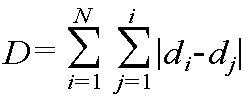
오류 제거부(120)는 위 판별식(D)으로 오류 판별값을 산출 수 있다(S320).The error removal unit 120 may calculate an error discrimination value using the above discriminant (D) (S320).
오류 제거부(120)는 오류 판별값이 기설정 범위에 해당하면 복수의 센서부 모두가 정상인 것으로 판단할 수 있다(S330). 기설정된 범위는 판별식(D)의 판별값을 경험적으로 추론하여 적절한 값의 이내인 것을 찾으면, 데이터(측정값)이 모두 완전한지 하나 이상에 오류가 있는지 알 수 있다.The error removing unit 120 may determine that all of the plurality of sensor units are normal when the error determination value falls within the preset range ( S330 ). If the preset range is found to be within an appropriate value by empirically inferring the discriminant value of the discriminant (D), it can be known whether all data (measured values) are complete or whether there is an error in one or more of the data (measured values).
센서부가 4 이상일 경우, 모든 측정값에 대해 위 판별식을 적용할 수 있다. 더 바람직하게, 복수의 측정값 중 일부에 대해 위 판별식을 적용할 수 있다. 특정 센서부의 측정값이 포함된 판별식(D)의 판별값이 비정상이고, 포함되지 않은 판별식의 판별값이 정상인 경우, 해당 특정 센서부가 오류를 일으키는 것으로 판단할 수 있기 때문이다.When the sensor unit is 4 or more, the above discriminant can be applied to all measured values. More preferably, the above discriminant may be applied to some of the plurality of measured values. This is because, when the discriminant value of the discriminant D including the measured value of the specific sensor unit is abnormal and the discriminant value of the discriminant not included is normal, it may be determined that the specific sensor unit causes an error.
저장부(190)는 제어부(110)의 처리 및 제어를 위한 프로그램이 저장될 수도 있고, 입력되거나 출력되는 데이터들의 임시 저장을 위한 기능을 수행할 수 있다. The storage unit 190 may store a program for processing and control of the control unit 110 and may perform a function for temporarily storing input or output data.
저장부(190)는 광산란 측정부(210)에서 측정된 제1 전류(IL), 알파선 전리 측정부(220)에서 측정된 제2 전류(Iα) 및 베타선 측정부(230)에서 측정된 제3 전류(Iβ)를 저장할 수 있다. 저장부(190)는 농도 결정부(143)에서 기준챔버 내의 공기, 미세먼지 및 수분의 농도를 산출하여 설정된 제1 내지 제3 비례상수 세트값(Q1 내지 Q3)를 저장할 수 있다.The storage unit 190 includes a first current IL measured by the light scattering measurement unit 210 , a second current Iα measured by the alpha-ray ionization measurement unit 220 , and a third current measured by the beta-ray measurement unit 230 . Current Iβ can be stored. The storage unit 190 may store the first to third proportional constant set values Q1 to Q3 set by calculating the concentrations of air, fine dust, and moisture in the reference chamber by the concentration determining unit 143 .
교정부(130)는 하나의 센서부(20)의 측정값을 결정할 수 있다.The calibration unit 130 may determine a measurement value of one
도 8을 참조하면, 교정부(130)는 농도 결정부(143) 및 농도 측정부(145)를 구비할 수 있다.Referring to FIG. 8 , the calibration unit 130 may include a concentration determining unit 143 and a concentration measuring unit 145 .
농도 결정부(143)는 제1 내지 제3 전류(IL, Iα, Iβ)를 아래의 다중 선형 회귀식을 이용하여 제1 및 제2 농도를 결정할 수 있다. 농도 결정부(143)는 제1 내지 제3 전류(IL, Iα, Iβ)를 제1 센서부(20-1)나 저장부(190)으로부터 전달받을 수 있다.The concentration determining unit 143 may determine the first and second concentrations of the first to third currents IL, Iα, and Iβ using the following multiple linear regression equation. The concentration determining unit 143 may receive the first to third currents IL, Iα, and Iβ from the first sensor unit 20 - 1 or the storage unit 190 .
여기서, 상기 제1 농도는 미세먼지의 농도이며, 상기 제2 농도는 수분의 농도일 수 있다. 이외에, 공기의 농도를 결정할 수 있다.Here, the first concentration may be a concentration of fine dust, and the second concentration may be a concentration of moisture. In addition, it is possible to determine the concentration of air.


여기서, IL은 제1 전류, Iα는 제2 전류, Iβ는 제3 전류, A는 공기의 농도값, P는 미세먼지의 제1 농도, W는 수분의 제2 농도, Ka1, Ka2, Ka3 각각은 광, 알파선, 베타선 방출시 공기 농도에 비례하여 설정된 전류의 크기를 나타낸 제1 비례상수 세트값(Q1), Kp1, Kp2, Kp3는 광, 알파선, 베타선 방출 시 공기 농도에 비례하여 설정된 전류의 크기를 나타낸 제2 비례상수 세트값(Q2), Kw1, kw2, Kw3는 광, 알파선, 베타선 방출 시 수분 농도에 비례하여 설정된 전류의 크기를 나타낸 제3 비례상수 세트값(Q3)이다.Here, IL is the first current, Iα is the second current, Iβ is the third current, A is the concentration value of air, P is the first concentration of fine dust, W is the second concentration of moisture, Ka1, Ka2, and Ka3, respectively is the first proportional constant set value (Q1) indicating the magnitude of the current set in proportion to the air concentration when light, alpha rays, and beta rays are emitted, Kp1, Kp2, and Kp3 are The second set values of proportionality constants (Q2), Kw1, kw2, and Kw3 indicating the magnitudes are the third set values of proportional constants (Q3) indicating the magnitude of the current set in proportion to the moisture concentration when light, alpha rays, and beta rays are emitted.
공기, 미세먼지 그리고 수분의 농도를 각각 제어할 수 있는 기준 챔버(standard chamber)에서 각각의 농도에 따른 제1 내지 제3 비례상수 세트값(Q1 내지 Q3)의 평균값과 측정 오차를 농도 측정부(145)에서 딥러닝 연산을 통하여 연산할 수 있다.The average value and measurement error of the first to third proportional constant set values (Q1 to Q3) according to each concentration in a standard chamber that can control the concentrations of air, fine dust, and moisture, respectively, are measured by the concentration measuring unit ( 145), it can be calculated through deep learning operations.
농도 측정부(145)는 CNN 학습 처리부(152), LSTM 학습 처리부(154) 및 오차 보정부(156)를 구비할 수 있다.The concentration measuring unit 145 may include a CNN learning processing unit 152 , an LSTM
CNN 학습 처리부(152)는 이전 입력된 미세먼지의 제1 이전 농도들 및 수분의 제2 이전 농도들을 컨볼루션 신경망(Convolutional Neural Network, CNN)에서 사용하는 예측 모형에서 사용 가능한 형태로 전처리한 후, 입력 데이터에서 발생된 결측값(Missing Value)를 임의의 값(실험 환경에서는 0)으로 대체하고 CNN 모형에서 처리할 수 있도록 행렬 형태로 분할한 후 각 행렬의 유사도에 따른 군집을 할당할 수 있다.The CNN learning processing unit 152 pre-processes the previously input first previous concentrations of fine dust and the second previous concentrations of moisture into a form usable in a prediction model used in a convolutional neural network (CNN), After replacing the missing value generated in the input data with a random value (0 in the experimental environment) and dividing it into a matrix so that it can be processed in the CNN model, a cluster can be assigned according to the similarity of each matrix.
CNN 학습 처리부(152)는 전처리 과정에서 제공되는 행렬데이터와 군집결과를 이용하여 CNN 신경망을 학습할 수 있다. 이후, CNN 학습 처리부(152)는 시험 데이터를 입력받아 CNN 분류 값을 산출할 수 있다.The CNN learning processing unit 152 may learn the CNN neural network using matrix data and clustering results provided in the preprocessing process. Thereafter, the CNN learning processing unit 152 may receive the test data and calculate a CNN classification value.
결과적으로, CNN 학습 처리부(152)는 상기 미세먼지의 제1 예측농도 및 상기 수분의 제2 예측 농도에 대한 CNN 분류 값을 출력할 수 있다.As a result, the CNN learning processing unit 152 may output the CNN classification values for the first predicted concentration of the fine dust and the second predicted concentration of the moisture.
LSTM 학습 처리부(154)는 현재 시점 이전에 입력된 미세먼의 제1 이전 시점 농도들 및 수분의 제2 이전 시점 농도들을 설정된 tanh 함수에 적용하여 상기 현재 시점에서 상기 미세먼지의 제3 예측농도 및 상기 수분의 제4 예측 농도를 출력할 수 있다.The LSTM
LSTM 학습 처리부(154)는 LSTM 신경망에 현재 시점 이전에 입력된 미세먼의 제1 이전 시점 농도들 및 수분의 제2 이전 시점 농도들 입력받아 예측을 수행하고 실제 값과 비교를 통해 신경망의 가중치(weight)를 조정하는 학습을 수행하여, LSTM 예측값, 즉 상기 미세먼지의 제3 예측농도 및 상기 수분의 제4 예측 농도를 산출할 수 있다.The LSTM
오차 보정부(156)는 상기 제1 내지 제4 예측농도과, 상기 제1 및 제2 농도를 비교하여 상기 측정 오차를 연산하고, 상기 측정 오차만큼 상기 제2 농도를 보정하여 상기 제1 농도가 최종적으로 보정된 상기 미세먼지의 최종 농도(mk)를 결정할 수 있다.The error correcting unit 156 calculates the measurement error by comparing the first to fourth predicted concentrations and the first and second concentrations, and corrects the second concentration by the measurement error to obtain the final concentration of the first concentration. It is possible to determine the final concentration (mk) of the fine dust corrected by .
오차 보정부(156)는 상기 제1 내지 제4 예측농도과, 상기 제1 및 제2 농도를 활용하여 회귀분석을 수행하여 상술한 [수학식 1]의 다중선형회귀식을 산출할 수 있다.The error correcting unit 156 may calculate the multiple linear regression equation of [Equation 1] described above by performing regression analysis using the first to fourth predicted concentrations and the first and second concentrations.
오차 보정부(156)는 예측 모형의 성능을 비교하기 위해서 각각의 상기 제1 내지 제4 예측농도과, 상기 제1 및 제2 농도를 비교하여 측정 오차를 산출할 수 있다.The error correcting unit 156 may calculate a measurement error by comparing the first to fourth predicted concentrations and the first and second concentrations, respectively, in order to compare the performance of the prediction model.
오차 보정부(156)는 상기 측정 오차만큼 상기 제2 농도를 보정하여 상기 제1 농도가 최종적으로 보정된 상기 미세먼지의 최종 농도(mk)를 결정할 수 있다.The error correcting unit 156 may correct the second concentration by the measurement error to determine the final concentration (mk) of the fine dust for which the first concentration is finally corrected.
또한, 오차 보정부(156)는 [수학식 1]에 나타낸 다중선형회귀식을 상기 측정 오차를 적용하여 교정할 수 있다.Also, the error correction unit 156 may correct the multiple linear regression equation shown in Equation 1 by applying the measurement error.
메시지 생성부(181)는 농도 측정부(145)에서 측정된 상기 미세먼지의 최종 농도(mk)가 설정된 기준 농도보다 높으면 알림 메시지를 생성할 수 있다.The message generating unit 181 may generate a notification message when the final concentration (mk) of the fine dust measured by the concentration measuring unit 145 is higher than a set reference concentration.
메시지 생성부(181)는 최종 농도(mk)가 상기 기준 농도보다 높으면 경고에 해당되는 알림 메시지를 생성하고, 최종 농도(mk)가 상기 기준 농도보다 낮으면 최종 농도를 출력할 수 있다.The message generator 181 may generate a warning message corresponding to a warning when the final concentration mk is higher than the reference concentration, and output the final concentration when the final concentration mk is lower than the reference concentration.
표시부(183)는 메시지 생성부(181)에서 출력된 알림 메시지 및 최종 농도 중 적어도 하나를 표시할 수 있다.The display unit 183 may display at least one of the notification message output from the message generating unit 181 and the final concentration.
제어부(110)는 공기질 측정 장치의 전반적인 제어 기능을 실행할 수 있다. 제어부(110)는 저장부(190)에 저장된 프로그램 및 데이터를 이용하여 공기질 측정 장치의 전반적인 제어 기능을 실행할 수 있다. 제어부(110)는 RAM, ROM, CPU, GPU, 버스를 포함할 수 있으며, RAM, ROM, CPU, GPU 등은 버스를 통해 서로 연결될 수 있다. 제어부(110)는 오류 제거부(120), 교정부(130), 및 메시지 생성부(181) 중 어느 하나의 기능을 수행하거나 그 블럭을 구비할 수 있다.The controller 110 may execute an overall control function of the air quality measuring device. The control unit 110 may execute an overall control function of the air quality measuring device by using the program and data stored in the storage unit 190 . The controller 110 may include RAM, ROM, CPU, GPU, and a bus, and the RAM, ROM, CPU, GPU, etc. may be connected to each other through a bus. The control unit 110 may perform any one function of the error removing unit 120 , the correcting unit 130 , and the message generating unit 181 , or may include a block thereof.
통신부(185)는 알림 메시지 및 최종 농도(mk) 중 적어도 하나를 설정된 이동 단말기, 다른 공기질 측정장치들 및 데이터 서버들로 송신할 수 있다. 통신부(185)는 상기 제1 및 제2 이전 농도들과, 상기 제1 및 제2 이전 시점 농도들을 인접한 다른 공기질 측정장치들 및 데이터 서버들로부터 수신할 수 있다.The communication unit 185 may transmit at least one of the notification message and the final concentration (mk) to a set mobile terminal, other air quality measurement devices, and data servers. The communication unit 185 may receive the first and second previous concentrations and the first and second previous concentrations from other adjacent air quality measurement devices and data servers.
도 9는 본 발명에 따른 공기질 측정 시스템의 동작 방법을 나타낸 순서도이다.9 is a flowchart illustrating an operation method of the air quality measurement system according to the present invention.
도 9를 참조하면, 광산란 측정부(210)는 광원에서 발생되는 광자선(이하, '광'으로 칭함)을 공기, 미세먼지, 수분 등에 의해 산란되어 수광부에 도달하는 산란광을 기반으로 제1 전류(IL)를 측정할 수 있다(S410).Referring to FIG. 9 , the light scattering measurement unit 210 scatters a photon beam (hereinafter referred to as 'light') generated from a light source by air, fine dust, moisture, etc. (IL) may be measured (S410).
알파선 전리측정부(220)는 알파선을 방출하는 알파선원을 이용하여, 공기, 미세먼지, 수분 등 산란광의 정도에 대한 제2 전류(Iα)를 측정할 수 있다(S415).The alpha ionization measurement unit 220 may measure the second current Iα with respect to the degree of scattered light, such as air, fine dust, and moisture, by using an alpha ray source emitting alpha rays ( S415 ).
베타선 전리측정부(230)는 베타선을 방출하는 베타선원을 이용하여, 공기, 미세먼지, 수분 등 산란광의 정도에 대한 제3 전류(Iβ)를 측정할 수 있다(S420).The beta-ray ionization measurement unit 230 may measure the third current Iβ with respect to the degree of scattered light, such as air, fine dust, and moisture, using a beta-ray source emitting beta-rays (S420).
교정부(130)는 광산란 측정부(210)에서 측정된 제1 전류(IL), 알파선 전리 측정부(220)에서 측정된 제2 전류(Iα) 및 베타선 측정부(230)에서 측정된 제3 전류(Iβ)를 저장할 수 있다(S425).The calibration unit 130 includes the first current IL measured by the light scattering measurement unit 210 , the second current Iα measured by the alpha-ray ionization measurement unit 220 , and the third current measured by the beta-ray measurement unit 230 . The current Iβ may be stored (S425).
교정부(130)는 제1 내지 제3 전류(IL, Iα, Iβ) 및 기 설정된 제1 내지 제3 비례상수 세트값(Q1 내지 Q3)을 이용하여 제1 및 제2 농도를 결정할 수 있다(S430).The calibration unit 130 may determine the first and second concentrations using the first to third currents IL, Iα, and Iβ and the first to third set values of the first to third proportional constants Q1 to Q3 ( S430).
여기서, 상기 제1 농도는 미세먼지의 농도이며, 상기 제2 농도는 수분의 농도일 수 있다.Here, the first concentration may be a concentration of fine dust, and the second concentration may be a concentration of moisture.
교정부(130)는 이전 입력된 미세먼지의 제1 이전 농도들 및 수분의 제2 이전 농도들을 컨볼루션 신경망(Convolutional Neural Network, CNN)에서 사용하는 예측 모형에서 사용 가능한 형태로 전처리한 후, 상기 미세먼지의 제1 예측농도 및 상기 수분의 제2 예측 농도에 대한 CNN 분류 값을 출력할 수 있다(S435).The correction unit 130 pre-processes the previously input first previous concentrations of fine dust and second previous concentrations of moisture into a form usable in a prediction model used in a convolutional neural network (CNN), and then CNN classification values for the first predicted concentration of fine dust and the second predicted concentration of moisture may be output (S435).
교정부(130)는 현재 시점 이전에 입력된 미세먼의 제1 이전 시점 농도들 및 수분의 제2 이전 시점 농도들을 설정된 tanh 함수에 적용하여 상기 현재 시점에서 상기 미세먼지의 제3 예측농도 및 상기 수분의 제4 예측 농도를 출력할 수 있다(S440).The correction unit 130 applies the first previous time concentrations of fine dust input before the current time point and the second previous time point concentrations of moisture to the set tanh function to obtain the third predicted concentration of the fine dust at the current time point and the A fourth predicted concentration of moisture may be output (S440).
교정부(130)는 상기 제1 내지 제4 예측농도과, 상기 제1 및 제2 농도를 비교하여 상기 측정 오차를 연산하고, 상기 측정 오차만큼 상기 제2 농도를 보정하여 상기 제1 농도가 최종적으로 보정된 상기 미세먼지의 최종 농도(mk)를 결정할 수 있다(S445).The calibration unit 130 calculates the measurement error by comparing the first to fourth predicted concentrations and the first and second concentrations, and corrects the second concentration by the measurement error so that the first concentration is finally obtained The corrected final concentration (mk) of the fine dust may be determined (S445).
교정부(130)는 농도 측정부(145)에서 측정된 상기 미세먼지의 최종 농도(mk)가 설정된 기준 농도보다 높은지 판단하고(S450), 최종 농도(mk)가 설정된 기준 농도보다 높으면 알림 메시지(mm)를 생성할 수 있다(S4550).The calibration unit 130 determines whether the final concentration (mk) of the fine dust measured by the concentration measurement unit 145 is higher than the set reference concentration (S450), and when the final concentration (mk) is higher than the set reference concentration, a notification message ( mm) can be generated (S4550).
또한, 교정부(130)는 최종 농도(mk)가 상기 기준 농도보다 낮으면 최종 농도(mm)를 출력할 수 있다(S460).In addition, the calibration unit 130 may output the final concentration (mm) when the final concentration (mk) is lower than the reference concentration (S460).
교정부(130)는 알림 메시지(mm) 및 최종 농도(mk) 중 적어도 하나를 표시할 수 있다.The calibration unit 130 may display at least one of a notification message (mm) and a final concentration (mk).
교정부(130)는 알림 메시지(mm) 및 최종 농도(mk) 중 적어도 하나를 설정된 이동 단말기, 다른 공기질 측정장치들 및 데이터 서버들로 송신할 수 있다(S465).The calibration unit 130 may transmit at least one of the notification message (mm) and the final concentration (mk) to a set mobile terminal, other air quality measuring devices, and data servers (S465).
상기 본 발명은 하드웨어 또는 소프트웨어에서 구현될 수 있다. 구현은 상기 본 발명은 또한 컴퓨터로 읽을 수 있는 기록매체에 컴퓨터가 읽을 수 있는 코드로서 구현하는 것이 가능하다. 즉, 컴퓨터에 의해 실행 가능한 명령어를 포함하는 기록 매체의 형태로 구현될 수 있다. 컴퓨터 판독 가능 매체는 컴퓨터 시스템에 의하여 읽혀질 수 있는 데이터가 저장되는 모든 종류의 매체를 포함한다. 컴퓨터 판독 가능 매체는 컴퓨터 저장 매체 및 통신 저장 매체를 포함할 수 있다. 컴퓨터 저장 매체는 컴퓨터가 읽을 수 있는 명령어, 데이터 구조, 프로그램 모듈, 및 기타 데이터 등 정보 저장을 위한 임의의 방법 또는 기술로서 구현된 모든 저장 가능한 매체를 포함하는 것으로, 휘발성/비휘발성/하이브리드형 메모리 여부, 분리형/비분리형 여부 등에 한정되지 않는다. 통신 저장 매체 는 반송파와 같은 변조된 데이터 신호 또는 전송 메커니즘, 임의의 정보 전달 매체 등을 포함한다. 그리고 본 발명을 구현하기 위한 기능적인(functional) 프로그램, 코드 및 코드 세그먼트들은 본 발명이 속하는 기술분야의 프로그래머들에 의해 용이하게 추론될 수 있다.The present invention may be implemented in hardware or software. Implementation The present invention can also be implemented as computer-readable codes on a computer-readable recording medium. That is, it may be implemented in the form of a recording medium including instructions executable by a computer. The computer readable medium includes any type of medium in which data that can be read by a computer system is stored. Computer-readable media may include computer storage media and communication storage media. Computer storage media includes all storable media implemented as any method or technology for information storage, such as computer-readable instructions, data structures, program modules, and other data, and includes volatile/nonvolatile/hybrid memory. Whether or not, it is not limited to whether the detachable / non-separable type. Communication storage media includes a modulated data signal or transmission mechanism, such as a carrier wave, any information delivery media, and the like. And functional programs, codes, and code segments for implementing the present invention can be easily inferred by programmers in the technical field to which the present invention pertains.
또한, 이상에서는 본 발명의 바람직한 실시예에 대하여 도시하고 설명하였지만, 본 발명은 상술한 특정의 실시예에 한정되지 아니하며, 청구범위에서 청구하는 본 발명의 요지를 벗어남이 없이 당해 발명이 속하는 기술분야에서 통상의 지식을 가진 자에 의해 다양한 변형실시가 가능한 것은 물론이고, 이러한 변형실시들은 본 발명의 기술적 사상이나 전망으로부터 개별적으로 이해되어져서는 안 될 것이다. In addition, although preferred embodiments of the present invention have been illustrated and described above, the present invention is not limited to the specific embodiments described above, and the technical field to which the present invention belongs without departing from the gist of the present invention as claimed in the claims In addition, various modifications are possible by those of ordinary skill in the art, and these modifications should not be individually understood from the technical spirit or prospect of the present invention.
10: 공기질 측정 장치 110: 제어부
120: 오류 제거부 130: 교정부
143: 농도 결정부 145: 농도 측정부
181: 메시지 생성부 183: 표시부
185: 통신부 190: 저장부
20: 센서 장치 210: 광산란 측정부
220: 알파선 전리 측정부 230: 베타선 전리 측정부10: air quality measuring device 110: control unit
120: error removal unit 130: correction unit
143: concentration determining unit 145: concentration measuring unit
181: message generating unit 183: display unit
185: communication unit 190: storage unit
20: sensor device 210: light scattering measurement unit
220: alpha ion measurement unit 230: beta ionization measurement unit
Claims (6)
상기 제1 내지 제N 센서부의 제1 내지 제N 측정값을 극좌표계의 제1 내지 제N 거리를 가지는 제1 내지 제N 위치로 변환하고, 상기 제1 내지 제N 위치를 꼭지점으로 하는 N각형의 각 변의 길이를 기초로하는 잡음 판별식의 판별값을 산출하고, 상기 판별값이 기설정된 범위에 해당하는지 여부로 상기 제1 내지 제N 센서부 모두가 정상인지 여부를 판단하는 오류 제거부를 구비하는 공기질 측정 장치를 포함하고,
상기 제1 내지 제N 위치의 방위각은 특정각의 정수 배인, 자동 교정 알고리즘이 내장된 공기질 측정 시스템.a sensor device including first to N-th sensor units of the same type for measuring the same object; and
The first to N-th sensor unit converts the first to N-th measured values into first to N-th positions having the first to N-th distances in the polar coordinate system, and the first to N-th positions are the vertices. An error removing unit for calculating a discriminant value of a noise discriminant based on the length of each side of , and determining whether all of the first to Nth sensor units are normal based on whether the discriminant value falls within a preset range including an air quality measuring device that
The azimuth angle of the first to Nth positions is an integer multiple of a specific angle, an air quality measurement system with a built-in automatic calibration algorithm.
상기 판별식은 상기 N각형의 제i 내지 제j 변의 길이의 차들의 합인 것이고, 상기 i는 1 내지 N 중 어느 하나인 자연수이고, 상기 j는 상기 i 내지 N 중 어느 하나인 자연수이고,
상기 판별식은 상기 제1 내지 제3 센서부의 제1 내지 제3 측정값을 기초로 하는 것인, 자동 교정 알고리즘이 내장된 공기질 측정 시스템.The method of claim 1,
The discriminant is the sum of the differences in the lengths of the i to jth sides of the N-gon, wherein i is any one of 1 to N natural number, and j is any one of i to N natural number,
The discriminant is based on the first to third measurement values of the first to third sensor units, the automatic calibration algorithm is built-in air quality measurement system.
상기 제1 센서부는
상기 측정 영역에서 부유 미립자가 필터링된 공기에 광을 방출하여 산란된 산란광을 기반으로 제1 전류를 측정하는 광산란 측정부;
상기 공기에 알파선을 방출하여 전리된 제2 전류를 측정하는 알파선 전리측정부; 및
상기 공기에 베타선을 방출하여 전리된 제3 전류를 측정하는 베타선 전리측정부;를 구비하고,
상기 공기질 측정 장치는 기준챔버 내의 공기, 미세먼지 및 수분의 농도를 산출하여 설정된 제1 내지 제3 비례상수 세트값을 기반으로, 상기 제1 내지 제3 전류에 대한 상기 미세먼지의 제1 농도 및 수분의 제2 농도를 결정하고, 상기 제1 및 제2 농도의 오차를 딥러닝 연산하여 상기 미세먼지의 농도에 대한 측정 오차를 결정하며, 상기 농도 데이터들 중 상기 제1 및 2 특정 농도 데이터를 추출하고, 상기 제1 및 제2 특정 농도 데이터 각각에 포함된 상기 미세먼지의 제1 및 제2 특정 농도와 상기 미세먼지의 농도 사이의 제1 및 제2 농도 차이값이 설정된 기준 농도값 범위에 속하지 않으면, 상기 제1 및 제2 특정 농도 사이의 차이값과 상기 측정 오차를 기반으로 상기 미세먼지의 최종 농도를 결정하는 교정부를 더 구비하는, 공기질 측정 시스템.The method of claim 1,
The first sensor unit
a light scattering measuring unit measuring a first current based on the scattered light scattered by emitting light to the air in which the suspended particles are filtered in the measuring area;
an alpha ion measurement unit measuring a second current ionized by emitting alpha rays to the air; and
A beta-ray ionization measurement unit for measuring the ionized third current by emitting beta-rays to the air; and
The air quality measuring device calculates the concentrations of air, fine dust and moisture in the reference chamber and based on first to third set values of proportional constants, the first concentration of the fine dust with respect to the first to third currents and A second concentration of moisture is determined, and a deep learning operation is performed on the errors of the first and second concentrations to determine a measurement error for the concentration of fine dust, and the first and second specific concentration data among the concentration data extracted, and the first and second concentration difference values between the first and second specific concentrations of the fine dust included in each of the first and second specific concentration data and the concentration of the fine dust are set in the reference concentration value range If not, the air quality measurement system further comprising a calibration unit for determining the final concentration of the fine dust based on the measurement error and the difference value between the first and second specific concentrations.
상기 제1 내지 제3 전류 및 상기 제1 내지 제3 비례상수 세트값을 저장하는 저장부를 더 포함하고,
상기 교정부는,
상기 제1 내지 제3 전류 및 상기 제1 내지 제3 비례상수 세트값을 기반으로, 상기 제1 내지 제3 전류에 대한 상기 제1 및 제2 농도를 결정하는 농도 결정부; 및
상기 제1 및 제2 농도의 측정 오차를 딥러닝 연산하여 상기 미세먼지의 최종 농도를 측정하는 농도 측정부를 구비하고,
상기 농도 결정부는, 상기 제1 내지 제3 전류를 아래의 다중 선형 회귀식을 이용하여 분석하여 상기 제1 및 제2 농도를 연산하는, 공기질 측정 시스템.


(IL은 제1 전류, Iα는 제2 전류, Iβ는 제3 전류, A는 공기의 농도값, P는 미세먼지의 제1 농도, W는 수분의 제2 농도, Ka1, Ka2, Ka3 각각은 광, 알파선, 베타선 방출시 공기 농도에 비례하여 설정된 전류의 크기를 나타낸 제1 비례상수 세트값, Kp1, Kp2, Kp3는 광, 알파선, 베타선 방출 시 공기 농도에 비례하여 설정된 전류의 크기를 나타낸 제2 비례상수 세트값, Kw1, kw2, Kw3는 광, 알파선, 베타선 방출 시 수분 농도에 비례하여 설정된 전류의 크기를 나타낸 제3 비례상수 세트값)4. The method of claim 3,
Further comprising a storage unit for storing the first to third current and the first to third proportional constant set values,
The correction unit,
a concentration determiner configured to determine the first and second concentrations for the first to third currents based on the first to third currents and the first to third set values of proportional constants; and
A concentration measuring unit for measuring the final concentration of the fine dust by deep learning calculation of the measurement error of the first and second concentrations,
The concentration determining unit, the first to third currents are analyzed using the following multiple linear regression equation to calculate the first and second concentrations, the air quality measurement system.
(IL is the first current, Iα is the second current, Iβ is the third current, A is the concentration value of air, P is the first concentration of fine dust, W is the second concentration of moisture, and each of Ka1, Ka2, and Ka3 is The first set of proportional constant values, Kp1, Kp2, Kp3, indicating the magnitude of the current set in proportion to the air concentration when light, alpha ray, and beta ray are emitted 2 Proportional constant set values, Kw1, kw2, and Kw3 are the third set values of proportional constants indicating the magnitude of the current set in proportion to the moisture concentration when light, alpha, and beta rays are emitted)
상기 농도 측정부는,
이전 입력된 미세먼지의 제1 이전 농도들 및 수분의 제2 이전 농도들을 기반으로 컨볼루션 신경망(Convolutional Neural Network, CNN)에 대하여 상기 미세먼지의 제1 예측농도 및 상기 수분의 제2 예측 농도를 출력하는 CNN 학습 처리부;
현재 시점 이전에 입력된 미세먼지의 제1 이전 시점 농도들 및 수분의 제2 이전 시점 농도들을 설정된 tanh 함수에 적용하여 상기 현재 시점에서 상기 미세먼지의 제3 예측농도 및 상기 수분의 제4 예측 농도를 출력하는 LSTM 학습 처리부; 및
상기 제1 내지 제4 예측농도과, 상기 제1 및 제2 농도를 비교하여 상기 측정 오차를 연산하고, 상기 측정 오차만큼 상기 제2 농도를 보정하여 상기 제1 농도가 최종적으로 보정된 상기 미세먼지의 최종 농도를 결정하는 오차보정부를 구비하는, 공기질 측정 시스템.5. The method of claim 4,
The concentration measuring unit,
Based on the previously input first previous concentrations of fine dust and second previous concentrations of moisture, the first predicted concentration of the fine dust and the second predicted concentration of the moisture with respect to a convolutional neural network (CNN) CNN learning processing unit to output;
The third predicted concentration of the fine dust and the fourth predicted concentration of the moisture at the current time by applying the first previous time concentrations of fine dust and the second previous time concentrations of moisture input before the current time point to the set tanh function LSTM learning processing unit to output; and
The first to fourth predicted concentrations are compared with the first and second concentrations to calculate the measurement error, and by correcting the second concentration by the measurement error, the first concentration of the fine dust is finally corrected. An air quality measurement system comprising an error correction unit for determining the final concentration.
상기 제1 내지 제N 위치의 방위각은 특정각의 정수 배인, 구비하는 공기질 측정 장치.The first to N-th measurement values of the first to N-th sensor units of the sensor device having the same first to N-th sensor units for measuring the same object are first to N-th distances in a polar coordinate system. converting to N positions, calculating a discriminant value of a noise discriminant based on the length of each side of an N-gon having the first to Nth positions as a vertex, and determining whether the discriminant value falls within a preset range Including an error removing unit for determining whether all of the first to Nth sensor unit is normal,
The azimuth angle of the first to the Nth position is an integer multiple of a specific angle, an air quality measuring device having.
Priority Applications (1)
| Application Number | Priority Date | Filing Date | Title |
|---|---|---|---|
| KR1020200169308A KR102393536B1 (en) | 2020-12-07 | 2020-12-07 | Apparatus having auto correction algorism for measuring air quality and system therefor |
Applications Claiming Priority (1)
| Application Number | Priority Date | Filing Date | Title |
|---|---|---|---|
| KR1020200169308A KR102393536B1 (en) | 2020-12-07 | 2020-12-07 | Apparatus having auto correction algorism for measuring air quality and system therefor |
Publications (1)
| Publication Number | Publication Date |
|---|---|
| KR102393536B1 true KR102393536B1 (en) | 2022-05-03 |
Family
ID=81591181
Family Applications (1)
| Application Number | Title | Priority Date | Filing Date |
|---|---|---|---|
| KR1020200169308A Active KR102393536B1 (en) | 2020-12-07 | 2020-12-07 | Apparatus having auto correction algorism for measuring air quality and system therefor |
Country Status (1)
| Country | Link |
|---|---|
| KR (1) | KR102393536B1 (en) |
Cited By (4)
| Publication number | Priority date | Publication date | Assignee | Title |
|---|---|---|---|---|
| CN115798154A (en) * | 2022-11-02 | 2023-03-14 | 江西飞尚科技有限公司 | Air quality alarm method and system |
| KR20230152526A (en) * | 2022-04-27 | 2023-11-03 | 주식회사 아림사이언스 | Apparatus having auto correction algorism for measuring air quality and correction method thereof |
| CN118518833A (en) * | 2024-07-23 | 2024-08-20 | 中山大学 | Dynamic calibration method for mobile air quality monitoring system based on vehicle Lu Yun cooperation |
| CN118777145A (en) * | 2024-06-21 | 2024-10-15 | 首都经济贸易大学 | A dust concentration monitoring device and method based on physical and data dual drive |
Citations (5)
| Publication number | Priority date | Publication date | Assignee | Title |
|---|---|---|---|---|
| JPH09306957A (en) * | 1996-05-20 | 1997-11-28 | Mitsubishi Electric Corp | Foreign object detection method |
| KR20160080382A (en) * | 2014-12-29 | 2016-07-08 | 주식회사 그린솔루스 | Method for measuring dust and apparatus for measuring dust |
| KR20180041828A (en) | 2016-10-17 | 2018-04-25 | 주식회사에스에이티 | An apparatus and method for constructing microscopic dust information by measuring, compensating and predicting the concentration density of microscopic dust |
| KR20180065588A (en) * | 2016-12-08 | 2018-06-18 | 에스케이테크엑스 주식회사 | Apparatus for managing meteorological information using fine dust sensor, method thereof and computer readable medium having computer program recorded thereon |
| KR20200071796A (en) * | 2018-11-29 | 2020-06-22 | 주식회사 아림사이언스 | Apparatus for measuring air quality and system therefor |
-
2020
- 2020-12-07 KR KR1020200169308A patent/KR102393536B1/en active Active
Patent Citations (5)
| Publication number | Priority date | Publication date | Assignee | Title |
|---|---|---|---|---|
| JPH09306957A (en) * | 1996-05-20 | 1997-11-28 | Mitsubishi Electric Corp | Foreign object detection method |
| KR20160080382A (en) * | 2014-12-29 | 2016-07-08 | 주식회사 그린솔루스 | Method for measuring dust and apparatus for measuring dust |
| KR20180041828A (en) | 2016-10-17 | 2018-04-25 | 주식회사에스에이티 | An apparatus and method for constructing microscopic dust information by measuring, compensating and predicting the concentration density of microscopic dust |
| KR20180065588A (en) * | 2016-12-08 | 2018-06-18 | 에스케이테크엑스 주식회사 | Apparatus for managing meteorological information using fine dust sensor, method thereof and computer readable medium having computer program recorded thereon |
| KR20200071796A (en) * | 2018-11-29 | 2020-06-22 | 주식회사 아림사이언스 | Apparatus for measuring air quality and system therefor |
Cited By (5)
| Publication number | Priority date | Publication date | Assignee | Title |
|---|---|---|---|---|
| KR20230152526A (en) * | 2022-04-27 | 2023-11-03 | 주식회사 아림사이언스 | Apparatus having auto correction algorism for measuring air quality and correction method thereof |
| KR102758437B1 (en) | 2022-04-27 | 2025-01-23 | 주식회사 아림사이언스 | Apparatus having auto correction algorism for measuring air quality and correction method thereof |
| CN115798154A (en) * | 2022-11-02 | 2023-03-14 | 江西飞尚科技有限公司 | Air quality alarm method and system |
| CN118777145A (en) * | 2024-06-21 | 2024-10-15 | 首都经济贸易大学 | A dust concentration monitoring device and method based on physical and data dual drive |
| CN118518833A (en) * | 2024-07-23 | 2024-08-20 | 中山大学 | Dynamic calibration method for mobile air quality monitoring system based on vehicle Lu Yun cooperation |
Similar Documents
| Publication | Publication Date | Title |
|---|---|---|
| KR102393536B1 (en) | Apparatus having auto correction algorism for measuring air quality and system therefor | |
| KR102148812B1 (en) | Apparatus for measuring air quality and system therefor | |
| Aartsen et al. | Development of a general analysis and unfolding scheme and its application to measure the energy spectrum of atmospheric neutrinos with IceCube: IceCube Collaboration | |
| Kobayashi et al. | Development of a polarization optical particle counter capable of aerosol type classification | |
| CN203101225U (en) | Aerosol absorption coefficient measuring system | |
| EP2960639A1 (en) | Particle detecting device and particle detecting method | |
| CN113063897A (en) | Air pollutant tracing method and device | |
| KR20210146593A (en) | Apparatus for measuring air quality and system therefor | |
| CN108732313A (en) | Urban air pollution object concentration intelligence observation system | |
| CN104483299A (en) | Method for identifying water hazard water source of mining area | |
| US6381555B1 (en) | Measurement system | |
| Lee et al. | Chaos in air pollutant concentration (APC) time series | |
| CN102967557B (en) | Biological aerosol water-content determination based on near infrared spectroscopy and classification method thereof | |
| KR102758437B1 (en) | Apparatus having auto correction algorism for measuring air quality and correction method thereof | |
| JP5505463B2 (en) | Search method for unsteady dust generation source of falling dust | |
| Pal et al. | Effectiveness of machine learning algorithms in forecasting AQI | |
| JP5131400B1 (en) | Search method of unsteady dust source position of falling dust | |
| CN110006849B (en) | Method and device for obtaining extinction coefficient of aerosol | |
| CN120028270A (en) | Environmental detection method and system | |
| EP2960640B1 (en) | Particle detecting device and particle detecting method | |
| CN119213293A (en) | Sensor calibration, air quality measuring device and calibration method thereof | |
| CN112540052A (en) | Method and system for measuring and calculating pollutant discharge amount of storage tank to be measured | |
| CN106442248B (en) | Method and system for measuring emission concentration of particulate matter in gas | |
| CN103048250B (en) | The method identified and/or assess the interference measuring signal | |
| JP5073861B1 (en) | Search method of unsteady dust source position of falling dust |
Legal Events
| Date | Code | Title | Description |
|---|---|---|---|
| PA0109 | Patent application |
St.27 status event code: A-0-1-A10-A12-nap-PA0109 |
|
| PA0201 | Request for examination |
St.27 status event code: A-1-2-D10-D11-exm-PA0201 |
|
| R18-X000 | Changes to party contact information recorded |
St.27 status event code: A-3-3-R10-R18-oth-X000 |
|
| D13-X000 | Search requested |
St.27 status event code: A-1-2-D10-D13-srh-X000 |
|
| D14-X000 | Search report completed |
St.27 status event code: A-1-2-D10-D14-srh-X000 |
|
| PN2301 | Change of applicant |
St.27 status event code: A-3-3-R10-R13-asn-PN2301 St.27 status event code: A-3-3-R10-R11-asn-PN2301 |
|
| E701 | Decision to grant or registration of patent right | ||
| PE0701 | Decision of registration |
St.27 status event code: A-1-2-D10-D22-exm-PE0701 |
|
| GRNT | Written decision to grant | ||
| PR0701 | Registration of establishment |
St.27 status event code: A-2-4-F10-F11-exm-PR0701 |
|
| PR1002 | Payment of registration fee |
St.27 status event code: A-2-2-U10-U11-oth-PR1002 Fee payment year number: 1 |
|
| PG1601 | Publication of registration |
St.27 status event code: A-4-4-Q10-Q13-nap-PG1601 |
|
| P22-X000 | Classification modified |
St.27 status event code: A-4-4-P10-P22-nap-X000 |
|
| PR1001 | Payment of annual fee |
St.27 status event code: A-4-4-U10-U11-oth-PR1001 Fee payment year number: 4 |
|
| P22-X000 | Classification modified |
St.27 status event code: A-4-4-P10-P22-nap-X000 |