KR102373027B1 - Blue phosphorescent materials, the manufacturing method there of the same and the photophysical properties of the same - Google Patents
Blue phosphorescent materials, the manufacturing method there of the same and the photophysical properties of the same Download PDFInfo
- Publication number
- KR102373027B1 KR102373027B1 KR1020190145231A KR20190145231A KR102373027B1 KR 102373027 B1 KR102373027 B1 KR 102373027B1 KR 1020190145231 A KR1020190145231 A KR 1020190145231A KR 20190145231 A KR20190145231 A KR 20190145231A KR 102373027 B1 KR102373027 B1 KR 102373027B1
- Authority
- KR
- South Korea
- Prior art keywords
- ligand
- blue phosphorescent
- phosphorescent material
- iridium
- phenyl
- Prior art date
- Legal status (The legal status is an assumption and is not a legal conclusion. Google has not performed a legal analysis and makes no representation as to the accuracy of the status listed.)
- Expired - Fee Related
Links
Images




Classifications
-
- C—CHEMISTRY; METALLURGY
- C09—DYES; PAINTS; POLISHES; NATURAL RESINS; ADHESIVES; COMPOSITIONS NOT OTHERWISE PROVIDED FOR; APPLICATIONS OF MATERIALS NOT OTHERWISE PROVIDED FOR
- C09K—MATERIALS FOR MISCELLANEOUS APPLICATIONS, NOT PROVIDED FOR ELSEWHERE
- C09K11/00—Luminescent, e.g. electroluminescent, chemiluminescent materials
- C09K11/06—Luminescent, e.g. electroluminescent, chemiluminescent materials containing organic luminescent materials
-
- C—CHEMISTRY; METALLURGY
- C07—ORGANIC CHEMISTRY
- C07F—ACYCLIC, CARBOCYCLIC OR HETEROCYCLIC COMPOUNDS CONTAINING ELEMENTS OTHER THAN CARBON, HYDROGEN, HALOGEN, OXYGEN, NITROGEN, SULFUR, SELENIUM OR TELLURIUM
- C07F15/00—Compounds containing elements of Groups 8, 9, 10 or 18 of the Periodic Table
- C07F15/0006—Compounds containing elements of Groups 8, 9, 10 or 18 of the Periodic Table compounds of the platinum group
- C07F15/0033—Iridium compounds
-
- C—CHEMISTRY; METALLURGY
- C09—DYES; PAINTS; POLISHES; NATURAL RESINS; ADHESIVES; COMPOSITIONS NOT OTHERWISE PROVIDED FOR; APPLICATIONS OF MATERIALS NOT OTHERWISE PROVIDED FOR
- C09K—MATERIALS FOR MISCELLANEOUS APPLICATIONS, NOT PROVIDED FOR ELSEWHERE
- C09K2211/00—Chemical nature of organic luminescent or tenebrescent compounds
- C09K2211/10—Non-macromolecular compounds
- C09K2211/1003—Carbocyclic compounds
- C09K2211/1007—Non-condensed systems
-
- C—CHEMISTRY; METALLURGY
- C09—DYES; PAINTS; POLISHES; NATURAL RESINS; ADHESIVES; COMPOSITIONS NOT OTHERWISE PROVIDED FOR; APPLICATIONS OF MATERIALS NOT OTHERWISE PROVIDED FOR
- C09K—MATERIALS FOR MISCELLANEOUS APPLICATIONS, NOT PROVIDED FOR ELSEWHERE
- C09K2211/00—Chemical nature of organic luminescent or tenebrescent compounds
- C09K2211/10—Non-macromolecular compounds
- C09K2211/1018—Heterocyclic compounds
- C09K2211/1025—Heterocyclic compounds characterised by ligands
- C09K2211/1029—Heterocyclic compounds characterised by ligands containing one nitrogen atom as the heteroatom
-
- C—CHEMISTRY; METALLURGY
- C09—DYES; PAINTS; POLISHES; NATURAL RESINS; ADHESIVES; COMPOSITIONS NOT OTHERWISE PROVIDED FOR; APPLICATIONS OF MATERIALS NOT OTHERWISE PROVIDED FOR
- C09K—MATERIALS FOR MISCELLANEOUS APPLICATIONS, NOT PROVIDED FOR ELSEWHERE
- C09K2211/00—Chemical nature of organic luminescent or tenebrescent compounds
- C09K2211/10—Non-macromolecular compounds
- C09K2211/1018—Heterocyclic compounds
- C09K2211/1025—Heterocyclic compounds characterised by ligands
- C09K2211/1044—Heterocyclic compounds characterised by ligands containing two nitrogen atoms as heteroatoms
-
- C—CHEMISTRY; METALLURGY
- C09—DYES; PAINTS; POLISHES; NATURAL RESINS; ADHESIVES; COMPOSITIONS NOT OTHERWISE PROVIDED FOR; APPLICATIONS OF MATERIALS NOT OTHERWISE PROVIDED FOR
- C09K—MATERIALS FOR MISCELLANEOUS APPLICATIONS, NOT PROVIDED FOR ELSEWHERE
- C09K2211/00—Chemical nature of organic luminescent or tenebrescent compounds
- C09K2211/18—Metal complexes
- C09K2211/185—Metal complexes of the platinum group, i.e. Os, Ir, Pt, Ru, Rh or Pd
Landscapes
- Chemical & Material Sciences (AREA)
- Organic Chemistry (AREA)
- Engineering & Computer Science (AREA)
- Materials Engineering (AREA)
- Electroluminescent Light Sources (AREA)
Abstract
청색 인광소재에 있어서, 이리듐을 포함하는 중심 금속, 및 상기 중심 금속의 2좌 배위자이고, 상기 중심 금속과 이리듐-탄소 결합을 갖는 페닐-이미다조피리딘 리간드를 포함하되, 상기 리간드는, 상기 리간드의 페닐기에 2,6-디메틸페닐 작용기가 도입된 것을 포함할 수 있다.
본 출원은 이리듐-탄소 결합을 갖고, 입체 장애 작용기가 도입된 페닐-이미다조피리딘 리간드를 포함하는 청색 인광소재, 그 제조 방법, 및 이의 광물리적 특성에 관한 것이다.In the blue phosphorescent material, a central metal containing iridium, and a phenyl-imidazopyridine ligand that is a bidentate ligand of the central metal and has an iridium-carbon bond with the central metal, wherein the ligand is the ligand It may include those in which a 2,6-dimethylphenyl functional group is introduced into the phenyl group.
The present application relates to a blue phosphorescent material including a phenyl-imidazopyridine ligand having an iridium-carbon bond and a sterically hindered functional group introduced therein, a manufacturing method thereof, and photophysical properties thereof.
Description
본 출원은 청색 인광소재, 그 제조 방법, 및 이의 광물리적 특성에 관한 것으로, 보다 상세하게는, 이리듐 중심 금속, 및 상기 중심 금속의 2좌 배위자이고, 상기 중심 금속과 이리듐-탄소 결합을 갖고, 입체 장애 작용기가 도입된 페닐-이미다조피리딘 리간드를 포함하는 청색 인광소재, 그 제조 방법, 및 이의 광물리적 특성에 관한 것이다.The present application relates to a blue phosphorescent material, a manufacturing method thereof, and photophysical properties thereof, and more particularly, an iridium central metal, and a bidentate ligand of the central metal, and has an iridium-carbon bond with the central metal, It relates to a blue phosphorescent material including a phenyl-imidazopyridine ligand into which a sterically hindered functional group is introduced, a method for manufacturing the same, and photophysical properties thereof.
일반적으로, 인광 도판트는 형광 도판트에 비하여, 3배 높은 이론적 양자 효율을 가질 수 있다. 이에 따라, 유기 발광 다이오드(OLED)에는 형광 도판트에 비하여, 인광 도판트가 주로 사용되고 있다.In general, a phosphorescent dopant can have a theoretical quantum efficiency three times higher than a fluorescent dopant. Accordingly, a phosphorescent dopant is mainly used in an organic light emitting diode (OLED) as compared to a fluorescent dopant.
하지만, 종래의 청색 인광 도판트는 대부분 청색 형광 도판트보다 발광 효율이 낮아, 상용화된 유기 발광 다이오드에서 청색의 경우, 주로 형광 도판트를 사용하고 있다.However, most conventional blue phosphorescent dopants have lower luminous efficiency than blue fluorescent dopants, and in the case of blue in commercially available organic light emitting diodes, the fluorescent dopant is mainly used.
따라서, 형광 도판트보다 발광 효율이 높은 청색 인광 도판트를 개발하기 위한 연구가 진행 중이다. 예를 들어, 대한민국 등록 특허 공보 10-1771530(출원번호 10-2010-0032874)에는 알킬-피리딘-2-카복시미딕 산을 메인리간드로 갖고, 페닐-피리딘, 2-벤질-피리딘, 1,2-디페닐-1H-이미다졸, 1-벤질-2-페닐-1H-벤조이미다졸 또는 1,2-디페닐-1H-벤조이미다졸 중에서 선택되는 어느 하나의 보조리간드를 포함하는 것을 특징으로 하는 유기금속 화합물이 개시된다.Therefore, research is underway to develop a blue phosphorescent dopant having a higher luminous efficiency than a fluorescent dopant. For example, in Korean Patent Publication No. 10-1771530 (Application No. 10-2010-0032874), alkyl-pyridine-2-carboxymidic acid is a main ligand, phenyl-pyridine, 2-benzyl-pyridine, 1,2- An organic material comprising any one auxiliary ligand selected from diphenyl-1H-imidazole, 1-benzyl-2-phenyl-1H-benzoimidazole or 1,2-diphenyl-1H-benzoimidazole Metal compounds are disclosed.
본 발명이 해결하고자 하는 일 기술적 과제는, 이리듐 중심 금속, 및 상기 중심 금속에 2좌 배위자이고, 입체장애 작용기가 도입된 페닐-이미다조피리딘 리간드를 포함하는 청색 인광소재, 그 제조 방법, 및 이의 광물리적 특성을 제공하는 데 있다.One technical problem to be solved by the present invention is an iridium central metal, and a blue phosphorescent material comprising a phenyl-imidazopyridine ligand that is a bidentate ligand to the central metal and a sterically hindered functional group is introduced, a manufacturing method thereof, and its manufacturing method It is intended to provide photophysical properties.
본 발명이 해결하고자 하는 다른 기술적 과제는, 입체장애 작용기가 도입된 페닐-이미다조피리딘 리간드를 동종리간드로 포함하고, 페이셜(facial) 이성질체 또는 메리디오날(meridional) 이성질체를 포함하는 청색 인광소재, 그 제조 방법, 및 이의 광물리적 특성을 제공하는 데 있다.Another technical problem to be solved by the present invention is a blue phosphorescent material including a phenyl-imidazopyridine ligand into which a sterically hindered functional group is introduced as a homoligand, and a facial isomer or meridional isomer, It is intended to provide a method for its preparation, and its photophysical properties.
본 발명이 해결하고자 하는 또 다른 기술적 과제는, 광물리적 특성 평가를 통해 발광 특성의 근원을 밝히고, 유기 발광 다이오드의 도판트로 사용 가능한 청색 인광소재, 그 제조 방법, 및 이의 광물리적 특성을 제공하는 데 있다.Another technical problem to be solved by the present invention is to provide a blue phosphorescent material that can be used as a dopant of an organic light emitting diode, a manufacturing method thereof, and its photophysical properties to reveal the source of light emitting properties through photophysical property evaluation there is.
본 발명이 해결하고자 하는 기술적 과제는 상술된 것에 제한되지 않는다.The technical problem to be solved by the present invention is not limited to the above.
상기 기술적 과제를 해결하기 위해, 본 출원은, 청색 인광소재를 제공한다.In order to solve the above technical problem, the present application provides a blue phosphorescent material.
일 실시 예에 따르면, 상기 청색 인광소재는, 이리듐을 포함하는 중심 금속, 및 상기 중심 금속의 2좌 배위자이고, 상기 중심 금속과 이리듐-탄소 결합을 갖는 페닐-이미다조피리딘 리간드를 포함하되, 상기 리간드는, 상기 리간드의 페닐기에 2,6-디메틸페닐 작용기가 도입된 것을 포함할 수 있다.According to an embodiment, the blue phosphorescent material includes a central metal including iridium, and a phenyl-imidazopyridine ligand that is a bidentate ligand of the central metal and has an iridium-carbon bond with the central metal, wherein the The ligand may include a 2,6-dimethylphenyl functional group introduced into a phenyl group of the ligand.
일 실시 예에 따르면, 상기 작용기는, 상기 페닐기의 오르토(ortho) 위치에 도입되는 것을 포함할 수 있다.According to an embodiment, the functional group may include being introduced at an ortho position of the phenyl group.
일 실시 예에 따르면, 상기 작용기는, 상기 페닐기에 수직으로 결합되는 것을 포함할 수 있다.According to an embodiment, the functional group may include being vertically bonded to the phenyl group.
일 실시 예에 따르면, 상기 청색 인광소재는, 상기 리간드를 동종리간드로 포함하고, 페이셜(facial) 이성질체 또는 메리디오날(meridional) 이성질체 중에서 적어도 어느 하나를 포함할 수 있다.According to an embodiment, the blue phosphorescent material may include the ligand as a homologous ligand, and may include at least one of a facial isomer and a meridional isomer.
일 실시 예에 따르면, 상기 청색 인광소재는, 상기 리간드를 메인리간드로 포함하고, 보조 리간드를 더 포함할 수 있다.According to an embodiment, the blue phosphorescent material may include the ligand as a main ligand and further include an auxiliary ligand.
일 실시 예에 따르면, 상기 청색 인광소재는, 펨토초 시분해 순간 흡광 스펙트럼(femtosecond transienet absorption spectrum)에서, 720nm의 파장 영역의 흡광 밴드(band)를 갖는 것을 포함할 수 있다.According to an embodiment, the blue phosphorescent material may include one having an absorption band in a wavelength region of 720 nm in a femtosecond time-resolved instantaneous absorption spectrum.
상기 기술적 과제를 해결하기 위해, 본 출원은, 청색 인광소재의 제조 방법을 제공한다.In order to solve the above technical problem, the present application provides a method of manufacturing a blue phosphorescent material.
일 실시 예에 따르면, 상기 청색 인광소재의 제조 방법은, 페닐-이미다조피리딘의 상기 페닐기에 2,6-디메틸페닐 작용기가 도입된 리간드를 제조하는 단계, 상기 리간드 및 이리듐 화합물을 포함하는 혼합 용액을 준비하는 단계, 및 상기 리간드와 상기 이리듐 화합물의 이리듐 간의 금속화반응(matalation)으로, 제1 항에 따른 청색 인광소재를 제조하는 방법을 포함할 수 있다.According to an embodiment, the method for preparing the blue phosphorescent material includes preparing a ligand in which a 2,6-dimethylphenyl functional group is introduced into the phenyl group of phenyl-imidazopyridine, and a mixed solution containing the ligand and an iridium compound It may include a method of preparing the blue phosphorescent material according to claim 1 by preparing a , and a metallization reaction (matalation) between the ligand and iridium of the iridium compound.
일 실시 예에 따르면, 상기 리간드를 제조하는 단계는, 페닐-아민에 2,6-디메틸페닐 작용기를 제공하는 단계, 및 상기 페닐-아민의 페닐기에 이미다조피리딘을 도입하여 상기 리간드를 제조하는 단계를 포함할 수 있다.According to an embodiment, preparing the ligand may include providing a 2,6-dimethylphenyl functional group to phenyl-amine, and preparing the ligand by introducing imidazopyridine to the phenyl group of the phenyl-amine. may include
일 실시 예에 따르면, 상기 리간드와 상기 이리듐 화합물의 이리듐 간의 금속화반응을 수행하는 단계는, 페이셜(facial) 이성질체 또는 메리디오날(meridional) 이성질체 중에서 적어도 어느 하나를 제조하는 단계를 포함할 수 있다.According to an embodiment, performing the metallization reaction between the ligand and the iridium of the iridium compound may include preparing at least one of a facial isomer and a meridional isomer. .
본 발명의 실시 예에 따른, 청색 인광소재는, 이리듐을 포함하는 중심 금속, 및 상기 중심 금속의 2좌 배위자이고, 상기 중심 금속과 이리듐-탄소 결합을 갖는 페닐-이미다조피리딘 리간드를 포함하되, 상기 리간드의 페닐기에 2,6-디메틸페닐 작용기가 도입된 것을 포함할 수 있다.The blue phosphorescent material according to an embodiment of the present invention includes a central metal including iridium, and a phenyl-imidazopyridine ligand that is a bidentate ligand of the central metal and has an iridium-carbon bond with the central metal, It may include a 2,6-dimethylphenyl functional group introduced into the phenyl group of the ligand.
상기 작용기는 상기 페닐기의 오르토 위치에 도입될 수 있고, 이에 따라, 상기 작용기는 상기 청색 인광소재에 입체장애 효과를 용이하게 제공할 수 있다.The functional group may be introduced at an ortho position of the phenyl group, and thus, the functional group may easily provide a steric hindrance effect to the blue phosphorescent material.
따라서, 상기 청색 인광소재의 π-π* 전이가 증가될 수 있고, 이에 따라, 상기 청색 인광소재의 최대 발광파장이 장파장으로 이동될 수 있다.Therefore, the π-π * transition of the blue phosphorescent material may be increased, and accordingly, the maximum emission wavelength of the blue phosphorescent material may be shifted to a longer wavelength.
또한, 상기 청색 인광소재는 시분해 순간 흡광 스펙트럼(femtosecond transienet absorption spectrum)에서, 720nm의 파장 영역에서 흡광 밴드를 가질 수 있고, 이에 따라, 상기 청색 인광소재의 인광 수명이 감소될 수 있다.In addition, the blue phosphorescent material may have an absorption band in a wavelength region of 720 nm in a femtosecond transienet absorption spectrum, and thus the phosphorescence lifetime of the blue phosphorescent material may be reduced.
즉, 상기 작용기가 도입되며, 청색 인광소재의 상기 이리듐-탄소 결합이 변화될 수 있고, 이에 따라, 발광 파장, 및 인광 수명 등의 발광 특성이 조절된 상기 청색 발광소재가 제공될 수 있다.That is, the functional group is introduced and the iridium-carbon bond of the blue phosphorescent material may be changed, and accordingly, the blue light-emitting material in which emission characteristics such as emission wavelength and phosphorescence lifetime are adjusted may be provided.
도 1 내지 도 2는 본 발명의 실시 예에 따른 청색 인광소재의 제조 방법을 나타내는 반응 메커니즘이다.
도 3은 본 발명의 실시 예에 따른 청색 인광소재의 구조, 및 발광특성을 설명하기 위한 도면이다.
도 4는 본 발명의 실시 예에 따른 청색 인광소재의 흡광 및 발광 스펙트럼을 나타내는 그래프이다.
도 5은 본 발명의 실험 예 1에 따른 청색 인광소재의 온도에 따른 발광 스펙트럼을 나타내는 그래프이다.
도 6은 본 발명의 실험 예 2에 따른 청색 인광소재의 온도에 따른 발광 스펙트럼을 나타내는 그래프이다.
도 7은 본 발명의 실험 예 1에 따른 청색 인광소재의 펨토초 시분해 순간 흡광 스펙트럼(femtosecond transienet absorption spectrum)을 나타내는 그래프이다.
도 8는 본 발명의 실험 예 2에 따른 청색 인광소재의 펨토초 시분해 순간 흡광 스펙트럼을 나타내는 그래프이다.
도 9은 본 발명의 비교 예 1에 따른 청색 인광소재의 펨토초 시분해 순간 흡광 스펙트럼을 나타내는 그래프이다.
도 10은 본 발명의 비교 예 2에 따른 청색 인광소재의 펨토초 시분해 순간 흡광 스펙트럼을 나타내는 그래프이다.
도 11는 본 발명의 실험 예 1에 따른 청색 인광소재의 경계 분자 오비탈(frontier molecular orbital)을 나타내는 도면이다.
도 12은 본 발명의 실험 예 2에 따른 청색 인광소재의 경계 분자 오비탈을 나타내는 도면이다.
도 13는 본 발명의 비교 예 1에 따른 청색 인광소재의 경계 분자 오비탈(frontier molecular orbital)을 나타내는 도면이다.
도 14은 본 발명의 비교 예 2에 따른 청색 인광소재의 경계 분자 오비탈을 나타내는 도면이다.
도 15은 본 발명의 실험 예 1에 따른 청색 인광소재의 단일항 및 삼중항의 경계 분자 오비탈을 나타내는 도면이다.
도 16은 본 발명의 실험 예 2에 따른 청색 인광소재의 단일항 및 삼중항의 경계 분자 오비탈을 나타내는 도면이다.
도 17은 본 발명의 실시 예에 따른 청색 인광소재의 순환전압전류법(Cyclic voltammetry)의 결과를 나타내는 그래프이다.1 to 2 are reaction mechanisms showing a method of manufacturing a blue phosphorescent material according to an embodiment of the present invention.
3 is a view for explaining the structure and light emitting characteristics of a blue phosphorescent material according to an embodiment of the present invention.
4 is a graph showing absorption and emission spectra of a blue phosphorescent material according to an embodiment of the present invention.
5 is a graph showing the emission spectrum according to the temperature of the blue phosphorescent material according to Experimental Example 1 of the present invention.
6 is a graph showing the emission spectrum according to the temperature of the blue phosphorescent material according to Experimental Example 2 of the present invention.
7 is a graph showing a femtosecond time-resolved instantaneous absorption spectrum (femtosecond transienet absorption spectrum) of the blue phosphorescent material according to Experimental Example 1 of the present invention.
8 is a graph showing a femtosecond time-resolved instantaneous absorption spectrum of a blue phosphorescent material according to Experimental Example 2 of the present invention.
9 is a graph showing a femtosecond time-resolved instantaneous absorption spectrum of a blue phosphor material according to Comparative Example 1 of the present invention.
10 is a graph showing a femtosecond time-resolved instantaneous absorption spectrum of a blue phosphor material according to Comparative Example 2 of the present invention.
11 is a diagram illustrating a frontier molecular orbital of a blue phosphorescent material according to Experimental Example 1 of the present invention.
12 is a diagram illustrating boundary molecular orbitals of a blue phosphorescent material according to Experimental Example 2 of the present invention.
13 is a diagram illustrating a frontier molecular orbital of a blue phosphorescent material according to Comparative Example 1 of the present invention.
14 is a diagram illustrating boundary molecular orbitals of a blue phosphorescent material according to Comparative Example 2 of the present invention.
15 is a diagram illustrating boundary molecular orbitals of singlet and triplet of the blue phosphorescent material according to Experimental Example 1 of the present invention.
16 is a diagram showing boundary molecular orbitals of singlet and triplet of a blue phosphorescent material according to Experimental Example 2 of the present invention.
17 is a graph showing the results of cyclic voltammetry of a blue phosphorescent material according to an embodiment of the present invention.
이하, 첨부된 도면들을 참조하여 본 발명의 바람직한 실시 예를 상세히 설명할 것이다. 그러나 본 발명의 기술적 사상은 여기서 설명되는 실시 예에 한정되지 않고 다른 형태로 구체화 될 수도 있다. 오히려, 여기서 소개되는 실시 예는 개시된 내용이 철저하고 완전해질 수 있도록 그리고 당업자에게 본 발명의 사상이 충분히 전달될 수 있도록 하기 위해 제공되는 것이다.Hereinafter, preferred embodiments of the present invention will be described in detail with reference to the accompanying drawings. However, the technical spirit of the present invention is not limited to the embodiments described herein and may be embodied in other forms. Rather, the embodiments introduced herein are provided so that the disclosed content may be thorough and complete, and the spirit of the present invention may be sufficiently conveyed to those skilled in the art.
본 명세서에서, 어떤 구성요소가 다른 구성요소 상에 있다고 언급되는 경우에 그것은 다른 구성요소 상에 직접 형성될 수 있거나 또는 그들 사이에 제 3의 구성요소가 개재될 수도 있다는 것을 의미한다. 또한, 도면들에 있어서, 막 및 영역들의 두께는 기술적 내용의 효과적인 설명을 위해 과장된 것이다. In this specification, when a component is referred to as being on another component, it means that it may be directly formed on the other component or a third component may be interposed therebetween. In addition, in the drawings, thicknesses of films and regions are exaggerated for effective description of technical content.
또한, 본 명세서의 다양한 실시 예 들에서 제1, 제2, 제3 등의 용어가 다양한 구성요소들을 기술하기 위해서 사용되었지만, 이들 구성요소들이 이 같은 용어들에 의해서 한정되어서는 안 된다. 이들 용어들은 단지 어느 구성요소를 다른 구성요소와 구별시키기 위해서 사용되었을 뿐이다. 따라서, 어느 한 실시 예에 제 1 구성요소로 언급된 것이 다른 실시 예에서는 제 2 구성요소로 언급될 수도 있다. 여기에 설명되고 예시되는 각 실시 예는 그것의 상보적인 실시 예도 포함한다. 또한, 본 명세서에서 '및/또는'은 전후에 나열한 구성요소들 중 적어도 하나를 포함하는 의미로 사용되었다.In addition, in various embodiments of the present specification, terms such as first, second, third, etc. are used to describe various components, but these components should not be limited by these terms. These terms are only used to distinguish one component from another. Accordingly, what is referred to as a first component in one embodiment may be referred to as a second component in another embodiment. Each embodiment described and illustrated herein also includes a complementary embodiment thereof. In addition, in this specification, 'and/or' is used in the sense of including at least one of the components listed before and after.
명세서에서 단수의 표현은 문맥상 명백하게 다르게 뜻하지 않는 한 복수의 표현을 포함한다. 또한, "포함하다" 또는 "가지다" 등의 용어는 명세서상에 기재된 특징, 숫자, 단계, 구성요소 또는 이들을 조합한 것이 존재함을 지정하려는 것이지, 하나 또는 그 이상의 다른 특징이나 숫자, 단계, 구성요소 또는 이들을 조합한 것들의 존재 또는 부가 가능성을 배제하는 것으로 이해되어서는 안 된다. In the specification, the singular expression includes the plural expression unless the context clearly dictates otherwise. In addition, terms such as "comprise" or "have" are intended to designate that a feature, number, step, element, or a combination thereof described in the specification exists, but one or more other features, number, step, configuration It should not be construed as excluding the possibility of the presence or addition of elements or combinations thereof.
또한, 하기에서 본 발명을 설명함에 있어 관련된 공지 기능 또는 구성에 대한 구체적인 설명이 본 발명의 요지를 불필요하게 흐릴 수 있다고 판단되는 경우에는 그 상세한 설명은 생략할 것이다.In addition, in the following description of the present invention, if it is determined that a detailed description of a related well-known function or configuration may unnecessarily obscure the gist of the present invention, the detailed description thereof will be omitted.
도 1 내지 도 2는 본 발명의 실시 예에 따른 청색 인광소재의 제조 방법을 나타내는 반응 메커니즘이고, 도 3은 본 발명의 실시 예에 따른 청색 인광소재의 구조, 및 발광특성을 설명하기 위한 도면이다.1 to 2 are reaction mechanisms illustrating a method of manufacturing a blue phosphorescent material according to an embodiment of the present invention, and FIG. 3 is a view for explaining the structure and light emitting characteristics of a blue phosphorescent material according to an embodiment of the present invention. .
일 실시 예에 따르면, 이리듐을 포함하는 중심 금속, 및 상기 중심 금속의 2좌 배위자이고, 입체장애 작용기가 도입된 페닐-이미다조피리긴 리간드를 포함하는 청색 인광소재가 제조될 수 있다. 여기서, 상기 입체장애 작용기는 2,6-디메틸페닐 작용기일 수 있고, 상기 입체장애 작용기는 상기 리간드의 페닐기에 오르토(ortho) 위치에 도입될 수 있다.According to an embodiment, a blue phosphorescent material including a central metal including iridium and a phenyl-imidazopyrigine ligand that is a bidentate ligand of the central metal and introduced with a sterically hindered functional group may be manufactured. Here, the hindered functional group may be a 2,6-dimethylphenyl functional group, and the hindered functional group may be introduced at an ortho position to the phenyl group of the ligand.
구체적으로, 상기 청색 인광소재는 상기 중심 금속과 리간드 간의 이리듐-탄소 결합을 포함할 수 있고, 이 때, 상기 이리듐-탄소 결합은 단일 결합 또는 배위 결합 중에서 어느 하나일 수 있다. 예를 들어, 상기 작용기는 상기 페닐기의 오르토(ortho) 위치에 도입될 수 있다. 또는, 다른 예를 들어, 상기 작용기는 상기 페닐기의 메타(meta) 또는 파라(para) 중에서 어느 하나의 위치에 도입될 수 있다.Specifically, the blue phosphorescent material may include an iridium-carbon bond between the central metal and the ligand, and in this case, the iridium-carbon bond may be either a single bond or a coordination bond. For example, the functional group may be introduced at an ortho position of the phenyl group. Alternatively, as another example, the functional group may be introduced at any one position of meta or para of the phenyl group.
일 실시 예에 따르면, 상기 청색 인광소재는 상기 리간드를 동종리간드로 포함하는 동종리간드 이리듐 착화합물일 수 있다. 이 때, 상기 동종리간드 이리듐 착화합물은 도 1 내지 도 2에 도시된 반응 메커니즘에 따라 제조될 수 있다.According to an embodiment, the blue phosphorescent material may be a homo-ligand iridium complex including the ligand as a homo-ligand. In this case, the homogeneous ligand iridium complex may be prepared according to the reaction mechanism shown in FIGS. 1 to 2 .
구체적으로, 도 1에 도시된 바와 같이, 상기 2,6-디메틸페닐 작용기를 포함하는 제1 할로겐화물이 준비될 수 있다. 상술된 바와 같이, 상기 2,6-디메틸페닐 작용기는 상기 리간드의 페닐기에 도입될 수 있다. 하지만, 일반적으로, 상기 제1 할로겐화물의 할로겐 원소에 결합된 탄소는 상기 페닐기의 오르토 위치의 탄소와의 반응성이 비교적으로 낮을 수 있다. 따라서, 도 1에 도시된 바와 같이, 상기 할로겐 원소를 붕소산으로 치환시킬 수 있고, 이에 따라, 상기 2,6-디메틸페닐 작용기가 상기 페닐기의 오르토 위치에 비교적으로 용이하게 도입될 수 있다. 즉, 상기 제1 할로겐화물은 상기 2,6-디메틸페닐 작용기를 포함하는 붕소산 화합물로 변화될 수 있고, 이에 따라, 상기 페닐기의 오르토 위치의 상기 탄소와의 반응성이 향상될 수 있다.Specifically, as shown in FIG. 1 , the first halide including the 2,6-dimethylphenyl functional group may be prepared. As described above, the 2,6-dimethylphenyl functional group may be introduced into the phenyl group of the ligand. However, in general, the carbon bonded to the halogen element of the first halide may have relatively low reactivity with the carbon at the ortho position of the phenyl group. Accordingly, as shown in FIG. 1 , the halogen element can be substituted with boric acid, and thus, the 2,6-dimethylphenyl functional group can be relatively easily introduced into the ortho position of the phenyl group. That is, the first halide may be changed to a boronic acid compound including the 2,6-dimethylphenyl functional group, and accordingly, the reactivity of the phenyl group with the carbon at the ortho position may be improved.
상기 붕소산 화합물과 페닐-아민을 반응시켜, 상기 페닐-아민의 오르토 위치에 상기 2,6-디메틸페닐 작용기가 결합된 중간 생성물이 제조될 수 있다. 즉, 2,6-디메틸페닐기를 페닐-아민의 2번 탄소 위치에 제공된 상기 중간 생성물이 제조될 수 있다.By reacting the boric acid compound and phenyl-amine, an intermediate product in which the 2,6-dimethylphenyl functional group is bonded to the ortho position of the phenyl-amine may be prepared. That is, the above intermediate product in which a 2,6-dimethylphenyl group is provided at the 2nd carbon position of the phenyl-amine can be prepared.
상기 중간 생성물의 상기 아민기에 니트로피리딘을 결합시킨 후, 상기 니트로피리딘의 니트로기와 상기 아민기를 반응시켜, 리간드가 제조될 수 있다. After binding nitropyridine to the amine group of the intermediate product, a ligand may be prepared by reacting the nitro group of the nitropyridine with the amine group.
이 때, 도 1에 도시된 바와 같이, 상기 아민기에 니트로피리딘을 결합시키는 단계는 상기 아민기와 상기 니트로피리딘을 포함하는 제2 할로겐화물을 반응시키는 단계를 포함할 수 있다. In this case, as shown in FIG. 1 , the bonding of nitropyridine to the amine group may include reacting the amine group with a second halide including nitropyridine.
상기 제1 할로겐화물과 달리, 상기 제2 할로겐화물은 상기 아민기와 반응할 수 있다. 일반적으로, 할로겐화물은 상기 아민기와 용이하게 반응할 수 있고, 반응에 따라, 상기 할로겐화물의 할로겐 원소와 상기 아민기의 수소 원소가 결합하여 할로겐산이 형성될 수 있다.Unlike the first halide, the second halide may react with the amine group. In general, the halide may easily react with the amine group, and according to the reaction, the halogen element of the halide and the hydrogen element of the amine group may combine to form a halogen acid.
상기 니트로기와 상기 아민기를 결합시키는 단계는 상기 니트로기의 하나의 산소 원소와 상기 아민기의 질소 원소의 결합으로 5각 고리가 형성되고, 동시에, 상기 니트로기의 다른 하나의 산소 원소와 상기 아민기의 수소 원소가 제거되는 단계, 및 상기 5각 고리 내의 산소 원소가 탄소 원소로 치환되는 단계를 포함할 수 있다.In the step of bonding the nitro group and the amine group, a pentagonal ring is formed by combining one oxygen element of the nitro group and a nitrogen element of the amine group, and at the same time, another oxygen element of the nitro group and the amine group It may include a step of removing a hydrogen element, and a step of replacing an oxygen element in the pentacyclic ring with a carbon element.
따라서, 상기 아민기에 니트로피리딘을 결합시키는 단계는 제1 시간 동안 수행될 수 있고, 상기 니트로기와 상기 아민기를 결합시키는 단계는 상기 제1 시간보다 긴 제2 시간동안 수행될 수 있다. 구체적으로 예를 들어, 상기 제1 시간은 10시간일 수 있고, 상기 제2 시간은 24시간일 수 있다.Accordingly, the bonding of the nitropyridine to the amine group may be performed for a first time, and the bonding of the nitro group and the amine group may be performed for a second time longer than the first time. Specifically, for example, the first time period may be 10 hours, and the second time period may be 24 hours.
상기 리간드에 알킬할라이드를 결합시켜, 이온화된 리간드가 제조될 수 있다. 상기 알킬할라이드는 상기 페닐-이미다조피리딘의 이미다졸기에 제공될 수 있고, 이에 따라, 상기 이미다졸기와 후술된 이리듐 화합물의 이리듐 간의 반응성이 향상될 수 있다. By binding an alkyl halide to the ligand, an ionized ligand can be prepared. The alkyl halide may be provided to the imidazole group of the phenyl-imidazopyridine, and accordingly, the reactivity between the imidazole group and the iridium of the iridium compound described below may be improved.
또한, 상술된 바와 같이, 상기 이미다졸기에 상기 알킬할라이드가 결합될 수 있고, 이 때, 상기 이미다졸기에 상기 알킬할라이드의 알킬기가 제공될 수 있다.Also, as described above, the alkyl halide may be bonded to the imidazole group, and in this case, an alkyl group of the alkyl halide may be provided to the imidazole group.
상기 이온화된 리간드와 이리듐 화합물의 반응시켜, 상기 동종리간드 이리듐 착화합물이 제조될 수 있다. 도 2에 도시된 바와 같이, 상기 동종리간드 이리듐 착화합물은 상기 이온화된 리간드와 상기 이리듐 화합물의 이리듐 간의 금속화반응으로 제조될 수 있다. 다시 말하면, 상기 동종리간드 이리듐 착화합물은 상기 이온화된 리간드의 상기 이미다졸기의 탄소 원소에 결합된 수소 원소를 상기 이리듐 화합물의 이리듐으로 치환시켜 제조될 수 있다. 구체적으로 예를 들어, 상기 이리듐 화합물은 이리듐(III) 클로라이드 하이드레이트(IrCl3ㆍnH2O), 비스(1,5-사이클로옥타디엔)디이리듐(I)-디클로라이드(bis(1,5-cyclooctadiene)diiridium(I)-dichloride) 등에서 선택되는 어느 하나일 수 있다.By reacting the ionized ligand with an iridium compound, the homogeneous ligand iridium complex may be prepared. As shown in FIG. 2 , the homogeneous ligand iridium complex may be prepared by a metallization reaction between the ionized ligand and iridium of the iridium compound. In other words, the homogeneous ligand iridium complex compound may be prepared by substituting iridium of the iridium compound for a hydrogen element bonded to a carbon element of the imidazole group of the ionized ligand. Specifically, for example, the iridium compound is iridium (III) chloride hydrate (IrCl 3 ·nH 2 O), bis (1,5-cyclooctadiene) diiridium (I) -dichloride (bis (1,5- It may be any one selected from cyclooctadiene)diiridium(I)-dichloride).
상술된 바에 따라 제조된 상기 동종리간드 이리듐 착화합물은 도 3에 도시된 바와 같이 아래의 <화학식 1>로 표기되는 페이셜(facial) 이성질체 또는 아래의 <화학식 2>로 표기되는 메리디오날(meridional) 이성질체 중에서 적어도 어느 하나의 입체 이성질체일 수 있다. The homogeneous ligand iridium complex compound prepared as described above is a facial isomer represented by the following <
<화학식 1><

<화학식 2><

이 때, 도 3에 도시된 바와 같이, 상기 작용기는 상기 리간드의 상기 페닐기에 수직으로 도입될 수 있고, 이에 따라, 상기 작용기가 도입되며, 상기 청색 인광소재에 입체장애 효과가 제공될 수 있다.At this time, as shown in FIG. 3 , the functional group may be vertically introduced into the phenyl group of the ligand, and thus, the functional group may be introduced, and a steric hindrance effect may be provided to the blue phosphorescent material.
따라서, 상기 리간드의 π-π* 전이가 증가될 수 있고, 또한, 상기 청색 인광소재는 시분해 순간 흡광 스펙트럼(femtosecond transienet absorption spectrum)에서, 720nm의 파장 영역에서 흡광 밴드를 가질 수 있다. 이에 따라, 상기 청색 인광소재의 최대 발광파장이 장파장으로 이동할 수 있고, 동시에, 상기 청색 인광소재의 인광 수명이 감소될 수 있다. 구체적으로 예를 들어, 상기 청색 발광소재는 상온에서 515 내지 555nm에서 최대 발광피크를 가질 수 있고, 또한, 77K의 극저온에서 392 내지 422nm에서 최대 발광피크를 가질 수 있다.Accordingly, the π-π * transition of the ligand may be increased, and the blue phosphor may have an absorption band in a wavelength region of 720 nm in a femtosecond transienet absorption spectrum. Accordingly, the maximum emission wavelength of the blue phosphorescent material may shift to a longer wavelength, and at the same time, the phosphorescence lifetime of the blue phosphorescent material may be reduced. Specifically, for example, the blue light emitting material may have a maximum emission peak at 515 to 555 nm at room temperature, and may have a maximum emission peak at 392 to 422 nm at a cryogenic temperature of 77K.
또한, 상기 청색 인광소재는 리간드간 전하 전이(ILCT)에 의해 발광될 수 있다. 즉, 상기 리간드의 상기 이미다조피리딘과, 상기 리간드의 상기 작용기가 도입된 상기 페닐기 간의 전하 전이가 일어 날 수 있고, 이에 따라, 상기 청색 인광소재가 발광될 수 있다.In addition, the blue phosphorescent material may emit light by inter-ligand charge transfer (ILCT). That is, a charge transfer between the imidazopyridine of the ligand and the phenyl group into which the functional group of the ligand is introduced may occur, and accordingly, the blue phosphorescent material may be emitted.
일 실시 예에 따르면, 상기 청색 인광소재는 상기 리간드의 상기 이미다조피리딘과, 상기 리간드의 상기 페닐기 사이의 탄소-탄소 결합을 포함할 수 있다. 상기 탄소-탄소 결합은 회전할 수 있고, 이에 따라, 도 3에 도시된 바와 같이, 상기 이미다조피리딘을 포함하는 제1 평면과, 상기 페닐기를 포함하는 제2 평면간의 결합 각도가 변화될 수 있다.According to an embodiment, the blue phosphorescent material may include a carbon-carbon bond between the imidazopyridine of the ligand and the phenyl group of the ligand. The carbon-carbon bond may be rotated, and thus, as shown in FIG. 3 , the bonding angle between the first plane including the imidazopyridine and the second plane including the phenyl group may be changed. .
이 때, 상기 청색 인광소재가 갖는 에너지가 증가될수록, 상기 청색 인광소재의 상기 결합 각도는 증가될 수 있다. 이에 따라, 도 3에 도시된 바와 같이, 삼중항(T1)을 갖는 상기 청색 인광소재에 비하여, 단일항 바닥상태(S0)를 갖는 상기 청색 인광소재의 상기 결합 각도가 더 작은 것을 알 수 있다.In this case, as the energy of the blue phosphorescent material increases, the bonding angle of the blue phosphorescent material may increase. Accordingly, as shown in FIG. 3 , compared to the blue phosphorescent material having a triplet (T 1 ), it can be seen that the bonding angle of the blue phosphorescent material having a singlet ground state (S 0 ) is smaller. there is.
다른 실시 예에 따르면, 상기 청색 인광소재는 상기 리간드를 메인리간드로 갖고, 보조 리간드를 더 포함하는 아래의 <화학식 3>으로 표기되는 이종리간드 이리듐 착화합물일 수 있다. 상기 이종리간드 이리듐 착화합물은 상술된 바에 따라 제조된 상기 리간드, 및 상기 이리듐 화합물을 반응시켜 이리듐 다이머를 제조하는 단계, 및 상기 이리듐 다이머 및 상기 보조리간드(X-Y)를 반응시키는 단계에 의해 제조될 수 있다. 구체적으로 예를 들어, 상기 보조리간드는 에세틸아세토네이트(acac), 페닐피리딘, 피리딜이미다졸 등에서 선택되는 적어도 어느 하나일 수 있다.According to another embodiment, the blue phosphorescent material may be a hetero-ligand iridium complex represented by the following <
<화학식 3><

상술된 바에 따라, 제조된 상기 청색 인광소재는 이리듐을 포함하는 중심 금속, 및 상기 중심 금속에 이리듐-탄소 결합으로 배위되고, 상기 입체장애 작용기가 도입된 상기 페닐-이미다조피리딘 리간드를 포함할 수 있다.As described above, the blue phosphorescent material prepared as described above may include a central metal including iridium, and the phenyl-imidazopyridine ligand coordinated with an iridium-carbon bond to the central metal and introducing the sterically hindered functional group. there is.
구체적으로, 상기 입체장애 작용기는 상기 리간드의 상기 페닐기의 오르토 위치에 도입될 수 있다. 이에 따라, 상기 입체장애 작용기가 상기 페닐기의 메타 위치 또는 파라 위치에 도입되는 경우에 비하여, 상기 청색 인광소재에 더 큰 입체장애 효과를 제공할 수 있다.Specifically, the hindered functional group may be introduced at an ortho position of the phenyl group of the ligand. Accordingly, it is possible to provide a greater steric hindrance effect to the blue phosphorescent material than when the steric hindrance functional group is introduced at the meta position or the para position of the phenyl group.
상술된 바와 같이, 상기 입체장애 작용기가 도입되며, 상기 청색 인광소재의 π-π* 전이가 증가될 수 있고, 이에 따라, 상기 청색 인광소재의 발광 파장이 증가될 수 있다.As described above, the sterically hindered functional group may be introduced, and the π-π * transition of the blue phosphorescent material may be increased, and accordingly, the emission wavelength of the blue phosphorescent material may be increased.
일 실시 예에 따르면, 상술된 바와 같이, 상기 청색 인광소재는 입체 장애가 큰 상기 작용기가 도입되며, 상기 청색 인광소재 간의 분자간 인력이 약화될 수 있다. 이에 따라, 상기 청색 인광소재의 승화정제(sublimation) 온도가 감소할 수 있다. 따라서, 상기 승화정제 공정에 소요되는 시간 및 비용이 감소할 수 있다. According to an embodiment, as described above, the functional group having a large steric hindrance may be introduced into the blue phosphorescent material, and intermolecular attraction between the blue phosphorescent materials may be weakened. Accordingly, the sublimation temperature of the blue phosphorescent material may be reduced. Accordingly, the time and cost required for the sublimation refining process may be reduced.
또한, 상기 청색 인광소재는 상기 작용기가 도입되며, 유기용매에 대한 용해도가 증가할 수 있다. 이에 따라, 상기 청색 인광소재가 표시장치에 제공되는 경우, 상기 청색 인광소재를 포함하는 발광층은 용액 공정으로 용이하게 제조될 수 있다. 상기 용액 공정은, 그라비아-코팅, 바-코팅, 다이-코팅 등에서 선택되는 어느 하나 일 수 있다.In addition, the functional group is introduced into the blue phosphorescent material, and solubility in an organic solvent may increase. Accordingly, when the blue phosphorescent material is provided to the display device, the light emitting layer including the blue phosphorescent material can be easily manufactured by a solution process. The solution process may be any one selected from gravure-coating, bar-coating, die-coating, and the like.
이하, 상술된 본 발명의 실시 예에 따른 청색 인광소재의 구체적인 제조 방법 및 특성 평가 결과가 설명된다.Hereinafter, a specific manufacturing method and characteristic evaluation result of the blue phosphorescent material according to the above-described embodiment of the present invention will be described.
실험 예 1 및 2에 따른 청색 인광소재의 제조Preparation of blue phosphorescent materials according to Experimental Examples 1 and 2
질소 분위기에서 마그네슘(Mg) 8.52g(0.324mol)을 2시간 동안 교반하며, 50℃로 열처리하여 활성화시켰다. 테트라하이드로퓨란(THF) 60mL 및 아이오딘(iodine) 4.8g(18.91mmol)을 활성화된 상기 마그네슘과 혼합하고, 20분 동안 혼합하여 촉매를 제조하였다. 테트라하이드로퓨란 180mL 및 2-브로모-1,3-디메틸벤젠 50.0g(0.27mol)을 상기 촉매 내에 천천히 첨가하였다. 1시간 동안 환류(reflux)한 후, -78℃로 냉각시켜, 테트라하이드로퓨란 200mL 및 트리메틸 보레이트 56.2g(0.54mol)을 첨가하였다. 이 후, 1시간 동안 교반하고, 상온으로 냉각시켜 12시간 이상(overnight) 교반하였다. 교반이 종료된 후, 0℃에서 200mL의 1M 염산 용액을 첨가하고, 상온에서 시간동안 교반하여 반응시켰다. 반응이 종료된 물질을 디에틸 에스터(diethyl ether)에 녹여, 탄산수소나트륨 수용액에 세척한 후, 황산마그네슘에 건조시켰다. 건조된 상기 물질을 필터링한 후, 헥산을 부어 불순물을 제거하여, 흰색 분말의 2,6-디메틸페닐보론산(2,6-dimethylphenylbronic acid)를 제조하였다.Magnesium (Mg) 8.52 g (0.324 mol) was stirred for 2 hours in a nitrogen atmosphere, and activated by heat treatment at 50 °C. 60 mL of tetrahydrofuran (THF) and 4.8 g (18.91 mmol) of iodine were mixed with the activated magnesium and mixed for 20 minutes to prepare a catalyst. 180 mL of tetrahydrofuran and 50.0 g (0.27 mol) of 2-bromo-1,3-dimethylbenzene were slowly added into the catalyst. After refluxing for 1 hour, it was cooled to -78°C, and 200 mL of tetrahydrofuran and 56.2 g (0.54 mol) of trimethyl borate were added. Thereafter, the mixture was stirred for 1 hour, cooled to room temperature, and stirred for 12 hours or more (overnight). After the stirring was completed, 200 mL of 1M hydrochloric acid solution was added at 0° C., and the reaction was stirred at room temperature for a period of time. The reaction-completed material was dissolved in diethyl ether, washed in an aqueous sodium hydrogen carbonate solution, and dried over magnesium sulfate. After filtering the dried material, hexane was poured to remove impurities, and 2,6-dimethylphenylbronic acid as a white powder was prepared.
상기 2,6-디메틸페닐보론산 13.97g(93.14mmol), 2-아이오도아닐린(2-iodoaniline) 12g(54.79mmol), 트리스(디벤질리덴아세톤) 디팔라듐(0)(Pd2(dba)3) 2.5g(3.83mmol), 2-디사이클로헥실포스피노-2',6'-디메톡시비페닐(SPhos) 2.3g(7.67mmol) 및 탄산칼륨(K2CO3) 22.72g(164.37mmol)을 아세토니트릴(CH3CN) 140mL 및 증류수 90mL의 용매에 혼합하였다. 20시간 동안 환류한 후, 상온으로 냉각시켜, 400mL의 에틸아세테이트 및 300mL의 증류수를 붓고, 분별 깔때기로 상기 에틸아세테이트 층을 분리하였다. 분리된 상기 에틸아세테이트 층을 황산마그네슘으로 건조시킨 후, 증발기에서 농축시킨 생성물을 실리카겔 크로마토그래피하였다. 이 때, 전개액은 에틸 아세테이트:n-헥산을 1:3의 부피피로 사용하여, 2',6'-디메틸비페닐-2-아민(2',6'-dimethylbiphenyl-2-amine)을 제조하였다. The 2,6-dimethylphenylboronic acid 13.97g (93.14mmol), 2-iodoaniline (2-iodoaniline) 12g (54.79mmol), tris (dibenzylideneacetone) Dipalladium (0) (Pd 2 (dba) 3 ) 2.5 g (3.83 mmol), 2-dicyclohexylphosphino-2',6'-dimethoxybiphenyl (SPhos) 2.3 g (7.67 mmol) and potassium carbonate (K 2 CO 3 ) 22.72 g (164.37 mmol) ) was mixed with a solvent of 140 mL of acetonitrile (CH 3 CN) and 90 mL of distilled water. After refluxing for 20 hours, it was cooled to room temperature, 400 mL of ethyl acetate and 300 mL of distilled water were poured, and the ethyl acetate layer was separated with a separatory funnel. The separated ethyl acetate layer was dried over magnesium sulfate, and the product concentrated in an evaporator was subjected to silica gel chromatography. At this time, as the developing solution, 2',6'-dimethylbiphenyl-2-amine was prepared by using ethyl acetate:n-hexane in a volume volume of 1:3. did
상기 2',6'-디메틸비페닐-2-아민 12g(60.82mmol), 2-클로로-3-니트로피리딘(2-chloro-3-nitropridine) 10.6g(66.90mmol) 및 에틸렌 글리콜 200mL를 혼합한 후, 140℃에서 10시간동안 교반하였다. 상온으로 냉각시킨 후, 에틸 아세테이트 300mL 및 증류수 300mL의 용매를 이용하여, 상술된 바와 같이 분별깔때기로 추출한 후, 실리카겔 크로마토그래피하였다. 이 때, 전개액은 에틸 아세테이트:n-헥산을 1:1의 부피피로 사용하여, N-(2',6'-디메틸비페닐-2-일)-3-니트로피리딘-2-아민(N-2',6'-dimethylbiphenyl-2-yl)-3-nitropyridin-2-amine)을 제조하였다.A mixture of 12 g (60.82 mmol) of the 2',6'-dimethylbiphenyl-2-amine, 10.6 g (66.90 mmol) of 2-chloro-3-nitropridine and 200 mL of ethylene glycol Then, the mixture was stirred at 140° C. for 10 hours. After cooling to room temperature, using a solvent of 300 mL of ethyl acetate and 300 mL of distilled water, extraction was performed with a separatory funnel as described above, followed by silica gel chromatography. At this time, the developing solution was N-(2',6'-dimethylbiphenyl-2-yl)-3-nitropyridin-2-amine (N) using ethyl acetate:n-hexane in a 1:1 volume volume. -2',6'-dimethylbiphenyl-2-yl)-3-nitropyridin-2-amine) was prepared.
상기 N-(2',6'-디메틸비페닐-2-일)-3-니트로피리딘-2-아민 7g(21.92mmol), 암모늄 클로라이드 17.59g(0.33mol), 철(Fe) 18.36g(0.33mol), 및 2-프로판올 250mL을 혼합한 후, 포름산(formic acid) 250mL를 첨가하였다. 교반기에서 24시간 동안 100℃로 교반한 후, 침전물을 필터링하였다. 상기 침전물을 탄산수소나트륨 수용액에 중화시킨 후, 에틸 아세테이트에 추출하였다. 추출된 상기 침전물을 실리카겔 크로마토그래피하였다. 이 때, 전개액은 에틸 아세테이트:n-헥산을 1:3의 부피피로 사용하여, 3-(2',6'-디메틸비페닐-2-일)-3H-이미다조[4,5-b]피리딘(3-(2',6'-dimethylbiphenyl-2-yl)-3H-imidazo[4,5-b]pyridine)을 제조하였다.The N-(2',6'-dimethylbiphenyl-2-yl)-3-nitropyridin-2-amine 7g (21.92mmol), ammonium chloride 17.59g (0.33mol), iron (Fe) 18.36g (0.33) mol), and 250 mL of 2-propanol, and then 250 mL of formic acid was added. After stirring at 100° C. for 24 hours on a stirrer, the precipitate was filtered. The precipitate was neutralized with an aqueous sodium hydrogen carbonate solution, and then extracted with ethyl acetate. The extracted precipitate was subjected to silica gel chromatography. At this time, the developing solution was 3-(2',6'-dimethylbiphenyl-2-yl)-3H-imidazo[4,5-b using ethyl acetate:n-hexane in a volume volume of 1:3. ]Pyridine (3-(2',6'-dimethylbiphenyl-2-yl)-3H-imidazo[4,5-b]pyridine) was prepared.
상기 3-(2',6'-디메틸비페닐-2-일)-3H-이미다조[4,5-b]피리딘 7.33g(24.48mmol) 및 테트라하이드로퓨란 70mL의 혼합물에 아이오도메탄(CH3I) 17.37g(0.12mol)을 첨가하였다. 48시간 동안 환류한 후, 상온으로 냉각시켜 생성된 침전물을 필터링하고, 테트라하이드로퓨란 200mL에 세척하였다. 세척된 상기 침전물을 진공 오븐에 건조시켜 리간드 전구체를 제조하였다.In a mixture of the 3-(2',6'-dimethylbiphenyl-2-yl)-3H-imidazo[4,5-b]pyridine 7.33g (24.48mmol) and tetrahydrofuran 70mL, iodomethane (CH 3 I) 17.37 g (0.12 mol) was added. After refluxing for 48 hours, the resulting precipitate was cooled to room temperature, filtered, and washed with 200 mL of tetrahydrofuran. The washed precipitate was dried in a vacuum oven to prepare a ligand precursor.
상기 리간드 전구체 3g(6.8mmol), 비스(1,5-사이클로옥타디엔)디이리듐(I)-디클로라이드(bis(1,5-cyclooctadiene)diiridium(I)-dichloride) 0.76g(1.13mmol), 은 산화물 0.79g(3.4mmol) 및 디메틸폼아마이드(DMF) 30mL를 혼합하여, 24시간 동안 환류시켰다. 상기 환류 공정에 따른 반응 종료 후, 상온으로 냉각시키고 필터링하였다. 필터링된 상기 반응물을 로터리 증발기에 제공하여, 용매를 제거한 후, 200mL의 디클로로메탄 및 200mL의 증류수로 추출하였다. 추출된 상기 반응물을 황산마그네슘으로 건조시킨 후, 실리카 겔 크로마토그래피를 통해 두 개의 이성질체를 분리하였다. 이 때, 전개액은 디클로로메탄:n-헥산을 2:1의 부피피로 사용하여, 상기의 <화학식 1>로 표기되는 실험 예 1에 따른 청색 인광소재(페이셜 이성질체) 및 상기의 <화학식 2>로 표기되는 실험 예 2에 따른 청색 인광소재(메리디오날 이성질체)를 제조하였다.3 g (6.8 mmol) of the ligand precursor, bis (1,5-cyclooctadiene) diiridium (I) -dichloride (bis (1,5-cyclooctadiene) diiridium (I) -dichloride) 0.76 g (1.13 mmol), A mixture of 0.79 g (3.4 mmol) of silver oxide and 30 mL of dimethylformamide (DMF) was refluxed for 24 hours. After completion of the reaction according to the reflux process, it was cooled to room temperature and filtered. The filtered reactant was provided to a rotary evaporator to remove the solvent, and then extracted with 200 mL of dichloromethane and 200 mL of distilled water. After drying the extracted reactant with magnesium sulfate, two isomers were separated through silica gel chromatography. At this time, the developing solution is a blue phosphorescent material (facial isomer) according to Experimental Example 1 represented by <
비교 예 1 및 2에 따른 청색 인광소재의 제조Preparation of blue phosphorescent materials according to Comparative Examples 1 and 2
상술된 실험 예 1 및 2에 따른 청색 인광소재와 동일한 방법으로 제조하되, 2,6-디메틸페닐보론산을 제조하는 단계 없애고, 이에 따라, 2',6'-디메틸비페닐-2-아민을 제조하는 단계에서, 상기 2,6-디메틸페닐보론산을 첨가하지 않고, 2-아이오도아닐린(2-iodoaniline) 대신 아닐린(aniline)을 혼합하여, 아래의 <화학식 4>로 표기되는 비교 예 1에 따른 청색 인광소재(페이셜 이성질체) 및 아래의 <화학식 5>로 표기되는 비교 예 2에 따른 청색 인광소재(메리디오날 이성질체)를 제조하였다.Prepared in the same manner as the blue phosphorescent material according to Experimental Examples 1 and 2 described above, but eliminating the step of preparing 2,6-dimethylphenylboronic acid, and thus, 2',6'-dimethylbiphenyl-2-amine In the manufacturing step, without adding the 2,6-dimethylphenylboronic acid, by mixing aniline instead of 2-iodoaniline, Comparative Example 1 represented by the following <
<화학식 4><

<화학식 5><

상술된 비교 예 1, 비교 예 2, 실험 예 1 및 실험 예 2에 따른 청색 인광소재의 리간드 및 이성질체가 아래의 <표 1>에 작성되었다.Ligands and isomers of blue phosphorescent materials according to Comparative Example 1, Comparative Example 2, Experimental Example 1 and Experimental Example 2 described above were prepared in <Table 1> below.
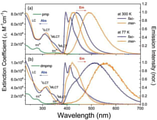
도 4는 본 발명의 실시 예에 따른 청색 인광소재의 흡광 및 발광 스펙트럼을 나타내는 그래프이다.4 is a graph showing absorption and emission spectra of a blue phosphorescent material according to an embodiment of the present invention.
도 4를 참조하면, 본 발명의 비교 예 1, 비교 예 2, 실험 예 1 및 실험 예 2에 따른 청색 인광소재의 상온(300K) 및 극저온(77K)에서 흡광 및 발광의 최대 파장, 발광 및 비발광의 감쇄 속도 상수, 및 인광 효율 등이 아래의 <표 2>에 작성되었다.Referring to FIG. 4 , the maximum wavelength, emission and ratio of absorption and emission at room temperature (300K) and cryogenic temperature (77K) of the blue phosphorescent material according to Comparative Example 1, Comparative Example 2, Experimental Example 1 and Experimental Example 2 of the present invention The decay rate constant of luminescence, phosphorescence efficiency, etc. are prepared in <Table 2> below.
X105 6.33
X10 5
X105 1.99
X10 5
X105 9.75
X10 5
X105 2.75
X10 5
X106 5.87
X108 2.70
X10 8
도 4에 도시된 바와 같이, 비교 예 1 및 비교 예 2에 따른 청색 인광소재의 리간드(pmp)는 277 및 235nm에서 흡광 피크를 보이고, 이 때의 흡광 계수는 각각 12,500 및 17,200M-1cm-1의 값을 나타내었다. 실험 예 1 및 실험 예 2에 따른 청색 인광소재의 리간드(dmpmp)는 상기 리간드(pmp)와 비슷한 흡광 스펙트럼을 나타내었다. 반면, 상기 리간드(dmpmp)는 240nm에서 25,300M-1cm-1의 흡광 피크를 보이는 것을 확인하였다. 이에 따라, 상기 2,6-디메틸페닐 작용기에 의해 상기 리간드(dmpmp)의 π-π* 전이가 더 강해진 것을 확인할 수 있다. 4, the ligand (pmp) of the blue phosphorescent material according to Comparative Example 1 and Comparative Example 2 showed absorption peaks at 277 and 235 nm, and the extinction coefficients at this time were 12,500 and 17,200M -1 cm - A value of 1 is shown. The ligand (dmpmp) of the blue phosphorescent material according to Experimental Examples 1 and 2 exhibited an absorption spectrum similar to that of the ligand (pmp). On the other hand, it was confirmed that the ligand (dmpmp) showed an absorption peak of 25,300M -1 cm -1 at 240 nm. Accordingly, it can be confirmed that the π-π * transition of the ligand (dmpmp) is stronger due to the 2,6-dimethylphenyl functional group.
도 4의 (a) 및 <표 2>에서 알 수 있듯이, 비교 예 1 및 비교 예 2에 따른 청색 인광소재는310nm에서 π-π* 전이(LC), 342nm에서 스핀-허용된 금속-리간드 간의 전하 전이(1MLCT), 및 390nm에서 스핀-금지된 금속-리간드 간의 전하 전이(3MLCT)가 확인되었다. 이 때, 스핀-금지된 금속-리간드 간의 전하 전이는 385nm 부근에서 약한 리간드간 전하 전이(ILCT)와 혼합되어 나타난 것을 알 수 있었다.As can be seen from (a) and <Table 2> of Figure 4, the blue phosphorescent material according to Comparative Example 1 and Comparative Example 2 had a π-π * transition (LC) at 310 nm and a spin-allowed metal-ligand between A charge transfer ( 1 MLCT) and a spin-forbidden metal-ligand-to-ligand transfer at 390 nm ( 3 MLCT) were identified. At this time, it was found that the charge transfer between the spin-forbidden metal-ligand was mixed with the weak inter-ligand charge transfer (ILCT) around 385 nm.
도 4의 (b)에 도시된 실험 예 1 및 실험 예 2에 따른 청색 인광소재는 도 4의 (a)에 도시된 상기 청색 인광소재와 비슷한 흡광 스펙트럼을 나타내는 것을 확인하였다. 실험 예 1 및 실혐 예 2에 따른 청색 인광소재는 310nm에서 π-π* 전이(LC)를 나타내고, 이 때의 흡광 계수는 42,000M-1cm-1로 확인되었다. 이에 따라, 상기 작용기가 상기 페닐-이미다조피리딘기의 컨쥬게이션 길이를 늘이는 데에 거의 작용되지 않은 것을 알 수 있다. 반면, 230nm에서 상기 흡광 계수가 약하게 향상된 것을 보아, 상기 작용기에 의한 π-π* 전이(LC)의 증가를 일부 확인하였다. 또한, 342nm에서 상기 스핀-허용된 금속-리간드 간의 전하 전이(1MLCT), 및 385nm에서 약한 꼬리(tail) 형태의 흡수가 나타나는 것을 확인하였다. 반면, 스핀-금지된 금속-리간드 간의 전하 전이(3MLCT)는 거의 관찰되지 않아, 시간 의존 밀도 범함수 이론(TD-DFT)에 의해 각각 397 및 415nm를 갖는 것을 확인하였다.It was confirmed that the blue phosphorescent material according to Experimental Example 1 and Experimental Example 2 shown in FIG. 4(b) exhibited an absorption spectrum similar to that of the blue phosphorescent material illustrated in FIG. 4(a). The blue phosphorescent material according to Experimental Example 1 and Experimental Example 2 exhibited a π-π * transition (LC) at 310 nm, and the extinction coefficient at this time was confirmed to be 42,000M -1 cm -1 . Accordingly, it can be seen that the functional group hardly acts to increase the length of the conjugation of the phenyl-imidazopyridine group. On the other hand, it was observed that the extinction coefficient was slightly improved at 230 nm, confirming some increase in the π-π * transition (LC) due to the functional group. In addition, it was confirmed that the spin-allowed metal-ligand charge transfer ( 1 MLCT) at 342 nm and a weak tail-type absorption at 385 nm were observed. On the other hand, the spin-forbidden metal-ligand charge transfer ( 3 MLCT) was hardly observed, and it was confirmed by the time-dependent density functional theory (TD-DFT) of 397 and 415 nm, respectively.
상기 흡광 스펙트럼과 달리, 상기 발광 스펙트럼은 상기 이성질체마다 다른 특성을 보이는 것을 관찰하였다. 비교 예 1 및 실험 예 1에 따른 청색 인광소재, 즉, 페이셜 이성질체는 77K의 온도에서 각각 394 및 392nm의 0-0 진동(vibronic) 피크와 414 및 412nm에서 0-1 진동 피크를 나타내는 것을 확인하였다. 반면, 비교 예 2 및 실험 예 2에 따른 청색 인광소재, 즉 메리디오날 이성질체는 77K의 온도에서 각각 426 및 422nm에서 최대 발광 피크를 보이는 것을 확인하였다. 따라서, 페이셜 이성질체보다 메리오디날 이성질체는 장파장에서 발광이 일어나는 것을 알 수 있다.It was observed that, unlike the absorption spectrum, the emission spectrum showed different characteristics for each isomer. It was confirmed that the blue phosphorescent material according to Comparative Example 1 and Experimental Example 1, that is, the facial isomer, exhibited 0-0 vibronic peaks at 394 and 392 nm and 0-1 vibrational peaks at 414 and 412 nm, respectively, at a temperature of 77K. . On the other hand, it was confirmed that the blue phosphorescent material according to Comparative Example 2 and Experimental Example 2, that is, the meridional isomer, showed maximum emission peaks at 426 and 422 nm, respectively, at a temperature of 77K. Therefore, it can be seen that the meridinal isomer rather than the facial isomer emits light at a longer wavelength.
도 4의 (a)에 도시된 바와 같이, 300K의 온도에서 비교 예 1 및 비교 예 2에 따른 청색 인광소재는 각각 440 및 490nm에서 발광 피크를 나타내는 것을 확인하였다. 300K의 온도에서, 도 4의 (b)에 도시된 실험 예 1 및 실험 예 2 에 따른 청색 인광소재는 각각 515 및 555nm의 발광 피크를 갖는 것을 확인하였다. 이에 따라, 77K에서의 발광 피크보다 300K에서 발광 피크가 더 장파장으로 이동하는 것을 확인하였다. As shown in (a) of FIG. 4 , it was confirmed that the blue phosphorescent materials according to Comparative Example 1 and Comparative Example 2 exhibited emission peaks at 440 and 490 nm, respectively, at a temperature of 300K. At a temperature of 300K, it was confirmed that the blue phosphorescent materials according to Experimental Example 1 and Experimental Example 2 shown in FIG. 4(b) had emission peaks of 515 and 555 nm, respectively. Accordingly, it was confirmed that the emission peak at 300K shifted to a longer wavelength than the emission peak at 77K.
<표 2>에서 알 수 있듯이, 300K의 온도에서 비교 예 1 및 비교 예 2에 따른 청색 인광소재의 인광 양자 효율(φp)은 75% 이상이고, 인광 수명(τp)은 각각 1.2 및 0.8μs인 것을 확인하였다. 반면, 실험 예 1 및 실험 예 2에 따른 청색 인광소재는 상기 인광 양자 효율 및 상기 인광 수명이 떨어지는 것을 확인하였다.As can be seen from <Table 2>, the phosphorescent quantum efficiency (φ p ) of the blue phosphorescent materials according to Comparative Examples 1 and 2 at a temperature of 300 K was 75% or more, and the phosphorescence lifetime (τ p ) was 1.2 and 0.8, respectively. It was confirmed that it was μs. On the other hand, it was confirmed that the blue phosphorescent materials according to Experimental Examples 1 and 2 decreased the phosphorescence quantum efficiency and the phosphorescence lifetime.
그러나, 77K의 온도에서 상기 이리듐 화합물은 모두 수 μs의 값을 갖는 것을 확인하였다. 이에 따라, 실험 예 1 및 실험 예 2에 따른 청색 인광소재는 온도가 증가할수록, 인광이 빠르게 소멸하는 것을 알 수 있다.However, it was confirmed that all of the iridium compounds had a value of several μs at a temperature of 77K. Accordingly, it can be seen that the phosphorescence of the blue phosphorescent materials according to Experimental Examples 1 and 2 is rapidly extinguished as the temperature increases.
<표 2>를 참조하면, 상기 청색 인광소재의 발광 감쇄 속도 상수(kr) 및 비발광 감쇄 속도 상수(knr)를 알 수 있다. 이 때, 상기 발광 감쇄 속도 상수 및 비발광 감쇄 속도 상수는 각각 아래의 <수식 1> 및 아래의 <수식 2>로 계산될 수 있다.Referring to <Table 2>, it can be seen that the light emission decay rate constant (k r ) and the non-emission decay rate constant (k nr ) of the blue phosphor material. In this case, the light emission decay rate constant and the non-emission decay rate constant may be calculated by <
<수식 1><

<수식 2><

비교 예 1 및 비교 예 2에 따른 청색 인광소재는 상기 발광 감쇄 속도 상수가 상기 비발광 감쇄 속도 상수보다 큰 것을 알 수 있다. 이에 따라, 상기 청색 인광소재는 비발광보다 발광이 우세한 것을 확인하였다. 반면, 실험 예 1 및 실험 예 2에 따른 청색 인광소재는 비발광이 발광에 비하여 더 우세한 것을 확인하였다. 실험 예 1 및 실험 예 2에 따른 청색 인광소재는 비교 예 1 및 비교 예 2에 따른 청색 인광소재보다 발광 파장이 장파장으로 이동하고, 이에 따라, 에너지 갭 법칙(energy gap law)에 의해 비발광 감쇄 속도 상수가 증가한 것을 확인하였다.It can be seen that in the blue phosphor materials according to Comparative Examples 1 and 2, the light emission decay rate constant is greater than the non-emission decay rate constant. Accordingly, it was confirmed that the blue phosphorescent material had a superiority in luminescence over non-luminescence. On the other hand, in the blue phosphorescent materials according to Experimental Example 1 and Experimental Example 2, it was confirmed that non-emission was more dominant than that of light emission. In the blue phosphorescent materials according to Experimental Examples 1 and 2, the emission wavelength shifts to a longer wavelength than the blue phosphorescent materials according to Comparative Examples 1 and 2, and accordingly, non-luminescence is attenuated by the energy gap law. It was confirmed that the rate constant increased.
도 5은 본 발명의 실험 예 1에 따른 청색 인광소재의 온도에 따른 발광 스펙트럼을 나타내는 그래프이고, 도 6은 본 발명의 실험 예 2에 따른 청색 인광소재의 온도에 따른 발광 스펙트럼을 나타내는 그래프이다.5 is a graph showing the emission spectrum according to the temperature of the blue phosphorescent material according to Experimental Example 1 of the present invention, and FIG. 6 is a graph showing the emission spectrum according to the temperature of the blue phosphorescent material according to Experimental Example 2 of the present invention.
도 5을 참조하면, 실험 예 1에 따른 청색 인광소재는 낮은 온도에서 강한 진동 구조를 확인하였다. 반면, 도 6에 도시된 실험 예 2에 따른 청색 인광소재는 비교적으로 약한 진동 구조를 확인하였다. Referring to FIG. 5 , the blue phosphorescent material according to Experimental Example 1 has a strong vibration structure at a low temperature. On the other hand, the blue phosphorescent material according to Experimental Example 2 shown in FIG. 6 has a relatively weak vibration structure.
도 5 및 도 6에 도시된 바와 같이, 실험 예 1 및 실험 예 2에 따른 청색 인광소재는 온도가 증가할수록, 상기 진동 구조가 약해지는 것을 알 수 있었다. 이 때, 상기 진동 구조의 변화의 반곡점(contraflexure)에서의 상기 발광 스펙트럼은 도 5 및 도 6의 삽입된 그래프에서 확인할 수 있다. 상기 반곡점은 상기 발광 스펙트럼 측정에 사용한 용매인 2-메틸하이드로퓨란(2-MeTHF)의 녹는점이고, 이에 따라, 상기 청색 인광소재는 외부 환경에 따라 상기 청색 인광소재의 배열이 바뀌는 것을 알 수 있다.As shown in FIGS. 5 and 6 , in the blue phosphorescent materials according to Experimental Examples 1 and 2, it was found that the vibration structure was weakened as the temperature increased. In this case, the emission spectrum at the contraflexure of the change in the vibration structure can be confirmed in the graphs shown in FIGS. 5 and 6 . The reflection point is the melting point of 2-methylhydrofuran (2-MeTHF), a solvent used for measuring the emission spectrum, and accordingly, it can be seen that the arrangement of the blue phosphorescent material is changed according to the external environment of the blue phosphorescent material. .
도 7은 본 발명의 실험 예 1에 따른 청색 인광소재의 펨토초 시분해 순간 흡광 스펙트럼(femtosecond transienet absorption spectrum)을 나타내는 그래프이고, 도 8는 본 발명의 실험 예 2에 따른 청색 인광소재의 펨토초 시분해 순간 흡광 스펙트럼을 나타내는 그래프이고, 도 9은 본 발명의 비교 예 1에 따른 청색 인광소재의 펨토초 시분해 순간 흡광 스펙트럼을 나타내는 그래프이고, 도 10은 본 발명의 비교 예 2에 따른 청색 인광소재의 펨토초 시분해 순간 흡광 스펙트럼을 나타내는 그래프이다.7 is a graph showing a femtosecond time-resolved instantaneous absorption spectrum (femtosecond transienet absorption spectrum) of the blue phosphorescent material according to Experimental Example 1 of the present invention, and FIG. It is a graph showing the instantaneous absorption spectrum, and FIG. 9 is a graph showing the femtosecond time-resolved instantaneous absorption spectrum of the blue phosphorescent material according to Comparative Example 1 of the present invention, and FIG. 10 is the femtosecond of the blue phosphorescent material according to Comparative Example 2 of the present invention. It is a graph showing the time-resolved instantaneous absorption spectrum.
도 7 및 도 8을 참조하면, 실험 예 1 및 실험 예 2에 따른 청색 인광소재는 430 내지 720nm의 가시광선 영역에서 밴드 형태의 흡광 스펙트럼을 나타내는 것을 확인하였다. 이 때, 430 및 720nm에서 흡광 스펙트럼이 나타나는 시간(펌프-프로브 탐침의 시간 차이)을 관찰하여, 삽입된 그래프로 확인하였다. 720nm에서 실험 예 1 및 실험 예 2에 따른 청색 인광소재는 각각 9.65 및 11.1ps의 상기 펌프-프로브 탐침의 시간 차이가 나타나는 것을 확인하였다. 반면, 430nm에서는 상기 시간 차이가 나타나지 않는 것을 확인하였다.7 and 8 , it was confirmed that the blue phosphorescent materials according to Experimental Example 1 and Experimental Example 2 exhibited a band-shaped absorption spectrum in a visible ray region of 430 to 720 nm. At this time, the absorption spectrum at 430 and 720 nm (pump-probe time difference) was observed and confirmed with the inserted graph. It was confirmed that the pump-probe probe time difference of 9.65 and 11.1 ps for the blue phosphorescent materials according to Experimental Example 1 and Experimental Example 2 at 720 nm, respectively. On the other hand, it was confirmed that the time difference did not appear at 430 nm.
반면, 도 9 및 도 10에 도시된 비교 예 1 및 비교 예 2에 따른 청색 인광소재는 상기 밴드 형태의 흡광 스펙트럼이 관찰되지 않는 것을 확인하였다. 다시 말하면, 상기 청색 인광소재는 펌프 탐침에 의한 여기 이후, 프로브 탐침이 흡광 스펙트럼을 관찰하는 시간이 증가됨에도, 상기 흡광 스펙트럼이 실질적으로 일정한 것을 확인하였다. 이에 따라, 상기 청색 인광소재는 빠른 여기 이후, 바닥 상태로 떨어지는 데까지 걸리는 시간이 오래 걸리는 것을 알 수 있었다. 상기 청색 인광소재는 수 ns에서 상기 밴드 형태의 흡광 스펙트럼이 관찰되는 것을 확인하였다. 이에 따라, <표 2>를 참조하여 상술된 바와 같이, 상기 청색 인광소재는 실험 예 1 및 실험 예 2에 따른 청색 인광소재보다 더 긴 인광 수명을 갖는 것을 알 수 있다.On the other hand, in the blue phosphorescent materials according to Comparative Examples 1 and 2 shown in FIGS. 9 and 10 , it was confirmed that the band-shaped absorption spectrum was not observed. In other words, it was confirmed that the absorption spectrum of the blue phosphor material is substantially constant even though the time for the probe probe to observe the absorption spectrum after excitation by the pump probe is increased. Accordingly, it was found that it takes a long time for the blue phosphorescent material to fall to the ground state after rapid excitation. In the blue phosphorescent material, it was confirmed that the band-shaped absorption spectrum was observed in several ns. Accordingly, as described above with reference to <Table 2>, it can be seen that the blue phosphorescent material has a longer phosphorescence lifetime than the blue phosphorescent material according to Experimental Examples 1 and 2.
도 11는 본 발명의 실험 예 1에 따른 청색 인광소재의 경계 분자 오비탈(frontier molecular orbital)을 나타내는 도면이고, 도 12은 본 발명의 실험 예 2에 따른 청색 인광소재의 경계 분자 오비탈을 나타내는 도면이고, 도 13는 본 발명의 비교 예 1에 따른 청색 인광소재의 경계 분자 오비탈(frontier molecular orbital)을 나타내는 도면이고, 도 14은 본 발명의 비교 예 2에 따른 청색 인광소재의 경계 분자 오비탈을 나타내는 도면이다.11 is a diagram illustrating a frontier molecular orbital of a blue phosphorescent material according to Experimental Example 1 of the present invention, and FIG. 12 is a diagram illustrating a boundary molecular orbital of a blue phosphorescent material according to Experimental Example 2 of the present invention. , FIG. 13 is a diagram illustrating a frontier molecular orbital of a blue phosphorescent material according to Comparative Example 1 of the present invention, and FIG. 14 is a diagram illustrating a boundary molecular orbital of a blue phosphorescent material according to Comparative Example 2 of the present invention. am.
도 11를 참조하면, 실험 예 1에 따른 청색 인광소재(페이셜 이성질체)의 최고준위 점유 분자궤도는 이리듐 금속과 상기 리간드의 상기 페닐기에 분포하는 것을 알 수 있다. 이 때, 상기 이리듐 금속은 3개의 상기 리간드와 결합되어 있고, 이에 따라, 확장된 2개의 다른 최고준위 점유 분자궤도(HOMO-1 및 HOMO-2)에 상기 페닐기 및 상기 이리듐 금속의 π-오비탈이 분포하는 것을 알 수 있다. 이 때, 3개의 상기 최고준위 점유 분자궤도는 0.21eV 만큼의 차이를 보이는 것을 알 수 있다. 3개의 상기 최고준위 점유 분자궤도 중에서 2개의 상기 최고준위 점유 분자궤도는 이미다조피리딘에 일부 분포하는 것을 알 수 있다.Referring to FIG. 11 , it can be seen that the molecular orbital occupied at the highest level of the blue phosphorescent material (facial isomer) according to Experimental Example 1 is distributed between the iridium metal and the phenyl group of the ligand. At this time, the iridium metal is bonded to the three ligands, and thus, the phenyl group and the π-orbital of the iridium metal are in the two other extended molecular orbitals (HOMO-1 and HOMO-2) occupied by the highest level. distribution can be seen. At this time, it can be seen that the three molecular orbitals occupied by the highest level show a difference of 0.21 eV. It can be seen that among the three molecular orbitals occupied at the highest level, two of the molecular orbitals occupied at the highest level are partially distributed in imidazopyridine.
반면, 도 13에 도시된 비교 예 1에 따른 청색 인광소재(페이셜 이성질체)의 최고준위 점유 분자궤도는 상기 이리듐 금속과 상기 페닐기에만 분포하고, 3개의 상기 최고준위 점유 분자궤도가 C3의 대칭을 갖는 것을 알 수 있다.On the other hand, the molecular orbital occupied by the highest level of the blue phosphorescent material (facial isomer) according to Comparative Example 1 shown in FIG. 13 is distributed only to the iridium metal and the phenyl group, and the three highest molecular orbitals occupied by the highest level show the symmetry of C 3 . know that you have
이에 따라, 상기 청색 인광소재(페이셜 이성질체)은 상기 작용기를 더 포함하며(비교 예 1 대비 실험 예1), 입체 장애를 갖고, 따라서, 상기 최고준위 점유 분자궤도가 대칭성을 잃는 것을 알 수 있다. 이 때, 상기 청색 인광소재(페이셜 이성질체)의 최저준위 비점유 분자궤도에서도 동일한 경향을 보이는 것을 확인하였다. Accordingly, it can be seen that the blue phosphorescent material (facial isomer) further includes the functional group (Comparative Example 1 compared to Experimental Example 1), has a steric hindrance, and thus, the molecular orbital occupied at the highest level loses symmetry. At this time, it was confirmed that the blue phosphorescent material (facial isomer) showed the same trend even in the lowest unoccupied molecular orbital.
반면, 도 12 및 도 14을 참조하면, 실험 예 2 및 비교 예 2에 따른 청색 인광소재(메리디오날 이성질체)의 분자궤도는 C1의 대칭을 갖는 것을 알 수 있다. 이 때, 2개의 시스형(cisoid) 및 1개의 트랜스형(transoid) 분포를 갖는 것을 확인하였다.On the other hand, referring to FIGS. 12 and 14 , it can be seen that the molecular orbital of the blue phosphorescent material (meridional isomer) according to Experimental Example 2 and Comparative Example 2 has a symmetry of C 1 . At this time, it was confirmed to have two cis-type (cisoid) and one trans-type (transoid) distribution.
도 15은 본 발명의 실험 예 1에 따른 청색 인광소재의 단일항 및 삼중항의 경계 분자 오비탈을 나타내는 도면이고, 도 16은 본 발명의 실험 예 2에 따른 청색 인광소재의 단일항 및 삼중항의 경계 분자 오비탈을 나타내는 도면이다.15 is a view showing singlet and triplet boundary molecular orbitals of a blue phosphorescent material according to Experimental Example 1 of the present invention, and FIG. 16 is a singlet and triplet boundary molecule of a blue phosphorescent material according to Experimental Example 2 of the present invention. A diagram showing an orbital.
도 15 및 도 16을 참조하면, 상기 청색 인광소재의 들뜬 상태의 삼중항은 단일로 채워진 최고준위 분자궤도(HSOMO) 및 단일로 채워진 최저준위 분자궤도(LSOMO)를 갖는 것을 알 수 있다. 여기서, 단일로 채워진 최고준위 분자궤도는 상기 이미다조피리딘에 분포하고, 단일로 채워진 최저준위 분자궤도는 상기 이리듐 금속 및 상기 페닐기에 분포하는 것을 알 수 있다. 15 and 16 , it can be seen that the triplet in the excited state of the blue phosphor material has a single filled highest molecular orbital (HSOMO) and a single filled lowest molecular orbital (LSOMO). Here, it can be seen that the single-filled highest molecular orbital is distributed in the imidazopyridine, and the single-filled lowest molecular orbital is distributed in the iridium metal and the phenyl group.
이 때, 도 12 및 14를 참조하여, 실험 예 1 및 실험 예 2에 따른 청색 인광소재의 들뜬 상태의 삼중항(T1) 및 바닥 상태의 단일항(S0) 간의 에너지 차이의 값(Eg,T-S)을 계산하였다. 이에 따라, 상기 에너지 차이의 값(Eg,T-S)은 각각 3.95 및 3.70eV인 것을 확인하였다. 상기 에너지 차이의 값(Eg,T-S)은 도 4를 참조하여 상술된 77K의 온도에서 상기 청색 인광소재의 최대 흡수 및 발광 파장의 차이에 대응되는 것을 확인하였다.At this time, with reference to FIGS. 12 and 14 , the value (E) of the energy difference between the triplet in the excited state (T 1 ) and the singlet in the ground state (S 0 ) of the blue phosphorescent material according to Experimental Examples 1 and 2 g, TS ) were calculated. Accordingly, it was confirmed that the values of the energy difference (E g,TS ) were 3.95 and 3.70 eV, respectively. It was confirmed that the value of the energy difference (E g,TS ) corresponds to the difference between the maximum absorption and emission wavelengths of the blue phosphorescent material at the temperature of 77K described above with reference to FIG. 4 .
반면, 상술된 바와 같이 이론적으로 계산된 상기 에너지 차이의 값(Eg,T-S)과 달리, 최적화된 구조에 따른 상기 에너지 차이의 값(Eg,T-S)은 각각 2.27 및 2.44eV인 것을 알 수 있다. 상기 에너지 차이의 값(Eg,T-S)은 300K의 온도에서 상기 청색 인광소재의 최대 흡수 및 발광 파장의 차이에 대응되는 것을 알 수 있다. 이에 따라, 상기 삼중항의 최적화된 구조는 바닥상태에서의 최적화된 구조와 차이를 보이는 것을 알 수 있다.On the other hand, unlike the theoretically calculated value of the energy difference (E g,TS ) as described above, it can be seen that the value of the energy difference according to the optimized structure (E g,TS ) is 2.27 and 2.44 eV, respectively. there is. It can be seen that the value of the energy difference (E g,TS ) corresponds to the difference between the maximum absorption and emission wavelengths of the blue phosphorescent material at a temperature of 300K. Accordingly, it can be seen that the optimized structure of the triplet is different from the optimized structure in the ground state.
도 15 및 도 16에 도시된 바와 같이, 상기 치횐기는 상기 페닐기에 수직으로 결합된 것을 알 수 있다. 이 때, 상기 치환기의 탄소 원소는 상기 이미다조피리딘의 페닐링의 질소 원소와 인접한 것을 알 수 있다. 실험 예 1 및 실험 예 2에 따른 청색 인광소재는 단일항 상태에서 상기 탄소 원소 및 상기 질소 원소간의 거리가 각각 2.852~2.880Å 및 2.861~2.884Å인 것을 확인하였다. 반면, 삼중항 상태에서 상기 거리는 각각 3.073 및 3.057Å를 갖는 것을 알 수 있다. As shown in FIGS. 15 and 16 , it can be seen that the rear group is vertically bonded to the phenyl group. In this case, it can be seen that the carbon element of the substituent is adjacent to the nitrogen element of the phenyl ring of the imidazopyridine. In the blue phosphorescent materials according to Experimental Example 1 and Experimental Example 2, it was confirmed that the distances between the carbon element and the nitrogen element were 2.852 to 2.880 Å and 2.861 to 2.884 Å, respectively, in a singlet state. On the other hand, it can be seen that the distance in the triplet state has 3.073 and 3.057 Å, respectively.
이 때, 실험 예 1 및 실험 예 2에 따른 청색 인광소재의 각각의 리간드에서 페닐기와 이미다조피리딘의 탄소-질소-탄소-탄소 결합(도 15 및 도 16에 도시된 C-N-C-C 결합)의 각도(D), 상기 이리듐 금속과 상기 페닐기의 탄소 간 거리(R1) 및 상기 이리듐 금속과 상기 이미다조피리딘의 탄소 간 거리(R2)가 아래의 <표 3>에 작성되었다.At this time, the angle (D) of the carbon-nitrogen-carbon-carbon bond (the CNCC bond shown in FIGS. 15 and 16) of the phenyl group and imidazopyridine in each ligand of the blue phosphorescent material according to Experimental Example 1 and Experimental Example 2 ), the distance between the carbons of the iridium metal and the phenyl group (R 1 ), and the distance between the iridium metal and the carbons of the imidazopyridine (R 2 ) are shown in Table 3 below.
<표 3>에서 알 수 있듯이, 상기 단일항에서 실험 예 1에 따른 청색 인광소재(페이셜 이성질체)의 상기 거리(R1) 및 상기 거리(R2)의 평균 값은 각각 2.053 및 2.112Å으로 계산되었다. 또한, 실험 예 2에 따른 청색 인광소재(메리디오날 이성질체)의 상기 거리(R1) 및 상기 거리(R2)의 평균 값은 각각 2.051 및 2.116Å으로 계산되었다. 반면, 각각의 상기 청색 인광소재의 상기 거리(R1) 및 상기 거리(R2)의 평균 값은 상기 단일항보다 상기 삼중항에서 증가된 것을 알 수 있다. 상기 청색 인광소재의 상기 탄소-질소-탄소-탄소 결합에서도 상술된 상기 거리(R1) 및 상기 거리(R2)와 비슷한 경향을 나타내었다. 다시 말하면, 상기 청색 인광소재의 상기 탄소-질소-탄소-탄소 결합은 상기 단일항보다 상기 삼중항에서 증가되는 것을 확인하였다.As can be seen in <Table 3>, the average values of the distance (R 1 ) and the distance (R 2 ) of the blue phosphorescent material (facial isomer) according to Experimental Example 1 in the single term were calculated as 2.053 and 2.112 Å, respectively became In addition, the average values of the distance (R 1 ) and the distance (R 2 ) of the blue phosphor material (meridional isomer) according to Experimental Example 2 were calculated to be 2.051 and 2.116 Å, respectively. On the other hand, it can be seen that the average value of the distance (R 1 ) and the distance (R 2 ) of each of the blue phosphorescent materials is increased in the triplet than in the singlet. The carbon-nitrogen-carbon-carbon bond of the blue phosphorescent material also exhibited a similar tendency to the above-described distance (R 1 ) and the distance (R 2 ). In other words, it was confirmed that the carbon-nitrogen-carbon-carbon bond of the blue phosphor material was increased in the triplet than in the singlet.
이 때, 상기 삼중항 및 상기 단일항에서 상기 거리(R1), 상기 거리(R2) 및 상기 탄소-질소-탄소-탄소 결합의 각도의 차이는 첫번째 리간드(L1)에서 가장 큰 값을 나타내었다. 따라서, 상술된 바와 같은 상기 리간드 간의 구조적인 차이에 의해, 상기 청색 인광소재 내의 전자 전이의 형태가 변화되고, 이에 따라,<표 2>에 도시된 비발광 감쇄 속도 상수가 증가하는 것을 알 수 있다.In this case, the difference between the distance (R 1 ), the distance (R 2 ), and the angle of the carbon-nitrogen-carbon-carbon bond in the triplet and the singlet represents the largest value in the first ligand (L1). it was Therefore, it can be seen that, due to the structural difference between the ligands as described above, the shape of the electron transition in the blue phosphor material is changed, and accordingly, the specific emission decay rate constant shown in <Table 2> increases. .
도 17은 본 발명의 실시 예에 따른 청색 인광소재의 순환전압전류법(Cyclic voltammetry)의 결과를 나타내는 그래프이다.17 is a graph showing the results of cyclic voltammetry of a blue phosphorescent material according to an embodiment of the present invention.
도 17을 참조하면, 비교 예 1, 비교 예 2, 실험 예 1 및 실험 예 2에 따른 청색 인광소재의 산화 전위(half oxidation potential)가 아래의 <표 4>에 작성되었다.Referring to FIG. 17 , half oxidation potentials of blue phosphorescent materials according to Comparative Example 1, Comparative Example 2, Experimental Example 1, and Experimental Example 2 are shown in Table 4 below.
<표 4> 및 도 17에서 알 수 있듯이, 비교 예 2 및 실험 예 2에 따른 청색 인광소재(메리디오날 이성질체)는 상기 치환기를 더 포함하며, 상기 산화 전위가 감소된 것을 알 수 있다. 이에 따라, 도 12 및 도 14를 참조하여 상술된, 상기 청색 인광소재(메리디오날 이성질체)는 상기 치환기를 더 포함하며, 상기 최고준위 점유 분자궤도가 불안정해지는 것을 알 수 있다. As can be seen from <Table 4> and FIG. 17, the blue phosphorescent material (meridional isomer) according to Comparative Example 2 and Experimental Example 2 further includes the substituent, and it can be seen that the oxidation potential is reduced. Accordingly, it can be seen that the blue phosphorescent material (meridional isomer) described above with reference to FIGS. 12 and 14 further includes the substituent, and the molecular orbital occupied at the highest level is unstable.
이상, 본 발명의 바람직한 실시 예를 사용하여 상세히 설명하였으나, 본 발명의 범위는 특정 실시 예에 한정되는 것은 아니며, 첨부된 특허청구범위에 의하여 해석되어야 할 것이다. 또한, 이 기술분야에서 통상의 지식을 습득한 자라면, 본 발명의 범위에서 벗어나지 않으면서도 많은 수정과 변형이 가능함을 이해하여야 할 것이다.The above has been described in detail using preferred embodiments of the present invention, but the scope of the present invention is not limited to specific embodiments, and should be construed according to the appended claims. In addition, those skilled in the art will understand that many modifications and variations are possible without departing from the scope of the present invention.
Claims (9)
상기 중심 금속의 2좌 배위자이고, 상기 중심 금속과 이리듐-탄소 결합을 갖는 페닐-이미다조피리딘 리간드를 포함하되,
상기 리간드는, 상기 리간드의 페닐기에 2,6-디메틸페닐 작용기가 도입된 것을 포함하되,
상기 리간드를 동종리간드로 포함하고,
페이셜(facial) 이성질체 또는 메리디오날(meridional) 이성질체 중에서 적어도 어느 하나를 포함하는 청색 인광소재.
a central metal comprising iridium; and
A phenyl-imidazopyridine ligand that is a bidentate ligand of the central metal and has an iridium-carbon bond with the central metal,
The ligand includes a 2,6-dimethylphenyl functional group introduced into a phenyl group of the ligand,
comprising the ligand as a homoligand,
A blue phosphorescent material comprising at least one of a facial isomer or a meridional isomer.
상기 작용기는, 상기 페닐기의 오르토(ortho) 위치에 도입되는 것을 포함하는 청색 인광소재.
According to claim 1,
The functional group is a blue phosphorescent material comprising being introduced at an ortho position of the phenyl group.
상기 작용기는, 상기 페닐기에 수직으로 결합되는 것을 포함하는 청색 인광소재.
According to claim 1,
The functional group is a blue phosphorescent material comprising a vertical bond to the phenyl group.
상기 리간드를 메인리간드로 포함하고,
보조 리간드를 더 포함하는 청색 인광소재.
According to claim 1,
comprising the ligand as a main ligand,
A blue phosphorescent material further comprising an auxiliary ligand.
펨토초 시분해 순간 흡광 스펙트럼(femtosecond transienet absorption spectrum)에서, 720nm의 파장 영역의 흡광 밴드(band)를 갖는 것을 포함하는 청색 인광소재.
According to claim 1,
A blue phosphor having an absorption band in a wavelength region of 720 nm in a femtosecond time-resolved instantaneous absorption spectrum.
상기 리간드 및 이리듐 화합물을 포함하는 혼합 용액을 준비하는 단계; 및
상기 리간드와 상기 이리듐 화합물의 이리듐 간의 금속화반응(matalation)으로, 제1 항에 따른 청색 인광소재를 제조하는 단계를 포함하는 청색 인광소재의 제조 방법.
preparing a ligand in which a 2,6-dimethylphenyl functional group is introduced into the phenyl group of phenyl-imidazopyridine;
preparing a mixed solution containing the ligand and the iridium compound; and
A method of manufacturing a blue phosphorescent material comprising the step of preparing the blue phosphorescent material according to claim 1 by a metallization reaction between the ligand and the iridium of the iridium compound.
상기 리간드를 제조하는 단계는,
페닐-아민에 2,6-디메틸페닐 작용기를 제공하는 단계; 및
상기 페닐-아민의 페닐기에 이미다조피리딘을 도입하여 상기 리간드를 제조하는 단계를 포함하는 청색 인광소재의 제조 방법.
8. The method of claim 7,
The step of preparing the ligand,
providing a 2,6-dimethylphenyl functional group to the phenyl-amine; and
and introducing imidazopyridine to the phenyl group of the phenyl-amine to prepare the ligand.
상기 리간드와 상기 이리듐 화합물의 이리듐 간의 금속화반응을 수행하는 단계는, 페이셜(facial) 이성질체 또는 메리디오날(meridional) 이성질체 중에서 적어도 어느 하나를 제조하는 단계를 포함하는 청색 인광소재의 제조 방법.8. The method of claim 7,
The step of performing the metallization reaction between the ligand and the iridium of the iridium compound comprises preparing at least one of a facial isomer and a meridional isomer.
Priority Applications (3)
| Application Number | Priority Date | Filing Date | Title |
|---|---|---|---|
| KR1020190145231A KR102373027B1 (en) | 2019-11-13 | 2019-11-13 | Blue phosphorescent materials, the manufacturing method there of the same and the photophysical properties of the same |
| PCT/KR2020/015930 WO2021096268A2 (en) | 2019-11-13 | 2020-11-12 | Blue phosphorescent material, production method thereof, and photophysical properties thereof |
| US17/743,016 US12534666B2 (en) | 2019-11-13 | 2022-05-12 | Blue phosphorescent material, production method thereof, and photophysical properties thereof |
Applications Claiming Priority (1)
| Application Number | Priority Date | Filing Date | Title |
|---|---|---|---|
| KR1020190145231A KR102373027B1 (en) | 2019-11-13 | 2019-11-13 | Blue phosphorescent materials, the manufacturing method there of the same and the photophysical properties of the same |
Publications (2)
| Publication Number | Publication Date |
|---|---|
| KR20210058137A KR20210058137A (en) | 2021-05-24 |
| KR102373027B1 true KR102373027B1 (en) | 2022-03-11 |
Family
ID=75911396
Family Applications (1)
| Application Number | Title | Priority Date | Filing Date |
|---|---|---|---|
| KR1020190145231A Expired - Fee Related KR102373027B1 (en) | 2019-11-13 | 2019-11-13 | Blue phosphorescent materials, the manufacturing method there of the same and the photophysical properties of the same |
Country Status (3)
| Country | Link |
|---|---|
| US (1) | US12534666B2 (en) |
| KR (1) | KR102373027B1 (en) |
| WO (1) | WO2021096268A2 (en) |
Family Cites Families (12)
| Publication number | Priority date | Publication date | Assignee | Title |
|---|---|---|---|---|
| JP3965063B2 (en) | 2002-03-08 | 2007-08-22 | Tdk株式会社 | Organic electroluminescence device |
| JP4523992B1 (en) * | 2009-07-31 | 2010-08-11 | 富士フイルム株式会社 | Organic electroluminescence device |
| WO2011073149A1 (en) | 2009-12-14 | 2011-06-23 | Basf Se | Metal complexes comprising diazabenzimidazol carbene-ligands and the use thereof in oleds |
| KR101771530B1 (en) | 2010-04-09 | 2017-08-28 | 에스에프씨 주식회사 | Organic metal compounds and organic light emitting diodes comprising the same |
| US8883322B2 (en) | 2011-03-08 | 2014-11-11 | Universal Display Corporation | Pyridyl carbene phosphorescent emitters |
| KR20150069309A (en) * | 2013-12-13 | 2015-06-23 | 도레이케미칼 주식회사 | A novel phosphorescence complex having deep blue and organic light-emitting devices containing the same |
| KR20150079220A (en) * | 2013-12-31 | 2015-07-08 | 도레이케미칼 주식회사 | A novel imidazopyridine based phosphorescence compounds having deep blue and Preparing method thereof |
| CN106661068A (en) * | 2014-03-31 | 2017-05-10 | Udc 爱尔兰有限责任公司 | Metal complexes comprising carbene ligands with o-substituted acyclometallated aryl groups and their use in organic light-emitting diodes |
| US10074815B2 (en) | 2015-03-31 | 2018-09-11 | The Regents Of The University Of Michigan | Organic electroluminescent devices |
| WO2020091344A1 (en) * | 2018-10-29 | 2020-05-07 | 고려대학교 산학협력단 | Blue phosphorescent compound having orthogonal structured aryl-functional groups linked thereto and organic light emitting device using same |
| KR102285174B1 (en) * | 2018-10-29 | 2021-08-03 | 고려대학교 산학협력단 | Orthogonal aryl-group functionalized blue phosphorescent complexes and organic light emitting diode comprising the same |
| KR102402410B1 (en) * | 2019-11-13 | 2022-05-26 | 고려대학교 산학협력단 | Iridium phosphorescent materials, the manufacturing method there of the same and the photophysical properties of the same |
-
2019
- 2019-11-13 KR KR1020190145231A patent/KR102373027B1/en not_active Expired - Fee Related
-
2020
- 2020-11-12 WO PCT/KR2020/015930 patent/WO2021096268A2/en not_active Ceased
-
2022
- 2022-05-12 US US17/743,016 patent/US12534666B2/en active Active
Also Published As
| Publication number | Publication date |
|---|---|
| US12534666B2 (en) | 2026-01-27 |
| WO2021096268A2 (en) | 2021-05-20 |
| KR20210058137A (en) | 2021-05-24 |
| US20220333007A1 (en) | 2022-10-20 |
| WO2021096268A3 (en) | 2021-07-22 |
Similar Documents
| Publication | Publication Date | Title |
|---|---|---|
| JP6920503B2 (en) | Phosphorescent material | |
| KR102828991B1 (en) | Organic electroluminescent materials and devices | |
| EP2520571B1 (en) | 2-azatriphenylene materials for organic light emitting diodes | |
| EP3424935B1 (en) | Imidazopyrazinyl carbene phosphorescent emitters | |
| KR20250016428A (en) | Organic electroluminescent materials and devices | |
| EP2342305B1 (en) | Phosphorescent materials | |
| KR102360548B1 (en) | Organic electroluminescent materials and devices | |
| JP5549015B2 (en) | New compounds and their use | |
| CN101076902B (en) | Stable and efficient electroluminescent materials | |
| EP2602302A2 (en) | Novel organic light emitting materials | |
| EP3637490A1 (en) | High efficiency yellow light emitters for oled devices | |
| KR20140052501A (en) | Method for mnufacturing of blue phosphorescence composition and organic light emittin diode comprising the same | |
| Hung et al. | Phosphorescent Ir (III) complexes bearing double benzyldiphenylphosphine cyclometalates; strategic synthesis, fundamental and integration for white OLED fabrication | |
| KR20100017978A (en) | Bipyridine metal complexes for use as light-emitting material | |
| US20220333008A1 (en) | Iridium Phosphorescent Material, Preparation Method Therefor, and Photophysical Properties Thereof | |
| KR102373027B1 (en) | Blue phosphorescent materials, the manufacturing method there of the same and the photophysical properties of the same | |
| EP2830109A1 (en) | Heteroleptic osmium complex and method of making the same | |
| KR101602448B1 (en) | new platinum complex and organic light electroluminescent device containing the same | |
| KR20140119043A (en) | Heteroleptic light-emitting complexes | |
| TWI392721B (en) | Phosphorescent transition metal complex having a facially arranged carbon-phosphorus-carbon (c^p^c) tridentate chelate and organic light emitting diode containing the same | |
| KR101464957B1 (en) | new platinum complex and organic light emitting diode containing the same | |
| KR20090078288A (en) | Mononuclear organometallic complex for luminescence |
Legal Events
| Date | Code | Title | Description |
|---|---|---|---|
| PA0109 | Patent application |
St.27 status event code: A-0-1-A10-A12-nap-PA0109 |
|
| PA0201 | Request for examination |
St.27 status event code: A-1-2-D10-D11-exm-PA0201 |
|
| D13-X000 | Search requested |
St.27 status event code: A-1-2-D10-D13-srh-X000 |
|
| D14-X000 | Search report completed |
St.27 status event code: A-1-2-D10-D14-srh-X000 |
|
| PG1501 | Laying open of application |
St.27 status event code: A-1-1-Q10-Q12-nap-PG1501 |
|
| E902 | Notification of reason for refusal | ||
| PE0902 | Notice of grounds for rejection |
St.27 status event code: A-1-2-D10-D21-exm-PE0902 |
|
| T11-X000 | Administrative time limit extension requested |
St.27 status event code: U-3-3-T10-T11-oth-X000 |
|
| E13-X000 | Pre-grant limitation requested |
St.27 status event code: A-2-3-E10-E13-lim-X000 |
|
| P11-X000 | Amendment of application requested |
St.27 status event code: A-2-2-P10-P11-nap-X000 |
|
| P13-X000 | Application amended |
St.27 status event code: A-2-2-P10-P13-nap-X000 |
|
| E701 | Decision to grant or registration of patent right | ||
| PE0701 | Decision of registration |
St.27 status event code: A-1-2-D10-D22-exm-PE0701 |
|
| GRNT | Written decision to grant | ||
| PR0701 | Registration of establishment |
St.27 status event code: A-2-4-F10-F11-exm-PR0701 |
|
| PR1002 | Payment of registration fee |
St.27 status event code: A-2-2-U10-U11-oth-PR1002 Fee payment year number: 1 |
|
| PG1601 | Publication of registration |
St.27 status event code: A-4-4-Q10-Q13-nap-PG1601 |
|
| P22-X000 | Classification modified |
St.27 status event code: A-4-4-P10-P22-nap-X000 |
|
| PC1903 | Unpaid annual fee |
St.27 status event code: A-4-4-U10-U13-oth-PC1903 Not in force date: 20250308 Payment event data comment text: Termination Category : DEFAULT_OF_REGISTRATION_FEE |
|
| H13 | Ip right lapsed |
Free format text: ST27 STATUS EVENT CODE: N-4-6-H10-H13-OTH-PC1903 (AS PROVIDED BY THE NATIONAL OFFICE); TERMINATION CATEGORY : DEFAULT_OF_REGISTRATION_FEE Effective date: 20250308 |
|
| PC1903 | Unpaid annual fee |
St.27 status event code: N-4-6-H10-H13-oth-PC1903 Ip right cessation event data comment text: Termination Category : DEFAULT_OF_REGISTRATION_FEE Not in force date: 20250308 |