KR102325919B1 - Monoarylation of aromatic amines - Google Patents
Monoarylation of aromatic amines Download PDFInfo
- Publication number
- KR102325919B1 KR102325919B1 KR1020167009952A KR20167009952A KR102325919B1 KR 102325919 B1 KR102325919 B1 KR 102325919B1 KR 1020167009952 A KR1020167009952 A KR 1020167009952A KR 20167009952 A KR20167009952 A KR 20167009952A KR 102325919 B1 KR102325919 B1 KR 102325919B1
- Authority
- KR
- South Korea
- Prior art keywords
- biphenyl
- bis
- carbazole
- palladium
- phenyl
- Prior art date
- Legal status (The legal status is an assumption and is not a legal conclusion. Google has not performed a legal analysis and makes no representation as to the accuracy of the status listed.)
- Active
Links
Classifications
-
- C—CHEMISTRY; METALLURGY
- C07—ORGANIC CHEMISTRY
- C07C—ACYCLIC OR CARBOCYCLIC COMPOUNDS
- C07C209/00—Preparation of compounds containing amino groups bound to a carbon skeleton
- C07C209/04—Preparation of compounds containing amino groups bound to a carbon skeleton by substitution of functional groups by amino groups
- C07C209/06—Preparation of compounds containing amino groups bound to a carbon skeleton by substitution of functional groups by amino groups by substitution of halogen atoms
- C07C209/10—Preparation of compounds containing amino groups bound to a carbon skeleton by substitution of functional groups by amino groups by substitution of halogen atoms with formation of amino groups bound to carbon atoms of six-membered aromatic rings or from amines having nitrogen atoms bound to carbon atoms of six-membered aromatic rings
-
- C—CHEMISTRY; METALLURGY
- C07—ORGANIC CHEMISTRY
- C07D—HETEROCYCLIC COMPOUNDS
- C07D209/00—Heterocyclic compounds containing five-membered rings, condensed with other rings, with one nitrogen atom as the only ring hetero atom
- C07D209/56—Ring systems containing three or more rings
- C07D209/80—[b, c]- or [b, d]-condensed
- C07D209/82—Carbazoles; Hydrogenated carbazoles
- C07D209/86—Carbazoles; Hydrogenated carbazoles with only hydrogen atoms, hydrocarbon or substituted hydrocarbon radicals, directly attached to carbon atoms of the ring system
-
- B—PERFORMING OPERATIONS; TRANSPORTING
- B01—PHYSICAL OR CHEMICAL PROCESSES OR APPARATUS IN GENERAL
- B01J—CHEMICAL OR PHYSICAL PROCESSES, e.g. CATALYSIS OR COLLOID CHEMISTRY; THEIR RELEVANT APPARATUS
- B01J31/00—Catalysts comprising hydrides, coordination complexes or organic compounds
- B01J31/16—Catalysts comprising hydrides, coordination complexes or organic compounds containing coordination complexes
- B01J31/22—Organic complexes
- B01J31/2282—Unsaturated compounds used as ligands
- B01J31/2295—Cyclic compounds, e.g. cyclopentadienyls
-
- B—PERFORMING OPERATIONS; TRANSPORTING
- B01—PHYSICAL OR CHEMICAL PROCESSES OR APPARATUS IN GENERAL
- B01J—CHEMICAL OR PHYSICAL PROCESSES, e.g. CATALYSIS OR COLLOID CHEMISTRY; THEIR RELEVANT APPARATUS
- B01J31/00—Catalysts comprising hydrides, coordination complexes or organic compounds
- B01J31/16—Catalysts comprising hydrides, coordination complexes or organic compounds containing coordination complexes
- B01J31/24—Phosphines, i.e. phosphorus bonded to only carbon atoms, or to both carbon and hydrogen atoms, including e.g. sp2-hybridised phosphorus compounds such as phosphabenzene, phosphole or anionic phospholide ligands
- B01J31/2404—Cyclic ligands, including e.g. non-condensed polycyclic ligands, the phosphine-P atom being a ring member or a substituent on the ring
- B01J31/2409—Cyclic ligands, including e.g. non-condensed polycyclic ligands, the phosphine-P atom being a ring member or a substituent on the ring with more than one complexing phosphine-P atom
-
- C—CHEMISTRY; METALLURGY
- C07—ORGANIC CHEMISTRY
- C07C—ACYCLIC OR CARBOCYCLIC COMPOUNDS
- C07C211/00—Compounds containing amino groups bound to a carbon skeleton
- C07C211/43—Compounds containing amino groups bound to a carbon skeleton having amino groups bound to carbon atoms of six-membered aromatic rings of the carbon skeleton
- C07C211/54—Compounds containing amino groups bound to a carbon skeleton having amino groups bound to carbon atoms of six-membered aromatic rings of the carbon skeleton having amino groups bound to two or three six-membered aromatic rings
-
- C—CHEMISTRY; METALLURGY
- C07—ORGANIC CHEMISTRY
- C07C—ACYCLIC OR CARBOCYCLIC COMPOUNDS
- C07C221/00—Preparation of compounds containing amino groups and doubly-bound oxygen atoms bound to the same carbon skeleton
-
- C—CHEMISTRY; METALLURGY
- C07—ORGANIC CHEMISTRY
- C07D—HETEROCYCLIC COMPOUNDS
- C07D405/00—Heterocyclic compounds containing both one or more hetero rings having oxygen atoms as the only ring hetero atoms, and one or more rings having nitrogen as the only ring hetero atom
- C07D405/02—Heterocyclic compounds containing both one or more hetero rings having oxygen atoms as the only ring hetero atoms, and one or more rings having nitrogen as the only ring hetero atom containing two hetero rings
- C07D405/12—Heterocyclic compounds containing both one or more hetero rings having oxygen atoms as the only ring hetero atoms, and one or more rings having nitrogen as the only ring hetero atom containing two hetero rings linked by a chain containing hetero atoms as chain links
-
- C—CHEMISTRY; METALLURGY
- C07—ORGANIC CHEMISTRY
- C07D—HETEROCYCLIC COMPOUNDS
- C07D409/00—Heterocyclic compounds containing two or more hetero rings, at least one ring having sulfur atoms as the only ring hetero atoms
- C07D409/02—Heterocyclic compounds containing two or more hetero rings, at least one ring having sulfur atoms as the only ring hetero atoms containing two hetero rings
- C07D409/12—Heterocyclic compounds containing two or more hetero rings, at least one ring having sulfur atoms as the only ring hetero atoms containing two hetero rings linked by a chain containing hetero atoms as chain links
-
- C—CHEMISTRY; METALLURGY
- C07—ORGANIC CHEMISTRY
- C07F—ACYCLIC, CARBOCYCLIC OR HETEROCYCLIC COMPOUNDS CONTAINING ELEMENTS OTHER THAN CARBON, HYDROGEN, HALOGEN, OXYGEN, NITROGEN, SULFUR, SELENIUM OR TELLURIUM
- C07F15/00—Compounds containing elements of Groups 8, 9, 10 or 18 of the Periodic Table
- C07F15/0006—Compounds containing elements of Groups 8, 9, 10 or 18 of the Periodic Table compounds of the platinum group
- C07F15/006—Palladium compounds
- C07F15/0066—Palladium compounds without a metal-carbon linkage
-
- C—CHEMISTRY; METALLURGY
- C07—ORGANIC CHEMISTRY
- C07F—ACYCLIC, CARBOCYCLIC OR HETEROCYCLIC COMPOUNDS CONTAINING ELEMENTS OTHER THAN CARBON, HYDROGEN, HALOGEN, OXYGEN, NITROGEN, SULFUR, SELENIUM OR TELLURIUM
- C07F17/00—Metallocenes
- C07F17/02—Metallocenes of metals of Groups 8, 9 or 10 of the Periodic Table
-
- B—PERFORMING OPERATIONS; TRANSPORTING
- B01—PHYSICAL OR CHEMICAL PROCESSES OR APPARATUS IN GENERAL
- B01J—CHEMICAL OR PHYSICAL PROCESSES, e.g. CATALYSIS OR COLLOID CHEMISTRY; THEIR RELEVANT APPARATUS
- B01J2231/00—Catalytic reactions performed with catalysts classified in B01J31/00
- B01J2231/40—Substitution reactions at carbon centres, e.g. C-C or C-X, i.e. carbon-hetero atom, cross-coupling, C-H activation or ring-opening reactions
- B01J2231/42—Catalytic cross-coupling, i.e. connection of previously not connected C-atoms or C- and X-atoms without rearrangement
- B01J2231/4277—C-X Cross-coupling, e.g. nucleophilic aromatic amination, alkoxylation or analogues
- B01J2231/4283—C-X Cross-coupling, e.g. nucleophilic aromatic amination, alkoxylation or analogues using N nucleophiles, e.g. Buchwald-Hartwig amination
-
- B—PERFORMING OPERATIONS; TRANSPORTING
- B01—PHYSICAL OR CHEMICAL PROCESSES OR APPARATUS IN GENERAL
- B01J—CHEMICAL OR PHYSICAL PROCESSES, e.g. CATALYSIS OR COLLOID CHEMISTRY; THEIR RELEVANT APPARATUS
- B01J2231/00—Catalytic reactions performed with catalysts classified in B01J31/00
- B01J2231/40—Substitution reactions at carbon centres, e.g. C-C or C-X, i.e. carbon-hetero atom, cross-coupling, C-H activation or ring-opening reactions
- B01J2231/44—Allylic alkylation, amination, alkoxylation or analogues
-
- B—PERFORMING OPERATIONS; TRANSPORTING
- B01—PHYSICAL OR CHEMICAL PROCESSES OR APPARATUS IN GENERAL
- B01J—CHEMICAL OR PHYSICAL PROCESSES, e.g. CATALYSIS OR COLLOID CHEMISTRY; THEIR RELEVANT APPARATUS
- B01J2531/00—Additional information regarding catalytic systems classified in B01J31/00
- B01J2531/80—Complexes comprising metals of Group VIII as the central metal
- B01J2531/82—Metals of the platinum group
- B01J2531/824—Palladium
-
- B—PERFORMING OPERATIONS; TRANSPORTING
- B01—PHYSICAL OR CHEMICAL PROCESSES OR APPARATUS IN GENERAL
- B01J—CHEMICAL OR PHYSICAL PROCESSES, e.g. CATALYSIS OR COLLOID CHEMISTRY; THEIR RELEVANT APPARATUS
- B01J2531/00—Additional information regarding catalytic systems classified in B01J31/00
- B01J2531/80—Complexes comprising metals of Group VIII as the central metal
- B01J2531/84—Metals of the iron group
- B01J2531/842—Iron
-
- C—CHEMISTRY; METALLURGY
- C07—ORGANIC CHEMISTRY
- C07C—ACYCLIC OR CARBOCYCLIC COMPOUNDS
- C07C2603/00—Systems containing at least three condensed rings
- C07C2603/02—Ortho- or ortho- and peri-condensed systems
- C07C2603/04—Ortho- or ortho- and peri-condensed systems containing three rings
- C07C2603/06—Ortho- or ortho- and peri-condensed systems containing three rings containing at least one ring with less than six ring members
- C07C2603/10—Ortho- or ortho- and peri-condensed systems containing three rings containing at least one ring with less than six ring members containing five-membered rings
- C07C2603/12—Ortho- or ortho- and peri-condensed systems containing three rings containing at least one ring with less than six ring members containing five-membered rings only one five-membered ring
- C07C2603/18—Fluorenes; Hydrogenated fluorenes
-
- C—CHEMISTRY; METALLURGY
- C07—ORGANIC CHEMISTRY
- C07C—ACYCLIC OR CARBOCYCLIC COMPOUNDS
- C07C2603/00—Systems containing at least three condensed rings
- C07C2603/02—Ortho- or ortho- and peri-condensed systems
- C07C2603/04—Ortho- or ortho- and peri-condensed systems containing three rings
- C07C2603/22—Ortho- or ortho- and peri-condensed systems containing three rings containing only six-membered rings
- C07C2603/24—Anthracenes; Hydrogenated anthracenes
Landscapes
- Chemical & Material Sciences (AREA)
- Organic Chemistry (AREA)
- Inorganic Chemistry (AREA)
- Engineering & Computer Science (AREA)
- Materials Engineering (AREA)
- Chemical Kinetics & Catalysis (AREA)
- Organic Low-Molecular-Weight Compounds And Preparation Thereof (AREA)
- Catalysts (AREA)
- Low-Molecular Organic Synthesis Reactions Using Catalysts (AREA)
- Plural Heterocyclic Compounds (AREA)
- Indole Compounds (AREA)
Abstract
본 발명은 바이페닐 유도체의 부흐발트-하트위그 가교 커플링 반응을 수행하기 위한 선택적 방법에 관한 것이다.The present invention relates to a selective method for carrying out the Buchwald-Hartwig cross-coupling reaction of biphenyl derivatives.
Description
하트위그-부흐발트 반응(Hartwig-Buchwald reaction)은 시간에 따라 특히 유기 발광 다이오드의 제조시 중간체에 대한 산업적 제조 공정으로 편입되고 있다.The Hartwig-Buchwald reaction has over time been incorporated into industrial manufacturing processes for intermediates, particularly in the manufacture of organic light-emitting diodes.
EP-A1-2407502는 하트위그-부흐발트 반응을 통해 2차 아민 중간체를 수득하는 목적을 위한 덴드리머의 제조법을 기재하고 있다.EP-A1-2407502 describes the preparation of dendrimers for the purpose of obtaining secondary amine intermediates via the Hartwig-Buchwald reaction.
EP-A2-2421064 또한 중간체로서 이용되는 2차 아민에 대한 합성 경로로서 하트위그-부흐발트 반응을 사용한다.EP-A2-2421064 also uses the Hartwig-Buchwald reaction as a synthetic route for secondary amines used as intermediates.
좋지 못한 수율은 단점이 되나, 선택도의 부족이 2차뿐 아니라 3차 아민 부산물을 초래하는 더 큰 문제점을 나타낸다. 이러한 부산물은 승화에 의해 제거하는 것이 어렵다. 또한, 본원에서의 특정 결점은 유기 발광 다이오드의 제조시 덴드리머 중간체를 제조하기 위한 중간체에 부여되는 순도 요건이 특히 까다로우며, 원치않은 불순물, 심지어 소량으로 구조적으로 관련된 불순물이 존재하는 경우, 방출 파장에서의 원치않는 이동 또는 양자 수율에서의 감소, 및 이에 따른 원치않는 열의 발생을 야기할 수 있다는 것이다.The poor yield is a disadvantage, but the lack of selectivity represents a bigger problem resulting in secondary as well as tertiary amine by-products. These by-products are difficult to remove by sublimation. In addition, a particular drawback herein is that the purity requirements imposed on intermediates for preparing dendrimer intermediates in the manufacture of organic light emitting diodes are particularly stringent, and when undesired impurities, even structurally related impurities, are present in small amounts, the emission wavelength It can lead to undesired shifts or reductions in quantum yield, and thus the generation of unwanted heat.
본 특허 출원의 목적은 보통 승화에 의해 실시되는 화합물의 정제와 관련되는 복잡성 및 비용을 감소시킬 수 있는, 상대적으로 높은 수율 및 선택성으로 하트위그-부흐발트 커플링 조건 하에서의 디비스페닐아민을 제조하기 위한 방법을 제공하는 것이다. 상기 설명을 감안하면, 이후 주로 선택성에서의 증가를 통해 증가된 수율을 달성하는 것이 요구된다.The object of the present patent application is to prepare dibisphenylamines under Hartwig-Buchwald coupling conditions in relatively high yield and selectivity, which can reduce the complexity and cost associated with the purification of compounds, which is usually carried out by sublimation. to provide a way for Given the above description, it is then desired to achieve increased yields primarily through an increase in selectivity.
상기 목적은 2차 방향족 아민 A-NH-B를 수득하기 위한, 화학식 X-B의 방향족 화합물과의 화학식 A-NH2의 1차 방향족 아민의 선택적 아릴화를 위한 공정에 의해 달성되고, 상기 라디칼 A 및 B는 서로 독립적으로 동일하거나 상이한, 치환되거나 비치환된 방향족 라디칼이고, 라디칼 X는 탈리기, 더 특별하게는 할로겐, 즉 불소, 염소, 브롬, 요오드 또는 아스타틴, 또는 트리플루오로메틸설폰산 라디칼이고, 상기 2차 방향족 아민 중의 방향족 탄소 원자는 질소 원자에 직접적으로 결합되고, 라디칼 A 또는 B 중 하나 이상은 바이페닐 단위를 포함하고, 반응은 염기 및 팔라듐 착물의 존재 하에 수행되고, 팔라듐 원자는 비스(디알킬포스피노페로센) 리간드에 의해 착화된다.This object is achieved by a process for the selective arylation of a primary aromatic amine of the formula A-NH 2 with an aromatic compound of the formula XB, to obtain a secondary aromatic amine A-NH-B, said radicals A and B is, independently of one another, identical or different, substituted or unsubstituted aromatic radicals, radical X is a leaving group, more particularly a halogen, i.e. a fluorine, chlorine, bromine, iodine or astatine radical, or a trifluoromethylsulfonic acid radical , wherein the aromatic carbon atom in the secondary aromatic amine is directly bonded to a nitrogen atom, at least one of the radicals A or B comprises a biphenyl unit, the reaction is carried out in the presence of a base and a palladium complex, and the palladium atom is bis Complexed by a (dialkylphosphinoferrocene) ligand.
발명의 간단한 설명Brief description of the invention
본 발명은 하기 사항들에서 간단하게 설명될 수 있다:The invention can be briefly described in the following points:
1. 2차 방향족 아민 A-NH-B를 수득하기 위한, 화학식 X-B의 방향족 화합물과의 화학식 A-NH2의 1차 방향족 아민의 선택적 아릴화 방법으로서, 상기 라디칼 A 및 B는 서로 독립적으로 동일하거나 상이한, 치환되거나 비치환된 방향족 라디칼이고, 상기 라디칼 X는 할로겐 또는 트리플루오로메틸설폰산 라디칼이고, 2차 방향족 아민 중의 방향족 탄소 원자는 질소 원자에 직접적으로 결합되고, 라디칼, A 또는 B 중 하나 이상은 바이페닐 단위를 포함하고, 반응은 염기 및 팔라듐 착물의 존재 하에 수행되고, 팔라듐 원자는 하나 이상의 비스(디알킬포스피노페로센) 리간드에 의해 착화되는 선택적 아릴화 방법. 1. A process for the selective arylation of a primary aromatic amine of the formula A-NH 2 with an aromatic compound of the formula XB to obtain a secondary aromatic amine A-NH-B, wherein the radicals A and B are independently of each other the same or different, substituted or unsubstituted aromatic radicals, wherein radical X is a halogen or trifluoromethylsulfonic acid radical, the aromatic carbon atom in the secondary aromatic amine is directly bonded to the nitrogen atom, A process for selective arylation, wherein at least one comprises a biphenyl unit, wherein the reaction is carried out in the presence of a base and a palladium complex, and wherein the palladium atom is complexed by at least one bis(dialkylphosphinoferrocene) ligand.
2. 비스(디알킬포스피노페로센) 리간드의 알킬 치환기는 2 내지 5개의 탄소 원자를 갖는 제1 사항에 따른 선택적 아릴화 방법.2. Process according to item 1, wherein the alkyl substituent of the bis(dialkylphosphinoferrocene) ligand has 2 to 5 carbon atoms.
3. 알킬 치환기가 이소프로필, 이소부틸, tert-부틸 및 이들의 조합으로 이루어진 군으로부터 선택되는 제1 또는 제2 사항에 따른 선택적 아릴화 방법.3. The selective arylation process according to item 1 or 2, wherein the alkyl substituent is selected from the group consisting of isopropyl, isobutyl, tert-butyl and combinations thereof.
4. 방향족 치환기 A 및 B 모두는 바이페닐 단위를 포함하고, 이들 단위는 서로 동일하거나 상이한 것인 제1 내지 제3 사항 중 어느 하나에 따른 선택적 아릴화 방법.4. The selective arylation process according to any one of items 1 to 3, wherein both aromatic substituents A and B contain biphenyl units, which units are the same or different from each other.
5. 바이페닐 단위는 아민의 2차 질소 원자에 직접적으로 결합되는 제1 내지 제4 사항 중 어느 하나에 따른 선택적 아릴화 방법.5. A process for selective arylation according to any one of items 1 to 4, wherein the biphenyl unit is directly bonded to the secondary nitrogen atom of the amine.
6. 알킬 치환기는 이소프로필, 이소부틸 및 이들의 조합으로 이루어진 군으로부터 선택되는 제1 내지 제5 사항 중 어느 하나에 따른 선택적 아릴화 방법.6. The selective arylation method according to any one of items 1 to 5, wherein the alkyl substituent is selected from the group consisting of isopropyl, isobutyl and combinations thereof.
7. 바이페닐 단위는 탈리기, 더 특별하게는 할로겐, 즉 염소, 브롬 또는 요오드, 또는 트리플루오로메틸설폰산기에 직접적으로 결합되는 제1 내지 제6 사항 중 어느 하나에 따른 선택적 아릴화 방법.7. Process for selective arylation according to any one of items 1 to 6, wherein the biphenyl unit is bonded directly to a leaving group, more particularly a halogen, ie chlorine, bromine or iodine, or trifluoromethylsulfonic acid group.
8. 바이페닐 단위는 하기 화학식 2 또는 3의 가교된 바이페닐 단위인 제1 내지 제7 사항 중 어느 하나에 따른 선택적 아릴화 방법:8. A method for selective arylation according to any one of items 1 to 7, wherein the biphenyl unit is a cross-linked biphenyl unit of formula (2) or (3):
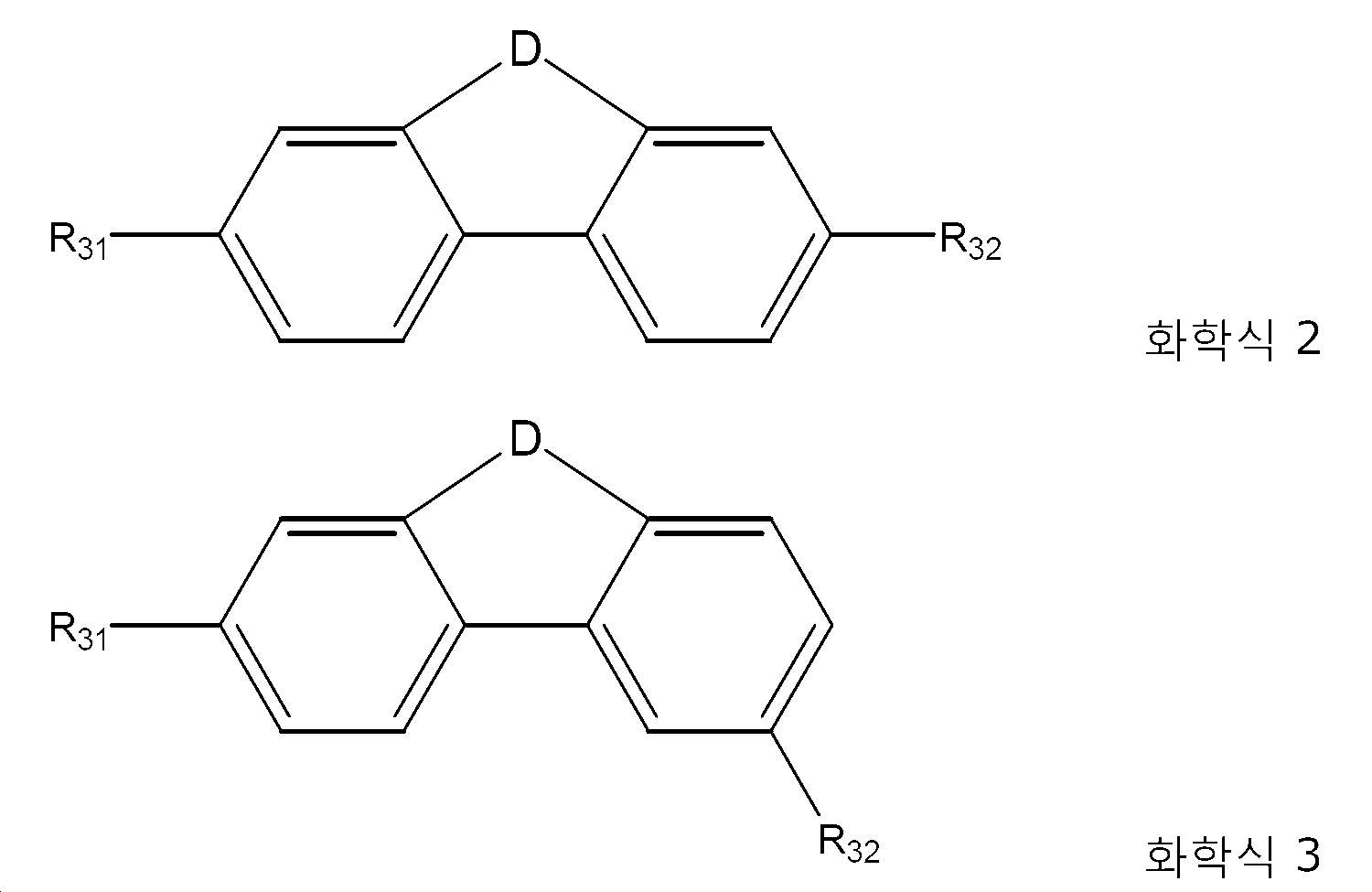
상기 식에서, D는 산소, 황, 질소 또는 탄소일 수 있고, 질소의 경우 단독으로 또는 탄소의 경우 이중적으로 메틸, 에틸, 바이페닐, 나프틸 또는 페닐로 치환될 수 있다.where D may be oxygen, sulfur, nitrogen or carbon, which may be substituted with methyl, ethyl, biphenyl, naphthyl or phenyl for nitrogen alone or double for carbon.
9. 바이페닐 단위 A, B 또는 모두가 동일하거나 상이하고, 하기 화학식의 단위로부터 선택되는 제1 내지 제8 사항 중 어느 하나에 따른 선택적 아릴화 방법:9. A method for selective arylation according to any one of items 1 to 8, wherein the biphenyl units A, B or both are the same or different and are selected from units of the formula:
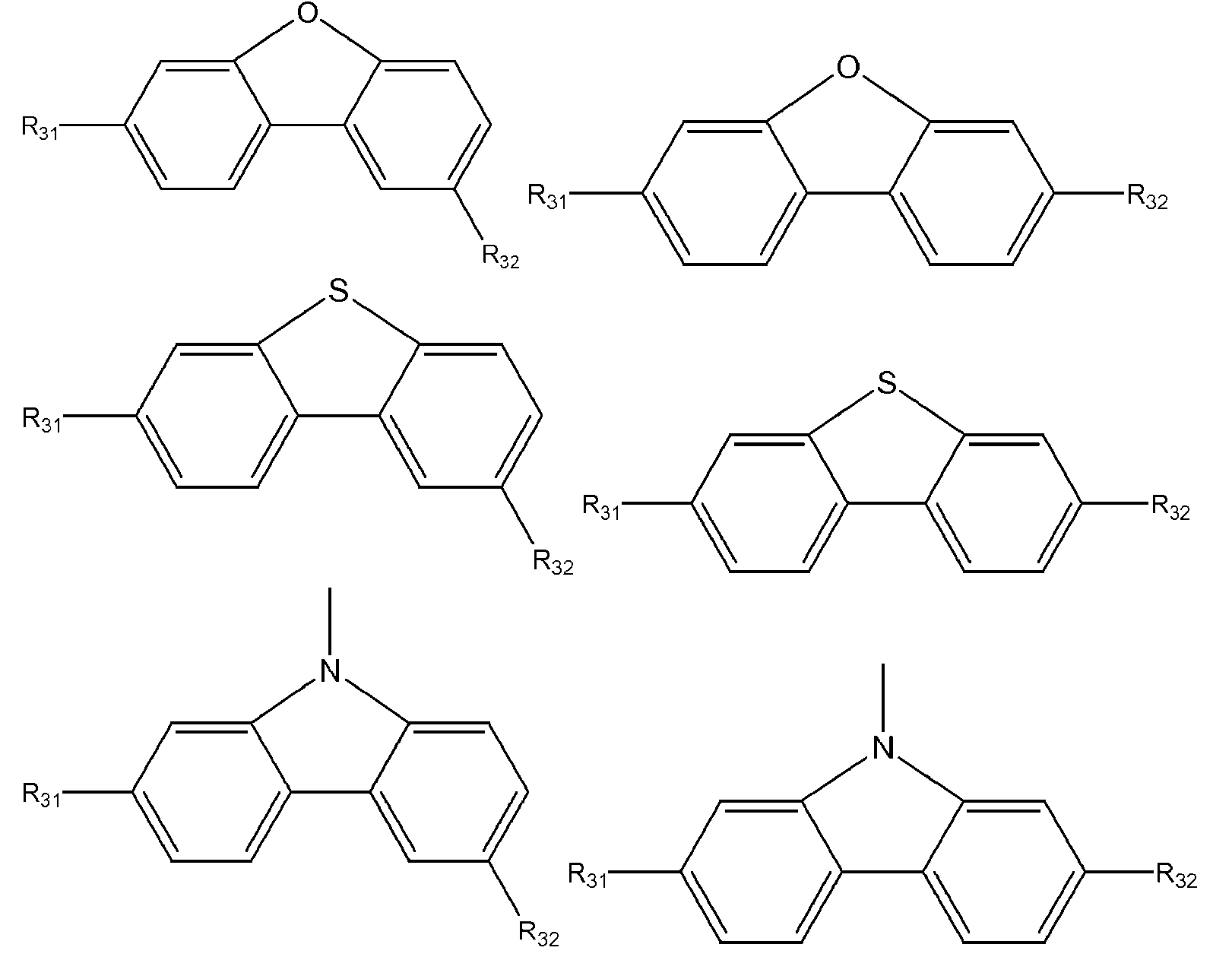

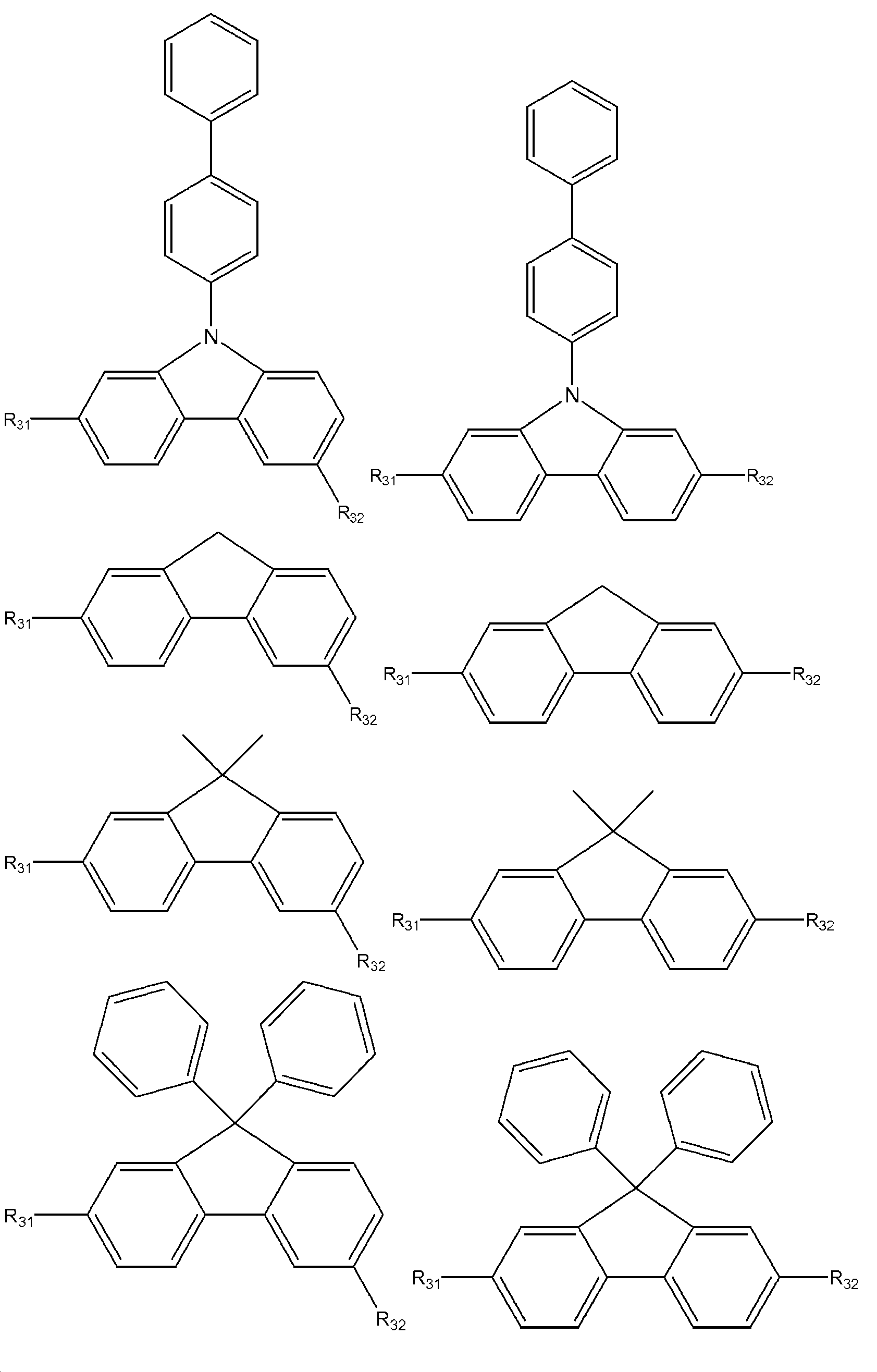
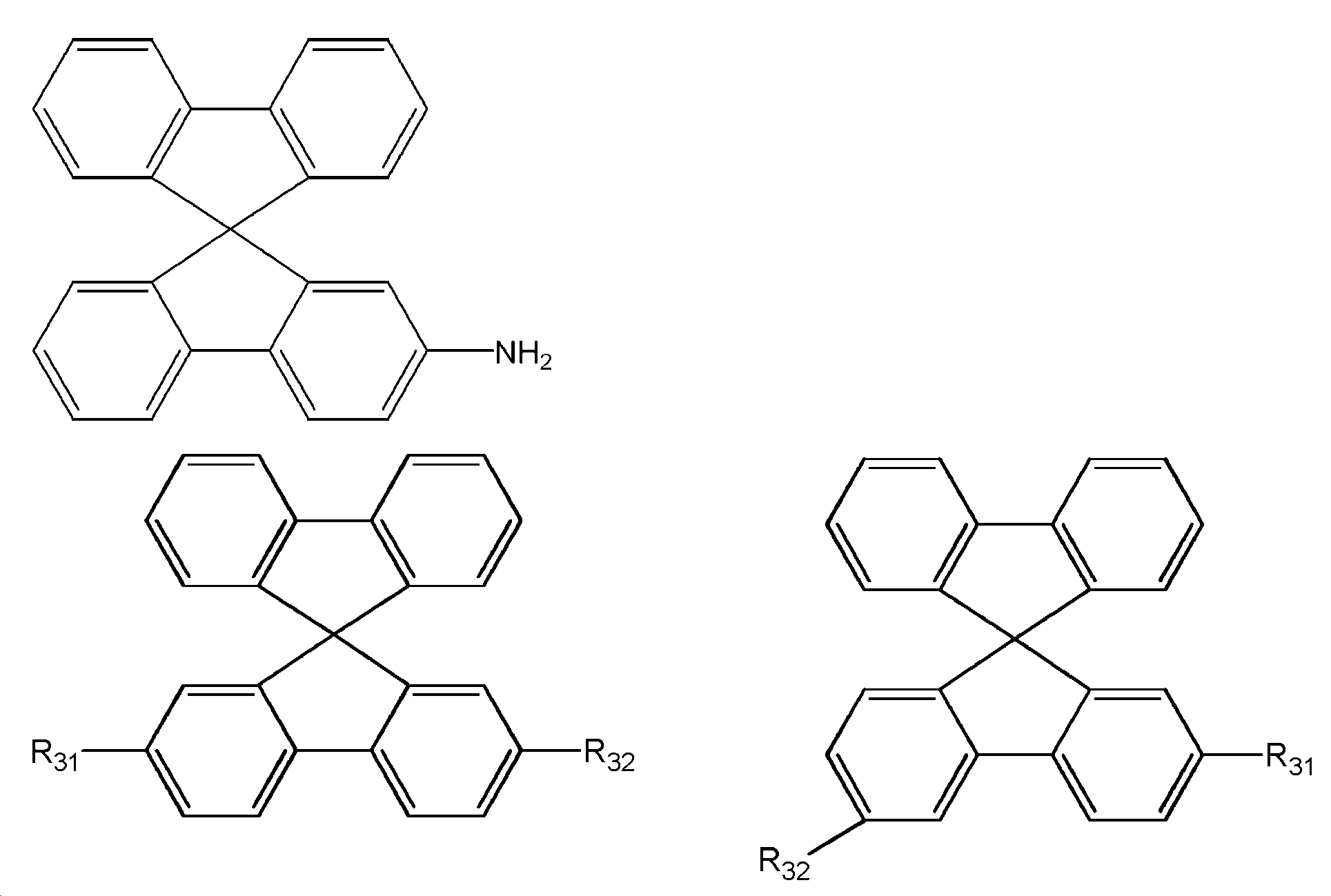
상기 식에서, R31은 수소, 페닐, 바이페닐 또는 피리딜일 수 있고,wherein R 31 may be hydrogen, phenyl, biphenyl or pyridyl,
R32는 라디칼이 A 또는 B로서 사용되는지 여부에 따라, 탈리기, 할로겐, 1차 아민기 NH2 또는 트리플루오로메틸설폰산 라디칼일 수 있고; 또는 R32는 각각 A 또는 B와 X 또는 NH2 사이에 배열되는 스페이서이다.R 32 can be a leaving group, a halogen, a primary amine group NH 2 or a trifluoromethylsulfonic acid radical, depending on whether the radical is used as A or B; or R32 is a spacer arranged between A or B and X or NH 2 respectively.
10. 스페이서는 1,4-페닐, 1,4-(6-메틸)페닐, 1,4-(5-메틸)페닐, 4,4'-바이페닐, 2,6-나프틸, 1,4-나프틸 및 하기 화학식으로 이루어진 군으로부터 선택되는 제1 내지 제9 사항 중 어느 하나에 따른 선택적 아릴화 방법:10. The spacer is 1,4-phenyl, 1,4-(6-methyl)phenyl, 1,4-(5-methyl)phenyl, 4,4'-biphenyl, 2,6-naphthyl, 1,4 - The selective arylation method according to any one of items 1 to 9 selected from the group consisting of -naphthyl and the following formula:
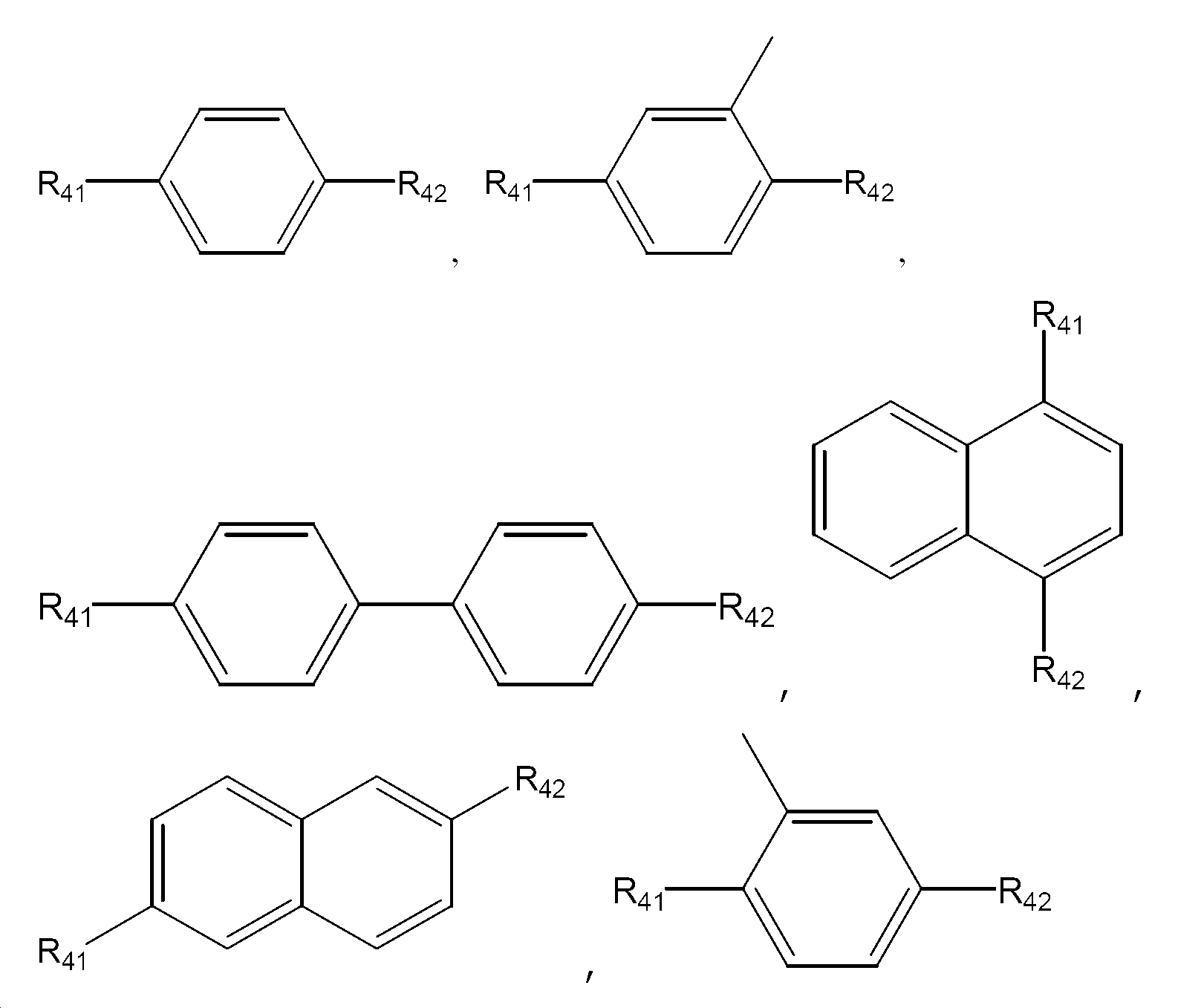
상기 식에서, R41은 화학식 2 내지 22의 구조체이고, R42는 할로겐 예컨대 불소, 염소, 브롬, 요오드 또는 아스타틴, 1차 아민기 NH2 또는 트리플루오로메틸설폰산 라디칼일 수 있다.wherein R41 is a structure of Formulas 2 to 22, and R42 may be a halogen such as fluorine, chlorine, bromine, iodine or astatine, a primary amine group NH 2 or a trifluoromethylsulfonic acid radical.
11. 상기 염기는 수산화리튬, 수산화칼륨, 수산화나트륨, 3차 유기 아민, 알콕사이드, 트리부틸아민, 트리에틸아민, 알칼리 금속 알코올레이트, 리튬 에탄올레이트, 나트륨 에탄올레이트, 칼륨 에탄올레이트, 리튬 tert-부탄올레이트, 나트륨 tert-부탄올레이트, 칼륨 tert-부탄올레이트, 리튬 비스(트리메틸실릴)아미드, 나트륨 비스(트리메틸실릴)아미드, 칼륨 비스(트리메틸실릴)아미드 또는 이들의 조합인 제1 내지 제10 사항 중 어느 하나에 따른 선택적 아릴화 방법.11. The base is lithium hydroxide, potassium hydroxide, sodium hydroxide, tertiary organic amine, alkoxide, tributylamine, triethylamine, alkali metal alcoholate, lithium ethanolate, sodium ethanolate, potassium ethanolate, lithium tert-butanol Any one of items 1 to 10, wherein the salt is sodium tert-butanolate, potassium tert-butanolate, lithium bis(trimethylsilyl)amide, sodium bis(trimethylsilyl)amide, potassium bis(trimethylsilyl)amide, or a combination thereof. A method of selective arylation according to one.
12. 상기 방법은 알코올, 에탄올, 프로판올, 이소프로판올, 부탄올, 이소부탄올, 에틸렌 글리콜, 에테르, 디에틸 에테르, tert-부틸 에틸 에테르, tert-부틸 메틸 에테르, 테트라하이드로푸란, 디옥산, 에틸렌 글리콜 디메틸 에테르, 비스(2-메톡시에틸) 에테르, 방향족 용매, 벤젠, 톨루엔, 자일렌, o-자일렌, p-자일렌, m-자일렌 및 이들의 조합으로 이루어진 군으로부터 선택되는 용매 중에서 수행되는 제1 내지 제11 사항 중 어느 하나에 따른 선택적 아릴화 방법.12. The method is alcohol, ethanol, propanol, isopropanol, butanol, isobutanol, ethylene glycol, ether, diethyl ether, tert-butyl ethyl ether, tert-butyl methyl ether, tetrahydrofuran, dioxane, ethylene glycol dimethyl ether , bis(2-methoxyethyl) ether, aromatic solvents, benzene, toluene, xylene, o-xylene, p-xylene, m-xylene, and combinations thereof. A method for selective arylation according to any one of claims 1 to 11.
13. 상기 방법은 5℃ 내지 150℃, 20℃ 내지 140℃, 30℃ 내지 130℃, 60℃ 내지 120℃ 또는 70℃ 내지 111℃의 온도에서 수행되는 제1 내지 제12 사항 중 어느 하나에 따른 선택적 아릴화 방법.13. The method according to any one of items 1 to 12 carried out at a temperature of from 5 °C to 150 °C, from 20 °C to 140 °C, from 30 °C to 130 °C, from 60 °C to 120 °C or from 70 °C to 111 °C. Selective arylation methods.
14. 상기 방법의 반응 시간은 1시간 내지 36 시간, 4 시간 내지 24 시간, 6 시간 내지 16 시간 또는 8 시간 내지 12 시간인 제1 내지 제13 사항 중 어느 하나에 따른 선택적 아릴화 방법.14. The method for selective arylation according to any one of items 1 to 13, wherein the reaction time of the method is from 1 hour to 36 hours, from 4 hours to 24 hours, from 6 hours to 16 hours or from 8 hours to 12 hours.
15. 바이페닐 단위는 2-플루오렌, 3-플루오렌, 2-(9,9-디페닐플루오렌), 2-(9,9-디메틸플루오렌), 3-(9,9-디페닐플루오렌), 3-(9,9-디메틸플루오렌), 3-(4-페닐)-9-페닐-9H-카바졸, 3-(4-페닐)-9-메틸-9H-카바졸, 3-(4-페닐)-9-바이페닐-9H-카바졸, 2-(4-페닐)-9-페닐-9H-카바졸, 2-(4-페닐)-9-메틸-9H-카바졸, 2-(4-페닐)-9-바이페닐-9H-카바졸, 3-(4-바이페닐)-9-페닐-9H-카바졸, 3-(4-바이페닐)-9-메틸-9H-카바졸, 3-(4-바이페닐)-9-바이페닐-9H-카바졸, 2-(4-바이페닐)-9-페닐-9H-카바졸, 2-(4-바이페닐)-9-메틸-9H-카바졸, 2-(4-바이페닐)-9-바이페닐-9H-카바졸, 3-(9-페닐-9H-카바졸), 3-(9-메틸-9H-카바졸), 3-(9-바이페닐-9H-카바졸), 2-(9-페닐-9H-카바졸), 2-(9-메틸-9H-카바졸), 2-(9-바이페닐-9H-카바졸) 또는 트리페닐렌인 제1 내지 제14 사항 중 어느 하나에 따른 선택적 아릴화 방법.15. Biphenyl unit is 2-fluorene, 3-fluorene, 2-(9,9-diphenylfluorene), 2-(9,9-dimethylfluorene), 3-(9,9-diphenyl fluorene), 3-(9,9-dimethylfluorene), 3-(4-phenyl)-9-phenyl-9H-carbazole, 3-(4-phenyl)-9-methyl-9H-carbazole, 3-(4-phenyl)-9-biphenyl-9H-carbazole, 2-(4-phenyl)-9-phenyl-9H-carbazole, 2-(4-phenyl)-9-methyl-9H-carbazole Sol, 2-(4-phenyl)-9-biphenyl-9H-carbazole, 3-(4-biphenyl)-9-phenyl-9H-carbazole, 3-(4-biphenyl)-9-methyl -9H-carbazole, 3-(4-biphenyl)-9-biphenyl-9H-carbazole, 2-(4-biphenyl)-9-phenyl-9H-carbazole, 2-(4-biphenyl )-9-methyl-9H-carbazole, 2- (4-biphenyl) -9-biphenyl-9H-carbazole, 3- (9-phenyl-9H-carbazole), 3- (9-methyl- 9H-carbazole), 3-(9-biphenyl-9H-carbazole), 2-(9-phenyl-9H-carbazole), 2-(9-methyl-9H-carbazole), 2-(9 -biphenyl-9H-carbazole) or triphenylene, the selective arylation method according to any one of items 1 to 14.
16. 팔라듐 착물은 1차 방향족 아민 A-NH2 및 할로방향족 X-B의 반응물의 총 몰량 기준으로, 0.01 몰% 내지 1.5 몰%의 양으로 사용되는 제1 내지 제15 사항 중 어느 하나에 따른 선택적 아릴화 방법.16. The optional aryl according to any one of clauses 1 to 15, wherein the palladium complex is used in an amount of 0.01 mol % to 1.5 mol %, based on the total molar amount of reactants of the primary aromatic amines A-NH 2 and the haloaromatic XB. How to get angry.
17. 팔라듐 착물은 고상의 비스(디알킬포스피노페로센)을 가진 고형물, 용액 또는 분말 혼합물로서 사용되는 제1 내지 제16 사항 중 어느 하나에 따른 선택적 아릴화 방법.17. Process for selective arylation according to any one of items 1 to 16, wherein the palladium complex is used as a solid, solution or powder mixture with bis(dialkylphosphinoferrocene) in the solid phase.
18. - 반응 용기에 1차 방향족 아민 A-NH2, 할로방향족 X-B, 적합한 용매 및 임의로 비스(디알킬포스피노페로센)을 제공하는 단계;18. - providing the primary aromatic amine A-NH 2 , the haloaromatic XB, a suitable solvent and optionally bis(dialkylphosphinoferrocene) in a reaction vessel;
- 팔라듐 원자가 하나 이상의 비스(디알킬포스피노페로센) 리간드에 의해 착화된 팔라듐 착물을 고형물 또는 용액의 형태로 부가하는 단계;- adding a palladium complex in which the palladium atoms are complexed by at least one bis(dialkylphosphinoferrocene) ligand in the form of a solid or solution;
- 반응 용기에서 생성된 반응 혼합물을 가열하는 단계;- heating the resulting reaction mixture in the reaction vessel;
- 반응 생성물, 2차 방향족 아민 A-NH-B를 분리하는 단계; 및- isolating the reaction product, secondary aromatic amines A-NH-B; and
- 임의로 2차 방향족 아민 A-NH-B를 정제하는 단계를 포함하는, - optionally purifying the secondary aromatic amines A-NH-B,
제1 내지 제17 사항 중 어느 하나에 따른 선택적 아릴화 방법.A method for selective arylation according to any one of claims 1 to 17.
19. 하기 화합물이 존재하는 제1 내지 제18 사항 중 어느 하나에 따른 선택적 아릴화 방법:19. A method for selective arylation according to any one of items 1 to 18, wherein the compound is present:
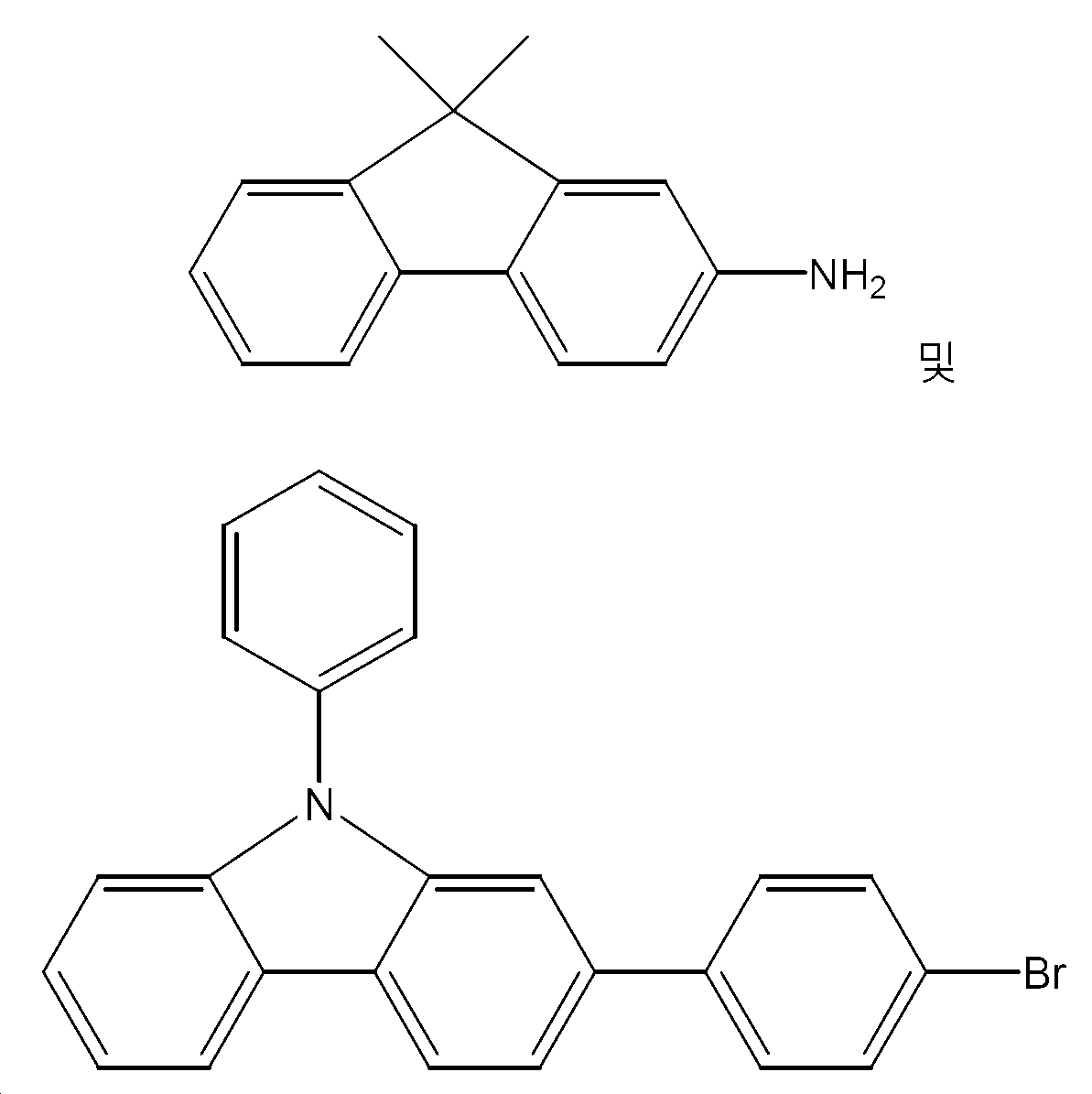
20. 팔라듐 착물 중의 팔라듐 원자는 추가적으로 2,4,6,8-테트라메틸사이클로테트라실록산, 비스(디벤질리덴아세톤) 또는 말레이미드에 의해 착화되는 제1 내지 제19 사항 중 어느 하나에 따른 선택적 아릴화 방법.20. The optional aryl according to any one of items 1 to 19, wherein the palladium atom in the palladium complex is additionally complexed with 2,4,6,8-tetramethylcyclotetrasiloxane, bis(dibenzylideneacetone) or maleimide How to get angry.
21. 팔라듐 착물 중의 팔라듐 원자는 1,1'-비스(디이소프로필포스피노)페로센에 의해 착화되는 제1 내지 제20 사항 중 어느 하나에 따른 선택적 아릴화 방법.21. Process according to any one of items 1 to 20, wherein the palladium atom in the palladium complex is complexed with 1,1'-bis(diisopropylphosphino)ferrocene.
22. 화합물 1,1'-비스(디이소프로필포스피노)페로센-팔라듐(0)-말레이미드 [Pd(dippf)(말레이미드)]; 1,1'-비스(디이소프로필포스피노)페로센팔라듐(0)-1,3-디비닐-1,1,3,3-테트라메틸디실록산 [Pd(dippf)(VTS)]; 1,1'-비스(디이소프로필-포스피노)페로센팔라듐(0)-비스(디벤질리덴아세톤) [Pd(dippf)(dba)]; 1,1'-비스(디이소프로필포스피노)페로센-팔라듐(0)-나프토퀴논 [Pd(dippf)(나프토퀴논)]; 1,1'-비스(디이소프로필포스피노)페로센팔라듐(0)-말레산 무수물 [Pd(dippf)(말레산 무수물)]; 1,1'-비스(디이소프로필-포스피노)페로센팔라듐(0)-디에틸 말레에이트 [Pd(dippf)(디에틸 말레에이트)]; 또는 1,1'-비스(디이소프로필포스피노)페로센팔라듐(0)-노르보르넨 [Pd(dippf)(노르보르넨)].22. Compound 1,1'-bis(diisopropylphosphino)ferrocene-palladium(0)-maleimide [Pd(dippf)(maleimide)]; 1,1′-bis(diisopropylphosphino)ferrocenepalladium(0)-1,3-divinyl-1,1,3,3-tetramethyldisiloxane [Pd(dippf)(VTS)]; 1,1'-bis(diisopropyl-phosphino)ferrocenepalladium(0)-bis(dibenzylideneacetone) [Pd(dippf)(dba)]; 1,1'-bis(diisopropylphosphino)ferrocene-palladium(0)-naphthoquinone [Pd(dippf)(naphthoquinone)]; 1,1'-bis(diisopropylphosphino)ferrocenepalladium(0)-maleic anhydride [Pd(dippf)(maleic anhydride)]; 1,1′-bis(diisopropyl-phosphino)ferrocenepalladium(0)-diethyl maleate [Pd(dippf)(diethyl maleate)]; or 1,1'-bis(diisopropylphosphino)ferrocenepalladium(0)-norbornene [Pd(dippf)(norbornene)].
23. 비스(디알킬포스피노페로센) 및 팔라듐 원자가 하나 이상의 비스(디알킬포스피노페로센) 리간드에 의해 착화된 팔라듐 착물을 포함하는 분말 혼합물.23. A powder mixture comprising a bis(dialkylphosphinoferrocene) and a palladium complex in which the palladium atom is complexed with one or more bis(dialkylphosphinoferrocene) ligands.
24. 하트위그-부흐발트 커플링에 대한 촉매로서의 제22 사항에 따른 화합물 또는 제23 사항에 따른 분말 혼합물의 용도.24. Use of a compound according to clause 22 or a powder mixture according to clause 23 as catalyst for a Hartwig-Buchwald coupling.
팔라듐 착물 중의 팔라듐 원자는 화학식 1을 갖는 하나 이상의 비스(디알킬포스피노페로센) 리간드에 의해 착화된다:A palladium atom in a palladium complex is complexed by one or more bis(dialkylphosphinoferrocene) ligands having the formula (1):

R11 내지 R14는 동일하거나 상이할 수 있고, 특히 1 내지 5개의 알킬 라디칼이다. 따라서, R11 내지 R14는 서로 독립적으로 메틸, 에틸, n-프로필, 이소프로필, n-부틸, 이소부틸, sec-부틸, tert-부틸, n-펜틸(아밀), 2-펜틸(sec-펜틸), 3-펜틸, 2-메틸부틸, 3-메틸부틸(이소펜틸 또는 이소아밀), 3-메틸부트-2-일, 2-메틸부트-2-일, 2,2-디메틸프로필(네오펜틸)로부터 선택될 수 있다.R11 to R14 may be the same or different and are in particular 1 to 5 alkyl radicals. Therefore, R11 to R14 are independently of each other methyl, ethyl, n-propyl, isopropyl, n-butyl, isobutyl, sec-butyl, tert-butyl, n-pentyl (amyl), 2-pentyl (sec-pentyl) , 3-pentyl, 2-methylbutyl, 3-methylbutyl (isopentyl or isoamyl), 3-methylbut-2-yl, 2-methylbut-2-yl, 2,2-dimethylpropyl (neopentyl) can be selected from
유리하게는, R11 내지 R14는 동일하고, 그리고 메틸, 에틸, n-프로필, 이소프로필, n-부틸, 이소부틸, sec-부틸, tert-부틸, n-펜틸(아밀), 2-펜틸(sec-펜틸), 3-펜틸, 2-메틸부틸, 3-메틸부틸(이소펜틸 또는 이소아밀), 3-메틸부트-2-일, 2-메틸부트-2-일, 2,2-디메틸프로필(네오펜틸)로 이루어진 군으로부터 선택된다.Advantageously, R11 to R14 are the same, and methyl, ethyl, n-propyl, isopropyl, n-butyl, isobutyl, sec-butyl, tert-butyl, n-pentyl(amyl), 2-pentyl(sec) -pentyl), 3-pentyl, 2-methylbutyl, 3-methylbutyl (isopentyl or isoamyl), 3-methylbut-2-yl, 2-methylbut-2-yl, 2,2-dimethylpropyl ( neopentyl).
특히, 이소프로필, 이소부틸, tert-부틸, 더 특별하게는 이소프로필 및 tert-부틸이 적합하다. R11 내지 R14는 동일하고, 그리고 이소프로필 또는 tert-부틸인 경우 우수한 결과가 얻어진다. R11 내지 R14는 동일하고, 그리고 이소프로필, 프로필 또는 이소부틸인 경우 우수한 결과가 얻어진다. R11 내지 R14는 동일하고, 그리고 이소프로필인 경우 우수한 결과가 얻어진다. Particularly suitable are isopropyl, isobutyl, tert-butyl, more particularly isopropyl and tert-butyl. R11 to R14 are the same, and good results are obtained when isopropyl or tert-butyl. Good results are obtained when R11 to R14 are identical and are isopropyl, propyl or isobutyl. R11 to R14 are the same, and good results are obtained in the case of isopropyl.
놀랍게도, 커플링을 위한 화합물 중의 라디칼 A 또는 B 중 하나 이상이 구조 성분으로서 하나 이상의 바이페닐 단위를 갖는 경우, 하트위그-부흐발트 커플링에 의한 2차 아민의 제조시 화학식 1의 비스(디알킬포스피노페로센) 리간드가 고수율로 2차 아민에 대한 선택적 제조가 가능하다는 것을 밝혀내었다. 이러한 경우, 사용되는 팔라듐의 양은 일반적으로 이용되는 3 몰%로부터 약 1.5 몰% 이하로 감소될 수 있고; 3차 아민을 형성하는 일반적으로 2차 반응으로서 일어나는 이중 아릴화는 억제되고, 반응은 일반적으로 90% 이상의 전환율로 원하는 생성물로 진행된다.Surprisingly, when at least one of the radicals A or B in the compound for coupling has at least one biphenyl unit as a structural component, in the preparation of secondary amines by Hartwig-Buchwald coupling, the bis(dialkyl It was found that phosphinoferrocene) ligands can be selectively prepared for secondary amines in high yield. In this case, the amount of palladium used can be reduced from the generally used 3 mol % to about 1.5 mol % or less; Double arylation, which normally occurs as a secondary reaction to form a tertiary amine, is inhibited, and the reaction proceeds to the desired product, usually with greater than 90% conversion.
바람직하게는, 라디칼 A 및 B 모두는 바이페닐 단위를 가진다. 바이페닐 단위는 비치환되거나 치환될 수 있고, 하나 이상의 페닐 라디칼에 의한 것을 포함하고, 이에 따라, 예를 들면, 테르페닐, 쿠아테르페닐 또는 트리페닐렌 단위를 형성하고, 이는 치환되거나 비치환될 수 있다. 바이페닐 단위는 예를 들면 플루오렌 및 이의 유도체의 경우에서와 같이 가교될 수 있다.Preferably, both radicals A and B have biphenyl units. Biphenyl units may be unsubstituted or substituted, including by one or more phenyl radicals, thus forming, for example, terphenyl, quaterphenyl or triphenylene units, which may be substituted or unsubstituted can The biphenyl units can be crosslinked, for example as in the case of fluorene and its derivatives.
바이페닐로서, 특히 라디칼 A 또는 B로서 화학식 2 또는 3의 화합물을 사용하는 것이 가능하다:As biphenyl, it is possible in particular to use compounds of formula 2 or 3 as radicals A or B:

상기 식에서, D는 산소, 황, 질소 또는 탄소일 수 있고, (질소의 경우) 단독으로 또는 (탄소의 경우) 이중적으로 메틸, 에틸, 바이페닐, 1-나프틸, 2-나프틸 또는 페닐로 치환될 수 있다. 따라서, 특히 하기 라디칼이 제공될 수 있다:where D can be oxygen, sulfur, nitrogen or carbon, alone (for nitrogen) or doubly (for carbon) with methyl, ethyl, biphenyl, 1-naphthyl, 2-naphthyl or phenyl may be substituted. Accordingly, in particular the following radicals may be provided:
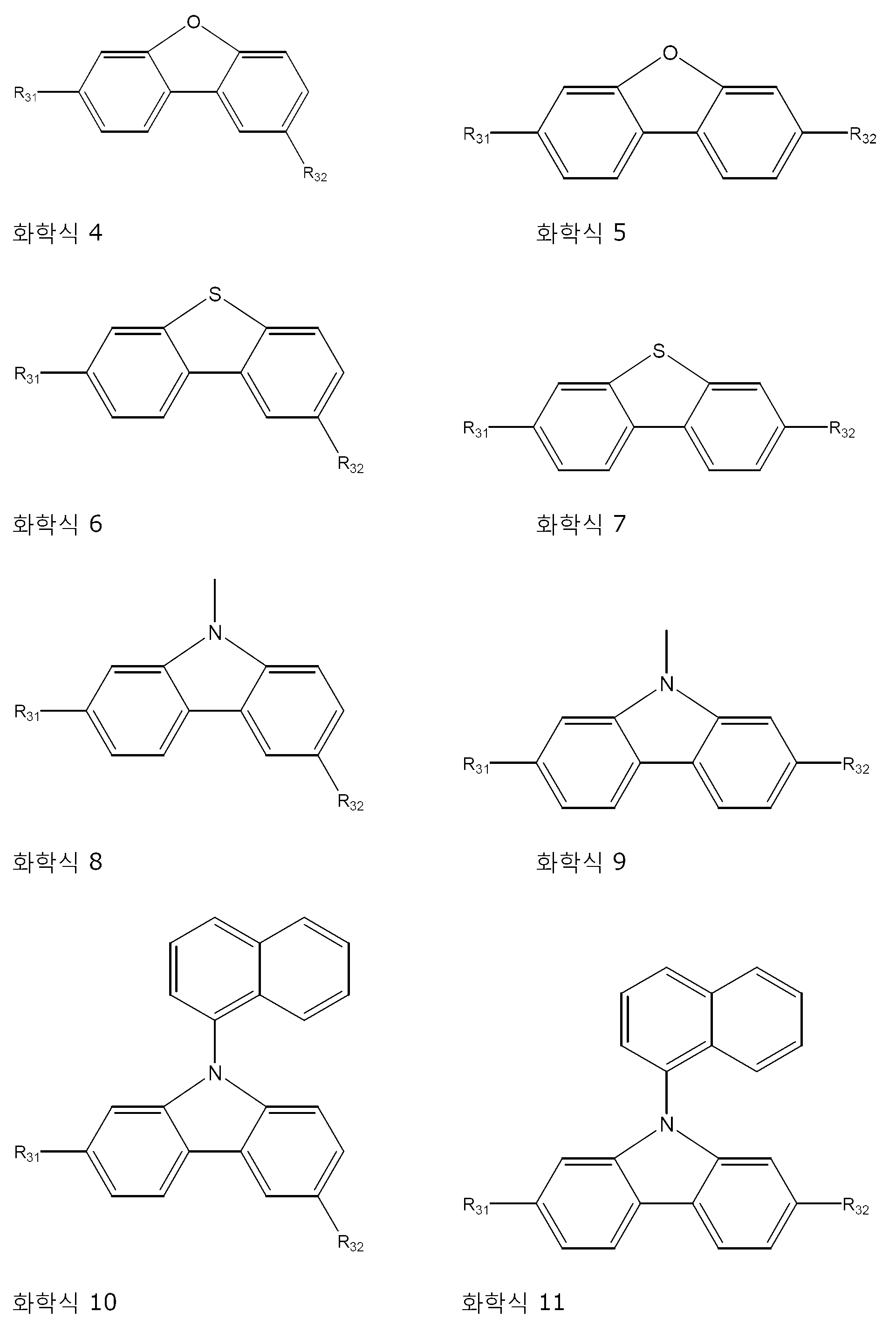


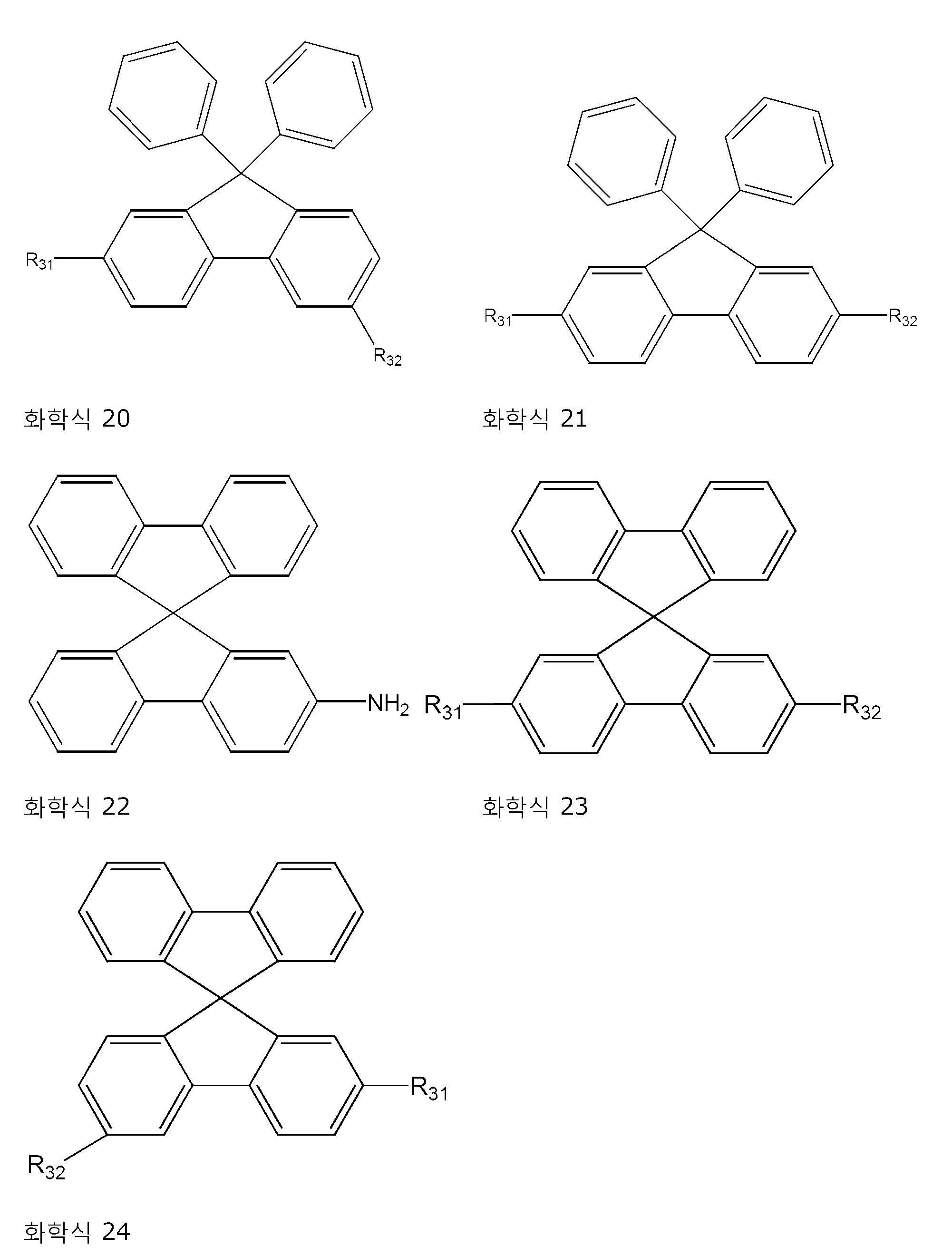
R31은 수소, 페닐, 바이페닐 또는 피리딜일 수 있다.R31 may be hydrogen, phenyl, biphenyl or pyridyl.
R32는 상기에서 기재된 바와 같이, 화학식 2 또는 3의 라디칼이 A 또는 B로 사용되는지 여부에 따라 할로겐, 1차 아민기 NH2 또는 트리플루오로메틸설폰산 라디칼일 수 있다. R 32 may be a halogen, a primary amine group NH 2 or a trifluoromethylsulfonic acid radical, depending on whether the radical of formula 2 or 3 is used as A or B, as described above.
그러나, R32는 또한 A 또는 B와 X 또는 NH2 사이에 배열된 스페이서일 수 있다. 적합한 스페이서의 예는 1,4-페닐, 1,4-(6-메틸)페닐, 1,4-(5-메틸)페닐, 4,4'-바이페닐, 2,6-나프틸 또는 1,4-나프틸을 포함한다. 이들은 특히, 하기 화학식의 것이다:However, R32 may also be a spacer arranged between A or B and X or NH 2 . Examples of suitable spacers are 1,4-phenyl, 1,4-(6-methyl)phenyl, 1,4-(5-methyl)phenyl, 4,4′-biphenyl, 2,6-naphthyl or 1, 4-naphthyl. They are in particular of the formula:
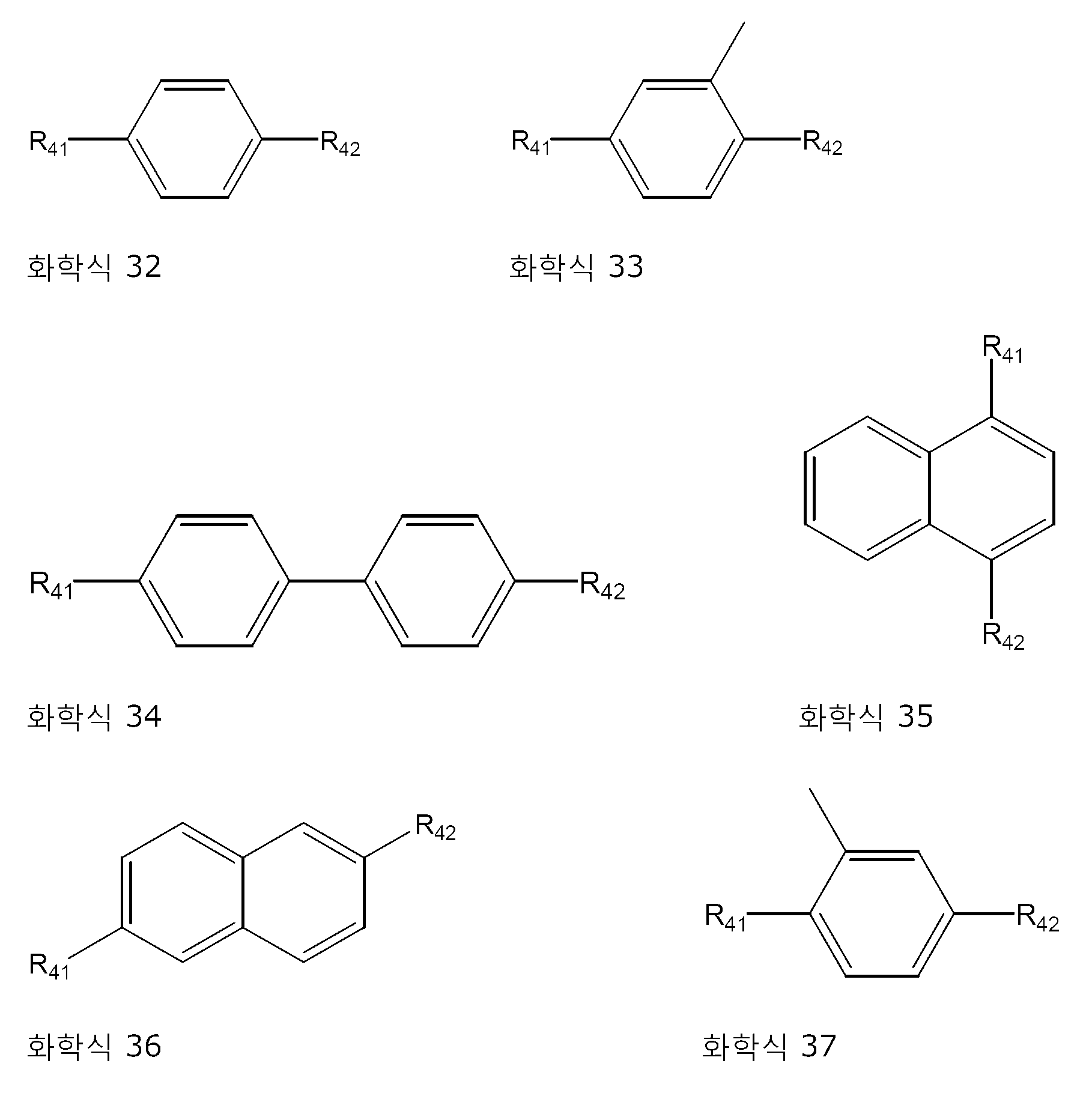
상기 식에서, R41은 화학식 2 내지 22의 구조이고, R42는 불소, 염소, 브롬, 요오드 또는 아스타틴, 1차 아민기 NH2 또는 트리플루오로메틸설폰산 라디칼일 수 있다.In the above formula, R41 is a structure of Formulas 2 to 22, and R42 may be fluorine, chlorine, bromine, iodine or astatine, a primary amine group NH 2 or a trifluoromethylsulfonic acid radical.
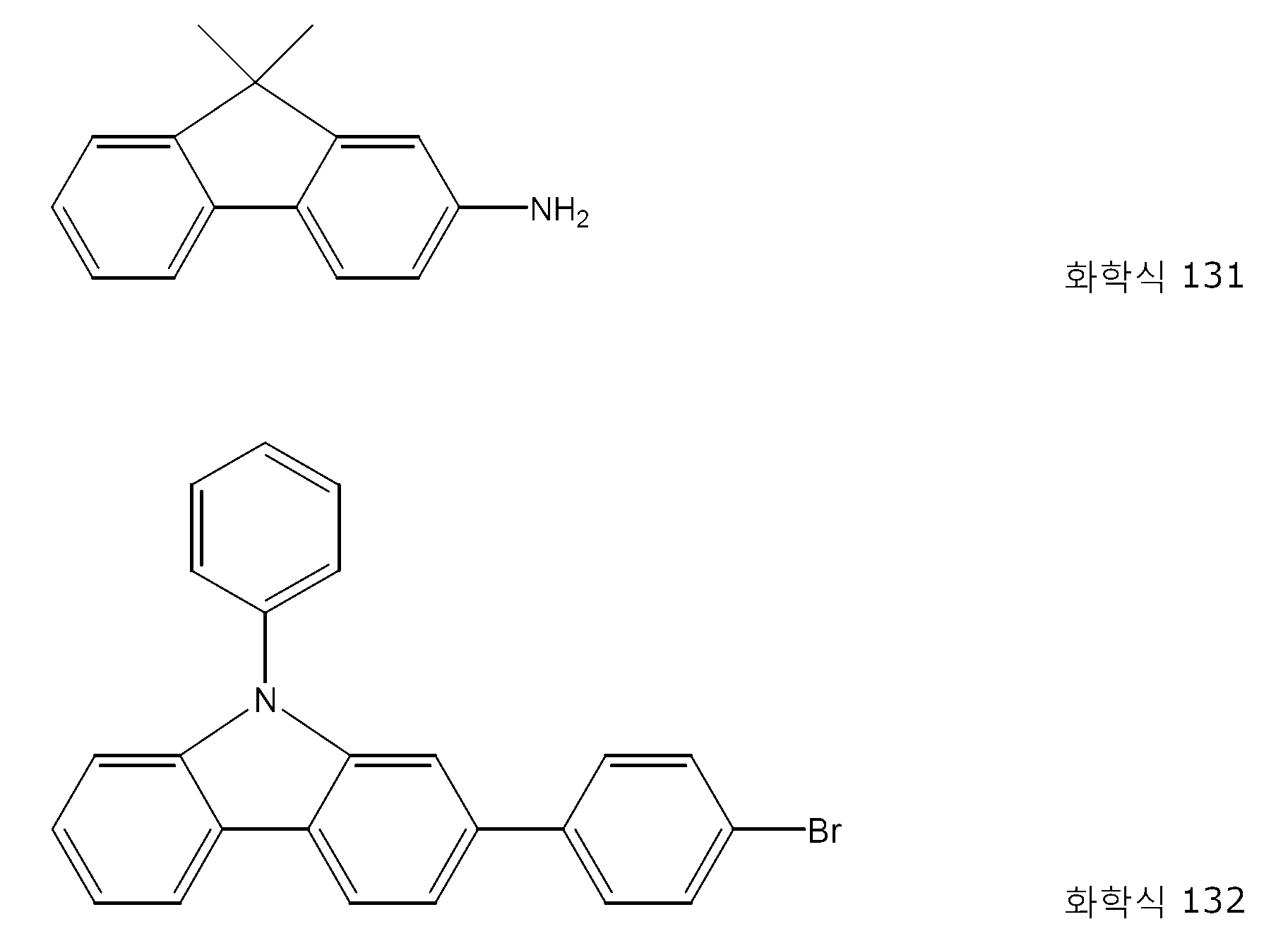
본 발명의 특정 구현예에서, 하기 화합물이 사용된다: 화학식 A-NH2의 아민으로서 화학식 131의 화합물, 및 화학식 B-X의 할로방향족으로서 화학식 132의 화합물:In certain embodiments of the present invention, the following compounds are used: a compound of formula 131 as an amine of formula A-NH 2 and a compound of formula 132 as haloaromatic of formula BX:
출발 화합물, 1차 방향족 아민 A-NH2 및 할로방향족 X-B가 등몰 분율로 사용된다. 할로방향족 또는 아민은 경우에 따라 등몰 비율로 최대 1.1배 또는 1.2배의 과량으로 또한 사용될 수 있다.The starting compounds, the primary aromatic amines A-NH 2 and the haloaromatic XB are used in equimolar fractions. The haloaromatics or amines may also be used in excess of up to 1.1 times or 1.2 times in equimolar proportions if desired.
팔라듐 착물은 원칙적으로 공지된 방법으로 수득될 수 있다. 이러한 목적을 위해, 우선, 용매 중의 팔라듐 화합물이 주입되고, 이후 원하는 비스(디알킬포스피노페로센) 리간드가 부가되고, 1,1'-비스(디이소프로필포스피노)페로센, 1,1'-비스(디이소부틸포스피노)페로센 및 1,1'-비스(디-tert-부틸포스피노)페로센을 사용하여 우수한 결과가 얻어진다. 이후, 30 내지 1000분, 더 특별하게는 40 내지 400분 또는 50 내지 120분 동안 교반하는 것이 이에 후속될 수 있다. 반응 온도는 약 10℃ 내지 100℃, 더 특별하게는 15℃ 내지 50℃ 또는 20℃ 내지 30℃일 수 있다.The palladium complex can in principle be obtained by known methods. For this purpose, firstly a palladium compound in a solvent is injected, then the desired bis(dialkylphosphinoferrocene) ligand is added, 1,1′-bis(diisopropylphosphino)ferrocene, 1,1′- Excellent results are obtained using bis(diisobutylphosphino)ferrocene and 1,1'-bis(di-tert-butylphosphino)ferrocene. This may then be followed by stirring for 30 to 1000 minutes, more particularly 40 to 400 minutes or 50 to 120 minutes. The reaction temperature may be about 10°C to 100°C, more specifically 15°C to 50°C or 20°C to 30°C.
단순히 약 한 시간 동안 실온에서 교반함으로써 우수한 결과가 얻어질 수 있다.Excellent results can be obtained by simply stirring at room temperature for about an hour.
온도 상한값은 본질적으로 용매의 비점에 좌우되고, 고비점 용매가 상대적으로 높은 반응 온도를 요구한다는 것을 의미하고, 상기에 나타낸 온도 상한값은 고정된 것이 아닌 용매의 비점에 좌우되는 것으로 볼 수 있다.The upper temperature limit essentially depends on the boiling point of the solvent, meaning that the high boiling point solvent requires a relatively high reaction temperature, and it can be seen that the upper temperature limit shown above is not fixed but depends on the boiling point of the solvent.
적합한 용매는 일반적으로 비양성자성 용매, 예컨대 에테르 또는 방향족 용매이다. 따라서, 적합한 예는 디에틸 에테르, tert-부틸 에틸 에테르, tert-부틸 메틸 에테르, 테트라하이드로푸란 또는 디옥산을 포함하고, 한편 벤젠, 톨루엔 또는 자일렌, 또는 아세토니트릴이 또한 사용될 수 있다.Suitable solvents are generally aprotic solvents such as etheric or aromatic solvents. Accordingly, suitable examples include diethyl ether, tert-butyl ethyl ether, tert-butyl methyl ether, tetrahydrofuran or dioxane, while benzene, toluene or xylene, or acetonitrile may also be used.
용매에 종래의 건조 기술을 적용함으로써 수득될 수 있는, 대개 무수 상태이고 산소-무함유 용매의 사용을 통해 우수한 결과가 달성될 수 있다.Good results can be achieved through the use of solvents that are usually anhydrous and oxygen-free, which can be obtained by applying conventional drying techniques to the solvent.
팔라듐 착물에 대한 반응물로서 적합한 팔라듐 화합물은 Pd(0) 및 Pd(II) 복합체 예컨대, 예를 들면, 알릴클로로[1,3-비스(2,4,6-트리메틸페닐)이미다졸-2-일리덴]팔라듐(II), (에틸렌디아민)팔라듐(II) 클로라이드, 팔라듐(II) 아세테이트, 팔라듐(II) 클로라이드, 팔라듐 피발레이트, 팔라듐(II) 아세틸아세토네이트, 비스(벤조니트릴)팔라듐(II) 클로라이드, 비스(아세토니트릴)디클로로팔라듐(II), 디암민디클로로팔라듐(II), 디클로로(1,5-사이클로옥타디엔)팔라듐(II), 팔라듐(II) 니트레이트, 팔라듐(II) 옥사이드, 팔라듐(II) 옥사이드 수화물, H2[PdCl4], 디암민디니트리토팔라듐(II), 팔라듐(II) 설페이트, 테트라암민팔라듐(II) 설페이트 [Pd(NH3)4]SO4, 테트라암민팔라듐(II) 수소카보네이트, 테트라암민팔라듐(II) 클로라이드 [Pd(NH3)4]Cl2, 칼륨 테트라클로로팔라데이트(II) K2[PdCl4], 나트륨 테트라클로로팔라데이트(II) Na2[PdCl4], 암모늄 테트라클로로팔라데이트(II) (NH4)2[PdCl4], 테트라암민팔라듐(II) 니트레이트, 1,3-디비닐-1,1,3,3-테트라메틸디실록산팔라듐(0) (또한 Pd-VTS, Pd-VS 또는 팔라듐-VTS와 같음), 비스(디벤질리덴아세톤)팔라듐(0) (Pd(dba)2), (Pd2(dba)3), (Pd2(dba)3)·LM일 수 있고, 여기서 LM은 용매, 더 특별하게는 CHCl3 또는 CH2Cl2이다.Palladium compounds suitable as reactants for palladium complexes include Pd(0) and Pd(II) complexes such as, for example, allylchloro[1,3-bis(2,4,6-trimethylphenyl)imidazol-2-yl Den]palladium(II), (ethylenediamine)palladium(II) chloride, palladium(II) acetate, palladium(II) chloride, palladium pivalate, palladium(II) acetylacetonate, bis(benzonitrile)palladium(II) Chloride, bis(acetonitrile)dichloropalladium(II), diamminedichloropalladium(II), dichloro(1,5-cyclooctadiene)palladium(II), palladium(II) nitrate, palladium(II) oxide, palladium (II) oxide hydrate, H 2 [PdCl 4 ], diamminedinitritopalladium(II), palladium(II) sulfate, tetraamminepalladium(II) sulfate [Pd(NH 3 ) 4 ]SO 4 , tetraamminepalladium ( II) hydrogen carbonate, tetraamminepalladium(II) chloride [Pd(NH 3 ) 4 ]Cl 2 , potassium tetrachloropalladate(II) K 2 [PdCl 4 ], sodium tetrachloropalladate(II) Na 2 [PdCl 4 ], Ammonium tetrachloropalladate (II) (NH 4 ) 2 [PdCl 4 ], tetraamminepalladium (II) nitrate, 1,3-divinyl-1,1,3,3-tetramethyldisiloxanepalladium (0) (also like Pd-VTS, Pd-VS or palladium-VTS), bis(dibenzylideneacetone)palladium(0) (Pd(dba) 2 ), (Pd 2 (dba) 3 ), (Pd 2 (dba) 3 ).LM, where LM is a solvent, more particularly CHCl 3 or CH 2 Cl 2 .
이러한 방식으로, 촉매 용액이 수득된다.In this way, a catalyst solution is obtained.
팔라듐 착물의 제조 이후, 추가의 반응물, 하트위그-부흐발트 커플링에 대해 요구되는 즉 1차 방향족 아민 A-NH2, 할로방향족 X-B 및 염기의, 일 단계 반응(One-Pot reaction)에서의, 촉매 용액에 대한 부가에 의해 절차가 지속될 수 있다. 적합한 염기는 예를 들면, 알칼리 금속 및 알칼리 토금속 하이드록사이드, 예컨대 수산화리튬, 수산화칼륨 또는 수산화나트륨이다. 또한, 염기로서 3차 유기 아민 또는 알코올레이트 예컨대 트리부틸아민, 트리에틸아민, 알칼리 금속 알코올레이트 예컨대 리튬 에탄올레이트, 나트륨 에탄올레이트 또는 칼륨 에탄올레이트, 리튬 tert-부탄올레이트, 나트륨 tert-부탄올레이트 또는 칼륨 tert-부탄올레이트, 리튬 비스(트리메틸실릴)아미드, 나트륨 비스(트리메틸실릴)아미드, 칼륨 비스(트리메틸실릴)아미드 단독 또는 서로의 조합이 적합하다. After the preparation of the palladium complex, further reactants, i.e. the primary aromatic amine A-NH 2 , the haloaromatic XB and the base required for the Hartwig-Buchwald coupling, in a One-Pot reaction, The procedure can be continued by addition to the catalyst solution. Suitable bases are, for example, alkali metal and alkaline earth metal hydroxides, such as lithium hydroxide, potassium hydroxide or sodium hydroxide. Also as base tertiary organic amines or alcoholates such as tributylamine, triethylamine, alkali metal alcoholates such as lithium ethanolate, sodium ethanolate or potassium ethanolate, lithium tert-butanolate, sodium tert-butanolate or potassium Suitable are tert-butanolate, lithium bis(trimethylsilyl)amide, sodium bis(trimethylsilyl)amide, potassium bis(trimethylsilyl)amide alone or in combination with each other.
2개의 반응물, 1차 방향족 아민 A-NH2 및 할로방향족 X-B의 총 몰량에 대해, 상기 염기는 일반적으로 40% 내지 80%, 더 특별하게는 50% 내지 70% 또는 55% 내지 65%의 양으로 사용될 수 있다. 이는, 예를 들면, 각각 20 mmol의 1차 방향족 아민 A-NH2 및 할로방향족 X-B가 총 40 mmol로 사용되는 경우, 상기 염기는 16 mmol 내지 32 mmol, 더 특별하게는 20 mmol 내지 28 mmol 또는 22 mmol 내지 26 mmol의 양으로 사용될 수 있다. With respect to the total molar amount of the two reactants, the primary aromatic amine A-NH2 and the haloaromatic XB, the base is generally in an amount of from 40% to 80%, more particularly from 50% to 70% or from 55% to 65%. can be used This means, for example, that when 20 mmol each of the primary aromatic amines A-NH 2 and haloaromatic XB are used in a total of 40 mmol, the base is 16 mmol to 32 mmol, more particularly 20 mmol to 28 mmol or 22 mmol to 26 mmol.
상기 과정에 대안적으로, 1차 방향족 아민 A-NH2, 할로방향족 X-B 및 염기는 또한 적절한 양의 계량된 용매 및 촉매 용액의 부가와 함께 주입될 수 있다.Alternatively to the above procedure, the primary aromatic amine A—NH 2 , the haloaromatic XB and the base may also be injected with the addition of appropriate amounts of metered solvent and catalyst solution.
방향족 아민 A-NH2와 할로방향족 X-B 사이의 커플링 반응을 위한 적합한 용매는 하트위그-부흐발트 커플링에 대한 종래의 용매, 환원하면, 알코올 예컨대 에탄올, 프로판올, 이소프로판올, 부탄올, 이소부탄올뿐 아니라, 예를 들면, 에틸렌 글리콜, 에테르 예컨대 디에틸 에테르, tert-부틸 에틸 에테르, tert-부틸 메틸 에테르, 테트라하이드로푸란, 디옥산, 에틸렌 글리콜 디메틸 에테르, 비스(2-메톡시에틸) 에테르, 방향족 용매 예컨대 벤젠, 톨루엔 또는 자일렌, 예컨대 o-자일렌, p-자일렌, m-자일렌 및 이들의 혼합물, 또는 이들 용매의 조합이다. 용매 사용시, 이들이 하트위그-부흐발트 커플링의 조건 하에 불활성인 것이 보장되도록 주의하여야 하고, 이는 아미노기 또는 할로겐기가 원하는 반응을 방해할 수 있기 때문이다. Suitable solvents for the coupling reaction between the aromatic amines A-NH 2 and the haloaromatic XB are conventional solvents for the Hartwig-Buchwald coupling, in reduction alcohols such as ethanol, propanol, isopropanol, butanol, isobutanol as well as , for example ethylene glycol, ethers such as diethyl ether, tert-butyl ethyl ether, tert-butyl methyl ether, tetrahydrofuran, dioxane, ethylene glycol dimethyl ether, bis(2-methoxyethyl) ether, aromatic solvents for example benzene, toluene or xylene, such as o-xylene, p-xylene, m-xylene and mixtures thereof, or combinations of these solvents. When using solvents, care must be taken to ensure that they are inert under the conditions of the Hartwig-Buchwald coupling, since amino or halogen groups may interfere with the desired reaction.
2차 반응으로서 일어나 3차 아민을 형성하는, 이중 아릴화가 없는 전환을 위해 필요로 되는 촉매의 양은 0.01% 내지 1.5 몰%, 또는 0.1 내지 1 몰%, 또는 0.3 몰% 내지 0.8 몰%이다. 몰%의 수치는 2개의 반응물, 1차 방향족 아민 A-NH2 및 할로방향족 X-B의 몰에 있어서의 총량을 기준으로 한다.The amount of catalyst required for the conversion without double arylation, which occurs as a secondary reaction to form a tertiary amine, is from 0.01% to 1.5% by mole, alternatively from 0.1% to 1% by mole, alternatively from 0.3%% to 0.8% by mole. The mole % figures are based on the total amount in moles of the two reactants, the primary aromatic amine A-NH 2 and the haloaromatic XB.
반응물의 전환율은 90% 이상, 더 특별하게는 95% 이상, 또는 97% 이상이다. 2차 반응로서 일어나 3차 아민을 형성하는 이중 아릴화(double arylation)는 본원에서 거의 완전하게 억제된다. The conversion of the reactants is at least 90%, more specifically at least 95%, or at least 97%. The double arylation that occurs as a secondary reaction to form a tertiary amine is almost completely inhibited herein.
반응 온도는 일반적으로 5℃ 내지 150℃, 또는 20℃ 내지 140℃, 또는 30℃ 내지 130℃, 더 특별하게는 60℃ 내지 120℃ 또는 70℃ 내지 111℃이다. 반응 시간은 일반적으로 1시간 내지 36시간, 또는 4시간 내지 24시간 또는 6시간 내지 16시간 또는 8시간 내지 12시간이다.The reaction temperature is generally from 5 °C to 150 °C, alternatively from 20 °C to 140 °C, alternatively from 30 °C to 130 °C, more particularly from 60 °C to 120 °C or from 70 °C to 111 °C. The reaction time is generally from 1 hour to 36 hours, alternatively from 4 hours to 24 hours or from 6 hours to 16 hours or from 8 hours to 12 hours.
상응하는 리간드, 환원하면 팔라듐 착물에서 사용되는 비스(디알킬포스피노페로센) 리간드가, 팔라듐 원자가 화학식 1의 비스(디알킬포스피노페로센) 리간드로 착화된 팔라듐 착물 이외, 하나의 유리한 구현예에서 촉매로서 부가된다. 본원에서 1:10 내지 10:1, 또는 1:5 내지 5:1, 더 특별하게는 2.5:1 내지 1:2.5, 예컨대, 예를 들면, 2:1의 범위로 팔라듐 착물 대 비스(디알킬포스피노페로센) 리간드의 비로의 부가가 바람직한 것으로 나타난다. 상기 비는 팔라듐 착물 및 비스(디알킬포스피노페로센) 리간드의 몰량에 기초한다. 이것은 예를 들면 0.2 몰%의 팔라듐 착물을 사용하는 경우, 0.1 몰%의 비스(디알킬포스피노페로센) 리간드를 부가하는 것을 의미한다.In one advantageous embodiment, the corresponding ligand, the bis(dialkylphosphinoferrocene) ligand used in the palladium complex, is a catalyst in one advantageous embodiment, other than the palladium complex in which the palladium atom is complexed with a bis(dialkylphosphinoferrocene) ligand of formula (1). is added as palladium complex to bis(dialkyl) in the range of 1:10 to 10:1 herein, or 1:5 to 5:1, more particularly 2.5:1 to 1:2.5, such as, for example, 2:1 The addition of a phosphinoferrocene) ligand in a ratio appears to be preferred. The ratio is based on the molar amount of the palladium complex and the bis(dialkylphosphinoferrocene) ligand. This means adding 0.1 mol% of a bis(dialkylphosphinoferrocene) ligand, for example when 0.2 mol% of a palladium complex is used.
상기 기재된 과정에 따라, 예를 들면 출발 생성물로부터 제조 과정의 이전, 그 과정 또는 그 이후에 추가의 양의 비스(디알킬포스피노페로센)이 촉매 용액에 부가될 수 있고, 이 용액은 이후 반응이 실시될 때까지 저장될 수 있다.According to the procedure described above, an additional amount of bis(dialkylphosphinoferrocene) can be added to the catalyst solution before, during or after the preparation process, for example from the starting product, which solution is then subjected to the reaction It can be stored until implemented.
대안적으로, 비스(디알킬포스피노페로센) 리간드, 1차 방향족 아민 A-NH2, 할로방향족 X-B 및 염기는 용매의 부가로 함께 주입될 수 있고, 촉매 용액은 적절한 양으로 계량될 수 있다.Alternatively, the bis(dialkylphosphinoferrocene) ligand, the primary aromatic amine A-NH 2 , the haloaromatic XB and the base may be injected together by addition of a solvent and the catalyst solution may be metered in an appropriate amount.
추가적인 대안은 촉매 용액으로부터 고체 촉매를 제조하는 것이다. 이러한 목적을 위해, 촉매 용액은 저용해도를 갖는 팔라듐 착물을 형성하고, 완전히 결정화시키는 첨가제와 혼화된다. 본원에서 화학양론적 화합물이 침전된다. 침전의 조건 하에, 환원하면, 충분하게 낮은 용매 용적으로, 본 화합물은 침전되기에 충분하게 낮은 용해도를 가지나 촉매 용액을 제조하는데 다시 사용되기에 충분하게 가용성인 것이다.A further alternative is to prepare a solid catalyst from a catalyst solution. For this purpose, the catalyst solution is mixed with additives which form a palladium complex with low solubility and crystallize completely. Here the stoichiometric compound is precipitated. Under the conditions of precipitation, in reduced solvent volumes, the present compound has a sufficiently low solubility to precipitate but is sufficiently soluble to be used again to prepare catalyst solutions.
팔라듐 착물의 제조시, 팔라듐 원자는 비스(디알킬포스피노페로센) 리간드뿐 아니라 팔라듐 착물을 제조하는데 사용되는 팔라듐 화합물로부터의 리간드- 환원하면 예를 들어, 1,3-디비닐-1,1,3,3-테트라메틸디실록산 (VTS 또는 VS로도 공지됨), 비스(디벤질리덴아세톤) (dba) 등에 의해 착화된다.In the preparation of palladium complexes, the palladium atom is not only a bis(dialkylphosphinoferrocene) ligand, but also a ligand from the palladium compound used to prepare the palladium complex-reduced for example 1,3-divinyl-1,1, 3,3-tetramethyldisiloxane (also known as VTS or VS), bis(dibenzylideneacetone) (dba), and the like.
그러나, 이들 팔라듐 착물은 용이하게 가용성일 수 있다. 첨가제의 기능은 팔라듐 원자를 착화시키고, 이에 의해 상대적으로 좋지 않은 가용성인 팔라듐 착물을 형성하고, 이는 용이하게 분리되어 추가로 가공될 수 있다. 적합한 첨가제의 예는 나프토퀴논, 말레산 무수물, 말레이미드, 디에틸 말레에이트 또는 노르보르넨, 더 특별하게는 나프토퀴논 또는 말레이미드를 포함한다. 저-용해도의 용이하게 결정화된 팔라듐 착물이 이후 형성되고, 이는 여과에 의해 분리되고, 세정되고, 건조될 수 있다. 본원에서 화학양론적 화합물이 침전된다. 침전의 조건 하에, 환원하면, 충분하게 낮은 용매 용적으로, 본 화합물은 침전되기에 충분하게 낮은 용해도를 가지나 촉매 용액을 제조하는데 다시 사용되기에 충분하게 가용성인 것이다.However, these palladium complexes can be readily soluble. The function of the additive is to complex the palladium atoms, thereby forming a relatively poorly soluble palladium complex, which can be easily isolated and further processed. Examples of suitable additives include naphthoquinone, maleic anhydride, maleimide, diethyl maleate or norbornene, more particularly naphthoquinone or maleimide. A low-solubility, easily crystallized palladium complex is then formed, which can be isolated by filtration, washed and dried. Here the stoichiometric compound is precipitated. Under the conditions of precipitation, in reduced solvent volumes, the present compound has a sufficiently low solubility to precipitate but is sufficiently soluble to be used again to prepare catalyst solutions.
따라서, 본 특허 출원은 또한 화합물 1,1'-비스(디이소프로필포스피노)페로센팔라듐(0)-말레이미드 [Pd(dippf)(말레이미드)], 1,1'-비스(디이소프로필포스피노)페로센팔라듐(0)-1,3-디비닐-1,1,3,3-테트라메틸디실록산 [Pd(dippf)(VTS)], 1,1'-비스(디이소프로필포스피노)페로센팔라듐(0)-비스(디벤질리덴아세톤) [Pd(dippf)(dba)], 1,1'-비스(디이소프로필포스피노)페로센팔라듐(0)-나프토퀴논 [Pd(dippf)(나프토퀴논)], 1,1'-비스(디이소프로필포스피노)페로센팔라듐(0)-말레산 무수물 [Pd(dippf)(말레산 무수물)], 1,1'-비스(디이소프로필포스피노)페로센팔라듐(0)-디에틸 말레에이트 [Pd(dippf)(디에틸 말레에이트)], 및 1,1'-비스(디이소프로필포스피노)페로센팔라듐(0)-노르보르넨 [Pd(dippf)(노르보르넨)]에 관한 것이다.Accordingly, this patent application also relates to the compounds 1,1'-bis(diisopropylphosphino)ferrocenepalladium(0)-maleimide [Pd(dippf)(maleimide)], 1,1'-bis(diisopropyl Phosphino) ferrocenepalladium (0)-1,3-divinyl-1,1,3,3-tetramethyldisiloxane [Pd(dippf)(VTS)], 1,1'-bis(diisopropylphosphino) ) ferrocene palladium (0) -bis (dibenzylideneacetone) [Pd (dippf) (dba)], 1,1'-bis (diisopropylphosphino) ferrocene palladium (0) -naphthoquinone [Pd (dippf) ) (naphthoquinone)], 1,1'-bis(diisopropylphosphino)ferrocenepalladium(0)-maleic anhydride [Pd(dippf)(maleic anhydride)], 1,1'-bis(di Isopropylphosphino)ferrocenepalladium(0)-diethyl maleate [Pd(dippf)(diethyl maleate)], and 1,1'-bis(diisopropylphosphino)ferrocenepalladium(0)-norbor It relates to nen [Pd(dippf)(norbornene)].
팔라듐 원자 (산화 상태 0에서의 팔라듐)은 대개 삼중적으로 배위결합되고, 착물은 일반적으로 삼각 평면형이고, 이는 화합물 예컨대 하나 초과의 이중 결합을 함유하는 1,3-디비닐-1,1,3,3-테트라메틸디실록산 (VTS 또는 VS) 또는 비스(디벤질리덴아세톤)이 팔라듐 원자와 이들 이중 결합 중 단지 하나와 착화시킨다. 2번째 이중 결합은 추가의 팔라듐 원자를 착화시키거나 착화시키지 않는다.Palladium atoms (palladium in oxidation state 0) are usually triple coordinated, and the complexes are generally trigonal planar, which are compounds such as 1,3-divinyl-1,1,3 containing more than one double bond. ,3-Tetramethyldisiloxane (VTS or VS) or bis(dibenzylideneacetone) complexes a palladium atom with only one of these double bonds. The second double bond either complexes or does not complex an additional palladium atom.
일부의 이들 화합물의 구조는 하기와 같이 표시될 수 있다:The structures of some of these compounds can be represented as follows:
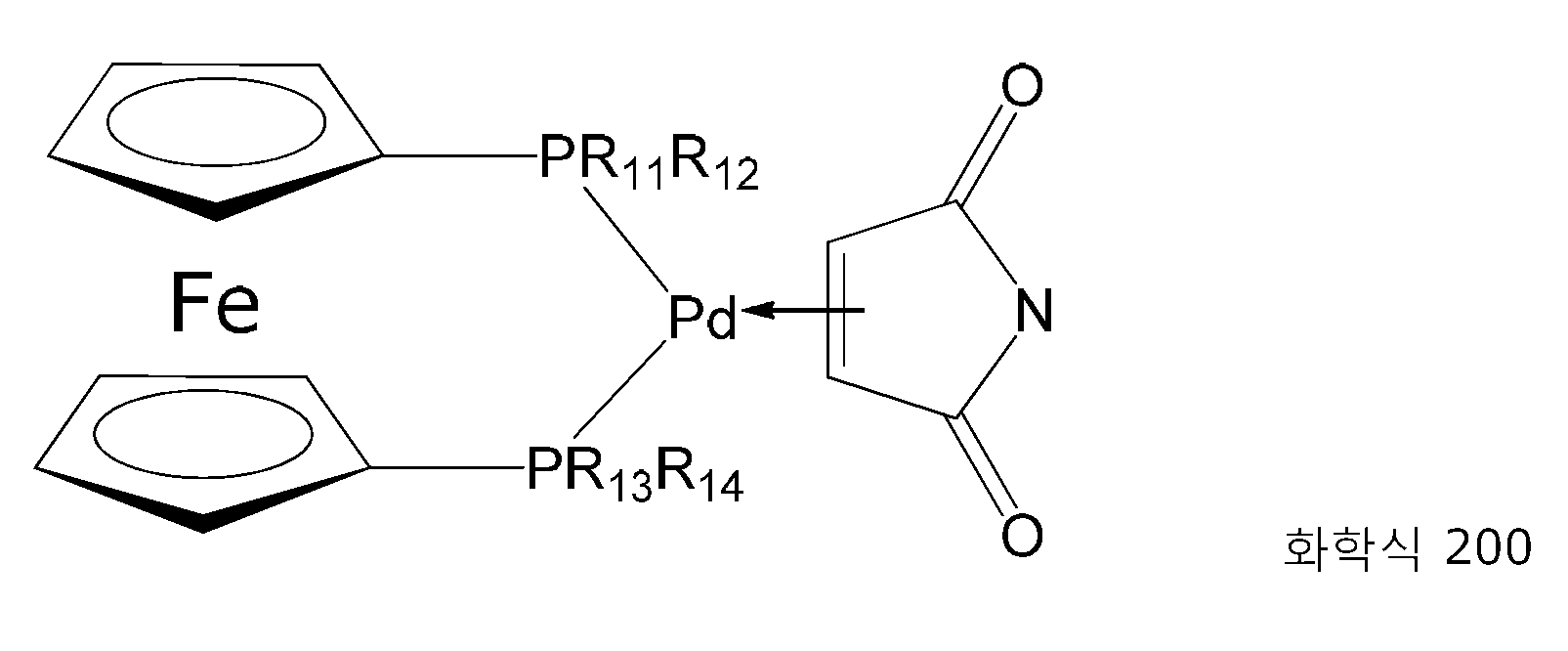
화학식 200에서의 라디칼 R11 내지 R14는 동일하거나 상이할 수 있고, 상기 기재된 바와 같이, 특히 1 내지 5개의 탄소 원자를 갖는 알킬 라디칼이다. R11 내지 R14가 이소프로필 라디칼인 경우, 화학식 200은 1,1'-비스(디이소프로필포스피노)페로센팔라듐(0)-말레이미드 [Pd(dippf)(말레이미드)]를 나타낸다.The radicals R11 to R14 in formula 200 may be the same or different and are, as described above, in particular alkyl radicals having 1 to 5 carbon atoms. When R11 to R14 are isopropyl radicals, the formula 200 represents 1,1'-bis(diisopropylphosphino)ferrocenepalladium(0)-maleimide [Pd(dippf)(maleimide)].
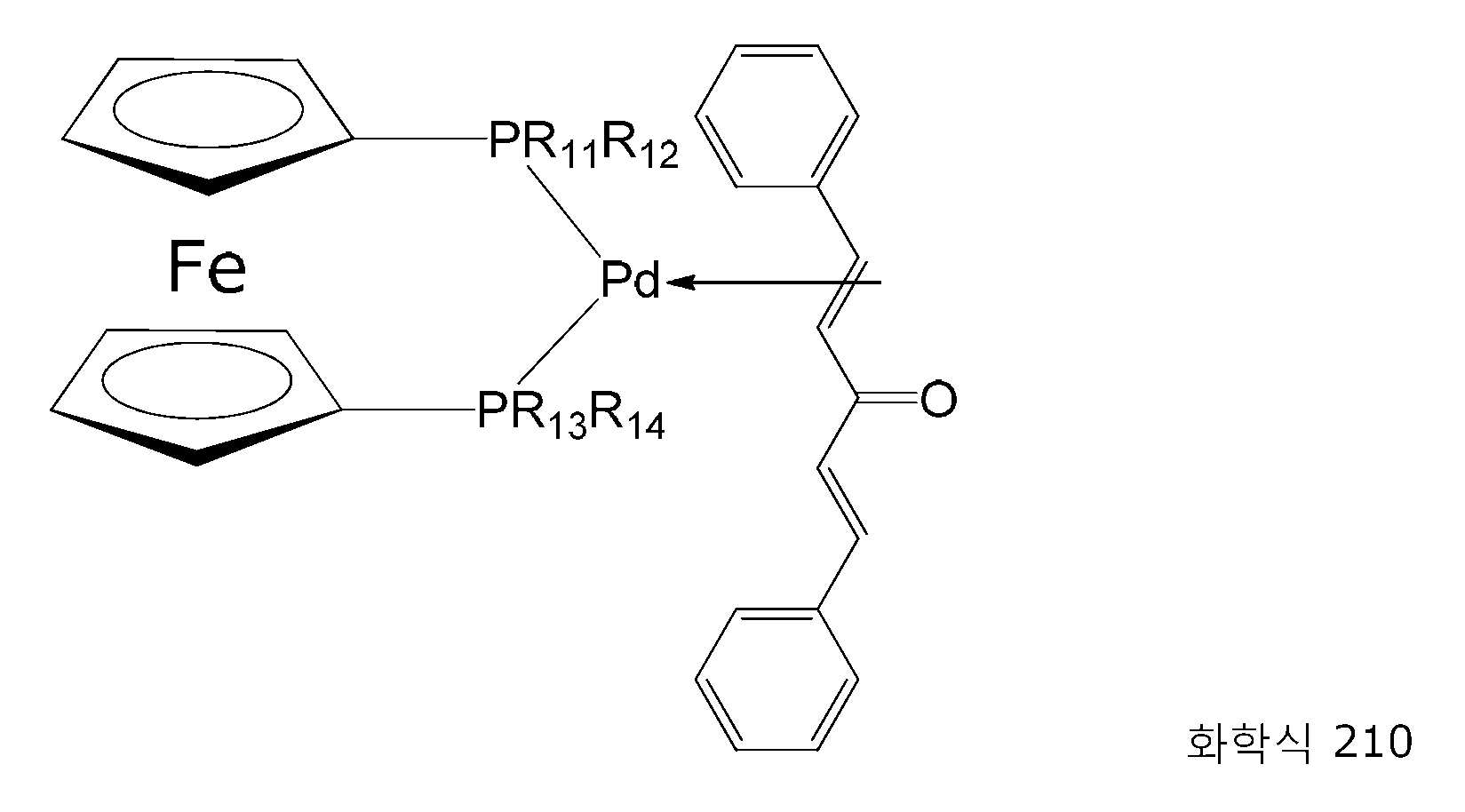
화학식 210에서의 라디칼 R11 내지 R14는 동일하거나 상이할 수 있고, 상기 기재된 바와 같이, 특히 1 내지 5개의 탄소 원자를 갖는 알킬 라디칼이다. R11 내지 R14가 이소프로필 라디칼인 경우, 화학식 210은 1,1'-비스(디이소프로필포스피노)페로센팔라듐(0)-비스(디벤질리덴아세톤)[Pd(dippf)(dba]를 나타낸다.The radicals R11 to R14 in formula 210 may be the same or different and are, as described above, in particular alkyl radicals having 1 to 5 carbon atoms. When R11 to R14 are isopropyl radicals, the formula 210 represents 1,1'-bis(diisopropylphosphino)ferrocenepalladium(0)-bis(dibenzylideneacetone)[Pd(dippf)(dba]).
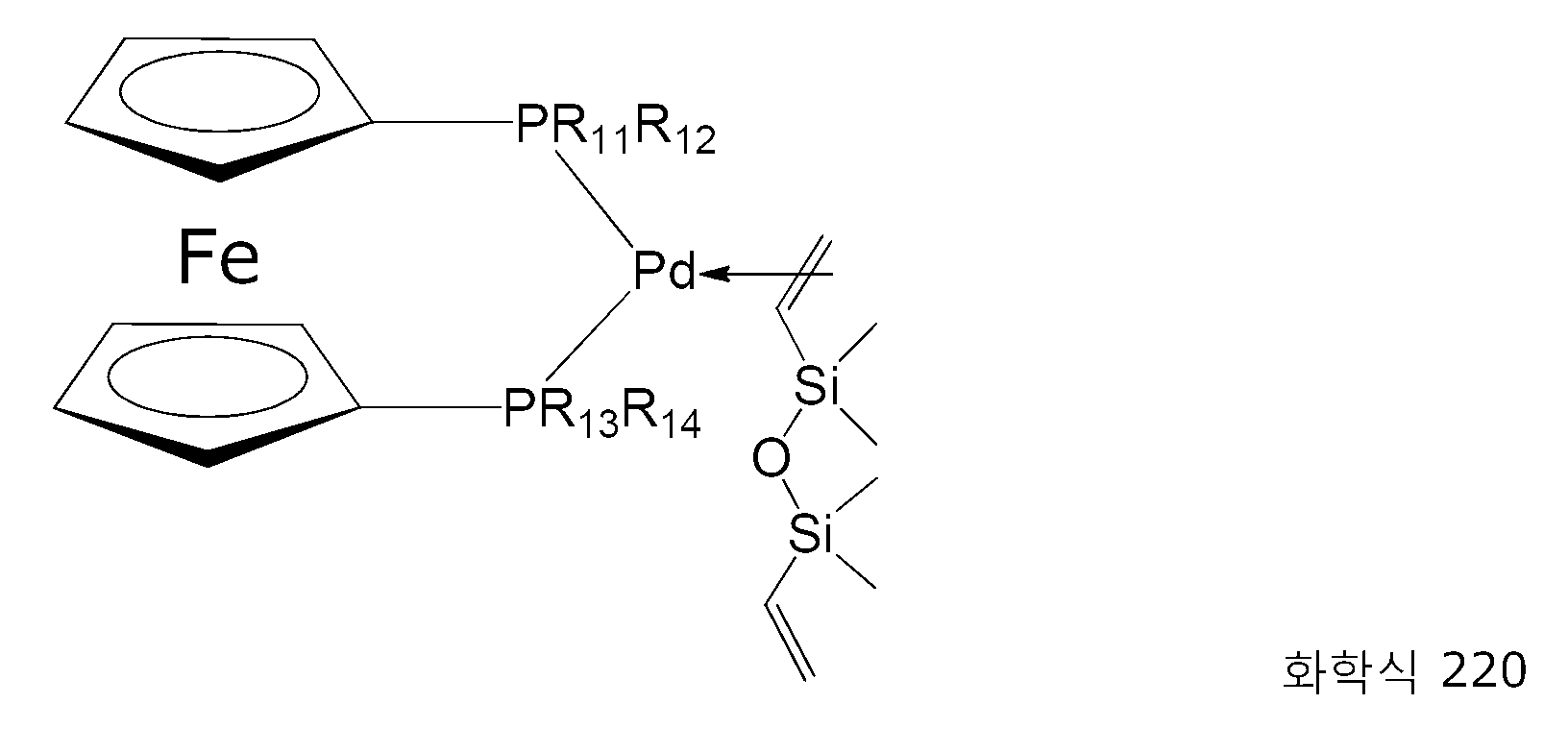
화학식 220에서의 라디칼 R11 내지 R14가 동일하거나 상이할 수 있고, 상기 기재된 바와 같이, 특히 1 내지 5개의 탄소 원자를 갖는 알킬 라디칼이다. R11 내지 R14가 이소프로필 라디칼인 경우, 화학식 220은 1,1'-비스(디이소프로필포스피노)페로센팔라듐(0)-1,3-디비닐-1,1,3,3-테트라메틸디실록산 [Pd(dippf)(VTS)]를 나타낸다.The radicals R11 to R14 in formula 220 may be the same or different and are, as described above, in particular alkyl radicals having from 1 to 5 carbon atoms. When R11 to R14 are isopropyl radicals, the formula 220 is 1,1'-bis(diisopropylphosphino)ferrocenepalladium(0)-1,3-divinyl-1,1,3,3-tetramethyldi siloxane [Pd(dippf)(VTS)].

화학식 230에서의 라디칼 R11 내지 R14가 동일하거나 상이할 수 있고, 상기 기재된 바와 같이, 특히 1 내지 5개의 탄소 원자를 갖는 알킬 라디칼이다. R11 내지 R14가 이소프로필 라디칼인 경우, 화학식 230은 1,1'-비스(디이소프로필포스피노)페로센팔라듐(0)-노르보르넨 [Pd(dippf)(노르보르넨)]를 나타낸다.The radicals R11 to R14 in formula 230 may be the same or different and are, as described above, in particular alkyl radicals having 1 to 5 carbon atoms. When R11 to R14 are isopropyl radicals, the formula 230 represents 1,1'-bis(diisopropylphosphino)ferrocenepalladium(0)-norbornene [Pd(dippf)(norbornene)].
이들 고체의 팔라듐 착물은 마찬가지로 상기에 기재된 바와 같이 촉매로서 사용될 수 있고, 이 경우 이들은 반응물 및 염기에 고체 또는 용액으로서 초기에 주입되거나 부가된다.These solid palladium complexes can likewise be used as catalysts as described above, in which case they are initially injected or added to the reactants and base as solids or solutions.
하나의 유리한 구현예에서, 고체 팔라듐 착물 이외, 상응하는 리간드, 환원하면 고상의 팔라듐 착물에서 사용되는 비스(디알킬포스피노페로센) 리간드가 또한 부가된다. In one advantageous embodiment, besides the solid palladium complexes, also the corresponding ligands, the bis(dialkylphosphinoferrocene) ligands used in the solid-phase palladium complexes, are added.
본원에서 1:10 내지 10:1, 또는 1:5 내지 5:1, 더 특별하게는 2.5:1 내지 1:2.5, 예컨대, 예를 들면, 2:1의 범위로 고상의 팔라듐 착물 대 비스(디알킬포스피노페로센) 리간드의 비로의 부가가 바람직한 것으로 나타난다. 상기 비는 고상의 팔라듐 착물 및 비스(디알킬포스피노페로센) 리간드의 몰량에 기초한다. 이것은 예를 들면 0.2 몰%의 고체 착물을 사용하는 경우, 0.1 몰%의 비스(디알킬포스피노페로센) 리간드를 부가하는 것을 의미한다. 대안적으로, 고체 팔라듐 착물은 고체 상태의 추가의 비스(디알킬포스피노페로센) 리간드와 혼합되어 분말 혼합물을 수득할 수 있다. 상기 분말 혼합물은 저장시 안정적이라 작업하기에 용이하다.Herein 1:10 to 10:1, or 1:5 to 5:1, more particularly 2.5:1 to 1:2.5, such as, for example, 2:1 solid phase palladium complex to bis( The addition of a dialkylphosphinoferrocene) ligand in a ratio appears to be preferred. The ratio is based on the molar amount of the solid palladium complex and the bis(dialkylphosphinoferrocene) ligand. This means adding 0.1 mol% of a bis(dialkylphosphinoferrocene) ligand, for example when 0.2 mol% of a solid complex is used. Alternatively, the solid palladium complex can be mixed with additional bis(dialkylphosphinoferrocene) ligands in the solid state to obtain a powder mixture. The powder mixture is stable when stored and is therefore easy to work with.
실시예Example
실시예Example 1: 촉매 용액의 제조 1: Preparation of catalyst solution
1,1'-비스(디이소프로필포스피노)페로센(dippf)(213 mg, 0.50 mmol)을 디에틸 에테르(5 mL)에 용해시키고, 2,4,6,8-테트라메틸사이클로테트라실록산 중의 1,3-디비닐-1,1,3,3-테트라메틸디실록산팔라듐(0)(Pd-VTS) (0.50 mL, 0.50 mmol Pd)을 적하하였다. 황색 혼합물을 실온에서 1시간 동안 교반하였다.1,1′-bis(diisopropylphosphino)ferrocene (dippf) (213 mg, 0.50 mmol) was dissolved in diethyl ether (5 mL) and dissolved in 2,4,6,8-tetramethylcyclotetrasiloxane 1,3-divinyl-1,1,3,3-tetramethyldisiloxane palladium (0) (Pd-VTS) (0.50 mL, 0.50 mmol Pd) was added dropwise. The yellow mixture was stirred at room temperature for 1 h.
실시예Example 2: 고체 촉매 [Pd( 2: solid catalyst [Pd( dippfdippf )()( 말레이미드maleimide )]의 제조)] production
초기의 과정은 실시예 1에서와 같다. 디에틸 에테르(5 mL) 중의 말레이미드(99.1 mg, 1.00 mmol)를 부가하고, 혼합물을 10분 동안 초음파 배쓰에서 처리하였고, 그 결과 황색 침전물이 형성되었다. 고체가 침전된 이후, 상청액 용액을 제거하고, 잔류물을 디에틸 에테르(3 × 5 mL)로 세정하였다. 감압(10-2 mbar) 하에서 건조하여 황색 고체로서 분리된 원하는 팔라듐 착물을 수득하였다(291 mg, 0.47 mmol, 94%). The initial procedure is the same as in Example 1. Maleimide (99.1 mg, 1.00 mmol) in diethyl ether (5 mL) was added and the mixture was treated in an ultrasonic bath for 10 min, resulting in the formation of a yellow precipitate. After solids precipitated, the supernatant solution was removed and the residue was washed with diethyl ether (3 x 5 mL). Drying under reduced pressure (10 -2 mbar) gave the desired palladium complex isolated as a yellow solid (291 mg, 0.47 mmol, 94%).
분석 데이타:Analytical data:
1H NMR (400 MHz, 디옥산-d 8 ): δ= 7.84 (s, 1 H, N-H), 4.44 - 4.39 (m, 6 H, 페로센-H), 4.37 - 4.33 (m, 2 H, 페로센-H), 2.53 - 2.40 (m, 2 H), 2.35 - 2.20 (m, 2 H), 1.34 (d, J=7.0 Hz, 3 H), 1.30 (d, J=7.0 Hz, 3 H), 1.26 (d, J=7.3 Hz, 3 H), 1.22 (d, J=7.3 Hz, 6 H), 1.18 (d, J=7.3 Hz, 3 H), 1.13 (d, J=7.3 Hz, 3 H), 1.09 ppm (d, J=7.3 Hz, 3 H). 1 H NMR (400 MHz, dioxane- d 8 ): δ= 7.84 (s, 1 H, NH), 4.44 - 4.39 (m, 6 H, ferrocene-H), 4.37 - 4.33 (m, 2 H, ferrocene -H), 2.53 - 2.40 (m, 2 H), 2.35 - 2.20 (m, 2 H), 1.34 (d, J=7.0 Hz, 3 H), 1.30 (d, J=7.0 Hz, 3 H), 1.26 (d, J =7.3 Hz, 3 H), 1.22 (d, J=7.3 Hz, 6 H), 1.18 (d, J=7.3 Hz, 3 H), 1.13 (d, J=7.3 Hz, 3 H) ), 1.09 ppm (d, J=7.3 Hz, 3 H).
31P NMR (162 MHz, 디옥산-d 8 ): δ=: 38.87 ppm (s, 2 P). 31 P NMR (162 MHz, dioxane- d 8 ): δ=: 38.87 ppm (s, 2 P).
실시예Example 3: 생산 규모에서의 합성 3: Synthesis at production scale
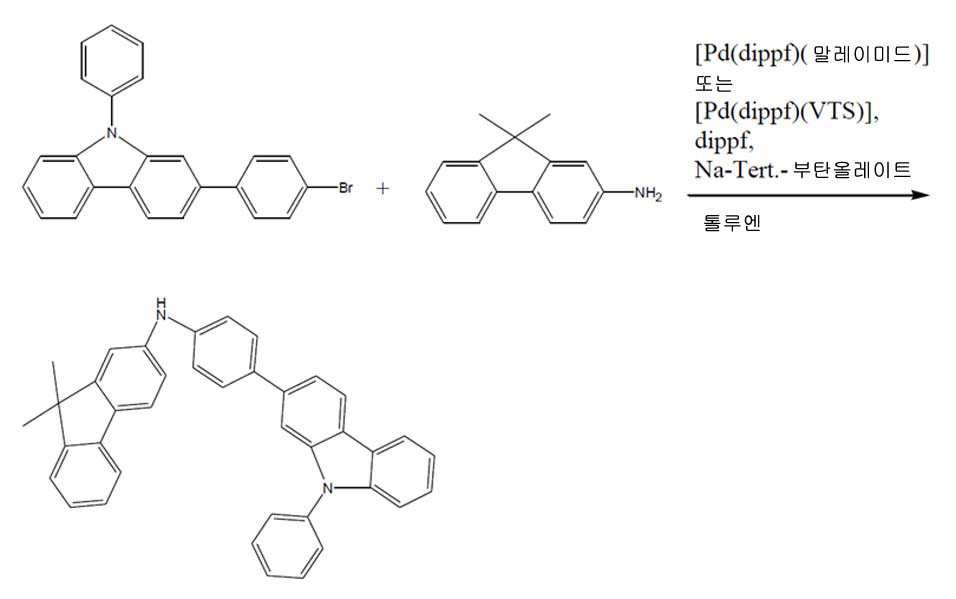
도식 1Scheme 1
실시예Example 3a: 팔라듐 3a: palladium 착물로서as a complex [Pd( [Pd( dippfdippf )()( 말레이미드maleimide )])] 의 용도use of
환류 콘덴서, 가스 유입구, 과압 밸브 및 자석 교반 막대를 가진 건조 3-목 플라스크에 아릴 브로마이드 132(7.97 g, 20.0 mmol), 아민 131(4.17 g, 20.0 mmol), 1,1'-비스(디이소프로필포스피노)페로센(8.5 mg, 0.02 mmol) 및 나트륨 tert-부탄올레이트(2.35 g, 24.0 mmol)를 충전하였고, 다중 배출 및 가스 유입에 의해 질소 분위기 하에 두었다. 톨루엔(30 mL) 및 톨루엔(10 mL) 중의 [Pd(dippf)(말레이미드)](24.9 mg, 0.04 mmol, 실시예 2)를 부가하고, 혼합물을 70℃에서 20 시간 동안 가열하였다. 반응을 박층 크로마토그래피로 모니터링하였고, 이 시점에서 완전 전환에 도달된 것을 발견하였다. 냉각하여 실온이 되게 한 후, 물 (60 mL)을 부가하고, 반응 혼합물을 디클로로메탄(150 mL)으로 추출하였다. 유기상을 분리하고, 황산마그네슘(5 g)을 건조시키고, 염기성 산화알루미늄(10 g)을 통해 여과시켰다. 용매를 감압(40℃, 10 mbar) 하에 제거하고, 약간 황색의 잔류물을 디에틸 에테르(3 × 20 mL)로 세정하였다. 감압(2h, 10-2 mbar) 하에서 건조하여 무색 고체로서 생성물을 수득하였다(10.2 g, 19.4 mmol, 97%).Aryl bromide 132 (7.97 g, 20.0 mmol), amine 131 (4.17 g, 20.0 mmol), 1,1'-bis(diiso) in a dry 3-neck flask with reflux condenser, gas inlet, overpressure valve and magnetic stir bar Propylphosphino)ferrocene (8.5 mg, 0.02 mmol) and sodium tert-butanolate (2.35 g, 24.0 mmol) were charged and placed under a nitrogen atmosphere by multiple evacuation and gas inlet. Toluene (30 mL) and [Pd(dippf)(maleimide)] (24.9 mg, 0.04 mmol, Example 2) in toluene (10 mL) were added and the mixture was heated at 70° C. for 20 h. The reaction was monitored by thin layer chromatography, at which point it was found that complete conversion was reached. After cooling to room temperature, water (60 mL) was added and the reaction mixture was extracted with dichloromethane (150 mL). The organic phase was separated, dried magnesium sulfate (5 g) and filtered through basic aluminum oxide (10 g). The solvent was removed under reduced pressure (40° C., 10 mbar) and the slightly yellow residue was washed with diethyl ether (3×20 mL). Drying under reduced pressure (2h, 10 -2 mbar) gave the product as a colorless solid (10.2 g, 19.4 mmol, 97%).
1H NMR (400 MHz, 클로로포름-d): δ= 8.41 (d, J=1.3 Hz, 1 H), 8.26 (d, J=7.8 Hz, 1 H), 7.75 - 7.60 (m, 9 H), 7.55 - 7.44 (m, 5 H), 7.41 - 7.21 (m, 6 H), 7.13 (d, J=7.0 Hz, 1 H), 5.91 (s, 1 H), 1.55 ppm (s, 6 H). 1 H NMR (400 MHz, chloroform- d ): δ = 8.41 (d, J =1.3 Hz, 1 H), 8.26 (d, J =7.8 Hz, 1 H), 7.75 - 7.60 (m, 9 H), 7.55 - 7.44 (m, 5 H), 7.41 - 7.21 (m, 6 H), 7.13 (d, J =7.0 Hz, 1 H), 5.91 (s, 1 H), 1.55 ppm (s, 6 H).
13C NMR (101 MHz, 클로로포름-d): δ= 155.3, 153.1, 142.6, 142.0, 141.3, 140.0, 139.3, 137.7, 134.6, 133.2, 132.5, 129.9 (2 C), 128.1, 127.4 (2 C), 127.0 (2 C), 126.9, 126.0 (2 C), 125.0, 123.9, 123.5 (2 C), 122.4, 120.8, 120.3, 120.0, 119.9, 119.1, 118.1, 116.8, 112.2, 110.0, 109.9, 46.8, 27.2 ppm (2 C). 13 C NMR (101 MHz, chloroform- d ): δ = 155.3, 153.1, 142.6, 142.0, 141.3, 140.0, 139.3, 137.7, 134.6, 133.2, 132.5, 129.9 (2 C), 128.1, 127.4 (2 C), 127.0 (2 C), 126.9, 126.0 (2 C), 125.0, 123.9, 123.5 (2 C), 122.4, 120.8, 120.3, 120.0, 119.9, 119.1, 118.1, 116.8, 112.2, 110.0, 109.9, 46.8, 27.2 ppm (2C).
원소 분석: C39H30N2: C 88.94, H 5.74, N 5.32; 실측치; C 88.64, H 5.91, N 5.22에 대하여 계산됨Elemental analysis: C 39 H 30 N 2 : C 88.94, H 5.74, N 5.32; actual value; Calculated for C 88.64, H 5.91, N 5.22
실시예Example 3b: 팔라듐 3b: palladium 착물로서as a complex [Pd( [Pd( dippfdippf )(VTS)])(VTS)] 의 용도use of
본 반응을 위해, 1,1'-비스(디이소프로필포스피노)페로센(213.8 mg, 0.50 mmol), 톨루엔(0.5 mL) 및 2,4,6,8-테트라메틸사이클로테트라실록산 중의 1,3-디비닐-1,1,3,3-테트라메틸디실록산팔라듐(0)(Pd-VTS)의 혼합물(0.5 mL, 10.87% 팔라듐)로부터 실시예 1에서의 기재와 유사하게 제조된 촉매 모액을 사용하였다. 혼합물을 실온에서 한 시간 동안 교반하였다.For this reaction, 1,1'-bis(diisopropylphosphino)ferrocene (213.8 mg, 0.50 mmol), 1,3 in toluene (0.5 mL) and 2,4,6,8-tetramethylcyclotetrasiloxane -Divinyl-1,1,3,3-tetramethyldisiloxane palladium (0) (Pd-VTS) from a mixture (0.5 mL, 10.87% palladium) of a catalyst mother liquor prepared similarly to the description in Example 1 was used. The mixture was stirred at room temperature for one hour.
환류 콘덴서, 가스 유입구, 과압 밸브 및 자석 교반 막대를 가진 건조 3-목 플라스크에 아릴 브로마이드 132(7.97 g, 20.0 mmol), 아민 131(4.17 g, 20.0 mmol) 및 나트륨 tert-부탄올레이트(2.35 g, 24.0 mmol)를 충전하였고, 다중 배출 및 가스 유입에 의해 질소 분위기 하에 두었다. 톨루엔(40 mL) 및 촉매 모액(100 μL, 91.8 mg, 0.04 mmol의 팔라듐)을 부가하였고, 혼합물을 70℃에서 20 시간 동안 가열하였다. 반응을 박층 크로마토그래피로 모니터링하였고, 이 시점에서 완전 전환에 도달된 것을 발견하였다. 냉각하여 실온이 되게 한 후, 물(60 mL)을 부가하고, 반응 혼합물을 디클로로메탄(150 mL)으로 추출하였다. 유기상을 분리하고, 황산마그네슘(5 g)을 건조시키고, 염기성 산화알루미늄(10 g)을 통해 여과시켰다. 용매를 감압(40℃, 10 mbar) 하에 제거하고, 약간 황색의 잔류물을 에테르(3 × 20 mL)로 세정하였다. 감압(2h, 10-2 mbar) 하에서 건조하여 무색 고형물을 수득하였다(9.71 g, 18.4 mmol, 92%).Aryl bromide 132 (7.97 g, 20.0 mmol), amine 131 (4.17 g, 20.0 mmol) and sodium tert -butanolate (2.35 g, 24.0 mmol) and placed under nitrogen atmosphere by multiple evacuation and gas inlet. Toluene (40 mL) and catalyst mother liquor (100 μL, 91.8 mg, 0.04 mmol of palladium) were added and the mixture was heated at 70° C. for 20 h. The reaction was monitored by thin layer chromatography, at which point it was found that complete conversion was reached. After cooling to room temperature, water (60 mL) was added, and the reaction mixture was extracted with dichloromethane (150 mL). The organic phase was separated, dried magnesium sulfate (5 g) and filtered through basic aluminum oxide (10 g). The solvent was removed under reduced pressure (40° C., 10 mbar) and the slightly yellow residue was washed with ether (3×20 mL). Drying under reduced pressure (2h, 10 -2 mbar) gave a colorless solid (9.71 g, 18.4 mmol, 92%).
반응식은 도식 1에 나타나 있다. 아릴 브로마이드 132에 의한 1차 아민 131의 다중 아릴화는 실시예 중 임의의 것에서 관측되지 않았다.The reaction scheme is shown in Scheme 1. Multiple arylation of primary amine 131 with aryl bromide 132 was not observed in any of the examples.
실시예 4a 내지 4i: Examples 4a to 4i :
일반적인 프로토콜:General protocol:
테플론-코팅된 부틸 고무 셉타를 특징으로 하는 주름잡힌 알루미늄 캡으로 밀봉된 기체 크로마토그래피용 20 mL 헤드스페이스 바이알에서 모든 실험을 수행하였다(둘 모두를 예를 들면 VWR로부터 이용가능함). 용기의 가열을 위해, 8cm 높이의 실린더형 알루미늄 블록을 사용하였고, 이는 실험실 자석 교반기(예를 들면 Heidolph Mr 2002)의 핫플레이트에 대한 그것의 직경과 정확하게 상응한다. 이들 알루미늄 블록은 7cm 깊이 및 반응 용기와 동일한 직경을 가진 10개의 구멍, 및 온도 센서를 수용하기 위한 구멍을 가진다.All experiments were performed in 20 mL headspace vials for gas chromatography sealed with a pleated aluminum cap featuring a Teflon-coated butyl rubber septa (both available for example from VWR ). For the heating of the vessel, an 8 cm high cylindrical aluminum block was used, which corresponds precisely to its diameter for the hotplate of a laboratory magnetic stirrer (eg Heidolph Mr 2002). These aluminum blocks had 10 holes 7 cm deep and the same diameter as the reaction vessel, and a hole to accommodate the temperature sensor.
슈링크 라인(Schlenk line)에 연결된 진공 분배기는 동시 배출을 위해 그리고 별도로 10개의 용기를 충전하도록 제작되었다. 이러한 목적을 위해, 10개의 진공-적합성 3mm 테플론 튜브를 하나의 단부에서 어댑터로 연결하여 Luer-Lock 주사기 바늘을 수용하였고, 다른 단부에서 강철 튜브에 연결되었고, 이는 진공 호스를 통해 슈링크 라인과 연결될 수 있다.A vacuum distributor connected to a Schlenk line was made for simultaneous evacuation and for filling 10 containers separately. For this purpose, ten vacuum-compatible 3 mm Teflon tubes were connected at one end with an adapter to accommodate a Luer-Lock syringe needle, and at the other end connected to a steel tube, which would be connected to a shrink line via a vacuum hose. can
실험의 실행을 위해, 아릴 브로마이드(1.00 mmol), 상응하는 1차 아민(1.00 mmol) 및 나트륨 tert-부탄올레이트(118 mg, 1.20 mmol)을 반응 용기로 공기 중에서 칭량주입하였고, 20 mm 자석 교반 코어를 부가하였고, 크림핑 통(crimping tongs)을 사용하여 용기를 셉타 캡으로 공기밀봉하였다. 10개의 반응 용기를 별도로 알루미늄 블록에의 구멍에 도입하였고, 셉타 캡을 통해 삽입되는 중공 바늘을 통해 진공 분배기에 연결하였다.For the run of the experiment, aryl bromide (1.00 mmol), the corresponding primary amine (1.00 mmol) and sodium tert -butanolate (118 mg, 1.20 mmol) were weighed into the reaction vessel in air, and a 20 mm magnetic stirring core was added and the container was air sealed with a septa cap using crimping tongs. Ten reaction vessels were separately introduced into holes in an aluminum block and connected to a vacuum distributor via a hollow needle inserted through a septa cap.
반응 용기를 차후에 진공처리하였고, 연속하여 질소 가스로 3회 충전하였다. 반응 용기에 이러한 방식으로 불활성 가스 분위기가 주어지는 경우, 외부 공기로의 압력 보충은 과압 밸브를 통해 진공 라인에서 생성되었다. 주사기를 사용하여, 톨루엔(2 mL) 중의 [Pd(dippf)(말레이미드)](1.24 mg, 0.002 mmol) 및 dippf(0.85 mg, 0.002 mmol)의 모액을 셉타 캡을 통해 주입하였다. 알루미늄 블록은 이후 70℃가 되게 하였고, 진공 분배기의 바늘을 제거하였다.The reaction vessel was subsequently evacuated and successively filled with nitrogen gas three times. When the reaction vessel was given an inert gas atmosphere in this way, a pressure supplement with outside air was created in the vacuum line via an overpressure valve. Using a syringe, stock solutions of [Pd(dippf)(maleimide)](1.24 mg, 0.002 mmol) and dippf (0.85 mg, 0.002 mmol) in toluene (2 mL) were injected through the septa cap. The aluminum block was then brought to 70° C. and the needle of the vacuum distributor was removed.
20시간의 반응 시간 이후, 용기를 냉각시키고 신중하게 개방하여, 반응 매체를 디클로로메탄(30 mL) 및 물(30 mL)로 희석시켰다. 수성상을 1N 염산을 사용하여 pH 7로 조절하였고, 유기상으로부터 분리하였고, 디클로로메탄(2 × 20 mL)로 추출하였다. 조합된 유기상들은 황산마그네슘으로 건조시키고, 여과시키고, 박층 크로마토그래피로 최종 분석하였다.After a reaction time of 20 hours, the vessel was cooled and carefully opened, and the reaction medium was diluted with dichloromethane (30 mL) and water (30 mL). The aqueous phase was adjusted to pH 7 with 1N hydrochloric acid, separated from the organic phase and extracted with dichloromethane (2×20 mL). The combined organic phases were dried over magnesium sulfate, filtered and finally analyzed by thin layer chromatography.
용매를 감압(40℃, 500 mbar) 하에 제거하였고, 잔류된 미정제 생성물을 컬럼 크로마토그래피에 의해 정제하였다(염기성 Al2O3, 디에틸 에테르:헥산 또는 에틸 아세테이트:헥산).The solvent was removed under reduced pressure (40° C., 500 mbar), and the crude product remaining was purified by column chromatography (basic Al 2 O 3 , diethyl ether:hexane or ethyl acetate:hexane).
실시예Example 4a: 화합물 4a: compound 3a3a 의 합성:Synthesis of:
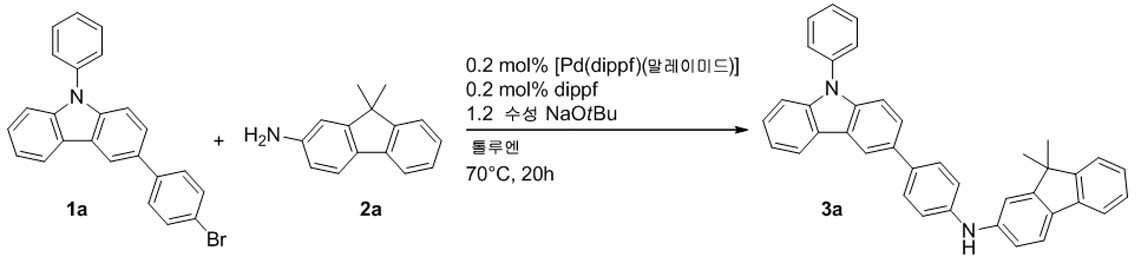
일반 프로토콜에 따라, 화합물 3a를 1a(398 mg, 1.00 mmol) 및 2a(209 mg, 1.00 mmol)로부터 시작하여 제조하였고, 94% 수율로 칼럼 크로마토그래피(Al2O3, 디에틸 에테르:헥산 = 1:1)에 의해 분리하였다(496 mg, 0.94 mmol). 1H NMR(400 MHz, 클로로포름-d): δ= 8.41 (d, J=1.3 Hz, 1 H), 8.26 (d, J=7.8 Hz, 1 H), 7.75 - 7.60 (m, 9 H), 7.55 - 7.44 (m, 5 H), 7.41 - 7.21 (m, 6 H), 7.13 (d, J=7.0 Hz, 1 H), 5.91 (s, 1 H), 1.55 ppm (s, 6 H). 13C NMR(101 MHz, 클로로포름-d): δ= 155.3, 153.1, 142.6, 142.0, 141.3, 140.0, 139.3, 137.7, 134.6, 133.2, 132.5, 129.9 (2 C), 128.1, 127.4 (2 C), 127.0 (2 C), 126.9, 126.0 (2 C), 125.0, 123.9, 123.5 (2 C), 122.4, 120.8, 120.3, 120.0, 119.9, 119.1, 118.1, 116.8, 112.2, 110.0, 109.9, 46.8, 27.2 ppm (2 C). CHN: C39H30N2에 대해 계산됨: C 88.94, H 5.74, N 5.32; 실측치; C 88.79, H 5.86, N 5.19.According to the general protocol, compound 3a was prepared starting from 1a (398 mg, 1.00 mmol) and 2a (209 mg, 1.00 mmol), and column chromatography (Al 2 O 3 , diethyl ether:hexane = 1:1) (496 mg, 0.94 mmol). 1 H NMR (400 MHz, chloroform- d ): δ = 8.41 (d, J =1.3 Hz, 1 H), 8.26 (d, J =7.8 Hz, 1 H), 7.75 - 7.60 (m, 9 H), 7.55 - 7.44 (m, 5 H), 7.41 - 7.21 (m, 6 H), 7.13 (d, J =7.0 Hz, 1 H), 5.91 (s, 1 H), 1.55 ppm (s, 6 H). 13 C NMR (101 MHz, chloroform- d ): δ = 155.3, 153.1, 142.6, 142.0, 141.3, 140.0, 139.3, 137.7, 134.6, 133.2, 132.5, 129.9 (2 C), 128.1, 127.4 (2 C), 127.0 (2 C), 126.9, 126.0 (2 C), 125.0, 123.9, 123.5 (2 C), 122.4, 120.8, 120.3, 120.0, 119.9, 119.1, 118.1, 116.8, 112.2, 110.0, 109.9, 46.8, 27.2 ppm (2C). CHN: calculated for C 39 H 30 N 2 : C 88.94, H 5.74, N 5.32; actual value; C 88.79, H 5.86, N 5.19.
실시예Example 4b: 화합물 4b: compound 3b3b 의 합성:Synthesis of:
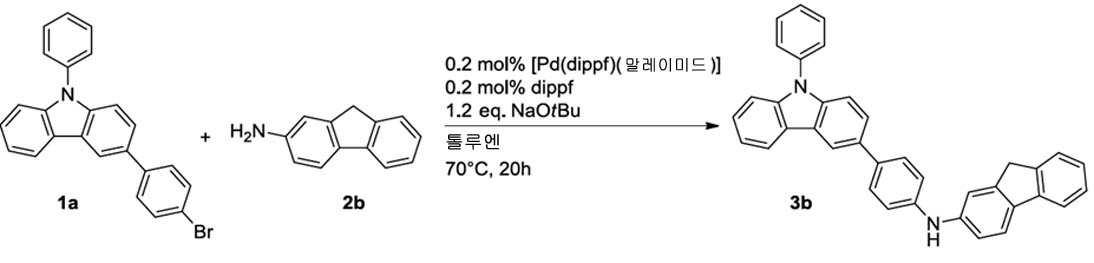
일반 프로토콜에 따라, 화합물 3b를 1a(398 mg, 1.00 mmol) 및 2b(181 mg, 1.00 mmol)로부터 시작하여 제조하였고, 92% 수율로 칼럼 크로마토그래피(Al2O3, 디에틸 에테르:헥산 = 1:1)에 의해 분리하였다(460 mg, 0.92 mmol). 1H NMR (400 MHz, DMSO-d 6 ): δ = 8.54 (d, J=1.5 Hz, 1H), 8.44 (s, 1H), 8.35 (d, J=7.8 Hz, 1H), 7.77-7.63 (m, 9H), 7.55 (m, 1H), 7.51 (d, J=7.5 Hz, 1H), 7.47 -7.36 (m, 4H), 7.31 (m, 2H), 7.26 (d, J=8.8 Hz, 2H), 7.20 (dt, J=7.5 Hz, 1.3 Hz, 1H), 7.15 (dd, J=8.3 Hz, 2.0 Hz, 1H), 3.87 ppm (s, 2H). 13C NMR(101 MHz, DMSO-d 6 ): δ = 144.6, 142.7, 142.3, 142.2, 141.5, 140.5, 139.1, 136.9, 133.3, 132.6, 132.2, 130.2 (2C), 127.6, 127.5 (2C), 126.7, 126.6 (2C), 126.4, 125.3, 124.9, 124.7, 123.4, 123.0, 120.8, 120.7, 120.1, 118.8, 117.6, 117.4 (2C), 117.3, 115.9, 113.1, 110.0, 109.7 ppm. CHN: C37H26N2에 대해 계산됨: C 89.13, H 5.26, N 5.62; 실측치; C 88.83, H 5.25, N 5.54.According to the general protocol, compound 3b was prepared starting from 1a (398 mg, 1.00 mmol) and 2b (181 mg, 1.00 mmol), and column chromatography (Al 2 O 3 , diethyl ether:hexane = 1:1) (460 mg, 0.92 mmol). 1 H NMR (400 MHz, DMSO- d 6 ): δ = 8.54 (d, J =1.5 Hz, 1H), 8.44 (s, 1H), 8.35 (d, J =7.8 Hz, 1H), 7.77-7.63 (m, 9H), 7.55 (m, 1H), 7.51 ( d, J =7.5 Hz, 1H), 7.47 -7.36 (m, 4H), 7.31 (m, 2H), 7.26 (d, J =8.8 Hz, 2H), 7.20 (dt, J =7.5 Hz, 1.3 Hz, 1H), 7.15 (dd, J =8.3 Hz, 2.0 Hz, 1H), 3.87 ppm (s, 2H). 13 C NMR (101 MHz, DMSO- d 6 ): δ = 144.6, 142.7, 142.3, 142.2, 141.5, 140.5, 139.1, 136.9, 133.3, 132.6, 132.2, 130.2 (2C), 127.6, 127.5 (2C), 126.7, 126.6 (2C), 126.4, 125.3, 124.9, 124.7, 123.4, 123.0, 120.8, 120.7, 120.1, 118.8, 117.6, 117.4 (2C), 117.3, 115.9, 113.1, 110.0, 109.7 ppm. CHN: calculated for C 37 H 26 N 2 : C 89.13, H 5.26, N 5.62; actual value; C 88.83, H 5.25, N 5.54.
실시예Example 4c: 화합물 4c: compound 3c3c 의 합성:Synthesis of:
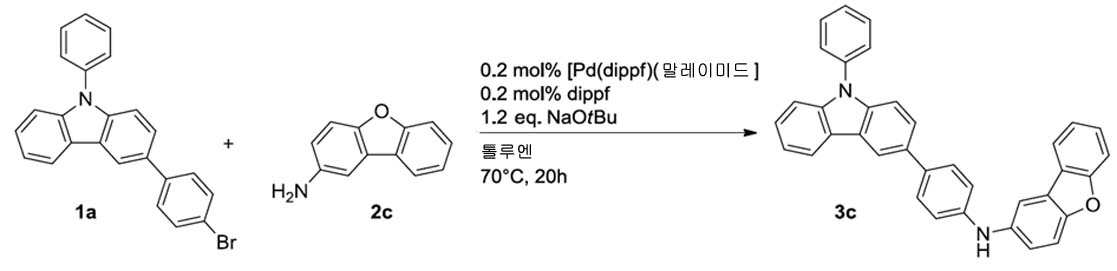
일반 프로토콜에 따라, 화합물 3c를 1a(398 mg, 1.00 mmol) 및 2c(183 mg, 1.00 mmol)로부터 시작하여 제조하였고, 88% 수율로 칼럼 크로마토그래피(Al2O3, 디에틸 에테르:헥산 = 1:1)에 의해 분리하였다(442 mg, 0.88 mmol). 1H NMR(400 MHz, DMSO-d 6 ): δ = 8.72 (s, 1H), 8.55 (d, J=1.5 Hz, 1H), 8.35 (d, J=7.8 Hz, 1H), 7.99-7.93 (m, 2H), 7.77-7.62 (m, 7H), 7.60 (d, J=8.0 Hz, 1H), 7.54 (m, 1H), 7.47-7.27 (m, 9H), 7.16 ppm (dd, J=8.5 Hz, 1.8 Hz, 1H). 13C NMR(101 MHz, DMSO-d 6 ): δ = 157.1, 155.3, 144.0, 141.6, 140.5, 139.2, 136.9, 133.0, 132.5, 130.2 (2C), 127.6, 127.5 (2C), 126.6 (2C), 126.4, 125.6, 124.7, 124.2, 123.4, 123.0 (2C), 121.6, 120.8, 120.1, 119.7, 118.0 (2C), 117.7, 115.5, 113.1, 111.2, 110.0, 109.7, 97.9 ppm. CHN: C36H24N2O에 대해 계산됨: C 86.38, H 4.83, N 5.60; 실측치; C 86.02, H 5.04, N 5.43.According to the general protocol, compound 3c was prepared starting from 1a (398 mg, 1.00 mmol) and 2c (183 mg, 1.00 mmol), and column chromatography (Al 2 O 3 , diethyl ether:hexane = 1:1) (442 mg, 0.88 mmol). 1 H NMR (400 MHz, DMSO- d 6 ): δ = 8.72 (s, 1H), 8.55 (d, J =1.5 Hz, 1H), 8.35 (d, J =7.8 Hz, 1H), 7.99-7.93 (m, 2H), 7.77-7.62 (m, 7H), 7.60 (d, J =8.0 Hz, 1H), 7.54 (m, 1H), 7.47-7.27 (m, 9H), 7.16 ppm (dd, J =8.5 Hz, 1.8 Hz, 1H). 13 C NMR (101 MHz, DMSO- d 6 ): δ = 157.1, 155.3, 144.0, 141.6, 140.5, 139.2, 136.9, 133.0, 132.5, 130.2 (2C), 127.6, 127.5 (2C), 126.6 (2C), 126.4, 125.6, 124.7, 124.2, 123.4, 123.0 (2C) , 121.6, 120.8, 120.1, 119.7, 118.0 (2C), 117.7, 115.5, 113.1, 111.2, 110.0, 109.7, 97.9 ppm. CHN: calculated for C 36 H 24 N 2 O: C 86.38, H 4.83, N 5.60; actual value; C 86.02, H 5.04, N 5.43.
실시예Example 4c: 화합물 4c: compound 3d3d 의 합성:Synthesis of:

일반 프로토콜에 따라, 화합물 3d를 1a(398 mg, 1.00 mmol) 및 2d(199 mg, 1.00 mmol)로부터 시작하여 제조하였고, 96% 수율로 칼럼 크로마토그래피(Al2O3, 디에틸 에테르:헥산 = 1:1)에 의해 분리하였다(460 mg, 0.96 mmol). 1H NMR(400 MHz, DMSO-d 6 ): δ = 8.54 (d, J=1.5 Hz, 1H), 8.51 (s, 1H), 8.35 (d, J=7.5 Hz, 1H), 8.25 (m, 1H), 8.07 (d, J=2.0 Hz, 1H), 7.99 (m, 1H), 7.89 (d, J=8.5 Hz, 1H), 7.75-7.63 (m, 7H), 7.55 (m, 1H), 7.48 (m, 2H), 7.45-7.37 (3H), 7.36-7.27 ppm (m, 4H). 13C NMR(101 MHz, DMSO-d 6 ): δ = 142.7, 141.0, 140.5, 139.5, 139.1, 136.9, 136.0, 134.9, 132.6, 132.1, 130.2 (2C), 129.7, 127.6, 127.5 (2C), 126.9, 126.6 (2C), 126.4, 124.7, 124.5, 123.6, 123.4, 123.1, 123.0, 121.9, 120.8, 120.1, 119.0, 117.6, 116.8 (2C), 110.0, 109.7, 109.2 ppm. CHN: C36H24N2S에 대해 계산됨: C 83.69, H 4.68, N 5.42, S 6.21; 실측치: C 83.40, H 4.76, N 5.35, S 6.31.According to the general protocol, compound 3d was prepared starting from 1a (398 mg, 1.00 mmol) and 2d (199 mg, 1.00 mmol), and column chromatography (Al 2 O 3 , diethyl ether:hexane = 1:1) (460 mg, 0.96 mmol). 1 H NMR (400 MHz, DMSO- d 6 ): δ = 8.54 (d, J =1.5 Hz, 1H), 8.51 (s, 1H), 8.35 (d, J =7.5 Hz, 1H), 8.25 (m, 1H), 8.07 (d, J =2.0 Hz, 1H) , 7.99 (m, 1H), 7.89 (d, J =8.5 Hz, 1H), 7.75-7.63 (m, 7H), 7.55 (m, 1H), 7.48 (m, 2H), 7.45-7.37 (3H), 7.36-7.27 ppm (m, 4H). 13 C NMR (101 MHz, DMSO- d 6 ): δ = 142.7, 141.0, 140.5, 139.5, 139.1, 136.9, 136.0, 134.9, 132.6, 132.1, 130.2 (2C), 129.7, 127.6, 127.5 (2C), 126.9, 126.6 (2C), 126.4, 124.7, 124.5, 123.6, 123.4, 123.1, 123.0, 121.9, 120.8, 120.1, 119.0, 117.6, 116.8 (2C), 110.0, 109.7, 109.2 ppm. CHN: calculated for C 36 H 24 N 2 S: C 83.69, H 4.68, N 5.42, S 6.21; Found: C 83.40, H 4.76, N 5.35, S 6.31.
실시예Example 4d: 화합물 4d: compound 3e3e 의 합성synthesis of
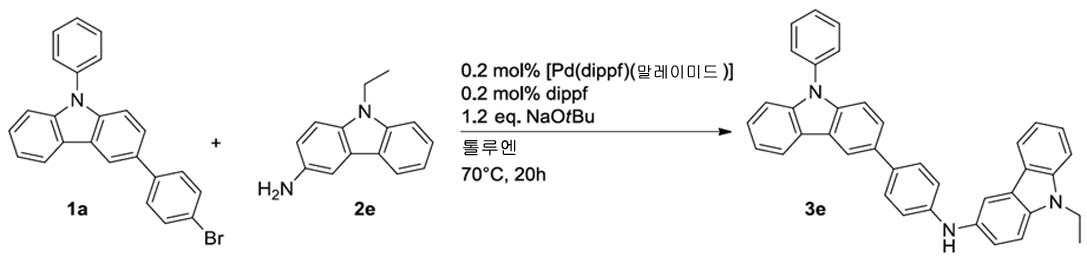
일반 프로토콜에 따라, 화합물 3e를 1a(398 mg, 1.00 mmol) 및 2e(221 mg, 1.00 mmol)로부터 시작하여 제조하였고, 95% 수율로 칼럼 크로마토그래피(Al2O3, 디에틸 에테르:헥산 = 1:2)에 의해 분리하였다(502 mg, 0.95 mmol). 1H NMR(400 MHz, DMSO-d 6 ): δ = 8.50 (d, J=1.5 Hz, 1H), 8.33 (d, J=7.8 Hz, 1H), 8.14 (s, 1H), 8.11 (d, J=7.5 Hz, 1H), 7.96 (d, J=2.0 Hz, 1H), 7.72 -7.61 (m, 7H), 7.58-7.51 (m, 3H), 7.46-7.37 (m, 4H), 7.35 -7.27 (m, 2H), 7.17-7.11 (m, 3H), 4.41 (q, J=7.0 Hz, 2H), 1.31 ppm (t, J=7.0 Hz, 3H). 13C NMR(101 MHz, DMSO-d 6 ): δ = 144.6, 142.7, 142.3, 142.2, 141.5, 140.5, 139.1, 136.9, 133.3, 132.6, 132.2, 130.2 (2C), 127.6, 127.5 (2C), 126.7, 126.6 (2C), 126.4, 125.3, 124.9, 124.7, 123.4, 123.0, 120.8, 120.7, 120.1, 118.8, 117.6, 117.4 (2C), 117.3, 115.9, 113.1, 110.0, 109.7, 36.5 ppm. CHN: C38H29N3에 대해 계산됨: C 86.50, H 5.54, N 7.96; 실측치; C 86.32, H 5.63, N 7.90.According to the general protocol, compound 3e was prepared starting from 1a (398 mg, 1.00 mmol) and 2e (221 mg, 1.00 mmol), and column chromatography (Al 2 O 3 , diethyl ether:hexane = 1:2) (502 mg, 0.95 mmol). 1 H NMR (400 MHz, DMSO- d 6 ): δ = 8.50 (d, J =1.5 Hz, 1H), 8.33 (d, J =7.8 Hz, 1H), 8.14 (s, 1H), 8.11 (d, J =7.5 Hz, 1H), 7.96 (d, J = 2.0 Hz, 1H), 7.72 -7.61 (m, 7H), 7.58-7.51 (m, 3H), 7.46-7.37 (m, 4H), 7.35 -7.27 (m, 2H), 7.17-7.11 (m, 3H) , 4.41 (q, J =7.0 Hz, 2H), 1.31 ppm (t, J =7.0 Hz, 3H). 13 C NMR (101 MHz, DMSO- d 6 ): δ = 144.6, 142.7, 142.3, 142.2, 141.5, 140.5, 139.1, 136.9, 133.3, 132.6, 132.2, 130.2 (2C), 127.6, 127.5 (2C), 126.7, 126.6 (2C), 126.4, 125.3, 124.9, 124.7, 123.4, 123.0, 120.8, 120.7, 120.1, 118.8, 117.6, 117.4 (2C), 117.3, 115.9, 113.1, 110.0, 109.7, 36.5 ppm. CHN: calculated for C 38 H 29 N 3 : C 86.50, H 5.54, N 7.96; actual value; C 86.32, H 5.63, N 7.90.
실시예Example 4e: 화합물 4e: compound 3f3f 의 합성synthesis of

일반 프로토콜에 따라, 화합물 3f를 1a(398 mg, 1.00 mmol) 및 2f(188 mg, 1.00 mmol)로부터 시작하여 제조하였고, 84% 수율로 칼럼 크로마토그래피(Al2O3, 디에틸 에테르:헥산 = 1:2)에 의해 분리하였다(423 mg, 0.84 mmol). 1H NMR (400 MHz, DMSO-d 6 ): δ = 8.49 (d, J=1.5 Hz, 1H), 8.33 (d, J=7.8 Hz, 1H), 7.72-7.61 (m, 7H), 7.53 (m, 1H), 7.46-7.37 (m, 4H), 7.36 (s, 1H), 7.34-7.26 (m, 3H), 7.19 (m, 2H), 7.10 (d, J=8.5 Hz, 2H), 6.99 (dd, J=8.7 Hz, 0.9 Hz, 2H), 6.94 (m, 2H), 6.76 ppm (m, 1H). 13C NMR (101 MHz, DMSO-d 6 ): δ = 144.5, 143.4, 140.5, 139.0, 136.9, 134.6 (2C), 132.7, 131.6, 130.2 (2C), 129.0 (2C), 127.6, 127.3 (2C), 126.6 (2C), 126.3, 124.6, 123.4, 123.0, 122.1, 122.0, 120.8, 120.1, 119.9 (2C), 119.0, 117.5, 116.7 (2C), 116.2 (2C), 109.9, 109.6 ppm. CHN: C36H27N3에 대해 계산됨: C 86.20, H 5.43, N 8.38; 실측치; C 85.82, H 5.62, N 8.22.According to the general protocol, compound 3f was prepared starting from 1a (398 mg, 1.00 mmol) and 2f (188 mg, 1.00 mmol), and column chromatography (Al 2 O 3 , diethyl ether:hexane = 1:2) (423 mg, 0.84 mmol). 1 H NMR (400 MHz, DMSO- d 6 ): δ = 8.49 (d, J =1.5 Hz, 1H), 8.33 (d, J =7.8 Hz, 1H), 7.72-7.61 (m, 7H), 7.53 (m, 1H), 7.46-7.37 (m, 4H), 7.36 (s, 1H), 7.34-7.26 (m, 3H), 7.19 (m, 2H), 7.10 (d, J =8.5 Hz, 2H), 6.99 (dd, J =8.7 Hz, 0.9 Hz, 2H), 6.94 (m, 2H), 6.76 ppm (m, 1H). 13 C NMR (101 MHz, DMSO- d 6 ): δ = 144.5, 143.4, 140.5, 139.0, 136.9, 134.6 (2C), 132.7, 131.6, 130.2 (2C), 129.0 (2C), 127.6, 127.3 (2C), 126.6 (2C), 126.3, 124.6, 123.4, 123.0, 122.1, 122.0, 120.8, 120.1, 119.9 (2C), 119.0, 117.5, 116.7 (2C), 116.2 (2C), 109.9, 109.6 ppm. CHN: calculated for C 36 H 27 N 3 : C 86.20, H 5.43, N 8.38; actual value; C 85.82, H 5.62, N 8.22.
실시예Example 4f: 화합물 4f: compound 3g3g 의 합성:Synthesis of:

일반 프로토콜에 따라, 화합물 3g를 1a(398 mg, 1.00 mmol) 및 2g(169 mg, 1.00 mmol)로부터 시작하여 제조하였고, 95% 수율로 칼럼 크로마토그래피(Al2O3, 디에틸 에테르:헥산 = 1:1)에 의해 분리하였다(462 mg, 0.95 mmol). 1H NMR(400 MHz, DMSO-d 6 ): δ = 8.53 (d, J=1.3 Hz, 1H), 8.47 (s, 1H), 8.35 (d, J=7.5 Hz, 1H), 7.74-7.53 (m, 12H), 7.47-7.38 (m, 5H), 7.34-7.19 ppm (m, 6H). 13C NMR(101 MHz, DMSO-d 6 ): δ = 143.0, 142.9, 141.9, 140.5, 140.1, 139.1, 136.9, 132.6, 132.5, 131.2, 130.2 (2C), 128.9 (2C), 127.6, 127.5 (2C), 127.4 (2C), 126.6 (2C), 126.4 (2C), 125.8 (2C), 124.7, 123.4, 123.0, 120.8, 120.1, 117.7, 117.5 (2C), 116.8, 110.0, 109.7 ppm. CHN: C36H26N2에 대해 계산됨: C 88.86, H 5.39, N 5.76; 실측치; C 88.49, H 5.39, N 5.68.According to the general protocol, compound 3g was prepared starting from 1a (398 mg, 1.00 mmol) and 2g (169 mg, 1.00 mmol), and column chromatography (Al 2 O 3 , diethyl ether:hexane = 1:1) (462 mg, 0.95 mmol). 1 H NMR (400 MHz, DMSO- d 6 ): δ = 8.53 (d, J =1.3 Hz, 1H), 8.47 (s, 1H), 8.35 (d, J =7.5 Hz, 1H), 7.74-7.53 (m, 12H), 7.47-7.38 (m, 5H), 7.34-7.19 ppm (m, 6H). 13 C NMR (101 MHz, DMSO- d 6 ): δ = 143.0, 142.9, 141.9, 140.5, 140.1, 139.1, 136.9, 132.6, 132.5, 131.2, 130.2 (2C), 128.9 (2C), 127.6, 127.5 (2C), 127.4 (2C), 126.6 (2C), 126.4 ( 2C), 125.8 (2C), 124.7, 123.4, 123.0, 120.8, 120.1, 117.7, 117.5 (2C), 116.8, 110.0, 109.7 ppm. CHN: calculated for C 36 H 26 N 2 : C 88.86, H 5.39, N 5.76; actual value; C 88.49, H 5.39, N 5.68.
실시예Example 4g: 화합물 4g: compound 3i3i 의 합성:Synthesis of:

일반 프로토콜에 따라, 화합물 3i를 1b(259 mg, 1.00 mmol) 및 2a(209 mg, 1.00 mmol)로부터 시작하여 제조하였고, 89% 수율로 칼럼 크로마토그래피(Al2O3, 디에틸 에테르:헥산 = 1:2)에 의해 분리하였다(323 mg, 0.89 mmol). 1H NMR(400 MHz, 클로로포름-d): δ = 7.72-7.63 (m, 4H), 7.59 (m, 2H), 7.51-7.44 (m, 3H), 7.37 (m, 2H), 7.32 (t, J=7.0 Hz, 1H), 7.25 (br. s, 1H), 7.22 (d, J=8.3 Hz, 2H), 7.13 (br. d, J=7.5 Hz, 1H), 5.92 (br. s, 1H), 1.54 ppm (s, 6H). 13C NMR (101 MHz, 클로로포름-d): δ = 155.3, 153.1, 142.7, 142.1, 140.8, 139.2, 133.5, 132.8, 128.7 (2C), 128.0 (2C), 126.9, 126.6, 126.5 (2C), 126.1, 122.4, 120.8, 119.1, 117.6 (2C), 117.2, 112.6, 46.8, 27.2 ppm (2C). CHN: C27H23N에 대해 계산됨: C 89.71, H 6.41, N 3.87; 실측치; C 89.69, H 6.27, N 3.84.According to the general protocol, compound 3i was prepared starting from 1b (259 mg, 1.00 mmol) and 2a (209 mg, 1.00 mmol), and column chromatography (Al 2 O 3 , diethyl ether:hexane = 1:2) (323 mg, 0.89 mmol). 1 H NMR (400 MHz, chloroform- d ): δ = 7.72-7.63 (m, 4H), 7.59 (m, 2H), 7.51-7.44 (m, 3H), 7.37 (m, 2H), 7.32 (t, J =7.0 Hz, 1H), 7.25 (br. s) , 1H), 7.22 (d, J =8.3 Hz, 2H), 7.13 (br. d, J =7.5 Hz, 1H), 5.92 (br. s, 1H), 1.54 ppm (s, 6H). 13 C NMR (101 MHz, chloroform- d ): δ = 155.3, 153.1, 142.7, 142.1, 140.8, 139.2, 133.5, 132.8, 128.7 (2C), 128.0 (2C), 126.9, 126.6, 126.5 (2C), 126.1, 122.4, 120.8, 119.1, 117.6 (2C), 117.2 , 112.6, 46.8, 27.2 ppm (2C). CHN: calculated for C 27 H 23 N: C 89.71, H 6.41, N 3.87; actual value; C 89.69, H 6.27, N 3.84.
실시예Example 4h: 화합물 4h: compound 3j3j 의 합성:Synthesis of:

일반 프로토콜에 따라, 화합물 3j를 1c(268 mg, 1.00 mmol) 및 2a(209 mg, 1.00 mmol)로부터 시작하여 제조하였고, 87% 수율로 칼럼 크로마토그래피(Al2O3, 디에틸 에테르:헥산 = 1:2)에 의해 분리하였다(335 mg, 0.87 mmol). 1H NMR(400 MHz, DMSO-d 6 ): δ = 8.86 (m, 1H), 8.72 (m, 1H), 8.42 (s, 1H), 8.37 (dd, J=8.2 Hz, 1.1 Hz, 1H), 7.77-7.65 (m, 5H), 7.63 (s, 1H), 7.51 (m, 2H), 7.45 (d, J=7.5 Hz, 1H), 7.32 (d, J=2.0 Hz, 1H), 7.27 (dt, J=7.5 Hz, 1.1 Hz, 1H), 7.20 (dt, J=7.3 Hz, 1.0 Hz, 1H), 7.13 (dd, J=8.3 Hz, 2.0 Hz, 1H), 1.40 ppm (s, 6H). 13C NMR(101 MHz, DMSO-d 6 ): δ = 154.7, 152.7, 144.6, 139.0, 137.8, 132.5, 131.0, 130.8, 127.5, 127.1, 127.1, 127.0, 126.9, 126.6, 126.4, 125.8, 124.5, 123.3, 123.3, 122.6, 122.5, 120.9, 118.9, 116.8, 112.4, 111.7, 46.3, 27.1 ppm (2C). CHN: C29H23N에 대해 계산됨: C 90.35, H 6.01, N 3.63; 실측치; C 89.98, H 6.31, N 3.49.According to the general protocol, compound 3j was prepared starting from 1c (268 mg, 1.00 mmol) and 2a (209 mg, 1.00 mmol), and column chromatography in 87% yield (Al 2 O 3 , diethyl ether:hexane = 1:2) (335 mg, 0.87 mmol). 1 H NMR (400 MHz, DMSO- d 6 ): δ = 8.86 (m, 1H), 8.72 (m, 1H), 8.42 (s, 1H), 8.37 (dd, J =8.2 Hz, 1.1 Hz, 1H), 7.77-7.65 (m, 5H), 7.63 (s, 1H), 7.51 (m, 2H), 7.45 (d, J =7.5 Hz, 1H), 7.32 (d, J =2.0 Hz, 1H), 7.27 (dt, J =7.5 Hz, 1.1 Hz, 1H), 7.20 (dt, J =7.3 Hz, 1.0 Hz, 1H), 7.13 (dd, J =8.3 Hz, 2.0 Hz, 1H), 1.40 ppm (s, 6H). 13 C NMR (101 MHz, DMSO- d 6 ): δ = 154.7, 152.7, 144.6, 139.0, 137.8, 132.5, 131.0, 130.8, 127.5, 127.1, 127.1, 127.0, 126.9, 126.6, 126.4, 125.8, 124.5, 123.3, 123.3, 122.6, 122.5, 120.9, 118.9, 116.8, 112.4 , 111.7, 46.3, 27.1 ppm (2C). CHN: calculated for C 29 H 23 N: C 90.35, H 6.01, N 3.63; actual value; C 89.98, H 6.31, N 3.49.
실시예Example 4i: 화합물 4i: compound 3k3k 의 합성synthesis of

일반 프로토콜에 따라, 화합물 3k를 1d(269 mg, 1.00 mmol) 및 2a(209 mg, 1.00 mmol)로부터 시작하여 제조하였고, 76% 수율로 칼럼 크로마토그래피(Al2O3, 디에틸 에테르:헥산 = 2:1)에 의해 분리하였다(296 mg, 0.76 mmol). 1H NMR (400 MHz, DMSO-d 6 ): δ = 9.08 (s, 1H), 7.80-7.45 (m, 10H), 7.41-7.35 (m, 1H), 7.33-7.13 (m, 5H), 1.43 ppm (s, 6H). 13C NMR(101 MHz, DMSO-d 6 ): δ = 193.6, 154.8, 152.9, 148.7, 140.6, 138.5 (2C), 132.9, 132.4 (2C), 131.5, 129.0 (2C), 128.3 (2C), 127.0, 126.7, 126.4, 122.6, 120.9, 119.3, 118.6, 114.1, 113.9 (2C), 46.4, 26.9 ppm (2C). CHN: C28H23NO에 대해 계산됨: C 86.34, H 5.95, N 3.60; 실측치; C 86.05, H 6.10, N 3.52.According to the general protocol, compound 3k was prepared starting from 1d (269 mg, 1.00 mmol) and 2a (209 mg, 1.00 mmol), and column chromatography (Al 2 O 3 , diethyl ether:hexane = 2:1) (296 mg, 0.76 mmol). 1 H NMR (400 MHz, DMSO- d 6 ): δ = 9.08 (s, 1H), 7.80-7.45 (m, 10H), 7.41-7.35 (m, 1H), 7.33-7.13 (m, 5H), 1.43 ppm (s, 6H). 13 C NMR (101 MHz, DMSO- d 6 ): δ = 193.6, 154.8, 152.9, 148.7, 140.6, 138.5 (2C), 132.9, 132.4 (2C), 131.5, 129.0 (2C), 128.3 (2C), 127.0, 126.7, 126.4, 122.6, 120.9, 119.3, 118.6, 114.1 , 113.9 (2C), 46.4, 26.9 ppm (2C). CHN: calculated for C 28 H 23 NO: C 86.34, H 5.95, N 3.60; actual value; C 86.05, H 6.10, N 3.52.
Claims (16)

상기 식에서, D는 산소, 황, 질소 또는 탄소일 수 있고, 질소의 경우 단독으로 또는 탄소의 경우 이중적으로 메틸, 에틸, 바이페닐, 나프틸 또는 페닐로 치환될 수 있다.3. The method for selective arylation of primary aromatic amines according to claim 1 or 2, wherein the biphenyl unit is a bridged biphenyl unit of formula (2) or (3):
where D may be oxygen, sulfur, nitrogen or carbon, which may be substituted with methyl, ethyl, biphenyl, naphthyl or phenyl for nitrogen alone or double for carbon.
- 반응 용기에 1차 방향족 아민 A-NH2, 할로방향족 X-B, 적합한 용매 및 경우에 따라 비스(디알킬포스피노페로센)을 제공하는 단계;
- 팔라듐 원자가 하나 이상의 비스(디알킬포스피노페로센) 리간드에 의해 착화된 팔라듐 착물을 고형물 또는 용액의 형태로 부가하는 단계;
- 반응 용기에서 생성된 반응 혼합물을 가열하는 단계;
- 반응 생성물, 2차 방향족 아민 A-NH-B를 분리하는 단계; 및
- 경우에 따라 2차 방향족 아민 A-NH-B를 정제하는 단계를 포함하는 1차 방향족 아민의 선택적 아릴화 방법.3. The method of claim 1 or 2,
- providing the primary aromatic amine A-NH 2 , the haloaromatic XB, a suitable solvent and optionally bis(dialkylphosphinoferrocene) in a reaction vessel;
- adding a palladium complex in which the palladium atoms are complexed by at least one bis(dialkylphosphinoferrocene) ligand in the form of a solid or solution;
- heating the resulting reaction mixture in the reaction vessel;
- isolating the reaction product, secondary aromatic amines A-NH-B; and
- a process for the selective arylation of primary aromatic amines, optionally comprising the step of purifying secondary aromatic amines A-NH-B.
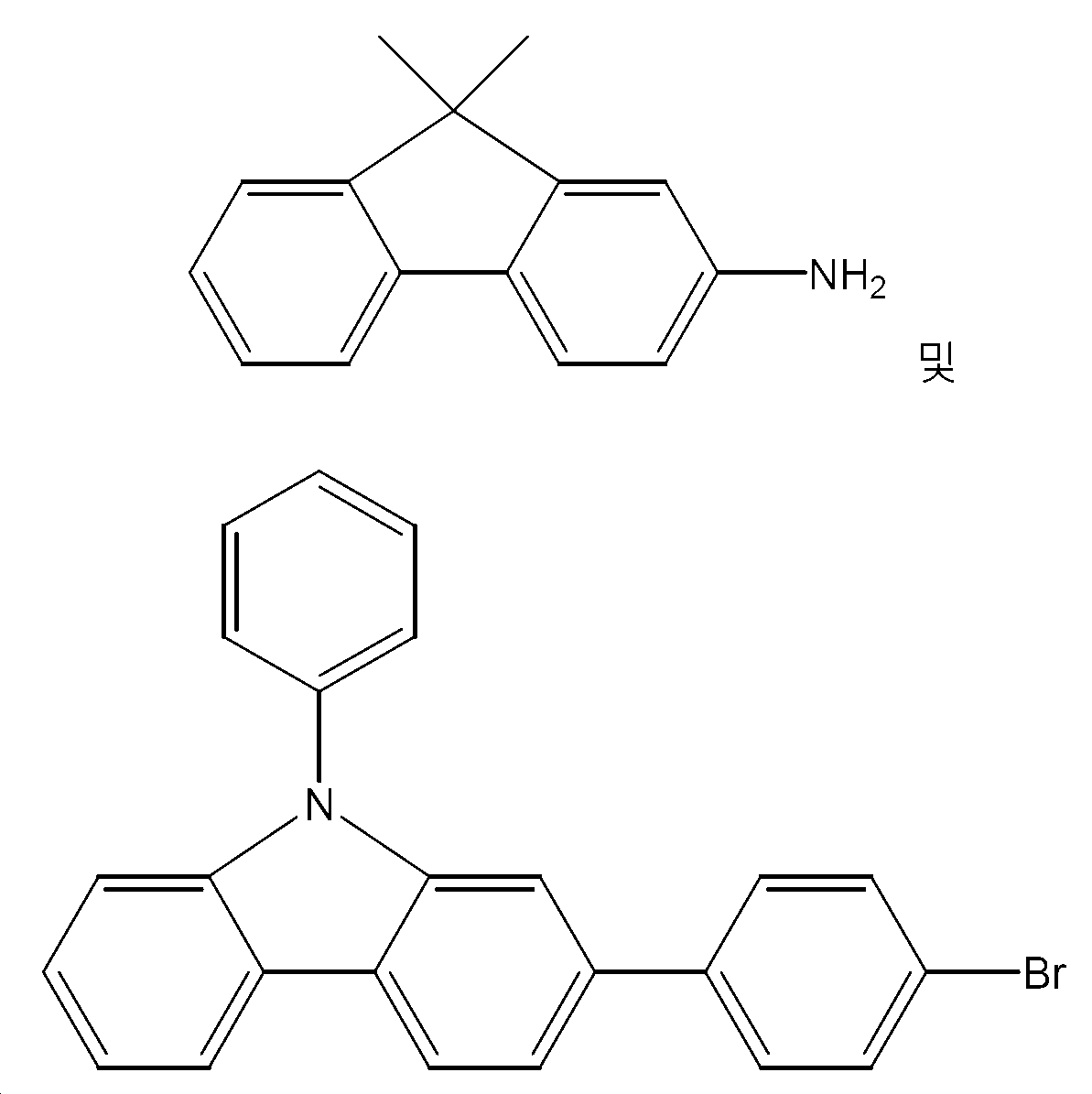
- 화학식 A-NH2의 1차 방향족 아민을 제공하는 단계;
- 화학식 X-B의 방향족 화합물을 제공하는 단계;
- 염기를 제공하는 단계;
- 1,1'-비스(디이소프로필포스피노)페로센 팔라듐(0)-말레이미드[Pd(dippf)(말레이미드)];
1,1'-비스(디이소프로필포스피노)페로센 팔라듐(0)-1,3-디비닐-1,1,3,3-테트라메틸디실록산 [Pd(dippf)(VTS)];
1,1'-비스(디이소프로필포스피노)페로센 팔라듐(0)-비스(디벤질리덴아세톤) [Pd(dippf)(dba)];
1,1'-비스(디이소프로필포스피노)페로센 팔라듐(0)-나프토퀴논 [Pd(dippf)(나프토퀴논)];
1,1'-비스(디이소프로필포스피노)페로센 팔라듐(0)-말레산 무수물 [Pd(dippf)(말레산 무수물)];
1,1'-비스(디이소프로필포스피노)페로센 팔라듐(0)-말레산 디에틸 에스테르 [Pd(dippf)(말레산 디에틸 에스테르)];
1,1'-비스(디이소프로필포스피노)페로센 팔라듐(0)-노르보르넨 [Pd(dippf)(노르보르넨) 및 이들의 혼합물로 이루어진 군으로부터 선택되는 팔라듐 착물을 제공하는 단계;
- 하트위그-부흐발트 커플링(Hartwig-Buchwald coupling)에서 2차 방향족 아민 A-NH-B로 1차 방향족 아민과 화학식 X-B의 방향족 화합물을 반응시키는 단계를 포함하며,
라디칼 A 및 B는 서로 독립적으로 동일하거나 상이한, 치환되거나 비치환된 방향족 라디칼이고,
X는 할로겐 또는 트리플루오로메틸 설폰산 잔기이고;
2차 방향족 아민에서, 방향족 탄소 원자는 질소 원자에 직접적으로 결합되고, 잔기 A 또는 B 중 하나 이상은 바이페닐 단위를 가지는, 1차 방향족 아민의 선택적 아릴화 방법.A process for the selective arylation of a primary aromatic amine using an aromatic compound of formula (XB) to obtain a secondary aromatic amine, comprising:
- providing a primary aromatic amine of the formula A-NH 2 ;
- providing an aromatic compound of formula (XB);
- providing a base;
- 1,1'-bis(diisopropylphosphino)ferrocene palladium(0)-maleimide [Pd(dippf)(maleimide)];
1,1′-bis(diisopropylphosphino)ferrocene palladium(0)-1,3-divinyl-1,1,3,3-tetramethyldisiloxane [Pd(dippf)(VTS)];
1,1'-bis(diisopropylphosphino)ferrocene palladium(0)-bis(dibenzylideneacetone) [Pd(dippf)(dba)];
1,1'-bis(diisopropylphosphino)ferrocene palladium(0)-naphthoquinone [Pd(dippf)(naphthoquinone)];
1,1'-bis(diisopropylphosphino)ferrocene palladium(0)-maleic anhydride [Pd(dippf)(maleic anhydride)];
1,1'-bis(diisopropylphosphino)ferrocene palladium(0)-maleic acid diethyl ester [Pd(dippf)(maleic acid diethyl ester)];
providing a palladium complex selected from the group consisting of 1,1'-bis(diisopropylphosphino)ferrocene palladium(0)-norbornene [Pd(dippf)(norbornene) and mixtures thereof;
- reacting a primary aromatic amine with an aromatic compound of formula XB with a secondary aromatic amine A-NH-B in a Hartwig-Buchwald coupling;
The radicals A and B are, independently of each other, identical or different, substituted or unsubstituted aromatic radicals,
X is a halogen or trifluoromethyl sulfonic acid residue;
A process for the selective arylation of primary aromatic amines, in secondary aromatic amines, wherein the aromatic carbon atom is bonded directly to the nitrogen atom and at least one of residues A or B has a biphenyl unit.
Priority Applications (1)
| Application Number | Priority Date | Filing Date | Title |
|---|---|---|---|
| KR1020217036316A KR102456277B1 (en) | 2013-10-21 | 2014-10-17 | Monoarylation of aromatic amines |
Applications Claiming Priority (7)
| Application Number | Priority Date | Filing Date | Title |
|---|---|---|---|
| DE102013017369.8 | 2013-10-21 | ||
| DE102013017369 | 2013-10-21 | ||
| EP14152698.8 | 2014-01-27 | ||
| EP14152698 | 2014-01-27 | ||
| EP14155079.8 | 2014-02-13 | ||
| EP14155079 | 2014-02-13 | ||
| PCT/EP2014/072332 WO2015059049A1 (en) | 2013-10-21 | 2014-10-17 | Monoarylation of aromatic amines |
Related Child Applications (1)
| Application Number | Title | Priority Date | Filing Date |
|---|---|---|---|
| KR1020217036316A Division KR102456277B1 (en) | 2013-10-21 | 2014-10-17 | Monoarylation of aromatic amines |
Publications (2)
| Publication Number | Publication Date |
|---|---|
| KR20160074488A KR20160074488A (en) | 2016-06-28 |
| KR102325919B1 true KR102325919B1 (en) | 2021-11-12 |
Family
ID=51743436
Family Applications (2)
| Application Number | Title | Priority Date | Filing Date |
|---|---|---|---|
| KR1020167009952A Active KR102325919B1 (en) | 2013-10-21 | 2014-10-17 | Monoarylation of aromatic amines |
| KR1020217036316A Active KR102456277B1 (en) | 2013-10-21 | 2014-10-17 | Monoarylation of aromatic amines |
Family Applications After (1)
| Application Number | Title | Priority Date | Filing Date |
|---|---|---|---|
| KR1020217036316A Active KR102456277B1 (en) | 2013-10-21 | 2014-10-17 | Monoarylation of aromatic amines |
Country Status (7)
| Country | Link |
|---|---|
| US (1) | US20160257650A1 (en) |
| EP (1) | EP3060548B1 (en) |
| JP (1) | JP6461942B2 (en) |
| KR (2) | KR102325919B1 (en) |
| CN (1) | CN105658627B (en) |
| TW (1) | TWI663145B (en) |
| WO (1) | WO2015059049A1 (en) |
Families Citing this family (2)
| Publication number | Priority date | Publication date | Assignee | Title |
|---|---|---|---|---|
| EP3176161A1 (en) * | 2015-12-02 | 2017-06-07 | Umicore AG & Co. KG | Buchwald-hartwig arylation method for the preparation of tertiary amines |
| CA3208282A1 (en) * | 2021-01-12 | 2022-07-21 | Uvic Industry Partnerships Inc. | Palladium complex and catalyst embodiments and methods of making and using the same |
Family Cites Families (12)
| Publication number | Priority date | Publication date | Assignee | Title |
|---|---|---|---|---|
| US5760100B1 (en) * | 1994-09-06 | 2000-11-14 | Ciba Vision Corp | Extended wear ophthalmic lens |
| EP1176389A1 (en) * | 2000-07-24 | 2002-01-30 | Leica Geosystems AG | Method and device for optical range or speed measurement |
| JP4467935B2 (en) * | 2002-10-03 | 2010-05-26 | キヤノン株式会社 | Method for producing halogenated aromatic amine compound |
| DE10334286B4 (en) * | 2003-07-25 | 2006-01-05 | Stockhausen Gmbh | Powdered, water-absorbing polymers with fine particles bound by means of thermoplastic adhesives, process for their preparation and chemical products and compounds containing them |
| ES2365258T3 (en) * | 2006-06-26 | 2011-09-27 | Ucb Pharma S.A. | TIAZOL DERIVATIVES CONDENSED AS QUINASA INHIBITORS. |
| WO2011125355A1 (en) * | 2010-04-01 | 2011-10-13 | 株式会社村田製作所 | Measuring method of characteristic of object to be measured, and sensing device used in same |
| KR101202350B1 (en) * | 2010-07-16 | 2012-11-16 | 삼성디스플레이 주식회사 | Dendrimer and organic light emitting device using the same |
| EP2421064B1 (en) * | 2010-08-18 | 2018-07-04 | Cheil Industries Inc. | Compound for organic optoelectronic device, organic light emmiting diode including the same and display including the light emmiting diode |
| KR101453768B1 (en) * | 2010-08-18 | 2014-10-21 | 제일모직주식회사 | Compound for organic photoelectric device and organic photoelectric device including the same |
| JP2012046464A (en) * | 2010-08-30 | 2012-03-08 | Sumitomo Chemical Co Ltd | Method for producing aromatic amine compound |
| WO2012147809A1 (en) * | 2011-04-27 | 2012-11-01 | 住友化学株式会社 | Method for modifying polymer compound and method for producing film containing modified polymer compound |
| JP6223984B2 (en) * | 2011-10-27 | 2017-11-01 | メルク パテント ゲーエムベーハー | Materials for electronic devices |
-
2014
- 2014-10-17 KR KR1020167009952A patent/KR102325919B1/en active Active
- 2014-10-17 CN CN201480057561.3A patent/CN105658627B/en not_active Expired - Fee Related
- 2014-10-17 JP JP2016524462A patent/JP6461942B2/en not_active Expired - Fee Related
- 2014-10-17 EP EP14786185.0A patent/EP3060548B1/en not_active Not-in-force
- 2014-10-17 US US15/030,639 patent/US20160257650A1/en not_active Abandoned
- 2014-10-17 KR KR1020217036316A patent/KR102456277B1/en active Active
- 2014-10-17 WO PCT/EP2014/072332 patent/WO2015059049A1/en not_active Ceased
- 2014-10-20 TW TW103136165A patent/TWI663145B/en not_active IP Right Cessation
Non-Patent Citations (1)
| Title |
|---|
| J. Am. Chem. Soc. 1998, vol. 120, pp. 7369-7370(1998.11.7. 공개)* |
Also Published As
| Publication number | Publication date |
|---|---|
| CN105658627A (en) | 2016-06-08 |
| TW201522282A (en) | 2015-06-16 |
| US20160257650A1 (en) | 2016-09-08 |
| KR20160074488A (en) | 2016-06-28 |
| EP3060548B1 (en) | 2018-10-10 |
| CN105658627B (en) | 2019-09-10 |
| TWI663145B (en) | 2019-06-21 |
| WO2015059049A1 (en) | 2015-04-30 |
| EP3060548A1 (en) | 2016-08-31 |
| KR20210135368A (en) | 2021-11-12 |
| JP2016536297A (en) | 2016-11-24 |
| KR102456277B1 (en) | 2022-10-18 |
| JP6461942B2 (en) | 2019-01-30 |
Similar Documents
| Publication | Publication Date | Title |
|---|---|---|
| TWI735759B (en) | An intermediate of an apoptosis-inducing agent and process for preparing the same | |
| KR102658286B1 (en) | Buchwald-Hartwig arylation method for the preparation of tertiary aryl amines | |
| JP2017516746A (en) | Method for coupling a first aromatic compound to a second aromatic compound | |
| CN107922449A (en) | Chiral phosphoramidites and their derivatives | |
| CN104592118A (en) | Preparation of saturated imidazolinium salts and related compounds | |
| KR102325919B1 (en) | Monoarylation of aromatic amines | |
| US10125082B2 (en) | Method for coupling a first compound to a second compound | |
| KR20150034679A (en) | Metal complexes, their application and methods of carrying out a metathesis reaction | |
| US20030149273A1 (en) | Complexes of N-heterocyclic carbenes and the use thereof | |
| KR101845935B1 (en) | preparation method of pyridoisoindole derivatives | |
| JP2017531635A (en) | Method for coupling a fluorosulfonate compound to an amine compound | |
| KR20180032639A (en) | Method for coupling an aromatic compound to an alkyne | |
| CN117715882A (en) | Method | |
| JP6238290B6 (en) | Method for producing N-vinylazoles | |
| WO2019159596A1 (en) | Method for preparing coupled body of leaving group-containing organic compound and organosilicon compound | |
| IL289459B1 (en) | Process for the synthesis of non-racemic cyclohexenes | |
| CN106905368A (en) | The preparation method of miscellaneous luxuriant and rich with fragrance 10 oxide of the phosphine of 10 arylthio, 9 oxa- 10 that amino acid promotes |
Legal Events
| Date | Code | Title | Description |
|---|---|---|---|
| PA0105 | International application |
St.27 status event code: A-0-1-A10-A15-nap-PA0105 |
|
| PG1501 | Laying open of application |
St.27 status event code: A-1-1-Q10-Q12-nap-PG1501 |
|
| A201 | Request for examination | ||
| P11-X000 | Amendment of application requested |
St.27 status event code: A-2-2-P10-P11-nap-X000 |
|
| P13-X000 | Application amended |
St.27 status event code: A-2-2-P10-P13-nap-X000 |
|
| PA0201 | Request for examination |
St.27 status event code: A-1-2-D10-D11-exm-PA0201 |
|
| E902 | Notification of reason for refusal | ||
| PE0902 | Notice of grounds for rejection |
St.27 status event code: A-1-2-D10-D21-exm-PE0902 |
|
| T11-X000 | Administrative time limit extension requested |
St.27 status event code: U-3-3-T10-T11-oth-X000 |
|
| E13-X000 | Pre-grant limitation requested |
St.27 status event code: A-2-3-E10-E13-lim-X000 |
|
| P11-X000 | Amendment of application requested |
St.27 status event code: A-2-2-P10-P11-nap-X000 |
|
| P13-X000 | Application amended |
St.27 status event code: A-2-2-P10-P13-nap-X000 |
|
| E701 | Decision to grant or registration of patent right | ||
| PE0701 | Decision of registration |
St.27 status event code: A-1-2-D10-D22-exm-PE0701 |
|
| PA0104 | Divisional application for international application |
St.27 status event code: A-0-1-A10-A18-div-PA0104 St.27 status event code: A-0-1-A10-A16-div-PA0104 |
|
| GRNT | Written decision to grant | ||
| PR0701 | Registration of establishment |
St.27 status event code: A-2-4-F10-F11-exm-PR0701 |
|
| PR1002 | Payment of registration fee |
St.27 status event code: A-2-2-U10-U12-oth-PR1002 Fee payment year number: 1 |
|
| PG1601 | Publication of registration |
St.27 status event code: A-4-4-Q10-Q13-nap-PG1601 |
|
| PR1001 | Payment of annual fee |
St.27 status event code: A-4-4-U10-U11-oth-PR1001 Fee payment year number: 4 |
|
| PR1001 | Payment of annual fee |
St.27 status event code: A-4-4-U10-U11-oth-PR1001 Fee payment year number: 5 |
|
| U11 | Full renewal or maintenance fee paid |
Free format text: ST27 STATUS EVENT CODE: A-4-4-U10-U11-OTH-PR1001 (AS PROVIDED BY THE NATIONAL OFFICE) Year of fee payment: 5 |