KR102306899B1 - Text input system and method - Google Patents
Text input system and method Download PDFInfo
- Publication number
- KR102306899B1 KR102306899B1 KR1020157022618A KR20157022618A KR102306899B1 KR 102306899 B1 KR102306899 B1 KR 102306899B1 KR 1020157022618 A KR1020157022618 A KR 1020157022618A KR 20157022618 A KR20157022618 A KR 20157022618A KR 102306899 B1 KR102306899 B1 KR 102306899B1
- Authority
- KR
- South Korea
- Prior art keywords
- string
- input pattern
- candidate
- input
- computer
- Prior art date
- Legal status (The legal status is an assumption and is not a legal conclusion. Google has not performed a legal analysis and makes no representation as to the accuracy of the status listed.)
- Active
Links
Images


Classifications
-
- G—PHYSICS
- G06—COMPUTING OR CALCULATING; COUNTING
- G06F—ELECTRIC DIGITAL DATA PROCESSING
- G06F3/00—Input arrangements for transferring data to be processed into a form capable of being handled by the computer; Output arrangements for transferring data from processing unit to output unit, e.g. interface arrangements
- G06F3/01—Input arrangements or combined input and output arrangements for interaction between user and computer
- G06F3/048—Interaction techniques based on graphical user interfaces [GUI]
- G06F3/0487—Interaction techniques based on graphical user interfaces [GUI] using specific features provided by the input device, e.g. functions controlled by the rotation of a mouse with dual sensing arrangements, or of the nature of the input device, e.g. tap gestures based on pressure sensed by a digitiser
- G06F3/0488—Interaction techniques based on graphical user interfaces [GUI] using specific features provided by the input device, e.g. functions controlled by the rotation of a mouse with dual sensing arrangements, or of the nature of the input device, e.g. tap gestures based on pressure sensed by a digitiser using a touch-screen or digitiser, e.g. input of commands through traced gestures
- G06F3/04886—Interaction techniques based on graphical user interfaces [GUI] using specific features provided by the input device, e.g. functions controlled by the rotation of a mouse with dual sensing arrangements, or of the nature of the input device, e.g. tap gestures based on pressure sensed by a digitiser using a touch-screen or digitiser, e.g. input of commands through traced gestures by partitioning the display area of the touch-screen or the surface of the digitising tablet into independently controllable areas, e.g. virtual keyboards or menus
-
- G—PHYSICS
- G06—COMPUTING OR CALCULATING; COUNTING
- G06F—ELECTRIC DIGITAL DATA PROCESSING
- G06F3/00—Input arrangements for transferring data to be processed into a form capable of being handled by the computer; Output arrangements for transferring data from processing unit to output unit, e.g. interface arrangements
- G06F3/01—Input arrangements or combined input and output arrangements for interaction between user and computer
- G06F3/02—Input arrangements using manually operated switches, e.g. using keyboards or dials
- G06F3/023—Arrangements for converting discrete items of information into a coded form, e.g. arrangements for interpreting keyboard generated codes as alphanumeric codes, operand codes or instruction codes
-
- G—PHYSICS
- G06—COMPUTING OR CALCULATING; COUNTING
- G06F—ELECTRIC DIGITAL DATA PROCESSING
- G06F3/00—Input arrangements for transferring data to be processed into a form capable of being handled by the computer; Output arrangements for transferring data from processing unit to output unit, e.g. interface arrangements
- G06F3/01—Input arrangements or combined input and output arrangements for interaction between user and computer
- G06F3/02—Input arrangements using manually operated switches, e.g. using keyboards or dials
- G06F3/023—Arrangements for converting discrete items of information into a coded form, e.g. arrangements for interpreting keyboard generated codes as alphanumeric codes, operand codes or instruction codes
- G06F3/0233—Character input methods
- G06F3/0237—Character input methods using prediction or retrieval techniques
-
- G—PHYSICS
- G06—COMPUTING OR CALCULATING; COUNTING
- G06F—ELECTRIC DIGITAL DATA PROCESSING
- G06F3/00—Input arrangements for transferring data to be processed into a form capable of being handled by the computer; Output arrangements for transferring data from processing unit to output unit, e.g. interface arrangements
- G06F3/01—Input arrangements or combined input and output arrangements for interaction between user and computer
- G06F3/048—Interaction techniques based on graphical user interfaces [GUI]
- G06F3/0487—Interaction techniques based on graphical user interfaces [GUI] using specific features provided by the input device, e.g. functions controlled by the rotation of a mouse with dual sensing arrangements, or of the nature of the input device, e.g. tap gestures based on pressure sensed by a digitiser
- G06F3/0488—Interaction techniques based on graphical user interfaces [GUI] using specific features provided by the input device, e.g. functions controlled by the rotation of a mouse with dual sensing arrangements, or of the nature of the input device, e.g. tap gestures based on pressure sensed by a digitiser using a touch-screen or digitiser, e.g. input of commands through traced gestures
- G06F3/04883—Interaction techniques based on graphical user interfaces [GUI] using specific features provided by the input device, e.g. functions controlled by the rotation of a mouse with dual sensing arrangements, or of the nature of the input device, e.g. tap gestures based on pressure sensed by a digitiser using a touch-screen or digitiser, e.g. input of commands through traced gestures for inputting data by handwriting, e.g. gesture or text
-
- G—PHYSICS
- G06—COMPUTING OR CALCULATING; COUNTING
- G06F—ELECTRIC DIGITAL DATA PROCESSING
- G06F40/00—Handling natural language data
- G06F40/20—Natural language analysis
- G06F40/274—Converting codes to words; Guess-ahead of partial word inputs
Landscapes
- Engineering & Computer Science (AREA)
- Theoretical Computer Science (AREA)
- General Engineering & Computer Science (AREA)
- Physics & Mathematics (AREA)
- General Physics & Mathematics (AREA)
- Human Computer Interaction (AREA)
- Computational Linguistics (AREA)
- General Health & Medical Sciences (AREA)
- Health & Medical Sciences (AREA)
- Audiology, Speech & Language Pathology (AREA)
- Artificial Intelligence (AREA)
- Input From Keyboards Or The Like (AREA)
- User Interface Of Digital Computer (AREA)
Abstract
본 발명은 텍스트를 전자 장치(10) 내로 입력하기 위한 컴퓨터-실행 방법에 관한 것이다. 복수의 키(40)들을 가지는 가상 키보드(30)는 디스플레이 스크린(20) 상에 나타내고 하나 이상의 문자들이 각각의 키와 연관된다. 입력 패턴은 사용자에 의해 생성되고 입력 패턴에 또는 입력 패턴 근처에 위치된 키(40)들이 식별된다. 가상 키보드(30) 내의 키(40)들은 미리 정의된 그룹(50A, 50B, 50C)에 할당되어, 각각의 그룹이 복수의 상기 키(40)들을 포함한다. 입력 패턴은 상기 하나 이상의 식별된 키(40)들 각각이 배열되는 미리 정의된 그룹들에 따라 인코딩된다. 후보 단어 또는 단어들은 인코딩된 입력 패턴을 기초로 하여 전자 장치(10) 내로 입력되도록 식별된다. 본 발명은 또한 입력 및 후보 스트링 길이들; 및/또는 상한/하한 입력 길이 임계값들; 및/또는 유효/무효 스트링 조합들의 식별 사이의 상관관계를 기초로 하여 후보 단어들을 식별하기 위한 컴퓨터로 실행되는 방법들에 관한 것이다. 본 발명은 또한 컴퓨터 장치(10)와 같은 대응 시스템에 관한 것이다.The present invention relates to a computer-implemented method for entering text into an electronic device (10). A virtual keyboard 30 having a plurality of keys 40 is shown on the display screen 20 and one or more characters are associated with each key. The input pattern is created by the user and keys 40 located at or near the input pattern are identified. The keys 40 in the virtual keyboard 30 are assigned to predefined groups 50A, 50B, 50C, so that each group includes a plurality of the keys 40 . The input pattern is encoded according to predefined groups in which each of the one or more identified keys 40 are arranged. The candidate word or words are identified for input into the electronic device 10 based on the encoded input pattern. The present invention also provides input and candidate string lengths; and/or upper/lower input length thresholds; and/or computer-implemented methods for identifying candidate words based on a correlation between identification of valid/invalid string combinations. The invention also relates to a corresponding system, such as a computer device (10).
Description
본 발명은 컴퓨터로 실행되는 방법, 컴퓨팅 장치, 컴퓨터 명령어 세트, 및 컴퓨터-판독가능한 매체에 관한 것이다. The present invention relates to a computer-implemented method, a computing device, a set of computer instructions, and a computer-readable medium.
터치 감응식 스크린(touch sensitive screen)에 가상 키보드를 사용하여 알파벳 텍스트를 입력하는 방법 및 시스템을 제공하는 것이 US 7,098,096 호로부터 알려져 있다. 상기 방법 및 시스템은 터치 감응식 스크린과의 연속적인 접촉을 검출한다. 그에 의해 사용자는 연속적인 입력 패턴을 추적하여 하나 이상의 후보 단어들이 선택을 위해 식별된다. 그러나, 입력 패턴은 적합한 후보 단어들을 생성하기 위해서 단어의 첫 글자로부터 마지막 글자까지 추적되어야 한다.It is known from US 7,098,096 to provide a method and system for inputting alphabetic text using a virtual keyboard on a touch sensitive screen. The method and system detects continuous contact with a touch-sensitive screen. Thereby the user tracks a continuous input pattern so that one or more candidate words are identified for selection. However, the input pattern must be traced from the first letter to the last letter of a word in order to generate suitable candidate words.
이러한 배경에 대처하고자 본 발명이 개발되었다. 적어도 특정 실시예들에서, 본 발명은 종래 기술 시스템들의 문제점들 및 단점들의 적어도 일부를 극복하거나 개선할 수 있다.The present invention was developed to cope with this background. In at least certain embodiments, the present invention may overcome or ameliorate at least some of the problems and disadvantages of prior art systems.
본 발명의 양태들은 컴퓨터로 실행되는 방법, 컴퓨팅 장치, 컴퓨터 명령어 세트, 및 컴퓨터-판독가능한 매체에 관한 것이다.Aspects of the invention relate to a computer-implemented method, a computing device, a computer instruction set, and a computer-readable medium.
본 발명의 추가의 양태에 따라서, 텍스트를 전자 장치에 입력하기 위한 컴퓨터로 실행되는 방법이 제공되며, 상기 방법은,According to a further aspect of the present invention, there is provided a computer-implemented method for inputting text into an electronic device, said method comprising:
하나 이상의 문자들과 각각 연관되어 있는 복수의 키들을 포함하는 가상 키보드를 디스플레이 스크린에 나타내는 단계, 및presenting on a display screen a virtual keyboard comprising a plurality of keys each associated with one or more characters; and
사용자에 의해 생성된 입력 패턴을 검출하고 상기 입력 패턴에 위치되거나 입력 패턴 임계값에 위치된 상기 키들 중의 하나 이상의 키를 식별하는 단계를 포함하며,detecting an input pattern generated by a user and identifying one or more of the keys located in the input pattern or located at an input pattern threshold;
가상 키보드 내의 키들은 복수의 상기 키들을 각각 포함하는 미리 정의된 그룹들에 할당되며, 상기 방법은Keys in the virtual keyboard are assigned to predefined groups each comprising a plurality of said keys, the method comprising:
상기 하나 이상의 식별 키들의 각각이 배열되는 미리 정의된 그룹들에 따라서 입력 패턴을 인코딩하는 단계, 및encoding an input pattern according to predefined groups in which each of the one or more identification keys is arranged; and
인코딩 입력 패턴에 기초하여 전자 장치 내에 입력될 하나 이상의 후보 단어들을 식별하는 단계를 포함한다.and identifying one or more candidate words to be input into the electronic device based on the encoding input pattern.
상기 방법은 사용자에 의한 선택을 위한 후보 단어들에 대한 식별을 용이하게 하도록 입력 패턴을 인코딩하는 단계를 포함한다.The method includes encoding the input pattern to facilitate identification of candidate words for selection by a user.
하나 이상의 문자들이 각각의 상기 키들과 연관될 수 있다. 상기 방법은 상기 입력 패턴에 또는 입력 패턴 근처에 각각의 키 위치와 연관된 문자들로 구성되는 문자 스트링(character string)을 생성하는 단계를 포함할 수 있다. 상기 문자 스트링 내의 문자들은 입력 패턴이 상기 하나 이상의 키들을 추적하는 순서를 일치시키도록 순차적으로 배열된다.One or more characters may be associated with each of the keys. The method may include generating a character string consisting of characters associated with each key position in or near the input pattern. The characters in the character string are arranged sequentially to match the order in which the input pattern tracks the one or more keys.
하나 이상의 후보 단어들이 데이터베이스로부터 선택될 수 있다. 데이터베이스는 예를 들어, 하나 이상의 사전들을 포함할 수 있다. 데이터베이스는 휘발성 또는 비휘발성 메모리와 같은 저장 장치에 저장될 수 있다. 후보 단어들은 데이터베이스에 저장된 하나 이상의 단어들 세트들로부터 식별될 수 있다. 데이터베이스 내의 각각의 세트 내에 저장된 단어들은 미리 정의된 스트링 조합을 포함하거나 그 조합으로 구성될 수 있다. 따라서, 그 단어들은 미리 정의된 스트링 조합들에 기초하여 그룹들로 목록화될 수 있다. 상기 방법은 입력 패턴의 적어도 일부분에 대응하는 스트링 조합에 기초하여 상기 하나 이상의 세트들을 식별하는 단계를 포함할 수 있다. 상기 하나 이상의 세트들 내의 단어들은 예를 들어, 빈도 및/또는 내용 데이터(content data)에 기초하여 사전-랭킹된다.One or more candidate words may be selected from a database. The database may include, for example, one or more dictionaries. The database may be stored in a storage device such as volatile or non-volatile memory. Candidate words may be identified from one or more sets of words stored in a database. The words stored in each set in the database may include or consist of predefined string combinations. Thus, the words may be cataloged into groups based on predefined string combinations. The method may include identifying the one or more sets based on a string combination corresponding to at least a portion of an input pattern. Words in the one or more sets are pre-ranked based, for example, on frequency and/or content data.
입력 패턴의 일부는 입력 패턴의 초기 부분일 수 있다. 따라서, 스트링 조합은 후보 단어의 시초에 문자 스트링과 대응할 수 있다. 스트링 조합은 바이그램(bigram) 또는 트라이그램(trigram)을 포함하거나 이들로 이루어 질 수 있다. 바이그램 또는 트라이그램은 입력 패턴의 시작 지점 및 하나 이상의 후속 코너 지점들을 참조하여 식별될 수 있다. 바이그램 또는 트라이그램 리스트는 오프라인으로 또는 오프라인에 기초한 그리고 학습된 사용자 입력 데이터에 기초한 실행시간에서 분류될 수 있다.A part of the input pattern may be an initial part of the input pattern. Thus, the string combination may correspond to a character string at the beginning of a candidate word. The string combination may include or consist of a biggram or a trigram. A big or trigram may be identified with reference to the starting point of the input pattern and one or more subsequent corner points. The bigram or trigram list can be sorted offline or based on offline and at runtime based on learned user input data.
상기 방법은 입력 패턴의 길이를 결정하는 단계를 포함할 수 있다. 입력 패턴의 길이는 입력 패턴으로부터 측정될 수 있거나 예를 들어, 입력 패턴으로부터 유도되는 문자 스트링에 기초하여 계산될 수 있다. 임계값 입력 패턴 길이는 측정된 입력 패턴 길이에 기초하여 계산될 수 있다. 단어들의 최종 리스트는 하한 임계값 입력 패턴 길이보다 더 작은 입력 패턴 길이 및/또는 상한 임계값 입력 패턴 길이보다 더 큰 입력 패턴 길이를 갖는 단어들을 제거함으로써 선택될 수 있다. 입력 패턴 길이는 상한 길이 임계값 및/또는 하한 길이 임계값에 의해 정의될 수 있다.The method may include determining the length of the input pattern. The length of the input pattern may be measured from the input pattern or may be calculated, for example, based on a character string derived from the input pattern. The threshold input pattern length may be calculated based on the measured input pattern length. The final list of words may be selected by removing words having an input pattern length less than a lower threshold input pattern length and/or an input pattern length greater than an upper threshold input pattern length. The input pattern length may be defined by an upper limit length threshold value and/or a lower limit length threshold value.
미리-정해진 키들의 그룹들은 각각 가상 키보드 내의 영역 또는 클러스터에 대응할 수 있다. 예를 들어, 미리-정해진 그룹들은 가상 키보드 내의 상기 키들의 열(row)에 대응할 수 있다.Each of the pre-determined groups of keys may correspond to a region or cluster within the virtual keyboard. For example, pre-determined groups may correspond to a row of the keys in a virtual keyboard.
고유 식별자가 상기 미리-정해진 그룹들 각각에 연관될 수 있다. 고유 식별자는 예를 들어, 정수 또는 문자를 포함할 수 있다. 입력 패턴은 하나 이상의 식별된 키들 각각이 배열되는 미리-정해진 그룹들과 연관된 고유 식별자들에 기초하여 인코딩될 수 있다.A unique identifier may be associated with each of the pre-determined groups. The unique identifier may include, for example, an integer or a character. The input pattern may be encoded based on unique identifiers associated with pre-determined groups in which each of the one or more identified keys is arranged.
데이터베이스는 복수의 단어들을 포함하며 입력 시퀀스 코드는 각각의 단어에 대해 저장될 수 있다. 입력 시퀀스 코드는 단어의 각각의 글자가 배열되는 미리-정해진 그룹들에 대해 정의된 고유 식별자로부터 유도될 수 있다. 입력 시퀀스 코드를 저장한다기보다는, 입력 시퀀스 코드는 각각의 단어에 대해 계산될 수 있다. 입력 시퀀스 코드는 예를 들어, 적어도 실질적으로 실시간으로 계산될 수 있다.The database includes a plurality of words and an input sequence code may be stored for each word. The input sequence code may be derived from a unique identifier defined for the pre-determined groups in which each letter of the word is arranged. Rather than storing the input sequence code, the input sequence code may be computed for each word. The input sequence code may be computed, for example, at least substantially in real time.
상기 방법은 또한, 입력 패턴의 길이를 측정하는 단계 및 상기 측정된 길이에 기초하여 상한 길이 임계값 및/또는 하한 길이 임계값을 결정하는 단계를 포함할 수 있다. 상기 방법은 상한 길이 임계값 및/또는 하한 길이 임계값에 기초하여 상기 하나 이상의 후보 단어들을 선택하는 단계를 후속하여 포함할 수 있다. 상기 방법은 예를 들어, 상한 길이 임계값보다 크고/크거나 하한 길이 임계값보다 작은 입력 길이를 갖는 임의의 단어(들)를 제거하는 단계를 포함할 수 있다. 대안으로, 상기 방법은 상한 길이 임계값과 하한 길이 임계값 사이에 있는 입력 길이를 갖는 임의의 단어(들)를 선택하는 단계를 포함할 수 있다.The method may also include measuring a length of the input pattern and determining an upper length threshold and/or a lower length threshold based on the measured length. The method may subsequently include selecting the one or more candidate words based on an upper length threshold and/or a lower length threshold. The method may include, for example, removing any word(s) having an input length greater than an upper length threshold and/or less than a lower length threshold. Alternatively, the method may include selecting any word(s) having an input length that is between an upper length threshold and a lower length threshold.
본 발명의 또 다른 양태에 따라서, 텍스트를 전자 장치에 입력하기 위한 컴퓨터로 실행되는 방법이 제공되며, 상기 방법은According to another aspect of the present invention, there is provided a computer-implemented method for inputting text into an electronic device, the method comprising:
디스플레이 스크린 상에 복수의 키들을 포함하는 가상 키보드를 나타내는 단계 ― 상기 키들은 미리-정해진 그룹들로 배열되고, 각각의 키에 하나 이상의 문자들이 연관됨 ―;presenting on a display screen a virtual keyboard comprising a plurality of keys, the keys arranged in pre-determined groups, and one or more characters associated with each key;
사용자에 의해 생성되는 입력 패턴을 검출하고 상기 연속적인 입력 패턴 상에 또는 그 근처에 위치되는 하나 이상의 상기 키들을 식별하는 단계;detecting an input pattern generated by a user and identifying one or more of the keys located on or near the continuous input pattern;
상기 입력 패턴의 길이를 결정하고 상기 측정된 길이에 기초하여 상한 길이 임계값 및/또는 하한 길이 임계값을 계산하는 단계; 및determining a length of the input pattern and calculating an upper limit length threshold value and/or a lower limit length threshold value based on the measured length; and
상기 상한 길이 임계값 및/또는 하한 길이 임계값에 기초하여 전자 장치 내에 입력될 하나 이상의 후보 단어들을 식별하는 단계를 포함한다. 후보 스트링에 대해서, 상기 방법은 상한 및/또는 하한 경로 길이 임계값들을 내에 속하는 스트링의 일부를 식별하는 단계 및 그 후 적절한(또는 최선의) 일치를 제공하는 스트링의 일부를 식별하는 단계를 포함할 수 있다. 상기 방법은 예를 들어, 상한 길이 임계값보다 크고/크거나 하한 길이 임계값보다 작은 입력 길이를 갖는 임의의 단어(들)를 제거하는 단계를 포함할 수 있다.and identifying one or more candidate words to be input into the electronic device based on the upper limit length threshold value and/or the lower limit length threshold value. For a candidate string, the method may include identifying the portion of the string that falls within upper and/or lower path length thresholds and then identifying the portion of the string that provides a suitable (or best) match. can The method may include, for example, removing any word(s) having an input length greater than an upper length threshold and/or less than a lower length threshold.
입력 패턴은 예를 들어, 사용자에 의해 터치스크린 상에 이루어지는 초기 접촉에 대응하는 시작 지점, 및 예를 들어 사용자에 의해 터치스크린 상에 이루어지는 최종 접촉에 대응하는 끝 지점을 포함한다. 본 발명에 설명된 상기 방법은 상기 입력 패턴 상에 또는 그 근처에 위치되는 각각의 키와 연관된 문자들로 각각 이루어지는 하나 이상의 문자 스트링들을 형성하는 단계를 포함할 수 있다. 복수의 문자 스트링들은 각각의 입력 패턴에 대해 형성될 수 있으며, 그 문자 스트링들은 문자 스트링의 상이한 조합들에 대응한다. 상기 방법은 시작 지점 및 시작 지점 내의 또는 그 주위의 어떤 지점 및/또는 끝 지점 및 끝 지점 내의 또는 그 주위의 어떤 지점을 포함하는 문자 스트링의 모든 가능한 조합들을 식별하는 단계를 포함할 수 있다. 문자 스트링은 전자 장치에의 입력을 위한 하나 이상의 후보 단어들을 식별하도록 필터링될 수 있다. 문자 스트링의 필터링은 문자 스트링 내의 다른 문자들과 유효한 조합들을 형성하지 않는 문자 스트링로부터 문자들을 제거하는 것을 포함할 수 있다.The input pattern includes, for example, a starting point corresponding to an initial contact made on the touchscreen by the user, and an end point corresponding to a final contact made, for example, by the user on the touchscreen. The method described herein may include forming one or more character strings each consisting of characters associated with a respective key located on or near the input pattern. A plurality of character strings may be formed for each input pattern, the character strings corresponding to different combinations of character strings. The method may include identifying all possible combinations of character strings comprising a starting point and any point within or around the starting point and/or any point within or around the ending point and the ending point. The character string may be filtered to identify one or more candidate words for input into the electronic device. Filtering the character string may include removing characters from the character string that do not form valid combinations with other characters in the character string.
본 발명의 또 다른 양태에 따라서, 텍스트를 전자 장치에 입력하기 위한 컴퓨터로 실행되는 방법이 제공되며, 상기 방법은According to another aspect of the present invention, there is provided a computer-implemented method for inputting text into an electronic device, the method comprising:
복수의 키들을 포함하는 가상 키보드를 디스플레이 스크린 상에 나타내는 단계 ― 각각의 키에 하나 이상의 문자들이 연관됨 ―;presenting on a display screen a virtual keyboard comprising a plurality of keys, each key having one or more characters associated with it;
사용자에 의해 생성되는 입력 패턴을 검출하고 상기 입력 패턴 상에 또는 그 근처에 위치되는 각각의 키들과 연관되어 있는 문자들로 구성되는 하나 이상의 문자 스트링들을 형성하는 단계; 및detecting an input pattern generated by a user and forming one or more character strings consisting of characters associated with respective keys located on or near the input pattern; and
전자 장치에 입력하기 위한 하나 이상의 후보 단어들을 식별하도록 하나 이상의 문자 스트링들을 필터링하는 단계;를 포함하며,filtering the one or more character strings to identify one or more candidate words for input into the electronic device;
문자 스트링들을 필터링하는 단계는 각각의 문자 스트링 내에 유효 및/또는 무효 스트링 조합들을 식별하는 단계를 포함한다. 문자 스트링들을 필터링하는 단계는 유효 조합들을 형성하지 않는 문자 스트링로부터 문자들을 제거하는 단계를 포함할 수 있다. 필터링은 예를 들어, 임의의 무효 문자 조합들을 제거하는 단계를 포함할 수 있다. (통상적으로 스트링들의 조합을 포함하는)필터링된 문자 스트링의 비교가 그 후에 후보 단어들을 식별하기 위해 사전에 대해 이루어질 수 있다. 유효 조합들 및/또는 무효 조합들은 룰(rule) 세트에 따라서 미리-정해질 수 있거나 결정될 수 있다. 따라서, 유효 및/또는 무효 조합들은 잠정적으로 오프라인으로 생성될 수 있다.Filtering the character strings includes identifying valid and/or invalid string combinations within each character string. Filtering the character strings may include removing characters from the character string that do not form valid combinations. Filtering may include, for example, removing any invalid character combinations. A comparison of the filtered character strings (typically comprising combinations of strings) may then be made against a dictionary to identify candidate words. Valid combinations and/or invalid combinations may be pre-determined or determined according to a rule set. Thus, valid and/or invalid combinations can be created temporarily offline.
유효 및/또는 무효 스트링 조합들은 후보 단어(들) 내의 어느 곳에서나 식별될 수 있다. 대안으로, 문자 스트링의 필터링은 후보 단어(들)의 첫머리에서 유효 및/또는 무효 스트링 조합들을 식별하는 단계를 포함할 수 있다.Valid and/or invalid string combinations may be identified anywhere within the candidate word(s). Alternatively, filtering of the character string may include identifying valid and/or invalid string combinations at the beginning of the candidate word(s).
문자 스트링은 문자 스트링 내의 각각의 후속 문자와 조합하여 문자 스트링 내의 특정 문자가 유효 조합을 형성하는지에 대해 체크하는 단계를 포함할 수 있다. 문자 스트링의 필터링은 문자 스트링의 첫번째 문자에 대해(즉, 입력 패턴의 시작 지점에 대응하여) 시작될 수 있다. 필터링은 문자 스트링 내에 남아 있는 각각의 후속 문자에 대해 반복될 수 있다.The character string may include checking against each subsequent character in the character string to combine with each subsequent character in the character string to see if a particular character in the character string forms a valid combination. The filtering of the character string may start for the first character of the character string (ie, corresponding to the starting point of the input pattern). Filtering may be repeated for each subsequent character remaining in the character string.
문자들의 조합은 바이그램 또는 트라이그램을 포함하거나 이들로 구성될 수 있다.Combinations of letters may include or consist of a biggram or a trigram.
문자 스트링은 저장된 후보 스트링과 비교될 수 있다. 비교는 문자 스트링과 저장된 후보 스트링 사이의 스트링 거리를 결정하는 단계를 포함할 수 있다. 스트링 거리는 입력 패턴 내에서 식별되는 코너 지점들에 기초할 수 있다. 예를 들어, 후보 스트링의 코너 지점들은 정의 또는 모델화될 수 있다(코너 지점들은 라인들이 배열(layout) 상의 스트링의 문자들을 연결하도록 그려지는 경우에 각도 및/또는 방향에서 변화가 있게 될 지점들이다). 후보 스트링의 시작 문자(들) 및/또는 끝 문자(들)는 모델화된 입력 패턴의 코너 지점들로서 해석될 수 있다. 그 후에 입력 패턴의 하나 이상의 코너 지점들과 후보 스트링의 하나 이상의 코너 지점들이 일치하도록 비교가 수행될 수 있다. 비교는 예를 들어, 다이나믹 타임 워핑(dynamic time warping; DTW)을 사용하여 수행될 수 있다. DTW 알고리즘의 시퀀스들은 예를 들어, 후보 스트링을 위한 코너 지점들의 제1 세트 및 입력 패턴을 위한 코너 지점들의 제2 세트를 포함할 수 있다.The character string may be compared with the stored candidate string. The comparison may include determining a string distance between the character string and the stored candidate string. The string distance may be based on corner points identified within the input pattern. For example, the corner points of a candidate string may be defined or modeled (corner points are points at which there will be a change in angle and/or direction if lines are drawn to connect the characters of the string on the layout). . The starting character(s) and/or ending character(s) of the candidate string may be interpreted as corner points of the modeled input pattern. A comparison may then be performed such that one or more corner points of the input pattern match one or more corner points of the candidate string. The comparison may be performed using, for example, dynamic time warping (DTW). The sequences of the DTW algorithm may include, for example, a first set of corner points for a candidate string and a second set of corner points for an input pattern.
상기 방법은 상기 입력 패턴 내의 하나 이상의 코너 지점들을 식별하는 단계를 포함할 수 있다. 코너 지점들은 입력 패턴의 방향으로의 지점 변경(즉, 입력 패턴의 정점); 및/또는 입력 패턴의 곡률에서의 국부 변경(통상적으로 국부적 최대 곡률)을 포함할 수 있다. 끼인 각도(included angle) 및/또는 곡률은 상기 하나 이상의 코너 지점들에서 측정될 수 있다. 각각의 코너 지점에서 측정된 끼인 각도 및/또는 곡률에 기초하여 가중치(weighting)가 적용될 수 있다. 예를 들어, 더 작은 코너 지점 각도에 대해서는 더 큰 가중치가 할당될 수 있다. 입력 패턴의 시작 지점 및/또는 끝 지점은 입력 패턴의 코너 지점으로서 해석될 수 있다.The method may include identifying one or more corner points within the input pattern. Corner points can be defined by changing a point in the direction of the input pattern (ie, the vertex of the input pattern); and/or a local change in the curvature of the input pattern (typically a local maximum curvature). The included angle and/or curvature may be measured at the one or more corner points. Weighting may be applied based on the included angle and/or curvature measured at each corner point. For example, a larger weight may be assigned to a smaller corner point angle. A starting point and/or an ending point of the input pattern may be interpreted as a corner point of the input pattern.
상기 방법은 상기 입력 패턴과 후보 단어의 모델화된 입력 패턴 사이의 상관관계를 결정하기 위해서 패턴 매칭 알고리즘을 적용하는 단계를 포함할 수 있다. 입력 패턴은 데이터베이스 내에 저장된 하나 이상의 후보 단어들에 대해 모델화될 수 있다. 모델화된 입력 패턴은 예를 들어, 사용자들의 입력 히스토리에 기초하여 동적으로 생성되고/되거나 수정될 수 있다. 모델은 예를 들어, 주어진 후보 단어에 대해 추적된 입력 패턴 내에 존재할 수 있는 하나 이상의 코너 지점들의 위치 및/또는 끼인 각도를 식별할 수 있다. 패턴 매칭 알고리즘은 사용자에 의해 추적된 입력 패턴과 후보 단어와 연관된 모델화된(가상) 입력 패턴 사이의 상관관계를 결정할 수 있다. 패턴 매칭 알고리즘은 사용자에 의해 추적된 입력 패턴의 일부와 후보 단어에 대한 모델화된 입력 패턴 사이의 상관관계를 결정할 수 있다. 패턴 매칭 알고리즘은 사용자에 의해 추적된 입력 패턴과 후보 단어의 초두(prefix)와 연관된 모델화된 입력 패턴 사이의 상관관계를 결정할 수 있다.The method may include applying a pattern matching algorithm to determine a correlation between the input pattern and a modeled input pattern of a candidate word. The input pattern may be modeled on one or more candidate words stored in a database. The modeled input pattern may be dynamically generated and/or modified based on, for example, the input history of users. The model may identify, for example, a location and/or an included angle of one or more corner points that may exist within the tracked input pattern for a given candidate word. The pattern matching algorithm may determine a correlation between the input pattern tracked by the user and the modeled (virtual) input pattern associated with the candidate word. The pattern matching algorithm may determine a correlation between the portion of the input pattern tracked by the user and the modeled input pattern for the candidate word. The pattern matching algorithm may determine a correlation between the input pattern tracked by the user and the modeled input pattern associated with the prefix of the candidate word.
본 발명의 추가 양태에 따라서, 텍스트를 전자 장치에 입력하기 위한 컴퓨터로 실행되는 방법이 제공되며, 상기 방법은According to a further aspect of the present invention, there is provided a computer-implemented method for inputting text into an electronic device, said method comprising:
복수의 키들을 포함하는 가상 키보드를 디스플레이 스크린 상에 나타내는 단계 ― 상기 키들은 미리-정해진 그룹들로 배열되고, 각각의 키에 하나 이상의 문자들이 연관됨 ―;presenting on a display screen a virtual keyboard comprising a plurality of keys, the keys arranged in pre-determined groups, and one or more characters associated with each key;
사용자에 의해 생성되는 입력 패턴을 검출하고 상기 연속적인 입력 패턴 상에 또는 그 근처에 배열되는 상기 키들 중 하나 이상의 키를 식별하는 단계;detecting an input pattern generated by a user and identifying one or more of the keys arranged on or near the continuous input pattern;
상기 입력 패턴과 후보 단어에 대한 모델화된 입력 패턴 사이의 상관관계를 결정하도록 패턴 매칭 알고리즘을 적용하는 단계; 및applying a pattern matching algorithm to determine a correlation between the input pattern and a modeled input pattern for a candidate word; and
상기 상관관계에 기초하여 전자 장치 내에 입력될 상기 후보 단어들 중의 하나 이상의 단어를 식별하는 단계를 포함한다. 모델화된 입력 패턴은 데이터베이스 내에 저장된 하나 이상의 후보 단어들에 대해 생성된 입력 패턴의 가상 모델이다. 모델화된 입력 패턴은 키보드 내의 대응 키들의 알려진 위치들을 참조하여 후보 단어 내의 문자들의 시퀀스로부터 생성될 수 있다. 패턴 매칭 알고리즘은 사용자에 의해 추적된 입력 패턴과 후보 단어와 연관된 모델화된 입력 패턴 사이의 상관관계를 결정할 수 있다. 모델화된 입력 패턴은 예를 들어, 사용자들의 입력 히스토리에 기초하여 동적으로 생성되고/되거나 수정될 수 있다. 모델화된 입력 패턴은 입력 패턴이 추적되는 가상 키보드와 동일한 키보드 정보(예를 들어, 치수들 및 배열)에 기초하여 생성될 수 있다.and identifying one or more of the candidate words to be input into the electronic device based on the correlation. The modeled input pattern is a virtual model of the input pattern generated for one or more candidate words stored in a database. A modeled input pattern may be generated from a sequence of characters in a candidate word with reference to the known positions of corresponding keys in the keyboard. The pattern matching algorithm may determine a correlation between the input pattern tracked by the user and the modeled input pattern associated with the candidate word. The modeled input pattern may be dynamically generated and/or modified based on, for example, the input history of users. The modeled input pattern may be generated based on the same keyboard information (eg, dimensions and arrangement) as the virtual keyboard on which the input pattern is tracked.
모델화된 입력 패턴은 예를 들어, 주어진 후보 단어에 대해 추적된 입력 패턴 내에 존재할 수 있는 하나 이상의 코너 지점들의 위치 및/또는 끼인 각도를 식별할 수 있다. 상기 방법은 상기 입력 패턴의 코너 지점들의 제1 세트를 식별하는 단계, 및 상기 모델화된 입력 패턴의 코너 지점들의 제2 세트를 식별하는 단계를 포함할 수 있다. 패턴 매칭 알고리즘은 코너 지점들의 제1 세트와 제2 세트 사이의 상관관계를 결정할 수 있다. (측정되거나 모델화된)끼인 각도에 기초하여 상기 제1 세트 및/또는 제2 세트의 각각의 코너 지점에 가중치가 적용될 수 있다.The modeled input pattern may identify, for example, a location and/or an included angle of one or more corner points that may exist within the tracked input pattern for a given candidate word. The method may include identifying a first set of corner points of the input pattern, and identifying a second set of corner points of the modeled input pattern. The pattern matching algorithm may determine a correlation between the first and second set of corner points. A weight may be applied to each corner point of the first and/or second set based on the included angle (measured or modeled).
패턴 매칭 알고리즘은 (예를 들어, 시작 지점 및 끝 지점에 대해 결정된)완성 입력 패턴과 후보 단어에 대한 모델화된 완성 입력 패턴 사이의 상관관계를 결정할 수 있다. 패턴 매칭 알고리즘은 사용자에 의해 추적된 입력 패턴의 일부와 후보 단어에 대한 모델화된 입력 패턴의 일부 사이의 상관관계를 결정할 수 있다. 예를 들면, 패턴 매칭 알고리즘은 후보 단어의 일부를 형성하는 문자들의 시퀀스들(예를 들어, 바이그램, 트라이그램 또는 n자명들) 사이의 상관관계를 결정할 수 있다. 패턴 매칭 알고리즘은 사용자에 의해 추적된 입력 패턴과 후보 단어의 초두와 연관된 모델화된 입력 패턴 사이의 상관관계를 결정할 수 있다.The pattern matching algorithm may determine a correlation between the complete input pattern (eg, determined for start and end points) and the modeled complete input pattern for the candidate word. The pattern matching algorithm may determine a correlation between the portion of the input pattern tracked by the user and the portion of the modeled input pattern for the candidate word. For example, the pattern matching algorithm may determine correlations between sequences of letters (eg, bigrams, trigrams, or n-letter names) that form part of a candidate word. The pattern matching algorithm may determine a correlation between the input pattern tracked by the user and the modeled input pattern associated with the beginning of the candidate word.
패턴 매칭 알고리즘은 다이나믹 타임 워핑 알고리즘일 수 있다.The pattern matching algorithm may be a dynamic time warping algorithm.
후보 단어는 사전 내에 저장될 수 있다. 상기 방법은 후보 단어를 선택하는 단계 및 이어서 선택된 후보 단어의 입력 패턴을 모델화하는 단계를 포함할 수 있다. 후보 단어는 예를 들어, 본 발명에 설명된 다른 기술들을 사용하여 선택될 수 있다.Candidate words may be stored in a dictionary. The method may include selecting a candidate word and then modeling an input pattern of the selected candidate word. Candidate words may be selected using, for example, other techniques described herein.
본 발명의 또 다른 양태에 따라서, 텍스트를 전자 장치에 입력하기 위한 컴퓨터로 실행되는 방법이 제공되며, 상기 방법은According to another aspect of the present invention, there is provided a computer-implemented method for inputting text into an electronic device, the method comprising:
복수의 키들을 포함하는 가상 키보드를 디스플레이 스크린 상에 나타내는 단계 ― 상기 키들의 각각에 하나 이상의 문자들이 연관됨 ―;presenting on a display screen a virtual keyboard comprising a plurality of keys, each of the keys having one or more characters associated with it;
사용자에 의해 생성된 입력 패턴을 검출하는 단계; 및detecting an input pattern generated by a user; and
상기 입력 패턴 내의 하나 이상의 코너 지점들을 식별하는 단계를 포함하며;identifying one or more corner points within the input pattern;
끼인 각도 및/또는 곡률이 상기 코너 지점에서 측정되며 측정된 끼인 각도 및/또는 곡률에 기초하여 가중치가 적용된다.An included angle and/or curvature is measured at the corner point and a weight is applied based on the measured included angle and/or curvature.
본 발명의 또 다른 양태에 따라서, 텍스트를 전자 장치에 입력하기 위한 컴퓨터로 실행되는 방법이 제공되며, 상기 방법은According to another aspect of the present invention, there is provided a computer-implemented method for inputting text into an electronic device, the method comprising:
후보 단어를 입력하기 위해 가상 키보드 상에 추적될 입력 패턴을 모델화하는 단계를 포함하며;modeling an input pattern to be tracked on the virtual keyboard to enter a candidate word;
상기 모델화된 입력 패턴은 가상 키보드와 관련하여 하나 이상의 코너 지점들의 위치를 포함한다. 모델화된 입력 패턴은 또한, 상기 하나 이상의 코너 패턴들 각각에서 끼인 각도를 결정할 수 있다. 상기 방법은 또한, 모델화된 끼인 각도에 기초하여 각각의 코너 지점에 가중치를 적용하는 단계를 포함할 수 있다. 상기 방법은 사전 내의 하나 이상의 후보 단어들에 대한 가상 입력 패턴을 모델화하는데 이용될 수 있다. 모델화된 입력 패턴은 상관관계를 측정하기 위해서 예를 들어, 패턴 매칭 알고리즘을 사용하여 추적된 입력 패턴과 비교될 수 있다.The modeled input pattern includes the location of one or more corner points with respect to the virtual keyboard. The modeled input pattern may also determine an included angle in each of the one or more corner patterns. The method may also include applying a weight to each corner point based on the modeled included angle. The method may be used to model a virtual input pattern for one or more candidate words in a dictionary. The modeled input pattern can be compared to the tracked input pattern using, for example, a pattern matching algorithm to measure correlation.
본 발명에서 설명된 방법들은 사용자에 의한 선택을 위해 상기 후보 단어들의 하나 이상의 단어를 출력하는 단계를 포함할 수 있다. 하나 이상의 후보 단어들은 예를 들어, 스크린 또는 디스플레이 상에 나타낼 수 있다. 후보 단어들은 전체 단어들 또는 단어 완성어들 일 수 있다. 후보 단어는 사용자가 후보 단어를 선택함이 없이 인라인으로(즉, 사용자에 의해 입력될 텍스트에 직접적으로) 삽입될 수 있다. 대안으로, 또는 부가적으로, 여러 후보 단어들이 사용자에 의한 선택을 위해 진열될 수 있다. 상기 방법은 전체 단어들을 인라인으로 직접적으로 삽입하는 단계, 및/또는 사용자에 의한 선택을 위한 리스트에 하나 이상의 단어 완성어들을 나타내는 단계를 포함할 수 있다. 전체 단어는 전자 장치 내에 입력되는 텍스트에 자동으로 삽입될 수 있다. 단어 완성어들의 리스트는 나타내어질 수 있으며 상기 단어 완성어들 중의 하나는 일단 그 단어가 예를 들면 리스트 내의 바람직한 단어 완성어를 탭핑(tapping)함으로써 사용자에 의해 선택되면 텍스트에 삽입된다.The methods described herein may include outputting one or more words of the candidate words for selection by a user. One or more candidate words may appear on a screen or display, for example. Candidate words may be whole words or word completions. Candidate words may be inserted inline (ie, directly into text to be entered by the user) without the user selecting the candidate word. Alternatively, or additionally, several candidate words may be displayed for selection by the user. The method may include directly inserting entire words inline, and/or presenting one or more word completions in a list for selection by a user. The whole word may be automatically inserted into text input into the electronic device. A list of word completions may be displayed and one of the word completions is inserted into the text once the word is selected by the user, for example by tapping a desired word completion in the list.
본 발명의 추가 양태에 따라서, 본 발명에서 설명된 바와 같은 방법(들)을 실시하기 위한 명령어들을 실행하도록 구성되는 컴퓨팅 기기(또는 장치)가 제공된다. 컴퓨팅 기기는 하나 이상의 전자 프로세서들을 포함할 수 있다. 하나 이상의 전자 프로세서들은 사용중, 본 발명에서 설명된 방법(들)을 실시하기 위한 컴퓨터 명령어들을 수행하도록 구성될 수 있다.According to a further aspect of the present invention, there is provided a computing device (or apparatus) configured to execute instructions for carrying out the method(s) as described herein. A computing device may include one or more electronic processors. One or more electronic processors may be configured, in use, to execute computer instructions for carrying out the method(s) described herein.
본 발명의 또 다른 양태에 따라서, 컴퓨팅 기기에 의해 실행시 컴퓨팅 기기가 본 발명에서 설명된 방법을 수행하게 하는 컴퓨터 명령어들 세트가 제공된다. 컴퓨터 명령어들은 컴퓨터-판독가능한 매체에 공급될 수 있거나 인터넷과 같은 네트워크 전반으로 전달될 수 있다.According to another aspect of the present invention, there is provided a set of computer instructions that, when executed by a computing device, cause a computing device to perform a method described herein. The computer instructions may be supplied on a computer-readable medium or transmitted over a network, such as the Internet.
명칭 'n' 및 'k'는 하나 일 수 있는 또는 하나 보다 많을 수 있는 전체 숫자들을 나타내기 위해서 본 발명에서 사용된다. 'n' 및 'k'의 값들은 미리-정해질 수 있거나 동적으로 특정화될 수 있다. 본 발명에서 사용된 용어 "초두"는 단어 앞에 놓이는 접두사로 한정되지 않는다. 오히려, 용어 "초두"는 단어의 맨 앞에 배치되는 초기 문자 조합, 예를 들어 바이그램 또는 트라이그램을 지칭하기 위해서 본 발명에 사용되었다.The names 'n' and 'k' are used in the present invention to denote total numbers that may be one or more than one. The values of 'n' and 'k' may be pre-determined or may be specified dynamically. As used herein, the term "initial" is not limited to a prefix placed before a word. Rather, the term "initial" is used herein to refer to an initial letter combination placed at the beginning of a word, eg, a bigram or trigram.
본 출원의 범주 내에서, 이전의 문단들에, 특허청구범위 및/또는 다음의 상세한 설명과 도면들에, 그리고 특히 이들의 개별적인 특징들에 명시된 다양한 양태들, 실시예들, 예들 및 대체예들이 독립적으로 또는 임의의 조합으로 취해질 수 있다는 것이 명백하게 예상된다. 하나의 실시예와 관련하여 설명된 특징들은 그러한 특징들이 모순되지 않는 한, 모든 실시예들에 적용될 수 있다.Within the scope of the present application, various aspects, embodiments, examples and alternatives set forth in the preceding paragraphs, in the claims and/or in the following detailed description and drawings, and in particular in their individual features, arise It is expressly contemplated that they may be taken independently or in any combination. Features described with respect to one embodiment may be applied to all embodiments, as long as such features are not inconsistent.
이후, 본 발명의 실시예가 첨부 도면을 참조하여 단지 예로서 설명될 것이다.
도 1은 본 발명의 실시예에 따라 작동하도록 구성된 휴대 전화를 도시하며,
도 2는 도 1에 도시된 휴대 전화를 형성하는 구성요소들의 개략도를 도시하며,
도 3은 본 발명의 실시예에 따른 방법의 절차 단계들을 약술하는 제1 흐름도를 도시하며,
도 4는 추적된 입력 패턴을 처리하기 위한 절차 단계들을 약술하는 제2 흐름도를 도시하며,
도 5는 후보 단어 선택의 제1 국면을 위한 절차 단계들을 약술하는 제3 흐름도를 도시하며,
도 6은 후보 단어 선택의 제2 국면을 위한 절차 단계들을 약술하는 제4 흐름도를 도시하며,
도 7은 후보 단어 선택의 제3 국면을 위한 절차 단계들을 약술하는 제5 흐름도를 도시한다.Hereinafter, embodiments of the present invention will be described by way of example only with reference to the accompanying drawings.
1 shows a mobile phone configured to operate in accordance with an embodiment of the present invention;
Fig. 2 shows a schematic diagram of the components forming the mobile phone shown in Fig. 1;
3 shows a first flowchart outlining the procedural steps of a method according to an embodiment of the present invention;
4 shows a second flow diagram outlining the procedural steps for processing the tracked input pattern;
Figure 5 shows a third flow diagram outlining the procedural steps for the first phase of candidate word selection;
6 shows a fourth flow diagram outlining the procedural steps for the second phase of candidate word selection;
7 shows a fifth flowchart outlining the procedural steps for the third phase of candidate word selection.
본 발명은 사용자에 의해 추적되는 연속적인 입력 패턴에 기초하여 전자 기기에 텍스트를 입력하기 위한 시스템 및 방법에 관한 것이다. 예로서, 본 발명은 사용자가 연속적인 입력 패턴을 추적할 수 있게 하는 터치스크린을 갖춘 전자 기기에서 실시될 수 있다. 전자 기기는 예를 들어, 휴대 전화 또는 태블릿 컴퓨터를 포함할 수 있다.The present invention relates to a system and method for entering text into an electronic device based on a continuous input pattern tracked by a user. By way of example, the present invention may be practiced in an electronic device having a touch screen that allows a user to track a continuous input pattern. Electronic devices may include, for example, mobile phones or tablet computers.
본 발명의 실시예에 따라 연속적인 텍스트 입력 시스템을 갖춘 휴대 전화(10)가 도 1에 예시된다. 본 실시예에서, 휴대 전화(10)는 시스템 정보를 나타내고 사용자 입력들들을 수신하기 위한 터치스크린 디스플레이(20)를 포함한다. 터치스크린 디스플레이(20)는 디스플레이(20)에 대한 하나 이상의 접촉 지점들의 X, Y 좌표들을 모니터링하도록 구성된다. 연속적인 추적 패턴은 사용자가 터치스크린 디스플레이(20)와의 접촉을 유지하는 동안(즉, 핑거 다운 이벤트(finger down event)의 검출로부터 핑거 리프트 오프 이벤트의 검출까지) X, Y 좌표들을 수집함으로써 결정될 수 있다. 터치스크린 디스플레이(20)는 또한, 접촉 면적에 기초하여 접촉 압력을 추정할 수 있다.A
터치스크린 디스플레이(20)는 스크린 상의 하나 보다 많은 접촉 지점이 언제든 검출될 수 있게 하기 위해서 멀티-터치 감지법을 제공할 수 있다. 터치스크린 디스플레이(20)는 예를 들어, 용량성 터치스크린을 포함할 수 있다. 가상 키보드(30)는 가상 키(40)들로 이루어지는 터치스크린 디스플레이(20) 상에 나타내어 진다. 가상 키(40)들은 각각 제1 문자 스트링에 맵핑되는 1차 라벨을 가지며 선택적으로 또한 제2 문자 스트링에 맵핑되는 2차 라벨을 가진다. 가상 키(40)들이 3열(50A,50B,50C)들로 구성되는 QWERTY-타입 배열으로 배열된다. 사용자는 키(40)의 위치에 대응하는 X, Y 좌표에 터치스크린 디스플레이(20)에 대한 접촉 지점을 형성함으로써 개별적인 키(40)들을 선택할 수 있다. 대안으로, 사용자는 상기 가상 키(40)들의 시퀀스를 선택하기 위한 제스처를 형성하도록 (본 발명에서 터치스크린 디스플레이(20) 전반에 걸친 '글라이딩(gliding)'으로서 지칭되는) 터치스크린 디스플레이(20) 상의 연속적인 입력 패턴을 추적할 수 있다. 본 발명에 따른 시스템 및 방법은 주로 글자 입력 기술에 관한 것이며, 그에 의해서 연속적인 입력 패턴이 사용자에 의해 추적된다. 텍스트 입력 시스템은 예를 들어, 단문 메시지 서비스(SMS) 텍스트 메시지, 이메일 또는 문서의 일부 또는 전체를 구성하기 위해서 휴대 전화(10)에서 작동하는 다양한 어플리케이션들에 텍스트를 입력하는데 사용될 수 있다.The
휴대 전화(10)의 개략적인 블록도(100)가 도 2에 도시된다. 휴대 전화(10)는 본 발명의 실시예에 따라서 연속적인 텍스트 입력을 실시하는데 적합한 코어 엔진(120)을 작동시키는 중앙 처리 유닛(110)을 포함한다. 중앙 처리 유닛(110)은 온-보드 메모리(130) 및 터치스크린 디스플레이(20)와 연관된 입력/출력 인터페이스(140)에 커플링된다. 휴대 전화(10)는 또한, 셀룰러 네트워크에 대한 무선 통신을 위한 무선 회로(150) 및 신호 프로세싱 회로(160)를 포함한다. 음성 신호들의 각각의 입력 및 출력을 위해 마이크로폰(170) 및 스피커(180)이 제공된다. 와이파이(등록상표) 네트워크 등에 대한 통신을 설정하기 위해서 지역 무선 송수신기(190)가 또한 제공될 수 있다.A schematic block diagram 100 of a
본 실시예의 양태에 따른 코어 엔진(120)은 사용자에 의해 추적되는 연속적인 입력 패턴에 응답하여 터치스크린 디스플레이(20)에 하나 이상의 단어들의 입력을 용이하게 하도록 구성된다. 코어 엔진(120)은 중앙 처리 유닛(110)(예를 들어, 읽기 전용 메모리)에 매설될 수 있거나 중앙 처리 유닛(110)의 작동을 제어하기 위해서 컴퓨터 명령어들 세트를 제공하는 소프트웨어 어플리케이션으로 작동할 수 있다. 코어 엔진(120)은 사용자에 의한 선택을 위한 후보 단어들을 제안하도록 구성된다. 후보 단어들은 온-보드 메모리(130)에 저장된 데이터베이스에 배치된다.The
코어 엔진(120)은 '전체 단어'(즉, 완성 단어) 및/또는 '단어 완성어'(즉, 입력 단어의 나머지가 사용자에 의해 입력되는 하나 이상의 문자들에 기초하여 완성되는)의 형태로 연속적인 텍스트 입력 제안들을 대조하기 위한 어플리케이션 프로그래밍 인터페이스(API)를 제공한다. 전체 단어 및 단어 완성어 제안들은 온-보드 메모리(130)에 저장된 데이터베이스 내에 배치되는 후보 단어들로부터 모두 선택된다. 코어 엔진(120)은 (이용가능하다면) 최고(top most) 전체 단어 제안들을 텍스트 입력 필드에 인라인으로 삽입한다. 단어 완성어들은 사용자에 의한 선택을 위해 제안 바 내에 나타내어 진다.The
사용자는 터치스크린 디스플레이(120) 상의 입력 패턴을 추적하며 X, Y 좌표들의 시퀀스는 코어 엔진(120)으로 출력된다. 코어 엔진(120)은 상기 전체 단어 및/또는 단어 완성어 제안들을 출력하도록 X, Y 좌표들을 분석한다. 코어 엔진(120)은 중간에(즉, 입력 패턴이 추적되는 동안에) 제안(들)을 출력한다. 코어 엔진(120)으로부터의 출력은 예를 들어, 다음의 매개변수 (a) 시간에 기초한 주기적인 간격들, (b) 매 n차 문자가 입력된 이후, (c) 일부 길이(x)의 매 경로 거리 간격에 도달된 이후에, 및 (d) 사용자가 임의의 문자에 멈추었을 때인 매개변수들 중의 하나 이상의 매개변수에 기초할 수 있다.The user tracks the input pattern on the
연속 플래그(continuation flag)는 X, Y 좌표들의 현 리스트가 이전 요청에서 송신된 X, Y 좌표들의 연속인지를 결정하기 위하여 출력될 수 있다. 디폴트 설정은 연속 플래그를 '거짓(false)'으로서 설정하여야 한다. 이는 손가락을 들어올리기 바로 전에 코어 엔진(120)이 제안을 요청하는 상황에 유용하다. 예를 들면, 사용자가 문자들 "abcde"로 구성된 입력 패턴을 추적하고(trace) 터치스크린 디스플레이(20)를 접촉하여 종료하지 않는 경우, "abcde"의 좌표들은 거짓으로 설정된 연속 플래그 및 제안들에 대한 요청과 함께 코어 엔진(120)으로 전송된다. 이어서 사용자가 입력 패턴을 계속해서 추적하고 총 입력 스트링이 'abcdefgh'인 경우, 요청들이 제안될 때 단지 새롭게 추적된 스트링들 좌표들(즉, "fgh")은 "참(true)"으로 설정된 연속 플래그와 함께 코어 엔진(120)으로 전송된다. 코어 엔진(120)은 X, Y 좌표들 및 최종 요청으로부터 임의의 다른 관련 정보를 캐시에 저장하고 연속 플래그가 성능을 개선하기 위한 다음 제안 요청에 대해 '참'일 때 이를 사용한다.A continuation flag may be output to determine whether the current list of X,Y coordinates is a continuation of the X,Y coordinates sent in the previous request. The default setting should set the continuation flag as 'false'. This is useful in situations where the
API는 전체 단어(Full Word) 제안들; 및/또는 완성어들 둘다를 출력하기 위한 문의 수신을 지원한다. 전체 단어들 및 완성어들 둘다가 요청될 때 전체 단어 퍼센티지가 적용된다. 디폴트 설정은 하나(1)의 전체 단어 제안을 제공하지만 API는 전체 단어 제안들로서 총 제안들의 퍼센티지의 제공을 지원한다. 예를 들면 요청된 제안들의 개수가 20이고 요청된 전체 단어 퍼센티지가 25%이면, 최대 5개의 전체 단어 제안들이 주어질 것이다.The API includes Full Word suggestions; and/or support receiving a query to output both completion words. The total word percentage applies when both full words and complete words are requested. The default setting provides one (1) whole word suggestion, but the API supports providing a percentage of total suggestions as whole word suggestions. For example, if the number of suggestions requested is 20 and the total word percentage requested is 25%, then a maximum of 5 whole word suggestions will be given.
본 실시예에 따른 코어 엔진(120)의 고급 작동을 예시하는 제1 흐름도(200)가 도 3에 도시된다. 사용자는 터치스크린 디스플레이(20) 상에 연속적인 입력 패턴을 추적하고 X, Y 좌표들은 코어 엔진(120)으로 출력된다(단계 210). 코어 엔진(120)은 제안 리스트에 부가되는 전체 단어 및 완성어 제안들을 생성하기 위한 3개의 국면(phase) 접근법을 이용한다. 3개의 국면들은 여기서 국면 1(단계 220), 국면 2(단계 230) 및 국면 3(단계 240)으로서 설명된다. 3개의 국면들은 순차적으로 수행될 수 있고 3개의 국면들이 완료되면 어떠한 중복어(duplicate) 제안들도 제안 리스트로부터 제거된다(단계 250). 남아 있는 제안들은 터치스크린 디스플레이(20) 상의 디스플레이를 위해 출력되어 사용자에 의해 선택된다(단계 260).A
사용자에 의해 추적되는 입력 패턴의 프로세싱을 예시하는 제2 흐름도(300)가 도 4에 예시된다. X, Y 좌표들은 터치스크린 디스플레이(20)로부터 코어 엔진(120)으로 공급되고 입력 패턴과 일치하거나 입력 패턴 근처의 키(40)들의 완전한 시퀀스(sequence)가 식별된다. 키(40)들에 대응하는 문자들은 이어서 조합되어 연속 문자 스트링을 형성한다(단계 310). 결과적인 문자 스트링은 입력 패턴을 따라 또는 입력 패턴에 근접하게 배치되는 일련의 문자들로 형성된다. 코어 엔진(120)은 또한 입력 패턴의 경로 길이를 계산하고 계산된 경로 길이를 기초로 하여 상부 및 하부 경로 길이 임계값들(여기서 설명됨)을 결정한다(단계 320). 입력 패턴 내의 코너 지점들은 다시 각각의 코너 지점과 관련된 문자들을 식별하기 위해 사용되는 대응 키(40)를 따라 식별된다(단계 330). 코어 엔진(120)은 이어서 유효 초두의 모든 가능한 조합들의 리스트(VALID_PREFIXES_LIST)를 컴파일한다(단계 340). 입력 패턴의 초기 부분과 비슷한 바이그램(bigram)들이 이어서 선택된다(단계 350). 선택된 바이그램들은 전형적으로 후보 단어(word)의 첫 번째 및 두 번째 글자(letter)들에 대응한다. 열 인코팅 기술(row encoding technique)(여기서 설명됨)이 또한 입력 패턴에 적용된다(단계 360).A second flow diagram 300 illustrating processing of an input pattern tracked by a user is illustrated in FIG. 4 . The X,Y coordinates are fed from the
입력 패턴의 프로세싱 및 3개의 국면 접근법이 여기서 더 상세하게 설명된다. 그러나, 각각의 국면에서 실행된 프로세싱 기술들이 먼저 설명될 것이다.The processing of the input pattern and the three-phase approach are described in more detail herein. However, the processing techniques implemented in each aspect will be described first.
사전-랭킹(PRE-RANKING)PRE-RANKING
데이터베이스에 저장된 단어들은 사전-랭킹되고 상이한 국면들의 제안 생성시 사용하기 위해 상이한 시퀀스로 정해진 리스트에 유지된다. 각각의 국면에서, 상기 접근법은 후보들의 사전-랭킹된 리스트로 시작하는 단계 및 유효 초두 일치, 경로 길이 임계값들 및 스트링 거리 임계값들을 기초로 하여 후보들을 필터링하는 단계로 이루어진다. 이와 같이 사전-랭킹된 리스트들은 예를 들면 시스템이 처음으로 사용될 때 오프라인 또는 온라인으로 생성될 수 있고 재사용을 위해 영구적인 저장부 내에 저장될 수 있다.Words stored in the database are pre-ranked and maintained in lists set in different sequences for use in generating proposals for different phases. In each phase, the approach consists of starting with a pre-ranked list of candidates and filtering the candidates based on valid first matches, path length thresholds and string distance thresholds. Such pre-ranked lists may be created offline or online, for example, when the system is first used, and may be stored in permanent storage for reuse.
일부 또는 모두의 이러한 리스트들은 또한 사용을 기초로 하여 동적으로 업데이트될 수 있다. 예를 들면, 사용자가 단어를 입력할 때, 대응하는 1회 빈도 카운트(uni-frequency count)가 업데이트된다. 이러한 단어가 나타나는 사전-랭킹된 리스트들은 또한 이에 따라 업데이트될 것이다. 사전-랭킹된 리스트들의 업데이팅은 1회 빈도 카운트의 모든 업데이트시 주기적으로 또는 시스템들이 가동되지 않을 때 수행될 수 있다. 공간 효율적인 데이터 구조들이 저장 요건들을 감소시키기 위해 사용될 수 있다. 더욱이, 이러한 리스트들 각각에 저장된 요소들의 개수는 저장 요건들에 따라 조정될 수 있다.Some or all of these lists may also be dynamically updated based on usage. For example, when the user enters a word, the corresponding uni-frequency count is updated. Pre-ranked lists in which such a word appears will also be updated accordingly. The updating of the pre-ranked lists may be performed periodically upon every update of the one-time frequency count or when the systems are not up. Space efficient data structures may be used to reduce storage requirements. Moreover, the number of elements stored in each of these lists may be adjusted according to storage requirements.
사전-랭킹된 리스트들은 또한 내용, 즉 상기 시간까지 사용자에 의해 입력된 단어들을 기초로 하여 조정될 수 있다.Pre-ranked lists may also be adjusted based on content, ie words entered by the user up to that time.
아래의 사전-랭킹된 리스트들이 유지되고 본 실시예에서 입력들은 빈도를 기초로 하여 내림 차순으로 사전-랭킹된다.The following pre-ranked lists are maintained and in this embodiment the inputs are pre-ranked in descending order based on frequency.
1. 사전 내의 상위(top) n회 빈도의 단어들.1. Words with the top n occurrences in the dictionary.
2. 이들의 빈도를 기초로 하여 사전-랭킹된 사전 내의 모든 유효 바이그램들.2. All valid biggrams in the dictionary, pre-ranked based on their frequency.
3. 각각의 바이그램에 대해, 상위 k회 빈도의 단어들 (또는) 이들의 빈도를 기초로 하여 사전-랭킹된 상기 바이그램에 대응하는 모든 단어들.3. For each bigram, the top k most frequent words (or) all words corresponding to that biggram pre-ranked based on their frequency.
4. 사전 내의 초두들에 대해(모든 또는 선택된 초두들에 대해) 최고 빈도의(top most frequent) 단어들 4. Top most frequent words for the first heads in the dictionary (for all or selected first heads)
5. 각각의 열 인코딩 기반 그룹에 대해, 단어들은 빈도를 기초로 하여 순위가 정해지고/정해지거나 랭킹될 것이다. 5. For each column encoding based group, words will be ranked and/or ranked based on frequency.
다른 측정 기준들이 빈도 대신 사용될 수 있거나 빈도와 조합하여 사용될 수 있는 것이 인정될 것이다. 예를 들면 내용 데이터는 나란히 발생하는 특별한 스트링 조합들의 가능성을 나타내기 위해 사용될 수 있다.It will be appreciated that other metrics may be used instead of or in combination with frequency. For example, content data can be used to indicate the possibility of particular string combinations occurring side by side.
내용 기반 제안(CONTEXT BASED SUGGESTIONS)CONTEXT BASED SUGGESTIONS
내용 기반 제안들 및 연속 텍스트 입력들은 (단어들이 존재하는 경우) 문장 내의 이전의 그리고 이전-이전의 단어들을 기초로 할 수 있다. 각각의 단어에 대한 내용 기반 제안들을 생성하기 위해 아래 리스트들이 유지된다:Content-based suggestions and continuous text inputs may be based on previous and pre-previous words in a sentence (if words are present). Lists below are maintained to generate content-based suggestions for each word:
1. 다음 단어 리스트(Next words list) - 단어들(인덱스들) 및 현 단어에 대한 다음 단어로서 얼마나 많은 회수들로 나타나는가에 대한 카운트의 리스트. 상기 리스트는 카운트들을 기초로 하여 순위가 정해진다. List of counts for natananeunga to how many number of words (indexes), and as the words for the current word - 1. The following list of words (Next words list). The list is ranked based on the counts.
2. 다음 -다음 단어 리스트(Next-Next words list) - 단어들(인덱스들) 및 현 단어에 대한 다음-다음 단어로서 얼마나 많은 회수들로 나타나는가에 대한 카운트의 리스트. 상기 리스트는 카운트들을 기초로 하여 순위가 정해진다.2. Next-list count for natananeunga to how many number of times as the following words - these words list (Next-Next words list) - words (indexes) and then for the current word. The list is ranked based on the counts.
예를 들면, 사용자가 "This is a"를 타이핑하는 경우 For example, if the user types "This is a"
단어 "This"에 대해 - "is"는 다음 단어들 리스트에 부가되며, "a"는 다음-다음 단어들 리스트에 부가된다. For the word "This" - "is" is added to the next-words list, and "a" is added to the next-next-words list.
단어 "is" 에 대해 - "a" 는 다음-다음 단어들 리스트에 부가된다.For the word "is" - "a" is added to the next-next word list.
저장 공간을 절감하도록, 적어도 최근에 업데이트된 기록들은 리스트로부터 제거될 수 있다. 또한, 각각의 단어에 대해 저장된 기록들의 번호는 이의 1회 빈도에 의존할 것이다(더 많은 빈도의 단어들에 대해 더 많은 기록들). 대안적으로, 단어 바이그램들 및 단어 트라이그램(trigram)들 리스트들이 저장될 수 있고 예를 들면 이들의 카운트들을 기반으로 순위가 정해진다.To save storage space, at least recently updated records may be removed from the list. Also, the number of records stored for each word will depend on its one-time frequency (more records for more frequent words). Alternatively, lists of word bigrams and word trigrams may be stored and ranked, for example, based on their counts.
이전의 예를 고려하면, 사용자가 "This is a"를 타이핑하는 경우 Considering the previous example, if the user types "This is a"
단어 "This"에 대해 - "is"는 바이그램들 리스트에 부가되며, "is a"는 트라이그램 리스트에 부가된다. For the word "This" - "is" is added to the list of bigrams, and "is a" is added to the list of trigrams.
단어 "is" 에 대해 - "a" 는 바이그램들 리스트에 부가된다.For the word "is" - "a" is added to the list of bigrams.
키보드 배열 정보(KEYBOARD LAYOUT INFORMATION)KEYBOARD LAYOUT INFORMATION
코어 엔진(120)은 단어 제안들을 제공하도록 가상 키보드(30)의 배열에 관한 저장된 정보에 접근한다. 배열 정보는 총 디스플레이 폭, 총 디스플레이 높이, 각각의 키의 정보, 각각의 열에 대한 정보 등을 포함한다. 각각의 키에 대해, 다음 배열 정보, 열 번호; 열 내의 색인 위치; 키 폭; 키의 상부 좌측 코너의 키 높이의 x- 및 y-좌표; 키의 좌측에 대한 갭, 키가 어떤 에지, 라벨 등에 있는지 여부가 제공된다. 키들은 각각 고유 식별자 KEY_ID로 식별된다. 각각의 열에 대해, 다음 배열 정보, 수직 갭; 열이 임의의 에지들(상부 또는 저부)에 있는지 여부; 키들 사이의 수평 갭, 등이 제공된다. The
예를 들면, 키 'a'에 대한 키 정보는: For example, the key information for key 'a' is:
열 번호 - 1 column number - 1
열 내의 색인 위치 - 1 index position within column - 1
키 폭 - 48 key width - 48
키 높이 - 81 Height - 81
키의 상부 좌측 코너의 x- 및 y- 좌표 - (24, 81) The x- and y-coordinates of the top-left corner of the key - (24, 81)
키의 좌측에 대한 갭 - 24, Gap to the left of the key - 24,
좌측 에지에서 on the left edge
라벨: 'a'를 포함한다.Label: contains 'a'.
첫 번째 열에 대한 열 정보는: The column information for the first column is:
수직 갭 - 0 vertical gap - 0
수평 갭 - 0 horizontal gap - 0
에지-상부 에지를 포함한다.edge - includes the top edge.
아래 작동들이 지원된다: The following operations are supported:
1. 지점 좌표들을 기초로 하는 대응하는 키 및 문자(들)를 식별(사용자가 터치스크린 디스플레이(20)를 터치 한 지점의 X, Y 좌표들).1. Identify the corresponding key and character(s) based on the point coordinates (X, Y coordinates of the point where the user touched the touchscreen display 20).
2. 대응 키 식별. 2. Identify the corresponding key.
3. 두 개의 키가 주어진 경우, 키들 사이의 DISTANCE(K1, K2) 검색. 키들 사이의 거리들은 키(K1 및 K2)들의 중심들을 연결함으로써 형성된 라인 세그먼트의 길이일 수 있다. 3. Given two keys, search for DISTANCE(K1, K2) between them. The distances between the keys may be the length of a line segment formed by connecting the centers of the keys K1 and K2.
4. 두 개의 문자들이 주어진 경우, 대응하는 키들 사이의 DISTANCE(char 1 , char2) 검색하시오.4. Given two characters, search for DISTANCE(char 1 , char2) between the corresponding keys.
열 기반 인코딩(ROW BASED ENCODING)ROW BASED ENCODING
코어 엔진(120)은 단어에 대한 입력 패턴을 추적하기 위해 거쳐 지나갈 것이 요구되는 열의 시퀀스를 기초로 하여 입력 패턴을 분석할 수 있다. 키들의 열들에는 각각 고유 식별자 코드가 할당되며 이 코드는 입력 패턴이 항상 상기 열 내의 키 위로 추적할 때마다 등록된다. 예를 들면, 본 실시예에 따른 QWERTY 키보드에서, 키들의 상부 열에는 식별자 코드 '1'이 할당되고; 키들의 중간 열에는 식별자 코드 '2'가 할당되고; 키들의 저부 열에는 식별자 코드 '3'이 할당된다. 이러한 기술은 식별자 코드를 숫자 문자들, 구두점들 등과 같은 다른 문자 그룹들에 할당하기 위해 확대될 수 있다.The
특별한 입력 패턴에 대해 등록된 식별자 코드들의 시퀀스는 후보 단어들에 대한 식별자 코드들에 비해 인코딩된 패턴의 형태로 저장될 수 있다. 대안적으로, 저장 공간을 보존하도록, 특별한 입력 패턴에 대한 식별자 코드들은 상기의 특별한 입력 패턴에 대해 누적하는 식별자 코드를 제공하도록 예를 들면 개별 식별자 코드들을 합산함으로써 조합될 수 있다.A sequence of identifier codes registered for a particular input pattern may be stored in the form of an encoded pattern compared to identifier codes for candidate words. Alternatively, to conserve storage space, identifier codes for a particular input pattern can be combined, for example by summing the individual identifier codes, to provide an accumulating identifier code for said particular input pattern.
예를 들면: QWERTY 배열을 참조하여: For example: with reference to the QWERTY array:
단어 "about" 을 추적하기 위하여 입력 패턴이 열(2, 3, 1)들을 거쳐 지나간다.The input pattern is passed through columns (2, 3, 1) to track the word "about".
단어 "please" 를 추적하기 위하여, 입력 패턴이 열(1, 2, 1, 2, 1)들을 거쳐 지나간다.To keep track of the word "please", the input pattern is passed through columns (1, 2, 1, 2, 1).
1. 단어 "bet" 를 추적하기 위하여 입력 패턴이 열(3, 2, 1)들을 거쳐 지나간다.1. The input pattern is passed through columns (3, 2, 1) to track the word "bet".
열 번호들의 시퀀스는 번호를 형성하도록 각각의 단어에 연결된다.A sequence of column numbers is linked to each word to form a number.
"about"-231"about"-231
"please" - 12121 "please" - 12121
"bet" - 321 "bet" - 321
이러한 기술의 변화 예들은: Examples of changes in these technologies include:
1. 시퀀스가 123 또는 321이면, 열 2에 대한 코드가 생략될 수 있고, 입력 패턴이 열 1로부터 열 3으로 이동하도록 또는 그 반대로 이동하도록 열 2를 통하여 추적되는 것이 내재되기 때문에 13 또는 31로서 인코딩될 수 있다. 예를 들면: 1. If the sequence is 123 or 321, the code for
"about" - 231 "about" - 231
"please" - 12121 "please" - 12121
"bet" - 31"bet" - 31
2. 각각의 열 번호는 2비트들(열 1 -01, 열 2 -10, 열 3 -11)들을 사용하여 표현될 수 있다. 이 같은 표현의 연결은 번호를 형성한다.2. Each column number can be expressed using 2 bits (column 1 -01, column 2-10, column 3-11). Connections of these expressions form a number.
"about" - 231 -> 10 11 01 -> 101101 -> 45 "about" - 231 -> 10 11 01 -> 101101 -> 45
"please" - 12121-> 01 10 01 10 01 -> 01 10011001 -> 409 "please" - 12121-> 01 10 01 10 01 -> 01 10011001 -> 409
"bet" - 321 -> 11 10 01 -> 111001 -> 57"bet" - 321 -> 11 10 01 -> 111001 -> 57
이러한 인코딩 기술은 사전에 저장된 후보 단어들 및 각각의 단어에 대해 저장된 결과적인 인코딩 패턴에 대해 수행된다. 사전 내의 단어들은 이러한 인코딩 패턴을 기초로 하여 그룹화된다. 예를 들면, 'please' 및 'plight'와 같은 인코딩 패턴 12121을 갖는 단어들 모두는 사전 내의 동일한 그룹 내에 배치된다. 각각의 그룹 내에서, 단어들은 이들의 사용 빈도를 기초로 하여 순위가 정해질 것이다.This encoding technique is performed on the candidate words stored in the dictionary and the resulting encoding pattern stored for each word. Words in the dictionary are grouped based on this encoding pattern. For example, all of the words with the encoding pattern 12121 such as 'please' and 'plight' are placed in the same group in the dictionary. Within each group, words will be ranked based on their frequency of use.
오프라인 데이터 준비(OFFLINE DATA PREPARATION)OFFLINE DATA PREPARATION
여기서 개설된 바와 같이, 단어들은 코어 엔진(120)에 의해 접근 가능한 사전 내에 저장된다. 사전 데이터의 준비는 아래와 같이 수행될 수 있다:As outlined herein, words are stored in a dictionary accessible by the
1. 단어들이 사전이 단어들 및 초두들이 신속한 검색을 용이하게 하는 데이터 구조 내에 저장된다. 예를 들면, 트리 데이터(초두 트리) 구조가 사용될 수 있다. 사전 내의 단어들에는 각각 고유 색인이 할당된다.1. A dictionary of words is stored in a data structure that facilitates quick retrieval of words and first words. For example, a tree data (head tree) structure may be used. Each word in the dictionary is assigned a unique index.
2. 사전 내의 각각의 가능한 초두에 대해 최고 n회 빈도의 단어 색인들이 저장된다(PREFIX_TREE_WITH_ORDERED_LISTS). 이는 아래 중 어느 하나 일 수 있다:2. For each possible beginning in the dictionary, the word indexes with the highest frequency of n times are stored (PREFIX_TREE_WITH_ORDERED_LISTS). This can be any of the following:
(1) 모든 가능한 초두에 대한 상위 n회 빈도 단어들; 또는 (1) the top n frequency words for all possible beginnings; or
(2) 공간 최적화가 요구되는 경우: (2) When space optimization is required:
a. 트리 데이터 구조가 사용되면, 상위 n회 빈도 단어 색인들이 상기 초두에 대응하는 트리 내의 노드와 관련된 데이터로서 저장된다. a. When a tree data structure is used, the top n frequency word indices are stored as data associated with the node in the tree corresponding to the beginning.
b. 최고 n회 빈도 단어들은 단지 선택된 초두들을 위해 저장될 수 있다. 상기 횟수 'n'은 또한 초두를 기초로 하여 변화될 수 있다. 예를 들면, 더 많은 단어들이 더 통상적으로 사용된 초두들에 대해 저장될 수 있다.b. The highest n-frequency words may be stored only for selected beginnings. The number 'n' can also be changed based on the first. For example, more words may be stored for more commonly used first words.
예를 들면, 초두들은 아래의 개요들 중 하나 이상으로 필터링될 수 있다: For example, the beginnings may be filtered with one or more of the summaries below:
i. 상기 초두들을 구비한 단어들 모두가 (소정의 임계값(DELTA_FREQUENCY_THRESHOLD) 내에서)거의 동일한 빈도들을 갖는 경우.i. When all of the words with the first heads have almost equal frequencies (within a predetermined threshold (DELTA_FREQUENCY_THRESHOLD)).
ii. 상기 초두를 구비한 단어들 모두의 최대 빈도는 MIN_FREQUENCY_THRESHOLD 미만이다. ii. The maximum frequency of all of the words with the first head is less than MIN_FREQUENCY_THRESHOLD.
iii. 상기 초두를 구비한 단어들 모두의 평균 빈도는 AVERAGE_FREQUENCY_ THRESHOLD 미만이다.iii. The average frequency of all of the words with the first head is less than AVERAGE_FREQUENCY_THRESHOLD.
임계값 매개변수들은 공간 요건들을 기초로 하여 조정될 수 있다. Threshold parameters may be adjusted based on space requirements.
(3) 길이 2의 초두들(바이그램들)에 대해, 상기 초두를 갖는 단어들 모두의 리스트가 빈도 카운트를 기초로 하여 저장되고 순위가 정해지고 (또는) 대안적으로 단지 상위 n회 빈도 단어들은 공간 요건들을 기초로 하여 각각의 바이그램에 대해 저장된다.(3) for first heads (bigrams) of
끼인 각도 및 코너 지점 식별(INCLUDED ANGLE AND CORNER POINT IDENTIFICATION)INCLUDED ANGLE AND CORNER POINT IDENTIFICATION
본 실시예에서, 코너 지점들은: 입력 패턴의 방향에서의 지점 변화; 입력 패턴의 곡률에서의 국부적인 변화; 입력 패턴의 시작 지점; 및 입력 패턴의 단부 지점 중 하나 이상을 포함한다. 가중치는 예를 들면 방향의 지점 변화시 끼인 각도; 또는 측정된 곡률을 기초로 하여 각각의 코너 지점에 적용될 수 있다. 추적된 입력 패턴 및 또한 모델화된 입력 패턴에서 코너 지점들의 식별은 아래의 기술들 중 하나 이상을 적용함으로써 결정될 수 있다.In this embodiment, the corner points are: point change in the direction of the input pattern; local changes in the curvature of the input pattern; the starting point of the input pattern; and one or more of an end point of the input pattern. The weight may be, for example, the angle caught in a point change of direction; Alternatively, it may be applied to each corner point based on the measured curvature. Identification of corner points in the tracked input pattern and also in the modeled input pattern may be determined by applying one or more of the techniques below.
곡률(CURVATURE)CURVATURE
지점에서의 곡률은 아크 길이의 함수로서 기울기의 변화 속도로서 정의된다.The curvature at a point is defined as the rate of change of slope as a function of arc length.
대안적으로, 곡선의 (부호를 지닌) 곡률은 또한 이의 호 길이에 의해 매개변수화된 탄젠트 벡터의 방향의 변화 속도로서 정의될 수 있다. 곡률의 절대 값은 곡선이 얼마나 날카롭게 벤딩되는가에 대한 측정치이다. 거의 직선들인 완만하게 벤딩되는 곡선들은 작은 절대 곡률을 가질 것이다. Alternatively, the (signed) curvature of a curve can also be defined as the rate of change in the direction of the tangent vector parameterized by its arc length. The absolute value of curvature is a measure of how sharply a curve bends. Gently bending curves that are almost straight lines will have a small absolute curvature.
디지털 곡선에 대한 지점에서의 곡률(CURVATURE AT A POINT FOR DIGITAL CURVE)CURVATURE AT A POINT FOR DIGITAL CURVE
디지털 곡선은 지점(p1, p2, ..pn)들의 시퀀스로서 정의될 수 있으며, 여기서 pi+1은 pi의 이웃 지점이다. 곡률의 상기 정의는 디지털 곡선에 대해 유지되지 않는데, 이는 정확한 수학적 정의가 디지털 곡선에 대해 이용가능하지 않기 때문이다. 디지털 곡선들에 대해, 이웃하는 지점들로부터 추출될 수 있는 정보의 사용에 의해 지점에서 곡률을 추정하는 수 개의 기술들이 존재한다.A digital curve can be defined as a sequence of points p 1 , p 2 , ..p n , where p i+1 is a neighboring point of p i . The above definition of curvature is not maintained for digital curves, since an exact mathematical definition is not available for digital curves. For digital curves, there are several techniques for estimating the curvature at a point by use of information that can be extracted from neighboring points.
디지털 곡선의 코너 지점들(CORNER POINTS OF DIGITAL CURVE)CORNER POINTS OF DIGITAL CURVE
디지털 곡선상의 각각의 지점 및/또는 중간 지점들에서의 곡률은 추정되고 국부적 최대 곡률을 구비한 상기 지점들은 코너 지점들로서 고려된다. 이러한 곡선 상의 첫 번째 및 마지막 지점들은 또한 코너 지점들로서 포함된다.The curvature at each point and/or intermediate points on the digital curve is estimated and those points with a local maximum curvature are considered as corner points. The first and last points on this curve are also included as corner points.
추적된 입력 패턴(TRACED INPUT PATTERN)TRACED INPUT PATTERN
추적된 입력 패턴의 경우, 입력 패턴은 디지털 곡선으로서 취급되고 코너 지점들이 식별된다. 가중치는(지점 변화의 경우) 식별된 코너 지점을 연결하여 그려진 라인들 사이의 끼인 각도를 기초로 하여; 또는 각각의 모서리 지점에서 추정된 곡률을 기초로 하여 각각의 코너 지점에 적용될 수 있다. 예를 들면, 더 작은 끼인 각도는 더 높은 중량에 주어질 수 있고 그 반대도 가능할 수 있다. 추적된 입력 패턴의 시작 지점 및/또는 마지막 지점에 대응하는 지점들은 코너 지점들로서 해석될 수 있다.For a tracked input pattern, the input pattern is treated as a digital curve and corner points are identified. The weights (in the case of point change) are based on the included angle between the lines drawn connecting the identified corner points; Alternatively, it may be applied to each corner point based on the curvature estimated at each corner point. For example, a smaller included angle may be given to a higher weight and vice versa. Points corresponding to the starting point and/or the ending point of the tracked input pattern may be interpreted as corner points.
모델화된 입력 패턴(MODELLED INPUT PATTERN)Modeled input pattern (MODELLED INPUT PATTERN)
모델화된 입력 패턴의 경우, 일련의 라인 세그먼트들이 배열 상에서 연속적으로 후보 단어 내의 문자들에 대응하는 키들을 연결하여 그려질 때, 코너 지점들은 각도 및/또는 방향에서의 변화가 있는 지점들로서 정의될 수 있다. 후보 스트링의 시작 문자(들) 및/또는 끝 문자(들)에 대응하는 지점들은 코너 지점들로서 해석될 수 있다. 끼인 각도는 각각의 코너 지점에서 계산될 수 있다. 가중치는 계산된 끼인 각도를 기초로 하여 적용될 수 있다. 예를 들면, 더 높은 가중치는 더 작은 코너 지점 각도에 할당될 수 있다.For a modeled input pattern, corner points can be defined as points of change in angle and/or direction when a series of line segments are drawn successively on the arrangement by connecting keys corresponding to letters in the candidate word. have. Points corresponding to the starting character(s) and/or ending character(s) of the candidate string may be interpreted as corner points. The included angle can be calculated at each corner point. A weight may be applied based on the calculated included angle. For example, a higher weight may be assigned to a smaller corner point angle.
입력 패턴 제안 생성(INPUT PATTERN SUGGESTIONS GENERATION)INPUT PATTERN SUGGESTIONS GENERATION
코어 엔진(120)은 사용자가 입력 패턴으로 추적하는 지점들의 좌표들(x 좌표 및 y 좌표)을 포착한다.The
지점들의 리스트로부터, 키들 및 사용자가 추적한 문자들의 완전한 시퀀스는 물리적 배열 정보를 사용하여 식별된다. 이들은 각각 INPUT_KEYS 및 INPUT_STRING으로 불릴 것이다.From the list of points, the complete sequence of keys and user-traced characters is identified using the physical arrangement information. These will be called INPUT_KEYS and INPUT_STRING respectively.
완전한 경로 길이(INPUT_PATH_LENGTH)는 INPUT_STRING에 대해 계산된다. 예를 들면, 추적된 입력 패턴은 문자 스트링 "abcde"을 출력하고, 대응하는 키들은 Kl, K2, K3, K4이다. 경로 길이(INPUT_PATH_LENGTH) = DISTANCE(Kl, K2) + DISTANCE(K2, K3) + DISTANCE(K3, K4).The complete path length (INPUT_PATH_LENGTH) is calculated for INPUT_STRING. For example, the traced input pattern outputs the character string "abcde", and the corresponding keys are Kl, K2, K3, K4. Path length(INPUT_PATH_LENGTH) = DISTANCE(Kl, K2) + DISTANCE(K2, K3) + DISTANCE(K3, K4).
키들 사이의 거리(DISTANCE(Kl, K2))는 키(kl 및 k2)들의 중심들을 연결하는 라인 세그먼트의 길이를 나타낸다. 문자들 사이의 거리(DISTANCE(c1 , c2))는 문자(c1 및 c2)들에 대응하는 키들의 중심들을 연결하는 라인 세그먼트의 길이이다. 입력 패턴에 대응하는 경로의 길이(PATH_LENGTH)(스트링)는 하나의 스트링에 대해 계산될 수 있고 스트링 내의 각각의 문자에 대응하는 연속 키들 사이의 거리들 모두의 합이다. 예를 들면, 단어 "awe"의 경우: The distance between the keys DISTANCE(Kl, K2) represents the length of the line segment connecting the centers of the keys kl and k2. The distance between the characters DISTANCE(c1 , c2) is the length of the line segment connecting the centers of the keys corresponding to the characters c1 and c2. The length of the path corresponding to the input pattern (PATH_LENGTH) (string) is the sum of all distances between consecutive keys that can be calculated for one string and correspond to each character in the string. For example, for the word "awe":
PATH_LENGTH("awe") = DISTANCE("a","w") + DISTANCE("w","e")PATH_LENGTH("awe") = DISTANCE("a","w") + DISTANCE("w","e")
하부 및 상부 경로 길이 임계값들은 PATH_LEN_LOWER_THRESHOLD_PARAM, PATH_LEN_UPPER_THRESHOLD_ PARAM 및 INPUT_PATH_LENGTH를 기초로 하여 계산된다.The lower and upper path length thresholds are calculated based on PATH_LEN_LOWER_THRESHOLD_PARAM, PATH_LEN_UPPER_THRESHOLD_ PARAM and INPUT_PATH_LENGTH.
예를 들면: For example:
만약if
PATH_LEN_LOWER_THRESHOLD_PARAM = 0.2(20%) PATH_LEN_LOWER_THRESHOLD_PARAM = 0.2 (20%)
PATH_LEN_UPPER_THRESHOLD_PARAM = 0.3(30%)PATH_LEN_UPPER_THRESHOLD_PARAM = 0.3 (30%)
이면, back side,
PATH_LEN_LOWER_THRESHOLD = INPUT_PATH_LENGTH - (0.2*INPUT_PATH_LENGTH) PATH_LEN_LOWER_THRESHOLD = INPUT_PATH_LENGTH - (0.2*INPUT_PATH_LENGTH)
PATH_LEN_UPPER_THRESHOLD = INPUT_PATH_LENGTH + (0.3*INPUT_PATH_LENGTH)PATH_LEN_UPPER_THRESHOLD = INPUT_PATH_LENGTH + (0.3*INPUT_PATH_LENGTH)
코어 엔진(120)에 의해 포착된 지점들의 리스트로부터, 입력 패턴 내의 코너 지점이 식별된다. 코너 지점들의 검출를 위한 다양한 접근 방법들이 알려져 있다(예를 들면, "조정 벤딩 값을 사용하는 지배적 지점 검출(Dominant point detection using adaptive bending value)", 원-옌 우(Wen-Yen Wu), 이미지 비젼 컴퓨팅(Image Vision Computing) 21(6): 517-525 (2003년)).From the list of points captured by the
코너 지점들은 형성된 각도/곡률을 기반으로 가중치(weight)들이 주어진다. 코너 지점에 형성된 각도가 클수록(또는 곡률이 작을 수록), 상기 코너 지점의 가중치가 낮아진다.(예를 들면: 첫 번째 및 두 번째 코너 지점들은 각각 40°및 170°의 끼인 각도들을 가지는 것으로 검출되는 경우, 첫 번째 코너 지점은 더 높은 가중치를 가질 것이다.) 미리 정의된 각도 임계값(ANGULAR_THRESHOLD) 미만의 가중치를 갖는 코너 지점들은 약한 코너 지점들로서 표시되고 다른 코너 지점들은 강한 코너 지점들로서 표시된다. 이러한 정보는 바이그램/트라이그램 필터링을 수행하기 위해 및/또는 스트링 거리들을 계산할 때 사용될 수 있다.Corner points are given weights based on the angle/curvature formed. The larger the angle formed at the corner point (or the smaller the curvature), the lower the weight of the corner point (for example: the first and second corner points are detected as having included angles of 40° and 170° respectively). , the first corner point will have a higher weight.) Corner points with a weight below the predefined angle threshold (ANGULAR_THRESHOLD) are marked as weak corner points and other corner points are marked as strong corner points. This information may be used to perform bigram/trigram filtering and/or when calculating string distances.
코너 지점들로부터, 물리적 배열 정보를 사용하여 각각의 코너 지점에 대응하는 키 및 문자들이 식별된다. 구체적으로: From the corner points, the key and characters corresponding to each corner point are identified using the physical arrangement information. Specifically:
INPUT_CORNERS_STRING: INPUT_STRING으로부터 마지막 문자에 의해 후속되는 코너 지점들의 문자들의 시퀀스에 의해 후속되는 INPUT_STRING으로부터의 첫 번째 문자; 및 INPUT_CORNERS_STRING: the first character from INPUT_STRING followed by a sequence of characters in corner points followed by the last character from INPUT_STRING; and
INPUT_CORNERS_KEYS: CORNERS_STRING의 문자들에 대응하는 키들의 시퀀스.INPUT_CORNERS_KEYS: A sequence of keys corresponding to the characters in CORNERS_STRING.
스트링들(키들)의 가능한 조합들은 사전 내의 유효 초두들인 INPUT_STRING (또는 INPUT_KEYS)으로부터 생성된다.Possible combinations of strings (keys) are generated from INPUT_STRING (or INPUT_KEYS) which are valid first headings in the dictionary.
INPUT_STRING의 첫 번째 및 마지막 문자들은 상기 문자 내 및 상기 문자 주위의 임의의 문자 또는 추적된 실제 문자가 되도록 변화될 수 있다. 예를 들면: 입력 패턴이 문자 스트링 "asdfghjkl"을 생성하는 경우, 가능한 조합들은 "asl","adl","asdl","asdfl"을 포함한다. 더 긴 스트링들에 대해, 모든 가능한 조합들을 생성하는 것이 시간 소모적인 작업이지만 상기 초두가 사전 내에 존재하지 않는 경우 조합들을 초기에 자체적으로 잘라냄으로써 실행 가능하게 된다.The first and last characters of the INPUT_STRING can be changed to be any character in and around the character or the actual character being traced. For example: if the input pattern produces the character string "asdfghjkl", possible combinations include "asl", "adl", "asdl", "asdfl". For longer strings, generating all possible combinations is a time consuming task but becomes feasible by initially truncation of combinations itself if the beginning does not exist in the dictionary.
한 세트의 유효한 문자 조합들은 사전 내에 또는 다른 데이터베이스에 저장된다. 문자 스트링 내의 유효한/유효하지 않은 조합들을 식별하기 위해 체크가 수행된다. 본 실시예에서, 사전 내에 저장된 문자 조합들은 바이그램들이지만, 트라이그램들 또는 n자명들이 또한 사용될 수 있다. 예를 들면, 문자 스트링 "asdfghjkl"의 경우, 생성된 제1 조합은 "as"이다. 단지 "as"가 유효한 초두인 경우에만, "asd", "asdf" 등과 같이 생성된 동일한 조합으로 시작하는 다른 조합들이 사전 내에 있다. 그렇지 않으면, 제1 조합이 생략된다. 모든 유효한 조합들의 생성 후, PATH_LEN_LOWER_THRESHOLD 미만의 경로 길이를 가지는 조합들이 생략된다. 이러한 단계의 마지막에, 한 쌍의 유효한 초두들/단어들(VALID_PREFIXES_LIST)의 세트가 존재한다.A set of valid character combinations is stored in a dictionary or in another database. A check is performed to identify valid/invalid combinations within the character string. In this embodiment, the character combinations stored in the dictionary are biggrams, but trigrams or n-character names may also be used. For example, for the character string "asdfghjkl", the first combination generated is "as". There are other combinations in the dictionary starting with the same combination created, such as "asd", "asdf", etc., only if "as" is a valid first. Otherwise, the first combination is omitted. After generation of all valid combinations, combinations with a path length less than PATH_LEN_LOWER_THRESHOLD are omitted. At the end of this step, there is a set of valid prefixes/words of a pair (VALID_PREFIXES_LIST).
추적된 입력 패턴의 초기 부분에 근접한 바이그램들이 선택된다. 본 경우에, 첫번째 두 개의 문자들의 단어들에 대응하는 바이그램들이 식별된다. 예를 들면, 사전에서 식별된 단어들이 "apple", "around", "brilliant", "crunch"이면, 사전 내의 바이그램들은 "ap", "ar", "br", "cr"이다. 유효한 바이그램들의 리스트는 사전에 저장된다. 바이그램들은 예를 들면 이들의 빈도를 기초로 하여 (내림 차순으로) 순위가 정해질 수 있다. 리스트는 또한 사용을 기초로 하여 동적으로 업데이트될 수 있다, 즉 사용자가 단어를 입력할 때마다 각각의 바이그램의 출현의 카운트(count)들을 유지하고 바이그램을 업데이트한다. (형성된 각도를 기초로 한 가중치에 의해 결정된 바와 같이) (확실한) 제1 코너 지점까지 추적된 입력 패턴의 부분이 취해지며 경로가 이러한 경로에 근접한 상기 바이그램들이 선택된다. 예를 들면, "asdbhjio"가 추적된 입력 패턴에 대응하는 문자 스트링이고, 'b'가 확실한 제1 코너 지점이면, 유효한 바이그램들은 "ab", "as", "ad", "ax", "sb"일 수 있다. 이러한 단계의 마지막에, 우리는 바이그램들의 리스트(BIGRAMS_LIST)를 얻고 대응하는 범위의 색인들은 BIGRAMS_RANGES라 불린다.Bigrams close to the initial part of the tracked input pattern are selected. In this case, biggrams corresponding to words of the first two letters are identified. For example, if the words identified in the dictionary are "apple", "around", "brilliant", "crunch", then the bigrams in the dictionary are "ap", "ar", "br", "cr". A list of valid biggrams is stored in advance. Biggrams may be ranked (in descending order) based on their frequency, for example. The list can also be updated dynamically based on usage, ie it keeps counts of the occurrence of each biggram and updates the biggram each time the user enters a word. The portion of the input pattern traced to the first (certain) corner point (as determined by weights based on the angle formed) is taken and the bigrams whose path is close to this path are selected. For example, if "asdbhjio" is the character string corresponding to the traced input pattern, and 'b' is the first definite corner point, then valid biggrams are "ab", "as", "ad", "ax", " sb". At the end of this step, we get a list of bigrams (BIGRAMS_LIST) and the indices of the corresponding range are called BIGRAMS_RANGES.
입력 패턴의 열 기반 인코딩은 여기서 설명된 기술을 사용하여 계산된다. 예를 들면, 입력 패턴이 열들 3, 2, 1, 2를 거쳐 지나간 경우, 열 인코딩은 3212가 될 것이다.A column-based encoding of the input pattern is computed using the techniques described herein. For example, if the input pattern passed through
스트링 거리 계산(STRING DISTANCE CALCULATIONS)STRING DISTANCE CALCULATIONS
스트링 거리(STRING_DISTANCE)는 패턴 매칭 알고리즘에 의해 계산된다. 스트링 거리(STRING_DISTANCE)는 입력 패턴에 의해 추적된 경로와 후보를 위한 모델화된 경로 사이의 상관관계의 표시를 제공한다. 본 실시예에서, 저(low) 스트링 거리(STRING_DISTANCE)는 적절한(good) 상관관계의 표시이고 고(high) 스트링 거리(STRING_DISTANCE)는 적절하지 않은(poor) 상관관계의 표시이다.The string distance (STRING_DISTANCE) is calculated by the pattern matching algorithm. The string distance (STRING_DISTANCE) provides an indication of the correlation between the path traced by the input pattern and the modeled path for the candidate. In this embodiment, a low string distance (STRING_DISTANCE) is an indication of a good correlation and a high string distance (STRING_DISTANCE) is an indication of a poor correlation.
입력 패턴에 대응하는 문자 스트링과 (단어들의 사전으로부터의) 후보 스트링 사이의 스트링 거리(STRING_DISTANCE)는 코너 지점들 INPUT_CORNER_KEYS를 기반으로 연산되고 CAND_CORNERS_KEYS는 입력 및 후보 스트링 각각을 위한 코너 키들의 시퀀스이다. 이러한 코너 키들 시퀀스들 상의 스트링 거리(STRING_DISTANCE)를 계산하기 위해, 임의의 시퀀스 매칭 또는 패턴 매칭 알고리즘들이 사용될 수 있다. 다이나믹 타임 워핑(DTW)은 하나의 이 같은 시퀀스 매칭 알고리즘이다(예를 들면: http ://en.wikipedia.org/wiki/Dynamic_time_warping 참조).The string distance (STRING_DISTANCE) between the character string corresponding to the input pattern and the candidate string (from the dictionary of words) is calculated based on the corner points INPUT_CORNER_KEYS and CAND_CORNERS_KEYS is the sequence of corner keys for each of the input and candidate strings. To calculate the string distance (STRING_DISTANCE) on these corner key sequences, any sequence matching or pattern matching algorithms may be used. Dynamic time warping (DTW) is one such sequence matching algorithm (see for example : http://en.wikipedia.org/wiki/Dynamic_time_warping ).
DTW는 동적 프로그래밍 기술을 기반으로 하고 (길이가 변화될 수 있는) 두 개의 시퀀스들 사이에서 유사성을 찾기 위해 사용될 수 있다. 시퀀스 매칭 알고리즘을 적용하기 위해, 시퀀스의 두 개의 요소들(현 사용 케이스에서의 키들) 사이의 거리를 계산하기 위한 함수가 정의된다. DTW는 일반적으로 두 개의 시퀀스들 사이의 유사성을 측정하기 위해 사용되는 패턴 매칭 기술이다. DTW 알고리즘의 시퀀스들은 예를 들면 후보 스트링을 위한 제1 세트의 코너 지점들 및 입력 패턴을 위한 제2 세트의 코너 지점들일 수 있다. 적절한 DTW 알고리즘은 아래와 같다: DTW is based on a dynamic programming technique and can be used to find similarities between two sequences (which can vary in length). To apply the sequence matching algorithm, a function is defined for calculating the distance between two elements of a sequence (keys in the current use case). DTW is a pattern matching technique commonly used to measure the similarity between two sequences. The sequences of the DTW algorithm may be, for example, a first set of corner points for a candidate string and a second set of corner points for an input pattern. A suitable DTW algorithm is:
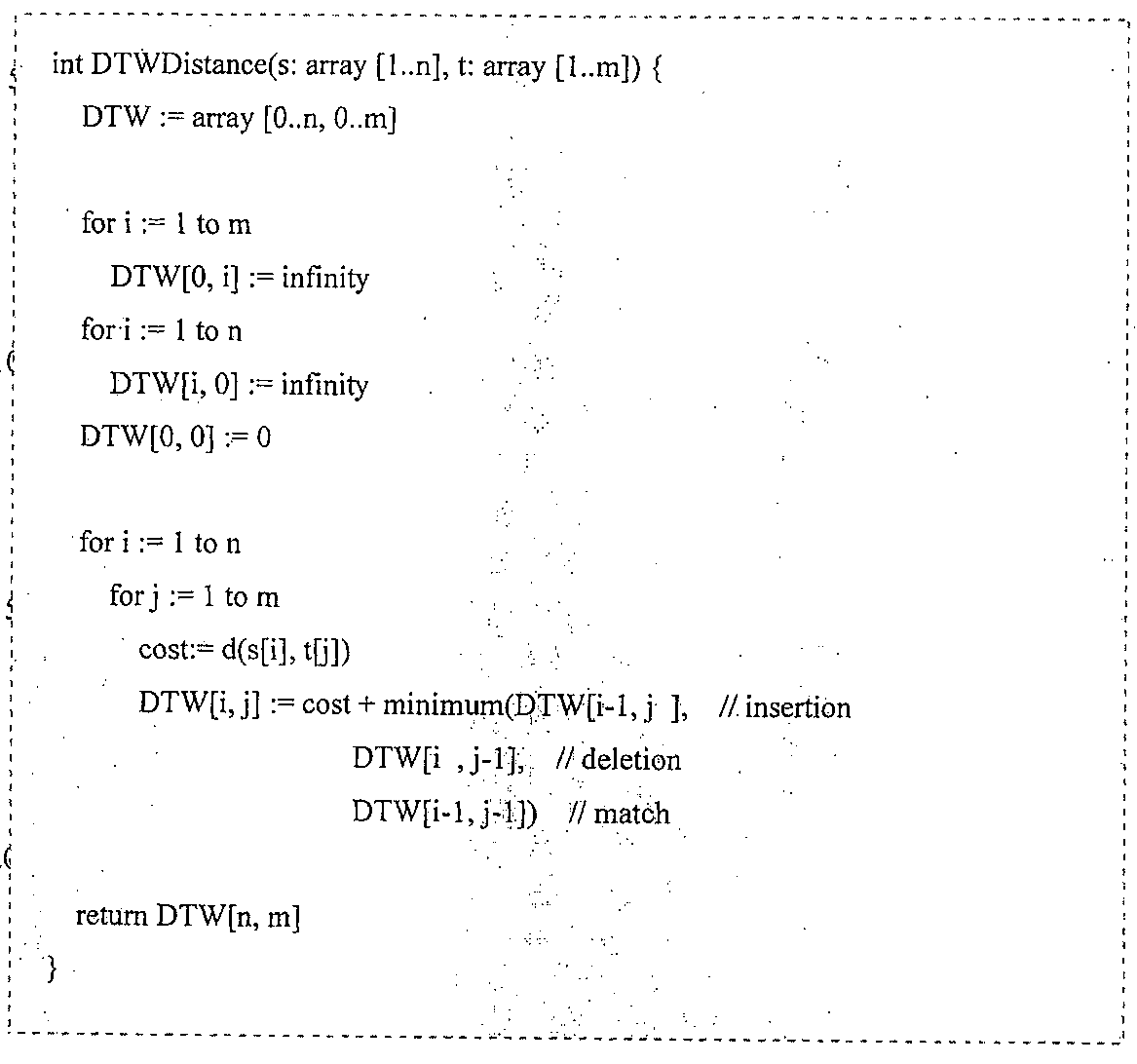
STRING_DISTANCE(스트링 1 , 스트링 2)는 두 개의 스트링들(스트링1 및 스트링2) 사이의 상관관계(유사성)를 찾기 위한 측정치이다. 임의의 패턴 매칭 알고리즘은 이러한 상관관계를 찾기 위해 사용될 수 있다. 본 실시예에서, DTW 알고리즘은 스트링 1 및 스트링 2의 코너 지점들을 기초로하여 구현되었다.STRING_DISTANCE (string 1 , string 2) is a measure for finding a correlation (similarity) between two strings (string 1 and string 2). Any pattern matching algorithm can be used to find such correlations. In this embodiment, the DTW algorithm is implemented based on the corner points of string 1 and
본 경우에서, 입력 패턴의 코너 지점들 및 후보 스트링의 코너 지점들은 일치될 두 개의 시퀀스들이다. 제1 곡선은 사용자에 의해 추적된 입력 패턴에 대응하고; 제2 곡선은 후보 단어에 대응하는 키들이 가상 키보드 상에 연결될 때 형성되는 일련의 라인 세그먼트들에 대응한다. 여기서 설명된 비교 기술은 제1 곡선 및 제2 곡선 사이의 유사성을 결정하기 위한 시도를 한다. 그러나, 각각의 지점에서의 비교 대신, 제1 곡선 및 제2 곡선의 비교는 코너들에서 수행되는데, 이는 코너들이 곡선의 형태를 정의하기 때문이다. 예를 들면, 단어 "fail"을 추적하기를 원하는 경우, 사용자에 의해 입력 패턴으로 추적된 코너 지점들은 'f', 'a', 'i', 'l'일 것이다. 이러한 코너 지점들이 후보 단어 "fail"(또한 코너 지점들 'f','a', 'i', 'l'을 가짐)과 비교할 때, 코너 지점들의 양 리스트들 사이에 적절한 상관관계가 있다. 따라서, 단어 "fail"은 적절한 후보로서 식별된다. 다른 후보 단어가 또한 고려될 수 있으며, 예를 들면, "gail"은 코너 지점들 'g', 'a','i', 'l'을 갖는다. 제1 코너 지점 'g'는 'f'와 근접하고, 나머지 코너 지점들은 정확히 일치한다. 이에 따라, "gail"은 또한 적절한 후보가 될 것이다. 코너 지점 리스트들 사이의 실제 일치는 DTW 알고리즘을 사용하여 수행된다.In this case, the corner points of the input pattern and the corner points of the candidate string are two sequences to be matched. the first curve corresponds to an input pattern tracked by the user; The second curve corresponds to a series of line segments formed when the keys corresponding to the candidate word are connected on the virtual keyboard. The comparative technique described herein attempts to determine the similarity between a first curve and a second curve. However, instead of comparing at each point, the comparison of the first curve and the second curve is performed at the corners, since the corners define the shape of the curve. For example, if one wants to track the word "fail", the corner points tracked by the user into the input pattern would be 'f', 'a', 'i', 'l'. When these corner points are compared to the candidate word "fail" (which also has corner points 'f', 'a', 'i', 'l'), there is an appropriate correlation between both lists of corner points. Thus, the word "fail" is identified as a suitable candidate. Other candidate words may also be considered, eg "gail" has corner points 'g', 'a', 'i', 'l'. The first corner point 'g' is close to 'f', and the remaining corner points are exactly the same. Accordingly, "gail" would also be a suitable candidate. The actual matching between the corner point lists is performed using the DTW algorithm.
비용 함수(cost function)는 두 개의 문자들 사이에서 계산된다. 이러한 비용 함수 CHAR_COST(c1, c2)는 DTW 알고리즘 내에서 내부적으로 사용된다. 상기 알고리즘에서, 비용은 일반적으로 시퀀스에서 두 개의 요소들 사이의 거리로서 정의된다. 두 개의 키들 사이의 비용 함수 계산(CHAR_COST)은 키들의 근접성을 기반으로 하여 할당된다. 상이한 유형들의 근접성 오류들은 상이한 비용들이 할당될 수 있다. 비용들은 아래 매개변수들 중 하나 이상을 기반으로 하여 할당될 것이다: HORIZONTAL_PROXIMITY_COST(수평 방향 근접성 오류에 대한 비용); VERTICAL_PROXIMITY_COST(수직 방향 근접성 오류에 대한 비용); DIAGONAL_PROXIMITY_COST(대각선 방향 근접성 오류에 대한 비용); 및 NO_PROXIMITY_COST(비 근접성 오류에 대한 비용). 키들이 동일하지 않으면, 비용은 0이 될 것이다. 예를 들면, 상이한 유형들의 오류의 비용은 아래와 같이 설정될 수 있다:A cost function is calculated between two characters. This cost function CHAR_COST(c1, c2) is used internally within the DTW algorithm. In the above algorithm, cost is generally defined as the distance between two elements in a sequence. The cost function calculation (CHAR_COST) between two keys is assigned based on the proximity of the keys. Different types of proximity errors may be assigned different costs. Costs will be assigned based on one or more of the following parameters: HORIZONTAL_PROXIMITY_COST (cost for horizontal directional proximity error); VERTICAL_PROXIMITY_COST (cost for vertical proximity error); DIAGONAL_PROXIMITY_COST (cost for diagonal proximity error); and NO_PROXIMITY_COST (cost for non-proximity errors). If the keys are not identical, the cost will be zero. For example, the cost of different types of errors can be set as follows:
HORIZONTAL_PROXIMITY_COST - 10 HORIZONTAL_PROXIMITY_COST - 10
VERTICAL_PROXIMITY_COST - 20 VERTICAL_PROXIMITY_COST - 20
DIAGONAL_PROXIMITY_COST - 40 DIAGONAL_PROXIMITY_COST - 40
NO_PROXIMITY_COST - 60 NO_PROXIMITY_COST - 60
QWERTY 배열에 대해, For a QWERTY array,
CHAR_COST('a', 's') - 수평 방향 근접성 - 비용 = 10 CHAR_COST('a', 's') - horizontal proximity - cost = 10
CHAR_COST('d', 'x') - 수직 방향 근접성 - 비용 = 20 CHAR_COST('d', 'x') - vertical proximity - cost = 20
STRING_DISTANCE를 계산하는 동안 또한 고려될 수 있는 다른 인자들은 (예를 들면, 형성된 각도를 기반으로) 코너 지점의 세기를 나타내는 것을 포함한다. 코너 지점이 확실하지 않은(weak) 코너 지점인 경우, 높은 가능성의 오류가 있기 때문에 이와 관련된 비용은 감소될 수 있다. 코너 지점에 대한 일치(match)가 식별되지 않는 경우, 사용자에 의해 추적된 입력 패턴 상의 실제 스트링이 식별될 수 있으며, 일치되는 경우, 비용이 감소될 수 있다. 예를 들면, 입력 패턴 스트링이 "asdfbjkl"인 경우, 입력 코너 스트링들은 "abl" 이며 후보 코너 스트링들은 "adbl"이다. 후보 코너 스트링으로부터 문자 'd'에 대해 일치되지 않는다. 이러한 경우, 실제 입력 패턴 스트링의 문자 'a' 및 'b'들 사이에 있는 'd'를 찾는다. 그 후, 문자 'd'가 찾아지고 비용이 감소될 수 있다. 성능을 개선하도록, 체크는 거의 코너 지점들이 근접할 때만 이러한 방식으로 수행될 수 있다.Other factors that may also be considered while calculating STRING_DISTANCE include indicating the strength of the corner point (eg, based on the angle formed). If the corner point is a weak corner point, the associated cost can be reduced because there is a high probability of error. If a match for a corner point is not identified, the actual string on the input pattern tracked by the user may be identified, and if a match is made, the cost may be reduced. For example, if the input pattern string is "asdfbjkl", the input corner strings are "abl" and the candidate corner strings are "adbl". no match for the character 'd' from the candidate corner string. In this case, it finds the 'd' between the characters 'a' and 'b' of the actual input pattern string. After that, the letter 'd' is found and the cost can be reduced. To improve performance, the check can be performed in this way only when almost the corner points are close.
유사하게, 근접성이 없지만 코너 지점들이 (일부 경계 또는 임계값 내에서) 서로 근접하는 경우 코너 지점들에 대해 비용이 감소될 수 있다. 사용자들이 일반적으로 거기서 실수하는 경향이 있을 때 근접성 비용은 추적된 입력 패턴에서 첫번째 및 마지막 문자들에 대해 감소될 수 있다. 근접성 비용은 사용자가 일반적으로 실수하는 경향이 있는 문자들에 대해 감소될 수 있다. 예를 들면: 사용자들이 'n'을 의도할 때 사용자들은 종종 'm'을 통해 입력 패턴을 추적하거나(또는 각도를 형성하거나) 그 반대로 'm'을 의도할 때 종종 'n'을 통해 입력 패턴을 추적한다.Similarly, cost can be reduced for corner points if there is no proximity but the corner points are close to each other (within some boundary or threshold). Proximity cost can be reduced for the first and last characters in the tracked input pattern when users are generally prone to making mistakes there. Proximity cost can be reduced for characters that users are generally prone to making mistakes. For example: when users intend 'n', users often track the input pattern via 'm' (or form an angle), and vice versa, when they intend 'm', they often follow the input pattern via 'n' to track
성능을 개선하기 위하여, 스트링들 및 대응하는 거리의 캐시가 유지될 수 있어서, 거리 값이 직접 검색될 수 있다. DTW와 같은 동적 프로그래밍 해법들이 사용되면, (a) 충분히 큰 버퍼가 중간 결과들을 저장하기 위해 사용될 표에 미리-할당될 수 있고 이에 따라 모든 string_distance 계산에 대한 할당 메모리에 대한 시간을 절감할 수 있고; 및/또는 (b) 중간 결과들은 다음 string_distance 계산들을 위해 재사용될 수 있다.To improve performance, a cache of strings and corresponding distances may be maintained, so that distance values can be retrieved directly. If dynamic programming solutions such as DTW are used, (a) a sufficiently large buffer can be pre-allocated in the table to be used to store intermediate results, thus saving time on allocating memory for all string_distance calculations; and/or (b) intermediate results can be reused for subsequent string_distance calculations.
STRING_DISTANCE("devel", "develops")의 예를 고려하자. STRING_DISTANCE ("devel", "deve")가 요구되는 경우, 이는 이미 이용가능하게 되는 바와 같이 표로부터 직접 얻어질 수 있다. 다음으로, STRING_DISTANCE("devel", "developed")를 계산하기 위하여, STRING_DISTANCE("devel", "develop")까지의 표의 내용들이 사용될 수 있고 이어서 단지 나머지만을 계산한다.Consider the example of STRING_DISTANCE("devel", "develops"). If STRING_DISTANCE("devel", "deve") is required, it can be obtained directly from the table as already available. Next, to calculate STRING_DISTANCE("devel", "developed"), the contents of the table up to STRING_DISTANCE("devel", "develop") can be used and then only calculate the remainder.
임계값 계산(THRESHOLD CALCULATIONS)THRESHOLD CALCULATIONS
위에서 약술된 바와 같이, 경로 길이 임계값들은 INPUT_PATH_LENGTH를 기초로 하여 계산된다. 구체적으로는, INPUT_PATH_LENGTH는 각각의 상한 및 하한 임계값들을 결정하기 위하여 하한 및 상한 임계값 매개변수들 PATH_LEN_LOWER_THRESHOLD_PARAM, PATH_LEN_UPPER_THRESHOLD_PARAM와 곱해진다.As outlined above, path length thresholds are calculated based on INPUT_PATH_LENGTH. Specifically, INPUT_PATH_LENGTH is multiplied by the lower and upper threshold parameters PATH_LEN_LOWER_THRESHOLD_PARAM, PATH_LEN_UPPER_THRESHOLD_PARAM to determine the respective upper and lower threshold values.
STRING_DISTANCE에 대한 임계값은 각각의 국면에 대한 고정값으로서 정의될 수 있다. 예를 들면, 제1 국면(국면 1)에서 분석 동안 STRING_DISTANCE_THRESHOLD는 영(0)으로 설정될 수 있고; 제2 국면(국면 2) 동안 STRING_DISTANCE_THRESHOLD가 이(2)로 설정될 수 있고; 제3 국면(국면 3) 동안 STRING_DISTANCE_THRESHOLD가 사(4)로 설정될 수 있다. 이러한 임계값들은 예를 들면 상이한 사용자들로부터 수집된 샘플 데이터, 실험 데이터 및 어떤 매개변수들이 최적 결과를 제공하는지를 결정하기 위한 분석를 기초로 하여, 오프라인으로 정의될 수 있다. 대안으로, 상기 값들은 예를 들면 실행 시간 사용을 기초로 하여 동적으로 조정될 수 있다.The threshold for STRING_DISTANCE may be defined as a fixed value for each phase. For example, during analysis in a first phase (phase 1) STRING_DISTANCE_THRESHOLD may be set to zero; STRING_DISTANCE_THRESHOLD may be set to (2) during the second phase (phase 2); During the third phase (phase 3), STRING_DISTANCE_THRESHOLD may be set to four (4). These thresholds may be defined offline, for example, based on sample data collected from different users, experimental data and analysis to determine which parameters provide optimal results. Alternatively, the values may be adjusted dynamically, for example based on runtime usage.
경로 길이 임계값들, 스트링 거리 임계값 매개변수들, 스트링 거리 계산에서 사용된 비용 값들에 대한 초기 값들은 상이한 사용자들로부터 수집된 샘플 데이터를 기초로 할 것이다. 사용자들에게 상이한 소스들로부터 수집된 언어 또는 정보에서 단어들/구들/문장들이 공통으로 사용될 수 있는 단어들/구들/문장들의 세트가 제공될 것이다. 이러한 입력에 대해 사용자에 의해 생성된 입력 패턴의 좌표들이 기록될 것이다. 이러한 데이터는 임계값 매개변수들 및 비용값들에 대한 최적 값들을 찾기 위해 사용될 것이다.Initial values for path length thresholds, string distance threshold parameters, and cost values used in the string distance calculation will be based on sample data collected from different users. Users will be provided with a set of words/phrases/sentences from which words/phrases/sentences may be commonly used in language or information gathered from different sources. The coordinates of the input pattern generated by the user for this input will be recorded. This data will be used to find optimal values for the threshold parameters and cost values.
시스템이 설치된 후, 사용자의 스타일은 학습될 것이고 임계값 및 비용값은 개별 사용자의 사용량 통계를 기초로 하여 동적으로 업데이트될 것이다.After the system is installed, the user's style will be learned and the threshold and cost values will be dynamically updated based on the usage statistics of each individual user.
사용자가 단어를 추적하고 제안을 선택할 때마다, 사용자가 하는 실수(즉, 사용자가 더 많은 수평방향 근접성 오류를 범하는 경향이 있음)의 유형(5)들이 분석되고 실제 추적된 입력 패턴 길이와 단어의 경로 길이 사이의 차이가 선택된다. 또한, 사용자에 의해 공통으로 이루어진 실수들의 소정의 특정 유형들이 또한 포착될 수 있다. 예를 들면, 사용자가 실제로 'n'을 통하여 추적하기를 원할 때, 사용자는 주로 실수로 글자 'm'을 통하여 추적한다. 모든 이러한 정보를 기초로 하여, 임계값들 및 비용 값들은 상기 사용자에 대해 동적으로 조정될 것이다.Each time the user tracks a word and selects a suggestion, the types (5) of mistakes the user makes (i.e., the user tends to make more horizontal proximity errors) are analyzed and the actual tracked input pattern length and word The difference between the path lengths is chosen. In addition, certain specific types of mistakes made in common by the user may also be captured. For example, when the user actually wants to track through 'n', the user mainly mistakenly tracks through the letter 'm'. Based on all this information, the thresholds and cost values will be dynamically adjusted for the user.
지금부터 코어 엔진(120)의 국면화된 작동이 더 상세하게 설명될 것이다.The localized operation of the
국면 1(Phase 1)Phase 1
지금부터 도 5에 도시된 제3 흐름도(400)를 참조하여, 국면 1 접근법의 적용에 의한 제안들의 생성이 설명될 것이다.Referring now to the
초기 후보 리스트(INITIAL_CANDIDATES_LIST)는 사전 내의 상위 n개의 1회 빈도 단어들에 의해 후속되는 내용 기반 제안을 기초로 하여 준비된다(단계 410). 내용 기반 제안들은 사용자에 의해 타이핑된 이전의 그리고 이전-이전의 단어들을 기초로 한 연속 텍스트 입력들이다. 상위 n개의 1회 빈도 단어들 리스트는 단어들의 1회 빈도 카운트들을 기초로 하여 초기에 발생된 고정 리스트일 수 있거나; 이는 사용을 기초로 하여 동적으로 업데이트될 수 있다. 예를 들면, 상위 n개의 단어들 및 카운트들의 초기 리스트는 "all"(200),"ail"(150),"bat"(145)이다. 사용자가 "bat" 10회, "ail" 3회, "all" 50회를 입력한 경우, 단어들의 카운트들 및 리스트가 이에 따라 입력될 것이다. 업데이트된 리스트는 "all"(200), "bat"(155), "ail"(153)일 것이다. 카운트들은 사용자가 단어를 입력하는 때마다 업데이트될 것이다. 대안적으로, 초기 후보 리스트는 사전-랭킹되는 바이그램 리스트 BIGRAMS_LIST의 바이그램에 대응하는 후보들일 수 있다.An initial candidate list (INITIAL_CANDIDATES_LIST) is prepared based on a content-based suggestion followed by the top n one-time occurrences of words in the dictionary (step 410). Content-based suggestions are continuous text inputs based on previous and pre-previous words typed by the user. The list of top n occurrences of words may be a fixed list initially generated based on one-time counts of words; It can be dynamically updated based on usage. For example, the initial list of the top n words and counts is "all" (200), "ail" (150), "bat" (145). If the user enters "bat" 10 times, "ail" 3 times, and "all" 50 times, counts and lists of words will be entered accordingly. The updated list would be "all" (200), "bat" (155), and "ail" (153). The counts will be updated each time the user enters a word. Alternatively, the initial candidate list may be candidates corresponding to the bigrams of the pre-ranked bigram list BIGRAMS_LIST.
INITIAL_CANDIDATES_LIST로부터, VALID_PREFIXES_LIST에서 임의의 스트링들과 일치하거나; VALID_PREFIXES_LIST의 임의의 스트링들과 일치하는 초두를 가지는 후보 단어들이 선택된다(단계 420). 예를 들면, 문자 스트링 "asdfghjkl"의 경우, VALID_PREFLXES_LIST는 "all", "afl", "asl"를 포함하고; INITIAL_CANDIDATES_LIST는 "the", "all", "fail", "allow", "hit", "following", "asleep"을 포함한다. 디스플레이를 위해 선택된 후보 단어들은 "all", "allow", "asleep"이다.matches any strings from INITIAL_CANDIDATES_LIST, or from VALID_PREFIXES_LIST; Candidate words with a beginning that match any of the strings of VALID_PREFIXES_LIST are selected (step 420). For example, for the character string "asdfghjkl", VALID_PREFLXES_LIST contains "all", "afl", "asl"; INITIAL_CANDIDATES_LIST includes "the", "all", "fail", "allow", "hit", "following", and "asleep". Candidate words selected for display are "all", "allow", and "asleep".
프로세싱 루프(단계 430)가 이어서 INITIAL_CANDIDATES_LIST에서 이미 식별된 후보 단어들 각각을 분석하기 위해 수행된다. 분석은 시작부로부터 단지 VALID_PREFIXES_LIST에 저장된 임의의 초두와 유효한 초두 일치까지 문자 스트링을 분석하는 것을 포함한다(단계 440). 후보 스트링의 코너 지점들은 CAND_CORNERS_KEYS로서 계산된다. CAND_CORNERS_STRING은 CAND_CORNERS_STRING 내의 키에 대응하는 문자의 시퀀스이다. 예를 들면, 후보 단어 "allow"에 대해, (VALID_PREFIXES_LIST인) "all" 까지의 문자 스트링이 고려되고 코너 지점들은 상기 지점까지 계산된다. 스트링 거리 STRING_ DISTANCE(나중에 상세됨)는 후보 스트링과 입력 스트링 사이에서 계산된다(단계 450). STRING_DISTANCE와 STRING_DISTANCE_THRESHOLD_PHASE_1 사이에서 비교가 이루어진다(단계 460). STRING_DISTANCE가 STRING_DISTANCE_THRESHOLD_PHASE_1보다 크면, 상기 후보가 제거된다. 그렇지 않으면, 상기 단어는 완성어 버킷(COMPLETIONS_LIST) (단계 470); 또는 전체 단어 버킷(FULL_WORDS_LIST) (단계 480) 중 어느 하나에 부가된다. 후보 스트링의 초두만이 VALID_PREFIXES_LIST 내의 임의의 단어들과 일치하는 경우, 단어가 완성어이다. 예를 들면, 입력 문자 스트링 "asdfghjkl"의 경우, VALID_PREFIXES_LIST는 "all", "afl", "asl"을 포함하고 최종 후보 리스트는 "all", "allow", "asleep"를 포함한다. 전체 단어 후보 출력은 "all"이고 완성어 단어 후보들은 "allow" 및 "asleep"이다. 후보는 고려된 것으로 표시되고(단계 490) 다음 후보가 고려된다.A processing loop (step 430) is then performed to analyze each of the candidate words already identified in INITIAL_CANDIDATES_LIST. Parsing involves parsing the character string from the beginning to only any first and valid first matches stored in VALID_PREFIXES_LIST (step 440). The corner points of the candidate string are calculated as CAND_CORNERS_KEYS. CAND_CORNERS_STRING is a sequence of characters corresponding to the key in CAND_CORNERS_STRING. For example, for the candidate word "allow", the character string up to "all" (which is VALID_PREFIXES_LIST) is considered and corner points are counted up to that point. A string distance STRING_DISTANCE (detailed later) is computed between the candidate string and the input string (step 450). A comparison is made between STRING_DISTANCE and STRING_DISTANCE_THRESHOLD_PHASE_1 (step 460). If STRING_DISTANCE is greater than STRING_DISTANCE_THRESHOLD_PHASE_1, the candidate is removed. otherwise, the word is placed in a complete word bucket (COMPLETIONS_LIST) (step 470); or a full word bucket (FULL_WORDS_LIST) (step 480). If only the beginning of the candidate string matches any words in VALID_PREFIXES_LIST, the word is a complete word. For example, for the input character string "asdfghjkl", VALID_PREFIXES_LIST contains "all", "afl", and "asl" and the final candidate list contains "all", "allow", and "asleep". The whole word candidate output is "all" and the complete word candidates are "allow" and "asleep". The candidate is marked as considered (step 490) and the next candidate is considered.
국면 2(Phase 2)
도 6에 도시된 제4 흐름도(500)를 참조하여, 지금부터 국면 2 접근법의 적용에 의한 제안들의 발생이 설명될 것이다.With reference to the
열 인코딩 그룹은 추적된 입력 패턴의 열 인코딩을 기반으로 식별된다(단계 510). 초기 후보 단어들은 열 인코딩을 기초로 하여 식별된 그룹 내에 포함되는 단어가 될 것이다. 예를 들면, 추적된 입력 패턴의 열 인코딩이 2312이면, 초기 후보 리스트는 그룹(2312) 내의 요소들의 리스트일 것이다. 후보 단어들은 BIGRAMS_LIST를 기초로 하여 필터링된다. BIGRAMS_LIST로부터 바이그램들 중 어느 하나와 일치하는 첫번째 두 개(2)의 문자들들을 가지는 후보들만이 선택된다(단계 520).A column encoding group is identified based on the column encoding of the tracked input pattern (step 510). The initial candidate words will be the words included in the group identified based on the column encoding. For example, if the column encoding of the tracked input pattern is 2312 , the initial candidate list would be a list of elements in group 2312 . Candidate words are filtered based on BIGRAMS_LIST. From the BIGRAMS_LIST only candidates with the first two (2) characters matching any one of the biggrams are selected (step 520).
식별된 후보들 각각에 대해(단계 530) 하한 경로 길이 임계값 PATH_LEN_LOWER_THRESHOLD와 상한 경로 길이 임계값 PATH_LEN_UPPER_ THRESHOLD 사이에 있는 경로 길이를 가지는 스트링의 부분이 식별된다(단계 540). 임의의 이 같은 부분이 존재하는 경우를 결정하기 위해 체크가 수행된다(단계 550). 이 같은 부분이 없는 경우, 후보 단어가 생략된다. 스트링의 상기 부분의 시작 및 종료 색인들은 각각 C1 및 C2로서 정의된다(단계 560).For each of the identified candidates (step 530), a portion of the string having a path length that lies between the lower path length threshold PATH_LEN_LOWER_THRESHOLD and the upper path length threshold PATH_LEN_UPPER_THRESHOLD is identified (step 540). A check is performed to determine if any such part exists (step 550). If there is no such part, the candidate word is omitted. The start and end indices of that part of the string are defined as C1 and C2, respectively (step 560).
예를 들면, 하한 및 상한 경로 길이 임계값들이 29 및 39인 개요를 고려하자. 단어가 "developed"인 경우, 각각의 서브스트링(substring)까지의 경로 길이는 아래와 같다:For example, consider the scheme where the lower and upper path length thresholds are 29 and 39. If the word is "developed", the path length to each substring is:
De - 20De - 20
Dev - 25Dev - 25
Deve - 27Dev - 27
Devel - 30Devel - 30
Develo - 32Devlo - 32
Develop - 35Develop - 35
Develope - 41Develop - 41
Developed - 50Developed - 50
이때 경로 길이 임계값(29 내지 39) 내의 스트링의 부분은 "lop"이다.The portion of the string within the path length thresholds 29-39 is then "lop".
스트링은 C2 색인까지만 고려된다. 후보 스트링의 코너 지점들이 계산된다(CAND_CORNERS_ KEYS)(단계 570).Strings are considered up to and including index C2. Corner points of the candidate string are calculated (CAND_CORNERS_KEYS) (step 570).
CAND_CORNERS_STRING은 CAND_CORNERS_STRING 내의 키들에 대응하는 문자의 시퀀스이다.CAND_CORNERS_STRING is a sequence of characters corresponding to keys in CAND_CORNERS_STRING.
후보 스트링과 입력 스트링 사이의 상관관계를 결정하기 위하여 비교가 수행된다. 본 실시예에서, 스트링 거리(STRING_DISTANCE)는 후보 스트링과 입력 스트링 사이의 차이로서 계산된다(단계 580). 결과적인 거리 STRING_DISTANCE는 범위(C1 내지 C2) 내의 문자들의 거리 값의 최상 값으로서 고려된다. 더 작은 스트링 거리(STRING_DISTANCE)는 후보 스트링과 입력 스트링 사이의 더 근접한 상관관계를 대표한다. 상기 예에서, 후보 스트링은 "develop" 까지 고려된다. 스트링 거리는 입력 스트링과 "develop" 사이에서 계산된다. 상기 예에서: A comparison is performed to determine a correlation between the candidate string and the input string. In this embodiment, the string distance STRING_DISTANCE is calculated as the difference between the candidate string and the input string (step 580). The resulting distance STRING_DISTANCE is considered as the best value of the distance values of the characters in the range C1 to C2. A smaller string distance (STRING_DISTANCE) represents a closer correlation between the candidate string and the input string. In the example above, the candidate string is considered up to "develop". The string distance is calculated between the input string and "develop". In the example above:
"C 1 - C2" - "lop"까지의 스트링 Strings from "C 1 - C2" - "lop"
STRING_DISTANCE(입력 스트링, "devel") = 30 STRING_DISTANCE(input string, "devel") = 30
STRING JDISTANCE(입력 스트링, "develo") = 20 STRING JDISTANCE(input string, "develo") = 20
STRING_DISTANCE(입력 스트링, "develop") = 25 STRING_DISTANCE(input string, "develop") = 25
범위 C1 내지 C2에서의 문자들 모두의 최상의 거리는 "develo"이어서, 스트링 "develo" 및 거리 20이 고려될 것이다. The best distance for all of the characters in the range C1 to C2 is "develo", so the string "develo" and
이어서 STRING_DISTANCE와 STRING_DISTANCE_THRESHOLD_PHASE_2 사이에서 비교가 이루어진다(단계 590). STRING_DISTANCE가 STRING_DISTANCE_THRESHOLD_PHASE_2(매개변수)보다 크면, 상기 후보가 삭제된다. 그렇지 않으면, 상기 단어는 완성어 버킷(COMPLETIONS_LIST)(단계 600) 또는 전체 단어 버킷(FULL_WORDS_LIST)(단계 610) 중 어느 하나에 부가된다. 최상의 거리가 전체 단어에 대해 얻어진 경우 단어가 전체 단어이고 그렇지 않으면 완성어이다.A comparison is then made between STRING_DISTANCE and STRING_DISTANCE_THRESHOLD_PHASE_2 (step 590). If STRING_DISTANCE is greater than STRING_DISTANCE_THRESHOLD_PHASE_2 (parameter), the candidate is deleted. Otherwise, the word is added to either the COMPLETIONS_LIST (step 600) or the full words bucket (FULL_WORDS_LIST) (step 610). A word is a whole word if the best distance is obtained for the whole word, otherwise it is a complete word.
상기 예에 대해, STRING_DISTANCE_THRESHOLD_PHASE_2 = 22를 가정하자.For the above example, assume STRING_DISTANCE_THRESHOLD_PHASE_2 = 22.
단어 "developed"가 선택되고 완성어 리스트에 부가된다. 후보는 고려된 것으로 표시되고(단계 620) 다음 후보가 고려된다.The word "developed" is selected and added to the complete word list. The candidate is marked as considered (step 620) and the next candidate is considered.
대안적으로, 초기 후보 리스트는 사전-랭킹되는 바이그램 리스트 BIGRAMS_LIST의 바이그램들에 대응하는 후보들일 수 있다. 후보의 열 기반 인코딩은 온라인으로 계산될 수 있고 추적된 입력 패턴의 열 기반 인코딩 및 이에 따라 선택된 후보 단어와 비교될 수 있다. 예를 들면, 추적된 입력 패턴의 열 기반 인코딩은 2312이고, 후보 단어 "scored"에 대해 열 기반 인코딩은 2312일 것이다. 후보 단어가 입력 패턴 인코딩과 일치할 때, 이러한 단어가 선택될 것이다. 후보 단어 "scoring"에 대해, 열 기반 인코딩은 231232일 것이다. 후보의 전체 인코딩 "231232"의 초두 "2312"는 입력 패턴들 인코딩과 일치하고 이에 따라 단어는 가능한 완성어로서 선택될 것이다.Alternatively, the initial candidate list may be candidates corresponding to the bigrams of the pre-ranked bigram list BIGRAMS_LIST. The column-based encoding of the candidate may be computed online and compared to the column-based encoding of the tracked input pattern and thus the selected candidate word. For example, the column-based encoding of the tracked input pattern would be 2312, and for the candidate word “scored” the column-based encoding would be 2312. When a candidate word matches the input pattern encoding, that word will be selected. For the candidate word "scoring", the column-based encoding would be 231232. The beginning "2312" of the candidate's full encoding "231232" matches the input patterns encoding and thus the word will be selected as a possible completion word.
국면 3(Phase 3)Phase 3
도 7에 도시된 제5 흐름도(700)를 참조하여, 지금부터 국면 2 접근법의 적용에 의한 제안들의 발생이 설명될 것이다.With reference to the
초기 후보들 리스트는 데이터베이스(단계 710)에 저장된 리스트 BIGRAMS_LIST 내의 바이그램에 대응하는 후보들이다. 각각의 바이그램에 대한 후보들의 리스트는 PREFIX_TREE_WITH_ORDERED_LISTS로부터 얻어진다.The initial candidates list are candidates corresponding to the bigram in the list BIGRAMS_LIST stored in the database (step 710). The list of candidates for each bigram is obtained from PREFIX_TREE_WITH_ORDERED_LISTS.
상기 분석은 각각의 후보에 대해 수행된다(단계 720). 스트링의 경로 길이가 PATH_LEN_LOWER_THRESHOLD와 PATH_LEN_UPPER_THRESHOLD 사이에 있는 스트링의 부분이 식별된다(단계 730). 이 같은 부분이 존재하는 지를 결정하기 위해 체크가 수행된다(단계 740). 이 같은 부분이 없는 경우, 상기 후보 단어가 생략된다. 스트링의 상기 부분의 시작 및 종료 색인은 C1 및 C2로서 정의된다(단계 750).The analysis is performed for each candidate (step 720). The portion of the string whose path length is between PATH_LEN_LOWER_THRESHOLD and PATH_LEN_UPPER_THRESHOLD is identified (step 730). A check is performed to determine if such a part exists (step 740). If there is no such part, the candidate word is omitted. The start and end indices of that part of the string are defined as C1 and C2 (step 750).
상기 예를 고려하면, 단어 "developed"에 대해 (29-39)의 경로 길이 임계값에 대해, 각각의 서브스트링에 대한 경로 길이들은 아래와 같다:Considering the example above, for a path length threshold of (29-39) for the word "developed", the path lengths for each substring are:
De - 20De - 20
Dev - 25Dev - 25
Deve - 27Dev - 27
Devel - 30Devel - 30
Develo - 32Devlo - 32
Develop - 35Develop - 35
Develope - 41Develop - 41
Developed - 50Developed - 50
이때 임계값 내의 스트링의 부분은 "lop"이다.The portion of the string within the threshold is then "lop".
스트링은 C2 색인까지만 고려된다. 후보 스트링의 코너 지점들이 계산된다(CAND_CORNERS_KEYS)(단계 760).Strings are considered up to and including index C2. Corner points of the candidate string are calculated (CAND_CORNERS_KEYS) (step 760).
CAND_CORNERS_STRING은 CAND_CORNERS_STRING 내의 키들에 대응하는 문자들의 시퀀스이다.CAND_CORNERS_STRING is a sequence of characters corresponding to keys in CAND_CORNERS_STRING.
후보 스트링과 입력 스트링 사이의 STRING_DISTANCE가 계산된다(단계 770). STRING_DISTANCE는 범위(C1 내지 C2) 내의 문자들의 거리 값의 최상 값이 되도록 고려된다.A STRING_DISTANCE between the candidate string and the input string is calculated (step 770). STRING_DISTANCE is considered to be the highest value of the distance value of the characters in the range C1 to C2.
상기 예에서, 후보 스트링은 "develop" 까지 고려된다. 스트링 거리는 입력 스트링과 "develop" 사이에서 계산된다. 예를 들면: In the example above, the candidate string is considered up to "develop". The string distance is calculated between the input string and "develop". For example:
"C1 - C2" - "lop" 까지의 스트링Strings "C1 - C2" - "lop"
String_Distance(입력 스트링, "devel") = 30String_Distance(input string, "devel") = 30
String_Distance(입력 스트링, "develo") = 20 String_Distance(input string, "develo") = 20
String_Distance(입력 스트링, "develop") = 25String_Distance(input string, "develop") = 25
범위 C1 내지 C2에서의 문자들 모두의 최상의 거리는 "develo"이어서, 스트링 "develo" 및 거리 20이 고려될 것이다.The best distance for all of the characters in the range C1 to C2 is "develo", so the string "develo" and
STRING_DISTANCE와 STRING_DISTANCE_THRESHOLD_PHASE_3을 비교하도록 체크가 수행된다(단계 780). STRING_DISTANCE가 STRING_DISTANCE_THRESHOLD_PHASE_3(매개변수)보다 크면, 상기 후보 단어가 생략된다. 그렇지 않으면, 상기 단어는 스템 버킷(STEMS_LIST) 또는 전체 단어 버킷(FULL_WORDS_LIST) 중 어느 하나에 부가된다(단계 790). 최상의 거리가 전체 단어에 대해 얻어진 경우 단어가 전체 단어이고(단계 800) 그렇지 않으면 스템(초두)이다(단계 810). 상기 예에 대해, STRING_DISTANCE_THRESHOLD_PHASE_3 = 22인 경우, 스트링 "develo" 가 선택되어 스템 리스트에 부가될 것이다. 후보는 고려된 것으로 표시되고(단계 820) 다음 후보가 고려된다.A check is performed to compare STRING_DISTANCE and STRING_DISTANCE_THRESHOLD_PHASE_3 (step 780). If STRING_DISTANCE is greater than STRING_DISTANCE_THRESHOLD_PHASE_3 (parameter), the candidate word is omitted. Otherwise, the word is added to either the stem bucket (STEMS_LIST) or the full word bucket (FULL_WORDS_LIST) (step 790). If the best distance is obtained for the whole word, the word is the whole word (step 800), otherwise it is the stem (the beginning) (step 810). For the example above, if STRING_DISTANCE_THRESHOLD_PHASE_3 = 22, the string "develo" will be selected and added to the stem list. The candidate is marked as considered (step 820) and the next candidate is considered.
한 세트의 유효한 문자 조합들(예를 들면, 바이그램들 또는 트라이그램들)이 정의되고 사전-랭킹된 세트의 단어들은 각각의 유효한 문자 조합과 관련된다. 본 실시예에서, 유효한 문자 조합들은 후보 단어들의 초두들을 형성한다. 상기 초두를 구비한 후보들의 사전-랭킹된 리스트가 이용가능한 경우 STEMS_LIST 내의 각각의 후보에 대해 단어들의 리스트는 완성어 버킷(COMPLETIONS_LIST)에 부가된다(단계 830). 사전-랭킹된 리스트가 이용가능하지 않으면, 상기 초두를 구비한 단어들의 리스트는 알파벳 순서로 또는 사전으로부터 검색된 순서로 부가된다.A set of valid letter combinations (eg, bigrams or trigrams) is defined and a pre-ranked set of words is associated with each valid letter combination. In this embodiment, valid letter combinations form the beginnings of candidate words. If a pre-ranked list of candidates with the beginning is available, a list of words for each candidate in STEMS_LIST is added to the COMPLETIONS_LIST (step 830). If a pre-ranked list is not available, then the list of leading words is added in alphabetical order or in the order retrieved from the dictionary.
STEMS_LIST 내의 각각의 후보에 대해 선택된 단어들의 개수가 변화할 수 있다. 예를 들면, STEMS_LIST가 "dev" 및 "derv"를 포함하는 경우, 초두 "dev" 및 "derv"로 시작하는 단어들은 완성어 리스트 내로 부가된다. COMPLETIONS_LIST는 후보: "development", "developing" 및 "dervish"를 포함한다. 중복어들은, 존재하는 경우 FULL_WORDS_LIST 및 COMPLETIONS_LIST로부터 제거된다.The number of words selected for each candidate in STEMS_LIST may vary. For example, if STEMS_LIST contains "dev" and "derv", words beginning with "dev" and "derv" are added into the complete word list. COMPLETIONS_LIST contains candidates: "development", "developing" and "dervish". Duplicate words, if any, are removed from FULL_WORDS_LIST and COMPLETIONS_LIST.
출력(OUTPUT)OUTPUT
전체 단어 제안들은 FULL_WORDS_LIST로부터의 제안들일 것이고 완성어들은 COMPLETIONS_LIST로부터의 제안들일 것이다. 상이한 제안 유형들은 완전 제안들 및 완성어들에 할당되어 이들을 차별화할 것이고 이 리스트는 플랫폼으로 출력될 것이다.Whole word suggestions will be suggestions from FULL_WORDS_LIST and complete words will be suggestions from COMPLETIONS_LIST. Different proposal types will be assigned to complete proposals and complete words to differentiate them and this list will be output to the platform.
예(EXAMPLE)EXAMPLE
본 발명의 일 실시예에 따른 코어 엔진(120)을 활용하는 휴대 전화 내로 텍스트의 입력의 일 예가 지금부터 설명될 것이다.An example of the input of text into a mobile phone utilizing the
사용자는 텍스트 "This is"를 입력하고 다음 단어에 대응하는 입력 패턴을 추적한다. 터치스크린 디스플레이(20)는 사용자에 의해 추적된 지점들의 X, Y 좌표들을 포착하여 이들을 코어 엔진(120)으로 전송한다.The user enters the text "This is" and traces the input pattern corresponding to the next word. The
코어 엔진(120)은 사용자에 의해 추적된 입력 패턴을 결정하도록 좌표들의 리스트를 분석한다. 코어 엔진(120)은 입력 패턴에 대응하는 실제 문자 스트링을 연산한다. 예를 들면, 사용자가 다음 글자들 "asdfghuil"에 대응하는 키 위로 지나가거나 이 키들에 근접한 입력 패턴을 추적한다. 대응 키들, 코너 키들 및 코너 스트링, 경로 임계값들이 계산된다. 시퀀스 "ail"은 글자 'i'에 대응하는 키에서 각도를 이루는 입력 패턴으로서 코너 스트링이다.The
코어 엔진(120)은 입력 스트링의 유효한 초두들(VALID_PREFIXES_LIST)을 생성한다. 모든 가능한 초두들은 "al", "asl", "adl","afl", "agl", "ahl", "aul", "asdl", "asfl", "asgl", "ashl", "asul", "asil".....일 것이다. 이들 중에서 코어 엔진(120)은 사전에서 그리고 경로 길이 임계값들 내에서 유효한 초두들을 선택한다. 예를 들면, "adl"로 시작하는 단어들이 없으며 이에 따라 코어 엔진은 상기 초두를 건너뛴다. 유효한 초두들의 세트가 "al", "asl", "ail", "agl", "adul" 및 "ail"이라고 가정하자.The
유효한 바이그램의 리스트는 특별한 입력 스트링에 대해 발생한다(BIGRAMS_LIST). 초기 부분("ai") 에 근접한 바이그램들은 "al", "as", "ad", "af ", "ag", "ah", "au", "ai", "al", "ax", "ax", "si" 및 "ah"이다. 이들은 예를 들면 사용의 빈도; 및/또는 내용을 기반으로 사전-랭킹된다.A list of valid biggrams is generated for a particular input string (BIGRAMS_LIST). Bigrams adjacent to the initial part ("ai") are "al", "as", "ad", "af ", "ag", "ah", "au", "ai", "al", "ax" , "ax", "si" and "ah". These include, for example, the frequency of use; and/or pre-ranked based on content.
입력 패턴은 열들 2, 1 및 2를 거쳐 지나가며 따라서 열 인코딩은 212이다.The input pattern passes through
국면 1 제안(Phase 1 Suggestions):Phase 1 Suggestions:
1. (이전의 두 개의 단어들-"This is"를 기반으로 하는) 내용 기반 제안들이 아래와 같다고 가정하자. 1. Assume that the content-based suggestions (based on the previous two words - "This is") are:
1. Good 1. Good
2. Terrifying 2. Terrain
3. All 3. All
4. Bad 4. Bad
5. ailment 5. ailment
사전에서 최고의 1회 빈도 단어들이 아래와 같다고 가정하자:Assume that the most frequent words in the dictionary are:
1. The1. The
2. To2. To
3. Of3. Of
4. A4. A
5. I 5. I
초기 후보 리스트는 최고의 1회 빈도 단어들: "Good", "Terrifying", "All", "Bad", "The", "To", "Of, "A", "I"에 의해 후속되는 내용 기반 제안들이다.The initial candidate list is followed by the highest 1-frequency words: "Good", "Terrifying", "All", "Bad", "The", "To", "Of, "A", "I" base proposals.
2. VALID_PREFIXES_LIST에서 초두들 중 어느 하나와 동일한 초두를 가지지 않는 후보들이 필터링된다. 필터링된 리스트는 "all" 및 "ailment"로 이루어진다.2. In VALID_PREFIXES_LIST, candidates that do not have the same head as any one of the heads are filtered. The filtered list consists of "all" and "ailment".
3. 입력 스트링과 후보 스트링들 각각 사이의 String_Distance를 계산하자.3. Calculate the String_Distance between the input string and each of the candidate strings.
아래와 같이 가정하자.Assume as follows.
단어: all, string_Distance(all) = 20 Word: all, string_Distance(all) = 20
단어: ailment, 스트링을 "ail"로 고려하자, string_Distance(ail) = 0 Word: ailment, consider string "ail", string_Distance(ail) = 0
4. 스트링 거리가 임계값 위인 후보들을 필터링하자. 스트링 거리 임계값이 0이라고 하자. 남아 있는 단어들은 "ailment"일 것이고 이는 완성어로서 식별된다.4. Filter candidates whose string distance is above a threshold. Let the string distance threshold be zero. The remaining words will be "ailment", which is identified as a completion word.
5. 국면 1 제안들: 5. Phase 1 Proposals:
전체 단어들 - <없음> Whole words - <none>
완성어들 - "ailment" Completion words - "ailment"
국면 2 제안(Phase 2 Suggestions)::
1. 초기 후보 리스트는 입력 스트링(212)에 대응하는 열 기반 인코딩 그룹 내의 단어들의 리스트이다. 단어들은 사전-랭킹된다. 1. The initial candidate list is a list of words in the column-based encoding group corresponding to the input string 212 . Words are pre-ranked.
단어들의 리스트를 아래와 같이 가정하자:Let's assume a list of words like this:
"Fill", "fail", "dull", "full", "ill", "sold", "silk", "hill", "hail", "kill", "ariel", "ail", "ails", "loud", "sill", "aids", "assess". "Fill", "fail", "dull", "full", "ill", "sold", "silk", "hill", "hail", "kill", "ariel", "ail", "ails" ", "loud", "sill", "aids", "assess".
2. 바이그램 리스트를 기반으로 단어를 필터링하자. 남아 있는 단어들은 "silk", "ail", "ails", "sill", "aids", "assess"이다.2. Filter words based on the bigram list. The remaining words are "silk", "ail", "ails", "sill", "aids", and "assess".
3. 경로 길이 임계값들을 기반으로 후보들을 필터링하자. 남아 있는 단어들은 "silk", "ail", "ails", "sill"이다.3. Filter candidates based on path length thresholds. The remaining words are "silk", "ail", "ails", and "sill".
4. 이러한 단어들 각각에 대해 최상의 스트링 거리를 계산하자. 4. Calculate the best string distance for each of these words.
아래와 같이 가정하자, Let's assume:
STRING_DISTANCE("silk") = 20 STRING_DISTANCE("silk") = 20
STRING_DISTANCE("ail") = 0 STRING_DISTANCE("ail") = 0
STRING_DISTANCE("ails") = 0 (경로 길이 일치를 기초로 하여 "ail" 까지 고려된 스트링)STRING_DISTANCE("ails") = 0 (strings considered up to "ail" based on path length matches)
STRING_DISTANCE("sill") = 10 STRING_DISTANCE("sill") = 10
5. 스트링 거리 임계값이 10이라고 가정하자. 선택된 후보들은 "ail", "ails" "sill"일 것이다. 5. Assume that the string distance threshold is 10. The candidates selected will be "ail", "ails" and "sill".
6. 국면 2 제안: 6.
전체 단어들 - "ail", "sill" Whole words - "ail", "sill"
완성어들 - "ails"Complete words - "ails"
국면 3 제안(Phase 3 Suggestions): Phase 3 Suggestions :
초기 후보 리스트는 BI_GRAMS 리스트에서 바이그램들의 각각에 대한 후보들의 리스트이다. 바이그램들은 빈도를 기초로 하여 사전-랭킹되고 각각의 바이그램에 대응하는 후보들은 PREFIX_TREE_WITH_ORDERED_LISTS로부터 얻어진다. 후보들 중 일부를 아래와 같이 가정하자:The initial candidate list is a list of candidates for each of the bigrams in the BI_GRAMS list. The bigrams are pre-ranked based on frequency and the candidates corresponding to each biggram are obtained from PREFIX_TREE_WITH_ORDERED_LISTS. Let's assume some of the candidates are:
Al - al, all, all-rounder, allowingAl - al, all, all-rounder, allowing
As - as, asleep, astonishAs - as, asleep, astonish
Ad - adults, adjoiningAd - adults, adjoining
Af - after, affluentAf - after, affluent
Si - sir, sing, singingSi - sir, sing, singing
Ai - ail, ailing, ailmentsAi - ail, ailing, ailments
경로 길이 임계값들을 기반으로 후보들을 필터링하자. 남아 있는 후보들을 아래와 같이 가정하자: Let's filter candidates based on path length thresholds. Assume the remaining candidates as follows:
Al - al, all, all-rounder, allowing Al - al, all, all-rounder, allowing
As - asleep, astonish As - asleep, astonish
Ad - adults, adjoining Ad - adults, adjoining
Af - affluent Af - affluent
Ai - ail, ailing, ailmentsAi - ail, ailing, ailments
스트링 거리 임계값들을 기반으로 후보들을 필터링하자. 유효한 단어들이 "as", "al", "all" 및 "ail"이고; 및 유효 스템들이 "all", "asl" 및 "ail"이라고 가정하자.Let's filter candidates based on string distance thresholds. Valid words are "as", "al", "all" and "ail"; and assume that the valid stems are "all", "asl" and "ail".
스템 각각에 대해, PREFIX_TREE_WITH_ORDERED_LISTS로부터 최고 제안들을 선택하자. 이들이 "all" - allowing; "asl" - asleep; 및 "ail" - ailing임을 가정하자.For each of the stems, let's select the best offers from PREFIX_TREE_WITH_ORDERED_LISTS. These are "all" - allowing; "asl" - asleep; and "ail" - Assume that it is ailing.
국면 3 제안들은 아래와 같다: Phase 3 proposals are as follows:
전체 단어들: "al", "all", "ail" Whole words: "al", "all", "ail"
완성어들: "allowing", "asleep", "ailing"Complete words: "allowing", "asleep", "ailing"
중복어 입력들이 제거되고 사용자에 의한 선택을 위한 최종 리스트들 출력은 아래와 같다: Duplicate input is removed and the final list output for selection by the user is as follows:
전체 단어들 - "ail", "sill", "al", "all" Whole words - "ail", "sill", "al", "all"
완성어들 - "ailment", "ails", "allowing", "asleep", "ailing" Complete words - "ailment", "ails", "allowing", "asleep", "ailing"
끝 지점 분석(END POINT ANALYSIS)END POINT ANALYSIS
입력 패턴의 첫번째 및 마지막 문자들은 디폴트로 코너 지점들로서 정의될 수 있다. 상기 예를 취하면, 사용자가 문자 조합 "ail"를 입력할 것을 의도하는 경우, 이들은 문자 스트링 "asdfghuil"을 생성하는 입력 패턴을 추적할 것이다. 결과적인 입력 패턴의 코너 지점들은 'a', 'i' 및 "l'일 것이다. 입력 패턴의 시작 및 끝 지점들에 대응하는 문자들은 디폴트로 첫번째 및 마지막 코너 지점들로서 고려된다. 시작 및 끝 지점들 사이에서, 입력 패턴은 문자 'i'에 대응하는 키에서 각도를 형성하고 이는 중간 코너 지점으로서 식별된다.The first and last characters of the input pattern may be defined as corner points by default. Taking the example above, if a user intends to input the character combination "ail", they will track the input pattern that produces the character string "asdfghuil". The corner points of the resulting input pattern will be 'a', 'i' and "l'. Characters corresponding to the start and end points of the input pattern are considered as first and last corner points by default. Start and end points Among them, the input pattern forms an angle in the key corresponding to the letter 'i', which is identified as the mid-corner point.
이에 대해, 데이터베이스 내의 각각의 단어가 입력 패턴과 비교된다. 후보 단어가 "ailment"인 경우, 단어 'ailment'와 입력 패턴 사이의 상관관계를 결정하는 것이 필요하다. 가능한 단어 완성어들의 식별에 대해, (입력 패턴이 완성 단어에 대응하지 않을 때) 후보 단어의 마지막 문자는 입력 패턴의 마지막 문자와 일치할 수 없다. 본 예에서, 입력 패턴의 마지막 문자 'ㅣ'에 대한 일치는 후보 단어 "ailment" 사이 어디든지 이다. 이를 수행하는 하나의 방법은 일치가 달성될 깨까지 후보 단어의 각각의 문자와 입력 패턴의 마지막 문자를 일치시키는 것이다, 즉 'l'(입력 패턴의 마지막 문자)를 'a', 'i', 'l'과 비교하는 것이다. 이러한 일치는 제3 위치에서 발생하며, 따라서, 비교는 제3 문자(즉, "ail")까지 이루어진다.For this, each word in the database is compared to the input pattern. If the candidate word is "ailment", it is necessary to determine the correlation between the word 'ailment' and the input pattern. For identification of possible word completions, the last character of the candidate word (when the input pattern does not correspond to the completion word) cannot match the last character of the input pattern. In this example, the match for the last character 'ㅣ' of the input pattern is anywhere between the candidate words "ailment". One way to do this is to match each character of the candidate word with the last character of the input pattern until a match is achieved, i.e. 'l' (last character of input pattern) is replaced with 'a', 'i', Compare with 'l'. This match occurs in the third position, so the comparison is made up to the third character (ie, "ail").
각각의 문자의 비교은 시간 소모적이다. 따라서, 경로 길이 임계값들이 실행된다. 모든 문자들과의 비교 대신, 경로 길이 임계값 내에 있는 스트링의 부분이 식별된다. 예를 들면, 입력 패턴 경로 길이는 7이고 임계값들이 -1/+2로 정의되어 6의 하한 임계값 및 9의 상한 임계값을 제공한다.Comparing each character is time consuming. Thus, path length thresholds are enforced. Instead of comparing all characters, the portion of the string that is within the path length threshold is identified. For example, the input pattern path length is 7 and the thresholds are defined as -1/+2, giving a lower threshold of 6 and an upper threshold of 9.
1. 후보 단어 "ailment"에 대해 1. About the candidate word "ailment"
아래와 같이 가정하시오, Assume the following,
path_length('a'->'i') = 5, (경로 길이가 하한 임계값보다 작다) path_length('a'->'i') = 5, (path length is less than lower threshold)
path_length('a'->'i'->'l') = 7, (경로 길이가 임계값들 사이이다)path_length('a'->'i'->'l') = 7, (path length is between thresholds)
path_length('a'->'i'->'l'->'m') = 8, (경로 길이는 임계값들 사이이다)path_length('a'->'i'->'l'->'m') = 8, (path length is between thresholds)
path_length('a'->'i'->'l'->'m'->'e') = 12. (경로 길이는 상한 임계값보다 크다)path_length('a'->'i'->'l'->'m'->'e') = 12. (path length is greater than upper threshold)
단지 스트링 "lm"의 부분이 고려되고 단지 상기 문자들에 대해서만 끝 문자가 일치된다. 문자 "l"은 제3 문자와의 일치로서 식별된다. STRING_DISTANCE(입력 패턴, 전체 단어 "ailment") = STRING_DISTANCE(IP, "ail") ("ail" - 단어 "ailment"의 초기 부분)Only parts of the string "lm" are considered and the ending character is matched only for those characters. The character "l" is identified as a match with the third character. STRING_DISTANCE(input pattern, whole word "ailment") = STRING_DISTANCE(IP, "ail") ("ail" - initial part of word "ailment")
2. 다른 단어가 "agolmler"인 것을 가정하자.2. Assume the other word is "agolmler".
path_length('a'->'g') = 3, (경로 길이는 하한 임계값 미만이다)path_length('a'->'g') = 3, (path length is less than lower threshold)
path_length('a'->'g'->'o') = 6, (경로 길이는 임계값들 사이이다)path_length('a'->'g'->'o') = 6, (path length is between thresholds)
path_length('a'->'g'->O'->'l') = 7, (경로 길이는 임계값들 사이이다) path_length('a'->'g'->O'->'l') = 7, (path length is between thresholds)
path_length('a'->'g'->'o'->'l'->'m') = 8, (경로 길이는 임계값들 사이이다)path_length('a'->'g'->'o'->'l'->'m') = 8, (path length is between thresholds)
path_length('a'->'g'->'o'->'l'->'m'->'l') = 9, (경로 길이는 임계값들 사이 이다)path_length('a'->'g'->'o'->'l'->'m'->'l') = 9, (path length is between thresholds)
path_length('a'->'g'->'o'->'l'->'m'->'e') = 12. (경로 길이는 상한 임계값보다 크다)path_length('a'->'g'->'o'->'l'->'m'->'e') = 12. (path length is greater than upper threshold)
경로 길이 임계값들 내의 스트링의 부분은 "olml"로서 식별되고 문자 일치는 두 개의 장소들(제4 및 제6 문자들)에 발생한다. 이러한 개요에서, STRING_DISTANCE는 제4 및 제6 문자들 둘다까지 고려된다.The portion of the string within the path length thresholds is identified as "olml" and a character match occurs in two places (fourth and sixth characters). In this summary, STRING_DISTANCE is considered up to both the 4th and 6th characters.
구체적으로: Specifically:
(1) STRING_DISTANCE(IP, "aol") (제4 위치 까지) (1) STRING_DISTANCE(IP, "aol") (up to the 4th position)
(2) STRING_DISTANCE(IP, "aolml") (제6 위치 까지) (2) STRING_DISTANCE(IP, "aolml") (up to position 6)
STRING_DISTANCE(IP, 전체 단어 "agolmler") = (1) 및 (2) 중 최소치 STRING_DISTANCE(IP, whole word "agolmler") = minimum of (1) and (2)
3. 후보 단어가 "awe"라고 가정하자, 3. Suppose the candidate word is "awe",
dist('a'->'w') = 1, dist('a'->'w'->'e') = 2 dist('a'->'w') = 1, dist('a'->'w'->'e') = 2
경로 길이 임계값들(6 내지 9) 내에 있는 스트링의 부분이 없으며 따라서 이러한 단어가 생략된다. There is no part of the string that is within the path length thresholds 6 to 9 and thus this word is omitted.
본 발명의 사상 및 범주로부터 벗어나지 않으면서 본원에서 설명된 시스템 및 방법에 대해 다양한 변화들 및 수정들이 이루어질 수 있음이 인정될 것이다. 본 발명은 터치스크린을 참조하여 설명되지만, 다른 입력 기술이 이용될 수 있음을 인정할 것이다. 예를 들면, 본 발명은 (예를 들면 키보드, 컴퓨터 마우스, 조이스틱, 또는 입력 패턴을 추적하기 위한 뇌파 제어 시스템에 의해 제어된) 투영 키보드, 온-스크린 커서와 함께 실시될 수 있다. 더욱이, 본 발명을 실행하기 위한 프로세싱은 국부적 프로세싱 요건들을 감소시키기 이해 원격으로, 예를 들면 (인터넷 또는 셀룰러 통신 네트워크와 같은) 통신 네트워크 상에서 실행될 수 있다.It will be appreciated that various changes and modifications may be made to the systems and methods described herein without departing from the spirit and scope of the invention. While the present invention has been described with reference to a touch screen, it will be appreciated that other input techniques may be used. For example, the present invention may be practiced with a projected keyboard (eg controlled by a keyboard, computer mouse, joystick, or brainwave control system for tracking input patterns), an on-screen cursor. Moreover, the processing for practicing the present invention may be executed remotely, for example over a communication network (such as the Internet or a cellular communication network) to reduce local processing requirements.
본 발명은 사전 내에서 유효 문자 조합들(또는 초두들)로서 정의되는 입력 패턴에 의해 추적되는 스트링 조합들을 식별하는 것으로서 설명되었다. 대안적인 접근 방법은 단어들 중 어느 하나 내의 임의의 스트링 조합(또는 초두)이 입력 패턴의 서브-시퀀스서인 경우를 결정하도록 사전 내의 각각의 단어를 체크하는 것이다. 스트링 조합을 포함하는 임의의 단어들은 이어서 입력을 위한 후보 단어로서 식별된다.The present invention has been described as identifying string combinations tracked by an input pattern defined as valid character combinations (or beginnings) within a dictionary. An alternative approach is to check each word in the dictionary to determine if any string combination (or beginning) within any one of the words is a sub-sequencer of the input pattern. Any words containing the string combination are then identified as candidate words for input.
Claims (31)
복수의 미리 정의된 비중첩(non-overlapping) 그룹들에 배열된 복수의 키(key)들을 포함하는 가상 키보드를 디스플레이 스크린에 나타내는 단계 ― 각각의 미리 정의된 비중첩 그룹은 복수의 고유 식별자 코드들 중 연관된 하나의 고유 식별자 코드에 할당되고, 하나 이상의 문자들이 상기 키들의 각각과 연관되어 있음 ―;
상기 가상 키보드의 상기 복수의 미리 정의된 비중첩 그룹들에 걸쳐 상기 디스플레이 스크린 상에서 사용자에 의해 생성된 입력 패턴을 검출하는 단계;
상기 복수의 미리 정의된 비중첩 그룹들에 걸쳐 상기 입력 패턴에 대응하는 상기 복수의 고유 식별자 코드들의 시퀀스를 생성함으로써 상기 입력 패턴을 인코딩하는 단계; 및
인코딩된 상기 입력 패턴에 기초하여 상기 전자 장치 내에 입력될 하나 이상의 후보 단어들을 식별하는 단계를 포함하고, 그리고
상기 하나 이상의 후보 단어들의 후보에 대해:
상한 경로 길이 임계값과 하한 경로 길이 임계값 내에 있는 연관된 경로 길이들을 가지는 상기 후보의 복수의 부분들을 식별하는 단계 ― 복수의 부분들은 시퀀스를 형성하고, 상기 시퀀스 내의 각각의 다음 부분은 상기 시퀀스 내의 이전 부분과 동일한 문자들의 세트 및 상기 후보의 부가적인 문자를 가짐 ―;
복수의 스트링 거리들을 결정하는 단계 ― 각각의 스트링 거리는 상기 복수의 부분들 중 각각의 부분과 상기 입력 패턴 사이에 있음 ―;
상기 복수의 부분들 중에서, 상기 복수의 스트링 거리들 중에서 최상의(best) 스트링 거리를 갖는 부분을 식별하는 단계; 및
상기 최상의 스트링 거리 및 스트링 거리 임계값 사이의 비교에 기초하여 상기 전자 장치에 의한 출력을 위한 리스트에 상기 후보를 부가하는 단계를 포함하는,
컴퓨터로 실행되는 방법.A computer-implemented method for entering text into an electronic device, comprising:
presenting on a display screen a virtual keyboard comprising a plurality of keys arranged in a plurality of predefined non-overlapping groups, each predefined non-overlapping group comprising a plurality of unique identifier codes assigned to an associated unique identifier code, wherein one or more characters are associated with each of the keys;
detecting an input pattern generated by a user on the display screen across the plurality of predefined non-overlapping groups of the virtual keyboard;
encoding the input pattern by generating a sequence of the plurality of unique identifier codes corresponding to the input pattern across the plurality of predefined non-overlapping groups; and
identifying one or more candidate words to be input into the electronic device based on the encoded input pattern, and
For a candidate of the one or more candidate words:
identifying a plurality of portions of the candidate having associated path lengths that are within an upper path length threshold and a lower path length threshold, the plurality of portions forming a sequence, wherein each subsequent portion in the sequence corresponds to a previous portion in the sequence having the same set of characters as the part and an additional character of the candidate;
determining a plurality of string distances, each string distance being between a respective one of the plurality of portions and the input pattern;
identifying, among the plurality of portions, a portion having a best string distance among the plurality of string distances; and
adding the candidate to a list for output by the electronic device based on a comparison between the best string distance and a string distance threshold.
How to run as a computer.
상기 하나 이상의 후보 단어들은 데이터베이스 내에 저장된 단어들의 하나 이상의 세트로부터 식별되며, 각각의 세트 내의 단어들은 미리 정의된 스트링 조합을 포함하는,
컴퓨터로 실행되는 방법.According to claim 1,
wherein the one or more candidate words are identified from one or more sets of words stored in a database, wherein the words in each set include a predefined string combination;
How to run as a computer.
상기 입력 패턴의 적어도 일부분에 대응하는 스트링 조합에 기초하여 상기 하나 이상의 세트들을 식별하는 단계를 포함하는,
컴퓨터로 실행되는 방법.3. The method of claim 2,
identifying the one or more sets based on a string combination corresponding to at least a portion of the input pattern;
How to run as a computer.
상기 입력 패턴의 상기 일부분은 상기 입력 패턴의 초기 부분이며 상기 스트링 조합은 상기 후보의 첫머리의 문자 스트링에 대응하는,
컴퓨터로 실행되는 방법.4. The method of claim 3,
wherein the part of the input pattern is an initial part of the input pattern and the string combination corresponds to a first character string of the candidate;
How to run as a computer.
상기 스트링 조합은 바이그램(bigram) 또는 트라이그램(trigram)을 포함하거나 바이그램 또는 트라이그램으로 구성되는,
컴퓨터로 실행되는 방법.5. The method of claim 4,
wherein the string combination comprises or consists of a bigram or a trigram;
How to run as a computer.
상기 미리 정의된 비중첩 그룹들은 각각 상기 가상 키보드 내의 상기 키들의 열(row)에 대응하는,
컴퓨터로 실행되는 방법.According to claim 1,
wherein the predefined non-overlapping groups each correspond to the row of keys in the virtual keyboard.
How to run as a computer.
상기 하나 이상의 후보 단어들의 각각의 후보에 대한 입력 시퀀스 코드가 저장되어 있고,
상기 입력 시퀀스 코드는, 단어의 각각의 글자가 배열된 상기 복수의 미리 정의된 비중첩 그룹들에 할당된 상기 복수의 고유 식별자 코드 중 적어도 하나의 고유 식별자 코드로부터 유도되는,
컴퓨터로 실행되는 방법.According to claim 1,
an input sequence code for each candidate of the one or more candidate words is stored;
wherein the input sequence code is derived from at least one unique identifier code of the plurality of unique identifier codes assigned to the plurality of predefined non-overlapping groups in which each letter of a word is arranged.
How to run as a computer.
단어의 각각의 글자가 배열된 미리 정의된 비중첩 그룹의 고유 식별자에 기초하여 각각의 후보 단어에 대한 입력 시퀀스 코드가 계산되는,
컴퓨터로 실행되는 방법.According to claim 1,
an input sequence code for each candidate word is calculated based on the unique identifier of a predefined non-overlapping group in which each letter of the word is arranged;
How to run as a computer.
상기 입력 패턴의 길이를 결정하고, 결정된 상기 길이에 기초하여 상기 상한 경로 길이 임계값 및 상기 하한 경로 길이 임계값을 계산하는 단계를 포함하고,
상기 하나 이상의 후보 단어들을 식별하는 단계는 상기 상한 경로 길이 임계값 및/또는 상기 하한 경로 길이 임계값에 기초하는,
컴퓨터로 실행되는 방법.According to claim 1,
determining the length of the input pattern, and calculating the upper path length threshold and the lower path length threshold based on the determined length;
wherein identifying the one or more candidate words is based on the upper path length threshold and/or the lower path length threshold.
How to run as a computer.
복수의 미리 정의된 비중첩 그룹들에 배열된 복수의 키들을 포함하는 가상 키보드를 디스플레이 스크린에 나타내는 단계 ― 각각의 미리 정의된 비중첩 그룹은 복수의 고유 식별자 코드들 중 연관된 하나의 고유 식별자 코드에 할당되고, 하나 이상의 문자들이 상기 키들의 각각과 연관되어 있음 ―;
상기 가상 키보드의 상기 복수의 미리 정의된 비중첩 그룹들에 걸쳐 상기 디스플레이 스크린 상에서 사용자에 의해 생성된 입력 패턴을 검출하는 단계;
상기 복수의 미리 정의된 비중첩 그룹들에 걸쳐 상기 입력 패턴에 대응하는 상기 복수의 고유 식별자 코드들의 시퀀스에 기초하여 후보들의 초기 리스트를 생성함으로써 상기 입력 패턴을 인코딩하는 단계;
상기 입력 패턴 상에 또는 상기 입력 패턴 근처에 위치된 각각의 키와 연관된 문자들로 구성되는 하나 이상의 문자 스트링들을 형성하는 단계; 및
상기 전자 장치에 입력하기 위한 하나 이상의 후보 단어들을 식별하기 위해 상기 하나 이상의 문자 스트링들을 필터링하는 단계 ― 상기 문자 스트링을 필터링하는 단계는 각각의 문자 스트링 내의 유효 및/또는 무효 스트링 조합들을 식별하는 단계를 포함함 ―; 및
후보들의 필터링된 리스트를 생성하는 단계를 포함하고,
상기 후보들의 필터링된 리스트는,
문자들의 상기 유효 스트링 조합들에 상기 후보들의 초기 리스트를 매칭시키는 것; 및
상기 초기 리스트 내의 후보에 대해:
상한 경로 길이 임계값과 하한 경로 길이 임계값 내에 있는 연관된 경로 길이들을 가지는 상기 후보의 복수의 부분들을 식별하는 것 ― 복수의 부분들은 시퀀스를 형성하고, 상기 시퀀스 내의 각각의 다음 부분은 상기 시퀀스 내의 이전 부분과 동일한 문자들의 세트 및 상기 후보의 부가적인 문자를 가짐 ―;
복수의 스트링 거리들을 결정하는 것 ― 각각의 스트링 거리는 상기 복수의 부분들 중 각각의 부분과 상기 입력 패턴 사이에 있음 ―;
상기 복수의 부분들에서, 상기 복수의 스트링 거리들 중에서 최상의 스트링 거리를 갖는 부분을 식별하는 것; 및
상기 최상의 스트링 거리 및 스트링 거리 임계값 사이의 비교에 기초하여 상기 필터링된 리스트에 상기 후보를 부가하는 것에 의해 생성되는,
컴퓨터로 실행되는 방법.A computer-implemented method for entering text into an electronic device, comprising:
presenting on a display screen a virtual keyboard comprising a plurality of keys arranged in a plurality of predefined non-overlapping groups, each predefined non-overlapping group to an associated unique identifier code of the plurality of unique identifier codes. assigned, and one or more characters are associated with each of the keys;
detecting an input pattern generated by a user on the display screen across the plurality of predefined non-overlapping groups of the virtual keyboard;
encoding the input pattern by generating an initial list of candidates based on the sequence of the plurality of unique identifier codes corresponding to the input pattern across the plurality of predefined non-overlapping groups;
forming one or more character strings consisting of characters associated with each key located on or near the input pattern; and
filtering the one or more character strings to identify one or more candidate words for input into the electronic device, wherein filtering the character string comprises identifying valid and/or invalid string combinations within each character string. Including ―; and
generating a filtered list of candidates;
The filtered list of candidates is
matching the initial list of candidates to the valid string combinations of characters; and
For candidates in the initial list:
identifying a plurality of portions of the candidate having associated path lengths that are within an upper path length threshold and a lower path length threshold, the plurality of portions forming a sequence, wherein each subsequent portion in the sequence is having the same set of characters as the part and an additional character of the candidate;
determining a plurality of string distances, each string distance being between each of the plurality of portions and the input pattern;
identifying, in the plurality of portions, a portion having a best string distance among the plurality of string distances; and
adding the candidate to the filtered list based on a comparison between the best string distance and a string distance threshold;
How to run as a computer.
상기 문자 스트링을 필터링하는 단계는, 상기 문자 스트링 내의 특정 문자가 상기 문자 스트링 내의 각각의 후속 문자와 조합하여 유효 스트링 조합을 형성하는지를 결정하는 단계를 포함하는,
컴퓨터로 실행되는 방법.17. The method of claim 16,
wherein filtering the character string comprises determining whether a particular character in the character string combines with each subsequent character in the character string to form a valid string combination.
How to run as a computer.
상기 문자 스트링을 필터링하는 단계는, 상기 입력 패턴의 시작 지점에 대응하는 상기 문자 스트링의 첫번째 문자를 가지고 유효 스트링 조합에 대해 체크하는 것에 의해 필터링을 시작(initiate)하는 단계를 포함하는,
컴퓨터로 실행되는 방법.19. The method of claim 18,
wherein filtering the character string includes initiating filtering by checking for valid string combinations with a first character of the character string corresponding to a starting point of the input pattern.
How to run as a computer.
상기 문자 스트링을 필터링하는 단계는, 문자들의 하나 이상의 유효 스트링 조합들에 대해 상기 문자 스트링 내의 각각의 후속 문자와 조합하여 상기 문자 스트링 내의 각각의 문자를 체크하는 단계를 더 포함하는,
컴퓨터로 실행되는 방법.20. The method of claim 19,
Filtering the character string further comprises checking each character in the character string in combination with each subsequent character in the character string for one or more valid string combinations of characters.
How to run as a computer.
상기 유효 및/또는 무효 스트링 조합들은 바이그램 또는 트라이그램을 포함하거나 바이그램 또는 트라이그램으로 구성되는,
컴퓨터로 실행되는 방법.17. The method of claim 16,
wherein the valid and/or invalid string combinations include or consist of a bigram or trigram;
How to run as a computer.
상기 입력 패턴과 후보 단어에 대한 모델화된 입력 패턴 사이의 상관관계를 결정하도록 패턴 매칭 알고리즘을 적용하는 단계를 포함하는,
컴퓨터로 실행되는 방법.17. The method of claim 16,
applying a pattern matching algorithm to determine a correlation between the input pattern and a modeled input pattern for a candidate word;
How to run as a computer.
복수의 미리 정의된 비중첩 그룹들에 배열된 복수의 키들을 포함하는 가상 키보드를 디스플레이 스크린에 나타내는 단계 ― 각각의 미리 정의된 비중첩 그룹은 복수의 고유 식별자 코드들 중 연관된 하나의 고유 식별자 코드에 할당되고, 하나 이상의 문자들이 각각의 키와 연관되어 있음 ―;
상기 가상 키보드의 상기 복수의 미리 정의된 비중첩 그룹들에 걸쳐 상기 디스플레이 스크린 상에서 사용자에 의해 생성된 입력 패턴을 검출하는 단계;
상기 복수의 미리 정의된 비중첩 그룹들에 걸쳐 상기 입력 패턴에 대응하는 상기 복수의 고유 식별자 코드들의 시퀀스를 생성함으로써 상기 입력 패턴을 인코딩하는 단계;
상기 입력 패턴과 후보 단어에 대한 모델화된 입력 패턴 사이의 상관관계를 결정하도록 패턴 매칭 알고리즘을 적용하는 단계; 및
상기 상관관계에 기초하여 상기 전자 장치 내에 입력될 후보 단어들 중 하나 이상의 후보 단어를 식별하는 단계를 포함하고, 그리고
상기 하나 이상의 후보 단어들의 후보에 대해:
상한 경로 길이 임계값과 하한 경로 길이 임계값 내에 있는 연관된 경로 길이들을 가지는 상기 후보의 복수의 부분들을 식별하는 단계 ― 복수의 부분들은 시퀀스를 형성하고, 상기 시퀀스 내의 각각의 다음 부분은 상기 시퀀스 내의 이전 부분과 동일한 문자들의 세트 및 상기 후보의 부가적인 문자를 가짐 ―;
복수의 스트링 거리들을 결정하는 단계 ― 각각의 스트링 거리는 상기 복수의 부분들 중 각각의 부분과 상기 입력 패턴 사이에 있음 ―;
상기 복수의 부분들 중에서, 상기 복수의 스트링 거리들 중에서 최상의 스트링 거리를 갖는 부분을 식별하는 단계; 및
상기 최상의 스트링 거리 및 스트링 거리 임계값 사이의 비교에 기초하여 상기 전자 장치에 의한 출력을 위한 리스트에 상기 후보를 부가하는 단계를 포함하는,
컴퓨터로 실행되는 방법.A computer-implemented method for entering text into an electronic device, comprising:
presenting on a display screen a virtual keyboard comprising a plurality of keys arranged in a plurality of predefined non-overlapping groups, each predefined non-overlapping group to an associated unique identifier code of the plurality of unique identifier codes. assigned, and one or more characters are associated with each key;
detecting an input pattern generated by a user on the display screen across the plurality of predefined non-overlapping groups of the virtual keyboard;
encoding the input pattern by generating a sequence of the plurality of unique identifier codes corresponding to the input pattern across the plurality of predefined non-overlapping groups;
applying a pattern matching algorithm to determine a correlation between the input pattern and a modeled input pattern for a candidate word; and
identifying one or more candidate words among candidate words to be input into the electronic device based on the correlation; and
For a candidate of the one or more candidate words:
identifying a plurality of portions of the candidate having associated path lengths that are within an upper path length threshold and a lower path length threshold, the plurality of portions forming a sequence, wherein each subsequent portion in the sequence corresponds to a previous portion in the sequence having the same set of characters as the part and an additional character of the candidate;
determining a plurality of string distances, each string distance being between a respective one of the plurality of portions and the input pattern;
identifying, among the plurality of portions, a portion having a best string distance among the plurality of string distances; and
adding the candidate to a list for output by the electronic device based on a comparison between the best string distance and a string distance threshold;
How to run as a computer.
상기 입력 패턴 내의 코너 지점들의 제1 세트를 식별하는 단계, 및
상기 모델화된 입력 패턴 내의 코너 지점들의 제2 세트를 식별하는 단계
를 포함하는,
컴퓨터로 실행되는 방법.24. The method of claim 23,
identifying a first set of corner points in the input pattern; and
identifying a second set of corner points within the modeled input pattern;
containing,
How to run as a computer.
상기 패턴 매칭 알고리즘은 상기 코너 지점들의 제1 세트 및 제2 세트 사이의 상관관계를 결정하는,
컴퓨터로 실행되는 방법.25. The method of claim 24,
wherein the pattern matching algorithm determines a correlation between the first and second sets of corner points;
How to run as a computer.
각각의 코너 지점에서의 끼인 각도 및/또는 곡률에 기초하여 상기 제1 세트 및/또는 상기 제2 세트 내의 각각의 코너 지점에 가중치가 적용되는,
컴퓨터로 실행되는 방법.25. The method of claim 24,
a weight is applied to each corner point in the first set and/or the second set based on the included angle and/or curvature at each corner point;
How to run as a computer.
상기 패턴 매칭 알고리즘은 다이나믹 타임 워핑(dynamic time warping ) 알고리즘인,
컴퓨터로 실행되는 방법.24. The method of claim 23,
The pattern matching algorithm is a dynamic time warping algorithm,
How to run as a computer.
복수의 미리 정의된 비중첩 그룹들에 배열된 복수의 키들을 포함하는 가상 키보드를 디스플레이 스크린에 나타내는 단계 ― 각각의 미리 정의된 비중첩 그룹은 복수의 고유 식별자 코드들 중 연관된 하나의 고유 식별자 코드에 할당되고, 하나 이상의 문자들이 각각의 키와 연관되어 있음 ―;
상기 가상 키보드의 상기 복수의 미리 정의된 비중첩 그룹들에 걸쳐 상기 디스플레이 스크린 상에서 사용자에 의해 생성된 입력 패턴을 검출하는 단계;
상기 복수의 미리 정의된 비중첩 그룹들에 걸쳐 상기 입력 패턴에 대응하는 상기 복수의 고유 식별자 코드들의 시퀀스를 생성함으로써 상기 입력 패턴을 인코딩하는 단계;
상기 입력 패턴 내의 하나 이상의 코너 지점들을 식별하는 단계; 및
인코딩된 상기 입력 패턴에 기초하여 상기 전자 장치로 입력될 하나 이상의 후보들을 식별하는 단계를 포함하고, 그리고
상기 하나 이상의 후보들의 후보에 대해:
상한 경로 길이 임계값과 하한 경로 길이 임계값 내에 있는 연관된 경로 길이들을 가지는 상기 후보의 복수의 부분들을 식별하는 단계 ― 복수의 부분들은 시퀀스를 형성하고, 상기 시퀀스 내의 각각의 다음 부분은 상기 시퀀스 내의 이전 부분과 동일한 문자들의 세트 및 상기 후보의 부가적인 문자를 가짐 ―;
복수의 스트링 거리들을 결정하는 단계 ― 각각의 스트링 거리는 상기 복수의 부분들 중 각각의 부분과 상기 입력 패턴 사이에 있음 ―;
상기 복수의 부분들 중에서, 상기 복수의 스트링 거리들 중에서 최상의 스트링 거리를 갖는 부분을 식별하는 단계; 및
상기 최상의 스트링 거리 및 스트링 거리 임계값 사이의 비교에 기초하여 상기 전자 장치에 의한 출력을 위한 리스트에 상기 후보를 부가하는 단계를 포함하며,
상기 코너 지점에서 끼인 각도 및/또는 곡률이 측정되고, 측정된 끼인 각도 및/또는 곡률에 기초하여 가중치가 적용되는,
컴퓨터로 실행되는 방법.A computer-implemented method for entering text into an electronic device, comprising:
presenting on a display screen a virtual keyboard comprising a plurality of keys arranged in a plurality of predefined non-overlapping groups, each predefined non-overlapping group to an associated unique identifier code of the plurality of unique identifier codes. assigned, and one or more characters are associated with each key;
detecting an input pattern generated by a user on the display screen across the plurality of predefined non-overlapping groups of the virtual keyboard;
encoding the input pattern by generating a sequence of the plurality of unique identifier codes corresponding to the input pattern across the plurality of predefined non-overlapping groups;
identifying one or more corner points within the input pattern; and
identifying one or more candidates to be input to the electronic device based on the encoded input pattern, and
For a candidate of the one or more candidates:
identifying a plurality of portions of the candidate having associated path lengths that are within an upper path length threshold and a lower path length threshold, the plurality of portions forming a sequence, wherein each subsequent portion in the sequence corresponds to a previous portion in the sequence having the same set of characters as the part and an additional character of the candidate;
determining a plurality of string distances, each string distance being between a respective one of the plurality of portions and the input pattern;
identifying, among the plurality of portions, a portion having a best string distance among the plurality of string distances; and
adding the candidate to a list for output by the electronic device based on a comparison between the best string distance and a string distance threshold;
an included angle and/or curvature is measured at the corner point, and a weight is applied based on the measured included angle and/or curvature;
How to run as a computer.
Applications Claiming Priority (3)
| Application Number | Priority Date | Filing Date | Title |
|---|---|---|---|
| IN260CH2013 | 2013-01-21 | ||
| IN260/CHE/2013 | 2013-01-21 | ||
| PCT/IN2014/000039 WO2014111959A2 (en) | 2013-01-21 | 2014-01-20 | Text input system and method |
Publications (2)
| Publication Number | Publication Date |
|---|---|
| KR20150109447A KR20150109447A (en) | 2015-10-01 |
| KR102306899B1 true KR102306899B1 (en) | 2021-09-30 |
Family
ID=51210162
Family Applications (1)
| Application Number | Title | Priority Date | Filing Date |
|---|---|---|---|
| KR1020157022618A Active KR102306899B1 (en) | 2013-01-21 | 2014-01-20 | Text input system and method |
Country Status (5)
| Country | Link |
|---|---|
| US (1) | US10474355B2 (en) |
| EP (1) | EP2946272A4 (en) |
| KR (1) | KR102306899B1 (en) |
| CN (1) | CN105027040B (en) |
| WO (1) | WO2014111959A2 (en) |
Families Citing this family (17)
| Publication number | Priority date | Publication date | Assignee | Title |
|---|---|---|---|---|
| CN104007832B (en) | 2013-02-25 | 2017-09-01 | 上海触乐信息科技有限公司 | Method, system and device for continuously sliding text input |
| US10019567B1 (en) * | 2014-03-24 | 2018-07-10 | Amazon Technologies, Inc. | Encoding of security codes |
| CN104281275B (en) * | 2014-09-17 | 2016-07-06 | 北京搜狗科技发展有限公司 | The input method of a kind of English and device |
| GB201418402D0 (en) | 2014-10-16 | 2014-12-03 | Touchtype Ltd | Text prediction integration |
| CN106227333A (en) * | 2016-07-14 | 2016-12-14 | 深圳市金立通信设备有限公司 | A kind of terminal and multimedia interaction method thereof |
| US10635693B2 (en) | 2016-11-11 | 2020-04-28 | International Business Machines Corporation | Efficiently finding potential duplicate values in data |
| CN109271037B (en) * | 2017-07-13 | 2022-09-09 | 北京搜狗科技发展有限公司 | A method and device for establishing an error correction thesaurus |
| CN109214167B (en) * | 2018-08-01 | 2021-04-16 | 深圳市文鼎创数据科技有限公司 | Intelligent key safety equipment and key recovery method and storage medium thereof |
| GB201820569D0 (en) * | 2018-12-18 | 2019-01-30 | Continental Automotive Gmbh | Printed character recognition |
| US11790170B2 (en) * | 2019-01-10 | 2023-10-17 | Chevron U.S.A. Inc. | Converting unstructured technical reports to structured technical reports using machine learning |
| JP7409828B2 (en) * | 2019-11-11 | 2024-01-09 | ファナック株式会社 | numerical control device |
| CN110928429B (en) * | 2019-11-22 | 2020-12-22 | 北京海泰方圆科技股份有限公司 | An information input method, apparatus, medium and device |
| US11735169B2 (en) * | 2020-03-20 | 2023-08-22 | International Business Machines Corporation | Speech recognition and training for data inputs |
| US11256864B2 (en) * | 2020-06-19 | 2022-02-22 | Apple, Inc. | Contacts autocomplete keyboard |
| WO2022212652A1 (en) * | 2021-03-31 | 2022-10-06 | Cerini Arielle Nicole | Digital penmanship |
| US12380722B2 (en) * | 2021-12-28 | 2025-08-05 | Snap Inc. | On-device two step approximate string matching |
| US12056289B2 (en) * | 2022-03-31 | 2024-08-06 | Rensselaer Polytechnic Institute | Digital penmanship |
Citations (4)
| Publication number | Priority date | Publication date | Assignee | Title |
|---|---|---|---|---|
| US20040140956A1 (en) * | 2003-01-16 | 2004-07-22 | Kushler Clifford A. | System and method for continuous stroke word-based text input |
| JP2009112540A (en) * | 2007-11-07 | 2009-05-28 | Toshiba Corp | Joint bending motion prediction device and joint bending motion prediction method |
| US20110078563A1 (en) * | 2009-09-29 | 2011-03-31 | Verizon Patent And Licensing, Inc. | Proximity weighted predictive key entry |
| US20130006639A1 (en) * | 2005-10-22 | 2013-01-03 | Nuance Communications, Inc. | System and method for improving text input in a shorthand-on-keyboard interface |
Family Cites Families (128)
| Publication number | Priority date | Publication date | Assignee | Title |
|---|---|---|---|---|
| GB231418A (en) | 1924-03-29 | 1925-08-06 | Walther Koeniger | Improvements in means for freezing portions of liquid below the surface of the liquid, for raising sunken ships and other sunken objects |
| GB233117A (en) | 1924-04-10 | 1925-05-07 | Tom Kay | Improvements in dust extractors for emery wheels, polishing spindles and the like |
| GB233297A (en) | 1924-04-29 | 1925-06-04 | Atlas Diesel Ab | Improvements in or relating to supplying liquid fuel to internalcombustion engines |
| GB233734A (en) | 1924-05-12 | 1926-07-29 | Ver Chemische & Metallurgische | Improvements in and relating to processes for obtaining high percentage anthracene and carbazole from crude anthracene |
| US4650927A (en) | 1984-11-29 | 1987-03-17 | International Business Machines Corporation | Processor-assisted communication system using tone-generating telephones |
| DE3528264A1 (en) | 1985-08-07 | 1987-02-12 | Bayer Ag | PHOSPHORUS (PHOSPHONE) ACID ESTER |
| US5621641A (en) | 1988-12-21 | 1997-04-15 | Freeman; Alfred B. | Computer assisted text system |
| CA2006163A1 (en) | 1988-12-21 | 1990-06-21 | Alfred B. Freeman | Keyboard express typing system |
| US5128672A (en) | 1990-10-30 | 1992-07-07 | Apple Computer, Inc. | Dynamic predictive keyboard |
| JPH0736175B2 (en) | 1991-10-11 | 1995-04-19 | インターナショナル・ビジネス・マシーンズ・コーポレイション | System configuration setting method of data processing system, data processing system, and expansion unit for data processing system |
| JPH05233623A (en) | 1991-11-27 | 1993-09-10 | Internatl Business Mach Corp <Ibm> | Method and device for inputting stroke syntax |
| CA2089784C (en) | 1992-04-15 | 1996-12-24 | William Joseph Anderson | Apparatus and method for disambiguating an input stream generated by a stylus-based user interface |
| JPH0759170A (en) | 1993-08-19 | 1995-03-03 | Toshiba Corp | Remote control device |
| GB2283598A (en) | 1993-11-03 | 1995-05-10 | Ibm | Data entry workstation |
| JP3546337B2 (en) | 1993-12-21 | 2004-07-28 | ゼロックス コーポレイション | User interface device for computing system and method of using graphic keyboard |
| IL108565A0 (en) | 1994-02-04 | 1994-05-30 | Baron Research & Dev Company L | Improved information input apparatus |
| US5982302A (en) | 1994-03-07 | 1999-11-09 | Ure; Michael J. | Touch-sensitive keyboard/mouse |
| US5574482A (en) | 1994-05-17 | 1996-11-12 | Niemeier; Charles J. | Method for data input on a touch-sensitive screen |
| US5687254A (en) * | 1994-06-06 | 1997-11-11 | Xerox Corporation | Searching and Matching unrecognized handwriting |
| JP3688738B2 (en) | 1994-10-28 | 2005-08-31 | 富士通株式会社 | Data processing device with dialog box |
| US5748512A (en) | 1995-02-28 | 1998-05-05 | Microsoft Corporation | Adjusting keyboard |
| US5786776A (en) | 1995-03-13 | 1998-07-28 | Kabushiki Kaisha Toshiba | Character input terminal device and recording apparatus |
| US6903723B1 (en) | 1995-03-27 | 2005-06-07 | Donald K. Forest | Data entry method and apparatus |
| US6160536A (en) | 1995-03-27 | 2000-12-12 | Forest; Donald K. | Dwell time indication method and apparatus |
| WO1996030822A1 (en) | 1995-03-27 | 1996-10-03 | Forest Donald K | Method of and apparatus for data entry |
| US5797098A (en) | 1995-07-19 | 1998-08-18 | Pacific Communication Sciences, Inc. | User interface for cellular telephone |
| US5999895A (en) | 1995-07-24 | 1999-12-07 | Forest; Donald K. | Sound operated menu method and apparatus |
| US6005549A (en) | 1995-07-24 | 1999-12-21 | Forest; Donald K. | User interface method and apparatus |
| EP0842463B1 (en) | 1995-07-26 | 2000-03-29 | Tegic Communications, Inc. | Reduced keyboard disambiguating system |
| JP3727399B2 (en) | 1996-02-19 | 2005-12-14 | ミサワホーム株式会社 | Screen display type key input device |
| US5911485A (en) | 1995-12-11 | 1999-06-15 | Unwired Planet, Inc. | Predictive data entry method for a keypad |
| US5625354A (en) | 1996-01-26 | 1997-04-29 | Lerman; Samuel I. | Compact stylus keyboard |
| JPH10154144A (en) | 1996-11-25 | 1998-06-09 | Sony Corp | Text input device and method |
| US5953541A (en) | 1997-01-24 | 1999-09-14 | Tegic Communications, Inc. | Disambiguating system for disambiguating ambiguous input sequences by displaying objects associated with the generated input sequences in the order of decreasing frequency of use |
| US6640006B2 (en) * | 1998-02-13 | 2003-10-28 | Microsoft Corporation | Word segmentation in chinese text |
| US6104317A (en) | 1998-02-27 | 2000-08-15 | Motorola, Inc. | Data entry device and method |
| US6031525A (en) | 1998-04-01 | 2000-02-29 | New York University | Method and apparatus for writing |
| KR100327209B1 (en) | 1998-05-12 | 2002-04-17 | 윤종용 | Software keyboard system using the drawing of stylus and method for recognizing keycode therefor |
| US6741267B1 (en) | 1998-10-30 | 2004-05-25 | Smart Technologies, Inc. | Keyboard for an electronic writeboard and method |
| US7679534B2 (en) | 1998-12-04 | 2010-03-16 | Tegic Communications, Inc. | Contextual prediction of user words and user actions |
| BR9916073A (en) | 1998-12-10 | 2001-09-04 | Eatoni Ergonomics Inc | Blind typing devices based on ambiguous codes and methods for designing these devices |
| US6313825B1 (en) | 1998-12-28 | 2001-11-06 | Gateway, Inc. | Virtual input device |
| PT1171813E (en) | 1999-03-18 | 2003-10-31 | British Columbia Ltd 602531 | DATA INSERTING FOR PERSONAL COMPUTER DEVICES |
| US6614422B1 (en) | 1999-11-04 | 2003-09-02 | Canesta, Inc. | Method and apparatus for entering data using a virtual input device |
| US7750891B2 (en) | 2003-04-09 | 2010-07-06 | Tegic Communications, Inc. | Selective input system based on tracking of motion parameters of an input device |
| US6801190B1 (en) | 1999-05-27 | 2004-10-05 | America Online Incorporated | Keyboard system with automatic correction |
| US6535883B1 (en) | 1999-08-04 | 2003-03-18 | Mdsi Software Srl | System and method for creating validation rules used to confirm input data |
| EP1236076B1 (en) | 1999-12-08 | 2004-10-27 | Telefonaktiebolaget LM Ericsson (publ) | A portable communication device and method |
| EP1166201A1 (en) | 2000-01-26 | 2002-01-02 | D'Agostini Organizzazione S.r.l. | Character input device based on a two-dimensional movement sensor |
| US20020049795A1 (en) | 2000-05-15 | 2002-04-25 | Freeman Alfred Boyd | Computer assisted text input system |
| US7145554B2 (en) | 2000-07-21 | 2006-12-05 | Speedscript Ltd. | Method for a high-speed writing system and high -speed writing device |
| AU2002213692A1 (en) | 2000-10-18 | 2002-04-29 | 602531 British Columbia Ltd. | Data entry system for personal computer |
| CA2323856A1 (en) | 2000-10-18 | 2002-04-18 | 602531 British Columbia Ltd. | Method, system and media for entering data in a personal computing device |
| US6501464B1 (en) | 2000-10-31 | 2002-12-31 | Intel Corporation | On-screen transparent keyboard interface |
| US6967642B2 (en) | 2001-01-31 | 2005-11-22 | Microsoft Corporation | Input device with pattern and tactile feedback for computer input and control |
| US6847706B2 (en) | 2001-03-20 | 2005-01-25 | Saied Bozorgui-Nesbat | Method and apparatus for alphanumeric data entry using a keypad |
| EP1246048A1 (en) | 2001-03-26 | 2002-10-02 | SAP Aktiengesellschaft | Method and computer system for executing functions for objects based on the movement of an input device |
| GB0112870D0 (en) | 2001-05-25 | 2001-07-18 | Koninkl Philips Electronics Nv | Text entry method and device therefore |
| US6990534B2 (en) | 2001-07-20 | 2006-01-24 | Flowfinity Wireless, Inc. | Method for a proactive browser system for implementing background frame maintenance and asynchronous frame submissions |
| US9164654B2 (en) | 2002-12-10 | 2015-10-20 | Neonode Inc. | User interface for mobile computer unit |
| US8095879B2 (en) | 2002-12-10 | 2012-01-10 | Neonode Inc. | User interface for mobile handheld computer unit |
| US20040163032A1 (en) | 2002-12-17 | 2004-08-19 | Jin Guo | Ambiguity resolution for predictive text entry |
| US7251367B2 (en) * | 2002-12-20 | 2007-07-31 | International Business Machines Corporation | System and method for recognizing word patterns based on a virtual keyboard layout |
| US7382358B2 (en) | 2003-01-16 | 2008-06-03 | Forword Input, Inc. | System and method for continuous stroke word-based text input |
| US7453439B1 (en) | 2003-01-16 | 2008-11-18 | Forward Input Inc. | System and method for continuous stroke word-based text input |
| US7411575B2 (en) | 2003-09-16 | 2008-08-12 | Smart Technologies Ulc | Gesture recognition method and touch system incorporating the same |
| US7706616B2 (en) | 2004-02-27 | 2010-04-27 | International Business Machines Corporation | System and method for recognizing word patterns in a very large vocabulary based on a virtual keyboard layout |
| US7555732B2 (en) * | 2004-03-12 | 2009-06-30 | Steven Van der Hoeven | Apparatus method and system for a data entry interface |
| GB0406451D0 (en) | 2004-03-23 | 2004-04-28 | Patel Sanjay | Keyboards |
| KR100958491B1 (en) | 2004-07-30 | 2010-05-17 | 애플 인크. | Mode-based graphical user interface for touch-sensitive input devices |
| US20060176283A1 (en) | 2004-08-06 | 2006-08-10 | Daniel Suraqui | Finger activated reduced keyboard and a method for performing text input |
| GB0505942D0 (en) | 2005-03-23 | 2005-04-27 | Patel Sanjay | Human to mobile interfaces |
| GB0505941D0 (en) | 2005-03-23 | 2005-04-27 | Patel Sanjay | Human-to-mobile interfaces |
| US9606634B2 (en) | 2005-05-18 | 2017-03-28 | Nokia Technologies Oy | Device incorporating improved text input mechanism |
| US8117540B2 (en) | 2005-05-18 | 2012-02-14 | Neuer Wall Treuhand Gmbh | Method and device incorporating improved text input mechanism |
| US8036878B2 (en) | 2005-05-18 | 2011-10-11 | Never Wall Treuhand GmbH | Device incorporating improved text input mechanism |
| US7886233B2 (en) | 2005-05-23 | 2011-02-08 | Nokia Corporation | Electronic text input involving word completion functionality for predicting word candidates for partial word inputs |
| US7542029B2 (en) | 2005-09-20 | 2009-06-02 | Cliff Kushler | System and method for a user interface for text editing and menu selection |
| JP2007316732A (en) | 2006-05-23 | 2007-12-06 | Sharp Corp | Item selection device, information processing device, and computer program for item selection |
| US8225203B2 (en) * | 2007-02-01 | 2012-07-17 | Nuance Communications, Inc. | Spell-check for a keyboard system with automatic correction |
| JP4694579B2 (en) | 2007-04-11 | 2011-06-08 | 株式会社フェイビー | Character input system |
| US7895518B2 (en) | 2007-04-27 | 2011-02-22 | Shapewriter Inc. | System and method for preview and selection of words |
| US8504349B2 (en) | 2007-06-18 | 2013-08-06 | Microsoft Corporation | Text prediction with partial selection in a variety of domains |
| WO2009005415A1 (en) | 2007-07-03 | 2009-01-08 | Teleca Sweden Ab | Method for displaying content on a multimedia player and a multimedia player |
| CN100545792C (en) | 2007-08-24 | 2009-09-30 | 上海汉翔信息技术有限公司 | Method for realizing intelligent software keyboard input on screen of electronic equipment |
| IL188523A0 (en) * | 2008-01-01 | 2008-11-03 | Keyless Systems Ltd | Data entry system |
| CN100592249C (en) | 2007-09-21 | 2010-02-24 | 上海汉翔信息技术有限公司 | How to Quickly Enter Related Words |
| EP2077486A1 (en) | 2007-12-28 | 2009-07-08 | Research In Motion Limited | Keypad navigation selection and method on mobile device |
| US8232973B2 (en) | 2008-01-09 | 2012-07-31 | Apple Inc. | Method, device, and graphical user interface providing word recommendations for text input |
| US8756527B2 (en) | 2008-01-18 | 2014-06-17 | Rpx Corporation | Method, apparatus and computer program product for providing a word input mechanism |
| CN101266520B (en) | 2008-04-18 | 2013-03-27 | 上海触乐信息科技有限公司 | A system for flexible keyboard layouts |
| KR100988397B1 (en) | 2008-06-09 | 2010-10-19 | 엘지전자 주식회사 | Mobile terminal and its text correction method |
| WO2010018577A2 (en) * | 2008-08-12 | 2010-02-18 | Benjamin Firooz Ghassabian | Data entry system |
| EP2344946A1 (en) | 2008-10-07 | 2011-07-20 | Tiki'labs | Method and device for controlling an inputting data |
| US20100114930A1 (en) | 2008-11-06 | 2010-05-06 | Samsung Electronics Co., Ltd | Situation-aware, interest based search query generation |
| US8669941B2 (en) | 2009-01-05 | 2014-03-11 | Nuance Communications, Inc. | Method and apparatus for text entry |
| US20100199176A1 (en) | 2009-02-02 | 2010-08-05 | Chronqvist Fredrik A | Electronic device with text prediction function and method |
| US8605039B2 (en) | 2009-03-06 | 2013-12-10 | Zimpl Ab | Text input |
| GB0905457D0 (en) | 2009-03-30 | 2009-05-13 | Touchtype Ltd | System and method for inputting text into electronic devices |
| GB0917753D0 (en) | 2009-10-09 | 2009-11-25 | Touchtype Ltd | System and method for inputting text into electronic devices |
| GB201016385D0 (en) | 2010-09-29 | 2010-11-10 | Touchtype Ltd | System and method for inputting text into electronic devices |
| US8212788B2 (en) * | 2009-05-07 | 2012-07-03 | Microsoft Corporation | Touch input to modulate changeable parameter |
| JP2009283015A (en) | 2009-09-02 | 2009-12-03 | Kyocera Corp | Information input support device |
| US9317116B2 (en) | 2009-09-09 | 2016-04-19 | Immersion Corporation | Systems and methods for haptically-enhanced text interfaces |
| US20110063231A1 (en) * | 2009-09-14 | 2011-03-17 | Invotek, Inc. | Method and Device for Data Input |
| US8135582B2 (en) | 2009-10-04 | 2012-03-13 | Daniel Suraqui | Keyboard system and method for global disambiguation from classes with dictionary database from first and last letters |
| US20110087961A1 (en) | 2009-10-11 | 2011-04-14 | A.I Type Ltd. | Method and System for Assisting in Typing |
| US8884872B2 (en) | 2009-11-20 | 2014-11-11 | Nuance Communications, Inc. | Gesture-based repetition of key activations on a virtual keyboard |
| US20120303452A1 (en) | 2010-02-03 | 2012-11-29 | Nokia Corporation | Method and Apparatus for Providing Context Attributes and Informational Links for Media Data |
| US8782556B2 (en) | 2010-02-12 | 2014-07-15 | Microsoft Corporation | User-centric soft keyboard predictive technologies |
| GB201003628D0 (en) | 2010-03-04 | 2010-04-21 | Touchtype Ltd | System and method for inputting text into electronic devices |
| KR20130001261A (en) * | 2010-03-12 | 2013-01-03 | 뉘앙스 커뮤니케이션즈, 인코포레이티드 | Multimodal text input system, such as for use with touch screens on mobile phones |
| JP2012003545A (en) | 2010-06-17 | 2012-01-05 | Nec Corp | Information processing terminal and operation control method therefor |
| US8266528B1 (en) | 2010-06-24 | 2012-09-11 | Google Inc. | Spelling suggestions based on an input sequence including accidental “delete” |
| US8918734B2 (en) | 2010-07-28 | 2014-12-23 | Nuance Communications, Inc. | Reduced keyboard with prediction solutions when input is a partial sliding trajectory |
| US8523250B2 (en) * | 2010-12-06 | 2013-09-03 | Lynn Chiung-Ling Chen | Top-and-bottom latch structure for lock |
| CN103502915B (en) | 2011-04-09 | 2017-01-11 | 上海触乐信息科技有限公司 | System and method for implementing sliding input of text based upon on-screen soft keyboard on electronic equipment |
| JP2013003801A (en) | 2011-06-15 | 2013-01-07 | Sharp Corp | Character input device, control method for character input device, control program and recording medium |
| US20130002556A1 (en) | 2011-07-01 | 2013-01-03 | Jason Tyler Griffin | System and method for seamless switching among different text entry systems on an ambiguous keyboard |
| US20130018954A1 (en) | 2011-07-15 | 2013-01-17 | Samsung Electronics Co., Ltd. | Situation-aware user sentiment social interest models |
| CN102360249B (en) | 2011-09-29 | 2016-09-07 | 上海触乐信息科技有限公司 | Discrete keyboard layout system and method to set up, corresponding mancarried electronic aid and control method |
| US9122672B2 (en) | 2011-11-10 | 2015-09-01 | Blackberry Limited | In-letter word prediction for virtual keyboard |
| US9223497B2 (en) | 2012-03-16 | 2015-12-29 | Blackberry Limited | In-context word prediction and word correction |
| US20130285916A1 (en) | 2012-04-30 | 2013-10-31 | Research In Motion Limited | Touchscreen keyboard providing word predictions at locations in association with candidate letters |
| US9128921B2 (en) | 2012-05-31 | 2015-09-08 | Blackberry Limited | Touchscreen keyboard with corrective word prediction |
| US9116552B2 (en) | 2012-06-27 | 2015-08-25 | Blackberry Limited | Touchscreen keyboard providing selection of word predictions in partitions of the touchscreen keyboard |
| CN106681633B (en) | 2012-07-13 | 2020-03-17 | 上海触乐信息科技有限公司 | System and method for auxiliary information input control function of sliding operation of portable terminal equipment |
| US20140063067A1 (en) | 2012-08-31 | 2014-03-06 | Research In Motion Limited | Method to select word by swiping capacitive keyboard |
-
2014
- 2014-01-20 KR KR1020157022618A patent/KR102306899B1/en active Active
- 2014-01-20 WO PCT/IN2014/000039 patent/WO2014111959A2/en not_active Ceased
- 2014-01-20 CN CN201480009944.3A patent/CN105027040B/en active Active
- 2014-01-20 EP EP14741152.4A patent/EP2946272A4/en not_active Withdrawn
- 2014-01-20 US US14/762,355 patent/US10474355B2/en active Active
Patent Citations (4)
| Publication number | Priority date | Publication date | Assignee | Title |
|---|---|---|---|---|
| US20040140956A1 (en) * | 2003-01-16 | 2004-07-22 | Kushler Clifford A. | System and method for continuous stroke word-based text input |
| US20130006639A1 (en) * | 2005-10-22 | 2013-01-03 | Nuance Communications, Inc. | System and method for improving text input in a shorthand-on-keyboard interface |
| JP2009112540A (en) * | 2007-11-07 | 2009-05-28 | Toshiba Corp | Joint bending motion prediction device and joint bending motion prediction method |
| US20110078563A1 (en) * | 2009-09-29 | 2011-03-31 | Verizon Patent And Licensing, Inc. | Proximity weighted predictive key entry |
Also Published As
| Publication number | Publication date |
|---|---|
| US10474355B2 (en) | 2019-11-12 |
| KR20150109447A (en) | 2015-10-01 |
| EP2946272A2 (en) | 2015-11-25 |
| WO2014111959A2 (en) | 2014-07-24 |
| WO2014111959A3 (en) | 2015-09-11 |
| CN105027040B (en) | 2018-09-21 |
| US20150355836A1 (en) | 2015-12-10 |
| CN105027040A (en) | 2015-11-04 |
| EP2946272A4 (en) | 2016-11-02 |
Similar Documents
| Publication | Publication Date | Title |
|---|---|---|
| KR102306899B1 (en) | Text input system and method | |
| JP6492239B2 (en) | System and method for text input | |
| US11614862B2 (en) | System and method for inputting text into electronic devices | |
| US8914275B2 (en) | Text prediction | |
| CN103299550B (en) | For having the spell check of the keyboard system of automatic calibration | |
| US20200081974A1 (en) | Touch Keyboard Using a Trained Model | |
| US9798393B2 (en) | Text correction processing | |
| US9659002B2 (en) | System and method for inputting text into electronic devices | |
| US8892996B2 (en) | Spell-check for a keyboard system with automatic correction | |
| CN105431809A (en) | Virtual keyboard input for international languages | |
| CN105229574A (en) | Reduce the error rate based on the keyboard touched | |
| CN106528846B (en) | A kind of search method and device | |
| CN111052064A (en) | Method and electronic device for automatically providing gesture-based autocomplete suggestions | |
| JP4687089B2 (en) | Duplicate record detection system and duplicate record detection program | |
| JP4108337B2 (en) | Electronic filing system and search index creation method thereof | |
| JP2014235584A (en) | Document analysis system, document analysis method, and program |
Legal Events
| Date | Code | Title | Description |
|---|---|---|---|
| PA0105 | International application |
St.27 status event code: A-0-1-A10-A15-nap-PA0105 |
|
| PG1501 | Laying open of application |
St.27 status event code: A-1-1-Q10-Q12-nap-PG1501 |
|
| P22-X000 | Classification modified |
St.27 status event code: A-2-2-P10-P22-nap-X000 |
|
| P11-X000 | Amendment of application requested |
St.27 status event code: A-2-2-P10-P11-nap-X000 |
|
| P13-X000 | Application amended |
St.27 status event code: A-2-2-P10-P13-nap-X000 |
|
| PA0201 | Request for examination |
St.27 status event code: A-1-2-D10-D11-exm-PA0201 |
|
| P11-X000 | Amendment of application requested |
St.27 status event code: A-2-2-P10-P11-nap-X000 |
|
| P13-X000 | Application amended |
St.27 status event code: A-2-2-P10-P13-nap-X000 |
|
| D13-X000 | Search requested |
St.27 status event code: A-1-2-D10-D13-srh-X000 |
|
| D14-X000 | Search report completed |
St.27 status event code: A-1-2-D10-D14-srh-X000 |
|
| E902 | Notification of reason for refusal | ||
| PE0902 | Notice of grounds for rejection |
St.27 status event code: A-1-2-D10-D21-exm-PE0902 |
|
| E13-X000 | Pre-grant limitation requested |
St.27 status event code: A-2-3-E10-E13-lim-X000 |
|
| P11-X000 | Amendment of application requested |
St.27 status event code: A-2-2-P10-P11-nap-X000 |
|
| P13-X000 | Application amended |
St.27 status event code: A-2-2-P10-P13-nap-X000 |
|
| E90F | Notification of reason for final refusal | ||
| PE0902 | Notice of grounds for rejection |
St.27 status event code: A-1-2-D10-D21-exm-PE0902 |
|
| E13-X000 | Pre-grant limitation requested |
St.27 status event code: A-2-3-E10-E13-lim-X000 |
|
| P11-X000 | Amendment of application requested |
St.27 status event code: A-2-2-P10-P11-nap-X000 |
|
| P13-X000 | Application amended |
St.27 status event code: A-2-2-P10-P13-nap-X000 |
|
| E701 | Decision to grant or registration of patent right | ||
| PE0701 | Decision of registration |
St.27 status event code: A-1-2-D10-D22-exm-PE0701 |
|
| PR0701 | Registration of establishment |
St.27 status event code: A-2-4-F10-F11-exm-PR0701 |
|
| PR1002 | Payment of registration fee |
St.27 status event code: A-2-2-U10-U12-oth-PR1002 Fee payment year number: 1 |
|
| PG1601 | Publication of registration |
St.27 status event code: A-4-4-Q10-Q13-nap-PG1601 |
|
| PR1001 | Payment of annual fee |
St.27 status event code: A-4-4-U10-U11-oth-PR1001 Fee payment year number: 4 |
|
| PR1001 | Payment of annual fee |
St.27 status event code: A-4-4-U10-U11-oth-PR1001 Fee payment year number: 5 |
|
| U11 | Full renewal or maintenance fee paid |
Free format text: ST27 STATUS EVENT CODE: A-4-4-U10-U11-OTH-PR1001 (AS PROVIDED BY THE NATIONAL OFFICE) Year of fee payment: 5 |