KR102145171B1 - Contact lens with improved fitting characteristics - Google Patents
Contact lens with improved fitting characteristics Download PDFInfo
- Publication number
- KR102145171B1 KR102145171B1 KR1020130127899A KR20130127899A KR102145171B1 KR 102145171 B1 KR102145171 B1 KR 102145171B1 KR 1020130127899 A KR1020130127899 A KR 1020130127899A KR 20130127899 A KR20130127899 A KR 20130127899A KR 102145171 B1 KR102145171 B1 KR 102145171B1
- Authority
- KR
- South Korea
- Prior art keywords
- contact lens
- lens
- rim
- contact
- delete delete
- Prior art date
- Legal status (The legal status is an assumption and is not a legal conclusion. Google has not performed a legal analysis and makes no representation as to the accuracy of the status listed.)
- Active
Links
- 238000013519 translation Methods 0.000 claims abstract description 23
- 230000003287 optical effect Effects 0.000 claims description 40
- 230000004438 eyesight Effects 0.000 claims description 19
- 201000009310 astigmatism Diseases 0.000 claims description 15
- 230000002093 peripheral effect Effects 0.000 claims description 14
- 201000010041 presbyopia Diseases 0.000 claims description 6
- 210000001508 eye Anatomy 0.000 description 41
- 238000013461 design Methods 0.000 description 39
- 210000000744 eyelid Anatomy 0.000 description 23
- 238000012937 correction Methods 0.000 description 19
- 230000006641 stabilisation Effects 0.000 description 16
- 238000011105 stabilization Methods 0.000 description 16
- 210000004087 cornea Anatomy 0.000 description 11
- 208000001491 myopia Diseases 0.000 description 10
- 230000001766 physiological effect Effects 0.000 description 10
- 230000033001 locomotion Effects 0.000 description 8
- 239000011521 glass Substances 0.000 description 7
- 201000006318 hyperopia Diseases 0.000 description 7
- 230000004305 hyperopia Effects 0.000 description 7
- 230000004379 myopia Effects 0.000 description 7
- 230000008901 benefit Effects 0.000 description 6
- 230000007547 defect Effects 0.000 description 6
- 239000010408 film Substances 0.000 description 6
- 239000000017 hydrogel Substances 0.000 description 6
- 238000012876 topography Methods 0.000 description 6
- 210000003484 anatomy Anatomy 0.000 description 5
- 239000012530 fluid Substances 0.000 description 5
- 230000004397 blinking Effects 0.000 description 4
- 210000005252 bulbus oculi Anatomy 0.000 description 4
- 210000001525 retina Anatomy 0.000 description 4
- 230000003068 static effect Effects 0.000 description 4
- QVGXLLKOCUKJST-UHFFFAOYSA-N atomic oxygen Chemical compound [O] QVGXLLKOCUKJST-UHFFFAOYSA-N 0.000 description 3
- 239000000463 material Substances 0.000 description 3
- 238000000034 method Methods 0.000 description 3
- 239000001301 oxygen Substances 0.000 description 3
- 229910052760 oxygen Inorganic materials 0.000 description 3
- 229920001296 polysiloxane Polymers 0.000 description 3
- 230000002411 adverse Effects 0.000 description 2
- 230000004075 alteration Effects 0.000 description 2
- 239000002537 cosmetic Substances 0.000 description 2
- 230000000694 effects Effects 0.000 description 2
- 238000005516 engineering process Methods 0.000 description 2
- 239000007789 gas Substances 0.000 description 2
- 230000035699 permeability Effects 0.000 description 2
- 210000001747 pupil Anatomy 0.000 description 2
- 239000010749 BS 2869 Class C1 Substances 0.000 description 1
- 230000015572 biosynthetic process Effects 0.000 description 1
- 238000004140 cleaning Methods 0.000 description 1
- 230000007012 clinical effect Effects 0.000 description 1
- 210000000795 conjunctiva Anatomy 0.000 description 1
- 230000003247 decreasing effect Effects 0.000 description 1
- 238000011161 development Methods 0.000 description 1
- 230000018109 developmental process Effects 0.000 description 1
- 230000014509 gene expression Effects 0.000 description 1
- 238000003780 insertion Methods 0.000 description 1
- 230000037431 insertion Effects 0.000 description 1
- 230000003993 interaction Effects 0.000 description 1
- 239000007788 liquid Substances 0.000 description 1
- 230000007246 mechanism Effects 0.000 description 1
- 239000000203 mixture Substances 0.000 description 1
- 238000012986 modification Methods 0.000 description 1
- 230000004048 modification Effects 0.000 description 1
- 230000008569 process Effects 0.000 description 1
- 238000004904 shortening Methods 0.000 description 1
- 238000004659 sterilization and disinfection Methods 0.000 description 1
- 230000001225 therapeutic effect Effects 0.000 description 1
- 230000008719 thickening Effects 0.000 description 1
- 239000010409 thin film Substances 0.000 description 1
- 238000005406 washing Methods 0.000 description 1
Images


Classifications
-
- G—PHYSICS
- G02—OPTICS
- G02C—SPECTACLES; SUNGLASSES OR GOGGLES INSOFAR AS THEY HAVE THE SAME FEATURES AS SPECTACLES; CONTACT LENSES
- G02C7/00—Optical parts
- G02C7/02—Lenses; Lens systems ; Methods of designing lenses
- G02C7/04—Contact lenses for the eyes
- G02C7/048—Means for stabilising the orientation of lenses in the eye
-
- G—PHYSICS
- G02—OPTICS
- G02C—SPECTACLES; SUNGLASSES OR GOGGLES INSOFAR AS THEY HAVE THE SAME FEATURES AS SPECTACLES; CONTACT LENSES
- G02C7/00—Optical parts
- G02C7/02—Lenses; Lens systems ; Methods of designing lenses
- G02C7/04—Contact lenses for the eyes
-
- G—PHYSICS
- G02—OPTICS
- G02C—SPECTACLES; SUNGLASSES OR GOGGLES INSOFAR AS THEY HAVE THE SAME FEATURES AS SPECTACLES; CONTACT LENSES
- G02C7/00—Optical parts
- G02C7/02—Lenses; Lens systems ; Methods of designing lenses
- G02C7/04—Contact lenses for the eyes
- G02C7/049—Contact lenses having special fitting or structural features achieved by special materials or material structures
Landscapes
- Health & Medical Sciences (AREA)
- Ophthalmology & Optometry (AREA)
- Physics & Mathematics (AREA)
- General Health & Medical Sciences (AREA)
- General Physics & Mathematics (AREA)
- Optics & Photonics (AREA)
- Eyeglasses (AREA)
- Prostheses (AREA)
Abstract
콘택트 렌즈 또는 한 쌍의 콘택트 렌즈는 콘택트 렌즈가 눈 상에서의 콘택트 렌즈의 피팅을 개선하기 위해 원형이거나 비-원형, 평면형이거나 비-평면형, 연속적이거나 불연속적, 또는 이들의 임의의 조합이도록 설계될 수 있다. 이러한 개선된 피팅의 콘택트 렌즈는 눈 상에서의 개선된 중심화, 개선된 회전 및/또는 병진과 개선된 눈물 교환을 제공한다.A contact lens or pair of contact lenses can be designed such that the contact lenses are circular or non-circular, planar or non-planar, continuous or discontinuous, or any combination thereof to improve the fit of the contact lenses on the eye. have. These improved fitting contact lenses provide improved centering, improved rotation and/or translation and improved tear exchange on the eye.
Description
본 발명은 안과용 렌즈(ophthalmic lens)에 관한 것이며, 더욱 상세하게는 개선된 중심화(centration), 회전, 병진(translation) 및 눈물 교환을 비롯한 눈 상에서의 개선된 성능을 제공하는 변형된 림(rim) 또는 에지를 갖도록 설계된 콘택트 렌즈(contact lens)에 관한 것이다.The present invention relates to an ophthalmic lens, and more particularly, a modified rim that provides improved performance on the eye including improved centration, rotation, translation and tear exchange. ) Or a contact lens designed to have an edge.
근시 또는 근시안은 이미지로부터의 광선이 망막에 도달하기 전의 점에 초점이 맞춰지는 눈의 광학 또는 굴절 결함이다. 근시는 일반적으로 안구 또는 눈알이 너무 길거나 각막이 너무 가파르기(steep) 때문에 발생한다. 마이너스 또는 음 굴절력 구면 렌즈(minus or negative powered spherical lens)가 근시를 교정하는 데 이용될 수 있다. 원시 또는 원시안은 이미지로부터의 광선이 망막에 도달한 후의 또는 망막 후방의 점에 초점이 맞춰지는 눈의 광학 또는 굴절 결함이다. 원시는 일반적으로 안구 또는 눈알이 너무 짧거나 각막이 너무 편평하기(flat) 때문에 발생한다. 플러스 또는 양 굴절력(plus or positive powered) 구면 렌즈가 원시를 교정하는 데 이용될 수 있다. 난시는 눈이 점 객체(point object)를 망막 상의 초점맞춰진 이미지로 초점을 맞출 수 없는 것으로 인해 사람의 시력이 흐릿해지는 광학 또는 굴절 결함이다. 난시는 각막의 비-회전적 대칭인 곡률에 의해 야기된다. 정상적인 각막은 구면인 반면, 난시를 가진 사람의 각막은 구면이 아니다. 달리 말하면, 각막이 실제로 다른 방향보다 하나의 방향으로 더 만곡되거나 가팔라서, 이미지가 단일 점에 초점맞춰지기보다는 2개의 선 초점(line focus)으로 늘어지게 한다. 구면 렌즈보다는 원주 렌즈(cylindrical lens)가 난시를 해소하는 데 이용될 수 있다.Nearsightedness or nearsightedness is an optical or refractive defect in the eye in which the light rays from the image are focused on a point before reaching the retina. Myopia generally occurs because the eyeball or eyeball is too long or the cornea is too steep. A minus or negative powered spherical lens can be used to correct myopia. Farsightedness or farsightedness is an optical or refractive defect in the eye that focuses on a point behind or behind the retina after light rays from the image reach the retina. Farsightedness usually occurs because the eyeball or eyeball is too short or the cornea is too flat. A plus or positive powered spherical lens can be used to correct farsightedness. Astigmatism is an optical or refractive defect in which a person's vision is blurred due to the inability of the eye to focus a point object into a focused image on the retina. Astigmatism is caused by the non-rotationally symmetric curvature of the cornea. The normal cornea is spherical, whereas the cornea of a person with astigmatism is not. In other words, the cornea is actually more curved or steeper in one direction than the other, causing the image to stretch into two line focuses rather than focusing on a single point. Cylindrical lenses rather than spherical lenses can be used to eliminate astigmatism.
콘택트 렌즈는 근시, 원시, 난시뿐만 아니라 다른 시력 결함을 교정하는 데 이용될 수 있다. 콘택트 렌즈는 또한 착용자의 눈의 본래 외양을 향상시키는 데 이용될 수 있다. 콘택트 렌즈 또는 콘택츠(contacts)는 간단히 눈의 전방 표면 상에 배치되는 렌즈이다. 콘택트 렌즈는 의료 장치로 고려되며, 시력을 교정하고 및/또는 미용상 또는 다른 치료상의 이유로 착용될 수 있다. 콘택트 렌즈는 1950년대 이래로 시력을 개선하기 위해 상업적으로 이용되어 왔다. 초기 콘택트 렌즈는 경질 재료로부터 만들어지거나 제조되었고, 비교적 고가이며 부서지기 쉬웠다. 또한, 이들 초기 콘택트 렌즈는 콘택트 렌즈를 통한 결막 및 각막으로의 충분한 산소 투과를 허용하지 않는 재료로부터 제조되었고, 이로 인해 잠재적으로 많은 불리한 임상 효과를 초래할 수 있었다. 이들 콘택트 렌즈가 여전히 이용되지만, 이들은 그들의 부족한 초기 편안함으로 인해 모든 환자에게 적합하지는 않다. 해당 분야의 이후의 개발에 의해 하이드로겔에 기반한 소프트(soft) 콘택트 렌즈가 생겼으며, 이는 매우 인기가 있고 현재 널리 이용된다. 구체적으로, 현재 이용가능한 실리콘 하이드로겔 콘택트 렌즈는 매우 높은 산소 투과성을 갖는 실리콘의 이점을, 하이드로겔의 입증된 편안함 및 임상 성능과 조합한다. 본질적으로, 이들 실리콘 하이드로겔 기반의 콘택트 렌즈는 보다 높은 산소 투과성을 갖고, 일반적으로 초기의 경질 재료로 제조된 콘택트 렌즈보다 착용하기에 더욱 편안하다.Contact lenses can be used to correct nearsightedness, farsightedness, astigmatism, as well as other vision defects. Contact lenses can also be used to enhance the original appearance of the wearer's eye. Contact lenses or contacts are simply lenses that are placed on the anterior surface of the eye. Contact lenses are considered medical devices and may be worn for vision correction and/or cosmetic or other therapeutic reasons. Contact lenses have been used commercially to improve vision since the 1950s. Early contact lenses were made or made from hard materials, and were relatively expensive and brittle. In addition, these early contact lenses were made from materials that do not allow sufficient oxygen permeation to the conjunctiva and cornea through the contact lens, which could potentially lead to many adverse clinical effects. Although these contact lenses are still used, they are not suitable for all patients due to their lack of initial comfort. Subsequent developments in the field have resulted in hydrogel-based soft contact lenses, which are very popular and are now widely used. Specifically, currently available silicone hydrogel contact lenses combine the benefits of silicones with very high oxygen permeability with the proven comfort and clinical performance of hydrogels. In essence, these silicone hydrogel-based contact lenses have a higher oxygen permeability and are generally more comfortable to wear than contact lenses made of early hard materials.
콘택트 렌즈는 일일 착용 일회용(daily disposable) 콘택트 렌즈, 수시 교체(frequent replacement) 콘택트 렌즈 및 전통적 콘택트 렌즈로 크게 분류될 수 있다. 일일 착용 일회용 콘택트 렌즈는 명칭이 시사하는 바와 같이 하루 동안 착용되고 폐기된다. 세척액은 전형적으로 이들 렌즈에 이용되지 않는다. 수시 교체 콘택트 렌즈는 제조업체의 그리고/또는 의사의 권고에 따라 2주에서 최대 1개월 동안 재사용될 수 있는 렌즈를 포함하며, 일반적으로 매일 세척 및 소독을 필요로 한다. 더 긴 기간 동안의 재사용이 승인된 콘택트 렌즈도 있다. 수시 교체 렌즈는 또한 최대 1주 동안 눈 상에서 유지될 수 있는 연속 착용(extended wear) 콘택트 렌즈를 포함한다. 전통적 콘택트 렌즈 또는 재사용가능 콘택트 렌즈는 훨씬 더 긴 기간 동안 착용되며, 전형적으로 대략 6개월마다 폐기된다.Contact lenses can be broadly classified into daily disposable contact lenses, frequent replacement contact lenses, and traditional contact lenses. Daily wear disposable contact lenses, as the name suggests, are worn and discarded for one day. Washing liquids are typically not used for these lenses. Frequently replaced contact lenses include lenses that can be reused for 2 weeks up to 1 month as per the manufacturer's and/or physician's recommendations, and generally require daily cleaning and disinfection. Some contact lenses are approved for reuse for longer periods of time. Frequent replacement lenses also include extended wear contact lenses that can be held on the eye for up to a week. Traditional contact lenses or reusable contact lenses are worn for a much longer period and are typically discarded approximately every 6 months.
각막의 난시는 하드(hard) 또는 강성 기체 투과성(rigid gas permeable) 콘택트 렌즈를 사용하여 교정될 수 있다. 이러한 경우에, 유체 또는 눈물 렌즈가 강성 콘택트 렌즈의 후방 표면과 각막 사이에 존재할 수 있다. 이러한 유체 또는 눈물 렌즈는 콘택트 렌즈의 후방 표면의 형상을 따르거나 그러한 형상을 취한다. 유체 또는 눈물 렌즈의 굴절률이 각막과 거의 일치하기 때문에, 각막의 원환성(toricity)은 광학적으로 상쇄되거나 감소된다. 이들 경우에, 원환체 렌즈(toric lens)는 필요하지 않을 것이다. 그러나, 강성 기체 투과성 콘택트 렌즈 및 하드 콘택트 렌즈는 일반적으로 소프트 또는 하이드로겔 콘택트 렌즈보다 덜 편안하다. 소프트 또는 하이드로겔 콘택트 렌즈가 각막 둘레를 감싸기 때문에, 유체 렌즈는 일반적으로 발견되지 않으며 누액은 박막과 아주 많이 유사하다. 이러한 경우에, 원환체 렌즈 설계가 요구된다.Corneal astigmatism can be corrected using hard or rigid gas permeable contact lenses. In this case, a fluid or tear lens may be present between the cornea and the posterior surface of the rigid contact lens. These fluid or tear lenses follow or take on the shape of the posterior surface of the contact lens. Since the index of refraction of the fluid or lacrimal lens closely matches the cornea, the toricity of the cornea is optically canceled or reduced. In these cases, a toric lens would not be needed. However, rigid gas permeable contact lenses and hard contact lenses are generally less comfortable than soft or hydrogel contact lenses. Since soft or hydrogel contact lenses wrap around the cornea, fluid lenses are generally not found and the tear fluid is very much like a thin film. In this case, a toric lens design is required.
원환체 렌즈는 서로 수직한 2개의 배향으로 2개의 상이한 굴절력을 갖는 광학 요소이다. 본질적으로, 원환체 렌즈는 단일 렌즈 내에 형성시킨, 근시 또는 원시를 교정하기 위한 하나의 구면 굴절력 및 난시를 교정하기 위한 하나의 원주 굴절력을 갖는다. 이들 굴절력은 눈에 대해 유지되는 것이 바람직한 상이한 각도로 배향된 곡률에 의해 생성된다. 원환체 렌즈는 안경, 안내 렌즈(intraocular lens) 및 콘택트 렌즈에 이용될 수 있다. 안경 및 안내 렌즈에 사용되는 원환체 렌즈는 각각 안경 프레임 또는 안내 렌즈 지지부(haptics)에 의해 눈에 대해 고정된 상태로 유지되어, 항상 최적의 시력 교정을 제공한다. 그러나, 원환체 콘택트 렌즈는 눈 상에서 회전하는 경향이 있어서, 일시적으로 차선적인 시력 교정을 제공할 수 있다. 따라서, 현재 이용되는 원환체 콘택트 렌즈는 또한 착용자가 깜박이거나 주위를 둘러볼 때 콘택트 렌즈를 눈 상에서 비교적 안정하게 유지하기 위한 기구를 포함한다. 그 중 다수가 회전적 대칭이 아닌 많은 고위 수차에 대해, 최적의 시력 교정을 제공하기 위해 위치 안정성이 또한 요구된다.A toric lens is an optical element with two different refractive powers in two orientations perpendicular to each other. Essentially, a toric lens has one spherical power to correct nearsightedness or farsightedness and one circumferential power to correct astigmatism, formed within a single lens. These refractive powers are created by curvature oriented at different angles which are desirable to be maintained with respect to the eye. Toric lenses can be used in eyeglasses, intraocular lenses, and contact lenses. The toric lenses used in spectacles and intraocular lenses are kept fixed to the eye by spectacle frames or intraocular lens haptics, respectively, providing optimal vision correction at all times. However, toric contact lenses tend to rotate on the eye, which can provide temporary suboptimal vision correction. Thus, currently used toric contact lenses also include mechanisms for keeping the contact lenses relatively stable on the eye when the wearer blinks or looks around. For many high order aberrations, many of which are not rotationally symmetric, positional stability is also required to provide optimal vision correction.
소정의 광학 결함의 교정은 원주, 이중초점, 다초점, 파면 교정 특성 또는 광학 구역의 탈중심화와 같은 비-회전적 대칭 교정 특성을 콘택트 렌즈의 하나 이상의 표면에 부여함으로써 달성될 수 있는 것으로 알려져 있다. 또한, 인쇄 패턴, 마킹 등과 같은 소정의 미용적 특징부는 착용자의 눈에 대해 특정 배향으로 배치될 것을 필요로 하는 것으로 알려져 있다. 콘택트 렌즈의 사용은 쌍의 각각의 콘택트 렌즈가 눈 상에서 효과적인 상태에서 특정 배향으로 유지되어야 한다는 점에서 문제가 있다. 콘택트 렌즈가 눈 상에 처음으로 배치된 때, 콘택트 렌즈는 그 자신을 자동적으로 위치시키거나 자동-위치설정(auto-position)하여야 하고 이어서 시간 경과에 따라 그 위치를 유지하여야 한다. 그러나, 콘택트 렌즈가 위치되면, 콘택트 렌즈는 깜박임 동안의 안검들뿐만 아니라 안검 및 눈물막 움직임에 의해 콘택트 렌즈에 가해지는 힘으로 인해 눈 상에서 회전하는 경향이 있다.It is known that correction of certain optical defects can be achieved by imparting non-rotationally symmetric corrective properties to one or more surfaces of a contact lens such as circumferential, bifocal, multifocal, wavefront correction properties, or decentralization of the optical zone. . It is also known that certain cosmetic features, such as printing patterns, markings, etc., need to be placed in a specific orientation relative to the wearer's eye. The use of contact lenses is problematic in that each contact lens in the pair must be maintained in a specific orientation in an effective state on the eye. When a contact lens is first placed on the eye, the contact lens must automatically position or auto-position itself and then maintain that position over time. However, when the contact lens is positioned, the contact lens tends to rotate on the eye due to the force exerted on the contact lens by eyelid and tear film movement as well as the eyelids during blinking.
콘택트 렌즈의 눈 상 배향의 유지는 전형적으로 콘택트 렌즈의 기계적 특성을 변경함으로써 달성된다. 예를 들어, 콘택트 렌즈의 후방 표면에 대한 전방 표면의 탈중심화, 하위 콘택트 렌즈 주변부의 후화(thickening), 콘택트 렌즈의 표면 상의 함몰부 또는 융기부의 형성, 및 콘택트 렌즈 에지의 절두(truncating)를 포함하는 프리즘 안정화(prism stabilization)가 모두 이용되었던 방법이다.Maintaining the ocular orientation of the contact lens is typically achieved by changing the mechanical properties of the contact lens. For example, decentralization of the anterior surface relative to the posterior surface of the contact lens, thickening of the periphery of the lower contact lens, formation of depressions or ridges on the surface of the contact lens, and truncating of the edge of the contact lens. Prism stabilization is a method that has been used.
또한, 콘택트 렌즈가 두꺼운 구역 및 얇은 구역, 또는 경우에 따라 콘택트 렌즈의 주변부의 두께가 증가되거나 감소되는 영역의 사용에 의해 안정화되는 정적 안정화(static stabilization)가 사용되었다. 전형적으로, 두꺼운 구역 및 얇은 구역은 수직축 및/또는 수평축에 대해 대칭인 상태로 콘택트 렌즈의 주변부에 위치된다. 예를 들어, 2개의 두꺼운 구역 각각은 광학 구역의 어느 한 측부 상에 위치될 수 있고, 콘택트 렌즈의 0-180도 축을 따라 중심설정될 수 있다. 다른 예에서, 프리즘 안정화의 중량 효과(weight effect)와 같은 유사한 중량 효과를 제공하지만, 콘택트 렌즈를 안정화하는 데 상안검 힘을 이용하기 위해 상부로부터 저부로 두께가 증가하는 영역을 통합하는, 콘택트 렌즈의 저부에 위치된 단일의 두꺼운 구역이 설계될 수 있다. 예전의 기술 문헌은 본 명세서에서 정적 안정화를 의미하는 것에 대해 동적 안정화(dynamic stabilization)라는 용어를 이용한다는 것에 주목하는 것이 중요하다. 따라서, 본 발명의 목적을 위해, 정적 안정화와 동적 안정화는 상호교환가능하게 이용될 것이다.In addition, static stabilization has been used in which the contact lens is stabilized by the use of thick and thin areas, or in some cases, areas in which the thickness of the periphery of the contact lens is increased or decreased. Typically, the thick and thin regions are located at the periphery of the contact lens in a symmetrical state about the vertical and/or horizontal axes. For example, each of the two thick zones can be located on either side of the optical zone and centered along the 0-180 degree axis of the contact lens. In another example, of a contact lens that provides a similar weight effect, such as the weight effect of prism stabilization, but incorporates an area of increasing thickness from top to bottom to use the upper eyelid force to stabilize the contact lens. A single thick area located at the bottom can be designed. It is important to note that the old technical literature used the term dynamic stabilization to mean static stabilization in this specification. Thus, for the purposes of the present invention, static stabilization and dynamic stabilization will be used interchangeably.
현재 설계되고 있거나 이용되고 있는 안정화 구역에서의 문제는 증가된 두께와 연관된 물리적 제한에 더하여, 콘택트 렌즈 안정성과 편안함 사이의 균형이다. 정적 또는 동적 안정화 구역에 있어서, 안정화 구역의 기울기는 콘택트 렌즈 내에서 고정된다. 안정화 구역의 표면 기울기를 증가시키는 것과 같은 회전 속도를 개선하기 위한 설계로의 변화가 또한 콘택트 렌즈 두께를 증가시키며, 편안함에 불리한 영향을 줄 수 있다. 또한, 콘택트 렌즈 설계는 2가지 사항, 즉 삽입 시에 적절한 배향으로 회전하는 것 및 착용 기간 동안 내내 그 배향을 유지하는 것을 달성하여야 한다. 통상적인 설계는 이들 2가지 모드 사이에서의 성능의 균형을 필요로 한다.The problem with the stabilization zones currently being designed or used is the balance between contact lens stability and comfort, in addition to the physical limitations associated with increased thickness. For static or dynamic stabilization zones, the slope of the stabilization zone is fixed within the contact lens. Changes to designs to improve rotational speed, such as increasing the surface tilt of the stabilization zone, also increase contact lens thickness and can adversely affect comfort. In addition, the contact lens design must achieve two things: rotating to the proper orientation upon insertion and maintaining that orientation throughout the wearing period. Conventional designs require a balance of performance between these two modes.
신생아에 있어서, 눈의 수정체는 상당히 연질이고 유연하여, 수정체를 매우 가요성이게 그리고 큰 정도로 조절(accommodation) 또는 초점맞춤할 수 있게 한다. 사람이 나이가 들어감에 따라, 수정체는 점차 더 강성으로 되고, 따라서 그들의 눈은 조절하거나, 본래 수정체를 굴곡시키거나, 관찰자에게 비교적 근접해 있는 객체에 초점을 맞추는 능력이 감소한다. 이러한 상태는 노안으로 알려져 있다.In newborns, the lens of the eye is fairly soft and flexible, making it possible to adjust or focus the lens to a very flexible and to a great extent. As a person ages, the lens becomes more and more rigid, so their eyes diminish in their ability to adjust, flex the original lens, or focus on objects that are relatively close to the observer. This condition is known as presbyopia.
플러스 굴절력 렌즈가 수정체에 의해 손실된 초점력(focusing power)을 복원하는 데 이용될 수 있다. 플러스 굴절력 렌즈는 독서용 안경, 이중초점 안경 또는 삼중초점 안경의 형태를 취할 수 있다. 독서용 안경은 사람이 원거리에 대한 굴절 교정을 필요로 하지 않을 때 용이하게 이용된다. 그러나, 멀리 있는 객체는 독서용 안경을 통해 볼 때 흐릿해질 것이다. 사람이 이미 근시, 원시 및/또는 난시를 위한 안경을 착용하고 있는 경우, 플러스 굴절력은 이중초점 또는 삼중초점 렌즈의 형태로 기존의 안경에 부가될 수 있다. 콘택트 렌즈는 또한 노안을 다루기 위해 착용될 수 있다. 일 유형의 그러한 렌즈에서, 원거리 및 근거리 시력 영역들이 렌즈의 기하학적 중심 둘레에 동심으로 배열된다. 렌즈의 광학 구역을 통과하는 광은 눈의 하나 초과의 점에서 집중되고 초점이 맞춰진다. 이들 렌즈는 일반적으로 동시 보기 모드(simultaneous vision mode)로 사용된다. 동시 보기에서, 원거리 및 근거리에 대해 초점이 맞춰진 렌즈 광학 구역의 부분들이 동시에 이용가능하여, 둘 모두의 객체 거리들로부터의 광을 동시에 초점맞춘다. 이는 이미지 품질 및 이미지 콘트라스트가 저하될 수 있기 때문에 불리하다.A positive refractive power lens can be used to restore the focusing power lost by the lens. Plus refractive power lenses can take the form of reading glasses, bifocal glasses or trifocal glasses. Reading glasses are easily used when a person does not need refraction correction at a distance. However, distant objects will become blurry when viewed through reading glasses. If a person is already wearing glasses for myopia, farsightedness and/or astigmatism, the plus refractive power can be added to the existing glasses in the form of bifocal or trifocal lenses. Contact lenses can also be worn to treat presbyopia. In one type of such lens, the far and near vision areas are arranged concentrically around the geometric center of the lens. Light passing through the optical zone of the lens is focused and focused at more than one point on the eye. These lenses are generally used in a simultaneous vision mode. In simultaneous viewing, portions of the lens optical zone focused for far and near are available simultaneously, focusing light from both object distances simultaneously. This is disadvantageous because image quality and image contrast may be degraded.
다른 유형의 콘택트 렌즈, 즉 세그먼트화(segmented) 렌즈에서, 근거리 및 원거리 시력 영역들은 렌즈의 기하학적 중심에 대해 동심이 아니다. 세그먼트화 렌즈의 착용자는, 렌즈가 착용자의 눈의 동공에 대해 병진하거나 수직으로 움직이게 하도록 렌즈가 구성되기 때문에, 렌즈의 근거리 시력 영역에 접근할 수 있다. 이러한 교대 보기 렌즈(translating lens)는, 렌즈를 착용하고 있는 사람이 예를 들어 독서하기 위해 그들의 시선을 하향으로 이동할 때, 수직으로 움직인다. 이는 근거리 시력 부분을 착용자의 시선의 중심에서 상향으로 위치시킨다. 광학 구역을 통과하는 광의 실질적으로 전부는 시선에 기초하여 눈의 단일 점에 초점맞춰질 수 있다.In another type of contact lens, ie a segmented lens, the near and far vision areas are not concentric with respect to the geometric center of the lens. The wearer of the segmented lens can access the near vision area of the lens because the lens is configured to translate or move perpendicular to the pupil of the wearer's eye. These translating lenses move vertically when the person wearing the lens moves their gaze downward, for example to read. This positions the near vision part upward from the center of the wearer's gaze. Substantially all of the light passing through the optical zone can be focused on a single point in the eye based on the line of sight.
일 유형의 교대 보기 렌즈는 절두형 형상을 갖는다. 즉, 실질적으로 연속적으로 원형이거나 타원형인 대부분의 렌즈와는 달리, 절두형 콘택트 렌즈의 하부 부분은 렌즈의 그 부분을 절단해내거나 단축시킴으로써 편평하게 되어 있다. 이는 렌즈의 저부에서 실질적으로 편평한 두꺼운 에지를 형성한다. 그러한 렌즈의 예시적인 설명이 미국 특허 제7,543,935호, 미국 특허 제7,430,930호, 미국 특허 제7,052,132호 및 미국 특허 제4,549,794호를 비롯한 다수의 특허에 기재되어 있다. 그러나, 이들과 같은 콘택트 렌즈 상의 비교적 편평한 에지는 편안함을 감소시키는 경향이 있을 수 있다. 따라서, 교대 보기 콘택트 렌즈가 이러한 유형의 에지 설계를 갖지 않고 그럼으로써 개선된 편안함을 제공하는 것이 바람직하다.One type of alternating viewing lens has a truncated shape. That is, unlike most lenses that are substantially continuously circular or elliptical, the lower portion of the truncated contact lens is flattened by cutting or shortening that portion of the lens. This creates a substantially flat thick edge at the bottom of the lens. Exemplary descriptions of such lenses are described in a number of patents, including US Pat. No. 7,543,935, US Pat. No. 7,430,930, US Pat. No. 7,052,132, and US Pat. No. 4,549,794. However, relatively flat edges on contact lenses such as these may tend to reduce comfort. Therefore, it is desirable for alternating viewing contact lenses to not have this type of edge design and thereby provide improved comfort.
다른 유형의 교대 보기 렌즈는 연속적으로 원형이거나 타원형인 외부 형상을 갖지만, 중심 광학 구역 주변에 실질적으로 후화된 부분을 포함한다. 이러한 후화된 부분은 착용자가 하방으로 볼 때 하안검과 접촉하고 위치적으로 병진하도록 의도된다. 그러한 렌즈에 대한 예시적인 언급이 미국 특허 제7,040,757호 및 미국 특허 공개 제2010/0171924호에 기술되어 있다. 이들 문헌에 기재된 예시적인 실시예에서, 광학 구역 외측의 렌즈의 주변 부분의 두께는 렌즈의 수직 자오선에 평행한 자오선들에 대해 실질적으로 균일하며, 수직 자오선을 통해 절단하는 평면에 대해 거울 대칭을 나타낸다.Another type of alternating viewing lens has an outer shape that is continuously circular or elliptical, but includes a substantially thickened portion around the central optical zone. These thickened areas are intended to contact the lower eyelid and translate positionally when the wearer looks downward. Exemplary references to such lenses are described in US Pat. No. 7,040,757 and US Patent Publication No. 2010/0171924. In the exemplary embodiments described in these documents, the thickness of the peripheral portion of the lens outside the optical zone is substantially uniform with respect to the meridians parallel to the vertical meridian of the lens and exhibits mirror symmetry with respect to the plane cutting through the vertical meridian. .
미국 특허 제7,216,978호는 상안검 및 하안검이 깜박임 동안의 상방 및 하방 스트로크(stroke)에 의해 엄밀하게 수직 방향으로 움직이지 않는다는 것을 보여준다. 상안검은 깜박임 동안 작은 코 방향 성분에 의해 실질적으로 수직으로 움직이고, 하안검은 깜박임 동안 실질적으로 수평으로 움직여서 코를 향해 움직인다. 또한, 상안검 및 하안검은 수직 자오선을 통해 절단하는 평면에 대해 대칭이 아니다. 달리 말하면, 사람은 개방된 상안검과 하안검 사이에 그려진 수평축에 대해 대칭으로 깜박이지 않는다. 또한, 관찰자가 독서를 위해 하방으로 응시할 때, 눈이 모이는 것으로 알려져 있다. 따라서, 자연적인 상태의 깜박임은 콘택트 렌즈의 이상적인 병진을 형성하지 않을 수 있다.U.S. Patent No. 7,216,978 shows that the upper and lower eyelids do not move strictly vertically by the upward and downward strokes during blinking. The upper eyelid moves substantially vertically during blinking by a small nasal component, and the lower eyelid moves substantially horizontally during blinking toward the nose. Also, the upper and lower eyelids are not symmetric with respect to the plane cutting through the vertical meridian. In other words, a person does not blink symmetrically about the horizontal axis drawn between the open upper and lower eyelids. It is also known that the eyes gather when the observer gazes downwards for reading. Thus, flicker in its natural state may not form an ideal translation of the contact lens.
미국 특허 제6,802,606호 및 미국 특허 제5,485,228호에서, 동시 보기 설계의 일부로서 양안 쌍(binocular pair)이 기술되어 있다. 이들 예는 각각의 중심 디스크가 원거리 또는 완전 근거리 굴절력을 가진 동심 광학 설계를 보여준다. 이러한 설계는 역시 교대 보기 렌즈의 일부로서 잘 기능하지 않은 것이다. 본질적으로, 이들 예는 원거리와 근거리 사이에서 최적의 굴절력 비를 제공하기 위해 동공 위에서 중심설정된 상태로 유지되도록 의도된 회전적 대칭 설계를 보여준다. 따라서, 이들 설계가 병진되는 경우, 원거리 세그먼트와 근거리 세그먼트 사이의 굴절력 비는 최적화되지 않을 것이다. 그러나, 비대칭 광학 구역을 가진 콘택트 렌즈가 알려져 있지만, 이들은 각각의 눈에서 동일하게 비대칭이고 따라서 완전한 이득이 달성되지 않을 수 있다는 것에 주목하는 것이 중요하다.In U.S. Patent No. 6,802,606 and U.S. Patent No. 5,485,228, a binocular pair is described as part of a simultaneous viewing design. These examples show a concentric optical design in which each central disk has either a far or full near field power. This design also did not function well as part of an alternating viewing lens. Essentially, these examples show a rotationally symmetrical design intended to remain centered above the pupil to provide an optimal power ratio between far and near. Thus, when these designs are translated, the power ratio between the far segment and the near segment will not be optimized. However, although contact lenses with asymmetric optical zones are known, it is important to note that they are equally asymmetric in each eye and therefore full gain may not be achieved.
미국 특허 제7,004,585호에서, 교대 보기 렌즈의 원거리 및 근거리 중심 둘 모두는 광학 구역의 수직 이등분선 상에 놓인다. 또 다시, 이러한 유형의 설계와 연관된 잠재적인 단점은 렌즈 내에서뿐만 아니라 눈들 사이에서의 대칭성이다.In US Pat. No. 7,004,585, both the far and near centers of the alternating viewing lens lie on the vertical bisector of the optical zone. Again, a potential drawback associated with this type of design is the symmetry between the eyes as well as within the lens.
노안, 난시 및 다른 광학 결함을 위한 콘택트 렌즈는 눈 상에서의 렌즈의 회전 배향을 위치설정하고 유지하기 위한, 본 명세서에 기술된 바와 같은 비-광학 특징부를 일반적으로 필요로 한다. 이들 특징부는 예를 들어 시력을 위한 피팅과 편안함의 소정의 균형을 필요로 한다. 따라서, 높은 정도의 편안함을 유지하면서 개선된 눈 상 성능을 가진 콘택트 렌즈에 대한 필요성이 존재한다.Contact lenses for presbyopia, astigmatism and other optical defects generally require non-optical features, as described herein, to position and maintain the rotational orientation of the lens on the eye. These features require some balance of comfort and fit for vision, for example. Therefore, there is a need for a contact lens with improved ocular performance while maintaining a high degree of comfort.
본 발명에 따른 개선된 피팅의 콘택트 렌즈는 렌즈 외부 에지의 평면성, 렌즈의 전체 형상, 또는 둘 모두를 변경함으로써 간략히 전술된 바와 같은 종래 기술과 연관된 단점을 극복한다.The improved fitting contact lens according to the present invention overcomes the drawbacks associated with the prior art as briefly described above by changing the planarity of the outer edge of the lens, the overall shape of the lens, or both.
본 발명은, 콘택트 렌즈가 평면형이거나 비-평면형인 것 중 하나 및 연속적이거나 불연속적인 것 중 하나와 조합되어 원형이거나 비-원형일 수 있음을 콘택트 렌즈의 림 또는 에지가 보장하는 콘택트 렌즈 설계에 관한 것이다. 이러한 개선된 피팅의 콘택트 렌즈는 눈 상에서의 콘택트 렌즈의 개선된 중심화, 개선된 회전 및/또는 병진과 개선된 눈물 교환을 제공한다. 콘택트 렌즈의 림 또는 에지 설계를 변형함으로써, 예를 들어 원환체 렌즈에서의 눈 상 배향이 안정화 구역 또는 유사한 구조에 대한 필요성 없이 유지될 수 있다. 콘택트 렌즈의 림 또는 에지 설계를 변형함으로써, 노안이 복잡한, 일반적인 피팅의 교대 보기 콘택트 렌즈에 대한 필요성 없이 다루어질 수 있다. 콘택트 렌즈의 림 또는 에지 설계를 변형함으로써, 렌즈 후방 눈물막에서의 압력차가 얻어질 수 있고, 따라서 콘택트 렌즈를 상당하게 변형시킬 필요성 없이 눈물 교환을 개선할 수 있으며, 그럼으로써 개선된 임상적 편안함을 증진시킬 수 있다. 림 형상은 안검 기하학적 형상, 안검 장력, 깜박임 움직임 특성 및 각막/트랜스-림벌 토포그래피(corneal/trans-limbal topography)를 비롯한 안구 해부학적 특성에 기초하여 최적화될 수 있다.The present invention relates to a contact lens design in which the rim or edge of a contact lens ensures that the contact lens may be circular or non-circular in combination with either planar or non-planar type and continuous or discontinuous. will be. These improved fitting contact lenses provide improved centering, improved rotation and/or translation of the contact lenses on the eye and improved tear exchange. By modifying the rim or edge design of the contact lens, the orientation of the eye, for example in a toric lens, can be maintained without the need for stabilization zones or similar structures. By modifying the rim or edge design of the contact lens, presbyopia can be handled without the need for a complex, general fitting, alternating viewing contact lens. By modifying the rim or edge design of the contact lens, a pressure difference in the tear film behind the lens can be obtained, thus improving tear exchange without the need to significantly deform the contact lens, thereby providing improved clinical comfort. Can be promoted. The rim shape can be optimized based on ocular anatomical characteristics including eyelid geometry, eyelid tension, blink movement characteristics, and corneal/trans-limbal topography.
본 발명의 개선된 피팅의 콘택트 렌즈는 모집단, 부분모집단 및/또는 개인에 의해 맞춤될 수 있다. 콘택트 렌즈는 기존의 콘택트 렌즈에 비해 비용 면에서 임의의 상당한 영향 없이 기존의 기술을 이용하여 제조될 수 있으며, 일부 경우에, 예를 들어 평면형 설계에서, 공정은 단순화될 수 있고 비용이 절감될 수 있다. 본 발명의 콘택트 렌즈는 부가의 비용 없이 임의의 유형의 콘택트 렌즈 광학계에 이용될 수 있고, 임상적 편안함 및/또는 생리학적 특성을 개선하기 위해 최적화될 수 있다.The improved fitting contact lenses of the present invention may be tailored by population, subpopulation and/or individual. Contact lenses can be manufactured using conventional technology without any significant impact in terms of cost compared to conventional contact lenses, and in some cases, for example in planar design, the process can be simplified and cost can be reduced. have. The contact lenses of the present invention may be used in any type of contact lens optics at no additional cost, and may be optimized to improve clinical comfort and/or physiological properties.
본 발명의 상기 및 다른 특징들과 이점들은 첨부 도면에 도시된 바와 같은 본 발명의 바람직한 실시예들의 하기의 보다 구체적인 설명으로부터 명백할 것이다.
<도 1a>
도 1a는 본 발명에 따른 콘택트 렌즈의 제1 예시적인 실시예의 평면도 및 측면도.
<도 1b>
도 1b는 90도 회전된, 도 1a에 예시된 콘택트 렌즈의 평면도 및 측면도.
<도 2>
도 2는 본 발명에 따른 콘택트 렌즈의 제2 예시적인 실시예의 평면도 및 측면도.
<도 3>
도 3은 본 발명에 따른 콘택트 렌즈의 제3 예시적인 실시예의 평면도 및 측면도.
<도 3a>
도 3a는 본 발명에 따른, 4개의 상이한 반경을 갖도록 구성된 렌즈를 예시하는, 도 3a의 콘택트 렌즈의 평면도.
<도 4a>
도 4a는 본 발명에 따른 콘택트 렌즈의 제4 예시적인 실시예의 평면도 및 측면도.
<도 4b>
도 4b는 특정한 특징부를 보여주기 위해 회전된, 도 4a에 예시된 콘택트 렌즈의 평면도 및 측면도.The above and other features and advantages of the present invention will become apparent from the following more specific description of preferred embodiments of the present invention as shown in the accompanying drawings.
<Figure 1a>
1A is a plan view and a side view of a first exemplary embodiment of a contact lens according to the present invention.
<Figure 1b>
1B is a plan view and a side view of the contact lens illustrated in FIG. 1A rotated by 90 degrees.
<Figure 2>
2 is a plan view and a side view of a second exemplary embodiment of a contact lens according to the present invention.
<Figure 3>
3 is a plan view and a side view of a third exemplary embodiment of a contact lens according to the present invention.
<Figure 3a>
3A is a plan view of the contact lens of FIG. 3A, illustrating a lens configured to have four different radii, according to the present invention.
<Figure 4a>
4A is a plan view and a side view of a fourth exemplary embodiment of a contact lens according to the present invention.
<Figure 4b>
4B is a top and side view of the contact lens illustrated in FIG. 4A, rotated to show certain features.
본 발명의 목적을 위해, 콘택트 렌즈는 적어도 3개의 별개의 영역에 의해 한정된다: 시력 교정이 얻어지는 내부 영역, 눈 상에서의 콘택트 렌즈의 기계적 안정성을 제공하는 콘택트 렌즈의 외부 주변부, 및 갑작스러운 불연속성이 발생하지 않도록 매끄러운 방식으로 2개의 앞서 언급된 영역을 혼합하기 위해 사용되는, 내부 영역과 외부 영역 사이에 위치되는 중간 영역.For the purposes of the present invention, a contact lens is defined by at least three distinct areas: the inner area from which vision correction is obtained, the outer periphery of the contact lens providing mechanical stability of the contact lens on the eye, and the sudden discontinuity. An intermediate region positioned between the inner and outer regions, used to blend the two aforementioned regions in a smooth manner so as not to occur.
내부 영역 또는 광학 구역은 시력 교정을 제공하며, 단일 시력 교정, 난시 시력 교정, 이중초점 시력 교정, 다초점 시력 교정, 맞춤 교정 또는 시력 교정을 제공할 수 있는 임의의 다른 설계와 같은 특정 요구를 위해 설계된다. 외부 주변부 또는 주변 구역은 중심화 및 배향을 비롯한 눈 상에서의 콘택트 렌즈의 안정화 및 기본적 피팅을 제공한다. 배향 안정화는 광학 구역이 난시 교정 및/또는 고위 수차 교정과 같은 비-회전적 대칭 특징부를 포함할 때 필수적이다. 중간 영역 또는 구역은 광학 구역과 주변 구역이 매끄럽게 혼합되는 것을 보장한다. 광학 구역 및 주변 구역 둘 모두는, 비록 때때로 이들의 설계가 특정한 요건이 필요할 때 깊게 관련되기는 하지만, 독립적으로 설계될 수 있다는 것에 주목하는 것이 중요하다. 예를 들어, 난시 광학 구역을 가진 원환체 렌즈의 설계는 콘택트 렌즈를 눈 상에서의 미리설정된 배향으로 유지하기 위한 특정한 주변 구역을 필요로 할 수도 있다.The inner area or optical zone provides vision correction and for specific needs, such as single vision correction, astigmatism vision correction, bifocal vision correction, multifocal vision correction, custom correction or any other design that can provide vision correction. Is designed. The outer periphery or peripheral zone provides basic fit and stabilization of the contact lens on the eye, including centering and orientation. Orientation stabilization is essential when the optical zone contains non-rotationally symmetric features such as astigmatism correction and/or high order aberration correction. The intermediate region or region ensures that the optical region and the peripheral region are blended smoothly. It is important to note that both the optical zone and the peripheral zone can be designed independently, although sometimes their design is deeply related when specific requirements are needed. For example, the design of a toric lens with an astigmatism optical zone may require a specific peripheral zone to maintain the contact lens in a predetermined orientation on the eye.
본 발명의 목적을 위해, 콘택트 렌즈는 또한 전방 표면, 후방 표면 또는 기본 곡선 및 에지에 의해 한정된다. 콘택트 렌즈의 전방 및 후방 표면은 적어도 3개의 영역에 의해 기술된다: 시력 교정이 얻어지는 내부 영역, 눈 상에서의 콘택트 렌즈의 기계적 안정성을 제공하는 콘택트 렌즈의 외부 영역 또는 주변부, 및 불연속성이 발생하지 않도록 연속적인 및/또는 매끄러운 방식으로 2개의 앞서 언급된 영역을 연결 및/또는 혼합하기 위해 사용되는, 내부 영역과 외부 영역 사이에 위치되는 중간 영역. 에지는 콘택트 렌즈의 림이다. 본 발명의 목적을 위해, 에지의 형상은 4가지 특성, 즉 원형성, 연속성, 평면성 및 평면 대칭성에 의해 기술될 수 있다. 에지는 주어진 평면 상으로의 에지 돌출부가 원형인 경우 원형인 것으로 언급되고, 그렇지 않은 경우 에지는 비-원형인 것으로 언급된다. 에지는 에지가 적어도 등급 C1 곡선(연속적, 1차 도함수)으로서 분류될 수 있는 곡선인 경우 연속적인 것으로 언급되고, 그렇지 않은 경우 에지는 불연속적인 것으로 언급된다. 에지는 그것이 평면 내에 완전하게 놓이는 경우 평면형인 것으로 언급되고, 또는 그렇지 않은 경우 이는 비-평면형인 것으로 언급된다. 에지는 에지를 한정하는 곡선이 주어진 평면에 대해 대칭인 경우 평면 대칭성을 갖고, 그렇지 않은 경우 이는 비-평면 대칭성인 것으로 언급된다.For the purposes of the present invention, contact lenses are also defined by an anterior surface, a posterior surface or a basic curve and edge. The anterior and posterior surfaces of a contact lens are described by at least three areas: the inner area where vision correction is obtained, the outer area or periphery of the contact lens that provides mechanical stability of the contact lens on the eye, and continuous so that discontinuities do not occur. An intermediate region located between the inner and outer regions, used to connect and/or mix two aforementioned regions in a natural and/or smooth manner. The edge is the rim of the contact lens. For the purposes of the present invention, the shape of the edge can be described by four properties: circularity, continuity, planarity and planar symmetry. An edge is said to be circular if the edge protrusion onto a given plane is circular, otherwise the edge is said to be non-circular. An edge is said to be continuous if the edge is at least a curve that can be classified as a class C1 curve (continuous, first derivative), otherwise the edge is said to be discontinuous. An edge is said to be planar if it lies completely in the plane, or otherwise it is said to be non-planar. An edge is said to have planar symmetry if the curve defining the edge is symmetric with respect to a given plane, otherwise it is said to be non-planar symmetry.
본 발명은 눈 상에서의 개선된 성능, 즉 눈 상에서의 콘택트 렌즈의 개선된 중심화, 회전 및/또는 병진, 및 향상된 눈물 교환을 제공하는 에지 또는 림을 포함하는 콘택트 렌즈 설계에 관한 것이다. 에지 또는 림은 임의의 적합한 형상, 예를 들어 특정 기하학적 형상 또는 임의적인 형상을 포함할 수 있다. 에지 또는 림 설계는 눈 상에서의 눈물 교환을 개선함으로써 임상적 편안함 및/또는 생리학적 특성을 개선하도록 최적화될 수 있다. 에지 또는 림 설계는 모집단 또는 부분모집단 평균에 기초하여 최적화될 수 있다. 대안적으로, 에지 또는 림 설계는 특정 개인으로부터의 맞춤형 데이터에 기초할 수 있다.The present invention relates to a contact lens design comprising an edge or rim that provides improved performance on the eye, i.e. improved centering, rotation and/or translation of the contact lens on the eye, and improved tear exchange. The edge or rim may comprise any suitable shape, for example a specific geometric shape or arbitrary shape. The edge or rim design can be optimized to improve clinical comfort and/or physiological properties by improving tear exchange on the eye. The edge or rim design can be optimized based on the population or subpopulation mean. Alternatively, the edge or rim design can be based on custom data from a specific individual.
본 발명은 다수의 신규한 설계 양태 또는 특징을 구현한다. 예시적인 일 실시예에서, 렌즈의 외주연부(에지 또는 림)의 형상은 비-연속적이거나 연속적이다. 이들 설계는 안검 기하학적 형상 및 깜박임 특성을 설명함에 있어서 특히 중요할 수 있다. 본 발명의 다른 예시적인 실시예에서, 렌즈의 외주연부, 즉 에지 또는 림의 형상은 비-원형이거나 원형이다.The present invention implements a number of novel design aspects or features. In one exemplary embodiment, the shape of the outer periphery (edge or rim) of the lens is non-continuous or continuous. These designs can be particularly important in describing eyelid geometry and flicker characteristics. In another exemplary embodiment of the present invention, the shape of the outer periphery of the lens, ie the edge or rim, is non-circular or circular.
본 발명의 다른 예시적인 실시예에서, 일반적으로 전방 표면의 중심으로부터 후방 표면의 중심으로 연장하는 연속 선으로서 정의되는 Z 축을 따른 콘택트 렌즈의 깊이는 동일하지 않거나(비-평면형) 동일하다(평면형).In another exemplary embodiment of the present invention, the depth of the contact lens along the Z axis, generally defined as a continuous line extending from the center of the anterior surface to the center of the posterior surface, is not the same (non-planar) or the same (planar). .
본 발명의 다른 예시적인 실시예에 따르면, 렌즈의 주연부의 형상은 수평축 및 수직축에 대해 대칭, 또는 수평축 또는 수직축 또는 두 축 모두에 대해 비대칭일 수 있다. 본 발명의 다른 예시적인 실시예에 따르면, 상기 에지 설계 특징들의 조합이 동일한 렌즈에 이용될 수 있다.According to another exemplary embodiment of the present invention, the shape of the peripheral portion of the lens may be symmetric about the horizontal axis and the vertical axis, or asymmetric about the horizontal axis or the vertical axis or both axes. According to another exemplary embodiment of the present invention, a combination of the edge design features may be used in the same lens.
콘택트 렌즈 에지 또는 림은 비-원형 형상을 갖도록 설계될 수 있으며, 이 경우 주 직경과 부 직경의 비는 원환체 제품에 대해 요구되는 난시 교정에 기초하여 최적화될 수 있다. 직경 비는 또한 전술된 원주 굴절력에 더하여 축의 함수로서 변동될 수 있다. 직경 비는 또한 원하는 눈 상 병진을 제공하도록 최적화될 수 있다. 직경 비와 렌즈 두께를 합한 조합이 배향 및 병진 둘 모두에 대해 최적화될 수 있다. 에지 또는 림 형상은 또한 안검 위치, 안검 장력, 깜박임 움직임 특성 및 각막/트랜스-림벌 토포그래피를 비롯한 안구 해부학적 특성에 기초하여 최적화될 수 있다.The contact lens edge or rim can be designed to have a non-circular shape, in which case the ratio of the major and minor diameters can be optimized based on the astigmatism correction required for the toric product. The diameter ratio can also vary as a function of the axis in addition to the circumferential power described above. The diameter ratio can also be optimized to provide the desired ocular translation. The combination of diameter ratio and lens thickness can be optimized for both orientation and translation. The edge or rim shape can also be optimized based on ocular anatomy characteristics, including eyelid position, eyelid tension, blink motion characteristics, and corneal/trans-limbal topography.
예시적인 일 실시예에 따르면, 콘택트 렌즈는 연속적이고 비-원형이며 비-평면형인 에지 또는 림을 갖도록 설계될 수 있다. 도 1a는 예시적인 실시예에 따른 콘택트 렌즈(100)의 평면도 및 측면도를 예시하고, 도 1b는 90도 회전된, 도 1a의 콘택트 렌즈(100)의 평면도 및 측면도를 예시한다. 콘택트 렌즈(100)는 실질적으로 원형인 광학 구역(102) 및 광학 구역(102)을 둘러싸는 주변 구역(104)을 포함한다. 이러한 예시적인 실시예 및 본 명세서에 기술된 모든 예시적인 실시예에서, 광학 구역(102)은 단순히 원형이기보다는 주변 구역(104)의 기하학적 형상과 실질적으로 동등한 기하학적 형상을 포함할 수 있다는 것에 주목하는 것이 중요하다. 렌즈(100)의 에지 또는 림(106)은 비-원형이고, 특정한 눈에 대한 맞춤 형상을 비롯한 임의의 적합한 형상을 포함할 수 있다. 예시된 바와 같이, 콘택트 렌즈(100)는 비-평면형이어서, 단지 소정의 위치에서 편평한 표면과 접촉하게 된다. 이러한 예시적인 설계는 개선된 피팅, 눈 상에서의 개선된 회전 및 중심화, 및 개선된 눈물막 교환을 비롯한 다수의 잠재적인 이점을 제공한다.According to one exemplary embodiment, a contact lens may be designed to have an edge or rim that is continuous, non-circular and non-planar. FIG. 1A illustrates a top view and a side view of a
예시적인 연속적이고 비-원형이며 비-평면형인 콘택트 렌즈(100)는 대칭인 수평축과 수직축, 비대칭인 수평축 또는 비대칭인 수직축, 또는 비대칭인 수평축과 수직축을 갖도록 설계될 수 있다. 콘택트 렌즈(100)는 배향에 대해 최적화된 주/부 직경 비를 갖도록, 병진에 대해 최적화된 주/부 직경 비를 갖도록, 배향에 대해 최적화된 직경 및 렌즈 두께를 갖도록, 병진에 대해 최적화된 직경 및 렌즈 두께를 갖도록, 의도된 용도 또는 피팅 모집단에 기초하여 최적화된 대칭성 또는 비대칭성을 갖도록, 눈 생리학적 특성에 대해 최적화된 림 형상을 갖도록, 및/또는 안검 부분, 안검 장력, 깜박임 움직임 특성, 각막 및 트랜스-림벌 토포그래피를 비롯한 안구 해부학적 특성에 기초하여 최적화된 형상 및 양태를 갖도록 설계될 수 있다. 콘택트 렌즈(100)는 개선된 중심화, 개선된 배향, 개선된 병진 및 개선된 임상 결과, 예를 들어 편안함 및/또는 생리학적 특성을 필요로 하는 렌즈를 비롯한 임의의 많은 지표(indication)를 위해 이용될 수 있다. 예시적인 콘택트 렌즈(100)는 모집단 또는 부분모집단 평균에 기초한 설계 및/또는 개인으로부터의 데이터에 기초한 설계, 즉 맞춤 렌즈를 포함할 수 있다.An exemplary continuous, non-circular and
다른 예시적인 실시예에 따르면, 콘택트 렌즈는 연속적이고 비-원형이며 평면형인 에지 또는 림을 갖도록 설계될 수 있다. 도 2는 이러한 예시적인 실시예에 따른 콘택트 렌즈(200)의 평면도 및 측면도를 예시한다. 콘택트 렌즈(200)는 주변 구역(204)에 의해 둘러싸인 광학 구역(202)을 포함한다. 또 다시, 이러한 예시적인 실시예 및 본 명세서에 기술된 모든 예시적인 실시예에서, 광학 구역(202)은 주변 구역(204)의 기하학적 형상과 실질적으로 동등한 기하학적 형상을 포함할 수 있다는 것에 주목하는 것이 중요하다. 렌즈(200)의 에지 또는 림(206)은 비-원형이고, 특정한 눈에 대한 맞춤 형상을 비롯한 임의의 적합한 형상을 포함할 수 있다. 예시된 바와 같이, 콘택트 렌즈(200)는 평면형이어서, 그의 에지(206) 둘레의 모든 위치에서 편평한 표면과 접촉하게 된다. 비-원형인 림(206) 형상은 임의의 한정된 형상일 수 있거나 사실상 임의적일 수 있지만, 렌즈의 에지 및 후방 표면 또는 곡선 기하학적 형상을 제어함으로써 평면형으로 제조된다. 이전에 기술된 예시적인 실시예와 마찬가지로, 이러한 예시적인 설계는 개선된 피팅, 눈 상에서의 개선된 회전 및 중심화, 및 개선된 눈물막 교환을 비롯한 다수의 잠재적인 이점을 제공한다. 또한, 그의 평면형 구성을 가진 이러한 예시적인 콘택트 렌즈(200)는 더 용이한 제조가능성을 제공한다.According to another exemplary embodiment, a contact lens can be designed to have a continuous, non-circular and planar edge or rim. 2 illustrates a top view and a side view of a
예시적인 연속적이고 비-원형이며 평면형인 콘택트 렌즈(200)는 대칭인 수평축과 수직축, 비대칭인 수평축 또는 비대칭인 수직축, 또는 비대칭인 수평축과 수직축을 갖도록 설계될 수 있다. 콘택트 렌즈(200)는 배향에 대해 최적화된 주/부 직경 비를 갖도록, 병진에 대해 최적화된 주/부 직경 비를 갖도록, 배향에 대해 최적화된 직경 및 렌즈 두께를 갖도록, 병진에 대해 최적화된 직경 및 렌즈 두께를 갖도록, 의도된 용도 또는 피팅 모집단에 기초하여 최적화된 대칭성 또는 비대칭성을 갖도록, 눈 생리학적 특성에 대해 최적화된 림 형상을 갖도록, 및/또는 안검 부분, 안검 장력, 깜박임 움직임 특성, 각막 및 트랜스-림벌 토포그래피를 비롯한 안구 해부학적 특성에 기초하여 최적화된 형상 및 양태를 갖도록 설계될 수 있다. 콘택트 렌즈(200)는 개선된 중심화, 개선된 배향, 개선된 병진 및 개선된 임상 결과, 예를 들어 편안함 및/또는 생리학적 특성을 필요로 하는 렌즈를 비롯한 임의의 많은 지표를 위해 이용될 수 있다. 예시적인 콘택트 렌즈(200)는 모집단 또는 부분모집단 평균에 기초한 설계 및/또는 개인으로부터의 데이터에 기초한 설계, 즉 맞춤 렌즈를 포함할 수 있다.The exemplary continuous, non-circular, and
또 다른 예시적인 실시예에 따르면, 콘택트 렌즈는 연속적이고 원형이며 비-평면형인 에지 또는 림을 갖도록 설계될 수 있다. 도 3은 이러한 예시적인 실시예에 따른 콘택트 렌즈(300)의 평면도 및 측면도를 예시한다. 콘택트 렌즈(300)는 실질적으로 원형인 광학 구역(302) 및 광학 구역(302)을 둘러싸는 주변 구역(304)을 포함한다. 이러한 예시적인 실시예 및 본 명세서에 기술된 모든 예시적인 실시예에서, 광학 구역(302)은 단순히 원형이기보다는 주변 구역(104)의 기하학적 형상과 실질적으로 동등한 기하학적 형상을 포함할 수 있다는 것에 주목하는 것이 중요하다. 렌즈(300)의 에지 또는 림(306)은 원형이고 비-평면형이어서, 단지 소정의 위치에서 편평한 표면과 접촉하게 된다. 림(306) 형상은 원형이지만, 콘택트 렌즈(300)의 에지(306) 및 렌즈(300)의 후방 표면 기하학적 형상을 제어함으로써 비-평면형이도록 제조된다. 예를 들어, 도 3a를 참조하면, 4개의 상이한 반경 R1, R2, R3 및 R4를 갖는 콘택트 렌즈(300)의 평면도가 예시되어 있다. 이러한 예시적인 실시예에서, 림(306)은 반경들을 아래에 주어진 바와 같이 동일하지 않게 제조함으로써 비-평면형일 수 있다:According to another exemplary embodiment, a contact lens may be designed to have a continuous, circular and non-planar edge or rim. 3 illustrates a top view and a side view of a
R1 ≠ R2 ≠ R3 ≠ R4.R 1 ≠ R 2 ≠ R 3 ≠ R 4 .
4개의 사분원으로 예시되어 있지만, 콘택트 렌즈(300)는 원하는 비-평면형 표면을 생성하기 위해 임의의 많은 섹션을 갖도록 제조될 수 있다는 것에 주목하는 것이 중요하다. 이러한 예시적인 설계는 개선된 피팅, 눈 상에서의 개선된 회전 및 중심화, 및 개선된 눈물막 교환을 비롯한 다수의 잠재적인 이점을 제공한다.Although illustrated with four quadrants, it is important to note that
예시적인 연속적이고 원형이며 평면형인 콘택트 렌즈(300)는 대칭인 수평축과 수직축, 비대칭인 수평축 또는 비대칭인 수직축, 또는 비대칭인 수평축과 수직축을 갖도록 설계될 수 있다. 콘택트 렌즈(300)는 배향에 대해 최적화된 주/부 직경 비를 갖도록, 병진에 대해 최적화된 주/부 직경 비를 갖도록, 배향에 대해 최적화된 직경 및 렌즈 두께를 갖도록, 병진에 대해 최적화된 직경 및 렌즈 두께를 갖도록, 의도된 용도 또는 피팅 모집단에 기초하여 최적화된 대칭성 또는 비대칭성을 갖도록, 눈 생리학적 특성에 대해 최적화된 림 형상을 갖도록, 및/또는 안검 부분, 안검 장력, 깜박임 움직임 특성, 각막 및 트랜스-림벌 토포그래피를 비롯한 안구 해부학적 특성에 기초하여 최적화된 형상 및 양태를 갖도록 설계될 수 있다. 콘택트 렌즈(300)는 개선된 중심화, 개선된 배향, 개선된 병진 및 개선된 임상 결과, 예를 들어 편안함 및/또는 생리학적 특성을 필요로 하는 렌즈를 비롯한 임의의 많은 지표를 위해 이용될 수 있다. 예시적인 콘택트 렌즈(300)는 모집단 또는 부분모집단 평균에 기초한 설계 및/또는 개인으로부터의 데이터에 기초한 설계, 즉 맞춤 렌즈를 포함할 수 있다.The exemplary continuous circular and
또 다른 예시적인 실시예에 따르면, 콘택트 렌즈는 불연속적이고 비-원형이며 비-평면형인 에지 또는 림을 갖도록 설계될 수 있다. 도 4a는 이러한 예시적인 실시예에 따른 콘택트 렌즈(400)의 평면도 및 측면도를 예시하고, 도 4b는 불연속성을 보여주기 위해 회전된, 도 4a의 콘택트 렌즈(400)의 평면도 및 측면도를 예시한다. 콘택트 렌즈(400)는 실질적으로 원형인 광학 구역(402) 및 광학 구역(402)을 둘러싸는 주변 구역(404)을 포함한다. 이러한 예시적인 실시예 및 본 명세서에 기술된 모든 예시적인 실시예에서, 광학 구역(402)은 단순히 원형이기보다는 주변 구역(404)의 기하학적 형상과 실질적으로 동등한 기하학적 형상을 포함할 수 있다는 것에 주목하는 것이 중요하다. 렌즈(400)의 에지 또는 림(406)은 비-원형이고, 특정한 눈에 대한 맞춤 형상을 비롯한 임의의 적합한 형상을 포함할 수 있다. 게다가, 렌즈(400)의 림(406)은 또한 불연속부(408, 410)를 포함한다. 본질적으로, 이들 불연속부는 콘택트 렌즈(400)의 탈락 섹션(missing section)이다. 콘택트 렌즈 기술 분야에서, 이들은 절두부이며, 배향, 병진 및 안정화를 최적화하기 위해 렌즈 상의 임의의 적합한 위치에 위치될 수 있다. 달리 말하면, 림(406)의 불연속적 특성은 배향, 병진 및 안정화와 관련하여 더 우수한 성능을 달성하기 위해 눈 상에서의 필요한 움직임을 제공하도록 최적화될 수 있다. 불연속부(408, 410)는 특히 안검 상호작용과 렌즈 피팅을 최적화하기 위해 이용된다. 2개의 불연속부(408, 410)가 예시되어 있지만, 임의의 많은 불연속부가 이용될 수 있다. 예시된 바와 같이, 콘택트 렌즈(400)는 또한 비-평면형이어서, 단지 소정의 위치에서 편평한 표면과 접촉하게 된다. 이러한 예시적인 설계는 개선된 피팅, 눈 상에서의 개선된 회전 및 중심화, 및 개선된 눈물막 교환을 비롯한 다수의 잠재적인 이점을 제공한다. 이러한 예시적인 실시예에서, 콘택트 렌즈는 렌즈의 우측 및 좌측 쌍의 정합된 세트로서 쌍을 이룰 수 있다.According to another exemplary embodiment, the contact lens may be designed to have a discontinuous, non-circular and non-planar edge or rim. 4A illustrates a top view and a side view of a
예시적인 불연속적이고 비-원형이며 평면형인 콘택트 렌즈(400)는 대칭인 수평축과 수직축, 비대칭인 수평축 또는 비대칭인 수직축, 또는 비대칭인 수평축과 수직축을 갖도록 설계될 수 있다. 콘택트 렌즈(400)는 배향에 대해 최적화된 주/부 직경 비를 갖도록, 병진에 대해 최적화된 주/부 직경 비를 갖도록, 배향에 대해 최적화된 직경 및 렌즈 두께를 갖도록, 병진에 대해 최적화된 직경 및 렌즈 두께를 갖도록, 의도된 용도 또는 피팅 모집단에 기초하여 최적화된 대칭성 또는 비대칭성을 갖도록, 눈 생리학적 특성에 대해 최적화된 림 형상을 갖도록, 및/또는 안검 부분, 안검 장력, 깜박임 움직임 특성, 각막 및 트랜스-림벌 토포그래피를 비롯한 안구 해부학적 특성에 기초하여 최적화된 형상 및 양태를 갖도록 설계될 수 있다. 콘택트 렌즈(400)는 개선된 중심화, 개선된 배향, 개선된 병진 및 개선된 임상 결과, 예를 들어 편안함 및/또는 생리학적 특성을 필요로 하는 렌즈를 비롯한 임의의 많은 지표를 위해 이용될 수 있다. 예시적인 콘택트 렌즈(400)는 모집단 또는 부분모집단 평균에 기초한 설계 및/또는 개인으로부터의 데이터에 기초한 설계, 즉 맞춤 렌즈를 포함할 수 있다.The exemplary discontinuous, non-circular, and
렌즈의 에지 또는 림은 수학식을 사용하여, 또는 대안적으로 공간 내의 일련의 점, 즉 포인트 클라우드(Point Cloud)를 사용하여 기술될 수 있다. 임의의 많은 수학식 또는 표현이 본 발명에 따라 이용될 수 있다는 것에 주목하는 것이 중요하다. 또한, 아래에 주어진 수학식이 대체로 도면에 예시된 림 형상에 대응하지만, 도면에 예시된 예시적인 실시예는 대표적인 형상이며, 반드시 수학식으로부터 생성되는 것은 아니다.The edge or rim of the lens may be described using an equation, or alternatively a series of points in space, i.e., a point cloud. It is important to note that any number of equations or expressions may be used in accordance with the present invention. In addition, although the equations given below generally correspond to the rim shapes illustrated in the drawings, the exemplary embodiments illustrated in the drawings are representative shapes and are not necessarily generated from the equations.
제1 예시적인 실시예에 대응하는 연속적이고 비-원형이며 비-평면형인 림을 기술하는 데 적합한 수학식의 일례가 아래에 주어진다:An example of an equation suitable for describing a continuous, non-circular and non-planar rim corresponding to the first exemplary embodiment is given below:

여기서, (

제2 예시적인 실시예에 대응하는 연속적이고 비-원형이며 평면형인 림을 기술하는 데 적합한 수학식의 일례가 아래에 주어진다:An example of an equation suitable for describing a continuous, non-circular and planar rim corresponding to the second exemplary embodiment is given below:

여기서, (


제3 예시적인 실시예에 대응하는 연속적이고 원형이며 비-평면형인 림을 기술하는 데 적합한 수학식의 일례가 아래에 주어진다:An example of an equation suitable for describing a continuous, circular and non-planar rim corresponding to the third exemplary embodiment is given below:

여기서, (

제4 예시적인 실시예에 대응하는 불연속적이고 비-원형이며 비-평면형인 림을 기술하는 데 적합한 수학식의 일례가 아래에 주어진다:An example of an equation suitable for describing a discontinuous, non-circular, and non-planar rim corresponding to the fourth exemplary embodiment is given below:
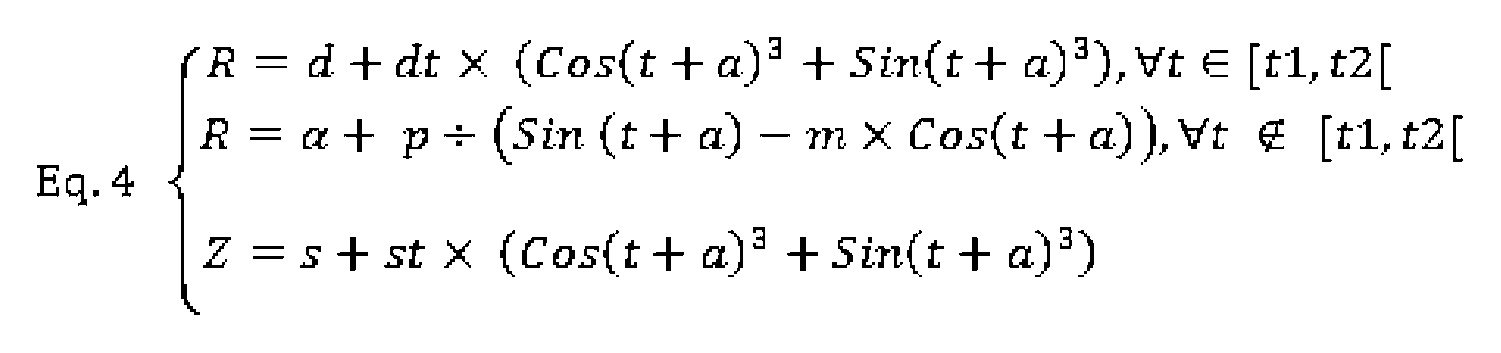
여기서, (

상기 수학식이 극좌표로 언급되어 있지만, 임의의 적합한 좌표계가 림의 형상을 기술하기 위해 사용될 수 있다.Although the above equation is referred to in polar coordinates, any suitable coordinate system can be used to describe the shape of the rim.
가장 실현가능하고 바람직한 실시예로 여겨지는 것이 도시되고 기술되어 있지만, 기술되고 도시된 특정 설계 및 방법으로부터 벗어나는 것이 당업자에게 떠오를 것이고 본 발명의 사상 및 범주로부터 벗어남 없이 사용될 수 있다는 것은 명백하다. 본 발명은 기술되고 예시된 특정한 구성으로 제한되는 것이 아니라, 첨부된 특허청구범위의 범주 내에 포함될 수 있는 모든 변형과 합쳐지도록 구성될 것이다.While what is believed to be the most feasible and preferred embodiment has been shown and described, it will be apparent to those skilled in the art that departing from the specific designs and methods described and illustrated will arise and can be used without departing from the spirit and scope of the invention. The invention is not to be limited to the specific configurations described and illustrated, but is to be construed to be incorporated with all modifications that may be included within the scope of the appended claims.
Claims (24)
시력 향상(eye enhancement)을 위해 구성된 내부 광학 구역;
상기 내부 광학 구역을 둘러싸고, 눈 상에서의 상기 콘택트 렌즈를 위한 기계적 안정성을 제공하도록 구성된 외부 주변 구역; 및
개선된 중심화(centration), 회전, 병진(translation) 및 눈물 교환 중 적어도 하나를 위해 구성되고, 연속적이고 비-원형이며 평면형인, 상기 외부 주변 구역을 따른 렌즈 림(lens rim)을 포함하고,
여기서 상기 광학 구역은 비-원형이고 상기 렌즈 림의 형상을 갖는, 콘택트 렌즈. As a contact lens,
An internal optical zone configured for eye enhancement;
An outer peripheral zone surrounding the inner optical zone and configured to provide mechanical stability for the contact lens on the eye; And
Comprising a lens rim along the outer periphery region, configured for at least one of improved centration, rotation, translation and tear exchange, and being continuous, non-circular and planar,
Wherein the optical zone is non-circular and has the shape of the lens rim.
시력 향상을 위해 구성된 내부 광학 구역;
상기 내부 광학 구역을 둘러싸고, 눈 상에서의 상기 콘택트 렌즈를 위한 기계적 안정성을 제공하도록 구성된 외부 주변 구역; 및
개선된 중심화, 회전, 병진 및 눈물 교환 중 적어도 하나를 위해 구성되고, 연속적이고 원형이며 비-평면형인, 상기 외부 주변 구역을 따른 렌즈 림을 포함하는, 콘택트 렌즈.As a contact lens,
Internal optical zone configured to improve vision;
An outer peripheral zone surrounding the inner optical zone and configured to provide mechanical stability for the contact lens on the eye; And
A contact lens comprising a lens rim along the outer peripheral region, configured for at least one of improved centering, rotation, translation and tear exchange, and being continuous, circular and non-planar.
The contact lens of claim 5, wherein the optical zone has the shape of the lens rim.
Applications Claiming Priority (2)
| Application Number | Priority Date | Filing Date | Title |
|---|---|---|---|
| US13/661,448 | 2012-10-26 | ||
| US13/661,448 US8888277B2 (en) | 2012-10-26 | 2012-10-26 | Contact lens with improved fitting characteristics |
Publications (2)
| Publication Number | Publication Date |
|---|---|
| KR20140053793A KR20140053793A (en) | 2014-05-08 |
| KR102145171B1 true KR102145171B1 (en) | 2020-08-28 |
Family
ID=49484215
Family Applications (1)
| Application Number | Title | Priority Date | Filing Date |
|---|---|---|---|
| KR1020130127899A Active KR102145171B1 (en) | 2012-10-26 | 2013-10-25 | Contact lens with improved fitting characteristics |
Country Status (7)
| Country | Link |
|---|---|
| US (1) | US8888277B2 (en) |
| EP (1) | EP2725408A1 (en) |
| JP (2) | JP6474542B2 (en) |
| KR (1) | KR102145171B1 (en) |
| CN (2) | CN103792681A (en) |
| HK (1) | HK1197103A1 (en) |
| RU (1) | RU2567594C2 (en) |
Families Citing this family (10)
| Publication number | Priority date | Publication date | Assignee | Title |
|---|---|---|---|---|
| US9046699B2 (en) * | 2012-03-13 | 2015-06-02 | Johnson & Johnson Vision Care, Inc. | Dynamic fluid zones in contact lenses |
| TWI588560B (en) | 2012-04-05 | 2017-06-21 | 布萊恩荷登視覺協會 | Lens, device, method and system for refractive error |
| US9201250B2 (en) | 2012-10-17 | 2015-12-01 | Brien Holden Vision Institute | Lenses, devices, methods and systems for refractive error |
| TWI600418B (en) | 2012-10-17 | 2017-10-01 | 布萊恩荷登視覺協會 | Lens, device, method and system for refractive error |
| WO2015008654A1 (en) * | 2013-07-19 | 2015-01-22 | ソニー株式会社 | Detection device and method |
| US9778487B2 (en) * | 2015-08-26 | 2017-10-03 | Johnson & Johnson Vision Care, Inc. | Rotationally stabilized contact lens with improved comfort and method of optimization |
| US10786959B2 (en) * | 2016-07-18 | 2020-09-29 | Johnson & Johnson Vision Care, Inc | Mold for contact lens with non-rotationally symmetric rim or edge |
| MY180472A (en) * | 2016-10-31 | 2020-11-30 | Toray Industries | Orthokeratology lens |
| US10620455B2 (en) | 2018-04-18 | 2020-04-14 | Tectus Corporation | Non-circular contact lenses with payloads |
| CN115697249A (en) | 2020-06-01 | 2023-02-03 | 应用奈米医材科技股份有限公司 | Bifacial aspheric diffractive multifocal lenses and their manufacture and use |
Citations (3)
| Publication number | Priority date | Publication date | Assignee | Title |
|---|---|---|---|---|
| JP2005500554A (en) * | 2000-07-28 | 2005-01-06 | オキュラー サイエンシス インコーポレイテッド | Contact lens with microchannel |
| JP2006526809A (en) * | 2003-05-30 | 2006-11-24 | サイエンティフィック・オプティクス,インコーポレイテッド | Contact lens with adapted rim |
| JP2009521726A (en) * | 2005-12-22 | 2009-06-04 | ボシュ・アンド・ロム・インコーポレイテッド | Toroidal contact lens |
Family Cites Families (26)
| Publication number | Priority date | Publication date | Assignee | Title |
|---|---|---|---|---|
| SU66807A1 (en) * | 1945-10-17 | 1945-11-30 | М.А. Галин | Contact lens |
| US3212097A (en) | 1962-04-12 | 1965-10-12 | Richard Wlodyga | Truncated prism ballast contact lens with indentation and fluid drainage channel at bottom edge |
| SU620225A3 (en) * | 1975-08-19 | 1978-08-15 | Dzhon Filipp Frat Strechen | Soft contact lens |
| US4573775A (en) * | 1982-08-19 | 1986-03-04 | Vistakon, Inc. | Bifocal contact lens |
| US4549794A (en) | 1983-05-05 | 1985-10-29 | Schering Corporation | Hydrophilic bifocal contact lens |
| SK377492A3 (en) | 1992-01-28 | 1995-05-10 | Johnson & Johnson Vision Prod | Multifocal refracting lens and method of its manufacture |
| NL9301863A (en) | 1993-10-28 | 1995-05-16 | Meurs Optiek B V Van | Contact lens with an optical zone with at least one focus. |
| TW275112B (en) | 1995-03-15 | 1996-05-01 | Ciba Geigy Ag | Rotationally stabilized contact lens and methods of lens stabilization |
| WO1996039106A1 (en) * | 1995-06-06 | 1996-12-12 | Scientific Optics, Inc. | Asymmetric bifocal intraocular lens |
| US7052132B2 (en) | 1999-12-16 | 2006-05-30 | Iolco Pty Ltd. | Soft multifocal contact lens |
| US6886936B2 (en) | 2000-07-28 | 2005-05-03 | Ocular Sciences, Inc. | Contact lenses with blended microchannels |
| WO2004015480A1 (en) | 2002-08-06 | 2004-02-19 | Novartis Ag | Contact lenses |
| CN2596380Y (en) * | 2002-12-30 | 2003-12-31 | 翁源松 | Glasses |
| US6802606B2 (en) | 2003-02-04 | 2004-10-12 | Johnson & Johnson Vision Care, Inc. | Multifocal contact lens pairs |
| US7004585B2 (en) | 2003-02-11 | 2006-02-28 | Novartis Ag | Ophthalmic lens having an optical zone blend design |
| DE102004015083A1 (en) | 2004-03-25 | 2005-10-13 | Endress + Hauser Wetzer Gmbh + Co Kg | Sampler for taking a defined sample amount of a fluid medium from a sample sampling point |
| WO2006129707A1 (en) * | 2005-06-03 | 2006-12-07 | Hoya Healthcare Corporation | Eye-use lens |
| US7216978B2 (en) | 2005-06-08 | 2007-05-15 | Johnson & Johnson Vision Care, Inc. | Method for evaluating eyelid movement and contact lens position |
| CN101238403A (en) * | 2005-08-11 | 2008-08-06 | 库柏维景公司 | Contact lenses and method of reducing conjunctival pressure in contact lens wearers |
| US7296890B2 (en) * | 2005-10-25 | 2007-11-20 | Truform Optics | Contact lens with controlled shape |
| ATE433130T1 (en) * | 2005-12-22 | 2009-06-15 | Bausch & Lomb | TORIC CONTACT LENSES |
| FR2921163B1 (en) | 2007-09-19 | 2009-12-25 | Precilens Lab | STABILIZED CONTACT LENS. |
| WO2011004800A1 (en) * | 2009-07-08 | 2011-01-13 | 株式会社メニコン | Soft hybrid contact lens, method for producing same, and hydration method |
| CN201804168U (en) * | 2010-08-23 | 2011-04-20 | 段亚东 | Myopia complete defocus correcting glasses |
| WO2012044534A1 (en) | 2010-09-27 | 2012-04-05 | Johnson & Johnson Vision Care. Inc. | Translating presbyopic contact lens |
| US8638502B2 (en) * | 2010-09-29 | 2014-01-28 | Johnson & Johnson Vision Care, Inc. | Liquid meniscus lens with non-spherical meniscus wall |
-
2012
- 2012-10-26 US US13/661,448 patent/US8888277B2/en active Active
-
2013
- 2013-10-25 JP JP2013222014A patent/JP6474542B2/en active Active
- 2013-10-25 CN CN201310511807.7A patent/CN103792681A/en active Pending
- 2013-10-25 KR KR1020130127899A patent/KR102145171B1/en active Active
- 2013-10-25 EP EP13190383.3A patent/EP2725408A1/en not_active Withdrawn
- 2013-10-25 RU RU2013147804/14A patent/RU2567594C2/en active
- 2013-10-25 CN CN201810096061.0A patent/CN108181727A/en active Pending
-
2014
- 2014-10-21 HK HK14110464.0A patent/HK1197103A1/en unknown
-
2018
- 2018-12-20 JP JP2018238142A patent/JP2019045883A/en active Pending
Patent Citations (3)
| Publication number | Priority date | Publication date | Assignee | Title |
|---|---|---|---|---|
| JP2005500554A (en) * | 2000-07-28 | 2005-01-06 | オキュラー サイエンシス インコーポレイテッド | Contact lens with microchannel |
| JP2006526809A (en) * | 2003-05-30 | 2006-11-24 | サイエンティフィック・オプティクス,インコーポレイテッド | Contact lens with adapted rim |
| JP2009521726A (en) * | 2005-12-22 | 2009-06-04 | ボシュ・アンド・ロム・インコーポレイテッド | Toroidal contact lens |
Also Published As
| Publication number | Publication date |
|---|---|
| CN108181727A (en) | 2018-06-19 |
| JP2019045883A (en) | 2019-03-22 |
| JP6474542B2 (en) | 2019-02-27 |
| US8888277B2 (en) | 2014-11-18 |
| KR20140053793A (en) | 2014-05-08 |
| US20140118683A1 (en) | 2014-05-01 |
| RU2013147804A (en) | 2015-04-27 |
| JP2014085678A (en) | 2014-05-12 |
| EP2725408A1 (en) | 2014-04-30 |
| CN103792681A (en) | 2014-05-14 |
| HK1197103A1 (en) | 2015-01-02 |
| RU2567594C2 (en) | 2015-11-10 |
Similar Documents
| Publication | Publication Date | Title |
|---|---|---|
| KR102145171B1 (en) | Contact lens with improved fitting characteristics | |
| US11774780B2 (en) | Comfort-optimized contact lens system for non-rotationally symmetric eye aberration | |
| US11782295B2 (en) | Friction stabilized contact lenses | |
| CN103748505B (en) | Parallel-moving type presbyopic haptic lens pair | |
| US20200391457A1 (en) | Mold for contact lens with non-rotationally symmetric rim or edge | |
| HK1236477A1 (en) | Friction stabilized contact lenses | |
| HK1231183A1 (en) | Comfort-optimized contact lens system for non-rotationally symmetric eye aberration |
Legal Events
| Date | Code | Title | Description |
|---|---|---|---|
| PA0109 | Patent application |
Patent event code: PA01091R01D Comment text: Patent Application Patent event date: 20131025 |
|
| PG1501 | Laying open of application | ||
| A201 | Request for examination | ||
| PA0201 | Request for examination |
Patent event code: PA02012R01D Patent event date: 20181024 Comment text: Request for Examination of Application Patent event code: PA02011R01I Patent event date: 20131025 Comment text: Patent Application |
|
| E902 | Notification of reason for refusal | ||
| PE0902 | Notice of grounds for rejection |
Comment text: Notification of reason for refusal Patent event date: 20190926 Patent event code: PE09021S01D |
|
| E701 | Decision to grant or registration of patent right | ||
| PE0701 | Decision of registration |
Patent event code: PE07011S01D Comment text: Decision to Grant Registration Patent event date: 20200509 |
|
| GRNT | Written decision to grant | ||
| PR0701 | Registration of establishment |
Comment text: Registration of Establishment Patent event date: 20200811 Patent event code: PR07011E01D |
|
| PR1002 | Payment of registration fee |
Payment date: 20200812 End annual number: 3 Start annual number: 1 |
|
| PG1601 | Publication of registration | ||
| PR1001 | Payment of annual fee |
Payment date: 20230705 Start annual number: 4 End annual number: 4 |
|
| PR1001 | Payment of annual fee |
Payment date: 20240703 Start annual number: 5 End annual number: 5 |