KR102109219B1 - User Data Input Prediction - Google Patents
User Data Input Prediction Download PDFInfo
- Publication number
- KR102109219B1 KR102109219B1 KR1020147023559A KR20147023559A KR102109219B1 KR 102109219 B1 KR102109219 B1 KR 102109219B1 KR 1020147023559 A KR1020147023559 A KR 1020147023559A KR 20147023559 A KR20147023559 A KR 20147023559A KR 102109219 B1 KR102109219 B1 KR 102109219B1
- Authority
- KR
- South Korea
- Prior art keywords
- candidate
- sequence
- probability
- input
- term
- Prior art date
- Legal status (The legal status is an assumption and is not a legal conclusion. Google has not performed a legal analysis and makes no representation as to the accuracy of the status listed.)
- Active
Links
Images


Classifications
-
- G—PHYSICS
- G06—COMPUTING OR CALCULATING; COUNTING
- G06F—ELECTRIC DIGITAL DATA PROCESSING
- G06F3/00—Input arrangements for transferring data to be processed into a form capable of being handled by the computer; Output arrangements for transferring data from processing unit to output unit, e.g. interface arrangements
- G06F3/01—Input arrangements or combined input and output arrangements for interaction between user and computer
- G06F3/02—Input arrangements using manually operated switches, e.g. using keyboards or dials
- G06F3/023—Arrangements for converting discrete items of information into a coded form, e.g. arrangements for interpreting keyboard generated codes as alphanumeric codes, operand codes or instruction codes
- G06F3/0233—Character input methods
- G06F3/0237—Character input methods using prediction or retrieval techniques
-
- G—PHYSICS
- G06—COMPUTING OR CALCULATING; COUNTING
- G06F—ELECTRIC DIGITAL DATA PROCESSING
- G06F40/00—Handling natural language data
- G06F40/20—Natural language analysis
- G06F40/232—Orthographic correction, e.g. spell checking or vowelisation
-
- G—PHYSICS
- G06—COMPUTING OR CALCULATING; COUNTING
- G06F—ELECTRIC DIGITAL DATA PROCESSING
- G06F40/00—Handling natural language data
- G06F40/20—Natural language analysis
- G06F40/274—Converting codes to words; Guess-ahead of partial word inputs
-
- G—PHYSICS
- G06—COMPUTING OR CALCULATING; COUNTING
- G06F—ELECTRIC DIGITAL DATA PROCESSING
- G06F40/00—Handling natural language data
- G06F40/20—Natural language analysis
- G06F40/279—Recognition of textual entities
- G06F40/284—Lexical analysis, e.g. tokenisation or collocates
Landscapes
- Engineering & Computer Science (AREA)
- Theoretical Computer Science (AREA)
- General Engineering & Computer Science (AREA)
- Physics & Mathematics (AREA)
- General Physics & Mathematics (AREA)
- Computational Linguistics (AREA)
- General Health & Medical Sciences (AREA)
- Health & Medical Sciences (AREA)
- Audiology, Speech & Language Pathology (AREA)
- Artificial Intelligence (AREA)
- Human Computer Interaction (AREA)
- Machine Translation (AREA)
- Document Processing Apparatus (AREA)
Abstract
본 발명에 따르면, 전자 디바이스에 텍스트를 입력하기 위한 시스템이 제공된다. 상기 시스템은 입력 시퀀스(20)로부터 하나 이상의 후보들을 발생하도록 구성된 후보 발생기(2)를 포함한다. 입력 시퀀스(20)는 연속 문자 시퀀스를 포함한다. 각 후보는 하나 이상의 용어 경계들에 의해 분리된 2 이상의 용어들을 포함한다. 후보 발생기(2)는 문맥언어모델에서 상기 후보의 하나 이상의 용어들을 탐색하고, 문맥언어모델로부터 상기 후보의 하나 이상의 용어들에 해당하는 확률을 상기 후보에 할당함으로써 제 1 확률평가를 각 후보에 할당하며, 문맥언어모델은 용어 시퀀스들을 포함하며, 용어들 시퀀스 각각은 해당 발생확률을 갖는다. 후보 발생기(2)는 해당 제 1 확률평가를 기초로 하나 이상의 후보들을 폐기하도록 구성된다. 사용자 입력 시퀀스에 있는 용어 경계를 추론하는 해당 방법이 제공된다.According to the present invention, a system for inputting text into an electronic device is provided. The system includes a candidate generator 2 configured to generate one or more candidates from the input sequence 20. The input sequence 20 includes a sequence of consecutive characters. Each candidate includes two or more terms separated by one or more term boundaries. The candidate generator 2 allocates a first probability evaluation to each candidate by searching for one or more terms of the candidate in the contextual language model and assigning a probability corresponding to one or more terms of the candidate from the contextual language model to the candidate The contextual language model includes term sequences, and each of the term sequences has a corresponding probability of occurrence. The candidate generator 2 is configured to discard one or more candidates based on the corresponding first probability assessment. A corresponding method for inferring term boundaries in a user input sequence is provided.
Description
본 발명은 사용자 입력 텍스트로부터 다수의 용어들을 예측하는 시스템 및 방법에 관한 것으로, 보다 상세하게는 사용자 입력 텍스트에서 하나 이상의 용어 경계들을 예측하는 시스템 및 방법에 관한 것이다.The present invention relates to a system and method for predicting multiple terms from user input text, and more particularly, to a system and method for predicting one or more term boundaries in user input text.
사용자 입력 텍스트에서 용어 경계를 정의하는 몇몇 형태, 가령 GoogleTM의 AndroidTM ICS 키보드 또는 AppleTM의 iOS 키보드를 갖는 시스템들이 공지되어 있다. 그러나, 이들 시스템들은 용어 경계를 검출하는데 한계가 있다. Systems with several forms of defining term boundaries in user input text, such as Android TM ICS keyboard from Google TM or iOS keyboard from Apple TM are known. However, these systems have limitations in detecting term boundaries.
GoogleTM의 AndroidTM ICS 키보드를 예를 들면, 사용자가 분리 공백 또는 공백과는 다른 문자로 이격시키지 않고 기본적인 어휘로부터 2개의 유효 단어를 입력할 경우, 시스템은 관련 있다면 틀린 문자를 대체하며 공백에 의해 분리된 2 단어들을 제공할 것이다. 그러나, 이 시스템은 많은 제한들이 있는데, 특히In the Google TM Android TM ICS keyboard, for example, if a user enters two valid words from a basic vocabulary without separating them with spaces or characters other than spaces, the system replaces the wrong characters if relevant and is replaced by spaces. It will give you 2 separate words. However, this system has many limitations, especially
·어느 한 단어가 오타 또는 오자인 경우 작동하지 않고,· If a word is a typo or a typo
·자동 아포스트로피(') 삽입과 같은 다른 입력조작 기능들과 작동하지 않으며,Does not work with other input manipulation functions such as automatic apostrophe (') insertion,
·2개의 단어들이 일단 분석되게 한다. 즉 단일어 경계만 식별할 수 있다.· Have 2 words analyzed. That is, only a single word boundary can be identified.
AppleTM의 iOS 키보드는 제한된 오타 또는 오자를 보상할 수 있다는 점에서 GoogleTM의 AndroidTM 버전보다 더 이점적이다. 그러나, iOS 키보드는 또한 단일어 경계를 식별하는데 제한된다. AppleTM 's iOS keyboard is more advantageous than GoogleTM 's AndroidTM version in that it can compensate for limited typos or typos. However, iOS keyboards are also limited to identifying monolingual boundaries.
본 발명의 목적은 이들 하나 이상의 제한들을 극복해, 용어 경계들의 명백한 삽입없이 사용자가 구 또는 심지어 전체 메시지들을 입력하게 하는 것이다.The object of the present invention is to overcome these one or more limitations, allowing the user to enter phrases or even whole messages without explicit insertion of term boundaries.
본 발명의 제 1 태양으로, In a first aspect of the invention,
연속 문자 시퀀스를 포함한 입력 시퀀스로부터 하나 이상의 용어 경계들에 의해 분리된 2 이상의 용어들을 각각 포함하는 하나 이상의 후보들을 발생하고, Generate one or more candidates each comprising two or more terms separated by one or more term boundaries from an input sequence comprising a sequence of consecutive characters,
해당 발생확률을 각각 갖는 용어들의 시퀀스를 포함한 문맥언어모델에서 상기 후보의 하나 이상의 용어들을 탐색하고, 문맥언어모델로부터 상기 후보의 하나 이상의 용어들에 해당하는 확률을 상기 후보에 할당함으로써 제 1 확률평가를 각 후보에 할당하며, First probability evaluation by searching for one or more terms of the candidate in a contextual language model including a sequence of terms each having a corresponding probability of occurrence, and allocating a probability corresponding to one or more terms of the candidate from the contextual language model to the candidate To each candidate,
해당 제 1 확률평가를 기초로 하나 이상의 후보들을 폐기하도록 구성된 후보 발생기를 포함하는 전자 디바이스에 텍스트를 입력하기 위한 시스템이 있다. There is a system for inputting text into an electronic device including a candidate generator configured to discard one or more candidates based on the first probability assessment.
일실시예로, 하나 이상의 용어들은 후보를 포함한다. 바람직하기로, 각 후보에 대해, 후보 발생기는 상기 후보와 조합한 문맥 시퀀스를 포함한 시퀀스에 대한 문맥언어모델에서 탐색하도록 구성되고, 문맥 시퀀스는 입력 시퀀스보 앞선 사용자 입력 텍스트이며 하나 이상의 용어 경계들에 의해 분리된 하나 이상의 용어들을 포함한다. In one embodiment, one or more terms include a candidate. Preferably, for each candidate, the candidate generator is configured to search in a contextual language model for a sequence comprising a context sequence in combination with the candidate, the context sequence being user input text prior to the input sequence and at one or more term boundaries. It includes one or more terms separated by.
시스템은 사용자 입력 신호들을 입력 시퀀스와 문맥 시퀀스로 변환시키도록 구성된 입력 시퀀스 발생기를 더 구비할 수 있다. 입력 시퀀스 발생기는 바람직하게는 각 세트내 각 문자와 관련된 확률값이 있도록 일련의 문자 세트들을 발생함으로써 사용자 입력 신호를 입력 시퀀스로 변환시키며, 각 문자 세트는 세트내 문자들에 대한 확률 분포를 갖는다.The system may further include an input sequence generator configured to convert user input signals into an input sequence and a context sequence. The input sequence generator preferably converts the user input signal to an input sequence by generating a series of character sets such that there is a probability value associated with each character in each set, each character set having a probability distribution for the characters in the set.
후보 발생기는 입력 시퀀스를 하나 이상의 경로들을 포함한 확률적 제약 시퀀스 그래프로 변환시킴으로써 입력 시퀀스로부터 하나 이상의 후보들을 발생하도록 구성되고, 하나 이상의 경로들은 하나 이상의 후보들에 해당한다. 확률적 제약 시퀀스 그래프는 바람직하게는 노드 및 한 노드를 또 다른 노드에 각각 연결하는 방향성 에지의 수집을 포함한 방향성 비사이클 그래프의 변형이며, 상기 확률적 제약 시퀀스 그래프에서, 각 문자 세트의 각 문자가 노드에 할당되고, 각 노드에 대한 인커밍 에지는 관련된 문자에 대한 확률에 해당한다. 확률 그래프의 각 경로는 바람직하게는 길이가 같도록 제한된다. The candidate generator is configured to generate one or more candidates from the input sequence by transforming the input sequence into a stochastic constraint sequence graph including one or more paths, and the one or more paths correspond to one or more candidates. The probabilistic constraint sequence graph is preferably a variation of a directional acyclic graph that includes a collection of directional edges each connecting a node and one node to another node, wherein in the probabilistic constraint sequence graph, each character in each character set Assigned to nodes, the incoming edge for each node corresponds to the probability for the associated character. Each path of the probability graph is preferably limited to the same length.
후보 발생기는 바람직하게는 하나 이상의 용어 경계 노드들을 확률적 제약 시퀀스 그래프에 삽입하도록 구성되고, 하나 이상의 용어 경계 노드들 각각은 입력 시퀀스에서 발생하는 확률(t)을 갖는다. 바람직하기로, 후보 발생기는 입력 시퀀스의 문자들의 임의의 2개 이웃 세트들에 해당하는 임의의 2개 이웃 노드들 사이에 용어경계 노드를 삽입하도록 구성된다. 더욱이, 후보 발생기는 입력 시퀀스의 문자 세트를 나타내는 임의 노드에 대한 대안으로서 용어경계 노드를 삽입하도록 구성될 수 있다.The candidate generator is preferably configured to insert one or more term boundary nodes into a stochastic constraint sequence graph, each of the one or more term boundary nodes having a probability t occurring in the input sequence. Preferably, the candidate generator is configured to insert a terminology node between any two neighboring nodes corresponding to any two neighboring sets of characters in the input sequence. Moreover, the candidate generator can be configured to insert terminology nodes as an alternative to any node representing the character set of the input sequence.
후보 발생기는 바람직하게는 하나 이상의 와일드카드(wildcard) 노드들을 확률적 제약 시퀀스 그래프에 삽입하도록 구성되고, 하나 이상의 와일드카드 노드들 각각은 임의 문자가 입력 시퀀스의 문자 세트들 이외에 확률적 제약 시퀀스 그래프에 삽입되게 한다. The candidate generator is preferably configured to insert one or more wildcard nodes into the stochastic constraint sequence graph, each of the one or more wildcard nodes having random characters in the stochastic constraint sequence graph in addition to the character sets of the input sequence. To be inserted.
후보 발생기는 후보를 나타내는 확률적 제약 시퀀스 그래프를 통해 경로의 누적 확률을 판단함으로써 후보에 대한 제 2 확률평가를 발생하도록 구성될 수 있다. 후보 발생기는 바람직하게는 각 후보에 대한 제 1 및 제 2 확률을 조합하도록 구성된다.The candidate generator may be configured to generate a second probability evaluation for the candidate by determining the cumulative probability of the path through the probability constraint sequence graph representing the candidate. The candidate generator is preferably configured to combine the first and second probabilities for each candidate.
바람직하기로, 후보 발생기는:Preferably, the candidate generator is:
가장 가능성 있는 후보에 대한 조합된 확률을 판단하는 단계;Determining a combined probability for the most likely candidate;
해당 후보에 대한 조합된 확률을 판단하는 단계; 및Determining a combined probability for the candidate; And
가장 가능성 있는 후보와 해당 후보에 대한 조합된 확률의 비가 임계치(t) 미만인 경우 후보를 폐기하는 단계에 의해 후보를 폐기하도록 구성된다.If the ratio of the most probable candidate and the combined probability for the candidate is less than the threshold t, the candidate is discarded by discarding the candidate.
후보 발생기는 폐기되지 않은 임의 후보에 대한 제 3 확률을 판단하도록 구성될 수 있다. 제 3 확률은 문맥 시퀀스, 유효한 정자법 및 그 어휘 변화를 포함한 시퀀스에 대한 문맥언어모델을 탐색함으로써 결정될 수 있으며, 문맥 시퀀스는 입력 시퀀스에 앞선 사용자 입력 텍스트이고 하나 이상의 용어 경계들에 의해 분리된 하나 이상의 용어들을 포함한다. 후보의 전체 확률은 제 2 및 제 3 확률의 곱일 수 있다.The candidate generator can be configured to determine a third probability for any candidate that has not been discarded. The third probability can be determined by searching the contextual language model for a sequence including a context sequence, a valid sperm method, and its vocabulary change, the context sequence being user input text preceding the input sequence and one or more separated by one or more term boundaries. Includes terms. The total probability of the candidate may be the product of the second and third probability.
하나 이상의 가장 가능성 있는 후보들은 사용자에 나타내기 위해 후보 발생기로부터 후보 디스플레이로 출력될 수 있다.One or more most likely candidates can be output from the candidate generator to the candidate display to indicate to the user.
일실시예에서, 용어 경계는 공백문자이다.In one embodiment, the term boundary is a space character.
본 발명의 제 2 태양으로, In a second aspect of the invention,
후보 발생기를 이용해 입력 시퀀스로부터 하나 이상의 용어 경계들에 의해 분리된 2 이상의 용어들을 각각 포함하는 하나 이상의 후보들을 발생하는 단계, Generating one or more candidates each comprising two or more terms separated by one or more term boundaries from an input sequence using a candidate generator,
해당 발생확률을 각각 갖는 용어들의 시퀀스를 포함한 문맥언어모델에서 상기 후보의 하나 이상의 용어들을 탐색하고, 문맥언어모델로부터 상기 후보의 하나 이상의 용어들에 해당하는 확률을 상기 후보에 할당함으로써 제 1 확률평가를 각 후보에 할당하는 단계,; 및First probability evaluation by searching for one or more terms of the candidate in a contextual language model including a sequence of terms each having a corresponding probability of occurrence, and allocating a probability corresponding to one or more terms of the candidate from the contextual language model to the candidate Assigning to each candidate; And
해당 제 1 확률평가를 기초로 하나 이상의 후보들을 폐기하는 단계를 포함하는, 연속 문자 시퀀스를 포함한 입력 시퀀스에서 용어 경계를 추론하는 방법이 있다. There is a method of inferring term boundaries in an input sequence including a sequence of consecutive characters, including discarding one or more candidates based on the first probability assessment.
일실시예에서. 하나 이상의 용어들은 후보를 포함한다. 각 후보에 대해, 문맥언어모델에서 후보를 탐색하는 단계는 바람직하게는 후보와 조합한 문맥 시퀀스를 포함한 시퀀스에 대해 탐색하는 단계를 포함하고, 문맥 시퀀스는 입력 시퀀스보 앞선 사용자 입력 텍스트이며 하나 이상의 용어 경계들에 의해 분리된 하나 이상의 용어들을 포함한다. In one embodiment. One or more terms include a candidate. For each candidate, searching for a candidate in the contextual language model preferably includes searching for a sequence including a context sequence in combination with the candidate, the context sequence being user input text prior to the input sequence and one or more terms. Includes one or more terms separated by boundaries.
상기 방법은 바람직하게는 입력 시퀀스 발생기를 이용해, 사용자 입력 신호들을 입력 시퀀스와 문맥 시퀀스로 변환시키는 단계를 포함한다. 사용자 입력 신호를 입력 시퀀스로 변환시키는 단계는 바람직하게는 각 세트내 각 문자와 관련된 확률값이 있도록 일련의 문자 세트들을 발생하는 단계를 포함하며, 각 문자 세트는 세트내 문자들에 대한 확률 분포를 갖는다.The method preferably includes converting the user input signals into an input sequence and a context sequence, using an input sequence generator. Converting the user input signal to an input sequence preferably includes generating a series of character sets such that there is a probability value associated with each character in each set, each character set having a probability distribution for the characters in the set. .
입력 시퀀스로부터 하나 이상의 후보들을 발생하는 단계는 입력 시퀀스를 하나 이상의 경로들을 포함한 확률적 제약 시퀀스 그래프로 변환시키는 단계를 포함할 수 있고, 하나 이상의 경로들은 하나 이상의 후보들에 해당한다. 확률적 제약 시퀀스 그래프는 바람직하게는 노드 및 한 노드를 또 다른 노드에 각각 연결하는 방향성 에지의 수집을 포함한 방향성 비사이클 그래프의 변형이며, 상기 확률적 제약 시퀀스 그래프에서, 각 문자 세트의 각 문자가 노드에 할당되고, 각 노드에 대한 인커밍 에지는 관련된 문자에 대한 확률에 해당한다. 확률 그래프의 각 경로는 바람직하게는 길이가 같도록 제한된다.Generating one or more candidates from the input sequence may include transforming the input sequence into a stochastic constraint sequence graph comprising one or more paths, where the one or more paths correspond to one or more candidates. The probabilistic constraint sequence graph is preferably a variation of a directional acyclic graph that includes a collection of directional edges each connecting a node and one node to another node, wherein in the probabilistic constraint sequence graph, each character in each character set Assigned to nodes, the incoming edge for each node corresponds to the probability for the associated character. Each path of the probability graph is preferably limited to the same length.
상기 방법은 바람직하게는 하나 이상의 용어 경계 노드들을 확률적 제약 시퀀스 그래프에 삽입하는 단계를 더 포함하고, 하나 이상의 용어 경계 노드들 각각은 입력 시퀀스에서 발생하는 확률(t)을 갖는다. 입력 시퀀스의 문자들의 임의의 2개 이웃 세트들에 해당하는 임의의 2개 이웃 노드들 사이에 용어경계 노드가 바람직하게 삽입된다. The method preferably further comprises inserting one or more term boundary nodes into the probabilistic constraint sequence graph, each of the one or more term boundary nodes having a probability t occurring in the input sequence. A terminology node is preferably inserted between any two neighboring nodes corresponding to any two neighboring sets of characters of the input sequence.
입력 시퀀스의 문자 세트를 나타내는 임의 노드에 대한 대안으로서 용어경계 노드가 삽입될 수 있다. A term boundary node can be inserted as an alternative to any node representing the character set of the input sequence.
상기 방법은 바람직하게는 후보 발생기를 이용해 하나 이상의 와일드카드 노드들을 확률적 제약 시퀀스 그래프에 삽입하는 단계를 더 포함하고, 하나 이상의 와일드카드 노드들 각각은 임의 문자가 입력 시퀀스의 문자 세트들 이외에 확률적 제약 시퀀스 그래프에 삽입되게 한다.The method preferably further comprises inserting one or more wildcard nodes into the stochastic constraint sequence graph using a candidate generator, wherein each of the one or more wildcard nodes has a random character in addition to the character sets of the input sequence. Let it be inserted into the constraint sequence graph.
상기 방법은 바람직하게는 후보를 나타내는 확률적 제약 시퀀스 그래프를 통해 경로의 누적 확률을 판단함으로써 후보 발생기를 이용해 후보에 대한 제 2 확률평가를 발생하는 단계를 더 포함한다. 후보 발생기는 각 후보에 대한 제 1 및 제 2 확률의 곱을 판단하는데 사용될 수 있다.The method preferably further includes generating a second probability evaluation for the candidate by using the candidate generator by determining the cumulative probability of the path through a stochastic constraint sequence graph representing the candidate. The candidate generator can be used to determine the product of first and second probabilities for each candidate.
바람직하기로, 후보를 폐기하는 단계는:Preferably, the step of discarding candidates is:
후보 발생기를 이용해 가장 가능성 있는 후보에 대한 조합된 확률을 판단하는 단계;Determining a combined probability for the most probable candidate using a candidate generator;
후보 발생기를 이용해 해당 후보에 대한 조합된 확률을 판단하는 단계; 및Determining a combined probability for the candidate using a candidate generator; And
후보 발생기를 이용해 가장 가능성 있는 후보와 해당 후보에 대한 조합된 확률의 비가 임계치(t) 미만인 경우 후보를 폐기하는 단계에 의해 후보를 폐기하는 단계를 포함하는 연속 문자 시퀀스를 포함한다.And a successive character sequence comprising discarding the candidate by discarding the candidate when the ratio of the most likely candidate and the combined probability for the candidate is less than the threshold t using a candidate generator.
바람직하기로, 상기 방법은 후보 발생기를 이용해 폐기되지 않은 임의 후보에 대한 제 3 확률을 판단하는 단계를 더 포함한다. 제 3 확률은 후보 발생기를 이용해 상기 후보와 조합해 문맥 시퀀스, 유효한 정자법 및 그 어휘 변화를 포함한 시퀀스에 대한 문맥언어모델을 탐색함으로써 결정될 수 있으며, 문맥 시퀀스는 입력 시퀀스에 앞선 사용자 입력 텍스트이고 하나 이상의 용어 경계들에 의해 분리된 하나 이상의 용어들을 포함한다. 후보의 전체 확률은 제 2 확률에 제 3 확률을 곱함으로써 결정될 수 있다.Preferably, the method further comprises determining a third probability for any candidate that has not been discarded using a candidate generator. The third probability can be determined by searching a contextual language model for a sequence including a context sequence, a valid sperm method, and its vocabulary change in combination with the candidate using a candidate generator, the context sequence being user input text preceding the input sequence and one or more Includes one or more terms separated by term boundaries. The total probability of a candidate can be determined by multiplying the second probability by the third probability.
상기 방법은 후보 발생기로부터 하나 이상의 가장 가능성 있는 후보들을 사용자에 나타내기 위해 후보 디스플레이로 출력하는 단계를 더 포함할 수 있다.The method may further include outputting from the candidate generator to a candidate display to indicate to the user one or more most likely candidates.
일실시예에서, 용어 경계는 공백문자이다.In one embodiment, the term boundary is a space character.
본 발명의 제 3 태양으로, 프로세서가 상술한 바와 같은 방법을 수행하게 하는 컴퓨터 프로그램 수단을 저장한 컴퓨터 판독가능 매체를 구비하는 컴퓨터 프로그램 제품이 있다. In a third aspect of the present invention, there is a computer program product having a computer readable medium storing computer program means for causing a processor to perform a method as described above.
본 발명의 제 4 태양으로, In a fourth aspect of the invention,
현재 사용자가 기입하고 있는 텍스트를 디스플레이하도록 구성된 텍스트판;A text plate configured to display text currently being written by the user;
사용자가 현재 기입하고 이는 텍스트가 나타내고자 의도한 것의 예측인 후보를 디스플레이하기 위한 예측판;A prediction plate for displaying candidates that the user is currently writing and this is a prediction of what the text intended to represent;
사용자가 기입한 텍스트를 받아들이기 위한 것으로, 스페이스바를 나타내는 키를 포함하지 않는 가상 키보드를 구비한 사용자 인터페이스가 있다. For accepting text written by a user, there is a user interface having a virtual keyboard that does not include a key indicating a space bar.
바람직하기로, 예측판은 사용자 입력 시퀀스를 디스플레이하는 제 1 예측판과 사용자 입력 시퀀스에 대한 예측을 디스플레이하는 제 2 예측판의 2개의 예측 판을 포함한다.Preferably, the prediction plate includes two prediction plates: a first prediction plate displaying a user input sequence and a second prediction plate displaying predictions for the user input sequence.
본 발명의 내용에 포함됨.Included in the context of the present invention.
첨부도면을 참조로 본 발명을 더 상세히 설명한다:
도 1은 본 발명에 따른 고수준의 예측구조의 개략도이다.
도 2a는 본 발명에 따른 예시적인 인터페이스를 도시한 것이다.
도 2b는 본 발명에 따른 예시적인 인터페이스를 도시한 것이다.
도 3은 본 발명에 따른 시스템의 사용 작동 예이다.
도 4는 본 발명에 따른 방법의 흐름도이다The present invention will be described in more detail with reference to the accompanying drawings:
1 is a schematic diagram of a high-level prediction structure according to the present invention.
2A shows an exemplary interface in accordance with the present invention.
2B shows an exemplary interface in accordance with the present invention.
3 is an operation example of use of the system according to the present invention.
4 is a flow chart of a method according to the present invention.
본 발명은 휴대폰 또는 태블릿과 같은 전자 디바이스에 텍스트 기입을 위한 시스템 및 방법을 제공함으로써, 텍스트 입력시 용어 경계들의 가능한 위치를 추론하기 위한 확률문맥모델이 이용된다.The present invention provides a system and method for text entry into an electronic device, such as a mobile phone or tablet, so that a probability context model is used to infer a possible location of term boundaries when entering text.
본 시스템은 문맥언어 데이터를 기초로 이들 결과들을 필터링하는 확률방법으로 기본 어휘로부터 다용어 경계추론 결과들을 발생하는 방법을 포함한다. The system includes a method of generating multi-word boundary inference results from a basic vocabulary as a probability method of filtering these results based on contextual language data.
이 시스템은 바람직하게는 (본 명세서에 전체가 참조로 합체된) 국제특허출원번호 PCT/GB2011/001419에 기술된 바와 같은 추가 확률문자조작과 결합되어, 동시에 오타 및 오자를 수정할 수 있고 또한 (영어의 자동 아포스트로피 삽입과 같은) 확률적으로 도출된 다른 문자 스트림을 조작할 수 있는 시스템을 만든다. 따라서, 시스템은 높은 확률의 다용어 텍스트 예측을 발생할(및 사용자 또는 시스템에 제공할) 수 있다.The system is preferably combined with additional probabilistic character manipulation as described in International Patent Application No. PCT / GB2011 / 001419 (incorporated herein by reference in its entirety), at the same time capable of correcting typos and typos (English) Creates a system that can manipulate other character streams that are stochastically derived (such as automatic apostrophe insertion). Thus, the system can generate (and provide to the user or system) a high probability multi-lingual text prediction.
따라서, 본 시스템 및 방법은 사용자가 수동으로 단어들 이격시킬 필요성을 제거함으로써 입력속도를 높이는 수단, 및 이렇게 하기 위해 시도하나 (사용자가 이격 대신 가짜 문자를 삽입했거나, 사용자가 가령 임의의 문자 또는 분리를 삽입하는데 실패한 경우) 실패한 사용자들에 정확한 피드백을 모두 제공한다. Thus, the present system and method means to increase the input speed by eliminating the need for the user to manually separate words, and attempt to do so (the user inserted a fake character instead of the spacing, or the user randomly separated or separated, for example) Provides accurate feedback to all users who failed to insert).
다음 예들은 예시적인 많은 사용자 텍스트 입력들이 주어진 경우 본 발명의 시스템 및 방법의 출력(하나 이상의 용어들의 텍스트 예측)을 설명한다. 예들은 용어 경계들이 전혀 없는 사용자 입력 텍스트, 경계 대신에 가짜 문자들을 가진 텍스트 입력 등과 같은 다른 많은 텍스트 입력 시나리오들에 대한 시스템/방법의 능력을 설명한다. The following examples illustrate the output (text prediction of one or more terms) of the system and method of the present invention given many exemplary user text inputs. The examples illustrate the ability of the system / method for many other text entry scenarios, such as user input text with no term boundaries at all, text entry with fake characters instead of boundaries.
용어 경계가 없는 사용자에 의한 텍스트 입력의 예:Examples of text input by users without term boundaries:
사용자 입력 "seeyoulater"에 대해, 시스템/방법은 "see you later"를 예측/출력한다.For user input " seeyoulater ", system / method is " see you Predict / output later ".
경계 대신 가짜 문자로 사용자에 의한 텍스트 입력의 예:Examples of text input by users with fake characters instead of boundaries:
사용자 입력 "seecyoublater"에 대해, 시스템/방법은 "see you later"를 예측/출력한다.For user input " seecyoublater ", the system / method is " see you Predict / output later ".
개시된 시스템 및 방법은 또한 실시간으로 접두사 매치들을 해결할 수 있다. 가령:The disclosed system and method can also resolve prefix matches in real time. chamberlain:
사용자 입력 "seeyoula"에 대해, 시스템/방법은 "see you later"를 예측/출력한다.For user input " seeyoula ", the system / method is " see you Predict / output later ".
개시된 시스템/방법은 동시에 단어 경계 및 접두사를 추론하면서 오타/오자를 보상할 수 있다. 가령:The disclosed system / method can compensate for typos / mispelling while inferring word boundaries and prefixes at the same time. chamberlain:
사용자 입력 "seeyooulayer"에 대해, 시스템/방법은 "see you later"를 예측/출력한다.For user input " seeyooulayer ", the system / method is " see you Predict / output later ".
사용자 입력 "whatstheti"에 대해, 시스템/방법은 "what's the time"를 예측/출력한다.For user input " whatstheti ", the system / method is "what's the Predict / output time ".
시스템/방법은 사용자에 표현하기 위해 확률적으로 랭킹된 하나 이상의 예측 세트를 만들도록 구성될 수 있다. 예컨대, 사용자 입력 "thedrmin"으로부터, 시스템/방법은 다음 랭킹 예측을 출력할 수 있다:The system / method may be configured to create one or more predictively ranked sets of predictions for presentation to the user. For example, from the user input " thedrmin ", the system / method may output the following ranking prediction:
"these mints " these mints
"the seminar " the seminar
<etc><etc>
일반적으로, 하지만 비배타적으로, 본 시스템의 개요가 도 1에 도시되어 있다. In general, but non-exclusively, an overview of the system is shown in FIG. 1.
시스템은 바람직하게는 본 명세서에 전체가 참조로 합체된 국제특허출원번호 PCT/GB2011/001419에 기술된 바와 같은 기존 확률 텍스트 기입 시스템을 강화하도록 설계된다. 그러나, 이는 가령 본 출원의 배경부분에 언급된 바와 같은 기존 텍스트 기입 시스템을 단지 강화하기 위해서만 이용될 수 있다.The system is preferably designed to enhance the existing probability text entry system as described in International Patent Application No. PCT / GB2011 / 001419, incorporated herein by reference in its entirety. However, it can only be used to enhance existing text entry systems, such as those mentioned in the background section of this application.
도 1에 도시된 바와 같이, 시스템은 후보 발생기(2)를 포함한다. 바람직하기로, 시스템은 또한 시퀀스 발생기(1) 및 후보 디스플레이(3)를 포함한다. 후보 디스플레이(3)는 하나 이상의 후보(40)를 사용자에 디스플레이하도록 구성된다.As shown in Figure 1, the system includes a
입력 시퀀스 발생기(1)는 사용자 입력으로부터 텍스트 시퀀스를 발생하도록 구성된다. 사용자 입력은 가령 다른 타입의 텍스트 입력 인터페이스가 주어진다면 일련의 다른 전자 디바이스들 범위와 함께 다른 타입의 인터액션에 해당하는 일련의 사용자 신호들(10)에 의해 발생될 수 있다:The input sequence generator 1 is configured to generate a text sequence from user input. User input may be generated by a series of user signals 10 corresponding to different types of interactions, such as a range of different electronic devices, given a different type of text input interface:
· 해당기술분야에 공지된 바와 같은 QWERTY(또는 다른 레이아웃)· QWERTY (or other layout) as known in the art
· 해당기술분야에 공지된 바와 같은 확률적 가상 QWERTY(또는 다른 레이아웃)· Stochastic virtual QWERTY (or other layout) as known in the art
· 보다 최신의 키프레스 모델(가령, GB 출원 1108200.5, "User Input Prediction"로, 상기 참조문헌은 본 명세서에 참조로 합체되어 있음)More recent keypress model (eg GB Application 1108200.5, "User Input Prediction", the above references are incorporated herein by reference)
· 확률연속 스트로크 인터페이스(가령, GB 출원 1200643.3, "System and method for inputting text"로, 상기 참조문헌은 본 명세서에 참조로 합체되어 있음)Probability continuous stroke interface (eg, GB application 1200643.3, "System and method for inputting text", the above references are incorporated herein by reference)
입력 시퀀스 발생기(1)는 사용자에 의해 발생된 입력 신호(10)를 받고 소정의 언어로 구조화된 문자 시퀀스를 되돌려 보낸다. 입력 시퀀스 발생기(1)는 2개의 구조화된 문자 시퀀스, 즉, 입력 시퀀스(20) 및 문맥 시퀀스(30)를 출력한다.The input sequence generator 1 receives the input signal 10 generated by the user and sends the structured character sequence back in a predetermined language. The input sequence generator 1 outputs two structured character sequences, namely an input sequence 20 and a context sequence 30.
문맥 시퀀스(30)는 고정된 문자 시퀀스를 포함한다. 입력 시퀀스(20)는 본 명세서에서 확률 스트링이라고 하는 형태이다. 확률 스트링은 문자요소들에 대한 확률분포를 각각 갖는 가지며 일련의 문자 세트를 포함하므로, 각 세트에서 각 문자는 이와 관련된 확률값을 갖는다. 확률 스트링이 합이 1이 되는 해당 확률을 갖는 2 이상의 문자들을 각각 갖는 3개 문자 세트들({-}로 표시됨)에 대한 시퀀스를 포함하는 예가 아래에 도시되어 있다:The context sequence 30 includes a fixed sequence of characters. The input sequence 20 is a form called a probability string in this specification. Since the probability string has a probability distribution for each character element and includes a series of character sets, each character in each set has a probability value associated with it. An example is shown below where a probability string contains a sequence for three character sets (represented by { - } ) each having two or more characters with the corresponding probability that the sum is 1.
{{ {a, 0.8},{s, 0.1},{z, 0.1} }, { {r, 0.9},{t, 0.05},{f, 0.05} }, { {e, 0.8},{w, 0.2} }}{ { {a, 0.8}, {s, 0.1}, {z, 0.1} }, { {r, 0.9}, {t, 0.05}, {f, 0.05} }, { {e, 0.8}, {w , 0.2} } }
예로써, 사용자는 시퀀스 "The devil makes work for idle han"를 입력하면, 커서는 "han" 바로 다음에 위치된다. 이 예에서, 문맥 시퀀스(30)는 단어 "idle"까지 포함한 문자들일 테고, 입력 시퀀스(20)는 글자 'h' 'a' 및 'n'으로 의도했을 수 있는 문자들에 대한 분포일 것이다.For example, if the user enters the sequence "The devil makes work for idle han", the cursor is positioned immediately after "han". In this example, the context sequence 30 would be characters including the word "idle", and the input sequence 20 would be a distribution of characters that might have been intended with the letters 'h' 'a' and 'n'.

일반적으로, 문맥 시퀀스(30)는 사용자가 이미 적어둔 텍스트로 간주될 수 있다고, 입력 시퀀스(20)는 사용자가 현재 입력하려고 하는 텍스트인 것으로 간주될 수 있다. 입력 시퀀스(20)는 연속 문자 시퀀스이다. 연속 문자 시퀀스는 명백한 용어 경계들이 없는 연속 문자 시퀀스이다. 후보 발생기(2)는 공백이 있는 에러 문자, 하나 이상의 용어들의 교정, 및/또는 구두점 삽입의 교체를 포함할 수 있는 2 이상의 용어들 간에 하나 이상의 추론된 용어 경계들을 갖는 2 이상의 용어들의 예측으로 전체 입력 시퀀스(20)에 대한 대체를 제공하도록 구성된다. Generally, the context sequence 30 can be regarded as text that the user has already written down, and the input sequence 20 can be regarded as text that the user is currently trying to input. The input sequence 20 is a continuous character sequence. A sequential character sequence is a sequential character sequence without explicit term boundaries. The
예컨대, 사용자가 이미 시스템에 어법 "The devil makes"를 적고 현재 "workforidlehan"을 입력하고 있다면, 문맥 시퀀스(30)는 "The devil makes"인 반면, 입력 시퀀스(20)는 "workforidlehan"에 해당한다.For example, if the user has already entered the phrase "The devil makes" in the system and is currently entering "workforidlehan", the context sequence 30 is "The devil makes", while the input sequence 20 corresponds to "workforidlehan". .
따라서, 입력 시퀀스 발생기(1)는 (예컨대, 후보 예측(40)의 이전 사용자 선택(50)에 의해) 사용자가 시스템에 적은 텍스트에 해당하는 문맥 시퀀스(30) 및 연속 문자 시퀀스의 형태로 사용자가 현재 입력하고 있으나 시스템이 이제 처리해야하는 텍스트에 해당하는 입력 시퀀스(20)를 발생하록 구성된다. Thus, the input sequence generator 1 allows the user in the form of a context sequence 30 and a sequence of character sequences corresponding to text that the user writes to the system (eg, by the previous user selection 50 of the candidate prediction 40). It is configured to generate an input sequence 20 corresponding to the text that is currently being input, but the system should now process.
문맥 및 입력 시퀀스(30,20)는 입력 시퀀스 발생기(1)로부터 출력되고 후보 발생기(2)에 의해 입력으로서 받아들여진다.The context and input sequences 30 and 20 are output from the input sequence generator 1 and accepted as input by the
후보 발생기(2)는 용어 경계들이 필요한 경우 추론되는 다용어 시퀀스들에 각각 해당하는 하나 이상의 후보예측(40)을 발생하도록 구성된다. 이를 달성하기 위해, 후보 발생기(2)는 사용자가 이들을 의도했거나 의도한 가능성에 의해 시퀀스를 랭크하도록 구성된다.The
이는 하기의 식에 의해 지배되는 세트로 시퀀스에 대한 랭킹과 같은 것으로 나타낸다:This is expressed as the ranking for a sequence in a set dominated by the following equation:

여기서 e는 관찰된 증거이고, M은 확률 추론을 하는데 사용될 수 있는 훈련모델 세트이다. 다시 말하면, 시스템은 예측이 도출될 수 있는 모든 시퀀스 세트에 대해 증거가 주어진 시퀀스의 조건부 확률을 평가할 것이다. 수학식(1)은 베이즈 정리(Bayes Theorem)를 이용해 다음과 같이 나타나도록 재배열된다:Where e is the observed evidence and M is a set of training models that can be used to make probability inferences. In other words, the system will evaluate the conditional probability of a given sequence for every set of sequences from which predictions can be derived. Equation (1) is rearranged using Bayes Theorem to look like this:

분모에서 타겟 시퀀스에 대한 주변화(Marginalising)는 다음과 같이 나타난다:Marginalising to the target sequence in the denominator appears as follows:

P(e|s,M)을 계산하기 위해, 타겟 시퀀스가 주어지면 관련된 모델 하에서 몇몇 분포와는 무관하게 발생되는 분해 세트[e1,… eN]로 분리될 수 있다고 가정된다. 따라서, 다음의 가정이 이루어진다:To calculate P (e | s, M), given a target sequence, a set of decompositions that occur regardless of some distribution under the relevant model [e 1 ,… e N ]. Therefore, the following assumptions are made:
가정 1: 각 세트에 있는 증거는 타겟 시퀀스가 주어지면 모든 다른 세트들에 조건상 독립적이도록 별개 세트들로 나누어질 수 있다.Assumption 1: The evidence in each set can be divided into separate sets so that conditionally independent of all other sets given the target sequence.
각 ei는 이와 관련된 모델(Mi)을 갖는다.Each e i has a model M i associated with it.
이 독립 가정은 다음과 같이 수학적으로 표현된다:This independent assumption is expressed mathematically as follows:
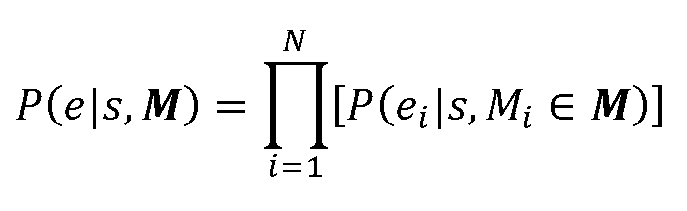
이는 적절한 모델을 각각 갖는 많은 증거 소스들이 결합되게 하는 프레임 워크의 구성이 조합되게 한다.This allows the composition of the framework to be combined so that many evidence sources, each with an appropriate model, are combined.
바람직하기로, 모델 R∈M은 타겟 시퀀스 우선순위와 관련있다. 이것 및 상기 가정이 주어지면, 수학식 3은 다음으로 재진술될 수 있다:Preferably, the model R∈M is related to the target sequence priority. Given this and the above assumption,
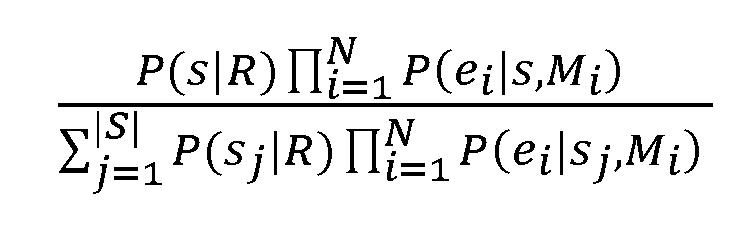
수학식 5에서 분모는 s에 대해 상수이고, 따라서 랭킹에 전혀 영향을 주지 않으며 단지 최종 발생한 확률값에 대한 정규화 인수로 역할한다. 개시된 시스템의 구현시, 상기 값은 정규화 확률값을 제공하도록 하기의 수학식 11을 참조로 기술된 바와 같은 근사로 평가될 수 있다. 그러나, 랭킹에 영향을 주지 않기 때문에, 본 발명의 시스템은 텍스트 예측의 랭킹이 충분할 수 있기에 반드시 분모를 평가할 필요가 없다. In Equation 5, the denominator is a constant for s, and thus has no effect on ranking, and merely serves as a normalization factor for the final probability value. In the implementation of the disclosed system, the value can be evaluated with an approximation as described with reference to Equation 11 below to provide a normalized probability value. However, since it does not affect the ranking, the system of the present invention does not necessarily evaluate the denominator because the ranking of the text prediction may be sufficient.
상기 수학식(5)를 가정하면, 타겟 시퀀스 우선순위 P(s|R)는 각 증거 소스(ei) 및 관련된 모델(Mi)에 대한 각각의 증거 유사도 P(ei|s,Mi)과 함께 계산되어야 한다. Assuming Equation (5) above, the target sequence priority P (s | R) is each evidence similarity P (e i | s, M i for each evidence source (e i ) and the associated model (M i ). ).
개시된 시스템은 증거 후보 해석에 대한 주변화함으로써 확률 프레임워크내 증거 가능성을 계산하는 2가지 방법; 후보 모델 1 및 후보 모델 2를 제공한다.The disclosed system includes two methods of calculating the likelihood of evidence in the probability framework by marginalizing the evidence candidate interpretation; Candidate model 1 and
후보 모델 1Candidate model 1
하나의 증거소스로부터 증거의 유사도 평가 형성시, 이는 '사용자가 의도한' 시퀀스와 관찰된 증거 사이 중간 단계들인 '후보들'에 대해 모델을 표현하는데 종종 도움이 된다. 유사도는 다음과 같이 재작성될 수 있다:When forming a similarity assessment of evidence from one source of evidence, it is often helpful to express the model for 'candidates', the intermediate steps between the 'user's intended' sequence and the observed evidence. The similarity can be rewritten as follows:

여기서, cj는 단일 후보이고, 주어진 증거소스에 대해 M의 2개 서브모델들, 즉, 후보모델 Mcandiate 및 시퀀스 모델 Msequence을 갖는다. 여기서 핵심 가정은 다음과 같다:Here, c j is a single candidate, and has two submodels of M for a given evidence source, that is, the candidate model M candiate and the sequence model M sequence . The key assumptions here are:
가정 2: 해당 모델 하에서 유사도는 후보들에 대한 주변화로 표현될 수 있고, 후보가 주어지면, 증거는 타겟 시퀀스와 조건상 별개이다.Assumption 2: Under the model, similarity can be expressed as marginalization for candidates, and given a candidate, the evidence is conditionally separate from the target sequence.
이 가정을 적용하면, s에 대한 의존성은 증거 항에서 떨어질 수 있다:Applying this assumption, the dependence on s may drop from the evidence term:

후보 모델 2
후보모델의 또 다른 변형은 먼저 베이즈 규칙을 이용해 증거 유사도를 변환한다:Another variant of the candidate model first uses the Bayesian rule to transform the similarity of evidence:
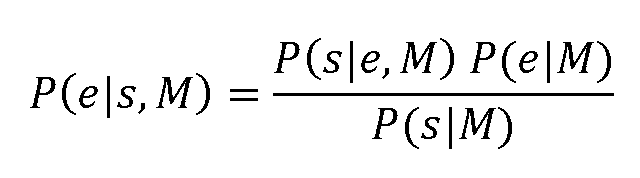
증거 조건 시퀀스 확률은 다음과 같이 재작성될 수 있다:Evidence condition sequence probabilities can be rewritten as follows:

여기서, cj는 단일 후보이고, 주어진 증거소스에 대해 M의 2개 서브모델들, 즉, 후보모델 Mcandiate 및 시퀀스 모델 Msequence을 갖는다. 이 경우, 핵심 가정은 다음과 같다:Here, c j is a single candidate, and has two submodels of M for a given evidence source, that is, the candidate model M candiate and the sequence model M sequence . In this case, the key assumptions are:
가정 3: 해당 모델 하에서 유사도는 후보에 대한 주변화로 표현될 수 있으며, 타겟 시퀀스는 후보가 주어진다면 조건상 증거에 무관하다.Assumption 3: Under the model, similarity can be expressed as marginalization to a candidate, and the target sequence is conditionally independent of evidence given the candidate.
이 가정을 적용하면, s에 대한 의존성이 증거 항으로부터 제거될 수 있다:Applying this assumption, the dependence on s can be removed from the evidence term:

후보 발생기(2)는 입력 시퀀스 발생기(1)에 의해 출력된 문맥 시퀀스(30) 및 입력 시퀀스(20)에 해당하는 문맥 및 입력의 2개의 소스들로부터의 증거를 이용한다.The
상술한 바와 같이, 문맥은 사용자가 이미 기입한 것에 대한 관찰된 증거를 나타내고, 문맥 시퀀스가 다수의 단어들을 포함한 경우 용어 경계들과 함께 일련의 문자 형태로 있다. 입력은 사용자가 현재 기입하고 있는 것에 대한 관찰된 증거를 나타내고, 확률 스트링의 형태이다. As described above, the context represents observed evidence of what the user has already written, and is in the form of a series of characters with term boundaries if the context sequence contains multiple words. The input represents the observed evidence of what the user is currently writing, and is in the form of a probability string.
이들 2개의 증거 소스들과 함께 예시적인 수학식(5)은 다음을 나타낸다:Exemplary equation (5) with these two sources of evidence represents:

이 표현에서, 랭킹에 영향을 주지 않기 때문에 선택적인 Z는 정규화 인수를 나타내고, 이 정규화 인수의 평가는 본 명세서에 전체가 참조로 합체되어 있는 PCT/GB2011/001419에 더 상세히 설명되어 있다. 특히, 정규화 상수(Z)는 다음으로 근사된다:In this expression, the optional Z represents the normalization factor because it does not affect ranking, and the evaluation of this normalization factor is described in more detail in PCT / GB2011 / 001419, incorporated herein by reference in its entirety. In particular, the normalization constant (Z) is approximated by:

이 근사는 하기와 같이 시스템에 구현될 수 있다. 함수(z)는 시퀀스 세트(T) 에 대해 고려되므로, 다음과 같다:This approximation can be implemented in the system as follows. The function z is considered for the sequence set T, so:

Z는 다음과 같이 계산된다:Z is calculated as follows:
Z = z(T) + z({u})*kZ = z (T) + z ({u}) * k
여기서 u는 "미지의" 시퀀스를 나타내고, k는 |S|- |T|의 평가이며, |S|는 모든 가능한 타겟 시퀀스 세트에서 시퀀스 개수이고, |T|는 기본 증거 모델들 중 적어도 하나가 "기지의" 평가를 갖는 시퀀스 개수이다. 각 개개의 증거 조건모델(M)은 P(e|u,M)의 평가, 즉, "미지의" 시퀀스가 주어진다면 증거 관찰들에 대한 분포를 반환한다. 본질적으로, 이는 각 개개의 증거 조건모델이 자신의 분포상 평활화를 책임지나, "미지의" 시퀀스의 전체 평가 개수에 비례하는 k와 관련되어야 하는 것을 의미한다. 실제로, 각 모델은 S'⊂S인 시퀀스(S') 세트에 대해 "알" 것이고, P(e|s,M)의 평가는 상수이고 모든 
상술한 모델 프레임워크내에서, 개시된 시스템은 3개 모델을 실행한다:Within the model framework described above, the disclosed system implements three models:
타겟 시퀀스 우선순위 모델(R)은The target sequence priority model (R)
·유니그램 모델(Unigram model)은 원자 단위로 각 시퀀스를 내부적으로 다루는 것을 고려함이 없이 언어의 시퀀스에 대한 분포를 구현한다. 가령, 유니그램 모델은 크기 1의 n-그램이다.The Unigram model implements the distribution of language sequences without considering each sequence being handled atomically. For example, the unigram model is an n-gram of size 1.
입력증거 모델(Minput)은 2가지 모델로 구성된다:The input evidence model (M input ) consists of two models:
·후보모델: Minput - candidate는 특정 후보해석이 주어지면 입력 관찰에 대한 조건 분포를 실행한다.· Candidate model: M input - candidate performs condition distribution for input observation given a specific candidate analysis.
·시퀀스 모델: Minput - sequence는 의도한 타겟 시퀀스가 주어지면 후보에 대한 조건 분포를 실행한다.Sequence model: M input - sequence executes the conditional distribution for the candidate given the intended target sequence.
문맥증거 모델(Mcontext)은 2개 모델로 구성된다:The context context model (M context ) consists of two models:
·후보모델: Mcontext - candidate는 특정 후보해석이 주어지면 문맥 관찰에 대한 조건 분포를 실행한다.· Candidate model: M context - candidate performs condition distribution for context observation given a specific candidate analysis.
·시퀀스 모델: Mcontext - sequence는 특정 문맥이 주어지면 언어 또는 언어 세트의 시퀀스에 대한 조건 분포를 실행한다.Sequence model: M context - sequence performs conditional distribution on a sequence of languages or sets of languages given a specific context.
후보 발생기(2)는 어떤 후보(40)가 가장 높은 랭킹 확률을 갖지 판단하기 위해 수학식(11)의 분자에서 개개의 평가들을 계산하도록 구성되며, 이들 후보들 중 하나 이상이 텍스트 예측으로서 후보 디스플레이(3)에 나타나진다.The
아래에서, 수학식(11)에서 관련된 개개의 확률들 각각이 어떻게 계산되는지에 대한 논의가 제공된다. 따라서, 각각의 하기의 항들, 즉, 입력 유사도 P(input|s,Minput); 문맥 유사도 P(context|s,Mcontext) 및 타겟 시퀀스 우선순위 평가 P(s|R)의 계산이 논의된다. Z 계산은 선택이므로 상세히 언급하지 않는다.In the following, a discussion is provided of how each of the individual probabilities related in equation (11) are calculated. Therefore, each of the following terms, namely, the input similarity P (input | s, M input ); Calculation of context similarity P (context | s, M context ) and target sequence priority evaluation P (s | R) is discussed. Z calculation is optional and will not be discussed in detail.
타겟target 시퀀스sequence 우선순위 Priority
타겟 시퀀스 우선순위는 바람직하게는 다음과 같이 계산된다:The target sequence priority is preferably calculated as follows:

여기서, V는 Runigram에 포함된 시퀀스 세트이고, 모델의 실행은 평탄화 주파수기반의 유니그램 언어 모델 및 평탄화된 마코브 체인 문자모델을 구성하기 위한 공지의 기술들에 따른다. 이들 모델을 실행하기 위한 많은 적용가능한 기술들이 아래에 나열되어 있다. 그러나, 나열되지 않은 다른 적절한 기술들도 또한 적용된다:Here, V is a sequence set included in the R unigram , and the execution of the model follows known techniques for constructing a flattened frequency-based unigram language model and a flattened Markov chain character model. Many applicable techniques for implementing these models are listed below. However, other suitable techniques not listed also apply:
·(해당분야에 공지된) 평탄화된 n-그램 항 또는 문자 모델· Flattened n-gram terms or character models (known in the art)
·참조문헌 영국특허출원 0917753.6에 기술된 바와 같은 적응식 다언어 모델· Adaptive multilingual model as described in British Patent Application 0917753.6
·가령 <참조문헌: Scheffler 2008>에 기술된 바와 같은 PPM(부분적 매칭에 의한 예측) 언어 모델· PPM (prediction by partial matching) language model as described in <Reference: Scheffler 2008>
·구성하는 어휘 구성요소들로부터 확률적으로 시퀀스를 발생하도록 구성된 형태분석엔진.· A morphological analysis engine configured to generate a sequence stochastically from the constituent vocabulary elements.
타겟 시퀀스 우선순위 모델(R)을 포함함으로써, 시스템은 의도된 시퀀스 예상의 향상된 정확도를 제공한다. 더욱이, 타겟 시퀀스 우선순위 모델(R)은 눈에 보이지 않는 타겟 시퀀스들의 문자기반 추론을 가능하게 한다. 즉, 시스템은 모든 가능한 타겟 시퀀스들에 대해 근사해 미지의 타겟 시퀀스들을 더 잘 추론할 수 있다.By including the target sequence priority model (R), the system provides improved accuracy of the intended sequence prediction. Moreover, the target sequence priority model R enables character-based reasoning of invisible target sequences. That is, the system can approximate all possible target sequences to better infer unknown target sequences.
입력 유사도 P(Input similarity P ( inputinput |s,S, MM inputinput ))
입력 유사도 P(input|s,Minput)는 후보모델(1) 및 특히 수학식(7)에 의해 평가된다:The input similarity P (input | s, M input ) is evaluated by candidate model (1) and in particular equation (7):

수학식(7)의 증거소스(e)가 입력이면, 입력 시퀀스(20) 및 관련된 모델은 Minput-candidate 및 Minput - sequence을 포함한 입력모델(Minput)이다. If the evidence source (e) of Equation (7) is input, the input sequence 20 and related models are input models (M input ) including M input-candidate and M input - sequence .
따라서, 입력 유사도 P(input|s,Minput)를 결정하기 위해, 입력후보 평가 P(input|cj,Minput - candidate) 및 입력 시퀀스 평가 P(cj|s,Minput - sequence)를 판단할 필요가 있으며, 각각이 하기에 상세히 언급되어 있다.Therefore, to determine the input similarity P (input | s, M input ), input candidate evaluation P (input | c j , M input - candidate ) and input sequence evaluation P (c j | s, M input - sequence ) It is necessary to judge, each of which is mentioned in detail below.
입력 후보 평가Input candidate evaluation P(P ( inputinput || cc jj ,, MM inputinput -- candidatecandidate ))
본 명세서에서 전체가 참조로 합체되어 있는 PCT/GB2011/001419는 각 노드가 하나 이상의 문자들로 구성된 서브시퀀스를 포함하는 DAG(directed acyclic graph)의 변형인 PCSG(probabilistic constrained sequence graph)를 기술한다. 하나 이상의 문자들로 구성된 서브시퀀스는 문자 세트 또는 입력 시퀀스(20)의 2 이상의 문자 세트들에 대한 시퀀스로부터 개개의 문자에 해당한다. 입력 시퀀스(20)의 문자 세트(들)에 있는 문자들에 대한 확률분포(들)을 기초로 노드들에 대한 에지들 각각에 확률이 할당된다. PCSG는 각 경로가 또한 동일한 길이로 제한되는 속성을 갖는다.PCT / GB2011 / 001419, which is incorporated herein by reference in its entirety, describes a probabilistic constrained sequence graph (PCSG), a variation of a directed acyclic graph (DAG) in which each node contains subsequences composed of one or more characters. A subsequence composed of one or more characters corresponds to an individual character from a character set or a sequence for two or more character sets of the input sequence 20. Probability is assigned to each of the edges for the nodes based on the probability distribution (s) for the characters in the character set (s) of the input sequence 20. PCSG has the property that each route is also limited to the same length.
공식적으로, PCSG는 노드 세트(N), 루트 노드(r), 방향성 에지 세트(E), 및 파라미터(확률) 세트(θ)를 포함해 4-tuple로 구성된다:Officially, the PCSG consists of a 4-tuple, including a node set (N), a root node (r), a directional edge set (E), and a parameter (probability) set (θ):
G = (N,r,E,θ) (17)G = (N, r, E, θ) (17)
2개의 노드들(n 및 n') 간의 에지는 (n→n')로 표시되고, 에지를 따라 n에서 n'까지 이동하는 확률은 P(n|n')로 표시된다. G를 통과하는 경로는 노드(r)에서 시작해 아웃고잉 에지를 전혀 포함하지 않는 노드에 이를 때까지 각 방문된 노드로부터 하나의 아웃고잉 에지를 정확히 따른다. 다음 속성들이 G에 적용된다:The edge between two nodes (n and n ') is denoted by (n → n'), and the probability of moving from n to n 'along the edge is denoted by P (n | n'). The path through G follows exactly one outgoing edge from each visited node, starting at node r and reaching a node that does not contain any outgoing edges. The following properties apply to G:
1) G는 방향성 비순환 그래프(DAG)이다1) G is a directional acyclic graph (DAG)
2) 
3) 
입력후보모델 함수는 하기와 같이 (입력후보 평가와 일치하는) 주어진 경로에 대한 확률을 계산한다:The input candidate model function calculates the probability for a given path (matching the input candidate evaluation) as follows:

여기서 P(pj|G)는 경로에서 에지들 각각의 곱으로 계산된 경로 유사도이다:Where P (p j | G) is the path similarity calculated as the product of each of the edges in the path:

여기서 K는 경로에서 에지 개수이다. 이 바람직한 공식은 노드들 간에 내재적 독립 가정과 같음이 주목될 수 있다. 이 내재적 독립은 예시적인 PCSG의 설명 후에 하기에 기술된다. Where K is the number of edges in the path. It can be noted that this preferred formula is the same as the inherent independent assumption between nodes. This implicit independence is described below after the description of the exemplary PCSG.
따라서, 다음 속성은 에지 상에 확률에 대해 남아 있다:Thus, the following properties remain for probability on the edge:

다시 말하면, 주어진 노드(n)로부터 모든 아웃고잉 에지들에 대한 확률은 합해서 1이 되어야 한다. 이는 또한 다음의 ΣiP(pi|G)=1이 보유되는 것을 의미한다. 즉, PCSG에서 모든 경로들의 확률에 대한 합은 1과 같다.In other words, the probability for all outgoing edges from a given node n should be 1 in total. This also means that the following Σ i P (p i | G) = 1 is retained. That is, the sum of the probability of all paths in the PCSG is equal to one.
개시된 시스템에서, 입력 후보 세트는 확장형 PCSG(EPCSG)로 표현된다. 개개의 입력 후보는 EPCSG를 지나는 고유경로로 표현된다. 각 입력 후보에 대해, 대표적인 경로의 정규화 확률이 계산될 수 있다.In the disclosed system, the set of input candidates is represented by Extended PCSG (EPCSG). Individual input candidates are represented by eigenpaths through the EPCSG. For each input candidate, the normalization probability of a representative path can be calculated.
PCSG는 (입력 후보 세트로 맵핑될 수 있는) 입력 시퀀스(20)로부터 먼저 발생된다. 그런 후 PCSG는 더 표현적이나 여전히 구속된 후보들을 가능하게 하는 추가 구조들로 증강된다. The PCSG is first generated from the input sequence 20 (which can be mapped to a set of input candidates). The PCSG is then augmented with additional structures that enable more expressive but still constrained candidates.
아래에 이력 시퀀스가 있는 시나리오에 대한 PCSG의 예가 제공된다:An example PCSG for a scenario with a history sequence is provided below:

이는 입력 시퀀스 발생기(1)는 사용자가 기입하려고 했던, 가령, 문자 'H' 다음에 문자 'e'를 평가해, 관찰된 입력 이벤트들이 0.5 및 0.8의 각각의 확률을 갖도록 예측될 수 있는 시나리오를 인코딩한다. 그러나, 입력 시퀀스 발생기는 또한 각 주어진 세트의 문자를 가로지르는 확률분포로 2개 문자 세트를 포함한 확률 스트링을 발생함으로써 사용자가 "H" 및 "e"와는 다른 문자를 기입하려고 했을 수 있음을 고려한다. This is a scenario in which the input sequence generator 1 evaluates the letter 'e' that the user tried to write, for example, the letter 'H' followed by the letter 'e', so that the observed input events have a probability of 0.5 and 0.8, respectively. Encode. However, the input sequence generator also takes into account that the user may have attempted to write characters different from "H" and "e" by generating a probability string comprising two character sets with a probability distribution across each given set of characters. .
이들 확률분포가 발생하는 방법이 본 개시의 주제는 아니다. 오히려 가령How these probability distributions occur is not the subject of this disclosure. Rather
- 분포는 사용자가 "H" 키에 해당하는 영역을 두드릴 경우, 문자 "G" 및 "J"가 어떤 확률로 입력 시퀀스에 포함될 수도 있는 특정 키보드 레이아웃, 가령 QWERTY 키보드에서 주어진 타겟 키를 둘러싼 문자들을 기초로 발생될 수 있다. -The distribution is a specific keyboard layout in which the characters "G" and "J" may be included in the input sequence with a certain probability if the user taps the area corresponding to the "H" key, for example the character surrounding the target key given on the QWERTY keyboard. On the basis of them.
- 분포는 (터치 스크린 가상 키보드 상의) 터치 좌표 및 지정된 키들의 좌표 사이 거리(또는 제곱 등과 같은 어떤 거리의 함수)를 기초로 발생될 수 있는 것을 포함한 기술 범위가 적용될 수 있는 것이 강조된다.It is emphasized that a technical range can be applied, including that the distribution can be generated based on the distance between touch coordinates (on a touch screen virtual keyboard) and coordinates of designated keys (or a function of some distance, such as square, etc.).
입력 시퀀스에서 각각의 문자 세트들에서 각 문자에 PCSG의 자신의 노드를 할당하는 후보 발생기(2)에 의해 입력 시퀀스(20)로부터 발생된 비증강 PCSG는 다음과 같이 보일 수 있다:The non-enhanced PCSG generated from input sequence 20 by

문자의 각 세트는, 다음 동기 노드 세트 전, 바로 다음의 널 노드에 재결합되는 그래프에서의 동기 노드 세트로서 추가된다. 각 동기 노드에 대한 인커밍 에지 확률은 세트내 문자의 확률값에 해당한다.Each set of characters is added as a set of sync nodes in the graph that are recombined to the next null node immediately before the next set of sync nodes. The incoming edge probability for each sync node corresponds to the probability value of the characters in the set.
상술한 바와 같이, 경로 유사도에 대한 바람직한 공식, P(pj|G)은 노드들 간에 내포된 독립 가정과 같다. 본 발명의 경우, 이는 다른 문자 세트들에서 문자들에 대한 확률분포와 별개인 문자 세트에 대한 확률분포를 갖는 각 문자 세트에 의해 생긴다. 따라서, 문자 세트로부터 발생된 동기 노드들의 각 세트는 동기 노드들의 다른 세트들과는 구분되고 별개인 확률분포를 갖는다. PCSG의 구성으로부터, 각 동기노드 세트로부터 단 하나의 이런 노드만이 주어진 경로에 사용될 수 있다.As described above, the preferred formula for path similarity, P (p j | G), is equal to the independent assumptions implied between nodes. In the case of the present invention, this is caused by each character set having a probability distribution for a character set that is separate from a probability distribution for characters in different character sets. Accordingly, each set of sync nodes generated from the character set has a probability distribution that is distinct and distinct from other sets of sync nodes. From the configuration of the PCSG, only one such node from each set of sync nodes can be used for a given path.
본 명세에 전체가 참조로 합체된 PCT/GB2011/001419에 기술된 바와 같이, PCSG는:As described in PCT / GB2011 / 001419, incorporated herein by reference in its entirety, the PCSG:
·잘못된 문자들로 입력 시퀀스를 고려한 공노드 서브-경로· Blank node sub-path considering input sequence with invalid characters
·사용자가 타겟 시퀀스로부터 하나 이상의 문자들을 생략한 예들을 고려한 '와일드카드(wildcard)' 구조를 포함한 EPCSG를 생성하기 위해 2개의 추가 구조들로 증강될 수 있다. It can be augmented with two additional structures to create an EPCSG that includes a 'wildcard' structure taking into account examples where the user omits one or more characters from the target sequence.
이런 식으로 (EPCSG를 제공하기 위해) 증강된 동일한 PCSG가 아래에 도시되어 있다:The same PCSG enhanced in this way (to provide EPCSG) is shown below:
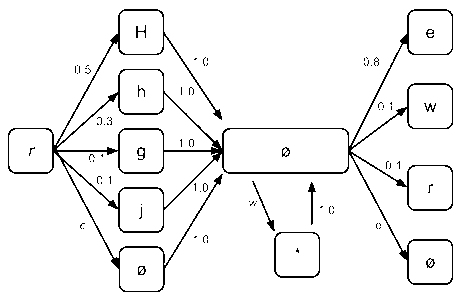
기정의된 확률 페널티(e)로, 시스템은 사용자로부터의 잘못된 입력을 다루기 위해 입력 시퀀스에 해당하는 문자 대신 널(null) 문자가 삽입되게 한다. 이를 위해, 후보 발생기(2)는 상술한 동기 노드들의 각 세트에 추가 노드로서 ("Ø"로 표현된) 널 문자를 삽입하도록 구성된다. 따라서, 하나 이상의 널 문자들을 포함한 경로들에 잇따른 하나 이상의 문자들을 스킵하는 EPCSG를 지나는 경로들이 있다.With a predefined probability penalty (e), the system allows a null character to be inserted instead of the character corresponding to the input sequence in order to handle incorrect input from the user. To this end, the
또한, 사전 정의된 페널티(w)로, 시스템은 입력시 전체적으로 생략된 타겟 시퀀스에 있는 문자를 고려한다. (*)로 표시된 이 노드는 문자 세트(가령 '와일드카드')에서 모든 가능한 문자를 포함한 가지에 대한 속기이다. 상기 도시된 EPCSG에 따르면, 후보 발생기(2)는 각각의 동기 문자 노드 세트 간에 와일드카드 구조(가령, 와일드카드를 나타내는 노드)를 삽입하도록 구성된다. 이 구조는 입력만을 기초로 예측되지 못한 후보에 생략된 문자가 고려되게 한다.In addition, with a predefined penalty (w), the system considers characters in the target sequence that are omitted entirely when entered. This node, marked with an asterisk (*), is a shorthand for a branch containing all possible characters in the character set (eg 'wildcard'). According to the EPCSG shown above, the
본 시스템의 후보 발생자(2)는 용어 경계들 형태의 다른 구조들을 EPCSG에 삽입한다. 용어 경계는 공간과 같은 문자를 고려할 필요가 없다. 몇몇 언어에서, 단어들 간에 공백이 없으나, 시스템은 한 단어가 끝나고 다른 단어가 시작되는 곳을 예측한다. 즉, 용어 경계를 식별한다. 이를 위해, 후보 발생기(2)는 용어 경계, 가령 공백이라기보다는 문자를 입력하는 사용자에 대해 수정하도록 상술한 각각의 동기 노드들 세트에 추가 노드로서 ('_'로 라벨붙은) 용어 경계를 삽입하도록 구성된다. 더욱이, 후보 발생기는 동기 문자 노드들의 각 세트 간에 다른 용어 경계 노드를 삽입한다. 용어 경계가 와일드카드 구조의 임의 사용들 간에 고려되어야 하므로 동기 와일드카드 구조는 2개의 동일한 구조들로 분할되어야 하고 용어 경계 구조가 그 내에 삽입되어야한다. 용어 경계 구조는 간단히 용어 경계 노드 및 용어 경계를 선택적으로 하는 널 문자 노드로 구성된다. The
와일드카드 구조와 널 문자 구조 이외에 용어 경계 구조들로 증강된 예시적인 EPCSG가 아래에 도시되어 있다. Exemplary EPCSGs augmented with term boundary structures in addition to wildcard structures and null character structures are shown below.

이들 용어 경계 노드들은 2개의 주요 의미를 추가한다:These term boundary nodes add two main meanings:
· 기정의된 확률 페널티(s)로, 시스템은 잘못된문자를 용어 경계로 교체할 수 있다. 이는 가령 사용자가 분철을 삽입하도록 의도했으나 잘못으로 가짜 입력을 추가한 경우를 모델화한다. · With a predefined probability penalty (s), the system can replace invalid characters with term boundaries. This models, for example, the case where the user intended to insert the iron but accidentally added a fake input.
· 기정의된 확률 페널티(t)로, 용어 분철이 주 EPCSG에 의해 또는 (용어 경계 노드의 어느 한 측면이 있는) 와일드카드 분기에 의해 발생되는지 간에 문자들 간에 추가되게 허용된다. As a predefined probability penalty (t), the term distribution is allowed to be added between characters whether it is generated by the main EPCSG or by a wildcard branch (with either side of the term boundary node).
에지를 보유하기 위한 에지 속성 
EPCSG에서 이들 추가 구조들은 그래프를 지나는 가능한 경로들의 개수를 광대하게 증가시킨다. 이를 상쇄시키기 위해, 본 발명은 EPCSG 경로 확률들과 일련의 경계추론 용어의 문맥 확률 모두를 고려한 신규한 확률적 가지치기 기술을 이용한 후보 발생기(2)를 제공한다. In EPCSG, these additional structures vastly increase the number of possible paths through the graph. To offset this, the present invention provides a
후보 발생기(2)는 문맥 언어 모델(Mcontext)을 이용해 각 다용어 후보들에 대한 문맥 확률평가를 발생한다. 입력 후보들에 대한 문맥 확률 평가를 발생하기 위한 Mcontext의 이용은 타겟 시퀀스가 주어진 경우 관련된 모델(Mcontext,Minput) 하의 어떤 분포로부터 별개로 발생되는 비중첩 세트들로 입력 증거(입력 시퀀스(20)) 및 문맥 증거(문맥 시퀀스(30))가 나누어질 수 있다는 가정을 명백히 위반한다. The
후보 발생기(2)는 각각의 다용어 후보들에 대한 문맥 확률 평가를 이용해 EPCSG를 지나는 경로들을 가지치도록 구성되며, 이는 하기에 더 상세히 기술된다. 경로 가지치기는 탐색 공간을 크게 줄여, 계산상 가능한 (경계 없는) 연이은 텍스트에서 용어 경계들을 식별한다. The
문맥 언어 모델(Mcontext), 가령 P(ti), P(ti|ti -1), 및 P(ti|ti -1,ti -2)에 대한 확률평가와 평가되는 k길이 시퀀스를 제공하는 트라이그램 모델(크기 3의 n그램)이 주어지면, 문맥확률 평가:Probability evaluation and evaluation of k for the context language model (M context ), such as P (t i ), P (t i | t i -1 ), and P (t i | t i -1 , t i -2 ) Given a trigram model (ngram of size 3) giving a length sequence, evaluate the context probability:

는 다음을 계산함으로써 형성된다:Is formed by calculating:

예컨대, 문맥 시퀀스(30)가 "have you ever"이고 입력 시퀀스(20)(즉, EPCSG를 지나는 경로)에 대한 후보가 "been to London"이면, 후보 발생기(2)는 3개 트라이그램들: "you ever been", "ever been to" 및 "been to London"을 발생할 것이다. "have you ever" 트라이그램은 문맥 시퀀스(30)로부터 전체적으로 구성된다. 입력되어진 임의의 이런 트라이그램은 1의 확률을 갖고, 따라서 결과를 바꿀 수 없기 때문에 고려되지 않는다. 이 예에 대한 문맥확률평가는 3개 트라이그램들 각각의 확률들을 함께 곱함으로써 발생된다.For example, if the context sequence 30 is “have you ever” and the candidate for the input sequence 20 (ie, the path through the EPCSG) is “been to London”, the
이는 이 예의 k 길이 시퀀스가 {you,ever,been,to,London}를 포함한 길이 5가 되는 상기 수학식(14)을 반영한다.This reflects the above equation (14) where the k length sequence in this example is length 5 including {you, ever, been, to, London}.
문맥 시퀀스가 없으나 동일한 입력 시퀀스가 있는 경우, 후보 발생기(2)는 단일 트라이그램 "been to London"의 문맥 확률 평가에 대한 후보를 가지치기할 것이다. 더 긴 입력, 가령 "been to London to see"으로, 후보는 3개 트라이그램 "been to London", "to London to" 및 "London to see"의 문맥확률 평가에 대해 가지쳐 질 수 있다. If there is no context sequence but there is the same input sequence, the
임의의 적절한 문맥언어모델이 후보용 확률평가를 제공하는데 사용될 수 있다.: 본 시스템은 예시용으로 사용되는 트라이그램 모델의 사용에 국한되지 않는다.Any suitable contextual language model can be used to provide candidate probability assessments: The system is not limited to the use of a trigram model used for illustration purposes.
따라서, 본 발명은 입력 시퀀스의 전체 내용 및 문맥 시퀀스(30)가 있는 문맥 시퀀스의 용어들을 기초로 하는 가지치기를 제공한다.Thus, the present invention provides pruning based on the entire content of the input sequence and the terms of the context sequence with context sequence 30.
이런 식으로 훈련된 문맥 데이터의 사용으로 의도하거나 하지 않았던 간에 폐기될 모델에 의해 이전에 보이지 않았던 구들이 초래될 수 있다. The use of contextual data trained in this way, whether intended or not, may result in previously invisible phrases by the model to be discarded.
EPCSG의 경로를 가지치기하기 위해, 후보 발생기는 2개의 확률의 곱을 판단함으로써 주어진 후보에 대한 문맥 확률평가를 누적된 PCSG 경로확률과 조합하도록 구성된다. 후보 발생기(2)는 임계치(t)를 통해 현재 가장 가능성 있는 시퀀스와 덜 가능한 시퀀스 간의 비, 즉, 가장 가능성 있는 경로와 가지치기할 것으로 고려되는 경로 간의 확률비에 대한 하한을 설정한다. 따라서, 경로(n1,…,nL)는 다음이 확보된다면 가지쳐진다:To prune the path of the EPCSG, the candidate generator is configured to combine the context probability assessment for a given candidate with the cumulative PCSG path probability by determining the product of two probabilities. The

그러나, 가지치기 기술은 수학식 14 및 15에 대해 상술한 것과는 달리 사용될 수 있다. '확률평가'라는 말은 진정 수학적 확률 또는 랭킹 또는 스코어링과 같은 확률을 평가하는 임의의 다른 형태를 의미할 수 있다. 후보에 할당된 확률평가 또는 '스코어'는 수학식 14에서 항들을 가중화함으로써 후보에서 초기 항들에 대해 바이어스될 수 있어, EPCSG의 큰 폭이 가능한 초기에 폐기될 수 있게 하므로, 상기 방법은 모든 경로에 대한 전체 EPCSG를 가로질러 이동할 필요가 없기 때문에, 계산효율을 증가시킨다. 더욱이, 검색된 용어들의 시퀀스는 후보를 구성하는 용어들의 전체 시퀀스보다 미만일 수 있다. 가령, 후보의 처음 한두 항들을 포함할 수 있다. 여하튼, 후보에 할당된 스코어/확률평가는 여전히 문맥모델(Mcontext)에서 후보의 일련의 항들을 검색함으로써 결정될 것이다. 게다가, 수학식 15에 대한 대안으로 임계치 한계를 설정하는 다른 방식들도 사용될 수 있다. However, the pruning technique can be used unlike those described above for equations 14 and 15. The term 'probability assessment' can mean any mathematical form or any other form of evaluating probability, such as ranking or scoring. Since the probability assessment or 'score' assigned to a candidate can be biased against the initial terms in the candidate by weighting the terms in Equation 14, the method can be used to route all paths, as the EPCSG can be discarded as early as possible. Since there is no need to move across the entire EPCSG, it increases computational efficiency. Moreover, the sequence of searched terms may be less than the entire sequence of terms constituting the candidate. For example, it can include the first or two terms of the candidate. In any case, the score / probability assessment assigned to the candidate will still be determined by searching a series of terms in the candidate in the context model (Mcontext). In addition, other ways of setting threshold limits may be used as an alternative to equation (15).
바람직한 실시예에서, 문맥 유사도, 및 특히 문맥 시퀀스 평가를 결정하는데 사용된 동일한 트라이그램들을 평가함으로써 이력 후보들을 가지칠 수 있기 때문에, 후보 발생기(2)는 수학식(14)의 확률평가를 계산하도록 구성된다. 이는 가지쳐지지 않은 후보들에 대한 트라이그램 결과들이 아래의 수학식(17)에 대해 언급된 바와 같이 후보 발생기(2)에 의해 캐시 및 재사용될 수 (및 가지쳐진 후보들에 대해, 트라이그램 결과들이 폐기될 수) 있기 때문에 필연적으로 계산회수를 줄인다. In the preferred embodiment, the
수학식 12 및 16에서 평가하기 위한 몇몇 후보들이 있기 때문에, 경로들을 가지치는 것은 또한 (수학식 11을 통해) 후보 발생기(2)에 의한 예측 계산을 줄인다. Since there are several candidates for evaluating in equations (12) and (16), pruning paths also reduces the predictive computation by candidate generator (2) (via equation 11).
경로들은 EPCSG에서 가능할 수 있으나 문맥확률평가를 기초로 후보 발생기(2)에 의해 가지쳐질 수 있다. 그러나, 이 가지치기가 여기서 행해지지 않았다면, 동일한 후보들은 (이들이 가지 쳐졌을 정확히 동일한 이유로) 수학식(11)에서의 문맥모델로부터 극히 낮은 스코어를 받도록 진행될 것이고, 이는 극히 낮은 확률을 줄 것이며, 대신 나중 단계에서 이들은 폐기되어 진다. Paths may be possible in the EPCSG, but can be pruned by the
입력 input 시퀀스sequence 평가 P( Evaluation P ( cc jj ,|s,, | s, MM inputinput -- sequencesequence ))
입력 시퀀스 평가 P(cj,|s,Minput - sequence)는 타겟 시퀀스가 주어지면 후보 시퀀스에 대해 분포되고 정규화 표시자 함수로서 평가될 수 있다:The input sequence evaluation P (c j , | s, M input - sequence ) can be distributed for a candidate sequence given a target sequence and evaluated as a normalization indicator function:

여기서 t'이 t의 접두사이면 δ(t,t')=1이고, 그렇지 않으면 0이며, Z=Σkδ(s,ck)이다. 즉, 모든 후보들의 합이다. Where t 'is the prefix of t, δ (t, t') = 1, otherwise 0, and Z = Σ k δ (s, c k ). That is, it is the sum of all candidates.
후보들의 고유성이 가정되고 후보 세트가 모든 가능한 시퀀스들을 포함하도록 허용되면, 길이(n)의 타겟 시퀀스에 대해, 정확히 n개의 매칭 접두사들, 및 이에 따라 후보들이 있을 것이기 때문에 정규화 인수 Z=length(s)는 고쳐 쓸 수 있다. If the uniqueness of the candidates is assumed and if the candidate set is allowed to include all possible sequences, then for a target sequence of length n, there will be exactly n matching prefixes, and thus candidates, so the normalization factor Z = length (s ) Can be rewritten.
문맥 유사도 P(Context similarity P ( contextcontext |s,S, MM contextcontext ))
문맥 유사도, P(context|s,Mcontext)는 후보모델(2) 및 특히 증거소스(e)가 문맥인 수학식(8 및 10)에 의해 평가된다:The context similarity, P (context | s, M context ), is evaluated by the equations (8 and 10) in which the candidate model (2) and especially the evidence source (e) are contexts:

수학식 17에서 j에 대한 합은 문맥의 어휘 및 정자법 변화들에 대한 합에 대한 것이다. 입력 후보들이 가지치기 단계에서 폐기되었다면, 이 용어 시퀀스들에 대한 이런 변화들은 평가될 필요가 없다.In Equation 17, the sum for j is for the sum of vocabulary and spermological changes in the context. If input candidates were discarded at the pruning step, these changes to these term sequences need not be evaluated.
문맥 유사도를 계산하기 위해 수학식 17에 도시된 바와 같이, 후보 발생기(2)는 각각이 하기에 더 상세히 기술된 다음 평가들을 계산하기 위해 구성된다: 문맥 시퀀스 평가 P(s|cj,Mcontext - sequence); 문맥 후보 평가 P(cj|context,Mcontext -candidate); 문맥 우선순위 평가 P(context|Mcontext); 및 타겟 시퀀스 우선순위 평가 P(s|Mcontext).As shown in Equation 17 to calculate context similarity,
문맥 context 시퀀스sequence 평가 P(s| Evaluation P (s | cc jj ,, MM contextcontext -- sequencesequence ))
문맥 시퀀스 평가 P(s|cj,Mcontext - sequence)는 문맥 시퀀스 모델 하에서 특정 후보 시퀀스(cj)가 주어진 경우 타겟 시퀀스(s)의 확률이다. 형식적으로 문맥 시퀀스 모델은 문맥 시퀀스가 주어진 경우 타겟 시퀀스의 확률, 즉 fs(ttarget,tcontext)=P(ttarget|tcontext,θs)을 되돌려 보내며, θs는 모델의 파라미터이다. 따라서, 문맥 시퀀스 확률은 다음과 같이 계산된다: P(s|ci,S)=fs(s,ci).The context sequence evaluation P (s | c j , M context - sequence ) is the probability of the target sequence s when a specific candidate sequence c j is given under the context sequence model. Formally, the context sequence model returns the probability of the target sequence when the context sequence is given, that is, f s (t target, t context ) = P (t target | t context , θ s ), where θ s is the model parameter. Therefore, the context sequence probability is calculated as follows: P (s | c i , S) = f s (s, c i ).
다음과 같이 별개로 또는 조합으로 사용되는 적용가능한 많은 기술들이 있다:There are many applicable techniques used separately or in combination as follows:
·(해당기술분야에 공지된) n그램 언어 모델· Ngram language model (known in the art)
·본 명세서에 전체가 참조로 합체된 PCT/GB2010/001898에 기술된 바와 같이 적응식 다언어 모델· Adaptive multilingual model as described in PCT / GB2010 / 001898, incorporated herein by reference in its entirety.
· 해당기술분야에 공지된 PPM(부분 매칭에 의한 예측) 언어 모델· PPM (prediction by partial matching) language model known in the field
·해당기술분야에 공지된 바와 같이 발생적 HMM(히든 마코브 모델) 확률적 언어 일부의 태거· Tagging of parts of a spontaneous HMM (Hidden Markov Model) stochastic language as known in the art
·적절히 구성된 신경 네트워크· Properly configured neural network
문맥 후보 평가 P(Context candidate evaluation P ( cc jj || contextcontext ,, MM contextcontext -- candidatecandidate ))
문맥 후보 평가 P(cj|context,Mcontext - candidate)는 fcontext - candidate (t,context)=P(t│context,θcontext - candidate) 형태의 함수이고, 여기서 t는 임의 시퀀스이고, θcontext - candidate는 모델의 파라미터이다. 따라서, 문맥 후보의 조건 평가는 다음과 같이 계산된다:The context candidate evaluation P (c j | context, M context - candidate ) is a function of the form f context - candidate (t, context) = P (t│context, θ context - candidate ), where t is an arbitrary sequence and θ context - candidate is a model parameter. Thus, the conditional candidate's conditional evaluation is calculated as follows:
P(cj|context,Mcontext - candidate)=fcontext - candidate(cj,context).P (c j | context, M context - candidate ) = f context - candidate (c j , context).
문맥 시퀀스에서 이런 변화를 고려할 경우, 입력 후보 평가의 방식과 유사한 방식으로 EPCSG를 이용한 기술이 사용되며, 그래프는 문맥 용어들의 정자법 변화(가령, 대분자 쓰기, 축약, 두문자)에 대해 분기한다.When considering this change in the context sequence, the technique using EPCSG is used in a manner similar to the method of evaluating input candidates, and the graph diverges against the change in the spelling of context terms (eg, macromolecule writing, abbreviation, acronyms).
다음 12개 문맥 후보 시퀀스들에 대한 예가 제공된다:Examples for the following 12 context candidate sequences are provided:
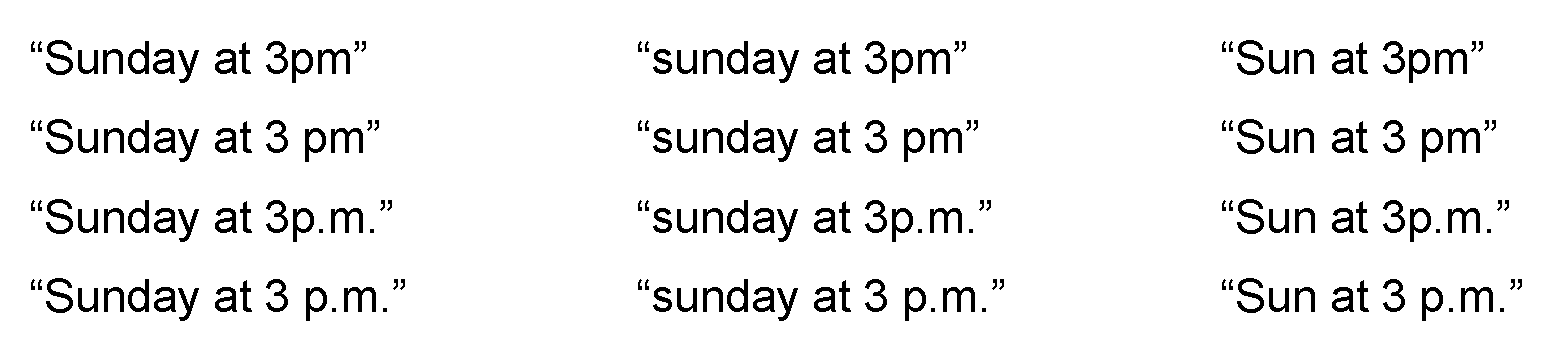
이들은 다음 PCSG('│'로 표시된 명백한 단어 경계 및 공문자 'Ø'에 의한 빈 시퀀스)에 의해 표현될 것이다:These will be represented by the following PCSG (an explicit word boundary denoted by '│' and an empty sequence by the empty letter 'Ø'):

가령 수학식(19)에 따른 문맥후보모델에 따라 확률이 에지에 할당된다:Probability is assigned to the edge according to the context candidate model according to equation (19), for example:
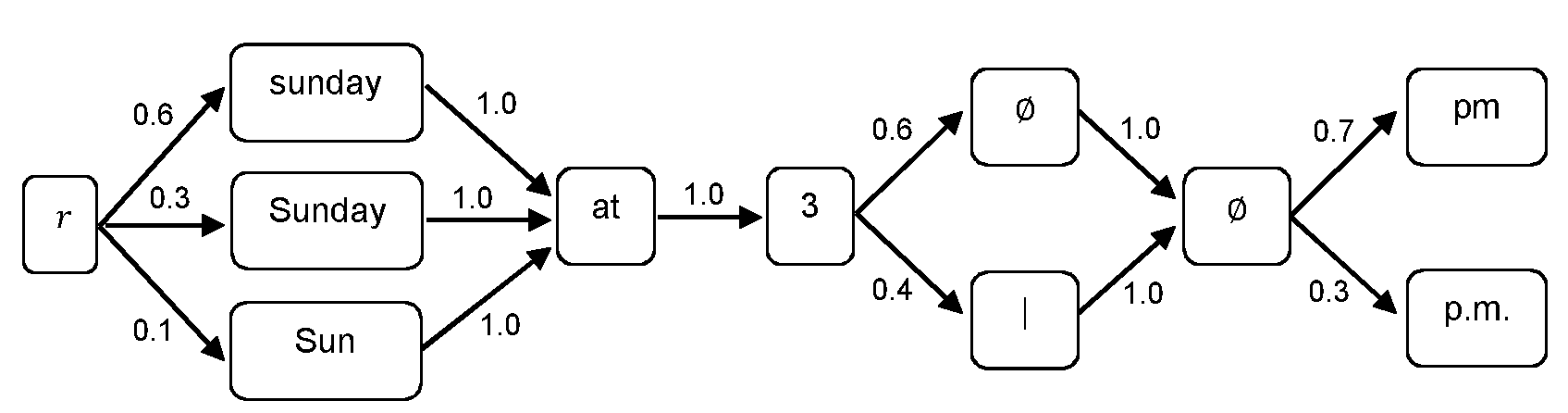
12개 시퀀스에 대한 후보확률들이 하기와 같이 (간략히 하기 위해 3개 예만 나타낸) PCSG로부터 발생된다:Candidate probabilities for 12 sequences are generated from the PCSG (shown only for 3 examples for simplicity) as follows:

PCSG를 구성하고 확률을 노드에 할당하는데 사용된 모델의 사양들은 시스템의 특정 예에 따라 변할 것이다. 상기 구성은 3개의 일반 변화들의 예를 인코딩한다:The specifications of the model used to construct the PCSG and assign probabilities to nodes will vary depending on the specific example of the system. The above configuration encodes examples of three general changes:
단어 경계에서 (잠정적으로 명백한) 분기Branch (potentially obvious) at the word boundary
격변화에서 분기Divergence
어휘 변화에서 분기Divergence from vocabulary changes
임의 타입의 변화가 이 프레임워크에서 인코딩될 수 있음이 이해될 것이다. 또 다른 예는 이전 제안들에 대해 분기될 수 있다. 가령, 시스템이 "on" 및 "in" 모두를 예측했고 사용자가 "in"을 선택했다면, 이는 "in"에 할당된 확률 가중치를 가지나 사용자가 우발적으로 잘못된 제안을 받아들인 확률을 나타내기 위해 "on"에 할당된 작은 확률을 갖는 분기로 인코딩될 수 있다. 상기의 경우, 다음 원리들이 인코딩된다:It will be understood that any type of change can be encoded in this framework. Another example may diverge to previous proposals. For example, if the system predicted both "on" and "in" and the user selected "in", it would have a probability weight assigned to "in", but to indicate the probability that the user accidentally accepted the wrong offer. " It can be encoded as a branch with a small probability assigned to "on". In the above case, the following principles are encoded:
소문자 첫 's'를 갖는 'sunday'는 완전한 변형 'Sunday'보다 그자체로 확률이 덜한 축약형 'Sun'보다 가능성이 덜하다; 'Sunday' with the first 's' in lowercase is less likely than the abbreviated 'Sun' in itself, less likely than the full variant 'Sunday';
"pm"이 숫자 "3"과 떨어져 있는 토큰경계인식(tokenisation)은 아닌 경우보다 약간 가능성이 덜하다;It is slightly less likely than if "pm" is not tokenization apart from the number "3";
마침표 변화 "p.m."는 마침표가 없는 형태 "pm"보다 약간 가능성이 덜하다.The period change "p.m." is slightly less likely than the periodless form "pm".
문맥 후보 PCSG의 특정 예는 바람직하게는 다음 방식으로 초기 시퀀스(s)로부터 알고리즘적으로 구성된다.The specific example of the context candidate PCSG is preferably constructed algorithmically from the initial sequence s in the following manner.
루트에 연결된 단일노드 ns내에 캡슐화함으로써 s를 PCSG로 바꾼다:Convert s to PCSG by encapsulating within a single node n s connected to the root:
변화점에서 분기 노드를 도입함으로써 반복적으로 ns를 해체한다.At the point of change, n s is dismantled repeatedly by introducing a branch node.
예컨대,본래 시퀀스 "sunday at 3pm"에 작용하는 PCSG 구성 알고리즘이 고려된다. 먼저 단계 1:For example, a PCSG configuration algorithm that acts on the original sequence "sunday at 3pm" is considered. First step 1:

시스템은 확률 토크나이저(Tokeniser)를 전개해 다음과 같이 된다:The system deploys a probabilistic tokenizer to look like this:

상기 PCSG 속성 3으로 인한 변형은 전체 경로 확률들에 영향을 주지 않기 때문에 연이은 처리에 편리한 한 노드의 분기인 특별한 경우에 따라 항상 분기 및 재결합 구조적 삽입의 형태를 취하는 것에 유의하라. 에지 확률들이 하기에 더 상세히 설명된 모델에 따라 추가된다. 알고리즘을 계속하면, 격변화 분석기가 전개된다:Note that the transformation due to the
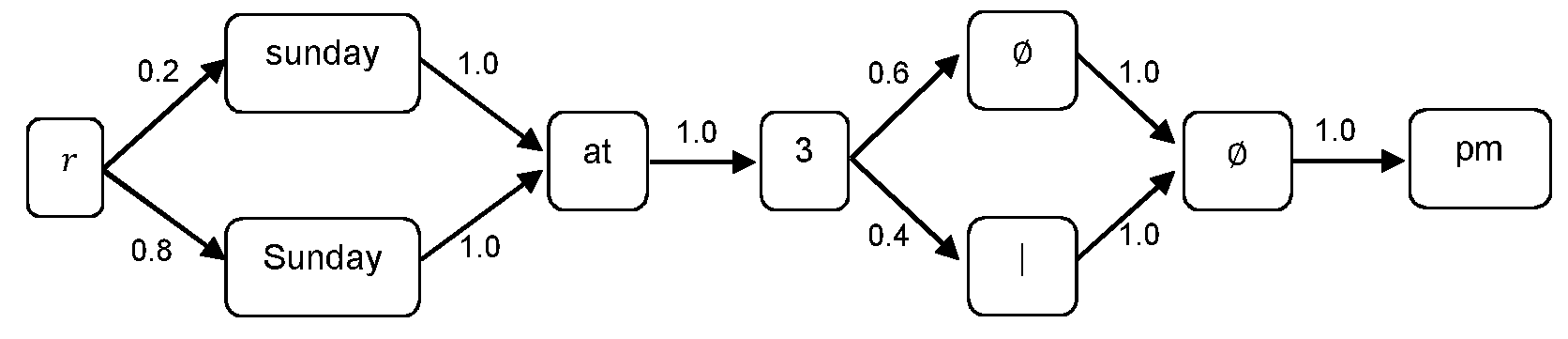
그리고 마지막으로 어휘변형분석이 전개된다:And finally, lexical transformation analysis is developed:
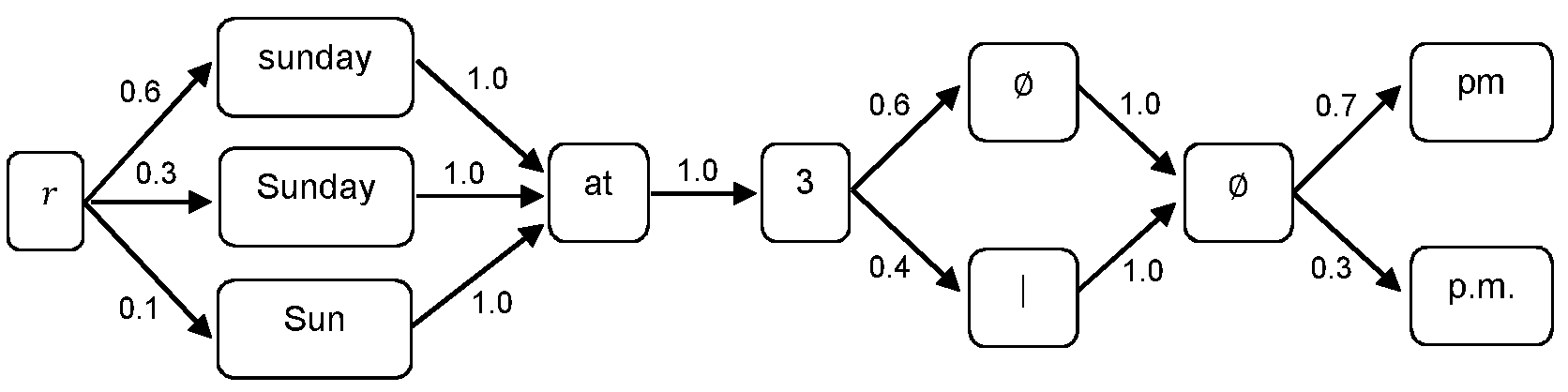
PCSG 속성 3으로 인해, 분기들은 재분기 전으로 수렴되어야 함에 유의하라. 이는 2개 분기점들이 접촉해 발생하면 몇몇 경우 공 노드가 삽입되어야 하는 것을 의미한다.Note that due to
에지 확률들이 바람직하게 PCSG에 할당된다. 에지 확률들의 할당이 바람직하게는 문맥 후보 모델의 파라미터들에 대해 수행된다. 이들 확률들의 직관적 해석은 두 부분이 있다:Edge probabilities are preferably assigned to the PCSG. The allocation of edge probabilities is preferably performed on the parameters of the context candidate model. There are two parts to the intuitive interpretation of these probabilities:
(1) 이들은 사용자가 특정 가지에 할당한 시퀀스를 의도한 유사도의 평가를 나타낸다. 예컨대, 사용자가 "Dear ben"을 기입하면, 몇가지 확률로 이들이 실제로는 "Dear Ben"을 기입하도록 의도했음을 인정하고자 할 수도 있다.(1) These represent the evaluation of the similarity that the user intended for the sequence assigned to a specific branch. For example, if the user enters "Dear ben", there may be several possibilities to admit that they actually intended to write "Dear Ben".
(2) 이들은 특정 분기가 관찰된 시퀀스의 유효한 정자법 변형인 "백오프" 가능성을 나타낸다. 예컨대, 사용자가 "See you on Thur"를 기입하면, "Thur"의 다른 정자법 형태는 "Thurs"일 수 있다. (2) These represent the possibility of “backoff”, which is a valid sperm variant of the sequence in which a particular branch is observed. For example, if the user writes "See you on Thur", another sperm form of "Thur" may be "Thurs".
특정 에지에 할당된 확률은 또한 어떤 배경모델 정보가 주어지면 정자법 변화의 평가된 유사도에 의해 영향받을 수 있다. 예컨대, 문맥 시퀀스 모델(S)은 실제로 분기 확류들을 산출하기 위해 다른 확률측정들과 조합해 사용될 수 있는 다른 정자법 변화들에 대한 유사도 평가를 얻기 위해 재사용될 수 있다. 이런 식으로 문맥 시퀀스 모델을 이용하는 것은 문맥 후보 모델(C)이 실제로 문맥 시퀀스 모델(S)의 예를 포함하는 것을 의미하며, 이는 후보 및 시퀀스 모델 간에 독립 가정에 대한 명백한 위반이다(상기 속성 7); 그러나, 이 가정은 실제로는 결코 문맥 경우에 요구되지 않으므로, 상대적으로 안전하다. The probability assigned to a particular edge can also be influenced by the estimated similarity of spermological changes given some background model information. For example, the contextual sequence model S can be reused to obtain a similarity assessment for other spermological changes that can be used in combination with other probabilistic measures to actually produce branching probabilities. Using the context sequence model in this way means that the context candidate model C actually includes an example of the context sequence model S, which is a clear violation of the independent assumption between the candidate and the sequence model (attribute 7 above). ; However, this assumption is actually relatively safe as it is never required in the context case.
일예가 명확히 하는데 도움될 것이다. 바람직한 실시예에서, 문맥후보모델은 다음 알고리즘을 이용해 확률을 할당하는 것으로 추정된다:An example will help clarify. In a preferred embodiment, the context candidate model is estimated to allocate probability using the following algorithm:
관찰된 시퀀스는 0.8의 확률을 받는다; 다른 것들은 균일하게 밸런스를 받는다.The observed sequence has a probability of 0.8; Others are evenly balanced.
문맥 시퀀스 모델 평가에 의해 값들이 스케일된다. Values are scaled by context sequence model evaluation.
상기 PCSG 속성(19)에 맞게 값들이 정규화된다.The values are normalized according to the PCSG attribute 19.
상기 PCSG 예로부터, 다음 분기가 고려될 수 있다:From the PCSG example above, the following branch can be considered:
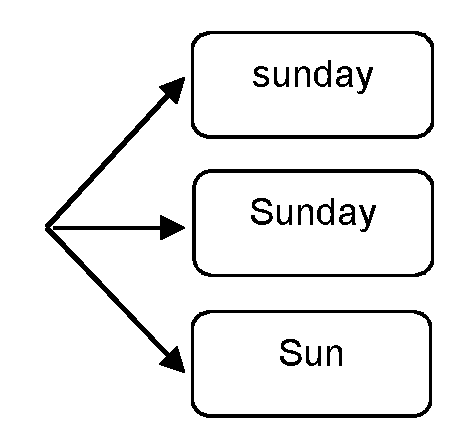
"study"는 본래 관찰이므로, 상기 알고리즘 중 1단계에 의해 0.8의 확률이 할당될 초기에 것이며, 다른 에지들은 0.1이 각각 할당될 것이다. 상기 예로, 문맥 시퀀스 모델에 의해 반환된 평가들은 다음과 같다:Since "study" is an original observation, a probability of 0.8 will be assigned by step 1 of the algorithm, and 0.1 will be assigned to the other edges, respectively. In the above example, the evaluations returned by the context sequence model are:

여기서 CS는 문맥후보모델이 이 경우 문맥 시퀀스 모델을 이용하는 것을 나타낸다. 따라서, 이 예에서 각 에지에 할당된 비정규화 및 정규화(반올림) 확률은 (각각) 다음과 같다:Here, C S indicates that the context candidate model uses the context sequence model in this case. Thus, the denormalization and normalization (rounding) probability assigned to each edge in this example is (each) as follows:

문맥 우선순위 평가 P(Context Priority Assessment P ( contextcontext || MM contextcontext ))
문맥 우선순위 평가 P(context|Mcontext)는 문맥과 관련된 본래 시퀀스(t)의 주파수를 정규화함으로써 근사될 수 있다. The context priority evaluation P (context | M context ) can be approximated by normalizing the frequency of the original sequence t associated with the context.

freq(t)는 트레이닝 데이터에서 시퀀스(t)의 주파수이고, 분모는 트레이닝 데이터에서 모든 시퀀스들의 주파수 합이다. 시퀀스 "t"는 문맥 시퀀스(30)이다. 문맥 우선순위는 예측이 도출된 해당 모델 Mcontext이 소정의 문맥 시퀀스(30)를 포함하는 확률에 따라 문맥 후보들의 확률값들을 가중화한다. 이렇게 하기 위해, 문맥 우선순위는 수식의 평가에 따라 예측 값들을 가중화한다.freq (t) is the frequency of the sequence t in the training data, and denominator is the sum of the frequencies of all sequences in the training data. The sequence “t” is the context sequence 30. The context priority weights the probability values of context candidates according to the probability that the corresponding model M context from which the prediction is derived includes a predetermined context sequence 30. To do this, the context priority weights the predicted values according to the evaluation of the equation.
실제로, 평가는 가령 보이지 않는 시퀀스들의 발생 주파수를 평가함으로써 평탄해질 것이다. Indeed, the evaluation will be flattened, for example by evaluating the frequency of occurrence of invisible sequences.
타겟target 시퀀스sequence 우선순위 평가 P(s| Priority evaluation P (s | MM contextcontext ))
유사하게, 타겟 시퀀스 우선순위 평가 P(s|Mcontext), 즉, 수학식(17)의 분모는 트레이닝 데이터 에 대한 평탄화 주파수 분석을 이용해 평가될 수 있다. 가령, 타겟 시퀀스 우선순위는 문맥 트레이닝 데이터에서 모든 시퀀스들에 대한 타겟 시퀀스의 주파수를 정규화함으로써 근사될 수 있다Similarly, the target sequence priority evaluation P (s | M context ), that is, the denominator of equation (17) can be evaluated using the flattening frequency analysis for the training data. For example, the target sequence priority can be approximated by normalizing the frequency of the target sequence for all sequences in the context training data.

여기서 f(s)는 트레이닝 데이터에서 타겟 시퀀스의 주파수이고 분모는 트레이닝 데이터에서 모든 타겟 시퀀스들의 모든 주파수들으 합이다. 분모는 트레이닝 데이터에 있는 항들의 전체 개수(중복 카운트)와 똑같이 근사적으로 결정될 수 있다. Where f (s) is the frequency of the target sequence in the training data and the denominator is the sum of all frequencies of all target sequences in the training data. The denominator can be determined approximately as equal to the total number of terms (duplicate count) in the training data.
후보 디스플레이(3)Candidate Display (3)
후보 발생기(2)는 텍스트 예측으로서 가장 높은 랭킹 후보 또는 하나 이상의 텍스트 예측들로서 가장 높은 랭킹 후보들 중 하나 이상을 사용자에 표현을 위한 후보 디스플레이(3)에 출력하도록 구성된다. 가장 높은 랭킹 후보들은 Z의 계산이 바람직하지만 선택적인 수학식(11)에 의해 결정된 가장 높은 확률을 갖는 후보들이다:The

일실시예에서, 후보(40)는 사용자에 의한 선택을 위해 가상 키보드를 따라 후보 디스플레이(3)에 나타난다. 후보가 선택되면 후보가 발생된 입력 시퀀스(20)에 해당하는 입력 텍스트의 일부를 대체한다. In one embodiment, the candidate 40 appears on the
다른 실시예에서, 사용자는 후보(40)를 선택하지 않고도 계속 타이프를 친다. 사용자에 다용어 후보를 나타낸 후에, 계속 입력을 제공하며, 이는 가장 높은 랭킹 후보의 제 1 용어를 변경하지 않고, 예측으로부터 제 1 용어가 추출될 수 있고, 작성 텍스트에 "적어질 수 있다"(따라서, 문맥의 일부가 될 수 있다). 일예가 도 2a 및 도 2b에 도시되어 있다.In another embodiment, the user continues typing without selecting the candidate 40. After showing the multi-language candidate to the user, it continues to provide input, which does not change the first term of the highest ranking candidate, the first term can be extracted from the prediction, and "can be less" in the composed text ( Therefore, it can be part of the context). An example is shown in FIGS. 2A and 2B.
도 2a에 도시된 바와 같이, 후보 발생기(2)는 후보 디스플레이(3)에 2개의 가장 높은 랭킹 후보들(40)을 출력하도록 구성될 수 있으며, 이 경우 "please call me" 및 "please call Melanie"이다.As shown in Figure 2a, the
대안으로, 도 2b에 도시된 바와 같이, 후보 발생기(2)는 축어적 입력과 함께 가장 높은 랭킹 후보들(40)을 후보 디스플레이(3)에 출력하도록 구성될 수 있으며, 이 경우 "call me back" 및 "callmebac"이다.Alternatively, as shown in FIG. 2B, the
도 2a 및 도 2b의 예시적인 사용자 인터페이스들은 종래 "스페이스바" 키를 포함하지 않는 것에 유의하라. 후보 디스플레이와 선택 인터페이스와 조합해 개시된 시스템은 스페이스바 키를 필요로 하지 않는 텍스트 기입 인터페이스를 고려한다. 스페이스바 키가 없는 키보드가 이점적인데 이는 유효한 스크린 공간을 절감해 다른 키들이 더 넓은 공간을 차지하게 하거나 스크린이 크기가 줄어들게 하기 때문이다.Note that the example user interfaces of FIGS. 2A and 2B do not include the conventional “spacebar” key. The system disclosed in combination with the candidate display and selection interface allows for a text entry interface that does not require the spacebar key. A keyboard without the spacebar key is an advantage because it saves effective screen space, allowing other keys to take up more space or reducing the size of the screen.
시스템의 예시적인 사용Exemplary use of the system
사용자가 "When you get this, send me a reply" 메시지를 타이핑하는 상황을 생각하자. 몇몇 단계에서, 입력 디스플레이 필드가 나타난 상태에 있다고 또한 생각하자:Consider a situation where a user types the message "When you get this, send me a reply". In some steps, also assume that the input display field is present:

이 경우, 입력 시퀀스 발생기(1)는 다음의 문맥(30) 및 입력(20) 시퀀스들을 출력할 수 있다:In this case, the input sequence generator 1 can output the following context 30 and input 20 sequences:
· 문맥 시퀀스(30); "When you get this, send me" · Context Sequence 30; "When you get this, send me"
· 입력 시퀀스(20): {{a, 0.8},{s, 0.1},{z, 0.1} }, · Input sequence 20: { {a, 0.8}, {s, 0.1}, {z, 0.1} },
{ {r, 0.9},{t, 0.05},{f, 0.05} }, { {r, 0.9}, {t, 0.05}, {f, 0.05}},
{ {e, 0.8},{w, 0.2} } { {e, 0.8}, {w, 0.2}}
도 3에 도시된 바와 같이, 후보 발생기(2)는 입력 모델 평가 P(input|s, Minput)를 계산해 관련된 확률로 다음 후보들을 생성한다:As shown in Fig. 3, the
{ are, 0.576 }{are, 0.576}
{ arena, 0.576 }{arena, 0.576}
{ ate, 0.032 }{ate, 0.032}
{ a text, 0.032 }{a text, 0.032}
{ a reply, 0.576 }{a reply, 0.576}
{ a repot, 0.576 }{a repot, 0.576}
그래프 평가의 일부분의 가상 예가 평가의 각 단계에서 각 후보의 확률을 강조하며 도 3에 도시되어 있다. A hypothetical example of a portion of the graph evaluation highlights the probability of each candidate at each stage of evaluation and is shown in FIG. 3.
도 3에서 보이는 바와 같이, 일단 다용어 "a report"("a reply" 및 "a text"에 비해, 아주 낮은 확률 바이그램)가 형성되고나면, 낮은 문맥 확률로 인해 후보 발생기(2)에 의해 가지쳐진다.As shown in Fig. 3, once the multi-words "a report" (very low probability bigrams compared to "a reply" and "a text") are formed, they are branched by the
후보 발생의 마지막에서, 의도된 시퀀스가 아닌 톱-스코어 후보들이 많이 있다.At the end of the candidate generation, there are many top-score candidates that are not the intended sequence.
그러나, 동일한 후보와 문맥 시퀀스(3)가 주어지면 문맥 모델 Mcontext(이 경우 트라이그램 모델)를 이용해, 후보 발생기(2)는 관련된 확률로 다음 후보들을 생성할 수 있다:However, given the same candidate and
{ [send me] are, 0.0000023 }{[send me] are, 0.0000023}
{ [send me] arena, 0.000000002 }{[send me] arena, 0.000000002}
{ [send me] ate, 0.00000007 }{[send me] ate, 0.00000007}
{ [send me] a text, 0.007 }{[send me] a text, 0.007}
{ [send me] a reply, 0.005 }{[send me] a reply, 0.005}
문맥과 관련해 가장 선호될 수 있는 후보는 실제로 "text"이다. The most likely candidate for context is actually "text".
마지막으로, 2개 모델로부터의 확률평가는 후보 발생기(2)에 의해 조합된다. 이들은 물론 바람직하다면, 상대적인 랭킹에 영향을 주지 않으며 정규화될 수 있으므로, 간략히 하기 위해 생략된다.Finally, the probability assessments from the two models are combined by the
따라서, 최종 예시적 평가는 다음과 같다:Thus, the final exemplary evaluation is as follows:
{ are, 0.00000132 }{are, 0.00000132}
{ arena, 0.00000000159 }{arena, 0.00000000159}
{ ate, 0.00000000224 }{ate, 0.00000000224}
{ a text, 0.000224 }{a text, 0.000224}
{ a reply, 0.00288 }{a reply, 0.00288}
따라서, 이 기본적인 예에서, 모델들의 조합된 세트는 제 1 예측으로서 정확히 "a reply", 그 상황에서 명백히 가치 있는 후보인 제 2 예측으로 "a text"를 선택하는데, 이는 사용자가 단순히 T 키 대신 R 키를 쳤기 때문이다. Thus, in this basic example, the combined set of models selects exactly "a reply" as the first prediction and "a text" as the second prediction, which is an obviously valuable candidate in that situation, which the user simply replaces the T key. This is because you hit the R key.
거꾸로 해도 맞고 R 키 대신 T 키를 사용자가 쳤다면, (특히 제 2 문자에서) 입력 확률 스트링의 분포는 T 문자를 지지하여 역전됐을 것이고, 상위의 2 결과들도 단순히 역전될 가능성이 있다. 어느 한 방식이든, 의도된 결과는 아주 높이 랭크되어 후보 디스플레이(3)를 통해 사용자에 나타내도록 준비된다.If it were correct and the user hit the T key instead of the R key, the distribution of input probability strings (especially in the second character) would have been reversed in support of the T character, and the top two results are also likely to be reversed. Either way, the intended results are ranked very high and ready to be presented to the user through the
시스템과 관련해 언급되고 도 4에 도시된 바와 같이, 일반적인 방법은 입력 시퀀스(20)로부터 후보 발생기(2)를 이용해 하나 이상의 후보들을 발생하는 단계(100); 제 1 확률평가를 각 후보에 할당하는 단계(200)를 포함하고, 각 후보는 하나 이상의 용어 경계들에 의해 분리된 2 이상의 용어들을 포함한다. 문맥언어모델에서 상기 후보의 하나 이상의 용어들을 탐색함으로써 각 후보에 제 1 확률평가가 할당되며, 문맥언어모델은 용어들의 시퀀스들을 포함하고, 용어들의 각 시퀀스는 해당 발생확률을 갖고 문맥언어모델로부터 후보 중 하나 이상의 용어들에 해당하는 확률을 후보에 할당한다. 상기 방법에서 마지막 단계는 해당 제 1 확률평가를 기초로 하나 이상의 후보들을 폐기하는 단계(300)를 포함한다.As mentioned in connection with the system and shown in FIG. 4, a general method includes generating one or more candidates using the
본 방법의 다른 태양들은 상술한 시스템과 유사하다. 가령, 본 방법의 바람직한 실시예에서, 하나 이상의 후보들을 발생하는 것은 후보 발생기(2)를 이용해 입력 시퀀스로부터 확률적 제약 시퀀스 그래프('PCSG')를 발생하는 단계와 용어경계 노드를 삽입하는 단계를 포함한다. Other aspects of the method are similar to the system described above. For example, in a preferred embodiment of the method, generating one or more candidates includes generating a stochastic constraint sequence graph ('PCSG') from an input sequence using the
문맥 후보 평가를 결정하기 위해 PCSG에서 일반화 구조(및 특히 와일드카드 분기)를 실행하는 시스템관 관련해 상술한 바와 같이, 본 방법의 바람직한 실시예에서, 시퀀스 예측 세트들 중 적어도 하나는 사용자에 의해 사용자 인터페이스에 텍스트 입력의 조절 또는 정정된 형태에 해당한다. As described above in relation to a system executing a generalization structure (and particularly wildcard branching) in the PCSG to determine context candidate evaluation, in a preferred embodiment of the method, at least one of the sequence prediction sets is user interfaced by the user. Corresponds to the adjusted or corrected form of text input.
본 설명은 단지 예이며, 특허청구범위에 정의된 바와 같이 본 발명의 범위로부터 벗어남이 없이 변형 및 변경이 이루어질 수 있음이 명백할 것이다.It will be apparent that modifications and variations can be made without departing from the scope of the present invention, as defined in the claims, as examples only.
Claims (46)
연속(contiguous) 문자 시퀀스를 포함하는 입력 시퀀스로 사용자 입력 신호를 변환하도록 구성된 입력 시퀀스 생성기 - 상기 입력 시퀀스 생성기는, 각 세트 내의 각 문자와 연관된 확률값이 있도록 각 문자 세트가 상기 세트 내의 문자들에 걸쳐서 확률 분포를 갖는 문자 세트의 시퀀스를 생성함으로써 상기 사용자 입력 신호를 상기 입력 시퀀스로 변환함 - ; 및
후보 생성기
를 포함하고,
상기 후보 생성기는:
상기 입력 시퀀스를 하나 이상의 경로 - 상기 하나 이상의 경로는 하나 이상의 후보에 대응하고, 각 후보는 하나 이상의 용어 경계에 의해 분리된 둘 이상의 용어를 포함함 - 를 포함하는 확률적 제약(probabilistic constrained) 시퀀스 그래프 - 상기 확률적 제약 시퀀스 그래프는 노드 및 각각 하나의 노드를 다른 하나의 노드로 연결하는 방향성 에지(directed edge)의 집단(collection)을 포함하는 방향성 비사이클 그래프(directed acyclic graph)의 변형(variant)이며, 상기 확률적 제약 시퀀스 그래프에서 각 문자 세트의 각 문자에는 노드가 할당되고, 각 노드에 대한 인커밍(incoming) 에지는 연관된 문자에 대한 확률에 대응함 - 로 변환함으로써 상기 입력 시퀀스로부터 하나 이상의 후보를 생성하고;
각 용어 시퀀스가 대응하는 발생 확률을 갖는 용어 시퀀스들을 포함하는 문맥 언어 모델에서 후보의 하나 이상의 용어를 검색하고, 상기 문맥 언어 모델로부터의 상기 후보의 하나 이상의 용어에 대응하는 상기 확률을 상기 후보에 할당함으로써, 제1 확률 추정치를 각 후보에 할당하며;
상기 제1 확률 추정치에 기초하여 하나 이상의 후보를 폐기하도록 구성되는 것인 전자 디바이스에 텍스트를 입력하기 위한 시스템.A system for inputting text into an electronic device,
An input sequence generator configured to convert a user input signal into an input sequence comprising a contiguous sequence of characters, wherein the input sequence generator spans characters in each set so that each character set has a probability value associated with each character in each set. Converting the user input signal to the input sequence by generating a sequence of character sets with probability distribution; And
Candidate generator
Including,
The candidate generator is:
Probabilistic constrained sequence graph comprising one or more paths of the input sequence, wherein the one or more paths correspond to one or more candidates, and each candidate includes two or more terms separated by one or more term boundaries. -The probabilistic constraint sequence graph is a variation of a directed acyclic graph that includes a node and a collection of directed edges connecting one node to another node, respectively. Where each node in each character set in the stochastic constraint sequence graph is assigned a node, and the incoming edge for each node corresponds to the probability for the associated character-by converting to one or more candidates from the input sequence Create;
Search for one or more terms of a candidate in a contextual language model in which each term sequence includes term sequences having a corresponding probability of occurrence, and assign the probability corresponding to one or more terms of the candidate from the contextual language model to the candidate Thereby assigning a first probability estimate to each candidate;
And configure to discard one or more candidates based on the first probability estimate.
상기 하나 이상의 용어는 상기 후보를 포함하는 것인 전자 디바이스에 텍스트를 입력하기 위한 시스템.According to claim 1,
And the one or more terms include the candidate.
각 후보에 대해, 상기 후보 생성기는 상기 문맥 언어 모델에서 상기 후보와 결합하여 문맥 시퀀스를 포함하는 시퀀스를 검색하도록 구성되고, 상기 문맥 시퀀스는 상기 입력 시퀀스에 선행하는 사용자 입력 텍스트이며, 하나 이상의 용어 경계에 의해 분리된 하나 이상의 용어를 포함하는 것인 전자 디바이스에 텍스트를 입력하기 위한 시스템.According to claim 2,
For each candidate, the candidate generator is configured to search for a sequence including a context sequence in combination with the candidate in the context language model, the context sequence being user input text preceding the input sequence, one or more term boundaries A system for entering text into an electronic device comprising one or more terms separated by.
상기 확률적 제약 시퀀스 그래프의 각 경로는 동일한 길이(length)가 되도록 제약되는 것인 전자 디바이스에 텍스트를 입력하기 위한 시스템.According to claim 1,
A system for entering text into an electronic device, wherein each path of the stochastic constraint sequence graph is constrained to be the same length.
상기 후보 생성기는 상기 확률적 제약 시퀀스 그래프에 하나 이상의 용어 경계 노드를 삽입하도록 구성되며, 상기 하나 이상의 용어 경계 노드 각각은 상기 입력 시퀀스에서 발생 확률(t)을 갖는 것인 전자 디바이스에 텍스트를 입력하기 위한 시스템.According to claim 1,
The candidate generator is configured to insert one or more term boundary nodes into the probabilistic constraint sequence graph, wherein each of the one or more term boundary nodes has a probability t occurring in the input sequence. For the system.
상기 후보 생성기는 상기 입력 시퀀스의 임의의 2개의 이웃하는 문자 세트들에 대응하는 임의의 2개의 이웃하는 노드들 사이에 용어 경계 노드를 삽입하도록 구성되는 것인 전자 디바이스에 텍스트를 입력하기 위한 시스템.The method of claim 9,
Wherein the candidate generator is configured to insert a term boundary node between any two neighboring nodes corresponding to any two neighboring character sets of the input sequence.
상기 후보 생성기는 상기 입력 시퀀스의 문자 세트를 나타내는 임의의 노드에 대한 대안으로서 용어 경계 노드를 삽입하도록 구성되는 것인 전자 디바이스에 텍스트를 입력하기 위한 시스템.The method of claim 9,
The candidate generator is configured to insert a term boundary node as an alternative to any node representing the character set of the input sequence.
상기 후보 생성기는 상기 확률적 제약 시퀀스 그래프에 하나 이상의 와일드카드 노드를 삽입하도록 구성되며, 상기 하나 이상의 와일드카드 노드 각각은 상기 입력 시퀀스의 문자 세트들에 추가로 상기 확률적 제약 시퀀스 그래프에 임의의 문자가 삽입될 수 있게 하는 것인 전자 디바이스에 텍스트를 입력하기 위한 시스템.According to claim 1,
The candidate generator is configured to insert one or more wildcard nodes into the stochastic constraint sequence graph, each of the one or more wildcard nodes being random characters into the stochastic constraint sequence graph in addition to the character sets of the input sequence. A system for inputting text into an electronic device that allows for insertion.
상기 후보 생성기는 상기 후보를 나타내는 상기 확률적 제약 시퀀스 그래프를 통한 상기 경로의 누적 확률을 결정함으로써 상기 후보에 대한 제2 확률 추정치를 생성하도록 구성되는 것인 전자 디바이스에 텍스트를 입력하기 위한 시스템.According to claim 1,
And the candidate generator is configured to generate a second probability estimate for the candidate by determining the cumulative probability of the path through the stochastic constraint sequence graph representing the candidate.
상기 후보 생성기는 각 후보에 대해 제1 및 제2 확률을 결합하도록 구성되는 것인 전자 디바이스에 텍스트를 입력하기 위한 시스템.The method of claim 13,
And the candidate generator is configured to combine first and second probabilities for each candidate.
상기 후보 생성기는:
가장 가능성 있는 후보에 대해 상기 결합된 확률을 결정하는 것;
대상 후보에 대해 상기 결합된 확률을 결정하는 것; 및
상기 가장 가능성 있는 후보와 상기 대상 후보에 대한 결합된 확률의 비가 임계값(t) 미만인 경우 후보를 폐기하는 것에 의해, 후보를 폐기하도록 구성되는 것인 전자 디바이스에 텍스트를 입력하기 위한 시스템.The method of claim 14,
The candidate generator is:
Determining the combined probability for the most likely candidate;
Determining the combined probability for a target candidate; And
And configured to discard the candidate by discarding the candidate if the ratio of the combined probability for the most likely candidate and the target candidate is less than a threshold t.
상기 후보 생성기는 폐기되지 않은 임의의 후보에 대한 제3 확률을 결정하도록 구성되는 것인 전자 디바이스에 텍스트를 입력하기 위한 시스템.The method of claim 15,
Wherein the candidate generator is configured to determine a third probability for any candidate that has not been discarded.
상기 제3 확률은 상기 후보와 결합하여, 상기 문맥 언어 모델에서, 문맥 시퀀스와 그것의 유효한 정자법적(orthographic)이고 어휘적(lexical)인 변형들을 포함하는 시퀀스를 검색함으로써 결정되며, 상기 문맥 시퀀스는 상기 입력 시퀀스에 선행하는 사용자 입력 텍스트이고, 하나 이상의 용어 경계에 의해 분리된 하나 이상의 용어를 포함하는 것인 전자 디바이스에 텍스트를 입력하기 위한 시스템.The method of claim 16,
The third probability is determined by retrieving a sequence comprising the context sequence and its valid orthographic and lexical variants in the context language model, in combination with the candidate, wherein the context sequence is A system for inputting text into an electronic device that is user input text preceding the input sequence and includes one or more terms separated by one or more term boundaries.
후보의 전체 확률은 상기 제2 확률과 상기 제3 확률의 곱인 것인 전자 디바이스에 텍스트를 입력하기 위한 시스템.The method of claim 17,
A system for inputting text into an electronic device, wherein the total probability of a candidate is a product of the second probability and the third probability.
상기 가장 가능성 있는 후보 중 하나 이상의 후보는 상기 후보 생성기로부터 사용자에게 제시하기 위한 후보 디스플레이로 출력되는 것인 전자 디바이스에 텍스트를 입력하기 위한 시스템.The method of claim 18,
A system for entering text into an electronic device, wherein one or more of the most likely candidates are output from the candidate generator to a candidate display for presentation to a user.
상기 용어 경계는 스페이스(space) 문자인 것인 전자 디바이스에 텍스트를 입력하기 위한 시스템.The method according to any one of claims 1 to 3,
A system for entering text into an electronic device, wherein the term boundary is a space character.
각 세트 내의 각 문자와 연관된 확률값이 있도록 각 문자 세트가 상기 세트 내의 문자들에 걸쳐서 확률 분포를 갖는 문자 세트의 시퀀스를 생성하는 단계를 포함하는, 입력 시퀀스 생성기를 사용하여 사용자 입력 신호를 상기 입력 시퀀스로 변환하는 단계;
상기 입력 시퀀스를 하나 이상의 경로 - 상기 하나 이상의 경로는 하나 이상의 후보에 대응하고, 각 후보는 하나 이상의 용어 경계에 의해 분리된 2개의 용어를 포함함 - 를 포함하는 확률적 제약(probabilistic constrained) 시퀀스 그래프 - 상기 확률적 제약 시퀀스 그래프는 노드 및 각각 하나의 노드를 다른 하나의 노드로 연결하는 방향성 에지(directed edge)의 집단(collection)을 포함하는 방향성 비사이클 그래프(directed acyclic graph)의 변형(variant)이며, 상기 확률적 제약 시퀀스 그래프에서 각 문자 세트의 각 문자에는 노드가 할당되고, 각 노드에 대한 인커밍(incoming) 에지는 연관된 문자에 대한 확률에 대응함 - 로 변환함으로써 후보 생성기를 사용하여 상기 입력 시퀀스로부터 하나 이상의 후보를 생성하는 단계;
각 용어 시퀀스가 대응하는 발생 확률을 갖는 용어 시퀀스들을 포함하는 문맥 언어 모델에서 후보의 하나 이상의 용어를 검색하고, 상기 문맥 언어 모델로부터 상기 후보의 하나 이상의 용어에 대응하는 상기 확률을 상기 후보에 할당함으로써, 제1 확률 추정치를 각 후보에 할당하는 단계; 및
상기 제1 확률 추정치에 기초하여 하나 이상의 후보를 폐기하는 단계
를 포함하는 입력 시퀀스에서 용어 경계를 추론하는 방법.A method for inferring term boundaries from an input sequence comprising a contiguous sequence of characters,
Generating a sequence of character sets in which each character set has a probability distribution over the characters in the set such that there is a probability value associated with each character in each set, using the input sequence generator to input the user input signal to the input sequence. Converting to;
Probabilistic constrained sequence graph comprising one or more paths of the input sequence, wherein the one or more paths correspond to one or more candidates, and each candidate includes two terms separated by one or more term boundaries. -The probabilistic constraint sequence graph is a variation of a directed acyclic graph that includes a node and a collection of directed edges connecting one node to another node, respectively. In the probabilistic constraint sequence graph, each character in each character set is assigned a node, and the incoming edge for each node corresponds to the probability for the associated character-by converting it to a candidate generator using the candidate generator Generating one or more candidates from the sequence;
By retrieving one or more terms of a candidate in a contextual language model in which each term sequence includes term sequences having a corresponding probability of occurrence, and assigning the probability corresponding to one or more terms of the candidate from the contextual language model to the candidate , Assigning a first probability estimate to each candidate; And
Discarding one or more candidates based on the first probability estimate
A method for inferring term boundaries from an input sequence comprising a.
상기 하나 이상의 용어는 상기 후보를 포함하는 것인 입력 시퀀스에서 용어 경계를 추론하는 방법.The method of claim 21,
A method for inferring term boundaries in an input sequence wherein the one or more terms include the candidate.
각 후보에 대해, 상기 문맥 언어 모델에서 상기 하나 이상의 용어를 검색하는 단계는 상기 후보와 결합하여 문맥 시퀀스를 포함하는 시퀀스를 검색하는 단계를 포함하고, 상기 문맥 시퀀스는 상기 입력 시퀀스에 선행하는 사용자 입력 텍스트이며 상기 하나 이상의 용어 경계에 의해 분리된 하나 이상의 용어를 포함하는 것인 입력 시퀀스에서 용어 경계를 추론하는 방법.The method of claim 22,
For each candidate, retrieving the one or more terms in the contextual language model includes combining the candidate to retrieve a sequence comprising a contextual sequence, wherein the contextual sequence is user input preceding the input sequence. A method for inferring term boundaries from an input sequence that is text and contains one or more terms separated by said one or more term boundaries.
상기 확률적 제약 시퀀스 그래프의 각 경로는 동일한 길이(length)가 되도록 제약되는 것인 입력 시퀀스에서 용어 경계를 추론하는 방법.The method of claim 21,
A method of inferring term boundaries from an input sequence in which each path of the stochastic constraint sequence graph is constrained to be of the same length.
상기 방법은, 상기 후보 생성기를 사용하여 상기 확률적 제약 시퀀스 그래프에 하나 이상의 용어 경계 노드를 삽입하는 단계를 더 포함하고, 상기 하나 이상의 용어 경계 노드 각각은 상기 입력 시퀀스에서 발생 확률(t)을 갖는 것인 입력 시퀀스에서 용어 경계를 추론하는 방법.The method of claim 21,
The method further includes inserting one or more term boundary nodes into the stochastic constraint sequence graph using the candidate generator, each of the one or more term boundary nodes having a probability of occurrence (t) in the input sequence. A method for inferring term boundaries from an input sequence.
상기 용어 경계 노드는 상기 입력 시퀀스의 임의의 이웃하는 2개의 문자 세트들에 대응하는 임의의 2개의 이웃하는 노드들 사이에 삽입되는 것인 입력 시퀀스에서 용어 경계를 추론하는 방법.The method of claim 29,
Wherein the term boundary node is inserted between any two neighboring nodes corresponding to any two neighboring character sets of the input sequence.
상기 용어 경계 노드는 상기 입력 시퀀스의 문자 세트를 나타내는 임의의 노드에 대한 대안으로 삽입되는 것인 입력 시퀀스에서 용어 경계를 추론하는 방법.The method of claim 29,
The term boundary node is inserted as an alternative to any node representing the character set of the input sequence.
상기 후보 생성기를 사용하여, 상기 확률적 제약 시퀀스 그래프에 하나 이상의 와일드카드 노드를 삽입하는 단계를 더 포함하며, 상기 하나 이상의 와일드카드 노드 각각은 상기 입력 시퀀스의 문자 세트들에 추가로 상기 확률적 제약 시퀀스 그래프에 임의의 문자가 삽입될 수 있게 하는 것인 입력 시퀀스에서 용어 경계를 추론하는 방법.The method of claim 21,
And using the candidate generator, inserting one or more wildcard nodes into the stochastic constraint sequence graph, wherein each of the one or more wildcard nodes further includes the stochastic constraint in addition to the character sets of the input sequence. A method for inferring term boundaries from an input sequence that allows any character to be inserted into the sequence graph.
상기 후보 생성기를 사용하여, 상기 후보를 나타내는 상기 확률적 제약 시퀀스 그래프를 통한 상기 경로의 누적 확률을 결정함으로써 상기 후보에 대한 제2 확률 추정치를 생성하는 단계를 더 포함하는 것인 입력 시퀀스에서 용어 경계를 추론하는 방법.The method of claim 21,
And generating a second probability estimate for the candidate by determining the cumulative probability of the path through the stochastic constraint sequence graph representing the candidate, using the candidate generator. How to deduce.
상기 후보 생성기를 사용하여, 각 후보에 대한 제1 및 제2 확률의 곱을 결정하는 단계를 더 포함하는 것인 입력 시퀀스에서 용어 경계를 추론하는 방법.The method of claim 33,
And using the candidate generator, determining the product of first and second probabilities for each candidate.
상기 후보를 폐기하는 단계는:
상기 후보 생성기를 사용하여, 가장 가능성 있는 후보에 대한 결합된 확률을 결정하는 단계;
상기 후보 생성기를 사용하여, 대상 후보에 대한 결합된 확률을 결정하는 단계; 및
상기 후보 생성기를 사용하여, 상기 가장 가능성 있는 후보와 상기 대상 후보에 대한 결합된 확률의 비가 임계값(t) 미만인 경우 후보를 폐기하는 단계를 포함하는 것인 입력 시퀀스에서 용어 경계를 추론하는 방법.The method of claim 34,
Steps to discard the candidate are:
Determining a combined probability for the most likely candidate using the candidate generator;
Determining a combined probability for a target candidate using the candidate generator; And
And discarding a candidate if the ratio of the combined probability for the most likely candidate and the target candidate is less than a threshold t using the candidate generator.
상기 후보 생성기를 사용하여, 폐기되지 않은 임의의 후보에 대한 제3 확률을 결정하는 단계를 더 포함하는 것인 입력 시퀀스에서 용어 경계를 추론하는 방법.The method of claim 35,
And using the candidate generator, determining a third probability for any candidate that has not been discarded.
상기 제3 확률은 상기 후보와 결합하여, 상기 문맥 언어 모델에서, 문맥 시퀀스 및 그것의 유효한 정자법적(orthographic)이고 어휘적(lexical)인 변형들을 포함하는 시퀀스를 검색함으로써 결정되며, 상기 문맥 시퀀스는 상기 입력 시퀀스에 선행하는 사용자 입력 텍스트이고, 하나 이상의 용어 경계에 의해 분리된 하나 이상의 용어를 포함하는 것인 입력 시퀀스에서 용어 경계를 추론하는 방법.The method of claim 36,
The third probability is determined by retrieving a sequence comprising the context sequence and its valid orthographic and lexical variants in the context language model, in combination with the candidate, wherein the context sequence is A method for inferring term boundaries from an input sequence that is user input text preceding the input sequence and includes one or more terms separated by one or more term boundaries.
후보의 전체 확률은 상기 제2 확률에 상기 제3 확률을 곱합으로써 결정되는 것인 입력 시퀀스에서 용어 경계를 추론하는 방법.The method of claim 37,
A method for inferring term boundaries in an input sequence wherein the total probability of a candidate is determined by multiplying the second probability by the third probability.
상기 후보 생성기로부터 상기 가장 가능성 있는 후보 중 하나 이상의 후보를 사용자에게 제시하기 위한 후보 디스플레이로 출력하는 단계를 더 포함하는 것인 입력 시퀀스에서 용어 경계를 추론하는 방법.The method of claim 38,
And outputting, from the candidate generator, one or more of the most likely candidates to a candidate display for presentation to a user.
상기 용어 경계는 스페이스(space) 문자인 것인 입력 시퀀스에서 용어 경계를 추론하는 방법.The method according to any one of claims 21 to 23,
A method for inferring a term boundary from an input sequence in which the term boundary is a space character.
Applications Claiming Priority (5)
| Application Number | Priority Date | Filing Date | Title |
|---|---|---|---|
| GB1201425.4 | 2012-01-27 | ||
| GBGB1201425.4A GB201201425D0 (en) | 2012-01-27 | 2012-01-27 | User input prediction |
| GBGB1205598.4A GB201205598D0 (en) | 2012-03-29 | 2012-03-29 | User input predictiom |
| GB1205598.4 | 2012-03-29 | ||
| PCT/GB2013/050182 WO2013110955A1 (en) | 2012-01-27 | 2013-01-28 | User data input prediction |
Publications (2)
| Publication Number | Publication Date |
|---|---|
| KR20140119763A KR20140119763A (en) | 2014-10-10 |
| KR102109219B1 true KR102109219B1 (en) | 2020-05-11 |
Family
ID=47631461
Family Applications (1)
| Application Number | Title | Priority Date | Filing Date |
|---|---|---|---|
| KR1020147023559A Active KR102109219B1 (en) | 2012-01-27 | 2013-01-28 | User Data Input Prediction |
Country Status (5)
| Country | Link |
|---|---|
| EP (1) | EP2807535B1 (en) |
| JP (1) | JP6335794B2 (en) |
| KR (1) | KR102109219B1 (en) |
| CN (1) | CN104081320B (en) |
| WO (1) | WO2013110955A1 (en) |
Cited By (1)
| Publication number | Priority date | Publication date | Assignee | Title |
|---|---|---|---|---|
| WO2025089664A1 (en) * | 2023-10-25 | 2025-05-01 | 삼성전자주식회사 | Electronic devices and search methods |
Families Citing this family (15)
| Publication number | Priority date | Publication date | Assignee | Title |
|---|---|---|---|---|
| GB201208373D0 (en) * | 2012-05-14 | 2012-06-27 | Touchtype Ltd | Mechanism for synchronising devices,system and method |
| CN105095182B (en) | 2014-05-22 | 2018-11-06 | 华为技术有限公司 | A kind of return information recommendation method and device |
| GB201418402D0 (en) * | 2014-10-16 | 2014-12-03 | Touchtype Ltd | Text prediction integration |
| CN104360759B (en) * | 2014-11-21 | 2017-03-08 | 百度在线网络技术(北京)有限公司 | Candidate word sort method, device and character input method, equipment |
| KR20190084865A (en) * | 2015-11-09 | 2019-07-17 | 박태운 | Sentence prediction input system |
| US20180046470A1 (en) * | 2016-08-11 | 2018-02-15 | Google Inc. | Methods, systems, and media for presenting a user interface customized for a predicted user activity |
| CN106569618B (en) * | 2016-10-19 | 2019-03-29 | 武汉悦然心动网络科技股份有限公司 | Sliding input method and system based on Recognition with Recurrent Neural Network model |
| US10878192B2 (en) * | 2017-01-06 | 2020-12-29 | Microsoft Technology Licensing, Llc | Contextual document recall |
| CN108664201B (en) * | 2017-03-29 | 2021-12-28 | 北京搜狗科技发展有限公司 | Text editing method and device and electronic equipment |
| US11144560B2 (en) * | 2019-08-23 | 2021-10-12 | International Business Machines Corporation | Utilizing unsumbitted user input data for improved task performance |
| CN111340102B (en) * | 2020-02-24 | 2022-03-01 | 支付宝(杭州)信息技术有限公司 | Method and apparatus for evaluating model interpretation tools |
| CN111665955B (en) * | 2020-04-17 | 2023-06-27 | 北京百度网讯科技有限公司 | Candidate character string processing method, device, electronic equipment and storage medium |
| CN112083321B (en) * | 2020-09-17 | 2023-06-30 | 安庆师范大学 | Circuit testing method, storage medium and device based on hidden Markov model |
| WO2024075086A1 (en) * | 2022-10-07 | 2024-04-11 | Open Text Corporation | System and method for hybrid multilingual search indexing |
| US12254032B2 (en) | 2022-10-07 | 2025-03-18 | Open Text Corporation | System and method for hybrid multilingual search indexing |
Citations (4)
| Publication number | Priority date | Publication date | Assignee | Title |
|---|---|---|---|---|
| US20040201607A1 (en) | 2002-01-15 | 2004-10-14 | Airtx, Incorporated | Alphanumeric information input method |
| US20070055933A1 (en) | 2005-09-02 | 2007-03-08 | Xerox Corporation | Text correction for PDF converters |
| US20110197128A1 (en) * | 2008-06-11 | 2011-08-11 | EXBSSET MANAGEMENT GmbH | Device and Method Incorporating an Improved Text Input Mechanism |
| WO2011107751A2 (en) | 2010-03-04 | 2011-09-09 | Touchtype Ltd | System and method for inputting text into electronic devices |
Family Cites Families (8)
| Publication number | Priority date | Publication date | Assignee | Title |
|---|---|---|---|---|
| JP3403838B2 (en) * | 1994-10-28 | 2003-05-06 | 三菱電機株式会社 | Phrase boundary probability calculator and phrase boundary probability continuous speech recognizer |
| JPH11167569A (en) * | 1997-12-02 | 1999-06-22 | Sony Corp | Text input device and method, and recording medium |
| US6052443A (en) * | 1998-05-14 | 2000-04-18 | Motorola | Alphanumeric message composing method using telephone keypad |
| US6621424B1 (en) * | 2000-02-18 | 2003-09-16 | Mitsubishi Electric Research Laboratories Inc. | Method for predicting keystroke characters on single pointer keyboards and apparatus therefore |
| CN101122901B (en) * | 2007-09-25 | 2011-11-09 | 腾讯科技(深圳)有限公司 | Chinese integral sentence generation method and device |
| GB0917753D0 (en) * | 2009-10-09 | 2009-11-25 | Touchtype Ltd | System and method for inputting text into electronic devices |
| GB0905457D0 (en) * | 2009-03-30 | 2009-05-13 | Touchtype Ltd | System and method for inputting text into electronic devices |
| US9552125B2 (en) * | 2010-05-21 | 2017-01-24 | Google Inc. | Input method editor |
-
2013
- 2013-01-28 KR KR1020147023559A patent/KR102109219B1/en active Active
- 2013-01-28 JP JP2014553807A patent/JP6335794B2/en active Active
- 2013-01-28 WO PCT/GB2013/050182 patent/WO2013110955A1/en not_active Ceased
- 2013-01-28 EP EP13702263.8A patent/EP2807535B1/en active Active
- 2013-01-28 CN CN201380006966.XA patent/CN104081320B/en not_active Expired - Fee Related
Patent Citations (4)
| Publication number | Priority date | Publication date | Assignee | Title |
|---|---|---|---|---|
| US20040201607A1 (en) | 2002-01-15 | 2004-10-14 | Airtx, Incorporated | Alphanumeric information input method |
| US20070055933A1 (en) | 2005-09-02 | 2007-03-08 | Xerox Corporation | Text correction for PDF converters |
| US20110197128A1 (en) * | 2008-06-11 | 2011-08-11 | EXBSSET MANAGEMENT GmbH | Device and Method Incorporating an Improved Text Input Mechanism |
| WO2011107751A2 (en) | 2010-03-04 | 2011-09-09 | Touchtype Ltd | System and method for inputting text into electronic devices |
Cited By (1)
| Publication number | Priority date | Publication date | Assignee | Title |
|---|---|---|---|---|
| WO2025089664A1 (en) * | 2023-10-25 | 2025-05-01 | 삼성전자주식회사 | Electronic devices and search methods |
Also Published As
| Publication number | Publication date |
|---|---|
| WO2013110955A1 (en) | 2013-08-01 |
| EP2807535B1 (en) | 2019-09-04 |
| JP2015510179A (en) | 2015-04-02 |
| EP2807535A1 (en) | 2014-12-03 |
| CN104081320B (en) | 2017-12-12 |
| CN104081320A (en) | 2014-10-01 |
| JP6335794B2 (en) | 2018-05-30 |
| KR20140119763A (en) | 2014-10-10 |
Similar Documents
| Publication | Publication Date | Title |
|---|---|---|
| KR102109219B1 (en) | User Data Input Prediction | |
| US10037319B2 (en) | User input prediction | |
| US10146765B2 (en) | System and method for inputting text into electronic devices | |
| US9052748B2 (en) | System and method for inputting text into electronic devices | |
| JP5997217B2 (en) | A method to remove ambiguity of multiple readings in language conversion | |
| US9824085B2 (en) | Personal language model for input method editor | |
| JP3768205B2 (en) | Morphological analyzer, morphological analysis method, and morphological analysis program | |
| CN104272222B (en) | Input the system of text and the method for input text | |
| KR20160105400A (en) | System and method for inputting text into electronic devices | |
| CN101681198A (en) | Providing relevant text auto-completions | |
| JP2016218995A (en) | Machine translation method, machine translation apparatus and program | |
| JP2015510179A5 (en) | ||
| KR102204395B1 (en) | Method and system for automatic word spacing of voice recognition using named entity recognition | |
| US11893344B2 (en) | Morpheme analysis learning device, morpheme analysis device, method, and program | |
| KR101702055B1 (en) | Deep-learning based morpheme analysis device and method of operating morpheme analysis application | |
| JP2007156545A (en) | Symbol string conversion method, word translation method, apparatus and program thereof, and recording medium | |
| JP6303508B2 (en) | Document analysis apparatus, document analysis system, document analysis method, and program | |
| Oncina | Optimum algorithm to minimize human interactions in sequential computer assisted pattern recognition | |
| US20230351108A1 (en) | Device and method for processing temporal expressions from unstructured texts for filling a knowledge database | |
| US20240354492A1 (en) | System and Method for Disambiguating Data to Improve Analysis of Electronic Content | |
| JP2011013776A (en) | Predicate argument structure analysis method and device, and program | |
| JP2009093671A (en) | Kana-kanji conversion device and kana-kanji conversion program |
Legal Events
| Date | Code | Title | Description |
|---|---|---|---|
| PA0105 | International application |
Patent event date: 20140822 Patent event code: PA01051R01D Comment text: International Patent Application |
|
| PG1501 | Laying open of application | ||
| PA0201 | Request for examination |
Patent event code: PA02012R01D Patent event date: 20180126 Comment text: Request for Examination of Application |
|
| E902 | Notification of reason for refusal | ||
| PE0902 | Notice of grounds for rejection |
Comment text: Notification of reason for refusal Patent event date: 20190621 Patent event code: PE09021S01D |
|
| E90F | Notification of reason for final refusal | ||
| PE0902 | Notice of grounds for rejection |
Comment text: Final Notice of Reason for Refusal Patent event date: 20191224 Patent event code: PE09021S02D |
|
| E701 | Decision to grant or registration of patent right | ||
| PE0701 | Decision of registration |
Patent event code: PE07011S01D Comment text: Decision to Grant Registration Patent event date: 20200207 |
|
| GRNT | Written decision to grant | ||
| PR0701 | Registration of establishment |
Comment text: Registration of Establishment Patent event date: 20200504 Patent event code: PR07011E01D |
|
| PR1002 | Payment of registration fee |
Payment date: 20200504 End annual number: 3 Start annual number: 1 |
|
| PG1601 | Publication of registration | ||
| PR1001 | Payment of annual fee |
Payment date: 20240424 Start annual number: 5 End annual number: 5 |