KR102105354B1 - Method for measuring carbohydrate metabolism ability, and composition for use in said method - Google Patents
Method for measuring carbohydrate metabolism ability, and composition for use in said method Download PDFInfo
- Publication number
- KR102105354B1 KR102105354B1 KR1020157006712A KR20157006712A KR102105354B1 KR 102105354 B1 KR102105354 B1 KR 102105354B1 KR 1020157006712 A KR1020157006712 A KR 1020157006712A KR 20157006712 A KR20157006712 A KR 20157006712A KR 102105354 B1 KR102105354 B1 KR 102105354B1
- Authority
- KR
- South Korea
- Prior art keywords
- labeled
- amount
- glucose
- diabetes
- subject
- Prior art date
- Legal status (The legal status is an assumption and is not a legal conclusion. Google has not performed a legal analysis and makes no representation as to the accuracy of the status listed.)
- Expired - Fee Related
Links
Images


Classifications
-
- G—PHYSICS
- G01—MEASURING; TESTING
- G01N—INVESTIGATING OR ANALYSING MATERIALS BY DETERMINING THEIR CHEMICAL OR PHYSICAL PROPERTIES
- G01N33/00—Investigating or analysing materials by specific methods not covered by groups G01N1/00 - G01N31/00
- G01N33/48—Biological material, e.g. blood, urine; Haemocytometers
- G01N33/50—Chemical analysis of biological material, e.g. blood, urine; Testing involving biospecific ligand binding methods; Immunological testing
- G01N33/58—Chemical analysis of biological material, e.g. blood, urine; Testing involving biospecific ligand binding methods; Immunological testing involving labelled substances
- G01N33/60—Chemical analysis of biological material, e.g. blood, urine; Testing involving biospecific ligand binding methods; Immunological testing involving labelled substances involving radioactive labelled substances
-
- G—PHYSICS
- G01—MEASURING; TESTING
- G01N—INVESTIGATING OR ANALYSING MATERIALS BY DETERMINING THEIR CHEMICAL OR PHYSICAL PROPERTIES
- G01N33/00—Investigating or analysing materials by specific methods not covered by groups G01N1/00 - G01N31/00
- G01N33/48—Biological material, e.g. blood, urine; Haemocytometers
- G01N33/50—Chemical analysis of biological material, e.g. blood, urine; Testing involving biospecific ligand binding methods; Immunological testing
- G01N33/5005—Chemical analysis of biological material, e.g. blood, urine; Testing involving biospecific ligand binding methods; Immunological testing involving human or animal cells
- G01N33/5008—Chemical analysis of biological material, e.g. blood, urine; Testing involving biospecific ligand binding methods; Immunological testing involving human or animal cells for testing or evaluating the effect of chemical or biological compounds, e.g. drugs, cosmetics
- G01N33/502—Chemical analysis of biological material, e.g. blood, urine; Testing involving biospecific ligand binding methods; Immunological testing involving human or animal cells for testing or evaluating the effect of chemical or biological compounds, e.g. drugs, cosmetics for testing non-proliferative effects
- G01N33/5038—Chemical analysis of biological material, e.g. blood, urine; Testing involving biospecific ligand binding methods; Immunological testing involving human or animal cells for testing or evaluating the effect of chemical or biological compounds, e.g. drugs, cosmetics for testing non-proliferative effects involving detection of metabolites per se
-
- G—PHYSICS
- G16—INFORMATION AND COMMUNICATION TECHNOLOGY [ICT] SPECIALLY ADAPTED FOR SPECIFIC APPLICATION FIELDS
- G16H—HEALTHCARE INFORMATICS, i.e. INFORMATION AND COMMUNICATION TECHNOLOGY [ICT] SPECIALLY ADAPTED FOR THE HANDLING OR PROCESSING OF MEDICAL OR HEALTHCARE DATA
- G16H50/00—ICT specially adapted for medical diagnosis, medical simulation or medical data mining; ICT specially adapted for detecting, monitoring or modelling epidemics or pandemics
- G16H50/30—ICT specially adapted for medical diagnosis, medical simulation or medical data mining; ICT specially adapted for detecting, monitoring or modelling epidemics or pandemics for calculating health indices; for individual health risk assessment
-
- A—HUMAN NECESSITIES
- A61—MEDICAL OR VETERINARY SCIENCE; HYGIENE
- A61B—DIAGNOSIS; SURGERY; IDENTIFICATION
- A61B5/00—Measuring for diagnostic purposes; Identification of persons
- A61B5/08—Measuring devices for evaluating the respiratory organs
- A61B5/0813—Measurement of pulmonary parameters by tracers, e.g. radioactive tracers
-
- A—HUMAN NECESSITIES
- A61—MEDICAL OR VETERINARY SCIENCE; HYGIENE
- A61B—DIAGNOSIS; SURGERY; IDENTIFICATION
- A61B5/00—Measuring for diagnostic purposes; Identification of persons
- A61B5/08—Measuring devices for evaluating the respiratory organs
- A61B5/083—Measuring rate of metabolism by using breath test, e.g. measuring rate of oxygen consumption
- A61B5/0836—Measuring rate of CO2 production
-
- A—HUMAN NECESSITIES
- A61—MEDICAL OR VETERINARY SCIENCE; HYGIENE
- A61B—DIAGNOSIS; SURGERY; IDENTIFICATION
- A61B5/00—Measuring for diagnostic purposes; Identification of persons
- A61B5/72—Signal processing specially adapted for physiological signals or for diagnostic purposes
- A61B5/7271—Specific aspects of physiological measurement analysis
- A61B5/7275—Determining trends in physiological measurement data; Predicting development of a medical condition based on physiological measurements, e.g. determining a risk factor
-
- A—HUMAN NECESSITIES
- A61—MEDICAL OR VETERINARY SCIENCE; HYGIENE
- A61K—PREPARATIONS FOR MEDICAL, DENTAL OR TOILETRY PURPOSES
- A61K49/00—Preparations for testing in vivo
-
- A—HUMAN NECESSITIES
- A61—MEDICAL OR VETERINARY SCIENCE; HYGIENE
- A61K—PREPARATIONS FOR MEDICAL, DENTAL OR TOILETRY PURPOSES
- A61K49/00—Preparations for testing in vivo
- A61K49/0004—Screening or testing of compounds for diagnosis of disorders, assessment of conditions, e.g. renal clearance, gastric emptying, testing for diabetes, allergy, rheuma, pancreas functions
-
- G—PHYSICS
- G01—MEASURING; TESTING
- G01N—INVESTIGATING OR ANALYSING MATERIALS BY DETERMINING THEIR CHEMICAL OR PHYSICAL PROPERTIES
- G01N33/00—Investigating or analysing materials by specific methods not covered by groups G01N1/00 - G01N31/00
- G01N33/48—Biological material, e.g. blood, urine; Haemocytometers
- G01N33/483—Physical analysis of biological material
- G01N33/497—Physical analysis of biological material of gaseous biological material, e.g. breath
-
- G—PHYSICS
- G01—MEASURING; TESTING
- G01N—INVESTIGATING OR ANALYSING MATERIALS BY DETERMINING THEIR CHEMICAL OR PHYSICAL PROPERTIES
- G01N33/00—Investigating or analysing materials by specific methods not covered by groups G01N1/00 - G01N31/00
- G01N33/48—Biological material, e.g. blood, urine; Haemocytometers
- G01N33/50—Chemical analysis of biological material, e.g. blood, urine; Testing involving biospecific ligand binding methods; Immunological testing
- G01N33/5005—Chemical analysis of biological material, e.g. blood, urine; Testing involving biospecific ligand binding methods; Immunological testing involving human or animal cells
- G01N33/5008—Chemical analysis of biological material, e.g. blood, urine; Testing involving biospecific ligand binding methods; Immunological testing involving human or animal cells for testing or evaluating the effect of chemical or biological compounds, e.g. drugs, cosmetics
- G01N33/5082—Supracellular entities, e.g. tissue, organisms
- G01N33/5088—Supracellular entities, e.g. tissue, organisms of vertebrates
-
- G—PHYSICS
- G01—MEASURING; TESTING
- G01N—INVESTIGATING OR ANALYSING MATERIALS BY DETERMINING THEIR CHEMICAL OR PHYSICAL PROPERTIES
- G01N33/00—Investigating or analysing materials by specific methods not covered by groups G01N1/00 - G01N31/00
- G01N33/48—Biological material, e.g. blood, urine; Haemocytometers
- G01N33/50—Chemical analysis of biological material, e.g. blood, urine; Testing involving biospecific ligand binding methods; Immunological testing
- G01N33/66—Chemical analysis of biological material, e.g. blood, urine; Testing involving biospecific ligand binding methods; Immunological testing involving blood sugars, e.g. galactose
-
- G—PHYSICS
- G01—MEASURING; TESTING
- G01N—INVESTIGATING OR ANALYSING MATERIALS BY DETERMINING THEIR CHEMICAL OR PHYSICAL PROPERTIES
- G01N2400/00—Assays, e.g. immunoassays or enzyme assays, involving carbohydrates
-
- G—PHYSICS
- G01—MEASURING; TESTING
- G01N—INVESTIGATING OR ANALYSING MATERIALS BY DETERMINING THEIR CHEMICAL OR PHYSICAL PROPERTIES
- G01N2800/00—Detection or diagnosis of diseases
- G01N2800/04—Endocrine or metabolic disorders
- G01N2800/042—Disorders of carbohydrate metabolism, e.g. diabetes, glucose metabolism
-
- G—PHYSICS
- G01—MEASURING; TESTING
- G01N—INVESTIGATING OR ANALYSING MATERIALS BY DETERMINING THEIR CHEMICAL OR PHYSICAL PROPERTIES
- G01N2800/00—Detection or diagnosis of diseases
- G01N2800/52—Predicting or monitoring the response to treatment, e.g. for selection of therapy based on assay results in personalised medicine; Prognosis
-
- G—PHYSICS
- G01—MEASURING; TESTING
- G01N—INVESTIGATING OR ANALYSING MATERIALS BY DETERMINING THEIR CHEMICAL OR PHYSICAL PROPERTIES
- G01N2800/00—Detection or diagnosis of diseases
- G01N2800/56—Staging of a disease; Further complications associated with the disease
-
- Y—GENERAL TAGGING OF NEW TECHNOLOGICAL DEVELOPMENTS; GENERAL TAGGING OF CROSS-SECTIONAL TECHNOLOGIES SPANNING OVER SEVERAL SECTIONS OF THE IPC; TECHNICAL SUBJECTS COVERED BY FORMER USPC CROSS-REFERENCE ART COLLECTIONS [XRACs] AND DIGESTS
- Y10—TECHNICAL SUBJECTS COVERED BY FORMER USPC
- Y10T—TECHNICAL SUBJECTS COVERED BY FORMER US CLASSIFICATION
- Y10T436/00—Chemistry: analytical and immunological testing
- Y10T436/14—Heterocyclic carbon compound [i.e., O, S, N, Se, Te, as only ring hetero atom]
- Y10T436/142222—Hetero-O [e.g., ascorbic acid, etc.]
- Y10T436/143333—Saccharide [e.g., DNA, etc.]
- Y10T436/144444—Glucose
-
- Y—GENERAL TAGGING OF NEW TECHNOLOGICAL DEVELOPMENTS; GENERAL TAGGING OF CROSS-SECTIONAL TECHNOLOGIES SPANNING OVER SEVERAL SECTIONS OF THE IPC; TECHNICAL SUBJECTS COVERED BY FORMER USPC CROSS-REFERENCE ART COLLECTIONS [XRACs] AND DIGESTS
- Y10—TECHNICAL SUBJECTS COVERED BY FORMER USPC
- Y10T—TECHNICAL SUBJECTS COVERED BY FORMER US CLASSIFICATION
- Y10T436/00—Chemistry: analytical and immunological testing
- Y10T436/20—Oxygen containing
- Y10T436/204998—Inorganic carbon compounds
Landscapes
- Health & Medical Sciences (AREA)
- Life Sciences & Earth Sciences (AREA)
- Engineering & Computer Science (AREA)
- Biomedical Technology (AREA)
- Molecular Biology (AREA)
- General Health & Medical Sciences (AREA)
- Physics & Mathematics (AREA)
- Pathology (AREA)
- Chemical & Material Sciences (AREA)
- Immunology (AREA)
- Urology & Nephrology (AREA)
- Public Health (AREA)
- Hematology (AREA)
- Biophysics (AREA)
- Veterinary Medicine (AREA)
- Animal Behavior & Ethology (AREA)
- Medical Informatics (AREA)
- Pulmonology (AREA)
- Physiology (AREA)
- Heart & Thoracic Surgery (AREA)
- Surgery (AREA)
- Biochemistry (AREA)
- Analytical Chemistry (AREA)
- Food Science & Technology (AREA)
- General Physics & Mathematics (AREA)
- Medicinal Chemistry (AREA)
- Cell Biology (AREA)
- Toxicology (AREA)
- Biotechnology (AREA)
- Microbiology (AREA)
- Epidemiology (AREA)
- Obesity (AREA)
- Diabetes (AREA)
- Emergency Medicine (AREA)
- Tropical Medicine & Parasitology (AREA)
- Bioinformatics & Cheminformatics (AREA)
- Artificial Intelligence (AREA)
- Psychiatry (AREA)
- Signal Processing (AREA)
- Computer Vision & Pattern Recognition (AREA)
Abstract
본 발명은 피험자의 당대사능을 측정하는 방법 및 당해 방법에 적절하게 사용되는 조성물을 제공한다. 본 발명의 당대사능 측정 방법은 다음과 같다: 생체 내에서 표지 탄산가스로 변환되어서 호기 중에 배출되는, 적어도 하나의 동위 원소 C로 표지된 글루코오스를 유효 성분으로 하는, 당대사능을 측정하기 위한 조성물을 사용하여, 하기 (a) 및 (b) 공정을 실시하는, 피험자의 당대사능 측정 방법: (a) 상기 조성물을 피험자에 투여하여 호기를 채취하는 공정 및 (b) 비표지 CO2량에 대한 표지 CO2량의 비율 또는 총 CO2량에 대한 표지 CO2량의 비율을 구하는 공정. The present invention provides a method for measuring a subject's glycolysis and a composition suitably used in the method. The method for measuring glucose metabolism of the present invention is as follows: A composition for measuring glucose metabolism, comprising as glucose the at least one isotope C-labeled glucose, which is converted into carbon dioxide gas in vivo and released during exhalation. Using, the following (a) and (b) the method of measuring the subject's glycolysis, (a) administering the composition to the subject to take a breath and (b) labeling for the amount of unlabeled CO 2 process to obtain the ratio of the labeled CO 2 amount on the rate or total amount of CO 2 in the CO 2 amount.
Description
본 발명은 피험자의 당대사능을 측정하는 방법 및 당해 방법에 적절하게 사용되는 조성물에 관한 것이다. 구체적으로는, 본 발명은 피험자의 당대사능을, 13C 등의 표지 C-호기 시험을 사용하여 측정하고, 또한 모니터링하는 방법, 및 당해 방법에 적절하게 사용되는 조성물에 관한 것이다. 또한, 본 발명은 표지 C-호기 시험을 사용하여 피험자의 당대사능을 측정함으로써, 당뇨병 발병 후의 병태 스테이지 또는/및 당뇨병의 발병 전단계를 판정하는 방법에 관한 것이다(이하, 본 명세서에서는 당뇨병 발병 후의 병태 스테이지 및 당뇨병의 발병 전단계를 총칭해서 「당뇨병 병태 스테이지」라고도 함). The present invention relates to a method for measuring glucose metabolism in a subject and a composition suitably used in the method. Specifically, the present invention relates to a method for measuring and monitoring a subject's glycolysis using a labeled C-aerobic test such as 13 C, and a method of monitoring and a composition suitably used in the method. In addition, the present invention relates to a method for determining a stage of a condition after diabetes and / or a stage prior to the development of diabetes by measuring a subject's glycolysis using a labeled C-exhalation test (hereinafter, a condition after the development of diabetes in the present specification) The stage and all stages of diabetes are collectively referred to as the "diabetes condition stage."
당뇨병 진단은 먼저 뇨당 검사 또는 공복시 혈당값 검사에 의한 1차 스크리닝이 행해지고, 이들 검사에서 양성일 경우에, 글루코오스 부하 시험을 행하고, 확정 진단에 이르는 것이 일반적이다. 최근에는, 글루코오스를 사용한 당 부하시험 전에, 혈중 HbAlC나 프룩토사민을 검사하는 경우도 있다. Diabetes diagnosis is usually performed by first screening by urine glucose test or blood glucose value test on an empty stomach, and when these tests are positive, a glucose load test is performed, and it is common to arrive at a confirmed diagnosis. In recent years, blood glucose HbAlC or fructosamine may be tested before glucose loading using glucose.
그러나 뇨당 검사, 공복시 혈당값 검사 등과 같은 종래의 방법에서는 많은 당뇨병 환자에서 뇨당이 음성이 되고, 혈당값이 정상치를 나타내기 때문에, 당뇨병 환자를 놓쳐버리는 경우도 많아, 그 감도의 낮음이 문제가 되고 있다. 이로 인해, 종래의 방법에서는 당뇨병은 발병하지 않았지만 당뇨병 전단계인 상태까지는 판정할 수 없기 때문에, 예방의학의 관점에서는 충분하지 않다. 또한, 글루코오스를 사용한 당 부하 시험은 우수한 검사법이지만, 글루코오스의 다량 섭취에 의한 부작용의 문제가 지적되고 있음과 함께, 피험자를 수 시간에 걸쳐 구속하고, 또한 반복 채혈이 필요하기 때문에, 피험자의 신체적 부담이 커서 현실적으로는 한정된 대상자밖에 실시할 수 없다. 또한, HbAlC나 프룩토사민의 결과는 다음 내원 시까지 알 수 없고, 신속성이 부족하다는 결점이 있다. However, in the conventional methods such as urine glucose test and blood glucose value test on an empty stomach, urine sugar becomes negative in many diabetic patients, and since the blood sugar value shows a normal value, it is often missed by the diabetic patient, and the sensitivity is low. have. For this reason, in the conventional method, diabetes has not developed, but it is not sufficient from the viewpoint of preventive medicine since it cannot be determined until the state in which it is pre-diabetes. In addition, the glucose load test using glucose is an excellent test method, but since the problem of side effects caused by high intake of glucose has been pointed out, the subject is restrained over several hours, and repeated blood collection is required, so the subject's physical burden In reality, only a limited number of subjects can perform this cursor. In addition, the results of HbAlC or fructosamine are unknown until the next visit, and there is a drawback of lack of speed.
또한, 당뇨병의 유형 진단(인슐린 의존형, 비의존형), 치료 방침 결정, 및 당뇨병 치료 효과를 조사하기 위한 검사로서, 종래에는 주로 혈중 인슐린 농도의 측정, 혈중 또는 뇨중의 C-펩티드 측정, 글루코오스를 사용한 당 부하 시험에서의 혈당값, 혈중 인슐린 농도의 경시 변화 측정에 의해 행하여지고 있다. 그러나 글루코오스를 사용한 당 부하 시험은 상기와 같이 피험자의 신체적 부담이 크기 때문에 실제로는 좀처럼 행하여지지 않고, 혈중 인슐린 농도, 혈중 또는 뇨중의 C-펩티드 결과는 다음 내원 시까지 알 수 없고, 신속성이 부족한다. In addition, as a test for diagnosing the type of diabetes (insulin-dependent, non-dependent type), determining treatment policy, and diabetic treatment effect, conventionally, measurement of blood insulin concentration, measurement of C-peptide in blood or urine, glucose was used. It is performed by measuring the change over time of the blood sugar value and blood insulin concentration in the sugar load test. However, the glucose load test using glucose is rarely performed because the subject's physical burden is large as described above, and the blood insulin concentration, blood or urine C-peptide results are unknown until the next visit, and lack of rapidity .
한편, 당뇨병 진단에, 13C로 표지한 글루코오스를 투여하고, 호기 중에 이산화탄소로서 배출되는 13CO2를 측정하는, 소위 표지 C-호기 시험을 응용하는 것이 제안되었다(특허문헌 1 내지 3 참조). 구체적으로는, 특허문헌 1에는 특정 위치의 탄소를 13C로 치환한 글루코오스를 사용하여 호기 시험을 행하고, 호기 중에 배설되는 13CO2 농도의 증가율을 측정함으로써, 당뇨병의 유무 및 그 병의 유형(제1형 당뇨병, 2형 당뇨병)을 진단하는 방법이 기재되어 있다. 또한, 특허문헌 2 및 3에는 특허문헌 1과 마찬가지로 13C로 표지한 글루코오스를 사용하여 호기 시험을 행하고, 호기 중에 배설되는 13CO2 농도로부터 산출한 호기 중의 13C와 12C의 비(13C/12C)가 정상인보다도 낮은 값인 것을 지표로 하여, 당뇨병 환자, 인슐린 저항 환자 또는 내당능장애 환자를 진단할 수 있는 것이 기재되어 있다. On the other hand, it has been proposed to apply a so-called labeled C-exhalation test for diabetic diagnosis, in which 13
그러나, 어느 문헌에도, 글루코오스를 사용한 표지 C-호기 시험에 의해, 피험자의 당대사능을 정밀도 높게 검출하는 점, 그 결과, 당뇨병이 발병한 환자의 병태 스테이지뿐만 아니라, 당뇨병이 발병하기 전단계의 상태를 측정하고, 모니터링할 수 있는 점은 기재도 시사도 되어 있지 않다. However, in any literature, the point of detecting the subject's glycolysis with high precision by the labeled C-exhalation test using glucose, as a result, is not only the condition stage of the patient with diabetes, but also the state of the stage before the onset of diabetes. The points that can be measured and monitored are neither described nor suggested.
또한, 특허문헌 4에는 2H로 표지한 글루코오스를 피험자에 투여하고, 당해 피험자에서의 중수소수(2H2O)의 총량을 측정하고, 당해 중수소수(2H2O)의 총량을 인슐린량 또는 인슐린 농도 하의 면적(인슐린 AUC)으로 나눈 값을 지표로 하여, 피험자에서의 인슐린 저항성을 결정하는 방법이 기재되어 있고, 또한 특허문헌 5에는 검사용 식품을 투여 후에 측정한 혈당값 및 인슐린 농도로부터, 인슐린 농도 하의 면적(인슐린 AUC)과 글루코오스 농도 하의 면적(글루코오스 AUC)의 곱(「인슐린 AUC×글루코오스 AUC」)을 구하고, 이 값을 지표로 하여 피험자에서의 인슐린 저항성을 결정하는 방법이 기재되어 있다. Further, in Patent Document 4, glucose labeled with 2 H was administered to the subject, and the total amount of deuterium water ( 2 H 2 O) in the subject was measured, and the total amount of the deuterium water ( 2 H 2 O) was insulin. Alternatively, a method for determining insulin resistance in a subject is described by using a value divided by an area under insulin concentration (insulin AUC) as an index, and
이와 같이, 이들 문헌에는 피험자의 인슐린 저항성 평가에 인슐린 농도 하의 면적(인슐린 AUC)을 고려하는 것이 기재되어 있지만, 어느 문헌에도, 글루코오스를 사용한 표지 C-호기 시험에 의해, 피험자의 당대사능을 정밀도 높게 검출할 수 있는 점, 그 결과, 당뇨병이 발병한 환자의 병태 스테이지뿐만 아니라, 당뇨병이 발병하기 전단계의 상태를 측정하고, 모니터링할 수 있는 점은 기재도 시사도 되어 있지 않다. As described above, although these documents describe the area under insulin concentration (insulin AUC) in the evaluation of insulin resistance of a subject, in any document, the glucose metabolism of the subject is highly accurate by the labeled C-exhalation test using glucose. As a result, there is no description or suggestion of not only the condition stage of the patient with diabetes, but also the ability to measure and monitor the condition prior to the onset of diabetes.
본 발명은 동위체 표지된 글루코오스를 사용한 표지 C-호기 시험에 의해, 피험자의 당대사능을 정밀도 높게, 또한 신속하게 검출하는 방법을 제공하는 것을 목적으로 한다. 또한, 본 발명은 당뇨병이 발병한 환자의 병태 스테이지뿐만 아니라, 당뇨병이 발병하기 전단계의 상태를 측정하고, 모니터링하기 위한 방법을 제공하는 것을 목적으로 한다. It is an object of the present invention to provide a method for accurately and rapidly detecting glycolysis of a subject by a labeled C-aerobic test using isotopically labeled glucose. In addition, an object of the present invention is to provide a method for measuring and monitoring the condition of a stage before diabetes is developed, as well as a stage of a condition of a patient who has diabetes.
또한, 본 발명은 상기 방법에 사용하기 위한 당대사능 측정용 조성물을 제공하는 것을 목적으로 한다. In addition, an object of the present invention is to provide a composition for measuring glucose metabolism for use in the method.
본 발명자들은 상기 과제를 해결하도록 예의 연구를 거듭한 결과, 동위 원소로 표지한 글루코오스를 투여한 후, 호기에 배설되는 동위체 표지 탄산가스(CO2)의 양 및 그로부터 산출되는 호기에 함유되는 탄산가스의 존재비(비표지 CO2량에 대한 표지 CO2량의 비율 또는 총 CO2량에 대한 표지 CO2량의 비율)의 거동으로부터, 피험자의 당대사능을 정밀도 높게, 게다가 신속하게 측정할 수 있는 것을 발견하였다. 또한, 본 발명자들은 이렇게 측정한 피험자의 당대사능을 지표로 함으로써, 당뇨병이 발병한 환자의 병태 스테이지뿐만 아니라, 당뇨병이 발병하기 전단계의 상태도 측정하고, 또한 그를 경시적으로 모니터링할 수 있는 것을 발견하였다. 또한, 본 발명자들은 상기 피험자의 당대사능을 지표로 함으로써, 당뇨병 환자에 대한 약물(당뇨병 치료약)의 치료 효과를 판정할 수 있는 점, 또한 그것을 경시적으로 모니터링할 수도 있는 점을 발견하였다. 본 발명은 이러한 지견에 기초해서 완성된 것이다. As a result of repeated studies of the present inventors to solve the above problems, after administering glucose labeled with isotopes, the amount of isotope-labeled carbon dioxide (CO 2 ) excreted in aerobic and carbon dioxide contained in the aerobic calculated therefrom in abundance from the behavior of the (unlabeled ratio of the amount of labeled CO 2 on the rate or total CO 2 amount of the labeled CO 2 amount for the CO 2 capacity), increasing the subjects contemporary saneung of accuracy, in addition to be able to quickly measure Found. In addition, the present inventors have found that by measuring the glycolysis of the subject thus measured, not only the condition stage of the patient with diabetes, but also the condition before the onset of diabetes can be measured and monitored over time. Did. In addition, the present inventors have found that by using the subject's glucose metabolism as an index, it is possible to determine the therapeutic effect of a drug (diabetes treatment drug) on a diabetic patient and to monitor it over time. The present invention has been completed based on these findings.
즉, 본 발명은 다음 형태를 갖는다: That is, the present invention has the following form:
(1) 당대사능 측정 방법 (1) How to measure glycolysis
(1-1) 하기 (a) 및 (b) 공정을 갖는 피험자의 당대사능 측정 방법: (1-1) Method of measuring glucose metabolism of a subject having the following steps (a) and (b):
(a) 생체 내에서 표지 탄산가스로 변환되어 호기 중에 배출되는, 적어도 하나의 동위 원소 C로 표지된 글루코오스를 유효 성분으로 하는 조성물을 피험자에 투여하여 호기를 채취하는 공정, 및 (a) a process for extracting exhalation by administering to a subject a composition comprising glucose labeled with at least one isotope C as an active ingredient, which is converted into carbon dioxide gas in vivo and discharged during exhalation, and
(b) 호기에 함유되는 비표지 CO2량에 대한 표지 CO2량의 비율 또는 총 CO2량에 대한 표지 CO2량의 비율을 구하는 공정. (b) a non-aerobic process to obtain the ratio of the labeled CO 2 amount on the rate or total amount of the labeled CO 2 CO 2 amount to cover the amount of CO 2 contained in the.
또한, 당해 (b) 공정은 후술하는 바와 같이, 예를 들어, Δ%13C(13C 농도 변화량: 원자%) 또는 Δ13C값(δ13C값 변화량: ‰)을 구함으로써 행할 수 있다. In addition, the step (b) can be performed by obtaining, for example, Δ% 13 C ( 13 C concentration change: atomic%) or Δ 13 C value (δ 13 C value change: ‰), as described later. .
(1-2) 하기 (c) 공정을 더 갖는, (1-1)에 기재하는 당대사능 측정 방법: (1-2) The method for measuring sugar metabolism according to (1-1), further comprising the following (c) process:
(c) (b) 공정에서 얻어지는 피험자의 「호기에 함유되는 비표지 CO2량 또는 총 CO2량에 대한 표지 CO2량의 비율」(피험값)을 정상인에 대해서 얻어지는 「호기에 함유되는 비표지 CO2량에 대한 표지 CO2량의 비율 또는 총 CO2량에 대한 표지 CO2량의 비율」(대조값)과 비교하여, 피험값이 대조값보다도 낮은 경우를 피험자에 대해서 당대사능이 저하되었다고 결정하고, 피험값이 대조값보다도 높은 경우를 피험자에 대해서 당대사능이 항진되었다고 결정하는 공정. (c) The ratio of the amount of unlabeled CO 2 contained in exhalation to the amount of labeled CO 2 relative to the total amount of CO 2 (subject value) (experimental value) obtained in the step (b) for a normal person the ratio of labeled CO 2 amount on the rate or total CO 2 amount of the labeled CO 2 amount to cover CO 2 amount "(control point) and to, blood heomgap the contemporary saneung is reduced for the lower case than the control value in the subject compared to The process of determining that the test result is higher and that the subject's ability has been improved for the subject when the test value is higher than the control value.
(1-3) 상기 동위 원소가 13C인, (1-1) 또는 (1-2)에 기재하는 당 대사 측정 방법. (1-3) The method for measuring sugar metabolism according to (1-1) or (1-2), wherein the isotope is 13 C.
(1-4) 상기 조성물의 투여 형태가 경구 투여 형태 또는 주사 투여 형태인, (1-1) 내지 (1-3) 중 어느 하나에 기재하는 당 대사 측정 방법. (1-4) The method for measuring sugar metabolism according to any one of (1-1) to (1-3), wherein the dosage form of the composition is an oral dosage form or an injection dosage form.
(1-5) 당 부하 상태에 있는 피험자에 (a) 공정이 적용되는 것을 특징으로 하는, (1-1) 내지 (1-4) 중 어느 하나에 기재하는 당 대사 측정 방법. (1-5) The method for measuring sugar metabolism according to any one of (1-1) to (1-4), wherein the step (a) is applied to a subject in a sugar loaded state.
(1-6) 당 부하 상태에 있는 피험자가 (a) 공정 전에, 당질, 또는 당 또는 대사되어서 당이 되는 것을 포함하는 식음료를 섭취한 피험자인, (1-5)에 기재하는 당 대사 측정 방법. (1-6) The method for measuring sugar metabolism according to (1-5), wherein the subject in the sugar-loaded state is a subject who ingested a food or drink containing (a) sugar, or sugar or metabolized sugar before the process; .
(1-7) 상기 식음료가 당 또는 대사되어서 당이 되는 성분 외에, 단백질(반 소화된 단백질을 포함함), 아미노산, 지방, 전해질, 미량원소류 및 비타민류로 이루어지는 군에서 선택되는 적어도 1종을 포함하는 액상, 반 액상 또는 고체 상태의 식음료인, (1-6)에 기재하는 당 대사 측정 방법. (1-7) At least one selected from the group consisting of proteins (including semi-digested proteins), amino acids, fats, electrolytes, trace elements, and vitamins, in addition to the sugar or metabolized components of the food and beverage to become sugars. The method for measuring sugar metabolism according to (1-6), which is a food, beverage in a liquid, semi-liquid or solid state containing a.
(2) 당뇨병 발병 후의 병태 스테이지 및 당뇨병의 발병 전단계를 검출하는 방법 (2) The stage of the condition after the onset of diabetes and the method of detecting the pre-diabetes stage
(2-1) (1-1) 내지 (1-7) 중 어느 하나에 기재하는 당대사능 측정 방법에 의해 얻어지는 피험자의 당대사능을 지표로 하여, 피험자에 대해서 당뇨병의 발병 전단계 또는/및 당뇨병 발병 후의 병태 스테이지를 검출하는 방법. (2-1) Before and after the onset of diabetes mellitus and / or the onset of diabetes mellitus for a subject, using the subject's glycolysis as an index, obtained by the method for measuring glucose metabolism according to any one of (1-1) to (1-7) A method for detecting a later stage of a condition.
이하, 본 명세서에서 「당뇨병의 발병 전단계 또는/및 당뇨병 발병 후의 병태 스테이지」를 총칭하여, 「당뇨병 병태 스테이지」라고도 한다. Hereinafter, in the present specification, "pre-diabetic stage and / or post-diabetic disease stage" is collectively referred to as "diabetic disease stage".
(2-2) (1-2) 내지 (1-7) 중 어느 하나에 기재하는 당대사능 측정 방법에서 당대사능이 항진했다고 결정된 피험자를, 당뇨병의 발병 전단계에 있다고 결정하는 공정을 갖는 (2-1)에 기재하는 당뇨병 병태 스테이지를 검출하는 방법. (2-2) In the method of measuring glucose metabolism described in any one of (1-2) to (1-7), a subject determined to have hyperglycemia is exerted (2-) The method of detecting the stage of diabetes condition described in 1).
당해 본 발명의 방법은 구체적으로는 하기 [2-a] 내지 [2-g]와 같이 바꿔 말할 수 있다. The method of the present invention can be specifically stated as follows [2-a] to [2-g].
[2-a] 하기 (a) 내지 (c') 공정을 갖는, 피험자에 대해서 당뇨병 병태 스테이지를 검출하는 방법: [2-a] A method of detecting a diabetic condition stage in a subject having the following steps (a) to (c '):
(a) 생체 내에서 표지 탄산가스로 변환되어 호기 중에 배출되는, 적어도 하나의 동위 원소 C로 표지된 글루코오스(표지 C-글루코오스)를 유효 성분으로 하는 조성물을 피험자에 투여하여 호기를 채취하는 공정, (a) the process of collecting exhalation by administering to a subject a composition comprising glucose (labeled C-glucose) labeled with at least one isotope C as an active ingredient, which is converted into labeled carbon dioxide in vivo and released during exhalation,
(b) 호기에 함유되는 비표지 CO2량에 대한 표지 CO2량의 비율 또는 총 CO2량에 대한 표지 CO2량의 비율을 구하는 공정, 및 (b) non-labeled CO aerobic step to obtain the ratio of the labeled CO 2 amount on the rate or total amount of the labeled CO 2 CO 2 amount for the second dose to be contained in, and
(c') 상기 (b) 공정에서 얻어지는 피험자의 「호기에 함유되는 비표지 CO2량에 대한 표지 CO2량의 비율 또는 총 CO2량에 대한 표지 CO2량의 비율」(Δ%13C(원자%) 또는 Δ13C값(‰))(피험값)을 정상인에 대해서 얻어지는 대응하는 「호기에 함유되는 비표지 CO2량에 대한 표지 CO2량의 비율 또는 총 CO2량에 대한 표지 CO2량의 비율」(Δ%13C(원자%) 또는 Δ13C값(‰))(대조값)과 비교하여, 피험값이 대조값보다도 낮을 경우, 당해 피험자를 당뇨병이 발병했다고 결정하고, 피험값이 대조값보다도 높을 경우, 당해 피험자를 당뇨병의 발병 전단계에 있다고 결정하는 공정. (c ') the (b) "exhalation unlabeled CO ratio of the labeled CO 2 amount for the second amount or proportion of labeled CO 2 amount to the total CO 2 amount contained in" of the subject obtained in step (Δ% 13 C (atomic%) or Δ 13 C value (‰)) (P heomgap) a cover for a corresponding "exhalation ratio, or total CO 2 amount of the labeled CO 2 amount for the non-labeled CO 2 amount contained in that obtained for normal subjects as compared to CO ratio of the second amount "(Δ% 13 C (atomic%) or Δ 13 C value (‰)) (control value), blood heomgap this case lower than the control value, and determines that the diabetes onset of the art subject , When the test value is higher than the control value, the process of determining that the subject is in the pre-diabetes stage.
[2-b] 상기 동위 원소가 13C인, [2-a]에 기재하는 검출 방법. [2-b] The detection method according to [2-a], wherein the isotope is 13 C.
[2-c] 상기 조성물의 투여 형태가 경구 투여 형태 또는 주사 투여 형태인, [2-a] 또는 [2-b]에 기재하는 검출 방법. [2-c] The detection method according to [2-a] or [2-b], wherein the dosage form of the composition is an oral dosage form or an injection dosage form.
[2-d] 당 부하 상태에 있는 피험자에 상기 (a) 공정이 적용되는 것을 특징으로 하는 [2-a] 내지 [2-c] 중 어느 하나에 기재하는 검출 방법. [2-d] The detection method according to any one of [2-a] to [2-c], wherein the step (a) is applied to a subject in a sugar-loaded state.
[2-f] 당 부하 상태에 있는 피험자가 (a) 공정 전에, 당질, 또는 당 또는 대사되어 당이 되는 것을 포함하는 식음료를 섭취한 피험자인, [2-d]에 기재하는 검출 방법. [2-f] The detection method according to [2-d], wherein the subject in the sugar-loaded state is a subject who ingested food and beverage containing sugar, or sugar or metabolized sugar before (a) the process.
[2-g] 상기 식음료가, 당 또는 대사되어 당이 되는 성분 외에, 단백질(반 소화된 단백질을 포함함), 아미노산, 지방, 전해질, 미량원소류 및 비타민류로 이루어지는 군에서 선택되는 적어도 1종을 포함하는 액상, 반 액상 또는 고체 상태의 식음료인, [2-f]에 기재하는 검출 방법. [2-g] At least 1 selected from the group consisting of proteins (including semi-digested proteins), amino acids, fats, electrolytes, trace elements, and vitamins, in addition to the sugar or metabolized sugar components. The detection method according to [2-f], which is a food and beverage in a liquid, semi-liquid or solid state containing a species.
또한, 본 발명의 당뇨병 병태 스테이지의 검출 방법은 상기 방법 외에, 하기 (2-3) 내지 (2-6)에 기재하는 방법으로 실시할 수도 있다. In addition, the detection method of the diabetic condition stage of this invention can also be implemented by the method described in (2-3) to (2-6) below.
(2-3) (1-1) 내지 (1-6) 중 어느 하나에 기재하는 당대사능 측정 방법에 의해 얻어지는 피험자의 당대사능 지표로서 [Δ13C(‰)-호기 채취 시간 t까지의 곡선 하의 면적(△13C(‰)AUCt)] 또는 피험 시료 투여 후의 적어도 한 시점(t)에서의 △13C(‰)값(Δ13C(‰)t)」을 사용하고, 이들 중 어느 한쪽을 피험자의 인슐린 농도로 나눈 값(「Δ13C(‰)AUCt/인슐린」 또는 「Δ13C(‰)t/인슐린」)과 혈당값의 상관관계로부터, 피험자에 대해서 당뇨병의 발병 전단계 또는/및 당뇨병 발병 후의 병태 스테이지를 검출하는 (2-1)에 기재하는 방법. (2-3) [Δ 13 C (‰)-A curve up to expiration time t as an indicator of glycolysis in a subject obtained by the glycolysis method described in any one of (1-1) to (1-6). Area (△ 13 C (‰) AUC t )] or △ 13 C (‰) value (Δ 13 C (‰) t ) at least one time point (t) after administration of the test sample) is used, and either From the correlation between the value of one side divided by the subject's insulin concentration (“Δ 13 C (‰) AUC t / insulin” or “Δ 13 C (‰) t / insulin”) and blood sugar values, the subject has a pre-diabetes stage. Or / and the method described in (2-1) for detecting the stage of the condition after the onset of diabetes.
(2-4) 상기 피험 시료 투여 후의 적어도 한 시점(t)이 피험 시료 투여로부터 120분 이내의 적어도 한 시점인 (2-3)에 기재하는 방법. (2-4) The method according to (2-3), wherein at least one time point t after administration of the test sample is at least one time point within 120 minutes from administration of the test sample.
(2-5) 상기 피험 시료 투여 후의 적어도 한 시점(t)이 피험 시료 투여로부터 10분 이상 경과 후의 적어도 한 시점인 (2-3) 또는 (2-4)에 기재하는 방법. (2-5) The method according to (2-3) or (2-4), wherein at least one time point t after administration of the test sample is at least one point after 10 minutes or more elapse from administration of the test sample.
(2-6) 피험자에 대해서 얻어지는 「Δ13C(‰)AUCt/인슐린」 또는 「Δ13C(‰)t/인슐린」이 정상인에 대해서 얻어지는 「Δ13C(‰)AUCt/인슐린」 또는 「Δ13C(‰)t/인슐린」보다도 낮은 값일 경우, 당해 피험자를 당뇨병의 발병 전단계 또는 당뇨병 발병 후의 병태 스테이지에 있다고 결정하는 공정을 갖는 (2-3) 내지 (2-5) 중 어느 하나에 기재하는 방법. (2-6) is obtained with respect to the subjects' Δ 13 C (‰) AUC t / Insulin "or" Δ 13 C (‰) t / insulin "is obtained with respect to the normal" Δ 13 C (‰) AUC t / insulin " Or, if it is a value lower than "Δ 13 C (‰) t / insulin", any of (2-3) to (2-5) having a process of determining that the subject is in the pre-diabetes stage or post-diabetes disease stage. How to write in one.
(3) 당뇨병 환자에 대한 당뇨병 치료 효과를 검출하는 방법 (3) How to detect the effect of diabetes treatment on diabetics
(3-1) (1-1) 내지 (1-6) 중 어느 하나에 기재하는 당대사능 측정 방법에 의해 얻어지는 당뇨병 환자의 당대사능을 지표로 하여, 당뇨병 치료를 받은 당뇨병 환자에 대한 당해 당뇨병 치료의 치료 효과를 검출하는 방법. (3-1) The diabetes treatment for a diabetic patient who has been treated for diabetes, using the glucose metabolism of the diabetic patient as an index obtained by the method for measuring glucose metabolism according to any one of (1-1) to (1-6). How to detect the therapeutic effect.
(3-2) 피험자에 대해서 당뇨병 치료 전에 측정한 당대사능과 당뇨병 치료 후에 측정한 당대사능을 대비하고, 당뇨병 치료 후의 당대사능이 당뇨병 치료 전과 비교하여 증가한 것을 지표로 하여, 당해 피험자에 대하여 당뇨병 치료 효과가 있다고 결정하는 공정을 갖는 (3-1)에 기재하는 방법. (3-2) For a subject, the glucose level measured before and after diabetes treatment is prepared, and the glucose level after diabetes treatment is increased compared to before diabetes treatment as an indicator, and the subject is treated for diabetes. The method described in (3-1) having a process for determining that it is effective.
당해 본 발명의 방법은 구체적으로는 하기 [3-a] 내지 [3-g]와 같이 바꿔 말할 수 있다. The method of the present invention can be specifically stated as follows [3-a] to [3-g].
[3-a] 하기 (a'), (b) 및 (d) 공정을 갖는, 당뇨병 환자에 대한 당뇨병 치료의 검출 방법: [3-a] A method for detecting diabetes treatment in a diabetic patient having the following (a '), (b) and (d) processes:
(a') 생체 내에서 표지 탄산가스로 변환되어 호기 중에 배출되는, 적어도 하나의 동위 원소 C로 표지된 글루코오스(표지 C-글루코오스)를 유효 성분으로 하는 조성물을, 당뇨병 치료의 전후로 피험자에 투여하여 호기를 채취하는 공정, (a ') A composition containing glucose (labeled C-glucose) labeled with at least one isotope C, which is converted into labeled carbon dioxide in vivo and released during exhalation, as an active ingredient, is administered to a subject before and after treatment of diabetes. The process of collecting expiration,
(b) 당뇨병 치료 전후의 호기에 함유되는 비표지 CO2량에 대한 표지 CO2량의 비율 또는 총 CO2량에 대한 표지 CO2량의 비율을 구하는 공정, 및 (b) step to obtain the ratio of the labeled CO 2 amount on the rate or total amount of the labeled CO 2 CO 2 amount for the amount of non-labeled CO 2 contained in the breath before and after the treatment of diabetes, and
(d) (b) 공정에서, 당뇨병 치료 처치 후의 피험자에 대해서 얻어지는 「호기에 함유되는 비표지 CO2량에 대한 표지 CO2량의 비율 또는 총 CO2량에 대한 표지 CO2량의 비율」(Δ%13C(원자%) 또는 Δ13C값(‰))을 당뇨병 치료 처치 전의 피험자에 대해서 얻어지는 대응하는 「호기에 함유되는 비표지 CO2량에 대한 표지 CO2량의 비율 또는 총 CO2량에 대한 표지 CO2량의 비율」(Δ%13C(원자%) 또는 Δ13C값(‰))(대조값)과 비교하여, 피험값이 대조값보다도 높은 경우의 당해 피험자에 대해서는 당뇨병 치료 효과가 있다고 결정하고, 피험값이 대조값과 동일하거나 또는 그보다도 낮은 경우의 당해 피험자에 대해서는 당뇨병 치료 효과가 없다고 결정하는 공정. (d) (b) in the process, "the ratio of the labeled CO 2 amount on the rate or total CO 2 amount of the labeled CO 2 amount for the non-labeled CO 2 amount contained in the breath" is obtained with respect to the subject after the treatment of diabetes treatment ( Δ% 13 C (atomic%) or Δ 13 C value (‰)) the corresponding "expiratory ratio of the amount of labeled CO 2 to the non-labeled CO 2 amount contained in the or obtained with respect to the subject prior to the treatment of diabetes scoring total CO 2 The ratio of the amount of labeled CO 2 to the amount ”(Δ% 13 C (atomic percent) or Δ 13 C value (‰)) (control value), compared to the control value, the subject has diabetes mellitus The process of determining that there is a therapeutic effect, and determining that there is no diabetes treatment effect for the subject when the test value is equal to or lower than the control value.
[3-b] 상기 동위 원소가 13C인, [3-a]에 기재하는 검출 방법. [3-b] The detection method according to [3-a], wherein the isotope is 13 C.
[3-c] 상기 조성물의 투여 형태가 경구 투여 형태 또는 주사 투여 형태인, [3-a] 또는 [3-b]에 기재하는 검출 방법. [3-c] The detection method according to [3-a] or [3-b], wherein the dosage form of the composition is an oral dosage form or an injection dosage form.
[3-d] 당 부하 상태에 있는 피험자에 상기 (a') 공정이 적용되는 것을 특징으로 하는 [3-a] 내지 [3-c] 중 어느 하나에 기재하는 검출 방법. [3-d] The detection method according to any one of [3-a] to [3-c], wherein the step (a ') is applied to a subject in a sugar-loaded state.
[3-f] 당 부하 상태에 있는 피험자가 (a') 공정 전에, 당질, 또는 당 또는 대사되어서 당이 되는 것을 포함하는 식음료를 섭취한 피험자인, [3-d]에 기재하는 검출 방법. [3-f] The detection method according to [3-d], wherein the subject in the sugar-loaded state is a subject who ingested a food or drink containing sugar, or sugar or metabolized sugar before (a ') process.
[3-g] 상기 식음료가 당 또는 대사되어서 당이 되는 성분 외에, 단백질(반 소화된 단백질을 포함함), 아미노산, 지방, 전해질, 미량원소류 및 비타민류로 이루어지는 군에서 선택되는 적어도 1종을 포함하는 액상, 반 액상 또는 고체 상태의 식음료인, [3-f]에 기재하는 검출 방법. [3-g] At least one member selected from the group consisting of proteins (including semi-digested proteins), amino acids, fats, electrolytes, trace elements, and vitamins, in addition to the sugar or metabolized components of the food and beverage to become sugars. The detection method according to [3-f], which is a food and beverage in a liquid, semi-liquid or solid state containing a.
(4) 당대사능을 측정하기 위한 조성물 (4) Composition for measuring glycolysis
(4-1) 생체 내에서 표지 탄산가스로 변환되어 호기 중에 배출되는, 적어도 하나의 동위 원소 C로 표지된 글루코오스를 유효 성분으로 하는, 당대사능을 측정하기 위한 조성물. (4-1) A composition for measuring sugar metabolism, comprising glucose, labeled with at least one isotope C, as an active ingredient, which is converted into labeled carbon dioxide in vivo and released during exhalation.
(4-2) 상기 동위 원소가 13C인, (4-1)에 기재하는 당대사능 측정용 조성물. (4-2) The composition for measuring sugar metabolism according to (4-1), wherein the isotope is 13 C.
(4-3) 상기 조성물의 투여 형태가 경구 투여 형태 또는 주사 투여 형태인, (4-1) 또는 (4-2)에 기재하는 당대사능 측정용 조성물. (4-3) The composition for measuring glucose metabolism according to (4-1) or (4-2), wherein the dosage form of the composition is an oral dosage form or an injection dosage form.
(5) 표지 C-글루코오스의 사용 (5) Use of labeled C-glucose
(5-1) 생체 내에서 표지 탄산가스로 변환되어 호기 중에 배출되는, 적어도 하나의 동위 원소 C로 표지된 글루코오스의, 호기 시험에 의해 당대사능을 측정하기 위한 조성물(당대사능 측정용 조성물)의 제조를 위한 사용. (5-1) A composition for measuring glucose metabolism by aerobic test (composition for measuring glucose metabolism) of glucose labeled with at least one isotope C, which is converted into carbon dioxide gas in vivo and discharged during exhalation. Use for manufacturing.
(5-2) 상기 당대사능의 측정이 (1-6) 또는 (1-7)에 기재하는 방법에 의해 행하여지는 것인, (5-1)에 기재하는 사용. (5-2) The use described in (5-1), wherein the measurement of sugar metabolism is performed by the method described in (1-6) or (1-7).
(5-3) 생체 내에서 표지 탄산가스로 변환되어 호기 중에 배출되는, 적어도 하나의 동위 원소 C로 표지된 글루코오스의, 호기 시험에 의해 당뇨병의 발병 전단계 또는/및 당뇨병 발병 후의 병태 스테이지를 측정하기 위한 조성물(당뇨병 병태 스테이지 측정용 조성물)의 제조를 위한 사용. (5-3) Measuring the stage of pre-diabetic and / or post-diabetic pathology of diabetes by exhalation testing of glucose labeled with at least one isotope C, which is converted into labeled carbon dioxide in vivo and released during exhalation. Use for the preparation of a composition (a composition for diabetic condition stage measurement).
(5-4) 상기 당뇨병의 발병 전단계 또는/및 당뇨병 발병 후의 병태 스테이지의 측정이 (2-1) 내지 (2-6) 및 (2-a) 내지 (2-g) 중 어느 하나에 기재하는 방법에 의해 행하여지는 것인 (5-3)에 기재하는 사용. (5-4) The measurement of the stage before and / or after the onset of diabetes is described in any one of (2-1) to (2-6) and (2-a) to (2-g). Use as described in (5-3) which is performed by a method.
(5-5) 생체 내에서 표지 탄산가스로 변환되어 호기 중에 배출되는, 적어도 하나의 동위 원소 C로 표지된 글루코오스의, 호기 시험에 의해 당뇨병 환자에 대한 당뇨병 치료 효과를 검출하기 위한 조성물(당뇨병 치료 효과 검출용 조성물)의 제조를 위한 사용. (5-5) A composition for detecting the therapeutic effect of diabetes on a diabetic patient by an exhalation test of glucose labeled with at least one isotope C, which is converted into labeled carbon dioxide in vivo and released during exhalation (diabetes treatment Use for the preparation of a composition for effect detection).
(5-6) 상기 당뇨병 치료 효과의 검출이 (3-1), (3-2) 및 (3-a) 내지 (3-g) 중 어느 하나에 기재하는 방법에 의해 행하여지는 것인 (5-5)에 기재하는 사용. (5-6) The detection of the diabetes treatment effect is performed by the method described in any one of (3-1), (3-2) and (3-a) to (3-g) (5 Use as described in -5).
(6) 표지 C-글루코오스 또는 그것을 포함하는 조성물의 용도 (6) Use of labeled C-glucose or a composition comprising the same
(6-1) 호기 시험에 의해 당대사능을 측정하기 위해서 사용되는, 생체 내에서 표지 탄산가스로 변환되어 호기 중에 배출되는, 적어도 하나의 동위 원소 C로 표지된 글루코오스 또는 그것을 유효 성분으로 하는 조성물. (6-1) Glucose labeled with at least one isotope C, or a composition comprising it as an active ingredient, which is used to measure sugar metabolism by aerobic testing and is converted into labeled carbon dioxide in vivo and released during exhalation.
(6-2) 상기 당대사능의 측정이 (1-6) 또는 (1-7)에 기재하는 방법에 의해 행하여지는 것인, (6-1)에 기재하는 글루코오스 또는 조성물. (6-2) The glucose or composition according to (6-1), wherein the measurement of sugar metabolism is performed by the method described in (1-6) or (1-7).
(6-3) 호기 시험에 의해 당뇨병의 발병 전단계 또는/및 당뇨병 발병 후의 병태 스테이지를 측정하기 위해서 사용되는, 생체 내에서 표지 탄산가스로 변환되어 호기 중에 배출되는, 적어도 하나의 동위 원소 C로 표지된 글루코오스 또는 그것을 유효 성분으로 하는 조성물. (6-3) Labeled with at least one isotope C that is converted into labeled carbon dioxide in vivo and released during exhalation, which is used to measure the stage of pre-diabetes and / or the stage of the pathogenesis of diabetes by aerobic testing. Glucose or a composition comprising it as an active ingredient.
(6-4) 상기 당뇨병의 발병 전단계 또는/및 당뇨병 발병 후의 병태 스테이지의 측정이 (2-1) 내지 (2-6) 및 (2-a) 내지 (2-g) 중 어느 하나에 기재하는 방법에 의해 행하여지는 것인 (6-3)에 기재하는 글루코오스 또는 조성물. (6-4) The measurement of the stage before and / or after the onset of diabetes is described in any one of (2-1) to (2-6) and (2-a) to (2-g). The glucose or composition according to (6-3), which is produced by a method.
(6-5) 호기 시험에 의해 당뇨병 환자에 대한 당뇨병 치료 효과를 검출하기 위해서 사용되는, 생체 내에서 표지 탄산가스로 변환되어 호기 중에 배출되는, 적어도 하나의 동위 원소 C로 표지된 글루코오스 또는 그것을 유효 성분으로 하는 조성물. (6-5) Glucose labeled with at least one isotope C, which is converted into labeled carbon dioxide and released during exhalation, which is used to detect the therapeutic effect of diabetes on diabetic patients by aerobic testing, or effective Composition comprising ingredients.
(6-6) 상기 당뇨병 치료 효과의 검출이 (3-1), (3-2) 및 (3-a) 내지 (3-g) 중 어느 하나에 기재하는 방법에 의해 행하여지는 것인 (6-5)에 기재하는 글루코오스 또는 조성물. (6-6) The detection of the diabetes treatment effect is performed by the method described in any one of (3-1), (3-2) and (3-a) to (3-g) (6 The glucose or composition described in -5).
본 발명의 방법에 의하면, 피험자의 당대사능을 정밀도 높게, 또한 신속하게 측정 평가할 수 있다. 정밀도 및 신속성은 본 발명의 방법을 당 부하 조건하에서 피험자를 대상으로 하여 행함으로써, 및/또는 피험 물질인 표지 C-글루코오스의 투여 형태를 경구 투여가 아니고 정맥 투여로 함으로써, 더한층 향상시킬 수 있다. According to the method of the present invention, the subject's glycolysis can be measured and evaluated with high precision and speed. Precision and speed can be further improved by performing the method of the present invention on a subject under sugar load conditions and / or by intravenously administering a dosage form of labeled C-glucose as the test substance rather than oral administration.
또한, 본 발명의 방법에 의하면, 그렇게 측정한 피험자의 당대사능을 지표로 함으로써, 당뇨병이 발병한 환자의 병태 스테이지뿐만 아니라, 당뇨병이 발병하기 전단계인지의 여부도 결정할 수 있고, 또한 경시적으로 그 상태(당뇨병 발병 전의 상태를 포함하는 당뇨병의 병태)를 모니터링할 수 있다. 특히, 이러한 당뇨병 병태 스테이지는 바람직하게는 시험 개시(적어도 하나의 동위 원소 C로 표지된 글루코오스를 유효 성분으로 하는 조성물의 투여)로부터 60분 이내, 보다 바람직하게는 30분 이내의 단시간에 측정하여, 평가할 수 있다. 이로 인해, 본 발명의 방법에 의하면, 피험자를 장시간 구속할 필요가 없어, 신체적 또한 정신적 부담을 경감할 수 있다. In addition, according to the method of the present invention, not only the condition stage of the patient with diabetes, but also whether or not diabetes is in the pre-stage stage can be determined by using the measured subject's glycolysis as an index. The condition (the condition of diabetes including the condition before the onset of diabetes) can be monitored. In particular, this stage of diabetic condition is preferably measured in a short time within 60 minutes, more preferably within 30 minutes, from the start of the test (administration of a composition containing at least one isotope C labeled glucose as an active ingredient), Can be evaluated. For this reason, according to the method of the present invention, it is not necessary to restrain the subject for a long time, and the physical and mental burden can be reduced.
또한, 본 발명의 방법에 의하면, 상기 피험자의 당대사능을 지표로 함으로써, 당뇨병 치료를 받은 당뇨병 환자에 대한 당해 당뇨병 치료의 치료 효과를 판정하고, 또한 당뇨병의 치료 효과를 경시적으로 모니터링할 수 있다. 당해 판정도, 본 발명에 따르면, 바람직하게는 시험 개시(적어도 하나의 동위 원소 C로 표지된 글루코오스를 유효 성분으로 하는 조성물의 투여)로부터 120분 이내, 보다 바람직하게는 60분 이내, 더욱 바람직하게는 30분 이내라는 단시간에 측정하여 평가할 수 있다. 이로 인해, 본 발명의 방법에 의하면, 당뇨병 치료의 효과 판정 시에, 피험자를 장시간 구속할 필요가 없어, 신체적 또한 정신적 부담을 경감할 수 있다. In addition, according to the method of the present invention, by setting the subject's glycolysis as an index, it is possible to determine the therapeutic effect of the diabetes treatment on the diabetic patient who has been treated for diabetes and to monitor the therapeutic effect of diabetes over time. . This determination also, according to the present invention, is preferably within 120 minutes, more preferably within 60 minutes, more preferably within the test start (administration of a composition containing at least one isotope C labeled glucose as an active ingredient) Can be evaluated by measuring within a short time of 30 minutes. For this reason, according to the method of the present invention, it is not necessary to restrain a subject for a long time when judging the effectiveness of diabetes treatment, so that physical and mental burden can be reduced.
도 1은 실험예 1의 결과를 나타낸다. 래트 4군(1-13C-Glc 투여군, 2-13C-Glc 투여군, 3-13C-Glc 투여군 및 U-13C-Glc 투여군)에 각기 각 13C-글루코오스 용액을 투여한 후에 측정한 호기 중의 Δ13C(‰)의 추이를 나타낸다. 도면 중, 종축은 호기 중의 Δ13C(‰), 횡축은 각 13C-글루코오스 용액 투여 후의 호기 채취 시간(t)(분)을 나타낸다.
도 2는 실험예 2의 결과를 나타낸다. 래트 4군(A군: 정상군, B군: 당뇨병 중증 발병군, C군: 당뇨병 중도 발병군, D군: 당뇨병 발병 전단계군, 이하, 도 3 및 4에서도 동일함)에, 각각 U-13C-글루코오스 경구 투여액을 투여한 후, 측정한 호기중의 Δ13C(‰)의 추이를 나타낸다. 도면 중, 종축은 호기 중의 Δ13C(‰), 횡축은 U-13C-글루코오스 경구 투여액 투여 후의 호기 채취 시간(t)(분)을 나타낸다. 이하, 도 5 내지 13에서도 동일하다.
도 3은 실험예 2의 결과를 나타낸다. 래트 4군의 「혈당값(mg/dL)」(횡축)과, [Δ13C(‰)-호기 채취 시간(120분) 곡선 하의 면적(AUC)]을 각 군의 인슐린 농도(ng/mL)로 나눈 값「AUC120/인슐린(‰·분·mL/ng)」(종축)의 상관관계를 나타낸다.
도 4는 실험예 2의 결과를 나타낸다. 래트 4군의 「혈당값(mg/dL)」(횡축)과, Δ13C(‰)(10분)를 각 군의 인슐린 농도(ng/mL)로 나눈 값「Δ13C(‰)(10분)/인슐린(‰·분·mL/ng)」(종축)의 상관관계를 나타낸다.
도 5는 실험예 3의 결과를 나타낸다. 래트(ZDF 뚱뚱한, ZDF 마른)의 각 주령 시에 U-13C-글루코오스 경구 투여액을 투여한 후에 측정한 호기 중의 Δ13C(‰)의 추이를 나타낸다.
도 6은 실험예 4(2-1)의 결과를 나타낸다. 절식 하의 제1군(대조군) 및 제2군(당뇨병군)에, 각각 U-13C-글루코오스 수용액(50 μmol/4mL/kg)을 경구 투여한 후에 측정한 호기 중의 Δ13C(‰)의 추이를 나타낸다.
도 7은 실험예 4(2-2-1)의 결과를 나타낸다. 제1군(대조군) 및 제2군(당뇨병군)에, 각각 글루코오스 수용액(450mg/4mL/kg)과 U-13C-글루코오스 수용액(50 μmol/4mL/kg)을 동시에 경구 투여한 후에 측정한 호기 중의 Δ13C(‰)의 추이를 나타낸다.
도 8은 실험예 4(2-2-2)의 결과를 나타낸다. 제1군(대조군) 및 제2군(당뇨병군)에, 각각 글루코오스 수용액(450mg/4mL/kg)을 경구 투여 30분 후에 U-13C-글루코오스 수용액(50 μmol/4mL/kg)을 경구 투여한 후에 측정한 호기 중의 Δ13C(‰)의 추이를 나타낸다.
도 9는 실험예 4(2-2-3)의 결과를 나타낸다. 제1군(대조군) 및 제2군(당뇨병군)에, 각각 글루코오스 수용액(450mg/4mL/kg)을 경구 투여 30분 후에 U-13C-글루코오스 수용액(50 μmol/4mL/kg)을 정맥 투여한 후에 측정한 호기 중의 Δ13C(‰)의 추이를 나타낸다.
도 10은 실험예 4(2-2-4)의 결과를 나타낸다. 제1군(대조군) 및 제2군(당뇨병군)에, 각각 글루코오스 수용액(2g/4mL/kg)을 경구 투여 30분 후에 U-13C-글루코오스 수용액(50 μmol/4mL/kg)을 정맥 투여한 후에 측정한 호기 중의 Δ13C(‰)의 추이를 나타낸다.
도 11은 실험예 4(2-2-5)의 결과를 나타낸다. 제1군(대조군) 및 제2군(당뇨병군)에, 각각 경장 영양제(단백질 아미노산 제재: 상품명 「라콜(등록상표) 배합 경장 용액」)를 4mL/kg 경구 투여 30분 후에 U-13C-글루코오스 수용액(50 μmol/4mL/kg)을 정맥 투여한 후에 측정한 호기 중의 Δ13C(‰)의 추이를 나타낸다.
도 12는 실험예 5의 결과를 나타낸다. 3군의 래트(A군: 정상군, B군: 당뇨병 중증 발병군, C군: 당뇨병 중도 발병군)에 대해서, 당뇨병 치료약 투여 전(무처치)의 Δ13C(‰)의 추이와 당뇨병 치료약(메트포르민) 투여 후의 Δ13C(‰)의 추이를 나타낸다.
도 13은 실험예 6의 결과를 나타낸다. 각 군의 래트(대조군: -■-, 제1형 당뇨병군: -□-, 인슐린 투여 4h-당뇨병군: -△-, 인슐린 투여 24h-당뇨병군: -●-)의 호기 패턴(Δ13C(‰)의 추이)을 나타낸다. 1 shows the results of Experimental Example 1. It was measured after each 13 C-glucose solution was administered to each of the rat 4 groups (1- 13 C-Glc administered group, 2- 13 C-Glc administered group, 3- 13 C-Glc administered group, and U- 13 C-Glc administered group). It shows the transition of Δ 13 C (‰) in exhalation. In the figure, the vertical axis represents Δ 13 C (‰) in exhalation, and the horizontal axis represents exhalation sampling time (t) (minute) after administration of each 13 C-glucose solution.
2 shows the results of Experimental Example 2. In group 4 of the rats (group A: normal group, group B: severe diabetes onset group, group C: moderate diabetes onset group, group D: pre-diabetes group, hereinafter also the same in FIGS. 3 and 4), respectively, U- 13 After administration of the C-glucose oral administration solution, the measured Δ 13 C (‰) in the expiration is shown. In the figure, the vertical axis represents Δ 13 C (‰) in exhalation, and the horizontal axis represents exhalation sampling time (t) (minute) after administration of the U- 13 C-glucose oral administration solution. Hereinafter, it is the same also in FIGS. 5-13.
3 shows the results of Experimental Example 2. The "blood sugar value (mg / dL)" (horizontal axis) of the group 4 of the rats and the area (AUC) under the [Δ 13 C (‰)-exhalation sampling time (120 min.) Curve] of each group were insulin concentration (ng / mL) The value divided by) represents the correlation of "AUC 120 / insulin (‰ · min · mL / ng)" (longitudinal axis).
4 shows the results of Experimental Example 2. Of rats in group 4 "blood sugar value (mg / dL)" (horizontal axis) and, Δ 13 C (‰) ( 10 minutes) divided by the insulin levels (ng / mL) of each group value "Δ 13 C (‰) ( 10 min) / insulin (‰ · min · mL / ng) ”(longitudinal axis).
5 shows the results of Experimental Example 3. The trend of Δ 13 C (‰) in exhalation measured after oral administration of the U- 13 C-glucose at each age of rats (ZDF fat, ZDF dry) is shown.
6 shows the results of Experimental Example 4 (2-1). Fasting bottoms of the first group (control group) and the second group 13 to the U- (diabetic group), each of the exhalation Δ 13 C- glucose solution measure (50 μmol / 4mL / kg) after oral administration of C (‰) It shows trend.
7 shows the results of Experimental Example 4 (2-2-1). Measured after oral administration of glucose solution (450 mg / 4 mL / kg) and U- 13 C-glucose solution (50 μmol / 4 mL / kg) to group 1 (control group) and group 2 (diabetes group), respectively. It shows the transition of Δ 13 C (‰) in exhalation.
8 shows the results of Experimental Example 4 (2-2-2). To the first group (control group) and the second group (diabetes group), respectively, 30 minutes after oral administration of an aqueous glucose solution (450 mg / 4 mL / kg), orally administered with an U- 13 C-glucose aqueous solution (50 μmol / 4 mL / kg) It shows the transition of Δ 13 C (‰) in the exhalation measured after.
9 shows the results of Experimental Example 4 (2-2-3). To the first group (control group) and the second group (diabetes group), respectively, 30 minutes after oral administration of an aqueous glucose solution (450 mg / 4 mL / kg), an U- 13 C-glucose aqueous solution (50 μmol / 4 mL / kg) was administered intravenously. It shows the transition of Δ 13 C (‰) in the exhalation measured after.
10 shows the results of Experimental Example 4 (2-2-4). To the first group (control group) and the second group (diabetes group), respectively, 30 minutes after oral administration of an aqueous glucose solution (2 g / 4 mL / kg), an U- 13 C-glucose aqueous solution (50 μmol / 4 mL / kg) was administered intravenously. It shows the transition of Δ 13 C (‰) in the exhalation measured after.
11 shows the results of Experimental Example 4 (2-2-5). In group 1 (control group) and group 2 (diabetes group), enteric nutrients (protein amino acid preparation: trade name "Racol (registered trademark) combined enteral solution") were administered 30 minutes after oral administration of 4 mL / kg U- 13 C- It shows the trend of Δ 13 C (‰) in exhalation measured after intravenous administration of an aqueous glucose solution (50 μmol / 4 mL / kg).
12 shows the results of Experimental Example 5. For group 3 rats (A group: normal group, B group: severe diabetes mellitus group, C group: moderate diabetes mellitus group), Δ 13 C (‰) before diabetes treatment drug administration (no treatment) and diabetes treatment drug It shows the transition of (DELTA) 13 C (‰) after (methformin) administration.
13 shows the results of Experimental Example 6. The aerobic pattern (Δ 13 C) of each group of rats (control group:-■-, type 1 diabetes group:-□-, insulin administration 4h-diabetes group:-△-, insulin administration 24h-diabetes group:-●-) (‰) trend.
(I) 표지 C-호기 시험에 관련하는 용어 및 해석 방법의 설명 (I) Explanation of terms and interpretation methods related to the label C-exhalation test.
본 발명의 당대사능 측정 방법은 13C-호기 시험 등의 표지 C-호기 시험을 사용하는 것을 기초로 하는 것이다. 따라서, 본 발명의 설명에 앞서, 표지 C-호기 시험에 관련하는 용어 및 그의 해석 방법에 대해서 설명한다(「13C-호기 시험의 실제 기초와 실천적 응용 제8항: 13C-호기 시험 데이터 해석법」, 마쓰바야시 쓰네오, 마쓰야마 와타루, 13C 의학응용연구회, pp. 102-111). The method for measuring glycolysis in the present invention is based on the use of a labeled C-aerobic test such as a 13 C-aerobic test. Thus, prior to the description of the invention, the cover will be described in terms, and a method of analysis associated with the C- breath test ( "13 C- actual base of the exhalation test and the practical application of claim 8 wherein: 13 C- exhalation test data analysis , Tsuneo Matsubayashi, Wataru Matsuyama, 13 C Medical Applications Research Society, pp. 102-111).
또한, 여기에서는 본 발명에서 사용하는 「동위 원소 C 또는 O 중 적어도 한쪽」의 일례로서, 13C를 예로 들어 설명한다. In addition, 13 C is described as an example as an example of "at least one of isotopes C or O" used in the present invention.
(1) δ13C값(‰) (1) δ 13 C value (‰)
동위체의 존재비를 나타낼 경우, 동일 원소 중에서 가장 조성비가 높은 원소를 분모로 한 동위체비(R)를 사용한다. 따라서 탄소13(13C)의 R값은 탄소12(12C)를 분모로 한 다음 식으로 표현된다. When indicating the abundance ratio of an isotope, the isotope ratio (R) using the element having the highest composition ratio among the same elements as the denominator is used. Therefore, the R value of carbon 13 ( 13 C) is expressed by the following formula with carbon 12 ( 12 C) as the denominator.

R은 매우 작은 수치이기 때문에, 직접 측정하기는 곤란하다. 보다 정확하게 정량하기 위해서, 질량분석계를 사용하는 경우에는, 항상 표준물질과의 비교가 이루어지고, 측정 결과는 다음 식으로 정의되는 δ값으로 표현된다. Since R is a very small value, it is difficult to measure directly. In order to quantify more accurately, when using a mass spectrometer, comparison with a standard substance is always performed, and the measurement result is expressed by a δ value defined by the following equation.

δ13C: δ13C값(‰)δ 13 C: δ 13 C value (‰)
RSAM: 시료 가스 중의 13C 존재비R SAM : 13 C abundance in sample gas
RSTD: 표준 가스 중의 13C 존재비R STD : 13 C abundance in standard gas
또한, 표준 가스로서, 석회석 유래의 탄산가스(PDB)를 사용하는 경우, RSTD는 RPDB=0.0112372가 된다. In addition, when carbon dioxide gas (PDB) derived from limestone is used as a standard gas, R STD is R PDB = 0.0112372.
(2) Δ13C값(‰) (2) Δ 13 C value (‰)
「Δ13C값(‰)」은 하기 식에서 나타나는 바와 같이, 시약 투여 전의 δ13C값 (즉, 천연에 존재하는 13C의 δ값)을 백그라운드로서, 시약 투여 후의 δ13C값에서 뺀 값(Δ13C)을 의미한다. "Δ 13 C value (‰)" relates to the expression, as shown, as the (13 δ value of C that exist in other words, natural) δ 13 C value following the reagent dosage background and subtracted from the δ 13 C value after reagent administered (Δ 13 C).

Δ13C: δ13C값 변화량(‰)Δ 13 C: δ 13 C value change amount (‰)
(δ13C)t: 시약 투여 후 t시간에서의 δ13C값(‰)(δ 13 C) t : δ 13 C value at time t after administration of the reagent (‰)
(δ13C)0: 시약 투여 전 0시간에서의 δ13C값(‰)(δ 13 C) 0 : δ 13 C value (‰) at 0 hours before reagent administration
(3) 호기 중의 13C 농도(%13C: 원자%) (3) 13 C concentration in exhalation (% 13 C: atomic%)
호기 중의 13C 농도(%13C: 원자%)는 하기 식으로 정의된다. The concentration of 13 C in exhalation (% 13 C: atomic%) is defined by the following formula.

(1)에서 정의한 상대값 δ13C값을, 일반적인 농도의 개념인 총 탄소 중의 13C 함량(%)으로 변환하기 위해서는, 다음 방법을 사용할 수 있다. The following method can be used to convert the relative value δ 13 C value defined in (1) into 13 C content (%) in total carbon, which is a general concentration concept.
먼저, 상기 식 우변의 분모자를 12C로 나누고, (식 1)에 기초하여 R로 변환하면, 다음과 같이 된다. First, if the denominator of the right side of the equation is divided by 12 C, and converted to R based on (Equation 1), it becomes as follows.

이 R에, (식 2)에서 구한 RSAM을 대입해서 정리하면, 다음 식이 되고, δ13C값을 사용해서 13C 농도(%13C)를 나타낼 수 있다. Substituting and arranging R SAM obtained in (Formula 2) into R, it becomes the following formula, and a 13 C concentration (% 13 C) can be expressed using a δ 13 C value.

%13C: 13C 농도(원자%)% 13 C: 13 C concentration (atomic%)
δ13C: δ13C값(%)δ 13 C: δ 13 C value (%)
RPDB: PDB 표준 가스의 13C 존재비=0.0112372R PDB : 13 C abundance of PDB standard gas = 0.0112372
(4) 13C 농도의 변화량(Δ%13C) (4) 13 C concentration change (Δ% 13 C)
호기 중의 13C 농도(%13C)의 변화량(Δ%13C)은 다음 식으로 정의되는 바와 같이, 투여 t시간 후의 13C 농도[(%13C)t]에서 투여 전 0시간의 13C 농도[(%13C)0]를 빼서 구해진다. The amount of change in 13 C concentration (% 13 C) of the exhalation (Δ% 13 C) is administered after the time t 13, as defined by the following equation: C concentration [(% 13 C) t] of the 0-hour administration at 13 C It is obtained by subtracting the concentration [(% 13 C) 0 ].

Δ%13C: 13C 농도 변화량(원자%)Δ% 13 C: 13 C concentration change (atomic%)
(%13C)t: 시약 투여 t시간 후의 13C 농도(원자%)(% 13 C) t : 13 C concentration after atom administration t hour (atomic%)
(%13C)0: 시약 투여 전 0시간에서의 13C 농도(원자%)(% 13 C) 0 : 13 C concentration at 0 hours prior to administration of reagent (atomic%)
(5) Δ13C값(‰)과 13C 농도 변화량(Δ%13C)의 관계 (5) Relationship between Δ 13 C value (‰) and 13 C concentration change (Δ% 13 C)
13C의 천연 존재비(R)는 약 0.011이며, 표지 시약을 투여한 경우에도 호기 중으로의 증가량은 약 +0.001 내지 0.002 정도이다. 따라서, 천연 존재비 R→0이라 간주할 수 있고, %13C를 R로 나타낸 (식 4)는 다음 식에 근사할 수 있다. The natural abundance (R) of 13 C is about 0.011, and even when a labeling reagent is administered, the increase in exhalation is about +0.001 to 0.002. Therefore, it can be considered that the natural abundance ratio R → 0, and (Formula 4) in which% 13 C is represented by R can be approximated to the following formula.

이 근사식을 사용하여, 먼저 δ13C의 정의인 (식 2)로부터 RSAM을 구하여 상기 식의 R에 대입해서 정리하면, 13C 농도를 구하는 근사 (식 7)이 얻어진다. Using this approximation equation, first obtaining R SAM from (Eq. 2), which is the definition of δ 13 C, and substituting for R in the above equation, the approximation (Eq. 7) for obtaining the 13 C concentration is obtained.

이것을 (식 6)에 대입하면, 하기 (식 8)에 나타낸 바와 같이, Δ13C로부터 Δ%13C를 산출할 수 있다. Substituting this in equation (6), as shown in the following equation (8), it is possible to calculate the% Δ Δ 13 C from 13 C.

Δ%13C: 13C 농도 변화량(원자%)Δ% 13 C: 13 C concentration change (atomic%)
Δ13C: δ13C값 변화량(‰)Δ 13 C: δ 13 C value change amount (‰)
RPDB: PDB 표준 가스의 13C 존재비=0.0112372R PDB : 13 C abundance of PDB standard gas = 0.0112372
(II) 당대사능 측정용 조성물 (II) Composition for measuring sugar metabolism
본 발명의 당대사능 측정용 조성물은 생체 내에서 표지 CO2 가스로 변환하여 호기 중에 배출되는, 적어도 1종의 동위 원소 C로 표지된 글루코오스를 유효 성분으로 하는 것이다. 본 발명에서 사용되는 표지 C-글루코오스는 피험자에 투여된 후, 체내의 당대사능에 따라서 당대사되어, 피험자의 당대사능 크기를 반영한 표지 C를 포함하는 탄산가스로서 호기에 배출되는 특성을 갖는다. The composition for measuring glucose metabolism of the present invention is to convert glucose to a labeled CO 2 gas in vivo and release it during exhalation, to have glucose labeled with at least one isotope C as an active ingredient. The labeled C-glucose used in the present invention is administered to a subject, and then metabolized according to glycolysis in the body, and has carbon dioxide gas containing a label C reflecting the subject's glycolytic activity and has a characteristic of being exhaled.
글루코오스를 구성하는 탄소 원자의 표지에 사용되는 동위 원소로서는 특별히 제한은 되지 않지만, 구체적으로는 13C 및 14C를 들 수 있다. 이러한 동위 원소는 방사성 및 비방사성에 관계없이, 안전성의 관점에서 바람직하게 비방사성 동위원소이다. 이러한 동위 원소로서는 적절하게 13C를 들 수 있다. The isotope used in the labeling of the carbon atoms constituting glucose is not particularly limited, but specifically, 13 C and 14 C are mentioned. These isotopes, regardless of radioactivity and non-radioactivity, are preferably non-radioactive isotopes from a safety standpoint. As such an isotope, 13C is mentioned suitably.
동위체 원소-표지 글루코오스는 이제부터 당대사 경로를 거쳐서 생성되는 CO2의 적어도 일부가 동위 원소로 표지되는 바와 같이, 표지되는 것이다. 예를 들어, 이러한 글루코오스로서는 글루코오스의 1위치 또는 6위치, 2위치 또는 5위치, 및 3위치 또는 4위치 중 적어도 어느 하나의 탄소 원자가 동위 원소로 표지된 화합물, 구체적으로는, 1-13C 표지 글루코오스, 2-13C 표지 글루코오스, 3-13C 표지 글루코오스를 예시할 수 있다. 또한, 글루코오스의 1위치, 2위치, 3위치, 4위치, 5위치 및 6위치의 모든 탄소 원자가 동위 원소로 표지된 것이어도 좋다. 후술하는 실험예 1에 나타낸 바와 같이 「Δ13C(‰)」의 상승 속도, 바꾸어 말하면 13C 표지 글루코오스 투여 후, 호기 중에 13CO2로서 배설되는 속도에서, 바람직하게는 3위치 또는 4위치의 탄소 원자가 동위 원소로 표지된 글루코오스(예를 들어, 3-13C 표지 글루코오스, 4-13C 표지 글루코오스), 및 1위치, 2위치, 3위치, 4위치, 5위치 및 6위치의 모든 탄소 원자가 동위 원소로 표지된 글루코오스이다. Isotope-labeled glucose is now labeled, such that at least a portion of the CO 2 produced via glycolysis pathways is labeled with isotopes. For example, such glucose is a compound in which at least one of the carbon atoms in the 1-position or 6-position, 2-position or 5-position, and 3-position or 4-position of glucose is an isotope-labeled compound, specifically, a 1-13 C label Glucose, 2- 13 C labeled glucose, 3- 13 C labeled glucose can be exemplified. In addition, all the carbon atoms at
글루코오스 등의 화합물을 13C, 14C 및 18O 등의 동위체로 표지하는 방법은 특별히 제한되지 않고, 통상 사용되는 방법이 널리 채용된다(사사키, 「5.1 안정 동위체의 임상 진단에의 응용」: 화학의 영역 107 「안정 동위체의 의·약학, 생물학에의 응용」pp. 149-163(1975) 난코도; 가지와라, RADIOISOTOPES, 41, 45-48(1992) 등). 이들 동위체 표지 화합물, 특히 실시예에 나타내는 13C 표지-글루코오스는 모두 상업적으로 입수할 수 있고, 간편하게는 이러한 시판품을 사용할 수도 있다. The method of labeling a compound such as glucose with an isotope such as 13 C, 14 C and 18 O is not particularly limited, and a commonly used method is widely adopted (Sasaki, "5.1 Stable Isotope Application to Clinical Diagnosis": Chemistry Area 107 of 「The application of stable isotopes to medicine, pharmacy and biology」 pp. 149-163 (1975) Nankodo; Gajiwara, RADIOISOTOPES, 41, 45-48 (1992), etc.). All of these isotope-labeled compounds, particularly the 13 C-labeled glucose shown in Examples, are commercially available, and such commercial products can be conveniently used.
본 발명의 조성물은 기본적으로는, 투여 후, 표지 C-글루코오스가 체내에 흡수되고, 또한 대사된 후에, 표지 탄산가스로서 호기에 배출되는 것이면 되고, 그것을 만족하는 것인 한, 그의 형태, 표지 C-글루코오스 이외의 성분, 각 성분의 배합 비율, 조성물의 제조 방법 등을 특별히 제한하는 것이 아니다. Basically, the composition of the present invention, as long as it satisfies it, as long as it satisfies the label C-glucose is absorbed into the body after administration, and is also metabolized and then excreted as a labeled carbon dioxide gas. -Components other than glucose, the blending ratio of each component, and the method for preparing the composition are not particularly limited.
예를 들어, 형태로서는 경구 투여 형태를 갖는 것이어도 좋고, 또한 정맥 투여 형태를 갖는 것이어도 좋다. 전자의 경우, 액제(시럽제를 포함함), 현탁제 및 유제 등의 액상 형태; 정제(피복을 하거나 하지 않은 정제를 포함함), 추어블 정제, 캡슐제, 환약, 가루약(분말제), 세립제 및 과립제 등의 고형 형태 등, 임의의 경구 투여 형태를 채용할 수 있다. 후자의 경우, 예를 들어, 주사제나 점적제의 투여 형태(액상, 현탁 형태 또는 유액 형태)를 채용할 수 있다. 바람직하게는 비침습적 측정 방법인 경구 투여 형태이며, 더욱 바람직하게는, 실험예 4에 나타낸 바와 같이, 높은 측정 정밀도가 얻어진다는 점에서, 정맥 투여 형태이다. For example, the form may have an oral dosage form or may have an intravenous dosage form. In the former case, liquid forms such as liquids (including syrups), suspensions and emulsions; Any oral dosage form can be employed, including solid forms such as tablets (including tablets with or without coating), chewable tablets, capsules, pills, powders (powders), granules and granules. In the latter case, for example, a dosage form (in liquid form, suspension form or emulsion form) of an injection or a dropping agent may be employed. Preferably, it is an oral dosage form which is a non-invasive measurement method, and more preferably, as shown in Experimental Example 4, it is an intravenous dosage form in that high measurement precision is obtained.
또한, 본 발명의 조성물은 제제 형태를 갖는 것에 한하지 않고, 상기 표지 C-글루코오스를 포함하고, 본 발명의 작용 효과를 방해하지 않는 것이면 되고, 상기 표지 C-글루코오스를 임의의 식품 소재와 조합하여, 고형식, 유동식 또는 액상 식의 형태를 갖는 것이어도 좋다. In addition, the composition of the present invention is not limited to having the form of a formulation, and includes the labeled C-glucose and does not interfere with the working effects of the present invention, and the labeled C-glucose can be combined with any food material. It may have a solid, fluid or liquid form.
본 발명의 조성물은 실질상, 유효 성분인 상기 표지 C-글루코오스로 이루어지는 것이어도 좋지만, 본 발명의 작용 및 효과를 손상시키지 않는 한, 다른 성분으로서, 각 제제 형태(투여 형태)에 따라서, 통상 당업계에서 사용되는 약학상 허용되는 임의의 담체 및 첨가물을 배합한 형태이어도 좋다. The composition of the present invention may substantially consist of the above-mentioned labeled C-glucose as an active ingredient, but as other ingredients, as long as it does not impair the action and effect of the present invention, according to each formulation form (dosage form), it is usually a sugar. It may be a combination of any pharmaceutically acceptable carrier and additives used in the industry.
이 경우, 유효 성분으로서 배합하는 표지 C-글루코오스의 양으로서는 특별히 제한되지 않고, 조성물 100중량% 중 1 내지 95중량%를 들 수 있고, 이러한 범위에서 적절히 조정할 수 있다. In this case, the amount of labeled C-glucose to be blended as an active ingredient is not particularly limited, and 1 to 95% by weight of 100% by weight of the composition can be mentioned, and can be appropriately adjusted within such a range.
본 발명의 조성물을, 예를 들어, 점적 또는 주사제 등의 액체, 현탁액 또는 유액의 형태로 제조할 때에는 각종 형태에 따라, 정제수 또는 주사용 증류수 외에, 각종 담체 또는 첨가제를 사용할 수 있다. 예를 들어, 첨가제로서는 등장화제(예를 들어, 염화나트륨 등), pH 조정제(예를 들어, 염산, 수산화나트륨 등), 완충제(예를 들어, 붕산, 인산 일수소 나트륨, 인산 이수소 나트륨 등), 보존제(예를 들어, 염화 벤잘코늄 등), 증점제(예를 들어, 카르복시비닐 중합체 등)와 같은 통상 사용되는 첨가제를 사용할 수 있다. When preparing the composition of the present invention in the form of liquids, suspensions or emulsions such as drops or injections, various carriers or additives may be used in addition to purified water or distilled water for injection, depending on various forms. For example, as additives, isotonic agents (e.g., sodium chloride, etc.), pH adjusters (e.g., hydrochloric acid, sodium hydroxide, etc.), buffers (e.g., boric acid, sodium monohydrogen phosphate, sodium dihydrogen phosphate, etc.) , Additives commonly used such as preservatives (for example, benzalkonium chloride, etc.) and thickeners (for example, carboxyvinyl polymer, etc.) can be used.
또한, 본 발명의 조성물을, 예를 들어, 정제, 추어블 정제, 캡슐제, 환약, 가루약(분말제), 세립제 및 과립제 등의 고형 형태로 성형할 때에는, 각종 형태에 따라서 각종 담체 또는 첨가제를 사용할 수 있다. In addition, when the composition of the present invention is molded into solid forms such as tablets, chewable tablets, capsules, pills, powdered medicines (powders), granules, and granules, various carriers or additives may be used depending on various forms. Can be used.
담체 또는 첨가제로서, 예를 들어, 유당, 백당, 덱스트린, 만니톨, 크실리톨, 소르비톨, 에리트리톨, 인산 이수소 칼슘, 염화나트륨, 포도당, 요소, 전분, 탄산 칼슘, 카올린, 결정 셀룰로오스, 규산 등의 부형제; 물, 에탄올, 단순(simple) 시럽, 포도당액, 전분액, 젤라틴액, 카르복시메틸 셀룰로오스, 카르복시메틸 셀룰로오스 나트륨, 셸락, 메틸 셀룰로오스, 히드록시프로필메틸 셀룰로오스, 히드록시프로필 셀룰로오스, 인산 칼륨, 폴리비닐 알코올, 폴리비닐 피롤리돈, 덱스트린, 풀루란 등의 결합제; 건조 전분, 알긴산 나트륨, 한천 분말, 라미나란 분말, 탄산수소 나트륨, 탄산 칼슘, 폴리옥시에틸렌 소르비탄 지방산 에스테르류, 라우릴 황산 나트륨, 스테아르산 모노글리세라이드, 전분, 유당, 카르멜로오스 칼슘, 저치환도 히드록시프로필 셀룰로오스, 카르멜로오스, 크로스카르멜로오스 나트륨, 카르복시메틸 스타치 나트륨, 크로스포비돈 등의 붕괴제; 슈크로오스, 스테아르산, 카카오버터, 수소 첨가유 등의 붕괴 억제제; 폴리소르베이트 80, 제4급 암모늄염기, 라우릴 황산 나트륨 등의 흡수촉진제; 글리세린, 전분 등의 보습제; 전분, 유당, 카올린, 벤토나이트, 콜로이드상 규산 등의 흡착제; 정제 탈크, 스테아르산염, 붕산 분말, 폴리에틸렌 글리콜, 콜로이드상 규산, 자당 지방산류, 경화유 등의 활택제; 시트르산, 무수 시트르산, 시트르산 나트륨, 시트르산 나트륨 이수화물, 무수 인산 일수소 나트륨, 무수 인산 이수소 나트륨, 인산 수소 나트륨 등의 pH 조정제; 산화철, β카로틴, 산화티타늄, 식용색소, 구리 클로로필, 리보플라빈 등의 착색제; 및 아스코르브산, 염화나트륨, 각종 감미료 등의 교미제 등을 사용할 수 있다. As a carrier or additive, for example, lactose, white sugar, dextrin, mannitol, xylitol, sorbitol, erythritol, calcium dihydrogen phosphate, sodium chloride, glucose, urea, starch, calcium carbonate, kaolin, crystalline cellulose, silicic acid, etc. Excipients; Water, ethanol, simple syrup, glucose solution, starch solution, gelatin solution, carboxymethyl cellulose, sodium carboxymethyl cellulose, shellac, methyl cellulose, hydroxypropylmethyl cellulose, hydroxypropyl cellulose, potassium phosphate, polyvinyl alcohol , Polyvinyl pyrrolidone, dextrin, pullulan and other binders; Dry starch, sodium alginate, agar powder, laminaran powder, sodium hydrogen carbonate, calcium carbonate, polyoxyethylene sorbitan fatty acid esters, sodium lauryl sulfate, stearic acid monoglyceride, starch, lactose, carmellose calcium, low Disintegrants such as hydroxypropyl cellulose, carmellose, croscarmellose sodium, carboxymethyl starch sodium, crospovidone, etc .; Collapse inhibitors such as sucrose, stearic acid, cacao butter, and hydrogenated oil; Absorption accelerators such as polysorbate 80, quaternary ammonium base, and sodium lauryl sulfate; Moisturizers such as glycerin and starch; Adsorbents such as starch, lactose, kaolin, bentonite and colloidal silicic acid; Lubricants such as refined talc, stearate, boric acid powder, polyethylene glycol, colloidal silicic acid, sucrose fatty acids, and hardened oil; PH adjusting agents such as citric acid, citric acid anhydride, sodium citrate, sodium citrate dihydrate, sodium monohydrogen phosphate anhydrous, sodium dihydrogenphosphate anhydrous, and sodium hydrogen phosphate; Coloring agents such as iron oxide, β-carotene, titanium oxide, food coloring, copper chlorophyll and riboflavin; And mating agents such as ascorbic acid, sodium chloride, and various sweeteners.
정제는 필요에 따라서 통상의 제피를 실시한 정제, 예를 들어, 당의정, 젤라틴 피포정, 필름 코팅정, 이중정, 다층정 등으로 할 수 있다. 또한, 캡슐제는 통상의 방법에 따라, 유효 성분인 동위체 표지 글루코오스를 상기에서 예시한 각종 담체와 혼합해서 경화 젤라틴 캡슐, 연질 캡슐 등에 충전하여 제조된다. If necessary, the tablet may be a tablet which has been subjected to normal coating, for example, a dragee, a gelatin coated tablet, a film coated tablet, a double tablet, or a multilayer tablet. In addition, the capsule preparation is prepared by mixing the active ingredient isotope labeled glucose with various carriers exemplified above, and filling the hardened gelatin capsule, soft capsule, or the like.
본 발명의 조성물은 후술하는 측정 방법에서 피험자에의 투여 시료(피험 시료)로서 사용된다. 구체적으로는, 피험자에서의 당대사능 측정을 위해서 투여되는 피험 시료로서 사용된다. 또한, 본 발명의 조성물은 피험자에 대해서 당뇨병의 발병 전단계 또는/및 당뇨병 발병 후의 병태 스테이지를 측정하고, 결정하기 위해서 투여되는 피험 시료로서 사용된다. 또한, 본 발명의 조성물은 당뇨병 환자에 대해서 당뇨병 치료의 효과를 판정하고, 모니터링하기 위해서 투여되는 피험 시료로서 사용된다. The composition of the present invention is used as a test sample (test sample) to a subject in a measurement method described later. Specifically, it is used as a test sample administered to measure glucose metabolism in a subject. In addition, the composition of the present invention is used as a test sample administered to a subject to measure and determine the stage before and / or after the onset of diabetes. In addition, the composition of the present invention is used as a test sample administered to determine and monitor the effectiveness of diabetes treatment in diabetic patients.
이들 측정 방법은 모두, 본 발명의 조성물을 피험자(인간 및 동물을 포함함)에 투여한 후, 호기를 채취해서 호기에 함유되는 탄산가스의 존재비(비표지 CO2량에 대한 표지 CO2량의 비율 또는 총 CO2량에 대한 표지 CO2량의 비율)를 측정함으로써, 당해 존재비를 지표로 하여 측정할 수 있다. 그의 상세는 하기 (III)에서 설명한다. All of these measurement methods, after administering the composition of the present invention to a subject (including humans and animals), collect the exhalation, and the abundance of carbon dioxide gas contained in the exhalation (labeled CO 2 amount relative to the unlabeled CO 2 amount) by measuring the ratio of the labeled CO 2 amount) on the rate or total amount of CO 2 it can be measured by the art existing ratio as an index. Its details are explained in (III) below.
본 발명의 당대사능 측정용 조성물이 경구 투여 형태 또는 정맥 투여 형태(주사제 또는 점적제)를 갖는 경우, 당해 조성물에 배합되는 표지 C-글루코오스(유효 성분)의 양으로서는, 경우에 따라서 적절히 조절 설정할 수 있다. 모든 경우에도, 1회당 투여량이 표지 C-글루코오스(유효 성분)의 양으로 환산하여, 5mg/체중 내지 50g/체중, 바람직하게는 10mg/체중 내지 25g/체중의 범위가 되도록 제조할 수 있다. When the composition for measuring glucose metabolism of the present invention has an oral dosage form or an intravenous dosage form (injection or dropping agent), the amount of labeled C-glucose (active ingredient) incorporated in the composition can be appropriately adjusted depending on the case. have. In all cases, the dosage per dose may be converted into an amount of labeled C-glucose (active ingredient), and may be prepared to be in the range of 5 mg / weight to 50 g / weight, preferably 10 mg / weight to 25 g / weight.
(III) 당대사능의 측정 방법 (III) Method of measuring glycolysis
전술하는 본 발명의 당대사능 측정용 조성물을 사용함으로써, 피험자(인간 또는 인간 이외의 포유동물)의 당대사능을 측정할 수 있다. By using the composition for measuring glucose metabolism of the present invention described above, glucose metabolism of a subject (human or mammal other than human) can be measured.
당해 당대사능의 측정은 기본적으로는, 하기에 나타내는 바와 같이, 표지 C-글루코오스를 유효 성분으로 하는 상기 조성물을, 인간을 비롯한 포유동물(피험자)에 투여하고, 호기를 채취하여[본 발명 방법의 (a) 공정], 당해 호기에 함유되는 탄산가스의 존재비(비표지 CO2량에 대한 표지 CO2량의 비율 또는 총 CO2량에 대한 표지 CO2량의 비율)를 측정하는 공정[본 발명 방법의 (b) 공정]을 거쳐서 행할 수 있다. Basically, the measurement of glycolysis is by administering the composition containing the labeled C-glucose as an active ingredient to a mammal (subject), including humans, and collecting exhalation as shown below. (a) step], the step of measuring the abundance ratio (non-labeled CO ratio of the labeled CO 2 amount for the second amount or the labeled CO ratio of the second amount to the total CO 2 amount) of carbon dioxide gas contained in the art exhalation [invention Method (b) process].
[(a) 공정] 생체 내에서 표지 탄산가스로 변환되어 호기 중에 배출되는, 적어도 하나의 동위 원소 C로 표지된 글루코오스(표지 C-글루코오스)를 유효 성분으로 하는 조성물을 피험자에 투여하여 호기를 채취하는 공정 및 [(a) Process] Exhalation is obtained by administering to a subject a composition containing glucose (labeled C-glucose) labeled with at least one isotope C, which is converted into labeled carbon dioxide in vivo and released during exhalation, as an active ingredient. Process to do and
[(b) 공정] 호기에 함유되는 비표지 CO2량에 대한 표지 CO2량의 비율 또는 총 CO2량에 대한 표지 CO2량의 비율을 구하는 공정. [(b) step] In the process to obtain the ratio of the labeled CO 2 amount on the rate or total amount of the labeled CO 2 CO 2 amount for the amount of non-labeled CO 2 contained in the exhalation.
본 발명에서 사용하는 표지 C-글루코오스는 전술한 바와 같이, 모두 피험자에 경구 또는 정맥 투여된 후, 피험자의 당대사능에 따라서 당대사되고, 당해 당대사능의 크기를 반영한 양의 「표지 C를 포함하는 탄산가스」로서 호기에 배출되는 특성을 갖는다. As described above, the label C-glucose used in the present invention is orally or intravenously administered to a subject, and then metabolized according to the subject's glycolysis, and in an amount reflecting the magnitude of the glycolysis. Carbon dioxide ”.
또한, 여기에서 표지 C-글루코오스를 유효 성분으로 하는 본 발명 조성물의 투여방법은 특별히 제한되지 않고, 경구 투여 및 정맥 내 투여의 어느 쪽이든 좋다. 비침습적 방법인 점에서는 경구 투여가 바람직하고, 실험예 4에 나타낸 바와 같이 정밀도가 높다는 점에서는 정맥 내 투여가 바람직하다. In addition, the method of administration of the composition of the present invention containing labeled C-glucose as an active ingredient is not particularly limited, and either oral administration or intravenous administration may be used. Oral administration is preferred in that it is a non-invasive method, and intravenous administration is preferred in terms of high precision as shown in Experimental Example 4.
본 발명의 당대사능 측정용 조성물에 배합되는 표지 C-글루코오스(유효 성분)의 양으로서는, 케이스에 따라서 적절히 조절 설정할 수 있다. 당대사능 측정용 조성물이 경구 투여 또는 정맥 내 투여 형태를 갖는 모든 경우에도, 1회당 투여량이 표지 C-글루코오스(유효 성분)의 양으로 환산하여, 5mg/체중 내지 50g/체중, 바람직하게는 10mg/체중 내지 25g/체중의 범위가 되도록 제조할 수 있다. The amount of labeled C-glucose (active ingredient) incorporated in the composition for measuring glucose metabolism of the present invention can be appropriately adjusted according to the case. Even in all cases where the composition for measuring glucose metabolism has an oral administration or intravenous dosage form, the dosage per dose is converted into the amount of labeled C-glucose (active ingredient), and 5 mg / weight to 50 g / weight, preferably 10 mg / weight It can be prepared to be in the range of body weight to 25 g / body weight.
본 발명이 대상으로 하는 피험자는 전술한 바와 같이 인간 또는 인간 이외의 포유동물이다. 인간 이외의 포유동물로서는 마우스, 래트, 모르모트, 토끼, 개, 고양이, 원숭이, 돼지, 소 및 말 등을 들 수 있지만, 바람직하게는 마우스, 래트, 모르모트, 토끼, 개, 원숭이 등의 실험동물이다. The subject to which the present invention is subject is a human or a non-human mammal as described above. Examples of mammals other than humans include mice, rats, mormots, rabbits, dogs, cats, monkeys, pigs, cows, and horses, but are preferably experimental animals such as mice, rats, mormots, rabbits, dogs, and monkeys. .
이러한 피험자는 (a) 공정에 제공하기 전, 절식 상태이어도 좋고, 또한 비절식 상태이어도 좋다. 후술하는 실험예 4에서 나타내는 바와 같이, 절식 상태에 있는 피험자보다도 당 부하 상태에 있는 피험자에 (a) 공정을 적용함으로써, 단시간에 정밀도 높게 당대사능을 측정할 수 있는 점에서, 비절식 상태, 특히 당 부하 상태에 있는 것이 바람직하다. 보다 상세하게는, (a) 공정을 적용하기 전의 적어도 120분 전, 보다 바람직하게는 적어도 60분 전에, 절식 상태에 있던 피험자에 당질(예를 들어, 글루코오스) 또는 당질을 포함하는 식음료 또는 대사되어서 당질로 되는 것을 포함하는 식음료를 섭취시켜, 당 부하 상태로 하는 것이 바람직하다. 이들 당질 또는 식음료의 투여량은, 체내에 투여되는 글루코오스 또는 체내에서 대사되어서 생성하는 글루코오스의 양이 450mg 내지 2g/kg 정도가 되는 것 같은 비율을 들 수 있다. The subject may be in a fasted state before being provided to the step (a), or may be in a non-fasted state. As shown in Experimental Example 4 to be described later, by applying the step (a) to a subject who is in a sugar-loaded state rather than a subject who is in a fasted state, the sugar metabolism can be measured with high precision in a short period of time. It is desirable to be in a sugar load state. More specifically, (a) at least 120 minutes before applying the process, and more preferably at least 60 minutes before, the subject in the fasted state has a sugar (e.g. glucose) or a food or beverage containing sugar, or metabolized It is preferable to ingest food and beverages containing sugars to make the sugar load. The ratio of the amount of glucose to be administered to the body or the amount of glucose produced by metabolism in the body is approximately 450 mg to 2 g / kg, as the dose of these sugars or food and beverages.
여기서 당질을 포함하는 식음료 또는 대사되어서 당질로 되는 것을 포함하는 식음료로서는 제한은 되지 않지만, 당질 또는 대사되어서 당질이 되는 성분 외에, 단백질(반 소화된 단백질을 포함함), 아미노산, 지방, 전해질, 미량원소류 및 비타민류로 이루어지는 군에서 선택되는 적어도 1종을 포함하는 액상, 반 액상 또는 고체 상태의 식음료를 들 수 있다. 여기서 당질로서는 글루코오스, 자당(백당), 맥아당, 소르비톨, 올리고당, 탄수화물 등이 있으며, 이들로 제한되지 않는다. 바람직하게는 글루코오스 및 말토덱스트린이다. Here, the food and beverage containing sugar or the food and beverage containing metabolized sugar is not limited, but in addition to the sugar or metabolized sugar, the protein (including semi-digested protein), amino acid, fat, electrolyte, and trace amount And liquid and semi-liquid or solid food and beverages containing at least one selected from the group consisting of elements and vitamins. Here, examples of the sugar include glucose, sucrose (white sugar), maltose, sorbitol, oligosaccharides, and carbohydrates, but are not limited thereto. Preferred are glucose and maltodextrin.
이러한 당 부하 시험에 사용하기 위한 식음료로서, 제한은 되지 않지만, 구체적으로는, 후술하는 실험예에서 사용하는 「라콜(등록상표) 배합 경장 용액」과 같이, 당질(말토덱스트린, 정제 백당)을 포함하는 경장 영양제를 사용할 수 있다. As a food and beverage for use in the sugar loading test, it is not limited, but specifically, contains sugar (maltodextrin, purified white sugar), such as "Lachol (trademark) compounded enteral solution" used in the experimental examples described later. You can use an enteral nutritional supplement.
(a) 공정에서 채취한 호기를 사용하여, 이에 포함되는 탄산가스의 존재비(비표지 CO2량에 대한 표지 CO2량의 비율, 또는 총 CO2량에 대한 표지 CO2량의 비율)로부터, 피험자의 당대사능을 측정하는 방법의 일례를, 13C-표지 글루코오스를 유효 성분으로 하는 조성물을 사용하는 경우(즉, 측정하는 표지 CO2가 13CO2인 경우)를 예로서 설명하면, 다음과 같다. from (a) using the exhalation collected in the process, the existing ratio (non-labeled CO cover for the second quantity CO ratio of the second amount, or the labeled CO ratio of the second amount to the total CO 2 amount) of carbon dioxide gas that is contained in them, An example of a method for measuring glucose metabolism in a subject is described as an example when using a composition containing 13 C-labeled glucose as an active ingredient (i.e., when the labeling CO 2 to be measured is 13 CO 2 ) as an example. same.
(1) 채취한 호기에 함유되는 탄산가스의 존재비(총 CO2량에 대한 13CO2량의 비율)를 하기에 기재하는 방법에 따라, 13C-표지 글루코오스 투여 전의 13C 함량(원자%)[(%13C)0]을 뺀 13C 농도의 변화량(Δ%13C)으로서 산출한다. (1) abundance ratio of the carbon dioxide gas contained in the exhalation collected in accordance with the method described below for (a ratio of 13 CO 2 amount to the total amount of CO 2), 13 C- 13 C labeled glucose content before administration (at.%) It is calculated as the amount of change (Δ% 13 C) in the concentration of 13 C minus [(% 13 C) 0 ].
구체적으로는, 시약 투여로부터 t시간 후에 채취한 호기에 함유되는 총 탄소중의 13C 함량(원자%)[호기 중의 13C 농도(%13C)][(%13C)t]을 구하고, 또한 식 6에 따라, 13C-표지 화합물 투여 전의 13C 농도(원자%)[(%13C)0]를 빼서, 13C 농도의 변화량(Δ%13C)을 구한다. Specifically, 13 C content (atomic%) in total carbon contained in the exhaled air taken t hours after the administration of the reagent [ 13 C concentration in the exhaled air (% 13 C)] [(% 13 C) t ] is determined, in addition, according to equation 6, 13 C- labeled compound by removing the 13 C concentration (atom%) [(% 13 C) 0] before administration, calculate the amount of change (Δ% 13 C) of the 13 C concentration.


Δ%13C: 13C 농도의 변화량(원자%)Δ% 13 C: amount of change in 13 C concentration (atomic%)
(%13C)t: 시약 투여 t시간 후의 13C 농도(원자%)(% 13 C) t : 13 C concentration after atom administration t hour (atomic%)
(%13C)0: 시약 투여 전 0시간에서의 13C 농도(원자%)(% 13 C) 0 : 13 C concentration at 0 hours prior to administration of reagent (atomic%)
(2) 또한, 필요에 따라서, 상기 13C 농도의 변화량(Δ%13C)은 식 5 및 식 3에 기초하여, Δ13C값(‰)[δ13C값 변화량(‰) 또는 DOB(‰)]으로 환산해도 좋다. (2) Further, if necessary, the amount of change in the 13 C concentration (Δ% 13 C) is based on

%13C: 13C 농도(원자%)% 13 C: 13 C concentration (atomic%)
δ13C: δ13C값(‰)δ 13 C: δ 13 C value (‰)
RPDB: PDB 표준 가스의 13C 존재비=0.0112372R PDB : 13 C abundance of PDB standard gas = 0.0112372

Δ13C: δ13C값 변화량(‰)Δ 13 C: δ 13 C value change amount (‰)
(δ13C)t: 시약 투여 후 t시간에서의 δ13C값(‰)(δ 13 C) t : δ 13 C value at time t after administration of the reagent (‰)
(δ13C)0: 시약 투여 전 0시간에서의 δ13C값(‰)(δ 13 C) 0 : δ 13 C value (‰) at 0 hours before reagent administration
표지 C-글루코오스를 유효성분으로 하는 당대사능 측정용 조성물을 투여한 후에 호기 중에 배출되는 표지 C 함량, 또는 이에 대응하는 Δ%13C(원자%) 또는 Δ13C값(‰)은 후술하는 실험예에 나타낸 바와 같이, 피험자의 당대사능을 반영하고 있고, 당해 조성물을 사용한 본 발명의 방법에 의하면, 당해 피험자의 당대사능을 정밀도 좋게, 또한 신속하게 측정할 수 있다. After administration of the composition for measuring glucose metabolism using labeled C-glucose as an active ingredient, the labeled C content discharged during exhalation, or the corresponding Δ% 13 C (atomic percent) or Δ 13 C value (‰) is an experiment described later. As shown in the example, the subject's glycolysis is reflected, and according to the method of the present invention using the composition, the glycolysis of the subject can be accurately and quickly measured.
또한, 호기 시료 중에 포함되는 표지 탄산가스의 측정·분석은 사용하는 동위 원소가 방사성인지 비방사성인지에 따라 상이하지만, 통상 액체 신틸레이션 카운터법, 질량 분석법, 적외 분광 분석법, 발광 분석법, 자기공명 스펙트럼법 등과 같은 일반적으로 사용되는 분석 방법을 사용해서 행할 수 있다. 바람직하게는 측정 정밀도의 점에서 적외 분광 분석법 및 질량 분석법이다. In addition, the measurement and analysis of the labeled carbon dioxide gas contained in the exhalation sample differs depending on whether the isotope used is radioactive or non-radioactive, but is usually a liquid scintillation counter method, mass spectrometry, infrared spectroscopy, luminescence analysis, magnetic resonance spectroscopy It can be performed using commonly used analytical methods such as. Preferably, it is infrared spectroscopy and mass spectrometry in terms of measurement precision.
상기 (b) 공정에서 얻어지는 「호기에 함유되는 비표지 CO2량에 대한 표지 CO2량의 비율 또는 총 CO2량에 대한 표지 CO2량의 비율」(Δ%13C(원자%) 또는 Δ13C값(‰))을 지표로 하여, 다음 방법에 의해 피험자의 당대사능을 결정할 수 있다. (B) the "aerobic unlabeled CO ratio of the labeled CO 2 amount for the second amount or the labeled CO ratio of the second amount to the total CO 2 amount contained in the" obtained in the step (Δ% 13 C (atomic%) or Δ Using the 13 C value (‰) as an index, the subject's glycolysis can be determined by the following method.
(c-1) (b) 공정에서 얻어지는 피험자의 「호기에 함유되는 비표지 CO2량에 대한 표지 CO2량의 비율 또는 총 CO2량에 대한 표지 CO2량의 비율」(Δ%13C(원자%) 또는 Δ13C값(‰))(피험값)을 정상인에 대해서 얻어지는 대응하는 「호기에 함유되는 비표지 CO2량에 대한 표지 CO2량의 비율 또는 총 CO2량에 대한 표지 CO2량의 비율」(Δ%13C(원자%) 또는 Δ13C값(‰))(대조값)과 비교한다. (c-1) (b) "percentage of labeled CO 2 amount for the amount of non-labeled CO 2 contained in the expiration or the ratio of labeled CO 2 amount to the total CO 2 amount" of the subject obtained in step (Δ% 13 C (atomic%) or Δ 13 C value (‰)) (P heomgap) a cover for a corresponding "exhalation ratio, or total CO 2 amount of the labeled CO 2 amount for the non-labeled CO 2 amount contained in that obtained for normal subjects Ratio of CO 2 ”(Δ% 13 C (atomic%) or Δ 13 C value (‰)) (control value).
(c-2) 비교한 결과, 피험값이 대조값보다도 낮은 경우를 피험자에 대해서 당대사능이 저하되었다고 결정하고, 피험값이 대조값보다도 높은 경우를 피험자에 대해서 당대사능이 항진했다고 결정한다. (c-2) As a result of comparison, it is determined that the subject's glycolysis was lowered for the subject when the test value was lower than the control value, and it was determined that the hyperglycemia was enhanced for the subject when the test value was higher than the control value.
또한, 여기에서 정상인이란, 당뇨병에 대해서 정상인 것, 즉 당뇨병이 발병하지 않고, 또한 당뇨병이 발병하기 전상태도 아닌 피험자(비당뇨병자)를 의미한다. In addition, a normal person here means a subject (non-diabetic) who is normal with respect to diabetes, that is, diabetes does not develop and is not in a state before diabetes develops.
실험예 2(도 2)에 나타낸 바와 같이, 당뇨병이 발병하고 있는 환자는 정상인의 당대사능보다도 당대사능이 저하되어 있고, 당뇨병 증상이 진행해 중증도가 높을수록, 당대사능의 저하가 현저한 것을 알 수 있다. 한편, 당뇨병은 발병하지 않았지만, 당뇨병의 발병 전단계에 있는 피험자는, 정상인의 당대사능보다도 당대사능이 항진한 것을 알 수 있다. 따라서, 하기 (IV)에 있어서 상세하게 설명한 바와 같이, 본 발명의 방법에 의해, 피험자의 당대사능을 측정함으로써, 당뇨병 발병의 병태 스테이지를 평가, 결정할 수 있을 뿐 아니라, 당뇨병의 발병 전단계에 있는 피험자를 검출할 수 있다. 구체적으로는, 본 발명의 방법에서 당대사능이 정상인의 당대사능보다도 낮은 피험자는 당뇨병이 발병되었다고 결정되고, 또한 본 발명의 방법에서 당대사능이 정상인의 당대사능보다도 높은 피험자는 당뇨병의 발병 전단계에 있다고 결정된다. 즉, 본 발명의 당대사능 측정 방법에 의하면, 피험자에 대해서 당뇨병의 발병 전단계에 있는 것을 검출할 수 있기 때문에, 당뇨병 발병의 리스크를 판정할 수 있고, 당뇨병 발병의 예방에 기여할 수 있다. As shown in Experimental Example 2 (FIG. 2), it can be seen that patients with diabetes have lower glycolysis than normal people's glycolysis, and the higher the severity of diabetes symptoms progressed, the greater the decrease in glycolysis. . On the other hand, although diabetes did not develop, a subject in the pre-diabetes stage of diabetes can see that his dysfunction is more advanced than his normal ability. Therefore, as described in detail in (IV) below, by measuring the subject's glycolysis by the method of the present invention, not only can the stage of the onset of diabetes be evaluated and determined, but also the subject in the pre-diabetic stage Can be detected. Specifically, in the method of the present invention, it is determined that a subject with a glycolysis ability lower than that of a normal person has diabetes, and also, in the method of the present invention, a subject whose glycolysis ability is higher than that of a normal person has a pre-diabetic stage. Is decided. That is, according to the method for measuring glucose metabolism of the present invention, it is possible to detect that a subject is in the pre-diabetes stage, so that the risk of developing diabetes can be determined and contribute to the prevention of diabetes.
또한, 상기한 바와 같이, 이미 당뇨병이 발병한 당뇨병 환자의 당대사능을 측정함으로써, 당뇨병 환자의 병태 스테이지(중증도)를 판정하고, 또한 모니터링할 수 있지만, 마찬가지로, 실험예 5 및 6(도 12 및 13)에 나타낸 바와 같이, 당뇨병 치료를 받고 있는 당뇨병 환자의 당대사능을 측정함으로써, 당해 당뇨병 환자에 대한 당뇨병 치료에 의한 치료 효과를 판정하고, 또한 모니터링할 수도 있다. 이것에 대해서도, 하기 (V)에서 상세하게 설명한다. In addition, as described above, by measuring the glycolysis of diabetic patients who have already developed diabetes, the condition stage (severity) of diabetic patients can be determined and monitored. Similarly, Experimental Examples 5 and 6 (Fig. 12 and As shown in 13), by measuring glucose metabolism of a diabetic patient undergoing diabetes treatment, the therapeutic effect of diabetic treatment on the diabetic patient can also be determined and monitored. This will also be described in detail in (V) below.
또한, 이들 방법은 호기 시험을 이용한 본 발명의 방법과 병행하여, 당업계에서 공지 또는 관용의 당뇨병 진단 방법(혈당값의 측정, 인슐린 저항성 시험, 헤모글로빈 A1c 등)을 측정함으로써도 행할 수 있다. In addition, these methods can be performed in parallel with the method of the present invention using an exhalation test, by measuring a known or conventional diabetes diagnosis method (measurement of blood sugar value, insulin resistance test, hemoglobin A1c, etc.).
(IV) 당뇨병의 발병 전단계 또는/및 당뇨병 발병 후의 병태 스테이지를 측정하는 방법 (IV) Method for measuring pre-diabetes stage and / or post-diabetes stage stage
전술한 바와 같이, 전술하는 본 발명의 당대사능 측정 방법에 의해 얻어진 피험자의 당대사능을 지표로 함으로써, 당해 피험자에 대해서 당뇨병의 발병 전단계 또는/및 당뇨병 발병 후의 병태 스테이지를 측정할 수 있다. As described above, by setting the glycolysis ability of the subject obtained by the glycolysis method of the present invention described above as an index, it is possible to measure the stage before and / or after the onset of diabetes mellitus with respect to the subject.
구체적으로는, 하기 (a) 내지 (c) 공정에 있어서 (c) 공정에서 얻어지는 결과를 바탕으로, 정상인의 당대사능과 비교하여, 당대사능이 저하되었다고 결정된 피험자를 당뇨병 환자(당뇨병 발병 환자), 당대사능이 항진(상승)했다고 결정된 피험자를 당뇨병의 발병 전단계에 있는 환자(당뇨병 전단계 환자)라고 하여, 당뇨병의 병태 스테이지를 판정할 수 있다. Specifically, based on the results obtained in the step (c) in the following steps (a) to (c), compared with the normal person's glycolysis, a subject determined to have decreased glycolysis is a diabetic patient (diabetic onset), Subjects who have been determined to have hyperactivity (rising) are said to be patients in the pre-diabetic stage (diabetic pre-diabetic patients) and the stage of diabetes can be determined.
[(a) 공정] 생체 내에서 표지 탄산가스로 변환되어 호기 중에 배출되는, 적어도 하나의 동위 원소 C로 표지된 글루코오스(표지 C-글루코오스)를 유효 성분으로 하는 조성물을 피험자에 투여하여 호기를 채취하는 공정, [(a) Process] Exhalation is obtained by administering to a subject a composition containing glucose (labeled C-glucose) labeled with at least one isotope C, which is converted into labeled carbon dioxide in vivo and released during exhalation, as an active ingredient. Fair to do,
[(b) 공정] 호기에 함유되는 비표지 CO2량에 대한 표지 CO2량의 비율 또는 총 CO2량에 대한 표지 CO2량의 비율을 구하는 공정, 및 [(b) step] to obtain a ratio of the labeled CO 2 amount on the rate or total amount of the labeled CO 2 CO 2 amount for the amount of non-labeled CO 2 contained in the aerobic step, and
[(c) 공정] (b) 공정에서 얻어지는 피험자의 「호기에 함유되는 비표지 CO2량에 대한 표지 CO2량의 비율 또는 총 CO2량에 대한 표지 CO2량의 비율」(Δ%13C(원자%) 또는 Δ13C값(‰))(피험값)을 정상인에 대해서 얻어지는 대응하는 「호기에 함유되는 비표지 CO2량에 대한 표지 CO2량의 비율 또는 총 CO2량에 대한 표지 CO2량의 비율」(Δ%13C(원자%) 또는 Δ13C값(‰))(대조값)과 비교하여, 피험값이 대조값보다도 낮은 경우, 당해 피험자에 대해서 당대사능이 저하되었다고 결정하고, 피험값이 대조값보다도 높은 경우, 당해 피험자에 대해서 당대사능이 항진했다고 결정하는 공정. [(c) step] (b) "the ratio of the amount of labeled CO 2 to the non-labeled CO 2 amount contained in the breath or proportion of labeled CO 2 amount to the total CO 2 amount" of the subject obtained in step (Δ% 13 C (atomic%) or Δ 13 C value (‰)) (P heomgap) to for the corresponding "exhalation ratio, or total CO 2 amount of the labeled CO 2 amount for the non-labeled CO 2 amount contained in that obtained for normal subjects the ratio of labeled CO 2 amount "(Δ% 13 C (atomic%) or Δ 13 C value (‰)) (control value) and in the case lower than the value in the blood heomgap contrast, decreases contemporary saneung for the art subjects comparing The process of determining that it has become, and when the test value is higher than the control value, determining that the glycolysis has been enhanced for the subject.
또한, 상기 [(c) 공정]은 본 발명의 「당뇨병의 발병 전단계 또는/및 당뇨병 발병 후의 병태 스테이지를 측정하는 방법」에서는 하기와 같이 바꿔 말할 수 있다. In addition, the said [(c) process] can be replaced with the following in the "method of measuring the stage before and / or after the onset of diabetes" of the present invention.
[(c') 공정] (b) 공정에서 얻어지는 피험자의 「호기에 함유되는 비표지 CO2량에 대한 표지 CO2량의 비율 또는 총 CO2량에 대한 표지 CO2량의 비율」(Δ%13C(원자%) 또는 Δ13C값(‰))(피험값)을 정상인에 대해서 얻어지는 대응하는 「호기에 함유되는 비표지 CO2량에 대한 표지 CO2량의 비율 또는 총 CO2량에 대한 표지 CO2량의 비율」(Δ%13C(원자%) 또는 Δ13C값(‰))(대조값)과 비교하여, 피험값이 대조값보다도 낮은 경우, 당해 피험자를 당뇨병이 발병했다고 결정하고, 피험값이 대조값보다도 높은 경우, 당해 피험자를 당뇨병의 발병 전단계에 있다고 결정하는 공정. [(c ') step] (b) "percentage of labeled CO 2 amount for the amount of non-labeled CO 2 contained in the expiration or the ratio of labeled CO 2 amount to the total CO 2 amount" of the subject obtained in step (Δ% 13 C (atomic%) or Δ 13 C value (‰)) (P heomgap) to the corresponding "exhalation ratio, or total CO 2 amount of the labeled CO 2 amount for the non-labeled CO 2 amount contained in that obtained for normal subjects Ratio of labeled CO 2 to ”(Δ% 13 C (atomic%) or Δ 13 C value (‰)) (control value), the subject developed diabetes mellitus when the test value was lower than the control value. The step of determining and determining that the subject is in the pre-diabetes stage of diabetes when the test value is higher than the control value.
특히, 본 발명의 방법은 종래의 방법에서는 판정이 어려웠던 당뇨병의 발병 전단계에 있는 환자(당뇨병 전단계 환자)를 정상인과 식별할 수 있다는 점에서 유용하다. 또한, 실시예 2(도 2)에 나타낸 바와 같이, 당대사능의 저하 정도가 크면 당뇨병의 진행 정도(중증도)가 크고, 당대사능의 저하 정도와 당뇨병의 진행 정도(중증도) 사이에 상대적인 관계가 있기 때문에, 본 발명의 방법에 의하면, 당대사능의 저하 정도로부터 당뇨병의 진행 정도(중증도)를 측정 평가하고, 또한 모니터링할 수 있다. In particular, the method of the present invention is useful in that it is possible to discriminate patients with pre-diabetes (pre-diabetic patients) who have difficulty in judging from the conventional method from normal persons. In addition, as shown in Example 2 (Fig. 2), when the degree of degradation of glycolysis is large, the degree of progression (severity) of diabetes is large, and there is a relative relationship between the degree of degradation of glycolysis and the degree of progression (severity) of diabetes. Therefore, according to the method of the present invention, the degree of progression (severity) of diabetes can be measured and evaluated from the degree of decrease in glycolysis.
당뇨병의 병태 스테이지(당뇨병의 발병 전단계 또는/및 당뇨병 발병 후의 병태 스테이지)의 측정은 다음 방법에 의해서도 행할 수 있다. 당해 방법에 의하면, 당뇨병 환자뿐만 아니라, 당뇨병의 발병 전단계에 있는 환자도, 정상인과 보다 명확하게, 또한 정밀도 높게 식별할 수 있다. Measurement of the condition stage of diabetes (pre-diabetic stage and / or post-diabetic disease stage) can also be performed by the following method. According to this method, not only a diabetic patient but also a patient in the pre-diabetes stage of diabetes can be discriminated more clearly and with accuracy.
(1) 피험자에 표지 C-글루코오스를 투여한 후, 바람직하게는 표지 C-글루코오스 투여로부터 120분 이내에서의 적어도 한 시점에서의 「호기에 함유되는 비표지 CO2량에 대한 표지 CO2량의 비율 또는 총 CO2량에 대한 표지 CO2량의 비율」(Δ%13C(원자%) 또는 Δ13C값(‰))을 당해 피험자의 절식 하에서의 혈중 인슐린 농도(ng/mL)로 나눈 파라미터[예를 들어, [Δ13C(‰)(t분)/인슐린(mL/ng)](‰·mL/ng)]와, 당해 피험자의 절식 하에서의 [혈당값](mg/dl)과의 상관관계를 구하는 방법. (1) After administration of the labeled C- glucose in a subject, preferably in the amount of labeled CO 2 to the non-labeled CO 2 amount contained in the "Unit of at least one point within 120 minutes from the administration of the labeled glucose C- parameter divided by the cover CO ratio of the second amount "(Δ% 13 C (atomic%) or Δ 13 C value (‰)), blood insulin levels (ng / mL) under art subjects fasted for an on rate or total CO 2 amount [For example, [Δ 13 C (‰) (t min) / insulin (mL / ng)] (‰ · mL / ng)] and [blood glucose value] (mg / dl) under the subject's fasting How to get correlation.
구체적으로는, 실험예 2(3-3)(도 4)에 나타낸 바와 같이, 상기 파라미터(예를 들어, [Δ13C(‰)(t)/인슐린](‰·mL/ng)(t=10분)을 종축으로, 또한 상기 [혈당값] (mg/dl)을 횡축으로 한 도면에, 상기 파라미터와 혈당값을 스폿하여 양자의 상관관계를 조사함으로써, 당뇨병 환자 및 당뇨병의 발병 전단계에 있는 환자를, 정상인과 식별할 수 있다. Specifically, as shown in Experimental Example 2 (3-3) (FIG. 4), the parameters (eg, [Δ 13 C (‰) (t) / insulin]) (‰ · mL / ng) (t = 10 minutes) in the vertical axis, and in the figure with the [glycemic value] (mg / dl) as the horizontal axis, by spotting the parameter and the blood sugar value, and examining the correlation between both, in diabetics and pre-diabetes The patient can be identified with the normal person.
도 4에 도시한 바와 같이, 횡축에 나타내는 혈당값을 예를 들어, 150mg/dl에서 분할하고, 또한 종축에 나타내는 [Δ13C(‰)(t)/인슐린](t=10분)을 예를 들어, 90‰·mL/ng에서 분할한 경우, 정상인군은 왼쪽 위(혈당값(150mg/dl 이하, [Δ13C(‰)(t)/인슐린] 90‰·mL/ng 이상)에 집중하는 것에 대해서, 당뇨병 환자와 당뇨병의 발병 전단계에 있는 환자는 [Δ13C(‰)(t)/인슐린] 90‰·mL/ng 이하의, 특히 낮은 값에 집중한다. 그 중에서도, 당뇨병의 발병 전단계에 있는 환자는 [Δ13C(‰)(t)/인슐린] 90‰·mL/ng 이하, 또한 혈당값 150mg/dl 이하의 영역에 집중해 있고, 또한 당뇨병이 발병하고, 그 정도가 진행하면(중증도가 높아지면), 그 정도에 따라서 도면의 우측(혈당값 150mg/dl보다 높은 영역)으로 시프트하는 경향이 있다. As shown in Fig. 4, the blood sugar value shown on the horizontal axis is divided at, for example, 150 mg / dl, and [Δ 13 C (‰) (t) / insulin] shown on the vertical axis (t = 10 minutes) is an example. For example, in the case of division at 90 ‰ · mL / ng, the normal population was in the upper left (blood glucose value (150mg / dl or less, [Δ 13 C (‰) (t) / insulin] 90 ‰ · mL / ng or more)). In terms of concentration, diabetics and patients in the pre-diabetes phase focus on particularly low values of [Δ 13 C (‰) (t) / insulin] 90 ‰ · mL / ng or less. Patients in the pre-onset phase [Δ 13 C (‰) (t) / insulin] are concentrated in an area of 90 ‰ · mL / ng or less, and a blood sugar value of 150 mg / dl or less, and diabetes develops, and the degree As it progresses (if the severity increases), it tends to shift to the right side of the drawing (area higher than
(2) 피험자에 표지 C-글루코오스 투여 후, 120분 이내의 「호기에 함유되는 비표지 CO2량에 대한 표지 CO2량의 비율 또는 총 CO2량에 대한 표지 CO2량의 비율」(Δ%13C(원자%) 또는 Δ13C값(‰))의 곡선 하의 면적을, 당해 피험자의 절식 하에서의 혈중 인슐린 농도(ng/mL)로 나눈 파라미터[예를 들어, [Δ13C(‰) AUC(t분)/인슐린(mL/ng)](‰·분·mL/ng)]와, 당해 피험자의 절식 하에서의 [혈당값](mg/dl)과의 상관관계를 구하는 방법. (2) C- labeled glucose administration to the subject, 120 minutes "exhalation unlabeled CO ratio of the labeled amount of CO 2 for the second amount or the ratio of the amount of labeled CO 2 to the total amount of CO 2 contained in the" less than (Δ A parameter divided by the area under the curve of% 13 C (atomic%) or Δ 13 C value (‰) divided by the insulin concentration in blood (ng / mL) under the subject's fasting [eg, [Δ 13 C (‰)] AUC (t min) / insulin (mL / ng)] (‰ · min · mL / ng)] and a method for obtaining a correlation between [glycemic value] (mg / dl) under the subject's fasting.
구체적으로는, 실험예 2(3-2)(도 3)에 나타낸 바와 같이, 상기 파라미터(예를 들어, [Δ13C(‰) AUCt/인슐린](‰·분·mL/ng), t=120분)를 종축으로, 또한 상기 [혈당값](mg/dl)을 횡축으로 한 도면에, 상기 파라미터와 혈당값을 스폿해서 양자의 상관관계를 조사함으로써, 당뇨병 환자 및 당뇨병의 발병 전단계에 있는 환자를 정상인과 식별할 수 있다. Specifically, as shown in Experimental Example 2 (3-2) (FIG. 3), the parameters (eg, [Δ 13 C (‰) AUC t / insulin] (‰ · min · mL / ng)), t = 120 min) on the vertical axis, and the [glycemic value] (mg / dl) on the horizontal axis, by spotting the parameter and the blood sugar value, and examining the correlation between both, diabetics and pre-diabetes stages Can identify patients in the normal population.
도 3에 도시한 바와 같이, 횡축에 나타내는 혈당값을 예를 들어, 150mg/dl에서 분할하고, 또한 종축에 나타내는 [Δ13C(‰) AUCt/인슐린](t=120분)을 예를 들어, 23000‰·분·mL/ng에서 분할한 경우, 정상인군은 왼쪽 위(혈당값 150mg/dl 이하, [Δ13C(‰) AUCt/인슐린] 23000‰·분·mL/ng 이상)에 집중하는 것에 대해서, 당뇨병 환자와 당뇨병의 발병 전단계에 있는 환자는 [Δ13C(‰) AUCt/인슐린] 23000‰·분·mL/ng 이하의 특히 낮은 값에 집중한다. 그 중에서도, 당뇨병의 발병 전단계에 있는 환자는 [Δ13C(‰) AUCt/인슐린] 23000‰·분·mL/ng 이하, 또한 혈당값 150mg/dl 이하의 영역에 집중해 있고, 또한 당뇨병이 발병하고, 그 정도가 진행하면(중증도가 높아지면), 그 정도에 따라서 도면의 우측(혈당값 150mg/dl보다 높은 영역)으로 시프트하는 경향이 있다. As shown in Fig. 3, the blood glucose value shown on the abscissa is divided at, for example, 150 mg / dl, and [Δ 13 C (‰) AUC t / insulin] (t = 120 min) shown on the ordinate is an example. For example, in the case of division at 23000 ‰ · min · mL / ng, the normal population is the upper left (blood glucose value of 150mg / dl or less, [Δ 13 C (‰) AUC t / insulin] 23000 ‰ · min · mL / ng or more) In terms of focusing on, diabetic patients and those in the pre-diabetes phase are concentrating on particularly low values of [Δ 13 C (‰) AUC t / insulin] 23000 ‰ · min · mL / ng or less. Among them, the patients in the pre-diabetes stage are concentrated in the region of [Δ 13 C (‰) AUC t / insulin] 23000 ‰ · min · mL / ng or less, and the blood sugar value of 150 mg / dl or less, and diabetes When it develops and the degree progresses (the severity increases), there is a tendency to shift to the right side (area higher than
이렇게 본 발명의 방법에 의하면, 단시간의 시험에 의해, 당뇨병의 발병 전단계에 있는 피험자를 정상인 및 당뇨병 환자와 구별해서 검출할 수 있기 때문에, 이 결과를 피험자에 피드백하고, 적절한 처치를 취함으로써, 당뇨병 발병의 억제 또는 예방을 기대할 수 있다. 또한, 피험자를 경시적으로 모니터링함으로써, 당뇨병 발병의 진전 유무나 정도, 당뇨병 환자의 중증도를 경시적으로 관리·감시하는 것도 가능하다. According to the method of the present invention, since a subject in the pre-diabetes stage can be distinguished and detected from a normal person and a diabetic patient by a short-term test, the result is fed back to the subject and appropriate treatment is performed to diagnose diabetes. Suppression or prevention of outbreaks can be expected. In addition, by monitoring the subject over time, it is also possible to manage and monitor the presence or absence of the development of diabetes and the severity of diabetes patients over time.
(V) 당뇨병 환자에 대한 당뇨병 치료 효과를 검출하는 방법 (V) How to detect the effect of diabetes treatment on diabetics
전술한 바와 같이, 본 발명의 당대사능 측정 방법에 의해 얻어진 피험자의 당대사능을 지표로 함으로써, 당뇨병의 치료를 받고 있는 피험자(당뇨병 환자)에 대한 당뇨병 치료의 치료 효과를 검출해 평가할 수 있다. As described above, by taking the glucose metabolism of the subject obtained by the method for measuring glucose metabolism of the present invention as an index, it is possible to detect and evaluate the therapeutic effect of diabetes treatment on a subject (diabetic patient) who is being treated for diabetes.
구체적으로는, 피험자에 대해서 하기 (a') 내지 (b) 공정을, 당뇨병 치료의 전후로 행하고, 당뇨병 치료의 전후에 얻어지는 「호기에 함유되는 비표지 CO2량에 대한 표지 CO2량의 비율 또는 총 CO2량에 대한 표지 CO2량의 비율」(Δ%13C(원자%) 또는 Δ13C값(‰))을 대비하여, 당뇨병 치료 후의 값이 당뇨병 치료 전의 값보다도 높은 경우에, 당뇨병에 대한 치료효과가 있다고 결정할 수 있다. Specifically, to about the subject (a ') to (b) a step, performed before and after the treatment of diabetes, and the ratio of the amount of labeled CO 2 to the non-labeled CO 2 amount contained in the "breath obtained before and after the treatment of diabetes or the ratio of labeled CO 2 amount to the total CO 2 amount "if (Δ% 13 C (atomic%) or Δ 13 C value (‰)) in case a, the values after the treatment of diabetes is higher than the value prior to the treatment of diabetes, diabetes It can be determined that there is a therapeutic effect on.
[(a') 공정] 생체 내에서 표지 탄산가스로 변환되어 호기 중에 배출되는, 적어도 하나의 동위 원소 C로 표지된 글루코오스(표지 C-글루코오스)를 유효 성분으로 하는 조성물을, 당뇨병 치료의 전후로 피험자에 투여하여 호기를 채취하는 공정, [(a ') process] A composition comprising glucose (labeled C-glucose) labeled with at least one isotope C, which is converted into labeled carbon dioxide in vivo and released during exhalation, as an active ingredient, before and after treatment with diabetes Process of collecting exhalation by administering to
[(b) 공정] 당뇨병 치료 전후의 호기에 함유되는 비표지 CO2량에 대한 표지 CO2량의 비율 또는 총 CO2량에 대한 표지 CO2량의 비율을 구하는 공정, 및 [(b) step] In the process to obtain the ratio of the labeled CO 2 amount on the rate or total amount of the labeled CO 2 CO 2 amount for the amount of non-labeled CO 2 contained in the breath before and after the treatment of diabetes, and
[(d) 공정] (b) 공정에서, 당뇨병 치료 처치 후의 피험자에 대해서 얻어지는 「호기에 함유되는 비표지 CO2량에 대한 표지 CO2량의 비율 또는 총 CO2량에 대한 표지 CO2량의 비율」(Δ%13C(원자%) 또는 Δ13C값(‰))(피험값)을 당뇨병 치료 처치 전의 피험자에 대해서 얻어지는 대응하는 「호기에 함유되는 비표지 CO2량에 대한 표지 CO2량의 비율 또는 총 CO2량에 대한 표지 CO2량의 비율」(Δ%13C(원자%) 또는 Δ13C값(‰))(대조값)과 비교하여, 피험값이 대조값보다도 높은 경우의 당해 피험자에 대해서는 당뇨병 치료 효과가 있다고 결정하고, 피험값이 대조값과 동일하거나 또는 그보다도 낮은 경우의 당해 피험자에 대해서는 당뇨병 치료 효과가 없다고 결정하는 공정. [(d) step] (b) In the process, the amount of labeled CO 2 to the "breath rate or total CO 2 amount of the labeled CO 2 amount for the non-labeled CO 2 amount contained in the obtained for the subject after the treatment of diabetes treatment ratio "(Δ% 13 C (atomic%) or Δ 13 C value (‰)) (P heomgap) the cover relative to the corresponding non-labeled CO 2 amount contained in the" Unit that is obtained with respect to the subject prior to the treatment of diabetes treatment CO 2 the ratio of labeled CO 2 amount on the rate or total CO 2 amount of the amount of "(Δ% 13 C (atomic%) or Δ 13 C value (‰)) compared to the (control values), blood heomgap the contrast value is higher than The step of determining that the subject has the effect of treating diabetes, and determining that the subject has no effect of treating diabetes when the test value is equal to or lower than the control value.
이러한 본 발명의 방법에 의하면, 당뇨병 치료를 받은 당뇨병 환자에 대해서, 당대사능의 상승을 지표로 하여 당해 당뇨병 치료의 치료 효과를 측정 평가하고, 또한 모니터링할 수 있다. According to the method of the present invention, for a diabetic patient who has undergone diabetes treatment, the therapeutic effect of the diabetes treatment can be measured, evaluated, and monitored using the increase in glycolysis as an index.
실시예 Example
이하에 실시예 및 실험예를 들어, 본 발명을 보다 명백하게 설명한다. 단, 본 발명은 이들 실시예 등에 의해 제한되지 않는다. The present invention will be explained more clearly below with reference to Examples and Experimental Examples. However, the present invention is not limited by these examples or the like.
실험예 1 글루코오스의 13C 표지 부위의 차이 Experimental Example 1 Difference between 13 C-labeled regions of glucose
(1) 13C-글루코오스 용액의 제조 (1) Preparation of 13 C-glucose solution
(a) 1-13C-글루코오스(1위치의 탄소 원자를 13C로 치환한 글루코오스. MW:181, Cambridge Isotope Laboratory제)를 생리 식염수로 300 μmol/mL가 되게 제조하였다. (a) 1-13 C-glucose (glucose in which carbon atom at position 1 is substituted with 13 C. MW: 181, manufactured by Cambridge Isotope Laboratory) was prepared to be 300 μmol / mL with physiological saline.
(b) 2-13C-글루코오스(2위치의 탄소 원자를 13C로 치환한 글루코오스. MW:181, Cambridge Isotope Laboratory제)를 생리 식염수로 300 μmol/mL가 되게 제조하였다. (b) 2- 13 C-glucose (glucose in which the carbon atom at
(c) 3-13C-글루코오스(3위치의 탄소 원자를 13C로 치환한 글루코오스. MW:181, Cambridge Isotope Laboratory제)를 생리 식염수로 300 μmol/mL가 되게 제조하였다. (c) 3- 13 C-glucose (glucose in which the carbon atom at position 3 is substituted with 13 C. MW: 181, manufactured by Cambridge Isotope Laboratory) was prepared to be 300 μmol / mL with physiological saline.
(d) U-13C-글루코오스(모든 탄소 원자를 13C로 치환한 글루코오스. MW:186, Cambridge Isotope Laboratory제)를 생리 식염수로 50 μmol/mL가 되게 제조하였다. (d) U- 13 C-glucose (glucose with all carbon atoms replaced with 13 C. MW: 186, manufactured by Cambridge Isotope Laboratory) was prepared to be 50 μmol / mL with physiological saline.
(2) 실험 방법 (2) Experiment method
피험 동물로서 절식시킨 래트(수컷, SD계 래트)를 4군으로 나누고(1군당 n=4), 각 군(1-13C-Glc 투여군, 2-13C-Glc 투여군, 3-13C-Glc 투여군 및 U-13C-Glc 투여군)의 래트에, 각각 상기에서 제조한 각 13C-글루코오스 용액을 1mL/kg씩 정맥 내 투여하였다. 계속해서, 각 13C-글루코오스 용액의 투여 전(0분)과 투여 후의 각 시점(10, 20, 30, 40, 50, 60, 80, 100, 120분)에서 호기를 채취하고, 호기 중에 배출된 13CO2 농도로부터 Δ13C(‰)를 호기 분석용 질량분석계(ABCA:SerCon사제)를 사용해서 구하였다. Rats fasted as test animals (male, SD-based rats) were divided into 4 groups (n = 4 per group), and each group (1- 13 C-Glc administered group, 2- 13 C-Glc administered group, 3- 13 C- To the rats of the Glc administration group and the U- 13 C-Glc administration group), each 13 C-glucose solution prepared above was intravenously administered at 1 mL / kg. Subsequently, exhalation is taken at each pre-administration (0 min) of each 13 C-glucose solution and at each time point after administration (10, 20, 30, 40, 50, 60, 80, 100, 120 min) and discharged during exhalation. Δ 13 C (‰) was calculated from the concentration of 13 CO 2 using a mass spectrometer for aerobic analysis (ABCA: manufactured by SerCon).
또한, Δ13C(‰)는 13C-글루코오스 용액 투여 전(0분)과 투여 후의 각 호기 채취 시점(t분)에서의 호기 중의 13CO2/12CO2 농도비(δ13C값)를 각각 측정하고, 각 채취 시점(t)에서의 δ13C값(δ13Ct)과 투여 전의 δ13C값(δ13C0)의 차(δ13Ct-δ13C0)로부터 산출했다(이하의 실험예에서도 동일함). In addition, Δ 13 C (‰) is a 13 C- glucose solution prior to administration (0 minute) and 13 CO 2/12 CO 2 concentration ratio (δ 13 C value) in the breath group in (t minutes) taken for each exhalation time after administration Measured separately and calculated from the difference (δ 13 C t -δ 13 C 0 ) between δ 13 C value (δ 13 C t ) at each sampling time point (t) and δ 13 C value (δ 13 C 0 ) before administration (The same was true in the following experimental example).
(3) 실험 결과 (3) Experiment results
래트 4군에 각기 각 13C-글루코오스 용액을 투여한 후에 측정한 호기 중의 Δ13C(‰)의 추이를 도 1에 도시한다. 도면 중, 종축은 호기 중의 Δ13C(‰)이다. 또한, 횡축은 각 13C-글루코오스 용액 투여 후의 호기 채취 시간(분)(t분)을 나타낸다. The transition of the Δ 13 C (‰) in a breath measured after each dose for each rat in group 4 13 C- glucose solution is shown in Fig. In the figure, the vertical axis is Δ 13 C (‰) in exhalation. In addition, the horizontal axis represents the exhalation sampling time (minutes) (t minutes) after administration of each 13 C-glucose solution.
도 1에 도시한 바와 같이, 글루코오스 용액 투여 후 30분까지의 Δ13C(‰)값이 높은 것은 3-13C-Glc 투여군(-▲-), 계속해서 U-13C-Glc 투여군(-×-)이었다. 이 결과로부터, 1-13C-글루코오스, 2-13C-글루코오스, 3-13C-글루코오스 및 U-13C-글루코오스 중, 체내에의 투여 후, 보다 조기에 13CO2로서 호기에 배설되고, Δ13C(‰)값에 반영하는 13C-글루코오스는 3-13C-글루코오스, 계속해서 U-13C-글루코오스인 것이 판명되었다. 즉, Δ13C(‰)값의 측정이, 단시간에 가능한 13C-글루코오스는 바람직하게는 3-13C-글루코오스 및 U-13C-글루코오스이다. As shown in Figure 1, the glucose solution of Δ 13 C (‰) value is high 3- 13 C-Glc group of up to 30 minutes after administration of (- ▲ -), continue to U- 13 C-Glc administration group (- ×-). From these results, 1-13 C-glucose, 2- 13 C-glucose, 3- 13 C-glucose and U- 13 C-glucose, excreted exhaled as 13 CO 2 earlier after administration into the body, , 13 C- glucose reflects the Δ 13 C (‰) value has been found that the 3- 13 C- glucose, continuously U- 13 C- glucose. That is, Δ 13 C available 13 C- glucose measurement of the (‰) value, in a short time is preferably 3- 13 C- glucose and glucose-U- 13 C-.
실험예 2 호기 시험에 의한 당뇨병 병태 스테이지의 모니터(I) Experimental Example 2 Monitor (I) of stages of diabetes mellitus by exhalation test
(1) U-13C-글루코오스 경구 투여액의 제조 (1) Preparation of U- 13 C-glucose oral dosage
U-13C-글루코오스(MW:186, Cambridge Isotope Laboratory제)를 생리 식염수에 용해하여 50 μmol/4mL 농도의 U-13C-글루코오스 경구 투여액을 제조하였다. U- 13 C-glucose (MW: 186, manufactured by Cambridge Isotope Laboratory) was dissolved in physiological saline to prepare an oral dosage of U- 13 C-glucose at a concentration of 50 μmol / 4 mL.
(2) 병태 스테이지 모니터 실험 (2) Condition stage monitor experiment
피험 동물로서, 표 1에 기재하는 A 내지 D의 합계 4군의 래트(수컷, ZDF 래트(마른 또는 뚱뚱한, 1군당, n=4 내지 6)를 사용하여, 각 군의 래트를 절식시킨 후, 상기에서 제조한 U-13C-글루코오스 경구 투여액을 강제적으로 4mL/kg씩 경구 투여하였다. As a test animal, after fasting the rats of each group using four rats (male, ZDF rats (dry or fat, per group, n = 4 to 6)) of A to D shown in Table 1, The oral administration solution of U- 13 C-glucose prepared above was forcibly administered orally at 4 mL / kg.
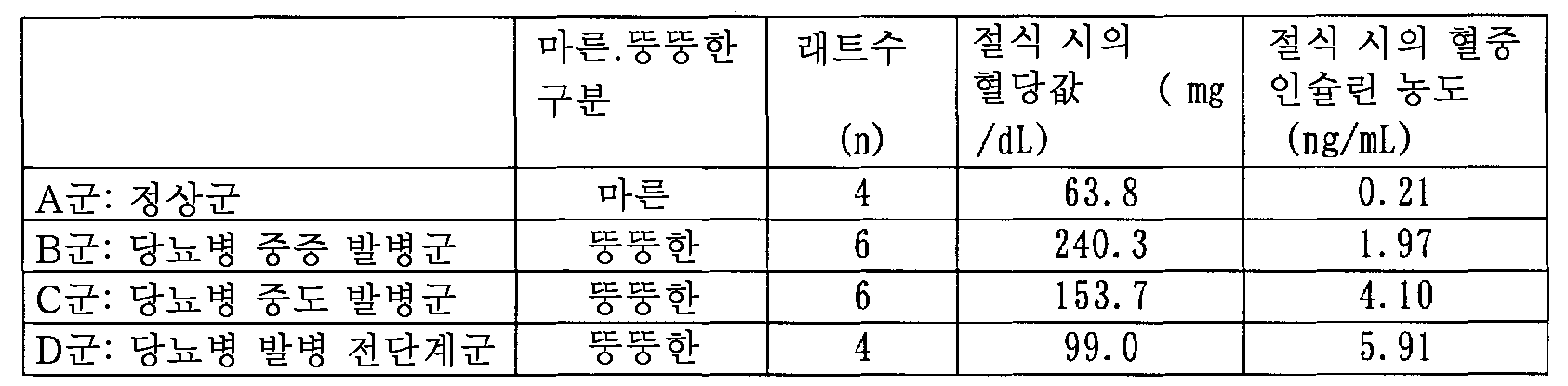
계속해서 U-13C-글루코오스 경구 투여액의 투여 전(0분)과 투여 후(10, 20, 30, 40, 50, 60, 80, 100, 120분)의 각 시점에서 호기를 채취하고, 호기 중에 배출된 13CO2 농도로부터 Δ13C(‰)를 호기 분석용 질량분석계(ABCA:SerCon사제)를 사용하여 구하였다. Subsequently, exhalation was taken at each time point before (0 minutes) and after administration (10, 20, 30, 40, 50, 60, 80, 100, 120 minutes) of the oral administration of U- 13 C-glucose, Δ 13 C (‰) from the concentration of 13 CO 2 discharged during exhalation was determined using a mass spectrometer for exhalation analysis (manufactured by ABCA: SerCon).
(3) 실험 결과 (3) Experiment results
(3-1) 상기 래트 4군에, 각각 U-13C-글루코오스 경구 투여액을 투여한 후, 측정한 호기 중의 Δ13C(‰)의 추이를 도 2에 도시한다. 도면 중, 종축은 호기 중의 Δ13C(‰)이다. 또한, 횡축은 U-13C-글루코오스 경구 투여액 투여 후의 호기 채취 시간(분)을 나타낸다. (3-1) After administration of the oral administration solution of U- 13 C-glucose to each of the rat 4 groups, the transition of Δ 13 C (‰) in the measured expiration is shown in FIG. 2. In the figure, the vertical axis is Δ 13 C (‰) in exhalation. In addition, the horizontal axis represents the exhalation sampling time (minutes) after administration of the oral administration of U- 13 C-glucose.
도 2에 도시한 바와 같이, 정상군(A군: -▲-)에 비하여, 당뇨병 중도 발병 군(C군: -■-) 및 당뇨병 중증 발병군(B군: -◆-)은 Δ13C(‰)값이 낮았다. 한편, 당뇨병 발병 전단계군(D군: -×-)은 정상군, 당뇨병 발병군(당뇨병 중도 발병군, 당뇨병 중증 발병군)의 어느 것보다도, Δ13C(‰)값이 높았다. As shown in Fig. 2, compared with the normal group (Group A:-▲-), the middle-diabetic group (C group:-■-) and the severely diabetic group (B group:-◆-) are Δ 13 C (‰) Value was low. On the other hand, the pre-diabetic group (D group:-×-) had a higher Δ 13 C (‰) value than that of the normal group, the diabetic group (diabetes-moderate group, and diabetic-severe group).
이 점에서, 당뇨병 발병 전단계에서는 당대사능이 정상일 때보다도 항진해 있고, U-13C-글루코오스가 더욱 빠르게 대사되어서 호기 중에 13CO2로서 배출되는 것이 판명되었다. 또한, 일단 당뇨병이 발병되면, 당대사능이 저하되고, 당 대사가 억제되는 결과, 13C-글루코오스가 대사되어서 호기 중에 13CO2로서 배출되는 양이 저하되는 것, 또한 그 당대사능의 저하(13CO2배출량의 저하)는 당뇨병의 중증도에 상관하는 것이 판명되었다. In this regard, it has been found that in the pre-diabetes stage of diabetes, hyperglycemia is higher than normal, and U- 13 C-glucose is metabolized more rapidly and released as 13 CO 2 during exhalation. In addition, once diabetes develops, glucose metabolism decreases and sugar metabolism is suppressed. As a result, 13 C-glucose is metabolized and the amount discharged as 13 CO 2 during exhalation decreases, and the sugar metabolism decreases ( 13 It has been found that a decrease in CO 2 emissions correlates with the severity of diabetes.
이 결과로부터, 13C-글루코오스를 피험 물질로서, 호기 시험을 사용해서 당대사능을 측정함으로써, 당뇨병 발병 후의 병태 스테이지의 판정이 가능할뿐만 아니라, 당뇨병의 발병 전단계의 판정이 가능해지는 것을 알 수 있다. From these results, it can be seen that, by measuring glucose metabolism using an exhalation test using 13 C-glucose as a test substance, not only can the disease stage be judged after the onset of diabetes, but also the pre-diabetes stage can be judged.
(3-2) 래트 4군의 [Δ13C(‰)-호기 채취 시간(120분) 곡선 하의 면적(AUC)]을 각 군의 인슐린 농도(ng/mL)로 나눈 값(「AUC120/인슐린(‰·분·mL/ng)」)과 각 군의 「혈당값(mg/dL)」과의 상관관계를 도 3에 도시한다. 도면 중 종축은 AUC120/인슐린 농도(‰·분·mL/ng), 횡축은 혈당값(mg/dL)을 나타낸다. (3-2) The value obtained by dividing the [Δ 13 C (‰)-area sampling time (120 min) area under the curve (AUC)] of the group 4 by the insulin concentration (ng / mL) of each group (“AUC 120 / 3 shows the correlation between insulin (‰ · min · mL / ng) ”and“ blood sugar value (mg / dL) ”of each group. In the figure, the vertical axis represents AUC 120 / insulin concentration (‰ · min · mL / ng), and the horizontal axis represents blood sugar value (mg / dL).
도 3에서 알 수 있는 바와 같이, 인슐린 농도당의 AUC(120분)[AUC120/인슐린(‰·분·mL/ng)]는 당뇨병 발병 전단계군(D군: -×-), 및 당뇨병 중도 발병군(C군: -■-) 및 당뇨병 중증 발병군(B군: -◆-)의 당뇨병 발병군에서 유의적으로 낮은 값을 나타내고, 모두 정상군(A군: -▲-)의 값과는 명백하게 상이하였다. 또한, 당뇨병 병태 스테이지의 진행에 따라, 혈당값의 상승과 함께 도면의 우측으로 시프트해 가는 것으로 나타났다. 이 점에서, 상기 파라미터[AUC120/인슐린(‰·분·mL/ng)]과 [혈당값(mg/dL)]과의 상관관계를 구함으로써, 정상 상태와 당뇨병 발병 전단계 및 당뇨병을 식별할 수 있음과 함께, 당뇨병 발병 전단계 및 당뇨병의 병태 스테이지(이들을 총칭하여 「당뇨병 병태 스테이지」라고 함)를 판정하고, 또한 모니터링할 수 있는 것이 확인되었다. 이 파라미터를 사용한 당뇨병 병태 스테이지 판정은 종래의 방법에서는 판별하기가 어려운, 특히 당뇨병 발병 전단계의 진단에 유용하다. As can be seen in Figure 3, AUC per insulin concentration (120 min) [AUC 120 / insulin (‰ · min · mL / ng)] is a pre-diabetic group (D group:-×-), and a moderate onset of diabetes The group (C group:-■-) and the diabetic severe onset group (B group:-◆-) showed significantly lower values in the diabetic onset group, all of which were different from those of the normal group (A group:-▲-). It was clearly different. In addition, it was found that as the diabetes condition stage progressed, the blood sugar value increased and shifted to the right side of the drawing. In this regard, by determining the correlation between the above parameters [AUC 120 / insulin (‰ · min · mL / ng)] and [blood glucose value (mg / dL)], normal conditions and pre-diabetes stages and diabetes can be identified. In addition, it was confirmed that the pre-diabetes stage and the stage of diabetes condition (collectively referred to as "diabetic disease stage") can be determined and monitored. Diabetes condition stage determination using this parameter is difficult to discriminate in a conventional method, and is particularly useful for diagnosis in the pre-diabetes stage.
(3-3) 래트 4군의 U-13C-글루코오스 경구 투여 후 10분의 시점에서의 Δ13C(‰)를 각각의 인슐린 농도(ng/mL)로 나눈 값 「Δ13C(‰)(10분)/인슐린(‰·mL/ng)」과, 각 군의 「혈당값(mg/dL)」과의 상관관계를 도 4에 도시한다. 도면 중, 종축은 「Δ13C(‰)(10분)/인슐린 농도」(‰·mL/ng), 횡축은 혈당값(mg/dL)을 나타낸다. (3-3) Δ 13 C (‰) divided by each insulin concentration (ng / mL) at 10 minutes after oral administration of U- 13 C-glucose in group 4 of rats “Δ 13 C (‰) (10 minutes) / Insulin (‰ · mL / ng) ”and“ blood sugar value (mg / dL) ”of each group are shown in FIG. 4. In the figure, the vertical axis represents “Δ 13 C (‰) (10 min) / insulin concentration” (‰ · mL / ng), and the horizontal axis represents blood sugar value (mg / dL).
이 결과로부터, 전술한 도 3에 있어서, 종축을 「AUC120/인슐린(‰·분·mL/ng) 」 대신에 「Δ13C(‰)(10분)/인슐린(‰·mL/ng)」으로 해도, 정상 상태와 당뇨병 발병 전단계 및 당뇨병을 식별할 수 있음과 함께, 당뇨병 병태 스테이지를 판정하고, 또한 모니터링할 수 있는 것이 확인되었다. 즉, 13C-글루코오스 투여 후의 어느 시점(투여 후 t분)에서의 Δ13C(‰)(Δ13C(‰)(t분))를 인슐린 농도로 나눈 파라미터[Δ13C(‰)(t분)/인슐린](‰·mL/ng)과 [혈당값](mg/dL)과의 상관관계를 구함으로써, 정상 상태와 당뇨병 발병 전단계 및 당뇨병을 식별할 수 있음과 함께, 당뇨병 발병 전단계 및 당뇨병의 병태 스테이지(당뇨병 병태 스테이지)를 판정하고, 또한 모니터링할 수 있다. 또한, 상기 측정 시점(t분)은 13C-글루코오스 투여 후라면 좋지만, 단시간에 상기한 것을 실행할 수 있다는 본 발명의 장점을 살리는 의미에서는, 13C-글루코오스 투여 후 120분 이내, 바람직하게는 60분 이내, 보다 바람직하게는 30분 이내이다. 또한, 제한되지 않지만, 13C-글루코오스 투여 후, 적어도 10분 이상 경과 후인 것이 바람직하다. From this result, in FIG. 3 described above, instead of `` AUC 120 / insulin (‰ · min · mL / ng) '', the vertical axis represents `` Δ 13 C (‰) (10 minutes) / insulin (‰ · mL / ng). It was confirmed that the normal condition, pre-diabetes stage and diabetes can be identified, and the stage of diabetes condition can be determined and monitored. That is, the parameter [Δ 13 C (‰) divided by Δ 13 C (‰) (Δ 13 C (‰) (t min) ) divided by insulin concentration at a certain point after administration of 13 C-glucose (t min after administration) ( Δ 13 C (‰) ( t min) / insulin] (‰ · mL / ng) and [glycemic value] (mg / dL), by determining the correlation between normal status and pre-diabetes and diabetes, as well as pre-diabetes And the diabetic condition stage (diabetic condition stage), and can also be monitored. In addition, the measurement time point (t minutes) is good after 13 C-glucose administration, but in the sense of taking advantage of the present invention that the above can be performed in a short time, within 120 minutes after administration of 13 C-glucose, preferably 60 Within minutes, more preferably within 30 minutes. In addition, although not limited, it is preferable that at least 10 minutes or more have elapsed after 13 C-glucose administration.
이 파라미터를 사용한 당뇨병 병태 스테이지 판정은 종래의 방법에서는 단시간에 판별하는 것이 어렵고, 특히 당뇨병 발병 전단계의 진단에 유용하다. Diabetes condition stage determination using this parameter is difficult to determine in a short time in a conventional method, and is particularly useful for diagnosis in the pre-diabetes stage.
실험예 3 호기 시험에 의한 당뇨병 병태 스테이지의 모니터(II) Experimental Example 3 Monitor (II) of the diabetes condition stage by the exhalation test
(1) U-13C-글루코오스 경구 투여액의 제조 (1) Preparation of U- 13 C-glucose oral dosage
U-13C-글루코오스(MW:186, Cambridge Isotope Laboratory제)를 생리 식염수에 용해하여 50 μmol/4mL 농도의 U-13C-글루코오스 경구 투여액을 제조하였다. U- 13 C-glucose (MW: 186, manufactured by Cambridge Isotope Laboratory) was dissolved in physiological saline to prepare an oral dosage of U- 13 C-glucose at a concentration of 50 μmol / 4 mL.
(2) 주령 변화에서의 병태 스테이지 모니터 실험 (2) Condition stage monitor experiment in changing age
피험 동물로서, 절식시킨 ZDF 마른 래트(비당뇨병 래트: 정상군)(수컷, n=4)와 ZDF 뚱뚱한 래트(수컷, n=4)를 사용하여, ZDF 뚱뚱한 래트에 대해서는 9, 10, 13, 및 23주령의 각 시점에서, 또한 ZDF 마른 래트에 대해서는 13주령의 각 시점에서, 상기에서 제조한 투여액을 강제적으로 4mL/kg 경구 투여하였다. 계속해서, 각 군에 대해서, U-13C-글루코오스 경구 투여액의 투여 전(0분)과 투여 후의 각 시점(10, 20, 30, 40, 50, 60, 80, 100, 120분)에서 호기를 채취하고, 호기 중에 배출된 13CO2 농도로부터 Δ13C(‰)를 호기 분석용 질량분석계(ABCA:SerCon사제)를 사용하여 측정하였다. As test animals, fasted ZDF dry rats (non-diabetic rats: normal group) (male, n = 4) and ZDF fat rats (male, n = 4) were used for 9, 10, 13, and 9 for ZDF fat rats. And at each time point of 23 weeks of age, and also at each time point of 13 weeks of age for ZDF dried rats, the above-mentioned preparation was forcibly administered orally at 4 mL / kg. Subsequently, for each group, at each time point (10, 20, 30, 40, 50, 60, 80, 100, 120 minutes) before and after administration of the U- 13 C-glucose oral administration solution. Exhalation was taken and Δ 13 C (‰) from the concentration of 13 CO 2 released during exhalation was measured using a mass spectrometer (ABCA: manufactured by SerCon) for exhalation analysis.
(3) 실험 결과 (3) Experiment results
각 주령 시(ZDF 뚱뚱한: 9W, 10W, 13W, 23W, ZDF 마른: 13W)에 U-13C-글루코오스 경구 투여액을 투여한 후에 측정한 호기 중의 Δ13C(‰)의 추이를 도 5에 도시한다. 도면 중, 종축은 호기 중의 Δ13C(‰), 또한 횡축은 U-13C-글루코오스 경구 투여액 투여 후의 호기 채취 시간(분)을 나타낸다.Each weeks during the transition of the Δ 13 C (‰) in a breath measured after administration of U- 13 C- glucose solution was orally administered (ZDF fat:: 9W, 10W, 13W, 23W, ZDF dry 13W) in Fig. 5 City. In the figure, the vertical axis also Δ 13 C (‰), during exhalation the horizontal axis indicates the sampling time after exhalation U- 13 C- glucose solution orally administered (in minutes).
도 5에 도시한 바와 같이, ZDF 뚱뚱한 래트 9주령(-○-)에서는 정상군(ZDF 마른 래트 13주령, -■-)과 마찬가지인 호기 패턴(호기 중의 Δ13C(‰)의 추이)을 나타냈다. 한편, ZDF 뚱뚱한 래트 10주령군(-□-) 및 13주령군(-×-)에서는 당 대사가 항진해 있고, 그 호기 패턴(호기 중의 Δ13C(‰)의 추이)은 정상군(-■-)의 호기 패턴에 비해서 높은 값을 나타냈다. 또한, ZDF 뚱뚱한 래트 23주령(-△-)에서는 당뇨병이 발병했고, 그 호기 패턴은 정상군(-■-)의 호기 패턴에 비해서 낮은 값을 나타냈다. 이 점에서, 13C-글루코오스를 사용한 호기 시험에 의해, 호기 중의 Δ13C(‰)의 지표로 함으로써, 건강 상태, 당뇨병 발병 전단계 및 당뇨병을 각각 식별할 수 있음과 함께, 당뇨병 발병 전단계 및 당뇨병의 병태 스테이지(당뇨병 병태 스테이지)의 경시적 추이를 모니터링하는 것이 가능한 것이 판명되었다. As shown in Figure 5, ZDF fat rats 9 weeks old (-○-) showed an aerobic pattern (change in Δ 13 C (‰) during exhalation) similar to that of the normal group (13 weeks old ZDF dry rats,-■-). . On the other hand, in the 10-week-old group of ZDF fat rats (-□-) and the 13-week old group (-×-), sugar metabolism was enhanced, and the aerobic pattern (change in Δ 13 C (‰) during exhalation) was normal (- It showed higher value than the exhalation pattern of ■-). In addition, diabetes occurred in 23 weeks of age (-△-) in ZDF fat rats, and the aerobic pattern was lower than that of the normal group (-■-). In this regard, by using an exhalation test using 13 C-glucose, the health status, pre-diabetes and pre-diabetes diabetes can be identified, respectively, by making Δ 13 C (‰) in exhalation, respectively. It has been found possible to monitor the course of the disease over time (diabetes condition stage).
실험예 4 당 부하 조건 하에서의 호기 시험 Exhalation test under load condition per Experimental Example 4
(1) 피험 동물 (1) Test animal
피험 동물로서, 당뇨병 모델 동물인 OLETF 래트와 그 대조군으로서 LETO 래트를 사용하였다. 구체적으로는, 제1군(대조군: LETO 래트, 수컷, n=5)과 제2군(당뇨병군: OLETF 래트, 수컷, n=6)을 20시간 절식한 후, 다음 시험에 제공하였다. As a test animal, OLETF rat, a diabetes model animal, and LETO rat were used as a control. Specifically, the first group (control group: LETO rat, male, n = 5) and the second group (diabetic group: OLETF rat, male, n = 6) were fasted for 20 hours, and then subjected to the next test.
(2) 실험 방법과 결과 (2) Experiment method and results
(2-1) 절식 하에서의 호기 패턴(호기 중의 Δ13C(‰)의 추이) (2-1) Exhalation pattern under fasting (change of Δ 13 C (‰) in exhalation)
절식 하의 제1군(대조군) 및 제2군(당뇨병군)에, 각각 U-13C-글루코오스 수용액(50 μmol/4mL/kg)을 경구 투여하였다. 각 군에 대해서, U-13C-글루코오스 투여전(0분)과 투여 후의 각 시점(10, 20, 30, 40, 50, 60, 80, 100, 120분)에서 호기를 채취하고, 호기 중에 배출된 13CO2 농도로부터 Δ13C(‰)를 호기 분석용 질량분석계(ABCA:SerCon사제)를 사용하여 측정하였다. 도 6에, 그 호기 패턴(호기 중의 Δ13C(‰)의 추이)을 나타낸다. To the first group (control group) and the second group (diabetic group) under fasting, an aqueous solution of U- 13 C-glucose (50 μmol / 4 mL / kg) was administered orally, respectively. For each group, exhalation was taken before and after administration of U- 13 C-glucose (0 min) and at each time point after administration (10, 20, 30, 40, 50, 60, 80, 100, 120 min). Δ 13 C (‰) from the discharged 13 CO 2 concentration was measured using a mass spectrometer for aerobic analysis (ABCA: manufactured by SerCon). Fig. 6 shows the exhalation pattern (change in Δ 13 C (‰) in exhalation).
(2-2) 글루코오스 450mg/4mL/kg 투여 하(당 부하 조건 하)에서의 호기 패턴(호기 중의 Δ13C(‰)의 추이) (2-2) Exhalation pattern (change of Δ 13 C (‰) in exhalation) under the administration of 450 mg / 4 mL / kg of glucose (under sugar load conditions)
(2-2-1) (1)의 피험 동물, 제1군(대조군) 및 제2군(당뇨병군)에, 각각 글루코오스 수용액(450mg/4mL/kg)과 U-13C-글루코오스 수용액(50 μmol/4mL/kg)을 동시에 경구 투여하였다. (2-2-1) To the test animals of (1), the first group (control group) and the second group (diabetes group), respectively, an aqueous glucose solution (450 mg / 4 mL / kg) and an aqueous solution of U- 13 C-glucose (50 μmol / 4mL / kg) was administered orally at the same time.
(2-1)과 마찬가지로, 각 군에 대해서 U-13C-글루코오스 투여 전(0분)과 투여 후의 각 시점(10, 20, 30, 40, 50, 60, 80, 100, 120분)에서 호기를 채취하고, 호기 중에 배출된 13CO2 농도로부터 Δ13C(‰)를 측정하였다. 도 7에 그 호기 패턴(호기 중의 Δ13C(‰)의 추이)을 나타낸다. As in (2-1), for each group, at each time point (10, 20, 30, 40, 50, 60, 80, 100, 120 minutes) before and after administration of U- 13 C-glucose (10 minutes) Exhalation was taken and Δ 13 C (‰) was measured from the concentration of 13 CO 2 released during exhalation. Fig. 7 shows the exhalation pattern (the transition of Δ 13 C (‰) in exhalation).
(2-2-2) 또한, (1)의 피험 동물, 제1군(대조군) 및 제2군(당뇨병군)에, 각각 글루코오스 수용액(450mg/4mL/kg) 경구 투여 30분 후에 U-13C-글루코오스 수용액(50 μmol/4mL/kg)을 경구 투여하였다. (2-1)과 마찬가지로, 각 군에 대해서 U-13C-글루코오스 투여 전(0분)과 투여 후의 각 시점(10, 20, 30, 40, 50, 60, 80, 100, 120분)에서 호기를 채취하고, 호기 중에 배출된 13CO2 농도로부터 Δ13C(‰)를 측정하였다. 도 8에 그 호기 패턴(호기 중의 Δ13C(‰)의 추이)을 나타낸다. (2-2-2) In addition, to the test animals of (1), the first group (control group) and the second group (diabetic group), respectively, glucose solution (450mg / 4mL / kg) was administered 30 minutes after oral administration of U- 13 An aqueous C-glucose solution (50 μmol / 4 mL / kg) was administered orally. As in (2-1), for each group, at each time point (10, 20, 30, 40, 50, 60, 80, 100, 120 minutes) before and after administration of U- 13 C-glucose (10 minutes) Exhalation was taken and Δ 13 C (‰) was measured from the concentration of 13 CO 2 released during exhalation. Fig. 8 shows the exhalation pattern (the transition of Δ 13 C (‰) in exhalation).
(2-2-3) (1)의 피험 동물, 제1군(대조군) 및 제2군(당뇨병군)에, 각각 글루코오스 수용액(450mg/4mL/kg) 경구 투여 30분 후에 U-13C-글루코오스 수용액(50 μmol/mL/kg)을 정맥 내 투여하였다. (2-1)과 마찬가지로, 각 군에 대해서 U-13C-글루코오스 투여 전(0분)과 투여 후의 각 시점(10, 20, 30, 40, 50, 60, 80, 100, 120분)에서 호기를 채취하고, 호기 중에 배출된 13CO2 농도로부터 Δ13C(‰)를 측정하였다. 도 9에 그 호기 패턴(호기 중의 Δ13C(‰)의 추이)을 나타낸다. (2-2-3) To the test animals of (1), the first group (control group) and the second group (diabetic group), respectively, glucose solution (450 mg / 4 mL / kg) 30 minutes after oral administration of U- 13 C- An aqueous glucose solution (50 μmol / mL / kg) was administered intravenously. As in (2-1), for each group, at each time point (10, 20, 30, 40, 50, 60, 80, 100, 120 minutes) before and after administration of U- 13 C-glucose (10 minutes) Exhalation was taken and Δ 13 C (‰) was measured from the concentration of 13 CO 2 released during exhalation. Fig. 9 shows the exhalation pattern (the transition of Δ 13 C (‰) in exhalation).
(2-2-4) (1)의 피험 동물, 제1군(대조군) 및 제2군(당뇨병군)에, 각각 글루코오스 수용액(2g/4mL/kg) 경구 투여 30분 후에 U-13C-글루코오스 수용액(50 μmol/mL/kg)을 정맥 내 투여하였다. (2-1)과 마찬가지로, 각 군에 대해서 U-13C-글루코오스 투여 전(0분)과 투여 후의 각 시점(10, 20, 30, 40, 50, 60, 80, 100, 120분)에서 호기를 채취하고, 호기 중에 배출된 13CO2 농도로부터 Δ13C(‰)를 측정하였다. 도 10에 그 호기 패턴(호기 중의 Δ13C(‰)의 추이)을 나타낸다. (2-2-4) To the test animals of (1), first group (control group) and second group (diabetic group), respectively, glucose solution (2 g / 4 mL / kg) was administered 30 minutes after oral administration of U- 13 C- An aqueous glucose solution (50 μmol / mL / kg) was administered intravenously. As in (2-1), for each group, at each time point (10, 20, 30, 40, 50, 60, 80, 100, 120 minutes) before and after administration of U- 13 C-glucose (10 minutes) Exhalation was taken and Δ 13 C (‰) was measured from the concentration of 13 CO 2 released during exhalation. Fig. 10 shows the exhalation pattern (the transition of Δ 13 C (‰) in exhalation).
(2-2-5) (1)의 피험 동물, 제1군(대조군) 및 제2군(당뇨병군)에, 각각 경장 영양제(단백질 아미노산 제재: 상품명 「라콜(등록상표) 배합 경장 용액」, 이엔 오쯔카세이야꾸 가부시끼가이샤)를 4mL/kg 경구 투여하고, 30분 후에 U-13C-글루코오스 수용액(50 μmol/mL/kg)을 정맥 내 투여하였다. (2-1)과 마찬가지로, 각 군에 대해서 U-13C-글루코오스 투여 전(0분)과 투여 후의 각 시점(10, 20, 30, 40, 50, 60, 80, 100, 120분)에서 호기를 채취하고, 호기 중에 배출된 13CO2 농도로부터 Δ13C(‰)를 측정하였다. 도 11에 그 호기 패턴(호기 중의 Δ13C(‰)의 추이)을 나타낸다. (2-2-5) Enteral nutrients (protein amino acid preparations: trade name "Laccol (registered trademark) formulated enteral solution", respectively, in the test animals of (1), the first group (control group) and the second group (diabetic group), Yen Otsuka Seiyaku Co., Ltd. was orally administered at 4 mL / kg, and 30 minutes later, a U- 13 C-glucose aqueous solution (50 μmol / mL / kg) was administered intravenously. As in (2-1), for each group, at each time point (10, 20, 30, 40, 50, 60, 80, 100, 120 minutes) before and after administration of U- 13 C-glucose (10 minutes) Exhalation was taken and Δ 13 C (‰) was measured from the concentration of 13 CO 2 released during exhalation. Fig. 11 shows the exhalation pattern (the transition of Δ 13 C (‰) in exhalation).
각 도면(도 6 내지 11) 중, 종축은 Δ13C(‰)이며, 횡축은 U-13C-글루코오스 투여 후의 호기 채취 시간(분)을 나타낸다. 또한, -□- 및 -■-는 각각 제1군(대조군) 및 제2군(당뇨병군)을 측정한 호기 중의 Δ13C(‰)의 경시적 추이이다. Each of the drawings (Figs. 6 to 11) and the vertical axis is the Δ 13 C (‰), the horizontal axis represents the sampling time exhalation after administration of U- 13 C- glucose minutes. In addition,-□-and-■-are the time course of Δ 13 C (‰) in the exhalation measured in the first group (control group) and the second group (diabetic group), respectively.
(3) 고찰 (3) Discussion
도 6에 도시한 바와 같이, 절식 하에서는 제1군(대조군)과 제2군(당뇨병군)의 Δ13C(‰)값의 차는 작았다. 한편, 도 7 내지 11에 도시한 바와 같이, 당 부하 조건 하에서는 제1군(대조군)의 호기 패턴(호기 중의 Δ13C(‰)의 추이)은 제2군(당뇨병군)의 호기 패턴(호기 중의 Δ13C(‰)의 추이)에 비해서 유의적으로 높은 것이 판명되었다. 즉, 절식 하에서는 정상군(대조군)과 당뇨병군의 호기 반응(호기 패턴, 호기 중의 Δ13C(‰)의 추이) 사이에 차는 있지만, 그 정도는 작은 것에 대해서, 당 부하 조건 하에서의 측정에 의해, 양자의 호기 반응(호기 패턴, 호기 중의 Δ13C(‰)의 추이)의 차가 증대한다. 이 점에서, 당 부하 조건하에서 측정함으로써, 당뇨병군이 정상군(대조군)과 구별되어서 보다 판별하기 쉬워지는 것이 확인되었다. 6, the under fasted was less difference in Δ 13 C (‰) values of the first group (control group) and the second group (diabetic group). On the other hand, as shown in FIGS. 7 to 11, under the sugar load condition, the aerobic pattern of the first group (control group) (the transition of Δ 13 C (‰) during exhalation) is the aerobic pattern of the second group (diabetic group) (aerobic group) It turned out that it was significantly high compared with (the change of (DELTA) 13C (‰) in). That is, under fasting, there is a difference between the normal group (control group) and the aerobic response of the diabetic group (aerobic pattern, transition of Δ 13 C (‰) during exhalation), but the degree is small, as measured by sugar load conditions. The difference in both aerobic reactions (exhalation pattern, Δ 13 C (‰) transition in exhalation) increases. From this point, it was confirmed that the diabetic group was distinguished from the normal group (control group) and easier to discriminate by measuring under the sugar load condition.
또한, 도 7에 도시한 바와 같이, 당 부하용 당질과 13C-글루코오스를 동시에 투여하면, 제1군(대조군)과 제2군(당뇨병군)의 초기(특히 투여 후 10분 이내)의 호기 반응에 겹침이 인정되었지만, 도 8에 도시한 바와 같이, 피험 물질인 13C-글루코오스의 투여 전에, 당질을 사전에 투여(당 부하)함으로써, 상기 초기의 호기 반응의 겹침이 해소하였다. 또한, 도 8과 도 9 및 10과의 대비로부터 알 수 있는 바와 같이, 13C-글루코오스의 투여 형태를, 경구 투여(도 8)로부터 정맥 내 투여(도 9 및 10)로 바꿈으로써, 제1군(대조군)과 제2군(당뇨병군)에서의 호기 반응의 차, 특히 초기(예를 들어, 투여 후 10분 이내)에서의 호기 반응의 차가 한층 벌어졌다. In addition, as shown in Fig. 7, when the sugar-loading saccharide and 13 C-glucose are administered simultaneously, the exhalation in the initial stage (especially within 10 minutes after administration) of the first group (control group) and the second group (diabetes group). Although the overlap was recognized in the reaction, as shown in Fig. 8, the overlap of the initial exhalation reaction was resolved by prior administration of the sugar (sugar load) before administration of the test substance 13 C-glucose. In addition, as can be seen from the contrast between FIGS. 8 and 9 and 10, the first dosage form was changed from oral administration (FIG. 8) to intravenous administration (FIGS. 9 and 10) by changing the dosage form of 13 C-glucose. The difference in the aerobic response between the group (control group) and the second group (diabetic group), in particular the difference between the aerobic response in the initial stage (for example, within 10 minutes after administration), was further increased.
이상의 점에서 알 수 있는 바와 같이, 당 부하 조건 하에서의 13C-글루코오스를 사용한 호기 시험, 바람직하게는 사전에 당질을 투여해서 당 부하한 조건 하에서에의 13C-글루코오스를 사용한 호기 시험, 보다 바람직하게는 13C-글루코오스를 정맥 투여하여 행하는 호기 시험에 의해, 당뇨병 병태 스테이지의 측정 정밀도를 높일 수 있다. As can be seen from the above, the test No. 13, using C- glucose per under load conditions, preferably aerobic test using a 13 C- glucose under the conditions of the load per dose to the saccharides in advance, and more preferably By the exhalation test performed by intravenous administration of 13 C-glucose, the measurement precision of the diabetic condition stage can be improved.
또한, 도 11에 도시한 바와 같이, 당 부하에 사용하는 당질(글루코오스) 대신에, 단백질, 지방, 당류 및 각종 미네랄 성분을 포함하는 경장 용액(라콜[등록상표] 배합 경장 용액)을 사용해도, 마찬가지의 결과가 얻어지는 것이 확인되었다. 종래부터, 당뇨병 환자에 있어서 OGTT(당 부하 시험)에 의한 고혈당 위험성이 우려되는 점에서, 단백질, 지방, 당류 및 각종 미네랄 성분을 포함하는 식음료는 종래의 OGTT에서 사용되는 당질(글루코오스)을 대신하는 시험식이 될 수 있다고 생각된다. In addition, as shown in Fig. 11, instead of the saccharide (glucose) used for sugar loading, a enteric solution containing a protein, fat, saccharide, and various mineral components (Racol [registered trademark] mixed enteric solution) may be used. It was confirmed that the same result was obtained. Conventionally, food and beverages containing proteins, fats, sugars, and various mineral components in place of the risk of hyperglycemia due to OGTT (sugar load test) in diabetic patients replace sugar (glucose) used in conventional OGTT. I think it can be a trial.
실험예 5 당뇨병 치료약의 치료 효과의 평가 Experimental Example 5 Evaluation of treatment effect of diabetes treatment drug
(1) 실험 방법 (1) Experiment method
피험 동물로서 3군의 ZDF 래트(A군: 정상군(n=4), B군: 당뇨병 중증 발병 군(n=6), C군: 당뇨병 중도 발병군(n=6))를 사용하였다. 또한, 실험중, 이들 ZDF 래트에는 물 및 사료(당질, 지질 및 단백질 함유)(MF: 오리엔탈 코보사)를 자유 섭취시켰다. 즉, 다음 실험은 비절식 조건하에서 행하였다. As the test animals, three groups of ZDF rats (A group: normal group (n = 4), B group: severe diabetes onset group (n = 6), C group: middle diabetes group (n = 6)) were used. In addition, during the experiment, these ZDF rats were freely ingested with water and feed (containing sugar, lipids and proteins) (MF: Oriental Cobosa). That is, the next experiment was conducted under non-fasting conditions.
이들 각 군의 래트에 대하여 비구아나이드계 당뇨병 치료약(총칭명 멜빈)의 유효 성분인 메트포르민(와코 가부시끼가이샤) 300mg/kg을 매일 아침 3일간 경구 투여하였다. 3일째의 투여로부터 3시간 후에 실험예 1의 (1)에 기재하는 방법으로 제조한 U-13C-글루코오스 용액을 정맥 내 투여하였다. For each group of rats, 300 mg / kg of metformin (Wako Chemical Co., Ltd.), an active ingredient of a biguanide-based diabetes treatment drug (collectively Melvin), was orally administered for 3 days each morning. 3 hours after administration on the third day, the U- 13 C-glucose solution prepared by the method described in (1) of Experimental Example 1 was administered intravenously.
계속해서, 각 군의 래트를 대상으로 하여, U-13C-글루코오스 투여 전(0분)과 투여 후의 각 시점(10, 20, 30, 40, 50, 60, 80, 100, 120분)에서 호기를 채취하고, 호기 중에 배출된 13CO2 농도로부터 Δ13C(‰)를 호기 분석용 질량분석계(ABCA: SerCon사제)를 사용하여 측정하였다. Subsequently, rats of each group were subjected to U- 13 C-glucose administration before (0 min) and at each time point after administration (10, 20, 30, 40, 50, 60, 80, 100, 120 minutes). Exhalation was taken, and Δ 13 C (‰) from the concentration of 13 CO 2 released during exhalation was measured using a mass spectrometer (ABCA: manufactured by SerCon) for exhalation analysis.
(2) 실험 결과 (2) Experimental results
각 3군(A군: 정상군, B군: 당뇨병 중증 발병군, C군: 당뇨병 중도 발병군)의 당뇨병 치료약 투여 전(무처치)의 Δ13C(‰)의 추이(A군: -◆-, B군: -■-, C군: -▲-)와 당뇨병 치료약 투여 후의 Δ13C(‰)의 추이(B군: -□-, C군: -△-)를 도 12에 나타내었다. 도면 중, 종축은 Δ13C(‰), 횡축은 U-13C-글루코오스 투여 후의 호기 채취 시간(분)을 나타낸다. Δ 13 C (‰) before pre-diabetes treatment (no treatment) of each group 3 (group A: normal group, group B: group with severe diabetes, group C: group with severe diabetes) (group A:-◆ -, B group:-■-, C group:-▲-) and Δ 13 C (‰) after administration of the diabetes treatment drug (B group:-□-, C group:-△-) is shown in Figure 12. . In the figure, the vertical axis represents Δ 13 C (‰), and the horizontal axis represents exhalation sampling time (minutes) after administration of U- 13 C-glucose.
도 12로부터 알 수 있는 바와 같이, 2개의 당뇨병 발병군(B 및 C군)은 모두, 당뇨병 치료약을 투여함으로써, 당뇨병 치료약 투여 전보다도, 호기 패턴(호기 중의 Δ13C(‰)의 추이)이 높아지고, 당대사능이 항진하는 것이 판명되었다. 즉, 당뇨병 치료약에 의한 치료 효과가 본 발명의 호기 시험을 사용해서 평가 판정할 수 있는 것이 판명되었다. As can be seen from FIG. 12, in the two diabetes onset groups (groups B and C), by administering the diabetes treatment drug, the aerobic pattern (change in Δ 13 C (‰) in exhalation) was higher than before the administration of the diabetes treatment drug. It turned out to be high, and the ability of the contemporary party to advance. That is, it turned out that the therapeutic effect by the diabetes treatment drug can be evaluated and evaluated using the exhalation test of the present invention.
또한, 이 실험에 의해, 13C-글루코오스를 사용한 호기 시험, 특히 13C-글루코오스를 정맥 투여해서 행하는 호기 시험을 사용함으로써 당뇨병 치료약에 의한 치료 효과를 3일 이내라는 단기간에 확인할 수 있는 것이 판명되었다(통상, 약물에 의한 치료 효과의 판정에는 약물치료 개시부터 약 1개월 후의 HbA1c 측정값이 지표로서 사용되고 있음). In addition, it was found by this experiment that an exhalation test using 13 C-glucose, in particular, an exhalation test performed by intravenous administration of 13 C-glucose, can confirm the therapeutic effect of a diabetes treatment drug within a short period of time within 3 days. (Normally, the HbA1c measured value about 1 month after the start of drug treatment is used as an index to determine the treatment effect by the drug).
실험예 6 인슐린 투여 후의 치료 효과의 평가 Experimental Example 6 Evaluation of treatment effect after insulin administration
피험 동물로서, 대조군(Wistar 래트, 수컷, n=3), 및 제1형 당뇨병군(STZ 래트, 수컷, n=3)을 사용하였다. 또한, 실험 중, 이들 래트에는 물 및 사료(당질, 지질 및 단백질 함유)(MF: 오리엔탈 코보사)를 자유 섭취시켰다. 즉, 다음 실험은 비절식 조건하에서 행하였다. As a test animal, a control group (Wistar rat, male, n = 3), and a type 1 diabetes group (STZ rat, male, n = 3) were used. In addition, during the experiment, these rats were freely ingested with water and feed (containing sugar, lipids and proteins) (MF: Oriental Cobosa). That is, the next experiment was conducted under non-fasting conditions.
제1형 당뇨병군(STZ 래트)으로서, STZ(streptozocin: SIGMA) 65mg/mL/kg을 정맥 내 투여해서 1주일 경과한 래트를 사용하였다. As a type 1 diabetes group (STZ rat), rats that passed 1 week after intravenous administration of STZ (streptozocin: SIGMA) 65 mg / mL / kg were used.
제1형 당뇨병군에 인슐린(SIGMA) 30U/체중을 피하투여하고, 인슐린 투여 전, 투여로부터 4시간 후 또는 투여로부터 24시간 후에, 실험예 1(1)에 기재하는 방법으로 제조한 1-13C-글루코오스 용액을 정맥 내 투여했다(단, 정상군인 대조군의 래트에는 인슐린 투여는 실시하지 않았음). 계속해서, 각 군의 래트(대조군, 제1형 당뇨병군, 인슐린 투여 4h-당뇨병군, 인슐린 투여 24h-당뇨병군)에 대해서, 1-13C-글루코오스 투여 전(0분)과 투여 후의 각 시점(10, 20, 30, 40, 50, 60, 80, 100, 120분)에서 호기를 채취하고, 호기 중에 배출된 13CO2 농도로부터 Δ13C(‰)를 호기 분석용 질량분석계(ABCA:SerCon사제)를 사용하여 측정하였다. Type 1 diabetes the insulin group (SIGMA) 30U / subcutaneous administration and the body weight, insulin before administration, after 24 hours from 4 hours after dosing, or from the administration, prepared by the method described in Experimental Example 1 (1) 1-13 The C-glucose solution was administered intravenously (however, insulin was not administered to the normal group of control rats). Subsequently, for each group of rats (control group, type 1 diabetes group, insulin administration 4h-diabetes group, insulin administration 24h-diabetes group), each time before and after administration of 1-13 C-glucose (0 min) (10, 20, 30, 40, 50, 60, 80, 100, 120 min), and extract the expiration, and Δ 13 C (‰) from the concentration of 13 CO 2 discharged in the exhalation mass spectrometer for exhalation analysis (ABCA: SerCon).
도 13에, 각 군의 래트(대조군: -■-, 제1형 당뇨병군: -□-, 인슐린 투여 4h-당뇨병군: -△-, 인슐린 투여 24h-당뇨병군: -●-)의 호기 패턴(Δ13C(‰)의 추이)을 나타낸다. 도면 중, 종축은 Δ13C(‰), 횡축은 1-13C-글루코오스 투여 후의 호기 채취 시간(분)을 나타낸다. 도 13의 인슐린 투여 4h-당뇨병군(-△-)의 결과로부터 알 수 있는 바와 같이, 인슐린의 효과가 지속되는 동안의 Δ13C(‰)는 대조군과 거의 같은 값을 나타냈다. 또한, 인슐린 투여 24h-당뇨병군(-●-)의 결과로부터 알 수 있는 바와 같이, 인슐린의 효과가 소실됨으로써 호기 패턴(Δ13C(‰)의 추이)이 낮은 값을 나타냈다. In FIG. 13, the aerobic pattern of each group of rats (control group:-■-, type 1 diabetes group:-□-, insulin administration 4h-diabetes group:-△-, insulin administration 24h-diabetes group:-●-) (Change of Δ 13 C (‰)). In the figure, the vertical axis represents Δ 13 C (‰), and the horizontal axis represents exhalation sampling time (minutes) after administration of 1-13 C-glucose. FIG insulin 4h- diabetic group of 13 (- △ -) As can be seen from the results of, Δ 13 C (‰) during which the effect of insulin duration exhibited almost the same values as the control group. In addition, as can be seen from the results of the insulin administration 24h-diabetes group (-●-), the effect of insulin was lost, so the aerobic pattern (change in Δ 13 C (‰)) showed a low value.
이상의 실험 결과는 본 발명의 13C-글루코오스를 사용한 호기 시험을 사용함으로써 당뇨병 환자에 대한 인슐린의 효과를 확인할 수 있는 것을 나타내고 있다. The above experimental results indicate that the effect of insulin on diabetic patients can be confirmed by using the exhalation test using 13 C-glucose of the present invention.
Claims (13)
(a) 생체 내에서 표지 탄산가스로 변환되어서 호기 중에 배출되는, 적어도 하나의 동위 원소 C로 표지된 글루코오스를 유효 성분으로 하는 조성물이 투여된 피험자의 호기를 피험 시료로서, 비표지 CO2량에 대한 표지 CO2량의 비율 또는 총 CO2량에 대한 표지 CO2량의 비율을 구하는 공정, 및
(b) (a) 공정에서 얻어지는 피험자의 「비표지 CO2량에 대한 표지 CO2량의 비율 또는 총 CO2량에 대한 표지 CO2량의 비율」(피험값)이, 정상인에 대해서 얻어지는 「비표지 CO2량에 대한 표지 CO2량의 비율 또는 총 CO2량에 대한 표지 CO2량의 비율」(대조값)보다도 높은 경우에, 당해 피험자는 당대사능이 항진해 있다는 기준을 사용하여, 당해 피험값을 대조값과 비교하는 공정. A method of obtaining the ratio of the amount of labeled CO 2 in order to measure glycolysis of a subject having the following steps (a) and (b):
(a) The exhalation of a subject administered with a composition containing glucose labeled with at least one isotope C as an active ingredient, which is converted into labeled carbon dioxide in vivo and discharged during exhalation, as a test sample, in an unlabeled CO 2 amount. process for obtaining a ratio of the labeled CO 2 amount on the rate or total amount of the labeled CO 2 CO 2 amount, and
(b) (a) subjects "unlabeled ratio of the labeled CO 2 amount on the rate or total CO 2 amount of the labeled CO 2 amount for the CO 2 amount" of obtained in the step (P heomgap) are, obtained for normal subjects " the non-labeled CO ratio of the labeled CO 2 amount for the second amount or proportion of labeled CO 2 amount to the total CO 2 amount "is higher than the (control value), the art subjects using criteria that there enhancing the contemporary saneung, The process of comparing the said test value with a control value.
상기 (a) 공정에서의 조성물 투여 전의 피험자가 당 부하 상태에 있는 것을 특징으로 하는 표지 CO2량의 비율을 구하는 방법.According to claim 1,
Method of obtaining the ratio of the amount of labeled CO 2 characterized in that the subject before administration of the composition in the step (a) is in a sugar-loaded state.
상기 당 부하 상태에 있는 피험자가 (a) 공정 전에, 당질 또는 당질을 함유하는 식음료 또는 대사되어서 당질로 되는 것을 함유하는 식음료를 섭취한 피험자인 표지 CO2량의 비율을 구하는 방법. According to claim 2,
Method of obtaining the ratio of the amount of labeled CO 2 which is a subject in which the subject in the sugar-loaded state ingested a food or drink containing sugar or sugar or a food and drink containing metabolized sugar before the process (a).
(a) 생체 내에서 표지 탄산가스로 변환되어 호기 중에 배출되는, 적어도 하나의 동위 원소 C로 표지된 글루코오스를 유효 성분으로 하는 조성물이 투여된 피험자의 호기를 피험 시료로서, 비표지 CO2량에 대한 표지 CO2량의 비율 또는 총 CO2량에 대한 표지 CO2량의 비율을 구하는 공정, 및
(b) (a) 공정에서 얻어지는 피험자의 「비표지 CO2량에 대한 표지 CO2량의 비율 또는 총 CO2량에 대한 표지 CO2량의 비율」(피험값)이, 정상인에 대해서 얻어지는 「비표지 CO2량에 대한 표지 CO2량의 비율 또는 총 CO2량에 대한 표지 CO2량의 비율」(대조값)보다도 높은 경우에, 당해 피험자는 당뇨병의 발병 전단계에 있다는 기준을 사용하여, 당해 피험값을 대조값과 비교하는 공정.A method of obtaining the ratio of the amount of labeled CO 2 to determine that a subject is in the pre-diabetes stage of diabetes, having the following steps (a) and (b):
(a) The exhalation of a subject administered with a composition containing glucose labeled with at least one isotope C as an active ingredient, which is converted into labeled carbon dioxide in vivo and released during exhalation, as a test sample, in an unlabeled CO 2 amount. process for obtaining a ratio of the labeled CO 2 amount on the rate or total amount of the labeled CO 2 CO 2 amount, and
(b) (a) subjects "unlabeled ratio of the labeled CO 2 amount on the rate or total CO 2 amount of the labeled CO 2 amount for the CO 2 amount" of obtained in the step (P heomgap) are, obtained for normal subjects " the non-labeled CO ratio of the labeled CO 2 amount on the rate or total CO 2 amount of the labeled CO 2 amount for the second amount, "when higher than the (control value), the art subjects using criteria that the diabetes previous step, The process of comparing the said test value with a control value.
(a) 생체 내에서 표지 탄산가스로 변환되어 호기 중에 배출되는, 적어도 하나의 동위 원소 C로 표지된 글루코오스를 유효 성분으로 하는 조성물이 투여된 피험자의 호기를 피험 시료로서, 「△표지 C(‰)-호기 채취 시간 t까지의 곡선 하의 면적(△표지 C(‰)AUCt) 또는 △표지 C(‰)t」을 구하는 공정,
(b) (a) 공정에서 얻어지는 피험자의 「△표지 C(‰)-호기 채취 시간 t까지의 곡선 하의 면적(△표지 C(‰)AUCt) 또는 △표지 C(‰)t」을, 당해 피험자의 인슐린값으로 나누어 얻어지는 「△표지 C(‰)AUCt/인슐린값 또는 △표지 C(‰)t/인슐린값」(피험값)이, 정상인에 대해서 얻어지는 상기 피험값에 대응하는 「△표지 C(‰)AUCt/인슐린값 또는 △표지 C(‰)t/인슐린값」(대조값)보다도 낮은 경우에, 당해 피험자는 당뇨병의 발병 후의 병태 스테이지에 있고, 피험값이 대조값보다 높은 경우에 당해 피험자는 당뇨병의 발병 전단계에 있다는 기준을 사용하여, 당해 피험값을 대조값과 비교하는 공정.Δlabel C (‰) AUCt / insulin value or Δlabel C (‰) t / How to get insulin value:
(a) The exhalation of a subject administered with a composition containing glucose labeled with at least one isotope C as an active ingredient, which is converted into labeled carbon dioxide in vivo and discharged during exhalation, as a test sample, `` △ C (‰ ) -A process to find the area under the curve (△ Coverage C (‰) AUCt) or △ Coverpage C (‰) t until the expiration time t,
(b) The subject obtained in the step (a), Δlabel C (‰)-area under the curve up to the expiration time t (Δlabel C (‰) AUCt) or Δlabel C (‰) t '', the subject The Δ-labeled C (△ label C (‰) AUCt / insulin value or △ label-C (‰) t / insulin value obtained by dividing by the insulin value of (△ value) corresponds to the test value obtained for a normal person. ‰) lower than AUCt / insulin value or Δlabel C (‰) t / insulin value '' (control value), the subject is in the stage of the condition after the onset of diabetes, and the subject is higher than the control value Is a process of comparing the test value with a control value using the criterion that it is in the pre-diabetes stage.
Applications Claiming Priority (3)
| Application Number | Priority Date | Filing Date | Title |
|---|---|---|---|
| JP2012181922 | 2012-08-20 | ||
| JPJP-P-2012-181922 | 2012-08-20 | ||
| PCT/JP2013/072204 WO2014030650A1 (en) | 2012-08-20 | 2013-08-20 | Method for measuring carbohydrate metabolism ability, and composition for use in said method |
Publications (2)
| Publication Number | Publication Date |
|---|---|
| KR20150042853A KR20150042853A (en) | 2015-04-21 |
| KR102105354B1 true KR102105354B1 (en) | 2020-04-29 |
Family
ID=50149957
Family Applications (1)
| Application Number | Title | Priority Date | Filing Date |
|---|---|---|---|
| KR1020157006712A Expired - Fee Related KR102105354B1 (en) | 2012-08-20 | 2013-08-20 | Method for measuring carbohydrate metabolism ability, and composition for use in said method |
Country Status (8)
| Country | Link |
|---|---|
| US (2) | US10228365B2 (en) |
| EP (1) | EP2887066B1 (en) |
| JP (1) | JP6352188B2 (en) |
| KR (1) | KR102105354B1 (en) |
| CN (1) | CN104737016B (en) |
| CA (1) | CA2882528A1 (en) |
| ES (1) | ES2813868T3 (en) |
| WO (1) | WO2014030650A1 (en) |
Families Citing this family (5)
| Publication number | Priority date | Publication date | Assignee | Title |
|---|---|---|---|---|
| KR102105354B1 (en) | 2012-08-20 | 2020-04-29 | 오츠카 세이야쿠 가부시키가이샤 | Method for measuring carbohydrate metabolism ability, and composition for use in said method |
| JP6305392B2 (en) | 2013-03-15 | 2018-04-04 | 大塚製薬株式会社 | Method for measuring insulin resistance by fatty acid combustion, and composition used therefor |
| JP6685906B2 (en) * | 2014-07-09 | 2020-04-22 | 大塚製薬株式会社 | Evaluation of energy malnutrition in subjects with liver disease |
| EP3540439B1 (en) * | 2016-11-11 | 2024-04-24 | Tohoku University | Method for assessing sugar uptake ability of liver |
| EP3546936A4 (en) | 2016-11-25 | 2020-08-05 | Otsuka Pharmaceutical Co., Ltd. | Nutritional state evaluation method |
Citations (1)
| Publication number | Priority date | Publication date | Assignee | Title |
|---|---|---|---|---|
| JP2002513911A (en) * | 1998-05-06 | 2002-05-14 | アイソテクニカ、インコーポレーテッド | 13C glucose breath test for diagnosis of diabetes symptoms and monitoring of blood sugar control |
Family Cites Families (73)
| Publication number | Priority date | Publication date | Assignee | Title |
|---|---|---|---|---|
| JPS4626989Y1 (en) | 1968-11-21 | 1971-09-17 | ||
| US4328229A (en) | 1978-03-29 | 1982-05-04 | Taiho Pharmaceutical Company Limited | Anti-cancer composition for delivering 5-fluorouracil to cancer tissues |
| US4451260A (en) | 1982-03-26 | 1984-05-29 | Minnesota Mining And Manufacturing Company | Sustained release oral medicinal delivery device |
| US4830010A (en) | 1986-04-04 | 1989-05-16 | Marshall Barry J | Methods for the diagnosis of gastrointestinal disorders |
| US4790327A (en) | 1987-07-27 | 1988-12-13 | George Despotis | Endotracheal intubation device |
| JPH0730043B2 (en) | 1987-08-31 | 1995-04-05 | 日本ゼオン株式会社 | 5-fluorouracil derivative |
| HU200926B (en) | 1988-10-28 | 1990-09-28 | Egyt Gyogyszervegyeszeti Gyar | Pharmaceutical composition comprising piroxicam and lactose for use in making tablets or capsules |
| JP2642486B2 (en) | 1989-08-04 | 1997-08-20 | 田辺製薬株式会社 | Ultrafine particle method for poorly soluble drugs |
| US5164308A (en) | 1990-05-21 | 1992-11-17 | Martek Corporation | Preparation of labelled triglyceride oils by cultivation of microorganisms |
| US5233997A (en) | 1991-04-04 | 1993-08-10 | Baylor College Of Medicine | Non-invasive measure of intestinal transit time and uses thereof |
| JP2858295B2 (en) | 1994-04-29 | 1999-02-17 | 明 鳥居 | Gastric emptying function test agent |
| US20020107211A1 (en) | 1995-06-07 | 2002-08-08 | The Rockefeller University | Modulators of body weight, corresponding nucleic acids and proteins, and diagnostic and therapeutic uses thereof |
| JP2768559B2 (en) | 1994-11-02 | 1998-06-25 | ダイアバクト・エイ・ビー | Diagnostic preparation for detection of Helicobacter Pylori |
| SE504902C2 (en) | 1994-11-02 | 1997-05-26 | Diabact Ab | Preparation for detection of Helicobacter pylori in the stomach |
| WO1996036330A2 (en) | 1995-05-17 | 1996-11-21 | Cedars-Sinai Medical Center | Compositions containing fatty acids for improving digestion and absorption in the small intestine |
| US5670331A (en) | 1995-06-22 | 1997-09-23 | The University Of Alabama Research Foundation | Methods for optimizing fluoropyrimidine cancer therapy |
| IL122584A (en) | 1995-06-30 | 2002-11-10 | Ceapro Inc | Diagnostic test meal |
| US5707602A (en) | 1996-03-25 | 1998-01-13 | Meretek Diagnostics | Measurement of gastric emptying |
| SE9601659D0 (en) | 1996-04-30 | 1996-04-30 | Diabact Ab | Diagnostic drug preparation |
| US20010016582A1 (en) | 1997-04-28 | 2001-08-23 | Anthony H. Cincotta | Method and composition for the treatment of lipid and glucose metabolism disorders |
| US8071128B2 (en) | 1996-06-14 | 2011-12-06 | Kyowa Hakko Kirin Co., Ltd. | Intrabuccally rapidly disintegrating tablet and a production method of the tablets |
| US6294151B1 (en) | 1996-08-13 | 2001-09-25 | Kyowa Hakko Kogyo, Co., Ltd. | Isotopic urea tablets |
| ES2186844T3 (en) * | 1996-08-27 | 2003-05-16 | Tokyo Gas Co Ltd | DIAGNOSTIC AGENTS FOR DIABETES. |
| JPH1067689A (en) | 1996-08-27 | 1998-03-10 | Tokyo Gas Co Ltd | Diabetes diagnostics |
| US5785949A (en) | 1996-09-05 | 1998-07-28 | Meretek Diagnostics | Measurement of liquid phase gastric emptying |
| US5944670A (en) | 1996-12-02 | 1999-08-31 | Oridion Medical Ltd. | Breath test for the diagnosis of bacterial infection |
| CA2281111A1 (en) | 1997-02-14 | 1998-08-20 | Fred P. Abramson | An assay for the measurement of dna synthesis rates |
| US6186958B1 (en) | 1997-02-26 | 2001-02-13 | Oridion Medical | Breath test analyzer |
| IT1302026B1 (en) | 1997-08-22 | 2000-07-20 | Hoffmann La Roche | IMMUNOLOGICAL MATERIALS AND METHODS FOR THE DETECTION OF DIHYDROPYRIMIDINADEIDROGENASI. |
| CA2250485C (en) | 1997-10-21 | 2008-04-29 | Tokyo Gas Co., Ltd. | Diagnostic agent for diabetes |
| JP4007653B2 (en) | 1997-10-21 | 2007-11-14 | 東京瓦斯株式会社 | Diabetes diagnostic agent |
| ATE291418T1 (en) | 1998-07-28 | 2005-04-15 | Takeda Pharmaceutical | EASILY DISSOLVING SOLID PREPARATION |
| US6740305B1 (en) | 1999-04-09 | 2004-05-25 | Xanthus Life Scienes, Inc. | Assessment of gastric emptying disorders |
| AU4453300A (en) | 1999-04-09 | 2000-11-14 | Phenome Sciences Inc | Assessment of gastric emptying disorders |
| KR100360827B1 (en) | 1999-08-14 | 2002-11-18 | 주식회사 삼양사 | Polymeric composition for solubilizing poorly water soluble drugs and process for the preparation thereof |
| US20010021499A1 (en) | 1999-12-30 | 2001-09-13 | Antek Wielburski | Method for preparing a model system for cellular insulin resistance and device for use with the model system |
| MXPA02010852A (en) | 2000-05-02 | 2003-07-14 | Otsuka Pharma Co Ltd | Preparations for evaluating eliminative ability of stomach. |
| EP1312381A4 (en) | 2000-06-21 | 2004-12-22 | Otsuka Pharma Co Ltd | PREPARATIONS FOR MEASURING GASTRIC pH VALUE AND METHOD OF MEASURING GASTRIC pH VALUE BY USING THE SAME |
| US6432382B1 (en) | 2000-10-20 | 2002-08-13 | The Nemours Foundation | Measurement of gastric emptying using stable isotopes |
| US6797256B2 (en) | 2001-03-13 | 2004-09-28 | Otsuka Pharmaceutical Co. Ltd. | Composition for determining pyrimidine metabolizing activity |
| US7488466B2 (en) | 2001-03-13 | 2009-02-10 | Otsuka Pharmaceutical Co., Ltd. | Preparation for determining pyrimidine metabolic capacity |
| CN100402093C (en) * | 2002-08-26 | 2008-07-16 | 马永健 | Drugs Used in Medical Breath Diagnosis |
| US20070248540A1 (en) | 2002-09-16 | 2007-10-25 | The Regents Of The University Of California | Biochemical methods for measuring metabolic fitness of tissues or whole organisms |
| EP1558293A4 (en) | 2002-11-04 | 2006-10-25 | Univ California | TEST OF GLUCOSE DEUTERA TOLERANCE OR FAT FOR THE HIGH CAPACITY MEASUREMENT OF METABOLISM OF SUGARS OR FATTY ACIDS IN THE BODY |
| WO2004087146A1 (en) | 2003-03-31 | 2004-10-14 | Kyowa Hakko Kogyo Co., Ltd. | Processes for production of fine particle mixtures |
| JPWO2005018341A1 (en) | 2003-08-21 | 2006-11-02 | 優 原納 | Food for testing lifestyle-related diseases |
| TW200538738A (en) | 2004-02-20 | 2005-12-01 | Univ California | Molecular flux rates through critical pathways measured by stable isotope labeling in vivo, as biomarkers of drug action and disease activity |
| US20060188444A1 (en) | 2005-02-23 | 2006-08-24 | Otsuka Pharmaceutical Co., Ltd. | Method for monitoring patient or subject compliance with medical prescriptions, and formulation for use in the method |
| WO2006112513A1 (en) | 2005-04-16 | 2006-10-26 | Otsuka Pharmaceutical Co., Ltd. | Method and composition to evaluate cytochrome p450 2d6 isoenzyme activity using a breath test |
| US20060263296A1 (en) | 2005-05-18 | 2006-11-23 | David Kinniburgh | Diagnostic kit for the measurement of glucose metabolism, method of use, and method for the manufacture thereof |
| TW200711660A (en) | 2005-06-10 | 2007-04-01 | Univ California | Monitoring two dimensions of diabetes pathogenesis separately or concurrently (insulin sensitivity and beta-cell sufficiency): uses in diagnosis, prognosis, assessment of disease risk, and drug development |
| US20080208071A1 (en) | 2005-07-12 | 2008-08-28 | The Leeds Teaching Hospitals Nhs Trust | Measurement of Gastric Acid Secretion |
| JP5178195B2 (en) | 2005-07-25 | 2013-04-10 | 大塚製薬株式会社 | Oral preparations useful for measuring pyridine metabolic capacity |
| US8512258B2 (en) | 2005-11-11 | 2013-08-20 | Exalenz Bioscience Ltd. | Breath test device and method |
| WO2007119771A1 (en) | 2006-04-13 | 2007-10-25 | Otsuka Pharmaceutical Co., Ltd. | Test agent for diagnosing dyspepsia |
| JP2008044889A (en) | 2006-08-16 | 2008-02-28 | Otsuka Pharmaceut Co Ltd | Method for evaluating or measuring energy consumption using 13c-expiration test |
| US7833744B2 (en) | 2006-09-01 | 2010-11-16 | Cambridge Isotope Laboratories, Inc. | Methods to evaluate cytochrome P450 2C19 isoenzyme activity using a breath test |
| AU2008234408B2 (en) | 2007-03-30 | 2013-06-13 | Baker Medical Research Institute | Treatment of obesity |
| JP2010526857A (en) | 2007-05-16 | 2010-08-05 | ユニヴェルシテ ジョセフ フーリエ | Novel pharmaceutical composition comprising diiodothyronine and therapeutic use thereof |
| CN101067601A (en) * | 2007-06-01 | 2007-11-07 | 上海锦丰医疗科技有限公司 | Infrared spectrum analyser for determining 12C and 13C proportion in expiratory gas CO2 |
| CN201053951Y (en) * | 2007-06-14 | 2008-04-30 | 于科岐 | 13 C breath test analyzer |
| CN100569183C (en) * | 2007-09-27 | 2009-12-16 | 南京信息工程大学 | Noninvasive Quantitative Calculation Method for Local Glucose Metabolic Rates in Human Organs |
| WO2010001584A1 (en) | 2008-06-30 | 2010-01-07 | シスメックス株式会社 | Supporting system for insulin resistance evaluation, method for supporting insulin resistance evaluation and computer program |
| WO2010059662A2 (en) | 2008-11-18 | 2010-05-27 | University Of Pittsburgh - Of The Commonwealth System Of Higher Education | Constitutive androstane receptor (car) as a therapeutic target for obesity and type two diabetes |
| BRPI1014538A2 (en) | 2009-05-04 | 2016-04-05 | Univ Washington | pet radiotracers for imaging fatty acid metabolism and storage |
| JP2011106846A (en) | 2009-11-13 | 2011-06-02 | Hamamatsu Univ School Of Medicine | New nsaid ulcer risk determininig method |
| JP5770997B2 (en) | 2009-12-09 | 2015-08-26 | 大塚製薬株式会社 | Method for measuring metabolic function of CYP3A4 |
| CN103069274B (en) | 2010-08-19 | 2015-04-22 | 大塚制药株式会社 | Quantitative measurement method of gastric acidity using 13C carbonate |
| EP2753707A4 (en) | 2011-09-08 | 2015-03-04 | Univ California | MEASUREMENT OF METABOLIC FLOW, IMAGING AND MICROSCOPY |
| US20150031068A1 (en) | 2012-03-19 | 2015-01-29 | Lycera Corporation | Methods and compositions for detecting immune system activation |
| KR102105354B1 (en) | 2012-08-20 | 2020-04-29 | 오츠카 세이야쿠 가부시키가이샤 | Method for measuring carbohydrate metabolism ability, and composition for use in said method |
| US8906640B2 (en) | 2012-09-20 | 2014-12-09 | Nicolaas E Deutz | Methods of measuring protein and/or fat digestibility and uses thereof |
| US20140135359A1 (en) | 2012-11-12 | 2014-05-15 | Louis C. Martineau | Methods of designing, preparing, and using novel protonophores |
-
2013
- 2013-08-20 KR KR1020157006712A patent/KR102105354B1/en not_active Expired - Fee Related
- 2013-08-20 WO PCT/JP2013/072204 patent/WO2014030650A1/en not_active Ceased
- 2013-08-20 CN CN201380054731.8A patent/CN104737016B/en not_active Expired - Fee Related
- 2013-08-20 US US14/423,021 patent/US10228365B2/en not_active Expired - Fee Related
- 2013-08-20 JP JP2014531639A patent/JP6352188B2/en not_active Expired - Fee Related
- 2013-08-20 EP EP13831608.8A patent/EP2887066B1/en active Active
- 2013-08-20 CA CA2882528A patent/CA2882528A1/en not_active Abandoned
- 2013-08-20 ES ES13831608T patent/ES2813868T3/en active Active
-
2019
- 2019-01-08 US US16/242,296 patent/US20200096500A1/en not_active Abandoned
Patent Citations (2)
| Publication number | Priority date | Publication date | Assignee | Title |
|---|---|---|---|---|
| JP2002513911A (en) * | 1998-05-06 | 2002-05-14 | アイソテクニカ、インコーポレーテッド | 13C glucose breath test for diagnosis of diabetes symptoms and monitoring of blood sugar control |
| US20050147560A1 (en) | 1998-05-06 | 2005-07-07 | Isotechnika Inc. | 13C glucose breath test for the diagnosis of diabetic indications and monitoring glycemic control |
Non-Patent Citations (1)
| Title |
|---|
| Dillon EL et al., 'Novel noninvasive breath test method for screening individuals at risk for diabetes', Diabetes Care., 2009, Vol. 32, pp 430-435. 1부.* |
Also Published As
| Publication number | Publication date |
|---|---|
| US20200096500A1 (en) | 2020-03-26 |
| US10228365B2 (en) | 2019-03-12 |
| CN104737016A (en) | 2015-06-24 |
| JP6352188B2 (en) | 2018-07-04 |
| CA2882528A1 (en) | 2014-02-27 |
| EP2887066A4 (en) | 2016-04-27 |
| US20150204852A1 (en) | 2015-07-23 |
| JPWO2014030650A1 (en) | 2016-07-28 |
| CN104737016B (en) | 2017-09-29 |
| EP2887066A1 (en) | 2015-06-24 |
| EP2887066B1 (en) | 2020-08-05 |
| KR20150042853A (en) | 2015-04-21 |
| ES2813868T3 (en) | 2021-03-25 |
| WO2014030650A1 (en) | 2014-02-27 |
Similar Documents
| Publication | Publication Date | Title |
|---|---|---|
| KR102105354B1 (en) | Method for measuring carbohydrate metabolism ability, and composition for use in said method | |
| JP6538140B2 (en) | Method for measuring efficacy of gastric acid inhibitors using 13C carbonate | |
| JP6305392B2 (en) | Method for measuring insulin resistance by fatty acid combustion, and composition used therefor | |
| JP6685906B2 (en) | Evaluation of energy malnutrition in subjects with liver disease | |
| JP6956977B2 (en) | How to evaluate liver sugar uptake | |
| US20150050744A1 (en) | Diagnostic agent and diagnostic method for irritable bowel syndrome induced by abnormal proliferation of enterobacteria | |
| WO2021256506A1 (en) | Method for measuring sucrase activity and method for diagnosing sucrase-related disease |
Legal Events
| Date | Code | Title | Description |
|---|---|---|---|
| PA0105 | International application |
St.27 status event code: A-0-1-A10-A15-nap-PA0105 |
|
| PG1501 | Laying open of application |
St.27 status event code: A-1-1-Q10-Q12-nap-PG1501 |
|
| P22-X000 | Classification modified |
St.27 status event code: A-2-2-P10-P22-nap-X000 |
|
| P11-X000 | Amendment of application requested |
St.27 status event code: A-2-2-P10-P11-nap-X000 |
|
| P13-X000 | Application amended |
St.27 status event code: A-2-2-P10-P13-nap-X000 |
|
| PA0201 | Request for examination |
St.27 status event code: A-1-2-D10-D11-exm-PA0201 |
|
| D13-X000 | Search requested |
St.27 status event code: A-1-2-D10-D13-srh-X000 |
|
| D14-X000 | Search report completed |
St.27 status event code: A-1-2-D10-D14-srh-X000 |
|
| E902 | Notification of reason for refusal | ||
| PE0902 | Notice of grounds for rejection |
St.27 status event code: A-1-2-D10-D21-exm-PE0902 |
|
| T11-X000 | Administrative time limit extension requested |
St.27 status event code: U-3-3-T10-T11-oth-X000 |
|
| E13-X000 | Pre-grant limitation requested |
St.27 status event code: A-2-3-E10-E13-lim-X000 |
|
| P11-X000 | Amendment of application requested |
St.27 status event code: A-2-2-P10-P11-nap-X000 |
|
| P13-X000 | Application amended |
St.27 status event code: A-2-2-P10-P13-nap-X000 |
|
| E701 | Decision to grant or registration of patent right | ||
| PE0701 | Decision of registration |
St.27 status event code: A-1-2-D10-D22-exm-PE0701 |
|
| GRNT | Written decision to grant | ||
| PR0701 | Registration of establishment |
St.27 status event code: A-2-4-F10-F11-exm-PR0701 |
|
| PR1002 | Payment of registration fee |
St.27 status event code: A-2-2-U10-U12-oth-PR1002 Fee payment year number: 1 |
|
| PG1601 | Publication of registration |
St.27 status event code: A-4-4-Q10-Q13-nap-PG1601 |
|
| PC1903 | Unpaid annual fee |
St.27 status event code: A-4-4-U10-U13-oth-PC1903 Not in force date: 20230423 Payment event data comment text: Termination Category : DEFAULT_OF_REGISTRATION_FEE |
|
| PC1903 | Unpaid annual fee |
St.27 status event code: N-4-6-H10-H13-oth-PC1903 Ip right cessation event data comment text: Termination Category : DEFAULT_OF_REGISTRATION_FEE Not in force date: 20230423 |