KR102075736B1 - Preparation method of super absorbent polymer, and super absorbent polymer - Google Patents
Preparation method of super absorbent polymer, and super absorbent polymer Download PDFInfo
- Publication number
- KR102075736B1 KR102075736B1 KR1020170077970A KR20170077970A KR102075736B1 KR 102075736 B1 KR102075736 B1 KR 102075736B1 KR 1020170077970 A KR1020170077970 A KR 1020170077970A KR 20170077970 A KR20170077970 A KR 20170077970A KR 102075736 B1 KR102075736 B1 KR 102075736B1
- Authority
- KR
- South Korea
- Prior art keywords
- meth
- acrylate
- polymer
- acid
- clay
- Prior art date
- Legal status (The legal status is an assumption and is not a legal conclusion. Google has not performed a legal analysis and makes no representation as to the accuracy of the status listed.)
- Active
Links
Images


Classifications
-
- C—CHEMISTRY; METALLURGY
- C08—ORGANIC MACROMOLECULAR COMPOUNDS; THEIR PREPARATION OR CHEMICAL WORKING-UP; COMPOSITIONS BASED THEREON
- C08J—WORKING-UP; GENERAL PROCESSES OF COMPOUNDING; AFTER-TREATMENT NOT COVERED BY SUBCLASSES C08B, C08C, C08F, C08G or C08H
- C08J3/00—Processes of treating or compounding macromolecular substances
- C08J3/24—Crosslinking, e.g. vulcanising, of macromolecules
- C08J3/245—Differential crosslinking of one polymer with one crosslinking type, e.g. surface crosslinking
-
- B—PERFORMING OPERATIONS; TRANSPORTING
- B01—PHYSICAL OR CHEMICAL PROCESSES OR APPARATUS IN GENERAL
- B01J—CHEMICAL OR PHYSICAL PROCESSES, e.g. CATALYSIS OR COLLOID CHEMISTRY; THEIR RELEVANT APPARATUS
- B01J20/00—Solid sorbent compositions or filter aid compositions; Sorbents for chromatography; Processes for preparing, regenerating or reactivating thereof
- B01J20/22—Solid sorbent compositions or filter aid compositions; Sorbents for chromatography; Processes for preparing, regenerating or reactivating thereof comprising organic material
- B01J20/26—Synthetic macromolecular compounds
- B01J20/265—Synthetic macromolecular compounds modified or post-treated polymers
- B01J20/267—Cross-linked polymers
-
- C—CHEMISTRY; METALLURGY
- C08—ORGANIC MACROMOLECULAR COMPOUNDS; THEIR PREPARATION OR CHEMICAL WORKING-UP; COMPOSITIONS BASED THEREON
- C08F—MACROMOLECULAR COMPOUNDS OBTAINED BY REACTIONS ONLY INVOLVING CARBON-TO-CARBON UNSATURATED BONDS
- C08F2/00—Processes of polymerisation
- C08F2/44—Polymerisation in the presence of compounding ingredients, e.g. plasticisers, dyestuffs, fillers
-
- C—CHEMISTRY; METALLURGY
- C08—ORGANIC MACROMOLECULAR COMPOUNDS; THEIR PREPARATION OR CHEMICAL WORKING-UP; COMPOSITIONS BASED THEREON
- C08F—MACROMOLECULAR COMPOUNDS OBTAINED BY REACTIONS ONLY INVOLVING CARBON-TO-CARBON UNSATURATED BONDS
- C08F20/00—Homopolymers and copolymers of compounds having one or more unsaturated aliphatic radicals, each having only one carbon-to-carbon double bond, and only one being terminated by only one carboxyl radical or a salt, anhydride, ester, amide, imide or nitrile thereof
- C08F20/62—Monocarboxylic acids having ten or more carbon atoms; Derivatives thereof
- C08F20/66—Anhydrides
-
- C—CHEMISTRY; METALLURGY
- C08—ORGANIC MACROMOLECULAR COMPOUNDS; THEIR PREPARATION OR CHEMICAL WORKING-UP; COMPOSITIONS BASED THEREON
- C08F—MACROMOLECULAR COMPOUNDS OBTAINED BY REACTIONS ONLY INVOLVING CARBON-TO-CARBON UNSATURATED BONDS
- C08F220/00—Copolymers of compounds having one or more unsaturated aliphatic radicals, each having only one carbon-to-carbon double bond, and only one being terminated by only one carboxyl radical or a salt, anhydride ester, amide, imide or nitrile thereof
- C08F220/02—Monocarboxylic acids having less than ten carbon atoms; Derivatives thereof
- C08F220/04—Acids; Metal salts or ammonium salts thereof
- C08F220/06—Acrylic acid; Methacrylic acid; Metal salts or ammonium salts thereof
-
- C—CHEMISTRY; METALLURGY
- C08—ORGANIC MACROMOLECULAR COMPOUNDS; THEIR PREPARATION OR CHEMICAL WORKING-UP; COMPOSITIONS BASED THEREON
- C08F—MACROMOLECULAR COMPOUNDS OBTAINED BY REACTIONS ONLY INVOLVING CARBON-TO-CARBON UNSATURATED BONDS
- C08F292/00—Macromolecular compounds obtained by polymerising monomers on to inorganic materials
-
- C—CHEMISTRY; METALLURGY
- C08—ORGANIC MACROMOLECULAR COMPOUNDS; THEIR PREPARATION OR CHEMICAL WORKING-UP; COMPOSITIONS BASED THEREON
- C08F—MACROMOLECULAR COMPOUNDS OBTAINED BY REACTIONS ONLY INVOLVING CARBON-TO-CARBON UNSATURATED BONDS
- C08F6/00—Post-polymerisation treatments
- C08F6/008—Treatment of solid polymer wetted by water or organic solvents, e.g. coagulum, filter cakes
-
- C—CHEMISTRY; METALLURGY
- C08—ORGANIC MACROMOLECULAR COMPOUNDS; THEIR PREPARATION OR CHEMICAL WORKING-UP; COMPOSITIONS BASED THEREON
- C08J—WORKING-UP; GENERAL PROCESSES OF COMPOUNDING; AFTER-TREATMENT NOT COVERED BY SUBCLASSES C08B, C08C, C08F, C08G or C08H
- C08J3/00—Processes of treating or compounding macromolecular substances
- C08J3/12—Powdering or granulating
-
- C—CHEMISTRY; METALLURGY
- C08—ORGANIC MACROMOLECULAR COMPOUNDS; THEIR PREPARATION OR CHEMICAL WORKING-UP; COMPOSITIONS BASED THEREON
- C08K—Use of inorganic or non-macromolecular organic substances as compounding ingredients
- C08K7/00—Use of ingredients characterised by shape
-
- C—CHEMISTRY; METALLURGY
- C08—ORGANIC MACROMOLECULAR COMPOUNDS; THEIR PREPARATION OR CHEMICAL WORKING-UP; COMPOSITIONS BASED THEREON
- C08L—COMPOSITIONS OF MACROMOLECULAR COMPOUNDS
- C08L33/00—Compositions of homopolymers or copolymers of compounds having one or more unsaturated aliphatic radicals, each having only one carbon-to-carbon double bond, and only one being terminated by only one carboxyl radical, or of salts, anhydrides, esters, amides, imides or nitriles thereof; Compositions of derivatives of such polymers
- C08L33/02—Homopolymers or copolymers of acids; Metal or ammonium salts thereof
-
- B—PERFORMING OPERATIONS; TRANSPORTING
- B01—PHYSICAL OR CHEMICAL PROCESSES OR APPARATUS IN GENERAL
- B01J—CHEMICAL OR PHYSICAL PROCESSES, e.g. CATALYSIS OR COLLOID CHEMISTRY; THEIR RELEVANT APPARATUS
- B01J2220/00—Aspects relating to sorbent materials
- B01J2220/50—Aspects relating to the use of sorbent or filter aid materials
- B01J2220/68—Superabsorbents
-
- C—CHEMISTRY; METALLURGY
- C08—ORGANIC MACROMOLECULAR COMPOUNDS; THEIR PREPARATION OR CHEMICAL WORKING-UP; COMPOSITIONS BASED THEREON
- C08J—WORKING-UP; GENERAL PROCESSES OF COMPOUNDING; AFTER-TREATMENT NOT COVERED BY SUBCLASSES C08B, C08C, C08F, C08G or C08H
- C08J2300/00—Characterised by the use of unspecified polymers
- C08J2300/14—Water soluble or water swellable polymers, e.g. aqueous gels
-
- C—CHEMISTRY; METALLURGY
- C08—ORGANIC MACROMOLECULAR COMPOUNDS; THEIR PREPARATION OR CHEMICAL WORKING-UP; COMPOSITIONS BASED THEREON
- C08J—WORKING-UP; GENERAL PROCESSES OF COMPOUNDING; AFTER-TREATMENT NOT COVERED BY SUBCLASSES C08B, C08C, C08F, C08G or C08H
- C08J2333/00—Characterised by the use of homopolymers or copolymers of compounds having one or more unsaturated aliphatic radicals, each having only one carbon-to-carbon double bond, and only one being terminated by only one carboxyl radical, or of salts, anhydrides, esters, amides, imides, or nitriles thereof; Derivatives of such polymers
- C08J2333/02—Homopolymers or copolymers of acids; Metal or ammonium salts thereof
-
- C—CHEMISTRY; METALLURGY
- C08—ORGANIC MACROMOLECULAR COMPOUNDS; THEIR PREPARATION OR CHEMICAL WORKING-UP; COMPOSITIONS BASED THEREON
- C08K—Use of inorganic or non-macromolecular organic substances as compounding ingredients
- C08K2201/00—Specific properties of additives
- C08K2201/002—Physical properties
- C08K2201/005—Additives being defined by their particle size in general
-
- C—CHEMISTRY; METALLURGY
- C08—ORGANIC MACROMOLECULAR COMPOUNDS; THEIR PREPARATION OR CHEMICAL WORKING-UP; COMPOSITIONS BASED THEREON
- C08K—Use of inorganic or non-macromolecular organic substances as compounding ingredients
- C08K3/00—Use of inorganic substances as compounding ingredients
- C08K3/34—Silicon-containing compounds
- C08K3/346—Clay
-
- C—CHEMISTRY; METALLURGY
- C08—ORGANIC MACROMOLECULAR COMPOUNDS; THEIR PREPARATION OR CHEMICAL WORKING-UP; COMPOSITIONS BASED THEREON
- C08K—Use of inorganic or non-macromolecular organic substances as compounding ingredients
- C08K9/00—Use of pretreated ingredients
- C08K9/04—Ingredients treated with organic substances
Landscapes
- Chemical & Material Sciences (AREA)
- Chemical Kinetics & Catalysis (AREA)
- Organic Chemistry (AREA)
- Health & Medical Sciences (AREA)
- Medicinal Chemistry (AREA)
- Polymers & Plastics (AREA)
- Dispersion Chemistry (AREA)
- Analytical Chemistry (AREA)
- Materials Engineering (AREA)
- Inorganic Chemistry (AREA)
- Engineering & Computer Science (AREA)
- Polymerisation Methods In General (AREA)
- Addition Polymer Or Copolymer, Post-Treatments, Or Chemical Modifications (AREA)
- Processes Of Treating Macromolecular Substances (AREA)
- Compositions Of Macromolecular Compounds (AREA)
Abstract
본 발명은 고흡수성 수지 내 판상 및 막대 구조의 클레이 첨가제를 도입함으로써, 다중 가교를 통하여 기존과 동등 이상의 고흡수성 수지의 기본 물성을 나타내고, 특히 가압 흡수능(AUP)을 향상시킬 수 있는 고흡수성 수지의 제조방법 및 이러한 방법으로 얻어진 고흡수성 수지에 관한 것이다.The present invention exhibits the basic physical properties of superabsorbent polymers equivalent to or higher than the existing ones through multiple cross-linking by introducing clay additives having a plate-like and rod structure in the superabsorbent polymer, and in particular, a super absorbent polymer capable of improving the pressure absorption capacity (AUP). It relates to a production method and a super absorbent polymer obtained by such a method.
Description
본 발명은 고흡수성 수지에서 요구되는 기본 물성을 나타내고 가압 흡수능(AUP)을 향상시킬 수 있는 고흡수성 수지의 제조방법에 관한 것이다.The present invention relates to a method for producing a super absorbent polymer which can exhibit basic physical properties required in the superabsorbent polymer and can improve the pressure absorption capacity (AUP).
고흡수성 수지(Super Absorbent Polymer, SAP)란 자체 무게의 5백 내지 1천 배 정도의 수분을 흡수할 수 있는 기능을 가진 합성 고분자 물질로서, 개발업체마다 SAM(Super Absorbency Material), AGM(Absorbent Gel Material) 등 각기 다른 이름으로 명명하고 있다. 상기와 같은 고흡수성 수지는 생리용구로 실용화되기 시작해서, 현재는 어린이용 종이기저귀 등 위생용품 외에 원예용 토양보수제, 토목, 건축용 지수재, 육묘용 시트, 식품유통분야에서의 신선도 유지제, 및 찜질용 등의 재료로 널리 사용되고 있다. Super Absorbent Polymer (SAP) is a synthetic polymer material capable of absorbing water of 500 to 1,000 times its own weight.As a developer, super absorbent material (SAM) and absorbent gel (AGM) They are named differently. Such super absorbent polymers have been put into practical use as physiological tools, and are currently used in sanitary products such as paper diapers for children, horticultural soil repair agents, civil engineering, building index materials, seedling sheets, freshness retainers in food distribution, and It is widely used as a material for steaming.
가장 많은 경우에, 이러한 고흡수성 수지는 기저귀나 생리대 등 위생재 분야에서 널리 사용되고 있는데, 이러한 용도를 위해 수분 등에 대한 높은 흡수력을 나타낼 필요가 있고, 외부의 압력에도 흡수된 수분이 빠져 나오지 않아야 하며, 이에 더하여, 물을 흡수하여 부피 팽창(팽윤)된 상태에서도 형태를 잘 유지하여 우수한 통액성(permeability)을 나타낼 필요가 있다.In most cases, these superabsorbent polymers are widely used in the field of sanitary products such as diapers and sanitary napkins. For this purpose, it is necessary to exhibit high absorption of moisture, and the absorbed moisture must not escape the external pressure. In addition, it is necessary to maintain a good shape even in the state where the water is absorbed by volume expansion (swelling) to exhibit excellent permeability.
한편, 최근 수지의 CRC (centrifuge retention capacity) 및 AUP (absorbency under pressure) 등과 같은 고흡수성 수지의 기본 물성 향상을 목적으로, 나노 클레이 입자를 도입하는 연구가 활발히 진행되고 있다. 예를 들면, 수지 중합 전 나노 클레이를 첨가함으로써 수지와 나노 클레이 사이의 강한 결합을 통해 물을 흡수한 수지의 탄성과 신축성을 향상시키는 용도로 사용되고 있다.On the other hand, in order to improve basic physical properties of super absorbent polymers such as centrifuge retention capacity (CRC) and absorbent under pressure (AUP), research into introducing nanoclay particles has been actively conducted. For example, it is used to improve the elasticity and elasticity of a resin absorbing water through the strong bonding between the resin and the nanoclay by adding nanoclay before the resin polymerization.
하지만, 상기 방법에서 첨가되는 나노클레이는 아크릴산이 포함된 수지 중합액 상에서 분산 안정성 문제로 인해, 수지 내에 응집된 입자 형태로 불균일하게 분포하여 수지 기본 물성 향상을 기대할 수 없다.However, the nanoclay added in the above method is not uniformly distributed in the form of particles aggregated in the resin due to dispersion stability problem in the resin polymerization liquid containing acrylic acid, so that the improvement of the basic resin properties cannot be expected.
이러한 문제점을 해결하기 위해서, 나노 클레이의 평평한 표면 (basal surface) 혹은 클레이 가장 자리 (edge) 실라놀 작용기 (silanol group)에 분산제 처리 혹은 표면 개질을 통해 중합성 카르복실레이트/카르복실산이 포함된 산성 중합액상에서 분산성 향상을 도모하고 있다.In order to solve this problem, acidic polymerizable carboxylates / carboxylic acids are contained on the flat surface of the clay or the clay edge silanol groups by dispersant treatment or surface modification. The dispersibility is improved in the polymerization liquid.
그러나, 나노 클레이의 경우 클레이의 넓은 비표면적(surface area) 및 작은 크기로 인해 무기 필러로서 상대적으로 많은 양을 투입해야 하는 문제점이 있다.However, in the case of nanoclays, there is a problem in that a relatively large amount should be added as an inorganic filler due to the large surface area and small size of the clay.
또한 표면 처리 나노 클레이에서 가장자리 실라놀 작용기 표면 개질 경우, 표면 처리가 균일하지 않은 문제가 있다. 또한 이러한 경우, 거나 산성 중합액과 상용성 (compatibility)이 낮을 시 조성물의 분산 안정성을 저하시키고, 최종 제품에서 나노 클레이의 응집으로 인해 수지 물성에 문제를 야기할 수도 있다.In addition, when the surface silanol functional group surface modification in the surface-treated nanoclay, there is a problem that the surface treatment is not uniform. In this case, or when the compatibility with the acidic polymerization solution (compatibility) is low, the dispersion stability of the composition may be lowered, and due to the aggregation of the nano clay in the final product may cause problems in the resin properties.
본 발명의 목적은 고흡수성 수지 내 판상 및 막대 구조의 클레이 첨가제를 도입함으로써, 다중 가교를 통하여 기존과 동등 이상의 고흡수성 수지의 기본 물성을 나타내고, 특히 가압 흡수능(AUP)을 향상시킬 수 있는 고흡수성 수지의 제조방법을 제공하는 것이다.An object of the present invention is to introduce the plate-like and rod-structured clay additives in the superabsorbent polymer, thereby exhibiting the basic physical properties of the superabsorbent polymers equivalent to those of the conventional one or more through multi-crosslinking, and in particular, the superabsorbent which can improve the pressure absorption capacity (AUP) It is to provide a method for producing a resin.
본 발명의 다른 목적은 상기 방법에 따라 얻어진 고흡수성 수지를 제공하는 것이다.Another object of the present invention is to provide a super absorbent polymer obtained by the above method.
이에, 본 발명은 적어도 일부가 중화된 산성기를 갖는 수용성 에틸렌계 불포화 단량체, 내부가교제, 중합개시제 및 첨가제를 혼합하여 단량체 조성물을 제조하는 단계;Accordingly, the present invention comprises the steps of preparing a monomer composition by mixing a water-soluble ethylenically unsaturated monomer, an internal crosslinking agent, a polymerization initiator and an additive having at least a part of neutralized acidic groups;
상기 단량체 조성물을 중합하여 다중 가교 중합체를 포함하는 함수겔 중합체를 형성하는 단계; 및Polymerizing the monomer composition to form a hydrogel polymer comprising multiple crosslinked polymers; And
상기 함수겔 중합체를 건조, 분쇄 및 분급하여 베이스 수지 분말을 형성하는 단계;를 포함하며,And drying, pulverizing and classifying the hydrogel polymer to form a base resin powder.
상기 첨가제는 아민계 유기 화합물에 의해 개질되어 표면에 아민기가 도입된 판상 및 막대 구조의 클레이를 포함하는, 고흡수성 수지의 제조 방법을 제공한다.The additive provides a method for producing a superabsorbent polymer, which is modified by an amine organic compound and includes a plate- and rod-shaped clay having an amine group introduced thereon.
상기 아민계 유기 화합물의 함량은 개질 전의 클레이 100 중량부를 기준으로 5 내지 50 중량부를 사용할 수 있다.The content of the amine organic compound may be 5 to 50 parts by weight based on 100 parts by weight of clay before modification.
상기 아민계 유기 화합물은 하기 화학식 1로 표시되는 4급 아민 화합물을 사용할 수 있다.As the amine organic compound, a quaternary amine compound represented by Chemical Formula 1 may be used.
[화학식 1][Formula 1]
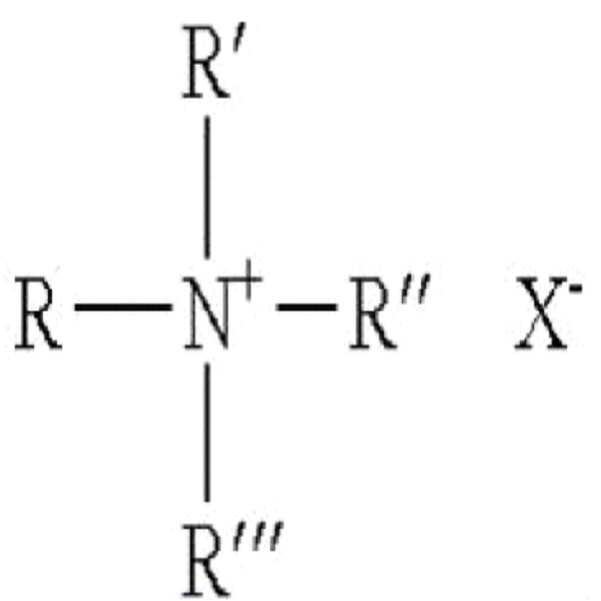
상기 식에서, R, R', R" 및 R'''은 각각 독립적으로 탄소수 5 내지 24의 알킬기, 아릴기 또는 아랄킬기이고, 이때 이들은 선택적으로 P, O, S 또는 N 헤테로 원자를 포함할 수 있고, X는 할로겐 원자 또는 알킬 설페이트이다. Wherein R, R ', R "and R' '' are each independently an alkyl, aryl or aralkyl group having 5 to 24 carbon atoms, where they may optionally comprise P, O, S or N hetero atoms And X is a halogen atom or an alkyl sulfate.
상기 판상 및 막대 구조의 클레이는 몬모릴로나이트(montmorillonite), 사포나이트(saponite), 논트로라이트(nontronite), 라포나이트(laponite), 베이델라이트(beidelite), 헥토라이트(hectorite), 질석(vermiculite), 마가다이트(magadiite), 카올린(kaolin), 사문석(serpentine), 및 운모(mica)로 이루어진 에서 선택된 1종 이상의 나노 입자를 포함할 수 있다.The plate- and rod-shaped clays are montmorillonite, saponite, nontronite, laponite, beidelite, hectorite, vermiculite, It may include one or more nanoparticles selected from consisting of magadiite, kaolin, serpentine, and mica.
상기 판상 및 막대 구조의 클레이는 평균 크기가 0.025um 내지 10um인 판상 및 막대 구조의 개질 클레이를 포함할 수 있다.The clay of the plate and rod structure may include modified clay of the plate and rod structure having an average size of 0.025um to 10um.
또한 상기 단량체 조성물에서, 상기 첨가제의 함량은 고흡수성 수지 100 중량부를 기준으로 0.01 내지 5 중량부로 사용될 수 있다.In addition, in the monomer composition, the content of the additive may be used in 0.01 to 5 parts by weight based on 100 parts by weight of the super absorbent polymer.
또한 본 발명에 따르면, 상기 베이스 수지 분말을 형성하는 단계 이후에, 표면 가교액을 존재 하에, 상기 베이스 수지 분말을 열처리하여 표면 가교하는 단계를 더 포함할 수 있다.In addition, according to the present invention, after the step of forming the base resin powder, in the presence of a surface crosslinking solution, may further comprise the step of surface crosslinking by heat treatment of the base resin powder.
상기 수용성 에틸렌계 불포화 단량체는 아크릴산, 메타크릴산, 무수말레인산, 푸말산, 크로톤산, 이타콘산, 2-아크릴로일에탄 술폰산, 2-메타크릴로일에탄술폰산, 2-(메트)아크릴로일프로판술폰산, 또는 2-(메트)아크릴아미드-2-메틸 프로판 술폰산의 음이온성 단량체와 이의 염; (메트)아크릴아미드, N-치환(메트)아크릴레이트, 2-히드록시에틸(메트)아크릴레이트, 2-히드록시프로필(메트)아크릴레이트, 메톡시폴리에틸렌글리콜(메트)아크릴레이트 또는 폴리에틸렌 글리콜(메트)아크릴레이트의 비이온계 친수성 함유 단량체; 및 (N,N)-디메틸아미노에틸(메트)아크릴레이트 또는 (N,N)-디메틸아미노프로필(메트)아크릴아미드의 아미노기 함유 불포화 단량체와 그의 4급화물;로 이루어진 군에서 선택된 1종 이상을 포함할 수 있다.The water-soluble ethylenically unsaturated monomers are acrylic acid, methacrylic acid, maleic anhydride, fumaric acid, crotonic acid, itaconic acid, 2-acryloylethane sulfonic acid, 2-methacryloylethanesulfonic acid, 2- (meth) acryloyl Anionic monomers of propanesulfonic acid or 2- (meth) acrylamide-2-methyl propane sulfonic acid and salts thereof; (Meth) acrylamide, N-substituted (meth) acrylate, 2-hydroxyethyl (meth) acrylate, 2-hydroxypropyl (meth) acrylate, methoxypolyethylene glycol (meth) acrylate or polyethylene glycol ( Nonionic hydrophilic-containing monomers of meth) acrylate; And an amino group-containing unsaturated monomer of (N, N) -dimethylaminoethyl (meth) acrylate or (N, N) -dimethylaminopropyl (meth) acrylamide and its quaternized product. It may include.
상기 내부 가교제는 탄소수 8 내지 12의 비스(메트)아크릴아미드, 탄소수 2 내지 10의 폴리올의 폴리(메트)아크릴레이트 및 탄소수 2 내지 10의 폴리올의 폴리(메트)알릴에테르로 이루어진 군에서 선택된 1종 이상을 포함할 수 있다.The internal crosslinking agent is one selected from the group consisting of bis (meth) acrylamide having 8 to 12 carbon atoms, poly (meth) acrylate of polyol having 2 to 10 carbon atoms, and poly (meth) allyl ether of polyol having 2 to 10 carbon atoms It may contain the above.
상기 베이스 수지 분말은 150 내지 850㎛의 입경을 갖도록 분쇄 및 분급되는 것이 바람직하다.The base resin powder is preferably pulverized and classified to have a particle diameter of 150 to 850㎛.
또한, 본 발명에서는In the present invention,
적어도 일부가 중화된 산성기를 갖는 수용성 에틸렌계 불포화 단량체, 및A water-soluble ethylenically unsaturated monomer having at least a portion of neutralized acidic groups, and
아민계 유기 화합물에 의해 개질되어 표면에 아민기가 도입된 판상 및 막대 구조의 클레이의 가교 중합체를 포함하는 고흡수성 수지를 제공한다.The present invention provides a superabsorbent polymer comprising a cross-linked polymer of clay having a plate and rod structure modified with an amine organic compound to introduce an amine group on its surface.
상기 고흡수성 수지는, 생리 식염수(0.9 중량% 염화 나트륨 수용액)에 대한 30분 동안의 원심분리 보수능(CRC)이 35 내지 40 g/g이고, 150 내지 850㎛의 입경을 가질 수 있다. The super absorbent polymer may have a centrifugal water retention (CRC) of 35 to 40 g / g for 30 minutes with respect to physiological saline solution (0.9 wt% aqueous sodium chloride solution) and may have a particle size of 150 to 850 μm.
그리고, 상기 고흡수성 수지는 AUP가 22 내지 30g/g일 수 있다.The superabsorbent polymer may have an AUP of 22 to 30 g / g.
상기 판상 및 막대 구조의 클레이는 몬모릴로나이트(montmorillonite), 사포나이트(saponite), 논트로라이트(nontronite), 라포나이트(laponite), 베이델라이트(beidelite), 헥토라이트(hectorite), 질석(vermiculite), 마가다이트(magadiite), 카올린(kaolin), 사문석(serpentine), 및 운모(mica)로 이루어진 에서 선택된 1종 이상을 포함할 수 있다.The plate- and rod-shaped clays are montmorillonite, saponite, nontronite, laponite, beidelite, hectorite, vermiculite, It may include one or more selected from the group consisting of magadiite, kaolin, serpentine, and mica.
상기 수용성 에틸렌계 불포화 단량체는 아크릴산, 메타크릴산, 무수말레인산, 푸말산, 크로톤산, 이타콘산, 2-아크릴로일에탄 술폰산, 2-메타크릴로일에탄술폰산, 2-(메트)아크릴로일프로판술폰산, 또는 2-(메트)아크릴아미드-2-메틸 프로판 술폰산의 음이온성 단량체와 이의 염; (메트)아크릴아미드, N-치환(메트)아크릴레이트, 2-히드록시에틸(메트)아크릴레이트, 2-히드록시프로필(메트)아크릴레이트, 메톡시폴리에틸렌글리콜(메트)아크릴레이트 또는 폴리에틸렌 글리콜(메트)아크릴레이트의 비이온계 친수성 함유 단량체; 및 (N,N)-디메틸아미노에틸(메트)아크릴레이트 또는 (N,N)-디메틸아미노프로필(메트)아크릴아미드의 아미노기 함유 불포화 단량체와 그의 4급화물;로 이루어진 군에서 선택된 1종 이상을 포함할 수 있다.The water-soluble ethylenically unsaturated monomers are acrylic acid, methacrylic acid, maleic anhydride, fumaric acid, crotonic acid, itaconic acid, 2-acryloylethane sulfonic acid, 2-methacryloylethanesulfonic acid, 2- (meth) acryloyl Anionic monomers of propanesulfonic acid or 2- (meth) acrylamide-2-methyl propane sulfonic acid and salts thereof; (Meth) acrylamide, N-substituted (meth) acrylate, 2-hydroxyethyl (meth) acrylate, 2-hydroxypropyl (meth) acrylate, methoxypolyethylene glycol (meth) acrylate or polyethylene glycol ( Nonionic hydrophilic-containing monomers of meth) acrylate; And an amino group-containing unsaturated monomer of (N, N) -dimethylaminoethyl (meth) acrylate or (N, N) -dimethylaminopropyl (meth) acrylamide and its quaternized product. It may include.
본 발명은 고흡수성 수지의 기본 물성을 향상시킬 수 있으면서, 겔강도를 기존보다 향상시킬 수 있는 고흡수성 수지의 제조방법을 제공하는 효과가 있다.The present invention can improve the basic physical properties of the superabsorbent polymer, and has the effect of providing a method for producing a superabsorbent polymer which can improve the gel strength than conventional.
즉, 본 발명에 따르면, 아민계 화합물로 층상 구조의 클레이의 층간 간격을 넓힘으로써, 클레이가 판상 및 막대 구조를 가지게 하고, 이를 고흡수성 수지 제조시의 첨가제로 도입함으로써, 보수능 등의 기본적인 흡수 특성이 우수할 뿐 아니라, 특히 가압 흡수능(AUP)을 크게 향상시킨 고흡수성 수지 및 이의 제조 방법이 제공될 수 있다.That is, according to the present invention, by broadening the interlayer spacing of the layered clay with an amine compound, the clay has a plate-like and rod-like structure, by introducing it as an additive in the production of superabsorbent polymers, thereby absorbing basic absorption such as water retention capacity In addition to excellent properties, in particular, a superabsorbent polymer and a method for producing the same, which greatly improve the pressure absorption capacity (AUP), can be provided.
도 1은 일반적인 고흡수성 수지와 본 발명에 따른 고흡수성 수지의 CRC에 대한 AUP의 결과를 비교하여 나타낸 것이다.
도 2는 비교예 1 내지 2 및 실시예 1의 고흡수성 수지의 CRC에 대한 AUP의 결과를 비교하여 나타낸 것이다.Figure 1 shows a comparison of the results of the AUP for CRC of the general superabsorbent polymer and the superabsorbent polymer according to the present invention.
Figure 2 shows a comparison of the results of the AUP for the CRC of the superabsorbent polymers of Comparative Examples 1-2 and Example 1.
이하에서 본 발명을 더욱 구체적으로 설명한다. 본 명세서 및 청구범위에 사용된 용어나 단어는 통상적이거나 사전적인 의미로 한정해서 해석되어서는 아니 되며, 발명자는 그 자신의 발명을 가장 최선의 방법으로 설명하기 위해 용어의 개념을 적절하게 정의할 수 있다는 원칙에 입각하여 본 발명의 기술적 사상에 부합하는 의미와 개념으로 해석되어야만 한다.Hereinafter, the present invention will be described in more detail. The terms or words used in this specification and claims are not to be construed as limiting in their usual or dictionary meanings, and the inventors may appropriately define the concepts of terms in order to best describe their invention. It should be interpreted as meanings and concepts corresponding to the technical idea of the present invention based on the principle that the present invention.
또한 본 발명의 명세서에서 사용되는 "포함하는"의 의미는 특정 특성, 영역, 정수, 단계, 동작, 요소 및/또는 성분을 구체화하며, 다른 특성, 영역, 정수, 단계, 동작, 요소 및/또는 성분의 존재나 부가를 제외시키는 것은 아니다.In addition, the meaning of “comprising” as used in the specification of the present invention embodies a particular characteristic, region, integer, step, operation, element and / or component, and other characteristics, region, integer, step, operation, element and / or It does not exclude the presence or addition of ingredients.
본 발명의 일 구현예에 따라, 적어도 일부가 중화된 산성기를 갖는 수용성 에틸렌계 불포화 단량체, 내부가교제, 중합개시제 및 첨가제를 혼합하여 단량체 조성물을 제조하는 단계; 상기 단량체 조성물을 중합하여 다중 가교 중합체를 포함하는 함수겔 중합체를 형성하는 단계; 및 상기 함수겔 중합체를 건조, 분쇄 및 분급하여 베이스 수지 분말을 형성하는 단계;를 포함하며, 상기 첨가제는 아민계 유기 화합물에 의해 개질되어 표면에 아민기가 도입된 판상 및 막대 구조의 클레이를 포함하는, 고흡수성 수지의 제조 방법이 제공된다.According to one embodiment of the invention, at least a part of the step of preparing a monomer composition by mixing a water-soluble ethylenically unsaturated monomer having an acidic group, an internal crosslinking agent, a polymerization initiator and an additive; Polymerizing the monomer composition to form a hydrogel polymer comprising multiple crosslinked polymers; And drying, pulverizing, and classifying the hydrogel polymer to form a base resin powder, wherein the additive includes a plate- and rod-shaped clay in which an amine group is introduced to a surface thereof by modification with an amine-based organic compound. The manufacturing method of a super absorbent polymer is provided.
이때, 본 발명의 명세서에서 "다중 가교 중합체"는 수용성 에틸렌계 불포화 단량체가 중합된 상태인 것을 포함하는 것으로서, 상기 단량체의 작용기와 첨가제로 사용하는 판상 및 막대 구조의 클레이에서 유래하는 작용기가 랜덤하게 화학적으로 가교 결합된 구조를 포함할 수 있다. 또한, 상기 "다중 가교 중합체"는 모든 수분 함량 또는 입경 범위를 포괄할 수 있다. 상기 가교 중합체 중, 중합 후 건조 전 상태의 것으로 함수율(수분 함량)이 약 40 중량% 이상의 가교 중합체를 함수겔상 중합체로 지칭할 수 있다. 또한, "베이스 수지" 또는 "베이스 수지 분말"은 상기 가교 중합체를 건조 및 분쇄하여 파우더(powder) 형태로 만든 것을 의미한다. 또한, "고흡수성 수지"는 문맥에 따라 상기 가교 중합체 또는 베이스 수지 자체를 의미하거나, 또는 상기 가교 중합체나 상기 베이스 수지에 대해 추가의 공정, 예를 들어 표면 가교, 미분 재조립, 건조, 분쇄, 분급 등을 거쳐 제품화에 적합한 상태로 한 것을 모두 포괄하는 것으로 사용된다.At this time, the "multi-crosslinked polymer" in the specification of the present invention includes a state in which a water-soluble ethylenically unsaturated monomer is polymerized, and a functional group derived from clay of a plate and rod structure used as an additive and a functional group of the monomer is randomly selected. It may comprise a chemically crosslinked structure. In addition, the "multiple crosslinked polymers" may cover any moisture content or particle size range. Among the crosslinked polymers, the crosslinked polymer having a water content (water content) of about 40% by weight or more after being dried before polymerization may be referred to as a hydrous gel polymer. In addition, "base resin" or "base resin powder" means that the crosslinked polymer is dried and pulverized into a powder form. "Superabsorbent resin" also means the crosslinked polymer or the base resin itself depending on the context, or further processes for the crosslinked polymer or the base resin, for example surface crosslinking, fine powder reassembly, drying, grinding, It is used to cover all things that have been made suitable for commercialization after classification.
구체적으로, 본 발명에서는, 수지의 CRC (centrifuge retention capacity) 및 AUP (absorbency under pressure) 등과 같은 고흡수성 수지의 기본 물성 및 가압 흡수능(AUP) 향상을 목적으로, 판상 및 막대 구조의 클레이를 도입하여, 고흡수성 수지에서 다중가교를 형성하는 것을 특징으로 한다.Specifically, in the present invention, for the purpose of improving the basic physical properties and pressure-absorbing capacity (AUP) of super absorbent polymers such as centrifuge retention capacity (CRC) and absorbent under pressure (AUP) of the resin, by introducing a clay plate and rod structure , Characterized in that to form a multi-crosslinking in the super absorbent polymer.
즉, 큰 입자의 클레이는 실리케이트 층간의 강한 인력(interaction)으로 인해 물을 포함한 용매에서 박리(exfoliation)된 균일 분산을 이루기 어렵다. 하지만, 본 발명과 같이 유기물에 의해서 층간 간격을 넓힌 판상 및 막대 구조 클레이의 경우, 고흡수성 수지의 중합 후, 고흡수성 수지 내에서 클레이의 구조 효과에 의한 다중 가교가 발생한다. 이를 통해서, 본 발명은 일반적인 판상 구조의 클레이를 사용하는 경우에 비해, 보다 높은 고흡수성 수지의 기본 물성 및 겔강도를 향상시킬 수 있다.That is, large particles of clay are difficult to achieve uniform dispersion exfoliated in a solvent including water due to strong interaction between the silicate layers. However, in the case of the plate-shaped and rod-structured clay in which the interlayer spacing is widened by the organic material as in the present invention, after the polymerization of the super absorbent polymer, multiple crosslinking occurs due to the structural effect of the clay in the superabsorbent resin. Through this, the present invention can improve the basic physical properties and gel strength of the higher superabsorbent polymer, compared with the case of using a clay having a general plate structure.
따라서, 본 발명은 고흡수성 수지를 제조하기 위한 산성 중합액에 판상 및 막대 구조 클레이를 첨가제로 도입하여, 고흡수성 수지와 다중 가교를 통한 기본 물성 향상 및 고흡수성 수지의 가압 흡수능(AUP)을 효과적으로 증대시킬 수 있다.Accordingly, the present invention introduces a plate and rod structure clay as an additive to the acidic polymerization liquid for producing a super absorbent polymer, thereby effectively improving the basic physical properties through the multi-crosslinking of the superabsorbent polymer and the pressure absorption capacity (AUP) of the superabsorbent polymer. You can increase it.
도 1은 일반적인 고흡수성 수지와 본 발명에 따른 고흡수성 수지의 CRC에 대한 AUP의 결과를 비교하여 나타낸 것이다.Figure 1 shows a comparison of the results of the AUP for CRC of the general superabsorbent polymer and the superabsorbent polymer according to the present invention.
도 1에서 보면, 본 발명의 고흡수성 수지는 판상 및 막대 구조를 갖도록 개질된 클레이가 고분자 수지 내에서 다중 가교를 이루고 있어서, 고흡수성 수지의 AUP를 향상시킬 수 있음을 알 수 있다.1, it can be seen that in the superabsorbent polymer of the present invention, the clay modified to have a plate-like and rod structure forms multiple crosslinks in the polymer resin, thereby improving the AUP of the superabsorbent polymer.
특히, 본 발명에서 첨가제로 사용하는 판상 및 막대 구조를 갖는 클레이는, 일반적인 판상 구조의 클레이보다 AUP가 높다.In particular, the clay having a plate and rod structure used as an additive in the present invention has a higher AUP than the clay of a general plate structure.
이러한 본 발명의 판상 및 막대 구조를 갖는 클레이는, 특정하게 아민 계열의 유기 화합물에 의해서 판상 구조를 갖는 클레이의 층간 간격이 넓혀져서 판상 및 막대 구조를 모두 가질 수 있다. 또한 상기 판상 및 막대 구조를 갖는 클레이는 상기 표면에 도입된 아민기 외에, 표면 또는 가장 자리에 작용기로서 히드록실기(hydroxyl group)이 형성될 수 있다. The clay having a plate and rod structure of the present invention may have both a plate and rod structure by increasing the interlayer spacing of the clay having a plate structure by the organic compound of the amine series. In addition, in addition to the amine groups introduced to the surface, the clay having a plate-like and rod structure may have a hydroxyl group as a functional group on the surface or edge thereof.
본 발명에서 클레이의 층간 간격을 넓히기 위한 아민계 유기 화합물의 사용량은, 개질 전의 클레이의 총 중량 100 중량부를 기준으로 5 내지 50 중량부가 될 수 있다. 상기 아민계 유기 화합물의 사용량이 5 중량부 미만이면 클레이의 층간 간격을 충분히 넓히기 어려우며, 그 사용량을 50 중량부 이상으로 적용하면 산성 중화액에서 잉여 유기물에 의한 SAP 수지의 물성 저하가 발생한다. In the present invention, the amount of the amine-based organic compound for increasing the interlayer spacing of the clay may be 5 to 50 parts by weight based on 100 parts by weight of the total weight of the clay before modification. If the amount of the amine-based organic compound is less than 5 parts by weight, it is difficult to sufficiently widen the interlayer spacing of the clay, and when the amount of the amine-based organic compound is applied to 50 parts by weight or more, the physical properties of the SAP resin caused by the surplus organics in the acid neutralization solution are generated.
상기 아민계 유기 화합물은 양이온계 계면활성제가 사용될 수 있다. 바람직한 일 구현예를 들면, 상기 아민계 유기 화합물은 하기 화학식 1로 표시되는 4급 아민 화합물을 사용할 수 있다.The amine organic compound may be a cationic surfactant. As a preferred embodiment, the amine-based organic compound may be used a quaternary amine compound represented by the following formula (1).
[화학식 1][Formula 1]
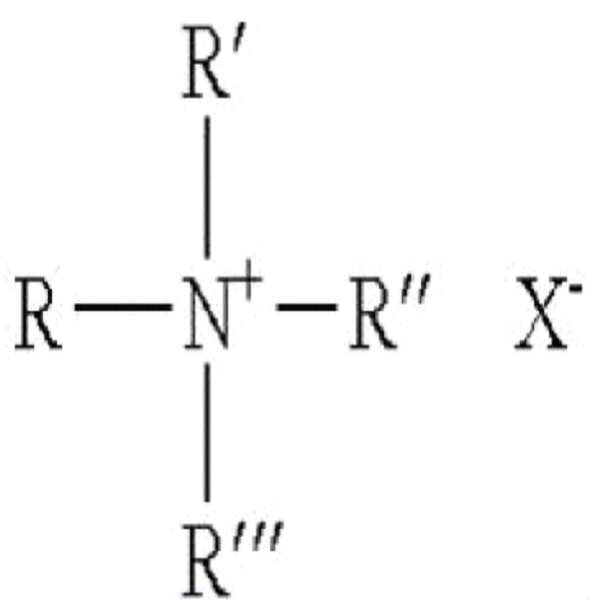
상기 식에서, R, R', R" 및 R'''은 각각 독립적으로 탄소수 5 내지 24의 알킬기, 아릴기 또는 아랄킬기이고, 이때 이들은 선택적으로 P, O, S 또는 N 헤테로 원자를 포함할 수 있고, X는 할로겐 원자 또는 알킬 설페이트이다. Wherein R, R ', R "and R''' are each independently an alkyl, aryl or aralkyl group having 5 to 24 carbon atoms, where they may optionally comprise P, O, S or N hetero atoms And X is a halogen atom or an alkyl sulfate.
또한 본 발명에서 사용하는 개질 클레이는, 다음의 방법으로 제조될 수도 있으며, 이와 유사한 형태를 갖는 상용화된 클레이를 상업적으로 입스하여 사용할 수도 있다.In addition, the modified clay used in the present invention may be prepared by the following method, and commercially available clay having a similar form may be used by commercially entering.
상기 개질 클레이를 제조하는 방법의 일례를 들면, 용매에 판상 구조의 나노 클레이를 분산시킨 후, 아민계 유기 화합물을 첨가하고, 40℃ 내지 50℃의 온도에서 12h 내지 24h 동안 교반을 진행한다. 이후, 교반이 완료된 용액으로부터 용매를 제거하고 세척 및 건조 공정을 거쳐 판상 및 막대 구조를 갖는 클레이를 제조할 수 있다. 이때, 상기 용매는 물 또는 수용성 용매를 사용할 수 있으며, 수용성 용매의 예를 들면 알코올, 아세톤 등이 있다. As one example of a method for manufacturing the modified clay, and the process proceeds to after dispersing the nanoclay in the plate-like structure in a solvent, amine-type stirring for 12h to 24h at a temperature of adding the organic compound and, 40 ℃ to 50 ℃. Thereafter, the solvent may be removed from the stirred solution, and washed and dried to prepare clay having a plate and rod structure. In this case, the solvent may be water or a water-soluble solvent, and examples of the water-soluble solvent include alcohol, acetone, and the like.
이러한 본 발명에서 사용되는 판상 및 막대 구조의 클레이의 평균 크기는, 0.025um 내지 10um,혹은 0.1um 내지 10um, 혹은 0.5um 내지 5um인 것을 사용할 수 있다. 상기 판상 및 막대 구조의 클레이의 크기가 0.025um 미만이면 고흡수성 수지에서 기본적으로 요구되는 겔강도의 향상이 미미하고 기본 물성 향상에 한계가 있으며, 클레이의 크기가 10um 이상이 되면 클레이의 강한 층간 인력으로 인해 균일한 분산을 이루기 어려울 뿐 아니라 유기물에 의한 박리도 어렵다. 상기 판상 및 막대 구조의 클레이 첨가제의 평균크기는 클레이 결정 입자의 직경을 포함하는 의미일 수 있고, 이것은 0.1um 내지 10um, 혹은 0.5um 내지 5um인 경우가 고흡수성 수지에서 요구되는 기본 물성을 더욱 향상시킬 수 있다.The average size of the clay of the plate and rod structure used in the present invention may be 0.025um to 10um, or 0.1um to 10um, or 0.5um to 5um. If the size of the clay plate and rod structure is less than 0.025um, the gel strength required by the superabsorbent polymer is insignificant, and there is a limit to the improvement of the basic physical properties.If the size of the clay is 10um or more, the strong interlayer attraction of the clay As a result, not only uniform dispersion is difficult but also separation by organic substances is difficult. The average size of the plate- and rod-shaped clay additives may be meant to include the diameter of the clay crystal particles, which is 0.1 μm to 10 μm, or 0.5 μm to 5 μm to further improve the basic physical properties required for the superabsorbent polymer. You can.
한편, 본 발명에서 개질 처리를 위해 사용하는 클레이는 실리케이트 층상 구조를 가지는 나노입자를 포함할 수 있다. 이러한 클레이로서는 특별히 한정되는 것은 아니지만, 몬모릴로나이트(montmorillonite), 사포나이트(saponite), 논트로라이트(nontronite), 라포나이트(laponite), 베이델라이트(beidelite), 헥토라이트(hectorite), 질석(vermiculite), 마가다이트(magadiite), 카올린(kaolin), 사문석(serpentine), 및 운모(mica) 등이 사용될 수 있고, 이들은 아민계 유기 화합물에 의해 개질 처리됨으로써, 막대구조를 포함할 수 있다.Meanwhile, the clay used for the modification treatment in the present invention may include nanoparticles having a silicate layered structure. Such clays are not particularly limited, but montmorillonite, saponite, nontronite, laponite, beidelite, hectorite, vermiculite , Magadiite, kaolin, serpentine, mica and the like can be used, and these can include a rod structure by being modified with an amine organic compound.
따라서, 상기 판상 및 막대 구조의 클레이는 몬모릴로나이트(montmorillonite), 사포나이트(saponite), 논트로라이트(nontronite), 라포나이트(laponite), 베이델라이트(beidelite), 헥토라이트(hectorite), 질석(vermiculite), 마가다이트(magadiite), 카올린(kaolin), 사문석(serpentine), 및 운모(mica)로 이루어진 에서 선택된 1종 이상의 나노 입자를 포함할 수 있다.Thus, the plate- and rod-structured clay is montmorillonite, saponite, nontronite, laponite, beidelite, hectorite, vermiculite ), Magadiite, kaolin, kaolin, serpentine, and mica.
한편, 이하에서는 일 구현예에 따른 고흡수성 수지의 제조 방법을 각 단계별로 더 구체적으로 설명하기로 한다. On the other hand, hereinafter will be described in more detail each step of the manufacturing method of the super absorbent polymer according to one embodiment.
먼저, 일 구현예의 제조방법에서, 적어도 일부가 중화된 산성기를 갖는 수용성 에틸렌계 불포화 단량체, 내부가교제, 중합개시제 및 첨가제를 혼합하여 단량체 조성물을 제조하는 단계를 수행한다.First, in the manufacturing method of one embodiment, a step of preparing a monomer composition by mixing a water-soluble ethylenically unsaturated monomer, an internal crosslinking agent, a polymerization initiator and an additive having at least a part of neutralized acid groups.
상기 단량체 조성물에서, 첨가제는 상술한 바대로 아민계 유기 화합물에 의해 개질되어 표면에 아민기가 도입된 판상 및 막대 구조의 클레이를 포함한다. 또한 상기 개질 나노 클레이는 가교 중합체 사이에 공간을 부여하는 일종의 필러(filler)로 작용하여 기본 물성과 가압 흡수능(AUP)을 향상시키는 역할을 할 수 있다.In the monomer composition, the additive includes a plate- and rod-shaped clay in which an amine group is introduced into the surface by modification by the amine-based organic compound as described above. In addition, the modified nanoclay may act as a kind of filler to impart a space between the crosslinked polymers, thereby improving the basic physical properties and the pressure absorption capacity (AUP).
상기 단량체 조성물에서 첨가제의 함량은 에틸렌계 불포화 단량체 100 중량부에 대하여 약 0.01 내지 5 중량부, 바람직하게 약 0.03 내지 0.3 중량부 혹은 0.03 내지 0.1 중량부가 사용될 수 있다. 상기 첨가제의 사용량이 0.01 중량부 미만이면 무기물 첨가에 따른 효과가 작은 문제가 있고, 그 사용량이 5 중량부 이상이면 용해도 및 광중합 가교에 악영향을 줄 수 있는 문제가 있다.The content of the additive in the monomer composition may be about 0.01 to 5 parts by weight, preferably about 0.03 to 0.3 parts by weight or 0.03 to 0.1 parts by weight based on 100 parts by weight of the ethylenically unsaturated monomer. If the amount of the additive is less than 0.01 parts by weight, there is a problem that the effect of the addition of inorganic matters is small, and if the amount of the additive is 5 parts by weight or more, there is a problem that may adversely affect solubility and photopolymerization crosslinking.
그리고, 상기 단량체로는 이전부터 고흡수성 수지의 제조에 사용 가능한 것으로 알려진 수용성 에틸렌계 불포화 화합물 또는 이의 염을 별다른 제한 없이 모두 사용할 수 있다. As the monomer, any of the water-soluble ethylenically unsaturated compounds or salts thereof known to be used in the preparation of superabsorbent polymers may be used without any particular limitation.
이러한 고흡수성 수지에서, 상기 수용성 에틸렌계 불포화 단량체는 아크릴산, 메타크릴산, 무수말레인산, 푸말산, 크로톤산, 이타콘산, 2-아크릴로일에탄 술폰산, 2-메타크릴로일에탄술폰산, 2-(메트)아크릴로일프로판술폰산, 또는 2-(메트)아크릴아미드-2-메틸 프로판 술폰산의 음이온성 단량체와 이의 염; (메트)아크릴아미드, N-치환(메트)아크릴레이트, 2-히드록시에틸(메트)아크릴레이트, 2-히드록시프로필(메트)아크릴레이트, 메톡시폴리에틸렌글리콜(메트)아크릴레이트 또는 폴리에틸렌 글리콜(메트)아크릴레이트의 비이온계 친수성 함유 단량체; 및 (N,N)-디메틸아미노에틸(메트)아크릴레이트 또는 (N,N)-디메틸아미노프로필(메트)아크릴아미드의 아미노기 함유 불포화 단량체와 그의 4급화물;로 이루어진 군에서 선택된 1종 이상을 포함할 수 있다. 이중에서도, 아크릴산 또는 이의 염, 예를 들어, 아크릴산의 적어도 일부가 중화된 아크릴산 및/또는 이의 나트륨염 등의 알칼리 금속염을 사용할 수 있는데, 이러한 단량체를 사용하여 보다 우수한 물성을 갖는 고흡수성 수지의 제조가 가능해 진다. 상기 아크릴산 및 이의 알칼리 금속염을 단량체로 사용하는 경우, 아크릴산의 적어도 일부를 가성소다(NaOH)와 같은 염기성 화합물로 중화시켜 사용할 수 있다. In such superabsorbent polymers, the water-soluble ethylenically unsaturated monomers are acrylic acid, methacrylic acid, maleic anhydride, fumaric acid, crotonic acid, itaconic acid, 2-acryloylethane sulfonic acid, 2-methacryloylethanesulfonic acid, 2- Anionic monomers of (meth) acryloylpropanesulfonic acid or 2- (meth) acrylamide-2-methyl propane sulfonic acid and salts thereof; (Meth) acrylamide, N-substituted (meth) acrylate, 2-hydroxyethyl (meth) acrylate, 2-hydroxypropyl (meth) acrylate, methoxypolyethylene glycol (meth) acrylate or polyethylene glycol ( Nonionic hydrophilic-containing monomers of meth) acrylate; And an amino group-containing unsaturated monomer of (N, N) -dimethylaminoethyl (meth) acrylate or (N, N) -dimethylaminopropyl (meth) acrylamide and its quaternized product. It may include. Among these, alkali metal salts such as acrylic acid or salts thereof, for example, acrylic acid and / or sodium salts of which at least a part of acrylic acid is neutralized can be used, and the preparation of superabsorbent polymers having better physical properties using such monomers is possible. Becomes possible. When the acrylic acid and its alkali metal salt are used as monomers, at least a part of the acrylic acid may be neutralized with a basic compound such as caustic soda (NaOH).
또, 상기 수용성 에틸렌계 불포화 단량체의 농도는, 상술한 각 원료 물질 및 용매를 포함하는 전체 단량체 조성물에 대해 20 내지 60 중량%, 혹은 40 내지 50 중량%로 될 수 있으며, 중합 시간 및 반응 조건 등을 고려해 적절한 농도로 될 수 있다. 다만, 상기 단량체의 농도가 지나치게 낮아지면 고흡수성 수지의 수율이 낮고 경제성에 문제가 생길 수 있고, 반대로 농도가 지나치게 높아지면 단량체의 일부가 석출되거나 중합된 함수겔 중합체의 분쇄 효율이 낮게 나타나는 등 공정상 문제가 생길 수 있으며 고흡수성 수지의 물성이 저하될 수 있다. In addition, the concentration of the water-soluble ethylenically unsaturated monomer may be 20 to 60% by weight, or 40 to 50% by weight based on the total monomer composition containing each of the above-described raw materials and solvents, polymerization time and reaction conditions, etc. In consideration of this, the concentration may be appropriate. However, when the concentration of the monomer is too low, the yield of the superabsorbent polymer may be low and there may be a problem in economics. On the contrary, when the concentration is too high, a part of the monomer may precipitate or the grinding efficiency of the polymerized hydrogel polymer may be low. Phase problems may occur and the physical properties of the super absorbent polymer may be reduced.
또한, 상기 단량체 조성물은, 상기 다중 가교 중합체의 가교 구조를 도입하기 위한 내부 가교제를 포함할 수 있다.In addition, the monomer composition may include an internal crosslinking agent for introducing a crosslinked structure of the multi-crosslinked polymer.
상기 내부 가교제로는 이전부터 고흡수성 수지의 제조를 위해 사용 가능한 것으로 알려진 임의의 가교제를 사용할 수 있다. 예를 들면, 상기 내부 가교제는 탄소수 8 내지 12의 비스(메트)아크릴아미드, 탄소수 2 내지 10의 폴리올의 폴리(메트)아크릴레이트 및 탄소수 2 내지 10의 폴리올의 폴리(메트)알릴에테르로 이루어진 군에서 선택된 1종 이상을 포함할 수 있다. As the internal crosslinking agent, any crosslinking agent known to be usable for preparing a super absorbent polymer may be used. For example, the internal crosslinking agent is a group consisting of bis (meth) acrylamide having 8 to 12 carbon atoms, poly (meth) acrylate of polyol having 2 to 10 carbon atoms, and poly (meth) allyl ether of polyol having 2 to 10 carbon atoms It may include one or more selected from.
보다 구체적으로, 상기 내부 가교제로는 폴리에틸렌글리콜 디(메트)아크릴레이트, 폴리프로필렌옥시 디(메트)아크릴레이트, 글리세린 디아크릴레이트, 글리세린 트리아크릴레이트 및 트리메티롤 트리아크릴레이트로 이루어진 군에서 선택된 하나 이상의 폴리올의 폴리(메트)아크릴레이트를 적절히 사용할 수 있다. 이 중에서도, 상기 폴리에틸렌글리콜 디(메트)아크릴레이트 등의 내부 가교제를 사용함에 따라, 내부 가교 구조가 최적화된 베이스 수지 분말 등이 얻어질 수 있고, 이를 통해 일 구현예의 물성을 충족하는 고흡수성 수지가 보다 적절히 얻어질 수 있다.More specifically, the internal crosslinking agent is one selected from the group consisting of polyethylene glycol di (meth) acrylate, polypropyleneoxy di (meth) acrylate, glycerin diacrylate, glycerin triacrylate and trimethol triacrylate. The poly (meth) acrylate of the above polyol can be used suitably. Among these, as the internal crosslinking agent such as polyethylene glycol di (meth) acrylate is used, a base resin powder having an optimized internal crosslinking structure and the like can be obtained, whereby a super absorbent polymer satisfying the physical properties of one embodiment is obtained. More appropriately.
상기 내부 가교제의 함량은 상기 수용성 에틸렌계 불포화 단량체 100 중량부에 대하여 약 0.001 내지 약 2 중량부로, 바람직하게는 약 0.01 내지 약 1 중량부로, 보다 바람직하게는 약 0.1 내지 약 1 중량부로 포함될 수 있으며, 상기 중량부로 내부 가교제를 포함할 때, 적절한 가교 밀도를 달성할 수 있다.The content of the internal crosslinking agent may be included in an amount of about 0.001 to about 2 parts by weight, preferably about 0.01 to about 1 part by weight, and more preferably about 0.1 to about 1 part by weight, based on 100 parts by weight of the water-soluble ethylenically unsaturated monomer. When the crosslinking agent is included in the weight part, an appropriate crosslinking density can be achieved.
또한, 상기 단량체 조성물은 고흡수성 수지의 제조에 일반적으로 사용되던 중합 개시제를 포함할 수 있다. In addition, the monomer composition may include a polymerization initiator generally used in the preparation of a super absorbent polymer.
구체적으로, 상기 중합 개시제는 열 중합 또는 광 중합 등의 중합 방법에 따라 열중합 개시제 또는 UV 조사에 따른 광중합 개시제를 사용할 수 있다. 다만, 광중합 방법에 의하더라도, 자외선 조사 등의 조사에 의해 일정량의 열이 발생하고, 또한 발열 반응인 중합 반응의 진행에 따라 어느 정도의 열이 발생하므로, 추가적으로 열중합 개시제를 포함할 수도 있다.Specifically, the polymerization initiator may use a thermal polymerization initiator or a photopolymerization initiator according to UV irradiation according to a polymerization method such as thermal polymerization or photopolymerization. However, even with the photopolymerization method, since a certain amount of heat is generated by irradiation such as ultraviolet irradiation and some heat is generated in accordance with the progress of the polymerization reaction, which is an exothermic reaction, a thermal polymerization initiator may be additionally included.
상기 광중합 개시제는 자외선과 같은 광에 의해 라디칼을 형성할 수 있는 화합물이면 그 구성의 한정이 없이 사용될 수 있다. The photopolymerization initiator may be used without any limitation as long as it is a compound capable of forming radicals by light such as ultraviolet rays.
상기 광중합 개시제로는 예를 들어, 벤조인 에테르(benzoin ether), 디알킬아세토페논(dialkyl acetophenone), 하이드록실 알킬케톤(hydroxyl alkylketone), 페닐글리옥실레이트(phenyl glyoxylate), 벤질디메틸케탈(Benzyl Dimethyl Ketal), 아실포스핀(acyl phosphine) 및 알파-아미노케톤(α-aminoketone)으로 이루어진 군에서 선택되는 하나 이상을 사용할 수 있다. 한편, 아실포스핀의 구체예로, 상용하는 lucirin TPO, 즉, 2,4,6-트리메틸-벤조일-트리메틸 포스핀 옥사이드(2,4,6-trimethyl-benzoyl-trimethyl phosphine oxide)를 사용할 수 있다. 보다 다양한 광개시제에 대해서는 Reinhold Schwalm 저서인 “UV Coatings: Basics, Recent Developments and New Application(Elsevier 2007년)” p115에 잘 명시되어 있으며, 상술한 예에 한정되지 않는다.Examples of the photopolymerization initiator include benzoin ether, dialkyl acetophenone, hydroxyl alkylketone, phenyl glyoxylate, and benzyl dimethyl ketal. Ketal), acyl phosphine (acyl phosphine) and one or more selected from the group consisting of alpha-aminoketone (α-aminoketone) can be used. Meanwhile, as an example of acylphosphine, a commercially available lucirin TPO, that is, 2,4,6-trimethyl-benzoyl-trimethyl phosphine oxide can be used. . A wider variety of photoinitiators is well described in Reinhold Schwalm's book, “UV Coatings: Basics, Recent Developments and New Applications (Elsevier 2007)” p115, and is not limited to the examples described above.
상기 광중합 개시제는 상기 단량체 조성물에 대하여 약 0.01 내지 약 1.0 중량%의 농도로 포함될 수 있다. 이러한 광중합 개시제의 농도가 지나치게 낮을 경우 중합 속도가 느려질 수 있고, 광중합 개시제의 농도가 지나치게 높으면 고흡수성 수지의 분자량이 작고 물성이 불균일해질 수 있다.The photopolymerization initiator may be included in a concentration of about 0.01% to about 1.0% by weight based on the monomer composition. When the concentration of the photopolymerization initiator is too low, the polymerization rate may be slow. When the concentration of the photopolymerization initiator is too high, the molecular weight of the superabsorbent polymer may be small and the physical properties may be uneven.
또한, 상기 열중합 개시제로는 과황산염계 개시제, 아조계 개시제, 과산화수소 및 아스코르빈산으로 이루어진 개시제 군에서 선택되는 하나 이상을 사용할 수 있다. 구체적으로, 과황산염계 개시제의 예로는 과황산나트륨(Sodium persulfate; Na2S2O8), 과황산칼륨(Potassium persulfate; K2S2O8), 과황산암모늄(Ammonium persulfate;(NH4)2S2O8) 등이 있으며, 아조(Azo)계 개시제의 예로는 2, 2-아조비스-(2-아미디노프로판)이염산염(2, 2-azobis(2-amidinopropane) dihydrochloride), 2, 2-아조비스-(N, N-디메틸렌)이소부티라마이딘 디하이드로클로라이드(2,2-azobis-(N, N-dimethylene)isobutyramidine dihydrochloride), 2-(카바모일아조)이소부티로니트릴(2-(carbamoylazo)isobutylonitril), 2, 2-아조비스[2-(2-이미다졸린-2-일)프로판] 디하이드로클로라이드(2,2-azobis[2-(2-imidazolin-2-yl)propane] dihydrochloride), 4,4-아조비스-(4-시아노발레릭 산)(4,4-azobis-(4-cyanovaleric acid)) 등이 있다. 보다 다양한 열중합 개시제에 대해서는 Odian 저서인 'Principle of Polymerization(Wiley, 1981)', p203에 잘 명시되어 있으며, 상술한 예에 한정되지 않는다.In addition, the thermal polymerization initiator may be used at least one selected from the group consisting of persulfate initiator, azo initiator, hydrogen peroxide and ascorbic acid. Specifically, examples of persulfate-based initiators include sodium persulfate (Na 2 S 2 O 8 ), potassium persulfate (K 2 S 2 O 8 ), and ammonium persulfate (NH 4 ). 2 S 2 O 8 ), and examples of azo initiators include 2, 2-azobis- (2-amidinopropane) dihydrochloride, 2 2,2-azobis- (N, N-dimethylene) isobutyramidine dihydrochloride), 2- (carbamoyl azo) isobutyronitrile (2- (carbamoylazo) isobutylonitril), 2,2-azobis [2- (2-imidazolin-2-yl) propane] dihydrochloride (2,2-azobis [2- (2-imidazolin-2- yl) propane] dihydrochloride) and 4,4-azobis- (4-cyanovaleric acid). More various thermal polymerization initiators are well specified in Odian's Principle of Polymerization (Wiley, 1981), p203, and are not limited to the examples described above.
상기 열중합 개시제는 상기 단량체 조성물에 대하여 0.001 내지 1.0 중량%의 농도로 포함될 수 있다. 이러한 열 중합 개시제의 농도가 지나치게 낮을 경우 추가적인 열중합이 거의 일어나지 않아 열중합 개시제의 추가에 따른 효과가 미미할 수 있고, 열중합 개시제의 농도가 지나치게 높으면 고흡수성 수지의 분자량이 작고 물성이 불균일해질 수 있다. The thermal polymerization initiator may be included in a concentration of 0.001 to 1.0% by weight based on the monomer composition. When the concentration of the thermal polymerization initiator is too low, additional thermal polymerization hardly occurs, and the effect of the addition of the thermal polymerization initiator may be insignificant. When the concentration of the thermal polymerization initiator is too high, the molecular weight of the superabsorbent polymer may be low and the physical properties may be uneven. have.
상기 단량체 조성물은 산성 중화액일 수 있으며, 필요에 따라 증점제(thickener), 가소제, 보존안정제, 산화방지제 등의 첨가제를 더 포함할 수 있다.The monomer composition may be an acidic neutralizing solution, and may further include additives such as thickeners, plasticizers, preservative stabilizers, antioxidants, and the like, as necessary.
한편, 일 구현예의 방법에서는, 상술한 각 성분을 용매에 용해시킨 단량체 조성물을 수용액 또는 현탁액 상태 등으로 형성한 후, 내부 가교제의 존재 하에 상기 단량체 조성물에 대한 가교 중합을 진행하여 다중 가교 중합체를 포함하는 함수겔 중합체를 형성할 수 있다. On the other hand, in the method of one embodiment, after forming the monomer composition in which each component described above is dissolved in a solvent in an aqueous solution or suspension state, and the like crosslinked polymerization of the monomer composition in the presence of an internal crosslinking agent to include a multi-crosslinked polymer To form a hydrogel polymer.
이 때 사용할 수 있는 상기 용매는 상술한 성분들을 용해 또는 분산시킬 수 있으면 그 구성의 한정이 없이 사용할 수 있으며, 예를 들어 물, 에탄올, 에틸렌글리콜, 디에틸렌글리콜, 트리에틸렌글리콜, 1,4-부탄디올, 프로필렌글리콜, 에틸렌글리콜모노부틸에테르, 프로필렌글리콜모노메틸에테르, 프로필렌글리콜모노메틸에테르아세테이트, 메틸에틸케톤, 아세톤, 메틸아밀케톤, 시클로헥사논, 시클로펜타논, 디에틸렌글리콜모노메틸에테르, 디에틸렌글리콜에틸에테르, 톨루엔, 크실렌, 부틸로락톤, 카르비톨, 메틸셀로솔브아세테이트 및 N,N-디메틸아세트아미드 등에서 선택된 1종 이상을 조합하여 사용할 수 있다.The solvent that can be used at this time can be used without limitation of the composition as long as it can dissolve or disperse the above-mentioned components, for example, water, ethanol, ethylene glycol, diethylene glycol, triethylene glycol, 1,4- Butanediol, propylene glycol, ethylene glycol monobutyl ether, propylene glycol monomethyl ether, propylene glycol monomethyl ether acetate, methyl ethyl ketone, acetone, methyl amyl ketone, cyclohexanone, cyclopentanone, diethylene glycol monomethyl ether, di One or more selected from ethylene glycol ethyl ether, toluene, xylene, butyrolactone, carbitol, methyl cellosolve acetate, and N, N-dimethylacetamide can be used in combination.
상기 용매는 단량체 조성물의 총 함량에 대하여 상술한 성분을 제외한 잔량으로 포함될 수 있다.The solvent may be included in the remaining amount except for the above-described components with respect to the total content of the monomer composition.
한편, 이와 같은 단량체 조성물을 열중합 또는 광중합하여 함수겔 중합체를 형성하는 방법 또한 통상 사용되는 중합 방법이면, 특별히 구성의 한정이 없다. On the other hand, if the method of forming a hydrogel polymer by thermally polymerizing or photopolymerizing such a monomer composition is also the polymerization method normally used, there will be no restriction | limiting in particular in a structure.
구체적으로, 중합 방법은 중합 에너지원에 따라 크게 열중합 및 광중합으로 나뉠 수 있다. 통상 열중합을 진행하는 경우, 니더(kneader)와 같은 교반축을 가진 반응기에서 진행될 수 있다. 또한, 열중합을 진행하는 경우 40 내지 120℃의 온도에서 진행될 수 있다. Specifically, the polymerization method can be largely divided into thermal polymerization and photopolymerization according to the polymerization energy source. In general, the thermal polymerization may be performed in a reactor having a stirring shaft such as a kneader. In addition, the thermal polymerization may proceed at a temperature of 40 to 120 ℃.
반면, 광중합을 진행하는 경우, 이동 가능한 컨베이어 벨트를 구비한 반응기에서 진행될 수 있으나, 상술한 중합 방법은 일 예이며, 본 발명은 상술한 중합 방법에 한정되지는 않는다.On the other hand, in the case of the photopolymerization, it can be carried out in a reactor having a movable conveyor belt, the above-described polymerization method is an example, the present invention is not limited to the above-described polymerization method.
상술한 중합 방법으로 얻어진 함수겔 중합체의 통상 함수율은 약 40 내지 약 80 중량%일 수 있다. 한편, 본 명세서 전체에서 "함수율"은 전체 함수겔 중합체 중량에 대해 차지하는 수분의 함량으로 함수겔 중합체의 중량에서 건조 상태의 중합체의 중량을 뺀 값을 의미한다. 구체적으로는, 적외선 가열을 통해 중합체의 온도를 올려 건조하는 과정에서 중합체 중의 수분증발에 따른 무게감소분을 측정하여 계산된 값으로 정의한다. 이때, 건조 조건은 상온에서 약 180℃까지 온도를 상승시킨 뒤 180℃에서 유지하는 방식으로 총 건조시간은 온도상승단계 5분을 포함하여 40분으로 설정하여, 함수율을 측정한다.Typical water content of the hydrogel polymer obtained by the above-described polymerization method may be about 40 to about 80% by weight. On the other hand, throughout the present specification "water content" means the content of the water to the total weight of the hydrogel polymer by subtracting the weight of the dry polymer from the weight of the hydrogel polymer. Specifically, it is defined as a value calculated by measuring the weight loss due to moisture evaporation in the polymer in the process of raising the temperature of the polymer through infrared heating and drying. At this time, the drying condition is to increase the temperature to about 180 ℃ at room temperature and then maintained at 180 ℃ total drying time is set to 40 minutes including the
그리고, 상기 단량체를 가교 중합시킨 후에는, 건조, 분쇄 및 분급 등의 공정을 거쳐 베이스 수지 분말을 얻을 수 있는데, 이러한 분쇄 및 분급 등의 공정을 통해, 베이스 수지 분말 및 이로부터 얻어지는 고흡수성 수지는 150 내지 850㎛의 입경을 갖도록 제조 및 제공됨이 적절하다. 보다 구체적으로, 상기 베이스 수지 분말 및 이로부터 얻어지는 고흡수성 수지의 적어도 95 중량% 이상이 150 내지 850㎛의 입경을 가지며, 150㎛ 미만의 입경을 갖는 미분이 3 중량% 미만으로 될 수 있다.After the crosslinking polymerization of the monomer, the base resin powder can be obtained through drying, pulverization and classification, and the like, and the base resin powder and the super absorbent polymer obtained therefrom It is appropriate that it is manufactured and provided to have a particle diameter of 150 to 850 탆. More specifically, at least 95% by weight or more of the base resin powder and the super absorbent polymer obtained therefrom may have a particle size of 150 to 850 μm, and the fine powder having a particle size of less than 150 μm may be less than 3% by weight.
이와 같이 상기 베이스 수지 분말 및 고흡수성 수지의 입경 분포가 바람직한 범위로 조절됨에 따라, 최종 제조된 고흡수성 수지가 이미 상술한 물성 및 보다 우수한 흡수 속도 및 흡수 특성을 나타낼 수 있다. Thus, as the particle size distribution of the base resin powder and the super absorbent polymer is adjusted to a desirable range, the final manufactured super absorbent polymer may exhibit the above-described physical properties and better absorption rate and absorption characteristics.
한편, 상기 건조, 분쇄 및 분급의 진행 방법에 대해 보다 구체적으로 설명하면 다음과 같다. On the other hand, it will be described in more detail with respect to the progress of the drying, grinding and classification as follows.
먼저, 함수겔상 중합체를 건조함에 있어서는, 필요에 따라서 상기 건조 단계의 효율을 높이기 위해 건조 전에 조분쇄(겔 분쇄)하는 단계를 더 거칠 수 있다.First, in drying the hydrogel polymer, the step of coarsely pulverizing (gel pulverizing) before drying may be further performed as necessary to increase the efficiency of the drying step.
이때, 사용되는 분쇄기는 구성의 한정은 없으나, 구체적으로, 수직형 절단기(Vertical pulverizer), 터보 커터(Turbo cutter), 터보 글라인더(Turbo grinder), 회전 절단식 분쇄기(Rotary cutter mill), 절단식 분쇄기(Cutter mill), 원판 분쇄기(Disc mill), 조각 파쇄기(Shred crusher), 파쇄기(Crusher), 초퍼(chopper) 및 원판식 절단기(Disc cutter)로 이루어진 분쇄 기기 군에서 선택되는 어느 하나를 포함할 수 있으나, 상술한 예에 한정되지는 않는다.At this time, the pulverizer used is not limited in configuration, but specifically, a vertical pulverizer, a turbo cutter, a turbo grinder, a rotary cutter mill, a cutting machine Including any one selected from the group of grinding machines consisting of a cutter mill, a disc mill, a shred crusher, a crusher, a chopper, and a disc cutter Although it is possible, it is not limited to the above-mentioned example.
이때 조분쇄 단계는 함수겔 중합체의 입경이 0.1 내지 20mm로 되도록 분쇄할 수 있다.At this time, the coarse grinding step may be pulverized so that the particle size of the hydrogel polymer is 0.1 to 20mm.
상기 입경을 0.1 mm 미만으로 분쇄하는 것은 함수겔 중합체의 높은 함수율로 인해 기술적으로 용이하지 않으며, 또한 분쇄된 입자 간에 서로 응집되는 현상이 나타날 수도 있다. 한편, 상기 입경을 10 mm 초과로 분쇄하는 경우, 추후 이루어지는 건조 단계의 효율 증대 효과가 미미할 수 있다.Grinding the particle diameter to less than 0.1 mm is not technically easy due to the high water content of the hydrogel polymer, and may also appear to aggregate with each other among the milled particles. On the other hand, when the particle diameter is pulverized more than 10 mm, the effect of increasing the efficiency of the subsequent drying step may be insignificant.
상기와 같이 조분쇄되거나, 혹은 조분쇄 단계를 거치지 않은 중합 직후의 함수겔 중합체에 대해 건조를 수행한다. 이때 상기 건조 단계의 건조 온도는 150 내지 250℃일 수 있다. 건조 온도가 150℃ 미만인 경우, 건조 시간이 지나치게 길어지고 최종 형성되는 고흡수성 수지의 물성이 저하될 우려가 있고, 건조 온도가 250℃를 초과하는 경우, 지나치게 중합체 표면만 건조되어, 추후 이루어지는 분쇄 공정에서 미분이 발생할 수도 있고, 최종 형성되는 고흡수성 수지의 물성이 저하될 우려가 있다. 따라서 바람직하게 상기 건조는 150 내지 200℃의 온도에서, 더욱 바람직하게는 160 내지 190℃의 온도에서 진행될 수 있다.As described above, drying is performed on the hydrogel polymer immediately after polymerization which is coarsely pulverized or not subjected to the coarsely pulverized step. At this time, the drying temperature of the drying step may be 150 to 250 ℃. When the drying temperature is less than 150 ° C., the drying time may be too long, and the physical properties of the final superabsorbent polymer may be lowered. When the drying temperature is higher than 250 ° C., only the polymer surface is dried excessively, and a pulverization process is performed later. Fine powder may occur, and there is a fear that the physical properties of the superabsorbent polymer to be finally formed decrease. Therefore, preferably, the drying may proceed at a temperature of 150 to 200 ℃, more preferably at a temperature of 160 to 190 ℃.
한편, 건조 시간의 경우에는 공정 효율 등을 고려하여, 20 내지 90분 동안 진행될 수 있으나, 이에 한정되지는 않는다. On the other hand, in the case of drying time, in consideration of the process efficiency, etc., it may proceed for 20 to 90 minutes, but is not limited thereto.
상기 건조 단계의 건조 방법 역시 함수겔 중합체의 건조 공정으로 통상 사용되는 것이면, 그 구성의 한정이 없이 선택되어 사용될 수 있다. 구체적으로, 열풍 공급, 적외선 조사, 극초단파 조사, 또는 자외선 조사 등의 방법으로 건조 단계를 진행할 수 있다. 이와 같은 건조 단계 진행 후의 중합체의 함수율은 0.1 내지 10 중량%일 수 있다. If the drying method of the drying step is also commonly used as a drying step of the hydrogel polymer, it can be selected and used without limitation of the configuration. Specifically, the drying step may be performed by a method such as hot air supply, infrared irradiation, microwave irradiation, or ultraviolet irradiation. The water content of the polymer after such a drying step may be 0.1 to 10% by weight.
다음에, 이와 같은 건조 단계를 거쳐 얻어진 건조된 중합체를 분쇄하는 단계를 수행한다. Next, the step of pulverizing the dried polymer obtained through this drying step is carried out.
분쇄 단계 후 얻어지는 중합체 분말은 입경이 150 내지 850㎛ 일 수 있다. 이와 같은 입경으로 분쇄하기 위해 사용되는 분쇄기는 구체적으로, 핀 밀(pin mill), 해머 밀(hammer mill), 스크류 밀(screw mill), 롤 밀(roll mill), 디스크 밀(disc mill) 또는 조그 밀(jog mill) 등을 사용할 수 있으나, 상술한 예에 한정되는 것은 아니다.The polymer powder obtained after the grinding step may have a particle diameter of 150 to 850 μm. Mills used to grind to such particle diameters are specifically pin mills, hammer mills, screw mills, roll mills, disc mills or jogs. A jog mill or the like may be used, but is not limited to the example described above.
그리고, 이와 같은 분쇄 단계 이후 최종 제품화되는 고흡수성 수지 분말의 물성을 관리하기 위해, 분쇄 후 얻어지는 중합체 분말을 입경에 따라 분급하는 별도의 과정을 거칠 수 있다. 바람직하게는 입경이 150 내지 850㎛인 중합체를 분급하여, 이와 같은 입경을 가진 중합체 분말에 대해서만 표면 가교 반응 단계를 거쳐 제품화할 수 있다. 이러한 과정을 통해 얻어진 베이스 수지 분말의 입경 분포에 관해서는 이미 상술한 바도 있으므로, 이에 관한 더 이상의 구체적인 설명은 생략하기로 한다. In addition, in order to manage the physical properties of the super absorbent polymer powder to be finalized after such a grinding step, a separate process of classifying the polymer powder obtained after grinding according to the particle diameter may be performed. Preferably, a polymer having a particle size of 150 to 850 µm may be classified and commercialized only through a surface crosslinking reaction step for the polymer powder having such a particle size. Since the particle size distribution of the base resin powder obtained through the above process has already been described above, further detailed description thereof will be omitted.
한편, 상술한 베이스 수지 분말의 형성 공정을 진행한 후에는, 표면 가교제의 존재 하에, 상기 베이스 수지 분말의 표면을 추가 가교하여 표면 가교층을 형성할 수 있으며, 이로써 고흡수성 수지를 제조할 수 있다. On the other hand, after the above-described forming process of the base resin powder, in the presence of a surface crosslinking agent, the surface of the base resin powder can be further crosslinked to form a surface crosslinking layer, thereby producing a super absorbent polymer. .
즉, 본 발명에 따르면, 상기 베이스 수지 분말을 형성하는 단계 이후에, 표면 가교액을 존재 하에, 상기 베이스 수지 분말을 열처리하여 표면 가교하는 단계를 더 포함할 수 있다.That is, according to the present invention, after the step of forming the base resin powder, in the presence of a surface crosslinking solution, the step of heat-treating the base resin powder may further include a step of surface crosslinking.
이러한 표면 가교 단계에서는 이전부터 알려진 임의의 표면 가교제를 별다른 제한 없이 사용할 수 있다. 이러한 표면 가교제의 예로는, 다가 알코올 화합물, 에폭시 화합물, 폴리아민 화합물, 할로 에폭시 화합물 및 이의 축합 산물, 옥사졸린계 화합물, 모노-, 디- 및 폴리-옥사졸리디논 화합물, 환상 우레아 화합물, 다가 금속염 및 알킬렌 카보네이트 화합물로 이루어진 군에서 선택된 1종 이상을 들 수 있고, 이외에도 다양한 표면 가교제를 사용할 수 있다. In this surface crosslinking step, any previously known surface crosslinking agent can be used without particular limitation. Examples of such surface crosslinkers include polyhydric alcohol compounds, epoxy compounds, polyamine compounds, halo epoxy compounds and condensation products thereof, oxazoline compounds, mono-, di- and poly-oxazolidinone compounds, cyclic urea compounds, polyvalent metal salts, and One or more types selected from the group consisting of alkylene carbonate compounds may be mentioned, and various surface crosslinking agents may be used.
그리고, 상기 표면 가교 공정에서는, 상기 표면 가교제와 함께, 다가의 금속 양이온을 첨가하여 표면 가교를 진행함에 따라, 고흡수성 수지의 표면 가교 구조를 더욱 최적화할 수 있다. 이는 이러한 금속 양이온이 고흡수성 수지의 카르복시기(COOH)와 킬레이트를 형성함으로써 가교 거리를 더욱 줄일 수 있기 때문으로 예측된다. In the surface crosslinking process, the surface crosslinking structure of the superabsorbent polymer can be further optimized as the surface crosslinking is performed by adding a polyvalent metal cation together with the surface crosslinking agent. This is expected because the metal cation can further reduce the crosslinking distance by forming a chelate with the carboxyl group (COOH) of the superabsorbent polymer.
또, 상기 표면 가교제를 베이스 수지 분말에 첨가하는 방법에 대해서는 그 구성의 한정은 없다. 예를 들어, 표면 가교제와 베이스 수지 분말을 반응조에 넣고 혼합하거나, 베이스 수지 분말에 표면 가교제를 분사하는 방법, 연속적으로 운전되는 믹서에 베이스 수지 분말과 표면 가교제를 연속적으로 공급하여 혼합하는 방법 등을 사용할 수 있다.Moreover, about the method of adding the said surface crosslinking agent to base resin powder, there is no limitation in the structure. For example, a method of mixing the surface crosslinking agent and the base resin powder in a reaction tank, or spraying the surface crosslinking agent on the base resin powder, a method of continuously supplying and mixing the base resin powder and the surface crosslinking agent to a mixer operated continuously, and the like. Can be used
상기 표면 가교제의 첨가시, 추가로 물 및 메탄올을 함께 혼합하여 첨가할 수 있다. 물 및 메탄올을 첨가하는 경우, 표면 가교제가 베이스 수지 분말에 골고루 분산될 수 있는 이점이 있다. 이때, 추가되는 물 및 메탄올의 함량은 표면 가교제의 고른 분산을 유도하고 베이스 수지 분말의 뭉침 현상을 방지함과 동시에 가교제의 표면 침투 깊이를 최적화하기 위한 목적으로 베이스 수지 분말 100 중량부에 대한 첨가 비율을 조절하여 적용할 수 있다. Upon addition of the surface crosslinker, water and methanol may be added together in admixture. When water and methanol are added, there is an advantage that the surface crosslinking agent can be evenly dispersed in the base resin powder. At this time, the amount of water and methanol added is added to 100 parts by weight of the base resin powder for the purpose of inducing even dispersion of the surface crosslinking agent and preventing aggregation of the base resin powder and optimizing the surface penetration depth of the crosslinking agent. It can be applied by adjusting.
보다 우수한 물성을 나타내는 고흡수성 수지를 제조하기 위해, 상기 표면 가교 공정 조건은 약 110℃ 내지 200℃의 온도에서 수행될 수 있다. In order to prepare a super absorbent polymer having better physical properties, the surface crosslinking process conditions may be performed at a temperature of about 110 ℃ to 200 ℃.
보다 구체적으로, 상기 표면 가교 공정 조건은 최대 반응온도 140℃ 이상, 혹은 160 내지 200℃, 최대 반응온도에서의 유지 시간 20분 이상, 혹은 20분 이상 1시간 이하의 조건으로 될 수 있다. 또한, 최초 반응 개시시의 온도, 예를 들어, 약 30℃ 이상, 혹은 30 내지 120℃의 온도에서, 상기 최대 반응온도에 이르기까지의 승온 시간을 10 분 이상, 혹은 10 분 이상 1 시간 이하로 제어할 수 있으며, 상술한 표면 가교 공정 조건의 충족에 의해 표면 가교 구조가 최적화되어 보다 우수한 흡수 특성 등을 나타내는 고흡수성 수지가 제조될 수 있다. More specifically, the surface crosslinking process conditions may be a condition of a maximum reaction temperature of 140 ° C. or more, or 160 to 200 ° C., a holding time of 20 minutes or more, or 20 minutes or more and 1 hour or less. Moreover, the temperature rise time to the said maximum reaction temperature at the temperature at the time of initial reaction start, for example, about 30 degreeC or more, or 30-120 degreeC, is 10 minutes or more, or 10 minutes or more and 1 hour or less. The superabsorbent polymer can be controlled, and the surface crosslinking structure is optimized by satisfying the above-described surface crosslinking process conditions, thereby producing a superabsorbent polymer exhibiting better absorption characteristics and the like.
표면 가교 반응을 위한 승온 수단은 특별히 한정되지 않는다. 열매체를 공급하거나, 열원을 직접 공급하여 가열할 수 있다. 이때, 사용 가능한 열매체의 종류로는 스팀, 열풍, 뜨거운 기름과 같은 승온한 유체 등을 사용할 수 있으나, 이에 한정되는 것은 아니며, 또한 공급되는 열매체의 온도는 열매체의 수단, 승온 속도 및 승온 목표 온도를 고려하여 적절히 선택할 수 있다. 한편, 직접 공급되는 열원으로는 전기를 통한 가열, 가스를 통한 가열 방법을 들 수 있으나, 상술한 예에 한정되는 것은 아니다.The temperature raising means for surface crosslinking reaction is not specifically limited. It can be heated by supplying a heat medium or by directly supplying a heat source. In this case, as the type of heat medium that can be used, a heated fluid such as steam, hot air, and hot oil may be used, but the present invention is not limited thereto, and the temperature of the heat medium to be supplied may be a means of heating medium, a rate of temperature increase, and a target temperature for heating. Consideration can be made as appropriate. On the other hand, the heat source directly supplied may be a heating method through electricity, a heating method through a gas, but is not limited to the above-described example.
상술한 제조방법에 따라 수득된 고흡수성 수지는 보수능과 가압 흡수능 등의 제반 물성이 함께 향상된 매우 우수한 특성을 나타낼 수 있고, 기저귀 등 위생 용품에 적절하게 사용 가능한 우수한 제반 물성을 나타낼 수 있다.The superabsorbent polymer obtained according to the above-described manufacturing method can exhibit very excellent properties improved together with various physical properties such as water-retaining capacity and pressure-absorbing capacity, and can exhibit excellent general physical properties that can be suitably used for hygiene products such as diapers.
상술한 일 구현예의 방법으로 제조된 고흡수성 수지는, 예를 들어, 적어도 일부가 중화된 산성기를 갖는 수용성 에틸렌계 불포화 단량체, 및 아민계 유기 화합물에 의해 개질되어 표면에 아민기가 도입된 판상 및 막대 구조의 클레이의 가교 중합체를 포함할 수 있다.The superabsorbent polymer prepared by the method of the above-described embodiment may be, for example, a water-soluble ethylenically unsaturated monomer having at least a portion of neutralized acidic groups, and a plate and rod in which an amine group is introduced into the surface by being modified by an amine organic compound. Crosslinked polymers of clay of structure.
이러한 고흡수성 수지는 생리 식염수(0.9 중량% 염화 나트륨 수용액)에 대한 30분 동안의 원심분리 보수능(CRC)이 35 내지 40g/g, 혹은 35 내지 38g/g 혹은 35 내지 37g/g이 되는 우수한 흡수 특성을 나타낼 수 있다.These superabsorbent polymers have excellent centrifugal water retention (CRC) of 35-40 g / g, or 35-38 g / g, or 35-37 g / g for 30 minutes with physiological saline solution (0.9 wt% aqueous sodium chloride solution). Absorption properties.
상기 생리 식염수에 대한 원심분리 보수능(CRC)은 EDANA 법 WSP 241.2의 방법에 따라 측정될 수 있다. 보다 구체적으로, 상기 보수능은 고흡수성 수지를 30분에 걸쳐 생리 식염수에 흡수시킨 후, 다음과 같은 계산식 1에 의해 산출될 수 있다: The centrifugal conservative capacity (CRC) for physiological saline can be measured according to the method of EDANA method WSP 241.2. More specifically, the water retention capacity may be calculated by the following formula 1 after absorbing the superabsorbent polymer in physiological saline over 30 minutes:
[계산식 1][Calculation 1]
CRC(g/g) = {[W2(g) - W1(g)]/W0(g)} - 1CRC (g / g) = {[W 2 (g)-W 1 (g)] / W 0 (g)}-1
상기 계산식 1에서,In Formula 1,
W0(g)는 고흡수성 수지의 초기 무게(g)이고, W1(g)는 고흡수성 수지를 사용하지 않고, 원심분리기를 사용하여 250G로 3분간 탈수한 후에 측정한 장치 무게이고, W2(g)는 상온에서 생리 식염수(0.9 중량%의 염화나트륨 수용액)에 고흡수성 수지를 30분 동안 침수하여 흡수시킨 다음, 원심분리기를 사용하여 250G로 3분간 탈수한 후에, 고흡수성 수지를 포함하여 측정한 장치 무게이다. W 0 (g) is the initial weight (g) of the superabsorbent polymer, W 1 (g) is the device weight measured after dehydration at 250 G for 3 minutes using a centrifuge without using the superabsorbent polymer, W 2 (g) is immersed in physiological saline solution (0.9 wt% aqueous sodium chloride solution) at room temperature for 30 minutes to absorb the superabsorbent resin, followed by dehydration for 3 minutes at 250G using a centrifuge, including the superabsorbent resin It is the measured device weight.
그리고, 상기 고흡수성 수지의 가압 흡수능 (AUP)는 22 내지 30 g/g, 혹은 22 내지 28 g/g 혹은 23 내지 28 g/g이 될 수 있다. 상기 가압 흡수능은 EDANA법 WSP 242.2의 방법에 따라 측정될 수 있다. In addition, the pressure-absorbing capacity (AUP) of the superabsorbent polymer may be 22 to 30 g / g, or 22 to 28 g / g or 23 to 28 g / g. The pressure absorption capacity can be measured according to the method of EDANA method WSP 242.2.
따라서, 본 발명은 보수능 등의 기본적으로 고흡수성 수지에서 요구되는 물성을 고르게 향상시킬 수 있다. Therefore, the present invention can evenly improve physical properties required for superabsorbent polymers, such as water-retaining ability.
이하, 본 발명의 이해를 돕기 위하여 바람직한 실시예를 제시하나, 하기 실시예는 본 발명을 예시하는 것일 뿐 본 발명의 범위가 하기 실시예에 한정되는 것은 아니다.Hereinafter, preferred examples are provided to help understanding of the present invention, but the following examples are merely to illustrate the present invention, and the scope of the present invention is not limited to the following examples.
또, 이하의 실시예 및 비교예에서, 각 고흡수성 수지의 물성은 다음의 방법으로 측정 및 평가하였다. In addition, in the following example and the comparative example, the physical property of each superabsorbent polymer was measured and evaluated by the following method.
(1) (One) 입경평가Particle size evaluation
실시예 및 비교예에서 사용된 베이스 수지 분말 및 고흡수성 수지의 입경은 유럽부직포산업협회(European Disposables and Nonwovens Association, EDANA) 규격 EDANA WSP 220.3 방법에 따라 측정을 하였다.The particle diameters of the base resin powder and the super absorbent polymer used in the examples and the comparative examples were measured according to the European Disposables and Nonwovens Association (EDANA) standard EDANA WSP 220.3 method.
(2) 원심분리 (2) centrifugation 보수능Conservative ( ( CRCCRC , Centrifuge Retention Capacity), Centrifuge Retention Capacity)
유럽부직포산업협회(European Disposables and Nonwovens Association, EDANA) 규격 EDANA WSP 241.3에 따라 실시예 및 비교예의 고흡수성 수지에 대하여, 무하중하 흡수배율에 의한 원심분리 보수능(CRC)을 측정하였다.According to the European Disposables and Nonwovens Association (EDANA) standard EDANA WSP 241.3, for the superabsorbent polymers of the Examples and Comparative Examples, the centrifugal water-retaining capacity (CRC) by the unloaded absorption ratio was measured.
즉, 실시예 및 비교예의 수지 W0(g, 약 0.2g)을 부직포제의 봉투에 균일하게 넣고 밀봉(seal)한 후에, 상온에 0.9 중량%의 염화 나트륨 수용액으로 되는 생리 식염수에 침수했다. 30분 후에 봉투를 원심 분리기를 이용하고 250G로 3분간 물기를 뺀 후에 봉투의 질량 W2(g)을 측정했다. 또 수지를 이용하지 않고 동일한 조작을 한 후에 그때의 질량 W1(g)을 측정했다. That is, the resin of Examples and Comparative Examples W 0 (g, about 0.2g) was placed after the bag evenly on the seal (seal) of the nonwoven fabric was immersed in physiological saline is a sodium chloride solution of 0.9 weight% at room temperature. After 30 minutes, the bag was centrifuged and drained at 250 G for 3 minutes, and then the mass W 2 (g) of the bag was measured. Also after the same operation without the use of a resin was measured by mass W 1 (g) at that time.
이렇게 얻어진 각 질량을 이용하여 다음의 계산식 1에 따라 CRC (g/g)를 산출하여 보수능을 확인하였다.Using each mass thus obtained, CRC (g / g) was calculated according to the following equation 1 to confirm the water holding capacity.
[계산식 1][Calculation 1]
CRC(g/g) = {[W2(g) - W1(g) - W0(g)]/W0(g)}CRC (g / g) = {[W 2 (g)-W 1 (g)-W 0 (g)] / W 0 (g)}
상기 계산식 1에서,In Formula 1,
W0(g)는 고흡수성 수지의 초기 무게(g)이고, W 0 (g) is the initial weight (g) of the superabsorbent polymer,
W1(g)는 고흡수성 수지를 사용하지 않고, 생리 식염수에 30분 동안 침수하여 흡수시킨 다음, 원심분리기를 사용하여 250G로 3분간 탈수한 후에 측정한 장치 무게이고, W 1 (g) is the weight of the device measured after immersion in physiological saline for 30 minutes without using a super absorbent polymer, followed by dehydration at 250 G for 3 minutes using a centrifuge,
W2(g)는 상온에서 생리 식염수에 고흡수성 수지를 30분 동안 침수하여 흡수시킨 다음, 원심분리기를 사용하여 250G로 3분간 탈수한 후에, 고흡수성 수지를 포함하여 측정한 장치 무게이다. W 2 (g) is the weight of the device, including the superabsorbent resin, after absorbing the superabsorbent polymer in physiological saline at room temperature for 30 minutes and then dehydrating it at 250 G for 3 minutes using a centrifuge.
(3) 가압 (3) pressurization 흡수능Absorption (Absorbing under Pressure, Absorbing under Pressure, AUPAUP ))
실시예 및 비교예의 고흡수성 수지에 대하여, 유럽부직포산업협회(European Disposables and Nonwovens Association) 규격 EDANA WSP 242.3의 방법에 따라 가압 흡수능 (AUP: Absorbency under Pressure)을 측정하였다.For the superabsorbent resins of Examples and Comparative Examples, Absorbency under Pressure (AUP) was measured according to the method of European Disposables and Nonwovens Association standard EDANA WSP 242.3.
먼저, 내경 60 mm의 플라스틱의 원통 바닥에 스테인레스제 400 mesh 철망을 장착시켰다. 23±2℃의 온도 및 45%의 상대 습도 조건하에서 철망상에 실시예 1~6 및 비교예 1~3으로 얻어진 수지 W0(g, 0.90 g)을 균일하게 살포하고 그 위에 4.83 kPa(0.7 psi)의 하중을 균일하게 더 부여할 수 있는 피스톤(piston)은 외경이 60 mm보다 약간 작고 원통의 내벽과 틈이 없고, 상하의 움직임이 방해 받지 않게 하였다. 이때 상기 장치의 중량 W3(g)을 측정하였다.First, a stainless steel 400 mesh wire mesh was mounted on a cylindrical bottom of a plastic having an inner diameter of 60 mm. Evenly spread the resin W 0 (g, 0.90 g) obtained in Examples 1-6 and Comparative Examples 1-3 on a wire mesh under a temperature of 23 ± 2 ° C. and a relative humidity of 45% and thereon 4.83 kPa (0.7) The piston, which can give a more uniform load of psi), has an outer diameter of slightly smaller than 60 mm, has no gap with the inner wall of the cylinder, and prevents movement of up and down. At this time, the weight W 3 (g) of the apparatus was measured.
직경 150 mm의 페트로 접시의 내측에 직경 125 mm로 두께 5 mm의 유리 필터를 두고, 0.90 중량% 염화 나트륨으로 구성된 생리 식염수를 유리 필터의 윗면과 동일 레벨이 되도록 하였다. 그 위에 직경 120 mm의 여과지 1장을 실었다. 여과지 위에 상기 측정장치를 싣고, 액을 하중 하에서 1 시간 동안 흡수하였다. 1 시간 후 측정 장치를 들어올리고, 그 중량 W4(g)을 측정하였다.A glass filter having a diameter of 125 mm and a thickness of 5 mm was placed inside the petri dish having a diameter of 150 mm, and the physiological saline composed of 0.90% by weight sodium chloride was at the same level as the upper surface of the glass filter. One sheet of filter paper 120 mm in diameter was loaded thereon. The measuring device was placed on the filter paper and the liquid was absorbed for 1 hour under load. After 1 hour, the measuring device was lifted up and the weight W 4 (g) was measured.
이렇게 얻어진 각 질량을 이용하여 다음의 계산식 2에 따라 AUP(g/g)를 산출하여 가압 흡수능을 확인하였다.Using each mass thus obtained, AUP (g / g) was calculated according to the
[계산식 2][Calculation 2]
AUP(g/g) = [W4(g) - W3(g)]/ W0(g)AUP (g / g) = [W 4 (g)-W 3 (g)] / W 0 (g)
상기 계산식 2에서,In the
W0(g)는 고흡수성 수지의 초기 무게(g)이고, W 0 (g) is the initial weight (g) of the superabsorbent polymer,
W3(g)는 고흡수성 수지의 무게 및 상기 고흡수성 수지에 하중을 부여할 수 있는 장치 무게의 총합이고, W 3 (g) is the sum of the weight of the superabsorbent polymer and the weight of the device capable of applying a load to the superabsorbent polymer,
W4(g)는 하중(0.7 psi) 하에 1시간 동안 상기 고흡수성 수지에 생리 식염수를 흡수시킨 후에, 고흡수성 수지의 무게 및 상기 고흡수성 수지에 하중을 부여할 수 있는 장치 무게의 총합이다. W 4 (g) is the sum of the weight of the superabsorbent resin and the device weight capable of applying a load to the superabsorbent resin after absorbing physiological saline into the superabsorbent resin for one hour under a load (0.7 psi).
<< 실험예Experimental Example > >
원심분리 Centrifugation 보수능Conservative (( CRCCRC ) 및 가압 수능() And pressurization AUPAUP )의 측정) Measurement
원심분리 보수능 측정은 EDANA 법 WSP 241.2에 따랐다.Centrifugal water capacity was measured according to the EDANA method WSP 241.2.
보다 구체적으로, 상기 원심분리 보수능은 고흡수성 수지를 30분에 걸쳐 생리 식염수에 흡수시킨 후, 다음과 같은 계산식 1에 의해 산출될 수 있다: More specifically, the centrifugal water retention capacity may be calculated by Equation 1 below after absorbing the superabsorbent polymer in physiological saline over 30 minutes:
[계산식 1][Calculation 1]
CRC(g/g) = {[W2(g) - W1(g)]/W0(g)} - 1CRC (g / g) = {[W2 (g)-W1 (g)] / W0 (g)}-1
상기 계산식 1에서,In Formula 1,
W0(g)는 고흡수성 수지의 초기 무게(g)이고, W1(g)는 고흡수성 수지를 사용하지 않고, 원심분리기를 사용하여 250G로 3분간 탈수한 후에 측정한 장치 무게이고, W2(g)는 상온에서 0.9 중량%의 생리 식염수에 고흡수성 수지를 30분 동안 침수하여 흡수시킨 다음, 원심분리기를 사용하여 250G로 3분간 탈수한 후에, 고흡수성 수지를 포함하여 측정한 장치 무게이다. W0 (g) is the initial weight (g) of the superabsorbent polymer, W1 (g) is the weight of the device measured after dehydration at 250G for 3 minutes using a centrifuge without using the superabsorbent polymer, and W2 (g ) Is the weight of the device, including the superabsorbent polymer, after submerging the superabsorbent polymer in 0.9 wt% physiological saline at room temperature for 30 minutes and then dehydrating it at 250 G for 3 minutes using a centrifuge.
또한, 상기 0.7 psi의 가압 흡수능(AUP)은 EDANA 법 WSP 242.2의 방법에 따라 측정될 수 있다. 보다 구체적으로, 상기 가압 흡수능은 고흡수성 수지를 1 시간에 걸쳐 약 0.7 psi의 가압 하에 생리 식염수에 흡수시킨 후, 하기 계산식 2에 따라 산출될 수 있다: In addition, the pressure absorption capacity (AUP) of 0.7 psi can be measured according to the method of EDANA method WSP 242.2. More specifically, the pressure-absorbing capacity can be calculated according to the following
[계산식 2][Calculation 2]
AUP(g/g) = [W4(g) - W3(g)]/ W0(g)AUP (g / g) = [W4 (g)-W3 (g)] / W0 (g)
상기 계산식 2에서,In the
W0(g)는 고흡수성 수지의 초기 무게(g)이고, W3(g)는 고흡수성 수지의 무게 및 상기 고흡수성 수지에 하중을 부여할 수 있는 장치 무게의 총합이고, W4(g)는 하중(0.7 psi) 하에 1시간 동안 상기 고흡수성 수지에 생리 식염수를 흡수시킨 후에, 고흡수성 수지의 무게 및 상기 고흡수성 수지에 하중을 부여할 수 있는 장치 무게의 총합이다. W0 (g) is the initial weight (g) of the superabsorbent polymer, W3 (g) is the sum of the weight of the superabsorbent polymer and the weight of the device capable of applying a load to the superabsorbent polymer, and W4 (g) is the load After absorbing physiological saline to the superabsorbent resin for 1 hour under (0.7 psi), the sum of the weight of the superabsorbent resin and the weight of the device capable of applying a load to the superabsorbent resin.
상기 계산식 1 내지 2에 기재된 W0(g)는 고흡수성 수지를 생리 식염수에 흡수시키기 전의 초기 무게(g)에 해당하는 것으로, 각각 동일하거나 상이할 수 있다. 30 내지 50 메쉬로 분급한 실시예 1 내지 3 및 비교예 1의 고흡수성 수지 샘플 0.2g을 티백에 넣고 30 분간 0.9% 염수 용액에 불린 뒤 250G로 설정된 원심분리기에서 3분 동안 물을 제거하고 무게를 재어 고흡수성 수지가 보유하고 있는 물의 양을 측정하는 방식으로 보수능을 측정하였다.W0 (g) described in Formulas 1 to 2 corresponds to an initial weight (g) before the superabsorbent polymer is absorbed into physiological saline, and may be the same or different. 0.2 g of the superabsorbent polymer samples of Examples 1 to 3 and Comparative Example 1, sorted by 30 to 50 mesh, were placed in a tea bag, soaked in 0.9% saline solution for 30 minutes, and water was removed for 3 minutes in a centrifuge set at 250 G. The water holding capacity was measured by measuring the amount of water possessed by the superabsorbent polymer.
실시예Example 1: 고흡수성 수지의 제조 1: Preparation of Super Absorbent Resin
반응기에서 아크릴산 100g, 수산화나트륨 36.2g, 가교제로 폴리에틸렌글리콜 디아크릴레이트 (Mw=598) 0.21g, UV개시제로 디페닐(2,4,6-트리메틸벤조일)-포스핀 옥시드 0.008g, 개질 클레이 첨가제 0.03g (0.03 중량부), 물 121.5g을 혼합하여, 아크릴산 단량체 농도가 36.7 중량%인 수용성 불포화 단량체 조성물을 제조하였다. 100 g acrylic acid, 36.2 g sodium hydroxide, 0.21 g polyethylene glycol diacrylate (Mw = 598) as crosslinking agent, 0.008 g diphenyl (2,4,6-trimethylbenzoyl) -phosphine oxide as UV initiator, modified clay 0.03 g (0.03 parts by weight) of additives and 121.5 g of water were mixed to prepare a water-soluble unsaturated monomer composition having an acrylic acid monomer concentration of 36.7% by weight.
이때, 개질 클레이 첨가제는 판상 및 막대 구조를 갖는 혼합 제품인 garamite 2578을 사용하였다. 상기 garamite 2578는 알킬 4급 알킬암모늄 이온계의 아민계 유기 화합물에 의해 개질되어 표면에 아민기가 도입된 판상 및 막대 구조의 클레이의 상용품으로서, 개질시에, 개질 전의 클레이 100 중량부를 기준으로 28 중량부의 상기 아민계 유기 화합물을 사용하여 클레이를 개질한 것이다.At this time, the modified clay additive was used garamite 2578, a mixed product having a plate and rod structure. The garamite 2578 is a commodity of a plate- and rod-shaped clay modified by an alkyl quaternary alkylammonium ion-based amine-based organic compound and introduced with an amine group on its surface, based on 100 parts by weight of clay before modification. The clay is modified using parts by weight of the amine organic compound.
이후, 상기 단량체 조성물을 연속 이동하는 컨베이어 벨트로 이루어진 중합기의 공급부를 통해 투입하고, UV조사 장치를 통해 자외선을 조사(조사량: 2mW/㎠)하여 2분 동안 UV 중합을 진행하여 함수겔 중합체를 제조하였다.Thereafter, the monomer composition was introduced through a supply unit of a polymerizer made of a conveyor belt continuously moving, and irradiated with ultraviolet rays (irradiation amount: 2 mW / cm 2) through a UV irradiation apparatus to proceed UV polymerization for 2 minutes to obtain a hydrogel polymer. Prepared.
상기 함수겔 중합체를 절단기로 이송한 후, 0.2cm로 절단하였다.The hydrogel polymer was transferred to a cutter and cut into 0.2 cm.
이어서, 상기 함수겔 중합체에 대하여 185℃ 온도의 열풍건조기에서 40분 동안 건조하고, 건조된 함수겔 중합체를 핀밀 분쇄기로 분쇄하였다. 이후, ASTM 규격의 표준 망체로 분급하여 입도(평균 입경 크기)가 150㎛ 내지 850㎛인 중합체(베이스 수지 분말)를 얻었다.Subsequently, the hydrogel polymer was dried in a hot air dryer at 185 ° C. for 40 minutes, and the dried hydrogel polymer was ground in a pin mill grinder. Then, it classified into the standard mesh of ASTM specification, and obtained the polymer (base resin powder) whose particle size (average particle diameter size) is 150 micrometers-850 micrometers.
그리고, 상기 베이스 수지 분말에 1,3-프로판디올 5 중량% 및 프로필렌글리콜 5 중량% 및 잔량의 물을 함유한 표면 가교액을 분사한 후 교반하여, 185℃의 온도에서 90분동안 베이스 수지 분말의 표면 가교를 진행하였다.Then, after spraying the surface crosslinking solution containing 5% by weight of 1,3-propanediol and 5% by weight of propylene glycol and the remaining amount of water to the base resin powder, and stirred, the base resin powder for 90 minutes at a temperature of 185 ℃ Surface crosslinking was carried out.
상기 표면 가교 반응이 완료되면, 최종 제조된 고흡수성 수지를 취하여 ASTM 규격의 표준 망체로 분급하여 150㎛ 내지 850㎛의 입경을 갖는 고흡수성 수지를 제조하였다. When the surface crosslinking reaction was completed, the superabsorbent polymer was finally prepared and classified into a standard mesh of ASTM specification to prepare a superabsorbent polymer having a particle diameter of 150 μm to 850 μm.
실시예Example 2: 고흡수성 수지의 제조 2: Preparation of Super Absorbent Resin
단량체 조성물에 실시예 1의 개질 클레이 첨가제의 함량을 0.05g (0.05 중량부)으로 변경하여 첨가한 것을 제외하고, 실시예 1과 동일한 방법으로 고흡수성 수지를 제조하였다.Super absorbent polymer was prepared in the same manner as in Example 1, except that the content of the modified clay additive of Example 1 was changed to 0.05 g (0.05 parts by weight) and added to the monomer composition.
비교예Comparative example 1: 고흡수성 수지의 제조 1: Preparation of Super Absorbent Resin
단량체 조성물에 개질 클레이 첨가제를 첨가하지 않은 것을 제외하고, 실시예 1과 동일한 방법으로 고흡수성 수지를 제조하였다.A super absorbent polymer was prepared in the same manner as in Example 1, except that the modified clay additive was not added to the monomer composition.
비교예Comparative example 2: 고흡수성 수지의 제조 2: Preparation of Super Absorbent Resin
단량체 조성물에 일반적인 판상 구조의 나노 클레이(제품 optigel CK, 입경 1-5um) 0.05g (0.05 중량부)을 첨가한 것을 제외하고, 실시예 1과 동일한 방법으로 고흡수성 수지를 제조하였다.A superabsorbent polymer was prepared in the same manner as in Example 1, except that 0.05 g (0.05 parts by weight) of a general plate-shaped nanoclay (product optigel CK, particle size 1-5 um) was added to the monomer composition.
상기 실시예 및 비교예의 고흡수성 수지에 대하여, CRC, AUP의 물성 측정 및 평가를 수행하였으며, 측정된 물성 값은 하기 표 1에 나타낸 바와 같다. 또한, 비교예 1 내지 2 및 실시예 1의 CRC에 대한 AUP 값을 비교한 결과를 도 2에 나타내었다.For the superabsorbent polymers of the Examples and Comparative Examples, the physical properties of CRC and AUP were measured and evaluated, and the measured physical properties are shown in Table 1 below. In addition, Comparative Example 1 To 2 And the results of comparing the AUP value for the CRC of Example 1 is shown in Figure 2.
상기 표 1 및 도 2를 참고하면, 본 발명의 실시예 1의 고흡수성 수지는 비교예 1 내지 2에 비해 동등 수준 이상의 기본 물성을 나타내고 AUP 값이 향상되었음을 확인하였다. 또한, 실시예 2 경우도, 비교예 1 내지 2와 비교하여 CRC 값이 낮고, 특히 AUP 값이 향상되었다.Referring to Table 1 and FIG. 2, it was confirmed that the superabsorbent polymer of Example 1 of the present invention exhibited basic physical properties equal to or higher than Comparative Examples 1 and 2 and improved AUP value. Moreover, also in Example 2, CRC value was low compared with Comparative Examples 1-2 and especially AUP value improved.
부가하여, 도 2에서 보면, 클레이가 첨가되지 않은 비교예 1(SAP without clay) 및 판상 클레이가 첨가된 비교예 2 (SAP with platelet clay 0.05 중량%)의 경우, 원심분리 보수능에서는 본원과 유사한 결과를 나타내었지만, 가압 흡수능에 있어서 효과가 떨어짐을 알 수 있다. 또한, 상기 경우 겔강도를 향상시킬 수 없었다.In addition, in FIG. 2, in the case of Comparative Example 1 (SAP without clay) and the addition of the plated clay (SAP with platelet clay 0.05% by weight), the centrifugal water retention capacity was similar to that of the present application. Although the result was shown, it turns out that an effect is inferior in the pressure absorption ability. Also, in this case, the gel strength could not be improved.
이에 반해, 도 2에 도시된 실시예 1의 고흡수성 수지는 기본적인 흡수 능력을 최대한 유지하면서도, 겔강도를 향상시킬 수 있어서, 외부의 충격으로부터 고흡수성 수지 입자를 완충 및 보호할 수 있다. 즉, 본 발명의 고흡수성 수지는 외부의 충격이 발생하여도 우수한 기본 물성뿐 아니라 형태를 유지할 수 있는 효과가 있다.On the contrary, the superabsorbent polymer of Example 1 shown in FIG. 2 can improve the gel strength while maintaining the basic absorption capacity to the maximum, and can buffer and protect the superabsorbent polymer particles from external impact. That is, the super absorbent polymer of the present invention has the effect of maintaining the shape as well as excellent basic physical properties even when an external impact occurs.
Claims (15)
상기 단량체 조성물을 중합하여 다중 가교 중합체를 포함하는 함수겔 중합체를 형성하는 단계; 및
상기 함수겔 중합체를 건조, 분쇄 및 분급하여 베이스 수지 분말을 형성하는 단계;를 포함하며,
상기 첨가제는 아민계 유기 화합물에 의해 개질되어 표면에 아민기가 도입된 판상 및 막대 구조의 클레이를 포함하며,
상기 아민계 유기 화합물의 함량은 개질 전의 클레이 100 중량부를 기준으로 5 내지 50 중량부를 사용하고,
상기 첨가제의 함량은 고흡수성 수지 100 중량부를 기준으로 0.03 내지 0.3 중량부로 사용되는, 고흡수성 수지의 제조 방법.
Preparing a monomer composition by mixing a water-soluble ethylenically unsaturated monomer, an internal crosslinking agent, a polymerization initiator, and an additive, at least in part having a neutralized acidic group;
Polymerizing the monomer composition to form a hydrogel polymer comprising multiple crosslinked polymers; And
And drying, pulverizing and classifying the hydrogel polymer to form a base resin powder.
The additive includes a plate- and rod-shaped clay in which the amine group is introduced to the surface by modification by an amine-based organic compound,
The content of the amine organic compound is 5 to 50 parts by weight based on 100 parts by weight of clay before modification,
The additive is used in an amount of 0.03 to 0.3 parts by weight based on 100 parts by weight of the super absorbent polymer.
[화학식 1]

상기 식에서, R, R', R" 및 R'''은 각각 독립적으로 탄소수 5 내지 24의 알킬기, 아릴기 또는 아랄킬기이고, 이때 이들은 선택적으로 P, O, S 또는 N 헤테로 원자를 포함할 수 있고, X는 할로겐 원자 또는 알킬 설페이트이다.
The method of claim 1, wherein the amine organic compound uses a quaternary amine compound represented by the following Formula 1.
[Formula 1]
Wherein R, R ', R "and R''' are each independently an alkyl, aryl or aralkyl group having 5 to 24 carbon atoms, where they may optionally comprise P, O, S or N hetero atoms And X is a halogen atom or an alkyl sulfate.
The method of claim 1, wherein the plate- and rod-shaped clay is montmorillonite (saponite), saponite, nontronite, laponite, beidelite, hectorite Method of producing a super absorbent polymer comprising at least one nanoparticle selected from, vermiculite, magadiite, kaolin, serpentine, and mica.
The method of claim 1, wherein the plate-shaped and rod-shaped clays have a plate- and rod-shaped clay having an average size of 0.025um to 10um.
상기 베이스 수지 분말을 형성하는 단계 이후에, 표면 가교액을 존재 하에, 상기 베이스 수지 분말을 열처리하여 표면 가교하는 단계를 더 포함하는, 고흡수성 수지의 제조방법.
The method of claim 1,
After the forming of the base resin powder, in the presence of a surface cross-linking liquid, further comprising the step of heat-treating the base resin powder surface cross-linking, manufacturing method of a super absorbent polymer.
The method of claim 1, wherein the water-soluble ethylenically unsaturated monomer is acrylic acid, methacrylic acid, maleic anhydride, fumaric acid, crotonic acid, itaconic acid, 2-acryloylethane sulfonic acid, 2-methacryloylethanesulfonic acid, 2- Anionic monomers of (meth) acryloylpropanesulfonic acid or 2- (meth) acrylamide-2-methyl propane sulfonic acid and salts thereof; (Meth) acrylamide, N-substituted (meth) acrylate, 2-hydroxyethyl (meth) acrylate, 2-hydroxypropyl (meth) acrylate, methoxypolyethylene glycol (meth) acrylate or polyethylene glycol ( Nonionic hydrophilic-containing monomers of meth) acrylate; And an amino group-containing unsaturated monomer of (N, N) -dimethylaminoethyl (meth) acrylate or (N, N) -dimethylaminopropyl (meth) acrylamide and its quaternized product. The manufacturing method of the superabsorbent polymer containing.
According to claim 1, wherein the internal crosslinking agent is a poly (meth) acrylate of 8 to 12 carbon atoms bis (meth) acrylamide, a polyol of 2 to 10 carbon atoms and a poly (meth) allyl ether of a polyol of 2 to 10 carbon atoms Method for producing a super absorbent polymer comprising at least one member selected from the group consisting of.
The method of claim 1, wherein the base resin powder is ground and classified to have a particle size of 150 to 850㎛.
아민계 유기 화합물에 의해 개질되어 표면에 아민기가 도입된 판상 및 막대 구조의 클레이의 가교 중합체를 포함하고,
상기 표면에 아민기가 도입된 판상 및 막대 구조의 클레이는, 개질 전의 클레이 100 중량부를 기준으로 5 내지 50 중량부의 아민계 유기 화합물에 의해 개질 처리된 것인 고흡수성 수지.
A water-soluble ethylenically unsaturated monomer having at least a portion of neutralized acidic groups, and
It includes a cross-linked polymer of a plate-shaped and rod-shaped clay modified by an amine-based organic compound introduced amine group on the surface,
The clay of the plate and rod structure in which the amine group is introduced into the surface is based on 100 parts by weight of clay before modification. A super absorbent polymer modified by 5 to 50 parts by weight of an amine organic compound.
생리 식염수(0.9 중량% 염화 나트륨 수용액)에 대한 30분 동안의 원심분리 보수능(CRC)이 35 내지 40 g/g이고, 150 내지 850㎛의 입경을 갖는 고흡수성 수지.
The method of claim 11,
A superabsorbent polymer having a centrifugal water retention (CRC) for 30 minutes in physiological saline solution (0.9 wt% aqueous sodium chloride solution) of 35 to 40 g / g and having a particle diameter of 150 to 850 μm.
The superabsorbent polymer of claim 11, wherein the AUP is 22 to 30 g / g.
12. The method of claim 11, wherein the plate- and rod-shaped clay is montmorillonite (saponite), saponite, nontronite, laponite, beidelite, hectorite A super absorbent polymer comprising at least one selected from vermiculite, magadiite, kaolin, serpentine, and mica.
Priority Applications (4)
| Application Number | Priority Date | Filing Date | Title |
|---|---|---|---|
| CN201780021688.3A CN108884239B (en) | 2016-06-21 | 2017-06-21 | Method for preparing superabsorbent polymer and superabsorbent polymer |
| EP17815720.2A EP3409712A4 (en) | 2016-06-21 | 2017-06-21 | PROCESS FOR THE PREPARATION OF SUPERABSORBENT POLYMER AND SUPERABSORBENT POLYMER |
| PCT/KR2017/006543 WO2017222307A1 (en) | 2016-06-21 | 2017-06-21 | Method for manufacturing superabsorbent polymer, and superabsorbent polymer |
| US16/083,235 US11459430B2 (en) | 2016-06-21 | 2017-06-21 | Method for preparing superabsorbent polymer, and superabsorbent polymer |
Applications Claiming Priority (2)
| Application Number | Priority Date | Filing Date | Title |
|---|---|---|---|
| KR20160077371 | 2016-06-21 | ||
| KR1020160077371 | 2016-06-21 |
Publications (2)
| Publication Number | Publication Date |
|---|---|
| KR20170143452A KR20170143452A (en) | 2017-12-29 |
| KR102075736B1 true KR102075736B1 (en) | 2020-02-10 |
Family
ID=60939041
Family Applications (1)
| Application Number | Title | Priority Date | Filing Date |
|---|---|---|---|
| KR1020170077970A Active KR102075736B1 (en) | 2016-06-21 | 2017-06-20 | Preparation method of super absorbent polymer, and super absorbent polymer |
Country Status (4)
| Country | Link |
|---|---|
| US (1) | US11459430B2 (en) |
| EP (1) | EP3409712A4 (en) |
| KR (1) | KR102075736B1 (en) |
| CN (1) | CN108884239B (en) |
Families Citing this family (4)
| Publication number | Priority date | Publication date | Assignee | Title |
|---|---|---|---|---|
| US10702626B2 (en) | 2016-12-22 | 2020-07-07 | Lg Chem. Ltd. | Method for preparing superabsorbent polymer and superabsorbent polymer |
| KR102140559B1 (en) * | 2019-09-26 | 2020-08-04 | 문형대 | Stairs for mountain for shock absorbing and non-slip |
| CN119173542A (en) * | 2023-03-03 | 2024-12-20 | 株式会社Lg化学 | Composition for preparing super absorbent polymer and method for preparing super absorbent polymer using the same |
| US20250236689A1 (en) * | 2023-03-03 | 2025-07-24 | Lg Chem, Ltd | Monomer Composition for Preparing Super Absorbent Polymer |
Citations (2)
| Publication number | Priority date | Publication date | Assignee | Title |
|---|---|---|---|---|
| WO2004018005A1 (en) | 2002-08-23 | 2004-03-04 | Basf Aktiengesellschaft | Superabsorbent polymers and method of manufacturing the same |
| WO2010046265A1 (en) | 2008-10-20 | 2010-04-29 | Evonik Stockhausen Inc. | Superabsorbent polymer containing clay, particulate, and method of making same |
Family Cites Families (14)
| Publication number | Priority date | Publication date | Assignee | Title |
|---|---|---|---|---|
| US6387495B1 (en) | 1999-04-16 | 2002-05-14 | Kimberly-Clark Worldwide, Inc. | Superabsorbent-containing composites |
| US20050245393A1 (en) | 2002-08-23 | 2005-11-03 | Norbert Herfert | Superabsorbent polymers and method of manufacturing the same |
| US7169843B2 (en) | 2003-04-25 | 2007-01-30 | Stockhausen, Inc. | Superabsorbent polymer with high permeability |
| US7642397B2 (en) | 2004-08-10 | 2010-01-05 | Kimberly-Clark Worldwide, Inc. | Absorbent articles comprising a bodily exudate modifying agent and a skin care formulation |
| AU2007359585A1 (en) | 2007-09-27 | 2009-04-02 | Sca Hygiene Products Ab | Claylinked polymer gels |
| KR20110006771A (en) | 2009-07-15 | 2011-01-21 | 주식회사 엘지화학 | Manufacturing method of super absorbent polymer |
| EP2465546B1 (en) | 2010-12-15 | 2015-01-14 | The Procter and Gamble Company | Water-absorbent modified clay linked polymers |
| EP2465547B1 (en) | 2010-12-15 | 2017-03-08 | The Procter and Gamble Company | Method for making water-absorbent modified clay-linked polymers |
| KR20130018350A (en) | 2013-01-09 | 2013-02-20 | 주식회사 엘지화학 | Preparation method of super absorbent polymer |
| EP3082416A1 (en) | 2013-12-19 | 2016-10-26 | Basf Se | Mixtures comprising a superabsorbent polymer (sap) and a biopesticide |
| EP3105053B1 (en) | 2014-01-31 | 2021-09-22 | Kimberly-Clark Worldwide, Inc. | Thin nanocomposite film for use in an absorbent article |
| KR20160016695A (en) | 2014-08-04 | 2016-02-15 | 주식회사 엘지화학 | Surface modified inorganic nano clay for preparing super absorbent polymer and neutralization liquid for preparing super absorbent polymer |
| KR101899924B1 (en) | 2014-08-04 | 2018-09-18 | 주식회사 엘지화학 | Superabsorbent polymers and method for preparing the same |
| US10702626B2 (en) * | 2016-12-22 | 2020-07-07 | Lg Chem. Ltd. | Method for preparing superabsorbent polymer and superabsorbent polymer |
-
2017
- 2017-06-20 KR KR1020170077970A patent/KR102075736B1/en active Active
- 2017-06-21 EP EP17815720.2A patent/EP3409712A4/en active Pending
- 2017-06-21 CN CN201780021688.3A patent/CN108884239B/en active Active
- 2017-06-21 US US16/083,235 patent/US11459430B2/en active Active
Patent Citations (2)
| Publication number | Priority date | Publication date | Assignee | Title |
|---|---|---|---|---|
| WO2004018005A1 (en) | 2002-08-23 | 2004-03-04 | Basf Aktiengesellschaft | Superabsorbent polymers and method of manufacturing the same |
| WO2010046265A1 (en) | 2008-10-20 | 2010-04-29 | Evonik Stockhausen Inc. | Superabsorbent polymer containing clay, particulate, and method of making same |
Non-Patent Citations (1)
| Title |
|---|
| J. Polym. Res. 2015. Vol. 22, Article No. 31 (2015.02.09.)* |
Also Published As
| Publication number | Publication date |
|---|---|
| KR20170143452A (en) | 2017-12-29 |
| CN108884239B (en) | 2021-10-22 |
| US20190077927A1 (en) | 2019-03-14 |
| CN108884239A (en) | 2018-11-23 |
| EP3409712A1 (en) | 2018-12-05 |
| US11459430B2 (en) | 2022-10-04 |
| EP3409712A4 (en) | 2019-02-20 |
Similar Documents
| Publication | Publication Date | Title |
|---|---|---|
| KR102075737B1 (en) | Preparation method for super absorbent polymer, and super absorbent polymer | |
| KR101997726B1 (en) | A crosslinker for preparing super absrobent resin and its preparation method | |
| KR102103000B1 (en) | Preparation method of super absorbent polymer | |
| KR102069312B1 (en) | Preparation method of super absorbent polymer, and super absorbent polymer | |
| KR102417078B1 (en) | Super absorbent polymer | |
| KR102087339B1 (en) | Preparation method for super absorbent polymer, and super absorbent polymer | |
| KR102112832B1 (en) | Super absorbent polymer and its preparation method | |
| KR101584719B1 (en) | Preparation method for super absorbent polymer | |
| KR101956831B1 (en) | Super absorbent polymer and preparation method thereof | |
| KR102192640B1 (en) | Super absorbent polymer | |
| KR102075736B1 (en) | Preparation method of super absorbent polymer, and super absorbent polymer | |
| KR102069313B1 (en) | Preparation method of super absorbent polymer, and super absorbent polymer | |
| KR102192639B1 (en) | Super absorbent polymer | |
| EP3406654B1 (en) | Super absorbent polymer | |
| KR20180075313A (en) | Super absorbent polymer | |
| EP3404050A1 (en) | Super absorbent polymer | |
| KR20210038252A (en) | Preparation method for super absorbent polymer | |
| KR102102999B1 (en) | Super absorbent polymer | |
| KR102909959B1 (en) | Preparation method of super absorbent polymer | |
| KR102665836B1 (en) | Super absorbent polymer composition and preparation method thereof | |
| WO2017222307A1 (en) | Method for manufacturing superabsorbent polymer, and superabsorbent polymer | |
| WO2018074665A1 (en) | Method for preparing superabsorbent polymer | |
| KR20210078057A (en) | Preparation method of super absorbent polymer | |
| KR20210037455A (en) | Preparation method of super absorbent polymer and super absorbent polymer prepared therefrom | |
| WO2018074671A1 (en) | Super absorbent polymer |
Legal Events
| Date | Code | Title | Description |
|---|---|---|---|
| PA0109 | Patent application |
St.27 status event code: A-0-1-A10-A12-nap-PA0109 |
|
| PG1501 | Laying open of application |
St.27 status event code: A-1-1-Q10-Q12-nap-PG1501 |
|
| A201 | Request for examination | ||
| PA0201 | Request for examination |
St.27 status event code: A-1-2-D10-D11-exm-PA0201 |
|
| R18-X000 | Changes to party contact information recorded |
St.27 status event code: A-3-3-R10-R18-oth-X000 |
|
| R18-X000 | Changes to party contact information recorded |
St.27 status event code: A-3-3-R10-R18-oth-X000 |
|
| E902 | Notification of reason for refusal | ||
| PE0902 | Notice of grounds for rejection |
St.27 status event code: A-1-2-D10-D21-exm-PE0902 |
|
| R18-X000 | Changes to party contact information recorded |
St.27 status event code: A-3-3-R10-R18-oth-X000 |
|
| E13-X000 | Pre-grant limitation requested |
St.27 status event code: A-2-3-E10-E13-lim-X000 |
|
| P11-X000 | Amendment of application requested |
St.27 status event code: A-2-2-P10-P11-nap-X000 |
|
| P13-X000 | Application amended |
St.27 status event code: A-2-2-P10-P13-nap-X000 |
|
| E701 | Decision to grant or registration of patent right | ||
| PE0701 | Decision of registration |
St.27 status event code: A-1-2-D10-D22-exm-PE0701 |
|
| GRNT | Written decision to grant | ||
| PR0701 | Registration of establishment |
St.27 status event code: A-2-4-F10-F11-exm-PR0701 |
|
| PR1002 | Payment of registration fee |
St.27 status event code: A-2-2-U10-U11-oth-PR1002 Fee payment year number: 1 |
|
| PG1601 | Publication of registration |
St.27 status event code: A-4-4-Q10-Q13-nap-PG1601 |
|
| PR1001 | Payment of annual fee |
St.27 status event code: A-4-4-U10-U11-oth-PR1001 Fee payment year number: 4 |
|
| PR1001 | Payment of annual fee |
St.27 status event code: A-4-4-U10-U11-oth-PR1001 Fee payment year number: 5 |
|
| PR1001 | Payment of annual fee |
St.27 status event code: A-4-4-U10-U11-oth-PR1001 Fee payment year number: 6 |
|
| U11 | Full renewal or maintenance fee paid |
Free format text: ST27 STATUS EVENT CODE: A-4-4-U10-U11-OTH-PR1001 (AS PROVIDED BY THE NATIONAL OFFICE) Year of fee payment: 6 |