KR102053395B1 - Apparatus and method for Controlling slot use - Google Patents
Apparatus and method for Controlling slot use Download PDFInfo
- Publication number
- KR102053395B1 KR102053395B1 KR1020130078833A KR20130078833A KR102053395B1 KR 102053395 B1 KR102053395 B1 KR 102053395B1 KR 1020130078833 A KR1020130078833 A KR 1020130078833A KR 20130078833 A KR20130078833 A KR 20130078833A KR 102053395 B1 KR102053395 B1 KR 102053395B1
- Authority
- KR
- South Korea
- Prior art keywords
- frame
- slot
- station
- sta
- sync frame
- Prior art date
- Legal status (The legal status is an assumption and is not a legal conclusion. Google has not performed a legal analysis and makes no representation as to the accuracy of the status listed.)
- Active
Links
Images


Classifications
-
- H—ELECTRICITY
- H04—ELECTRIC COMMUNICATION TECHNIQUE
- H04W—WIRELESS COMMUNICATION NETWORKS
- H04W74/00—Wireless channel access
- H04W74/08—Non-scheduled access, e.g. ALOHA
- H04W74/0866—Non-scheduled access, e.g. ALOHA using a dedicated channel for access
- H04W74/0891—Non-scheduled access, e.g. ALOHA using a dedicated channel for access for synchronized access
-
- H—ELECTRICITY
- H04—ELECTRIC COMMUNICATION TECHNIQUE
- H04W—WIRELESS COMMUNICATION NETWORKS
- H04W74/00—Wireless channel access
- H04W74/08—Non-scheduled access, e.g. ALOHA
- H04W74/0808—Non-scheduled access, e.g. ALOHA using carrier sensing, e.g. carrier sense multiple access [CSMA]
-
- H—ELECTRICITY
- H04—ELECTRIC COMMUNICATION TECHNIQUE
- H04W—WIRELESS COMMUNICATION NETWORKS
- H04W74/00—Wireless channel access
- H04W74/08—Non-scheduled access, e.g. ALOHA
-
- H—ELECTRICITY
- H04—ELECTRIC COMMUNICATION TECHNIQUE
- H04W—WIRELESS COMMUNICATION NETWORKS
- H04W84/00—Network topologies
- H04W84/02—Hierarchically pre-organised networks, e.g. paging networks, cellular networks, WLAN [Wireless Local Area Network] or WLL [Wireless Local Loop]
- H04W84/10—Small scale networks; Flat hierarchical networks
- H04W84/12—WLAN [Wireless Local Area Networks]
-
- H—ELECTRICITY
- H04—ELECTRIC COMMUNICATION TECHNIQUE
- H04W—WIRELESS COMMUNICATION NETWORKS
- H04W88/00—Devices specially adapted for wireless communication networks, e.g. terminals, base stations or access point devices
- H04W88/12—Access point controller devices
Landscapes
- Engineering & Computer Science (AREA)
- Computer Networks & Wireless Communication (AREA)
- Signal Processing (AREA)
- Mobile Radio Communication Systems (AREA)
Abstract
슬롯 사용 제어 장치 및 방법이 개시된다. 일실시예에 따른 무선 근거리 통신망에서 액세스 포인트가 스테이션의 슬롯 기반 채널 액세스를 제어하는 슬롯 사용 제어 방법은, 슬롯에 할당된 스테이션을 표시(indication)하는 식별값을 포함하는 싱크 프레임을 생성하는 단계; 및 상기 슬롯의 스타트 지점에서 채널이 유휴 상태(idle state)인 경우, 상기 생성된 싱크 프레임을 브로드캐스트(broadcast)하는 단계를 포함한다. An apparatus and method for controlling slot use is disclosed. In a wireless local area network, a slot usage control method in which an access point controls slot-based channel access of a station comprises: generating a sync frame including an identification value indicating an station assigned to a slot; And broadcasting the generated sync frame when the channel is in an idle state at a start point of the slot.
Description
아래에서 설명하는 예들은 WLAN(Wireless Local Area Network) 환경에서 네트워크를 관리하는 액세스 포인트가 스테이션의 슬롯 기반 채널 액세스를 제어하는 장치 및 방법, 그에 따라 동작하는 단말에 관한 것이다.Examples described below relate to an apparatus and method for controlling a slot-based channel access of a station by an access point managing a network in a wireless local area network (WLAN) environment, and a terminal operating accordingly.
WLAN에서 네트워크 내 STA이 너무 많거나 또는 node에 의해서 STA간 충돌 확률이 높아지게 된다. 이를 완화시키는 한가지 방법은 슬롯 기반 채널 액세스(slotted channel access) 방식으로 AP가 채널 액세스 구간을 일정 길이를 갖는 슬롯으로 나누고 STA이 채널에 액세스하는 시점을 슬롯에 할당하는 방법이 있다. AP는 STA에게 할당한 슬롯의 위치 및 구간을 비콘이나 브로드캐스트(broadcast) 프레임을 통해 알려주고 비콘을 들은 STA은 할당받은 슬롯에서 데이터 교환을 할 수 있다. 슬롯의 할당은 특정 STA 또는 STA group에게만 액세스를 제한할 수 있으며 이때 허락되지 않은 STA는 액세스를 하지 않으므로 동시에 접속하는 STA의 수를 줄일 수 있다. 그런데 비콘을 듣지 않고 액세스를 하는 STA 또는 OBSS의 이웃 BSS의 어떤 STA이 할당된 슬롯에서 채널에 액세스를 한다면 이미 그 슬롯에 할당된 STA과 경쟁을 할 수 있다. 이는 STA은 자신에게 할당된 슬롯에서도 TDMA가 아닌 CSMA/CA 방식의 Distributed Coordination Function (DCF) 로 채널 액세스하기 때문이다. 특히 할당된 슬롯이 AP에게 데이터를 전송하기 위한 uplink (UL)인 경우 충돌로 인한 백오프(back off)로 파워 소모가 커지게 된다. 이처럼 DCF하에서 할당된 STA에게 우선 순위로 채널 액세스를 위해선 AP가 추가적으로 STA에게 할당된 슬롯을 보호해 줄 필요가 있다. 또한 할당된 슬롯에서 RTS/CTS 교환으로 Network Allocation Vector (NAV)를 획득했거나 AP가 비콘을 통해 채널 액세스를 제한 했거나 또는 보호를 위한 특정 프레임을 통해서든 어떤 방법으로든 보호되고 있는 슬롯을 할당된 STA이 다 사용하지 못할 수 있다. 이때 이런 NAV를 해제함으로써 다른 STA의 접근을 허락할 수 있다.In a WLAN, too many STAs in a network or a node may increase collision probability between STAs. One way to mitigate this is to use a slot-based channel access scheme in which the AP divides the channel access interval into slots having a predetermined length and allocates a time point to the slot when the STA accesses the channel. The AP informs the STA of the slot location and duration allocated through the beacon or broadcast frame, and the STA that has listened to the beacon may exchange data in the assigned slot. Slot allocation may restrict access to only a specific STA or STA group, and in this case, an unauthorized STA does not access and thus may reduce the number of STAs connected at the same time. However, if the STA accessing the channel without listening to the beacon or any STA in the neighboring BSS of the OBSS accesses the channel in the allocated slot, the STA may already compete with the assigned STA. This is because the STA accesses the channel with the distributed coordination function (DCF) of CSMA / CA method, not TDMA even in the slot allocated to the STA. In particular, when the allocated slot is an uplink (UL) for transmitting data to the AP, power consumption increases due to a back off due to a collision. As such, in order to access the channel with priority to the STAs allocated under the DCF, the AP needs to additionally protect the slots allocated to the STAs. In addition, the allocated STA may be assigned a slot that is acquired in some way, either by acquiring a Network Allocation Vector (NAV) through an RTS / CTS exchange in an allocated slot, by the AP restricting channel access through a beacon, or through a specific frame for protection. You may not be able to use them all. At this time, by releasing such NAV, another STA may be allowed to access.
일실시예에 따른 무선 근거리 통신망에서 액세스 포인트가 스테이션의 슬롯 기반 채널 액세스를 제어하는 슬롯 사용 제어 방법은, 슬롯에 할당된 스테이션을 표시(indication)하는 식별값을 포함하는 싱크 프레임을 생성하는 단계; 및 상기 슬롯의 스타트 지점에서 채널이 유휴 상태(idle state)인 경우, 상기 생성된 싱크 레임을 브로드캐스트(broadcast)하는 단계를 포함한다.In a wireless local area network, a slot usage control method in which an access point controls slot-based channel access of a station comprises: generating a sync frame including an identification value indicating an station assigned to a slot; And when the channel is in an idle state at the start point of the slot, broadcasting the generated sink frame.
일실시예에 따른 무선 근거리 통신망에서 스테이션의 슬롯 기반 채널 액세스를 제어하는 슬롯 사용 제어 장치는, 슬롯에 할당된 스테이션을 표시(indication)하는 식별값을 포함하는 싱크 프레임을 생성하는 생성부; 및 상기 슬롯의 스타트 지점에서 채널이 유휴 상태(idle state)인 경우, 상기 생성된 싱크 프레임을 브로드캐스트(broadcast)하는 전송부를 포함한다.According to an embodiment, a slot usage control apparatus for controlling slot-based channel access of a station in a wireless local area network may include: a generator configured to generate a sync frame including an identification value indicating an station allocated to a slot; And a transmitter configured to broadcast the generated sync frame when the channel is in an idle state at the start point of the slot.
본 발명의 일측에 따르면, 스테이션 간의 충돌을 방지하고, 기다림으로 인한 전송 딜레이를 줄여 파워 소모를 줄일 수 있다.According to one aspect of the present invention, it is possible to prevent the collision between stations, and to reduce the power consumption by reducing the transmission delay caused by waiting.
또한, 스테이션이 슬롯을 사용하지 않거나, 사용 후 남는 시간이 있을 경우, 이를 다른 스테이션이 사용할 수 있도록 함으로써, 전체 네트워크 자원의 효용성을 높일 수 있다.In addition, when a station does not use a slot or has time left after use, other stations can use it, thereby increasing the utility of the entire network resource.
도 1은 본 발명의 일실시예가 적용될 수 있는 액세스 포인트와 복수의 단말들로 구성된 무선랜 환경을 나타낸다.
도 2 및 도 3은 종래의 슬롯 기반 채널 액세스 방식에서 슬립(sleep)하다가 웨이크업(wakeup)한 두 스테이션이 서로 히든 노드(Hidden Node)일 때 충돌이나 전력 절감(Power Saver)를 위해 싱크 프레임(Synch Frame)을 사용하는 예시를 나타내는 도면이다.
도 4는 본 발명의 일실시예에 따른 슬롯 사용 제어 방법을 나타내는 흐름도이다.
도 5는 일실시예에 따른 슬롯 사용 제어 방법이 지속값을 활용하는 예시를 나타내는 도면이다.
도 6 및 도 7은 일실시예에 따른 슬롯 사용 제어 방법이 슬롯을 해제하는 동작을 나타내는 도면이다.
도 8은 일실시예에 따른 슬롯 사용 제어 방법이 스케쥴 협상된 스테이션을 지원하는 동작을 나타내는 도면이다.
도 9는 일실시예에 따른 슬롯 사용 제어 장치의 구성을 나타내는 도면이다. 1 illustrates a WLAN environment including an access point and a plurality of terminals to which an embodiment of the present invention can be applied.
2 and 3 illustrate a sync frame for a collision or power saver when a station that is asleep and wakes up in a conventional slot-based channel access method is a hidden node. Synch Frame) is a diagram showing an example of using.
4 is a flowchart illustrating a slot usage control method according to an embodiment of the present invention.
5 is a diagram illustrating an example in which a slot use control method uses a persistence value.
6 and 7 are diagrams illustrating an operation of releasing a slot by a slot use control method according to an embodiment.
8 is a diagram illustrating an operation of supporting a schedule-negotiated station by a slot usage control method according to an embodiment.
9 is a diagram illustrating a configuration of a slot use control apparatus according to an embodiment.
이하, 본 발명에 따른 바람직한 실시예를 첨부된 도면을 참조하여 상세하게 설명한다.Hereinafter, exemplary embodiments of the present invention will be described in detail with reference to the accompanying drawings.
본 발명을 설명함에 있어서, 관련된 공지 기능 또는 구성에 대한 구체적인 설명이 본 발명의 요지를 불필요하게 흐릴 수 있다고 판단되는 경우에는 그 상세한 설명을 생략할 것이다. 그리고, 본 명세서에서 사용되는 용어(terminology)들은 본 발명의 바람직한 실시예를 적절히 표현하기 위해 사용된 용어들로서, 이는 사용자, 운용자의 의도 또는 본 발명이 속하는 분야의 관례 등에 따라 달라질 수 있다. 따라서, 본 용어들에 대한 정의는 본 명세서 전반에 걸친 내용을 토대로 내려져야 할 것이다. 각 도면에 제시된 동일한 참조 부호는 동일한 부재를 나타낸다.
In describing the present invention, when it is determined that detailed descriptions of related known functions or configurations may unnecessarily obscure the subject matter of the present invention, the detailed description thereof will be omitted. Terminology used herein is a term used to properly express a preferred embodiment of the present invention, which may vary according to a user, an operator's intention, or a custom in the field to which the present invention belongs. Therefore, the definitions of the terms should be made based on the contents throughout the specification. Like reference numerals in the drawings denote like elements.
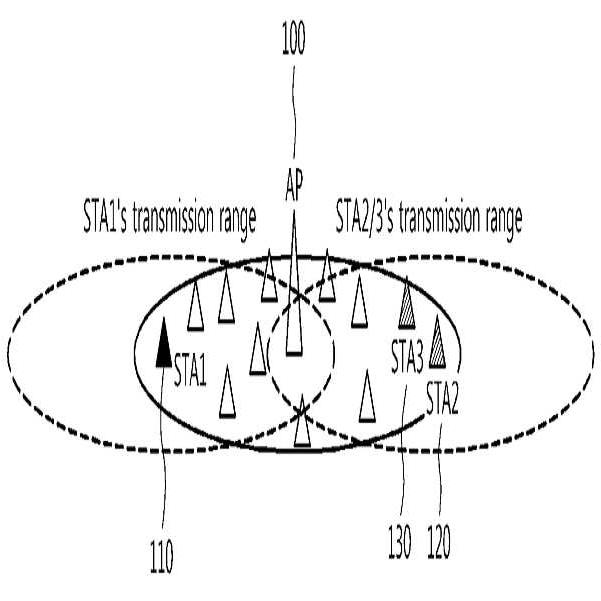
도 1은 본 발명의 일실시예가 적용될 수 있는 액세스 포인트와 복수의 단말들로 구성된 무선랜 환경을 나타낸다.1 illustrates a WLAN environment including an access point and a plurality of terminals to which an embodiment of the present invention can be applied.
WLAN(IEEE 802.11)에서는 네트워크 내 STA이 너무 많거나 또는 히든 노드(hidden node)에 의해서 STA간 충돌 확률이 높아지게 되는 환경에서 이를 완화시키는 한가지 방법으로 슬롯 기반 채널 액세스 방식을 적용하여 AP(100)가 채널 액세스 구간을 일정 길이를 갖는 슬롯(slot)으로 나누고 STA이 채널에 액세스하는 시점을 슬롯에 할당하는 방법을 사용할 수 있다. In WLAN (IEEE 802.11), the AP 100 applies a slot-based channel access method as a method of alleviating this in an environment in which there are too many STAs in a network or a collision probability between STAs is increased by a hidden node. A method of dividing a channel access interval into slots having a certain length and allocating a time point for accessing a channel to a slot may be used.
이 방법의 핵심 개념은 STA별로 채널에 액세스하는 시간을 다르게 하여 동시에 액세스하는 STA의 수를 줄이는 것이다. 이를 위해 AP(100)는 STA에게 할당한 슬롯의 위치 및 구간을 비콘이나 브로드캐스트(broadcast) 프레임을 통해 알려주고, 비콘을 들은 STA은 할당 받은 슬롯에서 데이터 교환을 할 수 있다. 이 때, 허락되지 않은 STA는 액세스를 하지 않으므로, 동시에 접속하는 STA의 수를 줄일 수 있다. The core concept of this method is to reduce the number of STAs that access at the same time by varying the time to access the channel for each STA. To this end, the AP 100 notifies the location and duration of the slot allocated to the STA through a beacon or a broadcast frame, and the STA that listens to the beacon may exchange data in the allocated slot. At this time, since the STA is not allowed to access, the number of STAs connected at the same time can be reduced.
하지만, 비콘을 듣지 않고 액세스를 하는 STA 또는 OBSS(Overlapping Basic Service Set)의 이웃 BSS(Basic Service Set)의 어떤 STA이 할당된 슬롯에서 채널에 액세스를 한다면 이미 그 슬롯에 할당된 STA과 경쟁을 할 수 있다. 이는 STA은 자신에게 할당된 슬롯에서도 TDMA가 아닌 CSMA/CA 방식의 DCF(Distributed Coordination Function )로 채널 액세스하기 때문이다. 예를 들어, AP(100)가 특정 슬롯을 STA2(120) 및 STA3(130)의 스테이션 그룹(station group)에 할당하고, STA2(120) 및 STA3(130)의 스테이션 그룹에 할당한 슬롯의 위치 및 구간을 브로드캐스트할 수 있다. 그런데 STA1(110)이 브로드캐스트한 프레임을 수신하지 못한 경우, STA1(110)이 스테이션 그룹에 할당된 슬롯에 접속을 시도할 수 있고, 이와 같은 경우, STA2(120) 및 STA3(130)의 스테이션 그룹과 STA1(110)이 해당 슬롯에서 경쟁을 하게 될 수 있다.However, if an STA that accesses without listening to a beacon or any STA in a neighboring basic service set (BSS) of an overlapping basic service set (OBSS) accesses a channel in an allocated slot, the STA may already compete with the assigned STA. Can be. This is because the STA accesses the channel through the distributed coordination function (DCF) of the CSMA / CA method, not the TDMA even in the slot allocated to the STA. For example, the AP 100 allocates a specific slot to a station group of the
이와 같은 경우, 할당된 슬롯이 AP(100)에게 데이터를 전송하기 위한 UL(uplink)인 경우 충돌로 인한 백오프(backoff)하며 채널 리스닝으로 인한 수신 파워의 소모뿐 아니라 이보다 양이 큰 송신 파워의 소모가 발생할 수 있기 때문에, STA간 충돌을 줄일 필요가 있다.In this case, if the allocated slot is an UL (uplink) for transmitting data to the
우선 도 2 및 도 3을 참조하여, 종래의 슬롯 기반 채널 액세스 방법에서 할당된 STA의 파워 소모를 줄이는 방법에 대해 설명한다.
First, a method of reducing power consumption of an allocated STA in the conventional slot-based channel access method will be described with reference to FIGS. 2 and 3.
도 2 및 도 3은 종래의 슬롯 기반 채널 액세스 방식에서 슬립(sleep)하다가 웨이크업(wakeup)한 두 스테이션이 서로 히든 노드(Hidden Node)일 때 충돌이나 전력 절감(Power Saver)를 위해 싱크 프레임(Synch Frame)을 사용하는 예시를 나타내는 도면이다.2 and 3 illustrate a sync frame for a collision or power saver when a station that is asleep and wakes up in a conventional slot-based channel access method is a hidden node. Synch Frame) is a diagram showing an example of using.
액세스 포인트로부터 슬롯을 할당 받아 슬롯 스타트(slot start)에서 깨어난 스테이션은 히든 노드(Hidden node)가 있는지 여부를 알 수 없다. 이를 도와주기 위해서 액세스 포인트는 슬롯 스타트에서 채널이 유휴 상태(idle state)이면 싱크 프레임을 전송할 수 있다. A station that is allocated a slot from an access point and wakes up at a slot start does not know whether a hidden node exists. To help this, the access point may transmit a sync frame when the channel is in an idle state at slot start.
도 2를 참조하면, 종래의 슬롯 기반 채널 액세스 방식에서, 스테이션은 액세스 포인트로부터 슬롯 바운더리(slot boundary)(201)에서 싱크 프레임(202)을 받은 후에 바로 DCF(Distributed Coordination Function)에 따라 채널 액세스할 수 있다. 보다 자세히 설명하면, 어웨이크 상태(awake state)의 스테이션은 액세스 포인트로부터 비콘 메시지를 수신할 수 있다(210). 또한, 스테이션은 슬롯 바운더리(201)에서 웨이크업하여 채널 싱크(channel synch)을 기다릴 수 있다(220). 이 때, 액세스 포인트는 슬롯 바운더리(201)에서 싱크 프레임(202)을 스테이션으로 전송할 수 있다. 따라서 스테이션은 액세스 포인트로부터 수신한 싱크 프레임(202)을 이용하여 채널에 싱크할 수 있고, DCF 규칙에 따라 채널 액세스를 시작할 수 있다(230).
Referring to FIG. 2, in the conventional slot-based channel access scheme, a station may perform channel access according to a distributed coordination function (DCF) immediately after receiving a
또 다른 종래의 동작예로서, 도 3을 참조하면, 슬롯 바운더리(301)에서 액세스 포인트가 채널이 비지(busy)하다고 판단하거나 스테이션으로부터 데이터를 수신 중인 경우, 액세스 포인트는 싱크 프레임을 전송하지 않을 수 있다(302). 스테이션은 싱크 프레임을 수신하지 않았으므로 채널을 액세스하지 않고 기다릴 수 있으며, 기다림은 (i) 싱크 프레임을 수신하거나, (ii) 액세스 포인트로부터 다른 프레임을 수신하거나, (iii) 프루브 딜레이(Probe delay) 구간이 끝날 때 중 어느 한 가지가 만족될 때까지 지속될 수 있다(스테이션의 웨이팅 규칙(waiting rule)). As another conventional operation example, referring to FIG. 3, when the access point determines that the channel is busy or is receiving data from the station in the
정리하면, 할당된 슬롯 바운더리(301)에서 깨어나 채널 액세스하려는 스테이션은 현재 채널의 점유 여부를 모르므로, 액세스 포인트가 보내주는 싱크 프레임을 이용하여 채널의 점유 여부를 판단하고, 싱크 프레임을 수신하면 매체에 동기를 맞추고 채널 액세스를 할 수 있다.In summary, since the station that wakes up from the assigned
예를 들어, 스테이션 x(STA x)는 스테이션 n(STA n)에 대해서 히든 노드라고 할 때, 스테이션 x는 슬롯 바운더리(301)을 넘어서 액세스 포인트로 패킷(packet)을 전송하고 있을 수 있다(310). 이 때, 스테이션은 슬롯 바운더리(301)에서 깨어나고, medium에 싱크하기 위하여 패킷을 기다릴 수 있다(320). 이 때, 스테이션은 스테이션 x로부터의 데이터 패킷을 들을 수 없다. 또한, 스테이션은 액세스 포인트로부터 ACK 메시지를 수신하면 채널로 싱크할 수 있다(330).
For example, when station x (STA x) is called a hidden node for station n (STA n), station x may be transmitting a packet to the access point beyond slot boundary 301 (310). ). In this case, the station may wake up from the
한편, 도 5 및 도 6에서 설명한 종래의 방법은 할당된 스테이션의 동작만 기술하고 있을 뿐이고, 네트워크 내의 다른 스테이션의 동작에 대해서는 기술하고 있지 않다. 할당된 스테이션이 아닌 다른 스테이션도 깨어 있어서 싱크 프레임을 수신하여 채널 액세스를 시작할 수 있는데, 이 때, 슬롯에 할당된 스테이션만 액세스를 허용할 것인지 아니면 싱크 프레임을 수신한 스테이션에게 모두 액세스를 허용할 것인지에 따라 스테이션의 동작이 달라지게 될 수 있다. 따라서, 할당된 스테이션의 동작 뿐 아니라 네트워크 내의 다른 스테이션의 동작에 대해서 설정이 필요하다.
On the other hand, the conventional method described in Figs. 5 and 6 only describes the operation of the assigned station, and does not describe the operation of other stations in the network. Stations other than the assigned station are also awake and can start receiving channel access by receiving sync frames, whether to allow access only to the station assigned to the slot or to all stations receiving the sync frame. As a result, the operation of the station may vary. Thus, settings are required for the operation of other stations in the network as well as for the operation of assigned stations.
도 4는 본 발명의 일실시예에 따른 슬롯 사용 제어 방법을 나타내는 흐름도이다.4 is a flowchart illustrating a slot usage control method according to an embodiment of the present invention.
도 4를 참조하면, 무선 근거리 통신망에서 액세스 포인트는 스테이션의 슬롯 기반 채널 액세스를 제어할 수 있다(이하, 액세스 포인트가 스테이션의 슬롯 기반 채널 액세스를 제어하는 방법을 슬롯 사용 제어 방법이라고 한다).Referring to FIG. 4, in a wireless local area network, an access point may control slot-based channel access of a station (hereinafter, a method of controlling the slot-based channel access of a station is called a slot usage control method).
슬롯 사용 제어 방법은 슬롯에 할당된 스테이션을 표시(indication)하는 식별값을 포함하는 싱크 프레임을 생성할 수 있다(410). 슬롯에 할당된 스테이션은 하나의 스테이션일 수도 있으며, 복수 개의 스테이션을 포함하는 스테이션 그룹(station group)이 될 수도 있다.The slot usage control method may generate a sync frame including an identification value indicating an station allocated to a slot (410). The station assigned to the slot may be one station or may be a station group including a plurality of stations.
실시예에 따라서는 슬롯 사용 제어 방법은 MAC 헤더(MAC header)에 RA(receiver address) 값을 설정하여 싱크 프레임을 생성할 수 있다. According to an embodiment, the slot usage control method may generate a sync frame by setting a receiver address (RA) in a MAC header.
MAC 헤더의 크기를 줄이기 위해 SMH(short mac header)를 사용할 경우, 슬롯 사용 제어 방법은 RA 값 대신 리시버 AID(receiver AID) 및 BSSID 값을 사용할 수 있다. 즉, 슬롯 사용 제어 방법은 SM 헤더(Short MAC header)에 리시버 AID(receiver AID) 및 BSSID 값을 설정하여 싱크 프레임을 생성할 수 있다. 이 때, AID는 BSS에만 유일하므로, BSSID를 같이 사용함으로써, 스테이션을 유일하게 구별할 수 있다.When a short mac header (SMH) is used to reduce the size of the MAC header, the slot usage control method may use receiver AID and BSSID values instead of RA values. That is, the slot usage control method may generate a sync frame by setting a receiver AID and a BSSID value in an SM header. At this time, since the AID is unique to the BSS, stations can be uniquely distinguished by using the BSSID together.
스테이션 그룹을 AID 값을 사용해 계층적으로 나눴다면, 한 그룹을 식별할 수 있는 AID의 MSB(most significant bits)로 구분할 수 있다. 즉, 슬롯에 할당된 스테이션이 복수 개의 스테이션을 포함하는 스테이션 그룹(station group)인 경우로서, 스테이션 그룹을 AID 값을 사용하여 계층적으로 나눈 경우, 슬롯 사용 제어 방법은 AID 값의 MSB(most significant bits)값을 식별값으로 사용하여 싱크 프레임을 생성할 수 있다.If a group of stations is divided hierarchically using an AID value, one group can be identified by the most significant bits (MSB) of the AID. That is, when a station allocated to a slot is a station group including a plurality of stations, and when the station group is divided hierarchically using an AID value, the slot usage control method uses the MSB (most significant) of the AID value. bits) may be used as an identification value to generate a sync frame.
실시예에 따라서는 나머지 LSB 비트들은 한 패턴만 사용할 수 있다. 즉, 슬롯 사용 제어 방법에 있어서, AID값의 LSB(least significant bits)값은 동일한 패턴을 가질 수 있다. 예를 들어, LSB 비트들을 모두 0으로 설정할 수 있다. According to an embodiment, the remaining LSB bits may use only one pattern. That is, in the slot usage control method, the least significant bits (LSB) value of the AID value may have the same pattern. For example, all LSB bits may be set to zero.
하지만, 스테이션 그룹에 MSB+LSB 조합을 가진 스테이션도 존재하므로, 그룹 스테이션(group station)과 유니크 스테이션(unique STA)을 구분하기 위해 별도의 한 비트 필드를 둘 수 있다. 즉, 슬롯 사용 제어 방법은 슬롯에 할당된 스테이션이 복수 개의 스테이션을 포함하는 스테이션 그룹인 경우, 스테이션 그룹에 포함되는 그룹 스테이션(group station)과 유니크 스테이션(unique station)을 구분하기 위한 구분 비트 필드를 설정하여 싱크 프레임을 생성할 수 있다.
However, since there is also a station having a combination of MSB + LSB in the station group, one separate bit field may be provided to distinguish a group station and a unique station. That is, in the slot usage control method, when a station allocated to a slot is a station group including a plurality of stations, a division bit field for distinguishing a group station and a unique station included in the station group is provided. Set to generate a sync frame.
한편, 싱크 프레임은 슬롯마다 보내질 수 있으므로 그 크기가 작을수록 좋을 수 있다. 따라서, 실시예에 따라서는 싱크 프레임은 NDP(Null Data Packet) 형태일 수 있다. NDP는 프리앰블(preamble)로만 구성되는 프레임일 수 있다. 프리앰블은 동기와 채널 추정을 위한 LTF(long training field), STF(short training field) 및 SIG 필드(signal field)로 구성될 수 있다. 따라서 SIG 필드에 리시버 AID(receiver AID) 및 BSSID를 넣어줄 수 있다. 즉, 슬롯 사용 제어 방법은 LTF(long training field), STF(short training field) 및 SIG 필드(signal field) 중 적어도 하나의 필드를 포함하는 NDP(Null Data Packet) 형태로 싱크 프레임을 생성할 수 있다. 또한, 슬롯 사용 제어 방법은 SIG 필드에 리시버 AID(receiver AID) 및 BSSID 값을 설정하여 싱크 프레임을 설정할 수 있다.Meanwhile, since the sync frame may be sent for each slot, the smaller the size, the better. Accordingly, in some embodiments, the sync frame may be in the form of a null data packet (NDP). The NDP may be a frame composed only of preambles. The preamble may be composed of a long training field (LTF), a short training field (STF), and a signal field (SIG) for synchronization and channel estimation. Therefore, the receiver AID and the BSSID can be put in the SIG field. That is, the slot usage control method may generate a sync frame in the form of a null data packet (NDP) including at least one of a long training field (LTF), a short training field (STF), and a signal field (SIG). . In addition, the slot usage control method may set a sync frame by setting a receiver AID and a BSSID value in the SIG field.
이 때, SIG 필드의 비트 수 제한 때문에 부분 AID(partial AID)나 부분 BSSID(partial BSSID)를 사용할 수 있다. 또한, 부분(partial)이면 유일하게 결정할 수 없으므로 스크램블링(scrambling)이 사용될 수 있다. 즉, 슬롯 사용 제어 방법은 SIG 필드에 부분 AID(partial AID) 또는 부분 BSSID(partial BSSID) 값을 설정할 수 있다.
At this time, a partial AID or a partial BSSID may be used due to the limited number of bits of the SIG field. In addition, scrambling may be used since the only decision is partial. That is, the slot usage control method may set a partial AID or a partial BSSID value in the SIG field.
이상 설명한 것과 같이 식별값을 포함하는 싱크 프레임이 생성되면, 슬롯 사용 제어 방법은 슬롯의 스타트 지점에서 채널이 유휴 상태(idle state)인 경우, 생성된 싱크 프레임을 브로드캐스트(broadcast)할 수 있다(420). 따라서, 싱크 프레임을 수신한 후, 싱크 프레임에 표시(indication)된 스테이션만 채널 액세스가 허락되고, 그 외 스테이션들은 채널 액세스를 하지 못하므로 기다리게 될 수 있다.
As described above, when the sync frame including the identification value is generated, the slot usage control method may broadcast the generated sync frame when the channel is in the idle state at the start point of the slot ( 420). Therefore, after receiving the sync frame, only the station indicated in the sync frame is allowed to access the channel, and other stations cannot wait for the channel access.
실시예에 따라서는 슬롯 사용 제어 방법은 표시된 스테이션 외의 스테이션들이 기다리는 동안 전력 절감(Power Saver)을 할 수 있도록 지속값을 적어줄 수 있다. 이하 도 5를 참조하여 지속값을 활용하는 실시예에 대해서 설명한다.
According to an embodiment, the slot usage control method may write down a duration value so that a power saver may be saved while stations other than the displayed station wait. Hereinafter, an embodiment of utilizing the persistence value will be described with reference to FIG. 5.
도 5는 일실시예에 따른 슬롯 사용 제어 방법이 지속값을 활용하는 예시를 나타내는 도면이다.5 is a diagram illustrating an example in which a slot use control method uses a persistence value.
도 5를 참조하면, 액세스 포인트(500)는 지속(duration)값을 더 포함하도록 싱크 프레임을 생성할 수 있다(510). 즉, 슬롯 사용 제어 방법은 슬롯에 할당된 스테이션(501)을 표시(indication)하는 식별값 및 지속값을 포함하도록 싱크 프레임을 생성할 수 있다. 싱크 프레임을 수신한 후, 싱크 프레임에 표시(indication)된 스테이션(501)만 채널 액세스를 할 수 있다(520). Referring to FIG. 5, the
싱크 프레임에 표시된 스테이션(501) 외의 다른 스테이션(502)들은 수신한 지속값으로 NAV(Network Allocation Vector)를 설정할 수 있다(530). 또한, 다른 스테이션(502)은 NAV가 0이 될 때까지 채널 액세스를 하지 않을 수 있다(540). 예컨대, 다른 스테이션(520)들은 전력 절감을 위하여 NAV가 0이 될 때까지 슬립 상태(sleep status)로 천이할 수 있다. 따라서 슬롯에 할당된 스테이션(501)을 충돌로부터 보호해줄 수 있다.
실시예에 따라서는 비트 수 제한 때문에 지속값 필드를 추가하지 못할 수 있다(예를 들어, NDP를 사용하는 경우). 이 때, 암묵적(implicit)으로 구간의 양을 나타내는 값을 정해놓고 이 구간마다 한번씩 싱크 프레임을 다시 보낼 수 있다. 즉, 슬롯 사용 제어 방법은 싱크 프레임을 다시 전송하는 구간의 양을 나타내는 값을 설정할 수 있다. 또한, 슬롯 사용 제어 방법은 설정된 값을 갖는 구간마다 싱크 프레임을 다시 전송할 수 있다.In some embodiments, it may not be possible to add the persistence field due to the number of bits (for example, when using NDP). At this time, an implicit value may be set and a sync frame may be re-sent once for each interval. That is, the slot usage control method may set a value indicating the amount of the interval for transmitting the sync frame again. In addition, the slot usage control method may retransmit the sync frame for each section having a set value.
구간의 값은 주로 슬롯 지속(slot duration)과 동일한 의미를 가지는데, 비콘을 듣지 않거나 OBSS의 STA를 위한 것이므로 슬롯 지속(slot duration)처럼 변할 수 있는 값이 아니라 고정된 값(fixed value)을 사용할 수 있다. 즉, 슬롯 사용 제어 방법은 싱크 프레임을 다시 전송하는 구간의 양을 나타내는 값을 고정된 값으로 설정할 수 있다. 이렇게 고정된 시간 구간마다 싱크 프레임을 전송하는 것은 할당된 슬롯 구간 내에서 채널에 진입한 스테이션으로부터 슬롯 사용을 보호하기 위해서 사용할 수 있다.
The value of the interval usually has the same meaning as the slot duration, but because it is not listening to beacons or for STAs in OBSS, it uses a fixed value rather than a value that can change like a slot duration. Can be. That is, the slot usage control method may set a value indicating the amount of the interval for transmitting the sync frame again to a fixed value. Transmitting sync frames every fixed time interval may be used to protect slot usage from stations entering a channel within an allocated slot interval.
본 발명의 일측에 따르면, 슬롯 사용 제어 방법은 보호되고 있는 슬롯을 다시 해제(release)하여 다른 스테이션이 접근하도록 할 수 있다. 이하 도 6 및 도 7을 참조하여 슬롯 사용 제어 방법이 슬롯을 해제하는 동작에 대해서 설명한다.
According to one aspect of the present invention, the slot usage control method may release a protected slot again to allow another station to access it. Hereinafter, an operation of releasing a slot by the slot usage control method will be described with reference to FIGS. 6 and 7.
도 6 및 도 7은 일실시예에 따른 슬롯 사용 제어 방법이 슬롯을 해제하는 동작을 나타내는 도면이다. 6 and 7 are diagrams illustrating an operation of releasing a slot by a slot use control method according to an embodiment.
할당된 슬롯을 보호하는 방법은 RTS/CTS 교환으로 NAV를 획득하거나 액세스 포인트가 비콘을 통해 액세스를 제한 하거나 또는 지속(duration) 필드를 포함한 싱크 프레임을 통해서 NAV를 설정하는 등의 다양한 방법을 단독 또는 함께 사용할 수 있다. There are various ways to protect the assigned slots, either alone or in various ways, such as acquiring a NAV through an RTS / CTS exchange, restricting access through a beacon, or setting up a NAV through a sync frame containing a duration field. Can be used together
한편, 보호 되고 있는 슬롯을 슬롯에 할당된 스테이션이 다 사용하지 못할 수 있다. 이때, 일실시예에 따른 슬롯 사용 제어 방법은 NAV를 해제하여 다른 스테이션의 접근을 허락할 수 있도록 하기 위해 CF-End 프레임을 사용할 수 있다.
On the other hand, a station protected by a slot may not be used up by a station allocated to the slot. In this case, the slot usage control method according to an embodiment may use a CF-End frame to release the NAV to allow access to other stations.
도 6을 참조하면, 슬롯 사용 제어 방법은 보호되고 있는 슬롯에 할당된 스테이션(601)이 진입하지 않는 경우, 슬롯을 해제할 수 있다. Referring to FIG. 6, when a
도 6을 참조하면, UL의 경우, 액세스 포인트(600)는 싱크 프레임을 전송할 수 있다(610). 또한, 액세스 포인트(600)는 슬롯에 할당된 스테이션(601)으로부터 프레임이 수신되기를 기다릴 수 있다.Referring to FIG. 6, in case of UL, the
슬롯 사용 제어 방법은 미리 설정된 데이터 센싱 시간(data sensing time)(603) 동안 슬롯에 할당된 스테이션(601)으로부터 프레임이 수신되지 않는 경우, CF-End 프레임을 전송할 수 있다(620). 즉, 액세스 포인트(600)는 CF-End 프레임을 전송함으로써, 할당된 슬롯이 해제(release)되었음을 슬롯에 할당된 스테이션(601) 외의 다른 스테이션(602)에게 알릴 수 있다.The slot usage control method may transmit a CF-End frame when the frame is not received from the
CF-End 프레임을 수신한 다른 스테이션(602)은 설정된 NAV를 리셋(reset)할 수 있다(630). 또한, 다른 스테이션(602)은 채널 액세스를 할 수 있다(640). 이 때, 실시예에 따라서는 다른 스테이션(602)은 CF-End 프레임에 포함된 지속 필드(duration field)의 값 후에 채널 액세스를 시작할 수 있다.
The
DL의 경우, 액세스 포인트(600)는 슬롯에 할당된 스테이션(601)으로 요청 관리 프레임을 전송할 수 있다(610). 또한, 액세스 포인트(600)는 미리 설정된 데이터 센싱 시간(603) 동안 슬롯에 할당된 스테이션(601)으로부터 요청 관리 프레임에 대응하는 응답 관리 프레임이 수신되지 않는 경우, 스테이션이 부재한다고 간주하고, CF-End 프레임을 전송할 수 있다(620). 이 때, 응답 관리 프레임은, 예컨대, 슬롯에 할당된 스테이션(601)으로 보낸 데이터에 대한 ACK 프레임, RTS에 대한 CTS 프레임, 요청(request) 형태의 관리 프레임에 대한 응답 관리 프레임 등이 될 수 있다. CF-End 프레임을 수신한 다른 스테이션(602)의 동작은 UL의 경우와 동일하게 동작할 수 있다.
In the case of a DL, the
도 7을 참조하면, 슬롯에 할당된 스테이션은 채널을 사용하다가 더 이상 데이터가 없는 경우 채널을 해제할 수 있다.Referring to FIG. 7, a station allocated to a slot may release a channel when there is no more data while using the channel.
슬롯에 할당된 스테이션(701)은 할당된 슬롯에서 더 이상 전송할 프레임이 없는 경우, 액세스 포인트(700)에게 CF-End 프레임을 전송할 수 있다(710). 실시예에 따라서는 슬롯에 할당된 스테이션(701)은 CF-End 프레임을 전송하는데 필요한 시간, SIFS 및 응답 CF-End 프레임을 전송하는데 필요한 시간을 합한 값을 CF-End 프레임의 지속 필드(duration field)의 값으로 설정할 수 있다.The
액세스 포인트(700)는 슬롯에 할당된 스테이션(701)으로부터 CF-End 프레임을 수신하면, 수신한 CF-End 프레임의 지속 필드의 값을 0으로 설정할 수 있다(720).When the
또한, 액세스 포인트(700)는 지속 필드의 값을 0으로 설정한 CF-End 프레임을 슬롯에 할당된 스테이션(701) 외의 다른 스테이션(702)으로 전송할 수 있다(730).In addition, the
다른 스테이션(702)은 슬롯에 할당된 스테이션(701)으로부터 전송되는 CF-End 프레임과 액세스 포인트(700)로부터 전송되는 CF-End 프레임 중 하나라도 수신하면, 채널 지속(duration) 시간 후에 채널 액세스를 할 수 있다(740).
If the
본 발명의 일측에 따르면, 앞서 기술한 지속(duration) 필드를 사용해 NAV 설정하는 방법과 데이터 교환 중에 일정 주기마다 싱크 프레임(synch frame)을 보내는 방법은 슬롯 기반 채널 액세스가 아닌 스케쥴 되어 할당된 자원에도 적용될 수 있다. 이하 도 8을 참조하여 이에 대해서 설명한다.
According to one aspect of the present invention, the method of setting the NAV by using the above-mentioned duration field and the method of sending a sync frame at regular intervals during the data exchange may be performed on a scheduled and allocated resource, not slot-based channel access. Can be applied. This will be described below with reference to FIG. 8.
도 8은 일실시예에 따른 슬롯 사용 제어 방법이 스케쥴 협상된 스테이션을 지원하는 동작을 나타내는 도면이다. 8 is a diagram illustrating an operation of supporting a schedule-negotiated station by a slot usage control method according to an embodiment.
액세스 포인트는 스케쥴을 협상 후 특정 시간에 깨어나서 데이터 교환하고자 하는 스테이션을 지원할 수 있다. 이러한 스테이션은 센서(sensor)처럼 낮은 듀티 사이클(low duty cycle)을 가지며 파워 소모에 민감할 수 있다. 따라서, 이러한 스테이션은 스케쥴된 시간에서만 깨어나서 데이터를 교환할 수 있다. 이를 위해 액세스 포인트는 시간 정보 - i) 깨어날 시점을 나타내는 TWT(target wake time)과 깨어난 후 할당된 시간 구간을 나타내는 인터벌(interval) - 를 특정 스테이션에게 할당하여 알려줄 수 있다. 스테이션은 TWT에 깨어났을 때, 히든 노드(hidden node)로 인해 충돌이 생길 수 있는데, 이는 앞서 기술한 슬롯 기반 채널 액세스 경우와 동일하다. The access point may wake up at a specific time after negotiating a schedule to support the station wishing to exchange data. Such a station has a low duty cycle like a sensor and can be sensitive to power consumption. Thus, these stations can wake up and exchange data only at the scheduled time. To this end, the access point may allocate and inform time information-i) a target wake time (TWT) indicating a time to wake up and an interval indicating a time interval allocated after waking up to a specific station. When a station wakes up to the TWT, a hidden node may cause a collision, which is the same as the slot-based channel access case described above.
그런데 스테이션이 데이터를 보내는 도중 깨어난 다른 스테이션이 있거나 OBSS STA이 있고 데이터를 보내는 스테이션과 서로 히든이면 충돌이 생길 수 있다. 이 스테이션은 전력(power) 소모를 줄이는 것이 중요하므로 액세스 포인트는 데이터 중간에도 싱크 프레임을 보내고, 여기에 할당된 시간 구간까지 남은 시간을 지속(duration) 필드에 적어 보내 충돌을 피하고자 하는데 사용할 수 있다.However, if there is another station waking up while sending data or there is an OBSS STA and the station sending data is hidden from each other, a collision may occur. It is important for this station to reduce power consumption, so the access point can send sync frames even in the middle of the data, and use the remaining time up to the allotted time interval in the duration field to avoid collisions. .
실시예에 따라서는 스테이션은 TWT(801)에 깨어나서 채널 싱크(channel synch)를 기다릴 수 있다(810). 액세스 포인트는, 스테이션이 빠르게 채널에 싱크하는 것을 돕기 위해서, 채널이 유휴(idle) 상태인 경우 TWT(801)에 싱크 프레임을 전송할 수 있다(820). 스테이션은 액세스 포인트로부터 싱크 프레임을 수신하면 채널에 싱크할 수 있고, EDCA(Enhanced Distributed Channel Access) 규칙에 따라 채널 액세스를 시작할 수 있다(830). 또한, 데이터 전송이 완료되면, 스테이션은 슬립 모드로 돌아갈 수 있다(840).
According to an embodiment, the station may wake up to the
도 9는 일실시예에 따른 슬롯 사용 제어 장치의 구성을 나타내는 도면이다. 9 is a diagram illustrating a configuration of a slot use control apparatus according to an embodiment.
도 9를 참조하면, 슬롯 사용 제어 장치(900)는 무선 근거리 통신망에서 스테이션의 슬롯 기반 채널 액세스를 제어할 수 있다. 슬롯 사용 제어 장치(900)는 액세스 포인트에 하나의 모듈로서 삽입되어 동작할 수 있다.
Referring to FIG. 9, the slot
슬롯 사용 제어 장치(900)는 생성부(910) 및 전송부(920)를 포함한다.The slot
생성부(910)는 슬롯에 할당된 스테이션을 표시(indication)하는 식별값을 포함하는 싱크 프레임을 생성할 수 있다. 슬롯에 할당된 스테이션은 하나의 스테이션일 수도 있으며, 복수 개의 스테이션을 포함하는 스테이션 그룹(station group)이 될 수도 있다.The
실시예에 따라서는 생성부(910)는 MAC 헤더(MAC header)에 RA(receiver address) 값을 설정하여 싱크 프레임을 생성할 수 있다. According to an embodiment, the
MAC 헤더의 크기를 줄이기 위해 SMH(short mac header)를 사용할 경우, 생성부(910)는 RA 값 대신 리시버 AID(receiver AID) 및 BSSID 값을 사용할 수 있다. 즉, 생성부(910)는 SM 헤더(Short MAC header)에 리시버 AID(receiver AID) 및 BSSID 값을 설정하여 싱크 프레임을 생성할 수 있다. 이 때, AID는 BSS에만 유일하므로, BSSID를 같이 사용함으로써, 스테이션을 유일하게 구별할 수 있다.When a short mac header (SMH) is used to reduce the size of the MAC header, the
스테이션 그룹을 AID 값을 사용해 계층적으로 나눴다면, 한 그룹을 식별할 수 있는 AID의 MSB(most significant bits)로 구분할 수 있다. 즉, 슬롯에 할당된 스테이션이 복수 개의 스테이션을 포함하는 스테이션 그룹(station group)인 경우로서, 스테이션 그룹을 AID 값을 사용하여 계층적으로 나눈 경우, 생성부(910)는 AID 값의 MSB(most significant bits)값을 식별값으로 사용하여 싱크 프레임을 생성할 수 있다.If a group of stations is divided hierarchically using an AID value, one group can be identified by the most significant bits (MSB) of the AID. That is, when a station allocated to a slot is a station group including a plurality of stations, and the station group is divided hierarchically using an AID value, the
실시예에 따라서는 나머지 LSB 비트들은 한 패턴만 사용할 수 있다. 즉, 생성부(910)에 있어서, AID값의 LSB(least significant bits)값은 동일한 패턴을 가질 수 있다. 예를 들어, LSB 비트들을 모두 0으로 설정할 수 있다. According to an embodiment, the remaining LSB bits may use only one pattern. That is, in the
하지만, 스테이션 그룹에 MSB+LSB 조합을 가진 스테이션도 존재하므로, 그룹 스테이션(group station)과 유니크 스테이션(unique STA)을 구분하기 위해 별도의 한 비트 필드를 둘 수 있다. 즉, 생성부(910)는 슬롯에 할당된 스테이션이 복수 개의 스테이션을 포함하는 스테이션 그룹인 경우, 스테이션 그룹에 포함되는 그룹 스테이션(group station)과 유니크 스테이션(unique station)을 구분하기 위한 구분 비트 필드를 설정하여 싱크 프레임을 생성할 수 있다.
However, since there is also a station having a combination of MSB + LSB in the station group, one separate bit field may be provided to distinguish a group station and a unique station. That is, the
한편, 싱크 프레임은 슬롯마다 보내질 수 있으므로 그 크기가 작을수록 좋을 수 있다. 따라서, 실시예에 따라서는 싱크 프레임은 NDP(Null Data Packet) 형태일 수 있다. NDP는 프리앰블(preamble)로만 구성되는 프레임일 수 있다. 프리앰블은 동기와 채널 추정을 위한 LTF(long training field), STF(short training field) 및 SIG 필드(signal field)로 구성될 수 있다. 따라서 SIG 필드에 리시버 AID(receiver AID) 및 BSSID를 넣어줄 수 있다. 즉, 생성부(910)는 LTF(long training field), STF(short training field) 및 SIG 필드(signal field) 중 적어도 하나의 필드를 포함하는 NDP(Null Data Packet) 형태로 싱크 프레임을 생성할 수 있다. 또한, 생성부(910)는 SIG 필드에 리시버 AID(receiver AID) 및 BSSID 값을 설정하여 싱크 프레임을 설정할 수 있다.Meanwhile, since the sync frame may be sent for each slot, the smaller the size, the better. Accordingly, in some embodiments, the sync frame may be in the form of a null data packet (NDP). The NDP may be a frame composed only of preambles. The preamble may be composed of a long training field (LTF), a short training field (STF), and a signal field (SIG) for synchronization and channel estimation. Therefore, the receiver AID and the BSSID can be put in the SIG field. That is, the
이 때, SIG 필드의 비트 수 제한 때문에 부분 AID(partial AID)나 부분 BSSID(partial BSSID)를 사용할 수 있다. 또한, 부분(partial)이면 유일하게 결정할 수 없으므로 스크램블링(scrambling)이 사용될 수 있다. 즉, 생성부(910)는 SIG 필드에 부분 AID(partial AID) 또는 부분 BSSID(partial BSSID) 값을 설정할 수 있다.
At this time, a partial AID or a partial BSSID may be used due to the limited number of bits of the SIG field. In addition, scrambling may be used since the only decision is partial. That is, the
이상 설명한 것과 같이 식별값을 포함하는 싱크 프레임이 생성되면, 전송부(920)는 슬롯의 스타트 지점에서 채널이 유휴 상태(idle state)인 경우, 생성된 싱크 프레임을 브로드캐스트(broadcast)할 수 있다. 따라서, 싱크 프레임을 수신한 후, 싱크 프레임에 표시(indication)된 스테이션만 채널 액세스가 허락되고, 그 외 스테이션들은 채널 액세스를 하지 못하므로 기다리게 될 수 있다.
As described above, when the sync frame including the identification value is generated, the
실시예에 따라서는 생성부(910)는 표시된 스테이션 외의 스테이션들이 기다리는 동안 전력 절감(Power Saver)을 할 수 있도록 지속값을 적어줄 수 있다. 즉, 생성부(910)는 슬롯에 할당된 스테이션을 표시(indication)하는 식별값 및 지속값을 포함하도록 싱크 프레임을 생성할 수 있다. 싱크 프레임을 수신한 후, 싱크 프레임에 표시(indication)된 스테이션만 채널 액세스를 할 수 있다. According to an embodiment, the
싱크 프레임에 표시된 스테이션 외의 다른 스테이션들은 수신한 지속값으로 NAV(Network Allocation Vector)를 설정할 수 있다. 또한, 다른 스테이션은 NAV가 0이 될 때까지 채널 액세스를 하지 않을 수 있다. 예컨대, 다른 스테이션들은 전력 절감을 위하여 NAV가 0이 될 때까지 슬립 상태(sleep status)로 천이할 수 있다. 따라서 슬롯에 할당된 스테이션을 충돌로부터 보호해줄 수 있다.
Stations other than the stations indicated in the sync frame may set a network allocation vector (NAV) as the received persistence value. Also, the other station may not have channel access until the NAV is zero. For example, other stations may transition to sleep status until the NAV goes to zero to save power. Thus, the station assigned to the slot can be protected from collision.
실시예에 따라서는 비트 수 제한 때문에 지속값 필드를 추가하지 못할 수 있다(예를 들어, NDP를 사용하는 경우). 이 때, 암묵적(implicit)으로 구간의 양을 나타내는 값을 정해놓고 이 구간마다 한번씩 싱크 프레임을 다시 보낼 수 있다. 즉, 생성부(910)는 싱크 프레임을 다시 전송하는 구간의 양을 나타내는 값을 설정할 수 있다. 또한, 전송부(920)는 설정된 값을 갖는 구간마다 싱크 프레임을 다시 전송할 수 있다.In some embodiments, it may not be possible to add the persistence field due to the number of bits (for example, when using NDP). At this time, an implicit value may be set and a sync frame may be re-sent once for each interval. That is, the
구간의 값은 주로 슬롯 지속(slot duration)과 동일한 의미를 가지는데, 비콘을 듣지 않거나 OBSS의 STA를 위한 것이므로 슬롯 지속(slot duration)처럼 변할 수 있는 값이 아니라 고정된 값(fixed value)을 사용할 수 있다. 즉, 생성부(910)는 싱크 프레임을 다시 전송하는 구간의 양을 나타내는 값을 고정된 값으로 설정할 수 있다. 이렇게 고정된 시간 구간마다 싱크 프레임을 전송하는 것은 할당된 슬롯 구간 내에서 채널에 진입한 스테이션으로부터 슬롯 사용을 보호하기 위해서 사용할 수 있다.
The value of the interval usually has the same meaning as the slot duration, but because it is not listening to beacons or for STAs in OBSS, it uses a fixed value rather than a value that can change as a slot duration. Can be. That is, the
본 발명의 일측에 따르면, 슬롯 사용 제어 장치(900)는 보호되고 있는 슬롯을 다시 해제(release)하여 다른 스테이션이 접근하도록 할 수 있다. According to one side of the present invention, the slot
할당된 슬롯을 보호하는 방법은 RTS/CTS 교환으로 NAV를 획득하거나 액세스 포인트가 비콘을 통해 액세스를 제한 하거나 또는 지속(duration) 필드를 포함한 싱크 프레임을 통해서 NAV를 설정하는 등의 다양한 방법을 단독 또는 함께 사용할 수 있다. There are various ways to protect the assigned slots, either alone or in various ways, such as acquiring a NAV through an RTS / CTS exchange, restricting access through a beacon, or setting up a NAV through a sync frame containing a duration field. Can be used together
한편, 보호 되고 있는 슬롯을 슬롯에 할당된 스테이션이 다 사용하지 못할 수 있다. 이때, 일실시예에 따른 슬롯 사용 제어 장치(900)는 NAV를 해제하여 다른 스테이션의 접근을 허락할 수 있도록 하기 위해 CF-End 프레임을 사용할 수 있다.On the other hand, a station protected by a slot may not be used up by a station allocated to the slot. In this case, the slot
슬롯 사용 제어 장치(900)는 보호되고 있는 슬롯에 할당된 스테이션이 진입하지 않는 경우, 슬롯을 해제할 수 있다. The slot
UL의 경우, 슬롯 사용 제어 장치(900)의 전송부(920)는 싱크 프레임을 전송할 수 있다. 또한, 슬롯 사용 제어 장치(900)는 슬롯에 할당된 스테이션으로부터 프레임이 수신되기를 기다릴 수 있다.In case of UL, the
전송부(920)는 미리 설정된 데이터 센싱 시간(data sensing time) 동안 슬롯에 할당된 스테이션으로부터 프레임이 수신되지 않는 경우, CF-End 프레임을 전송할 수 있다. 즉, 슬롯 사용 제어 장치(900)는 CF-End 프레임을 전송함으로써, 할당된 슬롯이 해제(release)되었음을 슬롯에 할당된 스테이션 외의 다른 스테이션에게 알릴 수 있다.The
CF-End 프레임을 수신한 다른 스테이션은 설정된 NAV를 리셋(reset)할 수 있다. 또한, 다른 스테이션은 채널 액세스를 할 수 있다. 이 때, 실시예에 따라서는 다른 스테이션은 CF-End 프레임에 포함된 지속 필드(duration field)의 값 후에 채널 액세스를 시작할 수 있다.
The other station receiving the CF-End frame may reset the set NAV. In addition, other stations may have channel access. At this time, according to the embodiment, the other station may start channel access after the value of the duration field included in the CF-End frame.
DL의 경우, 전송부(920)는 슬롯에 할당된 스테이션으로 요청 관리 프레임을 전송할 수 있다. 또한, 슬롯 사용 제어 장치(900)는 미리 설정된 데이터 센싱 시간 동안 슬롯에 할당된 스테이션으로부터 요청 관리 프레임에 대응하는 응답 관리 프레임이 수신되지 않는 경우, 스테이션이 부재한다고 간주하고, CF-End 프레임을 전송할 수 있다. 이 때, 응답 관리 프레임은, 예컨대, 슬롯에 할당된 스테이션으로 보낸 데이터에 대한 ACK 프레임, RTS에 대한 CTS 프레임, 요청(request) 형태의 관리 프레임에 대한 응답 관리 프레임 등이 될 수 있다. CF-End 프레임을 수신한 다른 스테이션의 동작은 UL의 경우와 동일하게 동작할 수 있다.
In the case of DL, the
실시예에 따라서는 슬롯에 할당된 스테이션은 채널을 사용하다가 더 이상 데이터가 없는 경우 채널을 해제할 수 있다.According to an embodiment, a station assigned to a slot may use the channel and release the channel when there is no more data.
슬롯에 할당된 스테이션은 할당된 슬롯에서 더 이상 전송할 프레임이 없는 경우, 슬롯 사용 제어 장치(900)에게 CF-End 프레임을 전송할 수 있다. 실시예에 따라서는 슬롯에 할당된 스테이션은 CF-End 프레임을 전송하는데 필요한 시간, SIFS 및 응답 CF-End 프레임을 전송하는데 필요한 시간을 합한 값을 CF-End 프레임의 지속 필드(duration field)의 값으로 설정할 수 있다.The station allocated to the slot may transmit the CF-End frame to the slot
슬롯 사용 제어 장치(900)는 슬롯에 할당된 스테이션으로부터 CF-End 프레임을 수신하면, 수신한 CF-End 프레임의 지속 필드의 값을 0으로 설정할 수 있다.When the slot
또한, 전송부(920)는 지속 필드의 값을 0으로 설정한 CF-End 프레임을 슬롯에 할당된 스테이션 외의 다른 스테이션으로 전송할 수 있다.In addition, the
다른 스테이션은 슬롯에 할당된 스테이션으로부터 전송되는 CF-End 프레임과 액세스 포인트로부터 전송되는 CF-End 프레임 중 하나라도 수신하면, 채널 지속(duration) 시간 후에 채널 액세스를 할 수 있다.
If the other station receives at least one of the CF-End frame transmitted from the station assigned to the slot and the CF-End frame transmitted from the access point, the other station may perform channel access after the channel duration time.
본 발명에 따른 실시예들은 다양한 컴퓨터 수단을 통하여 수행될 수 있는 프로그램 명령 형태로 구현되어 컴퓨터 판독 가능 매체에 기록될 수 있다. 상기 컴퓨터 판독 가능 매체는 프로그램 명령, 데이터 파일, 데이터 구조 등을 단독으로 또는 조합하여 포함할 수 있다. 상기 매체에 기록되는 프로그램 명령은 본 발명을 위하여 특별히 설계되고 구성된 것들이거나 컴퓨터 소프트웨어 당업자에게 공지되어 사용 가능한 것일 수도 있다. 컴퓨터 판독 가능 기록 매체의 예에는 하드디스크, 플로피 디스크 및 자기 테이프와 같은 자기 매체(magnetic media), CD-ROM, DVD와 같은 광기록 매체(optical media), 플롭티컬 디스크(Floptical disk)와 같은 자기-광 매체(magneto-optical media), 및 롬(ROM), 램(RAM), 플래시 메모리 등과 같은 프로그램 명령을 저장하고 수행하도록 특별히 구성된 하드웨어 장치가 포함된다. 프로그램 명령의 예에는 컴파일러에 의해 만들어지는 것과 같은 기계어 코드뿐만 아니라 인터프리터 등을 사용해서 컴퓨터에 의해서 실행될 수 있는 고급 언어 코드를 포함한다. 상기된 하드웨어 장치는 본 발명의 동작을 수행하기 위해 하나 이상의 소프트웨어 모듈로서 작동하도록 구성될 수 있으며, 그 역도 마찬가지이다.Embodiments according to the present invention can be implemented in the form of program instructions that can be executed by various computer means can be recorded on a computer readable medium. The computer readable medium may include program instructions, data files, data structures, and the like, alone or in combination. Program instructions recorded on the media may be those specially designed and constructed for the purposes of the present invention, or they may be of the kind well-known and available to those having skill in the computer software arts. Examples of computer-readable recording media include magnetic media such as hard disks, floppy disks, and magnetic tape, optical media such as CD-ROMs, DVDs, and magnetic disks, such as floppy disks. Magneto-optical media, and hardware devices specifically configured to store and execute program instructions, such as ROM, RAM, flash memory, and the like. Examples of program instructions include machine code, such as produced by a compiler, as well as high-level language code that can be executed by a computer using an interpreter or the like. The hardware device described above may be configured to operate as one or more software modules to perform the operations of the present invention, and vice versa.
이상과 같이 본 발명은 비록 한정된 실시예와 도면에 의해 설명되었으나, 본 발명은 상기의 실시예에 한정되는 것은 아니며, 본 발명이 속하는 분야에서 통상의 지식을 가진 자라면 이러한 기재로부터 다양한 수정 및 변형이 가능하다.As described above, the present invention has been described by way of limited embodiments and drawings, but the present invention is not limited to the above embodiments, and those skilled in the art to which the present invention pertains various modifications and variations from such descriptions. This is possible.
그러므로, 본 발명의 범위는 설명된 실시예에 국한되어 정해져서는 아니 되며, 후술하는 특허청구범위뿐 아니라 이 특허청구범위와 균등한 것들에 의해 정해져야 한다.Therefore, the scope of the present invention should not be limited to the described embodiments, but should be determined not only by the claims below but also by the equivalents of the claims.
100: 액세스 포인트
110: STA 1
120: STA 2
130: STA 3100: access point
110: STA 1
120: STA 2
130: STA 3
Claims (28)
스테이션(STA)을 지시하는 식별 값을 포함하는 RA(Receiver Address) 필드를 포함하는 싱크(synch) 프레임을 전송하는 단계;
상기 싱크 프레임을 전송한 후, 소정의 시간 동안 응답을 기다리는 단계; 및
상기 소정의 시간 동안 상기 싱크 프레임에 대한 응답 프레임이 수신되지 않는 경우, CF-End 프레임을 전송하는 단계를 포함하고,
상기 CF(Contention Free)-End 프레임은 NAV(Network Allocation Vector) 리셋을 위해서 상기 AP에 의해서 전송되고,
상기 싱크 프레임은 비콘 프레임과 구별되며, 비콘 프레임 전송 시점들 사이의 시간에 전송되는, 방법.
In a method performed by an access point (AP) in a WLAN,
Transmitting a synch frame including a receiver address (RA) field including an identification value indicating a station (STA);
After transmitting the sync frame, waiting for a response for a predetermined time; And
Transmitting a CF-End frame when no response frame is received for the sync frame during the predetermined time;
The CF (Endion Free) -End frame is transmitted by the AP to reset the Network Allocation Vector (NAV),
The sync frame is distinct from a beacon frame and is transmitted in time between beacon frame transmission times.
상기 싱크 프레임은 상기 STA이 깨어나는 시점에 전송되는, 방법.
The method of claim 15,
The sync frame is transmitted when the STA wakes up.
상기 싱크 프레임은,
STF(Short Training Field), LTF(Long Training Field) 및 SIG(Signal) 필드를 포함하고 데이터 필드를 포함하지 않는 NDP(Null Data Packet) 형태로 전송되는, 방법.
The method of claim 15,
The sync frame,
The method is transmitted in the form of a NDP (Null Data Packet) including a Short Training Field (STF), a Long Training Field (LTF), and a Signal (SIG) field and not including a data field.
상기 싱크 프레임의 상기 RA 필드는 부분 AID(Association Identifier) 또는 부분 BSSID(Basic Service Set Identifier) 중의 하나 이상을 포함하는, 방법.
The method of claim 15,
The RA field of the sync frame includes one or more of a partial Association Identifier (AID) or a partial Basic Service Set Identifier (BSSID).
상기 싱크 프레임은 상기 STA이 깨어나는 시점에 채널이 유휴(idle) 상태인 경우에 전송되는, 방법.
The method of claim 16,
The sync frame is transmitted when the channel is idle at the time when the STA wakes up.
상기 STA이 깨어나는 시점은, 상기 STA에게 할당되는 시간 슬롯들의 슬롯 바운더리(slot boundary) 또는 상기 STA에 대한 TWT(Target Wake Time) 중의 하나 이상에 해당하는, 방법.
The method of claim 19,
The time point at which the STA wakes up corresponds to one or more of a slot boundary of time slots allocated to the STA or a target wake time (TWT) for the STA.
상기 싱크 프레임은, 상기 STA에게 할당되는 시간 슬롯들의 슬롯 바운더리 또는 상기 STA에 대한 TWT 중의 하나 이상을 보호하기 위해서 사용되는, 방법.
The method of claim 20,
The sync frame is used to protect one or more of a slot boundary of time slots assigned to the STA or a TWT for the STA.
상기 응답 프레임은 상기 STA으로부터 상기 AP로 전송되는, 방법.
The method of claim 15,
The response frame is transmitted from the STA to the AP.
상기 응답 프레임은 UL(uplink) 데이터 프레임인, 방법.
The method of claim 22,
And the response frame is an uplink (UL) data frame.
상기 싱크 프레임은 지속(duration) 필드를 더 포함하는, 방법.
The method of claim 15,
The sync frame further includes a duration field.
상기 지속 필드의 값은 상기 STA에 의한 상기 응답 프레임의 전송에 이용되는, 방법.
The method of claim 24,
The value of the persistent field is used for transmission of the response frame by the STA.
상기 지속 필드의 값은 상기 STA 외의 하나 이상의 다른 STA에 의한 NAV 설정에 이용되는, 방법.
The method of claim 24,
The value of the persistent field is used for NAV setting by one or more other STAs other than the STA.
스테이션(STA)을 지시하는 식별 값을 포함하는 수신자 주소(RA) 필드를 포함하는 싱크(synch) 프레임 생성하도록 설정되는 생성부;
상기 싱크 프레임을 전송하도록 설정되는 전송부;
상기 싱크 프레임을 전송한 후, 상기 장치는 소정의 시간 동안 응답을 기다리고,
상기 전송부는, 상기 소정의 시간 동안 상기 싱크 프레임에 대한 응답 프레임이 수신되지 않는 경우, CF-End 프레임을 전송하도록 설정되며,
상기 CF(Contention Free)-End 프레임은 NAV(Network Allocation Vector) 리셋을 위해서 상기 AP에 의해서 전송되고,
상기 싱크 프레임은 비콘 프레임과 구별되며, 비콘 프레임 전송 시점들 사이의 시간에 전송되는, 장치.
An access point (AP) device in a WLAN,
A generation unit configured to generate a synch frame including a receiver address (RA) field including an identification value indicating a station (STA);
A transmitter configured to transmit the sync frame;
After transmitting the sync frame, the device waits for a response for a predetermined time,
The transmission unit is set to transmit a CF-End frame, if a response frame for the sync frame is not received during the predetermined time,
The CF (Endion Free) -End frame is transmitted by the AP to reset the Network Allocation Vector (NAV),
And the sync frame is distinct from a beacon frame and is transmitted in time between beacon frame transmission times.
Priority Applications (4)
| Application Number | Priority Date | Filing Date | Title |
|---|---|---|---|
| US14/412,669 US9807804B2 (en) | 2012-07-05 | 2013-07-05 | Apparatus and method for controlling slot usage |
| PCT/KR2013/005994 WO2014007575A1 (en) | 2012-07-05 | 2013-07-05 | Apparatus and method for controlling slot usage |
| US15/717,535 US10624135B2 (en) | 2012-07-05 | 2017-09-27 | Apparatus and method for controlling slot usage |
| US16/812,073 US11172518B2 (en) | 2012-07-05 | 2020-03-06 | Apparatus and method for controlling slot usage |
Applications Claiming Priority (2)
| Application Number | Priority Date | Filing Date | Title |
|---|---|---|---|
| KR20120073208 | 2012-07-05 | ||
| KR1020120073208 | 2012-07-05 |
Related Child Applications (1)
| Application Number | Title | Priority Date | Filing Date |
|---|---|---|---|
| KR1020190158494A Division KR102174881B1 (en) | 2012-07-05 | 2019-12-02 | Apparatus and method for Controlling slot use |
Publications (2)
| Publication Number | Publication Date |
|---|---|
| KR20140006724A KR20140006724A (en) | 2014-01-16 |
| KR102053395B1 true KR102053395B1 (en) | 2019-12-06 |
Family
ID=50141598
Family Applications (3)
| Application Number | Title | Priority Date | Filing Date |
|---|---|---|---|
| KR1020130078833A Active KR102053395B1 (en) | 2012-07-05 | 2013-07-05 | Apparatus and method for Controlling slot use |
| KR1020190158494A Active KR102174881B1 (en) | 2012-07-05 | 2019-12-02 | Apparatus and method for Controlling slot use |
| KR1020200143091A Active KR102295193B1 (en) | 2012-07-05 | 2020-10-30 | Apparatus and method for Controlling slot use |
Family Applications After (2)
| Application Number | Title | Priority Date | Filing Date |
|---|---|---|---|
| KR1020190158494A Active KR102174881B1 (en) | 2012-07-05 | 2019-12-02 | Apparatus and method for Controlling slot use |
| KR1020200143091A Active KR102295193B1 (en) | 2012-07-05 | 2020-10-30 | Apparatus and method for Controlling slot use |
Country Status (2)
| Country | Link |
|---|---|
| US (3) | US9807804B2 (en) |
| KR (3) | KR102053395B1 (en) |
Families Citing this family (9)
| Publication number | Priority date | Publication date | Assignee | Title |
|---|---|---|---|---|
| US10205573B2 (en) * | 2013-09-13 | 2019-02-12 | Futurewei Technologies, Inc. | System and method for OFDMA PS-poll transmission |
| US9848423B2 (en) | 2014-10-31 | 2017-12-19 | Realtek Semiconductor Corp. | Wireless communication system and associated wireless communication method |
| US10271352B2 (en) | 2016-07-19 | 2019-04-23 | Realtek Semiconductor Corp. | Wireless communication system and associated wireless communication method and wireless device having efficient polling mechanism in overlapping network environments |
| CN108633099B (en) * | 2017-03-23 | 2022-03-11 | 华为技术有限公司 | Channel access indication method and device |
| JP6920872B2 (en) | 2017-04-24 | 2021-08-18 | キヤノン株式会社 | Communication equipment, control methods, and programs |
| CN109219109A (en) * | 2017-07-06 | 2019-01-15 | 索尼公司 | Wireless communications method and wireless telecom equipment |
| JP7238261B2 (en) * | 2018-03-22 | 2023-03-14 | ヤマハ株式会社 | Control device, communication relay device, communication system, and control method |
| US11197242B2 (en) | 2019-01-14 | 2021-12-07 | Cisco Technology, Inc. | Coordinated target wake time (TWT) service for localized wireless neighborhoods |
| KR20220066591A (en) * | 2020-11-16 | 2022-05-24 | 삼성전자주식회사 | Method for performing wireless communication and elecronic device therefor |
Citations (2)
| Publication number | Priority date | Publication date | Assignee | Title |
|---|---|---|---|---|
| US20040253996A1 (en) * | 2003-06-12 | 2004-12-16 | Industrial Technology Research Institute | Method and system for power-saving in a wireless local area network |
| US20100177657A1 (en) * | 2009-01-15 | 2010-07-15 | Yun-Joo Kim | Method of medium access control in wireless lan system using multiple channels |
Family Cites Families (28)
| Publication number | Priority date | Publication date | Assignee | Title |
|---|---|---|---|---|
| US6657984B1 (en) * | 1999-10-29 | 2003-12-02 | Samsung Electronics, Co., Ltd. | System and method providing backward compatibility of radio link protocols in a wireless network |
| US7245604B2 (en) * | 2001-11-02 | 2007-07-17 | At&T Corp. | Fixed deterministic post-backoff for cyclic prioritized multiple access (CPMA) contention-free sessions |
| US7433370B1 (en) * | 2003-02-10 | 2008-10-07 | Tymes Laroy | Data structures with amortized control overhead and methods and networks using the same |
| US8059607B1 (en) * | 2003-06-26 | 2011-11-15 | Cirrus Logic, Inc. | Methods and systems for implementing transmit diversity over a wireless medium and networks using the same |
| JP3817531B2 (en) * | 2003-07-22 | 2006-09-06 | キヤノン株式会社 | Control unit of radio communication device, radio communication device, and control method |
| AU2005274003B2 (en) | 2004-08-12 | 2009-03-05 | Interdigital Technology Corporation | Method and system for controlling access to a wireless communication medium |
| WO2007056747A2 (en) * | 2005-11-08 | 2007-05-18 | Conexant Systems | Collision avoidance systems and methods |
| US8125941B2 (en) * | 2006-03-28 | 2012-02-28 | Intel Corporation | Wireless communication device and method for communicating voice over a wireless network using bidirectional multiple receiver aggregation |
| US7881340B2 (en) * | 2007-10-22 | 2011-02-01 | The Johns Hopkins University | Decentralized media access control for ad-hoc mobile wireless network |
| KR101018685B1 (en) * | 2008-03-04 | 2011-03-04 | 삼성전자주식회사 | Apparatus and method for controlling automatic retransmission request reset in broadband wireless communication system |
| EP2294837B1 (en) | 2008-06-18 | 2019-08-07 | InterDigital CE Patent Holdings | Contention-based medium reservation methods and apparata for multicast transmissions in wireless local area networks |
| US8743793B2 (en) | 2008-07-14 | 2014-06-03 | Qualcomm Incorporated | Systems and methods for providing a separate contention window allowing allocations for pending uplink SDMA transmission opportunities |
| WO2010029593A1 (en) | 2008-09-09 | 2010-03-18 | 独立行政法人情報通信研究機構 | Radio communication system |
| EP2178248A1 (en) | 2008-10-14 | 2010-04-21 | Thomson Licensing | A method to improve channel utilization in a time division multiple access based protocol |
| US20100118837A1 (en) * | 2008-11-11 | 2010-05-13 | Qualcomm Incorporated | Using synchronization frames for mesh networking with piconets |
| WO2010064766A1 (en) * | 2008-12-01 | 2010-06-10 | Lg Electronics Inc. | Method and device for transmission opportunity truncation |
| US8374142B2 (en) * | 2010-05-10 | 2013-02-12 | Intel Corporation | Link adaptation in directional wireless networks |
| US8855063B2 (en) * | 2010-05-18 | 2014-10-07 | Intel Corporation | Method and apparatus for response scheduling in a downlink multiple-user multiple input multiple output network |
| US9992738B2 (en) * | 2010-11-17 | 2018-06-05 | Qualcomm Incorporated | Physical layer power save facility with random offset |
| CN103718596B (en) * | 2011-06-08 | 2018-02-23 | 马维尔国际贸易有限公司 | High efficiency of transmission for low data rate WLAN |
| WO2012177878A1 (en) * | 2011-06-24 | 2012-12-27 | Interdigital Patent Holdings, Inc. | Method and apparatus for supporting wideband and multiple bandwidth transmission protocols |
| US20120327920A1 (en) * | 2011-06-27 | 2012-12-27 | Texas Instruments Incorporated | Methods to enhance coexistence with low energy wireless networks |
| EP2785133B1 (en) * | 2011-11-23 | 2017-06-14 | LG Electronics Inc. | Method for transceiving data on basis of service period scheduling in wireless lan system and apparatus for supporting same |
| US9942887B2 (en) * | 2012-04-12 | 2018-04-10 | Futurewei Technologies, Inc. | System and method for downlink transmission in a wireless network |
| US9426832B2 (en) * | 2012-04-24 | 2016-08-23 | Intel Corporation | Methods and arrangements to coordinate communications in a wireless network |
| US20130301605A1 (en) * | 2012-05-10 | 2013-11-14 | Nokia Corporation | Method, apparatus, and computer program product for resource allocation for sequential/parallel wireless messages |
| WO2013184889A1 (en) * | 2012-06-08 | 2013-12-12 | Marvell World Trade Ltd. | Method and apparatus for restricting channel access to a wireless station operating in accordance with a power saving scheme |
| US20130336182A1 (en) * | 2012-06-13 | 2013-12-19 | Qualcomm Incorporated | Systems and methods for identifying enhanced frames for wireless communication |
-
2013
- 2013-07-05 KR KR1020130078833A patent/KR102053395B1/en active Active
- 2013-07-05 US US14/412,669 patent/US9807804B2/en active Active
-
2017
- 2017-09-27 US US15/717,535 patent/US10624135B2/en active Active
-
2019
- 2019-12-02 KR KR1020190158494A patent/KR102174881B1/en active Active
-
2020
- 2020-03-06 US US16/812,073 patent/US11172518B2/en active Active
- 2020-10-30 KR KR1020200143091A patent/KR102295193B1/en active Active
Patent Citations (2)
| Publication number | Priority date | Publication date | Assignee | Title |
|---|---|---|---|---|
| US20040253996A1 (en) * | 2003-06-12 | 2004-12-16 | Industrial Technology Research Institute | Method and system for power-saving in a wireless local area network |
| US20100177657A1 (en) * | 2009-01-15 | 2010-07-15 | Yun-Joo Kim | Method of medium access control in wireless lan system using multiple channels |
Also Published As
| Publication number | Publication date |
|---|---|
| US9807804B2 (en) | 2017-10-31 |
| KR20140006724A (en) | 2014-01-16 |
| KR102295193B1 (en) | 2021-08-31 |
| US10624135B2 (en) | 2020-04-14 |
| US11172518B2 (en) | 2021-11-09 |
| KR20190137052A (en) | 2019-12-10 |
| US20160073433A1 (en) | 2016-03-10 |
| US20180092132A1 (en) | 2018-03-29 |
| KR20200128373A (en) | 2020-11-12 |
| KR102174881B1 (en) | 2020-11-05 |
| US20200214051A1 (en) | 2020-07-02 |
Similar Documents
| Publication | Publication Date | Title |
|---|---|---|
| KR102182959B1 (en) | Apparatus and method for slot based channel access control in wireless local area network system, slot based channel access terminal in wlan | |
| KR102295193B1 (en) | Apparatus and method for Controlling slot use | |
| US12302397B2 (en) | Controlling transmissions from multiple user devices via a request-clear technique | |
| KR102167885B1 (en) | Method and apparatus for controlling channel access in wireless lan system | |
| EP2723136A1 (en) | Service data transmission method and system | |
| US10980057B2 (en) | Slotted OFDMA based channel access | |
| KR20170091699A (en) | Wireless communication terminal and wireless communication method for multi-user uplink transmission | |
| CN108650715B (en) | Time slot-based channel access control device and method for wireless local area network system | |
| WO2018090895A1 (en) | Wake-up frame transmitting method, and method, device and equipment for transmitting first frame after node wakes up | |
| CN107517502A (en) | A kind of cut-in method, equipment and system | |
| WO2014007575A1 (en) | Apparatus and method for controlling slot usage | |
| KR20140075478A (en) | Method for communicating of wireless communication system |
Legal Events
| Date | Code | Title | Description |
|---|---|---|---|
| PA0109 | Patent application |
St.27 status event code: A-0-1-A10-A12-nap-PA0109 |
|
| PG1501 | Laying open of application |
St.27 status event code: A-1-1-Q10-Q12-nap-PG1501 |
|
| PN2301 | Change of applicant |
St.27 status event code: A-3-3-R10-R13-asn-PN2301 St.27 status event code: A-3-3-R10-R11-asn-PN2301 |
|
| R17-X000 | Change to representative recorded |
St.27 status event code: A-3-3-R10-R17-oth-X000 |
|
| A201 | Request for examination | ||
| E13-X000 | Pre-grant limitation requested |
St.27 status event code: A-2-3-E10-E13-lim-X000 |
|
| P11-X000 | Amendment of application requested |
St.27 status event code: A-2-2-P10-P11-nap-X000 |
|
| P13-X000 | Application amended |
St.27 status event code: A-2-2-P10-P13-nap-X000 |
|
| PA0201 | Request for examination |
St.27 status event code: A-1-2-D10-D11-exm-PA0201 |
|
| E902 | Notification of reason for refusal | ||
| PE0902 | Notice of grounds for rejection |
St.27 status event code: A-1-2-D10-D21-exm-PE0902 |
|
| E13-X000 | Pre-grant limitation requested |
St.27 status event code: A-2-3-E10-E13-lim-X000 |
|
| P11-X000 | Amendment of application requested |
St.27 status event code: A-2-2-P10-P11-nap-X000 |
|
| P13-X000 | Application amended |
St.27 status event code: A-2-2-P10-P13-nap-X000 |
|
| E701 | Decision to grant or registration of patent right | ||
| PE0701 | Decision of registration |
St.27 status event code: A-1-2-D10-D22-exm-PE0701 |
|
| A107 | Divisional application of patent | ||
| GRNT | Written decision to grant | ||
| PA0107 | Divisional application |
St.27 status event code: A-0-1-A10-A18-div-PA0107 St.27 status event code: A-0-1-A10-A16-div-PA0107 |
|
| PR0701 | Registration of establishment |
St.27 status event code: A-2-4-F10-F11-exm-PR0701 |
|
| PR1002 | Payment of registration fee |
St.27 status event code: A-2-2-U10-U11-oth-PR1002 Fee payment year number: 1 |
|
| PG1601 | Publication of registration |
St.27 status event code: A-4-4-Q10-Q13-nap-PG1601 |
|
| PR1001 | Payment of annual fee |
St.27 status event code: A-4-4-U10-U11-oth-PR1001 Fee payment year number: 4 |
|
| PR1001 | Payment of annual fee |
St.27 status event code: A-4-4-U10-U11-oth-PR1001 Fee payment year number: 5 |
|
| PR1001 | Payment of annual fee |
St.27 status event code: A-4-4-U10-U11-oth-PR1001 Fee payment year number: 6 |
|
| PR1001 | Payment of annual fee |
St.27 status event code: A-4-4-U10-U11-oth-PR1001 Fee payment year number: 7 |
|
| U11 | Full renewal or maintenance fee paid |
Free format text: ST27 STATUS EVENT CODE: A-4-4-U10-U11-OTH-PR1001 (AS PROVIDED BY THE NATIONAL OFFICE) Year of fee payment: 7 |