KR102046435B1 - Anti-gcc antibody molecules and use of same to test for susceptibility to gcc-targeted therapy - Google Patents
Anti-gcc antibody molecules and use of same to test for susceptibility to gcc-targeted therapy Download PDFInfo
- Publication number
- KR102046435B1 KR102046435B1 KR1020147032890A KR20147032890A KR102046435B1 KR 102046435 B1 KR102046435 B1 KR 102046435B1 KR 1020147032890 A KR1020147032890 A KR 1020147032890A KR 20147032890 A KR20147032890 A KR 20147032890A KR 102046435 B1 KR102046435 B1 KR 102046435B1
- Authority
- KR
- South Korea
- Prior art keywords
- gcc
- delete delete
- antibody molecule
- cancer
- antibody
- Prior art date
- Legal status (The legal status is an assumption and is not a legal conclusion. Google has not performed a legal analysis and makes no representation as to the accuracy of the status listed.)
- Expired - Fee Related
Links
Images


Classifications
-
- A—HUMAN NECESSITIES
- A61—MEDICAL OR VETERINARY SCIENCE; HYGIENE
- A61P—SPECIFIC THERAPEUTIC ACTIVITY OF CHEMICAL COMPOUNDS OR MEDICINAL PREPARATIONS
- A61P1/00—Drugs for disorders of the alimentary tract or the digestive system
-
- A—HUMAN NECESSITIES
- A61—MEDICAL OR VETERINARY SCIENCE; HYGIENE
- A61P—SPECIFIC THERAPEUTIC ACTIVITY OF CHEMICAL COMPOUNDS OR MEDICINAL PREPARATIONS
- A61P1/00—Drugs for disorders of the alimentary tract or the digestive system
- A61P1/04—Drugs for disorders of the alimentary tract or the digestive system for ulcers, gastritis or reflux esophagitis, e.g. antacids, inhibitors of acid secretion, mucosal protectants
-
- A—HUMAN NECESSITIES
- A61—MEDICAL OR VETERINARY SCIENCE; HYGIENE
- A61P—SPECIFIC THERAPEUTIC ACTIVITY OF CHEMICAL COMPOUNDS OR MEDICINAL PREPARATIONS
- A61P1/00—Drugs for disorders of the alimentary tract or the digestive system
- A61P1/18—Drugs for disorders of the alimentary tract or the digestive system for pancreatic disorders, e.g. pancreatic enzymes
-
- A—HUMAN NECESSITIES
- A61—MEDICAL OR VETERINARY SCIENCE; HYGIENE
- A61P—SPECIFIC THERAPEUTIC ACTIVITY OF CHEMICAL COMPOUNDS OR MEDICINAL PREPARATIONS
- A61P11/00—Drugs for disorders of the respiratory system
-
- A—HUMAN NECESSITIES
- A61—MEDICAL OR VETERINARY SCIENCE; HYGIENE
- A61P—SPECIFIC THERAPEUTIC ACTIVITY OF CHEMICAL COMPOUNDS OR MEDICINAL PREPARATIONS
- A61P21/00—Drugs for disorders of the muscular or neuromuscular system
-
- A—HUMAN NECESSITIES
- A61—MEDICAL OR VETERINARY SCIENCE; HYGIENE
- A61P—SPECIFIC THERAPEUTIC ACTIVITY OF CHEMICAL COMPOUNDS OR MEDICINAL PREPARATIONS
- A61P25/00—Drugs for disorders of the nervous system
-
- A—HUMAN NECESSITIES
- A61—MEDICAL OR VETERINARY SCIENCE; HYGIENE
- A61P—SPECIFIC THERAPEUTIC ACTIVITY OF CHEMICAL COMPOUNDS OR MEDICINAL PREPARATIONS
- A61P25/00—Drugs for disorders of the nervous system
- A61P25/14—Drugs for disorders of the nervous system for treating abnormal movements, e.g. chorea, dyskinesia
- A61P25/16—Anti-Parkinson drugs
-
- A—HUMAN NECESSITIES
- A61—MEDICAL OR VETERINARY SCIENCE; HYGIENE
- A61P—SPECIFIC THERAPEUTIC ACTIVITY OF CHEMICAL COMPOUNDS OR MEDICINAL PREPARATIONS
- A61P35/00—Antineoplastic agents
-
- C—CHEMISTRY; METALLURGY
- C07—ORGANIC CHEMISTRY
- C07K—PEPTIDES
- C07K16/00—Immunoglobulins [IGs], e.g. monoclonal or polyclonal antibodies
- C07K16/18—Immunoglobulins [IGs], e.g. monoclonal or polyclonal antibodies against material from animals or humans
- C07K16/28—Immunoglobulins [IGs], e.g. monoclonal or polyclonal antibodies against material from animals or humans against receptors, cell surface antigens or cell surface determinants
-
- C—CHEMISTRY; METALLURGY
- C07—ORGANIC CHEMISTRY
- C07K—PEPTIDES
- C07K16/00—Immunoglobulins [IGs], e.g. monoclonal or polyclonal antibodies
- C07K16/40—Immunoglobulins [IGs], e.g. monoclonal or polyclonal antibodies against enzymes
-
- G01N33/5759—
-
- C—CHEMISTRY; METALLURGY
- C07—ORGANIC CHEMISTRY
- C07K—PEPTIDES
- C07K2317/00—Immunoglobulins specific features
- C07K2317/20—Immunoglobulins specific features characterized by taxonomic origin
-
- C—CHEMISTRY; METALLURGY
- C07—ORGANIC CHEMISTRY
- C07K—PEPTIDES
- C07K2317/00—Immunoglobulins specific features
- C07K2317/50—Immunoglobulins specific features characterized by immunoglobulin fragments
- C07K2317/56—Immunoglobulins specific features characterized by immunoglobulin fragments variable (Fv) region, i.e. VH and/or VL
-
- C—CHEMISTRY; METALLURGY
- C07—ORGANIC CHEMISTRY
- C07K—PEPTIDES
- C07K2317/00—Immunoglobulins specific features
- C07K2317/50—Immunoglobulins specific features characterized by immunoglobulin fragments
- C07K2317/56—Immunoglobulins specific features characterized by immunoglobulin fragments variable (Fv) region, i.e. VH and/or VL
- C07K2317/565—Complementarity determining region [CDR]
-
- G—PHYSICS
- G01—MEASURING; TESTING
- G01N—INVESTIGATING OR ANALYSING MATERIALS BY DETERMINING THEIR CHEMICAL OR PHYSICAL PROPERTIES
- G01N2333/00—Assays involving biological materials from specific organisms or of a specific nature
- G01N2333/90—Enzymes; Proenzymes
- G01N2333/988—Lyases (4.), e.g. aldolases, heparinase, enolases, fumarase
Landscapes
- Health & Medical Sciences (AREA)
- Chemical & Material Sciences (AREA)
- Organic Chemistry (AREA)
- Life Sciences & Earth Sciences (AREA)
- General Health & Medical Sciences (AREA)
- Medicinal Chemistry (AREA)
- Engineering & Computer Science (AREA)
- Bioinformatics & Cheminformatics (AREA)
- Public Health (AREA)
- Animal Behavior & Ethology (AREA)
- Veterinary Medicine (AREA)
- Chemical Kinetics & Catalysis (AREA)
- General Chemical & Material Sciences (AREA)
- Nuclear Medicine, Radiotherapy & Molecular Imaging (AREA)
- Pharmacology & Pharmacy (AREA)
- Neurology (AREA)
- Immunology (AREA)
- Biomedical Technology (AREA)
- Neurosurgery (AREA)
- Molecular Biology (AREA)
- Biochemistry (AREA)
- Biophysics (AREA)
- Genetics & Genomics (AREA)
- Proteomics, Peptides & Aminoacids (AREA)
- Orthopedic Medicine & Surgery (AREA)
- Pulmonology (AREA)
- Psychology (AREA)
- Physical Education & Sports Medicine (AREA)
- Peptides Or Proteins (AREA)
- Medicines Containing Antibodies Or Antigens For Use As Internal Diagnostic Agents (AREA)
- Cell Biology (AREA)
- Urology & Nephrology (AREA)
- Hematology (AREA)
- Oncology (AREA)
- Micro-Organisms Or Cultivation Processes Thereof (AREA)
- Microbiology (AREA)
- Pathology (AREA)
- General Physics & Mathematics (AREA)
- Hospice & Palliative Care (AREA)
- Biotechnology (AREA)
Abstract
GCC에 결합하는 항체 및 항체의 항원-결합 단편이 개시된다. 본 발명은 또한 본원에 제공된 항-GCC 항체를 이용하는 GCC-표적화 치료법을 받아야 하는 환자를 확인하기 위한 진단 방법을 제공한다. 항-GCC 항체 분자는 네이키드 항체 분자로서 및 면역콘주게이트의 성분으로서 유용하다. 따라서 또 다른 측면에서, 본 발명은 본원에 기재된 항-GCC 항체 분자 및 치료제 또는 표지를 포함하는 면역콘주게이트를 특징으로 한다. 본 발명은 또한, 예로 GCC 및 GCC를 발현하는 세포 또는 조직의 검출을 위한 본원에 기재된 항-GCC 항체 분자 및 면역콘주게이트의 이용 방법을 특징으로 한다. 이러한 방법은 특히 GCC-매개 질환의 진단, 예후, 조영 또는 단계결정에 유용하다. 따라서 일부 측면에서, 본 발명은 GCC-표적화 치료법, 예로 항-GCC 항체 치료법, 예로 치료제와 콘주게이트된 항-GCC 항체를 포함하는 면역콘주게이트를 이용한 치료를 위한 대상체의 확인 방법을 특징으로 한다.Antibodies that bind GCC and antigen-binding fragments of antibodies are disclosed. The invention also provides a diagnostic method for identifying a patient who is to receive a GCC-targeted therapy using the anti-GCC antibodies provided herein. Anti-GCC antibody molecules are useful as naked antibody molecules and as components of an immunoconjugate. Thus in another aspect, the invention features an immunoconjugate comprising an anti-GCC antibody molecule described herein and a therapeutic agent or label. The invention also features methods of using the anti-GCC antibody molecules and immunoconjugates described herein for the detection of GCC and cells or tissues expressing GCC, for example. Such methods are particularly useful for the diagnosis, prognosis, contrast or stage of GCC-mediated disease. Thus, in some aspects, the invention features a method of identifying a subject for treatment with a GCC-targeted therapy, eg an anti-GCC antibody therapy, eg, an immunoconjugate comprising an anti-GCC antibody conjugated with a therapeutic agent.
Description
관련 출원Related Applications
본 출원은 2012. 4. 27에 출원한 U.S. 가출원 일련 번호 61/639,376의 이익 및 이에 대한 우선권을 청구한다. U.S. 가출원 일련 번호 61/639,376의 전체 내용은 본원에 참조로 도입된다. This application is filed in U.S. Claim the benefit and priority of Provisional Serial No. 61 / 639,376. U.S. The entire contents of provisional application
발명 분야Field of invention
본 발명은 GCC에 결합하는 항체 분자, 및 GCC-표적화 치료법, 예컨대 치료제와 같은 제제에 콘주게이트된 항-GCC 항체 분자, 또는 이들의 단편을 함유하는 면역콘주게이트를 이용한 치료에 대해 환자를 선택하기 위한 그 이용 방법에 관한 것이다.The present invention is directed to selecting a patient for treatment with an immunoconjugate containing an antibody molecule that binds GCC, and an anti-GCC antibody molecule conjugated to an agent such as a GCC-targeted therapy, such as a therapeutic agent, or fragments thereof. It is about the use method for.
구아닐릴 사이클라아제 C("GCC")는 장액, 전해질 항상성 및 세포 증식의 유지에 작용하는 막통과 세포 표면 수용체이며, 예로 [Carrithers 등, Proc. Natl. Acad. Sci. USA 100:3018-3020(2003)]을 참고하라. GCC는 소장, 대장 및 직장 내층의 점막 세포에서 발현된다(Carrithers 등, Dis Colon Rectum 39: 171-181(1996)). GCC 발현은 장 상피 세포의 신생물 전환 시 유지되며 모든 일차 및 전이성 결직장 종양에서 발현된다(Carrithers 등, Dis Colon Rectum 39: 171-181(1996); Buc 등, Eur J Cancer 41: 1618-1627(2005); Carrithers 등, Gastroenterology 107: 1653-1661(1994)).Guanylyl cyclase C (“GCC”) is a transmembrane cell surface receptor that acts on the maintenance of serous fluid, electrolyte homeostasis and cell proliferation, see, eg, Carrithers et al., Proc. Natl. Acad. Sci. USA 100: 3018-3020 (2003). GCC is expressed in mucosal cells of the small intestine, colon and rectal lining (Carrithers et al., Dis Colon Rectum 39: 171-181 (1996)). GCC expression is maintained during neoplastic transformation of intestinal epithelial cells and is expressed in all primary and metastatic colorectal tumors (Carrithers et al., Dis Colon Rectum 39: 171-181 (1996); Buc et al., Eur J Cancer 41: 1618-1627). (2005); Carrithers et al., Gastroenterology 107: 1653-1661 (1994)).
요약summary
본 개시는 적어도 부분적으로 신규한 항-GCC 항체의 발견에 근거한다. 따라서 하나의 측면에서, 본 발명은 본원에 개시된 바와 같은 항-GCC 항체 분자를 특징으로 한다. 항-GCC 항체 분자는 네이키드 항체 분자로서 그리고 면역콘주게이트의 성분으로서 유용하다. 따라서 또 다른 측면에서, 본 발명은 본원에 기재된 항-GCC 항체 분자 및 치료제 또는 표지를 포함하는 면역콘주게이트를 특징으로 한다. 본 발명은 또한, 예로 GCC를 발현하는 세포 또는 조직 및 GCC의 검출을 위한, 본원에 기재된 항-GCC 항체 분자 및 면역콘주게이트의 이용 방법을 특징으로 한다. 이러한 방법은 특히, GCC-매개 질환의 진단, 예후, 조영, 또는 단계결정에 유용하다. 따라서 일부 측면에서, 본 발명은 GCC-표적화 치료법, 예로 항-GCC 항체 치료법, 예로 치료제와 콘주게이트된 항-GCC 항체를 포함하는 면역콘주게이트를 이용한 치료를 위한 대상체의 확인 방법을 특징으로 한다. 본 발명은 또한 암을 갖는 대상체가 GCC-표적화 치료법, 예로 본원에 기재된 GCC-표적화 치료법에 대한 잠재 후보인지에 대한 시험관 내 또는 생체 내 결정 방법을 특징으로 한다. The present disclosure is based, at least in part, on the discovery of novel anti-GCC antibodies. Thus, in one aspect, the invention features an anti-GCC antibody molecule as disclosed herein. Anti-GCC antibody molecules are useful as naked antibody molecules and as components of an immunoconjugate. Thus in another aspect, the invention features an immunoconjugate comprising an anti-GCC antibody molecule described herein and a therapeutic agent or label. The invention also features methods of using the anti-GCC antibody molecules and immunoconjugates described herein for the detection of GCC and cells or tissues expressing GCC, for example. Such methods are particularly useful for the diagnosis, prognosis, contrast, or stage of GCC-mediated disease. Thus, in some aspects, the invention features a method of identifying a subject for treatment with a GCC-targeted therapy, eg an anti-GCC antibody therapy, eg, an immunoconjugate comprising an anti-GCC antibody conjugated with a therapeutic agent. The invention also features methods for determining in vitro or in vivo whether a subject with cancer is a potential candidate for GCC-targeted therapies, eg, GCC-targeted therapies described herein.
항-GCC 항체, 예로 본원에 기재된 항-GCC 항체는 또한 GCC 단백질의 활성 또는 기능의 조절; 및 본원에 기재된 바와 같은 GCC-매개 질환의 치료에 유용하다. 일부 측면에서, 치료에는 GCC 발현 수준을 결정하기 위한 지식의 획득 및/또는 표본 또는 대상체의 평가, 그리고 대상체가 GCC를 발현하는 경우 GCC-표적화 치료법, 예로 본원에 기재된 GCC 표적화 치료법의 투여가 포함된다. 다른 측면에서, 상기 방법은 대상체에서 표본을 수득하고, 예로 본원에 기재된 항-GCC 항체를 이용하여 본원에 기재된 검출 방법에 의해 GCC 발현 수준을 결정하고, 상기 결정에 근거하여 대상체에 대한 표적화 치료 보고서를 선택함으로써, 개인별 치료 보고서, 예로 GCC 표적화 치료 보고서를 생성하는 것을 특징으로 한다. Anti-GCC antibodies, such as the anti-GCC antibodies described herein, can also be used to modulate the activity or function of a GCC protein; And for the treatment of GCC-mediated diseases as described herein. In some aspects, treatment includes obtaining knowledge and / or evaluating a sample or subject, and administering a GCC-targeted therapy, eg, a GCC targeted therapy described herein, if the subject expresses GCC. . In another aspect, the method obtains a sample from a subject, eg, determines a GCC expression level by a detection method described herein using an anti-GCC antibody described herein, and based on the determination, a targeted treatment report for the subject By selecting the, characterized in that for generating a personalized treatment report, for example GCC targeted treatment report.
또 다른 측면에서, 본 발명은 또한 항-GCC 항체 분자 아미노산 서열을 인코딩하는 단리된 및/또는 재조합 핵산뿐만 아니라 이러한 핵산을 포함하는 벡터 및 숙주 세포, 그리고 항-GCC 항체 분자의 제조 방법을 특징으로 한다. 또한 본원에서는 항-GCC 항체를 포함하는 반응 혼합물 및 키트, 예로 본원에 기재된 면역콘주게이트뿐만 아니라, 예로 본원에 기재된 항-GCC 항체를 포함하는, GCC 발현을 검출하기 위한 시험관 내 분석을 특징으로 한다.In another aspect, the invention also features isolated and / or recombinant nucleic acids encoding anti-GCC antibody molecule amino acid sequences, as well as vectors and host cells comprising such nucleic acids, and methods of making anti-GCC antibody molecules. do. Also characterized herein are reaction mixtures and kits comprising an anti-GCC antibody, such as an immunoconjugate described herein, as well as an in vitro assay for detecting GCC expression, including, eg, the anti-GCC antibody described herein. .
본원에 언급된 모든 공보, 특허 출원, 특허 및 다른 참고문헌은 이들의 전문이 참조로 도입된다. All publications, patent applications, patents, and other references mentioned herein are incorporated by reference in their entirety.
본원에 개시된 본 발명(들)의 다른 특징, 목적 및 장점은 설명 및 도면 그리고 특허청구범위로부터 자명할 것이다. Other features, objects, and advantages of the invention (s) disclosed herein will be apparent from the description and drawings, and from the claims.
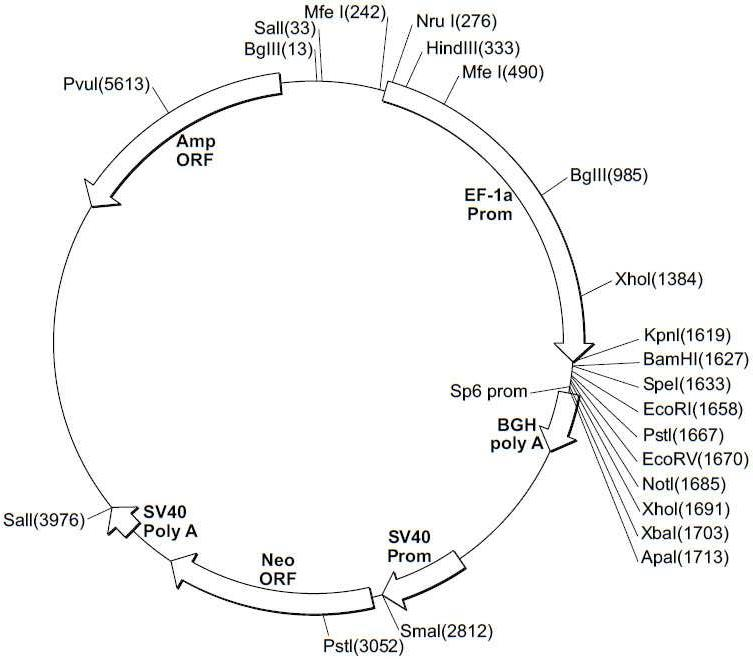
도 1은 본 발명의 인간 GCC(hGCC) 세포외 도메인(ECD) 마우스 Fc(mFc) 융합 단백질(hGCC-ECD-mFc)을 생성하는데 이용된 단백질 발현 벡터의 원형 지도이다.
도 2a-2d는 GCC-표적화 면역콘주게이트의 I상 임상 시험인 C26001 연구에 등록을 위해 스크리닝된 암 환자에서 종양 유형에 걸쳐 GCC 발현의 조합/집합(첨단 및 세포질) H 스코어 분포를 요약하는 막대 그래프를 나타낸다. 도 2a는 스크리닝된 결직장암 환자에 걸쳐 조합된 집합 H 스코어 분포를 나타내며; 도 2b는 스크리닝된 위암 환자에 걸쳐 조합된 집합 H 스코어 분포를 나타내며; 도 2c는 스크리닝된 췌장암 환자에 걸쳐 조합된 집합 H 스코어 분포를 나타내며; 도 2d는 스크리닝된 식도암 환자에 걸쳐 조합된 집합 H 스코어 분포를 나타낸다.
도 3a-3c는 스크리닝된 다양한 종양 특이적 마이크로어레이에 걸쳐 GCC 발현의 조합/집합(첨단 및 세포질) H 스코어 분포를 요약하는 막대 그래프를 나타낸다. 도 3a는 GCC 발현에 대해 스크리닝된 다양한 결직장 종양 마이크로어레이 상에서 표본에 걸친 조합/집합 H 스코어 분포를 나타내며; 도 3b는 GCC 발현에 대해 스크리닝된 위 종양 마이크로어레이 상에서 표본에 걸친 조합/집합 H 스코어 분포를 나타내며; 도 3c는 GCC 발현에 대해 스크리닝된 다양한 췌장 종양 마이크로어레이 상에서 표본에 걸친 조합/집합 H 스코어 분포를 나타낸다. 1 is a circular map of the protein expression vector used to generate the human GCC (hGCC) extracellular domain (ECD) mouse Fc (mFc) fusion protein (hGCC-ECD-mFc) of the present invention.
2A-2D are bars summarizing the combination / set (advanced and cytoplasmic) H score distribution of GCC expression across tumor types in cancer patients screened for enrollment in the C26001 study, phase I clinical trial of GCC-targeted immunoconjugates. Show the graph. 2A shows the combined H score distribution across screened colorectal cancer patients; 2B shows the aggregated H score distributions combined across screened gastric cancer patients; 2C shows the combined H score distribution combined across screened pancreatic cancer patients; 2D shows the combined H score distributions combined across screened esophageal cancer patients.
3A-3C show bar graphs summarizing the combination / set (advanced and cytoplasmic) H score distribution of GCC expression across the various tumor specific microarrays screened. 3A shows the combination / set H score distribution across samples on various colorectal tumor microarrays screened for GCC expression; 3B shows the combination / set H score distribution across samples on gastric tumor microarrays screened for GCC expression; 3C shows the combination / set H score distribution across samples on various pancreatic tumor microarrays screened for GCC expression.
상세한 설명details
구아닐릴 사이클라아제 C(GCC)(STAR, ST 수용체, GUC2C, 및 GUCY2C로도 알려져 있음)는 장액, 전해질 항상성 및 세포 증식의 유지에 작용하는 막통과 세포 표면 수용체이다(각각 그 전문이 본원에 참조로 도입된 Carrithers 등, Proc Natl Acad Sci USA 100: 3018-3020(2003); Mann 등, Biochem Biophys Res Commun 239: 463-466(1997); Pitari 등, Proc Natl Acad Sci USA 100: 2695-2699(2003)); GenBank 접근 번호 NM_004963). 상기 기능은 구아닐린의 결합을 통해 매개된다(Wiegand 등, FEBS Lett. 311:150-154(1992)). GCC는 또한 E. coli뿐만 아니라 다른 감염성 개체에 의해 생성되는 펩티드인 열저항 장독소(ST, 예로 서열 목록 번호 1의 아미노산 서열 NTFYCCELCCNPACAGCY를 가짐)에 대한 수용체이다(Rao, M. C. Ciba Found. Symp. 112:74-93(1985); Knoop F. C. and Owens, M. J. Pharmacol. Toxicol. Methods 28:67-72(1992)). ST의 GCC로의 결합은 장 질환, 예로 설사를 일으키는 신호 캐스케이드를 활성화한다. Guanylyl cyclase C (GCC) (also known as STAR, ST receptor, GUC2C, and GUCY2C) is a transmembrane and cell surface receptor that acts on the maintenance of serous fluid, electrolyte homeostasis, and cell proliferation (each of which is incorporated herein in its entirety). Carrithers et al., Proc. Natl Acad Sci USA 100: 3018-3020 (2003); Mann et al ., Biochem Biophys Res Commun 239: 463-466 (1997); Pitari et al., Proc Natl Acad Sci USA 100: 2695-2699 (2003); GenBank Accession Number NM_004963). This function is mediated through the binding of guaniline (Wiegand et al., FEBS Lett. 311: 150-154 (1992)). GCC is also a receptor for heat resistant enterotoxin (ST, eg having the amino acid sequence NTFYCCELCCNPACAGCY of SEQ ID NO: 1), a peptide produced by E. coli as well as other infectious individuals (Rao, MC Ciba Found. Symp. 112 : 74-93 (1985); Knoop FC and Owens, M. J. Pharmacol. Toxicol. Methods 28: 67-72 (1992). Binding of ST to GCC activates the signal cascade causing intestinal disease, eg diarrhea.
인간 GCC에 대한 뉴클레오티드 서열(GenBank 접근 번호 NM_004963; 서열 목록 번호 2): Nucleotide sequence for human GCC (GenBank Accession Number NM_004963; SEQ ID NO: 2):


인간 GCC에 대한 아미노산 서열(GenPept 접근 번호 NP_004954; 서열 목록 번호 3): Amino acid sequence for human GCC (GenPept accession number NP_004954; SEQ ID NO: 3):

GCC 단백질은 그 각각이 GCC 분자에 대해 구분가능한 기능에 기여하는 일부 일반적으로 허용되는 도메인을 갖는다. 일부 GCC에는 서열 목록 번호 3의 아미노산 잔기 1 내지 약 잔기 23, 또는 잔기 1 내지 약 잔기 21의 신호 서열(단백질을 세포 표면으로 보내기 위한 것)(성숙을 위해 절단되어 서열 목록 번호 3의 아미노산 잔기 약 22 또는 24 내지 1073의 기능적 성숙 단백질을 생성함), 서열 목록 번호 3의 아미노산 잔기 약 24 내지 잔기 약 420, 또는 잔기 약 54 내지 잔기 약 384의, 리간드, 예로 구아닐린 또는 ST 결합을 위한 세포외 도메인, 서열 목록 번호 3의 아미노산 잔기 약 431 내지 잔기 약 454, 또는 잔기 약 436 내지 잔기 약 452의 막통과 도메인, 서열 목록 번호 3의 아미노산 잔기 약 489 내지 잔기 약 749, 또는 잔기 약 508 내지 잔기 약 745의 티로신 키나아제 활성을 갖는 것으로 예측되는 키나아제 상동성 도메인, 및 서열 목록 번호 3의 잔기 약 750 내지 잔기 약 1007, 또는 잔기 약 816 내지 잔기 약 1002의 구아닐릴 사이클라아제 촉매 도메인이 포함된다. GCC proteins have some generally accepted domains, each of which contributes to distinguishable functions for the GCC molecule. Some GCCs contain the
정상 인간 조직에서, GCC는 점막 세포, 예로 첨단 솔가장자리 막, 소장, 대장 및 직장의 내층에서 발현된다(Carrithers 등, Dis Colon Rectum 39: 171-181(1996)). GCC 발현은 장 상피 세포의 신생물 전환 시 유지되며 모든 일차 및 전이성 결직장 종양에서 발현된다(Carrithers 등, Dis Colon Rectum 39: 171-181(1996); Buc 등, Eur J Cancer 41: 1618-1627(2005); Carrithers 등, Gastroenterology 107: 1653-1661(1994)). 위, 식도 및 위식도 접합부의 신생물 세포도 GCC를 발현한다(예로, U.S. 특허 번호 6,767,704; Debruyne 등, Gastroenterology 130:1191-1206(2006) 참고). 조직-특이적 발현 및 암, 예로 위장관 유래 암(예로, 결직장암, 위암, 식도암 또는 소장암)과의 연관이 상기 질환에 대한 진단 마커로서의 GCC 용도에 대해 탐색될 수 있다(Carrithers 등, Dis Colon Rectum 39: 171-181(1996); Buc 등, Eur J Cancer 41: 1618-1627(2005)). 또한 본원에서 실시예에 나타낸 바와 같이, 비제한적으로 췌장암, 폐암, 연조직 육종(예로, 평활근육종 및 횡문근육종), 위장관 또는 기관지폐 신경내분비 종양, 및 신경외배엽 종양을 포함하는 위장관에서 유래되지 않은 몇몇 상이한 유형의 암이 GCC를 발현하는 것으로 나타났다. In normal human tissues, GCC is expressed in mucosal cells such as the cutting edge of the pineal edge membrane, small intestine, large intestine and rectum (Carrithers et al., Dis Colon Rectum 39: 171-181 (1996)). GCC expression is maintained during neoplastic transformation of intestinal epithelial cells and is expressed in all primary and metastatic colorectal tumors (Carrithers et al., Dis Colon Rectum 39: 171-181 (1996); Buc et al., Eur J Cancer 41: 1618-1627). (2005); Carrithers et al., Gastroenterology 107: 1653-1661 (1994)). Neoplastic cells of the stomach, esophagus and gastroesophageal junction also express GCC (see, eg, US Pat. No. 6,767,704; Debruyne et al., Gastroenterology 130: 1191-1206 (2006)). Tissue-specific expression and association with cancer, such as cancers of the gastrointestinal tract (eg colorectal cancer, gastric cancer, esophageal cancer or small intestine cancer) can be explored for use of GCC as a diagnostic marker for the disease (Carrithers et al., Dis Colon Rectum 39: 171-181 (1996); Buc et al., Eur J Cancer 41: 1618-1627 (2005)). As also shown in the Examples herein, several non-gastrointestinal tracts, including, but not limited to, pancreatic cancer, lung cancer, soft tissue sarcoma (eg, leiomyosarcoma and rhabdomyosarcoma), gastrointestinal or bronchial neuroendocrine tumors, and neuroectodermal tumor Different types of cancers have been shown to express GCC.
세포 표면 단백질로서, GCC는 또한 수용체 결합 단백질, 예컨대 항체 또는 리간드에 대한 진단 또는 치료 표적으로 작용할 수 있다. 정상 장 조직에서, GCC는 내강 내 환경 및 혈관 구획 간 불투과 장벽을 형성하는 상피 세포 치밀 접합부의 첨단쪽에서 발현된다(Almenoff 등, Mol Microbiol 8: 865-873); Guarino 등, Dig Dis Sci 32: 1017-1026(1987)). 이와 같이, GCC-결합 단백질 치료제의 전신 정맥내 투여는 장 GCC 수용체에 최소의 효과를 가질 것인 반면, 침습성 또는 전이성 결장암 세포, 장외 또는 전이성 결장 종양, 식도 종양 또는 위 종양, 위식도 접합부에서의 선암종을 포함하는 위장관계의 신생물 세포에 접근할 수 있다. 또한, GCC는 리간드 결합 시 수용체 매개 세포내 섭취를 통해 내면화된다(Buc 등, Eur J Cancer 41: 1618-1627(2005); Urbanski 등, Biochem Biophys Acta 1245: 29-36(1995)). As cell surface proteins, GCC can also serve as diagnostic or therapeutic targets for receptor binding proteins such as antibodies or ligands. In normal intestinal tissue, GCC is expressed at the tip of the epithelial cell dense junctions, which form an impermeable barrier between the lumen environment and the vascular compartment (Almenoff et al., Mol Microbiol 8: 865-873); Guarino et al., Dig Dis Sci 32: 1017-1026 (1987)). As such, systemic intravenous administration of GCC-binding protein therapeutics will have minimal effect on intestinal GCC receptors, whereas invasive or metastatic colon cancer cells, extracorporeal or metastatic colon tumors, esophageal tumors or gastric tumors, at gastroesophageal junctions Access to gastrointestinal neoplastic cells, including adenocarcinomas In addition, GCC is internalized through receptor mediated intracellular uptake upon ligand binding (Buc et al., Eur J Cancer 41: 1618-1627 (2005); Urbanski et al ., Biochem Biophys Acta 1245: 29-36 (1995)).
GCC의 세포외 도메인에 대해 생성된 폴리클로날 항체(Nandi 등, Protein Expr. Purif. 8:151-159(1996))는 인간 및 래트 GCC에 대한 ST 펩티드 결합을 저해하고 인간 GCC에 의한 ST 매개 cGMP 생성을 저해할 수 있었다. Polyclonal antibodies generated against the extracellular domain of GCC (Nandi et al . , Protein Expr. Purif. 8: 151-159 (1996)) inhibit ST binding to human and rat GCC and mediate ST by human GCC. cGMP production could be inhibited.
GCC는 결장암을 포함하는 암에 관여되는 단백질로 분석되었다. 또한 [Carrithers 등, Dis Colon Rectum 39: 171-181(1996); Buc 등, Eur J Cancer 41: 1618-1627(2005); Carrithers 등, Gastroenterology 107: 1653-1661(1994); Urbanski 등, Biochem Biophys Acta 1245: 29-36(1995)]를 참고하라. 따라서 GCC에 대해 생성된 항체 분자는 GCC-발현 암성 세포를 저해하기 위해 콘주게이트되지 않은 형태로 단독 이용될 수 있다. 또한, GCC에 대해 생성된 항체 분자는 GCC-발현 암성 세포를 검출하기 위해 네이키드 또는 표지된 형태로 이용될 수 있다. 본 발명의 항-GCC 항체 분자는 인간 GCC에 결합할 수 있다. 일부 구현예에서, 본 발명의 항-GCC 항체 분자는 GCC에 대한 리간드, 예로 구아닐린 또는 열저항 장독소의 결합을 저해할 수 있다. 다른 구현예에서, 본 발명의 항-GCC 항체 분자는 GCC에 대한 리간드, 예로 구아닐린 또는 열저항 장독소의 결합을 저해하지 않는다. GCC has been analyzed as a protein involved in cancer, including colon cancer. See also Carrithers et al., Dis Colon Rectum 39: 171-181 (1996); Buc et al., Eur J Cancer 41: 1618-1627 (2005); Carrithers et al., Gastroenterology 107: 1653-1661 (1994); Urbanski et al ., Biochem Biophys Acta 1245: 29-36 (1995). Thus, antibody molecules generated against GCC can be used alone in unconjugated form to inhibit GCC-expressing cancerous cells. In addition, antibody molecules generated against GCC can be used in naked or labeled form to detect GCC-expressing cancerous cells. Anti-GCC antibody molecules of the invention can bind to human GCC. In some embodiments, the anti-GCC antibody molecules of the invention can inhibit the binding of ligands such as guanylin or heat resistant enterotoxins to GCC. In another embodiment, the anti-GCC antibody molecules of the invention do not inhibit the binding of ligands such as guanylin or heat resistant enterotoxins to GCC.
GCC에 특이적인 모노클로날 항체에는 GCC:B10(Nandi 등, J. Cell. Biochem. 66:500-511(1997)), GCC:4D7(Vijayachandra 등, Biochemistry 39:16075-16083(2000)) 및 GCC:C8(Bakre 등, Eur. J. Biochem. 267:179-187(2000))이 포함된다. GCC:B10은 카파 경쇄 및 IgG2a 이소형을 가지며, 래트, 돼지 및 원숭이 GCC와 교차 반응한다. GCC:B10은 GCC의 세포내 도메인의 최초 63 아미노산에, 특히 서열 목록 번호 3의 잔기 470-480에 결합한다(Nandi 등, Protein Sci. 7:2175-2183(1998)). GCC:4D7은 GCC의 잔기 491-568 내에서 키나아제 상동성 도메인에 결합한다(Bhandari 등, Biochemistry 40:9196-9206(2001)). GCC:C8은 GCC의 세포질 부분에서 단백질 키나아제-유사 도메인에 결합한다. Monoclonal antibodies specific for GCC include GCC: B10 (Nandi et al. , J. Cell. Biochem. 66: 500-511 (1997)), GCC: 4D7 (Vijayachandra et al., Biochemistry 39: 16075-16083 (2000)) and GCC: C8 (Bakre et al. , Eur. J. Biochem. 267: 179-187 (2000)). GCC: B10 has a kappa light chain and an IgG2a isotype and cross reacts with rat, porcine and monkey GCC. GCC: B10 binds to the first 63 amino acids of the intracellular domain of GCC, in particular to residues 470-480 of SEQ ID NO: 3 (Nandi et al . , Protein Sci. 7: 2175-2183 (1998)). GCC: 4D7 binds to the kinase homology domain within residues 491-568 of GCC (Bhandari et al., Biochemistry 40: 9196-9206 (2001)). GCC: C8 binds to protein kinase-like domains in the cytoplasmic portion of GCC.
정의Justice
본원에서 달리 정의되지 않는 한, 본 발명에 연관되어 이용되는 과학 및 기술 용어는 당업자가 일반적으로 이해하는 의미를 갖는다. 일반적으로 본원에 기재된 세포 및 조직 배양, 분자생물학, 및 단백질 및 올리고- 또는 폴리뉴클레오티드 화학 및 혼성화에 연관된 및 그 기법에서 이용되는 명명법은 당분야에 공지된 것이다. GenBank 또는 GenPept 접근 번호 그리고 유용한 핵산 및 펩티드 서열은 국립 생물공학 정보 센터(National Center for Biotechnological Information, Bethesda Md)에서 유지되는 웹사이트에서 찾아볼 수 있다. 재조합 DNA, 올리고뉴클레오티드 합성, 및 조직 배양과 형질전환 및 전달감염(예로, 전기천공, 지질감염)을 위한 표준 기법이 이용된다. 효소 반응 및 정제 기법은 제조업체의 명세에 따라 또는 당분야에서 일반적으로 수행되는 대로 또는 본원에 기재된 대로 수행된다. 상기 기법 및 절차는 일반적으로 당분야에 공지된 방법에 따라, 예로 다양한 일반 참고문헌 및 본 명세서에 걸쳐 언급되고 논의되는 보다 구체적인 참고문헌에 기재된 대로 수행된다. 예로 [Sambrook 등, Molecular Cloning: A Laboratory Manual(3rd ed., Cold Spring Harbor Laboratory Press, Cold Spring Harbor, N.Y.(2000))]을 참고하거나 일반적으로 [Harlow, E. and Lane, D.(1988) Antibodies: A Laboratory Manual, Cold Spring Harbor Laboratory Press, Cold Spring Harbor, N.Y.]를 참고하라. 본원에 기재된 것에 연관되어, 그리고 그 실험실 절차 및 기법에 이용되는 명명법은 당분야에 공지되어 있다. 또한 문맥에서 달리 요구되지 않는 한, 단수 용어에는 복수가 포함되며, 복수 용어에는 단수가 포함된다. Unless defined otherwise herein, scientific and technical terms used in connection with the present invention have the meanings that are commonly understood by those of ordinary skill in the art. In general, the nomenclature associated with and used in the cell and tissue culture, molecular biology, and protein and oligo- or polynucleotide chemistry and hybridization described herein are known in the art. GenBank or GenPept access numbers and useful nucleic acid and peptide sequences can be found on a website maintained at the National Center for Biotechnological Information (Bethesda Md). Standard techniques for recombinant DNA, oligonucleotide synthesis, and tissue culture and transformation and transfection (eg, electroporation, lipid infection) are used. Enzymatic reactions and purification techniques are performed according to manufacturer's specifications or as generally performed in the art or as described herein. The techniques and procedures are generally performed according to methods known in the art, eg, as described in various general references and more specific references mentioned and discussed throughout this specification. See, eg, Sambrook et al., Molecular Cloning: A Laboratory Manual (3rd ed., Cold Spring Harbor Laboratory Press, Cold Spring Harbor, NY (2000)) or generally in Harlow, E. and Lane, D. (1988). Antibodies: A Laboratory Manual , Cold Spring Harbor Laboratory Press, Cold Spring Harbor, NY. The nomenclature associated with what is described herein and used in its laboratory procedures and techniques is known in the art. In addition, singular terms include the plural and plural terms include the singular unless the context otherwise requires.
본원에서 이용되는 용어 "항체 분자"는 항체, 항체 펩티드(들) 또는 면역글로불린, 또는 임의의 상기의, 예로 항체의 항원 결합 단편을 나타낸다. 항체 분자에는 단일쇄 항체 분자, 예로 scFv(예로, Bird 등(1988) Science 242:423-426; 및 Huston 등(1988) Proc. Natl. Acad. Sci. USA 85:5879-5883 참고), 및 단일 도메인 항체 분자(예로 WO9404678 참고)가 포함된다. 용어 "항체 분자" 내는 아니지만, 본 발명에는 또한 특이적 항원 결합을 제공하기 위해 CDR을 이용하는 "항체 유사체(들)", 다른 비항체 분자 단백질-기반 골격, 예로 융합 단백질 및/또는 면역콘주게이트가 포함된다.The term “antibody molecule” as used herein refers to an antibody, antibody peptide (s) or immunoglobulin, or any of the above, eg, antigen binding fragments of an antibody. Antibody molecules include single-chain antibody molecules, such as scFv (see, eg, Bird et al. (1988) Science 242: 423-426; and Huston et al. (1988) Proc. Natl. Acad. Sci. USA 85: 5879-5883), and single Domain antibody molecules (see, eg, WO9404678). Although not within the term “antibody molecule”, the invention also encompasses “antibody analog (s)” that utilize CDRs to provide specific antigen binding, other non-antibody molecular protein-based backbones, such as fusion proteins and / or immunoconjugates. Included.
"항-GCC 항체 분자"는, 예로 GCC, 예로 인간 GCC와 상호작용하거나 이를 인식하는, 예로 이에 결합하는(예로 특이적으로 결합하는) 항체 분자(즉, 항체, 항체의 항원-결합 단편 또는 항체 유사체)를 나타낸다. 예시적인 항-GCC 항체 분자는, 예컨대 표 1 및 2에 요약된 것이다. An “anti-GCC antibody molecule” refers to an antibody molecule (ie, an antibody, antigen-binding fragment of an antibody, or antibody) that interacts with or recognizes (eg specifically binds to), eg, GCC, eg, human GCC. Analogs). Exemplary anti-GCC antibody molecules are summarized, for example, in Tables 1 and 2.
본원에서 이용되는 용어 "항체", "항체 펩티드(들)" 또는 "면역글로불린"은 단일쇄, 2쇄, 및 다중쇄 단백질 및 당단백질을 나타낸다. 용어 항체에는 폴리클로날, 모노클로날, 키메라, CDR-이식 및 인간 또는 인간화 항체가 포함되며, 그 모두는 본원에서 다른 곳에서 보다 상세히 논의된다. 또한 용어 내에는 카멜리드 항체(예로, US2005/0037421 참고), 및 나노바디(예로, IgNAR(상어 항체), 예로, WO03/014161 참고)가 포함된다. 용어 "항체"에는 또한 합성 및 유전적으로 조작된 변이체가 포함된다. As used herein, the terms “antibody”, “antibody peptide (s)” or “immunoglobulin” refer to single-chain, two-chain, and multi-chain proteins and glycoproteins. The term antibody includes polyclonal, monoclonal, chimeric, CDR-grafted and human or humanized antibodies, all of which are discussed in more detail elsewhere herein. Also included in the term are camelid antibodies (see eg US2005 / 0037421), and nanobodies (eg IgNAR (shark antibodies), eg WO03 / 014161). The term "antibody" also includes synthetic and genetically engineered variants.
본원에서 이용되는 용어 "항체 단편" 또는 항체의 "항원 결합 단편"은, 예로 Fab, Fab', F(ab')2, 및 Fv 단편, 단일쇄 항체, 기능적 중쇄 항체(나노바디)뿐만 아니라 특이적 결합에 대해 온전한 항체와 경쟁하는 적어도 하나의 원하는 에피토프에 대해 특이성을 갖는 항체의 임의 부분(예로, 에피토프에 특이적으로 결합하기 충분한 CDR 서열을 갖고 충분한 틀 서열을 갖는 단편)을 나타낸다. 예로, 항원 결합 단편은 단편이 유래하는 항체에 결합하는 에피토프에 대한 결합에 대해 경쟁할 수 있다. 본 문맥 및 유사 문맥에서 이용되는 유래는 유래의 임의의 특정 방법 또는 공정을 시사하는 것이 아니며, 단순히 서열 유사성을 나타낼 수 있다. 항원 결합 단편은 재조합 기법, 또는 온전한 항체의 효소 또는 화학적 절단에 의해 생성될 수 있다. 용어 항원 결합 단편은 경쇄 및 중쇄를 갖는 항체의 단일쇄, 예로 중쇄와 함께 이용되는 경우, 사슬의 단편이 다른 사슬, 예로 경쇄의 전체 가변 영역과 페어를 이루기 충분함을 의미하며, 이는 전체 중쇄 및 경쇄 가변 영역으로 나타나는 것의 적어도 25, 50, 75, 85 또는 90% 결합을 허용할 것이다. As used herein, the term “antibody fragment” or “antigen binding fragment” of an antibody is, for example, Fab, Fab ', F (ab') 2 , and Fv fragment, single chain antibody, functional heavy chain antibody (nanobody), as well as specific. Any portion of an antibody that has specificity for at least one desired epitope that competes for an intact antibody for binding (eg, a fragment having sufficient CDR sequences and sufficient framework sequences to specifically bind to the epitope). For example, antigen binding fragments may compete for binding to an epitope that binds to the antibody from which the fragment is derived. Derivatives used in this context and similar contexts do not suggest any particular method or process of origin, and may simply indicate sequence similarity. Antigen binding fragments may be produced by recombinant techniques, or by enzymatic or chemical cleavage of intact antibodies. The term antigen binding fragment, when used with a single chain of an antibody with light and heavy chains, eg heavy chain, means that the fragments of the chain are sufficient to pair with the entire variable region of another chain, eg the light chain, which means Will allow at least 25, 50, 75, 85 or 90% binding of what appears to be a light chain variable region.
본원에서 이용되는 용어 "CDR의 항원 결합 배열" 또는 "결합을 허용하기 충분한 수의 CDR"(및 유사 언어)은 틀에 배치되고 다른 사슬의 전체 가변 영역 또는 유사한 길이 및 동일한 수의 CDR을 갖는 다른 사슬, 예로 경쇄의 가변 영역의 일부와 페어를 이룬 경우, 전체 중쇄 및 경쇄 가변 영역으로 나타나는 것의 적어도 25, 50, 75, 85 또는 90% 결합을 허용할 사슬, 예로 중쇄의 충분한 CDR을 나타낸다. As used herein, the term “antigen binding arrangement of a CDR” or “a sufficient number of CDRs” (and similar languages) to allow for binding is arranged in a frame and has a different variable region or similar length and the same number of CDRs of the other chains. When paired with a chain, eg a portion of a variable region of a light chain, a sufficient CDR of a chain, eg a heavy chain, that will allow at least 25, 50, 75, 85 or 90% binding of what appears to be the entire heavy and light chain variable region.
본원에서 이용되는 용어 "인간화 항체"는 부모 항체의 항원 결합 특성을 보유하거나 실질적으로 보유하지만 인간에서 면역원성이 더 적은 비인간 항체, 예로 토끼, 설치류(예로, 쥐과), 양 또는 염소 유래의 항체를 나타낸다. 본원에서 이용되는 인간화는 탈면역화 항체를 포함하려는 것이다. 전형적으로, 인간화 항체에는 비인간 CDR 및 인간 또는 인간 유래 틀 및 불변 영역이 포함된다. As used herein, the term “humanized antibody” refers to a non-human antibody that retains or substantially retains the antigen binding properties of the parent antibody but is less immunogenic in humans, such as antibodies from rabbits, rodents (eg, murine), sheep or goats. Indicates. Humanization as used herein is intended to include deimmunized antibodies. Typically, humanized antibodies include nonhuman CDRs and human or human derived frameworks and constant regions.
본원에서 이용되는 용어 "개질" 항체는 재조합 수단에 의해 제조, 발현, 생성 또는 단리된 항체, 예컨대 숙주 세포 내로 전달감염된 재조합 발현 벡터를 이용하여 발현된 항체, 재조합 조합 항체 라이브러리로부터 단리된 항체, 인간 면역글로불린 유전자에 대해 유전자도입된 비인간 동물(예로, 토끼, 마우스, 래트, 양 또는 염소)에서 단리된 항체, 또는 다른 DNA 서열에 대한 인간 면역글로불린 유전자 서열의 스플라이싱이 관여되는 임의의 다른 수단에 의해 제조, 발현, 생성 또는 단리된 항체를 나타낸다. 이러한 개질 항체에는 인간화, CDR 이식(예로, 제1 항체의 CDR 및 상이한 원천, 예로 제2 항체의 틀 영역 또는 공통 틀을 갖는 항체), 키메라, 시험관 내 생성(예로, 파지 디스플레이에 의한) 항체가 포함되며, 선택적으로 인간 생식계열 면역글로불린 서열 또는 인간 면역글로불린 유전자에서 유래된 가변 또는 불변 영역 또는 대안적 면역글로불린 서열에 대한 인간 면역글로불린 유전자 서열의 스플라이싱이 관여되는 임의 수단에 의해 제조, 발현, 생성 또는 단리된 항체가 포함될 수 있다. 구현예에서, 개질 항체 분자에는 참조 항체에서 서열 변화를 갖는 항체 분자가 포함된다. As used herein, the term “modified” antibody refers to an antibody produced, expressed, produced or isolated by recombinant means, such as an antibody expressed using a recombinant expression vector transfected into a host cell, an antibody isolated from a recombinant combinatorial antibody library, human Antibodies isolated from non-human animals (eg, rabbits, mice, rats, sheep or goats) transduced for immunoglobulin genes, or any other means involving splicing of human immunoglobulin gene sequences to other DNA sequences Antibody is produced, expressed, produced or isolated. Such modified antibodies include humanized, CDR grafted (e.g., CDRs of the first antibody and antibodies of different origin, e.g., antibodies having a framework region or common framework of the second antibody), chimeric, in vitro generated (e.g., by phage display) antibodies. Included, optionally produced, expressed by any means involved in the splicing of human immunoglobulin gene sequences to human germline immunoglobulin sequences or variable or constant regions derived from human immunoglobulin genes or alternative immunoglobulin sequences , Antibodies generated or isolated may be included. In an embodiment, the modified antibody molecule includes an antibody molecule having a sequence change in the reference antibody.
용어 "1특이적 항체"는 특정 에피토프에 대해 하나의 결합 특이성 및 친화도를 나타내는 항체 또는 항체 조제물을 나타낸다. 상이 용어에는 "모노클로날 항체" 또는 "모노클로날 항체 조성물"이 포함된다. The term "monospecific antibody" refers to an antibody or antibody preparation that exhibits one binding specificity and affinity for a particular epitope. Different terms include "monoclonal antibodies" or "monoclonal antibody compositions".
용어 "2특이적 항체" 또는 "2기능적 항체"는 두 에피토프에 대해 이중 결합 특이성을 나타내며, 각각의 결합 부위가 상이하고 상이한 에피토프를 인식하는 항체를 나타낸다. The term “bispecific antibody” or “bifunctional antibody” refers to an antibody that shows double binding specificity for two epitopes and that each binding site recognizes different and different epitopes.
용어 "콘주게이트되지 않은 항체" 및 "네이키드 항체"는 상호 교환적으로 이용되어 비항체 부분, 예로 제제 또는 표지에 콘주게이트되지 않은 항체 분자를 나타낸다. The terms “unconjugated antibody” and “naked antibody” are used interchangeably to refer to an antibody molecule that is not conjugated to a non-antibody portion, eg, an agent or a label.
각각의 용어 "면역콘주게이트", "항체-약물 콘주게이트" 및 "항체 콘주게이트"는 상호 교환적으로 이용되며, 비항체 부분, 예로 제제 또는 표지에 콘주게이트된 항체를 나타낸다. 본원에서 이용되는 용어 "제제"는 화학적 화합물, 화학적 화합물의 혼합물, 생물학적 거대분자, 또는 생물학적 물질에서 제조된 추출물을 표시한다. 용어 "치료제"는 생물학적 활성을 갖는 제제를 나타낸다. 예시적인 치료제는 화학치료제이다.Each of the terms “immunoconjugate”, “antibody-drug conjugate” and “antibody conjugate” is used interchangeably and refers to an antibody conjugated to a non-antibody portion, eg an agent or a label. The term "formulation" as used herein denotes a chemical compound, a mixture of chemical compounds, a biological macromolecule, or an extract made from a biological substance. The term "therapeutic agent" refers to an agent having biological activity. Exemplary therapeutic agents are chemotherapeutic agents.
본원에서 이용되는 용어 "항암제" 또는 "화학치료제"는 인간에서 신생물, 특히 악성(암성) 병소, 예컨대 암종, 육종, 림프종, 또는 백혈병의 발생 또는 진행 저해의 기능적 특성을 갖는 제제를 나타낸다. 전이 또는 혈관신생의 저해는 종종 항암제 또는 화학치료제의 특성이다. 화학치료제는 세포독성 또는 세포증식억제 제제일 수 있다. 용어 "세포증식억제 제제"는 세포 성장 및/또는 세포 증식을 저해 또는 억제하는 제제를 나타낸다. As used herein, the term “anticancer agent” or “chemotherapeutic agent” refers to an agent that has a functional property of inhibiting the development or progression of neoplasms, especially malignant (cancerous) lesions such as carcinoma, sarcoma, lymphoma, or leukemia. Inhibition of metastasis or angiogenesis is often a property of anticancer or chemotherapeutic agents. The chemotherapeutic agent may be a cytotoxic or cytostatic agent. The term “cytostatic agent” refers to an agent that inhibits or inhibits cell growth and / or cell proliferation.
"세포독성제"는 비제한적으로 알킬화 제제, 종양 괴사 인자 저해제, 중격제, 미세관 저해제, 키나아제 저해제, 프로테아좀 저해제 및 토포이소머라아제 저해제를 포함하는, 주로 세포 기능을 직접 방해하여 세포 사멸을 유도하는 화합물을 나타낸다. 본원에서 이용되는 "독성 페이로드"는 세포에 전달되는 경우, 세포 사멸을 일으키는 충분한 양의 세포독성제를 나타낸다. 독성 페이로드의 전달은 본 발명의 항체 또는 항원 결합 단편 및 세포독성제를 포함하는 충분한 양의 면역콘주게이트의 투여에 의해 달성될 수 있다. 독성 페이로드의 전달은 또한 세포독성제를 포함하는 충분한 양의 면역콘주게이트의 투여에 의해 달성될 수 있고, 여기서 면역콘주게이트는 본 발명의 항체 또는 항원 결합 단편을 인식하고 결합하는 이차 항체 또는 이들의 항원 결합 단편을 포함한다. "Cytotoxic agents" include, but are not limited to, cell death by directly interfering with cell function, including but not limited to alkylating agents, tumor necrosis factor inhibitors, septa, microtubule inhibitors, kinase inhibitors, proteasome inhibitors and topoisomerase inhibitors The compound which induces is shown. As used herein, a "toxic payload" refers to a sufficient amount of cytotoxic agent that, when delivered to a cell, causes cell death. Delivery of toxic payloads may be accomplished by administration of a sufficient amount of immunoconjugate comprising an antibody or antigen binding fragment of the invention and a cytotoxic agent. Delivery of toxic payloads may also be accomplished by administration of a sufficient amount of immunoconjugate comprising a cytotoxic agent, wherein the immunoconjugate is a secondary antibody or a combination thereof that recognizes and binds an antibody or antigen binding fragment of the invention Antigen binding fragments.
본원에서 이용되는 문구인 "에서 유래한" 또는 "지정된 서열에 특이적인" 서열은 지정된 서열의 인접 영역에 대응하는, 즉 동일하거나 상보적인 대략 적어도 6 뉴클레오티드 또는 적어도 2 아미노산, 적어도 약 9 뉴클레오티드 또는 적어도 3 아미노산, 적어도 약 10-12 뉴클레오티드 또는 4 아미노산, 또는 적어도 약 15-21 뉴클레오티드 또는 5-7 아미노산의 인접 서열을 포함하는 서열을 나타낸다. 특정 구현예에서, 서열은 지정된 뉴클레오티드 또는 아미노산 서열을 모두 포함한다. 서열은 당분야에 공지된 기법에 의해 결정되는 특정 서열에 독특한 서열 영역에 상보적이거나(폴리뉴클레오티드 서열의 경우) 또는 동일할 수 있다. 서열이 유래될 수 있는 영역에는 비제한적으로 특정 에피토프를 인코딩하는 영역, CDR을 인코딩하는 영역, 틀 서열을 인코딩하는 영역, 불변 도메인을 인코딩하는 영역, 가변 도메인 영역을 인코딩하는 영역뿐만 아니라 미번역 및/또는 미전사 영역이 포함된다. 유래 서열은 반드시 연구 중인 관심 서열에서 물리적으로 유래되지 않고, 비제한적으로 폴리뉴클레오티드가 유래되는 영역(들)에서 염기 서열에 의해 제공되는 정보에 기반하여 화학적 합성, 복제, 역전사 또는 전사를 포함하는 임의 방식으로 생성될 수 있다. 이와 같이, 원래 폴리뉴클레오티드의 센스 또는 안티센스 배향을 나타낼 수 있다. 또한, 지정된 서열에 대응하는 영역의 조합은 목적 용도와 일치하도록 당분야에 공지된 방식으로 개질 또는 조합될 수 있다. 예를 들어, 서열은 각각 지정된 서열의 일부를 포함하고 지정된 서열과 동일하지 않은 영역으로 단속되지만 지정된 서열에서 유래하는 서열을 나타내기 위한 것인 둘 이상의 인접 서열을 포함할 수 있다. 항체 분자에 있어서, "에서 유래된"에는 비교 항체에 기능적으로 또는 구조적으로 관련된 항체 분자가 포함된다, 예로 "에서 유래된"에는 유사하거나 실질적으로 동일한 서열 또는 구조를 갖는, 예로 동일하거나 유사한 CDR, 틀 또는 가변 영역을 갖는 항체 분자가 포함된다. 또한 항체에 있어서 "에서 유래된"에는 인접하거나 인접하지 않을 수 있지만, 번호지정 방식, 일반적 항체 구조 또는 3차원 인접성에 대한 상동성에 따라 정의되거나 확인되는, 즉 비교 서열의 CDR 또는 틀 영역 내인 잔기, 예로 하나 이상의, 예로, 2, 3, 4, 5, 6 또는 그 초과의 잔기가 포함된다. 용어 "에서 유래된"은 유래된 곳을 물리적으로 제한하지는 않지만, 임의 방식으로, 예로 또 다른 항체를 설계하기 위해 비교 항체로부터의 서열 정보를 이용하는 생성이 포함된다. As used herein, the phrase “derived from” or “specific to a given sequence” refers to an approximately region of at least about 6 nucleotides or at least 2 amino acids, at least about 9 nucleotides, or at least, corresponding to adjacent regions of the designated sequence. A sequence comprising a contiguous sequence of 3 amino acids, at least about 10-12 nucleotides or 4 amino acids, or at least about 15-21 nucleotides or 5-7 amino acids. In certain embodiments, the sequence comprises all of the designated nucleotide or amino acid sequences. The sequence can be complementary (for polynucleotide sequences) or identical to sequence regions unique to a particular sequence as determined by techniques known in the art. Regions from which sequences can be derived include, but are not limited to regions encoding specific epitopes, regions encoding CDRs, regions encoding framework sequences, regions encoding constant domains, regions encoding variable domains, as well as untranslated and / or Or an untransferred region. The derived sequence is not necessarily physically derived from the sequence of interest under study, but includes, but is not limited to any chemical synthesis, replication, reverse transcription or transcription based on information provided by the base sequence in the region (s) from which the polynucleotide is derived. Can be generated in a manner. As such, it may exhibit the sense or antisense orientation of the original polynucleotide. In addition, combinations of regions corresponding to designated sequences can be modified or combined in a manner known in the art to match the intended use. For example, a sequence may comprise two or more contiguous sequences, each of which comprises a portion of the designated sequence and is intended to indicate a sequence that is interrupted by a region that is not identical to the designated sequence but is derived from the designated sequence. For antibody molecules, “derived from” includes antibody molecules that are functionally or structurally related to a comparative antibody, eg, “derived from” includes, eg, identical or similar CDRs having similar or substantially identical sequences or structures, Antibody molecules having a framework or variable region are included. In addition, residues that are "derived from" in an antibody may or may not be contiguous, but are defined or identified according to a numbering scheme, homology to the general antibody structure or three-dimensional contiguity, that is, residues within the CDR or framework regions of the comparative sequence, Examples include one or more, eg, 2, 3, 4, 5, 6 or more residues. The term "derived from" does not physically limit where it is derived from, but in any way includes generation using, for example, sequence information from a comparative antibody to design another antibody.
본원에서 이용되는 문구 "에 의해 인코딩된"은 폴리펩티드 서열을 코딩하는 핵산 서열을 나타내며, 여기서 폴리펩티드 서열 또는 이들의 일부는 상기 핵산 서열에 의해 인코딩되는 폴리펩티드의 적어도 3 내지 5 아미노산, 적어도 8 내지 10 아미노산, 또는 적어도 15 내지 20 아미노산의 아미노산 서열을 함유한다. As used herein, the phrase “encoded by” refers to a nucleic acid sequence encoding a polypeptide sequence, wherein the polypeptide sequence or a portion thereof is at least 3 to 5 amino acids, at least 8 to 10 amino acids of the polypeptide encoded by the nucleic acid sequence. Or an amino acid sequence of at least 15 to 20 amino acids.
또한 일반적으로 결장암 또는 대장암으로 알려져 있는 본원에서 이용되는 용어 "결직장암"은 결장 또는 직장(대장의 일부) 또는 충수에서 조절되지 않는 세포 성장으로 인한 암을 나타낸다.The term "colon cancer" as used herein, also commonly known as colon cancer or colon cancer, refers to cancer due to unregulated cell growth in the colon or rectum (part of the colon) or appendix.
용어 "위 암" 및 "위암"은 본원에서 상호 교환적으로 이용된다. The terms "gastric cancer" and "gastric cancer" are used interchangeably herein.
두 서열 간 "상동성"의 계산은 하기와 같이 수행될 수 있다. 서열은 최적 비교 목적을 위해 정렬된다(예로, 최적 정렬을 위해 제 1 및 제 2 아미노산 또는 핵산 서열의 하나 또는 둘 다에 갭이 도입될 수 있고, 비상동성 서열은 비교 목적을 위해 무시될 수 있다). 비교 목적을 위해 정렬된 참조 서열의 길이는 참조 서열 길이의 적어도 30%, 40%, 또는 50%, 적어도 60%, 또는 적어도 70%, 80%, 90%, 95%, 100%이다. 이어서 대응하는 아미노산 위치 또는 뉴클레오티드 위치에서의 아미노산 잔기 또는 뉴클레오티드가 비교된다. 제 1 서열에서의 위치가 제 2 서열에서 대응하는 위치와 동일한 아미노산 잔기 또는 뉴클레오티드로 점유된 경우, 분자는 해당 위치에서 동일하다(본원에서 이용되는 아미노산 또는 핵산 "동일성"은 아미노산 또는 핵산 "상동성"과 동등함). 두 서열 간 동일성 백분율은 두 서열의 최적 정렬을 위해 도입되어야 하는 갭의 수 및 각 갭의 길이를 고려하여, 서열에서 공유되는 동일한 위치의 수의 함수이다. The calculation of "homology" between two sequences can be performed as follows. Sequences are aligned for optimal comparison purposes (eg, gaps may be introduced in one or both of the first and second amino acid or nucleic acid sequences for optimal alignment, and nonhomologous sequences may be ignored for comparison purposes) ). The length of the reference sequence aligned for comparison purposes is at least 30%, 40%, or 50%, at least 60%, or at least 70%, 80%, 90%, 95%, 100% of the reference sequence length. The amino acid residues or nucleotides at the corresponding amino acid position or nucleotide position are then compared. When a position in the first sequence is occupied with the same amino acid residue or nucleotide as the corresponding position in the second sequence, the molecules are identical at that position (amino acids or nucleic acids "identity" as used herein are amino acids or nucleic acid "homology"). Equivalent to "). The percent identity between two sequences is a function of the number of identical positions shared in the sequence, taking into account the number of gaps and the length of each gap that must be introduced for optimal alignment of the two sequences.
서열 비교 및 두 서열 간 상동성 백분율의 결정은 수학적 알고리즘을 이용하여 달성될 수 있다. 두 아미노산 서열 간 상동성 백분율은 당분야에 공지된 임의의 방법을 이용하여 결정될 수 있다. 예를 들어, [Needleman and Wunsch, J. Mol. Biol. 48:444-453(1970)]의 알고리즘은 Blossum 62 매트릭스 또는 PAM250 매트릭스, 및 갭 가중치 16, 14, 12, 10, 8, 6, 또는 4 및 길이 가중치 1, 2, 3, 4, 5, 또는 6을 이용하여 GCG 소프트웨어 패키지에서 GAP 프로그램 내로 도입되었다. 두 뉴클레오티드 서열 간의 상동성 백분율은 또한 NWSgapdna.CMP 매트릭스 및 갭 가중치 40, 50, 60, 70, 또는 80 및 길이 가중치 1, 2, 3, 4, 5, 또는 6을 이용하여 GCG 소프트웨어 패키지(Accelerys, Inc. San Diego, Calif.)에서 GAP 프로그램을 이용하여 결정될 수 있다. 상동성 결정을 위한 예시적인 파라미터 세트는 갭 페널티 12, 갭 연장 페널티 4 및 틀 이동 갭 페널티 5를 이용한 Blossum 62 스코어링 매트릭스이다. Sequence comparison and determination of percent homology between two sequences can be accomplished using a mathematical algorithm. Percent homology between two amino acid sequences can be determined using any method known in the art. See, eg, Needleman and Wunsch, J. Mol. Biol. 48: 444-453 (1970)] can be used with a Blossum 62 matrix or PAM250 matrix, and
본원에서 이용되는 용어 "엄격한 조건 하에 혼성화하는"은 혼성화 및 세척 조건을 설명한다. 혼성화 반응의 수행을 위한 지침은 [Current Protocols in Molecular Biology, John Wiley & Sons, N.Y.(1989), 6.3.1-6.3.6]에서 찾아볼 수 있다. 상기 참고문헌에 수성 및 비수성 방법이 기재되며, 어느 것이든 이용될 수 있다. 본원에서 나타내는 구체적 혼성화 조건은 다음과 같다: 1) 낮은 엄격성 혼성화 조건은 약 45℃에서 6X 나트륨 클로라이드/나트륨 시트레이트(SSC)에 이어 적어도 50℃(낮은 엄격성 조건에 있어서 세척 온도는 55℃까지 증가될 수 있음)에서 0.2X SSC, 0.1% SDS 중에 2회 세척; 2) 중간 엄격성 혼성화 조건은 약 45℃에서 6X SSC에 이어 60℃에서 0.2X SSC, 0.1% SDS 중에 1회 이상 세척; 3) 높은 엄격성 혼성화 조건은 약 45℃에서 6X SSC에 이어 65℃에서 0.2X SSC, 0.1% SDS 중에 1회 이상 세척; 및 4) 매우 높은 엄격성 혼성화 조건은 65℃에서 0.5M 나트륨 포스페이트, 7% SDS에 이어 65℃에서 0.2X SSC, 1% SDS에서 1회 이상 세척. 매우 높은 엄격성 조건(4)이 종종 바람직한 조건이며, 달리 명시되지 않는 한 이용되야 하는 것이다. As used herein, the term “hybridizing under stringent conditions” describes hybridization and washing conditions. Guidance for conducting hybridization reactions can be found in Current Protocols in Molecular Biology, John Wiley & Sons, N.Y. (1989), 6.3.1-6.3.6. Aqueous and non-aqueous methods are described in the above references, either can be used. Specific hybridization conditions presented herein are as follows: 1) Low stringency hybridization conditions are about 45 ° C. at 6 × sodium chloride / sodium citrate (SSC) followed by at least 50 ° C. (lower stringency conditions wash temperature is 55 ° C.). Twice in 0.2 × SSC, 0.1% SDS; 2) Medium stringency hybridization conditions were washed at least once in 6 × SSC at about 45 ° C. followed by 0.2 × SSC, 0.1% SDS at 60 ° C .; 3) High stringency hybridization conditions were washed at least once in 6 × SSC at about 45 ° C. followed by 0.2 × SSC, 0.1% SDS at 65 ° C .; And 4) Very high stringency hybridization conditions wash at least once in 0.5 M sodium phosphate at 65 ° C., 7% SDS followed by 0.2 × SSC at 1 ° C., 1% SDS. Very high stringency conditions (4) are often preferred conditions and should be used unless otherwise specified.
본 발명의 항체 및 이들의 항원 결합 단편은 폴리펩티드 기능에 실질적인 효과를 갖지 않는 추가적인 보존적 또는 비필수 아미노산 치환을 가질 수 있음이 이해된다. 특정 치환이 관용될 것인지 아닌지, 즉 원하는 생물학적 특성, 예컨대 결합 활성에 부정적으로 영향을 미칠지 아닌지는 [Bowie, J U 등, Science 247:1306-1310(1990) 또는 Padlan 등, FASEB J. 9:133-139(1995)]에 기재된 바와 같이 결정될 수 있다. "보존적 아미노산 치환"은 아미노산 잔기가 유사한 측쇄를 갖는 아미노산 잔기로 대체되는 것이다. 유사한 측쇄를 갖는 아미노산 잔기 패밀리는 당분야에 정의되어 있다. 이들 패밀리에는 염기성 측쇄를 갖는 아미노산(예로, 라이신, 아르기닌, 히스티딘), 산성 측쇄를 갖는 아미노산(예로, 아스파르트산, 글루탐산), 비하전 극성 측쇄를 갖는 아미노산(예로, 아스파라긴, 글루타민, 세린, 트레오닌, 티로신, 시스테인), 비극성 측쇄를 갖는 아미노산(예로, 글리신, 알라닌, 발린, 류신, 이소류신, 프롤린, 페닐알라닌, 메티오닌, 트립토판), 베타-분기형 측쇄를 갖는 아미노산(예로, 트레오닌, 발린, 이소류신) 및 방향족 측쇄를 갖는 아미노산(예로, 티로신, 페닐알라닌, 트립토판, 히스티딘)이 포함된다. It is understood that the antibodies and antigen binding fragments thereof of the invention may have additional conservative or non-essential amino acid substitutions that do not have a substantial effect on polypeptide function. Whether certain substitutions will be tolerated, i.e. whether it adversely affects the desired biological properties, such as binding activity [Bowie, JU et al., Science 247: 1306-1310 (1990) or Padlan et al., FASEB J. 9: 133- 139 (1995). "Conservative amino acid substitutions" are those in which amino acid residues are replaced with amino acid residues having similar side chains. Amino acid residue families with similar side chains are defined in the art. These families include amino acids with basic side chains (eg lysine, arginine, histidine), amino acids with acidic side chains (eg aspartic acid, glutamic acid), amino acids with uncharged polar side chains (eg asparagine, glutamine, serine, threonine, Tyrosine, cysteine), amino acids with nonpolar side chains (eg glycine, alanine, valine, leucine, isoleucine, proline, phenylalanine, methionine, tryptophan), amino acids with beta-branched side chains (eg, threonine, valine, isoleucine) and Amino acids having aromatic side chains (eg, tyrosine, phenylalanine, tryptophan, histidine).
"비필수" 아미노산 잔기는 생물학적 활성을 없애지 않고 또는 실질적으로 변형시키지 않고 결합제, 예로 항체의 야생형 서열에서 변형될 수 있는 잔기인 반면, "필수" 아미노산 잔기는 그러한 변화를 일으킨다. 항체에서, 필수 아미노산 잔기는 특이성 결정 잔기(SDR)일 수 있다. “Non-essential” amino acid residues are residues that can be modified in a binder, eg, the wild-type sequence of the antibody, without losing or substantially modifying the biological activity, whereas “essential” amino acid residues cause such changes. In an antibody, the essential amino acid residue may be a specificity determining residue (SDR).
본원에서 이용되는 용어 "단리된"은 그 원래 환경(예로, 천연 생성된 경우 자연 환경)에서 제거된 물질을 나타낸다. 예를 들어, 살아있는 동물에 존재하는 천연 생성 폴리뉴클레오티드 또는 폴리펩티드는 단리된 것이 아니지만, 자연계의 공존 물질의 일부 또는 전부에서 분리된 동일한 폴리뉴클레오티드 또는 DNA 또는 폴리펩티드는 단리된 것이다. 이러한 폴리뉴클레오티드 또는 폴리펩티드는 벡터의 일부일 수 있고/있거나 이러한 폴리뉴클레오티드 또는 폴리펩티드는 조성물, 예로 혼합물, 용액 또는 현탁액의 일부이거나 폴리뉴클레오티드 또는 폴리펩티드를 포함하는 단리된 세포 또는 배양된 세포를 포함할 수 있고, 여전히 벡터 또는 조성물이 그 천연 환경의 일부가 아니라는 점에서 단리된 것이다. As used herein, the term “isolated” refers to a substance removed from its original environment (eg, the natural environment if naturally produced). For example, naturally occurring polynucleotides or polypeptides present in living animals are not isolated, but identical polynucleotides or DNAs or polypeptides isolated from some or all of the co-existing material in nature are isolated. Such polynucleotides or polypeptides may be part of a vector and / or such polynucleotides or polypeptides may be part of a composition, eg, a mixture, solution or suspension, or include isolated cells or cultured cells comprising a polynucleotide or polypeptide, It is still isolated in that the vector or composition is not part of its natural environment.
본원에서 이용되는 용어 "복제단위"는 세포 내에서 폴리뉴클레오티드 복제의 자동 단위로 거동하는 임의의 유전 성분, 예컨대 플라스미드, 염색체 또는 바이러스를 나타낸다. As used herein, the term “replicating unit” refers to any genetic component, such as a plasmid, chromosome or virus, that acts as an automatic unit of polynucleotide replication in a cell.
본원에서 이용되는 용어 "작동가능하게 연결된"은 기재된 성분이 이들이 목적 방식으로 기능하도록 허용하는 관계에 놓인 상황을 나타낸다. 따라서 예를 들어, 코딩 서열에 "작동가능하게 연결된" 조절 서열은 코딩 서열의 발현이 조절 서열과의 호환 조건 하에 달성되도록 하는 방식으로 결찰된다.As used herein, the term “operably linked” refers to a situation in which the components described are in a relationship that allows them to function in a desired manner. Thus, for example, a regulatory sequence “operably linked” to a coding sequence is ligated in such a way that expression of the coding sequence is achieved under conditions of compatibility with the regulatory sequence.
본원에서 이용되는 용어 "벡터"는 또 다른 폴리뉴클레오티드 분절이, 예컨대 부착된 분절의 복제 및/또는 발현을 가져오도록 부착된 복제단위를 나타낸다. As used herein, the term “vector” refers to a replication unit to which another polynucleotide segment is attached, such as to bring about replication and / or expression of an attached segment.
본원에서 이용되는 용어 "조절 서열"은 이것이 결찰된 코딩 서열의 발현을 수행하는데 필요한 폴리뉴클레오티드 서열을 나타낸다. 이러한 조절 서열의 성질은 숙주 개체에 따라 다르다. 원핵생물에서, 이러한 조절 서열에는 일반적으로 프로모터, 리보솜 결합 부위 및 종료자, 그리고 일부 경우에서 인핸서가 포함된다. 따라서 용어 "조절 서열"은 최소한 그 존재가 발현을 위해 필요한 모든 성분을 포함하려는 것이며, 또한 그 존재가 유리한 추가적 성분, 예를 들어 리더 서열이 포함될 수 있다. As used herein, the term "regulatory sequence" refers to a polynucleotide sequence that is necessary for carrying out the expression of the coding sequence to which it is ligated. The nature of these regulatory sequences depends on the host individual. In prokaryotes, such regulatory sequences generally include promoters, ribosomal binding sites and terminators, and in some cases enhancers. The term "regulatory sequence" is therefore intended to include at least all components whose presence is necessary for expression, and may also include additional components whose presence is advantageous, for example leader sequences.
본원에서 이용되는 용어 "정제 산물"은 산물이 정상적으로 연관되고/연관되거나 관심 표본에 존재할 수 있는 다른 유형의 세포의 세포 성분으로부터 단리된 산물의 조제물을 나타낸다. The term "tablet product" as used herein refers to the preparation of a product isolated from cellular components of other types of cells in which the product is normally associated and / or may be present in the specimen of interest.
본원에서 이용되는 용어 "에피토프"는 항체에 특이적으로 결합할 수 있는 단백질 결정기를 나타낸다. 에피토프 결정기는 일반적으로 분자의 화학적 활성 표면기, 예컨대 아미노산 또는 당 측쇄로 구성되며, 일반적으로 특정 3차원 구조 특징뿐만 아니라 특정한 전하 특징을 갖는다. 일부 에피토프는 선형 에피토프인 반면 다른 것들은 입체형태 에피토프이다. 선형 에피토프는 인접 아미노산 일차 서열이 인식되는 에피토프를 포함하는 에피토프이다. 선형 에피토프에는 전형적으로 적어도 3, 보다 일반적으로 적어도 5, 예를 들어 약 8 내지 약 10 인접 아미노산이 포함된다. 입체형태 에피토프는 예컨대 적어도 두 상황에서 일어날 수 있다: a) 예로, 리간드 결합에 따라 또는 신호전달 분자에 의한 개질(예로 인산화)에 따라 특정 단백질 입체형태에서만 항체 결합에 대해 노출되는 선형 서열; 또는 b) 2 이상의 서브유닛으로부터 다중서브유닛 단백질에서 또는 단백질의 2 이상의 부분에서의 구조 특징의 조합(여기서 특징은 결합에 참여하기 위해 3차원 공간에서 충분히 가까이 근접함). As used herein, the term “epitope” refers to a protein determinant capable of specific binding to an antibody. Epitope determinants generally consist of chemically active surface groups of the molecule, such as amino acids or sugar side chains, and generally have specific three-dimensional structural characteristics as well as specific charge characteristics. Some epitopes are linear epitopes while others are conformational epitopes. Linear epitopes are epitopes comprising epitopes from which contiguous amino acid primary sequences are recognized. Linear epitopes typically include at least 3, more generally at least 5, such as from about 8 to about 10 contiguous amino acids. Conformational epitopes can occur, for example, in at least two situations: a) linear sequences exposed to antibody binding only in certain protein conformations, eg, by ligand binding or by modification (eg phosphorylation) by signaling molecules; Or b) a combination of structural features in a multisubunit protein from two or more subunits or in two or more portions of the protein, where the features are close enough in three-dimensional space to participate in binding.
본원에서 이용되는 "이소형"은 중쇄 불변 영역 유전자에 의해 인코딩되는 항체 클래스(예로, IgM, IgA, IgE 또는 IgG)를 나타낸다. As used herein, “isotype” refers to an antibody class (eg, IgM, IgA, IgE or IgG) encoded by heavy chain constant region genes.
본원에서 이용되는 용어 "검출가능한 제제", "표지" 또는 "표지된"은 폴리펩티드 또는 당단백질 상의 검출가능한 마커의 도입을 나타내기 위해 이용된다. 폴리펩티드 및 당단백질을 표지하는 다양한 방법이 당분야에 공지되어 있고 이용될 수 있다. 폴리펩티드에 대한 표지의 예에는 비제한적으로 하기가 포함된다: 방사선 동위원소 또는 방사선 핵종(예로, 인듐(111In), 요오드(131I 또는 125I), 이트륨(90Y), 루테튬(177Lu), 액티늄(225Ac), 비스무스(212Bi 또는 213Bi), 황(35S), 탄소(14C), 삼중수소(3H), 로듐(188Rh), 테크네튬(99mTc), 프라세오디뮴, 또는 인(32P) 또는 양전자-방출 방사선 핵종, 예로, 탄소-11(11C), 칼륨-40(40K), 질소-13(13N), 산소-15(15O)9, 불소-18(18F), 갈륨-68(68Ga), 및 요오드-121(121I)), 형광 표지(예로, FITC, 로다민, 란탄계 인광체), 효소 표지(예로, 홀스래디쉬 페록시다아제, 베타-갈락토시다아제, 루시퍼라아제, 알칼린 포스파타아제), 화학발광, 바이오티닐기(표지된 애비딘, 예로 스트렙타비딘 부분 및 광학 또는 비색 방법에 의해 검출될 수 있는 형광 마커 또는 효소 활성을 함유하는 분자에 의해 검출될 수 있음), 및 2차 리포터(예로 류신 지퍼 페어 서열, 이차 항체에 대한 결합 부위, 금속 결합 도메인, 에피토프 태그)에 의해 인식되는 소정 폴리펩티드 에피토프. 일부 구현예에서, 표지는 잠재적인 입체 장애를 감소시키기 위해 다양한 길이의 스페이서 암에 의해 부착된다. As used herein, the terms “detectable agent”, “label” or “labeled” are used to indicate the introduction of a detectable marker on a polypeptide or glycoprotein. Various methods of labeling polypeptides and glycoproteins are known in the art and may be used. Examples of labels for polypeptides include, but are not limited to, radioisotopes or radionuclides (eg, indium ( 111 In), iodine ( 131 I or 125 I), yttrium ( 90 Y), lutetium ( 177 Lu) , Actinium ( 225 Ac), bismuth ( 212 Bi or 213 Bi), sulfur ( 35 S), carbon ( 14 C), tritium ( 3 H), rhodium ( 188 Rh), technetium ( 99 mTc), praseodymium, Or phosphorus ( 32 P) or positron-emitting radionuclides, eg, carbon-11 ( 11 C), potassium-40 ( 40 K), nitrogen-13 ( 13 N), oxygen-15 ( 15 O) 9, fluorine- 18 ( 18 F), gallium-68 ( 68 Ga), and iodine- 121 ( 121 I)), fluorescent labels (e.g., FITC, rhodamine, lanthanum-based phosphors), enzyme labels (e.g., horseradish peroxida Fluorescent markers that can be detected by an azeta, beta-galactosidase, luciferase, alkaline phosphatase, chemiluminescence, biotinyl groups (labeled avidin, eg streptavidin moiety and optical or colorimetric methods) Or containing enzyme activity It can be detected by a molecule), and a secondary reporter (e.g., leucine zipper pair sequences, binding sites, metal binding domains, epitope tags for secondary antibody), predetermined polypeptide epitopes recognized by. In some embodiments, the label is attached by spacer arms of various lengths to reduce potential steric hindrance.
본원에서 이용되는 "특이적 결합", "특이적으로 결합하는" 또는 "결합 특이성"은 항-GCC 항체 분자에 있어서, 항체 분자가 비-GCC 단백질, 예로 BSA에 대한 것보다 더 큰 친화도로 GCC, 예로 인간 GCC 단백질에 결합함을 의미한다. 전형적으로 항-GCC 분자는 GCC, 예로 인간 GCC 단백질에 대한 그 Kd의 2배 초과, 10배 초과, 100배 초과, 1000배 초과, 104배 초과, 105배 초과, 또는 106배 초과인 비-GCC 단백질, 예로 BSA에 대한 Kd를 가질 것이다. Kd의 결정에 있어서, GCC 및 비-GCC 단백질, 예로 BSA에 대한 K Kd는 동일한 조건 하에 수행되어야 한다. As used herein, "specific binding", "specifically binding" or "binding specificity" means that for an anti-GCC antibody molecule, the antibody molecule has a greater affinity than that for a non-GCC protein such as BSA. For example, it means binding to human GCC protein. Typically an anti-GCC molecule is more than 2 times, more than 10 times, more than 100 times, more than 1000 times, more than 10 4 times, more than 10 5 times, or more than 10 6 times that K d for a GCC, eg, a human GCC protein. Will have a K d for a non-GCC protein, eg, BSA. In determining K d , KK d for GCC and non-GCC proteins, such as BSA, must be performed under the same conditions.
용어 "친화도" 또는 "결합 친화도"는 겉보기 연합 상수 또는 Ka를 나타낸다. Ka는 해리 상수(Kd)의 역수이다. 항체는, 예를 들어 특정한 표적 분자에 대해 적어도 105, 106, 107, 108, 109, 1010 및 1011M-1의 결합 친화도를 가질 수 있다. 제2 표적 대비 제1 표적에 대한 항체의 더 높은 친화도의 결합은 제2 표적 결합을 위한 KA(또는 수치값 KD)에 비해 제1 표적 결합을 위해 더 높은 KA(또는 수치값 KD)로 나타낼 수 있다. 이러한 경우, 항체는 제2 표적(제2 입체형태의 동일한 단백질 또는 이들의 모사체; 또는 제2 단백질)에 비해 제1 표적(예로 제1 입체형태의 단백질 또는 이들의 모사체)에 대해 특이성을 갖는다. 결합 친화도(예로, 특이성 또는 다른 비교)의 차이는 적어도 1.5, 2, 3, 4, 5, 10, 15, 20, 37.5, 50, 70, 80, 91, 100, 500, 1000, 또는 105 배일 수 있다. The term "affinity" or "binding affinity" refers to the apparent association constant or K a . K a is the inverse of the dissociation constant (K d ). An antibody may have, for example, a binding affinity of at least 10 5 , 10 6 , 10 7 , 10 8 , 10 9 , 10 10 and 10 11 M −1 for a particular target molecule. Second target further combination of a high affinity of the antibody to prepare the first target is a second K A higher K A (or the numerical value to a first target binding compared to (or numerical value K D) for the target binding K D ) In this case, the antibody has specificity for the first target (eg, the protein of the first conformation or mimetic thereof) relative to the second target (the same protein or mimetic thereof in the second conformation; or the second protein). Have The difference in binding affinity (eg, specificity or other comparison) is at least 1.5, 2, 3, 4, 5, 10, 15, 20, 37.5, 50, 70, 80, 91, 100, 500, 1000, or 10 5 It may be a boat.
결합 친화도는 평형 투석, 평형 결합, 겔 여과, ELISA, 표면 19 작용 cc 공명, 또는 분광측정(예로, 형광 분석 이용)을 포함하는 다양한 방법으로 결정될 수 있다. 예를 들어, 항-GCC 항체 분자의 상대 친화도는 GCC 발현 세포를 이용한 FACS 측정에 의해 GCC 단백질(예로, 항-GCC 항체 분자를 생성하기 위해 이용된 면역원)에 대한 ELISA 측정에서 측정될 수 있다.Binding affinity can be determined in a variety of ways, including equilibrium dialysis, equilibrium binding, gel filtration, ELISA, surface 19 functional cc resonance, or spectroscopy (eg, using fluorescence analysis). For example, the relative affinity of anti-GCC antibody molecules can be measured in ELISA measurements for GCC proteins (eg, immunogens used to generate anti-GCC antibody molecules) by FACS measurements using GCC expressing cells. .
결합 친화도를 평가하기 위한 예시적인 조건은 TRIS-완충액(50mM TRIS, 150mM NaCl, 5mM CaCl2, pH7.5) 중이다. 이들 기법은 결합 단백질(또는 표적) 농도의 함수로서 결합 및 자유 결합 단백질의 농도를 측정하는데 이용될 수 있다. 결합된 결합 단백질의 농도([결합])는 자유 결합 단백질의 농도([자유]) 및 표적 상 결합 단백질에 대한 결합 부위의 농도(N)에 관련되며, 여기서 (N)은 하기 공식에 의한 표적 분자 당 결합 부위의 수이다:Exemplary conditions for assessing binding affinity are in TRIS-buffer (50 mM TRIS, 150 mM NaCl, 5 mM CaCl 2 , pH7.5). These techniques can be used to measure the concentrations of binding and free binding proteins as a function of binding protein (or target) concentration. The concentration of bound binding protein ([Binding]) is related to the concentration of free binding protein ([Free]) and the concentration of binding site for the binding protein on the target (N), where (N) is the target according to the formula Number of binding sites per molecule:
[결합] = N·[자유]/((1/KA) + [자유]).[Binding] = N · [free] / ((1 / K A ) + [free]).
정확한 KA 결정을 수행하는 것이 항상 필요하지만 않지만, 때때로 ELISA 또는 FACS 분석과 같은 방법을 이용하여 결정된 친화도의 정량적 측정을 수득하는 것으로 충분하고 KA에 비례하기 때문에, 비교를 위해, 예컨대 더 높은, 예로 2배 더 높은 친화도가 친화도의 정량적 측정을 수득하는지 또는, 예로 시험관 내 또는 생체 내 분석과 같은 기능적 분석에서의 활성에 의해 친화도 참조를 수득하게 하는지를 결정하기 위해 이용될 수 있다. 항-GCC 항체 분자의 친화도는 또한 기술, 예컨대 실시간 생체분자 상호작용 분석(Biomolecular Interaction Analysis, BIA)을 이용하여 측정될 수 있다(예로, Sjolander, S, and Urbaniczky, C., 1991, Anal. Chem. 63:2338-2345 및 Szabo 등, 1995, Curr. Opin. Struct. Biol. 5:699-705 참고). 본원에서 이용되는 "BIA" 또는 "표면 플라스몬 공명"은 임의 상호작용물의 표지화 없이 실시간으로 생체특이적 상호작용을 연구하기 위한 기술(예로, BIACORE™)이다. 결합 표면에서의 질량 변화(결합 사건의 지표)는 표면 근처의 광 굴절율 변경을 가져와서(표면 플라스몬 공명(SPR) 광학 현상) 생물학적 분자 간 실시간 반응의 지표로 이용될 수 있는 검출가능한 신호를 생성한다.Although it is not always necessary to carry out accurate K A determinations, it is sometimes sufficient to obtain a quantitative measure of the affinity determined using methods such as ELISA or FACS analysis and is proportional to K A , for example for higher For example, two times higher affinity can be used to determine whether to obtain a quantitative measure of affinity or to obtain an affinity reference by activity in a functional assay such as, for example, an in vitro or in vivo assay. Affinity of anti-GCC antibody molecules can also be measured using techniques such as real-time biomolecular interaction analysis (BIA) (eg, Sjolander, S, and Urbaniczky, C., 1991, Anal. Chem. 63: 2338-2345 and Szabo et al., 1995, Curr. Opin. Struct. Biol. 5: 699-705). As used herein, “BIA” or “surface plasmon resonance” is a technique (eg, BIACORE ™) for studying biospecific interactions in real time without labeling any interactions. Mass changes at the binding surface (indicators of binding events) result in changes in the refractive index near the surface (surface plasmon resonance (SPR) optical phenomena) to produce detectable signals that can be used as indicators of real-time reactions between biological molecules. do.
BIACORE™ T100 시스템(GE Healthcare, Piscataway, N.J.)을 이용한 항-GCC 항체 분자의 친화도 측정은 그 전문이 참조로 도입된 U.S. 특허 출원 공개 번호 US2011/0110936의 실시예 1에 기재되어 있다. 간략하게, 항-GCC 항체(Prep A)가 10mM 나트륨 아세테이트, pH 4.0 중에 적절한 농도(예로, 20㎍/mL)로 희석되고 참조/대조군 항체(Prep B)가 10mM 나트륨 아세테이트, pH 4.0 중 적절한 농도(예로, 10㎍/mL)로 희석된다. 각각의 항체는 표준 아민 커플링을 이용하여 몇몇 CM4 BIACORE 칩에 공유 고정된다. 제조된 각각의 CM4 칩에 있어서, Prep A 항체를 약 75-100RU에서 2개의 플로우 셀에 걸쳐 고정하는 반면, Prep B 항체는 약 70-80RU에서 하나의 플로우 셀로 고정한다. 각 CM4 칩의 나머지 네 번째 플로우 셀을 참조 플로우 셀로 이용한다. GCC 단백질 농도는 [Pace 등, Protein Science, 4:2411(1995), 및 Pace and Grimsley, Current Protocols in Protein Science 3.1.1-3.1.9(2003)]에 상세히 기재된 방법을 이용하여 결정될 수 있다. 각각의 제조된 CM4 칩에 있어서, GCC 단백질을 202nM-1.6nM의 농도 범위에서 2분 동안 주입한 뒤(2회 연속 희석) 7분 해리시킨다. 표본을 이중 참조를 위해 분산된 몇몇 완충액 주입 사이클로 3개씩 무작위 주입한다. 보다 유의미한 오프율 감쇠 데이터를 수득하기 위해, 3개의 추가적인 101nM GCC 단백질 주입 및 3개의 추가적 완충액 주입을 2분 주입 및 4시간 해리 시간으로 수행한다. 모든 실험에 있어서 100㎕/분의 유속을 이용하고 모든 표면을 10mM 글리신-HCl(pH 2.0)의 20초 펄스로 재생시킨다. 모든 표본을 100㎍/mL BSA가 첨가된 수행 완충액(예로 Hepes-완충 식염수, 0.005% 폴리소르베이트 20, pH 7.4(HBS-P)) 중에 제조한다. 모든 센소그램(표면 플라스몬 공명 대 시간의 그래프) 데이터를 Scrubber 2.0 소프트웨어(BioLogic 소프트웨어, Campbell, Australia)로 가공하고 CLAMP™ 소프트웨어를 이용한 질량 전달 상수 km에 대한 용어를 포함하는 1:1 상호작용 모델에 전반적으로 피팅할 수 있다(Myszka and Morton Trends Biochem. Sci. 23:149-150(1998)).Affinity measurements of anti-GCC antibody molecules using the BIACORE ™ T100 system (GE Healthcare, Piscataway, NJ) are described in Example 1 of US Patent Application Publication No. US2011 / 0110936, which is incorporated by reference in its entirety. Briefly, anti-GCC antibody (Prep A) is diluted to a suitable concentration (eg 20 μg / mL) in 10 mM sodium acetate, pH 4.0 and the reference / control antibody (Prep B) is a suitable concentration in 10 mM sodium acetate, pH 4.0 (Eg, 10 μg / mL). Each antibody is covalently immobilized on several CM4 BIACORE chips using standard amine coupling. For each CM4 chip made, Prep A antibody is fixed across two flow cells at about 75-100 RU, while Prep B antibody is fixed at one flow cell at about 70-80 RU. The remaining fourth flow cell of each CM4 chip is used as a reference flow cell. GCC protein concentration can be determined using the methods described in detail in Pace et al., Protein Science, 4: 2411 (1995), and Pace and Grimsley, Current Protocols in Protein Science 3.1.1-3.1.9 (2003). For each prepared CM4 chip, GCC protein was injected for 2 minutes in the concentration range of 202 nM-1.6 nM (2 serial dilutions) followed by 7 min dissociation. Samples are randomly injected three by several buffer injection cycles distributed for double reference. In order to obtain more significant off rate attenuation data, three additional 101 nM GCC protein injections and three additional buffer injections are performed with a two minute infusion and a four hour dissociation time. A flow rate of 100 μl / min was used for all experiments and all surfaces were regenerated with 20 second pulses of 10 mM glycine-HCl (pH 2.0). All samples are prepared in performance buffer (eg Hepes-buffered saline, 0.005
본원에서 이용되는 용어 "치료하다" 또는 "치료"는 대상체, 예로 환자에 대한 항-GCC 항체 분자의 투여로서, 또는 예로 대상체로 복구되는 대상체로부터의 단리된 조직 또는 세포로의 적용에 의한 투여로서 정의된다. 항-GCC 항체 분자는 단독으로 또는 제2 제제와의 조합으로 투여될 수 있다. 치료는 장애, 장애의 증상 또는 장애, 예로 암에 대한 소인을 해결, 치유, 해소, 완화, 변경, 구제, 개량, 경감, 개선 또는 영향을 미치기 위한 것일 수 있다. 이론에 구애받고자 하지 않고, 치료는 시험관 내 또는 생체 내에서 세포의 저해, 절제 또는 사멸을 야기하거나 또는 다르게는 세포, 예로 비정상 세포의 장애, 예로 본원에 기재된 바와 같은 장애(예로 암)를 매개하는 능력을 감소시키기 위한 것으로 여겨진다. As used herein, the term “treat” or “treatment” refers to the administration of an anti-GCC antibody molecule to a subject, eg, a patient, or, for example, by application to isolated tissues or cells from a subject restored to a subject. Is defined. The anti-GCC antibody molecule can be administered alone or in combination with a second agent. Treatment may be to resolve, cure, relieve, alleviate, alter, remedy, ameliorate, alleviate, ameliorate or affect a disorder, symptoms or disorder of the disorder, such as cancer. Without wishing to be bound by theory, the treatment results in the inhibition, ablation or death of cells in vitro or in vivo or otherwise mediating a disorder of cells, such as abnormal cells, eg a disorder as described herein (eg cancer). It is believed to reduce the ability.
본원에서 이용되는 용어 "대상체"는 포유류, 영장류, 인간 및 비-인간 동물을 포함하려는 것이다. 예를 들어, 대상체는 적어도 일부 세포가 GCC를 발현하는 암, 예컨대 위장관 유래의 암(예로, 결직장암, 위암, 소장암, 또는 식도암), 췌장암, 폐암(예로, 편평상피세포 암종, 선편평상피 암종, 선암종), 연조직 육종(예로, 평활근육종 또는 횡문근육종), 신경내분비 종양(예로, 위장관 또는 기관지폐), 또는 신경외배엽 종양; 이러한 GCC 발현 암의 증상; 또는 이러한 GCC-발현 암에 대한 소인을 갖는 환자(예로, 인간 환자 또는 수의과 환자)일 수 있다. 또 다른 예로서, 대상체는 위장관계의 적어도 일부 세포가 GCC를 발현하는, 예컨대 염증성 장 증후군, 크론병 및 변비에서와 같은 위장관 장애를 갖는 환자일 수 있다. 또 다른 예로서, 대상체는 환자의 중추 신경계 내에서 적어도 일부 뉴론이 GCC를 발현하는 신경학적 장애, 예컨대 파킨슨병을 갖는 환자일 수 있다. 본 발명의 용어 "비-인간 동물"에는, 달리 주지되지 않는 한, 모든 비-인간 척추동물, 예로 비-인간 포유류 및 비-포유류, 예컨대 비-인간 영장류, 양, 개, 소, 닭, 양서류, 파충류, 마우스, 래트, 토끼 또는 염소 등이 포함된다. 하나의 구현예에서, "대상체"는 마우스, 래트, 토끼 또는 염소 중 하나 이상 또는 전부를 배제한다. The term "subject" as used herein is intended to include mammals, primates, humans and non-human animals. For example, a subject may be a cancer in which at least some cells express GCC, such as cancers of the gastrointestinal tract (eg, colorectal cancer, gastric cancer, small intestine cancer, or esophageal cancer), pancreatic cancer, lung cancer (eg, squamous cell carcinoma, adenosquamous epithelium). Carcinoma, adenocarcinoma), soft tissue sarcoma (eg, leiomyosarcoma or rhabdomyosarcoma), neuroendocrine tumor (eg, gastrointestinal or bronchial lung), or neuroectoderm tumor; Symptoms of such GCC expressing cancer; Or a patient with predisposition to such GCC-expressing cancer (eg, a human patient or a veterinary patient). As another example, the subject may be a patient having gastrointestinal disorders such as in inflammatory bowel syndrome, Crohn's disease and constipation, where at least some cells of the gastrointestinal tract express GCC. As another example, the subject may be a patient with a neurological disorder such as Parkinson's disease in which at least some neurons express GCC in the patient's central nervous system. The term "non-human animal" of the present invention, unless otherwise noted, includes all non-human vertebrates, such as non-human mammals and non-mammals, such as non-human primates, sheep, dogs, cattle, chickens, amphibians , Reptiles, mice, rats, rabbits or goats. In one embodiment, a "subject" excludes one or more or all of mice, rats, rabbits or goats.
본원에서 이용되는 장애를 치료하기 "유효한" 또는 "충분한" 항-GCC 항체 분자의 양 또는 "치료 유효량" 또는 "치료 충분량"은 대상체에 단회 또는 다회 용량 투여 시, 세포, 예로 암 세포(예로, GCC-발현 종양 세포)의 치료 또는 이러한 치료 부재 시 예상되는 것을 넘어서는 본원에 기재된 바와 같은 장애를 갖는 대상체의 연장된 해결, 해소, 완화 또는 개선에 유효한 항체 분자의 양을 나타낸다. 본원에서 이용되는 종양 또는 암의 "성장 저해"는 그 성장 및/또는 전이의 완화, 방해, 휴지 또는 정지를 나타내며, 종양 성장의 전체 제거를 나타내야 하는 것은 아니다. The amount of “effective” or “sufficient” anti-GCC antibody molecule or “therapeutically effective amount” or “treatment sufficient” for treating a disorder as used herein refers to a cell, eg, a cancer cell (eg, GCC-expressing tumor cells) or the amount of antibody molecule effective for prolonged resolution, resolution, alleviation or amelioration of a subject with a disorder as described herein beyond that expected in the absence of such treatment. As used herein, “inhibition of growth” of a tumor or cancer refers to alleviation, obstruction, pausing, or arrest of its growth and / or metastasis, and should not indicate complete elimination of tumor growth.
본원에서 이용되는 "STAR", "GUC2C", "GUCY2C" 또는 "ST 수용체" 단백질로도 알려져 있는 "GCC"는 포유류 GCC, 바람직하게는 인간 GCC 단백질을 나타낸다. 인간 GCC는 서열 목록 번호 3에 나타낸 단백질 및 이들의 천연 생성 대립유전자 단백질 변이체를 나타낸다. 서열 목록 번호 3의 대립유전자는 서열 목록 번호 2에 나타낸 GCC의 핵산 서열에 의해 인코딩될 수 있다. 다른 변이체는 당분야에 공지되어 있다. 예로, 잔기 281에 류신을 갖는 European Bioinformatics Institute and Wellcome Trust Sanger Institute, Ensembl 데이터베이스의 접근 번호 Ensp0000261170; 공개된 US 특허 출원 번호 20060035852의 서열 목록 번호 14; 또는 GenBank 접근 번호 AAB 19934를 참고하라. 전형적으로, 천연 생성 대립유전자 변이체는 서열 목록 번호 3의 GCC 서열과 적어도 95%, 97% 또는 99% 동일한 아미노산 서열을 갖는다. 전사체는 1073 아미노산의 단백질 산물을 인코딩하며 GenBank 접근 번호: NM_004963에 기재되어 있다. GCC 단백질은 막통과 세포 표면 수용체 단백질로 분석되며, 장액, 전해질 항상성 및 세포 증식의 유지에 중요한 역할을 담당하는 것으로 여겨진다. As used herein, "GCC", also known as "STAR", "GUC2C", "GUCY2C" or "ST receptor" protein, refers to a mammalian GCC, preferably a human GCC protein. Human GCC refers to the proteins shown in SEQ ID NO: 3 and their naturally occurring allele protein variants. The allele of SEQ ID NO: 3 may be encoded by the nucleic acid sequence of GCC shown in SEQ ID NO: 2. Other variants are known in the art. See, eg, the European Bioinformatics Institute and Wellcome Trust Sanger Institute, access number Ensp0000261170 of Lescine at residue 281; SEQ ID NO: 14 of published US Patent Application No. 20060035852; Or GenBank Accession Number AAB 19934. Typically, naturally occurring allelic variants have an amino acid sequence that is at least 95%, 97% or 99% identical to the GCC sequence of SEQ ID NO: 3. The transcript encodes a protein product of 1073 amino acids and is described in GenBank Accession Number: NM_004963. GCC proteins are analyzed as transmembrane and cell surface receptor proteins and are believed to play an important role in the maintenance of serous fluid, electrolyte homeostasis and cell proliferation.
항-GCC 항체 Anti-GCC antibodies
특히 GCC 발현을 검출하는데 유용한 항-GCC 항체 분자가 본원에 기재된다. 예로, GCC 검출에 유용한 항-GCC 항체 분자에는 GCC에 특이적으로, 예로 GCC에 대해 적어도 103, 104, 105, 106, 107, 108, 109, 1010 및 1011M-1의 결합 친화도로 결합하는 비-인간 항-GCC 항체 분자(예로, 비-인간 및 비-쥐과 항체 분자)가 포함될 수 있다. 항-GCC 항체 분자는 비-인간, 비-쥐과 및 비-래트 항체 분자, 예로 본원에 기재된 바와 같은 토끼 항-GCC 항체 분자일 수 있다.In particular described herein are anti-GCC antibody molecules useful for detecting GCC expression. For example, anti-GCC antibody molecules useful for detecting GCC are specific for GCC, eg, at least 10 3 , 10 4 , 10 5 , 10 6 , 10 7 , 10 8 , 10 9 , 10 10 and 10 11 M for GCC. Non-human anti-GCC antibody molecules (eg, non-human and non-murine antibody molecules) that bind with a binding affinity of −1 may be included. The anti-GCC antibody molecule may be a non-human, non-murine and non-rat antibody molecule, such as a rabbit anti-GCC antibody molecule as described herein.
특정 측면에서, 본 발명은 특징, 예컨대 표 1 및 2에 요약된 것들을 포함하는 항-GCC 항체 분자에 관한 것이다. 다른 측면에서, 본 발명은, 특징, 예컨대 표 3, 4, 5 및/또는 6에 요약된 것들을 포함하는 항-GCC 항체 분자에 관한 것이다. In certain aspects, the invention relates to anti-GCC antibody molecules comprising features such as those summarized in Tables 1 and 2. In another aspect, the present invention relates to an anti-GCC antibody molecule comprising the features, such as those summarized in Tables 3, 4, 5 and / or 6.
하나의 구현예에서, 항-GCC 항체 분자는 토끼 하이브리도마 항체이며 항체 MIL-44-148-2 또는 MIL-44-67-4 중 하나이다. 하나의 구현예에서, 항-GCC 항체 분자는 항체 MIL-44-148-2 또는 MIL-44-67-4에서 유래된다. In one embodiment, the anti-GCC antibody molecule is a rabbit hybridoma antibody and is one of antibodies MIL-44-148-2 or MIL-44-67-4. In one embodiment, the anti-GCC antibody molecule is derived from antibody MIL-44-148-2 or MIL-44-67-4.
하나의 구현예에서, 항-GCC 항체 분자는, 예로 직접 결합 또는 경쟁 결합 분석에 의해 측정되는 GCC에 대한 친화도를 가질 것이다. 하나의 구현예에서, 항-GCC 항체 분자는 1x10⁻⁶M 미만, 1x10⁻⁷M 미만, 1x10⁻⁸M 미만, 1x10⁻⁹M 미만, 1x10⁻¹⁰M 미만, 1x 10-11M 미만, 1x10-12M 미만, 또는 1x10-13M 미만의 Kd를 갖는다. 하나의 구현예에서, 항체 분자는 IgG, 또는 이들의 항원-결합 단편이고, 1x10⁻⁶M 미만, 1x10⁻⁷M 미만, 1x10⁻⁸M 미만, 또는 1x10⁻⁹M 미만의 Kd를 갖는다. 하나의 구현예에서, 항-GCC 항체 분자, 예로 MIL-44-148-2 항체 또는 이들에서 유래된 항체는 약 80 내지 약 200pM, 바람직하게는 약 100 내지 약 150pM 또는 약 120pM의 Kd를 갖는다. 하나의 구현예에서, 항-GCC 항체 분자, 예로 MIL-44-148-2 항체 또는 이들에서 유래된 항체는 약 0.9 내지 약 1.25x10⁵M-1s-1, 바람직하게는 약 1.1x10⁵M-1s-1의 ka를 갖는다. 하나의 구현예에서, 항체 분자는 ScFv이고 1x10⁻⁶M 미만, 1x10⁻⁷M 미만, 1x10⁻⁸M 미만, 1x10⁻⁹M 미만, 1x10⁻¹⁰M 미만, 1x 10-11M 미만, 1x10-12M 미만, 또는 1x10-13M 미만의 Kd를 갖는다. In one embodiment, the anti-GCC antibody molecule will have an affinity for GCC, eg, measured by direct binding or competition binding assays. In one embodiment, the anti-GCC antibody molecule is less than 1x10 -6 M, less than 1x10 -7 M, less than 1x10 -8 M, less than 1x10 -9 M, less than 1x10 -10 M, less than 1x 10 -11 M, less than 1x10. -12 M has a less than, or K d of less than 1x10 -13 M. In one embodiment, the antibody molecule IgG, or their antigen-binding fragment has an a, 1x10 -6 M, less than 1x10 -7 M, less than 1x10 -8 M or less, or less than 1x10 -9 M in K d. In one embodiment, an anti-GCC antibody molecule, such as a MIL-44-148-2 antibody or an antibody derived therefrom, has a K d of about 80 to about 200 pM, preferably about 100 to about 150 pM or about 120 pM . In one embodiment, an anti-GCC antibody molecule, such as a MIL-44-148-2 antibody or an antibody derived therefrom, is from about 0.9 to about 1.25 × 10 5 M −1 s −1 , preferably about 1.1 × 10 5 M Has k a of −1 s −1 . In one embodiment, the antibody molecule ScFv and less than 1x10 -6, 1x10 -7 M less than M, less than 1x10 -8 M, 1x10 -9 less than M, less than 1x10 -10 M, less than 1x 10 -11 M, 1x10 - Have a K d of less than 12 M, or less than 1 × 10 −13 M.
구현예에서, 항체 분자는 면역콘주게이트가 아니며, 즉 "네이키드"이며, 구현예에서 GCC로의 결합 시 세포 반응을 유도한다. 관련 구현예에서, 세포 반응은 항체가 결합하는 GCC-발현 세포에 의해 수행된다. 이러한 세포 반응은, 예로 항체 분자가 GCC의 작용제인 경우 GCC에 의해 매개되는 신호 전달일 수 있다(예로, US 특허 출원 공개 번호 US20040258687 참고). 다른 구현예에서, 세포 반응은 제1 세포 상에서 GCC에 결합된 항체 분자를 인식하는 제2 세포, 예로 면역 효과기 세포(예로, 자연 살해 세포)에 의해 수행된다. 일부 구현예에서, 감시 분자, 예로 보체 분자가 세포 반응 전에 GCC-결합 항체 분자와 접촉한다. 이들 구현예에서, 세포 반응은 GCC-발현 세포의 사멸을 유도할 수 있다. In an embodiment, the antibody molecule is not an immunoconjugate, ie “naked” and in an embodiment induces a cellular response upon binding to GCC. In related embodiments, the cellular response is performed by GCC-expressing cells to which the antibody binds. Such cellular response may be, for example, signal transduction mediated by GCC when the antibody molecule is an agent of GCC (see, eg, US Patent Application Publication No. US20040258687). In another embodiment, the cellular response is performed by a second cell that recognizes an antibody molecule bound to GCC on the first cell, such as an immune effector cell (eg, natural killer cell). In some embodiments, a monitoring molecule, such as a complement molecule, is contacted with a GCC-binding antibody molecule prior to cellular response. In these embodiments, the cellular response can induce death of GCC-expressing cells.
추가 구현예에서, 면역콘주게이트인 항체 분자는 GCC에 대한 결합 시 세포 반응을 유도하고 또한 이것이 결합하는 GCC-발현 세포에 제제를 전달하기 위해 내면화할 수 있다. In further embodiments, an antibody molecule that is an immunoconjugate can be internalized to induce a cellular response upon binding to GCC and to deliver the agent to the GCC-expressing cells to which it binds.
일부 구현예에서, 본 발명의 항-GCC 항체 분자는 GCC로의 리간드 결합을 차단할 수 있다. In some embodiments, the anti-GCC antibody molecules of the invention can block ligand binding to GCC.
하나의 구현예에서, 항체 분자는 GCC:B10, GCC:4D7 또는 GCC:C8이 아니다. 또 다른 구현예에서, 항-GCC 항체 분자는 서열 목록 번호 3의 아미노산 잔기 455 내지 1073 근처의 GCC의 세포내 도메인에 결합하지 않는다. 예를 들어 상기 구현예에서, 항-GCC 항체 분자는 GCC의 키나아제 상동성 도메인 또는 구아닐릴 사이클라아제 도메인에 결합하지 않는다. In one embodiment, the antibody molecule is not GCC: B10, GCC: 4D7 or GCC: C8. In another embodiment, the anti-GCC antibody molecule does not bind to the intracellular domain of GCC near amino acid residues 455 to 1073 of SEQ ID NO: 3. For example, in the above embodiments, the anti-GCC antibody molecule does not bind to the kinase homology domain or guanylyl cyclase domain of GCC.
천연 생성 포유류 항체 구조 단위는 사량체로 분류된다. 각각의 사량체는 2쌍의 폴리펩티드쇄로 이루어지며, 각각의 쌍은 하나의 "경쇄"(약 25kDa) 및 하나의 "중쇄"(약 50-70kDa)를 갖는다. 각 사슬의 아미노-말단부에는 주로 항원 인식에 관여하는 약 100 내지 110 또는 그 초과 아미노산의 가변 영역이 포함된다. 각 사슬의 카르복시-말단부는 주로 효과기 기능에 관여하는 불변 영역을 정의한다. 인간 경쇄는 카파 및 람다 경쇄로 분류될 수 있다. 중쇄는 뮤, 델타, 감마, 알파 또는 엡실론으로 분류될 수 있고, 항체의 이소형을 각각 IgM, IgD, IgG, IgA, 및 IgE로 정의할 수 있다. 경쇄 및 중쇄 내에서, 가변 및 불변 영역은 약 12 또는 그 초과 아미노산의 "J" 영역에 의해 연결되며, 중쇄에는 또한 약 10 초과 아미노산의 "D" 영역이 포함된다. 일반적으로 [Fundamental Immunology Ch. 7(Paul, W., ed., 2nd ed. Raven Press, N.Y.(1989))]를 참고하라. 각 경쇄/중쇄 페어의 가변 영역은 항체 결합 부위를 형성한다. 항-GCC 항체 분자에 대해 바람직한 이소형은 IgG 면역글로불린이며, 이는 상이한 감마 중쇄를 갖는 4개의 서브클래스 IgG1, IgG2, IgG3 및 IgG4로 분류될 수 있다. 대부분의 치료 항체는 IgG1 이소형의 인간, 키메라, 또는 인간화 항체이다. 특정한 구현예에서, 항-GCC 항체 분자는 토끼 IgG 항체이다. Naturally occurring mammalian antibody structural units are classified as tetramers. Each tetramer consists of two pairs of polypeptide chains, each pair having one "light chain" (about 25 kDa) and one "heavy chain" (about 50-70 kDa). The amino-terminus of each chain includes variable regions of about 100 to 110 or more amino acids primarily involved in antigen recognition. The carboxy-terminus of each chain defines constant regions that are primarily involved in effector function. Human light chains can be classified into kappa and lambda light chains. Heavy chains can be classified as mu, delta, gamma, alpha or epsilon, and the isotypes of antibodies can be defined as IgM, IgD, IgG, IgA, and IgE, respectively. Within the light and heavy chains, the variable and constant regions are linked by a "J" region of about 12 or more amino acids, and the heavy chain also includes a "D" region of about 10 amino acids or more. In general, Fundamental Immunology Ch. 7 (Paul, W., ed., 2nd ed. Raven Press, N.Y. (1989)). The variable region of each light / heavy chain pair forms the antibody binding site. Preferred isotypes for anti-GCC antibody molecules are IgG immunoglobulins, which can be classified into four subclasses IgG1, IgG2, IgG3 and IgG4 with different gamma heavy chains. Most therapeutic antibodies are human, chimeric, or humanized antibodies of the IgG1 isotype. In certain embodiments, the anti-GCC antibody molecule is a rabbit IgG antibody.
각각의 중쇄 및 경쇄 페어의 가변 영역은 항원 결합 부위를 형성한다. 따라서 온전한 IgG 항체는 동일한 2개의 결합 부위를 갖는다. 그러나 2기능적 또는 2특이적 항체는 2개의 상이한 중쇄/경쇄 페어를 가져서 2개의 상이한 결합 부위를 생성하는 인공 하이브리드 구축물이다. The variable region of each heavy and light chain pair forms an antigen binding site. Thus, an intact IgG antibody has two identical binding sites. However, bifunctional or bispecific antibodies are artificial hybrid constructs that have two different heavy / light chain pairs to create two different binding sites.
사슬은 모두 상보성 결정 영역 또는 CDR로도 불리는 3개의 고가변 영역에 의해 연결된 상대적으로 보존된 틀 영역(FR)의 동일한 일반 구조를 나타낸다. 각 페어의 2개 사슬로부터의 CDR은 틀 영역에 의해 정렬되어 특이적 에피토프에 대한 결합이 가능해진다. N-말단에서 C-말단으로, 경쇄 및 중쇄는 모두 도메인 FR1, CDR1, FR2, CDR2, FR3, CDR3 및 FR4를 포함한다. 각 도메인으로의 아미노산 정렬은 면역학적 관심 단백질의 Kabat 서열의 정의에 따른다[National Institutes of Health, Bethesda, Md.(1987 및 1991), 또는 Chothia & Lesk J. Mol. Biol. 196:901-917(1987); Chothia 등, Nature 342:878-883(1989)]. 본원에서 이용되는 CDR은 각각의 중쇄(HCDR1, HCDR2, HCDR3) 및 경쇄(LCDR1, LCDR2, LCDR3)를 나타낸다. The chains all represent the same general structure of a relatively conserved framework region (FR) linked by three hypervariable regions, also called complementarity determining regions or CDRs. CDRs from the two chains of each pair are aligned by the framework region, allowing binding to specific epitopes. From the N-terminus to the C-terminus, the light and heavy chains all include domains FR1, CDR1, FR2, CDR2, FR3, CDR3 and FR4. Amino acid alignment into each domain is according to the definition of the Kabat sequence of the protein of immunological interest (National Institutes of Health, Bethesda, Md. (1987 and 1991), or Chothia & Lesk J. Mol. Biol. 196: 901-917 (1987); Chothia et al ., Nature 342: 878-883 (1989). CDRs as used herein represent the respective heavy chains (HCDR1, HCDR2, HCDR3) and light chains (LCDR1, LCDR2, LCDR3).
항-GCC 항체 분자는 상기 언급된 토끼 항체 중 하나의 중쇄 및 경쇄 중 하나 또는 둘 다의 CDR의 전체 또는 항원 결합 서브세트를 포함할 수 있다. 가변 영역 및 CDR을 포함하는 토끼 하이브리도마 항체의 아미노산 서열은 표 3 및 표 5에서 확인할 수 있다.The anti-GCC antibody molecule may comprise the entire or antigen binding subset of the CDRs of one or both of the heavy and light chains of one of the aforementioned rabbit antibodies. The amino acid sequences of the rabbit hybridoma antibodies comprising the variable region and CDRs can be found in Tables 3 and 5.
따라서 하나의 구현예에서, 항체 분자에는 하기 중 하나 또는 둘 다가 포함된다: Thus, in one embodiment, the antibody molecule includes one or both of the following:
(a) 상기 나타낸 토끼 하이브리도마 항체 중 하나의 1, 2, 3 또는 항원 결합 개수의 경쇄 CDR(LCDR1, LCDR2 및/또는 LCDR3). 구현예에서, CDR(들)은 하기와 같은 LCDR1-3의 하나 이상 또는 전부의 아미노산 서열을 포함할 수 있다: LCDR1, 또는 개질 LCDR1(여기서 1 내지 7 아미노산은 보존적으로 치환된다), LCDR2, 또는 개질 LCDR2(여기서 1 또는 2 아미노산은 보존적으로 치환된다); 또는 LCDR3, 또는 개질 LCDR3(여기서 1 또는 2 아미노산은 보존적으로 치환된다); 및 (a) Light chain CDRs (LCDR1, LCDR2 and / or LCDR3) of one, two, three or antigen binding number of one of the rabbit hybridoma antibodies shown above. In an embodiment, the CDR (s) can comprise one or more or all amino acid sequences of LCDR1-3 as follows: LCDR1, or modified LCDR1, wherein 1 to 7 amino acids are conservatively substituted, LCDR2, Or modified LCDR2, wherein one or two amino acids are conservatively substituted; Or LCDR3, or modified LCDR3, wherein one or two amino acids are conservatively substituted; And
(b) 상기 나타낸 토끼 하이브리도마 항체 중 하나의 1, 2, 3 또는 항원 결합 개수의 중쇄 CDR(HCDR1, HCDR2 및/또는 HCDR3). 구현예에서, CDR(들)은 하기와 같은 HCDR1-3의 하나 이상 또는 전부의 아미노산 서열을 포함할 수 있다: HCDR1, 또는 개질 HCDR1(여기서 1 또는 2 아미노산은 보존적으로 치환된다), HCDR2, 또는 개질 HCDR2(여기서 1 내지 4 아미노산은 보존적으로 치환된다); 또는 HCDR3, 또는 개질 HCDR3(여기서 1 또는 2 아미노산은 보존적으로 치환된다). (b) heavy chain CDRs (HCDR1, HCDR2 and / or HCDR3) of one, two, three or antigen binding number of one of the rabbit hybridoma antibodies shown above. In an embodiment, the CDR (s) can comprise one or more or all amino acid sequences of HCDR1-3 as follows: HCDR1, or modified HCDR1, wherein one or two amino acids are conservatively substituted, HCDR2, Or modified HCDR2, wherein 1-4 amino acids are conservatively substituted; Or HCDR3, or modified HCDR3, wherein one or two amino acids are conservatively substituted.
항-GCC 항체 분자의 생성에 유용한 면역원에는 GCC, 예로 인간 GCC-발현 세포(예로, 종양 세포주, 예로 T84 세포, 또는 신선 또는 냉동 결장 종양 세포, GCC를 발현하는 재조합 세포); GCC-발현 세포(예로, 결장 종양 세포주, 예로 T84 세포), 또는 신선 또는 냉동 결장 종양 세포의 막 분획; GCC를 발현하는 재조합 세포; 단리 또는 정제 GCC, 예로 인간 GCC 단백질(예로, 생화학적으로 단리된 GCC, 예로 GCC 또는 이들의 변이체를 발현하는 위장관 종양 세포 또는 재조합 세포에서 단리된 GCC), 또는 이들의 일부(예로, GCC의 세포외 도메인, GCC의 키나아제 상동성 도메인 또는 GCC의 구아닐릴 사이클라아제 촉매 도메인 또는 예로 서열 목록 번호 3의 적어도 약 8, 10, 12, 14, 16, 20, 24, 28 또는 32 아미노산 잔기를 포함하는, 이들의 일부에 대응하는 펩티드); 또는 서열 목록 번호 46을 포함하거나 신호 서열 없이(즉, 서열 목록 번호 46의 아미노산 잔기 1 내지 약 21 또는 23 없이) 이들의 성숙부를 포함하는 면역원, 예로 성숙 hGCC(ECD)-mIgG2a FcR r-mutII(또한 본원에서 "pLKTOK108" 단백질로 나타냄), 서열 목록 번호 48이 포함된다. Immunogens useful for the production of anti-GCC antibody molecules include GCCs, such as human GCC-expressing cells (eg, tumor cell lines, such as T84 cells, or fresh or frozen colon tumor cells, recombinant cells expressing GCC); Membrane fractions of GCC-expressing cells (eg colon tumor cell lines, eg T84 cells), or fresh or frozen colon tumor cells; Recombinant cells expressing GCC; Isolated or purified GCC, such as a human GCC protein (eg, a GCC isolated from a gastrointestinal tumor cell or recombinant cell expressing a biochemically isolated GCC, eg, GCC or a variant thereof), or a portion thereof (eg, a cell of GCC). Extraneous domains, kinase homology domains of GCC or guanylyl cyclase catalytic domains of GCC or examples include at least about 8, 10, 12, 14, 16, 20, 24, 28 or 32 amino acid residues of SEQ ID NO: 3 Peptides corresponding to some of them); Or an immunogen comprising
면역원은 생화학적 조작, 정제, 면역화 또는 항체 역가 측정을 보조하기 위해 이종성 서열에 융합될 수 있다. 이러한 면역원은 GCC 부분, 예로 세포외 도메인, 및 비-GCC 폴리펩티드를 포함하는 부분을 포함할 수 있다. 고체 지지체, 예로 친화도 컬럼 또는 마이크로타이터 플레이트 또는 다른 적합한 분석 기재/칩 상으로의 고정화 또는 정제의 용이성을 위해 융합 단백질 구축을 위한 여러 옵션이 존재한다. 예를 들어, 융합 부분은 도메인, 예로 글루타치온에 결합할 수 있는 글루타치온-S-트랜스퍼라아제/키나아제(GST); 단백질 A 또는 단백질 G에 결합할 수 있는 면역글로불린의 Fc 영역; 아미노산 잔기, 예로 친화도 컬럼 상에서 니켈 또는 코발트에 결합할 수 있는 2, 3, 4, 5, 바람직하게는 6 히스티딘 잔기; 에피토프 태그, 예로 태그-특이적 항체에 결합할 수 있는 c-myc 종양유전자의 일부(myc-태그), FLAG 태그(U.S. 특허 번호 4,703,004), 헤마글루티닌(HA) 태그, T7 유전자 10 태그, V5 태그, HSV 태그, 또는 VSV-G 태그; 또는 보조인자, 예로 스트렙타비딘에 결합할 수 있는 바이오틴을 부가할 수 있다. Immunogens can be fused to heterologous sequences to aid in biochemical manipulation, purification, immunization or antibody titer determination. Such immunogens may comprise GCC moieties such as extracellular domains, and moieties comprising non-GCC polypeptides. There are several options for fusion protein construction for ease of immobilization or purification onto a solid support, such as an affinity column or microtiter plate or other suitable analytical substrate / chip. For example, the fusion moiety may be a glutathione-S-transferase / kinase (GST) capable of binding to a domain such as glutathione; An Fc region of an immunoglobulin capable of binding to protein A or protein G; Amino acid residues such as 2, 3, 4, 5, preferably 6 histidine residues capable of binding nickel or cobalt on an affinity column; Epitope tags, such as parts of the c-myc oncogene that can bind tag-specific antibodies (myc-tags), FLAG tags (US Pat. No. 4,703,004), hemagglutinin (HA) tags,
면역글로불린의 Fc 부분을 포함하는 면역원은 효율적인 항체 생성을 위해 숙주 면역 감시 성분에 의한 GCC 에피토프로의 구조적 접근을 허용하는 배치로 용액 중이나 세포에 부착되어 GCC를 보유할 수 있다. Fc 영역을 포함하는 면역글로불린 중쇄는 사슬 간 디설피드 결합을 통해 이량체로 연합하므로, Fc 영역의 융합으로 생성되는 면역원은 이량체이다. 융합 단백질의 가수는 Fc 영역에 기여하는 면역글로불린의 유형을 반영할 수 있다. 예를 들어, IgG 단백질과의 융합은 이량체일 수 있고, IgA 융합은 사량체성 면역원을 만들 수 있으며, IgM 융합은 12량체 면역원을 만들 수 있고, 후자의 두 경우는 J 사슬의 공-전달감염에 의해 촉진된다. Fc 융합 단백질에 대해 예시적인 면역글로불린은 IgG1이다. 이용되는 부분은 전형적으로 단일 엑손에 의해 인코딩되는 IgG1 힌지, CH2 및 CH3 도메인을 갖는다. 상기 엑손이 또한 경쇄 시스테인과의 디설피드 결합에 대해 배향된 시스테인을 갖는 CH1 영역 부분을 가지므로, 유용한 개질은 CH1 시스테인을, 예로 세린으로 돌연변이시켜 융합 단백질에서 페어링한 시스테인이 없도록 하는 것이다. 이러한 돌연변이는 또한 힌지의 가요성을 증가시킨다. Immunogens comprising the Fc portion of an immunoglobulin can retain GCC in solution or in cells in a batch allowing structural access to the GCC epitope by the host immune surveillance component for efficient antibody production. Since immunoglobulin heavy chains comprising the Fc region associate with dimers through interchain disulfide bonds, the immunogen resulting from the fusion of the Fc region is a dimer. The valence of the fusion protein may reflect the type of immunoglobulin that contributes to the Fc region. For example, fusion with an IgG protein can be a dimer, IgA fusion can produce a tetrameric immunogen, IgM fusion can produce a 12-mer immunogen, and the latter two cases are involved in co-transfection of the J chain. Promoted by An exemplary immunoglobulin for the Fc fusion protein is IgG1. The portion used typically has an IgG1 hinge, CH2 and CH3 domain encoded by a single exon. Since the exons also have a CH1 region portion with cysteines oriented for disulfide bonds with light chain cysteines, a useful modification is to mutate CH1 cysteines, eg, serine, so that no cysteines are paired in the fusion protein. This mutation also increases the flexibility of the hinge.
숙주 종, 예로 마우스, 래트, 토끼, 염소에서 면역화를 위한 면역원에 융합하기 위한 비숙주 종에서 유래된 Fc 부분, 예로 인간 Ig Fc 영역이 보강제로 작용한다. 상기 보강제 기능은 Fc 및 GCC 에피토프 모두에 대해 특이적 항체를 유발할 수 있다. Fc-반응성 항체는 스크리닝 동안 확인되고 폐기될 수 있다. Fc 부분은 야생형 서열 또는 효과기 기능을 개질하기 위해 돌연변이된 서열을 가질 수 있다. 예를 들어, 돌연변이된 불변 영역(변이체)이 융합 단백질 내로 도입되어 Fc 수용체로의 결합 및/또는 보체를 고정하는 능력을 최소화할 수 있다(예로, Winter 등, GB 2,209,757 B; Morrison 등, WO 89/07142; Morgan 등, WO 94/29351 참고). 바람직한 예에서, Fc 영역 기준에 따라 번호가 지정된 라이신 235 및 글리신 237은, 예로 알라닌으로 돌연변이된다. Fc-돌연변이된 IgG를 갖는 면역원/융합 단백질은 숙주에서 Fc 수용체와 감소된 상호작용을 가질 수 있다. 바람직한 가용성 면역원 융합 단백질(신호 펩티드를 절단하기 위한 성숙 및 분비 후)은 돌연변이된 마우스 IgG2a 면역글로불린 Fc(서열 목록 번호 48로 총칭함)에 융합된 서열 목록 번호 3의 아미노산 잔기 24 내지 430으로 구성된 hGCC(ECD)-mIgG2a FcR r-mutII(pLKTOK108)이다.Fc moieties derived from non-host species for fusion to an immunogen for immunization in host species, eg mice, rats, rabbits, goats, eg human Ig Fc regions, act as adjuvant. The adjuvant function can elicit specific antibodies against both Fc and GCC epitopes. Fc-reactive antibodies can be identified and discarded during screening. The Fc moiety may have a mutated sequence to modify wild type sequence or effector function. For example, mutated constant regions (variants) can be introduced into the fusion protein to minimize the ability to bind to and / or fix complement to the Fc receptor (eg, Winter et al., GB 2,209,757 B; Morrison et al., WO 89 / 07142; Morgan et al., WO 94/29351. In a preferred embodiment,
세포-발현 면역원을 제조하기 위해, 면역글로불린 부분은 B 세포 수용체의 면역글로불린 부분을 모방하도록 구조화될 수 있다. 예를 들어, 면역글로불린 Fc 영역은 면역 수용체, 예컨대 Fcγ 수용체, Fcα 수용체, Fcα/μ 수용체 또는 Fcε 수용체의 막통과 영역을 포함하는 폴리펩티드에 추가 융합될 수 있다. 세포 표면 상에 적절한 노출을 갖는 이러한 Fc 수용체 세포-결합 면역원의 적절한 배향은 면역원 융합 단백질을 발현하는 세포가 항원 수용체 복합체의 추가 성분, 예로 B 세포 IgM 수용체 또는 IgD 수용체를 추가로 포함하는 경우 개선될 수 있다. 복합체의 적합한 성분에는 면역글로불린(Ig) 싸개 단백질, 예컨대 이종이량체를 형성하는 MB-1 및 B29(IgM 수용체에 대해 CD79A 및 CD79B; Hombach 등, Eur. J. Immunol. 20:2795-2799(1990))가 포함된다. Ig 싸개 단백질은, B 세포 림프종 세포주의 전달감염; 또는 예로 별개의 벡터에서 또는 동일한 벡터에서 싸개 단백질을 이용한 면역원의 공전달감염에 의해 전달감염된 세포에 의해 내인성으로 제공될 수 있다. To prepare cell-expressing immunogens, immunoglobulin moieties can be structured to mimic the immunoglobulin moiety of B cell receptors. For example, an immunoglobulin Fc region can be further fused to a polypeptide comprising a transmembrane region of an immune receptor such as an Fcγ receptor, an Fcα receptor, an Fcα / μ receptor or an Fcε receptor. Proper orientation of such Fc receptor cell-binding immunogens with appropriate exposure on the cell surface may be improved if the cells expressing the immunogen fusion protein further comprise additional components of the antigen receptor complex, such as B cell IgM receptor or IgD receptor. Can be. Suitable components of the complex include immunoglobulin (Ig) wrapping proteins such as MB-1 and B29 forming heterodimers (CD79A and CD79B for IgM receptors; Hombach et al., Eur. J. Immunol. 20: 2795-2799 (1990). )) Is included. Ig-wrapped proteins include transfection of B cell lymphoma cell lines; Or for example endogenously by cells transfected by cotransfection of an immunogen with wrap proteins in separate vectors or in the same vector.
GCC 분자로부터 항-GCC 항체 분자, 예로 본원에 기재된 바와 같은 토끼 모노클로날 항체, 또는 이들의 인간화 버전이 결합할 수 있는 유용한 에피토프, 예로 참조 에피토프는 GCC의 세포외 부분 상에서 찾을 수 있다. 이러한 GCC 에피토프는 세포 표면 상, 예로 세포 외부 상에서 항체 분자에 결합할 수 있다. Useful epitopes, such as reference epitopes, to which an anti-GCC antibody molecule from a GCC molecule, eg, a rabbit monoclonal antibody as described herein, or a humanized version thereof, can bind can be found on the extracellular portion of GCC. Such GCC epitopes may bind to antibody molecules on the cell surface, such as on the outside of the cell.
예를 들어, 항-GCC 항체 분자에 대한 에피토프는 서열 목록 번호 3의 잔기 1-50 또는 본 발명의 항-GCC 항체 분자에 결합하는 이들의 단편, 예로, 이들의 MIL-44-148-2-결합 단편으로부터의 잔기 내에 있거나 이를 포함할 수 있다. 이러한 단편은 서열 목록 번호 3의 잔기 1-25, 5-30, 10-35, 15-40, 20-45, 25-50, 5-45, 10-40, 15-35, 20-30 또는 33-50을 포함할 수 있다. 일부 구현예에서, 항-GCC 항체 분자, 예로 MIL-44-148-2 항체에 대한 에피토프는 잔기 50 밖의 GCC 아미노산 서열, 즉 서열 목록 번호 3의 잔기 약 50 내지 1073에서 선택되는 하나 이상의 추가적 아미노산 잔기를 추가로 포함하는 입체형태 에피토프이다. For example, epitopes for anti-GCC antibody molecules can be residues 1-50 of SEQ ID NO: 3 or fragments thereof that bind to the anti-GCC antibody molecules of the invention, such as MIL-44-148-2- It may be within or include a residue from a binding fragment. Such fragments may be residues 1-25, 5-30, 10-35, 15-40, 20-45, 25-50, 5-45, 10-40, 15-35, 20-30, or 33 of SEQ ID NO: And may include -50. In some embodiments, the epitope for an anti-GCC antibody molecule, eg, a MIL-44-148-2 antibody, comprises one or more additional amino acid residues selected from GCC amino acid sequences outside residues 50, ie, residues from about 50 to 1073 of SEQ ID NO: 3. It is a conformation epitope further comprising.
이러한 에피토프 또는 세포외 도메인, 예로 서열 목록 번호 3의 아미노산 잔기 24 내지 420으로부터의 잔기 내에 있거나 이를 포함하는 에피토프 또는 이들의 참조 부분, 예로 GCC의 잔기 24 내지 75, 75 내지 150, 150 내지 225, 225 내지 300, 300 내지 375 또는 375 내지 420 또는 이들에서 유래된 항체 분자에 대해 생성된 항체는 본원에 기재된 바와 같은 치료 또는 진단 항체로서 유용할 수 있다. Such epitopes or extracellular domains, eg, epitopes or reference moieties within or comprising residues from amino acid residues 24 to 420 of SEQ ID NO: 3, eg residues 24 to 75, 75 to 150, 150 to 225, 225 of GCC Antibodies generated against 300, 300-375 or 375-420 or antibody molecules derived therefrom may be useful as therapeutic or diagnostic antibodies as described herein.
하나의 구현예에서, 항-GCC 항체 분자는 하기 특성 중 하나 이상을 갖는다: In one embodiment, the anti-GCC antibody molecule has one or more of the following properties:
a) 표 1 및 2에 요약된 상기 나타낸 항-GCC 항체 분자 중 하나, 예로 토끼 하이브리도마 항체(예로, MIL-44-148-2)와 결합, 예로 세포 표면 GCC 또는 정제 GCC로의 결합에 대해 경쟁한다; a) for binding to one of the anti-GCC antibody molecules shown above summarized in Tables 1 and 2, eg, rabbit hybridoma antibodies (eg, MIL-44-148-2), eg, to cell surface GCC or purified GCC To compete;
b) 표 1 및 2에 요약된 상기 나타낸 상기 항-GCC 항체 분자 중 하나, 예로 토끼 하이브리도마 항체(예로, MIL-44-148-2)와 GCC 상에서 동일하거나 실질적으로 동일한 에피토프에 결합한다. 하나의 구현예에서, 항체는 하나 이상의 펩티드 어레이 분석에 의해 또는, 예로 본원에 기재된 분석에서와 같이 세포 표면 또는 막 조제물 상에 발현된 절단 돌연변이체, 키메라 또는 점 돌연변이체에 대한 결합에 의해 결정되는 바와 같이 동일한 에피토프에 결합한다; b) bind to the same or substantially the same epitope on GCC with one of the anti-GCC antibody molecules shown above summarized in Tables 1 and 2, eg, rabbit hybridoma antibodies (eg, MIL-44-148-2). In one embodiment, the antibody is determined by one or more peptide array assays or by binding to cleavage mutants, chimeras or point mutants expressed on the cell surface or membrane preparation, eg, as in the assays described herein. Bind to the same epitope;
c) 표 1 및 2에 요약된 상기 나타낸 상기 항-GCC 항체 분자 중 하나, 예로 토끼 하이브리도마 항체(예로, MIL-44-148-2)의 에피토프와 공통인 적어도 1, 2, 3, 4, 5, 8, 10, 15 또는 20 인접 아미노산 잔기를 갖는 에피토프에 결합한다; c) at least 1, 2, 3, 4 in common with epitopes of one of the anti-GCC antibody molecules shown above summarized in Tables 1 and 2, eg, rabbit hybridoma antibodies (eg, MIL-44-148-2) Bind to an epitope having 5, 8, 10, 15 or 20 contiguous amino acid residues;
d) 본 발명의 항-GCC 항체에 의해 결합되는 인간 GCC의 영역에 결합하며, 여기서 영역, 예로 세포외 또는 세포질 영역은 길이가 10-15, 10-20, 20-30, 또는 20-40 잔기이고, 결합은, 예로 절단 돌연변이체에 대한 결합에 의해 결정된다; 하나의 구현예에서, 항-GCC 항체 분자는 인간 GCC의 세포외 영역에 결합한다. 하나의 구현예에서, 항-GCC 항체 분자는 서열 목록 번호 3의 아미노산 잔기 24 내지 420에 의해 정의되는 세포외 도메인의 인간 GCC 부분에 결합할 수 있다. 하나의 구현예에서, 항-GCC 항체 분자는 서열 목록 번호 3의 아미노산 잔기 931 내지 954에서 구아닐레이트 사이클라아제 특징 부위에 결합할 수 있다; 또는 d) binds to a region of human GCC bound by an anti-GCC antibody of the invention, wherein the region, eg, the extracellular or cytoplasmic region, is 10-15, 10-20, 20-30, or 20-40 residues in length And binding is determined, for example, by binding to cleavage mutants; In one embodiment, the anti-GCC antibody molecule binds to the extracellular region of human GCC. In one embodiment, the anti-GCC antibody molecule may bind to the human GCC portion of the extracellular domain defined by amino acid residues 24 to 420 of SEQ ID NO: 3. In one embodiment, the anti-GCC antibody molecule may bind to a guanylate cyclase feature site at amino acid residues 931 to 954 of SEQ ID NO: 3; or
e) 본원에 기재된 참조 에피토프에 결합한다. e) binds to a reference epitope described herein.
하나의 구현예에서, 항-GCC 항체 분자는 GCC 서열 ILVDLFNDQYFEDNVTAPDYMKNVLVLTLS(서열 목록 번호 8)에 결합한다. In one embodiment, the anti-GCC antibody molecule binds to the GCC sequence ILVDLFNDQYFEDNVTAPDYMKNVLVLTLS (SEQ ID NO: 8).
하나의 구현예에서, 항-GCC 항체 분자는 GCC 서열 FAHAFRNLTFEGYDGPVTLDDWGDV(서열 목록 번호 9)에 결합한다. In one embodiment, the anti-GCC antibody molecule binds to the GCC sequence FAHAFRNLTFEGYDGPVTLDDWGDV (SEQ ID NO: 9).
하나의 구현예에서, 항체 분자는 입체형태 에피토프에 결합한다. 다른 구현예에서, 항체 분자는 선형 에피토프에 결합한다. In one embodiment, the antibody molecule binds to a conformational epitope. In other embodiments, the antibody molecule binds to a linear epitope.
항-GCC 항체 분자는 폴리클로날 항체, 모노클로날 항체, 1특이적 항체, 키메라 항체(U.S. 특허 번호 6,020,153 참고) 또는 인간화 항체 또는 이들의 항체 단편 또는 유도체일 수 있다. 상기 중 임의의 합성 및 유전 조작 변이체(U.S. 특허 번호 6,331,415 참고)가 또한 본 발명에 의해 고려된다. 모노클로날 항체는 통상적인 쥐과 모노클로날 항체 방법론(예로, [Kohler and Milstein, Nature 256: 495(1975)]의 표준 체세포 혼성화 기법; 일반적으로, Harlow, E. and Lane, D.(1988) Antibodies: A Laboratory Manual, Cold Spring Harbor Laboratory Press, Cold Spring Harbor, N.Y 참고), 및 각각 본원에 이들의 전문이 참조로 도입된 U.S. 특허 7,402,409, 7,429,487, 7,462,697, 7,575,896, 7,732,168, 및 8,062,867에 기재된 Epitomics의 전용 융합 파트너 세포주와 면역화된 토끼로부터 단리된 B 세포를 융합시켜 생성되는 토끼-토끼 하이브리도마를 이용해서 통상적 토끼 모노클로날 항체(RabMAb®)를 생성하는 Epitomics(Burlingame, CA)에서 제공하는 토끼 모노클로날 항체 기술 및 서비스를 포함하는 다양한 기법에 의해 생성될 수 있다.Anti-GCC antibody molecules may be polyclonal antibodies, monoclonal antibodies, monospecific antibodies, chimeric antibodies (see US Pat. No. 6,020,153) or humanized antibodies or antibody fragments or derivatives thereof. Any of the above synthetic and genetically engineered variants (see US Pat. No. 6,331,415) are also contemplated by the present invention. Monoclonal antibodies are standard somatic hybridization techniques of conventional murine monoclonal antibody methodologies (eg, Kohler and Milstein, Nature 256: 495 (1975); generally, Harlow, E. and Lane, D. (1988) Antibodies: see A Laboratory Manual, Cold Spring Harbor Laboratory Press, Cold Spring Harbor, NY), and Epitomics described in US Pat. Nos. 7,402,409, 7,429,487, 7,462,697, 7,575,896, 7,732,168, and 8,062,867, each of which are hereby incorporated by reference in their entirety. Rabbit provided by Epitomics (Burlingame, Calif.), Which produces conventional rabbit monoclonal antibody (RabMAb ® ) using rabbit-rabbit hybridomas produced by fusing B cells isolated from immunized rabbits with dedicated fusion partner cell lines. It can be produced by a variety of techniques, including monoclonal antibody technology and services.
단백질, 예로 GCC 또는 가용성 부분, 또는 GCC의 일부를 포함하는 융합 단백질(예로, hGCC(ECD)-mIgG2a FcRbr-mutII(pLKTOK108)), 또는 이들로부터의 세포 또는 막 분획, 예로 표면 노출된 GCC 또는 이들의 일부(예로, pLKTOK4 산물)를 발현하는 세포를 이용한 면역화는 예로 보강제, 예로 완전 프로인트 보강제를 이용하여 반응을 유도하는 방식으로 주입을 위해 제조된 면역원과 함께 수행될 수 있다. 다른 적합한 보강제에는 Titermax Gold® 보강제(CYTRX Corporation, Los Angeles, Calif.) 및 알룸이 포함된다. 소 펩티드 면역원은 더 큰 분자, 예컨대 열쇠구멍 삿갓조개 헤모시아닌에 연결될 수 있다. 마우스 또는 토끼는 여러 부위에서, 예로 복강내(i.p.), 꼬리 기부, 또는 발바닥, 또는 조합 부위, 예로 iP 및 꼬리 기부(BIP)에서 여러 방식으로, 예로 피하, 정맥내 또는 근육내 주입될 수 있다. 추가접종 주입에는 동일하거나 상이한 면역원이 포함될 수 있고, 추가적으로 보강제, 예로 불완전 프로인트 보강제가 포함될 수 있다. DNA, 예로 GCC 또는 이들의 일부 또는 GCC 또는 이들의 일부를 포함하는 융합 단백질을 인코딩하는(예로 hGCC(ECD)-mIgG2a FcRbr-mutII를 인코딩하는) DNA를 이용한 면역화는 유전자 총 기술을 이용하여 주입될 수 있다. 예를 들어, DNA는 현미경 금 입자 상에 로딩되고 짧은 기간에 걸쳐 빈번한 간격으로 마우스 또는 토끼에 주입된다. Proteins, such as GCC or soluble moieties, or fusion proteins comprising portions of GCC (eg, hGCC (ECD) -mIgG2a FcRbr-mutII (pLKTOK108)), or cell or membrane fractions therefrom, such as GCC or surface exposed thereof Immunization with cells expressing a portion of (e.g., pLKTOK4 product) can be performed with an immunogen prepared for infusion in a manner that elicits a response using, for example, an adjuvant, eg, a complete Freund adjuvant. Other suitable reinforcing agents include Titermax Gold ® reinforcing agents (CYTRX Corporation, Los Angeles, Calif.) And Alum. Bovine peptide immunogens can be linked to larger molecules, such as the keyhole hatchocyanin. The mouse or rabbit can be injected in several ways, for example subcutaneously, intravenously or intramuscularly, at various sites, for example intraperitoneal (ip), tail base, or plantar, or in combination sites such as iP and tail base (BIP). . Vaccination injections may include the same or different immunogens and may additionally include adjuvants, such as incomplete Freund's adjuvant. Immunization with DNA, e.g., GCC or a portion thereof or a DNA encoding a fusion protein comprising GCC or a portion thereof (e.g., encoding hGCC (ECD) -mIgG2a FcRbr-mutII) can be injected using gene gun techniques. Can be. For example, DNA is loaded onto microscopic gold particles and injected into mice or rabbits at frequent intervals over a short period of time.
일반적으로 모노클로날 항체를 원하는 경우, 하이브리도마는 불멸 세포주(예로, 골수종 세포주, 예컨대 SP2/0, P3X63Ag8.653 또는 이종골수종)로부터의 적합한 세포를 항체-생성 세포와 융합시켜 생성된다. 항체 생성 세포는 관심 항원으로 면역화된 인간, 인간-항체 유전자도입 동물 또는 다른 적합한 동물(예로 토끼)의 말초혈, 또는 바람직하게는 비장 또는 림프절에서 수득될 수 있다. 인간 유래 항체(예로 인간 항체)를 생성하는 세포는 적합한 방법, 예를 들어 인간 항체 생성 세포 및 이종골수종 또는 트리오마의 융합, 또는 엡스타인 바 바이러스를 이용한 감염을 통해 활성화된 인간 B 세포의 불멸화(예로, U.S. 특허 번호 6,197,582(Trakht); Niedbala 등, Hybridoma, 17:299-304(1998); Zanella 등, J Immunol Methods, 156:205-215(1992); Gustafsson 등, Hum Antibodies Hybridomas, 2:26-32(1991) 참고)를 이용하여 생성될 수 있다. 융합 또는 불멸화 항체 생성 세포(하이브리도마)는 선택적 배양 조건을 이용하여 단리되고 제한 희석에 의해 클로닝될 수 있다. 원하는 특이성을 갖는 항체를 생성하는 세포는 적합한 분석을 이용하여(예로, ELISA(예로, 마이크로타이터 웰 상에 고정된 면역원, 예로 hGCC(ECD)-mIgG2a FcRbr-mutII를 이용하여) 또는 GCC 또는 이들의 일부를 발현하는 세포, 예로 pLKTOK4 산물을 발현하는 세포 상 FACS에 의해) 확인될 수 있다. 예를 들어, GCC-면역원이 친화도 시약인 융합 부분을 포함하는 경우, 상기 부분은 GCC 또는 이들의 일부를 포함하는 융합 단백질이 매트릭스, 예로 단백질 G-코팅, 스트렙타비딘-코팅, 글루타치온-유도체화 또는 항체-코팅 마이크로타이터 플레이트 또는 분석 칩에 결합하도록 할 수 있고, 이어서 하이브리도마 또는 항체 발현 재조합 세포로부터의 컨디셔닝 배지 또는 면역 혈청과 조합되고, 혼합물이 복합체 형성에 도움이 되는 조건 하에(예로, 염 및 pH에 대해 생리학적 조건 하에) 인큐베이션된다. 인큐베이션 후, 마이크로타이터 플레이트 웰 또는 칩 셀이 세척되어 임의의 미결합 성분이 제거되고 항-GCC 항체에 의한 결합이 측정된다. In general, where monoclonal antibodies are desired, hybridomas are produced by fusing suitable cells from immortal cell lines (eg, myeloma cell lines such as SP2 / 0, P3X63Ag8.653 or xenomyeloma) with antibody-producing cells. Antibody producing cells can be obtained from peripheral blood, or preferably spleen or lymph nodes, of humans, human-antibody transgenic animals or other suitable animals (eg rabbits) immunized with the antigen of interest. Cells producing human-derived antibodies (e.g. human antibodies) are immortalized (e.g., human B cells activated by suitable methods such as fusion of human antibody-producing cells and heteromyeloma or trioma, or infection with Epstein Barr virus (e. , US Pat. No. 6,197,582 (Trakht); Niedbala et al., Hybridoma, 17: 299-304 (1998); Zanella et al., J Immunol Methods, 156: 205-215 (1992); Gustafsson et al., Hum Antibodies Hybridomas, 2: 26- 32 (see 1991). Fusion or immortalized antibody producing cells (hybridoma) can be isolated using selective culture conditions and cloned by limiting dilution. Cells producing antibodies with the desired specificity can be assayed using a suitable assay (e.g., using an ELISA (e.g., using an immunogen immobilized on a microtiter well, such as hGCC (ECD) -mIgG2a FcRbr-mutII) or GCC or these By FACS on cells expressing a portion of the cell, e.g., cells expressing the pLKTOK4 product. For example, if the GCC-immunogen comprises a fusion moiety that is an affinity reagent, the moiety is such that the fusion protein comprising GCC or a portion thereof is a matrix such as protein G-coating, streptavidin-coating, glutathione-derivative Binding to an oxidized or antibody-coated microtiter plate or assay chip, and then combined with conditioning medium or immune serum from hybridoma or antibody expressing recombinant cells, and the mixture under conditions to aid in complex formation ( Eg, under physiological conditions) for salt and pH. After incubation, microtiter plate wells or chip cells are washed to remove any unbound components and binding by anti-GCC antibodies is measured.
구현예에서, 치료 적용을 위해, 본 발명의 항체는 인간화 항체이다. 인간화 항체의 장점은 이들이 잠재적으로 숙주 수신자에서 항체의 면역원성을 잠재적으로 감소시키거나 제거하여 생체이용률 증가 및 해로운 면역 반응의 가능성 감소를 허용함으로써 잠재적으로 다회 항체 투여를 가능케 한다는 것이다. In an embodiment, for therapeutic application, the antibody of the invention is a humanized antibody. The advantage of humanized antibodies is that they potentially reduce or eliminate the immunogenicity of the antibody in the host recipient, potentially allowing multiple antibody administration by allowing for increased bioavailability and reduced likelihood of harmful immune responses.
개질 항체에는 인간화, 키메라 또는 CDR-이식 항체가 포함된다. 인간 항-마우스 항체(HAMA) 반응은 키메라 또는 다른 인간화 항체의 개발로 이어졌다. 키메라 항체는 인간 불변 영역 및 비-인간 가변 영역을 갖지만, 특히 항체의 만성 또는 다회 용량 이용에서 특정한 인간 항-키메라 항체(HACA) 반응이 관찰될 것으로 예상된다. 이러한 비-인간(예로, 쥐과, 래트, 토끼, 양 또는 염소) 유래 단백질의 존재는 항체의 신속한 제거로 이어질 수 있거나 환자에 의해 항체에 대한 면역 반응의 생성으로 이어질 수 있다. 비-인간 유래 항체의 이용을 회피하기 위해, 항체 서열에 도입된 서열이 인간 항체 서열에 더 가깝게 만들어진 인간화 항체 또는 비인간 종이 완전 인간 서열을 갖는 항체를 생성하도록 비인간 종, 예컨대 마우스, 래트, 토끼, 양 또는 염소 내로 인간 항체 기능의 도입에 의해 생성된 완전 인간 항체가 개발되었다. 인간 항체는 토끼, 설치류, 양 또는 염소 가변 및/또는 불변 영역을 보유하는 항체와 연관된 특정 문제를 회피한다. Modified antibodies include humanized, chimeric or CDR-grafted antibodies. Human anti-mouse antibody (HAMA) responses have led to the development of chimeric or other humanized antibodies. Chimeric antibodies have human constant regions and non-human variable regions, but it is expected that certain human anti-chimeric antibody (HACA) responses will be observed, particularly in chronic or multiple dose use of the antibodies. The presence of such non-human (eg, murine, rat, rabbit, sheep or goat) derived proteins can lead to rapid removal of the antibody or can lead to the generation of an immune response to the antibody by the patient. To avoid the use of non-human derived antibodies, nonhuman species such as mice, rats, rabbits, Fully human antibodies generated by the introduction of human antibody function into sheep or goats have been developed. Human antibodies circumvent certain problems associated with rabbit, rodent, sheep or goat variable and / or constant regions.
인간화 및 디스플레이 기술 및 항체에 대한 개질Humanization and Display Technology and Modifications to Antibodies
인간화 항체 분자는 비-인간 또는 비-인간-유도된 mAb에 내재적인 면역원성 및 알러지성 반응을 최소화하여 투여된 항체의 유효성 및 안전성을 증가시킬 수 있다. 인간화 항체 분자의 이용은 반복되는 항체 투여를 필요로 하는 만성 및 재발성 인간 질환, 예컨대 염증, 자가면역, 및 암의 치료에서 실질적인 장점을 제공할 수 있다. Humanized antibody molecules can minimize the immunogenic and allergic responses inherent in non-human or non-human-induced mAbs to increase the effectiveness and safety of the administered antibody. The use of humanized antibody molecules can provide substantial advantages in the treatment of chronic and recurrent human diseases such as inflammation, autoimmunity, and cancer that require repeated antibody administration.
감소된 면역원성을 갖는 인간화 항체의 생성은 적절한 라이브러리를 이용하여 인간화 기법 및 디스플레이 기법에 연관되어 달성될 수 있다. 비-인간 종, 예컨대 마우스, 래트, 토끼, 양, 염소 등으로부터의 항체는 당분야에 공지된 기법을 이용하여 인간화 또는 영장류화될 수 있음이 이해될 것이다. 예로, [Winter and Harris, Immunol Today 14:43-46(1993) 및 Wright 등, Crit. Reviews in Immunol. 12125-168(1992)]를 참고하라. 관심 항체는 CH1, CH2, CH3, 힌지 도메인, 및/또는 틀 도메인을 대응하는 인간 서열로 치환하기 위해 재조합 DNA 기법에 의해 조작될 수 있다(WO 92/02190 및 U.S. 특허 번호 5,530,101, 5,585,089, 5,693,761, 5,693,792, 5,714,350, 및 5,777,085 참고). 또한 키메라 면역글로불린 유전자의 구축을 위한 Ig cDNA의 이용은 당분야에 공지되어 있다(Liu 등, Proc Natl Acad Sci USA. 84:3439(1987) 및 J. Immunol. 139:3521(1987)). mRNA는 하이브리도마 또는 다른 항체 생성 세포에서 단리되며 cDNA를 생성하는데 이용된다. 관심 cDNA는 특이적 프라이머를 이용하여 폴리머라아제 연쇄 반응에 의해 증폭될 수 있다(U.S. 특허 번호 4,683,195 및 4,683,202). Generation of humanized antibodies with reduced immunogenicity can be achieved in connection with humanization techniques and display techniques using appropriate libraries. It will be appreciated that antibodies from non-human species such as mice, rats, rabbits, sheep, goats and the like can be humanized or primates using techniques known in the art. See, eg, Winter and Harris, Immunol Today 14: 43-46 (1993) and Wright et al . , Crit. Reviews in Immunol. 12125-168 (1992). The antibody of interest can be engineered by recombinant DNA techniques to replace the CH1, CH2, CH3, hinge domains, and / or framework domains with corresponding human sequences (WO 92/02190 and US Pat. Nos. 5,530,101, 5,585,089, 5,693,761, 5,693,792, 5,714,350, and 5,777,085). The use of Ig cDNAs for the construction of chimeric immunoglobulin genes is also known in the art (Liu et al., Proc Natl Acad Sci USA. 84: 3439 (1987) and J. Immunol. 139: 3521 (1987)). mRNA is isolated from hybridoma or other antibody producing cells and used to generate cDNA. CDNAs of interest can be amplified by polymerase chain reaction using specific primers (US Pat. Nos. 4,683,195 and 4,683,202).
대안적으로, 파지 디스플레이 기술(예로, McCafferty 등, Nature, 348:552-553(1990) 참고)을 이용하여 면역글로불린 가변(V) 도메인 유전자에서, 예로 비면역화된 공여자로부터의 레퍼토리에서 인간 항체 또는 다른 종으로부터의 항체뿐만 아니라 항체 단편을 시험관 내에서 생성할 수 있다. 상기 기법에 따라, 항체 V 도메인 유전자는 필라멘트성 박테리오파지, 예컨대 M13 또는 fd의 주 또는 부 피막 단백질 유전자 내로 인프레임으로 클로닝되고 파지 입자의 표면 상에 기능적 항체 단편으로서 디스플레이된다. 필라멘트성 입자는 파지 게놈의 단일쇄 DNA 사본을 함유하므로, 항체의 기능적 특성에 근거한 선택은 또한 이들 특성을 나타내는 항체를 인코딩하는 유전자의 선택을 야기한다. 따라서 파지는 B 세포의 일부 특성을 모방한다. 파지 디스플레이는 다양한 포맷으로 수행될 수 있다; 이들의 리뷰로는, 예로 [Johnson and Chiswell, Current Opinion in Structural Biology, 3:564-571(1993)]을 참고하라. V-유전자 분절의 몇몇 원천을 파지 디스플레이에 이용할 수 있다. [Clackson 등, Nature, 352:624-628(1991)]은 면역화된 마우스의 비장 유래 V 유전자의 작은 무작위 조합 라이브러리로부터 항-옥사졸론 항체의 다양한 어레이를 단리하였다. 비면역화 인간 공여자로부터의 V 유전자의 레퍼토리가 구축될 수 있고 다양한 어레이의 항원(자가 항원 포함)에 대한 항체가 본질적으로 [Marks 등, J. Mol. Biol., 222:581-597(1991), 또는 Griffith 등, EMBO J., 12:725-734(1993)]에 기재된 기법에 따라 단리될 수 있다. 또한, U.S. 특허 번호 5,565,332 및 5,573,905를 참고하라. 디스플레이 라이브러리는 인공 아미노산 서열을 함유하는 항체의 항원-결합 단편 또는 항체를 함유할 수 있다. 예를 들어, 라이브러리는 인공 CDR(예로, 무작위 아미노산 서열) 및 인간 틀 영역을 함유하는 Fab 단편을 함유할 수 있다(예를 들어, U.S. 특허 번호 6,300,064(Knappik 등) 참고).Alternatively, human antibodies or in immunoglobulin variable (V) domain genes, eg, in repertoires from non-immunized donors, using phage display technology (see, for example, McCafferty et al ., Nature , 348: 552-553 (1990)). Antibody fragments as well as antibodies from other species can be generated in vitro. According to this technique, antibody V domain genes are cloned in-frame into the major or subcapsular protein gene of filamentous bacteriophages, such as M13 or fd, and displayed as functional antibody fragments on the surface of phage particles. Since the filamentous particles contain a single chain DNA copy of the phage genome, selection based on the functional properties of the antibody also results in the selection of the gene encoding the antibody exhibiting these properties. Thus phage mimics some characteristics of B cells. Phage display can be performed in a variety of formats; For their review, see, eg, Johnson and Chiswell, Current Opinion in Structural Biology , 3: 564-571 (1993). Several sources of V-gene segments can be used for phage display. Clackson et al ., Nature , 352: 624-628 (1991) isolated various arrays of anti-oxazolone antibodies from a small random combinatorial library of spleen derived V genes of immunized mice. A repertoire of V genes from non-immunized human donors can be constructed and antibodies directed against various arrays of antigens (including autoantigens) are essentially described in Marks et al . , J. Mol. Biol ., 222: 581-597 (1991), or Griffith et al., EMBO J. , 12: 725-734 (1993). See also US Pat. Nos. 5,565,332 and 5,573,905. The display library may contain antigen-binding fragments or antibodies of antibodies containing artificial amino acid sequences. For example, the library may contain Fab fragments containing artificial CDRs (eg, random amino acid sequences) and human framework regions (see, eg, US Pat. No. 6,300,064 (Knappik et al.)).
인간 불변 영역 유전자의 서열은 [Kabat 등(1991), Sequences of Proteins of Immunological Interest, N.I.H. 공보 번호 91-3242]에서 확인할 수 있다. 인간 C 영역 유전자는 공지된 클론에서 쉽게 이용가능하다. 이소형의 선택은 원하는 효과기 기능, 예컨대 보체 고정 또는 항체 의존적 세포성 세포독성에서의 활성에 의해 안내될 것이다. 이소형은 IgG1, IgG2, IgG3 또는 IgG4일 수 있다. 특정한 구현예에서, 본 발명의 항체 분자는 IgG1 및 IgG2이다. 인간 경쇄 불변 영역 카파 또는 람다가 이용될 수 있다. 이어서 키메라성 인간화 항체는 통상적 방법에 의해 발현된다. The sequences of human constant region genes are described by Kabat et al. (1991), Sequences of Proteins of Immunological Interest, N.I.H. Gazette No. 91-3242. Human C region genes are readily available in known clones. The choice of isotypes will be guided by the desired effector function, such as activity in complement fixation or antibody dependent cellular cytotoxicity. The isotype can be IgG1, IgG2, IgG3 or IgG4. In certain embodiments, the antibody molecules of the invention are IgGl and IgG2. Human light chain constant region kappa or lambda can be used. The chimeric humanized antibody is then expressed by conventional methods.
일부 구현예에서, 본 발명의 항-GCC 항체 분자는 GCC 발현 세포, 예로 종양 세포에 항체 의존적 세포성 세포독성(ADCC)을 유도할 수 있다. IgG1 및 IgG3 이소형의 항체는 Fc 수용체에 결합하는 이들의 능력으로 인해, 항체 의존적 세포독성 능력에서 효과기 기능을 야기하는데 유용하다. IgG2 및 IgG4 이소형을 갖는 항체는 이들의 낮은 Fc 수용체 결합 능력으로 인해 ADCC 반응을 최소화하는데 유용하다. 관련 구현예에서, 항체의 Fc 영역에서의 치환 또는, 예로 개질된 진핵생물 세포주에서의 성장에 의한 당화 조성 변화가 수행되어 항-GCC 항체가 결합하는 세포의 세포독성을 인식, 결합 및/또는 매개하는 Fc 수용체의 능력을 증강시킬 수 있다(예로, U.S. 특허 번호 7,317,091, 5,624,821 및 WO 00/42072를 포함하는 공보, Shields 등, J. Biol. Chem. 276:6591-6604(2001), Lazar 등, Proc. Natl. Acad. Sci. U.S.A. 103:4005-4010(2006), Satoh 등, Expert Opin Biol. Ther. 6:1161-1173(2006) 참고). 특정 구현예에서, 항체 또는 항원-결합 단편(예로, 인간 유래 항체, 인간 항체)에는 기능(예로, 효과기 기능)을 변형시키거나 맞춤화하는 아미노산 치환 또는 대체가 포함될 수 있다. 예를 들어, 인간 유래 불변 영역(예로, γ1 불변 영역, γ2 불변 영역)은 보체 활성화 및/또는 Fc 수용체 결합을 감소시키도록 설계될 수 있다(예를 들어, 그 전체 교시가 본원에 참조로 도입되는 U.S. 특허 번호 5,648,260(Winter 등), 5,624,821(Winter 등) 및 5,834,597(Tso 등) 참고). 바람직하게는, 이러한 아미노산 치환 또는 대체를 함유하는 인간 유래 불변 영역의 아미노산 서열은 인간 유래 미변형 불변 영역의 아미노산 서열에 대해 전장에 걸쳐 적어도 약 95% 동일하고, 보다 바람직하게는 인간 유래 미변형 불변 영역의 아미노산 서열에 대해 전장에 걸쳐 적어도 약 99% 동일하다.In some embodiments, an anti-GCC antibody molecule of the invention can induce antibody dependent cellular cytotoxicity (ADCC) on GCC expressing cells, such as tumor cells. Antibodies of the IgG1 and IgG3 isotypes are useful for causing effector functions in antibody dependent cytotoxic ability due to their ability to bind Fc receptors. Antibodies with IgG2 and IgG4 isotypes are useful for minimizing ADCC responses due to their low Fc receptor binding ability. In related embodiments, glycosylation composition changes by substitution in the Fc region of the antibody or by growth in a modified eukaryotic cell line is performed to recognize, bind and / or mediate the cytotoxicity of the cell to which the anti-GCC antibody binds. (See, eg, US Pat. Nos. 7,317,091, 5,624,821 and WO 00/42072, Shields et al ., J. Biol. Chem . 276: 6591-6604 (2001), Lazar et al ., Proc. Natl. Acad. Sci. USA 103: 4005-4010 (2006), Satoh et al., Expert Opin Biol. Ther. 6: 1161-1173 (2006). In certain embodiments, antibodies or antigen-binding fragments (eg, human derived antibodies, human antibodies) may include amino acid substitutions or substitutions that modify or customize functions (eg, effector functions). For example, human derived constant regions (eg, γ1 constant region, γ2 constant region) can be designed to reduce complement activation and / or Fc receptor binding (eg, the entire teachings thereof are incorporated herein by reference). US Pat. Nos. 5,648,260 (Winter et al.), 5,624,821 (Winter et al.) And 5,834,597 (Tso et al.). Preferably, the amino acid sequence of the human derived constant region containing such amino acid substitutions or substitutions is at least about 95% identical over the full length to the amino acid sequence of the human derived unmodified constant region, more preferably human derived unmodified constant At least about 99% identical over the full length to the amino acid sequence of the region.
또 다른 구현예에서, 효과기 기능은 또한 항체의 당화 패턴 조절에 의해 변형될 수 있다. 변형이란 항체에서 발견되는 하나 이상의 탄수화물 부분의 결실 및/또는 항체에 존재하지 않는 하나 이상의 당화 부위의 부가를 의미한다. 예를 들어, 항체의 Fc 영역에 부착된 푸코오스가 없는 성숙 탄수화물 구조를 갖는 증강된 ADDC 활성의 항체가 U.S. 특허 출원 공개 번호 2003/0157108(Presta)에 기재된다. 또한 U.S. 특허 출원 공개 번호 2004/0093621(Kyowa Hakko Kogyo Co., Ltd)을 참고하라. Glycofi에서는 또한 특정 당형태의 항체를 생성할 수 있는 효모 세포주를 개발하였다. In another embodiment, effector function may also be modified by modulating glycosylation patterns of the antibody. Modification means the deletion of one or more carbohydrate moieties found in an antibody and / or the addition of one or more glycosylation sites that are not present in the antibody. For example, antibodies of enhanced ADDC activity having a mature carbohydrate structure free of fucose attached to the Fc region of the antibody are described in U.S. Patent Application Publication No. 2003/0157108 (Presta). Also U.S. See Patent Application Publication No. 2004/0093621 by Kyowa Hakko Kogyo Co., Ltd. Glycofi has also developed a yeast cell line that can produce antibodies of specific glycoforms.
부가적으로 또는 대안적으로, 변형된 유형의 당화를 갖는 항체, 예컨대 감소된 양의 푸코실 잔기를 갖는 저푸코실화 항체 또는 증가된 이분성 GlcNac 구조를 갖는 항체가 생성될 수 있다. 이러한 변형된 당화 패턴은 항체의 ADCC 능력을 증가시키는 것으로 나타났다. 이러한 탄수화물 개질은, 예를 들어 변형된 당화 기전을 갖는 숙주 세포 중에서 항체를 발현하여 달성될 수 있다. 변형된 당화 기전을 갖는 세포는 당분야에 기재되었으며, 본 발명의 재조합 항체를 발현하도록 조작되어 변형된 당화를 갖는 항체를 생성하는 숙주 세포로 이용될 수 있다. 예를 들어, EP 1,176,195(Hang 등)에서는 푸코실 트랜스퍼라아제를 인코딩하는 FUT8 유전자가 기능적으로 손상된 세포주가 기재되며, 이러한 세포주에서 발현된 항체는 저푸코실화를 나타낸다. PCT 공보 WO 03/035835(Presta)에서는 Asn(297)-연결 탄수화물에 푸코오스를 부착하는 능력이 감소되어 해당 숙주 세포에서 발현되는 항체의 저푸코실화를 일으키는 변이체 CHO 세포주인 Lec13 세포가 기재된다(또한 Shields, R. L. 등, 2002 J. Biol. Chem. 277:26733-26740 참고). PCT 공보 WO 99/54342(Umana 등)에서는 당단백질 개질 글리코실 프랜스퍼라아제(예로, 베타(1,4)-N-아세틸글루코스아미닐트랜스퍼라아제 III(GnTIII))를 발현하도록 조작되어, 조작된 세포주에서 발현된 항체가 항체의 증가된 ADCC 활성을 야기하는 증가된 이분성 GlcNac 구조를 나타내도록 하는 세포주를 기재한다(또한 Umana 등, 1999 Nat. Biotech. 17:176-180 참고). Additionally or alternatively, antibodies with a modified type of glycosylation may be generated, such as low fucosylated antibodies with reduced amounts of fucosyl residues or antibodies with increased dichotomous GlcNac structures. This modified glycosylation pattern has been shown to increase the ADCC ability of antibodies. Such carbohydrate modification can be accomplished, for example, by expressing the antibody in a host cell with a modified glycosylation mechanism. Cells with modified glycosylation mechanisms have been described in the art and can be used as host cells engineered to express recombinant antibodies of the invention to produce antibodies with modified glycosylation. For example, EP 1,176,195 (Hang et al.) Describes cell lines in which the FUT8 gene encoding fucosyl transferase is functionally impaired, and antibodies expressed in such cell lines exhibit low fucosylation. PCT publication WO 03/035835 (Presta) describes Lec13 cells, a variant CHO cell line that reduces the ability to attach fucose to Asn (297) -linked carbohydrates resulting in low fucosylation of antibodies expressed in the host cell. See also Shields, RL et al. , 2002 J. Biol. Chem. 277: 26733-26740). PCT publication WO 99/54342 (Umana et al.) Has been engineered to express glycoprotein modified glycosyl transferases (eg, beta (1,4) -N-acetylglucoseminyltransferase III (GnTIII)), Cell lines are described such that antibodies expressed in engineered cell lines exhibit increased dichotomous GlcNac structures leading to increased ADCC activity of the antibodies (see also Umana et al . , 1999 Nat. Biotech . 17: 176-180).
인간화 항체는 또한 CDR-이식 접근을 이용하여 생성될 수 있다. 이러한 인간화 항체의 생성 기법은 당분야에 공지되어 있다. 일반적으로, 인간화 항체는 GCC에 결합하는 항체의 가변 중쇄 및 가변 경쇄 서열을 인코딩하는 핵산 서열을 수득하고, 가변 중쇄 및 가변 경쇄 서열에서 상보성 결정 영역 또는 "CDR"을 확인하고, CDR 핵산 서열을 인간 틀 핵산 서열 상에 이식하여 생성된다(예를 들어, U.S. 특허 번호 4,816,567 및 5,225,539 참고). CDR 및 틀 잔기의 위치가 결정될 수 있다(Kabat, E. A. 등(1991) Sequences of Proteins of Immunological Interest, Fifth Edition, U.S. Department of Health and Human Services, NIH 공보 번호 91-3242, 및 Chothia, C. 등, J. Mol. Biol. 196:901-917(1987) 참고). 본원에 기재된 항-GCC 항체 분자는 표 5 및 6에 기재된 CDR 아미노산 서열 및 CDR을 인코딩하는 핵산 서열을 갖는다. 일부 구현예에서, 표 5 및 6의 서열은 본원에 기재된 치료 또는 진단 방법에서 이용하기 위해 GCC를 인식하는 분자 내로 도입될 수 있다. 선택되는 인간 틀은 생체 내 투여에 적합한 것이다, 즉 이들은 면역원성을 나타내지 않는다. 예를 들어, 이러한 결정은 상기 항체의 생체 내 이용 및 아미노산 유사성 연구에 대한 이전 경험에 의해 수행될 수 있다. 적합한 틀 영역은 공여자 항체, 예로 항-GCC 항체 분자(예로, 3G1)의 동등 부분(예로, 틀 영역)의 아미노산 서열 내에서 틀 영역의 길이에 걸쳐 적어도 약 65% 아미노산 서열 동일성, 바람직하게는 적어도 약 70%, 80%, 90% 또는 95% 아미노산 서열 동일성을 갖는 인간 유래 항체에서 선택될 수 있다. 아미노산 서열 동일성은 적합한 아미노산 서열 정렬 알고리즘, 예컨대 CLUSTAL W를 이용하여 디폴트 파라미터를 이용해서 결정될 수 있다(Thompson J. D. 등, Nucleic Acids Res. 22:4673-4680(1994)). Humanized antibodies can also be generated using a CDR-graft approach. Techniques for producing such humanized antibodies are known in the art. In general, humanized antibodies obtain nucleic acid sequences encoding variable heavy and variable light chain sequences of antibodies that bind GCC, identify complementarity determining regions or “CDRs” in the variable heavy and variable light chain sequences, and encode the CDR nucleic acid sequences in humans. Produced by implantation on framework nucleic acid sequences (see, eg, US Pat. Nos. 4,816,567 and 5,225,539). The location of CDR and framework residues can be determined (Kabat, EA et al. (1991) Sequences of Proteins of Immunological Interest, Fifth Edition, US Department of Health and Human Services, NIH Publication No. 91-3242, and Chothia, C. et al., J. Mol. Biol. 196: 901-917 (1987). The anti-GCC antibody molecules described herein have the CDR amino acid sequences described in Tables 5 and 6 and the nucleic acid sequences encoding the CDRs. In some embodiments, the sequences of Tables 5 and 6 can be introduced into a molecule that recognizes GCC for use in the therapeutic or diagnostic methods described herein. The human framework selected is one that is suitable for in vivo administration, ie they do not exhibit immunogenicity. For example, this determination can be made by previous experience with in vivo use and amino acid similarity studies of the antibodies. Suitable framework regions are at least about 65% amino acid sequence identity, preferably at least over the length of the framework region within the amino acid sequence of an equivalent portion (eg framework region) of a donor antibody, eg, an anti-GCC antibody molecule (eg, 3G1) And human derived antibodies having about 70%, 80%, 90% or 95% amino acid sequence identity. Amino acid sequence identity can be determined using default parameters using a suitable amino acid sequence alignment algorithm such as CLUSTAL W (Thompson J. D. et al., Nucleic Acids Res. 22: 4673-4680 (1994)).
인간화될 클로닝된 항체의 CDR 및 FR이 확인되면, CDR을 인코딩하는 아미노산 서열이 확인되고 대응하는 핵산 서열이 선택된 인간 FR 상에 이식된다. 이는 공지된 프라이머 및 링커를 이용해서 수행될 수 있으며, 그 선택은 당분야에 공지되어 있다. 특정한 인간 항체의 모든 CDR이 비인간 CDR의 적어도 일부로 대체될 수 있거나, 또는 일부 CDR만이 비-인간 CDR로 대체될 수 있다. 소정 항원에 대한 인간화 항체의 결합에 필요한 수의 CDR을 대체하는 것만이 필요하다. 선택된 인간 FR 상에 CDR이 이식된 후, 생성 "인간화" 가변 중쇄 및 가변 경쇄 서열이 발현되어 GCC에 결합하는 인간화 Fv 또는 인간화 항체를 생성한다. 바람직하게는 CDR-이식(예로, 인간화) 항체는 공여자 항체와 유사한, 실질적으로 동일한, 또는 더 우수한 친화도로 GCC 단백질에 결합한다. 전형적으로, 인간화 가변 중쇄 및 경쇄 서열은 인간 불변 도메인 서열과의 융합 단백질로 발현되어 GCC에 결합하는 온전한 항체가 수득된다. 그러나 불변 서열을 함유하지 않는 인간화 Fv 항체가 생성될 수 있다. Once the CDRs and FRs of the cloned antibodies to be humanized are identified, the amino acid sequences encoding the CDRs are identified and the corresponding nucleic acid sequences are transplanted onto the selected human FRs. This can be done using known primers and linkers, the selection of which is known in the art. All CDRs of a particular human antibody may be replaced with at least a portion of a non-human CDR, or only some CDRs may be replaced with a non-human CDR. It is only necessary to replace the required number of CDRs for binding the humanized antibody to a given antigen. After CDRs are implanted on the selected human FRs, the resulting “humanized” variable heavy and variable light sequences are expressed to produce a humanized Fv or humanized antibody that binds to GCC. Preferably the CDR-grafted (eg, humanized) antibody binds the GCC protein with a similar, substantially identical, or better affinity to the donor antibody. Typically, humanized variable heavy and light chain sequences are expressed as fusion proteins with human constant domain sequences to obtain intact antibodies that bind GCC. However, humanized Fv antibodies can be generated that do not contain constant sequences.
특정 아미노산이 치환, 결실 또는 부가된 인간화 항체도 본 발명의 범위 내에 있다. 특히, 인간화 항체는, 예컨대 항원에 대한 결합을 개선하기 위해 틀 영역에 아미노산 치환을 가질 수 있다. 예를 들어, 인간화 면역글로불린 사슬의 선택된 소수의 수용기 틀 잔기가 대응하는 공여자 아미노산으로 대체될 수 있다. 치환 위치에는 CDR에 인접하거나 CDR과 상호작용할 수 있는 아미노산 잔기가 포함된다(예로, U.S. 특허 번호 5,585,089 또는 5,859,205 참고). 수용기 틀은 성숙 인간 항체 틀 서열 또는 공통 서열일 수 있다. 본원에서 이용되는 용어 "공통 서열"은 관련 패밀리 구성원 간에 영역 내 서열의 각 위치에서 가장 일반적인 잔기에서 고안되거나 가장 빈번하게 확인되는 서열을 나타낸다. 상이한 서브그룹의 인간 가변 영역의 공통 서열을 포함하는 여러 인간 항체 공통 서열이 이용가능하다(Kabat, E. A. 등, Sequences of Proteins of Immunological Interest, Fifth Edition, U.S. Department of Health and Human Services, U.S. Government Printing Office(1991) 참고). Kabat 데이터베이스 및 그 적용은 온라인에서, 예로 국립 생체기술 정보 센터(National Center for Biotechnology Information, Bethesda, Md.)의 IgBLAST를 통해 자유롭게 이용가능하다(또한 Johnson, G. and Wu, T. T., Nucleic Acids Research 29:205-206(2001) 참고). Humanized antibodies in which certain amino acids have been substituted, deleted or added are also within the scope of the present invention. In particular, humanized antibodies may have amino acid substitutions in the framework regions, such as to improve binding to the antigen. For example, selected minor acceptor framework residues of the humanized immunoglobulin chain can be replaced with corresponding donor amino acids. Substitution sites include amino acid residues that can be adjacent to or interact with the CDRs (see, eg, U.S. Patent Nos. 5,585,089 or 5,859,205). The receptor framework may be a mature human antibody framework sequence or a consensus sequence. As used herein, the term "common sequence" refers to a sequence designed or most frequently identified at the most common residue at each position of a sequence in a region among related family members. Several human antibody consensus sequences are available, including consensus sequences of human variable regions of different subgroups (Kabat, EA et al., Sequences of Proteins of Immunological Interest, Fifth Edition, US Department of Health and Human Services, US Government Printing Office). (1991). The Kabat database and its applications are freely available online, eg through IgBLAST of the National Center for Biotechnology Information (Bethesda, Md.) (Also Johnson, G. and Wu, TT, Nucleic Acids Research 29 : 205-206 (2001).
항체 인간화를 위한 다른 기법은 1992. 12. 23.에 공개된 Padlan 등의 EP 519596 A1에 기재된다. Another technique for antibody humanization is described in Padlan et al. EP 519596 A1, published December 12, 1992.
항-GCC 항체 분자에는 그 내용이 본원에 참조로 도입된 PCT 공보 번호 WO 98/52976 및 WO 00/34317에 개시된 방법에 의한 "탈면역화" 또는 인간 T 세포 에피토프의 특이적 결실에 의해 또한 개질될 수 있는 다른 인간화 항체가 포함된다. 간략하게, 토끼, 또는 다른 비-인간 종의 항-GCC 항체의 중쇄 및 경쇄 가변 영역은 MHC 클래스 II에 결합하는 펩티드에 대해 분석될 수 있다; 이들 펩티드는 잠재 T-세포 에피토프를 나타낸다. 잠재 T-세포 에피토프의 검출을 위해, "펩티드 스레딩"으로 명명된 컴퓨터 모델링 접근이 적용될 수 있고, 또한 인간 MHC 클래스 II 결합 펩티드의 데이터베이스가 PCT 공보 번호 WO 98/52976 및 WO 00/34317에 기재된 바와 같이 토끼 VH 및 VL 서열에 존재하는 모티프에 대해 검색될 수 있다. 이들 모티프는 임의의 18개 주 MHC 클래스 II DR 동종이형에 결합하며, 이에 따라 잠재 T 세포 에피토프를 이룬다. 검출된 잠재 T-세포 에피토프는 가변 영역에서 소수의 아미노산 잔기의 치환에 의해, 또는 바람직하게는 단일 아미노산 치환에 의해 제거될 수 있다. 가능한 한, 종종 배타적이지 않은 보존적 치환이 수행되며, 인간 생식계열 항체 서열에서 상기 위치에 일반적인 아미노산이 이용될 수 있다. 인간 생식계열 서열은 [Tomlinson, I. A. 등, J. Mol. Biol. 227:776-798(1992); Cook, G. P. 등, Immunol. Today Vol. 16(5): 237-242(1995); Chothia, D. 등, J. Mol. Bio. 227:799-817(1992)]에 개시된다. V BASE 디렉토리는 인간 면역글로불린 가변 영역 서열의 통합 디렉토리를 제공한다(Tomlinson에 의해 컴파일링됨, I. A. 등, MRC Centre for Protein Engineering, Cambridge, UK). 토끼 VH 및 VL 유전자의 돌연변이화에 의해 항-GCC 항체의 탈면역화된 VH 및 VL이 구축된 후, 돌연변이화된 가변 서열은 선택적으로 인간 불변 영역, 예로 인간 IgG1 또는 K(카파) 불변 영역에 융합될 수 있다. Anti-GCC antibody molecules may also be modified by “de-immunization” or specific deletion of human T cell epitopes by the methods disclosed in PCT Publication Nos. WO 98/52976 and WO 00/34317, the contents of which are incorporated herein by reference. Other humanized antibodies that may be included. Briefly, the heavy and light chain variable regions of anti-GCC antibodies of rabbits or other non-human species can be analyzed for peptides that bind to MHC class II; These peptides represent latent T-cell epitopes. For the detection of latent T-cell epitopes, a computer modeling approach named “peptide threading” can be applied, and a database of human MHC class II binding peptides is described in PCT Publication Nos. WO 98/52976 and WO 00/34317. Likewise, motifs present in rabbit VH and VL sequences can be searched for. These motifs bind to any of the 18 primary MHC class II DR allotypes, thus forming latent T cell epitopes. The latent T-cell epitope detected can be removed by substitution of a few amino acid residues in the variable region, or preferably by a single amino acid substitution. As far as possible, often non-exclusive conservative substitutions are made, and amino acids common at these positions in human germline antibody sequences may be used. Human germline sequences are described in Tomlinson, IA et al . , J. Mol. Biol. 227: 776-798 (1992); Cook, GP et al., Immunol. Today Vol. 16 (5): 237-242 (1995); Chothia, D. et al . , J. Mol. Bio. 227: 799-817 (1992). The V BASE directory provides an integrated directory of human immunoglobulin variable region sequences (compiled by Tomlinson, IA et al., MRC Center for Protein Engineering, Cambridge, UK). After de-immunized VH and VL of anti-GCC antibodies are constructed by mutation of the rabbit VH and VL genes, the mutated variable sequences are optionally fused to human constant regions, eg, human IgG1 or K (kappa) constant regions. Can be.
다른 구현예에서, CDR-이식 항체에 의한 면역원성 반응의 감소는 변화, 예로 CDR에서의 아미노산 잔기의 결실, 치환에 의해 달성될 수 있다(Kashmiri 등, Methods 36:25-34(2005), U.S. 특허 번호 6,818,749, Tan 등, J. Immunol. 169:1119-1125(2006)). 예를 들어, 항원과의 접촉에 관여되는 위치에서의 잔기는 바람직하게는 변하지 않을 것이다. 전형적으로, 이러한 잔기 특이성 결정 잔기(SDR)는 항체 중에서 높은 수준의 가변성을 디스플레이하는 위치에 있다. 항-GCC 항체 분자, 예로 본원에 기재된 항체로부터, 예로 Clustal 방법(Higgins D. G. 등, Meth. Enzymol. 266:383-402(1996))에 의해 유래되는 공통 서열은 SDR 확인을 돕는다. 본원에 기재된 항-GCC 항체 분자에서, SDR은 하기의 적어도 첫 번째 잔기이거나, 또는 일부 구현예에서 중쇄 CDR1의 첫 번째 4개 잔기; 중쇄 CDR2의 적어도 N-말단부, 예로 첫 번째 7, 10 또는 13개 잔기; 중쇄 CDR3의 거의 모든 잔기; 경쇄 CDR1의 C-말단부, 예로 잔기 6, 8 또는 9개 이후; 경쇄 CDR2의 첫 번째, 중간 및/또는 마지막 잔기 근처; 및 경쇄 CDR3의 대부분 또는 잔기 2 또는 3개 이후이다. 따라서 항-GCC 항체 분자의 인간화 또는 개질 후 GCC 단백질에 대한 결합을 유지하기 위해, 항-GCC 항체 분자의 CDR에서 이러한 SDR 잔기는 CDR 또는 틀 영역의 다른 잔기에 비해 변화, 예로 토끼 잔기에서 인간 공통 잔기로의 변화에 덜 순응한다. 반대로, 비인간, 예로 토끼 CDR의 잔기를 인간 CDR, 예로 본원에 그 전문이 참조로 도입된 US 공개 특허 출원 번호 20110110936에 기재된 항-GCC 항체 분자의 CDR에 공통으로 확인된 잔기로 변화시키는 것이 유익할 수 있다. In other embodiments, reduction in immunogenic response by CDR-grafted antibodies can be achieved by alteration, eg deletion of amino acid residues in the CDRs, substitutions (Kashmiri et al., Methods 36: 25-34 (2005), US). Patent No. 6,818,749, Tan et al. , J. Immunol. 169: 1119-1125 (2006). For example, residues at positions involved in contact with the antigen will preferably not change. Typically, such residue specificity determining residues (SDRs) are in positions that display high levels of variability in antibodies. Anti-GCC antibody molecules, such as the consensus sequences derived from the antibodies described herein, eg, by the Clustal method (Higgins DG et al., Meth. Enzymol. 266: 383-402 (1996)), aid in SDR identification. In the anti-GCC antibody molecules described herein, SDR is at least the first residue below, or in some embodiments the first four residues of heavy chain CDR1; At least the N-terminal end of heavy chain CDR2, eg, the first 7, 10 or 13 residues; Almost all residues of heavy chain CDR3; After the C-terminus of light chain CDR1, eg,
온전한 항체가 아닌 항-GCC 항체도 본 발명에서 유용하다. 이러한 항체는 상술된 임의 항체에서 유래될 수 있다. 상기 유형의 유용한 항체 분자에는 (i) VL, VH, CL 및 CH1 도메인으로 구성된 1가 단편인 Fab 단편; (ii) 힌지 영역에서 디설피드 가교에 의해 연결된 2개의 Fab 단편을 포함하는 2가 단편인 F(ab')2 단편; (iii) VH 및 CH1 도메인으로 구성된 Fd 단편; (iv) 항체의 단일 암의 VL 및 VH 도메인으로 구성된 Fv 단편, (v) VH 도메인으로 구성된 dAb 단편(Ward 등, Nature 341:544-546(1989)); (vii) VHH 도메인으로 구성된 단일 도메인의 기능적 중쇄 항체(나노바디로 알려져 있음)(예로, Cortez-Retamozo 등, Cancer Res. 64: 2853-2857(2004), 및 내부에서 언급된 참고문헌 참고); 및 (vii) 단리된 CDR, 예로 항원 결합 단편을 제공하기 충분한 틀과 함께 하나 이상의 단리된 CDR이 포함된다. 또한 Fv 단편의 두 도메인 VL 및 VH가 별개 유전자에 의해 코딩되지만, 이들은 VL 및 VH 영역이 페어링하여 1가 분자를 형성하는 단일 단백질 사슬(단일쇄 Fv(scFv)로 알려져 있음; 예로 Bird 등, Science 242:423-426(1988); 및 Huston 등, Proc. Natl. Acad. Sci. USA 85:5879-5883(1988) 참고)로서 제조될 수 있도록 하는 합성 링커에 의해, 재조합 방법을 이용하여 연결될 수 있다. 이러한 단일쇄 항체도 항체의 용어 "항원-결합 단편" 내에 포괄되는 것이다. 이들 항체 단편은 당분야 숙련자에게 공지된 통상적 기법을 이용하여 수득되며, 단편은 온전한 항체와 동일한 방식으로 유용성에 대해 스크리닝된다. 항체 단편, 예컨대 Fv, F(ab')2 및 Fab는 온전한 단백질의 절단에 의해, 예로 프로테아제 또는 화학적 절단에 의해 제조될 수 있다. Anti-GCC antibodies that are not intact antibodies are also useful in the present invention. Such antibodies can be derived from any of the antibodies described above. Useful antibody molecules of this type include (i) Fab fragments which are monovalent fragments consisting of VL, VH, CL and CH1 domains; (ii) a F (ab ') 2 fragment that is a bivalent fragment comprising two Fab fragments linked by disulfide bridges in the hinge region; (iii) a Fd fragment consisting of the VH and CH1 domains; (iv) a Fv fragment consisting of the VL and VH domains of a single arm of an antibody, (v) a dAb fragment consisting of the VH domain (Ward et al., Nature 341: 544-546 (1989)); (vii) a single domain functional heavy chain antibody (known as nanobody) consisting of the VHH domain (see, eg, Cortez-Retamozo et al., Cancer Res . 64: 2853-2857 (2004), and references cited therein); And (vii) one or more isolated CDRs with a framework sufficient to provide isolated CDRs, eg, antigen binding fragments. In addition, although the two domains VL and VH of the Fv fragment are encoded by separate genes, they are known as a single protein chain (single chain Fv (scFv)) in which the VL and VH regions are paired to form a monovalent molecule; see, eg, Bird et al., Science 242: 423-426 (1988); and Huston et al . , Proc. Natl. Acad. Sci. USA 85: 5879-5883 (1988)). have. Such single chain antibodies are also encompassed within the term “antigen-binding fragment” of an antibody. These antibody fragments are obtained using conventional techniques known to those skilled in the art, and the fragments are screened for utility in the same manner as intact antibodies. Antibody fragments such as Fv, F (ab ') 2 and Fabs can be prepared by cleavage of the intact protein, eg by protease or chemical cleavage.
구현예에서, 중쇄 및 경쇄 중 하나 또는 둘 다의 CDR 서열의 일부 또는 전부는 또 다른 항체 분자에서, 예로 CDR-이식, 인간화, 또는 키메라 항체 분자에서 이용될 수 있다. In an embodiment, some or all of the CDR sequences of one or both of the heavy and light chains can be used in another antibody molecule, such as in a CDR-graft, humanized, or chimeric antibody molecule.
구현예에는 충분한 CDR, 예로 세포 표면 GCC로의 결합을 허용하기 위해 본원에 기재된 토끼 하이브리도마 항체 중 하나로부터의 모든 6개 CDR을 포함하는 항체 분자가 포함된다. Embodiments include antibody molecules comprising all six CDRs from one of the rabbit hybridoma antibodies described herein to allow for binding to sufficient CDRs, eg, cell surface GCC.
하나의 구현예에서, CDR, 예로, HCDR의 전부, 또는 LCDR의 전부, 또는 전체 6개는 인간 또는 인간 유래 틀 영역(들)에 임베딩된다. 인간 틀 영역의 예에는 인간 생식계열 틀 서열, 친화도 성숙된(생체 내 또는 시험관 내에서) 인간 생식계열 서열, 또는 합성 인간 서열, 예로 공통 서열이 포함된다. 하나의 구현예에서, 중쇄 틀은 IgG1 또는 IgG2 틀이다. 하나의 구현예에서, 경쇄 틀은 카파 틀이다. In one embodiment, all, or all, or all six of the CDRs, eg, HCDRs, or LCDRs are embedded in human or human derived framework region (s). Examples of human framework regions include human germline sequences, affinity matured (in vivo or in vitro) human germline sequences, or synthetic human sequences, eg, consensus sequences. In one embodiment, the heavy chain template is an IgG1 or IgG2 template. In one embodiment, the light chain framework is a kappa framework.
하나의 구현예에서, 항-GCC 항체 분자, 예로 CDR-이식 또는 인간화 항체 분자는 충분한 CDR, 예로 본원에 기재된 항체 중 하나, 예로 GCC에 결합을 허용하기 위해 표 5에 기재된 서열의 모든 6개 CDR을 포함한다(표 5에 기재된 CDR 아미노산 서열을 인코딩할 수 있는 예시적인 핵산 서열이 본원에서 표 6에 제공된다). 특정한 구현예에서, 항-GCC 항체 분자는 MIL-44-148-2 또는 MIL-44-67-4로부터의 CDR을 포함할 수 있다. In one embodiment, an anti-GCC antibody molecule, eg, a CDR-grafted or humanized antibody molecule, has sufficient CDRs, eg, all six CDRs of the sequence described in Table 5 to allow binding to one of the antibodies described herein, eg, GCC. (An exemplary nucleic acid sequence capable of encoding the CDR amino acid sequences set forth in Table 5 is provided herein in Table 6). In certain embodiments, the anti-GCC antibody molecule may comprise CDRs from MIL-44-148-2 or MIL-44-67-4.
생체 내 치료 또는 진단 용도를 위한 항체 단편은 이들의 혈청 반감기를 개선하는 개질에서 이익을 얻을 수 있다. 항체의 생체 내 혈청 반감기를 증가시키기 위해 적합한 유기 부분에는 친수성 중합체기(예로, 선형 또는 분기형 중합체(예로, 폴리알칸 글리콜, 예컨대 폴리에틸렌 글리콜, 모노메톡시-폴리에틸렌 글리콜 등), 탄수화물(예로, 덱스트란, 셀룰로오스, 다당류 등), 친수성 아미노산의 중합체(예로, 폴리라이신, 폴리아스파르테이트 등), 폴리알칸 산화물 및 폴리비닐 피롤리돈), 지방산기(예로, 모노-카르복실산 또는 디-카르복실산), 지방산 에스테르기, 지질기(예로, 디아실글리세롤기, 스핑고지질기(예로, 세라미딜)) 또는 인지질기(예로, 포스파티딜 에탄올아민기)에서 선택된 1, 2 또는 그 초과의 선형 또는 분기형 부분이 포함될 수 있다. 바람직하게는, 소정 부위로 유기 부분이 결합된다(유기 부분은 콘주게이트되지 않은 항체 부분에 비해 생성 면역콘주게이트의 기능을 손상시키지 않는다(예로, 항원 결합 친화도의 감소)). 유기 부분은 약 500Da 내지 약 50,000Da, 바람직하게는 약 2000, 5000, 10,000 또는 20,000Da의 분자량을 가질 수 있다. 유기 부분을 이용한 폴리펩티드, 예로 항체의 개질을 위한 예 및 방법은, 예를 들어 U.S. 특허 번호 4,179,337 및 5,612,460, PCT 공보 번호 WO 95/06058 및 WO 00/26256, 및 U.S. 특허 출원 공개 번호 20030026805에서 확인할 수 있다. Antibody fragments for in vivo therapeutic or diagnostic use may benefit from modifications that improve their serum half-life. Suitable organic moieties for increasing the serum half-life of the antibody include hydrophilic polymer groups (e.g., linear or branched polymers (e.g., polyalkane glycols such as polyethylene glycol, monomethoxy-polyethylene glycol, etc.), carbohydrates (e.g., dex Tran, cellulose, polysaccharides, etc.), polymers of hydrophilic amino acids (e.g., polylysine, polyaspartate, etc.), polyalkane oxides and polyvinyl pyrrolidones), fatty acid groups (e.g., mono-carboxylic acids or di-carboxes) Acids, fatty acid ester groups, lipid groups (e.g., diacylglycerol groups, sphingolipid groups (e.g. ceramidyl)) or phospholipid groups (e.g., phosphatidyl ethanolamine groups) Branched parts may be included. Preferably, the organic moiety is bound to a predetermined site (the organic moiety does not impair the function of the resulting immunoconjugate as compared to the non-conjugated antibody moiety (eg, decrease in antigen binding affinity)). The organic portion may have a molecular weight of about 500 Da to about 50,000 Da, preferably about 2000, 5000, 10,000 or 20,000 Da. Examples and methods for the modification of polypeptides, eg, antibodies, using organic moieties are described, for example, in U.S. Pat. Patent Nos. 4,179,337 and 5,612,460, PCT Publication Nos. WO 95/06058 and WO 00/26256, and U.S. Pat. See Patent Application Publication No. 20030026805.
항-GCC 항체 분자는 상기 나타낸 토끼 하이브리도마 항체 중 하나의 중쇄 및 경쇄 중 하나 또는 둘 다의 가변 영역의 전부 또는 항원 결합 단편을 포함할 수 있다. The anti-GCC antibody molecule may comprise all or antigen binding fragments of the variable regions of one or both of the heavy and light chains of one of the rabbit hybridoma antibodies shown above.
하나의 구현예에서, (a)의 경쇄 아미노산 서열은 (a)(i-ii)에서 나타낸 참조 아미노산 서열(들) 중 하나와 1, 2, 3, 4, 5, 10, 또는 15 잔기만큼 다를 수 있다. 구현예에서, 차이는 보존적 치환이다. 구현예에서, 차이는 틀 영역에 있다. 하나의 구현예에서, (b)의 중쇄 아미노산 서열은 (b)(i-ii)에서 나타낸 참조 아미노산 서열(들) 중 하나와 1, 2, 3, 4, 5, 10, 또는 15 잔기만큼 다를 수 있다. 구현예에서, 차이는 보존적 치환이다. 구현예에서, 차이는 틀 영역에 있다.In one embodiment, the light chain amino acid sequence of (a) differs by one, two, three, four, five, ten, or fifteen residues from one of the reference amino acid sequence (s) shown in (a) (i-ii). Can be. In an embodiment, the difference is a conservative substitution. In an embodiment, the difference is in the framework area. In one embodiment, the heavy chain amino acid sequence of (b) differs by one, two, three, four, five, ten, or fifteen residues from one of the reference amino acid sequence (s) shown in (b) (i-ii). Can be. In an embodiment, the difference is a conservative substitution. In an embodiment, the difference is in the framework area.
하나의 구현예에서, 항-GCC 항체 분자는 하기 중 하나 또는 둘 다를 포함한다: In one embodiment, the anti-GCC antibody molecule comprises one or both of the following:
(a) (i) 표 3의 경쇄 가변 영역 아미노산 서열, 예로 서열 목록 번호 13, 또는 (ii) 표 4의 뉴클레오티드 서열, 예로 서열 목록 번호 12에 의해 인코딩된 경쇄 가변 영역 아미노산의 전부 또는 항원 결합 단편의 경쇄 아미노산 서열; 및 (a) (i) a light chain variable region amino acid sequence of Table 3, eg SEQ ID NO: 13, or (ii) a light chain variable region amino acid, or all or antigen binding fragments of the nucleotide sequence of Table 4, eg SEQ ID NO: 12 Light chain amino acid sequence of; And
(b) (i) 표 3의 중쇄 가변 영역 아미노산 서열, 예로 서열 목록 번호 11, 또는 (ii) 표 4의 뉴클레오티드 서열, 예로 서열 목록 번호 10에 의해 인코딩된 중쇄 가변 영역 아미노산 서열의 전부 또는 항원 결합 단편의 중쇄 아미노산 서열. (b) all or the antigen binding of (i) the heavy chain variable region amino acid sequence of Table 3, eg SEQ ID NO: 11, or (ii) the heavy chain variable region amino acid sequence encoded by the nucleotide sequence of Table 4, eg SEQ ID NO: 10 Heavy chain amino acid sequence of the fragment.
하나의 구현예에서, 항-GCC 항체 분자는 하기 중 하나 또는 둘 다를 포함한다: In one embodiment, the anti-GCC antibody molecule comprises one or both of the following:
a) 본 발명의 항-GCC 항체 분자의 경쇄 가변 영역과 적어도 85, 90, 95, 97 또는 99% 상동성을 갖는 경쇄 가변 영역, 또는 이들의 항원 결합 단편; 및 a) a light chain variable region, or antigen binding fragment thereof, having at least 85, 90, 95, 97 or 99% homology with the light chain variable region of the anti-GCC antibody molecule of the invention; And
(b) 본 발명의 항-GCC 항체 분자의 중쇄 가변 영역과 적어도 85, 90, 95, 97 또는 99% 상동성을 갖는 중쇄 가변 영역, 또는 이들의 항원 결합 단편. (b) a heavy chain variable region, or antigen-binding fragment thereof, having at least 85, 90, 95, 97, or 99% homology with the heavy chain variable region of the anti-GCC antibody molecule of the invention.
본 발명의 항-GCC 항체의 가변 영역의 아미노산 서열은 표 3에서 찾아볼 수 있다. The amino acid sequences of the variable regions of the anti-GCC antibodies of the invention can be found in Table 3.
하나의 접근에서, 중쇄 및 경쇄 J 영역을 인코딩하는 공통 서열은 인간 C 영역 분절에 대한 V 영역 분절의 후속 연결을 위해 J 영역 내로 유용한 제한효소 부위를 도입하기 위한 프라이머로서 이용하기 위한 올리고뉴클레오티드를 설계하는데 이용될 수 있다. C 영역 cDNA는 인간 서열의 유사한 위치에서 제한효소 부위를 배치하도록 부위 지정 돌연변이화에 의해 개질될 수 있다. In one approach, the consensus sequences encoding heavy and light chain J regions design oligonucleotides for use as primers to introduce useful restriction enzyme sites into the J region for subsequent linkage of the V region segment to human C region segments. It can be used to The C region cDNA may be modified by site directed mutagenesis to place restriction enzyme sites at similar positions in the human sequence.
발현 벡터에는 플라스미드, 레트로바이러스, 코스미드, YAC, EBV 유래 에피솜 등이 포함된다. 편리한 벡터는 기능적으로 완전한 인간 CH 또는 CL 면역글로불린 서열을 인코딩하는 것으로, 임의의 VH 또는 VL 서열이 쉽게 삽입 및 발현될 수 있도록 적절한 제한효소 부위가 조작된다. 이러한 벡터에서, 스플라이싱은 일반적으로 삽입된 J 영역 내의 스플라이스 공여자 부위 및 인간 C 영역을 선행하는 스플라이스 수용기 부위 사이에서, 그리고 또한 인간 CH 엑손 내에서 일어나는 스플라이스 영역에서 일어난다. 적합한 발현 벡터는 여러 성분, 예를 들어 복제 기원, 선택가능 마커 유전자, 하나 이상의 발현 조절 요소, 예컨대 전사 조절 요소(예로, 프로모터, 인핸서, 종료자) 및/또는 하나 이상의 번역 신호, 신호 서열 또는 리더 서열 등을 함유할 수 있다. 폴리아데닐화 및 전사 종료는 코딩 영역 하류의 천연 염색체 부위에서 일어난다. 생성 키메라 항체는 임의의 강력한 프로모터에 연결될 수 있다. 이용될 수 있는 적합한 벡터의 예에는 포유류 숙주에 적합하고 바이러스 복제 시스템에 기반한 것들, 예컨대 시미안 바이러스 40(SV40), 라우스 육종 바이러스(RSV), 아데노바이러스 2, 소 유두종 바이러스(BPV), 파포바바이러스 BK 돌연변이체(BKV), 또는 마우스 및 인간 사이토메갈로바이러스(CMV), 및 몰로니 쥐과 백혈병 바이러스(MMLV), 천연 Ig 프로모터 등이 포함된다. 단일 카피 또는 다중 카피로 유지되는, 또는 예로 LTR을 통해 또는 다중 통합 부위를 갖도록 조작된 인공 염색체를 통해 숙주 세포 염색체 내로 통합되는 벡터를 포함하는 다양한 적합한 벡터가 당분야에 공지되어 있다(Lindenbaum 등, Nucleic Acids Res. 32:e172(2004), Kennard 등, Biotechnol. Bioeng. Online May 20, 2009). 적합한 벡터의 추가적 예는 이후 섹션에 기재된다. Expression vectors include plasmids, retroviruses, cosmids, YACs, EBV derived episomes and the like. A convenient vector encodes a functionally complete human CH or CL immunoglobulin sequence, where appropriate restriction enzyme sites are engineered so that any VH or VL sequence can be easily inserted and expressed. In such vectors, splicing generally occurs between the splice donor site in the inserted J region and the splice receptor site preceding the human C region, and also in the splice region that occurs within the human CH exon. Suitable expression vectors include various components, such as origins of replication, selectable marker genes, one or more expression control elements, such as transcriptional regulatory elements (eg, promoters, enhancers, terminators) and / or one or more translation signals, signal sequences or readers. Sequence and the like. Polyadenylation and transcription termination occur at native chromosomal sites downstream of the coding region. The resulting chimeric antibody may be linked to any strong promoter. Examples of suitable vectors that can be used include those suitable for mammalian hosts and based on viral replication systems, such as Simian virus 40 (SV40), Raus sarcoma virus (RSV),
따라서 본 발명은 GCC 단백질에 결합하는 항체, 항체의 항원-결합 단편(예로, 인간화, 키메라 항체 또는 임의의 상기 물질의 항원-결합 단편), 항체 사슬(예로, 중쇄, 경쇄) 또는 항체 사슬의 항원-결합 부분을 인코딩하는 핵산을 포함하는 발현 벡터를 제공한다. Thus, the present invention relates to an antibody that binds a GCC protein, an antigen-binding fragment of an antibody (eg, a humanized, chimeric antibody or an antigen-binding fragment of any of the above), an antibody chain (eg, a heavy chain, a light chain) or an antigen of an antibody chain. An expression vector comprising a nucleic acid encoding a binding moiety is provided.
진핵생물 숙주 세포에서의 발현은 이러한 세포가 원핵생물 세포에 비해 적절히 폴딩되고 면역학적으로 활성이 있는 항체를 조립하고 분비할 가능성이 더 높으므로 유용하다. 그러나 부적절한 폴딩으로 인해 활성이 없이 생성되는 임의 항체는 공지된 방법에 따라 재생가능할 수 있다(Kim and Baldwin, "Specific Intermediates in the Folding Reactions of Small Proteins and the Mechanism of Protein Folding", Ann. Rev. Biochem. 51, pp. 459-89(1982)). 숙주 세포가 온전한 항체의 일부, 예컨대 경쇄 이량체 또는 중쇄 이량체를 생성하고, 이것이 또한 본 발명에 따른 항체 동족체인 것도 가능하다.Expression in eukaryotic host cells is useful because such cells are more likely to assemble and secrete properly folded and immunologically active antibodies than prokaryotic cells. However, any antibody produced without activity due to improper folding can be regenerated according to known methods (Kim and Baldwin, "Specific Intermediates in the Folding Reactions of Small Proteins and the Mechanism of Protein Folding", Ann.
또한 본원에서 다른 곳에 기재된 바와 같이, 항체 또는 인간 또는 비-인간 종으로부터의 항체는 당분야에 널리 공지된 기법을 이용하여 비제한적으로 파지 디스플레이, 레트로바이러스 디스플레이, 리보솜 디스플레이, 및 다른 기법을 포함하는 디스플레이형 기술을 통해 생성될 수 있고, 생성 분자는 추가적인 성숙, 예컨대 친화도 성숙을 거칠 수 있고, 이러한 기법은 당분야에 공지되어 있다[Winter and Harris Immunol Today 14:43-46(1993) 및 Wright 등, Crit. Reviews in Immunol. 12125-168(1992), Hanes and Plucthau PNAS USA 94:4937-4942(1997)(리보솜 디스플레이), Parmley and Smith, Gene 73:305-318(1988)(파지 디스플레이), Scott, TIBS 17:241-245(1992), Cwirla 등, Proc Natl Acad Sci USA 87:6378-6382(1990), Russel 등, Nucl. Acids Research 21:1081-1085(1993), Hoganboom 등, Immunol. Reviews 130:43-68(1992), Chiswell and McCafferty TIBTECH 10:80-84(1992), 및 U.S. 특허 번호 5,733,743]. 디스플레이 기술이 인간이 아닌 항체를 생성하는데 이용되는 경우, 이러한 항체는 상술된 바와 같이 인간화될 수 있다. As also described elsewhere herein, antibodies or antibodies from human or non-human species include, but are not limited to, phage display, retroviral display, ribosome display, and other techniques using techniques well known in the art. It can be produced via display technology, and the resulting molecules can undergo further maturation, such as affinity maturation, and such techniques are known in the art. Winter and Harris Immunol Today 14: 43-46 (1993) and Wright Et al., Crit. Reviews in Immunol. 12125-168 (1992), Hanes and Plucthau PNAS USA 94: 4937-4942 (1997) (ribosome display), Parmley and Smith, Gene 73: 305-318 (1988) (phage display), Scott, TIBS 17: 241- 245 (1992), Cwirla et al., Proc Natl Acad Sci USA 87: 6378-6382 (1990), Russel et al., Nucl. Acids Research 21: 1081-1085 (1993), Hoganboom et al., Immunol. Reviews 130: 43-68 (1992), Chiswell and McCafferty TIBTECH 10: 80-84 (1992), and U.S. Patent number 5,733,743]. If display technology is used to generate non-human antibodies, such antibodies may be humanized as described above.
생성되는 항체가 처음에 원하는 특정 이소형을 보유할 필요는 없고, 오히려 생성되는 항체가 임의의 이소형을 보유할 수 있음이 이해될 것이다. 예를 들어, MIL-44-148-2 토끼 하이브리도마에 의해 생성되는 항체는 IgG 이소형을 갖는다. 항체의 이소형은 당분야에 공지된 통상적 기법을 이용하여 이후에, 예로 항체가 세포 상에서 GCC에 결합하는 경우 ADCC 반응을 야기하도록 IgG2, 또는 IgG3으로 전환될 수 있다. 이러한 기법에는 다른 것들 중에서 직접적 재조합 기법(예로, U.S. 특허 번호 4,816,397 참고), 세포-세포 융합 기법(예로, U.S. 특허 번호 5,916,771 참고)의 이용이 포함된다. 세포-세포 융합 기법에서, 임의의 원하는 이소형을 갖는 중쇄를 보유하는 골수종 또는 다른 세포주가 제조되고, 경쇄를 보유하는 또 다른 골수종 또는 다른 세포주가 제조된다. 이러한 세포가, 이후에 융합될 수 있고, 온전한 항체를 발현하는 세포주가 단리될 수 있다.It will be appreciated that the antibodies produced need not initially possess the particular isotype desired, but rather, the antibodies produced can possess any isotype. For example, antibodies produced by MIL-44-148-2 rabbit hybridomas have an IgG isotype. The isotype of the antibody can then be converted to IgG2, or IgG3 to cause an ADCC response, eg, when the antibody binds to GCC on cells using conventional techniques known in the art. Such techniques include the use of direct recombination techniques (see, eg, U.S. Patent No. 4,816,397) and cell-cell fusion techniques (see, eg, U.S. Patent No. 5,916,771), among others. In cell-cell fusion techniques, myeloma or other cell lines bearing heavy chains with any desired isotypes are made, and another myeloma or other cell lines bearing light chains are prepared. Such cells can then be fused and cell lines expressing intact antibodies can be isolated.
특정 구현예에서, GCC 항체 분자는 토끼 항-GCC IgG1 항체이다. 이러한 항체는 GCC 분자에 대해 원하는 결합을 보유하므로, 임의의 하나의 상기 항체는 여전히 동일한 가변 영역(어느 정도까지 항체의 특이성 및 친화도를 정의함)을 보유하면서 또 다른 이소형을 생성하도록 쉽게 이소형이 전환될 수 있다. 따라서 상기 논의된 원하는 "구조" 속성에 부합하는 항체 후보가 생성되므로, 이들에는 일반적으로 이소형 전환을 통해 요구되는 적어도 특정한 추가적 "기능적" 속성이 제공될 수 있다. In certain embodiments, the GCC antibody molecule is a rabbit anti-GCC IgG1 antibody. Since such antibodies retain the desired binding to the GCC molecule, any one of these antibodies is easily isotopically capable of producing another isotype while still retaining the same variable region (to some extent defining the specificity and affinity of the antibody). The mold can be switched. Thus, antibody candidates are generated that conform to the desired "structure" attributes discussed above, so that they may be provided with at least certain additional "functional" attributes that are generally required through isotype conversion.
하나의 구현예에서, 가변 영역 또는 이들의 항원 결합 단편은 이것이 생성된 불변 영역 이외의 불변 영역(또는 이들의 단편), 예로 또 다른 항체로부터의 불변 영역(또는 이들의 단편)에 또는 합성 불변 영역(또는 이들의 단편)에 커플링될 수 있다. 구현예에서, 불변 영역은 IgG1 또는 IgG2 불변 영역(또는 이들의 단편)이다. 항체 분자의 효과기 활성을 개질하기 위해 가변 또는 불변 영역에서 서열 변화가 수행될 수 있다. In one embodiment, the variable region or antigen-binding fragment thereof is a constant region (or fragment thereof) other than the constant region from which it is produced, eg, a constant region (or fragment thereof) from another antibody or a synthetic constant region. (Or fragments thereof). In an embodiment, the constant region is an IgG1 or IgG2 constant region (or fragment thereof). Sequence changes in the variable or constant regions can be performed to modify the effector activity of the antibody molecule.
다른 치료제의 설계 및 생성Design and Create Other Therapies
다른 항체, 다른 길항제 또는 항체 이외의 화학적 부분을 포함하는 다른 치료 방식의 설계를 촉진하기 위해 GCC에 대해 본원에서 생성되고 분석되는 항체가 제공된다. 이러한 방식에는 비제한적으로 유사한 결합 활성 또는 기능성을 갖는 항체, 개선된 항체 치료제, 예컨대 2특이적 항체, 면역콘주게이트, 및 방사표지 치료제, 펩티드 치료제의 생성, 특히 인트라바디 및 소분자가 포함된다. 또한 상기 논의된 바와 같이, 본 발명의 항체의 효과기 기능은 다양한 치료 용도를 위해 IgG1, IgG2, IgG3, IgG4, IgD, IgA1, IgA2, IgE, 또는 IgM으로의 이소형 전환에 의해 변화될 수 있다. Antibodies that are generated and analyzed herein for GCC are provided to facilitate the design of other antibodies, other antagonists, or other therapeutic modalities that include chemical moieties other than antibodies. Such methods include, but are not limited to, the production of antibodies, improved antibody therapeutics such as bispecific antibodies, immunoconjugates, and radiolabelled therapeutics, peptide therapeutics, in particular intrabodies and small molecules, having similar binding activity or functionality. As also discussed above, the effector function of the antibodies of the invention can be altered by isotype conversion to IgG1, IgG2, IgG3, IgG4, IgD, IgA1, IgA2, IgE, or IgM for various therapeutic uses.
2특이적 항체에 있어서, (i) GCC에 대한 특이성을 갖는 하나 그리고 함께 콘주게이트된 제2 분자에 대한 특이성을 갖는 또 다른 하나의 2개 항체, (ii) GCC에 특이적인 1개 사슬 및 제2 분자에 특이적인 제2 사슬을 갖는 단일 항체, 또는 (iii) GCC 및 다른 분자에 대한 특이성을 갖는 단일쇄 항체를 포함하는 2특이적 항체가 생성될 수 있다. 이러한 2특이적 항체는 공지된 기법을 이용하여 생성될 수 있다. 예를 들어, 2특이적 항체는 2개 이상의 항체(동일한 유형 또는 상이한 유형)를 가교하여 생성될 수 있다. 적합한 가교제에는 적절한 스페이서(예로, m-말레이미도벤조일-N-히드록시숙신이미드 에스테르)에 의해 분리된 2개의 구별되는 반응기를 갖는 이종2기능성인 것들 또는 동종2기능성인 것들(예로 디숙신이미딜 수베레이트)이 포함된다. 이러한 링커는 Pierce Chemical Company, Rockford, Ill에서 입수가능하다. 또한, 예로 [Fanger 등, Immunomethods 4:72-81(1994) 및 Winter and Harris Immunol Today 14:43-46(1993) 및 Wright 등, Crit. Reviews in Immunol. 12125-168(1992)]를 그리고 (iii)에 관해서는, 예로 [Traunecker 등, Int. J. Cancer(Suppl.) 7:51-52(1992). Songsivilai & Lachmann Clin. Exp. Immunol. 79: 315-321(1990), Kostelny 등, J. Immunol. 148:1547-1553(1992)]를 참고하라. A bispecific antibody comprising (i) one two antibodies with specificity for GCC and another with specificity for a second molecule conjugated together, (ii) one chain and one specific for GCC Bispecific antibodies can be generated comprising a single antibody having a second chain specific for two molecules, or (iii) a single chain antibody having specificity for GCC and other molecules. Such bispecific antibodies can be generated using known techniques. For example, bispecific antibodies can be produced by crosslinking two or more antibodies (same type or different types). Suitable crosslinkers include those which are heterodifunctional or homodifunctional (e.g. disuccicinim) having two distinct reactors separated by a suitable spacer (e.g. m-maleimidobenzoyl-N-hydroxysuccinimide ester). Dill suberate). Such linkers are available from Pierce Chemical Company, Rockford, Ill. See also, eg, Faner et al., Immunomethods 4: 72-81 (1994) and Winter and Harris Immunol Today 14: 43-46 (1993) and Wright et al . , Crit. Reviews in Immunol. 12125-168 (1992) and (iii), for example, in Traunecker et al. , Int. J. Cancer (Suppl.) 7: 51-52 (1992). Songsivilai & Lachmann Clin. Exp. Immunol. 79: 315-321 (1990), Kostelny et al. , J. Immunol. 148: 1547-1553 (1992).
또한, "카파바디"(Ill. 등, "Design and construction of a hybrid immunoglobulin domain with properties of both heavy and light chain variable regions" Protein Eng 10:949-57(1997)), "미니바디"(Martin 등, EMBO J. 13:5303-9(1994), U.S. 특허 번호 5,837,821), "디아바디"(Holliger 등, Proc Natl Acad Sci USA 90:6444-6448(1993)), 또는 "야누신"(Traunecker 등, EMBO J. 10:3655-3659(1991) 및 Traunecker 등, Int J Cancer Suppl 7:51-52(1992))도 생성될 수 있다. In addition, "Kappabody" (Ill. Et al., "Design and construction of a hybrid immunoglobulin domain with properties of both heavy and light chain variable regions" Protein Eng 10: 949-57 (1997)), "Minibody" (Martin et al. , EMBO J. 13: 5303-9 (1994), US Pat. No. 5,837,821, "Diabadi" (Holliger et al., Proc Natl Acad Sci USA 90: 6444-6448 (1993)), or "Janusin" (Traunecker et al. , EMBO J. 10: 3655-3659 (1991) and Traunecker et al., Int J Cancer Suppl 7: 51-52 (1992)).
핵산 및 폴리펩티드Nucleic Acids and Polypeptides
또 다른 구현예에서, 본 발명은 본원에 기재된 항체 분자를 인코딩하거나 나타내는 폴리뉴클레오티드 및 폴리펩티드 서열에 관한 것이다. 이러한 폴리뉴클레오티드는 각각의 중쇄 및 경쇄의 가변 및 불변 영역 모두를 인코딩하지만, 본원에 기재된 조성물에 따라 다른 조합도 본 발명에서 고려된다. 본 발명은 또한 개시된 폴리뉴클레오티드 및 이들 폴리뉴클레오티드에 상보적인 핵산 서열에서 유래된 올리고뉴클레오티드 단편을 고려한다. In another embodiment, the invention relates to polynucleotide and polypeptide sequences that encode or represent the antibody molecules described herein. Such polynucleotides encode both variable and constant regions of each heavy and light chain, but other combinations are contemplated in the present invention, depending on the compositions described herein. The present invention also contemplates oligonucleotide fragments derived from the disclosed polynucleotides and nucleic acid sequences complementary to these polynucleotides.
폴리뉴클레오티드는 RNA 또는 DNA의 형태일 수 있다. DNA, cDNA, 게놈 DNA, 핵산 유사체 및 합성 DNA의 형태인 폴리뉴클레오티드가 본 발명의 범위 내에 속한다. DNA는 이중쇄 또는 단일쇄일 수 있고, 단일쇄인 경우 코딩(센스) 가닥 또는 비-코딩(항-센스) 가닥일 수 있다. 폴리펩티드를 인코딩하는 코딩 서열은 본원에서 제공된 코딩 서열과 동일할 수 있고 또는 코딩 서열이 유전 코드의 중복성 또는 축퇴성 결과 본원에 제공된 DNA와 동일한 폴리펩티드를 인코딩하는 상이한 코딩 서열일 수도 있다. The polynucleotides may be in the form of RNA or DNA. Polynucleotides in the form of DNA, cDNA, genomic DNA, nucleic acid analogs and synthetic DNA are within the scope of the present invention. The DNA can be double stranded or single stranded and, in the case of a single strand, it can be a coding (sense) strand or a non-coding (anti-sense) strand. The coding sequence encoding the polypeptide may be identical to the coding sequence provided herein or may be a different coding sequence in which the coding sequence encodes the same polypeptide as the DNA provided herein as a result of redundancy or degeneracy of the genetic code.
제공되는 구현예에서 폴리뉴클레오티드는, 예로 표 4에 요약된 바와 같은 본 발명의 적어도 하나의 중쇄 가변 영역 및 적어도 하나의 경쇄 가변 영역을 인코딩한다. In provided embodiments the polynucleotides encode at least one heavy chain variable region and at least one light chain variable region of the invention, eg, as summarized in Table 4.
본 발명에는 또한 개질, 예컨대 폴리뉴클레오티드 결실, 치환 또는 부가를 함유하는 변이체 폴리뉴클레오티드, 및 변이체 폴리뉴클레오티드 서열에서 생성되는 임의의 폴리펩티드 개질이 포함된다. 본 발명의 폴리뉴클레오티드는 또한 본원에 제공된 코딩 서열의 변이체인 코딩 서열을 가질 수 있다. 예를 들어, 변이체 폴리뉴클레오티드는 표 4에 기재된 폴리뉴클레오티드와 적어도 50%, 60%, 70%, 75%, 80%, 85%, 90%, 95% 또는 97% 동일성을 가질 수 있다. 구현예에서, 변이체 폴리뉴클레오티드는 항-GCC 항체 분자를 인코딩한다. The invention also encompasses variant polynucleotides containing modifications, such as polynucleotide deletions, substitutions, or additions, and any polypeptide modifications resulting from variant polynucleotide sequences. Polynucleotides of the invention may also have a coding sequence that is a variant of the coding sequence provided herein. For example, variant polynucleotides may have at least 50%, 60%, 70%, 75%, 80%, 85%, 90%, 95% or 97% identity with the polynucleotides listed in Table 4. In an embodiment, the variant polynucleotide encodes an anti-GCC antibody molecule.
본 발명은 추가로 본 발명의 항체를 나타내는 폴리펩티드뿐만 아니라 이러한 폴리펩티드의 단편, 유사체 및 유도체에 관한 것이다. 본 발명의 폴리펩티드는 재조합 폴리펩티드, 천연 생성 폴리펩티드 또는 합성 폴리펩티드일 수 있다. 본 발명의 폴리펩티드의 단편, 유도체 또는 유사체는 하나 이상의 아미노산 잔기가 보존 또는 비보존 아미노산 잔기(바람직하게는 보존 아미노산 잔기)로 치환된 것일 수 있고, 이러한 치환 아미노산 잔기가 유전 코드에 의해 인코딩될 수도 있고 인코딩되지 않을 수도 있거나; 또는 하나 이상의 아미노산 잔기에 치환기를 포함하는 것일 수 있거나; 또는 폴리펩티드가 또 다른 화합물, 예컨대 폴리펩티드의 반감기를 증가시키기 위한 화합물(예를 들어, 폴리에틸렌 글리콜)에 융합된 것일 수 있거나; 또는 추가적인 아미노산, 예컨대 리더 또는 분비 서열 또는 폴리펩티드 또는 프로단백질 서열의 정제를 위해 채용되는 서열이 폴리펩티드에 융합된 것일 수 있다. 이러한 단편, 유도체 및 유사체는 본 발명의 범위 내이다. 다양한 측면에서, 본 발명의 폴리펩티드는 부분 정제, 또는 정제 산물일 수 있다. The invention further relates to polypeptides representing the antibodies of the invention as well as fragments, analogs and derivatives of such polypeptides. Polypeptides of the invention may be recombinant polypeptides, naturally occurring polypeptides or synthetic polypeptides. Fragments, derivatives or analogs of the polypeptides of the invention may be those in which one or more amino acid residues are substituted with conserved or non-conserved amino acid residues (preferably conserved amino acid residues), and such substituted amino acid residues may be encoded by a genetic code. May not be encoded; Or may include substituents on one or more amino acid residues; Or the polypeptide is fused to another compound, such as a compound for increasing the half-life of the polypeptide (eg, polyethylene glycol); Or an additional amino acid such as a leader or secretory sequence or a sequence employed for purification of the polypeptide or proprotein sequence may be fused to the polypeptide. Such fragments, derivatives and analogs are within the scope of the present invention. In various aspects, the polypeptides of the invention can be partial purification, or purification products.
본 발명의 폴리펩티드는 본원에 기재된, 예로 표 2 또는 3에 요약된 항체와 동일한 또는 하나 이상의 아미노산 치환으로 인한 소소한 변화에 의해 상이한 아미노산 서열을 가질 수 있다. 변이는 전형적으로 약 1 내지 5 아미노산 범위인 "보존적 변화"일 수 있고, 여기서 치환 아미노산은 유사한 구조 또는 화학적 특성을 갖는다, 예로 류신의 이소류신으로의 또는 트레오닌의 세린으로의 대체; 라이신의 아르기닌 또는 히스티딘으로의 대체이다. 대조적으로 변이에는 비보존적 변화, 예로 글리신의 트립토판으로의 대체가 포함될 수 있다. 유사한 소소한 변이에는 또한 아미노산 결실 또는 삽입 또는 둘 다가 포함될 수 있다. 어느 아미노산 잔기가 그리고 얼마나 많은 아미노산 잔기가 생물학적 또는 면역학적 활성을 변화시키지 않고 치환, 삽입 또는 결실될 수 있는지의 결정에 대한 지침은 당분야에 공지된 컴퓨터 프로그램, 예를 들어 DNASTAR 소프트웨어(DNASTAR, Inc., Madison, Wis.)에서 확인될 수 있다. Polypeptides of the invention may have different amino acid sequences by minor changes due to the same or one or more amino acid substitutions as the antibodies described herein, eg, as summarized in Tables 2 or 3. The variation may be a “conservative change”, typically in the range of about 1 to 5 amino acids, wherein the substituted amino acids have similar structural or chemical properties, eg, replacement of leucine with isoleucine or threonine with serine; Replacement of lysine with arginine or histidine. In contrast, mutations may include non-conservative changes such as replacement of glycine with tryptophan. Similar minor variations may also include amino acid deletions or insertions or both. Guidance on determining which amino acid residues and how many amino acid residues can be substituted, inserted or deleted without altering biological or immunological activity can be found in computer programs known in the art, such as DNASTAR software (DNASTAR, Inc.). ., Madison, Wis.).
또 다른 측면에서, 본 발명은 항-GCC 항체 분자를 인코딩하는 단리 및/또는 재조합 핵산을 특징으로 한다. 구현예에서, 핵산은 본원에 기재된 항체 분자의 하나 이상의 항체 분자, 중쇄, 경쇄, 경쇄 가변 영역, 중쇄 가변 영역, 중쇄 및 경쇄의 일부(예로 전장 중쇄 가변 영역과 페어링되는 경우 항원 결합성인 경쇄 가변 영역 단편, 또는 전장 경쇄 가변 영역과 페어링되는 경우 항원 결합성인 중쇄 가변 영역 단편) 및 CDR을 인코딩한다. 구현예에는 벡터, 예로 발현 벡터에 배치된 이러한 핵산이 포함된다. 또한, 본 발명은, 예로 상기 플라스미드에 의해 인코딩되는 항체 분자를 발현하는 숙주 세포에 의해 생성되는 항체 분자를 포괄한다. In another aspect, the invention features an isolated and / or recombinant nucleic acid encoding an anti-GCC antibody molecule. In an embodiment, the nucleic acid comprises one or more antibody molecules, heavy chains, light chains, light chain variable regions, heavy chain variable regions, portions of the heavy and light chains of the antibody molecules described herein (eg, light chain variable regions that are antigen-binding when paired with full-length heavy chain variable regions). Fragments, or heavy chain variable region fragments that are antigen-binding when paired with full-length light chain variable regions) and CDRs. Embodiments include such nucleic acids disposed in a vector, such as an expression vector. The present invention also encompasses antibody molecules produced by host cells expressing, for example, antibody molecules encoded by the plasmid.
하나의 구현예에서, 하기 중 하나 또는 둘 다를 포함하는 벡터, 예로 발현 벡터가 제공된다: In one embodiment, vectors, eg, expression vectors, are provided that comprise one or both of the following:
경쇄 가변 영역, 예로 표 3에 기재된 경쇄 가변 영역을 인코딩하는 서열, 예로 표 4에 기재된 서열, 이들의 항원 결합 단편, 또는 본원에 기재된 경쇄의 1, 2 또는 3개의 CDR(및 선택적으로 틀 영역), 예로 표 5에 기재된 CDR, 예로 표 6의 CDR 인코딩 서열; 및 A light chain variable region, e.g., a sequence encoding a light chain variable region as described in Table 3, e.g., a sequence as described in Table 4, an antigen binding fragment thereof, or one, two or three CDRs (and optionally a framework region) of the light chain described herein For example the CDRs listed in Table 5, eg the CDR encoding sequences in Table 6; And
중쇄 가변 영역, 예로 표 3에 기재된 중쇄 가변 영역을 인코딩하는 서열, 예로 표 4에 기재된 서열, 이들의 항원 결합 단편, 또는 본원에 기재된 중쇄의 1, 2 또는 3개의 CDR(및 선택적으로 틀 영역), 예로 표 5에 기재된 CDR, 예로 표 6의 CDR 인코딩 서열. A heavy chain variable region, eg, a sequence encoding a heavy chain variable region as described in Table 3, eg, a sequence as listed in Table 4, an antigen binding fragment thereof, or one, two or three CDRs (and optionally a framework region) of the heavy chain described herein For example the CDRs of Table 5, eg the CDR encoding sequences of Table 6.
제공되는 구현예에서, 폴리뉴클레오티드는 본 발명의 항체의 적어도 하나의 중쇄 가변 영역 또는 적어도 하나의 경쇄 가변 영역을 인코딩한다. 제공되는 구현예에서, 폴리펩티드는 본 발명의 항체의 적어도 하나의 중쇄 가변 영역 및 적어도 하나의 경쇄 가변 영역을 인코딩할 수 있다. In provided embodiments, the polynucleotides encode at least one heavy chain variable region or at least one light chain variable region of an antibody of the invention. In provided embodiments, the polypeptide may encode at least one heavy chain variable region and at least one light chain variable region of an antibody of the invention.
하나의 구현예에서, 항-GCC 항체 분자는 하기 중 하나 또는 둘 다를 포함한다: In one embodiment, the anti-GCC antibody molecule comprises one or both of the following:
(a) (i) 본원에, 예로 표 4에 기재된 항-GCC 항체 분자-인코딩-핵산 서열의 상보체, 또는 (ii) 본 발명의 항-GCC 항체 분자, 예로 표 1 및 2에 요약된 상기 나타낸 토끼 항체 중 하나의 경쇄를 인코딩하는 임의의 핵산 서열과, 선택된 엄격성 조건 하에서 혼성화하는 핵산에 의해 인코딩되는 경쇄 가변 영역, 또는 이들의 항원 결합 단편; 및 (a) (i) the complement of an anti-GCC antibody molecule-encoding-nucleic acid sequence described herein, eg, in Table 4, or (ii) the anti-GCC antibody molecule of the invention, eg, those summarized in Tables 1 and 2 above Any nucleic acid sequence encoding a light chain of one of the rabbit antibodies shown, and a light chain variable region encoded by a nucleic acid hybridizing under selected stringency conditions, or an antigen binding fragment thereof; And
(b) (i) 본원에, 예로 표 4에 기재된 항-GCC 항체 분자-인코딩-핵산 서열의 상보체, 또는 (ii) 본 발명의 항-GCC 항체 분자, 예로 표 1 및 2에 요약된 상기 나타낸 토끼 항체 중 하나의 중쇄를 인코딩하는 임의의 핵산 서열과, 선택된 엄격성 조건 하에서 혼성화하는 핵산에 의해 인코딩되는 중쇄 가변 영역, 또는 이들의 항원 결합 단편. (b) (i) the complement of an anti-GCC antibody molecule-encoding-nucleic acid sequence described herein, eg, in Table 4, or (ii) the anti-GCC antibody molecule of the invention, eg, those summarized in Tables 1 and 2 above Any nucleic acid sequence encoding the heavy chain of one of the rabbit antibodies shown, and a heavy chain variable region, or antigen binding fragment thereof, encoded by the nucleic acid hybridizing under selected stringency conditions.
하나의 구현예에서, 선택된 엄격성 조건은, 예로 본원에 기재된 조건들과 같은 높은 엄격성 또는 매우 높은 엄격성 조건이다. In one embodiment, the stringency conditions selected are high stringency or very high stringency conditions, such as, for example, the conditions described herein.
본 발명은 또한 본 발명의 폴리뉴클레오티드를 포함하는 벡터, 본 발명의 벡터로 유전 조작된 숙주 세포, 및 재조합 기법에 의한 본 발명의 항체 생성을 제공한다. The invention also provides for the production of antibodies of the invention by vectors comprising the polynucleotides of the invention, host cells genetically engineered with the vectors of the invention, and recombinant techniques.
적절한 DNA 서열은 다양한 절차에 의해 벡터 내로 삽입될 수 있다. 일반적으로, DNA 서열은 당분야에 공지된 절차에 의해 적절한 제한 엔도뉴클레아제 부위 내로 삽입된다. 발현 벡터의 폴리뉴클레오티드 서열은 mRNA 합성을 지시하도록 적절한 발현 조절 서열(즉 프로모터)에 작동가능하게 연결된다. 이러한 프로모터의 예에는 비제한적으로 라우스 육종 바이러스 LTR 또는 초기 또는 후기 SV40 프로모터, E. coli lac 또는 trp, 파지 람다 P L 프로모터 및 원핵생물(예로, E. coli에 대한 tac, T3, T7 프로모터) 또는 진핵생물(예로, 사이토메갈로바이러스 프로모터, 아데노바이러스 후기 프로모터, EF-1a 프로모터) 세포 또는 이들의 바이러스에서 유전자 발현을 조절하는 것으로 공지되어 있는 다른 프로모터가 포함된다. 발현 벡터는 또한 번역 개시를 위한 리보솜 결합 부위 및 전사 종료자를 함유한다. 벡터에는 또한 발현을 증폭시키기 위한 적절한 서열이 포함될 수 있다. 예를 들어, 벡터는 인핸서를 함유할 수 있으며, 이는 바이러스 기원, 예컨대 시미안 바이러스, 예컨대 SV40, 폴리오마 바이러스, 사이토메갈로바이러스, 소 유두종 바이러스 또는 몰로니 육종 바이러스에서 유래된 것들, 또는 게놈 기원의 전사 자극 DNA 서열이다. 벡터는 바람직하게는 복제 기원도 함유한다. 벡터는 외인성 복제 기원을 함유하도록 구축될 수 있거나, 또는 이러한 복제 기원이 SV40 또는 또 다른 바이러스원에서 유래되거나 또는 숙주 세포 염색체 복제 기전에 의할 수 있다. Appropriate DNA sequences can be inserted into the vector by various procedures. In general, DNA sequences are inserted into appropriate restriction endonuclease sites by procedures known in the art. The polynucleotide sequence of the expression vector is operably linked to an appropriate expression control sequence (ie promoter) to direct mRNA synthesis. Examples of such promoters include, but are not limited to, Raus sarcoma virus LTR or early or late SV40 promoter, E. coli lac or trp, phage lambda P L promoter and prokaryotes (eg, tac, T3, T7 promoter for E. coli ) or Eukaryotes (eg cytomegalovirus promoter, adenovirus late promoter, EF-1a promoter) cells or other promoters known to modulate gene expression in their viruses are included. Expression vectors also contain ribosomal binding sites and transcription terminators for translation initiation. Vectors may also include appropriate sequences for amplifying expression. For example, the vector may contain an enhancer, which may be of viral origin, such as simian virus, such as SV40, polyoma virus, cytomegalovirus, bovine papilloma virus or moroni sarcoma virus, or of genomic origin. Transcription stimulation DNA sequence. The vector preferably also contains the origin of replication. The vector may be constructed to contain an exogenous origin of replication, or this origin of origin may be from SV40 or another viral source or may be by host cell chromosomal replication mechanisms.
또한, 벡터는 선택적으로 전달감염된 숙주 세포의 선택을 위한 마커 유전자, 예컨대 다양한 숙주에서 메토트렉세이트를 이용한 선택을 허용하는 디히드로폴레이트 환원효소 마커 유전자, 또는 항생제, 예컨대 베타-락타마아제 유전자(앰피실린 내성), 원핵생물 세포에서 이용되는 Tet 유전자(테트라사이클린 내성) 또는 네오마이신, GA418(제네티신, 네오마이신-유도체), gpt(미코페놀산), 앰피실린, 또는 하이그로마이신 내성 유전자, 또는 숙주 세포의 유전 병소에 상보적인 유전자, 예컨대 티미딘 키나아제, 하이포잔틴 포스포리보실 트랜스퍼라아제, 디히드로폴레이트 환원효소 등의 부재를 함유한다. 숙주의 영양요구 마커의 유전 산물을 인코딩하는 유전자(예로, LEU2, URA3, HIS3)가 종종 효모에서의 선택가능 마커로 이용된다. The vector can also be a marker gene for the selection of selectively transfected host cells, such as the dihydrofolate reductase marker gene, which allows selection with methotrexate in various hosts, or antibiotics such as the beta-lactamase gene (ampicillin Resistance), the Tet gene (tetracycline resistance) or neomycin used in prokaryotic cells, GA418 (geneticin, neomycin-derivative), gpt (mycophenolic acid), ampicillin, or hygromycin resistance gene, or Genes complementary to the genetic lesion of the host cell, such as thymidine kinase, hypoxanthine phosphoribosyl transferase, dihydrofolate reductase, and the like. Genes encoding the genetic product of the host's nutritional markers (eg, LEU2, URA3, HIS3) are often used as selectable markers in yeast.
본 발명의 항체를 수득하기 위해, 본 발명의 항체의 경쇄 및 중쇄 가변 영역 및 경쇄 및 중쇄 불변 영역을 인코딩하는 하나 이상의 폴리뉴클레오티드 서열은 벡터 내로 도입되어야 한다. 본 발명의 항체의 경쇄 및 중쇄를 인코딩하는 폴리뉴클레오티드 서열은 하나 또는 다중 벡터 내로 도입된 후 숙주 세포 내로 도입될 수 있다. To obtain the antibodies of the invention, one or more polynucleotide sequences encoding the light and heavy chain variable regions and the light and heavy chain constant regions of the antibodies of the invention must be introduced into the vector. Polynucleotide sequences encoding the light and heavy chains of the antibodies of the invention can be introduced into one or multiple vectors and then into host cells.
포유류 세포에서의 발현에 적합한 발현 벡터에는, 예를 들어 pCDM8, pcDNA1.1/amp, pcDNA3.1, pRc/RSV, pEF-1(Invitrogen Life Technologies, Carlsbad, Calif.), pCMV-SCRIPT, pFB, pSG5, pXT1(Stratagene, La Jolla, Calif.), pCDEF3(Goldman, L. A. 등, Biotechniques, 21:1013-1015(1996)), pSVSPORT(GIBCO division of Invitrogen Life Technologies, Carlsbad, Calif.), pEF-Bos(Mizushima, S. 등, Nucleic Acids Res ., 18:5322(1990)), 2시스트론성 GPEX® 레트로벡터(Gala Biotech, Middleton, Wis.) 등이 포함된다. 다양한 발현 숙주, 예컨대 원핵생물 세포(E. coli), 곤충 세포(Drosophila Schnieder S2 세포, Sf9) 및 효모(P. methanolica, P. pastoris, S. cerevisiae)에서의 이용에 적합한 발현 벡터도 이용가능하다. 예시적인 벡터는 pLKTOK58(야생형 IgG1 Fc 서열) 및 pLKTOK59(돌연변이된 IgG1 Fc 서열)이다(U.S. 특허 출원 공개 번호 20060147445 참고). Suitable expression vectors for expression in mammalian cells include, for example, pCDM8, pcDNA1.1 / amp, pcDNA3.1, pRc / RSV, pEF-1 (Invitrogen Life Technologies, Carlsbad, Calif.), PCMV-SCRIPT, pFB, pSG5, pXT1 (Stratagene, La Jolla, Calif.), pCDEF3 (Goldman, LA et al., Biotechniques , 21: 1013-1015 (1996)), pSVSPORT (GIBCO division of Invitrogen Life Technologies, Carlsbad, Calif.), pEF-Bos (Mizushima, S. et al., Nucleic Acids Res . , 18: 5322 (1990)), bicystronic GPEX ® retrovectors (Gala Biotech, Middleton, Wis.), And the like. Expression vectors suitable for use in various expression hosts such as prokaryotic cells ( E. coli ), insect cells ( Drosophila Schnieder S2 cells, Sf9) and yeast ( P. methanolica, P. pastoris, S. cerevisiae ) are also available. . Exemplary vectors are pLKTOK58 (wild-type IgG1 Fc sequence) and pLKTOK59 (mutated IgG1 Fc sequence) (see US Patent Application Publication No. 20060147445).
이해될 바와 같이, 본 발명에 따른 항체는 하이브리도마 세포주 이외의 세포주에서 발현될 수 있다. 특정한 항체에 대한 cDNA 또는 게놈 클론을 인코딩하는 서열은 적합한 포유류 또는 비포유류 숙주 세포를 위해 이용될 수 있다. 형질전환은 숙주 세포 내로 폴리뉴클레오티드를 도입하기 위한 임의의 공지된 방법, 예를 들어 폴리뉴클레오티드를 바이러스에(또는 바이러스 벡터 내로) 패키지화하고 숙주 세포를 바이러스(또는 벡터)로 형질도입하여, 또는 이종성 폴리뉴클레오티드를 포유류 세포 내로 도입하기 위해 당분야에 공지된 전달감염 절차, 예로 덱스트란-매개 전달감염, 칼슘 포스페이트 침전, 폴리브렌 매개 전달감염, 원형질 융합, 전기천공, 폴리뉴클레오티드(들)의 리포솜 내로의 캡슐화 및 DNA 분자의 직접적 미세주입에 의할 수 있다. 이용되는 형질전환 절차는 형질전환될 숙주에 의존한다. 포유류 세포 내로의 이종성 폴리뉴클레오티드의 도입 방법은 당분야에 공지되어 있고, 비제한적으로 덱스트란-매개 전달감염, 칼슘 포스페이트 침전, 폴리브렌 매개 전달감염, 원형질 융합, 전기천공, 입자 폭탄, 폴리뉴클레오티드(들)의 리포솜 내로의 캡슐화, 펩티드 콘주게이트, 덴드리머 및 DNA의 핵 내로의 직접적 미세주입이 포함된다. As will be appreciated, the antibodies according to the invention can be expressed in cell lines other than hybridoma cell lines. Sequences encoding cDNA or genomic clones for specific antibodies can be used for suitable mammalian or non-mammalian host cells. Transformation is any known method for introducing polynucleotides into a host cell, for example, by packaging the polynucleotide into a virus (or into a viral vector) and transducing the host cell into a virus (or a vector), or a heterologous poly Transfection procedures known in the art for introducing nucleotides into mammalian cells, such as dextran-mediated transfection, calcium phosphate precipitation, polybrene mediated transfection, plasma fusion, electroporation, polynucleotide (s) into liposomes Encapsulation and direct microinjection of DNA molecules. The transformation procedure used depends on the host to be transformed. Methods of introducing heterologous polynucleotides into mammalian cells are known in the art and include, but are not limited to, dextran-mediated transfection, calcium phosphate precipitation, polybrene mediated transfection, plasma fusion, electroporation, particle bombs, polynucleotides ( Encapsulation into liposomes, direct conjugation of peptide conjugates, dendrimers and DNA into the nucleus.
또 다른 측면에서, 본 발명은 본원에 기재된 핵산을 포함하는 숙주 세포를 특징으로 한다. 구현예에서, 세포는 본원에 기재된 항체 분자, 또는 이들의 성분을 발현한다. 또 다른 구현예는 숙주 세포를 발현에 적절한 조건 하에 유지하여 면역글로불린 사슬(들)이 발현되고 항체 분자가 생성되는 것을 포함하는, 항체 분자, 예로 본원에 기재된 항-GCC 항체 분자, 예로 토끼 항체 분자, 또는 이들의 인간화 버전의 제조 방법을 제공한다. 추가적인 구현예는 중쇄 및 경쇄 항체 서열을 인코딩하는 임의 상기 발현 벡터를 포함하는 숙주 세포를 제공한다. 숙주 세포는 진핵생물 세포, 예로 포유류 세포, 곤충 세포, 효모 세포, 또는 원핵생물 세포, 예로 E. coli일 수 있다. 예를 들어, 포유류 세포는 배양 세포 또는 세포주일 수 있다. 예시적인 포유류 세포에는 림프구 세포주(예로, NS0), 중국 햄스터 난소 세포(CHO), COS 세포가 포함된다. 특정한 구현예에서, 배양 숙주 세포는 MIL-44-148-2 항체 분자를 인코딩하는 핵산 서열을 포함하는 CHO 세포이다. 또 다른 구현예에서, 숙주 세포는 하이브리도마 MIL-44-148-2(PTA-8132)이다. 부가적으로 세포에는 난모 세포, 및 유전자도입 동물의 세포, 예로 유선 상피 세포가 포함된다. 예를 들어, 본원에 기재된 항체 분자를 인코딩하는 핵산은 유전자도입 비인간 동물에서 발현될 수 있다. In another aspect, the invention features host cells comprising the nucleic acids described herein. In an embodiment, the cell expresses an antibody molecule, or component thereof, described herein. Another embodiment includes an antibody molecule, eg, an anti-GCC antibody molecule described herein, eg a rabbit antibody molecule, comprising maintaining a host cell under conditions suitable for expression such that the immunoglobulin chain (s) is expressed and an antibody molecule is produced. Or a method of making a humanized version thereof. Further embodiments provide host cells comprising any of the above expression vectors encoding heavy and light chain antibody sequences. The host cell can be a eukaryotic cell such as a mammalian cell, an insect cell, a yeast cell, or a prokaryotic cell such as E. coli . For example, mammalian cells can be cultured cells or cell lines. Exemplary mammalian cells include lymphocyte cell lines (eg, NS0), Chinese hamster ovary cells (CHO), COS cells. In certain embodiments, the culture host cell is a CHO cell comprising a nucleic acid sequence encoding a MIL-44-148-2 antibody molecule. In another embodiment, the host cell is hybridoma MIL-44-148-2 (PTA-8132). Additionally cells include oocytes, and cells of transgenic animals, such as mammary epithelial cells. For example, nucleic acids encoding the antibody molecules described herein can be expressed in transgenic nonhuman animals.
발현을 위한 숙주로 이용가능한 포유류 세포주는 당분야에 공지되어 있고, 중국 햄스터 난소(CHO) 세포, NSO 세포, HeLa 세포, 베이비 햄스터 신장(BHK) 세포, 원숭이 신장 세포(COS), 인간 간세포암종 세포(예로, Hep G2), 및 여러 다른 세포주를 비제한적으로 포함하는 American Type Culture Collection(ATCC)에서 입수가능한 여러 불멸화 세포주가 포함된다. 비제한적으로 박테리아, 효모, 곤충 및 식물을 포함하는 비-포유류 세포가 또한 재조합 항체의 발현에 이용될 수 있다. 당화를 제거하기 위한 항체 CH2 도메인의 부위 지정 돌연변이화는 비인간 당화로 생성되는 면역원성, 약동학 및/또는 효과기 기능의 변화를 방지하기 위해 바람직할 수 있다. 발현 방법은 어느 시스템이 항상적인 GCC 결합 특성을 갖는 항체를 생성하고 가장 높은 발현 수준을 생성하는지를 결정하여 선택된다. Mammalian cell lines available as hosts for expression are known in the art and include Chinese hamster ovary (CHO) cells, NSO cells, HeLa cells, baby hamster kidney (BHK) cells, monkey kidney cells (COS), human hepatocellular carcinoma cells (Eg, Hep G2), and several immortalized cell lines available from the American Type Culture Collection (ATCC), including but not limited to several other cell lines. Non-mammalian cells, including but not limited to bacteria, yeast, insects, and plants can also be used for expression of recombinant antibodies. Site directed mutagenesis of the antibody CH2 domain to eliminate glycosylation may be desirable to prevent changes in immunogenicity, pharmacokinetics, and / or effector function resulting from nonhuman glycosylation. The expression method is selected by determining which system produces an antibody with constant GCC binding properties and produces the highest expression level.
추가 구현예는 본원에 기재된 핵산, 예로 표 4 또는 6에 기재된 하나 이상의 핵산 서열을 포함하는 숙주 세포를 면역글로불린의 발현에 적절한 조건 하에 유지하여 면역글로불린 사슬이 발현되고 GCC에 결합하는 항체 분자, 예로 토끼 항체 분자, 또는 이들의 인간화 버전, 또는 이들의 단편 또는 변이체가 생성되는 것을 포함하는, 항-GCC 항체 분자, 예로 토끼 항체 분자 또는 이들의 인간화 버전의 제조 방법을 제공한다. 예를 들어, 항체 분자의 발현 방법에는 숙주 세포의 이용이 포함되며, 여기서 항체 분자, 예로 토끼 항체 경쇄 또는 이들의 인간화 버전을 인코딩하는 제1 재조합 핵산 분자 및 항체 분자, 예로 토끼 항체 중쇄 또는 이들의 인간화 버전을 인코딩하는 제2 재조합 핵산 분자는 단일 발현 벡터에 포함된다. 다른 구현예에서, 이들은 별도의 벡터에 존재한다. 상기 방법은 원하는 경우, 항체, 항체의 항원-결합 단편, 항체 사슬 또는 항체 사슬의 항원-결합 단편의 단리 또는 회수 단계를 추가로 포함할 수 있다.Further embodiments further comprise antibody molecules such as immunoglobulin chains expressed and binding to GCC, such that a host cell comprising a nucleic acid described herein, eg, one or more nucleic acid sequences set forth in Table 4 or 6, is maintained under conditions suitable for expression of an immunoglobulin. A method of making an anti-GCC antibody molecule, eg, a rabbit antibody molecule, or a humanized version thereof, comprising generating a rabbit antibody molecule, or a humanized version thereof, or a fragment or variant thereof. For example, methods of expressing antibody molecules include the use of host cells, wherein the first recombinant nucleic acid molecule and antibody molecule, eg, rabbit antibody heavy chain or theirs, that encodes an antibody molecule, eg, rabbit antibody light chain or humanized version thereof. The second recombinant nucleic acid molecule encoding the humanized version is included in a single expression vector. In other embodiments, they are in separate vectors. The method may further comprise the step of isolating or recovering the antibody, antigen-binding fragment of the antibody, antibody chain or antigen-binding fragment of the antibody chain, if desired.
예를 들어, GCC 단백질에 결합하는 토끼(또는 인간화) 항체의 중쇄 및 경쇄를 인코딩하는 핵산 분자(즉, 하나 이상의 핵산 분자), 또는 이러한 핵산 분자(들)를 포함하는 발현 구축물(즉, 하나 이상의 구축물)은 핵산 분자(들)가 하나 이상의 발현 조절 요소(예로, 벡터 내, 세포에서의 절차에 의해 생성되는 구축물 내, 숙주 세포 게놈에 통합되어)에 작동가능하게 연결되도록 선택된 숙주세포에 적절한 임의 방법(예로, 형질전환, 전달감염, 전기천공, 감염)을 이용하여 재조합 숙주 세포를 생성하기 위해 적합한 숙주 세포 내로 도입될 수 있다. 생성 재조합 숙주 세포는 발현에 적합한 조건(예로, 유도제의 존재 하, 적합한 비-인간 동물에서, 적절한 염, 성장 인자, 항생제, 영양 보충제 등이 보강된 적합한 배양 배지에서) 하에 유지되어 인코딩된 폴리펩티드(들)가 생성될 수 있다. 원하는 경우, 인코딩된 단백질은 단리 또는 회수될 수 있다(예로, 동물, 숙주 세포, 배지, 모유에서). 상기 절차는 유전자도입 비-인간 동물 또는 식물의 숙주 세포에서의 발현을 포괄한다(예로, WO 92/03918, GenPharm International 참고). For example, nucleic acid molecules (ie, one or more nucleic acid molecules) encoding the heavy and light chains of rabbit (or humanized) antibodies that bind GCC proteins, or expression constructs (ie, one or more) such nucleic acid molecule (s). The construct is any suitable for a host cell selected such that the nucleic acid molecule (s) are operably linked to one or more expression control elements (eg, integrated into the host cell genome, in a construct produced by a procedure in the vector, in a vector). Methods (e.g., transformation, transfection, electroporation, infection) can be introduced into suitable host cells to produce recombinant host cells. The resulting recombinant host cell is maintained in a suitable polypeptide for expression (e.g., in the presence of an inducer, in a suitable non-human animal, in a suitable culture medium supplemented with appropriate salts, growth factors, antibiotics, nutritional supplements, etc.) and encoded by the encoded polypeptide ( S) can be generated. If desired, the encoded protein can be isolated or recovered (eg, in animals, host cells, media, breast milk). The procedure encompasses expression in host cells of transgenic non-human animals or plants (see, eg, WO 92/03918, GenPharm International).
또한, 생성 세포주로부터의 본 발명의 항체(또는 이들로부터의 다른 부분)의 발현은 여러 공지된 기법을 이용하여 증강될 수 있다. 예를 들어, 글루타민 합성효소 및 DHFR 유전자 발현 시스템은 특정 조건 하에 발현을 증강시키기 위한 일반적 접근이다. 고발현 세포 클론은 통상적 기법, 예컨대 제한 희석 클로닝, 마이크로드랍 기술 또는 당분야에 공지된 임의의 다른 방법을 이용하여 확인될 수 있다. GS 시스템은 유럽 특허 번호 0 216 846, 0 256 055, 및 0 323 997 그리고 유럽 특허 출원 번호 89303964.4에 관해 전체적으로 또는 부분적으로 논의된다. In addition, expression of the antibodies of the invention (or other portions thereof) from the production cell line can be enhanced using several known techniques. For example, glutamine synthase and the DHFR gene expression system are common approaches to enhance expression under certain conditions. High expressing cell clones can be identified using conventional techniques, such as restriction dilution cloning, microdrop techniques or any other method known in the art. GS systems are discussed in whole or in part with respect to European Patent Nos. 0 216 846, 0 256 055, and 0 323 997 and European Patent Application No. 89303964.4.
본 발명의 개질 항체, 또는 이들의 항원-결합 부분의 재조합 발현을 위한 예시적인 시스템에서, 항체 중쇄 및 항체 경쇄를 모두 인코딩하는 재조합 발현 벡터가 칼슘 포스페이트 매개 전달감염에 의해 dhfr-CHO 세포 내로 도입된다. 재조합 발현 벡터 내에서, 항체 중쇄 및 경쇄 유전자는 각각 유전자의 고수준 전사를 유도하기 위해 인핸서/프로모터 조절 요소(예로, SV40, CMV, 아데노바이러스 등에서 유래된 것들, 예컨대 CMV 인핸서/AdMLP 프로모터 조절 요소 또는 SV40 인핸서/AdMLP 프로모터 조절 요소)에 작동가능하게 연결된다. 재조합 발현 벡터는 또한 DHFR 유전자를 수반하며, 이는 메토트렉세이트 선택/증폭을 이용하여 벡터로 전달감염된 CHO 세포의 선택을 허용한다. 선택된 형질전환체 숙주 세포는 항체 중쇄 및 경쇄의 발현을 허용하도록 배양되며, 온전한 항체가 배양 배지에서 회수된다. 표준 분자생물학 기법이 재조합 발현 벡터를 제조하고, 숙주 세포를 전달감염시키고, 형질전환체를 선택하고, 숙주 세포를 선택하고, 배양 배지에서 항체를 회수하기 위해 이용된다. In an exemplary system for recombinant expression of the modified antibodies of the invention, or antigen-binding portions thereof, recombinant expression vectors encoding both antibody heavy chains and antibody light chains are introduced into dhfr-CHO cells by calcium phosphate mediated transfection. . Within recombinant expression vectors, antibody heavy and light chain genes are each derived from enhancer / promoter regulatory elements (e.g., those derived from SV40, CMV, adenovirus, etc., such as CMV enhancer / AdMLP promoter regulatory elements or SV40) to induce high level transcription of the gene. Enhancer / AdMLP promoter control element). Recombinant expression vectors also carry the DHFR gene, which allows the selection of CHO cells transfected with the vector using methotrexate selection / amplification. Selected transformant host cells are cultured to allow expression of antibody heavy and light chains and intact antibodies are recovered in the culture medium. Standard molecular biology techniques are used to prepare recombinant expression vectors, transfect host cells, select transformants, select host cells, and recover antibodies from the culture medium.
본 발명의 항체는 또한 관심 면역글로불린 중쇄 및 경쇄 서열에 대해 유전자도입된 포유류 또는 식물의 생성 및 이로부터 회수가능한 형태로의 항체 생성을 통해 유전자도입에 의해 생성될 수 있다. 포유류에서의 유전자도입 생성에 있어서, 항체는 염소, 소 또는 다른 포유류의 모유에서 생성되고 회수될 수 있다. 예로, U.S. 특허 번호 5,827,690, 5,756,687, 5,750,172, 및 5,741,957을 참고하라. Antibodies of the invention may also be produced by transduction through the generation of a mammalian or plant transgenic for the immunoglobulin heavy and light chain sequences of interest and the production of antibodies in a recoverable form therefrom. In transgenic production in mammals, antibodies can be produced and recovered in the milk of goats, cattle or other mammals. For example, U.S. See patents 5,827,690, 5,756,687, 5,750,172, and 5,741,957.
본원에 기재된 항체, 이들의 항원-결합 단편, 항체 사슬 및 항원-결합 부분도 화학적 합성에 의해 또는 임의의 다른 적합한 방법에 의해 적합한 시험관 내 발현 시스템에서 생성될 수 있다. The antibodies, antigen-binding fragments, antibody chains and antigen-binding portions thereof described herein can also be generated in a suitable in vitro expression system by chemical synthesis or by any other suitable method.
융합 단백질 및 면역콘주게이트Fusion Proteins and Immunoconjugates
본원에 기재된 항-GCC 항체는 하나 이상의 비-항체 분자 물질에 임의의 적합한 방법(예로, 화학적 커플링, 유전적 융합, 비공유 연합 또는 다른 방법)에 의해 기능적으로 연결될 수 있다. Anti-GCC antibodies described herein may be functionally linked to one or more non-antibody molecular materials by any suitable method (eg, chemical coupling, genetic fusion, non-covalent association, or other method).
본원에 기재된 바와 같은 항-GCC 항체 분자 및 비항체 부분이 단일 연속 폴리펩티드 사슬의 성분인 융합 단백질이 생성될 수 있다. 비-항체 부분은 항체 부분에 대해 N-말단에, C-말단에 또는 내부에 위치할 수 있다. 예를 들어, 일부 구현예는 적합한 발현 벡터, 예컨대 pET 벡터(예로, pET-15b, Novagen), 파지 벡터(예로, pCNATAB 5 E, Pharmacia), 또는 다른 벡터, 예로 pRIT2T 단백질 A 융합 벡터, Pharmacia) 내로 면역글로불린 서열을 인코딩하는 핵산의 삽입에 의해 생성될 수 있다. 생성 구축물은 비-항체 부분(예로, 히스티딘 태그, E 태그, 또는 단백질 A IgG 결합 도메인)을 포함하는 항체 사슬을 생성하도록 발현될 수 있다. 융합 단백질은 임의의 적합한 기법, 예컨대 적합한 친화도 매트릭스를 이용하는 크로마토그래피를 이용하여 단리 또는 회수될 수 있다(예로, Current Protocols in Molecular Biology(Ausubel, F. M 등, eds., Vol. 2, Suppl. 26, pp. 16.4.1-16.7.8(1991) 참고). Fusion proteins can be produced in which anti-GCC antibody molecules and non-antibody moieties as described herein are components of a single continuous polypeptide chain. The non-antibody moiety can be located at the N-terminus, C-terminus, or within the antibody moiety. For example, some embodiments include a suitable expression vector, such as a pET vector (eg, pET-15b, Novagen), a phage vector (eg, pCNATAB 5 E, Pharmacia), or other vector, such as a pRIT2T protein A fusion vector, Pharmacia. By insertion of a nucleic acid encoding an immunoglobulin sequence into it. The production construct may be expressed to produce an antibody chain comprising a non-antibody portion (eg, histidine tag, E tag, or protein A IgG binding domain). Fusion proteins can be isolated or recovered using any suitable technique, such as chromatography using a suitable affinity matrix (eg, Current Protocols in Molecular Biology ( Ausubel, F. M et al., Eds., Vol. 2, Suppl). 26, pp. 16.4.1-16.7.8 (1991)).
본 발명은 세포로 보내지고, 구현예에서 세포 내로 내면화되는 항-GCC 항체 분자를 제공한다. 이들은 GCC를 발현하는 세포로 또는 세포 내로 치료제 또는 검출가능한 제제를 전달할 수 있지만, 표적이 발현되지 않는 세포로나 세포 내로는 전달하지 않는다. 따라서 본 발명은 또한 본원에 기재된 바와 같은 항-GCC 항체 분자를 포함하는 항-GCC 면역콘주게이트를 제공하며, 이는 치료제 또는 검출가능한 제제에 콘주게이트된다. 구현예에서, 항-GCC 면역콘주게이트의 GCC에 대한 친화도는 콘주게이트되지 않은 항체의 적어도 10, 25, 50, 75, 80, 90, 또는 95%이다. 이는 세포 표면 GCC 또는 단리된 GCC를 이용하여 결정될 수 있다. 하나의 구현예에서, 항-GCC 항체 분자, 예로 면역콘주게이트는 본원에 기재된 바와 같은 분석에 의해 결정되는 1,000, 500, 250, 100, 또는 50pM 미만의 LD50을 갖는다. The present invention provides anti-GCC antibody molecules that are sent to cells and, in embodiments, internalized into cells. They can deliver therapeutic or detectable agents to or into cells expressing GCC, but not to or into cells where the target is not expressed. The present invention therefore also provides an anti-GCC immunoconjugate comprising an anti-GCC antibody molecule as described herein, which is conjugated to a therapeutic or detectable agent. In an embodiment, the affinity for the GCC of the anti-GCC immunoconjugate is at least 10, 25, 50, 75, 80, 90, or 95% of the unconjugated antibody. This can be determined using cell surface GCC or isolated GCC. In one embodiment, an anti-GCC antibody molecule, eg an immunoconjugate, has an LD50 of less than 1,000, 500, 250, 100, or 50 pM as determined by the assay as described herein.
항-GCC 항체 분자는 당분야에 공지된 기법을 이용하여 면역콘주게이트로 작용하도록 개질될 수 있다. 예로, [Vitetta Immunol Today 14:252(1993)]을 참고하라. 또한 U.S. 특허 번호 5,194,594를 참고하라. 방사표지 항체의 조제물도 당분야에 공지된 기법을 이용하여 쉽게 제조될 수 있다. 예로 [Junghans 등, Cancer Chemotherapy and Biotherapy 655-686(2d edition), Chafner and Longo, eds., Lippincott Raven(1996)]을 참고하라. 또한 U.S. 특허 번호 4,681,581, 4,735,210, 5,101,827, 5,102,990(U.S. 재특허 번호 35,500), 5,648,471, 및 5,697,902를 참고하라. Anti-GCC antibody molecules can be modified to act as immunoconjugates using techniques known in the art. See, eg, Vitetta Immunol Today 14: 252 (1993). See also US Pat. No. 5,194,594. Preparations of radiolabeled antibodies can also be readily prepared using techniques known in the art. See, eg, Junghans et al., Cancer Chemotherapy and Biotherapy 655-686 (2d edition), Chafner and Longo, eds., Lippincott Raven (1996). See also US Pat. Nos. 4,681,581, 4,735,210, 5,101,827, 5,102,990 (US Pat. No. 35,500), 5,648,471, and 5,697,902.
일부 구현예에서, 항체 분자 및 비-항체 부분은 링커에 의해 연결된다. 이러한 구현예에서, 면역콘주게이트는 화학식 I로 나타낸다: In some embodiments, the antibody molecule and non-antibody moiety are linked by a linker. In this embodiment, the immunoconjugate is represented by Formula I:
[화학식 I][Formula I]

식 중, In the formula,
Ab는 본원에 기재된 항-GCC 항체 분자이며; Ab is an anti-GCC antibody molecule described herein;
X는 Ab 및 Z를 연결하는 부분, 예로 Ab 및 Z 중 하나 또는 둘 다에 대한 공유 결합 후 본원에 기재된 링커의 잔기이고; X is the moiety of the linker described herein after covalent linkage to the moiety that connects Ab and Z, eg, one or both of Ab and Z;
Z는 치료제 또는 표지이고; Z is a therapeutic agent or label;
m은 약 1 내지 약 15 범위이다. m ranges from about 1 to about 15.
변수 m은 화학식 I의 면역콘주게이트에서 항체 분자 당 --X--Z 부분의 수를 나타낸다. 다양한 구현예에서, m은 1 내지 15, 1 내지 10, 1 내지 9, 1 내지 8, 1 내지 7, 1 내지 6, 1 내지 5, 1 내지 4, 1 내지 3, 또는 1 내지 2 범위이다. 일부 구현예에서, m은 2 내지 10, 2 내지 9, 2 내지 8, 2 내지 7, 2 내지 6, 2 내지 5, 2 내지 4 또는 2 내지 3 범위이다. 다른 구현예에서, m은 1, 2, 3, 4, 5 또는 6이다. 화학식 I의 복수의 면역콘주게이트를 포함하는 조성물에서, m은 평균 약물 부하로도 불리며, Ab 당 --X--Z 부분의 평균 수이다. 평균 약물 부하는 Ab 당 1 내지 약 15-X--Z 부분의 범위일 수 있다. 일부 구현예에서, m이 평균 약물 부하를 나타내는 경우, m은 약 1, 약 2, 약 3, 약 4, 약 5, 약 6, 약 7, 또는 약 8이다. 예시적인 구현예에서, m은 약 2 내지 약 8이다. 하나의 구현예에서, m은 약 8이다. 또 다른 구현예에서, m은 약 4이다. 또 다른 구현예에서, m은 약 2이다. The variable m represents the number of --X--Z moieties per antibody molecule in the immunoconjugate of formula (I). In various embodiments, m ranges from 1 to 15, 1 to 10, 1 to 9, 1 to 8, 1 to 7, 1 to 6, 1 to 5, 1 to 4, 1 to 3, or 1 to 2. In some embodiments, m ranges from 2 to 10, 2 to 9, 2 to 8, 2 to 7, 2 to 6, 2 to 5, 2 to 4 or 2 to 3. In other embodiments, m is 1, 2, 3, 4, 5 or 6. In compositions comprising a plurality of immunoconjugates of Formula I, m is also called the average drug load and is the average number of --X--Z moieties per Ab. Average drug load can range from 1 to about 15-X-Z moieties per Ab. In some embodiments, when m represents an average drug load, m is about 1, about 2, about 3, about 4, about 5, about 6, about 7, or about 8. In an exemplary embodiment, m is about 2 to about 8. In one embodiment, m is about 8. In another embodiment, m is about 4. In another embodiment, m is about 2.
Ab 당 --X--Z 부분의 평균 수는 통상적 수단, 예컨대 질량 분광측정, ELISA 분석, 및 HPLC에 의해 분석될 수 있다. m의 측면에서 면역콘주게이트의 정량적 분포도 결정될 수 있다. 일부 경우에서, m이 다른 약물 부하를 갖는 면역콘주게이트와 구별되는 특정 값인 동종성 면역콘주게이트의 분리, 정제, 및 분석은 역상 HPLC 또는 전기영동과 같은 수단에 의해 달성될 수 있다. The average number of --X--Z moieties per Ab can be analyzed by conventional means such as mass spectrometry, ELISA analysis, and HPLC. The quantitative distribution of immunoconjugates in terms of m can also be determined. In some cases, isolation, purification, and analysis of homologous immunoconjugates, where m is a particular value distinguishing from immunoconjugates with other drug loads, can be accomplished by means such as reversed phase HPLC or electrophoresis.
화학식 I의 면역콘주게이트는 혼합물로 존재할 수 있고, 여기서 혼합물의 각 성분은 상이한 m 값을 갖는다. 예를 들어, 화학식 I의 면역콘주게이트는 2개의 별도의 면역콘주게이트 성분: 하나는 m이 7인 면역콘주게이트 성분이고 다른 하나는 m이 8인 면역콘주게이트 성분인 혼합물로 존재할 수 있다. The immunoconjugates of formula (I) may be present in a mixture, wherein each component of the mixture has a different m value. For example, an immunoconjugate of Formula (I) may be present in a mixture of two separate immunoconjugate components: one is an immunoconjugate component with m being 7 and the other is an immunoconjugate component with m being 8.
하나의 구현예에서, 화학식 I의 면역콘주게이트는 3개의 별도의 면역콘주게이트의 혼합물로 존재하며, 여기서 3개의 별도의 면역콘주게이트의 m은 각각 1, 2, 및 3이거나; 각각 3, 4, 및 5이거나; 각각 5, 6, 및 7이거나; 각각 7, 8, 및 9이거나; 각각 9, 10, 및 11이거나; 각각 11, 12, 및 13이거나; 또는 각각 13, 14, 및 15이다.In one embodiment, the immunoconjugates of Formula (I) are in a mixture of three separate immunoconjugates, wherein m of the three separate immunoconjugates is 1, 2, and 3, respectively; 3, 4, and 5, respectively; 5, 6, and 7, respectively; Respectively 7, 8, and 9; 9, 10, and 11, respectively; 11, 12, and 13, respectively; Or 13, 14, and 15, respectively.
면역콘주게이트의 제조를 위한 다양한 적합한 링커(예로, 항체 분자를 치료제 또는 표지로 연결하기 위한 이종2기능성 시약) 및 방법은 당분야에 공지되어 있다(예를 들어, Chari 등, Cancer Research 52:127-131(1992) 참고). 링커는, 예로 링커의 절단이 세포내 환경에서 약물(즉, 치료제 또는 표지)을 방출하도록 하는 생리학적 조건 하에, 예로 세포내 조건 하에 절단가능할 수 있다. 다른 구현예에서, 링커는 절단가능하지 않고, 약물은, 예를 들어 항체 분해에 의해 방출된다. Various suitable linkers (eg, heterobifunctional reagents for linking antibody molecules to therapeutics or labels) and methods for the preparation of immunoconjugates are known in the art (eg, Chari et al., Cancer Research 52: 127). -131 (1992). The linker may be cleavable, for example, under physiological conditions such that cleavage of the linker releases the drug (ie, therapeutic agent or label) in the intracellular environment, eg under intracellular conditions. In other embodiments, the linker is not cleavable and the drug is released by, for example, antibody degradation.
링커는 항체 부분 상의 화학적 반응기, 예로 자유 아미노, 이미노, 히드록실, 티올 또는 카르복실기에(예로, N- 또는 C-말단에, 하나 이상의 라이신 잔기의 엡실론 아미노기에, 하나 이상의 글루탐산 또는 아스파르트산 잔기의 자유 카르복실산기에, 또는 하나 이상의 시스테이닐 잔기의 설프히드릴기에) 결합될 수 있다. 링커가 결합되는 부위는 항체 부분의 아미노산 서열의 천연 잔기일 수 있거나, 예로 DNA 재조합 기술에 의해(예로, 아미노산 서열에 시스테인 또는 프로테아제 절단 부위를 도입하여) 또는 단백질 생화학(예로, 환원, pH 조정 또는 단백분해)에 의해 항체 부분 내로 도입될 수 있다. The linker may be a chemical reactor on the antibody moiety, e.g. a free amino, imino, hydroxyl, thiol or carboxyl group (e.g., at the N- or C-terminus, at least one epsilon amino group of lysine residues, at least one glutamic acid or aspartic acid residue Free carboxylic acid groups, or sulfhydryl groups of one or more cysteinyl residues). The site to which the linker is bound may be a natural residue of the amino acid sequence of the antibody portion, or may be, for example, by DNA recombination techniques (e.g., by introducing a cysteine or protease cleavage site into the amino acid sequence) or by protein biochemistry (e.g., reduction, pH adjustment or Proteolysis) into the antibody moiety.
공유 부착의 가장 일반적으로 이용되는 비-특이적 방법 중 하나는 화합물의 카르복시(또는 아미노)기를 항체 분자의 아미노(또는 카르복시)기에 연결하는 카르보디이미드 반응이다. 부가적으로, 2기능성 제제, 예컨대 디알데히드 또는 이미도에스테르가 화합물의 아미노기를 항체 분자의 아미노기에 연결하는데 이용되었다. 또한 항체 분자로 약물(즉, 치료제 또는 표지)을 부착하기 위해 Schiff 염기 반응이 이용가능하다. 상기 방법에는 글리콜 또는 히드록시기를 함유하는 약물의 과요오드산염 산화로 알데히드를 형성한 뒤 항체 분자와 반응시키는 것이 관여된다. 부착은 항체 분자의 아미노기와의 Schiff 염기 형성을 통해 일어난다. 이소티오시아네이트도 항체 분자에 약물을 공유 부착하기 위한 커플링 제제로 이용될 수 있다. 다른 기법은 당분야 숙련자에게 공지되어 있고 본 발명의 범위 내이다. One of the most commonly used non-specific methods of covalent attachment is a carbodiimide reaction that connects the carboxy (or amino) group of a compound to the amino (or carboxy) group of an antibody molecule. In addition, bifunctional agents such as dialdehydes or imidoesters have been used to link the amino groups of the compounds to the amino groups of the antibody molecule. Schiff base reactions are also available for attaching drugs (ie, therapeutics or labels) to antibody molecules. The method involves forming an aldehyde by periodate oxidation of a drug containing a glycol or hydroxy group and then reacting with an antibody molecule. Attachment occurs through Schiff base formation with amino groups of the antibody molecule. Isothiocyanates can also be used as coupling agents for covalently attaching drugs to antibody molecules. Other techniques are known to those skilled in the art and are within the scope of the present invention.
특정 구현예에서, 링커 (X)의 전구체인 중간체를 적절한 조건 하에 약물 (Z)과 반응시킨다. 특정 구현예에서, 반응기는 약물 및/또는 중간체 상에서 이용된다. 이어서 약물(즉, 치료제 또는 표지) 및 중간체, 또는 유도체화된 약물 간 반응 산물을 적절한 조건 하에 항체 분자와 반응시킨다.In certain embodiments, an intermediate that is a precursor of linker (X) is reacted with drug (Z) under appropriate conditions. In certain embodiments, the reactor is used on drugs and / or intermediates. The reaction product between the drug (ie, the therapeutic agent or label) and the intermediate, or derivatized drug, is then reacted with the antibody molecule under appropriate conditions.
면역콘주게이트는 당분야 숙련자에게 널리 공지된 방법론, 예로 컬럼 크로마토그래피(예로, 친화도 크로마토그래피, 이온 교환 크로마토그래피, 겔 여과, 소수성 상호작용 크로마토그래피), 투석, 여과작용 또는 침전을 채용하여 반응물로부터 정제될 수 있다. 면역콘주게이트는 당분야 숙련자에게 널리 공지된 방법론, 예로 SDS-PAGE, 질량 분광측정, 또는 모세관 전기영동을 채용하여 평가될 수 있다. Immunoconjugates employ reaction methods well known to those skilled in the art, such as column chromatography (eg, affinity chromatography, ion exchange chromatography, gel filtration, hydrophobic interaction chromatography), dialysis, filtration or precipitation. Can be purified from. Immunoconjugates can be assessed by employing methodologies well known to those skilled in the art, such as SDS-PAGE, mass spectrometry, or capillary electrophoresis.
일부 구현예에서, 링커는 세포내 환경(예로, 리소좀 또는 엔도솜 또는 소포 내)에 존재하는 절단 제제에 의해 절단가능하다. 링커는, 예로 비제한적으로 리소좀 또는 엔도솜 프로테아제를 포함하는, 세포내 펩티다아제 또는 프로테아제 효소에 의해 절단되는 펩티딜 링커일 수 있다. 일부 구현예에서, 펩티딜 링커는 적어도 2 아미노산 길이 또는 적어도 3 아미노산 길이이다. 절단 제제에는 모두 디펩티드 약물 유도체를 가수분해하여 표적 세포 내에서 활성 약물(즉, 치료제 또는 표지)의 방출을 일으키는 것으로 알려져 있는 카텝신 B 및 D 그리고 플라스민이 포함될 수 있다(예로, Dubowchik and Walker, 1999, Pharm. Therapeutics 83:67-123 참고). 가장 전형적인 것은 GCC-발현 세포에 존재하는 효소에 의해 절단가능한 펩티딜 링커이다. 예를 들어, 암성 조직에서 고도 발현되는 티올 의존적 프로테아제 카텝신-B에 의해 절단가능한 펩티딜 링커(예로, Phe-Leu 또는 Gly-Phe-Leu-Gly 링커(서열 목록 번호 319))가 이용될 수 있다. 이러한 링커의 다른 예는, 예로 그 전문이 모든 목적을 위해 본원에 참조로 도입된 U.S. 특허 번호 6,214,345에 기재된다. 특정 구현예에서, 세포내 프로테아제에 의해 절단가능한 펩티딜 링커는 Val-Cit 링커 또는 Phe-Lys 링커이다(예로 val-cit 링커를 이용한 독소루비신의 합성을 기재하는 U.S. 특허 번호 6,214,345 참고). 약물(즉, 치료제 또는 표지)의 세포내 단백분해 방출을 이용하는 하나의 장점은 약물이 콘주게이트된 경우 전형적으로 약독화되고 콘주게이트의 혈청 안정성이 전형적으로 높다는 것이다. In some embodiments, the linker is cleavable by cleavage agents present in the intracellular environment (eg, in lysosomes or endosomes or vesicles). The linker may be a peptidyl linker that is cleaved by an intracellular peptidase or protease enzyme, including but not limited to lysosomal or endosomal proteases. In some embodiments, the peptidyl linker is at least 2 amino acids long or at least 3 amino acids long. Cleavage agents can include cathepsins B and D and plasmin, all known to hydrolyze dipeptide drug derivatives to cause release of the active drug (ie, therapeutic agent or label) in target cells (eg, Dubowchik and Walker, 1999, Pharm.Therapeutics 83: 67-123). Most typical are peptidyl linkers cleavable by enzymes present in GCC-expressing cells. For example, a peptidyl linker (eg, Phe-Leu or Gly-Phe-Leu-Gly linker (SEQ ID NO: 319)) cleavable by thiol dependent protease cathepsin-B that is highly expressed in cancerous tissue may be used. have. Other examples of such linkers are described, for example, in U.S. Pat. Patent number 6,214,345. In certain embodiments, the peptidyl linker cleavable by an intracellular protease is a Val-Cit linker or a Phe-Lys linker (see, eg, U.S. Patent No. 6,214,345 which describes the synthesis of doxorubicin using a val-cit linker). One advantage of using intracellular proteolytic release of the drug (ie, therapeutic or label) is that when the drug is conjugated, it is typically attenuated and the serum stability of the conjugate is typically high.
다른 구현예에서, 절단가능 링커는 pH-감수성이다, 즉 특정 pH 값에서의 가수분해에 민감하다. 전형적으로 pH-민감 링커는 산성 조건 하에 가수분해가능하다. 예를 들어, 리소좀에서 가수분해가능한 산-불안정 링커(예로 히드라존, 세미카르바존, 티오세미카르바존, 시스-아코니트산 아미드, 오르소에스테르, 아세탈, 케탈 등)가 이용될 수 있다(예로, U.S. 특허 번호 5,122,368; 5,824,805; 5,622,929; Dubowchik and Walker, 1999, Pharm. Therapeutics 83:67-123; Neville 등, 1989, Biol. Chem. 264:14653-14661 참고). 이러한 링커는 중성 pH 조건 하에, 예컨대 혈액 중에서 상대적으로 안정하지만 리소좀의 pH 근처인 pH 5.5 또는 5.0 미만에서는 불안정하다. 특정 구현예에서, 가수분해가능 링커는 티오에테르 링커(예로 아실히드라존 결합(예로 U.S. 특허 번호 5,622,929 참고)을 통해 치료제에 부착된 티오에테르)이다. In other embodiments, the cleavable linker is pH-sensitive, ie sensitive to hydrolysis at certain pH values. Typically the pH-sensitive linker is hydrolyzable under acidic conditions. For example, acid-labile linkers (eg, hydrazones, semicarbazones, thiosemicarbazones, cis-aconitic acid amides, orthoesters, acetals, ketals, etc.) hydrolyzable in lysosomes can be used (eg , US Pat. Nos. 5,122,368; 5,824,805; 5,622,929; Dubowchik and Walker, 1999, Pharm. Therapeutics 83: 67-123; Neville et al., 1989, Biol. Chem. 264: 14653-14661). Such linkers are relatively stable under neutral pH conditions, such as in blood but below pH 5.5 or 5.0, which are near the pH of the lysosome. In certain embodiments, the hydrolyzable linker is a thioether linker (eg thioether attached to the therapeutic agent via an acylhydrazone bond (see, eg, U.S. Patent No. 5,622,929)).
다른 구현예에서, 링커(예로, 디설피드 링커)는 환원 조건 하에 절단가능하다. 예를 들어 SATA(N-숙신이미딜-5-아세틸티오아세테이트), SPDP(N-숙신이미딜-3-(2-피리딜디티오)프로피오네이트), SPDB(N-숙신이미딜-3-(2-피리딜디티오)부티레이트) 및 SMPT(N-숙신이미딜-옥시카르보닐-알파-메틸-알파-(2-피리딜-디티오)톨루엔)-, SPDB 및 SMPT를 이용하여 형성될 수 있는 것들을 포함하는 다양한 디설피드 링커가 당분야에 공지되어 있다(예로, Thorpe 등, 1987, Cancer Res. 47:5924-5931; Wawrzynczak 등, Immunoconjugates: Antibody Conjugates in Radioimagery and Therapy of Cancer(C. W. Vogel ed., Oxford U. Press, 1987) 참고. 또한 U.S. 특허 번호 4,880,935 참고). In other embodiments, the linker (eg, disulfide linker) is cleavable under reducing conditions. For example SATA (N-succinimidyl-5-acetylthioacetate), SPDP (N-succinimidyl-3- (2-pyridyldithio) propionate), SPDB (N-succinimidyl-3 -(2-pyridyldithio) butyrate) and SMPT (N-succinimidyl-oxycarbonyl-alpha-methyl-alpha- (2-pyridyl-dithio) toluene)-, formed using SPDB and SMPT Various disulfide linkers are known in the art, including those that may be (e.g. Thorpe et al., 1987, Cancer Res. 47: 5924-5931; Wawrzynczak et al., Immunoconjugates: Antibody Conjugates in Radioimagery and Therapy of Cancer (CW Vogel) ed., Oxford U. Press, 1987. See also US Pat. No. 4,880,935).
다른 측정 구현예에서, 링커는 말로네이트 링커(Johnson 등, 1995, Anticancer Res. 15:1387-93), 말레이미도벤조일 링커(Lau 등, 1995, Bioorg Med. Chem. 3(10):1299-1304), 또는 3'-N-아미드 유사체(Lau 등, 1995, Bioorg-Med-Chem. 3(10):1305-12)이다. In other measurement embodiments, the linker is a malonate linker (Johnson et al., 1995, Anticancer Res. 15: 1387-93), maleimidobenzoyl linker (Lau et al., 1995, Bioorg Med. Chem. 3 (10): 1299-1304 ), Or 3'-N-amide analogues (Lau et al., 1995, Bioorg-Med-Chem. 3 (10): 1305-12).
다른 구현예에서, 링커 단위는 절단가능하지 않으며, 약물(즉, 치료제 또는 표지)은 항체 분해에 의해 방출된다(예를 들어 그 전문이 모든 목적을 위해 본원에 참조로 도입된 U.S. 공개 번호 20050238649 참고). In other embodiments, the linker unit is not cleavable and the drug (ie, therapeutic agent or label) is released by antibody digestion (see, eg, US Publication No. 20050238649, which is incorporated by reference in its entirety for all purposes). ).
전형적으로, 링커는 세포외 환경에 실질적으로 민감하지 않다. 본원에서 이용되는 링커의 맥락에서 "세포외 환경에 실질적으로 민감하지 않은"은 면역콘주게이트가 세포외 환경에(예로, 혈장 중에) 존재하는 경우, 면역콘주게이트의 표본 중 약 20% 이하, 전형적으로 약 15% 이하, 보다 전형적으로 약 10% 이하, 더욱 전형적으로 약 5% 이하, 약 3% 이하, 또는 약 1% 이하의 링커가 절단된다는 것을 의미한다. 링커가 세포외 환경에 실질적으로 민감하지 않은지 여부는, 예를 들어 혈장과 면역콘주게이트를 소정 시기(예로, 2, 4, 8, 16, 또는 24시간) 동안 인큐베이션한 뒤 혈장 중에 존재하는 자유 약물의 양을 정량하여 결정될 수 있다. Typically, the linker is substantially insensitive to the extracellular environment. As used herein, in the context of a linker, "substantially insensitive to the extracellular milieu" refers to up to about 20% of the sample of the immunoconjugate, typically when the immunoconjugate is present in the extracellular milieu (eg, in plasma). By about 15% or less, more typically about 10% or less, more typically about 5% or less, about 3% or less, or about 1% or less of the linker. Whether the linker is substantially insensitive to the extracellular environment may include, for example, free drugs present in the plasma after incubation of the plasma and the immunoconjugate for a period of time (eg, 2, 4, 8, 16, or 24 hours). It can be determined by quantifying the amount of.
상호 배타적이 아닌 다른 구현예에서, 링커는 세포성 내면화를 촉진한다. 특정 구현예에서, 링커는 치료제 또는 표지(Z)에 콘주게이트되는 경우 세포성 내면화를 촉진한다. 다른 구현예에서, 링커는 Z 부분 및 항-GCC 항체 분자 모두에 콘주게이트되는 경우 세포성 내면화를 촉진한다.In other embodiments that are not mutually exclusive, the linker promotes cellular internalization. In certain embodiments, the linker promotes cellular internalization when conjugated to a therapeutic agent or label (Z). In other embodiments, the linker promotes cellular internalization when conjugated to both the Z moiety and the anti-GCC antibody molecule.
본 발명의 조성물 및 방법과 함께 이용될 수 있는 다양한 예시적인 링커는 WO 2004-010957, U.S. 공개 번호 20060074008, U.S. 공개 번호 20050238649, 및 U.S. 공개 번호 20060024317(각각은 그 전문이 모든 목적을 위해 본원에 참조로 도입됨)에 기재되어 있다. Various exemplary linkers that can be used with the compositions and methods of the present invention are described in WO 2004-010957, U.S. Pat. Publication No. 20060074008, U.S. Publication No. 20050238649, and U.S. The publication number 20060024317, each of which is incorporated herein by reference in its entirety for all purposes.
항체 분자를 치료제 또는 표지에 커플링하는데 이용될 수 있는 링커의 예에는, 예를 들어 말레이미도카프로일(mc); 말레이미도카프로일-p-아미노벤질카르바메이트; 말레이미도카프로일-펩티드-아미노벤질카르바메이트 링커, 예로 말레이미도카프로일-L-페닐알라닌-L-라이신-p-아미노벤질카르바메이트 및 말레이미도카프로일-L-발린-L-시트룰린-p-아미노벤질카르바메이트(vc); N-숙신이미딜 3-(2-피리딜디티오)프로피오네이트(또한 N-숙신이미딜 4-(2-피리딜디티오)펜타노에이트 또는 SPP로 알려져 있음); 4-숙신이미딜-옥시카르보닐-2-메틸-2-(2-피리딜디티오)-톨루엔(SMPT); N-숙신이미딜 3-(2-피리딜디티오)프로피오네이트(SPDP); N-숙신이미딜 4-(2-피리딜디티오)부티레이트(SPDB); 2-이미노티올란; S-아세틸숙신산 무수물; 디설피드 벤질 카르바메이트; 카르보네이트; 히드라존 링커; N-(α-말레이미도아세톡시)숙신이미드 에스테르; N-[4-(p-아지도살리실아미도)부틸]-3'-(2'-피리딜디티오)프로피온아미드(AMAS); N-[베타-말레이미도프로필옥시]숙신이미드 에스테르(BMPS); [N-ε-말레이미도카프로일옥시]숙신이미드 에스테르(EMCS); N-[γ-말레이미도부티릴옥시]숙신이미드 에스테르(GMBS); 숙신이미딜-4-[N-말레이미도메틸]시클로헥산-1-카르복시-[6-아미도카프로에이트](LC-SMCC); 숙신이미딜 6-(3-[2-피리딜디티오]-프로피온아미도)헥사노에이트(LC-SPDP); m-말레이미도벤조일-N-히드록시숙신이미드 에스테르(MBS); N-숙신이미딜[4-요오도아세틸]아미노벤조에이트(SIAB); 숙신이미딜 4-[N-말레이미도메틸]시클로헥산-1-카르복실레이트(SMCC); N-숙신이미딜 3-[2-피리딜디티오]-프로피온아미도(SPDP); [N-ε-말레이미도카프로일옥시]설포숙신이미드 에스테르(설포-EMCS); N-[γ-말레이미도부티릴옥시]설포숙신이미드 에스테르(설포-GMBS); 4-설포숙신이미딜-6-메틸-α-(2-피리딜디티오)톨루아미도]헥사노에이트)(설포-LC-SMPT); 설포숙신이미딜 6-(3'-[2-피리딜디티오]-프로피온아미도)헥사노에이트(설포-LC-SPDP); m-말레이미도벤조일-N-히드록시설포숙신이미드 에스테르(설포-MBS); N-설포숙신이미딜[4-요오도아세틸]아미노벤조에이트(설포-SIAB); 설포숙신이미딜 4-[N-말레이미도메틸]시클로헥산-1-카르복실레이트(설포-SMCC); 설포숙신이미딜 4-[p-말레이미도페닐]부티레이트(설포-SMPB); 에틸렌 글리콜-비스(숙신산 N-히드록시숙신이미드 에스테르)(EGS); 디숙신이미딜 타르트레이트(DST); 1,4,7,10-테트라아자시클로도데칸-1,4,7,10-테트라아세트산(DOTA); 디에틸렌트리아민-펜타아세트산(DTPA); 및 티오우레아 링커가 포함된다. Examples of linkers that can be used to couple an antibody molecule to a therapeutic or label include, for example, maleimidocaproyl (mc); Maleimidocaproyl-p-aminobenzylcarbamate; Maleimidocaproyl-peptide-aminobenzylcarbamate linkers, such as maleimidocaproyl-L-phenylalanine-L-lysine-p-aminobenzylcarbamate and maleimidocaproyl-L-valine-L-citrulline-p Aminobenzylcarbamate (vc); N-succinimidyl 3- (2-pyridyldithio) propionate (also known as N-succinimidyl 4- (2-pyridyldithio) pentanoate or SPP); 4-succinimidyl-oxycarbonyl-2-methyl-2- (2-pyridyldithio) -toluene (SMPT); N-succinimidyl 3- (2-pyridyldithio) propionate (SPDP); N-succinimidyl 4- (2-pyridyldithio) butyrate (SPDB); 2-iminothiolane; S-acetylsuccinic anhydride; Disulfide benzyl carbamate; Carbonates; Hydrazone linker; N- (α-maleimidoacetoxy) succinimide ester; N- [4- (p-azidosalicylamido) butyl] -3 '-(2'-pyridyldithio) propionamide (AMAS); N- [beta-maleimidopropyloxy] succinimide ester (BMPS); [N-ε-maleimidocaproyloxy] succinimide ester (EMCS); N-[[gamma] -maleimidobutyryloxy] succinimide ester (GMBS); Succinimidyl-4- [N-maleimidomethyl] cyclohexane-1-carboxy- [6-amidocaproate] (LC-SMCC); Succinimidyl 6- (3- [2-pyridyldithio] -propionamido) hexanoate (LC-SPDP); m-maleimidobenzoyl-N-hydroxysuccinimide ester (MBS); N-succinimidyl [4-iodoacetyl] aminobenzoate (SIAB); Succinimidyl 4- [N-maleimidomethyl] cyclohexane-1-carboxylate (SMCC); N-succinimidyl 3- [2-pyridyldithio] -propionamido (SPDP); [N-ε-maleimidocaproyloxy] sulfosuccinimide ester (sulfo-EMCS); N- [y-maleimidobutyryloxy] sulfosuccinimide ester (sulfo-GMBS); 4-sulfosuccinimidyl-6-methyl-α- (2-pyridyldithio) toluamido] hexanoate) (sulfo-LC-SMPT); Sulfosuccinimidyl 6- (3 '-[2-pyridyldithio] -propionamido) hexanoate (sulfo-LC-SPDP); m-maleimidobenzoyl-N-hydroxysulfosuccinimide ester (sulfo-MBS); N-sulfosuccinimidyl [4-iodoacetyl] aminobenzoate (sulfo-SIAB); Sulfosuccinimidyl 4- [N-maleimidomethyl] cyclohexane-1-carboxylate (sulfo-SMCC); Sulfosuccinimidyl 4- [p-maleimidophenyl] butyrate (sulfo-SMPB); Ethylene glycol-bis (succinic acid N-hydroxysuccinimide ester) (EGS); Disuccinimidyl tartrate (DST); 1,4,7,10-tetraazacyclododecane-1,4,7,10-tetraacetic acid (DOTA); Diethylenetriamine-pentaacetic acid (DTPA); And thiourea linkers.
일부 구현예에서, 치료제는 세포증식억제 또는 세포독성제이다. 예에는 비제한적으로 항대사물질(예로, 아자티오프린, 6-메르캅토퓨린, 6-티오구아닌, 플루다라빈, 펜토스타틴, 클라드리빈, 5-플루오로우라실(5FU), 플록스유리딘(FUDR), 시토신 아라비노시드(시타라빈), 메토트렉세이트, 트리메토프림, 피리메타민, 페메트렉시드); 알킬화 제제(예로, 시클로포스파미드, 메클로르에타민, 유라무스틴, 멜팔란, 클로람부실, 티오테파/클로람부실, 이포스파미드, 카르무스틴, 로무스틴, 스트렙토조신, 부설판, 디브로모만니톨, 시스플라틴, 카르보플라틴, 네다플라틴, 옥살리플라틴, 사트라플라틴, 트리플라틴 테트라니트레이트, 프로카르바진, 알트레타민, 다카르바진, 미토졸로미드, 테모졸로미드); 안트라사이클린(예로 다우로루비신, 독소루비신, 에피루비신, 이다루비신, 발루비신); 항생제(예로 닥티노마이신, 블레오마이신, 미트라마이신, 안트라마이신, 스트렙토조토신, 그라미시딘 D, 미토마이신(예로, 미토마이신 C), 듀오카르마이신(예로, CC-1065), 칼리케아미신); 항유사분열제(예로, 메이탄시노이드, 오리스타틴, 돌라스타틴, 크립토피신, 빈카 알칼로이드(예로, 빈크리스틴, 빈블라스틴, 빈데신, 비노렐빈), 탁산(예로 파클리탁셀, 도세탁셀, 또는 신규 탁산(예로, 국제 특허 공보 번호 WO 01/38318, 2001.05.31. 공개 참고)), 및 콜키친; 토포이소머라아제 저해제(예로, 이리노테칸, 포토테칸, 암사크린, 에토포시드, 테니포시드, 미톡산트론); 및 프로테아좀 저해제(예로, 펩티딜 붕산)가 포함된다. In some embodiments, the therapeutic agent is a cytostatic or cytotoxic agent. Examples include, but are not limited to, antimetabolic agents (eg, azathioprine, 6-mercaptopurine, 6-thioguanine, fludarabine, pentostatin, cladribine, 5-fluorouracil (5FU), phloxuridine ( FUDR), cytosine arabinoside (cytarabine), methotrexate, trimetaprim, pyrimethamine, pemetrexed); Alkylating agents (e.g. cyclophosphamide, mechlorethamine, uramustine, melphalan, chlorambucil, thiotepa / chlorambucil, ifosfamide, carmustine, lomustine, streptozosin, busulfan, Dibromomannitol, cisplatin, carboplatin, nedaplatin, oxaliplatin, satraplatin, triplelatin tetranitrate, procarbazine, altretamine, dacarbazine, mitozolomide, temozolomide); Anthracyclines (eg daurorubicin, doxorubicin, epirubicin, idarubicin, valerubicin); Antibiotics (e.g., dactinomycin, bleomycin, mitamycin, anthracymycin, streptozotocin, gramicidin D, mitomycin (eg, mitomycin C), duocarmycin (eg, CC-1065), calicheamicin ; Antimitotic agents (e.g., maytansinoids, oristatin, dolastatin, cryptophycin, vinca alkaloids (e.g. vincristine, vinblastine, vindesine, vinorelbine), taxanes (e.g. paclitaxel, docetaxel, or novel taxanes) (See, eg, International Patent Publication No. WO 01/38318, published May 31, 2001.), and colchicine; topoisomerase inhibitors (eg, irinotecan, phototecan, amsacrine, etoposide, teniposide, US) Toxanthrone) and proteasome inhibitors (eg, peptidyl boric acid).
일부 구현예에서, 치료제는 메이탄시노이드이다. 메이탄시노이드 화합물 및 항체에 대한 이들의 콘주게이션 방법은, 예를 들어 [Chari 등, Cancer Res., 52: 127-131(1992); Widdison 등, J. Med. Chem. 49: 4392-4408(2006); 및 U.S. 특허 번호 5,208,020 및 6,333,410]에 기재되어 있다. 메이탄시노이드의 예에는 개질 방향족 고리(예로, C-19-데클로로, C-20-데메톡시, C-20-아실옥시)를 갖는 메이탄신 유사체 및 다른 위치에 개질(예로, C-9-CH, C-14-알콕시메틸, C-14-히드록시메틸 또는 아실옥시메틸, C-15-히드록시/아실옥시, C-15-메톡시, C-18-N-데메틸, 4,5-데옥시)을 갖는 것들이 포함된다. 특정 구현예에서, 메이탄시노이드는 N.sup.2'-데아세틸-N.sup.2'-(4-메르캅토-1-옥소펜틸)메이탄신(DM3), N.sup.2'-데아세틸-N.sup.2'-(3-메르캅토-1-옥소프로필)-메이탄신(DM1), 또는 N.sup.2'-데아세틸-N.sup.2'-(4-메르캅토-4-메틸-1-옥소펜틸)메이탄신(DM4)이다. In some embodiments, the therapeutic agent is maytansinoid. Their conjugation methods for maytansinoid compounds and antibodies are described, for example, in Chari et al ., Cancer Res., 52: 127-131 (1992); Widdison et al., J. Med. Chem. 49: 4392-4408 (2006); And US Pat. Nos. 5,208,020 and 6,333,410. Examples of maytansinoids include maytansine analogs with modified aromatic rings (e.g., C-19-dechloro, C-20-demethoxy, C-20-acyloxy) and modifications to other positions (e.g., C-9 -CH, C-14-alkoxymethyl, C-14-hydroxymethyl or acyloxymethyl, C-15-hydroxy / acyloxy, C-15-methoxy, C-18-N-demethyl, 4, 5-deoxy) are included. In certain embodiments, the maytansinoid is N.sup.2'-deacetyl-N.sup.2 '-(4-mercapto-1-oxopentyl) maytansine (DM3), N.sup.2' -Deacetyl-N.sup.2 '-(3-mercapto-1-oxopropyl) -maytansine (DM1), or N.sup.2'-deacetyl-N.sup.2'-(4- Mercapto-4-methyl-1-oxopentyl) maytansine (DM4).
설프히드릴기를 포함하는 메이탄시노이드 화합물은 티오에테르 또는 디설피드 결합에 의해 메이탄시노이드 화합물에 연결되는 이종2기능성 링커를 이용해서 항체에 커플링될 수 있다. 이러한 일부 구현예에서, 링커는 항체의 아미노기(예로, 말단 아미노기 또는 라이신 잔기의 엡실론 아미노기)에 커플링된다. 일부 구현예에서, 메이탄시노이드 화합물을 항체에 커플링하는데 이용되는 이종2기능성 링커는 N-숙신이미딜 3-(2-피리딜디티오)프로피오네이트(또한 N-숙신이미딜 4-(2-피리딜디티오)펜타노에이트, 또는 SPP로 알려져 있음), 4-숙신이미딜-옥시카르보닐-2-메틸-2-(2-피리딜디티오)-톨루엔(SMPT), N-숙신이미딜 4[N-말레이미도메틸]시클로헥산-1-카르복실레이트(SMCC), N-숙신이미딜 3-(2-피리딜디티오)프로피오네이트(SPDP); N-숙신이미딜 4-(2-피리딜디티오)부티레이트(SPDB), 2-이미노티올란, 또는 S-아세틸숙신산 무수물이다. Maytansinoid compounds comprising sulfhydryl groups can be coupled to antibodies using heterobifunctional linkers that are linked to maytansinoid compounds by thioether or disulfide bonds. In some such embodiments, the linker is coupled to an amino group of the antibody (eg, a terminal amino group or an epsilon amino group of lysine residues). In some embodiments, the heterobifunctional linker used to couple the maytansinoid compound to the antibody is N-succinimidyl 3- (2-pyridyldithio) propionate (also N-succinimidyl 4- (Also known as 2-pyridyldithio) pentanoate, or SPP), 4-succinimidyl-oxycarbonyl-2-methyl-2- (2-pyridyldithio) -toluene (SMPT), N -Succinimidyl 4 [N-maleimidomethyl] cyclohexane-1-carboxylate (SMCC), N-succinimidyl 3- (2-pyridyldithio) propionate (SPDP); N-succinimidyl 4- (2-pyridyldithio) butyrate (SPDB), 2-iminothiolane, or S-acetylsuccinic anhydride.
일부 다른 구현예에서, 치료제는 돌라스타틴이다. 일부 구현예에서, 치료제는 오리스타틴, 예컨대 오리스타틴 E(또한 당분야에 돌라스타틴-10의 유도체로 공지되어 있음) 또는 이들의 유도체이다. 오리스타틴 화합물 및 항체에 대한 이들의 콘주게이션 방법은, 예를 들어 각각 그 전문이 모든 목적을 위해 본원에 참조로 도입된 [Doronina 등, Nature Biotech., 21: 778-784(2003); Hamblett 등, Clin. Cancer Res., 10: 7063-7070(2004); Carter and Senter, Cancer J., 14 154-169(2008); U.S. 특허 번호 7,498,298, 7,091,186, 6,884,869; 6,323,315; 6,239,104; 6,034,065; 5,780,588; 5,665,860; 5,663,149; 5,635,483; 5,599,902; 5,554,725; 5,530,097; 5,521,284; 5,504,191; 5,410,024; 5,138,036; 5,076,973; 4,986,988; 4,978,744; 4,879,278; 4,816,444; 및 4,486,414; U.S. 특허 공개 번호 20090010945, 20060074008, 20080300192, 20050009751, 20050238649, 및 20030083236; 및 국제 특허 공개 번호 WO 04/010957 및 WO 02/088172]에 기재된다. In some other embodiments, the therapeutic agent is dolastatin. In some embodiments, the therapeutic agent is orstatin, such as orstatin E (also known in the art as derivatives of dolastatin-10) or derivatives thereof. Their conjugation methods for orstatin compounds and antibodies are described, for example, in Doronina et al., Nature Biotech., 21: 778-784 (2003) , each of which is hereby incorporated by reference in its entirety for all purposes; Hamblett et al. , Clin. Cancer Res., 10: 7063-7070 (2004); Carter and Senter, Cancer J., 14 154-169 (2008); US Patent Nos. 7,498,298, 7,091,186, 6,884,869; 6,323,315; 6,239,104; 6,034,065; 5,780,588; 5,665,860; 5,663,149; 5,635,483; 5,599,902; 5,554,725; 5,530,097; 5,521,284; 5,504,191; 5,410,024; 5,138,036; 5,076,973; 4,986,988; 4,978,744; 4,879,278; 4,816,444; And 4,486,414; US Patent Publication Nos. 20090010945, 20060074008, 20080300192, 20050009751, 20050238649, and 20030083236; And International Patent Publication Nos. WO 04/010957 and WO 02/088172.
오리스타틴은, 예를 들어 오리스타틴 E 및 케토산 간에 형성된 에스테르일 수 있다. 예를 들어, 오리스타틴 E는 파라아세틸 벤조산 또는 벤조일발레르산과 반응하여 각각 AEB 및 AEVB를 생성할 수 있다. 다른 전형적인 오리스타틴에는 오리스타틴 페닐알라닌 페닐렌디아민(AFP), 모노메틸 오리스타틴 E(MMAE), 및 모노메틸 오리스타틴 F(MMAF)가 포함된다. Orstatin can be, for example, an ester formed between orstatin E and keto acid. For example, orstatin E can be reacted with paraacetyl benzoic acid or benzoyl valeric acid to produce AEB and AEVB, respectively. Other typical orstatins include orstatin phenylalanine phenylenediamine (AFP), monomethyl oristin E (MMAE), and monomethyl oristin F (MMAF).
일부 구현예에서, 치료제는 방사선 핵종이다. 방사선 치료법에서 독소로 유용한 방사선 핵종의 예에는 47Sc, 67Cu, 90Y, 109Pd, 123I, 125I, 131I, 186Re, 188Re, 199Au, 211At, 212Pb 및 212B가 포함된다. 당업자가 이용한 다른 방사선 핵종에는 모두 베타 음성 및/또는 오거 방출체인 32P 및 33P, 71Ge, 77As, 103Pb, 105Rh, 111Ag, 119Sb, 121Sn, 131Cs, 143Pr, 161Tb, 177Lu, 191Os, 193MPt, 197Hg가 포함된다. 일부 바람직한 방사선 핵종에는 90Y, 131I, 211At 및 212Pb/212Bi가 포함된다. In some embodiments, the therapeutic agent is a radionuclide. Examples of radionuclides useful as toxins in radiotherapy include 47 Sc, 67 Cu, 90 Y, 109 Pd, 123 I, 125 I, 131 I, 186 Re, 188 Re, 199 Au, 211 At, 212 Pb and 212 B Included. Other radionuclides used by those skilled in the art all include beta negative and / or auger emitters 32 P and 33 P, 71 Ge, 77 As, 103 Pb, 105 Rh, 111 Ag, 119 Sb, 121 Sn, 131 Cs, 143 Pr, 161 Tb, 177 Lu, 191 Os, 193 MPt, 197 Hg. Some preferred radionuclides include 90 Y, 131 I, 211 At and 212 Pb / 212 Bi.
당업자는 널리 공지된 기법을 이용하여 항-GCC 항체 분자를 방사선 핵종에 콘주게이트할 수 있다. 예를 들어, 각각 본원에 참조로 도입된 [Magerstadt, M.(1991) Antibody Conjugates and Malignant Disease, CRC Press, Boca Raton, Fla.,; 및 Barchel, S. W. and Rhodes, B. H.,(1983) Radioimaging and Radiotherapy, Elsevier, NY, N.Y.]은 항체의 아미노산에 대한 다양한 치료 및 진단 방사선 핵종의 콘주게이션을 교시한다. 이러한 반응은 적절한 킬레이트제 및/또는 링커를 이용하여 본 발명의 항-GCC 항체 분자에 방사선 핵종을 콘주게이트하는데 적용될 수 있다.One skilled in the art can conjugate anti-GCC antibody molecules to radionuclides using well known techniques. See, eg, Magerstadt, M. (1991) Antibody Conjugates and Malignant Disease, CRC Press, Boca Raton, Fla., Each of which is incorporated herein by reference; And Barchel, S. W. and Rhodes, B. H., (1983) Radioimaging and Radiotherapy, Elsevier, NY, N.Y., teach the conjugation of various therapeutic and diagnostic radionuclides to amino acids of antibodies. This reaction can be applied to conjugate radionuclides to the anti-GCC antibody molecules of the invention using appropriate chelating agents and / or linkers.
항-GCC 항체 서열 Anti - GCC antibody sequence
토끼 모노클로날 항-GCC 항체가 실시예에 보다 상세히 논의된 바와 같은 몇몇 방법에 의해 생성되었다. 간략하게, 토끼 모노클로날 항체 MIL-44-148-2 및 MIL-44-67-4가 토끼에서 전통적 면역화 기술에 의해 생성되었다. 실제 토끼-토끼 하이브리도마는 면역화된 토끼로부터 단리된 B-세포를 Epitomic의 전용 융합 파트너 세포주(U.S. 특허 7,402,409; 7,429,487; 7,462,697; 7,575,896; 7,732,168; 및 8,062,867 참고)와 융합시켜 Epitomics(Burlingame, CA)에서 생성하였다. GCC에 대한 항체의 특이성은 ELISA 및 유세포 측정(FCM)으로 평가되었다. Rabbit monoclonal anti-GCC antibodies were generated by several methods as discussed in more detail in the Examples. Briefly, rabbit monoclonal antibodies MIL-44-148-2 and MIL-44-67-4 were generated by traditional immunization techniques in rabbits. Real rabbit-rabbit hybridomas fuse B-cells isolated from immunized rabbits with Epitomic's dedicated fusion partner cell lines (see US Pat. Nos. 7,402,409; 7,429,487; 7,462,697; 7,575,896; 7,732,168; and 8,062,867). Generated in. Specificity of antibodies to GCC was assessed by ELISA and flow cytometry (FCM).
아래 표 1은 hGCC(ECD)/mIgG2a FcR-mutII 면역원을 이용하여 생성된 본 발명의 토끼 모노클로날 항-GCC 항체를 요약한다. Table 1 below summarizes the rabbit monoclonal anti-GCC antibodies of the invention generated using the hGCC (ECD) / mIgG2a FcR-mutII immunogen.
경쇄 및 중쇄 가변 영역의 서열이 결정되었다. 아래 표 2는 몇몇 항체의 가변 영역에 대한 서열 목록 번호의 요약이다. 토끼 항-GCC 항체에 대한 각각의 중쇄 및 경쇄의 가변 영역에 대한 아미노산 및 핵산 서열을 표 3 및 4에 각각 나타낸다. The sequences of the light and heavy chain variable regions were determined. Table 2 below is a summary of the sequence listing numbers for the variable regions of some antibodies. The amino acid and nucleic acid sequences for the variable regions of each heavy and light chain for rabbit anti-GCC antibodies are shown in Tables 3 and 4, respectively.
항-GCC 항체에 대한 중쇄 및 경쇄의 각각의 CDR의 아미노산 및 핵산 서열을 표 5 및 6에 각각 나타낸다. The amino acid and nucleic acid sequences of the respective CDRs of the heavy and light chains for the anti-GCC antibodies are shown in Tables 5 and 6, respectively.
CDR의 서열분석은 독소 콘주게이션 부위로 작용할 수 있는 잔기의 과다성 결정을 허용하였다. 예를 들어 항원 결합 영역에서 페어링하지 않은 자유 시스테인은 오리스타틴 콘주게이션을 위한 부위일 수 있고 라이신은 메이탄신 콘주게이션을 위한 부위일 수 있다. CDR의 아미노산에 대한 독소 콘주게이션은 GCC에 대한 항체의 결합 친화도 변형에 대한 우려를 야기할 것이다. 따라서 구현예에서, CDR에는 치료제에 콘주게이트될 수 있는 아미노산이 없다. Sequencing of the CDRs allowed the determination of excess of residues that could act as toxin conjugation sites. For example, unpaired free cysteine at the antigen binding region may be a site for orstatin conjugation and lysine may be a site for maytansine conjugation. Toxin conjugation to the amino acids of the CDRs will raise concerns about the binding affinity modification of the antibody to GCC. Thus, in embodiments, the CDRs are free of amino acids that can be conjugated to the therapeutic agent.
〔표 1〕Table 1
항-term- GCCGCC 토끼 rabbit mAbmAb 의 of 중쇄Heavy chain 및 And 경쇄에In light chain 대한 서열 목록 번호의 요약 Summary of Sequence Listing Numbers for

MIL-44-148-2 H2 핵산(서열 목록 번호 4)MIL-44-148-2 H2 Nucleic Acid (SEQ ID NO: 4)
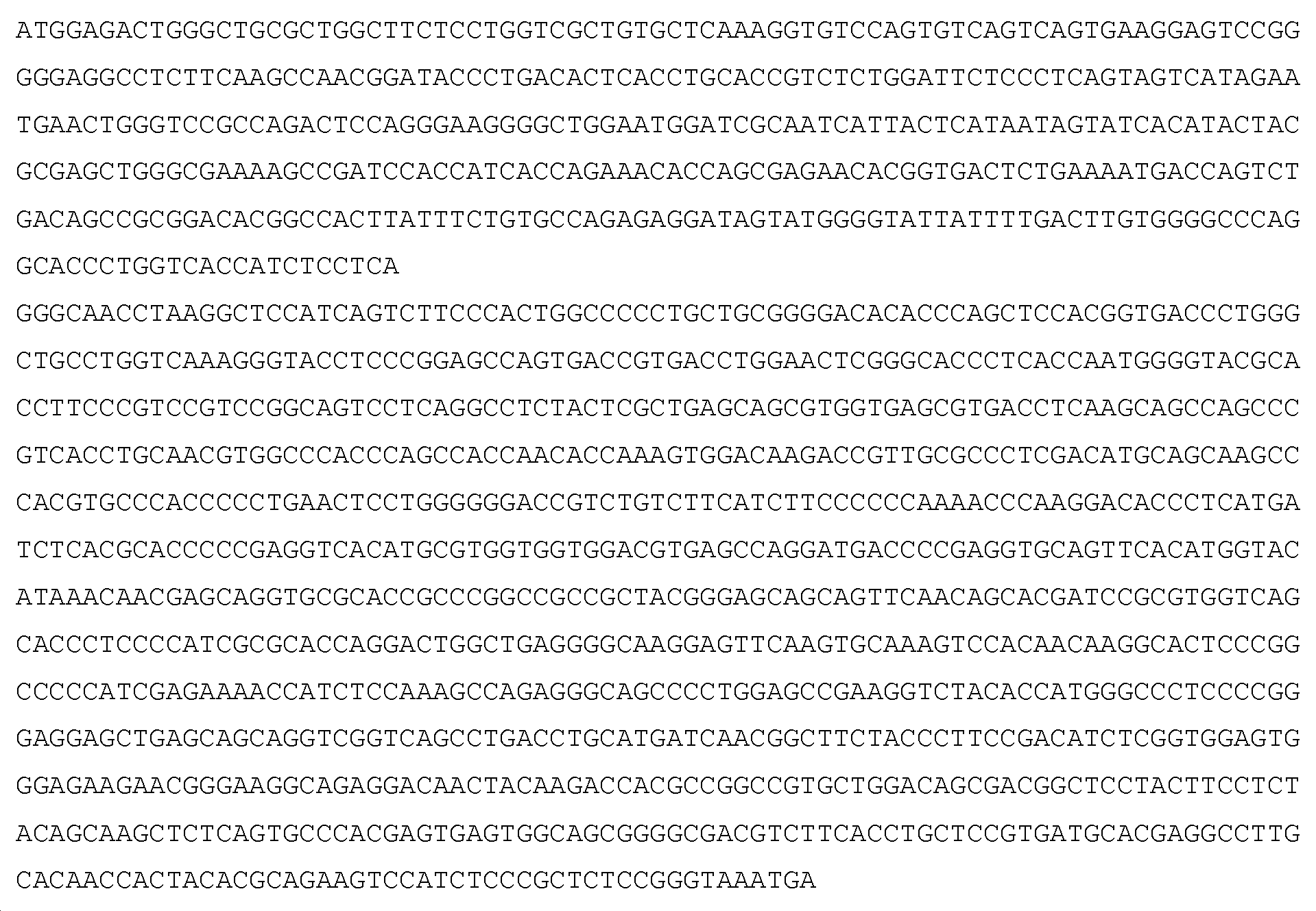
MIL-44-148-2 H2 아미노산(서열 목록 번호 42)MIL-44-148-2 H2 amino acids (SEQ ID NO: 42)
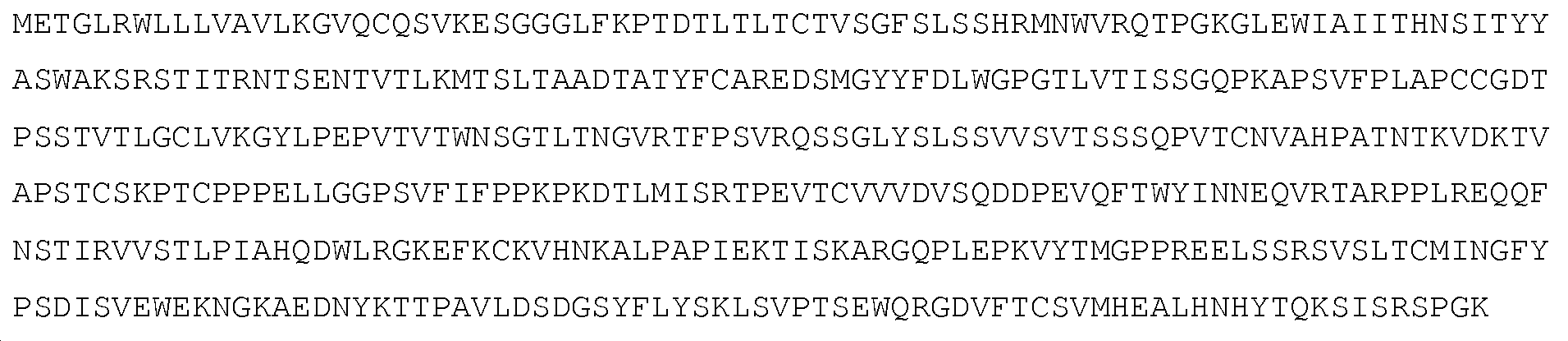
MIL-44-148-2 L5 핵산(서열 목록 번호 5)MIL-44-148-2 L5 Nucleic Acids (SEQ ID NO: 5)

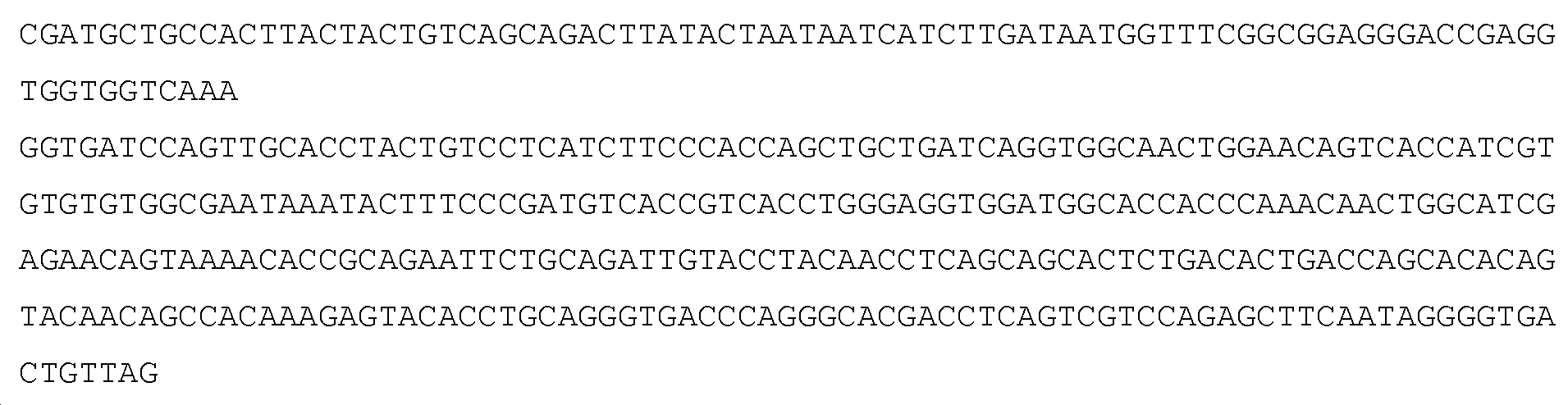
MIL-44-148-2 L5 아미노산(서열 목록 번호 43)MIL-44-148-2 L5 amino acids (SEQ ID NO: 43)

MIL-44-67-4 H2 핵산(서열 목록 번호 6)MIL-44-67-4 H2 Nucleic Acids (SEQ ID NO: 6)

MIL-44-67-4 H2 아미노산(서열 목록 번호 44)MIL-44-67-4 H2 amino acids (SEQ ID NO: 44)
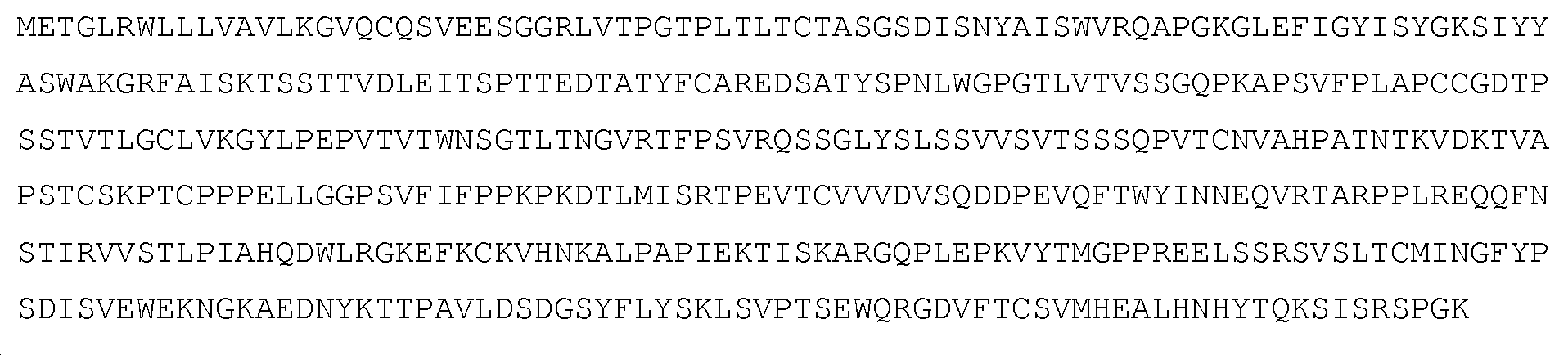
MIL-44-67-4 L4 핵산(서열 목록 번호 7)MIL-44-67-4 L4 Nucleic Acids (SEQ ID NO: 7)

MIL-44-67-4 L4 아미노산(서열 목록 번호 45)MIL-44-67-4 L4 amino acids (SEQ ID NO 45)

〔표 2〕Table 2
항-term- GCCGCC 토끼 rabbit mAbmAb 의 가변 영역에 대한 서열 목록 번호의 요약Summary of Sequence Listing Numbers for the Variable Regions of

〔표 3〕Table 3
항-term- GCCGCC 토끼 rabbit mAbmAb 의 of mAbmAb 가변 영역의 아미노산 서열 Amino acid sequence of the variable region

〔표 4〕Table 4
항-term- GCCGCC 토끼 rabbit mAbmAb 의 of mAbmAb 가변 영역의 핵산 서열 Nucleic Acid Sequences in Variable Regions

〔표 5〕Table 5
항-term- GCCGCC 토끼 rabbit mAbmAb 의 of CDRCDR 의 아미노산 서열Amino acid sequence of
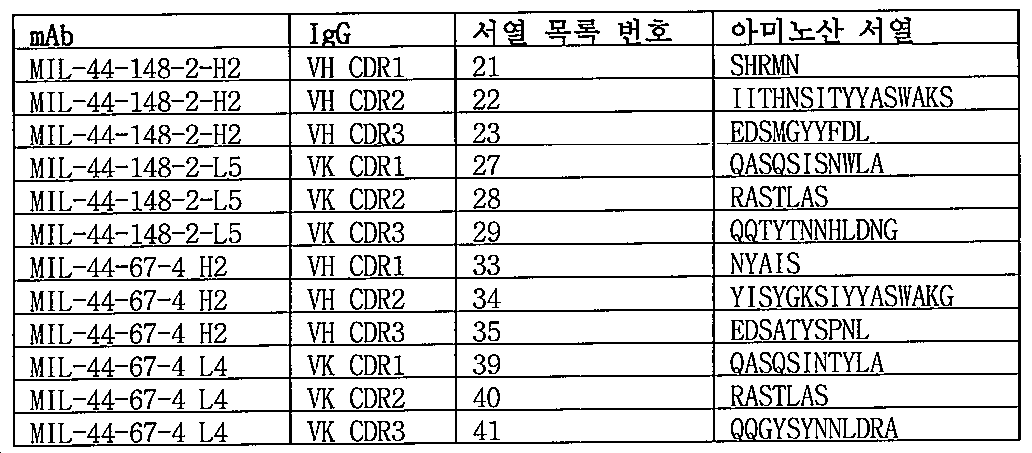
〔표 6〕Table 6
항-term- GCCGCC 토끼 rabbit mAbmAb 의 of CDRCDR 의 핵산 서열Nucleic acid sequence

치료적Therapeutic 용도 Usage
본원에 기재된 토끼 모노클로날 항-GCC 항체 분자는 시험관 내 및 생체 내 유용성을 갖는다. 예를 들어, 이들 항체 분자는 , 다양한 장애를 치료하고/하거나 예방하기 위해, 예로 시험관 내 또는 생체 외 배양에서 세포로 투여되거나 또는 예로 생체 내에서 대상체에 투여될 수 있다. 본 발명의 치료적 적용의 특정 구현예에서, 본 발명의 토끼 모노클로날 항-GCC 항체 분자는 본원에서 전술된 하나 이상의 기법을 이용하여 인간화된다. Rabbit monoclonal anti-GCC antibody molecules described herein have utility in vitro and in vivo. For example, these antibody molecules can be administered to cells in, for example, in vitro or in vitro culture, or to a subject, for example, in vivo, to treat and / or prevent various disorders. In certain embodiments of the therapeutic application of the invention, the rabbit monoclonal anti-GCC antibody molecule of the invention is humanized using one or more of the techniques described herein above.
본원에 기재된 항체 분자, 면역콘주게이트, 및 융합 단백질은 GCC 단백질의 활성 또는 기능, 예컨대 리간드 결합(예로, ST 또는 구아닐린의 결합), GCC-매개 신호 전달, 장액, 전해질 항상성 유지, 세포내 칼슘 방출(칼슘 플럭스), 세포 분화, 세포 증식, 또는 세포 활성화를 조절하는데 이용될 수 있다. The antibody molecules, immunoconjugates, and fusion proteins described herein may be directed to the activity or function of a GCC protein, such as ligand binding (eg, binding of ST or guaniline), GCC-mediated signal transduction, serous fluid, maintenance of electrolyte homeostasis, intracellular calcium It can be used to regulate release (calcium flux), cell differentiation, cell proliferation, or cell activation.
하나의 측면에서, 본 발명은 GCC-발현 세포를 사멸, 성장의 저해 또는 조절, 또는 대사의 방해 방법을 특징으로 한다. 하나의 구현예에서, 본 발명은 GCC-매개 세포 신호전달의 저해 방법 또는 세포의 사멸 방법을 제공한다. 상기 방법은 GCC를 발현하는 임의의 세포 또는 조직, 예컨대 암성 세포와 함께 이용될 수 있다. GCC를 발현하는 암성 세포의 예에는 비제한적으로 위장관 유래의 암(예로, 결직장암, 위암, 소장암, 또는 식도암), 췌장암, 폐암(예로, 편평상피세포 암종, 선편평상피 암종, 선암종), 연조직 육종, 예컨대 평활근육종 또는 횡문근육종, 위장관 또는 기관지폐 신경내분비 종양, 또는 신경외배엽 종양, 또는 이들의 임의의 전이성 병소로부터의 세포가 포함된다. GCC-발현 세포의 비제한적 예에는 T84 인간 결장 선암종 세포, 신선 또는 냉동 결장 종양 세포, 및 GCC 또는 이들의 일부를 인코딩하는 재조합 핵산을 포함하는 세포가 포함된다. In one aspect, the invention features methods for killing GCC-expressing cells, inhibiting or regulating growth, or disrupting metabolism. In one embodiment, the invention provides a method of inhibiting GCC-mediated cell signaling or a method of killing cells. The method can be used with any cell or tissue that expresses GCC, such as cancerous cells. Examples of cancerous cells expressing GCC include, but are not limited to, cancers derived from the gastrointestinal tract (eg, colorectal cancer, gastric cancer, small intestine cancer, or esophageal cancer), pancreatic cancer, lung cancer (eg, squamous cell carcinoma, adenosquamous carcinoma, adenocarcinoma), Soft tissue sarcomas, such as leiomyosarcoma or rhabdomyosarcoma, gastrointestinal or bronchial neuroendocrine tumors, or neuroectodermal tumors, or any metastatic lesions thereof. Non-limiting examples of GCC-expressing cells include T84 human colon adenocarcinoma cells, fresh or frozen colon tumor cells, and cells comprising recombinant nucleic acids encoding GCC or portions thereof.
본 발명의 방법에는 본원에 기재된 바와 같이, 유효한, 즉 GCC-매개 세포 신호전달을 저해하기 충분한 양 또는 세포를 사멸시키기 충분한 양으로, 항-GCC 항체 분자 또는 이들의 면역콘주게이트와 세포를 접촉시키는 단계가 포함된다. 상기 방법은 배양에서, 예로 시험관 내, 생체 내, 생체 외, 또는 원 위치에서 세포 상에 이용될 수 있다. 예를 들어, GCC를 발현하는 세포(예로, 종양 또는 전이성 병소의 생검에 의해 수집된 세포; 확립된 암 세포주로부터의 세포; 또는 재조합 세포)는 배양 배지 중에서 시험관 내 배양될 수 있고, 접촉 단계는 항-GCC 항체 분자 또는 면역콘주게이트를 배양 배지에 첨가하여 시행될 수 있다. 세포의 사멸 방법에서, 상기 방법은 네이키드 항-GCC 항체 분자, 또는 항-GCC 항체 분자 및 세포독성제를 포함하는 면역콘주게이트의 이용을 포함한다. 방법은 GCC를 발현하는 특정 종양 세포(예로, 결장 종양 세포)를 포함하는 GCC 발현 세포의 사멸을 일으킬 것이다. The methods of the invention, as described herein, include contacting a cell with an anti-GCC antibody molecule or an immunoconjugate thereof in an effective, ie, sufficient amount to inhibit GCC-mediated cell signaling or in an amount sufficient to kill the cell. Steps are included. The method can be used in culture, for example on cells in vitro, in vivo, ex vivo, or in situ. For example, cells expressing GCC (eg, cells collected by biopsy of a tumor or metastatic lesion; cells from established cancer cell lines; or recombinant cells) can be cultured in vitro in culture medium and the contacting step is Anti-GCC antibody molecules or immunoconjugates can be carried out by addition to the culture medium. In a method of killing cells, the method involves the use of naked anti-GCC antibody molecules, or immunoconjugates comprising an anti-GCC antibody molecule and a cytotoxic agent. The method will result in the death of GCC expressing cells, including certain tumor cells expressing GCC (eg, colon tumor cells).
본 발명의 토끼 모노클로날 항체, 또는 이들의 인간화 버전은 당분야 숙련자에게 널리 공지된 면역형광 현미경 기법을 이용하여 GCC로의 결합 후 세포 내면화에 대해 평가될 수 있다. 내면화하는 것으로 확인되는 항체는 치료 목적으로 세포독성 부분에 또는 세포 조영을 위한 부분에 연결되는 경우 유용할 것이다. 내면화하지 않는 항체도 여전히 항체-의존적 세포-매개 세포독성 반응을 야기하도록 설계된 네이키드 항체를 이용하여 치료 방법을 위해 또는 진단 목적을 위해, 또는 아마도 리포좀 전달 방법을 위해 이용될 수 있다. Rabbit monoclonal antibodies, or humanized versions thereof, of the present invention can be assessed for cell internalization following binding to GCC using immunofluorescence microscopy techniques well known to those skilled in the art. Antibodies that are found to be internalized will be useful when linked to a cytotoxic moiety or a moiety for cell imaging for therapeutic purposes. Antibodies that are not internalized can still be used for therapeutic methods or for diagnostic purposes, or perhaps for liposome delivery methods, using naked antibodies designed to cause antibody-dependent cell-mediated cytotoxic responses.
본 발명의 항-GCC 항체 분자는 항원을 발현하는 세포에서 GCC의 세포외 도메인 또는 이들의 일부에 결합한다. 그 결과, 본 발명의 방법을 암성 세포의 사멸, 억제 또는 검출을 위해 수행하는 경우, 항체 또는 항원 결합 단편은 고정된 세포뿐만 아니라 세포내 항원성 도메인이 다른 방식으로 세포외 환경에 노출되는 세포에도 결합한다. 결과적으로, 항체 또는 항원 결합 단편의 결합은 세포가 고정되건 고정되지 않건, 생활성이건 괴사성이건 무관하게, GCC를 발현하는 세포가 있는 영역에서 농축된다. 부가적으로 또는 대안적으로, 항-GCC 항체 분자는 항원을 발현하는 세포에 결합 시 GCC에 결합하고 이를 내면화한다. Anti-GCC antibody molecules of the invention bind to the extracellular domain of GCC or a portion thereof in cells expressing an antigen. As a result, when the method of the present invention is performed for killing, inhibiting or detecting cancerous cells, the antibody or antigen-binding fragment is not only immobilized but also to cells in which the intracellular antigenic domains are exposed to the extracellular environment in different ways. To combine. As a result, the binding of the antibody or antigen-binding fragment is concentrated in the region where the cells expressing GCC are located, whether the cells are fixed or unfixed, live or necrotic. Additionally or alternatively, the anti-GCC antibody molecule binds to and internalizes GCC upon binding to cells expressing the antigen.
상기 방법은 또한 생체 내 프로토콜의 일환으로, 대상체에 존재하는 세포 상에서 수행될 수 있다. 하나의 구현예에서, 대상체는 인간 대상체이다. 대안적으로, 대상체는 본원에 개시된 항-GCC 항체 분자가 교차 반응하는 GCC 항원을 발현하는 포유류일 수 있다. 항-GCC 항체 분자 또는 이들의 면역콘주게이트는 치료 목적을 위해 인간 대상체에 투여될 수 있다. 항-GCC 항체 분자 또는 면역콘주게이트는 또한 항체가 인간 질환의 동물 모델로서 또는 수의학적 목적으로 교차 반응하는 GCC-유사 항원을 발현하는 비-인간 포유류(예로 영장류, 돼지 또는 마우스)에 투여될 수 있다. 동물 모델은 본 발명의 항체의 치료 유효성 평가(예로 투여량 및 투여의 시간 경과 평가)에 유용할 수 있다. 생체 내 구현예에 있어서, 접촉 단계는 대상체에서 시행되며, 세포 상에서 발현되는 GCC의 세포외 도메인에 대한 항체 분자의 결합 및 세포의 치료를 모두 허용하는데 효과적인 조건 하에 대상체에 대한 항-GCC 항체 분자 또는 이들의 면역콘주게이트의 투여가 포함된다. The method may also be performed on cells present in a subject as part of an in vivo protocol. In one embodiment, the subject is a human subject. Alternatively, the subject may be a mammal that expresses a GCC antigen to which the anti-GCC antibody molecules disclosed herein cross react. The anti-GCC antibody molecule or immunoconjugate thereof can be administered to a human subject for therapeutic purposes. Anti-GCC antibody molecules or immunoconjugates may also be administered to non-human mammals (eg, primates, pigs or mice) that express GCC-like antigens to which the antibody cross reacts as an animal model of human disease or for veterinary purposes. have. Animal models may be useful for evaluating the therapeutic effectiveness of the antibodies of the invention (eg, evaluating dosages and time course of administration). In an in vivo embodiment, the contacting step is carried out in the subject, wherein the anti-GCC antibody molecule or subject to the subject is effective under conditions effective to allow both binding of the antibody molecule to the extracellular domain of GCC expressed on the cell and treatment of the cell. Administration of these immunoconjugates.
하나의 구현예에서, 본 발명은 치료를 필요로 하는 환자에게 항-GCC 항체 분자 또는 항-GCC 항체 분자 및 세포독성제를 포함하는 면역콘주게이트를 투여함으로써 암을 치료하는 방법을 제공한다. 상기 방법은 GCC 항원을 발현하는 적어도 일부 세포를 포함하는 임의의 암성 장애의 치료에 이용될 수 있다. 본원에서 이용되는 용어 "암"은 조직학적 유형 또는 침습 단계와 무관하게, 모든 유형의 암성 성장 또는 종양발생 절차, 전이성 조직 또는 악성으로 형질전환된 세포, 조직 또는 기관을 포함하는 것을 의미한다. 용어 "암" 및 "종양"은 상호교환적으로 이용될 수 있다(예로, 치료 방법의 맥락에서 이용되는 경우, "암의 치료" 및 "종양의 치료"는 동일한 의미를 갖는다). In one embodiment, the present invention provides a method of treating cancer by administering an immunoconjugate comprising an anti-GCC antibody molecule or an anti-GCC antibody molecule and a cytotoxic agent to a patient in need thereof. The method can be used for the treatment of any cancerous disorder including at least some cells expressing a GCC antigen. The term "cancer" as used herein is meant to include any type of cancerous growth or oncogenic procedure, metastatic tissue or malignantly transformed cells, tissues or organs, regardless of histological type or invasive step. The terms “cancer” and “tumor” can be used interchangeably (eg, when used in the context of a method of treatment, “treatment of cancer” and “treatment of tumor” have the same meaning).
구현예에서, 치료는 대상체의 종양 성장을 감소시키거나 저해하기에, 전이성 병소의 수 또는 크기를 감소시키기에, 종양 부하를 감소시키기에, 일차 종양 부하를 감소시키기에, 침습성을 감소시키기에, 생존 시간을 연장하기에, 또는 삶의 질을 유지하거나 개선하기에 충분하다. In embodiments, the treatment comprises reducing or inhibiting tumor growth of the subject, reducing the number or size of metastatic lesions, reducing tumor burden, reducing primary tumor burden, reducing invasiveness, It is enough to prolong survival time or to maintain or improve the quality of life.
암성 장애의 예에는 비제한적으로 고형 종양, 연조직 종양, 및 전이성 병소가 포함된다. 고형 종양의 예에는 다양한 조직계, 예로 결장에 영향을 미치는 계의 악성물, 예로 육종, 선암종, 및 암종이 포함된다. 선암종에는 악성물, 예컨대 폐의 비-소세포 암종이 포함된다. 상기 언급된 암의 전이성 병소도 본 발명의 방법 및 조성물을 이용하여 치료되거나 예방될 수 있다. Examples of cancerous disorders include, but are not limited to, solid tumors, soft tissue tumors, and metastatic lesions. Examples of solid tumors include malignants of various tissue systems, such as those affecting the colon, such as sarcomas, adenocarcinomas, and carcinomas. Adenocarcinomas include malignants such as non-small cell carcinoma of the lung. Metastatic lesions of the aforementioned cancers can also be treated or prevented using the methods and compositions of the present invention.
일부 구현예에서, 치료될 GCC-발현 암은 위장관 유래의 일차 또는 전이성 암, 예컨대 결직장암, 위암, 소장암, 또는 식도암이다. 일부 구현예에서, 치료될 GCC-발현 암은 일차 또는 전이성 췌장암이다. 일부 구현예에서, 치료될 GCC-발현 암은 일차 또는 전이성 폐암, 예컨대 편평상피세포 암종, 선편평상피 암종, 또는 선암종이다. 일부 구현예에서, 치료될 GCC-발현 암은 육종, 예컨대 평활근육종 또는 횡문근육종이다. 일부 구현예에서, 치료될 GCC-발현 암은 일차 또는 전이된 신경외배엽 종양, 예컨대 부신혈관종 또는 부신경절종이다. 일부 구현예에서, GCC-발현 암은 일차 또는 전이된 기관지폐 또는 위장관 신경내분비 종양이다. In some embodiments, the GCC-expressing cancer to be treated is a primary or metastatic cancer derived from the gastrointestinal tract, such as colorectal cancer, gastric cancer, small intestine cancer, or esophageal cancer. In some embodiments, the GCC-expressing cancer to be treated is a primary or metastatic pancreatic cancer. In some embodiments, the GCC-expressing cancer to be treated is primary or metastatic lung cancer such as squamous cell carcinoma, adenosquamous carcinoma, or adenocarcinoma. In some embodiments, the GCC-expressing cancer to be treated is a sarcoma, such as leiomyosarcoma or rhabdomyosarcoma. In some embodiments, the GCC-expressing cancer to be treated is a primary or metastasized neuroectodermal tumor such as adrenal hemangioma or adrenal ganglia. In some embodiments, the GCC-expressing cancer is a primary or metastasized bronchial or gastrointestinal neuroendocrine tumor.
상기 방법은 임의 단계 또는 하위분류에서 관련 장애의 치료에 유용할 수 있다. 예를 들어, 방법은 초기 또는 추기 단계 결장암, 또는 임의의 단계 0, I, IIA, IIB, IIIA, IIIB, IIIC, 및 IV의 결장암의 치료에 이용될 수 있다. The method may be useful for the treatment of related disorders at any stage or subclass. For example, the methods can be used to treat early or additional stage colon cancer, or colon cancer of any
일부 구현예에서, GCC-발현 암(예로, 결직장암, 위암, 소장암, 식도암, 췌장암, 폐암, 평활근육종, 횡문근육종, 신경내분비 종양, 신경외배엽 종양 등)의 치료 방법은 본원에 기재된 네이키드 항-GCC 항체 분자의 치료를 필요로 하는 환자에 대한 투여를 포함한다. 다른 구현예에서, 방법은 본원에 기재된 항-GCC 항체 분자 및 세포독성제, 예컨대 메이탄사노이드 또는 오리스타틴, 또는 이들의 유도체를 포함하는 면역콘주게이트의 투여를 포함한다. 항체 분자 및 면역콘주게이트의 투여 방법은 전술되어 있다. 사용되는 분자의 적합한 투여량은 대상체의 연령 및 체중, 그리고 사용되는 특정 화합물에 의존할 것이다. In some embodiments, a method of treating GCC-expressing cancer (eg, colorectal cancer, gastric cancer, small intestine cancer, esophageal cancer, pancreatic cancer, lung cancer, leiomyosarcoma, rhabdomyosarcoma, neuroendocrine tumor, neuroectoderm tumor, etc.) described herein Administration to patients in need of treatment of anti-GCC antibody molecules. In another embodiment, the method comprises administering an immunoconjugate comprising an anti-GCC antibody molecule described herein and a cytotoxic agent such as maytansanoids or orstatin, or derivatives thereof. Methods of administering antibody molecules and immunoconjugates are described above. Suitable dosages of the molecules used will depend on the age and weight of the subject and the particular compound used.
일부 구현예에서, 항-GCC 항체 분자 또는 면역콘주게이트는 치료 사이클에 투여된다. "치료 사이클"은 항-GCC 항체 분자 또는 면역콘주게이트가 전술된 바와 같이 투여되는 치료 기간에 이어 항-GCC 항체 분자 또는 면역콘주게이트가 투여되지 않는 휴지 기간으로 구성된다. 치료 사이클은 원하는 효과를 달성하기 위해 필요에 따라 반복될 수 있다.In some embodiments, the anti-GCC antibody molecule or immunoconjugate is administered in a treatment cycle. A "treatment cycle" consists of a treatment period in which the anti-GCC antibody molecule or immunoconjugate is administered as described above, followed by a rest period in which the anti-GCC antibody molecule or immunoconjugate is not administered. The treatment cycle can be repeated as needed to achieve the desired effect.
본원에 기재된 항-GCC 항체(예로, 네이키드 항-GCC 항체 분자 또는 항-GCC 항체 분자 및 치료제를 포함하는 면역콘주게이트)는 다른 치료법과의 조합으로 이용될 수 있다. 예를 들어, 조합 치료법에는 하나 이상의 추가적 치료제, 예로 하나 이상의 항암제, 예로 세포독성제 또는 세포증식억제제, 호르몬 치료, 백신, 및/또는 다른 면역치료법과 함께 제형화되고/되거나 함께 투여되는 본 발명의 조성물이 포함될 수 있다. 다른 구현예에서, 항-GCC 항체는 수술, 방사선, 저온수술 및/또는 온열치료법을 포함하는 다른 치료적 처치 방식과 조합으로 투여된다. 이러한 조합 치료법은 유리하게는 더 낮은 투여량의 투여 치료제를 이용하여 다양한 단일치료법과 연관된 가능한 독성 또는 합병증을 배제할 수 있다. Anti-GCC antibodies described herein (eg, immunoconjugates comprising naked anti-GCC antibody molecules or anti-GCC antibody molecules and therapeutic agents) can be used in combination with other therapies. For example, combination therapies may be formulated with and / or administered in combination with one or more additional therapeutic agents, such as one or more anticancer agents, such as cytotoxic or cytostatic agents, hormone therapy, vaccines, and / or other immunotherapies. Compositions may be included. In other embodiments, the anti-GCC antibody is administered in combination with other therapeutic modalities, including surgery, radiation, cryosurgery, and / or thermotherapy. Such combination therapies can advantageously rule out possible toxicity or complications associated with various monotherapy using lower dose dosing agents.
본원에서 이용되는 "조합으로" 투여된 이란 2(또는 그 초과의) 상이한 치료가 장애를 앓는 대상체의 경과 동안 대상체에 전달된다는 것을, 예로 대상체가 장애로 진단받은 뒤 장애가 해결되거나 제거되기 전에 2 또는 그 초과의 치료가 전달된다는 것을 의미한다. 일부 구현예에서, 하나의 치료의 전달은 두 번째 전달이 시작될 때 여전히 수행되고 있어서 겹침이 있다. 이는 본원에서 때때로 "동시에" 또는 "공동 전달"로 나타낸다. 다른 구현예에서, 하나의 치료의 전달은 다른 치료의 전달이 시작되기 전에 종료된다. 어느 한 경우의 일부 구현예에서, 치료는 조합된 투여로 인해 더 효과적이다. 예를 들어, 두 번째 치료가 더 효과적거나, 예로 더 적은 두 번째 치료로 동등한 효과가 나타나거나, 또는 두 번째 치료는 두 번째 치료가 첫 번째 치료의 부재 하에 투여된 경우 나타났을 것에 비해 더 큰 정도로 증상을 감소시키거나, 또는 첫 번째 치료와 유사한 상황이 나타난다. 일부 구현예에서, 전달은 증상 또는 장애에 관련된 다른 파라미터의 감소가 다른 것의 부재 하에 전달되는 하나의 치료로 관찰될 것에 비해 더 큰 것이다. 두 치료의 효과는 부분적으로 부가적이거나 전체적으로 부가적이거나 부가적인 것보다 클 수 있다. 전달은 전달되는 첫 번째 치료의 효과가 두 번째 전달 시에도 여전히 검출가능한 것일 수 있다.As used herein, "in combination" with Iran means that two (or more) different treatments are delivered to a subject during the course of a subject with a disorder, eg, after the subject is diagnosed with the disorder and before the disorder is resolved or eliminated. It means that more treatment is delivered. In some embodiments, the delivery of one treatment is still being performed at the beginning of the second delivery so there is overlap. This is sometimes referred to herein as "simultaneous" or "co-delivery". In other embodiments, the delivery of one treatment ends before the delivery of the other treatment begins. In some embodiments of either case, the treatment is more effective due to the combined administration. For example, a second treatment may be more effective, for example an equivalent effect with fewer second treatments, or a second treatment to a greater extent than would have been seen if the second treatment was administered in the absence of the first treatment. Reduce the symptoms, or a situation similar to the first treatment. In some embodiments, the delivery is greater than would be observed with one treatment in which the reduction in other parameters related to the symptoms or disorder is delivered in the absence of the other. The effects of both treatments may be partially additional, or totally greater than, or additional to, additional. The delivery may be such that the effect of the first treatment delivered is still detectable upon the second delivery.
일부 구현예에서, 항-GCC 항체 분자 또는 이들의 면역콘주게이트는 화학치료제와 조합 사용된다. DNA 손상 화학치료제의 비제한적 예에는 토포이소머라아제 I 저해제(예로, 이리노테칸, 토포테칸, 캄프토테신 및 이들의 유사체 또는 대사체 및 독소루비신); 토포이소머라아제 II 저해제(예로, 에토포시드, 테니포시드 및 다우노루비신); 알킬화 제제(예로, 멜팔란, 클로람부실, 부설판, 티오테파, 이포스파미드, 카르무스틴, 로무스틴, 세무스틴, 스트렙토조신, 데카르바진, 메토트렉세이트, 미토마이신 C, 및 시클로포스파미드); DNA 중격제(예로, 시스플라틴, 옥살리플라틴 및 카르보플라틴); DNA 중격제 및 자유 라디칼 생성제, 예컨대 블레오마이신; 및 뉴클레오시드 모사체(예로, 5-플루오로우라실, 카페시티빈, 젬시타빈, 플루다라빈, 시타라빈, 메르캅토퓨린, 티오구아닌, 펜토스타틴, 및 히드록시우레아)가 포함된다. In some embodiments, the anti-GCC antibody molecule or immunoconjugate thereof is used in combination with a chemotherapeutic agent. Non-limiting examples of DNA damaging chemotherapeutic agents include topoisomerase I inhibitors (eg, irinotecan, topotecan, camptothecin and analogs or metabolites thereof and doxorubicin); Topoisomerase II inhibitors (eg, etoposide, teniposide and daunorubicin); Alkylating agents (e.g. melphalan, chlorambucil, busulfan, thiotepa, ifosfamide, carmustine, lomustine, semustine, streptozosin, decarbazine, methotrexate, mitomycin C, and cyclophosphamide) ; DNA septals (eg cisplatin, oxaliplatin and carboplatin); DNA seperators and free radical generators such as bleomycin; And nucleoside mimetics (eg, 5-fluorouracil, caffeicitine, gemcitabine, fludarabine, cytarabine, mercaptopurine, thioguanine, pentostatin, and hydroxyurea).
세포 복제를 손상시키는 화학치료제에는 파클리탁셀, 도세탁셀 및 관련 유사체; 빈크리스틴, 빈블라스틴 및 관련 유사체; 탈리도미드, 레날리도미드, 및 관련 유사체(예로, CC-5013 및 CC-4047); 단백질 티로신 키나아제 저해제(예로, 이마티닙 메실레이트 및 게피티닙); 프로테아좀 저해제(예로, 브로테조밉); NF-κB 저해제, 예컨대 IκB 키나아제 저해제; 암에서 과발현되는 단백질에 결합하여 세포 복제를 하향조절하는 항체(예로, 트라스투주맵, 리툭시맵, 세툭시맵 및 베바시주맵); 및 암에서 상향조절되거나 과발현되거나 활성화되어 그 저해가 세포 복제를 하향조절하는 것으로 알려져 있는 단백질 또는 효소의 다른 저해제가 포함된다. Chemotherapeutic agents that impair cell replication include paclitaxel, docetaxel and related analogs; Vincristine, vinblastine and related analogs; Thalidomide, lenalidomide, and related analogs (eg, CC-5013 and CC-4047); Protein tyrosine kinase inhibitors (eg, imatinib mesylate and gefitinib); Proteasome inhibitors (eg brothezomib); NF-κB inhibitors such as IκB kinase inhibitors; Antibodies that bind to proteins that are overexpressed in cancer and downregulate cell replication (eg, trastuzumab, rituximab, cetuximab and bevacizumab); And other inhibitors of proteins or enzymes that are known to be upregulated, overexpressed or activated in cancer and whose inhibition is known to downregulate cell replication.
본 발명의 항-GCC 항체 분자 또는 면역콘주게이트와 조합될 치료제(들) 또는 치료 방식의 선택은 치료될 장애에 의존할 것이다. 추가적인 제제(들) 또는 치료 방식에는, 예를 들어 치료받는 적응증에 대한 표준 승인 치료법이 포함될 수 있다. 예를 들어, 항-GCC 항체 분자 또는 이들의 면역콘주게이트가 결장암을 치료하기 위해 이용되는 경우, 이는 또한, 예로 수술; 방사선 치료법; 5-플루오로우리실(5-FU), 카페시티빈, 류코보린, 이리노테칸, 옥살리플라틴, 베바시주맵, 세툭시맵, 패니투뭄, 또는 이들의 조합(예로, 옥살리플라틴/카페시티빈(XELOX), 5-플루오로우리실/류코보린/-옥살리플라틴(FOLFOX), 5-플루오로우리실/류코보린/이리노테칸(FOLFIRI), FOLFOX + 베바시주맵, 또는 FOLFIRI + 베바시주맵)과의 조합으로 이용될 수 있다. The choice of therapeutic agent (s) or mode of treatment to be combined with the anti-GCC antibody molecule or immunoconjugate of the invention will depend on the disorder to be treated. Additional agent (s) or mode of treatment may include, for example, standard approved therapies for the indication being treated. For example, if an anti-GCC antibody molecule or immunoconjugate thereof is used to treat colon cancer, it may also include, for example, surgery; Radiation therapy; 5-fluorourisyl (5-FU), caffeicitine, leucovorin, irinotecan, oxaliplatin, bevacizumab, cetuximab, panitummum, or a combination thereof (e.g., oxaliplatin / cafecytibin (XELOX), To be used in combination with 5-fluorourisyl / leukoboline / -oxaliplatin (FOLFOX), 5-fluorourisyl / leukoboline / irinotecan (FOLFIRI), FOLFOX + Bevacizumab, or FOLFIRI + Bevacizumab) Can be.
또 다른 측면에서, 본 발명은 약제의 제조에서 본원에 기재된 바와 같은 항-GCC 항체 분자 또는 면역콘주게이트의 용도를 특징으로 한다. 하나의 구현예에서, 약제는 암, 예로 위장관 암을 치료하기 위한 것이다. 일부 구현예에서, 약제는 표 1-6에 요약된 특징을 갖는 항-GCC 항체 분자를 포함한다. 일부 구현예에서, 약제는 MIL-44-148-2 또는 MIL-44-67-4 항체 분자, 또는 이들의 인간화 버전을 포함한다. In another aspect, the invention features the use of an anti-GCC antibody molecule or immunoconjugate as described herein in the manufacture of a medicament. In one embodiment, the medicament is for treating cancer, such as gastrointestinal cancer. In some embodiments, the medicament comprises an anti-GCC antibody molecule having the characteristics summarized in Tables 1-6. In some embodiments, the medicament comprises a MIL-44-148-2 or MIL-44-67-4 antibody molecule, or a humanized version thereof.
항체 표지 및 검출Antibody Labeling and Detection
본원에 기재된 방법, 예로 시험관 내 및 생체 내 검출, 예로 진단, 단계결정, 또는 조영 방법에서 이용되는 항-GCC 항체 분자는 결합되거나 결합되지 않은 결합제의 검출을 촉진하는 검출가능한 물질로 직접 또는 간접 표지될 수 있다. 적합한 검출가능한 물질에는 다양한 생물학적 활성 효소, 리간드, 보철기, 형광 재료, 발광 재료, 화학발광 재료, 생물발광 재료, 발색 재료, 전자 밀집 재료, 상자성(예로, 핵 자기 공명 활성) 재료, 및 방사활성 재료가 포함된다. 일부 구현예에서, 항-GCC 항체 분자는 방사활성 이온, 예로, 인듐(111In), 요오드(131I 또는 125I), 이트륨(90Y), 루테튬(177Lu), 액티늄(225Ac), 비스무스(212Bi 또는 213Bi), 황(35S), 탄소(14C), 삼중수소(3H), 로듐(188Rh), 테크네튬(99mTc), 프라세오디뮴, 또는 인(32P); 또는 양전자-방출 방사선 핵종, 예로 탄소-11(11C) 칼륨-40(40K), 질소-13(13N), 산소-15(15O), 불소-18(18F), 갈륨(68Ga), 및 요오드-121(121I)에 커플링된다. 시험관 내 또는 생체 내 진단/검출 방법에 사용하기 위한 본 발명의 항체에 콘주게이트될 수 있는 추가적인 방사활성 제제는 아래에 기재된다. Methods described herein, eg in vitro And anti-GCC antibody molecules used in in vivo detection, such as diagnostic, staged, or contrast methods, may be directly or indirectly labeled with a detectable substance that facilitates detection of bound or unbound binders. Suitable detectable materials include various biologically active enzymes, ligands, prostheses, fluorescent materials, luminescent materials, chemiluminescent materials, bioluminescent materials, chromogenic materials, electron dense materials, paramagnetic (eg, nuclear magnetic resonance activity) materials, and radioactive materials. Material is included. In some embodiments, the anti-GCC antibody molecule is a radioactive ion, such as indium ( 111 In), iodine ( 131 I or 125 I), yttrium ( 90 Y), lutetium ( 177 Lu), actinium ( 225 Ac) , Bismuth ( 212 Bi or 213 Bi), sulfur ( 35 S), carbon ( 14 C), tritium ( 3 H), rhodium ( 188 Rh), technetium ( 99 mTc), praseodymium, or phosphorus ( 32 P); Or positron-emitting radionuclides, such as carbon-11 ( 11 C) potassium-40 ( 40 K), nitrogen-13 ( 13 N), oxygen-15 ( 15 O), fluorine-18 ( 18 F), gallium ( 68 Ga), and iodine- 121 ( 121 I). Additional radioactive agents that can be conjugated to the antibodies of the invention for use in in vitro or in vivo diagnostic / detection methods are described below.
예시적인 표지에는 형광단, 예컨대 희토류 킬레이트 또는 플루오레신 및 그 유도체, 로다민 및 그 유도체, 단실, 움벨리페론, 루세리퍼라아제, 예로 초파리 루시퍼라아제 및 박테리아 루시퍼라아제(U.S. 특허 번호 4,737,456), 루시페린, 및 2,3-디히드로프탈라진디온이 포함된다. 다른 예시적인 표지에는 홀스래디쉬 페록시다아제(HRP), 알칼린 포스파타아제, 갈락토시다아제, 글루코아밀라아제, 라이소자임, 당류 옥시다아제, 예로 글루코오스 옥시다아제, 갈락토오스 옥시다아제, 및 글루코오스 6-포스페이트 데히드로게나아제, 헤테로시클릭 옥시다아제, 예컨대 유리카아제 및 잔틴 옥시다아제로, 염료 전구체를 산화시키기 위해 과산화수소를 채용하는 효소, 예컨대 HRP, 락토페록시다아제, 또는 마이크로페록시다아제에 커플링된 것, 바이오틴/애비딘, 회전 표지, 박테리오파지 표지, 안정한 자유 라디칼 등이 포함된다. Exemplary labels include fluorophores such as rare earth chelates or fluorescein and derivatives thereof, rhodamine and derivatives thereof, dansyl, umbeliferon, luciferases such as Drosophila luciferase and bacterial luciferases (US Pat. No. 4,737,456). ), Luciferin, and 2,3-dihydrophthalazinedione. Other exemplary labels include horseradish peroxidase (HRP), alkaline phosphatase, galactosidase, glucoamylase, lysozyme, saccharide oxidase such as glucose oxidase, galactose oxidase, and glucose 6-phosphate dehydrogena Oxidases, heterocyclic oxidases such as freeases and xanthine oxidases, coupled to enzymes that employ hydrogen peroxide to oxidize dye precursors such as HRP, lactoperoxidase, or microperoxidase, biotin / Avidin, rotation label, bacteriophage label, stable free radicals, and the like.
형광단 및 발색단 표지된 항체 분자는 당분야에 공지된 표준 부분에서 제조될 수 있다. 항체 및 다른 단백질은 약 310nm까지의 파장을 갖는 광을 흡수하므로, 형광 부분은 310nm 초과, 바람직하게는 400nm 초과의 파장에서 실질적 흡광을 갖는 것이 선택되어야 한다. 다양한 적합한 형광 화합물 및 발색단은 [Stryer Science, 162:526(1968) 및 Brand, L. 등, Annual Review of Biochemistry, 41:843-868(1972)]에 기재된다. 항체는 통상적 절차, 예컨대 U.S. 특허 번호 3,940,475, 4,289,747, 및 4,376,110에 개시된 것에 의해 형광 발색단으로 표지될 수 있다. Fluorophore and chromophore labeled antibody molecules can be prepared from standard moieties known in the art. Since antibodies and other proteins absorb light with wavelengths up to about 310 nm, the fluorescent moiety should be selected to have substantial absorption at wavelengths above 310 nm, preferably above 400 nm. Various suitable fluorescent compounds and chromophores are described in Stryer Science, 162: 526 (1968) and Brand, L. et al., Annual Review of Biochemistry , 41: 843-868 (1972). Antibodies can be labeled with fluorescent chromophores by conventional procedures such as those disclosed in US Pat. Nos. 3,940,475, 4,289,747, and 4,376,110.
상기 기재된 여러 바람직한 특성을 갖는 형광체의 한 그룹은 잔텐 염료로, 여기에는 3,6-디히드록시-9-헤닐잔트히드롤에서 유래된 플루오레신 및 3,6-디히드록시-9-페닐잔트히드롤에서 유래된 레사민 및 로다민, 그리고 리사님 로다민 B가 포함된다. 9-o-카르복시페닐잔트히드롤의 로다민 및 플루오레신 유도체는 9-o-카르복시페닐기를 갖는다. 반응성 커플링기, 예컨대 아미노 및 이소티오시아네이트기를 갖는 플루오레신 화합물, 예컨대 플루오레신 이소티오시아네이트 및 플루오레스카민이 쉽게 이용가능하다. 형광 화합물의 또 다른 그룹은 α 또는 β위치에 아미노기를 갖는 나프틸아민이다. One group of phosphors having several desirable properties described above is xanthene dyes, which include fluorescein and 3,6-dihydroxy-9-phenyl derived from 3,6-dihydroxy-9-henylzanthhydrol. Resamine and rhodamine derived from xanthrol, and lisanim rhodamine B. Rhodamine and fluorescein derivatives of 9-o-carboxyphenylzanthol have 9-o-carboxyphenyl groups. Fluorescein compounds with reactive coupling groups such as amino and isothiocyanate groups are readily available, such as fluorescein isothiocyanate and fluorescarmine. Another group of fluorescent compounds are naphthylamines having amino groups at the α or β positions.
표지된 항체 분자는, 예를 들어 (i) 표준 기법, 예컨대 친화도 크로마토그래피 또는 면역침전에 의해 소정 항원을 단리하고; (ii) 단백질의 발현 과다성 및 패턴을 평가하기 위해 소정 항원을 검출하고(예로, 세포성 용해액 또는 세포 상청액에서); (iii) 임상 평가 절차의 일환으로, 예로 주어진 치료 요법의 유효성을 결정하기 위해 조직에서 단백질 수준을 모니터링하는 것을 포함하는 여러 맥락에서 진단적으로 및/또는 실험적으로 사용될 수 있다. Labeled antibody molecules can, for example, (i) isolate certain antigens by standard techniques such as affinity chromatography or immunoprecipitation; (ii) detecting certain antigens (eg, in cellular lysates or cell supernatants) to assess the expression excess and pattern of the protein; (iii) As part of a clinical evaluation procedure, it may be used diagnostically and / or experimentally in a variety of contexts, including, for example, monitoring protein levels in tissues to determine the effectiveness of a given treatment regimen.
시험관 내 진단In vitro diagnosis
본원에 기재된 항-GCC 항체 및 면역콘주게이트는 GCC의 존재 또는 부재를 검출하기 위해, 예로 대상체로부터 수득된 생체 외 생물학적 표본에서 GCC의 존재 또는 분포 또는 부재를 검출(즉, 시험관 내 검출)하기 위해, 또는 대상체에서 GCC의 존재 또는 부재를 검출(즉, 생체 내 검출)하기 위해 사용될 수 있다. 이러한 검출 방법은 다양한 장애를 검출하거나 진단하는데 또는 치료 결정을 안내하는데 유용하다. 본원에서 이용되는 용어 "검출하는"은 정량적 또는 정성적 검출을 포괄한다. 본원에서 이용되는 GCC 또는 GCC 단백질의 검출은 항-GCC 항체 분자가 결합하는 에피토프를 포함하는 GCC 단백질 부분의 검출을 또는 온전한 GCC 단백질의 검출을 의미한다. The anti-GCC antibodies and immunoconjugates described herein can be used to detect the presence or absence of GCC, eg, to detect (ie, in vitro detection) the presence or distribution or absence of GCC in an in vitro biological sample obtained from a subject. , Or to detect (ie, detect in vivo) the presence or absence of GCC in a subject. Such detection methods are useful for detecting or diagnosing various disorders or for guiding treatment decisions. As used herein, the term “detecting” encompasses quantitative or qualitative detection. As used herein, the detection of a GCC or GCC protein means the detection of a portion of a GCC protein comprising an epitope to which an anti-GCC antibody molecule binds or the detection of an intact GCC protein.
따라서 또 다른 측면에서, 본 발명은 생물학적 표본, 예컨대 세포 또는 조직, 예로 종양 세포, 또는 GCC를 발현하는 하나 이상의 세포를 갖는 종양에서 GCC 발현의 검출 방법을 특징으로 한다. 상기 방법은 항-GCC 항체 분자 및 GCC 단백질 간 복합체의 형성을 허용하는 조건 하에 본원에 기재된 항-GCC 항체 분자(예로, MIL-44-148-2 또는 MIL-44-67-4)와 생물학적 표본을 접촉시키는 단계; 및 항-GCC 항체 분자 및 GCC 단백질 간 복합체의 형성을 검출하여 GCC 단백질의 존재를 검출하는, 예로 GCC 발현 세포 또는 종양을 검출하는 단계를 포함한다. Thus in another aspect, the invention features a method of detecting GCC expression in a biological sample, such as a cell or tissue, such as a tumor cell, or a tumor having one or more cells that express GCC. The method comprises a biological sample with an anti-GCC antibody molecule described herein (eg, MIL-44-148-2 or MIL-44-67-4) under conditions that allow the formation of a complex between the anti-GCC antibody molecule and the GCC protein. Contacting; And detecting the presence of a GCC protein by detecting the formation of a complex between the anti-GCC antibody molecule and the GCC protein, eg, detecting a GCC expressing cell or tumor.
하나의 구현예에서, 항-GCC 항체 분자는 검출가능한 표지를 포함하는 면역콘주게이트이다. 검출가능한 표지는 방사활성 제제일 수 있다. 대안적으로, 검출가능한 표지는 비-방사활성 제제(예로 전술된 바와 같은 형광단 또는 발색단)이다. In one embodiment, the anti-GCC antibody molecule is an immunoconjugate comprising a detectable label. The detectable label can be a radioactive agent. Alternatively, the detectable label is a non-radioactive agent (eg a fluorophore or chromophore as described above).
특정 구현예에서, 생물학적 표본에는 GCC를 발현하는 정상 및/또는 암성 세포 또는 조직이 포함된다. GCC를 발현하는 정상 세포 또는 조직의 예에는 세포 또는 조직 또는 위장관 유래, 특히 정상 결직장 세포 또는 조직이 비제한적으로 포함된다. GCC를 발현하는 암성 세포 또는 조직의 예에는 위장관 유래 암, 예컨대 결직장암, 위암, 소장암 및 식도암; 췌장암; 폐암, 예컨대 편평상피세포 암종, 선편평상피 암종 및 선암종; 연조직 육종, 예컨대 평활근육종 및 횡문근육종; 위장관 및 기관지폐 신경내분비 종양; 및 신경외배엽 종양이 비제한적으로 포함된다. 특정한 구현예에서, 정상 및/또는 암성 세포 조직은 다른 조직, 예를 들어 B 세포 및/또는 B 세포 연관 조직에 비해 더 높은 수준으로 GCC를 발현할 수 있다. In certain embodiments, the biological sample includes normal and / or cancerous cells or tissues expressing GCC. Examples of normal cells or tissues expressing GCC include, but are not limited to, cells or tissues or gastrointestinal tract origin, in particular normal colorectal cells or tissues. Examples of cancerous cells or tissues expressing GCC include cancers of the gastrointestinal tract such as colorectal cancer, gastric cancer, small intestine cancer and esophageal cancer; Pancreatic cancer; Lung cancers such as squamous cell carcinoma, adenosquamous carcinoma and adenocarcinoma; Soft tissue sarcomas, such as leiomyosarcoma and rhabdomyosarcoma; Gastrointestinal and bronchial lung neuroendocrine tumors; And neuroectodermal tumors. In certain embodiments, normal and / or cancerous cellular tissues can express GCC at higher levels compared to other tissues, such as B cells and / or B cell associated tissues.
본원에 기재된 검출 방법은 시험관 내이건 생체 내이건 무관하게, 대상체에서 장애를 평가하는데 사용될 수 있다. 특정 구현예에서, 장애는 세포 증식성 장애, 예컨대 암 또는 종양, 예로 결직장암, 위암 또는 췌장암이다. The detection methods described herein can be used to assess a disorder in a subject, whether in vitro or in vivo. In certain embodiments, the disorder is a cell proliferative disorder such as cancer or a tumor such as colorectal cancer, gastric cancer or pancreatic cancer.
하나의 측면에서, 본 발명은 시험관 내 생물학적 표본에서(예로, 대상체에서 수득된 세포 또는 조직 생검에서) GCC 단백질의 존재 또는 부재의 검출 방법을 제공한다. 상기 방법은 (i) 대상체로부터 수득된 생물학적 표본과 항-GCC 항체 분자 또는 이들의 면역콘주게이트를 접촉시키는 단계 및 (ii) 항-GCC 항체 분자 및 GCC 단백질 간 복합체의 형성을 검출하는 단계를 포함한다. 복합체 형성은 생물학적 표본에서 GCC 단백질의 존재 또는 수준을 시사하는 반면, 복합체 형성의 부재는 생물학적 표본에서 GCC 단백질의 부재를 시사한다. In one aspect, the invention provides a method of detecting the presence or absence of a GCC protein in an in vitro biological sample ( eg, in a cell or tissue biopsy obtained in a subject). The method comprises (i) contacting an anti-GCC antibody molecule or an immunoconjugate thereof with a biological sample obtained from a subject and (ii) detecting the formation of a complex between the anti-GCC antibody molecule and a GCC protein. do. Complex formation suggests the presence or level of GCC protein in the biological sample, while absence of complex formation suggests the absence of GCC protein in the biological sample.
본원에 기재된 방법을 위한 예시적인 생물학적 표본은 세포, 세포들, 조직 또는 체액, 예컨대 염증성 삼출액, 혈액, 혈청, 장액, 대변 표본을 포함한다. 특정한 구현예에서, 생물학적 표본은 암성 세포(들) 또는 조직을 포함한다. 예를 들어, 표본은 종양 생검, 예로 결직장 종양, 위 종양, 식도 종양, 소장 종양, 폐 종양, 연조직 육종, 신경내분비 종양, 신경외배엽 종양의 생검, 또는 이들의 임의의 전이성 부위로부터의 조직 표본일 수 있다. 다른 구현예에서, 생물학적 표본은 혈액 또는 또 다른 유체일 수 있고, 여기서 유체는 암 세포를 포함한다. 생물학적 표본은 당분야에서의 임의의 여러 방법을 이용하여 수득될 수 있다. 또한, 생물학적 표본은 고정제, 예컨대 포름알데히드로 처리되고 파라핀 중에 임베딩되어 이용을 위해 절편화될 수 있다. 대안적으로, 신선 또는 냉동 조직이 채용될 수 있다. 다른 구현예에서, 미세 바늘 흡입물이 이용될 수 있다.Exemplary biological samples for the methods described herein include cells, cells, tissues or body fluids such as inflammatory exudates, blood, serum, serous, stool samples. In certain embodiments, the biological sample comprises cancerous cell (s) or tissue. For example, the sample may be a tissue biopsy from a tumor biopsy such as colorectal tumor, gastric tumor, esophageal tumor, small intestine tumor, lung tumor, soft tissue sarcoma, neuroendocrine tumor, biopsy of neuroectodermal tumor, or any metastatic site thereof. Can be. In other embodiments, the biological sample can be blood or another fluid, where the fluid includes cancer cells. Biological samples can be obtained using any of several methods in the art. In addition, biological samples may be treated with a fixative such as formaldehyde and embedded in paraffin to be fragmented for use. Alternatively, fresh or frozen tissue can be employed. In other embodiments, fine needle aspirates may be used.
특정 구현예에서, 평가 세포 또는 조직은 GCC 발현과 연관된 장애를 갖는 것으로 추정되는 개인으로부터 수득된다. 특정 구현예에서, 평가 세포 또는 조직은 장 상피 세포의 첨단 표면 이외의 위치에서의 GCC 발현(예로, 장 상피 세포에서의 세포질 GCC 발현)과 연관된 장애, 또는 비-장 세포 또는 조직, 예컨대 췌장, 폐, 연조직, 또는 신경내분비 또는 신경외배엽 유래 조직에서의 GCC 발현과 연관된 장애를 갖는 것으로 추정되는 개인으로부터 수득된다. 특정 구현예에서, 평가 세포 또는 조직은 증가된 GCC 발현과 연관된 장애를 갖는 것으로 추정되는 개인으로부터 수득된다. In certain embodiments, the evaluation cell or tissue is obtained from an individual suspected of having a disorder associated with GCC expression. In certain embodiments, the evaluation cell or tissue is associated with GCC expression (eg, cytoplasmic GCC expression in intestinal epithelial cells) at a location other than the tip surface of intestinal epithelial cells, or non-intestinal cells or tissues such as the pancreas, Obtained from an individual suspected of having a disorder associated with GCC expression in lung, soft tissue, or neuroendocrine or neuroectodermal derived tissue. In certain embodiments, the evaluation cell or tissue is obtained from an individual suspected of having a disorder associated with increased GCC expression.
하나의 구현예에서, 대상체로부터의 표본에서 또는 대상체에서 GCC의 수준은 참조 수준, 예로 대조군 재료, 예로 대상체의 세포와 동일한 조직 유래의 정상 세포 또는 정상 세포와 필적하는 수준의 GCC를 갖는 세포에서 GCC의 수준과 비교된다. 상기 방법은, 예로 검출된 GCC 수준에 대한 반응성, 진단의 제공, 예후, 치료의 유효성 평가 또는 장애의 단계결정을 포함할 수 있다. 대조군 재료와 비교하여 표본 또는 대상체에서 더 높은 수준의 GCC는 증가된 GCC 발현과 연관된 장애의 존재를 시사한다. 대조군 재료와 비교하여 표본 또는 대상체에서 더 높은 수준의 GCC는 또한 치료 유효성의 상대적 부재, 상대적으로 더 불량한 예후 또는 더 후기 질환 단계를 시사할 수 있다. GCC 수준은 또한 향후 치료, 예로 더 많거나 더 적은 공격적인 치료의 필요성 또는 하나의 치료 요법에서 다른 것으로의 전환 필요성을 평가하거나 선택하는데 이용될 수 있다. 일부 구현예에서, 상기 방법은 GCC-표적 치료법, 예컨대 적어도 부분적으로 결정된 GCC 수준에 근거하여 본원에 기재된 GCC-표적화 치료법을 선택하고, 선택적으로 대상체에 대한 선택된 GCC-표적화 치료법의 투여를 추가로 포함한다.In one embodiment, the level of GCC in a sample from or in a subject is a GCC in a reference level, such as a control material, such as normal cells from the same tissue as the cells of the subject or cells with a level of GCC comparable to normal cells. Is compared with the level. The method may include, for example, responsiveness to the detected GCC level, providing a diagnosis, prognosis, evaluating the effectiveness of the treatment, or determining the stage of the disorder. Higher levels of GCC in the sample or subject compared to the control material suggest the presence of a disorder associated with increased GCC expression. Higher levels of GCC in the sample or subject as compared to the control material may also suggest a relative absence of therapeutic effectiveness, a relatively poorer prognosis or later disease stage. GCC levels can also be used to assess or select future treatments, such as the need for more or less aggressive treatment or the need to switch from one treatment regimen to another. In some embodiments, the method selects a GCC-targeted therapy described herein based on a GCC-targeted therapy, such as at least partially determined GCC levels, and optionally further comprises administering the selected GCC-targeted therapy to the subject. do.
항-GCC 항체 분자 및 GCC 간 복합체 형성은 GCC 항원에 결합된 항체(또는 항체 단편) 또는 미결합 항체 분자의 측정 또는 가시화에 의해 검출될 수 있다. 당업자는 항-GCC 항체의 GCC에 대한 결합을 검출하기 위한 여러 방식을 쉽게 이해할 수 있다. 이러한 방법에는 비제한적으로 당분야에 공지된 항원-결합 분석, 예컨대 웨스턴 블롯, 방사선 면역분석, ELISA(효소 연관 면역흡착 분석), "샌드위치" 면역분석, 면역침전 분석, 형광 면역분석, 단백질 A 면역분석, 및 면역조직화학(IHC)이 포함된다. Complex formation between an anti-GCC antibody molecule and GCC can be detected by measurement or visualization of the antibody (or antibody fragment) or unbound antibody molecule bound to the GCC antigen. One skilled in the art can readily understand several ways to detect binding of an anti-GCC antibody to GCC. Such methods include, but are not limited to, antigen-binding assays known in the art such as Western blot, radioimmunoassay, enzyme-linked immunosorbent assay (ELISA), "sandwich" immunoassays, immunoprecipitation assays, fluorescence immunoassays, protein A immunity Assays, and immunohistochemistry (IHC).
특정한 구현예에서, GCC는 본 발명의 항-GCC 항체를 이용한 면역조직화학에 의해 검출되거나 측정된다. 면역조직화학 기법은 GCC를 발현하는 세포를 확인하고 본질적으로 염색하는데 이용될 수 있다. 이러한 "염색"은 전이성 이동의 분석을 허용한다. 항-GCC 항체, 예컨대 본원에 기재된 것들이 고정 세포와 접촉되고, 세포에 존재하는 GCC가 항체와 반응한다. 항체는 세포를 염색하기 위한 단백질 A 또는 표지된 제2 항체를 이용하여 검출되거나 검출가능하게 표지된다. 하나의 특정한 구현예에서, MIL-44-148-2 항체는 생물학적 표본에서 GCC 발현을 검출하거나 측정하기 위해 IHC 분석에서 이용된다.In certain embodiments, GCC is detected or measured by immunohistochemistry using anti-GCC antibodies of the invention. Immunohistochemical techniques can be used to identify and essentially stain cells expressing GCC. This "staining" allows for the analysis of metastatic migration. Anti-GCC antibodies, such as those described herein, are contacted with fixed cells, and GCC present in the cells reacts with the antibody. The antibody is detected or detectably labeled using Protein A or labeled second antibody to stain the cells. In one specific embodiment, the MIL-44-148-2 antibody is used in IHC analysis to detect or measure GCC expression in a biological sample.
다른 통상적 검출 분석, 예로 웨스턴 블롯, 방사선 면역분석, ELISA(효소 연관 면역흡착 분석), "샌드위치" 면역분석, 면역침전 분석, 형광 면역분석, 단백질 A 면역분석, 및 면역조직화학(IHC) 또는 방사선 면역분석(RIA)이 이용될 수 있다. Other conventional detection assays such as Western blot, radioimmunoassay, enzyme-linked immunosorbent assay (ELISA), "sandwich" immunoassay, immunoprecipitation assay, fluorescence immunoassay, Protein A immunoassay, and immunohistochemistry (IHC) or radiation Immunoassay (RIA) can be used.
항-GCC 항체 분자의 표지에 대안적으로, GCC의 존재는 검출가능한 물질로 표지된 표준물질 및 미표지 항-GCC 항체 분자를 이용하는 경쟁 면역분석에 의해 표본에서 분석될 수 있다. 상기 분석에서, 생물학적 표본, 표지된 표준물질 및 GCC 결합제가 조합되고 미표지 항체에 결합된 표지된 표준물질의 양이 결정된다. 표본에서 GCC의 양은 GCC 결합제에 대한 표지된 표준물질의 양에 역으로 비례한다. Alternatively to the labeling of anti-GCC antibody molecules, the presence of GCC can be analyzed in the sample by competitive immunoassay using standard and unlabeled anti-GCC antibody molecules labeled with a detectable substance. In this assay, the amount of labeled standard combined with a biological sample, labeled standard and GCC binding agent and bound to the unlabeled antibody is determined. The amount of GCC in the sample is inversely proportional to the amount of labeled standard for the GCC binder.
예를 들어 형광 에너지 전달 기법(FET, 예를 들어, Lakowicz 등, U.S. 특허 번호 5,631,169; Stavrianopoulos 등, U.S. 특허 번호 4,868,103 참고)을 이용하여 어느 한 성분(GCC 또는 항체 분자)의 추가 조작 또는 표지 없이 항-GCC 항체 분자 복합체 형성에 대해 GCC를 직접 검출할 수도 있다. 제1 "공여자" 분자 상의 형광단 표지는 적절한 파장의 입사광으로 여기 시 그 방출된 형광 에너지가 제2 "수신자" 분자 상의 형광 표지에 의해 흡수될 것이고, 이는 다시 흡수된 에너지로 인해 형광을 낼 수 있도록 선택된다. 대안적으로 "공여자" 단백질 분자는 단순히 트립토판 잔기의 천연 형광 에너지를 이용할 수 있다. "수신자" 분자 표지가 "공여자"의 것과 구분될 수 있도록 상이한 파장의 빛을 방출하는 표지가 선택된다. 표지 간 에너지 전달 효율은 분자를 분리하는 거리에 관련되므로, 분자 간의 공간적 관계가 평가될 수 있다. 분자 간 결합이 일어나는 상황에서, 분석에서의 "수신자" 분자 표지의 형광 방출이 최대여야 한다. FET 결합 이벤트는 당분야에 널리 공지된 표준 형광측정 검출 수단을 통해(예로 형광측정기를 이용해서) 편리하게 측정될 수 있다. For example, without further manipulation or labeling of any component (GCC or antibody molecule) using fluorescence energy transfer techniques (FETs, eg, Lakowicz et al., US Pat. No. 5,631,169; Stavrianopoulos et al., US Pat. No. 4,868,103). GCC can also be detected directly for GCC antibody molecule complex formation. The fluorophore label on the first "donor" molecule will be absorbed by the fluorescent label on the second "receiver" molecule upon excitation with incident light of the appropriate wavelength, which in turn can fluoresce due to the absorbed energy. Is chosen. Alternatively, the “donor” protein molecule may simply utilize the natural fluorescence energy of the tryptophan residue. Labels that emit light of different wavelengths are selected so that the "recipient" molecular label can be distinguished from that of the "donor". Since the energy transfer efficiency between labels is related to the distance separating molecules, the spatial relationship between molecules can be evaluated. In the situation where intermolecular bonding occurs, the fluorescence emission of the "recipient" molecular label in the assay should be maximum. FET binding events can be conveniently measured via standard fluorometric detection means (eg using a fluorometer) well known in the art.
또 다른 예에서, 항체 분자가 GCC를 인식하는 능력의 결정은 기술, 예컨대 실시간 생체분자 상호작용 분석(BIA)(예로, Sjolander, S, and Urbaniczky, C., 1991, Anal. Chem. 63:2338-2345 및 Szabo 등, 1995, Curr. Opin. Struct. Biol. 5:699-705 참고)의 이용에 의해 어느 한 분석 성분(GCC 또는 항체 분자)을 표지하지 않고 수행될 수 있다. 본원에서 이용되는, "BIA" 또는 "표면 플라스몬 공명"은 임의 상호작용물의 표지 없이 실시간으로 생체특이적 상호작용을 연구하기 위한 기술이다(예로, BIACORE™). 결합 표면에서의 질량 변화(결합 이벤트의 지표)는 표면 근처 광의 굴절율을 변형시켜(표면 플라스몬 공명(SPR) 광학 현상), 생물학적 분자 간 실시간 반응의 지표로 이용될 수 있는 검출가능한 신호를 일으킨다. In another example, determination of the ability of an antibody molecule to recognize GCC can be accomplished using techniques such as real-time biomolecular interaction analysis (BIA) (eg, Sjolander, S, and Urbaniczky, C., 1991, Anal. Chem. 63: 2338). -2345 and Szabo et al., 1995, Curr. Opin. Struct. Biol. 5: 699-705), can be performed without labeling any analyte component (GCC or antibody molecule). As used herein, “BIA” or “surface plasmon resonance” is a technique for studying biospecific interactions in real time without the labeling of any interaction (eg, BIACORE ™ ). The change in mass at the binding surface (indicator of binding event) alters the refractive index of light near the surface (surface plasmon resonance (SPR) optical phenomenon), resulting in a detectable signal that can be used as an indicator of real-time reactions between biological molecules.
일부 측면에서, 본 개시는 본원에 기재된 항체 분자(예로, 본원에 기재된 항체 분자 및, 예로 표지를 포함하는 면역콘주게이트) 및 생물학적 표본, 예로 본원에 기재된 생물학적 표본을 포함하는 반응 혼합물을 특징으로 한다. 다른 구현예에서, 반응 혼합물에는 본원에 기재된 항체 분자(예로, 본원에 기재된 항체 분자 및, 예로 표지를 포함하는 면역콘주게이트) 및 생물학적 표본, 예로 본원에 기재된 생물학적 표본에서 수득된 GCC를 포함할 수 있다.In some aspects, the disclosure features a reaction mixture comprising an antibody molecule described herein (eg, an antibody molecule described herein and, eg, an immunoconjugate comprising a label) and a biological sample, such as the biological sample described herein. . In other embodiments, the reaction mixture may comprise an antibody molecule described herein (eg, an antibody molecule described herein and, eg, an immunoconjugate comprising a label) and a GCC obtained from a biological sample, such as the biological sample described herein. have.
특정 구현예에서, 방법, 예컨대 전술된 것들은 그 표면 상에 GCC를 발현하는 세포에서 수득되는 막 조제물 또는 세포 표면 상에 발현되는 GCC에 대한 항-GCC 항체의 결합 검출을 포함한다. 특정 구현예에서, 상기 방법은 항-GCC 항체의 GCC에 대한 결합을 허용하는 조건 하에 세포를 항-GCC 항체와 접촉시키는 단계 및 복합체가 세포 표면 상의 항-GCC 항체 및 GCC 간에 형성되는지를 검출하는 단계를 포함한다. 항-GCC 항체의 세포 표면 상에서 발현되는 GCC에 대한 결합의 검출을 위한 예시적인 분석은 "FACS" 분석이다. In certain embodiments, the methods, such as those described above, include detection of binding of an anti-GCC antibody to a membrane preparation obtained in a cell expressing GCC on its surface or to a GCC expressed on the cell surface. In certain embodiments, the method comprises contacting a cell with an anti-GCC antibody under conditions that allow binding of the anti-GCC antibody to GCC and detecting whether the complex is formed between the anti-GCC antibody and the GCC on the cell surface. Steps. An exemplary assay for the detection of binding to GCC expressed on the cell surface of an anti-GCC antibody is a "FACS" assay.
생체 내 진단In vivo diagnostics
또 다른 구현예에서, 본 발명은 생체 내에서 GCC-발현 세포 또는 조직의 존재 또는 부재를 검출하는 방법을 제공한다. 상기 방법에는 (i) 대상체(예로, 암을 갖는 환자)에게 본 발명의 항-GCC 항체 분자(즉, MIL-44-148-2 또는 MIL-44-67-4), 또는 이들의 항원 결합 단편, 바람직하게는 검출가능한 표지 또는 마커에 콘주게이트된 항체 또는 이들의 항원 결합 단편을 투여하는 단계; (ii) GCC-발현 조직 또는 세포에 대한 상기 검출가능한 표지 또는 마커를 검출하기 위한 수단에 대상체를 노출시키는 단계가 포함된다. 이러한 생체 내 방법은 장애, 예컨대 암을 앓는 환자의 평가, 진단, 단계결정 및/또는 예후를 위해 이용될 수 있다. 상기 방법은 (i) 대상체에 항-GCC 항체 분자 또는 이들의 면역콘주게이트를 투여하는 단계; 및 (ii) 항-GCC 항체 분자 및 GCC 단백질 간 복합체 형성을 검출하는 단계를 포함한다. 복합체 형성은 대상체에서 GCC의 존재 또는 수준을 시사하는 반면, 복합체 형성의 부재는 대상체에서 GCC의 부재를 시사한다.In another embodiment, the present invention provides a method for detecting the presence or absence of a GCC-expressing cell or tissue in vivo. The method includes (i) an anti-GCC antibody molecule of the invention (ie MIL-44-148-2 or MIL-44-67-4), or antigen binding fragment thereof, to a subject (eg, a patient with cancer). Administering an antibody or antigen-binding fragment thereof, preferably conjugated to a detectable label or marker; (ii) exposing the subject to a means for detecting said detectable label or marker for a GCC-expressing tissue or cell. Such in vivo methods can be used for the evaluation, diagnosis, stage and / or prognosis of patients suffering from disorders such as cancer. The method comprises (i) administering an anti-GCC antibody molecule or immunoconjugate thereof to a subject; And (ii) detecting complex formation between the anti-GCC antibody molecule and the GCC protein. Complex formation suggests the presence or level of GCC in the subject, whereas absence of complex formation suggests the absence of GCC in the subject.
이러한 개인은 전이된 GCC-발현 암을 앓는 것으로 진단될 수 있고, 전이된 GCC-발현 암 세포는 항-GCC 항체 분자 및 활성 부분을 포함하는 콘주게이트된 화합물 및 약학적으로 허용가능한 담체 또는 희석제를 포함하는 약학 조성물의 개인에 대한 투여에 의해, 바람직하게는 정맥내 투여에 의해 검출될 수 있고, 여기서 활성 부분은 방사활성 제제이며, 편재된 방사활성의 축적 또는 응집의 존재 검출은 GCC 발현 세포의 존재를 시사한다. 본 발명의 일부 구현예에서, 약학 조성물은 약학적으로 허용가능한 담체 또는 희석제 및 항-GCC 항체 분자 및 활성 부분을 포함하는 콘주게이트된 화합물을 포함하며, 여기서 활성 부분은 방사활성 제제이고 항-GCC 항체 분자는 본원에 기재된 MIL-44-148-2 항체, 또는 이들의 단편 또는 이들의 유도체이다.Such individuals may be diagnosed with metastasized GCC-expressing cancer, wherein the metastasized GCC-expressing cancer cell contains a conjugated compound comprising an anti-GCC antibody molecule and an active moiety and a pharmaceutically acceptable carrier or diluent. It can be detected by administration to an individual of the pharmaceutical composition comprising, preferably by intravenous administration, wherein the active moiety is a radioactive agent, and the detection of the accumulation or aggregation of ubiquitous radioactivity is detected in GCC expressing cells. Imply existence. In some embodiments of the invention, the pharmaceutical composition comprises a conjugated compound comprising a pharmaceutically acceptable carrier or diluent and an anti-GCC antibody molecule and an active moiety, wherein the active moiety is a radioactive agent and an anti-GCC The antibody molecule is a MIL-44-148-2 antibody, or fragment thereof or derivative thereof described herein.
하나의 특정한 구현예에서, 방사선 핵종은 생체 내 조영 절차에서 조영제로 이용하기 위한 본 발명의 항-GCC 항체 분자에 콘주게이트될 수 있다. 조영제는 진단 절차뿐만 아니라 전이된 세포의 위치를 확인하는데 이용되는 절차에도 유용하다. 예를 들어, 개인은 전이된 결직장암을 앓는 것으로 진단될 수 있고, 전이된 결직장암 세포는 본 발명의 항-GCC 항체 분자 및 활성 부분을 포함하는 콘주게이트된 화합물 및 약학적으로 허용가능한 담체 또는 희석제를 포함하는 약학 조성물의 개인에 대한 투여에 의해, 바람직하게는 정맥내 투여에 의해 검출될 수 있고, 여기서 활성 부분은 방사선 핵종이며, 편재된 방사활성의 축적 또는 응집의 존재 검출은 GCC 발현 세포의 존재를 시사한다. In one specific embodiment, the radionuclide may be conjugated to an anti-GCC antibody molecule of the invention for use as a contrast agent in an in vivo imaging procedure. Contrast agents are useful for diagnostic procedures as well as for the procedures used to locate metastasized cells. For example, an individual may be diagnosed with metastasized colorectal cancer, wherein the metastasized colorectal cancer cells are conjugated compounds and pharmaceutically acceptable carriers comprising the anti-GCC antibody molecule and active moiety of the invention or It can be detected by administration to an individual of the pharmaceutical composition comprising a diluent, preferably by intravenous administration, wherein the active moiety is a radionuclide and the detection of the accumulation or aggregation of ubiquitous radioactivity is a GCC expressing cell. Implies the existence of.
조영은 당업자에게 널리 공지된 여러 절차에 의해 수행될 수 있고, 이러한 절차에서 유용한 적절한 조영제는 널리 공지된 수단에 의해 본 발명의 항-GCC 항체 분자에 콘주게이트될 수 있다. 본 발명에 따른 진단 조영에 유용한 표지의 예는 방사표지, 예컨대 32P, 3H, 14C, 188Rh, 43K, 52Fe, 57Co, 67Cu, 67Ga, 68Ga, 77Br, 81Rb/ 81MKr, 87MSr, 99Tc, 111In, 113M In, 123I, 125I, 127Cs, 129Cs, 131I, 132I, 197Hg, 203Pb 및 206Bi, 및 213Bi; 형광 표지, 예컨대 플루오레신 및 로다민; 핵 자기 공명 활성 표지; 단일 광자 방출 전산 단층촬영("SPECT") 검출기 또는 양전자 방출 단층촬영("PET") 스캐너에 의해 검출가능한 산소, 질소, 철, 탄소 또는 갈륨(예로, 68Ga, 18F)의 양전자 방출 동위원소; 화학발광제, 예컨대 루시페린; 및 효소 마커, 예컨대 페록시다아제 또는 포스파타아제이다. 단거리 방사선 방출체, 예컨대 단거리 검출기 탐침으로 검출가능한 동위원소, 예컨대 경직장 탐침이 또한 채용될 수 있다. 조영은 또한, 예를 들어 방사선 섬광조영술, 핵 자기 공명 조영(MRI) 또는 전산화 단층촬영(CT 스캔)에 의해 수행될 수 있다. CT 스캔에 의한 조영은 중금속, 예컨대 철 킬레이트를 채용할 수 있다. MRI 스캐닝은 가돌리늄 또는 망간의 킬레이트를 채용할 수 있다. Contrast may be performed by several procedures well known to those skilled in the art, and suitable contrast agents useful in such procedures may be conjugated to the anti-GCC antibody molecules of the invention by well known means. Examples of labels useful for diagnostic contrast in accordance with the present invention include radiolabels such as 32 P, 3 H, 14 C, 188 Rh, 43 K, 52 Fe, 57 Co, 67 Cu, 67 Ga, 68 Ga, 77 Br, 81 Rb / 81M Kr, 87M Sr, 99 Tc, 111 In, 113 M In, 123 I, 125 I, 127 Cs, 129 Cs, 131 I, 132 I, 197 Hg, 203 Pb and 206 Bi, and 213 Bi; Fluorescent labels such as fluorescein and rhodamine; Nuclear magnetic resonance activity markers; Positron emitting isotopes of oxygen, nitrogen, iron, carbon or gallium (eg, 68 Ga, 18 F) detectable by single photon emission computed tomography ("SPECT") detectors or positron emission tomography ("PET") scanners ; Chemiluminescent agents such as luciferin; And enzyme markers such as peroxidase or phosphatase. Isotopes, such as rigid rectal probes, detectable with short range radiation emitters, such as short range detector probes, may also be employed. Imaging can also be performed by, for example, radioscopy, nuclear magnetic resonance imaging (MRI) or computed tomography (CT scan). Contrast by CT scan can employ heavy metals such as iron chelates. MRI scanning may employ chelates of gadolinium or manganese.
항체는 당분야에 공지된 기법을 이용하여 이러한 제제로 표지될 수 있다. 예를 들어, 각각 본원에 참조로 도입된 [Magerstadt, M.(1991) Antibody Conjugates And Malignant Disease, CRC Press, Boca Raton, Fla.; 및 Barchel, S. W. and Rhodes, B. H.,(1983) Radioimaging and Radiotherapy, Elsevier, NY, N.Y.]는 항체의 아미노산에 대한 다양한 치료 및 진단 방사선 핵종의 콘주게이션을 교시한다. 이러한 반응은 적절한 킬레이트 제제 및/또는 링커를 이용하여 본 발명의 항-GCC 항체 분자에 방사선 핵종을 콘주게이트하는데 적용될 수 있다. 또한 항체의 방사표지에 관한 기법에 대해서는 [Wensel and Meares(1983) Radioimmunoimmunotherapy and Radioimmunotherapy, Elsevier, N.Y.]를 참고하라. 또한 [D. Colcher 등, Meth. Enzymol. 121: 802-816(1986)]를 참고하라. Antibodies can be labeled with such agents using techniques known in the art. See, eg, Magerstadt, M. (1991) Antibody Conjugates And Malignant Disease, CRC Press, Boca Raton, Fla .; And Barchel, S. W. and Rhodes, B. H., (1983) Radioimaging and Radiotherapy, Elsevier, NY, N.Y., teach the conjugation of various therapeutic and diagnostic radionuclides to amino acids of antibodies. This reaction can be applied to conjugate radionuclides to the anti-GCC antibody molecules of the invention using appropriate chelating agents and / or linkers. See also Wensel and Meares (1983) Radioimmunoimmunotherapy and Radioimmunotherapy, Elsevier, N.Y. for techniques on radiolabeling of antibodies. In addition, [D. Colcher et al., Meth. Enzymol. 121: 802-816 (1986).
방사표지된 항체의 경우, 항체는 환자에게 투여되고, 항체가 반응하는 항원을 보유하는 종양으로 편재되고, 예로 감마 카메라 또는 방출 단층촬영 또는 전산화 단층촬영을 이용하여 공지된 기법, 예컨대 방사핵 스캐닝을 이용하여 생체 내 검출되거나 "조영된다". 예로, [A. R. Bradwell 등, "Developments in Antibody Imaging", Monoclonal Antibodies for Cancer Detection and Therapy, R. W. Baldwin 등,(eds.), pp 65-85(Academic Press 1985)]를 참고하라. 대안적으로, 양전자 방출 횡축 단층촬영 스캐너, 예컨대 Brookhaven 국립 연구소에 위치한 지정 Pet VI가 이용될 수 있고, 여기서 방사표지는 양전자(예로, 11C, 18F, 15O, 및 13N, 68Ga)를 방출한다. In the case of radiolabeled antibodies, the antibody is administered to a patient and is localized into a tumor bearing the antigen to which the antibody responds, for example using a known technique such as radionuclear scanning using gamma cameras or emission tomography or computed tomography. To be detected or “contrast” in vivo. See, eg, AR Bradwell et al., "Developments in Antibody Imaging", Monoclonal Antibodies for Cancer Detection and Therapy, RW Baldwin et al., (Eds.), Pp 65-85 (Academic Press 1985). Alternatively, a positron emission transverse tomography scanner, such as the designated Pet VI located at the Brookhaven National Laboratory, can be used where the radiolabels are positrons (eg, 11 C, 18 F, 15 O, and 13 N, 68 Ga). Emits.
다른 구현예에서, 본 발명은 대상체, 예로 인간 대상체에 방사활성 동위원소가 콘주게이트된 항-GCC 항체 분자가 투여되는 경우 상이한 조직이 노출되는 선량, 예로 방사 선량을 결정하기 위한 방법을 제공한다. 상기 방법에는 (i) 대상체에 본원에 기재된 항-GCC 항체 분자, 예로 방사활성 동위원소로 표지된 항-GCC 항체 분자를 투여하는 단계; (ii) 방사활성 동위원소의 일부 또는 전부가 대상체의 신체에서 제거될 때까지 다양한 시점에서 상이한 조직, 예로 종양, 또는 혈액에 위치한 방사활성 동위원소의 양을 측정하는 단계; 및 (iii) 분석되는 각 조직이 받는 전체 방사선 선량을 계산하는 단계가 포함된다. 측정은 예정된 시점에, 예로 방사활성 표지된 항-GCC 항체 분자의 대상체로의 투여(0일) 후 1, 2, 3, 5, 7, 및 12일에 섭취될 수 있다. 주어진 조직에 존재하고, 경시적으로 적분되어 방사선 동위원소의 비활성이 곱해지는 방사선 동위원소의 농도를 이용하여 주어진 조직이 받는 선량을 계산할 수 있다. 하나의 방사활성 동위원소, 예로 감마-방출체, 예로 111In으로 표지된 항-GCC 항체 분자를 이용하여 생성되는 약리학적 정보를 이용하여 쉽게 측정될 수 없는 상이한 방사활성 동위원소, 예로 베타-방출체, 예로 90Y로부터 동일한 조직이 받을 예측 선량을 계산할 수 있다. In another embodiment, the invention provides a method for determining a dose, eg, radiation dose, at which different tissues are exposed when an anti-GCC antibody molecule conjugated to a radioactive isotope is administered to a subject, such as a human subject. The method includes (i) administering to a subject an anti-GCC antibody molecule described herein, eg, an anti-GCC antibody molecule labeled with a radioactive isotope; (ii) measuring the amount of radioactive isotopes located in different tissues, such as tumors or blood, at various time points until some or all of the radioactive isotopes are removed from the subject's body; And (iii) calculating the total radiation dose received by each tissue being analyzed. The measurements can be taken at predetermined time points, eg, 1, 2, 3, 5, 7, and 12 days after administration (day 0) of the radioactively labeled anti-GCC antibody molecule to the subject. The dose of a given tissue can be calculated using the concentration of the radioisotope that is present in the given tissue and is integrated over time and multiplied by the specific activity of the radioisotope. Different radioactive isotopes, e.g. beta-emissions, which cannot be readily measured using pharmacological information generated using anti-GCC antibody molecules labeled with one radioactive isotope, e.g. gamma-emitter, e.g., 111 In. From the sieve, eg 90 Y, one can calculate the predicted dose to be received by the same tissue.
GCC-표적화 치료법을 위한 동반 진단Co-Diagnosis for GCC-Targeted Therapies
본원에 기재된 시험관 내 및 생체 내 진단 방법은 환자의 세포 또는 조직 내 또는 표면의 GCC 발현의 존재 또는 부재에 각각 근거하여 환자가 증식성 질환, 예컨대 암, 또는 위장관 장애, 예컨대 염증성 장 증후군, 크론병 또는 변비를 앓는지 또는 GCC-표적화 치료법으로 치료받아야 하는지 아닌지를 알려주는데 유용하다. 세포 표면 상이나 세포 내에 GCC를 발현하는 하나 이상의 세포를 갖는 환자는 GCC-표적화 치료법을 이용한 치료의 후보이다. In vitro described herein And the in vivo diagnostic method is based on whether or not the patient suffers from a proliferative disease such as cancer or a gastrointestinal disorder such as inflammatory bowel syndrome, Crohn's disease or constipation, respectively, based on the presence or absence of GCC expression in or on the cell or tissue of the patient. Or to indicate whether or not to be treated with GCC-targeted therapy. Patients with one or more cells expressing GCC on or within the cell surface are candidates for treatment with GCC-targeted therapy.
특정 측면에서, 본 발명은 GCC-발현 질환 또는 장애를 앓는 것으로 추정되는 환자의 GCC-표적화 치료법에 대한 민감성 결정 방법에 있어서, (i) 대상체에서 수득된 생물학적 표본과 본 발명의 항-GCC 항체 분자를 접촉시키는 단계; (ii) 항-GCC 항체 분자 및 GCC 단백질 간 복합체 형성을 검출하는 단계를 포함하며; 여기서, 복합체 형성은 생물학적 표본에서 GCC 단백질의 존재 또는 수준을 시사하는 반면 복합체 형성의 부재는 생물학적 표본에서 GCC 단백질의 부재를 시사하여 GCC-표적화 치료법에 대한 환자의 민감성을 결정하는 방법을 제공한다. 특정한 구현예에서, 생물학적 표본에서 항-GCC 항체 분자 및 GCC 단백질 간 복합체 형성은 본원에 기재된 항체 분자, 예로 본원에 기재된 MIL-44-1482 항체를 이용하는 면역조직화학을 통해 검출된다. In certain aspects, the invention provides a method of determining sensitivity to GCC-targeted therapy in a patient suspected of having a GCC-expressing disease or disorder, comprising: (i) a biological sample obtained from a subject and an anti-GCC antibody molecule of the invention Contacting; (ii) detecting complex formation between the anti-GCC antibody molecule and the GCC protein; Here, complex formation suggests the presence or level of GCC protein in a biological sample, while the absence of complex formation suggests the absence of GCC protein in a biological sample, providing a method for determining the patient's sensitivity to GCC-targeted therapy. In certain embodiments, complex formation between an anti-GCC antibody molecule and a GCC protein in a biological sample is detected through immunohistochemistry using the antibody molecule described herein, eg, the MIL-44-1482 antibody described herein.
예시적인 생물학적 표본은 세포, 세포들, 조직 또는 체액, 예컨대 염증성 삼출액, 혈액, 혈청, 장액, 대변 표본을 포함할 수 있다. 특정한 구현예에서, 생물학적 표본은 암성 세포(들) 또는 조직을 포함한다. 예를 들어, 표본은 종양 생검, 예로 결직장 종양, 위 종양, 식도 종양, 소장 종양, 폐 종양, 연조직 육종, 신경내분비 종양, 신경외배엽 종양의 생검, 또는 이들의 임의의 전이성 부분의 조직 표본일 수 있다. 다른 구현예에서, 생물학적 표본은 혈액 또는 또 다른 유체일 수 있고, 여기서 유체는 암 세포를 포함한다. 생물학적 표본은 당분야의 임의의 여러 방법을 이용하여 수득될 수 있다. 또한, 생물학적 표본은 고정제, 예컨대 포름알데히드로 처리되고 파라핀 중에 임베딩되어 이용을 위해 절편화될 수 있다. 대안적으로, 신선 또는 냉동 조직이 채용될 수 있다. 다른 구현예에서, 미세 바늘 흡입물이 이용될 수 있다.Exemplary biological samples may include cells, cells, tissues or body fluids such as inflammatory exudates, blood, serum, serous, stool samples. In certain embodiments, the biological sample comprises cancerous cell (s) or tissue. For example, the sample may be a tumor biopsy, such as a tissue sample of a colorectal tumor, gastric tumor, esophageal tumor, small intestine tumor, lung tumor, soft tissue sarcoma, neuroendocrine tumor, biopsy of neuroectodermal tumor, or any metastatic part thereof. Can be. In other embodiments, the biological sample can be blood or another fluid, where the fluid includes cancer cells. Biological samples can be obtained using any of a variety of methods in the art. In addition, biological samples may be treated with a fixative such as formaldehyde and embedded in paraffin to be fragmented for use. Alternatively, fresh or frozen tissue can be employed. In other embodiments, fine needle aspirates may be used.
본원에 기재된 동반 진단 방법을 이용하여 평가되고(예로 진단되고) 치료될 수 있는 예시적인 질환/장애에는 비제한적으로 결직장암, 위암, 소장암, 식도암, 췌장암, 폐암(예로, 편평상피세포 암종, 선편평상피 암종, 선암종), 연조직 육종, 예컨대 평활근육종 및 횡문근육종, 위장관 및 기관지폐 신경내분비 종양, 및 신경외배엽 종양을 비제한적으로 포함하는 증식성 장애, 염증성 장 증후군, 크론병, 및 변비와 같은 위장관 장애, 및 파킨슨병과 같은 신경학적 장애가 포함된다. Exemplary diseases / disorders that can be assessed (eg diagnosed) and treated using the companion diagnostic methods described herein include, but are not limited to colorectal cancer, gastric cancer, small intestine cancer, esophageal cancer, pancreatic cancer, lung cancer (eg, squamous cell carcinoma, Adenosquamous carcinoma, adenocarcinoma), soft tissue sarcoma, including but not limited to leiomyosarcoma and rhabdomyosarcoma, gastrointestinal and bronchial neuroendocrine tumors, and proliferative disorders, inflammatory bowel syndrome, Crohn's disease, and constipation Gastrointestinal disorders, and neurological disorders such as Parkinson's disease.
본 발명의 방법은 환자를 GCC-표적화 치료법으로 치료할지에 대해 의사의 결정을 안내한다. 본원에 제공된 방법은 또한 개인별 치료 보고서, 예로 본원에 기재된 GCC-표적화 치료법을 이용한 개인별 암 치료 보고서의 생성을 허용한다.The method of the present invention guides the physician's decision as to whether to treat a patient with GCC-targeted therapy. The methods provided herein also allow for the generation of individual treatment reports, eg, individual cancer treatment reports using the GCC-targeted therapy described herein.
GCC-표적화 치료법은 본원에 기재된 GCC-발현 질환 또는 GCC-매개 질환, 예로 GCC-발현 질환 또는 GCC-매개 질환을 치료 또는 예방하는 치료제이다. 본 발명의 특정 측면에서, GCC-표적화 치료법은 GCC-리간드, 예컨대 제제, 예컨대 치료제에 콘주게이트된 항-GCC 항체 분자 또는 펩티드 리간드(예로, ST 펩티드)이다. 치료제에 콘주게이트된 예시적인 GCC-리간드(즉, 면역콘주게이트)는, 예로 그 내용의 전문이 본원에 참조로 도입되는 U.S. 공개 특허 출원 번호 20110110936에 기재된다. 특정한 구현예에서, GCC-표적화 치료제는 세포독성제에 콘주게이트된 항-GCC 인간 IgG1 모노클로날 항체이고, 여기서 mAb에는 아래 표 7(아미노산 서열) 및 8(대응하는 핵산 서열)에 기재된 3개의 경쇄 상보성 결정 영역(CDR1, CDR2, 및 CDR3)을 갖는 경쇄 가변 영역(VL) 및 3개의 중쇄 상보성 결정 영역(CDR1, CDR2, 및 CDR3)을 갖는 중쇄 가변 영역(VH), 및 아래 표 9(아미노산 서열) 및 10(대응하는 핵산 서열)에 기재된 중쇄 가변 영역 및 경쇄 가변 영역이 포함된다. GCC-targeted therapies are therapeutic agents that treat or prevent GCC-expressing diseases or GCC-mediated diseases described herein, such as GCC-expressing diseases or GCC-mediated diseases. In certain aspects of the invention, the GCC-targeted therapy is an anti-GCC antibody molecule or peptide ligand (eg, ST peptide) conjugated to a GCC-ligand such as an agent, such as a therapeutic agent. Exemplary GCC-ligands (ie, immunoconjugates) conjugated to a therapeutic agent are described, for example, in U.S. Pat. Published patent application number 20110110936. In a particular embodiment, the GCC-targeting therapeutic agent is an anti-GCC human IgG1 monoclonal antibody conjugated to a cytotoxic agent, wherein the mAb contains the three listed in Tables 7 (amino acid sequences) and 8 (corresponding nucleic acid sequences) below. Light chain variable region (VL) having light chain complementarity determining regions (CDR1, CDR2, and CDR3) and heavy chain variable region (VH) having three heavy chain complementarity determining regions (CDR1, CDR2, and CDR3), and Table 9 (amino acids) below Heavy chain variable regions and light chain variable regions described in SEQ ID NO: 10) and 10 (corresponding nucleic acid sequence).
〔표 7〕Table 7
VLVL CDRCDR 및 And VHVH CDRCDR 의 아미노산 서열Amino acid sequence of

〔표 8〕Table 8
VLVL CDRCDR 및 And VHVH CDRCDR 의 핵산 서열Nucleic acid sequence

〔표 9〕Table 9
mAbmAb 가변 영역의 아미노산 서열 Amino acid sequence of the variable region
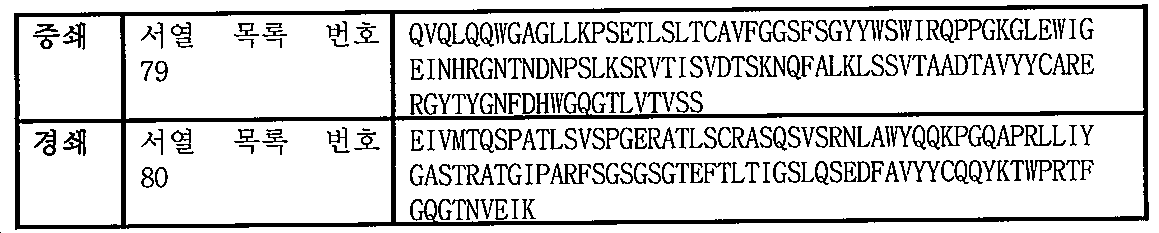
〔표 10〕Table 10
mAbmAb 가변 영역의 핵산 서열 Nucleic Acid Sequences in Variable Regions

표 7 및 8에 나타낸 VL CDR 및 VH CDR을 함유하는 전장 hIgG1 중쇄 및 h카파 경쇄 서열 그리고 표 9 및 10에 나타낸 가변 중쇄 및 경쇄 영역에 대한 아미노산 및 대응하는 핵산 서열을 아래에 나타낸다: The full length hIgG1 heavy and hkappa light chain sequences containing the VL CDRs and VH CDRs shown in Tables 7 and 8 and the amino acids and corresponding nucleic acid sequences for the variable heavy and light chain regions shown in Tables 9 and 10 are shown below:
hIgG1 중쇄 뉴클레오티드 서열은 다음과 같다:The hIgG1 heavy chain nucleotide sequence is as follows:


hIgG1 중쇄 단백질 서열은 다음과 같다:The hIgG1 heavy chain protein sequence is as follows:

(서열 목록 번호 84)(SEQ ID NO 84)
카파 경쇄 뉴클레오티드 서열은 다음과 같다:The kappa light chain nucleotide sequence is as follows:


(서열 목록 번호 85)(SEQ ID NO: 85)
h카파 경쇄 단백질 서열은 다음과 같다:The h kappa light chain protein sequence is as follows:


(서열 목록 번호 86)(SEQ ID NO 86)
본 발명의 하나의 특정 측면에서, GCC-표적화 치료법은 오리스타틴 분자에 콘주게이트된 항-GCC 항체 분자를 갖는 면역콘주게이트이다. 하나의 구현예에서, 면역콘주게이트는 오리스타틴 분자에 콘주게이트된, 서열 목록 번호 67, 68 및 69에 따른 3개의 중쇄(VH) CDR 및 서열 목록 번호 70, 71 및 72에 따른 3개의 경쇄(VL) CDR을 포함하는 항-GCC 항체 분자를 포함한다. 또 다른 구현예에서, 면역콘주게이트는 오리스타틴 분자에 콘주게이트된, 서열 목록 번호 79에 따른 중쇄 가변 영역 및 서열 목록 번호들 80에 따른 경쇄 가변 영역을 포함하는 항-GCC 항체 분자를 포함한다. 또 다른 구현예에서, 면역콘주게이트는 각각 오리스타틴 분자에 콘주게이트된, 서열 목록 번호 79 및 80에 따른 중쇄 및 경쇄 가변 영역을 포함하는 항-GCC 항체 분자를 포함한다. In one particular aspect of the invention, the GCC-targeted therapy is an immunoconjugate having an anti-GCC antibody molecule conjugated to an orstatin molecule. In one embodiment, the immunoconjugate comprises three heavy chain (VH) CDRs according to SEQ ID NOs 67, 68 and 69 and three light chains according to
일부 구현예에서, 오리스타틴 분자는 말레이미드 부분, 예로 말레이미도카프로일 부분을 함유하는 링커에 의해 항-GCC 항체 분자 상의 시스테인 부분에 연결된다. In some embodiments, the orstatin molecule is linked to a cysteine portion on an anti-GCC antibody molecule by a linker containing a maleimide moiety, such as a maleimidocaproyl moiety.
일부 구현예에서, 오리스타틴 분자는 오리스타틴 분자 상의 히드록실기에 연결된 이종2기능성 링커를 이용하여 항-GCC 항체 분자에 커플링된다. 이러한 일부 구현예에서, 링커는 히드라존을 포함한다. 일부 구현예에서, 링커는 말레이미도카프로일히드라지드 및 케토카르복실산, 예로 5-벤조일발레르산의 반응에 의해 형성된 히드라존 화합물이다. 특정한 구현예에서, 링커는 (Z)-6-(2-(6-(2,5-디옥소-2,5-디히드로-1H-피롤-1-일)-헥사노일)-히드라조노)-6-페닐헥산산이다.In some embodiments, the orstatin molecule is coupled to the anti-GCC antibody molecule using a heterobifunctional linker linked to a hydroxyl group on the orstatin molecule. In some such embodiments, the linker comprises a hydrazone. In some embodiments, the linker is a hydrazone compound formed by the reaction of maleimidocaproylhydrazide and ketocarboxylic acid, such as 5-benzoylvaleric acid. In certain embodiments, the linker is (Z) -6- (2- (6- (2,5-dioxo-2,5-dihydro-1H-pyrrol-1-yl) -hexanoyl) -hydrazono) -6-phenylhexanoic acid.
일부 다른 구현예에서, 오리스타틴 분자는 오리스타틴 분자 상의 모노메틸 아미노기에 연결된 이종2기능성 링커를 이용하여 항-GCC 항체 분자에 커플링된다. 일부 구현예에서, 링커는 절단가능한 부분, 예로 펩티드 부분 및 자가-파괴성 p-아미노벤질카르바메이트 스페이서를 포함한다. 예시적인 링커에는 말레이미도카프로일(mc), 말레이미도카프로일-L-페닐알라닌-L-라이신-p-아미노벤질-카르바메이트, 및 말레이미도카프로일-L-발린-L-시트룰린-p-아미노벤질카르바메이트(vc)가 포함된다.In some other embodiments, the orstatin molecule is coupled to the anti-GCC antibody molecule using a heterobifunctional linker linked to a monomethyl amino group on the orstatin molecule. In some embodiments, the linker comprises a cleavable moiety, such as a peptide moiety and a self-destructive p -aminobenzylcarbamate spacer. Exemplary linkers include maleimidocaproyl (mc), maleimidocaproyl-L-phenylalanine-L-lysine- p -aminobenzyl-carbamate, and maleimidocaproyl-L-valine-L-citrulline- p- Aminobenzylcarbamate (vc) is included.
특정 구현예에서, GCC-표적화 치료법은 화학식 Ab-(vc-MMAF) m (화학식 ( I-4 )); Ab-(vc-MMAE) m (화학식 ( I-5 )); Ab-(mc-MMAE) m (화학식 ( I-6 )); 또는 Ab-(mc-MMAF) m (화학식 ( I-7 ))을 특징으로 하는 면역콘주게이트이며, 여기서 Ab는 특징, 예컨대 표 7, 8, 9 또는 10 중 어느 하나에 기재된 특징을 포함하는 항-GCC 항체 분자이고, S는 항체의 황 원자이고, m은 약 1 내지 약 15 범위이다. 특정 구현예에서, m은 1 내지 약 5의 범위이다.In certain embodiments, GCC-targeted therapies include Formula Ab- (vc-MMAF) m (formula ( I-4 )); Ab- (vc-MMAE) m (formula ( I-5 )); Ab- (mc-MMAE) m (formula ( I-6 )); Or an immunoconjugate characterized by Ab- (mc-MMAF) m (formula ( I-7 )), wherein Ab is a term comprising a feature, such as one described in Table 7, 8, 9 or 10 -GCC antibody molecule, S is a sulfur atom of the antibody and m ranges from about 1 to about 15. In certain embodiments, m is in the range of 1 to about 5.
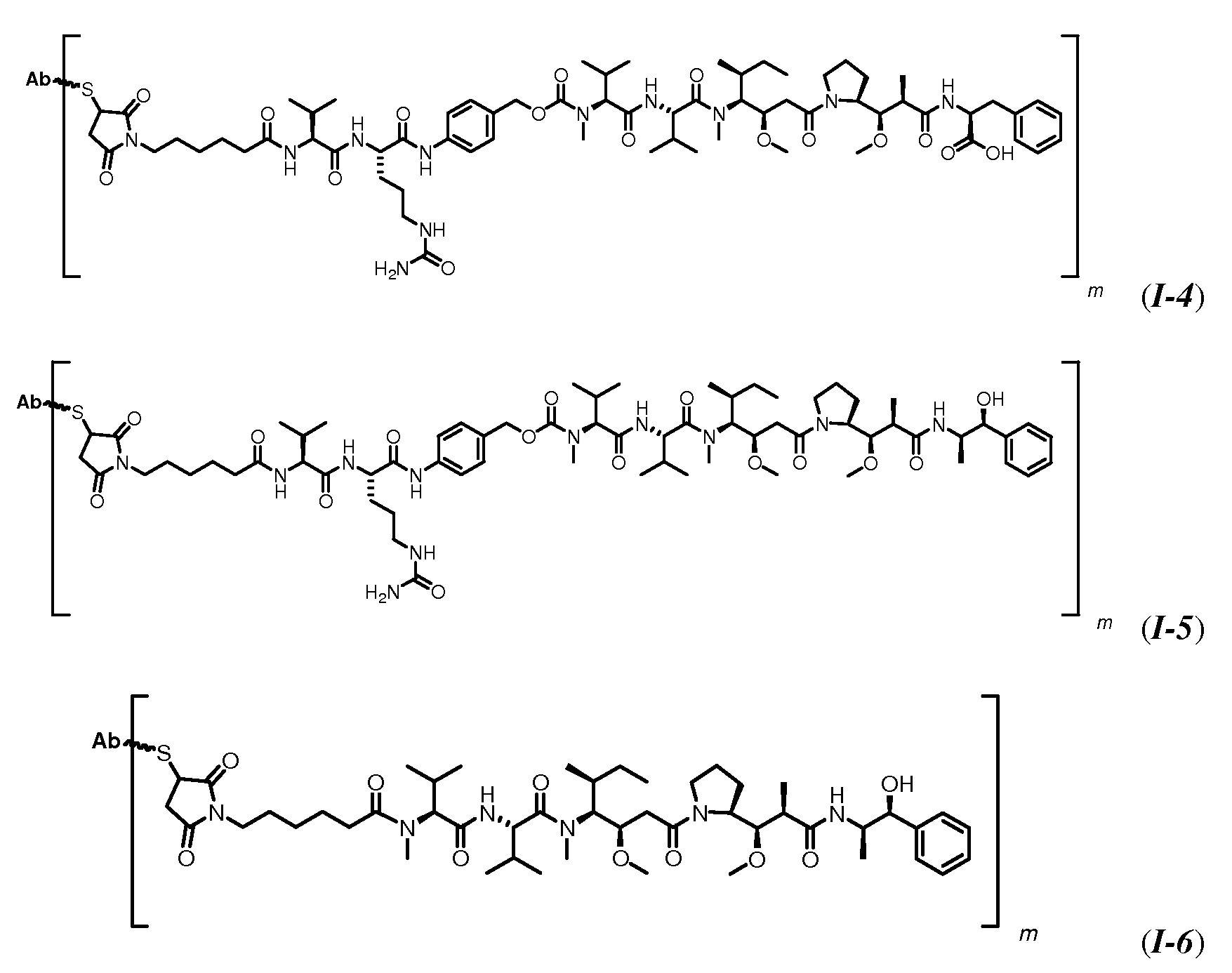

일부 구현예에서, 화학식 ( I-4 ), ( I-5 ), ( I-6 ), 또는 ( I-7 )에서의 변수 m은 약 2 내지 약 10, 약 6 내지 약 8, 약 4 내지 약 6, 약 3 내지 약 5, 또는 약 1 내지 약 3 범위이다. In some embodiments, the variable m in formula ( I-4 ), ( I-5 ), ( I-6 ), or ( I-7 ) is about 2 to about 10, about 6 to about 8, about 4 to About 6, about 3 to about 5, or about 1 to about 3.
특정한 구현예에서, 표적화 GCC 치료법은 화학식 ( I-4 ), ( I-5 ), ( I-6 ), 또는 ( I-7 )의 면역콘주게이트이며, 여기서 Ab는 서열 목록 번호 67, 68 및 69에 따른 3개의 중쇄(VH) CDR 및 서열 목록 번호 70, 71 및 72에 따른 3개의 경쇄(VL) CDR 영역을 포함하는 항체 분자이고, m은 약 3 내지 약 5(예로, 약 4)이다. 특정 측면에서, 각각 서열 목록 번호들 67, 68 및 69에 따른 중쇄 CDR 및 서열 목록 번호들 70, 71 및 72에 따른 3개의 경쇄 CDR 을 포함하는 Ab는 인간 모노클로날 항체, 바람직하게는 인간 IgG1 항체이다. In certain embodiments, the targeted GCC therapy is an immunoconjugate of Formula ( I-4 ), ( I-5 ), ( I-6 ), or ( I-7 ), wherein Ab is SEQ ID NOs 67, 68 and An antibody molecule comprising three heavy chain (VH) CDRs according to 69 and three light chain (VL) CDR regions according to
다른 특정한 구현예에서, GCC-표적화 치료법은 화학식 ( I-4 ), ( I-5 ), ( I-6 ), 또는 ( I-7 )의 면역콘주게이트이며, 여기서 Ab는 서열 목록 번호들 79에 따른 중쇄 가변 영역 및 서열 목록 번호들 80에 따른 경쇄 가변 영역을 포함하는 모노클로날 항체 분자이고, m은 약 3 내지 약 5(예로, 약 4)이다. 특정 측면에서, 서열 목록 번호 79 및 80에 따른 중쇄 및 경쇄 가변 영역을 포함하는 Ab는 인간 모노클로날 항체, 바람직하게는 인간 IgG1 항체이다. In another specific embodiment, the GCC-targeted therapy is an immunoconjugate of Formula ( I-4 ), ( I-5 ), ( I-6 ), or ( I-7 ), wherein Ab is SEQ ID NOs 79 A monoclonal antibody molecule comprising a heavy chain variable region according to and a light chain variable region according to SEQ ID NOs 80, wherein m is from about 3 to about 5 (eg, about 4). In certain aspects, the Ab comprising the heavy and light chain variable regions according to SEQ ID NOs: 79 and 80 is a human monoclonal antibody, preferably a human IgG1 antibody.
또 다른 특정한 구현예에서, GCC-표적화 치료법은 화학식 ( I-4 ), ( I-5 ), ( I-6 ), 또는 ( I-7 )의 면역콘주게이트이며, 여기서 Ab는 서열 목록 번호 84에 따른 중쇄 IgG1 서열 및 서열 목록 번호 86에 따른 카파 경쇄 서열을 포함하는 인간 IgG 모노클로날 항체 분자이고, m은 약 3 내지 약 5(예로, 약 4)이다. In another specific embodiment, the GCC-targeted therapy is an immunoconjugate of Formula ( I-4 ), ( I-5 ), ( I-6 ), or ( I-7 ), wherein Ab is SEQ ID NO: 84 A human IgG monoclonal antibody molecule comprising a heavy chain IgG1 sequence according to and a kappa light chain sequence according to SEQ ID NO: 86, and m is about 3 to about 5 (eg, about 4).
또 다른 구현예에서, GCC-표적화 치료법은 혈액-뇌 장벽을 통과할 수 있는 GCC-리간드 콘주게이트이다. 예를 들어 특정 측면에서, 본 발명은 혈액-뇌 장벽을 통과할 수 있는 신경보호 제제, 예컨대 L-도파에 콘주게이트된 GCC-리간드에 관한 것이다. 이러한 GCC-리간드 콘주게이트의 예는 그 내용의 전문이 본원에 참조로 도입된 공개된 PCT 출원 WO2013/016662에 기재되어 있다. 본 발명의 구현예에서, 그 뉴론이 GCC를 발현하는 신경학적 장애(예로, 파킨슨병)를 앓거나 갖는 것으로 추정되는 환자는 신경보호 제제에 콘주게이트된 GCC-리간드를 이용한 치료에 대해 우수한 후보로 간주될 것이다. In another embodiment, the GCC-targeted therapy is a GCC-ligand conjugate that can cross the blood-brain barrier. For example, in certain aspects, the present invention relates to neuroprotective agents capable of crossing the blood-brain barrier, such as GCC-ligand conjugated to L-dopa. Examples of such GCC-ligand conjugates are described in published PCT application WO2013 / 016662, which is hereby incorporated by reference in its entirety. In embodiments of the invention, patients whose neurons are suspected of having or have neurological disorders (eg, Parkinson's disease) expressing GCC are good candidates for treatment with GCC-ligand conjugated to neuroprotective agents. Will be considered.
본 발명의 일부 측면에서, GCC-표적화 치료법은 GCC 길항제이다. 하나의 구현예에서, GCC-표적화 치료법은 GCC의 펩티드 길항제(예로, ST 펩티드) 또는 소분자 저해제이다.In some aspects of the invention, the GCC-targeted therapy is a GCC antagonist. In one embodiment, the GCC-targeted therapy is a peptide antagonist (eg, ST peptide) or small molecule inhibitor of GCC.
일부 측면에서, GCC-표적화 치료법은 GCC 작용제이다. 하나의 구현예에서, GCC 작용제는 ST 펩티드이다. 특정한 구현예에서, GCC 작용제는 아미노산 서열 H-Cys1-Cys2-Glu3-Tyr4-Cys5-Cys6-Asn7-Pro8-Ala9-Cyc10-Thr11-Gly12-Cys13-Tyr14-OH(서열 목록 번호 87)을 포함하는 ST 펩티드이며, 여기서 Cys1 및 Cys6 간에, Cys2 및 Cys10 간에, 그리고 Cys5 및 Cys13 간에 3개의 디설피드 결합이 존재한다. 특정한 구현예에서, GCC 작용제는 GCC에 결합하는 펩티드 작용제, 예컨대 리나클로티드(Ironwood Pharmaceuticals)이다. In some aspects, the GCC-targeted therapy is a GCC agent. In one embodiment, the GCC agent is an ST peptide. In a particular embodiment, the GCC agent is an amino acid sequence H-Cys 1 -Cys 2 -Glu 3 -Tyr 4 -Cys 5 -Cys 6 -Asn 7 -Pro 8 -Ala 9 -Cyc 10 -Thr 11 -Gly 12 -Cys 13 ST peptide comprising -Tyr 14 -OH (SEQ ID NO: 87), wherein there are three disulfide bonds between Cys 1 and Cys 6, between Cys 2 and Cys 10 , and between Cys 5 and Cys 13 . In certain embodiments, the GCC agonist is a peptide agonist that binds to GCC, such as Ironwood Pharmaceuticals.
본 발명의 특정 구현예에서, 그 종양 세포가 이들의 표면 상에 GCC를 발현하는 환자는 독소-콘주게이트된 항-GCC 항체 분자, 예컨대 본원에 기재된 면역콘주게이트, 또는 그 내용의 전문이 본원에 참조로 도입된 U.S. 공개 특허 출원 번호 20110110936에 기재된 바와 같은 독소-콘주게이트된 항체를 이용한 치료를 위해 우수한 후보로 간주될 것이다. 임의의 이론에 구애받고자 하지 않고, 그 종양 세포가 이들의 표면 상에 소량의 GCC를 발현하는 환자는 이를 위해 우수한 후보가 아닐 수 있거나 추가적인 치료 방법과 GCC-표적화 치료법의 조합을 위한 후보일 수 있거나 또는 네이키드 항체 치료법을 위한 후보일 수 있다. 또 다른 예에서, GCC-표적화 치료법의 용량은 종양 세포의 표면 상에 발현되는 GCC 분자의 수를 반영하도록 조정될 수 있다. 예를 들어, 이들의 종양 세포 표면 상에 다수의 GCC 분자를 갖는 환자는 종양 세포 표면에 발현되는 소수의 GCC 분자를 갖는 환자에 비해 더 낮은 용량의 GCC-표적화 치료법으로 치료받을 수 있다. 생체 내 GCC-발현 종양 세포의 존재 검출은 일차 GCC-발현 종양이 전이된 조직의 확인을 허용할 수 있다. 어느 조직이 전이를 갖는지에 대한 지식은 종양 치료법의 표적화 적용으로 이어질 수 있다.In certain embodiments of the invention, a patient whose tumor cells express GCC on their surface is a toxin-conjugated anti-GCC antibody molecule, such as an immunoconjugate described herein, or the disclosure herein in its entirety. US introduced by reference It would be considered a good candidate for treatment with toxin-conjugated antibodies as described in published patent application number 20110110936. Without wishing to be bound by any theory, patients whose tumor cells express small amounts of GCC on their surface may not be good candidates for this, or may be candidates for a combination of additional and GCC-targeted therapies. Or a candidate for naked antibody therapy. In another example, the dose of GCC-targeted therapy can be adjusted to reflect the number of GCC molecules expressed on the surface of tumor cells. For example, patients with multiple GCC molecules on their tumor cell surface may be treated with lower doses of GCC-targeted therapy than patients with fewer GCC molecules expressed on tumor cell surfaces. Detection of the presence of GCC-expressing tumor cells in vivo may allow for identification of tissue to which the primary GCC-expressing tumor has metastasized. Knowledge of which tissues have metastases can lead to targeted application of tumor therapy.
상기 논의된 비와 같이, 본원에 기재된 항체 분자는 정상 대 신생물 조직에서 GCC 단백질의 존재 평가를 허용하며, 이를 통해 질환의 존재 또는 중증도, 질환 진행 및/또는 치료법의 유효성이 평가될 수 있다. 예를 들어, 치료법이 모니터링되고 유효성이 평가될 수 있다. 하나의 예에서, GCC 단백질은 증식성 질환을 갖는 대상체로부터 수득된 제1 표본에서 검출 및/또는 측정될 수 있고, 치료법이 개시될 수 있다. 이후, 대상체로부터 제2 표본이 수득될 수 있고, 표본에서의 GCC 단백질이 검출 및/또는 측정될 수 있다. 제2 표본에서 측정 또는 검출되는 GCC 단백질의 양의 감소는 치료 유효성을 시사할 수 있다. As with the ratios discussed above, the antibody molecules described herein allow for the assessment of the presence of GCC proteins in normal versus neoplastic tissue, through which the presence or severity of the disease, disease progression, and / or efficacy of the therapy can be assessed. For example, therapies can be monitored and efficacy evaluated. In one example, the GCC protein can be detected and / or measured in a first sample obtained from a subject with a proliferative disease, and treatment can be initiated. Thereafter, a second sample can be obtained from the subject and the GCC protein in the sample can be detected and / or measured. Reduction in the amount of GCC protein measured or detected in the second sample may suggest therapeutic efficacy.
임의 이론에 구애받고자 하지 않고, 혈관화는 GCC-표적화 치료제가 GCC 발현 종양에 접근하기 위해, 특히 GCC-표적화 치료제가 정맥내 투여되는 경우에 필요할 수 있다. 따라서 본 발명의 방법의 특정 구현예에서, GCC 단백질의 검출에 부가하여 또는 이와 함께 종양 혈관계를 평가하거나 분석하는 것이 유용할 수 있다. 예를 들어, 조직 표본은 GCC 발현 및 조직 혈관화를 동시에 또는 동시대적으로 분석하기 위해 혈관 내피 세포를 확인하는 제제, 예컨대 항-CD-31 항체 또는 항-폰 빌레브란트 인자 항체 분자, 및 본 발명의 항-GCC 항체로 염색될 수 있다. 본 발명의 특정 측면에서, GCC 발현 및 혈관계의 이러한 동시적 또는 동시대적 분석은 표적화-치료제를 위한 환자 선택 도구로서 유용하다. Without wishing to be bound by any theory, vascularization may be necessary for GCC-targeted therapeutics to access GCC expressing tumors, especially when GCC-targeted therapeutics are administered intravenously. Thus, in certain embodiments of the methods of the invention, it may be useful to assess or analyze the tumor vasculature in addition to or in conjunction with the detection of GCC proteins. For example, a tissue sample may be an agent that identifies vascular endothelial cells to analyze GCC expression and tissue vascularization simultaneously or simultaneously, such as anti-CD-31 antibody or anti-von Willebrand factor antibody molecule, and the present invention. Can be stained with an anti-GCC antibody. In certain aspects of the invention, such simultaneous or simultaneous analysis of GCC expression and the vascular system is useful as a patient selection tool for targeting-therapeutic agents.
또 다른 측면에서, GCC의 세포 표면 발현은 GCC-표적화 치료제가 GCC 발현 종양 세포의 사멸에 영향을 미치는데 필요할 수 있다. 예를 들어, 일부 종양 세포는 GCC를 발현할 수 있지만 세포 표면 상에서는 아니다. 치료제가 세포 표면 GCC 발현에 의존하는 경우, 이러한 치료제는 GCC가 주로 세포내에 있는 세포를 사멸시키지 못할 수 있다. 따라서 본 발명의 일부 구현예에서, 진단 또는 예후 분석에는, 예로 그 방법이 세포내 발현으로부터 세포 표면 발현을 구별하고/하거나 정량할 수 있는, GCC의 세포성 위치의 분석 및/또는 정량이 추가로 포함될 수 있다. 임의 이론에 구애받고자 하지 않고, 그 종양이 주로 세포내 GCC 발현을 갖는 환자는 GCC의 세포외 도메인에 결합하는 항-GCC 항체 분자에 대한 우수한 후보가 아닐 수 있다. 대안적으로, 이러한 분석 결과는 GCC의 세포 표면 발현을 유도하는 제제를 이용한 초기 치료를 촉발시킬 수 있다(예로, PCT 공개 번호 WO04/071436 참고). GCC 세포 표면 유도에 이어 또는 이와 함께, 세포외 발현되는 GCC에만 접근하거나 결합하는 항-GCC 항체 분자가 투여될 수 있다.In another aspect, cell surface expression of GCC may be required for GCC-targeted therapeutics to affect killing of GCC expressing tumor cells. For example, some tumor cells can express GCC but not on the cell surface. If the therapeutic agent depends on cell surface GCC expression, such therapeutic agent may not kill cells in which GCC is predominantly intracellular. Thus, in some embodiments of the present invention, the diagnostic or prognostic analysis further comprises, for example, analysis and / or quantification of the cellular location of GCC, in which the method can distinguish and / or quantify cell surface expression from intracellular expression. May be included. Without wishing to be bound by any theory, patients whose tumors predominantly have intracellular GCC expression may not be good candidates for anti-GCC antibody molecules that bind to the extracellular domain of GCC. Alternatively, these assays can trigger initial treatment with agents that induce cell surface expression of GCC (see, eg, PCT Publication No. WO04 / 071436). Following or in conjunction with GCC cell surface induction, an anti-GCC antibody molecule can be administered that accesses or binds only GCC expressed extracellularly.
키트Kit
또한, 본원에 기재된 바와 같은 항-GCC 항체 분자 또는 면역콘주게이트를 포함하는 키트가 본 발명의 범위에 속한다. 항-GCC 항체 분자 또는 면역콘주게이트를 포함하는 리포좀 조성물을 포함하는 키트가 추가로 포함된다. 키트에는 사용 지침; 다른 시약, 예로 표지, 치료제, 또는 킬레이트 또는 다른 커플링에 유용한 제제, 표지 또는 치료제에 대한 항체, 또는 방사보호 조성물; 투여를 위해 항체를 제조하기 위한 장치 또는 다른 재료; 약학적으로 허용가능한 담체; 및 대상체에 투여하기 위한 장치 또는 다른 재료를 포함하는 하나 이상의 다른 요소가 포함될 수 있다. 사용 지침에는 시험관 내, 예로 표본에서, 예로 암을 갖는 환자의 생검 또는 세포에서, 또는 생체 내에서 GCC를 검출하기 위한 항-GCC 항체 분자 또는 면역콘주게이트의 진단 적용을 위한 지침이 포함될 수 있다. 지침에는, 예로 암(예로, 위장관 유래 암, 예컨대 결장암, 위암, 식도암)을 갖는 환자에서 제시되는 투여량 및/또는 투여 방식을 포함하는 치료적 적용을 위한 안내가 포함될 수 있다. 다른 지침에는 킬레이터, 표지 또는 치료제에 대한 항체의 커플링에 대한 또는 콘주게이트된 항체, 예로 미반응 콘주게이션 성분으로부터의 정제를 위한 지침이 포함될 수 있다. 상기 논의된 바와 같이, 키트에는 표지, 예로 본원에 기재된 임의의 표지가 포함될 수 있다. 상기 논의된 바와 같이, 키트에는 치료제, 예로 본원에 기재된 치료제가 포함될 수 있다. 일부 적용에서, 항체는 다른 성분, 예로 킬레이터 또는 표지 또는 치료제, 예로 방사선 동위원소, 예로 이트륨 또는 루테튬과 반응할 것이다. 이러한 경우, 키트에는 반응을 수행하기 위한 하나 이상의 반응 용기 또는 분리 장치, 예로 원료 또는 반응 중간체로부터 최종 산물을 분리하는데 사용하기 위한 크로마토그래피 컬럼이 포함될 수 있다. Also within the scope of the invention are kits comprising an anti-GCC antibody molecule or immunoconjugate as described herein. Further included are kits comprising a liposome composition comprising an anti-GCC antibody molecule or immunoconjugate. The kit includes instructions for use; Other reagents such as labels, therapeutics, or agents useful for chelates or other coupling, antibodies to the labels or therapeutics, or radioprotective compositions; Devices or other materials for preparing antibodies for administration; Pharmaceutically acceptable carriers; And one or more other elements, including devices or other materials for administration to a subject. Instructions for use may include instructions for the diagnostic application of an anti-GCC antibody molecule or immunoconjugate to detect GCC in vitro, eg in a sample, eg in a biopsy or cell of a patient with cancer, or in vivo. Instructions can include, for example, instructions for therapeutic application, including dosages and / or modes of administration, presented in patients with cancer (eg, gastrointestinal-derived cancers such as colon cancer, gastric cancer, esophageal cancer). Other instructions may include instructions for the coupling of the antibody to a chelator, label, or therapeutic agent or for purification from conjugated antibodies, such as unreacted conjugation components. As discussed above, the kit may include a label, such as any label described herein. As discussed above, the kit may include a therapeutic agent, eg, a therapeutic agent described herein. In some applications, the antibody will react with other components, such as chelators or labels or therapeutic agents, such as radioisotopes, such as yttrium or lutetium. In such cases, the kit may include one or more reaction vessels or separation devices for carrying out the reaction, such as chromatography columns for use in separating the final product from the raw materials or reaction intermediates.
키트는 추가로 적어도 하나의 추가적 시약, 예컨대 진단제 또는 치료제, 예로 본원에 기재된 진단제 또는 치료제, 및/또는 하나 이상의 별도의 약학 조제물에 적절히 제형화된 하나 이상의 추가적인 항-GCC 항체 분자 또는 면역콘주게이트를 추가로 함유할 수 있다. The kit further comprises one or more additional anti-GCC antibody molecules or immune suitably formulated into at least one additional reagent, such as a diagnostic or therapeutic agent, such as the diagnostic or therapeutic agent described herein, and / or one or more separate pharmaceutical preparations. It may further contain a conjugate.
키트는 추가로 방사선보호제를 함유할 수 있다. 동위원소, 예로 90이트륨(90Y)의 방사선분해 성질이 알려져 있다. 이러한 방사선분해를 극복하기 위해, 방사선보호제가 양성인 한, 즉 이들이 예로 동위원소, 예컨대 90Y의 항체에 대한 표지 반응을 저해하거나 달리 악영향을 미치지 않는 한, 예로 반응 완충액에 포함될 수 있다. 본 발명의 제형화 완충액에는 방사선보호제, 예컨대 이트륨이나 다른 강한 방사선 핵종의 방사선분해를 최소화하는 인간 혈청 알부민(HSA) 또는 아스코르베이트가 포함될 수 있다. 다른 방사선보호제, 즉 자유 라디칼 포획제(페놀, 설파이트, 글루타치온, 시스테인, 겐티신산, 니토틴산, 아스코르빌 팔미테이트, HOP(:O)H2I 글리세롤, 나트륨 포름알데히드 설폭실레이트, Na2S2O, Na2S2O3, 및 SO2 등)는 당분야에 공지되어 있고 또한 본 발명의 제형화 완충액에 이용될 수 있다. The kit may further contain a radioprotectant. Isotopes, for example 90 yttrium ( 90 Y), are known for their radiolytic properties. To overcome this radiolysis, so long as the radioprotectant is positive, i.e., as long as they do not inhibit or otherwise adversely affect the labeling reaction against isotopes such as, for example, 90 Y antibodies, they may be included, for example, in the reaction buffer. Formulation buffers of the invention may include radioprotectants such as human serum albumin (HSA) or ascorbate to minimize radiolysis of yttrium or other strong radionuclides. Other radioprotective agents, ie free radical scavenger (phenol, sulfite, glutathione, cysteine, gentisinic acid, nitotinic acid, ascorbyl palmitate, HOP (: O) H 2 I glycerol, sodium formaldehyde sulfoxylate, Na 2 S 2 O, Na 2 S 2 O 3 , and SO 2, etc.) are known in the art and may also be used in the formulation buffer of the present invention.
제공된 키트는 환자에 대한 투여를 위해 치료적 방사선 동위원소를 갖는 킬레이터-콘주게이트된 단백질 또는 펩티드를 방사선 표지하는데 유용한 것이다. 키트에는 (i) 킬레이터-콘주게이트된 항체를 포함하는 바이알, (ii) 환자에게 방사선 표지된 항체를 투여하고 안정화하기 위한 제형화 완충액을 함유하는 바이알, 및 (iii) 방사선 표지 절차를 수행하기 위한 지침이 포함된다. 상기 키트는, 예로 지침에 권장된 바와 같은 온화한 조건 하에 충분한 양의 시간 동안 방사선 동위원소 또는 이들의 염에 대한 킬레이터-콘주게이트된 항체의 노출을 제공한다. 충분한 순도, 비활성 및 결합 특이성을 갖는 방사선 표지된 항체가 제조된다. 방사선 표지된 항체는, 예로 제형화 완충액 중에 적절한 농도로 희석되고, 추가 정제와 함께 또는 이것이 없이 직접 환자에게 투여될 수 있다. 킬레이터-콘주게이트된 항체는 동결건조된 형태로 공급될 수 있다. The provided kits are useful for radiolabeling chelator-conjugated proteins or peptides having a therapeutic radioisotope for administration to a patient. The kit includes (i) a vial containing a chelator-conjugated antibody, (ii) a vial containing a formulation buffer for administering and stabilizing a radiolabeled antibody to a patient, and (iii) performing a radiolabeling procedure. Instructions are included. The kit provides exposure of chelator-conjugated antibodies to the radioisotope or salts thereof for a sufficient amount of time under mild conditions, eg as recommended in the instructions. Radiolabeled antibodies are prepared that have sufficient purity, inactivity and binding specificity. Radiolabeled antibodies may be diluted, for example, in appropriate concentrations in the formulation buffer and administered directly to the patient with or without additional tablets. Chelated-conjugated antibodies can be supplied in lyophilized form.
하기 실시예는 예시적인 것이지, 본 발명을 제한하려는 것이 아니다. The following examples are illustrative and are not intended to limit the invention.
실시예Example
실시예 1: Example 1: 인간 GCC 세포외 도메인-마우스 Fc(hGCC-ECD-mFc) 융합 단백질의 생성Generation of Human GCC Extracellular Domain-mouse Fc (hGCC-ECD-mFc) Fusion Proteins
면역화 및 스크리닝을 위해, 분비된 인간(h) 구아닐릴 사이클라아제(GCC)(hGCC) 세포외 도메인(ECD)/마우스 면역글로불린(Ig)G2a 중쇄 불변(Fc)(수용체 결합 영역 돌연변이(FcRbr-mutII)를 갖는 융합 단백질(즉, hGCC(ECD)-mIgG2a RcRbr-mutII 융합 단백질, 또한 본원에서 pLKTOK108 및 MIL-44로 불림)의 생성을 하기와 같이 수행하였다. pLKTOK4 발현 벡터 내로 하기 GCC 서열(신호 서열 및 세포외 도메인)을 포함하는 서열을 인코딩하는 GCC 유전자 부분을 서브클로닝하여 GCC 항원을 제조하였다:For immunization and screening, secreted human (h) guanylyl cyclase (GCC) (hGCC) extracellular domain (ECD) / mouse immunoglobulin (Ig) G2a heavy chain constant (Fc) (receptor binding region mutation (FcRbr) generation of a fusion protein (ie, hGCC (ECD) -mIgG2a RcRbr-mutII fusion protein, also referred to herein as pLKTOK108 and MIL-44) with -mutII) was performed as follows: The following GCC sequence into the pLKTOK4 expression vector ( GCC antigens were prepared by subcloning a portion of the GCC gene encoding a sequence comprising a signal sequence and an extracellular domain):
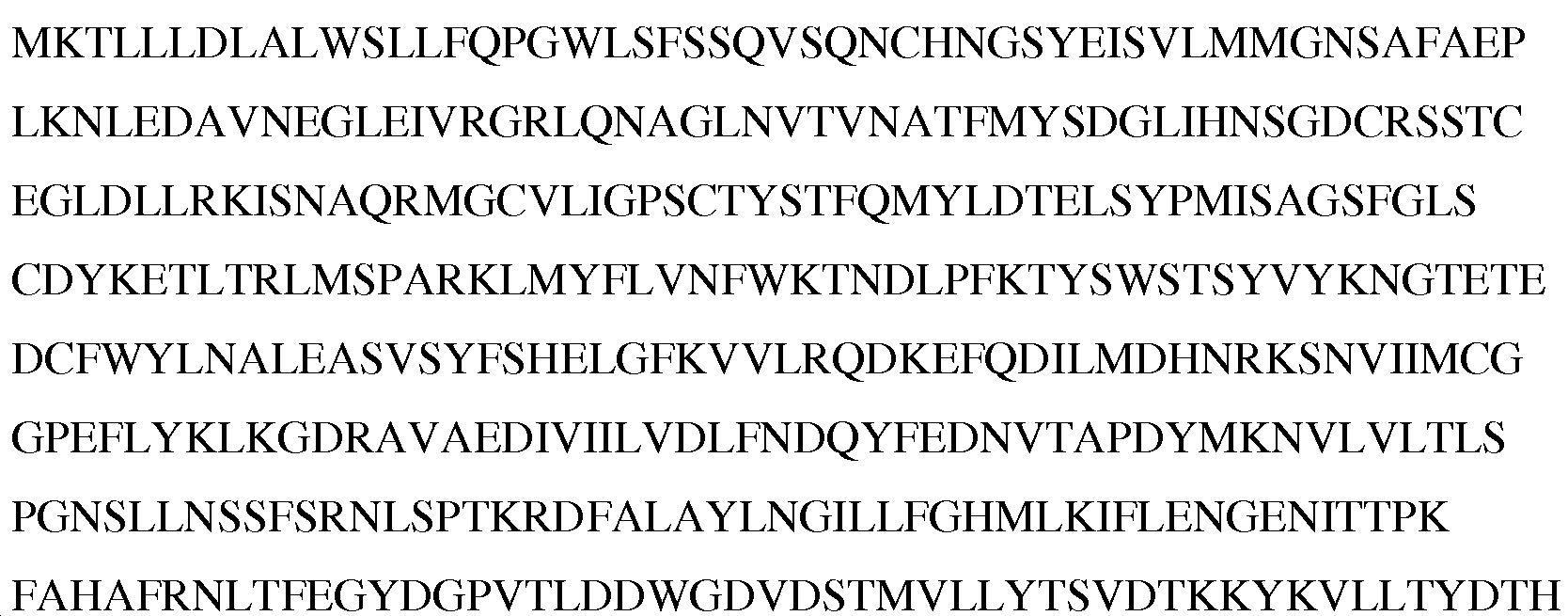

위치 427 내지 430에서의 아미노산 서열 GLy-Arg-Gly-Pro-Gln(서열 목록 번호 66)을 세포외 GCC 단편을 종료시키기 위해 선택하였다. GCC에서, 상기 서열은 역사적으로 인간 IgG1 Fc 융합 단백질을 개시하는데 이용되는 Pro에 상동성인 위치에서 Pro와 잘 정렬하는 Pro가 바로 뒤따른다. The amino acid sequence GLy-Arg-Gly-Pro-Gln (SEQ ID NO: 66) at positions 427-430 was selected to terminate the extracellular GCC fragment. In GCC, the sequence is immediately followed by Pro, which aligns well with Pro at a position that is historically homologous to Pro used to initiate a human IgG1 Fc fusion protein.
pLKTOK108의 마우스 IgG2a Fc 영역을 기능적으로 CH1 도메인의 말단인 아미노산 서열[Pro-Arg-발린(Val)-Pro-이소류신(Ile)-트레오닌(Thr)-Glu-아스파라긴(Asn)](서열 목록 번호 58)로 시작하도록 설계하였다. 마우스 IgG2a 불변 영역에서는 2개 영역이 돌연변이되었다. 류신(Leu)-Leu-Gly-Gly(서열 목록 번호 59)에서 Leu-알라닌(Ala)-Gly-Ala(서열 목록 번호 60) 돌연변이(위치 234 내지 237의 라이신[Lys]-Lys-Gly-Gly(서열 목록 번호 61)에서 Lys-Ala-Gly-Ala(서열 목록 번호 62로)에 부가하여, 위치 318 내지 322의 제2 Fc 수용체 영역도 다음과 같이 돌연변이되었다: 글루탐산(Glu)-페닐알라닌(Phe)-Lys-시스테인(Cys)-Lys(서열 목록 번호 63)에서 Ala-Phe-Lys-Cys-Lys(서열 목록 번호 64)로, 이어서 Phe-Lys-Cys-Lys(서열 목록 번호 65)으로. The amino acid sequence of the mouse IgG2a Fc region of pLKTOK108 is functionally terminal of the CH1 domain [Pro-Arg-Vallin-Pro-Isoleucine (Ile) -Threonine (Thr) -Glu-Asparagine (Asn)] (SEQ ID NO: 58 It is designed to start with). Two regions were mutated in the mouse IgG2a constant region. Leu-alanine (Ala) -Gly-Ala (SEQ ID NO: 60) mutations in Leucine (Leu) -Leu-Gly-Gly (SEQ ID NO: 59) (lysine [Lys] -Lys-Gly-Gly at positions 234-237 In addition to Lys-Ala-Gly-Ala (to SEQ ID NO: 62) at (SEQ ID NO: 61), the second Fc receptor region at positions 318 to 322 was also mutated as follows: glutamic acid (Glu) -phenylalanine (Phe ) -Lys-cysteine (Cys) -Lys (SEQ ID NO: 63) to Ala-Phe-Lys-Cys-Lys (SEQ ID NO: 64), followed by Phe-Lys-Cys-Lys (SEQ ID NO: 65).
완전한 융합 단백질 서열이 설계되면, BamHI 및 XbaI에 대한 인접 제한효소 서열뿐만 아니라 Kozak 서열(CTCACC) 및 말단 정지 코돈을 부가하여 융합 단백질 cDNA를 완성하였다. 융합 단백질 pLKTOK108(hGCC/mIgG2a FcRmutII)의 뉴클레오티드 및 아미노산 서열은 아래에 제공된다(서열 목록 번호 47에서 BamHI 및 XbaI 제한효소 부위는 소문자로 나타낸다):Once the complete fusion protein sequence was designed, the fusion protein cDNA was completed by adding the Kozak sequence (CTCACC) and the terminal stop codon as well as the adjacent restriction enzyme sequences for BamHI and XbaI. Nucleotide and amino acid sequences of the fusion protein pLKTOK108 (hGCC / mIgG2a FcRmutII) are provided below (in SEQ ID NO: 47 the BamHI and XbaI restriction sites are shown in lowercase):
인간 GCC-ECD/마우스 IgG2a Fc 뉴클레오티드 서열(서열 목록 번호 47) Human GCC-ECD / Mouse IgG2a Fc Nucleotide Sequence (SEQ ID NO: 47)


인간 GCC-ECD/마우스 IgG2a Fc 아미노산 서열(서열 목록 번호 48): Human GCC-ECD / mouse IgG2a Fc amino acid sequence (SEQ ID NO: 48):


위에 나타낸 바와 같이, 재조합 단백질 pLKTOK108은 2개의 돌연변이된 Fc 수용체 결합 영역(FcR)이 Fc 수용체 결합(mIgG2a FcRmutII)을 예방하기 위해 돌연변이된 마우스 IgG2a Fc 영역에 융합된 인간 GCC의 세포외 영역과 조합한다. pLKTOK108을 위한 재조합 DNA 삽입물은 다음과 같은 3단계 PCR 절차에 의해 생성되었다:As indicated above, the recombinant protein pLKTOK108 combines the extracellular region of human GCC with two mutated Fc receptor binding regions (FcRs) fused to mutated mouse IgG2a Fc regions to prevent Fc receptor binding (mIgG2a FcRmutII). . Recombinant DNA inserts for pLKTOK108 were generated by the following three step PCR procedure:
제1 단계는 35 뉴클레오티드의 겹침 서열을 함유하는 채택된 마우스 IgG2a FcRmutII DNA 단편 및 채택된 세포외 인간 GCC를 생성하였다. 이들 PCR 반응은 표 13에 기재된 프로토콜로 표 11 및 표 12에 기재된 주형 및 프라이머를 이용하여 2개의 단편을 생성하였다. 이들 DNA 단편을 Qiagen 겔 정제 키트(Valencia, CA)를 이용하여 1% 아가로오스 겔로부터 단리하였다. 인간 GCC 주형은 인간 GCC에 대한 서열을 함유하는 단백질 발현 벡터(Clontech Laboratories, Inc., Mountain View, CA, USA)에 의해 제공되었다. Fc 도메인에 대한 주형은 자체가 주형으로 벡터 pLKTOK61(그 내용의 전문이 본원에 참조로 도입된 U.S. 특허 7,053,202에 기재됨)을 이용하여 생성된 pLKTOK84로 불리는, 2개의 돌연변이된 Fc 수용체 결합 영역(FcRmutII)을 갖는 마우스 IgG2aFc에 융합된 인간 1228에 대한 발현 구축물로부터 수득되었다. The first step generated the adopted mouse IgG2a FcRmutII DNA fragment containing 35 nucleotide overlapping sequence and the adopted extracellular human GCC. These PCR reactions produced two fragments using the templates and primers listed in Tables 11 and 12 in the protocols described in Table 13. These DNA fragments were isolated from 1% agarose gels using the Qiagen gel purification kit (Valencia, Calif.). Human GCC templates were provided by protein expression vectors (Clontech Laboratories, Inc., Mountain View, CA, USA) containing sequences for human GCC. The template for the Fc domain consists of two mutated Fc receptor binding regions (FcRmutII), called pLKTOK84, generated using the vector pLKTOK61 (described in US Pat. No. 7,053,202, the entirety of which is incorporated herein by reference). ) Was obtained from expression constructs for human 1228 fused to mouse IgG2aFc.
〔표 11〕Table 11
pLKTOK108을 위한 재조합 DNA를 생성하기 위한 제1 단계 PCR 어셈블리 반응에서 이용되는 주형Template used in the first stage PCR assembly reaction to generate recombinant DNA for pLKTOK108

〔표 12〕Table 12
pLKTOK108을 생성하기 위한 모든 PCR 반응에서 이용된 프라이머Primers used in all PCR reactions to generate pLKTOK108
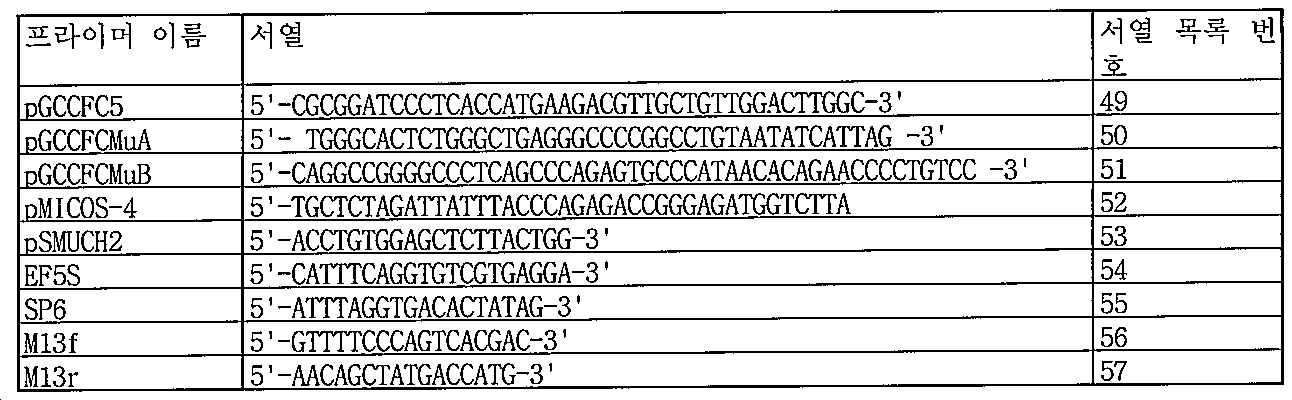
〔표 13〕Table 13
pLKTOK108을 위한 재조합 DNA를 생성하기 위해 제1 단계 PCR 어셈블리 반응에서 이용된 반응 프로토콜Reaction protocol used in the first stage PCR assembly reaction to generate recombinant DNA for pLKTOK108
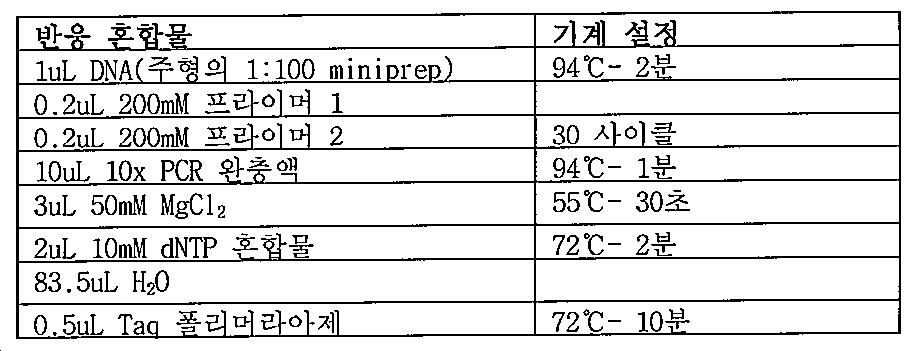
두 번째 PCR 반응은 표 14에 기재된 농도로 주형과 조합되었다. 표 15에 기재된 반응 프로토콜은 단일 재조합 융합 단백질 유전자를 생성하였다. 상기 반응의 산물을 직접 세 번째 PCR 반응에서 주형으로 이용하였다.The second PCR reaction was combined with the template at the concentrations listed in Table 14. The reaction protocol described in Table 15 produced a single recombinant fusion protein gene. The product of the reaction was directly used as template in the third PCR reaction.
〔표 14〕Table 14
pLKTOK108을 위한 재조합 DNA를 생성하기 위해 제2 단계 PCR 어셈블리 반응에서 이용된 주형Template used in the second stage PCR assembly reaction to generate recombinant DNA for pLKTOK108

〔표 15〕Table 15
pLKTOK108을 위한 재조합 DNA를 생성하기 위해 제2 단계 PCR 어셈블리 반응에서 이용된 반응 프로토콜Reaction protocol used in the second stage PCR assembly reaction to generate recombinant DNA for pLKTOK108

세 번째 PCR 반응은 전체 단편을 생성하기 위해 아래 표 17에 기재된 프로토콜로 표 16 및 표 12에 기재된 주형 및 프라이머를 이용하였다. 이들 DNA 단편을 Qiagen 겔 정제 키트(별첨 F), 및 티아민 아데노신(TA) 오버행 TOPO® TA 클로닝 키트(별첨 F)를 이용하여 0.7% 아가로오스 겔로부터 단리하였다. 독특한 클론을 단리하고, DNA를 Qiagen의 DNA miniprep 키트(별첨 F)를 이용하여 정제하였다. 원하는 서열을 갖는 것들을 확인하기 위해 DNA를 프라이머 M13f, M13r 및 pSMUCH2로 서열분석하였다. 중간체 TOPO 클론 TOK108-15는 원하는 재조합 DNA 서열을 함유하였다. The third PCR reaction was performed in Table 16 using the protocol described in Table 17 below to generate whole fragments. And the templates and primers described in Table 12 were used. These DNA fragments were isolated from 0.7% agarose gels using Qiagen gel purification kit (Appendix F), and thiamine adenosine (TA) overhang TOPO ® TA cloning kit (Appendix F). Unique clones were isolated and DNA was purified using Qiagen's DNA miniprep kit (Annex F). DNA was sequenced with primers M13f, M13r and pSMUCH2 to identify those with the desired sequence. Intermediate TOPO clone TOK108-15 contained the desired recombinant DNA sequence.
〔표 16〕Table 16
pLKTOK108을 위한 재조합 DNA를 생성하기 위해 제3 단계 PCR 어셈블리 반응에서 이용된 주형Template used in the third stage PCR assembly reaction to generate recombinant DNA for pLKTOK108

〔표 17〕Table 17
pLKTOK108을 위한 재조합 DNA를 생성하기 위해 제3 단계 PCR 어셈블리 반응에서 이용된 반응 프로토콜Reaction protocol used in the third stage PCR assembly reaction to generate recombinant DNA for pLKTOK108
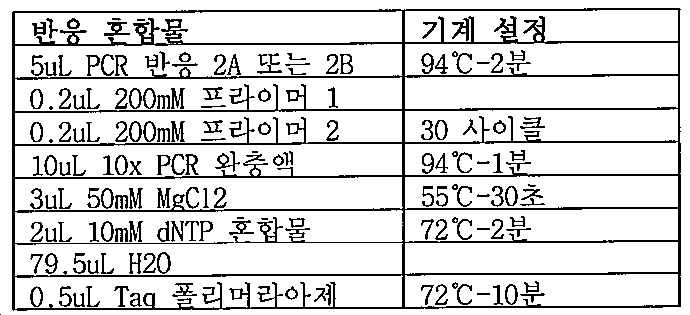
발현 벡터 pLKTOK4를 생성하기 위해, pcDNA3.1™을 골격 벡터로 이용하였다. 이는 연구 조건 하에 용이한 선택을 허용하기 위해 G-418(Geneticin®)에 대한 내성을 위한 네오마이신(NEO) 유전자를 함유한다. 부위-지정 돌연변이화에 의해 pcDNA™3.1로부터 SpeI 제한효소 부위를 제거하였다. 플라스미드 pcDEF3(pEF-BOS4 유래)으로부터의 EF-1α 프로모터를 pcDNA™3.1 내로 삽입하여 CMV 프로모터를 제거하였다. pLKTOK4 발현 벡터에 대한 원형 지도를 도 1에 도시한다.To generate the expression vector pLKTOK4, pcDNA3.1 ™ was used as the backbone vector. It contains a neomycin (NEO) gene for resistance to G-418 (Geneticin ® ) to allow easy selection under study conditions. SpeI restriction enzyme sites were removed from pcDNA ™ 3.1 by site-directed mutagenesis. The CMV promoter was removed by inserting the EF-1α promoter from plasmid pcDEF3 (from pEF-BOS 4 ) into pcDNA ™ 3.1. A circular map for the pLKTOK4 expression vector is shown in FIG. 1.
TOPO® TA 클로닝 키트를 이용하여 최종 PCR 산물 상에 클로닝을 수행하였다. BamHI 및 XbaI 제한 효소를 이용한 소화 후, TOPO 클론으로부터 원하는 단편을 역시 BamHI 및 XbaI으로 소화된 발현 벡터 pLKTOK4로 결찰하였다. 결찰 반응을 이용하여 K12 화학적 적격 E.coli 세포를 형질전환한 뒤 Luria 배지(LB)/앰피실린 한천 플레이트 상에서 선택하였다. 개별 E. Coli 클론으로부터의 플라스미드를 QIAGEN의 DNA miniprep 키트를 이용하여 단리하고 프라이머 SP6(서열 목록 번호 55), EF5S(서열 목록 번호 54) 및 pSMUCH2(서열 목록 번호 53)로 서열분석하였다. Cloning was performed on the final PCR product using the TOPO ® TA cloning kit. After digestion with BamHI and XbaI restriction enzymes, the desired fragments from the TOPO clone were ligated with the expression vector pLKTOK4, also digested with BamHI and XbaI. K12 chemically qualified E. coli cells were transformed using the ligation reaction and selected on Luria medium (LB) / ampicillin agar plates. Plasmids from individual E. Coli clones were isolated using QIAGEN's DNA miniprep kit and sequenced with primers SP6 (SEQ ID NO: 55), EF5S (SEQ ID NO: 54) and pSMUCH2 (SEQ ID NO: 53).
DNA 서열분석에 의해 원하는 재조합 DNA를 함유하는 클론을 결정하고, QIAGEN Maxiprep 키트를 이용하여 다량의 순수한 플라스미드 DNA를 제조하는데 이용하였다. 상기 maxiprep DNA를 디히드로폴레이트 환원효소-결핍 중국 햄스터 난소(CHO-DG44) 세포 내로의 전달감염을 위해 이용하였다.Clones containing the desired recombinant DNA were determined by DNA sequencing and used to prepare large quantities of pure plasmid DNA using the QIAGEN Maxiprep kit. The maxiprep DNA was used for transfection into dihydrofolate reductase-deficient Chinese hamster ovary (CHO-DG44) cells.
S1-CHO-DG44로 불리는 무혈청의 현탁 적응 CHO-DG44 세포주를 pLKTOK108 생산 세포주 개발을 위해 이용하였다. 간략하게, PvuI 제한 효소로 처리된 선형화된 플라스미드 DNA 또는 선형화되지 않은 원형 DNA를 이용하여 Nucleofection® 키트 V 및 Amaxa Biosystems의 Nucleofector® 장치를 이용하여 전달감염을 수행하였다. 전달감염된 세포를 G-418 선택 배지로의 교환 전에 48시간 동안 IS-CHO-V-GS 성장 배지 중에 유지하였다. 살아 있는 전달감염된 세포에 신선 G-418 선택 배지를 공급하고 융합성이 될 때까지 배양 중에 유지하였다(~10 내지 14일). 각각의 전달감염 풀의 pLKTOK108 생산성을 마우스 IgG2a ELISA 분석을 이용하여 평가하고 냉동 세포 은행을 제조하기 위해 세포를 증식시켰다. 세포를 G-418 선택 배지 중 5x96웰 조직 배양 플레이트 내로(매 웰마다 약 1개 세포를) 접종하는 제한 희석 클로닝에 대해 마우스 IgG2a ELISA에 의해 가장 높은 생산성을 갖는 전달감염 풀을 확인하였다. 96-웰 플레이트를 배지 공급 없이 2주 동안 5% CO2, 37℃ 인큐베이터에서 인큐베이션하였다. 단일 콜로니를 가진 각 웰로부터의 50㎕의 상청액을 96웰 분석 플레이트 내로 직접 전달하여 마우스 IgG2a ELISA 분석을 수행하였다. 높은 생산성을 갖는 23개 클론을 확인하고, 순차적으로 24웰 세포 배양 플레이트, 이어서 6-웰 세포 배양 플레이트를 통해 증식시켰다. 이들 클론으로부터의 상청액의 항체 역가를 마우스 IgG2a ELISA 분석에서 3회의 상이한 희석도에서 측정하였다.Serum-free suspension-adapted CHO-DG44 cell line called S1-CHO-DG44 was used for the development of pLKTOK108 producing cell line. Briefly, transfection was performed using Nucleofection ® Kit V and Nucleofector ® apparatus from Amaxa Biosystems using either linearized plasmid DNA or unlinearized DNA treated with PvuI restriction enzymes. Transfected cells were maintained in IS-CHO-V-GS growth medium for 48 hours prior to exchange with G-418 selection medium. Fresh transfected cells were fed fresh G-418 selection medium and maintained in culture until confluent (˜10-14 days). PLKTOK108 productivity of each transfection pool was assessed using mouse IgG2a ELISA assay and cells were expanded to prepare frozen cell banks. The highest productivity transfection pool was identified by mouse IgG2a ELISA for limiting dilution cloning inoculating cells into 5 × 96 well tissue culture plates in G-418 selection medium (approximately 1 cell per well). 96-well plates were incubated in a 5% CO 2 , 37 ° C. incubator for 2 weeks without medium feed. Mouse IgG2a ELISA assays were performed by transferring 50 μl of supernatant from each well with a single colony directly into a 96 well assay plate. 23 clones with high productivity were identified and sequentially grown through 24-well cell culture plates followed by 6-well cell culture plates. Antibody titers of the supernatants from these clones were measured at three different dilutions in mouse IgG2a ELISA assays.
마우스 IgG2a 역가에 근거하여 최적의 6개 클론을 냉동 세포 은행을 제조하기 위해 G-418 선택 배지 중에 증식시키고, 무혈청 현탁 Sigma #21 배지에 적응시켰다. 세포 밀도 및 생활성을 Cedex 자동화 세포 배양 분석기를 이용하여 결정하고, 상청액에서의 단백질 농도를 마우스 IgG2a ELISA 분석을 이용하여 측정하였다. 일단 세포가 지수적 성장상에 도달하면, 이들을 수확하고 하룻밤 동안 -80℃에 냉동한 뒤 보관을 위한 액체 질소 급냉챔버로 옮겼다. Based on mouse IgG2a titers, the optimal six clones were grown in G-418 selection medium to prepare frozen cell banks and adapted to serum-free suspended
융합 단백질을 제조하기 위해, 세포를 해동하고 접종한 뒤, 더 큰 T 플라스크 내에서, 이어서 3.0x10⁵ 세포/mL의 시작 밀도로 진탕 플라스크 내에서 연속해서 증식시키고 105rpm으로 설정된 궤도 진탕기에서 5% CO2, 37℃로 설정된 가습 인큐베이터에서 인큐베이션하였다. 최종 배양물에 4일 및 7일에 10부피% 및 10일에 5부피%의 Sigma #21 특수 공급 배지를 공급하였다. Sigma #21 공급 배지는 40g/L 글루코오스, 10g/L L-글루타민, 10g/L 효모 추출물, 및 10g/L 대두 펩톤이 보강된 Sigma #21 배지로 구성된다. 진탕 배양물을 원심분리에 의해 수확하였다. 선택된 pLKTOK108 단백질을 함유하는 상청액을 0.2-㎛ 저단백질 결합 폴리에테르설폰(PES) 막 필터 단위를 통해 여과하여, 조정제 pLKTOK108-함유 여액을 정제를 위해 준비하거나 향후 정제를 위해 -80℃에 보관한다. To prepare the fusion protein, the cells were thawed and inoculated, followed by 5% in an orbital shaker set up at 105 rpm in a larger T flask, then in series in a shake flask at a starting density of 3.0 × 10 5 cells / mL. Incubated in a humidified incubator set at CO 2 , 37 ° C. The final culture was fed
초기 정제에는 대략 4℃에서 단백질 A 세파로오스 컬럼에 걸친 pLKTOK108 함유 여과 상청액의 순환이 관여되었다. 이어서 수지를 PBS, pH7.4로 세척하고 단백질을 PBS, pH 3.0 중 0.1M 글리신으로 용출하고 pH 6.5에서 1M 나트륨 포스페이트로 중화하였다. 중화된 용출액을 분자량 컷오프(MWCO) 30kDa의 Vivaspin 농축기를 이용하여 농축하고 상기 단백질의 응집물을 분리하기 위해 PBS pH 7.4 완충액으로 사전 평형화된 Superdex 200 크기 배제 크로마토그래피(SEC) 컬럼(별첨 G) 상에 로딩하였다. 정제된 pLKTOK108 단백질은 단일 피크로 용출되며, 순도는 SDS-PAGE 및 쿠마시 염색으로 확인하였다. hGCC(ECD)/mIgG2a Fc 동종이량체를 함유하는 분획을 풀링하였다. 풀링된 재료의 농도를 NanoDrop™ ND1000 분광측정기 상에서 280nm의 UV 흡광도로 결정하고, 정제된 pLKTOK108 단백질을 분취하여 -80℃에 보관하였다.Initial purification involved circulation of the pLKTOK108 containing filtration supernatant across the Protein A Sepharose column at approximately 4 ° C. The resin was then washed with PBS, pH 7.4 and the protein eluted with 0.1 M glycine in PBS, pH 3.0 and neutralized with 1 M sodium phosphate at pH 6.5. The neutralized eluate was concentrated using a Vivaspin concentrator with a molecular weight cutoff (MWCO) 30 kDa and on a Superdex 200 size exclusion chromatography (SEC) column (Annex G) pre-equilibrated with PBS pH 7.4 buffer to separate aggregates of the protein. Loaded. Purified pLKTOK108 protein was eluted with a single peak and purity was confirmed by SDS-PAGE and Coomassie staining. Fractions containing hGCC (ECD) / mIgG2a Fc homodimer were pooled. The concentration of pooled material was determined with a UV absorbance of 280 nm on a NanoDrop ™ ND1000 spectrometer, and the purified pLKTOK108 protein was aliquoted and stored at -80 ° C.
실시예 2Example 2 : 단백질 면역화에 의한 토끼 mAb의 생성: Generation of Rabbit mAb by Protein Immunization
hGCC(ECD)-mIgG2a RcRbr-mutII 융합 단백질(pLKTOK108)에 대한 토끼 모노클로날 항체를 Epitomics(Burlingame, CA)에서 제공되는 RabMAb® 서비스를 이용하여 생성하였다. MAb 생성 목적을 위해, hGCC(ECD)-mIgG2a RcRbr-mutII 융합 단백질(pLKTOK108) 융합 단백질을 본원에서 MIL-44로 부른다.a monoclonal antibody to the rabbit monoclonal antibodies for hGCC (ECD) -mIgG2a RcRbr-mutII fusion protein (pLKTOK108) was generated by using the service provided by the RabMAb ® Epitomics (Burlingame, CA). For MAb production purposes, the hGCC (ECD) -mIgG2a RcRbr-mutII fusion protein (pLKTOK108) fusion protein is referred to herein as MIL-44.
3마리 토끼(ML1009, ML1010 및 ML1011)를 통상적 면역화 기법을 이용하여 면역화하였다. MIL-44 및 비-GCC 역스크리닝 항원(hMadCAM-mFc)에 대한 혈청 역가를 평가 채혈을 이용하여 평가하였다. 초기 면역화 이후 추가접종 면역화를 제공하였다. 가장 높은 혈청 역가를 갖는 토끼인 토끼 ML1010을 비장절제 및 Epitomics의 전용 융합 파트너 세포주 및 방법을 이용한 모노클로날 융합을 위한 후보로 선택하였다.Three rabbits (ML1009, ML1010 and ML1011) were immunized using conventional immunization techniques. Serum titers against MIL-44 and non-GCC reverse screening antigen (hMadCAM-mFc) were assessed using an evaluation blood collection. Vaccination immunization was provided after initial immunization. Rabbit ML1010, the rabbit with the highest serum titer, was selected as a candidate for monoclonal fusion using splectomy and dedicated fusion partner cell lines and methods of Epitomics.
별도의 두 날에(1일 및 2일), 2억 개의 림프구 세포를 1억 개의 융합 파트너 세포와 융합시키고 각각 20X 96-웰 플레이트 상에 접종하였다. 플레이트를 표준 조건 하에 조직 배양 인큐베이터에서 유지하였다. 융합 후 2-3주 세포 성장을 검사하고, 검사한 전체 웰의 개수로 나눈 성장한 웰의 개수를 이용해서 융합 효율성을 전산으로 계산하였다. 1일에 융합에 대한 융합 효율은 72% 융합 효율성으로 측정된 반면, 2일에 융합 효율성은 79%였다. 최소 2개의 플레이트를 다음과 같이 각각의 융합에 대해 검사하였다:On two separate days (
전체 40개 플레이트를 50ng의 MIL-44/웰로 코팅된 플레이트로 표준 ELISA 방법을 이용하여 스크리닝하였다. 1:10K 희석도의 ML1010의 채혈을 양성 대조군으로 이용하였다. 0.5 초과 O.D.를 갖는 151개 클론을 추정 양성으로 간주하고, 24웰 플레이트 내에서 추가 증식시켰다. A total of 40 plates were screened using standard ELISA methods with 50ng of MIL-44 / well coated plates. A blood collection of ML1010 at 1: 10K dilution was used as a positive control. 151 clones with greater than 0.5 O.D. were considered putative positive and further propagated in 24-well plates.
50ng의 MIL-44 또는 50ng의 hMadCAM-mFc/웰로 코팅된 플레이트를 이용한 ELISA로 후속 확인 스크리닝을 수행하였다. 143개 클론은 MIL-44에 대해 양성으로 확인되었고, 이들 중 72개가 MIL-44 특이적인 것으로 확인되었다, 즉 이들은 hMadCAM-mFc 단백질에 대해 음성이었다.Subsequent confirmation screens were performed by ELISA using plates coated with 50 ng MIL-44 or 50 ng hMadCAM-mFc / well. 143 clones were identified positive for MIL-44, 72 of which were identified as MIL-44 specific, ie they were negative for the hMadCAM-mFc protein.
다중클론 상청액 평가 후, 다중클론 #148 및 #67을 포함하는 몇몇 MIL-44 특이적 다중클론을 서브클로닝하였다. 제한 세포 희석 방법을 이용하여 서브클로닝을 수행하였다. 몇몇 서브클론 상청액을 ELISA로 스크리닝하였다. 서브클론 #148-2 및 #67-4에 대한 하이브리도마 세포를 냉동/은행수립을 위해 그리고 실시예 3에 기재된 바와 같은 면역조직화학(IHC) 분석에서 GCC 검출 시약으로서 추가 스크리닝 및 분석을 위해 선택하였다. After polyclonal supernatant evaluation, several MIL-44 specific polyclones, including polyclones # 148 and # 67, were subcloned. Subcloning was performed using the restriction cell dilution method. Several subclonal supernatants were screened by ELISA. Hybridoma cells for subclones # 148-2 and # 67-4 for freezing / banking and for further screening and analysis as GCC detection reagents in immunohistochemistry (IHC) analysis as described in Example 3 Selected.
MIL-44-148-2 및 MIL-44-67-4 항체를 또한 포유류 세포에서의 일시적 전달감염에 의해 제조를 위한 그리고 서열분석을 위해 pcDNA3.1+ neo(Invitrogen) 내로 클로닝하였다. MIL-44-148-2 및 MIL-44-67-4 항체를 위한 중쇄 및 경쇄에 대한 핵산 및 아미노산 서열을 아래에 제공한다. 각각의 IgG 사슬에서의 신호 서열은 이탤릭체로 나타낸다; 각각의 IgG 사슬에서의 가변 영역은 진한 글씨체로 나타낸다; CDR은 밑줄을 쳐서 나타낸다. MIL-44-148-2 and MIL-44-67-4 antibodies were also cloned into pcDNA3.1 + neo (Invitrogen) for production and sequencing by transient transfection in mammalian cells. Nucleic acid and amino acid sequences for the heavy and light chains for MIL-44-148-2 and MIL-44-67-4 antibodies are provided below. Signal sequences in each IgG chain are shown in italics; The variable regions in each IgG chain are shown in bold; CDRs are underlined.
MIL-44-148-2 H2 핵산 서열(서열 목록 번호 4)MIL-44-148-2 H2 Nucleic Acid Sequence (SEQ ID NO: 4)

MIL-44-148-2 H2 아미노산 서열(서열 목록 번호 42)MIL-44-148-2 H2 amino acid sequence (SEQ ID NO: 42)

MIL-44-148-2 L5 핵산 서열(서열 목록 번호 5)MIL-44-148-2 L5 Nucleic Acid Sequence (SEQ ID NO: 5)
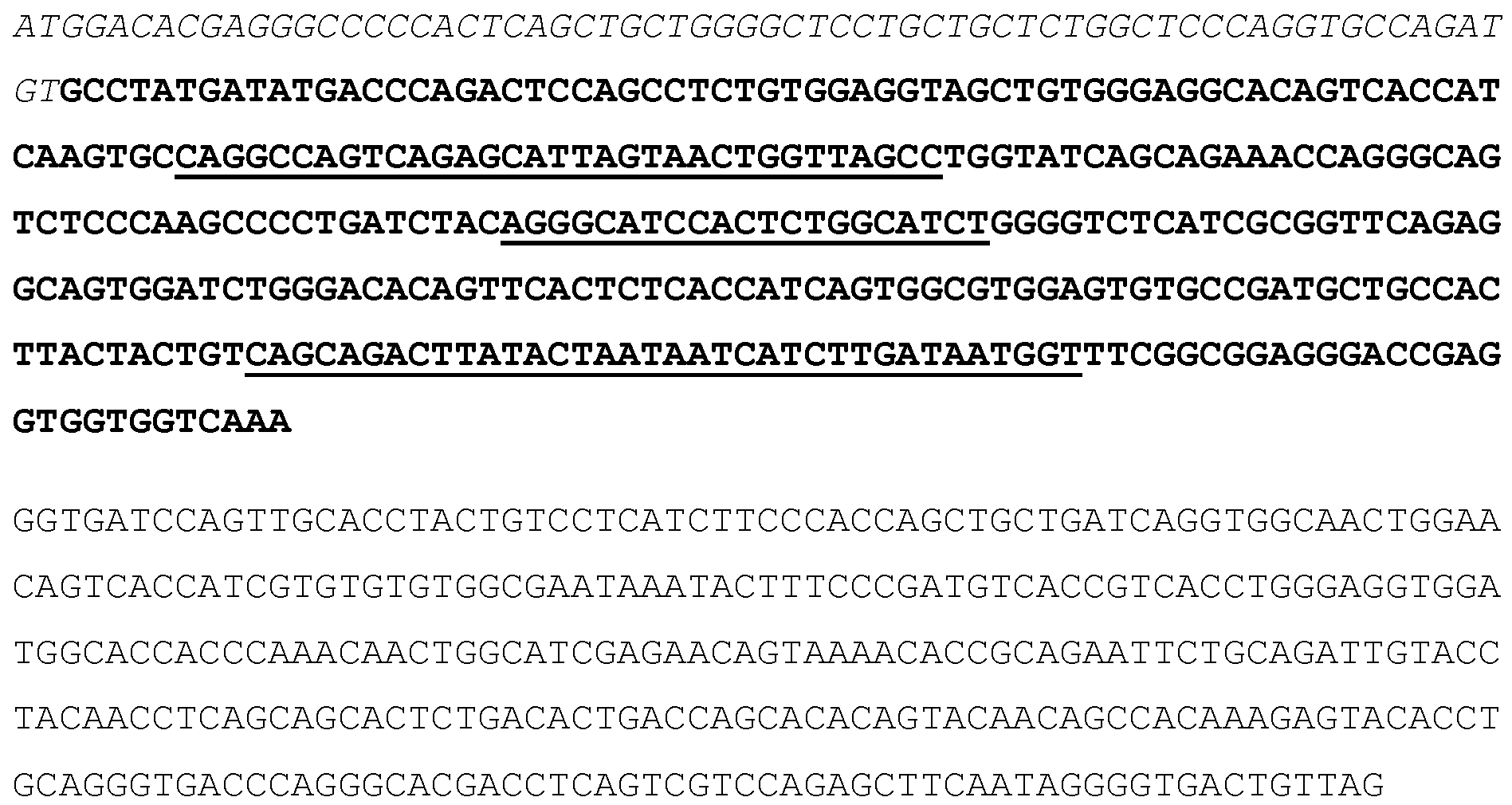
MIL-44-148-2 L5 아미노산 서열(서열 목록 번호 43)MIL-44-148-2 L5 amino acid sequence (SEQ ID NO: 43)

MIL-44-67-4 H2 핵산 서열(서열 목록 번호 6)MIL-44-67-4 H2 Nucleic Acid Sequence (SEQ ID NO: 6)


MIL-44-67-4 H2 아미노산 서열(서열 목록 번호 44)MIL-44-67-4 H2 amino acid sequence (SEQ ID NO: 44)

MIL-44-67-4 L4 핵산 서열(서열 목록 번호 7)MIL-44-67-4 L4 Nucleic Acid Sequence (SEQ ID NO: 7)
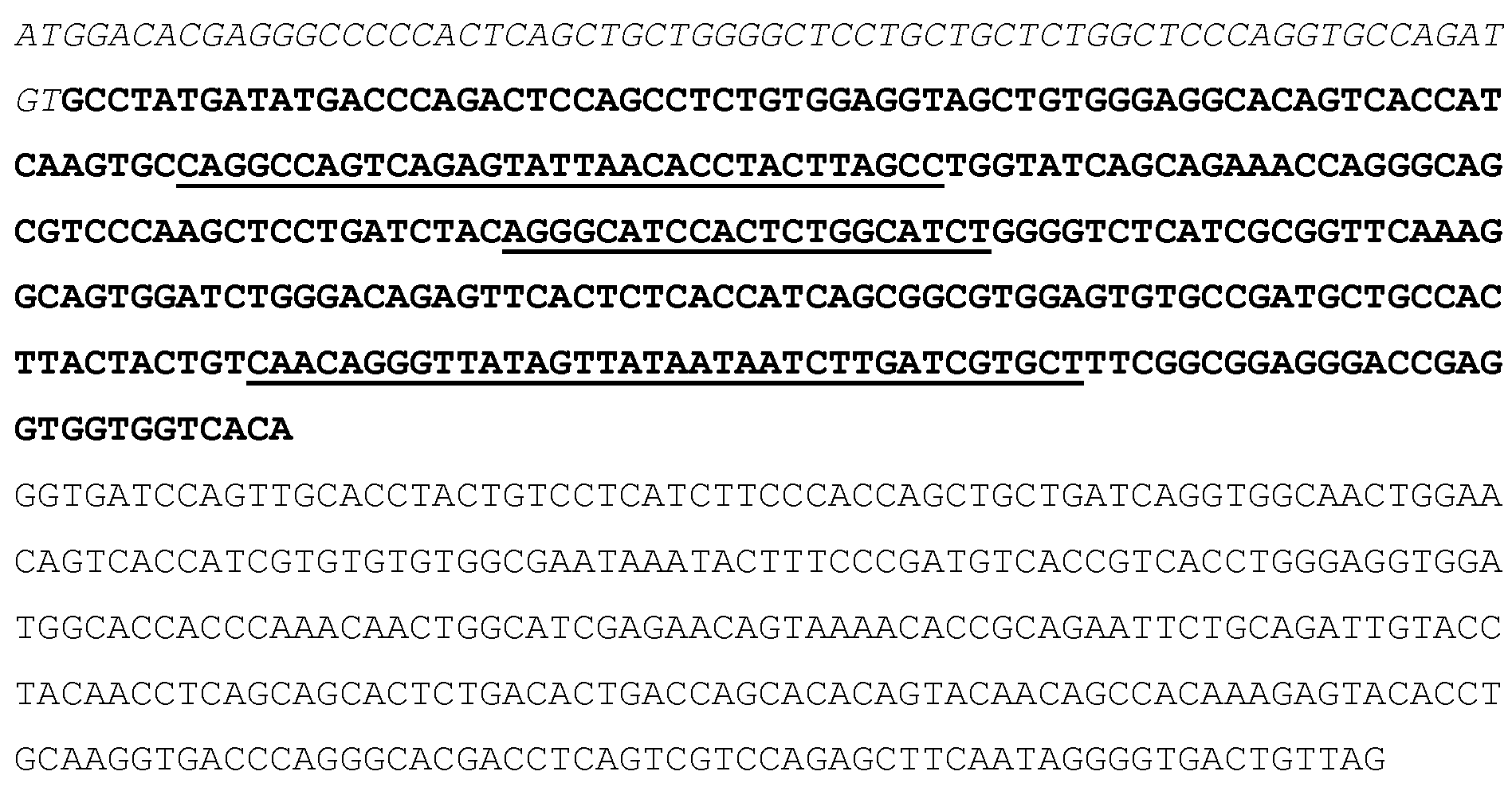
MIL-44-67-4 L4 아미노산 서열(서열 목록 번호 45)MIL-44-67-4 L4 amino acid sequence (SEQ ID NO: 45)

실시예 3:Example 3: 항-GCC 항체를 이용한 면역조직화학 Immunohistochemistry with Anti-GCC Antibodies
mCRC의 인간 종양 이종이식편 모델에서 GCC 발현의 검출Detection of GCC Expression in Human Tumor Xenograft Model of mCRC
자성 SCID 마우스에서 전이성 결직장암(mCRC) 환자 표본 유래의 몇몇 일차 인간 종양 이종이식편(PHTX) 및 HEK293-GCC 이종이식편 종양에서의 GCC 발현을 평가하기 위해 MIL-44-148-2 항체를 이용한 IHC 분석을 개발하였다. IHC analysis using MIL-44-148-2 antibody to evaluate GCC expression in several primary human tumor xenografts (PHTX) and HEK293-GCC xenograft tumors from metastatic colorectal cancer (mCRC) patient samples in female SCID mice Developed.
포르말린 고정되고 파라핀-임베딩된(FFPE) 조직에서의 GCC 단백질 수준을 5㎛ 두께 절편 상에서 평가하고, Ventana Medical Systems(Tucson, AZ) Discovery XT® 자동화 염색기 상에서 1시간 동안 MIL-44-148-2 항체(3.5㎍/mL)와 인큐베이션하였다. 항체를 토끼 항-염소 이차 항체(Vector Laboratories)로 바이오틴화하고, 3,3'-디아미노벡시딘(DAB) 기질 지도 시스템(Ventana Medical Systems)으로 발색하였다. 슬라이드를 헤마톡실린으로 카운터염색하고 Aperio 전체 슬라이드 스캐닝 시스템을 이용하여 이미지화하였다. GCC protein levels in formalin fixed and paraffin-embedded (FFPE) tissue were assessed on 5 μm thick sections and MIL-44-148-2 antibody for 1 hour on Ventana Medical Systems (Tucson, AZ) Discovery XT ® automated stainer (3.5 μg / mL) and incubated. Antibodies were biotinylated with rabbit anti-chlorine secondary antibody (Vector Laboratories) and developed with 3,3'-diaminobexidine (DAB) substrate map system (Ventana Medical Systems). Slides were counterstained with hematoxylin and imaged using an Aperio whole slide scanning system.
GCC 수준은 HEK293-GCC 종양 이종이식편의 4+ 그리고 다양한 PHTX 종양 이종이식편의 1+, 1-2+, 2+, 2-3+, 및 4+의 범위의 H-스코어(아래 기재된 스코어링 시스템)으로 이들 종양 간에 유의미하게 상이하였다. 일반적으로, 극화된 상피 구조를 유지하는 중간/잘 분화된 종양 세포를 갖는 종양에서, GCC는 종양 조직의 내강측에 집중되어 있었다. GCC levels range from 4+ of HEK293-GCC tumor xenografts and to H-scores ranging from 1+, 1-2 +, 2+, 2-3 +, and 4+ of various PHTX tumor xenografts (scoring system described below). Significantly different between these tumors. In general, in tumors with intermediate / well differentiated tumor cells that maintain polarized epithelial structures, GCC was concentrated on the lumen side of tumor tissue.
인간 결장 표본 및 종양 마이크로어레이에서 GCC 발현의 검출Detection of GCC Expression in Human Colon Samples and Tumor Microarrays
본원에 기재된 MIL-44-148-2 및 MIL-44-67-4 항체를 또한 악성 및 양성 인간 결장 표본(FFPE 및 종양 마이크로어레이(TMA))에 부가하여 상기-참조 일차 인간 종양 이종이식편(PHTX), HT29 및 HEK293 GCC 전달감염 세포 펠렛을 이용하여 전술된 IHC 프로토콜에서 GCC 검출 시약으로 스크리닝하였다. The MIL-44-148-2 and MIL-44-67-4 antibodies described herein may also be added to malignant and benign human colon specimens (FFPE and tumor microarray (TMA)) to refer to the above-referenced primary human tumor xenografts (PHTX). ), HT29 and HEK293 GCC transfected cell pellets were screened with GCC detection reagents in the IHC protocol described above.
HT-29 및 HEK293 GCC 전달감염 세포 펠렛은 예측된 바와 같이 염색되었다. PHTX는 MIL-44-148-2 및 MIL-44-67-4 클론으로 광범위한 염색 강도를 나타내었다. MIL-44-148-2 및 MIL-44-67-4는 모두 잘 또는 중간으로 분화된 결장암종의 원 위치에서 또는 전이에서 양성으로 염색되었다. 약하게 분화된 종양은 덜 진하게 염색되었다. 정상 결장 조직은 MIL-44-148-2 및 MIL-44-67-4 서브클론 모두에 의해 생성되는 항체를 이용하여 양성 첨단 염색을 나타내었다. HT-29 and HEK293 GCC transfected cell pellets were stained as expected. PHTX showed extensive staining intensity with MIL-44-148-2 and MIL-44-67-4 clones. MIL-44-148-2 and MIL-44-67-4 were both stained positive in situ or in metastasis of well or moderately differentiated colon carcinoma. Weakly differentiated tumors were less heavily stained. Normal colon tissue showed positive tip staining with antibodies produced by both MIL-44-148-2 and MIL-44-67-4 subclones.
MIL-44-148-2 및 MIL-44-67-4 서브클론 둘 다로부터의 항체는 HEK293 및 HT29 모 세포주에서 임의의 비-특이적 염색 없이 GCC 전달감염 HEK293 세포 및 HT29 세포에서 쉽게 자명하고, 진하고 특이적인 염색을 제공하였다. 두 클론은 또한 원 위치 또는 전이에서 잘 또는 중간으로 분화된 결장암종에서 양성으로 염색되었다. 약하게 분화된 암종에서 두 서브클론에 대해 약한 염색이 나타났다. 정상 결장은 예측된 바와 같이, 두 클론 모두에 대해 양성 첨단 염색을 나타내었다. MIL-44-148-2는 IHC에서 MIL-44-67-4에 비해 전반적으로 더 높은 민감성 및 특이성을 나타내었다. MIL-44-67-4는 세포 펠렛에서 MIL-44-148-2에 비해 더 우수한 동적 범위를 나타낸 반면, MIL-44-148-2는 TMA에서 MIL-44-67-4에 비해 더 월등한 동적 범위를 나타내었다. 전체적으로 MIL-44-148-2 서브클론은 MIL-67-4에 비해 우수성을 나타내어, IHC에서 더 높은 민감성과 특이성을, TMA에서 완전 동적 범위를, 그리고 낮은 농도에서 정상 결장에서의 진한 염색(+2 IHC 스코어)을 나타내었다. Antibodies from both MIL-44-148-2 and MIL-44-67-4 subclones are readily apparent in GCC transfected HEK293 cells and HT29 cells without any non-specific staining in HEK293 and HT29 parent cell lines, It provided a thick and specific stain. Both clones were also stained positive in colon carcinoma that differentiated well or moderate in situ or metastasis. Weak staining was shown for both subclones in weakly differentiated carcinomas. Normal colonies showed positive peak staining for both clones, as expected. MIL-44-148-2 showed overall higher sensitivity and specificity in IHC compared to MIL-44-67-4. MIL-44-67-4 showed better dynamic range than MIL-44-148-2 in cell pellets, while MIL-44-148-2 was superior to MIL-44-67-4 in TMA. Dynamic range is shown. Overall, the MIL-44-148-2 subclone is superior to MIL-67-4, with higher sensitivity and specificity in IHC, full dynamic range in TMA, and deep staining in normal colon at low concentrations (+ 2 IHC score).
전술된 초기 IHC 실험 결과에 근거하여, MIL-44-148-2 서브클론을 Tek-Mate 자동화 염색기를 이용하여 전술된 IHC 프로토콜과 동등한 자동화 프로토콜의 개발 및 검증을 위해 선택하였다. 자동화 IHC 분석은 GCC-표적화 암 치료제를 위한 임상 실험 등록 기준으로 그리고 일반적으로 GCC-표적화 치료법을 받아야 하는 환자(예로, 암 환자)의 선택을 위한 스크리닝 도구로서 GCC 발현 종양에 대한 암 환자 스크리닝을 위해 유용한 도구이다. Based on the initial IHC experiment results described above, MIL-44-148-2 subclones were selected for the development and validation of automation protocols equivalent to the IHC protocol described above using a Tek-Mate automated stainer. Automated IHC analysis is used for screening cancer patients for GCC expressing tumors as a screening tool for the selection of patients (eg, cancer patients) who should receive GCC-targeted therapies as a clinical trial registration criteria for GCC-targeted cancer therapeutics. It is a useful tool.
표 18에 나타낸 IHC 프로토콜은 FFPE 인간 세포 및 조직에서 GCC의 검출을 위해 개발되었으며, 대략 53개의 결직장 종양 및 20개의 정상 결장 조직뿐만 아니라 2개의 결장암 TMA(US Biomax에서 구매)가 GCC 발현에 대해 스크리닝되었다. 이들 종양은 다양한 범위의 종양 등급뿐만 아니라 결장암 전이 조직을 커버하였다. The IHC protocols shown in Table 18 were developed for the detection of GCC in FFPE human cells and tissues, with approximately 53 colon tumors and 20 normal colon tissues as well as two colon cancer TMAs (purchased from US Biomax) for GCC expression. Screened. These tumors covered a wide range of tumor grades as well as colon cancer metastatic tissues.
4마이크론 절편을 다양한 조직 표본에서 제조하였다. 조직 절편을 4, 5분의 자일렌, 이어서 등급별 알코올 시리즈, 이어서 증류수로의 교환을 통해 탈왁스화하였다. Black and Decker 증열기 상부 챔버의 모세관 갭에서 20분 동안 SHIER2 용액과 함께 증기열 유도 에피토프 회복(SHIER)을 이용하였다.Four micron sections were prepared from various tissue samples. Tissue sections were dewaxed through 4, 5 minutes of xylene followed by graded alcohol series followed by distilled water. Steam heat induced epitope recovery (SHIER) was used with SHIER2 solution for 20 minutes in the capillary gap of the Black and Decker steamer upper chamber.
〔표 18A〕Table 18A
IHCIHC 절차 step
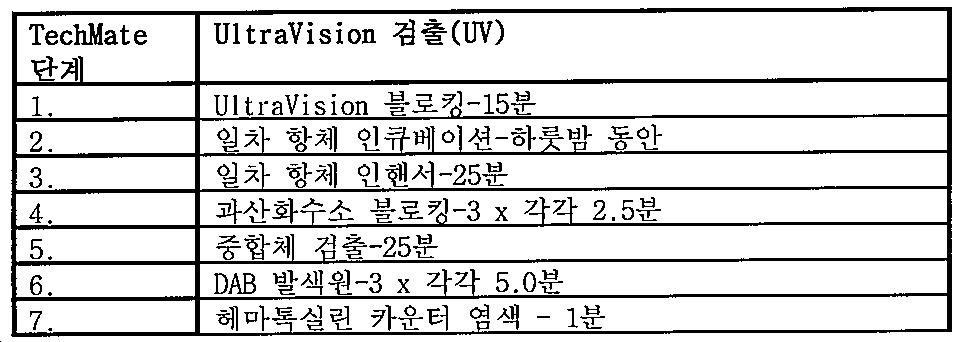
〔표 18B〕 Table 18B
항체 반응성 사양 시트Antibody Reactivity Specification Sheet

당분야 숙련자는 일차 항체 인핸서가 MIL-44-148-2 또는 MIL-44-67 토끼 mAb(토끼 IgG)와 같은 이소형을 갖는 토끼 이외의 종(예로, 인간, 래트, 염소, 마우스 등)에서 생성된 항-토끼 이차 항체 또는 MIL-44 신호를 증폭시키기 적합한 유사한 시약일 수 있음을 인지할 것이다.One of ordinary skill in the art would be to recognize that in non-rabbit species (eg, humans, rats, goats, mice, etc.) the primary antibody enhancer has an isotype such as MIL-44-148-2 or MIL-44-67 rabbit mAb (rabbit IgG). It will be appreciated that the anti-rabbit secondary antibody produced or a similar reagent suitable for amplifying the MIL-44 signal may be used.
상기 프로토콜은 발색원으로 DAB 및 비-바이오틴 기반 페록시다아제 검출(Ultravision 키트, Thermo/Lab Vision)로 1.0㎍/ml에서 MIL-44-148-2의 하룻밤 동안의 항체 인큐베이션을 이용하였다. 상기 절차는 TechMate 500 또는 TechMate 1000(Roche DIagnostics)을 이용하여 완전 자동화되었다. 염색 후, 슬라이드를 절대 알코올까지의 알코올 시리즈를 통해 탈수시킨 뒤 자일렌으로 헹구었다. 슬라이드를 유리 커버슬립 및 CytoSeal로 영구 커버슬립처리하였다. 슬라이드를 현미경 하에 조사하여 염색을 평가하였다. 양성 염색은 갈색(DAB-HRP) 반응 산물의 존재로 나타난다. 헤마톡실린 카운터염색은 세포 및 조직 형태를 평가하기 위한 파란색 핵 염색을 제공한다. The protocol used overnight incubation of MIL-44-148-2 at 1.0 μg / ml with DAB and non-biotin based peroxidase detection (Ultravision kit, Thermo / Lab Vision) as the chromophore. The procedure was fully automated using TechMate 500 or TechMate 1000 (Roche DIagnostics). After staining, the slides were dehydrated through an alcohol series up to absolute alcohol and then rinsed with xylene. Slides were permanently covered with glass coverslips and CytoSeal. The slides were examined under the microscope to assess staining. Positive staining is indicated by the presence of the brown (DAB-HRP) reaction product. Hematoxylin counterstaining provides blue nuclear staining to assess cell and tissue morphology.
GCC 염색 평가 시, H-스코어 접근이 GCC 발현을 정량하기 위한 최적 접근일 것으로 결정되었다. H-스코어 접근은 종양 유형 간에 그리고 내에서 염색 강도와 종양 백분율 변이를 결정하기 위한 최적의 데이터 해상도를 제공한다. 또한 양성 염색에 대한 역치 결정을 위해 우수한 도구를 제공한다. 상기 방법에서, 염색 강도 0-3+ 범위의 종양 내 세포 백분율(0-100)이 제공된다. 본 발명의 방법으로, 0, 0.5, 1, 2 및 3의 강도를 갖는 스코어가 제공되었다. 마커에 따라, 0.5 염색은 양성 또는 음성으로 스코어링될 수 있고, 마커에 대해 약하지만 감지가능한 염색을 나타낸다. H-스코어를 수득하기 위해, 종양 세포의 백분율을 각 강도로 곱하고 함께 더한다: In evaluating GCC staining, it was determined that the H-score approach would be the optimal approach for quantifying GCC expression. The H-score approach provides optimal data resolution for determining staining intensity and tumor percentage variation between and within tumor types. It also provides an excellent tool for determining thresholds for positive staining. In this method, percentage of cells in the tumor (0-100) in the range of staining intensity 0-3 + is provided. In the method of the invention, scores with strengths of 0, 0.5, 1, 2 and 3 were provided. Depending on the marker, 0.5 staining can be scored positive or negative, indicating weak but detectable staining for the marker. To obtain H-scores, the percentage of tumor cells is multiplied by each intensity and added together:
H 스코어 = (종양% * 1) + (종양% * 2) + (종양% *3). 예를 들어, 종양이 20% 음성이고(0), 30%가 +1, 10%가 +2, 40%가 +3인 경우, 이는 H 스코어 170을 제공할 것이다. H score = (% tumor * 1) + (% tumor * 2) + (% tumor * 3). For example, if the tumor is 20% negative (0), 30% +1, 10% +2, 40% +3, this will give an H score of 170.
100%의 종양 세포가 3+ 강도로 표지되는 경우, 최대 H-스코어는 세포하 위치(즉, 첨단 또는 세포질) 당 300(100% * +3)이다. 처음에는 대조군으로, 전체 H-스코어만을 표본 비교에 이용하지 않았고, 각 강도에서 세포 백분율의 붕괴를 검토하기 위해 부가적으로 평가하였다. 예를 들어, 스코어 90은 1+ 강도로 염색된 90% 종양 세포 또는 3+ 강도로 염색된 30% 세포를 나타낼 수 있다. 이들 표본은 동일한 H-스코어를 갖지만 매우 상이한 GCC 발현을 갖는다. 각 강도에서 스코어링될 세포의 백분율은 변할 수 있지만, 보통 10% 증분으로 스코어링된다; 그러나 일부 염색 수준이 존재하는 것을 나타내기 위해 단일 성분의 작은 백분율의 스코어링이 1% 및 5%에서도 추정될 수 있다. GCC에 있어서, 첨단 염색은 낮은 수준의 증분에서, 예컨대 1 및 5%에서 평가에 대해 고려될 수 있다. If 100% of tumor cells are labeled with 3+ intensity, the maximum H-score is 300 (100% * +3) per subcellular location (ie tip or cytoplasm). Initially, as a control, only total H-scores were not used for sample comparisons and were additionally evaluated to examine the breakdown of the percentage of cells at each intensity. For example, a score 90 can represent 90% tumor cells stained at 1+ intensity or 30% cells stained at 3+ intensity. These specimens have the same H-score but very different GCC expression. The percentage of cells to be scored at each intensity can vary, but is usually scored in 10% increments; However, a small percentage of scoring of a single component can be estimated even at 1% and 5% to indicate that some staining level is present. For GCC, advanced staining can be considered for evaluation at low levels of increments, such as at 1 and 5%.
2개의 상이한 세포하 위치가 H-스코어 접근을 이용하여 GCC에 대해 스코어링되었다. 이들에는 세포질 염색 및 첨단 연관 염색이 포함되었다. 세포질 염색 패턴은 일반적으로 종양 세포의 세포질에 걸쳐 확산된 것으로 관찰되었다. 그러나 일부 경우, 진한 구형 염색 또는 반점상의 거친 과립형 염색이 포함되는 세포질 염색의 변이가 있었다. 진한 구형 염색은 3+ 세포질 염색으로 스코어링되었다. 반점상 염색은 첨단 염색과 연관되었으며, 상기 유형의 세포질 염색에 대해서는 별도의 스코어가 주어지지 않았다(반점상 염색에 대한 n=4의 표본). 내강이 존재하는 경우 GCC 첨단 염색이 관찰되었다. 관찰된 다른 GCC 염색 패턴에는 막 유사, 비-내강 염색(1개 사례) 및 종양 내강에 존재하는 세포외 염색이 포함되었다. 정상 결장 조직에서, 염색은 일반적으로 확산 세포질 염색과 함께 첨단에 있었다. Two different subcellular locations were scored for GCC using the H-score approach. These included cytoplasmic staining and advanced associative staining. Cytoplasmic staining patterns were generally observed to spread across the cytoplasm of tumor cells. In some cases, however, there have been variations in cytoplasmic staining, including dark spherical staining or coarse granular staining on spots. Dark spherical staining was scored with 3+ cytoplasmic staining. Speckle staining was associated with advanced staining and no separate score was given for this type of cytoplasmic staining (sample of n = 4 for speckle staining). GCC tip staining was observed when the lumen was present. Other GCC staining patterns observed included membrane-like, non-luminal staining (1 case) and extracellular staining present in the tumor lumen. In normal colon tissues, staining was usually at the leading edge with diffuse cytoplasmic staining.
H 스코어가 세포질 및 첨단 GCC 발현 모두에 대해 수득되었고, 하나의 위치 유형이 GCC-표적화 치료법의 유효성에 있어서 다른 것에 비해 더 결정적인지가 알려져 있지 않으므로 모든 데이터를 캡처하였고, 일부 경우 첨단 및 세포질 GCC 발현 모두의 합을 이용하여 집합 H 스코어를 생성하였다. 이러한 경우, 최대 H 스코어는 집합 스코어(300 첨단 + 300 세포질)에 대해 600이 되었다.H scores were obtained for both cytoplasmic and advanced GCC expression, and all data were captured because it is not known whether one location type is more determinant than the other in the effectiveness of GCC-targeted therapy, and in some cases both advanced and cytoplasmic GCC expression The set H score was generated using the sum of. In this case, the maximum H score was 600 for the aggregation score (300 peaks + 300 cytoplasm).
전반적으로, 정상 결장 표본에서의 염색은 GCC가 해부학적으로 격리되며, 첨단 표면에 발현된다는 것을 나타내었다. GCC는 정상 조직과는 대조적으로 종양 표본의 95% 초과에서 발현되었고, 일부 경우 확산된 세포질 염색을 나타내었다. 인간 CRC 간 전이 표본에서의 강한 국소 GCC 염색도 나타났다.Overall, staining in normal colon specimens showed that GCC was anatomically isolated and expressed on the tip surface. GCC was expressed in more than 95% of tumor samples as opposed to normal tissue, and in some cases showed diffuse cytoplasmic staining. Strong local GCC staining in human CRC liver metastases was also shown.
표 19A는 스크리닝된 정상 및 종양 조직에 대한 세포질 및 첨단 H-스코어 염색 결과를 나타낸다. 표 19A에 나타낸 데이터는 표본 유래(내부(MLNM로 표시됨), TMA(BIOMAX로 표시됨), 및 CRO(QualTek으로 표시됨)) 및 종양 등급에 따라 나타낸다. 역치 0.5 및 1.0+의 염색 강도를 이용하는 경우의 양성 요약 데이터가 제공된다. 전체 173개 종양 표본이 스코어링되었다. 세포질 또는 첨단 염색에 대해 양성 염색 강도로 0.5+ 컷오프를 이용하는 경우, 종양의 95%가 양성으로 간주된다. 1.0+ 컷오프를 이용하는 경우, 표본의 92%가 양성으로 간주된다. Table 19A shows cytoplasmic and advanced H-score staining results for screened normal and tumor tissues. Data shown in Table 19A is shown according to sample origin (internal (indicated by MLNM), TMA (indicated by BIOMAX), and CRO (indicated by QualTek)) and tumor grade. Positive summary data when using staining intensities of thresholds 0.5 and 1.0+ are provided. A total of 173 tumor samples were scored. When using 0.5+ cutoff with positive staining intensity for cytoplasmic or advanced staining, 95% of tumors are considered positive. When using a 1.0+ cutoff, 92% of the samples are considered positive.
조직 유래는 양성 종양 세포의 백분율뿐만 아니라 H-스코어의 변이를 나타낸다. 1+ 염색 양성 역치에서, 상기 범위는 84%(CRO 종양 MTB 표본) 내지 100%이다(내부 표본 또는 CRO 단일 조직 표본-이들 그룹에서의 표본 수가 더 적음을 주지하라). 내부 종양 조직은 253의 매우 높은 첨단 H-스코어를 나타내었다(n=9 표본). 2 TMA의 스코어링 결과에서도 차이가 있었다. US Biomax TMA C0992는 C0701보다 강하게 염색되었다. 특정 이론에 구애받고자 하지 않고, TMA에서의 차이는 조직 유래의 고정의 차이에 기인할 수 있거나 한 블록이 다른 것에 비해 더 최근에 절단되었을 수 있다.Tissue derivation indicates variation in H-score as well as percentage of benign tumor cells. At the 1+ staining positive threshold, the range is 84% (CRO tumor MTB sample) to 100% (note that there are fewer samples in the internal sample or CRO single tissue sample—these groups). Internal tumor tissue showed a very high peak H-score of 253 (n = 9 samples). There was also a difference in the scoring results of 2 TMA. US Biomax TMA C0992 stained more strongly than C0701. Without wishing to be bound by a particular theory, differences in TMA may be due to differences in fixation from tissue or one block may have been cut more recently than the other.
절단 절편에서의 항원의 안정성 및 절단 표본의 신선도가 고려되었다. 본 연구에서 평가된 표본에는 절단되고 보관된 표본 및 절단된 신선 표본이 포함되어, 경시적인 조직 표본의 안정성에 대한 추가 연구의 필요성을 시사한다.The stability of the antigen in the cleavage sections and the freshness of the cleavage specimens were considered. The samples evaluated in this study included cut and stored samples and cut fresh samples, indicating the need for further studies on the stability of tissue samples over time.
GCC 양성 및 종양 등급에서 일부 차이가 관찰되어(표 19B 참고), 더 큰 양성 염색이 약하게 분화된 종양에 비해 잘 분화된 종양에 연관되었다(US Biomax로부터의 6개 종양에는 등급이 포함되지 않음). 등급 1 종양(n=20)은 100% 양성을 나타내었고; 등급 2 종양(n=95)은 98% 양성 케이스로 표지되었고; 등급 3 종양(n=44)은 88% 양성 비율로 표지되었다. 약하게 분화된 종양은 일반적으로 내강이 없어서, 첨단 염색의 부재로 인한 상기 염색 감소의 일부를 설명할 수 있다. 상기 양성 백분율은 0.5+ 염색 강도 역치를 기준으로 하였다. 7개의 구별되는 mets 중 7개가 양성이었다(내부 및 CRO 조직 유래). US Biomax TMA로부터의 전이성 종양은 림프절에 대해 mets로 기재되었다. Some differences in GCC positive and tumor grades were observed (see Table 19B), with larger positive staining associated with better differentiated tumors compared to weakly differentiated tumors (six tumors from US Biomax did not include grades). .
전반적으로, GCC는 조직 유래 또는 종양 등급과 무관하게, 매우 높은 백분율의 결장 종양 및 정상 결장 조직을 염색한다. Overall, GCC stains very high percentages of colon tumors and normal colon tissues, regardless of tissue origin or tumor grade.
〔표 19A〕Table 19A
표본 유래에 따른 결장암 염색의 요약Summary of Colon Cancer Staining According to Sample Origin

〔표 19B〕Table 19B
종양 등급에 따른 결장암 염색의 요약Summary of Colon Cancer Staining According to Tumor Grade
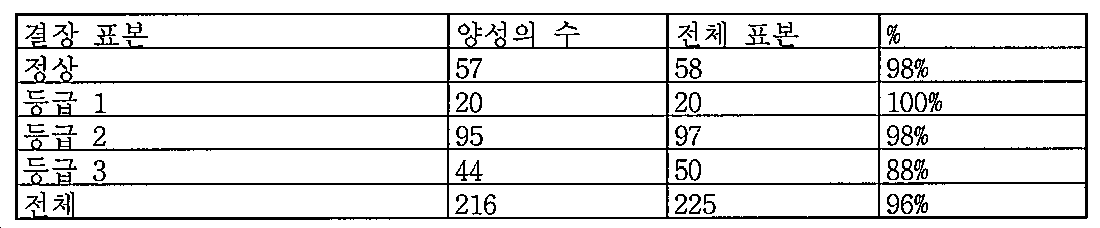
3개 세포 펠렛 및 14개의 상이한 결장암종 조직 각각의 5개 복제물을 이용하는 1개 분석으로 GCC IHC 분석의 분석내 정밀도를 평가하였다. 세포 펠렛은 별도의 슬라이드 상에 제조하였다. 2개의 상이한 다중종양 블록에 결장 종양 표본을 포함시켰다. 이들 조직을 GCC IHC 반응성에 대해 스코어링하였다.Intra-assay precision of the GCC IHC assay was assessed with one assay using five replicates of each of three cell pellets and 14 different colon carcinoma tissues. Cell pellets were prepared on separate slides. Colon tumor specimens were included in two different multi-tumor blocks. These tissues were scored for GCC IHC reactivity.
세포 펠렛의 염색 정밀도: 3개 세포 펠렛의 5개 분석내 복제물 모두에서 거의 동일한 염색이 관찰되었다.Staining Precision of Cell Pellets: Almost the same staining was observed in all of the replicates in five assays of three cell pellets.
결장 종양 표본의 염색 정밀도: 14 결장 종양 표본의 5개 분석내 복제물 모두에서 매우 유사하거나 거의 동일한 염색이 관찰되었다. 전술된 바와 같은 H-스코어 접근을 이용하여 자격을 갖춘 병리학자가 표본을 스코어링하였다. 표준 편차는 모든 경우 분산이 최소임을 나타내어, 동일한 분석수행 내에 우수한 염색 정밀도를 나타내었다. 전체적으로, 평가된 세포 펠렛 및 결장암종 표본의 분석내 GCC IHC 염색에는 매우 일관성이 있었다. Staining Precision of Colon Tumor Samples: Very similar or nearly identical staining was observed in all replicates in five assays of 14 colon tumor samples. Samples were scored by a qualified pathologist using the H-Score approach as described above. Standard deviation indicated minimal variance in all cases, indicating good staining accuracy within the same assay run. Overall, GCC IHC staining in the analysis of evaluated cell pellet and colon carcinoma samples was very consistent.
분석간 변이 및 상이한 작동자로 인한 변이를 별도의 5개 GCC IHC 염색 수행에서 평가하였다. 4개 분석을 1명의 작동자가 다른 날에 수행하였고, 제2 작동자가 5번째 분석을 수행하였다. 염색에는 전술된 정밀도 평가에서와 동일한 조직의 평가가 포함되었다.Variations between assays and variations due to different operators were evaluated in five separate GCC IHC staining runs. Four analyzes were performed by one operator on another day and a second operator performed a fifth analysis. Staining included evaluation of the same tissue as in the above-described precision evaluation.
세포 펠렛의 염색 재현성: 3개 세포 펠렛의 5개 분석간 복제물 모두에서 거의 동일한 염색이 관찰되었다.Staining Reproducibility of Cell Pellets: Almost the same staining was observed in all five inter-analyte replicates of the three cell pellets.
결장 종양 표본의 염색 재현성: 14개 결장 종양 표본의 5개 분석간 복제물에서 매우 유사하거나 거의 동일한 염색이 관찰되었다. 전술된 바와 같이 H-스코어 접근을 이용하여 자격을 갖춘 병리학자가 표본을 스코어링하였다. 표준 편차는 모든 경우 분산이 최소을 나타내어, 날별 및 상이한 작동자별 염색의 우수한 재현성을 나타내었다. 전체적으로, 평가된 세포 펠렛 및 결장암종 표본의 분석간 및 작동자간 GCC IHC 염색에는 매우 우수한 일관성이 있었다. Staining Reproducibility of Colon Tumor Samples: Very similar or nearly identical staining was observed in replicates between five assays of 14 colon tumor samples. Samples were scored by a qualified pathologist using the H-Score approach as described above. The standard deviation showed minimal dispersion in all cases, indicating good reproducibility of daily and different operator specific staining. Overall, there was a very good consistency between GCC IHC staining between the assays and the operator of the evaluated cell pellet and colon carcinoma samples.
정상 인간 조직의 패널을 평가하여 GCC IHC 분석의 특이성을 평가하였다. 이들 정상 인간 조직에는 30개의 상이한 조직 유형이 포함되었다: 부신, 방광, 골수, 유방, 대뇌 피질, 자궁경부, 나팔관, 심장, 신장, 간, 폐, 림프절, 신경, 난소, 췌장, 이하선(침샘), 뇌하수체, 태반, 전립선, 골격근, 피부, 척추, 비장, 위, 정소, 흉선, 갑상선, 편도선, 요관 및 자궁. 각각의 조직 유형에 있어서, 적어도 3개의 독특한 시편을 염색하고 GCC 면역반응성에 대해 평가하였다. Panels of normal human tissue were evaluated to assess the specificity of the GCC IHC assay. These normal human tissues included 30 different tissue types: adrenal gland, bladder, bone marrow, breast, cerebral cortex, cervix, fallopian tubes, heart, kidneys, liver, lungs, lymph nodes, nerves, ovaries, pancreas, parotid gland (salivary glands) Pituitary gland, placenta, prostate, skeletal muscle, skin, spine, spleen, stomach, testis, thymus, thyroid gland, tonsils, ureters and uterus. For each tissue type, at least three unique specimens were stained and evaluated for GCC immunoreactivity.
전반적으로, MIL-44-148-2 항체를 이용한 GCC IHC 분석은 본원에 기재된 IHC 분석에 의해, 정상 조직 염색에 비해, 특히 첨단 염색에 있어서 결장 종양 표본에 매우 특이적인 것으로 나타났다. 첨단 염색은 2개의 위 표본에서만 검출되었다; 그러나 상기 염색은 또한 음성 대조군에서도 관찰되었다. 일반적으로 약한 세포질 염색은 난포(3개 표본 중 하나), 피부(소포 및 진피, 3개 표본 중 2개), 위 측벽 세포(3개 표본 중 2개), 전립선 샘상피(3개 표본 중 3개에서 약하게), 뇌하수체(3개 중 2개), 자궁 상피(3개 중 3개), 나팔관 상피(3개 중 2개), 태반 영양막(3개 중 2개에서 약하게) 및 폐(3개 중 3개의 내피, 그리고 3개 중 1개의 세기관지 상피)를 포함하는 몇몇 조직 유형에서 관찰되었다. 가장 강한 세포질 염색(2+)은 1개의 나팔관 및 1개의 뇌하수체에 존재하였다. 두 경우 모두에서, 음성 대조군의 동일 구획에는 더 약한 염색이 존재하였다. 혈장 세포는, 비장, 편도선 및 림프절을 포함하는 여러 조직에서 양성이었다. 조직구는 비장, 폐 및 림프절에서 양성이었다. 기질 염색은 정소(3개 중 2개), 자궁(3개 중 3개) 및 난소(3개 중 1개)에 존재하였다. 혈관의 세포외 염색이 널리 관찰되었고 혈청의 비-특이적 결합인 것으로 나타났다.Overall, GCC IHC analysis with MIL-44-148-2 antibodies was shown to be very specific to colon tumor specimens by normal IHC staining, as compared to normal tissue staining, by the IHC analysis described herein. Peak staining was detected only in two stomach samples; However, the staining was also observed in the negative control. In general, weak cytoplasmic stains include follicles (one of three specimens), skin (vesicles and dermis, two of three specimens), gastric sidewall cells (two of three specimens), and prostate gland epithelium (3 of three specimens). Weak in dogs), pituitary gland (2 of 3), uterine epithelium (3 of 3), fallopian tube epithelium (2 of 3), placental trophoblast (weak in 2 of 3) and lung (3) Three endothelial, and one out of three bronchioletic epithelium). The strongest cytoplasmic staining (2+) was in one fallopian tube and one pituitary gland. In both cases, there was weaker staining in the same compartment of the negative control. Plasma cells were positive in several tissues, including the spleen, tonsils and lymph nodes. Histocytes were positive in the spleen, lung and lymph nodes. Substrate staining was present in the testis (2 of 3), uterus (3 of 3) and ovary (1 of 3). Extracellular staining of blood vessels was widely observed and appeared to be non-specific binding of serum.
TechMate 염색 플랫폼에서 토끼 모노클로날 항체, MIL-44-148-2를 이용한 GCC 분석은 종양 및 대조군 세포 펠렛의 일관된 분석간 및 분석내 염색을 나타낸다. GCC 분석은 평가된 결장 종양 표본의 대다수를 염색하므로, 결장암종에서 상당히 민감한 것으로 나타난다. GCC 분석은 또한 정상 조직에 비해 결장 종양에 대해 훨씬 더 특이적인 것으로 나타난다. 여러 결장 종양에서 관찰되는 GCC 발현은 각 조직 유형의 적어도 3개 복제물을 이용한 30개 조직의 정상 패널에서 관찰되는 임의 염색에 비해 훨씬 더 강하다. 어느 정상 조직에서도 특이적 첨단 GCC 염색은 검출되지 않은 반면, 대부분의 GCC 표본에서는 첨단 염색이 일반적이다. 일부 정상 조직 유형에서는 세포질 염색만 관찰되며, 이 염색은 일반적으로 약하다. MIL-44-148-2 항체는 포르말린 고정되고 파라핀-임베딩된(FFPE) 결장 종양의 염색을 위해 재현성있고 민감하며 상대적으로 특이적 IHC 마커인 것으로 나타난다.
GCC analysis with rabbit monoclonal antibody, MIL-44-148-2 on the TechMate staining platform shows consistent inter and intra assay staining of tumor and control cell pellets. GCC analysis stains the majority of colon tumor samples evaluated and therefore appears to be quite sensitive in colon carcinoma. GCC analysis also appears to be much more specific for colon tumors than normal tissues. GCC expression observed in several colon tumors is much stronger than any staining observed in a normal panel of 30 tissues using at least 3 replicates of each tissue type. No specific peak GCC staining was detected in any normal tissue, whereas peak staining is common in most GCC samples. In some normal tissue types only cytoplasmic staining is observed, which is generally weak. The MIL-44-148-2 antibody appears to be a reproducible, sensitive and relatively specific IHC marker for staining formalin fixed and paraffin-embedded (FFPE) colon tumors.
실시예 4: Example 4: 비-결직장 PHTX 모델 및 종양 마이크로어레이 그리고 결직장 및 비-결직장 인간 임상 표본에서의 추가적인 면역조직화학Additional Immunohistochemistry in Non-Colon PHTX Models and Tumor Microarrays and in Colon and Non-Colon Human Clinical Samples
실시예 3에 기재된 자동화 IHC 분석을 이용하여 자성 SCID 마우스에서 위암 및 췌장암 환자 표본 유래의 일차 인간 종양 이종이식편(PHTX) 및 췌장암, 위암, 식도암, 폐암 및 평활근육종/횡문근육종에 특이적인 다양한 종양 마이크로어레이(TMA)(US BioMax, Pantomics 및 다른 상업적 공급원에서 구매)를 포함하여, 상이한 원천의 다양한 비-결직장 표본에서 GCC 발현(즉, 첨단, 세포질 및/또는 집합 GCC 발현)을 평가하였다. 또한 구아닐릴 사이클라아제 C를 발현하는 진행된 위장관 악성물을 갖는 성인 환자에서, MLN0264로 지정된 GCC-표적화 항체-약물 콘주게이트의 개방형, 다기관, 용량 증가, 인간 내 최초 연구(연구 C26001, ClinicalTrials.gov 식별자 NCT01577758)의 등록 전에 GCC 발현에 대해 평가된 암 환자에서 유래된 결직장암, 위암, 췌장암, 식도암, 및 소장암, 그리고 자동화 IHC 분석을 수행하는데 관여된 특수 CRO 조직 데이터베이스(QualTek)에서 수득한 인간 위, 췌장 및 식도 종양 표본을 포함하는 다양한 인간 임상 표본에서 실시예 3에 기재된 자동화 IHC 분석을 통해 GCC 발현을 또한 평가하였다. Primary human tumor xenografts (PHTX) derived from gastric and pancreatic cancer patient specimens in female SCID mice using the automated IHC assay described in Example 3 and various tumor micro-specifics specific for pancreatic cancer, gastric cancer, esophageal cancer, lung cancer and leiomyosarcoma / rhombosarcoma GCC expression (ie, tip, cytoplasmic and / or aggregate GCC expression) was assessed in various non-colloidal samples from different sources, including arrays (TMA) (purchased from US BioMax, Pantomics and other commercial sources). Also in adult patients with advanced gastrointestinal malignancies expressing guanylyl cyclase C, an open, multicenter, dose escalating, first study in humans of GCC-targeting antibody-drug conjugates designated MLN0264 (Study C26001, Clinical Trials. colorectal cancer, gastric cancer, pancreatic cancer, esophageal cancer, and small intestine cancer derived from cancer patients evaluated for GCC expression prior to registration of gov identifier NCT01577758) and obtained from a special CRO tissue database (QualTek) involved in performing automated IHC analysis. GCC expression was also assessed via the automated IHC analysis described in Example 3 in various human clinical specimens including human gastric, pancreatic and esophageal tumor specimens.
다양한 원천(PHTX, 인간 임상 표본 및 종양 마이크로어레이)의 다양한 정상 및 암성 결직장 조직 표본 및 비-결직장 조직(위, 췌장, 소장, 식도, 폐, 횡문근육종, 평활근육종)에서의 IHC 염색 결과를 아래 표 20-32에 나타낸다. 표 20-32에는 평가된 다양한 조직에서 첨단("A") 및 세포질("C" 또는 "Cyto") GCC 모두에 대한 IHC 스코어(0, 0.5+, 1+, 2+ 및 3+) 및 IHC 스코어에 근거하여 계산된 대응 H 스코어가 포함된다. 또한, 표 32는 각 경우 동일한 환자에서 수득된 일차 및 전이성 암의 인간 임상 표본에서의 GCC IHC 발현 데이터의 비교를 제공한다. 첫 번째 왼쪽 열에 나타낸 "A" 표본(즉, 1A, 2A, 3A, 4A, 5A, 6A, 7A, 8A, 9A 10A 등)은 일차 종양 표본을 나타내는 반면, "B" 표본(즉, 1B, 2B, 3B, 4B, 5B, 6B, 7B, 8B, 9B, 10B 등)은 대응하는 일차 종양 표본(대응하는 "A" 표본)이 수득된 동일한 환자에서 수득된 전이성 종양 표본을 나타낸다. 다시 말하면, 명칭 "1A" 및 "1B"는 각각 동일한 환자에서 수득된 일차 및 전이성 종양을 나타내며; 명칭 "2A" 및 "2B"는 각각 또 다른 환자에서 수득된 일차 및 전이성 종양을 나타내는 등이다. 표 32에 나타낸 대부분의 종양 표본은 특정 유형의 비-결직장암이 명시되는 "코멘트"에 표시된 열에 반영되어 달리 나타내지 않는 한, 일차 및 전이성 결직장암을 갖는 환자에서 수득되었다. 표 32의 "코멘트" 열에서 알 수 있듯이, 신경내분비 종양, 신장 세포 암종, 위 종양, 위 GIST, 췌장 종양 및 자궁 평활근육종의 일부 표본이 또한 IHC 분석에 의한 GCC 발현에 대한 것이었다.IHC staining results in various normal and cancerous colorectal tissue specimens of various sources (PHTX, human clinical specimens and tumor microarrays) and non-colonary tissues (gastric, pancreatic, small intestine, esophagus, lung, rhabdomyosarcoma, leiomyosarcoma) Are shown in Tables 20-32 below. Table 20-32 shows IHC scores (0, 0.5+, 1+, 2+, and 3+) and IHC for both the peak ("A") and cytoplasmic ("C" or "Cyto") GCCs in the various tissues evaluated. Corresponding H scores calculated based on the scores are included. In addition, Table 32 provides a comparison of GCC IHC expression data in human clinical samples of primary and metastatic cancers obtained in each case in the same patient. The "A" samples (ie 1A, 2A, 3A, 4A, 5A, 6A, 7A, 8A, 9A 10A, etc.) shown in the first left column represent the primary tumor samples, while the "B" samples (ie 1B, 2B). , 3B, 4B, 5B, 6B, 7B, 8B, 9B, 10B, etc.) represent metastatic tumor specimens obtained in the same patient from which a corresponding primary tumor specimen (corresponding "A" specimen) was obtained. In other words, the names “1A” and “1B” each represent primary and metastatic tumors obtained in the same patient; The names "2A" and "2B" each refer to primary and metastatic tumors obtained in another patient and the like. Most tumor specimens shown in Table 32 were obtained in patients with primary and metastatic colorectal cancer, unless otherwise indicated as reflected in the columns indicated in the “comments” where certain types of non-colon cancer are specified. As can be seen in the "Comment" column of Table 32, some samples of neuroendocrine tumors, renal cell carcinomas, gastric tumors, gastric GIST, pancreatic tumors and uterine leiomyosarcoma were also for GCC expression by IHC analysis.

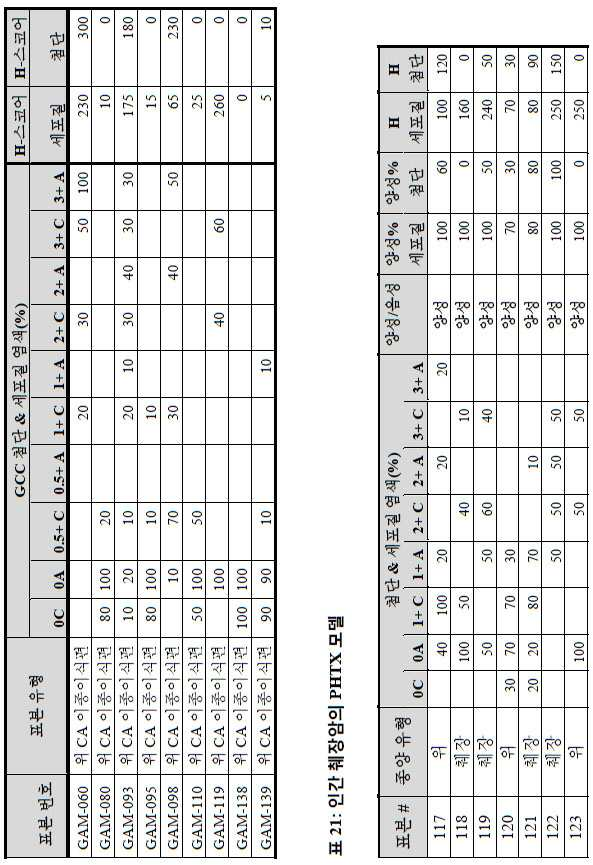
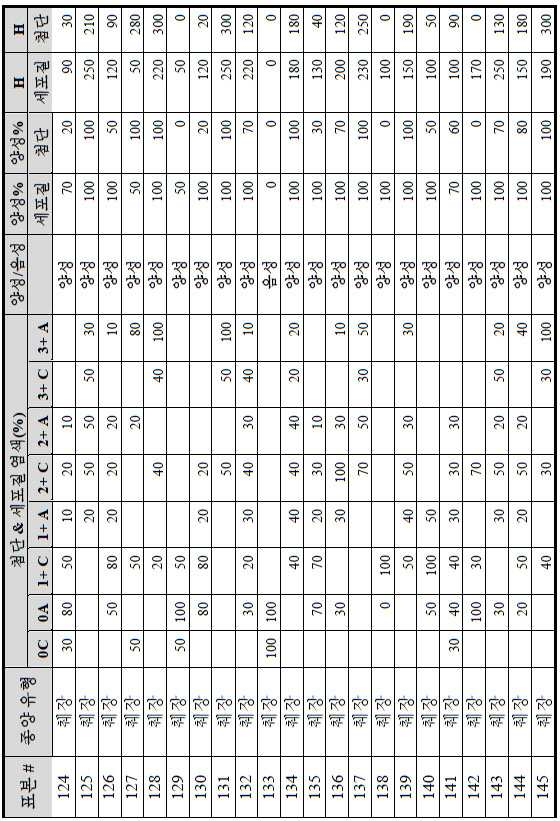
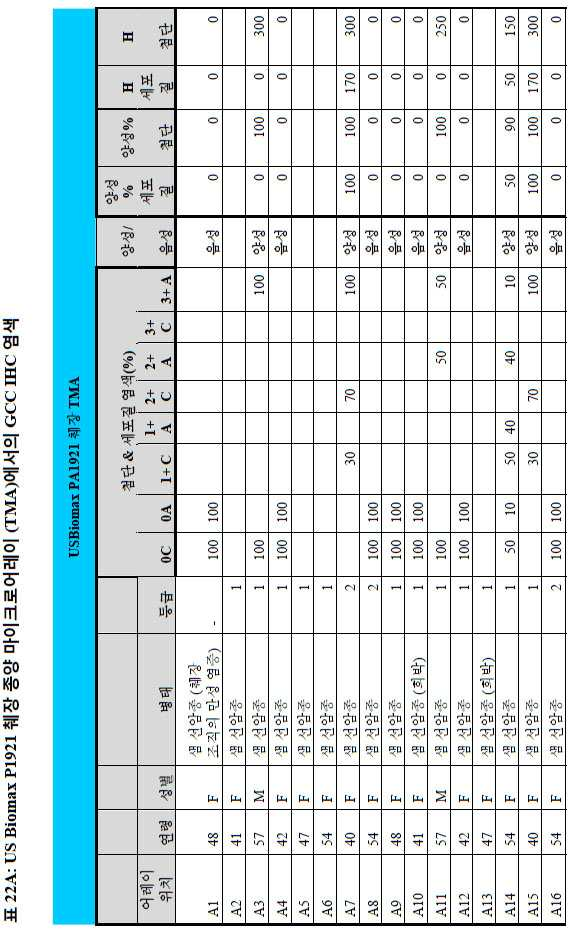
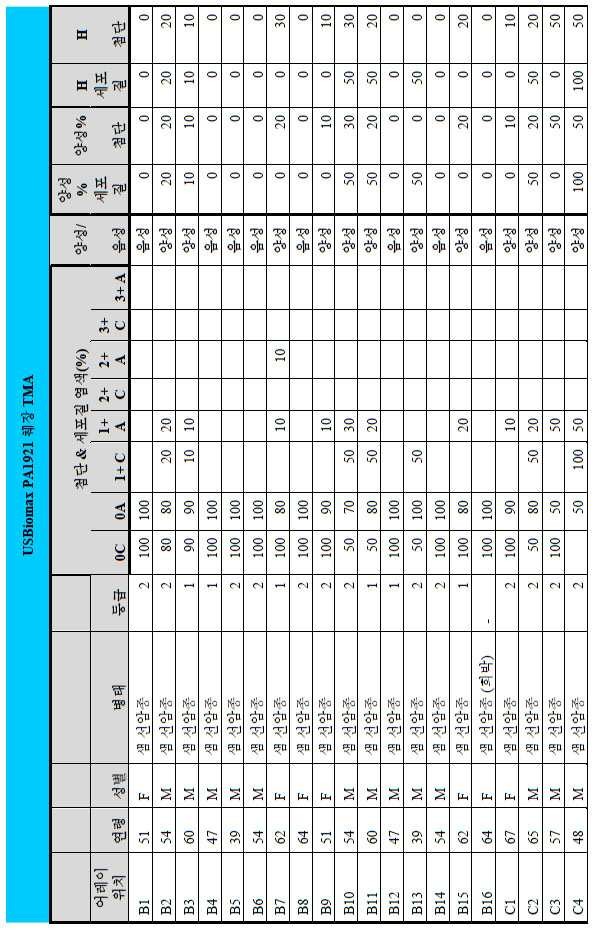

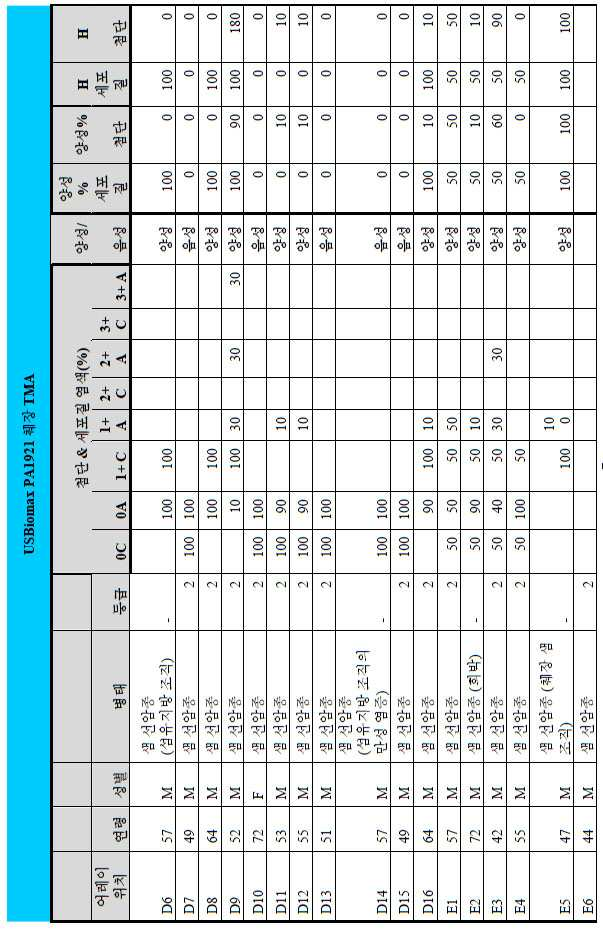
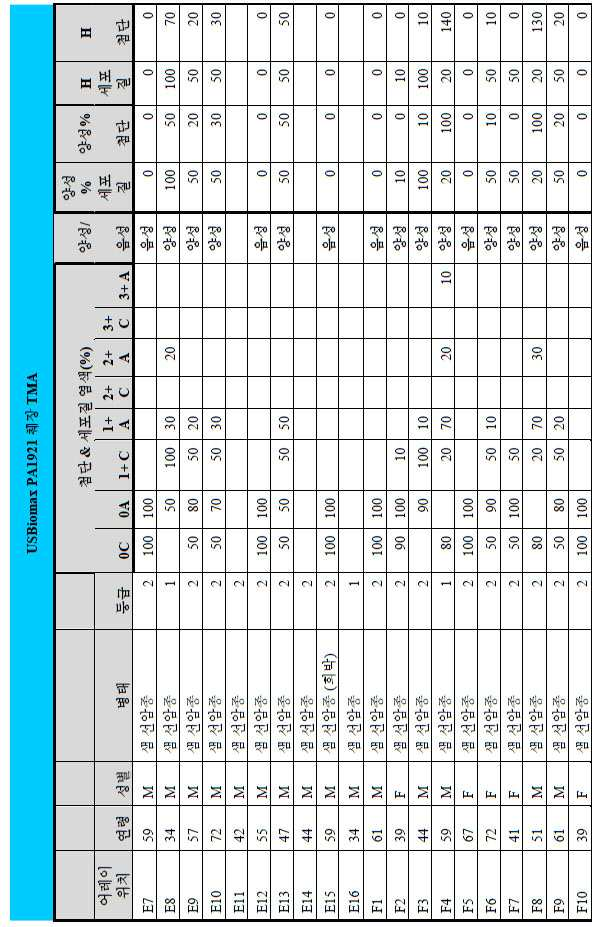


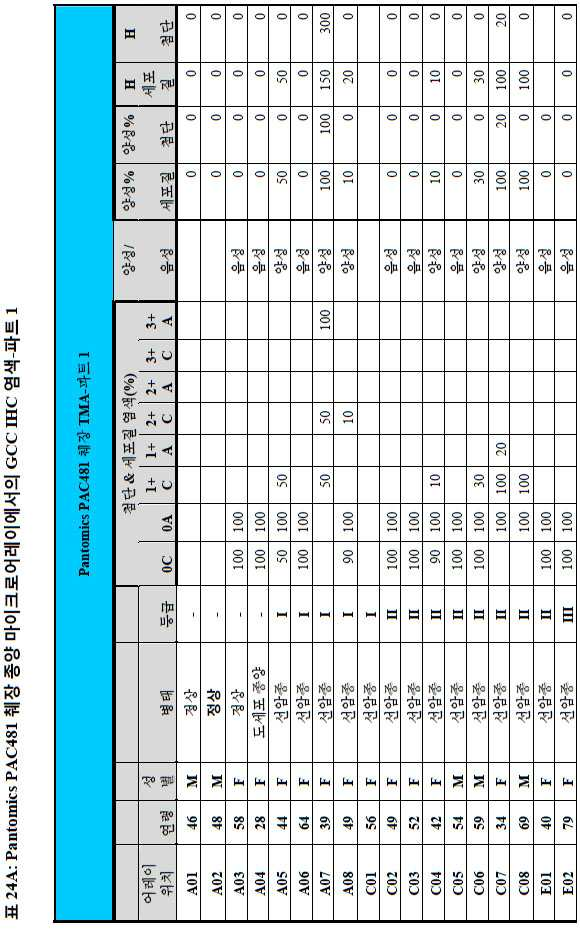


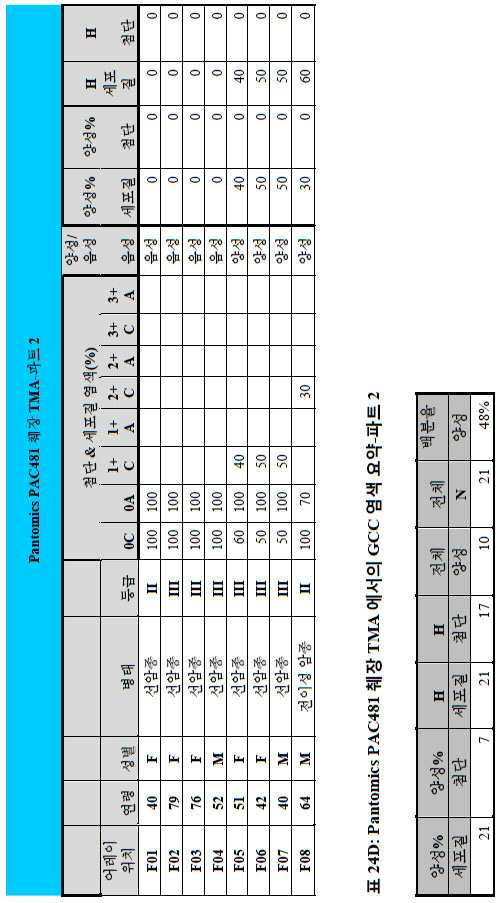


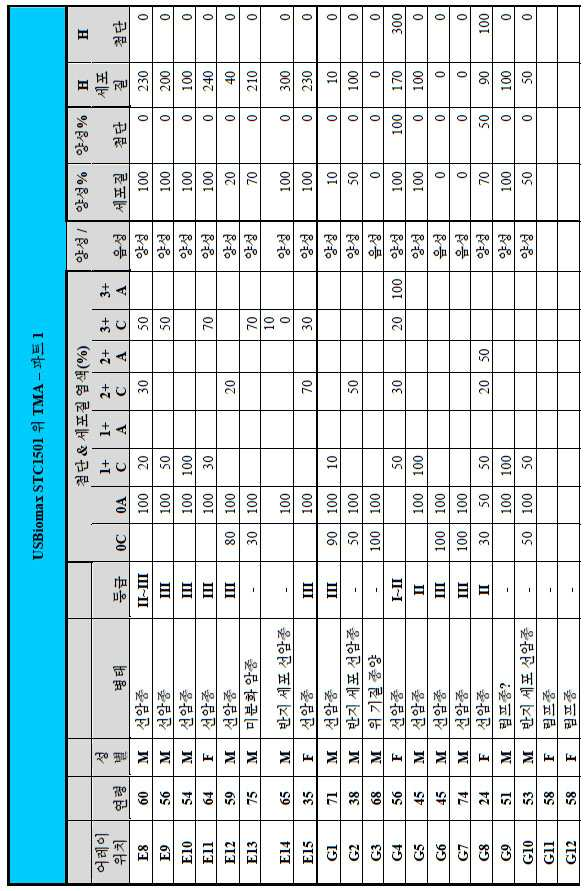


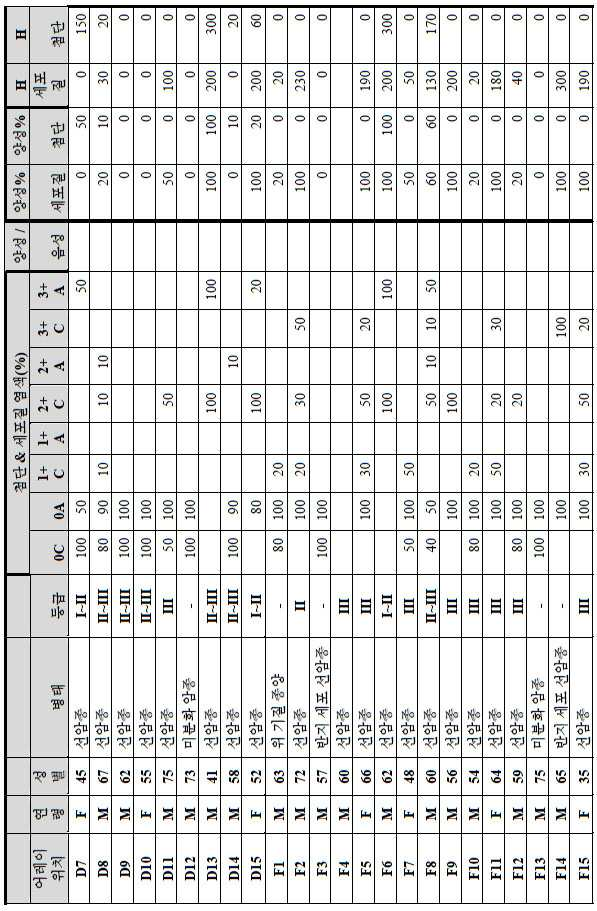

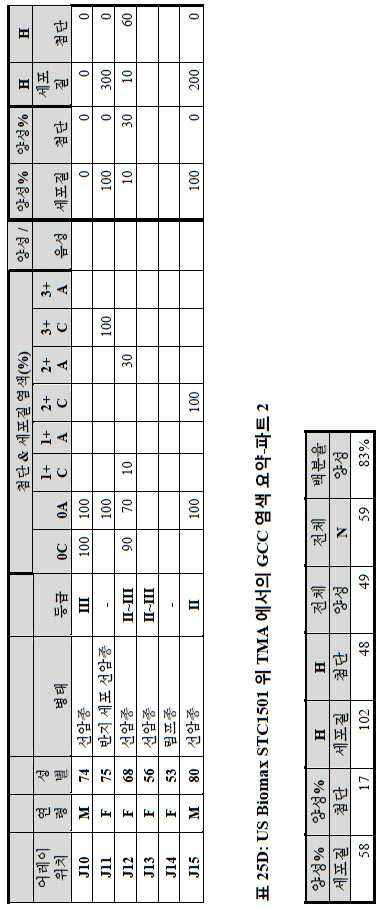


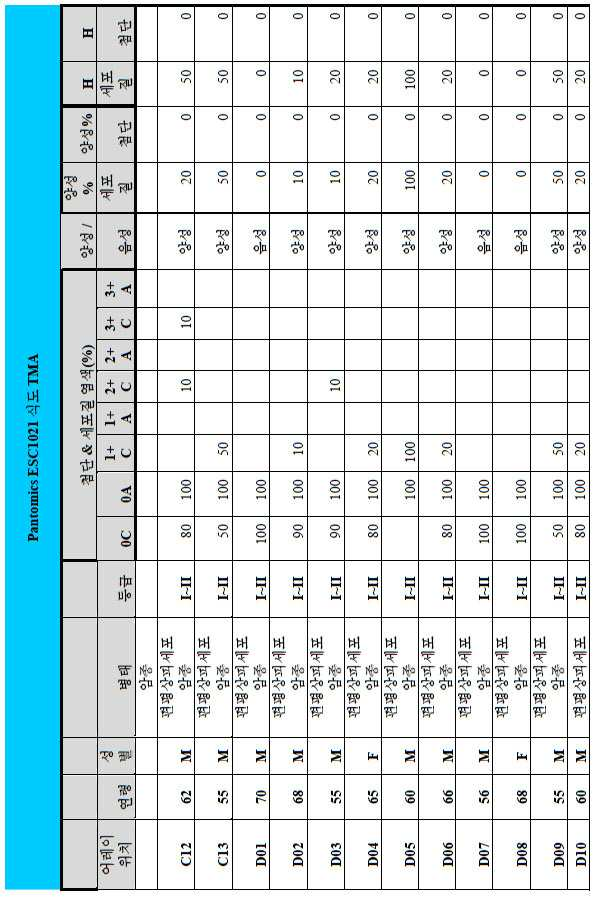

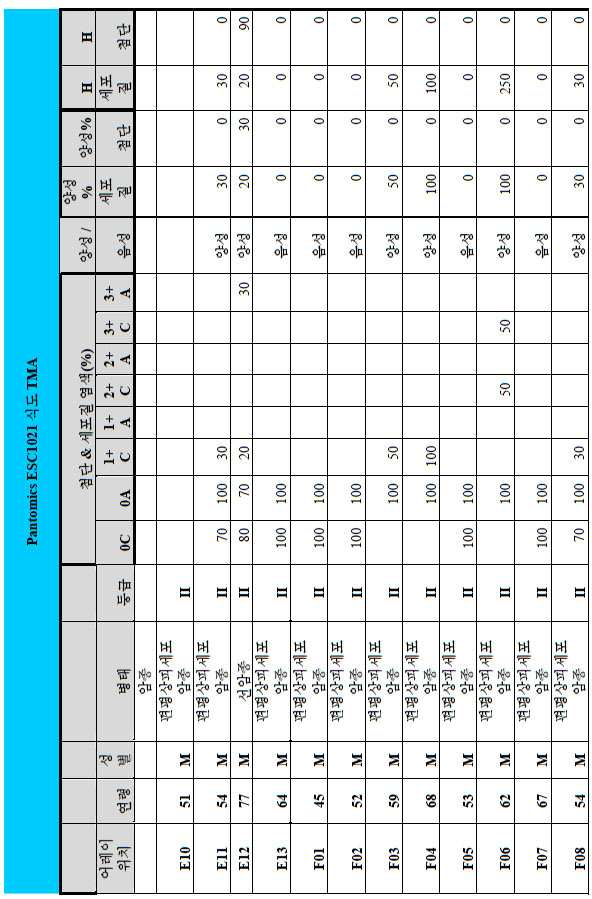
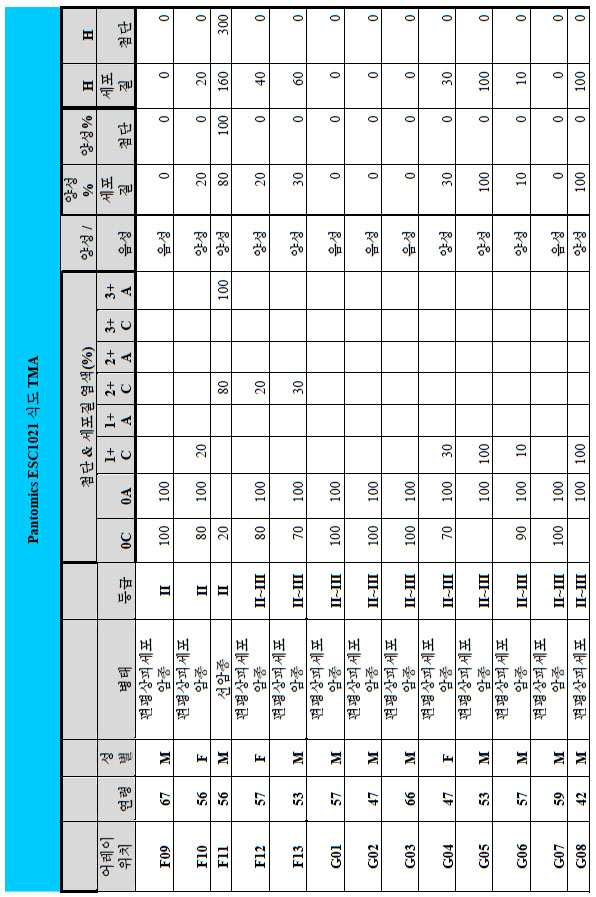
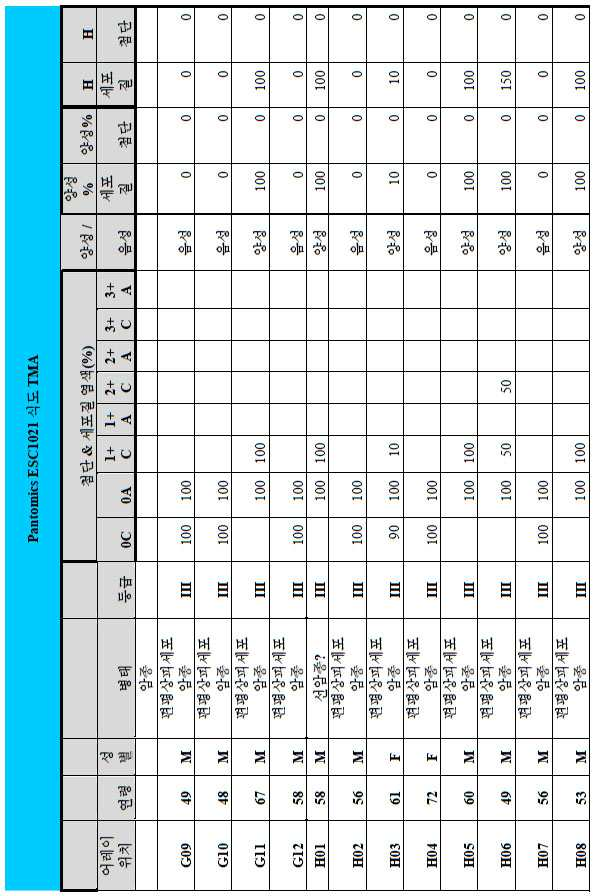


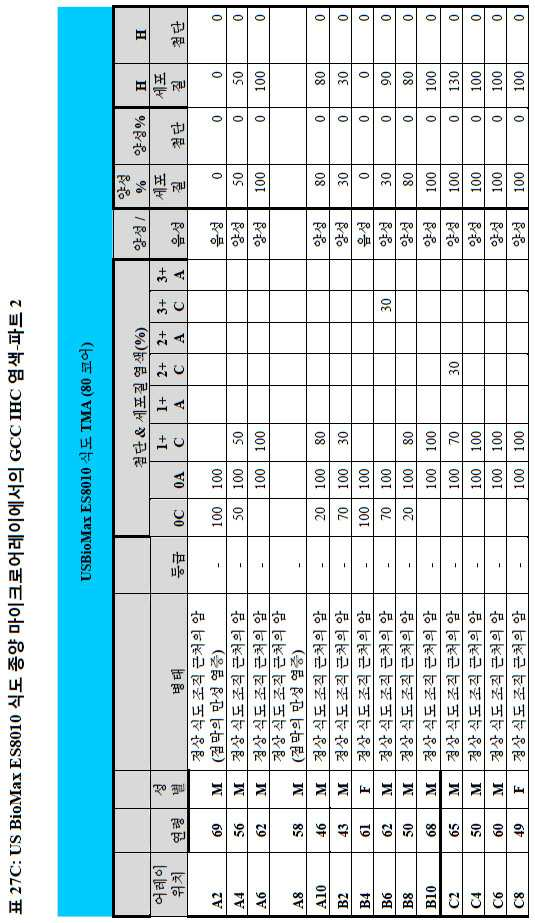
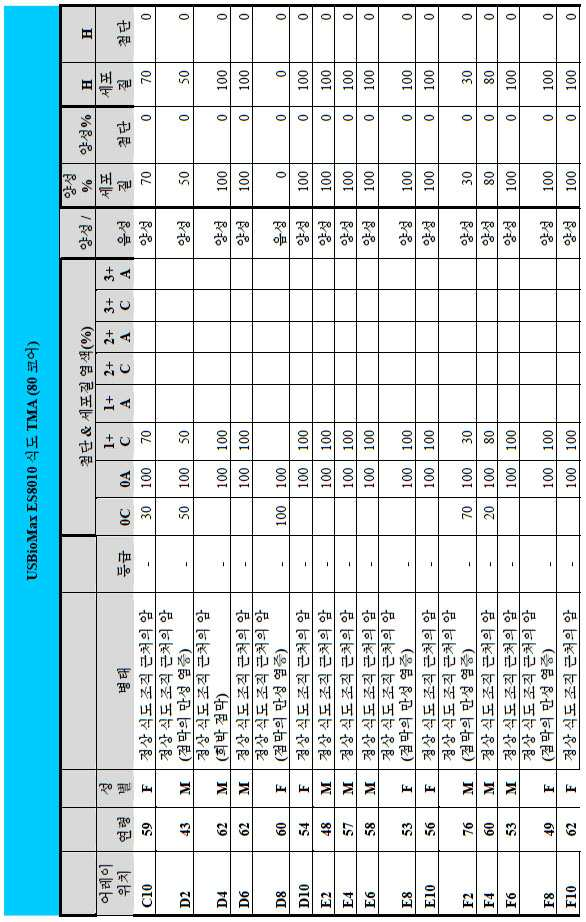
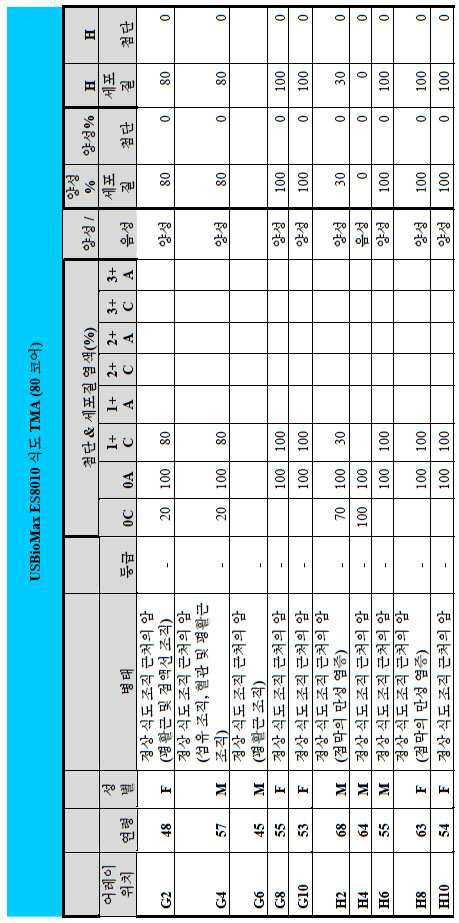


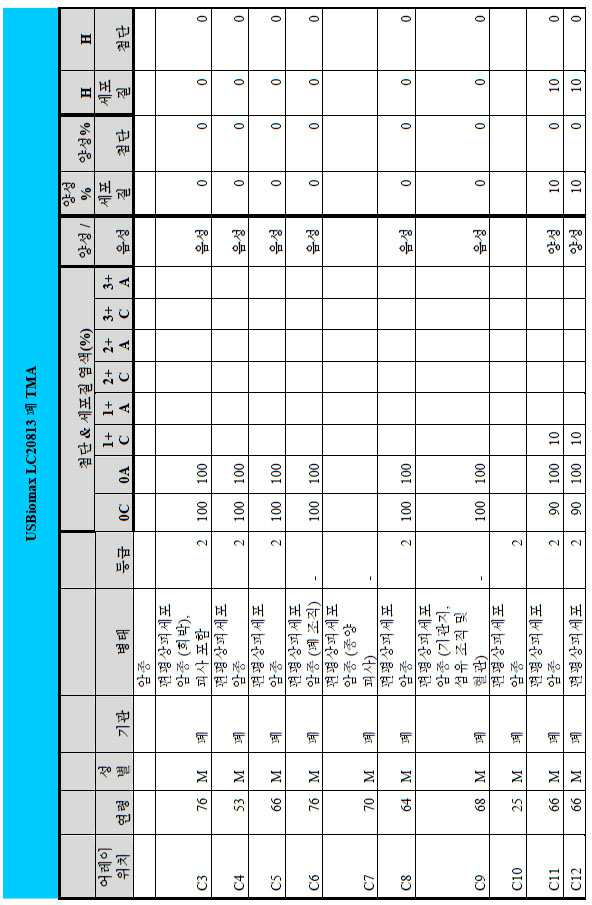


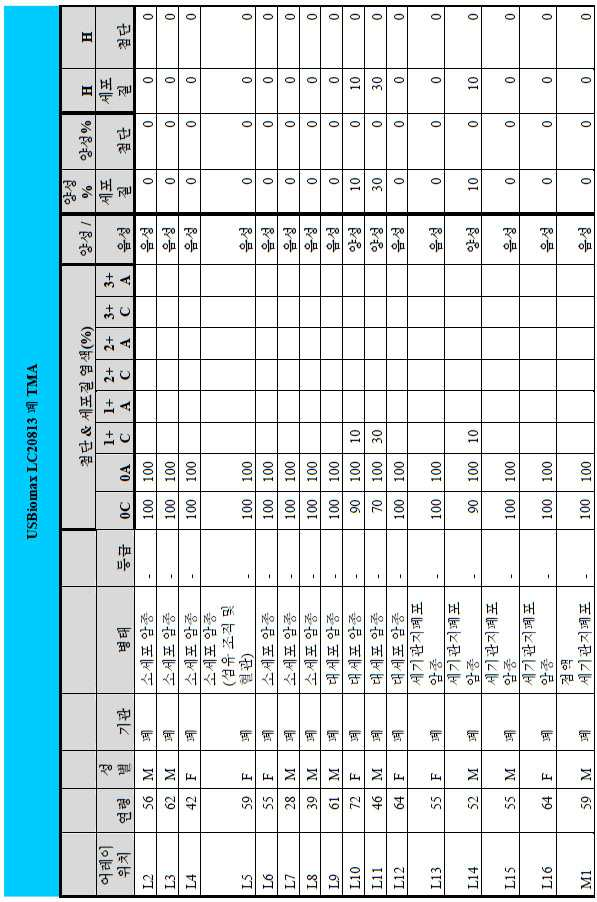


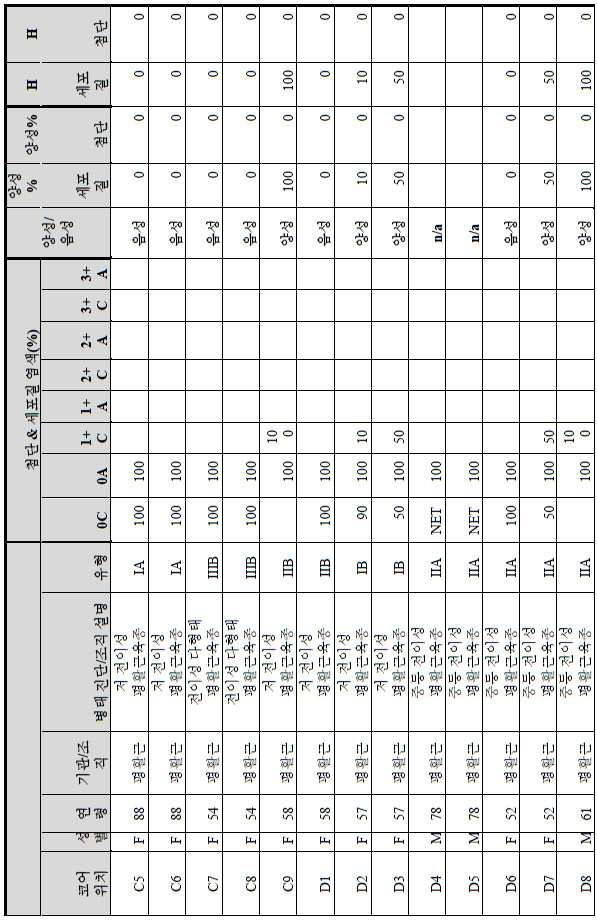

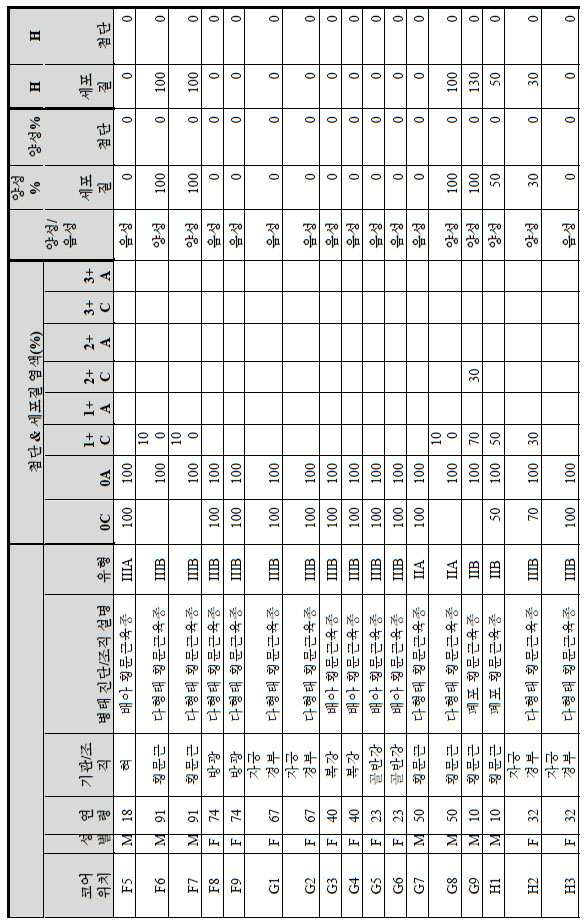
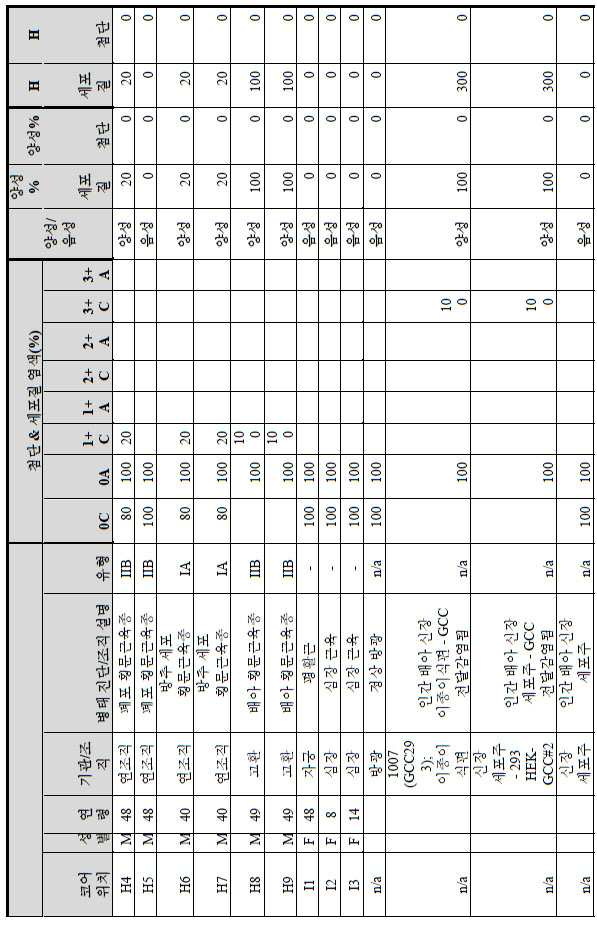
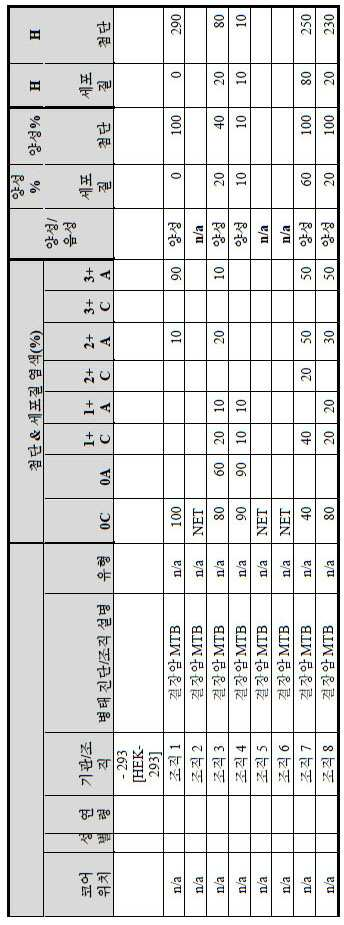


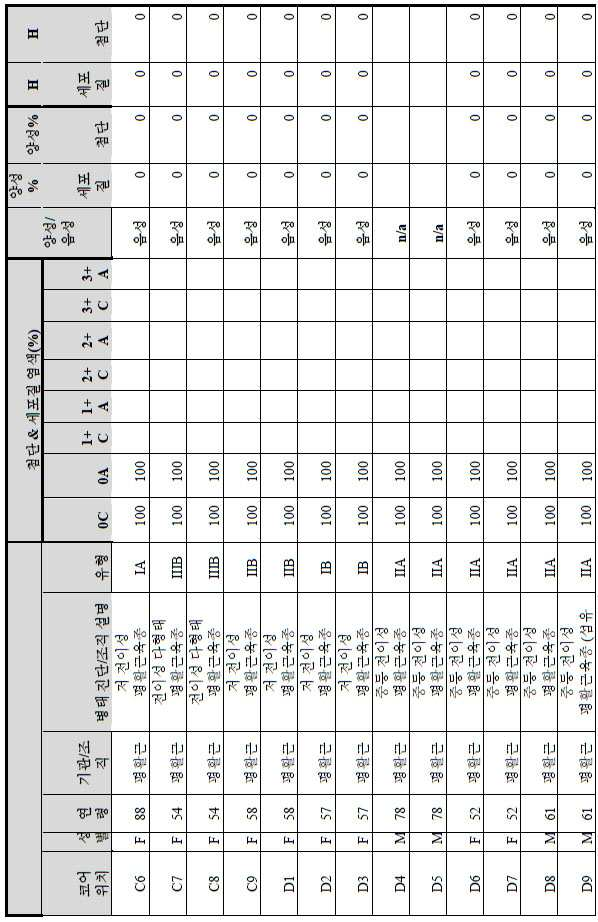


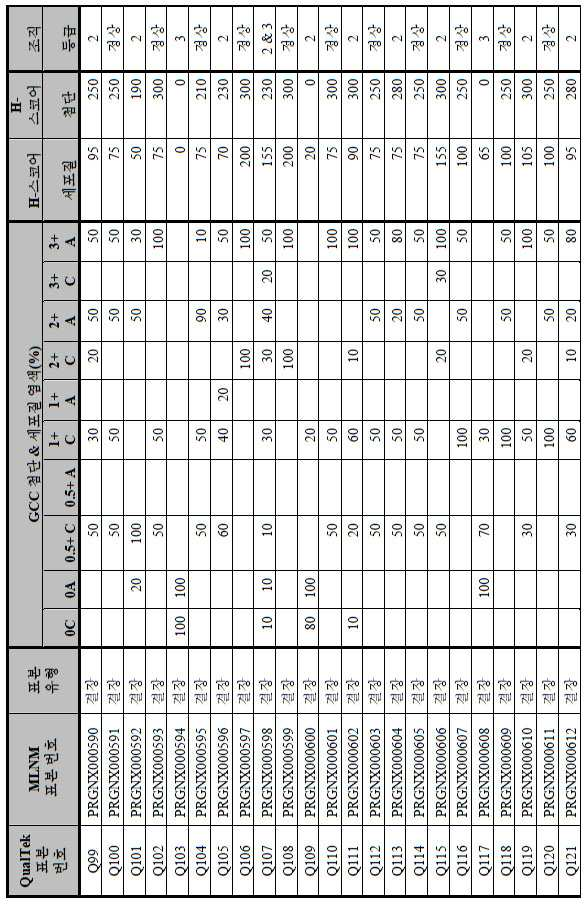


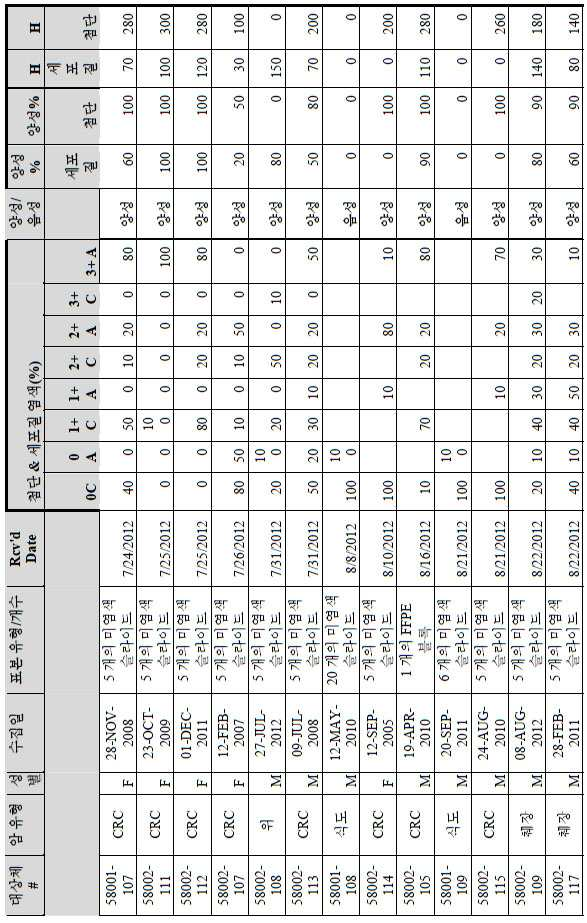


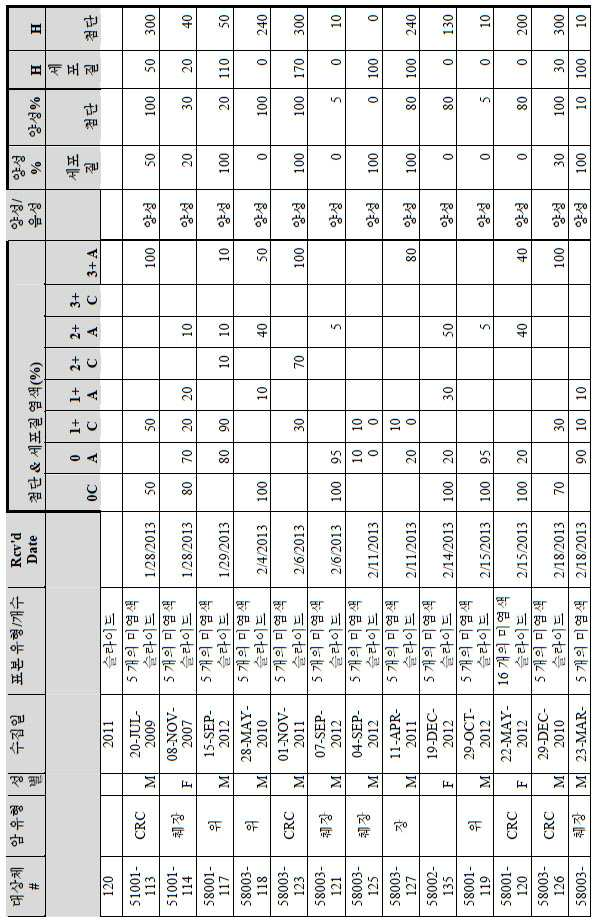


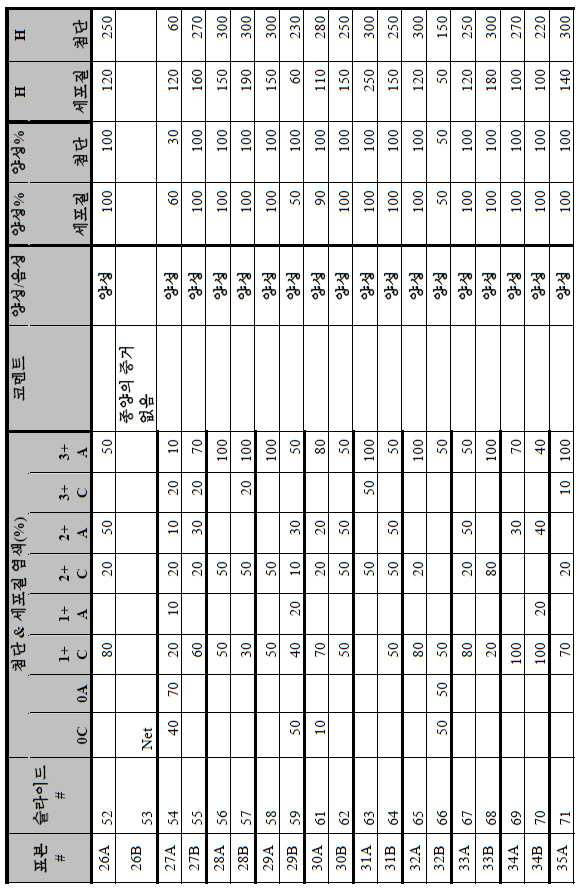
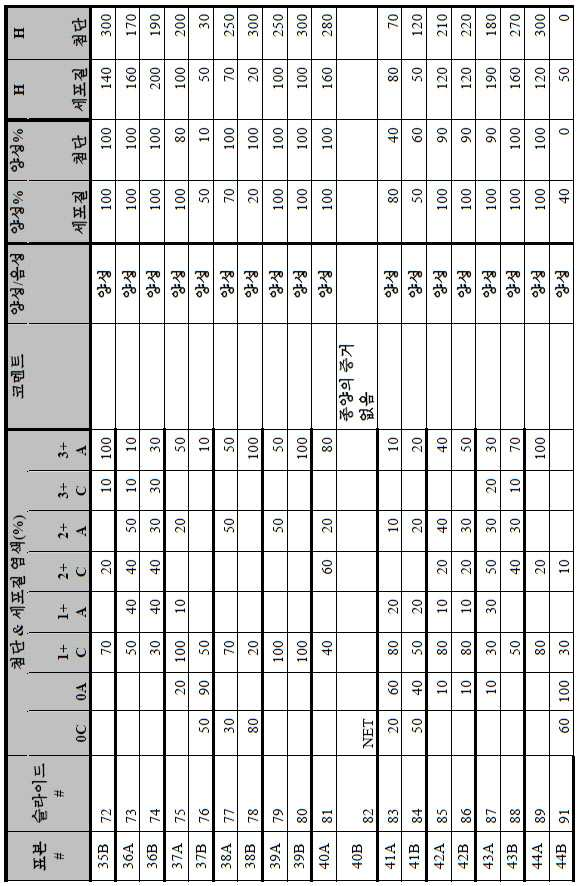
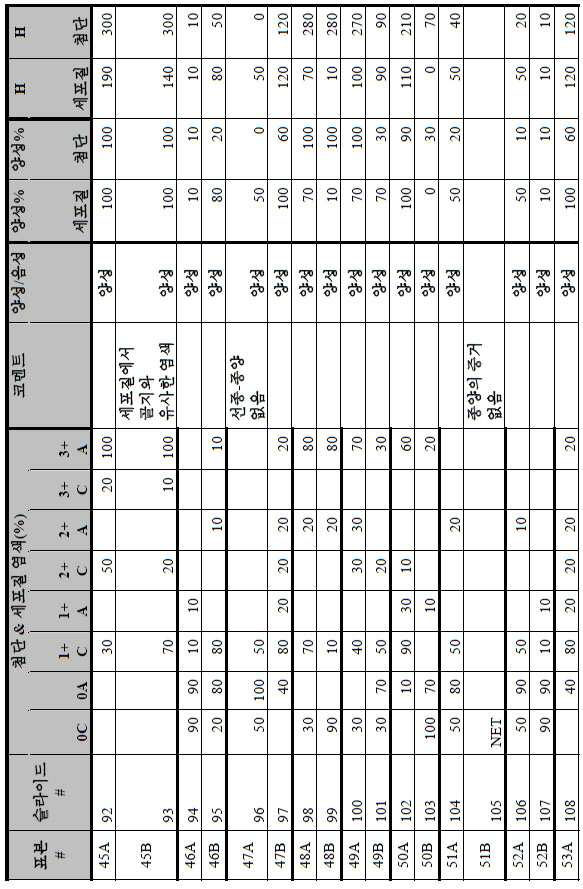


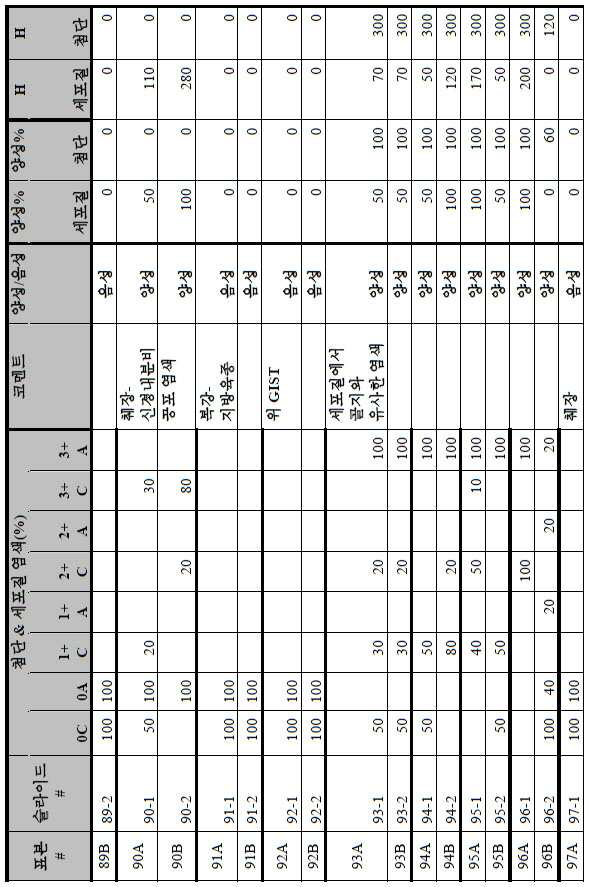

GCCGCC IHCIHC 염색 결과의 요약 Summary of staining results
실시예 3 및 4에 나타낸 GCC IHC 염색 결과는 GCC가 결직장, 위, 소장 및 식도 종양을 포함하는 다양한 위장관 악성물뿐만 아니라 췌장 종양 및 폐 선암종, 폐 편평상피세포 암종, 평활근육종 및 횡문근육종을 포함하는 비-위장관 종양에서도 발현됨을 나타낸다. 다양한 종양 마이크로어레이 분석의 요약을 아래 표 33에 나타낸다.The GCC IHC staining results shown in Examples 3 and 4 show that GCC is characterized by pancreatic tumors and lung adenocarcinomas, pulmonary squamous cell carcinoma, leiomyosarcoma and rhabdomyosarcomas, as well as various gastrointestinal malignancies including colorectal, stomach, small intestine and esophageal tumors. It is also expressed in non-gastrointestinal tumors, including. A summary of the various tumor microarray analyzes is shown in Table 33 below.
[표 33]Table 33
TMATMA 분석은 Analysis GCCGCC 가 다양한 There is a variety 악성물에서From malicious 발현됨을 나타냄 Indicates manifestation

*(양성%는 H 스코어 >10으로 정의됨)* (% Positive is defined as H score> 10)
위장관 및 GI-관련 악성물의 인간 임상 표본도 아래 표 34에 요약된 바와 같이 다양한 수준의 GCC 발현에 대해 양성으로 평가되었다. Human clinical samples of gastrointestinal tract and GI-related malignancies were also evaluated positive for various levels of GCC expression, as summarized in Table 34 below.
[표 34]Table 34
C26001 양성에서 스크리닝된 종양의 백분율Percentage of Tumors Screened for C26001 Positives
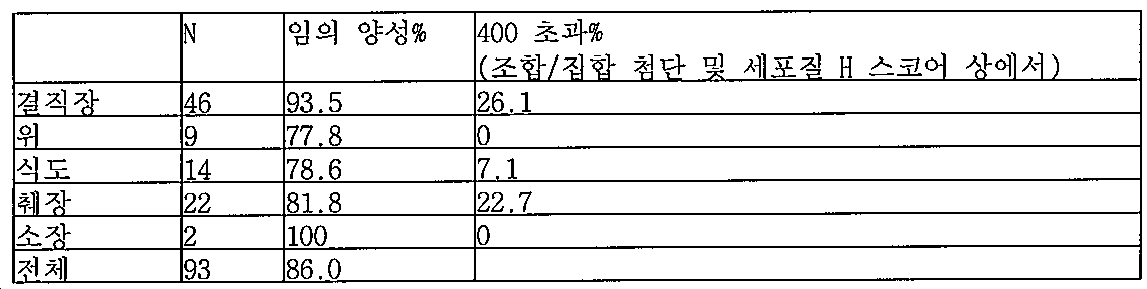
(양성은 첨단 또는 세포질에서 H 스코어 ≥ 10으로 정의됨)(Positive is defined as H score ≥ 10 in the tip or cytoplasm)
표 34에 요약된 결과는 표 33에 요약된 TMA 스크리닝을 통해 관찰된 결과와 유사하다. The results summarized in Table 34 are similar to the results observed through TMA screening summarized in Table 33.
C26001 시험을 위한 환자 등록 스크리닝에서의 종양 유형에 걸친 GCC 발현의 조합/집합 H 스코어 분포를 도 2a-2d에 도시한다.The combination / set H score distribution of GCC expression across tumor types in patient enrollment screening for the C26001 test is shown in FIGS. 2A-2D.
스크리닝된 다양한 결직장, 위, 및 췌장 종양 마이크로어레이에서의 GCC 발현의 조합/집합 H 스코어 분포를 도 3a-3c에 도시한다.Combination / set H score distribution of GCC expression in various screened colon, stomach, and pancreatic tumor microarrays is shown in FIGS. 3A-3C.
본 발명을 이들의 제공되는 구현예를 참조하여 나타내고 기재하였지만, 당분야 숙련자에게는 첨부되는 특허청구범위에 포괄되는 본 발명의 범위에서 벗어나지 않고 형태 및 상세내용에 다양한 변화가 수행될 수 있음이 이해될 것이다.
While the present invention has been shown and described with reference to the provided embodiments thereof, it will be understood by those skilled in the art that various changes may be made in form and detail without departing from the scope of the invention, which is covered by the appended claims. will be.
SEQUENCE LISTING <110> MILLENNIUM PHARMACEUTICALS, INC. <120> ANTI-GCC ANTIBODY MOLECULES AND USE OF SAME TO TEST FOR SUSCEPTIBILITY TO GCC-TARGETED THERAPY <130> MPI12-018P1RNWOM <140> US 61/639,376 <141> 2012-04-27 <160> 89 <170> PatentIn version 3.5 <210> 1 <211> 18 <212> PRT <213> Escherichia coli <400> 1 Asn Thr Phe Tyr Cys Cys Glu Leu Cys Cys Asn Pro Ala Cys Ala Gly 1 5 10 15 Cys Tyr <210> 2 <211> 3360 <212> DNA <213> Homo sapiens <400> 2 gaccagagag aagcgtgggg aagagtgggc tgagggactc cactagaggc tgtccatctg 60 gattccctgc ctccctagga gcccaacaga gcaaagcaag tgggcacaag gagtatggtt 120 ctaacgtgat tggggtcatg aagacgttgc tgttggactt ggctttgtgg tcactgctct 180 tccagcccgg gtggctgtcc tttagttccc aggtgagtca gaactgccac aatggcagct 240 atgaaatcag cgtcctgatg atgggcaact cagcctttgc agagcccctg aaaaacttgg 300 aagatgcggt gaatgagggg ctggaaatag tgagaggacg tctgcaaaat gctggcctaa 360 atgtgactgt gaacgctact ttcatgtatt cggatggtct gattcataac tcaggcgact 420 gccggagtag cacctgtgaa ggcctcgacc tactcaggaa aatttcaaat gcacaacgga 480 tgggctgtgt cctcataggg ccctcatgta catactccac cttccagatg taccttgaca 540 cagaattgag ctaccccatg atctcagctg gaagttttgg attgtcatgt gactataaag 600 aaaccttaac caggctgatg tctccagcta gaaagttgat gtacttcttg gttaactttt 660 ggaaaaccaa cgatctgccc ttcaaaactt attcctggag cacttcgtat gtttacaaga 720 atggtacaga aactgaggac tgtttctggt accttaatgc tctggaggct agcgtttcct 780 atttctccca cgaactcggc tttaaggtgg tgttaagaca agataaggag tttcaggata 840 tcttaatgga ccacaacagg aaaagcaatg tgattattat gtgtggtggt ccagagttcc 900 tctacaagct gaagggtgac cgagcagtgg ctgaagacat tgtcattatt ctagtggatc 960 ttttcaatga ccagtacttt gaggacaatg tcacagcccc tgactatatg aaaaatgtcc 1020 ttgttctgac gctgtctcct gggaattccc ttctaaatag ctctttctcc aggaatctat 1080 caccaacaaa acgagacttt gctcttgcct atttgaatgg aatcctgctc tttggacata 1140 tgctgaagat atttcttgaa aatggagaaa atattaccac ccccaaattt gctcatgctt 1200 tcaggaatct cacttttgaa gggtatgacg gtccagtgac cttggatgac tggggggatg 1260 ttgacagtac catggtgctt ctgtatacct ctgtggacac caagaaatac aaggttcttt 1320 tgacctatga tacccacgta aataagacct atcctgtgga tatgagcccc acattcactt 1380 ggaagaactc taaacttcct aatgatatta caggccgggg ccctcagatc ctgatgattg 1440 cagtcttcac cctcactgga gctgtggtgc tgctcctgct cgtcgctctc ctgatgctca 1500 gaaaatatag aaaagattat gaacttcgtc agaaaaaatg gtcccacatt cctcctgaaa 1560 atatctttcc tctggagacc aatgagacca atcatgttag cctcaagatc gatgatgaca 1620 aaagacgaga tacaatccag agactacgac agtgcaaata cgacaaaaag cgagtgattc 1680 tcaaagatct caagcacaat gatggtaatt tcactgaaaa acagaagata gaattgaaca 1740 agttgcttca gattgactat tacaacctga ccaagttcta cggcacagtg aaacttgata 1800 ccatgatctt cggggtgata gaatactgtg agagaggatc cctccgggaa gttttaaatg 1860 acacaatttc ctaccctgat ggcacattca tggattggga gtttaagatc tctgtcttgt 1920 atgacattgc taagggaatg tcatatctgc actccagtaa gacagaagtc catggtcgtc 1980 tgaaatctac caactgcgta gtggacagta gaatggtggt gaagatcact gattttggct 2040 gcaattccat tttacctcca aaaaaggacc tgtggacagc tccagagcac ctccgccaag 2100 ccaacatctc tcagaaagga gatgtgtaca gctatgggat catcgcacag gagatcatcc 2160 tgcggaaaga aaccttctac actttgagct gtcgggaccg gaatgagaag attttcagag 2220 tggaaaattc caatggaatg aaacccttcc gcccagattt attcttggaa acagcagagg 2280 aaaaagagct agaagtgtac ctacttgtaa aaaactgttg ggaggaagat ccagaaaaga 2340 gaccagattt caaaaaaatt gagactacac ttgccaagat atttggactt tttcatgacc 2400 aaaaaaatga aagctatatg gataccttga tccgacgtct acagctatat tctcgaaacc 2460 tggaacatct ggtagaggaa aggacacagc tgtacaaggc agagagggac agggctgaca 2520 gacttaactt tatgttgctt ccaaggctag tggtaaagtc tctgaaggag aaaggctttg 2580 tggagccgga actatatgag gaagttacaa tctacttcag tgacattgta ggtttcacta 2640 ctatctgcaa atacagcacc cccatggaag tggtggacat gcttaatgac atctataaga 2700 gttttgacca cattgttgat catcatgatg tctacaaggt ggaaaccatc ggtgatgcgt 2760 acatggtggc tagtggtttg cctaagagaa atggcaatcg gcatgcaata gacattgcca 2820 agatggcctt ggaaatcctc agcttcatgg ggacctttga gctggagcat cttcctggcc 2880 tcccaatatg gattcgcatt ggagttcact ctggtccctg tgctgctgga gttgtgggaa 2940 tcaagatgcc tcgttattgt ctatttggag atacggtcaa cacagcctct aggatggaat 3000 ccactggcct ccctttgaga attcacgtga gtggctccac catagccatc ctgaagagaa 3060 ctgagtgcca gttcctttat gaagtgagag gagaaacata cttaaaggga agaggaaatg 3120 agactaccta ctggctgact gggatgaagg accagaaatt caacctgcca acccctccta 3180 ctgtggagaa tcaacagcgt ttgcaagcag aattttcaga catgattgcc aactctttac 3240 agaaaagaca ggcagcaggg ataagaagcc aaaaacccag acgggtagcc agctataaaa 3300 aaggcactct ggaatacttg cagctgaata ccacagacaa ggagagcacc tatttttaaa 3360 <210> 3 <211> 1073 <212> PRT <213> Homo sapiens <400> 3 Met Lys Thr Leu Leu Leu Asp Leu Ala Leu Trp Ser Leu Leu Phe Gln 1 5 10 15 Pro Gly Trp Leu Ser Phe Ser Ser Gln Val Ser Gln Asn Cys His Asn 20 25 30 Gly Ser Tyr Glu Ile Ser Val Leu Met Met Gly Asn Ser Ala Phe Ala 35 40 45 Glu Pro Leu Lys Asn Leu Glu Asp Ala Val Asn Glu Gly Leu Glu Ile 50 55 60 Val Arg Gly Arg Leu Gln Asn Ala Gly Leu Asn Val Thr Val Asn Ala 65 70 75 80 Thr Phe Met Tyr Ser Asp Gly Leu Ile His Asn Ser Gly Asp Cys Arg 85 90 95 Ser Ser Thr Cys Glu Gly Leu Asp Leu Leu Arg Lys Ile Ser Asn Ala 100 105 110 Gln Arg Met Gly Cys Val Leu Ile Gly Pro Ser Cys Thr Tyr Ser Thr 115 120 125 Phe Gln Met Tyr Leu Asp Thr Glu Leu Ser Tyr Pro Met Ile Ser Ala 130 135 140 Gly Ser Phe Gly Leu Ser Cys Asp Tyr Lys Glu Thr Leu Thr Arg Leu 145 150 155 160 Met Ser Pro Ala Arg Lys Leu Met Tyr Phe Leu Val Asn Phe Trp Lys 165 170 175 Thr Asn Asp Leu Pro Phe Lys Thr Tyr Ser Trp Ser Thr Ser Tyr Val 180 185 190 Tyr Lys Asn Gly Thr Glu Thr Glu Asp Cys Phe Trp Tyr Leu Asn Ala 195 200 205 Leu Glu Ala Ser Val Ser Tyr Phe Ser His Glu Leu Gly Phe Lys Val 210 215 220 Val Leu Arg Gln Asp Lys Glu Phe Gln Asp Ile Leu Met Asp His Asn 225 230 235 240 Arg Lys Ser Asn Val Ile Ile Met Cys Gly Gly Pro Glu Phe Leu Tyr 245 250 255 Lys Leu Lys Gly Asp Arg Ala Val Ala Glu Asp Ile Val Ile Ile Leu 260 265 270 Val Asp Leu Phe Asn Asp Gln Tyr Phe Glu Asp Asn Val Thr Ala Pro 275 280 285 Asp Tyr Met Lys Asn Val Leu Val Leu Thr Leu Ser Pro Gly Asn Ser 290 295 300 Leu Leu Asn Ser Ser Phe Ser Arg Asn Leu Ser Pro Thr Lys Arg Asp 305 310 315 320 Phe Ala Leu Ala Tyr Leu Asn Gly Ile Leu Leu Phe Gly His Met Leu 325 330 335 Lys Ile Phe Leu Glu Asn Gly Glu Asn Ile Thr Thr Pro Lys Phe Ala 340 345 350 His Ala Phe Arg Asn Leu Thr Phe Glu Gly Tyr Asp Gly Pro Val Thr 355 360 365 Leu Asp Asp Trp Gly Asp Val Asp Ser Thr Met Val Leu Leu Tyr Thr 370 375 380 Ser Val Asp Thr Lys Lys Tyr Lys Val Leu Leu Thr Tyr Asp Thr His 385 390 395 400 Val Asn Lys Thr Tyr Pro Val Asp Met Ser Pro Thr Phe Thr Trp Lys 405 410 415 Asn Ser Lys Leu Pro Asn Asp Ile Thr Gly Arg Gly Pro Gln Ile Leu 420 425 430 Met Ile Ala Val Phe Thr Leu Thr Gly Ala Val Val Leu Leu Leu Leu 435 440 445 Val Ala Leu Leu Met Leu Arg Lys Tyr Arg Lys Asp Tyr Glu Leu Arg 450 455 460 Gln Lys Lys Trp Ser His Ile Pro Pro Glu Asn Ile Phe Pro Leu Glu 465 470 475 480 Thr Asn Glu Thr Asn His Val Ser Leu Lys Ile Asp Asp Asp Lys Arg 485 490 495 Arg Asp Thr Ile Gln Arg Leu Arg Gln Cys Lys Tyr Asp Lys Lys Arg 500 505 510 Val Ile Leu Lys Asp Leu Lys His Asn Asp Gly Asn Phe Thr Glu Lys 515 520 525 Gln Lys Ile Glu Leu Asn Lys Leu Leu Gln Ile Asp Tyr Tyr Asn Leu 530 535 540 Thr Lys Phe Tyr Gly Thr Val Lys Leu Asp Thr Met Ile Phe Gly Val 545 550 555 560 Ile Glu Tyr Cys Glu Arg Gly Ser Leu Arg Glu Val Leu Asn Asp Thr 565 570 575 Ile Ser Tyr Pro Asp Gly Thr Phe Met Asp Trp Glu Phe Lys Ile Ser 580 585 590 Val Leu Tyr Asp Ile Ala Lys Gly Met Ser Tyr Leu His Ser Ser Lys 595 600 605 Thr Glu Val His Gly Arg Leu Lys Ser Thr Asn Cys Val Val Asp Ser 610 615 620 Arg Met Val Val Lys Ile Thr Asp Phe Gly Cys Asn Ser Ile Leu Pro 625 630 635 640 Pro Lys Lys Asp Leu Trp Thr Ala Pro Glu His Leu Arg Gln Ala Asn 645 650 655 Ile Ser Gln Lys Gly Asp Val Tyr Ser Tyr Gly Ile Ile Ala Gln Glu 660 665 670 Ile Ile Leu Arg Lys Glu Thr Phe Tyr Thr Leu Ser Cys Arg Asp Arg 675 680 685 Asn Glu Lys Ile Phe Arg Val Glu Asn Ser Asn Gly Met Lys Pro Phe 690 695 700 Arg Pro Asp Leu Phe Leu Glu Thr Ala Glu Glu Lys Glu Leu Glu Val 705 710 715 720 Tyr Leu Leu Val Lys Asn Cys Trp Glu Glu Asp Pro Glu Lys Arg Pro 725 730 735 Asp Phe Lys Lys Ile Glu Thr Thr Leu Ala Lys Ile Phe Gly Leu Phe 740 745 750 His Asp Gln Lys Asn Glu Ser Tyr Met Asp Thr Leu Ile Arg Arg Leu 755 760 765 Gln Leu Tyr Ser Arg Asn Leu Glu His Leu Val Glu Glu Arg Thr Gln 770 775 780 Leu Tyr Lys Ala Glu Arg Asp Arg Ala Asp Arg Leu Asn Phe Met Leu 785 790 795 800 Leu Pro Arg Leu Val Val Lys Ser Leu Lys Glu Lys Gly Phe Val Glu 805 810 815 Pro Glu Leu Tyr Glu Glu Val Thr Ile Tyr Phe Ser Asp Ile Val Gly 820 825 830 Phe Thr Thr Ile Cys Lys Tyr Ser Thr Pro Met Glu Val Val Asp Met 835 840 845 Leu Asn Asp Ile Tyr Lys Ser Phe Asp His Ile Val Asp His His Asp 850 855 860 Val Tyr Lys Val Glu Thr Ile Gly Asp Ala Tyr Met Val Ala Ser Gly 865 870 875 880 Leu Pro Lys Arg Asn Gly Asn Arg His Ala Ile Asp Ile Ala Lys Met 885 890 895 Ala Leu Glu Ile Leu Ser Phe Met Gly Thr Phe Glu Leu Glu His Leu 900 905 910 Pro Gly Leu Pro Ile Trp Ile Arg Ile Gly Val His Ser Gly Pro Cys 915 920 925 Ala Ala Gly Val Val Gly Ile Lys Met Pro Arg Tyr Cys Leu Phe Gly 930 935 940 Asp Thr Val Asn Thr Ala Ser Arg Met Glu Ser Thr Gly Leu Pro Leu 945 950 955 960 Arg Ile His Val Ser Gly Ser Thr Ile Ala Ile Leu Lys Arg Thr Glu 965 970 975 Cys Gln Phe Leu Tyr Glu Val Arg Gly Glu Thr Tyr Leu Lys Gly Arg 980 985 990 Gly Asn Glu Thr Thr Tyr Trp Leu Thr Gly Met Lys Asp Gln Lys Phe 995 1000 1005 Asn Leu Pro Thr Pro Pro Thr Val Glu Asn Gln Gln Arg Leu Gln 1010 1015 1020 Ala Glu Phe Ser Asp Met Ile Ala Asn Ser Leu Gln Lys Arg Gln 1025 1030 1035 Ala Ala Gly Ile Arg Ser Gln Lys Pro Arg Arg Val Ala Ser Tyr 1040 1045 1050 Lys Lys Gly Thr Leu Glu Tyr Leu Gln Leu Asn Thr Thr Asp Lys 1055 1060 1065 Glu Ser Thr Tyr Phe 1070 <210> 4 <211> 1380 <212> DNA <213> Artificial Sequence <220> <223> Description of Artificial Sequence: Synthetic polynucleotide <400> 4 atggagactg ggctgcgctg gcttctcctg gtcgctgtgc tcaaaggtgt ccagtgtcag 60 tcagtgaagg agtccggggg aggcctcttc aagccaacgg ataccctgac actcacctgc 120 accgtctctg gattctccct cagtagtcat agaatgaact gggtccgcca gactccaggg 180 aaggggctgg aatggatcgc aatcattact cataatagta tcacatacta cgcgagctgg 240 gcgaaaagcc gatccaccat caccagaaac accagcgaga acacggtgac tctgaaaatg 300 accagtctga cagccgcgga cacggccact tatttctgtg ccagagagga tagtatgggg 360 tattattttg acttgtgggg cccaggcacc ctggtcacca tctcctcagg gcaacctaag 420 gctccatcag tcttcccact ggccccctgc tgcggggaca cacccagctc cacggtgacc 480 ctgggctgcc tggtcaaagg gtacctcccg gagccagtga ccgtgacctg gaactcgggc 540 accctcacca atggggtacg caccttcccg tccgtccggc agtcctcagg cctctactcg 600 ctgagcagcg tggtgagcgt gacctcaagc agccagcccg tcacctgcaa cgtggcccac 660 ccagccacca acaccaaagt ggacaagacc gttgcgccct cgacatgcag caagcccacg 720 tgcccacccc ctgaactcct ggggggaccg tctgtcttca tcttcccccc aaaacccaag 780 gacaccctca tgatctcacg cacccccgag gtcacatgcg tggtggtgga cgtgagccag 840 gatgaccccg aggtgcagtt cacatggtac ataaacaacg agcaggtgcg caccgcccgg 900 ccgccgctac gggagcagca gttcaacagc acgatccgcg tggtcagcac cctccccatc 960 gcgcaccagg actggctgag gggcaaggag ttcaagtgca aagtccacaa caaggcactc 1020 ccggccccca tcgagaaaac catctccaaa gccagagggc agcccctgga gccgaaggtc 1080 tacaccatgg gccctccccg ggaggagctg agcagcaggt cggtcagcct gacctgcatg 1140 atcaacggct tctacccttc cgacatctcg gtggagtggg agaagaacgg gaaggcagag 1200 gacaactaca agaccacgcc ggccgtgctg gacagcgacg gctcctactt cctctacagc 1260 aagctctcag tgcccacgag tgagtggcag cggggcgacg tcttcacctg ctccgtgatg 1320 cacgaggcct tgcacaacca ctacacgcag aagtccatct cccgctctcc gggtaaatga 1380 <210> 5 <211> 711 <212> DNA <213> Artificial Sequence <220> <223> Description of Artificial Sequence: Synthetic polynucleotide <400> 5 atggacacga gggcccccac tcagctgctg gggctcctgc tgctctggct cccaggtgcc 60 agatgtgcct atgatatgac ccagactcca gcctctgtgg aggtagctgt gggaggcaca 120 gtcaccatca agtgccaggc cagtcagagc attagtaact ggttagcctg gtatcagcag 180 aaaccagggc agtctcccaa gcccctgatc tacagggcat ccactctggc atctggggtc 240 tcatcgcggt tcagaggcag tggatctggg acacagttca ctctcaccat cagtggcgtg 300 gagtgtgccg atgctgccac ttactactgt cagcagactt atactaataa tcatcttgat 360 aatggtttcg gcggagggac cgaggtggtg gtcaaaggtg atccagttgc acctactgtc 420 ctcatcttcc caccagctgc tgatcaggtg gcaactggaa cagtcaccat cgtgtgtgtg 480 gcgaataaat actttcccga tgtcaccgtc acctgggagg tggatggcac cacccaaaca 540 actggcatcg agaacagtaa aacaccgcag aattctgcag attgtaccta caacctcagc 600 agcactctga cactgaccag cacacagtac aacagccaca aagagtacac ctgcagggtg 660 acccagggca cgacctcagt cgtccagagc ttcaataggg gtgactgtta g 711 <210> 6 <211> 1377 <212> DNA <213> Artificial Sequence <220> <223> Description of Artificial Sequence: Synthetic polynucleotide <400> 6 atggagactg ggctgcgctg gcttctcctg gtcgctgtgc tcaaaggtgt ccagtgtcag 60 tcggtggagg agtccggggg tcgcctggtc acgcctggga cacccctgac actcacctgc 120 acagcctctg gatccgacat cagtaactat gcaatatcct gggtccgcca ggctccaggg 180 aaggggctgg aattcatcgg atatattagt tatggtaaaa gtatatacta cgcgagctgg 240 gcgaaaggcc ggttcgccat ctccaaaacc tcgtcgacca cggtggatct ggaaatcacc 300 agtccgacaa ccgaggacac ggccacctat ttttgtgcca gagaggatag tgctacttat 360 agtcctaact tgtggggccc aggcaccctg gtcaccgtct cctcagggca acctaaggct 420 ccatcagtct tcccactggc cccctgctgc ggggacacac ccagctccac ggtgaccctg 480 ggctgcctgg tcaaagggta cctcccggag ccagtgaccg tgacctggaa ctcgggcacc 540 ctcaccaatg gggtacgcac cttcccgtcc gtccggcagt cctcaggcct ctactcgctg 600 agcagcgtgg tgagcgtgac ctcaagcagc cagcccgtca cctgcaacgt ggcccaccca 660 gccaccaaca ccaaagtgga caagaccgtt gcgccctcga catgcagcaa gcccacgtgc 720 ccaccccctg aactcctggg gggaccgtct gtcttcatct tccccccaaa acccaaggac 780 accctcatga tctcacgcac ccccgaggtc acatgcgtgg tggtggacgt gagccaggat 840 gaccccgagg tgcagttcac atggtacata aacaacgagc aggtgcgcac cgcccggccg 900 ccgctacggg agcagcagtt caacagcacg atccgcgtgg tcagcaccct ccccatcgcg 960 caccaggact ggctgagggg caaggagttc aagtgcaaag tccacaacaa ggcactcccg 1020 gcccccatcg agaaaaccat ctccaaagcc agagggcagc ccctggagcc gaaggtctac 1080 accatgggcc ctccccggga ggagctgagc agcaggtcgg tcagcctgac ctgcatgatc 1140 aacggcttct acccttccga catctcggtg gagtgggaga agaacgggaa ggcagaggac 1200 aactacaaga ccacgccggc cgtgctggac agcgacggct cctacttcct ctacagcaag 1260 ctctcagtgc ccacgagtga gtggcagcgg ggcgacgtct tcacctgctc cgtgatgcac 1320 gaggccttgc acaaccacta cacgcagaag tccatctccc gctctccggg taaatga 1377 <210> 7 <211> 711 <212> DNA <213> Artificial Sequence <220> <223> Description of Artificial Sequence: Synthetic polynucleotide <400> 7 atggacacga gggcccccac tcagctgctg gggctcctgc tgctctggct cccaggtgcc 60 agatgtgcct atgatatgac ccagactcca gcctctgtgg aggtagctgt gggaggcaca 120 gtcaccatca agtgccaggc cagtcagagt attaacacct acttagcctg gtatcagcag 180 aaaccagggc agcgtcccaa gctcctgatc tacagggcat ccactctggc atctggggtc 240 tcatcgcggt tcaaaggcag tggatctggg acagagttca ctctcaccat cagcggcgtg 300 gagtgtgccg atgctgccac ttactactgt caacagggtt atagttataa taatcttgat 360 cgtgctttcg gcggagggac cgaggtggtg gtcacaggtg atccagttgc acctactgtc 420 ctcatcttcc caccagctgc tgatcaggtg gcaactggaa cagtcaccat cgtgtgtgtg 480 gcgaataaat actttcccga tgtcaccgtc acctgggagg tggatggcac cacccaaaca 540 actggcatcg agaacagtaa aacaccgcag aattctgcag attgtaccta caacctcagc 600 agcactctga cactgaccag cacacagtac aacagccaca aagagtacac ctgcaaggtg 660 acccagggca cgacctcagt cgtccagagc ttcaataggg gtgactgtta g 711 <210> 8 <211> 30 <212> PRT <213> Homo sapiens <400> 8 Ile Leu Val Asp Leu Phe Asn Asp Gln Tyr Phe Glu Asp Asn Val Thr 1 5 10 15 Ala Pro Asp Tyr Met Lys Asn Val Leu Val Leu Thr Leu Ser 20 25 30 <210> 9 <211> 25 <212> PRT <213> Homo sapiens <400> 9 Phe Ala His Ala Phe Arg Asn Leu Thr Phe Glu Gly Tyr Asp Gly Pro 1 5 10 15 Val Thr Leu Asp Asp Trp Gly Asp Val 20 25 <210> 10 <211> 351 <212> DNA <213> Artificial Sequence <220> <223> Description of Artificial Sequence: Synthetic polynucleotide <400> 10 cagtcagtga aggagtccgg gggaggcctc ttcaagccaa cggataccct gacactcacc 60 tgcaccgtct ctggattctc cctcagtagt catagaatga actgggtccg ccagactcca 120 gggaaggggc tggaatggat cgcaatcatt actcataata gtatcacata ctacgcgagc 180 tgggcgaaaa gccgatccac catcaccaga aacaccagcg agaacacggt gactctgaaa 240 atgaccagtc tgacagccgc ggacacggcc acttatttct gtgccagaga ggatagtatg 300 gggtattatt ttgacttgtg gggcccaggc accctggtca ccatctcctc a 351 <210> 11 <211> 117 <212> PRT <213> Artificial Sequence <220> <223> Description of Artificial Sequence: Synthetic polypeptide <400> 11 Gln Ser Val Lys Glu Ser Gly Gly Gly Leu Phe Lys Pro Thr Asp Thr 1 5 10 15 Leu Thr Leu Thr Cys Thr Val Ser Gly Phe Ser Leu Ser Ser His Arg 20 25 30 Met Asn Trp Val Arg Gln Thr Pro Gly Lys Gly Leu Glu Trp Ile Ala 35 40 45 Ile Ile Thr His Asn Ser Ile Thr Tyr Tyr Ala Ser Trp Ala Lys Ser 50 55 60 Arg Ser Thr Ile Thr Arg Asn Thr Ser Glu Asn Thr Val Thr Leu Lys 65 70 75 80 Met Thr Ser Leu Thr Ala Ala Asp Thr Ala Thr Tyr Phe Cys Ala Arg 85 90 95 Glu Asp Ser Met Gly Tyr Tyr Phe Asp Leu Trp Gly Pro Gly Thr Leu 100 105 110 Val Thr Ile Ser Ser 115 <210> 12 <211> 330 <212> DNA <213> Artificial Sequence <220> <223> Description of Artificial Sequence: Synthetic polynucleotide <400> 12 gcctatgata tgacccagac tccagcctct gtggaggtag ctgtgggagg cacagtcacc 60 atcaagtgcc aggccagtca gagcattagt aactggttag cctggtatca gcagaaacca 120 gggcagtctc ccaagcccct gatctacagg gcatccactc tggcatctgg ggtctcatcg 180 cggttcagag gcagtggatc tgggacacag ttcactctca ccatcagtgg cgtggagtgt 240 gccgatgctg ccacttacta ctgtcagcag acttatacta ataatcatct tgataatggt 300 ttcggcggag ggaccgaggt ggtggtcaaa 330 <210> 13 <211> 110 <212> PRT <213> Artificial Sequence <220> <223> Description of Artificial Sequence: Synthetic polypeptide <400> 13 Ala Tyr Asp Met Thr Gln Thr Pro Ala Ser Val Glu Val Ala Val Gly 1 5 10 15 Gly Thr Val Thr Ile Lys Cys Gln Ala Ser Gln Ser Ile Ser Asn Trp 20 25 30 Leu Ala Trp Tyr Gln Gln Lys Pro Gly Gln Ser Pro Lys Pro Leu Ile 35 40 45 Tyr Arg Ala Ser Thr Leu Ala Ser Gly Val Ser Ser Arg Phe Arg Gly 50 55 60 Ser Gly Ser Gly Thr Gln Phe Thr Leu Thr Ile Ser Gly Val Glu Cys 65 70 75 80 Ala Asp Ala Ala Thr Tyr Tyr Cys Gln Gln Thr Tyr Thr Asn Asn His 85 90 95 Leu Asp Asn Gly Phe Gly Gly Gly Thr Glu Val Val Val Lys 100 105 110 <210> 14 <211> 348 <212> DNA <213> Artificial Sequence <220> <223> Description of Artificial Sequence: Synthetic polynucleotide <400> 14 cagtcggtgg aggagtccgg gggtcgcctg gtcacgcctg ggacacccct gacactcacc 60 tgcacagcct ctggatccga catcagtaac tatgcaatat cctgggtccg ccaggctcca 120 gggaaggggc tggaattcat cggatatatt agttatggta aaagtatata ctacgcgagc 180 tgggcgaaag gccggttcgc catctccaaa acctcgtcga ccacggtgga tctggaaatc 240 accagtccga caaccgagga cacggccacc tatttttgtg ccagagagga tagtgctact 300 tatagtccta acttgtgggg cccaggcacc ctggtcaccg tctcctca 348 <210> 15 <211> 116 <212> PRT <213> Artificial Sequence <220> <223> Description of Artificial Sequence: Synthetic polypeptide <400> 15 Gln Ser Val Glu Glu Ser Gly Gly Arg Leu Val Thr Pro Gly Thr Pro 1 5 10 15 Leu Thr Leu Thr Cys Thr Ala Ser Gly Ser Asp Ile Ser Asn Tyr Ala 20 25 30 Ile Ser Trp Val Arg Gln Ala Pro Gly Lys Gly Leu Glu Phe Ile Gly 35 40 45 Tyr Ile Ser Tyr Gly Lys Ser Ile Tyr Tyr Ala Ser Trp Ala Lys Gly 50 55 60 Arg Phe Ala Ile Ser Lys Thr Ser Ser Thr Thr Val Asp Leu Glu Ile 65 70 75 80 Thr Ser Pro Thr Thr Glu Asp Thr Ala Thr Tyr Phe Cys Ala Arg Glu 85 90 95 Asp Ser Ala Thr Tyr Ser Pro Asn Leu Trp Gly Pro Gly Thr Leu Val 100 105 110 Thr Val Ser Ser 115 <210> 16 <211> 330 <212> DNA <213> Artificial Sequence <220> <223> Description of Artificial Sequence: Synthetic polynucleotide <400> 16 gcctatgata tgacccagac tccagcctct gtggaggtag ctgtgggagg cacagtcacc 60 atcaagtgcc aggccagtca gagtattaac acctacttag cctggtatca gcagaaacca 120 gggcagcgtc ccaagctcct gatctacagg gcatccactc tggcatctgg ggtctcatcg 180 cggttcaaag gcagtggatc tgggacagag ttcactctca ccatcagcgg cgtggagtgt 240 gccgatgctg ccacttacta ctgtcaacag ggttatagtt ataataatct tgatcgtgct 300 ttcggcggag ggaccgaggt ggtggtcaca 330 <210> 17 <211> 110 <212> PRT <213> Artificial Sequence <220> <223> Description of Artificial Sequence: Synthetic polypeptide <400> 17 Ala Tyr Asp Met Thr Gln Thr Pro Ala Ser Val Glu Val Ala Val Gly 1 5 10 15 Gly Thr Val Thr Ile Lys Cys Gln Ala Ser Gln Ser Ile Asn Thr Tyr 20 25 30 Leu Ala Trp Tyr Gln Gln Lys Pro Gly Gln Arg Pro Lys Leu Leu Ile 35 40 45 Tyr Arg Ala Ser Thr Leu Ala Ser Gly Val Ser Ser Arg Phe Lys Gly 50 55 60 Ser Gly Ser Gly Thr Glu Phe Thr Leu Thr Ile Ser Gly Val Glu Cys 65 70 75 80 Ala Asp Ala Ala Thr Tyr Tyr Cys Gln Gln Gly Tyr Ser Tyr Asn Asn 85 90 95 Leu Asp Arg Ala Phe Gly Gly Gly Thr Glu Val Val Val Thr 100 105 110 <210> 18 <211> 15 <212> DNA <213> Artificial Sequence <220> <223> Description of Artificial Sequence: Synthetic oligonucleotide <400> 18 agtcatagaa tgaac 15 <210> 19 <211> 48 <212> DNA <213> Artificial Sequence <220> <223> Description of Artificial Sequence: Synthetic oligonucleotide <400> 19 atcattactc ataatagtat cacatactac gcgagctggg cgaaaagc 48 <210> 20 <211> 30 <212> DNA <213> Artificial Sequence <220> <223> Description of Artificial Sequence: Synthetic oligonucleotide <400> 20 gaggatagta tggggtatta ttttgacttg 30 <210> 21 <211> 5 <212> PRT <213> Artificial Sequence <220> <223> Description of Artificial Sequence: Synthetic peptide <400> 21 Ser His Arg Met Asn 1 5 <210> 22 <211> 16 <212> PRT <213> Artificial Sequence <220> <223> Description of Artificial Sequence: Synthetic peptide <400> 22 Ile Ile Thr His Asn Ser Ile Thr Tyr Tyr Ala Ser Trp Ala Lys Ser 1 5 10 15 <210> 23 <211> 10 <212> PRT <213> Artificial Sequence <220> <223> Description of Artificial Sequence: Synthetic peptide <400> 23 Glu Asp Ser Met Gly Tyr Tyr Phe Asp Leu 1 5 10 <210> 24 <211> 33 <212> DNA <213> Artificial Sequence <220> <223> Description of Artificial Sequence: Synthetic oligonucleotide <400> 24 caggccagtc agagcattag taactggtta gcc 33 <210> 25 <211> 21 <212> DNA <213> Artificial Sequence <220> <223> Description of Artificial Sequence: Synthetic oligonucleotide <400> 25 agggcatcca ctctggcatc t 21 <210> 26 <211> 36 <212> DNA <213> Artificial Sequence <220> <223> Description of Artificial Sequence: Synthetic oligonucleotide <400> 26 cagcagactt atactaataa tcatcttgat aatggt 36 <210> 27 <211> 11 <212> PRT <213> Artificial Sequence <220> <223> Description of Artificial Sequence: Synthetic peptide <400> 27 Gln Ala Ser Gln Ser Ile Ser Asn Trp Leu Ala 1 5 10 <210> 28 <211> 7 <212> PRT <213> Artificial Sequence <220> <223> Description of Artificial Sequence: Synthetic peptide <400> 28 Arg Ala Ser Thr Leu Ala Ser 1 5 <210> 29 <211> 12 <212> PRT <213> Artificial Sequence <220> <223> Description of Artificial Sequence: Synthetic peptide <400> 29 Gln Gln Thr Tyr Thr Asn Asn His Leu Asp Asn Gly 1 5 10 <210> 30 <211> 15 <212> DNA <213> Artificial Sequence <220> <223> Description of Artificial Sequence: Synthetic oligonucleotide <400> 30 aactatgcaa tatcc 15 <210> 31 <211> 48 <212> DNA <213> Artificial Sequence <220> <223> Description of Artificial Sequence: Synthetic oligonucleotide <400> 31 tatattagtt atggtaaaag tatatactac gcgagctggg cgaaaggc 48 <210> 32 <211> 12 <212> DNA <213> Artificial Sequence <220> <223> Description of Artificial Sequence: Synthetic oligonucleotide <400> 32 agtcctaact tg 12 <210> 33 <211> 5 <212> PRT <213> Artificial Sequence <220> <223> Description of Artificial Sequence: Synthetic peptide <400> 33 Asn Tyr Ala Ile Ser 1 5 <210> 34 <211> 16 <212> PRT <213> Artificial Sequence <220> <223> Description of Artificial Sequence: Synthetic peptide <400> 34 Tyr Ile Ser Tyr Gly Lys Ser Ile Tyr Tyr Ala Ser Trp Ala Lys Gly 1 5 10 15 <210> 35 <211> 10 <212> PRT <213> Artificial Sequence <220> <223> Description of Artificial Sequence: Synthetic peptide <400> 35 Glu Asp Ser Ala Thr Tyr Ser Pro Asn Leu 1 5 10 <210> 36 <211> 33 <212> DNA <213> Artificial Sequence <220> <223> Description of Artificial Sequence: Synthetic oligonucleotide <400> 36 caggccagtc agagtattaa cacctactta gcc 33 <210> 37 <211> 21 <212> DNA <213> Artificial Sequence <220> <223> Description of Artificial Sequence: Synthetic oligonucleotide <400> 37 agggcatcca ctctggcatc t 21 <210> 38 <211> 36 <212> DNA <213> Artificial Sequence <220> <223> Description of Artificial Sequence: Synthetic oligonucleotide <400> 38 caacagggtt atagttataa taatcttgat cgtgct 36 <210> 39 <211> 11 <212> PRT <213> Artificial Sequence <220> <223> Description of Artificial Sequence: Synthetic peptide <400> 39 Gln Ala Ser Gln Ser Ile Asn Thr Tyr Leu Ala 1 5 10 <210> 40 <211> 7 <212> PRT <213> Artificial Sequence <220> <223> Description of Artificial Sequence: Synthetic peptide <400> 40 Arg Ala Ser Thr Leu Ala Ser 1 5 <210> 41 <211> 12 <212> PRT <213> Artificial Sequence <220> <223> Description of Artificial Sequence: Synthetic peptide <400> 41 Gln Gln Gly Tyr Ser Tyr Asn Asn Leu Asp Arg Ala 1 5 10 <210> 42 <211> 459 <212> PRT <213> Artificial Sequence <220> <223> Description of Artificial Sequence: Synthetic polypeptide <400> 42 Met Glu Thr Gly Leu Arg Trp Leu Leu Leu Val Ala Val Leu Lys Gly 1 5 10 15 Val Gln Cys Gln Ser Val Lys Glu Ser Gly Gly Gly Leu Phe Lys Pro 20 25 30 Thr Asp Thr Leu Thr Leu Thr Cys Thr Val Ser Gly Phe Ser Leu Ser 35 40 45 Ser His Arg Met Asn Trp Val Arg Gln Thr Pro Gly Lys Gly Leu Glu 50 55 60 Trp Ile Ala Ile Ile Thr His Asn Ser Ile Thr Tyr Tyr Ala Ser Trp 65 70 75 80 Ala Lys Ser Arg Ser Thr Ile Thr Arg Asn Thr Ser Glu Asn Thr Val 85 90 95 Thr Leu Lys Met Thr Ser Leu Thr Ala Ala Asp Thr Ala Thr Tyr Phe 100 105 110 Cys Ala Arg Glu Asp Ser Met Gly Tyr Tyr Phe Asp Leu Trp Gly Pro 115 120 125 Gly Thr Leu Val Thr Ile Ser Ser Gly Gln Pro Lys Ala Pro Ser Val 130 135 140 Phe Pro Leu Ala Pro Cys Cys Gly Asp Thr Pro Ser Ser Thr Val Thr 145 150 155 160 Leu Gly Cys Leu Val Lys Gly Tyr Leu Pro Glu Pro Val Thr Val Thr 165 170 175 Trp Asn Ser Gly Thr Leu Thr Asn Gly Val Arg Thr Phe Pro Ser Val 180 185 190 Arg Gln Ser Ser Gly Leu Tyr Ser Leu Ser Ser Val Val Ser Val Thr 195 200 205 Ser Ser Ser Gln Pro Val Thr Cys Asn Val Ala His Pro Ala Thr Asn 210 215 220 Thr Lys Val Asp Lys Thr Val Ala Pro Ser Thr Cys Ser Lys Pro Thr 225 230 235 240 Cys Pro Pro Pro Glu Leu Leu Gly Gly Pro Ser Val Phe Ile Phe Pro 245 250 255 Pro Lys Pro Lys Asp Thr Leu Met Ile Ser Arg Thr Pro Glu Val Thr 260 265 270 Cys Val Val Val Asp Val Ser Gln Asp Asp Pro Glu Val Gln Phe Thr 275 280 285 Trp Tyr Ile Asn Asn Glu Gln Val Arg Thr Ala Arg Pro Pro Leu Arg 290 295 300 Glu Gln Gln Phe Asn Ser Thr Ile Arg Val Val Ser Thr Leu Pro Ile 305 310 315 320 Ala His Gln Asp Trp Leu Arg Gly Lys Glu Phe Lys Cys Lys Val His 325 330 335 Asn Lys Ala Leu Pro Ala Pro Ile Glu Lys Thr Ile Ser Lys Ala Arg 340 345 350 Gly Gln Pro Leu Glu Pro Lys Val Tyr Thr Met Gly Pro Pro Arg Glu 355 360 365 Glu Leu Ser Ser Arg Ser Val Ser Leu Thr Cys Met Ile Asn Gly Phe 370 375 380 Tyr Pro Ser Asp Ile Ser Val Glu Trp Glu Lys Asn Gly Lys Ala Glu 385 390 395 400 Asp Asn Tyr Lys Thr Thr Pro Ala Val Leu Asp Ser Asp Gly Ser Tyr 405 410 415 Phe Leu Tyr Ser Lys Leu Ser Val Pro Thr Ser Glu Trp Gln Arg Gly 420 425 430 Asp Val Phe Thr Cys Ser Val Met His Glu Ala Leu His Asn His Tyr 435 440 445 Thr Gln Lys Ser Ile Ser Arg Ser Pro Gly Lys 450 455 <210> 43 <211> 236 <212> PRT <213> Artificial Sequence <220> <223> Description of Artificial Sequence: Synthetic polypeptide <400> 43 Met Asp Thr Arg Ala Pro Thr Gln Leu Leu Gly Leu Leu Leu Leu Trp 1 5 10 15 Leu Pro Gly Ala Arg Cys Ala Tyr Asp Met Thr Gln Thr Pro Ala Ser 20 25 30 Val Glu Val Ala Val Gly Gly Thr Val Thr Ile Lys Cys Gln Ala Ser 35 40 45 Gln Ser Ile Ser Asn Trp Leu Ala Trp Tyr Gln Gln Lys Pro Gly Gln 50 55 60 Ser Pro Lys Pro Leu Ile Tyr Arg Ala Ser Thr Leu Ala Ser Gly Val 65 70 75 80 Ser Ser Arg Phe Arg Gly Ser Gly Ser Gly Thr Gln Phe Thr Leu Thr 85 90 95 Ile Ser Gly Val Glu Cys Ala Asp Ala Ala Thr Tyr Tyr Cys Gln Gln 100 105 110 Thr Tyr Thr Asn Asn His Leu Asp Asn Gly Phe Gly Gly Gly Thr Glu 115 120 125 Val Val Val Lys Gly Asp Pro Val Ala Pro Thr Val Leu Ile Phe Pro 130 135 140 Pro Ala Ala Asp Gln Val Ala Thr Gly Thr Val Thr Ile Val Cys Val 145 150 155 160 Ala Asn Lys Tyr Phe Pro Asp Val Thr Val Thr Trp Glu Val Asp Gly 165 170 175 Thr Thr Gln Thr Thr Gly Ile Glu Asn Ser Lys Thr Pro Gln Asn Ser 180 185 190 Ala Asp Cys Thr Tyr Asn Leu Ser Ser Thr Leu Thr Leu Thr Ser Thr 195 200 205 Gln Tyr Asn Ser His Lys Glu Tyr Thr Cys Arg Val Thr Gln Gly Thr 210 215 220 Thr Ser Val Val Gln Ser Phe Asn Arg Gly Asp Cys 225 230 235 <210> 44 <211> 458 <212> PRT <213> Artificial Sequence <220> <223> Description of Artificial Sequence: Synthetic polypeptide <400> 44 Met Glu Thr Gly Leu Arg Trp Leu Leu Leu Val Ala Val Leu Lys Gly 1 5 10 15 Val Gln Cys Gln Ser Val Glu Glu Ser Gly Gly Arg Leu Val Thr Pro 20 25 30 Gly Thr Pro Leu Thr Leu Thr Cys Thr Ala Ser Gly Ser Asp Ile Ser 35 40 45 Asn Tyr Ala Ile Ser Trp Val Arg Gln Ala Pro Gly Lys Gly Leu Glu 50 55 60 Phe Ile Gly Tyr Ile Ser Tyr Gly Lys Ser Ile Tyr Tyr Ala Ser Trp 65 70 75 80 Ala Lys Gly Arg Phe Ala Ile Ser Lys Thr Ser Ser Thr Thr Val Asp 85 90 95 Leu Glu Ile Thr Ser Pro Thr Thr Glu Asp Thr Ala Thr Tyr Phe Cys 100 105 110 Ala Arg Glu Asp Ser Ala Thr Tyr Ser Pro Asn Leu Trp Gly Pro Gly 115 120 125 Thr Leu Val Thr Val Ser Ser Gly Gln Pro Lys Ala Pro Ser Val Phe 130 135 140 Pro Leu Ala Pro Cys Cys Gly Asp Thr Pro Ser Ser Thr Val Thr Leu 145 150 155 160 Gly Cys Leu Val Lys Gly Tyr Leu Pro Glu Pro Val Thr Val Thr Trp 165 170 175 Asn Ser Gly Thr Leu Thr Asn Gly Val Arg Thr Phe Pro Ser Val Arg 180 185 190 Gln Ser Ser Gly Leu Tyr Ser Leu Ser Ser Val Val Ser Val Thr Ser 195 200 205 Ser Ser Gln Pro Val Thr Cys Asn Val Ala His Pro Ala Thr Asn Thr 210 215 220 Lys Val Asp Lys Thr Val Ala Pro Ser Thr Cys Ser Lys Pro Thr Cys 225 230 235 240 Pro Pro Pro Glu Leu Leu Gly Gly Pro Ser Val Phe Ile Phe Pro Pro 245 250 255 Lys Pro Lys Asp Thr Leu Met Ile Ser Arg Thr Pro Glu Val Thr Cys 260 265 270 Val Val Val Asp Val Ser Gln Asp Asp Pro Glu Val Gln Phe Thr Trp 275 280 285 Tyr Ile Asn Asn Glu Gln Val Arg Thr Ala Arg Pro Pro Leu Arg Glu 290 295 300 Gln Gln Phe Asn Ser Thr Ile Arg Val Val Ser Thr Leu Pro Ile Ala 305 310 315 320 His Gln Asp Trp Leu Arg Gly Lys Glu Phe Lys Cys Lys Val His Asn 325 330 335 Lys Ala Leu Pro Ala Pro Ile Glu Lys Thr Ile Ser Lys Ala Arg Gly 340 345 350 Gln Pro Leu Glu Pro Lys Val Tyr Thr Met Gly Pro Pro Arg Glu Glu 355 360 365 Leu Ser Ser Arg Ser Val Ser Leu Thr Cys Met Ile Asn Gly Phe Tyr 370 375 380 Pro Ser Asp Ile Ser Val Glu Trp Glu Lys Asn Gly Lys Ala Glu Asp 385 390 395 400 Asn Tyr Lys Thr Thr Pro Ala Val Leu Asp Ser Asp Gly Ser Tyr Phe 405 410 415 Leu Tyr Ser Lys Leu Ser Val Pro Thr Ser Glu Trp Gln Arg Gly Asp 420 425 430 Val Phe Thr Cys Ser Val Met His Glu Ala Leu His Asn His Tyr Thr 435 440 445 Gln Lys Ser Ile Ser Arg Ser Pro Gly Lys 450 455 <210> 45 <211> 236 <212> PRT <213> Artificial Sequence <220> <223> Description of Artificial Sequence: Synthetic polypeptide <400> 45 Met Asp Thr Arg Ala Pro Thr Gln Leu Leu Gly Leu Leu Leu Leu Trp 1 5 10 15 Leu Pro Gly Ala Arg Cys Ala Tyr Asp Met Thr Gln Thr Pro Ala Ser 20 25 30 Val Glu Val Ala Val Gly Gly Thr Val Thr Ile Lys Cys Gln Ala Ser 35 40 45 Gln Ser Ile Asn Thr Tyr Leu Ala Trp Tyr Gln Gln Lys Pro Gly Gln 50 55 60 Arg Pro Lys Leu Leu Ile Tyr Arg Ala Ser Thr Leu Ala Ser Gly Val 65 70 75 80 Ser Ser Arg Phe Lys Gly Ser Gly Ser Gly Thr Glu Phe Thr Leu Thr 85 90 95 Ile Ser Gly Val Glu Cys Ala Asp Ala Ala Thr Tyr Tyr Cys Gln Gln 100 105 110 Gly Tyr Ser Tyr Asn Asn Leu Asp Arg Ala Phe Gly Gly Gly Thr Glu 115 120 125 Val Val Val Thr Gly Asp Pro Val Ala Pro Thr Val Leu Ile Phe Pro 130 135 140 Pro Ala Ala Asp Gln Val Ala Thr Gly Thr Val Thr Ile Val Cys Val 145 150 155 160 Ala Asn Lys Tyr Phe Pro Asp Val Thr Val Thr Trp Glu Val Asp Gly 165 170 175 Thr Thr Gln Thr Thr Gly Ile Glu Asn Ser Lys Thr Pro Gln Asn Ser 180 185 190 Ala Asp Cys Thr Tyr Asn Leu Ser Ser Thr Leu Thr Leu Thr Ser Thr 195 200 205 Gln Tyr Asn Ser His Lys Glu Tyr Thr Cys Lys Val Thr Gln Gly Thr 210 215 220 Thr Ser Val Val Gln Ser Phe Asn Arg Gly Asp Cys 225 230 235 <210> 46 <211> 420 <212> PRT <213> Homo sapiens <400> 46 Met Lys Thr Leu Leu Leu Asp Leu Ala Leu Trp Ser Leu Leu Phe Gln 1 5 10 15 Pro Gly Trp Leu Ser Phe Ser Ser Gln Val Ser Gln Asn Cys His Asn 20 25 30 Gly Ser Tyr Glu Ile Ser Val Leu Met Met Gly Asn Ser Ala Phe Ala 35 40 45 Glu Pro Leu Lys Asn Leu Glu Asp Ala Val Asn Glu Gly Leu Glu Ile 50 55 60 Val Arg Gly Arg Leu Gln Asn Ala Gly Leu Asn Val Thr Val Asn Ala 65 70 75 80 Thr Phe Met Tyr Ser Asp Gly Leu Ile His Asn Ser Gly Asp Cys Arg 85 90 95 Ser Ser Thr Cys Glu Gly Leu Asp Leu Leu Arg Lys Ile Ser Asn Ala 100 105 110 Gln Arg Met Gly Cys Val Leu Ile Gly Pro Ser Cys Thr Tyr Ser Thr 115 120 125 Phe Gln Met Tyr Leu Asp Thr Glu Leu Ser Tyr Pro Met Ile Ser Ala 130 135 140 Gly Ser Phe Gly Leu Ser Cys Asp Tyr Lys Glu Thr Leu Thr Arg Leu 145 150 155 160 Met Ser Pro Ala Arg Lys Leu Met Tyr Phe Leu Val Asn Phe Trp Lys 165 170 175 Thr Asn Asp Leu Pro Phe Lys Thr Tyr Ser Trp Ser Thr Ser Tyr Val 180 185 190 Tyr Lys Asn Gly Thr Glu Thr Glu Asp Cys Phe Trp Tyr Leu Asn Ala 195 200 205 Leu Glu Ala Ser Val Ser Tyr Phe Ser His Glu Leu Gly Phe Lys Val 210 215 220 Val Leu Arg Gln Asp Lys Glu Phe Gln Asp Ile Leu Met Asp His Asn 225 230 235 240 Arg Lys Ser Asn Val Ile Ile Met Cys Gly Gly Pro Glu Phe Leu Tyr 245 250 255 Lys Leu Lys Gly Asp Arg Ala Val Ala Glu Asp Ile Val Ile Ile Leu 260 265 270 Val Asp Leu Phe Asn Asp Gln Tyr Phe Glu Asp Asn Val Thr Ala Pro 275 280 285 Asp Tyr Met Lys Asn Val Leu Val Leu Thr Leu Ser Pro Gly Asn Ser 290 295 300 Leu Leu Asn Ser Ser Phe Ser Arg Asn Leu Ser Pro Thr Lys Arg Asp 305 310 315 320 Phe Ala Leu Ala Tyr Leu Asn Gly Ile Leu Leu Phe Gly His Met Leu 325 330 335 Lys Ile Phe Leu Glu Asn Gly Glu Asn Ile Thr Thr Pro Lys Phe Ala 340 345 350 His Ala Phe Arg Asn Leu Thr Phe Glu Gly Tyr Asp Gly Pro Val Thr 355 360 365 Leu Asp Asp Trp Gly Asp Val Asp Ser Thr Met Val Leu Leu Tyr Thr 370 375 380 Ser Val Asp Thr Lys Lys Tyr Lys Val Leu Leu Thr Tyr Asp Thr His 385 390 395 400 Val Asn Lys Thr Tyr Pro Val Asp Met Ser Pro Thr Phe Thr Trp Lys 405 410 415 Asn Ser Lys Leu 420 <210> 47 <211> 2028 <212> DNA <213> Artificial Sequence <220> <223> Description of Artificial Sequence: Synthetic polynucleotide <400> 47 cgcggatccc tcaccatgaa gacgttgctg ttggacttgg ctttgtggtc actgctcttc 60 cagcccgggt ggctgtcctt tagttcccag gtgagtcaga actgccacaa tggcagctat 120 gaaatcagcg tcctgatgat gggcaactca gcctttgcag agcccctgaa aaacttggaa 180 gatgcggtga atgaggggct ggaaatagtg agaggacgtc tgcaaaatgc tggcctaaat 240 gtgactgtga acgctacttt catgtattcg gatggtctga ttcataactc aggcgactgc 300 cggagtagca cctgtgaagg cctcgaccta ctcaggaaaa tttcaaatgc acaacggatg 360 ggctgtgtcc tcatagggcc ctcatgtaca tactccacct tccagatgta ccttgacaca 420 gaattgagct accccatgat ctcagctgga agttttggat tgtcatgtga ctataaagaa 480 accttaacca ggctgatgtc tccagctaga aagttgatgt acttcttggt taacttttgg 540 aaaaccaacg atctgccctt caaaacttat tcctggagca cttcgtatgt ttacaagaat 600 ggtacagaaa ctgaggactg tttctggtac cttaatgctc tggaggctag cgtttcctat 660 ttctcccacg aactcggctt taaggtggtg ttaagacaag ataaggagtt tcaggatatc 720 ttaatggacc acaacaggaa aagcaatgtg attattatgt gtggtggtcc agagttcctc 780 tacaagctga agggtgaccg agcagtggct gaagacattg tcattattct agtggatctt 840 ttcaatgacc agtacttgga ggacaatgtc acagcccctg actatatgaa aaatgtcctt 900 gttctgacgc tgtctcctgg gaattccctt ctaaatagct ctttctccag gaatctatca 960 ccaacaaaac gagactttgc tcttgcctat ttgaatggaa tcctgctctt tggacatatg 1020 ctgaagatat ttcttgaaaa tggagaaaat attaccaccc ccaaatttgc tcatgctttc 1080 aggaatctca cttttgaagg gtatgacggt ccagtgacct tggatgactg gggggatgtt 1140 gacagtacca tggtgcttct gtatacctct gtggacacca agaaatacaa ggttcttttg 1200 acctatgata cccacgtaaa taagacctat cctgtggata tgagccccac attcacttgg 1260 aagaactcta aacttcctaa tgatattaca ggccggggcc ctcagcccag agtgcccata 1320 acacagaacc cctgtcctcc actcaaagag tgtcccccat gcgcagctcc agacctcgca 1380 ggtgcaccat ccgtcttcat cttccctcca aagatcaagg atgtactcat gatctccctg 1440 agccccatgg tcacatgtgt ggtggtggat gtgagcgagg atgacccaga cgtccagatc 1500 agctggtttg tgaacaacgt ggaagtacac acagctcaga cacaaaccca tagagaggat 1560 tacaacagta ctctccgggt ggtcagtgcc ctccccatcc agcaccagga ctggatgagt 1620 ggcaaggcat tcaaatgcaa ggtcaacaac agagccctcc catcccccat cgagaaaacc 1680 atctcaaaac ccagagggcc agtaagagct ccacaggtat atgtcttgcc tccaccagca 1740 gaagagatga ctaagaaaga gttcagtctg acctgcatga tcacaggctt cttacctgcc 1800 gaaattgctg tggactggac cagcaatggg cgtacagagc aaaactacaa gaacaccgca 1860 acagtcctgg actctgatgg ttcttacttc atgtacagca agctcagagt acaaaagagc 1920 acttgggaaa gaggaagtct tttcgcctgc tcagtggtcc acgagggtct gcacaatcac 1980 cttacgacta agaccatctc ccggtctctg ggtaaataat ctagagca 2028 <210> 48 <211> 667 <212> PRT <213> Artificial Sequence <220> <223> Description of Artificial Sequence: Synthetic polypeptide <400> 48 Met Lys Thr Leu Leu Leu Asp Leu Ala Leu Trp Ser Leu Leu Phe Gln 1 5 10 15 Pro Gly Trp Leu Ser Phe Ser Ser Gln Val Ser Gln Asn Cys His Asn 20 25 30 Gly Ser Tyr Glu Ile Ser Val Leu Met Met Gly Asn Ser Ala Phe Ala 35 40 45 Glu Pro Leu Lys Asn Leu Glu Asp Ala Val Asn Glu Gly Leu Glu Ile 50 55 60 Val Arg Gly Arg Leu Gln Asn Ala Gly Leu Asn Val Thr Val Asn Ala 65 70 75 80 Thr Phe Met Tyr Ser Asp Gly Leu Ile His Asn Ser Gly Asp Cys Arg 85 90 95 Ser Ser Thr Cys Glu Gly Leu Asp Leu Leu Arg Lys Ile Ser Asn Ala 100 105 110 Gln Arg Met Gly Cys Val Leu Ile Gly Pro Ser Cys Thr Tyr Ser Thr 115 120 125 Phe Gln Met Tyr Leu Asp Thr Glu Leu Ser Tyr Pro Met Ile Ser Ala 130 135 140 Gly Ser Phe Gly Leu Ser Cys Asp Tyr Lys Glu Thr Leu Thr Arg Leu 145 150 155 160 Met Ser Pro Ala Arg Lys Leu Met Tyr Phe Leu Val Asn Phe Trp Lys 165 170 175 Thr Asn Asp Leu Pro Phe Lys Thr Tyr Ser Trp Ser Thr Ser Tyr Val 180 185 190 Tyr Lys Asn Gly Thr Glu Thr Glu Asp Cys Phe Trp Tyr Leu Asn Ala 195 200 205 Leu Glu Ala Ser Val Ser Tyr Phe Ser His Glu Leu Gly Phe Lys Val 210 215 220 Val Leu Arg Gln Asp Lys Glu Phe Gln Asp Ile Leu Met Asp His Asn 225 230 235 240 Arg Lys Ser Asn Val Ile Ile Met Cys Gly Gly Pro Glu Phe Leu Tyr 245 250 255 Lys Leu Lys Gly Asp Arg Ala Val Ala Glu Asp Ile Val Ile Ile Leu 260 265 270 Val Asp Leu Phe Asn Asp Gln Tyr Leu Glu Asp Asn Val Thr Ala Pro 275 280 285 Asp Tyr Met Lys Asn Val Leu Val Leu Thr Leu Ser Pro Gly Asn Ser 290 295 300 Leu Leu Asn Ser Ser Phe Ser Arg Asn Leu Ser Pro Thr Lys Arg Asp 305 310 315 320 Phe Ala Leu Ala Tyr Leu Asn Gly Ile Leu Leu Phe Gly His Met Leu 325 330 335 Lys Ile Phe Leu Glu Asn Gly Glu Asn Ile Thr Thr Pro Lys Phe Ala 340 345 350 His Ala Phe Arg Asn Leu Thr Phe Glu Gly Tyr Asp Gly Pro Val Thr 355 360 365 Leu Asp Asp Trp Gly Asp Val Asp Ser Thr Met Val Leu Leu Tyr Thr 370 375 380 Ser Val Asp Thr Lys Lys Tyr Lys Val Leu Leu Thr Tyr Asp Thr His 385 390 395 400 Val Asn Lys Thr Tyr Pro Val Asp Met Ser Pro Thr Phe Thr Trp Lys 405 410 415 Asn Ser Lys Leu Pro Asn Asp Ile Thr Gly Arg Gly Pro Gln Pro Arg 420 425 430 Val Pro Ile Thr Gln Asn Pro Cys Pro Pro Leu Lys Glu Cys Pro Pro 435 440 445 Cys Ala Ala Pro Asp Leu Ala Gly Ala Pro Ser Val Phe Ile Phe Pro 450 455 460 Pro Lys Ile Lys Asp Val Leu Met Ile Ser Leu Ser Pro Met Val Thr 465 470 475 480 Cys Val Val Val Asp Val Ser Glu Asp Asp Pro Asp Val Gln Ile Ser 485 490 495 Trp Phe Val Asn Asn Val Glu Val His Thr Ala Gln Thr Gln Thr His 500 505 510 Arg Glu Asp Tyr Asn Ser Thr Leu Arg Val Val Ser Ala Leu Pro Ile 515 520 525 Gln His Gln Asp Trp Met Ser Gly Lys Ala Phe Lys Cys Lys Val Asn 530 535 540 Asn Arg Ala Leu Pro Ser Pro Ile Glu Lys Thr Ile Ser Lys Pro Arg 545 550 555 560 Gly Pro Val Arg Ala Pro Gln Val Tyr Val Leu Pro Pro Pro Ala Glu 565 570 575 Glu Met Thr Lys Lys Glu Phe Ser Leu Thr Cys Met Ile Thr Gly Phe 580 585 590 Leu Pro Ala Glu Ile Ala Val Asp Trp Thr Ser Asn Gly Arg Thr Glu 595 600 605 Gln Asn Tyr Lys Asn Thr Ala Thr Val Leu Asp Ser Asp Gly Ser Tyr 610 615 620 Phe Met Tyr Ser Lys Leu Arg Val Gln Lys Ser Thr Trp Glu Arg Gly 625 630 635 640 Ser Leu Phe Ala Cys Ser Val Val His Glu Gly Leu His Asn His Leu 645 650 655 Thr Thr Lys Thr Ile Ser Arg Ser Leu Gly Lys 660 665 <210> 49 <211> 41 <212> DNA <213> Artificial Sequence <220> <223> Description of Artificial Sequence: Synthetic primer <400> 49 cgcggatccc tcaccatgaa gacgttgctg ttggacttgg c 41 <210> 50 <211> 42 <212> DNA <213> Artificial Sequence <220> <223> Description of Artificial Sequence: Synthetic primer <400> 50 tgggcactct gggctgaggg ccccggcctg taatatcatt ag 42 <210> 51 <211> 49 <212> DNA <213> Artificial Sequence <220> <223> Description of Artificial Sequence: Synthetic primer <400> 51 caggccgggg ccctcagccc agagtgccca taacacagaa cccctgtcc 49 <210> 52 <211> 40 <212> DNA <213> Artificial Sequence <220> <223> Description of Artificial Sequence: Synthetic primer <400> 52 tgctctagat tatttaccca gagaccggga gatggtctta 40 <210> 53 <211> 20 <212> DNA <213> Artificial Sequence <220> <223> Description of Artificial Sequence: Synthetic primer <400> 53 acctgtggag ctcttactgg 20 <210> 54 <211> 20 <212> DNA <213> Artificial Sequence <220> <223> Description of Artificial Sequence: Synthetic primer <400> 54 catttcaggt gtcgtgagga 20 <210> 55 <211> 18 <212> DNA <213> Artificial Sequence <220> <223> Description of Artificial Sequence: Synthetic primer <400> 55 atttaggtga cactatag 18 <210> 56 <211> 17 <212> DNA <213> Artificial Sequence <220> <223> Description of Artificial Sequence: Synthetic primer <400> 56 gttttcccag tcacgac 17 <210> 57 <211> 16 <212> DNA <213> Artificial Sequence <220> <223> Description of Artificial Sequence: Synthetic primer <400> 57 aacagctatg accatg 16 <210> 58 <211> 8 <212> PRT <213> Mus sp. <400> 58 Pro Arg Val Pro Ile Thr Glu Asn 1 5 <210> 59 <211> 4 <212> PRT <213> Mus sp. <400> 59 Leu Leu Gly Gly 1 <210> 60 <211> 4 <212> PRT <213> Artificial Sequence <220> <223> Description of Artificial Sequence: Synthetic peptide <400> 60 Leu Ala Gly Ala 1 <210> 61 <211> 4 <212> PRT <213> Mus sp. <400> 61 Lys Lys Gly Gly 1 <210> 62 <211> 4 <212> PRT <213> Artificial Sequence <220> <223> Description of Artificial Sequence: Synthetic peptide <400> 62 Lys Ala Gly Ala 1 <210> 63 <211> 5 <212> PRT <213> Mus sp. <400> 63 Glu Phe Lys Cys Lys 1 5 <210> 64 <211> 5 <212> PRT <213> Artificial Sequence <220> <223> Description of Artificial Sequence: Synthetic peptide <400> 64 Ala Phe Lys Cys Lys 1 5 <210> 65 <211> 4 <212> PRT <213> Artificial Sequence <220> <223> Description of Artificial Sequence: Synthetic peptide <400> 65 Phe Lys Cys Lys 1 <210> 66 <211> 5 <212> PRT <213> Homo sapiens <400> 66 Gly Arg Gly Pro Gln 1 5 <210> 67 <211> 5 <212> PRT <213> Artificial Sequence <220> <223> Description of Artificial Sequence: Synthetic peptide <400> 67 Gly Tyr Tyr Trp Ser 1 5 <210> 68 <211> 16 <212> PRT <213> Artificial Sequence <220> <223> Description of Artificial Sequence: Synthetic peptide <400> 68 Glu Ile Asn His Arg Gly Asn Thr Asn Asp Asn Pro Ser Leu Lys Ser 1 5 10 15 <210> 69 <211> 11 <212> PRT <213> Artificial Sequence <220> <223> Description of Artificial Sequence: Synthetic peptide <400> 69 Glu Arg Gly Tyr Thr Tyr Gly Asn Phe Asp His 1 5 10 <210> 70 <211> 11 <212> PRT <213> Artificial Sequence <220> <223> Description of Artificial Sequence: Synthetic peptide <400> 70 Arg Ala Ser Gln Ser Val Ser Arg Asn Leu Ala 1 5 10 <210> 71 <211> 7 <212> PRT <213> Artificial Sequence <220> <223> Description of Artificial Sequence: Synthetic peptide <400> 71 Gly Ala Ser Thr Arg Ala Thr 1 5 <210> 72 <211> 9 <212> PRT <213> Artificial Sequence <220> <223> Description of Artificial Sequence: Synthetic peptide <400> 72 Gln Gln Tyr Lys Thr Trp Pro Arg Thr 1 5 <210> 73 <211> 15 <212> DNA <213> Artificial Sequence <220> <223> Description of Artificial Sequence: Synthetic oligonucleotide <400> 73 ggttactact ggagc 15 <210> 74 <211> 45 <212> DNA <213> Artificial Sequence <220> <223> Description of Artificial Sequence: Synthetic oligonucleotide <400> 74 gaaatcaatc atcgtggaaa caccaacgac aacccgtccc tcaag 45 <210> 75 <211> 33 <212> DNA <213> Artificial Sequence <220> <223> Description of Artificial Sequence: Synthetic oligonucleotide <400> 75 gaacgtggat acacctatgg taactttgac cac 33 <210> 76 <211> 33 <212> DNA <213> Artificial Sequence <220> <223> Description of Artificial Sequence: Synthetic oligonucleotide <400> 76 agggccagtc agagtgttag cagaaactta gcc 33 <210> 77 <211> 21 <212> DNA <213> Artificial Sequence <220> <223> Description of Artificial Sequence: Synthetic oligonucleotide <400> 77 ggtgcatcca ccagggccac t 21 <210> 78 <211> 27 <212> DNA <213> Artificial Sequence <220> <223> Description of Artificial Sequence: Synthetic oligonucleotide <400> 78 cagcagtata aaacctggcc tcggacg 27 <210> 79 <211> 119 <212> PRT <213> Artificial Sequence <220> <223> Description of Artificial Sequence: Synthetic polypeptide <400> 79 Gln Val Gln Leu Gln Gln Trp Gly Ala Gly Leu Leu Lys Pro Ser Glu 1 5 10 15 Thr Leu Ser Leu Thr Cys Ala Val Phe Gly Gly Ser Phe Ser Gly Tyr 20 25 30 Tyr Trp Ser Trp Ile Arg Gln Pro Pro Gly Lys Gly Leu Glu Trp Ile 35 40 45 Gly Glu Ile Asn His Arg Gly Asn Thr Asn Asp Asn Pro Ser Leu Lys 50 55 60 Ser Arg Val Thr Ile Ser Val Asp Thr Ser Lys Asn Gln Phe Ala Leu 65 70 75 80 Lys Leu Ser Ser Val Thr Ala Ala Asp Thr Ala Val Tyr Tyr Cys Ala 85 90 95 Arg Glu Arg Gly Tyr Thr Tyr Gly Asn Phe Asp His Trp Gly Gln Gly 100 105 110 Thr Leu Val Thr Val Ser Ser 115 <210> 80 <211> 107 <212> PRT <213> Artificial Sequence <220> <223> Description of Artificial Sequence: Synthetic polypeptide <400> 80 Glu Ile Val Met Thr Gln Ser Pro Ala Thr Leu Ser Val Ser Pro Gly 1 5 10 15 Glu Arg Ala Thr Leu Ser Cys Arg Ala Ser Gln Ser Val Ser Arg Asn 20 25 30 Leu Ala Trp Tyr Gln Gln Lys Pro Gly Gln Ala Pro Arg Leu Leu Ile 35 40 45 Tyr Gly Ala Ser Thr Arg Ala Thr Gly Ile Pro Ala Arg Phe Ser Gly 50 55 60 Ser Gly Ser Gly Thr Glu Phe Thr Leu Thr Ile Gly Ser Leu Gln Ser 65 70 75 80 Glu Asp Phe Ala Val Tyr Tyr Cys Gln Gln Tyr Lys Thr Trp Pro Arg 85 90 95 Thr Phe Gly Gln Gly Thr Asn Val Glu Ile Lys 100 105 <210> 81 <211> 357 <212> DNA <213> Artificial Sequence <220> <223> Description of Artificial Sequence: Synthetic polynucleotide <400> 81 caggtgcagc tacagcagtg gggcgcagga ctgttgaagc cttcggagac cctgtccctc 60 acctgcgctg tctttggtgg gtccttcagt ggttactact ggagctggat ccgccagccc 120 ccagggaagg ggctggagtg gattggggaa atcaatcatc gtggaaacac caacgacaac 180 ccgtccctca agagtcgagt caccatatca gtagacacgt ccaagaacca gttcgccctg 240 aagctgagtt ctgtgaccgc cgcggacacg gctgtttatt actgtgcgag agaacgtgga 300 tacacctatg gtaactttga ccactggggc cagggaaccc tggtcaccgt ctcctca 357 <210> 82 <211> 321 <212> DNA <213> Artificial Sequence <220> <223> Description of Artificial Sequence: Synthetic polynucleotide <400> 82 gaaatagtga tgacgcagtc tccagccacc ctgtctgtgt ctccagggga aagagccacc 60 ctctcctgca gggccagtca gagtgttagc agaaacttag cctggtatca gcagaaacct 120 ggccaggctc ccaggctcct catctatggt gcatccacca gggccactgg aatcccagcc 180 aggttcagtg gcagtgggtc tgggacagag ttcactctca ccatcggcag cctgcagtct 240 gaagattttg cagtttatta ctgtcagcag tataaaacct ggcctcggac gttcggccaa 300 gggaccaacg tggaaatcaa a 321 <210> 83 <211> 1444 <212> DNA <213> Homo sapiens <400> 83 gaattcctca ccatgggatg gagctgtatc atcctcttct tggtagcaac agctacaggt 60 gtccactccc aggtgcagct acagcagtgg ggcgcaggac tgttgaagcc ttcggagacc 120 ctgtccctca cctgcgctgt ctttggtggg tctttcagtg gttactactg gagctggatc 180 cgccagcccc cagggaaggg gctggagtgg attggggaaa tcaatcatcg tggaaacacc 240 aacgacaacc cgtccctcaa gagtcgagtc accatatcag tagacacgtc caagaaccag 300 ttcgccctga agctgagttc tgtgaccgcc gcggacacgg ctgtttatta ctgtgcgaga 360 gaacgtggat acacctatgg taactttgac cactggggcc agggaaccct ggtcaccgtc 420 agctcagcct ccaccaaggg cccatcggtc ttccccctgg caccctcctc caagagcacc 480 tctgggggca cagcggccct gggctgcctg gtcaaggact acttccccga accggtgacg 540 gtgtcgtgga actcaggcgc cctgaccagc ggcgtgcaca ccttcccggc tgtcctacag 600 tcctcaggac tctactccct cagcagcgtg gtgaccgtgc cctccagcag cttgggcacc 660 cagacctaca tctgcaacgt gaatcacaag cccagcaaca ccaaggtgga caagaaagtt 720 gagcccaaat cttgtgacaa aactcacaca tgcccaccgt gcccagcacc tgaactcctg 780 gggggaccgt cagtcttcct cttcccccca aaacccaagg acaccctcat gatctcccgg 840 acccctgagg tcacatgcgt ggtggtggac gtgagccacg aagaccctga ggtcaagttc 900 aactggtacg tggacggcgt ggaggtgcat aatgccaaga caaagccgcg ggaggagcag 960 tacaacagca cgtaccgtgt ggtcagcgtc ctcaccgtcc tgcaccagga ctggctgaat 1020 ggcaaggagt acaagtgcaa ggtctccaac aaagccctcc cagcccccat cgagaaaacc 1080 atctccaaag ccaaagggca gccccgagaa ccacaggtgt acaccctgcc cccatcccgg 1140 gatgagctga ccaagaacca ggtcagcctg acctgcctgg tcaaaggctt ctatcccagc 1200 gacatcgccg tggagtggga gagcaatggg cagccggaga acaactacaa gaccacgcct 1260 cccgtgctgg actccgacgg ctccttcttc ctctacagca agctcaccgt ggacaagagc 1320 aggtggcagc aggggaacgt cttctcatgc tccgtgatgc atgaggctct gcacaaccac 1380 tacacgcaga agagcctctc cctgtctccg ggtaaataat agggataaca gggtaatact 1440 agag 1444 <210> 84 <211> 468 <212> PRT <213> Homo sapiens <400> 84 Met Gly Trp Ser Cys Ile Ile Leu Phe Leu Val Ala Thr Ala Thr Gly 1 5 10 15 Val His Ser Gln Val Gln Leu Gln Gln Trp Gly Ala Gly Leu Leu Lys 20 25 30 Pro Ser Glu Thr Leu Ser Leu Thr Cys Ala Val Phe Gly Gly Ser Phe 35 40 45 Ser Gly Tyr Tyr Trp Ser Trp Ile Arg Gln Pro Pro Gly Lys Gly Leu 50 55 60 Glu Trp Ile Gly Glu Ile Asn His Arg Gly Asn Thr Asn Asp Asn Pro 65 70 75 80 Ser Leu Lys Ser Arg Val Thr Ile Ser Val Asp Thr Ser Lys Asn Gln 85 90 95 Phe Ala Leu Lys Leu Ser Ser Val Thr Ala Ala Asp Thr Ala Val Tyr 100 105 110 Tyr Cys Ala Arg Glu Arg Gly Tyr Thr Tyr Gly Asn Phe Asp His Trp 115 120 125 Gly Gln Gly Thr Leu Val Thr Val Ser Ser Ala Ser Thr Lys Gly Pro 130 135 140 Ser Val Phe Pro Leu Ala Pro Ser Ser Lys Ser Thr Ser Gly Gly Thr 145 150 155 160 Ala Ala Leu Gly Cys Leu Val Lys Asp Tyr Phe Pro Glu Pro Val Thr 165 170 175 Val Ser Trp Asn Ser Gly Ala Leu Thr Ser Gly Val His Thr Phe Pro 180 185 190 Ala Val Leu Gln Ser Ser Gly Leu Tyr Ser Leu Ser Ser Val Val Thr 195 200 205 Val Pro Ser Ser Ser Leu Gly Thr Gln Thr Tyr Ile Cys Asn Val Asn 210 215 220 His Lys Pro Ser Asn Thr Lys Val Asp Lys Lys Val Glu Pro Lys Ser 225 230 235 240 Cys Asp Lys Thr His Thr Cys Pro Pro Cys Pro Ala Pro Glu Leu Leu 245 250 255 Gly Gly Pro Ser Val Phe Leu Phe Pro Pro Lys Pro Lys Asp Thr Leu 260 265 270 Met Ile Ser Arg Thr Pro Glu Val Thr Cys Val Val Val Asp Val Ser 275 280 285 His Glu Asp Pro Glu Val Lys Phe Asn Trp Tyr Val Asp Gly Val Glu 290 295 300 Val His Asn Ala Lys Thr Lys Pro Arg Glu Glu Gln Tyr Asn Ser Thr 305 310 315 320 Tyr Arg Val Val Ser Val Leu Thr Val Leu His Gln Asp Trp Leu Asn 325 330 335 Gly Lys Glu Tyr Lys Cys Lys Val Ser Asn Lys Ala Leu Pro Ala Pro 340 345 350 Ile Glu Lys Thr Ile Ser Lys Ala Lys Gly Gln Pro Arg Glu Pro Gln 355 360 365 Val Tyr Thr Leu Pro Pro Ser Arg Asp Glu Leu Thr Lys Asn Gln Val 370 375 380 Ser Leu Thr Cys Leu Val Lys Gly Phe Tyr Pro Ser Asp Ile Ala Val 385 390 395 400 Glu Trp Glu Ser Asn Gly Gln Pro Glu Asn Asn Tyr Lys Thr Thr Pro 405 410 415 Pro Val Leu Asp Ser Asp Gly Ser Phe Phe Leu Tyr Ser Lys Leu Thr 420 425 430 Val Asp Lys Ser Arg Trp Gln Gln Gly Asn Val Phe Ser Cys Ser Val 435 440 445 Met His Glu Ala Leu His Asn His Tyr Thr Gln Lys Ser Leu Ser Leu 450 455 460 Ser Pro Gly Lys 465 <210> 85 <211> 722 <212> DNA <213> Homo sapiens <400> 85 gcggccgcct caccatggga tggagctgta tcatcctctt cttggtagca acagctacag 60 gtgtccactc cgaaatagtg atgacgcagt ctccagccac cctgtctgtg tctccagggg 120 aaagagccac cctctcctgc agggccagtc agagtgttag cagaaactta gcctggtatc 180 agcagaaacc tggccaggct cccaggctcc tcatctatgg tgcatccacc agggccactg 240 gaatcccagc caggttcagt ggcagtgggt ctgggacaga gttcactctc accatcggca 300 gcctgcagtc tgaagatttt gcagtttatt actgtcagca gtataaaacc tggcctcgga 360 cgttcggcca agggaccaac gtggaaatca aacgtacggt ggctgcacca tctgtcttca 420 tcttcccgcc atctgatgag cagttgaaat ctggaactgc ctctgttgtg tgcctgctga 480 ataacttcta tcccagagag gccaaagtac agtggaaggt ggataacgcc ctccaatcgg 540 gtaactccca ggagagtgtc acagagcagg acagcaagga cagcacctac agcctcagca 600 gcaccctgac cctgagcaaa gcagactacg agaaacacaa agtctacgcc tgcgaagtca 660 cccatcaggg cctgagctcg cccgtcacaa agagcttcaa caggggagag tgttagtcta 720 ga 722 <210> 86 <211> 233 <212> PRT <213> Homo sapiens <400> 86 Met Gly Trp Ser Cys Ile Ile Leu Phe Leu Val Ala Thr Ala Thr Gly 1 5 10 15 Val His Ser Glu Ile Val Met Thr Gln Ser Pro Ala Thr Leu Ser Val 20 25 30 Ser Pro Gly Glu Arg Ala Thr Leu Ser Cys Arg Ala Ser Gln Ser Val 35 40 45 Ser Arg Asn Leu Ala Trp Tyr Gln Gln Lys Pro Gly Gln Ala Pro Arg 50 55 60 Leu Leu Ile Tyr Gly Ala Ser Thr Arg Ala Thr Gly Ile Pro Ala Arg 65 70 75 80 Phe Ser Gly Ser Gly Ser Gly Thr Glu Phe Thr Leu Thr Ile Gly Ser 85 90 95 Leu Gln Ser Glu Asp Phe Ala Val Tyr Tyr Cys Gln Gln Tyr Lys Thr 100 105 110 Trp Pro Arg Thr Phe Gly Gln Gly Thr Asn Val Glu Ile Lys Arg Thr 115 120 125 Val Ala Ala Pro Ser Val Phe Ile Phe Pro Pro Ser Asp Glu Gln Leu 130 135 140 Lys Ser Gly Thr Ala Ser Val Val Cys Leu Leu Asn Asn Phe Tyr Pro 145 150 155 160 Arg Glu Ala Lys Val Gln Trp Lys Val Asp Asn Ala Leu Gln Ser Gly 165 170 175 Asn Ser Gln Glu Ser Val Thr Glu Gln Asp Ser Lys Asp Ser Thr Tyr 180 185 190 Ser Leu Ser Ser Thr Leu Thr Leu Ser Lys Ala Asp Tyr Glu Lys His 195 200 205 Lys Val Tyr Ala Cys Glu Val Thr His Gln Gly Leu Ser Ser Pro Val 210 215 220 Thr Lys Ser Phe Asn Arg Gly Glu Cys 225 230 <210> 87 <211> 14 <212> PRT <213> Artificial Sequence <220> <223> Description of Artificial Sequence: Synthetic peptide <220> <223> N-term H <220> <221> misc_feature <222> (1)..(6) <223> Disulfide bond between residues <220> <221> misc_feature <222> (2)..(10) <223> Disulfide bond between residues <220> <221> misc_feature <222> (5)..(13) <223> Disulfide bond between residues <220> <223> C-term OH <400> 87 Cys Cys Glu Tyr Cys Cys Asn Pro Ala Cys Thr Gly Cys Tyr 1 5 10 <210> 88 <211> 6 <212> PRT <213> Artificial Sequence <220> <223> Description of Artificial Sequence: Synthetic His tag <220> <221> misc_feature <222> (1)..(6) <223> This sequence may encompass 2, 3, 4, 5, or 6 residues <400> 88 His His His His His His 1 5 <210> 89 <211> 4 <212> PRT <213> Artificial Sequence <220> <223> Description of Artificial Sequence: Synthetic peptide <400> 89 Gly Phe Leu Gly 1 SEQUENCE LISTING <110> MILLENNIUM PHARMACEUTICALS, INC. <120> ANTI-GCC ANTIBODY MOLECULES AND USE OF SAME TO TEST FOR SUSCEPTIBILITY TO GCC-TARGETED THERAPY <130> MPI12-018P1RNWOM <140> US 61 / 639,376 <141> 2012-04-27 <160> 89 <170> PatentIn version 3.5 <210> 1 <211> 18 <212> PRT <213> Escherichia coli <400> 1 Asn Thr Phe Tyr Cys Cys Glu Leu Cys Cys Asn Pro Ala Cys Ala Gly 1 5 10 15 Cys tyr <210> 2 <211> 3360 <212> DNA <213> Homo sapiens <400> 2 gaccagagag aagcgtgggg aagagtgggc tgagggactc cactagaggc tgtccatctg 60 gattccctgc ctccctagga gcccaacaga gcaaagcaag tgggcacaag gagtatggtt 120 ctaacgtgat tggggtcatg aagacgttgc tgttggactt ggctttgtgg tcactgctct 180 tccagcccgg gtggctgtcc tttagttccc aggtgagtca gaactgccac aatggcagct 240 atgaaatcag cgtcctgatg atgggcaact cagcctttgc agagcccctg aaaaacttgg 300 aagatgcggt gaatgagggg ctggaaatag tgagaggacg tctgcaaaat gctggcctaa 360 atgtgactgt gaacgctact ttcatgtatt cggatggtct gattcataac tcaggcgact 420 gccggagtag cacctgtgaa ggcctcgacc tactcaggaa aatttcaaat gcacaacgga 480 tgggctgtgt cctcataggg ccctcatgta catactccac cttccagatg taccttgaca 540 cagaattgag ctaccccatg atctcagctg gaagttttgg attgtcatgt gactataaag 600 aaaccttaac caggctgatg tctccagcta gaaagttgat gtacttcttg gttaactttt 660 ggaaaaccaa cgatctgccc ttcaaaactt attcctggag cacttcgtat gtttacaaga 720 atggtacaga aactgaggac tgtttctggt accttaatgc tctggaggct agcgtttcct 780 atttctccca cgaactcggc tttaaggtgg tgttaagaca agataaggag tttcaggata 840 tcttaatgga ccacaacagg aaaagcaatg tgattattat gtgtggtggt ccagagttcc 900 tctacaagct gaagggtgac cgagcagtgg ctgaagacat tgtcattatt ctagtggatc 960 ttttcaatga ccagtacttt gaggacaatg tcacagcccc tgactatatg aaaaatgtcc 1020 ttgttctgac gctgtctcct gggaattccc ttctaaatag ctctttctcc aggaatctat 1080 caccaacaaa acgagacttt gctcttgcct atttgaatgg aatcctgctc tttggacata 1140 tgctgaagat atttcttgaa aatggagaaa atattaccac ccccaaattt gctcatgctt 1200 tcaggaatct cacttttgaa gggtatgacg gtccagtgac cttggatgac tggggggatg 1260 ttgacagtac catggtgctt ctgtatacct ctgtggacac caagaaatac aaggttcttt 1320 tgacctatga tacccacgta aataagacct atcctgtgga tatgagcccc acattcactt 1380 ggaagaactc taaacttcct aatgatatta caggccgggg ccctcagatc ctgatgattg 1440 cagtcttcac cctcactgga gctgtggtgc tgctcctgct cgtcgctctc ctgatgctca 1500 gaaaatatag aaaagattat gaacttcgtc agaaaaaatg gtcccacatt cctcctgaaa 1560 atatctttcc tctggagacc aatgagacca atcatgttag cctcaagatc gatgatgaca 1620 aaagacgaga tacaatccag agactacgac agtgcaaata cgacaaaaag cgagtgattc 1680 tcaaagatct caagcacaat gatggtaatt tcactgaaaa acagaagata gaattgaaca 1740 agttgcttca gattgactat tacaacctga ccaagttcta cggcacagtg aaacttgata 1800 ccatgatctt cggggtgata gaatactgtg agagaggatc cctccgggaa gttttaaatg 1860 acacaatttc ctaccctgat ggcacattca tggattggga gtttaagatc tctgtcttgt 1920 atgacattgc taagggaatg tcatatctgc actccagtaa gacagaagtc catggtcgtc 1980 tgaaatctac caactgcgta gtggacagta gaatggtggt gaagatcact gattttggct 2040 gcaattccat tttacctcca aaaaaggacc tgtggacagc tccagagcac ctccgccaag 2100 ccaacatctc tcagaaagga gatgtgtaca gctatgggat catcgcacag gagatcatcc 2160 tgcggaaaga aaccttctac actttgagct gtcgggaccg gaatgagaag attttcagag 2220 tggaaaattc caatggaatg aaacccttcc gcccagattt attcttggaa acagcagagg 2280 aaaaagagct agaagtgtac ctacttgtaa aaaactgttg ggaggaagat ccagaaaaga 2340 gaccagattt caaaaaaatt gagactacac ttgccaagat atttggactt tttcatgacc 2400 aaaaaaatga aagctatatg gataccttga tccgacgtct acagctatat tctcgaaacc 2460 tggaacatct ggtagaggaa aggacacagc tgtacaaggc agagagggac agggctgaca 2520 gacttaactt tatgttgctt ccaaggctag tggtaaagtc tctgaaggag aaaggctttg 2580 tggagccgga actatatgag gaagttacaa tctacttcag tgacattgta ggtttcacta 2640 ctatctgcaa atacagcacc cccatggaag tggtggacat gcttaatgac atctataaga 2700 gttttgacca cattgttgat catcatgatg tctacaaggt ggaaaccatc ggtgatgcgt 2760 acatggtggc tagtggtttg cctaagagaa atggcaatcg gcatgcaata gacattgcca 2820 agatggcctt ggaaatcctc agcttcatgg ggacctttga gctggagcat cttcctggcc 2880 tcccaatatg gattcgcatt ggagttcact ctggtccctg tgctgctgga gttgtgggaa 2940 tcaagatgcc tcgttattgt ctatttggag atacggtcaa cacagcctct aggatggaat 3000 ccactggcct ccctttgaga attcacgtga gtggctccac catagccatc ctgaagagaa 3060 ctgagtgcca gttcctttat gaagtgagag gagaaacata cttaaaggga agaggaaatg 3120 agactaccta ctggctgact gggatgaagg accagaaatt caacctgcca acccctccta 3180 ctgtggagaa tcaacagcgt ttgcaagcag aattttcaga catgattgcc aactctttac 3240 agaaaagaca ggcagcaggg ataagaagcc aaaaacccag acgggtagcc agctataaaa 3300 aaggcactct ggaatacttg cagctgaata ccacagacaa ggagagcacc tatttttaaa 3360 <210> 3 <211> 1073 <212> PRT <213> Homo sapiens <400> 3 Met Lys Thr Leu Leu Leu Asp Leu Ala Leu Trp Ser Leu Leu Phe Gln 1 5 10 15 Pro Gly Trp Leu Ser Phe Ser Ser Gln Val Ser Gln Asn Cys His Asn 20 25 30 Gly Ser Tyr Glu Ile Ser Val Leu Met Met Gly Asn Ser Ala Phe Ala 35 40 45 Glu Pro Leu Lys Asn Leu Glu Asp Ala Val Asn Glu Gly Leu Glu Ile 50 55 60 Val Arg Gly Arg Leu Gln Asn Ala Gly Leu Asn Val Thr Val Asn Ala 65 70 75 80 Thr Phe Met Tyr Ser Asp Gly Leu Ile His Asn Ser Gly Asp Cys Arg 85 90 95 Ser Ser Thr Cys Glu Gly Leu Asp Leu Leu Arg Lys Ile Ser Asn Ala 100 105 110 Gln Arg Met Gly Cys Val Leu Ile Gly Pro Ser Cys Thr Tyr Ser Thr 115 120 125 Phe Gln Met Tyr Leu Asp Thr Glu Leu Ser Tyr Pro Met Ile Ser Ala 130 135 140 Gly Ser Phe Gly Leu Ser Cys Asp Tyr Lys Glu Thr Leu Thr Arg Leu 145 150 155 160 Met Ser Pro Ala Arg Lys Leu Met Tyr Phe Leu Val Asn Phe Trp Lys 165 170 175 Thr Asn Asp Leu Pro Phe Lys Thr Tyr Ser Trp Ser Thr Ser Tyr Val 180 185 190 Tyr Lys Asn Gly Thr Glu Thr Glu Asp Cys Phe Trp Tyr Leu Asn Ala 195 200 205 Leu Glu Ala Ser Val Ser Tyr Phe Ser His Glu Leu Gly Phe Lys Val 210 215 220 Val Leu Arg Gln Asp Lys Glu Phe Gln Asp Ile Leu Met Asp His Asn 225 230 235 240 Arg Lys Ser Asn Val Ile Ile Met Cys Gly Gly Pro Glu Phe Leu Tyr 245 250 255 Lys Leu Lys Gly Asp Arg Ala Val Ala Glu Asp Ile Val Ile Ile Leu 260 265 270 Val Asp Leu Phe Asn Asp Gln Tyr Phe Glu Asp Asn Val Thr Ala Pro 275 280 285 Asp Tyr Met Lys Asn Val Leu Val Leu Thr Leu Ser Pro Gly Asn Ser 290 295 300 Leu Leu Asn Ser Ser Phe Ser Arg Asn Leu Ser Pro Thr Lys Arg Asp 305 310 315 320 Phe Ala Leu Ala Tyr Leu Asn Gly Ile Leu Leu Phe Gly His Met Leu 325 330 335 Lys Ile Phe Leu Glu Asn Gly Glu Asn Ile Thr Thr Pro Lys Phe Ala 340 345 350 His Ala Phe Arg Asn Leu Thr Phe Glu Gly Tyr Asp Gly Pro Val Thr 355 360 365 Leu Asp Asp Trp Gly Asp Val Asp Ser Thr Met Val Leu Leu Tyr Thr 370 375 380 Ser Val Asp Thr Lys Lys Tyr Lys Val Leu Leu Thr Tyr Asp Thr His 385 390 395 400 Val Asn Lys Thr Tyr Pro Val Asp Met Ser Pro Thr Phe Thr Trp Lys 405 410 415 Asn Ser Lys Leu Pro Asn Asp Ile Thr Gly Arg Gly Pro Gln Ile Leu 420 425 430 Met Ile Ala Val Phe Thr Leu Thr Gly Ala Val Val Leu Leu Leu Leu 435 440 445 Val Ala Leu Leu Met Leu Arg Lys Tyr Arg Lys Asp Tyr Glu Leu Arg 450 455 460 Gln Lys Lys Trp Ser His Ile Pro Pro Glu Asn Ile Phe Pro Leu Glu 465 470 475 480 Thr Asn Glu Thr Asn His Val Ser Leu Lys Ile Asp Asp Asp Lys Arg 485 490 495 Arg Asp Thr Ile Gln Arg Leu Arg Gln Cys Lys Tyr Asp Lys Lys Arg 500 505 510 Val Ile Leu Lys Asp Leu Lys His Asn Asp Gly Asn Phe Thr Glu Lys 515 520 525 Gln Lys Ile Glu Leu Asn Lys Leu Leu Gln Ile Asp Tyr Tyr Asn Leu 530 535 540 Thr Lys Phe Tyr Gly Thr Val Lys Leu Asp Thr Met Ile Phe Gly Val 545 550 555 560 Ile Glu Tyr Cys Glu Arg Gly Ser Leu Arg Glu Val Leu Asn Asp Thr 565 570 575 Ile Ser Tyr Pro Asp Gly Thr Phe Met Asp Trp Glu Phe Lys Ile Ser 580 585 590 Val Leu Tyr Asp Ile Ala Lys Gly Met Ser Tyr Leu His Ser Ser Lys 595 600 605 Thr Glu Val His Gly Arg Leu Lys Ser Thr Asn Cys Val Val Asp Ser 610 615 620 Arg Met Val Val Lys Ile Thr Asp Phe Gly Cys Asn Ser Ile Leu Pro 625 630 635 640 Pro Lys Lys Asp Leu Trp Thr Ala Pro Glu His Leu Arg Gln Ala Asn 645 650 655 Ile Ser Gln Lys Gly Asp Val Tyr Ser Tyr Gly Ile Ile Ala Gln Glu 660 665 670 Ile Ile Leu Arg Lys Glu Thr Phe Tyr Thr Leu Ser Cys Arg Asp Arg 675 680 685 Asn Glu Lys Ile Phe Arg Val Glu Asn Ser Asn Gly Met Lys Pro Phe 690 695 700 Arg Pro Asp Leu Phe Leu Glu Thr Ala Glu Glu Lys Glu Leu Glu Val 705 710 715 720 Tyr Leu Leu Val Lys Asn Cys Trp Glu Glu Asp Pro Glu Lys Arg Pro 725 730 735 Asp Phe Lys Lys Ile Glu Thr Thr Leu Ala Lys Ile Phe Gly Leu Phe 740 745 750 His Asp Gln Lys Asn Glu Ser Tyr Met Asp Thr Leu Ile Arg Arg Leu 755 760 765 Gln Leu Tyr Ser Arg Asn Leu Glu His Leu Val Glu Glu Arg Thr Gln 770 775 780 Leu Tyr Lys Ala Glu Arg Asp Arg Ala Asp Arg Leu Asn Phe Met Leu 785 790 795 800 Leu Pro Arg Leu Val Val Lys Ser Leu Lys Glu Lys Gly Phe Val Glu 805 810 815 Pro Glu Leu Tyr Glu Glu Val Thr Ile Tyr Phe Ser Asp Ile Val Gly 820 825 830 Phe Thr Thr Ile Cys Lys Tyr Ser Thr Pro Met Glu Val Val Asp Met 835 840 845 Leu Asn Asp Ile Tyr Lys Ser Phe Asp His Ile Val Asp His His Asp 850 855 860 Val Tyr Lys Val Glu Thr Ile Gly Asp Ala Tyr Met Val Ala Ser Gly 865 870 875 880 Leu Pro Lys Arg Asn Gly Asn Arg His Ala Ile Asp Ile Ala Lys Met 885 890 895 Ala Leu Glu Ile Leu Ser Phe Met Gly Thr Phe Glu Leu Glu His Leu 900 905 910 Pro Gly Leu Pro Ile Trp Ile Arg Ile Gly Val His Ser Gly Pro Cys 915 920 925 Ala Ala Gly Val Val Gly Ile Lys Met Pro Arg Tyr Cys Leu Phe Gly 930 935 940 Asp Thr Val Asn Thr Ala Ser Arg Met Glu Ser Thr Gly Leu Pro Leu 945 950 955 960 Arg Ile His Val Ser Gly Ser Thr Ile Ala Ile Leu Lys Arg Thr Glu 965 970 975 Cys Gln Phe Leu Tyr Glu Val Arg Gly Glu Thr Tyr Leu Lys Gly Arg 980 985 990 Gly Asn Glu Thr Thr Tyr Trp Leu Thr Gly Met Lys Asp Gln Lys Phe 995 1000 1005 Asn Leu Pro Thr Pro Pro Thr Val Glu Asn Gln Gln Arg Leu Gln 1010 1015 1020 Ala Glu Phe Ser Asp Met Ile Ala Asn Ser Leu Gln Lys Arg Gln 1025 1030 1035 Ala Ala Gly Ile Arg Ser Gln Lys Pro Arg Arg Val Ala Ser Tyr 1040 1045 1050 Lys Lys Gly Thr Leu Glu Tyr Leu Gln Leu Asn Thr Thr Asp Lys 1055 1060 1065 Glu Ser Thr Tyr Phe 1070 <210> 4 <211> 1380 <212> DNA <213> Artificial Sequence <220> <223> Description of Artificial Sequence: Synthetic polynucleotide <400> 4 atggagactg ggctgcgctg gcttctcctg gtcgctgtgc tcaaaggtgt ccagtgtcag 60 tcagtgaagg agtccggggg aggcctcttc aagccaacgg ataccctgac actcacctgc 120 accgtctctg gattctccct cagtagtcat agaatgaact gggtccgcca gactccaggg 180 aaggggctgg aatggatcgc aatcattact cataatagta tcacatacta cgcgagctgg 240 gcgaaaagcc gatccaccat caccagaaac accagcgaga acacggtgac tctgaaaatg 300 accagtctga cagccgcgga cacggccact tatttctgtg ccagagagga tagtatgggg 360 tattattttg acttgtgggg cccaggcacc ctggtcacca tctcctcagg gcaacctaag 420 gctccatcag tcttcccact ggccccctgc tgcggggaca cacccagctc cacggtgacc 480 ctgggctgcc tggtcaaagg gtacctcccg gagccagtga ccgtgacctg gaactcgggc 540 accctcacca atggggtacg caccttcccg tccgtccggc agtcctcagg cctctactcg 600 ctgagcagcg tggtgagcgt gacctcaagc agccagcccg tcacctgcaa cgtggcccac 660 ccagccacca acaccaaagt ggacaagacc gttgcgccct cgacatgcag caagcccacg 720 tgcccacccc ctgaactcct ggggggaccg tctgtcttca tcttcccccc aaaacccaag 780 gacaccctca tgatctcacg cacccccgag gtcacatgcg tggtggtgga cgtgagccag 840 gatgaccccg aggtgcagtt cacatggtac ataaacaacg agcaggtgcg caccgcccgg 900 ccgccgctac gggagcagca gttcaacagc acgatccgcg tggtcagcac cctccccatc 960 gcgcaccagg actggctgag gggcaaggag ttcaagtgca aagtccacaa caaggcactc 1020 ccggccccca tcgagaaaac catctccaaa gccagagggc agcccctgga gccgaaggtc 1080 tacaccatgg gccctccccg ggaggagctg agcagcaggt cggtcagcct gacctgcatg 1140 atcaacggct tctacccttc cgacatctcg gtggagtggg agaagaacgg gaaggcagag 1200 gacaactaca agaccacgcc ggccgtgctg gacagcgacg gctcctactt cctctacagc 1260 aagctctcag tgcccacgag tgagtggcag cggggcgacg tcttcacctg ctccgtgatg 1320 cacgaggcct tgcacaacca ctacacgcag aagtccatct cccgctctcc gggtaaatga 1380 <210> 5 <211> 711 <212> DNA <213> Artificial Sequence <220> <223> Description of Artificial Sequence: Synthetic polynucleotide <400> 5 atggacacga gggcccccac tcagctgctg gggctcctgc tgctctggct cccaggtgcc 60 agatgtgcct atgatatgac ccagactcca gcctctgtgg aggtagctgt gggaggcaca 120 gtcaccatca agtgccaggc cagtcagagc attagtaact ggttagcctg gtatcagcag 180 aaaccagggc agtctcccaa gcccctgatc tacagggcat ccactctggc atctggggtc 240 tcatcgcggt tcagaggcag tggatctggg acacagttca ctctcaccat cagtggcgtg 300 gagtgtgccg atgctgccac ttactactgt cagcagactt atactaataa tcatcttgat 360 aatggtttcg gcggagggac cgaggtggtg gtcaaaggtg atccagttgc acctactgtc 420 ctcatcttcc caccagctgc tgatcaggtg gcaactggaa cagtcaccat cgtgtgtgtg 480 gcgaataaat actttcccga tgtcaccgtc acctgggagg tggatggcac cacccaaaca 540 actggcatcg agaacagtaa aacaccgcag aattctgcag attgtaccta caacctcagc 600 agcactctga cactgaccag cacacagtac aacagccaca aagagtacac ctgcagggtg 660 acccagggca cgacctcagt cgtccagagc ttcaataggg gtgactgtta g 711 <210> 6 <211> 1377 <212> DNA <213> Artificial Sequence <220> <223> Description of Artificial Sequence: Synthetic polynucleotide <400> 6 atggagactg ggctgcgctg gcttctcctg gtcgctgtgc tcaaaggtgt ccagtgtcag 60 tcggtggagg agtccggggg tcgcctggtc acgcctggga cacccctgac actcacctgc 120 acagcctctg gatccgacat cagtaactat gcaatatcct gggtccgcca ggctccaggg 180 aaggggctgg aattcatcgg atatattagt tatggtaaaa gtatatacta cgcgagctgg 240 gcgaaaggcc ggttcgccat ctccaaaacc tcgtcgacca cggtggatct ggaaatcacc 300 agtccgacaa ccgaggacac ggccacctat ttttgtgcca gagaggatag tgctacttat 360 agtcctaact tgtggggccc aggcaccctg gtcaccgtct cctcagggca acctaaggct 420 ccatcagtct tcccactggc cccctgctgc ggggacacac ccagctccac ggtgaccctg 480 ggctgcctgg tcaaagggta cctcccggag ccagtgaccg tgacctggaa ctcgggcacc 540 ctcaccaatg gggtacgcac cttcccgtcc gtccggcagt cctcaggcct ctactcgctg 600 agcagcgtgg tgagcgtgac ctcaagcagc cagcccgtca cctgcaacgt ggcccaccca 660 gccaccaaca ccaaagtgga caagaccgtt gcgccctcga catgcagcaa gcccacgtgc 720 ccaccccctg aactcctggg gggaccgtct gtcttcatct tccccccaaa acccaaggac 780 accctcatga tctcacgcac ccccgaggtc acatgcgtgg tggtggacgt gagccaggat 840 gaccccgagg tgcagttcac atggtacata aacaacgagc aggtgcgcac cgcccggccg 900 ccgctacggg agcagcagtt caacagcacg atccgcgtgg tcagcaccct ccccatcgcg 960 caccaggact ggctgagggg caaggagttc aagtgcaaag tccacaacaa ggcactcccg 1020 gcccccatcg agaaaaccat ctccaaagcc agagggcagc ccctggagcc gaaggtctac 1080 accatgggcc ctccccggga ggagctgagc agcaggtcgg tcagcctgac ctgcatgatc 1140 aacggcttct acccttccga catctcggtg gagtgggaga agaacgggaa ggcagaggac 1200 aactacaaga ccacgccggc cgtgctggac agcgacggct cctacttcct ctacagcaag 1260 ctctcagtgc ccacgagtga gtggcagcgg ggcgacgtct tcacctgctc cgtgatgcac 1320 gaggccttgc acaaccacta cacgcagaag tccatctccc gctctccggg taaatga 1377 <210> 7 <211> 711 <212> DNA <213> Artificial Sequence <220> <223> Description of Artificial Sequence: Synthetic polynucleotide <400> 7 atggacacga gggcccccac tcagctgctg gggctcctgc tgctctggct cccaggtgcc 60 agatgtgcct atgatatgac ccagactcca gcctctgtgg aggtagctgt gggaggcaca 120 gtcaccatca agtgccaggc cagtcagagt attaacacct acttagcctg gtatcagcag 180 aaaccagggc agcgtcccaa gctcctgatc tacagggcat ccactctggc atctggggtc 240 tcatcgcggt tcaaaggcag tggatctggg acagagttca ctctcaccat cagcggcgtg 300 gagtgtgccg atgctgccac ttactactgt caacagggtt atagttataa taatcttgat 360 cgtgctttcg gcggagggac cgaggtggtg gtcacaggtg atccagttgc acctactgtc 420 ctcatcttcc caccagctgc tgatcaggtg gcaactggaa cagtcaccat cgtgtgtgtg 480 gcgaataaat actttcccga tgtcaccgtc acctgggagg tggatggcac cacccaaaca 540 actggcatcg agaacagtaa aacaccgcag aattctgcag attgtaccta caacctcagc 600 agcactctga cactgaccag cacacagtac aacagccaca aagagtacac ctgcaaggtg 660 acccagggca cgacctcagt cgtccagagc ttcaataggg gtgactgtta g 711 <210> 8 <211> 30 <212> PRT <213> Homo sapiens <400> 8 Ile Leu Val Asp Leu Phe Asn Asp Gln Tyr Phe Glu Asp Asn Val Thr 1 5 10 15 Ala Pro Asp Tyr Met Lys Asn Val Leu Val Leu Thr Leu Ser 20 25 30 <210> 9 <211> 25 <212> PRT <213> Homo sapiens <400> 9 Phe Ala His Ala Phe Arg Asn Leu Thr Phe Glu Gly Tyr Asp Gly Pro 1 5 10 15 Val Thr Leu Asp Asp Trp Gly Asp Val 20 25 <210> 10 <211> 351 <212> DNA <213> Artificial Sequence <220> <223> Description of Artificial Sequence: Synthetic polynucleotide <400> 10 cagtcagtga aggagtccgg gggaggcctc ttcaagccaa cggataccct gacactcacc 60 tgcaccgtct ctggattctc cctcagtagt catagaatga actgggtccg ccagactcca 120 gggaaggggc tggaatggat cgcaatcatt actcataata gtatcacata ctacgcgagc 180 tgggcgaaaa gccgatccac catcaccaga aacaccagcg agaacacggt gactctgaaa 240 atgaccagtc tgacagccgc ggacacggcc acttatttct gtgccagaga ggatagtatg 300 gggtattatt ttgacttgtg gggcccaggc accctggtca ccatctcctc a 351 <210> 11 <211> 117 <212> PRT <213> Artificial Sequence <220> <223> Description of Artificial Sequence: Synthetic polypeptide <400> 11 Gln Ser Val Lys Glu Ser Gly Gly Gly Leu Phe Lys Pro Thr Asp Thr 1 5 10 15 Leu Thr Leu Thr Cys Thr Val Ser Gly Phe Ser Leu Ser Ser His Arg 20 25 30 Met Asn Trp Val Arg Gln Thr Pro Gly Lys Gly Leu Glu Trp Ile Ala 35 40 45 Ile Ile Thr His Asn Ser Ile Thr Tyr Tyr Ala Ser Trp Ala Lys Ser 50 55 60 Arg Ser Thr Ile Thr Arg Asn Thr Ser Glu Asn Thr Val Thr Leu Lys 65 70 75 80 Met Thr Ser Leu Thr Ala Ala Asp Thr Ala Thr Tyr Phe Cys Ala Arg 85 90 95 Glu Asp Ser Met Gly Tyr Tyr Phe Asp Leu Trp Gly Pro Gly Thr Leu 100 105 110 Val Thr Ile Ser Ser 115 <210> 12 <211> 330 <212> DNA <213> Artificial Sequence <220> <223> Description of Artificial Sequence: Synthetic polynucleotide <400> 12 gcctatgata tgacccagac tccagcctct gtggaggtag ctgtgggagg cacagtcacc 60 atcaagtgcc aggccagtca gagcattagt aactggttag cctggtatca gcagaaacca 120 gggcagtctc ccaagcccct gatctacagg gcatccactc tggcatctgg ggtctcatcg 180 cggttcagag gcagtggatc tgggacacag ttcactctca ccatcagtgg cgtggagtgt 240 gccgatgctg ccacttacta ctgtcagcag acttatacta ataatcatct tgataatggt 300 ttcggcggag ggaccgaggt ggtggtcaaa 330 <210> 13 <211> 110 <212> PRT <213> Artificial Sequence <220> <223> Description of Artificial Sequence: Synthetic polypeptide <400> 13 Ala Tyr Asp Met Thr Gln Thr Pro Ala Ser Val Glu Val Ala Val Gly 1 5 10 15 Gly Thr Val Thr Ile Lys Cys Gln Ala Ser Gln Ser Ile Ser Asn Trp 20 25 30 Leu Ala Trp Tyr Gln Gln Lys Pro Gly Gln Ser Pro Lys Pro Leu Ile 35 40 45 Tyr Arg Ala Ser Thr Leu Ala Ser Gly Val Ser Ser Arg Phe Arg Gly 50 55 60 Ser Gly Ser Gly Thr Gln Phe Thr Leu Thr Ile Ser Gly Val Glu Cys 65 70 75 80 Ala Asp Ala Ala Thr Tyr Tyr Cys Gln Gln Thr Tyr Thr Asn Asn His 85 90 95 Leu Asp Asn Gly Phe Gly Gly Gly Thr Glu Val Val Val Lys 100 105 110 <210> 14 <211> 348 <212> DNA <213> Artificial Sequence <220> <223> Description of Artificial Sequence: Synthetic polynucleotide <400> 14 cagtcggtgg aggagtccgg gggtcgcctg gtcacgcctg ggacacccct gacactcacc 60 tgcacagcct ctggatccga catcagtaac tatgcaatat cctgggtccg ccaggctcca 120 gggaaggggc tggaattcat cggatatatt agttatggta aaagtatata ctacgcgagc 180 tgggcgaaag gccggttcgc catctccaaa acctcgtcga ccacggtgga tctggaaatc 240 accagtccga caaccgagga cacggccacc tatttttgtg ccagagagga tagtgctact 300 tatagtccta acttgtgggg cccaggcacc ctggtcaccg tctcctca 348 <210> 15 <211> 116 <212> PRT <213> Artificial Sequence <220> <223> Description of Artificial Sequence: Synthetic polypeptide <400> 15 Gln Ser Val Glu Glu Ser Gly Gly Arg Leu Val Thr Pro Gly Thr Pro 1 5 10 15 Leu Thr Leu Thr Cys Thr Ala Ser Gly Ser Asp Ile Ser Asn Tyr Ala 20 25 30 Ile Ser Trp Val Arg Gln Ala Pro Gly Lys Gly Leu Glu Phe Ile Gly 35 40 45 Tyr Ile Ser Tyr Gly Lys Ser Ile Tyr Tyr Ala Ser Trp Ala Lys Gly 50 55 60 Arg Phe Ala Ile Ser Lys Thr Ser Ser Thr Thr Val Asp Leu Glu Ile 65 70 75 80 Thr Ser Pro Thr Thr Glu Asp Thr Ala Thr Tyr Phe Cys Ala Arg Glu 85 90 95 Asp Ser Ala Thr Tyr Ser Pro Asn Leu Trp Gly Pro Gly Thr Leu Val 100 105 110 Thr Val Ser Ser 115 <210> 16 <211> 330 <212> DNA <213> Artificial Sequence <220> <223> Description of Artificial Sequence: Synthetic polynucleotide <400> 16 gcctatgata tgacccagac tccagcctct gtggaggtag ctgtgggagg cacagtcacc 60 atcaagtgcc aggccagtca gagtattaac acctacttag cctggtatca gcagaaacca 120 gggcagcgtc ccaagctcct gatctacagg gcatccactc tggcatctgg ggtctcatcg 180 cggttcaaag gcagtggatc tgggacagag ttcactctca ccatcagcgg cgtggagtgt 240 gccgatgctg ccacttacta ctgtcaacag ggttatagtt ataataatct tgatcgtgct 300 ttcggcggag ggaccgaggt ggtggtcaca 330 <210> 17 <211> 110 <212> PRT <213> Artificial Sequence <220> <223> Description of Artificial Sequence: Synthetic polypeptide <400> 17 Ala Tyr Asp Met Thr Gln Thr Pro Ala Ser Val Glu Val Ala Val Gly 1 5 10 15 Gly Thr Val Thr Ile Lys Cys Gln Ala Ser Gln Ser Ile Asn Thr Tyr 20 25 30 Leu Ala Trp Tyr Gln Gln Lys Pro Gly Gln Arg Pro Lys Leu Leu Ile 35 40 45 Tyr Arg Ala Ser Thr Leu Ala Ser Gly Val Ser Ser Arg Phe Lys Gly 50 55 60 Ser Gly Ser Gly Thr Glu Phe Thr Leu Thr Ile Ser Gly Val Glu Cys 65 70 75 80 Ala Asp Ala Ala Thr Tyr Tyr Cys Gln Gln Gly Tyr Ser Tyr Asn Asn 85 90 95 Leu Asp Arg Ala Phe Gly Gly Gly Thr Glu Val Val Val Thr 100 105 110 <210> 18 <211> 15 <212> DNA <213> Artificial Sequence <220> <223> Description of Artificial Sequence: Synthetic oligonucleotide <400> 18 agtcatagaa tgaac 15 <210> 19 <211> 48 <212> DNA <213> Artificial Sequence <220> <223> Description of Artificial Sequence: Synthetic oligonucleotide <400> 19 atcattactc ataatagtat cacatactac gcgagctggg cgaaaagc 48 <210> 20 <211> 30 <212> DNA <213> Artificial Sequence <220> <223> Description of Artificial Sequence: Synthetic oligonucleotide <400> 20 gaggatagta tggggtatta ttttgacttg 30 <210> 21 <211> 5 <212> PRT <213> Artificial Sequence <220> <223> Description of Artificial Sequence: Synthetic peptide <400> 21 Ser His Arg Met Asn 1 5 <210> 22 <211> 16 <212> PRT <213> Artificial Sequence <220> <223> Description of Artificial Sequence: Synthetic peptide <400> 22 Ile Ile Thr His Asn Ser Ile Thr Tyr Tyr Ala Ser Trp Ala Lys Ser 1 5 10 15 <210> 23 <211> 10 <212> PRT <213> Artificial Sequence <220> <223> Description of Artificial Sequence: Synthetic peptide <400> 23 Glu Asp Ser Met Gly Tyr Tyr Phe Asp Leu 1 5 10 <210> 24 <211> 33 <212> DNA <213> Artificial Sequence <220> <223> Description of Artificial Sequence: Synthetic oligonucleotide <400> 24 caggccagtc agagcattag taactggtta gcc 33 <210> 25 <211> 21 <212> DNA <213> Artificial Sequence <220> <223> Description of Artificial Sequence: Synthetic oligonucleotide <400> 25 agggcatcca ctctggcatc t 21 <210> 26 <211> 36 <212> DNA <213> Artificial Sequence <220> <223> Description of Artificial Sequence: Synthetic oligonucleotide <400> 26 cagcagactt atactaataa tcatcttgat aatggt 36 <210> 27 <211> 11 <212> PRT <213> Artificial Sequence <220> <223> Description of Artificial Sequence: Synthetic peptide <400> 27 Gln Ala Ser Gln Ser Ile Ser Asn Trp Leu Ala 1 5 10 <210> 28 <211> 7 <212> PRT <213> Artificial Sequence <220> <223> Description of Artificial Sequence: Synthetic peptide <400> 28 Arg Ala Ser Thr Leu Ala Ser 1 5 <210> 29 <211> 12 <212> PRT <213> Artificial Sequence <220> <223> Description of Artificial Sequence: Synthetic peptide <400> 29 Gln Gln Thr Tyr Thr Asn Asn His Leu Asp Asn Gly 1 5 10 <210> 30 <211> 15 <212> DNA <213> Artificial Sequence <220> <223> Description of Artificial Sequence: Synthetic oligonucleotide <400> 30 aactatgcaa tatcc 15 <210> 31 <211> 48 <212> DNA <213> Artificial Sequence <220> <223> Description of Artificial Sequence: Synthetic oligonucleotide <400> 31 tatattagtt atggtaaaag tatatactac gcgagctggg cgaaaggc 48 <210> 32 <211> 12 <212> DNA <213> Artificial Sequence <220> <223> Description of Artificial Sequence: Synthetic oligonucleotide <400> 32 agtcctaact tg 12 <210> 33 <211> 5 <212> PRT <213> Artificial Sequence <220> <223> Description of Artificial Sequence: Synthetic peptide <400> 33 Asn Tyr Ala Ile Ser 1 5 <210> 34 <211> 16 <212> PRT <213> Artificial Sequence <220> <223> Description of Artificial Sequence: Synthetic peptide <400> 34 Tyr Ile Ser Tyr Gly Lys Ser Ile Tyr Tyr Ala Ser Trp Ala Lys Gly 1 5 10 15 <210> 35 <211> 10 <212> PRT <213> Artificial Sequence <220> <223> Description of Artificial Sequence: Synthetic peptide <400> 35 Glu Asp Ser Ala Thr Tyr Ser Pro Asn Leu 1 5 10 <210> 36 <211> 33 <212> DNA <213> Artificial Sequence <220> <223> Description of Artificial Sequence: Synthetic oligonucleotide <400> 36 caggccagtc agagtattaa cacctactta gcc 33 <210> 37 <211> 21 <212> DNA <213> Artificial Sequence <220> <223> Description of Artificial Sequence: Synthetic oligonucleotide <400> 37 agggcatcca ctctggcatc t 21 <210> 38 <211> 36 <212> DNA <213> Artificial Sequence <220> <223> Description of Artificial Sequence: Synthetic oligonucleotide <400> 38 caacagggtt atagttataa taatcttgat cgtgct 36 <210> 39 <211> 11 <212> PRT <213> Artificial Sequence <220> <223> Description of Artificial Sequence: Synthetic peptide <400> 39 Gln Ala Ser Gln Ser Ile Asn Thr Tyr Leu Ala 1 5 10 <210> 40 <211> 7 <212> PRT <213> Artificial Sequence <220> <223> Description of Artificial Sequence: Synthetic peptide <400> 40 Arg Ala Ser Thr Leu Ala Ser 1 5 <210> 41 <211> 12 <212> PRT <213> Artificial Sequence <220> <223> Description of Artificial Sequence: Synthetic peptide <400> 41 Gln Gln Gly Tyr Ser Tyr Asn Asn Leu Asp Arg Ala 1 5 10 <210> 42 <211> 459 <212> PRT <213> Artificial Sequence <220> <223> Description of Artificial Sequence: Synthetic polypeptide <400> 42 Met Glu Thr Gly Leu Arg Trp Leu Leu Leu Val Ala Val Leu Lys Gly 1 5 10 15 Val Gln Cys Gln Ser Val Lys Glu Ser Gly Gly Gly Leu Phe Lys Pro 20 25 30 Thr Asp Thr Leu Thr Leu Thr Cys Thr Val Ser Gly Phe Ser Leu Ser 35 40 45 Ser His Arg Met Asn Trp Val Arg Gln Thr Pro Gly Lys Gly Leu Glu 50 55 60 Trp Ile Ala Ile Ile Thr His Asn Ser Ile Thr Tyr Tyr Ala Ser Trp 65 70 75 80 Ala Lys Ser Arg Ser Thr Ile Thr Arg Asn Thr Ser Glu Asn Thr Val 85 90 95 Thr Leu Lys Met Thr Ser Leu Thr Ala Ala Asp Thr Ala Thr Tyr Phe 100 105 110 Cys Ala Arg Glu Asp Ser Met Gly Tyr Tyr Phe Asp Leu Trp Gly Pro 115 120 125 Gly Thr Leu Val Thr Ile Ser Ser Gly Gln Pro Lys Ala Pro Ser Val 130 135 140 Phe Pro Leu Ala Pro Cys Cys Gly Asp Thr Pro Ser Ser Thr Val Thr 145 150 155 160 Leu Gly Cys Leu Val Lys Gly Tyr Leu Pro Glu Pro Val Thr Val Thr 165 170 175 Trp Asn Ser Gly Thr Leu Thr Asn Gly Val Arg Thr Phe Pro Ser Val 180 185 190 Arg Gln Ser Ser Gly Leu Tyr Ser Leu Ser Ser Val Val Ser Val Thr 195 200 205 Ser Ser Ser Gln Pro Val Thr Cys Asn Val Ala His Pro Ala Thr Asn 210 215 220 Thr Lys Val Asp Lys Thr Val Ala Pro Ser Thr Cys Ser Lys Pro Thr 225 230 235 240 Cys Pro Pro Pro Glu Leu Leu Gly Gly Pro Ser Val Phe Ile Phe Pro 245 250 255 Pro Lys Pro Lys Asp Thr Leu Met Ile Ser Arg Thr Pro Glu Val Thr 260 265 270 Cys Val Val Val Asp Val Ser Gln Asp Asp Pro Glu Val Gln Phe Thr 275 280 285 Trp Tyr Ile Asn Asn Glu Gln Val Arg Thr Ala Arg Pro Pro Leu Arg 290 295 300 Glu Gln Gln Phe Asn Ser Thr Ile Arg Val Val Ser Thr Leu Pro Ile 305 310 315 320 Ala His Gln Asp Trp Leu Arg Gly Lys Glu Phe Lys Cys Lys Val His 325 330 335 Asn Lys Ala Leu Pro Ala Pro Ile Glu Lys Thr Ile Ser Lys Ala Arg 340 345 350 Gly Gln Pro Leu Glu Pro Lys Val Tyr Thr Met Gly Pro Pro Arg Glu 355 360 365 Glu Leu Ser Ser Arg Ser Val Ser Leu Thr Cys Met Ile Asn Gly Phe 370 375 380 Tyr Pro Ser Asp Ile Ser Val Glu Trp Glu Lys Asn Gly Lys Ala Glu 385 390 395 400 Asp Asn Tyr Lys Thr Thr Pro Ala Val Leu Asp Ser Asp Gly Ser Tyr 405 410 415 Phe Leu Tyr Ser Lys Leu Ser Val Pro Thr Ser Glu Trp Gln Arg Gly 420 425 430 Asp Val Phe Thr Cys Ser Val Met His Glu Ala Leu His Asn His Tyr 435 440 445 Thr Gln Lys Ser Ile Ser Arg Ser Pro Gly Lys 450 455 <210> 43 <211> 236 <212> PRT <213> Artificial Sequence <220> <223> Description of Artificial Sequence: Synthetic polypeptide <400> 43 Met Asp Thr Arg Ala Pro Thr Gln Leu Leu Gly Leu Leu Leu Leu Trp 1 5 10 15 Leu Pro Gly Ala Arg Cys Ala Tyr Asp Met Thr Gln Thr Pro Ala Ser 20 25 30 Val Glu Val Ala Val Gly Gly Thr Val Thr Ile Lys Cys Gln Ala Ser 35 40 45 Gln Ser Ile Ser Asn Trp Leu Ala Trp Tyr Gln Gln Lys Pro Gly Gln 50 55 60 Ser Pro Lys Pro Leu Ile Tyr Arg Ala Ser Thr Leu Ala Ser Gly Val 65 70 75 80 Ser Ser Arg Phe Arg Gly Ser Gly Ser Gly Thr Gln Phe Thr Leu Thr 85 90 95 Ile Ser Gly Val Glu Cys Ala Asp Ala Ala Thr Tyr Tyr Cys Gln Gln 100 105 110 Thr Tyr Thr Asn Asn His Leu Asp Asn Gly Phe Gly Gly Gly Thr Glu 115 120 125 Val Val Val Lys Gly Asp Pro Val Ala Pro Thr Val Leu Ile Phe Pro 130 135 140 Pro Ala Ala Asp Gln Val Ala Thr Gly Thr Val Thr Ile Val Cys Val 145 150 155 160 Ala Asn Lys Tyr Phe Pro Asp Val Thr Val Thr Trp Glu Val Asp Gly 165 170 175 Thr Thr Gln Thr Thr Gly Ile Glu Asn Ser Lys Thr Pro Gln Asn Ser 180 185 190 Ala Asp Cys Thr Tyr Asn Leu Ser Ser Thr Leu Thr Leu Thr Ser Thr 195 200 205 Gln Tyr Asn Ser His Lys Glu Tyr Thr Cys Arg Val Thr Gln Gly Thr 210 215 220 Thr Ser Val Val Gln Ser Phe Asn Arg Gly Asp Cys 225 230 235 <210> 44 <211> 458 <212> PRT <213> Artificial Sequence <220> <223> Description of Artificial Sequence: Synthetic polypeptide <400> 44 Met Glu Thr Gly Leu Arg Trp Leu Leu Leu Val Ala Val Leu Lys Gly 1 5 10 15 Val Gln Cys Gln Ser Val Glu Glu Ser Gly Gly Arg Leu Val Thr Pro 20 25 30 Gly Thr Pro Leu Thr Leu Thr Cys Thr Ala Ser Gly Ser Asp Ile Ser 35 40 45 Asn Tyr Ala Ile Ser Trp Val Arg Gln Ala Pro Gly Lys Gly Leu Glu 50 55 60 Phe Ile Gly Tyr Ile Ser Tyr Gly Lys Ser Ile Tyr Tyr Ala Ser Trp 65 70 75 80 Ala Lys Gly Arg Phe Ala Ile Ser Lys Thr Ser Ser Thr Thr Val Asp 85 90 95 Leu Glu Ile Thr Ser Pro Thr Thr Glu Asp Thr Ala Thr Tyr Phe Cys 100 105 110 Ala Arg Glu Asp Ser Ala Thr Tyr Ser Pro Asn Leu Trp Gly Pro Gly 115 120 125 Thr Leu Val Thr Val Ser Ser Gly Gln Pro Lys Ala Pro Ser Val Phe 130 135 140 Pro Leu Ala Pro Cys Cys Gly Asp Thr Pro Ser Ser Thr Val Thr Leu 145 150 155 160 Gly Cys Leu Val Lys Gly Tyr Leu Pro Glu Pro Val Thr Val Thr Trp 165 170 175 Asn Ser Gly Thr Leu Thr Asn Gly Val Arg Thr Phe Pro Ser Val Arg 180 185 190 Gln Ser Ser Gly Leu Tyr Ser Leu Ser Ser Val Val Ser Val Thr Ser 195 200 205 Ser Ser Gln Pro Val Thr Cys Asn Val Ala His Pro Ala Thr Asn Thr 210 215 220 Lys Val Asp Lys Thr Val Ala Pro Ser Thr Cys Ser Lys Pro Thr Cys 225 230 235 240 Pro Pro Pro Glu Leu Leu Gly Gly Pro Ser Val Phe Ile Phe Pro Pro 245 250 255 Lys Pro Lys Asp Thr Leu Met Ile Ser Arg Thr Pro Glu Val Thr Cys 260 265 270 Val Val Val Asp Val Ser Gln Asp Asp Pro Glu Val Gln Phe Thr Trp 275 280 285 Tyr Ile Asn Asn Glu Gln Val Arg Thr Ala Arg Pro Pro Leu Arg Glu 290 295 300 Gln Gln Phe Asn Ser Thr Ile Arg Val Val Ser Thr Leu Pro Ile Ala 305 310 315 320 His Gln Asp Trp Leu Arg Gly Lys Glu Phe Lys Cys Lys Val His Asn 325 330 335 Lys Ala Leu Pro Ala Pro Ile Glu Lys Thr Ile Ser Lys Ala Arg Gly 340 345 350 Gln Pro Leu Glu Pro Lys Val Tyr Thr Met Gly Pro Pro Arg Glu Glu 355 360 365 Leu Ser Ser Arg Ser Val Ser Leu Thr Cys Met Ile Asn Gly Phe Tyr 370 375 380 Pro Ser Asp Ile Ser Val Glu Trp Glu Lys Asn Gly Lys Ala Glu Asp 385 390 395 400 Asn Tyr Lys Thr Thr Pro Ala Val Leu Asp Ser Asp Gly Ser Tyr Phe 405 410 415 Leu Tyr Ser Lys Leu Ser Val Pro Thr Ser Glu Trp Gln Arg Gly Asp 420 425 430 Val Phe Thr Cys Ser Val Met His Glu Ala Leu His Asn His Tyr Thr 435 440 445 Gln Lys Ser Ile Ser Arg Ser Pro Gly Lys 450 455 <210> 45 <211> 236 <212> PRT <213> Artificial Sequence <220> <223> Description of Artificial Sequence: Synthetic polypeptide <400> 45 Met Asp Thr Arg Ala Pro Thr Gln Leu Leu Gly Leu Leu Leu Leu Trp 1 5 10 15 Leu Pro Gly Ala Arg Cys Ala Tyr Asp Met Thr Gln Thr Pro Ala Ser 20 25 30 Val Glu Val Ala Val Gly Gly Thr Val Thr Ile Lys Cys Gln Ala Ser 35 40 45 Gln Ser Ile Asn Thr Tyr Leu Ala Trp Tyr Gln Gln Lys Pro Gly Gln 50 55 60 Arg Pro Lys Leu Leu Ile Tyr Arg Ala Ser Thr Leu Ala Ser Gly Val 65 70 75 80 Ser Ser Arg Phe Lys Gly Ser Gly Ser Gly Thr Glu Phe Thr Leu Thr 85 90 95 Ile Ser Gly Val Glu Cys Ala Asp Ala Ala Thr Tyr Tyr Cys Gln Gln 100 105 110 Gly Tyr Ser Tyr Asn Asn Leu Asp Arg Ala Phe Gly Gly Gly Thr Glu 115 120 125 Val Val Val Thr Gly Asp Pro Val Ala Pro Thr Val Leu Ile Phe Pro 130 135 140 Pro Ala Ala Asp Gln Val Ala Thr Gly Thr Val Thr Ile Val Cys Val 145 150 155 160 Ala Asn Lys Tyr Phe Pro Asp Val Thr Val Thr Trp Glu Val Asp Gly 165 170 175 Thr Thr Gln Thr Thr Gly Ile Glu Asn Ser Lys Thr Pro Gln Asn Ser 180 185 190 Ala Asp Cys Thr Tyr Asn Leu Ser Ser Thr Leu Thr Leu Thr Ser Thr 195 200 205 Gln Tyr Asn Ser His Lys Glu Tyr Thr Cys Lys Val Thr Gln Gly Thr 210 215 220 Thr Ser Val Val Gln Ser Phe Asn Arg Gly Asp Cys 225 230 235 <210> 46 <211> 420 <212> PRT <213> Homo sapiens <400> 46 Met Lys Thr Leu Leu Leu Asp Leu Ala Leu Trp Ser Leu Leu Phe Gln 1 5 10 15 Pro Gly Trp Leu Ser Phe Ser Ser Gln Val Ser Gln Asn Cys His Asn 20 25 30 Gly Ser Tyr Glu Ile Ser Val Leu Met Met Gly Asn Ser Ala Phe Ala 35 40 45 Glu Pro Leu Lys Asn Leu Glu Asp Ala Val Asn Glu Gly Leu Glu Ile 50 55 60 Val Arg Gly Arg Leu Gln Asn Ala Gly Leu Asn Val Thr Val Asn Ala 65 70 75 80 Thr Phe Met Tyr Ser Asp Gly Leu Ile His Asn Ser Gly Asp Cys Arg 85 90 95 Ser Ser Thr Cys Glu Gly Leu Asp Leu Leu Arg Lys Ile Ser Asn Ala 100 105 110 Gln Arg Met Gly Cys Val Leu Ile Gly Pro Ser Cys Thr Tyr Ser Thr 115 120 125 Phe Gln Met Tyr Leu Asp Thr Glu Leu Ser Tyr Pro Met Ile Ser Ala 130 135 140 Gly Ser Phe Gly Leu Ser Cys Asp Tyr Lys Glu Thr Leu Thr Arg Leu 145 150 155 160 Met Ser Pro Ala Arg Lys Leu Met Tyr Phe Leu Val Asn Phe Trp Lys 165 170 175 Thr Asn Asp Leu Pro Phe Lys Thr Tyr Ser Trp Ser Thr Ser Tyr Val 180 185 190 Tyr Lys Asn Gly Thr Glu Thr Glu Asp Cys Phe Trp Tyr Leu Asn Ala 195 200 205 Leu Glu Ala Ser Val Ser Tyr Phe Ser His Glu Leu Gly Phe Lys Val 210 215 220 Val Leu Arg Gln Asp Lys Glu Phe Gln Asp Ile Leu Met Asp His Asn 225 230 235 240 Arg Lys Ser Asn Val Ile Ile Met Cys Gly Gly Pro Glu Phe Leu Tyr 245 250 255 Lys Leu Lys Gly Asp Arg Ala Val Ala Glu Asp Ile Val Ile Ile Leu 260 265 270 Val Asp Leu Phe Asn Asp Gln Tyr Phe Glu Asp Asn Val Thr Ala Pro 275 280 285 Asp Tyr Met Lys Asn Val Leu Val Leu Thr Leu Ser Pro Gly Asn Ser 290 295 300 Leu Leu Asn Ser Ser Phe Ser Arg Asn Leu Ser Pro Thr Lys Arg Asp 305 310 315 320 Phe Ala Leu Ala Tyr Leu Asn Gly Ile Leu Leu Phe Gly His Met Leu 325 330 335 Lys Ile Phe Leu Glu Asn Gly Glu Asn Ile Thr Thr Pro Lys Phe Ala 340 345 350 His Ala Phe Arg Asn Leu Thr Phe Glu Gly Tyr Asp Gly Pro Val Thr 355 360 365 Leu Asp Asp Trp Gly Asp Val Asp Ser Thr Met Val Leu Leu Tyr Thr 370 375 380 Ser Val Asp Thr Lys Lys Tyr Lys Val Leu Leu Thr Tyr Asp Thr His 385 390 395 400 Val Asn Lys Thr Tyr Pro Val Asp Met Ser Pro Thr Phe Thr Trp Lys 405 410 415 Asn Ser Lys Leu 420 <210> 47 <211> 2028 <212> DNA <213> Artificial Sequence <220> <223> Description of Artificial Sequence: Synthetic polynucleotide <400> 47 cgcggatccc tcaccatgaa gacgttgctg ttggacttgg ctttgtggtc actgctcttc 60 cagcccgggt ggctgtcctt tagttcccag gtgagtcaga actgccacaa tggcagctat 120 gaaatcagcg tcctgatgat gggcaactca gcctttgcag agcccctgaa aaacttggaa 180 gatgcggtga atgaggggct ggaaatagtg agaggacgtc tgcaaaatgc tggcctaaat 240 gtgactgtga acgctacttt catgtattcg gatggtctga ttcataactc aggcgactgc 300 cggagtagca cctgtgaagg cctcgaccta ctcaggaaaa tttcaaatgc acaacggatg 360 ggctgtgtcc tcatagggcc ctcatgtaca tactccacct tccagatgta ccttgacaca 420 gaattgagct accccatgat ctcagctgga agttttggat tgtcatgtga ctataaagaa 480 accttaacca ggctgatgtc tccagctaga aagttgatgt acttcttggt taacttttgg 540 aaaaccaacg atctgccctt caaaacttat tcctggagca cttcgtatgt ttacaagaat 600 ggtacagaaa ctgaggactg tttctggtac cttaatgctc tggaggctag cgtttcctat 660 ttctcccacg aactcggctt taaggtggtg ttaagacaag ataaggagtt tcaggatatc 720 ttaatggacc acaacaggaa aagcaatgtg attattatgt gtggtggtcc agagttcctc 780 tacaagctga agggtgaccg agcagtggct gaagacattg tcattattct agtggatctt 840 ttcaatgacc agtacttgga ggacaatgtc acagcccctg actatatgaa aaatgtcctt 900 gttctgacgc tgtctcctgg gaattccctt ctaaatagct ctttctccag gaatctatca 960 ccaacaaaac gagactttgc tcttgcctat ttgaatggaa tcctgctctt tggacatatg 1020 ctgaagatat ttcttgaaaa tggagaaaat attaccaccc ccaaatttgc tcatgctttc 1080 aggaatctca cttttgaagg gtatgacggt ccagtgacct tggatgactg gggggatgtt 1140 gacagtacca tggtgcttct gtatacctct gtggacacca agaaatacaa ggttcttttg 1200 acctatgata cccacgtaaa taagacctat cctgtggata tgagccccac attcacttgg 1260 aagaactcta aacttcctaa tgatattaca ggccggggcc ctcagcccag agtgcccata 1320 acacagaacc cctgtcctcc actcaaagag tgtcccccat gcgcagctcc agacctcgca 1380 ggtgcaccat ccgtcttcat cttccctcca aagatcaagg atgtactcat gatctccctg 1440 agccccatgg tcacatgtgt ggtggtggat gtgagcgagg atgacccaga cgtccagatc 1500 agctggtttg tgaacaacgt ggaagtacac acagctcaga cacaaaccca tagagaggat 1560 tacaacagta ctctccgggt ggtcagtgcc ctccccatcc agcaccagga ctggatgagt 1620 ggcaaggcat tcaaatgcaa ggtcaacaac agagccctcc catcccccat cgagaaaacc 1680 atctcaaaac ccagagggcc agtaagagct ccacaggtat atgtcttgcc tccaccagca 1740 gaagagatga ctaagaaaga gttcagtctg acctgcatga tcacaggctt cttacctgcc 1800 gaaattgctg tggactggac cagcaatggg cgtacagagc aaaactacaa gaacaccgca 1860 acagtcctgg actctgatgg ttcttacttc atgtacagca agctcagagt acaaaagagc 1920 acttgggaaa gaggaagtct tttcgcctgc tcagtggtcc acgagggtct gcacaatcac 1980 cttacgacta agaccatctc ccggtctctg ggtaaataat ctagagca 2028 <210> 48 <211> 667 <212> PRT <213> Artificial Sequence <220> <223> Description of Artificial Sequence: Synthetic polypeptide <400> 48 Met Lys Thr Leu Leu Leu Asp Leu Ala Leu Trp Ser Leu Leu Phe Gln 1 5 10 15 Pro Gly Trp Leu Ser Phe Ser Ser Gln Val Ser Gln Asn Cys His Asn 20 25 30 Gly Ser Tyr Glu Ile Ser Val Leu Met Met Gly Asn Ser Ala Phe Ala 35 40 45 Glu Pro Leu Lys Asn Leu Glu Asp Ala Val Asn Glu Gly Leu Glu Ile 50 55 60 Val Arg Gly Arg Leu Gln Asn Ala Gly Leu Asn Val Thr Val Asn Ala 65 70 75 80 Thr Phe Met Tyr Ser Asp Gly Leu Ile His Asn Ser Gly Asp Cys Arg 85 90 95 Ser Ser Thr Cys Glu Gly Leu Asp Leu Leu Arg Lys Ile Ser Asn Ala 100 105 110 Gln Arg Met Gly Cys Val Leu Ile Gly Pro Ser Cys Thr Tyr Ser Thr 115 120 125 Phe Gln Met Tyr Leu Asp Thr Glu Leu Ser Tyr Pro Met Ile Ser Ala 130 135 140 Gly Ser Phe Gly Leu Ser Cys Asp Tyr Lys Glu Thr Leu Thr Arg Leu 145 150 155 160 Met Ser Pro Ala Arg Lys Leu Met Tyr Phe Leu Val Asn Phe Trp Lys 165 170 175 Thr Asn Asp Leu Pro Phe Lys Thr Tyr Ser Trp Ser Thr Ser Tyr Val 180 185 190 Tyr Lys Asn Gly Thr Glu Thr Glu Asp Cys Phe Trp Tyr Leu Asn Ala 195 200 205 Leu Glu Ala Ser Val Ser Tyr Phe Ser His Glu Leu Gly Phe Lys Val 210 215 220 Val Leu Arg Gln Asp Lys Glu Phe Gln Asp Ile Leu Met Asp His Asn 225 230 235 240 Arg Lys Ser Asn Val Ile Ile Met Cys Gly Gly Pro Glu Phe Leu Tyr 245 250 255 Lys Leu Lys Gly Asp Arg Ala Val Ala Glu Asp Ile Val Ile Ile Leu 260 265 270 Val Asp Leu Phe Asn Asp Gln Tyr Leu Glu Asp Asn Val Thr Ala Pro 275 280 285 Asp Tyr Met Lys Asn Val Leu Val Leu Thr Leu Ser Pro Gly Asn Ser 290 295 300 Leu Leu Asn Ser Ser Phe Ser Arg Asn Leu Ser Pro Thr Lys Arg Asp 305 310 315 320 Phe Ala Leu Ala Tyr Leu Asn Gly Ile Leu Leu Phe Gly His Met Leu 325 330 335 Lys Ile Phe Leu Glu Asn Gly Glu Asn Ile Thr Thr Pro Lys Phe Ala 340 345 350 His Ala Phe Arg Asn Leu Thr Phe Glu Gly Tyr Asp Gly Pro Val Thr 355 360 365 Leu Asp Asp Trp Gly Asp Val Asp Ser Thr Met Val Leu Leu Tyr Thr 370 375 380 Ser Val Asp Thr Lys Lys Tyr Lys Val Leu Leu Thr Tyr Asp Thr His 385 390 395 400 Val Asn Lys Thr Tyr Pro Val Asp Met Ser Pro Thr Phe Thr Trp Lys 405 410 415 Asn Ser Lys Leu Pro Asn Asp Ile Thr Gly Arg Gly Pro Gln Pro Arg 420 425 430 Val Pro Ile Thr Gln Asn Pro Cys Pro Pro Leu Lys Glu Cys Pro Pro 435 440 445 Cys Ala Ala Pro Asp Leu Ala Gly Ala Pro Ser Val Phe Ile Phe Pro 450 455 460 Pro Lys Ile Lys Asp Val Leu Met Ile Ser Leu Ser Pro Met Val Thr 465 470 475 480 Cys Val Val Val Asp Val Ser Glu Asp Asp Pro Asp Val Gln Ile Ser 485 490 495 Trp Phe Val Asn Asn Val Glu Val His Thr Ala Gln Thr Gln Thr His 500 505 510 Arg Glu Asp Tyr Asn Ser Thr Leu Arg Val Val Ser Ala Leu Pro Ile 515 520 525 Gln His Gln Asp Trp Met Ser Gly Lys Ala Phe Lys Cys Lys Val Asn 530 535 540 Asn Arg Ala Leu Pro Ser Pro Ile Glu Lys Thr Ile Ser Lys Pro Arg 545 550 555 560 Gly Pro Val Arg Ala Pro Gln Val Tyr Val Leu Pro Pro Pro Ala Glu 565 570 575 Glu Met Thr Lys Lys Glu Phe Ser Leu Thr Cys Met Ile Thr Gly Phe 580 585 590 Leu Pro Ala Glu Ile Ala Val Asp Trp Thr Ser Asn Gly Arg Thr Glu 595 600 605 Gln Asn Tyr Lys Asn Thr Ala Thr Val Leu Asp Ser Asp Gly Ser Tyr 610 615 620 Phe Met Tyr Ser Lys Leu Arg Val Gln Lys Ser Thr Trp Glu Arg Gly 625 630 635 640 Ser Leu Phe Ala Cys Ser Val Val His Glu Gly Leu His Asn His Leu 645 650 655 Thr Thr Lys Thr Ile Ser Arg Ser Leu Gly Lys 660 665 <210> 49 <211> 41 <212> DNA <213> Artificial Sequence <220> <223> Description of Artificial Sequence: Synthetic primer <400> 49 cgcggatccc tcaccatgaa gacgttgctg ttggacttgg c 41 <210> 50 <211> 42 <212> DNA <213> Artificial Sequence <220> <223> Description of Artificial Sequence: Synthetic primer <400> 50 tgggcactct gggctgaggg ccccggcctg taatatcatt ag 42 <210> 51 <211> 49 <212> DNA <213> Artificial Sequence <220> <223> Description of Artificial Sequence: Synthetic primer <400> 51 caggccgggg ccctcagccc agagtgccca taacacagaa cccctgtcc 49 <210> 52 <211> 40 <212> DNA <213> Artificial Sequence <220> <223> Description of Artificial Sequence: Synthetic primer <400> 52 tgctctagat tatttaccca gagaccggga gatggtctta 40 <210> 53 <211> 20 <212> DNA <213> Artificial Sequence <220> <223> Description of Artificial Sequence: Synthetic primer <400> 53 acctgtggag ctcttactgg 20 <210> 54 <211> 20 <212> DNA <213> Artificial Sequence <220> <223> Description of Artificial Sequence: Synthetic primer <400> 54 catttcaggt gtcgtgagga 20 <210> 55 <211> 18 <212> DNA <213> Artificial Sequence <220> <223> Description of Artificial Sequence: Synthetic primer <400> 55 atttaggtga cactatag 18 <210> 56 <211> 17 <212> DNA <213> Artificial Sequence <220> <223> Description of Artificial Sequence: Synthetic primer <400> 56 gttttcccag tcacgac 17 <210> 57 <211> 16 <212> DNA <213> Artificial Sequence <220> <223> Description of Artificial Sequence: Synthetic primer <400> 57 aacagctatg accatg 16 <210> 58 <211> 8 <212> PRT <213> Mus sp. <400> 58 Pro Arg Val Pro Ile Thr Glu Asn 1 5 <210> 59 <211> 4 <212> PRT <213> Mus sp. <400> 59 Leu Leu Gly Gly One <210> 60 <211> 4 <212> PRT <213> Artificial Sequence <220> <223> Description of Artificial Sequence: Synthetic peptide <400> 60 Leu Ala Gly Ala One <210> 61 <211> 4 <212> PRT <213> Mus sp. <400> 61 Lys Lys Gly Gly One <210> 62 <211> 4 <212> PRT <213> Artificial Sequence <220> <223> Description of Artificial Sequence: Synthetic peptide <400> 62 Lys Ala Gly Ala One <210> 63 <211> 5 <212> PRT <213> Mus sp. <400> 63 Glu Phe Lys Cys Lys 1 5 <210> 64 <211> 5 <212> PRT <213> Artificial Sequence <220> <223> Description of Artificial Sequence: Synthetic peptide <400> 64 Ala Phe Lys Cys Lys 1 5 <210> 65 <211> 4 <212> PRT <213> Artificial Sequence <220> <223> Description of Artificial Sequence: Synthetic peptide <400> 65 Phe Lys Cys Lys One <210> 66 <211> 5 <212> PRT <213> Homo sapiens <400> 66 Gly Arg Gly Pro Gln 1 5 <210> 67 <211> 5 <212> PRT <213> Artificial Sequence <220> <223> Description of Artificial Sequence: Synthetic peptide <400> 67 Gly Tyr Tyr Trp Ser 1 5 <210> 68 <211> 16 <212> PRT <213> Artificial Sequence <220> <223> Description of Artificial Sequence: Synthetic peptide <400> 68 Glu Ile Asn His Arg Gly Asn Thr Asn Asp Asn Pro Ser Leu Lys Ser 1 5 10 15 <210> 69 <211> 11 <212> PRT <213> Artificial Sequence <220> <223> Description of Artificial Sequence: Synthetic peptide <400> 69 Glu Arg Gly Tyr Thr Tyr Gly Asn Phe Asp His 1 5 10 <210> 70 <211> 11 <212> PRT <213> Artificial Sequence <220> <223> Description of Artificial Sequence: Synthetic peptide <400> 70 Arg Ala Ser Gln Ser Val Ser Arg Asn Leu Ala 1 5 10 <210> 71 <211> 7 <212> PRT <213> Artificial Sequence <220> <223> Description of Artificial Sequence: Synthetic peptide <400> 71 Gly Ala Ser Thr Arg Ala Thr 1 5 <210> 72 <211> 9 <212> PRT <213> Artificial Sequence <220> <223> Description of Artificial Sequence: Synthetic peptide <400> 72 Gln Gln Tyr Lys Thr Trp Pro Arg Thr 1 5 <210> 73 <211> 15 <212> DNA <213> Artificial Sequence <220> <223> Description of Artificial Sequence: Synthetic oligonucleotide <400> 73 ggttactact ggagc 15 <210> 74 <211> 45 <212> DNA <213> Artificial Sequence <220> <223> Description of Artificial Sequence: Synthetic oligonucleotide <400> 74 gaaatcaatc atcgtggaaa caccaacgac aacccgtccc tcaag 45 <210> 75 <211> 33 <212> DNA <213> Artificial Sequence <220> <223> Description of Artificial Sequence: Synthetic oligonucleotide <400> 75 gaacgtggat acacctatgg taactttgac cac 33 <210> 76 <211> 33 <212> DNA <213> Artificial Sequence <220> <223> Description of Artificial Sequence: Synthetic oligonucleotide <400> 76 agggccagtc agagtgttag cagaaactta gcc 33 <210> 77 <211> 21 <212> DNA <213> Artificial Sequence <220> <223> Description of Artificial Sequence: Synthetic oligonucleotide <400> 77 ggtgcatcca ccagggccac t 21 <210> 78 <211> 27 <212> DNA <213> Artificial Sequence <220> <223> Description of Artificial Sequence: Synthetic oligonucleotide <400> 78 cagcagtata aaacctggcc tcggacg 27 <210> 79 <211> 119 <212> PRT <213> Artificial Sequence <220> <223> Description of Artificial Sequence: Synthetic polypeptide <400> 79 Gln Val Gln Leu Gln Gln Trp Gly Ala Gly Leu Leu Lys Pro Ser Glu 1 5 10 15 Thr Leu Ser Leu Thr Cys Ala Val Phe Gly Gly Ser Phe Ser Gly Tyr 20 25 30 Tyr Trp Ser Trp Ile Arg Gln Pro Pro Gly Lys Gly Leu Glu Trp Ile 35 40 45 Gly Glu Ile Asn His Arg Gly Asn Thr Asn Asp Asn Pro Ser Leu Lys 50 55 60 Ser Arg Val Thr Ile Ser Val Asp Thr Ser Lys Asn Gln Phe Ala Leu 65 70 75 80 Lys Leu Ser Ser Val Thr Ala Ala Asp Thr Ala Val Tyr Tyr Cys Ala 85 90 95 Arg Glu Arg Gly Tyr Thr Tyr Gly Asn Phe Asp His Trp Gly Gln Gly 100 105 110 Thr Leu Val Thr Val Ser Ser 115 <210> 80 <211> 107 <212> PRT <213> Artificial Sequence <220> <223> Description of Artificial Sequence: Synthetic polypeptide <400> 80 Glu Ile Val Met Thr Gln Ser Pro Ala Thr Leu Ser Val Ser Pro Gly 1 5 10 15 Glu Arg Ala Thr Leu Ser Cys Arg Ala Ser Gln Ser Val Ser Arg Asn 20 25 30 Leu Ala Trp Tyr Gln Gln Lys Pro Gly Gln Ala Pro Arg Leu Leu Ile 35 40 45 Tyr Gly Ala Ser Thr Arg Ala Thr Gly Ile Pro Ala Arg Phe Ser Gly 50 55 60 Ser Gly Ser Gly Thr Glu Phe Thr Leu Thr Ile Gly Ser Leu Gln Ser 65 70 75 80 Glu Asp Phe Ala Val Tyr Tyr Cys Gln Gln Tyr Lys Thr Trp Pro Arg 85 90 95 Thr Phe Gly Gln Gly Thr Asn Val Glu Ile Lys 100 105 <210> 81 <211> 357 <212> DNA <213> Artificial Sequence <220> <223> Description of Artificial Sequence: Synthetic polynucleotide <400> 81 caggtgcagc tacagcagtg gggcgcagga ctgttgaagc cttcggagac cctgtccctc 60 acctgcgctg tctttggtgg gtccttcagt ggttactact ggagctggat ccgccagccc 120 ccagggaagg ggctggagtg gattggggaa atcaatcatc gtggaaacac caacgacaac 180 ccgtccctca agagtcgagt caccatatca gtagacacgt ccaagaacca gttcgccctg 240 aagctgagtt ctgtgaccgc cgcggacacg gctgtttatt actgtgcgag agaacgtgga 300 tacacctatg gtaactttga ccactggggc cagggaaccc tggtcaccgt ctcctca 357 <210> 82 <211> 321 <212> DNA <213> Artificial Sequence <220> <223> Description of Artificial Sequence: Synthetic polynucleotide <400> 82 gaaatagtga tgacgcagtc tccagccacc ctgtctgtgt ctccagggga aagagccacc 60 ctctcctgca gggccagtca gagtgttagc agaaacttag cctggtatca gcagaaacct 120 ggccaggctc ccaggctcct catctatggt gcatccacca gggccactgg aatcccagcc 180 aggttcagtg gcagtgggtc tgggacagag ttcactctca ccatcggcag cctgcagtct 240 gaagattttg cagtttatta ctgtcagcag tataaaacct ggcctcggac gttcggccaa 300 gggaccaacg tggaaatcaa a 321 <210> 83 <211> 1444 <212> DNA <213> Homo sapiens <400> 83 gaattcctca ccatgggatg gagctgtatc atcctcttct tggtagcaac agctacaggt 60 gtccactccc aggtgcagct acagcagtgg ggcgcaggac tgttgaagcc ttcggagacc 120 ctgtccctca cctgcgctgt ctttggtggg tctttcagtg gttactactg gagctggatc 180 cgccagcccc cagggaaggg gctggagtgg attggggaaa tcaatcatcg tggaaacacc 240 aacgacaacc cgtccctcaa gagtcgagtc accatatcag tagacacgtc caagaaccag 300 ttcgccctga agctgagttc tgtgaccgcc gcggacacgg ctgtttatta ctgtgcgaga 360 gaacgtggat acacctatgg taactttgac cactggggcc agggaaccct ggtcaccgtc 420 agctcagcct ccaccaaggg cccatcggtc ttccccctgg caccctcctc caagagcacc 480 tctgggggca cagcggccct gggctgcctg gtcaaggact acttccccga accggtgacg 540 gtgtcgtgga actcaggcgc cctgaccagc ggcgtgcaca ccttcccggc tgtcctacag 600 tcctcaggac tctactccct cagcagcgtg gtgaccgtgc cctccagcag cttgggcacc 660 cagacctaca tctgcaacgt gaatcacaag cccagcaaca ccaaggtgga caagaaagtt 720 gagcccaaat cttgtgacaa aactcacaca tgcccaccgt gcccagcacc tgaactcctg 780 gggggaccgt cagtcttcct cttcccccca aaacccaagg acaccctcat gatctcccgg 840 acccctgagg tcacatgcgt ggtggtggac gtgagccacg aagaccctga ggtcaagttc 900 aactggtacg tggacggcgt ggaggtgcat aatgccaaga caaagccgcg ggaggagcag 960 tacaacagca cgtaccgtgt ggtcagcgtc ctcaccgtcc tgcaccagga ctggctgaat 1020 ggcaaggagt acaagtgcaa ggtctccaac aaagccctcc cagcccccat cgagaaaacc 1080 atctccaaag ccaaagggca gccccgagaa ccacaggtgt acaccctgcc cccatcccgg 1140 gatgagctga ccaagaacca ggtcagcctg acctgcctgg tcaaaggctt ctatcccagc 1200 gacatcgccg tggagtggga gagcaatggg cagccggaga acaactacaa gaccacgcct 1260 cccgtgctgg actccgacgg ctccttcttc ctctacagca agctcaccgt ggacaagagc 1320 aggtggcagc aggggaacgt cttctcatgc tccgtgatgc atgaggctct gcacaaccac 1380 tacacgcaga agagcctctc cctgtctccg ggtaaataat agggataaca gggtaatact 1440 agag 1444 <210> 84 <211> 468 <212> PRT <213> Homo sapiens <400> 84 Met Gly Trp Ser Cys Ile Ile Leu Phe Leu Val Ala Thr Ala Thr Gly 1 5 10 15 Val His Ser Gln Val Gln Leu Gln Gln Trp Gly Ala Gly Leu Leu Lys 20 25 30 Pro Ser Glu Thr Leu Ser Leu Thr Cys Ala Val Phe Gly Gly Ser Phe 35 40 45 Ser Gly Tyr Tyr Trp Ser Trp Ile Arg Gln Pro Pro Gly Lys Gly Leu 50 55 60 Glu Trp Ile Gly Glu Ile Asn His Arg Gly Asn Thr Asn Asp Asn Pro 65 70 75 80 Ser Leu Lys Ser Arg Val Thr Ile Ser Val Asp Thr Ser Lys Asn Gln 85 90 95 Phe Ala Leu Lys Leu Ser Ser Val Thr Ala Ala Asp Thr Ala Val Tyr 100 105 110 Tyr Cys Ala Arg Glu Arg Gly Tyr Thr Tyr Gly Asn Phe Asp His Trp 115 120 125 Gly Gln Gly Thr Leu Val Thr Val Ser Ser Ala Ser Thr Lys Gly Pro 130 135 140 Ser Val Phe Pro Leu Ala Pro Ser Ser Lys Ser Thr Ser Gly Gly Thr 145 150 155 160 Ala Ala Leu Gly Cys Leu Val Lys Asp Tyr Phe Pro Glu Pro Val Thr 165 170 175 Val Ser Trp Asn Ser Gly Ala Leu Thr Ser Gly Val His Thr Phe Pro 180 185 190 Ala Val Leu Gln Ser Ser Gly Leu Tyr Ser Leu Ser Ser Val Val Thr 195 200 205 Val Pro Ser Ser Ser Leu Gly Thr Gln Thr Tyr Ile Cys Asn Val Asn 210 215 220 His Lys Pro Ser Asn Thr Lys Val Asp Lys Lys Val Glu Pro Lys Ser 225 230 235 240 Cys Asp Lys Thr His Thr Cys Pro Pro Cys Pro Ala Pro Glu Leu Leu 245 250 255 Gly Gly Pro Ser Val Phe Leu Phe Pro Pro Lys Pro Lys Asp Thr Leu 260 265 270 Met Ile Ser Arg Thr Pro Glu Val Thr Cys Val Val Asp Val Ser 275 280 285 His Glu Asp Pro Glu Val Lys Phe Asn Trp Tyr Val Asp Gly Val Glu 290 295 300 Val His Asn Ala Lys Thr Lys Pro Arg Glu Glu Gln Tyr Asn Ser Thr 305 310 315 320 Tyr Arg Val Val Ser Val Leu Thr Val Leu His Gln Asp Trp Leu Asn 325 330 335 Gly Lys Glu Tyr Lys Cys Lys Val Ser Asn Lys Ala Leu Pro Ala Pro 340 345 350 Ile Glu Lys Thr Ile Ser Lys Ala Lys Gly Gln Pro Arg Glu Pro Gln 355 360 365 Val Tyr Thr Leu Pro Pro Ser Arg Asp Glu Leu Thr Lys Asn Gln Val 370 375 380 Ser Leu Thr Cys Leu Val Lys Gly Phe Tyr Pro Ser Asp Ile Ala Val 385 390 395 400 Glu Trp Glu Ser Asn Gly Gln Pro Glu Asn Asn Tyr Lys Thr Thr Pro 405 410 415 Pro Val Leu Asp Ser Asp Gly Ser Phe Phe Leu Tyr Ser Lys Leu Thr 420 425 430 Val Asp Lys Ser Arg Trp Gln Gln Gly Asn Val Phe Ser Cys Ser Val 435 440 445 Met His Glu Ala Leu His Asn His Tyr Thr Gln Lys Ser Leu Ser Leu 450 455 460 Ser Pro Gly Lys 465 <210> 85 <211> 722 <212> DNA <213> Homo sapiens <400> 85 gcggccgcct caccatggga tggagctgta tcatcctctt cttggtagca acagctacag 60 gtgtccactc cgaaatagtg atgacgcagt ctccagccac cctgtctgtg tctccagggg 120 aaagagccac cctctcctgc agggccagtc agagtgttag cagaaactta gcctggtatc 180 agcagaaacc tggccaggct cccaggctcc tcatctatgg tgcatccacc agggccactg 240 gaatcccagc caggttcagt ggcagtgggt ctgggacaga gttcactctc accatcggca 300 gcctgcagtc tgaagatttt gcagtttatt actgtcagca gtataaaacc tggcctcgga 360 cgttcggcca agggaccaac gtggaaatca aacgtacggt ggctgcacca tctgtcttca 420 tcttcccgcc atctgatgag cagttgaaat ctggaactgc ctctgttgtg tgcctgctga 480 ataacttcta tcccagagag gccaaagtac agtggaaggt ggataacgcc ctccaatcgg 540 gtaactccca ggagagtgtc acagagcagg acagcaagga cagcacctac agcctcagca 600 gcaccctgac cctgagcaaa gcagactacg agaaacacaa agtctacgcc tgcgaagtca 660 cccatcaggg cctgagctcg cccgtcacaa agagcttcaa caggggagag tgttagtcta 720 ga 722 <210> 86 <211> 233 <212> PRT <213> Homo sapiens <400> 86 Met Gly Trp Ser Cys Ile Ile Leu Phe Leu Val Ala Thr Ala Thr Gly 1 5 10 15 Val His Ser Glu Ile Val Met Thr Gln Ser Pro Ala Thr Leu Ser Val 20 25 30 Ser Pro Gly Glu Arg Ala Thr Leu Ser Cys Arg Ala Ser Gln Ser Val 35 40 45 Ser Arg Asn Leu Ala Trp Tyr Gln Gln Lys Pro Gly Gln Ala Pro Arg 50 55 60 Leu Leu Ile Tyr Gly Ala Ser Thr Arg Ala Thr Gly Ile Pro Ala Arg 65 70 75 80 Phe Ser Gly Ser Gly Ser Gly Thr Glu Phe Thr Leu Thr Ile Gly Ser 85 90 95 Leu Gln Ser Glu Asp Phe Ala Val Tyr Tyr Cys Gln Gln Tyr Lys Thr 100 105 110 Trp Pro Arg Thr Phe Gly Gln Gly Thr Asn Val Glu Ile Lys Arg Thr 115 120 125 Val Ala Ala Pro Ser Val Phe Ile Phe Pro Pro Ser Asp Glu Gln Leu 130 135 140 Lys Ser Gly Thr Ala Ser Val Val Cys Leu Leu Asn Asn Phe Tyr Pro 145 150 155 160 Arg Glu Ala Lys Val Gln Trp Lys Val Asp Asn Ala Leu Gln Ser Gly 165 170 175 Asn Ser Gln Glu Ser Val Thr Glu Gln Asp Ser Lys Asp Ser Thr Tyr 180 185 190 Ser Leu Ser Ser Thr Leu Thr Leu Ser Lys Ala Asp Tyr Glu Lys His 195 200 205 Lys Val Tyr Ala Cys Glu Val Thr His Gln Gly Leu Ser Ser Pro Val 210 215 220 Thr Lys Ser Phe Asn Arg Gly Glu Cys 225 230 <210> 87 <211> 14 <212> PRT <213> Artificial Sequence <220> <223> Description of Artificial Sequence: Synthetic peptide <220> <223> N-term H <220> <221> misc_feature (222) (1) .. (6) <223> Disulfide bond between residues <220> <221> misc_feature (222) (2) .. (10) <223> Disulfide bond between residues <220> <221> misc_feature (222) (5) .. (13) <223> Disulfide bond between residues <220> <223> C-term OH <400> 87 Cys Cys Glu Tyr Cys Cys Asn Pro Ala Cys Thr Gly Cys Tyr 1 5 10 <210> 88 <211> 6 <212> PRT <213> Artificial Sequence <220> <223> Description of Artificial Sequence: Synthetic His tag <220> <221> misc_feature (222) (1) .. (6) <223> This sequence may encompass 2, 3, 4, 5, or 6 residues <400> 88 His His His His His His 1 5 <210> 89 <211> 4 <212> PRT <213> Artificial Sequence <220> <223> Description of Artificial Sequence: Synthetic peptide <400> 89 Gly Phe Leu Gly One
Claims (105)
(a) 폐암이 편평상피세포 암종 또는 선암종이거나;
(b) 연조직 육종이 평활근육종 또는 횡문근육종이거나;
(c) 신경내분비 종양이 위장관 또는 기관지폐 신경내분비 종양인, 방법.The method of claim 14,
(a) the lung cancer is squamous cell carcinoma or adenocarcinoma;
(b) the soft tissue sarcoma is a leiomyosarcoma or rhabdomyosarcoma;
(c) The neuroendocrine tumor is a gastrointestinal or bronchial lung neuroendocrine tumor.
i) 표본을 제1항의 항-GCC 항체 분자 또는 항원 결합 단편과 접촉시킴으로써 환자로부터 수득한 암 세포의 표본에서 GCC 발현을 검출하는 단계; 및
ii) 암 세포가 GCC를 발현하는 경우, GCC-표적화 치료법을 환자에게 투여하는 단계
를 포함하는, 환자에서 GCC-발현 암을 치료하는 데에 사용하기 위한, 항-GCC 항체 분자 또는 항원 결합 단편.The method of claim 1,
i) detecting GCC expression in a sample of cancer cells obtained from the patient by contacting the sample with the anti-GCC antibody molecule or antigen binding fragment of claim 1; And
ii) administering a GCC-targeted therapy to the patient if the cancer cells express GCC
An anti-GCC antibody molecule or antigen binding fragment for use in treating a GCC-expressing cancer in a patient.
(a) 폐암이 편평상피세포 암종 또는 선암종이거나;
(b) 연조직 육종이 평활근육종 또는 횡문근육종이거나;
(c) 신경내분비 종양이 위장관 또는 기관지폐 신경내분비 종양인,
항-GCC 항체 분자 또는 항원 결합 단편.The method of claim 20,
(a) the lung cancer is squamous cell carcinoma or adenocarcinoma;
(b) the soft tissue sarcoma is a leiomyosarcoma or rhabdomyosarcoma;
(c) the neuroendocrine tumor is a gastrointestinal or bronchial lung neuroendocrine tumor,
Anti-GCC antibody molecule or antigen binding fragment.
(a) 폐 종양이 편평상피세포 암종 또는 선암종이거나;
(b) 연조직 육종이 평활근육종 또는 횡문근육종이거나;
(c) 신경내분비 종양이 위장관 또는 기관지폐 신경내분비 종양인,
반응 혼합물.The method of claim 28,
(a) the lung tumor is squamous cell carcinoma or adenocarcinoma;
(b) the soft tissue sarcoma is a leiomyosarcoma or rhabdomyosarcoma;
(c) the neuroendocrine tumor is a gastrointestinal or bronchial lung neuroendocrine tumor,
Reaction mixture.
ii) 생물학적 표본 내의 GCC 단백질 및 항-GCC 항체 분자 또는 항원 결합 단편 간 복합체 형성을 검출하는 단계를 포함하고, 복합체 형성이 암 세포가 GCC-표적화 치료법에 민감성임을 나타내는,
하나 이상의 암 세포의 GCC-표적화 치료법에 대한 민감성을 결정하기 위한 시험관 내 방법.i) contacting a biological sample comprising one or more cancer cells with the anti-GCC antibody molecule or antigen binding fragment of claim 1; And
ii) detecting complex formation between the GCC protein and the anti-GCC antibody molecule or antigen binding fragment in the biological sample, wherein the complex formation indicates that the cancer cells are sensitive to GCC-targeted therapy;
In vitro methods for determining sensitivity to GCC-targeted therapies of one or more cancer cells.
(a) 폐암이 편평상피세포 암종 또는 선암종이거나;
(b) 연조직 육종이 평활근육종 또는 횡문근육종이거나;
(c) 신경내분비 종양이 위장관 또는 기관지폐 신경내분비 종양인,
방법.36. The method of claim 35 wherein
(a) the lung cancer is squamous cell carcinoma or adenocarcinoma;
(b) the soft tissue sarcoma is a leiomyosarcoma or rhabdomyosarcoma;
(c) the neuroendocrine tumor is a gastrointestinal or bronchial lung neuroendocrine tumor,
Way.
ii) 생물학적 표본 내의 GCC 단백질 및 항-GCC 항체 분자 또는 항원 결합 단편 간 복합체 형성을 검출하는 단계;
iii) 검출된 복합체로부터 생물학적 표본 내의 GCC 발현을 정량하는 단계;
iv) 생물학적 표본 내의 결정된 GCC 발현 수준을 정상 GCC 발현 수준의 데이터베이스에 대해 비교하는 단계; 및
v) GCC-표적화 치료법 및, 선택적으로, 생물학적 표본 내의 결정된 GCC 발현 수준에 근거한 투여 요법을 선택하는 단계
를 포함하는, 개인별 암 치료 보고서를 생성하기 위한 시험관 내 방법.i) contacting a biological sample comprising one or more cancer cells derived from a GCC-expressing cancer with an anti-GCC antibody molecule or antigen binding fragment of claim 1;
ii) detecting complex formation between the GCC protein and the anti-GCC antibody molecule or antigen binding fragment in the biological sample;
iii) quantifying GCC expression in a biological sample from the detected complexes;
iv) comparing the determined GCC expression levels in the biological sample against a database of normal GCC expression levels; And
v) selecting a GCC-targeted therapy and, optionally, a dosage regimen based on the determined GCC expression level in the biological sample
Including, in vitro method for generating a personal cancer treatment report.
(a) 폐암이 편평상피세포 암종 또는 선암종이거나;
(b) 연조직 육종이 평활근육종 또는 횡문근육종이거나;
(c) 신경내분비 종양이 위장관 또는 기관지폐 신경내분비 종양인,
방법.The method of claim 41, wherein
(a) the lung cancer is squamous cell carcinoma or adenocarcinoma;
(b) the soft tissue sarcoma is a leiomyosarcoma or rhabdomyosarcoma;
(c) the neuroendocrine tumor is a gastrointestinal or bronchial lung neuroendocrine tumor,
Way.
Applications Claiming Priority (3)
| Application Number | Priority Date | Filing Date | Title |
|---|---|---|---|
| US201261639376P | 2012-04-27 | 2012-04-27 | |
| US61/639,376 | 2012-04-27 | ||
| PCT/US2013/038542 WO2013163633A1 (en) | 2012-04-27 | 2013-04-27 | Anti-gcc antibody molecules and use of same to test for susceptibility to gcc-targeted therapy |
Publications (2)
| Publication Number | Publication Date |
|---|---|
| KR20150004882A KR20150004882A (en) | 2015-01-13 |
| KR102046435B1 true KR102046435B1 (en) | 2019-11-19 |
Family
ID=49477498
Family Applications (1)
| Application Number | Title | Priority Date | Filing Date |
|---|---|---|---|
| KR1020147032890A Expired - Fee Related KR102046435B1 (en) | 2012-04-27 | 2013-04-27 | Anti-gcc antibody molecules and use of same to test for susceptibility to gcc-targeted therapy |
Country Status (41)
Families Citing this family (20)
| Publication number | Priority date | Publication date | Assignee | Title |
|---|---|---|---|---|
| CA3031851C (en) | 2009-10-23 | 2020-07-07 | Amgen British Columbia | Anti-gcc antibody molecules and related compositions and methods |
| EP3060580B1 (en) * | 2013-10-21 | 2021-03-31 | Centre For Drug Research And Development | Anti-podocalyxin antibodies and methods of using the same |
| ES2754282T3 (en) | 2014-02-14 | 2020-04-16 | Bioventures Llc | Acetaminophen Protein Adducts and How to Use Them |
| WO2016090163A2 (en) | 2014-12-03 | 2016-06-09 | Board Of Trustees Of The University Of Arkansas | Anti-acetaminophen antibodies and acetaminophen protein adducts |
| AU2016333175B2 (en) | 2015-10-01 | 2023-08-24 | The Centre For Drug Research And Development | Anti-podocalyxin antibodies and methods of using the same |
| EP3551745A4 (en) | 2016-12-12 | 2020-07-15 | Xcella Biosciences, Inc. | METHODS AND SYSTEMS FOR SCREENING USING MICROCAPILLAR ARRAYS |
| KR102080887B1 (en) * | 2017-11-07 | 2020-02-24 | 고려대학교 산학협력단 | Composition for diagnosing or prognosing lung cancer including exosome based gcc2 gene and protein |
| JP7197584B2 (en) * | 2017-12-06 | 2022-12-27 | ベンタナ メディカル システムズ, インコーポレイテッド | Methods for storing and retrieving digital pathology analysis results |
| US11568657B2 (en) | 2017-12-06 | 2023-01-31 | Ventana Medical Systems, Inc. | Method of storing and retrieving digital pathology analysis results |
| FI3846788T3 (en) * | 2018-09-05 | 2025-12-17 | Univ Amsterdam | Pde11 inhibitors for use for the treatment of parkinson's disease |
| WO2021205325A1 (en) * | 2020-04-08 | 2021-10-14 | Pfizer Inc. | Anti-gucy2c antibodies and uses thereof |
| EP4159860A4 (en) * | 2020-06-02 | 2024-09-25 | Teijin Pharma Limited | HUMANIZED ANTIBODY AGAINST THE IGF-1 RECEPTOR |
| CN116917329A (en) * | 2020-12-17 | 2023-10-20 | 合肥梧桐生物科技有限公司 | GUCY2C binding molecules and their uses |
| JP2024513446A (en) * | 2021-04-07 | 2024-03-25 | エルジー・ケム・リミテッド | GUCY2C binding polypeptide and its uses |
| WO2024067762A1 (en) * | 2022-09-28 | 2024-04-04 | Nanjing Legend Biotech Co., Ltd. | Antibody and chimeric antigen receptors targeting gcc and methods of use thereof |
| KR20250099224A (en) | 2022-11-01 | 2025-07-01 | 하이델베르크 파마 리서치 게엠베하 | Anti-GUCY2C antibodies and uses thereof |
| CN116535514B (en) * | 2023-06-15 | 2024-02-02 | 上海斯丹赛生物技术有限公司 | Anti-guanylate cyclase C antibodies and their applications in cancer treatment |
| CN117069848B (en) * | 2023-08-02 | 2025-02-28 | 武汉爱博泰克生物科技有限公司 | Anti-human CD146 rabbit monoclonal antibody and its application |
| WO2025061149A1 (en) * | 2023-09-21 | 2025-03-27 | 南京传奇生物科技有限公司 | Anti-gcc antibody, chimeric antigen receptor, and use |
| EP4566631A1 (en) | 2023-12-06 | 2025-06-11 | Heidelberg Pharma Research GmbH | New antibody drug conjugate as well as methods of production and uses thereof |
Citations (1)
| Publication number | Priority date | Publication date | Assignee | Title |
|---|---|---|---|---|
| WO2011050242A1 (en) * | 2009-10-23 | 2011-04-28 | Millennium Pharmaceuticals, Inc. | Anti-gcc antibody molecules and related compositions and methods |
Family Cites Families (47)
| Publication number | Priority date | Publication date | Assignee | Title |
|---|---|---|---|---|
| US5237051A (en) | 1990-12-06 | 1993-08-17 | Vanderbilt University | Purified enterotoxin receptor protein |
| US7097839B1 (en) | 1993-10-26 | 2006-08-29 | Thomas Jefferson University | ST receptor binding compounds and methods of using the same |
| US5601990A (en) | 1994-09-13 | 1997-02-11 | Thomas Jefferson University | Methods of diagnosing colorectal tumors and metastasis thereof |
| US5518888A (en) | 1993-10-26 | 1996-05-21 | Thomas Jefferson University | ST receptor binding compounds and methods of using the same |
| WO1995011694A1 (en) | 1993-10-26 | 1995-05-04 | Thomas Jefferson University | Compositions that specifically bind to colorectal cancer cells and methods of using the same |
| US5879656A (en) | 1993-10-26 | 1999-03-09 | Thomas Jefferson University | Methods of treating metastatic colorectal cancer with ST receptor binding compounds |
| US6455251B1 (en) | 1994-09-13 | 2002-09-24 | Thomas Jefferson University | Methods of and kits and compositions for diagnosing colorectal tumors and metastasis thereof |
| CA2254082C (en) | 1996-05-03 | 2012-09-11 | Thomas Jefferson University | Metastatic colorectal cancer vaccine |
| WO1997042506A1 (en) | 1996-05-03 | 1997-11-13 | Thomas Jefferson University | Methods of and kits and compositions for diagnosing colorectal tumors and metastasis thereof |
| US6120995A (en) | 1997-08-07 | 2000-09-19 | Thomas Jefferson University | Compositions that specifically bind to colorectal cancer cells and methods of using the same |
| US6696550B2 (en) | 1998-07-23 | 2004-02-24 | Millennium Pharmaceuticals, Inc. | Humanized anti-CCR2 antibodies and methods of use therefor |
| US8092514B1 (en) | 1998-11-16 | 2012-01-10 | Boston Scientific Scimed, Inc. | Stretchable anti-buckling coiled-sheet stent |
| US20040031072A1 (en) | 1999-05-06 | 2004-02-12 | La Rosa Thomas J. | Soy nucleic acid molecules and other molecules associated with transcription plants and uses thereof for plant improvement |
| ATE469242T1 (en) | 2000-03-27 | 2010-06-15 | Univ Jefferson | COMPOSITIONS AND METHODS FOR IDENTIFYING AND TARGETING CANCER CELLS FROM THE DIGESTIVE CANAL |
| PE20020574A1 (en) | 2000-12-06 | 2002-07-02 | Wyeth Corp | HUMANIZED ANTIBODIES THAT RECOGNIZE THE AMYLOID PEPTIDE BETA |
| BR0207068A (en) | 2001-01-26 | 2004-12-21 | Inhibitex Inc | Clfa protein monoclonal antibody, isolated antiserum, isolated antibody and humanized antibody containing said antibody, diagnostic kit comprising said antibody, method for diagnosing an infection with s.aureus, pharmaceutical composition for treating or preventing said infection , method for inducing an immune response, method for identifying monoclonal antibodies to clfa protein and active fragment isolated from s.aureus clfa protein a |
| CA2905585C (en) | 2001-03-29 | 2020-02-18 | Synergy Pharmaceuticals, Inc. | Guanylate cyclase receptor agonists for the treatment and/or prevention of cancer or polyps |
| UA83791C2 (en) | 2001-04-13 | 2008-08-26 | Байоджен Айдек Ма Инк. | Antibody to vla-1, pharmaceutical composition, containing thereof, and use of them for treatment individual having immunological disorder, mediated by vla-1 |
| EP1470146B8 (en) | 2001-12-28 | 2007-09-12 | Amgen Fremont Inc. | Antibodies against the muc18 antigen |
| US20040110933A1 (en) | 2002-09-13 | 2004-06-10 | Dyax Corporation | CD44-binding ligands |
| DE10254601A1 (en) | 2002-11-22 | 2004-06-03 | Ganymed Pharmaceuticals Ag | Gene products differentially expressed in tumors and their use |
| US7371727B2 (en) | 2003-01-28 | 2008-05-13 | Microbia, Inc. | Methods and compositions for the treatment of gastrointestinal disorders |
| US7304036B2 (en) | 2003-01-28 | 2007-12-04 | Microbia, Inc. | Methods and compositions for the treatment of gastrointestinal disorders |
| WO2004071436A2 (en) | 2003-02-10 | 2004-08-26 | Thomas Jefferson University | The use of gcc ligands |
| CA2525120C (en) | 2003-05-14 | 2013-04-30 | Domantis Limited | A process for recovering polypeptides that unfold reversibly from a polypeptide repertoire |
| US7871610B2 (en) | 2003-08-12 | 2011-01-18 | Dyax Corp. | Antibodies to Tie1 ectodomain |
| EP2722060A3 (en) | 2004-06-25 | 2015-01-07 | Thomas Jefferson University | Guanylyl cyclase C ligands |
| CN105085678B (en) | 2004-12-21 | 2019-05-07 | 阿斯利康公司 | Angiopoietin-2 antibody and its application |
| AR056857A1 (en) | 2005-12-30 | 2007-10-24 | U3 Pharma Ag | DIRECTED ANTIBODIES TO HER-3 (RECEIVER OF THE HUMAN EPIDERMAL GROWTH FACTOR-3) AND ITS USES |
| WO2008151257A2 (en) | 2007-06-04 | 2008-12-11 | Synergy Pharmaceuticals Inc. | Agonists of guanylate cyclase useful for the treatment of gastrointestinal disorders, inflammation, cancer and other disorders |
| AU2008287037B2 (en) | 2007-08-10 | 2013-10-10 | Regeneron Pharmaceuticals, Inc. | High affinity human antibodies to human nerve growth factor |
| DK2188306T3 (en) * | 2007-08-10 | 2016-08-22 | Janssen Biotech Inc | IMMUNOGLOBULIN CLUTCH FRAGMENTS AS DISEASE INDICATORS AND COMPOSITIONS FOR THE DETECTION AND BINDING OF SUCH |
| ES2547568T3 (en) * | 2007-11-30 | 2015-10-07 | Genentech, Inc. | VEGF polymorphisms and anti-angiogenesis therapy |
| CA2760050A1 (en) | 2008-05-13 | 2009-11-19 | Thomas Jefferson University | Guanylyl cyclase c qrt-pcr |
| ES2559840T3 (en) | 2008-06-04 | 2016-02-16 | Synergy Pharmaceuticals Inc. | Guanylate cyclase agonists useful for the treatment of gastrointestinal disorders, inflammation, cancer and other disorders |
| CA2730603C (en) | 2008-07-16 | 2019-09-24 | Synergy Pharmaceuticals Inc. | Agonists of guanylate cyclase useful for the treatment of gastrointestinal disorders, inflammation, cancer and other disorders |
| EP2370098A4 (en) | 2008-12-03 | 2013-07-17 | Morphosys Ag | ANTIBODIES AGAINST GUANYLYLE CYCLASE RECEPTORS |
| US9364477B2 (en) * | 2009-02-12 | 2016-06-14 | Cell Signaling Technology, Inc. | Mutant ROS expression in human cancer |
| EP2401394B1 (en) | 2009-02-25 | 2013-11-27 | Diagnocure Inc. | Method for detecting metastasis of gi cancer |
| US8598188B2 (en) * | 2009-03-12 | 2013-12-03 | Kinki University | Method for predicting therapeutic efficacy of chemotherapy on non-small-cell lung cancer |
| WO2010147684A1 (en) | 2009-06-15 | 2010-12-23 | Thomas Jefferson University | Compositions for and methods of activating guanylyl cyclase c |
| EP2491116A4 (en) | 2009-10-22 | 2013-12-11 | Univ Jefferson | CELL-BASED ANTI-RISK COMPOSITIONS AND METHOD FOR THEIR PREPARATION AND USE |
| JP2013534515A (en) * | 2010-06-01 | 2013-09-05 | モナシュ ユニバーシティ | Antibody to unprocessed receptor tyrosine kinase c-MET |
| SG187109A1 (en) * | 2010-08-13 | 2013-03-28 | Hoffmann La Roche | Neuropilin as a biomarker for bevacizumab combination therapies |
| WO2013016662A1 (en) | 2011-07-28 | 2013-01-31 | Memorial Sloan-Kettering Cancer Center | Diagnosis and treatment of parkinson's disease |
| US9156915B2 (en) | 2012-04-26 | 2015-10-13 | Thomas Jefferson University | Anti-GCC antibody molecules |
| US20140356383A1 (en) * | 2013-02-28 | 2014-12-04 | Ole Petter Veiby | Administration of an anti-gcc antibody-drug conjugate and a dna damaging agent in the treatment of cancer |
-
2013
- 2013-04-27 CA CA2871614A patent/CA2871614C/en active Active
- 2013-04-27 HU HUE13782061A patent/HUE046404T2/en unknown
- 2013-04-27 PT PT137820619T patent/PT2841575T/en unknown
- 2013-04-27 ME MEP-2019-257A patent/ME03560B/en unknown
- 2013-04-27 KR KR1020147032890A patent/KR102046435B1/en not_active Expired - Fee Related
- 2013-04-27 NZ NZ701601A patent/NZ701601A/en not_active IP Right Cessation
- 2013-04-27 PE PE2014001908A patent/PE20142322A1/en active IP Right Grant
- 2013-04-27 MA MA37569A patent/MA37569B1/en unknown
- 2013-04-27 GE GEAP201313644A patent/GEP201706737B/en unknown
- 2013-04-27 MX MX2014013081A patent/MX362020B/en active IP Right Grant
- 2013-04-27 CN CN201380033309.4A patent/CN104395470B/en active Active
- 2013-04-27 PL PL13782061T patent/PL2841575T3/en unknown
- 2013-04-27 SA SA113340502A patent/SA113340502B1/en unknown
- 2013-04-27 JP JP2015509208A patent/JP6472746B2/en active Active
- 2013-04-27 DK DK13782061.9T patent/DK2841575T3/en active
- 2013-04-27 RS RSP20191239 patent/RS59370B1/en unknown
- 2013-04-27 EA EA201491977A patent/EA034689B1/en unknown
- 2013-04-27 AU AU2013251312A patent/AU2013251312B2/en not_active Ceased
- 2013-04-27 WO PCT/US2013/038542 patent/WO2013163633A1/en not_active Ceased
- 2013-04-27 US US13/872,080 patent/US9000129B2/en active Active
- 2013-04-27 SG SG11201406855TA patent/SG11201406855TA/en unknown
- 2013-04-27 HR HRP20191690TT patent/HRP20191690T1/en unknown
- 2013-04-27 UA UAA201412715A patent/UA117910C2/en unknown
- 2013-04-27 MY MYPI2014703176A patent/MY188442A/en unknown
- 2013-04-27 ES ES13782061T patent/ES2749181T3/en active Active
- 2013-04-27 SI SI201331582T patent/SI2841575T1/en unknown
- 2013-04-27 LT LTEP13782061.9T patent/LT2841575T/en unknown
- 2013-04-27 SM SM20190536T patent/SMT201900536T1/en unknown
- 2013-04-27 EP EP13782061.9A patent/EP2841575B1/en active Active
- 2013-04-29 AR ARP130101458A patent/AR090884A1/en active IP Right Grant
- 2013-04-29 TW TW102115363A patent/TWI631137B/en active
-
2014
- 2014-10-23 IL IL235307A patent/IL235307B/en active IP Right Grant
- 2014-10-23 ZA ZA2014/07723A patent/ZA201407723B/en unknown
- 2014-10-24 DO DO2014000242A patent/DOP2014000242A/en unknown
- 2014-10-24 TN TN2014000454A patent/TN2014000454A1/en unknown
- 2014-10-24 PH PH12014502399A patent/PH12014502399B1/en unknown
- 2014-10-27 CR CR20140497A patent/CR20140497A/en unknown
- 2014-10-27 CL CL2014002911A patent/CL2014002911A1/en unknown
- 2014-11-25 EC ECIEPI201428523A patent/ECSP14028523A/en unknown
- 2014-11-26 CO CO14260074A patent/CO7280144A2/en unknown
-
2015
- 2015-02-27 US US14/634,438 patent/US9273146B1/en active Active
-
2016
- 2016-01-19 US US15/000,950 patent/US20160130344A1/en not_active Abandoned
-
2017
- 2017-04-26 JP JP2017087084A patent/JP6517267B2/en not_active Expired - Fee Related
-
2019
- 2019-09-24 CY CY20191101005T patent/CY1122557T1/en unknown
Patent Citations (1)
| Publication number | Priority date | Publication date | Assignee | Title |
|---|---|---|---|---|
| WO2011050242A1 (en) * | 2009-10-23 | 2011-04-28 | Millennium Pharmaceuticals, Inc. | Anti-gcc antibody molecules and related compositions and methods |
Non-Patent Citations (1)
| Title |
|---|
| Journal of Biological Chemistry. Vol. 274, No. 44, pp. 31272-31278 (1999) |
Also Published As
Similar Documents
| Publication | Publication Date | Title |
|---|---|---|
| KR102046435B1 (en) | Anti-gcc antibody molecules and use of same to test for susceptibility to gcc-targeted therapy | |
| AU2021211989B2 (en) | Macropinocytosing human anti-CD46 antibodies and targeted cancer therapeutics | |
| US9662405B2 (en) | Method of treating cancer by administering chimeric antigen receptor comprising anti-GCC antibody | |
| KR101834890B1 (en) | Anti-gcc antibody molecules and related compositions and methods | |
| HK1208049B (en) | Anti-gcc antibody molecules and use of same to test for susceptibility to gcc-targeted therapy | |
| BR112014026742B1 (en) | ANTI-GCC ANTIBODY MOLECULES, NUCLEIC ACID SEQUENCES, VECTOR, METHOD OF PRODUCING AN ANTIBODY MOLECULE AND USES OF AN ANTI-GCC ANTIBODY MOLECULE, KIT AND REACTION MIXTURE | |
| HK1173961B (en) | Anti-gcc antibody molecules and related compositions and methods | |
| HK1173961A (en) | Anti-gcc antibody molecules and related compositions and methods |
Legal Events
| Date | Code | Title | Description |
|---|---|---|---|
| PA0105 | International application |
St.27 status event code: A-0-1-A10-A15-nap-PA0105 |
|
| PG1501 | Laying open of application |
St.27 status event code: A-1-1-Q10-Q12-nap-PG1501 |
|
| R18-X000 | Changes to party contact information recorded |
St.27 status event code: A-3-3-R10-R18-oth-X000 |
|
| E13-X000 | Pre-grant limitation requested |
St.27 status event code: A-2-3-E10-E13-lim-X000 |
|
| P11-X000 | Amendment of application requested |
St.27 status event code: A-2-2-P10-P11-nap-X000 |
|
| P13-X000 | Application amended |
St.27 status event code: A-2-2-P10-P13-nap-X000 |
|
| PA0201 | Request for examination |
St.27 status event code: A-1-2-D10-D11-exm-PA0201 |
|
| E902 | Notification of reason for refusal | ||
| PE0902 | Notice of grounds for rejection |
St.27 status event code: A-1-2-D10-D21-exm-PE0902 |
|
| E13-X000 | Pre-grant limitation requested |
St.27 status event code: A-2-3-E10-E13-lim-X000 |
|
| P11-X000 | Amendment of application requested |
St.27 status event code: A-2-2-P10-P11-nap-X000 |
|
| P13-X000 | Application amended |
St.27 status event code: A-2-2-P10-P13-nap-X000 |
|
| E701 | Decision to grant or registration of patent right | ||
| PE0701 | Decision of registration |
St.27 status event code: A-1-2-D10-D22-exm-PE0701 |
|
| GRNT | Written decision to grant | ||
| PR0701 | Registration of establishment |
St.27 status event code: A-2-4-F10-F11-exm-PR0701 |
|
| PR1002 | Payment of registration fee |
St.27 status event code: A-2-2-U10-U12-oth-PR1002 Fee payment year number: 1 |
|
| PG1601 | Publication of registration |
St.27 status event code: A-4-4-Q10-Q13-nap-PG1601 |
|
| PN2301 | Change of applicant |
St.27 status event code: A-5-5-R10-R11-asn-PN2301 |
|
| PN2301 | Change of applicant |
St.27 status event code: A-5-5-R10-R14-asn-PN2301 |
|
| PR1001 | Payment of annual fee |
St.27 status event code: A-4-4-U10-U11-oth-PR1001 Fee payment year number: 4 |
|
| PR1001 | Payment of annual fee |
St.27 status event code: A-4-4-U10-U11-oth-PR1001 Fee payment year number: 5 |
|
| PC1903 | Unpaid annual fee |
St.27 status event code: A-4-4-U10-U13-oth-PC1903 Not in force date: 20241114 Payment event data comment text: Termination Category : DEFAULT_OF_REGISTRATION_FEE |
|
| H13 | Ip right lapsed |
Free format text: ST27 STATUS EVENT CODE: N-4-6-H10-H13-OTH-PC1903 (AS PROVIDED BY THE NATIONAL OFFICE); TERMINATION CATEGORY : DEFAULT_OF_REGISTRATION_FEE Effective date: 20241114 |
|
| PC1903 | Unpaid annual fee |
St.27 status event code: N-4-6-H10-H13-oth-PC1903 Ip right cessation event data comment text: Termination Category : DEFAULT_OF_REGISTRATION_FEE Not in force date: 20241114 |
|
| P22-X000 | Classification modified |
St.27 status event code: A-4-4-P10-P22-nap-X000 |