KR102010323B1 - Handover in integrated small cell and wifi networks - Google Patents
Handover in integrated small cell and wifi networks Download PDFInfo
- Publication number
- KR102010323B1 KR102010323B1 KR1020187017205A KR20187017205A KR102010323B1 KR 102010323 B1 KR102010323 B1 KR 102010323B1 KR 1020187017205 A KR1020187017205 A KR 1020187017205A KR 20187017205 A KR20187017205 A KR 20187017205A KR 102010323 B1 KR102010323 B1 KR 102010323B1
- Authority
- KR
- South Korea
- Prior art keywords
- access node
- network access
- wlan
- protocol
- enb
- Prior art date
- Legal status (The legal status is an assumption and is not a legal conclusion. Google has not performed a legal analysis and makes no representation as to the accuracy of the status listed.)
- Active
Links
Images




Classifications
-
- H—ELECTRICITY
- H04—ELECTRIC COMMUNICATION TECHNIQUE
- H04W—WIRELESS COMMUNICATION NETWORKS
- H04W36/00—Hand-off or reselection arrangements
- H04W36/0005—Control or signalling for completing the hand-off
- H04W36/0055—Transmission or use of information for re-establishing the radio link
- H04W36/0066—Transmission or use of information for re-establishing the radio link of control information between different types of networks in order to establish a new radio link in the target network
-
- H—ELECTRICITY
- H04—ELECTRIC COMMUNICATION TECHNIQUE
- H04B—TRANSMISSION
- H04B17/00—Monitoring; Testing
- H04B17/30—Monitoring; Testing of propagation channels
- H04B17/382—Monitoring; Testing of propagation channels for resource allocation, admission control or handover
-
- H—ELECTRICITY
- H04—ELECTRIC COMMUNICATION TECHNIQUE
- H04L—TRANSMISSION OF DIGITAL INFORMATION, e.g. TELEGRAPHIC COMMUNICATION
- H04L1/00—Arrangements for detecting or preventing errors in the information received
- H04L1/12—Arrangements for detecting or preventing errors in the information received by using return channel
- H04L1/16—Arrangements for detecting or preventing errors in the information received by using return channel in which the return channel carries supervisory signals, e.g. repetition request signals
- H04L1/1607—Details of the supervisory signal
- H04L1/1657—Implicit acknowledgement of correct or incorrect reception, e.g. with a moving window
-
- H—ELECTRICITY
- H04—ELECTRIC COMMUNICATION TECHNIQUE
- H04L—TRANSMISSION OF DIGITAL INFORMATION, e.g. TELEGRAPHIC COMMUNICATION
- H04L5/00—Arrangements affording multiple use of the transmission path
- H04L5/003—Arrangements for allocating sub-channels of the transmission path
- H04L5/0053—Allocation of signalling, i.e. of overhead other than pilot signals
-
- H—ELECTRICITY
- H04—ELECTRIC COMMUNICATION TECHNIQUE
- H04W—WIRELESS COMMUNICATION NETWORKS
- H04W28/00—Network traffic management; Network resource management
- H04W28/02—Traffic management, e.g. flow control or congestion control
- H04W28/0252—Traffic management, e.g. flow control or congestion control per individual bearer or channel
-
- H—ELECTRICITY
- H04—ELECTRIC COMMUNICATION TECHNIQUE
- H04W—WIRELESS COMMUNICATION NETWORKS
- H04W36/00—Hand-off or reselection arrangements
- H04W36/0005—Control or signalling for completing the hand-off
-
- H—ELECTRICITY
- H04—ELECTRIC COMMUNICATION TECHNIQUE
- H04W—WIRELESS COMMUNICATION NETWORKS
- H04W36/00—Hand-off or reselection arrangements
- H04W36/14—Reselecting a network or an air interface
-
- H—ELECTRICITY
- H04—ELECTRIC COMMUNICATION TECHNIQUE
- H04W—WIRELESS COMMUNICATION NETWORKS
- H04W52/00—Power management, e.g. Transmission Power Control [TPC] or power classes
- H04W52/02—Power saving arrangements
- H04W52/0203—Power saving arrangements in the radio access network or backbone network of wireless communication networks
-
- H—ELECTRICITY
- H04—ELECTRIC COMMUNICATION TECHNIQUE
- H04W—WIRELESS COMMUNICATION NETWORKS
- H04W72/00—Local resource management
- H04W72/12—Wireless traffic scheduling
-
- H—ELECTRICITY
- H04—ELECTRIC COMMUNICATION TECHNIQUE
- H04W—WIRELESS COMMUNICATION NETWORKS
- H04W72/00—Local resource management
- H04W72/20—Control channels or signalling for resource management
- H04W72/23—Control channels or signalling for resource management in the downlink direction of a wireless link, i.e. towards a terminal
- H04W72/231—Control channels or signalling for resource management in the downlink direction of a wireless link, i.e. towards a terminal the control data signalling from the layers above the physical layer, e.g. RRC or MAC-CE signalling
-
- H—ELECTRICITY
- H04—ELECTRIC COMMUNICATION TECHNIQUE
- H04W—WIRELESS COMMUNICATION NETWORKS
- H04W76/00—Connection management
- H04W76/10—Connection setup
- H04W76/11—Allocation or use of connection identifiers
-
- H—ELECTRICITY
- H04—ELECTRIC COMMUNICATION TECHNIQUE
- H04W—WIRELESS COMMUNICATION NETWORKS
- H04W52/00—Power management, e.g. Transmission Power Control [TPC] or power classes
- H04W52/04—Transmission power control [TPC]
- H04W52/06—TPC algorithms
- H04W52/14—Separate analysis of uplink or downlink
-
- H—ELECTRICITY
- H04—ELECTRIC COMMUNICATION TECHNIQUE
- H04W—WIRELESS COMMUNICATION NETWORKS
- H04W74/00—Wireless channel access
- H04W74/002—Transmission of channel access control information
- H04W74/004—Transmission of channel access control information in the uplink, i.e. towards network
-
- H—ELECTRICITY
- H04—ELECTRIC COMMUNICATION TECHNIQUE
- H04W—WIRELESS COMMUNICATION NETWORKS
- H04W74/00—Wireless channel access
- H04W74/002—Transmission of channel access control information
- H04W74/006—Transmission of channel access control information in the downlink, i.e. towards the terminal
-
- H—ELECTRICITY
- H04—ELECTRIC COMMUNICATION TECHNIQUE
- H04W—WIRELESS COMMUNICATION NETWORKS
- H04W84/00—Network topologies
- H04W84/02—Hierarchically pre-organised networks, e.g. paging networks, cellular networks, WLAN [Wireless Local Area Network] or WLL [Wireless Local Loop]
-
- H—ELECTRICITY
- H04—ELECTRIC COMMUNICATION TECHNIQUE
- H04W—WIRELESS COMMUNICATION NETWORKS
- H04W84/00—Network topologies
- H04W84/02—Hierarchically pre-organised networks, e.g. paging networks, cellular networks, WLAN [Wireless Local Area Network] or WLL [Wireless Local Loop]
- H04W84/04—Large scale networks; Deep hierarchical networks
- H04W84/042—Public Land Mobile systems, e.g. cellular systems
-
- H—ELECTRICITY
- H04—ELECTRIC COMMUNICATION TECHNIQUE
- H04W—WIRELESS COMMUNICATION NETWORKS
- H04W84/00—Network topologies
- H04W84/02—Hierarchically pre-organised networks, e.g. paging networks, cellular networks, WLAN [Wireless Local Area Network] or WLL [Wireless Local Loop]
- H04W84/10—Small scale networks; Flat hierarchical networks
- H04W84/12—WLAN [Wireless Local Area Networks]
-
- H—ELECTRICITY
- H04—ELECTRIC COMMUNICATION TECHNIQUE
- H04W—WIRELESS COMMUNICATION NETWORKS
- H04W88/00—Devices specially adapted for wireless communication networks, e.g. terminals, base stations or access point devices
- H04W88/02—Terminal devices
- H04W88/06—Terminal devices adapted for operation in multiple networks or having at least two operational modes, e.g. multi-mode terminals
-
- H—ELECTRICITY
- H04—ELECTRIC COMMUNICATION TECHNIQUE
- H04W—WIRELESS COMMUNICATION NETWORKS
- H04W88/00—Devices specially adapted for wireless communication networks, e.g. terminals, base stations or access point devices
- H04W88/08—Access point devices
-
- H—ELECTRICITY
- H04—ELECTRIC COMMUNICATION TECHNIQUE
- H04W—WIRELESS COMMUNICATION NETWORKS
- H04W92/00—Interfaces specially adapted for wireless communication networks
- H04W92/16—Interfaces between hierarchically similar devices
- H04W92/20—Interfaces between hierarchically similar devices between access points
Landscapes
- Engineering & Computer Science (AREA)
- Signal Processing (AREA)
- Computer Networks & Wireless Communication (AREA)
- Physics & Mathematics (AREA)
- Electromagnetism (AREA)
- Mobile Radio Communication Systems (AREA)
Abstract
통합된 LTE 및 신뢰된 WLAN 액세스 네트워크(TWAN)에서의 시스템간 이동성을 위한 시스템 및 방법이 개시된다. 제어 평면 통신과 사용자 평면 통신 양쪽 모두에 대해 구성된 X2' 인터페이스는 eNB와 WLAN 액세스 포인트 사이에 존재한다. EPC와 통신하고 있는 UE가 부속되어 있는 WLAN은 WLAN으로부터 (H)eNB로 통신을 핸드오버하기 위해 X2' 인터페이스를 통해 (H)eNB와 통신한다. 유사하게, UE가 부속되어 있는 (H)eNB는 (H)eNB로부터 WLAN으로 통신을 핸드오버하기 위해 X2' 인터페이스를 통해 WLAN과 통신한다.Systems and methods for intersystem mobility in integrated LTE and trusted WLAN access networks (TWANs) are disclosed. An X2 'interface configured for both control plane communication and user plane communication exists between the eNB and the WLAN access point. The WLAN to which the UE communicating with the EPC is attached communicates with the (H) eNB via the X2 'interface to handover the communication from the WLAN to the (H) eNB. Similarly, the (H) eNB to which the UE is attached communicates with the WLAN via the X2 'interface to handover the communication from the (H) eNB to the WLAN.

Description
관련 출원의 상호참조Cross Reference of Related Application
본 출원은, 참조로 그 전체 내용이 본 명세서에 포함되는, 2014년 2월 21일 출원된 미국 가출원 제61/942,900호와, 2014년 7월 14일 출원된 미국 가출원 제62/024,287호의 35 U.S.C. § 119(e)하에서의 우선권을 주장한다.This application is incorporated by reference in U.S. Provisional Application No. 61 / 942,900, filed Feb. 21, 2014, and U.S. Provisional Application No. 62 / 024,287, filed Jul. 14, 2014, the entire contents of which are incorporated herein by reference. To assert priority under § 119 (e).
배경background
무선 통신 기술이 진보함에 따라, 다양한 무선 네트워크들의 더욱 광범위한 이용을 지원하는 추가적인 수요가 무선 시스템에 관해 생겼다. 예를 들어, 모바일 네트워크 오퍼레이터(MNO; mobile network operator)들은 그들의 셀룰러 및 코어 네트워크 서비스들을 보완하는 방식으로 "캐리어-등급" WiFi의 병합을 시작했다. MNO들은 그들의 셀룰러 네트워크로부터 인터넷 트래픽을 오프로드(offload)하기 위해 WiFi의 채택을 추구해 왔다. MNO들은 또한 WiFi 네트워크들의 사용자들에게 셀룰러 시스템의 EPC(evolved packet core)로의 액세스를 제공하는 것을 추구해 왔다.As wireless communication technology advances, there is an additional demand on wireless systems to support the wider use of various wireless networks. For example, mobile network operators (MNOs) have begun merging "carrier-grade" WiFi in a way that complements their cellular and core network services. MNOs have pursued the adoption of WiFi to offload Internet traffic from their cellular networks. MNOs have also sought to provide users of WiFi networks access to the evolved packet core (EPC) of the cellular system.
셀룰러 및 WiFi 네트워크들의 시스템간 통합에 대한 수요가 지속적으로 증가하는 동안, 이러한 통합을 제공하는 기존의 방법들은 자원 집약적이고 진행중인 통신의 중단을 너무 자주 초래하는 것으로 드러났다.While the demand for intersystem integration of cellular and WiFi networks continues to grow, existing methods of providing such integration have been found to cause resource-intensive and ongoing interruptions in communication.
출원인들은, 여기서, 통합된 롱텀 에볼루션(LTE; long term evolution) 무선 액세스 네트워크와 신뢰된 무선 근거리 통신망(WLAN; wireless local area network) 액세스 네트워크(TWAN) 사이의 시스템간 핸드오버를 위한 시스템 및 방법을 개시한다. X2' 인터페이스라고 하는 통신 인터페이스는, LTE 무선 액세스 네트워크와 TWAN 사이에 정의된다. X2' 인터페이스는, LTE 액세스 네트워크와 TWAN 사이에서 제어 평면 시그널링 및 사용자 평면 데이터 양쪽 모두를 전달하도록 구성된다. 사용자 장비(UE)와 EPC 사이의 기존의 통신 접속은, LTE 액세스 네트워크와 TWAN 중 하나로부터 다른 하나로, 이들 2개의 네트워크들 사이의 X2' 인터페이스를 통한 통신에 의해 핸드오버될 수 있다.Applicants herein disclose a system and method for intersystem handover between an integrated long term evolution (LTE) radio access network and a trusted wireless local area network (WLAN) access network (TWAN). To start. A communication interface called the X2 'interface is defined between the LTE radio access network and the TWAN. The X2 'interface is configured to carry both control plane signaling and user plane data between the LTE access network and the TWAN. An existing communication connection between a user equipment (UE) and an EPC may be handed over by communication via an X2 'interface between these two networks, from one of the LTE access network and the TWAN to the other.
예시적 시나리오에서, 예를 들어, 무선 전화 또는 기타의 컴퓨팅 디바이스 등의 UE는, WLAN 액세스 포인트(AP; access point)로의 WiFi 접속을 통해 EPC로의 확립된 통신 경로를 가질 수 있다. WLAN은, WLAN AP 및 영역 내의 다른 액세스 노드로부터 UE에 의해 수신되는 신호를 평가하기 위한 구성 정보를 UE에 전달하도록 구성된다. UE는 액세스 노드로부터 수신되는 신호를 검출 및 측정한다. 예시적 시나리오에서, UE는, 셀룰러 액세스 네트워크와 연관된 (H)eNB(home evolved node B)로부터 수신된 신호 뿐만 아니라 UE가 현재 접속되어 있는 WLAN AP로부터 수신된 신호를 검출 및 측정한다. UE에서 수신된 신호의 강도는, UE는 UE가 현재 부속되어 있는 WLAN AP가 아닌 다른 액세스 포인트를 통해 더 양호한 신호를 가지고 있다는 것을 나타낼 수 있다. UE는 수신된 신호 강도 데이터에 기초하여 더 강한 신호를 갖는 액세스 포인트로의 핸드오버를 요청할지의 여부를 결정한다. UE로부터 수신된 정보가 UE가 (H)eNB와의 통신을 위한 더 강한 신호를 가지고 있다는 것을 나타낼 수도 있는 예시적 시나리오에서, UE는 특정한 (H)eNB로의 핸드오버를 수행하기로 결정할 수 있다. 이러한 상황에서, UE는 WLAN에 핸드오버 요청을 전송한다.In an example scenario, for example, a UE, such as a wireless telephone or other computing device, may have an established communication path to the EPC via a WiFi connection to a WLAN access point (AP). The WLAN is configured to convey configuration information to the UE for evaluating a signal received by the UE from the WLAN AP and other access nodes in the area. The UE detects and measures a signal received from the access node. In an example scenario, the UE detects and measures signals received from a WLAN AP to which the UE is currently connected as well as signals received from (H) eNB (home evolved node B) associated with the cellular access network. The strength of the signal received at the UE may indicate that the UE has a better signal through an access point than the WLAN AP to which it is currently attached. The UE determines whether to request a handover to an access point with a stronger signal based on the received signal strength data. In an example scenario where information received from the UE may indicate that the UE has a stronger signal for communication with the (H) eNB, the UE may decide to perform a handover to the particular (H) eNB. In this situation, the UE sends a handover request to the WLAN.
이 요청에 응답하여, WLAN은 식별된 (H)eNB로의 핸드오버를 수행하기 위한 요청을 생성 및 전송한다. 핸드오버 요청은 WLAN과 (H)eNB 사이의 X2' 인터페이스를 통해 전달된다. 예시적 실시예에서, X2' 인터페이스는 UE가 부속되어 있는 WLAN과 (H)eNB 사이에 구현될 수 있다. (H)eNB는 X2' 인터페이스를 통해 핸드오버 요청을 수신하고, 핸드오버를 구현할지의 여부를 결정하기 위해 특정한 UE에 기초하여 허용 제어(admission control)를 수행한다. (H)eNB가 핸드오버를 구현하기로 결정하는 경우에, 핸드오버를 수행하기 위한 요청의 접수확인을 X2' 인터페이스를 통해 (H)eNB는 전송하고 WLAN은 이것을 수신한다.In response to this request, the WLAN generates and sends a request to perform a handover to the identified (H) eNB. The handover request is carried over the X2 'interface between the WLAN and the (H) eNB. In an exemplary embodiment, the X2 'interface may be implemented between the WLAN to which the UE is attached and the (H) eNB. The (H) eNB receives the handover request via the X2 'interface and performs admission control based on the specific UE to determine whether to implement the handover. If the (H) eNB decides to implement the handover, the (H) eNB sends an acknowledgment of the request to perform the handover over the X2 'interface and the WLAN receives it.
접수확인의 수신에 응답하여, WLAN은 UE가 (H)eNB와 통신하기 위해 이용할 수 있는 정보를 UE에 전달한다. WLAN은, X2' 인터페이스를 통해, UE로부터의 사용자 데이터를 전송하기 시작하고, (H)eNB는 X2' 인터페이스를 통해 이를 수신하기 시작한다. UE는 (H)eNB와 동기화하고, (H)eNB는 EPC로의 그 접속을 확립한다. (H)eNB와 EPC 사이에 접속이 확립되면, (H)eNB는 UE로의 그 접속과 연관된 자원을 릴리스하는 명령어를 X2' 인터페이스를 통해 WLAN에게 전달한다.In response to receiving the acknowledgment, the WLAN delivers information to the UE that the UE can use to communicate with the (H) eNB. The WLAN begins to transmit user data from the UE via the X2 'interface, and (H) eNB starts to receive it via the X2' interface. The UE synchronizes with (H) eNB, and the (H) eNB establishes its connection to the EPC. Once a connection is established between the (H) eNB and the EPC, the (H) eNB sends an instruction to the WLAN via the X2 'interface to release the resources associated with that connection to the UE.
또 다른 예시적 시나리오에서, UE는 (H)eNB와의 접속을 통해 EPC로의 확립된 통신 경로를 가질 수 있다. H(eNB)는, (H)eNB 및 영역 내의 다른 액세스 노드들로부터 UE에 의해 수신되는 신호에 관련된 정보를 수집하는 데 있어서 UE가 이용할 수 있는 구성 정보를 UE에 전달하도록 구성된다. 예시적 시나리오에서, UE는 WLAN AP로부터 수신된 신호 뿐만 아니라 UE가 현재 접속되어 있는 (H)eNB로부터 수신된 신호를 검출 및 측정한다. UE는 신호 강도에 관한 정보 보고를 (H)eNB에 포워딩한다.In another example scenario, the UE may have an established communication path to the EPC via a connection with the (H) eNB. The H (eNB) is configured to convey configuration information to the UE that the UE can use in gathering information related to the signal received by the UE from the (H) eNB and other access nodes in the area. In an example scenario, the UE detects and measures signals received from the WLAN AP as well as signals received from the (H) eNB to which the UE is currently connected. The UE forwards the information report on the signal strength to the (H) eNB.
(H)eNB는 또한, 특정한 (H)eNB에 관한 처리 부하의 측정을 수행한다. 그 처리 부하의 평가에 기초하여, (H)eNB 및 WLAN AP로부터 수신된 신호 강도에 관한 정보 보고와 함께, (H)eNB는, WLAN 상의 처리 부하에 관한 정보에 대한 요청을 생성하고 X2' 인터페이스를 통해 WLAN에 전송하기로 결정한다. 요청에 응답하여, WLAN은 WLAN과 연관된 처리 부하를 명시하는 정보를 포함하는 응답을 생성하여 X2' 인터페이스를 통해 전송한다.The (H) eNB also performs measurement of the processing load for the particular (H) eNB. Based on the evaluation of the processing load, with information reporting on signal strength received from (H) eNB and WLAN AP, (H) eNB generates a request for information about processing load on WLAN and the X2 'interface. Decide to transmit to the WLAN via. In response to the request, the WLAN generates and sends a response over the X2 'interface that includes information specifying the processing load associated with the WLAN.
WLAN으로부터 수신된 처리 부하 정보, UE로부터 수신된 신호 강도 정보, 및 그 자신의 부하 정보를 이용하여, (H)eNB는 핸드오버를 수행하기로 결정한다. (H)eNB는 핸드오버를 수행하기 위한 요청을 생성하고 X2' 인터페이스를 통해 전송한다. WLAN은 X2' 인터페이스를 통해 핸드오버 요청을 수신하고, 특정한 UE에 기초하여 허용 제어를 수행하고, 핸드오버를 구현할지의 여부를 결정한다. WLAN이 핸드오버를 구현하기로 결정하는 경우에, WLAN은 핸드오버를 수행하기 위한 요청의 접수확인을 생성 및 전송하고 H(eNB)는 이것을 X2' 인터페이스를 통해 수신한다.Using the processing load information received from the WLAN, the signal strength information received from the UE, and its own load information, the (H) eNB decides to perform a handover. The (H) eNB generates a request to perform a handover and transmits it through the X2 'interface. The WLAN receives the handover request via the X2 'interface, performs admission control based on the specific UE, and determines whether to implement the handover. If the WLAN decides to implement a handover, the WLAN generates and sends an acknowledgment of the request to perform the handover and the H (eNB) receives it via the X2 'interface.
접수확인의 수신에 응답하여, (H)eNB는, UE가 WLAN AP와 통신하기 위해 이용할 수 있는 정보를 UE에 전달한다. (H)eNB는, X2' 인터페이스를 통해, UE로부터의 사용자 데이터를 전송하기 시작하고, WLAN은 X2' 인터페이스를 통해 이를 수신하기 시작한다. UE는 WLAN AP와 동기화하고, WLAN은 EPC로의 그 접속을 확립한다. WLAN과 EPC 사이에 접속이 확립되면, WLAN은 UE로의 그 접속과 연관된 자원을 릴리스하는 명령어를 X2' 인터페이스를 통해 (H)eNB에 전달한다.In response to receiving the acknowledgment, the (H) eNB delivers information to the UE that the UE can use to communicate with the WLAN AP. The (H) eNB starts transmitting user data from the UE, via the X2 'interface, and the WLAN starts receiving it via the X2' interface. The UE synchronizes with the WLAN AP, and the WLAN establishes its connection to the EPC. Once a connection is established between the WLAN and the EPC, the WLAN sends a command to the (H) eNB via the X2 'interface to release the resources associated with that connection to the UE.
본 요약은, 이하에서 예시적 실시예들의 상세한 설명에서 더 설명되는 선발된 개념들을 간략화된 형태로 소개하기 위해 제공되는 것이다. 본 요약은, 청구 대상의 핵심 피쳐나 본질적 피쳐들을 식별하기 위함도 아니고, 청구 대상의 범위를 제한하기 위해 이용되는 것도 아니다. 다른 피쳐들도 이하에서 설명된다.This Summary is provided to introduce a selection of concepts in a simplified form that are further described below in the Detailed Description of Exemplary Embodiments. This Summary is not intended to identify key features or essential features of the claimed subject matter, nor is it intended to be used to limit the scope of the claimed subject matter. Other features are also described below.
상기 요약 및 예시적 실시예들의 이하의 추가적 설명은 첨부된 도면들과 연계하여 판독시에 더욱 양호하게 이해될 수 있다. 개시된 시스템 및 방법들의 잠재적 실시예들은 도시된 것들로 제한되지 않는다는 것을 이해해야 한다.
도 1은 EPC(evolved packet core)로의 신뢰된 WLAN(wireless local area network)과 3GPP 롱텀 에볼루션(LTE) 액세스를 위한 비-로밍 아키텍쳐(non-roaming architecture)를 나타내는 시스템도이다.
도 2는 (H)eNB GW(Home eNode B Gateway)가 배치된 전체 E-UTRAN(evolved UMTS terrestrial radio access network) 아키텍쳐를 나타내는 시스템도이다.
도 3은 X2 인터페이스 프로토콜 스택을 나타내는 블록도이다.
도 4는 802.11 층들 및 관리 엔티티들을 나타내는 블록도이다.
도 5는 예시적 실시예에 따른 로컬 이동성에 기인한 핸드오버를 나타내는 시스템도이다.
도 6은 예시적 실시예에 따른 부하 밸런싱에 기인한 핸드오버를 나타내는 시스템도이다.
도 7은 예시적 실시예에 따른 (H)eNB와 WLAN 사이에 확장된 X2 인터페이스를 가지고 EPC로의 TWAN 및 3GPP LTE 액세스를 위한 비-로밍 아키텍쳐를 나타내는 시스템도이다.
도 8a는 예시적 실시예에 따른 확장된 X2 인터페이스의 제어 평면을 나타내는 블록도이다.
도 8b는 예시적 실시예에 따른 확장된 X2 인터페이스 프로토콜 스택의 사용자 평면을 나타내는 블록도이다.
도 9는 예시적 SWw 프로토콜 스택을 나타내는 블록도이다.
도 10a 내지 도 10c는 예시적 실시예에 따른 확장된 X2 인터페이스를 통한 WLAN으로부터 (H)eNB로의 사용자 장비 개시형 핸드오버를 나타내는 흐름도를 도시한다.
도 11a 내지 도 11c는 예시적 실시예에 따른 확장된 X2 인터페이스를 통한 (H)eNB로부터 WLAN으로의 (H)eNB 개시형 핸드오버를 나타내는 흐름도를 도시한다.
도 12는 예시적 실시예에 따른 통합된 소형 셀 및 WiFi 네트워크(ISWN)에서의 핸드오버를 구성하기 위한 사용자 인터페이스를 나타내는 블록도이다.
도 13은 예시적 실시예에 따른 통합된 소형 셀 및 WiFi 네트워크(ISWN)에서의 핸드오버를 가능케하기 위한 그래픽 사용자 인터페이스(GUI)를 나타내는 블록도이다.
도 14는 도 1 및/또는 도 7에 나타낸 통신 시스템 내에서 이용될 수 있는 예시적 사용자 장비의 시스템도이다.
도 15는 도 1 및/또는 도 7에 나타낸 통신 시스템 내에서 이용될 수 있는 예시적 컴퓨팅 시스템의 블록도이다.The above summary and the following further description of the exemplary embodiments can be better understood upon reading in conjunction with the accompanying drawings. It should be understood that potential embodiments of the disclosed systems and methods are not limited to those shown.
1 is a system diagram illustrating a non-roaming architecture for trusted wireless local area network (WLAN) and 3GPP long term evolution (LTE) access to an evolved packet core (EPC).
FIG. 2 is a system diagram showing an entire evolved UMTS terrestrial radio access network (E-UTRAN) architecture in which (H) eNB GW (Home eNode B Gateway) is deployed.
3 is a block diagram illustrating an X2 interface protocol stack.
4 is a block diagram illustrating 802.11 layers and management entities.
5 is a system diagram illustrating handover due to local mobility according to an exemplary embodiment.
6 is a system diagram illustrating handover due to load balancing according to an exemplary embodiment.
FIG. 7 is a system diagram illustrating a non-roaming architecture for TWAN and 3GPP LTE access to an EPC with an extended X2 interface between (H) eNB and WLAN according to an example embodiment.
8A is a block diagram illustrating a control plane of an extended X2 interface according to an example embodiment.
8B is a block diagram illustrating a user plane of an extended X2 interface protocol stack according to an exemplary embodiment.
9 is a block diagram illustrating an example SWw protocol stack.
10A-10C show flow diagrams illustrating user equipment initiated handover from WLAN to (H) eNB via an extended X2 interface according to an example embodiment.
11A-11C illustrate a flow diagram illustrating (H) eNB initiated handover from (H) eNB to WLAN over an extended X2 interface according to an example embodiment.
12 is a block diagram illustrating a user interface for configuring handover in an integrated small cell and WiFi network (ISWN) according to an example embodiment.
FIG. 13 is a block diagram illustrating a graphical user interface (GUI) for enabling handover in an integrated small cell and WiFi network (ISWN) according to an example embodiment.
14 is a system diagram of example user equipment that may be used within the communication system shown in FIGS. 1 and / or 7.
FIG. 15 is a block diagram of an example computing system that may be used within the communication system shown in FIGS. 1 and / or 7.
출원인들은, 여기서, 통합된 LTE 및 신뢰된 WLAN 액세스 네트워크(TWAN)에서의 시스템간 이동성을 위한 시스템 및 방법을 개시한다. 제어 평면 통신과 사용자 평면 통신 양쪽 모두를 위해 구성된 X2' 인터페이스는, eNB(evolved node B)와, 하나 이상의 WLAN AP를 포함할 수 있는 WLAN 사이에 존재한다. UE가 부속되어 있는 WLAN은, WLAN으로부터 eNB로 통신을 핸드오버하기 위해, X2' 인터페이스를 통해, 예를 들어, (H)eNB일 수도 있는 eNB와 통신한다. 유사하게, 패킷 데이터 네트워크와 통신하고 있는 UE가 부속되어 있는 eNB는, eNB로부터 WLAN으로 통신을 핸드오버하기 위해, X2' 인터페이스를 통해 WLAN과 통신한다.Applicants disclose herein systems and methods for intersystem mobility in integrated LTE and trusted WLAN access networks (TWANs). An X2 'interface configured for both control plane communication and user plane communication exists between an evolved node B (eNB) and a WLAN that may include one or more WLAN APs. The WLAN to which the UE is attached communicates with the eNB, which may be, for example, (H) eNB, via the X2 'interface to hand over communication from the WLAN to the eNB. Similarly, the eNB to which the UE communicating with the packet data network is attached communicates with the WLAN via the X2 'interface to hand over communication from the eNB to the WLAN.
예시적 모바일 네트워크 동작들Example Mobile Network Operations
현재의 관행하에서, 모바일 네트워크 오퍼레이터(MNO)들은 그들의 셀룰러 및 코어 네트워크로부터 "최상 노력"으로 인터넷 트래픽을 오프로딩하기 위해 통상적으로 WiFi(Wireless Fidelity, 무선 피델리티)를 채택한다. 그러나, "소형 셀", 즉, 3GPP(3rd Generation Partnership Project)를 통해 무선 네트워크 액세스를 제공하는 국지화된 지리적 영역과, "캐리어 WiFi"의 오퍼레이터 배치에 대한 증가하는 관심은, MNO들이 로컬 셀룰러 및 WiFi 네트워크들에 걸쳐 더 양호한 상호연동성을 추구하여, 그들의 가입자들의 경험의 품질(DoE; quality of experience)에 대한 더 많은 제어를 가능케하도록 장려했다. 사실상, 이러한 통합된 액세스 네트워크들은 종종 ISWN(Integrated Small Cell and WiFi Network)이라 부른다.Under current practice, mobile network operators (MNOs) typically employ WiFi (Wireless Fidelity) to offload Internet traffic from their cellular and core networks with "best effort." However, increasing interest in localized geographic areas that provide wireless network access through “small cells”, ie 3rd Generation Partnership Projects (3GPPs), and operator deployment of “carrier WiFi,” has led MNOs to local cellular and WiFi access. In pursuit of better interoperability across networks, they have been encouraged to enable more control over the quality of experience (DoE) of their subscribers. In fact, these integrated access networks are often referred to as Integrated Small Cell and WiFi Networks (ISWNs).
오퍼레이터들은 "캐리어 WiFi"를 채택하여 그들의 네트워크를 최적화하고 비용을 감소시키기 때문에, 오퍼레이터의 모바일 코어 네트워크(MCN; Mobile Core Network)와 직접 인터페이싱할 수 있는 "신뢰된" WLAN 액세스 네트워크(TWAN)의 배치가 더 많아질 것으로 예상된다. 유사하게, 높은-트래픽의 도시 메트로폴리탄 핫스팟 장소 등의 공통의 지리적 영역 내에서 MNO 배치 소형 셀과 WiFi 액세스 네트워크들의 통합이 더 많아질 것으로 예상된다. 이러한 통합은 셀룰러와 WiFi 액세스 양쪽 모두를 지원하는 스마트폰의 수가 많아짐으로써 동기부여된다.Operators deploy “trusted” WLAN access networks (TWANs) that can directly interface with operators' Mobile Core Networks (MCNs) because they adopt “carrier WiFi” to optimize their networks and reduce costs. Is expected to be more. Similarly, it is expected that there will be more integration of MNO deployed small cells and WiFi access networks within a common geographic area, such as high-traffic urban metropolitan hotspot locations. This integration is motivated by the increasing number of smartphones that support both cellular and WiFi access.
EPC로의 셀룰러 LTE 및 TWAN 액세스Cellular LTE and TWAN Access to EPC
제3세대 파트너쉽 프로젝트(3GPP)는 다수의 통신 표준 개발 기구들을 통합하고 그들 멤버들에게 무선 액세스, 코어 트랜스포트 네트워크, 및 서비스 능력을 포함한, 셀룰러 통신 네트워크 기술들에 대한 명세를 개발하기 위한 환경을 제공한다. 3GPP 명세는 또한, 코어 네트워크로의 비-무선 액세스를 위한, 그리고 다른 네트워크들과의 상호연동을 위한 후크(hook)를 제공한다.The Third Generation Partnership Project (3GPP) integrates multiple communications standard development organizations and provides their members with an environment for developing specifications for cellular communications network technologies, including wireless access, core transport network, and service capabilities. to provide. The 3GPP specification also provides hooks for non-wireless access to the core network and for interworking with other networks.
무선 통신을 위한 3GPP 코어 네트워크 아키텍쳐의 최근의 진보는 EPC(Evolved Packet Core)라 불린다. EPC는 3GPP에 의해 표준의 Release 8에서 처음 도입되었다. 이것은, 성능과 비용 관점에서 데이터 트래픽을 효율적으로 핸들링하기 위하여 "플랫 아키텍쳐(flat architecture)"를 갖도록 설계되었고, 트래픽을 핸들링하는 데 있어서 소수의 네트워크 노드가 관여되었다. 프로토콜 변환도 역시 일반적으로 회피된다. ("사용자 평면"이라고도 하는) 사용자 데이터를 ("제어 평면"이라고도 하는) 시그널링으로부터 분리하는 것이 또한 결정되어, 네트워크 오퍼레이터들이 그들의 네트워크를 용이하게 크기조정 및 구성할 수 있게 해준다.Recent advances in 3GPP core network architecture for wireless communication are called Evolved Packet Core (EPC). EPC was first introduced in
도 1은, EPC(Evolved Packet Core)(104)로의 비-로밍 TWAN(Trusted Wireless Local Area Network) 및 3GPP LTE 액세스를 제공하는 3GPP 아키텍쳐를 도시한다. 참조로 그 내용이 본 명세서에 포함되는, 3GPP Technical Specification (TS) 23.402의 섹션 16.1.1, "3GPP System Architecture Evolution: Architecture Enhancements for non-3GPP accesses"에서 설명되는 바와 같이, WLAN(Wireless Local Area Network)(118)이 오퍼레이터에 의해 신뢰되는 것으로 간주될 때, 신뢰된 WLAN 액세스 네트워크(102)는, 3GPP 인증, 인가, 및 어카운팅(AAA) 서버/프록시(106)를 향한 STa 인터페이스를 통해 그리고/또는 사용자 평면 트래픽 흐름을 위한 PGW(Packet Data Network Gateway)(108)를 향한 S2a 인터페이스를 통해 진화된 패킷 코어(Evolved Packet Core, 104)에 접속될 수 있다. TWAN(102)의 다양한 컴포넌트들과 EPC(104)의 컴포넌트들 사이에 통신 경로가 존재하는 것을 이해할 것이다. 예를 들어, 신호 경로는, UE(116)와 WLAN(118) 사이에(예를 들어, WLAN 액세스 포인트를 통해), WLAN(118)과 신뢰된 WLAN 액세스 게이트웨이(120) 사이에, 신뢰된 WLAN 액세스 게이트웨이(120)와 패킷 데이터 네트워크 게이트웨이(108) 사이에, WLAN(118)과 신뢰된 WLAN AAA 프록시(TWAP)(122) 사이에, 신뢰된 WLAN AAA 프록시(122)와 3GPP AAA 서버(106) 사이에, 및 로컬 IP/인터넷 서비스(125)와 신뢰된 WLAN 액세스 게이트웨이(120) 사이에 존재할 수 있다. 이들 통신 경로들을 이용하여, 그리고 도 1에서 점선으로 나타낸 바와 같이, UE(116)는 EPC(104)에 의해 제공되는 서비스에 액세스하기 위하여 TWAN(102)을 통한 PGW(108)로의 통신 경로를 형성할 수 있다.1 illustrates a 3GPP architecture that provides non-roaming Trusted Wireless Local Area Network (TWAN) and 3GPP LTE access to an Evolved Packet Core (EPC) 104. Wireless Local Area Network (WLAN), as described in Section 16.1.1, “3GPP System Architecture Evolution: Architecture Enhancements for non-3GPP accesses,” of 3GPP Technical Specification (TS) 23.402, which is incorporated herein by reference. When 118 is considered trusted by the operator, trusted
예를 들어, 무선 액세스 기지국 또는 eNB(evolved Node B) 등의 노드를 포함할 수 있는 3GPP LTE 액세스 네트워크(110)는, 이동성 관리 엔티티(112)와의 통신 경로를 제공하는 S1-MME 인터페이스를 통해 진화된 패킷 코어(Evolved Packet Core, 104)에 접속된다. S1-U 인터페이스는, S5 인터페이스를 통해 패킷 데이터 네트워크 게이트웨이(108)와 인터페이싱하는 서빙 게이트웨이(114)와의 통신 경로를 제공한다. LTE 네트워크(110)의 다양한 컴포넌트들과 EPC(104)의 컴포넌트들 사이에 통신 경로가 존재하는 것을 이해할 것이다. 예를 들어, 신호 경로는, 사용자 장비(124)와 3GPP LTE 액세스 네트워크(110) 사이에, 3GPP LTE 액세스 네트워크(110)와 이동성 관리 엔티티(112) 사이에, 3GPP LTE 액세스 네트워크(110)와 서빙 게이트웨이(114) 사이에, 서빙 게이트웨이(114)와 패킷 데이터 네트워크 게이트웨이(108) 사이에 존재할 수 있다. 이들 통신 경로들을 이용하여, 그리고 도 1에서 점선으로 나타낸 바와 같이, UE(124)는 EPC(104)에서 이용가능한 서비스에 액세스하기 위하여 3GPP LTE 액세스 네트워크(110)를 통한 PGW(108)로의 통신 경로를 형성할 수 있다.For example, 3GPP
여전히 도 1을 참조하면, 선택사항적 "로컬 게이트웨이" 기능(L-GW)(126)은, 예를 들어, (H)eNB(Home eNB) 배치에서 이용될 수 있는 소형 셀 LTE 액세스를 제공한다. 로컬 IP/인터넷 서비스(128)는 L-GW(126)와 인터페이싱한다. 선택사항적 (H)eNB 게이트웨이(130)는, 복수의 (H)eNB에 대한 제어 평면 시그널링을 이동성 관리 엔티티(112)를 향해 집중하는 데 가용될 수 있고, 또한, 서빙 게이트웨이(114)를 향해 (H)eNB 사용자 평면 트래픽을 핸들링하는 데 가용될 수 있다. 선택사항적 보안 게이트웨이(132)는, 3GPP LTE 액세스 네트워크(110)로부터 (예를 들어, (H)eNB를 통해) 진화된 패킷 코어(104)로의, 즉, 인터넷 프로토콜 보안(IPSec) 터널링을 통해, 보안 액세스를 제공하는 데 가용될 수 있다.Still referring to FIG. 1, an optional “local gateway” function (L-GW) 126 provides small cell LTE access that may be used, for example, in a (H) eNB (Home eNB) deployment. . Local IP /
홈 가입자 서버(HSS; Home Subscriber Server)(134)는, 사용자-관련된 및 가입자-관련된 정보를 포함하는 데이터베이스를 포함한다. HSS(134)는, 이동성 관리, 콜 및 세션 셋업, 사용자 인증 및 액세스 인가에서의 기능을 지원한다.Home Subscriber Server (HSS) 134 includes a database containing user-related and subscriber-related information.
서빙 GW(SGW)(114) 및 PDN GW(PGW)(108)는 사용자 평면 액세스를 제공한다. 예를 들어, SGW(114) 및 PGW(108)는, UE(124)와, EPC(104)를 통해 액세스되는 외부 네트워크 사이에서 IP 데이터 트래픽을 수송하는 데 가용될 수 있다. SGW(114)는, 무선측, 예를 들어, 3GPP LTE 액세스 네트워크(110)와 EPC(104) 사이에서 상호접속의 포인트로서 동작한다. SGW(114)는 인입 및 송출 IP 패킷들을 라우팅함으로써 UE(124)를 서빙한다. 이것은, 인트라-LTE 이동성(예를 들어, eNodeB들간의 핸드오버의 경우)을 위한 그리고 LTE와, 다른 3GPP 액세스 사이의 앵커 포인트이다. SGW(114)는, 다른 게이트웨이, PDN GW(108)에 논리적으로 접속된다.Serving GW (SGW) 114 and PDN GW (PGW) 108 provide user plane access. For example,
PDN GW(108)는, EPC(104)와, 패킷 데이터 네트워크(PDN)(Packet Data Network)라고도 할 수 있는 인터넷 등의 외부 IP 네트워크 사이의 상호접속의 포인트로서 동작한다. (패킷 데이터 네트워크). PDN GW(108)는 패킷들을 PDN들에 및 PDN들로부터 라우팅한다. PDN GW(108)는 또한, 예를 들어, IP 주소/IP 프리픽스 할당(prefix allocation) 및 정책 제어와 과금 등의, 다양한 기능을 수행한다. 3GPP 표준은 별개의 SGW와 PGW를 언급하지만, 실제로 이들은 네트워크 벤더들에 의해 단일의 "박스"로 결합될 수 있다.The
이동성 관리 엔티티(MME)(112)는 제어 평면 기능을 제공한다. 예를 들어, MME(112)는 E-UTRAN(Evolved Universal Terrestrial Radio Access Network) 액세스에 대한 보안 및 이동성에 관련된 시그널링을 핸들링할 수 있다. MME(112)는 또한, 유휴 모드에서 UE들의 추적과 페이징을 책임질 수 있다. 일부 실시예에서, MME(112)는 NAS(Non-Access Stratum)의 종단 포인트(termination point)로서 동작한다.Mobility management entity (MME) 112 provides control plane functionality. For example, the
정책 및 과금 규칙 기능(PCRF; Policy and Charging Rules Function)(136)은 EPC(104)에 대한 정책 규칙을 실시간으로 결정한다. PCRF(136)는, 중앙집중형 방식으로, 가입자 데이터베이스와 과금 시스템 등의 다른 전문화된 기능들에 액세스한다.Policy and Charging Rules Function (PCRF) 136 determines policy rules for
X2 인터페이스X2 interface
도 2는, EPC(104)의 컴포넌트들과 인터페이싱하는, 참조로 그 내용이 본 명세서에 포함되는, 3GPP TS 36.300에 설명되는, E-UTRA(Evolved Universal Terrestrial Radio Access) 네트워크(210)의 컴포넌트들의 고수준 뷰를 도시한다. 도시된 바와 같이, E-UTRA 네트워크(210)는, 무선 액세스 기지국 또는 노드일 수 있고, eNB(110)라고도 부를 수 있는, 복수의 셀룰러 네트워크 액세스 노드(110)를 포함할 수 있다. 도 2에 도시된 실시예에서, eNB(110)들 중 일부는 홈 환경에서 네트워크 액세스에 전용될 수 있으며, 홈 eNB 또는 (H)eNB라고 부를 수 있다. 도시된 바와 같이, 도 1과 연계한 논의와 일치하는 바와 같이, eNB(110)는 S1 인터페이스를 통해 EPC(104)에 포함된 MME/SGW(112/114)와 통신할 수 있다. 도 2의 예시적 실시예에서, eNB(110)는, S1 인터페이스를 통해 MME/SGW(112/114)와 통신할 수 있는 (H)eNB GW(130)와, S1 인터페이스를 통해 통신할 수 있다.FIG. 2 illustrates the components of the Evolved Universal Terrestrial Radio Access (E-UTRA)
도 2에 도시된 바와 같이, eNB(110)는, 참조로 그 내용이 본 명세서에 포함되는 3GPP TS 36.420에서 설명되는 X2 인터페이스를 이용하여 서로 직접 통신할 수 있다. X2 인터페이스는 eNB에 의해 채택될 수 있는 다수의 기능들을 지원한다. 예를 들어, X2 인터페이스는, UE에 제공된 접속이 한 eNB로부터 또 다른 eNB로 핸드오버되는 것을 허용하는 기능을 제공한다. 즉, X2 인터페이스는, ECM-접속된 UE들에 대한 인트라-LTE 액세스 시스템 이동성 지원을 제공한다. 핸드오버 시나리오에서, X2 인터페이스는, 예를 들어, 다음과 같은 것에 이용될 수 있다: 소스 eNB로부터 타겟 eNB로의 컨텍스트 전달의 수행; 소스 eNB와 타겟 eNB 사이에서 사용자 평면 트랜스포트 베어러의 제어; 핸드오버 동작의 취소; 및 소스 eNB에 의한 UE 컨텍스트 릴리스의 수행. 추가로, X2 인터페이스는 다음과 같은 것들을 지원한다: eNB들 사이의 부하 관리의 수행; 셀간 간섭 조율의 수행; 일반 X2 관리 및 에러 핸들링 기능의 수행; eNB들 사이의 애플리케이션 레벨 데이터 교환의 수행; 추적 기능의 수행; 및 자체-최적화를 위한 데이터 교환의 수행. 특히, 기존의 X2 인터페이스는 eNB와 WLAN 사이의 직접 통신을 지원하지 않는다.As shown in FIG. 2, the
도 3은 기존의 X2 인터페이스에 대한 예시적 프로토콜 아키텍쳐를 도시한다. 도시된 바와 같이, X2 인터페이스 프로토콜 아키텍쳐는 2개의 기능 층들, 무선 네트워크 층(RNL; radio network layer)(310) 및 트랜스포트 네트워크 층(TNL; transport network layer)(312)을 포함한다. RNL(310)은 무선 네트워크를 통해 eNB들 사이의 상호작용에 관련된 절차들을 정의하도록 구성된다. TNL(312)은 사용자 평면 및 시그널링 트랜스포트에 대한 서비스를 제공한다. 도 3에 도시된 바와 같이, RNL(310)의 일부는 TNL(312)의 일부와 협력하여 제어 평면(314) 시그널링을 핸들링한다. 유사하게, RNL(310)의 일부는 TNL(312)의 일부와 협력하여 사용자 평면(316) 시그널링을 핸들링한다. 기존의 X2 인터페이스에 대한 프로토콜 스택은, eNB와 WLAN 사이의 직접 통신이 지원되지 않는다는 것을 나타낸다.3 shows an example protocol architecture for an existing X2 interface. As shown, the X2 interface protocol architecture includes two functional layers, a radio network layer (RNL) 310 and a transport network layer (TNL) 312. The
IEEE 802.11 층들 및 관리 엔티티들IEEE 802.11 layers and management entities
도 4는 802.11 프로토콜의 층과 관리 피쳐들을 나타낸다. 도시된 바와 같이, MAC(Medium Access Control, 410) 서브층과 물리(physical, PHY) 층(412)은, 각각 MAC 층 관리 엔티티(MLME; MAC Layer Management Entity, 420) 및 물리층 관리 엔티티(PLME; Physical Layer Management Entity, 422)라고 하는, 관리 엔티티들을 개념적으로 포함한다. 이들 엔티티들은 층 관리 서비스 인터페이스를 제공하고, 이 층 관리 서비스 인터페이스를 통해, 층 관리 기능들이 인보크된다. 정확한 MAC(410) 동작을 제공하기 위하여, 스테이션 관리 엔티티(SME; Station Management Entity)(430)는 각각의 무선 스테이션(STA) 내에 존재한다. SME(430)는, 별개의 관리 평면에 존재하거나 "옆으로 떨어져(off to the side)" 존재하는 층-독립 엔티티이다. SME(430)의 기능들 중 일부는 802.11 표준에 명시되어 있다. 통상적으로, SME(430)는, MLME(420) 및 PLME(422) 등의 다양한 층 관리 엔티티(LME)로부터의 층-의존 상태의 수집, 및 유사하게 층-특유의 파라미터들의 값을 설정하는 것과 같은 기능들을 책임진다. SME(430)는 일반 시스템 관리 엔티티들을 위해 이러한 기능들을 수행할 수 있고 표준 관리 프로토콜을 구현할 수 있다.4 illustrates the layers and management features of the 802.11 protocol. As shown, the MAC (Medium Access Control) 410 and the physical (PHY)
802.11 무선 자원 관리802.11 radio resource management
WLAN 무선 측정은, STA들(무선 스테이션들)이 무선 링크 성능 및 무선 환경에 관한 데이터를 관찰 및 수집할 수 있게 한다. STA는, 국지적으로 측정을 수행하거나, 또 다른 STA에게 측정을 요청하거나, 하나 이상의 측정을 수행하고 결과를 반환하도록 또 다른 STA에 의해 요청받는 것을 선택할 수 있다.WLAN radio measurements enable STAs (wireless stations) to observe and collect data regarding wireless link performance and wireless environment. A STA may choose to perform a measurement locally, request a measurement from another STA, or be requested by another STA to perform one or more measurements and return a result.
무선 측정 데이터는 STA 관리 및 상위 프로토콜 층들에 이용가능하게 되고, 그 곳에서 다양한 애플리케이션들을 위해 이용될 수 있다. 측정은 무선 환경에 더 적합하도록 STA 동작의 조절을 가능케한다.Radio measurement data is made available to STA management and higher protocol layers and can be used there for various applications. The measurement enables adjustment of the STA operation to be more suitable for the wireless environment.
기술들의 이동성 요건을 해결하기 위해, 채널 부하 요청/보고 및 이웃 요청/보고 등의 무선 측정이, 동일한 확장된 서비스 세트(ESS; Extended Service Set) 내의 셀들간의 핸드오프를 극적으로 가속할 수 있는 예비-핸드오프 정보(pre-handoff information)를 수집하는 데 가용될 수 있다. 이 정보를 액세스하고 이용함으로써, (AP들 내의 또는 개별 디바이스들 내의) STA들은 가용 스펙트럼, 및 원하는 통신에 대한 대역폭을 이용하는 가장 효율적인 방법에 대해 지능적 결정을 내릴 수 있다.To address the mobility requirements of the techniques, wireless measurements such as channel load request / report and neighbor request / report can dramatically accelerate handoff between cells in the same Extended Service Set (ESS). It may be available to collect pre-handoff information. By accessing and using this information, STAs (in APs or in individual devices) can make intelligent decisions about the most efficient way to use the available spectrum, and bandwidth for the desired communication.
일반적으로, 802.11 무선 측정 서비스는, 다음과 같은 것들에 이용될 수 있다: 지원되는 채널들에서의 무선 측정의 요청과 보고; 지원되는 채널들에서의 무선 측정의 수행; MLME 프리미티브 및/또는 MIB 액세스를 이용하여 무선 측정치를 검색하는 상위층 애플리케이션에 대한 인터페이스의 제공; 및 이웃 액세스 포인트들에 대한 정보의 요청과 수신.In general, 802.11 wireless measurement services may be used for the following: request and reporting of wireless measurements on supported channels; Performing wireless measurements on supported channels; Providing an interface for higher layer applications to retrieve wireless measurements using MLME primitives and / or MIB access; And requesting and receiving information for neighboring access points.
LTE를 통한 EPC 액세스에 대한 기존의 절차Traditional Procedure for EPC Access over LTE
다시 도 1을 참조하면, 기존의 시스템에서, 3GPP LTE 액세스에 대해, UE(124)는, EPC 네트워크(104)로의 그 초기 부속의 일부로서 PDN 접속을 자동으로 트리거한다. UE(124)는 필요하다면 후속해서 추가의 PDN 접속을 확립할 수 있다.Referring again to FIG. 1, in an existing system, for 3GPP LTE access,
UE(124)가 (H)eNB LTE 네트워크(110)를 통해 EPC(104)로의 부속을 시도할 때, 먼저 (H)eNB LTE 네트워크(110)와의 무선 자원 제어(RRC) 접속을 확립하고 RRC 시그널링 내에 부속 요청을 인캡슐레이팅한다. 그 다음, (H)eNB LTE 네트워크(110)는, S1-MME 인터페이스 상의 S1-AP 시그널링을 통해 부속 요청을 MME(112)에 포워딩한다. MME(112)는, UE(124)를 인증하고 EPC(104)로의 부속을 허용하기 위하여 S6a 인터페이스를 통해 HSS(134)로부터 가입 정보를 검색한다.When the
UE(124)를 성공적으로 인증한 후에, MME(112)는 (예를 들어, (H)eNB LTE 네트워크(110)에 대한 근접성에 기초하여) SGW(114)를 선택하고, 또한 (예를 들어, HSS(134)로부터 검색된 디폴트 APN 또는 UE(124)에 의해 요청된 특정한 APN에 기초하여) PGW(108)를 선택한다. MME(112)는 S11 인터페이스를 통해 SGW(114)와 통신하고 PDN 접속의 생성을 요청한다. SGW(114)는, S5 인터페이스를 통해 지정된 PGW(108)와의 GPRS(General Packet Radio Service) 터널링 프로토콜(tunneling protocol) GTP 사용자 평면 터널을 확립하는 시그널링을 실행한다.After successfully authenticating the
"GTP 제어" 시그널링은 MME(112)와 (H)eNB(110) 사이의 S1-AP 프로토콜 내에서 발생한다. 이것은 궁극적으로 (H)eNB(110)와 SGW(114) 사이의 S1-U 인터페이스 상에서의 GTP 사용자 평면 터널의 확립으로 이어진다. 따라서 UE(124)와 PGW(108) 사이의 PDN 접속을 위한 경로는 (H)eNB(110)와 SGW(114)를 통해 완료된다."GTP control" signaling occurs within the S1-AP protocol between the
TWAN을 통한 EPC 액세스에 대한 기존의 절차Traditional Procedure for EPC Access Through TWAN
TWAN(102)을 통해 통신이 발생하는 기존의 시스템에서, UE(116) 인증 및 EPC(104) 부속은 UE(116)와 3GPP AAA 서버(106) 사이의 EAP(Extensible Authentication Protocol) 시그널링을 통해 달성된다. PDN 접속 서비스는, UE(116)와 TWAN(102) 사이의 포인트-투-포인트 접속에 의해 제공되며, TWAN(102)과 PGW(108) 사이의 S2a 베어러(들)에 의해 결합된다.In existing systems where communication occurs over
UE(116)가 TWAN(102)을 통해 EPC(104)로의 부속을 시도할 때, 먼저 WLAN(118)과의 층 2 접속을 확립하고 LAN(EAPoL) 시그널링을 통해 EAP 내에 EAP 메시지를 인캡슐레이팅한다. WLAN(118)은 EAP 메시지를 TWAP(122)에 포워딩하고, TWAP(122)은 이 메시지를 Diameter 시그널링 내에 인캡슐레이팅하여 STa 인터페이스를 통해 3GPP AAA 서버(106)에 포워딩한다. 3GPP AAA 서버(106)는, UE(116)를 인증하고 EPC(104)로의 부속을 허용하기 위하여 SWx 인터페이스를 통해 HSS(134)로부터 가입 정보를 검색한다.When the
3GPP Release 11의 경우, 3GPP AAA 서버(106)는 또한, HSS(134)에서 준비된 디폴트 PDN에 대한 PDN 접속을 확립하기 위한 정보를 STa 인터페이스를 통해 TWAN(102)에 제공한다. 그 다음, TWAN(102)은 S2a 인터페이스를 통해 직접 PGW(108)을 향해 GTP 제어 평면(GTP-C) 및 사용자 평면(GTP-U) 프로토콜을 시행함으로써, TWAN(102)을 통해 UE(116)와 PGW(108) 사이의 PDN 접속을 완료한다.For 3GPP Release 11, the
3GPP Release 12의 경우, SaMOG 페이즈-2 워크 아이템은, UE-개시형 PDN 접속, 멀티-PDN 접속, 및 원활한 시스템간 핸드오버를 위한 추가 절차를 정의한다. 단일-PDN 가능형 TWAN 시나리오의 경우, UE-개시형 PDN 요청과 원활한 시스템간 핸드오버 요청을 지원하도록 EAP 확장이 정의된다. 멀티-PDN 가능형 TWAN 시나리오의 경우, UE와 TWAN 사이에서 하나 이상의 UE PDN 접속 요청과 원활한 핸드오버 절차를 가능케하도록 WLAN 제어 프로토콜(WLCP)이 정의된다. 그러나, UE와 3GPP AAA 서버 사이에서 UE 인증을 위해 여전히 별개의 절차들이 이용된다.For
통합된 무선 네트워크들에서의 시스템간 이동성Intersystem Mobility in Integrated Wireless Networks
현재의 관행 하에서, 셀룰러 네트워크와 WiFi 상호연동은 PGW에서 발생한다. 도 1에 도시된 바와 같이, 신뢰된 WLAN 액세스 네트워크(TWAN)(102)는 PGW(108)에서, 즉, EPC(104) 등의 모바일 코어 네트워크(MCN; Mobile Core Network)의 중심에서 앵커되고, 3GPP LTE 액세스 네트워크(110)에서의 소형 셀과 TWAN(102)에서의 WLAN AP 사이에는 핸드오버를 위한 어떠한 직접적인 인터페이스도 없다. 소형 셀과 WLAN AP 사이의 핸드오버는 EPC(104) 등의 MCN을 통해 하드 스위치로서 수행된다. 로컬 이동성, 액세스 네트워크 부하 밸런싱, 및 서비스 품질(QoS)에 의해 요구되는 트래픽 흐름 관리로 인해, 소형 셀과 WLAN AP 사이의 빈번한 스위칭은, 핸드오버 준비 및 스위칭 제어 메시지들에 의해, 무선 네트워크 액세스의 사용자 경험에 대한 중단과, EPC(104) 등의 MCN에 대한 추가의 오버헤드를 야기한다. MCN에게 스위칭 신호 및/또는 제어 메시지들로 부담을 주지 않고 소형 셀과 WLAN 사이의 트래픽 스위칭을 사용자 경험에 대해 부드럽게 또는 투명하게 핸들링하는 것은, ISWN들, 특히, "캐리어 WiFi" 솔루션들에 대해 갈수록 중요한 문제가 되고 있다. 사실상, 네트워크의 코어에서의 처리에 의존하는 통신은, 코어 네트워크로 및 코어 네트워크로부터 통신이 전해질 때 방해받을 가능성이 증가하고 있다.Under current practice, cellular network and WiFi interworking occurs in the PGW. As shown in FIG. 1, trusted WLAN access network (TWAN) 102 is anchored at
많은 공동 위치한 소형 셀과 WiFi 액세스 포인트들의 예상된 배치를 감안하여, 출원인들은, 소형 셀과 WLAN 사이의 어떤 상호연동 기능을 표준화하는 것이 유익할 것이라는 점에 주목했다. 일부 이동성 및 다중-액세스 시나리오에서, 이러한 능력은 액세스 기술들에 걸쳐 사용자 평면 스위칭 지연을 감소시킬 수 있을 것이고 MCN을 통한, 즉, PGW로의 시그널링의 양을 최소화시킬 수 있을 것이다.In view of the expected deployment of many co-located small cells and WiFi access points, Applicants noted that it would be beneficial to standardize any interworking function between the small cell and the WLAN. In some mobility and multi-access scenarios, this capability may reduce user plane switching delays across access technologies and may minimize the amount of signaling through the MCN, ie to the PGW.
출원인들은 여기서, 통합된 무선 네트워크들에서 시스템간(즉, 여기서는 RAT간) 이동성을 위한 개선된 시스템 및 방법을 개시한다. 여기서 설명된 실시예들은, (여기서는 X2'이라고 하는) 확장된 X2 인터페이스를 통해 ISWN에서 소형 셀과 신뢰된 WLAN 사이의 증강된 핸드오버를 제공한다. 예를 들어, 소형 셀과 WLAN 사이의 사용자 장비의 핸드오버는, 소형 셀과 WLAN AP로부터 수신된 측정 데이터에 기초하여 결정될 수 있다. 측정 데이터는 신호 측정 및 트래픽 부하 측정을 포함할 수 있다. 사용자 장비의 핸드오버는, 소형 셀과 WLAN 사이의 X2' 인터페이스를 통해, 소형 셀로부터 WLAN으로 또는 WLAN으로부터 소형 셀로 지시될 수 있다. X2 인터페이스를 WLAN으로 확장함으로써, 소형 셀과 WLAN 사이의 핸드오버는, ISWN에서, 그리고 EPC를 핸드오버 시그널링 및/또는 메시지로 부담을 주지 않으면서 수행될 수 있다.Applicants disclose herein an improved system and method for intersystem (ie, inter-RAT here) mobility in integrated wireless networks. The embodiments described herein provide for enhanced handover between a small cell and a trusted WLAN in the ISWN via an extended X2 interface (here called X2 '). For example, handover of the user equipment between the small cell and the WLAN may be determined based on measurement data received from the small cell and the WLAN AP. Measurement data may include signal measurements and traffic load measurements. Handover of the user equipment may be directed from the small cell to the WLAN or from the WLAN to the small cell, via the X2 'interface between the small cell and the WLAN. By extending the X2 interface to the WLAN, handover between the small cell and the WLAN can be performed at the ISWN and without burdening the EPC with handover signaling and / or messages.
개시된 시스템 및 방법은, 네트워크의 가장자리 부근에서 시스템간(즉, 여기서는 RAT간) 이동성 절차의 실행을 가능케함으로써 성능을 개선시킨다. 코어 네트워크에서의 깊은, 즉, PGW를 향한, 시그널링 절차에 대한 필요성을 최소화함으로써 레이턴시가 감소된다. 개시된 시스템 및 방법으로부터 발생하는 개선된 성능과 감소된 레이턴시는 특히, MNO가 공통의 지리적 영역에서 소형 셀과 WiFi 액세스 양쪽 모두를 배치하는 환경에서 유익하다. 개시된 시스템 및 방법은, 일부 시스템간 이동성 기능을 코어 네트워크로부터 멀리 분산시킴으로써, PGW 상에 놓인 처리 부담을 경감시켜 확장성(scalability)을 개선시킨다.The disclosed systems and methods improve performance by enabling the execution of intersystem (ie, inter-RAT here) mobility procedures near the edge of the network. Latency is reduced by minimizing the need for signaling procedures deep in the core network, ie towards the PGW. Improved performance and reduced latency resulting from the disclosed systems and methods are particularly beneficial in environments where the MNO deploys both small cell and WiFi access in a common geographic area. The disclosed systems and methods distribute some of the intersystem mobility functionality away from the core network, thereby reducing the processing burden placed on the PGW to improve scalability.
예시적 실시예에서, X2' 인터페이스는 소형 셀 3GPP 네트워크들과 WiFi 네트워크들 사이에 확장된 제어 평면과 사용자 평면 통신을 제공한다. 인터네트워킹의 3GPP측 상에서, 동작을 수행하는 노드는 예를 들어 eNB 또는 (H)eNB를 포함한 임의의 적절한 노드일 수 있다는 것을 이해할 것이다. 인터네트워킹의 WiFi측 상에서, 동작을 수행하는 노드는, 예를 들어, WLAN 내에 포함될 수 있는 복수의 WLAN AP들 중 하나 이상을 포함한, WLAN 내의 임의의 노드를 포함한 임의의 적절한 노드일 수 있다. 따라서, 여기서 제공되는 설명은 소형 셀 또는 WLAN에 의해 수행되는 동작들을 언급할 수 있지만, 처리는 이들 네트워크들 내의 eNB 또는 WLAN AP 등의 특정한 노드에 의해 수행될 수 있다는 것을 이해할 것이다. 예시적 실시예에서, (H)eNB와 WLAN은 그들 각각의 네트워크로의 액세스를 제공하므로 액세스 노드 또는 노드라 부를 수 있다. 확장된 제어 평면 통신은, (H)eNB와 WLAN 양쪽 모두에서, 확장된 제어 프로토콜 스택, X2'-C에 의해 지원된다. 마찬가지로, 확장된 사용자 평면 통신은 (H)eNB와 WLAN 양쪽 모두에서, 확장된 사용자 평면 프로토콜 스택, X2'-U에 의해 지원된다.In an exemplary embodiment, the X2 'interface provides extended control plane and user plane communication between small cell 3GPP networks and WiFi networks. It will be appreciated that on the 3GPP side of internetworking, the node performing the operation may be any suitable node, including, for example, an eNB or (H) eNB. On the WiFi side of the internetworking, the node performing the operation may be any suitable node, including any node in the WLAN, including one or more of a plurality of WLAN APs that may be included in the WLAN, for example. Thus, although the description provided herein may refer to operations performed by a small cell or WLAN, it will be understood that the processing may be performed by a particular node, such as an eNB or WLAN AP in these networks. In an exemplary embodiment, the (H) eNB and WLAN may be referred to as access nodes or nodes as they provide access to their respective networks. Extended control plane communication is supported by the extended control protocol stack, X2'-C, in both (H) eNB and WLAN. Similarly, extended user plane communication is supported by the extended user plane protocol stack, X2'-U, in both (H) eNB and WLAN.
이하에서 논의되는 개시된 핸드오버 절차는 또한, WLAN AP와 UE들 사이에 확장된 제어 평면과 사용자 평면 통신을 제공하는 확장된 SWw 인터페이스를 이용하여 지원된다. 확장된 제어 평면 통신은, WLAN AP와 UE 양쪽 모두에서, 확장된 제어 프로토콜 스택, SWw-C에 의해 지원된다. 마찬가지로, 확장된 사용자 평면 통신은, WLAN AP와 UE 양쪽 모두에서, 확장된 사용자 프로토콜 스택, SWw-U에 의해 지원된다.The disclosed handover procedure, discussed below, is also supported using an extended SWw interface that provides extended control plane and user plane communication between the WLAN AP and the UEs. Extended control plane communication is supported by the extended control protocol stack, SWw-C, in both the WLAN AP and the UE. Similarly, extended user plane communication is supported by the extended user protocol stack, SWw-U, in both the WLAN AP and the UE.
소형 셀 액세스 네트워크와 WLAN AP 사이에서 핸드오버를 수행하기 위한 절차는 도 10 및 도 11과 연계하여 이하에서 상세히 설명된다. 이 절차는 확장된 X2' 인터페이스를 통한 확장된 시그널링 및 데이터 전달을 수반한다. 핸드오버 동작의 지원에 이용되는 기존의 메시지들에 대한 확장은, 도 10 및 도 11의 논의에 후속하는 몇 개의 차트에서 기재된다.The procedure for performing handover between the small cell access network and the WLAN AP is described in detail below in connection with FIGS. 10 and 11. This procedure involves extended signaling and data delivery over the extended X2 'interface. Extensions to existing messages used to support handover operations are described in several charts following the discussion of FIGS. 10 and 11.
예시적 핸드오버 - 로컬 이동성에 기인한 WLAN-투-(H)eNBExemplary Handover-WLAN-to- (H) eNB Due to Local Mobility
(H)eNB와 WLAN 사이의 통신의 핸드오버를 위한 개신된 시스템 및 방법은 임의 개수의 이용 시나리오를 설명하는 데 적용될 수 있다. 예를 들어, 개시된 시스템 및 방법은 사용자 장비의 로컬 이동성에 관련된 핸드오버를 제공하는 데 적용될 수 있다. 도 5는 UE 이동성에 기인한 X2' 인터페이스를 이용한 핸드오버를 나타낸다. 도시된 바와 같이, 복수의 (H)eNB(510)와 WLAN(512)는 ISWN(520)을 형성하기 위해 함께 위치하고 개방 모드에 동작한다. 확장된 X2' 인터페이스는 (H)eNB(510)와 WLAN(512) 사이에 통신을 제공한다. 예시적 시나리오에서, UE(530)는 AAA 서버에서 이전에 인증되었고 WLAN(512a) 액세스 네트워크를 통해 EPC 내의 PGW와의 GTP 터널 접속을 확립했다. UE(530)가 WLAN(512a)으로부터 멀리 이동할 때, UE(530)는 WLAN(512a)으로부터의 감소된 수신 신호 강도와 (H)eNB(510a)로부터의 증가된 수신 신호 강도를 검출한다. UE(530)는 WLAN(512a)으로부터 (H)eNB(510a)로의 통신의 핸드오버를 수행하기 위해 신호를 WLAN(512a)에 전달한다. 이하에서 상세히 설명되는 바와 같이, WLAN(512a)은 확장된 X2' 인터페이스를 통해 (H)eNB(510a)와 통신하여 핸드오버를 조율한다.The disclosed system and method for handover of communication between (H) eNB and WLAN can be applied to describe any number of usage scenarios. For example, the disclosed systems and methods may be applied to provide handovers related to local mobility of user equipment. 5 shows handover using the X2 'interface due to UE mobility. As shown, a plurality of (H)
예시적 핸드오버 - 부하 밸런싱에 기인한 (H)eNB 투 WLAN APExemplary Handover-(H) eNB to WLAN AP Due to Load Balancing
또 다른 예시적 시나리오에서, 그리고 도 6에 예시된 바와 같이, 개시된 시스템 및 방법은 부하 밸런싱에 기인한 핸드오버를 제공하는 데 적용될 수 있다. 도 6에 도시된 바와 같이, 복수의 (H)eNB(610)와 WLAN(612)은 ISWN(620)을 형성하기 위해 함께 위치하고 개방 모드에 동작한다. (H)eNB(610)와 WLAN(612)은 (H)eNB(610)와 WLAN(612) 사이의 통신을 위한 X2' 인터페이스를 가진다. 예시적 시나리오에서, UE(630)는 (H)eNB(610a)를 통해 EPC 내의 PGW와의 GTP 터널 접속을 확립했을 수 있다. (H)eNB(610a)는 트래픽으로 과부하될 때, UE(630)와 통신하고, 확장된 X2' 인터페이스를 이용하여 WLAN(612a)과 통신하여 (H)eNB(610a)로부터 선택된 WLAN(612a)으로의 핸드오버를 조율한다.In another example scenario, and as illustrated in FIG. 6, the disclosed system and method can be applied to provide handover due to load balancing. As shown in FIG. 6, a plurality of (H)
X2' 인터페이스를 통한 핸드오버를 위한 예시적 네트워크 아키텍쳐Exemplary Network Architecture for Handover over X2 'Interface
도 7은, (H)eNB(710)와 WLAN(118) 사이의 증강된 핸드오버를 위해, 3GPP LTE 액세스 네트워크(110)의 (H)eNB(710)와 TWAN(102)의 WLAN(118) 사이에 X2' 인터페이스를 포함하는 EPC(104)로의 TWAN(102) 및 3GPP LTE 네트워크(110) 액세스를 위한 예시적 비-로밍 아키텍쳐를 나타낸다. 일반적으로, 아키텍쳐는 도 1과 연계하여 전술된 것과 유사하게 동작하며, 예외로서, (H)eNB(710)와 WLAN(118) 중 하나를 통한 다른 하나로의 UE(123, 116)와 EPC(104) 사이의 확립된 통신의 핸드오버는, 도 10 및 도 11과 연계하여 이하에서 상세히 설명되는 바와 같이, WLAN(118)과 (H)eNB(710) 사이의 인터페이스 X2'를 통한 통신에 의해 조율된다. 도 7에 도시된 바와 같이, WLAN(118) 내의 인터페이싱 액세스 포인트(IAP)(712)는 (H)eNB(710)와 WLAN(118) 사이의 X2' 인터페이스에 기능 지원을 제공한다. 예를 들어, 여기서 설명되는 확장된 프로토콜 및 메시징은, 연관된 처리와 함께, IAP(712)에 의해 구현될 수 있다. IAP(712)는, 예를 들어, WLAN(118)에 포함된 하나 이상의 WLAN AP를 포함한, WLAN(118) 내의 임의의 적절한 노드 상에 구현될 수 있다는 것을 이해할 것이다. 또한, 여기서의 설명은 WLAN(118)에 의해 수행되는 처리를 언급할 수 있지만, 예시적 실시예에서, 연관된 동작들은, WLAN(118) 내에 포함된 IAP(712)를 포함하는 하나 이상의 WLAN AP 상에 구현될 수 있다.FIG. 7 illustrates the
X2' 인터페이스가 그 사이에 형성되어 있는 (H)eNB(710)와 WLAN(118)은, 예를 들어, 도 14 및 도 15와 연계하여 이하에서 설명되는 컴퓨팅 시스템 등의, 적절한 컴퓨팅 시스템을 이용하여 구현될 수 있다. (H)eNB(710)와 WLAN(118)은, 예를 들어, 단독형 노드 또는 서버 상에서, 또는 기존의 노드 또는 서버의 일부로서 실행될 수 있는 소프트웨어를 이용하여, 논리적 엔티티들로서 구현될 수 있다. 예시적 실시예에서, (H)eNB(710)와 WLAN(118)은 함께 위치할 수 있고, 그 사이에 X2' 통신이 전해질 수 있는 물리적 접속이 있을 수 있다는 것을 이해할 것이다.The (H)
예시적 X2' 프로토콜 스택Exemplary X2 'Protocol Stack
도 8a 및 도 8b는, (H)eNB 네트워크(110)와 TWAN(102) 중 어느 하나로부터 다른 하나로의 통신의 핸드오버를 수행하는 것과 연계하여 이용될 수 있을 때, X2' 인터페이스, SWw 인터페이스, 및 Uu 인터페이스에 대한, 각각 예시적 제어 평면과 사용자 평면 프로토콜 스택을 나타낸다. 도 8a를 참조하면, 무선 네트워크 층(810)과 트랜스포트 네트워크 층(812) 양쪽 모두에서의 제어 평면 시그널링을 위한 프로토콜 스택이 예시되어 있다. 프로토콜 스택의 새로운 및 증강된 부분은 음영으로 표시되어 있다. 도시된 바와 같이, UE(124)와 (H)eNB(710) 사이의 Uu 제어 인터페이스를 위한 제어 평면은, 관련된 프로토콜 스택들이 UE Uu-C 및 (H)eNB Uu-C이기 때문에 변하지 않는다. WLAN(118)과 UE(116) 사이의 통신을 위한 기존의 SWw 제어 평면 및 대응하는 프로토콜 스택들 WLAN SWw-C 및 UE SWw-C은, (H)eNB(710)와 WLAN(118) 사이의 통신의 핸드오버를 용이하게 하기 위해 확장되었다. 마찬가지로, X2' 인터페이스는, (H)eNB(710)와 WLAN(118) 사이의 직접 시그널링 및 데이터 교환을 허용하도록 하는 X2 인터페이스에 대한 확장을 나타낸다. 직접 시그널링은 EPC(104)의 모바일 코어 네트워크(MCN)를 통한 데이터의 리라우팅과 제어 메시지의 전달을 회피함으로써, MCN에게, 함께 위치한 (H)eNB(710)와 WLAN(118) 사이의 빈번한 핸드오버의 수행을 경감시켜준다. 도 5 및 도 6과 연계하여 앞서 언급된 바와 같이, X2' 프로토콜은, 예를 들어, 이동성 관리 및/또는 부하 관리의 목적으로, 함께 위치한 (H)eNB(710)와 WLAN(118) 사이의 UE 통신의 핸드오버를 처리하는 데 있어서 이용될 수 있다.8A and 8B illustrate an X2 'interface, a SWw interface, when used in conjunction with performing a handover of communication from one of (H)
X2' 제어 인터페이스(820)(X2'-C)는 (H)eNB(710)와 WLAN(118) 사이에서 직접 시그널링을 제공하는 증강된 X2-C 제어 평면 인터페이스이다. 도 8a에 도시된 바와 같이, WLAN X2'-C 프로토콜 스택에 관하여, 스트림 제어 전송 프로토콜(SCTP; Stream Control Transmission Protocol)(830)은, 논리적으로, 인터넷 프로토콜(IP) 층의 상부에 놓여 있다. SCTP(830)는, (H)eNB(710)의 TNL(812) (H)eNB X2'-C 프로토콜 스택에서 SCTP 층과 정합한다. 스트림 제어 전송 프로토콜(SCTP)은, 참조로 그 전체 내용이 본 명세서에 포함되는, IETF(Internet Engineering Task Force) RFC(Request for Comments) 4960 "Stream Control Transmission Protocol"에 설명되어 있다. 인터넷 프로토콜은, 참조로 그 전체 내용이 본 명세서에 포함되는, IETF RFC 791 "Internet Protocol"에 설명되어 있다.X2 'control interface 820 (X2'-C) is an enhanced X2-C control plane interface that provides direct signaling between (H)
SCTP 830은, 참조로 그 전체 내용이 본 명세서에 포함되는, IETF RFC 793 및 1122에 설명되어 있는 종래의 WLAN 전송 제어 프로토콜(TCP)과는 상이하게 동작한다. SCTP(830)는 IP 네트워크를 통해 다양한 X2'-C 시그널링을 수송한다. 참조로 그 전체 내용이 본 명세서에 포함되는 3GPP TS 36.422에서 설명되는 X2-AP하의 SCTP처럼, X2'-C 인터페이스 인스턴스 당 단일의 SCTP 연관은 X2'-C 공통 절차에 대한 한 쌍의 스트림 식별자와 함께 이용될 수 있다.
도 8a를 참조하면, X2'-AP 층(832)이 무선 네트워크 층(RNL)(810) 내의 WLAN X2'-C 프로토콜 스택에 추가되었다. X2'-AP 층(832)은, WLAN(118)과 그 피어 (H)eNB(710) 사이에서 제어 및 관리 메시지를 위한 증강된 애플리케이션 층 시그널링을 제공한다. 유사하게 X2'-AP 층(834)이 RNL(810) 내의 (H)eNB X2'-C 프로토콜 스택에 추가되었고 (H)eNB(710)와 그 피어 WLAN(118) 사이에서 제어 및 관리 메시지를 위한 증강된 애플리케이션 층 시그널링 프로토콜을 (H)eNB(710)에 제공한다. X2'-AP(832) 및 X2'-AP(834)는, (H)eNB(710)와 WLAN 118 사이의 인터-시그널링(inter-signaling)을 위해 증강되며 그리고/또는 확장된, 참조로 그 전체 내용이 본 명세서에 포함되는 3GPP TS 36.422에서 설명되는 바와 같은 X2-AP 메시지를 채택할 수 있다. (H)eNB와 WLAN 사이의 X2' 인터페이스를 지원하기 위해 WLAN에 추가된 상호연동 기능들을 구현하는 프로토콜 스택 및 메시지 증강은, 예를 들어, 이동성 관리 및 부하 관리와 연관된 핸드오버 시그널링을 포함하는 수 많은 기능들에 적용될 수 있다. 이 기능들은, 예를 들어, 핸드오버 준비; 소스 (H)eNB/WLAN과 타겟 WLAN/(H)eNB 사이의 사용자 평면 트랜스포트 베어러의 제어; 소스 (H)eNB/WLAN로부터 타겟 WLAN/(H)eNB로의 UE 컨텍스트 전달; 및 핸드오버 취소를 포함할 수 있다.Referring to FIG. 8A, an X2'-
일반적으로, X2 애플리케이션 프로토콜(X2-AP)은, 그 개시내용이 완전히 본 명세서에 개시된 것처럼 참조에 의해 그 전체 내용이 본 명세서에 포함되는, 3GPP TS 36.423 "Evolved Universal Terrestrial Radio Access Network (E-UTRAN); X2 Application Protocol (X2AP)"에 설명되어 있다. 확장된 X2'-AP 프로토콜에 관하여, 기본 절차들 및 메시지들이 이하의 표 1에 요약되어 있다.In general, the X2 Application Protocol (X2-AP) is a 3GPP TS 36.423 "Evolved Universal Terrestrial Radio Access Network (E-UTRAN), the disclosure of which is incorporated herein by reference in its entirety as if the disclosure were fully disclosed herein. X2 Application Protocol (X2AP) ". Regarding the extended X2'-AP protocol, the basic procedures and messages are summarized in Table 1 below.
표 1 - X2'AP 기본 절차들 및 메시지들Table 1-X2'AP Basic Procedures and Messages

도 8b를 참조하면, 무선 네트워크 층(RNL, 810)과 트랜스포트 네트워크 층(TNL, 812) 양쪽 모두에서의 사용자 평면 데이터 메시지를 위한 프로토콜 스택이 예시되어 있다. 프로토콜 스택의 새로운 및/또는 증강된 부분은 음영으로 표시되어 있다. 도시된 바와 같이, UE(124)와 (H)eNB(710) 사이의 Uu 사용자 평면 인터페이스에 대한 사용자 평면 프로토콜은 변하지 않는다. WLAN(118)과 UE(116) 사이의 기존의 SWw 사용자 평면 프로토콜은, (H)eNB(710)로부터 WLAN(118)으로의 UE와 EPC(104) 사이의 통신의 핸드오버를 용이하게 하기 위해 확장되었다. X2' 사용자 평면 인터페이스(840)는 (H)eNB(710)와 WLAN(118) 사이의 직접적인 데이터 교환을 위한 프로토콜을 포함하도록 확장되었다. 직접적 데이터 교환은 모바일 코어 네트워크(MCN)를 통한 데이터의 리라우팅을 회피함으로써, MCN에게, 함께 위치한 (H)eNB(710)와 WLAN(118) 사이의 빈번한 핸드오버의 수행을 경감시켜 주고, (H)eNB(710)와 WLAN(118) 사이의 원활한 핸드오버를 보장한다.Referring to FIG. 8B, a protocol stack for user plane data messages at both wireless network layer (RNL) 810 and transport network layer (TNL) 812 is illustrated. New and / or augmented portions of the protocol stack are shaded. As shown, the user plane protocol for the Uu user plane interface between the
도 8b를 참조하면, (H)eNB(710)와 WLAN(118) 사이의 X2'-U 사용자 평면 인터페이스(840)는, 사용자 평면 프로토콜 데이터 유닛(PDU; Protocol Data Unit)의 보장되지 않는 전달을 제공한다. WLAN(118), 및 특히 WLAN X2'-U 프로토콜 스택에 관하여, 트랜스포트 네트워크 층(812)에서, GPRS(General Packet Radio System) 터널링 프로토콜 사용자 평면(GTP-U)(842) 및 사용자 데이터그램 프로토콜(UDP; User Datagram Protocol)(844)이 인터넷 프로토콜(IP)의 상부에 추가되었다. GTP-U(842) 및 UDP(844)는 피어 (H)eNBs X2'-U 프로토콜 스택 내의 대응하는 층들과 정합한다. GPRS GTP-U는, 그 개시내용이 완전히 본 명세서에 개시된 것처럼 참조에 의해 그 전체 내용이 본 명세서에 포함되는, 3GPP TS 29.281 "General Packet Radio System (GPRS) Tunneling Protocol User Plane (GTPv1-U)"에서 설명된다. UDP는, 참조로 그 전체 내용이 본 명세서에 포함되는, IETF RFC 768 "User Datagram Protocol"에 설명되어 있다. 참조로 그 전체 내용이 본 명세서에 포함되는 3GPP TS 36.424 "Evolved Universal Terrestrial Radio Access Network (E-UTRAN); X2 data transport"에서 설명된 X2-U 인터페이스처럼, WLAN TNL(812)은, IP 트랜스포트 상에 구축될 수 있고, GTP-U(842)는, (H)eNB와 WLAN의 GTP-U 터널 엔드포인트(Tunnel Endpoint) 사이에서 인캡슐레이팅된 사용자 평면 PDU를 운반하기 위해, 종래의 WLAN의 TCP/IP와는 상이한, UDP/IP(844)의 상부에서 이용될 수 있다.Referring to FIG. 8B, the (H) X2'-U
예시적 실시예에서, X2'-U 인터페이스에서의 WLAN(118)에 대한 IP 주소와 GTP 헤더 내의 GTP-U 터널링 엔드포인트 식별자(TEID; Tunneling Endpoint Identifier)에 의해 식별되는 트랜스포트 베어러당 0개 또는 하나의 업링크(UL) 데이터 스트림과 0개 또는 하나의 다운링크(DL) 데이터 스트림이 존재할 수 있다. 타겟 (H)eNB/WiFi에 의해 할당된 트랜스포트 베어러의 신원(identity)은 X2' 제어 평면에서 시그널링될 수 있다. 예시적 실시예의 또 다른 양태에 따르면, 다운링크(DL) 데이터 스트림은 소스 (H)eNB/WLAN으로부터 타겟 WLAN/(H)eNB로의 DL 데이터 포워딩에 이용된다. 예시적 실시예의 또 다른 양태에 따르면, 업링크(UL) 데이터 스트림은 소스 (H)eNB/WLAN으로부터 타겟 WLAN/(H)eNB로의 UL 데이터 포워딩에 이용된다. 각각의 데이터 스트림은 전용 트랜스포트 베어러 상에서 운반된다.In an exemplary embodiment, 0 or per transport bearer identified by the IP address for
도 8b를 참조하면, X2'-U PDU(846)가 RNL(810) 내의 WLAN AP X2'-U 프로토콜 스택에 추가되었다. X2'-U PDU(846)는, 핸드오버 동안에 WLAN(118)과 그 피어 (H)eNB(710) 사이에서 PDU 기반의 데이터 포워딩을 제공한다. 유사하게 X2'-U PDU(848)가 RNL(810) 내의 (H)eNB X2'-U 프로토콜 스택에 추가되었고, (H)eNB(710)와 WLAN(118) 사이의 PDU 기반의 데이터 포워딩을 제공한다.Referring to FIG. 8B, an X2'-
도 8a 및 도 8b에 나타낸 바와 같이, SWw 인터페이스 프로토콜 스택은 제어 평면(도 8a)과 사용자 평면(도 8b) 양쪽 모두에 대한 것이다. 도 8a, 및 특히 WLAN SWw-C 제어 프로토콜 스택을 참조하면, 패킷 데이터 컨버전스 프로토콜(PDCP; Packet Data Convergence Protocol)(850)과 무선 및 로직 링크 제어(RLLC; Radio and Logic Link Control)(852)는 트랜스포트 네트워크 층(TNL)(812) 내의 WLAN의 MAC 층의 상부에 위치한다. WLAN 무선 자원 제어(WRRC; WLAN Radio Resource Control)(854)는 무선 네트워크 층(RNL)(810)에 위치한다. 이로써 WLAN SWw-C 프로토콜 스택은 피어 (H)eNB의 (H)eNB Uu-C 프로토콜 스택에 대응한다. PDCP(850)는, 참조로 그 전체 내용이 본 명세서에 포함되는 3GPP TS 36.323 "Evolved Universal Terrestrial Radio Access Network (E-UTRAN); Packet Data Convergence Protocol (PDCP) specification"에 설명되어 있다.As shown in FIGS. 8A and 8B, the SWw interface protocol stack is for both the control plane (FIG. 8A) and the user plane (FIG. 8B). Referring to FIG. 8A, and in particular the WLAN SWw-C control protocol stack, a Packet Data Convergence Protocol (PDCP) 850 and a Radio and Logic Link Control (RLLC) 852 are described. It is located on top of the MAC layer of the WLAN in the transport network layer (TNL) 812. WLAN Radio Resource Control (WRRC) 854 is located at Radio Network Layer (RNL) 810. The WLAN SWw-C protocol stack thus corresponds to the (H) eNB Uu-C protocol stack of the peer (H) eNB.
종래의 802.11.2 기반의 로직 링크 제어(LLC)와 유사하게, RLLC 프로토콜도 역시 WRRC로부터 WLAN AP MAC 층으로의 제어 및/또는 관리 메시지의 전달을 위한 채널을 제공하고, X2' 인터페이스를 통해 (H)eNB(710)와 WLAN(118) 사이의 핸드오버(HO)에 필요할 수 있는 무선 자원 제어 또는 관리를 위해 WLAN MAC 층으로부터 WRRC(808)로 검출 및/또는 측정 보고를 제공한다.Similar to conventional 802.11.2-based logic link control (LLC), the RLLC protocol also provides a channel for the transfer of control and / or management messages from the WRRC to the WLAN AP MAC layer, and via the X2 'interface ( H) Provide detection and / or measurement reports from the WLAN MAC layer to the WRRC 808 for radio resource control or management that may be required for handover (HO) between the
Uu 인터페이스 스택 상의 PDCP와 유사하게, PDCP는 WLAN TNL에서의 상위층 PDU들의 순차적(in-sequence) 전달을 위해 RLLC 위에서 WLAN을 위해 이용되어, X2' 인터페이스를 통한 WLAN(118)과 그 피어 (H)eNB(710) 사이의 HO 동안에 SN 상태 전달을 가능케 한다.Similar to PDCP on Uu interface stack, PDCP is used for WLAN on RLLC for in-sequence delivery of upper layer PDUs in WLAN TNL,
Uu 인터페이스에 대한 무선 자원 제어(RRC)와 유사하게, WRRC는, UE(116)와 WLAN(118) 사이에서 무선 접속 또는 포인트 투 포인트 무선 베어러(들)의 구성, 확립, 유지 및 릴리스를 제어 또는 관리할 수 있다. WRRC는 또한, UE 측정 보고 및 보고의 제어에 대한 기능을 포함한다. WRRC는 또한, 보안 키 관리 및 QoS 관리 기능을 지원할 수 있다.Similar to Radio Resource Control (RRC) for the Uu interface, the WRRC controls or establishes, establishes, maintains, and releases a radio connection or point-to-point radio bearer (s) between the
도 8a를 참조하면, UE의 SWw-C 제어 프로토콜 스택은 WLAN의 SWw-C 프로토콜 스택에 대응하도록 구성된다. 더 구체적으로는, UE의 SWw-C는 TNL(812)의 UE의 MAC 층의 상부에 위치한 PDCP(862) 및 RLLC(864)를 포함한다. WRRC(866)는 RNL(810)에 위치해 있다. 따라서, UE SWw-C 프로토콜 스택은 피어 WLAN의 SWw-C 프로토콜 스택에 대응하고 UE(116)와 WLAN(118) 사이에서의 제어 신호의 통신을 위해 구성된다.Referring to FIG. 8A, the SWw-C control protocol stack of the UE is configured to correspond to the SWw-C protocol stack of the WLAN. More specifically, SWw-C of the UE includes
도 8b를 참조하면, WLAN과 UE는 SWw 사용자 평면 인터페이스를 공유한다. 도시된 바와 같이, WLAN의 SWw-U 프로토콜 스택과 UE의 SWs-U 프로토콜 스택 둘 다는 물리 및 MAC 층들의 상부에 위치한 PDCP(870, 874) 및 RLLC(872, 876)를 특징으로 한다. 따라서, UE의 SWw-U 프로토콜 스택은 WLAN의 SWw-U 프로토콜 스택에 대응하도록 구성된다.Referring to FIG. 8B, the WLAN and the UE share a SWw user plane interface. As shown, both the SWw-U protocol stack of the WLAN and the SWs-U protocol stack of the UE feature PDCP 870, 874 and RLLC 872, 876 located on top of the physical and MAC layers. Thus, the SWw-U protocol stack of the UE is configured to correspond to the SWw-U protocol stack of the WLAN.
앞서 언급된 바와 같이, 프로토콜 스택의 새로운 및 증강된 부분은 음영으로 표시되어 있다. WLAN(118)에 관하여, 프로토콜 스택의 증강된 부분들은, 예를 들어, WLAN AP 등의 WLAN(118)의 하나 이상의 노드에 포함될 수 있는 IAP(712)에 의해 구현될 수 있다. 도 8a 및 도 8b에서, WLAN(118)에 의해 구현된 프로토콜 스택의 증강된 부분들은 IAP(712)에 대응하는 것으로 표시되었다.As mentioned above, new and enhanced portions of the protocol stack are shaded. With respect to
도 9는 WLAN(118)과 UE(116) 양쪽 모두에 대한 SWw 사용자 평면과 제어 평면의 컴포넌트 층들을 나타내는 도면이다. 특히, 도 9는, WLAN과 UE 프로토콜 스택들의 무선 및 로직 링크 제어(RLLC) 및 WLAN 무선 자원 제어(WRRC) 층들에 의해 제공되는 컴포넌트 기능들을 나타낸다. 도시된 바와 같이, 무선 로직 링크 제어(RLLC)(910)는, 사용자 평면 내에 로직 링크 제어(912)를, 그리고 제어 평면 내에 무선 링크 제어(914)를 포함한다.9 is a diagram illustrating the component layers of the SWw user plane and the control plane for both
로직 링크 제어(912)는, PDCP 레벨과의 데이터 통신을 위한 LL_SAP 인터페이스(920)를 포함한다. 데이터는 버퍼(922) 내로 그리고 버퍼(922) 바깥에서 수신된다. 로직 링크 제어(912)는 접수확인 모드(ACK)(923) 및 비-접수확인(Non-ACK) 모드(924)를 가진다. 접수확인 모드가 인에이블되면, 실패한 패킷(들)은 재전송될 수 있다. MAC_SAP 인터페이스(926)는 MAC 서브층으로부터/으로 데이터를 수신/전송한다. 데이터는 버퍼(928) 내로 그리고 버퍼(928) 바깥에서 수신된다.Logic link control 912 includes an
제어 평면 내의 무선 링크 제어(914)는, PDCP 레벨과의 제어 시그널링 또는 메시지 통신을 위한 RL_SAP 인터페이스(930)를 포함한다. 데이터는 버퍼(932) 내로 수신된다. 비-버퍼(940)는 낮은 레이턴시 프로빙 또는 시그널링에 이용될 수 있다. 버퍼링된 접수확인(ACK) 모드(934) 및/또는 비-접수확인(Non-ACK) 모드(936)는 제어 메시지를 위해 이용될 수 있다. ACK 및 재전송은 신뢰성있는 제어 메시지 전송을 위해 인에이블될 수 있다. MLME_SAP 인터페이스(942)는, 무선 링크 제어(914)와 MLME 사이에서 MAC 관리 메시지를 위한 정보 교환을 제공한다.Radio link control 914 in the control plane includes an
LTE Uu 인터페이스에 대한 무선 자원 제어(RRC)와 유사하게, WLAN SWw 인터페이스에서의 WRRC(950)는, UE(116)와 WLAN(118) 사이에서 무선 접속 또는 포인트 투 포인트 무선 베어러(들)의 구성, 확립, 유지 및 릴리스를 제어 또는 관리한다. WRRC(950)는 또한, SWw 제어 평면 스택의 RLLC 기능에 대한 RL_SAP 인터페이스를 통한 UE 측정 보고와 보고의 제어를 위한 기능들을 포함한다. WRRC(950)는 또한, 보안 키 관리 및 QoS 관리 기능을 지원할 수 있다.Similar to Radio Resource Control (RRC) for the LTE Uu interface, the
도 9에 도시된 바와 같이, WLAN 무선 자원 제어 및 관리를 위한 WRRC(950) 피쳐들은 수 개의 기능 영역들로 그룹화될 수 있다. 예를 들어, 보안 제어(952)는 키 생성 및 관리를 제공한다. 무선 자원 관리(954)는, 채널 모니터링, 채널 할당, 측정 잠시멈춤 등을 제공한다. 링크 측정(956)은, 채널 노이즈 히스토그램, 간섭, 수신 신호 강도, 수신 신호와 간섭 및 노이즈 비율 등을 제공한다. 채널 부하(958)는, 채널 이용률, 연관된 STA 수, 액세싱 레이턴시, 패킷 레이트 등을 제공한다. STA 통계(960)는, STA 카운터, BSS 평균 액세스 지연, 프레임 중복 카운트, 전송 요청(RTS; Request To Send) 실패 카운트, ACK 실패 카운트 등을 제공한다. 이웃 보고(962)는, 서비스 세트(SS) 트랜지션에 대한 후보로서 검출되거나 알려진 이웃 AP들을 제공한다.As shown in FIG. 9,
X2' 인터페이스를 이용한 예시적 핸드오버 처리Example Handover Processing Using the X2 'Interface
(H)eNB(710)와 WLAN(118) 사이에 확립된 X2' 인터페이스는, UE와 EPC 사이의 통신을 (H)eNB와 WLAN 중 하나로부터 다른 하나로 핸드오버하는 데 가용될 수 있다. 준비 및 스위칭 메시지 뿐만 아니라 버퍼링된 데이터는, (H)eNB와 WLAN 사이에 X2' 인터페이스를 통해 EPC 관여없이 직접 교환될 수 있다.An X2 'interface established between the (H)
수 많은 상이한 시나리오들은 (H)eNB와 WLAN 중 하나로부터 다른 하나로의 통신의 핸드오버를 요구할 수 있다. 2개의 시나리오가 이하에서 논의된다. 이들 2개의 이용 사례에서 설명되는 메커니즘은, WLAN들 사이에서 X2'를 통한 WLAN으로부터 WLAN으로의 핸드오버 등의, X2' 인터페이스를 이용한 상이한 스위칭 시나리오들에도 역시 적용될 수 있다는 것을 이해할 것이다.Many different scenarios may require handover of communication from one of (H) eNB and WLAN to another. Two scenarios are discussed below. It will be appreciated that the mechanism described in these two use cases can also be applied to different switching scenarios using the X2 'interface, such as handover from WLAN to WLAN over X2' between WLANs.
X2' 인터페이스를 이용한 WLAN으로부터 (H)eNB로의 핸드오버Handover from WLAN to (H) eNB using X2 'Interface
UE의 이동의 결과로서 WLAN으로부터 (H)eNB로의 통신의 핸드오버는 도 5와 연계하여 앞서 논의되었다. 도 10a 내지 도 10c는 WLAN으로부터 (H)eNB로의 핸드오버를 수행하는 데 있어서의 다양한 예시적 처리 단계들을 나타내는 도면을 제공한다.Handover of communication from WLAN to (H) eNB as a result of the movement of the UE has been discussed above in connection with FIG. 5. 10A-10C provide a diagram illustrating various exemplary processing steps in performing handover from a WLAN to (H) eNB.
도 10a를 참조하면, 단계 0에서, UE(116)는 WLAN(118)을 통해 EPC(104)와의 통신 경로를 확립하거나 이미 확립했다. 예시적 실시예에서, UE(116)는 STa 인터페이스를 통해 AAA 서버(106)와 비-3GPP 액세스 인증을 이미 수행했고, EPC 요소들에 이미 부속 및 연관되었으며, 데이터에 대한 베어러(들) 및 터널(들)을 이미 확립했다. AAA 서버(106)와의 비-3GPP 액세스 인증은, 참조로 그 전체 내용이 본 명세서에 포함되는, 3GPP TS 33.402 "3GPP System Architecture Evolution: Architecture Enhancements for non-3GPP accesses" 및 3GPP TS 29.273 "Evolved Packet System (EPS); 3GPP EPS AAA interfaces"에 설명되어 있다. 데이터 패킷들은, S2a 인터페이스를 통해 EPC(104) 내의 PGW(108)에서 종단되는 GTP 터널을 통해 UE(116)로부터/로 EPC(104)로/로부터 전송될 수 있다.Referring to FIG. 10A, in step 0, the
도 10a의 단계 1에서, WLAN(118)은 측정 준비 절차를 수행한다. 예시적 실시예에서, WLAN(118)은, 특히, 소스 WLAN의 WRRC 프로토콜 층을 이용하여, 영역 제약 정보에 따라 파라미터 값들과 임계치들을 이용하여, UE(116) 이웃 (H)eNB/WLAN AP 검출 및 측정 절차를 구성한다. WLAN(118)은, 영역 내의 (H)eNB들로부터의 신호를 측정하도록 UE(116)를 구성하기 위한 정보를 UE(116)에 전달한다.In
도 10a에 나타낸 바와 같이, 패킷 데이터는 UE(116)와 소스 WLAN(118) 사이에서 전달될 수 있다. 마찬가지로, 데이터는 WLAN(118)과 PGW(108) 사이에 전달될 수 있다.As shown in FIG. 10A, packet data may be passed between the
도 10a의 단계 2에서, UE(116)는 신호 검출 및 측정을 수행한다. 예시적 실시예에서, UE(116)는 이웃 (H)eNB(들) 및/또는 WLAN AP(들)로부터 전송된 신호를 검출 및 측정한다.In
도 10a의 단계 3에서, UE(116)는 측정 보고를 준비 및 전송하고, WLAN(118)은 이를 수신한다. 예시적 실시예에서, UE(116)는, 소스 WLAN(118)에 의해 전송된 구성 파라미터 뿐만 아니라, 시스템 정보, 명세 등에 의해 설정된 규칙에 의한 검출 및 측정을 수반하며, MEASUREMENT REPORT 메시지를 WLAN(118)에 전송할 수 있다. 도 10a에 도시된 바와 같이, 보고는 적어도 프로토콜 스택의 WRRC 층을 이용하여 전달될 수 있다. 예시적 시나리오에서, 보고는 (H)eNB(710)로부터 수신된 신호에 관한 정보를 포함한다.In step 3 of FIG. 10A, the
도 10a의 단계 4에서, UE(116)는 핸드오버 결정을 내린다. 예시적 시나리오에서, UE(116)는, 검출 및 측정된 결과에 기초하여, 더 강한 수신 신호 및/또는 더 낮은 간섭을 갖는 더 양호한 서비스를 위해, WLAN(118)으로부터 (H)eNB(710)로 스위칭할 것을 결정할 수 있다.In step 4 of FIG. 10A, the
도 10a의 단계 5에서, UE(116)는 핸드오버 요청을 한다. 예시적 실시예에서, UE(116)는, 예를 들어, HO와 연관된 UE 컨텍스트 뿐만 아니라, 타겟 (H)eNB(710)에 관련된, 수신 신호 강도 표시자(RSSI), 채널 품질 표시자(CQI) 등의 측정된 정보 및 셀 ID일 수 있는, 검출된 정보를 포함한 (H)eNB로의 핸드오버 전달을 식별하는 정보와 함께, HO REQUEST 메시지를 생성하고 소스 WLAN(118)에 전송한다. 도 10a에 도시된 바와 같이, 적어도 프로토콜 스택의 WRRC 층을 이용하여 통신이 이루어질 수 있다.In
일부 시나리오에서, 단계 4와 5를 건너뛰는 것이 적절할 수 있다는 것을 이해할 것이다. 예를 들어, 핸드오버가 UE(116)가 아니라 WLAN(118)에 의해 개시되는 경우 단계 4와 5는 필요하지 않을 수도 있다.In some scenarios, it will be appreciated that skipping
도 10a의 단계 6에서, WLAN(118)은 X2' 인터페이스 셋업 요청을 생성한다. 예시적 실시예에서, 소스 WLAN(118)은, UE(116)로부터의 검출된 정보에 기초하여, 소스 WLAN(118)과 타겟 (H)eNB(710) 사이에 아무런 X2' 세션도 존재하지 않는다면 X2' 인터페이스를 통해 X2' SETUP REQUEST 메시지를 타겟 (H)eNB(710)에 전송한다.In step 6 of FIG. 10A, the
도 10a의 단계 7에서, (H)eNB(710)는 X2' 인터페이스 셋업 응답을 생성한다. 예시적 실시예에서, 타겟 (H)eNB(710)는 X2' 인터페이스를 통해 X2' SETUP RESPONSE 메시지를 전송하여 소스 WLAN(118)과 타겟 (H)eNB(710) 사이의 X2' 셋업의 성공을 확정한다.In
일부 시나리오에서, 단계 6과 7을 건너뛰는 것이 적절할 수 있다는 것을 이해할 것이다. 예를 들어, X2' 세션이 이미 확립되었다면 단계 6과 7은 생략될 수 있다.In some scenarios, it will be appreciated that skipping
도 10a의 단계 8에서, WLAN(118)은 (H)eNB(710)에게 자원의 상태를 요청한다. 예시적 실시예에서, WLAN(118)은 부하 정보를 위해 X2' RESOURCE STATUS REQUEST를 생성하여 X2' 인터페이스를 통해 타겟 (H)eNB(710)에 전송한다. 이 요청은, 예를 들어, (H)eNB(710)의 용량과 처리 부하에 관한 정보를 수집할 것을 명시할 수 있다.In
도 10a의 단계 9에서, (H)eNB(710)는 응답의 부하 정보를 생성 및 전송하고, WLAN(118)은 이를 수신한다. 예시적 실시예에서, (H)eNB(710)는 부하 측정치를 동반한 X2' RESOURCE STATUS RESPONSE 메시지를 생성하여 X2' 인터페이스를 통해 소스 WLAN(118)에 전송한다. 부하 측정치는 (H)eNB(710)의 처리 부하에 관련된 적절한 정보를 포함할 수 있다.In
도 10b의 단계 10에서, WLAN(118)은 핸드오버 요청을 생성 및 전송한다. 예시적 실시예에서, 소스 WLAN(118)은 HANDOVER REQUEST 메시지를 생성하여 필요한 핸드오버 정보와 함께 X2' 인터페이스를 통해 타겟 (H)eNB(710)에 전송한다. 예를 들어, 핸드오버 정보는, WRRC에 의해 구성되고 보고되는, 보안 컨텍스트 정보, 무선 베어러(RB) 컨텍스트, 및 타겟 (H)eNB 정보를 제공하며, UE 컨텍스트를 명시할 수 있다. 이 정보가 타겟 (H)eNB(710)에 전달되어, 타겟 (H)eNB(710)로부터의 수신된 RESOURCE STATUS RESPONSE에 기초해 UE(116) 개시형 핸드오버 절차의 진행을 계속한다.In
도 10b의 단계 11에서, (H)eNB(710)는 핸드오버 허용 제어를 수행한다. 예시적 실시예에서, 타겟 (H)eNB(710)는 수신된 UE 컨텍스트와 RB 컨텍스트 뿐만 아니라 E-UTRAN 무선 액세스 베어러(E-RAB) QoS 정보에 기초하여 HO 허용 제어를 수행해 성공적인 핸드오버의 가능성을 증가시킨다. 타겟 (H)eNB(710)은 수신된 E-RAB QoS 정보에 따라 요구되는 자원을 구성한다.In step 11 of FIG. 10B, (H)
도 10b의 단계 12에서, (H)eNB(710)는 핸드오버 요청 접수확인을 전송한다. 예시적 실시예에서, 타겟 (H)eNB(710)는 L1/L2와의 핸드오버를 준비하고 X2' 인터페이스를 통해 HANDOVER REQUEST ACKNOWLEDGE를 소스 WLAN(118)에 전송한다. HANDOVER REQUEST ACKNOWLEDGE 메시지는, 핸드오버를 수행하기 위한 (H)eNB(710)로부터의 RRC 메시지로서 UE(116)에 전송될 투명 컨테이너를 포함한다.In
도 10b의 단계 13에서, WLAN(118)은 UE(116)에게 핸드오버를 수행하기 위한 명령을 전송한다. 예시적 실시예에서, WLAN(118)은 RRCConnectionReconfiguration 메시지를 생성하여, 예를 들어, 새로운 C-RNTI, 타겟 (H)eNB 보안 알고리즘 식별자, 및 선택사항으로서는, 전용 RACH 프리앰블, 타겟 (H)eNB SIB 등의 필요한 파라미터와 함께, UE(116)에 전송한다. 이 메시지는, 필요하다면, 포워딩 터널에 대한 무선 네트워크 층(RNL)/트랜스포트 네트워크 층(TNL) 정보를 더 포함할 수 있다. 도 10b에 도시된 바와 같이, 적어도 프로토콜 스택의 WRRC 층을 이용하여 통신이 이루어질 수 있다.In
도 10b의 단계 14에서, WLAN(118)은, UE(116)와의 통신에 관한 상태 정보를 X2' 인터페이스를 통해 (H)eNB(710)에 전송한다. 예시적 실시예에서, WLAN(118)은 SN STATUS TRANSFER 메시지를 생성하여 X2' 인터페이스를 통해 타겟 (H)eNB(710)에 전송해 업링크 및 다운링크 PDCP SN 및 RB들의 하이퍼 프레임 번호(HFN; Hyper Frame Number)를 운반함으로써, 모바일 컴퓨팅 디바이스와의 통신의 상태를 전달한다.In
도 10b의 단계 15에서, WLAN(118)은 데이터를 타겟 (H)eNB(710)에 포워딩한다. 예시적 실시예에서, 소스 WLAN(118)은, HO REQUEST 메시지 처리 동안에 타겟 (H)eNB(710)에서 확립중인 모든 데이터 베이러들에 대한 다운링크 데이터를 X2' 인터페이스를 통해 타겟 (H)eNB(710)에 포워딩한다.In step 15 of FIG. 10B, the
도 10b에 도시된 바와 같이, 타겟 (H)eNB(710)는, WLAN(118)으로부터 수신되는 데이터 패킷들을 버퍼링한다.As shown in FIG. 10B, the target (H)
도 10b의 단계 16에서, UE(116)는 WLAN(118)과 연관해제될 수 있다. 예시적 실시예에서, 단계 13에서 WRRC에 의해 전달되는 (mobilityControlInformation을 포함하는) RRCConnectionReconfiguration 메시지를 수신한 후에, UE(116)는 소스 WLAN(118)과의 링크를 릴리스하기 위해 소스 WLAN(118)과의 연관해제를 수행할 수 있다. 도 10b에 도시된 바와 같이, 적어도 프로토콜 스택의 MAC 부분을 이용하여 통신이 수행될 수 있다.In
도 10b의 단계 17에서, UE(116)는 타겟 (H)eNB(710)와 동기화된다. 예시적 실시예에서, UE(116)는 타겟 (H)eNB(710)와의 동기화를 수행하고 RACH를 통해 타겟 셀에 액세스한다. UE(116)는 또한, 타겟 (H)eNB 특유의 키를 유도하고, 타겟 셀에서 이용될 선택된 보안 알고리즘을 구성한다. 도 10b에 도시된 바와 같이, 적어도 프로토콜 스택의 PHY 및 MAC 부분을 이용하여 통신이 수행될 수 있다.In step 17 of FIG. 10B, the
도 10b의 단계 18에서, 타겟 (H)eNB(710)는 동기화에 응답한다. 예시적 실시예에서, (H)eNB(710)는 UL 할당 및 타이밍 전진으로 UE(116)에 응답한다. 도 10에 도시된 바와 같이, 적어도 프로토콜 스택의 RRC를 이용하여 통신이 수행될 수 있다.In
도 10b의 단계 19에서, UE(116)는 핸드오버를 확정한다. 예시적 실시예에서, UE(116)는 RRCConnectionReconfigurationComplete 메시지(C-RNTI)를 생성하고 전송하여 타겟 (H)eNB(710)로의 핸드오버를 확정해 UE(116)에 대한 핸드오버 절차가 완료되었다는 것을 나타낸다. 타겟 (H)eNB(710)는 RRCConnectionReconfigurationComplete 메시지에서 전송된 C-RNTI를 검증한 다음, UE(116)로의 데이터 전송을 시작할 수 있다. 도 10b에 도시된 바와 같이, 적어도 프로토콜 스택의 RRC를 이용하여 통신이 수행될 수 있다.In
도 10c의 단계 20에서, (H)eNB(710)는 통신 경로를 스위칭하기 위한 요청을 전달한다. 예시적 실시예에서, 타겟 (H)eNB(710)는 PATH SWITCH 메시지를 생성해 MME(112)에 전송하여, UE(116)가 셀을 변경했다는 것을 나타낸다. 도 10c에 도시된 바와 같이, S1-AP 인터페이스를 통해 통신 신호가 라우팅될 수 있다.In
도 10c의 단계 21에서, MME(112)는 베어러의 수정을 요청한다. 예시적 실시예에서, MME(112)는 MODIFY BEARER REQUEST 메시지를 생성하여 서빙 게이트웨이(114)에 전송한다. 도 10c에 도시된 바와 같이, 요청은 GTP 프로토콜을 이용하여 S11 인터페이스를 통해 전송될 수 있다.In
도 10c의 단계 22에서, SGW(114)는 수정 요청을 PGW에 전달한다. 예시적 실시예에서, SGW(114)는 MODIFY BEARER REQUEST 메시지를 생성하여 PGW(108)에 전송한다. 도 10c에 도시된 바와 같이, 요청은 GTP 프로토콜을 이용하여 S5 인터페이스를 통해 전송될 수 있다.In
도 10c의 단계 23에서, PGW(108)는 통신 경로를 타겟 (H)eNB(710)로 스위칭한다. 예시적 실시예에서, PGW(108)는 다운링크 데이터 경로를 타겟 (H)eNB(710)로 스위칭한다. 예를 들어, PGW(108)는 S5 인터페이스에서 새로운 GTP 터널을 생성할 수 있다. PGW(108)는 또한, 구 경로 상에서 하나 이상의 "엔드 마커(End Marker)" 패킷을 소스 WLAN(118)에 전송한 다음, 소스 WLAN(118)을 향해 임의의 U-평면/TNL 자원을 릴리스할 수 있다. 예를 들어, PGW(108)는 WLAN(118)을 향한 S2a 인터페이스 상의 GTP 터널을 릴리스할 수 있다.In step 23 of FIG. 10C, the
도 10c의 단계 24에서, PGW(108)는 SGW(114)에 응답을 전송한다. 예시적 실시예에서, PGW(108)는 MODIFY BEARER RESPONSE 메시지를 생성하여 SGW(114)에 전송한다. 도 10c에 도시된 바와 같이, 응답은 GTP 프로토콜을 이용하여 S5 인터페이스를 통해 전송될 수 있다.In
도 10c의 단계 25에서, SGW(114)는 통신 경로를 스위칭한다. 예시적 실시예에서, SGW(114)는 다운링크 데이터 경로를 스위칭한다. 예를 들어, SGW(114)는 S1 인터페이스에서 새로운 GTP 터널을 확립할 수 있다. 도 10c에 도시된 바와 같이, 스위치가 이루어진 후에 GTP 프로토콜을 이용하여 S1 및 S5 인터페이스를 통해 타겟 (H)eNB(710)와 PGW(108) 사이에서 데이터 패킷이 교환될 수 있다. 따라서, Uu 인터페이스를 통해 UE(116)와 (H)eNB(710) 사이에서, S1-U 인터페이스를 통해 (H)eNB(710)와 SGW(114) 사이에서, 및 S5 인터페이스를 통해 SGW(114)와 PGW(108) 사이에서, 통신 경로가 확립된다.In step 25 of FIG. 10C, the
도 10c의 단계 26에서, SGW(114)는 베어러 수정 요청에 대한 응답을 전송한다. 예시적 실시예에서, SGW(114)는 MODIFY BEARER RESPONSE 메시지를 생성하여 MME(112)에 전송한다. 도 10c에 도시된 바와 같이, 응답은 GTP 프로토콜을 이용하여 S11 인터페이스를 통해 전송된다.In step 26 of FIG. 10C, the
도 10c의 단계 27에서, MME(112)는 경로 스위치를 접수확인한다. 예시적 실시예에서, MME(112)는, PATH SWITCH ACKNOWLEDGE 메시지를 생성하고 타겟 (H)eNB(710)에 전송함으로써 PATH SWITCH 메시지를 확정한다. 도 10c에 도시된 바와 같이, S1-AP 인터페이스를 통해 통신이 이루어질 수 있다.In step 27 of FIG. 10C, the
도 10c의 단계 28에서, (H)eNB(710)는 WLAN(118)에게 그 자원을 릴리스하는 명령을 전달한다. 예시적 실시예에서, MME(112)로부터 PATH SWITCH ACKNOWLEDGE 메시지가 수신된 후에, 타겟 (H)eNB(710)는 성공적인 핸드오버의 정보를 생성하고 소스 WLAN(118)에 전송한다. 예시적 실시예에서, (H)eNB(710)는, 소스 WLAN(118)에 의한 자원의 릴리스를 트리거하는 UE CONTEXT RELEASE 메시지를 생성하여 전송한다.In step 28 of FIG. 10C, the (H)
도 10c의 단계 29에서, WLAN(118)은 UE(116)와의 자신의 통신과 연관된 자원을 릴리스한다. 예시적 실시예에서, UE CONTEXT RELEASE 메시지에 응답하여, WLAN(118)은 UE(116)와 연관된 무선 및 C-평면 관련 자원들을 릴리스한다. 임의의 진행중인 데이터 포워딩이 계속될 수 있다.In step 29 of FIG. 10C, the
따라서, UE와 EPC 사이의 통신의 핸드오버는, TWAN과 (H)eNB 사이의 직접 통신을 제공하는 X2' 인터페이스를 이용하여 TWAN으로부터 (H)eNB로 핸드오버될 수 있다. 확장된 X2' 인터페이스 외에도, 핸드오버 처리를 지원하기 위해 핸드오버에 채택되는 인터페이스들에 대한 다양한 다른 증강이 이루어질 수 있다는 것을 이해할 것이다. 예를 들어, 도 10a 내지 도 10c의 처리에서 채택될 수 있는 이하의 것들은, 기존의 인터페이스 및 프로토콜들에 대한 증강을 나타낼 수 있다: 단계 1에서의 WRRC 측정 제어; 단계 2에서의 (H)eNB/WiFi AP로부터의 신호의 검출 & 측정; 단계 3에서의 WRRC 측정 보고; 단계 4에서의 HO 결정; 단계 5에서의 WRRC HO 요청((H)eNB로의); 단계 6에서의 X2'-AP X2'셋업 요청; 단계 7에서의 X2'-AP X2' 셋업 응답; 단계 8에서의 X2'-AP 자원 상태 요청; 단계 9에서의 X2'-AP 자원 상태 응답; 단계 10에서의 X2'-AP HO 요청; 단계 12에서의 X2'AP HO 요청 접수확인(ACK); 단계 13에서의 WRRC RRC 접속 재구성; 단계 14에서의 X2'-AP SN 상태 전달; 단계 15에서의 X2'-U (GTP) 데이터 포워딩; 단계 16에서의 WLAN과의 MAC 연관해제; 단계 22에서의 GTP (S5)베어러 수정 요청; 단계 23에서의 GTP (S2a) 엔드 마커 경로 스위치; 단계 24에서의 GTP (S5) 베어러 수정 응답; 단계 25에서의 경로 스위치; 단계 28에서의 X2'-AP UE 접속 릴리스; 및 단계 29에서의 자원 릴리스. 이들 증강은 메시지 내용에 대한 증강을 나타낼 수 있으며 그리고/또는 새로운/수정된 동작을 나타낼 수 있다.Thus, the handover of the communication between the UE and the EPC may be handed over from the TWAN to the (H) eNB using the X2 'interface providing direct communication between the TWAN and the (H) eNB. In addition to the extended X2 'interface, it will be appreciated that various other enhancements may be made to the interfaces adopted for handover to support handover processing. For example, the following, which may be employed in the processing of FIGS. 10A-10C, may indicate enhancements to existing interfaces and protocols: WRRC measurement control in
X2' 인터페이스를 이용한 WLAN으로부터 (H)eNB로의 핸드오버Handover from WLAN to (H) eNB using X2 'Interface
부하 밸런싱과 연계한 (H)eNB로부터 WLAN으로의 통신의 핸드오버가 도 6과 연계하여 앞서 논의되었다. 도 6과 연계하여 설명된 바와 같이, UE가 (H)eNB와 WLAN 커버리지 양쪽 모두하에 있다면, (H)eNB는, (H)eNB가 과부하될 때 (H)eNB로부터 WLAN으로의 핸드오버를 UE에게 지시함으로써 오프로드를 개시할 수 있다. 도 11a 내지 도 11c는, (H)eNB로부터 WLAN으로의 핸드오버를 수행하는 데 있어서의 다양한 예시적 처리 단계들을 나타내는 도면을 도시한다.Handover of communication from (H) eNB to WLAN in connection with load balancing has been discussed above in connection with FIG. 6. As described in connection with FIG. 6, if the UE is under both (H) eNB and WLAN coverage, the (H) eNB will send a handover from (H) eNB to WLAN when the (H) eNB is overloaded. Offload can be started by instructing. 11A-11C show diagrams illustrating various exemplary processing steps in performing handover from (H) eNB to WLAN.
도 11a를 참조하면, 단계 0에서, 다양한 예비 활동들이 해결된다. 예를 들어, UE(124)는 EPC(104)에서 데이터에 대한 베어러(들)/터널들을 확립했을 수 있다. 데이터 패킷들은 (H)eNB(604)를 통해 UE(124)로부터/로 EPC(104)로/로부터 전송될 수 있다.Referring to FIG. 11A, in step 0, various preliminary activities are resolved. For example, the
도 11a에 도시된 바와 같이, (H)eNB(710)는 검출 측정 제어를 수행할 수 있다. 예시적 실시예에서, 소스 (H)eNB(710)는, 영역 제약 정보에 따라 파라미터 값들과 임계값들로 UE 이웃 (H)eNB/WLAN AP 검출과 측정 절차를 구성한다. 예시적 시나리오에서, (H)eNB(710)는 파라미터 값들과 임계값을 UE(124)에 전달하기 위해 RRC 프로토콜을 이용할 수 있다.As shown in FIG. 11A, the (H)
UE(124)는 이 구성과 일치하는 측정 보고를 생성하여 전송할 수 있다. 예시적 실시예에서, UE(124)는, 소스 (H)eNB에 의해 전송된 구성 파라미터 뿐만 아니라, 예를 들어, 시스템 정보, 명세 등에 의해 설정된 확립된 규칙들과 일치하는 검출 및 측정 정보와 함께, MEASUREMENT REPORT 메시지를 생성하고 전송할 수 있다. 예시적 시나리오에서, UE(124)는 RRC 프로토콜을 이용하여 (H)eNB(710)와 통신할 수 있다.The
도 11a의 단계 1에서, (H)eNB는 부하 측정 동작을 수행한다. 예시적 실시예에서, 소스 (H)eNB(710)는 자체로 부하 측정을 수행하여 (H)eNB(710) 상의 처리 부하를 결정한다.In
도 11a의 단계 2에서, (H)eNB(710)는 이용을 위해 X2' 인터페이스를 셋업한다. 예시적 실시예에서, UE(124)로부터 수신된 MEASUREMENT REPORT와 소스 (H)eNB(710)로서의 부하 측정 뿐만 아니라, UE 컨텍스트 정보에 기초하여, 소스 (H)eNB(710)는 특정한 UE, 즉 UE(124)에 관련된 트래픽을 UE 영역을 역시 커버하는 타겟 WLAN(118)으로 오프로드할 것을 식별한다. 소스 (H)eNB(710)는, 소스 (H)eNB(710)와 타겟 WLAN(118) 사이에 아무런 X2' 세션도 존재하지 않는다면, X2' SETUP REQUEST 메시지를 생성하여 X2' 인터페이스를 이용해 타겟 WLAN(118)에 전송한다.In
도 11a의 단계 3에서, WLAN(118)은 (H)eNB(710)에게 응답을 전송한다. 예시적 실시예에서, 타겟 WLAN(118)은 X2' SETUP RESPONSE 메시지를 생성하고 X2' 인터페이스를 이용해 전송하여 소스 (H)eNB(710)와 타겟 WLAN(118) 사이의 X2' 셋업의 성공을 확정한다.In step 3 of FIG. 11A, the
도 11a의 단계 4에서, (H)eNB(710)는 WLAN(118) 상의 부하에 관한 정보를 요청한다. 예시적 실시예에서, 소스 (H)eNB(710)는 부하 정보를 위해 X2' RESOURCE STATUS REQUEST를 생성하여 타겟 WLAN(118)에 전송한다. 이 요청은 X2' 인터페이스를 통해 전송된다.In step 4 of FIG. 11A, (H)
도 11a의 단계 5에서, WLAN(118)은 요청에 응답한다. 예시적 실시예에서, 타겟 WLAN(118)은 부하 측정치를 동반한 X2' RESOURCE STATUS RESPONSE 메시지를 생성하여 소스 (H)eNB(710)에 전송한다. 응답은 WLAN(118)의 능력과 처리 부하를 명시하는 정보를 포함한다. 이 응답은 X2' 인터페이스를 통해 전송된다.In
도 11a의 단계 6에서, (H)eNB(710)는 수신된 데이터에 기초하여 핸드오버를 수행할지의 여부를 확인한다. 예시적 실시예에서, 소스 (H)eNB(710)는, 타겟 WLAN의 X2' RESOURCE STATUS RESPONSE 메시지 뿐만 아니라 (H)eNB(710) 자체에 대한 부하 정보에 기초하여 핸드오버 결정을 내린다. 예를 들어, WLAN(118) 상의 처리 부하가 비교적 작고, (H)eNB(710) 상의 처리 부하가 비교적 높다면, (H)eNB는 핸드오버를 수행할 것을 식별할 수 있다.In step 6 of FIG. 11A, the (H)
도 11b의 단계 7에서, (H)eNB(710)는 핸드오버를 수행하기 위한 요청을 전송한다. 예시적 실시예에서, 소스 (H)eNB(710)는 HANDOVER REQUEST 메시지를 생성하여 타겟 WLAN(118)에 전송한다. 메시지는 핸드오버 동작을 진행하기 위한 요청을 나타내고, 예를 들어, UE 컨텍스트 ― 보안 컨텍스트 및 무선 베어러(RB) 컨텍스트 뿐만 아니라 타겟 WLAN 정보를 포함하는 핸드오버에 필요한 임의의 정보를 포함할 수 있다. 요청 및 요청에 포함된 정보는, 적어도 부분적으로, 타겟 WLAN(118)으로부터 수신된 RESOURCE STATUS RESPONSE에 기초한다.In
도 11b의 단계 8에서, WLAN(118)은 핸드오버를 지원하는 구성을 수행한다. 예시적 실시예에서, 타겟 WLAN(118)은 수신된 UE 컨텍스트와 RB 컨텍스트 뿐만 아니라 RB QoS 정보에 기초하여 HO 허용 제어를 수행해 성공적인 HO의 가능성을 증가시킨다. 타겟 WLAN(118)은 수신된 HO 정보에 따라 요구되는 자원을 구성한다.In
도 11b의 단계 9에서, WLAN(118)은 핸드오버 요청의 접수확인을 전송한다. 예시적 실시예에서, 타겟 WLAN(118)은, HANDOVER REQUEST ACKNOWLEDGE를 생성하고 소스 (H)eNB(710)에 전송함으로써 핸드오버를 준비한다. HANDOVER REQUEST ACKNOWLEDGE 메시지는, 핸드오버를 수행하기 위한 WRRC 메시지로서 UE(124)에 전송될 투명 컨테이너(transparent container)를 포함할 수 있다.In
도 11b의 단계 10에서, (H)eNB(710)는 UE(124)에게 핸드오버를 수행할 것을 명령한다. 예시적 실시예에서, 소스 (H)eNB(710)는, 예를 들어, 새로운 WLAN AP ID, 타겟 WLAN AP 보안 알고리즘 식별자 등의 필요한 파라미터와 함께, WRRCConnectionReconfiguration 메시지를 생성하고 전송함으로써, UE(124)에게 핸드오버를 수행할 것을 명령한다. 이 정보는, 필요하다면, 포워딩 터널에 대한 RNL/TNL 정보를 더 포함할 수 있다. 도 11b에 도시된 바와 같이, 명령 및 정보는 WRRC 프로토콜을 이용하여 전송된다.In
도 11b의 단계 11에서, (H)eNB(710)는 핸드오버를 수행하는 데 필요한 정보를 운반한다. 예시적 실시예에서, 소스 (H)eNB(710)는 SN STATUS TRANSFER 메시지를 타겟 WLAN(118)에 전송하여 업링크 및 다운링크 PDCP 시퀀스 번호(SN)와 무선 베어러(RB)들의 하이퍼 프레임 번호(HFN)를 운반한다. 도 11b에 도시된 바와 같이, 정보는 X2' 인터페이스를 이용하여 전달된다.In step 11 of FIG. 11B, the (H)
도 11b의 단계 12에서, (H)eNB(710)는 다운링크 데이터를 타겟 WLAN(118)에 포워딩한다. 예시적 실시예에서, 소스 (H)eNB(710)는, HO REQUEST 메시지 처리 동안에 타겟 WLAN(118)에서 확립중인 모든 데이터 베이러들에 대한 다운링크 데이터를 타겟 WLAN(118)에 포워딩한다. 데이터는 X2' 인터페이스를 이용해 포워딩된다.In
도 11b의 단계 13에서, UE(124)는 WLAN(118)과 동기화된다. 예시적 실시예에서, mobilityControlInformation를 포함하는 WRRCConnectionReconfiguration 메시지를 수신한 후에, UE(124)는 타겟 WLAN(118)과의 동기화를 수행한다. 예를 들어, UE(124)는 ASSOCIATION REQUEST 메시지를 생성하여 타겟 WLAN(118)에 전송할 수 있다.In
도 11b의 단계 14에서, WLAN(118)은 연관 요청에 대한 응답을 전송한다. 예시적 실시예에서, 타겟 WLAN(118)은 응답을 생성하여 UE(124)에 전송한다. 예시적 실시예에서, 응답은 UL 할당 및 타이밍 정보를 ASSOCIATION RESPONSE 메시지에 포함할 수 있다.In
도 11b의 단계 15에서, UE(124)는 연관의 확정을 WLAN(118)에 전달한다. 예시적 실시예에서, UE(124)는 ASSOCIATION CONFIRM 메시지를 생성하고 전송하여 타겟 WLAN(118)으로의 핸드오버를 확정한다. 이 메시지는 UE(124)에 대한 핸드오버 절차가 완료되었다는 것과 타겟 WLAN(118)이 UE(124)로의 데이터 전송을 시작할 수 있다는 것을 나타낼 수 있다.In step 15 of FIG. 11B, the
도 11c에 도시된 바와 같이, 단계 15 이후에, PDCP 프로토콜을 이용하여 SWw-U 프로토콜 층을 통해 UE(124)와 WLAN(118) 사이에서 데이터가 교환될 수 있다. 또한, GTP 프로토콜을 이용하여 S2a 인터페이스를 통해 WLAN(118)과 PGW(108) 사이에서 데이터가 교환될 수 있다.As shown in FIG. 11C, after step 15, data may be exchanged between the
도 11c의 단계 16에서, WLAN(118)은 RB CHANGE REQUEST 메시지를 생성해 인터페이스 STa를 통해 AAA 서버(106)에 전송하여 WLAN(118)을 통한 EPC(104)로의 액세싱 경로를 요청한다.In
도 11c의 단계 17에서, 다양한 디바이스들의 인증이 수행된다. 예시적 실시예에서, UE(124), AAA 서버(712) 및 HSS(134) 사이에서 인증 절차가 수행된다.In step 17 of FIG. 11C, authentication of various devices is performed. In an example embodiment, an authentication procedure is performed between the
도 11c의 단계 18에서, 새로운 통신을 핸들링하기 위한 새로운 디폴트 베어러(들)이 확립된다. 예시적 실시예에서, WLAN(118)과 PGW(108) 사이에서 새로운 디폴트 베어러들이 확립된다. 예를 들어, S2a 인터페이스를 통한 GTP 터널에 대한 베어러들이 확립될 수 있다. 구 디폴트 베어러들은 릴리스된다.In
도 11c의 단계 19에서, 통신을 핸들링하기 위한 새로운 전용 베어러(들)이 확립된다. 예시적 실시예에서, WLAN(118)과 PGW(108) 사이에서 새로운 전용 베어러들이 확립된다. 예를 들어, S2a 인터페이스를 통한 GTP 터널에 대한 베어러들이 확립될 수 있다. 구 전용 베어러들은 릴리스된다.In
도 11c의 단계 20에서, PGW(108)는 통신 경로를 스위칭한다. 예시적 실시예에서, PGW(108)는, 새로운 경로, 즉, 새로운 GTP 터널로 스위칭하고, "엔드 마커(End Marker)"를 소스 구 경로 상의 (H)eNB(710)에 전송한 다음, 소스 (H)eNB(710)를 향하여 임의의 U-평면/TNL 자원들을 릴리스할 수 있다.In
도 11c의 단계 21에서, 시스템 컴포넌트들은 새로운 접속 정보로 업데이트된다. 예시적 실시예에서, UE 컨텍스트 뿐만 아니라 RB 접속 정보가 AAA 서버(106), HSS(134), 및 MME(112) 사이에서 업데이트된다.In
도 11의 단계 22에서, AAA 서버(106)는 단계 16의 변경 요청을 확정한다. 예시적 실시예에서, AAA 서버(106)는 인터페이스 Sta를 통한 타겟 WLAN(118)으로의 RB CHANGE ACKNOWLEDGE 메시지로 RB Change Request를 확정한다.In
도 11c의 단계 23에서, WLAN(118)은 릴리스 명령어를 (H)eNB(710)에 포워딩한다. 예시적 실시예에서, RB CHANGE ACKNOWLEDGE 메시지가 AAA 서버(106)로부터 수신된 후에, 타겟 WLAN(118)은, 소스 (H)eNB(710)에 의한 자원의 릴리스를 트리거하는 UE CONTEXT RELEASE 메시지에 의해 소스 (H)eNB(710)로의 핸드오버의 성공을 통보한다.In step 23 of FIG. 11C, the
도 11c의 단계 24에서, (H)eNB(710)는 자원을 릴리스한다. 예시적 실시예에서, 소스 (H)eNB(710)는 UE CONTEXT RELEASE 메시지의 수신시에 UE(124)와 연관된 무선 및 C-평면 관련된 자원을 릴리스한다. 임의의 진행중인 데이터 포워딩이 계속될 수 있다.In
따라서, UE와 EPC 사이의 통신의 핸드오버는, (H)eNB와 TWAN 사이의 직접 통신을 제공하는 X2' 인터페이스를 이용하여 (H)eNB로부터 WLAN으로 핸드오버될 수 있다. 확장된 X2' 인터페이스 외에도, 핸드오버 처리를 지원하기 위해 핸드오버에 채택되는 인터페이스들에 대한 다양한 다른 증강이 이루어질 수 있다는 것을 이해할 것이다. 예를 들어, 도 11a 내지 도 11c의 처리에서 채택될 수 있는 이하의 것들은, 기존의 인터페이스 및 프로토콜들에 대한 증강을 나타낼 수 있다: 단계 1에서, 소스 (H)eNB와 UE 사이의 RRC 측정 제어, 부하 측정; 단계 2에서의 X2'-AP X2'셋업 요청; 단계 3에서의 X2'-AP X2' 셋업 응답; 단계 4에서의 X2'-AP 자원 상태 요청;단계 5에서의 X2'-AP 자원 상태 응답; 단계 6에서의 HO 결정; 단계 7에서의 X2'-AP HO 요청; 단계 9에서의 X2'AP HO 요청 ACK; 단계 10에서의 WRRC RRC 접속 재구성; 단계 11에서의 X2'-AP SN 상태 전달; 단계 12에서의 X2'-U (GTP) 데이터 포워딩; 단계 13에서의 WLAN으로의 동기화 & 연관 요청; 단계 14에서의 연관 응답; 단계 15에서의 연관 확정; 단계 16에서의 AAA 서버로의 STa 인터페이스 RB 변경 요청; 단계 17에서의 인증; 단계 18에서의 새로운 디폴트 베어러(들) 확립 & 구 디폴트 베어러(들)의 릴리스; 단계 19에서의 새로운 전용 베어러(들) 확립 & 구 디폴트 베어러(들)의 릴리스; 단계 20에서의 GTP (S1) 및 GTP (S5) 엔드 마커 경로 스위치; 단계 21에서의 UE & RB 컨텍스트 업데이트; 단계 22에서의 STa 인터페이스 RB 변경 ACK; 단계 23에서의 X2'_AP UE 컨텍스트 릴리스; 및 단계 24에서의 자원 릴리스. 이들 증강은 메시지 내용에 대한 증강을 나타낼 수 있으며 그리고/또는 새로운/수정된 동작을 나타낼 수 있다.Thus, the handover of the communication between the UE and the EPC may be handed over from the (H) eNB to the WLAN using an X2 'interface providing direct communication between the (H) eNB and the TWAN. In addition to the extended X2 'interface, it will be appreciated that various other enhancements may be made to the interfaces adopted for handover to support handover processing. For example, the following, which may be employed in the processing of FIGS. 11A-11C, may indicate an enhancement to existing interfaces and protocols: In step 1, control of RRC measurement between source (H) eNB and UE Load measurement; An X2'-AP X2 'setup request in step 2; X2'-AP X2 'setup response in step 3; X2'-AP resource status request in step 4; X2'-AP resource status response in step 5; HO determination in step 6; X2'-AP HO request in step 7; X2'AP HO request ACK in step 9; WRRC RRC connection reconfiguration in step 10; X2'-AP SN status transfer in step 11; X2'-U (GTP) data forwarding in step 12; Request for synchronization & association to WLAN in step 13; The association response in step 14; Association established in step 15; Request to change the STa interface RB to the AAA server in step 16; Authentication at step 17; Establishment of new default bearer (s) & release of old default bearer (s) in step 18; Establishment of new dedicated bearer (s) & release of old default bearer (s) in step 19; GTP (S1) and GTP (S5) end marker pathway switches in step 20; UE & RB context update in step 21; STa interface RB change ACK in step 22; Release the X2'_AP UE context in step 23; And release of resources in step 24. These enhancements may indicate enhancements to the message content and / or may indicate new / modified actions.
핸드오버를 위한 X2' 시그널링 메시지들X2 'signaling messages for handover
개시된 실시예들의 양태에 따르면, 여기서 설명되는 핸드오버 처리를 위한 X2'-AP 시그널링 메시지는, 참조로 그 내용이 본 명세서에 포함되는 3GPP TS 36.423에서 설명되는 증강된 X2-AP 메시지를 수반한다. X2'-AP 시그널링 메시지는 X2-AP 메시지에 관한 정보 요소(IE)로 증강되었다. 이하에서는, 증강되었고 전술된 바와 같이 X2' 인터페이스를 이용한 핸드오버 절차를 수행하는 데 가용될 수 있는 수 개의 메시지를 논의한다.According to an aspect of the disclosed embodiments, the X2'-AP signaling message for handover processing described herein involves an enhanced X2-AP message described in 3GPP TS 36.423, the contents of which are incorporated herein by reference. The X2'-AP signaling message has been augmented with an information element (IE) for the X2-AP message. In the following, several messages are discussed which may be augmented and available for performing a handover procedure using the X2 'interface as described above.
핸드오버 요청Handover request
예시적 실시예에서, HANDOVER REQUEST 메시지가 소스 (H)eNB/WLAN에 의해 타겟 WLAN/(H)eNB에 전송되어 핸드오버를 위한 자원의 준비를 요청할 수 있다. 예시적 실시예의 양태에 따르면, 정보 요소 "핸드오버 이력(Handover History)"이 핸드오버 요청에 삽입되고 핑-퐁 핸드오버를 회피하는 데 가용될 수 있다. 타겟 (H)eNB/WLAN이 핸드오버 요청을 처리할 때, "핸드오버 이력" 내의 타임 스탬프가 과거에 매우 빈번한 핸드오버를 보여준다면 요청을 거부할 수 있다. 이하의 차트는, 기존의 포멧에 비해 정보 요소들에 수정이 가해진 것이 언더라인을 이용하여 식별되는 Handover Request 메시지의 포멧을 나타낸다.In an example embodiment, a HANDOVER REQUEST message may be sent by the source (H) eNB / WLAN to the target WLAN / (H) eNB to request preparation of resources for handover. According to an aspect of an example embodiment, an information element "Handover History" may be inserted into the handover request and available to avoid ping-pong handover. When the target (H) eNB / WLAN processes a handover request, it can reject the request if the time stamp in the "handover history" shows a very frequent handover in the past. The chart below shows the format of the Handover Request message in which modifications to the information elements compared to the existing format are identified using underlines.
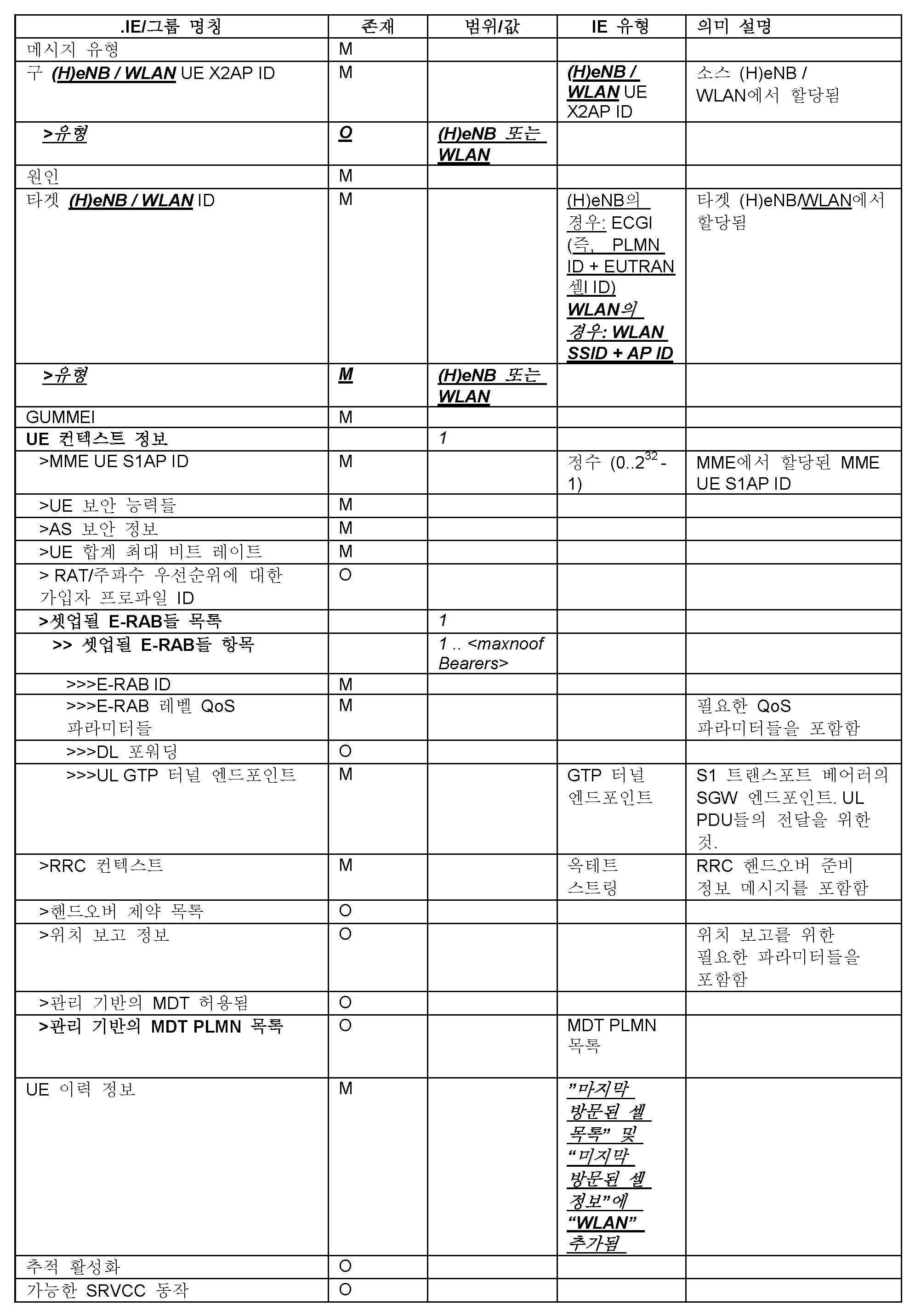
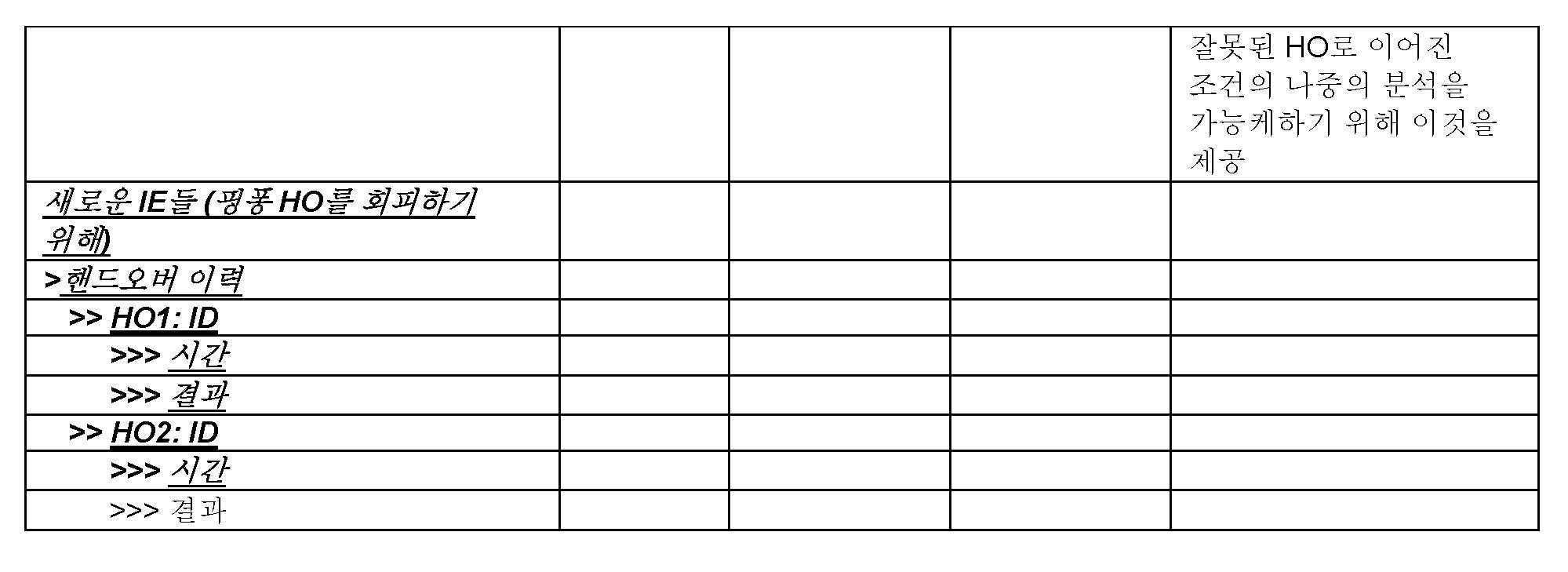
핸드오버 요청 접수확인Acknowledgment of Handover Request
예시적 실시예에서, HANDOVER REQUEST ACKNOWLEDGE 메시지가 타겟 WLAN/H(e)NB에 의해 전송되어 소스 H(e)NB/WLAN에게 타겟에서 준비된 자원에 대해 통보한다. 이하의 차트는, 기존의 포멧에 비해 정보 요소들에 수정이 가해진 것이 언더라인을 이용하여 식별되는 핸드오버 요청 접수확인 메시지의 포멧을 나타낸다.In an exemplary embodiment, a HANDOVER REQUEST ACKNOWLEDGE message is sent by the target WLAN / H (e) NB to inform the source H (e) NB / WLAN about the resources prepared at the target. The chart below shows the format of the handover request acknowledgment message in which modifications to the information elements as compared to the existing format are identified using the underline.
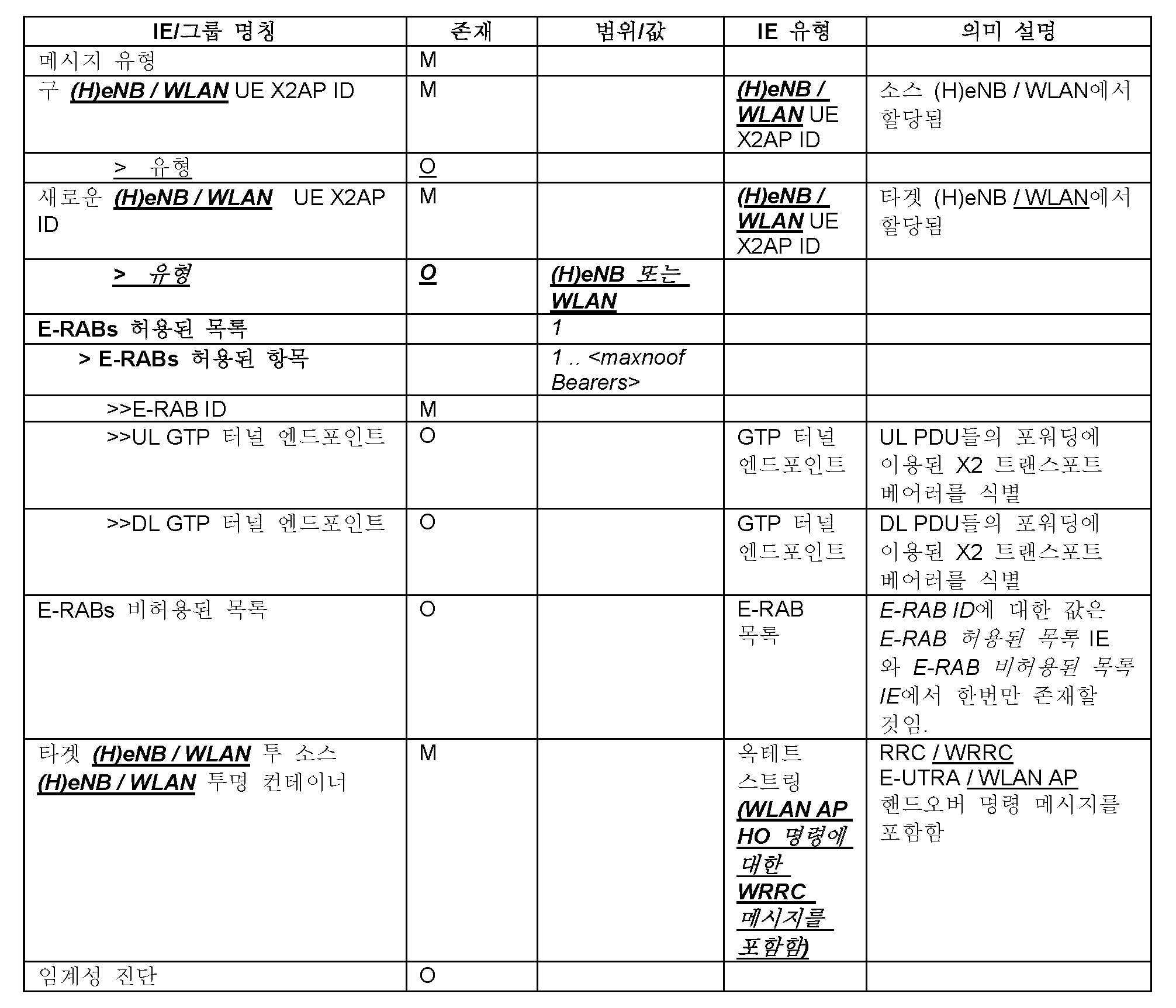
SN 상태 전달SN status propagation
예시적 실시예에서, SN STATUS TRANSFER 메시지가 소스 (H)eNB/WLAN에 의해 타겟 WLAN/(H)eNB에 전송되어 핸드오버 동안에 업링크/다운링크 PDCP SN 및 HFN 상태를 전달한다. 이하의 차트는, 기존의 포멧에 비해 정보 요소들에 수정이 가해진 것이 언더라인을 이용하여 식별되는 SN Status Transfer 메시지의 포멧을 나타낸다.In an exemplary embodiment, an SN STATUS TRANSFER message is sent by the source (H) eNB / WLAN to the target WLAN / (H) eNB to convey the uplink / downlink PDCP SN and HFN status during handover. The chart below shows the format of the SN Status Transfer message in which modifications to the information elements compared to the existing format are identified using underlines.
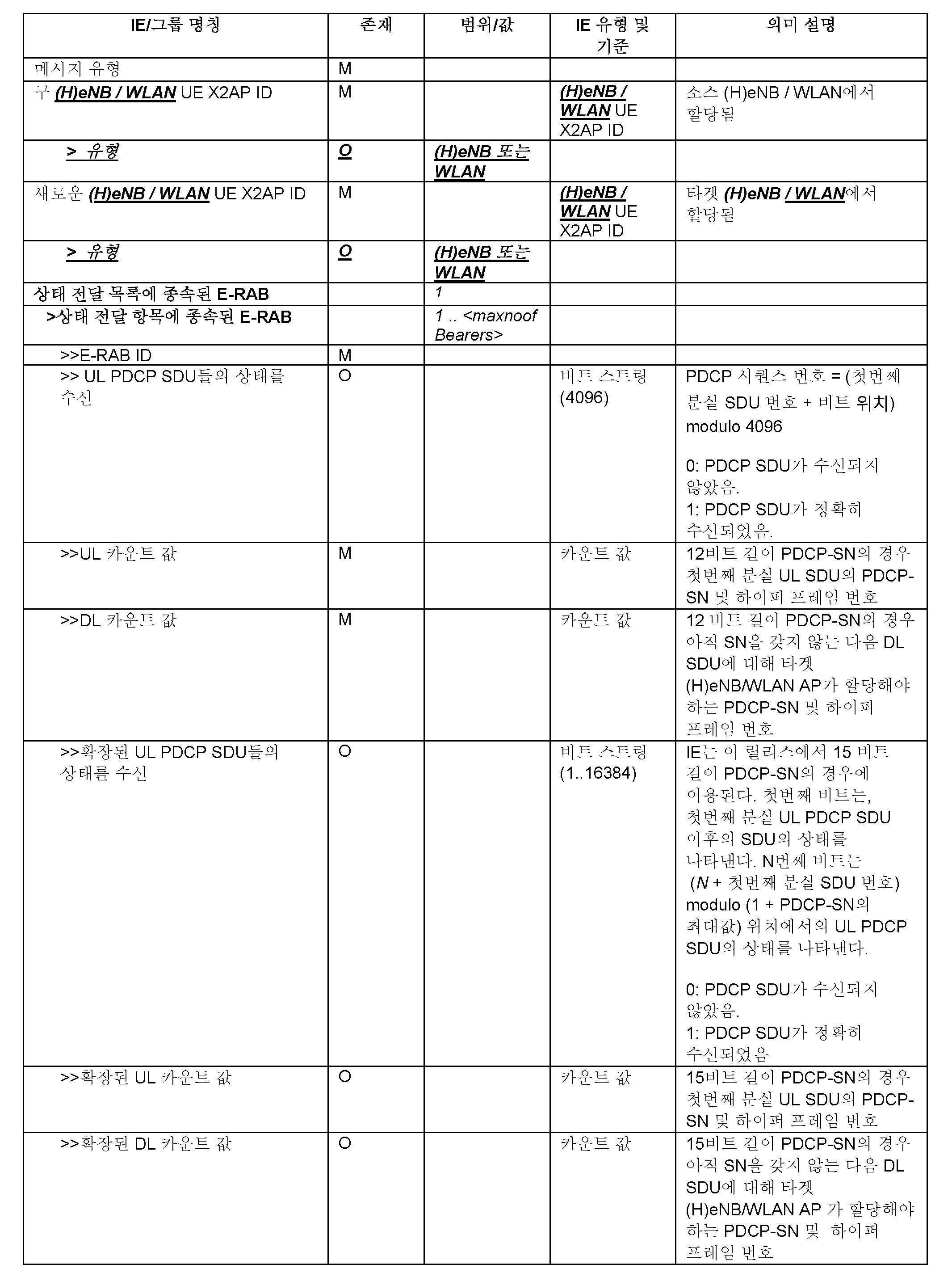
UE 컨텍스트 릴리스UE context release
예시적 실시예에서, UE CONTEXT RELEASE 메시지가 소스 (H)eNB/WLAN에 의해 타겟 WLAN/(H)eNB에 전송되어 자원이 릴리스될 수 있다는 것을 나타낸다. 이하의 차트는, 기존의 포멧에 비해 정보 요소들에 수정이 가해진 것이 언더라인을 이용하여 식별되는 UE Context Release 메시지의 포멧을 나타낸다.In an example embodiment, a UE CONTEXT RELEASE message is sent by the source (H) eNB / WLAN to the target WLAN / (H) eNB to indicate that the resource may be released. The chart below shows the format of a UE Context Release message in which modifications to information elements compared to the existing format are identified using underlines.
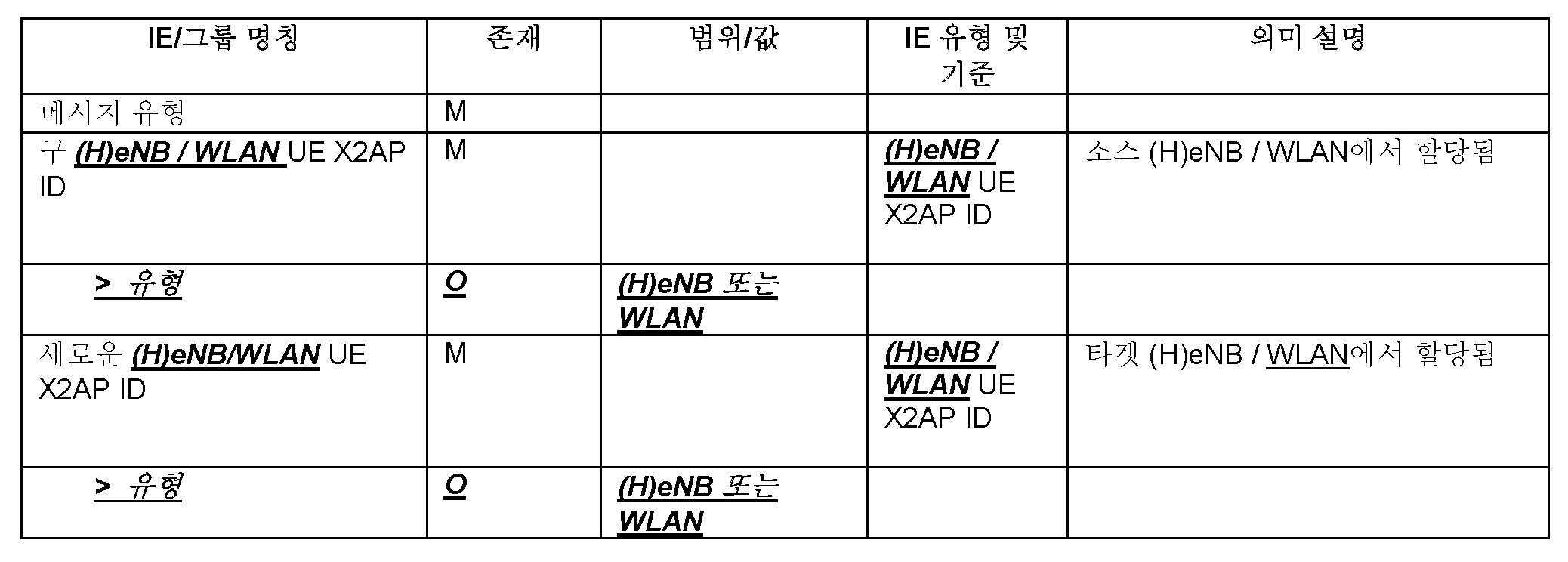
핸드오버 취소Cancel Handover
예시적 실시예에서, HANDOVER CANCEL 메시지가 소스 (H)eNB/WLAN에 의해 타겟 WLAN/(H)eNB에 전송되어 진행중인 핸드오버를 취소한다. 이하의 차트는, 기존의 포멧에 비해 정보 요소들에 수정이 가해진 것이 언더라인을 이용하여 식별되는 Handover Cancel 메시지의 포멧을 나타낸다.In an exemplary embodiment, a HANDOVER CANCEL message is sent by the source (H) eNB / WLAN to the target WLAN / (H) eNB to cancel the handover in progress. The chart below shows the format of the Handover Cancel message in which modifications to the information elements compared to the existing format are identified using underlines.
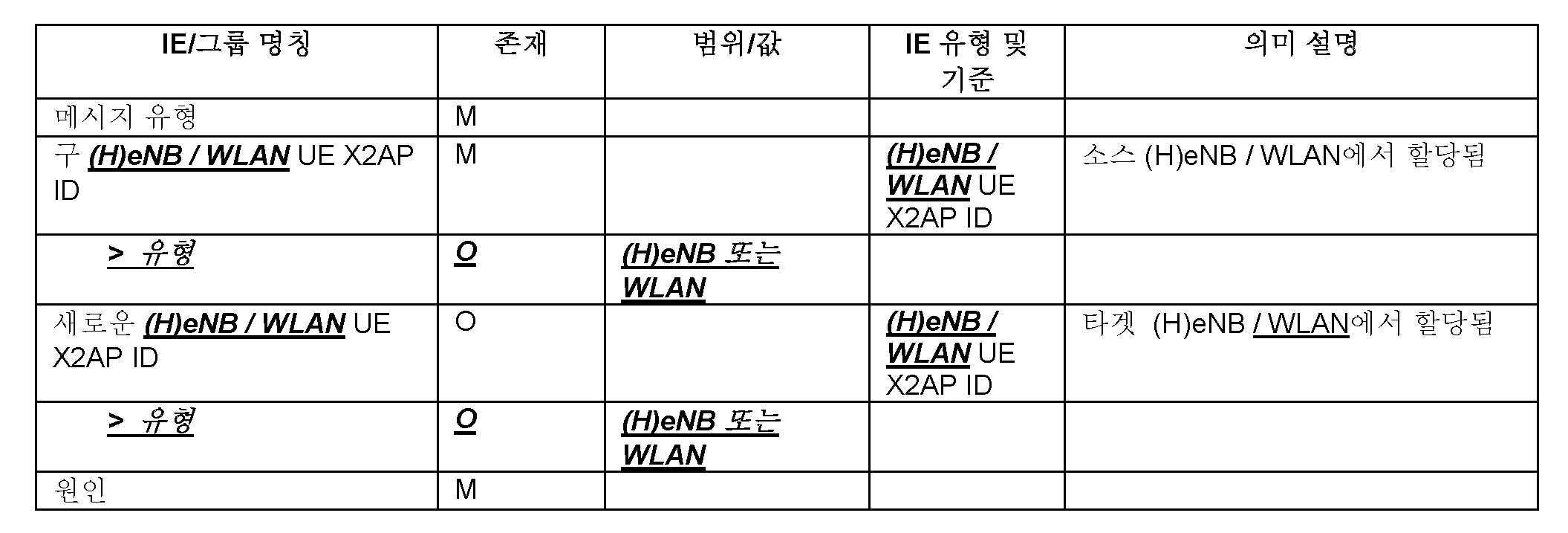
부하 정보Load information
예시적 실시예에서, LOAD INFORMATION 메시지가 소스 (H)eNB/WLAN에 의해 타겟 WLAN/(H)eNB에 전송되어 부하 및 간섭 조율 정보. 이하의 차트는, 기존의 포멧에 비해 정보 요소들에 수정이 가해진 것이 언더라인을 이용하여 식별되는 Load Information 메시지의 포멧을 나타낸다.In an exemplary embodiment, a LOAD INFORMATION message is sent by the source (H) eNB / WLAN to the target WLAN / (H) eNB to load and interference coordination information. The chart below shows the format of the Load Information message in which modifications to the information elements compared to the existing format are identified using underlines.

에러 표시Error display
예시적 실시예에서, ERROR INDICATION 메시지가 소스 (H)eNB/WLAN에 의해 타겟 WLAN/(H)eNB에 전송되어 H(e)NB/WLAN에서 소정의 에러가 검출되었다는 것을 표시한다. 이하의 차트는, 기존의 포멧에 비해 정보 요소들에 수정이 가해진 것이 언더라인을 이용하여 식별되는 Error Indication 메시지의 포멧을 나타낸다.In an exemplary embodiment, an ERROR INDICATION message is sent by the source (H) eNB / WLAN to the target WLAN / (H) eNB to indicate that a predetermined error was detected at the H (e) NB / WLAN. The chart below shows the format of the Error Indication message in which modifications to the information elements compared to the existing format are identified using underlines.
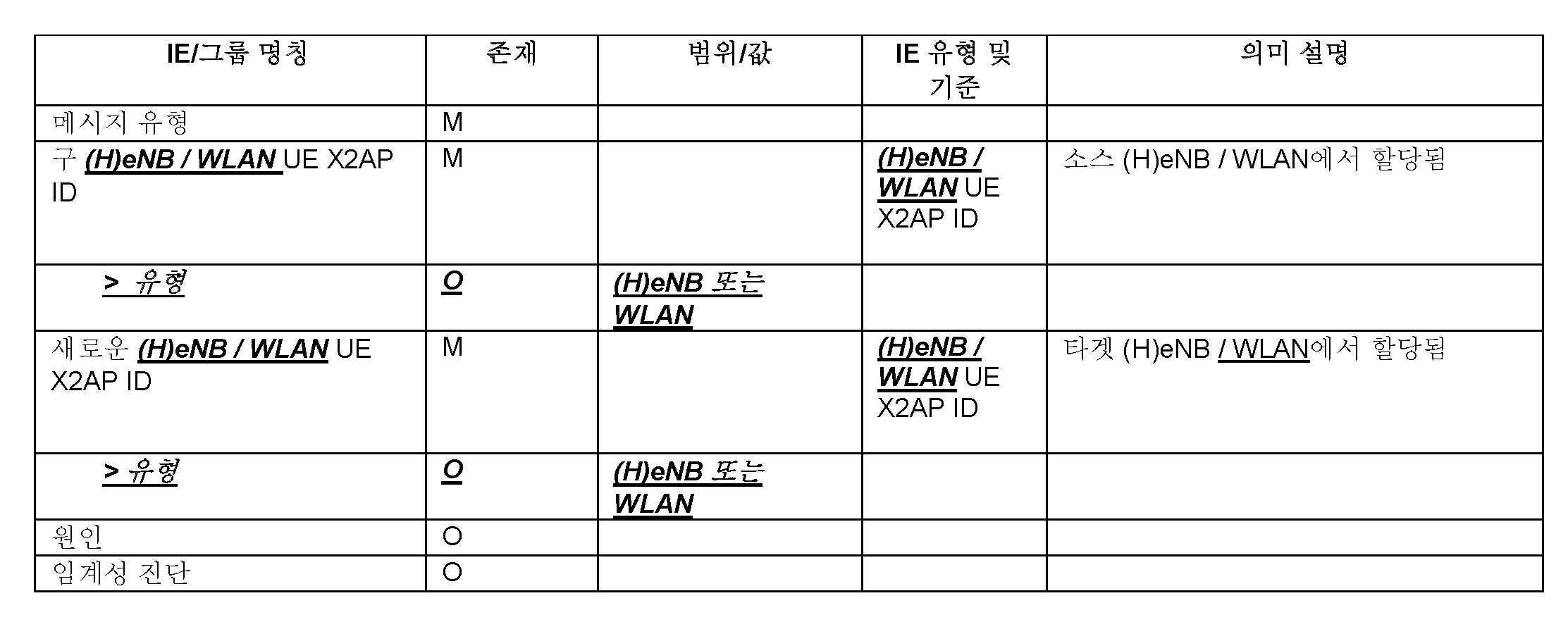
X2 셋업 요청X2 setup request
또 다른 예시적 실시예에서, X2 SETUP REQUEST 메시지가 소스 (H)eNB/WLAN에 의해 이웃 WLAN/(H)eNB에 전송되어 TNL 연관을 위한 초기화 정보를 전달한다. 이하의 차트는, 기존의 포멧에 비해 정보 요소들에 수정이 가해진 것이 언더라인을 이용하여 식별되는 Setup Request 메시지의 포멧을 나타낸다.In another exemplary embodiment, an X2 SETUP REQUEST message is sent by the source (H) eNB / WLAN to the neighbor WLAN / (H) eNB to carry initialization information for the TNL association. The following chart shows the format of a Setup Request message in which modifications to information elements compared to existing formats are identified using underlines.
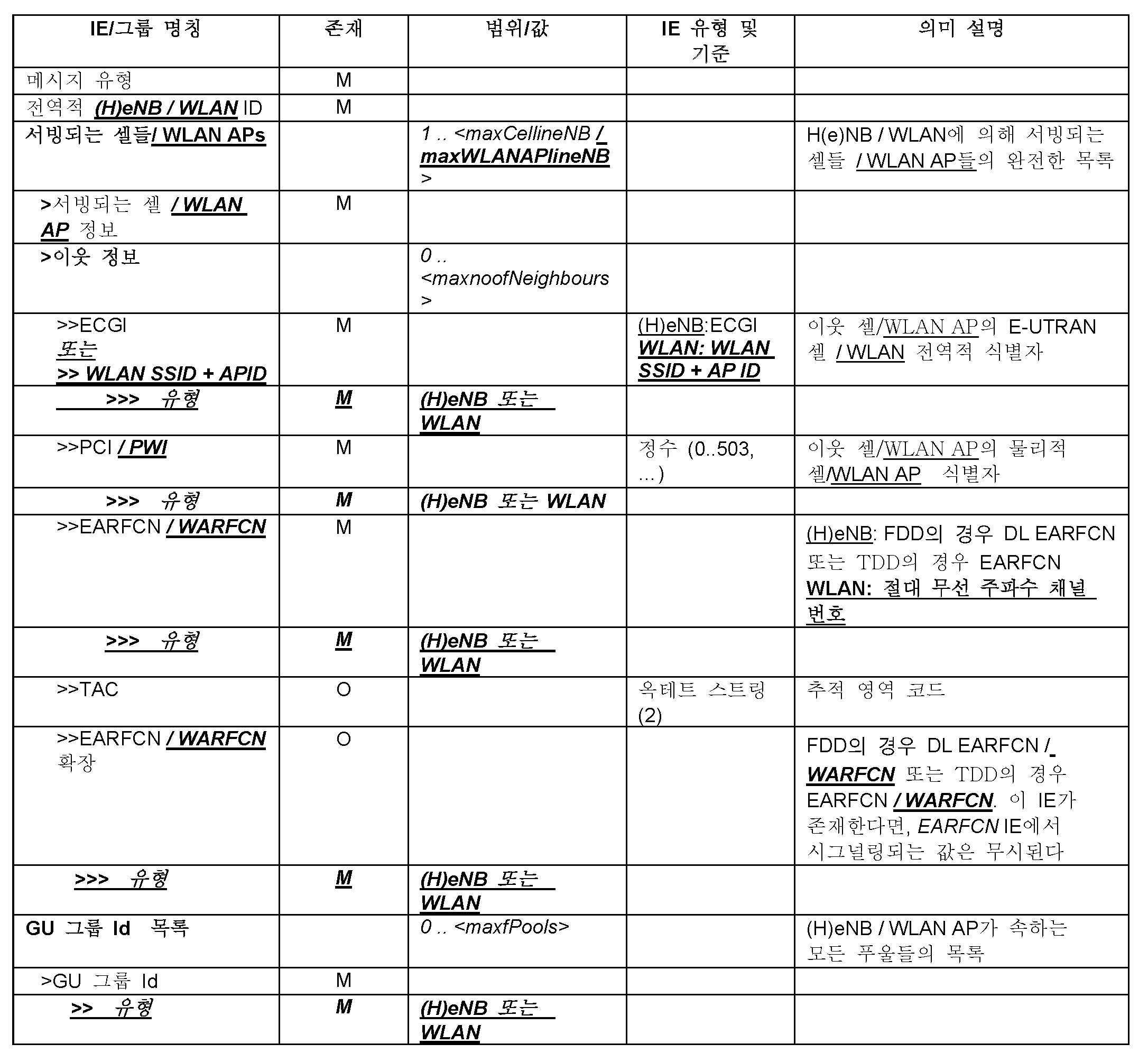
X2 셋업 응답X2 setup response
예시적 실시예에서, X2 SETUP RESPONSE 메시지가 소스 (H)eNB/WLAN에 의해 이웃 WLAN/(H)eNB에 전송되어 TNL 연관을 위한 초기화 정보를 전달한다. 이하의 차트는, 기존의 포멧에 비해 정보 요소들에 수정이 가해진 것이 언더라인을 이용하여 식별되는 Setup Response 메시지의 포멧을 나타낸다.In an example embodiment, an X2 SETUP RESPONSE message is sent by the source (H) eNB / WLAN to the neighbor WLAN / (H) eNB to carry initialization information for the TNL association. The chart below shows the format of the Setup Response message in which modifications to the information elements compared to the existing format are identified using underlines.
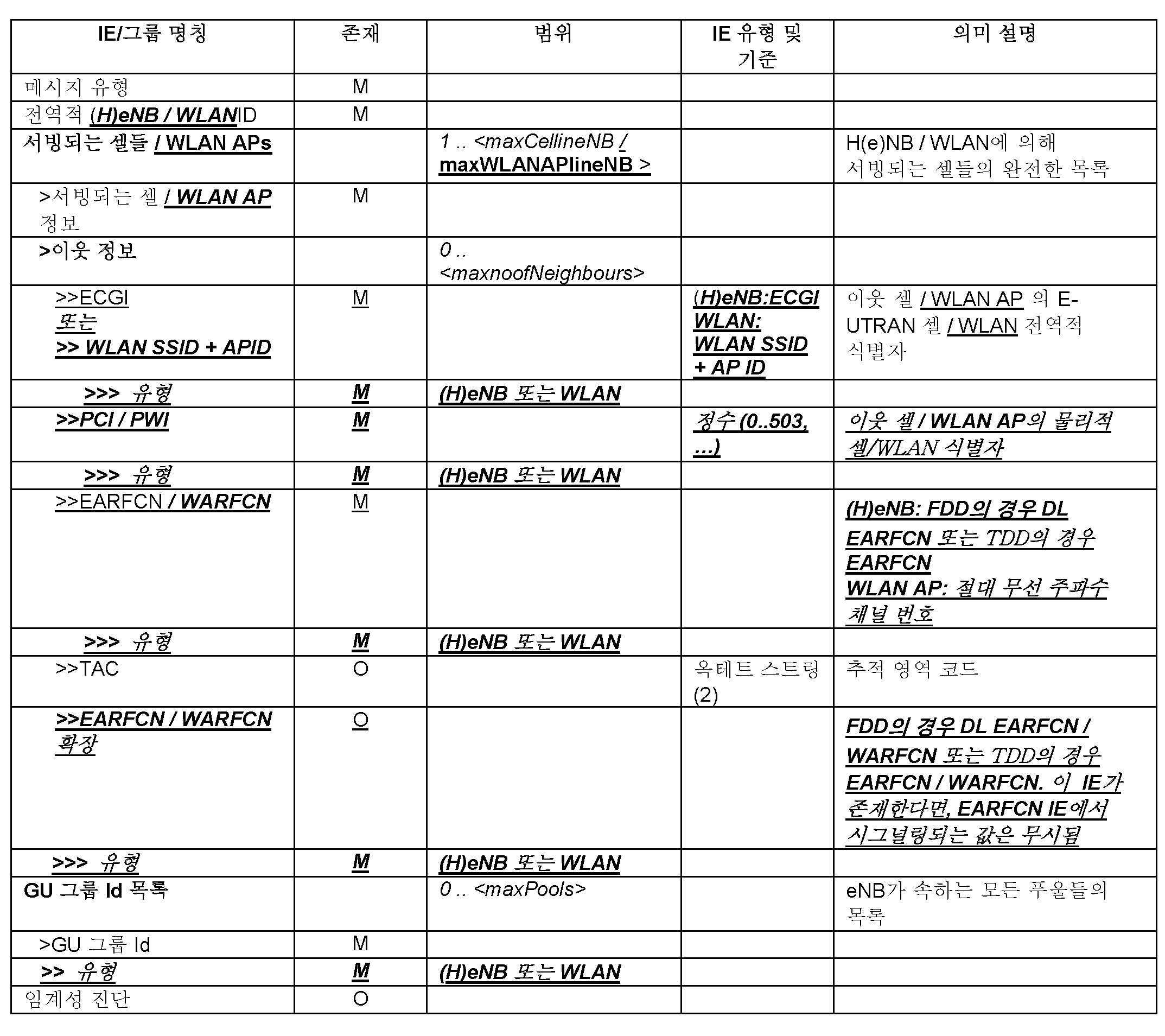
자원 상태 요청Resource status request
예시적 실시예에서, RESOURCE STATUS REQUEST 메시지가 (H)eNB/WLAN에 의해 이웃 (H)eNB/WLAN에 전송되어 메시지 내에 주어진 파라미터들에 따라 요청된 측정을 개시한다. 이하의 차트는, 기존의 포멧에 비해 정보 요소들에 수정이 가해진 것이 언더라인을 이용하여 식별되는 Resource Status Request 메시지의 포멧을 나타낸다.In an exemplary embodiment, a RESOURCE STATUS REQUEST message is sent by the (H) eNB / WLAN to the neighbor (H) eNB / WLAN to initiate the requested measurement according to the parameters given in the message. The chart below shows the format of a Resource Status Request message in which modifications to information elements compared to existing formats are identified using underlines.
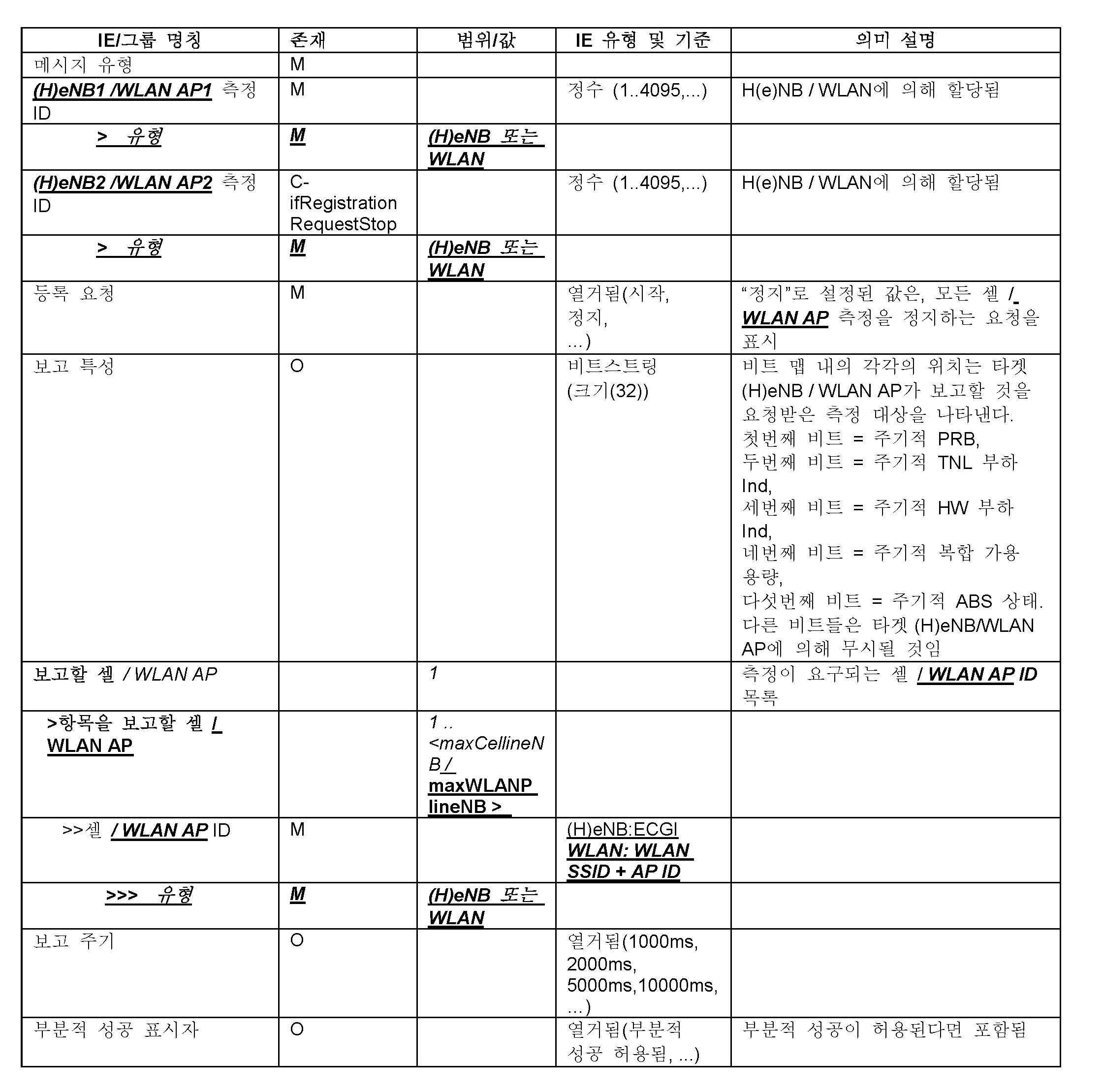
자원 상태 응답Resource status response
또 다른 예시적 실시예에서, RESOURCE STATUS RESPONSE 메시지가 eNB에 의해 전송되어, 측정에 포함된 측정 대상들의 전부에 대해, 또는 서브셋에 대해, 요청된 측정이 성공적으로 개시된다는 것을 나타낸다. 이하의 차트는, 기존의 포멧에 비해 정보 요소들에 수정이 가해진 것이 언더라인을 이용하여 식별되는 Resource Status Response 메시지의 포멧을 나타낸다.In another exemplary embodiment, a RESOURCE STATUS RESPONSE message is sent by the eNB to indicate that the requested measurement is initiated successfully for all or a subset of the measurement objects included in the measurement. The chart below shows the format of a Resource Status Response message in which modifications to information elements compared to the existing format are identified using underlines.

자원 상태 실패Resource status failed
예시적 실시예에서, RESOURCE STATUS FAILURE 메시지가 eNB에 의해 전송되어, 요청된 측정 대상들 중 어느 것에 대해서도 측정이 개시될 수 없다는 것을 나타낸다. 이하의 차트는, 기존의 포멧에 비해 정보 요소들에 수정이 가해진 것이 언더라인을 이용하여 식별되는 Resource Status Failure 메시지의 포멧을 나타낸다.In an example embodiment, a RESOURCE STATUS FAILURE message is sent by the eNB to indicate that measurement cannot be initiated for any of the requested measurement objects. The chart below shows the format of a Resource Status Failure message in which modifications to information elements compared to existing formats are identified using underlines.

예시적 UE 사용자 인터페이스Example UE User Interface
전술된 바와 같은 X2' 인터페이스를 이용하여 핸드오버 동작을 구현하는 디바이스 및 시스템은 핸드오버에 관하여 원하는 방식으로 동작하도록 구성될 수 있다는 것을 이해할 것이다. 예를 들어, UE(116, 124), WLAN(118), (H)eNB(710) 및/또는 기타 임의의 디바이스는, 특정한 디바이스 또는 시스템이 전술된 바와 같이 핸드오버를 수행할 것인지의 여부를 표시하도록 구성될 수 있다. 도 12는 핸드오버 구성 또는 셋업에 이용될 수 있는 예시적 사용자 인터페이스를 도시한다. 도시된 바와 같이, 구성은, 시스템 내의 임의의 적절한 레벨에서 ― 디바이스, 네트워크, 및 ISWN에서 수행될 수 있다. 각각에 관하여, 그리고 사용자 인터페이스(1202)에 의해 나타낸 바와 같이, 사용자 인터페이스는 사용자가 디바이스, 네트워크, 또는 ISWN이 자동으로 또는 수동으로 핸드오버 동작을 수행할 것인지를 명시하는 것을 허용한다. 예를 들어, 사용자 인터페이스는, 사용자가, 특정한 (H)eNB와 WLAN을 포함하는 특정한 ISWN을 선택하고 핸드오버가 자동으로 또는 수동으로 수행되어야하는지를 명시하는 것을 허용할 수 있다.It will be appreciated that devices and systems implementing handover operations using the X2 'interface as described above may be configured to operate in a desired manner with respect to handover. For example,
도 13은, 아이콘, 버튼, 또는 쇼트컷을 포함하는 예시적 디바이스 사용자 인터페이스(1302)를 도시한다. 도시된 바와 같이, UE(116, 124) 등의 디바이스에는, 특정한 디바이스가 자동 핸드오버에 참여할지를 선택하기 위한 사용자 인터페이스 피쳐에 액세스하기 위해 선택될 수 있는 아이콘이 저장되어 있다. 예시적 실시예에서, 선택가능한 버튼(1304)이 사용자에 의해 활성화되어, 통합된 소형 셀 및 WiFi(ISW) 네트워크 내에서 핸드오버를 수행하기 위한 목적으로, 예를 들어, UE 등의, 특정한 디바이스가 인에이블될 것이라는 것을 표시할 수 있다. 버튼(1304)이 선택되지 않으면, 핸드오버는 인에이블되지 않는다.13 shows an example
도 12 및 13에 도시된 바와 같은 사용자 인터페이스 내에 입력되는 정보는 관련 디바이스 및 시스템에 저장될 것이라는 것을 이해할 것이다. 도 10 및 도 11과 연계하여 설명되는 핸드오버의 처리 동안에, 디바이스 상의 정보가 특정한 디바이스가 참여하도록 구성된다는 것을 나타낸다면, 이것은 그에 따라 동작할 것이다. 디바이스 상의 정보가 특정한 디바이스가 참여하도록 구성되지 않는다는 것을 나타낸다면, 이것은 핸드오버 동작에 참여하지 않을 것이다.It will be appreciated that information entered into the user interface as shown in FIGS. 12 and 13 will be stored in the associated device and system. During the processing of the handover described in conjunction with FIGS. 10 and 11, if the information on the device indicates that a particular device is configured to participate, this will operate accordingly. If the information on the device indicates that the particular device is not configured to participate, it will not participate in the handover operation.
예시적 컴퓨팅 환경Example Computing Environment
도 14는 UE나 또 다른 엔드 노드 디바이스 등의 예시적 디바이스(30)의 도면이다. 디바이스(30)는, 본 개시내용의 이들 및 다른 요소들을 이용하는 임의의 논리적 엔티티 뿐만 아니라, WLAN에 포함된 임의의 WLAN AP들 및 IAP들(712)을 포함한, 사용자 장비(124, 116, 530 및 630), (H)eNB(510, 610, 및 710), WLAN(512, 612)을 포함한 본 명세서에 개시된 요소들 중 임의의 것을 구현하는 데 가용될 수 있다. 예를 들어, 디바이스(30)는 도 1 및/또는 도 7에 나타낸 통신 시스템 내에서 이용될 수 있다. 디바이스(30)는 또한, 도 12 및 도 13에 도시된 인터페이스 등의 사용자 인터페이스를 생성할 수 있다.14 is a diagram of an
도 14에 도시된 바와 같이, 디바이스(30)는, 프로세서(32), 트랜시버(34), 송신/수신 요소(36), 스피커/마이크로폰(38), 키패드(40), 디스플레이/터치패드/표시자(들)(42), 비착탈식 메모리(44), 착탈식 메모리(46), 전원(48), GPS(global positioning system) 칩셋(50), 및 기타의 주변기기(52)를 포함할 수 있다. 예시적 실시예에서, 디스플레이/터치패드/표시자(들)(42)은 사용자 인터페이스의 일부로서 동작하는 하나 이상의 표시를 포함할 수 있다. 디바이스(30)는, 실시예와 여전히 일치되면서 전술된 요소들의 임의의 서브조합(sub-combination)을 포함할 수 있다는 것을 이해할 것이다.As shown in FIG. 14, the
프로세서(32)는, 범용 프로세서, 특별 목적 프로세서, 종래의 프로세서, 디지털 신호 처리기(DSP; digital signal processor), 복수의 마이크로프로세서, DSP 코어와 연계한 하나 이상의 마이크로프로세서, 제어기, 마이크로제어기, 주문형 집적 회로(ASIC; Application Specific Integrated Circuit), 필드 프로그래머블 게이트 어레이(FPGA; Field Programmable Gate Array) 회로, 기타 임의 유형의 집적 회로(IC), 상태 머신 등일 수 있다. 프로세서(32)는, 신호 코딩, 데이터 처리, 전력 제어, 입력/출력 처리, 및/또는 디바이스(30)가 무선 환경에서 동작할 수 있게 하는 기타 임의의 기능을 수행할 수 있다. 프로세서(32)는, 송신/수신 요소(36)에 결합될 수 있는 트랜시버(34)에 결합될 수 있다. 도 14는 프로세서(32)와 트랜시버(34)를 별개의 컴포넌트로서 도시하고 있지만, 프로세서(32)와 트랜시버(34)는 전자 패키지 또는 칩 내에 함께 통합될 수도 있다는 것을 이해할 것이다. 프로세서(32)는 애플리케이션-층 프로그램(예를 들어, 브라우저) 및/또는 무선 액세스-층(RAN) 프로그램 및/또는 통신을 수행할 수 있다. 프로세서(32)는, 인증, 보안 키 협의, 및/또는 예를 들어, 액세스-층 및/또는 애플리케이션 층에서 등의 암호 동작과 같은 보안 동작을 수행할 수 있다.The
송신/수신 요소(36)는, 또 다른 피어에 신호를 송신하거나 이로부터 신호를 수신하도록 구성될 수 있다. 예를 들어, 실시예에서, 송신/수신 요소(36)는 RF 신호를 송신 및/또는 수신하도록 구성된 안테나일 수 있다. 송신/수신 요소(36)는, WLAN, WPAN, 셀룰러 등의, 다양한 네트워크 및 에어 인터페이스를 지원할 수 있다. 한 실시예에서, 송신/수신 요소(36)는, 예를 들어, IR, UV, 또는 가시광 신호를 송신 및/또는 수신하도록 구성된 방출기/검출기일 수도 있다. 역시 또 다른 실시예에서, 송신/수신 요소(36)는 RF 및 광 신호 양쪽 모두를 송신 및 수신하도록 구성될 수 있다. 송신/수신 요소(36)는 임의 조합의 무선 또는 유선 신호를 송신 및/또는 수신하도록 구성될 수 있다는 점을 이해할 것이다.The transmit / receive
또한, 송신/수신 요소(36)가 도 14에서는 단일 요소로 도시되어 있지만, 디바이스(30)는 임의 개수의 송신/수신 유닛(36)를 포함할 수 있다. 더 구체적으로는, 디바이스(30)는 다중-입력 다중-출력(MIMO) 기술을 채택할 수도 있다. 따라서, 실시예에서, 디바이스(30)는, 무선 신호를 송신 및 수신하기 위해 2개 이상의 송신/수신 요소(36), 예를 들어, 복수의 안테나를 포함할 수도 있다.In addition, although the transmit / receive
트랜시버(34)는, 송신/수신 요소(36)에 의해 송신되는 신호를 변조하고 송신/수신 유닛(36)에 의해 수신되는 신호를 복조하도록 구성될 수 있다. 앞서 언급한 바와 같이, 디바이스(30)는 멀티-모드 능력을 가질 수도 있다. 따라서, 트랜시버(34)는, 디바이스(30)가, 예를 들어, UTRA 및 IEEE 802.11 또는 802.15 등의 복수의 RAT을 이용하여 통신할 수 있게 하기 위한 복수의 트랜시버를 포함할 수 있다.The
프로세서(32)는, 비착탈식 메모리(44) 및/또는 착탈식 메모리(46) 등의, 임의의 유형의 적절한 메모리로부터 정보를 액세스하거나, 여기에 데이터를 저장할 수도 있다. 비착탈식 메모리(44)는, 랜덤 액세스 메모리(RAM), 판독-전용 메모리(ROM), 하드 디스크, 또는 기타 임의 유형의 메모리 저장 디바이스를 포함할 수 있다. 착탈식 메모리(46)는, 가입자 신원 모듈(SIM; subscriber identity module), 메모리 스틱, 보안 디지털(SD; secure digital) 메모리 카드 등을 포함할 수 있다. 다른 실시예에서, 프로세서(32)는, 서버 또는 가정용 컴퓨터 등의, 디바이스(30)에 물리적으로 위치해 있지 않은 메모리로부터 정보를 액세스하거나, 그것에 데이터를 저장할 수도 있다.The
프로세서(32)는, 전원(48)으로부터 전력을 수신할 수 있고, 디바이스(30) 내의 다른 컴포넌트들에 전력을 분배 및/또는 전력을 제어하도록 구성될 수 있다. 전원(48)은 디바이스(30)에 전력을 공급하기 위한 임의의 적절한 디바이스일 수 있다. 예를 들어, 전원(48)은, 하나 이상의 건식 셀 배터리(예를 들어, 니켈-카드뮴(NiCd), 니켈-아연(NiZn), 니켈 금속 수소화물(NiMH), 리튬-이온(Li-ion) 등), 태양 전지, 연료 전지 등을 포함할 수 있다.The
프로세서(32)는 또한, 디바이스(30)의 현재 위치에 관한 위치 정보, 예를 들어, 경도 및 위도를 제공하도록 구성된 GPS 칩셋(50)에 결합될 수도 있다. 디바이스(30)는 실시예와 여전히 일치되면서 임의의 적절한 위치-결정 방법을 통해 위치 정보를 취득할 수 있다는 것을 이해할 것이다.The
프로세서(32)는 또한, 추가적인 피쳐, 기능 및/또는 유선이나 무선 접속을 제공하는 하나 이상의 소프트웨어 및/또는 하드웨어 모듈을 포함할 수도 있는 다른 주변기기(52)에 결합될 수도 있다. 예를 들어, 주변기기(52)는, 가속도계, e-나침반, 위성 트랜시버, 센서, (사진 또는 비디오용) 디지털 카메라, USB(Universal Serial Bus, 유니버설 시리얼 버스) 포트, 진동 디바이스, 텔레비전 트랜시버, 핸즈프리 헤드셋, Bluetooth® 모듈, 주파수 변조(FM) 무선 유닛, 디지털 음악 재생기, 미디어 재생기, 비디오 게임 플레이어 모듈, 인터넷 브라우저 등을 포함할 수 있다.The
도 15는 컴퓨터 시스템 또는 서버의 블록도이다. 디바이스(90)는, 본 개시내용의 이들 및 다른 요소들을 이용하는 논리적 엔티티 중 임의의 것뿐만 아니라, 다른 요소들, EPC(104)의 WLAN 노드에 포함된 임의의 WLAN AP들 및 IAP(712)들을 포함한, 사용자 장비(124, 116, 530 및 630), (H)eNB(510, 610, 및 710), WLAN(512, 612)을 포함한 본 명세서에 개시된 논리 엔티티들 및 요소들 중 임의의 것을 구현하는 데 가용될 수 있다. 예를 들어, 디바이스(90)는 도 1 및/또는 도 7에 나타낸 통신 시스템 내에서 이용될 수 있다. 디바이스(90)는 또한, 도 12 및 도 13에 도시된 인터페이스 등의 사용자 인터페이스를 생성할 수 있다.15 is a block diagram of a computer system or server. The
도 15의 컴퓨터 시스템 또는 서버는, 주로, 소프트웨어 형태일 수 있는 컴퓨터 판독가능한 명령어에 의해, 또는 심지어, 이러한 소프트웨어가 저장되거나 액세스되는 어떠한 수단에 의해 제어될 수 있다. 이러한 컴퓨터 판독가능한 명령어는 중앙 처리 유닛(CPU)(91) 등의 프로세서 내에서 실행되어 디바이스(90)가 작업을 하게 할 수 있다. 많은 공지된 워크스테이션, 서버 및 개인용 컴퓨터에서, 중앙 처리 유닛(91)은 마이크로프로세서라 불리는 단일-칩 CPU에 의해 구현된다. 다른 머신들에서, 중앙 처리 유닛(91)은 복수의 프로세서를 포함할 수도 있다. 코프로세서(81)는, 추가적인 기능을 수행하거나 CPU(91)를 보조하는, 메인 CPU(91)와는 별개의, 선택사항적 프로세서이다. CPU(91) 및/또는 코프로세서(81)는, P2P 통신과 연계하여 데이터를 수신, 생성, 및 처리할 수 있다.The computer system or server of FIG. 15 may be controlled primarily by computer readable instructions, which may be in software form, or even by any means by which such software is stored or accessed. Such computer readable instructions may be executed within a processor such as a central processing unit (CPU) 91 to cause the
동작시, CPU(91)는, 명령어를 인출하고, 디코딩하고, 실행하며, 컴퓨터의 메인 데이터-전송 경로, 즉, 시스템 버스(80)를 통해, 다른 자원들에 및 다른 자원들로부터 정보를 전송한다. 이러한 시스템 버스는 디바이스(90) 내의 컴포넌트들을 접속하고 데이터 교환을 위한 매체를 정의한다. 시스템 버스(80)는 통상적으로, 데이터를 전송하기 위한 데이터 라인, 주소를 전송하기 위한 주소 라인, 및 인터럽트를 전송하고 시스템 버스를 동작시키기 위한 제어 라인을 포함한다. 이러한 시스템 버스(80)의 예는 PCI(Peripheral Component Interconnect) 버스이다.In operation, the
시스템 버스(80)에 결합된 메모리 디바이스는 랜덤 액세스 메모리(RAM)(82)와 판독 전용 메모리(ROM)(93)를 포함한다. 이러한 메모리는 정보가 저장 및 검색되는 것을 허용하는 회로를 포함한다. ROM(93)은 일반적으로, 용이하게 수정될 수 없는 저장된 데이터를 포함한다. RAM(82)에 저장된 데이터는 CPU(91) 또는 기타의 하드웨어 디바이스에 의해 판독되거나 변경될 수 있다. RAM(82) 및/또는 ROM(92)으로의 액세스는 메모리 제어기(93)에 의해 제어될 수 있다. 메모리 제어기(92)는 명령어가 실행될 때 가상 주소를 물리적 주소로 변환하는 주소 변환 기능을 제공할 수 있다. 메모리 제어기(92)는 또한, 시스템 내의 프로세스들을 분리하고, 시스템 프로세스를 사용자 프로세스로부터 분리하는 메모리 보호 기능을 제공한다. 따라서, 제1 모드에서 실행되는 프로그램은 그 자신의 프로세스 가상 주소 공간에 의해 맵핑되는 메모리만을 액세스할 수 있다; 이것은 프로세스들 간의 메모리 공유가 셋업되지 않는 한 또 다른 프로세스의 가상 주소 공간 내의 메모리에 액세스할 수 없다.The memory device coupled to the
또한, 디바이스(90)는, CPU(91)로부터, 프린터(94), 키보드(84), 마우스(95), 및 디스크 드라이브(85) 등의 주변기기에 명령어를 전달하는 책임을 지는 주변기기 제어기(83)를 포함할 수 있다.In addition, the
디스플레이 제어기(96)에 의해 제어되는 디스플레이(86)는 디바이스(90)에 의해 생성된 시각적 출력을 디스플레이하는 데 가용된다. 이러한 시각적 출력은, 텍스트, 그래픽, 애니메이트된 그래픽, 및 비디오를 포함할 수 있다. 디스플레이(86)는, CRT-기반의 비디오 디스플레이, LCD-기반의 평판 디스플레이, 가스 플라즈마-기반의 평판 디스플레이 또는 터치-패널로 구현될 수 있다. 디스플레이 제어기(96)는 디스플레이(86)에 전송되는 비디오 신호를 생성하는 데 요구되는 전자 컴포넌트를 포함한다. 또한, 디바이스(90)는, 디바이스(90)를 외부 통신 네트워크에 접속하는 데 가용될 수 있는 네트워크 어댑터(97)를 포함할 수 있다.
또한, 컴퓨팅 시스템(90)은, 예를 들어, 패킷 데이터 네트워크로서의 외부 통신 네트워크에 컴퓨팅 시스템(90)을 접속하는 데 가용될 수 있는 네트워크 어댑터(97)를 포함할 수 있다. 실시예에서, 네트워크 어댑터(97)는 개시된 시스템간 이동성 시스템 및 방법에 관련된 데이터를 수신 및 전송할 수 있다.In addition,
따라서, 출원인들은, 통합된 롱텀 에볼루션(LTE) 무선 액세스 네트워크와 신뢰된 무선 근거리 통신망(WLAN) 액세스 네트워크(TWAN) 사이의 시스템간 핸드오버를 위한 시스템 및 방법을 개시했다. X2' 인터페이스라고 하는 통신 인터페이스는, LTE 무선 액세스 네트워크와 TWAN 사이에 정의된다. X2' 인터페이스는, LTE 액세스 네트워크와 TWAN 사이에서 제어 평면 시그널링 및 사용자 평면 데이터 양쪽 모두를 전달하도록 구성된다. 사용자 장비(UE)와 EPC 사이의 기존의 통신 접속은, 2개의 네트워크들 사이의 X2' 인터페이스를 통한 통신에 의해 LTE 액세스 네트워크와 TWAN 중 하나로부터 다른 하나로 핸드오버될 수 있다.Accordingly, Applicants have disclosed a system and method for intersystem handover between an integrated Long Term Evolution (LTE) radio access network and a trusted Wireless Local Area Network (WLAN) access network (TWAN). A communication interface called the X2 'interface is defined between the LTE radio access network and the TWAN. The X2 'interface is configured to carry both control plane signaling and user plane data between the LTE access network and the TWAN. An existing communication connection between the UE and the EPC may be handed over from one of the LTE access network and the TWAN to the other by communication over an X2 'interface between the two networks.
개시된 방법 및 시스템은 예시적인 것이고, 개시된 개념들은 다양한 상이한 기술들 및 아키텍쳐들과 연계하여 구현될 수 있다는 것을 이해할 것이다. 예를 들어, 여기서 개시된 예시적 실시예에서, TWAN은 EPC에 액세스하기 위해 PGW에서 앵커되고, 여기서 개시된 시스템 및 방법은 TWAN이 상이한 네트워크 엔티티에서 앵커되는 아키텍쳐에서 유사하게 적용가능하다.It is to be understood that the disclosed method and system are exemplary, and that the disclosed concepts may be implemented in connection with a variety of different technologies and architectures. For example, in the example embodiment disclosed herein, the TWAN is anchored at the PGW to access the EPC, and the systems and methods disclosed herein are similarly applicable in an architecture where the TWAN is anchored at different network entities.
개시된 시스템 및 방법은 다양한 혜택을 야기할 수 있다. 예를 들어, 네트워크의 가장자리 부근에서 시스템간 이동성 절차의 실행을 가능케함으로써 통신 성능이 개선된다. 코어 네트워크에서의 깊은, 즉, PGW를 향한, 시그널링 절차에 대한 필요성을 최소화함으로써 통신 레이턴시가 감소된다. 이것은, 특히, MNO가 소형 셀과 WiFi 액세스 양쪽 모두를 공통의 지리적 영역에 배치할 때 유익할 수 있다. PGW 처리 부담을 감소시킴으로써, 예를 들어, 일부 시스템간 이동성 기능들을 (H)eNB와 WLAN에 분배함으로써, 확장성도 역시 개선된다.The disclosed systems and methods can result in a variety of benefits. For example, communication performance is improved by enabling the execution of intersystem mobility procedures near the edge of the network. Communication latency is reduced by minimizing the need for signaling procedures deep in the core network, ie towards the PGW. This may be particularly beneficial when the MNO places both small cells and WiFi access in a common geographic area. By reducing the PGW processing burden, for example, by distributing some intersystem mobility functions to (H) eNB and WLAN, scalability is also improved.
예시적 실시예가 개시되었지만, 잠재적 실시예들의 범위는 이들 명시적으로 개시된 것들로 제한되지 않는다는 것을 이해할 것이다. 예를 들어, 시스템이 주로 "신뢰된" WLAN 액세스 네트워크(TWAN)를 참조하여 설명되었지만, 생각해볼 수 있는 실시예들은 "비신뢰된" WLAN을 채택하는 실시예에까지 또한 확장된다. 게다가, 개시된 실시예들은 단일-PDN TWAN 뿐만 아니라 다중-PDN TWAN을 포괄할 수 있다는 것을 이해할 것이다.While example embodiments have been disclosed, it will be understood that the scope of potential embodiments is not limited to those explicitly disclosed. For example, although the system has been described primarily with reference to "trusted" WLAN access networks (TWANs), conceivable embodiments also extend to embodiments employing "untrusted" WLANs. In addition, it will be appreciated that the disclosed embodiments may encompass not only single-PDN TWANs but also multiple-PDN TWANs.
무선 통신에 관련된 다양한 용어와 구문들이 본 개시내용에서 사용되었다는 것을 이해할 것이다. 예를 들어, 본 개시내용은, "소형 셀", "WiFi 핫스팟", "통합된 소형 셀 및 WiFi 네트워크", 및 "TWAN"을 언급하고 있다. 이들 및 다른 그러한 용어들은, 본 기술분야의 통상의 기술자에게 여기서 제공된 설명과 일치하는 그들의 일반적 의미를 갖는 것으로 이해되어야 한다.It will be understood that various terms and phrases related to wireless communication have been used in the present disclosure. For example, the present disclosure refers to "small cell", "WiFi hotspot", "integrated small cell and WiFi network", and "TWAN". These and other such terms should be understood to have their general meaning consistent with the description provided herein to one skilled in the art.
예를 들어, "소형 셀"은, 수십 킬로미터의 범위를 가질 수 있는 모바일 매크로셀에 비해, 10 미터 내지 1 또는 2킬로미터의 범위를 갖는 지리적 영역에서 동작하는 저전력 3GPP 명세의 무선 액세스 노드, 예를 들어, Home eNode B((H)eNB)이다. 소형 셀은, 오퍼레이터-면허 스펙트럼을 이용하여 3GPP-정의 RAT를 통해 건물 내 및 옥외 모바일 네트워크 액세스를 제공하는 데 가용될 수 있다. 이들 RAT들의 2G 및 3G 버전들은 회선 교환형 뿐만 아니라 패킷 교환형 서비스를 지원하지만, 여기서는, 패킷 서비스만에, 특히 진화된 패킷 코어(Evolved Packet Core, EPC) 네트워크로의 액세스를 제공하는 4G LTE RAT에만 집중하고 있다.For example, a "small cell" refers to a radio access node of the low power 3GPP specification, e. For example, Home eNode B ((H) eNB). Small cells may be available to provide in-building and outdoor mobile network access via 3GPP-defined RAT using operator-licensed spectrum. 2G and 3G versions of these RATs support packet-switched as well as circuit-switched services, but here, 4G LTE RAT provides access only to packet services, especially to Evolved Packet Core (EPC) networks. Only focus on.
또한, 여기서는 "WiFi"라고 할 수 있는, "WiFi 핫스폿"은, WiFi 얼라이언스(WFA)에 의해 인증된 장비로 IEEE802.11에 의해 표준화된 RAT를 통해 무면허 스펙트럼을 이용해 지리적 영역에서 무선 네트워크 액세스를 제공한다. 앞서 언급된 바와 같이, 근거리 통신망 또는 인터넷으로의 직접적 액세스 외에도 EPC 네트워크로의 WiFi 액세스가 제공될 수 있다.In addition, here called "WiFi", "WiFi Hotspot" is a device certified by the WiFi Alliance (WFA) that enables wireless network access in geographical areas using unlicensed spectrum over RAT standardized by IEEE802.11. to provide. As mentioned above, in addition to direct access to a local area network or the Internet, WiFi access to an EPC network may be provided.
추가 예로서, "통합된 소형 셀 및 WiFi 네트워크"(ISWN)란, 다중-RAT 단말기 능력, 소형 셀 및 WiFi 액세스 능력, EPC(Evolved Packet Core), 네트워크 게이트웨이, 및 정책 및 트래픽 관리 기능에 대한 잠재적 증강을 포함한, 모바일 오퍼레이터에 의해 배치된 공동 액세스 네트워크를 말한다.As a further example, “integrated small cell and WiFi network” (ISWN) means the potential for multi-RAT terminal capability, small cell and WiFi access capability, Evolved Packet Core (EPC), network gateway, and policy and traffic management capabilities. It refers to a joint access network deployed by a mobile operator, including augmentation.
역시 또한, 용어 "신뢰된 WLAN(TWAN) 액세스"란, WLAN을 통한 액세스로부터 EPC를 보호하기 위해 적절한 조처가 취해진 환경을 말한다. 이러한 조처는 통상적으로 MNO의 재량에 달려 있고, 예를 들어, WLAN과 EPC 사이의 부정행위-방지 파이버 접속(tamper-proof fiber connection)의 확립, 또는 WLAN과 EPC 가장자리의 보안 게이트웨이 사이의 IPSec 보안 연관의 확립을 포함할 수 있다. 대조적으로, WLAN이 "비신뢰된" 것으로 간주된다면, WLAN은 EPC 가장자리의 ePDG(evolved Packet Data Gateway)와 인터페이싱할 수 있고, ePDG는 WLAN을 통해 EPC에 액세스하는 각각의 UE와 직접 IPSec 보안 연관을 확립해야 한다.Again, the term "trusted WLAN (TWAN) access" refers to an environment in which appropriate measures have been taken to protect the EPC from access via WLAN. This action is typically at the discretion of the MNO, for example, establishing a tamper-proof fiber connection between the WLAN and the EPC, or IPSec security association between the WLAN and the security gateway at the EPC edge. May include the establishment of In contrast, if a WLAN is considered “untrusted,” the WLAN can interface with an evolved Packet Data Gateway (ePDG) at the edge of the EPC, which establishes an IPSec security association directly with each UE accessing the EPC via the WLAN. It must be established.
도 1, 7, 9, 10, 및 11의 논리적 엔티티들을 포함한, 여기서 설명된 시스템들, 방법들, 및 프로세스들 중 임의의 것 또는 전부는 컴퓨터 판독가능한 저장 매체에 저장된 컴퓨터 실행가능한 명령어, 예를 들어, 프로그램 코드의 형태로 임베딩될 수 있고, 이 컴퓨터 실행가능한 명령어는, 컴퓨터, 서버, 피어, 프로세서 등(예를 들어, 도 14의 디바이스(30) 또는 도 15의 디바이스(90))의 머신에 의해 실행될 때, 여기서 설명된 시스템, 방법, 및 프로세스를 수행 및/또는 구현한다는 것을 이해할 것이다. 구체적으로는, 여기서 설명된 단계들, 동작들 또는 기능들 중 임의의 것은 이러한 컴퓨터 실행가능한 명령어의 형태로 구현될 수 있다. 컴퓨터 판독가능한 저장 매체는, 정보 저장을 위한 임의의 방법이나 기술로 구현된 휘발성 및 비휘발성, 착탈식 및 비착탈식 매체를 포함하지만, 이러한 컴퓨터 판독가능 저장 매체는 신호를 포함하지 않는다. 컴퓨터 저장 매체로서는, RAM, ROM, EEPROM, 플래쉬 메모리 또는 기타의 메모리 기술, CD-ROM, DVD, 또는 기타의 광학 디스크 스토리지, 자기 카셋트, 자기 테이프, 자기 디스크 스토리지 또는 기타의 자기 저장 디바이스, 또는 컴퓨터에 의해 액세스될 수 있고 원하는 정보를 저장하는 데 가용될 수 있는 기타 임의의 물리적 매체가 포함되지만, 이것으로만 제한되는 것은 아니다.Any or all of the systems, methods, and processes described herein, including the logical entities of FIGS. 1, 7, 9, 10, and 11, may include computer executable instructions stored on a computer readable storage medium, eg, For example, it may be embedded in the form of program code, and the computer executable instructions may be a machine of a computer, server, peer, processor, or the like (eg,
본 개시의 주제의 바람직한 실시예를 설명하는 데 있어서, 도면들에 예시된 바와 같이, 특정한 전문용어는 명료성을 위해 채택된 것이다. 그러나, 청구 대상은 이와 같이 선택된 전문용어로 제한되고자 함은 아니고, 각각의 특정한 요소는 유사한 목적을 달성하는 유사한 방식으로 동작하는 모든 기술적 균등물을 포함한다는 것을 이해해야 한다.In describing preferred embodiments of the subject matter of the present disclosure, as illustrated in the drawings, specific terminology is employed for the sake of clarity. However, it is to be understood that the subject matter is not intended to be limited to the terminology so selected, and that each particular element includes all technical equivalents that operate in a similar manner to achieve a similar purpose.
상기의 설명은, 최상의 모드를 포함한 본 발명을 개시하기 위해, 그리고 본 기술분야의 통상의 기술자가, 임의의 디바이스 또는 시스템을 제작하고 이용하며 임의의 포함된 방법을 수행하는 것을 포함해서, 본 발명을 실시할 수 있게 하기 위해, 예들을 이용하고 있다. 본 발명의 특허가능한 범위는 청구항에 의해 정의되며 본 기술분야의 통상의 기술자에게 발생할 수 있는 다른 예들을 포함할 수 있다. 이러한 다른 예들은, 청구항의 문자 언어와 상이하지 않은 구조적 요소를 포함하거나, 청구항의 문자 언어와 비실질적 차이를 갖는 균등한 구조적 요소를 포함한다면, 청구항의 범위 내에 드는 것이다.The above description is directed to the present invention, including the best mode, and to one skilled in the art, including the manufacture and use of any device or system, and to perform any included method. In order to be able to do this we are using examples. The patentable scope of the invention is defined by the claims, and may include other examples that occur to those skilled in the art. These other examples fall within the scope of the claims if they include structural elements that do not differ from the literal language of the claims, or equivalent structural elements with substantive differences from the literal language of the claims.
다음은, 상기 설명에서 나타날 수 있는 서비스 레벨 기술들에 관련된 약어의 목록이다.
AAA 인증, 인가, 및 어카운팅(Authentication, Authorization, and Accounting)
ACK 접수확인(ACKnowledgment)
AP 액세스 포인트(Access Point) (802.x)
BSS 기본 서비스 세트(Basic Service Set) (802.x)
CAPEX 자본 지출(Capital Expenditure)
CQI 채널 품질 표시자(Channel Quality Indicator)
DL 다운링크(Down Link)
EAP 확장가능한 인증 프로토콜(Extensible Authentication Protocol)
EAPoL Lan을 통한 EAP(EAP over Lan)
eNodeB 진보된 노드 B(Evolved Node B)
eNB 진보된 노드 B(Evolved Node B)
EPC 진보된 패킷 코어(Evolved Packet Core)
E-RAB E-UTRAN 무선 액세스 베어러(E-UTRAN Radio Access Bearer)
ESS 확장된 서비스 세트(Extended Service Set)
E-UTRAN 진보된 유니버설 지상 무선 액세스 네트워크(Evolved Universal Terrestrial Radio Access Network)
GPRS 일반 패킷 무선 서비스(General Packet Radio Service)
GTP GPRS 터널링 프로토콜(GPRS Tunneling Protocol)
(H)eNB 홈 eNodeB(Home eNode B)
HFN 하이퍼 프레임 번호(Hyper Frame Number)
HO 핸드 오버(Hand Over)
HPLMN 홈 퍼블릭 육상 모바일 네트워크(Home Public Land Mobile Network)
HSS 홈 가입 시스템(Home Subscription System)
IANA 인터넷 할당된 번호 기관(Internet Assigned Number Authority)
IAP 인터페이스 액세싱 포인트(Interface Accessing Point)
IETF 인터넷 엔지니어링 태스크 포스(Internet Engineering Task Force)
IP 인터넷 프로토콜(Internet Protocol)
IPSec 인터넷 프로토콜 보안(Internet Protocol Security)
ISW 통합된 소형 셀 및 WiFi(Integrated Small-cell and WiFi)
ISWN 통합된 소형 셀 및 WiFi 네트워크(Integrated Small-cell and WiFi Networks)
LME 층 관리 엔티티(Layer Management Entity)
LTE 롱 텀 에볼루션(Long Term Evolution) (3GPP)
MAC 매체 액세스 제어(Medium Access Control)
MCN 모바일 코어 네트워크(Mobile Core Network)
MLME MAC 층 관리 엔티티(MAC Layer Management Entity)
MIMI 다중-입력 다중-출력(Multiple-Input Multiple-Output)
MME 이동성 관리 엔티티(Mobility Management Entity)
MNO 모바일 네트워크 오퍼레이터(Mobile Network Operator)
OPEX 운용 비용(Operational Expenditure)
PCRF 정책 및 과금 규칙 기능(Policy and Charging Rules Function)
PDCP 패킷 데이터 컨버전스 프로토콜(Packet Data Convergence Protocol)
PDN 패킷 데이터 네트워크(Packet Data Network)
PGW PDN 게이트웨이(PDN Gateway)
PHY 물리층(Physical layer)
PLCP 물리층 컨버전스 절차(Physical Layer Convergence Procedure) (802.11)
PLME 물리층 관리 엔티티(Physical Layer Management Entity)
PMD 물리적 매체 의존(Physical Medium Dependent) (802.11)
PDU 프로토콜 데이터 유닛(Protocol Data Unit)
DoE 경험의 품질(Quality of Experience)
QoS 서비스의 품질(Quality of Service)
RAT 무선 액세스 기술(Radio Access Technology)
RB 무선 베어러(Radio Bearer)
RFC 코멘트 요청(Request For Comment)
RLLC 무선 및 로직 링크 제어(Radio and Logic Link Control)
RNL 무선 네트워크 층(Radio Network Layer)
RRC 무선 자원 제어(Radio Resource Control)
RSSI 수신 신호 강도 표시자(Received Signal Strength Indicator)
RTS 전송 요청(Request To Send) (802.11)
SaMOG GTP를 통한 S2a 이동성(S2a Mobility Over GTP)
SC 소형 셀(Small Cell)
SCTP 스트림 제어 전송 프로토콜(Stream Control Transmission Protocol)
SGW 서빙 게이트웨이(Serving Gateway)
SME 스테이션 관리 엔티티(Station Management Entity)
SS 서비스 세트(Service Set) (802.11)
STA 무선 스테이션(wireless STAtion) (802.x)
TCP 전송 제어 프로토콜(Transmission Control Protocol)
TEID 터널링 엔드포인트 식별자(Tunneling Endpoint Identifier)
TNL 트랜스포트 네트워크 층(Transport Network Layer)
TWAG 신뢰된 WLAN 액세스 게이트웨이(Trusted WLAN Access Gateway)
TWAN 신뢰된 WLAN 액세스 네트워크(Trusted WLAN Access Network)
TWAP 신뢰된 WLAN AAA 프록시(Trusted WLAN AAA Proxy)
UDP 사용자 데이터그램 프로토콜(User Datagram Protocol)
UE 사용자 장비(User Equipment)
UL 업링크(Up Link)
WFA WiFi 얼라이언스(WiFi Alliance)
WiFi 무선 피델리티(Wireless Fidelity)
WLAN 무선 근거리 통신망(Wireless Local Area Network)
WLC 무선 LAN 제어기(Wireless LAN Controller)
WLCP WLAN 제어 프로토콜(WLAN Control Protocol)
WRRC WLAN 무선 자원 제어(WLAN Radio Resource Control)
X2-C X2-제어 평면(X2-Control plane)
X2-U X2-사용자 평면(X2-User plane)
3GPP 제3세대 파트너쉽 프로젝트(3rd Generation Partnership Project)
구조적 피쳐 및/또는 방법론적 작용에 특유한 언어로 주제가 설명되었지만, 첨부된 청구항들에서 정의된 주제는 반드시 전술된 특정한 피쳐나 작용으로 제한되는 것은 아니다. 오히려, 전술된 특정한 피쳐 및 작용은 청구항을 구현하는 예시적 형태로서 개시된 것이다.The following is a list of abbreviations related to service level descriptions that may appear in the above description.
AAA Authentication, Authorization, and Accounting
ACKnowledgment
AP Access Point (802.x)
BSS Basic Service Set (802.x)
CAPEX Capital Expenditure
CQI Channel Quality Indicator
DL Down Link
EAP Extensible Authentication Protocol
EAP over Lan (EAP) over EAPoL Lan
eNodeB Evolved Node B
eNB Evolved Node B
EPC Evolved Packet Core
E-RAB E-UTRAN Radio Access Bearer
ESS Extended Service Set
E-UTRAN Advanced Universal Terrestrial Radio Access Network
GPRS General Packet Radio Service
GTP GPRS Tunneling Protocol
(H) eNB Home eNodeB
HFN Hyper Frame Number
HO Hand Over
HPLMN Home Public Land Mobile Network
HSS Home Subscription System
IANA Internet Assigned Number Authority
IAP Interface Accessing Point
IETF Internet Engineering Task Force
IP Internet Protocol
IPSec Internet Protocol Security
ISW Integrated Small-cell and WiFi
ISWN Integrated Small-cell and WiFi Networks
LME Layer Management Entity
LTE Long Term Evolution (3GPP)
MAC Medium Access Control
MCN Mobile Core Network
MLME MAC Layer Management Entity
MIMI Multiple-Input Multiple-Output
MME Mobility Management Entity
MNO Mobile Network Operator
OPEX Operational Expenditure
PCRF Policy and Charging Rules Function
PDCP Packet Data Convergence Protocol
PDN Packet Data Network
PGW PDN Gateway
PHY Physical layer
PLCP Physical Layer Convergence Procedure (802.11)
PLME Physical Layer Management Entity
PMD Physical Medium Dependent (802.11)
PDU Protocol Data Unit
Quality of Experience
Quality of Service
RAT Radio Access Technology
RB Radio Bearer
RFC Request For Comment
RLLC Radio and Logic Link Control
RNL Radio Network Layer
RRC Radio Resource Control
RSSI Received Signal Strength Indicator
RTS Request To Send (802.11)
S2a Mobility Over GTP with SaMOG GTP
SC Small Cell
SCTP Stream Control Transmission Protocol
SGW Serving Gateway
SME Station Management Entity
SS Service Set (802.11)
STA wireless station (802.x)
TCP Transmission Control Protocol
TEID Tunneling Endpoint Identifier
TNL Transport Network Layer
TWAG Trusted WLAN Access Gateway
TWAN Trusted WLAN Access Network
TWAP Trusted WLAN AAA Proxy
UDP User Datagram Protocol
UE User Equipment
UL Uplink
WFA WiFi Alliance
WiFi Wireless Fidelity
WLAN Wireless Local Area Network
WLC Wireless LAN Controller
WLCP WLAN Control Protocol
WRRC WLAN Radio Resource Control
X2-C X2-Control plane
X2-U X2-User plane
3GPP 3rd Generation Partnership Project
Although the subject matter has been described in language specific to structural features and / or methodological acts, the subject matter defined in the appended claims is not necessarily limited to the specific features or acts described above. Rather, the specific features and acts described above are disclosed as example forms of implementing the claims.
Claims (20)
하나 이상의 컴퓨팅 프로세서; 및
상기 하나 이상의 컴퓨팅 프로세서에 통신가능하게 결합되고, 실행시에, 상기 무선 근거리 통신망 액세스 노드로 하여금 동작들을 수행하게 하는 실행가능한 컴퓨팅 명령어들이 저장된 컴퓨팅 메모리
를 포함하고, 상기 동작들은,
상기 무선 근거리 통신망 액세스 노드와 연관된 부하에 관한 정보를 확장된 X2 프로토콜을 이용하여 셀룰러 네트워크 액세스 노드에 전송하는 동작;
상기 셀룰러 네트워크 액세스 노드와 상기 무선 근거리 통신망 액세스 노드 사이의 통신을 수행하기 위한 요청을 상기 확장된 X2 프로토콜을 이용하여 상기 셀룰러 네트워크 액세스 노드로부터 수신하는 동작;
상기 통신을 수행하기 위한 상기 요청에 대한 응답을 상기 확장된 X2 프로토콜을 이용하여 상기 셀룰러 네트워크 액세스 노드에 전송하는 동작; 및
상기 확장된 X2 프로토콜을 이용하여 상기 셀룰러 네트워크 액세스 노드와 통신하는 동작
을 포함하고,
상기 확장된 X2 프로토콜을 이용하여 상기 셀룰러 네트워크 액세스 노드와 통신하는 동작은 상기 확장된 X2 프로토콜을 이용하여 상기 셀룰러 네트워크 액세스 노드에 사용자 평면 데이터를 전송하는 동작을 포함하는, 무선 근거리 통신망 액세스 노드.A wireless local area network access node,
One or more computing processors; And
A computing memory communicatively coupled to the one or more computing processors, the executable memory storing executable computing instructions that, when executed, cause the wireless local area network access node to perform operations
Including, the operations,
Transmitting information regarding a load associated with the wireless local area network access node to a cellular network access node using an extended X2 protocol;
Receiving a request from the cellular network access node using the extended X2 protocol to perform communication between the cellular network access node and the wireless local area network access node;
Sending a response to the request to perform the communication to the cellular network access node using the extended X2 protocol; And
Communicate with the cellular network access node using the extended X2 protocol
Including,
Communicating with the cellular network access node using the extended X2 protocol comprises transmitting user plane data to the cellular network access node using the extended X2 protocol.
상기 명령어들은 실행시에 상기 무선 근거리 통신망 액세스 노드로 하여금
상기 무선 근거리 통신망 액세스 노드와 연관된 부하에 관한 정보의 요청을 상기 셀룰러 네트워크 액세스 노드로부터 수신하는 동작
을 포함하는 동작을 더 수행하게 하고,
상기 무선 근거리 통신망 액세스 노드와 연관된 부하에 관한 정보는 상기 셀룰러 네트워크 액세스 노드로부터 수신된 정보에 대한 요청에 응답하여 상기 셀룰러 네트워크 액세스 노드에 전송되는, 무선 근거리 통신망 액세스 노드.The method of claim 1,
The instructions may cause the wireless local area network access node to execute upon execution.
Receiving a request from the cellular network access node for information regarding a load associated with the wireless local area network access node.
To perform more operations, including;
Information regarding a load associated with the wireless local area network access node is transmitted to the cellular network access node in response to a request for information received from the cellular network access node.
상기 명령어들은 실행시에 상기 무선 근거리 통신망 액세스 노드로 하여금
상기 무선 근거리 통신망 액세스 노드와의 통신을 위해 모바일 사용자 디바이스를 구성하기 위한 정보를 상기 모바일 사용자 디바이스에 전송하는 동작
을 포함하는 동작을 더 수행하게 하는, 무선 근거리 통신망 액세스 노드.The method of claim 1,
The instructions may cause the wireless local area network access node to execute upon execution.
Sending information to the mobile user device to configure the mobile user device for communication with the wireless local area network access node.
A wireless local area network access node for performing further operations comprising a.
상기 명령어들은 실행시에 상기 무선 근거리 통신망 액세스 노드로 하여금
모바일 컴퓨팅 디바이스와의 하나 이상의 통신의 상태에 관한 정보를 상기 셀룰러 네트워크 액세스 노드에 전송하는 동작
을 포함하는 동작을 더 수행하게 하는, 무선 근거리 통신망 액세스 노드.The method of claim 1,
The instructions may cause the wireless local area network access node to execute upon execution.
Sending information regarding the state of one or more communications with a mobile computing device to the cellular network access node.
A wireless local area network access node for performing further operations comprising a.
상기 확장된 X2 프로토콜을 이용하여 상기 셀룰러 네트워크 액세스 노드와 통신하는 동작은 상기 확장된 X2 프로토콜을 이용하여 제어 평면 신호를 통신하는 동작을 포함하는, 무선 근거리 통신망 액세스 노드. The method of claim 1,
Communicating with the cellular network access node using the extended X2 protocol comprises communicating a control plane signal using the extended X2 protocol.
상기 확장된 X2 프로토콜을 이용하여 제어 평면 신호를 통신하는 동작은, 무선 네트워크 층을 통해 신호를 통신하는 동작을 포함하고,
상기 확장된 X2 프로토콜을 이용하여 사용자 평면 데이터를 통신하는 동작은, 상기 무선 네트워크 층을 통해 데이터를 통신하는 동작을 포함하는, 무선 근거리 통신망 액세스 노드.The method of claim 5,
Communicating control plane signals using the extended X2 protocol includes communicating signals over a wireless network layer,
Communicating user plane data using the extended X2 protocol includes communicating data over the wireless network layer.
상기 확장된 X2 프로토콜을 이용하여 제어 평면 신호를 통신하는 동작은,
스트림 제어 전송 프로토콜(stream control transmission protocol)을 통해 신호를 통신하는 동작, 및
액세스 포인트 프로토콜(access point protocol)을 통해 신호를 통신하는 동작
을 포함하는, 무선 근거리 통신망 액세스 노드.The method of claim 5,
Communicating a control plane signal using the extended X2 protocol,
Communicating the signal via a stream control transmission protocol, and
Communicating signals over an access point protocol
And a wireless local area network access node.
상기 확장된 X2 프로토콜을 이용하여 사용자 평면 데이터를 통신하는 동작은,
사용자 데이터그램 프로토콜(user datagram protocol)을 통해 데이터를 통신하는 동작, 및
일반 패킷 무선 서비스 터널링 프로토콜(general packet radio service tunneling protocol)을 통해 데이터를 통신하는 동작
을 포함하는, 무선 근거리 통신망 액세스 노드.The method of claim 5,
Communicating user plane data using the extended X2 protocol includes:
Communicating data via a user datagram protocol, and
Communicating data via a general packet radio service tunneling protocol
And a wireless local area network access node.
상기 방법은,
상기 무선 근거리 통신망 액세스 노드와 연관된 부하에 관한 정보를 확장된 X2 프로토콜을 이용하여 셀룰러 네트워크 액세스 노드에 전송하는 단계;
상기 셀룰러 네트워크 액세스 노드와 상기 무선 근거리 통신망 액세스 노드 사이의 통신을 수행하기 위한 요청을 상기 확장된 X2 프로토콜을 이용하여 상기 셀룰러 네트워크 액세스 노드로부터 수신하는 단계;
상기 통신을 수행하기 위한 상기 요청에 대한 응답을 상기 확장된 X2 프로토콜을 이용하여 상기 셀룰러 네트워크 액세스 노드에 전송하는 단계; 및
상기 확장된 X2 프로토콜을 이용하여 상기 셀룰러 네트워크 액세스 노드와 통신하는 단계
를 포함하고,
상기 확장된 X2 프로토콜을 이용하여 상기 셀룰러 네트워크 액세스 노드와 통신하는 단계는 상기 확장된 X2 프로토콜을 이용하여 상기 셀룰러 네트워크 액세스 노드에 사용자 평면 데이터를 통신하는 단계를 포함하는, 방법.A method performed by a wireless local area network access node, the method comprising:
The method,
Transmitting information regarding a load associated with the wireless local area network access node to a cellular network access node using an extended X2 protocol;
Receiving a request from the cellular network access node using the extended X2 protocol to perform communication between the cellular network access node and the wireless local area network access node;
Sending a response to the request to perform the communication to the cellular network access node using the extended X2 protocol; And
Communicating with the cellular network access node using the extended X2 protocol
Including,
Communicating with the cellular network access node using the extended X2 protocol comprises communicating user plane data to the cellular network access node using the extended X2 protocol.
상기 무선 근거리 통신망 액세스 노드와 연관된 부하에 관한 정보에 대한 요청을 상기 셀룰러 네트워크 액세스 노드로부터 수신하는 단계를 더 포함하고,
상기 무선 근거리 통신망 액세스 노드와 연관된 부하에 관한 정보는 상기 셀룰러 네트워크 액세스 노드로부터 수신된 정보에 대한 요청에 응답하여 상기 셀룰러 네트워크 액세스 노드에 전송되는, 방법.The method of claim 9,
Receiving a request from the cellular network access node for information regarding a load associated with the wireless local area network access node,
Information about a load associated with the wireless local area network access node is transmitted to the cellular network access node in response to a request for information received from the cellular network access node.
상기 무선 근거리 통신망 액세스 노드와의 통신을 위한 모바일 사용자 디바이스를 구성하기 위한 정보를 상기 모바일 사용자 디바이스에 전송하는 단계
를 더 포함하는, 방법.The method of claim 9,
Transmitting information to the mobile user device to configure the mobile user device for communication with the wireless local area network access node.
Further comprising, the method.
모바일 컴퓨팅 디바이스와의 하나 이상의 통신의 상태에 관한 정보를 상기 셀룰러 네트워크 액세스 노드에 전송하는 단계
를 더 포함하는, 방법.The method of claim 9,
Transmitting information regarding the state of one or more communications with a mobile computing device to the cellular network access node.
Further comprising, the method.
상기 확장된 X2 프로토콜을 이용하여 상기 셀룰러 네트워크 액세스 노드와 통신하는 단계는 상기 확장된 X2 프로토콜을 이용하여 제어 평면 신호를 통신하는 단계
를 포함하는, 방법. The method of claim 9,
Communicating with the cellular network access node using the extended X2 protocol comprises communicating a control plane signal using the extended X2 protocol.
Including, the method.
상기 확장된 X2 프로토콜을 이용하여 제어 평면 신호를 통신하는 단계는, 무선 네트워크 층을 통해 신호를 통신하는 단계를 포함하고,
상기 확장된 X2 프로토콜을 이용하여 사용자 평면 데이터를 통신하는 단계는, 상기 무선 네트워크 층을 통해 데이터를 통신하는 단계를 포함하는, 방법.The method of claim 13,
Communicating a control plane signal using the extended X2 protocol includes communicating the signal over a wireless network layer,
Communicating user plane data using the extended X2 protocol comprises communicating data over the wireless network layer.
상기 확장된 X2 프로토콜을 이용하여 제어 평면 신호를 통신하는 단계는,
스트림 제어 전송 프로토콜(stream control transmission protocol)을 통해 신호를 통신하는 단계, 및
액세스 포인트 프로토콜(access point protocol)을 통해 신호를 통신하는 단계
를 포함하는, 방법.The method of claim 13,
Communicating a control plane signal using the extended X2 protocol,
Communicating the signal via a stream control transmission protocol, and
Communicating signals via an access point protocol
Including, the method.
상기 모바일 사용자 디바이스는,
하나 이상의 컴퓨팅 프로세서; 및
상기 하나 이상의 컴퓨팅 프로세서에 통신가능하게 결합되고, 실행시에, 상기 모바일 사용자 디바이스로 하여금 동작들을 수행하게 하는 실행가능한 컴퓨팅 명령어들이 저장된 컴퓨팅 메모리를 포함하고, 상기 동작들은,
무선 근거리 통신망 액세스 노드와의 통신을 위한 상기 모바일 사용자 디바이스를 구성하기 위해 상기 무선 근거리 통신망 액세스 노드로 통신을 핸드오버하기 위한 정보를 셀룰러 네트워크 액세스 노드로부터 수신하는 동작; 및
상기 모바일 사용자 디바이스에서 상기 정보를 이용하여 상기 셀룰러 네트워크 액세스 노드로부터 상기 무선 근거리 통신망 액세스 노드로 통신을 핸드오버하는 동작
을 포함하고,
상기 무선 근거리 통신망 액세스 노드는 상기 무선 근거리 통신망 액세스 노드와 연관된 부하에 관한 정보를 확장된 X2 프로토콜을 이용하여 셀룰러 네트워크 액세스 노드에 전송하도록 구성되고,
상기 셀룰러 네트워크 액세스 노드는 상기 셀룰러 네트워크 액세스 노드와 상기 무선 근거리 통신망 액세스 노드 사이의 통신을 수행하기 위한 요청을 상기 확장된 X2 프로토콜을 이용하여 상기 무선 근거리 통신망 액세스 노드에 전송하고, 상기 요청에 대한 응답을 상기 확장된 X2 프로토콜을 이용하여 상기 무선 근거리 통신망 액세스 노드로부터 수신하도록 구성되고,
상기 셀룰러 네트워크 액세스 노드 및 상기 무선 근거리 통신망 액세스 노드는 상기 확장된 X2 프로토콜을 이용하여 사용자 평면 데이터를 통신하는, 모바일 사용자 디바이스.A mobile user device configured to communicate with a cellular network access node and a wireless local area network access node, the mobile user device comprising:
The mobile user device,
One or more computing processors; And
A computing memory communicatively coupled to the one or more computing processors, the executable memory storing stored computing instructions that, when executed, cause the mobile user device to perform operations, the operations comprising:
Receiving from a cellular network access node information for handing over a communication to the wireless local area network access node to configure the mobile user device for communication with a wireless local area network access node; And
Handing over the communication from the cellular network access node to the wireless local area network access node using the information at the mobile user device;
Including,
The wireless local area network access node is configured to transmit information about a load associated with the wireless local area network access node to a cellular network access node using an extended X2 protocol,
The cellular network access node sends a request to the wireless local area network access node using the extended X2 protocol to perform communication between the cellular network access node and the wireless local area network access node, and responds to the request. Receive from the wireless local area network access node using the extended X2 protocol,
And the cellular network access node and the wireless local area network access node communicate user plane data using the extended X2 protocol.
무선 근거리 통신망 액세스 노드로 통신을 핸드오버하기 위한 정보를 수신하는 동작은 상기 셀룰러 네트워크 액세스 노드로부터 RRC Connection Reconfiguration 메시지를 수신하는 동작을 포함하는, 모바일 사용자 디바이스. The method of claim 16,
Receiving information for handing over communication to a wireless local area network access node comprises receiving an RRC Connection Reconfiguration message from the cellular network access node.
상기 정보는 WLAN AP ID 및 타겟 WLAN AP 보안 알고리즘 식별자들 중 적어도 하나를 더 포함하는, 모바일 사용자 디바이스.The method of claim 17,
The information further comprises at least one of a WLAN AP ID and target WLAN AP security algorithm identifiers.
상기 정보는 상기 셀룰러 네트워크로부터 상기 무선 근거리 통신망으로 터널들을 포워딩하기 위한 정보를 더 포함하는, 모바일 사용자 디바이스.In claim 17,
The information further comprises information for forwarding tunnels from the cellular network to the wireless local area network.
상기 확장된 X2 프로토콜을 이용하여 통신하는 동작은 확장된 X2 인터페이스를 통해 통신하는 동작을 포함하는, 모바일 사용자 디바이스.The method of claim 16,
Communicating using the extended X2 protocol comprises communicating over an extended X2 interface.
Applications Claiming Priority (5)
| Application Number | Priority Date | Filing Date | Title |
|---|---|---|---|
| US201461942900P | 2014-02-21 | 2014-02-21 | |
| US61/942,900 | 2014-02-21 | ||
| US201462024287P | 2014-07-14 | 2014-07-14 | |
| US62/024,287 | 2014-07-14 | ||
| PCT/US2015/016867 WO2015127241A1 (en) | 2014-02-21 | 2015-02-20 | Handover in integrated small cell and wifi networks |
Related Parent Applications (1)
| Application Number | Title | Priority Date | Filing Date |
|---|---|---|---|
| KR1020167025843A Division KR101870624B1 (en) | 2014-02-21 | 2015-02-20 | Handover in integrated small cell and wifi networks |
Publications (2)
| Publication Number | Publication Date |
|---|---|
| KR20180070720A KR20180070720A (en) | 2018-06-26 |
| KR102010323B1 true KR102010323B1 (en) | 2019-08-13 |
Family
ID=52672324
Family Applications (2)
| Application Number | Title | Priority Date | Filing Date |
|---|---|---|---|
| KR1020187017205A Active KR102010323B1 (en) | 2014-02-21 | 2015-02-20 | Handover in integrated small cell and wifi networks |
| KR1020167025843A Active KR101870624B1 (en) | 2014-02-21 | 2015-02-20 | Handover in integrated small cell and wifi networks |
Family Applications After (1)
| Application Number | Title | Priority Date | Filing Date |
|---|---|---|---|
| KR1020167025843A Active KR101870624B1 (en) | 2014-02-21 | 2015-02-20 | Handover in integrated small cell and wifi networks |
Country Status (6)
| Country | Link |
|---|---|
| US (1) | US12267738B2 (en) |
| EP (1) | EP3108689A1 (en) |
| JP (3) | JP2017510176A (en) |
| KR (2) | KR102010323B1 (en) |
| CN (1) | CN106134251B (en) |
| WO (1) | WO2015127241A1 (en) |
Families Citing this family (72)
| Publication number | Priority date | Publication date | Assignee | Title |
|---|---|---|---|---|
| US8879416B2 (en) | 2012-09-25 | 2014-11-04 | Parallel Wireless, Inc. | Heterogeneous mesh network and a multi-RAT node used therein |
| US10219305B2 (en) * | 2013-11-21 | 2019-02-26 | Bao Tran | Communication apparatus |
| EP3089520B1 (en) * | 2014-01-28 | 2018-09-05 | Huawei Technologies Co., Ltd. | Service transfer method and device |
| US10743217B2 (en) | 2014-03-07 | 2020-08-11 | Parallel Wireless, Inc. | X2 brokering between inter-3GPP release eNodeB's |
| US11026136B2 (en) | 2014-03-07 | 2021-06-01 | Parallel Wireless, Inc. | Handovers with simplified network topology |
| KR102350433B1 (en) | 2014-03-07 | 2022-01-11 | 패러렐 와이어리스, 인크. | Federated x2 gateway |
| CN104955127A (en) * | 2014-03-26 | 2015-09-30 | 中兴通讯股份有限公司 | Method for performing cross-system network information interaction, and terminal system network element |
| GB2539363A (en) | 2014-06-12 | 2016-12-21 | Nec Corp | Communication system |
| WO2016031662A1 (en) * | 2014-08-25 | 2016-03-03 | 京セラ株式会社 | Base station and wireless-lan terminating equipment |
| KR101814248B1 (en) | 2014-09-05 | 2018-01-04 | 주식회사 케이티 | Methods for transmitting data using a WLAN carrier and Apparatuses thereof |
| CN106717096B (en) * | 2014-09-18 | 2020-02-04 | 株式会社Kt | Method and apparatus for processing user plane data |
| EP3198930A1 (en) * | 2014-09-26 | 2017-08-02 | Telefonaktiebolaget LM Ericsson (publ) | Reporting wireless local-area network terminal connections to 3gpp nodes |
| WO2016048229A2 (en) | 2014-09-26 | 2016-03-31 | Telefonaktiebolaget L M Ericsson (Publ) | Enhancements to load reporting from a wireless local-area network to an lte network |
| US10736175B2 (en) * | 2014-10-02 | 2020-08-04 | Kt Corporation | Method for processing data using WLAN carrier and apparatus therefor |
| US10154440B2 (en) | 2014-11-14 | 2018-12-11 | Parallel Wireless, Inc. | Seamless mobile handover |
| US11019221B2 (en) | 2014-12-12 | 2021-05-25 | Convida Wireless, Llc | Charging in the integrated small cell/Wi-Fi networks (ISWN) |
| CN107211475B (en) * | 2015-04-02 | 2020-10-30 | 株式会社Kt | Method and apparatus for reconfiguring radio bearers |
| KR102237511B1 (en) * | 2015-04-29 | 2021-04-07 | 삼성전자주식회사 | Method and appratus for controlling communication of a portable terminal in an wireless communication system |
| US11178558B2 (en) * | 2015-05-22 | 2021-11-16 | Parallel Wireless, Inc. | Wireless backhaul resiliency |
| WO2017011422A1 (en) * | 2015-07-10 | 2017-01-19 | Parallel Wireless, Inc. | Enhanced x2 protocol |
| EP3119118B1 (en) * | 2015-07-17 | 2020-07-15 | HTC Corporation | Handling of cellular-wireless local area network aggregation |
| WO2017026720A1 (en) | 2015-08-12 | 2017-02-16 | 엘지전자 주식회사 | Method and device for terminal performing wlan measurement |
| GB2541392A (en) * | 2015-08-14 | 2017-02-22 | Nec Corp | Communication system |
| CN108029060B (en) | 2015-10-09 | 2020-12-04 | 苹果公司 | network-initiated packet data network connection |
| CN108370528B (en) * | 2015-10-16 | 2021-08-31 | 瑞典爱立信有限公司 | Switch from WiFi to Mobile Network |
| US9900407B2 (en) | 2015-10-20 | 2018-02-20 | Parallel Wireless, Inc. | X2 protocol programmability |
| JP6683323B2 (en) * | 2015-12-31 | 2020-04-15 | 華為技術有限公司Huawei Technologies Co.,Ltd. | Data packet transmission method and apparatus |
| KR102126145B1 (en) * | 2016-01-15 | 2020-06-24 | 노키아 테크놀로지스 오와이 | WLAN termination U-plane relocation without C-plane relocation |
| CN108702662B (en) * | 2016-02-18 | 2021-01-19 | 信实资讯通信公司 | System and method for performing handover in heterogeneous network |
| EP3890245B1 (en) | 2016-03-18 | 2024-01-03 | Parallel Wireless, Inc. | Iugw architecture |
| US10313933B2 (en) | 2016-04-01 | 2019-06-04 | Lg Electronics Inc. | Method and apparatus for enhancing mobility for 3GPP LTE-WLAN aggregation in wireless communication system |
| US9924370B2 (en) * | 2016-04-26 | 2018-03-20 | Alcatel-Lucent Usa Inc. | Policy control for transmissions on the unlicensed spectrum |
| CN108886723B (en) * | 2016-04-27 | 2021-06-25 | 英特尔公司 | Universal Multiple Access Protocol for Next Generation Multiple Access Networks |
| WO2017198906A1 (en) * | 2016-05-20 | 2017-11-23 | Nokia Technologies Oy | Encryption management in carrier aggregation |
| CN107426776B (en) * | 2016-05-24 | 2024-06-04 | 华为技术有限公司 | QoS control method and equipment |
| EP3466145B1 (en) * | 2016-07-04 | 2022-11-16 | Motorola Mobility LLC | Analytics-based policy generation |
| WO2018035177A2 (en) | 2016-08-15 | 2018-02-22 | Parallel Wireless, Inc. | Convergence proxy for core network virtualization |
| US9883373B1 (en) | 2016-09-15 | 2018-01-30 | At&T Intellectual Property I, L.P. | Facilitation of mobile technology microcellular service |
| US10448296B2 (en) * | 2016-10-24 | 2019-10-15 | Qualcomm Incorporated | Coding of handover messages between nodes of different radio access technologies |
| US10694444B2 (en) * | 2017-01-05 | 2020-06-23 | Sharp Laboratories Of America, Inc. | UE-based expedited handoff |
| US10959275B2 (en) | 2017-01-06 | 2021-03-23 | Parallel Wireless, Inc. | X2 brokering with aggregation optimization |
| US11240879B2 (en) | 2017-01-06 | 2022-02-01 | Parallel Wireless, Inc. | X2 brokering with aggregation optimization |
| US10772022B2 (en) * | 2017-02-10 | 2020-09-08 | Mediatek Inc. | Method and apparatus for inter-system handover in wireless communication |
| KR102793561B1 (en) * | 2017-02-28 | 2025-04-11 | 삼성전자 주식회사 | Method and apparatus for selecting carrier in a mobile communication system |
| CN110063070A (en) * | 2017-03-03 | 2019-07-26 | 华为技术有限公司 | A handover control method, terminal and network side device |
| KR102452106B1 (en) | 2017-07-13 | 2022-10-07 | 삼성전자주식회사 | Apparatus and method for performing handover in wireless communication system |
| US10433363B2 (en) * | 2017-07-21 | 2019-10-01 | Motorola Mobility Llc | Dynamically initiating changes to a connectivity configuration by a user device |
| US10285216B2 (en) | 2017-07-21 | 2019-05-07 | Motorola Mobility Llc | Dynamically reconfiguring connection types associated with a wireless networking device |
| US11632702B2 (en) * | 2017-08-10 | 2023-04-18 | T-Mobile Usa, Inc. | Intelligent event-based network routing |
| US10382105B2 (en) | 2017-11-29 | 2019-08-13 | Motorola Mobility Llc | Beacon frame transmission using learned beamforming parameters |
| US10542466B1 (en) | 2018-05-25 | 2020-01-21 | Sprint Communications Company L.P. | Mobile phone authentication in WiFi coverage |
| US11017664B2 (en) | 2018-09-28 | 2021-05-25 | At&T Mobility Ii Llc | Integrated telecommunications roadside unit |
| US11206581B2 (en) | 2018-12-20 | 2021-12-21 | The Johns Hopkins University | Space-based long term evolution (LTE) communications architecture |
| US10798557B2 (en) * | 2018-12-20 | 2020-10-06 | The Johns Hopkins University | Space-based long term evolution (LTE) communications architecture |
| WO2020142884A1 (en) * | 2019-01-07 | 2020-07-16 | 华为技术有限公司 | Method and device for switching between transmission paths |
| CN112970287B (en) * | 2019-02-12 | 2022-10-21 | Oppo广东移动通信有限公司 | A data forwarding method, device and storage medium |
| CN113994650B (en) | 2019-08-15 | 2024-07-19 | 三星电子株式会社 | Method and system for network switching on transport layer |
| CN110996356A (en) * | 2019-12-07 | 2020-04-10 | 吴斌 | Converged communication heterogeneous communication method and system based on 5G |
| CN110933727A (en) * | 2019-12-18 | 2020-03-27 | 李扬 | Multi-channel converged communication method and system |
| WO2021155584A1 (en) * | 2020-02-07 | 2021-08-12 | Oppo广东移动通信有限公司 | Communication mode switching method and apparatus, and device |
| CN113316199B (en) * | 2020-02-26 | 2023-06-20 | 华为技术有限公司 | A connection management method and related equipment |
| US11445419B1 (en) | 2020-06-29 | 2022-09-13 | Sprint Communications Company L.P. | Data gateway selection for wireless user equipment (UE) handover |
| US11974365B2 (en) | 2021-01-29 | 2024-04-30 | Slice Wireless Solutions | Wireless supernetwork for dense environments |
| WO2022201494A1 (en) * | 2021-03-26 | 2022-09-29 | 日本電気株式会社 | Network device, method, and non-transitory computer-readable medium having program stored therein |
| US11690089B2 (en) * | 2021-07-20 | 2023-06-27 | EdgeQ, Inc. | Systems and methods for multiplexing multiple wireless technologies in resource constrained environment based on spectral utilization |
| CN116233944A (en) * | 2021-12-06 | 2023-06-06 | 华为技术有限公司 | A communication method and device |
| US12495346B2 (en) | 2022-03-15 | 2025-12-09 | Samsung Electronics Co., Ltd. | Methods and systems to reduce delays in VoWi-Fi handover and packet switching registration |
| US12524356B2 (en) | 2022-03-25 | 2026-01-13 | Seagate Technology Llc | Memory tunneling interface |
| US12108295B2 (en) * | 2022-04-01 | 2024-10-01 | T-Mobile Innovations Llc | Wireless data service over public land mobile networks (PLMNs) that have different priorities in wireless user equipment |
| US20240098809A1 (en) * | 2022-09-21 | 2024-03-21 | Samsung Electronics Co., Ltd. | Method and apparatus for supporting an extended access point in a wireless communication system |
| JPWO2024161611A1 (en) * | 2023-02-02 | 2024-08-08 | ||
| US20240298226A1 (en) * | 2023-03-02 | 2024-09-05 | T-Mobile Innovations Llc | Systems and methods for user equipment handover preparation efficiency optimization |
Citations (1)
| Publication number | Priority date | Publication date | Assignee | Title |
|---|---|---|---|---|
| WO2013120274A1 (en) * | 2012-02-17 | 2013-08-22 | Nokia (China) Investment Co., Ltd. | Methods, apparatuses and computer program products for wlan discovery and handover in coexisted lte and wlan networks |
Family Cites Families (57)
| Publication number | Priority date | Publication date | Assignee | Title |
|---|---|---|---|---|
| FI109255B (en) * | 2000-04-07 | 2002-06-14 | Nokia Corp | Numbering of data packets during packet switching data transfer |
| EP1495646A4 (en) * | 2002-04-17 | 2010-07-07 | Thomson Licensing | WIRELESS LOCAL NETWORK AS PUBLIC LAND MOBILE NETWORK FOR INTEGRATION OF TELECOMMUNICATION SYSTEM / WIRELESS LOCAL NETWORK |
| US6987985B2 (en) * | 2003-06-06 | 2006-01-17 | Interdigital Technology Corporation | Wireless communication components and methods for multiple system communications |
| US8130718B2 (en) | 2004-12-09 | 2012-03-06 | Interdigital Technology Corporation | Method and system for interworking of cellular networks and wireless local area networks |
| EP1891779B1 (en) * | 2005-06-14 | 2008-10-01 | TELEFONAKTIEBOLAGET LM ERICSSON (publ) | Cell reselection for dual mode mobile stations in a common 2g/3g telecommunications network |
| CN101227705B (en) * | 2007-01-17 | 2012-09-05 | 华为技术有限公司 | Method and system for switching terminal to macro cell, terminal, access node and gateway |
| KR101119339B1 (en) | 2007-03-15 | 2012-03-08 | 인터디지탈 테크날러지 코포레이션 | Method and apparatus for media independent handover |
| EP2026618B1 (en) | 2007-08-14 | 2012-08-01 | Alcatel Lucent | method and apparatus for handover with data forwarding from source to target evolved node-b in a wireless telecommunications network |
| EP2286615B1 (en) * | 2008-05-15 | 2011-12-14 | Telefonaktiebolaget LM Ericsson (publ) | Data forwarding during handover in a self-backhauled cell |
| US20120009972A1 (en) | 2009-03-18 | 2012-01-12 | Ingo Viering | Method and Device for Data Processing in a Mobile Communication Network |
| CN101541041A (en) | 2009-04-23 | 2009-09-23 | 华为技术有限公司 | Method for sharing load, device and system thereof |
| US20110086635A1 (en) * | 2009-10-09 | 2011-04-14 | Alcatel-Lucent Usa Inc. | Method And Apparatus For Utilizing Mobility State Information |
| CN102056256B (en) * | 2009-11-05 | 2015-05-13 | 中兴通讯股份有限公司 | Switching capability processing method, device and system |
| EP2497285B1 (en) | 2009-11-06 | 2019-01-09 | BlackBerry Limited | Methods and mechanisms for managing priority calls in a cell |
| KR20120101569A (en) * | 2010-01-26 | 2012-09-13 | 교세라 가부시키가이샤 | Wireless relay station and control method |
| US9065533B2 (en) * | 2010-03-11 | 2015-06-23 | Nokia Solutions And Networks Oy | Optimized signaling in relay-enhanced access networks |
| CN101841880B (en) | 2010-05-14 | 2012-07-04 | 华中科技大学 | LTE and WLAN interconnecting system and switching method |
| JP5498860B2 (en) * | 2010-05-27 | 2014-05-21 | 京セラ株式会社 | Radio base station, radio communication system, and control method |
| CN102291789B (en) * | 2010-06-21 | 2015-08-12 | 中兴通讯股份有限公司 | The cell switching method of acquisition adjacent cell information method, subscriber equipment and network |
| US20130201904A1 (en) * | 2010-08-27 | 2013-08-08 | Nokia Siemens Networks Oy | Handover of Connection of User Equipment |
| EP2620012A1 (en) * | 2010-09-22 | 2013-07-31 | Nokia Siemens Networks Oy | Automated configuration of base stations |
| US8792900B2 (en) | 2010-09-23 | 2014-07-29 | Nokia Corporation | Autonomous unlicensed band reuse in mixed cellular and device-to-device network |
| WO2012044372A1 (en) | 2010-09-28 | 2012-04-05 | Kyocera Corporation | Uniform distribution of load in a mobile communication system |
| US20130286851A1 (en) * | 2011-04-12 | 2013-10-31 | Public Wireless, Inc. | Common radio element application manager for wireless small cells |
| KR101812140B1 (en) * | 2011-07-12 | 2017-12-26 | 에스케이텔레콤 주식회사 | Communication system for operating heterogeneous network, multi femto cell base station thereof and method thereof |
| WO2013009147A2 (en) | 2011-07-14 | 2013-01-17 | Lg Electronics Inc. | Method and apparatus for performing membership verification or access control in wireless communication system |
| US8914028B2 (en) * | 2011-08-15 | 2014-12-16 | Alcatel Lucent | Automated triggers for application of cell association bias and/or interference mitigation techniques |
| CN103947249B (en) | 2011-09-30 | 2018-04-27 | 英特尔公司 | The method that internet service is simultaneously transmitted by multiple wireless networks |
| WO2013052805A1 (en) * | 2011-10-07 | 2013-04-11 | Interdigital Patent Holdings Inc. | Method and apparatus for integrating different radio access technologies using carrier aggregation |
| CN102547858B (en) | 2011-12-29 | 2014-08-13 | 北京邮电大学 | Heterogeneous wireless network resource management architecture method and system |
| KR101961645B1 (en) * | 2012-03-02 | 2019-03-25 | 텔레포나크티에볼라게트 엘엠 에릭슨(피유비엘) | Methods and apparatus for detecting possible repeated handover different radio access technologiers |
| US10015703B2 (en) * | 2012-03-15 | 2018-07-03 | Nec Corporation | Radio communication system, radio station, network operation management apparatus, and network optimization method |
| WO2013141572A1 (en) * | 2012-03-19 | 2013-09-26 | 삼성전자 주식회사 | Communication method and apparatus using wireless lan access point |
| US9143984B2 (en) * | 2012-04-13 | 2015-09-22 | Intel Corporation | Mapping of enhanced physical downlink control channels in a wireless communication network |
| CN103391633B (en) * | 2012-05-09 | 2018-08-24 | 中兴通讯股份有限公司 | Network access method and device |
| US20130301423A1 (en) * | 2012-05-11 | 2013-11-14 | Alexander Sirotkin | Method, system and apparatus of time-division-duplex (tdd) uplink-downlink (ul-dl) interference management |
| CN103582010B (en) * | 2012-07-24 | 2019-02-15 | 中兴通讯股份有限公司 | A method for realizing converged network data transmission, UE, and access network equipment |
| EP3908069A1 (en) * | 2012-08-23 | 2021-11-10 | Interdigital Patent Holdings, Inc. | Operating with multiple schedulers in a wireless system |
| KR101957783B1 (en) * | 2012-09-12 | 2019-03-13 | 삼성전자주식회사 | Apparatus and method for handover in wireless communication system |
| WO2014052877A1 (en) * | 2012-09-28 | 2014-04-03 | Puneet Jain | Always-on bearer for small data transfers in lte systems |
| CN104885522B (en) * | 2012-12-28 | 2019-10-22 | 安华高科技股份有限公司 | Method, apparatus and computer program product for improving mobile communications |
| KR101973795B1 (en) * | 2012-12-28 | 2019-04-29 | 텔레콤 이탈리아 소시에떼 퍼 아찌오니 | Activating deactivated small coverage nodes in heterogeneous cellular network |
| CN103929787A (en) * | 2013-01-11 | 2014-07-16 | 电信科学技术研究院 | Method, device and system for switching of heterogeneous networks |
| WO2014107881A1 (en) * | 2013-01-11 | 2014-07-17 | Qualcomm Incorporated | Method and apparatus for fast handover evaluation |
| US9706522B2 (en) * | 2013-03-01 | 2017-07-11 | Intel IP Corporation | Wireless local area network (WLAN) traffic offloading |
| CN104471988A (en) * | 2013-07-09 | 2015-03-25 | 华为技术有限公司 | Method, device and system for network selection |
| US9578650B2 (en) * | 2013-09-04 | 2017-02-21 | Nokia Solutions And Networks Oy | Coordinated scheduling with adaptive muting |
| DK3053371T3 (en) * | 2013-09-30 | 2019-10-21 | Ericsson Telefon Ab L M | Configuring Mobility Management Approach |
| US20150109927A1 (en) | 2013-10-18 | 2015-04-23 | Qualcomm Incorporated | Base station to access point interface for data bearer routing |
| US9854478B2 (en) | 2014-01-17 | 2017-12-26 | Qualcomm Incorporated | Techniques for switching bearers between radio access technologies (RATS) |
| US9591686B2 (en) | 2014-08-11 | 2017-03-07 | Qualcomm Incorporated | Access class barring for device-to-device proximity service communications |
| EP3051736B1 (en) | 2015-01-30 | 2020-04-29 | Panasonic Intellectual Property Corporation of America | Prioritization in the logical channel prioritization procedure for sidelink logical channels in ProSe direct communications |
| EP3206452B1 (en) | 2016-02-10 | 2019-10-16 | Panasonic Intellectual Property Corporation of America | Priority-optimized sidelink data transfer in the case of autonomous resource allocation in lte prose communication |
| EP3530053A1 (en) | 2016-10-19 | 2019-08-28 | Convida Wireless, LLC | Apparatus |
| US10887897B2 (en) | 2018-02-27 | 2021-01-05 | Qualcomm Incorporated | Mechanisms for sidelink resource scheduling |
| CN112997546A (en) | 2018-11-08 | 2021-06-18 | 康维达无线有限责任公司 | Sidelink transmit power control for new radio V2X |
| EP3768002B1 (en) | 2019-07-19 | 2023-01-18 | ASUSTek Computer Inc. | Method and apparatus for deriving downlink pathloss for device-to-device transmit power control in a wireless communication system |
-
2015
- 2015-02-20 KR KR1020187017205A patent/KR102010323B1/en active Active
- 2015-02-20 CN CN201580015356.5A patent/CN106134251B/en active Active
- 2015-02-20 EP EP15709791.6A patent/EP3108689A1/en not_active Ceased
- 2015-02-20 WO PCT/US2015/016867 patent/WO2015127241A1/en not_active Ceased
- 2015-02-20 US US15/119,903 patent/US12267738B2/en active Active
- 2015-02-20 JP JP2016553401A patent/JP2017510176A/en not_active Withdrawn
- 2015-02-20 KR KR1020167025843A patent/KR101870624B1/en active Active
-
2018
- 2018-05-31 JP JP2018105034A patent/JP6501436B2/en active Active
-
2019
- 2019-03-18 JP JP2019050512A patent/JP6801033B2/en active Active
Patent Citations (1)
| Publication number | Priority date | Publication date | Assignee | Title |
|---|---|---|---|---|
| WO2013120274A1 (en) * | 2012-02-17 | 2013-08-22 | Nokia (China) Investment Co., Ltd. | Methods, apparatuses and computer program products for wlan discovery and handover in coexisted lte and wlan networks |
Also Published As
| Publication number | Publication date |
|---|---|
| US12267738B2 (en) | 2025-04-01 |
| JP2017510176A (en) | 2017-04-06 |
| JP6801033B2 (en) | 2020-12-16 |
| CN106134251A (en) | 2016-11-16 |
| KR20160125435A (en) | 2016-10-31 |
| KR20180070720A (en) | 2018-06-26 |
| CN106134251B (en) | 2019-12-06 |
| KR101870624B1 (en) | 2018-06-26 |
| EP3108689A1 (en) | 2016-12-28 |
| JP2019118138A (en) | 2019-07-18 |
| JP6501436B2 (en) | 2019-04-17 |
| JP2018133828A (en) | 2018-08-23 |
| US20170070923A1 (en) | 2017-03-09 |
| WO2015127241A1 (en) | 2015-08-27 |
Similar Documents
| Publication | Publication Date | Title |
|---|---|---|
| KR102010323B1 (en) | Handover in integrated small cell and wifi networks | |
| US20230164653A1 (en) | Inter-system mobility in integrated wireless networks | |
| US11310702B2 (en) | Network-initiated handover in integrated small cell and WiFi networks | |
| JP6470392B2 (en) | Inter-system handover and multi-connectivity via integrated small cell and WiFi gateway |
Legal Events
| Date | Code | Title | Description |
|---|---|---|---|
| A107 | Divisional application of patent | ||
| PA0104 | Divisional application for international application |
St.27 status event code: A-0-1-A10-A18-div-PA0104 St.27 status event code: A-0-1-A10-A16-div-PA0104 |
|
| PG1501 | Laying open of application |
St.27 status event code: A-1-1-Q10-Q12-nap-PG1501 |
|
| A201 | Request for examination | ||
| P11-X000 | Amendment of application requested |
St.27 status event code: A-2-2-P10-P11-nap-X000 |
|
| P13-X000 | Application amended |
St.27 status event code: A-2-2-P10-P13-nap-X000 |
|
| PA0201 | Request for examination |
St.27 status event code: A-1-2-D10-D11-exm-PA0201 |
|
| E902 | Notification of reason for refusal | ||
| PE0902 | Notice of grounds for rejection |
St.27 status event code: A-1-2-D10-D21-exm-PE0902 |
|
| E701 | Decision to grant or registration of patent right | ||
| PE0701 | Decision of registration |
St.27 status event code: A-1-2-D10-D22-exm-PE0701 |
|
| GRNT | Written decision to grant | ||
| PR0701 | Registration of establishment |
St.27 status event code: A-2-4-F10-F11-exm-PR0701 |
|
| PR1002 | Payment of registration fee |
St.27 status event code: A-2-2-U10-U12-oth-PR1002 Fee payment year number: 1 |
|
| PG1601 | Publication of registration |
St.27 status event code: A-4-4-Q10-Q13-nap-PG1601 |
|
| PR1001 | Payment of annual fee |
St.27 status event code: A-4-4-U10-U11-oth-PR1001 Fee payment year number: 4 |
|
| PN2301 | Change of applicant |
St.27 status event code: A-5-5-R10-R11-asn-PN2301 |
|
| PN2301 | Change of applicant |
St.27 status event code: A-5-5-R10-R14-asn-PN2301 |
|
| PR1001 | Payment of annual fee |
St.27 status event code: A-4-4-U10-U11-oth-PR1001 Fee payment year number: 5 |
|
| P22-X000 | Classification modified |
St.27 status event code: A-4-4-P10-P22-nap-X000 |
|
| PR1001 | Payment of annual fee |
St.27 status event code: A-4-4-U10-U11-oth-PR1001 Fee payment year number: 6 |
|
| P22-X000 | Classification modified |
St.27 status event code: A-4-4-P10-P22-nap-X000 |