KR101955702B1 - Integrated process to produce asphalt and desulfurized oil - Google Patents
Integrated process to produce asphalt and desulfurized oil Download PDFInfo
- Publication number
- KR101955702B1 KR101955702B1 KR1020147005122A KR20147005122A KR101955702B1 KR 101955702 B1 KR101955702 B1 KR 101955702B1 KR 1020147005122 A KR1020147005122 A KR 1020147005122A KR 20147005122 A KR20147005122 A KR 20147005122A KR 101955702 B1 KR101955702 B1 KR 101955702B1
- Authority
- KR
- South Korea
- Prior art keywords
- solvent
- asphalt
- oil
- feedstock
- oxidized
- Prior art date
- Legal status (The legal status is an assumption and is not a legal conclusion. Google has not performed a legal analysis and makes no representation as to the accuracy of the status listed.)
- Expired - Fee Related
Links
Images

Classifications
-
- C—CHEMISTRY; METALLURGY
- C10—PETROLEUM, GAS OR COKE INDUSTRIES; TECHNICAL GASES CONTAINING CARBON MONOXIDE; FUELS; LUBRICANTS; PEAT
- C10G—CRACKING HYDROCARBON OILS; PRODUCTION OF LIQUID HYDROCARBON MIXTURES, e.g. BY DESTRUCTIVE HYDROGENATION, OLIGOMERISATION, POLYMERISATION; RECOVERY OF HYDROCARBON OILS FROM OIL-SHALE, OIL-SAND, OR GASES; REFINING MIXTURES MAINLY CONSISTING OF HYDROCARBONS; REFORMING OF NAPHTHA; MINERAL WAXES
- C10G1/00—Production of liquid hydrocarbon mixtures from oil-shale, oil-sand, or non-melting solid carbonaceous or similar materials, e.g. wood, coal
-
- C—CHEMISTRY; METALLURGY
- C10—PETROLEUM, GAS OR COKE INDUSTRIES; TECHNICAL GASES CONTAINING CARBON MONOXIDE; FUELS; LUBRICANTS; PEAT
- C10G—CRACKING HYDROCARBON OILS; PRODUCTION OF LIQUID HYDROCARBON MIXTURES, e.g. BY DESTRUCTIVE HYDROGENATION, OLIGOMERISATION, POLYMERISATION; RECOVERY OF HYDROCARBON OILS FROM OIL-SHALE, OIL-SAND, OR GASES; REFINING MIXTURES MAINLY CONSISTING OF HYDROCARBONS; REFORMING OF NAPHTHA; MINERAL WAXES
- C10G2300/00—Aspects relating to hydrocarbon processing covered by groups C10G1/00 - C10G99/00
- C10G2300/20—Characteristics of the feedstock or the products
- C10G2300/201—Impurities
- C10G2300/202—Heteroatoms content, i.e. S, N, O, P
-
- C—CHEMISTRY; METALLURGY
- C10—PETROLEUM, GAS OR COKE INDUSTRIES; TECHNICAL GASES CONTAINING CARBON MONOXIDE; FUELS; LUBRICANTS; PEAT
- C10G—CRACKING HYDROCARBON OILS; PRODUCTION OF LIQUID HYDROCARBON MIXTURES, e.g. BY DESTRUCTIVE HYDROGENATION, OLIGOMERISATION, POLYMERISATION; RECOVERY OF HYDROCARBON OILS FROM OIL-SHALE, OIL-SAND, OR GASES; REFINING MIXTURES MAINLY CONSISTING OF HYDROCARBONS; REFORMING OF NAPHTHA; MINERAL WAXES
- C10G2300/00—Aspects relating to hydrocarbon processing covered by groups C10G1/00 - C10G99/00
- C10G2300/40—Characteristics of the process deviating from typical ways of processing
- C10G2300/4006—Temperature
-
- C—CHEMISTRY; METALLURGY
- C10—PETROLEUM, GAS OR COKE INDUSTRIES; TECHNICAL GASES CONTAINING CARBON MONOXIDE; FUELS; LUBRICANTS; PEAT
- C10G—CRACKING HYDROCARBON OILS; PRODUCTION OF LIQUID HYDROCARBON MIXTURES, e.g. BY DESTRUCTIVE HYDROGENATION, OLIGOMERISATION, POLYMERISATION; RECOVERY OF HYDROCARBON OILS FROM OIL-SHALE, OIL-SAND, OR GASES; REFINING MIXTURES MAINLY CONSISTING OF HYDROCARBONS; REFORMING OF NAPHTHA; MINERAL WAXES
- C10G2300/00—Aspects relating to hydrocarbon processing covered by groups C10G1/00 - C10G99/00
- C10G2300/40—Characteristics of the process deviating from typical ways of processing
- C10G2300/4012—Pressure
-
- C—CHEMISTRY; METALLURGY
- C10—PETROLEUM, GAS OR COKE INDUSTRIES; TECHNICAL GASES CONTAINING CARBON MONOXIDE; FUELS; LUBRICANTS; PEAT
- C10G—CRACKING HYDROCARBON OILS; PRODUCTION OF LIQUID HYDROCARBON MIXTURES, e.g. BY DESTRUCTIVE HYDROGENATION, OLIGOMERISATION, POLYMERISATION; RECOVERY OF HYDROCARBON OILS FROM OIL-SHALE, OIL-SAND, OR GASES; REFINING MIXTURES MAINLY CONSISTING OF HYDROCARBONS; REFORMING OF NAPHTHA; MINERAL WAXES
- C10G2300/00—Aspects relating to hydrocarbon processing covered by groups C10G1/00 - C10G99/00
- C10G2300/40—Characteristics of the process deviating from typical ways of processing
- C10G2300/44—Solvents
Landscapes
- Chemical & Material Sciences (AREA)
- Oil, Petroleum & Natural Gas (AREA)
- Engineering & Computer Science (AREA)
- Chemical Kinetics & Catalysis (AREA)
- General Chemical & Material Sciences (AREA)
- Organic Chemistry (AREA)
- Life Sciences & Earth Sciences (AREA)
- Wood Science & Technology (AREA)
- Production Of Liquid Hydrocarbon Mixture For Refining Petroleum (AREA)
Abstract
본 발명은 아스팔트 및 탈황 오일을 제조하는 통합 방법을 제공한다. 유기황 분자를 비롯한, 중질 석유(heavy petroleum) 유분에 함유된 황 분자, 그리고 특정 실시양태에서는 유기질소 분자를 산화한다. 극성의 산화된 황 화합물은 오일상(oil phase)에서 아스팔트상(asphalt phase)으로 이동한다.The present invention provides an integrated process for producing asphalt and desulfurized oils. Sulfur molecules contained in heavy petroleum fractions, and in certain embodiments, organic nitrogen molecules, including organic sulfur molecules. The polarized oxidized sulfur compounds migrate from the oil phase to the asphalt phase.
Description
관련 출원Related application
이 출원은 2011년 7월 31일에 제출된 미국 가특허 출원 제61/513,621호를 우선권으로 주장하며, 그 개시 내용이 전부 본원에 참고로 인용된다.This application claims priority from U.S. Provisional Patent Application No. 61 / 513,621, filed July 31, 2011, the disclosure of which is incorporated herein by reference in its entirety.
발명의 배경BACKGROUND OF THE INVENTION
기술분야Technical field
이 발명은 아스팔트와, 탈황 및 탈아스팔트 오일의 제조 방법 및 시스템에 관한 것이다.The present invention relates to asphalt and to a process and system for the production of desulfurization and deasphalting oils.
원유는 헤테로 원자, 예컨대 황, 질소, 니켈, 바나듐 등을 원유 유분의 처리 공정에 영향을 주는 수준으로 함유한다. 경질 원유 또는 응축물은 황을 0.01 중량% 만큼 낮게 함유하는데 반해, 중질 원유는 5∼6 중량% 만큼 높게 함유한다. 마찬가지로, 원유의 질소 함량은 0.001∼1.0 중량% 범위이다. 다양한 사우디 아라비아 원유의 헤테로 원자 함량을 표 1에 제시한다. 표에서 알 수 있는 바와 같이, 증가하는 무게에 대한 API 비중(API gravity)이 감소하면서, 동족 내의 원유의 헤테로 원자 함량이 증가한다. 또한, 원유 유분의 헤테로 원자 함량이 증가하면서, 비등점이 증가한다(표 2).Crude oil contains heteroatoms such as sulfur, nitrogen, nickel, vanadium, etc. at levels that affect the processing of crude oil fractions. The light crude oil or condensate contains as little as 0.01% by weight of sulfur, while the heavy crude oil contains as much as 5 to 6% by weight. Likewise, the nitrogen content of the crude oil ranges from 0.001 to 1.0% by weight. Heteroatomic contents of various Saudi crude oils are shown in Table 1. As can be seen from the table, the API gravity for the increasing weight decreases, while the content of the heteroatoms in the crude oil within the same family increases. In addition, the boiling point increases as the content of heteroatoms in the crude oil fraction increases (Table 2).

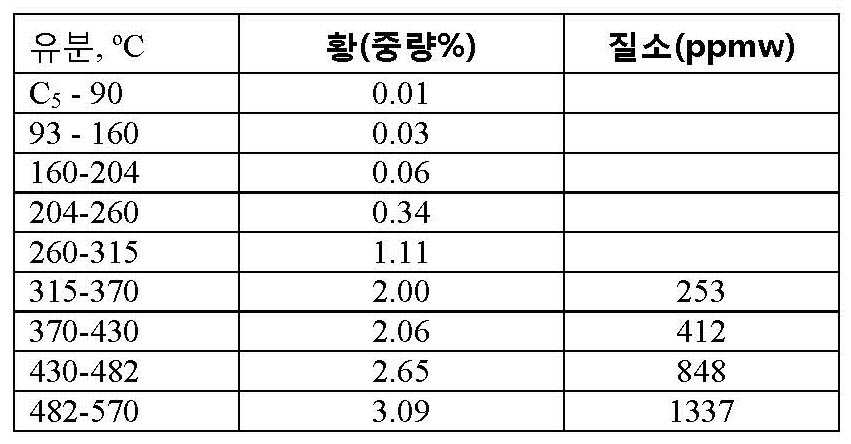
원유 유분 중의 황, 질소, 다핵 방향족과 같은 오염 물질(유독성 화합물)은 수소화 처리, 수소화 분해 및 유동 접촉 분해(fluid catalytic cracking: FCC)를 포함한 다운스트림 공정에 영향을 준다. 오염 물질은 원유 유분에 다양한 구조 및 농도로 존재한다. 이들 불순물은, 최종 생성물(예컨대 가솔린, 디젤, 연료유)에 있어서, 또는 개질 이성화와 같은 추가의 개선 처리가 필요한 중간 정유 스트림에 있어서, 환경 규제에 부합하도록 정유시에 제거되어야 한다.Pollutants (toxic compounds) such as sulfur, nitrogen and polynuclear aromatics in crude oil fractions affect downstream processes including hydrotreating, hydrocracking and fluid catalytic cracking (FCC). Contaminants are present in crude oil fractions in a variety of structures and concentrations. These impurities must be removed during refining to meet the environmental regulations, in the final product (such as gasoline, diesel, fuel oil) or in intermediate refinery streams where further improvement treatments such as modified isomerization are required.
종래의 정유 방식에서는, 먼저 원유를 상압탑(atmospheric column)에서 증류하여, 메탄, 에탄, 프로판, 부탄 및 황화수소를 비롯한 사워 가스 및 경질 탄화수소, 나프타(36℃∼180℃), 등유(180℃∼240℃), 가스 오일(240℃∼370℃) 및 370℃ 초과에서 비등하는 탄화수소를 포함하는 상압 잔유(atmospheric residue bottoms)를 분리한다.In the conventional refinery method, crude oil is first distilled in an atmospheric column and distilled using a sour gas such as methane, ethane, propane, butane, and hydrogen sulfide and a light hydrocarbon, naphtha (36 ° C to 180 ° C) 240 ° C), gas oil (240 ° C to 370 ° C), and atmospheric residue bottoms containing hydrocarbons boiling above 370 ° C.
상압 증류탑 유래의 상압 잔사유는, 정유소의 구성에 따라, 연료유로 사용되거나 진공 증류 유닛으로 보내어진다. 잔유가 진공 증류탑에서 더 증류되는 구성에서, 얻어지는 생성물은, 370℃∼520℃에서 비등하는 탄화수소를 갖는 진공 가스 오일 및 520℃ 초과에서 비등하는 탄화수소를 갖는 진공 잔사유를 포함한다.The atmospheric residue from the atmospheric distillation column is fed to the fuel distillation unit or to the fuel line, depending on the configuration of the refinery. In a configuration where the residual oil is further distilled in the vacuum distillation column, the resulting product comprises a vacuum gas oil with a boiling hydrocarbon at 370 ° C to 520 ° C and a vacuum residue with a hydrocarbon boiling above 520 ° C.
석유 유분의 비등점이 증가함에 따라, 오일의 품질이 떨어지고 다운스트림 공정 유닛에 악영향을 준다. 표 3 및 표 4는, 여러가지 원유 공급원에서 유래한 상압 잔사유(370℃ 초과에서 비등함) 및 진공 잔사유(520℃ 초과에서 비등함)의 품질을 제시한다. 이들 표는, 상압 잔사유 또는 진공 잔사유가 헤테로 원자로 매우 오염되어 있고 탄소 함량 높으며, 비등점이 높아지면서 품질이 악화됨을 분명하게 보여준다.As the boiling point of petroleum oil increases, the quality of the oil drops and adversely affects downstream process units. Tables 3 and 4 present the quality of atmospheric residues (boiling above 370 ° C) and vacuum residues (boiling above 520 ° C) from various sources of crude oil. These tables clearly show that atmospheric residues or vacuum residues are highly contaminated with heteroatoms, have high carbon content, and have deteriorated quality with higher boiling points.
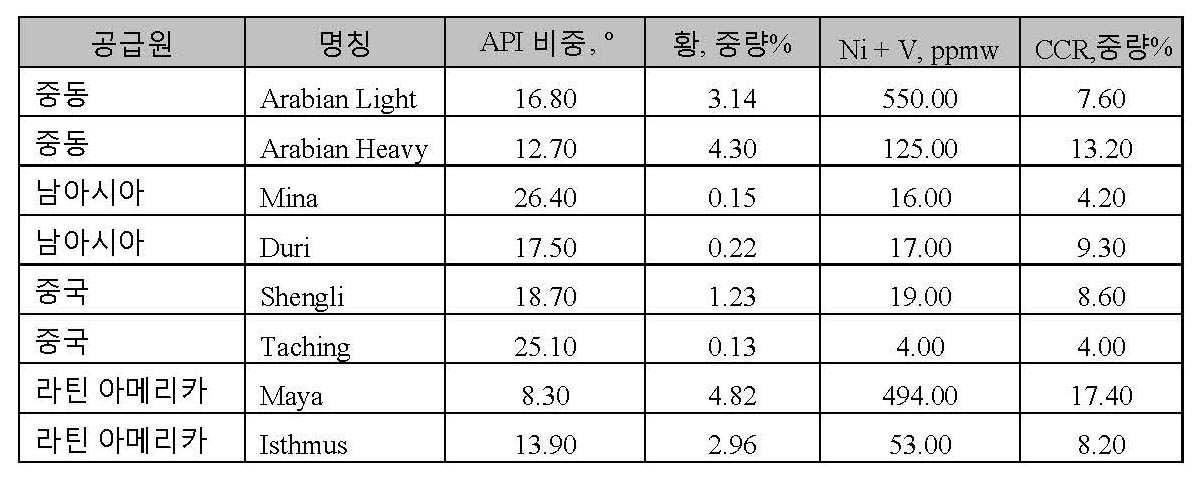
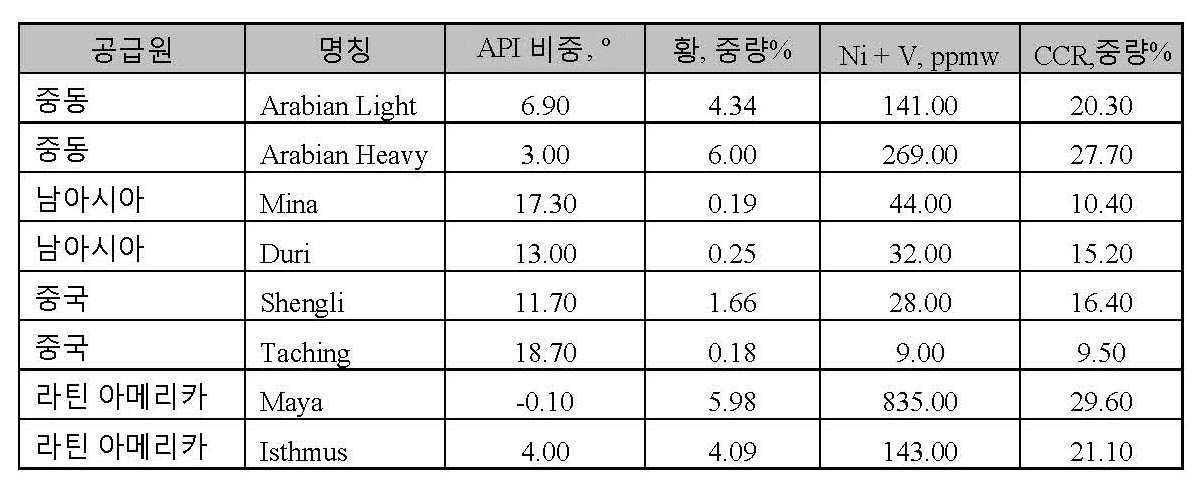
원유 또는 다른 천연 원료, 예컨대 혈암유(shale oil), 비튜멘 및 타르 샌드 유래의 나프타, 등유 및 가스 오일 스트림은, 규정을 초과하는 양의 오염 물질(주로 황)이 제거되도록 처리한다. 수소화 처리는 이들 오염 물질(다른 공정/촉매에 있어서의 유독성 화합물)을 제거하는 가장 일반적인 정유 기술이다. 진공 가스 오일은, 수소화 분해 유닛에서 가공되어 가솔린 및 디젤을 생성하거나, FCC 유닛에서 주로 가솔린과, 부산물로서 LCO 및 HCO를 생성한다. 이들 중 전자는 연료유 또는 디젤 풀(pool)에서 블렌딩 성분으로서 사용되는 반면, 후자는 연료유 풀로 바로 보내진다. 수소화 처리, 코킹(coking), 열분해, 가스화 및 용매 탈아스팔트화를 비롯한, 진공 잔사유 유분을 가공하는 여러 가지 옵션이 있다.Naphtha, kerosene and gas oil streams from crude oil or other natural raw materials, such as shale oil, bitumen and tar sands, are treated to remove contaminants (mainly sulfur) in excess amounts. Hydrotreating is the most common refining technique to remove these contaminants (toxic compounds in other processes / catalysts). Vacuum gas oil is processed in a hydrocracking unit to produce gasoline and diesel, or mainly gasoline in FCC units and LCO and HCO as by-products. Among them, the former is used as a blending component in the fuel oil or diesel pool, while the latter is sent directly to the fuel oil pool. There are several options for processing vacuum residue oil, including hydrotreatment, coking, pyrolysis, gasification and solvent deasphalting.
추가의 구성에서, 진공 잔사유는 아스팔트 유닛에서 처리되어, 공기 산화에 의해 아스팔트를 생성할 수 있다. 아스팔트 산화는, 공기가 산화기 컬럼 용기에서 공급 원료 또는 피치(pitch)를 거쳐 버블링되어 황 함유 화합물을 산화시키는 공정이다. 이는 황 분자를 오일상에서 아스팔트상으로 이동시키는 비촉매 공정이다.In a further configuration, the vacuum residues may be treated in an asphalt unit to produce asphalt by air oxidation. Asphalt oxidation is a process in which air is bubbled through a feedstock or pitch in an oxidizer column vessel to oxidize a sulfur-containing compound. This is a non-catalytic process for transferring sulfur molecules from the oil phase to the asphalt phase.
상기 언급한 바와 같이, 일부 정유 구성에서는, 진공 잔사유가 용매 탈아스팔트화 유닛에서 가공되어, 용매 가용성 오일(탈아스팔트 오일) 및 불용성 오일(아스팔텐) 유분으로 분리될 수 있다.As mentioned above, in some refinery configurations, vacuum residues can be processed in a solvent deasphalting unit to separate into solvent soluble oil (deasphalted oil) and insoluble oil (asphaltene) oil.
용매 탈아스팔트화는 진공 증류 공정에서와 같이, 비등점 대신에 극성에 의해 잔사유가 분리되는 아스팔트 분리 공정이다. 용매 탈아스팔트화 공정은 파라핀형 분자가 풍부한, 오염도가 낮은 탈아스팔트 오일(DAO)을 생성한다. 이어서, 이들 유분은 FCC 유닛 또는 수소화 분해 유닛과 같은 종래의 전환 유닛에서 더 가공될 수 있다. 용매 탈아스팔트화 공정은 통상, 파라핀 C3-C7 용매로 임계 조건 이하에서 실시된다.Solvent deasphalting is an asphalt separation process in which the residual oil is separated by polarity instead of the boiling point as in the vacuum distillation process. The solvent deasphalting process produces deasphalted oil (DAO) with a low degree of contamination rich in paraffin-like molecules. These oil fractions can then be further processed in a conventional conversion unit such as an FCC unit or a hydrocracking unit. The solvent deasphalting process is usually carried out under critical conditions with a paraffinic C 3 -C 7 solvent.
용매 탈아스팔트화와 관련된 추가의 물질은, 미국 특허 제4,816,140호; 제4,810,367호; 제4,747,936호; 제4,572,781호; 제4,502,944호; 제4,411,790호; 제4,239,616호; 제4,305,814호; 제4,290,880호; 제4,482,453호 및 제 4,663,028호에서 찾아볼 수 있으며, 이들 전부는 본원에 참고로 인용되어 있다.Additional materials related to solvent deasphalting are described in U.S. Patent Nos. 4,816,140; 4,810,367; 4,747,936; 4,572,781; 4,502,944; 4,411, 790; 4,239,616; 4,305,814; 4,290,880; 4,482,453 and 4,663,028, all of which are incorporated herein by reference.
각각 별개인 아스팔트 산화 공정과 용매 탈아스팔트화 공정은 잘 개발되어 있으며 그들의 소정 목적에 적합하긴 하나, 업계에는 상압 잔사유와 같은 중질 유분으로부터 생성물을 얻는, 보다 경제적이고 효율적인 방법에 대한 요구가 남아있다.Separate asphalt oxidation processes and solvent deasphalting processes are well developed and suitable for their intended purpose, but there remains a need in the industry for a more economical and efficient method of obtaining products from heavy oil residues such as atmospheric residues .
탈아스팔트 및 탈황 오일과, 아스팔트를 제조하는 시스템 및 방법은, 상기 목적 및 추가의 이점을 제공한다. 아스팔트 및 탈황 오일을 제조하는 통합 방법을 제공한다. 유기황 분자를 비롯한, 중질 석유(heavy petroleum) 유분에 함유된 황 분자, 및 특정 실시양태에서는 중질 석유 유분 중의 유기질소 분자가 산화된다. 극성의 산화된 황 화합물은 오일상으로부터 아스팔트상으로 이동한다. 유리하게, 본 방법 및 시스템은 기존의 용매 탈아스팔트화 유닛에서 통합되어 비교적 낮은 비용으로 불순물을 제거할 수 있다.The system and method for making deasphalted and desulfurized oils and asphalt provide the above objects and further advantages. To provide an integrated method of manufacturing asphalt and desulfurized oil. Sulfur molecules contained in heavy petroleum fractions, and in certain embodiments organic nitrogen molecules in heavy oil fractions are oxidized, including organic sulfur molecules. Polar oxidized sulfur compounds migrate from the oil phase to the asphalt phase. Advantageously, the present method and system are integrated in conventional solvent deasphalting units to remove impurities at a relatively low cost.
각각 별개인 아스팔트 산화 공정과 용매 탈아스팔트화 공정은 잘 개발되어 있으나, 두 공정을 통합하여, 산화에 의해 상압 잔사유 공급 원료를 탈황하고, 산화된 공급 원료를 용매 탈아스팔트화 공정에 의해 정제함으로써 탈황 오일 및 아스팔트 생성물을 제조하는 것은 이전에는 제안되지 않았다.Separate asphalt oxidation and solvent deasphalting processes are well developed, but both processes are combined to desulfurize the atmospheric residuum feedstock by oxidation and refine the oxidized feedstock by a solvent deasphalting process The preparation of the desulfurized oil and asphalt product has not been previously proposed.
이하에 보다 상세히, 첨부의 도면을 참조하여 본 발명을 기술할 것이다.
첨부의 도면에서, 도 1은 통합된 아스팔트 산화 및 용매 탈아스팔트화의 공정 흐름도이다.In the following, the invention will be described in more detail with reference to the accompanying drawings.
In the accompanying drawings, FIG. 1 is a process flow diagram of integrated asphalt oxidation and solvent deasphalting.
아스팔트 및 탈황 오일을 제조하는 통합 방법을 제공한다. 본원에 기술된 방법에서, 중질 석유 유분(예컨대, 상압 잔사유)에 존재하는 황 분자, 및 특정 실시양태에서는 질소 분자가 산화된다. 공정에서 사용되는 용매에 대개 불용성인 극성의 산화된 황 화합물, 및 특정 실시양태에서는 산화된 질소 화합물은, 일반적으로 가용성 오일상으로부터 불용성 아스팔트상으로 이동한다. 유리하게, 본 발명의 방법 및 시스템은, 기존의 정유소 용매 탈아스팔트화 유닛에서 통합되어 비교적 낮은 비용으로 불순물을 제거할 수 있다.To provide an integrated method of manufacturing asphalt and desulfurized oil. In the process described herein, sulfur molecules present in heavy oil fractions (e.g., atmospheric residues) and, in certain embodiments, nitrogen molecules are oxidized. Polar oxidized sulfur compounds, and in certain embodiments, oxidized nitrogen compounds, which are generally insoluble in the solvent used in the process, generally migrate from the soluble oil phase to the insoluble asphalt phase. Advantageously, the method and system of the present invention can be integrated in existing refinery solvent deasphalting units to remove impurities at a relatively low cost.
예컨대 370℃ 이상에서 비등하는 상압 잔사유 유분은, 촉매의 존재 또는 비존재 하에서의 공기 산화를 위해 아스팔트 유닛으로 이송된다. 아스팔트 유닛 생성물을 용매 탈아스팔트화 유닛으로 도입함으로써, 오일상이 아스팔트상보다 비교적 경질인 바, 아스팔트 생성물로부터, 감소된 함량의 유기황 화합물, 및 특정 실시양태에서는 감소된 함량의 유기질소 화합물도 함유하는 오일 유분을 분리한다.For example, atmospheric residual oil boiling at 370 [deg.] C or higher is delivered to the asphalt unit for air oxidation in the presence or absence of a catalyst. By introducing the asphalt unit product into the solvent deasphalting unit, the oil phase is relatively harder than the asphalt phase, from the asphalt product, the reduced content of the organosulfur compound, and in certain embodiments also the reduced content of the organic nitrogen compound Separate the oil fractions.
본 방법은,In this method,
일반적으로 원유 공급원 유래의, 황, 질소 화합물, 니켈, 바나듐, 철, 몰리브덴을 비롯한 불순물을 함유하며, 36℃∼1500℃, 특정 실시양태에서는 약 370℃ 초과, 및 추가의 실시양태에서는 약 520℃ 초과의 범위에서 비등하는 탄화수소 공급 원료를 제공하는 단계;Typically from about 36 ° C to about 1500 ° C, in certain embodiments greater than about 370 ° C, and in further embodiments from about 520 ° C, including impurities including sulfur, nitrogen compounds, nickel, vanadium, iron, and molybdenum, Providing a hydrocarbon feedstock that boils above the boiling point;
경우에 따라, 상기 공급 원료에 균일 촉매를 첨가하는 단계로서, 촉매로는, 그의 활성종이 Mo(VI), W(VI), V(V), Ti(IV)이고, 약한 산화 전위로 높은 루이스 산도를 갖는 균일 전이 금속 촉매를 사용하는 단계;(VI), V (VI), V (V), and Ti (IV) as the catalyst, and adding a homogeneous catalyst to the feedstock, Using a homogeneous transition metal catalyst having an acidity;
아스팔트 산화 유닛의 주입구에서, 상기 공급 원료와 기체상 산화제를 혼합하는 단계(여기서, 상기 기체상 산화제는 공기 또는 산소 또는 아산화질소 또는 오존이다. 산소 대 오일의 비율은 1∼50 V:V%, 특정 실시양태에서는 3∼20 V:V%의 범위이거나, 산소 이외의 기체상 산화제와 동등하다. 아스팔트 유닛은, 주입구에서는 100℃∼300℃, 및 특정 실시양태에서 150℃∼200℃의 온도, 산화 구역에서는 150℃∼400℃, 및 특정 실시양태에서 250℃∼300℃의 온도에서, 그리고 상압 내지 60 bar, 및 특정 실시양태에서 상압 내지 30 bar 범위의 압력 수준에서 작동한다.);Mixing the feedstock and the gaseous oxidizing agent at the inlet of the asphalt oxidation unit wherein the gaseous oxidizing agent is air or oxygen or nitrous oxide or ozone The ratio of oxygen to oil is 1 to 50 V: In certain embodiments, it is in the range of 3 to 20 V: V%, or equivalent to a gaseous oxidizing agent other than oxygen. The asphalt unit is heated at a temperature of 100 ° C to 300 ° C at the inlet and in the range of 150 ° C to 200 ° C, Operating at 150 [deg.] C to 400 < 0 > C in the oxidation zone, and 250 < 0 > C to 300 < 0 > C in certain embodiments, and at atmospheric pressure to 60 bar, and in certain embodiments atmospheric pressure to 30 bar.
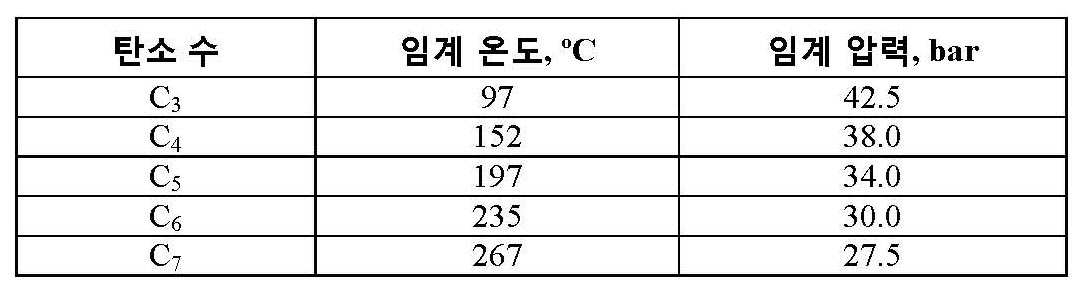
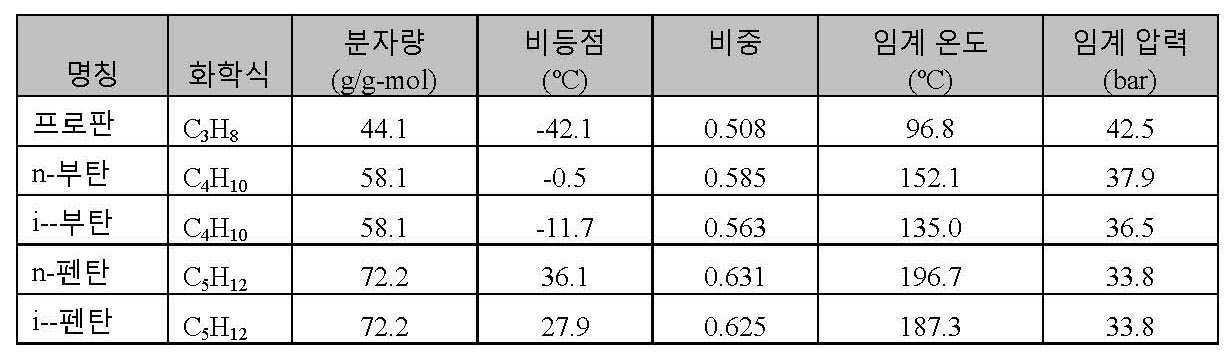
용기 중 아스팔트 반응기 유출물을, 용매의 임계 압력 및 임계 온도 미만의 온도 및 압력에서, C3∼C7 파라핀계 용매, 특정 실시양태에서는 C4 노르말 부탄과 C4 이소부탄의 혼합물과 혼합함으로써, 말텐 용액 중 아스팔텐의 평형을 저해하고, 고형 아스팔텐 입자를 응집(flocculate)시키는 단계(상기 파라핀계 용매의 임계 온도 및 임계 압력을 표 5에 제시하며, 다른 용매 특성은 표 6에 제시한다.);By mixing the vessel asphalt reactor effluent with a mixture of C 3 -C 7 paraffinic solvent, in certain embodiments C 4 normal butane and C 4 isobutane, at a temperature and pressure below the critical pressure of the solvent and the critical temperature, The critical temperature and critical pressure of the paraffinic solvent are shown in Table 5, and other solvent characteristics are shown in Table 6. The results are shown in Table 6. < tb >< TABLE >);
경우에 따라, 예를 들어 본원에 참고로 인용된 미국 특허 제7,566,634호에 기술된 바와 같이, 용매 탈아스팔트화 단계에서 흡착제를 사용하여 질소, 황 및 다핵 방향족 화합물을 선택적으로 더 분리하는 단계;Optionally further separating nitrogen, sulfur and polynuclear aromatic compounds using an adsorbent in a solvent deasphalting step, as described, for example, in U.S. Patent No. 7,566,634, which is incorporated herein by reference.
제1 분리 용기 중의 액체상으로부터 고체상 아스팔텐을 분리하고, 잔유를 아스팔트 풀 및 상부 액체층을 거쳐 제2 분리 용기로 이송하는 단계; 및Separating the solid phase asphaltenes from the liquid phase in the first separation vessel and transferring the residue through the asphalt pool and the upper liquid phase to the second separation vessel; And
제2 분리 용기 중의 탈아스팔트 오일를 분리하고, 혼합 용기로 재순환시키기 위해 파라핀계 용매를 회수하는 단계Separating the deasphalting oil in the second separation vessel, and recovering the paraffinic solvent for recycling to the mixing vessel
를 포함한다..
도 1을 참고하면, 아스팔트 및 탈황 오일을 생성하기 위한 통합 장치(8)의 공정 흐름도가 제시되어 있다. 통합 장치(8)는 산화 유닛(10)(예컨대, 산화기 컬럼 용기)과, 제1 분리 용기(20), 제2 분리 용기(30), 탈아스팔트화/탈황화 오일 분리기(40), 용매 스팀 스트리핑 용기(50), 아스팔트 분리 용기(60), 아스팔트 스트리퍼 용기(70) 및 재순환 용매 용기(80)를 포함하는 용매 탈아스팔트화 유닛(18)을 포함한다.Referring to Figure 1, a process flow diagram of an integrated
산화 유닛(10)은, 잔유 공급 원료(12) 중의 유기황 화합물, 및 특정 실시양태에서는 유기질소 화합물을, 탈아스팔트화 유닛 용매에 불용성인 그들의 산화물로 전환시키는데 효과적인, 임의의 적합한 산화 장치일 수 있다. 특정 실시양태에서, 산화 유닛(10)은 잔유 공급 원료(12)(하나 이상의 열교환기의 다운스트림, 도시하지 않음)를 수취하기 위한 주입구(15) 및, 선택적인 촉매(14), 블랭킷팅 스팀을 수취하기 위한 주입구(16), 기체상 산화제 주입구(18) 및 산화된 잔유 배출구(22)를 포함하는 산화기 컬럼 용기일 수 있다.The
제1 분리 용기(20), 예컨대 1차 침강기(primary settler)는 산화기 컬럼 용기(10)의 배출구(22)과 유체 연통된 주입구(24), 아스팔트상을 배출하기 위한 배출구(28) 및 탈아스팔트화/탈황화 오일상을 배출하기 위한 배출구(32)를 포함한다. 메이크업(make-up) 용매 스트림(26), 재순환 용매 스트림(62) 및 제2 분리 용기 잔유 스트림(78)도, 선택적인 혼합 용기(90)를 통해 제1 분리 용기(20)에 주입될 수 있다.A primary settler includes an
제2 분리 용기(30), 예컨대 2차 침강기는, 제1 침강기 용기(20)의 탈아스팔트화/탈황화 오일(32)과 유체 연통된 주입구(34), 탈아스팔트화/탈황화 오일상을 배출하기 위한 배출구(36) 및 아스팔트상을 배출하기 위한 배출구(38)를 포함한다.The
탈아스팔트화/탈황화 오일 분리기(40)는, 일반적으로 용매 회수를 위한 플래쉬 분리기(flash separator)이며, 제2 분리 용기(30)의 상부 배출구(36)와 유체 연통된 주입구(42), 탈아스팔트화/탈황화 오일 분리기 잔유를 배출하기 위한 배출구(46), 및 재순환 용매를 배출하기 위한 배출구(44)를 포함한다.The deasphalting /
용매 스팀 스트리핑 용기(50)는 탈아스팔트화/탈황화 오일 분리기(40)의 배출구(46)와 유체 연통된 주입구(48), 스팀 및 과잉 용매를 배출하기 위한 배출구(52), 및 추가의 정유 공정에 적합한 탈아스팔트화/탈황화 오일 생성물 스트림을 배출하기 위한 배출구(54)를 포함한다.The solvent
아스팔트 분리 용기(60)는, 제1 분리 용기(20)의 아스팔트상 배출구(28)와 유체 연통된 주입구(64), 아스팔트 분리 용기 잔유를 배출하기 위한 배출구(68), 및 재순환 용매 용기(80)로 재순환 용매를 배출하기 위한 배출구(66)를 포함한다.The
아스팔트 스트리퍼 용기(70)는, 아스팔트 분리 용기(60)의 잔유 배출구(68)와 유체 연통된 주입구(72), 용매를 배출하기 위한 배출구(76) 및 아스팔트 생성물을 배출하기 위한 배출구(74)를 포함한다.The
재순환 용매 용기(80)는 탈아스팔트 오일 분리기(40)의 상부 배출구(44)와 유체 연통된 주입구(56), 및 아스팔트 분리 용기(60)의 배출구(66)와 유체 연통된 도관(84)을 포함한다. 재순환 용매 용기(80)의 배출구(58)는, 공급물과 혼합시키기 위한 도관(62)과 유체 연통되어 있다.Recirculating
잔유 공급 원료는, 하나 이상의 열교환기(도시하지 않음)를 통과한 후에 산화기 컬럼 용기(10)의 주입구(12)에 주입된다. 특정 실시양태에서, 균일 촉매가 도관(14)을 통해 주입될 수 있다. 블랭킷팅 스팀은 주입구(16)를 통해 산화기 컬럼 용기(10)에 연속적으로 주입된다. 압축(이를 위한 압축기는 도시하지 않음) 후의 기체상 산화제 스트림(18)은 넉아웃 드럼(knockout drum)(도시하지 않음)으로 이송되고, 분배기, 예컨대 상기 산화기 컬럼의 저부로 전달된다. 잔유 공급 원료는 산화되고 배출구(22)를 통해 배출된다.The residual feedstock is injected into the
기체상 산화제는 공기 또는 산소 또는 아산화질소 또는 오존이다. 산소 대 오일의 비율은 1∼50 V:V%, 바람직하게는 3∼20 V:V%의 범위이거나, 다른 기체상 산화제와 동등하다. 산화 유닛은, 주입구에서는 150℃∼200℃, 산화 구역에서는 250℃∼300℃의 온도, 그리고 상압 내지 30 bar 범위의 압력 수준에서 작동한다.The gaseous oxidizing agent is air or oxygen or nitrous oxide or ozone. The ratio of oxygen to oil is in the range of 1 to 50 V: V%, preferably 3 to 20 V: V%, or equivalent to other gaseous oxidizing agents. The oxidation unit operates at a temperature of 150 ° C to 200 ° C at the inlet, 250 ° C to 300 ° C at the oxidation zone, and pressure levels in the range of atmospheric pressure to 30 bar.
아스팔트 산화는, 중질 탄화수소 분자에 산소 원자를 첨가함으로써 아스팔텐 성분의 분자량을 증가시키는 역할을 한다. 이 결과, 감압탑(vacuum column) 잔유 피치 공급 원료(230∼250 mm 관통)보다 고점도의 조밀한(60∼70 mm 관통) 아스팔트 생성물이 생성된다. 본 방법에서, 상압 잔사유와 같은 공급물은, 황 함유 유기 화합물 및 질소 함유 유기 화합물을 선택적으로 산화시켜, 이들을 아스팔트상으로 이동시키는데 사용된다. 따라서, 통합된 아스팔트 산화 유닛 및 용매 탈아스팔트화 유닛의 주된 목적은 탈황 오일을 생성하는 것이며, 아스팔트는 부산물로서 생성된다.Asphalt oxidation serves to increase the molecular weight of the asphaltene component by adding oxygen atoms to the heavy hydrocarbon molecule. As a result, a dense (60-70 mm penetration) asphalt product with a higher viscosity is produced than the vacuum column residual pitch feedstock (230-250 mm throughput). In this process, feeds such as atmospheric residues are used to selectively oxidize the sulfur-containing organic compounds and the nitrogen-containing organic compounds and transfer them to the asphalt phase. Thus, the main purpose of the integrated asphalt oxidation unit and the solvent deasphalting unit is to produce a desulfurized oil, and the asphalt is produced as a by-product.
산화기 컬럼 용기(10)의 배출구(22)로부터의, 산화된 잔유 공급 원료는, 예컨대 하나 이상의 직렬식 혼합기(도시하지 않음) 또는 선택적인 혼합 용기(90)를 통해, 메이크업 용매(26) 및 재순환 용매(62)와 혼합된다.The oxidized residue feedstock from the
아스팔트 산화 반응기 유출물은, 용매의 임계 압력 및 임계 온도 미만의 온도 및 압력에서, C3∼C7 파라핀계 용매, 특정 실시양태에서는 C4 노르말 부탄과 C4 이소부탄의 혼합물과 혼합함으로써, 말텐 용액 중 아스팔텐의 평형을 저해하고, 고형 아스팔텐 입자를 응집시킨다. 상기 파라핀계 용매의 임계 온도 및 임계 압력을 표 5에 제시하며, 다른 용매 특성은 표 6에 제시한다. 혼합은 하나 이상의 혼합 용기에서 및/또는 하나 이상의 직렬식 혼합기를 통해 일어날 수 있다.The asphalt oxidation reactor effluent may be treated with a mixture of C 3 to C 7 paraffinic solvent, in certain embodiments C 4 normal butane and C 4 isobutane, at a temperature and pressure less than the critical pressure of the solvent and the critical temperature, Inhibits the equilibrium of asphaltenes in the solution, and solidifies the asphaltene particles. The critical temperature and the critical pressure of the paraffinic solvent are shown in Table 5, and other solvent characteristics are shown in Table 6. Mixing may occur in one or more mixing vessels and / or through one or more tandem mixers.
경우에 따라, 용매 탈아스팔트화 단계에서, 예를 들어 본원에 참고로 인용되어 있는 미국 특허 제7,566,634호에 기술된 바와 같이, 질소, 황 및 다핵 방향족 화합물을 선택적으로 더 분리하기 위해 흡착제가 사용될 수 있다.Optionally, in the solvent deasphalting step, an adsorbent can be used to selectively further separate nitrogen, sulfur and polynuclear aromatic compounds, for example as described in U.S. Patent No. 7,566,634, which is incorporated herein by reference. have.
혼합물은 제1 분리 용기(20), 예컨대 용매 탈아스팔트화 유닛의 1차 침강기의 주입구(24)로 이송되며, 여기서 배출구(32)를 통해 배출되는 탈아스팔트화/탈황화 오일상 및 배출구(28)를 통해 배출되는 아스팔트상으로 상분리된다. 잔유 공급 원료의 산화된 부분은 극성을 가지며, 그 결과, 용매에 불용성인 그의 성질로 인해 아스팔트상으로 이동하게 된다. 1차 침강기의 압력 및 온도는 용매의 임계 특성 이하이다. 산화된 잔유 주입물로부터 대부분인 탈아스팔트화/탈황화 오일을 회수하기 위해서, 1차 침강기의 온도는 낮다. 예컨대 수거 파이프(collector pipe)를 통해, 1차 침강기로부터 수거되는 용매 가용성 탈아스팔트화/탈황화 오일상은, 큰 비율의 용매 및 탈아스팔트화/탈황화 오일과, 작은 비율의 아스팔트를 포함한다. 예컨대 하나 이상의 아스팔트 수거 파이프를 통해 회수되는 용매 불용성 아스팔트상은, 큰 비율의 아스팔트와, 작은 비율의 용매, 오일상 및 산화된 유기황 화합물(및 특정 실시양태에서는 산화된 유기질소 화합물)을 포함한다.The mixture is transferred to the first separation vessel 20, for example the
탈아스팔트화/탈황화 오일은 제2 분리 용기(30), 예컨대, 용매 탈아스팔트 유닛의 2차 침강기의 주입구(34)로 이송되어, 배출구(36)(예컨대, 수직 수거 파이프)를 통해 배출되는 탈아스팔트화/탈황화 오일상 및 배출구(38)(예컨대, 하나 이상의 아스팔트 수거 파이프)를 통해 배출되는 아스팔트상으로 분리된다. 산화된 유기황 화합물(및 특정 실시양태에서는 산화된 유기질소 화합물)을 함유하는 잔류 아스팔트 혼합물은, 2차 침강기 용기(30)에서는, 1차 침강기의 작동 온도에 비해 높은 온도로 인해 아스팔트상으로서 방출된다. 2차 침강기는 일반적으로 용매의 임계 온도 또는 그에 근접한 온도에서 작동하며, 1차 침강기 용기(20)로 다시 재순환되는 비교적 소량의 용매 및 탈아스팔트 오일을 함유하는 잔유에 아스팔트상이 형성될 수 있게 한다. 배출구(38)를 통해 배출된 탈아스팔트화/탈황화 오일상은 대부분인 용매 및 탈아스팔트화/탈황화 오일을 포함하며, 탈황 오일의 회수를 위해 도관(78)을 통해 1차 침강기 용기(20)로 재순환된다.The deasphalted / desulfurized oil is delivered to the
제2 분리 용기 배출구(36)로부터의 탈아스팔트화/탈황화 오일상은 분리기(40)의 주입구(42)로 이송되어, 탈아스팔트화/탈황화 오일 생성물 스트림(46) 및 용매 재순환 스트림(44)으로 분리된다. 배출구(44)를 통해 재순환 용매는 재순환 용매 용기(80)로 이송되고, 예컨대 혼합 용기(90)를 통해, 1차 침강기 용기(20)로 복귀된다. 탈아스팔트화/탈황화 오일 분리기(40)는, 급속하고 효과적인 플래쉬 분리가 가능하도록 구성 및 치수 설계된다.The deasphalted / desulfurized oil phase from the second
큰 비율의 탈아스팔트화/탈황화 오일과 작은 비율의 용매 및 스팀을 포함하는 탈아스팔트화/탈황화 오일 생성물 스트림(46)은 용매의 스팀 스트리핑을 위해, 예컨대 150 psig의 건조 스팀과 함께, 용기(50)의 주입구(48)로 반송된다. 탈아스팔트화/탈황화 오일은 배출구(54)를 통해 회수되며, 스팀과 과잉 용매의 혼합물은 배출구(52)를 통해 배출된다.A deasphalting / desulfurization
1차 침강기 아스팔트상은, 배출구(28)를 통해 아스팔트 분리 용기(60)의 주입구(64)로 이송되어, 배출구(68)를 통해 배출되는 아스팔트상 및 배출구(66)를 통해 배출되는 재순환 용매로 플래쉬 분리된다. 대부분인 아스팔트 및 소량의 용매를 포함하는 아스팔트상(68)은 용매의 스팀 스트리핑을 위해, 예컨대, 150 psig의 건조 스팀과 함께, 아스팔트 스트리퍼 용기(70)의 주입구(72)로 반송된다. 용매는 배출구(76)를 통해 회수되며(이는 재순환될 수 있음, 도시하지 않음), 산화된 유기황 화합물(및 특정 실시양태에서는 산화된 유기질소 화합물)을 함유하는 아스팔트 생성물은 배출구(74)를 통해 회수되고, 이는 아스팔트 풀로 보내질 수 있다.The primary settler asphalt phase is conveyed to the
아스팔트 분리 용기(60)의 배출구(66)로부터의 재순환 용매는 도관(84)을 통해, 제2 분리 용기(40)로부터의 재순환 용매(44)와 함께, 재순환 용매 용기(80)로 이송된다. 재순환 용매는, 예컨대 혼합 용기(90) 및/또는 하나 이상의 직렬식 혼합기에서, 배출구(22)로부터의 산화된 잔유 공급 원료와 혼합하는데 필요한 만큼, 배출구(58)를 통해 반송된다. 하나 이상의 중간 용매 드럼이 필요에 따라 도입될 수 있다.The recycle solvent from the
1차 침강기(20)에서, 탈아스팔트 오일상은, 대부분인 용매 및 탈아스팔트 오일과, 1차 침강기의 상부[배출구(32)]에서 배출되는 소량의 아스팔트를 포함한다. 40∼50 액체 부피% 용매를 함유하는 아스팔트상은 용기의 저부[배출구(28)]로 방출된다. 2차 침강기(30)에서는, 다소의 아스팔트를 함유하는, 1차 침강기(20)로부터의 탈아스팔트 오일상이 용기에 유입된다. 2차 침강기로부터의, 방출된 아스팔트는 비교적 소량의 용매 및 탈아스팔트 오일을 함유한다. 탈아스팔트 오일 분리기(40)에서, 침강기에 주입된 용매의 90 중량% 초과가 탈아스팔트 오일 분리기로 유입되며, 여기서 그의 95 중량% 초과가 회수된다. 미량의 용매를 함유하는, 탈아스팔트 오일 분리기로부터의 탈아스팔트 오일은 탈아스팔트 오일 스트리퍼(50)에 유입된다. 실질적으로 모든 용매가, 스팀 스트리핑에 의해 탈아스팔트 오일로부터 제거된다. 아스팔트 분리기(60)는, 아스팔트와 용매를 플래쉬 분리되도록 한다. 아스팔트상은 40∼50 부피%의 용매를 함유한다. 아스팔트 분리기로부터의 아스팔트는 아스팔트 스트리퍼(70)에 유입되고, 여기서 잔류 용매가 스팀 스트리핑에 의해 아스팔트로부터 제거된다. 고압 시스템에서 회수되는 순환 용매의 대략 95%와, 저압 시스템에서 회수되는 순환 용매의 나머지가 함께 합류되고, 고압 용매 드럼(80)에 유입된다.In the primary settler 20, the deasphalted oil phase contains most of the solvent and deasphalting oil and a small amount of asphalt discharged from the top (outlet 32) of the primary settler. The asphalt phase containing 40-50 liquid volume% solvent is discharged to the bottom (outlet 28) of the vessel. In the
공급 원료는 일반적으로 370℃ 초과에서 비등하는 상압 잔사유이다. 특정 실시양태에서, 공급 원료는 초기 공급물(12)의 상류에 하나 이상의 분리 단계를 갖는 미정제 원유(whole crude oil)일 수 있다. 공급 원료는 하나 이상의 천연 공급원, 예컨대 원유, 비튜멘, 중유, 또는 혈암유, 및/또는 수소화 처리, 수소화 처리, 유동 접촉 분해, 코킹, 및 열분해 또는 석탄 액화를 비롯한 하나 이상의 정유 공정 유닛으로부터의 잔유에서 유래될 수 있다.The feedstock is usually atmospheric residues boiling above 370 ° C. In certain embodiments, the feedstock may be whole crude oil having one or more separation steps upstream of the
하나 이상의 실시양태에서, 제2 공급물이 경우에 따라, 주입구(24)에서 혼합물과 함께 주입될 수 있다. 하나 이상의 실시양태에서, 특정한 중간 오일 또는 아스팔트 스트림이 산화 유닛(10)으로 재순환될 수 있다.In one or more embodiments, a second feed may be injected with the mixture at the
유리하게, 아스팔트 산화와 용매 탈아스팔트화 공정을 통합시킴으로써, 상압 잔사유 공급 원료를 기존의 유닛으로 탈황하여, 종래의 고압 탈황 공정보다 낮은 비용으로 탈황 오일 및 아스팔트를 얻는다. 예를 들어, 상압 잔사유는 탈황됨으로써, 특정 실시양태에서, 40 중량%의 탈황 오일이 회수되고, 잔여분은 역시 가치있는 생성물인 아스팔트상이 될 수 있다.Advantageously, by incorporating asphalt oxidation and solvent deasphalting processes, desulfurization of the atmospheric residuum feedstock into existing units results in desulfurized oil and asphalt at a lower cost than conventional high-pressure desulfurization processes. For example, the atmospheric residue is desulfurized so that, in certain embodiments, 40% by weight of the desulfurized oil is recovered and the remainder can also be an asphalt phase, which is also a valuable product.
본 발명의 방법 및 시스템을 상기 및 첨부의 도면에서 설명하였으나, 변형은 당업자에게 명백해질 것이며, 본 발명의 보호 범위는 이하의 특허청구범위에 의해 규정될 것이다.Although the method and system of the present invention have been described above and in the accompanying drawings, variations will be apparent to those skilled in the art, and the scope of protection of the present invention will be defined by the following claims.
Claims (20)
공급 원료를 산화 유닛에 유효량의 산화제와 함께 주입하여, 산화된 유기황 화합물을 함유하는 중간 주입물(intermediate charge)을 생성하는 단계로서, 산화 유닛이 아스팔트 산화기인 단계 및
중간 주입물을 용매 탈아스팔트화 유닛에 유효량의 용매와 함께 이송하여, 큰 비율의 용매를 함유하는 용매 가용성 탈아스팔트화/탈황화 오일상(oil phase)과, 극성의 산화된 유기황 화합물 및 작은 비율의 용매를 함유하는 아스팔트상(asphalt phase)을 생성하는 단계로서, 아스팔트상 및 극성의 산화된 유기황 화합물은 용매 탈아스팔트화 유닛에서 사용된 용매에 불용성이어서 아스팔트상으로 이동하는 것인 단계
를 포함하는 통합 방법.As an integrated process for separating oil and asphalt from feedstock,
Injecting a feedstock into an oxidation unit with an effective amount of an oxidant to produce an intermediate charge containing the oxidized organosulfur compound, wherein the oxidation unit is an asphalt oxidizer; and
The intermediate feed is transferred to the solvent deasphalting unit with an effective amount of solvent to form a solvent soluble deasphalted / desulfurized oil phase containing a large proportion of the solvent, a polar oxidized organosulfur compound and a small Wherein the asphalt phase and the polar oxidized organosulfur compounds are insoluble in the solvent used in the solvent deasphalting unit and migrate onto the asphalt phase
≪ / RTI >
공급 원료를 산화 유닛에 유효량의 산화제와 함께 주입하여, 산화된 유기황 화합물 및 산화된 유기질소 화합물을 함유하는 중간 주입물(intermediate charge)을 생성하는 단계 및
중간 주입물을 용매 탈아스팔트화 유닛에 유효량의 용매와 함께 이송하여, 큰 비율의 용매를 함유하는 용매 가용성 탈아스팔트화/탈황화 오일상(oil phase)과, 극성의 산화된 유기황 화합물 및 작은 비율의 용매를 함유하는 아스팔트상(asphalt phase)을 생성하는 단계로서, 아스팔트상 및 극성의 산화된 유기황 화합물은 용매 탈아스팔트화 유닛에서 사용된 용매에 불용성이어서 아스팔트상으로 이동하는 것인 단계
를 포함하는 통합 방법.As an integrated process for separating oil and asphalt from feedstock,
Injecting a feedstock into an oxidation unit with an effective amount of an oxidizing agent to produce an intermediate charge containing an oxidized organosulfur compound and an oxidized organic nitrogen compound,
The intermediate feed is transferred to the solvent deasphalting unit with an effective amount of solvent to form a solvent soluble deasphalted / desulfurized oil phase containing a large proportion of the solvent, a polar oxidized organosulfur compound and a small Wherein the asphalt phase and the polar oxidized organosulfur compounds are insoluble in the solvent used in the solvent deasphalting unit and migrate onto the asphalt phase
≪ / RTI >
공급 원료 및 유효량의 균일 촉매를 산화 유닛에 유효량의 산화제와 함께 주입하여, 산화된 유기황 화합물을 함유하는 중간 주입물을 생성하는 단계로서, 산화 유닛이 아스팔트 산화기인 단계 및
중간 주입물을 용매 탈아스팔트화 유닛에 유효량의 용매와 함께 이송하여, 탈아스팔트화/탈황화 오일상과, 산화된 유기황 화합물을 함유하는 아스팔트상을 생성하는 단계
를 포함하는 통합 방법.As an integrated process for separating oil and asphalt from feedstock,
Injecting a feedstock and an effective amount of a homogeneous catalyst into an oxidation unit with an effective amount of an oxidant to produce an intermediate feed containing the oxidized organosulfur compound, wherein the oxidation unit is an asphalt oxidizer and
Transferring the intermediate feed to the solvent deasphalting unit with an effective amount of solvent to produce a deasphalted / desulfurized oil phase and an asphalt phase containing the oxidized organosulfur compound
≪ / RTI >
공급 원료 및 유효량의 균일 촉매를 산화 유닛에 유효량의 산화제와 함께 주입하여, 산화된 유기황 화합물 및 산화된 유기질소 화합물을 함유하는 중간 주입물을 생성하는 단계, 및
중간 주입물을 용매 탈아스팔트화 유닛에 유효량의 용매와 함께 이송하여, 탈아스팔트화/탈황화 오일상과, 산화된 유기황 화합물을 함유하는 아스팔트상을 생성하는 단계
를 포함하는 통합 방법.As an integrated process for separating oil and asphalt from feedstock,
Injecting a feedstock and an effective amount of a homogeneous catalyst into an oxidation unit with an effective amount of an oxidizing agent to produce an intermediate feed containing an oxidized organosulfur compound and an oxidized organonitrogen compound,
Transferring the intermediate feed to the solvent deasphalting unit with an effective amount of solvent to produce a deasphalted / desulfurized oil phase and an asphalt phase containing the oxidized organosulfur compound
≪ / RTI >
용매 탈아스팔트화 유닛은 용매의 임계 압력 및 온도 미만에서 작동되는 것인 통합 방법.5. The process of any one of claims 1 to 4 wherein the solvent is selected from the group consisting of C3, C4, C5, C6 and C7 paraffin solvents,
Wherein the solvent deasphalting unit is operated at less than the critical pressure and temperature of the solvent.
Applications Claiming Priority (3)
| Application Number | Priority Date | Filing Date | Title |
|---|---|---|---|
| US201161513621P | 2011-07-31 | 2011-07-31 | |
| US61/513,621 | 2011-07-31 | ||
| PCT/US2012/048145 WO2013019509A1 (en) | 2011-07-31 | 2012-07-25 | Integrated process to produce asphalt and desulfurized oil |
Publications (2)
| Publication Number | Publication Date |
|---|---|
| KR20140064800A KR20140064800A (en) | 2014-05-28 |
| KR101955702B1 true KR101955702B1 (en) | 2019-03-07 |
Family
ID=46640121
Family Applications (1)
| Application Number | Title | Priority Date | Filing Date |
|---|---|---|---|
| KR1020147005122A Expired - Fee Related KR101955702B1 (en) | 2011-07-31 | 2012-07-25 | Integrated process to produce asphalt and desulfurized oil |
Country Status (6)
| Country | Link |
|---|---|
| US (2) | US10125319B2 (en) |
| EP (1) | EP2737009A1 (en) |
| JP (1) | JP6215826B2 (en) |
| KR (1) | KR101955702B1 (en) |
| CN (2) | CN107446620A (en) |
| WO (1) | WO2013019509A1 (en) |
Families Citing this family (19)
| Publication number | Priority date | Publication date | Assignee | Title |
|---|---|---|---|---|
| US9512151B2 (en) | 2007-05-03 | 2016-12-06 | Auterra, Inc. | Product containing monomer and polymers of titanyls and methods for making same |
| US8298404B2 (en) | 2010-09-22 | 2012-10-30 | Auterra, Inc. | Reaction system and products therefrom |
| US8764973B2 (en) | 2008-03-26 | 2014-07-01 | Auterra, Inc. | Methods for upgrading of contaminated hydrocarbon streams |
| US9206359B2 (en) | 2008-03-26 | 2015-12-08 | Auterra, Inc. | Methods for upgrading of contaminated hydrocarbon streams |
| US8894843B2 (en) | 2008-03-26 | 2014-11-25 | Auterra, Inc. | Methods for upgrading of contaminated hydrocarbon streams |
| US9061273B2 (en) | 2008-03-26 | 2015-06-23 | Auterra, Inc. | Sulfoxidation catalysts and methods and systems of using same |
| US9828557B2 (en) | 2010-09-22 | 2017-11-28 | Auterra, Inc. | Reaction system, methods and products therefrom |
| WO2016154529A1 (en) | 2015-03-26 | 2016-09-29 | Auterra, Inc. | Adsorbents and methods of use |
| DE102015106405A1 (en) * | 2015-04-27 | 2016-10-27 | Intel IP Corporation | METHOD AND DEVICES BASED ON DYNAMIC RECEPTION DIVERSITY |
| KR101892589B1 (en) * | 2015-06-10 | 2018-08-28 | 한국에너지기술연구원 | Method using asphaltene for improving bitumen recovery and transportation from oilsands |
| US10450516B2 (en) | 2016-03-08 | 2019-10-22 | Auterra, Inc. | Catalytic caustic desulfonylation |
| US10125318B2 (en) | 2016-04-26 | 2018-11-13 | Saudi Arabian Oil Company | Process for producing high quality coke in delayed coker utilizing mixed solvent deasphalting |
| US10233394B2 (en) | 2016-04-26 | 2019-03-19 | Saudi Arabian Oil Company | Integrated multi-stage solvent deasphalting and delayed coking process to produce high quality coke |
| CN109679688B (en) * | 2017-10-18 | 2021-05-14 | 中国石油化工股份有限公司 | A catalytic cracking method for improving liquid yield |
| KR20210039743A (en) * | 2019-10-02 | 2021-04-12 | 현대오일뱅크 주식회사 | A Very Low Sulfur Fuel Oil and a method for producing the same |
| US11292970B2 (en) | 2019-11-05 | 2022-04-05 | Saudi Arabian Oil Company | Hydrocracking process and system including separation of heavy poly nuclear aromatics from recycle by oxidation |
| US11384300B2 (en) | 2019-12-19 | 2022-07-12 | Saudi Arabian Oil Company | Integrated process and system to upgrade crude oil |
| US20210198586A1 (en) | 2019-12-26 | 2021-07-01 | Saudi Arabian Oil Company | Hydrocracking process and system including removal of heavy poly nuclear aromatics from hydrocracker bottoms by coking |
| US11066607B1 (en) * | 2020-04-17 | 2021-07-20 | Saudi Arabian Oil Company | Process for producing deasphalted and demetallized oil |
Citations (2)
| Publication number | Priority date | Publication date | Assignee | Title |
|---|---|---|---|---|
| US2682494A (en) | 1952-02-19 | 1954-06-29 | Standard Oil Dev Co | Deasphalting process |
| WO2008048309A2 (en) | 2005-12-16 | 2008-04-24 | Exxonmobil Research And Engineering Company | Upgrading of peroxide treated petroleum streams |
Family Cites Families (79)
| Publication number | Priority date | Publication date | Assignee | Title |
|---|---|---|---|---|
| US1148011A (en) | 1910-07-18 | 1915-07-27 | George Llewellyn Davies | Process for the treatment of coal-tar. |
| US2277842A (en) | 1938-03-05 | 1942-03-31 | Union Oil Co | Asphalt and process for producing the same |
| US2327247A (en) | 1939-06-16 | 1943-08-17 | Union Oil Co | Method for producing asphalt |
| US2337448A (en) | 1940-01-24 | 1943-12-21 | Union Oil Co | Process for treating oils |
| US2627498A (en) * | 1949-09-26 | 1953-02-03 | Shell Dev | Process for oxidizing asphalt |
| US2970956A (en) | 1957-02-06 | 1961-02-07 | Shiah Chyn Duog | Treating hydrocarbon oils |
| DE1127342B (en) | 1958-06-13 | 1962-04-12 | Knapsack Ag | Process for the production of organic solutions of saturated aliphatic or aromatic percarboxylic acids |
| US2940920A (en) | 1959-02-19 | 1960-06-14 | Kerr Mc Gee Oil Ind Inc | Separation of asphalt-type bituminous materials |
| US3003946A (en) | 1959-03-11 | 1961-10-10 | Kerr Mc Gee Oil Ind Inc | Separation of asphalt-type bituminous materials utilizing aliphatic alcohols of 3 through 4 carbon atoms |
| GB1053972A (en) | 1962-08-30 | 1967-01-04 | ||
| US3258419A (en) * | 1963-03-25 | 1966-06-28 | Union Oil Co | Catalytic airblown asphalt |
| US3380912A (en) | 1967-03-01 | 1968-04-30 | Chevron Res | Combination extraction-demetalation process for heavy oils |
| US4097520A (en) | 1971-01-11 | 1978-06-27 | Fmc Corporation | Preparation of peracetic acid by oxidation of acetaldehyde |
| US3719589A (en) | 1971-03-05 | 1973-03-06 | Texaco Inc | Asphalt separation in desulfurization with an oxidation step |
| US4113661A (en) | 1973-08-09 | 1978-09-12 | Chevron Research Company | Method for preparing a hydrodesulfurization catalyst |
| US4097364A (en) | 1975-06-13 | 1978-06-27 | Chevron Research Company | Hydrocracking in the presence of water and a low hydrogen partial pressure |
| GB2012809B (en) | 1977-12-22 | 1982-04-15 | Exxon Research Engineering Co | Simultaneous deasphalting extraction process |
| US4305813A (en) | 1978-07-10 | 1981-12-15 | Biuro Projektow I Realizacji Inwestycji Rafinerii Nafty "Bipronaft" | Method of extractive purification of residues from crude oil refining and heavy ends thereof |
| PL208309A1 (en) | 1978-07-10 | 1980-03-10 | Bipronaft | |
| US4239616A (en) | 1979-07-23 | 1980-12-16 | Kerr-Mcgee Refining Corporation | Solvent deasphalting |
| FR2482975A1 (en) | 1980-05-22 | 1981-11-27 | Commissariat Energie Atomique | PROCESS FOR TREATING ULTRAFILTRATION AT HIGH TEMPERATURE OF A HYDROCARBONATED LOAD |
| US4290880A (en) | 1980-06-30 | 1981-09-22 | Kerr-Mcgee Refining Corporation | Supercritical process for producing deasphalted demetallized and deresined oils |
| US4305814A (en) | 1980-06-30 | 1981-12-15 | Kerr-Mcgee Refining Corporation | Energy efficient process for separating hydrocarbonaceous materials into various fractions |
| GB2091758B (en) | 1980-12-31 | 1984-02-22 | Chevron Res | Process for upgrading hydrocarbonaceous oils |
| JPS57164188A (en) | 1980-12-31 | 1982-10-08 | Chevron Res | Quality improvement of hydrocarbon oils |
| CA1173246A (en) | 1981-01-12 | 1984-08-28 | Gary R. Lemmeyer | Educational toy type-printing device |
| US4430203A (en) | 1982-02-05 | 1984-02-07 | Chevron Research Company | Hydrotreating or hydrocracking process |
| US4485007A (en) * | 1982-06-15 | 1984-11-27 | Environmental Research And Technology Inc. | Process for purifying hydrocarbonaceous oils |
| US4482453A (en) | 1982-08-17 | 1984-11-13 | Phillips Petroleum Company | Supercritical extraction process |
| US4502944A (en) | 1982-09-27 | 1985-03-05 | Kerr-Mcgee Refining Corporation | Fractionation of heavy hydrocarbon process material |
| US4572781A (en) | 1984-02-29 | 1986-02-25 | Intevep S.A. | Solvent deasphalting in solid phase |
| US4601816A (en) | 1984-08-09 | 1986-07-22 | Mobil Oil Corporation | Upgrading heavy hydrocarbon oils using sodium hypochlorite |
| GB8425837D0 (en) * | 1984-10-12 | 1984-11-21 | Shell Int Research | Manufacture of lubricating base oils |
| US4663028A (en) | 1985-08-28 | 1987-05-05 | Foster Wheeler Usa Corporation | Process of preparing a donor solvent for coal liquefaction |
| US4639308A (en) | 1986-01-16 | 1987-01-27 | Phillips Petroleum Company | Catalytic cracking process |
| FR2596766B1 (en) | 1986-04-02 | 1988-05-20 | Inst Francais Du Petrole | PROCESS FOR DEASPHALTING A HYDROCARBON OIL |
| FR2598716B1 (en) | 1986-05-15 | 1988-10-21 | Total France | PROCESS FOR DEASPHALTING A HEAVY HYDROCARBON LOAD |
| US4677241A (en) | 1986-08-15 | 1987-06-30 | Chevron Research Company | Olefin oligomerization process and catalyst |
| US4883581A (en) | 1986-10-03 | 1989-11-28 | Exxon Chemical Patents Inc. | Pretreatment for reducing oxidative reactivity of baseoils |
| US4747936A (en) | 1986-12-29 | 1988-05-31 | Uop Inc. | Deasphalting and demetallizing heavy oils |
| US5059304A (en) | 1988-02-12 | 1991-10-22 | Chevron Research Company | Process for removing sulfur from a hydrocarbon feedstream using a sulfur sorbent with alkali metal components or alkaline earth metal components |
| US4976848A (en) | 1988-10-04 | 1990-12-11 | Chevron Research Company | Hydrodemetalation and hydrodesulfurization using a catalyst of specified macroporosity |
| CA1310289C (en) * | 1988-11-01 | 1992-11-17 | Mobil Oil Corporation | Pipelineable cyncrude (synthetic crude) from heavy oil |
| US4990243A (en) | 1989-05-10 | 1991-02-05 | Chevron Research And Technology Company | Process for hydrodenitrogenating hydrocarbon oils |
| US5071805A (en) | 1989-05-10 | 1991-12-10 | Chevron Research And Technology Company | Catalyst system for hydrotreating hydrocarbons |
| US5089453A (en) | 1990-06-25 | 1992-02-18 | Chevron Research And Technology Company | Hydroconversion catalyst and method for making the catalyst |
| US5118886A (en) * | 1991-09-12 | 1992-06-02 | Sun Refining And Marketing Company | Cyano- and polycyanometalloporphyrins as catalysts for alkane oxidation |
| JP3227521B2 (en) | 1992-04-06 | 2001-11-12 | 舟越 泉 | Method for recovering organic sulfur compounds from liquid oil |
| US5294332A (en) | 1992-11-23 | 1994-03-15 | Amoco Corporation | FCC catalyst and process |
| US5324417A (en) | 1993-05-25 | 1994-06-28 | Mobil Oil Corporation | Processing waste over spent FCC catalyst |
| US5345008A (en) * | 1993-06-09 | 1994-09-06 | Sun Company, Inc. (R&M) | Decomposition of organic hydroperoxides with nitrated porphyrin complexes |
| US5770761A (en) | 1996-11-08 | 1998-06-23 | Chinese Petroleum Corporation | Process for ethyl acetate production |
| US6160193A (en) | 1997-11-20 | 2000-12-12 | Gore; Walter | Method of desulfurization of hydrocarbons |
| US6103892A (en) * | 1998-04-08 | 2000-08-15 | The Trustees Of Columbia University In The City Of New York | Catalyst that oxidizes steroids and other substrates with catalytic turnover |
| US6171478B1 (en) | 1998-07-15 | 2001-01-09 | Uop Llc | Process for the desulfurization of a hydrocarbonaceous oil |
| US6277271B1 (en) | 1998-07-15 | 2001-08-21 | Uop Llc | Process for the desulfurization of a hydrocarbonaceoous oil |
| US6180557B1 (en) | 1998-08-13 | 2001-01-30 | Council Of Scientific & Industrial Research | Supported catalyst useful for Friedel-Crafts reactions and process for the preparation of aralkylated aromatic compounds using the catalyst |
| KR100528257B1 (en) * | 1998-12-23 | 2005-11-15 | 텍사코 디벨롭먼트 코포레이션 | Filtration of feed to integration of solvent deasphalting and gasification |
| US6815543B1 (en) * | 1999-08-10 | 2004-11-09 | Warner-Lambert Company | Process for catalyzing the oxidation of organic compounds |
| US6596914B2 (en) | 2000-08-01 | 2003-07-22 | Walter Gore | Method of desulfurization and dearomatization of petroleum liquids by oxidation and solvent extraction |
| US6402940B1 (en) | 2000-09-01 | 2002-06-11 | Unipure Corporation | Process for removing low amounts of organic sulfur from hydrocarbon fuels |
| US6673235B2 (en) | 2000-09-22 | 2004-01-06 | Engelhard Corporation | FCC catalysts for feeds containing nickel and vanadium |
| US20030094400A1 (en) | 2001-08-10 | 2003-05-22 | Levy Robert Edward | Hydrodesulfurization of oxidized sulfur compounds in liquid hydrocarbons |
| US20040019204A1 (en) * | 2002-07-23 | 2004-01-29 | Chi-Ming Che | Intramolecular amidation of sulfamate esters catalyzed by metalloporphyrins |
| US7270742B2 (en) | 2003-03-13 | 2007-09-18 | Lyondell Chemical Technology, L.P. | Organosulfur oxidation process |
| WO2005012458A1 (en) | 2003-08-01 | 2005-02-10 | Bp Corporation North America Inc. | Preparation of components for refinery blending of transportation fuels |
| US7347051B2 (en) | 2004-02-23 | 2008-03-25 | Kellogg Brown & Root Llc | Processing of residual oil by residual oil supercritical extraction integrated with gasification combined cycle |
| CA2517811A1 (en) | 2004-08-09 | 2006-02-09 | Richard Gauthier | Process for producing fuel |
| US7566634B2 (en) | 2004-09-24 | 2009-07-28 | Interuniversitair Microelektronica Centrum (Imec) | Method for chip singulation |
| US7820031B2 (en) | 2004-10-20 | 2010-10-26 | Degussa Corporation | Method and apparatus for converting and removing organosulfur and other oxidizable compounds from distillate fuels, and compositions obtained thereby |
| BRPI0405847B1 (en) | 2004-12-21 | 2015-04-22 | Petroleo Brasileiro Sa | Process for the extractive oxidation of contaminants present in crude oxide catalyzed fuel streams |
| UA88346C2 (en) | 2004-12-29 | 2009-10-12 | Бипи Корпорейшн Норт Америка Инк. | Liquid-phase process for oxidative desulfuration |
| US20070151901A1 (en) | 2005-07-20 | 2007-07-05 | Council Of Scientific And Industrial Research | Process for desulphurisation of liquid hydrocarbon fuels |
| CA2662627C (en) * | 2006-03-03 | 2013-04-30 | Saudi Arabian Oil Company | Catalytic process for deep oxidative desulfurization of liquid transportation fuels |
| US8936719B2 (en) | 2006-03-22 | 2015-01-20 | Ultraclean Fuel Pty Ltd. | Process for removing sulphur from liquid hydrocarbons |
| JP2008094829A (en) * | 2006-10-12 | 2008-04-24 | Kocat Inc | Process for producing organic acid or its derivative with use of mc-type homogeneous catalyst and o2/co2 mixed gas |
| US20090242460A1 (en) * | 2008-03-26 | 2009-10-01 | General Electric Company | Oxidative desulfurization of fuel oil |
| US8110699B2 (en) * | 2008-09-12 | 2012-02-07 | University Of South Florida | Cobalt-catalyzed asymmetric cyclopropanation of alkenes with α-nitrodiazoacetates |
| CN106925349B (en) * | 2017-03-20 | 2019-07-02 | 江南大学 | A kind of immobilized metalloporphyrin catalyst and its application in preparing maleic acid |
-
2012
- 2012-07-25 CN CN201710694162.3A patent/CN107446620A/en active Pending
- 2012-07-25 WO PCT/US2012/048145 patent/WO2013019509A1/en not_active Ceased
- 2012-07-25 KR KR1020147005122A patent/KR101955702B1/en not_active Expired - Fee Related
- 2012-07-25 CN CN201280046741.2A patent/CN103827261A/en active Pending
- 2012-07-25 EP EP12745612.7A patent/EP2737009A1/en not_active Withdrawn
- 2012-07-25 JP JP2014523969A patent/JP6215826B2/en not_active Expired - Fee Related
- 2012-07-25 US US13/557,931 patent/US10125319B2/en not_active Expired - Fee Related
-
2018
- 2018-11-12 US US16/186,743 patent/US20190136139A1/en not_active Abandoned
Patent Citations (2)
| Publication number | Priority date | Publication date | Assignee | Title |
|---|---|---|---|---|
| US2682494A (en) | 1952-02-19 | 1954-06-29 | Standard Oil Dev Co | Deasphalting process |
| WO2008048309A2 (en) | 2005-12-16 | 2008-04-24 | Exxonmobil Research And Engineering Company | Upgrading of peroxide treated petroleum streams |
Also Published As
| Publication number | Publication date |
|---|---|
| WO2013019509A1 (en) | 2013-02-07 |
| JP2014527560A (en) | 2014-10-16 |
| JP6215826B2 (en) | 2017-10-18 |
| CN103827261A (en) | 2014-05-28 |
| EP2737009A1 (en) | 2014-06-04 |
| US20130026075A1 (en) | 2013-01-31 |
| US10125319B2 (en) | 2018-11-13 |
| US20190136139A1 (en) | 2019-05-09 |
| KR20140064800A (en) | 2014-05-28 |
| CN107446620A (en) | 2017-12-08 |
Similar Documents
| Publication | Publication Date | Title |
|---|---|---|
| KR101955702B1 (en) | Integrated process to produce asphalt and desulfurized oil | |
| CN105765036B (en) | Process for conversion of heavy hydrocarbon feedstocks integrating selective cascade deasphalting with recycle of deasphalted fractions | |
| US11466222B2 (en) | Low sulfur fuel oil bunker composition and process for producing the same | |
| JP6654622B2 (en) | Integrated manufacturing process for asphalt, raw petroleum coke, and liquid and gas coking unit products | |
| US8790508B2 (en) | Integrated deasphalting and oxidative removal of heteroatom hydrocarbon compounds from liquid hydrocarbon feedstocks | |
| CN101068908B (en) | Process for the conversion of heavy feeds such as heavy crude oils and distillation residues | |
| CA2667240C (en) | Enhanced solvent deasphalting process for heavy hydrocarbon feedstocks utilizing solid adsorbent | |
| US20080149534A1 (en) | Method of conversion of residues comprising 2 deasphaltings in series | |
| RU2005117791A (en) | METHOD FOR PROCESSING HEAVY RAW MATERIALS, SUCH AS HEAVY RAW OIL AND CUBE RESIDUES | |
| CN105255517B (en) | Heavy hydrocarbon feed conversion process integrating a selective deasphalting step upstream of the conversion step | |
| CN108884395A (en) | An integrated approach to increasing olefin production through recovery and processing of heavy cracker residues | |
| RU2005117790A (en) | METHOD FOR PROCESSING HEAVY RAW MATERIALS, SUCH AS HEAVY RAW OIL AND CUBE RESIDUES | |
| EP3328967A1 (en) | Integrated enhanced solvent deasphalting and coking process to produce petroleum green coke | |
| US20070125686A1 (en) | Method for processing oil sand bitumen | |
| CN104395437A (en) | Integration of Solvent Deasphalting with Resin Hydrotreating and Delayed Coking | |
| US12384976B2 (en) | Apparatus and process for upgrading heavy hydrocarbons |
Legal Events
| Date | Code | Title | Description |
|---|---|---|---|
| PA0105 | International application |
St.27 status event code: A-0-1-A10-A15-nap-PA0105 |
|
| PG1501 | Laying open of application |
St.27 status event code: A-1-1-Q10-Q12-nap-PG1501 |
|
| R17-X000 | Change to representative recorded |
St.27 status event code: A-3-3-R10-R17-oth-X000 |
|
| P11-X000 | Amendment of application requested |
St.27 status event code: A-2-2-P10-P11-nap-X000 |
|
| P13-X000 | Application amended |
St.27 status event code: A-2-2-P10-P13-nap-X000 |
|
| PA0201 | Request for examination |
St.27 status event code: A-1-2-D10-D11-exm-PA0201 |
|
| R18-X000 | Changes to party contact information recorded |
St.27 status event code: A-3-3-R10-R18-oth-X000 |
|
| D13-X000 | Search requested |
St.27 status event code: A-1-2-D10-D13-srh-X000 |
|
| D14-X000 | Search report completed |
St.27 status event code: A-1-2-D10-D14-srh-X000 |
|
| E902 | Notification of reason for refusal | ||
| PE0902 | Notice of grounds for rejection |
St.27 status event code: A-1-2-D10-D21-exm-PE0902 |
|
| T11-X000 | Administrative time limit extension requested |
St.27 status event code: U-3-3-T10-T11-oth-X000 |
|
| P11-X000 | Amendment of application requested |
St.27 status event code: A-2-2-P10-P11-nap-X000 |
|
| P13-X000 | Application amended |
St.27 status event code: A-2-2-P10-P13-nap-X000 |
|
| E701 | Decision to grant or registration of patent right | ||
| PE0701 | Decision of registration |
St.27 status event code: A-1-2-D10-D22-exm-PE0701 |
|
| PR0701 | Registration of establishment |
St.27 status event code: A-2-4-F10-F11-exm-PR0701 |
|
| PR1002 | Payment of registration fee |
St.27 status event code: A-2-2-U10-U12-oth-PR1002 Fee payment year number: 1 |
|
| PG1601 | Publication of registration |
St.27 status event code: A-4-4-Q10-Q13-nap-PG1601 |
|
| PR1001 | Payment of annual fee |
St.27 status event code: A-4-4-U10-U11-oth-PR1001 Fee payment year number: 4 |
|
| PR1001 | Payment of annual fee |
St.27 status event code: A-4-4-U10-U11-oth-PR1001 Fee payment year number: 5 |
|
| PC1903 | Unpaid annual fee |
St.27 status event code: A-4-4-U10-U13-oth-PC1903 Not in force date: 20240301 Payment event data comment text: Termination Category : DEFAULT_OF_REGISTRATION_FEE |
|
| PC1903 | Unpaid annual fee |
St.27 status event code: N-4-6-H10-H13-oth-PC1903 Ip right cessation event data comment text: Termination Category : DEFAULT_OF_REGISTRATION_FEE Not in force date: 20240301 |