KR101954461B1 - Filter method, dynamic image encoding device, dynamic image decoding device, and dynamic image encoding/decoding device - Google Patents
Filter method, dynamic image encoding device, dynamic image decoding device, and dynamic image encoding/decoding device Download PDFInfo
- Publication number
- KR101954461B1 KR101954461B1 KR1020137001913A KR20137001913A KR101954461B1 KR 101954461 B1 KR101954461 B1 KR 101954461B1 KR 1020137001913 A KR1020137001913 A KR 1020137001913A KR 20137001913 A KR20137001913 A KR 20137001913A KR 101954461 B1 KR101954461 B1 KR 101954461B1
- Authority
- KR
- South Korea
- Prior art keywords
- block
- filter
- ipcm
- unit
- image
- Prior art date
- Legal status (The legal status is an assumption and is not a legal conclusion. Google has not performed a legal analysis and makes no representation as to the accuracy of the status listed.)
- Active
Links
Images




Classifications
-
- H—ELECTRICITY
- H04—ELECTRIC COMMUNICATION TECHNIQUE
- H04N—PICTORIAL COMMUNICATION, e.g. TELEVISION
- H04N19/00—Methods or arrangements for coding, decoding, compressing or decompressing digital video signals
- H04N19/10—Methods or arrangements for coding, decoding, compressing or decompressing digital video signals using adaptive coding
- H04N19/102—Methods or arrangements for coding, decoding, compressing or decompressing digital video signals using adaptive coding characterised by the element, parameter or selection affected or controlled by the adaptive coding
- H04N19/117—Filters, e.g. for pre-processing or post-processing
-
- H—ELECTRICITY
- H04—ELECTRIC COMMUNICATION TECHNIQUE
- H04N—PICTORIAL COMMUNICATION, e.g. TELEVISION
- H04N19/00—Methods or arrangements for coding, decoding, compressing or decompressing digital video signals
- H04N19/10—Methods or arrangements for coding, decoding, compressing or decompressing digital video signals using adaptive coding
- H04N19/102—Methods or arrangements for coding, decoding, compressing or decompressing digital video signals using adaptive coding characterised by the element, parameter or selection affected or controlled by the adaptive coding
- H04N19/124—Quantisation
-
- H—ELECTRICITY
- H04—ELECTRIC COMMUNICATION TECHNIQUE
- H04N—PICTORIAL COMMUNICATION, e.g. TELEVISION
- H04N19/00—Methods or arrangements for coding, decoding, compressing or decompressing digital video signals
- H04N19/10—Methods or arrangements for coding, decoding, compressing or decompressing digital video signals using adaptive coding
- H04N19/134—Methods or arrangements for coding, decoding, compressing or decompressing digital video signals using adaptive coding characterised by the element, parameter or criterion affecting or controlling the adaptive coding
- H04N19/157—Assigned coding mode, i.e. the coding mode being predefined or preselected to be further used for selection of another element or parameter
-
- H—ELECTRICITY
- H04—ELECTRIC COMMUNICATION TECHNIQUE
- H04N—PICTORIAL COMMUNICATION, e.g. TELEVISION
- H04N19/00—Methods or arrangements for coding, decoding, compressing or decompressing digital video signals
- H04N19/10—Methods or arrangements for coding, decoding, compressing or decompressing digital video signals using adaptive coding
- H04N19/169—Methods or arrangements for coding, decoding, compressing or decompressing digital video signals using adaptive coding characterised by the coding unit, i.e. the structural portion or semantic portion of the video signal being the object or the subject of the adaptive coding
- H04N19/17—Methods or arrangements for coding, decoding, compressing or decompressing digital video signals using adaptive coding characterised by the coding unit, i.e. the structural portion or semantic portion of the video signal being the object or the subject of the adaptive coding the unit being an image region, e.g. an object
- H04N19/176—Methods or arrangements for coding, decoding, compressing or decompressing digital video signals using adaptive coding characterised by the coding unit, i.e. the structural portion or semantic portion of the video signal being the object or the subject of the adaptive coding the unit being an image region, e.g. an object the region being a block, e.g. a macroblock
-
- H—ELECTRICITY
- H04—ELECTRIC COMMUNICATION TECHNIQUE
- H04N—PICTORIAL COMMUNICATION, e.g. TELEVISION
- H04N19/00—Methods or arrangements for coding, decoding, compressing or decompressing digital video signals
- H04N19/50—Methods or arrangements for coding, decoding, compressing or decompressing digital video signals using predictive coding
- H04N19/593—Methods or arrangements for coding, decoding, compressing or decompressing digital video signals using predictive coding involving spatial prediction techniques
-
- H—ELECTRICITY
- H04—ELECTRIC COMMUNICATION TECHNIQUE
- H04N—PICTORIAL COMMUNICATION, e.g. TELEVISION
- H04N19/00—Methods or arrangements for coding, decoding, compressing or decompressing digital video signals
- H04N19/60—Methods or arrangements for coding, decoding, compressing or decompressing digital video signals using transform coding
-
- H—ELECTRICITY
- H04—ELECTRIC COMMUNICATION TECHNIQUE
- H04N—PICTORIAL COMMUNICATION, e.g. TELEVISION
- H04N19/00—Methods or arrangements for coding, decoding, compressing or decompressing digital video signals
- H04N19/80—Details of filtering operations specially adapted for video compression, e.g. for pixel interpolation
- H04N19/82—Details of filtering operations specially adapted for video compression, e.g. for pixel interpolation involving filtering within a prediction loop
-
- H—ELECTRICITY
- H04—ELECTRIC COMMUNICATION TECHNIQUE
- H04N—PICTORIAL COMMUNICATION, e.g. TELEVISION
- H04N19/00—Methods or arrangements for coding, decoding, compressing or decompressing digital video signals
- H04N19/85—Methods or arrangements for coding, decoding, compressing or decompressing digital video signals using pre-processing or post-processing specially adapted for video compression
- H04N19/86—Methods or arrangements for coding, decoding, compressing or decompressing digital video signals using pre-processing or post-processing specially adapted for video compression involving reduction of coding artifacts, e.g. of blockiness
Landscapes
- Engineering & Computer Science (AREA)
- Multimedia (AREA)
- Signal Processing (AREA)
- Compression Or Coding Systems Of Tv Signals (AREA)
Abstract
본 발명에 따른 필터 방법은, 화상에 포함되는 복수의 블록에 필터 처리를 행하는 필터 방법으로서, 상기 복수의 블록의 각각이 IPCM 블록인지의 여부를 판정하는 판정 단계(S201 및 S202)와, 상기 복수의 블록 중, IPCM 블록이 아닌 비IPCM 블록에 대해 필터 처리를 행함으로써 필터 완료 데이터를 생성하는 필터 단계(S204)와, 상기 비IPCM 블록의 화소치로서, 상기 필터 완료 데이터를 출력하고, 상기 IPCM 블록의 화소치로서 필터 처리가 행해져 있지 않은 상기 IPCM 블록의 화소치를 출력하는 출력 단계(S204 및 S205)를 포함한다.A filter method according to the present invention is a filter method for performing a filter process on a plurality of blocks included in an image, comprising: a determination step (S201 and S202) for determining whether each of the plurality of blocks is an IPCM block; (S204) for generating filter completion data by performing a filter process on a non-IPCM block other than an IPCM block among the blocks of the non-IPCM block, and outputting the filter completed data as a pixel value of the non-IPCM block, (S204 and S205) for outputting the pixel value of the IPCM block in which the filter process is not performed as the pixel value of the block.

Description
본 발명은, 필터 방법, 동화상 부호화 장치, 동화상 복호 장치 및 동화상 부호화 복호 장치에 관한 것이다. The present invention relates to a filter method, a moving picture coding apparatus, a moving picture decoding apparatus, and a moving picture coding decoding apparatus.
IPCM(Intra Pulse Code Modulation) 블록은, 부호화 스트림에 포함되는 신호가, 원래의 화상의 휘도 및 색도의 샘플로 나타내어지는, 미압축의 동화상 또는 화상 샘플을 갖는 블록이다. 이들은, 엔트로피 부호화부가 화상 샘플의 블록을 부호화할 때에, 감소시키는 비트수보다 많은 비트수를 생성하는 경우에 있어서 이용된다. 요컨대 IPCM 블록에서는, 화소치는 압축되지 않으며, 원래의 화상의 화소치가 그대로 이용된다. 이 IPCM 블록은, H.264/AVC의 동화상 압축 규격에 있어서 도입되어 있다.An Intra Pulse Code Modulation (IPCM) block is a block having a moving image or an image sample that is not compressed and in which the signal included in the encoded stream is represented by a sample of luminance and chrominance of the original image. These are used when the entropy encoding section generates a number of bits larger than the number of bits to be reduced when encoding a block of an image sample. That is, in the IPCM block, the pixel value is not compressed and the pixel value of the original image is used as it is. This IPCM block is introduced in the moving image compression standard of H.264 / AVC.
H.264 동화상 규격에 있어서, IPCM 블록이 부호화 스트림으로 부호화되는 경우, 상기 IPCM 블록은 미압축 데이터로서 부호화된다. 그리고 이들 블록의 복호 처리는 생략된다. 그러나 여전히 후처리(디블로킹·필터 처리 등의 필터링 처리를 포함한다)가, 이들 블록의 화질을 저하시키는 요인이 되기 쉬운 블록 경계에 대해 행해진다(예를 들면, 비특허 문헌 1 참조).In the H.264 moving picture standard, when an IPCM block is encoded into an encoded stream, the IPCM block is encoded as uncompressed data. The decoding processing of these blocks is omitted. However, still post-processing (including filtering processing such as deblocking filter processing) is performed for block boundaries that are likely to cause deterioration in image quality of these blocks (see, for example, Non-Patent Document 1).
그러나 상술한 종래의 기술에서는, IPCM 블록과 비IPCM 블록의 경계에 있어서도 양쪽의 블록에 대해 필터 처리가 행해진다. 여기에서 IPCM 블록은 원래의 화소치가 그대로 이용되고 있는 블록이다. 따라서 필터 처리가 행해짐으로써, IPCM 블록의 화질이 저하한다는 과제가 존재한다.However, in the conventional technique described above, both blocks are subjected to the filtering process even at the boundary between the IPCM block and the non-IPCM block. Here, the IPCM block is a block in which the original pixel value is used as it is. Therefore, there is a problem that the image quality of the IPCM block is lowered due to the filter processing being performed.
그래서 본 발명은, IPCM 블록의 화질 저하를 억제할 수 있는 필터 방법을 제공하는 것을 목적으로 한다.Therefore, it is an object of the present invention to provide a filter method capable of suppressing image quality deterioration of an IPCM block.
상기 목적을 달성하기 위해, 본 발명의 한 형태에 따른 필터 방법은, 화상에 포함되는 복수의 블록에 필터 처리를 행하는 필터 방법으로서, 상기 복수의 블록의 각각이 IPCM(Intra Pulse Code Modulation) 블록인지의 여부를 판정하는 판정 단계와, 상기 복수의 블록 중, IPCM 블록이 아닌 비IPCM 블록에 대해 필터 처리를 행함으로써 필터 완료 데이터를 생성하는 필터 단계와, 상기 비IPCM 블록의 화소치로서, 상기 필터 완료 데이터를 출력하고, 상기 IPCM 블록의 화소치로서 필터 처리가 행해져 있지 않은 상기 IPCM 블록의 화소치를 출력하는 출력 단계를 포함한다.According to an aspect of the present invention, there is provided a filtering method for performing a filtering process on a plurality of blocks included in an image, wherein each of the plurality of blocks is an Intra Pulse Code Modulation (IPCM) block A filter step of generating filter completion data by performing a filter process on a non-IPCM block other than an IPCM block among the plurality of blocks; and a step of, as a pixel value of the non-IPCM block, And an output step of outputting completion data and outputting a pixel value of the IPCM block in which no filter processing has been performed as the pixel value of the IPCM block.
이에 의하면, 본 발명의 한 형태에 따른 필터 방법은, IPCM 블록에 대해서는 필터 처리를 행하지 않으므로, IPCM 블록의 화질 저하를 억제할 수 있다.According to this, the filter method according to one aspect of the present invention does not perform the filter processing on the IPCM block, so that it is possible to suppress deterioration of the image quality of the IPCM block.
또 상기 필터 단계에서는, 상기 IPCM 블록의 화소치 및 상기 비IPCM 블록의 화소치를 모두 이용하여 필터 처리를 행함으로써, 상기 비IPCM 블록의 필터 완료 데이터를 생성해도 된다.In the filter step, filter processing may be performed using both the pixel value of the IPCM block and the pixel value of the non-IPCM block to generate filter completed data of the non-IPCM block.
또 상기 필터 처리는, 디블로킹·필터 처리이며, 상기 필터 단계에서는, 서로 인접하는 제1 IPCM 블록과 제1 비IPCM 블록 중, 상기 제1 비IPCM 블록에 대해 필터 처리를 행함으로써 제1 필터 완료 데이터를 생성하고, 상기 출력 단계에서는, 상기 제1 비IPCM 블록의 화소치로서, 상기 제1 필터 완료 데이터를 출력하고, 상기 제1 IPCM 블록의 화소치로서 필터 처리가 행해져 있지 않은 상기 제1 IPCM 블록의 화소치를 출력해도 된다.The filter process is a deblocking filter process. In the filter process, a filter process is performed on the first non-IPCM block among the first IPCM block and the first non-IPCM block that are adjacent to each other, And outputs the first filter completion data as the pixel value of the first non-IPCM block, and outputs the first filter completed data as the pixel value of the first IPCM block to the first IPCM The pixel value of the block may be output.
또 상기 필터 단계에서는, 상기 복수의 블록 중 상기 비IPCM 블록에 대해서만 필터 처리를 행하고, 상기 IPCM 블록에 대해서는 필터 처리를 행하지 않아도 된다.In the filter step, the filter processing may be performed only for the non-IPCM block among the plurality of blocks, and the filter processing for the IPCM block may not be performed.
또 상기 필터 단계에서는, 상기 복수의 블록 모두에 필터 처리를 행함으로써 상기 필터 완료 데이터를 생성하고, 상기 출력 단계에서는, 상기 필터 완료 데이터 중, 상기 IPCM 블록의 화소치를, 필터 처리가 행해지기 전의 상기 IPCM 블록의 화소치로 치환해도 된다.In the filter step, the filter completion data is generated by performing filter processing on all of the plurality of blocks. In the output step, the pixel value of the IPCM block among the filter completion data is subjected to the filtering process It may be replaced with the pixel value of the IPCM block.
또 본 발명의 한 형태에 따른 필터 방법은, 화상에 포함되는, 서로 인접하는, IPCM(Intra Pulse Code Modulation) 블록과, IPCM 블록이 아닌 비IPCM 블록의 경계에 대해 필터 처리를 행하는 필터 방법으로서, 상기 비IPCM 블록에 대해 제1 필터 강도를 설정하고, 상기 IPCM 블록에 대해, 상기 제1 필터 강도보다 약한 제2 필터 강도를 설정하는 필터 강도 설정 단계와, 상기 제1 필터 강도로 상기 비IPCM 블록에 대해 필터 처리를 행하고, 상기 제2 필터 강도로 상기 IPCM 블록에 대해 필터 처리를 행하는 필터 단계를 포함한다.According to another aspect of the present invention, there is provided a filtering method for filtering a boundary between an IPCM (Intra Pulse Code Modulation) block and a non-IPCM block, Setting a first filter strength for the non-IPCM block and setting a second filter strength that is weaker than the first filter strength for the IPCM block; And a filter step of performing filter processing on the IPCM block with the second filter strength.
이에 의하면, 본 발명의 한 형태에 따른 필터 방법은, IPCM 블록에 대해서는 필터 처리를 약하게 할 수 있으므로, IPCM 블록의 화질 저하를 억제할 수 있다.According to the present invention, the filter method according to an aspect of the present invention can reduce the filter processing for the IPCM block, thereby suppressing deterioration of the image quality of the IPCM block.
또한, 상기 제2 필터 강도는, 필터 처리를 행하지 않는 것을 나타내는 필터 강도여도 된다.The second filter strength may be a filter strength indicating that the filter treatment is not performed.
이에 의하면, 본 발명의 한 형태에 따른 필터 방법은, IPCM 블록에 대해서는 필터 처리를 행하지 않으므로, IPCM 블록의 화질 저하를 억제할 수 있다.According to this, the filter method according to one aspect of the present invention does not perform the filter processing on the IPCM block, so that it is possible to suppress deterioration of the image quality of the IPCM block.
또 상기 제1 필터 강도는, 상기 비IPCM 블록이 인트라 부호화되는 블록인 경우에 결정되는 필터 강도보다 작아도 된다.The first filter strength may be smaller than a filter strength determined when the non-IPCM block is a block to be intra-coded.
또한, 본 발명은, 이러한 필터 방법으로서 실현할 수 있을 뿐만 아니라, 필터 방법에 포함되는 특징적인 단계를 수단으로 하는 필터 장치로서 실현하거나, 이러한 특징적인 단계를 컴퓨터에 실행시키는 프로그램으로서 실현하거나 할 수도 있다. 그리고 그러한 프로그램은, CD-ROM 등의 비일시적인 컴퓨터 판독 가능한 기록 매체, 및 인터넷 등의 전송 매체를 통해 유통시킬 수 있는 것은 말할 필요도 없다.The present invention can be realized not only as the filter method but also as a filter device using characteristic steps included in the filter method or as a program for causing the computer to execute such characteristic steps . Needless to say, such a program can be distributed through a non-temporary computer-readable recording medium such as a CD-ROM and a transmission medium such as the Internet.
또한 본 발명은, 이러한 필터 방법을 포함하는 동화상 부호화 방법 또는 동화상 복호 방법으로서 실현할 수 있다. 또 본 발명은, 이러한 필터 장치를 구비하는 동화상 부호화 장치 또는 동화상 복호 장치로서 실현하거나, 이러한 동화상 부호화 장치 및 동화상 복호 장치를 포함하는 동화상 부호화 복호 장치로서 실현하거나 할 수 있다. 또 본 발명은, 이러한 필터 장치, 동화상 부호화 장치 또는 동화상 복호 장치의 기능의 일부 또는 모두를 실현하는 반도체 집적회로(LSI)로서 실현할 수 있다.The present invention can also be realized as a moving picture coding method or a moving picture decoding method including such a filter method. The present invention can be realized as a moving picture coding apparatus or a moving picture decoding apparatus having such a filter device or as a moving picture coding decoding apparatus including such a moving picture coding apparatus and a moving picture decoding apparatus. Further, the present invention can be realized as a semiconductor integrated circuit (LSI) that realizes part or all of the functions of such a filter device, a moving picture coding device, or a moving picture decoding device.
이상으로부터 본 발명은, IPCM 블록의 화질 저하를 억제할 수 있는 필터 방법을 제공할 수 있다.From the above, the present invention can provide a filter method capable of suppressing image quality deterioration of an IPCM block.
도 1은 H.264 방식에 있어서의, IPCM 블록과 비IPCM 블록의 블록 경계에 있어서의 필터 강도의 결정 방법을 도시하는 도면이다.
도 2는 H.264 방식에 있어서의 블록 경계 필터 처리의 흐름도이다.
도 3은 H.264 방식에 있어서의 필터 강도의 결정 처리의 흐름도이다.
도 4는 본 발명의 실시 형태 1에 따른 필터 방법에 있어서의 필터 강도를 도시하는 도면이다.
도 5는 본 발명의 실시 형태 1에 따른 필터 방법의 흐름도이다.
도 6은 본 발명의 실시 형태 1에 따른 동화상 부호화 장치의 블록도이다.
도 7a는 본 발명의 실시 형태 1에 따른 블록 경계의 일례를 도시하는 도면이다.
도 7b는 본 발명의 실시 형태 1에 따른 블록 경계의 일례를 도시하는 도면이다.
도 8a는 본 발명의 실시 형태 1에 따른 필터 처리부의 동작을 도시하는 도면이다.
도 8b는 본 발명의 실시 형태 1에 따른 필터 처리부의 동작을 도시하는 도면이다.
도 9는 본 발명의 실시 형태 1에 따른 동화상 복호 장치의 블록도이다.
도 10a는 본 발명의 실시 형태 1에 따른 필터 처리부의 구성예를 도시하는 도면이다.
도 10b는 본 발명의 실시 형태 1에 따른 필터 처리부의 구성예를 도시하는 도면이다.
도 10c는 본 발명의 실시 형태 1에 따른 필터 처리부의 구성예를 도시하는 도면이다.
도 10d는 본 발명의 실시 형태 1에 따른 필터 처리부의 구성예를 도시하는 도면이다.
도 10e는 본 발명의 실시 형태 1에 따른 필터 처리부의 구성예를 도시하는 도면이다.
도 10f는 본 발명의 실시 형태 1에 따른 필터 처리부의 구성예를 도시하는 도면이다.
도 10g는 본 발명의 실시 형태 1에 따른 필터 처리부의 구성예를 도시하는 도면이다.
도 10h는 본 발명의 실시 형태 1에 따른 필터 처리부의 구성예를 도시하는 도면이다.
도 11은 본 발명의 실시 형태 1에 따른 필터 방법의 변형예의 흐름도이다.
도 12는 본 발명의 실시 형태 1에 따른 필터 강도의 결정 처리의 흐름도이다.
도 13은 본 발명의 실시 형태 1에 따른 필터 강도와 블록 단위를 도시하는 도면이다.
도 14a는 본 발명의 비교예에 따른 필터 ON의 플래그의 적용 범위를 도시하는 도면이다.
도 14b는 본 발명의 실시 형태 1에 따른, 필터 ON의 플래그의 적용 범위를 도시하는 도면이다.
도 15는 콘텐츠 전달 서비스를 실현하는 콘텐츠 공급 시스템의 전체 구성도이다.
도 16은 디지털 방송용 시스템의 전체 구성도이다.
도 17은 TV의 구성예를 도시하는 블록도이다.
도 18은 광디스크인 기록 미디어에 정보의 읽고 쓰기를 행하는 정보 재생/기록부의 구성예를 도시하는 블록도이다.
도 19는 광디스크인 기록 미디어의 구조예를 도시하는 도면이다.
도 20a는 휴대전화의 일례를 도시하는 도면이다.
도 20b는 휴대전화의 구성예를 도시하는 블록도이다.
도 21은 다중화 데이터의 구성을 도시하는 도면이다.
도 22는 각 스트림이 다중화 데이터에 있어서 어떻게 다중화되어 있는지를 모식적으로 도시하는 도면이다.
도 23은 PES 패킷열에, 비디오 스트림이 어떻게 저장되는지를 더욱 상세하게 도시한 도면이다.
도 24는 다중화 데이터에 있어서의 TS 패킷과 소스 패킷의 구조를 도시하는 도면이다.
도 25는 PMT의 데이터 구성을 도시하는 도면이다.
도 26은 다중화 데이터 정보의 내부 구성을 도시하는 도면이다.
도 27은 스트림 속성 정보의 내부 구성을 도시하는 도면이다.
도 28은 영상 데이터를 식별하는 단계를 도시하는 도면이다.
도 29는 각 실시 형태의 동화상 부호화 방법 및 동화상 복호화 방법을 실현하는 집적회로의 구성예를 도시하는 블록도이다.
도 30은 구동 주파수를 전환하는 구성을 도시하는 도면이다.
도 31은 영상 데이터를 식별하여, 구동 주파수를 전환하는 단계를 도시하는 도면이다.
도 32는 영상 데이터의 규격과 구동 주파수를 대응시킨 룩업 테이블의 일례를 도시하는 도면이다.
도 33a는 신호 처리부의 모듈을 공유화하는 구성의 일례를 도시하는 도면이다.
도 33b는 신호 처리부의 모듈을 공유화하는 구성의 다른 일례를 도시하는 도면이다.1 is a diagram showing a method of determining a filter strength at a block boundary between an IPCM block and a non-IPCM block in the H.264 scheme.
2 is a flowchart of a block boundary filter process in the H.264 system.
3 is a flowchart of a process of determining the filter strength in the H.264 system.
4 is a diagram showing the filter strength in the filter method according to
5 is a flowchart of a filter method according to
6 is a block diagram of a moving picture coding apparatus according to
7A is a diagram showing an example of a block boundary according to the first embodiment of the present invention.
7B is a diagram showing an example of a block boundary according to the first embodiment of the present invention.
8A is a diagram showing the operation of the filter processing unit according to the first embodiment of the present invention.
8B is a diagram showing the operation of the filter processing unit according to the first embodiment of the present invention.
9 is a block diagram of a moving picture decoding apparatus according to
10A is a diagram showing a configuration example of a filter processing unit according to the first embodiment of the present invention.
Fig. 10B is a diagram showing a configuration example of a filter processing section according to
10C is a diagram showing a configuration example of a filter processing unit according to
Fig. 10D is a diagram showing a configuration example of a filter processing section according to
FIG. 10E is a diagram showing a configuration example of a filter processing section according to
FIG. 10F is a diagram showing a configuration example of a filter processing section according to
FIG. 10G is a diagram showing a configuration example of a filter processing section according to
10H is a diagram showing a configuration example of a filter processing unit according to the first embodiment of the present invention.
11 is a flowchart of a modification of the filter method according to the first embodiment of the present invention.
12 is a flowchart of the filter strength determination process according to the first embodiment of the present invention.
13 is a diagram showing the filter strength and the block unit according to the first embodiment of the present invention.
14A is a diagram showing an application range of a filter ON flag according to a comparative example of the present invention.
14B is a diagram showing the application range of the filter ON flag according to the first embodiment of the present invention.
15 is an overall configuration diagram of a content supply system for realizing a content delivery service.
16 is an overall configuration diagram of a system for digital broadcasting.
17 is a block diagram showing a configuration example of a TV.
18 is a block diagram showing an example of the configuration of an information reproducing / recording unit for reading / writing information on / from a recording medium serving as an optical disc.
19 is a diagram showing an example of the structure of a recording medium which is an optical disk.
20A is a diagram showing an example of a cellular phone.
20B is a block diagram showing a configuration example of a cellular phone.
21 is a diagram showing a configuration of multiplexed data.
22 is a diagram schematically showing how each stream is multiplexed in multiplexed data.
23 is a diagram showing in more detail how the video stream is stored in the PES packet sequence.
24 is a diagram showing a structure of a TS packet and a source packet in multiplexed data.
Fig. 25 is a diagram showing the data structure of the PMT. Fig.
26 is a diagram showing an internal configuration of multiplexed data information.
27 is a diagram showing the internal structure of stream attribute information.
28 is a diagram showing a step of identifying image data.
29 is a block diagram showing an example of the configuration of an integrated circuit for realizing the moving picture coding method and the moving picture decoding method according to each embodiment.
30 is a diagram showing a configuration for switching the drive frequency.
31 is a diagram showing a step of discriminating image data and switching the driving frequency.
32 is a diagram showing an example of a look-up table associating a standard of image data with a driving frequency.
33A is a diagram showing an example of a configuration for sharing a module of the signal processing unit.
33B is a diagram showing another example of the configuration for sharing the module of the signal processing unit.
이하, 본 발명의 실시 형태에 대해, 도면을 이용하여 상세하게 설명한다. 또한, 이하에서 설명하는 실시 형태는, 모두 본 발명의 바람직한 한 구체예를 나타내는 것이다. 이하의 실시 형태에서 나타내어지는 수치, 형상, 재료, 구성 요소, 구성 요소의 배치 위치 및 접속 형태, 단계, 단계의 순서 등은 일례이며, 본 발명을 한정하는 주지는 아니다. 본 발명은 청구의 범위에 의해 특정된다. 따라서 이하의 실시 형태에 있어서의 구성 요소 중, 본 발명의 최상위 개념을 나타내는 독립 청구항에 기재되어 있지 않은 구성 요소에 대해서는, 본 발명의 과제를 달성하는데 반드시 필요하지는 않지만, 더욱 바람직한 형태를 구성하는 것으로서 설명된다.BEST MODE FOR CARRYING OUT THE INVENTION Hereinafter, embodiments of the present invention will be described in detail with reference to the drawings. In addition, all embodiments described below represent one preferred embodiment of the present invention. The numerical values, shapes, materials, constituent elements, arrangement positions and connection forms of the constituent elements, the steps, the order of the steps, and the like shown in the following embodiments are merely examples and do not limit the present invention. The invention is defined by the claims. Therefore, among the constituent elements in the following embodiments, the constituent elements which are not described in the independent claim that represents the highest concept of the present invention are not necessarily required to attain the object of the present invention, but constitute a more preferable form .
우선, 본 발명의 실시 형태를 설명하기 전에, H.264의 부호화 및 복호 방식에 있어서의, IPCM 블록과 비IPCM 블록의 경계에 있어서의 화소간 필터(디블로킹·필터) 처리에 대해 설명한다.First, before explaining the embodiment of the present invention, the inter pixel filter (deblocking filter) processing at the boundary between the IPCM block and the non-IPCM block in the H.264 encoding and decoding method will be described.
도 1은 H.264의 부호화 및 복호 방식에 있어서의, IPCM 블록(매크로 블록)과 비IPCM 블록(매크로 블록)의 경계에 있어서의 화소간 필터의 필터 강도의 결정 방법의 개념을 설명하는 도면이다.1 is a view for explaining the concept of a method of determining the filter strength of an inter pixel filter at the boundary between an IPCM block (macro block) and a non-IPCM block (macro block) in the H.264 encoding and decoding method .
도 1은 한쪽이 비IPCM 매크로 블록(도면 좌측)이며, 다른 쪽이 IPCM 매크로 블록(도면 우측)인 2개의 매크로 블록 사이의 경계를 모식적으로 나타낸다. 도 1의 좌측에 위치하는 3개의 원은 3개의 화소(전형적으로는 경계로부터 순서대로 p0, p1, p2라고 칭해진다)를 나타낸다. 이 좌측 3개의 화소는, 제1 단위(부호화 단위 블록, 이하 CU 블록)에 있어서의 제1 블록(p 블록)에 속한다. 동시에, 이 3개의 화소는, 제1 단위보다 큰 단위인 매크로 블록 단위의 블록(이하, MB 블록)에 있어서, 비IPCM 타입의 제1 매크로 블록에 속한다.1 schematically shows a boundary between two macroblocks, one of which is a non-IPCM macroblock (left side of the drawing) and the other is an IPCM macroblock (right side of the drawing). The three circles located on the left side of Fig. 1 represent three pixels (typically called p0, p1, p2 in order from the boundary). The left three pixels belong to the first block (p block) in the first unit (coding unit block, hereinafter referred to as CU block). At the same time, these three pixels belong to the first macroblock of the non-IPCM type in the macroblock-by-macroblock (MB block hereinafter) unit which is larger than the first unit.
동일하게, 도 1의 우측에 위치하는 3개의 원은 3개의 화소(전형적으로는 경계로부터 순서대로 q0, q1, q2라고 칭해진다)를 나타낸다. 이 좌측 3개의 화소는, 제1 단위에 있어서의 제2 블록(q 블록)에 속한다. 동시에 이 3개의 화소는, MB 블록에 있어서 IPCM 타입의 제2 매크로 블록에 속한다.Likewise, the three circles located on the right side of Fig. 1 represent three pixels (typically referred to as q0, q1, q2, in order from the boundary). The left three pixels belong to the second block (q block) in the first unit. At the same time, these three pixels belong to the second macroblock of the IPCM type in the MB block.
또한, 이하에서는, IPCM 타입의 매크로 블록에 속하는 CU 블록을 IPCM 블록이라고 부르고, 비IPCM 타입의 매크로 블록에 속하는 CU 블록을 비IPCM 블록이라고 부른다. 요컨대 비IPCM 블록이란 IPCM 블록이 아닌 블록을 의미한다.In the following description, a CU block belonging to an IPCM type macroblock is called an IPCM block, and a CU block belonging to a non-IPCM type macroblock is called a non-IPCM block. In other words, a non-IPCM block means a block that is not an IPCM block.
이하, 이 블록 경계(또는, 부호화 단위보다 큰 블록 단위의 경계)에 있어서의 화소 q0, q1, p0 및 p1에 적용되는 필터 강도의 결정 방법에 대해 설명한다.Hereinafter, a method of determining the filter strength to be applied to the pixels q0, q1, p0, and p1 at the block boundary (or the boundary of a block unit larger than the encoding unit) will be described.
H.264의 필터 방법(규격서(비특허 문헌) 8.7절에 기재된 필터 방법)에서는, 통상 2개의 블록의 경계에 대한 필터 강도를 제1 매크로 블록의 양자화 파라미터 QPp로부터 도출되는 값 qPp와, 제2 매크로 블록의 양자화 파라미터 QPq의 평균치로부터 결정하는 것이 규정되어 있다. 구체적으로는, 규격서 8-461식으로 나타내어지는 이하의 (수식 1)이 이용된다.In the filter method of H.264 (the filter method described in the non-patent document 8.7), the filter strength for the boundary between two blocks is generally set to a value qPp derived from the quantization parameter QPp of the first macroblock, Is determined from the average value of the quantization parameter QPq of the macroblock. Specifically, the following Equation (1) expressed by the Equation 8-461 is used.
QPav=(QPp+QPq+1)>>1 => (QPp+1)>>1 (식 1)QPav = (QPp + QPq + 1) >> 1 => (QPp + 1) >> 1 (1)
이 (수식 1)은, 이하의 연산을 나타내고 있다. 필터 강도는, 양자화 오차의 흡수 등을 목적으로, 양자화 파라미터의 값이 크면 클수록, 강한(평활도가 강하다) 필터링을 행하도록 설계되어 있다.(Expression 1) shows the following operations. The filter strength is designed to perform strong filtering (strong smoothing) for the purpose of quantization error absorption or the like, as the quantization parameter value becomes larger.
여기에서 도면 중, 좌측의 양자화 파라미터 QPp는, 제1 매크로 블록(p측의 블록)을 위해 부호화된 양자화 파라미터이다. 또한, 편의상 여기에서는 QP를, 필터의 목적을 위해 이용되는 값 qP와 동일한 의미로 이용하고 있다. 또 우측의 양자화 파라미터 QPq는 제2 매크로 블록(q측의 블록)에 본래 적용되어야 할 양자화 파라미터이다.Here, the left quantization parameter QPp in the figure is a quantization parameter encoded for the first macroblock (p-side block). For the sake of convenience, QP is used herein in the same sense as the value qP used for the purpose of the filter. The right quantization parameter QPq is a quantization parameter to be originally applied to the second macroblock (block on the q side).
여기에서 H.264의 규격서 8.7.2.절에 기재된 바와 같이, IPCM 블록의 양자화 파라미터 qPq(도면 중 QPq)의 값은 0으로 세팅된다. 요컨대 「Both sides filtered with weak strength」가 된다. 이것은, 2개의 블록의 경계가 되는 1개의 경계에 대해, 양쪽의 블록에 동일한 필터 강도의 필터가 적용되는 것을 의미한다. 이것은, 2개의 블록의 필터 강도를 다르게 할 수 없는 것도 의미한다. 요컨대 IPCM 블록과 비IPCM 블록의 경계에서는, 양쪽의 블록에 대해 동일한 필터 강도의 필터 처리가 실행된다.Here, the value of the quantization parameter qPq (QPq in the figure) of the IPCM block is set to 0, as described in the specification 8.7.2. Of H.264. In short, it becomes "both sides filtered with weak strength". This means that, for one boundary that is the boundary of two blocks, a filter of the same filter strength is applied to both blocks. This also means that the filter strength of two blocks can not be made different. That is, at the boundary between the IPCM block and the non-IPCM block, filter processing with the same filter strength is performed for both blocks.
도 2는 H.264의 규격서, 8.7절 "Deblocking filter process"에 기재된 블록 경계 필터 처리의 개념을 설명하는 흐름도이다.FIG. 2 is a flowchart for explaining the concept of block boundary filter processing described in Section 8.7, " Deblocking filter process " of H.264 specification.
이 흐름도는, H.264의 필터에 대해 크게 이하의 3개를 설명한다.This flow chart largely explains the following three points for the H.264 filter.
(1) 8.7.2.1절의 필터 강도(bS) 결정순(1) The filter strength (bS) determination in 8.7.2.1
단계 S101은, 8.7.2.1절에 기재된 "Deviation process for the luma content dependent boundary filtering strength" 프로세스에 대응하는 단계이다. 이 프로세스는, 1개의 블록 경계에 대한 필터 처리의 필터 강도를 블록 타입 등에 따라 결정한다. 여기에서 필터 강도는, 필터 강도가 강함(bS=4)부터 필터를 하지 않음(bS=0)까지로 분류된다. 이 점에 대해서는 도 3에서 설명한다.Step S101 corresponds to the " Deviation process for the luma content dependent boundary filtering strength " process described in 8.7.2.1. This process determines the filter strength of the filter process for one block boundary according to the block type or the like. Here, the filter strength is classified from strong filter strength (bS = 4) to no filter (bS = 0). This point will be described in Fig.
(2) IPCM 블록에 대한 양자화 파라미터 qPz=0의 설정 프로세스 (2) Setting process of quantization parameter qPz = 0 for IPCM block
단계 S102~S107은 도 1에서 설명한 필터 강도 결정용의 양자화 파라미터 qP의 값의 설정 처리이다. 통상의 비IPCM 블록에 대해서는(단계 S102 또는 S105에서 No), 그 블록이 속하는 매크로 블록의 양자화 파라미터 QP[i](i는 0이나 1 중 어느 하나)가, 필터 강도 결정용의 양자화 파라미터 qP[i]로 설정된다(단계 S103 및 S106). 한편 대상 블록이 IPCM 블록인 경우(S102 또는 S105에서 Yes), IPCM 블록의 양자화 파라미터 qP를 0으로 세팅한다(단계 S104 및 S107).Steps S102 to S107 are processing for setting the values of the quantization parameters qP for determining the filter strength described in Fig. For a normal non-IPCM block (No in step S102 or S105), the quantization parameter QP [i] (i is 0 or 1) of the macroblock to which the block belongs is set to the quantization parameter qP [ i] (steps S103 and S106). On the other hand, if the target block is an IPCM block (Yes in S102 or S105), the quantization parameter qP of the IPCM block is set to 0 (steps S104 and S107).
다음에 단계 S108에 있어서, 상기 (수식 1)에 의해 qPav가 산출된다.Next, in step S108, qPav is calculated by the above-mentioned (Expression 1).
(3) 1개의 bS(또는 filterSampleFlag)를 양쪽의 블록에서 공용.(3) One bS (or filterSampleFlag) is shared in both blocks.
이하, 결정되는 필터 강도(또는 필터할지 안할지의 판정 플래그)가, 공통적으로(동일한 값이) 경계를 사이에 두고 2개의 블록에 적용되는 것을 설명한다.Hereinafter, it will be explained that the determined filter strength (or the determination flag of whether or not to filter) is applied to two blocks in common (the same value) with a boundary therebetween.
우선 상기 단계 S108 후에, 상기 규격서 중의 수식 8-462~수식 8-467을 이용한 연산이 행해진다. 구체적으로는, (1) 단계 S101에서 설정된 필터 강도를 미(微)조정하기 위한 인덱스의 도출과 (2) 에지 판정을 위한 역치의 도출이 행해진다.First, after the above step S108, calculation is performed using the formulas 8-462 to 8-467 in the specification. More specifically, (1) deriving an index for fine adjustment of the filter strength set in step S101 and (2) deriving a threshold value for edge determination.
그리고 이들 처리에 의해 정해진 필터 강도가, 양쪽의 블록에 대해 설정된다(S109). 구체적으로는 필터 강도(bS)가 1~4 중 어느 경우에서도, 2개의 블록에 동일한 bS의 도출 방법으로 도출된 값이 적용된다. 예를 들면, 필터 강도 bS=4인 경우에는, 제1 블록의 화소 p의 값은, 상기 규격서의 수식 (8-486~487)에 의해 도출된다. 또 제2 블록에 포함되는 화소 q의 값은, 화소 p의 값의 도출에 이용한 필터 강도와 동일한 필터 강도를 이용하여 도출된다. 또한, 최종적으로 블록 경계가 실제로 에지였던 경우 등에 대응하기 위해, 필터를 할지/안할지의 판정(filterSamplesFlag(필터 실행 플래그라고도 부른다) 값의 도출)이 행해진다. 구체적으로는 이 판정은, 단계 S109에서 도출된 2개의 역치(two_threths(α,β))와, p 및 q의 실제의 화소치의 비교에 의해 행해진다(상기 규격서, 수식 (8-468)을 참조). 그러나 상술한 바와 같이, 필터 강도(bS)에 대해서도 필터 실행 플래그에 대해서도 2개의 블록간에서 그 값(또는 실행의 유무)을 변경할 수는 없다.The filter strength determined by these processes is set for both blocks (S109). Concretely, a value derived by the same bS derivation method is applied to two blocks in any one of the
요컨대 H.264에서는, 필터 프로세스에 한정해서 본 경우, IPCM에 적합한 처리를 실현할 수 없다.In short, in H.264, in the case of the filter process only, it is not possible to realize a process suitable for IPCM.
도 3은 상기 규격서의 8.7.2.1절에 기재된, 2개의 매크로 블록의 경계에 위치하는 화소에 대해 적용되는 필터 강도(bS)의 결정순(판정순)을 도시하는 흐름도이다. 이 흐름도는, 도 2에 나타내는 단계 S101의 판정순을 설명하는 것이며, 규격서 8.7.2.1절의 판정 흐름에 따르는 것이다.Fig. 3 is a flowchart showing the determination order (determination order) of the filter strength bS applied to the pixel located at the boundary between two macroblocks, as described in Section 8.7.2.1 of the above specification. This flowchart describes the determination order of step S101 shown in FIG. 2 and follows the determination flow of the standard 8.7.2.1.
우선, 제1 블록의 화소 p0과 제2 블록의 화소 q0이 형성하는 경계가, 매크로 블록의 경계에도 해당하는지의 여부가 판정된다(S121). 바꿔 말하면, p0과 q0이 매크로 블록 경계에 위치하고 있는지의 여부가 판정된다.First, it is determined whether or not the boundary formed by the pixel p0 of the first block and the pixel q0 of the second block corresponds to the boundary of the macro block (S121). In other words, it is determined whether or not p0 and q0 are located at macroblock boundaries.
처리 대상의 블록 경계가 매크로 블록 경계가 아닌 경우(S121에서 No), 필터 강도(bS)는, N(=4)보다 작은 값인 3, 2, 1, 0 중 어느 하나로 결정된다(S124).If the block boundary to be processed is not a macro block boundary (No in S121), the filter strength bS is determined to be 3, 2, 1, or 0, which is smaller than N (= 4) (S124).
한편, 처리 대상의 블록 경계가 매크로 블록 경계인 경우(S121에서 Yes), p0과 q0 중 한쪽(또는 양쪽)이 인트라 예측 모드의 매크로 블록에 속하는지의 여부가 판정된다(S122).On the other hand, if the block boundary to be processed is a macroblock boundary (Yes in S121), it is determined whether or not one of p0 and q0 (or both) belongs to the intra-prediction mode macroblock (S122).
양쪽의 블록이 인트라 예측 모드의 매크로 블록에 속하지 않는 경우(S122에서 No), 다른 판정 조건의 판정이 실행된다(S125).If both blocks do not belong to the intra-prediction mode macroblock (No in S122), determination of other determination conditions is executed (S125).
한편, 적어도 한쪽의 블록이 인트라 예측 모드의 매크로 블록에 속하는 경우(S122에서 Yes), 다른 판정 조건 없이(반드시), 필터 강도는 가장 강한 강도를 의미하는 bS=4로 설정된다(S123).On the other hand, if at least one block belongs to the intra-prediction mode macroblock (Yes in S122), the filter strength is set to bS = 4, which means the strongest intensity, without any other determination condition (S123).
이와 같이 종래의 필터 방법에서는, 필터 프로세스의 내부 처리에 있어서, 1개의 경계를 사이에 둔 2개의 블록에 상이한 처리(필터 강도 및 필터 적용 유무)를 실행할 수 없다. 또 IPCM에 착안한 필터 강도의 결정까지는 규격에 있어서 고려되어 있지만, 한쪽의 블록이 IPCM 블록이고, 다른 쪽의 블록이 비IPCM 블록인 경우에, IPCM 블록의 화소치를 그대로의 값으로 출력하는 제어를 할 수 없다.As described above, in the conventional filter method, in the internal processing of the filter process, different processes (whether or not the filter strength and the filter are applied) can not be executed in two blocks with one boundary therebetween. Although it is considered in the specification up to the determination of the filter strength focusing on the IPCM, in the case where one block is an IPCM block and the other block is a non-IPCM block, the control of outputting the pixel value of the IPCM block as it is Can not.
IPCM 블록은 부호화 로스가 없는 「원화상」을 충실히 나타내는 화소치를 포함하는 블록이다. 따라서 필터 프로세스 내에 있어서, IPCM 블록을 한쪽으로 하는 경계에 있어서의 필터 처리, 또는 IPCM 블록으로의 필터의 적용을 제어할 수 있도록 하는 것이 바람직하다.The IPCM block is a block including pixel values faithfully representing an " original image " Therefore, it is desirable to be able to control the filter processing at the boundary where the IPCM block is one side, or the application of the filter to the IPCM block in the filter process.
(실시 형태 1)(Embodiment 1)
이하, 본 발명의 실시 형태 1에 따른 필터 방법에 대해 설명한다.Hereinafter, the filter method according to the first embodiment of the present invention will be described.
도 4는 본 실시 형태에 따른 필터 방법이 적용되는 조건 및 화소간 필터의 필터 강도의 결정 방법의 개념을 도시하는 도면이다. 도면 중 좌측 3개의 원은, 도 1과 동일하게 제1 블록에 포함되는 화소를 나타낸다. 또한 다른 부분에 대해서도 도 1과 동일한 요소에 대해서는 설명을 생략한다.Fig. 4 is a diagram showing a concept of a method to which the filter method according to the present embodiment is applied and a method of determining the filter strength of the inter pixel filter. Fig. The three circles on the left side of the figure represent the pixels included in the first block as in Fig. The same elements as those in FIG. 1 are also omitted from the other parts.
본 실시 형태에 따른 필터 방법은, 화상에 포함되는 복수의 블록에 필터 처리를 행한다. 전형적으로는 상기 필터 방법은, 인접하는 블록의 경계에 대해 행해지는 디블로킹·필터 처리에 적용된다. 또한, 이하에서는, 디블로킹·필터 처리에 본 발명을 적용하는 예를 서술하지만, 본 발명은 디블로킹·필터 처리 이외의 루프 내 필터 처리(Adaptive Loop Filter)에 대해서도 적용할 수 있다.The filter method according to the present embodiment performs a filtering process on a plurality of blocks included in an image. Typically, the filter method is applied to deblocking filter processing performed on the boundary of adjacent blocks. In the following, an example in which the present invention is applied to deblocking filter processing is described, but the present invention can also be applied to an intra-loop filter processing (adaptive loop filter) other than the deblocking filter processing.
본 실시 형태에 따른 필터 방법은, 도 1에 설명한 필터 방법과 이하의 점이 상이하다.The filter method according to the present embodiment differs from the filter method described with reference to Fig. 1 in the following points.
우선, 도면 중 우측의 IPCM 블록측의 3개의 화소의 화소치로서, 미필터 처리의 화소치를 출력한다.First, the pixel values of the unfiltered process are output as the pixel values of the three pixels on the IPCM block side on the right side of the drawing.
또 제1 블록과 제2 블록에서 필터에 대한 취급을 다르게 하여 제어한다. 예를 들면, 도면 중 1개의 경계를 사이에 두고 한쪽(좌측)의 블록에는 필터가 적용되고, 다른 쪽(우측)의 블록에는 필터가 적용되지 않는다. 이와 같이, 블록간에서 필터 처리를 다르게 한 제어를 행한다.In addition, the first block and the second block are handled differently and controlled. For example, a filter is applied to one block (left block) and a filter is not applied to the other block (right block) with one boundary in the figure. In this manner, control is performed in which filter processing is performed differently between blocks.
다음에 필터가 적용되는 좌측 블록의 필터 강도를, 상기 좌측 블록의 양자화 파라미터 QPp만을 이용하여 도출한다. 즉 좌측의 비IPCM 블록의 필터 강도를, 우측의 매크로 블록의 양자화 파라미터 QPq, 또는 다른 대체가 되는 고정치(종래예에서의 0)를 이용하지 않고 도출한다.Next, the filter strength of the left block to which the filter is applied is derived using only the quantization parameter QPp of the left block. That is, the filter strength of the left non-IPCM block is derived without using the quantization parameter QPq of the macro block on the right side or the fixed value (0 in the conventional example) to be replaced.
또한, 도 2에 나타내는 H.264에 있어서의 IPCM에 대한 판정은, IPCM 매크로 블록인지의 여부이지만, 이 판정을 사이즈가 가변인 예측 단위(Prediction Unit 단위: PU 단위)로 행한다. 요컨대 이하에서는, IPCM 블록이란, IPCM 타입의 PU 블록에 속하는 블록이며, 비IPCM 블록이란, IPCM 타입이 아닌 PU 블록에 속하는 블록이다.The determination of IPCM in H.264 shown in Fig. 2 is made based on a prediction unit (Prediction Unit unit: PU unit) whose size is variable although it is whether or not it is an IPCM macroblock. In short, the IPCM block is a block belonging to the PU block of the IPCM type, and the non-IPCM block is a block belonging to the PU block other than the IPCM type.
이하, 이들 동작에 대해 도면을 이용하여 설명한다.Hereinafter, these operations will be described with reference to the drawings.
도 5는 본 실시 형태에 따른 필터 방법의 처리순을 도시하는 흐름도이다.5 is a flow chart showing the processing sequence of the filter method according to the present embodiment.
본 실시 형태에 따른 필터 방법은, 부호화 프로세스 혹은, 복호 프로세스의 일환으로서 실행된다. 따라서 이 필터 방법은, 후술하는 도 6에 나타내는 동화상 부호화 장치, 또는 도 9에 나타내는 동화상 복호 장치 내의 부호화 루프 또는 복호 루프 내의 필터 처리부와, 이 필터를 제어하는 제어부(Control Unit)에 의해 실행된다.The filter method according to the present embodiment is executed as part of the encoding process or the decoding process. Therefore, this filter method is executed by a moving picture coding apparatus shown in FIG. 6 or a filter processing unit in a coding loop or a decoding loop in the moving picture decoding apparatus shown in FIG. 9 and a control unit for controlling the filter.
제어부는 우선, 경계를 구성하는 2개의 블록 중 어느 한쪽의 PU 블록의 타입이 IPCM인지의 여부를 판정한다(S201). 예를 들면 도 4에 나타내는 예의 경우는, 우측의 PU 블록이 IPCM 블록이므로, 한쪽이 IPCM 타입이라고 판정된다. 구체적으로는 제어부는, 매크로 블록 타입, 또는 움직임 보장 블록 사이즈 등의 화상 데이터의 속성 파라미터를 이용하여 이 판정을 실행한다.The control unit first determines whether the type of one of the two blocks constituting the boundary is the IPCM (S201). For example, in the case of the example shown in Fig. 4, since the PU block on the right side is the IPCM block, one side is determined as the IPCM type. More specifically, the control unit makes this determination by using the attribute parameters of the image data such as the macro-block type or the motion-assured block size.
제어부는 2개의 블록 중 적어도 한쪽이 IPCM 블록인 경우(S201에서 Yes), 2개의 블록 중 다른 쪽의 블록이 IPCM 블록인지의 여부를 판정한다(S202). 예를 들면 도 4에 나타내는 도면의 경우, 우측의 블록이 IPCM 블록이다. 따라서 제어부는, 다른 쪽의 블록인 좌측의 블록이 IPCM 블록인지의 여부를 판정한다.If at least one of the two blocks is an IPCM block (Yes in S201), the control unit determines whether the other of the two blocks is an IPCM block (S202). For example, in the case of the drawing shown in Fig. 4, the right block is an IPCM block. Therefore, the control unit determines whether or not the block on the left side, which is the other block, is an IPCM block.
요컨대 단계 S201 및 S202에 있어서, 제어부는 복수의 블록의 각각이 IPCM 블록인지 비IPCM 블록인지를 판정한다. 구체적으로는 제어부는, (1) 2개의 블록이 모두 비IPCM 블록인지(S201에서 No), (2) 2개의 블록이 모두 IPCM 블록인지(S202에서 Yes), (3) 한쪽이 IPCM 블록이고, 또한 다른 쪽이 비IPCM 블록인지(S202에서 No)를 판정한다.That is, in steps S201 and S202, the control unit determines whether each of the plurality of blocks is an IPCM block or a non-IPCM block. Specifically, the control unit determines whether two blocks are all non-IPCM blocks (No in S201), (2) both blocks are IPCM blocks (Yes in S202), (3) And determines whether the other is a non-IPCM block (No in S202).
다른 쪽의 블록이 IPCM 블록인 경우(S202에서 Yes), 요컨대 양쪽의 블록이 IPCM 블록인 경우, 양쪽 블록(제1 블록 및 제2 블록의 양쪽)의 화소 p 및 q에 필터 처리를 행하지 않는다(S203).If the other block is an IPCM block (Yes in S202), that is, if both blocks are IPCM blocks, no filtering is performed on the pixels p and q of both blocks (both the first block and the second block) S203).
한편, 다른 쪽의 블록이 IPCM 블록이 아닌 경우(S202에서 No), 요컨대 한쪽의 블록만이 IPCM 블록이고, 다른 쪽의 블록이 비IPCM 블록인 경우, 제어부는 필터 처리부를 제어함으로써, 단계 S204 및 S205의 필터 처리를 실행한다.On the other hand, when the other block is not an IPCM block (No in S202), that is, when only one block is an IPCM block and the other block is a non-IPCM block, the control unit controls the filter processing unit, The filter processing of S205 is executed.
우선 필터 처리부는, 비IPCM 블록에 포함되는 화소(예를 들면, 도 4의 좌측 3개의 화소)에 대해 소정의 강도로 필터 처리를 실행하고, 필터 처리 후의 화소치를 비IPCM 블록의 화소치로서 출력한다(S204). 또 이 필터 처리에서는, 비IPCM 블록의 화소치뿐만 아니라, IPCM 블록의 화소치도 이용된다. 구체적으로는 필터 처리부는, 비IPCM 블록의 화소치와, IPCM 블록의 화소치를 평활화함으로써, 필터 후의 비IPCM 블록의 화소치를 산출한다.First, the filter processing section performs filtering processing with a predetermined intensity on a pixel included in the non-IPCM block (for example, three pixels on the left side in FIG. 4), and outputs the filtered pixel value as the pixel value of the non-IPCM block (S204). In this filter processing, not only the pixel values of the non-IPCM block but also the pixel values of the IPCM block are used. More specifically, the filter processing section calculates the pixel value of the non-IPCM block after filtering by smoothing the pixel value of the non-IPCM block and the pixel value of the IPCM block.
또 필터 처리부는, IPCM 블록에 포함되는 화소(q측의 화소 q0, q1‥)에 대해 미필터 처리의 화소치를 출력한다(S205). 여기에서 미필터 처리의 화소치를 출력한다는 것은, 이하의 2개의 경우가 상정된다.The filter processing unit outputs pixel values of the unfiltered processing to the pixels (q0, q1, ... on the q side) included in the IPCM block (S205). Here, the following two cases are assumed to output pixel values of the unfiltered process.
제1 방법은, 비IPCM 블록에 대한 필터 처리를 행하고, IPCM 블록에 대해서는 필터 처리를 행하지 않고 원래의 화소치를 출력하는 방법이다.The first method is a method of performing filter processing on a non-IPCM block and outputting an original pixel value to the IPCM block without performing filter processing.
제2 방법은, 비IPCM 블록과 IPCM 블록의 양쪽에 대해 필터 처리를 행하고, 필터 처리 후의 화소치 중, IPCM 블록의 화소치를 필터 처리 전의 원래의 화소치로 치환하고, 치환 후의 화소치를 출력하는 방법이다. 어느 경우나, 출력되는 IPCM 블록의 화소치는, 필터 처리가 행해지기 전의 원래의 화소치이다.The second method is a method of performing filter processing on both the non-IPCM block and the IPCM block, replacing the pixel value of the IPCM block with the original pixel value before the filter processing among the pixel values after the filter processing, and outputting the replaced pixel value . In either case, the pixel value of the output IPCM block is the original pixel value before the filter process is performed.
또한, 상기의 필터 방법은, 한쪽의 블록과 다른 쪽의 블록의 필터 수법(필터 강도, 필터 유무 또는 적용 화소수)을 다르게 하여 제어하는 것으로 파악할 수도 있다.It is also possible to grasp that the above filter method is performed by controlling the filter method (the filter strength, the filter presence or the number of applied pixels) of one block and the other block to be different from each other.
또한, 이 단계 S204 및 S205의 필터 처리(특히, 제어부와 필터 처리부의 동작)에 대해서는, 도 6~도 8b를 이용하여 뒤에서 설명한다.The filter processing in steps S204 and S205 (in particular, the operation of the control unit and the filter processing unit) will be described later with reference to Figs. 6 to 8B.
또 단계 S201에 있어서 양쪽의 블록이 비IPCM 블록인 경우(S201에서 No), 제어부는 통상의 필터 동작을 행한다(S206). 요컨대 제어부는, 양쪽의 블록에 대해 소정의 필터 강도로, 필터 처리를 실행한다.In step S201, if both blocks are non-IPCM blocks (No in S201), the control unit performs a normal filter operation (S206). In other words, the control section performs filter processing for both blocks with a predetermined filter strength.
이하, 상기 필터 방법을 이용한 동화상 부호화 장치에 대해 설명한다.Hereinafter, a moving picture coding apparatus using the filter method will be described.
도 6은 본 실시 형태에 따른 동화상 부호화 장치(100)의 기능 블록도이다. 도 6에 나타내는 동화상 부호화 장치(100)는, 입력 화상 신호(120)를 부호화함으로써 부호화 비트 스트림(132)을 생성한다. 이 동화상 부호화 장치(100)는, 감산기(101)와, 직교 변환부(102)와, 양자화부(103)와, 역양자화부(104)와, 역직교 변환부(105)와, 가산기(106)와, 필터 처리부(115)와, 메모리(109)와, 예측부(110)와, 가변 길이 부호화부(111)와, 선택부(112)와, 제어부(113)를 구비한다.6 is a functional block diagram of the moving
감산기(101)는, 입력 화상 신호(120)와 예측 화상 신호(130)의 차분을 산출함으로써 잔차 신호(121)를 생성한다. 직교 변환부(102)는, 잔차 신호(121)를 직교 변환함으로써 변환 계수(122)를 생성한다. 양자화부(103)는, 변환 계수(122)를 양자화함으로써 양자화 계수(123)를 생성한다.The
역양자화부(104)는, 양자화 계수(123)를 역양자화함으로써 변환 계수(124)를 생성한다. 역직교 변환부(105)는, 변환 계수(124)를 역직교 변환함으로써 복호 잔차 신호(125)를 생성한다. 가산기(106)는, 복호 잔차 신호(125)와 예측 화상 신호(130)를 가산함으로써 복호 화상 신호(126)를 생성한다.The
필터 처리부(115)는, 복호 화상 신호(126)에 필터 처리를 실시함으로써 화상 신호(128)를 생성하고, 생성한 화상 신호(128)를 메모리(109)에 저장한다.The
예측부(110)는, 메모리(109)에 저장되어 있는 화상 신호(128)를 이용하여 인트라 예측 처리 및 인터 예측 처리를 선택적으로 행함으로써, 예측 화상 신호(130)를 생성한다.The
가변 길이 부호화부(111)는, 양자화 계수(123)를 가변 길이 부호화(엔트로피 부호화)함으로써 부호화 신호(131)를 생성한다.The variable
선택부(112)는, 대상 블록이 IPCM 블록인 경우, 입력 화상 신호(120)를 선택하고, 대상 블록이 비IPCM 블록인 경우, 부호화 신호(131)를 선택하며, 선택한 신호를 부호화 비트 스트림(132)으로서 출력한다.The
제어부(113)는, 필터 처리부(115) 및 선택부(112)를 제어한다.The
또한, 직교 변환부(102) 및 양자화부(103)는, 잔차 신호에 변환 처리 및 양자화 처리를 실시함으로써 양자화 계수를 생성하는 변환 및 양자화부의 일례이다. 또 가변 길이 부호화부(111)는, 양자화 계수를 부호화함으로써 부호화 신호를 생성하는 부호화부의 일례이다. 또 역양자화부(104) 및 역직교 변환부(105)는, 양자화 계수에 역양자화 처리 및 역변환 처리를 실시함으로써 복호 잔차 신호를 생성하는 역양자화 및 역변환부의 일례이다.The
여기에서 본 실시 형태에 따른 동화상 부호화 장치(100)에 있어서, 특히 주요한 구성은, 제어부(113) 및 필터 처리부(115)이다.Here, in the moving
전술한 바와 같이, 본 실시 형태에 따른 필터 방법은, 부호화 및 복호 프로세스의 일부로서 실행된다. 따라서 필터 처리부(115)는, 참조 화상 등을 유지하는 메모리(109)의 전단에 배치되어 있다. 그리고 필터 처리부(115)는, 필터 처리를 실행한 결과(또는 필터를 실행하고 있지 않은 결과)를, 루프 내의 메모리(109)에 기억한다. 이 점에 관해서는, 상기 필터 처리부(115)는, Loop 필터로 불리는 H.264에 있어서의 필터와 동일하다.As described above, the filter method according to the present embodiment is executed as a part of the encoding and decoding processes. Therefore, the
또 필터 처리부(115)는, 2개의 입력 계통을 갖는다. 1개째의 입력 신호는, 비IPCM 블록의 화소치를 나타내는 복호 화상 신호(126)이고, 2개째의 입력 신호는, IPCM 블록의 화소치를 나타내는 입력 화상 신호(120)이다. 여기에서 복호 화상 신호(126)는, 변환 처리, 양자화 처리, 역양자화 처리 및 역변환 처리가 실시된 후의, 복원된 부호화 화상 신호이다. 또 입력 화상 신호(120)는, 부호화 처리 및 복호 처리를 경유하지 않는 원래의 화상 신호이다.The
제어부(113)의 제어에 따라, 필터 처리부(115)는, IPCM 블록의 화소에 대해서는 필터 처리가 행해져 있지 않은 원래의 화소치를 출력하고, 비IPCM 블록의 화소에 대해서는 필터 처리를 행하고, 필터 처리 후의 값을 출력한다.In accordance with the control of the
이 필터 처리부(115)는, 필터부(107)와, 선택부(108)를 구비한다. 필터부(107)는, 복호 화상 신호(126)에 대해 필터 처리를 실시함으로써 화상 신호(127)를 생성한다. 선택부(108)는, 대상 블록이 IPCM 블록인 경우, 화상 신호(127)를 선택하고, 대상 블록이 비IPCM 블록인 경우, 입력 화상 신호(120)를 선택하며, 선택한 신호를 화상 신호(128)로서 출력한다.The
도 7a 및 도 7b는 2개의 블록 경계의 화소를 예시하는 도면이다. 도 7a에 나타내는 예에서는, 2개의 블록은 수평 방향으로 인접한다. 여기에서, 좌측의 p0으로부터 pn의 화소를 포함하는 블록을 제1 블록이라고 부른다. 이 제1 블록은 비IPCM 블록이다. 또 다른 쪽의 블록을 제2 블록이라고 부른다. 이 제2 블록은 IPCM 블록이다. 또한, 본 실시 형태의 필터 처리는, 도 7b에 나타내는 바와 같이, IPCM 블록과 비IPCM 블록이 수직 방향으로 인접하는 경우에도 적용할 수 있는 것은 말할 필요도 없다.7A and 7B are diagrams illustrating pixels at two block boundaries. In the example shown in Fig. 7A, the two blocks are adjacent to each other in the horizontal direction. Here, a block including pn pixels from the left p0 is referred to as a first block. This first block is a non-IPCM block. And the other block is called a second block. This second block is an IPCM block. Needless to say, the filter processing of the present embodiment can also be applied to the case where the IPCM block and the non-IPCM block are adjacent to each other in the vertical direction as shown in Fig. 7B.
이하, 필터 처리부(115)의 동작의 구체예를 설명한다.A specific example of the operation of the
도 8a 및 도 8b는 도 7a에 예시한 2개의 블록에 포함되는 화소 p[i] 및 q[j]에 대해 필터 처리를 실시하는 경우의 필터 처리부(115)의 동작을 도시하는 도면이다. 즉 제1 블록은, 비IPCM 블록에 속하고, 제2 블록은 IPCM 블록에 속한다.Figs. 8A and 8B are diagrams showing the operation of the
필터 처리부(115)는, 제어부(113)로부터의 제어 신호에 따라 도 8a 및 도 8b에 나타내는 동작을 행한다.The
도 8a는 비IPCM 블록에 대한 필터 처리부(115)의 동작을 도시하는 도면이다. 또한, 이 동작은, 도 5에 나타내는 단계 S204에 상당한다. 즉, 필터 처리부(115)는, 제1 블록의 화소치(p0, p1…)와 제2 블록의 화소치(q0, q1…)의 양쪽의 화소치를 이용하여, 제1 블록에 대응하는 화소의 출력 결과 pf0, pf1…를 산출한다.8A is a diagram showing the operation of the
도 8b는 IPCM 블록에 대한 필터 처리부(115)의 동작을 도시하는 도면이다. 또한, 이 동작은 도 5에 나타내는 단계 S205에 상당한다. 즉 필터 처리부(115)는, 제2 블록의 화소에 대해서는, 입력된 q0, q1, q2의 값과 동일한 값(미필터 처리의 화소치)을 출력한다.8B is a diagram showing the operation of the
이하, 상기 필터 방법을 이용한 동화상 복호 장치에 대해 설명한다.Hereinafter, a moving picture decoding apparatus using the filter method will be described.
도 9는 본 실시 형태에 따른 동화상 복호 장치의 기능 블록도이다.9 is a functional block diagram of the moving picture decoding apparatus according to the present embodiment.
도 9에 나타내는 동화상 복호 장치(200)는, 부호화 비트 스트림(232)을 복호함으로써 출력 화상 신호(220)를 생성한다. 여기에서 부호화 비트 스트림(232)은, 예를 들면, 상기 동화상 부호화 장치(100)에 의해 생성된 부호화 비트 스트림(132)이다.The moving
이 동화상 복호 장치(200)는, 역양자화부(204)와, 역직교 변환부(205)와, 가산기(206)와, 필터 처리부(215)와, 메모리(209)와, 예측부(210)와, 가변 길이 복호부(211)와, 분배부(212)와, 제어부(213)를 구비한다.The moving
분배부(212)는, 대상 블록이 IPCM 블록인 경우, 부호화 비트 스트림(232)을 필터 처리부(215)에 공급하고, 대상 블록이 비IPCM 블록인 경우, 부호화 비트 스트림(232)을 가변 길이 복호부(211)에 공급한다.When the target block is an IPCM block, the
가변 길이 복호부(211)는, 부호화 비트 스트림(232)을 가변 길이 복호(엔트로피 복호)함으로써 양자화 계수(223)를 생성한다.The variable
역양자화부(204)는, 양자화 계수(223)를 역양자화함으로써 변환 계수(224)를 생성한다. 역직교 변환부(205)는, 변환 계수(224)를 역직교 변환함으로써 복호 잔차 신호(225)를 생성한다. 가산기(206)는, 복호 잔차 신호(225)와 예측 화상 신호(230)를 가산함으로써 복호 화상 신호(226)를 생성한다.The
필터 처리부(215)는, 복호 화상 신호(226)에 필터 처리를 실시함으로써 화상 신호(228)를 생성하고, 생성한 화상 신호(228)를 메모리(209)에 저장한다.The
이 필터 처리부(215)는, 필터부(207) 및 선택부(208)를 구비한다. 필터부(207)는, 복호 화상 신호(226)에 대해 필터 처리를 실시함으로써 화상 신호(227)를 생성한다. 선택부(208)는, 대상 블록이 IPCM 블록인 경우, 화상 신호(227)를 선택하고, 대상 블록이 비IPCM 블록인 경우, 부호화 비트 스트림(232)을 선택하며, 선택한 신호를 화상 신호(228)로서 출력한다.The
또 메모리(209)에 저장되어 있는 화상 신호(228)는, 출력 화상 신호(220)로서 출력된다.The
예측부(210)는, 메모리(209)에 저장되어 있는 화상 신호(228)를 이용하여 인트라 예측 처리 및 인터 예측 처리를 선택적으로 행함으로써, 예측 화상 신호(230)를 생성한다.The
제어부(213)는, 필터 처리부(215) 및 분배부(212)를 제어한다.The
또한, 가변 길이 복호부(211)는, 부호화 비트 스트림을 복호함으로써 양자화 계수를 생성하는 복호부의 일례인 역양자화부(204) 및 역직교 변환부(205)는, 양자화 계수에 역양자화 처리 및 역변환 처리를 실시함으로써 복호 잔차 신호를 생성하는 역양자화 및 역변환부의 일례이다.The variable
여기에서 필터 처리부(215)의 동작은 동화상 부호화 장치(100)의 필터 처리부(115)의 동작과 동일하다. 또한, 제어부(213)는, 입력된 부호열인 부호화 비트 스트림(232)으로부터, 제1 블록 또는 제2 블록의 PU 단위의 타입이 IPCM인지의 여부를 판정하는 점이, 동화상 부호화 장치(100)가 구비하는 제어부(113)와 상이하지만, 다른 기능은 동일하다.Here, the operation of the
이하, 상기 필터 처리부(115 및 215)의 변형예의 구성에 대해 설명한다.Hereinafter, modifications of the
도 10a~도 10h는 본 실시 형태에 따른 필터 처리부(115 및 215)의 필터의 입출력 관계에 대해 취할 수 있는 형태를 도시하는 도면이다.Figs. 10A to 10H are diagrams showing a form that can be taken for the input / output relationship of the filters of the
도 10a에 나타내는 바와 같이, 필터부(107 및 207)는, 직렬로 연속된 복수의 필터부(301 및 302)를 포함해도 된다. 예를 들면 1번째의 필터부(301)와 2번째의 필터부(302)가 서로 상이한 처리를 해도 된다. 이 경우, 예를 들면 IPCM 블록에 대해서는, 모든 필터 처리가 바이패스된다.As shown in Fig. 10A, the
도 10b에 나타내는 바와 같이, 필터부(311)는 양쪽의 입력 신호를 이용하여 필터 처리를 행해도 된다. 이 경우 선택부(312)는, IPCM 블록에 대해서는, 미필터 처리의 값을 출력하고, 비IPCM 블록에 대해서는, 필터부(311)에서 필터 처리된 후의 값을 출력한다.As shown in Fig. 10B, the
도 10c에 나타내는 바와 같이, IPCM 블록과 비IPCM 블록에 상이한 필터 처리를 행해도 된다. 예를 들면, 상이한 필터 처리란 필터 강도가 다른 필터 처리이다. 또 예를 들면, IPCM 블록에 대한 필터 강도를, 비IPCM 블록에 대한 필터 강도보다 약하게 해도 된다.As shown in Fig. 10C, different filter processing may be performed on the IPCM block and the non-IPCM block. For example, different filter processes are filter processes with different filter intensities. Also, for example, the filter strength for the IPCM block may be less than the filter strength for the non-IPCM block.
구체적으로는 분배부(321)는, 대상 블록이 비IPCM 블록인 경우, 입력 신호를 필터부(322)에 출력하고, 대상 블록이 IPCM 블록인 경우, 입력 신호를 필터부(323)에 출력한다. 여기에서 입력 신호는 상술한 복호 화상 신호(126) 및 입력 화상 신호(120)를 모두 포함한다. 필터부(322)는, 입력 신호를 이용하여 제1 필터 강도의 필터 처리를 행함으로써 대상 블록의 화소치를 생성한다. 필터부(323)는, 제1 필터 강도보다 약한 제2 필터 강도의 필터 처리를 행함으로써 대상 블록의 화소치를 생성한다. 선택부(324)는, 대상 블록이 비IPCM 블록인 경우, 필터부(322)에 의해 필터 처리된 후의 대상 블록의 화소치를 출력하고, 대상 블록이 IPCM 블록인 경우, 필터부(323)에 의해 필터 처리된 후의 대상 블록의 화소치를 출력한다.More specifically, the
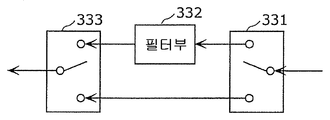
도 10d에 나타내는 바와 같이, IPCM 블록에 대한 처리를 처음부터 행하지 않아도 된다. 구체적으로는 분배부(331)는, 대상 블록이 비IPCM 블록인 경우, 입력 신호를 필터부(332)에 출력하고, 대상 블록이 IPCM 블록인 경우, 입력 신호를 선택부(333)에 출력한다. 선택부(333)는, 대상 블록이 비IPCM 블록인 경우, 필터부(332)에 의해 필터 처리된 후의 대상 블록의 화소치를 출력하고, 대상 블록이 IPCM 블록인 경우, 분배부(331)로부터의 신호 중 대상 블록의 화소치를 출력한다.As shown in Fig. 10D, the process for the IPCM block need not be performed from the beginning. More specifically, the
도 10e에 나타내는 바와 같이, 필터부의 출력측을 전환하는 것이 아니라, 입력측을 전환해도 된다. 또한, IPCM 블록과 비IPCM 블록에 대한 필터부의 단수가 상이해도 된다. 구체적으로는 분배부(341)는, 대상 블록이 비IPCM 블록인 경우, 입력 신호를 필터부(342)에 출력하고, 대상 블록이 IPCM 블록인 경우, 입력 신호를 필터부(344)에 출력한다. 필터부(342)는, 입력 신호를 이용하여 필터 처리를 행한다. 필터부(343)는, 필터부(342)에 의해 필터 처리된 후의 신호를 이용하여 필터 처리를 행하고, 필터 처리 후의 대상 블록의 화소치를 출력한다. 필터부(344)는, 입력 신호를 이용하여 필터 처리를 행하고, 필터 처리 후의 대상 블록의 화소치를 출력한다. 또한, 필터부(344)에서 행해지는 필터 처리는, 필터부(342)에서 행해지는 필터 처리, 또는, 필터부(343)에서 행해지는 필터 처리와 동일해도 되고, 상이해도 된다.The input side may be switched instead of switching the output side of the filter unit as shown in Fig. 10E. In addition, the number of filter units for the IPCM block and the non-IPCM block may be different. More specifically, the
도 10f에 나타내는 바와 같이, 필터부의 출력측을 전환해도 된다. 구체적으로는 필터부(351)는, 제1 입력 신호를 이용하여 필터 처리를 행한다. 필터부(352)는, 필터부(351)에 의해 필터 처리된 후의 신호를 이용하여 필터 처리를 행하고, 필터 처리 후의 대상 블록의 화소치를 출력한다. 필터부(353)는, 제2 입력 신호를 이용하여 필터 처리를 행하고, 필터 처리 후의 대상 블록의 화소치를 출력한다. 선택부(354)는, 대상 블록이 비IPCM 블록인 경우, 필터부(352)에 의해 필터 처리된 후의 대상 블록의 화소치를 출력하고, 대상 블록이 IPCM 블록인 경우, 필터부(353)에 의해 필터 처리된 후의 대상 블록의 화소치를 출력한다.The output side of the filter section may be switched as shown in Fig. 10F. More specifically, the
또한, 미필터의 값을 출력한다는 것은, 필터를 한 결과의 화소치 pf를, 원래의 입력치 p로 치환하여 출력하는 것을 포함한다.The outputting of the value of the unfiltered filter includes replacing the pixel value pf of the result of the filtering with the original input value p and outputting it.
도 10g에 나타내는 바와 같이, 2계통 중 한쪽에서 필터 처리된 후의 신호를 이용하여, 다른 쪽의 필터 처리를 행해도 된다. 구체적으로는 필터부(361)는 제2 입력 신호를 이용하여 필터 처리를 행한다. 필터부(362)는 제1 입력 신호와, 필터부(361)에 의해 필터 처리된 후의 신호를 이용하여 필터 처리를 행한다. 선택부(363)는, 대상 블록이 비IPCM 블록인 경우, 필터부(362)에 의해 필터 처리된 후의 대상 블록의 화소치를 출력하고, 대상 블록이 IPCM 블록인 경우, 필터부(361)에 의해 필터 처리된 후의 대상 블록의 화소치를 출력한다. 또한, 선택부(363)는, 대상 블록이 IPCM 블록인 경우, 필터부(362)에 의해 필터 처리된 후의 대상 블록의 화소치를 출력하고, 대상 블록이 비IPCM 블록인 경우, 필터부(361)에 의해 필터 처리된 후의 대상 블록의 화소치를 출력해도 된다.As shown in Fig. 10G, the other filter processing may be performed using the signal after the filter processing in one of the two systems. More specifically, the
도 10h에 나타내는 바와 같이, 한 번 메모리(373)에 저장된 값을 입력으로 하여 이용해도 된다. 구체적으로는 선택부(371)는, 입력 신호와 메모리(373)에 유지되어 있는 신호 중 한쪽을 선택한다. 필터부(372)는, 선택부(371)에 의해 선택된 신호를 이용하여 필터 처리를 행한다.The value stored in the
또한, 이들은 예시이며, 본 실시 형태에 따른 필터 처리부(115)는, 결과적으로 「IPCM 블록의 화소에는 필터 처리를 행하고 있지 않은 값을 출력하는」 기능을 실현할 수 있으면 된다.These are merely examples, and the
이하, 본 실시 형태에 따른 필터 방법의 변형예를 설명한다. 도 11은 본 실시 형태에 따른 필터 방법의 변형예의 동작을 도시하는 흐름도이다.A modification of the filter method according to the present embodiment will be described below. 11 is a flowchart showing the operation of a modification of the filter method according to the present embodiment.
상기 설명에서는, 도 5에 나타내는 단계 S204 및 S205에 있어서, 비IPCM 블록에 대해 필터를 적용하고, IPCM 블록에 대해 미필터 처리의 화소치를 출력하는 것으로 하였지만, 이것은 이하에 나타내는 단계에 의해 실현되어도 된다. 요컨대 도 5에 나타내는 단계 S204 및 S205 대신에 도 11에 나타내는 처리를 행해도 된다.In the above description, the filter is applied to the non-IPCM block and the pixel value of the unfiltered process is output to the IPCM block in steps S204 and S205 shown in FIG. 5, but this may be realized by the following steps . In other words, the processing shown in Fig. 11 may be performed instead of the steps S204 and S205 shown in Fig.
우선, 서로 인접하는 제1 블록(블록[0]) 및 제2 블록(블록 y[1])의 화소치를 취득한다(S221). 여기에서 예를 들면, 제1 블록은 비IPCM 블록이고, 제2 블록은 IPCM 블록이다.First, the pixel values of the first block (block [0]) and the second block (block y [1]) adjacent to each other are obtained (S221). Here, for example, the first block is a non-IPCM block and the second block is an IPCM block.
다음에, 제1 블록에 적용하는 필터 강도 bS[0]과 제2 블록에 적용하는 필터 강도 bS[1]을 도출한다(S222 및 S223). 여기에서 필터 강도 bS[0]과 필터 강도 bS[1]는 상이한 강도를 나타낸다. 또한, 종래의 기술에서는, 1개의 블록 경계에 대해 1개의 필터 강도만이 설정되어 있었다. 예를 들면 본 실시 형태에서는, IPCM 블록에 대한 필터 강도는, 비IPCM 블록에 대한 필터 강도보다 약하게 설정된다.Next, the filter strength bS [0] to be applied to the first block and the filter strength bS [1] to be applied to the second block are derived (S222 and S223). Here, the filter strength bS [0] and the filter strength bS [1] represent different intensities. Further, in the conventional technique, only one filter strength is set for one block boundary. For example, in this embodiment, the filter strength for the IPCM block is set to be weaker than the filter strength for the non-IPCM block.
다음에 필터 강도 bS[0]로, 양쪽의 블록에 필터 처리를 행하여, 필터 처리 후의 제1 블록의 화소치를 출력한다(S224). 다음에 필터 강도 bS[1]로, 양쪽의 블록에 필터 처리를 행하여, 필터 처리 후의 제2 블록의 화소치를 출력한다(S225).Next, the filter processing is performed on both blocks with the filter intensity bS [0], and the pixel value of the first block after the filter processing is output (S224). Next, the filter processing is performed on both blocks with the filter intensity bS [1], and the pixel value of the second block after the filter processing is output (S225).
여기에서 필터 강도의 값을 0으로 함으로써, 필터 처리를 할지/안할지를 제어할 수 있다. 바꿔 말하면, 필터 처리를 할지/안할지를 제어하기 위한 플래그(filterSamplesFlag)를 각각의 블록을 위해 도출해도 된다.Here, by setting the value of the filter strength to 0, it is possible to control whether or not to perform the filter processing. In other words, a flag (filterSamplesFlag) for controlling whether or not to perform filter processing may be derived for each block.
이상으로부터, 본 실시 형태에 따른 필터 방법은, 한쪽의 블록에 제1 필터 강도로 필터 처리를 실행하면서, 다른 쪽의 블록에 제1 필터 강도와 상이한 제2 필터 강도로 필터 처리를 실행할 수 있다. 또 상기 필터 방법은, 이러한 처리를 필터 프로세스 내에서 실현할 수 있다.As described above, in the filter method according to the present embodiment, the filter process can be performed with the first filter intensity being applied to one block while the second filter intensity is different from the first filter intensity to the other block. Further, the above-described filter method can realize this processing in the filter process.
도 12는 본 실시 형태에 따른 필터 방법의 다른 변형예의 흐름도이다. 도 12에 나타내는 처리는, 도 3에 나타내는 처리에 대해, 단계 S401이 추가되어 있다.12 is a flowchart of another modification of the filter method according to the present embodiment. The process shown in Fig. 12 is the same as the process shown in Fig. 3 except that step S401 is added.
이 단계 S401은, 인트라 예측되는 블록으로 판정되어 버리는 IPCM 블록에 대해, 적절한 필터 강도를 부여하기 위해 추가되어 있다. 단계 S401에서는, 제1 블록 및 제2 블록 중 적어도 한쪽이 IPCM 블록인지의 여부를 판정한다. 제1 블록 및 제2 블록 중 적어도 한쪽이 IPCM 블록인 경우(S401에서 Yes), 필터 강도(bS)는, N(=4)보다 작은 값인 3, 2, 1, 0 중 어느 하나로 결정된다(S124). 또 제1 블록 및 제2 블록의 양쪽이 비IPCM 블록인 경우(S401에서 No), 필터 강도는 가장 강한 강도를 의미하는 bS=N(=4)로 설정된다(S123).This step S401 is added to give an appropriate filter strength to the IPCM block which is determined to be a block to be intra predicted. In step S401, it is determined whether or not at least one of the first block and the second block is an IPCM block. If at least one of the first block and the second block is an IPCM block (Yes in S401), the filter strength bS is determined to be 3, 2, 1, or 0, which is a value smaller than N (= 4) ). If both of the first block and the second block are non-IPCM blocks (No in S401), the filter strength is set to bS = N (= 4) which indicates the strongest strength (S123).
도 3에 나타내는 필터 방법의 경우에서는, 한쪽의 블록 또는 양쪽의 블록이 인트라 예측 모드의 매크로 블록인 경우(S122에서 Yes), 다른 판정 조건 없이, 반드시, 필터 강도 자체는 가장 강한 강도를 의미하는 bS=4가 설정된다.In the case of the filter method shown in Fig. 3, when one block or both blocks are macroblocks in the intra-prediction mode (Yes in S122), the filter strength itself must be set to bS = 4 is set.
한편, 도 12에 나타내는 본 실시 형태의 변형예에서는, 한쪽의 블록 또는 양쪽의 블록이 인트라 예측 모드의 매크로 블록인 경우(S122에서 Yes)여도, 한쪽의 블록이 IPCM 블록인 경우(S401에서 Yes)는, 단계 S123에서 설정되는 필터 강도(bS=4)에 비해, 약한 필터 강도(bS=0~3)가 설정된다.On the other hand, in the modification of this embodiment shown in Fig. 12, when one block or both blocks are intra-prediction mode macroblocks (Yes in S122), if one block is an IPCM block (Yes in S401) (BS = 0 to 3) is set as compared with the filter strength (bS = 4) set in step S123.
도 13은 본 실시 형태에 따른 필터 방법에 의해 결정되는 필터 강도와, 경계를 결정하는 블록 단위를 도시하는 도면이다.Fig. 13 is a diagram showing a filter strength determined by the filter method according to the present embodiment, and a block unit for determining a boundary.
도 13에 나타내는 바와 같이, 매크로 블록 MB[0]이 인터 예측 모드의 매크로 블록이며, 매크로 블록 MB[1]이 인트라 예측 모드의 매크로 블록인 경우(S122에서 Yes)에 있어서, 제1 및 제2 블록이 모두 비IPCM 블록인 경우(S401에서 No), 양쪽의 블록에 대해 bS=4가 설정된다(S123).13, when the macroblock MB [0] is a macroblock in the inter prediction mode and the macroblock MB [1] is a macroblock in the intra prediction mode (Yes in S122), the first and second If all of the blocks are non-IPCM blocks (No in S401), bS = 4 is set for both blocks (S123).
한편, PU 블록[0]이 비IPCM 모드이고, PU 블록[1]이 IPCM 모드인 경우, 요컨대 CU 블록[0]이 비IPCM 블록이고, CU 블록[1]이 IPCM 블록이므로(S401에서 Yes), CU 블록[0] 및 CU 블록[1]에 대해서는 bS=0~3 중 어느 하나가 설정된다. 이 예에서는, IPCM 블록인 CU 블록[1]에 대해 bS=0이 설정되고, 비IPCM 블록인 CU 블록[0]에 대해 bS=1~3 중 어느 하나가 설정된다.On the other hand, when the PU block [0] is the non-IPCM mode and the PU block [1] is the IPCM mode, , CU block [0] and CU block [1], one of bS = 0 to 3 is set. In this example, bS = 0 is set for the CU block [1] which is the IPCM block, and bS = 1 to 3 is set for the CU block [0] which is the non-IPCM block.
도 14a 및 도 14b는 본 실시 형태에 따른 IPCM 블록의 취급에 의해 필터 ON의 플래그의 적용 범위가 확장되는 상황을 설명하기 위한 도면이다. 도 14a는 비교예로서, 본 실시 형태의 수법을 적용하지 않는 경우를 나타낸다. 도 14b는 본 실시 형태의 수법을 적용한 경우를 나타낸다.Figs. 14A and 14B are diagrams for explaining a situation in which the application range of the filter ON flag is expanded by the handling of the IPCM block according to the present embodiment. Fig. 14A shows a case where the technique of this embodiment is not applied as a comparative example. Fig. 14B shows a case where the technique of this embodiment is applied.
도 14b에 나타내는 바와 같이, 본 실시 형태에 따른 필터 방법을 이용함으로써 필터 ON의 플래그의 적용 범위를 확장시킬 수 있다.14B, the application range of the filter ON flag can be extended by using the filter method according to the present embodiment.
이상과 같이, 본 실시 형태에 따른 필터 방법은, 필터 처리부 또는 제어부가, 루프 내 필터의 처리에 있어서 「IPCM 블록은 필터하지 않는」것을 판정의 암시적인 부호 해석의 룰로 한다. 이에 의해 도 14a 및 도 14b에 나타내는 바와 같이, 부호열에 대해, 보다 큰 범위에서, 필터를 enable할지 disable할지를 지정할 수 있다. 이에 의해, 본 실시 형태에 따른 필터 방법은 비트량을 삭감시킬 수 있다.As described above, in the filter method according to the present embodiment, the filter processing unit or the control unit makes an implicit code analysis rule of " do not filter IPCM block " As a result, as shown in Figs. 14A and 14B, it is possible to specify whether the filter is enabled or disabled in a larger range with respect to the bit stream. Thus, the amount of bits can be reduced in the filter method according to the present embodiment.
이상, 본 발명의 실시 형태에 따른 필터 방법, 동화상 부호화 장치 및 동화상 복호 장치에 대해 설명하였지만, 본 발명은 이 실시 형태에 한정되는 것은 아니다.The filter method, moving picture coding apparatus and moving picture decoding apparatus according to the embodiments of the present invention have been described above, but the present invention is not limited to this embodiment.
예를 들면 상기 실시 형태에 따른, 필터 방법, 동화상 부호화 장치 및 동화상 복호 장치, 및 그들의 변형예의 기능 중 적어도 일부를 조합해도 된다.For example, at least some of the functions of the filter method, the moving picture coding apparatus and the moving picture decoding apparatus, and the modified examples thereof may be combined.
또 블록도에 있어서의 기능 블록의 분할은 일례이며, 복수의 기능 블록을 1개의 기능 블록으로서 실현하거나, 1개의 기능 블록을 복수로 분할하거나, 일부의 기능을 다른 기능 블록으로 옮겨도 된다. 또 유사한 기능을 갖는 복수의 기능 블록의 기능을 단일 하드웨어 또는 소프트웨어가 병렬 또는 시분할로 처리해도 된다.The division of the functional blocks in the block diagram is an example. A plurality of functional blocks may be realized as one functional block, a single functional block may be divided into a plurality of blocks, or a part of functions may be transferred to another functional block. The functions of a plurality of functional blocks having similar functions may be processed by a single hardware or software in parallel or time-sharing.
또 상기 필터 방법에 포함되는 복수의 단계가 실행되는 순서는, 본 발명을 구체적으로 설명하기 위해 예시하기 위한 것이며, 상기 이외의 순서여도 된다. 또 상기 단계의 일부가, 다른 단계와 동시(병렬)에 실행되어도 된다.The order in which the plurality of steps included in the above-described filter method are performed is for illustrative purposes only, and the order may be other than the above. Also, a part of the steps may be executed simultaneously (in parallel) with the other steps.
예를 들면 도 5에 나타내는 단계 S201 및 S202의 순서는, 이 순서에 한정되는 것은 아니다. 요컨대 결과적으로 「경계를 사이에 둔 2개의 블록 중, 한쪽의 블록이 IPCM 블록에 포함되고, 다른 쪽의 블록이 IPCM 블록에 포함되지 않는」 경우에, 단계 S204 및 S205의 처리를 실행하면 된다. 또 단계 SS204 및 S205의 순서도 임의이면 된다.For example, the order of steps S201 and S202 shown in Fig. 5 is not limited to this order. In short, in the event that "one block is included in the IPCM block and the other block is not included in the IPCM block" among the two blocks with the boundary therebetween, the processes of steps S204 and S205 may be executed. The order of steps SS204 and S205 may be any.
동일하게 도 11에 나타내는 단계 S222~S225의 순서도 이 순서에 한정되지 않는다. 구체적으로는, 단계 S224가 단계 S222의 뒤이고, 단계 S225가 단계 S223의 뒤이면, 단계 S222~S225의 순서는 임의이면 된다.Similarly, the sequence of steps S222 to S225 shown in FIG. 11 is not limited to this order. More specifically, if step S224 is after step S222 and step S225 is after step S223, the order of steps S222 to S225 may be arbitrary.
(실시 형태 2)(Embodiment 2)
상기 각 실시 형태에서 나타낸 동화상 부호화 방법(화상 부호화 방법) 또는 동화상 복호화 방법(화상 복호 방법)의 구성을 실현하기 위한 프로그램을 기억 미디어에 기록함으로써, 상기 각 실시 형태에서 나타낸 처리를 독립된 컴퓨터 시스템에서 간단히 실시하는 것이 가능해진다. 기억 미디어는, 자기 디스크, 광디스크, 광자기 디스크, IC 카드, 반도체 메모리 등, 프로그램을 기록할 수 있는 것이면 된다.By recording a program for realizing the structure of the moving picture coding method (picture coding method) or the moving picture decoding method (picture decoding method) shown in each of the above-mentioned embodiments in the storage medium, the processing shown in each of the above- Can be performed. The storage medium may be any one capable of recording a program such as a magnetic disk, an optical disk, a magneto-optical disk, an IC card, or a semiconductor memory.
또한, 여기에서, 상기 각 실시 형태에서 나타낸 동화상 부호화 방법(화상 부호화 방법)이나 동화상 복호화 방법(화상 복호 방법)의 응용예와 그것을 이용한 시스템을 설명한다. 상기 시스템은, 화상 부호화 방법을 이용한 화상 부호화 장치, 및 화상 복호 방법을 이용한 화상 복호 장치로 이루어지는 화상 부호화 복호 장치를 갖는 것을 특징으로 한다. 시스템에 있어서의 다른 구성에 대해, 경우에 따라 적절히 변경할 수 있다.Here, application examples of the moving picture coding method (picture coding method) and the moving picture decoding method (picture decoding method) shown in each of the above embodiments and a system using the same will be described. The system is characterized by having a picture coding apparatus using a picture coding method and a picture coding decoding apparatus comprising an picture decoding apparatus using an image decoding method. Other configurations in the system can be appropriately changed in some cases.
도 15는 콘텐츠 전달 서비스를 실현하는 콘텐츠 공급 시스템(ex100)의 전체 구성을 도시하는 도면이다. 통신 서비스의 제공 영역을 원하는 크기로 분할하고, 각 셀 내에 각각 고정 무선국인 기지국(ex106, ex107, ex108, ex109, ex110)이 설치되어 있다.15 is a diagram showing the overall configuration of a content supply system ex100 for realizing a content delivery service. The coverage area of the communication service is divided into a desired size and base stations ex106, ex107, ex108, ex109, and ex110, which are fixed wireless stations, are provided in each cell.
이 콘텐츠 공급 시스템(ex100)은, 인터넷(ex101)에 인터넷 서비스 프로바이더(ex102) 및 전화망(ex104), 및 기지국(ex106으로부터 ex110)을 통해, 컴퓨터(ex111), PDA(Personal Digital Assistant)(ex112), 카메라(ex113), 휴대전화(ex114), 게임기(ex115) 등의 각 기기가 접속된다.The contents supply system ex100 is connected to the computer ex111, the PDA (Personal Digital Assistant) ex112, the Internet ex103, and the Internet ex101 via an Internet service provider ex102, a telephone network ex104, and base stations ex106 to ex110, , A camera ex113, a cell phone ex114, a game machine ex115 and the like are connected.
그러나 콘텐츠 공급 시스템(ex100)은 도 15와 같은 구성에 한정되지 않으며, 어느 하나의 요소를 조합하여 접속하도록 해도 된다. 또 고정 무선국인 기지국(ex106으로부터 ex110)을 통하지 않고, 각 기기가 전화망(ex104)에 직접 접속되어도 된다. 또 각 기기가 근거리 무선 등을 통해 직접 상호 접속되어 있어도 된다.However, the content supply system ex100 is not limited to the configuration as shown in Fig. 15, and any one of the elements may be connected in combination. Alternatively, each device may be directly connected to the telephone network ex104, not via the base stations ex106 to ex110, which are fixed radio stations. In addition, each device may be directly connected to each other via a short-range wireless.
카메라(ex113)는 디지털 비디오 카메라 등의 동화상 촬영이 가능한 기기이며, 카메라(ex116)는 디지털 카메라 등의 정지화상 촬영, 동화상 촬영이 가능한 기기이다. 또 휴대전화(ex114)는, GSM(등록상표)(Global System for Mobile Communications) 방식, CDMA(Code Division Multiple Access) 방식, W-CDMA(Wideband-Code Division Multiple Access) 방식, 혹은 LTE(Long Term Evolution) 방식, HSPA(High Speed Packet Access)의 휴대전화기, 또는 PHS(Personal Handyphone System) 등이며, 어느 것이어도 상관없다.The camera ex113 is a device capable of moving picture taking such as a digital video camera, and the camera ex116 is a device capable of still picture taking and moving picture taking such as a digital camera. In addition, the cell phone ex114 may be a GSM (Global System for Mobile Communications) system, a CDMA (Code Division Multiple Access) system, a W-CDMA (Wideband- ), A cellular phone of HSPA (High Speed Packet Access), or a PHS (Personal Handyphone System).
콘텐츠 공급 시스템(ex100)에서는, 카메라(ex113) 등이 기지국(ex109), 전화망(ex104)을 통해 스트리밍 서버(ex103)에 접속됨으로써, 라이브 전달 등이 가능해진다. 라이브 전달에서는, 유저가 카메라(ex113)를 이용하여 촬영하는 콘텐츠(예를 들면, 음악 라이브의 영상 등)에 대해 상기 각 실시 형태에서 설명한 바와 같이 부호화 처리를 행하여(즉, 본 발명의 화상 부호화 장치로서 기능한다), 스트리밍 서버(ex103)에 송신한다. 한편, 스트리밍 서버(ex103)는 요구가 있었던 클라이언트에 대해 송신된 콘텐츠 데이터를 스트림 전달한다. 클라이언트로서는, 상기 부호화 처리된 데이터를 복호화하는 것이 가능한, 컴퓨터(ex111), PDA(ex112), 카메라(ex113), 휴대전화(ex114), 게임기(ex115) 등이 있다. 전달된 데이터를 수신한 각 기기에서는, 수신한 데이터를 복호화 처리하여 재생한다(즉, 본 발명의 화상 복호 장치로서 기능한다).In the content supply system ex100, the camera ex113 and the like are connected to the streaming server ex103 via the base station ex109 and the telephone network ex104, thereby enabling live delivery and the like. In the live delivery, the user performs a coding process on the content (for example, a music live image) to be photographed using the camera ex113 as described in the above embodiments (that is, And transmits it to the streaming server ex103. On the other hand, the streaming server ex103 streams the content data transmitted to the requesting client. Examples of the client include a computer ex111, a PDA ex112, a camera ex113, a cell phone ex114, a game machine ex115, and the like which can decode the coded data. Each device that has received the transmitted data decodes and reproduces the received data (i.e., functions as the image decoding device of the present invention).
또한, 촬영한 데이터의 부호화 처리는 카메라(ex113)로 행해도, 데이터의 송신 처리를 하는 스트리밍 서버(ex103)로 행해도 되고, 서로 분담하여 행해도 된다. 동일하게 전달된 데이터의 복호화 처리는 클라이언트로 행해도, 스트리밍 서버(ex103)로 행해도 되고, 서로 분담하여 행해도 된다. 또 카메라(ex113)에 한정되지 않으며, 카메라(ex116)로 촬영한 정지화상 및/또는 동화상 데이터를, 컴퓨터(ex111)를 통해 스트리밍 서버(ex103)에 송신해도 된다. 이 경우의 부호화 처리는 카메라(ex116), 컴퓨터(ex111), 스트리밍 서버(ex103) 중 어느 것으로 행해도 되고, 서로 분담하여 행해도 된다.The camera data ex113 may be encoded by the streaming server ex103 which performs data transmission processing, or may be shared with each other. The decryption processing of the data transmitted in the same way may be performed by the client, by the streaming server ex103, or may be performed in a shared manner. Also, the present invention is not limited to the camera ex113, and the still image and / or moving image data photographed by the camera ex116 may be transmitted to the streaming server ex103 via the computer ex111. The encoding process in this case may be performed by either the camera ex116, the computer ex111, or the streaming server ex103, or may be performed in a shared manner.
또 이들 부호화·복호화 처리는, 일반적으로 컴퓨터(ex111)나 각 기기가 갖는 LSI(ex500)에서 처리한다. LSI(ex500)는, 원 칩이어도 복수 칩으로 이루어지는 구성이어도 된다. 또한, 동화상 부호화·복호화용의 소프트웨어를 컴퓨터(ex111) 등으로 판독 가능한 어떠한 기록 미디어(CD-ROM, 플렉시블 디스크, 하드 디스크 등)에 장착하고, 그 소프트웨어를 이용하여 부호화·복호화 처리를 행해도 된다. 또한, 휴대전화(ex114)에 카메라가 달린 경우에는, 그 카메라로 취득한 동화상 데이터를 송신해도 된다. 이때의 동화상 데이터는 휴대전화(ex114)가 갖는 LSI(ex500)로 부호화 처리된 데이터이다.These encoding and decoding processes are generally performed by the computer ex111 and the LSI ex500 included in each device. The LSI ex500 may be a one-chip or a plurality of chips. In addition, software for moving picture coding / decoding may be mounted on any recording medium (CD-ROM, flexible disk, hard disk, etc.) readable by the computer ex111 or the like, and encoding / decoding processing may be performed using the software . In addition, when the mobile phone ex114 is equipped with a camera, the moving picture data acquired by the camera may be transmitted. The moving picture data at this time is data that has been coded by the LSI ex500 included in the cell phone ex114.
또 스트리밍 서버(ex103)는 복수의 서버나 복수의 컴퓨터이며, 데이터를 분산시켜 처리하거나 기록하거나 전달하는 것이어도 된다.Also, the streaming server ex103 may be a plurality of servers or a plurality of computers, which may distribute, process, record, or transfer data.
이상과 같이 하여, 콘텐츠 공급 시스템(ex100)에서는, 부호화된 데이터를 클라이언트가 수신하여 재생할 수 있다. 이와 같이 콘텐츠 공급 시스템(ex100)에서는, 유저가 송신한 정보를 실시간으로 클라이언트가 수신하여 복호화하고, 재생할 수 있으며, 특별한 권리나 설비를 갖지 않는 유저라도 개인 방송을 실현할 수 있다.As described above, in the content supply system ex100, the client can receive and reproduce the encoded data. Thus, in the contents supply system ex100, the client can receive, decode and reproduce the information transmitted by the user in real time, and even a user who does not have a special right or facility can realize personal broadcasting.
또한, 콘텐츠 공급 시스템(ex100)의 예에 한정되지 않으며, 도 16에 나타내는 바와 같이, 디지털 방송용 시스템(ex200)에도, 상기 각 실시 형태의 적어도 동화상 부호화 장치(화상 부호화 장치) 또는 동화상 복호화 장치(화상 복호 장치) 중 어느 하나를 장착할 수 있다. 구체적으로는 방송국(ex201)에서는 영상 데이터에 음악 데이터 등이 다중화된 다중화 데이터가 전파를 통해 통신 또는 위성(ex202)에 전송된다. 이 영상 데이터는 상기 각 실시 형태에서 설명한 동화상 부호화 방법에 의해 부호화된 데이터이다(즉, 본 발명의 화상 부호화 장치에 의해 부호화된 데이터이다). 이것을 받은 방송 위성(ex202)은, 방송용의 전파를 발신하고, 이 전파를 위성 방송의 수신이 가능한 가정의 안테나(ex204)가 수신한다. 수신한 다중화 데이터를, TV(수신기)(ex300) 또는 셋톱박스(STB)(ex217) 등의 장치가 복호화하여 재생한다(즉, 본 발명의 화상 복호 장치로서 기능한다).16, the system for digital broadcasting ex200 is also provided with at least a moving picture coding apparatus (picture coding apparatus) or a moving picture decoding apparatus (picture Decoding apparatus) can be mounted. More specifically, in the broadcasting station ex201, multiplexed data obtained by multiplexing music data and the like in the video data is transmitted to the communication or the satellite ex202 via radio waves. This video data is data encoded by the moving picture coding method described in each of the above embodiments (that is, data encoded by the picture coding apparatus of the present invention). The broadcast satellite ex202 receiving this receives a radio wave for broadcasting, and the antenna ex204 of the home which can receive the radio wave receives the satellite broadcast is received. The received multiplexed data is decoded by a device such as a TV (receiver) ex300 or a set top box (STB) ex217 and reproduced (that is, functions as an image decoding device of the present invention).
또 DVD, BD 등의 기록 미디어(ex215)에 기록한 다중화 데이터를 판독하여 복호화하거나, 또는 기록 미디어(ex215)에 영상 신호를 부호화하고, 또한 경우에 따라서는 음악 신호와 다중화하여 기록하는 리더/레코더(ex218)에도 상기 각 실시 형태에서 나타낸 동화상 복호화 장치 또는 동화상 부호화 장치를 실장하는 것이 가능하다. 이 경우, 재생된 영상 신호는 모니터(ex219)에 표시되고, 다중화 데이터가 기록된 기록 미디어(ex215)에 의해 다른 장치나 시스템에서 영상 신호를 재생할 수 있다. 또 케이블 TV용의 케이블(ex203) 또는 위성/지상파 방송의 안테나(ex204)에 접속된 셋톱박스(ex217) 내에 동화상 복호화 장치를 실장하고, 이것을 TV의 모니터(ex219)로 표시해도 된다. 이때 셋톱박스가 아니라, TV 내에 동화상 복호화 장치를 장착해도 된다.A reader / writer (also referred to as a reader / writer) 219 for reading and decoding multiplexed data recorded on a recording medium ex215 such as a DVD or a BD or encoding a video signal on a recording medium ex215 and multiplexing the multiplexed data with a music signal ex218 can also be mounted on the moving picture decoding apparatus or the moving picture coding apparatus shown in each of the above embodiments. In this case, the reproduced video signal is displayed on the monitor ex219, and the video signal can be reproduced by another device or system by the recording medium ex215 on which the multiplexed data is recorded. Alternatively, the moving picture decoding apparatus may be mounted in a set-top box ex217 connected to a cable ex203 for cable TV or an antenna ex204 for satellite / terrestrial broadcasting, and the moving picture decoding apparatus may be displayed on a monitor ex219 of a TV. At this time, instead of the set-top box, the moving picture decoding apparatus may be installed in the TV.
도 17은 상기 각 실시 형태에서 설명한 동화상 복호화 방법 및 동화상 부호화 방법을 이용한 TV(수신기)(ex300)를 도시하는 도면이다. TV(ex300)는, 상기 방송을 수신하는 안테나(ex204) 또는 케이블(ex203) 등을 통해 영상 데이터에 음성 데이터가 다중화된 다중화 데이터를 취득, 또는 출력하는 튜너(ex301)와, 수신한 다중화 데이터를 복조하거나, 또는 외부에 송신하는 다중화 데이터로 변조하는 변조/복조부(ex302)와, 복조한 다중화 데이터를 영상 데이터와, 음성 데이터로 분리하거나, 또는 신호 처리부(ex306)에서 부호화된 영상 데이터, 음성 데이터를 다중화하는 다중/분리부(ex303)를 구비한다.17 is a diagram showing a TV (receiver) ex300 using the moving picture decoding method and the moving picture coding method described in the above embodiments. The TV ex300 includes a tuner ex301 for acquiring or outputting multiplexed data in which audio data is multiplexed with video data through an antenna ex204 or cable ex203 for receiving the broadcast, A demodulation / demodulation unit ex302 for modulating the demodulated multiplexed data into demodulated or demultiplexed multiplexed data ex302, demultiplexed demodulated multiplexed data into video data and audio data, or video data encoded by the signal processing unit ex306, And a multiplex / demultiplex unit ex303 for multiplexing the data.
또 TV(ex300)는, 음성 데이터, 영상 데이터 각각을 복호화하거나, 또는 각각의 정보를 부호화하는 음성 신호 처리부(ex304), 영상 신호 처리부(ex305)(본 발명의 화상 부호화 장치 또는 화상 복호 장치로서 기능한다)를 갖는 신호 처리부(ex306)와, 복호화한 음성 신호를 출력하는 스피커(ex307), 복호화한 영상 신호를 표시하는 디스플레이 등의 표시부(ex308)를 갖는 출력부(ex309)를 갖는다. 또한, TV(ex300)는, 유저 조작의 입력을 접수하는 조작 입력부(ex312) 등을 갖는 인터페이스부(ex317)를 갖는다. 또한, TV(ex300)는, 각 부를 통괄적으로 제어하는 제어부(ex310), 각 부에 전력을 공급하는 전원 회로부(ex311)를 갖는다. 인터페이스부(ex317)는, 조작 입력부(ex312) 이외에, 리더/레코더(ex218) 등의 외부 기기와 접속되는 브리지(ex313), SD 카드 등의 기록 미디어(ex216)를 장착 가능하게 하기 위한 슬롯부(ex314), 하드 디스크 등의 외부 기록 미디어와 접속하기 위한 드라이버(ex315), 전화망과 접속하는 모뎀(ex316) 등을 갖고 있어도 된다. 또한, 기록 미디어(ex216)는, 저장하는 불휘발성/휘발성의 반도체 메모리 소자에 의해 전기적으로 정보의 기록을 가능하게 한 것이다. TV(ex300)의 각 부는 동기 버스를 통해 서로 접속되어 있다.The TV ex300 further includes an audio signal processing unit ex304 for decoding the audio data and the video data or for coding each information, a video signal processing unit ex305 (functioning as the picture coding apparatus or the picture decoding apparatus of the present invention) A speaker ex307 for outputting the decoded voice signal, and a display unit ex308 such as a display for displaying the decoded video signal. The TV ex300 also has an interface unit ex317 having an operation input unit ex312 for accepting an input of a user operation. Further, the TV ex300 includes a control unit ex310 for collectively controlling each unit, and a power supply circuit unit ex311 for supplying power to each unit. The interface unit ex317 includes a bridge ex313 connected to external devices such as a reader / writer ex218 and a slot unit ex312 for allowing the recording medium ex216 such as an SD card to be loaded, in addition to the operation input unit ex312. a driver ex315 for connecting with an external recording medium such as a hard disk or the like, and a modem ex316 connected to a telephone network. In addition, the recording medium ex 216 is capable of electrically recording information by a nonvolatile / volatile semiconductor memory device to be stored. The parts of the TV ex300 are connected to each other through a synchronous bus.
우선 TV(ex300)가 안테나(ex204) 등에 의해 외부로부터 취득한 다중화 데이터를 복호화하여, 재생하는 구성에 대해 설명한다. TV(ex300)는, 리모트 컨트롤러(ex220) 등으로부터의 유저 조작을 받아, CPU 등을 갖는 제어부(ex310)의 제어에 의거하여, 변조/복조부(ex302)에서 복조한 다중화 데이터를 다중/분리부(ex303)에서 분리한다. 또한, TV(ex300)는, 분리한 음성 데이터를 음성 신호 처리부(ex304)에서 복호화하고, 분리한 영상 데이터를 영상 신호 처리부(ex305)에서 상기 각 실시 형태에서 설명한 복호화 방법을 이용하여 복호화한다. 복호화한 음성 신호, 영상 신호는, 각각 출력부(ex309)로부터 외부를 향해 출력된다. 출력할 때에는, 음성 신호와 영상 신호가 동기하여 재생하도록, 버퍼(ex318, ex319) 등에 일단 이들 신호를 축적하면 된다. 또 TV(ex300)는, 방송 등으로부터가 아니라, 자기/광디스크, SD 카드 등의 기록 미디어(ex215, ex216)로부터 다중화 데이터를 독출해도 된다. 다음에 TV(ex300)가 음성 신호나 영상 신호를 부호화하여, 외부에 송신 또는 기록 미디어 등에 기록하는 구성에 대해 설명한다. TV(ex300)는, 리모트 컨트롤러(ex220) 등으로부터의 유저 조작을 받아, 제어부(ex310)의 제어에 의거하여, 음성 신호 처리부(ex304)에서 음성 신호를 부호화하고, 영상 신호 처리부(ex305)에서 영상 신호를 상기 각 실시 형태에서 설명한 부호화 방법을 이용하여 부호화한다. 부호화한 음성 신호, 영상 신호는 다중/분리부(ex303)에서 다중화되어 외부에 출력된다. 다중화할 때에는, 음성 신호와 영상 신호가 동기하도록, 버퍼(ex320, ex321) 등에 일단 이들 신호를 축적하면 된다. 또한, 버퍼(ex318, ex319, ex320, ex321)는 도시하고 있는 바와 같이 복수 구비하고 있어도 되고, 1개 이상의 버퍼를 공유하는 구성이어도 된다. 또한, 도시하고 있는 것 이외에, 예를 들면 변조/복조부(ex302)나 다중/분리부(ex303)의 사이 등에서도 시스템의 오버플로, 언더플로를 피하는 완충재로서 버퍼에 데이터를 축적하는 것으로 해도 된다.A configuration in which the TV ex300 decodes and reproduces the multiplexed data obtained from the outside by the antenna ex204 or the like will be described. The TV ex300 receives the user operation from the remote controller ex220 or the like and outputs the multiplexed data demodulated by the modulation / demodulation unit ex302 to the multiplex / demultiplex unit ex310 under the control of the control unit ex310, lt; / RTI > The TV ex300 decodes the separated audio data in the audio signal processing unit ex304 and decodes the separated video data in the video signal processing unit ex305 using the decoding method described in the above embodiments. The decoded audio signal and video signal are output from the output unit ex309 to the outside, respectively. When outputting, these signals may be temporarily stored in the buffers ex318 and ex319 so that the audio signal and the video signal are reproduced in synchronization with each other. The TV ex300 may read the multiplexed data from the recording media ex215 and ex216 such as a magnetic / optical disk and an SD card, not from a broadcast or the like. Next, a configuration in which the TV ex300 encodes a voice signal or a video signal and transmits it to the outside or records it on a recording medium or the like will be described. The TV ex300 receives a user operation from the remote controller ex220 or the like and under the control of the control unit ex310 the audio signal processing unit ex304 codes the audio signal and the video signal processing unit ex305 transmits the video The signal is encoded using the encoding method described in each of the above embodiments. The encoded speech signal and video signal are multiplexed and outputted to the outside by the multiplexer / demultiplex unit ex303. In multiplexing, these signals may be temporarily stored in the buffers ex320 and ex321 so that the audio signal and the video signal are synchronized with each other. The buffers ex318, ex319, ex320, ex321 may be provided as shown in the figure, or may share one or more buffers. It is also possible to store data in the buffer as a buffer material to avoid overflow and underflow of the system, for example, even between the modulation / demodulation unit ex302 and the multiplex / demultiplex unit ex303, for example .
또 TV(ex300)는, 방송 등이나 기록 미디어 등으로부터 음성 데이터, 영상 데이터를 취득하는 것 이외에, 마이크나 카메라의 AV 입력을 접수하는 구성을 구비하고, 그들로부터 취득한 데이터에 대해 부호화 처리를 행해도 된다. 또한, 여기에서는 TV(ex300)는 상기의 부호화 처리, 다중화, 및 외부 출력이 가능한 구성으로서 설명하였지만, 이들 처리를 행할 수는 없으며, 상기 수신, 복호화 처리, 외부 출력만이 가능한 구성이어도 된다.The TV ex300 also has a configuration for accepting AV input of a microphone or a camera, in addition to acquiring audio data and video data from a broadcast, a recording medium, or the like, and when the data obtained from them is subjected to encoding processing do. Although the TV ex300 has been described above as a configuration capable of performing the above-described encoding processing, multiplexing, and external output, these processes can not be performed, and only the reception, decoding processing, and external output can be performed.
또 리더/레코더(ex218)로 기록 미디어로부터 다중화 데이터를 독출하거나, 또는 기록하는 경우에는, 상기 복호화 처리 또는 부호화 처리는 TV(ex300), 리더/레코더(ex218) 중 어느 것으로 행해도 되고, TV(ex300)와 리더/레코더(ex218)가 서로 분담하여 행해도 된다.Also, in the case of reading or recording multiplexed data from the recording medium with the reader / writer ex218, the decoding processing or the encoding processing may be performed by either the TV ex300 or the reader / writer ex218, ex300 and the reader / writer ex218 may share each other.
일례로서, 광디스크로부터 데이터를 읽어들이거나 또는 기록하는 경우의 정보 재생/기록부(ex400)의 구성을 도 18에 나타낸다. 정보 재생/기록부(ex400)는, 이하에 설명하는 요소(ex401, ex402, ex403, ex404, ex405, ex406, ex407)를 구비한다. 광헤드(ex401)는, 광디스크인 기록 미디어(ex215)의 기록면에 레이저 스폿을 조사하여 정보를 기록하고, 기록 미디어(ex215)의 기록면으로부터의 반사광을 검출하여 정보를 읽어들인다. 변조 기록부(ex402)는, 광헤드(ex401)에 내장된 반도체 레이저를 전기적으로 구동하여 기록 데이터에 따라 레이저광의 변조를 행한다. 재생 복조부(ex403)는, 광헤드(ex401)에 내장된 포토디텍터에 의해 기록면으로부터의 반사광을 전기적으로 검출한 재생 신호를 증폭시키고, 기록 미디어(ex215)에 기록된 신호 성분을 분리하고 복조하여, 필요한 정보를 재생한다. 버퍼(ex404)는, 기록 미디어(ex215)에 기록하기 위한 정보 및 기록 미디어(ex215)로부터 재생한 정보를 일시적으로 유지한다. 디스크 모터(ex405)는 기록 미디어(ex215)를 회전시킨다. 서보 제어부(ex406)는, 디스크 모터(ex405)의 회전 구동을 제어하면서 광헤드(ex401)를 소정의 정보 트랙으로 이동시켜, 레이저 스폿의 추종 처리를 행한다. 시스템 제어부(ex407)는, 정보 재생/기록부(ex400) 전체의 제어를 행한다. 상기의 독출이나 기록의 처리는 시스템 제어부(ex407)가, 버퍼(ex404)에 유지된 각종 정보를 이용하여, 또 필요에 따라 새로운 정보의 생성·추가를 행함과 더불어, 변조 기록부(ex402), 재생 복조부(ex403), 서보 제어부(ex406)를 협조 동작시키면서, 광헤드(ex401)를 통해, 정보의 기록 재생을 행함으로써 실현된다. 시스템 제어부(ex407)는 예를 들면 마이크로프로세서로 구성되며, 독출 기록의 프로그램을 실행함으로써 그들 처리를 실행한다.18 shows a configuration of the information reproducing / recording unit ex400 in the case of reading or recording data from the optical disc as an example. The information reproducing / recording unit ex400 includes the following elements ex401, ex402, ex403, ex404, ex405, ex406, ex407. The optical head ex401 irradiates a laser spot on the recording surface of the recording medium ex215 which is an optical disk to record information, and detects reflected light from the recording surface of the recording medium ex215 to read the information. The modulation and writing unit ex402 electrically drives the semiconductor laser built in the optical head ex401 to modulate the laser beam according to the recording data. The reproduction demodulator unit ex403 amplifies a reproduction signal electrically detected by the photodetector incorporated in the optical head ex401 and detects reflected light from the recording surface and separates and demodulates signal components recorded in the recording medium ex215 , The necessary information is reproduced. The buffer ex404 temporarily holds information for recording on the recording medium ex215 and information reproduced from the recording medium ex215. The disk motor ex405 rotates the recording medium ex215. The servo control unit ex406 moves the optical head ex401 to a predetermined information track while controlling the rotation drive of the disk motor ex405 to perform a laser spot tracking process. The system control unit ex407 controls the entire information reproduction / recording unit ex400. The system control unit ex407 performs the above reading and recording processing by using various information held in the buffer ex404 and also generating and adding new information as necessary and recording the information in the modulation and recording unit ex402, The demodulating unit ex403 and the servo control unit ex406 in cooperation with the optical head ex401. The system control unit ex407 is constituted by, for example, a microprocessor, and executes the processing by executing the program of the readout recording.
이상에서는, 광헤드(ex401)는 레이저 스폿을 조사하는 것으로서 설명하였지만, 근접장 빛을 이용하여 보다 고밀도의 기록을 행하는 구성이어도 된다.In the above description, the optical head ex401 has been described as irradiating a laser spot, but it may be configured to perform recording at higher density using near-field light.
도 19에 광디스크인 기록 미디어(ex215)의 모식도를 나타낸다. 기록 미디어(ex215)의 기록면에는 안내홈(그루브)이 스파이럴형상으로 형성되고, 정보 트랙(ex230)에는, 미리 그루브의 형상의 변화에 따라 디스크 상의 절대 위치를 나타내는 번지 정보가 기록되어 있다. 이 번지 정보는 데이터를 기록하는 단위인 기록 블록(ex231)의 위치를 특정하기 위한 정보를 포함하며, 기록이나 재생을 행하는 장치에 있어서 정보 트랙(ex230)을 재생하여 번지 정보를 판독함으로써 기록 블록을 특정할 수 있다. 또 기록 미디어(ex215)는, 데이터 기록 영역(ex233), 내주 영역(ex232), 외주 영역(ex234)을 포함하고 있다. 유저 데이터를 기록하기 위해 이용하는 영역이 데이터 기록 영역(ex233)이며, 데이터 기록 영역(ex233)보다 내주 또는 외주에 배치되어 있는 내주 영역(ex232)과 외주 영역(ex234)은, 유저 데이터의 기록 이외의 특정 용도로 이용된다. 정보 재생/기록부(ex400)는, 이러한 기록 미디어(ex215)의 데이터 기록 영역(ex233)에 대해, 부호화된 음성 데이터, 영상 데이터 또는 그들 데이터를 다중화한 다중화 데이터의 읽고 쓰기를 행한다.Fig. 19 shows a schematic diagram of a recording medium ex215, which is an optical disk. On the recording surface of the recording medium ex215, guide grooves (grooves) are formed in a spiral shape and address information indicating the absolute position on the disk is recorded in advance in the information track ex230 in accordance with the change of the shape of the groove. The address information includes information for specifying the position of the recording block ex231 which is a unit for recording data. In the apparatus for recording or reproducing, the information track ex230 is reproduced to read the address information, Can be specified. The recording medium ex215 also includes a data recording area ex233, an inner circumferential region ex232, and an outer circumferential region ex234. The area used for recording user data is the data recording area ex233 and the inner area ex232 and the outer area ex234 which are arranged on the inner periphery or the outer periphery of the data recording area ex233, It is used for specific purposes. The information reproducing / recording unit ex400 reads and writes encoded audio data, video data, or multiplexed data obtained by multiplexing these data to the data recording area ex233 of the recording medium ex215.
이상에서는, 1층의 DVD, BD 등의 광디스크를 예로 들어 설명하였지만, 이들에 한정된 것은 아니며, 다층 구조로서 표면 이외에도 기록 가능한 광디스크여도 된다. 또 디스크의 동일한 장소에 다양한 상이한 파장의 색의 광을 이용하여 정보를 기록하거나, 다양한 각도에서 상이한 정보의 층을 기록하는 등, 다차원적인 기록/재생을 행하는 구조의 광디스크여도 된다.In the above description, an optical disk such as a single-layer DVD or BD has been described as an example. However, the present invention is not limited thereto, and the optical disk may be a recordable optical disk other than the surface as a multilayer structure. Alternatively, the optical disc may be an optical disc having a structure for performing multi-dimensional recording / reproducing such as recording information by using light of a color of various different wavelengths at the same place of the disc, or by recording layers of different information at various angles.
또 디지털 방송용 시스템(ex200)에 있어서, 안테나(ex205)를 갖는 차(ex210)에서 위성(ex202) 등으로부터 데이터를 수신하여, 차(ex210)가 갖는 카 내비게이션(ex211) 등의 표시 장치에 동화상을 재생하는 것도 가능하다. 또한, 카 내비게이션(ex211)의 구성은 예를 들면 도 17에 나타내는 구성 중, GPS 수신부를 더한 구성을 생각할 수 있으며, 동일한 것을 컴퓨터(ex111)나 휴대전화(ex114) 등에서도 생각할 수 있다.In the digital broadcasting system ex200, the car ex210 having the antenna ex205 receives data from the satellite ex220 or the like and outputs the moving image to the display device such as the car navigation system ex211, It is also possible to reproduce. The configuration of the car navigation system ex211 can be conceived, for example, of a configuration shown in Fig. 17 plus a GPS receiving unit, and the same can be conceived in the computer ex111, the cell phone ex114 and the like.
도 20a는 상기 실시 형태에서 설명한 동화상 복호화 방법 및 동화상 부호화 방법을 이용한 휴대전화(ex114)를 도시하는 도면이다. 휴대전화(ex114)는, 기지국(ex110)과의 사이에서 전파를 송수신하기 위한 안테나(ex350), 영상, 정지화상을 찍는 것이 가능한 카메라부(ex365), 카메라부(ex365)에서 촬상한 영상, 안테나(ex350)로 수신한 영상 등이 복호화된 데이터를 표시하는 액정 디스플레이 등의 표시부(ex358)를 구비한다. 휴대전화(ex114)는, 또한 조작 키부(ex366)를 갖는 본체부, 음성을 출력하기 위한 스피커 등인 음성 출력부(ex357), 음성을 입력하기 위한 마이크 등인 음성 입력부(ex356), 촬영한 영상, 정지화상, 녹음한 음성, 또는 수신한 영상, 정지화상, 메일 등의 부호화된 데이터 혹은 복호화된 데이터를 보존하는 메모리부(ex367), 또는 동일하게 데이터를 보존하는 기록 미디어와의 인터페이스부인 슬롯부(ex364)를 구비한다.20A is a diagram showing a mobile phone ex114 using the moving picture decoding method and the moving picture coding method explained in the above embodiment. The cell phone ex114 has an antenna ex350 for transmitting and receiving radio waves to and from the base station ex110, a camera unit ex365 capable of photographing a still image, a video image picked up by the camera unit ex365, and a display unit ex358 such as a liquid crystal display for displaying decoded data of the image or the like received by the display unit ex350. The mobile telephone ex114 also includes a main body having an operation key unit ex366, a voice output unit ex357 such as a speaker for outputting voice, a voice input unit ex356 such as a microphone for inputting voice, A memory unit ex367 for saving encoded or decoded data such as an image, a recorded voice, or a received image, a still image, and a mail, or a slot unit ex364 .
또한, 휴대전화(ex114)의 구성예에 대해, 도 20b를 이용하여 설명한다. 휴대전화(ex114)는, 표시부(ex358) 및 조작 키부(ex366)를 구비한 본체부의 각 부를 통괄적으로 제어하는 주제어부(ex360)에 대해, 전원 회로부(ex361), 조작 입력 제어부(ex362), 영상 신호 처리부(ex355), 카메라 인터페이스부(ex363), LCD(Liquid Crystal Display) 제어부(ex359), 변조/복조부(ex352), 다중/분리부(ex353), 음성 신호 처리부(ex354), 슬롯부(ex364), 메모리부(ex367)가 버스(ex370)를 통해 서로 접속되어 있다.An example of the configuration of the cell phone ex114 will be described with reference to Fig. 20B. The mobile phone ex114 is connected to the main control unit ex360 which controls the respective parts of the main body including the display unit ex358 and the operation key unit ex366 in the order of the power supply circuit unit ex361, the operation input control unit ex362, A video signal processing unit ex355, a camera interface unit ex363, a liquid crystal display (LCD) controller ex359, a modulation / demodulation unit ex352, a multiplexer / demultiplex unit ex353, a voice signal processor ex354, a memory unit ex364 and a memory unit ex367 are connected to each other via a bus ex370.
전원 회로부(ex361)는, 유저의 조작에 의해 통화 종료 및 전원 키가 온 상태가 되면, 배터리 팩으로부터 각 부에 대해 전력을 공급함으로써 휴대전화(ex114)를 동작 가능한 상태로 기동한다.The power supply circuit unit ex361 activates the cell phone ex114 in an operable state by supplying power to each unit from the battery pack when the call ends and the power key is turned on by the user's operation.
휴대전화(ex114)는, CPU, ROM, RAM 등을 갖는 주제어부(ex360)의 제어에 의거하여, 음성 통화 모드 시에 음성 입력부(ex356)에서 수취한 음성 신호를 음성 신호 처리부(ex354)에서 디지털 음성 신호로 변환하고, 이것을 변조/복조부(ex352)에서 스펙트럼 확산 처리하며, 송신/수신부(ex351)에서 디지털 아날로그 변환 처리 및 주파수 변환 처리를 실시한 후에 안테나(ex350)를 통해 송신한다. 또 휴대전화(ex114)는, 음성 통화 모드 시에 안테나(ex350)를 통해 수신한 수신 데이터를 증폭시켜 주파수 변환 처리 및 아날로그 디지털 변환 처리를 실시하고, 변조/복조부(ex352)에서 스펙트럼 역확산 처리하여, 음성 신호 처리부(ex354)에서 아날로그 음성 신호로 변환한 후, 이것을 음성 출력부(ex357)로부터 출력한다.The mobile phone ex114 transmits the voice signal received from the voice input unit ex356 in the voice communication mode to the voice signal processor ex354 under the control of the main control unit ex360 having a CPU, The signal is converted into a voice signal, the modulation / demodulation unit ex352 performs spread spectrum processing, and the transmission / reception unit ex351 performs digital-to-analog conversion processing and frequency conversion processing, and then transmits through the antenna ex350. The mobile phone ex114 amplifies the received data received via the antenna ex350 in the voice communication mode and performs frequency conversion processing and analog to digital conversion processing. The modulation / demodulation unit ex352 performs spectrum inverse diffusion processing The audio signal processor ex354 converts the audio signal into an analog audio signal, and outputs it to the audio output unit ex357.
또한, 데이터 통신 모드 시에 전자 메일을 송신하는 경우, 본체부의 조작 키부(ex366) 등의 조작에 의해 입력된 전자 메일의 텍스트 데이터는 조작 입력 제어부(ex362)를 통해 주제어부(ex360)에 송출된다. 주제어부(ex360)는, 텍스트 데이터를 변조/복조부(ex352)에서 스펙트럼 확산 처리하고, 송신/수신부(ex351)에서 디지털 아날로그 변환 처리 및 주파수 변환 처리를 실시한 후에 안테나(ex350)를 통해 기지국(ex110)으로 송신한다. 전자 메일을 수신하는 경우는, 수신한 데이터에 대해 이와 거의 반대의 처리가 행해져, 표시부(ex358)에 출력된다.When an electronic mail is transmitted in the data communication mode, the text data of the electronic mail inputted by the operation of the operation key unit ex366 or the like of the main body is transmitted to the main control unit ex360 via the operation input control unit ex362 . The main control unit ex360 performs spectrum spread processing on the text data by the modulation / demodulation unit ex352 and performs digital-to-analog conversion processing and frequency conversion processing on the transmission / reception unit ex351, ). In the case of receiving the e-mail, the received data is subjected to almost the opposite process and output to the display unit ex358.
데이터 통신 모드 시에 영상, 정지화상, 또는 영상과 음성을 송신하는 경우, 영상 신호 처리부(ex355)는, 카메라부(ex365)로부터 공급된 영상 신호를 상기 각 실시 형태에서 나타낸 동화상 부호화 방법에 의해 압축 부호화하고(즉, 본 발명의 화상 부호화 장치로서 기능한다), 부호화된 영상 데이터를 다중/분리부(ex353)에 송출한다. 또 음성 신호 처리부(ex354)는, 영상, 정지화상 등을 카메라부(ex365)에서 촬상 중에 음성 입력부(ex356)에서 수취한 음성 신호를 부호화하고, 부호화된 음성 데이터를 다중/분리부(ex353)에 송출한다. The video signal processing unit ex355 compresses the video signal supplied from the camera unit ex365 by the moving picture coding method shown in each of the above embodiments in the case of transmitting a video, a still picture, (That is, functions as the picture coding apparatus of the present invention), and sends the encoded picture data to the multiplexing / demultiplexing unit ex353. The voice signal processing unit ex354 encodes the voice signal received from the voice input unit ex356 while the camera unit ex365 picks up an image or a still image and outputs the encoded voice data to the multiplexing / .
다중/분리부(ex353)는, 영상 신호 처리부(ex355)로부터 공급된 부호화된 영상 데이터와 음성 신호 처리부(ex354)로부터 공급된 부호화된 음성 데이터를 소정의 방식으로 다중화하고, 그 결과 얻어지는 다중화 데이터를 변조/복조부(변조/복조 회로부)(ex352)에서 스펙트럼 확산 처리하여, 송신/수신부(ex351)에서 디지털 아날로그 변환 처리 및 주파수 변환 처리를 실시한 후에 안테나(ex350)를 통해 송신한다.The multiplexing / demultiplex unit ex353 multiplexes the encoded video data supplied from the video signal processing unit ex355 and the encoded audio data supplied from the audio signal processing unit ex354 in a predetermined manner and outputs the resulting multiplexed data Ex- change unit ex352 performs spectrum spreading processing in the modulation / demodulation unit ex352, and the transmission / reception unit ex351 performs digital-to-analog conversion processing and frequency conversion processing, and then transmits the data through the antenna ex350.
데이터 통신 모드 시에 홈페이지 등에 링크된 동화상 파일의 데이터를 수신하는 경우, 또는 영상 및 혹은 음성이 첨부된 전자 메일을 수신하는 경우, 안테나(ex350)를 통해 수신된 다중화 데이터를 복호화하기 위해, 다중/분리부(ex353)는, 다중화 데이터를 분리함으로써 영상 데이터의 비트 스트림과 음성 데이터의 비트 스트림으로 나누어, 동기 버스(ex370)를 통해 부호화된 영상 데이터를 영상 신호 처리부(ex355)에 공급함과 더불어, 부호화된 음성 데이터를 음성 신호 처리부(ex354)에 공급한다. 영상 신호 처리부(ex355)는, 상기 각 실시 형태에서 나타낸 동화상 부호화 방법에 대응한 동화상 복호화 방법에 의해 복호화함으로써 영상 신호를 복호하여(즉, 본 발명의 화상 복호 장치로서 기능한다), LCD 제어부(ex359)를 통해 표시부(ex358)로부터, 예를 들면 홈페이지에 링크된 동화상 파일에 포함되는 영상, 정지화상이 표시된다. 또 음성 신호 처리부(ex354)는 음성 신호를 복호하여, 음성 출력부(ex357)로부터 음성이 출력된다.In the case of receiving data of a moving picture file linked to a homepage or the like in the data communication mode or when receiving an image and / or an e-mail to which an audio is attached, in order to decode the multiplexed data received via the antenna ex350, The demultiplex unit ex353 divides the multiplexed data into a bit stream of video data and a bit stream of audio data and supplies the video data encoded through the synchronous bus ex370 to the video signal processing unit ex355, And supplies the audio data to the audio signal processing unit ex354. The video signal processing unit ex355 decodes the video signal by decoding the moving picture decoding method corresponding to the moving picture coding method shown in each of the above embodiments (i.e., functions as an image decoding apparatus of the present invention) For example, a moving image file included in the moving image file linked to the homepage is displayed from the display unit ex358 via the display unit ex358. The voice signal processing unit ex354 decodes the voice signal and outputs voice from the voice output unit ex357.
또 상기 휴대전화(ex114) 등의 단말은, TV(ex300)와 동일하게, 부호화기·복호화기를 양쪽 갖는 송수신형 단말 외에, 부호화기만의 송신 단말, 복호화기만의 수신 단말과 같은 3가지의 실장 형식을 생각할 수 있다. 또한, 디지털 방송용 시스템(ex200)에 있어서, 영상 데이터에 음악 데이터 등이 다중화된 다중화 데이터를 수신, 송신하는 것으로서 설명하였지만, 음성 데이터 이외에 영상에 관련되는 문자 데이터 등이 다중화된 데이터여도 되고, 다중화 데이터가 아니라 영상 데이터 자체여도 된다.The terminal such as the cell phone ex114 has three types of mounting formats such as a transmitting terminal of only a coder and a receiving terminal of a decoder only in addition to a transmitting and receiving terminal having both an encoder and a decoder, I can think. In the digital broadcasting system ex200, it has been described that the multiplexed data in which the music data and the like are multiplexed in the video data is received and transmitted. However, in addition to the audio data, the character data or the like related to the video may be multiplexed data, But also the image data itself.
이와 같이, 상기 각 실시 형태에서 나타낸 동화상 부호화 방법 혹은 동화상 복호화 방법을 상술한 어느 기기·시스템에 이용하는 것은 가능하며, 그렇게 함으로써, 상기 각 실시 형태에서 설명한 효과를 얻을 수 있다.As described above, the moving picture coding method or the moving picture decoding method shown in each of the above embodiments can be used in any of the above-mentioned devices and systems, and the effects described in the above embodiments can be obtained.
또 본 발명은 이러한 상기 실시 형태에 한정되는 것은 아니며, 본 발명의 범위를 일탈하지 않고 여러 가지의 변형 또는 수정이 가능하다.The present invention is not limited to the above-described embodiment, and various modifications and changes may be made without departing from the scope of the present invention.
(실시 형태 3)(Embodiment 3)
상기 각 실시 형태에서 나타낸 동화상 부호화 방법 또는 장치와, MPEG-2, MPEG4-AVC, VC-1 등 상이한 규격에 준거한 동화상 부호화 방법 또는 장치를, 필요에 따라 적절히 전환함으로써, 영상 데이터를 생성하는 것도 가능하다.It is also possible to appropriately change the moving picture coding method or apparatus shown in each of the above-described embodiments and the moving picture coding method or apparatus conforming to different standards such as MPEG-2, MPEG4-AVC and VC-1 It is possible.
여기에서 각각 상이한 규격에 준거하는 복수의 영상 데이터를 생성한 경우, 복호할 때에, 각각의 규격에 대응한 복호 방법을 선택할 필요가 있다. 그러나 복호하는 영상 데이터가, 어느 규격에 준거하는 것인지 식별할 수 없으므로, 적절한 복호 방법을 선택할 수 없다는 과제를 발생한다.Here, when a plurality of video data conforming to different standards are generated, it is necessary to select a decoding method corresponding to each standard when decoding. However, since it is not possible to identify which standard conforms to the video data to be decoded, there arises a problem that an appropriate decoding method can not be selected.
이 과제를 해결하기 위해, 영상 데이터에 음성 데이터 등을 다중화한 다중화 데이터는, 영상 데이터가 어느 규격에 준거하는 것인지를 나타내는 식별 정보를 포함하는 구성으로 한다. 상기 각 실시 형태에서 나타내는 동화상 부호화 방법 또는 장치에 의해 생성된 영상 데이터를 포함하는 다중화 데이터의 구체적인 구성을 이하 설명한다. 다중화 데이터는, MPEG-2 트랜스포트 스트림 형식의 디지털 스트림이다.In order to solve this problem, the multiplexed data obtained by multiplexing audio data or the like in the video data includes identification information indicating which standard the video data conforms to. A specific configuration of multiplexed data including video data generated by the moving picture coding method or apparatus shown in each of the above embodiments will be described below. The multiplexed data is a digital stream in the MPEG-2 transport stream format.
도 21은 다중화 데이터의 구성을 도시하는 도면이다. 도 21에 나타내는 바와 같이 다중화 데이터는, 비디오 스트림, 오디오 스트림, 프레젠테이션 그래픽스 스트림(PG), 인터랙티브 그래픽스 스트림 중, 1개 이상을 다중화함으로써 얻어진다. 비디오 스트림은 영화의 주영상 및 부영상을, 오디오 스트림(IG)은 영화의 주음성 부분과 그 주음성과 믹싱되는 부음성을, 프레젠테이션 그래픽스 스트림은, 영화의 자막을 각각 나타내고 있다. 여기에서 주영상이란 화면에 표시되는 통상의 영상을 나타내고, 부영상이란 주영상 중에 작은 화면으로 표시하는 영상을 말한다. 또 인터랙티브 그래픽스 스트림은, 화면 상에 GUI 부품을 배치함으로써 작성되는 대화 화면을 나타내고 있다. 비디오 스트림은, 상기 각 실시 형태에서 나타낸 동화상 부호화 방법 또는 장치, 종래의 MPEG-2, MPEG4-AVC, VC-1 등의 규격에 준거한 동화상 부호화 방법 또는 장치에 의해 부호화되어 있다. 오디오 스트림은, 돌비 AC-3, Dolby Digital Plus, MLP, DTS, DTS-HD, 또는, 리니어 PCM 등의 방식으로 부호화되어 있다.21 is a diagram showing a configuration of multiplexed data. As shown in Fig. 21, multiplexed data is obtained by multiplexing at least one of a video stream, an audio stream, a presentation graphics stream (PG), and an interactive graphics stream. The video stream represents the main video and sub-video of the movie, the audio stream IG represents the main audio portion of the movie and the sub-audio mixed with the main audio, and the presentation graphics stream represents the subtitle of the movie. Here, the main video represents a normal video displayed on the screen, and the sub video refers to a video displayed on a small screen among the main video. The interactive graphics stream shows an interactive screen created by placing GUI components on the screen. The video stream is coded by a moving picture coding method or apparatus shown in each of the above-described embodiments, or a moving picture coding method or apparatus conforming to the standards of conventional MPEG-2, MPEG4-AVC, VC-1, The audio stream is encoded by Dolby AC-3, Dolby Digital Plus, MLP, DTS, DTS-HD, or linear PCM.
다중화 데이터에 포함되는 각 스트림은 PID에 의해 식별된다. 예를 들면, 영화의 영상에 이용하는 비디오 스트림에는 0x1011이, 오디오 스트림에는 0x1100로부터 0x111F까지가, 프레젠테이션 그래픽스에는 0x1200로부터 0x121F까지가, 인터랙티브 그래픽스 스트림에는 0x1400로부터 0x141F까지가, 영화의 부영상에 이용하는 비디오 스트림에는 0x1B00으로부터 0x1B1F까지, 주음성과 믹싱되는 부음성에 이용하는 오디오 스트림에는 0x1A00으로부터 0x1A1F가, 각각 할당되어 있다.Each stream included in the multiplexed data is identified by a PID. For example, 0x1011 is used for a video stream used for a movie image, 0x1100 to 0x111F is used for an audio stream, 0x1200 to 0x121F is used for a presentation graphics, and 0x1400 to 0x141F are used for an interactive graphics stream. 0x1A00 to 0x1B1F are allocated to the stream, and 0x1A00 to 0x1A1F are allocated to the audio stream used for the sub-audio mixed with the main audio.
도 22는 다중화 데이터가 어떻게 다중화되는지를 모식적으로 도시하는 도면이다. 우선 복수의 비디오 프레임으로 이루어지는 비디오 스트림(ex235), 복수의 오디오 프레임으로 이루어지는 오디오 스트림(ex238)을, 각각 PES 패킷열(ex236 및 ex239)로 변환하고, TS 패킷(ex237 및 ex240)으로 변환한다. 동일하게 프레젠테이션 그래픽스 스트림(ex241) 및 인터랙티브 그래픽스(ex244)의 데이터를 각각 PES 패킷열(ex242 및 ex245)로 변환하고, 또한 TS 패킷(ex243 및 ex246)으로 변환한다. 다중화 데이터(ex247)는 이들 TS 패킷을 1개의 스트림으로 다중화함으로써 구성된다.22 is a diagram schematically showing how multiplexed data is multiplexed. The video stream ex235 composed of a plurality of video frames and the audio stream ex238 composed of a plurality of audio frames are respectively converted into PES packet strings ex236 and ex239 and converted into TS packets ex237 and ex240. The data of the presentation graphics stream ex241 and the data of the interactive graphics ex244 are converted into the PES packet strings ex242 and ex245 respectively and further converted into the TS packets ex243 and ex246. The multiplexed data ex247 is constituted by multiplexing these TS packets into one stream.
도 23은 PES 패킷열에 비디오 스트림이 어떻게 저장되는지를 더욱 상세하게 나타내고 있다. 도 23에 있어서의 제1단째는 비디오 스트림의 비디오 프레임열을 나타낸다. 제2단째는 PES 패킷열을 나타낸다. 도 23의 화살표 yy1, yy2, yy3, yy4에 나타내는 바와 같이, 비디오 스트림에 있어서의 복수의 Video Presentation Unit인 I픽처, B픽처, P픽처는, 픽처마다 분할되어, PES 패킷의 페이로드에 저장된다. 각 PES 패킷은 PES 헤더를 가지며, PES 헤더에는, 픽처의 표시 시각인 PTS(Presentation Time-Stamp)나 픽처의 복호 시각인 DTS(Decoding Time-Stamp)가 저장된다.23 shows in more detail how the video stream is stored in the PES packet sequence. The first row in Fig. 23 represents a video frame stream of a video stream. And the second row shows the PES packet sequence. As shown by the arrows yy1, yy2, yy3, yy4 in Fig. 23, I pictures, B pictures and P pictures, which are a plurality of Video Presentation Units in the video stream, are divided for each picture and stored in the payload of the PES packet . Each PES packet has a PES header. In the PES header, PTS (Presentation Time-Stamp) which is the display time of the picture and DTS (Decoding Time-Stamp) which is the decoding time of the picture are stored.
도 24는 다중화 데이터에 최종적으로 기록되는 TS 패킷의 형식을 나타내고 있다. TS 패킷은, 스트림을 식별하는 PID 등의 정보를 갖는 4Byte의 TS 헤더와 데이터를 저장하는 184Byte의 TS 페이로드로 구성되는 188Byte 고정 길이의 패킷이며, 상기 PES 패킷은 분할되어 TS 페이로드에 저장된다. BD-ROM의 경우, TS 패킷에는, 4Byte의 TP_Extra_Header가 부여되고, 192Byte의 소스 패킷을 구성하여, 다중화 데이터에 기록된다. TP_Extra_Header에는 ATS(Arrival_Time_Stamp) 등의 정보가 기재된다. ATS는 상기 TS 패킷의 디코더의 PID 필터로의 전송 개시 시각을 나타낸다. 다중화 데이터에는 도 24 하단에 나타내는 바와 같이 소스 패킷이 나열되게 되며, 다중화 데이터의 선두로부터 증가하는 번호는 SPN(소스 패킷 넘버)으로 불린다.Fig. 24 shows the format of the TS packet finally recorded in the multiplexed data. The TS packet is a 188-byte fixed-length packet composed of a 4-byte TS header having information such as a PID for identifying a stream and a TS payload of 184 bytes for storing data, and the PES packet is divided and stored in the TS payload . In the case of the BD-ROM, the TS packet is given TP_Extra_Header of 4 bytes, and a source packet of 192 bytes is formed and recorded in the multiplexed data. In TP_Extra_Header, information such as ATS (Arrival_Time_Stamp) is described. The ATS indicates the transmission start time of the TS packet to the PID filter of the decoder. Source packets are listed in the multiplexed data as shown in the lower part of Fig. 24, and the number increasing from the head of the multiplexed data is called an SPN (source packet number).
또 다중화 데이터에 포함되는 TS 패킷에는, 영상·음성·자막 등의 각 스트림 이외에도 PAT(Program Association Table), PMT(Program Map Table), PCR(Program Clock Reference) 등이 있다. PAT는 다중화 데이터 중에 이용되는 PMT의 PID가 무엇인지를 나타내며, PAT 자신의 PID는 0으로 등록된다. PMT는 다중화 데이터 중에 포함되는 영상·음성·자막 등의 각 스트림의 PID와 각 PID에 대응하는 스트림의 속성 정보를 가지며, 또 다중화 데이터에 관한 각종 디스크립터를 갖는다. 디스크립터에는 다중화 데이터의 카피의 허가·불허가를 지시하는 카피 컨트롤 정보 등이 있다. PCR은 ATS의 시간축인 ATC(Arrival Time Clock)와 PTS·DTS의 시간축인 STC(System Time Clock)의 동기를 취하기 위해, 그 PCR 패킷이 디코더에 전송되는 ATS에 대응하는 STC 시간의 정보를 갖는다.The TS packet included in the multiplexed data includes a PAT (Program Association Table), a PMT (Program Map Table), and a PCR (Program Clock Reference) in addition to each stream of video, audio, and subtitles. The PAT indicates what the PID of the PMT used in the multiplexed data is, and the PID of the PAT itself is registered as zero. The PMT has PIDs of respective streams such as video, audio, and subtitles included in the multiplexed data, attribute information of streams corresponding to the PIDs, and various descriptors related to multiplexed data. The descriptor includes copy control information indicating the permission / prohibition of copying of the multiplexed data. The PCR has information on the STC time corresponding to the ATS to which the PCR packet is transmitted to the decoder in order to synchronize the ATC (Arrival Time Clock), which is the time axis of the ATS, and the STC (System Time Clock), which is the time axis of the PTS and DTS.
도 25는 PMT의 데이터 구조를 상세하게 설명하는 도면이다. PMT의 선두에는, 그 PMT에 포함되는 데이터의 길이 등을 기재한 PMT 헤더가 배치된다. 그 뒤쪽에는, 다중화 데이터에 관한 디스크립터가 복수 배치된다. 상기 카피 컨트롤 정보 등이 디스크립터로서 기재된다. 디스크립터의 뒤에는, 다중화 데이터에 포함되는 각 스트림에 관한 스트림 정보가 복수 배치된다. 스트림 정보는, 스트림의 압축 코덱 등을 식별하기 위해 스트림 타입, 스트림의 PID, 스트림의 속성 정보(프레임 레이트, 애스펙트비 등)가 기재된 스트림 디스크립터로 구성된다. 스트림 디스크립터는 다중화 데이터에 존재하는 스트림의 수만큼 존재한다.25 is a diagram for explaining the data structure of the PMT in detail. At the head of the PMT, a PMT header describing the length of data included in the PMT is arranged. A plurality of descriptors related to the multiplexed data are arranged behind this. The copy control information and the like are described as descriptors. After the descriptor, a plurality of pieces of stream information about each stream included in the multiplexed data are arranged. The stream information is composed of a stream descriptor describing a stream type, a PID of the stream, and attribute information (frame rate, aspect ratio, etc.) of the stream to identify a compression codec of the stream. The stream descriptors exist for the number of streams existing in the multiplexed data.
기록 매체 등에 기록하는 경우에는, 상기 다중화 데이터는, 다중화 데이터 정보 파일과 함께 기록된다.When recording on a recording medium or the like, the multiplexed data is recorded together with the multiplexed data information file.
다중화 데이터 정보 파일은, 도 26에 나타내는 바와 같이 다중화 데이터의 관리 정보이며, 다중화 데이터와 1대 1로 대응하고, 다중화 데이터 정보, 스트림 속성 정보와 엔트리 맵으로 구성된다.The multiplexed data information file is management information of multiplexed data as shown in Fig. 26, and corresponds to the multiplexed data on a one-to-one basis, and is composed of multiplexed data information, stream attribute information, and an entry map.
다중화 데이터 정보는 도 26에 나타내는 바와 같이 시스템 레이트, 재생 개시 시각, 재생 종료 시각으로 구성되어 있다. 시스템 레이트는 다중화 데이터의, 후술하는 시스템 타깃 디코더의 PID 필터로의 최대 전송 레이트를 나타낸다. 다중화 데이터 중에 포함되는 ATS의 간격은 시스템 레이트 이하가 되도록 설정되어 있다. 재생 개시 시각은 다중화 데이터의 선두의 비디오 프레임의 PTS이며, 재생 종료 시각은 다중화 데이터의 종단의 비디오 프레임의 PTS에 1프레임분의 재생 간격을 더한 것이 설정된다.The multiplexed data information is composed of a system rate, a reproduction start time, and a reproduction end time as shown in Fig. The system rate represents the maximum transmission rate of the multiplexed data to the PID filter of the system target decoder described later. The interval of the ATS included in the multiplexed data is set to be equal to or less than the system rate. The playback start time is the PTS of the video frame at the head of the multiplexed data, and the playback end time is set by adding the playback interval of one frame to the PTS of the video frame at the end of the multiplexed data.
스트림 속성 정보는 도 27에 나타내는 바와 같이, 다중화 데이터에 포함되는 각 스트림에 대한 속성 정보가, PID마다 등록된다. 속성 정보는 비디오 스트림, 오디오 스트림, 프레젠테이션 그래픽스 스트림, 인터랙티브 그래픽스 스트림마다 상이한 정보를 갖는다. 비디오 스트림 속성 정보는, 그 비디오 스트림이 어떠한 압축 코덱으로 압축되었는지, 비디오 스트림을 구성하는 각각의 픽처 데이터의 해상도가 어느 정도인지, 애스펙트비는 어느 정도인지, 프레임 레이트는 어느 정도인지 등의 정보를 갖는다. 오디오 스트림 속성 정보는, 그 오디오 스트림이 어떠한 압축 코덱으로 압축되었는지, 그 오디오 스트림에 포함되는 채널수는 무엇인지, 어떤 언어에 대응하는지, 샘플링 주파수가 어느 정도인지 등의 정보를 갖는다. 이들 정보는, 플레이어가 재생하기 전의 디코더의 초기화 등에 이용된다.As shown in FIG. 27, in the stream attribute information, attribute information for each stream included in the multiplexed data is registered for each PID. The attribute information has different information for each of a video stream, an audio stream, a presentation graphics stream, and an interactive graphics stream. The video stream attribute information includes information such as how the compressed video stream is compressed by the compression codec, the resolution of each picture data constituting the video stream, the aspect ratio, and the frame rate . The audio stream attribute information has information such as which compression codec the audio stream is compressed, the number of channels included in the audio stream, which language it corresponds to, and the sampling frequency. These pieces of information are used to initialize the decoder before the player reproduces.
본 실시 형태에서는, 상기 다중화 데이터 중, PMT에 포함되는 스트림 타입을 이용한다. 또 기록 매체에 다중화 데이터가 기록되어 있는 경우에는, 다중화 데이터 정보에 포함되는, 비디오 스트림 속성 정보를 이용한다. 구체적으로는 상기 각 실시 형태에서 나타낸 동화상 부호화 방법 또는 장치에 있어서, PMT에 포함되는 스트림 타입, 또는, 비디오 스트림 속성 정보에 대해, 상기 각 실시 형태에서 나타낸 동화상 부호화 방법 또는 장치에 의해 생성된 영상 데이터인 것을 나타내는 고유의 정보를 설정하는 단계 또는 수단을 설치한다. 이 구성에 의해, 상기 각 실시 형태에서 나타낸 동화상 부호화 방법 또는 장치에 의해 생성한 영상 데이터와, 다른 규격에 준거하는 영상 데이터를 식별하는 것이 가능해진다.In the present embodiment, among the multiplexed data, the stream type contained in the PMT is used. When the multiplexed data is recorded on the recording medium, the video stream attribute information included in the multiplexed data information is used. Specifically, in the moving picture coding method or apparatus shown in each of the above-described embodiments, the stream type or the video stream property information included in the PMT is determined based on the video data generated by the moving picture coding method or apparatus shown in each of the above- The step of setting the inherent information indicating that the information is not available. With this configuration, it is possible to identify the video data generated by the moving picture coding method or apparatus shown in each of the above-described embodiments, and the video data compliant with other standards.
또 본 실시 형태에 있어서의 동화상 복호화 방법의 단계를 도 28에 나타낸다. 단계 exS100에 있어서, 다중화 데이터로부터 PMT에 포함되는 스트림 타입, 또는 다중화 데이터 정보에 포함되는 비디오 스트림 속성 정보를 취득한다. 다음에 단계 exS101에 있어서, 스트림 타입, 또는 비디오 스트림 속성 정보가 상기 각 실시 형태에서 나타낸 동화상 부호화 방법 또는 장치에 의해 생성된 다중화 데이터인 것을 나타내고 있는지의 여부를 판단한다. 그리고 스트림 타입, 또는 비디오 스트림 속성 정보가 상기 각 실시 형태에서 나타낸 동화상 부호화 방법 또는 장치에 의해 생성된 것이라고 판단된 경우에는, 단계 exS102에 있어서, 상기 각 실시 형태에서 나타낸 동화상 복호 방법에 의해 복호를 행한다. 또 스트림 타입, 또는 비디오 스트림 속성 정보가, 종래의 MPEG-2, MPEG4-AVC, VC-1 등의 규격에 준거하는 것임을 나타내고 있는 경우에는, 단계 exS103에 있어서, 종래의 규격에 준거한 동화상 복호 방법에 의해 복호를 행한다.The steps of the moving picture decoding method in this embodiment are shown in Fig. At step exS100, video stream attribute information included in the stream type included in the PMT or the multiplexed data information is obtained from the multiplexed data. Next, in step exS101, it is determined whether or not the stream type or video stream attribute information indicates multiplexed data generated by the moving picture coding method or apparatus shown in each of the above embodiments. If it is determined that the stream type or the video stream attribute information is generated by the moving picture encoding method or apparatus shown in each of the above embodiments, the moving picture decoding method shown in each of the above-described embodiments decodes in step sS102 . If the stream type or the video stream attribute information indicates that it conforms to the conventional standards such as MPEG-2, MPEG4-AVC, VC-1 and the like, in step exS103, the moving picture decoding method As shown in Fig.
이와 같이, 스트림 타입, 또는 비디오 스트림 속성 정보에 새로운 고유치를 설정함으로써, 복호할 때에, 상기 각 실시 형태에서 나타낸 동화상 복호화 방법 또는 장치로 복호 가능한지를 판단할 수 있다. 따라서 상이한 규격에 준거하는 다중화 데이터가 입력된 경우여도, 적절한 복호화 방법 또는 장치를 선택할 수 있으므로, 에러를 발생시키지 않고 복호하는 것이 가능해진다. 또 본 실시 형태에서 나타낸 동화상 부호화 방법 또는 장치, 또는 동화상 복호 방법 또는 장치를, 상술한 어느 기기·시스템에 이용하는 것도 가능하다.Thus, by setting a new eigenvalue in the stream type or video stream attribute information, it is possible to determine whether or not decoding is possible by the moving picture decoding method or apparatus shown in each of the above embodiments. Therefore, even when multiplexed data conforming to a different standard is input, an appropriate decoding method or apparatus can be selected, and decoding can be performed without generating an error. It is also possible to use the moving picture coding method or apparatus or the moving picture decoding method or apparatus shown in this embodiment in any of the above-mentioned apparatuses and systems.
(실시 형태 4)(Fourth Embodiment)
상기 각 실시 형태에서 나타낸 동화상 부호화 방법 및 장치, 동화상 복호화 방법 및 장치는, 전형적으로는 집적회로인 LSI로 실현된다. 일례로서, 도 29에 1칩화된 LSI(ex500)의 구성을 나타낸다. LSI(ex500)는, 이하에 설명하는 요소(ex501, ex502, ex503, ex504, ex505, ex506, ex507, ex508, ex509)를 구비하며, 각 요소는 버스(ex510)를 통해 접속되어 있다. 전원 회로부(ex505)는 전원이 온 상태인 경우에 각 부에 대해 전력을 공급함으로써 동작 가능한 상태로 기동한다.The moving picture coding method and apparatus, moving picture decoding method and apparatus shown in each of the above embodiments are typically realized by an LSI which is an integrated circuit. As an example, FIG. 29 shows the configuration of an LSI ex500 formed as a single chip. The LSI ex500 includes the elements ex501, ex502, ex503, ex504, ex505, ex506, ex507, ex508 and ex509 described below and each element is connected via a bus ex510. The power supply circuit unit ex505, when the power is on, supplies power to each of the units to start up in an operable state.
예를 들면 부호화 처리를 행하는 경우에는, LSI(ex500)는, CPU(ex502), 메모리 컨트롤러(ex503), 스트림 컨트롤러(ex504), 구동 주파수 제어부(ex512) 등을 갖는 제어부(ex501)의 제어에 의거하여, AV I/O(ex509)에 의해 마이크(ex117)나 카메라(ex113) 등으로부터 AV 신호를 입력한다. 입력된 AV 신호는, 일단 SDRAM 등의 외부의 메모리(ex511)에 축적된다. 제어부(ex501)의 제어에 의거하여, 축적된 데이터는 처리량이나 처리 속도에 따라 적절히 복수회로 나뉘거나 하여 신호 처리부(ex507)에 보내지고, 신호 처리부(ex507)에서 음성 신호의 부호화 및/또는 영상 신호의 부호화가 행해진다. 여기에서 영상 신호의 부호화 처리는 상기 각 실시 형태에서 설명한 부호화 처리이다. 신호 처리부(ex507)에서는 또한, 경우에 따라 부호화된 음성 데이터와 부호화된 영상 데이터를 다중화하는 등의 처리를 행하여, 스트림 I/O(ex506)로부터 외부로 출력한다. 이 출력된 다중화 데이터는, 기지국(ex107)을 향해 송신되거나, 또는 기록 미디어(ex215)에 기록되거나 한다. 또한, 다중화할 때에는 동기하도록, 일단 버퍼(ex508)에 데이터를 축적하면 된다.The LSI ex500 is controlled by the control unit ex501 having the CPU ex502, the memory controller ex503, the stream controller ex504, the drive frequency control unit ex512 and the like, for example, And the AV signal is input from the microphone ex117 or the camera ex113 by the AV I / O ex509. The input AV signal is once stored in an external memory ex511 such as an SDRAM. The accumulated data is appropriately divided into a plurality of circuits according to the throughput and the processing speed on the basis of the control of the control unit ex501 and sent to the signal processing unit ex507 and the signal processing unit ex507 performs coding of the audio signal and / Is encoded. Here, the encoding process of the video signal is the encoding process described in each of the above embodiments. The signal processing unit ex507 also performs processing such as multiplexing the encoded audio data and the encoded video data in some cases, and outputs it to the outside from the stream I / O ex506. The output multiplexed data is transmitted to the base station ex107 or recorded on the recording medium ex215. In addition, data may be temporarily stored in the buffer ex508 so as to be synchronized when multiplexed.
또한, 상기에서는, 메모리(ex511)를 LSI(ex500)의 외부의 구성으로서 설명하였지만, LSI(ex500)의 내부에 포함되는 구성이어도 된다. 버퍼(ex508)도 1개에 한정된 것은 아니며, 복수의 버퍼를 구비하고 있어도 된다. 또 LSI(ex500)는 1칩화되어도 되고, 복수칩화되어도 된다.Although the memory ex511 has been described above as an external configuration of the LSI ex500, the memory ex511 may be included in the LSI ex500. The buffer ex508 is not limited to one, and may include a plurality of buffers. The LSI ex500 may be a single chip or a plurality of chips.
또 상기에서는, 제어부(ex501)가 CPU(ex502), 메모리 컨트롤러(ex503), 스트림 컨트롤러(ex504), 구동 주파수 제어부(ex512) 등을 갖는 것으로 하고 있지만, 제어부(ex501)의 구성은, 이 구성에 한정되지 않는다. 예를 들면, 신호 처리부(ex507)가 CPU를 더 구비하는 구성이어도 된다. 신호 처리부(ex507)의 내부에도 CPU를 설치함으로써, 처리 속도를 보다 향상시키는 것이 가능해진다. 또 다른 예로서, CPU(ex502)가 신호 처리부(ex507), 또는 신호 처리부(ex507)의 일부인 예를 들면 음성 신호 처리부를 구비하는 구성이어도 된다. 이러한 경우에는, 제어부(ex501)는, 신호 처리부(ex507), 또는 그 일부를 갖는 CPU(ex502)를 구비하는 구성이 된다.In the above description, the control unit ex501 has the CPU ex502, the memory controller ex503, the stream controller ex504, the drive frequency control unit ex512 and the like, but the control unit ex501 has the configuration It is not limited. For example, the signal processing unit ex507 may further comprise a CPU. By providing a CPU in the signal processing unit ex507, the processing speed can be further improved. As another example, the CPU ex502 may be configured to include a signal processing unit ex507 or an audio signal processing unit, for example, a part of the signal processing unit ex507. In such a case, the control unit ex501 is configured to include the signal processing unit ex507 or a CPU ex502 having a part of the signal processing unit ex507.
또한, 여기에서는 LSI로 하였지만, 집적도의 차이에 따라, IC, 시스템 LSI, 슈퍼 LSI, 울트라 LSI라고 호칭되는 경우도 있다.Although the LSI is used here, it may be referred to as an IC, a system LSI, a super LSI, or an ultra LSI depending on the degree of integration.
또 집적회로화의 수법은 LSI에 한정되는 것은 아니며, 전용 회로 또는 범용 프로세서로 실현해도 된다. LSI 제조 후에, 프로그램하는 것이 가능한 FPGA(Field Programmable Gate Array)나, LSI 내부의 회로 셀의 접속이나 설정을 재구성 가능한 리컨피규러블·프로세서를 이용해도 된다.The method of making the integrated circuit is not limited to the LSI, and may be realized by a dedicated circuit or a general-purpose processor. An FPGA (Field Programmable Gate Array) that can be programmed after the LSI fabrication, or a reconfigurable processor capable of reconfiguring connection and setting of circuit cells in the LSI may be used.
또한, 반도체 기술의 진보 또는 파생되는 다른 기술에 의해 LSI로 치환되는 집적회로화의 기술이 등장하면, 당연히 그 기술을 이용하여 기능 블록의 집적화를 행해도 된다. 바이오 기술의 적응 등이 가능성으로서 있을 수 있다.Further, if the technology of the integrated circuit replacing with the LSI by the progress of the semiconductor technology or another technique derived therefrom emerges, it is naturally possible to integrate the functional blocks by using the technique. Adaptation of biotechnology may be possible.
(실시 형태 5)(Embodiment 5)
상기 각 실시 형태에서 나타낸 동화상 부호화 방법 또는 장치에 의해 생성된 영상 데이터를 복호하는 경우, 종래의 MPEG-2, MPEG4-AVC, VC-1 등의 규격에 준거하는 영상 데이터를 복호하는 경우에 비해, 처리량이 증가하는 것을 생각할 수 있다. 그 때문에, LSI(ex500)에 있어서, 종래의 규격에 준거하는 영상 데이터를 복호할 때의 CPU(ex502)의 구동 주파수보다 높은 구동 주파수로 설정할 필요가 있다. 그러나 구동 주파수를 높게 하면, 소비 전력이 높아진다는 과제가 발생한다.In the case of decoding the video data generated by the moving picture coding method or apparatus shown in each of the above embodiments, compared with the case of decoding the video data conforming to the standard of the conventional MPEG-2, MPEG4-AVC, VC-1, It can be considered that the throughput increases. Therefore, in the LSI ex500, it is necessary to set the driving frequency higher than the driving frequency of the CPU ex502 at the time of decoding the video data compliant with the conventional standard. However, if the driving frequency is increased, there arises a problem that the power consumption is increased.
이 과제를 해결하기 위해, TV(ex300), LSI(ex500) 등의 동화상 복호화 장치는, 영상 데이터가 어느 규격에 준거하는 것인지를 식별하여, 규격에 따라 구동 주파수를 전환하는 구성으로 한다. 도 30은 본 실시 형태에 있어서의 구성(ex800)을 나타내고 있다. 구동 주파수 전환부(ex803)는, 영상 데이터가, 상기 각 실시 형태에서 나타낸 동화상 부호화 방법 또는 장치에 의해 생성된 것인 경우에는, 구동 주파수를 높게 설정한다. 그리고 상기 각 실시 형태에서 나타낸 동화상 복호화 방법을 실행하는 복호 처리부(ex801)에 대해, 영상 데이터를 복호하도록 지시한다. 한편, 영상 데이터가, 종래의 규격에 준거하는 영상 데이터인 경우에는, 영상 데이터가, 상기 각 실시 형태에서 나타낸 동화상 부호화 방법 또는 장치에 의해 생성된 것인 경우에 비해, 구동 주파수를 낮게 설정한다. 그리고 종래의 규격에 준거하는 복호 처리부(ex802)에 대해, 영상 데이터를 복호하도록 지시한다.In order to solve this problem, the moving picture decoding apparatus such as the TV ex300 and the LSI ex500 is configured to identify which standard the video data conforms to and to switch the driving frequency according to the standard. Fig. 30 shows a configuration ex800 in the present embodiment. The driving frequency switching unit ex803 sets the driving frequency to a high value when the video data is generated by the moving picture coding method or apparatus shown in each of the above embodiments. Then, the decoding processing unit ex801 for executing the moving picture decoding method shown in each of the above-described embodiments is instructed to decode the video data. On the other hand, when the video data is video data conforming to the conventional standard, the driving frequency is set lower than when the video data is generated by the moving picture coding method or apparatus shown in each of the above embodiments. And instructs the decoding processing unit ex802 compliant with the conventional standard to decode the video data.
보다 구체적으로는 구동 주파수 전환부(ex803)는, 도 29의 CPU(ex502)와 구동 주파수 제어부(ex512)로 구성된다. 또 상기 각 실시 형태에서 나타낸 동화상 복호화 방법을 실행하는 복호 처리부(ex801), 및 종래의 규격에 준거하는 복호 처리부(ex802)는, 도 29의 신호 처리부(ex507)에 해당한다. CPU(ex502)는, 영상 데이터가 어느 규격에 준거하는 것인지를 식별한다. 그리고 CPU(ex502)로부터의 신호에 의거하여, 구동 주파수 제어부(ex512)는 구동 주파수를 설정한다. 또 CPU(ex502)로부터의 신호에 의거하여, 신호 처리부(ex507)는 영상 데이터의 복호를 행한다. 여기에서 영상 데이터의 식별에는, 예를 들면, 실시 형태 3에서 기재한 식별 정보를 이용하는 것을 생각할 수 있다. 식별 정보에 관해서는, 실시 형태 3에서 기재한 것에 한정되지 않으며, 영상 데이터가 어느 규격에 준거하는지 식별할 수 있는 정보이면 된다. 예를 들면 영상 데이터가 TV에 이용되는 것인지, 디스크에 이용되는 것인지 등을 식별하는 외부 신호에 의거하여, 영상 데이터가 어느 규격에 준거하는 것인지 식별 가능한 경우에는, 이러한 외부 신호에 의거하여 식별해도 된다. 또 CPU(ex502)에 있어서의 구동 주파수의 선택은, 예를 들면, 도 32와 같은 영상 데이터의 규격과, 구동 주파수를 대응시킨 룩업 테이블에 의거하여 행하는 것을 생각할 수 있다. 룩업 테이블을, 버퍼(ex508)나, LSI의 내부 메모리에 저장해 두고, CPU(ex502)가 이 룩업 테이블을 참조함으로써, 구동 주파수를 선택하는 것이 가능하다.More specifically, the drive frequency switching unit ex803 comprises the CPU ex502 and the drive frequency control unit ex512 in Fig. The decoding processing unit ex801 for executing the moving picture decoding method shown in each of the above embodiments and the decoding processing unit ex802 compliant with the conventional standard correspond to the signal processing unit ex507 of Fig. The CPU ex502 identifies which standard conforms to the video data. Based on the signal from the CPU ex502, the driving frequency control unit ex512 sets the driving frequency. On the basis of the signal from the CPU ex502, the signal processing unit ex507 decodes the video data. Here, it is conceivable to use, for example, the identification information described in the third embodiment for identification of the image data. The identification information is not limited to that described in
도 31은 본 실시 형태의 방법을 실시하는 단계를 나타내고 있다. 우선 단계 exS200에서는, 신호 처리부(ex507)에 있어서, 다중화 데이터로부터 식별 정보를 취득한다. 다음에 단계 exS201에서는, CPU(ex502)에 있어서, 식별 정보에 의거하여 영상 데이터가 상기 각 실시 형태에서 나타낸 부호화 방법 또는 장치에 의해 생성된 것인지의 여부를 식별한다. 영상 데이터가 상기 각 실시 형태에서 나타낸 부호화 방법 또는 장치에 의해 생성된 것인 경우에는, 단계 exS202에 있어서, 구동 주파수를 높게 설정하는 신호를, CPU(ex502)가 구동 주파수 제어부(ex512)에 보낸다. 그리고 구동 주파수 제어부(ex512)에 있어서, 높은 구동 주파수로 설정된다. 한편, 종래의 MPEG-2, MPEG4-AVC, VC-1 등의 규격에 준거하는 영상 데이터인 것을 나타내고 있는 경우에는, 단계 exS203에 있어서, 구동 주파수를 낮게 설정하는 신호를, CPU(ex502)가 구동 주파수 제어부(ex512)에 보낸다. 그리고 구동 주파수 제어부(ex512)에 있어서, 영상 데이터가 상기 각 실시 형태에서 나타낸 부호화 방법 또는 장치에 의해 생성된 것인 경우에 비해, 낮은 구동 주파수로 설정된다.31 shows a step of implementing the method of the present embodiment. First, in the step exS200, the signal processing unit ex507 acquires the identification information from the multiplexed data. Next, in step exS201, the CPU ex502 identifies whether the video data is generated by the encoding method or apparatus shown in each of the above-described embodiments based on the identification information. If the video data is generated by the encoding method or apparatus shown in each of the above embodiments, the CPU ex502 sends a signal for setting the drive frequency to a high level in the step exS202 to the drive frequency control unit ex512. In the driving frequency control unit ex512, the driving frequency is set to a high driving frequency. On the other hand, when the video data conforms to the conventional MPEG-2, MPEG4-AVC or VC-1 standard, the CPU ex502 drives a signal for setting the drive frequency to be low in step exS203 And sends it to the frequency control section ex512. The driving frequency control unit ex512 is set to a lower driving frequency as compared with the case where video data is generated by the coding method or apparatus shown in each of the above embodiments.
또한, 구동 주파수의 전환에 연동하여, LSI(ex500) 또는 LSI(ex500)를 포함하는 장치에 부여하는 전압을 변경함으로써, 전력 절약 효과를 더욱 높이는 것이 가능하다. 예를 들면, 구동 주파수를 낮게 설정하는 경우에는, 이에 따라, 구동 주파수를 높게 설정하고 있는 경우에 비해, LSI(ex500) 또는 LSI(ex500)를 포함하는 장치에게 부여하는 전압을 낮게 설정하는 것을 생각할 수 있다.It is also possible to further increase the power saving effect by changing the voltage applied to the apparatus including the LSI ex500 or the LSI ex500 in conjunction with switching of the drive frequency. For example, in the case of setting the drive frequency to be low, it is conceivable to set the voltage to be given to the device including the LSI ex500 or the LSI ex500 to be lower than that in the case where the drive frequency is set to be high .
또 구동 주파수의 설정 방법은, 복호할 때의 처리량이 큰 경우에, 구동 주파수를 높게 설정하고, 복호할 때의 처리량이 작은 경우에, 구동 주파수를 낮게 설정하면 되며, 상술한 설정 방법에 한정되지 않는다. 예를 들면 MPEG4-AVC 규격에 준거하는 영상 데이터를 복호하는 처리량이, 상기 각 실시 형태에서 나타낸 동화상 부호화 방법 또는 장치에 의해 생성된 영상 데이터를 복호하는 처리량보다 큰 경우에는, 구동 주파수의 설정을 상술한 경우의 반대로 하는 것을 생각할 수 있다.Further, the drive frequency setting method may be set to a high drive frequency when the decoding processing is large, and a low drive frequency when the decoding processing requires a small processing amount, and is not limited to the setting method described above Do not. For example, when the throughput for decoding the video data conforming to the MPEG4-AVC standard is larger than the throughput for decoding the video data generated by the moving picture coding method or apparatus shown in each of the above embodiments, One can think of the opposite.
또한, 구동 주파수의 설정 방법은, 구동 주파수를 낮게 하는 구성에 한정되지 않는다. 예를 들면 식별 정보가, 상기 각 실시 형태에서 나타낸 동화상 부호화 방법 또는 장치에 의해 생성된 영상 데이터인 것을 나타내고 있는 경우에는, LSI(ex500) 또는 LSI(ex500)를 포함하는 장치에 부여하는 전압을 높게 설정하고, 종래의 MPEG-2, MPEG4-AVC, VC-1 등의 규격에 준거하는 영상 데이터인 것을 나타내고 있는 경우에는, LSI(ex500) 또는 LSI(ex500)를 포함하는 장치에 부여하는 전압을 낮게 설정하는 것도 생각할 수 있다. 또 다른 예로서는, 식별 정보가, 상기 각 실시 형태에서 나타낸 동화상 부호화 방법 또는 장치에 의해 생성된 영상 데이터인 것을 나타내고 있는 경우에는, CPU(ex502)의 구동을 정지시키지 않고, 종래의 MPEG-2, MPEG4-AVC, VC-1 등의 규격에 준거하는 영상 데이터인 것을 나타내고 있는 경우에는, 처리에 여유가 있으므로, CPU(ex502)의 구동을 일시 정지시키는 것도 생각할 수 있다. 식별 정보가, 상기 각 실시 형태에서 나타낸 동화상 부호화 방법 또는 장치에 의해 생성된 영상 데이터인 것을 나타내고 있는 경우여도, 처리에 여유가 있으면, CPU(ex502)의 구동을 일시 정지시키는 것도 생각할 수 있다. 이 경우는, 종래의 MPEG-2, MPEG4-AVC, VC-1 등의 규격에 준거하는 영상 데이터인 것을 나타내고 있는 경우에 비해, 정지 시간을 짧게 설정하는 것을 생각할 수 있다.The method of setting the driving frequency is not limited to the configuration in which the driving frequency is lowered. For example, when the identification information indicates that the image data is generated by the moving picture coding method or apparatus shown in each of the above embodiments, the voltage applied to the apparatus including the LSI ex500 or LSI ex500 is set to be high And the video data conforming to the standards of the conventional MPEG-2, MPEG4-AVC, VC-1 or the like, the voltage applied to the apparatus including the LSI ex500 or the LSI ex500 is set to be low You can also think of setting. As another example, when the identification information indicates that the video data is generated by the moving picture coding method or apparatus shown in each of the above embodiments, it is possible to use the conventional MPEG-2, MPEG4 -AVC, VC-1, or the like, it is possible to suspend the drive of the CPU ex502 because there is room for processing. It is also conceivable to suspend the drive of the CPU ex502 if there is sufficient processing even if the identification information indicates that the video data is generated by the moving picture coding method or apparatus shown in each of the above embodiments. In this case, it is conceivable to set the stop time to a shorter value, as compared with the case where video data conforming to the standard such as MPEG-2, MPEG4-AVC, or VC-1 is displayed.
이와 같이, 영상 데이터가 준거하는 규격에 따라, 구동 주파수를 전환함으로써, 전력 절약화를 도모하는 것이 가능해진다. 또 전지를 이용하여 LSI(ex500) 또는 LSI(ex500)를 포함하는 장치를 구동하고 있는 경우에는, 전력 절약화에 따라, 전지의 수명을 길게 하는 것이 가능하다.Thus, power saving can be achieved by switching the driving frequency according to the standard conforming to the video data. Further, when a device including the LSI ex500 or the LSI ex500 is driven using a battery, it is possible to extend the service life of the battery according to the power saving.
(실시 형태 6)(Embodiment 6)
TV나, 휴대전화 등, 상술한 기기·시스템에는, 상이한 규격에 준거하는 복수의 영상 데이터가 입력되는 경우가 있다. 이와 같이, 상이한 규격에 준거하는 복수의 영상 데이터가 입력된 경우에도 복호할 수 있도록 하기 위해, LSI(ex500)의 신호 처리부(ex507)가 복수의 규격에 대응하고 있을 필요가 있다. 그러나 각각의 규격에 대응하는 신호 처리부(ex507)를 개별적으로 이용하면, LSI(ex500)의 회로 규모가 커져, 또 비용이 증가한다는 과제가 발생한다.A plurality of video data conforming to different standards may be input to the above-described device / system such as a TV or a cellular phone. Thus, in order to be able to decode even when a plurality of video data conforming to different standards are inputted, the signal processing unit ex507 of the LSI ex500 needs to support a plurality of standards. However, if the signal processing units ex507 corresponding to the respective standards are used individually, the circuit scale of the LSI ex500 becomes large and the cost increases.
이 과제를 해결하기 위해, 상기 각 실시 형태에서 나타낸 동화상 복호 방법을 실행하기 위한 복호 처리부와, 종래의 MPEG-2, MPEG4-AVC, VC-1 등의 규격에 준거하는 복호 처리부를 일부 공유화하는 구성으로 한다. 이 구성예를 도 33a의 ex900에 나타낸다. 예를 들면, 상기 각 실시 형태에서 나타낸 동화상 복호 방법과, MPEG4-AVC 규격에 준거하는 동화상 복호 방법은, 엔트로피 부호화, 역양자화, 디블로킹·필터, 움직임 보상 등의 처리에 있어서 처리 내용이 일부 공통된다. 공통되는 처리 내용에 대해서는, MPEG4-AVC 규격에 대응하는 복호 처리부(ex902)를 공유하고, MPEG4-AVC 규격에 대응하지 않는, 본 발명 특유의 다른 처리 내용에 대해서는, 전용의 복호 처리부(ex901)를 이용한다는 구성을 생각할 수 있다. 특히 본 발명은, 필터 처리(디블로킹·필터)에 특징을 가지고 있으므로, 예를 들면, 필터 처리(디블로킹·필터)에 대해서는 전용의 복호 처리부(ex901)를 이용하고, 그 이외의 엔트로피 부호화, 역양자화, 움직임 보상 중 어느 하나, 또는 모든 처리에 대해서는, 복호 처리부를 공유하는 것을 생각할 수 있다. 복호 처리부의 공유화에 관해서는, 공통되는 처리 내용에 대해서는, 상기 각 실시 형태에서 나타낸 동화상 복호화 방법을 실행하기 위한 복호 처리부를 공유하고, MPEG4-AVC 규격 특유의 처리 내용에 대해서는, 전용의 복호 처리부를 이용하는 구성이어도 된다.In order to solve this problem, a decoding processing unit for executing the moving picture decoding method shown in each of the above-mentioned embodiments and a configuration for partially sharing a decoding processing unit conforming to the conventional standards such as MPEG-2, MPEG4-AVC and VC- . This configuration example is shown in ex 900 of FIG. For example, the moving picture decoding method shown in each of the above-described embodiments and the moving picture decoding method compliant with the MPEG4-AVC standard can be applied to a case where processing contents are partially common in processing such as entropy coding, dequantization, deblocking filter, do. For the common processing contents, a decoding processing unit ex902 corresponding to the MPEG4-AVC standard is shared, and a dedicated decoding processing unit ex901 for other processing contents not corresponding to the MPEG4-AVC standard and unique to the present invention It is possible to conceive a configuration in which Particularly, since the present invention is characterized by a filter processing (deblocking filter), a dedicated decoding processing unit ex901 is used for the filter processing (deblocking filter), for example, and other entropy coding, It is conceivable that the decoding processing unit is shared with respect to any one or all of the inverse quantization and the motion compensation. With respect to the sharing of the decoding processing section, a decoding processing section for executing the moving picture decoding method shown in each of the above-described embodiments is shared with respect to common processing contents, and a dedicated decoding processing section is provided with respect to processing contents unique to the MPEG4- .
또 처리를 일부 공유화하는 다른 예를 도 33b의 ex1000에 나타낸다. 이 예에서는, 본 발명 특유의 처리 내용에 대응한 전용의 복호 처리부(ex1001)와, 다른 종래 규격 특유의 처리 내용에 대응한 전용의 복호 처리부(ex1002)와, 본 발명의 동화상 복호 방법과 다른 종래 규격의 동화상 복호 방법에 공통되는 처리 내용에 대응한 공용의 복호 처리부(ex1003)를 이용하는 구성으로 하고 있다. 여기에서 전용의 복호 처리부(ex1001, ex1002)는, 반드시 본 발명, 또는 다른 종래 규격 특유의 처리 내용으로 특화된 것은 아니며, 다른 범용 처리를 실행할 수 있는 것이어도 된다. 또 본 실시 형태의 구성을 LSI(ex500)로 실장하는 것도 가능하다.Another example of partially sharing the processing is shown in ex1000 in Fig. 33B. In this example, a dedicated decoding processing unit ex1001 corresponding to the contents of processing specific to the present invention, a dedicated decoding processing unit ex1002 corresponding to processing contents specific to other conventional standards, A common decoding processing unit ex1003 corresponding to processing contents common to the moving picture decoding method of the standard is used. Here, the dedicated decoding processing units ex1001 and ex1002 are not necessarily specialized with the contents of processing specific to the present invention or other conventional standards, and may be capable of executing other general-purpose processing. The configuration of the present embodiment can also be implemented by the LSI ex500.
이와 같이, 본 발명의 동화상 복호 방법과, 종래 규격의 동화상 복호 방법에서 공통되는 처리 내용에 대해, 복호 처리부를 공유함으로써, LSI의 회로 규모를 작게 하고, 또한 비용을 저감하는 것이 가능하다.As described above, it is possible to reduce the circuit scale of the LSI and reduce the cost by sharing the decoding processing unit with respect to the processing contents common to the moving picture decoding method of the present invention and the conventional moving picture decoding method.
[산업상의 이용 가능성][Industrial Availability]
본 발명은, 필터 방법, 동화상 부호화 장치 및 동화상 복호 장치에 적용할 수 있다. 예를 들면 본 발명은, TV, 디지털 비디오 레코더, 카 내비게이션, 휴대전화, 디지털 카메라, 및 디지털 비디오 카메라 등의 고해상도의 정보 표시 기기 또는 촬상 기기에 이용 가능하다.The present invention can be applied to a filter method, a moving picture coding apparatus, and a moving picture decoding apparatus. For example, the present invention can be applied to high-resolution information display devices or imaging devices such as TVs, digital video recorders, car navigation systems, cellular phones, digital cameras, and digital video cameras.
100: 동화상 부호화 장치
101: 감산기
102: 직교 변환부
103: 양자화부
104, 204: 역양자화부
105, 205: 역직교 변환부
106, 206: 가산기
107, 207, 301, 302, 311, 322, 323, 332, 342, 343, 344, 351, 352, 353, 361, 362, 372: 필터부
108, 112, 208, 312, 324, 333, 354, 363, 371: 선택부
109, 209, 373: 메모리
110, 210: 예측부
111: 가변 길이 부호 화부
113, 213: 제어부
115, 215: 필터 처리부
120: 입력 화상 신호
121: 잔차 신호
122, 124, 224: 변환 계수
123, 223: 양자화 계수
125, 225: 복호 잔차 신호
126, 226: 복호 화상 신호
127, 128, 227, 228: 화상 신호
130, 230: 예측 화상 신호
131: 부호화 신호
132, 232: 부호화 비트 스트림
200: 동화상 복호 장치
211: 가변 길이 복호부
212, 321, 331, 341: 분배부
220: 출력 화상 신호100: Moving picture coding apparatus
101:
102: orthogonal transformation unit
103: Quantization unit
104, 204: a dequantizer
105, and 205: an inverse orthogonal transformation unit
106, 206: an adder
351, 352, 353, 361, 362, 372:
108, 112, 208, 312, 324, 333, 354, 363, 371:
109, 209, 373: memory
110 and 210:
111: Variable-length coding unit
113 and 213:
115, 215: filter processing section
120: Input image signal
121: Residual signal
122, 124, 224: conversion coefficient
123, 223: Quantization coefficient
125, 225: decoded residual signal
126, 226: Decoded picture signal
127, 128, 227, 228: an image signal
130, 230: prediction picture signal
131: Encoded signal
132, 232: encoded bit stream
200: Moving Picture Decoding Apparatus
211: variable length decoding unit
212, 321, 331, 341:
220: output image signal
Claims (11)
상기 화상에 있어서 서로 인접하고, IPCM(Intra Pulse Code Modulation) 블록 또는 비IPCM 블록인 제1 블록 및 제2 블록 양쪽에 대해, 상기 제1 블록 및 상기 제2 블록 각각에 포함되는 화소치를 이용하여 필터 처리를 행하고, 필터 완료 데이터를 생성하는 필터 단계와,
상기 제1 블록 및 상기 제2 블록이, (i) 모두 비IPCM 블록인지, (ii) 모두 IPCM 블록인지, (iii) 한쪽이 IPCM 블록이고, 다른쪽이 비IPCM 블록인지를 판정하는 판정 단계를 포함하며,
상기 판정 단계에서, 상기 제1 블록이 비IPCM 블록이고, 상기 제2 블록이 IPCM 블록이라고 판정된 경우,
(i) 상기 제1 블록의 화소치로서, 상기 필터 단계에서 생성된 상기 필터 완료 데이터의 일부를 이용하여 상기 제1 블록을 재구축하고, (ii) 상기 제2 블록의 화소치로서, 상기 필터 단계에서 생성된 상기 필터 완료 데이터의 상기 일부 대신에, 필터 처리가 행해지기 전의 상기 제2 블록의 화소치를 이용하여 상기 제2 블록을 재구축한, 재구축 화상을 생성하는 재구축 단계와,
이미 생성된 재구축 화상을 이용하여, 상기 제1 블록의 예측 화상을 생성하는 예측 단계와,
상기 제1 블록과 상기 예측 화상의 차분 화상을 변환 및 양자화하는 변환 및 양자화 단계와,
변환 및 양자화된 상기 차분 화상과 상기 제2 블록 그 자체를 포함하는 부호화 비트스트림을 생성하는 부호화 단계를 더 포함하며,
상기 필터 처리에서는, IPCM 블록의 양자화 파라미터로서 고정치를 사용하지 않는, 화상 부호화 방법.A picture coding method for coding an image,
A first block and a second block which are adjacent to each other in the image and are an IPCM (Intra Pulse Code Modulation) block or a non-IPCM block, a pixel value included in each of the first block and the second block, A filter step of performing filter processing on the filter data,
Wherein the first block and the second block are (i) all non-IPCM blocks, (ii) all are IPCM blocks, (iii) one is an IPCM block and the other is a non-IPCM block ≪ / RTI &
If it is determined in the determining step that the first block is a non-IPCM block and the second block is an IPCM block,
(i) reconstructing the first block using a part of the filter completion data generated in the filter step as the pixel value of the first block, (ii) Reconstructing the reconstructed image by reconstructing the second block using the pixel value of the second block before filter processing is performed instead of the part of the filter completed data generated in the reconstructing step;
A prediction step of generating a predictive image of the first block by using a reconstructed image already generated,
A transforming and quantizing step of transforming and quantizing the difference image between the first block and the predictive image,
And a coding step of generating an encoded bitstream including the transformed and quantized difference image and the second block itself,
Wherein the filter processing does not use a fixed value as a quantization parameter of the IPCM block.
상기 필터 단계에서는, 상기 IPCM 블록의 화소치 및 상기 비IPCM 블록의 화소치를 모두 이용하여 필터 처리를 행함으로써, 상기 필터 완료 데이터를 생성하는, 화상 부호화 방법.The method according to claim 1,
Wherein in the filtering step, the filter completion data is generated by performing filter processing using both the pixel value of the IPCM block and the pixel value of the non-IPCM block.
상기 필터 처리는, 상기 제1 블록 및 상기 제2 블록의 경계에 대해 행해지는 디블로킹·필터 처리인, 화상 부호화 방법.The method according to claim 1,
Wherein the filtering process is a deblocking filter process performed on a boundary between the first block and the second block.
상기 화상 부호화 방법은,
상기 비IPCM 블록에 대해 제1 필터 강도를 설정하고, 상기 IPCM 블록에 대해, 상기 제1 필터 강도보다 약한 제2 필터 강도를 설정하는 필터 강도 설정 단계를 더 포함하고,
상기 필터 단계에서는, 상기 제1 필터 강도로 상기 비IPCM 블록에 대해 필터 처리를 행하고, 상기 제2 필터 강도로 상기 IPCM 블록에 대해 필터 처리를 행하는, 화상 부호화 방법.The method according to claim 1,
The picture coding method includes:
Further comprising setting a first filter strength for the non-IPCM block and setting a second filter strength for the IPCM block that is less than the first filter strength,
Wherein the filter step performs a filtering process on the non-IPCM block with the first filter strength and performs a filtering process on the IPCM block with the second filter strength.
상기 제2 필터 강도는, 필터 처리를 행하지 않는 것을 나타내는 필터 강도인, 화상 부호화 방법.The method of claim 4,
And the second filter strength is filter strength indicating that no filter processing is performed.
상기 화상 부호화 방법은,
상기 비IPCM 블록이 인트라 부호화되는지의 여부를 판단하는 단계를 더 포함하고,
필터 강도 설정 단계에서는, 인트라 부호화되는 상기 비IPCM 블록에 대한 상기 제1 필터 강도보다도, 인트라 부호화되지 않는 상기 비IPCM 블록에 대한 상기 제1 필터 강도가 약하게 설정되는, 화상 부호화 방법.The method of claim 4,
The picture coding method includes:
Further comprising determining whether the non-IPCM block is intra-coded,
Wherein the first filter strength for the non-IPCM block that is not intra-coded is set to be weaker than the first filter strength for the non-IPCM block to be intra-coded.
상기 화상에 있어서 서로 인접하고, IPCM(Intra Pulse Code Modulation) 블록 또는 비IPCM 블록인 제1 블록 및 제2 블록 양쪽에 대해, 상기 제1 블록 및 상기 제2 블록 각각에 포함되는 화소치를 이용하여 필터 처리를 행하고, 필터 완료 데이터를 생성하는 필터부와,
상기 제1 블록 및 상기 제2 블록이, (i) 모두 비IPCM 블록인지, (ii) 모두 IPCM 블록인지, (iii) 한쪽이 IPCM 블록이고, 다른쪽이 비IPCM 블록인지를 판정하는 판정부와,
상기 판정부에서, 상기 제1 블록이 비IPCM 블록이고, 상기 제2 블록이 IPCM 블록이라고 판정된 경우, (i) 상기 제1 블록의 화소치로서, 상기 필터부에서 생성된 상기 필터 완료 데이터의 일부를 이용하여 제1 블록을 재구축하고, (ii) 상기 제2 블록의 화소치로서, 상기 필터부에서 생성된 상기 필터 완료 데이터의 상기 일부 대신에, 필터 처리가 행해지기 전의 상기 제2 블록의 화소치를 이용하여 상기 제2 블록을 재구축한, 재구축 화상을 생성하는 재구축부와,
이미 생성된 재구축 화상을 이용하여, 상기 제1 블록의 예측 화상을 생성하는 예측부와,
상기 제1 블록과 상기 예측 화상의 차분 화상을 변환 및 양자화하는 변환 및 양자화부와,
변환 및 양자화된 상기 차분 화상과 상기 제2 블록 그 자체를 포함하는 부호화 비트스트림을 생성하는 부호화부를 포함하며,
상기 제1 블록 및 상기 제2 블록의 필터 처리에서는, IPCM 블록의 양자화 파라미터로서 고정치를 사용하지 않는, 화상 부호화 장치.A picture coding apparatus for coding an image,
A first block and a second block which are adjacent to each other in the image and are an IPCM (Intra Pulse Code Modulation) block or a non-IPCM block, a pixel value included in each of the first block and the second block, A filter unit that performs filtering processing and performs filter processing on the filtered data,
Wherein the first block and the second block are (i) all non-IPCM blocks, (ii) all IPCM blocks, (iii) a determination unit that determines whether one of the first and second blocks is an IPCM block and the other is a non- ,
Wherein when the first block is a non-IPCM block and the second block is an IPCM block, (i) the pixel value of the first block is a pixel value of the filter completion data generated by the filter unit (Ii) the pixel value of the second block, in place of the part of the filter completion data generated by the filter unit, in the second block before the filter process is performed, Reconstructing the reconstructed image by reconstructing the second block using pixel values of the reconstructed image,
A predictor for generating a predictive image of the first block using the reconstructed image already generated,
A transform and quantization unit for transforming and quantizing the difference image between the first block and the predictive image,
And an encoding unit for generating an encoded bitstream including the transformed and quantized difference image and the second block itself,
Wherein the filter processing of the first block and the second block does not use a fixed value as a quantization parameter of the IPCM block.
제어 회로와,
상기 제어회로로부터 액세스 가능한 기억 장치를 구비하고,
상기 제어 회로는, 상기 기억 장치를 이용하여, 청구항 1에 기재된 화상 부호화 방법을 실행하는, 화상 부호화 장치.A picture coding apparatus for coding an image,
A control circuit,
And a storage device accessible from the control circuit,
Wherein the control circuit executes the picture coding method according to claim 1 using the storage device.
Applications Claiming Priority (3)
| Application Number | Priority Date | Filing Date | Title |
|---|---|---|---|
| US201161445115P | 2011-02-22 | 2011-02-22 | |
| US61/445,115 | 2011-02-22 | ||
| PCT/JP2012/001167 WO2012114724A1 (en) | 2011-02-22 | 2012-02-21 | Filter method, dynamic image encoding device, dynamic image decoding device, and dynamic image encoding/decoding device |
Related Child Applications (1)
| Application Number | Title | Priority Date | Filing Date |
|---|---|---|---|
| KR1020197004768A Division KR102030977B1 (en) | 2011-02-22 | 2012-02-21 | Filter method, dynamic image encoding device, dynamic image decoding device, and dynamic image encoding/decoding device |
Publications (2)
| Publication Number | Publication Date |
|---|---|
| KR20130139220A KR20130139220A (en) | 2013-12-20 |
| KR101954461B1 true KR101954461B1 (en) | 2019-03-05 |
Family
ID=46652730
Family Applications (5)
| Application Number | Title | Priority Date | Filing Date |
|---|---|---|---|
| KR1020137001913A Active KR101954461B1 (en) | 2011-02-22 | 2012-02-21 | Filter method, dynamic image encoding device, dynamic image decoding device, and dynamic image encoding/decoding device |
| KR1020197004768A Active KR102030977B1 (en) | 2011-02-22 | 2012-02-21 | Filter method, dynamic image encoding device, dynamic image decoding device, and dynamic image encoding/decoding device |
| KR1020207036109A Active KR102215469B1 (en) | 2011-02-22 | 2012-02-21 | Filter method, dynamic image encoding device, dynamic image decoding device, and dynamic image encoding/decoding device |
| KR1020197028120A Active KR102112241B1 (en) | 2011-02-22 | 2012-02-21 | Filter method, dynamic image encoding device, dynamic image decoding device, and dynamic image encoding/decoding device |
| KR1020207013443A Active KR102194079B1 (en) | 2011-02-22 | 2012-02-21 | Filter method, dynamic image encoding device, dynamic image decoding device, and dynamic image encoding/decoding device |
Family Applications After (4)
| Application Number | Title | Priority Date | Filing Date |
|---|---|---|---|
| KR1020197004768A Active KR102030977B1 (en) | 2011-02-22 | 2012-02-21 | Filter method, dynamic image encoding device, dynamic image decoding device, and dynamic image encoding/decoding device |
| KR1020207036109A Active KR102215469B1 (en) | 2011-02-22 | 2012-02-21 | Filter method, dynamic image encoding device, dynamic image decoding device, and dynamic image encoding/decoding device |
| KR1020197028120A Active KR102112241B1 (en) | 2011-02-22 | 2012-02-21 | Filter method, dynamic image encoding device, dynamic image decoding device, and dynamic image encoding/decoding device |
| KR1020207013443A Active KR102194079B1 (en) | 2011-02-22 | 2012-02-21 | Filter method, dynamic image encoding device, dynamic image decoding device, and dynamic image encoding/decoding device |
Country Status (15)
| Country | Link |
|---|---|
| US (5) | US9826230B2 (en) |
| EP (1) | EP2680583B1 (en) |
| JP (4) | JP5342069B2 (en) |
| KR (5) | KR101954461B1 (en) |
| CN (3) | CN102907097B (en) |
| AU (2) | AU2012221587B9 (en) |
| BR (1) | BR112012021600B1 (en) |
| CA (2) | CA2801215C (en) |
| ES (1) | ES2669978T3 (en) |
| HU (1) | HUE038308T2 (en) |
| LT (1) | LT2680583T (en) |
| MX (1) | MX2013000093A (en) |
| PL (1) | PL2680583T3 (en) |
| TW (3) | TWI574555B (en) |
| WO (1) | WO2012114724A1 (en) |
Families Citing this family (13)
| Publication number | Priority date | Publication date | Assignee | Title |
|---|---|---|---|---|
| KR20110123651A (en) * | 2010-05-07 | 2011-11-15 | 한국전자통신연구원 | Image coding and decoding apparatus using skip coding and method thereof |
| KR101954461B1 (en) | 2011-02-22 | 2019-03-05 | 타지반 투 엘엘씨 | Filter method, dynamic image encoding device, dynamic image decoding device, and dynamic image encoding/decoding device |
| CN107094258B (en) | 2011-02-22 | 2020-02-14 | 太阳专利托管公司 | Image decoding method and image decoding device |
| US20120230423A1 (en) * | 2011-03-10 | 2012-09-13 | Esenlik Semih | Line memory reduction for video coding and decoding |
| US10419764B2 (en) * | 2011-03-30 | 2019-09-17 | Lg Electronics Inc. | In-loop filtering method and apparatus for same |
| HUE066035T2 (en) | 2011-07-19 | 2024-07-28 | Tagivan Ii Llc | Coding method |
| CN110225354A (en) * | 2012-01-17 | 2019-09-10 | 华为技术有限公司 | The device of intra-loop filtering for the lossless coding mode in high-performance video coding |
| GB2503658B (en) * | 2012-06-29 | 2015-07-01 | Canon Kk | Method and device for encoding and decoding data in a video encoder and a video decoder |
| AU2014202921B2 (en) * | 2014-05-29 | 2017-02-02 | Canon Kabushiki Kaisha | Method, apparatus and system for de-blocking a block of video samples |
| JP6413381B2 (en) * | 2014-06-19 | 2018-10-31 | 日油株式会社 | Gel nutrition composition |
| TW201842768A (en) * | 2017-04-06 | 2018-12-01 | 美商松下電器(美國)知識產權公司 | Encoding device, decoding device, encoding method, and decoding method |
| TWI861996B (en) * | 2017-04-06 | 2024-11-11 | 美商松下電器(美國)知識產權公司 | Decoding device, encoding device and computer-readable non-transitory storage medium |
| KR20250069688A (en) * | 2019-04-20 | 2025-05-19 | 광동 오포 모바일 텔레커뮤니케이션즈 코포레이션 리미티드 | Bdpcm-based image coding method and device therefor |
Citations (1)
| Publication number | Priority date | Publication date | Assignee | Title |
|---|---|---|---|---|
| US20080095461A1 (en) | 2006-10-20 | 2008-04-24 | Samsung Electronics Co.; Ltd | Apparatus and method for determining filter condition area in deblocking filter |
Family Cites Families (90)
| Publication number | Priority date | Publication date | Assignee | Title |
|---|---|---|---|---|
| EP0085066B1 (en) | 1981-07-30 | 1986-10-08 | GAO Gesellschaft für Automation und Organisation mbH | Method for rastering half-tone images |
| US5178418A (en) | 1991-06-25 | 1993-01-12 | Canadian Bank Note Co., Ltd. | Latent images comprising phase shifted micro printing |
| AU699124B2 (en) | 1994-11-01 | 1998-11-26 | De La Rue Giori S.A. | Method of generating a security design with the aid of electronic means |
| US6104812A (en) | 1998-01-12 | 2000-08-15 | Juratrade, Limited | Anti-counterfeiting method and apparatus using digital screening |
| US6377706B1 (en) | 1998-05-12 | 2002-04-23 | Xerox Corporation | Compression framework incorporating decoding commands |
| US6473516B1 (en) | 1998-05-22 | 2002-10-29 | Asa Systems, Inc. | Large capacity steganography |
| JP4666865B2 (en) | 1999-12-23 | 2011-04-06 | インスティテュート ナシオナル ド ラ ルシェルシュ サイエンティフィーク | Interference suppression in CDMA systems |
| US6615890B1 (en) * | 2000-06-09 | 2003-09-09 | Venture Tape Corp. | Tape applicator for glazing applications |
| US6692030B1 (en) | 2000-07-21 | 2004-02-17 | Verify First Technologies, Inc. | Security document with nano-pattern |
| DE10044403A1 (en) | 2000-09-08 | 2002-03-21 | Giesecke & Devrient Gmbh | Data carrier with intaglio printing and method for converting image motifs into line structures as well as in an intaglio printing plate |
| US6931062B2 (en) * | 2001-04-11 | 2005-08-16 | Koninklijke Philips Electronics N.V. | Decoding system and method for proper interpolation for motion compensation |
| WO2003047262A2 (en) | 2001-11-29 | 2003-06-05 | Matsushita Electric Industrial Co., Ltd. | Coding distortion removal method and video encoding end decoding methods |
| KR100929078B1 (en) | 2001-11-29 | 2009-11-30 | 파나소닉 주식회사 | How to remove coding distortion |
| JP4130783B2 (en) | 2002-04-23 | 2008-08-06 | 松下電器産業株式会社 | Motion vector encoding method and motion vector decoding method |
| EP1515446A4 (en) | 2002-04-26 | 2009-12-23 | Ntt Docomo Inc | METHODS, DEVICES AND SOFTWARE FOR ENCODING AND DECODING SIGNALS |
| JP4144258B2 (en) | 2002-05-29 | 2008-09-03 | ソニー株式会社 | Image output apparatus and image output method |
| WO2004006165A1 (en) | 2002-07-09 | 2004-01-15 | Bnc Ip Switzerland Gmbh | System and method for providing secure identification solutions |
| BR0303901A (en) | 2002-07-11 | 2004-08-10 | Matsushita Electric Industrial Co Ltd | Filtering power determination method, moving image encoding method and moving image decoding method |
| EP1551644A4 (en) | 2002-10-15 | 2008-01-02 | Digimarc Corp | Identification document and related methods |
| US6922492B2 (en) | 2002-12-27 | 2005-07-26 | Motorola, Inc. | Video deblocking method and apparatus |
| US8223393B2 (en) | 2003-03-31 | 2012-07-17 | Eastman Kodak Company | Post rip image rendering for microprinting |
| WO2004104779A2 (en) | 2003-05-16 | 2004-12-02 | Digimarc Corporation | Identification document usable with d2t2 printing |
| WO2004104811A2 (en) * | 2003-05-20 | 2004-12-02 | Lego A/S | Method and system for manipulating a digital representation of a three-dimensional object |
| WO2005010684A2 (en) | 2003-07-17 | 2005-02-03 | Digimarc Corporation | Uniquely linking security elements in identification documents |
| BRPI0413624A (en) | 2003-08-19 | 2006-10-17 | Matsushita Electric Industrial Co Ltd | method for encoding motion picture and method for decoding motion picture |
| US7457362B2 (en) | 2003-10-24 | 2008-11-25 | Texas Instruments Incorporated | Loop deblock filtering of block coded video in a very long instruction word processor |
| KR101000926B1 (en) | 2004-03-11 | 2010-12-13 | 삼성전자주식회사 | Filters and Filtering Methods to Eliminate Image Discontinuities |
| PL2207181T3 (en) | 2004-04-28 | 2012-09-28 | Panasonic Corp | Moving picture stream generation apparatus, moving picture coding apparatus, moving picture multiplexing apparatus and moving picture decoding apparatus. |
| US20050243914A1 (en) | 2004-04-29 | 2005-11-03 | Do-Kyoung Kwon | Adaptive de-blocking filtering apparatus and method for mpeg video decoder |
| US8085846B2 (en) | 2004-08-24 | 2011-12-27 | Thomson Licensing | Method and apparatus for decoding hybrid intra-inter coded blocks |
| US7630902B2 (en) * | 2004-09-17 | 2009-12-08 | Digital Rise Technology Co., Ltd. | Apparatus and methods for digital audio coding using codebook application ranges |
| US7450121B2 (en) | 2004-10-19 | 2008-11-11 | Canon Kabushiki Kaisha | Dynamic bit depth rendering |
| US20060126744A1 (en) * | 2004-12-10 | 2006-06-15 | Liang Peng | Two pass architecture for H.264 CABAC decoding process |
| KR100679035B1 (en) | 2005-01-04 | 2007-02-06 | 삼성전자주식회사 | Deblock filtering method considering intra bit mode, and multi-layer video encoder / decoder using the method |
| JP4148228B2 (en) | 2005-02-10 | 2008-09-10 | ソニー株式会社 | Image recording apparatus, image reproduction control apparatus, image recording / reproduction control apparatus, processing method of these apparatuses, and program causing computer to execute the method |
| JP4784188B2 (en) | 2005-07-25 | 2011-10-05 | ソニー株式会社 | Image processing apparatus, image processing method, and program |
| US8625914B2 (en) | 2013-02-04 | 2014-01-07 | Sony Corporation | Image processing system, image processing method and program |
| WO2007116551A1 (en) | 2006-03-30 | 2007-10-18 | Kabushiki Kaisha Toshiba | Image coding apparatus and image coding method, and image decoding apparatus and image decoding method |
| JP5017555B2 (en) | 2006-04-10 | 2012-09-05 | 株式会社メガチップス | Image encoding apparatus and image decoding apparatus |
| EP1844929A1 (en) | 2006-04-13 | 2007-10-17 | Kba-Giori S.A. | Process for generating motifs of halftone images |
| US7965422B2 (en) | 2006-04-28 | 2011-06-21 | Xerox Corporation | Super resolution encoded microprinting through postscript |
| JP4584871B2 (en) | 2006-06-09 | 2010-11-24 | パナソニック株式会社 | Image encoding and recording apparatus and image encoding and recording method |
| US8036270B2 (en) * | 2006-07-27 | 2011-10-11 | Sharp Laboratories Of America, Inc. | Intra-frame flicker reduction in video coding |
| JP2008042497A (en) | 2006-08-04 | 2008-02-21 | Seiko Epson Corp | Decoding device, information reproducing device, and electronic device |
| JP5093877B2 (en) | 2006-09-29 | 2012-12-12 | 株式会社ユニバーサルエンターテインメント | Paper sheet identification device |
| WO2008049446A1 (en) | 2006-10-25 | 2008-05-02 | Fraunhofer-Gesellschaft zur Förderung der angewandten Forschung e.V. | Quality scalable coding |
| CN101193305B (en) | 2006-11-21 | 2010-05-12 | 安凯(广州)微电子技术有限公司 | Inter-frame prediction data storage and exchange method for video coding and decoding chip |
| KR100837410B1 (en) | 2006-11-30 | 2008-06-12 | 삼성전자주식회사 | Subjective lossless image data compression method and apparatus |
| CN101290774B (en) * | 2007-01-31 | 2011-09-07 | 广州广晟数码技术有限公司 | Audio encoding and decoding system |
| US8767834B2 (en) * | 2007-03-09 | 2014-07-01 | Sharp Laboratories Of America, Inc. | Methods and systems for scalable-to-non-scalable bit-stream rewriting |
| TW200845723A (en) | 2007-04-23 | 2008-11-16 | Thomson Licensing | Method and apparatus for encoding video data, method and apparatus for decoding encoded video data and encoded video signal |
| KR101376666B1 (en) | 2007-06-27 | 2014-03-21 | 톰슨 라이센싱 | Enhancing image quality |
| CN101796579B (en) | 2007-07-06 | 2014-12-10 | 法国电信公司 | Hierarchical coding of digital audio signals |
| JP2009017505A (en) | 2007-07-09 | 2009-01-22 | Toshiba Corp | Image compression apparatus, image expansion apparatus, and image processing apparatus |
| US20090020999A1 (en) | 2007-07-17 | 2009-01-22 | Jimmy Kendrick | Security documents and methods of deterring counterfeiting |
| US20090315319A1 (en) | 2007-07-17 | 2009-12-24 | Jimmy Kendrick | Security documents and methods of deterring counterfeiting |
| US20090021000A1 (en) | 2007-07-17 | 2009-01-22 | Mccartney Larry G | Security documents and methods of deterring counterfeiting |
| EP2197215A4 (en) | 2007-09-06 | 2011-03-23 | Nec Corp | Video encoding device, video decoding device, video encoding method, video decoding method, and video encoding or decoding program |
| CN101389016B (en) | 2007-09-13 | 2010-10-20 | 华为技术有限公司 | Method and device for obtaining block boundary strength and removing block effect |
| BRPI0818444A2 (en) * | 2007-10-12 | 2016-10-11 | Qualcomm Inc | adaptive encoding of video block header information |
| JP5526032B2 (en) * | 2007-10-16 | 2014-06-18 | トムソン ライセンシング | Method and apparatus for video encoding and video decoding of geometrically divided superblocks |
| US8477847B2 (en) | 2007-12-17 | 2013-07-02 | Vixs Systems, Inc. | Motion compensation module with fast intra pulse code modulation mode decisions and methods for use therewith |
| US9225996B2 (en) | 2007-12-19 | 2015-12-29 | Vixs Systems, Inc. | Motion refinement engine with flexible direction processing and methods for use therewith |
| US8743972B2 (en) | 2007-12-20 | 2014-06-03 | Vixs Systems, Inc. | Coding adaptive deblocking filter and method for use therewith |
| EP2232875A2 (en) | 2008-01-11 | 2010-09-29 | Thomson Licensing | Video and depth coding |
| JP5593596B2 (en) | 2008-02-04 | 2014-09-24 | ソニー株式会社 | Video signal transmitting apparatus and video signal transmitting method |
| US8542730B2 (en) * | 2008-02-22 | 2013-09-24 | Qualcomm, Incorporated | Fast macroblock delta QP decision |
| US9788018B2 (en) | 2008-06-30 | 2017-10-10 | Microsoft Technology Licensing, Llc | Error concealment techniques in video decoding |
| TWI386068B (en) | 2008-10-22 | 2013-02-11 | Nippon Telegraph & Telephone | Deblocking processing method, deblocking processing device, deblocking processing program and computer readable storage medium in which the program is stored |
| TW201028018A (en) * | 2009-01-07 | 2010-07-16 | Ind Tech Res Inst | Encoder, decoder, encoding method and decoding method |
| JP5126096B2 (en) | 2009-02-05 | 2013-01-23 | 日本電気株式会社 | Image coding processing method, image coding processing apparatus, and image coding program |
| WO2010125606A1 (en) | 2009-04-29 | 2010-11-04 | Aspa-Japan Co., Ltd. | Method for image data compression and compression system of image data |
| TWI400955B (en) | 2009-07-20 | 2013-07-01 | Mstar Semiconductor Inc | Deblocking apparatus and method |
| CN101621692B (en) | 2009-07-27 | 2011-04-20 | 宁波大学 | H.264/AVC video information hiding method based on predictive mode |
| WO2011037933A1 (en) | 2009-09-22 | 2011-03-31 | Panasonic Corporation | Image coding apparatus, image decoding apparatus, image coding method, and image decoding method |
| WO2012008130A1 (en) * | 2010-07-13 | 2012-01-19 | 日本電気株式会社 | Video encoder, video decoder, video encoding method, video decoding method, and program |
| JP5391369B1 (en) | 2010-11-08 | 2014-01-15 | ウー‐ニカ テクノロギー アーゲー | Method and apparatus for producing a color image by irradiating a pigmented substrate with a UV laser, and a product produced thereby. |
| CN105681804B (en) | 2010-11-26 | 2018-11-02 | 日本电气株式会社 | Video decoding device and video decoding method |
| CN107257465B (en) | 2010-12-08 | 2020-08-04 | Lg 电子株式会社 | Intra prediction method performed by encoding apparatus and decoding apparatus, and readable storage medium |
| CN102025997A (en) | 2010-12-22 | 2011-04-20 | 中兴通讯股份有限公司 | Method and device for concealing information as well as method and device for extracting concealed information |
| EP2658260B1 (en) | 2010-12-22 | 2020-12-09 | Panasonic Corporation | Image encoding apparatus, image decoding apparatus, image encoding method, and image decoding method for bit-depth scalability |
| JP5850214B2 (en) | 2011-01-11 | 2016-02-03 | ソニー株式会社 | Image processing apparatus and method, program, and recording medium |
| CN107094258B (en) | 2011-02-22 | 2020-02-14 | 太阳专利托管公司 | Image decoding method and image decoding device |
| KR101954461B1 (en) | 2011-02-22 | 2019-03-05 | 타지반 투 엘엘씨 | Filter method, dynamic image encoding device, dynamic image decoding device, and dynamic image encoding/decoding device |
| US9652814B2 (en) | 2011-03-29 | 2017-05-16 | Jura Trade, Limited | Method and apparatus for generating and authenticating security documents |
| US10419764B2 (en) | 2011-03-30 | 2019-09-17 | Lg Electronics Inc. | In-loop filtering method and apparatus for same |
| JP5942990B2 (en) | 2011-05-27 | 2016-06-29 | ソニー株式会社 | Image processing apparatus and method |
| CN103947204A (en) | 2011-06-28 | 2014-07-23 | 三星电子株式会社 | Method and device for image encoding and decoding using adaptive quantization parameter difference |
| US9510020B2 (en) | 2011-10-20 | 2016-11-29 | Qualcomm Incorporated | Intra pulse code modulation (IPCM) and lossless coding mode deblocking for video coding |
| US9161046B2 (en) | 2011-10-25 | 2015-10-13 | Qualcomm Incorporated | Determining quantization parameters for deblocking filtering for video coding |
-
2012
- 2012-02-21 KR KR1020137001913A patent/KR101954461B1/en active Active
- 2012-02-21 EP EP12749678.4A patent/EP2680583B1/en active Active
- 2012-02-21 TW TW104140790A patent/TWI574555B/en active
- 2012-02-21 MX MX2013000093A patent/MX2013000093A/en active IP Right Grant
- 2012-02-21 US US13/400,896 patent/US9826230B2/en active Active
- 2012-02-21 PL PL12749678T patent/PL2680583T3/en unknown
- 2012-02-21 HU HUE12749678A patent/HUE038308T2/en unknown
- 2012-02-21 TW TW104140789A patent/TWI547152B/en active
- 2012-02-21 CN CN201280000774.3A patent/CN102907097B/en active Active
- 2012-02-21 KR KR1020197004768A patent/KR102030977B1/en active Active
- 2012-02-21 WO PCT/JP2012/001167 patent/WO2012114724A1/en not_active Ceased
- 2012-02-21 BR BR112012021600-7A patent/BR112012021600B1/en not_active IP Right Cessation
- 2012-02-21 CA CA2801215A patent/CA2801215C/en active Active
- 2012-02-21 KR KR1020207036109A patent/KR102215469B1/en active Active
- 2012-02-21 KR KR1020197028120A patent/KR102112241B1/en active Active
- 2012-02-21 JP JP2012533164A patent/JP5342069B2/en active Active
- 2012-02-21 AU AU2012221587A patent/AU2012221587B9/en active Active
- 2012-02-21 CA CA3027092A patent/CA3027092C/en active Active
- 2012-02-21 ES ES12749678.4T patent/ES2669978T3/en active Active
- 2012-02-21 CN CN201510828833.1A patent/CN105245904B/en active Active
- 2012-02-21 LT LTEP12749678.4T patent/LT2680583T/en unknown
- 2012-02-21 KR KR1020207013443A patent/KR102194079B1/en active Active
- 2012-02-21 CN CN201510828803.0A patent/CN105245903B/en active Active
- 2012-02-21 TW TW101105646A patent/TWI562643B/en active
-
2013
- 2013-08-08 JP JP2013165255A patent/JP5422773B2/en active Active
- 2013-08-08 JP JP2013165128A patent/JP5843818B2/en active Active
- 2013-09-09 JP JP2013186480A patent/JP5559918B2/en active Active
- 2013-12-19 US US14/134,812 patent/US9729874B2/en active Active
-
2017
- 2017-05-12 AU AU2017203193A patent/AU2017203193B2/en active Active
- 2017-06-09 US US15/618,757 patent/US10015498B2/en active Active
-
2018
- 2018-04-30 US US15/966,403 patent/US10511844B2/en active Active
-
2019
- 2019-11-07 US US16/677,014 patent/US10798391B2/en active Active
Patent Citations (1)
| Publication number | Priority date | Publication date | Assignee | Title |
|---|---|---|---|---|
| US20080095461A1 (en) | 2006-10-20 | 2008-04-24 | Samsung Electronics Co.; Ltd | Apparatus and method for determining filter condition area in deblocking filter |
Non-Patent Citations (1)
| Title |
|---|
| Keiichi Chono et al., "Pulse code modulation mode for HEVC, JCTVC-D044-rev1, 2011.01. |
Also Published As
Similar Documents
| Publication | Publication Date | Title |
|---|---|---|
| JP6216021B2 (en) | Filter method and image processing system | |
| KR101954461B1 (en) | Filter method, dynamic image encoding device, dynamic image decoding device, and dynamic image encoding/decoding device | |
| JP2017085631A (en) | Image decoding device and image decoding method |
Legal Events
| Date | Code | Title | Description |
|---|---|---|---|
| PA0105 | International application |
St.27 status event code: A-0-1-A10-A15-nap-PA0105 |
|
| P11-X000 | Amendment of application requested |
St.27 status event code: A-2-2-P10-P11-nap-X000 |
|
| P13-X000 | Application amended |
St.27 status event code: A-2-2-P10-P13-nap-X000 |
|
| PG1501 | Laying open of application |
St.27 status event code: A-1-1-Q10-Q12-nap-PG1501 |
|
| N231 | Notification of change of applicant | ||
| PN2301 | Change of applicant |
St.27 status event code: A-3-3-R10-R13-asn-PN2301 St.27 status event code: A-3-3-R10-R11-asn-PN2301 |
|
| A201 | Request for examination | ||
| E13-X000 | Pre-grant limitation requested |
St.27 status event code: A-2-3-E10-E13-lim-X000 |
|
| P11-X000 | Amendment of application requested |
St.27 status event code: A-2-2-P10-P11-nap-X000 |
|
| P13-X000 | Application amended |
St.27 status event code: A-2-2-P10-P13-nap-X000 |
|
| PA0201 | Request for examination |
St.27 status event code: A-1-2-D10-D11-exm-PA0201 |
|
| E902 | Notification of reason for refusal | ||
| PE0902 | Notice of grounds for rejection |
St.27 status event code: A-1-2-D10-D21-exm-PE0902 |
|
| P11-X000 | Amendment of application requested |
St.27 status event code: A-2-2-P10-P11-nap-X000 |
|
| P13-X000 | Application amended |
St.27 status event code: A-2-2-P10-P13-nap-X000 |
|
| P22-X000 | Classification modified |
St.27 status event code: A-2-2-P10-P22-nap-X000 |
|
| E701 | Decision to grant or registration of patent right | ||
| PE0701 | Decision of registration |
St.27 status event code: A-1-2-D10-D22-exm-PE0701 |
|
| A107 | Divisional application of patent | ||
| PA0104 | Divisional application for international application |
St.27 status event code: A-0-1-A10-A18-div-PA0104 St.27 status event code: A-0-1-A10-A16-div-PA0104 |
|
| GRNT | Written decision to grant | ||
| PR0701 | Registration of establishment |
St.27 status event code: A-2-4-F10-F11-exm-PR0701 |
|
| PR1002 | Payment of registration fee |
St.27 status event code: A-2-2-U10-U12-oth-PR1002 Fee payment year number: 1 |
|
| PG1601 | Publication of registration |
St.27 status event code: A-4-4-Q10-Q13-nap-PG1601 |
|
| PR1001 | Payment of annual fee |
St.27 status event code: A-4-4-U10-U11-oth-PR1001 Fee payment year number: 4 |
|
| PR1001 | Payment of annual fee |
St.27 status event code: A-4-4-U10-U11-oth-PR1001 Fee payment year number: 5 |
|
| PR1001 | Payment of annual fee |
St.27 status event code: A-4-4-U10-U11-oth-PR1001 Fee payment year number: 6 |
|
| PR1001 | Payment of annual fee |
St.27 status event code: A-4-4-U10-U11-oth-PR1001 Fee payment year number: 7 |
|
| U11 | Full renewal or maintenance fee paid |
Free format text: ST27 STATUS EVENT CODE: A-4-4-U10-U11-OTH-PR1001 (AS PROVIDED BY THE NATIONAL OFFICE) Year of fee payment: 7 |