KR101924249B1 - Hierarchical entropy encoding and decoding - Google Patents
Hierarchical entropy encoding and decoding Download PDFInfo
- Publication number
- KR101924249B1 KR101924249B1 KR1020147004710A KR20147004710A KR101924249B1 KR 101924249 B1 KR101924249 B1 KR 101924249B1 KR 1020147004710 A KR1020147004710 A KR 1020147004710A KR 20147004710 A KR20147004710 A KR 20147004710A KR 101924249 B1 KR101924249 B1 KR 101924249B1
- Authority
- KR
- South Korea
- Prior art keywords
- symbols
- symbol
- data structure
- tree data
- sequence
- Prior art date
- Legal status (The legal status is an assumption and is not a legal conclusion. Google has not performed a legal analysis and makes no representation as to the accuracy of the status listed.)
- Active
Links
Images


Classifications
-
- G—PHYSICS
- G06—COMPUTING OR CALCULATING; COUNTING
- G06T—IMAGE DATA PROCESSING OR GENERATION, IN GENERAL
- G06T17/00—Three dimensional [3D] modelling, e.g. data description of 3D objects
- G06T17/005—Tree description, e.g. octree, quadtree
-
- H—ELECTRICITY
- H03—ELECTRONIC CIRCUITRY
- H03M—CODING; DECODING; CODE CONVERSION IN GENERAL
- H03M7/00—Conversion of a code where information is represented by a given sequence or number of digits to a code where the same, similar or subset of information is represented by a different sequence or number of digits
-
- G—PHYSICS
- G06—COMPUTING OR CALCULATING; COUNTING
- G06T—IMAGE DATA PROCESSING OR GENERATION, IN GENERAL
- G06T9/00—Image coding
- G06T9/001—Model-based coding, e.g. wire frame
-
- G—PHYSICS
- G06—COMPUTING OR CALCULATING; COUNTING
- G06T—IMAGE DATA PROCESSING OR GENERATION, IN GENERAL
- G06T9/00—Image coding
- G06T9/40—Tree coding, e.g. quadtree, octree
-
- H—ELECTRICITY
- H04—ELECTRIC COMMUNICATION TECHNIQUE
- H04N—PICTORIAL COMMUNICATION, e.g. TELEVISION
- H04N19/00—Methods or arrangements for coding, decoding, compressing or decompressing digital video signals
- H04N19/90—Methods or arrangements for coding, decoding, compressing or decompressing digital video signals using coding techniques not provided for in groups H04N19/10-H04N19/85, e.g. fractals
- H04N19/96—Tree coding, e.g. quad-tree coding
Landscapes
- Engineering & Computer Science (AREA)
- Physics & Mathematics (AREA)
- Theoretical Computer Science (AREA)
- General Physics & Mathematics (AREA)
- Multimedia (AREA)
- Computer Graphics (AREA)
- Geometry (AREA)
- Software Systems (AREA)
- Compression, Expansion, Code Conversion, And Decoders (AREA)
- Compression Or Coding Systems Of Tv Signals (AREA)
Abstract
특정 구현은 3D 메시의 지오메트리 데이터를 수신하고, 그 지오메트리 데이터를 옥트리로 표현한다. 특정 구현은 옥트리를 3개의 부분들로 파티셔닝하며, 여기서, 옥트리의 중간 부분에 대응하는 심볼들은 계위적 엔트로피 인코딩된다. 옥트리(5)를 3개의 부분들로 파티셔닝하기 위해, 상이한 임계치들이 사용된다. 노드와 연관된 심볼이 S1 심볼인지에 의존하여, 노드의 자식 노드는 옥트리의 중간 부분 또는 상위 부분에 포함된다. 계위적 엔트로피 인코딩에 있어서, 비-S1 심볼이 심볼 세트 S2 = {S1, X}를 이용하여 사전-결정된 심볼 X로서 먼저 인코딩되고, 그 후, 비-S1 심볼 자체는 심볼 세트 S0 (S2 ⊂10 S0)를 이용하여 인코딩되고, S1 심볼은 심볼 세트 S2를 이용하여 인코딩된다. 다른 구현은 대응하는 계위적 엔트로피 디코딩을 정의한다. 추가의 구현은 옥트리를 재구성하고, 옥트리 표현으로부터 3D 메시의 지오메트리 데이터를 복구한다.A particular implementation receives the geometry data of the 3D mesh and expresses the geometry data as an octree. Particular implementations partition the octree into three parts, where the symbols corresponding to the middle part of the octree are scalar entropy encoded. To partition the octree 5 into three parts, different thresholds are used. Depending on whether the symbol associated with the node is an S1 symbol, the child node of the node is included in the middle or upper portion of the octree. For scalar entropy encoding, a non-S1 symbol is first encoded as a pre-determined symbol X using the symbol set S2 = {S1, X}, and then the non-S1 symbol itself is transformed into a symbol set S0 S0), and the S1 symbol is encoded using the symbol set S2. Other implementations define corresponding scoped entropy decoding. A further implementation reconstructs the octree and restores the 3D mesh's geometry data from the octree representation.
Description
본 발명은 엔트로피 인코딩 및 디코딩에 관한 것으로서, 더 상세하게는, 심볼들의 시퀀스에 대해 그 시퀀스의 상이한 부분들에서의 상이한 통계들로 엔트로피 인코딩 및 디코딩하는 것에 관한 것이다.The present invention relates to entropy encoding and decoding, and more particularly, to entropy encoding and decoding with respect to a sequence of symbols with different statistics in different parts of the sequence.
심볼들이 알파벳 또는 심볼 세트로부터 선택되는 심볼들의 시퀀스는 엔트로피 코딩에 의해 압축될 수 있다. 엔트로피 코딩 엔진은 심볼들의 통계적 모델, 즉, 확률 분포들에 기초하여 심볼들에 대한 코드워드들을 할당한다. 일반적으로, 더 빈번히 사용되는 심볼들은 더 적은 비트들로 엔트로피 코딩되고, 덜 빈번히 발생하는 심볼들은 더 많은 비트들로 엔트로피 코딩된다.The sequence of symbols for which symbols are selected from an alphabet or symbol set may be compressed by entropy coding. The entropy coding engine allocates codewords for symbols based on a statistical model of symbols, i.e. probability distributions. In general, more frequently used symbols are entropy coded with fewer bits and less frequently occurring symbols are entropy coded with more bits.
엔트로피 코딩은 수십년 동안 연구되었다. 기본적으로, 3가지 타입들의 엔트로피 코딩 방법들이 존재한다: 즉, 허프만 코딩과 같은 가변 길이 코딩(VLC), 산술 코딩, 및 LZ(Lempel-Ziv) 압축 또는 LZW(Lempel-Ziv-Welch) 압축과 같은 딕셔너리 기반 압축.Entropy coding has been studied for decades. Basically, there are three types of entropy coding schemes: variable length coding (VLC) such as Huffman coding, arithmetic coding, and Lempel-Ziv compression or Lempel-Ziv-Welch Dictionary-based compression.
VLC 코드들은 정수 개수의 비트들을 사용하여 각각의 심볼을 나타낸다. 허프만 코딩은 가장 널리 사용되는 VLC 방법이다. 허프만 코딩은 더 큰 확률을 갖는 심볼에 더 적은 비트들을 할당하면서 더 적은 확률을 갖는 심볼에 더 많은 비트들을 할당한다. 허프만 코딩은, 각각의 심볼의 확률이 1/2 의 정수 거듭제곱일 경우에 최적이다. 산술 코딩은 일부 개수의 비트들을 각각의 심볼에 할당할 수 있어서 엔트로피에 더 근접하게 접근할 수 있다. 허프만 코딩 및 산술 코딩은 기존의 이미지/비디오 압축 표준들, 예를 들어, JPEG, MPEG-2, H.264/AVC에 널리 사용되었다. LZ 또는 LZW는 테이블 기반 압축 모델 - 테이블 엔트리들은 데이터의 반복된 스트링들을 대신함 - 을 활용한다. 대부분의 LZ 방법들에 대해, 테이블은 더 이전의 입력 데이터로부터 동적으로 생성된다. 딕셔너리 기반 알고리즘이 예를 들어 GIF, Zip, PNG 표준들에서 채용되었다.The VLC codes represent each symbol using an integer number of bits. Huffman coding is the most widely used VLC method. Huffman coding allocates fewer bits to symbols with greater probability and more bits to symbols with less probability. Huffman coding is optimal when the probability of each symbol is an integer power of 1/2. Arithmetic coding can allocate a certain number of bits to each symbol so that it can more closely approach the entropy. Huffman coding and arithmetic coding have been widely used in existing image / video compression standards such as JPEG, MPEG-2, H.264 / AVC. LZ or LZW utilizes a table-based compression model-table entries are substituted for repeated strings of data. For most LZ methods, the table is dynamically generated from the previous input data. Dictionary-based algorithms have been employed in, for example, GIF, Zip, and PNG standards.
일반적인 양태에 따르면, 심볼들의 시퀀스에서의 심볼이 제1 심볼 세트에 속하지 않는 것으로 결정되면, 사전-결정된 심볼이 인코딩되어 제1 심볼 세트에 대한 통계적 모델 및 사전-결정된 심볼을 이용하여 결정된 심볼을 표현하며, 결정된 심볼은 제2 심볼 세트에 대한 통계적 모델을 이용하여 인코딩된다.According to a general aspect, if it is determined that the symbol in the sequence of symbols does not belong to the first symbol set, the pre-determined symbol is encoded to represent the determined symbol using a statistical model and a pre-determined symbol for the first symbol set And the determined symbols are encoded using a statistical model for the second set of symbols.
다른 일반적인 양태에 따르면, 3D 메시의 지오메트리 데이터가 수신되고 그 지오메트리 데이터는 트리 데이터 구조를 이용하여 표현된다. 트리 데이터 구조는 3개의 부분들로 파티셔닝되며, 여기서, 심볼들의 제1 시퀀스는 트리 데이터 구조의 중간 부분에 대응하고, 심볼들의 제2 시퀀스는 트리 데이터 구조의 상위 부분에 대응하며, 심볼들의 제3 시퀀스는 트리 데이터 구조의 하위 부분에 대응한다. 심볼들의 제1 시퀀스에서의 심볼이 제1 심볼 세트에 속하지 않는 것으로 결정되면, 사전-결정된 심볼이 인코딩되어 제1 심볼 세트에 대한 통계적 모델 및 사전-결정된 심볼을 이용하여 결정된 심볼을 표현하고, 결정된 심볼은 제2 심볼 세트에 대한 통계적 모델을 이용하여 인코딩되며, 여기서, 제2 심볼 세트는 제1 심볼 세트의 수퍼세트이고, 사전-결정된 심볼은 제2 심볼 세트에 속하지 않는다. 트리 데이터 구조를 파티셔닝할 경우, 제2 심볼과 연관된 노드의 자식 노드들은, 제2 심볼이 제1 심볼 세트에 속하지 않으면 트리 데이터 구조의 상위 부분에 포함되고, 제2 심볼이 제1 심볼 세트에 속하면, 그 노드의 자식 노드들은 트리의 중간 부분에 포함된다.According to another general aspect, geometry data of a 3D mesh is received and the geometry data is represented using a tree data structure. Wherein the first sequence of symbols corresponds to a middle portion of the tree data structure, the second sequence of symbols corresponds to a higher portion of the tree data structure, and the third of the symbols The sequence corresponds to the lower part of the tree data structure. If it is determined that the symbols in the first sequence of symbols do not belong to the first set of symbols, then the pre-determined symbols are encoded to represent the determined symbols using the statistical model and pre-determined symbols for the first set of symbols, The symbols are encoded using a statistical model for the second set of symbols, where the second set of symbols is a superset of the first set of symbols and the pre-determined symbols do not belong to the second set of symbols. When partitioning the tree data structure, the child nodes of the node associated with the second symbol are included in the upper portion of the tree data structure if the second symbol does not belong to the first symbol set, and the second symbol is included in the first symbol set , The child nodes of the node are included in the middle part of the tree.
다른 일반적인 양태에 따르면, 심볼은 제1 심볼 세트에 대한 통계적 모델 및 사전-결정된 심볼을 이용하여 비트스트림으로부터 디코딩된다. 심볼이 사전-결정된 심볼인 것으로 결정되면, 결정된 심볼에 대응하는 제2 심볼은 제2 심볼 세트에 대한 통계적 모델을 이용하여 비트스트림으로부터 디코딩된다.According to another general aspect, a symbol is decoded from a bitstream using a statistical model and a pre-determined symbol for the first set of symbols. If it is determined that the symbol is a pre-determined symbol, the second symbol corresponding to the determined symbol is decoded from the bitstream using a statistical model for the second set of symbols.
다른 일반적인 양태에 따르면, 심볼은 제1 심볼 세트에 대한 통계적 모델 및 사전-결정된 심볼을 이용하여 비트스트림으로부터 디코딩된다. 심볼이 사전-결정된 심볼인 것으로 결정되면, 그 심볼에 대응하는 제2 심볼은 제2 심볼 세트에 대한 통계적 모델을 이용하여 비트스트림으로부터 디코딩되고, 여기서, 제2 심볼 세트는 제1 심볼 세트의 수퍼세트이고, 사전-결정된 심볼은 제2 심볼 세트에 속하지 않는다. 다른 심볼은 제2 심볼 세트에 대한 통계적 모델 및 제1 심볼 세트에 대한 통계적 모델 중 하나를 이용하여 비트스트림으로부터 디코딩된다. 트리 데이터 구조는 디코딩된 심볼들을 이용하여 재구성되고, 디코딩된 심볼들은 제2 심볼 및 다른 심볼을 포함한다. 트리 데이터 구조를 재구성할 경우, 노드에 대한 자식 노드들과 연관된 심볼들은, 노드와 연관된 제3 심볼이 제1 심볼 세트에 속하면 제1 심볼 세트에 대한 통계적 모델 및 사전-결정된 심볼을 이용하여 디코딩되고, 노드에 대한 자식 노드들과 연관된 심볼들은, 제3 심볼이 제1 심볼 세트에 속하지 않으면 제2 심볼 세트에 대한 통계적 모델을 이용하여 디코딩된다. 그 후, 3D 메시의 지오메트리 데이터는 트리 데이터 구조로부터 복구된다.According to another general aspect, a symbol is decoded from a bitstream using a statistical model and a pre-determined symbol for the first set of symbols. If the symbol is determined to be a pre-determined symbol, the second symbol corresponding to the symbol is decoded from the bitstream using a statistical model for the second set of symbols, where the second set of symbols is super Set, and the pre-determined symbol does not belong to the second symbol set. The other symbols are decoded from the bit stream using one of a statistical model for the second symbol set and a statistical model for the first symbol set. The tree data structure is reconstructed using the decoded symbols, and the decoded symbols include the second symbol and other symbols. When reconstructing the tree data structure, the symbols associated with the child nodes for the node are decoded using a statistical model and pre-determined symbols for the first symbol set if the third symbol associated with the node belongs to the first symbol set And the symbols associated with the child nodes for the node are decoded using the statistical model for the second set of symbols if the third symbol does not belong to the first set of symbols. Thereafter, the 3D mesh geometry data is restored from the tree data structure.
하나 이상의 구현들의 상세들이 첨부 도면들 및 하기의 설명에 개시된다. 하나의 특정한 방식으로 설명되더라도, 구현들이 다양한 방식들로 구성되거나 구체화될 수도 있음이 명백할 것이다. 예를 들어, 일 구현은 방법으로서 수행되거나, 예를 들어, 동작들의 세트를 수행하도록 구성된 장치 또는 동작들의 세트를 수행하기 위한 명령들을 저장하는 장치와 같은 장치로서 구체화되거나, 신호로 구체화될 수도 있다. 다른 양태들 및 특징들은 첨부 도면들 및 청구항들과 함께 고려되는 다음의 상세한 설명으로부터 자명하게 될 것이다.The details of one or more implementations are set forth in the accompanying drawings and the description below. It will be apparent that, although described in one particular manner, implementations may be constructed or embodied in various ways. For example, an implementation may be embodied as a method, or embodied as a signal, e.g., as an apparatus, such as an apparatus that stores instructions for carrying out a set of operations or a device configured to perform a set of operations . Other aspects and features will become apparent from the following detailed description considered in conjunction with the accompanying drawings and the claims.
도 1은 2D 케이스에서의 k-d 트리 기반 지오메트리 코딩의 원리의 도면 표현이다.
도 2 및 도 3은 2D 케이스에서의 쿼드트리 기반 지오메트리 코딩의 원리의 도면 표현이다.
도 4는 셀 파티셔닝의 도면 표현이다.
도 5는 예시적인 옥트리의 도면 표현이다.
도 6은 본 원리들의 실시예에 따른, 심볼들의 서브-시퀀스들을 생성하기 위한 일 예를 도시한 도면 표현이다.
도 7은 본 원리들의 실시예에 따른, 3D 메시의 지오메트리 데이터를 압축하기 위한 일 예를 도시한 플로우 다이어그램이다.
도 8은 본 원리들의 실시예에 따른, 계위적 엔트로피 인코딩을 위한 일 예를 도시한 플로우 다이어그램이다.
도 9는 본 원리들의 실시예에 따른, 트리 데이터 구조를 파티셔닝하기 위한 일 예를 도시한 플로우 다이어그램이다.
도 10은 본 원리들의 실시예에 따른, 생성된 비트스트림의 포맷의 도면 표현이다.
도 11은 본 원리들의 실시예에 따른, 비트스트림을 엔트로피 디코딩하고 3D 메시의 지오메트리 데이터를 복구하기 위한 일 예를 도시한 플로우 다이어그램이다.
도 12는 본 원리들의 실시예에 따른, 계위적 엔트로피 디코딩을 위한 일 예를 도시한 플로우 다이어그램이다.
도 13은 본 원리들의 실시예에 따른, 트리 데이터 구조를 재구성하기 위한 일 예를 도시한 플로우 다이어그램이다.
도 14는 트리 데이터 구조를 재구성하기 위한 일 예를 도시한 도면 표현이다.
도 15는 하나 이상의 구현들로 사용될 수도 있는 인코더의 일 예를 도시한 블록 다이어그램이다.
도 16은 하나 이상의 구현들로 사용될 수도 있는 디코더의 일 예를 도시한 블록 다이어그램이다.
도 17은 하나 이상의 구현들로 사용될 수도 있는 데이터 프로세싱 시스템의 일 예를 도시한 블록 다이어그램이다.
도 18은 하나 이상의 구현들로 사용될 수도 있는 데이터 프로세싱 시스템의 다른 예를 도시한 블록 다이어그램이다.1 is a graphical representation of the principle of kd-tree-based geometric coding in a 2D case.
Figures 2 and 3 are graphical representations of the principles of quad-tree-based geometric coding in a 2D case.
Figure 4 is a drawing representation of cell partitioning.
5 is a drawing representation of an exemplary octree.
6 is a pictorial representation illustrating an example for generating sub-sequences of symbols, in accordance with an embodiment of the present principles.
7 is a flow diagram illustrating an example for compressing 3D mesh geometry data, in accordance with an embodiment of the present principles.
Figure 8 is a flow diagram illustrating an example for scoped entropy encoding, in accordance with an embodiment of the present principles.
9 is a flow diagram illustrating an example for partitioning a tree data structure, in accordance with an embodiment of the present principles.
Figure 10 is a graphical representation of the format of a generated bitstream, in accordance with an embodiment of the present principles.
11 is a flow diagram illustrating an example for entropy decoding a bitstream and recovering geometry data of a 3D mesh, in accordance with an embodiment of the present principles.
12 is a flow diagram illustrating an example for scalar entropy decoding, in accordance with an embodiment of the present principles.
13 is a flow diagram illustrating an example for reconfiguring a tree data structure, in accordance with an embodiment of the present principles.
14 is a drawing showing an example for reconstructing a tree data structure.
15 is a block diagram illustrating an example of an encoder that may be used in one or more implementations.
16 is a block diagram illustrating an example of a decoder that may be used in one or more implementations.
Figure 17 is a block diagram illustrating an example of a data processing system that may be used with one or more implementations.
18 is a block diagram illustrating another example of a data processing system that may be used with one or more implementations.
공간 트리 기반 접근법들은 빈틈없는 3D 모델들의 랜덤 포인트 위치들 및 정점 위치들과 같은 지오메트리 데이터를 압축하는데 사용될 수 있다. 이들은 옥트리 또는 k-d 트리에 의해 입력 공간 포인트들을 조직한다. 트리는 횡단되고, 트리 복구에 요구된 정보가 저장된다.Spatial tree based approaches can be used to compress geometry data such as random point positions and vertex positions of tight 3D models. They organize input spatial points by an octree or k-d tree. The tree is traversed and the information required for tree recovery is stored.
처음에, 바운딩 박스가 3D 모델의 모든 포인트들을 둘러 작도된다. 모든 3D 포인트들의 바운딩 박스는 처음에 단일 셀로서 간주된다. 공간 트리를 형성하기 위해, 셀은, 각각의 비어있지 않은 셀이 오직 하나의 정점만을 포함하고 또한 정점 위치의 충분히 정확한 재구성을 가능케 하도록 충분히 작을 때까지 반복적으로 세분화된다. 정점 위치들이 대응하는 셀들의 중심 좌표들로부터 복구될 수 있기 때문에, 공간 트리 기반 알고리즘들은 단일 레졸루션 압축 알고리즘들과 동일한 압축 비율을 갖는 다중 레졸루션 압축을 달성할 수도 있다.Initially, the bounding box is constructed around all the points in the 3D model. The bounding box of all 3D points is initially considered as a single cell. To form a spatial tree, cells are repeatedly subdivided until each non-empty cell contains only one vertex and is small enough to allow a sufficiently precise reconstruction of the vertex position. Spatial tree based algorithms may achieve multiple resolution compression with the same compression ratio as single resolution compression algorithms because vertex positions can be recovered from the center coordinates of corresponding cells.
k-d 트리 기반 접근법에 있어서, 셀은 2개의 자식 셀들로 세분화되고, 도 1에 도시된 바와 같이, 2개의 자식 셀들 중 하나에서의 정점들의 수는 각각의 반복에서 인코딩된다. 부모 셀이 p개의 정점들을 포함하면, 자식 셀들 중 하나에서의 정점들의 수는 산술 코더에 의해 log2(p + 1) 비트들을 이용하여 인코딩될 수 있다.In the kd tree-based approach, a cell is subdivided into two child cells, and the number of vertices in one of the two child cells is encoded in each iteration, as shown in FIG. If the parent cell contains p vertices, then the number of vertices in one of the child cells may be encoded by the arithmetic coder using log 2 ( p + 1) bits.
한편, 옥트리 기반 접근법은, 각각의 반복에서, 비어있지 않은 셀을 8개의 자식 셀들로 세분화한다. 예시의 용이를 위해, 쿼드트리를 기술하는 2D 예들이 도 2 및 도 3에 도시된다. 횡단 순서들은 화살표들에 의해 표시된다. 인코딩을 위해, 현재의 부모 셀은 사전-정의된 순서로 횡단되는 4개의 자식 셀들로 분할되며, 자식 셀 당 단일 비트는 자식 셀 내에 포인트가 존재하는지 여부를 나타낸다. 예를 들어, 도 2에 있어서, 2개의 부모 셀들(1 및 2)의 자식 셀들은 화살표로 도시된 바와 같이 횡단되며, 비어있지 않은 자식 셀들은 회색으로 채색되어 있다. 제1 부모 셀(1)의 자식 셀들(210, 211, 212, 및 213)은 제1 시퀀스 '1010'에 의해 표현된다. 횡단의 제1 및 제3 자식 셀들(210, 212)은 비어있지 않기 때문에(즉, 하나 이상의 포인트들을 포함함), '1'들에 의해 표시된다. 제2 및 제4 자식 셀들(211, 213)은 비어있고(즉, 어떠한 포인트들로 포함하지 않음), '0'들에 의해 표시된다. 도 3은 상이한 횡단들을 이용하여 시퀀스들을 발생시키는 동일한 셀들을 도시한다.On the other hand, the octree-based approach, in each iteration, subdivides non-empty cells into eight child cells. For ease of illustration, 2D examples describing a quadtree are shown in Figures 2 and 3. The transverse sequences are indicated by arrows. For encoding, the current parent cell is divided into four child cells that are traversed in a pre-defined order, and a single bit per child cell indicates whether or not a point exists in the child cell. For example, in Figure 2, the child cells of the two
도 4는 옥트리 스킴의 부모 및 자식 셀들을 도시한다. 옥트리 스킴에 있어서, 부모 셀은 8개의 자식 셀들(40, …, 46)로 분할된다(좌하위 셀(42) 뒤의 하나의 은닉된 자식 셀은 도시되지 않음). 가능한 횡단 순서는 좌-우, 상-하 및 앞-뒤여서, 셀들의 횡단 시퀀스(40-41-42-43-44-45-(좌하위 셀(42) 뒤의 은닉된 셀)-46)를 발생시킬 수 있다. 대응하여, 옥트리 케이스에 있어서, 비어있지 않은 자식 셀 구성은, 비어있는 및 비어있지 않은 자식 셀들의 모든 255개의 가능한 조합들을 커버하는 8비트 이진수에 의해 표기된다. 비어있지 않은 자식 셀들의 수에 대한 별개의 인코딩은 요구되지 않는다. 표 1은 시퀀스의 일 예이다.Figure 4 shows the parent and child cells of an octree scheme. In the octree scheme, the parent cell is divided into eight
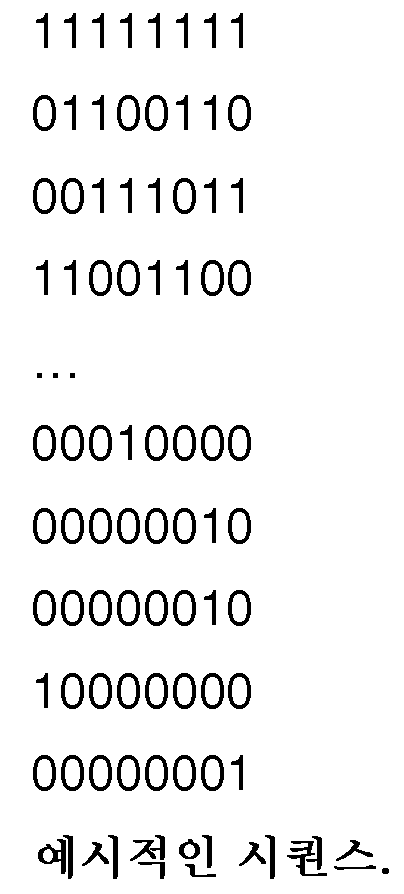
부모 셀 내에서의 자식 셀들의 특정 횡단 순서는 본 실시예들에 대해 매우 관련되지 않음을 유의한다. 원칙적으로, 임의의 횡단 순서가 본 실시예들에 대해 사용될 수 있다. 다음에 있어서, 자식 셀 구성을 표현하는데 사용된 비트들의 스트링이 심볼로서 표기된다. 표 1의 예에 있어서, 8개의 비트들이 각각의 심볼에 대해 사용된다. 다른 구현들에 있어서, 심볼 내 비트들의 수는 변할 수도 있다. 예를 들어, 쿼드트리에 대한 자식 셀 구성을 표현하기 위해 4비트 스트링이 사용되며, 따라서, 도 2의 예에 있어서의 심볼에 대한 비트들의 수는 4이다.Note that the specific traversal order of the child cells within the parent cell is not very relevant for these embodiments. In principle, any transverse sequence can be used for these embodiments. In the following, the string of bits used to represent the child cell configuration is denoted as a symbol. In the example of Table 1, eight bits are used for each symbol. In other implementations, the number of bits in a symbol may vary. For example, a 4-bit string is used to represent the child cell configuration for the quadtree, so the number of bits for the symbol in the example of FIG. 2 is 4.
도 5는 옥트리 구조의 일 예를 도시한다. 각각의 노드는 심볼과 연관되고, 각각의 계층은 트리 표현의 특정 정확도에 대응한다. 초기 셀은 8개의 셀들로 분할된다. 자식 셀들(1, 2, 5, 6, 및 7)은 더 많은 정점들을 포함하고 자식 셀들(3, 4, 및 8)은 비어 있어서, 계층 0에서의 자식 셀 구성을 표현하기 위해 8비트 심볼(11001110)을 발생시킨다(510). 각각의 비어있지 않은 자식 셀들은 추가로 분할되고, 대응하는 자식 셀 구성은 계층 1에서 표현된다. 세분화는, 각각의 비어있지 않은 셀이 오직 하나의 정점만을 포함할 때까지 계속될 수 있다.Figure 5 shows an example of an octree structure. Each node is associated with a symbol, and each layer corresponds to a specific accuracy of the tree representation. The initial cell is divided into eight cells. The
옥트리의 너비-우선 횡단을 이용하여, 3D 메시의 정점 위치들이 심볼들의 시퀀스로 조직될 수 있다. 도 5에서의 예에 대해, 심볼들의 시퀀스는 11001110, 11000000, 10010100, 00100110, 00001000, 및 00001000이 된다.Using the width-first traversal of the octree, the vertex positions of the 3D mesh can be organized into a sequence of symbols. For the example in FIG. 5, the sequence of symbols is 11001110, 11000000, 10010100, 00100110, 00001000, and 00001000.
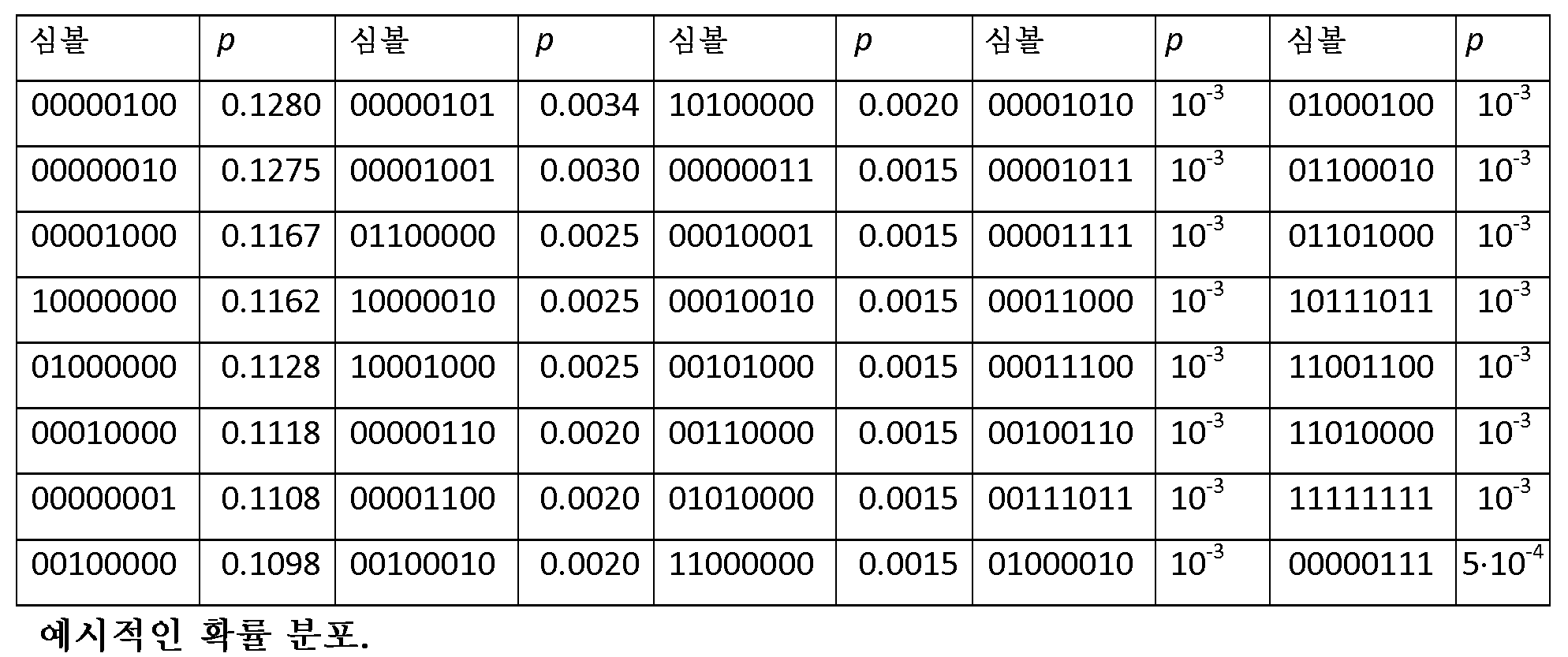
복소 3D 모델에서 가장 빈번히 발생하는 심볼들의 확률 분포가 표 2에 확률의 내림 차순으로 나타내어진다. 표 2로부터 알 수 있는 바와 같이, 이진 표현에 있어서 오직 하나의 '1'을 갖는 심볼들이 지배적 확률(> 93%)로 발생한다. 지오메트릭 설명은 정점들이 수개의 세분화 이후 셀을 좀처럼 공유하지 않는다는 것일 수도 있다. 즉, 옥트리의 하위 계층들은 오직 하나의 '1'을 갖는 심볼들에 의해 지배되고, 다른 심볼들은 상위 계층들에서 더 종종 발생한다.The probability distributions of the most frequently occurring symbols in the complex 3D model are shown in descending order of probability in Table 2. As can be seen from Table 2, symbols with only one '1' in the binary representation occur with a dominant probability (> 93%). The geometric description may be that vertices rarely share cells after several subdivisions. That is, the lower layers of the octree are dominated by symbols with only one '1', and other symbols occur more often in higher layers.
본 실시예들에 따르면, 2개의 심볼 세트들 - 모든 가능한 심볼들을 포함하는 유니버셜 심볼 세트, 즉, S0 = {1, 2, 3, …, 255}, 및 오직 하나의 '1'을 갖는 심볼들, 즉, 가장 빈번히 발생하는 심볼들을 포함하는 심볼 세트, 즉, S1 = {1, 2, 4, 8, 16, 32, 64, 128} - 을 정의한다. 표현의 용이를 위해, 8비트 이진 스트링들이 십진수로서 기입된다. 심볼은, 심볼 세트 S1에 속하면 S1 심볼로 지칭되고, 그렇지 않으면 비-S1 심볼로 지칭된다.According to these embodiments, two sets of symbols-a set of universal symbols containing all possible symbols, i.e., S0 = {1, 2, 3, ... , 1, 2, 4, 8, 16, 32, 64, 128}, including the symbols with the most frequently occurring symbols, -. For ease of presentation, 8-bit binary strings are written as decimal numbers. The symbol is referred to as the S1 symbol if it belongs to the symbol set S1, otherwise it is referred to as the non-S1 symbol.
옥트리의 통계적 특성으로부터 이익을 얻기 위해, "A model-adaptive entropy coding method for octree compression"의 명칭의 공동 소유된 PCT출원 제PCT/CN2011/077279호는 옥트리에 의해 표현된 시퀀스를, S0 또는 S1으로 적응적으로 코딩된 수개의 서브-시퀀스들로 파티셔닝하도록 제안한다. 서브-시퀀스 경계들의 인덱스들은 보조 정보로서 코딩된다. 보조 정보의 오버헤드(예를 들어, 각각의 인덱스에 대해 2바이트) 때문에, 연속적인 S1 심볼들의 일반적으로 큰 서브-시퀀스들은 심볼 세트 S1로 코딩된다.In order to benefit from the statistical nature of the Octree, the co-owned PCT Application No. PCT / CN2011 / 077279 entitled " A model-adaptive entropy coding method for octree compression " describes a sequence represented by Octree as S0 or S1 It is proposed to partition into several adaptively coded sub-sequences. The indices of sub-sequence boundaries are coded as auxiliary information. Because of the overhead of the auxiliary information (e.g., 2 bytes for each index), generally large sub-sequences of consecutive S1 symbols are coded into the symbol set S1.
S1 심볼들 및 비-S1 심볼들 양자가 시퀀스의 부분에서 발생할 경우 - S1 심볼들이 훨씬 더 큰 확률들을 가짐 -, 오버헤드 때문에, 그러한 부분을 수개의 서브-시퀀스들로 분할하는 것은 효율적이지 않다. 한편, 비-S1 심볼들이 낮은 확률들로 발생하기 때문에, 그러한 부분을 심볼 세트 S0으로 코딩하는 것은 또한 효율적이지 않다.When both S1 symbols and non-S1 symbols occur in a portion of a sequence-S1 symbols have much greater probabilities-due to overhead, it is not efficient to divide that portion into several sub-sequences. On the other hand, since non-S1 symbols occur with low probabilities, it is also not efficient to code such portions into symbol sets S0.
본 원리들은 시퀀스의 상이한 부분들에서 가변하는 통계들을 사용하여 심볼들의 시퀀스를 효율적으로 압축하기 위한 계위적 엔트로피 인코딩/디코딩 방법 및 장치를 제공한다. 다음의 실시예들은 3D 메시 모델들의 옥트리 표현들에 주로 기초한다. 하지만, 본 원리들은, 하기에 추가로 정의되는 바와 같이, 다른 데이터 세트들 또는 어플리케이션들에 적응될 수도 있다.These principles provide a scalable entropy encoding / decoding method and apparatus for efficiently compressing a sequence of symbols using varying statistics in different parts of the sequence. The following embodiments are based primarily on the octree representations of 3D mesh models. However, these principles may be adapted to other data sets or applications, as further defined below.
도 6은 심볼들의 시퀀스가 3개의 서브-시퀀스들로 어떻게 파티셔닝될 수 있는지, 및 3개의 상이한 심볼 세트들이 인코딩을 위해 어떻게 사용되는지를 예시한 일 예이다. 본 구현들에 있어서, 심볼 세트를 이용하여 심볼들의 시퀀스를 엔트로피 인코딩하는 것은 심볼 세트에 대한 통계적 모델, 즉, 심볼 세트의 각각의 심볼의 확률이 엔트로피 코딩을 위해 사용됨을 의미한다. 통상적으로, 확률들은 특정 심볼 세트에 대한 큰 데이터 세트를 이용하여 트레이닝된다. 따라서, 2개의 상이한 심볼 세트들에서 나타나는 심볼은 2개의 심볼 세트들에서의 상이한 확률들에 대응할 수도 있다. 표 2의 예에 대해, 심볼 ‘10000000’은 S0 및 S1 양자에서 나타나며, S0에서 Prob(‘10000000’) = 0.1162이고, S1에서 Prob(‘10000000’) = 0.1245이다.6 is an illustration of how a sequence of symbols can be partitioned into three sub-sequences and how three different sets of symbols are used for encoding. In these implementations entropy encoding a sequence of symbols using a symbol set means that a statistical model for the symbol set, i.e., the probability of each symbol of the symbol set, is used for entropy coding. Typically, probabilities are trained using a large set of data for a particular set of symbols. Thus, the symbols appearing in the two different symbol sets may correspond to the different probabilities in the two symbol sets. For the example of Table 2, the symbol '10000000' appears in both S0 and S1, and Prob ('10000000') = 0.1162 in S0 and Prob ('10000000') = 0.1245 in S1.
예시의 용이를 위해, 옥트리 대신 이진 트리(610)가 도 6에서 사용된다. 이러한 이진 트리에서의 각각의 노드는 2비트 심볼과 연관된다. 심볼이 '11'일 경우에는, 2개의 자식 노드들을 갖고; 심볼이 '10'일 경우에는, 오직 좌측 자식 노드를 가지며; 심볼이 '01'일 경우에는, 오직 우측 자식 노드를 갖는다. 심볼 세트 S0는 모두 3개의 가능한 심볼들을 포함한다. 이 예에 있어서, 심볼 세트 S1는 심볼들 '01' 및 '10'을 포함하며, 이들 양자는 비트 스트링에서 오직 하나의 '1'을 갖는다. 따라서, 이 예에 있어서, 심볼 세트 S0는 옥트리에 대한 유니버셜 심볼 세트에 대응하고, S1은 심볼 세트 {1, 2, 4, 8, 16, 32, 64, 128}에 대응한다.For ease of illustration, a
이진 트리(610)에 있어서, 심볼들 '10' 및 '01'은 하위 계층들을 지배하고, '11'은 상위 계층들에서 더 높은 확률을 갖는다. 이진 트리(610)는 3개의 부분들로 분할되고, 각각의 부분은 심볼들의 서브-시퀀스에 대응한다. 트리의 상위 부분(P0)은 서브-시퀀스(620)에 대응하고, 중간 부분(P2)은 서브-시퀀스(630)에 대응하며, 하위 부분(P1)은 서브-시퀀스(640)에 대응한다. 심볼 세트 S0의 모든 심볼들은 서브 시퀀스들(620 및 630)에 존재하며, '11'은 630에서보다는 620에서 더 빈번히 발생한다. 이 예에 있어서, 오직 심볼들 '01' 및 '10'만이 서브-시퀀스(640)에 나타난다. '11'은 또한 P1에 훨씬 더 낮은 확률로 포함될 수 있을 가능성이 있다.In the
서브-시퀀스(620)는 심볼 세트 S0을 이용하여 엔트로피 인코딩되고, 서브-시퀀스(640)는 S1을 이용하여 엔트로피 인코딩된다. 서브-시퀀스(630)는 본 원리들의 원리들에 따른 계위적 엔트로피 인코딩 메커니즘으로 인코딩된다.
도 7은 3D 메시의 지오메트리 데이터를 압축하기 위한 예시적인 방법(700)을 도시한다. 이 방법에 있어서, 지오메트리 데이터는 옥트리에 의해 표현된다. 옥트리는 먼저 3개의 부분들: P0, P1, 및 P2로 파티셔닝되고, 3개의 심볼 세트들: S0, S1, 및 S2가 정의된다. 트리의 각각의 부분은 적절한 통계적 모델로 효율적으로 압축된다. 이 예에 있어서, S1은 S0의 서브세트이고, S2는 S1과 사전-결정된 심볼 'X'의 합집합, 즉, S2 = {S1, ‘X’}이다. 다른 실시예들에 있어서, S0 및 S1은 다른 심볼들을 포함할 수도 있고, S2는 S1과의 다른 관련성들에 있을 수도 있다. 3개의 서브스트림들은 그 부분들 각각을 엔트로피 코딩함으로써 형성된다. 그 후, 비트스트림은 3개의 서브스트림들을 다른 정보 - 예를 들어, 적절한 디코딩을 가능케 하기 위한 보조 정보 - 와 결합함으로써 생성될 수 있다.FIG. 7 illustrates an
방법(700)은 기능 블록 710으로 제어를 전달하는 시작 블록 705를 포함한다. 블록 710에서, 3D 메시의 지오메트리 데이터가 수신되고, 블록 720에서, 옥트리가 지오메트리 데이터를 표현하기 위해 생성된다. 옥트리는 수신된 지오메트리 데이터에 대응하는 심볼들의 완전한 시퀀스로서 간주될 수도 있다. 블록 730에서, 옥트리는 3개의 부분들: 상위 부분(P0), 하위 부분(P1), 및 중간 부분(P2)으로 파티셔닝된다. 각각의 부분은 서브-시퀀스에 대응한다. 결과적으로, 심볼들의 완전한 시퀀스는 3개의 서브-시퀀스들로 분할된다.The
그 후, 서브-시퀀스들은 엔트로피 인코딩된다. 블록 740에서, 상위 부분에 대응하는 서브-시퀀스는 심볼 세트 S0을 이용하여 엔트로피 인코딩되고; 블록 750에서, 중간 부분에 대응하는 서브-시퀀스는 계위적 엔트로피 인코딩을 이용하여 엔트로피 인코딩되며; 블록 760에서, 하위 부분은 심볼 세트 S1 및 그 통계적 모델을 이용하여 엔트로피 인코딩된다. 블록 770에서, 헤더 정보가 생성된다. 서브스트림들과 헤더 정보는 결합되고, 블록 780에서 비트스트림으로 컴파일된다. 그 후, 제어는 종료 블록 799로 전달된다.Sub-sequences are then entropy encoded. In
방법(700)에 있어서, 상위 부분에 대한 심볼들의 서브-시퀀스는 중간 및 하위 부분에 대한 서브-시퀀스 이전에 인코딩된다. 인코딩의 다른 순서들이 또한 이용될 수 있다.In
블록 750에서 사용될 수도 있는, 비트스트림을 출력하기 위해 심볼들의 입력 시퀀스를 인코딩하기 위한 예시적인 계위적 엔트로피 인코딩 방법이 방법(800)으로서 도 8에 도시된다. 일 예에 있어서, 심볼들의 시퀀스는 옥트리의 중간 부분에 대한 서브-시퀀스에 대응한다. 다른 실시예에 있어서, 심볼들의 시퀀스는 다른 소스들, 예를 들어, 쿼드트리에 의해 표현된 2D 좌표들의 세트로부터 생성될 수도 있다.An exemplary scalar entropy encoding method for encoding an input sequence of symbols to output a bit stream, which may be used in
방법(800)은 기능 블록 810으로 제어를 전달하는 시작 블록 805를 포함한다. 블록 810에서, 심볼들의 시퀀스가 입력으로서 수신된다. 블록 820에서, 심볼이 심볼들의 시퀀스로부터 판독된다. 블록 830에서, 심볼이 심볼 세트 S1에 속하는지가 결정된다. 심볼이 S1에 속하지 않으면, 블록 840에서, 사전-결정된 심볼 'X'가 심볼 세트 S2(S2 = {S1, 'X'})를 이용하여 먼저 엔트로피 인코딩되고, 그 후, 심볼 자체가 블록 850에서 심볼 세트 S0(S0 ⊃ S1)을 이용하여 엔트로피 인코딩된다. 심볼이 S1에 속하면, 블록 860에서, 심볼 세트 S2({S1, 'X'})를 이용하여 엔트로피 인코딩된다. 블록 870에서, 시퀀스 내의 모든 심볼들이 인코딩되었는지가 체크된다. 모든 심볼들이 인코딩되었으면, 제어는 종료 블록 899로 전달되고; 그렇지 않으면, 블록 820으로 리턴된다.The
심볼 세트 S2는 심볼 세트 S1에 부가하여 사전-결정된 심볼 'X'를 포함한다. 더 작은 심볼 세트 S1 및 부가적인 심볼을 이용하여, 완전한 심볼 세트 S0 대신, 옥트리의 중간 부분에서의 S1 심볼들이 더 효율적으로 인코딩될 수 있다. 각각의 비-S1 심볼들이 먼저 'X'로서 표현되고 'X'로서 엔트로피 인코딩된 이후 심볼 자체의 엔트로피 코딩이 실시된다. 즉, 심볼 'X'는 비-S1 심볼들의 집합으로서 간주될 수 있다. 따라서, 도 8에서 기술된 엔트로피 인코딩 방법 및 그 대응하는 디코딩 방법은 계위적 엔트로피 인코딩/디코딩으로서 지칭된다.The symbol set S2 includes a pre-determined symbol 'X' in addition to the symbol set S1. Using the smaller symbol set S1 and the additional symbols, instead of the complete symbol set S0, the S1 symbols in the middle part of the octree can be encoded more efficiently. Each non-S1 symbol is first represented as 'X' and entropy-encoded as 'X', followed by entropy coding of the symbol itself. That is, the symbol 'X' can be regarded as a set of non-S1 symbols. Thus, the entropy encoding method and its corresponding decoding method described in FIG. 8 are referred to as hierarchical entropy encoding / decoding.
상기 논의들은 주로 3D 메시의 지오메트리 데이터를 압축하는 것에 집중하지만, 그러한 계위적 엔트로피 인코딩/디코딩 방법은 또한, 시퀀스의 상이한 부분들에서 상이한 통계들을 갖는 데이터의 임의의 시퀀스에 적용될 수 있다. 특히, 일부 부분들은 사전-정의된 심볼 세트들로 인코딩될 수 있으며, 다른 부분들은 사전-결정된 심볼들을 사전-정의된 심볼들 내에 도입함으로써 인코딩될 수 있다. 이러한 방법의 이점은, 단지 몇몇 심볼 세트들만이 요구되고 따라서 심볼 세트들을 스위칭할 때를 나타냄에 있어서의 오버헤드를 감소시킨다는 것이다. 부가적으로, 빈번히 발생하는 심볼들에 대한 작은 심볼 세트(즉, 완전한 심볼 세트 대신 작은 사전-정의된 심볼 세트 및 사전-결정된 심볼)를 이용하는 것은 압축 효율을 개선시킬 수 있다.While the above discussions focus primarily on compressing the geometric data of 3D meshes, such a hierarchical entropy encoding / decoding method may also be applied to any sequence of data with different statistics in different parts of the sequence. In particular, some portions may be encoded with pre-defined symbol sets and other portions may be encoded by introducing pre-determined symbols into pre-defined symbols. The advantage of this method is that only a few symbol sets are required and therefore reduce the overhead in indicating when to switch symbol sets. Additionally, using a small symbol set (i.e., a small pre-defined symbol set and a pre-determined symbol instead of a complete symbol set) for frequently occurring symbols may improve compression efficiency.
본 원리들에 따르면, 지오메트리 데이터의 효율적인 인코딩을 가능케 하기 위해 옥트리를 적절히 파티셔닝하는 것이 요구된다. 일 실시예에 있어서, 일 원리는 하위 부분(P1)을 가능하면 크게 하는 것이고 또한 중간 부분(P2) 및 하위 부분(P1)에서의 비-S1 심볼들의 발생을 제한하는 것이다.According to these principles, it is desirable to properly partition the octrees to enable efficient encoding of the geometry data. In one embodiment, one principle is to make the lower portion P1 as large as possible and to limit the generation of non-S1 symbols in the middle portion P2 and the lower portion P1.
파티션partition P1P1 및 And P2P2
심볼 세트 S2가 심볼 세트 S1보다 하나 더 많은 심볼 'X'를 포함하기 때문에, 중간 부분(P2)의 압축 효율은 P1의 압축 효율보다 더 낮다. 따라서, S1에 의해 효율적으로 인코딩될 수 있는 큰 P1은 높은 코딩 효율을 획득하도록 요구된다. P1을 가능하면 크게 하기 위해, 비-S1 심볼들이 또한 P1에서 허용된다.Since the symbol set S2 contains one more symbol 'X' than the symbol set S1, the compression efficiency of the intermediate portion P2 is lower than the compression efficiency of P1. Thus, a large P1 that can be efficiently encoded by S1 is required to obtain high coding efficiency. To make P1 as large as possible, non-S1 symbols are also allowed at P1.
S1 심볼들이 심볼 세트 S1에 의해 압축되지만, 비-S1 심볼들은 심볼 세트 S0으로 압축된다. 비-S1 심볼의 위치를 나타내기 위해, 비-S1 심볼의 계층 인덱스 및 계층 내 위치가 비트스트림에 기입된다. 비-S1 심볼들의 인코딩은, 심볼들 및 그 위치들 양자가 인코딩될 필요가 있기 때문에 고가이다. 따라서, P1에서의 비-S1 심볼들의 수는 제한되어야 한다.The S1 symbols are compressed by the symbol set S1, but the non-S1 symbols are compressed by the symbol set SO. To indicate the position of the non-S1 symbol, the layer index of the non-S1 symbol and the position in the hierarchy are written to the bitstream. The encoding of non-S1 symbols is expensive because both the symbols and their positions need to be encoded. Therefore, the number of non-S1 symbols in P1 should be limited.
P1의 사이즈와 P1에서의 비-S1 심볼들의 수 간의 밸런스에 도달하기 위해, 임계치 기반 방법이 이용된다. 이 방법에 있어서, 옥트리의 너비-우선 횡단에 의해 획득된 심볼 시퀀스를 SEQ_BF로서 정의한다. 그 후, SEQ_BF의 말단으로부터 비-S1 심볼들을 탐색하며, 비-S1 심볼이 발견되고 이 비-S1 심볼과 사전에 발견된 비-S1 심볼 간의 거리가 th1보다 작을 경우에 탐색을 중지한다. 이 비-S1 심볼 아래의 모든 계층들은 P1의 부분이다. 하위 부분(P1)의 상위 계층의 인덱스가 비트스트림에 기입되어, P1을 획득하기 위해 옥트리가 어떻게 파티셔닝되는지를 나타낸다.To arrive at a balance between the size of P1 and the number of non-S1 symbols in P1, a threshold-based method is used. In this method, the symbol sequence obtained by the breadth-first traversal of the octree is defined as SEQ_BF. Then, non-S1 symbols are searched from the end of SEQ_BF, and the search is stopped if a non-S1 symbol is found and the distance between the non-S1 symbol and the previously found non-S1 symbol is smaller than th1 . All layers below this non-S1 symbol are part of P1. The index of the upper layer of the lower portion P1 is written into the bitstream to indicate how the octree is partitioned to obtain P1.
파티션partition P0P0 및 And P2P2
다른 임계치가 중간 부분(P2)으로부터 상위 부분(P0)을 분리하는데 사용된다. 그 파티션을 결정하기 위해, 먼저, 시작부로부터 SEQ_BF를 계층 단위로 스캐닝하고, th0% 초과의 비-S1 심볼들을 포함하는 각각의 계층은 초기 상위 부분(P0)에 포함되며, 여기서, th0은 사전-정의된 임계치이다. 스캐닝은, th0% 미만의 비-S1 심볼들을 포함하는 계층에 도달할 경우에 중지한다. 스캐닝이 중지한 계층 및 그 위의 계층들은 초기 상위 부분(P0)을 형성한다. 하위 부분(P1) 및 초기 P0를 배제한 계층들은 초기 중간 부분(P2)을 형성한다. 초기 P2에서의 일부 계층들은 또한 th0% 초과의 비-S1 심볼들을 포함할 수 있음을 유의한다.Another threshold value is used to separate the upper portion PO from the middle portion P2. To determine the partition, first scan the SEQ_BF layer by layer from the beginning, and each layer containing non-S1 symbols in excess of th0 % is included in the initial higher part (P0), where th0 is a dictionary - a defined threshold. The scanning will be stopped if it reaches the layer containing the non-symbol -S1 under th0%. The layers where scanning stops and the layers thereon form an initial upper portion P0. The layers excluding the lower part P1 and the initial P0 form an initial intermediate part P2. It is noted that some layers at the initial P2 may also contain non-S1 symbols in excess of th0 %.
S1 심볼과 연관된 노드는 S1 노드로서 정의되고, 그렇지 않으면 비-S1 노드로서 정의된다. 상위 부분(P0)의 단말 노드들(즉, 리프들)의 세트는 P0의 더 낮은 경계로서 정의된다. 예를 들어, 초기 P0의 더 낮은 경계는 초기 P0에서의 노드들의 최저 계층이다. 그 후, P0과 P2의 분리는 P0의 더 낮은 경계를 이용하여 반복적으로 정제되고; 비-S1 노드들의 자식들은 P0에 포함되며, S1 노드들의 자식들은 P2에 포함된다. 하위 부분(P1)으로부터의 심볼들은 P0 또는 P2의 부분이 되지 않음을 유의한다.The node associated with the S1 symbol is defined as an S1 node, otherwise it is defined as a non-S1 node. The set of leaf nodes (i. E., Leafs) of the upper portion P0 is defined as the lower boundary of P0. For example, the lower boundary of the initial P0 is the lowest layer of nodes at the initial P0. The separation of P0 and P2 is then repeatedly refined using the lower boundary of P0; The children of the non-S1 nodes are included in P0, and the children of S1 nodes are included in P2. Note that the symbols from the lower portion P1 are not part of P0 or P2.
도 9로 돌아가면, P0가 P2로부터 어떻게 분리되는지를 나타낸 예가 방법(900)으로서 일반적으로 도시된다. 방법(900)은 기능 블록 910으로 제어를 전달하는 블록 905에서 시작한다. 블록 910에서, 트리 데이터 구조가 입력으로서 수신된다. 이 예에 있어서, 트리 데이터 구조는 하위 부분(P1)을 배제한 옥트리에 대응한다. 도 6에서의 이진 트리와 같은 다른 트리 데이터 구조들이 또한 파티셔닝을 위해 입력될 수 있다. 임계치(th0)를 이용하여, 초기 상위 부분(P0) 및 초기 중간 부분(P2)이 블록 920에서 형성된다. 블록 930에서, 노드가 P0의 더 낮은 경계로부터 판독된다. 블록 940에서, 노드가 S1 노드인지가 체크된다. 노드가 S1 노드이면, 블록 950에서, 그 자식 노드들은 중간 부분(P2)에 포함되고; 그렇지 않으면, 블록 960에서, 그 자식 노드들은 상위 부분(P0)에 포함된다. 그 후, 상위 부분(P0), 중간 부분(P2), 및 P0의 더 낮은 경계가 블록 970에서 업데이트된다. 블록 980에서, P0의 더 낮은 경계에서 비-S1 노드들이 존재하는지가 체크된다. 비-S1 노드들이 존재하면, 제어는 블록 930으로 리턴되고; 그렇지 않으면, 제어는 종료 블록 999로 전달된다.Returning to Fig. 9, an example of how P0 is separated from
이전에 논의된 바와 같이, 통상적으로, S1 노드들은 옥트리에서 90% 초과의 노드들로 이루어진다. 따라서, 극단적인 경우에 있어서, 하위 부분(P1)을 배제한 모든 노드들은 심볼 세트 S2로 인코딩될 수 있고, P0와 P2 사이에 어떠한 분리도 필요하지 않다. 하지만, 이는 대량의 'X'들을 발생시켜 인코딩이 덜 효율적이게 할 수도 있다. 일반적으로, 비-S1 노드들이 옥트리의 상위 계층들에서 훨씬 더 빈번히 발생하기 때문에, 심볼 세트 S0에서 P0를 분리하고 심볼 세트 S0로 P0를 인코딩하는 것이 더 효율적이다.As discussed previously, typically the S1 nodes consist of more than 90% of the nodes in the octree. Thus, in the extreme case, all the nodes excluding the lower part P1 can be encoded into the symbol set S2, and no separation between P0 and P2 is required. However, this may result in a large number of 'X' s which make the encoding less efficient. In general, it is more efficient to separate P0 from symbol set So and encode Po into symbol set S0, since non-S1 nodes occur much more frequently in the upper layers of the octree.
사전-정의된 임계치들에 관하여, 그 사전-정의된 임계치들은 코딩될 정점 위치들의 타입에 의해 결정될 수도 있다. 일 예에 있어서, th0 = 15 및 th1 = 50이 드문드문한 포인트 위치들의 압축을 위해 사용된다. 다른 예에 있어서, th0 = 10 및 th1 = 200이 특정 3D 모델들로부터 획득된 빈틈없는 정점들을 위해 사용된다.For pre-defined thresholds, the pre-defined thresholds may be determined by the type of vertex positions to be coded. In one example, th0 = 15 and th1 = 50 are used for compression of sparse point positions. In another example, th0 = 10 and th1 = 200 are used for seamless vertices obtained from certain 3D models.
이전 예에 있어서, 심볼 세트 S2는 심볼 세트 S1과 'X'의 합집합이고, 즉, S2는 S1보다 단지 하나 더 많은 심볼만을 포함한다. 다른 실시예들에 있어서, S2는 다른 형태들을 취할 수도 있다. 예를 들어, 특정 비-S1 심볼들은 P2에서 높은 확률로 발생할 경우, S2에 포함될 수 있다. 일 실시예에 있어서, 이진 표현들에 있어서 2개의 '1'들을 갖는 심볼들은 더 많은 '1'들을 갖는 심볼들보다 더 빈번히 발생하고, 따라서, 이들 심볼들은 또한 S2에 포함된다. 따라서, S2는 {3, 5, 9, 17, 33, 65, 129, 6, 10, 18, 34, 66, 130, 12, 20, 36, 68, 132, 24, 40, 72, 136, 48, 80, 144, 96, 160, 192, 1, 2, 4, 8, 16, 32, 64, 128, X}가 되고, 8+28+1=37개의 심볼들을 포함한다.In the previous example, symbol set S2 is the union of symbol set S1 and 'X', i.e., S2 contains only one more symbol than S1. In other embodiments, S2 may take other forms. For example, certain non-S1 symbols may be included in S2 if they occur with a high probability in P2. In one embodiment, symbols with two '1's in binary representations occur more frequently than symbols with more' 1's, and so these symbols are also included in S2. Therefore, S2 is the number of times that S2 is to be set to {3, 5, 9, 17, 33, 65, 129, 6, 10, 18, 34, 66, 130, 12, 20, 36, 68, 132, 24, , 80, 144, 96, 160, 192, 1, 2, 4, 8, 16, 32, 64, 128, X} and includes 8 + 28 + 1 = 37 symbols.
옥트리가 3개의 부분들로 파티셔닝된 이후, 대응하는 서브-시퀀스들이 압축된다. 심볼 세트들 S0, S1 및 S2의 초기 통계적 모델들이 코덱에 입력들로서 제공된다. 인코딩 및 디코딩 프로세스들 동안, 통계적 모델들은 더 우수한 압축 효율을 위해 추가로 업데이트된다.After the octree is partitioned into three parts, the corresponding sub-sequences are compressed. Initial statistical models of the symbol sets S0, S1 and S2 are provided as inputs to the codec. During the encoding and decoding processes, the statistical models are further updated for better compression efficiency.
대량의 정점 데이터가 통계적 모델들을 트레이닝하기 위해 사용된다. 3개의 데이터 세트들이 각각 P0, P1 및 P2에 대해 구성되어, 대응하는 심볼 세트들에 대한 통계들을 수집한다. P2에서의 모든 비-S1 심볼들은 S2에 대한 통계적 모델링 프로세스 동안 'X'로서 간주됨을 유념한다.A large amount of vertex data is used to train statistical models. Three data sets are configured for P0, P1 and P2, respectively, to collect statistics for the corresponding symbol sets. Note that all non-S1 symbols at P2 are considered to be 'X' during the statistical modeling process for S2.
본 실시예들에 있어서, 3개의 서브스트림들: 즉, 서브스트림들(1, 2, 및 3)이 생성된다. 서브스트림들이 어떻게 조직되는지에 의존하여, 서브스트림은 특정 심볼 세트를 사용하여 서브-시퀀스 또는 엔트로피 코딩 엔진에 대응할 수도 있다. 서브스트림들의 수는, 다른 실시예들에 있어서, 예를 들어, 별도의 비트스트림이 서브-시퀀스와 심볼 세트의 각각의 조합에 대해 생성될 경우에 3 초과일 수도 있다.In the present embodiments, three sub-streams: i.
본 실시예에 있어서, 산술 코딩이 엔트로피 코딩을 위해 사용된다. 다른 엔트로피 코딩 방법들, 예를 들어, 허프만 코딩 및 딕셔너리 기반 압축이 또한 사용될 수 있다.In this embodiment, arithmetic coding is used for entropy coding. Other entropy coding methods, such as Huffman coding and dictionary based compression, may also be used.
수신측으로 하여금 서브스트림들을 적절히 디코딩할 수 있게 하기 위해, 보조 데이터가 서브스트림들에 부가하여 비트스트림에 기입된다. 도 10a는 예시적인 비트스트림 포맷을 도시한다. 예시적인 비트스트림은 헤더(1010), 서브스트림 1(1020), 서브스트림 2(1030), 및 서브스트림 3(1040)으로 이루어진다. 헤더(1010)가 도 10b에 추가로 도시된다. 헤더에서의 보조 정보의 포맷은, 하위 부분(P1)이 P1의 상위 계층의 인덱스("layer_index", 1050)를 이용하여, 중간 부분(P2)으로부터 어떻게 분리되는지에 관한 정보를 제공한다. 하위 부분(P1)에서 비-S1 심볼들의 위치들을 나타내기 위해, 헤더는 P1에서의 비-S1 심볼들의 수("No_non_S1", 1060) 및 그에 후속하는 그 위치들("location_non_S1i", 1070 및 1075)을 제공한다. 헤더는 또한, 서브스트림 1의 길이("len_substream1", 1080) 및 서브스트림 2의 길이("len_substream2", 1090)를 제공한다.In order to allow the receiving side to properly decode the substreams, auxiliary data is written to the bitstream in addition to the substreams. Figure 10A illustrates an exemplary bitstream format. An exemplary bitstream comprises a
도 11에 있어서, 생성된 비트스트림을 디코딩하고 옥트리를 재구성하기 위한 예시적인 방법(1100)이 도시된다. 엔트로피 디코딩이 진행함에 따라, 옥트리가 구성된다. 옥트리에서의 노드는, 사전-결정된 심볼 'X'가 디코딩될 경우를 제외하여 심볼이 디코딩된 이후에 구성된다. 상위 부분(P0)에서의 심볼들은 심볼 세트 S0를 이용하여 디코딩된다. 중간 부분(P2)에서의 심볼들은, 먼저, 심볼 세트 S2를 이용하여 디코딩된다. 'X'가 디코딩된 경우, 부가적인 심볼이 S0를 이용하여 디코딩되어 노드를 재구성한다, 즉, 어떠한 노드도 'X'에 대응하여 구성되지 않는다. 하위 부분(P1)에서의 비-S1 심볼들은 심볼 세트 S0을 이용하여 디코딩되고, 그 위치들이 헤더로부터 공지된다. P1에서의 다른 심볼들, 즉, S1 심볼들이 심볼 세트 S1을 이용하여 디코딩된다.In FIG. 11, an
방법(1100)은 기능 블록 1110으로 제어를 전달하는 시작 블록 1105로 시작한다. 블록 1110에서, 비트스트림이 수신된다. 블록 1120에서, 심볼이 비트스트림으로부터 디코딩된다. 블록 1130에서, 비 'X' 심볼이 디코딩될 경우에 옥트리의 노드가 재구성된다. 블록 1140에서, 옥트리가 완전히 재구성되는지, 즉, 옥트리 구성이 더 많은 심볼들을 더 이상 요청하지 않는지가 체크된다. 트리가 완료되지 않으면, 제어는 블록 1120으로 리턴된다. 그렇지 않으면, 블록 1150에서, 3D 메시의 지오메트리 데이터가 복구되고, 제어는 종료 블록 1199로 전달된다.The
입력 비트스트림을 디코딩하여 디코딩된 시퀀스를 출력하기 위한 예시적인 계위적 엔트로피 디코딩 방법(1200)이 도 12에 도시된다. 방법(1200)은, 비트스트림이 수신되는 기능 블록 1210으로 제어를 전달하는 시작 블록 1205로 시작한다. 블록 1220에서, 심볼은, S2 = {S1, ‘X’}에 대한 통계적 모델을 이용하여, 비트스트림으로부터 디코딩된다. 블록 1230에서, 디코딩된 심볼이 사전-결정된 심볼 'X'인지가 체크된다. 디코딩된 심볼이 사전-결정된 심볼 'X'가 아니면, 즉, S1 심볼이면, 제어는 블록 1270으로 전달된다. 그렇지 않으면, 블록 1250에서, 다른 심볼이 S0을 이용하여 비트스트림으로부터 디코딩된다.An exemplary scalar
블록 1270에서, 엔트로피 디코딩 프로세스가 종결되어야 하는지가 체크된다. 일 실시예에 있어서, 옥트리의 중간 부분이 완전히 구성된 경우, 엔트로피 디코딩 프로세스가 종료한다. 다른 실시예들에 있어서, 엔트로피 디코더가 단말 심볼에 도달하는지를 체크할 수 있다. 엔트로피 디코딩이 종결되어야 한다면, 제어는 종료 블록 1299로 전달된다. 그렇지 않으면, 제어는 블록 1220으로 리턴된다. At
도 13은 트리의 상위 부분을 재구성하기 위한 예시적인 방법(1300)을 도시한다. 트리 파티션과 부합하여, 너비-우선 횡단이 옥트리를 재구성하기 위해 사용된다. P0에서의 계층이 구성될 때마다, 비-S1 심볼들의 퍼센티지가 계산된다. 트리의 루트로부터 계층 단위로 스캐닝하여, th0% 미만의 비-S1 심볼들의 퍼센티지를 갖는 제1 계층 및 그 위의 계층들이 초기 상위 부분(P0)을 형성한다. 이는, 초기 상위 부분(P0) 및 P2가 어떻게 도 9에서 설명된 바와 같이 형성되는지와 부합함을 유의한다.FIG. 13 illustrates an
방법(1300)은 시작 블록 1305에서 시작하고, 초기 상위 부분(P0)이 형성되는 기능 블록 1310으로 제어를 전달한다. 블록 1320에서, 심볼이 비트스트림으로부터 판독되고, 블록 1330에서, 노드가 심볼을 이용하여 트리에서 재구성된다. 블록 1340에서, 심볼이 심볼 세트 S1에 속하는지가 체크된다. S1에 속하면, 제어는 블록 1360으로 전달된다. 그렇지 않으면, 블록 1350에서, 노드의 자식 노드들이 P0 노드들로서 마킹된다. 블록 1360에서, 아직 재구성되지 않은 임의의 마킹된 P0 노드들이 존재하는지가 체크된다. 어떠한 더 많은 재구성된 P0 노드들도 존재하지 않으면, 제어는 종료 블록 1399로 전달된다. 그렇지 않으면, 제어는 블록 1320으로 리턴된다.The
P0가 재구성된 이후, 방법(1400)으로서 도 14에 도시된 바와 같은 하나의 예시적인 실시예에서 P2가 재구성된다. P0에서의 단말 노드들에 대한 심볼들로부터, 트리가 그 재구성을 계속한다. 노드(1410)에 대한 심볼 '10'이 오직 좌측 자식 노드만을 가짐을 나타내기 때문에, P2에서의 제1 심볼이 노드(1410)의 좌측 자식 노드(1440)로서 재구성된다. 유사하게, P2에서의 그 다음 2개의 심볼들이 노드(1420)의 좌측 자식 노드(1450) 및 노드(1430)의 우측 자식 노드(1460)로서 재구성된다. P2에서의 제1 계층이 완료된 이후, 트리의 나머지 계층들이 재구성된다.After P0 is reconstructed, P2 is reconstructed in one exemplary embodiment as shown in Figure 14 as
P1의 상위 계층 인덱스가 주어지면, P2의 구성이 완료될 때가 공지될 수 있다. P1은 P2가 완료된 이후에 재구성된다.Given an upper layer index of P1, the time when the configuration of P2 is completed can be known. P1 is reconstructed after P2 is completed.
도 6은 일 예로 본 원리들의 동작을 감소된 치수로 도시한다. 더 용이한 이해를 위해, 도 6은 이진 트리에 의해 표현된 심볼들이 어떻게 3개의 서브-시퀀스들로 분할되는지 및 대응하는 심볼 세트들이 엔트로피 코딩을 위해 어떻게 사용되는지를 기술한다. 단순화를 위해, 이 실시예에 있어서, P1은 임의의 비-S1 심볼들을 포함하지 않으며; P0를 형성할 경우에 임계치 th0은 고려되지 않는다. 다음에 있어서, 이러한 이진 트리에 대한 인코딩 및 디코딩 프로세스들이 상세히 설명된다.Figure 6 illustrates, by way of example, the operation of these principles in a reduced dimension. For better understanding, FIG. 6 describes how the symbols represented by the binary tree are divided into three sub-sequences and how the corresponding symbol sets are used for entropy coding. For simplicity, in this embodiment, P1 does not include any non-S1 symbols; Threshold value th0 is not considered when forming P0. In the following, encoding and decoding processes for such a binary tree are described in detail.
인코딩 프로세스Encoding Process
먼저, 말단으로부터 너비-우선 횡단에 의해 노드들에 액세스하고 마지막 비-S1 노드(670)를 포함하는 계층을 위치지정한다. 이 계층 아래(라인 650 아래)의 모든 노드들은 P1의 부분이다. P1의 상위 계층 인덱스가 고정-길이 코딩에 의해 압축된다. P1에서의 노드들의 너비-우선 횡단에 의해 형성된 서브-시퀀스(640)가 심볼 세트 S1을 사용하여 서브스트림 3으로 압축된다.First, nodes are accessed by width-first traversal from the end and the layer containing the last
옥트리에서의 나머지 노드들이 추가로 P0 및 P2로 파티셔닝된다. 단순화를 위해, 임계치 th0은 P2로부터 P0을 분리함에 있어서 고려되지 않고, 즉, 몇몇 상위 계층들이 P0에 포함되어야 함이 지시되지 않는다. 그 후, 루트로부터 너비-우선 횡단에 의해 노드들에 액세스한다. 비-S1 심볼을 갖는 노드에 도달할 경우, 그 자식들 및 심볼 자체는 P0에 포함되며; 그렇지 않으면, 노드 자체는 P0에 포함되지만 그 자식들은 P2에 포함된다. 횡단은, 옥트리 내의 모든 노드들이 프로세싱된 경우에 중지한다. P1로부터의 노드들은 P0 또는 P2에 포함되지 않아야 함을 유의한다. P0의 너비-우선 횡단에 의해 획득된 서브-시퀀스(620)가 서브스트림 1로 압축된다.The remaining nodes in the octree are further partitioned into P0 and P2. For simplicity, the threshold th0 is not taken into account in separating P0 from P2, i.e., it is not indicated that some higher layers should be included in P0. The nodes are then accessed by a breadth-first traversal from the root. When reaching a node with a non-S1 symbol, its children and the symbol itself are included in P0; Otherwise, the node itself is included in P0, but its children are included in P2. The traversal stops if all the nodes in the octree are processed. Note that the nodes from P1 should not be included in P0 or P2. The
다른 서브-시퀀스(630)가 P2에서의 노드들의 너비-우선 횡단에 의해 형성된다. P2로부터의 심볼들은 서브스트림 2로 인코딩된다.Another
도 6의 예에 있어서, 파티셔닝된 및 재순서화된 서브-시퀀스들은 다음과 같다:In the example of FIG. 6, the partitioned and re-ordered sub-sequences are as follows:
P0에 대한 서브-시퀀스: 11, 11, 11, 10, 10, 11, 01, 01, 01;Sub-sequence for P0: 11, 11, 11, 10, 10, 11, 01, 01, 01;
P2에 대한 서브-시퀀스: 01, 01, 01, 10, 11, 01, 01, 01; 및Sub-sequence for P2: 01, 01, 01, 10, 11, 01, 01, 01; And
P1에 대한 서브-시퀀스: 10, 10, 10, 10, 01, 01, 01, 01, 01, 01, 10, 10.Sub-sequence for P1: 10, 10, 10, 10, 01, 01, 01, 01, 01, 01, 10,
P0 및 P1로부터의 서브-시퀀스들은 종래의 엔트로피 인코딩을 사용하여 각각 서브스트림들 1 및 3으로 인코딩된다. P2로부터의 서브-시퀀스에 대해, S1 심볼들 및 비-S1 심볼들이 상이하게 인코딩된다. 이 예에 있어서, P2에 오직 하나의 비-S1 심볼(‘11’, 670)이 존재한다. 이 심볼을 인코딩하기 위해, 'X'이 S2 = {S1, ‘X’}을 이용하여 먼저 인코딩된다. 그 후, 심볼 자체('11')가 S0을 이용하여 인코딩된다. 나머지 S1 심볼들이 S2를 이용하여 인코딩된다. 따라서, 하나의 부가적인 심볼이 P2에 대해 인코딩된다.The sub-sequences from P0 and P1 are encoded into
이 예에 있어서, 서브-시퀀스의 인코딩 결과는 서브스트림 내에 조직된다. 따라서, P0, P2, 및 P1에 대한 심볼들이 다음과 같이 각각 서브스트림들 1, 2, 및 3 내에 인코딩된다:In this example, the encoding result of the sub-sequence is organized in a sub-stream. Thus, the symbols for P0, P2, and P1 are encoded in
서브스트림 1에서의 심볼들: 11, 11, 11, 10, 10, 11, 01, 01, 01;Symbols in sub-stream 1: 11, 11, 11, 10, 10, 11, 01, 01, 01;
서브스트림 2에서의 심볼들: 01, 01, 01, 10, ‘X’, 11, 01, 01, 01;Symbols in sub stream 2: 01, 01, 01, 10, 'X', 11, 01, 01, 01;
서브스트림 3에서의 심볼들: 10, 10, 10, 10, 01, 01, 01, 01, 01, 01, 10, 10.Symbols in substream 3: 10, 10, 10, 10, 01, 01, 01, 01, 01,
디코딩 프로세스Decoding process
먼저, P1의 상위 계층 인덱스를 나타내는 layer_index를 디코딩한다. 본 원리들에 따르면, 서브스트림 1로부터 심볼들을 디코딩하고, 트리의 더 상위 부분을 너비-우선 횡단에 의해 재구성한다. S1 노드에 도달할 경우, 그 자식 노드들의 재구성이 스킵된다. 횡단은, 모든 P0 노드들이 재구성될 경우에 종결한다.First, layer_index indicating the upper layer index of P1 is decoded. According to the present principles, the symbols are decoded from
다음으로, 서브스트림 2로부터 심볼들을 디코딩하고, 트리를 너비-우선 횡단에 의해 재구성하는 것을 계속한다. 심볼 'X'를 획득할 경우, 노드의 실제 심볼로서 심볼 세트 S0로 부가적인 심볼을 디코딩한다. 횡단은, P0 및 P2에서의 계층들의 수가 layer_index에 의해 표시된 수에 도달할 경우에 종결한다.Next, it decodes the symbols from
다음으로, 서브스트림 3으로부터 심볼들을 디코딩하고, 트리를 너비-우선 횡단에 의해 재구성하는 것을 계속한다.Next, it decodes the symbols from
도 15는 도 10에서 기술된 비트스트림을 형성하는데 사용될 수 있는 예시적인 인코더의 블록 다이어그램을 도시한다. 인코더(1500)의 입력은 P1의 상위 계층의 계층 인덱스 및 심볼들의 시퀀스를 포함한다. 엔트로피 인코딩 엔진 1(1510)은 S2 = {S1, ‘X’}을 이용하여 심볼들을 인코딩한다. 엔트로피 인코딩 엔진 2(1520)는 심볼 세트 S0을 이용하여 인코딩하고, 엔트로피 인코딩 엔진 3(1530)은 심볼 세트 S1를 이용하여 인코딩한다.FIG. 15 shows a block diagram of an exemplary encoder that may be used to form the bitstream described in FIG. The input of the
모든 엔트로피 인코딩 엔진들은 각각의 초기 통계적 모델들로 시작한다. 전술된 바와 같이, 초기 통계적 모델들은 큰 데이터 세트들로부터 트레이닝될 수 있다. 엔트로피 인코딩 엔진들이 인코딩을 진행함에 따라, 통계적 모델들은, 통상적으로, 입력 데이터의 통계적 특성을 더 잘 포착하기 위해 업데이트된다. 3개의 별개의 엔트로피 인코딩 엔진들이 예시적인 인코더에서 논의된다. 실제 구현들에 있어서, 이들 엔진들은 다양한 통계적 모델들 간을 스위칭하는 하나의 단일 엔진으로서 구현될 수도 있다.All entropy encoding engines begin with their respective initial statistical models. As described above, initial statistical models can be trained from large data sets. As entropy encoding engines proceed with encoding, statistical models are typically updated to better capture the statistical properties of the input data. Three distinct entropy encoding engines are discussed in the example encoder. In actual implementations, these engines may be implemented as a single engine that switches between various statistical models.
헤더 정보 생성기(1540)는 비트스트림에 대한 보조 정보를 제공한다. 헤더 정보 생성기는 P1의 상위 계층의 계층 인덱스 및 서브스트림들 1 및 2의 길이들을 인코딩한다. 하위 부분(P1)에서 비-S1 심볼들이 존재할 경우, 그 위치들이 또한 헤더로 인코딩된다. 시퀀스를 디코딩하는데 요구되는 다른 정보가 또한 헤더에 포함되어야 한다. 옥트리를 파티셔닝하는데 사용되는 임계치들, 예를 들어, th0 및 th1은 3D 메시에 적응할 수도 있고, 비트스트림마다 변할 수도 있다. 인코더와 디코더를 동기화하기 위해, 그러한 적응적 임계치들이 헤더에 임베딩될 필요가 있다.The
인코더(1500)는 또한, 어느 엔트로피 인코딩 엔진이 심볼을 위해 사용될 것인지를 결정하는 것과 같은 기능들을 수행하는 제어기(1550)를 포함한다. 인코딩된 비트들 및 헤더 정보는, 예를 들어, 도 10에서 기술된 포맷에 따라, 비트스트림 어셈블러(1560)에 의해 출력 비트스트림으로 팩킹된다. 다양한 엘리먼트들 간의 상호접속들의 상세들은 도 15에 명시적으로 도시되지 않지만, 요구된 상호접속들은 당업자에 의해 이해된다.Encoder 1500 also includes a
도 16은 도 10에서 기술된 비트스트림을 디코딩하는데 사용될 수 있는, 도 15의 인코더(1500)에 대응하는 예시적인 디코더의 블록 다이어그램을 도시한다. 디코더는 통상적으로 인코더에 상호적임을 유의한다. 엔트로피 디코딩 엔진 1(1610)은 심볼 세트 S2 ({S1, ‘X’})를 이용하여, 엔트로피 인코딩 엔진 1에 의해 인코딩된 심볼들을 디코딩한다. 엔트로피 디코딩 엔진 2(1620)는 심볼 세트 S0을 이용하여, 엔트로피 인코딩 엔진 2에 의해 인코딩된 심볼들을 디코딩한다. 엔트로피 디코딩 엔진 3(1630)은 심볼 세트 S1 및 그 관련된 통계적 모델을 이용하여, 엔트로피 인코딩 엔진 3에 의해 인코딩된 심볼들을 디코딩한다. 헤더 정보 파서(1640)는 보조 정보를 디코딩한다.FIG. 16 shows a block diagram of an exemplary decoder corresponding to the
디코더(1600)는 또한, 어느 엔트로피 디코딩 엔진이 심볼을 디코딩하기 위해 사용될 것인지를 결정하는 것과 같은 기능들을 수행하는 제어기(1650)를 포함한다. 디코더(1600)는 심볼들의 시퀀스 및 다른 정보, 예를 들어, 서브스트림들의 길이들을 그 출력으로서 제공한다. 게다가, 디코더의 엘리먼트들 간의 요구된 상호접속들은 당업자에 의해 이해된다.
이제, 도 17을 참조하면, 상기 설명된 특징들 및 원리들이 적용될 수 있는 데이터 송신 시스템 또는 장치(1700)가 도시된다. 데이터 송신 시스템 또는 장치(1700)는, 예를 들어, 위성, 케이블, 전화 회선, 또는 지상 방송과 같은 다양한 미디어 중 임의의 미디어를 이용하여 신호를 송신하는, 예를 들어, 헤드-엔드 또는 송신 시스템일 수 있다. 데이터 송신 시스템 또는 장치(1700)는, 또한 대안적으로, 예를 들어, 저장을 위해 신호를 제공하도록 사용될 수 있다. 송신은 인터넷 또는 일부 다른 네트워크를 통해 제공될 수 있다. 데이터 송신 시스템 또는 장치(1700)는, 예를 들어, 비디오 콘텐츠 및 예를 들어 3D 메시 모델들과 같은 다른 콘텐츠를 생성 및 전달하는 것이 가능하다.Referring now to FIG. 17, there is shown a data transmission system or
데이터 송신 시스템 또는 장치(1700)는 프로세싱된 데이터 및 다른 정보를 프로세서(1701)로부터 수신한다. 일 구현에 있어서, 프로세서(1701)는 3D 메시 모델들의 지오메트리 데이터를 프로세싱하여 심볼들의 시퀀스들을 생성한다. 프로세서(1701)는 또한, 예를 들어, 트리 데이터 구조가 어떻게 3개의 부분들로 분할되는지, 적응적 임계치들, 및 부분(P1)에서의 비-S1 심볼들의 위치들을 나타내는 메타데이터를 1700에 제공할 수 있다.The data transmission system or
데이터 송신 시스템 또는 장치(1700)는 인코더(1702), 및 인코딩된 신호를 송신하는 것이 가능한 송신기(1704)를 포함한다. 인코더(1702)는 프로세서(1701)로부터 데이터 정보를 수신한다. 인코더(1702)는 인코딩된 신호(들)를 생성한다. 인코더(1702)의 엔트로피 인코딩 엔진은, 예를 들어, 산술 코딩 또는 허프만 코딩일 수도 있다.The data transmission system or
인코더(1702)는, 예를 들어, 다양한 피스들의 정보를 저장 또는 송신을 위한 구조화된 포맷으로 수신 및 어셈블리하는 어셈블리 유닛을 포함한 서브-모듈들을 포함할 수도 있다. 다양한 피스들의 정보는 예를 들어 코딩된 또는 코딩되지 않은 비디오, 및 예를 들어 서브스트림 길이 표시자 및 신택스 엘리먼트들과 같은 코딩된 또는 코딩되지 않은 엘리먼트들을 포함할 수도 있다. 일부 구현들에 있어서, 인코더(1702)는 프로세서(1701)를 포함하고, 따라서, 프로세서(1701)의 동작들을 수행한다.The
송신기(1704)는 인코더(1702)로부터 인코딩된 신호(들)를 수신하고, 인코딩된 신호(들)를 하나 이상의 출력 신호들로 송신한다. 송신기(1704)는, 예를 들어, 인코딩된 화상들 및/또는 그와 관련된 정보를 표현하는 하나 이상의 비트스트림들을 갖는 프로그램 신호를 송신하도록 적응될 수 있다. 통상적인 송신기들은, 예를 들어, 에러 정정 코딩을 제공하는 것, 신호에 있어서 데이터를 인터리빙하는 것, 신호에 있어서 에너지를 랜덤화하는 것, 및 변조기(1706)를 이용하여 신호를 하나 이상의 캐리어들 상으로 변조하는 것 중 하나 이상과 같은 기능들을 수행한다. 송신기(1704)는 안테나(도시 안됨)를 포함하거나 안테나와 인터페이스할 수도 있다. 추가로, 송신기(1704)의 구현들은 변조기(1706)에 한정될 수도 있다.
데이터 송신 시스템 또는 장치(1700)는 또한 저장 유닛(1708)에 통신가능하게 커플링된다. 일 구현에 있어서, 저장 유닛(1708)은 인코더(1702)에 커플링되고, 인코더(1702)로부터의 인코딩된 비트스트림을 저장한다. 다른 구현에 있어서, 저장 유닛(1708)은 송신기(1704)에 커플링되고, 송신기(1704)로부터의 비트스트림을 저장한다. 송신기(1704)로부터의 비트스트림은, 예를 들어, 송신기(1704)에 의해 추가로 프로세싱되었던 하나 이상의 인코딩된 비트스트림들을 포함할 수도 있다. 상이한 구현들에 있어서, 저장 유닛(1708)은 표준 DVD, 블루-레이 디스크, 하드 드라이브, 또는 일부 다른 저장 디바이스 중 하나 이상이다.The data transmission system or
이제, 도 18을 참조하면, 상기 설명된 특징들 및 원리들이 적용될 수도 있는 데이터 수신 시스템 또는 장치(1800)가 도시된다. 데이터 수신 시스템 또는 장치(1800)는, 예를 들어, 저장 디바이스, 위성, 케이블, 전화 회선, 또는 지상 방송과 같은 다양한 미디어를 통해 신호들을 수신하도록 구성될 수 있다. 신호들은 인터넷 또는 일부 다른 네트워크를 통해 수신될 수 있다.Referring now to FIG. 18, there is shown a data receiving system or
데이터 수신 시스템 또는 장치(1800)는, 인코딩된 비디오를 수신하고 디스플레이(예를 들어, 사용자로의 디스플레이)를 위해, 프로세싱을 위해, 또는 저장을 위해 예를 들어 디코딩된 비디오 신호를 제공하는 예를 들어 셀폰, 컴퓨터, 셋탑 박스, 텔레비전, 또는 다른 디바이스일 수도 있다. 따라서, 데이터 수신 시스템 또는 장치(1800)는 그 출력을, 예를 들어, 텔레비전의 스크린, 컴퓨터 모니터, (저장, 프로세싱, 또는 디스플레이를 위한)컴퓨터, 또는 일부 다른 저장, 프로세싱, 또는 디스플레이 디바이스에 제공할 수도 있다.The data receiving system or
데이터 수신 시스템 또는 장치(1800)는 데이터 정보를 수신 및 프로세싱하는 것이 가능하고, 데이터 정보는 예를 들어 3D 메시 모델들을 포함할 수도 있다. 데이터 수신 시스템 또는 장치(1800)는, 예를 들어, 본 출원의 구현에서 설명된 신호들과 같은 인코딩된 신호를 수신하는 수신기(1802)를 포함한다. 수신기(1802)는, 예를 들어, 3D 메시 모델들 및/또는 텍스처 이미지들 중 하나 이상을 제공하는 신호, 또는 도 17의 데이터 송신 시스템(1700)으로부터 출력된 신호를 수신할 수 있다.The data receiving system or
수신기(1802)는, 예를 들어, 인코딩된 화상들을 표현하는 복수의 비트스트림들을 갖는 프로그램 신호를 수신하도록 적응될 수 있다. 통상적인 수신기들은, 예를 들어, 변조된 및 인코딩된 데이터 신호를 수신하는 것, 복조기(1804)를 이용하여 하나 이상의 캐리어들로부터 데이터 신호를 복조하는 것, 신호에 있어서 에너지를 랜덤화 해제하는 것, 신호에 있어서 데이터를 디인터리빙하는 것, 및 신호를 에러 정정 디코딩하는 것 중 하나 이상과 같은 기능들을 수행한다. 수신기(1802)는 안테나(도시 안됨)를 포함하거나 안테나와 인터페이스할 수도 있다. 수신기(1802)의 구현들은 복조기(1804)에 한정될 수도 있다.
데이터 수신 시스템 또는 장치(1800)는 디코더(1806)를 포함한다. 수신기(1802)는 수신된 신호를 디코더(1806)에 제공한다. 수신기(1802)에 의해 디코더(1806)에 제공된 신호는 하나 이상의 인코딩된 비트스트림들을 포함할 수도 있다. 디코더(1806)는, 예를 들어, 비디오 정보를 포함하는 디코딩된 비디오 신호들과 같은 디코딩된 신호를 출력한다. 디코더(1806)는, 예를 들어, 도 16에서 기술된 디코더(1600)일 수도 있다.The data receiving system or
데이터 수신 시스템 또는 장치(1800)는 또한 저장 유닛(1807)에 통신가능하게 커플링된다. 일 구현에 있어서, 저장 유닛(1807)은 수신기(1802)에 커플링되고, 수신기(1802)는 저장 유닛(1807)으로부터의 비트스트림에 액세스한다. 다른 구현에 있어서, 저장 유닛(1807)은 디코더(1806)에 커플링되고, 디코더(1806)는 저장 유닛(1807)으로부터의 비트스트림에 액세스한다. 상이한 구현들에 있어서, 저장 유닛(1807)으로부터 액세스된 비트스트림은 하나 이상의 인코딩된 비트스트림들을 포함한다. 상이한 구현들에 있어서, 저장 유닛(1807)은 표준 DVD, 블루-레이 디스크, 하드 드라이브, 또는 일부 다른 저장 디바이스 중 하나 이상이다.The data receiving system or
일 구현에 있어서, 디코더(1806)로부터의 출력 데이터는 프로세서(1808)에 제공된다. 일 구현에 있어서, 프로세서(1808)는 3D 메시 모델 재구성을 수행하기 위해 구성된 프로세서이다. 일부 구현들에 있어서, 디코더(1806)는 프로세서(1808)를 포함하고, 따라서, 프로세서(1808)의 동작들을 수행한다. 다른 구현들에 있어서, 프로세서(1808)는, 예를 들어, 셋탑 박스 또는 텔레비전과 같은 다운스트림 디바이스의 부분이다.In one implementation, output data from
따라서, 특정한 특징들 및 양태들을 갖는 하나 이상의 구현들을 제공한다. 특히, 엔트로피 인코딩 및 디코딩에 관한 수개의 구현들을 제공한다. 계위적 엔트로피 인코딩 및 디코딩은, 예를 들어, 3D 메시의 지오메트리 데이터의 압축, 랜덤 2D 좌표들, 및 가변하는 통계들을 갖는 임의의 데이터 소스와 같은 다양한 어플리케이션들을 허용할 수도 있다. 하지만, 이들 구현들 및 부가적인 어플리케이션들의 변형예들은 본 개시 내에 있는 것으로 고려되며, 설명된 구현들의 특징들 및 양태들은 다른 구현들에 대해 적응될 수 있다.Thus providing one or more implementations with particular features and aspects. In particular, it provides several implementations for entropy encoding and decoding. Scaling entropy encoding and decoding may allow for a variety of applications, such as, for example, compression of geometry data of 3D meshes, random 2D coordinates, and any data source with varying statistics. However, modifications to these implementations and additional applications are considered within the present disclosure, and the features and aspects of the described implementations may be adapted for other implementations.
본 출원에서 설명된 수개의 구현들 및 특징들은 MPEG 3DGC 표준 및 그 확장물들의 컨텍스트에서 이용될 수 있다. 부가적으로, 이들 구현들 및 특징들은 (기존의 또는 장래의)다른 표준의 컨텍스트에서, 또는 표준과 관련되지 않은 컨텍스트에서 이용될 수도 있다.Several implementations and features described in this application can be used in the context of the MPEG 3DGC standard and its extensions. Additionally, these implementations and features may be used in the context of other (existing or future) standards, or in a context not related to the standard.
본 원리들뿐 아니라 그 변형예들의 "일 실시예" 또는 "실시예" 또는 "일 구현" 또는 "구현"에 대한 참조는 실시예들과 관련하여 설명된 특정한 특징, 구조, 특성 등이 본 원리들의 적어도 하나의 실시예에 포함됨을 의미한다. 따라서, 본 명세서 전반에 걸친 다양한 곳에서 나타나는 어구 "일 실시예에 있어서" 또는 "실시예에 있어서" 또는 "일 구현에 있어서" 또는 "구현에 있어서"뿐 아니라 임의의 다른 변형예들의 출현은 동일한 실시예를 반드시 모두 참조하는 것은 아니다.Reference to " an embodiment " or " an embodiment " or " an embodiment " or " an implementation " of the principles, as well as variations thereof, means that a particular feature, structure, Quot; is included in at least one embodiment of " Thus, the appearances of the phrase " in one embodiment " or " in an embodiment " or " in an implementation ", as well as any other variation, The embodiments are not necessarily all referring to the same.
부가적으로, 본 출원 또는 그 청구항은 다양한 피스의 정보를 "결정하는" 것을 참조할 수도 있다. 정보를 결정하는 것은, 예를 들어, 정보를 추정하는 것, 정보를 산출하는 것, 정보를 예측하는 것, 또는 메모리로부터 정보를 취출하는 것 중 하나 이상을 포함할 수도 있다.Additionally, the present application or claim may refer to " determining " information of various pieces. Determining the information may include, for example, one or more of estimating the information, calculating the information, predicting the information, or retrieving information from the memory.
예를 들어, "A/B", "A 및/또는 B" 및 "A 및 B 중 적어도 하나"에 있어서 다음의 "/", "및/또는", 및 "~ 중 적어도 하나" 중 임의의 것의 사용은 오직 첫번째 리스트된 옵션(A)만의 선택, 또는 오직 두번째 리스트된 옵션(B)만의 선택, 또는 옵션들(A 및 B) 양자의 선택을 포괄하도록 의도됨이 인식되어야 한다. 추가적인 예로서, "A, B, 및/또는 C" 및 "A, B 및 C 중 적어도 하나" 및 "A, B 또는 C 중 적어도 하나"의 경우들에 있어서, 그러한 어법은 오직 첫번째 리스트된 옵션(A)만의 선택, 또는 오직 두번째 리스트된 옵션(B)만의 선택, 또는 오직 세번째 리스트된 옵션(C)만의 선택, 또는 오직 첫번째 및 두번째 리스트된 옵션들(A 및 B)만의 선택, 또는 오직 첫번째 및 세번째 리스트된 옵션들(A 및 C)만의 선택, 또는 오직 두번째 및 세번째 리스트된 옵션들(B 및 C)만의 선택, 또는 모든 3개의 옵션들(A 및 B 및 C)의 선택을 포괄하도록 의도된다. 본 기술 및 관련 기술들의 당업자에 의해 용이하게 자명한 바와 같이, 이는 리스트된 다수의 아이템들로 확장될 수도 있다.For example, any of the following "/", "and / or" and "at least one of" in "A / B", "A and / or B" and "at least one of A and B" It is to be appreciated that the use of one is intended to encompass the selection of only the first listed option (A), or only the second listed option (B), or both options (A and B). As a further example, in the cases of "A, B, and / or C" and "At least one of A, B and C" and "At least one of A, B, or C" (A) alone, or only the second listed option (B), or only the third listed option (C), or only the first and second listed options (A and B), or only the first And the choice of only the third listed options A and C, or only the second and third listed options B and C, or all three options A and B and C, do. As will be readily apparent to those skilled in the art and related art, it may be extended to a number of items listed.
부가적으로, 다수의 구현들은 인코더(예를 들어, 인코더(1702)), 디코더(예를 들어, 디코더(1806)), 디코더로부터의 출력을 프로세싱하는 포스트-프로세서(예를 들어, 프로세서(1808)), 또는 인코더로의 입력을 제공하는 프리-프로세서(예를 들어, 프로세서(1701)) 중 하나 이상에서 구현될 수도 있다. 추가로, 다른 구현들이 본 개시에 의해 고려된다.Additionally, a number of implementations may be implemented using an encoder (e.g., encoder 1702), a decoder (e.g., decoder 1806), a post-processor ), Or a pre-processor (e.g., processor 1701) that provides input to an encoder. In addition, other implementations are contemplated by this disclosure.
본 명세서에서 설명된 구현들은, 예를 들어, 방법 또는 프로세서, 장치, 소프트웨어 프로그램, 데이터 스트림, 또는 신호에서 구현될 수 있다. 오직 구현의 신호 형태의 컨텍스트에서 논의되더라도(예를 들어, 오직 방법으로서 논의되더라도), 논의된 특징들의 구현은 또한 다른 형태(예를 들어, 장치 또는 프로그램)에서 구현될 수도 있다. 장치는, 예를 들어, 적절한 하드웨어, 소프트웨어, 및 펌웨어에서 구현될 수도 있다. 방법들은, 예를 들어, 컴퓨터, 마이크로프로세서, 집적 회로, 또는 프로그래머블 로직 디바이스를 포함하여 일반적으로 프로세싱 디바이스들을 지칭하는 예를 들어 프로세서와 같은 예를 들어 장치에서 구현될 수도 있다. 프로세서들 또한, 예를 들어, 컴퓨터들, 셀 폰들, 휴대용/개인용 디지털 보조기들("PDAs"), 및 최종 사용자들 간의 정보의 통신을 용이하게 하는 다른 디바이스들과 같은 통신 디바이스들을 포함한다.The implementations described herein may be implemented in, for example, a method or processor, a device, a software program, a data stream, or a signal. Although discussed in the context of only the signal form of the implementation (e.g., discussed only as a method), the implementation of the discussed features may also be implemented in other forms (e.g., a device or a program). The device may be implemented in, for example, suitable hardware, software, and firmware. The methods may be embodied in, for example, a device, such as a processor, for example, generally referred to as a processing device, including a computer, microprocessor, integrated circuit, or programmable logic device. The processors also include communication devices such as, for example, computers, cell phones, portable / personal digital assistants (" PDAs "), and other devices that facilitate communication of information between end users.
본 명세서에서 설명된 다양한 프로세스들 및 특징들의 구현들은 다양한 서로다른 장비들 또는 어플리케이션들, 특히, 예를 들어 데이터 인코딩, 데이터 디코딩, 3D 모델링, 3D 재구성, 및 3D 컴퓨터 그래픽스의 다른 프로세싱과 연관된 장비 또는 어플리케이션들에서 구현될 수 있다. 그러한 장비의 예들은 인코더, 디코더, 디코더로부터의 출력을 프로세싱하는 포스트-프로세서, 인코더로의 입력을 제공하는 프리-프로세서, 비디오 코더, 비디오 디코더, 비디오 코덱, 웹 서버, 셋탑 박스, 랩탑, 개인용 컴퓨터, 셀 폰, PDA, 게임 콘솔, 및 다른 통신 디바이스들을 포함한다. 명백한 바와 같이, 그 장비는 이동식일 수도 있고 심지어 이동 차량에 인스톨될 수도 있다.Implementations of the various processes and features described herein may be implemented in a variety of different devices or applications, particularly equipment associated with data encoding, data decoding, 3D modeling, 3D reconstruction, and other processing of 3D computer graphics, Applications. Examples of such equipment include an encoder, a decoder, a post-processor that processes the output from the decoder, a preprocessor that provides input to the encoder, a video coder, a video decoder, a video codec, a web server, a set- , Cell phones, PDAs, game consoles, and other communication devices. As is evident, the equipment may be mobile or even installed in a moving vehicle.
부가적으로, 방법들은 프로세서에 의해 수행되는 명령들에 의해 구현될 수도 있으며, 그러한 명령들(및/또는 구현에 의해 생성된 데이터 값들)은, 예를 들어, 집적 회로, 소프트웨어 캐리어, 또는 예를 들어 하드 디스크, 컴팩트 디스켓("CD"), (예를 들어, 디지털 다기능 디스크 또는 디지털 비디오 디스크로서 종종 지칭되는 DVD와 같은)광학 디스크, 랜덤 액세스 메모리("RAM"), 또는 판독 전용 메모리("ROM")와 같은 다른 저장 디바이스와 같은 프로세서 판독가능 매체 상에 저장될 수도 있다. 명령들은 프로세서 판독가능 매체 상에 유형적으로 수록된 어플리케이션 프로그램을 형성할 수도 있다. 명령들은, 예를 들어, 하드웨어, 펌웨어, 소프트웨어, 또는 이들의 조합에 있을 수도 있다. 명령들은, 예를 들어, 오퍼레이팅 시스템, 별도의 어플리케이션, 또는 이들 둘의 조합에서 발견될 수도 있다. 따라서, 프로세서는, 예를 들어, 프로세스를 실행하도록 구성된 디바이스 및 프로세스를 실행하기 위한 명령들을 갖는 (저장 디바이스와 같은)프로세서 판독가능 매체를 포함하는 디바이스 양자로서 특징을 나타낼 수도 있다. 추가로, 프로세서 판독가능 매체는, 명령들에 부가하여 또는 명령들 대신에, 구현에 의해 생성된 데이터 값들을 저장할 수도 있다.Additionally, the methods may be implemented by instructions executed by a processor, and such instructions (and / or data values generated by the implementation) may be stored, for example, in an integrated circuit, a software carrier, (&Quot; RAM "), or a read only memory (" CD "), a hard disk, a compact disk (" CD ", an optical disk such as a digital multifunctional disk or a DVD often referred to as a digital video disk) ROM "). ≪ / RTI > The instructions may form an application program tangentially embodied on the processor readable medium. The instructions may be, for example, in hardware, firmware, software, or a combination thereof. The instructions may be found, for example, in an operating system, in a separate application, or a combination of both. Thus, a processor may, for example, be characterized as both a device configured to execute a process and a device comprising a processor-readable medium (such as a storage device) having instructions for executing the process. Additionally, the processor readable medium may store data values generated by the implementation in addition to or in place of the instructions.
당업자에게 명백한 바와 같이, 구현들은, 예를 들어, 저장되거나 송신될 수도 있는 정보를 반송하도록 포맷팅된 다양한 신호들을 생성할 수도 있다. 정보는, 예를 들어, 방법을 수행하기 위한 명령들, 또는 설명된 구현들 중 하나에 의해 생성된 데이터를 포함할 수도 있다. 예를 들어, 신호는 설명된 실시예의 신택스를 기입 또는 판독하기 위한 룰들을 데이터로서 수록하도록, 또는 설명된 실시예에 의해 기입된 실제 신택스 값들을 데이터로서 반송하도록 포맷팅될 수도 있다. 그러한 신호는, 예를 들어, (예를 들어, 스펙트럼의 무선 주파수 부분을 사용하는)전자기파로서 또는 기저대역 신호로서 포맷팅될 수도 있다. 포맷팅은, 예를 들어, 데이터 스트림을 인코딩하는 것 및 인코딩된 데이터 스트림으로 캐리어를 변조하는 것을 포함할 수도 있다. 신호가 반송하는 정보는, 예를 들어, 아날로그 또는 디지털 정보일 수도 있다. 공지된 바와 같이, 신호는 다양한 서로 다른 유선 또는 무선 링크들을 통해 송신될 수도 있다. 신호는 프로세서 판독가능 매체 상에 저장될 수도 있다.As will be apparent to those skilled in the art, implementations may generate various signals that are formatted, for example, to carry information that may be stored or transmitted. The information may include, for example, instructions for performing the method, or data generated by one of the described implementations. For example, the signal may be formatted to contain the rules for writing or reading the syntax of the described embodiment as data, or to carry the actual syntax values written by the described embodiments as data. Such a signal may be formatted, for example, as an electromagnetic wave (using, for example, a radio frequency portion of the spectrum) or as a baseband signal. Formatting may include, for example, encoding the data stream and modulating the carrier into an encoded data stream. The information that the signal carries may be, for example, analog or digital information. As is known, the signals may be transmitted over a variety of different wired or wireless links. The signal may be stored on the processor readable medium.
다수의 구현들이 설명되었다. 그럼에도 불구하고, 다양한 변형들이 실시될 수도 있음이 이해될 것이다. 예를 들어, 상이한 구현들의 엘리먼트들은 결합되거나 보충되거나 변형되거나 또는 제거되어 다른 구현들을 생성할 수도 있다. 부가적으로, 당업자는, 다른 구조들 및 프로세스들이 본 개시에 대해 대체될 수도 있으며 결과적인 구현이 적어도 실질적으로 동일한 기능(들)을 적어도 실질적으로 동일한 방식(들)으로 수행하여, 개시된 구현들과 적어도 실질적으로 동일한 결과(들)를 달성할 것임을 이해할 것이다. 이에 따라, 이들 및 다른 구현들이 본 출원에 의해 고려된다.A number of implementations have been described. Nevertheless, it will be understood that various modifications may be practiced. For example, elements of different implementations may be combined, supplemented, modified or removed to create other implementations. Additionally, those skilled in the art will appreciate that other structures and processes may be substituted for this disclosure and that the resulting implementation perform at least substantially the same function (s) in at least substantially the same manner (s) Will achieve at least substantially the same result (s). Accordingly, these and other implementations are contemplated by the present application.
Claims (23)
상기 제1 심볼 세트에 대한 통계적 모델 및 사전-결정된 심볼을 이용하여 상기 제1 심볼을 표현하기 위해 상기 사전-결정된 심볼을 인코딩하는 단계(840); 및
제2 심볼 세트에 대한 통계적 모델을 이용하여 상기 제1 심볼을 인코딩하는 단계(850) - 상기 제2 심볼 세트는 상기 제1 심볼 세트의 수퍼세트이고, 상기 사전-결정된 심볼은 상기 제2 심볼 세트에 속하지 않음 -
를 포함하는 방법.Determining (830) that the first symbol in the sequence of symbols does not belong to the first symbol set;
Encoding (840) the pre-determined symbol to represent the first symbol using a statistical model and a pre-determined symbol for the first set of symbols; And
Encoding a first symbol using a statistical model for a second set of symbols, wherein the second set of symbols is a superset of the first set of symbols, and the pre- Does not belong to -
≪ / RTI >
상기 제2 심볼 세트에 대한 통계적 모델을 이용하여 심볼들의 제2 시퀀스를 인코딩하는 단계(740); 및
제3 심볼 세트에 대한 통계적 모델을 이용하여 심볼들의 제3 시퀀스를 인코딩하는 단계(760)를 더 포함하는 방법.The method according to claim 1,
Encoding (740) a second sequence of symbols using a statistical model for the second set of symbols; And
Further comprising encoding (760) a third sequence of symbols using a statistical model for the third set of symbols.
상기 제3 심볼 세트는 상기 제1 심볼 세트와 동일한 방법.The method of claim 3,
Wherein the third set of symbols is the same as the first set of symbols.
3D 메시의 지오메트리 데이터를 수신하는 단계(710);
트리 데이터 구조를 이용하여 상기 지오메트리 데이터를 표현하는 단계(720); 및
상기 트리 데이터 구조를 3개의 부분들로 파티셔닝하는 단계(730)를 더 포함하고,
상기 심볼들의 시퀀스는 상기 트리 데이터 구조의 중간 부분에 대응하고, 상기 심볼들의 제2 시퀀스는 상기 트리 데이터 구조의 상위 부분에 대응하며, 상기 심볼들의 제3 시퀀스는 상기 트리 데이터 구조의 하위 부분에 대응하는 방법.The method of claim 3,
Receiving (710) geometry data of the 3D mesh;
Representing the geometry data using a tree data structure (720); And
Further comprising partitioning (730) the tree data structure into three parts,
Wherein the sequence of symbols corresponds to an intermediate portion of the tree data structure, the second sequence of symbols corresponds to a higher portion of the tree data structure, and the third sequence of symbols corresponds to a lower portion of the tree data structure How to.
상기 트리 데이터 구조의 파티셔닝은
제2 심볼이 상기 제1 심볼 세트에 속하지 않으면, 상기 제2 심볼과 연관된 노드의 자식 노드들을 상기 트리 데이터 구조의 상기 상위 부분에 포함시키는 단계(960); 및
상기 제2 심볼이 상기 제1 심볼 세트에 속하면, 상기 노드의 자식 노드들을 트리의 중간 부분에 포함시키는 단계(950)
중 하나를 포함하는 방법.6. The method of claim 5,
The partitioning of the tree data structure
If the second symbol does not belong to the first set of symbols, including (960) the child nodes of the node associated with the second symbol in the upper portion of the tree data structure; And
If the second symbol belongs to the first set of symbols, including child nodes of the node in the middle of the tree (950)
≪ / RTI >
상기 트리 데이터 구조의 파티셔닝은 적어도 하나의 임계치를 사용하는 방법.6. The method of claim 5,
Wherein the partitioning of the tree data structure uses at least one threshold.
상기 심볼이 상기 사전-결정된 심볼임을 결정하는 단계(1230); 및
제2 심볼 세트에 대한 통계적 모델을 이용하여 상기 결정된 심볼에 대응하는 제2 심볼을 상기 비트스트림으로부터 디코딩하는 단계(1250) - 상기 제2 심볼 세트는 상기 제1 심볼 세트의 수퍼세트이고, 상기 사전-결정된 심볼은 상기 제2 심볼 세트에 속하지 않음 -
를 포함하는 방법.Decoding (1220) a symbol from the bitstream using a statistical model and a pre-determined symbol for the first set of symbols;
Determining (1230) that the symbol is the pre-determined symbol; And
Decoding (1250) a second symbol corresponding to the determined symbol from the bitstream using a statistical model for a second set of symbols, the second set of symbols being a superset of the first set of symbols, The determined symbol does not belong to the second symbol set;
≪ / RTI >
상기 제2 심볼 세트에 대한 통계적 모델 및 제3 심볼 세트에 대한 통계적 모델 중 하나를 이용하여 상기 비트스트림으로부터 다른 심볼을 디코딩하는 단계(1120)를 더 포함하는 방법.9. The method of claim 8,
Further comprising decoding (1120) another symbol from the bitstream using one of a statistical model for the second set of symbols and a statistical model for the third set of symbols.
상기 제3 심볼 세트는 상기 제1 심볼 세트와 동일한 방법.11. The method of claim 10,
Wherein the third set of symbols is the same as the first set of symbols.
디코딩된 심볼들을 이용하여 트리 데이터 구조를 재구성하는 단계(1130) - 상기 디코딩된 심볼들은 상기 제2 심볼 및 상기 다른 심볼을 포함함 -; 및
상기 트리 데이터 구조로부터 3D 메시의 지오메트리 데이터를 복구하는 단계(1150)를 더 포함하는 방법.11. The method of claim 10,
Reconstructing a tree data structure using decoded symbols (1130), the decoded symbols including the second symbol and the other symbols; And
And recovering geometry data of the 3D mesh from the tree data structure (1150).
상기 트리 데이터 구조의 재구성은
노드와 연관된 제3 심볼이 상기 제1 심볼 세트에 속하면, 상기 제1 심볼 세트에 대한 통계적 모델 및 상기 사전-결정된 심볼을 이용하여 상기 노드에 대한 자식 노드들과 연관된 심볼들을 디코딩하는 단계; 및
상기 제3 심볼이 상기 제1 심볼 세트에 속하지 않으면, 상기 제2 심볼 세트에 대한 통계적 모델을 이용하여 상기 노드에 대한 자식 노드들과 연관된 심볼들을 디코딩하는 단계를 포함하는 방법.13. The method of claim 12,
The reconstruction of the tree data structure
If the third symbol associated with the node belongs to the first set of symbols, decoding the symbols associated with the child nodes for the node using the statistical model and the pre-determined symbol for the first set of symbols; And
And decoding the symbols associated with the child nodes for the node using the statistical model for the second set of symbols if the third symbol does not belong to the first set of symbols.
상기 트리 데이터 구조의 재구성은 적어도 하나의 임계치를 사용하는 방법.13. The method of claim 12,
Wherein the reconstruction of the tree data structure uses at least one threshold.
상기 심볼들의 제1 시퀀스에 있어서의 심볼이 제1 심볼 세트에 속하지 않음을 결정하는 제어기;
상기 제1 심볼 세트에 대한 통계적 모델 및 사전-결정된 심볼을 이용하여 상기 결정된 심볼을 표현하기 위해 상기 사전-결정된 심볼을 인코딩하는 제1 엔트로피 인코딩 엔진; 및
제2 심볼 세트에 대한 통계적 모델을 이용하여 상기 심볼 및 상기 심볼들의 제2 시퀀스를 인코딩하는 제2 엔트로피 인코더
를 포함하고,
상기 제2 심볼 세트는 상기 제1 심볼 세트의 수퍼세트이고, 상기 사전-결정된 심볼은 상기 제2 심볼 세트에 속하지 않는 장치.A first sequence of processor-symbols partitioning the tree data structure into three parts corresponds to an intermediate portion of the tree data structure, a second sequence of symbols corresponds to a higher portion of the tree data structure, 3 sequence corresponds to a lower portion of the tree data structure;
A controller for determining that the symbol in the first sequence of symbols does not belong to the first symbol set;
A first entropy encoding engine that encodes the pre-determined symbol to represent the determined symbol using a statistical model and a pre-determined symbol for the first set of symbols; And
A second entropy encoder for encoding the symbol and a second sequence of symbols using a statistical model for the second set of symbols;
Lt; / RTI >
Wherein the second set of symbols is a superset of the first set of symbols and the pre-determined symbols do not belong to the second set of symbols.
노드의 자식 노드들은 제3 심볼이 상기 제1 심볼 세트에 속하지 않으면 상기 트리 데이터 구조의 상위 부분에 포함되고, 상기 노드의 자식 노드들은 상기 제3 심볼이 상기 제1 심볼 세트에 속하면 트리의 중간 부분에 포함되며, 상기 노드는 상기 제3 심볼과 연관되는 장치.16. The method of claim 15,
Child nodes of the node are included in the upper part of the tree data structure if the third symbol does not belong to the first symbol set and child nodes of the node are in the middle of the tree if the third symbol belongs to the first symbol set. And wherein the node is associated with the third symbol.
3D 메시를 수신하는 입력부; 및
상기 3D 메시의 지오메트리 데이터를 표현하기 위해 상기 트리 데이터 구조를 형성하는 생성기를 더 포함하는 장치.16. The method of claim 15,
An input for receiving a 3D mesh; And
Further comprising a generator to form the tree data structure to represent geometric data of the 3D mesh.
상기 프로세서는 상기 트리 데이터 구조를 파티셔닝하기 위해 적어도 하나의 임계치를 사용하는 장치.16. The method of claim 15,
Wherein the processor uses at least one threshold to partition the tree data structure.
상기 심볼이 상기 사전-결정된 심볼임을 결정하는 제어기;
제2 심볼 세트에 대한 통계적 모델을 이용하여 상기 비트스트림으로부터 제2 심볼을 디코딩하는 제2 엔트로피 디코딩 엔진 - 상기 제2 심볼 세트는 상기 제1 심볼 세트의 수퍼세트임 -; 및
디코딩된 심볼들을 이용하여 트리 데이터 구조를 재구성하는 프로세서 - 상기 디코딩된 심볼들은 상기 제2 심볼을 포함함 -
를 포함하는 장치.A first entropy decoding engine for decoding a symbol from a bitstream using a statistical model and a pre-determined symbol for a first symbol set;
A controller for determining that the symbol is the pre-determined symbol;
A second entropy decoding engine that decodes a second symbol from the bitstream using a statistical model for a second set of symbols, the second set of symbols being a superset of the first set of symbols; And
A processor for reconstructing a tree data structure using decoded symbols, the decoded symbols including the second symbol,
/ RTI >
상기 제1 엔트로피 디코딩 엔진은 제3 심볼이 상기 제1 심볼 세트에 속하면 노드에 대한 자식 노드들과 연관된 심볼들을 디코딩하도록 사용되고, 상기 제2 엔트로피 디코딩 엔진은 상기 제3 심볼이 상기 제1 심볼 세트에 속하지 않으면 상기 노드에 대한 자식 노드들과 연관된 심볼들을 디코딩하도록 사용되며, 상기 노드는 상기 제3 심볼과 연관되는 장치.20. The method of claim 19,
Wherein the first entropy decoding engine is used to decode symbols associated with child nodes for a node if a third symbol belongs to the first symbol set and the second entropy decoding engine uses the third symbol to decode the first symbol set Is used to decode symbols associated with child nodes for the node, the node being associated with the third symbol.
상기 트리 데이터 구조는 3D 메시의 지오메트리 데이터를 표현하기 위해 재구성되는 장치.20. The method of claim 19,
Wherein the tree data structure is reconstructed to represent geometric data of a 3D mesh.
상기 트리 데이터 구조의 재구성은 적어도 하나의 임계치를 사용하는 장치.20. The method of claim 19,
Wherein the reconstruction of the tree data structure uses at least one threshold.
상기 명령들은, 하나 이상의 프로세서들로 하여금
제1 심볼 세트에 대한 통계적 모델 및 사전-결정된 심볼을 이용하여 비트스트림으로부터 심볼을 디코딩하는 것;
상기 심볼이 상기 사전-결정된 심볼임을 결정하는 것; 및
제2 심볼 세트에 대한 통계적 모델을 이용하여 상기 결정된 심볼에 대응하는 제2 심볼을 상기 비트스트림으로부터 디코딩하는 것 - 상기 제2 심볼 세트는 상기 제1 심볼 세트의 수퍼세트이고, 상기 사전-결정된 심볼은 상기 제2 심볼 세트에 속하지 않음 -
을 일괄적으로 수행하게 하는, 프로세서 판독가능 매체.A processor readable medium having stored thereon instructions,
The instructions may cause one or more processors
Decoding a symbol from the bitstream using a statistical model and a pre-determined symbol for the first set of symbols;
Determining that the symbol is the pre-determined symbol; And
Decoding a second symbol corresponding to the determined symbol from the bitstream using a statistical model for a second set of symbols, the second set of symbols being a superset of the first set of symbols, Does not belong to the second symbol set -
In a batch manner.
Applications Claiming Priority (1)
| Application Number | Priority Date | Filing Date | Title |
|---|---|---|---|
| PCT/CN2011/078936 WO2013026210A1 (en) | 2011-08-25 | 2011-08-25 | Hierarchical entropy encoding and decoding |
Publications (2)
| Publication Number | Publication Date |
|---|---|
| KR20140056290A KR20140056290A (en) | 2014-05-09 |
| KR101924249B1 true KR101924249B1 (en) | 2018-11-30 |
Family
ID=47745860
Family Applications (1)
| Application Number | Title | Priority Date | Filing Date |
|---|---|---|---|
| KR1020147004710A Active KR101924249B1 (en) | 2011-08-25 | 2011-08-25 | Hierarchical entropy encoding and decoding |
Country Status (6)
| Country | Link |
|---|---|
| US (1) | US9035807B2 (en) |
| EP (1) | EP2749023A4 (en) |
| JP (1) | JP5905099B2 (en) |
| KR (1) | KR101924249B1 (en) |
| CN (1) | CN103858433B (en) |
| WO (1) | WO2013026210A1 (en) |
Families Citing this family (47)
| Publication number | Priority date | Publication date | Assignee | Title |
|---|---|---|---|---|
| US8037102B2 (en) | 2004-02-09 | 2011-10-11 | Robert T. and Virginia T. Jenkins | Manipulating sets of hierarchical data |
| US9646107B2 (en) | 2004-05-28 | 2017-05-09 | Robert T. and Virginia T. Jenkins as Trustee of the Jenkins Family Trust | Method and/or system for simplifying tree expressions such as for query reduction |
| US7620632B2 (en) | 2004-06-30 | 2009-11-17 | Skyler Technology, Inc. | Method and/or system for performing tree matching |
| US7801923B2 (en) | 2004-10-29 | 2010-09-21 | Robert T. and Virginia T. Jenkins as Trustees of the Jenkins Family Trust | Method and/or system for tagging trees |
| US7627591B2 (en) | 2004-10-29 | 2009-12-01 | Skyler Technology, Inc. | Method and/or system for manipulating tree expressions |
| US7630995B2 (en) | 2004-11-30 | 2009-12-08 | Skyler Technology, Inc. | Method and/or system for transmitting and/or receiving data |
| US7636727B2 (en) * | 2004-12-06 | 2009-12-22 | Skyler Technology, Inc. | Enumeration of trees from finite number of nodes |
| US8316059B1 (en) | 2004-12-30 | 2012-11-20 | Robert T. and Virginia T. Jenkins | Enumeration of rooted partial subtrees |
| US8615530B1 (en) | 2005-01-31 | 2013-12-24 | Robert T. and Virginia T. Jenkins as Trustees for the Jenkins Family Trust | Method and/or system for tree transformation |
| US7681177B2 (en) | 2005-02-28 | 2010-03-16 | Skyler Technology, Inc. | Method and/or system for transforming between trees and strings |
| US7899821B1 (en) | 2005-04-29 | 2011-03-01 | Karl Schiffmann | Manipulation and/or analysis of hierarchical data |
| JP5936687B2 (en) | 2011-07-18 | 2016-06-22 | トムソン ライセンシングThomson Licensing | Adaptive entropy coding method of tree structure |
| US10032309B2 (en) | 2011-11-07 | 2018-07-24 | Thomson Licensing | Predictive position decoding |
| KR20140133817A (en) | 2012-02-09 | 2014-11-20 | 톰슨 라이센싱 | Efficient compression of 3d models based on octree decomposition |
| US9697326B1 (en) * | 2012-02-27 | 2017-07-04 | Kelly Eric Bowman | Topology graph optimization |
| WO2017217191A1 (en) | 2016-06-14 | 2017-12-21 | パナソニック インテレクチュアル プロパティ コーポレーション オブ アメリカ | Three-dimensional data coding method, three-dimensional data decoding method, three-dimensional data coding device, and three-dimensional data decoding device |
| US10650621B1 (en) | 2016-09-13 | 2020-05-12 | Iocurrents, Inc. | Interfacing with a vehicular controller area network |
| EP3407607A1 (en) | 2017-05-24 | 2018-11-28 | Thomson Licensing | Method and device for encoding and reconstructing a point cloud |
| EP3418976A1 (en) | 2017-06-22 | 2018-12-26 | Thomson Licensing | Methods and devices for encoding and reconstructing a point cloud |
| EP3474233A1 (en) * | 2017-10-19 | 2019-04-24 | Thomson Licensing | A method and apparatus for encoding/decoding the geometry of a point cloud representing a 3d object |
| CN119052513A (en) * | 2017-10-24 | 2024-11-29 | 松下电器(美国)知识产权公司 | Three-dimensional data generation method and device and three-dimensional data acquisition method and device |
| US11632560B2 (en) * | 2017-12-06 | 2023-04-18 | V-Nova International Limited | Methods and apparatuses for encoding and decoding a bytestream |
| US10585626B2 (en) | 2017-12-07 | 2020-03-10 | International Business Machines Corporation | Management of non-universal and universal encoders |
| FI3514968T3 (en) | 2018-01-18 | 2023-05-25 | Blackberry Ltd | METHODS AND APPARATUS FOR ENTROPY CODING OF POINT CLOUDS |
| CA3089181A1 (en) * | 2018-01-26 | 2019-08-01 | Panasonic Intellectual Property Corporation Of America | Three-dimensional data encoding method, three-dimensional data decoding method, three-dimensional data encoding device, and three-dimensional data decoding device |
| JP7151141B2 (en) * | 2018-04-12 | 2022-10-12 | 富士フイルムビジネスイノベーション株式会社 | Encoding device, decoding device and program |
| WO2019235587A1 (en) * | 2018-06-08 | 2019-12-12 | パナソニック インテレクチュアル プロパティ コーポレーション オブ アメリカ | Three-dimensional data encoding method, three-dimensional data decoding method, three-dimensional data encoding device, and three-dimensional data decoding device |
| JP7389028B2 (en) | 2018-06-12 | 2023-11-29 | パナソニック インテレクチュアル プロパティ コーポレーション オブ アメリカ | Three-dimensional data encoding method, three-dimensional data decoding method, three-dimensional data encoding device, and three-dimensional data decoding device |
| JP7374089B2 (en) * | 2018-07-13 | 2023-11-06 | パナソニック インテレクチュアル プロパティ コーポレーション オブ アメリカ | Three-dimensional data encoding method, three-dimensional data decoding method, three-dimensional data encoding device, and three-dimensional data decoding device |
| WO2020072665A1 (en) * | 2018-10-02 | 2020-04-09 | Futurewei Technologies, Inc. | Hierarchical tree attribute coding in point cloud coding |
| CN109597127B (en) * | 2018-10-29 | 2020-05-26 | 中国科学院计算技术研究所 | Visualization method of seismic data |
| GB2578769B (en) | 2018-11-07 | 2022-07-20 | Advanced Risc Mach Ltd | Data processing systems |
| GB2583061B (en) * | 2019-02-12 | 2023-03-15 | Advanced Risc Mach Ltd | Data processing systems |
| WO2020180424A1 (en) | 2019-03-04 | 2020-09-10 | Iocurrents, Inc. | Data compression and communication using machine learning |
| WO2020196680A1 (en) * | 2019-03-25 | 2020-10-01 | パナソニック インテレクチュアル プロパティ コーポレーション オブ アメリカ | Three-dimensional data encoding method, three-dimensional data decoding method, three-dimensional data encoding device, and three-dimensional data decoding device |
| CN109805928A (en) * | 2019-04-09 | 2019-05-28 | 太原理工大学 | A method and system for classifying stroke EEG signals |
| CN113940083A (en) * | 2019-06-14 | 2022-01-14 | 松下电器(美国)知识产权公司 | Three-dimensional data encoding method, three-dimensional data decoding method, three-dimensional data encoding device, and three-dimensional data decoding device |
| CN113615181B (en) | 2019-06-26 | 2024-02-20 | 腾讯美国有限责任公司 | Methods and devices for point cloud encoding and decoding |
| CN113632142B (en) | 2019-07-02 | 2024-07-26 | 腾讯美国有限责任公司 | Point cloud encoding and decoding method and device |
| US11368717B2 (en) | 2019-09-16 | 2022-06-21 | Tencent America LLC | Method and apparatus for point cloud compression |
| JP7640542B2 (en) | 2019-12-26 | 2025-03-05 | エルジー エレクトロニクス インコーポレイティド | Point cloud data transmission device, point cloud data transmission method, point cloud data receiving device, and point cloud data receiving method |
| US11983907B2 (en) * | 2020-01-09 | 2024-05-14 | Tencent America LLC | Techniques and apparatus for explicit quad-tree and binary-tree partitioning for geometry coding |
| CN115668920A (en) * | 2020-05-29 | 2023-01-31 | Lg电子株式会社 | Point cloud data transmitting device, point cloud data transmitting method, point cloud data receiving device, and point cloud data receiving method |
| US11611775B2 (en) | 2021-01-19 | 2023-03-21 | Tencent America LLC | Method and apparatus for point cloud coding |
| WO2023182675A1 (en) * | 2022-03-21 | 2023-09-28 | 현대자동차주식회사 | Method and device for compressing mesh by using octree-based trisoup coding |
| CN117040539B (en) * | 2023-08-15 | 2024-04-16 | 青岛智腾微电子有限公司 | Petroleum logging data compression method and device based on M-ary tree and LZW algorithm |
| CN117278057B (en) * | 2023-11-22 | 2024-02-09 | 博睿康科技(常州)股份有限公司 | Self-adaptive data compression system, compression method and electrophysiological signal compression method |
Family Cites Families (19)
| Publication number | Priority date | Publication date | Assignee | Title |
|---|---|---|---|---|
| JP2840589B2 (en) * | 1996-02-09 | 1998-12-24 | 富士通株式会社 | Data compression device and data decompression device |
| JPH1023406A (en) * | 1996-07-05 | 1998-01-23 | Matsushita Electric Ind Co Ltd | Two-way vertex prediction method in scaleable contour coding |
| JP3466058B2 (en) * | 1996-07-31 | 2003-11-10 | 松下電器産業株式会社 | Image decoding apparatus and image decoding method |
| US5901182A (en) | 1997-03-26 | 1999-05-04 | Sharp Laboratories Of America, Inc. | Metric sifting in breadth-first decoding of convolutional coded data |
| JP3421700B2 (en) * | 1998-01-22 | 2003-06-30 | 富士通株式会社 | Data compression device and decompression device and method thereof |
| US6100824A (en) * | 1998-04-06 | 2000-08-08 | National Dispatch Center, Inc. | System and method for data compression |
| FR2784211B1 (en) * | 1998-10-02 | 2000-12-15 | France Telecom | METHOD FOR CODING STILL OR MOVED IMAGES WITH REDUCTION AND ADJUSTMENT OF THROUGHPUT |
| US6677868B2 (en) | 2001-03-16 | 2004-01-13 | Sharp Laboratories Of America, Inc. | Entropy coding with adaptive syntax to replace high probability symbols with lower probabilities symbols |
| US7095343B2 (en) * | 2001-10-09 | 2006-08-22 | Trustees Of Princeton University | code compression algorithms and architectures for embedded systems |
| KR100989686B1 (en) * | 2002-10-24 | 2010-10-26 | 에이전시 포 사이언스, 테크놀로지 앤드 리서치 | Method and apparatus for processing bit symbols generated by data source, computer readable medium, computer program element |
| KR100519780B1 (en) | 2004-02-17 | 2005-10-07 | 삼성전자주식회사 | Method and apparatus for encoding and decoding 3D volume data |
| KR100695142B1 (en) | 2004-03-08 | 2007-03-14 | 삼성전자주식회사 | Adaptive 2nd n-squared true tree generation method and 3D volume data encoding / decoding method and apparatus |
| FR2876821A1 (en) * | 2004-10-14 | 2006-04-21 | France Telecom | METHOD FOR LOCALLY DECODING A BINARY TRAIN OF WAVELET COEFFICIENTS |
| CN100403801C (en) * | 2005-09-23 | 2008-07-16 | 联合信源数字音视频技术(北京)有限公司 | A context-based adaptive entropy encoding/decoding method |
| US7372379B1 (en) * | 2006-03-28 | 2008-05-13 | Nvidia Corporation | Method and system for decoding N-tuple variable length code |
| KR100969764B1 (en) | 2008-02-13 | 2010-07-13 | 삼성전자주식회사 | 3D data encoding and decoding method implemented by mesh model |
| US8406546B2 (en) | 2009-06-09 | 2013-03-26 | Sony Corporation | Adaptive entropy coding for images and videos using set partitioning in generalized hierarchical trees |
| GB0910850D0 (en) | 2009-06-23 | 2009-08-05 | Icera Inc | Processing signals in a wireless network |
| US8571306B2 (en) * | 2011-08-10 | 2013-10-29 | Qualcomm Incorporated | Coding of feature location information |
-
2011
- 2011-08-25 KR KR1020147004710A patent/KR101924249B1/en active Active
- 2011-08-25 JP JP2014526356A patent/JP5905099B2/en active Active
- 2011-08-25 EP EP11871284.3A patent/EP2749023A4/en not_active Withdrawn
- 2011-08-25 US US14/240,066 patent/US9035807B2/en active Active
- 2011-08-25 CN CN201180073045.6A patent/CN103858433B/en active Active
- 2011-08-25 WO PCT/CN2011/078936 patent/WO2013026210A1/en not_active Ceased
Also Published As
| Publication number | Publication date |
|---|---|
| JP5905099B2 (en) | 2016-04-20 |
| KR20140056290A (en) | 2014-05-09 |
| US9035807B2 (en) | 2015-05-19 |
| EP2749023A4 (en) | 2016-04-06 |
| CN103858433A (en) | 2014-06-11 |
| WO2013026210A1 (en) | 2013-02-28 |
| EP2749023A1 (en) | 2014-07-02 |
| CN103858433B (en) | 2017-08-15 |
| JP2014529950A (en) | 2014-11-13 |
| US20140184430A1 (en) | 2014-07-03 |
Similar Documents
| Publication | Publication Date | Title |
|---|---|---|
| KR101924249B1 (en) | Hierarchical entropy encoding and decoding | |
| JP5936687B2 (en) | Adaptive entropy coding method of tree structure | |
| JP5932051B2 (en) | Predictive position decoding | |
| JP2015504545A (en) | Predictive position coding | |
| KR102014309B1 (en) | Terminable spatial tree-based position coding and decoding | |
| KR20140096298A (en) | Position coding based on spatial tree with duplicate points | |
| CN103999490B (en) | The terminable position encoded and decoded method and apparatus based on space tree | |
| CN118872278B (en) | Zero-run value encoding and decoding method and video encoding and decoding method, device and system | |
| Razaq et al. | Evolution and advancement of arithmetic coding over four decades | |
| Livada et al. | EEDC image compression enhancement by symbol prediction | |
| Rein | Low Complexity Text and Image Compression for Wireless Devices and Sensors |
Legal Events
| Date | Code | Title | Description |
|---|---|---|---|
| PA0105 | International application |
Patent event date: 20140224 Patent event code: PA01051R01D Comment text: International Patent Application |
|
| PG1501 | Laying open of application | ||
| A201 | Request for examination | ||
| PA0201 | Request for examination |
Patent event code: PA02012R01D Patent event date: 20160819 Comment text: Request for Examination of Application |
|
| E902 | Notification of reason for refusal | ||
| PE0902 | Notice of grounds for rejection |
Comment text: Notification of reason for refusal Patent event date: 20171220 Patent event code: PE09021S01D |
|
| E701 | Decision to grant or registration of patent right | ||
| PE0701 | Decision of registration |
Patent event code: PE07011S01D Comment text: Decision to Grant Registration Patent event date: 20180827 |
|
| GRNT | Written decision to grant | ||
| PR0701 | Registration of establishment |
Comment text: Registration of Establishment Patent event date: 20181126 Patent event code: PR07011E01D |
|
| PR1002 | Payment of registration fee |
Payment date: 20181126 End annual number: 3 Start annual number: 1 |
|
| PG1601 | Publication of registration | ||
| PR1001 | Payment of annual fee |
Payment date: 20211119 Start annual number: 4 End annual number: 4 |
|
| PR1001 | Payment of annual fee |
Payment date: 20221115 Start annual number: 5 End annual number: 5 |
|
| PR1001 | Payment of annual fee |
Payment date: 20231121 Start annual number: 6 End annual number: 6 |