KR101896151B1 - Compound and organic electronic device using the same - Google Patents
Compound and organic electronic device using the same Download PDFInfo
- Publication number
- KR101896151B1 KR101896151B1 KR1020160008796A KR20160008796A KR101896151B1 KR 101896151 B1 KR101896151 B1 KR 101896151B1 KR 1020160008796 A KR1020160008796 A KR 1020160008796A KR 20160008796 A KR20160008796 A KR 20160008796A KR 101896151 B1 KR101896151 B1 KR 101896151B1
- Authority
- KR
- South Korea
- Prior art keywords
- group
- compound
- organic
- layer
- light emitting
- Prior art date
- Legal status (The legal status is an assumption and is not a legal conclusion. Google has not performed a legal analysis and makes no representation as to the accuracy of the status listed.)
- Active
Links
Images


Classifications
-
- C—CHEMISTRY; METALLURGY
- C07—ORGANIC CHEMISTRY
- C07C—ACYCLIC OR CARBOCYCLIC COMPOUNDS
- C07C211/00—Compounds containing amino groups bound to a carbon skeleton
- C07C211/43—Compounds containing amino groups bound to a carbon skeleton having amino groups bound to carbon atoms of six-membered aromatic rings of the carbon skeleton
- C07C211/54—Compounds containing amino groups bound to a carbon skeleton having amino groups bound to carbon atoms of six-membered aromatic rings of the carbon skeleton having amino groups bound to two or three six-membered aromatic rings
-
- C—CHEMISTRY; METALLURGY
- C07—ORGANIC CHEMISTRY
- C07C—ACYCLIC OR CARBOCYCLIC COMPOUNDS
- C07C13/00—Cyclic hydrocarbons containing rings other than, or in addition to, six-membered aromatic rings
- C07C13/28—Polycyclic hydrocarbons or acyclic hydrocarbon derivatives thereof
- C07C13/32—Polycyclic hydrocarbons or acyclic hydrocarbon derivatives thereof with condensed rings
- C07C13/54—Polycyclic hydrocarbons or acyclic hydrocarbon derivatives thereof with condensed rings with three condensed rings
- C07C13/547—Polycyclic hydrocarbons or acyclic hydrocarbon derivatives thereof with condensed rings with three condensed rings at least one ring not being six-membered, the other rings being at the most six-membered
- C07C13/567—Polycyclic hydrocarbons or acyclic hydrocarbon derivatives thereof with condensed rings with three condensed rings at least one ring not being six-membered, the other rings being at the most six-membered with a fluorene or hydrogenated fluorene ring system
-
- C—CHEMISTRY; METALLURGY
- C07—ORGANIC CHEMISTRY
- C07D—HETEROCYCLIC COMPOUNDS
- C07D209/00—Heterocyclic compounds containing five-membered rings, condensed with other rings, with one nitrogen atom as the only ring hetero atom
- C07D209/56—Ring systems containing three or more rings
- C07D209/80—[b, c]- or [b, d]-condensed
- C07D209/82—Carbazoles; Hydrogenated carbazoles
-
- H01L51/0059—
-
- H01L51/05—
-
- H01L51/42—
-
- H01L51/5056—
-
- H01L51/5088—
-
- H01L51/5096—
-
- Y—GENERAL TAGGING OF NEW TECHNOLOGICAL DEVELOPMENTS; GENERAL TAGGING OF CROSS-SECTIONAL TECHNOLOGIES SPANNING OVER SEVERAL SECTIONS OF THE IPC; TECHNICAL SUBJECTS COVERED BY FORMER USPC CROSS-REFERENCE ART COLLECTIONS [XRACs] AND DIGESTS
- Y02—TECHNOLOGIES OR APPLICATIONS FOR MITIGATION OR ADAPTATION AGAINST CLIMATE CHANGE
- Y02E—REDUCTION OF GREENHOUSE GAS [GHG] EMISSIONS, RELATED TO ENERGY GENERATION, TRANSMISSION OR DISTRIBUTION
- Y02E10/00—Energy generation through renewable energy sources
- Y02E10/50—Photovoltaic [PV] energy
- Y02E10/549—Organic PV cells
Landscapes
- Chemical & Material Sciences (AREA)
- Organic Chemistry (AREA)
- Electroluminescent Light Sources (AREA)
Abstract
본 명세서는 화합물 및 이를 포함하는 유기 전자 소자에 관한 것이다. The present disclosure relates to compounds and organic electronic devices comprising them.
Description
본 명세서는 화합물 및 이를 포함하는 유기 전자 소자에 관한 것이다. The present disclosure relates to compounds and organic electronic devices comprising them.
유기 전자 소자의 대표적인 예로는 유기 발광 소자가 있다. 일반적으로 유기 발광 현상이란 유기 물질을 이용하여 전기에너지를 빛에너지로 전환시켜주는 현상을 말한다. 유기 발광 현상을 이용하는 유기 발광 소자는 통상 양극과 음극 및 이 사이에 유기물층을 포함하는 구조를 가진다. 여기서 유기물층은 유기 발광 소자의 효율과 안정성을 높이기 위하여 각기 다른 물질로 구성된 다층의 구조로 이루어진 경우가 많으며, 예컨대 정공주입층, 정공수송층, 발광층, 전자수송층, 전자주입층 등으로 이루어 질 수 있다. 이러한 유기 발광 소자의 구조에서 두 전극 사이에 전압을 걸어주게 되면 양극에서는 정공이, 음극에서는 전자가 유기물층에 주입되게 되고, 주입된 정공과 전자가 만났을 때 엑시톤(exciton)이 형성되며, 이 엑시톤이 다시 바닥상태로 떨어질 때 빛이 나게 된다. A representative example of the organic electronic device is an organic light emitting device. In general, organic light emission phenomenon refers to a phenomenon in which an organic material is used to convert electric energy into light energy. An organic light emitting device using an organic light emitting phenomenon generally has a structure including an anode, a cathode, and an organic material layer therebetween. Here, in order to increase the efficiency and stability of the organic light emitting device, the organic material layer may have a multi-layer structure composed of different materials and may include a hole injection layer, a hole transport layer, a light emitting layer, an electron transport layer, and an electron injection layer. When a voltage is applied between the two electrodes in the structure of such an organic light emitting device, holes are injected in the anode, electrons are injected into the organic layer in the cathode, excitons are formed when injected holes and electrons meet, When it falls back to the ground state, the light comes out.
상기와 같은 유기 발광 소자를 위한 새로운 재료의 개발이 계속 요구되고 있다. Development of new materials for such organic light emitting devices has been continuously required.
본 명세서는 화합물 및 이를 포함하는 유기 전자 소자를 제공하고자 한다.The present specification intends to provide a compound and an organic electronic device including the same.
본 명세서는 하기 화학식 1로 표시되는 화합물을 제공한다.The present invention provides a compound represented by the following formula (1).
[화학식 1][Chemical Formula 1]

상기 화학식 1에 있어서, In Formula 1,
L은 직접결합; 치환 또는 비치환된 아릴렌기; 또는 치환 또는 비치환된 헤테로아릴렌기이고,L is a direct bond; A substituted or unsubstituted arylene group; Or a substituted or unsubstituted heteroarylene group,
Ar1 및 Ar2는 서로 같거나 상이하며, 각각 독립적으로 치환 또는 비치환된 아릴기이고,Ar 1 and Ar 2 are the same or different and each independently represents a substituted or unsubstituted aryl group,
R1 내지 R17은 서로 같거나 상이하며, 각각 독립적으로 수소; 중수소; 할로겐기; 시아노기; 치환 또는 비치환된 C1 내지 C10의 알킬기; 또는 치환 또는 비치환된 C6 내지 C10의 아릴기이고, 인접한 기와 서로 결합하여 고리를 형성할 수 있다.R 1 to R 17 are the same or different and each independently hydrogen; heavy hydrogen; A halogen group; Cyano; A substituted or unsubstituted C 1 to C 10 alkyl group; Or a substituted or unsubstituted C 6 to C 10 aryl group, which may be bonded to adjacent groups to form a ring.
또한, 본 명세서는 제1 전극; 상기 제1 전극과 대향하여 구비된 제2 전극; 및 상기 제1 전극과 상기 제2 전극 사이에 구비된 1층 이상의 유기물층을 포함하는 유기 전자 소자로서, 상기 유기물층 중 1 층 이상은 전술한 화합물을 포함하는 것인 유기 전자 소자를 제공한다. Also, the present specification discloses a plasma display panel comprising a first electrode; A second electrode facing the first electrode; And at least one organic material layer provided between the first electrode and the second electrode, wherein at least one of the organic material layers includes the above-described compound.
본 명세서의 일 실시상태에 따른 화합물은 유기 발광 소자를 비롯한 유기 전기 소자에 사용되어, 유기 전기 소자의 구동전압을 낮추고, 광효율을 향상시키며, 화합물의 열적 안정성에 의하여 소자의 수명 특성을 향상시킬 수 있다. The compound according to one embodiment of the present invention is used in an organic electronic device including an organic light emitting device to lower the driving voltage of the organic electronic device, improve the light efficiency, and improve the lifetime characteristics of the device by the thermal stability of the compound. have.
도 1은 본 명세서의 일 실시상태에 따르는 유기 전자 소자(10)를 도시한 것이다.
도 2는 본 명세서의 또 하나의 실시상태에 따르는 유기 전자 소자(11)를 도시한 것이다. 1 shows an organic
2 shows an organic
이하, 본 명세서에 대하여 더욱 상세하게 설명한다.Hereinafter, the present invention will be described in more detail.
본 명세서는 상기 화학식 1로 표시되는 화합물을 제공한다.The present invention provides a compound represented by the above formula (1).
본 명세서의 일 실시상태에 따르면, 상기 화학식 1로 표시되는 화합물은 디페닐 플루오렌에 아릴아민이 오쏘(ortho)위치로 치환되어 있는 코어구조를 가진다. 상기 코어 구조를 가짐으로써, 메타(meta)위치나 파라(para)위치로 아릴아민이 치환되어 있는 구조 보다 고효율 및 장수명의 특성을 가진다. 특히 효율면에서는 다른 방향의 화합물보다 10% 이상 향상된 특성을 보이며 수명 또한 기존의 물질들에 비해 동등이상의 효과를 보인다. 보통 효율이 높아지면 수명이 감소하는 경향이 있는데, 본원 발명의 화합물은 효율이 상승하였음에도 불구하고 수명이 기존의 물질들에 비해 동등이상의 효과를 보이는 이점이 있다.According to one embodiment of the present invention, the compound represented by Formula 1 has a core structure in which diphenylfluorene is substituted with an arylamine at an ortho position. By having the core structure, it has higher efficiency and longer life than the structure in which the arylamine is substituted at the meta position or the para position. In particular, it exhibits more than 10% improvement in efficiency over compounds in other directions, and its lifetime is equal to or better than that of conventional materials. In general, the higher the efficiency, the shorter the lifetime. However, the compound of the present invention has an advantage that the lifetime of the compound of the present invention is equal to or higher than that of the conventional materials, even though the efficiency is increased.
본 명세서에서 치환기의 예시들은 아래에서 설명하나, 이에 한정되는 것은 아니다. Examples of substituents herein are described below, but are not limited thereto.
본 명세서에 있어서, 
상기 "치환"이라는 용어는 화합물의 탄소 원자에 결합된 수소 원자가 다른 치환기로 바뀌는 것을 의미하며, 치환되는 위치는 수소 원자가 치환되는 위치 즉, 치환기가 치환 가능한 위치라면 한정하지 않으며, 2 이상 치환되는 경우, 2 이상의 치환기는 서로 동일하거나 상이할 수 있다.The term "substituted" means that the hydrogen atom bonded to the carbon atom of the compound is replaced with another substituent, and the substituted position is not limited as long as the substituent is a substitutable position, , Two or more substituents may be the same as or different from each other.
본 명세서에서 "치환 또는 비치환된" 이라는 용어는 중수소; 할로겐기; 시아노기; 니트로기; 히드록시기; 카보닐기; 에스테르기; 이미드기; 아미노기; 알킬기; 시클로알킬기; 알케닐기; 아민기; 포스핀옥사이드기; 아릴기; 실릴기; 및 N, O, S, Se 및 Si 원자 중 1개 이상을 포함하는 헤테로아릴기로 이루어진 군에서 선택된 1 또는 2 이상의 치환기로 치환되었거나 상기 예시된 치환기 중 2 이상의 치환기가 연결된 치환기로 치환되거나, 또는 어떠한 치환기도 갖지 않는 것을 의미한다. 예컨대, "2 이상의 치환기가 연결된 치환기"는 비페닐기일 수 있다. 즉, 비페닐기는 아릴기일 수도 있고, 2개의 페닐기가 연결된 치환기로 해석될 수 있다. As used herein, the term " substituted or unsubstituted " A halogen group; Cyano; A nitro group; A hydroxy group; A carbonyl group; An ester group; Imide; An amino group; An alkyl group; A cycloalkyl group; An alkenyl group; An amine group; Phosphine oxide groups; An aryl group; Silyl group; And a heteroaryl group containing at least one of N, O, S, Se and Si atoms, or wherein at least two of the substituents exemplified above are substituted with a substituent to which they are connected, Quot; means < / RTI > For example, the "substituent group to which two or more substituents are connected" may be a biphenyl group. That is, the biphenyl group may be an aryl group, and may be interpreted as a substituent in which two phenyl groups are connected.
본 명세서에 있어서, 할로겐기의 예로는 불소, 염소, 브롬, 또는 요오드가 있다. In the present specification, examples of the halogen group include fluorine, chlorine, bromine, and iodine.
본 명세서에 있어서, 알킬기는 직쇄 또는 분지쇄일 수 있고, 탄소수는 특별히 한정되지 않으나 1 내지 40인 것이 바람직하다. 구체적인 예로는 메틸, 에틸, 프로필, n-프로필, 이소프로필, 부틸, n-부틸, 이소부틸, tert-부틸, sec-부틸, 1-메틸-부틸, 1-에틸-부틸, 펜틸, n-펜틸, 이소펜틸, 네오펜틸, tert-펜틸, 헥실, n-헥실, 1-메틸펜틸, 2-메틸펜틸, 4-메틸-2-펜틸, 3,3-디메틸부틸, 2-에틸부틸, 헵틸, n-헵틸, 1-메틸헥실, 시클로펜틸메틸, 시클로헥실메틸, 옥틸, n-옥틸, tert-옥틸, 1-메틸헵틸, 2-에틸헥실, 2-프로필펜틸, n-노닐, 2,2-디메틸헵틸, 1-에틸-프로필, 1,1-디메틸-프로필, 이소헥실, 2-메틸펜틸, 4-메틸헥실, 5-메틸헥실 등이 있으나, 이들에 한정되지 않는다.In the present specification, the alkyl group may be linear or branched, and the number of carbon atoms is not particularly limited, but is preferably 1 to 40. Specific examples include methyl, ethyl, propyl, n-propyl, isopropyl, butyl, n-butyl, isobutyl, tert-butyl, sec- N-pentyl, 3-dimethylbutyl, 2-ethylbutyl, heptyl, n-hexyl, Cyclohexylmethyl, octyl, n-octyl, tert-octyl, 1-methylheptyl, 2-ethylhexyl, 2-propylpentyl, n-nonyl, 2,2-dimethyl Heptyl, 1-ethyl-propyl, 1,1-dimethyl-propyl, isohexyl, 2-methylpentyl, 4-methylhexyl, 5-methylhexyl and the like.
본 명세서에 있어서, 실릴기는 구체적으로 트리메틸실릴기, 트리에틸실릴기, t-부틸디메틸실릴기, 비닐디메틸실릴기, 프로필디메틸실릴기, 트리페닐실릴기, 디페닐실릴기, 페닐실릴기 등이 있으나 이에 한정되지 않는다. In the present specification, the silyl group specifically includes a trimethylsilyl group, a triethylsilyl group, a t-butyldimethylsilyl group, a vinyldimethylsilyl group, a propyldimethylsilyl group, a triphenylsilyl group, a diphenylsilyl group, But are not limited thereto.
본 명세서에서 아릴기가 단환식 아릴기인 경우 탄소수는 특별히 한정되지 않으나, 탄소수 6 내지 25인 것이 바람직하다. 구체적으로 단환식 아릴기로는 페닐기, 바이페닐기, 터페닐기 등이 될 수 있으나, 이에 한정되는 것은 아니다. In the present specification, when the aryl group is a monocyclic aryl group, the number of carbon atoms is not particularly limited, but is preferably 6 to 25 carbon atoms. Specific examples of the monocyclic aryl group include a phenyl group, a biphenyl group, a terphenyl group, and the like, but are not limited thereto.
상기 아릴기가 다환식 아릴기인 경우 탄소수는 특별히 한정되지 않으나. 탄소수 10 내지 24인 것이 바람직하다. 구체적으로 다환식 아릴기로는 나프틸기, 안트라세닐기, 페난트릴기, 파이레닐기, 페릴레닐기, 크라이세닐기, 플루오레닐기 등이 될 수 있으나, 이에 한정되는 것은 아니다.When the aryl group is a polycyclic aryl group, the number of carbon atoms is not particularly limited. And preferably has 10 to 24 carbon atoms. Specific examples of the polycyclic aryl group include naphthyl, anthracenyl, phenanthryl, pyrenyl, perylenyl, klychenyl, fluorenyl, and the like.
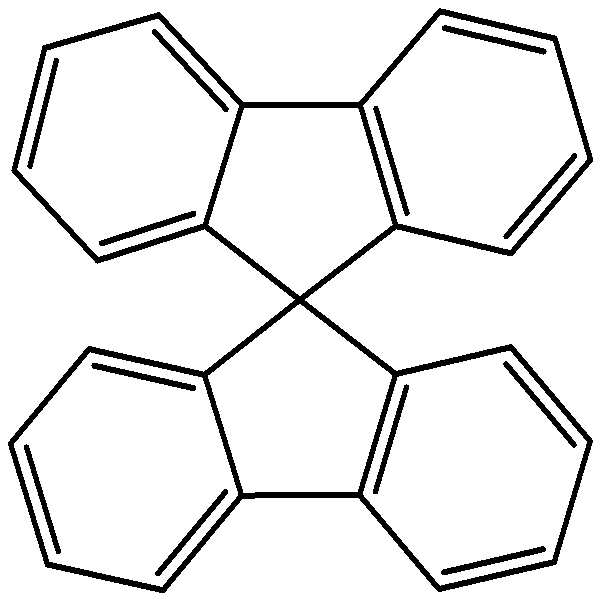
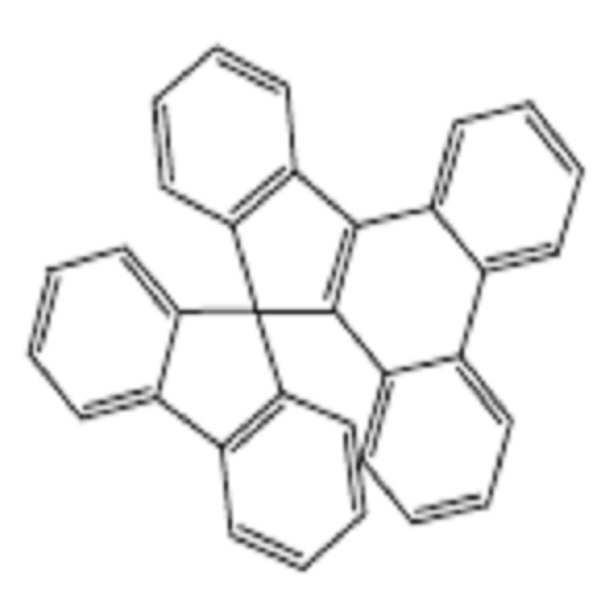
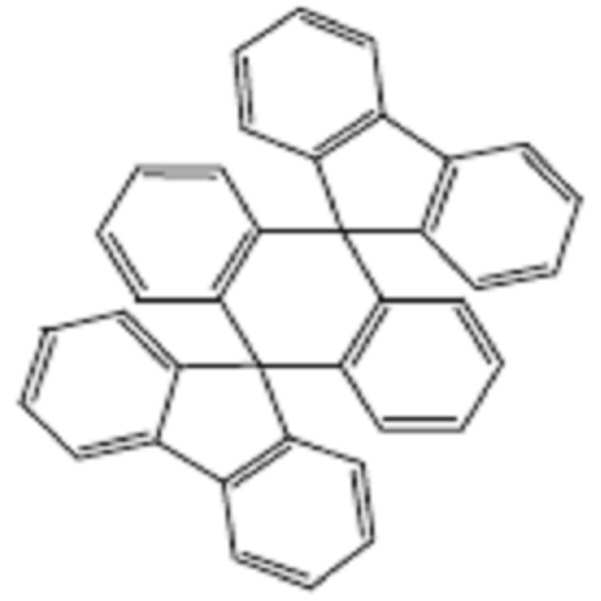
본 명세서에 있어서, 상기 플루오레닐기는 치환될 수 있으며, 인접한 치환기들이 서로 결합하여 고리를 형성할 수 있다.In the present specification, the fluorenyl group may be substituted, and adjacent substituents may be bonded to each other to form a ring.
상기 플루오레닐기가 치환되는 경우, 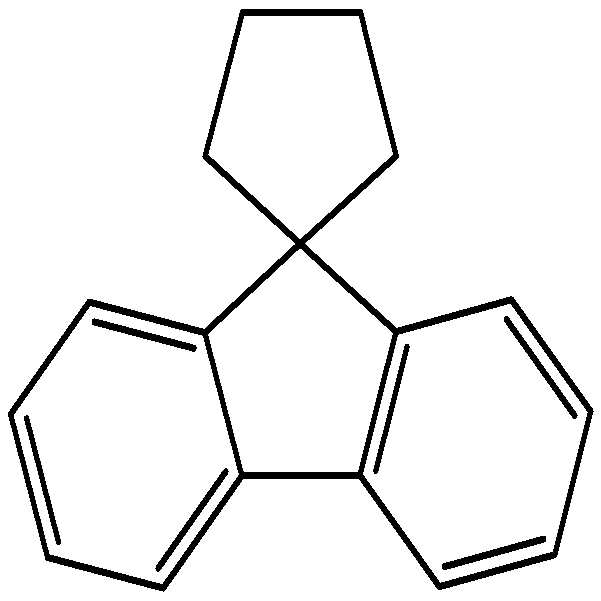


본 명세서에 있어서, 헤테로아릴기는 이종원자로 N, O, S, Si 및 Se 중 1개 이상을 포함하는 헤테로고리기로서, 탄소수는 특별히 한정되지 않으나 탄소수 2 내지 60인 것이 바람직하다. 헤테로아릴기의 예로는 티오펜기, 퓨란기, 피롤기, 이미다졸기, 티아졸기, 옥사졸기, 옥사디아졸기, 트리아졸기, 피리딜기, 비피리딜기, 피리미딜기, 트리아진기, 트리아졸기, 아크리딜기, 피리다진기, 피라지닐기, 퀴놀리닐기, 퀴나졸린기, 퀴녹살리닐기, 프탈라지닐기, 피리도 피리미디닐기, 피리도 피라지닐기, 피라지노 피라지닐기, 이소퀴놀린기, 인돌기, 카바졸기, 벤즈옥사졸기, 벤즈이미다졸기, 벤조티아졸기, 벤조카바졸기, 벤조티오펜기, 디벤조티오펜기, 벤조퓨라닐기, 페난쓰롤린기(phenanthroline), 티아졸릴기, 이소옥사졸릴기, 옥사디아졸릴기, 티아디아졸릴기, 벤조티아졸릴기, 및 디벤조퓨라닐기 등이 있으나, 이들에만 한정되는 것은 아니다.In the present specification, the heteroaryl group is a heterocyclic group and is a heterocyclic group containing at least one of N, O, S, Si and Se. The number of carbon atoms is not particularly limited, but is preferably 2 to 60 carbon atoms. Examples of the heteroaryl group include a thiophene group, a furane group, a furyl group, an imidazole group, a thiazole group, an oxazole group, an oxadiazole group, a triazole group, a pyridyl group, a bipyridyl group, a pyrimidyl group, A pyridazinyl group, a pyrazinopyrazinyl group, an isoquinoline group, an isoquinolinyl group, an isoquinolinyl group, an isoquinolinyl group, an isoquinolinyl group, an isoquinolyl group, A benzothiazole group, a benzothiophene group, a dibenzothiophene group, a benzofuranyl group, a phenanthroline group, a thiazolyl group, a thiazolyl group, a thiazolyl group, An isoxazolyl group, an oxadiazolyl group, a thiadiazolyl group, a benzothiazolyl group, and a dibenzofuranyl group, but is not limited thereto.
본 명세서에 있어서, 상기 축합구조는 해당 치환기에 방향족 탄소수소 고리가 축합된 구조일 수 있다. 예컨대, 벤즈이미다졸의 축합고리로서 
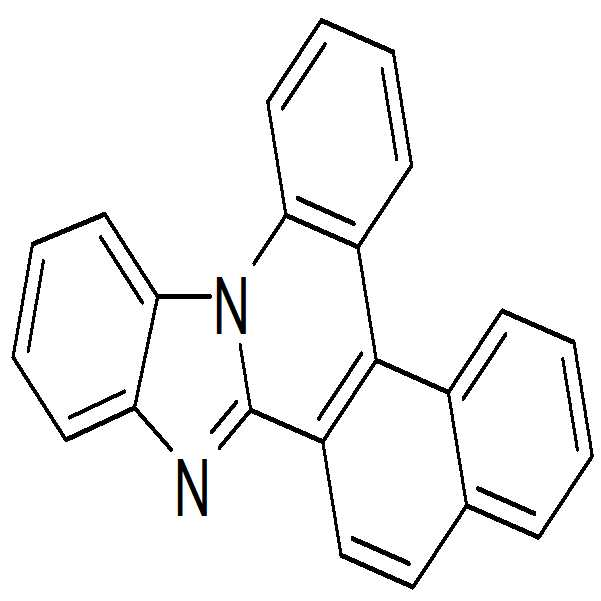
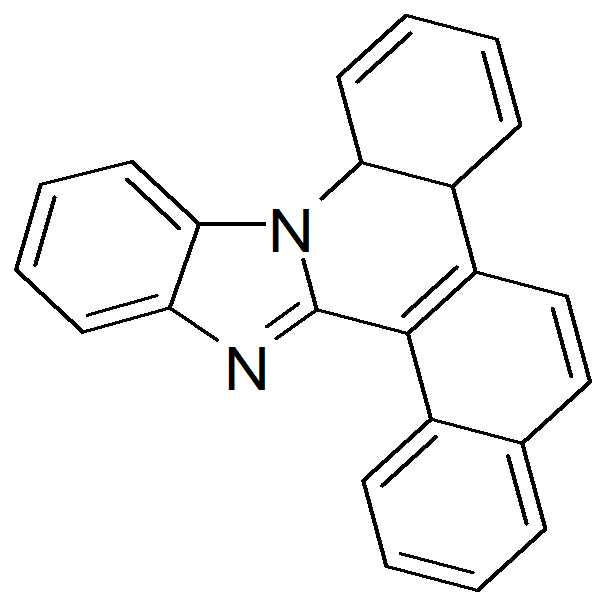

본 명세서에 있어서, "인접한" 기는 해당 치환기가 치환된 원자와 직접 연결된 원자에 치환된 치환기, 해당 치환기와 입체구조적으로 가장 가깝게 위치한 치환기, 또는 해당 치환기가 치환된 원자에 치환된 다른 치환기를 의미할 수 있다. 예컨대, 벤젠고리에서 오쏘(ortho)위치로 치환된 2개의 치환기 및 지방족 고리에서 동일 탄소에 치환된 2개의 치환기는 서로 "인접한" 기로 해석될 수 있다.As used herein, the term "adjacent" means that the substituent is a substituent substituted on an atom directly connected to the substituted atom, a substituent stereostructically closest to the substituent, or another substituent substituted on the substituted atom . For example, two substituents substituted at the ortho position in the benzene ring and two substituents substituted at the same carbon in the aliphatic ring may be interpreted as "adjacent" groups to each other.
본 명세서에 있어서, 인접한 기가 서로 결합하여 고리를 형성하는 것의 의미는 전술한 바와 같이 인접한 기가 서로 결합하여, 5원 내지 8원의 탄화수소 고리 또는 5원 내지 8원의 헤테로고리를 형성하는 것을 의미하며, 단환 또는 다환일 수 있으며, 지방족, 방향족 또는 이들의 축합된 형태일 수 있으며 이를 한정하지 않는다.In the present specification, the adjacent groups bonded to each other to form a ring means that adjacent groups are bonded to each other to form a 5-membered to 8-membered hydrocarbon ring or a 5-to 8-membered heterocyclic ring as described above , Monocyclic or polycyclic, and may be aliphatic, aromatic, or condensed forms thereof, but is not limited thereto.
본 명세서에서 탄화수소고리 또는 헤테로고리는 1 가기인 것을 제외하고, 전술한 시클로알킬기, 아릴기 또는 헤테로고리기의 예시 중에서 선택될 수 있으며, 단환 또는 다환, 지방족 또는 방향족 또는 이들의 축합된 형태일 수 있으나. 이들에만 한정되는 것은 아니다.As used herein, the hydrocarbon ring or heterocycle may be selected from the examples of cycloalkyl groups, aryl groups or heterocyclic groups described above, except monovalent, and may be monocyclic or polycyclic, aliphatic or aromatic, or a condensed form thereof Yes. But is not limited thereto.
본 명세서에 있어서, 방향족고리기는 단환 또는 다환일 수 있으며, 1가가 아닌 것을 제외하고 상기 아릴기의 예시 중에서 선택될 수 있다.In the present specification, the aromatic ring group may be monocyclic or polycyclic, and may be selected from the examples of the aryl group except that it is not monovalent.
본 명세서에 있어서, 2 내지 4가의 방향족고리기는 단환 또는 다환일 수 있으며, 상기 아릴기에 결합위치가 2 내지 4개 있는 것, 즉, 2 내지 4가기를 의미한다. 이들은 각각 2 내지 4가기인 것을 제외하고는 전술한 아릴기의 설명이 적용될 수 있다.In the present specification, the 2- to 4-valent aromatic ring group may be monocyclic or polycyclic, meaning that the aryl group has 2 to 4 bonding positions, that is, 2 to 4 bonds. The description of the aryl group described above can be applied, except that these are each 2 to 4 groups.
본 명세서에 있어서, 아릴렌기는 아릴기에 결합 위치가 두 개 있는 것 즉 2가기를 의미한다. 이들은 각각 2가기인 것을 제외하고는 전술한 아릴기의 설명이 적용될 수 있다.In the present specification, an arylene group means a divalent group having two bonding positions in an aryl group. The description of the aryl group described above can be applied except that each of these is 2 groups.
본 명세서에 있어서, 헤테로아릴렌기는 헤테로아릴기에 결합 위치가 두 개 있는 것 즉 2가기를 의미한다. 이들은 각각 2가기인 것을 제외하고는 전술한 헤테로아릴기의 설명이 적용될 수 있다.In the present specification, the heteroarylene group means that the heteroaryl group has two bonding positions, that is, divalent. The description of the above-mentioned heteroaryl groups can be applied, except that they are each 2 groups.
본 명세서의 일 실시상태에 따르면, L은 직접결합; 치환 또는 비치환된 아릴렌기; 또는 치환 또는 비치환된 헤테로아릴렌기이다.According to one embodiment of the present disclosure, L is a direct bond; A substituted or unsubstituted arylene group; Or a substituted or unsubstituted heteroarylene group.
본 명세서의 일 실시상태에 따르면, L은 직접결합이거나, 치환 또는 비치환된 탄소수 6 내지 20의 아릴렌기이다.According to one embodiment of the present invention, L is a direct bond or a substituted or unsubstituted arylene group having 6 to 20 carbon atoms.
본 명세서의 일 실시상태에 따르면, L은 직접결합이거나, 치환 또는 비치환된 페닐렌기, 치환 또는 비치환된 비페닐렌기, 또는 치환 또는 비치환된 나프틸렌기이다.According to one embodiment of the present invention, L is a direct bond, a substituted or unsubstituted phenylene group, a substituted or unsubstituted biphenylene group, or a substituted or unsubstituted naphthylene group.
본 명세서의 일 실시상태에 따르면, L은 직접결합이거나, 페닐렌기, 비페닐렌기, 나프틸렌기이다. According to one embodiment of the present disclosure, L is a direct bond or a phenylene group, a biphenylene group, or a naphthylene group.
본 명세서의 일 실시상태에 따르면, Ar1 및 Ar2는 서로 같거나 상이하며, 각각 독립적으로 치환 또는 비치환된 아릴기이다.According to one embodiment of the present disclosure, Ar 1 and Ar 2 are the same or different and are each independently a substituted or unsubstituted aryl group.
본 명세서의 일 실시상태에 따르면, Ar1 및 Ar2는 치환 또는 비치환된 탄소수 1 내지 30의 아릴기이다.According to one embodiment of the present invention, Ar 1 and Ar 2 are substituted or unsubstituted aryl groups having 1 to 30 carbon atoms.
본 명세서의 일 실시상태에 따르면, Ar1 및 Ar2는 서로 같거나 상이하고, 각각 독립적으로 치환 또는 비치환된 페닐기, 치환 또는 비치환된 비페닐기, 치환 또는 비치환된 터페닐기, 치환 또는 비치환된 트리페닐기, 치환 또는 비치환된 나프틸기, 치환 또는 비치환된 안트라세닐기, 치환 또는 비치환된 페난트레닐기, 치환 또는 비치환된 피렌기, 또는 치환 또는 비치환된 플루오레닐기이다.According to one embodiment of the present invention, Ar 1 and Ar 2 are the same or different and each independently represents a substituted or unsubstituted phenyl group, a substituted or unsubstituted biphenyl group, a substituted or unsubstituted terphenyl group, A substituted or unsubstituted naphthyl group, a substituted or unsubstituted anthracenyl group, a substituted or unsubstituted phenanthrenyl group, a substituted or unsubstituted pyrene group, or a substituted or unsubstituted fluorenyl group.
본 명세서의 일 실시상태에 따르면, Ar1 및 Ar2는 서로 같거나 상이하고, 각각 독립적으로 페닐기, 비페닐기, 터페닐기, 트리페닐기, 나프틸기, 안트라세닐기, 페난트레닐기, 피렌기, 또는 플루오레닐기이다.According to one embodiment of the present invention, Ar 1 and Ar 2 are the same or different from each other and each independently represents a phenyl group, a biphenyl group, a terphenyl group, a triphenyl group, a naphthyl group, an anthracenyl group, a phenanthrenyl group, Fluorenyl group.
본 명세서의 일 실시상태에 따르면, Ar1 및 Ar2는 서로 같거나 상이하고, 각각 독립적으로 알킬기, 시아노기, 실릴기, 또는 카바졸기가 치환 또는 비치환된 페닐기이다.According to one embodiment of the present invention, Ar 1 and Ar 2 are the same or different and are each independently a phenyl group substituted or unsubstituted with an alkyl group, cyano group, silyl group, or carbazole group.
본 명세서의 일 실시상태에 따르면, Ar1 및 Ar2는 서로 같거나 상이하고, 각각 독립적으로 메틸기, 에틸기, 시아노기, 실릴기, 또는 페닐기가 치환된 카바졸기가 치환된 페닐기이다.According to one embodiment of the present invention, Ar 1 and Ar 2 are the same or different and are each independently a phenyl group substituted with a carbamoyl group substituted with a methyl group, an ethyl group, a cyano group, a silyl group, or a phenyl group.
본 명세서의 일 실시상태에 따르면, Ar1 및 Ar2는 서로 같거나 상이하고, 각각 독립적으로 페닐기이다.According to one embodiment of the present invention, Ar 1 and Ar 2 are the same or different from each other and are each independently a phenyl group.
본 명세서의 일 실시상태에 따르면, Ar1 및 Ar2는 서로 같거나 상이하고, 각각 독립적으로 알킬기, 시아노기, 실릴기, 또는 카바졸기가 치환 또는 비치환된 비페닐기이다.According to one embodiment of the present invention, Ar 1 and Ar 2 are the same or different and each independently a biphenyl group in which an alkyl group, cyano group, silyl group, or carbazole group is substituted or unsubstituted.
본 명세서의 일 실시상태에 따르면, Ar1 및 Ar2는 서로 같거나 상이하고, 각각 독립적으로 메틸기, 에틸기, 시아노기, 실릴기, 또는 페닐기가 치환된 카바졸기가 치환된 비페닐기이다.According to one embodiment of the present invention, Ar 1 and Ar 2 are the same or different and each independently a biphenyl group substituted with a carbamoyl group substituted with a methyl group, an ethyl group, a cyano group, a silyl group, or a phenyl group.
본 명세서의 일 실시상태에 따르면, Ar1 및 Ar2는 서로 같거나 상이하고, 각각 독립적으로 비페닐기이다.According to one embodiment of the present invention, Ar 1 and Ar 2 are the same or different and are each independently a biphenyl group.
본 명세서의 일 실시상태에 따르면, Ar1 및 Ar2는 서로 같거나 상이하고, 각각 독립적으로 알킬기, 시아노기, 실릴기, 또는 카바졸기가 치환 또는 비치환된 나프틸기이다.According to one embodiment of the present invention, Ar 1 and Ar 2 are the same or different and are each independently a naphthyl group substituted or unsubstituted with an alkyl group, a cyano group, a silyl group, or a carbazole group.
본 명세서의 일 실시상태에 따르면, Ar1 및 Ar2는 서로 같거나 상이하고, 각각 독립적으로 메틸기, 에틸기, 시아노기, 실릴기, 또는 페닐기가 치환된 카바졸기가 치환된 나프틸기이다.According to one embodiment of the present invention, Ar 1 and Ar 2 are the same or different and each independently a naphthyl group substituted with a carbamoyl group substituted with a methyl group, an ethyl group, a cyano group, a silyl group, or a phenyl group.
본 명세서의 일 실시상태에 따르면, Ar1 및 Ar2는 서로 같거나 상이하고, 각각 독립적으로 나프틸기이다.According to one embodiment of the present invention, Ar 1 and Ar 2 are the same or different and are each independently a naphthyl group.
본 명세서의 일 실시상태에 따르면, Ar1 및 Ar2는 서로 같거나 상이하고, 각각 독립적으로 알킬기, 시아노기, 실릴기, 아릴기, 또는 카바졸기가 치환 또는 비치환된 플루오레닐기이다.According to one embodiment of the present invention, Ar 1 and Ar 2 are the same or different from each other, and each independently represents a substituted or unsubstituted fluorenyl group having an alkyl group, a cyano group, a silyl group, an aryl group, or a carbazole group.
본 명세서의 일 실시상태에 따르면, Ar1 및 Ar2는 서로 같거나 상이하고, 각각 독립적으로 메틸기, 에틸기, 시아노기, 실릴기, 페닐기, 비페닐기, 또는 페닐기가 치환된 카바졸기가 치환된 플루오레닐기이다.According to one embodiment of the present invention, Ar 1 and Ar 2 are the same or different and each independently represents a substituted or unsubstituted carbazole group substituted with a methyl group, an ethyl group, a cyano group, a silyl group, a phenyl group, Orrenyl group.
본 명세서의 일 실시상태에 따르면, Ar1 및 Ar2는 서로 같거나 상이하고, 각각 독립적으로 플루오레닐기이다.According to one embodiment of the present disclosure, Ar 1 and Ar 2 are the same or different from each other, and each independently is a fluorenyl group.
본 명세서의 일 실시상태에 따르면, Ar1 및 Ar2는 서로 같거나 상이하고, 각각 독립적으로 치환 또는 비치환된 페난트레닐기이다.According to one embodiment of the present invention, Ar 1 and Ar 2 are the same or different and each independently a substituted or unsubstituted phenanthrenyl group.
본 명세서의 일 실시상태에 따르면, Ar1 및 Ar2는 서로 같거나 상이하고, 각각 독립적으로 페난트레닐기이다.According to one embodiment of the present invention, Ar 1 and Ar 2 are the same or different and are each independently a phenanthrenyl group.
본 명세서의 일 실시상태에 따르면, Ar1 및 Ar2는 서로 같거나 상이하고, 각각 독립적으로 치환 또는 비치환된 트리페닐렌기이다.According to one embodiment of the present invention, Ar 1 and Ar 2 are the same or different and are each independently a substituted or unsubstituted triphenylene group.
본 명세서의 일 실시상태에 따르면, Ar1 및 Ar2는 서로 같거나 상이하고, 각각 독립적으로 트리페닐렌기이다.According to one embodiment of the present invention, Ar 1 and Ar 2 are the same or different and are each independently a triphenylene group.
본 명세서의 일 실시상태에 따르면, R1 내지 R17은 서로 같거나 상이하며, 각각 독립적으로 수소; 중수소; 할로겐기; 시아노기; 치환 또는 비치환된 C1 내지 C10의 알킬기; 또는 치환 또는 비치환된 C6 내지 C10의 아릴기이고, 인접한 기와 서로 결합하여 고리를 형성할 수 있다.According to one embodiment of the present disclosure, R 1 to R 17 are the same or different from each other, and each independently hydrogen; heavy hydrogen; A halogen group; Cyano; A substituted or unsubstituted C 1 to C 10 alkyl group; Or a substituted or unsubstituted C 6 to C 10 aryl group, which may be bonded to adjacent groups to form a ring.
본 명세서의 일 실시상태에 따르면, R1 내지 R17은 서로 같거나 상이하며, 각각 독립적으로 수소, 중수소, 할로겐기, 시아노기, C1 내지 C10의 알킬기, C6 내지 C10의 아릴기이고, 인접한 기와 서로 결합하여 고리를 형성할 수 있다.According to one embodiment of the present disclosure, R 1 to R 17 are the same or different and each independently represents hydrogen, deuterium, a halogen group, a cyano group, a C 1 to C 10 alkyl group, a C 6 to C 10 aryl group And may form a ring by bonding to adjacent groups.
본 명세서의 일 실시상태에 따르면, R1 내지 R17은 서로 같거나 상이하며, 각각 독립적으로 치환 또는 비치환된 페닐기, 치환 또는 비치환된 비페닐기, 또는 치환 또는 비치환된 나프틸기이다.According to one embodiment of the present invention, R 1 to R 17 are the same or different from each other, and each independently represents a substituted or unsubstituted phenyl group, a substituted or unsubstituted biphenyl group, or a substituted or unsubstituted naphthyl group.
본 명세서의 일 실시상태에 따르면, R1 내지 R17은 서로 같거나 상이하며, 각각 독립적으로 페닐기, 비페닐기, 또는 나프틸기이다.According to one embodiment of the present invention, R 1 to R 17 are the same or different from each other and are each independently a phenyl group, a biphenyl group, or a naphthyl group.
본 명세서의 일 실시상태에 따르면, R1 내지 R17은 서로 같거나 상이하며, 각각 독립적으로 페닐기이다.According to one embodiment of the present invention, R 1 to R 17 are the same or different from each other and are each independently a phenyl group.
본 명세서의 일 실시상태에 따르면, R1 내지 R17은 서로 같거나 상이하며, 각각 독립적으로 인접한 기와 서로 결합하여 고리를 형성할 수 있다.According to one embodiment of the present invention, R 1 to R 17 may be the same or different from each other, and may be independently bonded to adjacent groups to form a ring.
본 명세서의 일 실시상태에 따르면, R1 내지 R17은 서로 같거나 상이하며, 각각 독립적으로 수소이다.According to one embodiment of the present disclosure, R 1 to R 17 are the same or different and are each independently hydrogen.
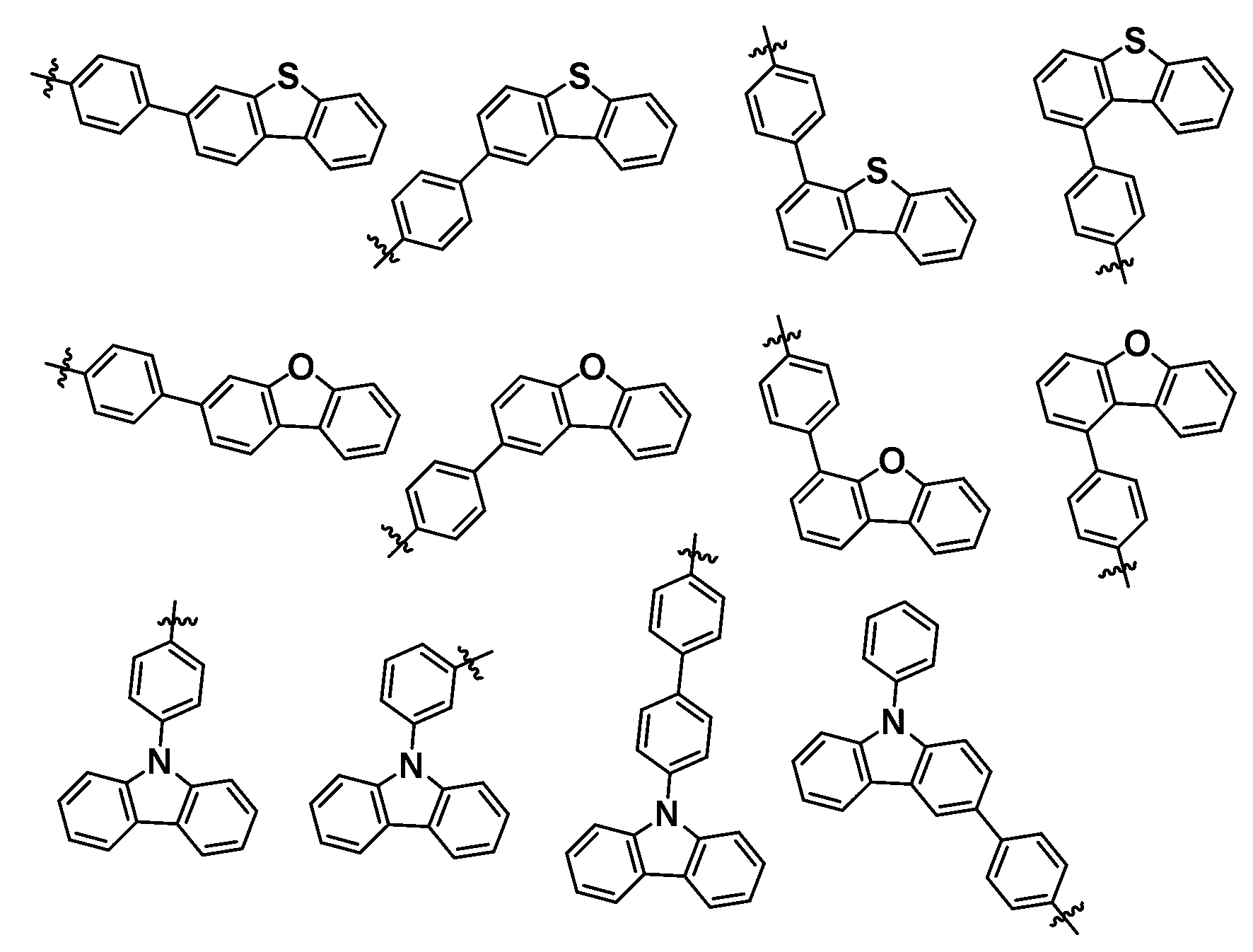
본 명세서의 일 실시상태에 따르면, 상기 Ar1 및 Ar2는 하기 그룹 1 및 2의 구조식들 중에서 선택될 수 있으나, 이에 한정되는 것은 아니다.According to one embodiment of the present invention, Ar 1 and Ar 2 may be selected from the following structural formulas of Groups 1 and 2, but are not limited thereto.
[그룹 1][Group 1]
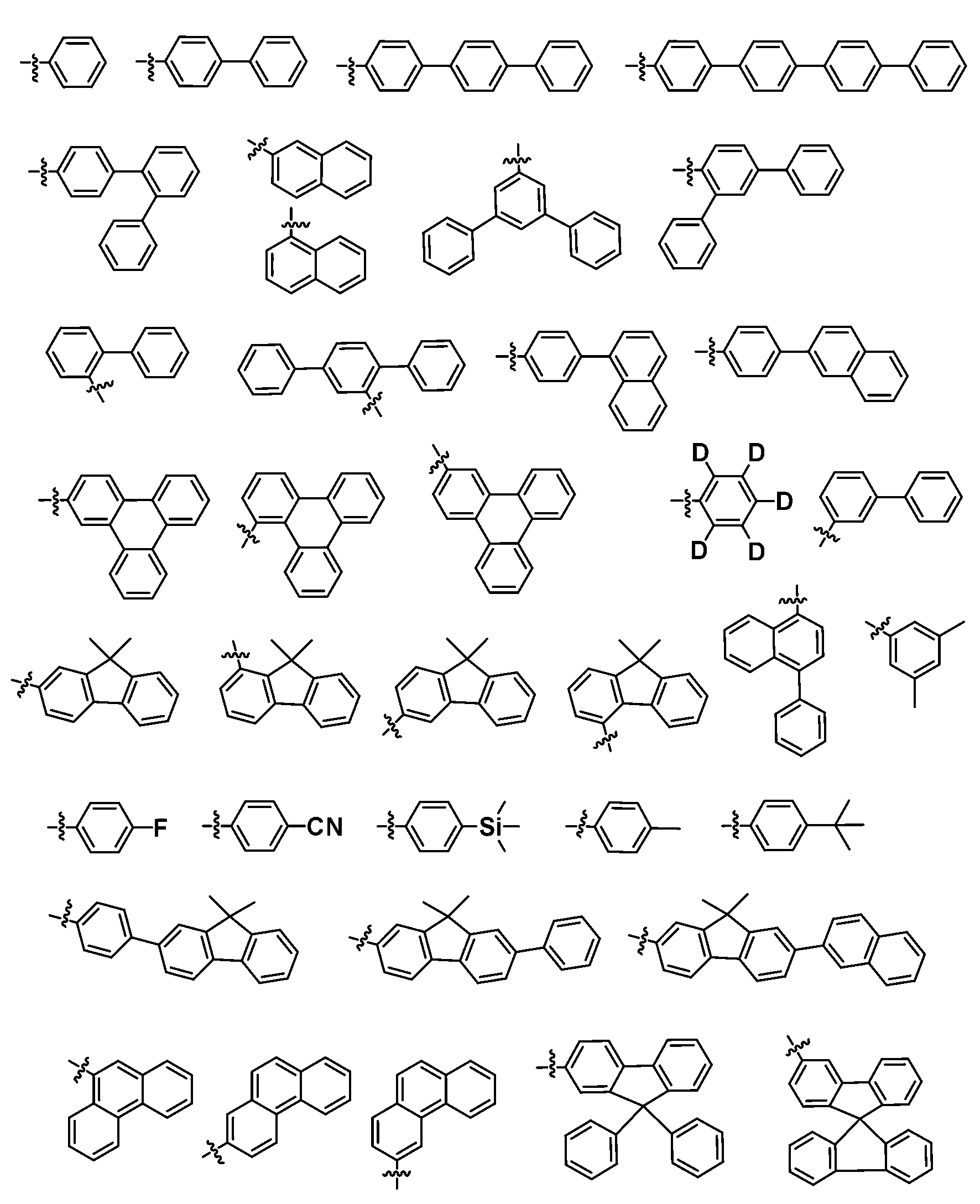
[그룹 2][Group 2]
본 명세서의 일 실시상태에 따르면, 상기 화학식 1로 표시되는 화합물은 하기 구조식들 중에서 선택될 수 있으나, 이에 한정되는 것은 아니다.According to one embodiment of the present invention, the compound represented by Formula 1 may be selected from the following structural formulas, but is not limited thereto.
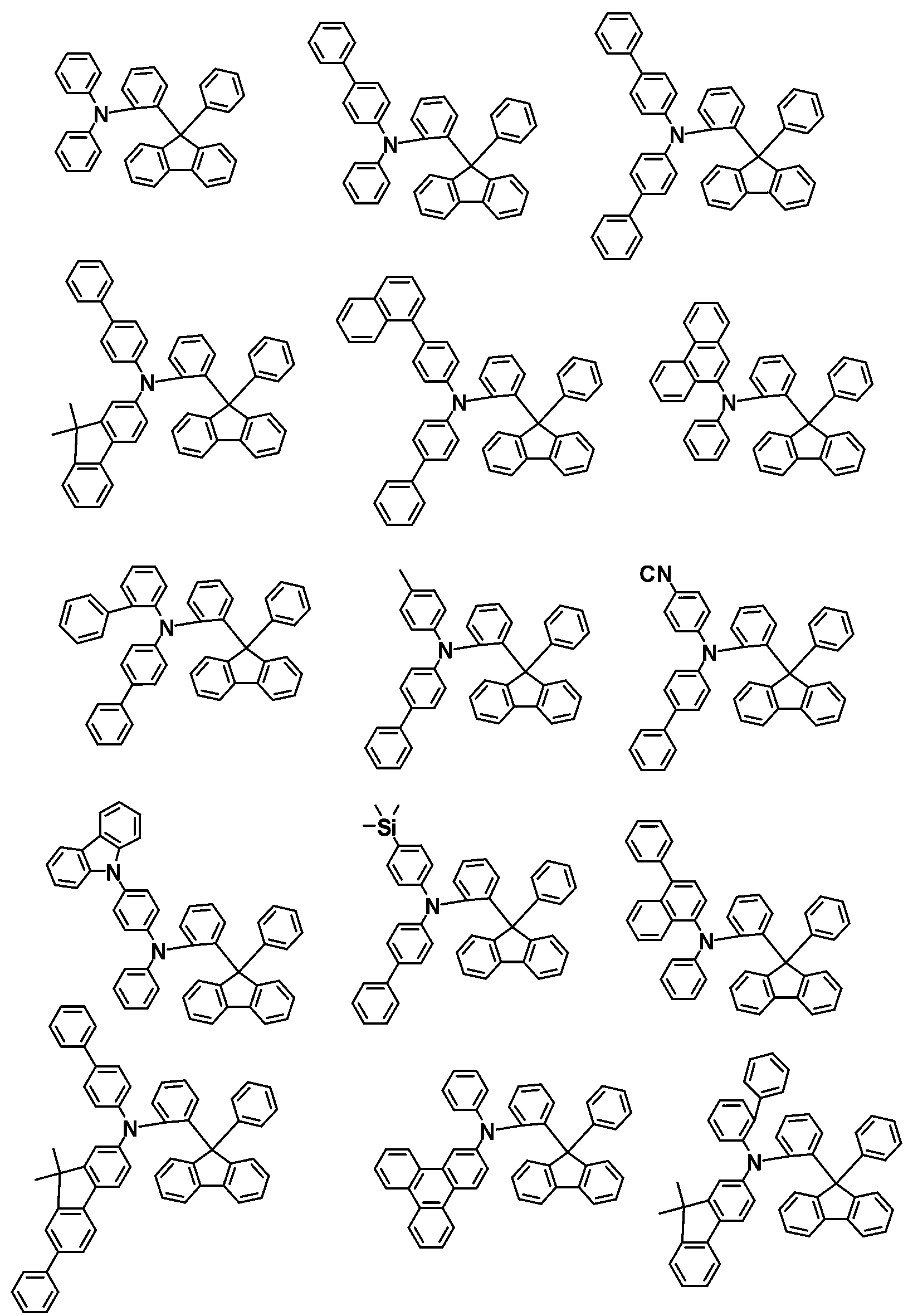
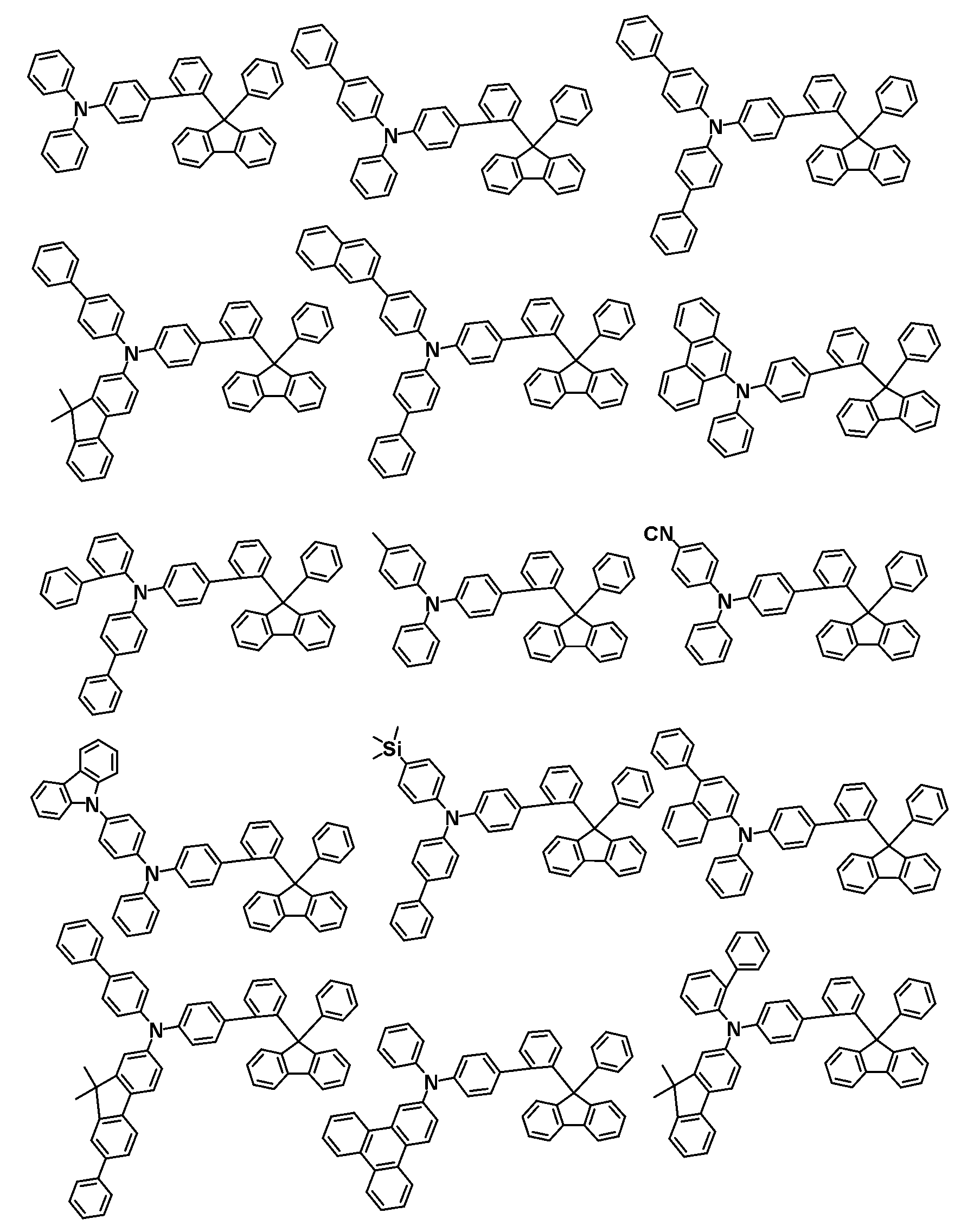
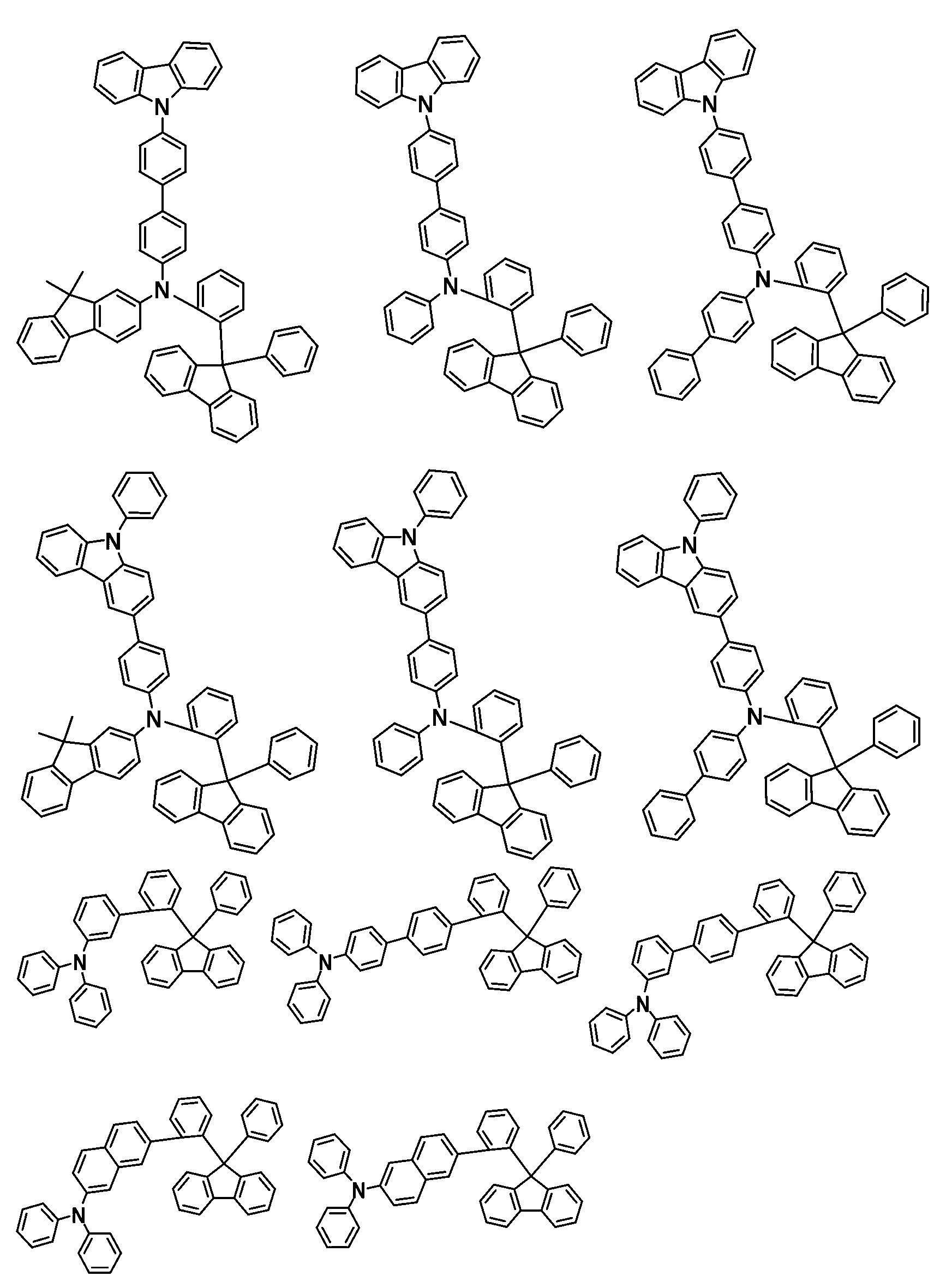
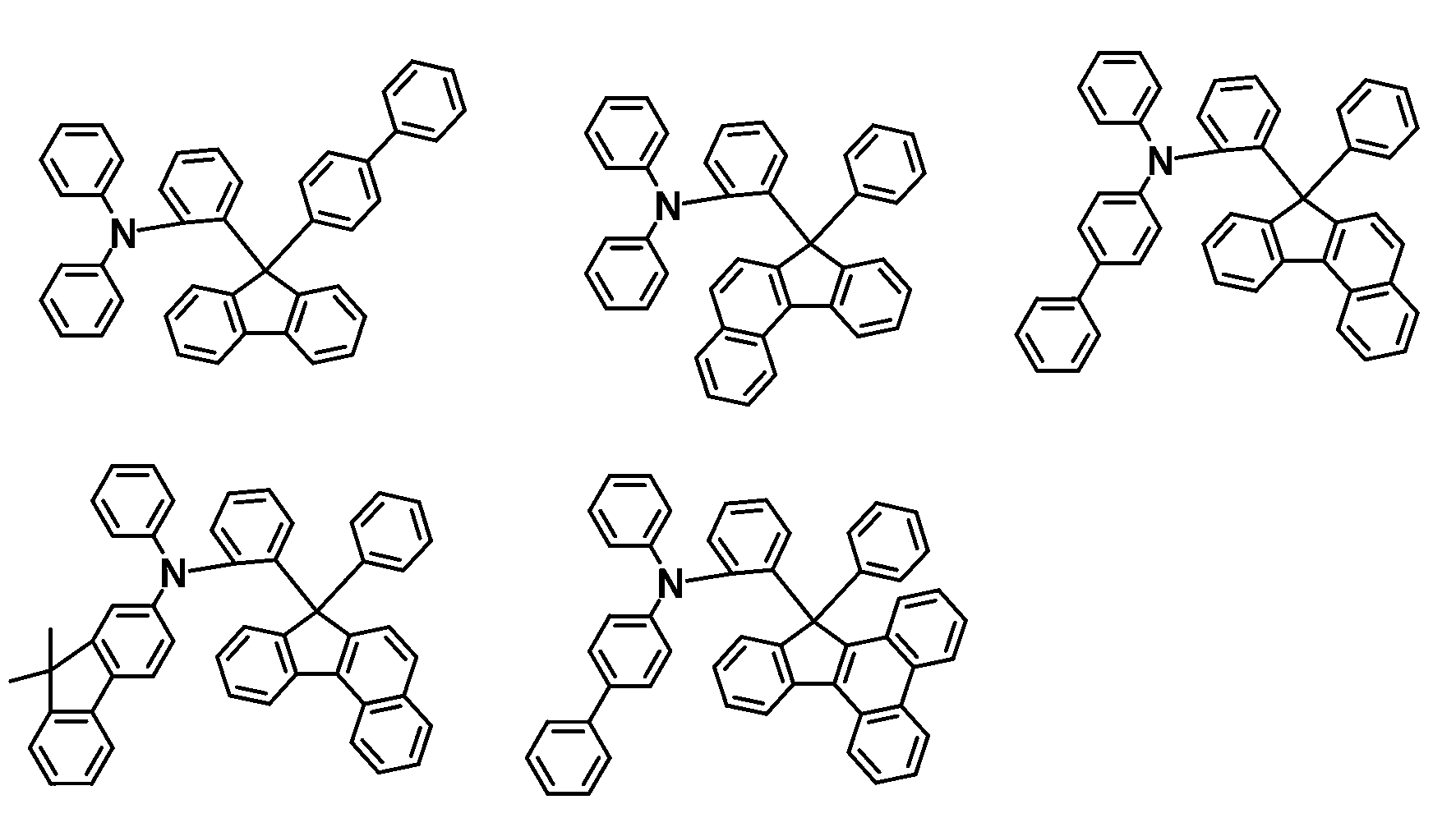
본 명세서의 일 실시상태에 따른 화합물은 후술하는 제조 방법으로 제조될 수 있다. 후술하는 제조예들에서는 대표적인 예시들을 기재하지만, 필요에 따라, 치환기를 추가하거나 제외할 수 있으며, 치환기의 위치를 변경할 수 있다. 또한, 당기술분야에 알려져 있는 기술을 기초로, 출발물질, 반응물질, 반응 조건 등을 변경할 수 있다. The compound according to one embodiment of the present specification can be produced by a production method described below. Exemplary examples are described below in the preparation examples, but substituents can be added or removed as needed, and the position of the substituent can be changed. In addition, based on techniques known in the art, starting materials, reactants, reaction conditions, and the like can be changed.
예컨대, 상기 화학식 1의 화합물은 하기 반응식 1과 같이 코어 구조가 제조될 수 있다. 치환기는 당기술분야에 알려져 있는 방법에 의하여 결합될 수 있으며, 치환기의 종류, 위치, 또는 개수는 당기술분야에 알려져 있는 기술에 따라 변경될 수 있다. 구체적인 제조방법은 후술하기로 한다.For example, the compound of Formula 1 can be prepared as shown in Reaction Scheme 1 below. Substituent groups may be attached by methods known in the art, and the type, position, or number of substituent groups may be varied according to techniques known in the art. A concrete manufacturing method will be described later.
[반응식 1] [Reaction Scheme 1]

[반응식 2][Reaction Scheme 2]

상기 반응식 1 및 2에서 L, Ar1, 및 Ar2는 상기 화학식 1에서 정의한 바와 동일하다. 상기 반응식 2는 L이 직접결합인 경우를 예시한 것이나, 이에만 한정되는 것은 아니다.In the above Reaction Schemes 1 and 2, L, Ar 1 , and Ar 2 are the same as defined in Formula 1 above. In the above reaction scheme 2, L is a direct bond, but the present invention is not limited thereto.
또한, 본 명세서는 상기 전술한 화합물을 포함하는 유기 전자 소자를 제공한다. Further, the present invention provides an organic electronic device comprising the above-mentioned compounds.
본 명세서의 일 실시상태에 있어서, 제1 전극; 상기 제1 전극과 대향하여 구비된 제2 전극; 및 상기 제1 전극과 상기 제2 전극 사이에 구비된 1층 이상의 유기물층을 포함하는 유기 전자 소자로서, 상기 유기물층 중 1 층 이상은 상기 화합물을 포함하는 것인 유기 전자 소자를 제공한다. In one embodiment of the present disclosure, the first electrode; A second electrode facing the first electrode; And at least one organic compound layer provided between the first electrode and the second electrode, wherein at least one of the organic compound layers includes the compound.
본 명세서에서 어떤 부재가 다른 부재 "상에" 위치하고 있다고 할 때, 이는 어떤 부재가 다른 부재에 접해 있는 경우뿐 아니라 두 부재 사이에 또 다른 부재가 존재하는 경우도 포함한다.When a member is referred to herein as being "on " another member, it includes not only a member in contact with another member but also another member between the two members.
본 명세서에서 어떤 부분이 어떤 구성요소를 "포함" 한다고 할 때, 이는 특별히 반대되는 기재가 없는 한 다른 구성요소를 제외하는 것이 아니라 다른 구성 요소를 더 포함할 수 있는 것을 의미한다. Whenever a component is referred to as "comprising ", it is understood that it may include other components as well, without departing from the other components unless specifically stated otherwise.
본 명세서의 유기 전자 소자의 유기물층은 단층 구조로 이루어질 수도 있으나, 2층 이상의 유기물층이 적층된 다층 구조로 이루어질 수 있다. 예컨대, 본 발명의 유기 전자 소자의 대표 적인 예로서, 유기 발광 소자는 유기물층으로서 정공주입층, 정공수송층, 발광층, 전자수송층, 전자주입층 등을 포함하는 구조를 가질 수 있다. 그러나 유기 전자 소자의 구조는 이에 한정되지 않고 더 적은 수의 유기층을 포함할 수 있다.The organic material layer of the organic electronic device in this specification may have a single layer structure, but may have a multi-layer structure in which two or more organic material layers are stacked. For example, as a representative example of the organic electronic device of the present invention, the organic light emitting device may have a structure including a hole injecting layer, a hole transporting layer, a light emitting layer, an electron transporting layer, an electron injecting layer, etc. as an organic material layer. However, the structure of the organic electronic device is not limited thereto and may include a smaller number of organic layers.
본 명세서의 일 실시상태에 따르면, 상기 유기 전자 소자는 유기발광소자, 유기인광소자, 유기태양전지, 유기감광체(OPC) 및 유기트랜지스터로 이루어진 군으로부터 선택될 수 있다.According to one embodiment of the present invention, the organic electronic device may be selected from the group consisting of an organic light emitting device, an organic phosphor device, an organic solar cell, an organic photoconductor (OPC), and an organic transistor.
이하에서는 유기발광소자에 대하여 예시한다.Hereinafter, the organic light emitting device will be described.
본 명세서의 일 실시상태에 있어서, 상기 유기물층은 정공주입층 또는 정공수송층을 포함하고, 상기 정공주입층 또는 정공수송층은 상기 화합물을 포함한다. In one embodiment of the present invention, the organic layer includes a hole injection layer or a hole transport layer, and the hole injection layer or the hole transport layer includes the compound.
본 명세서의 일 실시상태에 있어서, 상기 유기물층은 전자차단층을 포함하고, 상기 전자차단층은 상기 화합물을 포함한다. In one embodiment of the present invention, the organic layer includes an electron blocking layer, and the electron blocking layer includes the compound.
본 명세서의 일 실시상태에 있어서, 상기 유기물층은 정공수송층 또는 전자차단층이고, 상기 유기 전자 소자는 정공수송층, 정공주입층, 또는 전자차단층으로 이루어진 군에서 선택되는 1층 또는 2층 이상을 더 포함한다.In one embodiment of the present invention, the organic material layer is a hole transporting layer or an electron blocking layer, and the organic electronic device is one or more layers selected from the group consisting of a hole transporting layer, a hole injecting layer, .
본 명세서의 일 실시상태에 있어서, 상기 유기물층은 상기 화합물을 포함하는 유기물층 이외에 아릴아미노기, 카바졸릴기 또는 벤조카바졸릴기를 포함하는 화합물을 포함하는 정공주입층 또는 정공수송층을 더 포함한다. In one embodiment of the present invention, the organic layer further includes a hole injection layer or a hole transport layer containing a compound having an arylamino group, a carbazolyl group or a benzocarbazolyl group in addition to the organic compound layer containing the compound.
본 명세서의 일 실시상태에 있어서, 상기 유기 발광 소자는 제1 전극; 상기 제1 전극과 대향하여 구비된 제2 전극; 및 상기 제1 전극과 상기 제2 전극 사이에 구비된 발광층; 상기 발광층과 상기 제1 전극 사이, 또는 상기 발광층과 상기 제2 전극 사이에 구비된 2층 이상의 유기물층을 포함하고, 상기 2층 이상의 유기물층 중 적어도 하나는 상기 화합물을 포함한다. 본 명세서의 일 실시상태에 있어서, 상기 2층 이상의 유기물층은 전자수송층, 전자주입층, 전자 수송과 전자주입을 동시에 하는 층 및 정공차단층으로 이루어진 군에서 2 이상이 선택될 수 있다.In one embodiment of the present invention, the organic light emitting device includes a first electrode; A second electrode facing the first electrode; And a light emitting layer provided between the first electrode and the second electrode; At least one of the two or more organic layers includes two or more organic layers disposed between the light emitting layer and the first electrode or between the light emitting layer and the second electrode. In one embodiment of the present invention, the two or more organic layers may be selected from the group consisting of an electron transport layer, an electron injection layer, a layer that simultaneously transports electrons and electrons, and a hole blocking layer.
본 명세서의 일 실시상태에 있어서, 상기 유기물층은 상기 화합물을 포함하는 유기물층 이외에 아릴아미노기, 카바졸릴기 또는 벤조카바졸릴기를 포함하는 화합물을 포함하는 정공주입층 또는 정공수송층을 더 포함한다. In one embodiment of the present invention, the organic layer further includes a hole injection layer or a hole transport layer containing a compound having an arylamino group, a carbazolyl group or a benzocarbazolyl group in addition to the organic compound layer containing the compound.
또 하나의 실시상태에 있어서, 유기 발광 소자는 기판 상에 양극, 1층 이상의 유기물층 및 음극이 순차적으로 적층된 구조(normal type)의 유기 발광 소자일 수 있다. In another embodiment, the organic light emitting device may be a normal type organic light emitting device in which an anode, at least one organic layer, and a cathode are sequentially stacked on a substrate.
또 하나의 실시상태에 있어서, 유기 발광 소자는 기판 상에 음극, 1층 이상의 유기물층 및 양극이 순차적으로 적층된 역방향 구조(inverted type)의 유기 발광 소자일 수 있다. In another embodiment, the organic light emitting device may be an inverted type organic light emitting device in which a cathode, at least one organic material layer, and an anode are sequentially stacked on a substrate.
예컨대, 본 명세서의 유기 발광 소자의 구조는 도 1 및 도 2에 나타난 것과 같은 구조를 가질 수 있으나 이에만 한정되는 것은 아니다.For example, the structure of the organic light emitting device of the present invention may have a structure as shown in FIGS. 1 and 2, but the present invention is not limited thereto.
도 1에는 기판(20) 위에 제1 전극(30), 발광층(40) 및 제2 전극(50)이 순차적으로 적층된 유기 발광 소자(10)의 구조가 예시 되어 있다. 상기 도 1은 본 명세서의 일 실시상태에 따른 유기 발광 소자의 예시적인 구조이며, 다른 유기물층을 더 포함할 수 있다.1 illustrates a structure of an organic
도 2에는 기판(20) 위에 제1 전극(30), 정공주입층(60), 정공수송층(70), 전자차단층(80), 발광층(40), 전자수송층(90), 전자주입층(100) 및 제2 전극(50)이 순차적으로 적층된 유기 발광 소자의 구조가 예시되어 있다. 상기 도 2는 본 명세서의 실시상태에 따른 예시적인 구조이며, 다른 유기물층을 더 포함할 수 있다.2 shows a structure in which a
이와 같은 구조에 있어서, 상기 화합물은 상기 정공주입층, 정공수송층, 및 전자차단층 중 1층 이상에 포함될 수 있다. In such a structure, the compound may be included in at least one of the hole injecting layer, the hole transporting layer, and the electron blocking layer.
본 명세서의 유기 발광 소자는 유기물층 중 1층 이상이 본 명세서의 화합물, 즉 상기 화합물을 포함하는 것을 제외하고는 당 기술분야에 알려져 있는 재료와 방법으로 제조될 수 있다.The organic light emitting device of the present invention can be manufactured by materials and methods known in the art, except that one or more of the organic layers includes the compound of the present invention, i.e., the compound.
상기 유기 발광 소자가 복수개의 유기물층을 포함하는 경우, 상기 유기물층은 동일한 물질 또는 다른 물질로 형성될 수 있다. When the organic light emitting diode includes a plurality of organic layers, the organic layers may be formed of the same material or different materials.
본 명세서의 유기 발광 소자는 유기물층 중 1층 이상이 상기 화합물, 즉 상기 화학식 1로 표시되는 화합물을 포함하는 것을 제외하고는 당 기술분야에 알려져 있는 재료와 방법으로 제조될 수 있다. The organic light emitting device of the present invention can be manufactured by materials and methods known in the art, except that one or more of the organic layers include the compound, i.e., the compound represented by the above formula (1).
예컨대, 본 명세서의 유기 발광 소자는 기판 상에 제1 전극, 유기물층 및 제2 전극을 순차적으로 적층시킴으로써 제조할 수 있다. 이 때 스퍼터링법(sputtering)이나 전자빔 증발법(e-beam evaporation)과 같은 PVD(physical Vapor Deposition)방법을 이용하여, 기판 상에 금속 또는 전도성을 가지는 금속 산화물 또는 이들의 합금을 증착시켜 양극을 형성하고, 그 위에 정공 주입층, 정공 수송층, 발광층 및 전자 수송층을 포함하는 유기물층을 형성한 후, 그 위에 음극으로 사용할 수 있는 물질을 증착시킴으로써 제조될 수 있다. 이와 같은 방법 외에도, 기판 상에 음극 물질부터 유기물층, 양극 물질을 차례로 증착시켜 유기 발광 소자를 만들 수 있다. For example, the organic light emitting device of the present invention can be manufactured by sequentially laminating a first electrode, an organic material layer, and a second electrode on a substrate. At this time, by using a PVD (physical vapor deposition) method such as a sputtering method or an e-beam evaporation method, a metal or a metal oxide having conductivity or an alloy thereof is deposited on the substrate to form a positive electrode Forming an organic material layer including a hole injecting layer, a hole transporting layer, a light emitting layer and an electron transporting layer thereon, and depositing a material usable as a cathode thereon. In addition to such a method, an organic light emitting device can be formed by sequentially depositing a cathode material, an organic material layer, and a cathode material on a substrate.
또한, 상기 화학식 1의 화합물은 유기 발광 소자의 제조시 진공 증착법 뿐만 아니라 용액 도포법에 의하여 유기물층으로 형성될 수 있다. 여기서, 용액 도포법이라 함은 스핀 코팅, 딥코팅, 닥터 블레이딩, 잉크젯프린팅, 스크린 프린팅, 스프레이법, 롤 코팅 등을 의미하지만, 이들만으로 한정되는 것은 아니다.In addition, the compound of Formula 1 may be formed into an organic material layer by a solution coating method as well as a vacuum evaporation method in the production of an organic light emitting device. Here, the solution coating method refers to spin coating, dip coating, doctor blading, inkjet printing, screen printing, spraying, roll coating and the like, but is not limited thereto.
이와 같은 방법 외에도, 기판 상에 음극 물질로부터 유기물층, 양극 물질을 차례로 증착시켜 유기 발광 소자를 만들 수도 있다 (국제 특허 출원 공개 제 2003/012890호). 다만, 제조 방법이 이에 한정되는 것은 아니다. In addition to such a method, an organic light emitting device may be fabricated by sequentially depositing an organic material layer and a cathode material on a substrate from a cathode material (International Patent Application Publication No. 2003/012890). However, the manufacturing method is not limited thereto.
본 명세서의 일 실시상태에 있어서, 상기 제1 전극은 양극이고, 상기 제2 전극은 음극이다. In one embodiment of the present invention, the first electrode is an anode and the second electrode is a cathode.
또 하나의 실시상태에 있어서, 상기 제1 전극은 음극이고, 상기 제2 전극은 양극이다. In another embodiment, the first electrode is a cathode and the second electrode is a cathode.
상기 양극 물질로는 통상 유기물층으로 정공 주입이 원활할 수 있도록 일함수가 큰 물질이 바람직하다. 본 발명에서 사용될 수 있는 양극 물질의 구체적인 예로는 바나듐, 크롬, 구리, 아연, 금과 같은 금속 또는 이들의 합금; 아연 산화물, 인듐 산화물, 인듐주석 산화물(ITO), 인듐아연 산화물(IZO)과 같은 금속 산화물; ZnO:Al 또는 SNO2 : Sb와 같은 금속과 산화물의 조합; 폴리(3-메틸티오펜), 폴리[3,4-(에틸렌-1,2-디옥시)티오펜](PEDOT), 폴리피롤 및 폴리아닐린과 같은 전도성 고분자 등이 있으나, 이들에만 한정되는 것은 아니다. As the anode material, a material having a large work function is preferably used so that hole injection can be smoothly conducted into the organic material layer. Specific examples of the cathode material that can be used in the present invention include metals such as vanadium, chromium, copper, zinc, and gold, or alloys thereof; Metal oxides such as zinc oxide, indium oxide, indium tin oxide (ITO), and indium zinc oxide (IZO); ZnO: Al or SNO 2: a combination of a metal and an oxide such as Sb; Conductive polymers such as poly (3-methylthiophene), poly [3,4- (ethylene-1,2-dioxy) thiophene] (PEDOT), polypyrrole and polyaniline.
상기 음극 물질로는 통상 유기물층으로 전자 주입이 용이하도록 일함수가 작은 물질인 것이 바람직하다. 음극 물질의 구체적인 예로는 마그네슘, 칼슘, 나트륨, 칼륨, 티타늄, 인듐, 이트륨, 리튬, 가돌리늄, 알루미늄, 은, 주석 및 납과 같은 금속 또는 이들의 합금; LiF/Al 또는 LiO2/Al과 같은 다층 구조 물질 등이 있으나, 이들에만 한정되는 것은 아니다. The negative electrode material is preferably a material having a small work function to facilitate electron injection into the organic material layer. Specific examples of the negative electrode material include metals such as magnesium, calcium, sodium, potassium, titanium, indium, yttrium, lithium, gadolinium, aluminum, silver, tin and lead or alloys thereof; Layer structure materials such as LiF / Al or LiO 2 / Al, but are not limited thereto.
상기 정공 주입 물질로는 전극으로부터 정공을 주입하는 층으로, 정공 주입 물질로는 정공을 수송하는 능력을 가져 양극에서의 정공 주입효과, 발광층 또는 발광재료에 대하여 우수한 정공 주입 효과를 갖고, 발광층에서 생성된 여기자의 전자주입층 또는 전자주입재료에의 이동을 방지하며, 또한, 박막 형성 능력이 우수한 화합물이 바람직하다. 정공 주입 물질의 HOMO(highest occupied molecular orbital)가 양극 물질의 일함수와 주변 유기물층의 HOMO 사이인 것이 바람직하다. 정공 주입 물질의 구체적인 예로는 금속 포피린(porphyrin), 올리고티오펜, 아릴아민 계열의 유기물, 헥사니트릴헥사아자트리페닐렌 계열의 유기물, 퀴나크리돈(quinacridone)계열의 유기물, 페릴렌(perylene) 계열의 유기물, 안트라퀴논 및 폴리아닐린과 폴리티오펜 계열의 전도성 고분자 등이 있으나, 이들에만 한정 되는 것은 아니다. The hole injecting material is a layer for injecting holes from the electrode. The hole injecting material has a hole injecting effect, a hole injecting effect in the anode, and an excellent hole injecting effect in the light emitting layer or the light emitting material. A compound which prevents the exciton from migrating to the electron injection layer or the electron injection material and is also excellent in the thin film forming ability is preferable. It is preferable that the highest occupied molecular orbital (HOMO) of the hole injecting material be between the work function of the anode material and the HOMO of the surrounding organic layer. Specific examples of the hole injecting material include metal porphyrin, oligothiophene, arylamine-based organic materials, hexanitrile hexaazatriphenylene-based organic materials, quinacridone-based organic materials, and perylene- , Anthraquinone, polyaniline and polythiophene-based conductive polymers, but the present invention is not limited thereto.
상기 정공수송층은 정공주입층으로부터 정공을 수취하여 발광층까지 정공을 수송하는 층으로, 정공 수송 물질로는 양극이나 정공 주입층으로부터 정공을 수송받아 발광층으로 옮겨줄 수 있는 물질로 정공에 대한 이동성이 큰 물질이 적합하다. 구체적인 예로는 아릴아민 계열의 유기물, 전도성 고분자, 및 공액 부분과 비공액 부분이 함께 있는 블록 공중합체 등이 있으나, 이들에만 한정되는 것은 아니다. The hole transport layer is a layer that transports holes from the hole injection layer to the light emitting layer. The hole transport material is a material capable of transporting holes from the anode or the hole injection layer to the light emitting layer. The material is suitable. Specific examples include arylamine-based organic materials, conductive polymers, and block copolymers having a conjugated portion and a non-conjugated portion together, but are not limited thereto.
상기 발광 물질로는 정공 수송층과 전자 수송층으로부터 정공과 전자를 각각 수송받아 결합시킴으로써 가시광선 영역의 빛을 낼 수 있는 물질로서, 형광이나 인광에 대한 양자 효율이 좋은 물질이 바람직하다. 구체적인 예로는 8-히드록시-퀴놀린 알루미늄 착물(Alq3); 카르바졸 계열 화합물; 이량체화 스티릴(dimerized styryl) 화합물; BAlq; 10-히드록시벤조 퀴놀린-금속 화합물; 벤족사졸, 벤즈티아졸 및 벤즈이미다졸 계열의 화합물; 폴리(p-페닐렌비닐렌)(PPV) 계열의 고분자; 스피로(spiro) 화합물; 폴리플루오렌, 루브렌 등이 있으나, 이들에만 한정되는 것은 아니다. The light emitting material is preferably a material capable of emitting light in the visible light region by transporting and receiving holes and electrons from the hole transporting layer and the electron transporting layer, respectively, and having good quantum efficiency for fluorescence or phosphorescence. Specific examples include 8-hydroxy-quinoline aluminum complex (Alq 3 ); Carbazole-based compounds; Dimerized styryl compounds; BAlq; 10-hydroxybenzoquinoline-metal compounds; Compounds of the benzoxazole, benzothiazole and benzimidazole series; Polymers of poly (p-phenylenevinylene) (PPV) series; Spiro compounds; Polyfluorene, rubrene, and the like, but are not limited thereto.
상기 발광층은 호스트 재료 및 도펀트 재료를 포함할 수 있다. 호스트 재료는 축합 방향족환 유도체 또는 헤테로환 함유 화합물 등이 있다. 구체적으로 축합 방향족환 유도체로는 안트라센 유도체, 피렌 유도체, 나프탈렌 유도체, 펜타센 유도체, 페난트렌 화합물, 플루오란텐 화합물 등이 있고, 헤테로환 함유 화합물로는 화합물, 디벤조퓨란 유도체, 래더형 퓨란 화합물, 피리미딘 유도체 등이 있으나, 이에 한정되지 않는다. The light emitting layer may include a host material and a dopant material. The host material is a condensed aromatic ring derivative or a heterocyclic compound. Specific examples of the condensed aromatic ring derivatives include anthracene derivatives, pyrene derivatives, naphthalene derivatives, pentacene derivatives, phenanthrene compounds, and fluoranthene compounds. Examples of heterocycle-containing compounds include compounds, dibenzofuran derivatives, ladder furan compounds , Pyrimidine derivatives, and the like, but are not limited thereto.
상기 전자 수송 물질로는 전자주입층으로부터 전자를 수취하여 발광층까지 전자를 수송하는 층으로 전자 수송 물질로는 음극으로부터 전자를 잘 주입 받아 발광층으로 옮겨줄 수 있는 물질로서, 전자에 대한 이동성이 큰 물질이 적합하다. 구체적인 예로는 8-히드록시퀴놀린의 Al착물; Alq3를 포함한 착물; 유기 라디칼 화합물; 히드록시플라본-금속 착물 등이 있으나, 이들에만 한정되는 것은 아니다. 전자 수송층은 종래기술에 따라 사용된 바와 같이 임의의 원하는 캐소드 물질과 함께 사용할 수 있다. 특히, 적절한 캐소드 물질의 예는 낮은 일함수를 가지고 알루미늄층 또는 실버층이 뒤따르는 통상적인 물질이다. 구체적으로 세슘, 바륨, 칼슘, 이테르븀 및 사마륨이고, 각 경우 알루미늄 층 또는 실버층이 뒤따른다.The electron transporting material is a layer that receives electrons from the electron injecting layer and transports electrons to the light emitting layer. The electron transporting material is a material capable of transferring electrons from the cathode well to the light emitting layer. Is suitable. Specific examples include an Al complex of 8-hydroxyquinoline; Complexes containing Alq 3 ; Organic radical compounds; Hydroxyflavone-metal complexes, and the like, but are not limited thereto. The electron transporting layer can be used with any desired cathode material as used according to the prior art. In particular, an example of a suitable cathode material is a conventional material with a low work function followed by an aluminum layer or silver layer. Specifically cesium, barium, calcium, ytterbium and samarium, in each case followed by an aluminum layer or a silver layer.
상기 전자주입층은 전극으로부터 전자를 주입하는 층으로, 전자를 수송하는 능력을 갖고, 음극으로부터의 전자주입 효과, 발광층 또는 발광 재료에 대하여 우수한 전자주입 효과를 가지며, 발광층에서 생성된 여기자의 정공 주입층에의 이동을 방지하고, 또한, 박막형성능력이 우수한 화합물이 바람직하다. 구체적으로는 플루오레논, 안트라퀴노다이메탄, 다이페노퀴논, 티오피란 다이옥사이드, 옥사졸, 옥사다이아졸, 트리아졸, 이미다졸, 페릴렌테트라카복실산, 프레오레닐리덴 메탄, 안트론 등과 그들의 유도체, 금속 착체 화합물 및 함질소 5원환 유도체 등이 있으나, 이에 한정되지 않는다. The electron injection layer is a layer for injecting electrons from the electrode. The electron injection layer has the ability to transport electrons, has an electron injection effect from the cathode, and has an excellent electron injection effect with respect to the light emitting layer or the light emitting material. A compound which prevents migration to a layer and is excellent in a thin film forming ability is preferable. Specific examples thereof include fluorenone, anthraquinodimethane, diphenoquinone, thiopyran dioxide, oxazole, oxadiazole, triazole, imidazole, perylenetetracarboxylic acid, preorenylidene methane, A complex compound and a nitrogen-containing five-membered ring derivative, but are not limited thereto.
상기 금속 착체 화합물로서는 8-하이드록시퀴놀리나토 리튬, 비스(8-하이드록시퀴놀리나토)아연, 비스(8-하이드록시퀴놀리나토)구리, 비스(8-하이드록시퀴놀리나토)망간, 트리스(8-하이드록시퀴놀리나토)알루미늄, 트리스(2-메틸-8-하이드록시퀴놀리나토)알루미늄, 트리스(8-하이드록시퀴놀리나토)갈륨, 비스(10-하이드록시벤조[h]퀴놀리나토)베릴륨, 비스(10-하이드록시벤조[h]퀴놀리나토)아연, 비스(2-메틸-8-퀴놀리나토)클로로갈륨, 비스(2-메틸-8-퀴놀리나토)(o-크레졸라토)갈륨, 비스(2-메틸-8-퀴놀리나토)(1-나프톨라토)알루미늄, 비스(2-메틸-8-퀴놀리나토)(2-나프톨라토)갈륨 등이 있으나, 이에 한정되지 않는다.Examples of the metal complex compound include 8-hydroxyquinolinato lithium, bis (8-hydroxyquinolinato) zinc, bis (8-hydroxyquinolinato) copper, bis (8- Tris (8-hydroxyquinolinato) aluminum, tris (2-methyl-8-hydroxyquinolinato) aluminum, tris (8- hydroxyquinolinato) gallium, bis (10- Quinolinato) beryllium, bis (10-hydroxybenzo [h] quinolinato) zinc, bis (2-methyl-8- quinolinato) chlorogallium, bis (2-methyl-8-quinolinato) (2-naphtholato) gallium, and the like, But is not limited thereto.
상기 정공차단층은 정공의 음극 도달을 저지하는 층으로, 일반적으로 정공주입층과 동일한 조건으로 형성될 수 있다. 구체적으로 옥사디아졸 유도체나 트리아졸 유도체, 페난트롤린 유도체, BCP, 알루미늄 착물 (aluminum complex) 등이 있으나, 이에 한정되지 않는다. The hole blocking layer prevents holes from reaching the cathode, and may be formed under the same conditions as those of the hole injection layer. Specific examples thereof include, but are not limited to, oxadiazole derivatives, triazole derivatives, phenanthroline derivatives, BCP, aluminum complexes and the like.
본 명세서에 따른 유기 발광 소자는 사용되는 재료에 따라 전면 발광형, 후면 발광형 또는 양면 발광형일 수 있다.The organic light emitting device according to the present invention may be of a top emission type, a back emission type, or a both-side emission type, depending on the material used.
본 명세서의 일 실시상태에 있어서, 상기 화합물은 유기 발광 소자 외에도 유기 태양 전지 또는 유기 트랜지스터에 포함될 수 있다.In one embodiment of the present invention, the compound may be included in an organic solar cell or an organic transistor in addition to the organic light emitting device.
본 명세서에 따른 화합물은 유기인광소자, 유기태양전지, 유기감광체, 유기트랜지스터 등을 비롯한 유기 전자 소자에서도 유기 발광 소자에 적용되는 것과 유사한 원리로 작용할 수 있다. 예컨대, 상기 유기태양전지는 음극, 양극 및 상기 음극과 양극 사이에 구비된 광활성층을 포함하는 구조일 수 있고, 상기 광활성층은 상기 화합물을 포함할 수 있다.The compound according to the present invention can act on a principle similar to that applied to organic light emitting devices in organic electronic devices including organic phosphorescent devices, organic solar cells, organic photoconductors, organic transistors and the like. For example, the organic solar cell may include a cathode, an anode, and a photoactive layer disposed between the anode and the cathode, and the photoactive layer may include the compound.
이하, 본 명세서를 구체적으로 설명하기 위해 실시예를 들어 상세하게 설명하기로 한다. 그러나, 본 명세서에 따른 실시예들은 여러 가지 다른 형태로 변형될 수 있으며, 본 명세서의 범위가 아래에서 상술하는 실시예들에 한정되는 것으로 해석되지 않는다. 본 명세서의 실시예들은 당업계에서 평균적인 지식을 가진 자에게 본 명세서를 보다 완전하게 설명하기 위해 제공되는 것이다.Hereinafter, the present invention will be described in detail by way of examples with reference to the drawings. However, the embodiments according to the present disclosure can be modified in various other forms, and the scope of the present specification is not construed as being limited to the embodiments described below. Embodiments of the present disclosure are provided to more fully describe the present disclosure to those of ordinary skill in the art.
<< 실시예Example >>
<< 제조예Manufacturing example 1> 1>
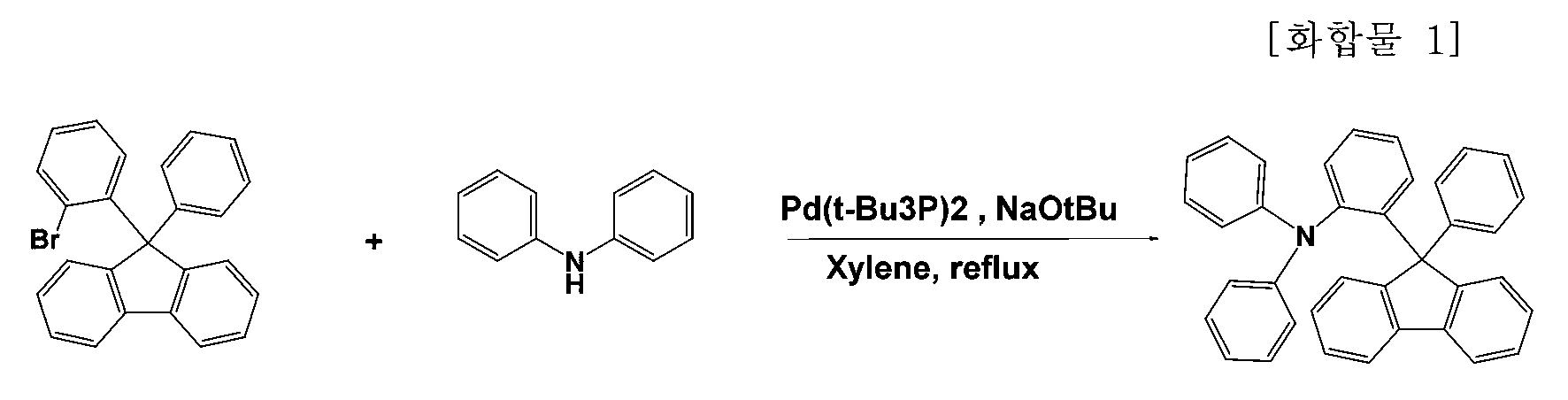
질소 분위기에서 500ml 둥근 바닥 플라스크에 9-(2-브로모페닐)-9-페닐-9H-플루오렌(15.0g, 37.87mmol), 디페닐아민(7.04g, 41.66mmol)을 자일렌(Xylene) 200ml에 완전히 녹인 후 소듐-tert-부톡사이드(4.73g, 49.23mmol)를 첨가하고, 비스(트리-tert-부틸포스핀)팔라듐(0.19g, 0.38mmol)을 넣은 후 2 시간 동안 가열 교반하였다. 상온으로 온도를 낮추고 여과하여 염을 제거한 후, 자일렌(Xylene)을 감압농축 시키고 테트라하이드로퓨란:헥산 = 1:10으로 컬럼하여 상기 화합물 1 (15.61g, 수율: 85%)을 제조하였다. 9-phenyl-9H-fluorene (15.0 g, 37.87 mmol) and diphenylamine (7.04 g, 41.66 mmol) were added to a 500 ml round bottom flask in a nitrogen atmosphere, (Tert-butylphosphine) palladium (0.19 g, 0.38 mmol) was added thereto, followed by heating and stirring for 2 hours. The temperature was lowered to room temperature, and the salt was removed by filtration. The xylene was concentrated under reduced pressure and the residue was subjected to column chromatography with tetrahydrofuran: hexane = 1: 10 to prepare Compound 1 (15.61 g, yield: 85%).
MS[M+H]+= 486MS [M + H] < + > = 486
<< 제조예Manufacturing example 2> 2>
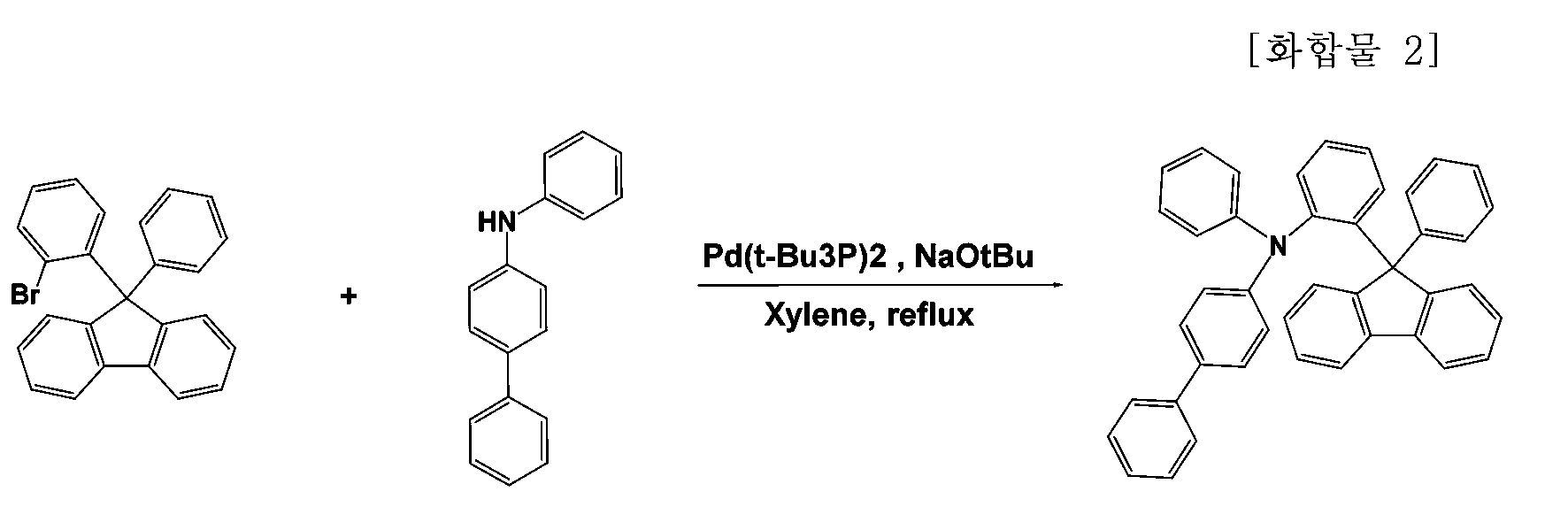
질소 분위기에서 500ml 둥근 바닥 플라스크에 9-(2-브로모페닐)-9-페닐-9H-플루오렌 (15.0g, 37.87mmol), N-페닐-[1,1'-비페닐]-4-아민(10.21g, 41.66mmol)을 자일렌(Xylene) 200ml에 완전히 녹인 후 소듐-tert-부톡사이드(4.73g, 49.23mmol)을 첨가하고, 비스(트리-tert-부틸포스핀)팔라듐(0.19g, 0.38mmol)을 넣은 후 3 시간 동안 가열 교반하였다. 상온으로 온도를 낮추고 여과하여 염을 제거한 후, 자일렌(Xylene)을 감압농축 시키고 테트라하이드로퓨란:헥산 = 1:10으로 컬럼하여 상기 화합물 2 (17.42g, 수율: 81%)를 제조하였다. 9-phenyl-9H-fluorene (15.0 g, 37.87 mmol) and N-phenyl- [1,1'-biphenyl] -4- Amine (10.21 g, 41.66 mmol) was completely dissolved in 200 ml of xylene and sodium tert-butoxide (4.73 g, 49.23 mmol) was added and bis (tri-tert-butylphosphine) palladium , 0.38 mmol), and the mixture was heated and stirred for 3 hours. The temperature was lowered to room temperature, and the salt was removed by filtration. The xylene was concentrated under reduced pressure and the residue was subjected to column chromatography with tetrahydrofuran: hexane = 1: 10 to prepare Compound 2 (17.42 g, yield: 81%).
MS[M+H]+= 562MS [M + H] < + > = 562
<< 제조예Manufacturing example 3> 3>
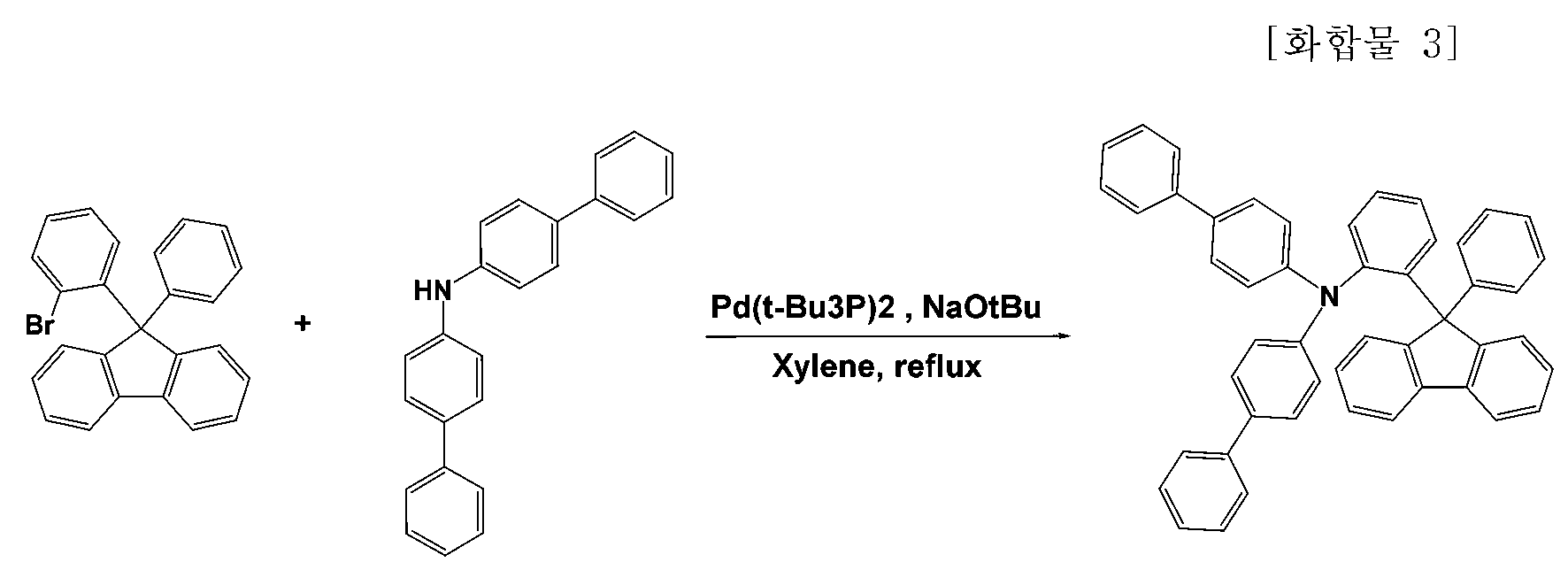
질소 분위기에서 500ml 둥근 바닥 플라스크에 9-(2-브로모페닐)-9-페닐-9H-플루오렌(15.0g, 37.87mmol), 디([1,1'-비페닐]-4-일)아민(13.37g, 41.66mmol)을 자일렌(Xylene) 200ml에 완전히 녹인 후 소듐-tert-부톡사이드(4.73g, 49.23mmol)을 첨가하고, 비스(트리-tert-부틸포스핀)팔라듐(0.19g, 0.38mmol)을 넣은 후 5시간 동안 가열 교반하였다. 상온으로 온도를 낮추고 여과하여 염을 제거한 후, 자일렌(Xylene)을 감압농축 시키고 테트라하이드로퓨란:헥산 = 1:6으로 컬럼하여 상기 화합물 3 (21.67g, 수율: 88%)을 제조하였다. 9-phenyl-9H-fluorene (15.0 g, 37.87 mmol), di [(1,1'-biphenyl) -4-yl) Amine (13.37 g, 41.66 mmol) was completely dissolved in 200 ml of xylene and sodium tert-butoxide (4.73 g, 49.23 mmol) was added and bis (tri-tert-butylphosphine) palladium , 0.38 mmol) were added thereto, followed by heating and stirring for 5 hours. The temperature was lowered to room temperature, and the salt was removed by filtration. Xylene was concentrated under reduced pressure, and the residue was subjected to column chromatography with tetrahydrofuran: hexane = 1: 6 to obtain Compound 3 (21.67 g, yield: 88%).
MS[M+H]+= 638MS [M + H] < + > = 638
<< 제조예Manufacturing example 4> 4>
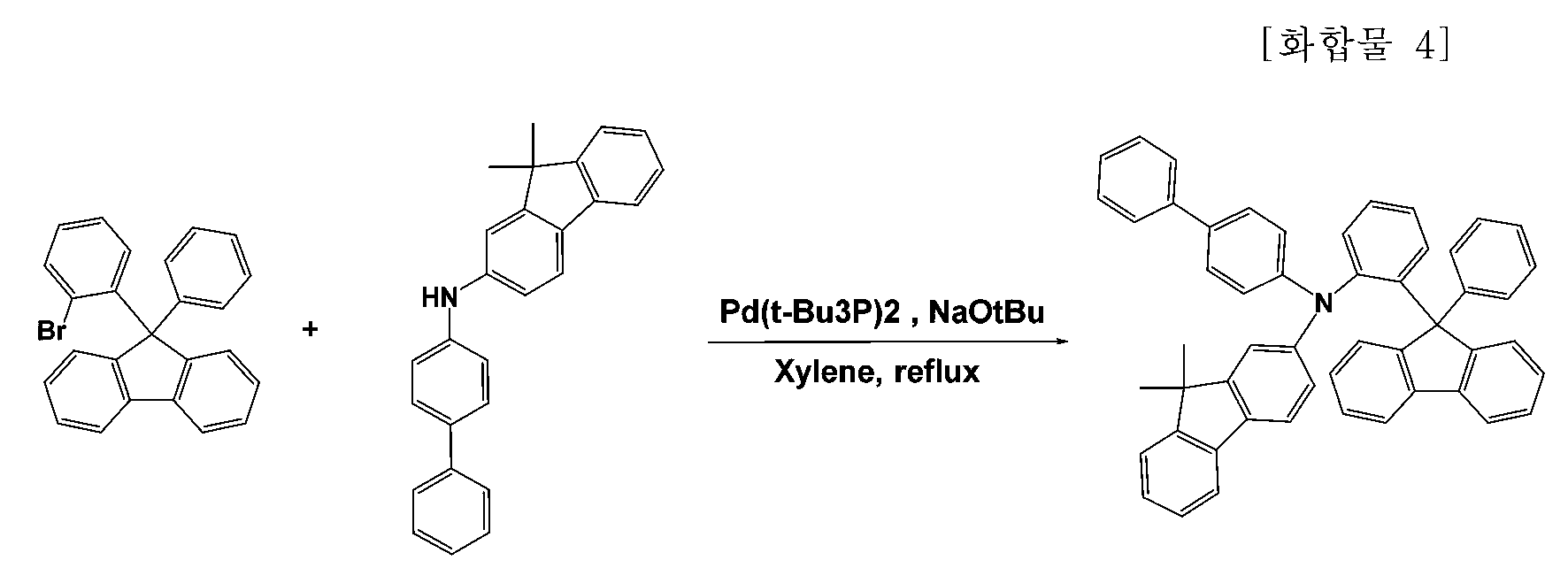
질소 분위기에서 500ml 둥근 바닥 플라스크에 9-(2-브로모페닐)-9-페닐-9H-플루오렌(15.0g, 37.87mmol), N-([1,1'-비페닐]-4-일)-9,9-디메틸-9H-플루오렌-2-아민(13.37g, 41.66mmol)을 자일렌(Xylene) 200ml에 완전히 녹인 후 소듐-tert-부톡사이드(4.73g, 49.23mmol)를 첨가하고, 비스(트리-tert-부틸포스핀)팔라듐 (0.19g, 0.38mmol)을 넣은 후 3 시간 동안 가열 교반하였다. 상온으로 온도를 낮추고 여과하여 염을 제거한 후, 자일렌(Xylene)을 감압농축 시키고 테트라하이드로퓨란:헥산 = 1:7으로 컬럼하여 상기 화합물 4 (22.45g, 수율: 87%)를 제조하였다. 9-phenyl-9H-fluorene (15.0 g, 37.87 mmol), N - ([1,1'-biphenyl] -4- ) -9,9-dimethyl-9H-fluorene-2-amine (13.37 g, 41.66 mmol) was completely dissolved in 200 ml of xylene and sodium tert-butoxide (4.73 g, 49.23 mmol) , And bis (tri-tert-butylphosphine) palladium (0.19 g, 0.38 mmol) were added thereto, followed by heating and stirring for 3 hours. The temperature was lowered to room temperature, and the salt was removed by filtration. Xylene was concentrated under reduced pressure, and the residue was subjected to column chromatography with tetrahydrofuran: hexane = 1: 7 to prepare Compound 4 (22.45 g, yield: 87%).
MS[M+H]+= 678MS [M + H] < + > = 678
<< 제조예Manufacturing example 5> 5>

질소 분위기에서 500ml 둥근 바닥 플라스크에 9-(2-브로모페닐)-9-페닐-9H-플루오렌(15.0g, 37.87mmol), N-([1,1'-비페닐]-4-일)-[1,1'-비페닐]-2-아민(13.37g, 41.66mmol)을 자일렌(Xylene) 200ml에 완전히 녹인 후 소듐-tert-부톡사이드(4.73g, 49.23mmol)를 첨가하고, 비스(트리-tert-부틸포스핀)팔라듐 (0.19g, 0.38mmol)을 넣은 후 4 시간 동안 가열 교반하였다. 상온으로 온도를 낮추고 여과하여 염을 제거한 후, 자일렌(Xylene)을 감압농축 시키고 테트라하이드로퓨란:헥산 = 1:9으로 컬럼하여 상기 화합물 5 (19.12g, 수율: 81%)를 제조하였다. 9-phenyl-9H-fluorene (15.0 g, 37.87 mmol), N - ([1,1'-biphenyl] -4- ) - [1,1'-biphenyl] -2-amine (13.37g, 41.66mmol) was completely dissolved in 200ml of xylene, sodium tert-butoxide (4.73g, 49.23mmol) Bis (tri-tert-butylphosphine) palladium (0.19 g, 0.38 mmol) was added and the mixture was heated with stirring for 4 hours. The temperature was lowered to room temperature, and the salt was removed by filtration. Xylene was concentrated under reduced pressure, and the residue was subjected to column chromatography with tetrahydrofuran: hexane = 1: 9 to prepare Compound 5 (19.12 g, yield: 81%).
MS[M+H]+= 638MS [M + H] < + > = 638
<< 제조예Manufacturing example 6> 6>
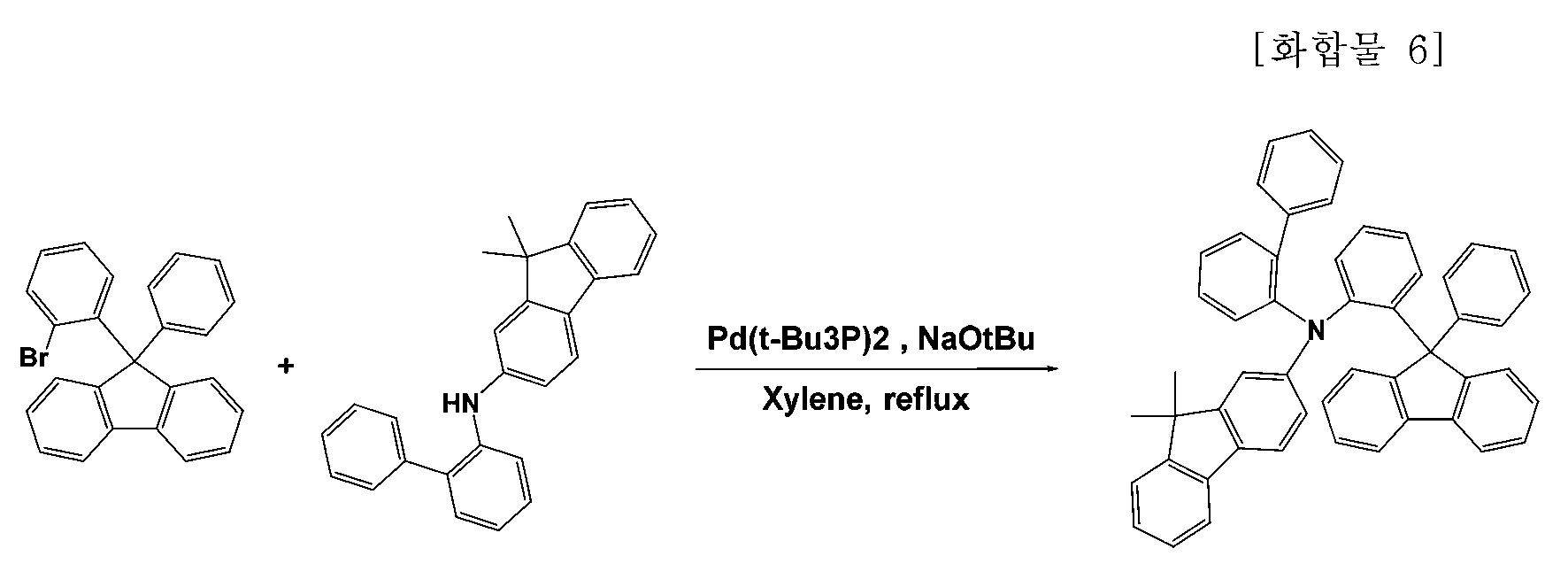
질소 분위기에서 500ml 둥근 바닥 플라스크에 9-(2-브로모페닐)-9-페닐-9H-플루오렌(15.0g, 37.87mmol), N-([1,1'-비페닐]-4-일)-9,9-디메틸-9H-플루오렌-2-아민 (13.37g, 41.66mmol)을 자일렌(Xylene) 200ml에 완전히 녹인 후 소듐-tert-부톡사이드(4.73g, 49.23mmol)를 첨가하고, 비스(트리-tert-부틸포스핀)팔라듐(0.19g, 0.38mmol)을 넣은 후 6 시간 동안 가열 교반하였다. 상온으로 온도를 낮추고 여과하여 염을 제거한 후, 자일렌(Xylene)을 감압농축 시키고 테트라하이드로퓨란:헥산 = 1:12으로 컬럼하여 상기 화합물 6 (18.62g, 수율: 71%)을 제조하였다. 9-phenyl-9H-fluorene (15.0 g, 37.87 mmol), N - ([1,1'-biphenyl] -4- ) -9,9-dimethyl-9H-fluoren-2-amine (13.37 g, 41.66 mmol) was completely dissolved in 200 ml of xylene and sodium tert-butoxide (4.73 g, 49.23 mmol) , And bis (tri-tert-butylphosphine) palladium (0.19 g, 0.38 mmol) were added thereto, followed by heating and stirring for 6 hours. The temperature was lowered to room temperature, and the salt was removed by filtration. Xylene was concentrated under reduced pressure, and the residue was subjected to column chromatography with tetrahydrofuran: hexane = 1: 12 to prepare Compound 6 (18.62 g, yield: 71%).
MS[M+H]+= 678MS [M + H] < + > = 678
<< 제조예Manufacturing example 7> 7>
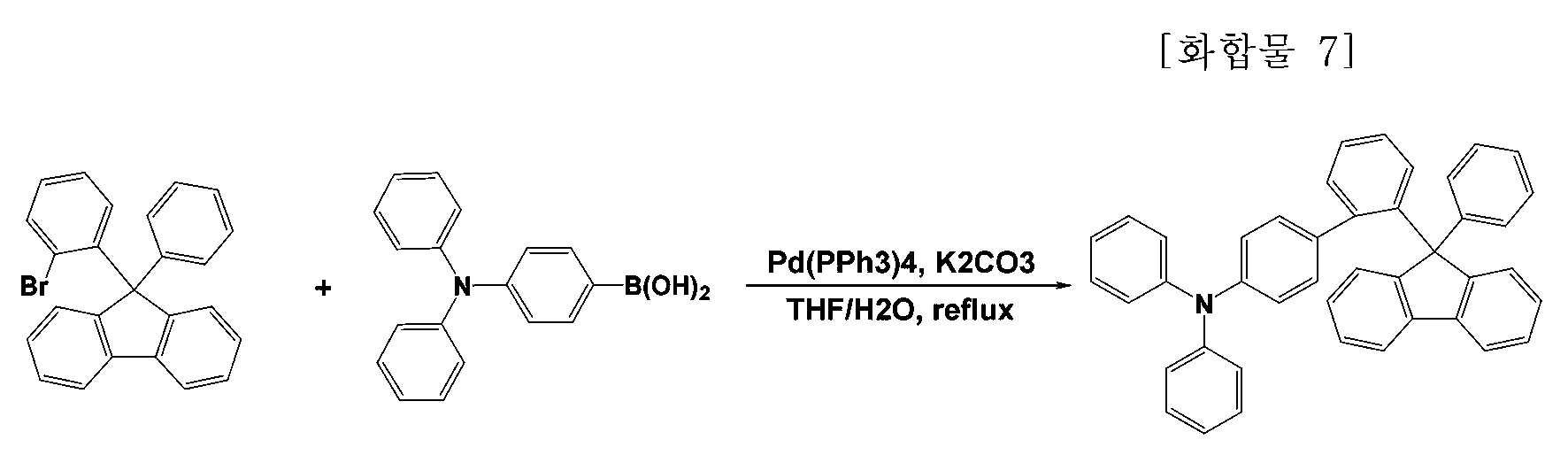
질소 분위기에서 500ml 둥근 바닥 플라스크에 화합물 9-(2-브로모페닐)-9-페닐-9H-플루오렌(15.0g, 37.87mmol), (4-디페닐아미노)페닐보론산(13.14g, 45.44mmol)을 테트라하이드로퓨란 200ml에 완전히 녹인 후 2M 탄산칼륨수용액(100ml)을 첨가하고, 테트라키스-(트리페닐포스핀)팔라듐(1.31g, 1.14mmol)을 넣은 후 2 시간 동안 가열 교반하였다. 상온으로 온도를 낮추고 물 층을 제거하고 무수황산마그네슘으로 건조한 후 감압농축 시키고 에탄올 300ml로 재결정하여 상기 화합물 7 (18.85g, 수율: 89%)을 제조하였다.(15.0 g, 37.87 mmol), (4-diphenylamino) phenylboronic acid (13.14 g, 45.44 mmol) were added to a 500 ml round bottom flask under a nitrogen atmosphere. mmol) was completely dissolved in 200 ml of tetrahydrofuran, and 2M potassium carbonate aqueous solution (100 ml) was added. Tetrakis- (triphenylphosphine) palladium (1.31 g, 1.14 mmol) was added and the mixture was heated with stirring for 2 hours. The temperature was lowered to room temperature, the water layer was removed, dried over anhydrous magnesium sulfate, concentrated under reduced pressure, and recrystallized from 300 ml of ethanol to obtain Compound 7 (18.85 g, yield: 89%).
MS[M+H]+= 562MS [M + H] < + > = 562
<< 제조예Manufacturing example 8> 8>

질소 분위기에서 500ml 둥근 바닥 플라스크에 화합물 9-(2-브로모페닐)-9-페닐-9H-플루오렌(15.0g, 37.87mmol), 4-(비페닐-4-일(페닐)아미노)페닐보론산(16.59g, 45.44mmol)을 테트라하이드로퓨란 300ml에 완전히 녹인 후 2M 탄산칼륨수용액(150ml)을 첨가하고, 테트라키스-(트리페닐포스핀)팔라듐(1.31g, 1.14mmol)을 넣은 후 4 시간 동안 가열 교반하였다. 상온으로 온도를 낮추고 물 층을 제거하고 무수황산마그네슘으로 건조한 후 감압농축 시키고 에틸아세테이트 300ml로 재결정하여 상기 화합물 8 (21.55g, 수율: 88%)를 제조하였다.Phenyl) -9H-fluorene (15.0 g, 37.87 mmol) and 4- (biphenyl-4-yl (phenyl) amino) phenyl (16.59 g, 45.44 mmol) was completely dissolved in 300 ml of tetrahydrofuran, then 2M potassium carbonate aqueous solution (150 ml) was added, tetrakis- (triphenylphosphine) palladium (1.31 g, 1.14 mmol) Lt; / RTI > The temperature was lowered to room temperature, and the water layer was removed. The organic layer was dried over anhydrous magnesium sulfate, concentrated under reduced pressure, and recrystallized from ethyl acetate (300 ml) to obtain Compound 8 (21.55 g, yield: 88%).
MS[M+H ]+= 638MS [M + H ] + = 638
<< 제조예Manufacturing example 9> 9>
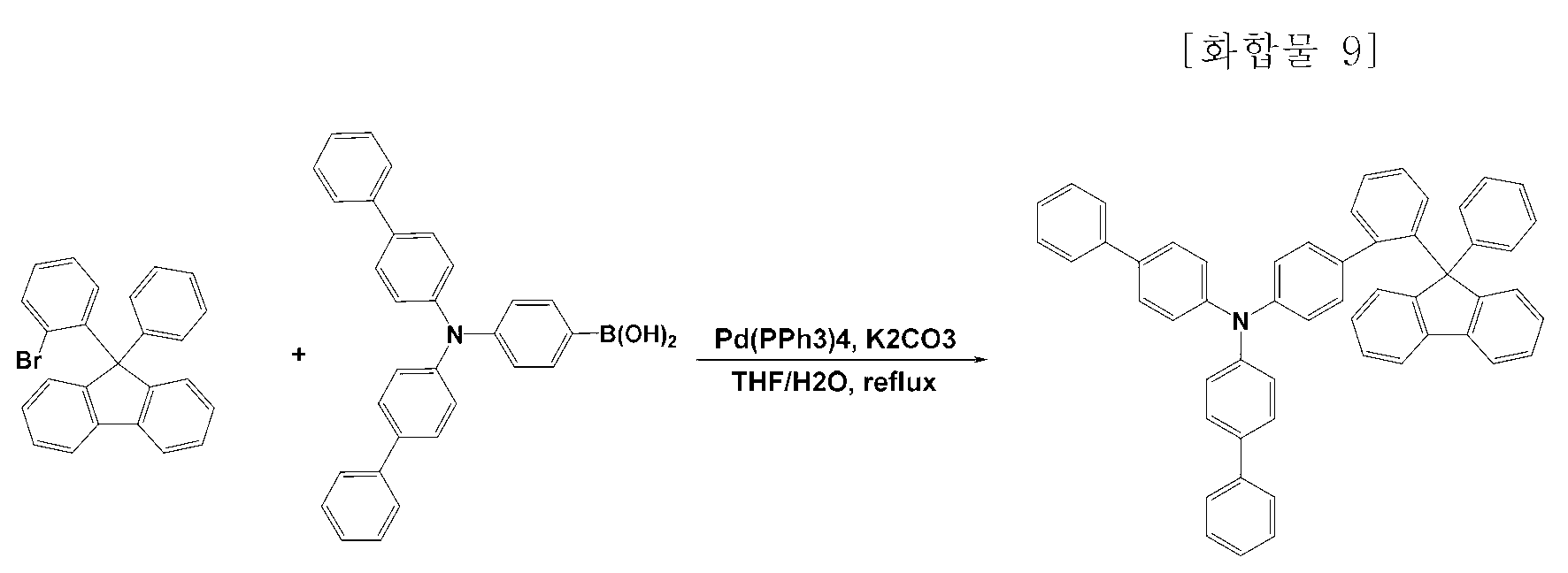
질소 분위기에서 500ml 둥근 바닥 플라스크에 화합물 9-(2-브로모페닐)-9-페닐-9H-플루오렌(15.0g, 37.87mmol), 4-((디비페닐-4-일)아미노)페닐보론산(20.04g, 45.44mmol)을 테트라하이드로퓨란 300ml에 완전히 녹인 후 2M 탄산칼륨수용액(150ml)을 첨가하고, 테트라키스-(트리페닐포스핀)팔라듐(1.31g, 1.14mmol)을 넣은 후 4 시간 동안 가열 교반하였다. 상온으로 온도를 낮추고 물 층을 제거하고 무수황산마그네슘으로 건조한 후 감압농축 시키고 에틸아세테이트 300ml로 재결정하여 상기 화합물 9 (25.71g, 수율: 93%)를 제조하였다.9-phenyl-9H-fluorene (15.0 g, 37.87 mmol) and 4 - ((dibiphenyl-4-yl) amino) phenylboron were added to a 500 ml round bottom flask under a nitrogen atmosphere. (Triphenylphosphine) palladium (1.31 g, 1.14 mmol) was added thereto, and the mixture was stirred for 4 hrs. Lt; / RTI > The temperature was lowered to room temperature, the water layer was removed, dried over anhydrous magnesium sulfate, concentrated under reduced pressure, and recrystallized from ethyl acetate (300 ml) to obtain Compound 9 (25.71 g, yield: 93%).
MS[M+H]+= 714MS [M + H] < + > = 714
<< 제조예Manufacturing example 10> 10>

질소 분위기에서 500ml 둥근 바닥 플라스크에 화합물 9-(2-브로모페닐)-9-페닐-9H-플루오렌(15.0g, 37.87mmol), 4-([1,1'-비페닐]-4-일(9,9-디메틸-9H-플루오렌-2-일)아미노)페닐보론산(21.86, 45.44mmol)을 테트라하이드로퓨란 300ml에 완전히 녹인 후 2M 탄산칼륨수용액(150ml)을 첨가하고, 테트라키스-(트리페닐포스핀)팔라듐(1.31g, 1.14mmol)을 넣은 후 4 시간 동안 가열 교반하였다. 상온으로 온도를 낮추고 물 층을 제거하고 무수황산마그네슘으로 건조한 후 감압농축 시키고 에틸아세테이트 300ml로 재결정하여 상기 화합물 10 (25.48g, 수율: 89%)을 제조하였다.9-phenyl-9H-fluorene (15.0 g, 37.87 mmol) and 4- ([l, l'-biphenyl] -4- (21.86, 45.44 mmol) was completely dissolved in 300 ml of tetrahydrofuran, followed by addition of 2M aqueous potassium carbonate solution (150 ml), tetrakis (triphenylphosphine) palladium - (triphenylphosphine) palladium (1.31 g, 1.14 mmol) was added thereto, followed by heating and stirring for 4 hours. The temperature was lowered to room temperature, and the water layer was removed. The organic layer was dried over anhydrous magnesium sulfate, concentrated under reduced pressure, and recrystallized from ethyl acetate (300 ml) to obtain Compound 10 (25.48 g, yield: 89%).
MS[M+H]+= 754MS [M + H] < + > = 754
<< 제조예Manufacturing example 11> 11>
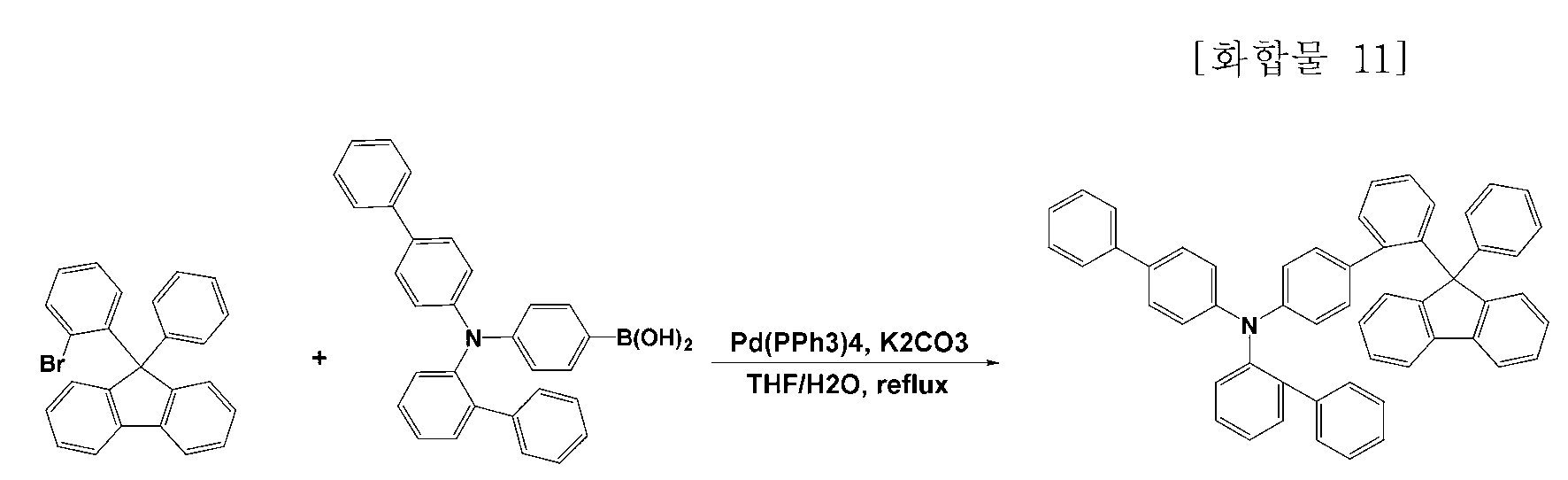
질소 분위기에서 500ml 둥근 바닥 플라스크에 화합물 9-(2-브로모페닐)-9-페닐-9H-플루오렌(15.0g, 37.87mmol), 4-([1,1'-비페닐]-2-일([1,1'-비페닐]-4-일)아미노)페닐보론산(20.04g, 45.44mmol)을 테트라하이드로퓨란 300ml에 완전히 녹인 후 2M 탄산칼륨수용액(150ml)을 첨가하고, 테트라키스-(트리페닐포스핀)팔라듐(1.31g, 1.14mmol)을 넣은 후 3 시간 동안 가열 교반하였다. 상온으로 온도를 낮추고 물 층을 제거하고 무수황산마그네슘으로 건조한 후 감압농축 시키고 에틸아세테이트 300ml로 재결정하여 상기 화합물 11 (23.53g, 수율: 84%)을 제조하였다.(15.0 g, 37.87 mmol), 4 - ([1,1'-biphenyl] -2- (2-bromophenyl) (20.04 g, 45.44 mmol) in tetrahydrofuran was completely dissolved in 300 ml of tetrahydrofuran, followed by addition of 2M aqueous potassium carbonate solution (150 ml), tetrakis (triphenylphosphine) palladium - (triphenylphosphine) palladium (1.31 g, 1.14 mmol) was added thereto, followed by heating and stirring for 3 hours. The temperature was lowered to room temperature, the water layer was removed, dried over anhydrous magnesium sulfate, concentrated under reduced pressure, and recrystallized from ethyl acetate (300 ml) to prepare the above compound 11 (23.53 g, yield: 84%).
MS[M+H]+= 714MS [M + H] < + > = 714
<< 제조예Manufacturing example 12> 12>
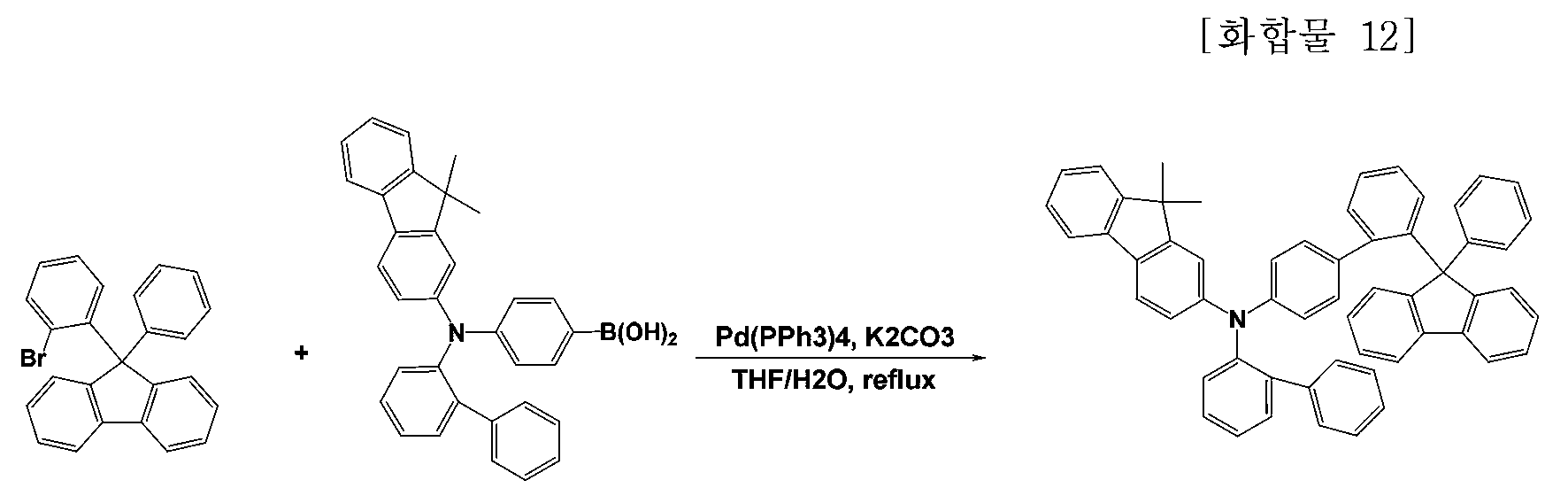
질소 분위기에서 500ml 둥근 바닥 플라스크에 화합물 9-(2-브로모페닐)-9-페닐-9H-플루오렌(15.0g, 37.87mmol), 4-([1,1'-비페닐]-2-일(9,9-디메틸-9H-플루오렌-2-일)아미노)페닐보론산(21.86, 45.44mmol)을 테트라하이드로퓨란 300ml에 완전히 녹인 후 2M 탄산칼륨수용액(150ml)을 첨가하고, 테트라키스-(트리페닐포스핀)팔라듐(1.31g, 1.14mmol)을 넣은 후 4 시간 동안 가열 교반하였다. 상온으로 온도를 낮추고 물 층을 제거하고 무수황산마그네슘으로 건조한 후 감압농축 시키고 에틸아세테이트 300ml로 재결정하여 상기 화합물 12 (25.48g, 수율: 89%)를 제조하였다.(15.0 g, 37.87 mmol), 4 - ([1,1'-biphenyl] -2- (2-bromophenyl) (21.86, 45.44 mmol) was completely dissolved in 300 ml of tetrahydrofuran, followed by addition of 2M aqueous potassium carbonate solution (150 ml), tetrakis (triphenylphosphine) palladium - (triphenylphosphine) palladium (1.31 g, 1.14 mmol) was added thereto, followed by heating and stirring for 4 hours. The temperature was lowered to room temperature, the water layer was removed, dried over anhydrous magnesium sulfate, concentrated under reduced pressure, and recrystallized from ethyl acetate (300 ml) to give Compound 12 (25.48 g, yield: 89%).
MS[M+H]+= 754MS [M + H] < + > = 754
<< 제조예Manufacturing example 13> 13>
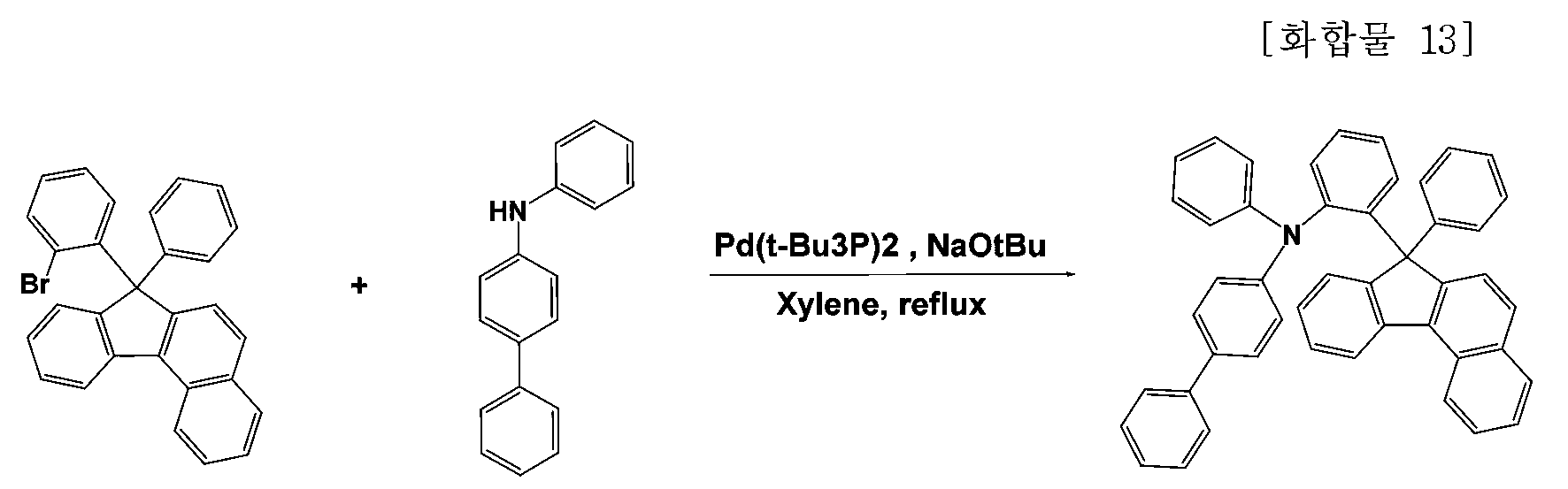
질소 분위기에서 500ml 둥근 바닥 플라스크에 7-(2-브로모페닐)-7-페닐-7H-벤조[c]플루오렌(15.0g, 33.63mmol), N-페닐-[1,1'-비페닐]-4-아민(9.06g, 36.99mmol)을 자일렌(Xylene) 250ml에 완전히 녹인 후 소듐-tert-부톡사이드(4.20g, 43.72mmol)을 첨가하고, 비스(트리-tert-부틸포스핀)팔라듐 (0.17g, 0.34mmol)을 넣은 후 3 시간 동안 가열 교반하였다. 상온으로 온도를 낮추고 여과하여 염을 제거한 후, 자일렌(Xylene)을 감압농축 시키고 테트라하이드로퓨란:헥산 = 1:6으로 컬럼하여 상기 화합물 13 (19.55g, 수율: 84%)을 제조하였다. Benzo [c] fluorene (15.0 g, 33.63 mmol) and N-phenyl- [1,1'-biphenyl ] -4-amine (9.06 g, 36.99 mmol) was completely dissolved in 250 ml of xylene and sodium tert-butoxide (4.20 g, 43.72 mmol) Palladium (0.17 g, 0.34 mmol) was added thereto, followed by heating and stirring for 3 hours. The temperature was lowered to room temperature, and the salt was removed by filtration. The xylene was concentrated under reduced pressure, and the residue was subjected to column chromatography with tetrahydrofuran: hexane = 1: 6 to obtain Compound 13 (19.55 g, yield: 84%).
MS[M+H]+= 612MS [M + H] < + > = 612
<< 제조예Manufacturing example 14> 14>

질소 분위기에서 500ml 둥근 바닥 플라스크에 7-(2-브로모페닐)-7-페닐-7H-벤조[c]플루오렌(15.0g, 33.63mmol), 9,9-디메틸-N-페닐-9H-플루오렌-2-아민(9.06g, 36.99mmol)을 자일렌(Xylene) 250ml에 완전히 녹인 후 소듐-tert-부톡사이드(4.20g, 43.72mmol)을 첨가하고, 비스(트리-tert-부틸포스핀)팔라듐 (0.17g, 0.34mmol)을 넣은 후 5 시간 동안 가열 교반하였다. 상온으로 온도를 낮추고 여과하여 염을 제거한 후, 자일렌(Xylene)을 감압농축 시키고 테트라하이드로퓨란:헥산 = 1:7으로 컬럼하여 상기 화합물 14 (17.41g, 수율: 78%)를 제조하였다. Benzo [c] fluorene (15.0 g, 33.63 mmol) and 9,9-dimethyl-N-phenyl-9H- (9.06 g, 36.99 mmol) was completely dissolved in 250 ml of xylene and sodium tert-butoxide (4.20 g, 43.72 mmol) was added, and bis (tri-tert-butylphosphine ) Palladium (0.17 g, 0.34 mmol) was added thereto, followed by heating and stirring for 5 hours. The temperature was lowered to room temperature, and the salt was removed by filtration. Xylene was concentrated under reduced pressure, and the residue was subjected to column chromatography with tetrahydrofuran: hexane = 1: 7 to prepare Compound 14 (17.41 g, yield: 78%).
MS[M+H]+= 652MS [M + H] < + > = 652
<< 제조예Manufacturing example 15> 15>
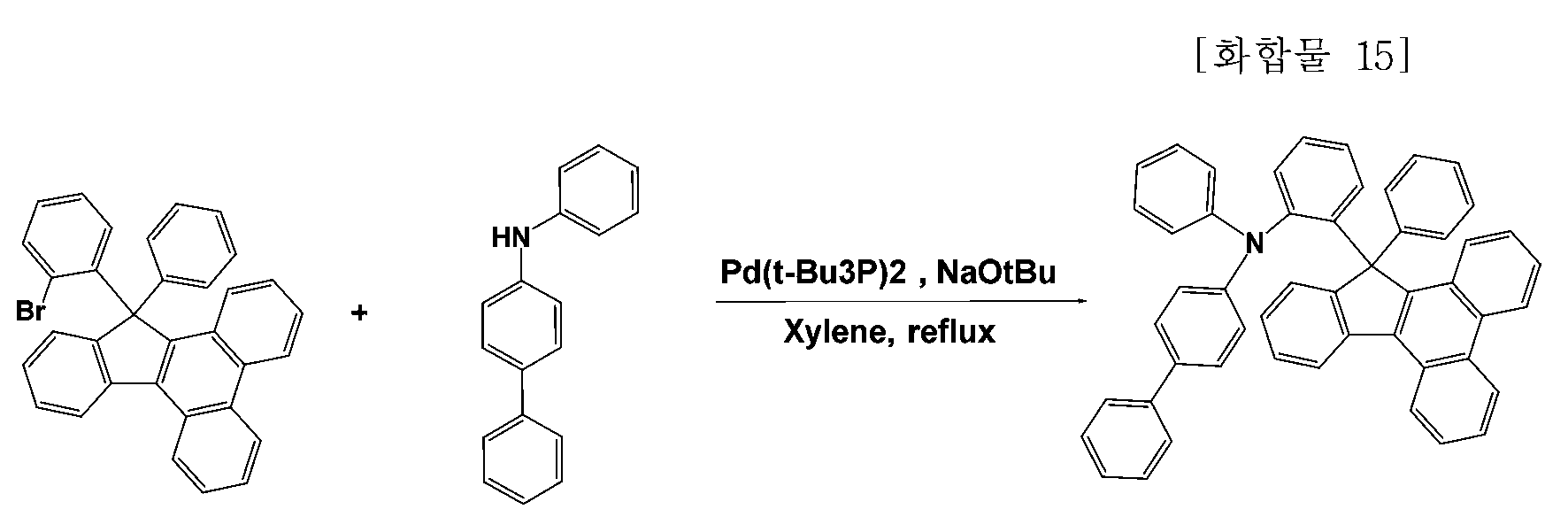
질소 분위기에서 500ml 둥근 바닥 플라스크에 9-(2-브로모페닐)-9-페닐-9H-인디노[1,2-l]페난트렌(15.0g, 33.06mmol), N-페닐-[1,1'-비페닐]-4-아민(8.91g, 36.37mmol)을 자일렌(Xylene) 250ml에 완전히 녹인 후 소듐-tert-부톡사이드(3.18g, 43.72mmol)을 첨가하고, 비스(트리-tert-부틸포스핀)팔라듐 (0.16g, 0.33mmol)을 넣은 후 3 시간 동안 가열 교반하였다. 상온으로 온도를 낮추고 여과하여 염을 제거한 후, 자일렌(Xylene)을 감압농축 시키고 테트라하이드로퓨란:헥산 = 1:6으로 컬럼하여 상기 화합물 15 (19.55g, 수율: 84%)를 제조하였다. Phenyl-9H-indino [l, 2- l] phenanthrene (15.0 g, 33.06 mmol) and N-phenyl- [l, Biphenyl] -4-amine (8.91 g, 36.37 mmol) was dissolved in 250 ml of xylene and sodium-tert-butoxide (3.18 g, 43.72 mmol) -Butylphosphine) palladium (0.16 g, 0.33 mmol) were added thereto, and the mixture was heated and stirred for 3 hours. The temperature was lowered to room temperature, and the salt was removed by filtration. The xylene was concentrated under reduced pressure and the residue was subjected to column chromatography with tetrahydrofuran: hexane = 1: 6 to prepare Compound 15 (19.55 g, yield: 84%).
MS[M+H]+= 662MS [M + H] < + > = 662
<< 실험예Experimental Example 1> 1>
<실험예 1-1><Experimental Example 1-1>
ITO(indium tin oxide)가 100nm의 두께로 박막 코팅된 유리 기판을 세제를 녹인 증류수에 넣고 초음파로 세척하였다. 이 때, 세제로는 피셔사(Fischer Co.) 제품을 사용하였으며, 증류수로는 밀러포어사(Millipore Co.) 제품의 필터(Filter)로 2차로 걸러진 증류수를 사용하였다. ITO를 30분간 세척한 후 증류수로 2회 반복하여 초음파 세척을 10분간 진행하였다. 증류수 세척이 끝난 후, 이소프로필알콜, 아세톤, 메탄올의 용제로 초음파 세척을 하고 건조시킨 후 플라즈마 세정기로 수송시켰다. 또한, 산소 플라즈마를 이용하여 상기 기판을 5분간 세정한 후 진공 증착기로 기판을 수송시켰다.A glass substrate coated with a thin ITO (indium tin oxide) film having a thickness of 100 nm was immersed in distilled water containing detergent and washed with ultrasonic waves. In this case, Fischer Co. was used as a detergent, and distilled water filtered by a filter of Millipore Co. was used as distilled water. The ITO was washed for 30 minutes and then washed twice with distilled water and ultrasonically cleaned for 10 minutes. After the distilled water was washed, it was ultrasonically washed with a solvent of isopropyl alcohol, acetone, and methanol, dried, and then transported to a plasma cleaner. Further, the substrate was cleaned using oxygen plasma for 5 minutes, and then the substrate was transported by a vacuum evaporator.
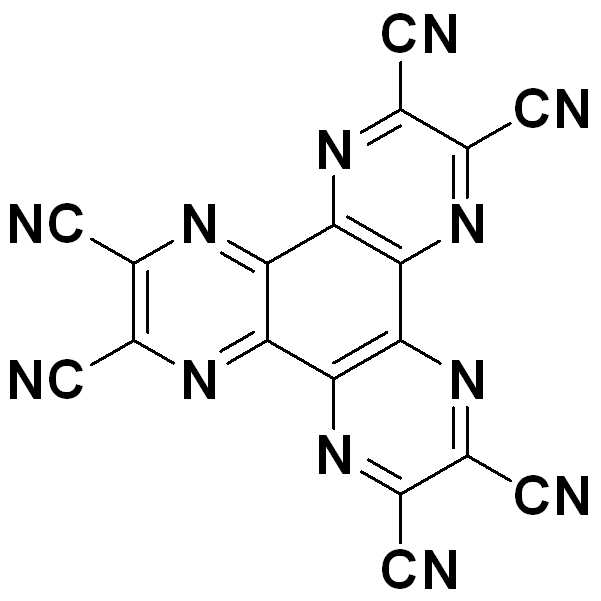
이렇게 준비된 ITO 투명 전극 위에 하기 화학식의 헥사니트릴 헥사아자트리페닐렌 (hexaazatriphenylene; HAT)를 50nm의 두께로 열 진공 증착하여 정공 주입층을 형성하였다. On this ITO transparent electrode, hexanitrile hexaazatriphenylene (HAT) of the following formula was thermally vacuum deposited to a thickness of 50 nm to form a hole injection layer.
[HAT][LINE]
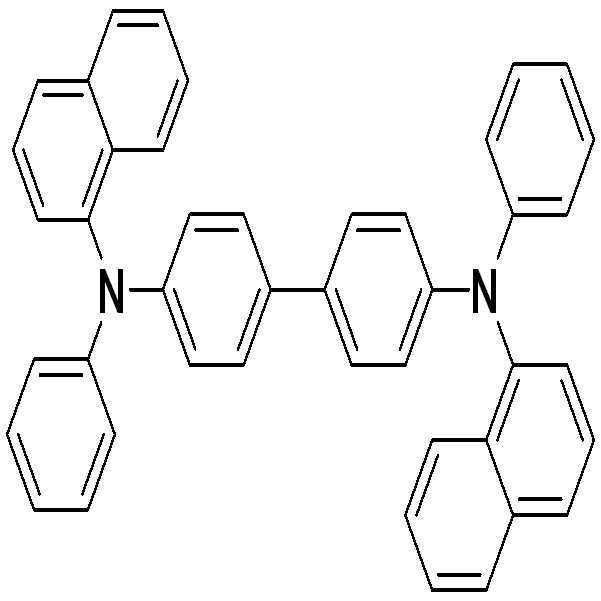
상기 정공 주입층 위에 정공을 수송하는 물질인 하기 화합물 4-4'-비스[N-(1-나프틸)-N-페닐아미노]비페닐(NPB)(300Å)를 진공 증착하여 정공 수송층을 형성하였다. N-phenylamino] biphenyl (NPB) (300 Å) was vacuum-deposited on the hole injection layer to form a hole transport layer, which is a material for transporting holes, and the following compound 4-4'-bis [N- (1-naphthyl) Respectively.
[NPB][NPB]
이어서, 상기 정공 수송층 위에 막 두께 100Å으로 하기 화합물 1를 진공 증착하여 전자 차단층을 형성하였다.Subsequently, the following compound 1 was vacuum deposited on the hole transport layer to a thickness of 100 ANGSTROM to form an electron blocking layer.
[화합물 1][Compound 1]
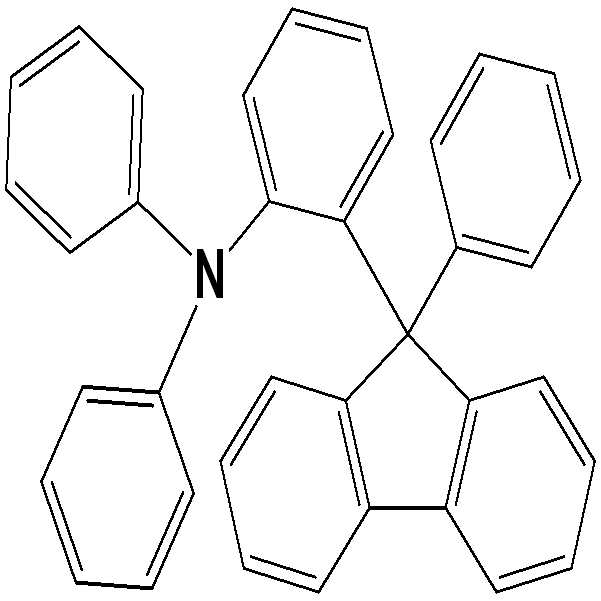
이어서, 상기 전자 차단층 위에 막 두께 30nm로 아래와 같은 BH와 BD를 25:1의 중량비로 진공증착하여 발광층을 형성하였다. Subsequently, BH and BD were vacuum deposited on the electron blocking layer to a film thickness of 30 nm at a weight ratio of 25: 1 to form a light emitting layer.
[BH][BH]

[BD][BD]
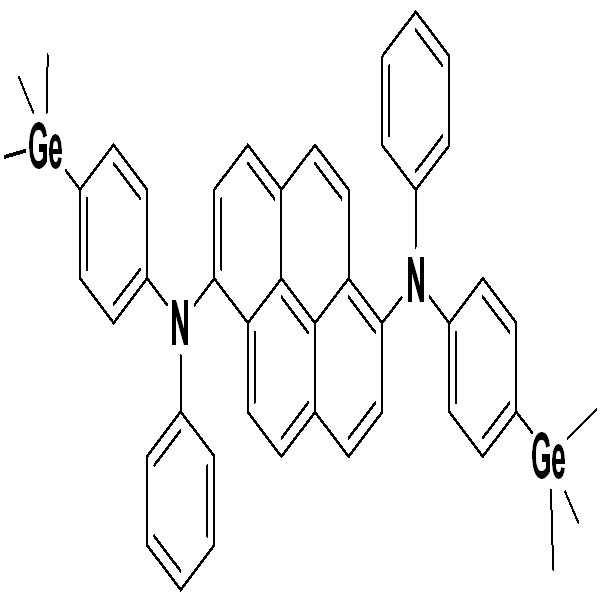
[ET1][ET1]
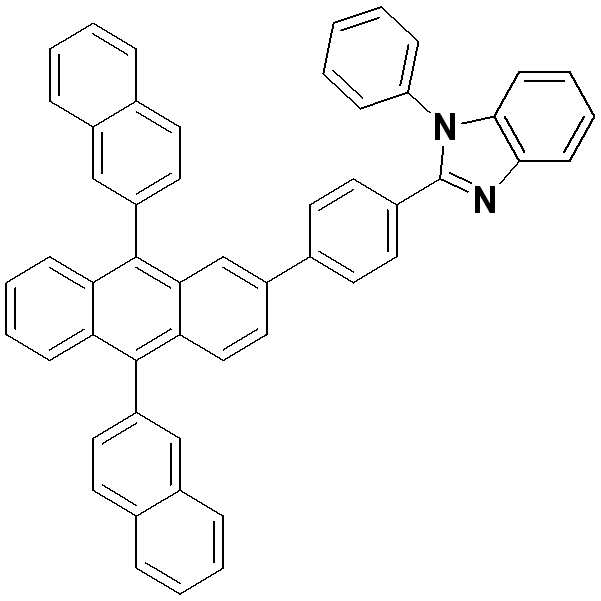
[LiQ][LiQ]
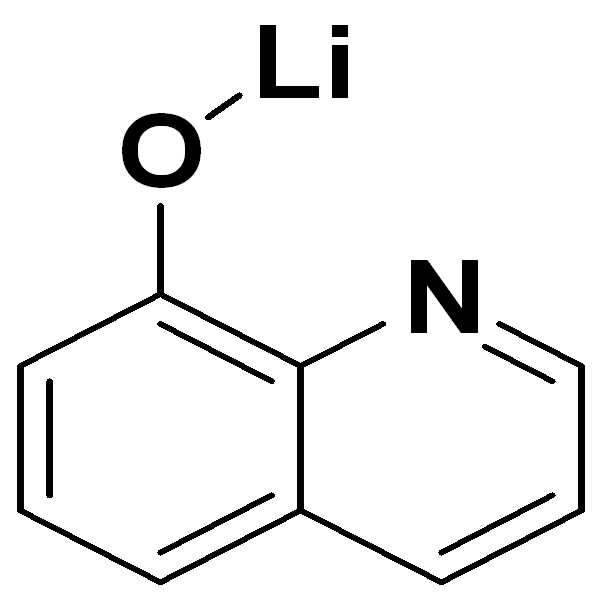
상기 발광층 위에 상기 화합물 ET1과 상기 화합물 LiQ(Lithium Quinolate)를 1:1의 중량비로 진공증착하여 30nm의 두께로 전자 주입 및 수송층을 형성하였다. 상기 전자 주입 및 수송층 위에 순차적으로 12Å두께로 리튬플로라이드(LiF)와 200nm 두께로 알루미늄을 증착하여 음극을 형성하였다. The compound ET1 and the compound LiQ (Lithium Quinolate) were vacuum deposited on the light emitting layer at a weight ratio of 1: 1 to form an electron injecting and transporting layer having a thickness of 30 nm. Lithium fluoride (LiF) and aluminum having a thickness of 200 nm were sequentially deposited on the electron injecting and transporting layer to form a cathode.
상기의 과정에서 유기물의 증착속도는 0.4 내지 0.07nm/sec를 유지하였고, 음극의 리튬플로라이드는 0.03nm/sec, 알루미늄은 0.2nm/sec의 증착 속도를 유지하였으며, 증착시 진공도는 2 ⅹ10-7 내지 5 ⅹ10-6 torr를 유지하여, 유기 발광 소자를 제작하였다.Was maintained at a vapor deposition rate of 0.4 to 0.07nm / sec for organic material in the above process, the lithium fluoride of the cathode was maintained at the deposition speed of 0.03nm / sec, aluminum is 0.2nm / sec, the degree of vacuum upon deposition ⅹ10 2 - 7 to 5 x 10 < -6 > torr. Thus, an organic light emitting device was fabricated.
<실험예 1-2><Experimental Example 1-2>
상기 실험예 1-1에서 화합물 1 대신 상기 화합물 2를 사용한 것을 제외하고는 상기 실험예 1-1과 동일한 방법으로 유기 발광 소자를 제작하였다.An organic light emitting device was fabricated in the same manner as in Experimental Example 1-1, except that Compound 2 was used instead of Compound 1 in Experimental Example 1-1.
<실험예 1-3><Experimental Example 1-3>
상기 실험예 1-1에서 화합물 1 대신 상기 화합물 3을 사용한 것을 제외하고는 상기 실험예 1-1과 동일한 방법으로 유기 발광 소자를 제작하였다.An organic light emitting device was fabricated in the same manner as in Experimental Example 1-1, except that Compound 3 was used instead of Compound 1 in Experimental Example 1-1.
<실험예 1-4><Experimental Example 1-4>
상기 실험예 1-1에서 화합물 1 대신 상기 화합물 4를 사용한 것을 제외하고는 상기 실험예 1-1과 동일한 방법으로 유기 발광 소자를 제작하였다.An organic light emitting device was fabricated in the same manner as in Experimental Example 1-1, except that Compound 4 was used instead of Compound 1 in Experimental Example 1-1.
<실험예 1-5><Experimental Example 1-5>
상기 실험예 1-1에서 화합물 1 대신 상기 화합물 5를 사용한 것을 제외하고는 상기 실험예 1-1과 동일한 방법으로 유기 발광 소자를 제작하였다.An organic light emitting device was fabricated in the same manner as in Experimental Example 1-1, except that Compound 5 was used instead of Compound 1 in Experimental Example 1-1.
<실험예 1-6><Experimental Example 1-6>
상기 실험예 1-1에서 화합물 1 대신 상기 화합물 6을 사용한 것을 제외하고는 상기 실험예 1-1과 동일한 방법으로 유기 발광 소자를 제작하였다.An organic light emitting device was fabricated in the same manner as in Experimental Example 1-1, except that Compound 6 was used instead of Compound 1 in Experimental Example 1-1.
<실험예 1-7><Experimental Example 1-7>
상기 실험예 1-1에서 화합물 1 대신 상기 화합물 7을 사용한 것을 제외하고는 상기 실험예 1과 동일한 방법으로 유기 발광 소자를 제작하였다.An organic light emitting device was fabricated in the same manner as in Experimental Example 1, except that Compound 7 was used instead of Compound 1 in Experimental Example 1-1.
<실험예 1-8><Experimental Example 1-8>
상기 실험예 1-1에서 화합물 1 대신 상기 화합물 8을 사용한 것을 제외하고는 상기 실험예 1-1과 동일한 방법으로 유기 발광 소자를 제작하였다.An organic light emitting device was fabricated in the same manner as in Experimental Example 1-1, except that Compound 8 was used instead of Compound 1 in Experimental Example 1-1.
<실험예 1-9><Experimental Example 1-9>
상기 실험예 1-1에서 화합물 1 대신 상기 화합물 9를 사용한 것을 제외하고는 상기 실험예 1-1과 동일한 방법으로 유기 발광 소자를 제작하였다.An organic light emitting device was fabricated in the same manner as in Experimental Example 1-1, except that Compound 9 was used instead of Compound 1 in Experimental Example 1-1.
<실험예 1-10><Experimental Example 1-10>
상기 실험예 1-1에서 화합물 1 대신 상기 화합물 10을 사용한 것을 제외하고는 상기 실험예 1-1과 동일한 방법으로 유기 발광 소자를 제작하였다.An organic light emitting device was fabricated in the same manner as in Experimental Example 1-1, except that
<실험예 1-11><Experimental Example 1-11>
상기 실험예 1-1에서 화합물 1 대신 상기 화합물 11을 사용한 것을 제외하고는 상기 실험예 1-1과 동일한 방법으로 유기 발광 소자를 제작하였다.An organic light emitting device was fabricated in the same manner as in Experimental Example 1-1, except that
<실험예 1-12><Experimental Example 1-12>
상기 실험예 1-1에서 화합물 1 대신 상기 화합물 12를 사용한 것을 제외하고는 상기 실험예 1-1과 동일한 방법으로 유기 발광 소자를 제작하였다.An organic light emitting device was fabricated in the same manner as in Experimental Example 1-1, except that Compound 12 was used instead of Compound 1 in Experimental Example 1-1.
<실험예 1-13><Experimental Example 1-13>
상기 실험예 1-1에서 화합물 1 대신 상기 화합물 13을 사용한 것을 제외하고는 상기 실험예 1-1과 동일한 방법으로 유기 발광 소자를 제작하였다.An organic light emitting device was fabricated in the same manner as in Experimental Example 1-1, except that Compound 13 was used instead of Compound 1 in Experimental Example 1-1.
<실험예 1-14><Experimental Example 1-14>
상기 실험예 1-1에서 화합물 1 대신 상기 화합물 14를 사용한 것을 제외하고는 상기 실험예 1-1과 동일한 방법으로 유기 발광 소자를 제작하였다.An organic light emitting device was fabricated in the same manner as in Experimental Example 1-1, except that Compound 14 was used instead of Compound 1 in Experimental Example 1-1.
<실험예 1-15><Experimental Example 1-15>
상기 실험예 1-1에서 화합물 1 대신 상기 화합물 15를 사용한 것을 제외하고는 상기 실험예 1-1과 동일한 방법으로 유기 발광 소자를 제작하였다.An organic light emitting device was fabricated in the same manner as in Experimental Example 1-1, except that Compound 15 was used instead of Compound 1 in Experimental Example 1-1.
<비교예 1-1>≪ Comparative Example 1-1 >
상기 실험예 1-1에서 화합물 1 대신 하기 EB1의 화합물을 사용한 것을 제외하고는 상기 실험예 1-1과 동일한 방법으로 유기 발광 소자를 제작하였다.An organic light emitting device was fabricated in the same manner as in Experimental Example 1-1, except that Compound EB1 was used instead of Compound 1 in Experimental Example 1-1.
[EB1][EB1]
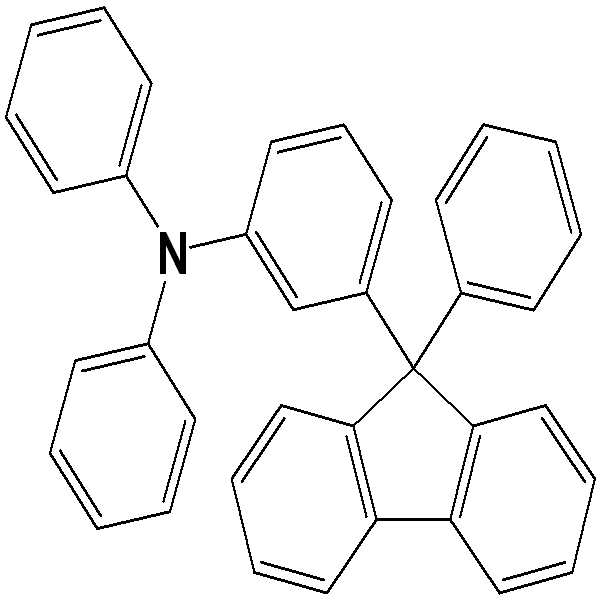
<비교예 1-2>≪ Comparative Example 1-2 >
상기 실험예 1-1에서 화합물 1 대신 하기 EB2의 화합물을 사용한 것을 제외하고는 상기 실험예 1-1과 동일한 방법으로 유기 발광 소자를 제작하였다.An organic light emitting device was fabricated in the same manner as in Experimental Example 1-1, except that the following compound EB2 was used in place of Compound 1 in Experimental Example 1-1.
[EB2][EB2]

<비교예 1-3>≪ Comparative Example 1-3 >
상기 실험예 1-1에서 화합물 1 대신 하기 EB3의 화합물을 사용한 것을 제외하고는 상기 실험예 1-1과 동일한 방법으로 유기 발광 소자를 제작하였다.An organic light emitting device was fabricated in the same manner as in Experimental Example 1-1, except that Compound EB3 was used instead of Compound 1 in Experimental Example 1-1.
[EB3][EB3]
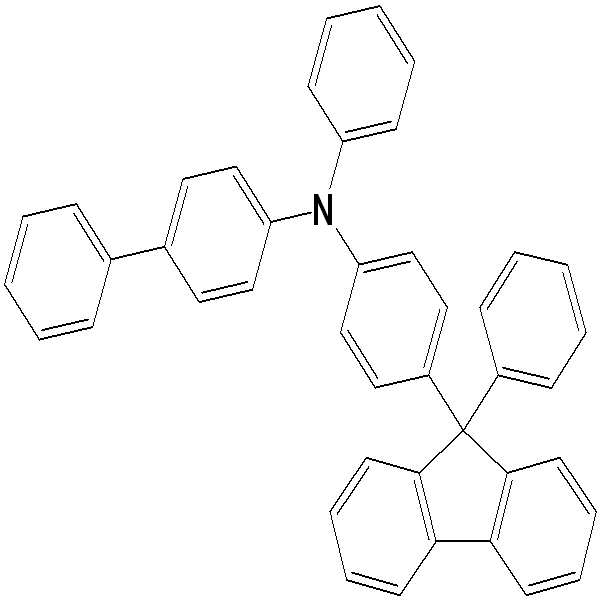
<비교예 1-4>≪ Comparative Example 1-4 >
상기 실험예 1-1에서 화합물 1 대신 하기 EB4의 화합물을 사용한 것을 제외하고는 상기 실험예 1-1과 동일한 방법으로 유기 발광 소자를 제작하였다.An organic light emitting device was fabricated in the same manner as in Experimental Example 1-1, except that Compound EB4 was used instead of Compound 1 in Experimental Example 1-1.
[EB4][EB4]

<비교예 1-5>≪ Comparative Example 1-5 >
상기 실험예 1-1에서 화합물 1 대신 하기 EB5의 화합물을 사용한 것을 제외하고는 상기 실험예 1-1과 동일한 방법으로 유기 발광 소자를 제작하였다.An organic light emitting device was fabricated in the same manner as in Experimental Example 1-1, except that Compound EB5 was used in place of Compound 1 in Experimental Example 1-1.
[EB5][EB5]
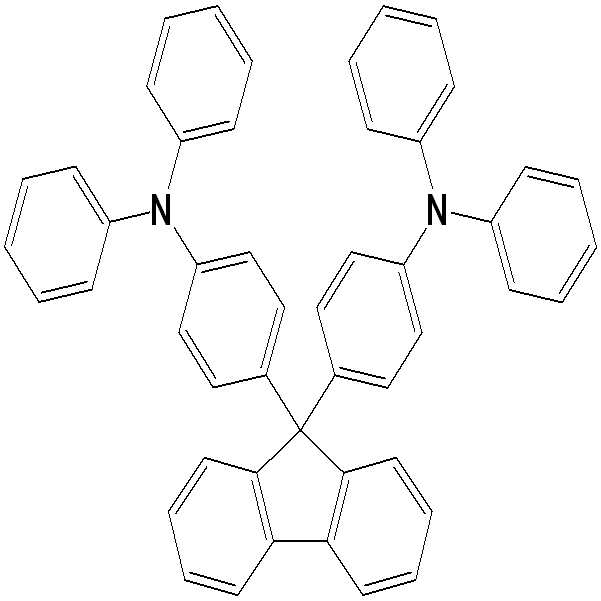
실험예 1-1 내지 1-15 및 비교예 1-1 내지 1-5 에 의해 제작된 유기 발광 소자에 전류를 인가하였을 때, 하기 표 1의 결과를 얻었다.When current was applied to the organic light-emitting devices manufactured by Experimental Examples 1-1 to 1-15 and Comparative Examples 1-1 to 1-5, the results shown in Table 1 were obtained.
(전자차단층)compound
(Electron blocking layer)
(V@10mA/cm2)Voltage
(V @ 10 mA / cm 2 )
(cd/A@10mA/cm2)efficiency
(cd / A @ 10mA / cm 2)
(T95)life span
(T95)
상기 표 1에서 보는 바와 같이, 본 명세서의 화합물을 전자 차단층으로 사용하여 제조된 유기 발광 소자의 경우와 비교예 1-1 내지 1-5의 유기 발광 소자와 비교 하였을 때 본원 발명의 화합물은 전자 차단역할을 하므로 유기 발광 소자의 효율, 구동전압 및/또는 안정성 면에서 우수한 특성을 나타낸다.As shown in Table 1, when compared with the organic light emitting device manufactured using the compound of the present invention as an electron blocking layer and the organic light emitting device of Comparative Examples 1-1 to 1-5, And exhibits excellent characteristics in terms of efficiency, driving voltage and / or stability of the organic light emitting device.
구체적으로 본 명세서의 화합물은 디페닐 플루오렌에 아릴아민이 오쏘(ortho) 위치로 치환되어 있는 구조를 가짐으로써, 메타(meta)위치이거나 파라(para)위치로 아릴아민이 치환되어 있는 구조보다 고효율 및 장수명의 특성을 가진다. 즉, 효율면에서 오쏘(ortho) >> 메타(meta) > 파라(para), 수명면에서 오쏘(ortho) > 파라(para) > 메타(meta)의 소자 특성을 볼 수 있다. 디아민 형태의 비교예 1-5는 전자 차단층으로 특성이 매우 미흡하다는 것을 알 수 있다.Specifically, the compound of the present invention has a structure in which an arylamine is substituted at the ortho position with diphenylfluorene, so that a compound having a higher efficiency than a structure in which an arylamine is substituted at a meta position or a para position And long life. That is, the device characteristics of ortho>> meta> para in terms of efficiency and ortho> para> meta in terms of life can be seen. The diamine type Comparative Example 1-5 is an electron blocking layer and its characteristics are very poor.
<< 실험예Experimental Example 2> 2>
<실험예 2-1 내지 2-15>≪ Experimental Examples 2-1 to 2-15 >
상기 실험예 1에서 전자 차단층으로 TCTA를 사용하고, 정공 수송층으로 NPB 대신 실험예 1-1 내지 1-15의 화합물들을 사용한 것을 제외하고는 동일하게 실험하였다.The same experiment was performed except that TCTA was used as an electron blocking layer in Experimental Example 1 and the compounds of Experimental Examples 1-1 to 1-15 were used instead of NPB as a hole transporting layer.
<비교예 2-1>≪ Comparative Example 2-1 >
상기 실험예 2-1 내지 2-15에서 정공 수송층으로 하기 HT1의 화합물을 사용한 것을 제외하고는 상기 실험예 2-1 내지 2-15와 동일한 방법으로 유기 발광 소자를 제작하였다.An organic luminescent device was fabricated in the same manner as in Experimental Examples 2-1 to 2-15 except that HT1 compound was used as a hole transport layer in Experimental Examples 2-1 to 2-15.
[HT1][HT1]
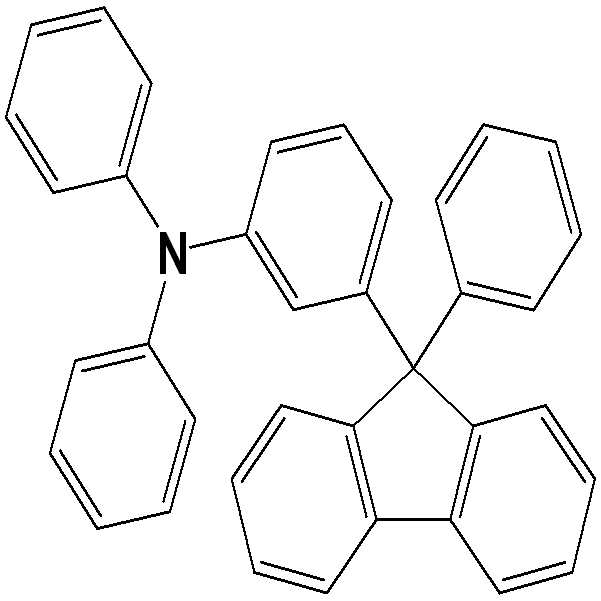
<비교예 2-2>≪ Comparative Example 2-2 &
상기 실험예 2-1 내지 2-15에서 정공 수송층으로 하기 HT2의 화합물을 사용한 것을 제외하고는 상기 실험예 2-1 내지 2-15와 동일한 방법으로 유기 발광 소자를 제작하였다.An organic light emitting device was fabricated in the same manner as in Experimental Examples 2-1 to 2-15 except that HT2 compounds were used as the hole transport layer in Experimental Examples 2-1 to 2-15.
[HT2] [HT2]
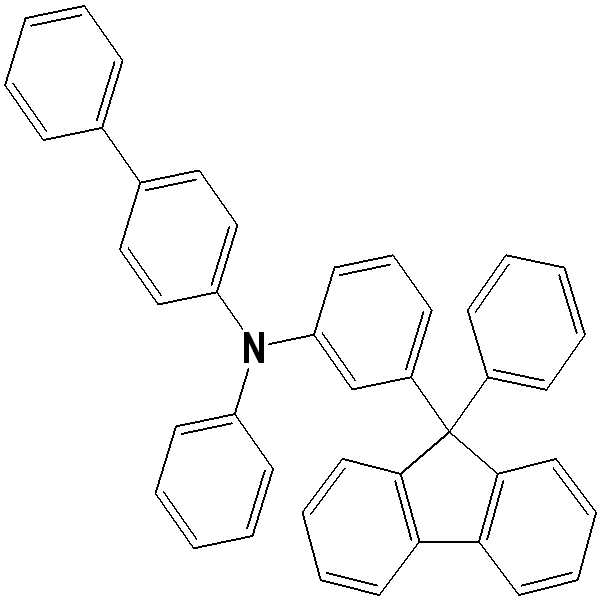
<비교예 2-3>≪ Comparative Example 2-3 >
상기 실험예 2-1 내지 2-15에서 정공 수송층으로 하기 HT3의 화합물을 사용한 것을 제외하고는 상기 실험예 2-1 내지 2-15와 동일한 방법으로 유기 발광 소자를 제작하였다.An organic light emitting device was fabricated in the same manner as in Experimental Examples 2-1 to 2-15, except that the compound of HT3 described below was used as the hole transport layer in Experimental Examples 2-1 to 2-15.
[HT3] [HT3]
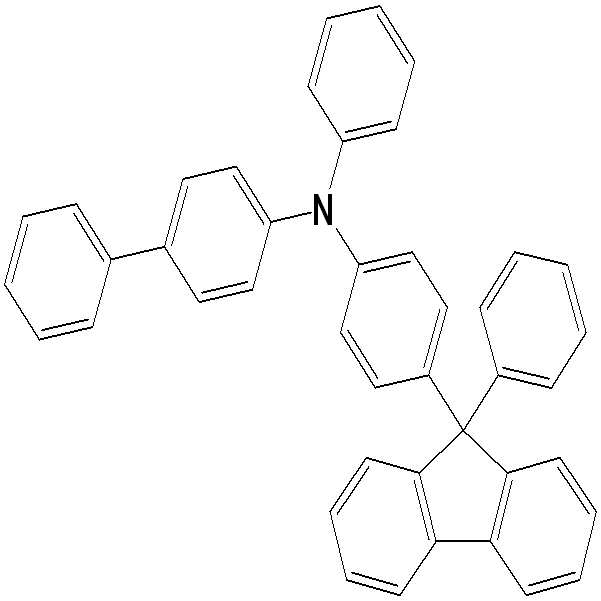
<비교예 2-4>≪ Comparative Example 2-4 &
상기 실험예 2-1 내지 2-15에서 정공 수송층으로 하기 HT4의 화합물을 사용한 것을 제외하고는 상기 실험예 2-1 내지 2-15와 동일한 방법으로 유기 발광 소자를 제작하였다.An organic light emitting device was fabricated in the same manner as in Experimental Examples 2-1 to 2-15 except that HT4 compounds described below were used as the hole transport layer in Experimental Examples 2-1 to 2-15.
[HT4] [HT4]
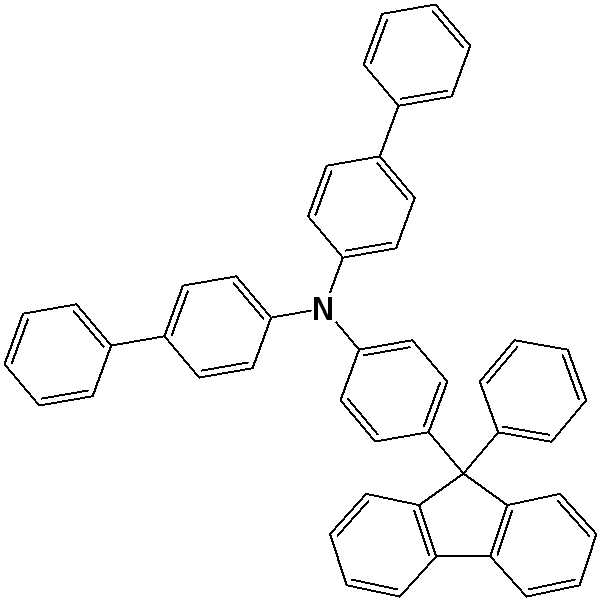
<비교예 2-5>≪ Comparative Example 2-5 &
상기 실험예 2-1 내지 2-15에서 정공 수송층으로 하기 HT5의 화합물을 사용한 것을 제외하고는 상기 실험예 2-1 내지 2-15와 동일한 방법으로 유기 발광 소자를 제작하였다.An organic light emitting device was fabricated in the same manner as in Experimental Examples 2-1 to 2-15 except that HT5 compound was used as a hole transport layer in Experimental Examples 2-1 to 2-15.
[HT5] [HT5]
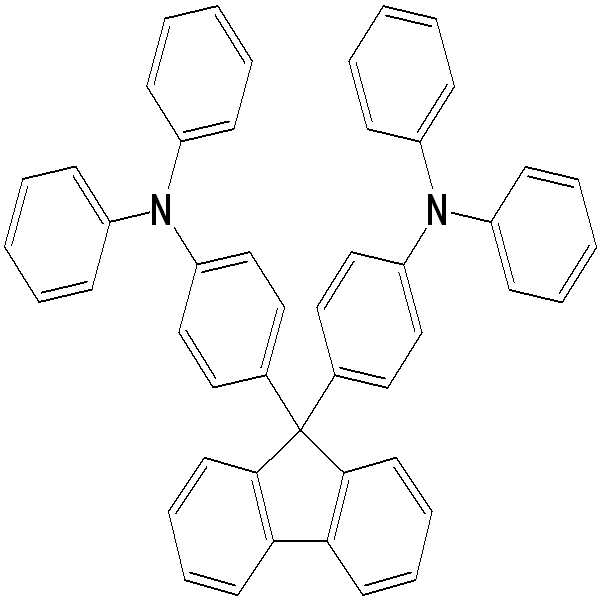
상기 실험예 2-1 내지 2-15 및 비교예 2-1 내지 2-5에 의해 제작된 유기 발광 소자에 전류를 인가하였을 때, 하기 표 2의 결과를 얻었다.When currents were applied to the organic light emitting devices fabricated by Experimental Examples 2-1 to 2-15 and Comparative Examples 2-1 to 2-5, the results shown in Table 2 were obtained.
(정공수송층)compound
(Hole transport layer)
(V@10mA/cm2)Voltage
(V @ 10 mA / cm 2 )
(cd/A@10mA/cm2)efficiency
(cd / A @ 10mA / cm 2)
(T95)life span
(T95)
상기 표 2에서 보는 바와 같이, 본 명세서의 화합물을 정공 수송층으로 사용하여 제조된 유기 발광 소자의 경우, 비교예 2-1 내지 2-5 보다 효율, 구동전압 및/또는 안정성 면에서 우수한 특성을 나타낸다. 또한, 본원의 화합물을 전자 차단층으로 사용한 표 1의 결과와 마찬가지로 효율면에서 오쏘(ortho) >> 메타(meta) > 파라(para), 수명면에서 오쏘(ortho) > 파라(para) > 메타(meta)의 소자 특성을 볼 수 있다.As shown in Table 2, the organic light emitting device manufactured using the compound of the present invention as a hole transporting layer shows characteristics superior to those of Comparative Examples 2-1 to 2-5 in terms of efficiency, driving voltage and / or stability . In addition, as in the results of Table 1 using the compound of the present invention as an electron blocking layer, ortho >> meta> para, and ortho> para> (meta) can be seen.
상기 표 1 및 2의 결과를 통해, 본 명세서의 화합물은 전자 저지 능력 뿐만 아니라 정공 수송 능력이 우수하여 유기 발광 소자에 적용 가능함을 확인할 수 있었다. From the results of Tables 1 and 2, it can be confirmed that the compounds of the present invention are applicable not only to electron blocking ability but also to hole transporting ability and applicable to organic light emitting devices.
이상을 통해 본 명세서의 바람직한 실시예(전자차단층, 정공수송층)에 대하여 설명하였지만, 본 발명은 이에 한정되는 것이 아니고 특허청구범위와 발명의 상세한 설명의 범위 안에서 여러 가지로 변형하여 실시하는 것이 가능하고 이 또한 발명의 범주에 속한다.While the present invention has been described with reference to the preferred embodiments (the electron blocking layer and the hole transport layer), the present invention is not limited thereto and can be variously modified within the scope of the claims and the detailed description of the invention And this also belongs to the category of invention.
10, 11: 유기 발광 소자
20: 기판
30: 제1 전극
40: 발광층
50: 제2 전극
60: 정공주입층
70: 정공수송층
80: 전자차단층
90: 전자수송층
100: 전자주입층10, 11: Organic light emitting device
20: substrate
30: first electrode
40: light emitting layer
50: second electrode
60: Hole injection layer
70: hole transport layer
80: electron blocking layer
90: electron transport layer
100: electron injection layer
Claims (9)
[화학식 1]
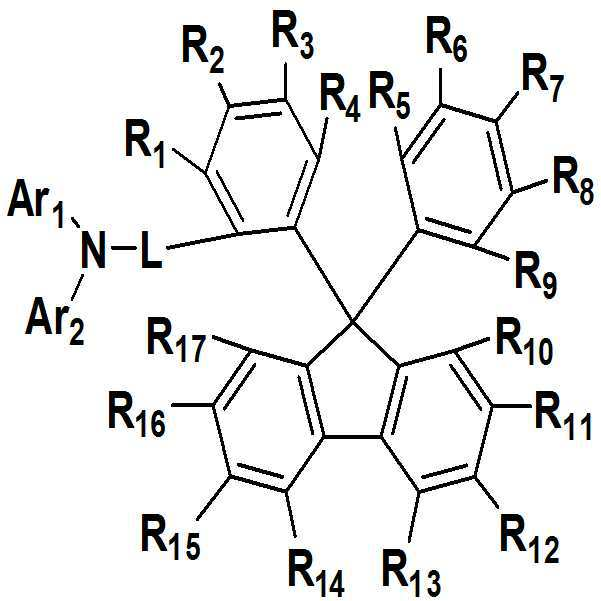
상기 화학식 1에 있어서,
L은 직접결합; 또는 아릴렌기이고,
Ar1 및 Ar2는 서로 같거나 상이하며, 각각 독립적으로 중수소, 할로겐기, 알킬기, 시아노기, 실릴기, 트리메틸실릴기, 아릴기, 디벤조티오펜기, 디벤조퓨란기,아릴기로 치환된 카바졸기 및 카바졸기 중 1 이상으로 치환 또는 비치환된 아릴기이고,
R1 내지 R9는 각각 수소이며,
R10 내지 R17은 각각 수소이거나, 인접한 기와 서로 결합하여 고리를 형성할 수 있다. A compound represented by the following formula (1):
[Chemical Formula 1]
In Formula 1,
L is a direct bond; Or an arylene group,
Ar 1 and Ar 2 are the same or different and are each independently selected from the group consisting of deuterium, a halogen group, an alkyl group, a cyano group, a silyl group, a trimethylsilyl group, an aryl group, a dibenzothiophene group, a dibenzofurane group, An aryl group which is substituted or unsubstituted with at least one of a carbazole group and a carbazole group,
R 1 to R 9 are each hydrogen,
R 10 to R 17 are each hydrogen or may combine with adjacent groups to form a ring.
L은 직접결합; 페닐렌기; 비페닐렌기; 또는 나프틸렌기인 것인 화합물.The method according to claim 1,
L is a direct bond; A phenylene group; Biphenylene group; Or a naphthylene group.
[그룹 1]

[그룹 2]
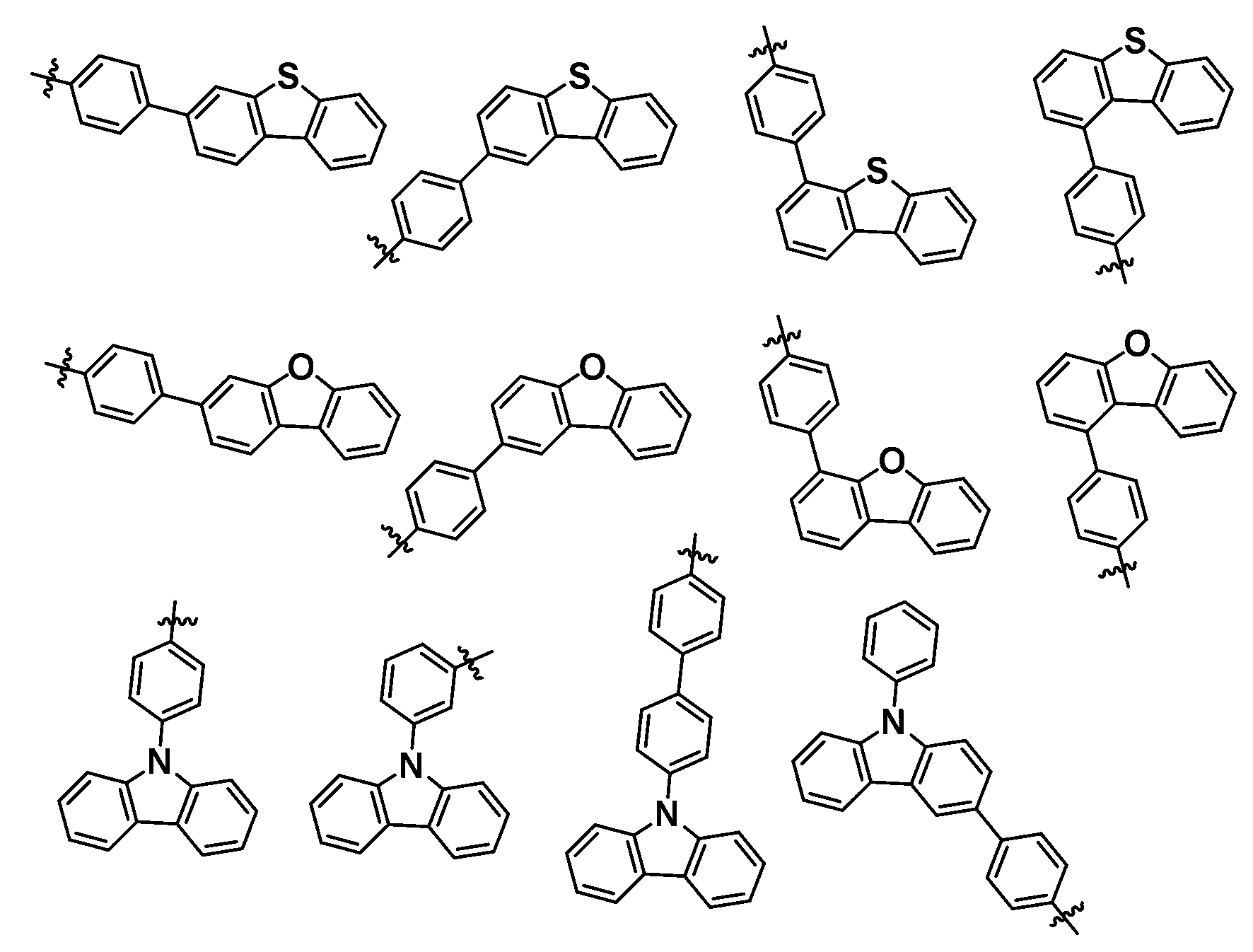
[Group 1]
[Group 2]

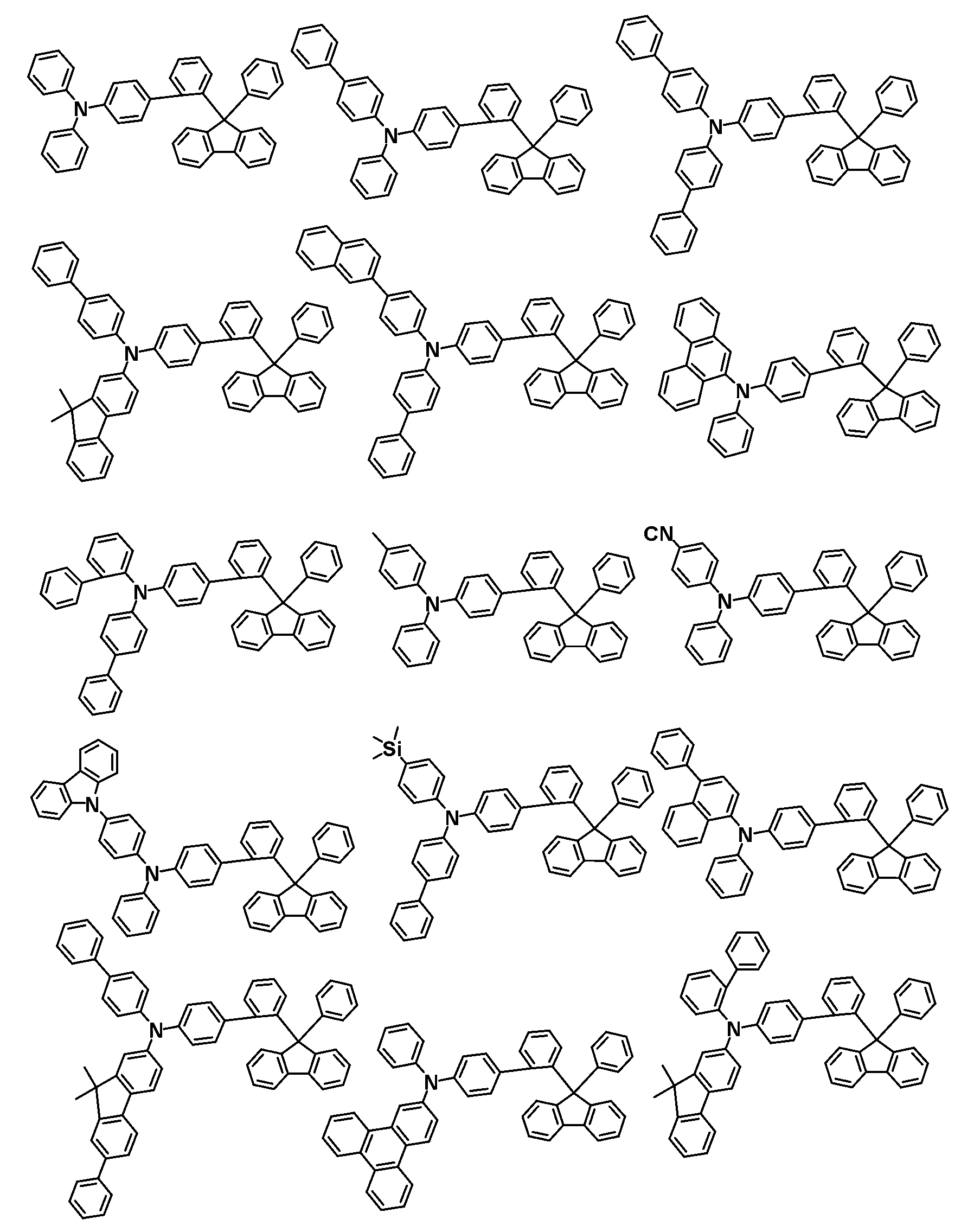
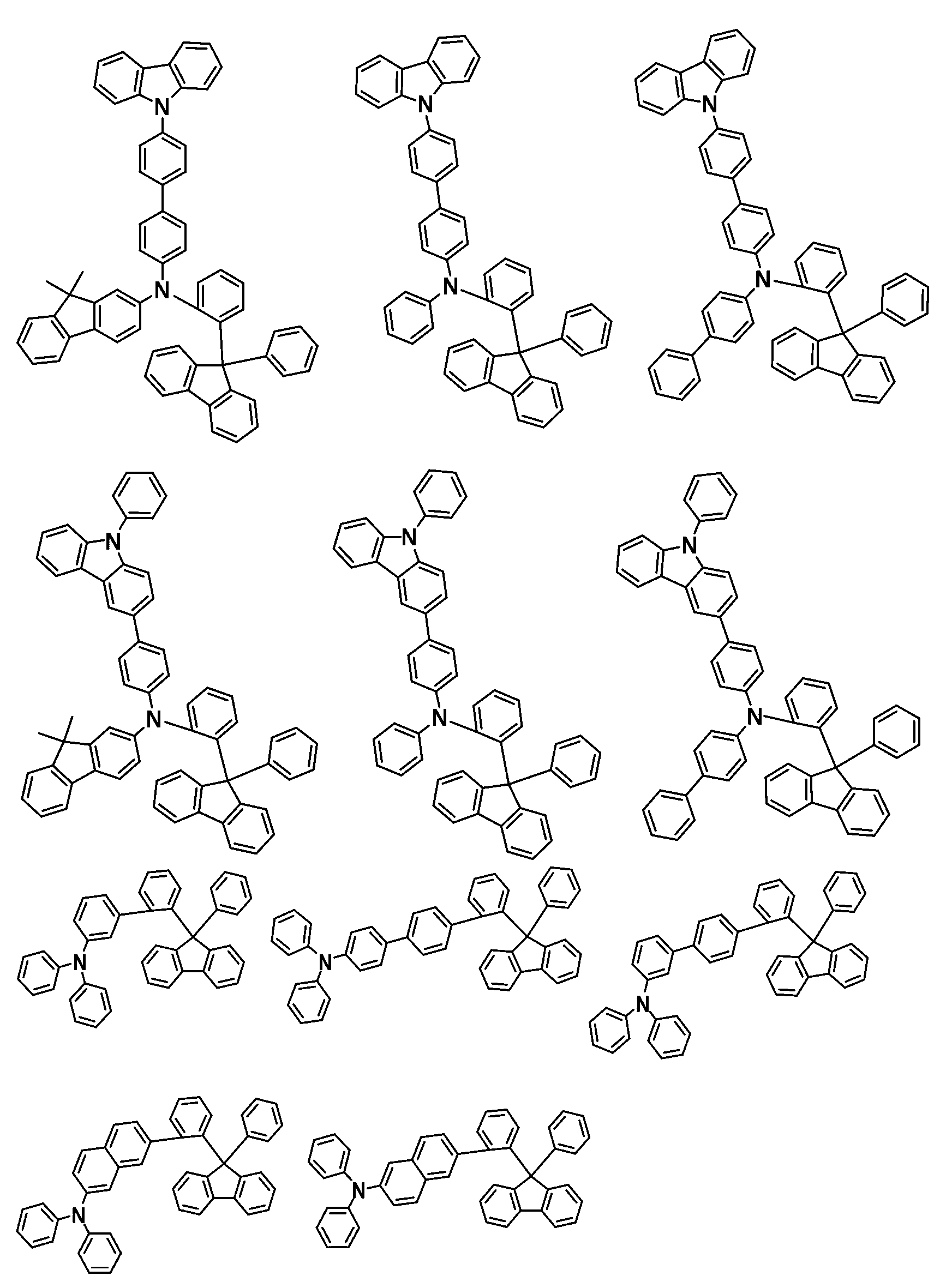

Priority Applications (1)
| Application Number | Priority Date | Filing Date | Title |
|---|---|---|---|
| KR1020160008796A KR101896151B1 (en) | 2016-01-25 | 2016-01-25 | Compound and organic electronic device using the same |
Applications Claiming Priority (1)
| Application Number | Priority Date | Filing Date | Title |
|---|---|---|---|
| KR1020160008796A KR101896151B1 (en) | 2016-01-25 | 2016-01-25 | Compound and organic electronic device using the same |
Publications (2)
| Publication Number | Publication Date |
|---|---|
| KR20170088650A KR20170088650A (en) | 2017-08-02 |
| KR101896151B1 true KR101896151B1 (en) | 2018-09-07 |
Family
ID=59652073
Family Applications (1)
| Application Number | Title | Priority Date | Filing Date |
|---|---|---|---|
| KR1020160008796A Active KR101896151B1 (en) | 2016-01-25 | 2016-01-25 | Compound and organic electronic device using the same |
Country Status (1)
| Country | Link |
|---|---|
| KR (1) | KR101896151B1 (en) |
Cited By (1)
| Publication number | Priority date | Publication date | Assignee | Title |
|---|---|---|---|---|
| KR20170134132A (en) * | 2016-05-27 | 2017-12-06 | 주식회사 엘지화학 | Fused cyclic and organic light emitting device using the same |
Families Citing this family (6)
| Publication number | Priority date | Publication date | Assignee | Title |
|---|---|---|---|---|
| KR101857632B1 (en) * | 2018-02-02 | 2018-05-14 | 덕산네오룩스 주식회사 | Compound for organic electronic element, organic electronic element using the same, and an electronic device thereof |
| WO2021025371A1 (en) * | 2019-08-02 | 2021-02-11 | 덕산네오룩스 주식회사 | Organic electronic device |
| US20230331654A1 (en) * | 2020-02-10 | 2023-10-19 | Duk San Neolux Co., Ltd. | Compound for organic electric device, organic electric device using same, and electronic device thereof |
| CN115160272B (en) * | 2021-09-15 | 2023-10-31 | 陕西莱特光电材料股份有限公司 | Nitrogen-containing compound, and electronic element and electronic device using same |
| CN116813482B (en) * | 2022-03-21 | 2025-12-19 | 吉林奥来德光电材料股份有限公司 | Organic electroluminescent compound, preparation method and application thereof |
| KR20250007515A (en) | 2022-04-26 | 2025-01-14 | 이데미쓰 고산 가부시키가이샤 | Compounds, materials for organic electroluminescent devices, organic electroluminescent devices, and electronic devices |
Citations (2)
| Publication number | Priority date | Publication date | Assignee | Title |
|---|---|---|---|---|
| WO2015058826A1 (en) * | 2013-10-23 | 2015-04-30 | Merck Patent Gmbh | Materials for electronic devices |
| WO2016006708A1 (en) * | 2014-07-11 | 2016-01-14 | 出光興産株式会社 | Compound, material for organic electroluminescent element, organic electroluminescent element, and electronic device |
Family Cites Families (1)
| Publication number | Priority date | Publication date | Assignee | Title |
|---|---|---|---|---|
| JP2004535099A (en) | 2001-04-20 | 2004-11-18 | コーニンクレッカ フィリップス エレクトロニクス エヌ ヴィ | Image processing device and method for improving an image, and image display device having the image processing device |
-
2016
- 2016-01-25 KR KR1020160008796A patent/KR101896151B1/en active Active
Patent Citations (2)
| Publication number | Priority date | Publication date | Assignee | Title |
|---|---|---|---|---|
| WO2015058826A1 (en) * | 2013-10-23 | 2015-04-30 | Merck Patent Gmbh | Materials for electronic devices |
| WO2016006708A1 (en) * | 2014-07-11 | 2016-01-14 | 出光興産株式会社 | Compound, material for organic electroluminescent element, organic electroluminescent element, and electronic device |
Cited By (2)
| Publication number | Priority date | Publication date | Assignee | Title |
|---|---|---|---|---|
| KR20170134132A (en) * | 2016-05-27 | 2017-12-06 | 주식회사 엘지화학 | Fused cyclic and organic light emitting device using the same |
| KR102076880B1 (en) * | 2016-05-27 | 2020-02-12 | 주식회사 엘지화학 | Fused cyclic and organic light emitting device using the same |
Also Published As
| Publication number | Publication date |
|---|---|
| KR20170088650A (en) | 2017-08-02 |
Similar Documents
| Publication | Publication Date | Title |
|---|---|---|
| KR102116161B1 (en) | Nitrogen-containing compound and organic electronic device using the same | |
| KR101934469B1 (en) | Compound and organic electronic device comprising the same | |
| KR101888252B1 (en) | Compound having spiro structure and organic light emitting device comprising the same | |
| KR101883591B1 (en) | Compound and organic electronic device comprising the same | |
| KR101774643B1 (en) | Heterocyclic compound including nitrogen and organic light emitting device using the same | |
| KR101837896B1 (en) | Compound and organic electronic device comprising the same | |
| KR101905970B1 (en) | Compound and organic electronic device comprising the same | |
| KR101897907B1 (en) | Compound and organic electronic device comprising the same | |
| KR101896151B1 (en) | Compound and organic electronic device using the same | |
| KR20190088029A (en) | Organic light emitting device | |
| KR101919222B1 (en) | Heterocyclic compound and organic light emitting device comprising the same | |
| KR20170057856A (en) | Compound having spiro structure and organic light emitting device comprising the same | |
| KR101808403B1 (en) | Amine-based compound and organic light emitting device comprising the same | |
| KR20160120609A (en) | Organic electronic device comprising a compound | |
| KR20170057850A (en) | Compound and organic electronic device comprising the same | |
| KR102000171B1 (en) | Compound having spiro structure and organic light emitting device comprising the same | |
| KR101920143B1 (en) | Heterocyclic compound and organic light emitting device comprising the same | |
| KR20190013605A (en) | Compound and organic light emitting device comprising the same | |
| KR102081473B1 (en) | Nitrogen-containing compound and organic electronic device using the same | |
| KR101764976B1 (en) | Hetero-cyclic compound and organic light emitting device comprising the same | |
| KR101828653B1 (en) | Hetero-cyclic compound and organic light emitting device comprising the same | |
| KR20170121577A (en) | Compound and organic light emitting device containing the same | |
| KR101983340B1 (en) | Heterocyclic compound and organic light emitting device using the same | |
| KR102057302B1 (en) | Novel hetero-cyclic compound and organic light emitting device comprising the same | |
| KR20210096954A (en) | Novel compound and organic light emitting device comprising the same |
Legal Events
| Date | Code | Title | Description |
|---|---|---|---|
| PA0109 | Patent application |
St.27 status event code: A-0-1-A10-A12-nap-PA0109 |
|
| A201 | Request for examination | ||
| PA0201 | Request for examination |
St.27 status event code: A-1-2-D10-D11-exm-PA0201 |
|
| PG1501 | Laying open of application |
St.27 status event code: A-1-1-Q10-Q12-nap-PG1501 |
|
| D13-X000 | Search requested |
St.27 status event code: A-1-2-D10-D13-srh-X000 |
|
| D14-X000 | Search report completed |
St.27 status event code: A-1-2-D10-D14-srh-X000 |
|
| E902 | Notification of reason for refusal | ||
| PE0902 | Notice of grounds for rejection |
St.27 status event code: A-1-2-D10-D21-exm-PE0902 |
|
| P11-X000 | Amendment of application requested |
St.27 status event code: A-2-2-P10-P11-nap-X000 |
|
| P13-X000 | Application amended |
St.27 status event code: A-2-2-P10-P13-nap-X000 |
|
| E701 | Decision to grant or registration of patent right | ||
| PE0701 | Decision of registration |
St.27 status event code: A-1-2-D10-D22-exm-PE0701 |
|
| PR0701 | Registration of establishment |
St.27 status event code: A-2-4-F10-F11-exm-PR0701 |
|
| PR1002 | Payment of registration fee |
St.27 status event code: A-2-2-U10-U11-oth-PR1002 Fee payment year number: 1 |
|
| PG1601 | Publication of registration |
St.27 status event code: A-4-4-Q10-Q13-nap-PG1601 |
|
| R18-X000 | Changes to party contact information recorded |
St.27 status event code: A-5-5-R10-R18-oth-X000 |
|
| R18-X000 | Changes to party contact information recorded |
St.27 status event code: A-5-5-R10-R18-oth-X000 |
|
| R18-X000 | Changes to party contact information recorded |
St.27 status event code: A-5-5-R10-R18-oth-X000 |
|
| PR1001 | Payment of annual fee |
St.27 status event code: A-4-4-U10-U11-oth-PR1001 Fee payment year number: 4 |
|
| PR1001 | Payment of annual fee |
St.27 status event code: A-4-4-U10-U11-oth-PR1001 Fee payment year number: 5 |
|
| P22-X000 | Classification modified |
St.27 status event code: A-4-4-P10-P22-nap-X000 |
|
| P22-X000 | Classification modified |
St.27 status event code: A-4-4-P10-P22-nap-X000 |
|
| PR1001 | Payment of annual fee |
St.27 status event code: A-4-4-U10-U11-oth-PR1001 Fee payment year number: 6 |
|
| PR1001 | Payment of annual fee |
St.27 status event code: A-4-4-U10-U11-oth-PR1001 Fee payment year number: 7 |
|
| PR1001 | Payment of annual fee |
St.27 status event code: A-4-4-U10-U11-oth-PR1001 Fee payment year number: 8 |
|
| P22-X000 | Classification modified |
St.27 status event code: A-4-4-P10-P22-nap-X000 |