KR101832499B1 - Methods and compositions based on shiga toxin type 2 protein - Google Patents
Methods and compositions based on shiga toxin type 2 protein Download PDFInfo
- Publication number
- KR101832499B1 KR101832499B1 KR1020117019455A KR20117019455A KR101832499B1 KR 101832499 B1 KR101832499 B1 KR 101832499B1 KR 1020117019455 A KR1020117019455 A KR 1020117019455A KR 20117019455 A KR20117019455 A KR 20117019455A KR 101832499 B1 KR101832499 B1 KR 101832499B1
- Authority
- KR
- South Korea
- Prior art keywords
- stx2
- delete delete
- ser
- thr
- leu
- Prior art date
- Legal status (The legal status is an assumption and is not a legal conclusion. Google has not performed a legal analysis and makes no representation as to the accuracy of the status listed.)
- Expired - Fee Related
Links
Images


Classifications
-
- A—HUMAN NECESSITIES
- A61—MEDICAL OR VETERINARY SCIENCE; HYGIENE
- A61K—PREPARATIONS FOR MEDICAL, DENTAL OR TOILETRY PURPOSES
- A61K39/00—Medicinal preparations containing antigens or antibodies
- A61K39/02—Bacterial antigens
- A61K39/025—Enterobacteriales, e.g. Enterobacter
- A61K39/0283—Shigella
-
- A—HUMAN NECESSITIES
- A61—MEDICAL OR VETERINARY SCIENCE; HYGIENE
- A61K—PREPARATIONS FOR MEDICAL, DENTAL OR TOILETRY PURPOSES
- A61K38/00—Medicinal preparations containing peptides
-
- C—CHEMISTRY; METALLURGY
- C07—ORGANIC CHEMISTRY
- C07K—PEPTIDES
- C07K14/00—Peptides having more than 20 amino acids; Gastrins; Somatostatins; Melanotropins; Derivatives thereof
- C07K14/195—Peptides having more than 20 amino acids; Gastrins; Somatostatins; Melanotropins; Derivatives thereof from bacteria
- C07K14/24—Peptides having more than 20 amino acids; Gastrins; Somatostatins; Melanotropins; Derivatives thereof from bacteria from Enterobacteriaceae (F), e.g. Citrobacter, Serratia, Proteus, Providencia, Morganella, Yersinia
- C07K14/25—Shigella (G)
-
- A—HUMAN NECESSITIES
- A61—MEDICAL OR VETERINARY SCIENCE; HYGIENE
- A61K—PREPARATIONS FOR MEDICAL, DENTAL OR TOILETRY PURPOSES
- A61K38/00—Medicinal preparations containing peptides
- A61K38/16—Peptides having more than 20 amino acids; Gastrins; Somatostatins; Melanotropins; Derivatives thereof
- A61K38/164—Peptides having more than 20 amino acids; Gastrins; Somatostatins; Melanotropins; Derivatives thereof from bacteria
-
- A—HUMAN NECESSITIES
- A61—MEDICAL OR VETERINARY SCIENCE; HYGIENE
- A61K—PREPARATIONS FOR MEDICAL, DENTAL OR TOILETRY PURPOSES
- A61K39/00—Medicinal preparations containing antigens or antibodies
- A61K39/02—Bacterial antigens
- A61K39/025—Enterobacteriales, e.g. Enterobacter
- A61K39/0258—Escherichia
-
- A—HUMAN NECESSITIES
- A61—MEDICAL OR VETERINARY SCIENCE; HYGIENE
- A61K—PREPARATIONS FOR MEDICAL, DENTAL OR TOILETRY PURPOSES
- A61K39/00—Medicinal preparations containing antigens or antibodies
- A61K39/395—Antibodies; Immunoglobulins; Immune serum, e.g. antilymphocytic serum
-
- A—HUMAN NECESSITIES
- A61—MEDICAL OR VETERINARY SCIENCE; HYGIENE
- A61K—PREPARATIONS FOR MEDICAL, DENTAL OR TOILETRY PURPOSES
- A61K39/00—Medicinal preparations containing antigens or antibodies
- A61K39/395—Antibodies; Immunoglobulins; Immune serum, e.g. antilymphocytic serum
- A61K39/39591—Stabilisation, fragmentation
-
- A—HUMAN NECESSITIES
- A61—MEDICAL OR VETERINARY SCIENCE; HYGIENE
- A61P—SPECIFIC THERAPEUTIC ACTIVITY OF CHEMICAL COMPOUNDS OR MEDICINAL PREPARATIONS
- A61P13/00—Drugs for disorders of the urinary system
- A61P13/02—Drugs for disorders of the urinary system of urine or of the urinary tract, e.g. urine acidifiers
-
- A—HUMAN NECESSITIES
- A61—MEDICAL OR VETERINARY SCIENCE; HYGIENE
- A61P—SPECIFIC THERAPEUTIC ACTIVITY OF CHEMICAL COMPOUNDS OR MEDICINAL PREPARATIONS
- A61P13/00—Drugs for disorders of the urinary system
- A61P13/12—Drugs for disorders of the urinary system of the kidneys
-
- A—HUMAN NECESSITIES
- A61—MEDICAL OR VETERINARY SCIENCE; HYGIENE
- A61P—SPECIFIC THERAPEUTIC ACTIVITY OF CHEMICAL COMPOUNDS OR MEDICINAL PREPARATIONS
- A61P29/00—Non-central analgesic, antipyretic or antiinflammatory agents, e.g. antirheumatic agents; Non-steroidal antiinflammatory drugs [NSAID]
-
- A—HUMAN NECESSITIES
- A61—MEDICAL OR VETERINARY SCIENCE; HYGIENE
- A61P—SPECIFIC THERAPEUTIC ACTIVITY OF CHEMICAL COMPOUNDS OR MEDICINAL PREPARATIONS
- A61P31/00—Antiinfectives, i.e. antibiotics, antiseptics, chemotherapeutics
-
- A—HUMAN NECESSITIES
- A61—MEDICAL OR VETERINARY SCIENCE; HYGIENE
- A61P—SPECIFIC THERAPEUTIC ACTIVITY OF CHEMICAL COMPOUNDS OR MEDICINAL PREPARATIONS
- A61P31/00—Antiinfectives, i.e. antibiotics, antiseptics, chemotherapeutics
- A61P31/04—Antibacterial agents
-
- A—HUMAN NECESSITIES
- A61—MEDICAL OR VETERINARY SCIENCE; HYGIENE
- A61P—SPECIFIC THERAPEUTIC ACTIVITY OF CHEMICAL COMPOUNDS OR MEDICINAL PREPARATIONS
- A61P37/00—Drugs for immunological or allergic disorders
-
- A—HUMAN NECESSITIES
- A61—MEDICAL OR VETERINARY SCIENCE; HYGIENE
- A61P—SPECIFIC THERAPEUTIC ACTIVITY OF CHEMICAL COMPOUNDS OR MEDICINAL PREPARATIONS
- A61P37/00—Drugs for immunological or allergic disorders
- A61P37/02—Immunomodulators
- A61P37/04—Immunostimulants
-
- C—CHEMISTRY; METALLURGY
- C07—ORGANIC CHEMISTRY
- C07K—PEPTIDES
- C07K16/00—Immunoglobulins [IGs], e.g. monoclonal or polyclonal antibodies
- C07K16/12—Immunoglobulins [IGs], e.g. monoclonal or polyclonal antibodies against material from bacteria
- C07K16/1203—Immunoglobulins [IGs], e.g. monoclonal or polyclonal antibodies against material from bacteria from Gram-negative bacteria
- C07K16/1228—Immunoglobulins [IGs], e.g. monoclonal or polyclonal antibodies against material from bacteria from Gram-negative bacteria from Enterobacteriaceae (F), e.g. Citrobacter, Serratia, Proteus, Providencia, Morganella, Yersinia
- C07K16/1232—Immunoglobulins [IGs], e.g. monoclonal or polyclonal antibodies against material from bacteria from Gram-negative bacteria from Enterobacteriaceae (F), e.g. Citrobacter, Serratia, Proteus, Providencia, Morganella, Yersinia from Escherichia (G)
-
- C—CHEMISTRY; METALLURGY
- C07—ORGANIC CHEMISTRY
- C07K—PEPTIDES
- C07K7/00—Peptides having 5 to 20 amino acids in a fully defined sequence; Derivatives thereof
- C07K7/04—Linear peptides containing only normal peptide links
- C07K7/06—Linear peptides containing only normal peptide links having 5 to 11 amino acids
-
- C—CHEMISTRY; METALLURGY
- C07—ORGANIC CHEMISTRY
- C07K—PEPTIDES
- C07K7/00—Peptides having 5 to 20 amino acids in a fully defined sequence; Derivatives thereof
- C07K7/04—Linear peptides containing only normal peptide links
- C07K7/08—Linear peptides containing only normal peptide links having 12 to 20 amino acids
-
- G—PHYSICS
- G01—MEASURING; TESTING
- G01N—INVESTIGATING OR ANALYSING MATERIALS BY DETERMINING THEIR CHEMICAL OR PHYSICAL PROPERTIES
- G01N33/00—Investigating or analysing materials by specific methods not covered by groups G01N1/00 - G01N31/00
- G01N33/48—Biological material, e.g. blood, urine; Haemocytometers
- G01N33/50—Chemical analysis of biological material, e.g. blood, urine; Testing involving biospecific ligand binding methods; Immunological testing
- G01N33/53—Immunoassay; Biospecific binding assay; Materials therefor
- G01N33/569—Immunoassay; Biospecific binding assay; Materials therefor for microorganisms, e.g. protozoa, bacteria, viruses
- G01N33/56911—Bacteria
- G01N33/56916—Enterobacteria, e.g. shigella, salmonella, klebsiella, serratia
-
- A—HUMAN NECESSITIES
- A61—MEDICAL OR VETERINARY SCIENCE; HYGIENE
- A61K—PREPARATIONS FOR MEDICAL, DENTAL OR TOILETRY PURPOSES
- A61K39/00—Medicinal preparations containing antigens or antibodies
- A61K2039/505—Medicinal preparations containing antigens or antibodies comprising antibodies
-
- A—HUMAN NECESSITIES
- A61—MEDICAL OR VETERINARY SCIENCE; HYGIENE
- A61K—PREPARATIONS FOR MEDICAL, DENTAL OR TOILETRY PURPOSES
- A61K2121/00—Preparations for use in therapy
-
- C—CHEMISTRY; METALLURGY
- C07—ORGANIC CHEMISTRY
- C07K—PEPTIDES
- C07K2317/00—Immunoglobulins specific features
- C07K2317/30—Immunoglobulins specific features characterized by aspects of specificity or valency
- C07K2317/34—Identification of a linear epitope shorter than 20 amino acid residues or of a conformational epitope defined by amino acid residues
-
- Y—GENERAL TAGGING OF NEW TECHNOLOGICAL DEVELOPMENTS; GENERAL TAGGING OF CROSS-SECTIONAL TECHNOLOGIES SPANNING OVER SEVERAL SECTIONS OF THE IPC; TECHNICAL SUBJECTS COVERED BY FORMER USPC CROSS-REFERENCE ART COLLECTIONS [XRACs] AND DIGESTS
- Y02—TECHNOLOGIES OR APPLICATIONS FOR MITIGATION OR ADAPTATION AGAINST CLIMATE CHANGE
- Y02A—TECHNOLOGIES FOR ADAPTATION TO CLIMATE CHANGE
- Y02A50/00—TECHNOLOGIES FOR ADAPTATION TO CLIMATE CHANGE in human health protection, e.g. against extreme weather
- Y02A50/30—Against vector-borne diseases, e.g. mosquito-borne, fly-borne, tick-borne or waterborne diseases whose impact is exacerbated by climate change
Landscapes
- Health & Medical Sciences (AREA)
- Chemical & Material Sciences (AREA)
- Life Sciences & Earth Sciences (AREA)
- Medicinal Chemistry (AREA)
- Organic Chemistry (AREA)
- General Health & Medical Sciences (AREA)
- Immunology (AREA)
- Veterinary Medicine (AREA)
- Public Health (AREA)
- Pharmacology & Pharmacy (AREA)
- Animal Behavior & Ethology (AREA)
- Engineering & Computer Science (AREA)
- Molecular Biology (AREA)
- Proteomics, Peptides & Aminoacids (AREA)
- Biochemistry (AREA)
- Genetics & Genomics (AREA)
- Biophysics (AREA)
- Bioinformatics & Cheminformatics (AREA)
- Chemical Kinetics & Catalysis (AREA)
- Nuclear Medicine, Radiotherapy & Molecular Imaging (AREA)
- General Chemical & Material Sciences (AREA)
- Epidemiology (AREA)
- Microbiology (AREA)
- Mycology (AREA)
- Gastroenterology & Hepatology (AREA)
- Urology & Nephrology (AREA)
- Oncology (AREA)
- Communicable Diseases (AREA)
- Biomedical Technology (AREA)
- Hematology (AREA)
- Virology (AREA)
- General Physics & Mathematics (AREA)
- Rheumatology (AREA)
- Biotechnology (AREA)
- Cell Biology (AREA)
- Pain & Pain Management (AREA)
- Food Science & Technology (AREA)
- Physics & Mathematics (AREA)
- Analytical Chemistry (AREA)
- Tropical Medicine & Parasitology (AREA)
Abstract
본 발명은 11E10 항체에 대한 Stx2 단백질 내 에피토프의 발견에 기반한 것이다. 본 발명은 11E10 단일클론 항체 에피토프를 포함하는 비-전장 Stx2 폴리펩타이드를 함유하는 조성물을 특징으로 한다. 본 발명은 또한 Stx2 단백질의 11E10 에피토프에 특이적인 항- Stx2 항체를 생산하는 방법을 특징으로 한다. 추가적으로, 본 발명은 시가 독소 관련 질병 (예, 용혈성 요독 증후군 및 대장균 및 시겔라 이질균 감염과 연관된 질병)을 보유하고 있거나 이의 발병 위험에 놓인 대상체를, 본 발명의 방법들을 이용하여 개발한 11E10 에피토프를 포함하는 폴리펩타이드 또는 항-Stx2 항체로 치료하기 위한 방법을 특징으로 한다. 더욱이, 본 발명은 본 발명의 방법들을 이용하여 개발한 항체들을 이용하여 시료 내에서 Stx2를 검출하는 것을 특징으로 한다.The invention is based on the discovery of an epitope in the Stx2 protein for the 11E10 antibody. The invention features a composition containing a non-full-length Stx2 polypeptide comprising an 11E10 monoclonal antibody epitope. The invention also features a method of producing an anti-Stx2 antibody specific for the 11E10 epitope of the Stx2 protein. Additionally, the present invention provides a method of treating a subject having or at risk of developing a cervicitis-related disease (e. G., Hemolytic uremic syndrome and a disease associated with Escherichia coli and a causative organism infection) Lt; RTI ID = 0.0 > anti-Stx2 < / RTI > Furthermore, the present invention is characterized in that Stx2 is detected in a sample using antibodies developed using the methods of the present invention.
Description
일반적으로 본 발명은 시가 독소 관련 질병을 치료하고 예방하는 기술분야에 관한 것이다.In general, the present invention relates to a technical field for treating and preventing a ciguatoxin-related disease.
미국에서 시가 독소(Shiga toxin, Stx)-생산 대장균 (STEC)은 매년 약 110,000건의 감염의 원인이 되고 있다. 특히 혈청형이 O157:H7인, 장출혈성 대장균(Enterohemorrhagic E. coli, EHEC)은 Stx 매개 질병을 생성하는 것으로 유명한 STEC 소집단이다. Stx-생산 유기체 감염으로부터 가능한 합병증은 용혈성 요독 증후군(hemolytic uremic syndrome, HUS)으로, 이는 용혈성 빈혈, 혈전성 저혈소판증, 및 신부전을 특징으로 한다. HUS 보유자들의 경우 대략 5-10% 치사율을 보이며, 생존자들은 만성 신장 손상을 가질 수도 있다. 현재로서는 Stx 매개 질병과 싸우거나 예방하기 위한 FDA 승인 치료법 또는 백신이 없지만, 장래에 몇가지 유망한 방법이 있는바, Stx2에 결합해서 그것을 중화시키는 인간화된 단일클론 항체 및 중화반응을 유도하여 Stx1 또는 Stx2 또는 Stx1 및 Stx2의 치사 가능성으로부터 보호하는 키메라 StxA2/StxB1 변성독소(toxoid)이다.In the United States, Shiga toxin (Stx) - producing E. coli (STEC) is causing about 110,000 infections each year. Enterohemorrhagic E. coli (EHEC), particularly serotype O157: H7, is a STEC subgroup known to produce Stx-mediated disease. Possible complications from Stx-producing organism infection are hemolytic uremic syndrome (HUS), which is characterized by hemolytic anemia, thrombotic thrombocythemia, and renal failure. HUS holders have approximately 5-10% mortality, and survivors may have chronic kidney damage. There are currently no FDA-approved therapies or vaccines to combat or prevent Stx-mediated disease, but there are several promising methods in the future, including the use of humanized monoclonal antibodies that bind to and neutralize Stx2 and neutralize the Stx1 or Stx2 It is a chimeric StxA2 / StxB1 modified toxoid that protects against the lethal potential of Stx1 and Stx2.
본질적으로 Stx에는 두 가지 주된 유형이 있는바, Stx/Stx1 및 Stx2이다. Stx는 시겔라 이질균(Shigella dysenteriae) 1형으로부터 생산되는 한편, Stx1 및 Stx2는 대장균(Escherichia coli)에서 생산된다. Stx1 및 Stx2는 거의 동일하며, A 서브유닛(subunit)에 있어서 단지 1개의 아미노산만 다르다. Stx1 및 Stx2의 성숙 A 및 B 서브유닛들은 각각 68 및 73% 유사성을 갖는다. 상기 아미노산 서열 차이에도 불구하고, Stx1 및 Stx2의 결정 구조는 매우 흡사하다 (도 1). 이 독소들은 다클론 항혈청에 의해 구별될 수 있는데, Stx1에 대하여 생성된 다클론 항혈청은 Stx2를 중화하지 않으며, 그 반대의 경우도 마찬가지이다. Stx1 및 Stx2의 변이체들이 존재하며, Stx1c, Stx1d, Stx2c, Stx2d, Stx2d-활성형 (Stx2-act.), Stx2e, 및 Stx2f가 있다.In essence, Stx has two main types, Stx / Stx1 and Stx2. Stx is produced from Shigella dysenteriae
시가 독소는 AB5 구조를 갖는 복잡한 홀로톡신(holotoxin)이다. 이의 활성 도메인 (A)는, 60S 리보솜 서브유닛의 28S rRNA에서 푸린을 제거하는 N-글리코시다아제를 함유하는데, 이 효소는 단백질 합성을 막아서, 궁극적으로 세포사를 유발한다. 상기 A 서브유닛은 약 32 kDa이고, 트립신이나 퓨린(furin)에 의해서 단백질분해되면서, 단일 이황화 결합으로 연결되어 있는 약 28 kDa A1 서브유닛과 약 5 kDa A2 펩타이드로 잘려진다. A1 서브유닛은 상기 활성 도메인을 포함하고, A2 펩타이드는 비공유 방식으로 상기 활성 도메인을 결합 (B) 도메인에 연결한다. 상기 (B) 도메인은 상기 A2 펩타이드의 C 말단이 가로지르는 오량체를 형성하는 5 개의 동일한 약 7.7 kDa 단량체로 이루어져 있다. 각각의 상기 B 서브유닛 단량체는 각 단량체 내에서 이황화 결합을 형성하는 2개의 시스테인 잔기를 갖고 있다. 상기 B 오량체는 진핵성 수용체 글리보트리아오실 세라마이드(globotriaosyl ceramide, Gb3) (Stx2e의 경우에는 Gb4임)에 결합한다.The cigarette toxin is a complex holotoxin with AB 5 structure. Its active domain (A) contains N -glycosidase, which removes purines from the 28S rRNA of the 60S ribosomal subunit, which prevents protein synthesis and ultimately leads to cell death. The A subunit is about 32 kDa and is proteolytically cleaved by trypsin or furin to about 28 kDa A 1 subunit linked by a single disulfide bond and about 5 kDa A 2 peptide. The A 1 subunit comprises the active domain and the A 2 peptide connects the active domain to the binding (B) domain in a non-covalent manner. The (B) domain is composed of five identical 7.7 kDa monomers that form an oligomer across the C-terminus of the A 2 peptide. Each of the B subunit monomers has two cysteine residues that form disulfide bonds in each monomer. The B dimer binds to the eukaryotic receptor globotriaosyl ceramide (Gb 3 ) (Gb 4 in the case of Stx2e).
이 독소들에 대한 노출에 대해 알려진 결과에도 불구하고, 현재로서는 Stx-매개 질병을 위해 알려진 치료법이나 백신이 없다. 항생제를 사용하게 되면 박테리아로부터 독소 방출을 증대시킴으로써 상황을 악화시키게 된다. 이에 따라, 시가 독소에 의해 형성되는 EHEC 감염 합병증들을 예방하거나 치료하기 위한 화합물이 요구되고 있다. 그러한 화합물은 감염된 대상체를 치료하고, CNS, 혈액, 및 신장에 대한 독소의 전신성 효과를 줄이는 데에 사용될 수 있을 것이다. 추가적으로, 이 독소가 중화될 수 있다면, 위장관 내에서 박테리아를 죽이기 위해 항생제를 안전하게 공급할 수 있을 것이다. STEC 감염에 대하여 항생제 처리하는 것은 금지되어 왔는데, 항생제가 독소 유전자를 운반하는 파지를 유도하게 되어서 독소 생산을 증가시킬 우려가 있기 때문이다. 그런 화합물은 또한 노출되었거나 고위험 대상체들을 EHEC 감염 전에 치료함으로써 감염 합병증들을 방지하는 데에도 사용될 수 있을 것이다. 이러한 대상체에는 탁아소 소아층 또는 양로원 장년층이 포함될 것이며, 이곳들에서 EHEC 설사 환자가 발견된 바 있다. 이런 대상체들은 EHEC 감염이 발병할 위험이 큰데, 종종 심각한 합병증을 동반하며, 이런 환경들에서 EHEC가 퍼지는 것은 특이한 일이 아니다.Despite the known consequences of exposure to these toxins, there is currently no cure or vaccine known for Stx-mediated disease. The use of antibiotics aggravates the situation by increasing the release of toxins from the bacteria. Accordingly, there is a need for a compound for preventing or treating EHEC infectious complications formed by a cigarette toxin. Such compounds may be used to treat infected subjects and to reduce the systemic effects of toxins on the CNS, blood, and kidneys. Additionally, if this toxin can be neutralized, antibiotics can be safely supplied to kill bacteria in the gastrointestinal tract. Antibiotic treatment for STEC infections has been banned because antibiotics can cause phagocytes to carry toxin genes, which can increase toxin production. Such compounds may also be used to prevent infection complications by treating exposed or high-risk subjects prior to EHEC infection. These subjects will include day care pediatric beds or elderly people in the elderly, where EHEC diarrhea has been found. These objects have a high risk of developing EHEC infection, often with serious complications, and it is not unusual for EHEC to spread in these settings.
발명의 요약SUMMARY OF THE INVENTION
단일클론 항체 11E10는 Stx2의 A 서브유닛을 인식하고 그것의 세포독성을 중화시킨다. StxA1 및 StxA2 간의 68% 아미노산 (aa) 서열 유사성에도 불구하고, 상기 11E10 단일클론 항체는 StxA1에는 결합하지 않는다. 본 발명자들은 11E10 에피토프가 상기 StxA2 단량체 상의 세군데 영역에 걸쳐 있는 불연속적이거나, 또는 배좌의(conformational), 에피토프를 망라한다는 사실을 발겨하였다. 상기 세군데의 비유사영역에는, aa 42-49 (서열번호 1), 96-100 (서열번호 2) 및 244-259 (서열번호 3)이 있는데, 상기 Stx2 A 서브유닛의 결정 구조 상에서 서로 근접하게 위치하는 것으로 나타나고 있다. 이에, 본 발명자들은 상기 11E10 에피토프가 서열번호 1, 2, 및 3에 나타난 서열 중에서 적어도 하나, 둘, 또는 세개 모두를 포함하는 것을 발견했다.Monoclonal antibody 11E10 recognizes the A subunit of Stx2 and neutralizes its cytotoxicity. Despite the 68% amino acid (aa) sequence similarity between StxA1 and StxA2, the 11E10 monoclonal antibody does not bind to StxA1. The inventors have discovered that the 11E10 epitope is discrete, or conformational, covering epitopes across the three regions of the StxA2 monomer. There are aa 42-49 (SEQ ID NO: 1), 96-100 (SEQ ID NO: 2) and 244-259 (SEQ ID NO: 3) in the three similar regions of the stree, . Accordingly, the present inventors have found that the 11E10 epitope comprises at least one, two, or all three of the sequences shown in SEQ ID NOS: 1, 2 and 3.
따라서, 본 발명은 서열번호 1, 2, 및 3에 나타난 아미노산 서열 중에서 적어도 하나, 둘, 또는 세개를 포함하는 폴리펩타이드를 특징으로 하고, 여기서 상기 폴리펩타이드는 전장(full length) Stx2가 아니다. 상기 폴리펩타이드는 적어도 서열번호 1에 나타난 아미노산 서열을 포함한다. 바람직하게는, 상기 폴리펩타이드는 서열번호 1 및 2 또는, 더욱 바람직하게는, 서열번호 1, 2, 및 3에 나타난 아미노산 서열을 포함한다. 일 실시양태에서는, 서열번호 1, 2, 및 3에 나타난 서열 중 하나 이상이 비-Stx2 단백질 스캐폴드(scaffold)에 삽입되어 있다. 특정 실시양태들에서, 상기 단백질 스캐폴드는 Stx1 또는 그것의 단편과 실질적으로 동일한 단백질, 예를 들면, 적어도 90%, 91%, 92%, 93%, 94%, 95%, 96%, 97%, 98%, 99%, 또는 100% 동일한 단백질이다. 일 실시양태에서, 상기 단백질 스캐폴드는 Stx1, Stx, 또는 하나 이상의 보존적 점 돌연변이(conservative point mutation)를 갖는 Stx1이다. 또 다른 실시양태에서, 본 발명의 폴리펩타이드는 서열번호 8에 나타난 아미노산 서열과 실질적으로 동일한 아미노산 서열을 포함하고 있다. 또 다른 실시양태에서, 상기 폴리펩타이드는 서열번호 1, 2, 또는 3; 서열번호 1 및 2; 또는 서열번호 1, 2, 및 3을 포함하는 Stx2의 단편, 예를 들면, Stx2 폴리펩타이드 서열 중 아미노산 29-297, 아미노산 1-158, 또는 아미노산 29-128을 포함할 수도 있고, 여기서 상기 단편은 전장 Stx2가 아니다. 몇몇 실시양태에서, 상기 단편은 단백질 스캐폴드, 예를 들면, Stx 또는 Stx1 내로 삽입되어 있다.Accordingly, the invention features polypeptides comprising at least one, two, or three of the amino acid sequences set forth in SEQ ID NOs: 1, 2, and 3, wherein said polypeptide is not full length Stx2. The polypeptide comprises at least the amino acid sequence shown in SEQ ID NO: 1. Preferably, the polypeptide comprises the amino acid sequences shown in SEQ ID NOs: 1 and 2, or, more preferably, SEQ ID NOs: 1, 2, and 3. In one embodiment, one or more of the sequences shown in SEQ ID NOS: 1, 2, and 3 are inserted into a non-Stx2 protein scaffold. In certain embodiments, the protein scaffold is substantially identical to Stx1 or a fragment thereof, such as at least 90%, 91%, 92%, 93%, 94%, 95%, 96%, 97% , 98%, 99%, or 100% identical. In one embodiment, the protein scaffold is Stxl, Stx, or Stxl with one or more conservative point mutations. In another embodiment, the polypeptide of the present invention comprises an amino acid sequence substantially identical to the amino acid sequence shown in SEQ ID NO: 8. In another embodiment, the polypeptide has the amino acid sequence of SEQ ID NO: 1, 2, or 3; SEQ ID NOS: 1 and 2; Or a fragment of Stx2 comprising SEQ ID NOs: 1, 2, and 3, for example, amino acids 29-297, amino acids 1-158, or amino acids 29-128 in the Stx2 polypeptide sequence, It is not Battlefield Stx2. In some embodiments, the fragment is inserted into a protein scaffold, e.g., Stx or Stxl.
본 발명은 또한 서열번호 8에 나타난 아미노산 서열의 단편과 실질적으로 동일한 아미노산 서열을 포함하는 폴리펩타이드를 특징으로 한다. 일 실시양태에서, 상기 단편은 서열번호 8의 아미노산 64-122와 적어도 80%, 85%, 90%, 91%, 92%, 93%, 94%, 95%, 96%, 97%, 98%, 99% 또는 100% 동일한 서열을 포함하며, 적어도 서열번호 1에 나타난 아미노산 서열을 더욱 포함한다. 바람직하게는, 상기 단편은 서열번호 2 또는 서열번호 2 및 3에 나타난 아미노산 서열을 더욱 포함한다. 상기 단편은 예를 들면, 20, 40, 59, 60, 150, 200, 219, 236, 250, 300, 또는 314개 아미노산 길이일 수도 있다. 특정 실시양태들에서, 상기 폴리펩타이드는 변성독소 상태이다. 상기에서 언급된 모든 폴리펩타이드는 용어 "본 발명의 폴리펩타이드" 내에 포함된다. The invention also features polypeptides comprising substantially the same amino acid sequence as a fragment of the amino acid sequence shown in SEQ ID NO: 8. In one embodiment, the fragment has at least 80%, 85%, 90%, 91%, 92%, 93%, 94%, 95%, 96%, 97%, 98% , 99% or 100% identical sequence, and further comprises at least the amino acid sequence shown in SEQ ID NO: 1. Preferably, the fragment further comprises the amino acid sequence shown in SEQ ID NO: 2 or SEQ ID NO: 2 and 3. The fragment may be, for example, 20, 40, 59, 60, 150, 200, 219, 236, 250, 300, or 314 amino acids in length. In certain embodiments, the polypeptide is in a modified toxin state. All the above-mentioned polypeptides are included in the term " polypeptide of the present invention ".
또한 본 발명은 핵산 분자를 포함하는데, 상기 핵산은 벡터 내 발현구조체에 연결되어 있으며, 여기서 이 벡터는 본 발명의 폴리펩타이드 중 어느 하나를 암호화하면서, 숙주 세포 내로 삽입된다. The invention also includes a nucleic acid molecule, wherein the nucleic acid is linked to an expression construct in a vector, wherein the vector is inserted into the host cell, encoding any of the polypeptides of the invention.
관련된 일 측면에서, 본 발명은 본 발명의 폴리펩타이드 중 어느 하나를 사용하여 Stx2에 대한 면역 반응을 촉진하기 위한 조성물을 특징으로 한다. 바람직하게는, 상기 폴리펩타이드는 서열번호 1 및 2 또는, 더욱 바람직하게는, 서열번호 1, 2, 및 3에 나타난 서열을 포함한다. 이들 실시예 중 어느 하나에 있어서, 상기 조성물은 항원보강제(adjuvant)를 더 포함할 수 있다. 특정 실시양태들에서, 상기 조성물은 Stx1에 대한 면역 반응을 촉진하지 않는다. In a related aspect, the invention features a composition for promoting an immune response to Stx2 using any one of the polypeptides of the present invention. Preferably, the polypeptide comprises the sequences set forth in SEQ ID NOs: 1 and 2 or, more preferably, SEQ ID NOs: 1, 2, and 3. In any of these embodiments, the composition may further comprise an adjuvant. In certain embodiments, the composition does not promote an immune response to Stxl.
또한 본 발명은 본 발명의 폴리펩타이드 중 어느 하나의 용도를 특징으로 한다 (예를 들면, 서열번호 1, 2, 또는 3 중 적어도 하나, 둘, 또는 셋 모두에 나타난 아미노산 서열이 삽입된 Stx1 등의 단백질 스캐폴드). 이 펩타이드들은 용혈성 요독 증후군을 포함한 시가 독소 관련 질병 및 대장균 및 시겔라 이질균 감염과 연관된 질병들에 대한 면역화 또는 치료에 유용할 수 있다. 일 실시양태에서, 상기 펩타이드는 서열번호 8에 나타난 아미노산 서열과 적어도 75%, 80%, 85%, 90%, 91%, 92%, 93%, 94%, 95%, 96%, 97%, 98%, 99%, 또는 100% 서열 동일성을 갖는다. 또 다른 측면에서, 본 발명은 Stx2의 11E10 에피토프에 특이적으로 결합하는 항-Stx2 항체 (예, 단일클론 및 다클론 항체) 또는 그 단편을 생산하는 방법을 특징으로 한다. 이런 항체들 또는 단편들은 Stx2에 특이적으로 결합하지만, Stx1에는 그렇지 않다. 본 방법은 서열번호 1, 2, 및 3에 나타난 서열 중 적어도 하나, 둘, 또는 셋을 포함하는 Stx2 단편 (즉, 전장 Stx2가 아님)을 포함하는 폴리펩타이드로 포유동물을 면역화하는 것을 포함하는데, 여기서 본 폴리펩타이드는 전장 Stx2를 포함하지 않는다. 바람직하게는 본 방법은 적어도 서열번호 1에 나타난 서열, 더욱 바람직하게는 서열번호 1 및 2에 나타난 서열, 및 더더욱 바람직하게는 서열번호 1, 2, 및 3에 나타난 서열을 가지는 폴리펩타이드를 이용하는 것을 포함한다. 일 실시양태에서, 상기 펩타이드는 단백질 스캐폴드, 예를 들면 서열번호 1, 2, 및 3에 나타난 아미노산 서열 중 하나 이상이 삽입된, Stx1과 실질적으로 동일한 단백질을 포함한다. 본 방법은, 예를 들면 본원에 설명된 바와 같이 11E10 에피토프를 갖는 폴리펩타이드로 포유동물을 면역화시키는 것을 포함할 수도 있는데, 여기서 상기 폴리펩타이드는 전장 Stx2를 포함하고 있지 않다. 일 실시양태에서, 포유동물은 서열번호 8에 나타난 아미노산 서열과 실질적으로 동일한 아미노산 서열을 포함하는 폴리펩타이드로 면역화된다. 상기 방법들에 의해 생산된 항-Stx2 항체는 당업계에 공지되었거나 예를 들면 시험관내 중화 실험을 포함하여 본원에 설명된 표준 방법을 사용하여 스크리닝되어, Stx2에 특이적으로 결합하고 Stx1에는 그렇지 않은 항체를 동정할 수 있다. 면역원성 폴리펩타이드 및 이 폴리펩타이드를 제조하는 방법들 또한 이 폴리펩타이드를 암호화하는 핵산 분자와 함께 (이 핵산이 벡터 내 발현 구조체에 연결되는 곳, 및 이 벡터가 숙주 세포 내로 삽입되는 곳을 포함함), 본 발명의 연관된 측면들로서 포함된다.The present invention also features the use of any of the polypeptides of the present invention (for example, a polypeptide having the amino acid sequence shown in at least one, two, or all three of SEQ ID NOS: 1, 2, Protein scaffold). These peptides may be useful for immunizing or treating diseases associated with ciguatotoxin related diseases including hemolytic uremic syndrome and Escherichia coli and Shigella spp. Infections. In one embodiment, the peptide comprises at least 75%, 80%, 85%, 90%, 91%, 92%, 93%, 94%, 95%, 96%, 97% 98%, 99%, or 100% sequence identity. In another aspect, the invention features a method of producing anti-Stx2 antibodies (e. G., Monoclonal and polyclonal antibodies) or fragments thereof that specifically bind to the 11E10 epitope of Stx2. These antibodies or fragments specifically bind to Stx2, but not Stx1. The method comprises immunizing a mammal with a polypeptide comprising an Stx2 fragment (i.e., not a full-length Stx2) comprising at least one, two, or three of the sequences set forth in SEQ ID NOS: 1, 2, The polypeptide shown here does not include the full-length Stx2. Preferably, the method comprises using at least the sequence shown in SEQ ID NO: 1, more preferably the sequence shown in SEQ ID NOs: 1 and 2, and even more preferably the SEQ ID NOs: 1, 2, . In one embodiment, the peptide comprises a protein scaffold, e. G., Substantially the same protein as Stx1, into which at least one of the amino acid sequences set forth in SEQ ID NOs: 1, 2, The method may include, for example, immunizing a mammal with a polypeptide having an 11E10 epitope as described herein, wherein the polypeptide does not comprise a full-length Stx2. In one embodiment, the mammal is immunized with a polypeptide comprising an amino acid sequence substantially identical to the amino acid sequence set forth in SEQ ID NO: 8. Anti-Stx2 antibodies produced by the above methods may be screened using standard methods described herein, including those known in the art or including, for example, in vitro neutralization experiments, to specifically bind to Stx2, Antibodies can be identified. Immunogenic polypeptides and methods of making the polypeptides also include nucleic acid molecules encoding the polypeptides, including where the nucleic acid is linked to an expression construct in the vector, and where the vector is inserted into the host cell ), Are included as related aspects of the present invention.
또한 본 발명은 Stx2의 11E10 에피토프에 특이적으로 결합하되, Stx2에 특이적으로 결합하고 Stx1에는 그렇지 않은 항-Stx2 항체 또는 그 단편을 특징으로 한다. 본 발명의 바람직한 항체는, 서열번호 1, 2, 및 3에 나타난 서열 중 하나, 둘, 또는 셋 모두를, 바람직하게는 적어도 서열번호 1을, 더욱 바람직하게는 적어도 서열번호 1 및 2를, 그리고 가장 바람직하게는 서열번호 1, 2, 및 3을 포함하는 에피토프에 결합한다. 상기 항체 에피토프는 아미노산 서열이 상기 단백질 스캐폴드 구조에 기반하여 근접한, 예를 들면 본원에서 설명된 키메라 단백질에서처럼 서열번호 1, 2, 및 3에 나타난 Stx2 서열 중 하나 이상이 Stx1과 실질적으로 동일한 단백질 스캐폴드 내로 삽입되어 있는, 배좌 에피토프일 수 있다. 상기 항체는 IgG, IgM, IgE, IgD, IgA, Fab, Fv, 단일클론 및 다클론 항체이거나, 항체 단편일 수 있으며, 본원에 설명된 방법들에 의해 개발된 것일 수 있다. 상기 항체는 바람직하게는 100 nM, 50 nM, 10 nM, 1 nM, 100 pM, 10 pM, 또는 1 pM 또는 그 이하의 Kd를 갖는 Stx2에 결합한다. 일 실시양태에서 본 발명의 항체는 11E10 항체가 Stx2 또는 상기 11E10 에피토프를 갖는 키메라 단백질에 결합하는 것을 억제하는데, 100 nM 내지 1 pM의 Kd 값으로 억제하는 것을 포함한다. 본 발명의 항체는 Stx2가 진핵성 수용체 글리보트리아오실 세라마이드 (Gb3)에 결합하는 것을 억제할 수도 있다. 본 발명의 항-Stx2 항체는 구체적으로 하기 항체들 11E10, TMA-15, VTM1.1, 5C12 (5C12 인간 단일클론 항체 및 r5C12를 포함함), 6G3, 5H8, 11F11, 11G10, 2E1, 10E10, IG3, 2F10, 3E9, 4H9, 5A4, 5F3, 5C11, 1A4, 1A5, BC5 BB12, DC1 EH5, EA5 BA3, ED5 DF3, GB6, BA4, 및 cαStx2 항체의 마우스, 인간화, 또는 키메라 형태를 배제한다. 본 발명은 본 발명의 항체 중 어느 하나를 생산하는 하이브리도마 세포주를 더 포함한다.The present invention also features an anti-Stx2 antibody or fragment thereof that specifically binds to the 11E10 epitope of Stx2 but specifically binds to Stx2 and not Stx1. Preferred antibodies of the invention comprise one, two, or all three of the sequences shown in SEQ ID NOs: 1, 2 and 3, preferably at least SEQ ID NO: 1, more preferably at least SEQ ID NOs: 1 and 2, And most preferably binds to an epitope comprising SEQ ID NOS: 1, 2, and 3. Said antibody epitope is characterized in that one or more of the Stx2 sequences shown in SEQ ID NOS: 1, 2 and 3 are substantially identical to Stx1 as in the chimeric protein described herein, for example, in which the amino acid sequence is close to that based on said protein scaffold structure, It may be a basal epitope inserted into the fold. Such antibodies may be IgG, IgM, IgE, IgD, IgA, Fab, Fv, monoclonal and polyclonal antibodies, or antibody fragments and may have been developed by the methods described herein. The antibody preferably binds to Stx2 with a K d of 100 nM, 50 nM, 10 nM, 1 nM, 100 pM, 10 pM, or 1 pM or less. In one embodiment, the antibody of the invention inhibits the binding of the 11E10 antibody to a chimeric protein having Stx2 or the 11E10 epitope, comprising inhibiting K d values from 100 nM to 1 pM. The antibody of the present invention may inhibit Stx2 from binding to the eukaryotic receptor glybotriosylceramide (Gb3). The anti-Stx2 antibody of the present invention specifically includes the following antibodies 11E10, TMA-15, VTM1.1, 5C12 (including 5C12 human monoclonal antibody and r5C12), 6G3, 5H8, 11F11, 11G10, 2E1, 10E10, IG3 Humanized, or chimeric forms of the antibody, 2F10, 3E9, 4H9, 5A4, 5F3, 5C11, 1A4, 1A5, BC5 BB12, DC1 EH5, EA5 BA3, ED5 DF3, GB6, BA4, and cαStx2 antibodies. The present invention further comprises a hybridoma cell line producing any one of the antibodies of the present invention.
본 발명의 또 다른 측면은 본 발명의 항-Stx2 항체 중 어느 하나를 사용해서 생물학적 시료 (예, 조직, 세포, 세포 추출물, 체액, 및 생검 시료) 내에서 Stx2를 검출하는 방법을 특징으로 한다. 본 발명의 검출 방법은 ELISA, RIA, 웨스턴 블롯(Western blotting), 면역침강법(immunoprecipitation), 및 유세포분석(flow cytometry)을 포함하나, 이에 한정되지 않는다. 본 발명은 시료 내 Stx2 동정을 기반으로 시가 독소-관련 질병에 대해 진단하는 것을 포함한다. 본 발명은 또한 시가 독소-관련 질병을 검출하기 위한 면역학적 시험 키트를 특징으로 하는데, 상기 키트는 본 발명의 항체와, 상기 항체 및 상기 시료 내 존재하는 Stx2 간의 상호작용을 검출하기 위한 수단을 포함한다. Another aspect of the invention features a method for detecting Stx2 in a biological sample (e.g., tissue, cell, cell extract, body fluid, and biopsy sample) using any one of the anti-Stx2 antibodies of the invention. The detection methods of the present invention include, but are not limited to, ELISA, RIA, Western blotting, immunoprecipitation, and flow cytometry. The present invention comprises diagnosing a ciguatoxin-related disease based on Stx2 identification in a sample. The invention also features an immunological test kit for detecting a ciguatoxin-related disease, said kit comprising means for detecting the interaction between the antibody of the invention and the Stx2 present in said sample and the antibody do.
본 발명의 또 다른 측면은 본원에 제공된 것 또는 상술한 방법들 중 어느 하나에 의해 생산된 것과 같은 항체를 사용하여 시가 독소 관련 질병을 치료하는 방법을 특징으로 한다. 시가 독소 관련 질병의 예로는 용혈성 요독 증후군(HUS) 및 대장균 및 시겔라 이질균 감염 연관 질병이 포함된다. 이 항체들은 다른 시가 독소 관련 단백질 (예, Stx1)에 특이적으로 결합하는 항체들을 포함하나 이들에만 한정되지 않는, 다른 치료법들과 함께 투여 가능하다. Another aspect of the invention features a method of treating a ciguatoxin related disease using an antibody as provided herein or produced by any of the methods described above. Examples of ciguatoxin-related diseases include hemolytic uremic syndrome (HUS) and E. coli and Shigellosis infection-related diseases. These antibodies can be administered with other therapies, including, but not limited to, antibodies that specifically bind to other cytotoxin related proteins (e.g., Stxl).
"11E10 에피토프"란, 선형 구조에 기인해서든지 삼차원 구조에 기인해서든지, 11E10 항체에 대한 결합 부위를 형성하는 아미노산 서열을 의미한다. 이 용어는 서열번호 1, 2, 및 3에 나타난 서열 중 하나, 둘, 또는 셋(예, 서열번호 1 및 2 또는 서열번호 1, 2, 및 3)과 동일하거나 실질적으로 동일한 서열을 포함하는, 임의의 비-전장 Stx2 단백질을 포함할 수도 있다. 바람직한 실시양태들에서, 상기 11E10 에피토프는 서열번호 1 및 2 또는 1, 2 및 3을 포함한다. 11E10 에피토프를 포함하는 단백질의 일례는 서열번호 8에 나타난 아미노산 서열과 실질적으로 동일한 아미노산 서열을 포함하는 단백질이다."11E10 epitope" refers to an amino acid sequence that forms a binding site for an 11E10 antibody, whether due to a linear structure or a three-dimensional structure. This term includes sequences that are identical or substantially identical to one, two, or three of the sequences shown in SEQ ID NOs: 1, 2, and 3 (e.g., SEQ ID NOs: 1 and 2 or SEQ ID NOs: And may include any non-full-length Stx2 protein. In preferred embodiments, the 11E10 epitope comprises SEQ ID NOS: 1 and 2 or 1, 2 and 3. An example of a protein comprising the 11E10 epitope is a protein comprising an amino acid sequence substantially identical to the amino acid sequence shown in SEQ ID NO:
용어 "Stx2의 11E10 에피토프에 특이적으로 결합하는 항체" 또는 "11E10 에피토프-특이적 항체"란 100 nM 내지 1 pM의 Kd 값으로 상기 11E10 에피토프를 포함하는 단백질에 결합하는 항체를 의미한다. 그런 항체들은 또한 상기 Stx1 단백질에 대한 결합을 거의 또는 전혀 탐지할 수 없는 것을 특징으로 한다 (예, Stx1 경우, 100 nM, 200 nM, 500 nM, 1 μM, 10 μM, 100 μM, 1 mM 또는 그 이상의 Kd 값을 가짐). 항체 친화도는 표면 플라즈몬 공명법(surface plasmon resonance based assay), 효소결합 면역흡착 분석법(ELISA), 및 경합법(competition assay)(예, RIA)을 포함하지만 이들에만 한정되지 않는, 당업계에 공지된 임의의 분석법을 사용하여 결정할 수도 있다. 또한, 상기 항체는 본원에 설명된 바와 같이 시험관 내 중화 분석법에 이용될 수도 있다. 상기 11E10 에피토프에 특이적으로 결합하는 항체는 본원에 설명되었거나 당업계에 공지된 분석법들을 이용해서 Stx2의 세포독성 효과를 적어도 10%, 20%, 30%, 40%, 50%, 75%, 또는 그 이상까지 중화시킬 수도 있다. 본 용어는 구체적으로 하기 항-Stx2 항체의 마우스, 키메라, 인간화 또는 인간 형태를 배제한다: 11E10, TMA-15, VTM1.1, 5C12 (5C12 인간 단일클론 항체 및 r5C12 (문헌 [아키요시 및 치포리(Akiyoshi and Tzipori) (2005) Infect. Immun. 73:4054-4061]) 포함), 6G3, 5H8, 11F11, 11G10, 2E1, 10E10 (문헌 [페레라(Perera) 등 (1988) J. Clin. Microbiol. 26:2127-2131]), IG3, 2F10, 3E9, 4H9, 5A4, 5F3, 5C11, 1A4, 1A5 (문헌 [마(Ma) 등 (2008) Immunol. Lett. 121:110-115 (2008)]), BC5 BB12, DC1 EH5, EA5 BA3, ED5 DF3, GB6, BA4 (문헌 [다운스(Downes) 등 (1988) Infect. Immun. 56:1926-1933]), cαStx2 항체, 문헌 [스미스(Smith) 등 (2006) Vaccine 24:4122-4129]에 설명된 항체, 문헌 [도노휴-롤프(Donohue-Rolfe) 등 (1999) Infect Immun. 67:3645-364]에 설명된 항체, 및 문헌 [셰오란(Sheoran) 등 (2003) Infect Immun. 71:3125-3130]에 설명된 항체.The term "antibodies specifically binding to an epitope of Stx2 11E10" or - "11E10 epitope-specific antibody" means an antibody that binds to the protein comprising the 11E10 epitopes in K d values of 100 nM to 1 pM. Such antibodies are also characterized by little or no detectable binding to the Stx1 protein (eg, in the case of Stx1, 100 nM, 200 nM, 500 nM, 1 μM, 10 μM, 100 μM, Or more K d value). Antibody affinity is known in the art, including, but not limited to, surface plasmon resonance based assay, enzyme linked immunosorbent assay (ELISA), and competition assay (e.g., RIA) ≪ / RTI > In addition, the antibodies may be used in in vitro neutralization assays as described herein. Antibodies that specifically bind to the 11E10 epitope can be used to inhibit the cytotoxic effect of Stx2 by at least 10%, 20%, 30%, 40%, 50%, 75%, or It may be neutralized to more than that. The term specifically excludes mouse, chimeric, humanized or human forms of the following anti-Stx2 antibodies: 11E10, TMA-15, VTM1.1, 5C12 (5C12 human monoclonal antibody and r5C12 (Akiyoshi and Chipori 6EA, 6H3, 5H8, 11F11, 11G10, 2E1, 10E10 (Perera et al. (1988) J. Clin. Microbiol. 26 (1999) Infect. Immun. 73: 4054-4061) : 2127-2131), IG3, 2F10, 3E9, 4H9, 5A4, 5F3, 5C11, 1A4, 1A5 (Ma et al. (2008) Immunol. Lett. 121: 110-115 (Downes et al. (1988) Infect. Immun. 56: 1926-1933), cαStx2 antibodies, Smith et al. (2006) Vaccine 24: 4122-4129, Donohue-Rolfe et al. (1999) Infect Immun. 67: 3645-364), and the antibody described in Sheoran et al. (2003) Infect Immun. 71: 3125-3130.
"결합을 억제한다"란, 예를 들면, 본원에 설명된 웨스턴 블롯이나 당업계에 공지된 ELISA 또는 Gb3 수용체 결합 분석법으로 측정하였을 때, 하나의 단백질의 다른 단백질에 대한 결합을 적어도 50%, 바람직하게는 60%, 70%, 80%, 90%, 또는 그 이상까지 감소시키는 것을 의미한다. "Inhibits binding" means that, for example, as determined using the ELISA or the Gb 3 receptor binding assay known in the Western blot and the art described herein, at least 50% of the binding to other proteins of a protein, , Preferably 60%, 70%, 80%, 90%, or more.
용어 "항체"는 가장 광범위한 의미로 사용되며, 단일클론 항체 (전장 단일클론 항체를 포함함), 다클론 항체, 다중특이성 항체 (예, 이중특이성 항체), 또는 항체 단편을 포함하는데, 단, 이런 분자들은 원하는 생물학적 활성을 갖는다(예, 본원에 설명된 것과 같은 상기 Stx2 독소의 중화).The term "antibody" is used in its broadest sense and includes monoclonal antibodies (including full length monoclonal antibodies), polyclonal antibodies, multispecific antibodies (eg, bispecific antibodies), or antibody fragments, The molecules have the desired biological activity (e. G. Neutralization of the Stx2 toxin as described herein).
본원에 사용된 바, "정제된" 또는 "분리된"이란 그 본래 환경의 구성요소로부터 동정되고 분리 및/또는 회수된 단백질을 가리킨다. 그 본래 환경의 오염 요소들은 일반적으로 상기 단백질에 대한 진단 또는 치료 용도를 방해하게 되는 물질들이며, 효소, 호르몬, 및 기타 단백성 또는 비-단백성 용질들을 포함할 수도 있다.As used herein, "purified" or "isolated" refers to a protein that has been identified, isolated and / or recovered from a component of its original environment. The pollutants of the original environment are generally substances that interfere with diagnostic or therapeutic uses for the protein, and may include enzymes, hormones, and other monovalent or non-monovalent solutes.
"변성독소화된(toxoided)"이란, 예를 들면 돌연변이, 접합, 또는 가교에 의해서 항원성을 유지시키면서 세포독성을 줄이는 식으로 변경된 것을 의미한다. Stx2의 변성독소화된 형태에는 포름알데히드 및 글루타르알데히드 처리된 Stx2 및 Y77S 돌연변이 보유 Stx2가 포함된다. 변성독소화된 Stx 단백질의 기타 비한정적 예에는 Y77S 및 E167Q 돌연변이 보유 Stx2 (문헌 [웬(Wen) 등 (2006) Vaccine 24: 1142-1148]), E167D 및 6 히스티딘 태그 보유 Stx2 (문헌 [로빈슨(Robinson) 등 (2006) Proc. Natl. Acad. Sci. U. S. A 103:9667-9672]), Y77S, E167Q, 및 R170L 돌연변이 보유 StxA2/StxB1 변성독소 (문헌 [스미스(Smith) 등, Vaccine 24:4122-4129 (2006)])가 있다. 다른 예들은 문헌 [고돈(Gordon) 등 (1992) Infect. Immunol. 60(2):485-490]에 설명되어 있다. By "toxoided" is meant alteration by, for example, mutagenesis, conjugation, or crosslinking to maintain cytotoxicity while maintaining antigenicity. Modified toxinised forms of Stx2 include formaldehyde and glutaraldehyde-treated Stx2 and Y77S mutant-retained Stx2. Other non-limiting examples of deoxylated Stx proteins include Y77S and E167Q mutant Stx2 (Wen et al. (2006) Vaccine 24: 1142-1148), E167D and 6 histidine tagged Stx2 (Robinson StxA2 / StxB1 denatured toxin (Smith et al., Vaccine 24: 4122 (1996) Proc. Natl. Acad. Sci. -4129 (2006)]. Other examples are described in Gordon et al. (1992) Infect. Immunol. 60 (2): 485-490.
"비-전장(non-full length) Stx2"란 전장 Stx2 폴리펩타이드 보다 아미노산을 90%, 85%, 80%, 75%, 70%, 65%, 60% 미만, 또는 더 적게 포함하는 단백질을 의미한다. 비-전장 Stx2의 예에는 서열번호 4-8에 나타난 아미노산 서열이 포함되지만 이들에만 제한되는 것은 아니다. 다른 예로는 예를 들면 도 1a에 제시된 키메라 폴리펩타이드를 비롯하여, Stx2의 29-297, 1-158, 또는 29-128 아미노산을 포함하거나 이들로 이루어진 폴리펩타이드가 있다. 야생형 Stx1, Stx2의 A 서브유닛 또는 본 출원 내에 설명된 키메라 독소들은 모두, 제거되어서 성숙 A 서브유닛 단백질을 생성하는 22개 아미노산 선도서열을 갖는다.By "non-full length Stx2" is meant a protein comprising
본 명세서를 위해서 용어 "전장(full-length) Stx2" 및 Stx2 단편들의 아미노산 번호는 전장 성숙 StxA2 서브유닛을 참조로 한 것이다. 이 성숙 A 서브유닛은 이후 트립신이나 퓨린에 의해서 A1 단편 (N-말단의 약 248 아미노산) 및 A2 펩타이드 (C-말단의 약 50 아미노산)으로 비대칭적으로 잘린다. 상기 A 서브유닛은, 천연형이든 키메라 형태이든지, 홀로톡신 측면으로 존재하는 것이 일반적이다; 그러나, 단독 발현시 (예, B 서브유닛 없이), A 서브유닛 또는 그 단편은 상기 11E10 에피토프에 대한 면역 반응을 유도할 수 있을 것이다. For the purposes of this specification, the amino acid numbers of the terms "full-length Stx2" and Stx2 fragments refer to the full length mature StxA2 subunit. This mature A subunit is subsequently asymmetrically cleaved by the tryptic or purine A1 fragment (about 248 amino acids at the N-terminus) and the A2 peptide (about 50 amino acids at the C-terminus). The A subunit is usually present in terms of the holohoxin, whether it is a native form or a chimeric form; However, in the case of single expression (e.g., without the B subunit), the A subunit or fragment thereof will be able to elicit an immune response to the 11E10 epitope.
본원에 사용된 바, 용어 "단백질 스캐폴드" 또는 "스캐폴드"는 그 안에 이종 단백질의 하나 이상의 아미노산 서열, 예를 들면 서열번호 1, 2, 또는 3에 나타난 Stx2 아미노산 서열이 삽입된 단백질 구조를 가리킨다. 바람직하게는, 단백질 스캐폴드의 삼차원 구조가 공지되어 있고, 상기 이종 단백질의 단편은 전략적 위치, 예를 들면 표면이 노출된 루프 또는 상기 단백질 스캐폴드와 상기 이종 단백질 간에 구조적 상동성을 지닌 영역에 삽입된다. Stx2의 단편 삽입은, 상기 단백질 스캐폴드의 특정 서열, 예를 들면 삽입될 서열과 구조적 상동성을 지닌 서열의 선택적 제거를 수반할 수도 있다. 본 예시에서, 단백질 스캐폴드에서 제거되지 않은 서열은 예를 들면 Stx1인 또 다른 단백질에 대한 서열 동일성 백분율을 결정하기 위해 사용될 수도 있다. 단백질 스캐폴드로서 사용된 예시적 단백질은 Stx 또는 Stx1 (본원에 설명됨), 녹색 형광 단백질 (문헌 [아베디(Abedi) 등 (1998) Nucleic Acids Res. 26:623-630]), 및 세포독성 T-림프구-연관 항원 4 (CTLA-4) (문헌 [후프톤(Hufton) 등 (2000) FEBS lett. 475:225-231])다. 단백질 스캐폴드들은 구체적으로는 단백질 태그, 예를 들면, 그 말단에 이종 단백질 서열이 융합되어 있는, FLAG 에피토프 또는 글루타치온-S-전이효소를 배제시킨다. As used herein, the term "protein scaffold" or "scaffold" refers to a protein structure in which one or more amino acid sequences of a heterologous protein are inserted therein, for example, the Stx2 amino acid sequence shown in SEQ ID NO: 1, Point. Preferably, the three-dimensional structure of the protein scaffold is known, and the fragment of the heterologous protein may be inserted at strategic locations, e. G., In a surface exposed loop or in a region having structural homology between the protein scaffold and the heterologous protein do. Fragment insertion of Stx2 may involve the selective removal of a sequence of the protein scaffold, such as a sequence having structural homology with the sequence to be inserted. In this example, a sequence not removed from the protein scaffold may be used to determine the percent sequence identity to another protein, for example Stxl. Exemplary proteins used as protein scaffolds include Stx or Stx1 (described herein), green fluorescent protein (Abedi et al . T-lymphocyte-associated antigen 4 (CTLA-4) (Hufton et al. (2000) FEBS lett. 475: 225-231). Protein scaffolds specifically exclude a protein tag, e. G., A FLAG epitope or glutathione-S-transferase in which a heterologous protein sequence is fused at its terminus.
"실질적으로 동일한"이란, 예를 들면 아래에 설명된 방법들을 사용하여, 최적 배열되었을때, 예를 들면 Stx2, Stx1, 또는 서열번호 8에 나타난 것 같은 키메라 단백질인 제2 핵산 또는 아미노산 서열과 적어도 75%, 80%, 85%, 90%, 91%, 92%, 93%, 94%, 95%, 96%, 97%, 98%, 99%, 또는 100% 서열 동일성을 공유하는, 핵산 또는 아미노산 서열을 의미한다. "실질적 동일성"은 전장 서열, 에피토프 또는 면역원성 펩타이드, 기능성 도메인, 암호화 및/또는 조절 서열, 엑손, 인트론, 프로모터, 및 게놈 서열과 같은 다양한 종류 및 길이의 서열을 가리키기 위해서 사용될 수도 있다. 두 개의 폴리펩타이드 또는 핵산 서열 간의 동일성 백분율은 당업계의 기술 범위 내에 있는 다양한 방식, 예를 들면 스미스 워터만 배열(Smith Waterman Alignment) (문헌 [스미스(Smith), T. F. 및 M. S. 워터만(Waterman) (1981) J. Mol. Biol. 147:195-7]); GeneMatcher PlusTM(문헌 [슈와츠와 데이호프(Schwarz and Dayhof) (1979) Atlas of Protein Sequence and Structure, Dayhoff, M.O., Ed pp 353-358])에 통합된 것과 같은 "베스트 핏(Best Fit)" (문헌 [스미스 앤드 워터만(Smith and Waterman) (1981) Advances in Applied Mathematics, 482-489]); BLAST 프로그램 (Basic Local Alignment Search Tool (문헌 [알트츌(Altschul), S. F., W. 기쉬(Gish), 등 (1990) J. Mol. Biol. 215: 403-10]), BLAST-2, BLAST-P, BLAST-N, BLAST-X, WU-BLAST-2, ALIGN, ALIGN-2, CLUSTAL, 또는 메가얼라인(Megalign) (DNASTAR) 소프트웨어 등 공개적으로 입수 가능한 컴퓨터 소프트웨어로 결정된다. 추가적으로, 당업자들이라면 비교되고 있는 서열의 길이 대비 최대한의 배열을 달성하는 데에 필요한 임의의 알고리즘을 포함하여, 배열 측정을 위한 적절한 파라미터를 결정할 수 있다. 일반적으로, 단백질의 경우, 비교 서열의 길이는 상기 단백질의 적어도 5개 아미노산, 바람직하게는 10, 25, 50, 100, 150, 200, 300, 또는 315개 아미노산 또는 그 이상으로 총 길이까지일 수 있다. 핵산의 경우, 비교 서열의 길이는 일반적으로 상기 핵산 분자의 적어도 15, 75, 150, 300, 450, 600, 900, 또는 945개 뉴클레오티드 또는 그 이상으로 총 길이까지일 수 있다. DNA 서열을 RNA 서열과 비교할 때에 서열 동일성을 결정하기 위해서, 티민 뉴클레오티드가 우라실 뉴클레오티드에 대응되는 것은 이해될 것이다. 일 실시양태에서, 단백질, 예를 들면, 시가 독소 단백질의 성숙 A 서브유닛의 서열 동일성은 서열번호 8의 단편의 길이에 대하여, 예를 들면 서열번호 8의 64 내지 122 또는 64 내지 282 아미노산으로부터 측정 가능하다. 아미노산 서열의 경우, 일반적으로 보존적 치환에는 하기 그룹 이내에서의 치환이 포함된다: 글리신, 알라닌; 발린, 이소류신, 류신; 아스파르트산, 글루탐산, 아스파라긴, 글루타민; 세린, 트레오닌; 라이신, 아르기닌; 및 페닐알라닌, 티로신.By "substantially identical ", for example, a second nucleic acid or amino acid sequence that is a chimeric protein, such as that shown in Stx2, Stxl, or SEQ ID NO: 8 when optimally aligned, Nucleic acid or nucleic acid sequence that shares 75%, 80%, 85%, 90%, 91%, 92%, 93%, 94%, 95%, 96%, 97%, 98%, 99% Quot; means an amino acid sequence. "Substantial identity" may also be used to refer to sequences of various types and lengths such as full-length sequences, epitopes or immunogenic peptides, functional domains, coding and / or regulatory sequences, exons, introns, promoters, and genomic sequences. The percent identity between two polypeptide or nucleic acid sequences can be determined in a variety of ways that are within the skill in the art, such as the Smith Waterman Alignment (Smith, TF and Waterman, 1981) J. Mol. Biol., 147: 195-7); Best Fit "as incorporated into the GeneMatcher Plus TM (Schwarz and Dayhof (1979) Atlas of Protein Sequence and Structure, Dayhoff, MO, Ed pp 353-358) (Smith and Waterman (1981) Advances in Applied Mathematics, 482-489); BLAST program (Altschul, SF, W. Gish, et al. (1990) J. Mol. Biol. 215: 403-10), BLAST-2, BLAST- P, BLAST-N, BLAST-X, WU-BLAST-2, ALIGN, ALIGN-2, CLUSTAL or Megalign (DNASTAR) software. Generally, in the case of a protein, the length of the comparison sequence is at least equal to the length of the sequence of the protein, The length of the comparison sequence is generally equal to the length of the nucleic acid molecule, preferably from 10 to 25, Of at least 15, 75, 150, 300, 450, 600, 900, or 945 new It may be up to the total length in terms of ratios or more. In order to determine sequence identity when comparing DNA sequences to RNA sequences, it will be understood that the thymine nucleotides correspond to uracil nucleotides. In one embodiment, The sequence identity of the mature A subunit of the cigarette toxin protein is measurable, for example, from 64 to 122 or 64 to 282 amino acids of SEQ ID NO: 8 over the length of the fragment of SEQ ID NO: 8. For amino acid sequences, Conservative substitutions include substitutions within the following groups: glycine, alanine, valine, isoleucine, leucine, aspartic acid, glutamic acid, asparagine, glutamine, serine, threonine, lysine, arginine, and phenylalanine, tyrosine.
"단편(fragment)"이란, 기준 핵산 분자 또는 폴리펩타이드의 전체 길이의 100% 미만, 바람직하게는 적어도 2%, 5%, 10%, 20%, 30%, 40%, 50%, 60%, 70%, 80%, 90%, 95%를 포함하는 폴리펩타이드 또는 핵산 분자의 일부분을 의미한다. 하나의 단편은 예를 들면, 10, 15, 75, 150, 300, 450, 600, 900, 또는 945개 또는 그 이상의 뉴클레오티드 또는 4, 5, 10, 25, 50, 100, 150, 200, 300, 315개 아미노산 또는 그 이상을 포함할 수도 있다. 시가 독소 1형 또는 시가 독소 2형 단백질의 단편은 상기 전장 단백질보다 적은 임의의 부분, 예를 들면 4, 5, 8, 10, 25, 50, 100, 150, 200, 300, 315개, 또는 그 이상의 아미노산 길이의 단편을 포함할 수 있다. 하나의 예에서, 단편은 서열번호 8의 64 내지 122 또는 64 내지 282 아미노산을 포함한다.By "fragment" is meant a nucleic acid molecule or polypeptide of less than 100%, preferably at least 2%, 5%, 10%, 20%, 30%, 40%, 50% 70%, 80%, 90%, 95% of the polypeptide or nucleic acid molecule. One fragment may be, for example, 10, 15, 75, 150, 300, 450, 600, 900, or 945 or more nucleotides or 4, 5, 10, 25, 50, 100, 150, 200, 300, 315 amino acids or more. Fragments of the
"시가 독소 관련 질병"은 시가 독소를 발현하는 병원균으로부터 야기되는 임의의 질병을 의미한다. 용어 "시가 독소 관련 질병" 용혈성 요독 증후군, 세균성이질, 및 시가 독소-생산 대장균 및 시겔라 이질균 감염에 기인한 질병을 포함하는 것으로 의도되었다."Cigar toxin related disease" means any disease caused by pathogens expressing a cigar toxin. The term " cigar toxin related disease "was intended to include hemolytic uremic syndrome, bacterial dysentery, and diseases caused by ciguatoxin-producing E. coli and Shigella bacteria.
도 1a는 초기 하이브리드 Stx1/Stx2 A 서브유닛을 도시한다. Stx1은 검은색으로 나타나 있고, Stx2는 흰색으로 표시되어 있다. 키메라 독소들의 명칭이 각각의 키메라 단백질의 좌측에 제시되어 있고, Stx2의 영역들은 키메라 A 서브유닛 아래에 나열되어 있다.
도 1b는 토끼 항-Stx1 및 항-Stx2 다클론 11E10 (상단 패널) 또는 단일클론 11E10 (하단 패널)으로 프로브시킨, Stx1, Stx2 및 초기 키메라 독소에 대한 웨스턴 블롯 분석을 보여준다. 1 및 2 레인은 25 ng의 정제된 Stx1 또는 Stx2를 각각 함유하고 있다. 3 내지 8 레인은 다음과 같은 키메라 독소를 함유하고 있다: 3 레인, Stx1(2A29-297); 4 레인, Stx1(2A1-158); 5 레인, Stx1(2A29-128); 6 레인, Stx1(2A29-76); 7 레인, Stx1(2A42-76); 8 레인, Stx1(2A42-49).
도 1c는 11E10 단일클론 항체에 의한 초기 키메라 독소의 중화 백분율을 보여준다. 상기 중화 데이터는 전장 Stx2의 중화 %가 100% (실제 중화 % = 65%)에 맞춰지도록 정규화되었고, 나머지 독소들에 대한 중화 수준은 상기 정규화된 전장 Stx2 중화에 대한 백분율로 주어진다. 오차 선들은 상기 정규화된 값들의 표준 오차를 나타낸다.
도 2a는 11E10 단일클론 항체 에피토프를 포함하는 세 개의 영역에서의 StxA1 및 StxA2의 아미노산 배열을 보여준다. 검은색과 회색 아미노산들은 각각 보존 및 비-보존 아미노산들을 나타내고; 점들은 동일한 잔기들을 나타낸다. 11E10 단일클론 항체 에피토프의 세 개의 영역은 다음과 같다: A 영역 (StxA2 잔기 42-49), B 영역 (StxA2 잔기 96-100); C 영역 (StxA2 잔기 244-259). 본 배열에서 나타난 아미노산 번호는 StxA1 성숙 단백질에 대한 것이다. StxA1은 185번 위치에 추가(extra) 아미노산을 갖는다; 이러한 추가로 인해 StxA2에서 상기 에피토프 C 영역이 Stx1의 대응하는 영역에 비해 하나의 수가 차이나게 된다.
도 2b는 11E10 단일클론 항체 에피토프의 세 개 영역을 제외하고, Stx2 A1 및 B 서브유닛을 밝은 회색으로 보여주는 Stx2 결정 구조의 리본 다이어그램을 보여준다. 영역 A (녹색), B (청색), 및 C (시안색)는 각각 검은색, 회색, 그리고 흰색 화살표로 표시되어 있다. A2 펩타이드는 검은색으로 나타나 있고, 활성 부위 (적색)는 별표로 표시되어 있다.
도 2c는 Stx2 결정 구조에 대한 공간채움 도시이다. A, B, 및 C 영역은 화살표로 표시되어 있다.
도 3a는 키메라 A 서브유닛을 함유하는 제2 세대 키메라 독소들을 도시하고 있다. Stx1은 검은색으로 나타나 있고, Stx2는 흰색으로 보여진다. 키메라 독소들의 명칭은 각각의 키메라 단백질의 좌측에 나타나 있고, Stx2의 영역들은 키메라 A 서브유닛 아래에 나열되어 있다. A, B, 및 C 영역은 각각 StxA2의 아미노산 42-49 (서열번호 1), 96-100 (서열번호 2), 244-259 (서열번호 3)을 지칭한다.
도 3b는 토끼 항-Stx1 (상단 패널) 또는 11E10 단일클론 항체 (하단 패널)으로 프로브시킨, Stx1, Stx2 및 5개의 2 세대 키메라 독소에 대한 웨스턴 블롯 분석을 보여준다. 1 레인은 25 ng의 정제된 Stx2를 함유하고 있다. 2 내지 6 레인은 다음과 같은 키메라 독소를 함유하고 있다: 2 레인, Stx1 +A; 3 레인, Stx1 +AB; 4 레인, Stx1 +AC; 5 레인, Stx1 +BC; 6 레인, Stx1 +ABC.
도 3c는 11E10 단일클론 항체에 의한 제2 세대 하이브리드 독소의 중화를 보여준다. Stx2 중화 수준은 도 1c에서처럼 100%로 정규화되었다. 오차 선들은 상기 정규화된 값들의 표준 오차를 나타낸다.
도 4A는 11E10 단일클론 항체와 함께 Stx2 및 Stx2 변이체의 웨스턴 블롯 분석을 보여준다. 1 레인은 25 ng의 정제된 Stx2를 함유하고 있다. 2 내지 5 레인은 다음과 같은 독소를 함유하고 있다: 2 레인, Stx2c; 3 레인, Stx2d; 4 레인, Stx2dact; 5 레인, Stx2e. 본 웨스턴 블롯은 토끼 항-Stx2 다클론 항체 (상단 패널) 또는 단일클론 항체 11E10 (하단 패널)으로 프로브되었다.
도 4B는 Stx2 변이체의 11E10에 의한 중화 백분율을 보여준다. Stx2 중화 수준은 도 1c에서처럼 100%로 정규화되었다. 오차 선들은 상기 정규화된 값들의 표준 오차를 나타낸다.
도 5는 토끼 망상적혈구 용해물에서 루시페라제 mRNA의 번역에 의해 측정한 단백질 합성 억제를 도시한다. 0.2 ng 분취량(aliquot)의 정제된 Stx2를 0, 0.2, 또는 2 ng의 11E10과 혼합하고, 망상적혈구 용해물에 첨가하였다. 단백질 합성 억제는 루시페라제 mRNA의 번역 감소로 지시되었으며, 독소-처리 용해물을 루시페라아제 기질에 첨가한 후에 생물발광에 의하여 측정되었다. 아이소타입-매칭된(isotype-matched) 무관한 항체 13C4의 2 ng 시료를 음성 대조군으로서 2 ng Stx2와 혼합하였다. 오차 선들은 평균 비율의 표준 오차로부터 산출된 95% 신뢰구간을 나타낸다. 양측 스튜던트 t-검정 (two-tailed Student's t-Test)에서 유래한 확률 값(probability value)은 생물발광 신호에 있어서 항체가 있거나 없는 시료들 간에 유의미한 차이를 표시한다 (p < 0.005).
도 6A-6J는 단일클론 항체 11E10가 베로(Vero) 세포에서 Stx2의 총 세포내 분포를 변경시킨다는 것을 보여준다. Stx2를 PBS (A, H-J) 또는 11E10 (B, C 및 E-G)과 혼합하고 나서, 베로 세포에 6h 동안 첨가하였다. 대조군으로서, 11E10을 Stx2 부존재 상태에서 베로 세포에 첨가하였다 (D). 독소는 Stx2에 대한 다클론 항체, 이어서 AlexaFluor 488와 접합된 이차 항체로 검출되었으며 (A 및 B), 11E10은 AlexaFluor 488와 접합된 항-마우스 IgG로 검출되었다 (C 및 D). 초기 엔도좀 마커 EEA1와의 Stx2 공동국소화는 독소화된 세포의 더블 라벨링으로 평가되었다. 11E10 항체 존재 (E 패널) 및 부존재 (H 패널) 상태에서 Stx2 분포는 항-Stx2 단일클론 11F11 및 녹색 형광 이차 항체로 가시화되었다. 엔도좀 마커 EEA1의 분포는 염소 항-EEA1 및 적색 형광 이차 항체로 가시화되었다 (F 및 I 패널). 이들 염색 패턴을 중첩시켰으며 (G 및 J 패널), 엔도좀과 독소의 공동국소화는 황색-오렌지색의 유색화에 의해 지시되었고, 화살표로 표시되었다.
도 7A-7D는 Stx2 영역 A (서열번호 1) (도 7A), Stx2 영역 B (서열번호 2) (도 7B), Stx2 영역 C (서열번호 3) (도 7C), 및 Stx2e 영역 B (서열번호 19) (도 7D)의 아미노산 서열을 보여준다.
도 8A는 Stx1+A 키메라 (서열번호 4)의 아미노산 서열을 보여준다. 가공된 선도 서열이 밑줄로 표시되고, Stx2 A 영역은 굵게 밑줄 표시되어 있다. 가공되지 않은 단백질은 315개 아미노산 길이이며; 성숙 단백질은 293개 아미노산 길이이다.
도 8B는 Stx1+AB 키메라 (서열번호 5)의 아미노산 서열을 보여준다. 가공된 선도 서열이 밑줄로 표시되고, Stx2 A 및 B 영역은 굵게 밑줄 표시되어 있다. 가공되지 않은 단백질은 315개 아미노산 길이이며; 성숙 단백질은 293개 아미노산 길이이다.
도 8C는 Stx1+AC 키메라 (서열번호 6) 의 아미노산 서열을 보여준다. 가공된 선도 서열이 밑줄로 표시되고, Stx2 A 및 C 영역은 굵게 밑줄 표시되어 있다. 가공되지 않은 단백질은 315개 아미노산 길이이며; 성숙 단백질은 293개 아미노산 길이이다.
도 8D는 Stx1+BC 키메라 (서열번호 7)의 아미노산 서열을 보여준다. 가공된 선도 서열이 밑줄로 표시되고, Stx2 B 및 C 영역은 굵게 밑줄 표시되어 있다. 가공되지 않은 단백질은 315개 아미노산 길이이며; 성숙 단백질은 293개 아미노산 길이이다.
도 8E는 Stx1+ABC 키메라 (서열번호 8) 의 아미노산 서열을 보여준다. 가공된 선도 서열이 밑줄로 표시되고, Stx2 A, B 및 C 영역은 굵게 밑줄 표시되어 있다. 가공되지 않은 단백질은 315개 아미노산 길이이며; 성숙 단백질은 293개 아미노산 길이이다.
도 9A는 StxA1 출발 코돈에서 시작하고 StxB1 정지 코돈에서 종료되는 Stx1 오페론의 DNA 서열을 보여준다 (서열번호 9).
도 9B는 StxA1 출발 코돈에서 시작하고 StxA1 정지 코돈에서 종료되는 StxA1 오페론의 DNA 서열을 보여준다 (서열번호 10).
도 9C는 StxB1 출발 코돈에서 시작하고 StxB1 정지 코돈에서 종료되는 StxB1 오페론의 DNA 서열을 보여준다 (서열번호 11).
도 10A는 StxA1의 아미노산 서열을 보여준다 (서열번호 12). 가공된 선도 서열이 밑줄로 표시되어 있다. 가공되지 않은 단백질은 315개 아미노산 길이이며; 성숙 단백질은 293개 아미노산 길이이다.
도 10B는 StxB1의 아미노산 서열을 보여준다 (서열번호 13). 가공된 선도 서열이 밑줄로 표시되어 있다. 가공되지 않은 단백질은 89개 아미노산 길이이며; 성숙 단백질은 69개 아미노산 길이이다.
도 11A는 StxA2 출발 코돈에서 시작하고 StxB2 정지 코돈에서 종료되는 Stx2 오페론의 DNA 서열을 보여준다 (서열번호 14).
도 11B는 StxA2 출발 코돈에서 시작하고 StxA2 정지 코돈에서 종료되는 StxA2의 DNA 서열을 보여준다 (서열번호 15).
도 11C는 StxB2 출발 코돈에서 시작하고 StxB2 정지 코돈에서 종료되는 StxB2의 DNA 서열을 보여준다 (서열번호 16).
도 12A는 StxA2의 아미노산 서열을 보여준다 (서열번호 17). 가공된 선도 서열이 밑줄로 표시되어 있다. 가공되지 않은 단백질은 319개 아미노산 길이이며; 성숙 단백질은 297개 아미노산 길이이다.
도 12B는 StxB2의 아미노산 서열을 보여준다 (서열번호 18). 가공된 선도 서열이 밑줄로 표시되어 있다. 가공되지 않은 단백질은 89개 아미노산 길이이며; 성숙 단백질은 70개 아미노산 길이이다. 1A,The Initial hybrid Stx1 / Stx2 A subunit. Stx1 is shown in black, and Stx2 is shown in white. The names of the chimeric toxins are shown on the left side of each chimeric protein, and the regions of Stx2 are listed below the chimeric A subunit.
1BShows Stx1, Stx2 and early chimeric toxin western blot analysis probed with rabbit anti-Stx1 and anti-Stx2 polyclone 11E10 (top panel) or monoclonal 11E10 (bottom panel). 1 and 2 lanes each contain 25 ng of purified Stxl or Stx2.
1CShows the neutralization percentage of the initial chimeric toxin by the 11E10 monoclonal antibody. The neutralization data was normalized so that the% neutralization of the total field Stx2 was adjusted to 100% (actual neutralization% = 65%), and the neutralization level for the remaining toxins was given as a percentage of the normalized total field Stx2 neutralization. The error lines represent the standard error of the normalized values.
2A,Shows the amino acid sequence of StxA1 and StxA2 in three regions containing the 11E10 monoclonal antibody epitope. The black and gray amino acids represent conserved and non-conserved amino acids, respectively; Points represent the same residues. The three regions of the 11E10 monoclonal antibody epitope are: A region (StxA2 residues 42-49), B region (StxA2 residues 96-100); C region (StxA2 residues 244-259). The amino acid numbers shown in this sequence are for the StxA1 mature protein. StxA1 has an extra amino acid at position 185; With this addition, the epitope C region in StxA2 differs by one number compared to the corresponding region of Stx1.
2BExcept for three regions of the < RTI ID = 0.0 > 11E10 < / RTI > monoclonal antibody epitope,One And a ribbon diagram of the Stx2 crystal structure showing the B subunit in light gray. Areas A (green), B (blue), and C (cyan) are indicated by black, gray, and white arrows, respectively. A2 Peptides are shown in black, and active sites (red) are marked with an asterisk.
2CIs a space filled region for the Stx2 crystal structure. The areas A, B, and C are indicated by arrows.
Fig. 3ALt; RTI ID = 0.0 > chimeric < / RTI > toxins containing a chimeric A subunit. Stx1 is shown in black, and Stx2 is shown in white. The names of the chimeric toxins are shown on the left side of each chimeric protein, and the regions of Stx2 are listed under the chimeric A subunit. The A, B, and C regions refer to amino acids 42-49 (SEQ ID NO: 1), 96-100 (SEQ ID NO: 2), and 244-259 (SEQ ID NO: 3) of StxA2, respectively.
3BShows Stx1, Stx2 and 5 second generation chimeric toxin western blot analysis probed with rabbit anti-Stxl (top panel) or 11E10 monoclonal antibody (bottom panel). 1 lane contained 25 ng of purified Stx2.
3CShows the neutralization of the second generation hybrid toxin by the 11E10 monoclonal antibody. The Stx2 neutralization level was normalized to 100% as in Fig. 1c. The error lines represent the standard error of the normalized values.
4AShows Western blot analysis of Stx2 and Stx2 variants with 11E10 monoclonal antibodies. 1 lane contained 25 ng of purified Stx2.
4BShows the percent neutralization by 11E10 of the Stx2 variant. The Stx2 neutralization level was normalized to 100% as in Fig. 1c. The error lines represent the standard error of the normalized values.
5Lt; RTI ID = 0.0 > luciferase < / RTI > mRNA in rabbit reticulocyte lysates. 0.2 ng aliquots of purified Stx2 were mixed with 0, 0.2, or 2 ng of 11E10 and added to the reticulocyte lysate. Inhibition of protein synthesis was indicated by decreased translocation of luciferase mRNA and was measured by bioluminescence after addition of toxin-treated lysate to luciferase substrate. A 2 ng sample of isotype-matched irrelevant antibody 13C4 was mixed with 2 ng Stx2 as negative control. The error lines represent the 95% confidence interval calculated from the standard error of the mean ratio. The probability value derived from the two-tailed Student's t-test indicates a significant difference between the antibody-free and non-antibody samples in the bioluminescent signal (p <0.005).
6A-6JShows that monoclonal antibody 11E10 alters the intracellular distribution of Stx2 in Vero cells. Stx2 was mixed with PBS (A, H-J) or 11E10 (B, C and E-G) and then added to Vero cells for 6 h. As a control, 11E10 was added to Vero cells in the absence of Stx2 (D). The toxin was detected as a polyclonal antibody to Stx2 followed by a secondary antibody conjugated with AlexaFluor 488 (A and B), and 11E10 was detected as an anti-mouse IgG conjugated with AlexaFluor 488 (C and D). Co-localization of Stx2 with early endomorphomarker EEA1 was assessed by double labeling of the toxinized cells. Stx2 distribution was visualized as anti-Stx2 monoclonal 11F11 and green fluorescent secondary antibody in presence of 11E10 antibody (E panel) and absence (H panel). The distribution of the endomarker EEA1 was visualized as goat anti-EEEA1 and red fluorescent secondary antibodies (F and I panels). These dyeing patterns were superimposed (G and J panels), and the co-localization of endosomes and toxins was indicated by the yellow-orange coloration and indicated by arrows.
Figures 7A-7D(Fig. 7A), Stx2 region B (Fig. 7), Stx2 region C (SEQ ID NO: 3) (Fig. 7C), and Stx2e region B (SEQ ID NO: 19) 7D). ≪ / RTI >
8AShows the amino acid sequence of Stx1 + A chimera (SEQ ID NO: 4). The processed leader sequence is underlined and the Stx2 A region is underlined in bold. The unprocessed protein is 315 amino acids in length; The mature protein is 293 amino acids long.
8BShows the amino acid sequence of Stx1 + AB chimera (SEQ ID NO: 5). The processed line sequence is underlined and the Stx2 A and B regions are underlined in bold. The unprocessed protein is 315 amino acids in length; The mature protein is 293 amino acids long.
8CShows the amino acid sequence of Stx1 + AC chimera (SEQ ID NO: 6). The processed leader sequence is underlined and the Stx2 A and C regions are underlined in bold. The unprocessed protein is 315 amino acids in length; The mature protein is 293 amino acids long.
8DShows the amino acid sequence of Stx1 + BC chimera (SEQ ID NO: 7). The processed line sequence is underlined and the Stx2 B and C regions are underlined in bold. The unprocessed protein is 315 amino acids in length; The mature protein is 293 amino acids long.
8EShows the amino acid sequence of Stx1 + ABC chimera (SEQ ID NO: 8). The processed leader sequence is underlined, and the Stx2 A, B and C regions are underlined in bold. The unprocessed protein is 315 amino acids in length; The mature protein is 293 amino acids long.
9AShows the DNA sequence of the Stx1 operon starting at the StxA1 start codon and ending at the StxBl stop codon (SEQ ID NO: 9).
9BShows the DNA sequence of the StxA1 operon starting at the StxA1 start codon and ending at the StxA1 stop codon (SEQ ID NO: 10).
9CShows the DNA sequence of the StxB1 operon starting at the StxBl start codon and ending at the StxBl stop codon (SEQ ID NO: 11).
10AShows the amino acid sequence of StxA1 (SEQ ID NO: 12). The processed leader sequence is underlined. The unprocessed protein is 315 amino acids in length; The mature protein is 293 amino acids long.
10BShows the amino acid sequence of StxB1 (SEQ ID NO: 13). The processed leader sequence is underlined. Unprocessed protein is 89 amino acids in length; The mature protein is 69 amino acids long.
11AShows the DNA sequence of the Stx2 operon starting at the StxA2 start codon and ending at the StxB2 stop codon (SEQ ID NO: 14).
11BShows the DNA sequence of StxA2 starting at the StxA2 start codon and ending at the StxA2 stop codon (SEQ ID NO: 15).
11CShows the DNA sequence of StxB2 starting at the StxB2 start codon and ending at the StxB2 stop codon (SEQ ID NO: 16).
12AShows the amino acid sequence of StxA2 (SEQ ID NO: 17). The processed leader sequence is underlined. The unprocessed protein is 319 amino acids in length; The mature protein is 297 amino acids long.
12BShows the amino acid sequence of StxB2 (SEQ ID NO: 18). The processed leader sequence is underlined. Unprocessed protein is 89 amino acids in length; The mature protein is 70 amino acids long.
일반적으로 본 발명은 Stx2 단백질의 11E10 에피토프를 발견한 것과 관련한 조성물 및 방법을 특징으로 한다. 본 발명자들은 11E10 에피토프가 서열번호 1, 2, 및 3에 나타난 서열들 중 적어도 하나, 둘, 또는 셋을 포함한다는 것을 발견해냈다. 본 발명의 조성물과 방법들은 시가 독소-관련 질병의 검출, 치료, 또는 예방에 유용할 수도 있다. 예를 들면, 시가 독소 관련 질병 (예, 용혈성 요독 증후군 및 대장균 및 시겔라 이질균 감염과 연관된 질병들)을 가지고 있거나 발병 위험에 놓인 대상체를 11E10 에피토프 함유 펩타이드 또는 Stx2 단백질의 11E10 에피토프에 특이적으로 결합하는 항체로 치료할 수 있다.In general, the invention features compositions and methods relating to the discovery of the 11E10 epitope of the Stx2 protein. The present inventors have found that the 11E10 epitope comprises at least one, two, or three of the sequences shown in SEQ ID NOS: 1, 2, and 3. The compositions and methods of the present invention may be useful for the detection, treatment, or prevention of a ciguatoxin-related disease. For example, a subject having or at risk of developing a ciguatoxin related disease (e.g., hemolytic uremic syndrome and diseases associated with Escherichia coli and a bacterial infection) is specifically conjugated to a 11E10 epitope containing peptide or an 11E10 epitope of the Stx2 protein ≪ / RTI >
I. 징후I. Signs
시가 독소 관련 질병들에는, 시가 독소 생산 시겔라 이질균 또는 장출혈성 대장균(EHEC), 특히 혈청형 O157:H7에 의한 감염이 원인이 되는 것들이 포함된다. 이러한 감염으로부터 종종 용혈성 요독 증후군(HUS)이 야기되는데, 이는 용혈성 빈혈, 혈전성 저혈소판증, 및 신부전을 특징으로 한다.Ciguatoxin-related diseases include those caused by cigarette-producing Shigella or Enterohemorrhagic Escherichia coli (EHEC), particularly those caused by infection with serotype O157: H7. These infections often lead to hemolytic uremic syndrome (HUS), which is characterized by hemolytic anemia, thrombotic thrombocythemia, and renal failure.
본 발명의 화합물 및 방법들은 시가 독소 관련 질병을 보유하고 있거나 발병 위험에 처한 대상체를 치료하는 데에 유용하다. 이러한 대상체에는 탁아소 소아층 또는 양로원 장년층이 포함될 것이다. 하나의 예에서, 대상체는 EHEC 설사 환자가 발견된 탁아소 또는 양로원에 있는 대상체이다. 이 예시에서, 대상체는 이 질병이 발병했을 수도 있고 아닐 수도 있다. 본 발명의 방법 및 조성물들은 EHEC에 감염된 대상체에서의 감염을 치료하고, 다른 감염된 대상체들을 검출하고, 탁아소 또는 양로원에서 EHEC가 퍼지는 것을 예방하는 데에 사용될 수도 있다.The compounds and methods of the present invention are useful for treating a subject having or at risk of developing a ciguatoxin related disease. Such subjects will include day care pediatric beds or elderly senior citizens. In one example, the subject is a nursing home or elderly home where the EHEC diarrhea patient is found. In this example, the subject may or may not have the disease. The methods and compositions of the present invention may be used to treat infections in an EHEC-infected subject, to detect other infected subjects, and to prevent the spread of EHEC in nurseries or elderly homes.
II. 항체II. Antibody
본 발명은 시가 독소 2형 (Stx2) 단백질의 11E10 에피토프에 특이적으로 결합하는 항체의 생산 및 항체 자체를 포함한다. 바람직하게는, 이러한 항체는 Stx1에 검출가능하게 결합하지 않는다. 표적 단백질을 인식하고 특이적으로 결합하는 항체의 독특한 능력은 시가 독소-생산 대장균 (STEC)과 관련된 질병들을 진단하고 치료하기 위한 접근법을 모두 제공한다. 본 발명은 다클론 및 단일클론 항체, 항-유전자형 항체(anti-idiotypic antibodies), 쥣과(murine) 및 기타 포유동물 항체, 항체 단편, 이중특이성 항체, 항체 이량체 또는 사량체, 단쇄 항체 (예, scFv 및 항원-결합 항체 단편, 예컨대 Fab, 디아바디, 및 Fab'의 단편), 항체 결합 영역 기반 재조합 결합 영역, 키메라 항체, 영장류화(primatized) 항체, 인간화 항체 및 완전 인간 항체(fully human antibodies), 도메인 제거 항체(domain deleted antibodies), 및 검출가능 마커 표지, 또는 독소 또는 방사성 핵종(radionuclide) 커플링 항체를 포함하지만, 이들에만 한정되지 않는 항체의 생산을 제공한다. 이런 항체들은 당업계에 공지된 기존의 방법들을 이용해서 생산된다. 일 측면에서, 본 발명은 Stx2의 11E10 에피토프에 특이적으로 결합하는 단일클론 항체 또는 항체 단편을 제조하는 것을 포함하는데, 여기서 제조는 서열번호 1, 2, 또는 3에 나타난 서열들로부터 선택된 적어도 하나, 둘, 또는 세 개의 서열을 함유하는 폴리펩타이드를 이용하는 것을 포함한다. 하나의 예시는 서열번호 8에 나타난 단백질이다.The invention encompasses the production of antibodies that specifically bind to the 11E10 epitope of the stigma toxin type 2 (Stx2) protein and the antibody itself. Preferably, such an antibody does not detectably bind to Stxl. The unique ability of antibodies to recognize and specifically bind to target proteins provides both approaches for diagnosing and treating diseases associated with ciguatoxin-producing E. coli (STEC). The present invention also encompasses methods and compositions that are useful for the treatment of cancer, such as polyclonal and monoclonal antibodies, anti-idiotypic antibodies, murine and other mammalian antibodies, antibody fragments, bispecific antibodies, antibody dimers or tetramers, , scFv and antigen-binding antibody fragments such as fragments of Fab, diabodies, and Fab '), antibody binding region-based recombination binding regions, chimeric antibodies, primatized antibodies, humanized antibodies, and fully human antibodies ), Domain deleted antibodies, and detectable marker labels, or toxin or radionuclide-linked antibodies. Such antibodies are produced using conventional methods known in the art. In one aspect, the invention comprises preparing a monoclonal antibody or antibody fragment that specifically binds to the 11E10 epitope of Stx2, wherein the preparation comprises at least one, Two, or three sequences. One example is the protein shown in SEQ ID NO: 8.
다클론 항체Polyclonal antibody
다클론 항체는 항원을 주입하고 적정 간격으로 후속적으로 부스팅시키는 것에 의해서 토끼나 다른 동물을 면역화시켜서 제조할 수 있다. 동물들을 출혈시키고, 혈청을 일반적으로 ELISA에 의해서, 정제 단백질에 대해서 검정한다. Polyclonal antibodies can be prepared by immunizing rabbits or other animals by injecting the antigen and subsequent boosting at appropriate intervals. Animals are bled and sera are assayed for purified proteins, generally by ELISA.
상기 항원 및 항원보강제를 수 회 피하(sc) 또는 복강내(ip) 주사하여 동물에서 11E10 에피토프에 특이적으로 결합하는 다클론 항체를 일으킬 수 있다. 이중기능성 또는 유도체화 제제 (예, 말레이미도벤조일 설포숙신이미드 에스테르 (시스테인 잔기를 통한 접합), N-하이드록시숙신이미드 (라이신 잔기를 통함), 글루타르알데히드, 또는 무수 숙신산)를 사용하여, 11E10 에피토프 함유 펩타이드를 면역화 대상 종 내에서 면역원성인 단백질에 접합시키는 데에 유용할 수도 있다 (예, 열쇠구멍 삿갓조개 헤모시아닌(keyhole limpet hemocyanin), 혈청 알부민, 소 티로글로불린(bovine thyroglobulin), 또는 대두 트립신 억제자(soybean trypsin inhibitor)).The antigen and the adjuvant may be injected subcutaneously (sc) or intraperitoneally (ip) to cause polyclonal antibodies that specifically bind to the 11E10 epitope in the animal. (Such as maleimido benzoyl sulfosuccinimide ester (conjugation through a cysteine residue), N-hydroxysuccinimide (through a lysine residue), glutaraldehyde, or succinic anhydride) , 11E10 epitope containing peptides may be useful for conjugating peptides to immunogenic proteins in the immunized species (e.g., keyhole limpet hemocyanin, serum albumin, bovine thyroglobulin, Or soybean trypsin inhibitor).
예를 들면, 1 μg 내지 1 mg의 펩타이드 또는 접합체 (각각 토끼 또는 마우스용)를 3배 부피의 프로인트 완전 항원보강제와 조합하고, 상기 용액을 복수의 부위에 피내(intradermal) 주사함으로써, 동물들을 상기 11E10 에피토프, 면역원성 접합체, 또는 유도체에 대하여 면역화시킬 수 있다. 한달 후에 프로인트 완전 항원보강제 내의 펩타이드 또는 접합체의 원래 양의 1/5 내지 1/10으로, 복수의 부위에 피하 주사함으로써 상기 동물들을 부스팅시킨다. 7 내지 14일 후에 상기 동물들을 출혈시키고, 혈청을 상기 항원 또는 그 단편에 대한 항체 역가에 대해 검정한다. 상기 역가가 고평부(plateau)에 달할 때까지 동물들을 부스팅시킨다. 바람직하게는, 상기 동물은 동일한 폴리펩타이드의 접합체이지만, 상이한 단백질에 접합된 것 및/또는 상이한 가교 시약을 통해서 접합된 것으로 부스팅시킨다. 접합체들은 또한 재조합 세포 배양물에 단백질 융합으로 형성될 수도 있다. 또한, 면역 반응을 촉진하기 위해 명반(alum) 등의 응집제가 적절하게 사용된다.For example, 1 μg to 1 mg of peptide or conjugate (for rabbit or mouse, respectively) is combined with a threefold volume of Freund's total antigen adjuvant and intradermal injection of the solution into multiple sites, The 11E10 epitope, immunogenic conjugate, or derivative can be immunized. After one month, the animals are boosted by subcutaneous injection into multiple sites at 1/5 to 1/10 of the original amount of peptide or conjugate in the Freund ' s complete antigen adjuvant. After 7 to 14 days, the animals are bled and serum is assayed for antibody titer to the antigen or fragment thereof. The animals are boosted until the titers reach plateau. Preferably, the animal is a conjugate of the same polypeptide but is boosted to the one conjugated to a different protein and / or conjugated through a different crosslinking reagent. Conjugates may also be formed by protein fusion in recombinant cell culture. Further, a flocculant such as alum is suitably used to promote the immune reaction.
키메라, 인간화, 또는 완전 인간 다클론 항체들은 인간 면역글로불린 유전자들이 이식된 동물에서 생산되거나, 2 이상의 Stx2 반응성 B-림프구를 대상체에게서 분리하여 출발물질로 사용함으로써 생산될 수도 있다. Chimeric, humanized, or fully human polyclonal antibodies may be produced in an animal in which human immunoglobulin genes have been transplanted, or may be produced by using two or more Stx2 reactive B-lymphocytes as starting materials in isolation from the subject.
다클론 항체들은, 단일클론 항체를 공급하기 위해서, 필요하다면 반복적으로, (구조적으로 제한된 항원 펩타이드에 대한 친화도를 통해서 등) 정제되고 선별될 수도 있다. 대안적으로든지 추가적으로, 림프구로부터 단일 항체를 암호화하는 핵산을 클로닝해내는 것이 이용될 수도 있다.Polyclonal antibodies may be purified and screened repeatedly, if necessary, (such as through affinity for structurally restricted antigen peptides), to provide monoclonal antibodies. Alternatively, or additionally, cloning a nucleic acid encoding a single antibody from a lymphocyte may be used.
단일클론 항체Monoclonal antibody
본 발명의 또 다른 실시예에서, 단일클론 항체는 실질적으로 동종인 단일클론 항체 집단으로부터 획득된다 (즉, 상기 집단에 포함된 개별 항체들은 극소량 존재할 지도 모르는 가능한 자연발생 돌연변이를 제외하면 동일하다). 따라서, 단일클론이라는 용어는 항체의 특성이 별개의 항체들의 혼합체가 아닌 것을 나타낸다. In yet another embodiment of the present invention, the monoclonal antibody is obtained from a population of substantially homogeneous monoclonal antibodies (i.e., the individual antibodies contained in the population are identical except for possible naturally occurring mutations that may be present in very small amounts). Thus, the term monoclonal indicates that the characteristics of the antibody are not a mixture of different antibodies.
단일클론 항체는 당업계에 공지된 방법, 예를 들면 콜러(Kohler)와 밀스타인(Milstein)의 하이브리도마 방법에 의해, 면역화된 마우스의 비장세포(splenocyte)를 계속 복제하는 종양 세포, 예를 들면 골수종이나 림프종 세포와 융합시킴에 의해서 제조 가능하다. (문헌 [콜러(Kohler)와 밀스타인(Milstein) (1975) Nature 256: 495 - 497]; [굴프레(Gulfre)와 밀스타인(Milstein) (1981) Methods in Enzymology: Immunochemical Techniques 73: 1 - 46, Langone and Banatis eds., Academic Press]). 그리고 나서, 한계 희석법에 의해 하이브리도마 세포들을 클로닝하고, 상층액을 항체 생산을 위해서 ELISA, RIA, 또는 생물검정법으로 검정한다. 또 다른 실시양태에서, 단일클론들은 재조합 DNA 방법에 의해 형성될 수도 있다.Monoclonal antibodies can be prepared by methods known in the art, for example by the hybridoma method of Kohler and Milstein, to tumor cells which continue to replicate splenocytes of immunized mice, It can be produced by fusion with myeloma or lymphoma cells. (Described by Kohler (Kohler) and milseutain (Milstein) (1975) Nature 256 : 495 - 497]; [ excavator frame (Gulfre) and milseutain (Milstein) (1981) Methods in Enzymology: Immunochemical Techniques 73: 1 - 46, Langone and Banatis eds., Academic Press]. The hybridoma cells are then cloned by limiting dilution and the supernatant is assayed for ELISA, RIA, or bioassay for antibody production. In another embodiment, monoclonal clones may be formed by recombinant DNA methods.
상기 11E10 에피토프에 특이적으로 결합하는 단일클론 항체 (Mab)를 제조하기 위해서는, 배양 내 연속 세포주들에 의한 항체 분자들의 생산을 제공하는 임의의 기술이 사용될 수도 있다. 예를 들면, 콜러(Kohler)와 밀스타인(Milstein)에 의해 처음 개발된 하이브리도마 기술 (상기 문헌 (1975), 및 문헌 [콜러(Kohler)와 밀스타인(Milstein) (1976) Eur J Immunol. 6: 511 - 519]; [콜러(Kohler) 등 (1976) Eur J Immunol. 6: 292 -295]; [해멀링(Hammerling) 등 (1981)의 Monoclonal Antibodies and T-Cell Hybridomas, Elsevier, N.Y., pp. 563 - 681]), 및 트리오마(trioma) 기술, 인간 B-세포 하이브리도마 기술 (문헌 [코즈보(Kozbor) 등 (1983) Immunol Today 4: 72 - 79]), 및 인간 단일클론 항체 생산용 EBV-하이브리도마 기술 (문헌 [콜(Cole) 등 (1985) in Monoclonal Antibodies and Cancer Therapy, Alan R. Liss, Inc., pp. 77 - 96]). 이러한 항체들은 IgG, IgM, IgE, IgA, IgD 및 그들의 임의의 서브클래스를 포함하는 임의의 면역글로불린 클래스 중의 것일 수도 있다. 본 발명에서 상기 Mab를 생산하는 하이브리도마는 시험관 내에서 또는 생체 내에서 배양될 수도 있다. 본 발명의 추가 실시양태에서, 단일클론 항체는 당업계에 공지된 기술을 이용하여 무균 동물(germ-free animal)에서 생산될 수 있다.In order to produce a monoclonal antibody (Mab) that specifically binds to the 11E10 epitope, any technique that provides for the production of antibody molecules by continuous cell lines in culture may be used. For example, the hybridoma technique first developed by Kohler and Milstein (1975) and Kohler and Milstein (1976) Eur J Immunol. 6: 511-519; Kohler et al. (1976) Eur J Immunol. 6: 292-295; Monoclonal Antibodies and T-Cell Hybridomas of Hammerling et al. (1981), Elsevier, NY, pp. 563-681) and trioma technology, human B-cell hybridoma technology (Kozbor et al . (1983) Immunol Today 4: 72-79), and human monoclonal antibody production EBV-hybridoma technology (Cole et al. (1985) in Monoclonal Antibodies and Cancer Therapy, Alan R. Liss, Inc., pp. 77-96). Such antibodies may be in any immunoglobulin class, including IgG, IgM, IgE, IgA, IgD, and any subclass thereof. In the present invention, the hybridoma producing the Mab may be cultured in vitro or in vivo. In a further embodiment of the invention, monoclonal antibodies can be produced in germ-free animals using techniques known in the art.
일반적으로, 마우스나 햄스터 등의 기타 적당한 숙주 동물이 상기 11E10 에피토프를 포함하는 폴리펩타이드로 면역화되어, 면역화를 위해 사용되는 항원 또는 그 단편에 특이적으로 결합 가능한 항체를 생산하거나 이를 생산할 능력이 있는 림프구들을 유도한다. 대안으로, 림프구는 시험관 내에서 면역화된다. In general, other suitable host animals, such as mice or hamsters, are immunized with a polypeptide comprising the 11E10 epitope to produce an antigen used for immunization or a lymphocyte capable of producing or capable of specifically producing an antibody capable of specifically binding to the fragment Lt; / RTI > Alternatively, the lymphocytes are immunized in vitro.
면역화된 숙주 동물 (예, 마우스)의 비장세포를 추출하고, 폴리에틸렌 글리콜 같은 적정한 융합 보조제(fusing agent)를 사용해서 적절한 세포주, 예를 들면, 골수종 세포주와 융합시켜서, 하이브리도마 세포를 형성한다 (문헌 [고딩(Goding) (1986) Monoclonal Antibodies: Principles and Practice, pp. 59 - 103, Academic Press]). 임의의 적절한 골수종 세포주를 본 발명에 따라 사용할 수도 있다; 그러나, 바람직한 골수종 세포는 효과적으로 융합하고, 선별된 항체-생산 세포에 의해서 안정적으로 고수준의 항체 생산을 지원하고, HAT 배지 등의 배지에 민감한 것들이다. 이들 중에서, 바람직한 골수종 세포주는 쥣과 골수종 세포주, 예를 들면 미국 캘리포니아 샌디에고의 소크 연구소(Salk Institute) 세포 공급 센터(Cell Distribution Center)로부터 입수가능한 MOPC-21 및 MPC-11 마우스 종양에서 유래한 것들, 및 미국 메릴랜드 록크빌의 ATCC로부터 입수가능한 SP-2 세포들이다.Splenocytes from an immunized host animal (e.g., a mouse) are extracted and fused with an appropriate cell line, such as a myeloma cell line, using a suitable fusing agent such as polyethylene glycol to form hybridoma cells ( Goding (1986) Monoclonal Antibodies: Principles and Practice, pp. 59-103, Academic Press). Any suitable myeloma cell line may be used in accordance with the present invention; However, preferred myeloma cells are those that are effective in fusing, stably supporting high level antibody production by selected antibody-producing cells, and sensitive to medium such as HAT medium. Among these, preferred myeloma cell lines are those derived from Mock and myeloma cell lines such as MOPC-21 and MPC-11 mouse tumors available from the Salk Institute Cell Distribution Center in San Diego, California, And SP-2 cells available from ATCC, Rockville, Maryland, USA.
이와 같이 준비한 하이브리도마 세포를 씨딩하고(seed), 바람직하게는 융합되지 않은 부모 골수종 세포의 생장과 생존을 억제하는 하나 이상의 물질을 포함하고 있는 적절한 배양배지에서 생장시킬 수 있다. 그런 다음, 상기 하이브리도마 세포가 보존되고 있는 선별 및/또는 배양 배지를 통해 획득한 하이브리도마 세포를 상기 11E10 에피토프에 특이적으로 결합하는 단일클론 항체의 생산 여부를 식별하기 위해 검정할 수 있다. 바람직하게는, 하이브리도마 세포에 의해 생산된 단일클론 항체의 결합 특이성을 면역침강법에 의하거나, 방사면역검정(RIA) 또는 효소-결합 면역흡착 검정 (ELISA) 등 시험관 내 결합 검정에 의해, 또는 바이아코어 (Biacore) 기기를 이용해서 결정한다. 단일클론 항체의 결합 친화성은, 예를 들면 문슨(Munson)과 로드바드(Rodbard)의 스캐챠드 분석(Scatchard analysis) (문헌 [(1980) Anal Biochem. 107: 220 - 239])에 의해 결정할 수 있다.The hybridoma cells thus prepared may be seeded and grown in a suitable culture medium containing one or more substances that preferably inhibit the growth and survival of non-fused parent myeloma cells. The hybridoma cells can then be assayed to identify whether they produce monoclonal antibodies that specifically bind to the 11E10 epitope obtained through the selection and / or culture medium in which the hybridoma cells are stored . Preferably, the binding specificity of the monoclonal antibody produced by the hybridoma cells is determined by immunoprecipitation or by in vitro binding assays such as radioimmunoassay (RIA) or enzyme-linked immunosorbent assay (ELISA) Or a Biacore device. The binding affinity of monoclonal antibodies can be determined, for example, by the Scatchard analysis of Munson and Rodbard ( Anal. Biochem. 107: 220-239) .
원하는 특이성, 친화성, 및/또는 활성을 갖는 항체를 생산하는 하이브리도마 세포를 식별한 후, 한계 희석 절차에 의해서 클론을 이차 클로닝하고, 표준 방법 (고딩, 상기 참조)에 의해서 생장시킬 수도 있다. 추가적으로, 상기 하이브리도마 세포를 동물의 복수 종양(ascites tumor) 같은 생체 내에서 생장시킬 수도 있다. 단백질 A-세파로오스(Sepharose), 하이드록시아파타이트(hydroxyapatite) 크로마토그래피, 겔 전기영동, 투석, 또는 친화도 크로마토그래피 등의 기존의 면역글로불린 정제 공정을 이용하여, 상기 이차클론에 의해 분비된 단일클론 항체를 상기 배양 배지, 복수액, 또는 혈청으로부터 적절하게 분리시킨다.After identifying hybridoma cells that produce antibodies with the desired specificity, affinity, and / or activity, the clones may be secondarily cloned by limiting dilution procedures and grown by standard methods (see Going, supra) . In addition, the hybridoma cells may be grown in vivo, such as ascites tumors in animals. Using a conventional immunoglobulin purification process such as protein A-Sepharose, hydroxyapatite chromatography, gel electrophoresis, dialysis, or affinity chromatography, a single < RTI ID = 0.0 > The clone antibody is appropriately separated from the culture medium, the plural liquid, or the serum.
본 발명의 단일클론 항체를 암호화하는 DNA는 기존의 절차 (예, 쥣과 항체의 중쇄 및 경쇄를 암호화하는 유전자에 특이적으로 결합할 수 있는 올리고뉴클레오티드 프로브를 이용함)를 이용해서 쉽게 단리되고 서열결정된다. 본 발명의 하이브리도마 세포는 이러한 DNA의 바람직한 공급원으로서 작용한다. 일단 단리되고 나면, 상기 DNA는 발현 벡터 내에 놓일 수도 있는데, 이 벡터는 대장균 세포, COS 세포, 중국 햄스터 난소 (Chinese hamster ovary, CHO) 세포, 또는 다른 방식으로는 면역글로불린 단백질을 생산하지 않는 골수종 세포 등의 숙주 세포 내로 형질감염되고, 상기 재조합 숙조 세포 내에서 단일클론 항체의 합성을 획득하게 된다 (예, 문헌 [스케라(Skerra) 등 (1993) Curr Opin Immunol. 5: 256 - 262] 및 [플럭툰(Pluckthun) (1992) Immunol Rev. 130: 151 - 188] 참조).The DNA encoding the monoclonal antibody of the present invention is easily isolated using conventional procedures (for example, using an oligonucleotide probe capable of specifically binding to a gene encoding a heavy chain and light chain of an antibody and an antibody) do. The hybridoma cells of the present invention serve as a desirable source of such DNA. Once isolated, the DNA may be placed in an expression vector, which may be an E. coli cell, a COS cell, a Chinese hamster ovary (CHO) cell, or a myeloma cell that does not otherwise produce an immunoglobulin protein (Eg, Skerra et al. (1993) Curr Opin Immunol. 5: 256-262), and the synthesis of monoclonal antibodies in the recombinant maturation cells Pluckthun (1992) Immunol Rev. 130: 151-1898).
또한 상기 DNA는, 예를 들면 상동성 쥣과 서열 대신에 인간 중쇄 및 경쇄 불변 도메인에 대한 암호화 서열 중 전부 또는 일부로 치환함에 의해서나 (문헌 [모리슨(Morrison) 등 (1984) Proc Natl Acad Sci. U.S.A. 81: 6851 - 6855]), 비-면역글로불린 폴리펩타이드에 대한 암호화 서열 중 전부 또는 일부를 상기 면역글로불린 암호화 서열에 공유결합식으로 연결함에 의해서, 변형될 수도 있다. 그런 방식으로, 항-11E10 에피토프 단일클론 항체의 결합 특이성을 갖는 키메라 또는 혼성 항체를 제조한다. 일반적으로 이런 비-면역글로불린 폴리펩타이드를 본 발명의 항체의 불변 도메인으로 치환하거나, 본 발명의 항체의 하나의 항원-결합 부위 중 가변 도메인으로 치환해서, 본 발명에 따른 11E10 에피토프에 대해 특이성을 갖는 하나의 항원-결합 부위와, 다른 항원에 대해 특이성을 갖는 또 다른 항원-결합 부위를 포함하는 키메라 이가 항체를 형성시킨다.The DNA may also be modified by replacing all or part of the coding sequence for human heavy and light chain constant domains in place of homologous sequences and sequences (Morrison et al. (1984) Proc Natl Acad Sci. USA 81: 6851 - 6855), or by covalently linking all or part of the coding sequence for the non-immunoglobulin polypeptide to the immunoglobulin coding sequence. In this way, chimeric or hybrid antibodies with binding specificity of the anti-11E10 epitope monoclonal antibody are produced. In general, such non-immunoglobulin polypeptides may be substituted with the constant domains of the antibodies of the invention, or by substitution with the variable domains of one of the antigen-binding sites of the antibody of the invention to produce antibodies that have specificity for the 11E10 epitope A chimeric antibody comprising one antigen-binding site and another antigen-binding site specific for another antigen forms an antibody.
변형 항체Modified antibody
본 발명의 변형 항체로는, 키메라 단일클론 항체 (예, 인간-마우스 키메라), 인간 단일클론 항체, 및 인간화 단일클론 항체가 포함되지만, 이들에만 한정되는 것은 아니다. 키메라 항체는 다양한 부위들이 상이한 동물종으로부터 유도된 분자로서, 예를 들면 인간 면역글로불린 불변 영역과 쥣과 mAb로부터 유도된 가변 영역을 가지는 것들이다 (예, 미국특허번호 4,816,567 및 4,816,397 참조). 비-인간 (예, 쥣과) 항체의 인간화된 형태는 키메라 면역글로불린, 면역글로불린 사슬, 또는 그들의 단편 (예, Fv, Fab, Fab', F(ab')2 또는 기타 항체의 항원-결합 이차서열)으로, 이들은 비-인간 면역글로불린으로부터 유도된 최소한의 서열, 예를 들면 비-인간 종으로부터의 하나 이상의 상보성 결정 영역(CDR) 및 인간 면역글로불린 분자로부터의 골격 영역(framework region)을 포함하고 있다 (미국특허번호 5,585,089 참조).Modified antibodies of the invention include, but are not limited to, chimeric monoclonal antibodies (e. G., Human-mouse chimeras), human monoclonal antibodies, and humanized monoclonal antibodies. Chimeric antibodies are molecules in which the various regions are derived from different animal species, such as those having variable regions derived from human immunoglobulin constant regions and murine and mAb (see, for example, U.S. Patent Nos. 4,816,567 and 4,816,397). A humanized form of a non-human (e.g., human) antibody may be a chimeric immunoglobulin, an immunoglobulin chain, or an antigen-binding secondary of an Fv, Fab, Fab ', F (ab') 2, Sequences) that contain minimal sequence derived from a non-human immunoglobulin, such as one or more complementarity determining regions (CDRs) from a non-human species and a framework region from a human immunoglobulin molecule (See U.S. Patent No. 5,585,089).
인간화 항체는 수용자의 상보성-결정 영역 (CDR) 유래 잔기들이 바람직한 특이성, 친화성, 및 성능을 갖는 마우스, 랫 또는 토끼 등의 비-인간 종 (공여자 항체)의 CDR 유래 잔기들로 대체된, 인간 면역글로불린 (수용자 항체)를 포함한다. 몇몇 예시에서, 상기 인간 면역글로불린의 Fv 골격부 잔기들은 대응하는 비-인간 잔기들로 대체된다. 또한 인간화 항체는 상기 수용자 항체에서나 이입된 CDR 또는 골격부 서열 어디에서도 발견되지 않는 잔기를 포함할 수도 있다. 일반적으로, 상기 인간화 항체는 실질적으로 가변 도메인 중 최소한 하나, 보통은 두개 중 전부를 포함하는데, 이 도메인에서 상기 CDR 영역의 전부 또는 실질적 전부는 비-인간 면역글로불린의 그것들에 상당하고, 상기 골격부 (FR) 영역의 전부 또는 실질적 전부는 인간 면역글로불린 공통 서열(consensus sequence)의 그것들이다. 또한 상기 인간화 항체는 최적으로서는 면역글로불린 불변 영역 (Fc)의 적어도 일부분, 일반적으로는 인간 면역글로불린의 불변 영역 (Fc)의 적어도 일부분을 포함할 것이다.Humanized antibodies are human antibodies in which the residues from the complementarity-determining region (CDR) of the recipient are replaced by CDR-derived residues of a non-human species (donor antibody) such as mouse, rat or rabbit with the desired specificity, affinity, Immunoglobulins (acceptor antibodies). In some examples, the Fv backbone residues of the human immunoglobulin are replaced with corresponding non-human residues. Humanized antibodies may also include residues that are not found anywhere in the CDR or backbone sequence in the acceptor antibody. In general, the humanized antibody comprises at least one, and usually all, of the substantially variable domains, wherein all or substantially all of the CDR regions in the domain correspond to those of a non-human immunoglobulin, (FR) region are those of the human immunoglobulin consensus sequence. Also, the humanized antibody will optimally comprise at least a portion of an immunoglobulin constant region (Fc), generally at least a portion of a constant region (Fc) of a human immunoglobulin.
키메라 및 인간화 단일클론 항체는 당업계에 공지된 재조합 DNA 기술, 예를 들면 WO 87/02671; EP 184,187; EP 171,496; EP 173,494; WO 86/01533; US 4,816,567; EP 125,023; 문헌 [베테르(Better) 등 (1988) Science 240: 1041 - 1043]; [리우(Liu) 등 (1987) Proc Natl Acad Sci. U.S.A. 84: 3439 - 3443]; [리우(Liu) 등 (1987) J Immunol. 139: 3521 - 3526]; [선(Sun) 등 (1987) Proc Natl Acad Sci. U.S.A. 84: 214 - 218]; [니시무라(Nishimura) 등 (1987) Cancer Res. 47: 999 - 1005]; [우드(Wood) 등 (1985) Nature 314: 446 - 449]; [쇼우(Shaw) 등 (1988) J Natl Cancer Inst. 80: 1553 - 1559]; [모리슨(Morrison) (1985) Science 229: 1202 - 1207]; [오이(Oi) 등 (1986) Biotechniques. 4: 214); US 5,225,539]; [존스(Jones) 등 (1986) Nature 321: 552 - 525]; [베르호이얀(Verhoeyan) 등 (1988) Science 239: 1534]; 및 [베이들러(Beidler) 등 (1988) J Immunol. 141: 4053 - 4060]에 설명된 방법들에 의해 생산 가능하다. 인간화 항체 및 이와 관련된 방법에 대한 심층 논의는 하기를 참조하도록 한다.Chimeric and humanized monoclonal antibodies can be produced using recombinant DNA techniques known in the art, for example, WO 87/02671; EP 184,187; EP 171,496; EP 173,494; WO 86/01533; US 4,816,567; EP 125,023; Better et al. (1988) Science 240: 1041-1043; Liu et al. (1987) Proc Natl Acad Sci. USA 84: 3439-3443; Liu et al. (1987) J Immunol. 139: 3521-3526; Sun et al. (1987) Proc Natl Acad Sci. USA 84: 214-218; [Nishimura et al. (1987) Cancer Res. 47: 999-1005; [Wood et al. (1985) Nature 314: 446-449]; [Shaw et al. (1988) J Natl Cancer Inst. 80: 1553-1595; [Morrison (1985) Science 229: 1202-1207); [Oi et al. (1986) Biotechniques. 4: 214); US 5,225,539; [Jones et al. (1986) Nature 321: 552-525; [Verhoeyan et al. (1988) Science 239: 1534]; And Beidler et al. (1988) J Immunol. 141: 4053-4060. ≪ / RTI > An in-depth discussion of humanized antibodies and related methods is provided below.
재조합 항체를 생성하기 위한 또 다른 매우 효율적인 수단은 문헌 [뉴먼(Newman) (1992) Biotechnology. 10: 1455 - 1460]에 개시되어 있다. 또한 미국특허번호 5,756,096; 5,750,105; 5,693,780; 5,681,722; 및 5,658,570를 참조한다. Another highly efficient means for generating recombinant antibodies is described in Newman (1992) Biotechnology. 10: 1455-1460. U. S. Patent No. 5,756, 096; 5,750,105; 5,693,780; 5,681,722; And 5,658,570.
비-인간 항체를 인간화시키는 방법은 당업계에 주지되어 있다. 인간화는 본질적으로 상술한 바와 같은 윈터(Winter)와 동료 연구자들 (문헌 [Jones 등 (1986) Nature 321: 522 - 525]; [리히만(Riechmann) 등 (1988) Nature 332: 323 - 327]; [베르호이안(Verhoeyen) 등 (1988) Science 239: 1534 - 1536] 포함)의 방법을 따라서 수행될 수도 있는데, 설치류 CDR 또는 CDR 서열을 대응하는 인간 항체 서열에 치환시키는 것에 의한다. 따라서, 이런 인간화 항체는 키메라 항체이다 (미국특허번호 4,816,567 및 6,331,415 참조). 실제로, 인간화 항체는 몇몇 CDR 잔기들과 가능하게는 몇몇 골격부 (FR) 잔기들이 설치류 항체 내 유사 부위로부터의 잔기들에 의해서 치환되어 있는 인간 항체들인 것이 일반적이다.Methods for humanizing non-human antibodies are well known in the art. Humanization is essentially the same as that described by Winter and colleagues (Jones et al. (1986) Nature 321: 522-525; Riechmann et al. (1988) Nature 332: 323-327); (Verhoeyen et al. (1988) Science 239: 1534-1536)), by substituting a rodent CDR or CDR sequence for the corresponding human antibody sequence. Thus, such humanized antibodies are chimeric antibodies (see U.S. Patent Nos. 4,816,567 and 6,331,415). Indeed, it is common for humanized antibodies to be human antibodies in which some CDR residues and possibly some skeletal (FR) residues are replaced by residues from similar sites in the rodent antibody.
상기 인간화 항체를 만드는 데 사용되는 인간 가변 도메인의 선택은, 경쇄 및 중쇄 모두, 항원성을 줄이기 위해서 매우 중요하다. 소위 최적의 방법에 따라서, 설치류 항체의 가변 도메인 서열을 공지된 인간 가변 도메인 서열의 전체 라이브러리에 대해 스크리닝한다. 그런 다음 설치류의 것과 가장 가까운 인간 서열을 상기 인간화 항체를 위한 인간 골격부 (FR)로 수용한다. (문헌 [심스(Sims) 등 (1993) J Immunol. 151: 2296 - 2308]; [코티아 및 레스크(Chothia and Lesk) (1987) J Mol Biol. 196: 901 - 917]). 또 다른 방법은 경쇄 또는 중쇄의 특정 소그룹 중 모든 인간 항체의 공통 서열에서 유도된 특정한 골격부를 이용한다. 동일한 골격부를 여러가지 상이한 인간화 항체 용으로 사용할 수도 있다. (문헌 [카터(Carter) 등 (1992) Proc Natl Acad Sci. U.S.A. 89: 4285 - 4289]; [프레스타(Presta) 등 (1993) J Immunol. 151: 2623 - 2632]).The choice of the human variable domain used to make the humanized antibody is very important for reducing antigenicity, both light and heavy chains. According to the so-called optimal method, the variable domain sequence of the rodent antibody is screened against the entire library of known human variable domain sequences. The human sequence closest to that of the rodent is then housed in the human framework (FR) for the humanized antibody. (Sims et al. (1993) J Immunol. 151: 2296-2308; Chothia and Lesk (1987) J Mol Biol. 196: 901-917). Another method utilizes specific frameworks derived from the common sequence of all human antibodies in a particular subgroup of light or heavy chains. The same backbone can be used for a variety of different humanized antibodies. (As described in Carter (Carter), etc. (1992) Proc Natl Acad Sci USA 89: 4285 - 4289]; [. , Such as pre-star (Presta) (1993) J Immunol 151: 2623 - 2632]).
또한 항체들은 상기 항원에 대한 높은 친화성 (즉, Stx2의 11E10 에피토프) 및 기타 우호적인 생물학적 특성들을 보유하면서 인간화되는 것이 바람직하다. 이 목표를 달성하기 위해서 인간화 항체들은 부모 서열 및 인간화 서열에 대한 삼차원 모델을 이용한 부모 서열 및 다양한 개념적 인간화 산물들에 대한 분석을 통해서 준비된다. 삼차원 면역글로불린 모델은 통상적으로 이용 가능하며, 당업자들에게 익숙하다. 선별된 후보 면역글로불린 서열의 개연성 있는 삼차원 입체형태 구조를 도시하고 디스플레이하는 컴퓨터 프로그램이 이용 가능하다. 이러한 디스플레이를 관찰함으로써 상기 후보 면역글로불린 서열의 기능에 있어서 잔기들의 잠재적 역할에 대한 분석, 즉, 상기 후보 면역글로불린이 그것의 항원에 결합하는 능력에 영향을 미치는 잔기들에 대한 분석이 가능해진다. 이런 식으로, 상기 공통 및 이입 서열로부터 FR 잔기들을 선별하고 조합해서, 원하는 항체 특성, 예를 들면 표적 항원(들)에 대한 친화성 증가를 달성한다. 일반적으로, CDR 잔기들이 직접적이면서 가장 실질적으로 항원 결합에 영향을 미치는 것과 연관된다.It is also preferred that the antibodies are humanized while retaining high affinity for the antigen (i. E. The 11E10 epitope of Stx2) and other favorable biological properties. To achieve this goal, humanized antibodies are prepared by analysis of parental sequences and various conceptual humanized products using a three-dimensional model of parent and humanized sequences. Three-dimensional immunoglobulin models are routinely available and are familiar to those skilled in the art. Computer programs are available that display and display probable three-dimensional conformational structures of selected candidate immunoglobulin sequences. Observation of such a display enables analysis of the potential role of residues in the function of the candidate immunoglobulin sequence, i.e., the analysis of residues that affect the ability of the candidate immunoglobulin to bind its antigen. In this way, FR residues from the common and insert sequences are selected and combined to achieve the desired antibody characteristics, e. G. Increased affinity for the target antigen (s). In general, CDR residues are directly and most substantially associated with affecting antigen binding.
완전 인간 항체는 인간 대상체에 대한 치료적 처치에 유용하다. 그런 항체는 예를 들면, 트랜스제닉 마우스를 이용해서 생산될 수도 있는데, 이 마우스는 내인성 면역글로불린 중쇄 및 경쇄 유전자를 발현할 수 없지만, 인간 중쇄 및 경쇄 유전자는 발현할 수 있다. 상기 트랜스제닉 마우스는 선별된 항원, 예를 들면 상기 11E10 에피토프를 포함하는 폴리펩타이드로 보통의 방법으로 면역화될 수도 있다. 예를 들면, PCT 공개번호 WO 94/02602, WO 00/76310; 미국특허번호 5,545,806; 5,545,807; 5,569,825; 6,150,584; 6,512,097; 및 6,657,103; 문헌 [자코보비츠(Jakobovits) 등 (1993) Proc Natl Acad Sci. U.S.A. 90: 2551]; [자코보비츠(Jakobovits) 등 (1993) Nature 362: 255 - 258]; [브루게만(Bruggemann) 등 (1993) Year in Immunol. 7: 33 - 40]; [멘데즈(Mendez) 등 (1997) Nat Gene. 15: 146 - 156], 및 [그린(Green)과 자코보비츠(Jakobovits) (1998) J Exp Med. 188: 483 - 495].Fully human antibodies are useful for therapeutic treatment of human subjects. Such antibodies may be produced, for example, using transgenic mice, which are unable to express endogenous immunoglobulin heavy and light chain genes, but human heavy and light chain genes can be expressed. The transgenic mouse may be immunized in a conventional manner with a selected antigen, e. G., A polypeptide comprising the 11E10 epitope. See, for example, PCT Publication Nos. WO 94/02602, WO 00/76310; U.S. Patent No. 5,545,806; 5,545,807; 5,569,825; 6,150,584; 6,512,097; And 6,657,103; Jakobovits et al. (1993) Proc Natl Acad Sci. USA 90: 2551; [Jakobovits et al. (1993) Nature 362: 255-258); [Bruggemann et al. (1993) Year in Immunol. 7: 33-40]; [Mendez et al. (1997) Nat Gene. 15: 146-156; and Green and Jakobovits (1998) J Exp Med. 188: 483-495].
또한 인간 단일클론 항체를 상기 하이브리도마 기술로 만들 수 있다. 인간 단일클론 항체 생산을 위한 인간 골수종 및 마우스-인간 이형골수종 세포주가 예를 들면, 문헌 [코즈보어(Kozbor) (1984) J Immunol. 133: 3001 - 3005]; [브로듀(Brodeur) 등 (1987) Monoclonal Antibody Production Techniques and Applications, pp. 51 - 63, Marcel Dekker, Inc., New York]; 및 [붸르너(Boerner) 등 (1991) J Immunol. 147: 86 - 95]에 설명되어 있다. Human monoclonal antibodies can also be made with the hybridoma technology described above. Human myeloma and mouse-human heteromyeloma cell lines for the production of human monoclonal antibodies are described, for example, in Kozbor (1984) J Immunol. 133: 3001-3005; [Brodeur et al. (1987) Monoclonal Antibody Production Techniques and Applications, pp. 51 - 63, Marcel Dekker, Inc., New York]; And Boerner et al. (1991) J Immunol. 147: 86-95.
또한 가이드된 선별법으로 지칭되는 기술을 이용하여 선별된 에피토프를 인식하는 완전 인간 항체를 생성할 수도 있다. 이 접근에 있어선, 선별된 비-인간 단일클론 항체, 예를 들면 마우스 항체를 동일한 에피토프를 인식하는 완전 인간 항체의 선별을 가이드하는 데에 사용한다 (문헌 [제스퍼(Jespers) 등 (1994) Biotechnology. 12: 899 - 903]).Techniques also referred to as guided screening may also be used to generate fully human antibodies that recognize selected epitopes. In this approach, selected non-human monoclonal antibodies, such as mouse antibodies, are used to guide selection of fully human antibodies that recognize the same epitope (Jespers et al. (1994) Biotechnology. 12: 899-903).
단쇄 Fv 및 항체를 생산하기 위해 사용 가능한 기술들의 예시로서 미국특허번호 4,946,778 및 5,258,498; 문헌 [휴스턴(Huston) 등 (1991) Meth Enzymol. 203: 46 - 88]; [슈(Shu) 등 (1993) Proc Natl Acad Sci. U.S.A. 90: 7995 - 7999]; 및 [스케라(Skerra) 등 (1988) Science 240: 1038 - 1040]에서 설명한 것들이 있다. Examples of techniques that can be used to produce short chain Fv and antibodies are disclosed in U.S. Patent Nos. 4,946,778 and 5,258,498; Huston et al. (1991) Meth Enzymol. 203: 46-88; [Shu et al. (1993) Proc Natl Acad Sci. USA 90: 7995-7999; And Skerra et al. (1988) Science 240: 1038-1040.
이와 달리, 파지 디스플레이 기술(phage display technology) (문헌 [멕카퍼티(McCafferty) 등 (1990) Nature 348: 552 - 553])을 시험관 내에서 비-면역화 공여자 유래 면역글로불린 가변 (V) 도메인 유전자 저장소로부터 인간 항체 및 항체 단편을 생산하기 위해 사용할 수 있다. 파지 디스플레이는 다양한 형태로 수행 가능하다. 예를 들면, 문헌 [존슨(Johnson)과 치스웰(Chiswell) (1993) Curr Opin Struct Biol. 3: 564 - 571]을 참조할 수 있다. 다양한 V-유전자 세그먼트들의 공급원이 파지 디스플레이를 위해 사용 가능하다. 문헌 [클락슨(Clackson) 등 (1991) Nature 352: 624 - 628]에서는, 면역화된 마우스의 비장에서 유래한 V 유전자들의 소규모 랜덤 조합 라이브러리로부터 다양한 안티-옥사졸론 항체들의 집합체를 단리시켰다. 비-면역화 인간 공여자 유래 V 유전자 저장소를 구축할 수 있으며, 다양한 항원들의 집합체에 대한 항체를 본질적으로 문헌 [막스(Marks) 등 (1991) J Mol Biol. 222: 581 - 597], 또는 [그리피스(Griffith) 등 (1993) EMBO J. 12: 725 - 734]에서 설명된 기술을 따라서 단리할 수 있다.Alternatively, phage display technology (McCafferty et al., (1990) Nature 348: 552-553) can be used in vitro from non-immunized donor-derived immunoglobulin variable (V) domain gene stores Can be used to produce human antibodies and antibody fragments. The phage display can be performed in various forms. See, for example, Johnson and Chiswell (1993) Curr Opin Struct Biol. 3: 564-571. A source of various V-gene segments can be used for phage display. In Clackson et al. (1991) Nature 352: 624-628, a collection of various anti-oxazolone antibodies was isolated from a small random combination library of V genes derived from the spleen of immunized mice. Derived human donor-derived V gene reservoir, and antibodies against a collection of various antigens can be constructed essentially as described in Marks et al. (1991) J Mol Biol. 222: 581-597, or Griffith et al. (1993) EMBO J. 12: 725-734.
본 발명은 상기 11E10 에피토프를 포함하는 단백질에 특이적으로 결합하는 면역글로불린 분자의 기능적으로-활성이 있는 단편, 유도체 또는 유사체를 제공한다. 이 맥락에서 기능적으로-활성이 있다는 것은 상기 단편, 유도체, 또는 유사체가 상기 단편, 유도체 또는 유사체가 유래된 항체에 의해 인식되는 동일한 항원을 인식하는, 안티-안티-유전자형 항체 (즉, 4가 항체)를 유도할 수 있음을 의미한다. 구체적으로, 바람직한 실시양태에서, 상기 면역글로불린 분자의 유전자형의 항원성은 상기 항원을 특이적으로 인식하는 CDR 서열의 C-말단인, 골격부와 CDR 서열의 결실에 의해서 강화될 수도 있다. 어떤 CDR 서열이 항원에 결합하는지를 결정하기 위해서, 상기 CDR 서열을 함유하는 합성 펩타이드를 당업계에 공지된 임의의 결합 분석법에 의해 상기 항원과 함께 결합 분석법에 사용할 수 있다.The present invention provides functionally-active fragments, derivatives or analogs of immunoglobulin molecules that specifically bind to a protein comprising the 11E10 epitope. The presence of functionally-active in this context means that the fragment, derivative, or analog recognizes the same antigen recognized by the antibody from which the fragment, derivative, or analog is derived, such as an anti-anti- ) Can be derived. Specifically, in a preferred embodiment, the antigenicity of the genotype of the immunoglobulin molecule may be enhanced by deletion of the framework and CDR sequences, which are the C-terminus of the CDR sequences that specifically recognize the antigen. To determine which CDR sequence binds to an antigen, synthetic peptides containing the CDR sequences may be used in the binding assays with the antigen by any binding assay known in the art.
본 발명은 F(ab')2, F(ab)2, Fab', Fab, 및 scFv 등이지만, 이들에만 한정되지 않는 항체 단편을 제공한다. 특이적 에피토프를 인식하는 항체 단편을 공지 기술, 예를 들면 펩신 또는 파파인-매개 절단법에 의해 생성할 수도 있다.The present invention provides antibody fragments such as, but not limited to, F (ab ') 2 , F (ab) 2 , Fab', Fab and scFv. Antibody fragments that recognize a specific epitope may be generated by known techniques, such as pepsin or papain-mediated cleavage.
또한 본 발명은 본 발명의 항체들의 중쇄 및 경쇄 이량체, 또는 Fv 또는 단쇄 항체(SCA) 등 그들의 최소한의 단편 (예, 미국특허번호 4,946,778; 문헌 [버드(Bird) (1988) Science 242: 423 - 42]; [허스톤(Huston) 등 (1988) Proc Natl Acad Sci. U.S.A. 85: 5879 - 5883]; 및 [와드(Ward) 등 (1989) Nature 334: 544 - 54]에 설명된 것과 같음), 또는 본 발명의 항체와 같은 특이성을 갖는 임의의 다른 분자를 제공한다. 단쇄 항체는 아미노산 브릿지를 경유해서 상기 Fv 영역의 중쇄 및 경쇄 단편을 연결함에 의해서 형성되며, 그 결과 단쇄 폴리펩타이드가 형성된다. 대장균 내 기능성 Fv 단편의 어셈블리에 대한 기술이 사용될 수도 있다 (문헌 [스케라(Skerra) 등 (1988) Science 242: 1038 - 1041]).The present invention also encompasses the use of minimal fragments of antibodies of the present invention, such as heavy and light chain dimers, or Fv or short chain antibodies (SCA), such as those described in U.S. Patent No. 4,946,778; Bird (1988) Science 242: (As described in Huston et al. (1988) Proc Natl Acad Sci. USA 85: 5879-5883; and Ward et al. (1989) Nature 334: 544-54) Or any other molecule having specificity such as an antibody of the invention. Single-chain antibodies are formed by joining the heavy and light chain fragments of the Fv region via an amino acid bridge, resulting in the formation of short-chain polypeptides. Techniques for assembly of functional Fv fragments in E. coli may also be used (Skerra et al. (1988) Science 242: 1038-1041).
이와 다르게는, 상기 항체의 적어도 Fab 부위를 암호화하는 클론이 Fab 발현 라이브러리를 특이적 항원에 결합하는 Fab 단편의 클론들에 대해서 스크리닝함에 의하거나 (예, 문헌 [후즈(Huse) 등 ((1989) Science 246: 1275 - 1281]에서 설명한 것과 같음) 항체 라이브러리를 스크리닝함에 의해서 (문헌 [클락슨(Clackson) 등 (1991) Nature 352: 624 - 628] 및 [한스(Hanes) 와 플럭툰(Pluckthun) (1997) Proc Natl Acad Sci. U.S.A. 94: 4937 - 4942] 참조) 획득될 수도 있다.Alternatively, a clone encoding at least the Fab region of the antibody may be screened against clones of a Fab fragment that binds the Fab expression library to specific antigens (e. G., Huse et al. (Clackson et al. (1991) Nature 352: 624-628) and Hanks and Pluckthun (1997), for example, by screening antibody libraries (as described in Science 246: 1275-1281) ) Proc Natl Acad Sci. USA 94: 4937-4942).
다른 실시양태들에서, 본 발명은 본 발명의 면역글로불린의 융합 단백질, 또는 그것의 기능적으로 활성이 있는 단편을 제공한다. 하나의 예에서, 상기 면역글로불린은 상기 면역글로불린이 아닌 또 다른 단백질 (또는 그것의 일부분, 바람직하게는 상기 단백질의 최소한 10, 20 또는 50개 아미노산 부분)의 아미노산 서열의 N-말단 또는 C-말단에서 공유결합에 의해서 융합된다 (예, 펩타이드 결합). 바람직하게는 상기 면역글로불린, 또는 그것의 단편은 불변 도메인의 N-말단에서 다른 단백질에 공유적으로 연결된다. 상술한 바와 같이, 이러한 융합 단백질은 정제를 촉진하고, 생체 내 반감기를 늘리고, 면역 시스템에 대한 상피 배리어를 가로지르는 항원의 전달을 촉진시킬 수도 있다.In other embodiments, the invention provides a fusion protein of the immunoglobulins of the invention, or a functionally active fragment thereof. In one example, the immunoglobulin has an N-terminal or C-terminal (preferably at least 10, 20 or 50 amino acid residues) amino acid sequence of another protein that is not the immunoglobulin (E. G., Peptide bonds). Preferably, the immunoglobulin, or fragment thereof, is covalently linked to another protein at the N-terminus of the constant domain. As discussed above, such fusion proteins may facilitate purification, increase in vivo half-life, and promote delivery of the antigen across the epithelial barrier to the immune system.
또 다른 실시양태에서, 본 발명은 조성물 및 풀(pool)을 형성한 항체, 항체 단편, 및 본원에 설명된 기타 항체 변이체의 용도를 제공한다. 예를 들면, 둘 이상의 단일클론들이 이용을 위해 풀을 형성할 수도 있다. 하나의 특정 실시양태에서, 본 발명의 항체는 Stx 또는 Stx1에 특이적으로 결합하는 항체와 함께 풀을 형성한다.In another embodiment, the invention provides for the use of compositions and pooled antibodies, antibody fragments, and other antibody variants described herein. For example, two or more single clones may form a pool for use. In one particular embodiment, an antibody of the invention forms a pool with an antibody that specifically binds Stx or Stxl.
치료적 투여Therapeutic administration
또한 본 발명은 상기 방법들을 이용해서 개발된 항체 (예, Stx2의 11E10 에피토프에 특이적으로 결합하는 항체)를 시가 독소 관련 질병을 보유하고 있거나 이의 발병 위험에 놓인 대상체에게 투여하는 것을 특징으로 한다.The present invention also features that an antibody (e.g., an antibody that specifically binds to the 11E10 epitope of Stx2) developed using the above methods is administered to a subject having or at risk of developing a ciguatotoxin related disease.
본 발명의 항체는 양호한 의료 실무에 따른 방식으로 제형화, 투약, 및 투여될 것이다. 이런 맥락에서 고려 대상 요소로는 치료 중인 특정 질환, 치료 중인 특정 대상체, 개개의 대상체의 임상 상태, 상기 장애의 원인, 작용제 전달 부위, 투여 방법, 투여 일정, 및 의료 실무자들에게 알려진 기타 요소들이 있다. 투여 대상인 Stx2의 11E10 에피토프에 특이적으로 결합하는 항체의 치료상 유효한 양은 이런 고려대상들에 의해 조절될 것이며, 시가 독소 관련 질병, 또는 이와 연관된 증상들을 예방, 감쇠, 치료, 또는 안정화하기 위해 필요한 최소한의 양이다. 상기 11E10 에피토프에 특이적인 항체는 시가 독소 관련 질병을 예방하거나 치료하기 위해 현재 사용되는 하나 이상의 작용제와 함께, 반드시 그런 것은 아니지만, 선택적으로 제형화된다. (예, 13C4를 포함하여, Stx1에 특이적인 항체, 또는 그것의 인간화 또는 키메라 유도체). 이런 다른 작용제의 유효한 양은 상기 제형에 존재하는 Stx2의 11E10 에피토프에 특이적인 항체의 양, 장애 또는 치료의 종류, 및 상술한 기타 요소들에 따라 달라진다.The antibodies of the invention will be formulated, dosed, and administered in a manner consistent with good medical practice. In this context, factors to be considered include the particular disease being treated, the particular subject being treated, the clinical condition of the individual subject, the cause of the disorder, the agent delivery site, the method of administration, the schedule of administration, and other factors known to medical practitioners . A therapeutically effective amount of an antibody that specifically binds to the 11E10 epitope of the subject Stx2 will be modulated by these considerations and will be at least as necessary to prevent, attenuate, cure, or stabilize a ciguatoxin-related disease, . The antibody specific for the 11E10 epitope is optionally, but not necessarily, formulated with one or more agents currently used to prevent or treat a ciguatoxin related disease. (E.g., an antibody specific for Stxl, including 13C4, or a humanized or chimeric derivative thereof). The effective amount of such other agents will depend on the amount of antibody specific to the 11E10 epitope of Stx2 present in the formulation, the type of disorder or treatment, and other factors discussed above.
상기 항체는 비경구, 피하, 복강내, 폐내, 및 비강내 수단을 포함하는, 적정 수단에 의해 투여된다. 비경구 주입에는 근육내, 정맥내, 동맥내, 복강내, 또는 피하 투여가 포함된다. 추가적으로, 상기 항체는 맥박 주입(pulse infusion), 특별히 항체의 투여량을 줄이면서 적절하게 투여된다. 바람직하게 상기 투약은 부분적으로는 상기 투여가 일시적인지 장기적인지에 따라서, 주사, 바람직하게는 정맥내 또는 피하 주사로 제공된다. The antibody is administered by appropriate means, including parenteral, subcutaneous, intraperitoneal, intrapulmonary, and intranasal means. Parenteral infusions include intramuscular, intravenous, intraarterial, intraperitoneal, or subcutaneous administration. In addition, the antibody is suitably administered with pulse infusion, especially with reduced dosages of the antibody. Preferably, the dosage is provided in part by injection, preferably intravenous or subcutaneous, depending on whether the administration is transient or long-term.
III. 백신III. vaccine
본 발명은 Stx2 단백질에 대한 면역 반응을 촉진하기 위한 조성물을 특징으로 한다. The present invention features a composition for promoting an immune response to a Stx2 protein.
시가 독소 관련 질병을 보유하고 있거나 이의 발병 위험에 놓인 개체들은 본 발명의 11E10 에피토프 함유 조성물 (예, 백신)을 투여해서 치료 가능한데, 여기서, 폴리펩타이드는 전장 Stx2 폴리펩타이드 또는 가공된 StxA2 서브유닛을, 바람직하게는 면역원성으로 유효한 양으로 포함하지 않는다. 상기 조성물은 예방차원 및/또는 치료차원으로 투여 가능하다.Individuals who have or are at risk of developing a ciguatoxin related disease can be treated by administering a composition of the invention 11E10 epitope (e.g., a vaccine), wherein the polypeptide comprises a full-length Stx2 polypeptide or a processed StxA2 subunit, Preferably in an amount effective in immunogenicity. The composition can be administered prophylactically and / or therapeutically.
다양한 종류의 백신이 업계에 알려진 표준 공정들에 따라서 개발될 수 있다. 예를 들면, 백신은 펩타이드-기반 (예를 들면, 문헌 [스미스(Smith) 등 (2006) Vaccine 24:4122-4129] 참조), 핵산-기반 (예, 문헌 [벤타코어(Bentacor) 등, "DNA vaccine encoding the enterohemorragic Escherichia coli 1 (EHEC) Shiga-like toxin 2 (Stx2) A2 and B subunits confers protective immunity to Stx challenge in the murine model" Clin. Vaccine Immunol. (인쇄 전 온라인 출판, PMID 19176691)] 참조), 박테리아- 또는 바이러스-기반 백신일 수도 있다. 11E10 에피토프를 포함하는 폴리펩타이드 또는 상기 폴리펩타이드를 암호화하는 핵산을 함유하는 백신 제제는 안정화제를 포함하여 다양한 기타 성분을 함유할 수도 있다. 또한 상기 백신은 하나 이상의 적절한 항원보강제를 포함하거나 이와 동시투여될 수 있다. 백신 내 11E10 에피토프 포함 폴립펩타이드 대비 항원보강제의 비율은 당업자들에 의해서 표준 방법을 이용하여 결정될 수도 있다.Various types of vaccines may be developed according to standard processes known in the art. For example, the vaccine may be a peptide-based (see, for example, Smith et al. (2006) Vaccine 24: 4122-4129), a nucleic acid-based (e.g., Bentacor et al. Vaccine Immunol. (Pre-publication published online, PMID 19176691)], and the DNA vaccine encoding the enterohemorrhagic Escherichia coli 1 (EHEC) Shiga-like toxin 2 (Stx2) A2 and B subunits confers protective immunity to Stx challenge in the murine model ), Bacterial- or virus-based vaccine. A polypeptide comprising a 11E10 epitope or a vaccine preparation containing a nucleic acid encoding said polypeptide may contain various other components, including stabilizers. The vaccine may also comprise or be co-administered with one or more suitable adjuvants. The ratio of the antigen-adjuvant to the 11E10 epitope-containing polyp peptide in a vaccine may be determined by those skilled in the art using standard methods.
또 다른 실시양태에서, 펩타이드 백신은 11E10 에피토프를 포함하는 펩타이드나 그것의 기능성 유도체들을 예방 또는 치료 백신으로서 다음과 같은 수많은 방식으로 활용할 수도 있다: 1) 동일 서열의 단량체 또는 다량체로서, 2) 응집을 촉진하고, 상기 에피토프의 제시 또는 가공을 촉진할 수도 있는 부가 서열(예, 클래스 I/II 표적화 서열) 및/또는 부가 항체, T 헬퍼(helper) 또는 11E10 에피토프의 면역원성 증대를 위한 CTL 에피토프와 인접하거나 인접하지 않게 조합된 방식, 3) 화학적으로 변형되거나 백신의 면역원성이나 전달을 촉진할 작용제에 접합된 방식 (예, 지방산 또는 아실 사슬, KLH, 파상풍 변성독소, 또는 콜레라 독소), 4) 상기한 것들의 조합, 5) 수산화알루미늄 등의 무기 젤, 및 불완전 프로인트 항원보강제 등의 유중수형 에멀젼, 알루미늄염, 사포닌 또는 트리테르펜, MPL, 콜레라 독소, ISCOM'S®, PROVAX®, DETOX®, SAF, 프로인트 항원보강제, Alum®, Saponin®, 기타 등등, 및 특히 미국특허번호 5,709,860; 5,695,770; 및 5,585,103에 설명된 것들을 포함하지만 이들에만 한정되지 않는 항원보강제와 조합; 및/또는 리포좀, VPL 또는 바이러스 유사 입자, 마이크로에멀젼, 약독화되었거나 죽은 박테리아 및 바이러스 벡터, 및 분해성 마이크로스피어를 포함하지만 이들에만 한정되지 않는 전달 비히클과 조합된 상기한 것들 중 어느 것 (예, 문헌 [커스텐(Kersten)과 힐쉬베르그(Hirschberg) (2004) Expert Rev of Vaccines. 3: 453 - 462]; [쉐이키(Sheikh) 등 (2000) Curr Opin Mol Ther. 2: 37-54] 참조), 및 6) 임의의 경로에 의하거나 수단으로 투여되어 생체외 방식으로 항원을 갖는 세포를 탑재하는 방식.In another embodiment, the peptide vaccine may utilize the peptide comprising the 11E10 epitope, or a functional derivative thereof, as a preventive or therapeutic vaccine in a number of ways: 1) as monomers or oligomers of the same sequence, 2) (E. G., A class I / II targeting sequence) and / or a CTL epitope for enhancing immunogenicity of an additional antibody, T helper or 11E10 epitope, which may facilitate the presentation or processing of the epitope (Eg, fatty acids or acyl chains, KLH, tetanus toxoid, or cholera toxin); 4) a method that is chemically modified or conjugated to an agent that will promote immunogenicity or delivery of the vaccine 5) an inorganic gel such as aluminum hydroxide, and a water-in-oil type emulsion such as incomplete Freund's adjuvant, an aluminum salt, Or non-triterpenes, MPL, cholera toxin, ISCOM'S®, PROVAX®, DETOX®, SAF, Freund's adjuvant, Alum®, Saponin®, and so on, and in particular U.S. Pat. No. 5.70986 million; 5,695,770; And combinations of antigenic adjuvants including, but not limited to those described in U.S. Pat. No. 5,585,103; And / or any of the foregoing, in combination with delivery vehicles, including but not limited to liposomes, VPLs or virus-like particles, microemulsions, attenuated or dead bacterial and viral vectors, and degradable microspheres (See, for example, Kersten and Hirschberg (2004) Expert Rev of Vaccines, 3: 453-462; [Sheikh et al. (2000) Curr Opin Mol Ther. 2: 37-54) , And 6) a method in which cells are administered by any route or by means of a cell having an antigen in vitro.
시가 독소 관련 질병에 대한 예방적 치료나 치료로 개인에게 투여되는, 11E10 에피토프를 포함하는 폴리펩타이드(여기서 상기 폴리펩타이드는 전장 Stx2이 아님)의 투여량은, 당업자에 의해 결정될 수 있다. 일반적으로, 투여량에는 약 10 μg 내지 1,000 mg, 바람직하게는 약 10 mg 내지 500 mg, 더욱 바람직하게는 약 30 mg 내지 120 mg, 더욱 바람직하게는 약 40 mg 내지 70 mg, 가장 바람직하게는 약 60 mg의 11E10 에피토프 포함 폴리펩타이드가 함유될 것이다. The dosage of a polypeptide comprising an 11E10 epitope, wherein said polypeptide is not full-length Stx2, administered to a subject as a prophylactic treatment or treatment for a ciguatoxin-related disease can be determined by one skilled in the art. Generally, a dosage of about 10 μg to 1,000 mg, preferably about 10 mg to 500 mg, more preferably about 30 mg to 120 mg, more preferably about 40 mg to 70 mg, and most preferably about 10 mg to 500 mg, 60 mg of the 11E10 epitope-containing polypeptide will be contained.
상기 11E10 에피토프 포함 폴리펩타이드의 적어도 1회의 투약, 바람직하게는 최소한 2회 투약, 더욱 바람직하게는 4회 투약으로서, 총 6회 이상까지의 투약이 대상체에게 투여될 것이다. 상기 11E10 에피토프를 포함하는 폴리펩타이드의 부스터 투약은 마지막 면역화 후에 1 또는 2주 간격을 두고 실시하는 것이 바람직할 수도 있는데, 일반적으로 한번의 부스터 투약은 초기 투여량보다 적거나 같은 양의 11E10 에피토프를 함유한다. 하나의 예에서, 상기 면역화 요법은 1주일 간격으로 4회 투약으로 실시될 것이다. 폴리펩타이드나 핵산이 위에서 분해될 수도 있기 때문에, 상기 면역화는 바람직하게는 비경구적 (예, 피하, 근육내, 정맥, 또는 피내 주사)으로 투여된다. 면역화된 대상체의 경과에는 일반 의료 평가, 혈청테스트에 의한 감염 여부 스크리닝 및/또는 위경 검사가 이어질 수도 있다.At least one dose, preferably at least two doses, more preferably four doses, of the 11E10 epitope-containing polypeptide, up to a total of six doses will be administered to the subject. The booster administration of the polypeptide comprising the 11E10 epitope may preferably be carried out at intervals of 1 or 2 weeks after the last immunization. Generally, one booster dose will contain an amount of the 11E10 epitope that is less than or equal to the initial dose do. In one example, the immunization regimen will be administered in four doses at weekly intervals. Because the polypeptide or nucleic acid may be degraded from above, the immunization is preferably administered parenterally (e. G., Subcutaneously, intramuscularly, intravenously, or intradermally). The course of the immunized subject may be followed by general medical evaluation, screening for infection by serotyping and / or cirrhosis.
IV. 실시예IV. Example
실시예 1Example 1
단일클론 항체 11E10은 Stx2의 A1 서브유닛을 인식한다. Stx2에 대한 11E10의 결합은 Stx2의 세포독성 및 치사 활성 모두를 중화시키지만, 단일클론 항체는 성숙한 A 서브유닛들의 아미노산에서 55% 동일성 및 68% 유사성에도 불구하고 Stx1에 결합하거나 또는 이를 중화시키지 않는다. 이 연구에서, 본 발명자들은 11E10 에피토프를 구성하는 Stx2에 대한 세그먼트(들)를 확인하고 어떻게 11E10에 의한 그 영역의 인식이 독소의 비활성화를 초래하는지를 결정하고자 했다. 이들 목적을 위해, 본 발명자들은 키메라 Stx1/Stx2 분자 세트를 만든 후, 웨스턴 블롯 분석에 의해 이들 하이브리드 독소들을 인식하고 베로 세포 세포독성 검정에서 이들을 중화시는 11E10의 능력을 평가하였다. 또한 본 발명자들은, 11E10에 대한 Stx2 상의 결합 에피토프를 예측할 수 있는 비유사 영역에 대해 Stx1 및 Stx2의 아미노산 서열들 및 결정 구조들을 비교하였다. 이들 평가를 통해, 본 발명자들은 11E10 에피토프가 Stx2 활성 부위를 둘러싸는 3개의 비연속적 영역들로 이루어져 있는 것으로 결론지었다. 11E10이 Stx2를 중화시키는 방법을 알기 위해, 본 발명자들은 표적 리보솜들에 대한 11E10/Stx2 복합체의 능력을 조사하였다. 본 발명자들은, Stx2에 대한 11E10의 결합은 독소가 시험관 내 검정에서 단백질 합성을 억제하는 것을 방지하지만 또한 베로 세포에서의 Stx2의 전반적인 세포 분포를 변경시켰음을 발견하였다. 본 발명자들은 Stx2에 대한 11E10 단일클론 항체의 결합이 독소의 효과 전부는 아니더라도 적어도 일부를 중화시키며, 독소가 리보솜들에 도달하거나 또는 이들을 비활성화시키는 것을 방지함으로써 중화시킬 수 있다고 제안한다.Monoclonal antibody 11E10 recognizes the A 1 subunit of Stx2. The binding of 11E10 to Stx2 neutralizes both cytotoxic and lethal activity of Stx2, but monoclonal antibodies do not bind to Stx1 or neutralize it, despite 55% identity and 68% similarity in the amino acids of mature A subunits. In this study, we wanted to identify the segment (s) for Stx2 that make up the 11E10 epitope and how the recognition of that region by 11E10 would result in the inactivation of the toxin. For these purposes, we made a set of chimeric Stx1 / Stx2 molecules and then evaluated these hybrid toxins by Western blot analysis and the ability of 11E10 to neutralize them in Vero cell cytotoxicity assays. We also compared the amino acid sequences and crystal structures of Stx1 and Stx2 for a dissimilar region predictive of the binding epitope on Stx2 for 11E10. Through these evaluations, the inventors concluded that the 11E10 epitope consists of three non-contiguous regions surrounding the Stx2 active site. To know how 11E10 neutralizes Stx2, we investigated the ability of the 11E10 / Stx2 complex to target ribosomes. We found that binding of 11E10 to Stx2 prevented the toxin from inhibiting protein synthesis in in vitro assays, but also altered the overall cell distribution of Stx2 in Vero cells. The present inventors suggest that the binding of the 11E10 monoclonal antibody to Stx2 neutralizes at least a portion of the effect of the toxin, if not all, and that the toxin can be neutralized by preventing it from reaching the ribosomes or deactivating them.
본 발명자들은 STEC 감염들과 연관된 Stx들을 중화시키는 수동 면역 전략(passive immunization strategy)들을 연구하였다 (문헌 [다울링(Dowling) 등 (2005) Antimicrob. AgentsChemother. 49:1808-1812]; [에드워즈(Edwards) 등 (1998) In J. B. Kaper and A. D. O'Brien (ed.), Escherichia coli O157:H7 and other Shiga toxin-producing E. coli strains. ASM Press, Washington, DC.]; [기무라(Kimura) 등 (2002) Hybrid. Hybridomics. 21:161-168]; [마(Ma) 등 (2008) Immunol. Lett. 121:110-115]; [무크헤르지(Mukherjee) 등 (2002) Infect. Immun. 70:612-619]; [무크헤르지 등 (2002) Infect. Immun. 70:5896-5899]). 본 발명자들의 수동 면역 전략은, Stx/Stx1 또는 Stx2에 특이적으로 결합하고 이를 중화시키는 실험실에서 개발된 쥣과 단일클론 항체들에 기초한 것이다(문헌 [스트록빈(Strockbine) 등 (1985) Infect. Immun. 50:695-700]; [페레라(Perera) 등 (1988) J Clin. Microbiol. 26:2127-2131]). 단일클론 항체 11E10은 포름알데하이드로 처리함으로써 변성독소화된(toxoid) Stx2를 사용하는 BALB/c 마우스의 접종에 의해 생성되었다(페레레 등의 문헌 참조, 상기한 바와 같음). 웨스턴 블롯 분석에 의하면, 11E10 단일클론 항체가 Stx2의 A1 단편을 특이적으로 인식하고 베로 세포들 및 마우스의 Stx2를 중화시키지만, Stx/Stx1에 결합하거나 이를 중화시키지 않는다(에드워즈 등의 문헌 및 페레라 등의 문헌 참조, 상기한 바와 같음). 쥣과 11E10 단일클론 항체는, 인간 불변 영역을 함유하도록 개질되어서, 항체 수용자를 위한 포텐셜을 감소시켜서 항-마우스 항체 반응을 생성시키도록 하였다. cαStx2로 지칭되는 이 인간/마우스 키메라 항체는 제 I 단계 임상 시험을 성공적으로 거쳤다(다울링 등의 문헌 참조, 상기한 바와 같음). 이 보고서에서, 본 발명자들은, Stx2의 A 서브유닛 상의 쥣과 11E10 단일클론 항체에 의해 (따라서, 또한 cαStx2에 의해) 인식된 Stx2의 A 서브유닛 상의 에피토프를 정의하고, 단일클론 항체가 시험관 내에서 독소의 효소적 작용을 차단하고 또한 베로 세포들에서 독소 트래피킹(trafficking)을 변경하는 증거를 제시한다.The present inventors have studied passive immunization strategies that neutralize Stx associated with STEC infections (Dowling et al. (2005) Antimicrob. Agents Chemother. 49: 1808-1812); [Edwards Escherichia coli O157: H7 and other Shiga toxin-producing E. coli strains. ASM Press, Washington, DC); Kimura et al. ((1998) In JB Kaper and AD O'Brien Mukherjee et al. (2002) Infect. Immun. 70: 309-321, 2002) Hybrid. Hybridomics 21: 161-168; Ma et al (2008) Immunol. 612-619] (Mukherjee et al. (2002) Infect. Immun. 70: 5896-5899). Our passive immunization strategy is based on 쥣 and monoclonal antibodies developed in the laboratory that specifically bind to and neutralize Stx / Stx1 or Stx2 (Strockbine et al. (1985) Infect. Immun 50: 695-700]; [Ferrera (Perera), etc. (1988) J Clin Microbiol 26: 2127-2131]). Monoclonal antibody 11E10 was generated by inoculation of BALB / c mice using modified toxoid Stx2 by treatment with formaldehyde (see Perrele et al., Supra). According to Western blot analysis, the 11E10 monoclonal antibody specifically recognizes the A 1 fragment of Stx2 and neutralizes Stx2 of Bero cells and mouse, but does not bind to Stx / Stx1 or neutralize it (Edwards et al., And Perera , Etc., as described above). The 쥣 and 11E10 monoclonal antibodies were modified to contain human constant regions, thereby reducing the potential for antibody acceptors to generate anti-mouse antibody responses. This human / mouse chimeric antibody, designated cαStx2, has been successfully subjected to phase I clinical trials (see Darling et al., supra). In this report, we define an epitope on the A subunit of Stx2 recognized by the epitope on the A subunit of Stx2 and by the 11E10 monoclonal antibody (and thus also by cαStx2), and the monoclonal antibody is expressed in vitro It provides evidence of blocking the enzymatic action of toxins and altering toxin trafficking in Bero cells.
재료 및 방법Materials and methods
박테리아 균주, 플라스미드, 정제된 Stx1 및 Stx2, 및 단일클론 항체들인 11E10 및 13C4.Bacterial strains, plasmids, purified Stx1 and Stx2, and monoclonal antibodies 11E10 and 13C4.
재조합 플라스미드의 선택에 있어 필요에 따라 100 μg/ml의 암피실린이 보충된 루리아-버타니(Luria-Bertani)(LB) 브로쓰 내 또는 LB 한천 (벡톤 디킨슨 앤드 캄파니(Becton Dickinson and Company), 미국 메릴랜드주 스파크스 소재) 상에서 박테리아를 성장시켰다. 이 연구에서 사용된 박테리아 균주 및 플라스미드를 하기 표 1에 열거하였다. 종래 기재된 바와 같이 친화성 크로마토그래피에 의해 Stx1 및 Stx2를 정제시키고(문헌 [멜톤-셀사(Melton-Celsa) 및 오브라이언(O'Brien) (2000) 385-406 페이지. Handbook of Experimental Pharmacology, 145 권. Springer-Verlag, Berlin]), 단일클론 항체들인 11E10, 11F11 (Stx2에 특이적임, 페레라 등의 문헌 참조, 상기한 바와 같음), 및 13C4 (Stx1에 특이적임, 문헌 [스트록빈(Strockbine) 등 (1985) Infect. Immun. 50:695-700] 참조)를 이 실험실에서 생산하여 BEI 리소스즈 (BEI Resources, 미국 버지니아주 마나사스 소재)에 기탁하였다.Luria-Bertani (LB) broth or LB agar (Becton Dickinson and Company, USA) supplemented with 100 μg / ml of ampicillin as required for the selection of recombinant plasmids 0.0 > Sparks, MD). ≪ / RTI > The bacterial strains and plasmids used in this study are listed in Table 1 below. Stx1 and Stx2 were purified by affinity chromatography as previously described (see Melton-Celsa and O'Brien (2000) pages 385-406, Handbook of Experimental Pharmacology, Vol. Springer-Verlag, Berlin), monoclonal antibodies 11E10, 11F11 (specific for Stx2, see Ferrera et al., Supra), and 13C4 (specific for Stx1, see Strockbine et al. 1985) Infect. Immun. 50: 695-700) was produced in this laboratory and deposited with BEI Resources (Manassas, Va.).
<표 1><Table 1>
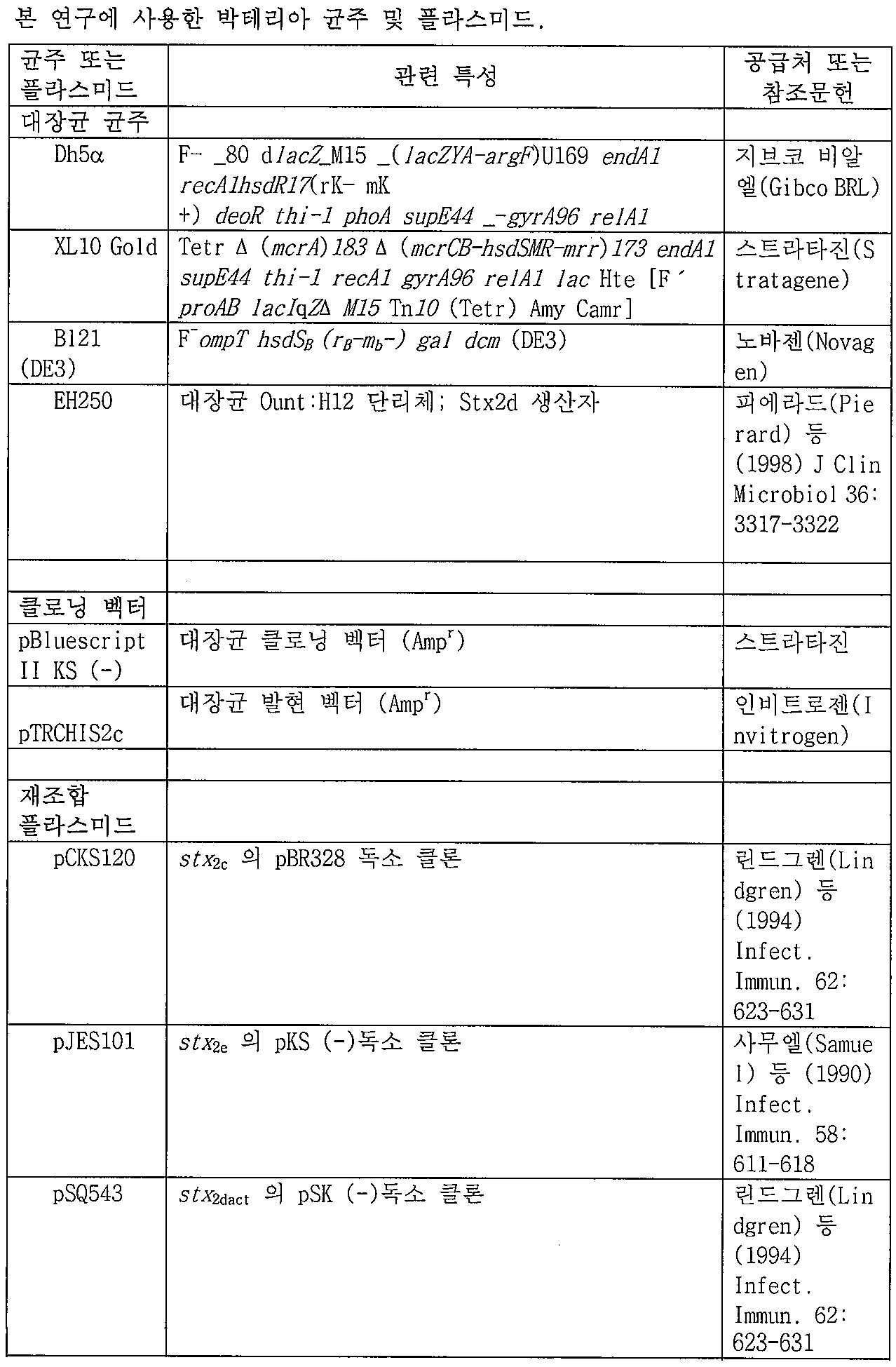
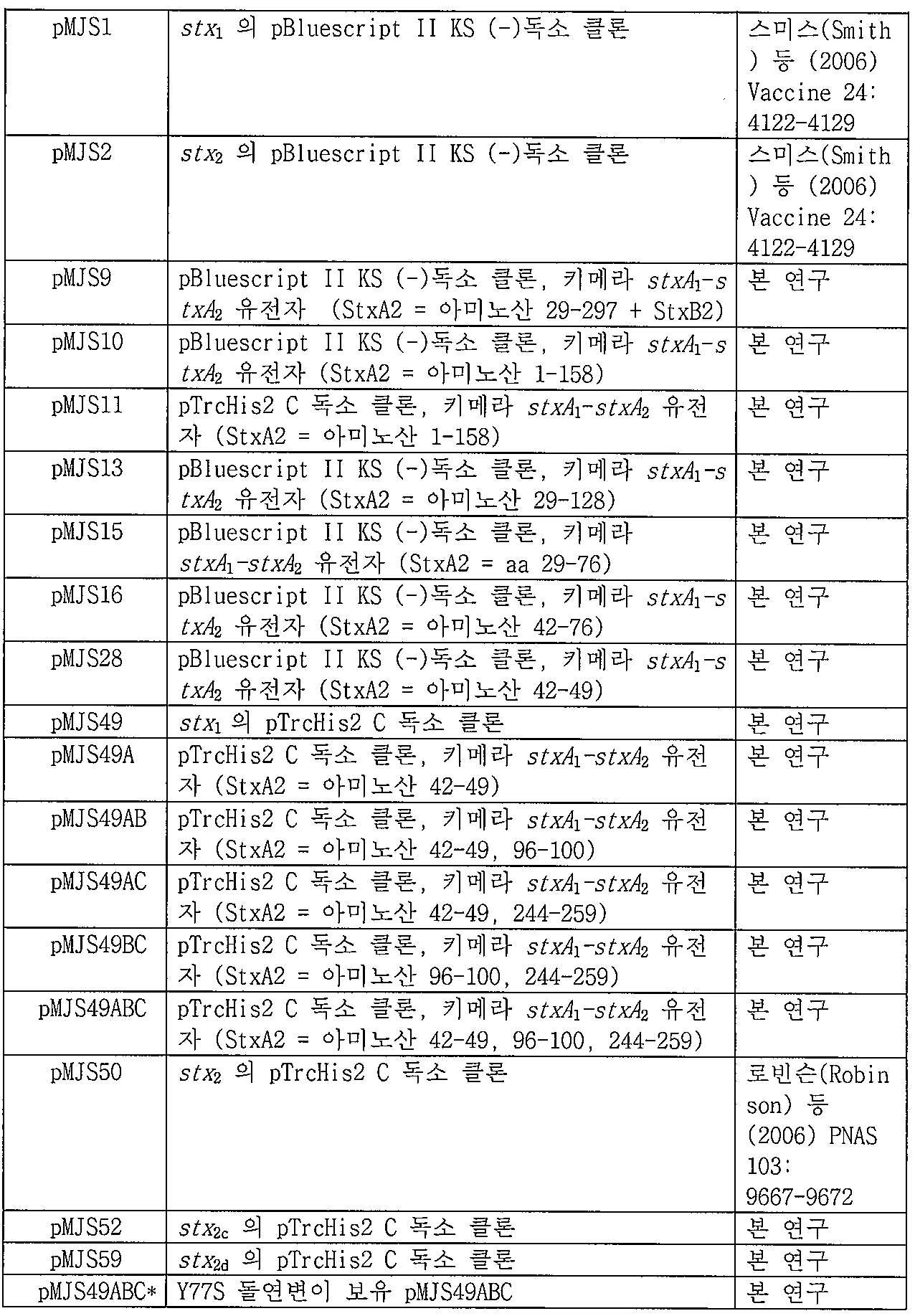
키메라 독소 플라스미드의 제작.Production of chimeric toxin plasmid.
stxA 1 및 stxA 2 모두의 일부분이 함유된 6개의 키메라 독소 유전자를, 오버랩 익스텐션에 의한 스플라이싱 (splicing by overlap extension; SOE) 프로토콜을 사용해 PCR로 생성하고 (문헌 [히구치(Higuchi) (1989) p. 61-70. H. A. Erlich (ed.), PCR technology. Stockton Press, New York]), PCR 생성물을 pBluescript II KS (-) (스트라타진, 미국 캘리포니아주 라 졸라 소재)에 결찰시켰다. 키메라 독소 유전자들은 본래의 프로모터 및 샤인-달가르노(Shine-Dalgarno) 서열들을 함유하였고, 상기 클론들 중 5 개로부터 독소 발현의 수준은 이들 조건 하에서 충분하였다. 하나의 클론(pMJS11)으로부터 A 서브유닛의 발현의 수준을 증가시키기 위해, 독소 오페론을 PCR에 의해 재차 증폭시키고 최적화된 샤인-달가르노 서열 [TAAGGAGGACAGCTATG (최적화된 샤인-달가르노 서열은 밑줄 친 부분이며 StxA2에 대한 번역 시작 부위는 볼드체로 되어 있다) 서열번호: 20]을 stxA 2의 상부(upstream)에 추가하였다. 이 후자의 PCR 생성물을 이소프로필-β-D-티오갈락토피라노시드(IPTG)-유도성 프로모터를 갖는 pTrcHis2 C 발현 벡터 (인비트로젠, 미국 캘리포니아주 칼스배드 소재)에 결찰하였다. 이 연구에 사용된 모든 프라이머들을 하기 표 2에 열거하였다. 이 연구를 위해 생성된 각 구축물의 DNA 서열은 사용 전에 확인하였다. stxA 1 and Six chimeric toxin genes containing a portion of both stxA 2 were generated by PCR using the splicing by overlap extension (SOE) protocol (Higuchi (1989) p. 61 The PCR product was ligated to pBluescript II KS (-) (Stratagene, La Jolla, Calif., USA). Chimeric toxin genes contained native promoters and Shine-Dalgarno sequences, and the level of toxin expression from five of the clones was sufficient under these conditions. To increase the level of expression of the A subunit from one clone (pMJS11), the toxin operon is amplified again by PCR and the optimized Shine-Dalgarno sequence [TA AGGAGG ACAGCT ATG pro-part is the translation start site for the StxA2 is in bold) SEQ ID NO: 20] was added to the upper (upstream) of stxA 2. This latter PCR product was ligated to the pTrcHis2C expression vector (Invitrogen, Carlsbad, CA) with an isopropyl-beta-D-thiogalactopyranoside (IPTG) -induced promoter. All primers used in this study are listed in Table 2 below. The DNA sequences of each construct produced for this study were verified before use.
<표 2><Table 2>
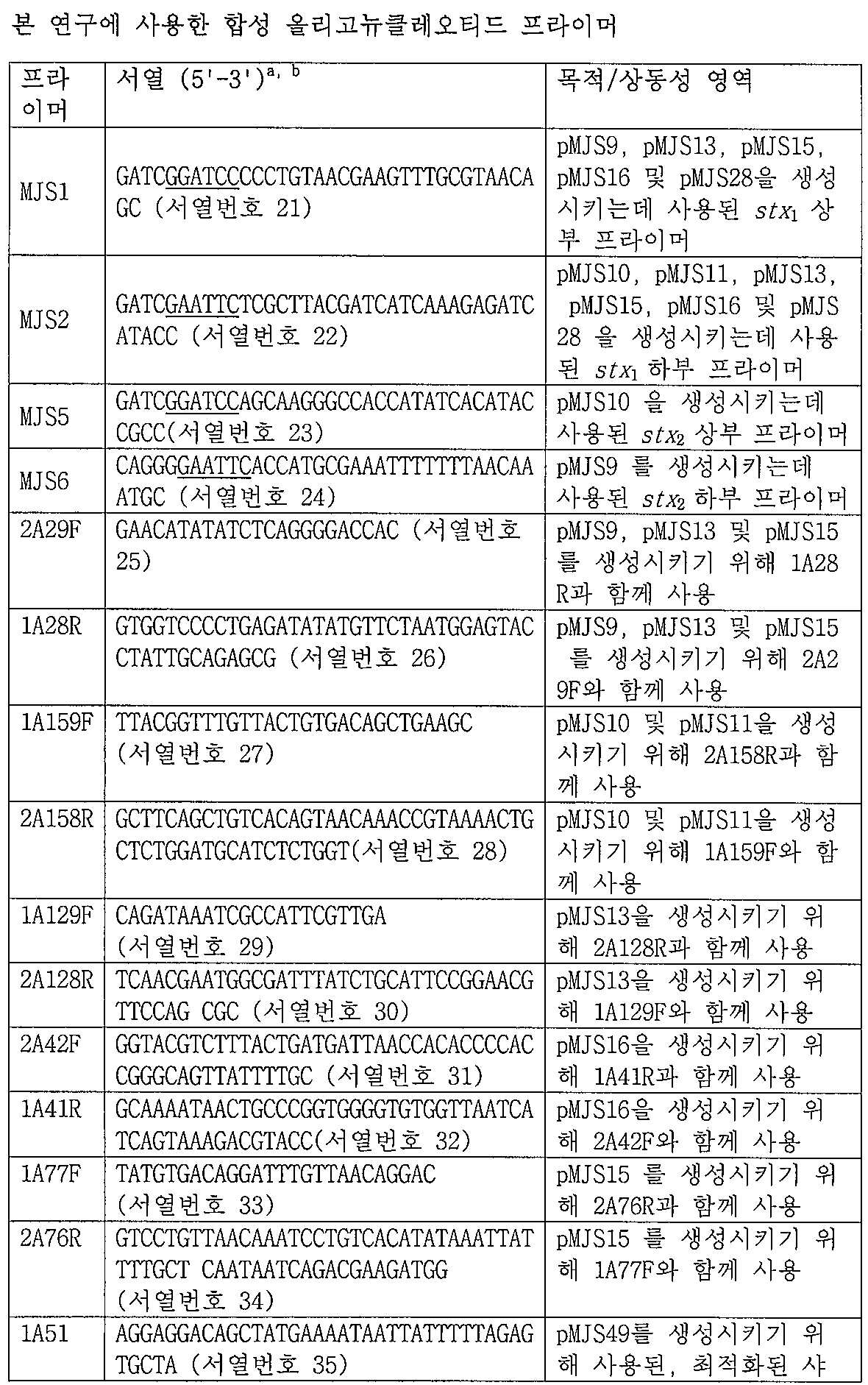
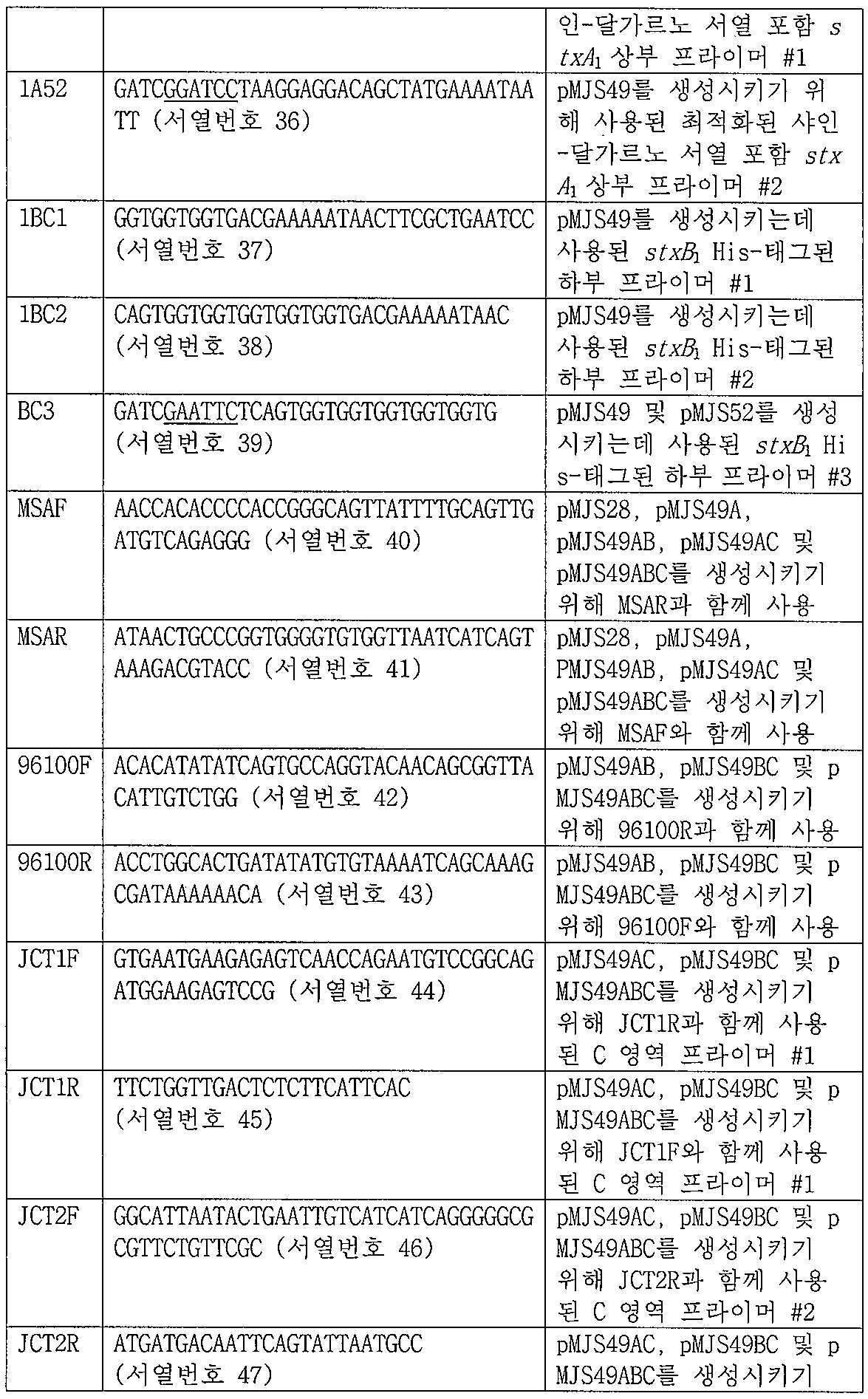
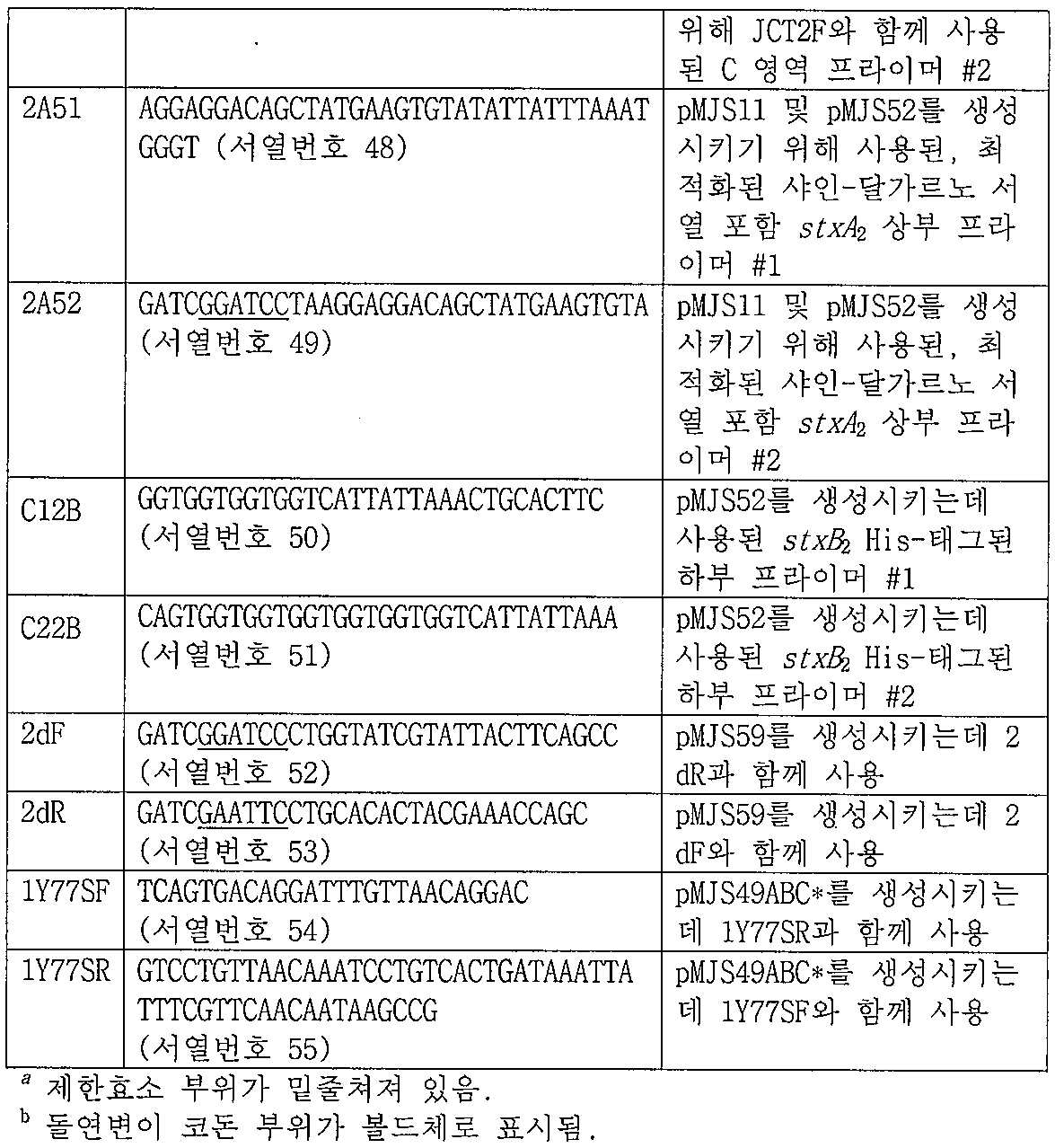
B 유전자의 바로 하부 (downstream)에 위치한 6개의 히스티딘 코돈을 함유하는 stx 1 클론으로부터 5개의 His-태그된 키메라 독소를 추가로 생성시켰다 (도 2a). 이들 키메라에 의해 생산된 독소들은, Stx1 내 필적하는 서열 대신에 추정 11E10 단일클론 항체 에피토프를 포함하는 Stx2 A 서브유닛으로부터의 1, 2 또는 3개의 영역들 (이후 본원에서 영역 A, B 및 C로서 지칭함)을 함유한다. A, B 및 C 영역들은 각각 Stx2 A 서브유닛의 아미노산 42-49(서열번호 1), 96-100(서열번호 2), 및 244-259(서열번호 3)를 지칭한다. 제조된 5개의 키메라 독소를 다음과 같이 명명하였다: Stx1 +A(서열번호 4에 나타난 키메라 Stx2 A 서열 함유), Stx1 +AB(서열번호 5에 나타난 키메라 Stx2 A 서열 함유), Stx1 +AC(서열번호 6에 나타난 키메라 Stx2 A 서열 함유), Stx1 +BC(서열번호 7에 나타난 키메라 Stx2 A 서열 함유), 또는 Stx1 +ABC(서열번호 8에 나타난 키메라 Stx2 A 서열 함유).Five His-tagged chimeric toxins were further generated from stx 1 clones containing six histidine codons located immediately downstream of the B gene (Fig. 2a). The toxins produced by these chimeras contain one, two or three regions from the Stx2 A subunit (hereinafter referred to as regions A, B, and C, hereafter referred to as "Quot;). The A, B, and C regions refer to the amino acids 42-49 (SEQ ID NO: 1), 96-100 (SEQ ID NO: 2), and 244-259 (SEQ ID NO: 3) of the Stx2A subunit, respectively. The five chimeric toxins produced were named Stx1 + A (containing the chimeric Stx2 A sequence shown in SEQ ID NO: 4), Stx1 + AB (containing the chimeric Stx2 A sequence shown in SEQ ID NO: 5), Stx1 + AC (Containing the chimeric Stx2 A sequence shown in SEQ ID NO: 6), Stx1 + BC (containing the chimeric Stx2 A sequence shown in SEQ ID NO: 7), or Stx1 + ABC (containing the chimeric Stx2 A sequence shown in SEQ ID NO:
일부 변성독소화된 Stx1 +ABC의 생성 및 정제.Generation and purification of some denatured toxinized Stx1 + ABC.
A 서브유닛의 77 위치에 티로신 잔기를 SOE 프로토콜에 의해 세린 잔기로 변경시킴으로써 Stx1 +ABC 독소를 부분적으로 변성독소화시켰다. Y77S 돌연변이는 베로 세포들에 대한 50% 세포독성 투여량(CD50)을 유도된 배양액 ml당 106 CD50으로부터 102 CD50까지 감소시켰다. Y77S 돌연변이가 도입된 후 이러한 세포독성의 4-log 감소는 Stx1에서의 Y77S 돌연변이에 대해 이전에 보고된 것과 유사하다 (문헌 [데레시위츠(Deresiewicz) 등 (1992) Biochemistry 31:3272-3280]).The Stx1 + ABC toxin was partially deoxidized by changing the tyrosine residue to the serine residue at the 77 position of the A subunit by the SOE protocol. The Y77S mutation reduced the 50% cytotoxic dose (CD 50 ) for Vero cells from 10 6 CD 50 to 10 2 CD 50 per ml of induced culture. The 4-log reduction of such cytotoxicity after the introduction of the Y77S mutation is similar to that reported previously for the Y77S mutation in Stx1 (Deresiewicz et al. (1992) Biochemistry 31: 3272-3280) .
Stx1 +ABC 변성독소를 종래 기재된 바와 같이 니켈 친화성 칼럼을 사용하여 정제하였다 (문헌 [스미스(Smith) 등 (2006) Infect. Immun. 74:6992-6998]). 변성독소의 농도를 비신크로닌산 검정 (bicinchoninic acid assay; 피어스(Pierce), 미국 일리노이즈주 록포드 소재)에 의해 결정하였다. 소듐 도데실 설페이트-폴리아크릴아미드 겔의 은-염색으로, 키메라 변성독소의 A 및 B 서브유닛들이 2개의 주요 밴드에 존재하는 것으로 밝혀졌으며, 다른 비주요 밴드도 관찰되었다 (데이터는 제시되지 않음).The Stx1 + ABC modified toxin was purified using a nickel affinity column as previously described (Smith et al. (2006) Infect. Immun. 74: 6992-6998). The concentration of the denatured toxin was determined by bicinchoninic acid assay (Pierce, Rockford, IL). With silver-staining of the sodium dodecylsulfate-polyacrylamide gel, the A and B subunits of the chimeric degenerative toxin were found to be present in two major bands, and other non-major bands were also observed (data not shown) .
Stx2c 및 Stx2d 변이 클론의 제작.Production of Stx2c and Stx2d mutant clones.
His-태그된 Stx2c이 발현된 클론을 Stx2에 대해 종래 기재된 바와 같이 PCR에 의해 생성하였다 (문헌 [로빈슨(Robinson) 등 (2006) Proc. Natl. Acad. Sci. U. S. A 103:9667-9672]). stx 2d 클론을 대장균 EH250으로부터 프라이머 2DF 및 2DR을 사용하여 PCR에 의해 생성하였다 (문헌 [피어라드(Pierard) 등 (1998) J. Clin. Microbiol. 36:3317-3322]). PCR 생성물을 발현 벡터 pTrcHis2 C에 결찰하였다. 서열 분석에 의해 이 stx 2c 및 stx 2d가 올바르게 증폭된 것을 확인하였다.Clones expressing His-tagged Stx2c were generated by PCR as previously described for Stx2 (Robinson et al. (2006) Proc. Natl. Acad. Sci. USA 103: 9667-9672) . stx 2d clones were generated by PCR from E. coli EH250 using primers 2DF and 2DR (Pierard et al. (1998) J. Clin. Microbiol. 36: 3317-3322). The PCR product was ligated to the expression vector pTrcHis2C. Sequence analysis confirmed that stx 2c and stx 2d were correctly amplified.
웨스턴 블롯 분석Western blot analysis
정제된 Stx1, Stx2, 또는 키메라 Stx1/Stx2 독소를 발현하는 박테리아의 음파 용해물 (sonic lysate)을 소듐 도데실 설페이트-폴리아크릴아미드 겔 전기영동 (SDS-PAGE)한 다음, 종래 기재된 바 (스미스 등의 문헌 참조, 상기한 바와 같음)와 같이 웨스턴 블롯으로 조사하였다. Stx1, Stx2, 또는 키메라 독소를 함유하는 음파 용해물 내의 A 서브유닛의 농도를 다음과 같이 추정하였다. 우선, Stx1 또는 Stx2 각각으로부터의 정제된 A 서브유닛을 검출하는 토끼의 항-Stx1 및 항-Stx2 토끼 다클론 항체들의 비교적 등가 수준으로의 특정 희석액을 NIH 이미지 J 소프트웨어(NIH Image J software, http://rsb.info.nih.gov/nih-image)의 사용을 통해 측정하였다. 둘째, 키메라-함유 음파 용해물들을 SDS-PAGE에 의해 분리하고, 상기 분리된 겔을 니트로셀룰로스로 옮긴 다음, 이들 블롯 (blot)을 상기 결정된 바와 같이 희석된 토끼의 항-Stx1 및 항-Stx2 토끼 다클론 항체들의 혼합물로 탐침하였다. 셋째, 각 레인에서 키메라 A 서브유닛에 상응하는 밴드들을 NIH 이미지 J 프로그램을 사용하여 정량화하여서 각 용해물 샘플에서 독소 농도를 결정하였다. 넷째, 2개의 추가 폴리아크릴아미드 겔에 정제된 Stx1, Stx2, 또는 등가 농도를 함유하도록 정규화된 키메라-함유 용해물 (단계 3으로부터 결정된 바와 같음)의 시료를 로딩하였다. 그 다음, 독소 제조물을 SDS-PAGE한 후, 토끼 항-Stx1 및 토끼 항-Stx2 다클론 항체들 (도 1b의 상부 패널; 블롯 1) 또는 11E10 단일클론 항체(도 1b 하부 패널; 블롯 2)의 혼합물을 가지고 웨스턴 블롯 분석을 실시하였다. 이들 웨스턴에 사용된 2차 항체들은 블롯 1의 경우 1:15,000의 희석으로의 홀스래디쉬 퍼옥시다제 [Horseradish peroxidase (HRP), 바이오-래드(Bio-Rad), 미국 캘리포니아주 허큘리스 소재]에 접합된 염소 항-토끼 면역글로불린 G (IgG, 도 1b의 상부 패널)이었고, 블롯 2의 경우 1:3,000의 희석으로의 HRP (바이오-래드, 미국 캘리포니아주 허큘리스 소재)에 접합된 염소 항-마우스 IgG (도 1b 하부 패널)이었다. 결합된 2차 항체들을 ECL-플러스 웨스턴 블로팅 검출 키트 (ECL-Plus Western blotting detection kit)를 사용하는 화학발광(chemiluminescence)에 의해 검출하였다 (앰머샴 바이오사이언스(Amersham Bioscience), 영국 버킹햄셔주 리틀 챨폰트 소재).The sonic lysate of bacteria expressing purified Stx1, Stx2, or chimeric Stx1 / Stx2 toxin was subjected to sodium dodecyl sulfate-polyacrylamide gel electrophoresis (SDS-PAGE) , As described above) by Western blotting. The concentration of the A subunit in the sonolysis solution containing Stxl, Stx2, or chimeric toxin was estimated as follows. First, specific dilutions of the rabbit anti-Stx1 and anti-Stx2 rabbit polyclonal antibodies to comparable levels of rabbit polyclonal antibodies that detect purified A subunits from each of Stxl or Stx2 were obtained from NIH Image J software ( http: //rsb.info.nih.gov/nih-image ). Second, the chimeric-containing sonolytics were separated by SDS-PAGE, the separated gels were transferred to nitrocellulose, and these blots were incubated with anti-Stxl and anti-Stx2 rabbits of the diluted rabbit as determined above And probed with a mixture of polyclonal antibodies. Third, the bands corresponding to the chimera A subunits in each lane were quantitated using the NIH Image J program to determine the toxin concentration in each lysate sample. Fourth, a sample of purified Stx1, Stx2, or a chimera-containing lysate normalized to contain equivalent concentrations (as determined from step 3) was loaded onto two additional polyacrylamide gels. Subsequently, toxin preparations were subjected to SDS-PAGE and then stained with rabbit anti-Stxl and rabbit anti-Stx2 polyclonal antibodies (top panel of Figure 1b; Blot 1) or 11E10 monoclonal antibodies (Figure 1b bottom panel; Blot 2) Western blot analysis was performed with the mixture. Secondary antibodies used in these western blots were conjugated to horseradish peroxidase (HRP), Bio-Rad, Hercules, CA, at a dilution of 1: 15,000 for
또한, Stx2, Stx2c, Stx2d, Stx2dact 또는 Stx2e를 발현하는 클론들의 음파 용해물에 대해 웨스턴 블롯을 실시하였다. 먼저, 프로브로서 토끼 항-Stx2 다클론 항체만을 사용한 것을 제외하고는 앞서 기재된 바와 같이 이들 독소 시료들로부터의 A 서브유닛의 농도를 결정하였다. 그 다음, 2개의 추가 폴리아크릴아미드 겔에 등가량의 정규화된 시료를 로딩하고, 1차 항체로서 토끼 항-Stx2 다클론 항체 또는 11E10 단일클론 항체를 사용하여 웨스턴 블롯을 실시하였다. 2차 항체 및 검출 방법은 앞서 기재된 바와 동일하였다.Also, Stx2, Western blotting was performed on sonolysis of clones expressing Stx2c, Stx2d, Stx2d act or Stx2e. First, the concentration of the A subunit from these toxin samples was determined as described above except that only rabbit anti-Stx2 polyclonal antibodies were used as probes. Next, two additional polyacrylamide gels were loaded with an equivalent amount of normalized sample, and western blotting was performed using rabbit anti-Stx2 polyclonal antibody or 11E10 monoclonal antibody as the primary antibody. The secondary antibody and detection method were the same as described above.
베로 세포에 대한 시험관 내 중화 검정.In vitro neutralization assay for Vero cells.
Stx1, Stx2, 키메라 Stx1/Stx2 독소, Stx2c, Stx2d, Stx2dact, 또는 Stx2e가 함유된 박테리아로부터의 음파 용해물의 시험관 내 중화 검정을, 종래 기재된 바와 같이 (문헌 [마르크스(Marques) 등 (1986) J Infect. Dis. 154:338-341]; 스미스 등의 문헌, 상기한 바와 같음) 베로 세포들(ATCC, 미국 버지니아주 마나사스 소재) 상의 11E10을 사용하여 실시하였다. 요약하면, 이글 최소 필수 배지 (Eagle's Minimal Essential Medium; EMEM) 중의 독소(1 내지 3 CD50) 및 EMEM 중의 정제된 11E10 단일클론 항체 (0.5 mg/ml)를 함유한 동일한 부피의 시료들을 함께 혼합하고, 37℃에서 2시간 동안 5% CO2에서 인큐베이션하였다. 그 다음, 독소-항체 혼합물을 96-웰 플레이트 내의 서브-합류성(subconfluent) 베로 세포들 상으로 중첩시킨 다음 48시간 동안 인큐베이션하였다. 그 다음, 베로 세포들을 고정시키고, 염색하고, 600 nm에서의 광학 밀도(OD600)를 측정하였다. 이들 중화 실험들을 적어도 이중으로 2회 실시하였다. 독소 단독 또는 독소 및 항체가 첨가된 웰 내에서 세포 생존성을 비교함으로써 음파 용해물 중의 독소의 세포독성 효과를 중화시키는 11E10 단일클론 항체의 능력을 측정하였다. 항체에 의한 독소의 중화 백분율은 하기 식에 의해 계산하였다. 중화 백분율: [(독소+ 항체 웰의 평균 OD600 - 독소 단독 웰의 평균 OD600)/(세포 단독 웰의 평균 OD600 - 독소 단독 웰의 평균 OD600)] x 100. 11E10 단일클론 항체는 Stx2를 야생형 활성의 약 65%까지 중화시켰다. 11E10 단일클론 항체에 의한 독소 유도체들의 중화 백분율을 더욱 쉽게 비교하기 위해, 11E10에 의한 Stx2의 중화량을 100%로 설정하고 다른 독소들의 중화 수준들이 Stx2의 것과 비교하여 계산되도록 데이터를 정규화하였다.In vitro neutralization assays of sonolysates from bacteria containing Stx1, Stx2, chimeric Stx1 / Stx2 toxin, Stx2c, Stx2d, Stx2d act , or Stx2e were performed as previously described (Marques et al. (ATCC, Manassas, Va., USA), as described above in the literature (Smith et al ., J. Infect. Dis. 154: 338-341; Briefly, samples of the same volume containing the toxin (1 to 3 CD 50 ) in Eagle's Minimal Essential Medium (EMEM) and the purified 11E10 monoclonal antibody (0.5 mg / ml) in EMEM were mixed together and incubated in a 5% CO 2 for 2 hours at 37 ℃. The toxin-antibody mixture was then superimposed on subconfluent Vero cells in a 96-well plate and then incubated for 48 hours. The Vero cells were then fixed, stained and the optical density at 600 nm (OD 600 ) measured. These neutralization experiments were conducted at least twice in duplicate. The ability of the 11E10 monoclonal antibody to neutralize the cytotoxic effect of the toxin in the sonolysis was measured by comparing the cell viability in the toxin alone or in the wells to which the toxin and antibody were added. Percent neutralization of the toxin by the antibody was calculated by the following equation. Neutralization percentage: [(toxin + antibody well average OD 600 of the - average OD 600 of the toxin alone wells) / (mean OD 600 of cells alone well-average OD 600 of the toxin alone wells)] x 100. 11E10 monoclonal antibodies Stx2 Was neutralized to about 65% of the wild type activity. To more readily compare neutralization percentages of toxin derivatives by 11E10 monoclonal antibodies, the data were normalized such that the neutralization level of Stx2 by 11E10 was set at 100% and the neutralization levels of the other toxins were calculated relative to that of Stx2.
마우스의 접종 및 챌린지(challenge)Inoculation and challenge of mice < RTI ID = 0.0 >
체중이 14 내지 16 g인 CD-1 수컷 마우스로부터 면역이전 혈청을 수거하였다 (챨스 리버 래버레토리즈(Charles River Laboratories), 미국 메사추세츠주 보스턴 소재). 이들 혈청 시료를 효소-결합 면역흡착 검정(ELISA)에 사용하여서 마우스가 Stx1 또는 Stx2에 대해 선재 역가(pre-existing titer)를 갖는지 측정하였다. 연구 시작시 독소에 대해 면역 반응을 나타내는 마우스는 없었다. 그 다음, 마우스를 2개의 군으로 나누었다: 샴(sham)-접종된 군 (이후 본원에서 음성-대조군으로 지칭) 및 키메라 변성독소로 접종된 군. 음성 대조군 내의 마우스에 PBS와 타이터맥스 (TiterMax)의 혼합물, 유중수형 항원보강제 (타이터맥스 유에스에이 인코포레이티드(TiterMax, USA Inc.), 미국 조지아주 노크로스 소재)를 복강 내에 접종하였다. 제 2 군의 마우스에 타이터맥스와 혼합된 변성독소 1 μg를 복강 내 접종하였다. 총 4번의 부스트를 위해 3주 간격으로 마우스를 부스팅하였다. 최종 부스팅 2주 후, 5마리 음성-대조군 마우스 및 5마리 변성독소-접종된 마우스에 50% 치사 투여량(LD50)의 Stx1(1,250 ng)를 복강 내로 10회 투여하고, 29마리 음성 대조군 마우스 및 34마리 변성독소-접종된 마우스에 5 LD50의 Stx2(5 ng)를 투여하였다.Preimmune sera were collected from CD-1 male mice weighing 14-16 g (Charles River Laboratories, Boston, Mass., USA). These serum samples were used in an enzyme-linked immunosorbent assay (ELISA) to determine whether the mice had a pre-existing titer for Stx1 or Stx2. At the start of the study, no mice showed an immune response to the toxin. The mice were then divided into two groups: sham-inoculated group (hereinafter referred to as negative-control group) and chimeric modified toxin. A mouse in the negative control group was inoculated into the abdominal cavity with a mixture of PBS and TiterMax, a water-in-water type antigen adjuvant (TiterMax, USA Inc., Norcross, GA).
시험관 내 단백질 합성 억제 검정.In vitro inhibition of protein synthesis.
토끼 망상적혈구 용해물, 개똥벌레 루시퍼라제 mRNA, 및 루시페린 기질을 프로메가 코포레이션 (Promega Corporation, 미국 위스콘신주 메디슨 소재)으로부터 구입하였다. Stx2(4 ng/μl)를 동일한 부피의 항체(4 또는 40 ng/μl)와 조합하고, 1 μl의 독소/항체 혼합물을 9 μl 망상적혈구 용해물과 조합하였다. 혼합물을 30℃에서 인큐베이션하여 독소가 용해물 중의 리보솜을 비활성화하도록 하였다. 1시간 후, 2분 동안 70℃까지 가열된 분취량의 루시퍼라제 mRNA 및 아미노산을 첨가하고, 용액을 90분 더 인큐베이션하여 시험관 내 단백질 합성이 진행되도록 하였다. 모든 검정은 3회 반복 실시하였다. 루시퍼라제 활성은, 1 μl의 용해물 혼합물을 깨끗한 96 웰 플레이트(피셔 사이언티픽(Fisher Scientific), 미국 펜실베니아주 피츠버그 소재) 내의 20 μl의 루시페린 기질에 첨가함으로써 측정하였다. 생물발광 (Bioluminescent light emission)은 코닥 이미지 스테이션 (Kodak Image Station) 440CF를 사용하여 10분 노출 후 검출하였다. 발광 신호는 단일 웰에 상응하는 원형 영역 내의 총 신호 세기의 합으로 분석하였다.Rabbit reticulocyte lysates, firefly luciferase mRNA, and luciferin substrates were purchased from Promega Corporation, Madison, Wis., USA. Stx2 (4 ng / μl) was combined with the same volume of antibody (4 or 40 ng / μl) and 1 μl of the toxin / antibody mixture was combined with 9 μl reticulocyte lysate. The mixture was incubated at 30 ° C to allow the toxin to inactivate the ribosomes in the lysate. After 1 hour, aliquots of luciferase mRNA and amino acid heated to 70 ° C for 2 minutes were added and the solution was incubated for another 90 minutes to allow in vitro protein synthesis to proceed. All assays were repeated three times. Luciferase activity was determined by adding 1 [mu] l of the lysate mixture to 20 [mu] l of luciferin matrix in clean 96-well plates (Fisher Scientific, Pittsburgh, Pa.). Bioluminescent light emission was detected after 10 minutes exposure using Kodak Image Station 440CF. The luminescence signal was analyzed as the sum of the total signal intensities in the circular region corresponding to a single well.
비독성화된 세포 중의 11E10의 국소화Localization of 11E10 in unoxidized cells
베로 세포들을 8-웰 조직 배양 슬라이드 (써모 피셔 사이언티픽(Thermo Fisher Scientific), 미국 뉴욕주 로체스터 소재) 내에 1 X 10⁵ 세포/ml의 농도로 씨딩(seed)하고, 24시간 동안 37℃에서 5% CO2의 분위기 하에서 부착시켰다. Stx2 (0.2 ml의 10 ng/ml)를 10 ng의 정제된 11E10 단일클론 항체 또는 음성 대조군으로서의 PBS와 혼합하였다. 항체/독소 또는 PBS/독소 용액을 6시간 동안 베로 세포들과 함께 인큐베이션한 후, 세포들을 완충된 포르말린 (포름알데-프레쉬(Formalde-Fresh), 피셔 사이언티픽, 미국 펜실베니아주 피츠버그 소재)으로 고정하고, PBS 중의 0.001% 트리톤(Triton)-X100 (피어스, 미국 일리노이즈주 록포드 소재)을 이용해 투과시켰다. 모든 면역염색 절차들을 3% 소 혈청 알부민(BSA, 시그마(Sigma), 미국 미주리주 세인트 루이스 소재)을 사용해 PBS 내에서 실시하였다. 세포들 내 단일클론 항체 11E10의 존재는 알렉사-플루오르(Alexa-Fluor) 488 표지된 당나귀 항-마우스 IgG (인비트로젠, 미국 캘리포니아주 칼스배드 소재)로 검출하였다. 비독성화된 세포들 내의 총 Stx2를 토끼 항-Stx2 다클론 항체로 표지하고, 알렉사-플루오르 488-접합된 당나귀 항-토끼 IgG를 2차 항체 (인비트로젠, 미국 캘리포니아주 칼스배드 소재)로 사용하였다. Stx2 및 엔도솜 이중 표지화는 항-Stx2 단일클론 항체 11F11 (페레라 등의 문헌 참조, 상기한 바와 같음) (BEI 리소스즈, 미국 버지니아주 마나사스 소재) 및 항-EEA1 (C-15) 염소 다클론 항체 (산타 크루즈 바이오테크놀로지(Santa Cruz Biotechnology), 미국 캘리포니아주 산타 크루즈 소재) 각각 및 알렉사-플루오르 표지된 2차 항체를 사용하여 수행하였다. 적절한 1차 및 2차 항체를 사용하여 인큐베이션한 후, 세포들을 20분 동안 37℃에서 포르말린으로 고정하고, 상기 슬라이드를 슬로우페이드 배지 (SlowFade medium, 인비트로젠, 미국 캘리포니아주 칼스배드 소재)에 고정(mount)시켰다. 반사광 형광 부착물을 갖는 올림푸스 (Olympus) 현미경, 및 스폿(Spot) CCD 디지털 카메라 (다이어그노스틱 인스트루먼트 프로덕츠(Diagnostic Instrument Products), 미국 미시건주 스털링 하이츠 소재)를 통해, 결합된 형광단-표지된 2차 항체들의 40배 확대 이미지들을 수득하였다. 형광 이미지들을 어도비 포토샵 (어도비 시스템즈(Adobe Systems), 미국 캘리포니아주 샌 조스 소재)을 사용해 가공하여 중첩시켰다.Vero cells were seeded at a concentration of 1 × 10 5 cells / ml in an 8-well tissue culture slide (Thermo Fisher Scientific, Rochester, NY) and incubated for 24 hours at 37 ° C. with 5 It was deposited in an atmosphere of% CO 2. Stx2 (0.2 ml of 10 ng / ml) was mixed with 10 ng of purified 11E10 monoclonal antibody or PBS as a negative control. After incubation of the antibody / toxin or PBS / toxin solution with Vero cells for 6 hours, cells were fixed with buffered formalin (Formalde-Fresh, Fisher Scientific, Pittsburgh, PA, USA) , And permeabilized with 0.001% Triton-X100 (Pierce, Rockford, IL) in PBS. All immunostaining procedures were performed in PBS using 3% bovine serum albumin (BSA, Sigma, St. Louis, Mo.). The presence of monoclonal antibody 11E10 in cells was detected with Alexa-Fluor 488 labeled donkey anti-mouse IgG (Invitrogen, Carlsbad, CA). Stx2 in unoxidized cells was labeled with rabbit anti-Stx2 polyclonal antibody and Alexa-Fluor 488-conjugated donkey anti-rabbit IgG was used as a secondary antibody (Invitrogen, Carlsbad, Calif., USA) Respectively. Stx2 and endosomal double labeling were performed using anti-Stx2 monoclonal antibody 11F11 (Ferrera et al., Supra) (BEI Resources, Manassas, Va.) And anti-EEE1 (C-15) (Santa Cruz Biotechnology, Santa Cruz, CA) and Alexa-fluoro labeled secondary antibodies, respectively. After incubation with appropriate primary and secondary antibodies, cells were fixed with formalin at 37 ° C for 20 minutes and the slides were fixed in SlowFade medium (Invitrogen, Carlsbad, CA) lt; / RTI > Through an Olympus microscope with a reflected light fluorescent attachment and a Spot CCD digital camera (Diagnostic Instrument Products, Sterling Heights, Mich., USA) 40-fold magnification images of antibodies were obtained. Fluorescent images were processed and superimposed using Adobe Photoshop (Adobe Systems, San Jose, CA).
결과result
초기 키메라 독소와 단일클론 항체 11E10의 상호작용.Interaction of early chimeric toxin with monoclonal antibody 11E10.
11E10 단일클론 항체와 상호작용하는 Stx2의 부분을 결정하기 위해, 본 발명자들은 stxA 1의 상응 영역 대신에 삽입된 stxA 2 유전자의 다른 영역을 함유한 6개의 키메라 독소 오페론의 초기 세트를 제작하였다 (도 1a). 정제된 Stx1, Stx2, 또는 6개의 상이한 키메라 Stx1/Stx2 독소 중 하나를 발현하는 대장균 DH5α로부터의 용해물의 웨스턴 블롯을 11E10 단일클론 항체로 탐침하였다. 상기 항체는 Stx2 A 서브유닛의 29-297, 1-158, 및 29-128의 영역들로부터의 아미노산을 함유하는 키메라 독소 및 Stx2와 강하게 반응하였다 (도 1b). 11E10에 의해 약하기는 하나 여전히 인식되는 최소 부분의 Stx2를 갖는 키메라 독소는 StxA2, 영역 42-49로부터의 8개의 아미노산만을 함유하였다.11E10 to determine a monoclonal antibody and cross-section of the Stx2 acting, the inventors have produced an initial set of six chimeric toxin operon containing the different regions of the stxA 2 gene inserted in place of the corresponding region of stxA 1 (Fig. 1a). Western blots of lysates from E. coli DH5a expressing purified Stx1, Stx2, or one of six different chimeric Stx1 / Stx2 toxins were probed with 11E10 monoclonal antibody. The antibody reacted strongly with the chimeric toxin and Stx2 containing the amino acids from regions 29-297, 1-158, and 29-128 of the Stx2 A subunit (FIG. 1b). The chimeric toxin with the smallest part of Stx2 still weakened by 11E10 contained only eight amino acids from StxA2, region 42-49.
다음으로, Stx1, Stx2, 또는 베로 세포들에 대한 6개의 초기 키메라 독소들 중 하나를 함유하는 박테리아 용해물의 독성을 중화시키는 11E10 단일클론 항체의 능력을 조사하였다. 예상되는 바와 같이, 11E10 단일클론 항체는 Stx2를 중화시켰지만 Stx1은 중화시키지 않았다 (도 1c). 그러나, StxA2로부터의 영역 1-158 또는 29-297을 갖는 하이브리드 독소는 Stx2와 비교하면 11E10에 의해 약 85% 중화되었으며, 그 결과는 11E10 에피토프의 중요한 성분들이 Stx2의 잔기 29-158 사이에 존재함을 시사하였다. 반면, Stx2로부터의 아미노산 29-128을 갖는 키메라 독소는 면역블롯(immunoblot)에서 강하게 인식되었지만, Stx2 수준의 약 32%까지만 중화되었다. 이들 결론을 종합하면, 11E10 중화 에피토프는 웨스턴 블롯에서 Stx1(2A29-128)에 대한 11E10의 결합에 요구되는 것보다 많은 수의 아미노산을 포함하므로, 상기 중화 에피토프의 일부가 이 하이브리드로부터 누락됨을 제시한다. 웨스턴 블롯 분석에서 11E10 단일클론 항체에 의해 약하게 검출된 다른 3개의 키메라 독소는 Stx2 중화의 정규화된 수준과 비교하여 11E10에 의해 현저하게 중화되지는 않았다 (15% 미만). 종합하면, 이들 결과는 Stx2 상의 11E10 중화 에피토프의 하나 이상의 주요 성분들이 아미노산 29-76의 외부에 존재함을 나타낸다.Next, the ability of the 11E10 monoclonal antibody to neutralize the toxicity of bacterial lysates containing either Stx1, Stx2, or one of the six initial chimeric toxins for Bero cells was investigated. As expected, the 11E10 monoclonal antibody neutralized Stx2 but not Stx1 (FIG. 1c). However, the hybrid toxin with region 1-158 or 29-297 from StxA2 was approximately 85% neutralized by 11E10 compared to Stx2, with the result that key components of the 11E10 epitope are present between residues 29-158 of Stx2 Respectively. On the other hand, the chimeric toxin with amino acids 29-128 from Stx2 was strongly recognized in the immunoblot, but neutralized up to about 32% of the Stx2 level. Taken together, these conclusions suggest that some of the neutralizing epitopes are missing from this hybrid because the 11E10 neutralizing epitope contains more amino acids than is required for the binding of 11E10 to Stx1 (2A 29-128 ) in western blots do. The other three chimeric toxins detected weakly by the 11E10 monoclonal antibody in the Western blot analysis were not significantly neutralized (less than 15%) by 11E10 compared to the normalized level of Stx2 neutralization. Taken together, these results indicate that one or more major components of the 11E10 neutralizing epitope on Stx2 are present outside amino acids 29-76.
Stx1 및 Stx2 A 서브유닛 아미노산 서열들 및 결정 구조들간 차이의 분석.Analysis of differences between Stx1 and Stx2 A subunit amino acid sequences and crystal structures.
키메라 독소의 제 1 세트의 웨스턴 블롯 및 중화 분석에서는 11E10 에피토프가 독소 검출을 위해 적어도 Stx2 A 서브유닛의 아미노산 42-49 (서열번호 1)를 요구하는 것으로 나타나지만, 또한 완전한 인식 및 독소 중화를 위해 추가 아미노산이 요구되는 것으로 드러났다. 따라서, 11E10에 의한 Stx2의 인식 및 중화에 관여하는 것일 수 있는 아미노산의 추가적인 독특한 영역을 확인하기 위해 Stx1 및 Stx2로부터의 성숙한 A 서브유닛의 아미노산 서열들을 정렬하였다. 다음, Stx (프레서(Fraser) 등의 문헌 (1994) 참조, 상기한 바와 같음) 및 Stx2 (프레서 등의 문헌 (2004) 참조, 상기한 바와 같음)의 결정 구조 (각각 단백질 데이터 뱅크(Protein Data Bank) 수탁 번호 1RQ4 및 1R4P)를 딥 뷰/스위스-PDB 뷰어(Deep View/Swiss-PDB viewer)를 사용하여 상호 비교하여, 이러한 영역들의 3차원적 구조 및 상호간의 근접성에서 독소들간의 서열 차이가 있는 영역 위치를 평가하였다. 이전에 구축되어 있는 바와 같이, Stx2 A 서브유닛 내 잔기 42-49에 포함된 8개의 아미노산은 11E10 결합 부위의 일부를 형성하며, 이후 영역 A 또는 서열번호 1로서 지칭된다 (도 2a; 영역 A는 아미노산이 밑줄로 표시되어 있음). 영역 A로부터의 8개의 아미노산을 Stx2 결정 구조의 맥락에서 볼 경우, 이들은 독소 구조에서 주요 밴드(bend)를 형성하는 것으로 보이며 (도 2b에서 녹색으로 및 흑색 화살표로 나타낸 것 및 또한 도 2c에서 나타낸 바와 같음), 또한 아미노산 167 주위의 활성 부위 틈 근처, Stx2의 외부 표면 상에서 발견되었다.Western blot and neutralization assays of the first set of chimeric toxins showed that the 11E10 epitope required at least amino acids 42-49 (SEQ ID NO: 1) of the Stx2 A subunit for toxin detection, but also for complete recognition and toxin neutralization Amino acids were found to be required. Thus, amino acid sequences of mature A subunits from Stx1 and Stx2 were aligned to identify additional unique regions of amino acids that might be involved in recognition and neutralization of Stx2 by 11E10. The crystal structures of Protein (Protein) (hereinafter, referred to as " Protein Data Bank ") were determined by the method described in Stx (see Fraser et al. Data Bank Accession Nos. 1RQ4 and 1R4P) were compared using a Deep View / Swiss-PDB viewer to determine the sequence differences between the toxins in the three-dimensional structure and mutual proximity of these regions Was evaluated. As previously constructed, the eight amino acids contained in residues 42-49 in the Stx2 A subunit form part of the 11E10 binding site and are subsequently referred to as region A or SEQ ID NO: 1 Amino acids are underlined). When the eight amino acids from region A are seen in the context of the Stx2 crystal structure, they appear to form a major band in the toxin structure (shown in green and black arrows in Figure 2b and also in Figure 2c ), And also on the outer surface of Stx2, near the active site gap around amino acid 167.
Stx1 및 Stx2의 A 서브유닛들 사이의 제 2 비유사 영역은 이들 2개의 독소들의 아미노산 서열 및 결정 구조를 비교하여 확인되었으며, 이 세그먼트를 본 발명자들은 영역 B 또는 서열번호 2로 일컫는다 (도 2a 참고; 영역 B는 아미노산이 밑줄로 표시되어 있음). 영역 B는 Stx2의 A 서브유닛 내 5개의 잔기들을 포함하며 (96THISV100)(서열번호 2), 이 영역에서 5개의 아미노산 중 4개는 Stx1과 Stx2 사이에서 차이가 있다 (도 2a). 영역 B가 영역 A로부터 약 50개의 아미노산만큼 떨어져 있으나, 이 부분의 아미노산은 Stx2 결정 구조 내의 영역 A를 향해 신장된다 (영역 B는 도 2b에서 청색으로 및 회색 화살표로 표시되어 있음). 3차원 구조에서 영역 B에 대한 영역 A의 근접성은 공간-충전 모델(space-filling model)에서 더욱 분명해진다 (도 2c).The second non-similar region between the A subunits of Stx1 and Stx2 was confirmed by comparing the amino acid sequence and the crystal structure of these two toxins, which we refer to as region B or SEQ ID NO: 2 ; Region B the amino acid is underlined). Region B contains five residues in the A subunit of Stx2 ( 96 THISV 100 ) (SEQ ID NO: 2), in which four of the five amino acids differ between Stx1 and Stx2 (Fig. Region B is about 50 amino acids away from Region A, but the amino acid at this portion extends towards Region A within the Stx2 crystal structure (Region B is shown in blue and gray arrows in Figure 2b). The proximity of region A to region B in the three-dimensional structure becomes more apparent in a space-filling model (Fig. 2C).
본 발명자들이 영역 C 또는 서열번호 3이라고 일컫는 Stx1 및 Stx2의 A 서브유닛들 사이의 제 3 비유사 영역은 Stx2의 잔기 246 주변의 퓨린 분할 부위와 중첩된다 (도 2a 참고; 영역 C는 아미노산이 밑줄로 표시되어 있음). 영역 C는, 그 위치에서 Stx1과 Stx2 사이의 아미노산 서열 차이뿐 아니라 Stx와 Stx2의 결정 구조의 비교에서 영역 C(도 2c에서 시안색으로 및 백색 화살표로 표시되어 있음)가 영역 A 및 B에 공간적으로 근접해 있는 것을 나타내기 때문에 확인되었다. Stx 및 Stx2 결정 구조에 대한 본 발명자들의 분석으로부터, 본 발명자들은 Stx2의 동일한 표면 상의 영역 A, B 및 C 클러스터가 촉매 활성 부위에 비교적 근접해 있다고 결론지었다 (도 2c에서 가장 잘 나타남).The third non-similar region between the A subunits of Stx1 and Stx2, which we refer to as region C or SEQ ID NO: 3, overlaps the purine cleavage site around the residue 246 of Stx2 (see Figure 2a, As shown in FIG. Region C shows that in the comparison of the crystal structure of Stx and Stx2 as well as the amino acid sequence differences between Stx1 and Stx2 at that position, region C (shown in cyan and white arrows in Figure 2c) As shown in Fig. From our analysis of the Stx and Stx2 crystal structures, we conclude that regions A, B and C clusters on the same surface of Stx2 are relatively close to the catalytically active sites (best seen in Figure 2c).
제2 세대 키메라 독소와 단일클론 항체 11E10의 상호작용.Interaction of 2nd generation chimeric toxin with monoclonal antibody 11E10.
영역 B 및 C가 11E10 에피토프의 일부인지를 결정하기 위해, 본 발명자들은, Stx1 상의 상응하는 영역들 대신에 Stx2로부터의 영역 A, B 또는 C의 다양한 조합이 함유된 키메라 독소의 제 2 세트를 생산하였다 (도 3a). 다음으로, Stx1, Stx2 또는 키메라 독소의 웨스턴 블롯을 11E10으로 탐침하였다 (도 3b, 하부 패널). 11E10 단일클론 항체는 영역 A를 함유하는 모든 독소를 검출하였다 (Stx2, Stx1 +A, Stx1 +AB, Stx1 +AC, 및 Stx1 +ABC) (도 3b, 하부 패널). 독소가 없는 영역 A는 11E10 단일클론 항체에 의해 검출되지 않았으며 (Stx1 및 Stx1 +BC), 이러한 발견은 영역 A가 11E10 에피토프의 본질적인 성분임을 확인해 준다. 그러나, 영역 A 및 B를 포함하는 2개의 키메라 독소 (Stx1 +AB 또는 Stx1 +ABC)는 영역 A 단독 또는 영역 C와 조합된 영역 A를 포함하는 키메라 독소보다 11E10 단일클론 항체에 의해 더 강하게 검출되는 것으로 보였다 (도 3b, 하부 패널). 종합해보면, 이들 결과는 영역 A 및 B 모두가 독소의 완전한 11E10 인식에 중요한 것임을 나타낸다.To determine if regions B and C are part of the 11E10 epitope, the inventors produced a second set of chimeric toxins containing various combinations of regions A, B, or C from Stx2 instead of corresponding regions on Stx1 (Fig. 3A). Next, western blots of Stx1, Stx2 or chimeric toxin were probed with 11E10 (Fig. 3b, bottom panel). 11E10 monoclonal antibody detected all toxins containing region A (Stx2, Stx1 + A, Stx1 + AB, Stx1 + AC, and Stx1 + ABC) (Fig. Region A without toxin was not detected by 11E10 monoclonal antibody (Stx1 and Stx1 + BC), and this finding confirms that region A is an essential component of the 11E10 epitope. However, the two chimeric toxins (Stx1 + AB or Stx1 + ABC) containing regions A and B are more strongly detected by the 11E10 monoclonal antibody than the chimeric toxin containing region A alone or region A combined with region C (Fig. 3B, lower panel). Taken together, these results indicate that both regions A and B are important for the complete 11E10 recognition of the toxin.
그 다음, 본 발명자들은 11E10 단일클론 항체에 의한 시험관 내 중화에 대해 5개의 제2 세대 키메라 독소(도 3a) 각각의 음파 용해물을 검정하였다. 항체는 영역 A, B 및 C를 함유하는 키메라 독소(Stx1 +ABC)를 Stx2 중화 수준의 약 65%로 중화하였다. 반면, 영역 A 및 B(Stx1 +AB) 또는 A 및 C(Stx1 +AC)만을 함유하는 키메라 독소를 Stx1 +ABC 키메라의 중화 수준의 거의 절반으로 중화하였다 (도 3c). Stx1 +A 또는 Stx1 +BC 키메라 독소에 대해서는 11E10에 의한 주목할 만한 중화가 관찰되지 않았다 (각각 약 6.9 및 4.3%). 키메라 독소의 더욱 집중적인 (> 50%) 중화를 위해서는 Stx2로부터의 영역 A, B 및 C가 요구되었기 때문에, 본 발명자들은 모든 3개의 영역(A, B 및 C)이 11E10에 의한 50% 초과의 중화에 필요한 것으로 결론지었다.We then assayed the sonolysis of each of the five second generation chimeric toxins (Figure 3A) against in vitro neutralization by the 11E10 monoclonal antibody. The antibody neutralized chimeric toxin (Stx1 + ABC) containing regions A, B, and C to about 65% of the Stx2 neutralization level. On the other hand, a chimeric toxin containing only regions A and B (Stx1 + AB) or A and C (Stx1 + AC) was neutralized to almost half the neutralization level of Stx1 + ABC chimera (FIG. No significant neutralization by 11E10 was observed for Stx1 + A or Stx1 + BC chimera toxins (about 6.9 and 4.3%, respectively). Because regions A, B, and C from Stx2 were required for more intensive (> 50%) neutralization of the chimeric toxin, we found that all three regions (A, B and C) I concluded that it is necessary for neutralization.
Stx2 및 Stx2 변이체 및 11E10 단일클론 항체를 사용한 웨스턴 블롯 및 시험관 내 중화 검정 결과Western blot and in vitro neutralization assays using Stx2 and Stx2 mutants and 11E10 monoclonal antibody ..
어떠한 Stx2 변이체가 11E10에 의해 인식되고/되거나 중화될 수 있는지를 결정하기 위해, Stx1, Stx2 또는 Stx2 변이체 (Stx2c, Stx2d, Stx2dact 및 Stx2e)를 웨스턴 블롯에 의해 분석하였다. Stx2e는 훨씬 적은 양으로 검출되었으나, Stx2 및 모든 Stx2 변이체는 11E10에 의해 인식되었다 (도 4A, 하부 패널). 웨스턴 블롯 형식에서 11E10에 의한 Stx2e의 이러한 약한 검출은, 11E10이 콜로니 블롯에 의해 Stx2e-생성 균주를 검출할 수 없다는 본 발명자들의 종래 보고와 일치된다 (페레라 등의 문헌 참조, 상기한 바와 같음). Stx2e는 Stx2와 비교할 때 영역 B에서의 2개의 보존적 아미노산 차이를 갖는다 (THISV(서열번호 2)가 아닌 AHISL(서열번호 19)). 또한, 영역 A에 바로 인접한 몇몇 아미노산 서열 차이들도 존재한다 (미기재). 본 발명자들은 이들 차이가 웨스턴 블롯에서 11E10에 의한 Stx2e의 감소된 인식때문일 수 있는 것으로 추측한다.Stx1, Stx2 or Stx2 variants (Stx2c, Stx2d, Stx2d act and Stx2e) were analyzed by western blot to determine which Stx2 variants could be recognized and / or neutralized by 11E10. Stx2e was detected in much lesser amounts, while Stx2 and all Stx2 variants were recognized by 11E10 (Fig. 4A, bottom panel). This weak detection of Stx2e by 11E10 in Western blot format is consistent with our previous reports that 11E10 can not detect Stx2e-producing strains by colony blots (see Perera et al., Supra). Stx2e has two conservative amino acid differences in region B (THISV (SEQ ID NO: 2) and AHISL (SEQ ID NO: 19)) compared to Stx2. There are also some amino acid sequence differences immediately adjacent to region A (non-native). We hypothesize that these differences may be due to reduced recognition of Stx2e by 11E10 in Western blots.
Stx2 변이체 독소에 대한 단일클론 항체 11E10의 중화 능력을 평가했을 때, 본 발명자들은 11E10이 모든 Stx2 변이체 독소를 Stx2의 중화 수준의 60% 이상으로 중화시키는 것을 밝혀냈다 (도 4B). 본 발명자들은 웨스턴 블롯 형식에서 11E10에 의한 Stx2e의 제한된 인식으로 인해 Stx2e의 11E10에 의해 관찰되는 중화 수준에 놀랐다 (도 4A, 하부 패널). 그러나, 이 연구에서 11E10에 의한 Stx2e의 중화는 11E10이 Stx2e를 부분적으로 중화시킨다는 것을 보여주는 본 발명자들의 종래 결과와 일치한다 (페레라 등의 문헌 참조, 상기한 바와 같음). When evaluating the neutralizing ability of the monoclonal antibody 11E10 against the Stx2 mutant toxin, the inventors have found that 11E10 neutralizes all Stx2 mutant toxins to> 60% of the neutralization level of Stx2 (FIG. 4B). We were surprised at the level of neutralization observed by 11E10 of Stx2e due to the limited recognition of Stx2e by 11E10 in western blot format (Fig. 4A, bottom panel). However, the neutralization of Stx2e by 11E10 in this study is consistent with our previous results showing that 11E10 partially neutralizes Stx2e (see Perera et al., Supra).
마우스 내의 Stx1 +ABC 변성독소의 면역 및 보호 반응.Immune and protective responses of Stx1 + ABC metamorphotoxin in mice.
그 다음, 본 발명자들은 Stx1 +ABC 하이브리드 분자의 변성독소화된 유도체가 마우스에서 Stx2에 대한 혈청-중화 또는 보호 반응을 이끌어내는 지를 확인하고자 하였다. 마우스의 군들에 키메라 변성독소 또는 대조군으로서의 PBS를 접종하였다. 이후, 5마리 변성독소-접종된 마우스 및 5마리 PBS-접종된 마우스로부터의 혈청에 대해 항-Stx1 중화 반응을 평가하였다. PBS-접종된 마우스로부터의 어떠한 혈청도 Stx1-중화 활성을 함유하지 않았다. 종래 연구들로부터 예측된 바와 같이, 모든 5마리 변성독소-접종된 마우스는 Stx1에 대항하는 중화 항체를 가졌다 (문헌 [스미스 등 (2006) Vaccine 24:4122-4129], 상기한 웬(Wen) 등의 문헌 참조). 이들 5마리 마우스로부터의 혈청에 대한 평균 항-Stx1 중화 역가는 배경보다 4.0±0.9 log 위였다. 나머지 34마리 변성독소-접종된 마우스로부터의 혈청 중 11개는 Stx2에 대해 일부 중화 반응을 가졌지만, 29마리 PBS-접종된 마우스로부터의 혈청에서는 어떠한 항-Stx2 반응도 나타나지 않았다 (데이터 미기재).Next, the inventors sought to determine whether the mutagenized toxin derivatives of the Stx1 + ABC hybrid molecule elicited a serum-neutralizing or protective response to Stx2 in mice. Groups of mice were inoculated with chimeric degenerative toxin or PBS as a control. The anti-Stx1 neutralization response was then assessed against serum from 5 mice of modified toxin-inoculated and 5 mice of PBS-inoculated. No sera from PBS-inoculated mice contained Stxl-neutralizing activity. As predicted from previous studies, all five modified toxin-inoculated mice had neutralizing antibodies against Stxl (Smith et al. (2006) Vaccine 24: 4122-4129), Wen et al. ). The mean anti-Stx1 neutralization titers for serum from these 5 mice were 4.0 +/- 0.9 log above the background. Eleven of the sera from the remaining 34 transformed toxin-inoculated mice had some neutralization response against Stx2, but no anti-Stx2 response was seen in sera from 29 PBS-inoculated mice (data not shown).
최종 부스팅 2주 후, 5마리 음성-대조군 마우스 및 5마리 변성독소-접종된 마우스에 10 LD50의 Stx1을 복강 내 접종하였다. 종래 연구의 결과들로부터 예측된 바와 같이 (스미스 등의 문헌 참조, 상기한 바와 같음, 웬 등의 문헌 참조, 상기한 바와 같음), 모든 음성-대조군 마우스는 죽었지만, 모든 변성독소-접종된 마우스는 치사 접종에서 생존하였다 (표 3). 또한, Stx1로 접종된 변성독소-접종된 마우스의 생존은 이들 마우스로부터의 시험관 내 중화 역가와 직접 연관되어 있었다.Two weeks after the final boosting, 5 ip negative-control mice and 5 degenerated toxin-inoculated mice were intraperitoneally inoculated with 10 LD 50 of Stx1. All negative-control mice were dead, but all degenerative toxin-inoculated mice (see Smith et al., Supra, Ween et al., Supra) Survived the fatal inoculation (Table 3). In addition, the survival of Stx1 inoculated metformin-inoculated mice was directly related to the in vitro neutralization titers from these mice.
<표 3><Table 3>
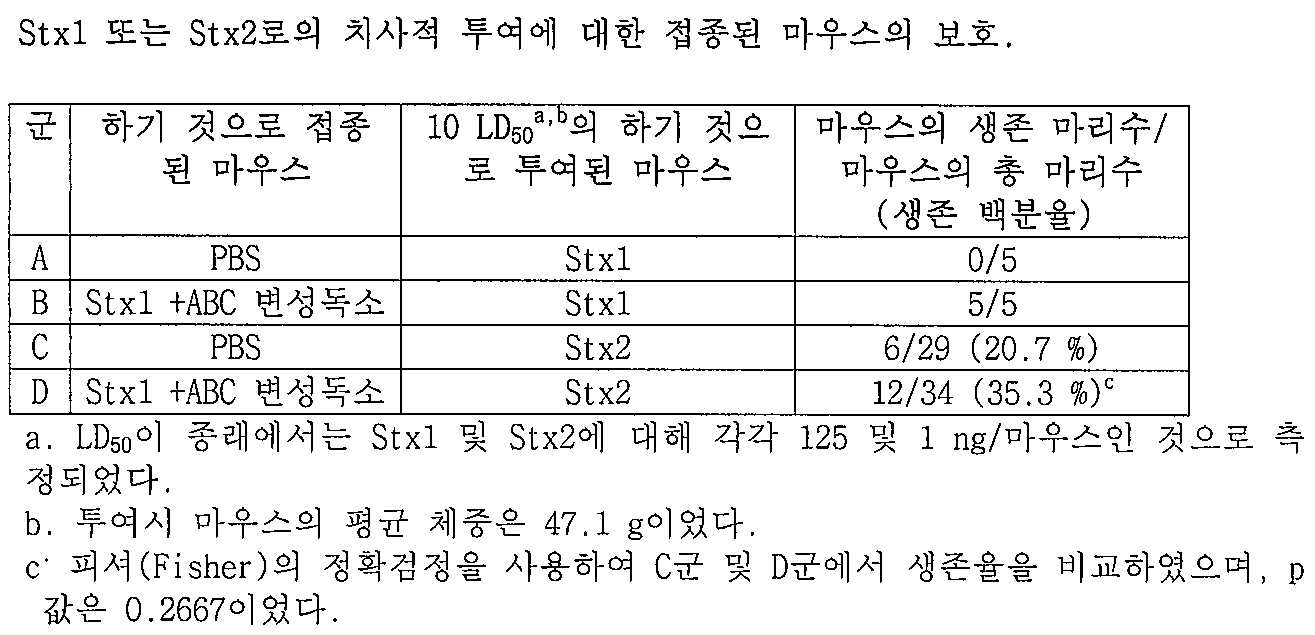
낮은 Stx2 중화 항체 역가가 변성독소-접종된 군에서 관찰되었기 때문에, 본 발명자들은 나머지 마우스를 5 LD50의 Stx2만으로 접종하기로 결정하였다. 29마리 음성-대조군 마우스 중 6마리 (20.7 %)가 Stx2의 접종에서 생존한 반면, 34마리 변성독소-접종된 마우스 중 12마리 (35.3 %)가 생존하였으며 (표 3), 이러한 발견은 통계적으로 유의적이지는 않지만 키메라 변성독소가 Stx2로부터 일부 보호를 제공했을 수 있음을 제시한다.Because low Stx2 neutralizing antibody titers were observed in the modified toxin-inoculated group, we decided to inoculate the remaining mice with only 5 LD 50 of Stx2. Of the 29 negative-control mice, 6 (20.7%) survived the Stx2 inoculation whereas 12 (35.3%) of the 34 mutant toxin-inoculated mice survived (Table 3) Suggesting that chimeric degenerative toxins may have provided some protection from Stx2, although this is not significant.
시험관 내 단백질 합성 억제 검정.In vitro inhibition of protein synthesis.
11E10 에피토프가 Stx2 활성 부위 틈 주변에 있는 표면 루프들로 이루어진 것으로 보인다는 본 발명자들의 발견은, 본 발명자들로 하여금 11E10이 단백질 합성을 억제하는 독소의 능력을 차단함으로써 Stx2를 중화시킬 것이라는 가설을 세우게 하였다. 따라서, 본 발명자들은 루시퍼라제 mRNA가 추가된 토끼 망상적혈구 단백질 합성 검정에서의 Stx2의 리보솜-비활성 효과를 11E10 단일클론 항체가 중화시킬 수 있는지 평가하였다. 독소의 농도는, 독소가 전혀 첨가되지 않은 경우에 측정된 신호와 비교하여, 루시퍼라제 리포터(reporter) 단백질로부터의 신호가 약 60%까지 감소되도록 선택하였다 (도 5). 검정에 11E10을 첨가함으로 인해, 비록 Stx2가 존재하는 경우에도 토끼 망상적혈구 용해물에서 단백질 합성이 허용되지만, 동종형-매칭된 비관련 항체는 그렇지 않았다(도 5).The inventors' discovery that the 11E10 epitope appears to consist of surface loops around the Stx2 active site gap allows us to hypothesize that 11E10 will neutralize Stx2 by blocking the ability of the toxin to inhibit protein synthesis Respectively. Thus, the present inventors evaluated whether the 11E10 monoclonal antibody could neutralize the ribosome-inactivating effect of Stx2 in rabbit reticulocyte protein synthesis assays with addition of luciferase mRNA. The concentration of the toxin was chosen so that the signal from the luciferase reporter protein was reduced by about 60% compared to the signal measured when no toxin was added (Figure 5). The addition of 11E10 to the assay allowed protein synthesis in rabbit reticulocyte lysates even in the presence of Stx2, but not homolog-matched unrelated antibodies (Fig. 5).
단일클론 항체 11E10은 베로 세포에서 Stx2의 전체 분포를 변경시킨다Monoclonal antibody 11E10 changes the overall distribution of Stx2 in Vero cells
본 발명자들이 단일클론 항체 11E10이 시험관 내 단백질 합성 검정에서 Stx2에 의한 단백질 합성의 억제를 방지한다는 것을 발견하였지만, 본 발명자들은 11E10이 비독성화된 베로 세포의 원형질에서 Stx2가 리보솜에 도달되지 않게 할 수 있다는 가설도 세웠다. 따라서, 본 발명자들은 단일클론 항체 11E10이 표적 세포에서 Stx2 국소화를 변경시키는지를 결정하고자 하였다. (본 발명자들은 이전에 11E10-결합된 Stx2가 베로 세포들에 결합하고 11E10이 베로 세포들에 결합된 Stx2에 부착될 수 있다는 것을 발견하였다(데이터 미제시)). Stx2를 11E10 또는 PBS와 혼합하고, 항체/독소 또는 PBS/독소 혼합물을 베로 세포와 함께 인큐베이션하였다. 그 다음, 표적 세포들에서 Stx2의 분포를 토끼 다클론 항체 항-Stx2 및 형광단-표지된 항-토끼 IgG 2차 항체로 가시화하였다 (도 6). Stx2는 11E10의 부재 하에서 원형질 전반에 걸쳐 분포되어 있는 것으로 보였지만 (도 6A), 11E10의 존재 하에는 주로 핵주변 몸체들에 농축된 채로 존재하는 것으로 보였다 (도 6B). 독소/11E10 혼합물로 인큐베이션된 세포들을 항-마우스 IgG로 염색한 경우, 11E10은 Stx2와 동일한 핵주변 점모양 구조에서 관찰되었다 (도 6C). 11E10 단일클론 항체는 독소의 부재시 세포들 내로 진입할 수 없었다 (도 6D). 핵 주변의 점모양 몸체들 내의 11E10-결합된 Stx2의 국소화는 항체-독소 복합체가 세포 내로 진입하지만 원형질 내로의 교류가 이뤄지지 않았음을 암시하였다. 따라서, 본 발명자들은 비독소화된 세포를 초기 엔도솜 마커 단일클론 항체 EEA-1로 면역염색시킴으로써 Stx2 또는 11E10-결합된 Stx2가 초기 엔도솜 내에서 국소화되는지 의문을 품게 되었다. 본 발명자들은, 염색 패턴들을 중첩한 경우 황색-주황색에 의해 제시되는 바와 같이, 11E10-결합된 Stx2로 비독성화된 세포들 내의 다수의 Stx2가 초기 엔도솜 마커로 동시 국소화된다는 것을 발견하였다 (도 6E 내지 6G). 반면, 베로 세포들이 Stx2 단독으로 인큐베이션되는 경우, 독소는 원형질 전반에 걸쳐 발견되었으며, 소량만이 초기 엔도솜 마커로 동시 국소화되었다 (도 6H 내지 6J).Although the present inventors have found that monoclonal antibody 11E10 prevents the inhibition of protein synthesis by Stx2 in in vitro protein synthesis assays, the present inventors have found that 11E10 can prevent Stx2 from reaching the ribosome in the unoxidized Bero cell protoplasts . Thus, the present inventors have determined whether monoclonal antibody 11E10 alters Stx2 localization in target cells. (We have previously found that 11E10-linked Stx2 binds to Vero cells and 11E10 can be attached to Stx2 bound to Vero cells (data not shown)). Stx2 was mixed with < RTI ID = 0.0 > 11E10 < / RTI > or PBS, and the antibody / toxin or PBS / toxin mixture was incubated with Vero cells. The distribution of Stx2 in target cells was then visualized with rabbit polyclonal antibody anti-Stx2 and fluorescent mono-labeled anti-rabbit IgG secondary antibody (Fig. 6). Stx2 appeared to be distributed throughout the protoplasm in the absence of 11E10 (FIG. 6A), but in the presence of 11E10, it appeared to be mainly enriched in nuclear peripheral bodies (FIG. 6B). When cells incubated with the toxin / 11E10 mixture were stained with anti-mouse IgG, 11E10 was observed in the same perinuclear punctate structure as Stx2 (Fig. 6C). The 11E10 monoclonal antibody was unable to enter the cells in the absence of the toxin (Figure 6D). Localization of 11E10-linked Stx2 within the dot-like bodies around the nucleus suggested that the antibody-toxin complex entered the cell but that no exchange into the protoplasm occurred. Thus, the present inventors were questioned whether Stx2 or 11E10-linked Stx2 is localized in the early endosomal cotton by immunostaining non-digested cells with the early endocomma marker monoclonal antibody EEA-1. We have found that multiple Stx2 in unoxidized cells with 11E10-linked Stx2 are co-localized with early endocomal markers, as indicated by the yellow-orange color when overlaying the staining patterns (Fig. 6E To 6G). On the other hand, when Vero cells were incubated with Stx2 alone, toxins were found throughout the protoplasm and only a small amount was co-localized with the early endocomal markers (Figures 6H-6J).
논의Argument
본 발명자들의 결과는 11E10 단일클론 항체 에피토프가 입체형태적이며 결정 구조에서 독소의 활성 부위에 근접한 것으로 보이는 Stx2 A 서브유닛 내 3개의 비선형 영역들을 포함함을 시사한다 (도 2c 참조). 11E10 에피토프를 확인하기 위한 본 발명자들의 전략은 키메라 Stx1/Stx2 독소의 생성을 수반하며, Stx2 서열들을 Stx1 주쇄 상에 배치시키는 것이 항체 에피토프의 3차원적 삼차 구조를 유지하고 11E10 단일클론 항체에 의해 인식될 수 있게 한다는 가정에 기초하였다. 본 발명자들은 웨스턴 분석에서 11E10에 의한 인식이 허용되는 StxA2의 최소 영역이 단지 8개의 Stx2 아미노산으로 이루어진다는 것을 밝혀냈다 (42NHTPPGSY49, 서열번호 1). 그러나, Stx2로부터 8개의 아미노산 (영역 A)만을 갖는 키메라 Stx1/Stx2는 11E10 단일클론 항체에 의해 중화되지 않았다. 11E10이 Stx2를 중화시키기 때문에, 본 발명자들은 본인들이 확인한 8개의 아미노산이 11E10 에피토프의 중요 영역들로 이루어졌지만 완전한 중화 에피토프를 포함하지 않았다고 간주하였다. 본 발명자들은 또한 Stx1 및 Stx2의 아미노산 서열 및 결정 구조 모두에서의 차이점을 분석하여서, 11E10 인식 및 중화에 관여하는 것일 수 있는 Stx2 상의 추가 영역들을 확인하기 위한 시도를 하였다. 이들 비교를 통하여, 본 발명자들은 11E10 에피토프에 잠재적으로 기여하는 Stx2의 2개 이상의 세그먼트를 확인하였다. 사실상, 본 발명자들은 모든 3개의 영역들을 Stx1 상의 상응하는 세그먼트를 교체하는데 사용하였을 때 이들 영역이 11E10에 의한 가장 완전한 인식 및 중화에 요구된 것을 발견하였다.Our results suggest that the 11E10 monoclonal antibody epitope includes three nonlinear regions in the Stx2A subunit that are stereomorphic and appear to be close to the active site of the toxin in the crystal structure (see FIG. 2C). Our strategy for identifying the 11E10 epitope involves generation of the chimeric Stx1 / Stx2 toxin, placing the Stx2 sequences on the Stx1 backbone maintains the three-dimensional tertiary structure of the antibody epitope and is recognized by the 11E10 monoclonal antibody Based on the assumption that We have found in Western analysis that the minimal region of StxA2 that is recognized by 11E10 is composed of only 8 Stx2 amino acids ( 42 NHTPPGSY 49 , SEQ ID NO: 1). However, the chimera Stx1 / Stx2 with only 8 amino acids (region A) from Stx2 was not neutralized by the 11E10 monoclonal antibody. Because 11E10 neutralizes Stx2, we considered that the eight amino acids that we identified consisted of critical regions of the 11E10 epitope, but did not contain a complete neutralization epitope. We also analyzed differences in both the amino acid sequence and the crystal structure of Stx1 and Stx2 and attempted to identify additional regions on Stx2 that could be involved in 11E10 recognition and neutralization. Through these comparisons, we have identified two or more segments of Stx2 that potentially contribute to the 11E10 epitope. In fact, the inventors found that when all three regions were used to replace the corresponding segment on Stx1, these regions were required for most complete recognition and neutralization by 11E10.
완전한 11E10 중화 에피토프가 Stx2 상의 3개의 불연속 영역들을 포함한다는 본 발명자들의 결론은, 아마도 단일클론 항체가 웨스턴 블롯의 추정적인 변성 조건들 하에서 Stx2를 인식하기 때문에 놀라운 것이다. 이 후자의 발견에 대한 일부 설명들은 상상이 가능하다. 이들 가능성들로는, 본 발명자들이 다른 연구에서 단일클론 항체 13C4에 대해 관찰한 바와 같이, 웨스턴 반응성이 주로 11E10과 영역 A (42NHTPPGSY49)의 상호작용 때문인 경우이거나, 또는 웨스턴 블롯 과정 동안에 발생하는 A 서브유닛의 부분적 재폴딩 (refolding)의 경우가 포함된다 (문헌 [스미스 등 [(2006) Infect. Immun. 74:6992-6998]).Our conclusion that the complete 11E10 neutralizing epitope comprises three discontinuous regions on Stx2 is surprising, perhaps because the monoclonal antibody recognizes Stx2 under the putative denaturing conditions of western blot. Some explanations of this latter discovery are imaginable. These possibilities include the case where the Western reactivity is mainly due to the interaction of 11E10 with the region A ( 42 NHTPPGSY 49 ), as observed by the inventors in monoclonal antibody 13C4 in another study, Includes the case of partial refolding of the unit (Smith et al. (2006) Infect. Immun. 74: 6992-6998).
Stx2 상의 11E10 단일클론 항체 중화 에피토프를 형성하는 3개의 표면 루프들의 서열은 Stx2 변이체들 중에서 보존되어 있다. Stx2d 및 Stx2e에서의 이들 영역 내에서 상이한 일부 아미노산이 존재하며, 인간에게서 드물게 발견되는 2가지 독소가 단리되었다 (멜톤-셀사(Melton-Celsa) 등의 문헌 (2005) 참조, 상기한 바와 같음). 그러나, 11E10 단일클론 항체는 이 보고서에서 분석된 Stx2 및 모든 Stx2 변이체의 세포독성 활성을 검출하고 부분적으로 중화시켰다 (Stx2c, Stx2d, Stx2dact 및 Stx2e). Stx2e가 베로 세포들 상에서 11E10에 의해 중화되지만 Stx2와 비교할 때 웨스턴 형식에서는 불량하게 인식된다는 발견은, Stx2와 Stx2e 간에 차이가 나는 영역 B 중의 서열이 중화에 있어서보다는 웨스턴 블롯 상에서의 인식에 있어서 더욱 중요하다는 것을 나타내는 것일 수 있다. 그러나, 11E10이 이들 모든 변이체 독소를 중화시키는 능력을 갖는다는 사실은, 이것이 인간 내의 Stx2 및 Stx2-관련된 독소들에 의해 중재된 질병을 치료하기 위한 우수한 후보물질일 수 있음을 암시한다. 사실상, 본 발명자들은 11E10이 독소혈증(toxemia)(Stx2) 질병 모델 (문헌 [서터(Sauter) 등 (2008) Infect. Immun. 76:4469-4478]) 및 Stx2dact를 생성시키는 균주를 갖는 질병을 가진 경구 식이 공급 마우스 모델 (에드워즈(Edwards) 등의 문헌 참조, 상기한 바와 같음)에서 보호적이라는 것을 밝혀냈다. 본 발명자들은 현재 11E10의 인간화 버젼인 cαStx2에 대해 진행중인 실험실 평가에 관여하고 있는데, 여기서 제 I 단계 안전성 시험이 완료되었다 (다울링 등의 문헌 참조, 상기한 바와 같음).The sequence of the three surface loops that form the 11E10 monoclonal antibody neutralizing epitope on Stx2 is conserved among the Stx2 mutants. There are some amino acids that differ in these regions in Stx2d and Stx2e, and two rarely found toxins in humans have been isolated (see Melton-Celsa et al., 2005, supra). However, the 11E10 monoclonal antibody detects and partially neutralizes the cytotoxic activity of Stx2 and all Stx2 variants analyzed in this report (Stx2c, Stx2d, Stx2d act and Stx2e). The discovery that Stx2e is neutralized by 11E10 on Vero cells but is poorly recognized in Western form when compared to Stx2 suggests that sequences in Region B that differ between Stx2 and Stx2e are more important in recognition of Western blotting than neutralization It is possible to indicate that However, the fact that 11E10 has the ability to neutralize all these mutant toxins suggests that this may be an excellent candidate for treating diseases mediated by Stx2 and Stx2-related toxins in humans. In fact, the inventors have found that the 11E10 toxin hyperlipidemia (toxemia) (Stx2) disease models: a disease with a strain to produce a ([(2008) Infect
본 발명자들은, 11E10 에피토프를 포함하는 Stx2로부터 29개의 아미노산만을 함유하는 변성독소화된 키메라 Stx1 분자를 사용하는 접종에 의해 Stx2 접종으로부터 마우스를 보호하고자 시도하였다. 본 발명자들은, 비록 접종된 마우스가 Stx1에 대한 보호 반응을 일으켰지만, 단지 마우스 중 소수만이 Stx2-중화 항체를 생성시켰으며, 이들은 낮은 역가였음을 발견하였다. Stx2에 대한 반응은 키메라 변성독소의 추가 부스트로 개선될 수 있었을 수 있다.We attempted to protect mice from Stx2 inoculation by inoculation with modified toxinized chimeric Stxl molecules containing only 29 amino acids from Stx2 containing the 11E10 epitope. We found that although inoculated mice developed a protective response against Stx1, only a few of the mice produced Stx2-neutralizing antibodies, which were low titers. The response to Stx2 may have been ameliorated by an additional boost of the chimeric degenerative toxin.
본 발명자들은, 11E10이 시험관 내의 Stx2의 효소적 활성을 차단한다는 것을 밝혀냈으며, 이러한 사실은 본 발명자들이 독소 활성 부위에 대한 11E10 에피토프의 근접성에 기초하여 예측한 것이었다. 또한 본 발명자들은, 크라우츠-피터슨(Krautz-Peterson) 등의 문헌 [(2008) Infect. Immun. 76:1931-1939 참조]에 보고된 바와 같이, 11E10이 세포 내 독소의 전체 분포를 변경시킨다는 것을 관찰했으며, 이러한 발견은 상이한 StxA2 단일클론 항체인 5C12에 의한 Stx2 중화에 대한 데이터와 유사하다. 이들 연구자들은, 단일클론 항체 5C12가 StxA2와 결합하는 경우, 이로 인해 독소의 세포내 트래피킹 패턴이 변경된다고 결론지었다 (크라우츠-피터슨 등의 문헌 참조, 상기한 바와 같음). 본 발명자들의 데이터에서는, 일단 11E10/Stx2 복합체가 숙주 세포와 결합하여 그 내부로 진입하면, 항체는 세포질 내의 표적 리보솜으로의 독소 트래피킹을 방지할 수 있다는 것을 나타낸다. 그러나, 본 발명자들은, 11E10이 시험관 내에서 독소의 효소적 기능을 방지하는 것을 입증하였기 때문에, 본 발명자들은 11E10와 복합체를 형성한 Stx2의 A 서브유닛이 세포질 내의 그의 효소적 표적에 도달하게 되면, 독소는 세포를 죽일 수 없을 것으로 예측한다.The inventors have found that 11E10 blocks the enzymatic activity of Stx2 in vitro, which we have predicted based on the proximity of the 11E10 epitope to the toxin active site. The present inventors have also found that in Krautz-Peterson et al . (2008) Infect. Immun. 76: 1931-1939), 11E10 changed the overall distribution of intracellular toxins, and this finding is similar to the data for Stx2 neutralization by 5C12, a different StxA2 monoclonal antibody. The authors concluded that, when monoclonal antibody 5C12 binds to StxA2, this changes the intracellular trafficking pattern of the toxin (see Crouse-Peterson et al., Supra). Our data indicate that once the 11E10 / Stx2 complex binds and enters the host cell, the antibody can prevent trafficking toxins to the target ribosomes in the cytoplasm. However, since the inventors have demonstrated that 11E10 prevents the enzymatic function of the toxin in vitro, the present inventors have found that when the A subunit of Stx2 complexed with 11E10 reaches its enzymatic target in the cytoplasm, The toxin predicts that it can not kill the cell.
기타 실시양태들Other embodiments
본 발명의 범위 및 사상으로부터 벗어나지 않는 본 발명에 대한 상술한 방법들 및 조성물들의 다양한 변형예 및 변화가 당업자들에게 명백할 것이다. 비록 본 발명은 특정한 바람직한 실시양태들과 연계해서 설명되었지만, 청구된 것과 같은 본 발명은 그런 특정한 실시양태들에 한정되지 않아야 함을 이해해야 한다.Various modifications and variations of the above-described methods and compositions for the present invention will be apparent to those skilled in the art without departing from the scope and spirit of the present invention. Although the present invention has been described in connection with certain preferred embodiments, it is to be understood that the invention as claimed should not be limited to such specific embodiments.
본 명세서에 언급된 모든 특허, 특허출원, 및 공개물은 마치 개개의 독립된 공개문헌이 구체적이고 개별적으로 참조 병합된 것과 동일한 정도로 본원에 참조 병합된다.All patents, patent applications, and publications mentioned in this specification are herein incorporated by reference to the same extent as if each individual publication were specifically and individually incorporated by reference.
SEQUENCE LISTING <110> The Henry M. Jackson Foundation For The Advancement of Military Medicine, Inc. <120> METHODS AND COMPOSITIONS BASED ON SHIGA TOXIN TYPE 2 PROTEIN <130> 50111/117WO3 <160> 55 <170> PatentIn version 3.5 <210> 1 <211> 8 <212> PRT <213> Artificial Sequence <220> <223> Synthetic Construct <400> 1 Asn His Thr Pro Pro Gly Ser Tyr 1 5 <210> 2 <211> 5 <212> PRT <213> Artificial Sequence <220> <223> Synthetic Construct <400> 2 Thr His Ile Ser Val 1 5 <210> 3 <211> 16 <212> PRT <213> Artificial Sequence <220> <223> Synthetic Construct <400> 3 Gln Gly Ala Arg Ser Val Arg Ala Val Asn Glu Glu Ser Gln Pro Glu 1 5 10 15 <210> 4 <211> 315 <212> PRT <213> Artificial Sequence <220> <223> Synthetic Construct <400> 4 Met Lys Ile Ile Ile Phe Arg Val Leu Thr Phe Phe Phe Val Ile Phe 1 5 10 15 Ser Val Asn Val Val Ala Lys Glu Phe Thr Leu Asp Phe Ser Thr Ala 20 25 30 Lys Thr Tyr Val Asp Ser Leu Asn Val Ile Arg Ser Ala Ile Gly Thr 35 40 45 Pro Leu Gln Thr Ile Ser Ser Gly Gly Thr Ser Leu Leu Met Ile Asn 50 55 60 His Thr Pro Pro Gly Ser Tyr Phe Ala Val Asp Val Arg Gly Ile Asp 65 70 75 80 Pro Glu Glu Gly Arg Phe Asn Asn Leu Arg Leu Ile Val Glu Arg Asn 85 90 95 Asn Leu Tyr Val Thr Gly Phe Val Asn Arg Thr Asn Asn Val Phe Tyr 100 105 110 Arg Phe Ala Asp Phe Ser His Val Thr Phe Pro Gly Thr Thr Ala Val 115 120 125 Thr Leu Ser Gly Asp Ser Ser Tyr Thr Thr Leu Gln Arg Val Ala Gly 130 135 140 Ile Ser Arg Thr Gly Met Gln Ile Asn Arg His Ser Leu Thr Thr Ser 145 150 155 160 Tyr Leu Asp Leu Met Ser His Ser Gly Thr Ser Leu Thr Gln Ser Val 165 170 175 Ala Arg Ala Met Leu Arg Phe Val Thr Val Thr Ala Glu Ala Leu Arg 180 185 190 Phe Arg Gln Ile Gln Arg Gly Phe Arg Thr Thr Leu Asp Asp Leu Ser 195 200 205 Gly Arg Ser Tyr Val Met Thr Ala Glu Asp Val Asp Leu Thr Leu Asn 210 215 220 Trp Gly Arg Leu Ser Ser Val Leu Pro Asp Tyr His Gly Gln Asp Ser 225 230 235 240 Val Arg Val Gly Arg Ile Ser Phe Gly Ser Ile Asn Ala Ile Leu Gly 245 250 255 Ser Val Ala Leu Ile Leu Asn Cys His His His Ala Ser Arg Val Ala 260 265 270 Arg Met Ala Ser Asp Glu Phe Pro Ser Met Cys Pro Ala Asp Gly Arg 275 280 285 Val Arg Gly Ile Thr His Asn Lys Ile Leu Trp Asp Ser Ser Thr Leu 290 295 300 Gly Ala Ile Leu Met Arg Arg Thr Ile Ser Ser 305 310 315 <210> 5 <211> 315 <212> PRT <213> Artificial Sequence <220> <223> Synthetic Construct <400> 5 Met Lys Ile Ile Ile Phe Arg Val Leu Thr Phe Phe Phe Val Ile Phe 1 5 10 15 Ser Val Asn Val Val Ala Lys Glu Phe Thr Leu Asp Phe Ser Thr Ala 20 25 30 Lys Thr Tyr Val Asp Ser Leu Asn Val Ile Arg Ser Ala Ile Gly Thr 35 40 45 Pro Leu Gln Thr Ile Ser Ser Gly Gly Thr Ser Leu Leu Met Ile Asn 50 55 60 His Thr Pro Pro Gly Ser Tyr Phe Ala Val Asp Val Arg Gly Ile Asp 65 70 75 80 Pro Glu Glu Gly Arg Phe Asn Asn Leu Arg Leu Ile Val Glu Arg Asn 85 90 95 Asn Leu Tyr Val Thr Gly Phe Val Asn Arg Thr Asn Asn Val Phe Tyr 100 105 110 Arg Phe Ala Asp Phe Thr His Ile Ser Val Pro Gly Thr Thr Ala Val 115 120 125 Thr Leu Ser Gly Asp Ser Ser Tyr Thr Thr Leu Gln Arg Val Ala Gly 130 135 140 Ile Ser Arg Thr Gly Met Gln Ile Asn Arg His Ser Leu Thr Thr Ser 145 150 155 160 Tyr Leu Asp Leu Met Ser His Ser Gly Thr Ser Leu Thr Gln Ser Val 165 170 175 Ala Arg Ala Met Leu Arg Phe Val Thr Val Thr Ala Glu Ala Leu Arg 180 185 190 Phe Arg Gln Ile Gln Arg Gly Phe Arg Thr Thr Leu Asp Asp Leu Ser 195 200 205 Gly Arg Ser Tyr Val Met Thr Ala Glu Asp Val Asp Leu Thr Leu Asn 210 215 220 Trp Gly Arg Leu Ser Ser Val Leu Pro Asp Tyr His Gly Gln Asp Ser 225 230 235 240 Val Arg Val Gly Arg Ile Ser Phe Gly Ser Ile Asn Ala Ile Leu Gly 245 250 255 Ser Val Ala Leu Ile Leu Asn Cys His His His Ala Ser Arg Val Ala 260 265 270 Arg Met Ala Ser Asp Glu Phe Pro Ser Met Cys Pro Ala Asp Gly Arg 275 280 285 Val Arg Gly Ile Thr His Asn Lys Ile Leu Trp Asp Ser Ser Thr Leu 290 295 300 Gly Ala Ile Leu Met Arg Arg Thr Ile Ser Ser 305 310 315 <210> 6 <211> 315 <212> PRT <213> Artificial Sequence <220> <223> Synthetic Construct <400> 6 Met Lys Ile Ile Ile Phe Arg Val Leu Thr Phe Phe Phe Val Ile Phe 1 5 10 15 Ser Val Asn Val Val Ala Lys Glu Phe Thr Leu Asp Phe Ser Thr Ala 20 25 30 Lys Thr Tyr Val Asp Ser Leu Asn Val Ile Arg Ser Ala Ile Gly Thr 35 40 45 Pro Leu Gln Thr Ile Ser Ser Gly Gly Thr Ser Leu Leu Met Ile Asn 50 55 60 His Thr Pro Pro Gly Ser Tyr Phe Ala Val Asp Val Arg Gly Ile Asp 65 70 75 80 Pro Glu Glu Gly Arg Phe Asn Asn Leu Arg Leu Ile Val Glu Arg Asn 85 90 95 Asn Leu Tyr Val Thr Gly Phe Val Asn Arg Thr Asn Asn Val Phe Tyr 100 105 110 Arg Phe Ala Asp Phe Ser His Val Thr Phe Pro Gly Thr Thr Ala Val 115 120 125 Thr Leu Ser Gly Asp Ser Ser Tyr Thr Thr Leu Gln Arg Val Ala Gly 130 135 140 Ile Ser Arg Thr Gly Met Gln Ile Asn Arg His Ser Leu Thr Thr Ser 145 150 155 160 Tyr Leu Asp Leu Met Ser His Ser Gly Thr Ser Leu Thr Gln Ser Val 165 170 175 Ala Arg Ala Met Leu Arg Phe Val Thr Val Thr Ala Glu Ala Leu Arg 180 185 190 Phe Arg Gln Ile Gln Arg Gly Phe Arg Thr Thr Leu Asp Asp Leu Ser 195 200 205 Gly Arg Ser Tyr Val Met Thr Ala Glu Asp Val Asp Leu Thr Leu Asn 210 215 220 Trp Gly Arg Leu Ser Ser Val Leu Pro Asp Tyr His Gly Gln Asp Ser 225 230 235 240 Val Arg Val Gly Arg Ile Ser Phe Gly Ser Ile Asn Ala Ile Leu Gly 245 250 255 Ser Val Ala Leu Ile Leu Asn Cys His His Gln Gly Ala Arg Ser Val 260 265 270 Arg Ala Val Asn Glu Glu Ser Gln Pro Glu Cys Pro Ala Asp Gly Arg 275 280 285 Val Arg Gly Ile Thr His Asn Lys Ile Leu Trp Asp Ser Ser Thr Leu 290 295 300 Gly Ala Ile Leu Met Arg Arg Thr Ile Ser Ser 305 310 315 <210> 7 <211> 315 <212> PRT <213> Artificial Sequence <220> <223> Synthetic Construct <400> 7 Met Lys Ile Ile Ile Phe Arg Val Leu Thr Phe Phe Phe Val Ile Phe 1 5 10 15 Ser Val Asn Val Val Ala Lys Glu Phe Thr Leu Asp Phe Ser Thr Ala 20 25 30 Lys Thr Tyr Val Asp Ser Leu Asn Val Ile Arg Ser Ala Ile Gly Thr 35 40 45 Pro Leu Gln Thr Ile Ser Ser Gly Gly Thr Ser Leu Leu Met Ile Asp 50 55 60 Ser Gly Ser Gly Asp Asn Leu Phe Ala Val Asp Val Arg Gly Ile Asp 65 70 75 80 Pro Glu Glu Gly Arg Phe Asn Asn Leu Arg Leu Ile Val Glu Arg Asn 85 90 95 Asn Leu Tyr Val Thr Gly Phe Val Asn Arg Thr Asn Asn Val Phe Tyr 100 105 110 Arg Phe Ala Asp Phe Thr His Ile Ser Val Pro Gly Thr Thr Ala Val 115 120 125 Thr Leu Ser Gly Asp Ser Ser Tyr Thr Thr Leu Gln Arg Val Ala Gly 130 135 140 Ile Ser Arg Thr Gly Met Gln Ile Asn Arg His Ser Leu Thr Thr Ser 145 150 155 160 Tyr Leu Asp Leu Met Ser His Ser Gly Thr Ser Leu Thr Gln Ser Val 165 170 175 Ala Arg Ala Met Leu Arg Phe Val Thr Val Thr Ala Glu Ala Leu Arg 180 185 190 Phe Arg Gln Ile Gln Arg Gly Phe Arg Thr Thr Leu Asp Asp Leu Ser 195 200 205 Gly Arg Ser Tyr Val Met Thr Ala Glu Asp Val Asp Leu Thr Leu Asn 210 215 220 Trp Gly Arg Leu Ser Ser Val Leu Pro Asp Tyr His Gly Gln Asp Ser 225 230 235 240 Val Arg Val Gly Arg Ile Ser Phe Gly Ser Ile Asn Ala Ile Leu Gly 245 250 255 Ser Val Ala Leu Ile Leu Asn Cys His His Gln Gly Ala Arg Ser Val 260 265 270 Arg Ala Val Asn Glu Glu Ser Gln Pro Glu Cys Pro Ala Asp Gly Arg 275 280 285 Val Arg Gly Ile Thr His Asn Lys Ile Leu Trp Asp Ser Ser Thr Leu 290 295 300 Gly Ala Ile Leu Met Arg Arg Thr Ile Ser Ser 305 310 315 <210> 8 <211> 315 <212> PRT <213> Artificial Sequence <220> <223> Synthetic Construct <400> 8 Met Lys Ile Ile Ile Phe Arg Val Leu Thr Phe Phe Phe Val Ile Phe 1 5 10 15 Ser Val Asn Val Val Ala Lys Glu Phe Thr Leu Asp Phe Ser Thr Ala 20 25 30 Lys Thr Tyr Val Asp Ser Leu Asn Val Ile Arg Ser Ala Ile Gly Thr 35 40 45 Pro Leu Gln Thr Ile Ser Ser Gly Gly Thr Ser Leu Leu Met Ile Asn 50 55 60 His Thr Pro Pro Gly Ser Tyr Phe Ala Val Asp Val Arg Gly Ile Asp 65 70 75 80 Pro Glu Glu Gly Arg Phe Asn Asn Leu Arg Leu Ile Val Glu Arg Asn 85 90 95 Asn Leu Tyr Val Thr Gly Phe Val Asn Arg Thr Asn Asn Val Phe Tyr 100 105 110 Arg Phe Ala Asp Phe Thr His Ile Ser Val Pro Gly Thr Thr Ala Val 115 120 125 Thr Leu Ser Gly Asp Ser Ser Tyr Thr Thr Leu Gln Arg Val Ala Gly 130 135 140 Ile Ser Arg Thr Gly Met Gln Ile Asn Arg His Ser Leu Thr Thr Ser 145 150 155 160 Tyr Leu Asp Leu Met Ser His Ser Gly Thr Ser Leu Thr Gln Ser Val 165 170 175 Ala Arg Ala Met Leu Arg Phe Val Thr Val Thr Ala Glu Ala Leu Arg 180 185 190 Phe Arg Gln Ile Gln Arg Gly Phe Arg Thr Thr Leu Asp Asp Leu Ser 195 200 205 Gly Arg Ser Tyr Val Met Thr Ala Glu Asp Val Asp Leu Thr Leu Asn 210 215 220 Trp Gly Arg Leu Ser Ser Val Leu Pro Asp Tyr His Gly Gln Asp Ser 225 230 235 240 Val Arg Val Gly Arg Ile Ser Phe Gly Ser Ile Asn Ala Ile Leu Gly 245 250 255 Ser Val Ala Leu Ile Leu Asn Cys His His Gln Gly Ala Arg Ser Val 260 265 270 Arg Ala Val Asn Glu Glu Ser Gln Pro Glu Cys Pro Ala Asp Gly Arg 275 280 285 Val Arg Gly Ile Thr His Asn Lys Ile Leu Trp Asp Ser Ser Thr Leu 290 295 300 Gly Ala Ile Leu Met Arg Arg Thr Ile Ser Ser 305 310 315 <210> 9 <211> 1227 <212> DNA <213> Escherichia coli <400> 9 atgaaaataa ttatttttag agtgctaact tttttctttg ttatcttttc agttaatgtg 60 gtggcgaagg aatttacctt agacttctcg actgcaaaga cgtatgtaga ttcgctgaat 120 gtcattcgct ctgcaatagg tactccatta cagactattt catcaggagg tacgtcttta 180 ctgatgattg atagtggctc aggggataat ttgtttgcag ttgatgtcag agggatagat 240 ccagaggaag ggcggtttaa taatctacgg cttattgttg aacgaaataa tttatatgtg 300 acaggatttg ttaacaggac aaataatgtt ttttatcgct ttgctgattt ttcacatgtt 360 acctttccag gtacaacagc ggttacattg tctggtgaca gtagctatac cacgttacag 420 cgtgttgcag ggatcagtcg tacggggatg cagataaatc gccattcgtt gactacttct 480 tatctggatt taatgtcgca tagtggaacc tcactgacgc agtctgtggc aagagcgatg 540 ttacggtttg ttactgtgac agctgaagct ttacgttttc ggcaaataca gaggggattt 600 cgtacaacac tggatgatct cagtgggcgt tcttatgtaa tgactgctga agatgttgat 660 cttacattga actggggaag gttgagtagc gtcctgcctg actatcatgg acaagactct 720 gttcgtgtag gaagaatttc ttttggaagc attaatgcaa ttctgggaag cgtggcatta 780 atactgaatt gtcatcatca tgcatcgcga gttgccagaa tggcatctga tgagtttcct 840 tctatgtgtc cggcagatgg aagagtccgt gggattacgc acaataaaat attgtgggat 900 tcatccactc tgggggcaat tctgatgcgc agaactatta gcagttgagg gggtaaaatg 960 aaaaaaacat tattaatagc tgcatcgctt tcattttttt cagcaagtgc gctggcgacg 1020 cctgattgtg taactggaaa ggtggagtat acaaaatata atgatgacga tacctttaca 1080 gttaaagtgg gtgataaaga attatttacc aacagatgga atcttcagtc tcttcttctc 1140 agtgcgcaaa ttacggggat gactgtaacc attaaaacta atgcctgtca taatggaggg 1200 ggattcagcg aagttatttt tcgttga 1227 <210> 10 <211> 948 <212> DNA <213> Escherichia coli <400> 10 atgaaaataa ttatttttag agtgctaact tttttctttg ttatcttttc agttaatgtg 60 gtggcgaagg aatttacctt agacttctcg actgcaaaga cgtatgtaga ttcgctgaat 120 gtcattcgct ctgcaatagg tactccatta cagactattt catcaggagg tacgtcttta 180 ctgatgattg atagtggctc aggggataat ttgtttgcag ttgatgtcag agggatagat 240 ccagaggaag ggcggtttaa taatctacgg cttattgttg aacgaaataa tttatatgtg 300 acaggatttg ttaacaggac aaataatgtt ttttatcgct ttgctgattt ttcacatgtt 360 acctttccag gtacaacagc ggttacattg tctggtgaca gtagctatac cacgttacag 420 cgtgttgcag ggatcagtcg tacggggatg cagataaatc gccattcgtt gactacttct 480 tatctggatt taatgtcgca tagtggaacc tcactgacgc agtctgtggc aagagcgatg 540 ttacggtttg ttactgtgac agctgaagct ttacgttttc ggcaaataca gaggggattt 600 cgtacaacac tggatgatct cagtgggcgt tcttatgtaa tgactgctga agatgttgat 660 cttacattga actggggaag gttgagtagc gtcctgcctg actatcatgg acaagactct 720 gttcgtgtag gaagaatttc ttttggaagc attaatgcaa ttctgggaag cgtggcatta 780 atactgaatt gtcatcatca tgcatcgcga gttgccagaa tggcatctga tgagtttcct 840 tctatgtgtc cggcagatgg aagagtccgt gggattacgc acaataaaat attgtgggat 900 tcatccactc tgggggcaat tctgatgcgc agaactatta gcagttga 948 <210> 11 <211> 270 <212> DNA <213> Escherichia coli <400> 11 atgaaaaaaa cattattaat agctgcatcg ctttcatttt tttcagcaag tgcgctggcg 60 acgcctgatt gtgtaactgg aaaggtggag tatacaaaat ataatgatga cgataccttt 120 acagttaaag tgggtgataa agaattattt accaacagat ggaatcttca gtctcttctt 180 ctcagtgcgc aaattacggg gatgactgta accattaaaa ctaatgcctg tcataatgga 240 gggggattca gcgaagttat ttttcgttga 270 <210> 12 <211> 315 <212> PRT <213> Escherichia coli <400> 12 Met Lys Ile Ile Ile Phe Arg Val Leu Thr Phe Phe Phe Val Ile Phe 1 5 10 15 Ser Val Asn Val Val Ala Lys Glu Phe Thr Leu Asp Phe Ser Thr Ala 20 25 30 Lys Thr Tyr Val Asp Ser Leu Asn Val Ile Arg Ser Ala Ile Gly Thr 35 40 45 Pro Leu Gln Thr Ile Ser Ser Gly Gly Thr Ser Leu Leu Met Ile Asp 50 55 60 Ser Gly Ser Gly Asp Asn Leu Phe Ala Val Asp Val Arg Gly Ile Asp 65 70 75 80 Pro Glu Glu Gly Arg Phe Asn Asn Leu Arg Leu Ile Val Glu Arg Asn 85 90 95 Asn Leu Tyr Val Thr Gly Phe Val Asn Arg Thr Asn Asn Val Phe Tyr 100 105 110 Arg Phe Ala Asp Phe Ser His Val Thr Phe Pro Gly Thr Thr Ala Val 115 120 125 Thr Leu Ser Gly Asp Ser Ser Tyr Thr Thr Leu Gln Arg Val Ala Gly 130 135 140 Ile Ser Arg Thr Gly Met Gln Ile Asn Arg His Ser Leu Thr Thr Ser 145 150 155 160 Tyr Leu Asp Leu Met Ser His Ser Gly Thr Ser Leu Thr Gln Ser Val 165 170 175 Ala Arg Ala Met Leu Arg Phe Val Thr Val Thr Ala Glu Ala Leu Arg 180 185 190 Phe Arg Gln Ile Gln Arg Gly Phe Arg Thr Thr Leu Asp Asp Leu Ser 195 200 205 Gly Arg Ser Tyr Val Met Thr Ala Glu Asp Val Asp Leu Thr Leu Asn 210 215 220 Trp Gly Arg Leu Ser Ser Val Leu Pro Asp Tyr His Gly Gln Asp Ser 225 230 235 240 Val Arg Val Gly Arg Ile Ser Phe Gly Ser Ile Asn Ala Ile Leu Gly 245 250 255 Ser Val Ala Leu Ile Leu Asn Cys His His His Ala Ser Arg Val Ala 260 265 270 Arg Met Ala Ser Asp Glu Phe Pro Ser Met Cys Pro Ala Asp Gly Arg 275 280 285 Val Arg Gly Ile Thr His Asn Lys Ile Leu Trp Asp Ser Ser Thr Leu 290 295 300 Gly Ala Ile Leu Met Arg Arg Thr Ile Ser Ser 305 310 315 <210> 13 <211> 89 <212> PRT <213> Escherichia coli <400> 13 Met Lys Lys Thr Leu Leu Ile Ala Ala Ser Leu Ser Phe Phe Ser Ala 1 5 10 15 Ser Ala Leu Ala Thr Pro Asp Cys Val Thr Gly Lys Val Glu Tyr Thr 20 25 30 Lys Tyr Asn Asp Asp Asp Thr Phe Thr Val Lys Val Gly Asp Lys Glu 35 40 45 Leu Phe Thr Asn Arg Trp Asn Leu Gln Ser Leu Leu Leu Ser Ala Gln 50 55 60 Ile Thr Gly Met Thr Val Thr Ile Lys Thr Asn Ala Cys His Asn Gly 65 70 75 80 Gly Gly Phe Ser Glu Val Ile Phe Arg 85 <210> 14 <211> 1241 <212> DNA <213> Escherichia coli <400> 14 atgaagtgta tattatttaa atgggtactg tgcctgttac tgggtttttc ttcggtatcc 60 tattcccggg agtttacgat agacttttcg acccaacaaa gttatgtctc ttcgttaaat 120 agtatacgga cagagatatc gacccctctt gaacatatat ctcaggggac cacatcggtg 180 tctgttatta accacacccc accgggcagt tattttgctg tggatatacg agggcttgat 240 gtctatcagg cgcgttttga ccatcttcgt ctgattattg agcaaaataa tttatatgtg 300 gccgggttcg ttaatacggc aacaaatact ttctaccgtt tttcagattt tacacatata 360 tcagtgcccg gtgtgacaac ggtttccatg acaacggaca gcagttatac cactctgcaa 420 cgtgtcgcag cgctggaacg ttccggaatg caaatcagtc gtcactcact ggtttcatca 480 tatctggcgt taatggagtt cagtggtaat acaatgacca gagatgcatc cagagcagtt 540 ctgcgttttg tcactgtcac agcagaagcc ttacgcttca ggcagataca gagagaattt 600 cgtcaggcac tgtctgaaac tgctcctgtg tatacgatga cgccgggaga cgtggacctc 660 actctgaact gggggcgaat cagcaatgtg cttccggagt atcggggaga ggatggtgtc 720 agagtgggga gaatatcctt taataatata tcagcgatac tggggactgt ggccgttata 780 ctgaattgcc atcatcaggg ggcgcgttct gttcgcgccg tgaatgaaga gagtcaacca 840 gaatgtcaga taactggcga caggcctgtt ataaaaataa acaatacatt atgggaaagt 900 aatacagctg cagcgtttct gaacagaaag tcacagtttt tatatacaac gggtaaataa 960 aggagttaag catgaagaag atgtttatgg cggttttatt tgcattagct tctgttaatg 1020 caatggcggc ggattgtgct aaaggtaaaa ttgagttttc caagtataat gaggatgaca 1080 catttacagt gaaggttgac gggaaagaat actggaccag tcgctggaat ctgcaaccgt 1140 tactgcaaag tgctcagttg acaggaatga ctgtcacaat caaatccagt acctgtgaat 1200 caggctccgg atttgctgaa gtgcagttta ataatgactg a 1241 <210> 15 <211> 960 <212> DNA <213> Escherichia coli <400> 15 atgaagtgta tattatttaa atgggtactg tgcctgttac tgggtttttc ttcggtatcc 60 tattcccggg agtttacgat agacttttcg acccaacaaa gttatgtctc ttcgttaaat 120 agtatacgga cagagatatc gacccctctt gaacatatat ctcaggggac cacatcggtg 180 tctgttatta accacacccc accgggcagt tattttgctg tggatatacg agggcttgat 240 gtctatcagg cgcgttttga ccatcttcgt ctgattattg agcaaaataa tttatatgtg 300 gccgggttcg ttaatacggc aacaaatact ttctaccgtt tttcagattt tacacatata 360 tcagtgcccg gtgtgacaac ggtttccatg acaacggaca gcagttatac cactctgcaa 420 cgtgtcgcag cgctggaacg ttccggaatg caaatcagtc gtcactcact ggtttcatca 480 tatctggcgt taatggagtt cagtggtaat acaatgacca gagatgcatc cagagcagtt 540 ctgcgttttg tcactgtcac agcagaagcc ttacgcttca ggcagataca gagagaattt 600 cgtcaggcac tgtctgaaac tgctcctgtg tatacgatga cgccgggaga cgtggacctc 660 actctgaact gggggcgaat cagcaatgtg cttccggagt atcggggaga ggatggtgtc 720 agagtgggga gaatatcctt taataatata tcagcgatac tggggactgt ggccgttata 780 ctgaattgcc atcatcaggg ggcgcgttct gttcgcgccg tgaatgaaga gagtcaacca 840 gaatgtcaga taactggcga caggcctgtt ataaaaataa acaatacatt atgggaaagt 900 aatacagctg cagcgtttct gaacagaaag tcacagtttt tatatacaac gggtaaataa 960 <210> 16 <211> 270 <212> DNA <213> Escherichia coli <400> 16 atgaagaaga tgtttatggc ggttttattt gcattagctt ctgttaatgc aatggcggcg 60 gattgtgcta aaggtaaaat tgagttttcc aagtataatg aggatgacac atttacagtg 120 aaggttgacg ggaaagaata ctggaccagt cgctggaatc tgcaaccgtt actgcaaagt 180 gctcagttga caggaatgac tgtcacaatc aaatccagta cctgtgaatc aggctccgga 240 tttgctgaag tgcagtttaa taatgactga 270 <210> 17 <211> 319 <212> PRT <213> Escherichia coli <400> 17 Met Lys Cys Ile Leu Phe Lys Trp Val Leu Cys Leu Leu Leu Gly Phe 1 5 10 15 Ser Ser Val Ser Tyr Ser Arg Glu Phe Thr Ile Asp Phe Ser Thr Gln 20 25 30 Gln Ser Tyr Val Ser Ser Leu Asn Ser Ile Arg Thr Glu Ile Ser Thr 35 40 45 Pro Leu Glu His Ile Ser Gln Gly Thr Thr Ser Val Ser Val Ile Asn 50 55 60 His Thr Pro Pro Gly Ser Tyr Phe Ala Val Asp Ile Arg Gly Leu Asp 65 70 75 80 Val Tyr Gln Ala Arg Phe Asp His Leu Arg Leu Ile Ile Glu Gln Asn 85 90 95 Asn Leu Tyr Val Ala Gly Phe Val Asn Thr Ala Thr Asn Thr Phe Tyr 100 105 110 Arg Phe Ser Asp Phe Thr His Ile Ser Val Pro Gly Val Thr Thr Val 115 120 125 Ser Met Thr Thr Asp Ser Ser Tyr Thr Thr Leu Gln Arg Val Ala Ala 130 135 140 Leu Glu Arg Ser Gly Met Gln Ile Ser Arg His Ser Leu Val Ser Ser 145 150 155 160 Tyr Leu Ala Leu Met Glu Phe Ser Gly Asn Thr Met Thr Arg Asp Ala 165 170 175 Ser Arg Ala Val Leu Arg Phe Val Thr Val Thr Ala Glu Ala Leu Arg 180 185 190 Phe Arg Gln Ile Gln Arg Glu Phe Arg Gln Ala Leu Ser Glu Thr Ala 195 200 205 Pro Val Tyr Thr Met Thr Pro Gly Asp Val Asp Leu Thr Leu Asn Trp 210 215 220 Gly Arg Ile Ser Asn Val Leu Pro Glu Tyr Arg Gly Glu Asp Gly Val 225 230 235 240 Arg Val Gly Arg Ile Ser Phe Asn Asn Ile Ser Ala Ile Leu Gly Thr 245 250 255 Val Ala Val Ile Leu Asn Cys His His Gln Gly Ala Arg Ser Val Arg 260 265 270 Ala Val Asn Glu Glu Ser Gln Pro Glu Cys Gln Ile Thr Gly Asp Arg 275 280 285 Pro Val Ile Lys Ile Asn Asn Thr Leu Trp Glu Ser Asn Thr Ala Ala 290 295 300 Ala Phe Leu Asn Arg Lys Ser Gln Phe Leu Tyr Thr Thr Gly Lys 305 310 315 <210> 18 <211> 89 <212> PRT <213> Escherichia coli <400> 18 Met Lys Lys Met Phe Met Ala Val Leu Phe Ala Leu Ala Ser Val Asn 1 5 10 15 Ala Met Ala Ala Asp Cys Ala Lys Gly Lys Ile Glu Phe Ser Lys Tyr 20 25 30 Asn Glu Asp Asp Thr Phe Thr Val Lys Val Asp Gly Lys Glu Tyr Trp 35 40 45 Thr Ser Arg Trp Asn Leu Gln Pro Leu Leu Gln Ser Ala Gln Leu Thr 50 55 60 Gly Met Thr Val Thr Ile Lys Ser Ser Thr Cys Glu Ser Gly Ser Gly 65 70 75 80 Phe Ala Glu Val Gln Phe Asn Asn Asp 85 <210> 19 <211> 5 <212> PRT <213> Artificial Sequence <220> <223> Synthetic Construct <400> 19 Ala His Ile Ser Leu 1 5 <210> 20 <211> 17 <212> DNA <213> Artificial Sequence <220> <223> Synthetic Construct <400> 20 taaggaggac agctatg 17 <210> 21 <211> 36 <212> DNA <213> Artificial Sequence <220> <223> Synthetic Construct <400> 21 gatcggatcc ccctgtaacg aagtttgcgt aacagc 36 <210> 22 <211> 39 <212> DNA <213> Artificial Sequence <220> <223> Synthetic Construct <400> 22 gatcgaattc tcgcttacga tcatcaaaga gatcatacc 39 <210> 23 <211> 38 <212> DNA <213> Artificial Sequence <220> <223> Synthetic Construct <400> 23 gatcggatcc agcaagggcc accatatcac ataccgcc 38 <210> 24 <211> 38 <212> DNA <213> Artificial Sequence <220> <223> Synthetic Construct <400> 24 caggggaatt caccatgcga aattttttta acaaatgc 38 <210> 25 <211> 23 <212> DNA <213> Artificial Sequence <220> <223> Synthetic Construct <400> 25 gaacatatat ctcaggggac cac 23 <210> 26 <211> 47 <212> DNA <213> Artificial Sequence <220> <223> Synthetic Construct <400> 26 gtggtcccct gagatatatg ttctaatgga gtacctattg cagagcg 47 <210> 27 <211> 29 <212> DNA <213> Artificial Sequence <220> <223> Synthetic Construct <400> 27 ttacggtttg ttactgtgac agctgaagc 29 <210> 28 <211> 53 <212> DNA <213> Artificial Sequence <220> <223> Synthetic Construct <400> 28 gcttcagctg tcacagtaac aaaccgtaaa actgctctgg atgcatctct ggt 53 <210> 29 <211> 22 <212> DNA <213> Artificial Sequence <220> <223> Synthetic Construct <400> 29 cagataaatc gccattcgtt ga 22 <210> 30 <211> 43 <212> DNA <213> Artificial Sequence <220> <223> Synthetic Construct <400> 30 tcaacgaatg gcgatttatc tgcattccgg aacgttccag cgc 43 <210> 31 <211> 50 <212> DNA <213> Artificial Sequence <220> <223> Synthetic Construct <400> 31 ggtacgtctt tactgatgat taaccacacc ccaccgggca gttattttgc 50 <210> 32 <211> 50 <212> DNA <213> Artificial Sequence <220> <223> Synthetic Construct <400> 32 gcaaaataac tgcccggtgg ggtgtggtta atcatcagta aagacgtacc 50 <210> 33 <211> 26 <212> DNA <213> Artificial Sequence <220> <223> Synthetic Construct <400> 33 tatgtgacag gatttgttaa caggac 26 <210> 34 <211> 60 <212> DNA <213> Artificial Sequence <220> <223> Synthetic Construct <400> 34 gtcctgttaa caaatcctgt cacatataaa ttattttgct caataatcag acgaagatgg 60 <210> 35 <211> 39 <212> DNA <213> Artificial Sequence <220> <223> Synthetic Construct <400> 35 aggaggacag ctatgaaaat aattattttt agagtgcta 39 <210> 36 <211> 36 <212> DNA <213> Artificial Sequence <220> <223> Synthetic Construct <400> 36 gatcggatcc taaggaggac agctatgaaa ataatt 36 <210> 37 <211> 34 <212> DNA <213> Artificial Sequence <220> <223> Synthetic Construct <400> 37 ggtggtggtg acgaaaaata acttcgctga atcc 34 <210> 38 <211> 32 <212> DNA <213> Artificial Sequence <220> <223> Synthetic Construct <400> 38 cagtggtggt ggtggtggtg acgaaaaata ac 32 <210> 39 <211> 31 <212> DNA <213> Artificial Sequence <220> <223> Synthetic Construct <400> 39 gatcgaattc tcagtggtgg tggtggtggt g 31 <210> 40 <211> 45 <212> DNA <213> Artificial Sequence <220> <223> Synthetic Construct <400> 40 aaccacaccc caccgggcag ttattttgca gttgatgtca gaggg 45 <210> 41 <211> 45 <212> DNA <213> Artificial Sequence <220> <223> Synthetic Construct <400> 41 ataactgccc ggtggggtgt ggttaatcat cagtaaagac gtacc 45 <210> 42 <211> 44 <212> DNA <213> Artificial Sequence <220> <223> Synthetic Construct <400> 42 acacatatat cagtgccagg tacaacagcg gttacattgt ctgg 44 <210> 43 <211> 46 <212> DNA <213> Artificial Sequence <220> <223> Synthetic Construct <400> 43 acctggcact gatatatgtg taaaatcagc aaagcgataa aaaaca 46 <210> 44 <211> 47 <212> DNA <213> Artificial Sequence <220> <223> Synthetic Construct <400> 44 gtgaatgaag agagtcaacc agaatgtccg gcagatggaa gagtccg 47 <210> 45 <211> 24 <212> DNA <213> Artificial Sequence <220> <223> Synthetic Construct <400> 45 ttctggttga ctctcttcat tcac 24 <210> 46 <211> 46 <212> DNA <213> Artificial Sequence <220> <223> Synthetic Construct <400> 46 ggcattaata ctgaattgtc atcatcaggg ggcgcgttct gttcgc 46 <210> 47 <211> 25 <212> DNA <213> Artificial Sequence <220> <223> Synthetic Construct <400> 47 atgatgacaa ttcagtatta atgcc 25 <210> 48 <211> 38 <212> DNA <213> Artificial Sequence <220> <223> Synthetic Construct <400> 48 aggaggacag ctatgaagtg tatattattt aaatgggt 38 <210> 49 <211> 34 <212> DNA <213> Artificial Sequence <220> <223> Synthetic Construct <400> 49 gatcggatcc taaggaggac agctatgaag tgta 34 <210> 50 <211> 31 <212> DNA <213> Artificial Sequence <220> <223> Synthetic Construct <400> 50 ggtggtggtg gtcattatta aactgcactt c 31 <210> 51 <211> 32 <212> DNA <213> Artificial Sequence <220> <223> Synthetic Construct <400> 51 cagtggtggt ggtggtggtg gtcattatta aa 32 <210> 52 <211> 32 <212> DNA <213> Artificial Sequence <220> <223> Synthetic Construct <400> 52 gatcggatcc ctggtatcgt attacttcag cc 32 <210> 53 <211> 30 <212> DNA <213> Artificial Sequence <220> <223> Synthetic Construct <400> 53 gatcgaattc ctgcacacta cgaaaccagc 30 <210> 54 <211> 26 <212> DNA <213> Artificial Sequence <220> <223> Synthetic Construct <400> 54 tcagtgacag gatttgttaa caggac 26 <210> 55 <211> 53 <212> DNA <213> Artificial Sequence <220> <223> Synthetic Construct <400> 55 gtcctgttaa caaatcctgt cactgataaa ttatttcgtt caacaataag ccg 53 SEQUENCE LISTING <110> The Henry M. Jackson Foundation For The Advancement of Military Medicine, Inc. <120> METHODS AND COMPOSITIONS BASED ON SHIGA TOXIN TYPE 2 PROTEIN <130> 50111 / 117WO3 <160> 55 <170> PatentIn version 3.5 <210> 1 <211> 8 <212> PRT <213> Artificial Sequence <220> <223> Synthetic Construct <400> 1 Asn His Thr Pro Pro Gly Ser Tyr 1 5 <210> 2 <211> 5 <212> PRT <213> Artificial Sequence <220> <223> Synthetic Construct <400> 2 Thr His Ile Ser Val 1 5 <210> 3 <211> 16 <212> PRT <213> Artificial Sequence <220> <223> Synthetic Construct <400> 3 Gln Gly Ala Arg Ser Val Arg Ala Val Asn Glu Glu Ser Gln Pro Glu 1 5 10 15 <210> 4 <211> 315 <212> PRT <213> Artificial Sequence <220> <223> Synthetic Construct <400> 4 Met Lys Ile Ile Ile Phe Arg Val Leu Thr Phe Phe Phe Val Ile Phe 1 5 10 15 Ser Val Asn Val Ala Lys Glu Phe Thr Leu Asp Phe Ser Thr Ala 20 25 30 Lys Thr Tyr Val Asp Ser Leu Asn Val Ile Arg Ser Ala Ile Gly Thr 35 40 45 Pro Leu Gln Thr Ile Ser Ser Gly Gly Thr Ser Leu Leu Met Ile Asn 50 55 60 His Thr Pro Pro Gly Ser Tyr Phe Ala Val Asp Val Arg Gly Ile Asp 65 70 75 80 Pro Glu Glu Gly Arg Phe Asn Asn Leu Arg Leu Ile Val Glu Arg Asn 85 90 95 Asn Leu Tyr Val Thr Gly Phe Val Asn Arg Thr Asn Asn Val Phe Tyr 100 105 110 Arg Phe Ala Asp Phe Ser His Val Thr Phe Pro Gly Thr Thr Ala Val 115 120 125 Thr Leu Ser Gly Asp Ser Ser Tyr Thr Thr Leu Gln Arg Val Ala Gly 130 135 140 Ile Ser Arg Thr Gly Met Gln Ile Asn Arg His Ser Leu Thr Thr Ser 145 150 155 160 Tyr Leu Asp Leu Met Ser His Ser Gly Thr Ser Leu Thr Gln Ser Val 165 170 175 Ala Arg Ala Met Leu Arg Phe Val Thr Val Thr Ala Glu Ala Leu Arg 180 185 190 Phe Arg Gln Ile Gln Arg Gly Phe Arg Thr Thr Leu Asp Asp Leu Ser 195 200 205 Gly Arg Ser Tyr Val Met Thr Ala Glu Asp Val Asp Leu Thr Leu Asn 210 215 220 Trp Gly Arg Leu Ser Ser Val Leu Pro Asp Tyr His Gly Gln Asp Ser 225 230 235 240 Val Arg Val Gly Arg Ile Ser Phe Gly Ser Ile Asn Ale Ile Leu Gly 245 250 255 Ser Val Ala Leu Ile Leu Asn Cys His His His Ala Ser Arg Val Ala 260 265 270 Arg Met Ala Ser Asp Glu Phe Pro Ser Met Cys Pro Ala Asp Gly Arg 275 280 285 Val Arg Gly Ile Thr His Asn Lys Ile Leu Trp Asp Ser Ser Thr Leu 290 295 300 Gly Ala Ile Leu Met Arg Arg Thr Ile Ser Ser 305 310 315 <210> 5 <211> 315 <212> PRT <213> Artificial Sequence <220> <223> Synthetic Construct <400> 5 Met Lys Ile Ile Ile Phe Arg Val Leu Thr Phe Phe Phe Val Ile Phe 1 5 10 15 Ser Val Asn Val Ala Lys Glu Phe Thr Leu Asp Phe Ser Thr Ala 20 25 30 Lys Thr Tyr Val Asp Ser Leu Asn Val Ile Arg Ser Ala Ile Gly Thr 35 40 45 Pro Leu Gln Thr Ile Ser Ser Gly Gly Thr Ser Leu Leu Met Ile Asn 50 55 60 His Thr Pro Pro Gly Ser Tyr Phe Ala Val Asp Val Arg Gly Ile Asp 65 70 75 80 Pro Glu Glu Gly Arg Phe Asn Asn Leu Arg Leu Ile Val Glu Arg Asn 85 90 95 Asn Leu Tyr Val Thr Gly Phe Val Asn Arg Thr Asn Asn Val Phe Tyr 100 105 110 Arg Phe Ala Asp Phe Thr His Ile Ser Val Gly Thr Thr Ala Val 115 120 125 Thr Leu Ser Gly Asp Ser Ser Tyr Thr Thr Leu Gln Arg Val Ala Gly 130 135 140 Ile Ser Arg Thr Gly Met Gln Ile Asn Arg His Ser Leu Thr Thr Ser 145 150 155 160 Tyr Leu Asp Leu Met Ser His Ser Gly Thr Ser Leu Thr Gln Ser Val 165 170 175 Ala Arg Ala Met Leu Arg Phe Val Thr Val Thr Ala Glu Ala Leu Arg 180 185 190 Phe Arg Gln Ile Gln Arg Gly Phe Arg Thr Thr Leu Asp Asp Leu Ser 195 200 205 Gly Arg Ser Tyr Val Met Thr Ala Glu Asp Val Asp Leu Thr Leu Asn 210 215 220 Trp Gly Arg Leu Ser Ser Val Leu Pro Asp Tyr His Gly Gln Asp Ser 225 230 235 240 Val Arg Val Gly Arg Ile Ser Phe Gly Ser Ile Asn Ale Ile Leu Gly 245 250 255 Ser Val Ala Leu Ile Leu Asn Cys His His His Ala Ser Arg Val Ala 260 265 270 Arg Met Ala Ser Asp Glu Phe Pro Ser Met Cys Pro Ala Asp Gly Arg 275 280 285 Val Arg Gly Ile Thr His Asn Lys Ile Leu Trp Asp Ser Ser Thr Leu 290 295 300 Gly Ala Ile Leu Met Arg Arg Thr Ile Ser Ser 305 310 315 <210> 6 <211> 315 <212> PRT <213> Artificial Sequence <220> <223> Synthetic Construct <400> 6 Met Lys Ile Ile Ile Phe Arg Val Leu Thr Phe Phe Phe Val Ile Phe 1 5 10 15 Ser Val Asn Val Ala Lys Glu Phe Thr Leu Asp Phe Ser Thr Ala 20 25 30 Lys Thr Tyr Val Asp Ser Leu Asn Val Ile Arg Ser Ala Ile Gly Thr 35 40 45 Pro Leu Gln Thr Ile Ser Ser Gly Gly Thr Ser Leu Leu Met Ile Asn 50 55 60 His Thr Pro Pro Gly Ser Tyr Phe Ala Val Asp Val Arg Gly Ile Asp 65 70 75 80 Pro Glu Glu Gly Arg Phe Asn Asn Leu Arg Leu Ile Val Glu Arg Asn 85 90 95 Asn Leu Tyr Val Thr Gly Phe Val Asn Arg Thr Asn Asn Val Phe Tyr 100 105 110 Arg Phe Ala Asp Phe Ser His Val Thr Phe Pro Gly Thr Thr Ala Val 115 120 125 Thr Leu Ser Gly Asp Ser Ser Tyr Thr Thr Leu Gln Arg Val Ala Gly 130 135 140 Ile Ser Arg Thr Gly Met Gln Ile Asn Arg His Ser Leu Thr Thr Ser 145 150 155 160 Tyr Leu Asp Leu Met Ser His Ser Gly Thr Ser Leu Thr Gln Ser Val 165 170 175 Ala Arg Ala Met Leu Arg Phe Val Thr Val Thr Ala Glu Ala Leu Arg 180 185 190 Phe Arg Gln Ile Gln Arg Gly Phe Arg Thr Thr Leu Asp Asp Leu Ser 195 200 205 Gly Arg Ser Tyr Val Met Thr Ala Glu Asp Val Asp Leu Thr Leu Asn 210 215 220 Trp Gly Arg Leu Ser Ser Val Leu Pro Asp Tyr His Gly Gln Asp Ser 225 230 235 240 Val Arg Val Gly Arg Ile Ser Phe Gly Ser Ile Asn Ale Ile Leu Gly 245 250 255 Ser Val Ala Leu Ile Leu Asn Cys His His Gln Gly Ala Arg Ser Val 260 265 270 Arg Ala Val Asn Glu Glu Ser Gln Pro Glu Cys Pro Ala Asp Gly Arg 275 280 285 Val Arg Gly Ile Thr His Asn Lys Ile Leu Trp Asp Ser Ser Thr Leu 290 295 300 Gly Ala Ile Leu Met Arg Arg Thr Ile Ser Ser 305 310 315 <210> 7 <211> 315 <212> PRT <213> Artificial Sequence <220> <223> Synthetic Construct <400> 7 Met Lys Ile Ile Ile Phe Arg Val Leu Thr Phe Phe Phe Val Ile Phe 1 5 10 15 Ser Val Asn Val Ala Lys Glu Phe Thr Leu Asp Phe Ser Thr Ala 20 25 30 Lys Thr Tyr Val Asp Ser Leu Asn Val Ile Arg Ser Ala Ile Gly Thr 35 40 45 Pro Leu Gln Thr Ile Ser Ser Gly Gly Thr Ser Leu Leu Met Ile Asp 50 55 60 Ser Gly Ser Gly Asp Asn Leu Phe Ala Val Asp Val Arg Gly Ile Asp 65 70 75 80 Pro Glu Glu Gly Arg Phe Asn Asn Leu Arg Leu Ile Val Glu Arg Asn 85 90 95 Asn Leu Tyr Val Thr Gly Phe Val Asn Arg Thr Asn Asn Val Phe Tyr 100 105 110 Arg Phe Ala Asp Phe Thr His Ile Ser Val Gly Thr Thr Ala Val 115 120 125 Thr Leu Ser Gly Asp Ser Ser Tyr Thr Thr Leu Gln Arg Val Ala Gly 130 135 140 Ile Ser Arg Thr Gly Met Gln Ile Asn Arg His Ser Leu Thr Thr Ser 145 150 155 160 Tyr Leu Asp Leu Met Ser His Ser Gly Thr Ser Leu Thr Gln Ser Val 165 170 175 Ala Arg Ala Met Leu Arg Phe Val Thr Val Thr Ala Glu Ala Leu Arg 180 185 190 Phe Arg Gln Ile Gln Arg Gly Phe Arg Thr Thr Leu Asp Asp Leu Ser 195 200 205 Gly Arg Ser Tyr Val Met Thr Ala Glu Asp Val Asp Leu Thr Leu Asn 210 215 220 Trp Gly Arg Leu Ser Ser Val Leu Pro Asp Tyr His Gly Gln Asp Ser 225 230 235 240 Val Arg Val Gly Arg Ile Ser Phe Gly Ser Ile Asn Ale Ile Leu Gly 245 250 255 Ser Val Ala Leu Ile Leu Asn Cys His His Gln Gly Ala Arg Ser Val 260 265 270 Arg Ala Val Asn Glu Glu Ser Gln Pro Glu Cys Pro Ala Asp Gly Arg 275 280 285 Val Arg Gly Ile Thr His Asn Lys Ile Leu Trp Asp Ser Ser Thr Leu 290 295 300 Gly Ala Ile Leu Met Arg Arg Thr Ile Ser Ser 305 310 315 <210> 8 <211> 315 <212> PRT <213> Artificial Sequence <220> <223> Synthetic Construct <400> 8 Met Lys Ile Ile Ile Phe Arg Val Leu Thr Phe Phe Phe Val Ile Phe 1 5 10 15 Ser Val Asn Val Ala Lys Glu Phe Thr Leu Asp Phe Ser Thr Ala 20 25 30 Lys Thr Tyr Val Asp Ser Leu Asn Val Ile Arg Ser Ala Ile Gly Thr 35 40 45 Pro Leu Gln Thr Ile Ser Ser Gly Gly Thr Ser Leu Leu Met Ile Asn 50 55 60 His Thr Pro Pro Gly Ser Tyr Phe Ala Val Asp Val Arg Gly Ile Asp 65 70 75 80 Pro Glu Glu Gly Arg Phe Asn Asn Leu Arg Leu Ile Val Glu Arg Asn 85 90 95 Asn Leu Tyr Val Thr Gly Phe Val Asn Arg Thr Asn Asn Val Phe Tyr 100 105 110 Arg Phe Ala Asp Phe Thr His Ile Ser Val Gly Thr Thr Ala Val 115 120 125 Thr Leu Ser Gly Asp Ser Ser Tyr Thr Thr Leu Gln Arg Val Ala Gly 130 135 140 Ile Ser Arg Thr Gly Met Gln Ile Asn Arg His Ser Leu Thr Thr Ser 145 150 155 160 Tyr Leu Asp Leu Met Ser His Ser Gly Thr Ser Leu Thr Gln Ser Val 165 170 175 Ala Arg Ala Met Leu Arg Phe Val Thr Val Thr Ala Glu Ala Leu Arg 180 185 190 Phe Arg Gln Ile Gln Arg Gly Phe Arg Thr Thr Leu Asp Asp Leu Ser 195 200 205 Gly Arg Ser Tyr Val Met Thr Ala Glu Asp Val Asp Leu Thr Leu Asn 210 215 220 Trp Gly Arg Leu Ser Ser Val Leu Pro Asp Tyr His Gly Gln Asp Ser 225 230 235 240 Val Arg Val Gly Arg Ile Ser Phe Gly Ser Ile Asn Ale Ile Leu Gly 245 250 255 Ser Val Ala Leu Ile Leu Asn Cys His His Gln Gly Ala Arg Ser Val 260 265 270 Arg Ala Val Asn Glu Glu Ser Gln Pro Glu Cys Pro Ala Asp Gly Arg 275 280 285 Val Arg Gly Ile Thr His Asn Lys Ile Leu Trp Asp Ser Ser Thr Leu 290 295 300 Gly Ala Ile Leu Met Arg Arg Thr Ile Ser Ser 305 310 315 <210> 9 <211> 1227 <212> DNA <213> Escherichia coli <400> 9 atgaaaataa ttatttttag agtgctaact tttttctttg ttatcttttc agttaatgtg 60 gtggcgaagg aatttacctt agacttctcg actgcaaaga cgtatgtaga ttcgctgaat 120 gtcattcgct ctgcaatagg tactccatta cagactattt catcaggagg tacgtcttta 180 ctgatgattg atagtggctc aggggataat ttgtttgcag ttgatgtcag agggatagat 240 ccagaggaag ggcggtttaa taatctacgg cttattgttg aacgaaataa tttatatgtg 300 acaggatttg ttaacaggac aaataatgtt ttttatcgct ttgctgattt ttcacatgtt 360 acctttccag gtacaacagc ggttacattg tctggtgaca gtagctatac cacgttacag 420 cgtgttgcag ggatcagtcg tacggggatg cagataaatc gccattcgtt gactacttct 480 tatctggatt taatgtcgca tagtggaacc tcactgacgc agtctgtggc aagagcgatg 540 ttacggtttg ttactgtgac agctgaagct ttacgttttc ggcaaataca gaggggattt 600 cgtacaacac tggatgatct cagtgggcgt tcttatgtaa tgactgctga agatgttgat 660 cttacattga actggggaag gttgagtagc gtcctgcctg actatcatgg acaagactct 720 gttcgtgtag gaagaatttc ttttggaagc attaatgcaa ttctgggaag cgtggcatta 780 atactgaatt gtcatcatca tgcatcgcga gttgccagaa tggcatctga tgagtttcct 840 tctatgtgtc cggcagatgg aagagtccgt gggattacgc acaataaaat attgtgggat 900 tcatccactc tgggggcaat tctgatgcgc agaactatta gcagttgagg gggtaaaatg 960 tgcatcgctt cctgattgtg taactggaaa ggtggagtat acaaaatata atgatgacga tacctttaca 1080 gttaaagtgg gtgataaaga attatttacc aacagatgga atcttcagtc tcttcttctc 1140 agtgcgcaaa ttacggggat gactgtaacc attaaaacta atgcctgtca taatggaggg 1200 ggattcagcg aagttatttt tcgttga 1227 <210> 10 <211> 948 <212> DNA <213> Escherichia coli <400> 10 atgaaaataa ttatttttag agtgctaact tttttctttg ttatcttttc agttaatgtg 60 gtggcgaagg aatttacctt agacttctcg actgcaaaga cgtatgtaga ttcgctgaat 120 gtcattcgct ctgcaatagg tactccatta cagactattt catcaggagg tacgtcttta 180 ctgatgattg atagtggctc aggggataat ttgtttgcag ttgatgtcag agggatagat 240 ccagaggaag ggcggtttaa taatctacgg cttattgttg aacgaaataa tttatatgtg 300 acaggatttg ttaacaggac aaataatgtt ttttatcgct ttgctgattt ttcacatgtt 360 acctttccag gtacaacagc ggttacattg tctggtgaca gtagctatac cacgttacag 420 cgtgttgcag ggatcagtcg tacggggatg cagataaatc gccattcgtt gactacttct 480 tatctggatt taatgtcgca tagtggaacc tcactgacgc agtctgtggc aagagcgatg 540 ttacggtttg ttactgtgac agctgaagct ttacgttttc ggcaaataca gaggggattt 600 cgtacaacac tggatgatct cagtgggcgt tcttatgtaa tgactgctga agatgttgat 660 cttacattga actggggaag gttgagtagc gtcctgcctg actatcatgg acaagactct 720 gttcgtgtag gaagaatttc ttttggaagc attaatgcaa ttctgggaag cgtggcatta 780 atactgaatt gtcatcatca tgcatcgcga gttgccagaa tggcatctga tgagtttcct 840 tctatgtgtc cggcagatgg aagagtccgt gggattacgc acaataaaat attgtgggat 900 tcatccactc tgggggcaat tctgatgcgc agaactatta gcagttga 948 <210> 11 <211> 270 <212> DNA <213> Escherichia coli <400> 11 atgaaaaaaa cattattaat agctgcatcg ctttcatttt tttcagcaag tgcgctggcg 60 acgcctgatt gtgtaactgg aaaggtggag tatacaaaat ataatgatga cgataccttt 120 acagttaaag tgggtgataa agaattattt accaacagat ggaatcttca gtctcttctt 180 ctcagtgcgc aaattacggg gatgactgta accattaaaa ctaatgcctg tcataatgga 240 gggggattca gcgaagttat ttttcgttga 270 <210> 12 <211> 315 <212> PRT <213> Escherichia coli <400> 12 Met Lys Ile Ile Ile Phe Arg Val Leu Thr Phe Phe Phe Val Ile Phe 1 5 10 15 Ser Val Asn Val Ala Lys Glu Phe Thr Leu Asp Phe Ser Thr Ala 20 25 30 Lys Thr Tyr Val Asp Ser Leu Asn Val Ile Arg Ser Ala Ile Gly Thr 35 40 45 Pro Leu Gln Thr Ile Ser Ser Gly Gly Thr Ser Leu Leu Met Ile Asp 50 55 60 Ser Gly Ser Gly Asp Asn Leu Phe Ala Val Asp Val Arg Gly Ile Asp 65 70 75 80 Pro Glu Glu Gly Arg Phe Asn Asn Leu Arg Leu Ile Val Glu Arg Asn 85 90 95 Asn Leu Tyr Val Thr Gly Phe Val Asn Arg Thr Asn Asn Val Phe Tyr 100 105 110 Arg Phe Ala Asp Phe Ser His Val Thr Phe Pro Gly Thr Thr Ala Val 115 120 125 Thr Leu Ser Gly Asp Ser Ser Tyr Thr Thr Leu Gln Arg Val Ala Gly 130 135 140 Ile Ser Arg Thr Gly Met Gln Ile Asn Arg His Ser Leu Thr Thr Ser 145 150 155 160 Tyr Leu Asp Leu Met Ser His Ser Gly Thr Ser Leu Thr Gln Ser Val 165 170 175 Ala Arg Ala Met Leu Arg Phe Val Thr Val Thr Ala Glu Ala Leu Arg 180 185 190 Phe Arg Gln Ile Gln Arg Gly Phe Arg Thr Thr Leu Asp Asp Leu Ser 195 200 205 Gly Arg Ser Tyr Val Met Thr Ala Glu Asp Val Asp Leu Thr Leu Asn 210 215 220 Trp Gly Arg Leu Ser Ser Val Leu Pro Asp Tyr His Gly Gln Asp Ser 225 230 235 240 Val Arg Val Gly Arg Ile Ser Phe Gly Ser Ile Asn Ale Ile Leu Gly 245 250 255 Ser Val Ala Leu Ile Leu Asn Cys His His His Ala Ser Arg Val Ala 260 265 270 Arg Met Ala Ser Asp Glu Phe Pro Ser Met Cys Pro Ala Asp Gly Arg 275 280 285 Val Arg Gly Ile Thr His Asn Lys Ile Leu Trp Asp Ser Ser Thr Leu 290 295 300 Gly Ala Ile Leu Met Arg Arg Thr Ile Ser Ser 305 310 315 <210> 13 <211> 89 <212> PRT <213> Escherichia coli <400> 13 Met Lys Lys Thr Leu Leu Ile Ala Ala Ser Leu Ser Phe Phe Ser Ala 1 5 10 15 Ser Ala Leu Ala Thr Pro Asp Cys Val Thr Gly Lys Val Glu Tyr Thr 20 25 30 Lys Tyr Asn Asp Asp Thr Phe Thr Val Lys Val Gly Asp Lys Glu 35 40 45 Leu Phe Thr Asn Arg Trp Asn Leu Gln Ser Leu Leu Leu Ser Ala Gln 50 55 60 Ile Thr Gly Met Thr Val Thr Ile Lys Thr Asn Ala Cys His Asn Gly 65 70 75 80 Gly Gly Phe Ser Glu Val Ile Phe Arg 85 <210> 14 <211> 1241 <212> DNA <213> Escherichia coli <400> 14 atgaagtgta tattatttaa atgggtactg tgcctgttac tgggtttttc ttcggtatcc 60 tattcccggg agtttacgat agacttttcg acccaacaaa gttatgtctc ttcgttaaat 120 agtatacgga cagagatatc gacccctctt gaacatatat ctcaggggac cacatcggtg 180 tctgttatta accacacccc accgggcagt tattttgctg tggatatacg agggcttgat 240 gtctatcagg cgcgttttga ccatcttcgt ctgattattg agcaaaataa tttatatgtg 300 gccgggttcg ttaatacggc aacaaatact ttctaccgtt tttcagattt tacacatata 360 tcagtgcccg gtgtgacaac ggtttccatg acaacggaca gcagttatac cactctgcaa 420 cgtgtcgcag cgctggaacg ttccggaatg caaatcagtc gtcactcact ggtttcatca 480 tatctggcgt taatggagtt cagtggtaat acaatgacca gagatgcatc cagagcagtt 540 ctgcgttttg tcactgtcac agcagaagcc ttacgcttca ggcagataca gagagaattt 600 cgtcaggcac tgtctgaaac tgctcctgtg tatacgatga cgccgggaga cgtggacctc 660 actctgaact gggggcgaat cagcaatgtg cttccggagt atcggggaga ggatggtgtc 720 agagtgggga gaatatcctt taataatata tcagcgatac tggggactgt ggccgttata 780 ctgaattgcc atcatcaggg ggcgcgttct gttcgcgccg tgaatgaaga gagtcaacca 840 gaatgtcaga taactggcga caggcctgtt ataaaaataa acaatacatt atgggaaagt 900 aatacagctg cagcgtttct gaacagaaag tcacagtttt tatatacaac gggtaaataa 960 aggagttaag catgaagaag atgtttatgg cggttttatt tgcattagct tctgttaatg 1020 caatggcggc ggattgtgct aaaggtaaaa ttgagttttc caagtataat gaggatgaca 1080 catttacagt gaaggttgac gggaaagaat actggaccag tcgctggaat ctgcaaccgt 1140 tactgcaaag tgctcagttg acaggaatga ctgtcacaat caaatccagt acctgtgaat 1200 caggctccgg atttgctgaa gtgcagttta ataatgactg a 1241 <210> 15 <211> 960 <212> DNA <213> Escherichia coli <400> 15 atgaagtgta tattatttaa atgggtactg tgcctgttac tgggtttttc ttcggtatcc 60 tattcccggg agtttacgat agacttttcg acccaacaaa gttatgtctc ttcgttaaat 120 agtatacgga cagagatatc gacccctctt gaacatatat ctcaggggac cacatcggtg 180 tctgttatta accacacccc accgggcagt tattttgctg tggatatacg agggcttgat 240 gtctatcagg cgcgttttga ccatcttcgt ctgattattg agcaaaataa tttatatgtg 300 gccgggttcg ttaatacggc aacaaatact ttctaccgtt tttcagattt tacacatata 360 tcagtgcccg gtgtgacaac ggtttccatg acaacggaca gcagttatac cactctgcaa 420 cgtgtcgcag cgctggaacg ttccggaatg caaatcagtc gtcactcact ggtttcatca 480 tatctggcgt taatggagtt cagtggtaat acaatgacca gagatgcatc cagagcagtt 540 ctgcgttttg tcactgtcac agcagaagcc ttacgcttca ggcagataca gagagaattt 600 cgtcaggcac tgtctgaaac tgctcctgtg tatacgatga cgccgggaga cgtggacctc 660 actctgaact gggggcgaat cagcaatgtg cttccggagt atcggggaga ggatggtgtc 720 agagtgggga gaatatcctt taataatata tcagcgatac tggggactgt ggccgttata 780 ctgaattgcc atcatcaggg ggcgcgttct gttcgcgccg tgaatgaaga gagtcaacca 840 gaatgtcaga taactggcga caggcctgtt ataaaaataa acaatacatt atgggaaagt 900 aatacagctg cagcgtttct gaacagaaag tcacagtttt tatatacaac gggtaaataa 960 <210> 16 <211> 270 <212> DNA <213> Escherichia coli <400> 16 atgaagaaga tgtttatggc ggttttattt gcattagctt ctgttaatgc aatggcggcg 60 gattgtgcta aaggtaaaat tgagttttcc aagtataatg aggatgacac atttacagtg 120 aaggttgacg ggaaagaata ctggaccagt cgctggaatc tgcaaccgtt actgcaaagt 180 gctcagttga caggaatgac tgtcacaatc aaatccagta cctgtgaatc aggctccgga 240 tttgctgaag tgcagtttaa taatgactga 270 <210> 17 <211> 319 <212> PRT <213> Escherichia coli <400> 17 Met Lys Cys Ile Leu Phe Lys Trp Val Leu Cys Leu Leu Leu Gly Phe 1 5 10 15 Ser Ser Val Ser Tyr Ser Arg Glu Phe Thr Ile Asp Phe Ser Thr Gln 20 25 30 Gln Ser Tyr Val Ser Ser Leu Asn Ser Ile Arg Thr Glu Ile Ser Thr 35 40 45 Pro Leu Glu His Ile Ser Gln Gly Thr Thr Ser Val Ser Val Ile Asn 50 55 60 His Thr Pro Pro Gly Ser Tyr Phe Ala Val Asp Ile Arg Gly Leu Asp 65 70 75 80 Val Tyr Gln Ala Arg Phe Asp His Leu Arg Leu Ile Ile Glu Gln Asn 85 90 95 Asn Leu Tyr Val Ala Gly Phe Val Asn Thr Ala Thr Asn Thr Phe Tyr 100 105 110 Arg Phe Ser Asp Phe Thr His Ile Ser Val Pro Gly Val Thr Thr Val 115 120 125 Ser Met Thr Thr Asp Ser Ser Tyr Thr Thr Leu Gln Arg Val Ala 130 135 140 Leu Glu Arg Ser Gly Met Gln Ile Ser Arg His Ser Leu Val Ser Ser 145 150 155 160 Tyr Leu Ala Leu Met Glu Phe Ser Gly Asn Thr Met Thr Arg Asp Ala 165 170 175 Ser Arg Ala Val Leu Arg Phe Val Thr Val Thr Ala Glu Ala Leu Arg 180 185 190 Phe Arg Gln Ile Gln Arg Glu Phe Arg Gln Ala Leu Ser Glu Thr Ala 195 200 205 Pro Val Tyr Thr Met Thr Pro Gly Asp Val Asp Leu Thr Leu Asn Trp 210 215 220 Gly Arg Ile Ser Asn Val Leu Pro Glu Tyr Arg Gly Glu Asp Gly Val 225 230 235 240 Arg Val Gly Arg Ile Ser Phe Asn Asn Ile Ser Ala Ile Leu Gly Thr 245 250 255 Val Ala Val Ile Leu Asn Cys His His Gln Gly Ala Arg Ser Val Arg 260 265 270 Ala Val Asn Glu Glu Ser Gln Pro Glu Cys Gln Ile Thr Gly Asp Arg 275 280 285 Pro Val Ile Lys Ile Asn Asn Thr Leu Trp Glu Ser Asn Thr Ala Ala 290 295 300 Ala Phe Leu Asn Arg Lys Ser Gln Phe Leu Tyr Thr Thr Gly Lys 305 310 315 <210> 18 <211> 89 <212> PRT <213> Escherichia coli <400> 18 Met Lys Lys Met Phe Met Ala Val Leu Phe Ala Leu Ala Ser Val Asn 1 5 10 15 Ala Met Ala Ala Asp Cys Ala Lys Gly Lys Ile Glu Phe Ser Lys Tyr 20 25 30 Asn Glu Asp Asp Thr Phe Thr Val Lys Val Asp Gly Lys Glu Tyr Trp 35 40 45 Thr Ser Arg Trp Asn Leu Gln Pro Leu Leu Gln Ser Ala Gln Leu Thr 50 55 60 Gly Met Thr Val Thr Ile Lys Ser Ser Thr Cys Glu Ser Gly Ser Gly 65 70 75 80 Phe Ala Glu Val Gln Phe Asn Asn Asp 85 <210> 19 <211> 5 <212> PRT <213> Artificial Sequence <220> <223> Synthetic Construct <400> 19 Ala His Ile Ser Leu 1 5 <210> 20 <211> 17 <212> DNA <213> Artificial Sequence <220> <223> Synthetic Construct <400> 20 taaggaggac agctatg 17 <210> 21 <211> 36 <212> DNA <213> Artificial Sequence <220> <223> Synthetic Construct <400> 21 gatcggatcc ccctgtaacg aagtttgcgt aacagc 36 <210> 22 <211> 39 <212> DNA <213> Artificial Sequence <220> <223> Synthetic Construct <400> 22 gatcgaattc tcgcttacga tcatcaaaga gatcatacc 39 <210> 23 <211> 38 <212> DNA <213> Artificial Sequence <220> <223> Synthetic Construct <400> 23 gatcggatcc agcaagggcc accatatcac ataccgcc 38 <210> 24 <211> 38 <212> DNA <213> Artificial Sequence <220> <223> Synthetic Construct <400> 24 caggggaatt caccatgcga aattttttta acaaatgc 38 <210> 25 <211> 23 <212> DNA <213> Artificial Sequence <220> <223> Synthetic Construct <400> 25 gaacatatat ctcaggggac cac 23 <210> 26 <211> 47 <212> DNA <213> Artificial Sequence <220> <223> Synthetic Construct <400> 26 gtggtcccct gagatatatg ttctaatgga gtacctattg cagagcg 47 <210> 27 <211> 29 <212> DNA <213> Artificial Sequence <220> <223> Synthetic Construct <400> 27 ttacggtttg ttactgtgac agctgaagc 29 <210> 28 <211> 53 <212> DNA <213> Artificial Sequence <220> <223> Synthetic Construct <400> 28 gcttcagctg tcacagtaac aaaccgtaaa actgctctgg atgcatctct ggt 53 <210> 29 <211> 22 <212> DNA <213> Artificial Sequence <220> <223> Synthetic Construct <400> 29 cagataaatc gccattcgtt ga 22 <210> 30 <211> 43 <212> DNA <213> Artificial Sequence <220> <223> Synthetic Construct <400> 30 tcaacgaatg gcgatttatc tgcattccgg aacgttccag cgc 43 <210> 31 <211> 50 <212> DNA <213> Artificial Sequence <220> <223> Synthetic Construct <400> 31 ggtacgtctt tactgatgat taaccacacc ccaccgggca gttattttgc 50 <210> 32 <211> 50 <212> DNA <213> Artificial Sequence <220> <223> Synthetic Construct <400> 32 gcaaaataac tgcccggtgg ggtgtggtta atcatcagta aagacgtacc 50 <210> 33 <211> 26 <212> DNA <213> Artificial Sequence <220> <223> Synthetic Construct <400> 33 tatgtgacag gatttgttaa caggac 26 <210> 34 <211> 60 <212> DNA <213> Artificial Sequence <220> <223> Synthetic Construct <400> 34 gtcctgttaa caaatcctgt cacatataaa ttattttgct caataatcag acgaagatgg 60 <210> 35 <211> 39 <212> DNA <213> Artificial Sequence <220> <223> Synthetic Construct <400> 35 aggaggacag ctatgaaaat aattattttt agagtgcta 39 <210> 36 <211> 36 <212> DNA <213> Artificial Sequence <220> <223> Synthetic Construct <400> 36 gatcggatcc taaggaggac agctatgaaa ataatt 36 <210> 37 <211> 34 <212> DNA <213> Artificial Sequence <220> <223> Synthetic Construct <400> 37 ggtggtggtg acgaaaaata acttcgctga atcc 34 <210> 38 <211> 32 <212> DNA <213> Artificial Sequence <220> <223> Synthetic Construct <400> 38 cagtggtggt ggtggtggtg acgaaaaata ac 32 <210> 39 <211> 31 <212> DNA <213> Artificial Sequence <220> <223> Synthetic Construct <400> 39 gatcgaattc tcagtggtgg tggtggtggt g 31 <210> 40 <211> 45 <212> DNA <213> Artificial Sequence <220> <223> Synthetic Construct <400> 40 aaccacaccc caccgggcag ttattttgca gttgatgtca gaggg 45 <210> 41 <211> 45 <212> DNA <213> Artificial Sequence <220> <223> Synthetic Construct <400> 41 ataactgccc ggtggggtgt ggttaatcat cagtaaagac gtacc 45 <210> 42 <211> 44 <212> DNA <213> Artificial Sequence <220> <223> Synthetic Construct <400> 42 acacatatat cagtgccagg tacaacagcg gttacattgt ctgg 44 <210> 43 <211> 46 <212> DNA <213> Artificial Sequence <220> <223> Synthetic Construct <400> 43 acctggcact gatatatgtg taaaatcagc aaagcgataa aaaaca 46 <210> 44 <211> 47 <212> DNA <213> Artificial Sequence <220> <223> Synthetic Construct <400> 44 gtgaatgaag agagtcaacc agaatgtccg gcagatggaa gagtccg 47 <210> 45 <211> 24 <212> DNA <213> Artificial Sequence <220> <223> Synthetic Construct <400> 45 ttctggttga ctctcttcat tcac 24 <210> 46 <211> 46 <212> DNA <213> Artificial Sequence <220> <223> Synthetic Construct <400> 46 ggcattaata ctgaattgtc atcatcaggg ggcgcgttct gttcgc 46 <210> 47 <211> 25 <212> DNA <213> Artificial Sequence <220> <223> Synthetic Construct <400> 47 atgatgacaa ttcagtatta atgcc 25 <210> 48 <211> 38 <212> DNA <213> Artificial Sequence <220> <223> Synthetic Construct <400> 48 aggaggacag ctatgaagtg tatattattt aaatgggt 38 <210> 49 <211> 34 <212> DNA <213> Artificial Sequence <220> <223> Synthetic Construct <400> 49 gatcggatcc taaggaggac agctatgaag tgta 34 <210> 50 <211> 31 <212> DNA <213> Artificial Sequence <220> <223> Synthetic Construct <400> 50 ggtggtggtg gtcattatta aactgcactt c 31 <210> 51 <211> 32 <212> DNA <213> Artificial Sequence <220> <223> Synthetic Construct <400> 51 cagtggtggt ggtggtggtg gtcattatta aa 32 <210> 52 <211> 32 <212> DNA <213> Artificial Sequence <220> <223> Synthetic Construct <400> 52 gatcggatcc ctggtatcgt attacttcag cc 32 <210> 53 <211> 30 <212> DNA <213> Artificial Sequence <220> <223> Synthetic Construct <400> 53 gatcgaattc ctgcacacta cgaaaccagc 30 <210> 54 <211> 26 <212> DNA <213> Artificial Sequence <220> <223> Synthetic Construct <400> 54 tcagtgacag gatttgttaa caggac 26 <210> 55 <211> 53 <212> DNA <213> Artificial Sequence <220> <223> Synthetic Construct <400> 55 gtcctgttaa caaatcctgt cactgataaa ttatttcgtt caacaataag ccg 53
Claims (62)
(ii) 서열번호 1 및 2; 또는
(iii) 서열번호 1, 2, 및 3; 및
비-Stx2 단백질 스캐폴드
를 포함하고, Stx2의 항원성을 가지고, 서열번호 8에 나타난 아미노산 서열과 적어도 95% 서열 동일성을 갖는 아미노산 서열을 포함하며, 여기서 상기 서열번호 1; 서열번호 1 및 2; 또는 서열번호 1, 2 및 3은 상기 비-Stx2 단백질 스캐폴드 내에 삽입되어 있는 것인, 정제된 폴리펩타이드.(i) SEQ ID NO: 1;
(ii) SEQ ID NOS: 1 and 2; or
(iii) SEQ ID NOS: 1, 2, and 3; And
Non-Stx2 protein scaffold
Comprising an amino acid sequence having the antigenicity of Stx2 and having at least 95% sequence identity to the amino acid sequence shown in SEQ ID NO: 8, wherein said SEQ ID NO: 1; SEQ ID NOS: 1 and 2; Or SEQ ID NOS: 1, 2 and 3 are inserted into the non-Stx2 protein scaffold.
- 시가(Shiga) 독소 2형 (Stx2) 단백질의 11E10 에피토프에 특이적으로 결합하는 항-Stx2 항체를 상기 포유동물의 조직 또는 상기 조직을 이용해서 만든 하이브리도마로부터 정제하는 단계
를 포함하는, 시가 독소 2형 (Stx2) 단백질의 11E10 에피토프에 특이적으로 결합하는 항-Stx2 항체를 생산하는 방법.- immunizing a mammal other than a human with the polypeptide of any one of claims 1 to 4, and
Stx2 antibody specifically binding to the 11E10 epitope of the Shiga toxin type 2 (Stx2) protein is purified from the mammalian tissues or hybridomas made using said tissues
Stx2 antibodies that specifically bind to an 11E10 epitope of a stigmatoxin type 2 (Stx2) protein.
Applications Claiming Priority (5)
| Application Number | Priority Date | Filing Date | Title |
|---|---|---|---|
| US14689209P | 2009-01-23 | 2009-01-23 | |
| US61/146,892 | 2009-01-23 | ||
| US21008209P | 2009-03-13 | 2009-03-13 | |
| US61/210,082 | 2009-03-13 | ||
| PCT/US2010/021610 WO2010085539A1 (en) | 2009-01-23 | 2010-01-21 | Methods and compositions based on shiga toxin type 2 protein |
Publications (2)
| Publication Number | Publication Date |
|---|---|
| KR20110119725A KR20110119725A (en) | 2011-11-02 |
| KR101832499B1 true KR101832499B1 (en) | 2018-02-26 |
Family
ID=42356196
Family Applications (1)
| Application Number | Title | Priority Date | Filing Date |
|---|---|---|---|
| KR1020117019455A Expired - Fee Related KR101832499B1 (en) | 2009-01-23 | 2010-01-21 | Methods and compositions based on shiga toxin type 2 protein |
Country Status (16)
| Country | Link |
|---|---|
| US (2) | US8969529B2 (en) |
| EP (1) | EP2381954B8 (en) |
| JP (1) | JP5773886B2 (en) |
| KR (1) | KR101832499B1 (en) |
| CN (1) | CN102292098A (en) |
| AR (1) | AR075047A1 (en) |
| AU (1) | AU2010206800B2 (en) |
| BR (1) | BRPI1007230B1 (en) |
| CA (1) | CA2748873C (en) |
| CL (1) | CL2011001769A1 (en) |
| ES (1) | ES2614803T3 (en) |
| MX (1) | MX2011007866A (en) |
| NZ (1) | NZ593926A (en) |
| PE (1) | PE20120425A1 (en) |
| RU (1) | RU2011126896A (en) |
| WO (1) | WO2010085539A1 (en) |
Families Citing this family (21)
| Publication number | Priority date | Publication date | Assignee | Title |
|---|---|---|---|---|
| EP1229045A1 (en) * | 2001-02-01 | 2002-08-07 | Institut Curie | Universal carrier for targeting molecules to Gb3 receptor expressing cells |
| WO2007124133A2 (en) | 2006-04-20 | 2007-11-01 | The Henry M. Jackson Foundation For The Advancement Of Military Medicine Incorporated | Methods and compositions based on shiga toxin type 1 protein |
| PE20120425A1 (en) | 2009-01-23 | 2012-05-03 | Jackson H M Found Military Med | METHODS AND COMPOSITIONS BASED ON TYPE 2 PROTEIN OF SHIGA TOXIN |
| US9310368B1 (en) * | 2012-09-28 | 2016-04-12 | The United States Of America, As Represented By The Secretary Of Agriculture | High affinity monoclonal antibodies for detection of Shiga toxin 2 (STX2) |
| US9513287B1 (en) * | 2012-09-28 | 2016-12-06 | The United States Of America, As Represented By The Secretary Of Agriculture | High affinity monoclonal antibodies for detection of shiga toxin 2 |
| MX378807B (en) | 2013-03-12 | 2025-03-11 | Molecular Templates Inc | CD20-BINDING IMMUNOTOXINS FOR INDUCING CELLULAR INTERNALIZATION AND METHODS USING THEM. |
| CN103343164B (en) * | 2013-06-17 | 2016-05-18 | 武汉轻工大学 | Shiga toxin producing escherichia coli multi-PCR detection method, kit and application |
| RU2573924C2 (en) * | 2013-07-11 | 2016-01-27 | Федеральное Государственное Бюджетное Учреждение Науки Институт Молекулярной Биологии Им. В.А. Энгельгардта Российской Академии Наук (Имб Ран) | NON-TOXIC RECOMBINANT SHIGA TOXIN TYPE 2 (Stx2) |
| IL302552B2 (en) | 2014-01-27 | 2024-09-01 | Molecular Templates Inc | Polypeptides that remove an epitope for MHC group I |
| US11142584B2 (en) | 2014-03-11 | 2021-10-12 | Molecular Templates, Inc. | CD20-binding proteins comprising Shiga toxin A subunit effector regions for inducing cellular internalization and methods using same |
| CA2947048C (en) * | 2014-06-11 | 2023-10-17 | Molecular Templates, Inc. | Protease-cleavage resistant, shiga toxin a subunit effector polypeptides and cell-targeted molecules comprising the same |
| CN104558167B (en) * | 2014-12-26 | 2017-12-26 | 江苏省疾病预防控制中心 | Detect I types shiga toxin double-antibody method enzyme linked immunological kit and its application |
| EP3253799B1 (en) | 2015-02-05 | 2020-12-02 | Molecular Templates, Inc. | Multivalent cd20-binding molecules comprising shiga toxin a subunit effector regions and enriched compositions thereof |
| US10676723B2 (en) | 2015-05-11 | 2020-06-09 | David Gordon Bermudes | Chimeric protein toxins for expression by therapeutic bacteria |
| EP3636660A1 (en) | 2015-05-30 | 2020-04-15 | Molecular Templates, Inc. | De-immunized, shiga toxin a subunit scaffolds and cell-targeting molecules comprising the same |
| US11129906B1 (en) | 2016-12-07 | 2021-09-28 | David Gordon Bermudes | Chimeric protein toxins for expression by therapeutic bacteria |
| KR102580647B1 (en) | 2016-12-07 | 2023-09-20 | 몰레큘러 템플레이츠, 인코퍼레이션. | Shiga toxin A subunit effector polypeptides, Shiga toxin effector scaffolds, and cell-targeting molecules for site-specific conjugation |
| CA3049456A1 (en) | 2017-01-25 | 2018-08-02 | Molecular Templates, Inc. | Cell-targeting molecules comprising de-immunized, shiga toxin a subunit effectors and cd8+ t-cell epitopes |
| MX2019009726A (en) | 2018-04-17 | 2020-02-05 | Molecular Templates Inc | Her2-targeting molecules comprising de-immunized, shiga toxin a subunit scaffolds. |
| CN115856296B (en) * | 2022-12-16 | 2023-07-25 | 华北理工大学 | Anti-shigella monoclonal antibody and its application in detection |
| CN120647752B (en) * | 2025-08-19 | 2025-10-28 | 中国人民解放军军事科学院军事医学研究院 | Monoclonal antibody against shiga toxin type II and related products and application thereof |
Citations (1)
| Publication number | Priority date | Publication date | Assignee | Title |
|---|---|---|---|---|
| WO1999032645A1 (en) * | 1997-12-23 | 1999-07-01 | Stinson Jeffrey L | Humanized monoclonal antibodies that protect against shiga toxin induced disease |
Family Cites Families (27)
| Publication number | Priority date | Publication date | Assignee | Title |
|---|---|---|---|---|
| GB8607679D0 (en) | 1986-03-27 | 1986-04-30 | Winter G P | Recombinant dna product |
| US5164298A (en) | 1988-06-24 | 1992-11-17 | Hsc Research Development Corporation | Verocytotoxin receptor assay |
| US6255458B1 (en) | 1990-08-29 | 2001-07-03 | Genpharm International | High affinity human antibodies and human antibodies against digoxin |
| WO1994004679A1 (en) | 1991-06-14 | 1994-03-03 | Genentech, Inc. | Method for making humanized antibodies |
| CA2078539C (en) | 1991-09-18 | 2005-08-02 | Kenya Shitara | Process for producing humanized chimera antibody |
| US5552144A (en) * | 1992-01-22 | 1996-09-03 | Microcarb, Inc. | Immunogenic shiga-like toxin II variant mutants |
| US5747272A (en) | 1994-02-14 | 1998-05-05 | Henry M. Jackson Foundation For The Advancement Of Military Medicine | Detection of shiga-like toxins of enterohemoragic Escherichia coli |
| US5968894A (en) | 1994-02-22 | 1999-10-19 | Lingwood; Clifford A. | Verotoxin pharmaceutical compositions and medical treatments therewith |
| EP0929679A2 (en) | 1996-09-10 | 1999-07-21 | Henry M. Jackson Foundation For The Advancement Of Military Medicine | Histidine-tagged shiga toxins, toxoids, and protein fusions with such toxins and toxoids, methods for the purification and preparation thereof |
| US7910096B2 (en) | 1996-11-15 | 2011-03-22 | Trustees Of Tufts College | Human neutralizing antibodies against hemolytic uremic syndrome |
| WO1998020903A1 (en) | 1996-11-15 | 1998-05-22 | Trustees Of Tufts College | Humanized neutralizing antibodies against hemolytic uremic syndrome |
| US20020160005A1 (en) * | 1996-11-15 | 2002-10-31 | Trustees Of Tufts College | Human neutralizing antibodies against hemolytic urmec syndrome |
| DE69932719T2 (en) | 1998-05-20 | 2007-09-13 | Teijin Ltd. | Humanized antibodies for the detection of verotoxin II and cell line for the production thereof |
| ES2365035T3 (en) * | 2003-07-21 | 2011-09-20 | Intervet International Bv | HYBRID TOXINS UNDERSTANDING SUBUNITIES OF THE TOXIN SIMILAR TO SHIGA CONDENSED WITH SUBUNITIES OF THE THERMOLABILE ENTEROTOXIN OF ESCHERICHIA COLI AND VACCINES OF THE SAME. |
| CA2547034C (en) | 2003-11-28 | 2014-02-18 | National Research Council Of Canada | Anticarcinoma antibodies and uses thereof |
| EA010687B1 (en) | 2004-02-06 | 2008-10-30 | Нимокс Корпорейшн | HUMANIZED ANTIBODY |
| CA2458084A1 (en) | 2004-03-12 | 2005-09-12 | Dalton Chemical Laboratories Inc. | Novel process for octreotide synthesis |
| WO2006091677A1 (en) | 2005-02-22 | 2006-08-31 | Jean Gariepy | Yeast strains expressing ribosome-inactivating protein domain and method of using same |
| US8846058B2 (en) | 2006-02-16 | 2014-09-30 | The Henry M. Jackson Foundation For The Advancement Of Military Medicine, Inc. | Shiga toxoid chimeric proteins |
| WO2007124133A2 (en) | 2006-04-20 | 2007-11-01 | The Henry M. Jackson Foundation For The Advancement Of Military Medicine Incorporated | Methods and compositions based on shiga toxin type 1 protein |
| JP2009538916A (en) | 2006-05-31 | 2009-11-12 | タリオン ファーマシューティカルズ インコーポレーテッド | Methods, compositions and kits for treating Shiga toxin-related medical conditions |
| US20090258010A1 (en) | 2006-05-31 | 2009-10-15 | Thallion Pharmaceuticals, Inc. | Methods, compositions, and kits for treating shiga toxin associated conditions |
| EP2097529A4 (en) * | 2006-12-29 | 2010-03-24 | Osprey Pharmaceuticals Usa Inc | METHODS OF SELECTION AND PRODUCTION OF MODIFIED, CONJUGATED TOXINS CONTAINING MODIFIED TOXINS AND USES THEREOF |
| US20100298238A1 (en) | 2007-10-08 | 2010-11-25 | Rutgers, The State University | Nontoxic shiga-like toxin mutant compositions and methods |
| CN101314616B (en) | 2008-05-30 | 2011-05-11 | 中国人民解放军第三军医大学 | Hemorrhagic bacillus coli of intestine 0157:H7 shiga toxin IIB epitope peptide and uses thereof |
| JP2012501680A (en) * | 2008-09-12 | 2012-01-26 | スカラブ ジェノミクス リミティド ライアビリティ カンパニー | Clean genome bactofection |
| PE20120425A1 (en) | 2009-01-23 | 2012-05-03 | Jackson H M Found Military Med | METHODS AND COMPOSITIONS BASED ON TYPE 2 PROTEIN OF SHIGA TOXIN |
-
2010
- 2010-01-21 PE PE2011001368A patent/PE20120425A1/en not_active Application Discontinuation
- 2010-01-21 EP EP10733840.2A patent/EP2381954B8/en active Active
- 2010-01-21 JP JP2011548095A patent/JP5773886B2/en active Active
- 2010-01-21 CA CA2748873A patent/CA2748873C/en active Active
- 2010-01-21 AU AU2010206800A patent/AU2010206800B2/en active Active
- 2010-01-21 CN CN2010800052595A patent/CN102292098A/en active Pending
- 2010-01-21 KR KR1020117019455A patent/KR101832499B1/en not_active Expired - Fee Related
- 2010-01-21 RU RU2011126896/10A patent/RU2011126896A/en not_active Application Discontinuation
- 2010-01-21 ES ES10733840.2T patent/ES2614803T3/en active Active
- 2010-01-21 BR BRPI1007230-6A patent/BRPI1007230B1/en not_active IP Right Cessation
- 2010-01-21 NZ NZ593926A patent/NZ593926A/en not_active IP Right Cessation
- 2010-01-21 MX MX2011007866A patent/MX2011007866A/en unknown
- 2010-01-21 WO PCT/US2010/021610 patent/WO2010085539A1/en not_active Ceased
- 2010-01-21 US US13/142,556 patent/US8969529B2/en active Active
- 2010-01-22 AR ARP100100141A patent/AR075047A1/en not_active Application Discontinuation
-
2011
- 2011-07-21 CL CL2011001769A patent/CL2011001769A1/en unknown
-
2015
- 2015-02-23 US US14/628,667 patent/US9801931B2/en not_active Expired - Fee Related
Patent Citations (1)
| Publication number | Priority date | Publication date | Assignee | Title |
|---|---|---|---|---|
| WO1999032645A1 (en) * | 1997-12-23 | 1999-07-01 | Stinson Jeffrey L | Humanized monoclonal antibodies that protect against shiga toxin induced disease |
Also Published As
| Publication number | Publication date |
|---|---|
| US20160243210A1 (en) | 2016-08-25 |
| NZ593926A (en) | 2013-03-28 |
| EP2381954B8 (en) | 2017-01-25 |
| JP5773886B2 (en) | 2015-09-02 |
| US20110318357A1 (en) | 2011-12-29 |
| US8969529B2 (en) | 2015-03-03 |
| CL2011001769A1 (en) | 2012-08-31 |
| JP2012515551A (en) | 2012-07-12 |
| CN102292098A (en) | 2011-12-21 |
| EP2381954A4 (en) | 2012-08-01 |
| KR20110119725A (en) | 2011-11-02 |
| PE20120425A1 (en) | 2012-05-03 |
| US9801931B2 (en) | 2017-10-31 |
| AU2010206800B2 (en) | 2016-06-30 |
| BRPI1007230A2 (en) | 2016-02-16 |
| CA2748873C (en) | 2017-09-12 |
| ES2614803T3 (en) | 2017-06-02 |
| MX2011007866A (en) | 2011-10-06 |
| WO2010085539A1 (en) | 2010-07-29 |
| EP2381954A1 (en) | 2011-11-02 |
| BRPI1007230B1 (en) | 2019-11-12 |
| EP2381954B1 (en) | 2016-11-02 |
| RU2011126896A (en) | 2013-02-27 |
| CA2748873A1 (en) | 2010-07-29 |
| AU2010206800A1 (en) | 2011-07-28 |
| AR075047A1 (en) | 2011-03-02 |
Similar Documents
| Publication | Publication Date | Title |
|---|---|---|
| KR101832499B1 (en) | Methods and compositions based on shiga toxin type 2 protein | |
| AU2007240614B2 (en) | Methods and compositions based on Shiga toxin type 1 protein | |
| Rosenqvist et al. | Functional activities and epitope specificity of human and murine antibodies against the class 4 outer membrane protein (Rmp) of Neisseria meningitidis | |
| US5955293A (en) | Assays for shiga toxin and shiga-like toxins | |
| EP2417165B1 (en) | Methods and compositions for treating and preventing shiga toxin-producing escherichia coli infection | |
| AU631378B2 (en) | Vaccines and diagnostic assays for haemophilus influenzae | |
| Tavano et al. | Mapping of the Neisseria meningitidis NadA cell-binding site: relevance of predicted α-helices in the NH2-terminal and dimeric coiled-coil regions | |
| EP3781195A1 (en) | Chimeric vaccine antigens for anaplasmosis | |
| US9475864B2 (en) | Methods, compositions and vaccines relating to Neisseria meningitidis antibodies | |
| EP3582807A1 (en) | Polypeptide epitopes of s. aureus and respective monoclonal antibodies for the treatment of infections and immune-diagnosis | |
| US20040258695A1 (en) | Transferrin binding peptides and uses thereof | |
| CA2253834A1 (en) | B. burgdorferi polypeptides expressed in vivo | |
| CA2482747C (en) | Vaccine composition for preventing meningococcal disease | |
| WO2001089454A2 (en) | Proteus mirabilis-based vaccine |
Legal Events
| Date | Code | Title | Description |
|---|---|---|---|
| PA0105 | International application |
St.27 status event code: A-0-1-A10-A15-nap-PA0105 |
|
| PG1501 | Laying open of application |
St.27 status event code: A-1-1-Q10-Q12-nap-PG1501 |
|
| R18-X000 | Changes to party contact information recorded |
St.27 status event code: A-3-3-R10-R18-oth-X000 |
|
| AMND | Amendment | ||
| E13-X000 | Pre-grant limitation requested |
St.27 status event code: A-2-3-E10-E13-lim-X000 |
|
| P11-X000 | Amendment of application requested |
St.27 status event code: A-2-2-P10-P11-nap-X000 |
|
| P13-X000 | Application amended |
St.27 status event code: A-2-2-P10-P13-nap-X000 |
|
| PA0201 | Request for examination |
St.27 status event code: A-1-2-D10-D11-exm-PA0201 |
|
| P22-X000 | Classification modified |
St.27 status event code: A-2-2-P10-P22-nap-X000 |
|
| E902 | Notification of reason for refusal | ||
| PE0902 | Notice of grounds for rejection |
St.27 status event code: A-1-2-D10-D21-exm-PE0902 |
|
| T11-X000 | Administrative time limit extension requested |
St.27 status event code: U-3-3-T10-T11-oth-X000 |
|
| AMND | Amendment | ||
| E13-X000 | Pre-grant limitation requested |
St.27 status event code: A-2-3-E10-E13-lim-X000 |
|
| P11-X000 | Amendment of application requested |
St.27 status event code: A-2-2-P10-P11-nap-X000 |
|
| P13-X000 | Application amended |
St.27 status event code: A-2-2-P10-P13-nap-X000 |
|
| E601 | Decision to refuse application | ||
| PE0601 | Decision on rejection of patent |
St.27 status event code: N-2-6-B10-B15-exm-PE0601 |
|
| T11-X000 | Administrative time limit extension requested |
St.27 status event code: U-3-3-T10-T11-oth-X000 |
|
| AMND | Amendment | ||
| E13-X000 | Pre-grant limitation requested |
St.27 status event code: A-2-3-E10-E13-lim-X000 |
|
| P11-X000 | Amendment of application requested |
St.27 status event code: A-2-2-P10-P11-nap-X000 |
|
| P13-X000 | Application amended |
St.27 status event code: A-2-2-P10-P13-nap-X000 |
|
| PX0901 | Re-examination |
St.27 status event code: A-2-3-E10-E12-rex-PX0901 |
|
| T13-X000 | Administrative time limit extension granted |
St.27 status event code: U-3-3-T10-T13-oth-X000 |
|
| E902 | Notification of reason for refusal | ||
| PE0902 | Notice of grounds for rejection |
St.27 status event code: A-1-2-D10-D21-exm-PE0902 |
|
| AMND | Amendment | ||
| P11-X000 | Amendment of application requested |
St.27 status event code: A-2-2-P10-P11-nap-X000 |
|
| P13-X000 | Application amended |
St.27 status event code: A-2-2-P10-P13-nap-X000 |
|
| PX0701 | Decision of registration after re-examination |
St.27 status event code: A-3-4-F10-F13-rex-PX0701 |
|
| X701 | Decision to grant (after re-examination) | ||
| GRNT | Written decision to grant | ||
| PR0701 | Registration of establishment |
St.27 status event code: A-2-4-F10-F11-exm-PR0701 |
|
| PR1002 | Payment of registration fee |
St.27 status event code: A-2-2-U10-U12-oth-PR1002 Fee payment year number: 1 |
|
| PG1601 | Publication of registration |
St.27 status event code: A-4-4-Q10-Q13-nap-PG1601 |
|
| PR1001 | Payment of annual fee |
St.27 status event code: A-4-4-U10-U11-oth-PR1001 Fee payment year number: 4 |
|
| PR1001 | Payment of annual fee |
St.27 status event code: A-4-4-U10-U11-oth-PR1001 Fee payment year number: 5 |
|
| PR1001 | Payment of annual fee |
St.27 status event code: A-4-4-U10-U11-oth-PR1001 Fee payment year number: 6 |
|
| PR1001 | Payment of annual fee |
St.27 status event code: A-4-4-U10-U11-oth-PR1001 Fee payment year number: 7 |
|
| PC1903 | Unpaid annual fee |
St.27 status event code: A-4-4-U10-U13-oth-PC1903 Not in force date: 20250221 Payment event data comment text: Termination Category : DEFAULT_OF_REGISTRATION_FEE |
|
| H13 | Ip right lapsed |
Free format text: ST27 STATUS EVENT CODE: N-4-6-H10-H13-OTH-PC1903 (AS PROVIDED BY THE NATIONAL OFFICE); TERMINATION CATEGORY : DEFAULT_OF_REGISTRATION_FEE Effective date: 20250221 |
|
| PC1903 | Unpaid annual fee |
St.27 status event code: N-4-6-H10-H13-oth-PC1903 Ip right cessation event data comment text: Termination Category : DEFAULT_OF_REGISTRATION_FEE Not in force date: 20250221 |