KR101800474B1 - Film-forming composition and sheet - Google Patents
Film-forming composition and sheet Download PDFInfo
- Publication number
- KR101800474B1 KR101800474B1 KR1020127025024A KR20127025024A KR101800474B1 KR 101800474 B1 KR101800474 B1 KR 101800474B1 KR 1020127025024 A KR1020127025024 A KR 1020127025024A KR 20127025024 A KR20127025024 A KR 20127025024A KR 101800474 B1 KR101800474 B1 KR 101800474B1
- Authority
- KR
- South Korea
- Prior art keywords
- film
- cellulose
- gas barrier
- forming composition
- sheet
- Prior art date
- Legal status (The legal status is an assumption and is not a legal conclusion. Google has not performed a legal analysis and makes no representation as to the accuracy of the status listed.)
- Active
Links
Classifications
-
- C—CHEMISTRY; METALLURGY
- C08—ORGANIC MACROMOLECULAR COMPOUNDS; THEIR PREPARATION OR CHEMICAL WORKING-UP; COMPOSITIONS BASED THEREON
- C08K—Use of inorganic or non-macromolecular organic substances as compounding ingredients
- C08K5/00—Use of organic ingredients
- C08K5/54—Silicon-containing compounds
-
- B—PERFORMING OPERATIONS; TRANSPORTING
- B32—LAYERED PRODUCTS
- B32B—LAYERED PRODUCTS, i.e. PRODUCTS BUILT-UP OF STRATA OF FLAT OR NON-FLAT, e.g. CELLULAR OR HONEYCOMB, FORM
- B32B27/00—Layered products comprising a layer of synthetic resin
- B32B27/12—Layered products comprising a layer of synthetic resin next to a fibrous or filamentary layer
-
- C—CHEMISTRY; METALLURGY
- C08—ORGANIC MACROMOLECULAR COMPOUNDS; THEIR PREPARATION OR CHEMICAL WORKING-UP; COMPOSITIONS BASED THEREON
- C08J—WORKING-UP; GENERAL PROCESSES OF COMPOUNDING; AFTER-TREATMENT NOT COVERED BY SUBCLASSES C08B, C08C, C08F, C08G or C08H
- C08J5/00—Manufacture of articles or shaped materials containing macromolecular substances
- C08J5/18—Manufacture of films or sheets
-
- C—CHEMISTRY; METALLURGY
- C08—ORGANIC MACROMOLECULAR COMPOUNDS; THEIR PREPARATION OR CHEMICAL WORKING-UP; COMPOSITIONS BASED THEREON
- C08K—Use of inorganic or non-macromolecular organic substances as compounding ingredients
- C08K3/00—Use of inorganic substances as compounding ingredients
- C08K3/34—Silicon-containing compounds
- C08K3/346—Clay
-
- C—CHEMISTRY; METALLURGY
- C08—ORGANIC MACROMOLECULAR COMPOUNDS; THEIR PREPARATION OR CHEMICAL WORKING-UP; COMPOSITIONS BASED THEREON
- C08K—Use of inorganic or non-macromolecular organic substances as compounding ingredients
- C08K3/00—Use of inorganic substances as compounding ingredients
- C08K3/34—Silicon-containing compounds
- C08K3/36—Silica
-
- C—CHEMISTRY; METALLURGY
- C08—ORGANIC MACROMOLECULAR COMPOUNDS; THEIR PREPARATION OR CHEMICAL WORKING-UP; COMPOSITIONS BASED THEREON
- C08K—Use of inorganic or non-macromolecular organic substances as compounding ingredients
- C08K5/00—Use of organic ingredients
- C08K5/54—Silicon-containing compounds
- C08K5/541—Silicon-containing compounds containing oxygen
- C08K5/5425—Silicon-containing compounds containing oxygen containing at least one C=C bond
-
- C—CHEMISTRY; METALLURGY
- C08—ORGANIC MACROMOLECULAR COMPOUNDS; THEIR PREPARATION OR CHEMICAL WORKING-UP; COMPOSITIONS BASED THEREON
- C08K—Use of inorganic or non-macromolecular organic substances as compounding ingredients
- C08K5/00—Use of organic ingredients
- C08K5/54—Silicon-containing compounds
- C08K5/541—Silicon-containing compounds containing oxygen
- C08K5/5435—Silicon-containing compounds containing oxygen containing oxygen in a ring
-
- C—CHEMISTRY; METALLURGY
- C08—ORGANIC MACROMOLECULAR COMPOUNDS; THEIR PREPARATION OR CHEMICAL WORKING-UP; COMPOSITIONS BASED THEREON
- C08K—Use of inorganic or non-macromolecular organic substances as compounding ingredients
- C08K5/00—Use of organic ingredients
- C08K5/54—Silicon-containing compounds
- C08K5/544—Silicon-containing compounds containing nitrogen
-
- C—CHEMISTRY; METALLURGY
- C08—ORGANIC MACROMOLECULAR COMPOUNDS; THEIR PREPARATION OR CHEMICAL WORKING-UP; COMPOSITIONS BASED THEREON
- C08L—COMPOSITIONS OF MACROMOLECULAR COMPOUNDS
- C08L1/00—Compositions of cellulose, modified cellulose or cellulose derivatives
- C08L1/02—Cellulose; Modified cellulose
- C08L1/04—Oxycellulose; Hydrocellulose, e.g. microcrystalline cellulose
-
- C—CHEMISTRY; METALLURGY
- C09—DYES; PAINTS; POLISHES; NATURAL RESINS; ADHESIVES; COMPOSITIONS NOT OTHERWISE PROVIDED FOR; APPLICATIONS OF MATERIALS NOT OTHERWISE PROVIDED FOR
- C09D—COATING COMPOSITIONS, e.g. PAINTS, VARNISHES OR LACQUERS; FILLING PASTES; CHEMICAL PAINT OR INK REMOVERS; INKS; CORRECTING FLUIDS; WOODSTAINS; PASTES OR SOLIDS FOR COLOURING OR PRINTING; USE OF MATERIALS THEREFOR
- C09D183/00—Coating compositions based on macromolecular compounds obtained by reactions forming in the main chain of the macromolecule a linkage containing silicon, with or without sulfur, nitrogen, oxygen, or carbon only; Coating compositions based on derivatives of such polymers
- C09D183/04—Polysiloxanes
-
- D—TEXTILES; PAPER
- D21—PAPER-MAKING; PRODUCTION OF CELLULOSE
- D21H—PULP COMPOSITIONS; PREPARATION THEREOF NOT COVERED BY SUBCLASSES D21C OR D21D; IMPREGNATING OR COATING OF PAPER; TREATMENT OF FINISHED PAPER NOT COVERED BY CLASS B31 OR SUBCLASS D21G; PAPER NOT OTHERWISE PROVIDED FOR
- D21H19/00—Coated paper; Coating material
- D21H19/10—Coatings without pigments
- D21H19/14—Coatings without pigments applied in a form other than the aqueous solution defined in group D21H19/12
- D21H19/34—Coatings without pigments applied in a form other than the aqueous solution defined in group D21H19/12 comprising cellulose or derivatives thereof
-
- B—PERFORMING OPERATIONS; TRANSPORTING
- B32—LAYERED PRODUCTS
- B32B—LAYERED PRODUCTS, i.e. PRODUCTS BUILT-UP OF STRATA OF FLAT OR NON-FLAT, e.g. CELLULAR OR HONEYCOMB, FORM
- B32B2262/00—Composition or structural features of fibres which form a fibrous or filamentary layer or are present as additives
- B32B2262/06—Vegetal fibres
- B32B2262/062—Cellulose fibres, e.g. cotton
-
- B—PERFORMING OPERATIONS; TRANSPORTING
- B32—LAYERED PRODUCTS
- B32B—LAYERED PRODUCTS, i.e. PRODUCTS BUILT-UP OF STRATA OF FLAT OR NON-FLAT, e.g. CELLULAR OR HONEYCOMB, FORM
- B32B2307/00—Properties of the layers or laminate
- B32B2307/70—Other properties
- B32B2307/724—Permeability to gases, adsorption
-
- C—CHEMISTRY; METALLURGY
- C08—ORGANIC MACROMOLECULAR COMPOUNDS; THEIR PREPARATION OR CHEMICAL WORKING-UP; COMPOSITIONS BASED THEREON
- C08K—Use of inorganic or non-macromolecular organic substances as compounding ingredients
- C08K2201/00—Specific properties of additives
- C08K2201/008—Additives improving gas barrier properties
-
- C—CHEMISTRY; METALLURGY
- C08—ORGANIC MACROMOLECULAR COMPOUNDS; THEIR PREPARATION OR CHEMICAL WORKING-UP; COMPOSITIONS BASED THEREON
- C08L—COMPOSITIONS OF MACROMOLECULAR COMPOUNDS
- C08L2203/00—Applications
- C08L2203/16—Applications used for films
-
- D—TEXTILES; PAPER
- D21—PAPER-MAKING; PRODUCTION OF CELLULOSE
- D21H—PULP COMPOSITIONS; PREPARATION THEREOF NOT COVERED BY SUBCLASSES D21C OR D21D; IMPREGNATING OR COATING OF PAPER; TREATMENT OF FINISHED PAPER NOT COVERED BY CLASS B31 OR SUBCLASS D21G; PAPER NOT OTHERWISE PROVIDED FOR
- D21H19/00—Coated paper; Coating material
- D21H19/10—Coatings without pigments
- D21H19/14—Coatings without pigments applied in a form other than the aqueous solution defined in group D21H19/12
- D21H19/24—Coatings without pigments applied in a form other than the aqueous solution defined in group D21H19/12 comprising macromolecular compounds obtained otherwise than by reactions only involving carbon-to-carbon unsaturated bonds
- D21H19/32—Coatings without pigments applied in a form other than the aqueous solution defined in group D21H19/12 comprising macromolecular compounds obtained otherwise than by reactions only involving carbon-to-carbon unsaturated bonds obtained by reactions forming a linkage containing silicon in the main chain of the macromolecule
Landscapes
- Chemical & Material Sciences (AREA)
- Chemical Kinetics & Catalysis (AREA)
- Organic Chemistry (AREA)
- Medicinal Chemistry (AREA)
- Polymers & Plastics (AREA)
- Health & Medical Sciences (AREA)
- Engineering & Computer Science (AREA)
- Materials Engineering (AREA)
- Life Sciences & Earth Sciences (AREA)
- Wood Science & Technology (AREA)
- Dispersion Chemistry (AREA)
- Manufacturing & Machinery (AREA)
- Compositions Of Macromolecular Compounds (AREA)
- Laminated Bodies (AREA)
- Polysaccharides And Polysaccharide Derivatives (AREA)
- Treatments For Attaching Organic Compounds To Fibrous Goods (AREA)
- Paints Or Removers (AREA)
- Manufacture Of Macromolecular Shaped Articles (AREA)
Abstract
본 발명은 기재에 대한 밀착성이 높고, 가스 배리어성도 양호한 막을 형성할 수 있는 막 형성용 조성물, 및 상기 막 형성용 조성물을 이용하여 형성된 막을 구비하는 시트를 제공한다.
상기 막 형성용 조성물이 셀룰로오스 나노섬유가 수성 매체 중에 분산된 수성 분산액에 실란 커플링제를 배합한 것이다. 또는, 셀룰로오스 나노섬유를 함유하는 pH 4 내지 9의 수성 분산액 (a)와, 가수분해시킨 알콕시실란을 함유하는 pH 2 내지 4의 가수분해액 (b)를, 셀룰로오스 나노섬유/알콕시실란(SiO2 환산)의 질량비가 0.1 내지 5의 범위 내가 되도록 혼합한 것이다.The present invention provides a film-forming composition capable of forming a film having high adhesion to a substrate and having good gas barrier properties, and a sheet provided with a film formed using the film-forming composition.
Wherein the film-forming composition is obtained by blending a silane coupling agent in an aqueous dispersion in which the cellulose nanofibers are dispersed in an aqueous medium. Alternatively, an aqueous dispersion (a) having a pH of 4 to 9 containing cellulosic nanofibers and a hydrolyzate (b) having a pH of 2 to 4 containing a hydrolyzed alkoxysilane are mixed with a cellulose nano fiber / alkoxysilane (SiO 2 Converted) is in the range of 0.1 to 5.
Description
본 발명은 셀룰로오스 나노섬유를 함유하는 막 형성용 조성물, 상기 막 형성용 조성물을 이용하여 형성된 막을 구비하는 시트에 관한 것이다. The present invention relates to a film-forming composition containing cellulose nanofibers, and a sheet having a film formed using the film-forming composition.
식품, 비식품, 의약품 등의 포장에 이용되는 포장 재료에는, 내용물의 변질을 억제하고, 이들의 기능이나 성질을 유지하기 위해, 산소, 수증기, 기타 내용물을 변질시키는 기체(가스)를 차단하는 가스 배리어성을 구비하는 것이 요구된다. 종래, 이러한 포장 재료로는, 온도·습도 등에 의한 영향이 적은 알루미늄 등의 금속으로 이루어지는 금속박이나 염화비닐리덴 필름을 가스 배리어층으로서 이용한 포장 재료가 일반적으로 이용되어 왔다. 그러나, 금속박을 이용한 포장 재료는 포장 재료를 투시하여 내용물을 확인할 수 없고, 사용 후 폐기시에 불연물로서 처리해야만 하고, 소각시에 잔사가 남는 등의 결점을 갖고 있었다. 또한, 염화비닐리덴 필름을 이용한 포장 재료는, 소각시에 다이옥신이 발생하는 등의 결점을 갖고 있었다. 이 때문에 최근, 이러한 포장 재료는 환경오염을 초래한다고 하여 그 사용을 제한하고 있다.BACKGROUND ART [0002] Packaging materials used for packaging foods, non-foods, medicines, and the like contain gas (gas) that blocks oxygen, water vapor, and other contents to inhibit alteration of contents and maintain their functions and properties It is required to have a barrier property. Conventionally, as such a packaging material, a packaging material using a metal foil made of a metal such as aluminum or a vinylidene chloride film as a gas barrier layer, which is less influenced by temperature, humidity, etc., has been generally used. However, the packaging material using the metal foil can not confirm the contents through the packaging material, has to be treated as incombustible material at the time of disposal after use, and has the drawback that residue is left at the time of incineration. In addition, packaging materials using vinylidene chloride films have disadvantages such as the generation of dioxins upon incineration. For this reason, recently, such a packaging material is said to cause environmental pollution and its use is restricted.
이러한 가운데, 알루미늄이나 염소를 포함하지 않는 폴리비닐알코올(PVA)이나 에틸렌비닐알코올 공중합체 등의 PVA계 수지로의 대체가 진행되고 있다. 예를 들면 기재 상에, PVA계 수지를 배합한 코팅제를 코팅하여 배리어층을 형성한 적층체가 제안되어 있다(예를 들면 특허문헌 1). 또한, 이러한 배리어층의 가스 배리어성이나 내수성의 향상을 위해, 상기 코팅제에 테트라에톡시실란 등의 알콕시실란이나 그의 가수분해물을 배합하는 것이 제안되어 있다(예를 들면 특허문헌 2 내지 3).Among these, substitution with PVA resin such as polyvinyl alcohol (PVA) or ethylene vinyl alcohol copolymer which does not contain aluminum or chlorine is progressing. For example, a laminate in which a barrier layer is formed by coating a coating agent containing a PVA resin on a substrate has been proposed (for example, Patent Document 1). In order to improve the gas barrier property and water resistance of such a barrier layer, it has been proposed to incorporate alkoxysilane such as tetraethoxysilane or its hydrolyzate into the above coating agent (for example, Patent Documents 2 to 3).
그러나 PVA계 수지는, 염화비닐리덴과 동일하게 석유 유래 재료이기 때문에, 환경 부하가 적은 천연물 유래 재료가 더 기대되고 있다. 특히 셀룰로오스는 천연물 유래 재료이고, 생산량도 많기 때문에, 포장 재료를 비롯하여 각종 기능성 재료로의 이용이 기대되고 있다.However, since the PVA resin is a petroleum-derived material like vinylidene chloride, a material derived from a natural material having a low environmental load is more expected. Particularly, since cellulose is a material derived from natural materials and has a large production amount, it is expected to be used as various functional materials including packaging materials.
한편, 종이나 폴리락트산 등의 생분해성 또는 식물 유래 재료라 불리는 재료를 포장 재료로서 이용하는 것도 고려되고 있다. 그러나, 이들 기재는 가스 배리어성이 거의 없고, 또한 이들 기재에 가스 배리어성을 부여하는 경우, 가스 배리어성이 높은 필름이나 코팅 재료를 적층하는 것이 고려되고 있지만, 종이나 폴리락트산 등의 재료는, 천연물 유래의 재료를 위한 안정성이나 저분자 재료의 블리딩, 결정화, 표면열화에 기인하고, 밀착성이 낮은 것이 알려져 있고, 가스 배리어성과 밀착성이 높은 바이오매스 유래 재료를 얻는 것은 불가능하였다.On the other hand, it is also considered to use a material called biodegradable or plant-derived material such as a bell or polylactic acid as a packaging material. However, these substrates have almost no gas barrier properties, and when gas barrier properties are given to these substrates, it is considered to laminate films or coating materials having high gas barrier properties, but materials such as paper, polylactic acid, It is known that the adhesion is low due to stability for a material derived from a natural product, bleeding, crystallization and surface deterioration of a low-molecular material, and it has been impossible to obtain a biomass-derived material having high gas barrier property and high adhesion.
이러한 가운데, 목재펄프 등의 식물 섬유를, 산화 촉매로서 2,2,6,6-테트라메틸피페리딘-N-옥실(TEMPO) 등의 N-옥실 화합물을 이용하여 산화 처리(TEMPO 산화 처리)한 재료를 필름 등에 이용하는 것이 제안되어 있다. 상기 TEMPO 산화 처리에서는, 셀룰로오스 분자 중 1급 수산기(글루코피라노스환의 6위치의 탄소 원자에 결합한 수산기)의 부분이 높은 선택성으로 산화되고, -CH2OH가 포르밀기를 거쳐 카르복시기로 변환된다. 예를 들면 특허문헌 4에는, 이러한 재료를 이용한 가스 배리어재가 제안되어 있다.Among them, plant fibers such as wood pulp are subjected to oxidation treatment (TEMPO oxidation treatment) using N-oxyl compounds such as 2,2,6,6-tetramethylpiperidine-N-oxyl (TEMPO) It has been proposed to use one material for a film or the like. In the TEMPO oxidation treatment, a part of the primary hydroxyl group (hydroxyl group bonded to the carbon atom at the 6-position of the glucopyranosyl ring) in the cellulose molecule is oxidized with high selectivity, and -CH 2 OH is converted to a carboxyl group through the formyl group. For example, Patent Document 4 proposes a gas barrier material using such a material.
또한, 최근 셀룰로오스 나노섬유가 주목받고 있다. 천연의 셀룰로오스 섬유는, 셀룰로오스 분자 수십개 내지 수백개로 이루어지는 셀룰로오스 마이크로피브릴이 집속하여 섬유를 형성하고 있고, 각 마이크로피브릴 표면에 존재하는 무수한 수소 결합에 의해 견고하게 결합하고 있다. 셀룰로오스 나노섬유는, 이러한 셀룰로오스 섬유를 나노오더(즉 마이크로피브릴의 수준)까지 제각각 해섬(解纖)한 것으로, 결정성이 높고, 강도, 내열성, 저열팽창성 등이 우수하기 때문에 각종 기능성 재료로의 응용이 기대되고 있다.Recently, cellulose nanofibers are attracting attention. In natural cellulose fibers, cellulose microfibrils having dozens to hundreds of cellulose molecules are condensed to form fibers, and they are firmly bonded by numerous hydrogen bonds present on the surface of each microfibril. The cellulose nanofibers are obtained by dissolving such cellulose fibers to nano order (that is, the level of microfibrils), and are excellent in crystallinity and excellent in strength, heat resistance and low thermal expansion. Application is expected.
셀룰로오스 나노섬유로는, 예를 들면 박테리아 셀룰로오스나, 목재펄프 등의 셀룰로오스 성분을 기계적인 처리를 실시함으로써 해섬하여 나노섬유화한 것이 있다. 그러나 이들 셀룰로오스 나노섬유는 섬유 폭이 크고, 균일성도 떨어지기 때문에, 얻어지는 막의 투명성이나 가스 배리어성이 떨어지는 문제가 있다.Examples of the cellulose nanofibers include those obtained by fibrillating cellulose fibers such as bacterial cellulose or wood pulp by mechanical treatment to form nanofibers. However, since these cellulose nanofibers have a large fiber width and a low uniformity, there is a problem that transparency and gas barrier properties of the resultant film become poor.
최근 셀룰로오스 나노섬유의 제조 방법으로서, TEMPO 산화 처리를 이용한 방법이 발견되어 연구되고 있다. 예를 들면 특허문헌 5 및 6에 있는 바와 같이, TEMPO 산화 처리한 셀룰로오스 섬유는, 수성 매체 중에서 간단한 기계적 처리를 행함으로써 용이하게 해섬시킬 수 있다. 이는 나노섬유 표면에 도입되어 있는 카르복시기의 정전 반발에 의한 것이라 생각된다. 이와 같이 하여 얻어지는 셀룰로오스 나노섬유의 수성 분산액을 이용하여 형성된 막은, 셀룰로오스 나노섬유끼리가 수소 결합에 의해 결합하여 치밀한 막을 형성하고, 가스 배리어성을 발현한다. 예를 들면 특허문헌 7에는, TEMPO 산화 처리에 의해 얻은 산화 펄프를 수중에 분산시켜 평균 섬유 직경 200 nm 이하의 셀룰로오스 섬유를 포함하는 가스 배리어용 재료를 제조하고, 이를 PET 필름 등의 기재 상에 도공하고, 건조시켜 가스 배리어성 복합 성형체를 얻는 방법이 개시되어 있다.Recently, a method using a TEMPO oxidation process has been discovered and studied as a method for producing cellulose nanofibers. For example, as described in Patent Documents 5 and 6, the cellulose fibers subjected to the TEMPO oxidation treatment can be easily fumed by performing a simple mechanical treatment in an aqueous medium. This is believed to be due to the electrostatic repulsion of the carboxyl groups introduced on the surface of the nanofiber. The film formed by using the aqueous dispersion of the cellulose nano fibers obtained in this manner forms a dense film by bonding the cellulose nanofibers together by hydrogen bonding, and exhibits gas barrier properties. For example, Patent Document 7 discloses that a gas barrier material comprising cellulose fibers having an average fiber diameter of 200 nm or less is prepared by dispersing oxidized pulp obtained by the TEMPO oxidation treatment in water and coating the same on a substrate such as a PET film And dried to obtain a gas-barrier composite molded article.
그러나, 상기한 바와 같은 셀룰로오스 나노섬유의 수성 분산액을 이용하여 형성된 막은, 셀룰로오스 나노섬유의 강직한 형상과 낮은 반응성 때문에, PET 필름 등의 기재에 대한 밀착성이 낮은 문제가 있다. 밀착성이 낮으면, 상기 막을 기재와의 적층체로서 이용하는 경우에 층간의 박리 등이 발생한다.However, the film formed using the above-described aqueous dispersion of cellulose nanofibers has a problem of low adhesion to a substrate such as a PET film due to the rigid shape and low reactivity of the cellulose nanofiber. When the adhesion is low, peeling or the like between the layers occurs when the film is used as a laminate with a substrate.
일반적으로, 웨트 코팅에 의해 기재 상에 막을 형성하는 경우, 상기 막의 기재에 대한 밀착성을 향상시키는 방법으로는, 예를 들면 기재 표면에 미리 표면 처리를 실시하는, 프라이머층이나 앵커층을 설치하는 등의 방법이 생각된다. 그러나 이들 방법은, 공정이 증가하여 번잡해지고, 비용이 소요되며, 기재가 열화하는 경우가 있는 등의 측면에서 바람직하지 않다.In general, in the case of forming a film on a substrate by wet coating, as a method for improving the adhesion of the film to the substrate, for example, a method of providing a primer layer or an anchor layer . However, these methods are not preferable from the viewpoints of increased processability, complication, cost, and deterioration of the substrate.
막 형성용 재료에 첨가제를 첨가함으로써 밀착성을 향상시키는 방법도 고려된다. 그러나, 본 발명자들의 검토에 따르면, 막 형성용 재료로서 셀룰로오스 나노섬유의 수성 분산액을 이용하는 경우, 셀룰로오스 나노섬유끼리의 수소 결합성의 높이, 셀룰로오스 나노섬유의 강직한 형상이나 낮은 반응성 때문에, 충분히 밀착성을 향상시키기 위해서는, 다량의 첨가제를 첨가할 필요가 있거나, 반응성이 높은 첨가제를 이용할 필요가 있다. 그러나 다량의 첨가제를 첨가하거나, 소량이라도 반응성이 높은 첨가제를 첨가하면, 가스 배리어성이 저하되어 버린다. 이는 셀룰로오스 나노섬유 사이의 수소 결합이 약해져, 치밀한 막 구조가 유지되지 않아, 가스의 통로가 만들어지기 때문일 것이라고 추측된다.A method of improving the adhesion by adding an additive to the film forming material is also considered. However, according to the studies of the present inventors, when an aqueous dispersion of cellulose nanofiber is used as a film-forming material, the adhesion of the cellulose nanofibers can be improved sufficiently due to the height of the hydrogen bonding between the cellulose nanofibers and the rigid shape and low reactivity of the cellulose nanofiber It is necessary to add a large amount of an additive or use an additive having high reactivity. However, when a large amount of an additive is added or an additive having a high reactivity is added even in a small amount, gas barrier properties are deteriorated. This is presumably because the hydrogen bonding between the cellulose nanofibers is weakened, the dense membrane structure is not maintained, and a gas passage is formed.
한편, 상기한 바와 같은 셀룰로오스 나노섬유로 가스 배리어층을 구성한 경우, 상기 가스 배리어층은 건조 상태에서는 어느 정도 양호한 가스 배리어성을 나타내지만, 고습도 조건하에서는 가스 배리어성이 현저히 저하되는 문제가 있다. 특허문헌 7에 기재된 가스 배리어재에 있어서도, 셀룰로오스 나노섬유층 이외에 방습층을 한 층 설치함으로써 가스 배리어성 성형체에, 고습도하에서의 가스 배리어성을 부여하고 있지만, 셀룰로오스 나노섬유의 흡습·팽윤의 영향이 크기 때문에, 상기 문제를 해결하기 위해서는 셀룰로오스 나노섬유막 자체를 내습화하는 방법이 요구된다. 또한, 특허문헌 7에 기재된 제조 방법으로부터 얻어지는 셀룰로오스 섬유는, 카르복실산염을 포함할 가능성이 고려된다. 카르복실산염은 흡수성이 높고, 가스 배리어성 저하의 원인도 되는 셀룰로오스 나노섬유의 팽윤을 야기하고 있을 가능성이 있다. 따라서, 상기 문제를 해결하기 위해서는 셀룰로오스 나노섬유 자체의 흡수성을 억제할 필요가 있다.On the other hand, when the gas barrier layer is formed of the cellulose nanofibers as described above, the gas barrier layer exhibits a good gas barrier property to some extent under the dry state, but has a problem that the gas barrier property is significantly lowered under the high humidity condition. Even in the gas barrier material disclosed in Patent Document 7, gas barrier property under high humidity is imparted to the gas barrier molded article by providing one layer of the moisture barrier layer in addition to the cellulose nano fiber layer. However, since the effect of moisture absorption and swelling of the cellulose nanofiber is large, To solve the above problem, a method of moisture-absorbing the cellulose nanofiber membrane itself is required. It is also considered that the cellulose fiber obtained from the production method described in Patent Document 7 contains a carboxylate. The carboxylic acid salt may have a high water absorbability and may cause the swelling of the cellulose nanofibers, which may cause a decrease in gas barrier properties. Therefore, in order to solve the above problem, it is necessary to suppress the absorbency of the cellulose nanofiber itself.
본 발명은 상기 사정을 감안하여 이루어진 것이며, 기재에 대한 밀착성이 높고, 가스 배리어성도 양호한 막을 형성할 수 있는 막 형성용 조성물, 상기 막 형성용 조성물을 이용하여 형성된 막을 구비하는 시트를 제공하는 것을 목적으로 한다.SUMMARY OF THE INVENTION The present invention has been made in view of the above circumstances, and it is an object of the present invention to provide a film-forming composition capable of forming a film having high adhesiveness to a substrate and having good gas barrier properties, and a sheet having a film formed using the film- .
또한, 고습도 조건하에서도 우수한 가스 배리어성을 갖는 가스 배리어성의 시트를 제공하는 것을 목적으로 한다.Another object of the present invention is to provide a gas barrier sheet having excellent gas barrier properties under high humidity conditions.
상기 과제를 해결하는 본 발명은 이하의 구성을 갖는다. 즉, 청구항 1에 기재된 발명은, 셀룰로오스 나노섬유가 수성 매체 중에 분산된 수성 분산액에, 실란 커플링제를 배합한 막 형성용 조성물이다.The present invention for solving the above problems has the following configuration. That is, the invention described in claim 1 is a film-forming composition comprising a water-based dispersion in which cellulose nanofibers are dispersed in an aqueous medium, and a silane coupling agent.
또한, 청구항 2에 기재된 발명은, 청구항 1에 있어서, 상기 실란 커플링제의 배합량이, 상기 셀룰로오스 나노섬유에 대하여 0.5 내지 150 질량%인 막 형성용 조성물이다.The invention according to claim 2 is the composition for film formation according to claim 1, wherein the compounding amount of the silane coupling agent is 0.5 to 150 mass% with respect to the cellulose nanofiber.
또한, 청구항 3에 기재된 발명은, 청구항 2에 있어서, 상기 실란 커플링제로서, 아미노기를 갖는 실란 커플링제를 포함하는 막 형성용 조성물이다.According to a third aspect of the present invention, in the second aspect, the silane coupling agent is a film-forming composition comprising a silane coupling agent having an amino group.
또한, 청구항 4에 기재된 발명은, 청구항 3에 있어서, 상기 아미노기를 갖는 실란 커플링제의 배합량이, 상기 셀룰로오스 나노섬유에 대하여 0.5 내지 30 질량%인 막 형성용 조성물이다.The invention according to claim 4 is the composition for film formation according to claim 3, wherein the compounding amount of the amino group-containing silane coupling agent is 0.5 to 30 mass% with respect to the cellulose nanofiber.
또한, 청구항 5에 기재된 발명은, 셀룰로오스 나노섬유를 함유하는 pH 4 내지 9의 수성 분산액 (a)와, 가수분해시킨 알콕시실란을 함유하는 pH 2 내지 4의 가수분해액 (b)를, 상기 셀룰로오스 나노섬유/상기 알콕시실란(SiO2 환산)의 질량비가 0.1 내지 5의 범위 내가 되도록 혼합하여 이루어지는 막 형성용 조성물이다.According to a fifth aspect of the present invention, there is provided a method for producing a cellulose acylate film, which comprises mixing an aqueous dispersion (a) having a pH of 4 to 9 containing cellulose nanofibers and a hydrolyzate (b) having a pH of 2 to 4 containing a hydrolyzed alkoxysilane, So that the mass ratio of the nanofibers to the alkoxysilane (in terms of SiO 2 ) is in the range of 0.1 to 5. [
또한, 청구항 6에 기재된 발명은, 청구항 5에 있어서, 상기 알콕시실란이 테트라알콕시실란인 막 형성용 조성물이다.The invention according to claim 6 is the composition for film formation according to claim 5, wherein the alkoxysilane is tetraalkoxysilane.
또한, 청구항 7에 기재된 발명은, 청구항 6에 있어서, 상기 가수분해액 (b) 중, 상기 알콕시실란(SiO2 환산)의 농도가 10 질량% 이하인 막 형성용 조성물이다.The invention according to claim 7 is the composition for film formation according to claim 6, wherein the concentration of the alkoxysilane (in terms of SiO 2 ) in the hydrolyzate (b) is 10 mass% or less.
또한, 청구항 8에 기재된 발명은, 청구항 5에 있어서, 상기 셀룰로오스 나노섬유의 평균 섬유 폭이 50 nm 이하이고, 상기 셀룰로오스 나노섬유의 카르복시기량이 2.0 내지 4.0 mmol/g인 막 형성용 조성물이다.The invention according to claim 8 is the film forming composition according to claim 5, wherein the average fiber width of the cellulose nanofibers is 50 nm or less and the amount of carboxyl groups of the cellulose nanofibers is 2.0 to 4.0 mmol / g.
또한, 청구항 9에 기재된 발명은, 청구항 1 또는 5에 있어서, 상기 셀룰로오스 나노섬유가 결정성 셀룰로오스이고 셀룰로오스 I형의 결정 구조를 갖는 막 형성용 조성물이다.According to a ninth aspect of the present invention, in the first or fifth aspect, the cellulose nanofiber is a crystalline cellulose and has a cellulose I-type crystal structure.
또한, 청구항 10에 기재된 발명은, 청구항 9에 있어서, 상기 셀룰로오스 나노섬유가 산화셀룰로오스를 포함하는 막 형성용 조성물이다.The invention described in claim 10 is the film-forming composition according to claim 9, wherein the cellulose nanofiber comprises cellulose oxide.
또한, 청구항 11에 기재된 발명은, 청구항 10에 있어서, 상기 산화셀룰로오스가 니트록실라디칼 유도체를 이용한 산화 반응에 의해 얻어지는 막 형성용 조성물이다.The invention described in claim 11 is the composition for film formation according to claim 10, wherein the oxidized cellulose is obtained by an oxidation reaction using a nitroxyl radical derivative.
또한, 청구항 12에 기재된 발명은, 청구항 11에 있어서, 무기층상 화합물을 더 함유하는 막 형성용 조성물이다.The invention described in claim 12 is the film-forming composition according to claim 11, further comprising an inorganic layer compound.
또한, 청구항 13에 기재된 발명은, 청구항 1 또는 5에 기재된 막 형성용 조성물을 이용하여 형성된 막을 구비하는 시트이다.According to a thirteenth aspect of the present invention, there is provided a sheet comprising a film formed by using the film forming composition according to claim 1 or 5.
또한, 청구항 14에 기재된 발명은, 청구항 13에 있어서, 기재에 상기 막이 적층되어 있는 시트이다.According to a fourteenth aspect of the present invention, in the thirteenth aspect, the sheet is laminated on the substrate.
또한, 청구항 15에 기재된 발명은, 청구항 14에 있어서, 상기 기재의 표면에 무기 화합물을 포함하는 증착층이 형성되어 있는 시트이다.The invention described in claim 15 is the sheet according to claim 14, wherein a vapor deposition layer containing an inorganic compound is formed on the surface of the substrate.
또한, 청구항 16에 기재된 발명은, 청구항 15에 있어서, 상기 무기 화합물이 산화알루미늄, 산화마그네슘 및 산화규소로부터 선택되는 시트이다.The invention according to claim 16 is the sheet according to claim 15, wherein the inorganic compound is selected from aluminum oxide, magnesium oxide and silicon oxide.
또한, 청구항 17에 기재된 발명은, 청구항 13 또는 14에 있어서, 열용착 가능한 열가소성 수지층을 더 갖는 시트이다.According to a seventeenth aspect of the present invention, in the thirteenth or fourteenth aspect of the present invention, the thermoplastic resin sheet further comprises a thermally weldable thermoplastic resin layer.
또한, 청구항 18에 기재된 발명은, 청구항 13 내지 17 중 어느 하나에 있어서, 가스 배리어재인 시트이다.According to a thirteenth aspect of the present invention, in any one of the thirteenth to seventeenth aspects, the sheet is a gas barrier material.
본 발명에 따르면, 높은 가스 배리어성을 발현하고, 기재에 대한 밀착성도 우수한 막을 형성할 수 있는 막 형성용 조성물, 상기 막 형성용 조성물을 이용하여 형성된 막을 구비하는 시트를 제공할 수 있다.According to the present invention, it is possible to provide a film-forming composition capable of forming a film exhibiting a high gas barrier property and having an excellent adhesion to a substrate, and a sheet having a film formed using the film-forming composition.
또한, 고습도 조건하에서도 우수한 가스 배리어성을 갖는 가스 배리어성의 시트를 제공할 수 있다.Further, it is possible to provide a gas barrier sheet having excellent gas barrier properties under high humidity conditions.
<막 형성용 조성물> ≪ Composition for forming a film &
본 발명의 막 형성용 조성물은, 셀룰로오스 나노섬유가 수성 매체 중에 분산된 수성 분산액(이하 「나노섬유 분산액」이라고도 함)에 실란 화합물을 배합한 것이다. 구체적으로는, 이하의 실시 형태를 들 수 있다.The film-forming composition of the present invention is obtained by blending a silane compound in an aqueous dispersion (hereinafter also referred to as " nanofiber dispersion liquid ") in which cellulose nanofibers are dispersed in an aqueous medium. Specifically, the following embodiments can be cited.
본 발명의 막 형성용 조성물은, 셀룰로오스 나노섬유가 수성 매체 중에 분산된 수성 분산액에 실란 커플링제를 배합한 것이다.The film forming composition of the present invention is obtained by blending a silane coupling agent in an aqueous dispersion in which cellulose nanofibers are dispersed in an aqueous medium.
상기 막 형성용 조성물에 따르면, 기재에 대한 밀착성이 높고, 가스 배리어성도 양호한 막을 형성할 수 있다. 또한, 상기 막은 물에 의해서 팽윤하기 어려운 내수성이 높은 것이다. 이 때문에, 상기 막을 구비한 시트는, 물이나 습도에 의한 밀착성이나 가스 배리어성의 저하가 발생하기 어렵고, 예를 들면 고습도 조건하에서도 우수한 내구성, 가스 배리어성을 발휘한다.According to the composition for film formation, a film having high adhesion to a base material and good gas barrier properties can be formed. Further, the film is highly resistant to swelling by water and has high water resistance. For this reason, the sheet provided with the film is less prone to adherence and gas barrier properties due to water and humidity, and exhibits excellent durability and gas barrier properties even under high-humidity conditions, for example.
상기 밀착성 향상 등의 효과를 발휘하는 이유는, 실란 커플링제를 통해 셀룰로오스 나노섬유의 수산기와 기재 표면의 관능기가 정전적으로 상호 작용하거나, 또는 수소 결합 또는 공유결합을 하기 때문이라고 생각된다.The reason for exerting the effect of improving the adhesion or the like is considered to be that the hydroxyl groups of the cellulose nanofibers and the functional groups on the surface of the substrate interact positively or through hydrogen bonding or covalent bonding through the silane coupling agent.
또한, 본 발명의 막 형성용 조성물은, 셀룰로오스 나노섬유를 함유하는 pH 4 내지 9의 수성 분산액 (a)와, 가수분해시킨 알콕시실란을 함유하는 pH 2 내지 4의 가수분해액 (b)를, 셀룰로오스 나노섬유/알콕시실란(SiO2 환산)의 질량비가 0.1 내지 5의 범위 내가 되도록 혼합하여 이루어지는 막 형성용 조성물이다.In addition, the film forming composition of the present invention can be produced by mixing an aqueous dispersion (a) having a pH of 4 to 9 containing cellulose nanofibers and a hydrolyzate (b) having a pH of 2 to 4 containing a hydrolyzed alkoxysilane, So that the mass ratio of the cellulose nano-fiber / alkoxysilane (in terms of SiO 2 ) is in the range of 0.1 to 5.
상기 막 형성용 조성물을 이용하여 형성된 막은, 균일하게 가교한 알콕시실란을 갖는 막이 되기 때문에, 가스 배리어성 저하의 원인이 되는 수증기 등의 침입·침투나, 셀룰로오스 나노섬유의 흡습에 의한 팽윤을 막을 수 있고, 고습도 조건하에서도 우수한 가스 배리어성을 갖는다. 그 이유는 이하와 같이 생각된다. 우선, 알콕시실란을 소정의 pH로 가수분해시킴으로써, 가수분해 반응이 균일하게 진행된다. 다음으로, 얻어진 가수분해액 (b)와, 종래와 비교하여 산성측의 pH로 제조한 셀룰로오스 나노섬유 수성 분산액 (a)를 소정 범위 내가 되도록 혼합함으로써, 혼합시에 알콕시실란의 가수분해물에 제공하는 pH 변화가 완화된다. 이에 따라, 가스 배리어성 저하를 초래하는 알콕시실란의 가수분해물이 불균일하게 축합됨으로써 발생되는 응집이 억제된다.Since the film formed using the film forming composition becomes a film having uniform cross-linked alkoxysilane, it is possible to prevent invasion or penetration of water vapor or the like caused by lowering the gas barrier property or swelling due to moisture absorption of the cellulose nanofibers And has excellent gas barrier properties under high humidity conditions. The reason is considered as follows. First, the hydrolysis reaction proceeds uniformly by hydrolyzing the alkoxysilane to a predetermined pH. Next, the obtained hydrolyzed liquid (b) and the cellulose nano fiber aqueous dispersion (a) prepared at the acidic pH as compared with the conventional one are mixed so as to be within a predetermined range to provide the alkoxysilane hydrolyzate the pH change is alleviated. As a result, the hydrolyzate of the alkoxysilane which causes the gas barrier property deterioration is non-uniformly condensed to inhibit aggregation which is generated.
한편, 수성 분산액 (a) 또는 가수분해액 (b)의 pH나 셀룰로오스 나노섬유/알콕시실란(SiO2 환산)의 질량비가 상기 범위 외인 경우, 고습도 조건하에서의 가스 배리어성이 악화된다. 또한, 알콕시실란을 가수분해물로 하지 않고, 직접 수성 분산액 (a)에 배합한 경우, 반응계 내에서 가수분해 반응이 불충분한 상태에서 축합 반응이 급격히 진행되어 응집이 발생하게 되고, 고습도 조건하에서의 가스 배리어성이 악화된다.On the other hand, when the pH of the aqueous dispersion (a) or the hydrolyzed liquid (b) or the mass ratio of the cellulose nano fiber / alkoxysilane (in terms of SiO 2 ) is outside the above range, the gas barrier properties under high humidity conditions deteriorate. When the alkoxysilane is directly added to the aqueous dispersion (a) instead of the hydrolyzate, the condensation reaction proceeds rapidly in a state in which the hydrolysis reaction is insufficient in the reaction system, so that the flocculation occurs, and the gas barrier Gender worsens.
또한, 본 발명에서 상기 막 형성용 조성물을 이용하여 형성된 막은, 막 형성용 조성물이 알콕시실란의 가수분해물을 갖기 때문에 기재와의 친화성이 높고, 기재와의 밀착성도 우수하다.Further, in the film formed using the film forming composition of the present invention, since the film forming composition has a hydrolyzate of alkoxysilane, the film has high affinity with the substrate and excellent adhesion with the substrate.
<나노섬유 분산액> ≪ Nanofiber dispersion >
셀룰로오스 나노섬유는, 셀룰로오스 또는 그의 유도체(이하 「셀룰로오스류」라고도 함)의 섬유 폭 3 내지 5 nm의 마이크로피브릴 또는 상기 마이크로피브릴의 수개 내지 수백개의 다발로 구성된다.The cellulose nanofiber is composed of microfibrils having a fiber width of 3 to 5 nm of cellulose or derivatives thereof (hereinafter also referred to as " cellulose ") or several to several hundreds of the microfibrils.
본 발명에 이용되는 셀룰로오스 나노섬유의 평균 섬유 폭은 3 내지 50 nm인 것이 바람직하고, 3 내지 30 nm인 것이 보다 바람직하다.The average fiber width of the cellulose nanofiber used in the present invention is preferably 3 to 50 nm, more preferably 3 to 30 nm.
셀룰로오스 나노섬유는 섬유끼리의 얽힘에 의해 막을 형성하기 때문에, 섬유와 섬유가 교차하는 부분에 간극이 발생한다. 셀룰로오스 나노섬유의 평균 섬유 폭(이하, 단순히 「섬유 폭」이라 기재함)이, 상기 범위로부터 떨어진 50 nm보다 큰 경우, 섬유간의 간극은 커지고, 수증기 등의 가스 배리어성 저하를 초래하는 열화 인자의 침입·침투를 허용하기 때문에 바람직하지 않다. 또한, 섬유 폭이 더 큰 100 nm 이상이 되면, 간극은 커지고, 그 간극끼리가 막 내에서 이어짐으로써 관통 구멍을 형성하고, 산소나 수증기 등의 가스를 용이하게 투과하는 구조가 될 우려도 있다. 예를 들면, 섬유 폭이 약 100 nm인 셀룰로오스 나노섬유로 이루어지는 막의 표면을 관찰하면, 80 nm 이상의 간극(관통 구멍의 일부) 등을 관찰할 수 있고, 이에 따라 가스 배리어성 저하가 발생한다고 생각된다. 한편, 섬유 폭이 상기 범위 내이면, 얽힘이 조밀하게 됨으로써 간극도 작고, 관통 구멍이 없는 막이 된다. 섬유 폭 3 내지 30 nm의 범위가 보다 바람직하며, 섬유와 섬유 사이에는 거의 간극이 없어져, 가스 배리어성이 우수한 막이 된다. 또한, 3 내지 10 nm가 바람직하며, 치밀한 막을 형성하여 가스 배리어성이 우수한 막이 된다. 또한, 막의 투명성에 있어서는, 섬유 폭이 커질수록 저하되어, 가시광의 파장 영역과 비교하여 섬유 폭이 매우 좁은 상기 범위 내에서는 투명성이 우수한 막이 된다.Cellulose nanofibers form a film by entanglement of the fibers, so that a gap is formed at a portion where the fibers and the fibers cross each other. When the average fiber width of the cellulose nanofibers (hereinafter simply referred to as " fiber width ") is larger than 50 nm apart from the above-mentioned range, the gap between the fibers becomes large and the deterioration of the gas barrier property such as water vapor It is not preferable because it allows intrusion and penetration. Further, when the fiber width is larger than 100 nm, the gap becomes larger, and the gaps between the gaps are formed in the film, thereby forming a through hole, and there is a concern that gas or the like such as oxygen or water vapor easily permeates. For example, when the surface of a film made of cellulose nano fiber having a fiber width of about 100 nm is observed, it is considered that a gap (a part of the through hole) of 80 nm or more can be observed, . On the other hand, if the fiber width is within the above range, the entanglement becomes dense, so that the gap becomes small, and the film becomes a film free from through holes. The fiber width is more preferably in the range of 3 to 30 nm, and there is almost no gap between the fiber and the fiber, resulting in a film having excellent gas barrier properties. Further, the thickness is preferably 3 to 10 nm, and a dense film is formed, resulting in a film excellent in gas barrier properties. The transparency of the film deteriorates as the fiber width increases and becomes a film having excellent transparency within the above-mentioned range in which the fiber width is narrower than the wavelength region of visible light.
셀룰로오스 나노섬유의 평균 섬유 폭은, 주사형 전자 현미경(S-4800, 히다치 하이테크놀로지사 제조)으로 막의 표면을 관찰하여 수평균값을 구함으로써 계측할 수 있다. 동시에 막 표면에 존재하는 상기 간극의 관찰에 대해서도 행할 수 있다.The average fiber width of the cellulose nanofibers can be measured by observing the surface of the membrane with a scanning electron microscope (S-4800, manufactured by Hitachi High-Technologies Corporation) and obtaining the number average value. At the same time, it is possible to observe the gap existing on the film surface.
막의 투명성은 헤이즈미터(NDH2000, 닛본 덴쇼꾸 고교사 제조)를 이용한 헤이즈 및 전체 광선 투과율의 측정에 의해 평가할 수 있다. 샘플로는, 예를 들면 캐스트 필름을 사용할 수 있다. 캐스트 필름은, 셀룰로오스 나노섬유를 포함하는 막 형성용 조성물을 폴리스티렌제의 각형 케이스 내에 소정량 충전하여 50℃, 24시간 오븐으로 가열 건조함으로써 제작할 수 있다.The transparency of the film can be evaluated by measuring haze and total light transmittance using a haze meter (NDH2000, manufactured by Nippon Denshoku Kogyo Co., Ltd.). As the sample, for example, a cast film can be used. The cast film can be produced by filling a film-forming composition containing cellulose nanofibers into a rectangular case made of polystyrene and heating and drying at 50 DEG C for 24 hours in an oven.
셀룰로오스 나노섬유는, 셀룰로오스 나노섬유간의 응집을 억제하고, 균일한 분산체를 얻기 위해서는 카르복시기를 갖는 것이 바람직하다. 상기 카르복시기는 산형(-COOH)일 수도 있고, 염형(-COO-)일 수도 있다.The cellulose nanofiber preferably has a carboxyl group in order to inhibit coagulation between the cellulose nanofibers and obtain a uniform dispersion. The carboxyl group may be an acid type (-COOH) or a salt type (-COO-).
셀룰로오스 나노섬유의 카르복시기량(셀룰로오스 나노섬유 1 g 중에 포함되는 카르복시기의 몰량)은 1.0 내지 3.5 mmol/g이 바람직하고, 1.2 내지 3.5 mmol/g이 보다 바람직하다. 상기 카르복시기량이 1.0 mmol/g 미만이면, 상기 섬유 폭의 셀룰로오스 나노섬유를 얻는 것이 어렵다. 또한, 3.5 mmol/g 초과이면 결정성이 현저히 저하되고, 특히 고습도에 있어서의 가스 배리어성이 떨어지기 때문에 바람직하지 않다.The amount of the carboxyl group of the cellulose nanofiber (the molar amount of the carboxyl group contained in 1 g of the cellulose nanofiber) is preferably 1.0 to 3.5 mmol / g, more preferably 1.2 to 3.5 mmol / g. If the amount of the carboxyl group is less than 1.0 mmol / g, it is difficult to obtain the cellulose nanofibers having the fiber width. On the other hand, if it exceeds 3.5 mmol / g, the crystallinity is remarkably lowered, and the gas barrier property in high humidity is lowered, which is not preferable.
셀룰로오스 나노섬유는, 공지된 제조 방법에 의해 제조할 수 있다. 상기 제조 방법으로는, 예를 들면 셀룰로오스 나노섬유 전구체에 해섬 처리를 실시하여 나노섬유화하는 방법을 들 수 있다. 여기서 셀룰로오스 나노섬유 전구체는, 해섬 처리가 실시되지 않은 셀룰로오스류이고, 마이크로피브릴의 집합체로 구성된다.The cellulose nanofibers can be produced by a known production method. Examples of the production method include a method in which a cellulose nano fiber precursor is fibrillated to form a nanofiber. Here, the cellulose nanofiber precursor is a cellulosic material not subjected to fibrillation treatment, and is composed of an aggregate of microfibrils.
셀룰로오스 나노섬유 전구체로는, 산화셀룰로오스로 이루어지는 것이 바람직하다. 산화셀룰로오스는, 산화 처리에 의해 셀룰로오스 분자 중 글루코피라노스환의 적어도 일부에 카르복시기가 도입된 것이다. 산화셀룰로오스는, 다른 셀룰로오스 유도체를 이용하는 경우에 비하여 환경 부하가 작고, 또한 나노섬유화하기 쉽다. 즉, 천연의 셀룰로오스 원료(펄프 등)에 포함되는 셀룰로오스는, 마이크로피브릴간의 강한 응집력(표면간의 수소 결합)에 의해 다속화(多束化)하고 있지만, 카르복시기의 도입에 의해 상기 응집력이 약해져, 나노섬유화하기 쉬워진다.As the cellulose nanofiber precursor, it is preferable that it is made of cellulose oxide. The oxidized cellulose has a carboxyl group introduced into at least a part of the glucopyranose ring in the cellulose molecule by oxidation treatment. The oxidized cellulose has a smaller environmental load as compared with the case of using other cellulose derivatives, and is easily converted into nanofibers. That is, the cellulose contained in natural cellulose raw material (pulp, etc.) is rapidly coagulated by the strong cohesive force (hydrogen bonding between the surfaces) of microfibrils, but the cohesive force is weakened by introduction of a carboxyl group, It becomes easy to make nanofiber.
산화셀룰로오스로는, 특히 상기 산화 처리가 촉매로서 2,2,6,6-테트라메틸피페리딘-N-옥실(TEMPO) 등의 N-옥실 화합물을 이용한 산화 처리(TEMPO 산화 처리)인 것이 바람직하다. 상기 TEMPO 산화 처리를 행하면, 셀룰로오스 분자 중 1급 수산기(글루코피라노스환의 6위치의 탄소 원자에 결합한 수산기)가 높은 선택성으로 산화되어, -CH2OH가 알데히드를 거쳐 카르복시기로 변환된다. TEMPO 산화 처리에 따르면, 카르복시기를 산화 처리의 정도에 따라 균일하고 또한 효율적으로 도입할 수 있다. 또한, TEMPO 산화 처리는, 다른 산화 처리에 비하여 마이크로피브릴 내부가 산화되지 않으며, 셀룰로오스의 결정성을 손상시키기 어렵다. 이 때문에, TEMPO 산화 처리에 의해 얻어지는 산화셀룰로오스의 마이크로피브릴은, 천연의 셀룰로오스가 갖는 높은 결정 구조(I형 결정 구조)를 유지하고 있고, 이 높은 결정 구조에 의해 높은 가스 배리어성이 얻어진다.As the oxidized cellulose, it is particularly preferable that the oxidation treatment is an oxidation treatment (TEMPO oxidation treatment) using an N-oxyl compound such as 2,2,6,6-tetramethylpiperidine-N-oxyl (TEMPO) Do. When subjected to the TEMPO oxidation treatment, the primary hydroxyl group (hydroxyl group bonded to the carbon atom at the 6-position of the glucopyranosyl ring) in the cellulose molecule is oxidized with high selectivity, and -CH 2 OH is converted to the carboxyl group via the aldehyde. According to the TEMPO oxidation treatment, the carboxyl group can be uniformly and efficiently introduced according to the degree of oxidation treatment. In addition, TEMPO oxidation treatment does not oxidize the interior of microfibrils as compared with other oxidation treatments, and it is difficult to impair the crystallinity of cellulose. For this reason, microfibrils of oxidized cellulose obtained by TEMPO oxidation treatment maintain a high crystal structure (I-form crystal structure) of natural cellulose, and high gas barrier properties can be obtained by this high crystal structure.
즉, 셀룰로오스 나노섬유는 결정성 셀룰로오스이고, 셀룰로오스 I형의 결정 구조를 갖는 것이 바람직하다. 또한, 셀룰로오스 나노섬유의 결정화도로는 50% 이상, 또한 70% 이상인 것이 바람직하다.That is, the cellulose nanofiber is a crystalline cellulose and preferably has a cellulose I-type crystal structure. The crystallinity of the cellulose nanofiber is preferably 50% or more, more preferably 70% or more.
셀룰로오스 나노섬유의 결정 구조 및 결정화도는, 예를 들면 X선 회절 장치(Rigaku RINT 2500VC X-RAY diffractometer, 리가꾸사 제조)를 이용하여 측정할 수 있다. 측정 샘플로는 셀룰로오스 나노섬유를 건조시킨 것, 또는 캐스트 필름이나, 코팅막 등을 사용할 수 있다.The crystal structure and crystallinity of the cellulose nanofibers can be measured using, for example, an X-ray diffractometer (Rigaku RINT 2500 VC X-RAY diffractometer, manufactured by Rigaku Corporation). As a measurement sample, a cellulose nano fiber dried or a cast film or a coating film can be used.
본 발명에서 셀룰로오스 I형의 결정 구조란, 2θ=15 내지 16°및 22 내지 23°부근의 2개소에 전형적인 피크를 얻는 것이다. 또한, 이 때의 결정화도는, 하기 수학식에 의해 산출할 수 있다.In the present invention, the crystal structure of cellulose I means a typical peak at two points around 2? = 15 to 16 占 and 22 to 23 占. The degree of crystallization at this time can be calculated by the following equation.
셀룰로오스 I형의 결정화도(%)=(Ia-Ib)/Ia×100 Crystallinity (%) of cellulose type I = (Ia-Ib) / Ia x 100
Ia: 2θ=15 내지 16°의 피크 강도 Ia: Peak intensity at 2? = 15 to 16
Ib: 2θ=11°와 18°의 강도를 연결한 직선과 2θ=15°내지 16°Ib: a straight line connecting the intensities of 2? = 11 占 and 18 占 and 2 占 = 15 占 to 16 占
의 강도로부터 바로 아래로 내린 직선이 교차하는 점의 강도(비정질 영역의 피크 강도)(The peak intensity of the amorphous region) of the point at which the straight line descending immediately below the intensity
또한, 천연 유래의 셀룰로오스는, 셀룰로오스 I형의 결정 구조를 갖는 섬유 최소 단위의 마이크로피브릴(단방향의 섬유 폭이 대략 3 내지 5 nm)이, 상기 마이크로피브릴 사이에 존재하는 무수한 수소 결합에 의해, 다양한 방향으로 배향·집합함으로써 섬유를 구성하고 있다. 수소 결합에 기초하는 마이크로피브릴간의 결속력은 매우 강한 것이기 때문에, 통상 목재 등으로부터 추출한 셀룰로오스를 마이크로피브릴 수준으로까지 제각각 해섬하기 위해서는, 매우 큰 에너지를 요한다. 따라서, 섬유 폭 50 nm 이하의 셀룰로오스 나노섬유를 얻기 위해서는, 마이크로피브릴 표면에 카르복시기량을 도입하여 마이크로피브릴간의 수소 결합을 약화시키는 산화 공정, 및 미세화를 목적으로 한 분산 공정을 순서대로 구비한다. 산화 공정에서의 카르복시기량이 1 mmol/g 미만으로 적은 경우, 분산 공정에 의한 처리를 실시하여도 충분히 미세화할 수 없다. 또한, 카르복시기 함유량이 1 mmol/g 이상 2 mmol/g 미만인 범위에서는, 바람직한 섬유 폭의 셀룰로오스 나노섬유를 얻기 위해서는, 정전적 반발력을 더 증가시키기 위해 카르복시기와 상대 이온이 되는 양이온을 첨가해야 한다.In addition, the naturally occurring cellulose has a microfibril (unidirectional fiber width of approximately 3 to 5 nm) of a minimum unit of a fiber having a cellulose I-type crystal structure, which is formed by a number of hydrogen bonds existing between the microfibrils , And fibers are oriented and aggregated in various directions. Since the binding force between microfibrils based on hydrogen bonding is very strong, it takes a very large energy to melt cellulose, which is usually extracted from wood or the like, to microfibril level. Therefore, in order to obtain cellulose nanofibers having a fiber width of 50 nm or less, an oxidation step of introducing a carboxyl group on the microfibril surface to weaken the hydrogen bonding between the microfibrils and a dispersion step for miniaturization are sequentially provided . If the amount of the carboxyl group in the oxidation step is less than 1 mmol / g, the treatment by the dispersion step can not be made sufficiently fine. Further, in order to obtain a cellulose nano fiber having a preferable fiber width in a range of a carboxyl group content of 1 mmol / g or more and less than 2 mmol / g, a cation which becomes a counter ion with a carboxyl group should be added in order to further increase the electrostatic repulsion.
상대 이온이 되는 양이온을 첨가하여 분산 처리를 실시한 셀룰로오스 나노섬유는 카르복실산염을 갖기 때문에, 흡수하여 팽윤한다. 팽윤한 셀룰로오스 나노섬유는, 몇배 내지 몇십배에도 부풀어 오르기 때문에, 코팅액으로서 이용할 때는 점도가 높고, 틱소트로픽성을 나타내기 때문에 취급성이나 도공 적성에 떨어진다. 또한, 셀룰로오스 나노섬유의 팽윤은 가스 배리어성 저하를 초래한다. 카르복시기량이 2 mmol/g 미만인 셀룰로오스 나노섬유는, 캐스트 필름을 1분간 물에 침지시킨 후의 중량이 침지 전과 비교하여 약 10배 이상이 되어 버릴수록 흡수성이 높아, 흡수 후의 필름은 용이하게 붕괴되어 버리는 경우가 있다. 그 경우, 가스 배리어재로서 이용하여도 고습도 조건하에서의 가스 배리어성이나 막 강도 등을 유지하는 것이 어려워지는 경우가 있다.Cellulose nanofibers subjected to dispersion treatment by adding positive ions as counter ions have a carboxylic acid salt, which absorbs and swells. The swollen cellulose nanofibers swell several times to several tens times. Therefore, the swollen cellulose nanofibers exhibit high viscosity and exhibit thixotropic properties when used as a coating liquid, resulting in poor handling and application properties. Further, the swelling of the cellulose nanofibers causes a decrease in gas barrier properties. Cellulose nanofibers having a carboxy group content of less than 2 mmol / g have a higher absorbability when the weight after immersing the cast film in water is about 10 times or more as compared with that before immersion, and the absorbed film is easily collapsed . In this case, even when used as a gas barrier material, it may become difficult to maintain the gas barrier property and the film strength under high humidity conditions.
양이온을 첨가하는 경우, 그의 첨가량은 카르복시기량이 많아질수록 적어서 좋다. 카르복시기량이 2 mmol/g 이상의 범위이면, 상대 이온이 되는 양이온을 극히 소량 첨가할 수도 있지만, 첨가하지 않아도 미세화할 수 있다. 따라서, 이에 따라 가스 배리어성에 영향을 미치는 흡수성을 억제한 셀룰로오스 나노섬유를 제조할 수 있기 때문에, 고습도 조건하에서도 높은 가스 배리어성을 얻는 막이 된다.When the cation is added, the amount of the cation to be added may be reduced as the amount of the carboxyl group is increased. If the amount of the carboxyl group is in the range of 2 mmol / g or more, an extremely small amount of the cation to be a counter ion can be added, but it can be made finer without addition. Accordingly, since the cellulose nanofibers suppressing the water absorption, which affects the gas barrier properties, can be produced, a film that achieves high gas barrier properties even under high humidity conditions is obtained.
TEMPO 산화 처리에 의한 산화셀룰로오스의 제조는, 예를 들면 펄프 등의 셀룰로오스 원료를, 수중에서 N-옥실 화합물의 존재하에서 산화 처리함으로써 실시할 수 있다.The production of the oxidized cellulose by the TEMPO oxidation treatment can be carried out, for example, by oxidizing a cellulose raw material such as pulp in the presence of an N-oxyl compound in water.
이 때, N-옥실 화합물과 함께 산화제를 병용하는 것이 바람직하다. 산화제를 병용하는 경우, 반응계 내에 있어서는, 차례로 N-옥실 화합물이 산화제에 의해 산화되어 옥소암모늄염을 생성하고, 상기 옥소암모늄염에 의해 셀룰로오스가 산화된다. 이러한 산화 처리에 따르면, 온화한 조건하에서도 산화 반응을 원활히 진행시켜, 카르복시기의 도입 효율이 향상된다.At this time, it is preferable to use an oxidizing agent together with the N-oxyl compound. When an oxidizing agent is used in combination, the N-oxyl compound is oxidized in turn by the oxidizing agent in the reaction system to form an oxoammonium salt, and the oxoammonium salt causes the cellulose to be oxidized. According to this oxidation treatment, the oxidation reaction proceeds smoothly even under mild conditions, and the introduction efficiency of the carboxyl group is improved.
또한, N-옥실 화합물 및 산화제와 함께, 추가로 N-옥실 화합물 이외의 다른 촉매로서, 브롬화물 및 요오드화물로부터 선택되는 적어도 1종을 병용할 수도 있다.In addition to the N-oxyl compound and the oxidizing agent, at least one selected from bromide and iodide may be used in combination as the catalyst other than the N-oxyl compound.
상기 셀룰로오스 원료로는, 셀룰로오스를 포함하는 것이면 특별히 한정되지 않으며, 예를 들면 침엽수나 활엽수 등으로부터 얻어지는 각종 목재펄프, 케나프, 버개스(bagasse), 짚, 대나무, 면, 해초 등으로부터 얻어지는 비목재펄프, 박테리아 셀룰로오스, 고지(古紙) 펄프, 코튼, 발로니아셀룰로오스, 호야셀룰로오스 등을 들 수 있다. 또한, 시판되고 있는 각종 셀룰로오스 분말이나 미결정 셀룰로오스 분말을 사용할 수 있다.The cellulose raw material is not particularly limited as long as it contains cellulose. Examples of the cellulose raw material include non-wood products such as wood pulp, kenaf, bagasse, straw, bamboo, cotton, seaweed, etc. obtained from coniferous or hardwood Pulp, bacterial cellulose, pulp of old paper, cotton, balonie cellulose, and hoya cellulose. Various commercially available cellulose powders and microcrystalline cellulose powders may be used.
N-옥실 화합물로는, TEMPO 이외에 2,2,6,6-테트라메틸피페리딘-N-옥실, 2,2,6,6-테트라메틸-4-히드록시피페리딘-1-옥실, 2,2,6,6-테트라메틸-4-페녹시피페리딘-1-옥실, 2,2,6,6-테트라메틸-4-벤질피페리딘-1-옥실, 2,2,6,6-테트라메틸-4-아크릴로일옥시피페리딘-1-옥실, 2,2,6,6-테트라메틸-4-메타크릴로일옥시피페리딘-1-옥실, 2,2,6,6-테트라메틸-4-벤조일옥시피페리딘-1-옥실, 2,2,6,6-테트라메틸-4-신나모일옥시피페리딘-1-옥실, 2,2,6,6-테트라메틸-4-아세틸아미노피페리딘-1-옥실, 2,2,6,6-테트라메틸-4-아크릴로일아미노피페리딘-1-옥실, 2,2,6,6-테트라메틸-4-메타크릴로일아미노피페리딘-1-옥실, 2,2,6,6-테트라메틸-4-벤조일아미노피페리딘-1-옥실, 2,2,6,6-테트라메틸-4-신나모일아미노피페리딘-1-옥실, 4-프로피오닐옥시-2,2,6,6-테트라메틸피페리딘-N-옥실, 4-메톡시-2,2,6,6-테트라메틸피페리딘-N-옥실, 4-에톡시-2,2,6,6-테트라메틸피페리딘-N-옥실, 4-아세트아미드-2,2,6,6-테트라메틸피페리딘-N-옥실, 4-옥소-2,2,6,6-테트라메틸피페리딘-N-옥실, 2,2,4,4-테트라메틸아제티딘-1-옥실, 2,2-디메틸-4,4-디프로필아제티딘-1-옥실, 2,2,5,5-테트라메틸피롤리딘-N-옥실, 2,2,5,5-테트라메틸-3-옥소피롤리딘-1-옥실, 2,2,6,6-테트라메틸-4-아세톡시피페리딘-1-옥실, 디 tert-부틸아민-N-옥실, 폴리[(6-[1,1,3,3-테트라메틸부틸]아미노)-s-트리아진-2,4-디일][(2,2,6,6-테트라메틸-4-피페리딜)이미노]헥사메틸렌[(2,2,6,6-테트라메틸-4-피페리딜)이미노 등을 들 수 있다.As the N-oxyl compound, in addition to TEMPO, 2,2,6,6-tetramethylpiperidine-N-oxyl, 2,2,6,6-tetramethyl-4-hydroxypiperidin- 2,2,6,6-tetramethyl-4-phenoxypiperidine-1-oxyl, 2,2,6,6-tetramethyl-4-benzylpiperidine- 4-acryloyloxypiperidine-1-oxyl, 2,2,6,6-tetramethyl-4-methacryloyloxypiperidine-1-oxyl, 2,2,6,6 -Tetramethyl-4-benzoyloxypiperidine-1-oxyl, 2,2,6,6-tetramethyl-4-cinnamoyloxypiperidine-1-oxyl, 2,2,6,6-tetramethyl 4-acetylaminopiperidin-1-oxyl, 2,2,6,6-tetramethyl-4-acryloylaminopiperidin-1-oxyl, 2,2,6,6-tetramethyl- -Methacryloylaminopiperidine-1-oxyl, 2,2,6,6-tetramethyl-4-benzoylaminopiperidin-1-oxyl, 2,2,6,6-tetramethyl- Oxazolyl, cinnamoylaminopiperidine-1-oxyl, 4-propionyloxy-2,2,6,6-tetramethylpiperidine-N-oxyl, 4-methoxy-2,2,6,6-tetramethyl Pipe 4-ethoxy-2,2,6,6-tetramethylpiperidine-N-oxyl, 4-acetamide-2,2,6,6-tetramethylpiperidine-N- Oxo-2,2,6,6-tetramethylpiperidine-N-oxyl, 2,2,4,4-tetramethyl azetidine-1-oxyl, 2,2-dimethyl- 1-oxyl, 2,2,5,5-tetramethylpyrrolidine-N-oxyl, 2,2,5,5-tetramethyl-3-oxopyrrolidin- Tetramethyl-4-acetoxypiperidine-1-oxyl, ditert-butylamine-N-oxyl, poly [(6- [1,1,3,3-tetramethylbutyl ] Amino) -s-triazine-2,4-diyl] [(2,2,6,6-tetramethyl-4-piperidyl) imino] hexamethylene [(2,2,6,6- Methyl-4-piperidyl) imino, and the like.
N-옥실 화합물의 사용량은 촉매로서의 양일 수 있으며, 특별히 한정되지 않는다. 통상, 산화 처리하는 셀룰로오스 원료의 고형분에 대하여 0.1 내지 10 질량%의 범위 내이고, 0.5 내지 5 질량%가 바람직하다.The amount of the N-oxyl compound to be used may be an amount as a catalyst, and is not particularly limited. It is usually in the range of 0.1 to 10 mass%, preferably 0.5 to 5 mass%, based on the solid content of the cellulose raw material to be oxidized.
산화제로는 브롬, 염소, 요오드 등의 할로겐, 차아할로겐산, 아할로겐산이나 과할로겐산, 또는 이들의 염, 할로겐 산화물, 질소 산화물, 과산화물 등, 목적으로 하는 산화 반응을 추진할 수 있는 산화제이면, 어느 산화제도 사용할 수 있다.Examples of the oxidizing agent include an oxidizing agent capable of promoting the desired oxidation reaction such as a halogen such as bromine, chlorine or iodine, a hypohalogenous acid, an halogenated acid or a perhalogenous acid, or a salt, a halogen oxide, a nitrogen oxide, Any oxidizing agent can be used.
산화제의 사용량은, 산화 처리하는 셀룰로오스 원료의 고형분에 대하여 1 내지 100 질량%가 바람직하고, 5 내지 50 질량%가 보다 바람직하다.The amount of the oxidizing agent to be used is preferably from 1 to 100% by mass, more preferably from 5 to 50% by mass, based on the solid content of the cellulose raw material subjected to the oxidation treatment.
브롬화물로는 브롬화나트륨 등의 브롬화알칼리 금속염을 들 수 있다.Examples of the bromide include an alkali metal bromide such as sodium bromide.
요오드화물로는, 요오드화나트륨 등의 요오드화알칼리 금속염을 들 수 있다.Examples of the iodide include an alkali metal iodide such as sodium iodide.
브롬화물 및 요오드화물로부터 선택되는 촉매의 사용량은, 산화 반응을 촉진시킬 수 있는 범위에서 선택할 수 있으며, 특별히 한정되지 않는다. 통상, 산화 처리하는 셀룰로오스 원료의 고형분에 대하여 0 내지 100 질량%의 범위 내이고, 5 내지 50 질량%가 바람직하다.The amount of the catalyst selected from bromide and iodide can be selected from the range capable of promoting the oxidation reaction, and is not particularly limited. It is usually in the range of 0 to 100 mass%, preferably 5 to 50 mass%, based on the solid content of the cellulose raw material subjected to the oxidation treatment.
TEMPO 산화의 반응 조건(온도, 시간, pH 등)은 특별히 한정되지 않으며, 얻고자 하는 산화셀룰로오스의 원하는 카르복시기량, 평균 섬유 폭, 평균 섬유 길이, 투과율, 점도 등을 고려하여 적절하게 설정할 수 있다.The reaction conditions (temperature, time, pH, etc.) of TEMPO oxidation are not particularly limited, and can be suitably set in consideration of the amount of desired carboxyl group, average fiber width, average fiber length, transmittance, viscosity and the like of the oxidized cellulose to be obtained.
반응 온도는, 1급 수산기에 대한 산화의 선택성의 향상, 부반응의 억제 등의 측면에서 50℃ 이하가 바람직하고, 30℃ 이하가 보다 바람직하고, 20℃ 이하가 더욱 바람직하다. 반응 온도의 하한은 특별히 한정되지 않지만, 0℃ 이상이 바람직하고, 5℃ 이상이 보다 바람직하다.The reaction temperature is preferably 50 占 폚 or lower, more preferably 30 占 폚 or lower, and even more preferably 20 占 폚 or lower, from the viewpoints of improving the selectivity of oxidation to the primary hydroxyl group and suppressing side reactions. The lower limit of the reaction temperature is not particularly limited, but is preferably 0 deg. C or higher, more preferably 5 deg. C or higher.
반응 시간은 처리 온도에 의해서도 다르지만, 통상 0.5 내지 6시간의 범위 내이다.The reaction time varies depending on the treatment temperature, but is usually in the range of 0.5 to 6 hours.
반응 중, 반응계 내의 pH를 4 내지 11의 범위 내에 유지하는 것이 바람직하다. 특히 산화제에 차아염소산염을 사용하는 경우, 상기 pH는 8 내지 11이 보다 바람직하고, 9 내지 11이 더욱 바람직하고, 9.5 내지 10.5가 특히 바람직하다. 상기 pH가 11 초과이면 셀룰로오스가 분해되어 저분자화할 우려가 있고, 산성 영역이면 차아염소산이 분해되어, 염소가 발생할 우려가 있다.During the reaction, it is preferable to maintain the pH in the reaction system within the range of 4 to 11. [ Particularly, when hypochlorite is used as the oxidizing agent, the pH is more preferably 8 to 11, still more preferably 9 to 11, and particularly preferably 9.5 to 10.5. If the pH is more than 11, the cellulose may decompose and become low molecular weight. If it is in the acidic region, hypochlorous acid may be decomposed to cause chlorine.
여기서 본 명세서 및 특허 청구 범위에 있어서, pH는 25℃에서의 pH이다.In the present specification and claims, the pH is the pH at 25 캜.
pH는, 필요에 따라 수산화나트륨, 수산화칼륨, 수산화리튬, 암모니아수, 유기 알칼리 등의 알칼리를 첨가함으로써 조절할 수 있다.The pH can be adjusted by adding an alkali such as sodium hydroxide, potassium hydroxide, lithium hydroxide, ammonia water or organic alkali, if necessary.
반응은, 반응계 내에 에탄올 등의 알코올을 첨가함으로써 정지시킬 수 있다.The reaction can be stopped by adding an alcohol such as ethanol to the reaction system.
또한, 상기 산화 처리에 있어서, 원하는 카르복시기량을 얻는 수단으로는, 산화 반응 중에 첨가하는 알칼리의 첨가량을 제어하는 수단, 산화 반응 중 온도 및 산화 반응 시간을 제어하는 수단을 사용할 수 있다.As means for obtaining the desired amount of carboxyl group in the oxidation treatment, means for controlling the addition amount of alkali to be added during the oxidation reaction and means for controlling the temperature and the oxidation reaction time during the oxidation reaction may be used.
특히, 카르복시기량과 알칼리의 첨가량은, 반응 온도와 반응 시간을 일정하게 한 경우, 상관 관계를 갖기 때문에, 산화 반응 중 알칼리의 소비량을 모니터링하면서 알칼리를 첨가하는 수단이 유효해진다.Particularly, when the amount of the carboxyl group and the amount of the alkali added are correlated with each other when the reaction temperature and the reaction time are kept constant, the means for adding the alkali while monitoring the consumption of the alkali during the oxidation reaction becomes effective.
산화 처리 후, 필요에 따라 얻어진 반응액에 산을 첨가하여 중화 처리를 행할 수도 있다. 상기 산화 처리 후 반응액 내에 포함되는 산화셀룰로오스는 카르복시기가 염형(-COO-)으로 되어 있지만, 중화 처리를 행함으로써 산형으로 할 수 있다. 염형인 산화셀룰로오스는 흡수성이 높고, 가스 배리어성 저하의 원인이 되는 셀룰로오스의 팽윤을 초래한다. 따라서, 중화 처리를 행하여 염형을 산형(-COOH)으로 변환하는 것이 바람직하다.After the oxidation treatment, an acid may be added to the reaction solution obtained as necessary to perform neutralization treatment. The oxidized cellulose contained in the reaction solution after the oxidation treatment has a carboxyl group in the form of a salt (-COO-), but can be formed into an acid form by neutralization treatment. The oxidized cellulose, which is a salt type, has a high water absorbability and causes swelling of the cellulose, which causes degradation of gas barrier properties. Therefore, it is preferable to perform the neutralization treatment to convert the salt form into the acid form (-COOH).
중화에 이용하는 산으로는, 산화셀룰로오스 중 염형의 카르복시기를 산형으로 할 수 있으면 좋고, 예를 들면 염산, 황산 등을 들 수 있지만 안전성이나 입수가 용이하다는 점에서 염산이 바람직하다. 또한, 필요에 따라 한번 산형으로 하였어도, 후술하는 알칼리 금속 및 알칼리 토금속, 암모니아, 유기 알칼리 등의 수산화물 수용액을 첨가함으로써, 용이하게 염형으로 변환할 수 있다.As the acid to be used for neutralization, a salt type carboxyl group in cellulose oxide may be used as long as it can be in an acid form, and for example, hydrochloric acid, sulfuric acid and the like can be mentioned, but hydrochloric acid is preferable in view of safety and availability. In addition, even if it is in the acid form once according to need, it can be easily converted to a salt form by adding an aqueous hydroxide solution such as an alkali metal and an alkaline earth metal, ammonia, and an organic alkali to be described later.
유기 알칼리로는 각종 지방족 아민, 방향족 아민, 디아민 등의 아민류나 수산화테트라메틸암모늄, 수산화테트라에틸암모늄, 수산화테트라 n-부틸암모늄, 수산화벤질트리메틸암모늄, 수산화 2-히드록시에틸트리메틸암모늄 등 NR4OH(R은 알킬기, 또는 벤질기, 또는 페닐기, 또는 히드록시알킬기로, 4개의 R이 동일하거나 상이할 수도 있음)로 표시되는 수산화암모늄 화합물, 수산화테트라에틸포스포늄 등의 수산화포스포늄 화합물, 수산화옥소늄 화합물, 수산화술포늄 화합물 등의 수산화물 이온을 상대 이온으로 하는 유기 오늄 화합물을 들 수 있다.Organic alkali include various kinds of aliphatic amines, aromatic amines, diamines such as the amine or hydroxide, tetramethylammonium hydroxide, tetraethylammonium hydroxide, tetra-n- butylammonium hydroxide, benzyltrimethylammonium hydroxide, 2-hydroxyethyl trimethylammonium such NR 4 OH (R represents an alkyl group or a benzyl group, or a phenyl group or a hydroxyalkyl group, and four R's may be the same or different), a phosphonium hydroxide compound such as tetraethylphosphonium hydroxide, And an organic onium compound having a hydroxide ion such as a hydroxide compound, a hydroxide compound, or a hydroxide sulfonium compound as a counter ion.
산화 처리 후, 또는 중화 처리 후 반응액은, 그대로 나노섬유 분산액의 제조에 이용할 수도 있지만, 상기 반응액 내의 촉매, 불순물 등을 제거하기 위해 정제 처리를 행하는 것이 바람직하다. 정제 처리는, 예를 들면 여과 등에 의해 산화셀룰로오스를 회수하고, 물 등의 세정액으로 세정함으로써 실시할 수 있다. 세정액으로는, 수계의 것이 바람직하게 이용되며, 예를 들면 물, 염산 등을 들 수 있다.The reaction liquid after the oxidation treatment or after the neutralization treatment can be used as it is for the production of the nanofiber dispersion liquid, but it is preferable to carry out the purification treatment to remove the catalyst, impurities and the like in the reaction liquid. The purification treatment can be carried out, for example, by recovering the oxidized cellulose by filtration or the like, followed by washing with a cleaning liquid such as water. As the cleaning liquid, a water-based liquid is preferably used, and examples thereof include water, hydrochloric acid, and the like.
또한, 상기 반응액, 또는 정제 처리한 산화셀룰로오스에 대하여 건조 처리를 실시할 수도 있다.The reaction solution or the purified cellulose oxide may be subjected to a drying treatment.
나노섬유 분산액은, 상기 셀룰로오스 나노섬유가 수성 매체 중에 분산되어 있는 것이다.In the nanofiber dispersion, the cellulose nanofibers are dispersed in an aqueous medium.
수성 매체로는 물, 또는 물과 유기 용제와의 혼합 용제를 들 수 있다. 유기 용제로는 물과 균일하게 혼화 가능한 것이면 되고, 예를 들면 에탄올, 메탄올, 이소프로판올, tert-부탄올 등의 알코올, 에테르류, 케톤류 등을 들 수 있으며, 이들 중 어느 1종 단독일 수도 있고, 2종 이상의 혼합 용매일 수도 있다. 수성 매체로는 물이 바람직하다.The aqueous medium includes water or a mixed solvent of water and an organic solvent. Examples of the organic solvent include water, alcohols such as ethanol, methanol, isopropanol and tert-butanol, ethers and ketones, and any one of them may be used singly or in combination with 2 There may be more than one kind of mixing daily. Water is preferred as the aqueous medium.
나노섬유 분산액의 pH는 4 내지 11이 바람직하고, 4 내지 9가 바람직하고, 4 내지 8이 보다 바람직하고, 4 내지 6이 더욱 바람직하다. pH가 상기 범위이면, 실란 커플링제의 가수분해, 축합 반응이 양호하게 진행되어, 밀착성, 가스 배리어성, 내수성 등이 향상된다. 특히 실란 커플링제로서 테트라알콕시실란을 이용하는 경우, 상세하게는 후술하지만, 바람직하게는 미리 pH 2 내지 4 정도로 가수분해시키고 나서 배합되기 때문에, 그의 가수분해물(pH 2 내지 4)을 배합했을 때의 나노섬유 분산액의 pH의 변화가 완화되어, 상기 가수분해물이 불균일하게 축합함으로써 발생하는 응집이 억제되어, 높은 가스 배리어성을 발현할 수 있다.The pH of the nanofiber dispersion is preferably 4 to 11, more preferably 4 to 9, even more preferably 4 to 8, and even more preferably 4 to 6. When the pH is in the above range, the hydrolysis and condensation reaction of the silane coupling agent proceed well, and the adhesion, the gas barrier property, and the water resistance are improved. Particularly, when tetraalkoxysilane is used as the silane coupling agent, it will be described later in detail, but it is preferable to hydrolyze it in advance at a pH of about 2 to 4 before it is compounded. Therefore, when the hydrolyzate (pH 2 to 4) Changes in the pH of the fiber dispersion are alleviated, aggregation caused by non-uniform condensation of the hydrolyzate is suppressed, and high gas barrier properties can be exhibited.
상기 pH는, 필요에 따라 수산화나트륨, 수산화칼륨 등의 알칼리; 또는 염산, 질산, 아세트산, 시트르산 등의 산을 첨가함으로써 조절할 수 있다.The pH may be adjusted by adding an alkali such as sodium hydroxide, potassium hydroxide or the like; Or an acid such as hydrochloric acid, nitric acid, acetic acid, or citric acid.
나노섬유 분산액 내, 셀룰로오스 나노섬유의 고형분 농도는 5 질량% 이하가 바람직하고, 3 질량% 이하가 보다 바람직하다. 상기 고형분 농도가 5 질량% 이하, 특히 3 질량% 이하이면, 분산성, 투명성이 양호하다. 상기 고형분 농도의 하한은 특별히 한정되지 않으며, 0 질량% 초과일 수 있다.In the nanofiber dispersion, the solid content concentration of the cellulose nanofiber is preferably 5 mass% or less, more preferably 3 mass% or less. When the solid concentration is 5 mass% or less, particularly 3 mass% or less, the dispersibility and transparency are good. The lower limit of the solid concentration is not particularly limited and may be more than 0% by mass.
나노섬유 분산액은, 예를 들면 상기 TEMPO 산화 처리에 의해 얻어진 산화셀룰로오스 등의 셀룰로오스 나노섬유 전구체에 수성 매체를 가하여 수성액을 제조하고, 필요에 따라 pH 조절을 행하여 해섬 처리(나노섬유화 처리)함으로써 제조할 수 있다.The nanofiber dispersion can be prepared, for example, by preparing an aqueous liquid by adding an aqueous medium to a cellulose nanofiber precursor such as oxidized cellulose obtained by the above-mentioned TEMPO oxidation treatment, adjusting the pH as required, can do.
수성 매체로는 상기와 마찬가지의 것을 들 수 있으며, 물이 바람직하다.As the aqueous medium, the same ones as mentioned above can be mentioned, and water is preferable.
pH 조절은 상술한 알칼리 또는 산을 첨가함으로써 실시할 수 있다.The pH adjustment can be carried out by adding the above-mentioned alkali or acid.
상기 수성액의 해섬 처리 전의 pH는 특별히 한정되지 않으며, 해섬 처리 후의 pH를 원하는 값(상술한 나노섬유 분산액의 pH)으로 조정할 수 있으면 된다.The pH of the aqueous liquid prior to the treatment of fibrillation is not particularly limited, and it is only necessary to adjust the pH after the fibrillation treatment to a desired value (pH of the above-mentioned nanofibrous dispersion liquid).
해섬 처리는 믹서, 고속 호모 믹서, 초음파 균질기, 저압 균질기, 고압 균질기, 고속 회전 믹서, 그라인더 마쇄, 동결 분쇄, 미디어밀, 볼밀 등을 이용한 기계적 처리에 의해 실시할 수 있다. 상기 처리는 이들을 조합하여 이용할 수도 있다. 또한, 셀룰로오스 나노섬유의 미세화에 요하는 시간은, 수단에 따라 다르지만, 미세화가 진행될수록 섬유 폭이 작아지기 때문에 투명성이 증가한다.The fibrillation treatment can be carried out by a mechanical treatment using a mixer, a high speed homomixer, an ultrasonic homogenizer, a low pressure homogenizer, a high pressure homogenizer, a high speed rotary mixer, a grinder mill, a freeze mill, a media mill or a ball mill. These processes may be used in combination. Further, although the time required for making the cellulose nanofibers finer varies depending on the means, transparency is increased because the fiber width becomes smaller as the fineness progresses.
해섬 처리시, 계 내의 pH가 저하되는 경우가 있어, 해섬 처리 후 필요에 따라 pH 조절을 행한다.During the fibrillation treatment, the pH in the system may be lowered, and the pH is adjusted as needed after the fibrillation treatment.
얻어진 처리물의 pH가 원하는 값인 경우, 상기 처리물을 그대로 나노섬유 분산액으로서 사용할 수 있다.When the pH of the obtained treated product is a desired value, the treated product can be used as it is as a nanofiber dispersion.
또한, 상술한 해섬 처리로는, 산화 공정에서 도입한 카르복시기 사이에 발생하는, 정전 반발에 의한 힘을 이용하고 있다. 특히, 상기 카르복시기가 산형(-COOH)보다도 염형(-COO-)인 것이 분산에 기여하는 효과가 높기 때문에, 종래부터 이용되고 있다. 그러나, 상기 염형의 카르복시기를 갖는 셀룰로오스 나노섬유는 흡수성이 높고, 가스 배리어성 저하의 원인이 되는 셀룰로오스 나노섬유의 팽윤을 초래한다. 특히, 본 발명의 과제인 고습도 조건하에서의 가스 배리어성을 얻기 위해서는, 가능한 한 산형의 셀룰로오스 나노섬유를 얻는 것이 바람직하다. 따라서, 종래보다도 카르복시기량을 증가시킨, 카르복시기량이 2 내지 4 mmol/g인 셀룰로오스 나노섬유를 이용할 수도 있다. 상기 범위이면, 상대 이온이 되는 양이온을 극히 소량 첨가할 수도 있지만, 첨가하지 않아도 미세화할 수 있다.In the above-described fibrillation treatment, a force due to electrostatic repulsion generated between carboxyl groups introduced in the oxidation step is used. Particularly, since the carboxyl group has a salt type (-COO-) rather than an acid type (-COOH), it has been used conventionally since it has a high effect of contributing to dispersion. However, the cellulose nanofibers having a salt type carboxyl group have high water absorbability and cause swelling of the cellulose nanofibers, which is a cause of the degradation of gas barrier properties. Particularly, in order to obtain the gas barrier property under the high-humidity condition which is the object of the present invention, it is preferable to obtain an acid type cellulose nano fiber as far as possible. Accordingly, cellulose nanofibers having a carboxyl group content of 2 to 4 mmol / g in which the amount of carboxyl groups is increased as compared with the prior art may be used. In the above range, an extremely small amount of cation to be a counter ion can be added, but it can be made finer without addition.
또한, 염형이란 카르복시기가 양이온과 상대 이온이 된 상태이고, 양이온으로는 리튬 이온, 나트륨 이온, 칼륨 이온, 칼슘 이온, 마그네슘 이온, 암모늄 이온 등을 사용할 수 있으며, 각각의 수산화물 수용액 등을 산형의 산화셀룰로오스의 물 또는 물/알코올 혼합액 내에 첨가함으로써, 염형으로 조정할 수 있다. 양이온은 2종 이상 혼합할 수도 있고, 그 중에서도 리튬 이온을 이용하면, 산화셀룰로오스의 팽윤을 억제할 수 있다. 또한, 산화셀룰로오스가 갖는 카르복시기가 염형을 많이 가지면, 액의 pH는 알칼리성을 나타내기 때문에, 실제로는 액의 pH를 조정함으로써, 염형과 산형의 제어를 행할 수 있다.The salt form means a state in which the carboxyl group is a cation and a counter ion. Examples of the cation include a lithium ion, a sodium ion, a potassium ion, a calcium ion, a magnesium ion and an ammonium ion. By adding it into a water or a water / alcohol mixture liquid of cellulose, it can be adjusted to a salt form. Two or more kinds of positive ions may be mixed, and in particular, when lithium ions are used, the swelling of the oxidized cellulose can be suppressed. Further, if the carboxyl group of the oxidized cellulose has a lot of salt form, the pH of the liquid shows alkalinity, and therefore, the salt type and the acid type can be controlled by actually adjusting the pH of the liquid.
<수성 분산액 (a)> ≪ Aqueous dispersion (a) >
상기 나노섬유 분산액이 셀룰로오스 나노섬유를 함유하는 수성 분산액 (a)인 경우, 알콕시실란을 포함하는 pH 2 내지 4의 가수분해액 (b)와 혼합하기 위해 pH를 4 내지 9로 하기 때문에, pH 4 내지 9에서 보다 균일한 분산체를 얻기 위해 카르복시기량이 1.8 내지 3.5 mmol/g인 것이 더욱 바람직하다.When the dispersion of nanofibers is an aqueous dispersion (a) containing cellulose nanofibers, the pH is adjusted to 4 to 9 for mixing with the hydrolyzate (b) having a pH of 2 to 4 containing alkoxysilane, To obtain a more uniform dispersion at 9 to 9, it is more preferable that the amount of carboxyl groups is 1.8 to 3.5 mmol / g.
수성 분산액 (a)는 pH가 4 내지 9이다. 상기 pH는 4 내지 8이 바람직하고, 4 내지 6이 더욱 바람직하다.The aqueous dispersion (a) has a pH of 4 to 9. The pH is preferably 4 to 8, more preferably 4 to 6.
셀룰로오스 나노섬유에 대하여 단순히 알콕시실란이나 그의 가수분해물을 배합하여도, 보다 충분한 가스 배리어성을 발현시키는 것은 곤란하다. 즉, 셀룰로오스 나노섬유를 이용하여 막을 형성하는 경우, 상기 셀룰로오스 나노섬유는 물 등의 수성 매체에 분산시켜 분산액으로서 이용되지만, 상기 분산액은 저pH 조건하에서는 셀룰로오스 나노섬유의 분산 안정성이 저하되고, 응집하여 겔화되기 때문에, 통상 pH 10 이상의 알칼리성으로 되어 있다. 한편, 알콕시실란은 산성 조건하에서 가수분해를 행하는 것이 필수적으로 되어 있다. 이는 알콕시실란이나 그의 가수분해물은, 알칼리 조건하에서는 축합 반응이 급격히 진행되어 응집되기 때문에, 상기 응집이 발생하면 충분한 가스 배리어성을 발현시키는 것은 어렵다.Even when alkoxysilane or its hydrolyzate is simply blended with the cellulose nanofibers, it is difficult to exhibit more sufficient gas barrier properties. That is, when a cellulose nano fiber is used to form a film, the cellulose nanofiber is dispersed in an aqueous medium such as water to be used as a dispersion. However, the dispersion liquid of the cellulose nanofiber undergoes deterioration of dispersion stability of cellulose nano- It is usually alkaline at pH 10 or higher. On the other hand, the alkoxysilane is required to undergo hydrolysis under acidic conditions. This is because it is difficult for the alkoxysilane or the hydrolyzate thereof to exhibit sufficient gas barrier property when the aggregation occurs because the condensation reaction proceeds rapidly and undergoes agglomeration under alkaline conditions.
따라서, pH가 상기 범위이면, 알콕시실란의 가수분해물(pH 2 내지 4)에 제공하는 pH의 변화가 완화되어, 알콕시실란의 가수분해물이 불균일하게 축합함으로써 발생하는 응집이 억제되어, 보다 높은 가스 배리어성을 발현할 수 있다.Therefore, when the pH is within the above range, the change in the pH to be provided to the hydrolyzate of alkoxysilane (pH 2 to 4) is relaxed, so that the coagulation caused by non-uniform condensation of the hydrolyzate of alkoxysilane is suppressed, Sex can be expressed.
또한, pH가 상기 범위인 경우, 상술한 카르복시기량보다도 많은 범위의 셀룰로오스 나노섬유를 이용할 수도 있다. 즉, pH가 상기 범위인 경우, 셀룰로오스 나노섬유의 카르복시기량이 2.0 내지 4.0 mmol/g인 것이 바람직하다. 카르복시기량이 1 mmol/g 미만이면, 후술하는 분산 공정에서 양이온을 첨가하여도 충분히 미세화할 수 없으며, 섬유 폭 50 nm 이하의 셀룰로오스 나노섬유를 균일하게 얻을 수 없기 때문에 바람직하지 않다. 또한, 카르복시기량이 1.0 mmol/g 이상 2.0 mmol/g 미만이면, 후술하는 분산 공정에서의 양이온 첨가량이 많아지고, 상기 범위 내인 50 nm 이하의 셀룰로오스 나노섬유를 얻을 수 있지만, 셀룰로오스 나노섬유의 흡수·팽윤에 의한 가스 배리어성 저하가 발생하는 경우가 있어 바람직하지 않다. 또한, 카르복시기량이 4.0 mmol/g보다 큰 경우, 셀룰로오스 나노섬유의 결정성이 현저히 저하되기 때문에, 가스 배리어성 및 막 강도가 불충분해져 바람직하지 않다.When the pH is in the above range, cellulose nanofibers in a range larger than the above-mentioned amount of the carboxyl group may be used. That is, when the pH is in the above range, the amount of the carboxyl group of the cellulose nanofiber is preferably 2.0 to 4.0 mmol / g. When the amount of the carboxyl group is less than 1 mmol / g, it is not preferable to add the cation in the dispersion step described later and the cellulose nano fiber having a fiber width of 50 nm or less can not be uniformly obtained. When the amount of the carboxyl group is less than 2.0 mmol / g, the amount of the cation added in the dispersion step to be described later increases and cellulose nanofibers of 50 nm or less within the above range can be obtained. However, The gas barrier property may be deteriorated due to the presence of the catalyst. When the amount of the carboxyl group is larger than 4.0 mmol / g, the crystallinity of the cellulose nanofibers is remarkably lowered, so that the gas barrier property and the film strength become insufficient.
한편, 카르복시기량이 2.0 내지 4.0 mmol/g의 범위 내이면, 분산 공정에서의 양이온 첨가량을 줄일 수 있기 때문에, 가스 배리어성 저하를 초래하는 셀룰로오스 나노섬유의 흡수에 의한 팽윤을 억제할 수 있다. 특히, 2.5 내지 4.0 mmol/g의 범위에서는, 양이온을 첨가하지 않아도, 충분히 미세화한 셀룰로오스 나노섬유를 얻을 수 있을 수 있기 때문에, 내수성, 투명성 및 결정성이 높고, 게다가 치밀하고 강도가 우수한 막을 얻을 수 있다. 따라서, 고습도 조건하에서의 가스 배리어성 저하를 억제할 수 있다.On the other hand, if the amount of the carboxyl group is in the range of 2.0 to 4.0 mmol / g, the addition amount of the cation in the dispersion step can be reduced, and the swelling due to the absorption of the cellulose nanofibers which causes the gas barrier property deterioration can be suppressed. Particularly, in the range of 2.5 to 4.0 mmol / g, cellulose nanofibers that are sufficiently fine can be obtained without addition of a cation, so that a film having high water resistance, transparency and crystallinity, have. Therefore, the degradation of the gas barrier property under high humidity conditions can be suppressed.
또한, 카르복시기량이 2.0 내지 4.0 mmol/g의 범위 내인 나노섬유는, pH 4 내지 9의 수성 분산액 (a)에 함유되는 경우, 상기 효과를 발휘하는 것은 물론, pH의 범위가 상기 범위와 다른 수성 분산액에 함유되는 경우에도 상기 효과를 발휘한다. 즉, 수성 분산액에 함유되는 셀룰로오스 나노섬유의 카르복시기량이 2.0 내지 4.0 mmol/g인 경우, 내수성, 투명성 및 결정성이 높고, 또한 치밀하고 강도가 우수한 막을 얻을 수 있으며, 고습도 조건하에서의 가스 배리어성 저하를 억제할 수 있다.In addition, when the nanofibers having a carboxyl group content in the range of 2.0 to 4.0 mmol / g are contained in the aqueous dispersion (a) having a pH of 4 to 9, the nanofibers exhibit the above effect, The above effect is exhibited. That is, when the amount of the carboxyl group of the cellulose nanofibers contained in the aqueous dispersion is 2.0 to 4.0 mmol / g, a film having high water resistance, transparency and crystallinity, dense and high strength can be obtained, .
셀룰로오스 나노섬유의 카르복시기량은, 예를 들면 이하의 조작 절차에 의해 구할 수 있다.The amount of the carboxyl group of the cellulose nanofiber can be determined, for example, by the following procedure.
고형분 농도 0.2%의 셀룰로오스 나노섬유의 수성 분산액 100 ml를 조정하고, 염산을 가하여 pH 3으로 한 후, 0.5 N 수산화나트륨 수용액을 이용하여 전기 전도도 적정을 행한다. 전기 전도도 적정은, 자동 적정 장치(AUT-701, 도아 DKK사 제조)를 이용하여 0.5 N 수산화나트륨 수용액을 0.05 ml/30초로 주입하고, 30초마다 전도도와 pH값을 측정한다. 적정은 pH 11에 도달할 때까지 행하여, 얻어진 전도도 곡선으로부터 카르복시기의 완충 작용에 의해 소비된 0.5 N 수산화나트륨량 A(ml)를 다음식에 대입하여 구한다.100 ml of an aqueous dispersion of cellulose nanofibers having a solid content concentration of 0.2% is adjusted, and hydrochloric acid is added to adjust the pH to 3, and the conductivity is titrated using 0.5 N sodium hydroxide aqueous solution. The electric conductivity was measured by using an automatic titrator (AUT-701, manufactured by DKK Co., Ltd.), injecting 0.5 N sodium hydroxide aqueous solution at 0.05 ml / 30 seconds, and measuring the conductivity and pH value every 30 seconds. The titration is carried out until pH 11 is reached, and the amount of sodium hydroxide A (ml) 0.5 N consumed by the buffering action of the carboxyl group from the obtained conductivity curve is substituted into the following equation.
카르복시기량(mmol/g)=0.5×A(ml)/셀룰로오스 나노섬유의 건조 중량(g)Amount of carboxy group (mmol / g) = 0.5 占 A (ml) / dry weight of cellulose nanofiber (g)
<실란 화합물> <Silane Compound>
본 발명에서 실란 화합물은, 구체적으로는 후술하는 실란 커플링제, 알콕시실란, 이들의 가수분해물 등의 것을 가리킨다.Specifically, the silane compounds in the present invention refer to silane coupling agents, alkoxysilanes, and hydrolyzates thereof, which will be described later.
<실란 커플링제> <Silane coupling agent>
본 발명에서 실란 커플링제는, 규소 원자에 결합한 가수분해성기를 적어도 2개 갖는 실란 화합물이다.In the present invention, the silane coupling agent is a silane compound having at least two hydrolyzable groups bonded to silicon atoms.
가수분해성기는, 가수분해에 의해 수산기가 될 수 있는 기이다. 상기 가수분해가 발생하면, 실란 커플링제 중에 실라놀기(Si-OH)가 생성된다.The hydrolyzable group is a group which can be a hydroxyl group by hydrolysis. When the hydrolysis occurs, a silanol group (Si-OH) is produced in the silane coupling agent.
가수분해성기로는, 예를 들면 알콕시기, 아세톡시기, 염소 원자 등을 들 수 있으며, 이들 중에서도 알콕시기가 바람직하다. 즉, 실란 커플링제로는 알콕시실란이 바람직하다. 상기 알콕시기에 있어서의 알킬기는 탄소수 1 내지 5의 알킬기가 바람직하고, 메틸기 또는 에틸기가 보다 바람직하고, 에틸기가 특히 바람직하다.Examples of the hydrolyzable group include an alkoxy group, an acetoxy group, and a chlorine atom. Of these, an alkoxy group is preferable. That is, as the silane coupling agent, alkoxysilane is preferable. The alkyl group in the alkoxy group is preferably an alkyl group having 1 to 5 carbon atoms, more preferably a methyl group or an ethyl group, and particularly preferably an ethyl group.
실란 커플링제 1 분자 중에 포함되는 가수분해성기의 수는 2 내지 4개이고, 3 또는 4개가 바람직하고, 3개가 특히 바람직하다.The number of hydrolysable groups contained in one molecule of the silane coupling agent is 2 to 4, preferably 3 or 4, and particularly preferably 3.
실란 커플링제 중 상기 가수분해성기의 수가 2 또는 3개인 경우, 실란 커플링제는, 반응성 관능기를 더 갖는 것이 바람직하다.When the number of hydrolyzable groups in the silane coupling agent is 2 or 3, it is preferable that the silane coupling agent further has a reactive functional group.
상기 반응성 관능기로는, 일반적으로 실란 커플링제에서 Si 원자에 결합하는 유기기가 갖는 관능기로서 이용되고 있는 것 중에서, 셀룰로오스 나노섬유 표면이나 기재 표면에 존재하는 관능기(카르복시기, 수산기 등)와 반응하여 화학 결합(공유결합)을 형성할 수 있는 것, 또는 상호 작용(수소 결합)할 수 있는 것을 적절하게 선택할 수 있다. 구체예로서, 예를 들면 비닐기, 에폭시기, 메타크릴옥시기, 아크릴옥시기, 아미노기, 우레이도기, 메르캅토기, 염소 원자, 이소시아네이트기 등을 들 수 있다. 이들 중에서도, 에폭시기, 메타크릴옥시기, 아크릴옥시기, 아미노기가 바람직하다.Among the reactive functional groups that are generally used as functional groups of an organic group bonded to a Si atom in a silane coupling agent, a functional group that reacts with a functional group (carboxyl group, hydroxyl group, etc.) existing on the surface of the cellulose nanofiber or on the surface of the substrate, (Covalent bond), or can interact with each other (hydrogen bond). Specific examples thereof include vinyl, epoxy, methacryloxy, acryloxy, amino, ureido, mercapto, chlorine, and isocyanate groups. Of these, an epoxy group, a methacryloxy group, an acryloxy group and an amino group are preferable.
반응성 관능기로는, 상기 중에서도 아미노기가 바람직하다.As the reactive functional group, an amino group is preferable among the above.
나노섬유 분산액의 pH가 산성인 경우, 셀룰로오스 나노섬유의 분산 안정성이 저하되어, 응집이 발생할 우려가 있기 때문에, 그 pH로는 중성 내지 알칼리성이 바람직하지만, 예를 들면 테트라알콕시실란의 경우, 가수분해의 최적 pH가 산성 영역에 있고, 중성 내지 알칼리성에서는 가수분해가 급격히 진행되어 응집할 우려가 있기 때문에, 미리 가수분해시킨 후 나노섬유 분산액에 배합할 필요가 있다. 아미노기를 갖는 실란 커플링제는, 가수분해의 최적 pH가 중성 내지 약알칼리성이기 때문에, 그대로 나노섬유 분산액에 배합하여도 응집은 발생하기 어려워 바람직하다.When the pH of the nanofiber dispersion liquid is acidic, the dispersion stability of the cellulose nanofibers is lowered and coagulation may occur. Therefore, the pH is preferably neutral to alkaline, but in the case of tetraalkoxysilane, Since the optimum pH is in the acidic region and the hydrolysis proceeds rapidly in the neutral or alkaline state, there is a possibility of coagulation. Therefore, it is necessary to preliminarily hydrolyze and then mix it in the nanofiber dispersion. The silane coupling agent having an amino group is preferable because the optimal pH of the hydrolysis is from neutral to weakly alkaline, and coagulation does not easily occur even if it is blended in the nanofiber dispersion.
또한, 아미노기는 셀룰로오스 나노섬유 표면에 존재하는 카르복시기와의 반응성이 우수하다. 그 때문에, 예를 들면 테트라알콕시실란에 비하여 소량의 배합량으로 충분한 밀착성 및 가스 배리어성의 향상 효과가 얻어진다. 또한, 막의 내수성도 향상되어, 고습도 조건하에서도 높은 가스 배리어성이 얻어진다. 특히 후술하는 무기층상 화합물을 배합하는 경우에 이들 효과가 크다.In addition, the amino group is excellent in reactivity with the carboxyl group present on the surface of the cellulose nanofiber. Therefore, it is possible to obtain a sufficient adhesion property and an effect of improving the gas barrier property with a small amount of the tetraalkoxysilane as compared with, for example, tetraalkoxysilane. Also, the water resistance of the film is improved, and a high gas barrier property can be obtained even under high humidity conditions. Particularly, when these inorganic layered compounds to be described later are compounded, these effects are significant.
상기 반응성 관능기는 Si 원자에 직접 결합할 수도 있고, 연결기를 통해 결합할 수도 있다.The reactive functional group may be bonded directly to the Si atom or through a linking group.
상기 연결기로는, 예를 들면 -NH-를 개재할 수도 있는 알킬렌기, 아릴렌기 등을 들 수 있으며, 특히 -NH-를 개재할 수도 있는 알킬렌기가 바람직하다.The linking group includes, for example, an alkylene group or an arylene group which may be substituted with -NH-, and an alkylene group which may intervene with -NH- is particularly preferable.
상기 알킬렌기로는 직쇄상, 분지쇄상, 환상 중 어느 하나일 수도 있고, 직쇄상 또는 분지쇄상이 바람직하고, 직쇄상이 보다 바람직하다. 상기 알킬렌기의 탄소수는 1 내지 15가 바람직하고, 1 내지 9가 보다 바람직하고, 1 내지 6이 더욱 바람직하다. 상기 탄소수가 클수록 내수성이 향상된다. 이는, 상기 연결기가 셀룰로오스 나노섬유의 물에 대한 친화성을 저하시키기 때문이라고 생각된다. 한편, 상기 탄소수가 작을수록 밀착성 및 가스 배리어성이 향상된다.The alkylene group may be any of linear, branched and cyclic, and is preferably straight-chain or branched, more preferably straight-chain. The number of carbon atoms in the alkylene group is preferably from 1 to 15, more preferably from 1 to 9, and even more preferably from 1 to 6. The larger the number of carbon atoms, the better the water resistance. This is thought to be because the linker lowers the affinity of the cellulose nanofiber for water. On the other hand, the smaller the carbon number, the better the adhesion and the gas barrier property.
아릴렌기로는, 예를 들면 페닐렌기를 들 수 있다.The arylene group includes, for example, a phenylene group.
반응성 관능기는 본 발명의 효과가 우수하기 때문에, 연결기를 통해 Si 원자에 결합하고 있는 것이 바람직하고, -NH-가 개재할 수도 있는 알킬렌기를 통해 Si 원자에 결합하고 있는 것이 특히 바람직하다.The reactive functional group is preferably bonded to the Si atom via a linking group because the effect of the present invention is excellent, and it is particularly preferable that the reactive functional group is bonded to the Si atom through an alkylene group in which -NH- may intervene.
실란 커플링제 1 분자 중에 포함되는 반응성 관능기의 수는, 1개 또는 2개가 바람직하고, 1개가 특히 바람직하다.The number of reactive functional groups contained in one molecule of the silane coupling agent is preferably 1 or 2, and particularly preferably 1.
실란 커플링제 중 Si 원자는, 상기 가수분해성기 및 반응성 관능기 이외의 다른 기가 결합할 수도 있다. 상기 다른 기로는, 예를 들면 알킬기, 아릴기, 수소 원자 등을 들 수 있다. 상기 알킬기로는 탄소수 1 내지 6의 알킬기가 바람직하다. 아릴기로는, 예를 들면 페닐기를 들 수 있다.The Si atom in the silane coupling agent may be bonded to another group other than the hydrolyzable group and the reactive functional group. Examples of the other groups include an alkyl group, an aryl group, and a hydrogen atom. The alkyl group is preferably an alkyl group having 1 to 6 carbon atoms. As the aryl group, for example, a phenyl group can be mentioned.
바람직한 실란 커플링제로는, 화학식 (A-L)n-Si(OR)4-n[식 중, R은 알킬기이고, A는 반응성 관능기 또는 수소 원자이고, L은 -NH-가 개재할 수도 있는 알킬렌기, 아릴렌기 또는 단결합이고, n은 0 내지 2의 정수임]으로 표시되는 화합물을 들 수 있다. Preferred examples of the silane coupling agent include compounds represented by the formula (AL) n -Si (OR) 4-n wherein R is an alkyl group, A is a reactive functional group or a hydrogen atom, L is an alkylene group , An arylene group or a single bond, and n is an integer of 0 to 2].
식 중, R의 알킬기는 상기 가수분해성기의 설명으로, 알콕시기에 있어서의 알킬기로서 예를 든 것과 동일한 것을 들 수 있다.In the formula, the alkyl group for R is the same as those exemplified as the alkyl group in the alkoxy group for the explanation of the hydrolyzable group.
식 중 복수의 R은 각각 동일하거나 상이할 수도 있다.The plurality of R's in the formula may be the same or different.
A에서의 반응성 관능기로는 상기와 마찬가지의 것을 들 수 있고, 에폭시기, 메타크릴옥시기, 아크릴옥시기, 아미노기가 바람직하고, 아미노기가 특히 바람직하다.As the reactive functional group in A, the same groups as described above are exemplified, and an epoxy group, a methacryloxy group, an acryloxy group and an amino group are preferable, and an amino group is particularly preferable.
L에서의 알킬렌기, 아릴렌기로는 각각 상기 연결기의 설명에서 예를 든 것과 동일한 것을 들 수 있다. A가 반응성 관능기인 경우, L로는 -(CH2)x- 또는 -(CH2)y-NH-(CH2)z-가 바람직하다. 식 중, x는 1 내지 15의 정수이고, 1 내지 9가 바람직하다. y는 1 내지 8의 정수이고, 1 내지 4가 바람직하다. z는 1 내지 8의 정수이고, 1 내지 4가 바람직하다.Examples of the alkylene group and arylene group in L include the same ones as those described in the description of the above linking group. When A is a reactive functional group, L is preferably - (CH 2 ) x - or - (CH 2 ) y -NH- (CH 2 ) z -. In the formula, x is an integer of 1 to 15, preferably 1 to 9. y is an integer of 1 to 8, preferably 1 to 4; z is an integer of 1 to 8, preferably 1 to 4;
n이 2인 경우, 식 중 복수의 A 및 L은 각각 동일하거나 상이할 수도 있다.When n is 2, a plurality of A and L may be the same or different from each other.
n으로는 0 또는 1이 바람직하고, 1이 특히 바람직하다.n is preferably 0 or 1, and particularly preferably 1.
상기 중에서도, n이 0인 화합물, 또는 n이 1이고 또한 A가 반응성 관능기인 화합물이 바람직하고, 상기 반응성 관능기가 아미노기인 것이 가장 바람직하다.Among them, a compound wherein n is 0, or a compound wherein n is 1 and A is a reactive functional group is preferable, and it is most preferable that the reactive functional group is an amino group.
n이 0인 화합물, 즉 테트라알콕시실란으로는, 예를 들면 테트라메톡시실란, 테트라에톡시실란, 테트라-iso-프로폭시실란, 테트라-n-프로폭시실란, 테트라-n-부톡시실란, 테트라-sec-부톡시실란, 테트라-tert-부톡시실란 등을 들 수 있다. 이들 중에서도, 테트라에톡시실란(TEOS)이 바람직하다.Examples of the compound in which n is 0, namely tetraalkoxysilane, include tetramethoxysilane, tetraethoxysilane, tetra-iso-propoxysilane, tetra-n-propoxysilane, tetra- Tetra-sec-butoxysilane, tetra-tert-butoxysilane and the like. Of these, tetraethoxysilane (TEOS) is preferable.
n이 1이고, 또한 A가 아미노기인 화합물로는, 예를 들면 3-아미노프로필트리메톡시실란, 3-아미노프로필트리에톡시실란, 3-(2-아미노에틸아미노)프로필트리메톡시실란, 3-(2-아미노에틸아미노)프로필트리에톡시실란 등을 들 수 있다. 이들 중에서도, 3-아미노프로필트리에톡시실란, 3-(2-아미노에틸아미노)프로필트리에톡시실란이 바람직하다.Examples of the compound wherein n is 1 and A is an amino group include 3-aminopropyltrimethoxysilane, 3-aminopropyltriethoxysilane, 3- (2-aminoethylamino) propyltrimethoxysilane, And 3- (2-aminoethylamino) propyltriethoxysilane. Among these, 3-aminopropyltriethoxysilane and 3- (2-aminoethylamino) propyltriethoxysilane are preferable.
막 형성용 조성물에 배합하는 실란 커플링제는 1종일 수도 있고 2종 이상일 수도 있다. 예를 들면 아미노기 등의 반응성 관능기를 갖는 실란 커플링제만을 배합할 수도 있고, 테트라알콕시실란만을 배합할 수도 있고, 이들을 병용할 수도 있다.The silane coupling agent to be incorporated in the film forming composition may be one kind or two or more kinds. For example, only a silane coupling agent having a reactive functional group such as an amino group may be blended, only tetraalkoxysilane may be blended, or a combination thereof may be used.
막 형성용 조성물 중 실란 커플링제의 배합량은, 사용하는 실란 커플링제의 종류에 따라 적절하게 설정할 수 있고, 특별히 한정되지 않지만, 셀룰로오스 나노섬유(고형분)에 대하여 0.5 내지 150 질량%가 바람직하고, 0.5 내지 100 질량%가 보다 바람직하다.The blending amount of the silane coupling agent in the film-forming composition can be suitably set according to the kind of the silane coupling agent to be used and is not particularly limited, but is preferably 0.5 to 150% by mass, and more preferably 0.5 to 150% by mass based on the cellulose nano- To 100% by mass.
특히, 아미노기 등의 반응성 관능기를 갖는 실란 커플링제를 이용하는 경우, 그의 배합량은 셀룰로오스 나노섬유에 대하여 0.5 내지 30 질량%가 더욱 바람직하고, 1 내지 10 질량%가 특히 바람직하다. 상기 배합량이 30 질량%를 초과하면, 특히 무기층상 화합물을 병용하는 경우, 밀착성은 양호하지만 가스 배리어성이 저하될 우려가 있다.Particularly, when a silane coupling agent having a reactive functional group such as an amino group is used, its blending amount is more preferably 0.5 to 30 mass%, particularly preferably 1 to 10 mass%, based on the cellulose nanofiber. When the blending amount exceeds 30% by mass, particularly when the inorganic layered compound is used in combination, the adhesion is good, but the gas barrier property may be deteriorated.
또한, 본 발명에서 실란 커플링제의 배합량은, 테트라알콕시실란의 경우에는 SiO2 환산량이다. 막 형성용 조성물 중 테트라알콕시실란의 배합량은, 테트라알콕시실란 및 상기 테트라알콕시실란에서 유래되는 성분의 합계량이고, 상기 성분에는 미반응된 테트라알콕시실란 이외에, 그의 가수분해물, 축합물이 포함된다.In the present invention, the blending amount of the silane coupling agent is an SiO 2 conversion amount in the case of tetraalkoxysilane. The compounding amount of the tetraalkoxysilane in the film forming composition is the total amount of components derived from the tetraalkoxysilane and the tetraalkoxysilane, and the component includes the hydrolyzate and the condensate thereof in addition to the unreacted tetraalkoxysilane.
테트라알콕시실란 이외의 실란 커플링제의 배합량은 화합물로서의 질량이다.The compounding amount of the silane coupling agent other than tetraalkoxysilane is the mass as a compound.
실란 커플링제는 나노섬유 분산액에 직접 배합할 수도 있고, 미리 물 등의 수성 매체에 분산시킨 후 배합할 수도 있다.The silane coupling agent may be directly blended with the nanofiber dispersion liquid or may be dispersed in an aqueous medium such as water in advance and then blended.
특히 테트라알콕시실란을 배합하는 경우에는, 미리 수성 매체 중에서 가수분해시켜, 가수분해물을 포함하는 가수분해액으로서 배합하는 것이 바람직하다.Particularly, when tetraalkoxysilane is blended, it is preferable to hydrolyze it in advance in an aqueous medium and blend it as a hydrolyzate containing a hydrolyzate.
상기 가수분해액은, 테트라알콕시실란을 공지된 방법에 의해 가수분해함으로써 제조할 수 있고, 예를 들면 알콕시실란을 메탄올 등의 알코올에 용해시키고, 그 용액에 염산 등의 산의 수용액을 첨가하여, 가수분해 반응시킴으로써 제조할 수 있다.The hydrolysis solution can be prepared by hydrolyzing tetraalkoxysilane by a known method. For example, an alkoxysilane is dissolved in an alcohol such as methanol, an aqueous solution of an acid such as hydrochloric acid is added to the solution, Followed by hydrolysis reaction.
알코올의 사용량은, 최종적으로 얻어지는 가수분해액 전량에 대하여 5 내지 90 질량%가 바람직하고, 30 내지 50 질량%가 보다 바람직하다.The amount of the alcohol to be used is preferably 5 to 90 mass%, more preferably 30 to 50 mass%, based on the total amount of the hydrolysis solution finally obtained.
가수분해 반응시 반응계 내의 pH는 2 내지 4가 바람직하고, 3 내지 4가 보다 바람직하다. 상기 pH가 2 미만이면, 나노섬유 분산액과 혼합했을 때에, 셀룰로오스 나노섬유가 응집할 우려가 있다. 상기 pH가 4 초과이면, 알콕시실란이 응집하여 가스 배리어성이 저하될 우려가 있다. 가수분해 반응시 반응계 내의 pH를 2 내지 4로 함으로써, 셀룰로오스 나노섬유 또는 알콕시실란의 응집이 없어, 균일하게 분산된 나노섬유 분산액을 얻을 수 있다. 이에 따라, 분산액의 안정성이 양호해질 뿐 아니라, 분산액을 도포한 피막의 배리어성을 높일 수 있다. In the hydrolysis reaction, the pH in the reaction system is preferably 2 to 4, more preferably 3 to 4. If the pH is less than 2, there is a possibility that the cellulose nanofibers aggregate when mixed with the nanofiber dispersion. If the pH is more than 4, the alkoxysilane may aggregate and degrade the gas barrier properties. When the pH in the reaction system is adjusted to 2 to 4 in the hydrolysis reaction, it is possible to obtain a uniformly dispersed nanofiber dispersion without aggregation of the cellulose nanofibers or alkoxysilanes. This not only improves the stability of the dispersion, but also improves the barrier property of the coating film coated with the dispersion.
상기 pH는 첨가하는 산의 수용액의 농도에 의해 조절할 수 있다.The pH can be controlled by the concentration of the aqueous solution of the acid to be added.
가수분해 반응시의 반응 온도는 25℃ 이하가 바람직하다. 상기 반응 온도의 하한은 특별히 한정되지 않으며, 가수분해 반응이 진행될 수 있는 범위 내이면 좋다.The reaction temperature at the time of the hydrolysis reaction is preferably 25 ° C or lower. The lower limit of the reaction temperature is not particularly limited and may be within a range in which the hydrolysis reaction can proceed.
또한, 반응 시간은, 반응 시간에 따라서도 다르지만, 30분 이상이 바람직하고, 2시간 이상이 보다 바람직하다. 반응 시간이 길수록 알콕시실란이 균일하게 가수분해된다. 알콕시실란을 균일하게 가수분해함으로써 셀룰로오스 나노섬유 분산액과의 혼합시에, 셀룰로오스 나노섬유 또는 알콕시실란의 응집이 없어, 균일하게 분산된 나노섬유 분산액을 얻을 수 있다. 이에 따라, 분산액의 안정성이 양호해질 뿐 아니라, 분산액을 도포한 피막의 배리어성을 높일 수 있다.The reaction time varies depending on the reaction time, but is preferably 30 minutes or more, and more preferably 2 hours or more. The longer the reaction time, the more uniform hydrolysis of the alkoxysilane. Uniformly hydrolyzing the alkoxysilane to obtain a uniformly dispersed nanofiber dispersion without aggregation of the cellulose nanofibers or alkoxysilane when mixed with the cellulose nanofiber dispersion. This not only improves the stability of the dispersion, but also improves the barrier property of the coating film coated with the dispersion.
얻어진 가수분해액은, 필요에 따라 pH 조절을 행할 수도 있다.The obtained hydrolyzate can be pH-adjusted as needed.
가수분해액의 pH는 2 내지 4가 바람직하고, 3 내지 4가 보다 바람직하다.The pH of the hydrolyzate is preferably 2 to 4, more preferably 3 to 4.
pH 조절은 상술한 알칼리 또는 산을 첨가함으로써 실시할 수 있다.The pH adjustment can be carried out by adding the above-mentioned alkali or acid.
또한, 필요에 따라 상기 가수분해액에 수성 매체를 첨가하는 등에 의해, 상기 가수분해액 내의 테트라알콕시실란(SiO2 환산)의 농도를 조절할 수도 있다.In addition, the concentration of the tetraalkoxysilane (in terms of SiO 2 ) in the hydrolyzate can be adjusted by adding an aqueous medium to the hydrolyzate as necessary.
여기서 테트라알콕시실란(SiO2 환산)의 농도는, 상기 가수분해액 내에 포함되는, 테트라알콕시실란에서 유래되는 성분의 SiO2 환산 농도이다. 상기 성분으로는, 가수분해물 이외에 미반응된 원료(테트라알콕시실란), 이들의 축합물도 포함된다. 상기 농도는, 상기 가수분해액의 제조에 이용한 테트라알콕시실란의 양으로부터 구해진다.The concentration of the tetraalkoxysilane (in terms of SiO 2 ) is a SiO 2 -converted concentration of the component derived from tetraalkoxysilane contained in the hydrolysis solution. Such components include unreacted raw materials (tetraalkoxysilane) in addition to the hydrolyzate, and condensates thereof. The concentration is obtained from the amount of tetraalkoxysilane used in the production of the hydrolysis solution.
가수분해액 내의 테트라알콕시실란(SiO2 환산)의 농도는 10 질량% 이하가 바람직하고, 3 질량% 이하가 보다 바람직하다. 상기 농도가 낮을수록 나노섬유 분산액과의 혼합시의 쇼크가 감소되어, 테트라알콕시실란이나 그의 가수분해물의 응집을 억제할 수 있으며, 균일하게 분산된 나노섬유 분산액을 얻을 수 있다. 이에 따라, 분산액의 안정성이 양호해질 뿐 아니라, 분산액을 도포한 피막의 배리어성을 높일 수 있다. 상기 농도의 하한은 특별히 한정되지 않으며, 0 질량% 초과일 수 있다.The concentration of tetraalkoxysilane (in terms of SiO 2 ) in the hydrolysis liquid is preferably 10% by mass or less, more preferably 3% by mass or less. The lower the concentration is, the less the shock at the time of mixing with the nanofiber dispersion liquid can be suppressed, the aggregation of the tetraalkoxysilane or hydrolyzate thereof can be suppressed, and a uniformly dispersed nanofiber dispersion liquid can be obtained. This not only improves the stability of the dispersion, but also improves the barrier property of the coating film coated with the dispersion. The lower limit of the concentration is not particularly limited and may be more than 0% by mass.
수성 매체로는 상기와 마찬가지의 것을 들 수 있고, 물이 바람직하다.As the aqueous medium, the same ones as mentioned above can be mentioned, and water is preferable.
<가수분해액 (b)> ≪ Hydrolysis solution (b) >
가수분해액 (b)는 가수분해시킨 알콕시실란을 함유하는 것이고, pH가 2 내지 4이다. 상기 pH는 3 내지 4가 바람직하다.The hydrolysis solution (b) contains a hydrolyzed alkoxysilane and has a pH of 2 to 4. The pH is preferably 3 to 4.
알콕시실란으로는, 예를 들면 화학식 AnSi(OR)4-n[식 중, R은 알킬기이고, A는 수소 원자 또는 비가수분해성의 유기기이고, n은 0 내지 2의 정수임]으로 표시되는 화합물을 들 수 있다.Examples of the alkoxysilane include compounds represented by the formula A n Si (OR) 4-n wherein R is an alkyl group, A is a hydrogen atom or a nonhydrolyzable organic group, and n is an integer of 0 to 2 . ≪ / RTI >
식 중, R의 알킬기는 탄소수 1 내지 5의 알킬기가 바람직하고, 메틸기 또는 에틸기가 보다 바람직하고, 에틸기가 특히 바람직하다.In the formula, the alkyl group of R is preferably an alkyl group of 1 to 5 carbon atoms, more preferably a methyl group or an ethyl group, and particularly preferably an ethyl group.
식 중 복수의 R은 각각 동일하거나 상이할 수도 있다.The plurality of R's in the formula may be the same or different.
A에서의 비가수분해성의 유기기로는 특별히 한정되지 않으며, 예를 들면 알킬기, 아릴기, 상기 알킬기 또는 아릴기에 반응성 관능기가 결합한 것 등을 들 수 있다. 반응성 관능기로는, 일반적으로 실란 커플링제에서 Si 원자에 결합하는 유기기가 갖는 관능기로서 이용되고 있는 것과 동일할 수도 있다. 구체예로서, 예를 들면 비닐기, 에폭시기, 메타크릴옥시기, 아크릴옥시기, 아미노기, 우레이도기, 메르캅토기, 염소 원자, 이소시아네이트기 등을 들 수 있다.The non-hydrolyzable organic group in A is not particularly limited and includes, for example, an alkyl group, an aryl group, a group in which a reactive functional group is bonded to the above alkyl group or aryl group, and the like. The reactive functional group may be the same as that generally used as a functional group of an organic group bonded to a Si atom in a silane coupling agent. Specific examples thereof include vinyl, epoxy, methacryloxy, acryloxy, amino, ureido, mercapto, chlorine, and isocyanate groups.
A로는 알킬기 또는 수소 원자가 바람직하다. 상기 알킬기로는 탄소수 1 내지 6의 알킬기가 바람직하다.As A, an alkyl group or a hydrogen atom is preferable. The alkyl group is preferably an alkyl group having 1 to 6 carbon atoms.
n이 2인 경우, 식 중 복수의 A는 각각 동일하거나 상이할 수도 있다.When n is 2, a plurality of A's may be the same or different from each other.
n으로는 가스 배리어성 측면에서 0이 특히 바람직하다.n is particularly preferable in view of gas barrier properties.
상기 화학식 AnSi(OR)4-n에서의 n이 0인 화합물, 즉 테트라알콕시실란으로는, 예를 들면 테트라메톡시실란, 테트라에톡시실란, 테트라-iso-프로폭시실란, 테트라-n-프로폭시실란, 테트라-n-부톡시실란, 테트라-sec-부톡시실란, 테트라-tert-부톡시실란 등을 들 수 있다. 이들 중에서도, 테트라에톡시실란(TEOS)이 바람직하다.Examples of the compound in which n is 0 in the formula A n Si (OR) 4-n , that is, tetraalkoxysilane include tetramethoxysilane, tetraethoxysilane, tetra-iso-propoxysilane, tetra-n -Propoxysilane, tetra-n-butoxysilane, tetra-sec-butoxysilane, tetra-tert-butoxysilane and the like. Of these, tetraethoxysilane (TEOS) is preferable.
n이 1인 화합물, 즉 트리알콕시실란으로는, 예를 들면 메틸트리메톡시실란, 메틸트리에톡시실란, 메틸트리프로폭시실란, 메틸트리부톡시실란, 헥실트리메톡시실란 등을 들 수 있다.Examples of the compound wherein n is 1, namely, trialkoxysilane include methyltrimethoxysilane, methyltriethoxysilane, methyltripropoxysilane, methyltributoxysilane, and hexyltrimethoxysilane .
n이 2인 화합물, 즉 디알콕시실란으로는, 예를 들면 디메틸디메톡시실란, 디메틸디에톡시실란, 메틸디메톡시실란, 메틸디에톡시실란 등을 들 수 있다.Examples of the compound wherein n is 2, i.e., dialkoxysilane include dimethyldimethoxysilane, dimethyldiethoxysilane, methyldimethoxysilane, and methyldiethoxysilane.
가수분해액 (b)는, 알콕시실란을 공지된 방법에 의해 가수분해함으로써 제조할 수 있다.The hydrolyzate (b) can be produced by hydrolyzing an alkoxysilane by a known method.
알콕시실란으로는 1종을 단독으로 이용할 수도 있고 2종 이상을 병용할 수도 있다.As the alkoxysilane, one type may be used alone, or two or more types may be used in combination.
가수분해액 (b)는, 예를 들면 알콕시실란을 메탄올 등의 알코올에 용해시키고, 그 용액에 염산 등의 산의 수용액을 첨가하여 가수분해 반응시킴으로써 제조할 수 있다.The hydrolysis solution (b) can be produced, for example, by dissolving alkoxysilane in an alcohol such as methanol and adding an aqueous solution of an acid such as hydrochloric acid to the solution to conduct a hydrolysis reaction.
알코올의 사용량은, 최종적으로 얻어지는 가수분해액 (b) 전량에 대하여 5 내지 90 질량%가 바람직하고, 30 내지 50 질량%가 보다 바람직하다.The amount of the alcohol to be used is preferably 5 to 90% by mass, more preferably 30 to 50% by mass, based on the total amount of the hydrolyzate (b) finally obtained.
가수분해 반응시 반응계 내의 pH는 2 내지 4가 바람직하고, 3 내지 4가 보다 바람직하다. 상기 pH가 2 미만이면, 수성 분산액 (a)와 혼합했을 때에, 셀룰로오스 나노섬유가 응집될 우려가 있다. 상기 pH가 4 초과이면, 알콕시실란이 응집하여 가스 배리어성이 저하될 우려가 있다.In the hydrolysis reaction, the pH in the reaction system is preferably 2 to 4, more preferably 3 to 4. If the pH is less than 2, there is a possibility that the cellulose nanofibers aggregate when mixed with the aqueous dispersion (a). If the pH is more than 4, the alkoxysilane may aggregate and degrade the gas barrier properties.
가수분해 반응시 반응계 내의 pH를 2 내지 4로 함으로써, 셀룰로오스 나노섬유 또는 알콕시실란의 응집이 없어, 균일하게 분산된 나노섬유 분산액을 얻을 수 있다. 이에 따라, 분산액의 안정성이 양호해질 뿐 아니라, 분산액을 도포한 피막의 배리어성을 높일 수 있다.When the pH in the reaction system is adjusted to 2 to 4 in the hydrolysis reaction, it is possible to obtain a uniformly dispersed nanofiber dispersion without aggregation of the cellulose nanofibers or alkoxysilanes. This not only improves the stability of the dispersion, but also improves the barrier property of the coating film coated with the dispersion.
상기 pH는, 첨가하는 산의 수용액의 농도에 의해 조절할 수 있다.The pH can be controlled by the concentration of an aqueous solution of an acid to be added.
가수분해 반응시의 반응 온도는 25℃ 이하가 바람직하다. 상기 반응 온도의 하한은 특별히 한정되지 않으며, 가수분해 반응이 진행될 수 있는 범위 내이면 된다.The reaction temperature at the time of the hydrolysis reaction is preferably 25 ° C or lower. The lower limit of the reaction temperature is not particularly limited and may be within a range in which the hydrolysis reaction can proceed.
또한, 반응 시간은 반응 시간에 따라서도 다르지만, 30분 이상이 바람직하고, 2시간 이상이 보다 바람직하다. 반응 시간이 길수록 알콕시실란이 균일하게 가수분해된다. 알콕시실란을 균일하게 가수분해함으로써 셀룰로오스 나노섬유 분산액과의 혼합시에, 셀룰로오스 나노섬유 또는 알콕시실란의 응집이 없고, 균일하게 분산된 나노섬유 분산액을 얻을 수 있다. 이에 따라, 분산액의 안정성이 양호해질 뿐 아니라, 분산액을 도포한 피막의 배리어성을 높일 수 있다.The reaction time varies depending on the reaction time, but is preferably 30 minutes or more, and more preferably 2 hours or more. The longer the reaction time, the more uniform hydrolysis of the alkoxysilane. Uniformly hydrolyzing the alkoxysilane to obtain a uniformly dispersed nanofiber dispersion without aggregation of the cellulose nanofiber or alkoxysilane when mixed with the cellulose nanofiber dispersion. This not only improves the stability of the dispersion, but also improves the barrier property of the coating film coated with the dispersion.
얻어진 가수분해액은, 필요에 따라 pH 조절을 행할 수도 있다. pH 조절은 상술한 알칼리 또는 산을 첨가함으로써 실시할 수 있다.The obtained hydrolyzate can be pH-adjusted as needed. The pH adjustment can be carried out by adding the above-mentioned alkali or acid.
또한, 필요에 따라 상기 가수분해액에 수성 매체를 첨가하는 등에 의해, 상기 가수분해액 내의 알콕시실란(SiO2 환산)의 농도를 조절할 수도 있다.In addition, the concentration of the alkoxysilane (in terms of SiO 2 ) in the hydrolyzate can be adjusted by adding an aqueous medium to the hydrolyzate as necessary.
여기서 알콕시실란(SiO2 환산)의 농도는, 상기 가수분해액 내에 포함되는 알콕시실란에서 유래되는 성분의 SiO2 환산 농도이다. 상기 성분으로는 가수분해물 이외에, 미반응된 원료(알콕시실란), 이들의 축합물도 포함된다. 상기 농도는, 상기 가수분해액의 제조에 이용한 알콕시실란의 양으로부터 구해진다.Here, the concentration of the alkoxysilane (in terms of SiO 2 ) is the SiO 2 -converted concentration of the component derived from the alkoxysilane contained in the hydrolyzate. These components include, in addition to hydrolyzate, unreacted raw materials (alkoxysilane) and condensates thereof. The concentration is obtained from the amount of alkoxysilane used in the production of the hydrolysis solution.
가수분해액 (b) 중 알콕시실란(SiO2 환산)의 농도는 10 질량% 이하가 바람직하고, 3 질량% 이하가 보다 바람직하다. 상기 농도가 낮을수록 수성 분산액 (a)와의 혼합시의 쇼크가 감소되어, 알콕시실란이나 그의 가수분해물의 응집을 억제하고 균일하게 분산한 나노섬유 분산액을 얻을 수 있다. 이에 따라, 분산액의 안정성이 양호해질 뿐 아니라, 분산액을 도포한 피막의 배리어성을 높일 수 있다. 상기 농도의 하한은 특별히 한정되지 않으며, 0 질량% 초과일 수 있다.The concentration of the alkoxysilane (in terms of SiO 2 ) in the hydrolyzate (b) is preferably 10% by mass or less, and more preferably 3% by mass or less. The lower the concentration is, the more the shock during mixing with the aqueous dispersion (a) is reduced, and the nanofiber dispersion liquid in which cohesion of alkoxysilane or its hydrolyzate is suppressed and is uniformly dispersed can be obtained. This not only improves the stability of the dispersion, but also improves the barrier property of the coating film coated with the dispersion. The lower limit of the concentration is not particularly limited and may be more than 0% by mass.
수성 매체로는 상기와 마찬가지의 것을 들 수 있고, 물이 바람직하다.As the aqueous medium, the same ones as mentioned above can be mentioned, and water is preferable.
막 형성용 조성물은, 수성 분산액 (a)와 가수분해액 (b)를 셀룰로오스 나노섬유/알콕시실란(SiO2 환산)의 질량비가 0.1 내지 5의 범위 내가 되도록 혼합함으로써 제조할 수 있다. 셀룰로오스 나노섬유/알콕시실란(SiO2 환산)의 질량비는 0.1 내지 5가 바람직하고, 0.3 내지 2가 보다 바람직하다. 셀룰로오스 나노섬유/알콕시실란(SiO2 환산)의 질량비가 5를 초과하면, 형성되는 막의 가스 배리어성이 고습도 조건하에서 열화하기 쉽다. 또한, 0.1 미만이면, 막이 취약해진다.The film-forming composition can be produced by mixing the aqueous dispersion (a) and the hydrolyzate (b) so that the mass ratio of the cellulose nanofibers / alkoxysilane (in terms of SiO 2 ) is in the range of 0.1 to 5. The mass ratio of the cellulose nanofibers / alkoxysilane (in terms of SiO 2 ) is preferably from 0.1 to 5, more preferably from 0.3 to 2. When the mass ratio of the cellulose nano-fiber / alkoxysilane (in terms of SiO 2 ) exceeds 5, the gas barrier property of the formed film tends to deteriorate under high humidity conditions. Also, if it is less than 0.1, the film becomes fragile.
상기 혼합은 얻어지는 막 형성용 조성물의 pH가 4 내지 6의 범위 내가 되도록 행하는 것이 바람직하다. 상기 pH는 4 내지 5가 보다 바람직하다.The mixing is preferably carried out so that the pH of the resulting film-forming composition is in the range of 4 to 6. The pH is more preferably 4 to 5.
막 형성용 조성물 중, 셀룰로오스 나노섬유의 고형분 농도는 막 형성용 조성물의 총 질량에 대하여 0.1 내지 5 질량%의 범위 내인 것이 바람직하고, 0.1 내지 3 질량%가 보다 바람직하다.The solid content concentration of the cellulose nanofiber in the film forming composition is preferably in the range of 0.1 to 5 mass%, more preferably 0.1 to 3 mass% with respect to the total mass of the film forming composition.
막 형성용 조성물 중 알콕시실란(SiO2 환산)의 농도는, 막 형성용 조성물의 총 질량에 대하여 0.1 내지 10 질량%의 범위 내인 것이 바람직하고, 0.1 내지 5 질량%가 보다 바람직하다.The concentration of the alkoxysilane (in terms of SiO 2 ) in the film-forming composition is preferably in the range of 0.1 to 10 mass%, more preferably 0.1 to 5 mass% with respect to the total mass of the film forming composition.
여기서 막 형성용 조성물 중 알콕시실란(SiO2 환산)의 농도는, 가수분해액 내의 알콕시실란(SiO2 환산)의 농도와 마찬가지로, 알콕시실란에서 유래되는 성분의 SiO2 환산 농도이다. 상기 성분으로는, 가수분해물 이외에 미반응된 원료(알콕시실란), 이들의 축합물도 포함된다.Here, the concentration of the alkoxysilane (in terms of SiO 2 ) in the composition for film formation is the SiO 2 -converted concentration of the component derived from the alkoxysilane, similarly to the concentration of alkoxysilane (in terms of SiO 2 ) in the hydrolysis liquid. Such components include unreacted raw materials (alkoxysilane) in addition to the hydrolyzate, and condensates thereof.
본 발명에서 막 형성용 조성물은, 추가로 무기층상 화합물을 함유하는 것이 바람직하다. 이에 따라, 기재에 대한 밀착성이 더욱 향상된다. 또한, 가스 배리어성, 특히 고습도 조건하에서의 가스 배리어성, 특히 수증기 배리어성도 더욱 향상된다.In the present invention, it is preferable that the composition for film formation further contains an inorganic layered compound. As a result, the adhesion to the substrate is further improved. In addition, the gas barrier properties, especially the gas barrier properties under high humidity conditions, particularly the water vapor barrier properties, are further improved.
무기층상 화합물이란, 층상 구조를 갖는 결정성의 무기 화합물을 말하며, 무기층상 화합물인 한, 그의 종류, 입경, 종횡비 등은 특별히 한정되지 않으며, 사용 목적 등에 따라 적절하게 선택할 수 있다. 가스 배리어성, 내수성, 내습성 면에서, 종횡비가 클수록 바람직하다. 상기 종횡비로서 구체적으로는 5 이상이 바람직하고, 10 이상이 보다 바람직하다. 상기 종횡비의 상한은 특별히 한정되지 않는다. 실용상 20 정도이면 충분하다.The inorganic layered compound refers to a crystalline inorganic compound having a layered structure, and the kind, particle diameter, aspect ratio and the like of the inorganic layered compound are not particularly limited and can be appropriately selected depending on the intended use and the like. In view of gas barrier property, water resistance and moisture resistance, the larger the aspect ratio is, the more preferable. Specifically, the aspect ratio is preferably 5 or more, more preferably 10 or more. The upper limit of the aspect ratio is not particularly limited. Practically 20 degrees is sufficient.
무기층상 화합물로서 구체적으로는, 예를 들면 카올리나이트, 딕카이트, 나크라이트, 할로이사이트, 안티고라이트, 크리소타일, 파이로필라이트, 몬모릴로나이트, 베이델라이트, 헥토라이트, 사포나이트, 스티븐사이트, 테트라실리릭마이카, 나트륨테니오라이트, 백운모, 마가라이트, 탈크, 버미큘라이트, 금운모, 크산토필라이트, 녹니석 등을 들 수 있다. 이들 중에서도, 조성물 중에서의 분산 안정성, 조성물의 도공성 등의 측면에서 몬모릴로나이트가 바람직하다.Specific examples of the inorganic layered compound include kaolinite, dickite, nacrite, halloysite, antigorite, creosotile, pyrophyllite, montmorillonite, beardite, hectorite, saponite, Silicate micacea, sodium teniolite, muscovite, margarite, talc, vermiculite, phlogopite, xanthophyllite, chlorite and the like. Among them, montmorillonite is preferable in terms of dispersion stability in the composition, coating property of the composition, and the like.
무기층상 화합물은 막 형성용 조성물에 직접 배합할 수도 있고, 미리 물 등의 수성 매체에 분산시킨 후 배합할 수도 있다.The inorganic layered compound may be directly blended with the film forming composition, or may be blended after being dispersed in an aqueous medium such as water in advance.
막 형성용 조성물이 무기층상 화합물을 함유하는 경우, 상기 막 형성용 조성물 중 셀룰로오스 나노섬유/무기층상 화합물의 질량비는 99/1 내지 30/70이 바람직하고, 90/10 내지 50/50이 보다 바람직하다. 상기 질량비가 99/1 이상이 되는 양의 무기층상 화합물을 배합하면, 상기 효과가 충분히 얻어진다. 상기 질량비가 30/70을 초과하는 양의 무기층상 화합물을 배합하면, 상기 막 형성용 조성물 중에서의 셀룰로오스 나노섬유의 분산성이 악화될 우려가 있다.When the film-forming composition contains an inorganic layer compound, the mass ratio of the cellulose nano fiber / inorganic layer compound in the film forming composition is preferably 99/1 to 30/70, more preferably 90/10 to 50/50 Do. When the inorganic layered compound in an amount such that the mass ratio is 99/1 or more is blended, the above effect is sufficiently obtained. When the inorganic layered compound in an amount such that the mass ratio exceeds 30/70 is blended, the dispersibility of the cellulose nanofibers in the film-forming composition may deteriorate.
막 형성용 조성물은, 필요에 따라 본 발명의 효과를 손상시키지 않는 범위에서 상기 이외의 다른 성분을 함유할 수도 있다. 상기 다른 성분으로는 특별히 한정되지 않으며, 해당 막 형성용 조성물에 의해 형성하는 막의 용도 등에 따라 공지된 첨가제 중에서 적절하게 선택할 수 있다. 구체적으로는, 예를 들면 레벨링제, 소포제, 수용성 고분자, 합성 고분자, 무기계 입자, 유기계 입자, 윤활제, 대전 방지제, 자외선 흡수제, 염료, 안료, 안정제 등을 들 수 있다.The composition for film formation may contain other components than those described above as long as the effect of the present invention is not impaired, if necessary. The other components are not particularly limited and may be appropriately selected from known additives depending on the use of the film formed by the film forming composition. Specific examples thereof include a leveling agent, a defoaming agent, a water-soluble polymer, a synthetic polymer, an inorganic particle, an organic particle, a lubricant, an antistatic agent, an ultraviolet absorber, a dye, a pigment and a stabilizer.
<시트> <Sheet>
본 발명의 시트는 상기 막 형성용 조성물을 이용하여 형성된 막을 구비하는 것으로, 상기 막은 셀룰로오스 나노섬유와, 실란 화합물 유래 성분을 함유한다. 상기 막 형성용 조성물은 셀룰로오스 나노섬유 또는 실란 화합물 유래 성분이 응집되지 않고, 균일하게 분산되어 있기 때문에, 상기 막 형성용 조성물을 이용함으로써, 셀룰로오스 나노섬유가 나노오더에서도 균일하게 분산된 막을 형성할 수 있다.The sheet of the present invention comprises a film formed using the composition for film formation, wherein the film contains a cellulose nanofiber and a component derived from a silane compound. Since the film-forming composition contains the cellulose-based nanofibers or the components derived from the silane compound without being agglomerated and uniformly dispersed therein, it is possible to form a film in which the cellulose nanofibers are uniformly dispersed even in the nano- have.
실란 화합물 유래 성분으로는, 실란 커플링제, 알콕시실란, 이들의 가수분해물, 그의 축합물 등을 들 수 있다. 상기 실란 화합물 유래 성분은, 셀룰로오스 나노섬유와 반응하여 복합화할 수도 있다.Examples of the silane compound-derived component include a silane coupling agent, an alkoxysilane, a hydrolyzate thereof, and a condensate thereof. The component derived from the silane compound may be reacted with the cellulose nanofiber to form a composite.
이하, 상기 막 형성용 조성물을 이용하여 형성된 막을 나노섬유막이라 하는 경우가 있다.Hereinafter, the film formed using the film-forming composition may be referred to as a nanofiber film.
상기 나노섬유막은 지지체 상에 상기 막 형성용 조성물로 이루어지는 도막을 형성하고, 건조시킴으로써 형성할 수 있다.The nanofibrous film can be formed by forming a coating film composed of the composition for film formation on a support and drying it.
도막의 형성 방법은 특별히 한정되지 않으며, 코팅법, 캐스팅법 등의 공지된 방법을 이용할 수 있다. 코팅법으로는 그라비아 코팅법, 그라비아리버스 코팅법, 롤 코팅법, 리버스 롤 코팅법, 마이크로그라비아 코팅법, 코머 코팅법, 에어나이프 코팅법, 바 코팅법, 메이어 바 코팅법, 침지 코팅법, 다이 코팅법, 스프레이 코팅법 등을 들 수 있으며, 어느 방법을 이용해도 된다.The method of forming the coating film is not particularly limited, and known methods such as coating method and casting method can be used. Examples of the coating method include a gravure coating method, a gravure reverse coating method, a roll coating method, a reverse roll coating method, a micro gravure coating method, a comer coating method, an air knife coating method, a bar coating method, a Meyer bar coating method, A coating method, a spray coating method, and the like. Any method may be used.
도막의 건조 방법으로는 자연 건조, 송풍 건조, 열풍 건조, UV 건조, 열 롤 건조, 적외선 조사 등을 사용할 수 있다.As the drying method of the coating film, natural drying, air blow drying, hot air drying, UV drying, heat roll drying, infrared irradiation and the like can be used.
도막의 건조 조건은, 도막 내의 수성 매체를 제거할 수 있으면 되고, 특별히 한정되지 않지만, 건조 온도가 높을수록, 또는 건조 시간이 길수록 실록산네트워크의 구축이 충분히 행해지고, 고습도하에서의 가스 배리어성이 양호해지는 경향이 있다. 이러한 관점에서, 건조 온도는 80℃ 이상이 바람직하고, 150℃ 이상이 보다 바람직하다. 또한, 건조 시간은 3분 이상이 바람직하고, 10분 이상이 보다 바람직하다.The drying condition of the coating film is not particularly limited as long as it can remove the aqueous medium in the coating film. However, the higher the drying temperature or the longer the drying time is, the more the construction of the siloxane network is sufficiently performed and the gas barrier property under high humidity becomes better . From this viewpoint, the drying temperature is preferably 80 DEG C or higher, more preferably 150 DEG C or higher. The drying time is preferably 3 minutes or more, more preferably 10 minutes or more.
건조 온도의 상한은, 막 형성용 조성물 중 고형분 농도나 이용하는 수성 매체의 종류, 건조 시간 등을 고려하여 적절하게 설정할 수 있다. 건조 시간은 180분 이하가 바람직하다.The upper limit of the drying temperature can be appropriately set in consideration of the solid content concentration in the film-forming composition, the kind of the aqueous medium used, the drying time, and the like. The drying time is preferably 180 minutes or less.
나노섬유막의 두께(건조 후의 두께)는 0.1 내지 5 ㎛가 바람직하고, 0.1 내지 1 ㎛가 보다 바람직하다. 상기 두께가 5 ㎛ 초과이면 굴곡성이 떨어지고, 0.1 ㎛ 미만이면 지지체(표면의 요철)의 영향을 받아 가스 배리어성이 저하될 우려가 있다.The thickness of the nanofibrous film (thickness after drying) is preferably 0.1 to 5 占 퐉, more preferably 0.1 to 1 占 퐉. If the thickness exceeds 5 탆, the flexibility is lowered. If the thickness is less than 0.1 탆, the gas barrier properties may be deteriorated due to the influence of the support (surface irregularities).
또한, 막의 강도나 밀착성을 향상시키기 위해, 나노섬유막을 형성한 후에, 추가로 UV 조사나 EB 조사 처리를 실시하는 것이어도 가능하다.Further, in order to improve the strength and adhesiveness of the film, it is possible to further perform UV irradiation or EB irradiation treatment after forming the nanofiber film.
본 발명의 시트는, 상기 나노섬유막만으로 구성되는 단층 시트일 수도 있고, 또한 상기 나노섬유막 이외의 다른 층(예를 들면 후술하는 기재)을 갖는 다층 시트일 수도 있다.The sheet of the present invention may be a single-layer sheet composed only of the nanofiber layer, or may be a multi-layer sheet having layers other than the nanofiber layer (for example, a substrate described later).
본 발명의 시트가 상기 나노섬유막만으로 구성되는 단층 시트인 경우, 상기 시트는, 상기한 바와 같이 하여 지지체 상에 형성한 나노섬유막을 상기 지지체로부터 박리함으로써 얻어진다.When the sheet of the present invention is a single-layer sheet composed only of the nanofiber layer, the sheet is obtained by peeling the nanofiber layer formed on the support from the support as described above.
본 발명의 시트가 상기 나노섬유막 이외의 다른 층을 갖는 다층 시트인 경우, 상기 다층 시트는 상기 지지체로서 상기 다른 층을 이용하여 상기 다른 층 상에 직접 상기 나노섬유막을 형성할 수도 있고, 또한 상기한 바와 같이 하여 제작한 단층 시트와, 다른 시트를 적층함으로써 제작할 수도 있다. 후자의 경우, 단층 시트와 다른 시트는 접착제를 이용하여 적층할 수도 있고, 직접 적층할 수도 있다.When the sheet of the present invention is a multilayer sheet having layers other than the nanofiber layer, the multilayer sheet may form the nanofiber layer directly on the other layer using the other layer as the support, A single-layer sheet manufactured as described above, and another sheet. In the latter case, the single-layer sheet and the other sheets may be laminated using an adhesive, or may be directly laminated.
본 발명의 시트는 기재에 상기 나노섬유막이 적층되어 있는 것이 바람직하다. 이에 따라, 시트 강도, 가스 배리어성, 성형성 등이 향상되어 바람직하다.In the sheet of the present invention, it is preferable that the nanofiber film is laminated on a substrate. Thus, sheet strength, gas barrier property, formability, and the like are improved, which is preferable.
기재로는 특별히 한정되지 않으며, 일반적으로 사용되고 있는 다양한 시트상의 기재(필름상의 것을 포함함) 중에서, 해당 시트의 용도에 따라 적절하게 선택하여 사용할 수 있다. 이러한 기재의 재질로서, 예를 들면 종이, 판지, 폴리락트산, 폴리부틸숙시네이트 등의 생분해성 플라스틱, 폴리올레핀계 수지(폴리에틸렌, 폴리프로필렌 등), 폴리에스테르계 수지(폴리에틸렌테레프탈레이트, 폴리부틸렌테레프탈레이트, 폴리에틸렌나프탈레이트 등), 셀룰로오스계 수지(트리아세틸셀룰로오스, 디아세틸셀룰로오스, 셀로판 등), 폴리아미드계 수지(나일론-6, 나일론-66 등), 폴리염화비닐계 수지, 폴리이미드계 수지, 폴리비닐알코올계 수지, 폴리카르보네이트계 수지, 에틸렌비닐알코올계 수지 등, 이들 고분자를 구성하는 단량체 중 어느 2종 이상의 공중합체 등을 들 수 있다.The base material is not particularly limited and may be appropriately selected from among various commonly used sheet-like base materials (including film materials) depending on the use of the sheet. Examples of the material of the substrate include biodegradable plastics such as paper, paperboard, polylactic acid and polybutyl succinate, polyolefin resins such as polyethylene and polypropylene, polyester resins such as polyethylene terephthalate and polybutylene terephthalate Polyamide resins (nylon-6, nylon-66, etc.), polyvinyl chloride resins, polyimide resins, polyimide resins, A polyvinyl alcohol-based resin, a polycarbonate-based resin, and an ethylene vinyl alcohol-based resin; and copolymers of two or more kinds of monomers constituting these polymers.
특히, 종이나 폴리락트산, 폴리부틸숙시네이트 등의 생분해성 플라스틱, 바이오폴리에틸렌 등, 바이오매스 유래 재료로 된 기재를 이용하면, 환경 부하가 적은 천연물 유래 재료인 셀룰로오스 나노섬유의 이점을 최대한으로 살릴 수 있기 때문에 바람직하다. 종이나 폴리락트산 등의 기재는, 기재 자체는 가스 배리어성과 밀착성이 낮은 기재로서 알려져 있지만, 이들 기재를 본 발명의 셀룰로오스 나노섬유막에 적층시킴으로써, 가스 배리어성과 밀착성이 높은 바이오매스 유래 재료를 제공할 수 있다.Particularly, when a substrate made of a biomass-derived material such as biodegradable plastic such as polylactic acid or polybutyl succinate or bio-polyethylene is used, it is possible to maximize the advantage of a cellulose nano fiber, Therefore, it is desirable. The substrate such as a species or polylactic acid is known as a substrate having low gas barrier property and low adhesion property. However, by laminating these substrates to the cellulose nanofiber film of the present invention, it is possible to provide a biomass-derived material having high gas barrier property and high adhesion have.
상기 기재는 대전 방지제, 자외선 흡수제, 가소제, 윤활제, 착색제 등의 공지된 첨가제를 함유할 수도 있다.The substrate may contain known additives such as an antistatic agent, an ultraviolet absorber, a plasticizer, a lubricant, and a colorant.
상기 기재는, 표면에 코로나 처리, 앵커 코팅 처리, 플라즈마 처리, 오존 처리, 프레임 처리 등의 표면 처리가 실시되어 있을 수도 있다. 표면 처리를 실시함으로써, 상기 표면에 적층되는 층(예를 들면 상기 나노섬유막, 후술하는 증착층 등)과의 밀착성이 향상된다. 이들 표면 처리는 공지된 방법에 의해 실시할 수 있다.The surface of the substrate may be subjected to surface treatment such as corona treatment, anchor coating treatment, plasma treatment, ozone treatment, and frame treatment. By performing the surface treatment, the adhesion with the layer (for example, the nanofiber film, a vapor deposition layer described later, or the like) laminated on the surface is improved. These surface treatments can be carried out by known methods.
기재의 두께는 해당 시트의 용도 등에 따라 적절하게 설정할 수 있다. 예를 들면 포장 재료로서 이용되는 경우, 통상 10 내지 200 ㎛의 범위 내이고, 10 내지 100 ㎛가 바람직하다.The thickness of the substrate can be appropriately set in accordance with the use of the sheet. For example, when it is used as a packaging material, it is usually in the range of 10 to 200 mu m, preferably 10 to 100 mu m.
상기 기재의 표면에는, 무기 화합물을 포함하는 증착층이 형성되어 있을 수도 있다. 이에 따라, 가스 배리어성이 향상된다.A vapor deposition layer containing an inorganic compound may be formed on the surface of the substrate. Thus, the gas barrier property is improved.
무기 화합물로는 특별히 한정되지 않으며, 종래 가스 배리어재 등에 있어서 증착막을 형성하기 위해서 이용되고 있는 것을 이용할 수 있다. 구체예로서, 예를 들면 산화알루미늄, 산화마그네슘, 산화규소, 산화주석 등의 무기 산화물을 들 수 있다. 이들은 어느 1종을 단독으로 이용할 수도 있고 2종 이상을 병용할 수도 있다.The inorganic compound is not particularly limited, and those conventionally used for forming a vapor-deposited film in a gas barrier material or the like can be used. Specific examples thereof include inorganic oxides such as aluminum oxide, magnesium oxide, silicon oxide, and tin oxide. Any of these may be used singly or two or more of them may be used in combination.
무기 화합물로는, 특히 산소 가스나 수증기에 대한 배리어성이 우수하기 때문에, 산화알루미늄, 산화마그네슘 및 산화규소로부터 선택되는 적어도 1종이 바람직하다. 이들 중에서도, 산화알루미늄 또는 산화규소가 바람직하다.As the inorganic compound, in particular, at least one species selected from aluminum oxide, magnesium oxide and silicon oxide is preferable because of excellent barrier properties to oxygen gas and water vapor. Of these, aluminum oxide or silicon oxide is preferable.
증착층의 두께는, 이용되는 무기 화합물의 종류·구성에 의해 최적 조건이 다르지만, 일반적으로는 수 nm 내지 500 nm의 범위 내, 바람직하게는 5 내지 300 nm의 범위 내에서, 원하는 가스 배리어성 등을 고려하여 적절하게 선택된다. 이 증착층의 두께가 너무 얇으면 증착막의 연속성이 유지되지 않으며, 반대로 너무 두꺼우면 가요성이 저하되어, 균열이 발생하기 쉬워져, 상기 증착층의 가스 배리어성이 충분히 발휘되지 않을 우려가 있다.The thickness of the deposition layer varies depending on the kind and configuration of the inorganic compound used, but is generally in the range of several nm to 500 nm, preferably in the range of 5 to 300 nm, . If the thickness of the vapor deposition layer is too small, the continuity of the vapor deposition layer is not maintained. On the other hand, if the vapor deposition layer is too thick, the flexibility is lowered, and cracks tend to occur, and the gas barrier property of the vapor deposition layer may not be sufficiently exhibited.
증착층은 진공 증착법, 스퍼터링법, 플라즈마 기상 성장법(CVD법) 등의 공지된 방법에 의해 형성할 수 있다.The deposition layer can be formed by a known method such as a vacuum deposition method, a sputtering method, a plasma vapor deposition method (CVD method), or the like.
기재 상에 증착층을 형성하는 경우, 상기 기재의 증착층을 형성하는 면에 상술한 바와 같은 표면 처리를 실시하는 것이 바람직하다. 이 경우, 상기 표면 처리로는 앵커 코팅 처리가 바람직하다.In the case of forming a vapor deposition layer on a substrate, it is preferable to perform the surface treatment as described above on the surface of the substrate on which the vapor deposition layer is formed. In this case, the surface treatment is preferably an anchor coating treatment.
기재로서, 증착층이 형성된 시판되고 있는 필름 또는 시트를 이용할 수도 있다.As a substrate, a commercially available film or sheet on which a vapor deposition layer is formed may be used.
기재로서, 증착층이 한쪽면에 형성되어 있는 것을 이용하는 경우, 상기 나노섬유막은 기재의 증착층측에 적층될 수도 있고, 그 반대측에 적층될 수도 있다. 인쇄 적성, 굴곡성 등의 측면에서 증착층측이 바람직하다.When a substrate having a vapor deposition layer formed on one side thereof is used, the nanofiber film may be laminated on the vapor deposition layer side of the substrate or may be laminated on the opposite side thereof. The deposition layer side is preferable from the viewpoints of printability, flexibility and the like.
본 발명의 시트는, 추가로 열용착 가능한 열가소성 수지층을 갖는 것이 바람직하다. 이러한 시트는 히트 실링에 의한 가공, 밀봉 등이 가능하기 때문에, 포장 재료로서 유용하다.The sheet of the present invention preferably has a thermoplastic resin layer which is further heat-weldable. Such a sheet is useful as a packaging material because it can be processed, sealed, and the like by heat sealing.
열용착 가능한 열가소성 수지층으로는, 예를 들면 미연신 폴리프로필렌 필름(CPP) 등의 폴리프로필렌 필름; 저밀도 폴리에틸렌 필름(LDPE), 직쇄상 저밀도 폴리에틸렌 필름(LLDPE) 등의 폴리에틸렌 필름; 등을 들 수 있다.Examples of the thermally weldable thermoplastic resin layer include a polypropylene film such as an unstretched polypropylene film (CPP); A polyethylene film such as a low density polyethylene film (LDPE) and a linear low density polyethylene film (LLDPE); And the like.
상기 열가소성 수지층은, 통상 압출 성형에 의해서 또는 접착제층을 통해 나노섬유막 상에 적층된다.The thermoplastic resin layer is usually laminated on the nanofiber layer by extrusion molding or through an adhesive layer.
본 발명의 시트는 상기한 것 이외에, 필요에 따라 인쇄층, 중간 필름층 등을 설치할 수도 있다. 예를 들면 상기 층을 설치한 시트의 구성예로서, 하기 구성을 들 수 있다.In addition to the above-described sheet, the sheet of the present invention may be provided with a printing layer, an intermediate film layer, or the like as necessary. For example, the following constitution can be given as a constitutional example of a sheet provided with the above layer.
(a) 기재/가스 배리어층/라미네이트용 접착제층/히트 실링층(a) Base material / Gas barrier layer / Laminate adhesive layer / Heat sealing layer
(b) 기재/가스 배리어층/인쇄층/라미네이트용 접착제층/히트 실링층(b) Base material / Gas barrier layer / Printing layer / Adhesive layer for laminate / Heat sealing layer
(c) 기재/가스 배리어층/라미네이트용 접착제층/중간 필름층/라미네이트용 접착제층/히트 실링층(c) Base material / Gas barrier layer / Adhesive layer for laminate / Intermediate film layer / Adhesive layer for laminate / Heat sealing layer
중간 필름층은 보일 및 레토르트 살균시의 파대(破袋) 강도를 높이기 위해 설치되는 것으로, 일반적으로 기계 강도 및 열 안정성 측면에서 이축 연신 나일론 필름, 이축 연신 폴리에틸렌테레프탈레이트 필름, 이축 연신 폴리프로필렌 필름 중에서 선택되는 경우가 많다. 두께는 재질이나 요구 품질 등에 따라 결정되지만, 일반적으로는 10 내지 30 ㎛의 범위이다. 형성 방법으로는 2액 경화형 우레탄계 수지 등의 접착제를 이용하여 접합시키는 드라이라미네이트법에 의해 적층할 수 있다. 또한, 종이 등의 가스 투과성이 양호한 기재를 이용하는 경우에는, 전분계의 수용성 접착제나 아세트산비닐에멀전과 같은 수성 접착제를 이용한 웨트라미네이션법에 의해 적층할 수 있다.The intermediate film layer is provided in order to increase the strength of the broken bag during sterilization of the boil and the retort. Generally, in terms of mechanical strength and thermal stability, a biaxially stretched nylon film, a biaxially stretched polyethylene terephthalate film, a biaxially stretched polypropylene film In many cases. Thickness is determined depending on the material and the required quality, but is generally in the range of 10 to 30 mu m. As a forming method, a lamination can be carried out by a dry lamination method in which an adhesive such as a two-liquid curing type urethane resin is used. When a substrate having good gas permeability such as paper is used, it can be laminated by a wet lamination method using an aqueous adhesive such as a starch-based adhesive or an aqueous adhesive such as a vinyl acetate emulsion.
히트 실링층은 주머니상 포장체 등을 형성할 때에 밀봉층으로서 설치되는 것이다. 예를 들면, 폴리에틸렌, 폴리프로필렌, 에틸렌-아세트산비닐 공중합체, 에틸렌-메타크릴산 공중합체, 에틸렌-메타크릴산에스테르 공중합체, 에틸렌-아크릴산 공중합체, 에틸렌-아크릴산에스테르 공중합체, 폴리부틸렌숙시네이트 또는 이들의 금속 가교물 등의 수지의 1종을 포함하는 필름이 이용된다. 두께는 목적에 따라 결정되지만, 일반적으로는 15 내지 200 ㎛의 범위이다. 형성 방법으로는 히트 실링층을 형성하는 필름을 2액 경화형 우레탄 수지 등의 접착제를 이용하여 접합시키는 드라이라미네이트법 등을 이용하는 것이 일반적인데, 모두 공지된 방법에 의해 적층할 수 있다.The heat-sealing layer is provided as a sealing layer when a pouch-like package or the like is formed. For example, there may be mentioned polyethylene, polypropylene, ethylene-vinyl acetate copolymer, ethylene-methacrylic acid copolymer, ethylene-methacrylic acid ester copolymer, ethylene-acrylic acid copolymer, ethylene- Nate, or their metal bridges, and the like. The thickness is determined depending on the purpose, but is generally in the range of 15 to 200 mu m. As a forming method, a dry lamination method in which a film forming the heat-sealing layer is bonded by using an adhesive such as a two-liquid curing type urethane resin or the like is generally used, and these can all be laminated by a known method.
라미네이트용 접착제층으로서 이용되는 접착제로는, 적층되는 각 층의 재질에 따라 아크릴계, 폴리에스테르계, 에틸렌-아세트산비닐계, 우레탄계, 염화비닐-아세트산비닐계, 염소화 폴리프로필렌계 등의 공지된 접착제를 사용할 수 있다. 라미네이트용 접착제층을 형성하기 위한 접착제의 도포 방법으로는, 공지된 도포법을 사용할 수 있고, 예를 들면 롤 코터, 리버스 롤 코터, 그라비아 코터, 마이크로그라비아 코터, 나이프 코터, 바 코터, 와이어 바 코터, 다이 코터, 딥 코터 등을 사용할 수 있다. 접착제의 도포량으로는 1 내지 10 g/m2가 바람직하다.As the adhesive used as the laminate adhesive layer, a known adhesive such as an acrylic type, a polyester type, an ethylene-vinyl acetate type, a urethane type, a vinyl chloride-vinyl acetate type or a chlorinated polypropylene type may be used depending on the material of each layer to be laminated Can be used. As a method of applying the adhesive for forming the laminate adhesive layer, a known coating method can be used. For example, a roll coater, a reverse roll coater, a gravure coater, a micro gravure coater, a knife coater, a bar coater, , A die coater, a dip coater and the like can be used. The application amount of the adhesive is preferably 1 to 10 g / m 2 .
인쇄층은 포장주머니 등으로서 실용적으로 이용하기 위해 형성되는 것이다. 우레탄계, 아크릴계, 니트로셀룰로오스계, 고무계, 염화비닐계 등의 종래부터 이용되고 있는 잉크 결합제 수지에 각종 안료, 체질 안료 및 가소제, 건조제, 안정제 등의 첨가제 등이 첨가되어 이루어지는 잉크에 의해 구성되는 층이고, 문자, 도안 등이 형성되어 있다.The printing layer is formed for practical use as a packaging bag or the like. A layer constituted by an ink made by adding various pigments, extender pigments, additives such as plasticizers, drying agents and stabilizers to an ink binder resin conventionally used such as urethane, acrylic, nitrocellulose, rubber, and vinyl chloride , Characters, and drawings are formed.
본 발명의 막 형성용 조성물에 따르면, 상술한 바와 같이, 기재에 대한 밀착성이 높고, 가스 배리어성도 양호한 나노섬유막을 형성할 수 있다. 또한, 상기 나노섬유막은 물에 의해서 팽윤하기 어렵고 내수성이 높은 것이다. 또한, 상기 나노섬유막은 투명성, 내열성이 높으며, 셀룰로오스 나노섬유를 주체로서 구성되기 때문에 환경 부하가 작고, 강도(내충격성, 유연성 등)이나 결정성이 높고, 열팽창하기 어렵다는 등의 이점을 갖는다.According to the film forming composition of the present invention, as described above, a nanofiber film having high adhesion to a base material and good gas barrier properties can be formed. In addition, the nanofibrous film is hardly swollen by water and has high water resistance. In addition, the nanofiber film has advantages of transparency and heat resistance, and is constituted mainly of cellulose nanofibers. Therefore, it has advantages such as small environmental load, high strength (impact resistance, flexibility, etc.), high crystallinity, and difficulty in thermal expansion.
기재에 대한 밀착성 및 내수성이 우수하고, 가스 배리어성도 양호하기 때문에, 상기 나노섬유막을 기재 상에 설치한 시트는 물이나 습도에 의한 밀착성의 저하가 발생하기 어렵고, 예를 들면 고습도 조건하에서도 우수한 내구성을 발휘한다. 또한, 물이나 습도에 의한 가스 배리어성의 저하가 발생하기 어렵고, 예를 들면 고습도 조건하에서도 양호한 가스 배리어성을 발휘한다.The sheet provided with the nanofibrous film on the substrate is less liable to deteriorate in adhesiveness due to water or humidity and is excellent in durability even under high humidity conditions . Further, the gas barrier property due to water or humidity is less likely to be deteriorated and, for example, even under high-humidity conditions, exhibits good gas barrier properties.
또한, 알콕시실란만의 가수분해, 축합에 의해 형성된 막은 딱딱하고 부서지기 쉽다는 결점이 있지만, 셀룰로오스 나노섬유와 조합함으로써 유연성이 향상된다.Further, the film formed by hydrolysis and condensation of only alkoxysilane has the drawback of being hard and brittle, but the flexibility is improved by combining with the cellulose nanofiber.
이 때문에, 본 발명의 시트는 가스 배리어재로서 유용하다.For this reason, the sheet of the present invention is useful as a gas barrier material.
본 발명의 유용성은 상기 나노섬유막이 기재 상에 적층되어 있는 경우에 특히 높다.The utility of the present invention is particularly high when the nanofibrous film is laminated on a substrate.
[실시예][Example]
이하, 실시예 및 비교예를 들어 본 발명을 상세히 설명한다. 다만, 본 발명이 이하의 기재에 의해서는 한정되지 않는다.Hereinafter, the present invention will be described in detail with reference to Examples and Comparative Examples. However, the present invention is not limited by the following description.
또한, 이하의 각 예에서, pH는 pH 미터(호리바 세이사꾸쇼 제조 「D-51T」)를 이용하여 25℃에서의 pH를 측정하였다.In the following examples, the pH was measured at 25 占 폚 using a pH meter ("D-51T" manufactured by Horiba Seisakusho Co., Ltd.).
우선, 실란 화합물로서, 실란 커플링제를 배합한 예에 대해서 설명한다.First, an example in which a silane coupling agent is blended as the silane compound will be described.
<제조예 1: 셀룰로오스 나노섬유 분산액의 제조> ≪ Preparation Example 1: Preparation of cellulose nano fiber dispersion >
침엽수 크래프트 펄프 30 g을 물 600 g에 침지하고, 믹서로 분산시켰다. 분산 후 펄프 슬러리에 미리 물 200 g에 용해시킨 TEMPO를 0.3 g, NaBr을 3 g 첨가하고, 추가로 물로 희석하여 전체를 1400 mL로 하였다. 계 내를 20℃로 유지하고, 셀룰로오스 1 g에 대하여 10 mmol이 되도록 차아염소산나트륨 수용액을 칭량하고, pH 10으로 제조한 후, 계 내에 첨가하였다. 적하 개시로부터 pH는 저하되기 시작했지만, 0.5 N 수산화나트륨 수용액을 이용하여 pH를 10으로 유지하였다. 적하 개시로부터 2시간 후, 0.5 N 수산화나트륨이 2.5 mmol/g이 되자마자 에탄올을 30 g 첨가하여 반응을 정지시켰다. 반응계에 0.5 N 염산을 첨가하여, pH 2까지 저하시켰다. 산화 펄프를 여과하고, 0.01 N 염산 또는 물로 반복 세정하여 산화 펄프를 얻었다.30 g of softwood kraft pulp was immersed in 600 g of water and dispersed in a mixer. After dispersion, 0.3 g of TEMPO and 3 g of NaBr dissolved in 200 g of water were added in advance to the pulp slurry and further diluted with water to make 1400 mL. The inside of the system was maintained at 20 캜, and an aqueous sodium hypochlorite solution was weighed so as to have a concentration of 10 mmol with respect to 1 g of cellulose. The pH was adjusted to 10 and then added to the system. The pH began to decrease from the beginning of the dropwise addition, but the pH was kept at 10 by using 0.5 N aqueous sodium hydroxide solution. Two hours after the start of the dropwise addition, 30 g of ethanol was added to stop the reaction as soon as the amount of 0.5 N sodium hydroxide reached 2.5 mmol / g. 0.5 N hydrochloric acid was added to the reaction system to lower the pH to 2. The oxidized pulp was filtered and repeatedly washed with 0.01 N hydrochloric acid or water to obtain oxidized pulp.
상기 산화 펄프의 카르복시기량을 하기 절차로 측정한 바, 1.6 mmol/g이었다.The amount of the carboxyl group of the oxidized pulp was measured by the following procedure and found to be 1.6 mmol / g.
[산화 펄프의 카르복시기량의 측정] [Measurement of amount of carboxyl group of oxidized pulp]
산화 펄프를 고형분 중량으로 0.1 g 칭량하고, 1 질량% 농도로 물에 분산시켜, 염산을 가하여 pH를 3으로 하였다. 그 후 0.5 N 수산화나트륨 수용액을 이용하여 전도도 적정법에 의해 카르복시기량(mmol/g)을 구하였다.The oxidized pulp was weighed in a solid weight of 0.1 g, dispersed in water at a concentration of 1 mass%, and hydrochloric acid was added to adjust the pH to 3. Thereafter, the amount of carboxyl groups (mmol / g) was determined by a conductivity titration method using a 0.5 N aqueous sodium hydroxide solution.
상기 산화 펄프를, 고형분 농도가 1.0 질량%가 되도록 증류수로 희석하고, 얻어진 희석액에 1 N 수산화나트륨 수용액을 첨가하여 pH를 8로 한 후, 초음파 균질기로 처리함으로써 셀룰로오스 나노섬유(이하, 단순히 「나노섬유」라 함) 분산액을 얻었다. 상기 분산액은 투명하고, pH는 6이었다.The oxidized pulp was diluted with distilled water so that the solid content concentration became 1.0 mass%, 1 N aqueous sodium hydroxide solution was added to the diluted solution to adjust the pH to 8, and then treated with an ultrasonic homogenizer to obtain a cellulose nano fiber Fiber ") dispersion. The dispersion was clear and had a pH of 6.
<제조예 2: TEOS 가수분해액의 제조> ≪ Preparation Example 2: Preparation of TEOS hydrolyzate >
메탄올 36.4 g에 TEOS 44.8 g을 용해시켜 TEOS의 메탄올 용액을 제조하였다. 상기 용액에 교반하에서 0.01 N 염산 44.8 g을 적하하여 반응계 내의 pH를 3으로 조정하면서, 적하 개시로부터 2시간 동안 교반함으로써 TEOS 가수분해액(SiO2 환산에서의 TEOS의 농도: 1 질량%)을 얻었다.A methanol solution of TEOS was prepared by dissolving 44.8 g of TEOS in 36.4 g of methanol. 44.8 g of 0.01 N hydrochloric acid was added dropwise to the solution with stirring and the mixture was stirred for 2 hours from the start of dropwise addition while adjusting the pH in the reaction system to 3 to obtain a TEOS hydrolyzate (concentration of TEOS in terms of SiO 2 : 1% by mass) .
<제조예 3: 몬모릴로나이트 분산액의 제조> ≪ Preparation Example 3: Preparation of montmorillonite dispersion >
몬모릴로나이트(구니미네 고교사 제조 「구니피아 F」)에 고형분 농도가 1.0 질량%가 되도록 이온 교환수를 가하고, 초음파 균질기로 분산 처리를 실시하여 몬모릴로나이트 분산액을 얻었다.Ion-exchanged water was added to montmorillonite ("Gunnipia F" manufactured by Kunimi-Nippon) to have a solid content concentration of 1.0% by mass and dispersed with an ultrasonic homogenizer to obtain a montmorillonite dispersion.
<비교예 1, 실시예 1 내지 5, 비교예 2, 실시예 6 내지 18> <Comparative Example 1, Examples 1 to 5, Comparative Example 2, and Examples 6 to 18>
상기 제조예 1 내지 3에서 각각 제조한 나노섬유 분산액, 몬모릴로나이트 분산액, TEOS 가수분해액, 및 하기 S1 내지 S4로부터 선택되는 어느 1종의 화합물(이하, (S) 성분이라 함)을, 각각 나노섬유(고형분)와 몬모릴로나이트(고형분)와 TEOS(SiO2 환산)와 (S) 성분과의 배합비(질량비)가 하기 표 1에 나타내는 배합비가 되도록 혼합함으로써, 막 형성용 조성물을 제조하였다. 각 예에서 사용한 (S) 성분은 표 1에 나타내는 바와 같다.The nanofiber dispersions, montmorillonite dispersions, TEOS hydrolyzate and any one of the following compounds (hereinafter referred to as (S) components) selected from the following Production Samples 1 to 3, (Mass ratio) of montmorillonite (solids content), montmorillonite (solid content), TEOS (in terms of SiO 2 ) and (S) component to the mixing ratios shown in Table 1 below. The component (S) used in each example is as shown in Table 1.
S1: 3-아미노프로필트리에톡시실란 [NH2CH2CH2CH2Si(OC2H5)3]. S1: the 3- aminopropyl triethoxysilane [NH 2 CH 2 CH 2 CH 2 Si (OC 2 H 5) 3].
S2: 칫소사 제조 「사일라에이스 S510」(3-글리시독시프로필트리메톡시실란). S2: " Silica Ace S510 " (3-glycidoxypropyltrimethoxysilane) manufactured by Chisso Corporation.
S3: 3-(2-아미노에틸아미노)프로필트리에톡시실란 [NH2CH2CH2NHCH2CH2CH2Si(OC2H5)3]. S3: 3- (2- aminoethylamino) propyl-triethoxy silane in [NH 2 CH 2 CH 2 NHCH 2 CH 2 CH 2 Si (OC 2 H 5) 3].
S4: 칫소사 제조 「사일라에이스 S710」(3-메타크릴로일옥시프로필트리메톡시실란). S4: " Silica Ace S710 " (3-methacryloyloxypropyltrimethoxysilane) manufactured by Chisso Corporation.
얻어진 막 형성용 조성물에 대해서, 이하의 평가를 행하였다. 그 결과를 표 1에 나타내었다.The obtained film-forming composition was evaluated as follows. The results are shown in Table 1.
[밀착성 평가] [Evaluation of adhesion]
기재로서, 표면을 코로나 처리한 막 두께 12 ㎛의 폴리에틸렌테레프탈레이트(PET) 필름을 준비하였다.As a substrate, a polyethylene terephthalate (PET) film having a thickness of 12 占 퐉, whose surface was corona-treated, was prepared.
상기 기재의 코로나 처리면 상에 막 형성용 조성물을, 바 코터를 이용하여 도포한 후, 120℃에서 5분간 건조 처리함으로써 막 두께 약 200 nm의 필름(이하, 「코팅 필름」이라 함)을 형성하였다. 이에 따라, 상기 기재 상에 막 두께 약 200 nm의 코팅 필름이 적층되어 이루어지는 적층 필름을 얻었다.The composition for film formation was coated on the corona-treated surface of the substrate using a bar coater and then dried at 120 ° C for 5 minutes to form a film having a film thickness of about 200 nm (hereinafter referred to as a "coating film") Respectively. Thus, a laminated film was obtained in which a coating film having a film thickness of about 200 nm was laminated on the substrate.
상기 코팅 필름에 크로스컷트 가이드 「CCJ-1」(고테크사 제조)을 이용하여, 세로×가로로 각각 10개×10개의 바둑판 눈금(간격 1 mm, 총 100컷트)을 긋고, 그 위에 셀로판 테이프(등록상표)(니치반사 제조 「CT24」)를 첩부하여 박리 시험을 행하였다. 박리 후 기재 표면에 박리하지 않고 남은 바둑판 눈금의 수를 세었다. 그 결과(남은 바둑판 눈금의 수/100)를 「잔존 바둑판 눈금수」로 하여 표 1에 나타내었다.10 × 10 pieces of checkerboard scales (interval 1 mm, a total of 100 cuts) were drawn vertically and horizontally with a cross-cut guide "CCJ-1" (manufactured by GoTech Co., Ltd.) (Registered trademark) (manufactured by Nichibei Reflective " CT24 ") was peeled off and subjected to peeling test. After peeling, the number of grid marks left without peeling on the substrate surface was counted. The result (number of remaining grid squares / 100) is shown in Table 1 as " remaining grid squares ".
[내수성 평가(팽윤 배율의 측정)][Evaluation of water resistance (measurement of swelling magnification)]
비교예 1, 실시예 1 내지 5, 비교예 2, 실시예 6 내지 9, 13 내지 18에서 얻은 막 형성용 조성물을 각각 폴리스티렌 용기에 유입시키고, 50℃에서 18시간 건조시켜 막 두께 15 ㎛의 캐스트 필름을 얻었다.The composition for film formation obtained in Comparative Example 1, Examples 1 to 5, Comparative Example 2, Examples 6 to 9, and 13 to 18 was fed into a polystyrene container and dried at 50 DEG C for 18 hours to obtain a cast film having a thickness of 15 mu m A film was obtained.
제작한 각 캐스트 필름의 질량(g)을 측정하고, 그 후 상기 캐스트 필름을 순수에 1분간 침지하였다. 상기 캐스트 필름을 취출하고, 그 표면에 부착된 여분의 물을 흡수한 후, 그의 질량(g)을 측정하였다.The mass (g) of each cast film thus produced was measured, and then the cast film was immersed in pure water for 1 minute. The cast film was taken out, the excess water adhered to the surface thereof was absorbed, and its mass (g) was measured.
각 캐스트 필름의 침지 전의 질량 및 침지 후의 질량으로부터, 이하의 식에 의해 팽윤 배율을 산출하였다. 상기 팽윤 배율이 낮을수록 물에 팽윤하기 어려워, 내수성이 높다고 할 수 있다.The swelling magnification was calculated from the mass before immersion and the mass after immersion of each cast film by the following formula. The lower the swelling ratio is, the more difficult it is to swell in water and the higher the water resistance.
팽윤 배율=(침지 후의 중량)/(침지 전의 중량)Swelling magnification = (weight after immersion) / (weight before immersion)
[가스 배리어성 평가(산소 투과도의 측정)][Gas barrier property evaluation (measurement of oxygen permeability)] [
막 형성용 조성물로서, 비교예 1, 실시예 2 내지 3, 비교예 2, 실시예 6 내지 18에서 얻은 막 형성용 조성물을 이용한 것 이외에는 상기 [밀착성 평가]와 마찬가지로 하여 적층 필름을 제작하였다.A laminated film was prepared in the same manner as in [Adhesion Evaluation] except that the composition for film formation obtained in Comparative Example 1, Examples 2 to 3, Comparative Examples 2 and 6 to 18 was used.
상기 적층 필름에 대해서 30℃, 70%RH 분위기하에서의 산소 투과도(cm3/m2·day)를, 산소 투과도 측정 장치 MOCON OX-TRAN 2/21(모던 컨트롤사 제조)을 이용하여 측정하였다.The oxygen permeability (cm 3 / m 2 · day) of the laminated film under an atmosphere of 30 ° C. and 70% RH was measured using an oxygen permeability meter MOCON OX-TRAN 2/21 (manufactured by Modern Control).

(S) 성분 및/또는 TEOS의 배합량 이외에는 동일한 조성의 비교예 1 및 실시예 1 내지 5, 10 내지 18의 결과로부터, 나노섬유 분산액에 (S) 성분 및/또는 TEOS를 배합함으로써, 형성되는 필름의 기재에 대한 밀착성이 향상되고, 30℃ 70%RH 분위기하에서의 산소 가스 배리어성이나 내수성도 향상되는 것을 확인할 수 있었다.(S) component and / or TEOS is added to the nanofiber dispersion from the results of Comparative Example 1 and Examples 1 to 5 and 10 to 18, except for the amount of the component (S) and / or TEOS, It was confirmed that the oxygen gas barrier property and the water resistance were improved in an atmosphere of 30 DEG C and 70% RH.
또한, 실시예 1 내지 5, 13 내지 18의 결과로부터, 아미노기, 에폭시기, 메타크릴옥시기 등의 반응성 관능기가 알킬렌기를 통해 Si 원자에 결합한 실란 커플링제인 (S) 성분이, 적은 배합량으로 밀착성의 향상, 가스 배리어성의 향상, 내수성의 향상 등의 효과를 발휘하는 것을 확인할 수 있었다. 이들 중에서, 내수성의 향상 효과는 (S) 성분을 셀룰로오스 나노섬유 100 질량부에 대하여 2 질량부 이상 배합한 실시예 1 내지 5, 14 내지 18에서 현저하였다.It is also understood from the results of Examples 1 to 5 and 13 to 18 that the component (S), which is a silane coupling agent in which a reactive functional group such as an amino group, an epoxy group or a methacryloxy group is bonded to an Si atom via an alkylene group, The improvement of the gas barrier property, the improvement of the water resistance, and the like. Of these, the improvement in water resistance was remarkable in Examples 1 to 5 and 14 to 18 in which 2 parts by mass or more of the component (S) was blended with 100 parts by mass of the cellulose nanofiber.
또한, (S) 성분의 배합량 이외에는 동일한 조성의 비교예 2 및 실시예 6 내지 9의 결과로부터, 나노섬유 분산액에 (S) 성분을 배합함으로써, 형성되는 필름의 기재에 대한 밀착성이 향상되고, 내수성도 향상되는 것을 확인할 수 있었다. 또한, 모두 30℃ 70%RH 분위기하에서의 산소 투과도가 50 cm3/m2·day 이하이고, 산소 가스 배리어성도 높았다. 특히, (S) 성분의 배합량이 셀룰로오스 나노섬유 100 질량부에 대하여 10 질량부 이하인 실시예 15 내지 16은, 비교예 1보다도 상기 산소 투과도가 낮았다.From the results of Comparative Example 2 and Examples 6 to 9 having the same composition except for the amount of the component (S), the adhesion of the formed film to the substrate was improved by adding the component (S) to the nanofiber dispersion, Was also improved. Also, the oxygen permeability under the atmosphere of 30 ° C and 70% RH was 50 cm 3 / m 2 · day or less and the oxygen gas barrier property was also high. In particular, in Examples 15 to 16 in which the blending amount of the component (S) was 10 parts by mass or less based on 100 parts by mass of the cellulose nanofiber, the oxygen permeability was lower than that of Comparative Example 1.
또한, 실시예 6 내지 9의 결과와, 몬모릴로나이트 배합의 유무 이외에는 이들과 동일한 조성의 상기 실시예 1 내지 2의 결과와의 비교로부터, 몬모릴로나이트의 배합에 의해, 기재에 대한 밀착성 및 30℃ 70%RH 분위기하에서의 산소 가스 배리어성이 크게 향상되는 것을 확인할 수 있었다.Further, from the results of Examples 6 to 9 and the results of Examples 1 to 2, which are the same as those of Examples 1 to 2 except for the presence or absence of montmorillonite compounding, montmorillonite was mixed, It was confirmed that the oxygen gas barrier property under the atmosphere was greatly improved.
<비교예 3, 실시예 19 내지 21> ≪ Comparative Example 3, Examples 19 to 21 >
막 형성용 재료로서 상기 비교예 1, 실시예 2, 실시예 7, 실시예 10의 막 형성용 재료를 각각 사용하여 코팅 필름을 형성한 것 이외에는, 상기 [밀착성 평가]와 마찬가지로 하여 적층 필름을 제작하였다.A laminated film was produced in the same manner as in [Adhesiveness Evaluation] except that the film forming materials of Comparative Examples 1, 2, 7, and 10 were used as film forming materials, respectively, to form a coating film Respectively.
상기 적층 필름의 코팅 필름측(기재와는 반대측)에, 추가로 우레탄폴리올계 접착제를 이용하여, 드라이라미네이트에 의해 막 두께 70 ㎛의 폴리프로필렌(PP) 필름을 접합시킴으로써 3층 적층체를 얻었다.A polypropylene (PP) film having a thickness of 70 占 퐉 was bonded to the coating film side (opposite to the substrate) of the laminated film by dry lamination using a urethane polyol adhesive to obtain a three-layer laminate.
상기 3층 적층체에 대해서, 상기와 마찬가지로 하여 30℃ 70%RH 분위기하에서의 산소 투과도를 측정하였다. 또한, 하기의 절차로 수증기 투과도 및 밀착 강도를 측정하였다. 그 결과를 하기 표 2에 나타내었다.The oxygen permeability of the three-layered laminate was measured in the same manner as described above under an atmosphere of 30 ° C and 70% RH. In addition, the water vapor permeability and adhesion strength were measured by the following procedure. The results are shown in Table 2 below.
[수증기 투과도의 측정][Measurement of water vapor permeability]
40℃, 90%RH 분위기하에서의 수증기 투과도(g/m2·day)를, 수증기 과도 측정 장치 PERMATRAN W-3/33MG(모던 컨트롤사 제조)를 이용하여 측정하였다.The water vapor permeability (g / m 2 · day) under an atmosphere of 40 ° C. and 90% RH was measured using a water vapor transient measurement device PERMATRAN W-3 / 33MG (manufactured by Modern Control).
[밀착 강도의 측정][Measurement of adhesion strength]
각 3층 적층체를 폭 15 mm×길이 10 cm의 직사각형으로 잘라내고, 시험편으로 하였다. 상기 시험편에 대해서, JIS-K-7127에 준거하여 인장 속도 300 mm/min으로 T자 박리를 행하여, 기재와 PP 필름간의 밀착 강도(N/15 mm)를 측정하였다.Each three-layer laminate was cut into a rectangle having a width of 15 mm and a length of 10 cm, and used as a test piece. The test piece was subjected to T-peeling at a tensile rate of 300 mm / min in accordance with JIS-K-7127 to measure the adhesion strength (N / 15 mm) between the substrate and the PP film.
<비교예 4, 실시예 22 내지 23> ≪ Comparative Example 4, Examples 22 to 23 >
기재로서, 막 두께 25 ㎛의 폴리락트산(PLA) 필름을 사용하여, 막 형성용 재료로서 상기 비교예 1, 실시예 2, 실시예 7의 막 형성용 재료를 각각 사용하여 코팅 필름을 형성한 것 이외에는, 상기 실시예 19와 마찬가지로 하여 적층 필름을 제작하여 3층 적층체를 얻었다.As a substrate, a polylactic acid (PLA) film having a thickness of 25 탆 was used, and a coating film was formed by using the film forming materials of Comparative Examples 1, 2, and 7 as film forming materials, respectively A laminated film was produced in the same manner as in Example 19 except that a three-layer laminate was obtained.
얻어진 3층 적층체에 대해서 각각 실시예 19와 동일한 평가를 행하였다. 그 결과를 표 2에 나타내었다.The obtained three-layered laminate was evaluated in the same manner as in Example 19. The results are shown in Table 2.
<비교예 5, 실시예 24 내지 25> ≪ Comparative Example 5, Examples 24 to 25 >
기재로서, 두께 약 70 ㎛의 종이(평량 100 g/m2의 코팅지)를 사용하고, 막 형성용 재료로서 상기 비교예 1, 실시예 2, 실시예 7의 막 형성용 재료를 각각 사용하여 코팅 필름을 형성한 것 이외에는, 상기 실시예 19와 마찬가지로 하여 적층 필름을 제작하여 3층 적층체를 얻었다.As a base, using about a 70 ㎛ paper (coated paper having a basis weight of 100 g / m 2), and the film of the comparison as the material for forming Example 1, Example 2, Example 7 coated to a film using a material for forming each of the thickness A laminated film was produced in the same manner as in Example 19 except that the film was formed to obtain a three-layer laminate.
얻어진 적층 필름에 대해서 각각 실시예 19와 동일한 평가를 행하였다. 그 결과를 표 2에 나타내었다.The obtained laminated film was evaluated in the same manner as in Example 19. The results are shown in Table 2.
<비교예 6, 실시예 26 내지 27> ≪ Comparative Example 6, Examples 26 to 27 >
기재로서, 막 두께 12 ㎛의 PET 필름의 한쪽면에 두께 40 nm의 증착층(SiOx)이 형성된 증착 필름을 사용하고, 상기 기재의 증착층측에 막 형성용 재료로서 상기 비교예 1, 실시예 2, 실시예 10의 막 형성용 재료를 각각 사용하여 코팅 필름을 형성한 것 이외에는, 상기 실시예 19와 마찬가지로 하여 적층 필름을 제작하여 3층 적층체를 얻었다.As a substrate, a vapor deposition film (SiO x ) having a thickness of 40 nm was formed on one side of a PET film having a thickness of 12 占 퐉, and the vapor deposition layer side of the substrate was used as a film forming material in Comparative Examples 1 and 2 A laminated film was produced in the same manner as in Example 19 except that the coating film was formed by using the film forming materials of Examples 2 and 2, respectively, to obtain a three-layer laminate.
얻어진 적층 필름에 대해서, 각각 실시예 19와 동일한 평가를 행하였다. 그 결과를 표 2에 나타내었다.The obtained laminated film was evaluated in the same manner as in Example 19. The results are shown in Table 2.

상기 결과로부터, 실란 커플링제를 배합한 본 발명의 막 형성용 재료를 이용함으로써, 실란 커플링제를 배합하지 않은 경우에 비하여, 고습도 환경하에서의 가스 배리어성을, 실란 커플링제를 배합하지 않은 경우보다도 낮게 유지하면서, 기재에 대한 밀착성을 향상시킬 수 있어, 다양한 기재 사이에서 2 N/15 mm 이상의 밀착 강도를 나타내는 적층체가 얻어지는 것을 확인할 수 있었다. 특히 몬모릴로나이트를 배합한 경우에 가스 배리어성의 향상 효과가 컸다.From the above results, it can be seen that the use of the film forming material of the present invention in which the silane coupling agent is blended enables the gas barrier property under a high humidity environment to be lower than that in the case where the silane coupling agent is not blended It was confirmed that a laminate showing an adhesion strength of 2 N / 15 mm or more between various substrates could be obtained. In particular, when montmorillonite is blended, the effect of improving the gas barrier property is significant.
다음으로, 실란 화합물로서 알콕시실란을 배합한 예에 대해서 설명한다.Next, an example in which alkoxysilane is blended as a silane compound will be described.
이하의 각 예에서 이용한 측정 방법 및 평가 방법은 이하와 같다.The measuring method and evaluation method used in each of the following examples are as follows.
[pH의 측정] [Measurement of pH]
pH 미터(호리바 세이사꾸쇼 제조 「D-51T」)를 이용하여, 25℃에서의 pH를 측정하였다.The pH at 25 캜 was measured using a pH meter ("D-51T" manufactured by Horiba Seisakusho).
[산화 펄프의 카르복시기량의 측정] [Measurement of amount of carboxyl group of oxidized pulp]
산화 펄프를 고형분 중량으로 0.1 g 칭량하고, 1 질량% 농도로 물에 분산시키고, 염산을 가하여 pH를 3으로 하였다. 그 후 0.5 N 수산화나트륨 수용액을 이용하여 전도도 적정법에 의해 카르복시기량(mmol/g)을 구하였다.The oxidized pulp was weighed in a solid weight of 0.1 g, dispersed in water at a concentration of 1 mass%, and hydrochloric acid was added to adjust the pH to 3. Thereafter, the amount of carboxyl groups (mmol / g) was determined by a conductivity titration method using a 0.5 N aqueous sodium hydroxide solution.
[고습도 조건하에서의 산소 배리어성의 평가] [Evaluation of oxygen barrier property under high humidity condition]
가스 배리어성 필름의 산소 투과도(cm3/m2·day)를, 25℃, 70%RH 분위기하에서, 산소 투과도 측정 장치 MOCON OX-TRAN 2/21(모던컨트롤사 제조)을 이용하여 측정함으로써, 고습도 조건하에서의 산소 배리어성을 평가하였다.The oxygen permeability (cm 3 / m 2 · day) of the gas-barrier film was measured using an oxygen permeability meter MOCON OX-TRAN 2/21 (manufactured by Modern Control Co., Ltd.) under the atmosphere of 25 ° C. and 70% And the oxygen barrier properties under high humidity conditions were evaluated.
[고습도 조건하에서의 수증기 배리어성의 평가] [Evaluation of water vapor barrier property under high humidity condition]
가스 배리어성 필름의 수증기 투과도(g/m2·day)를, 40℃, 90%RH 분위기하에서 JIS Z0208에 준거하고, 원통형 평판법(cylinder plate method)에 의해 측정함으로써, 고습도 조건하에서의 수증기 배리어성을 평가하였다.The water vapor permeability (g / m 2 · day) of the gas barrier film was measured by a cylindrical plate method in accordance with JIS Z0208 under an atmosphere of 40 ° C. and 90% RH to evaluate the water vapor permeability under high humidity conditions Respectively.
<제조예 4: 수성 분산액 a1의 제조> ≪ Preparation Example 4: Preparation of aqueous dispersion a1 >
침엽수 크래프트 펄프 30 g을 물 600 g에 침지하고, 믹서로 분산시켰다. 분산 후 펄프 슬러리에 미리 물 200 g에 용해시킨 TEMPO를 0.3 g, NaBr을 3 g 첨가하고, 추가로 물로 희석하여 전체를 1400 mL로 하였다. 계 내를 20℃로 유지하고, 셀룰로오스 1 g에 대하여 10 mmol이 되도록 차아염소산나트륨 수용액을 칭량하고, pH 10으로 제조한 후, 계 내에 첨가하였다. 적하 개시로부터 pH는 저하되기 시작했지만, 0.5 N 수산화나트륨 수용액을 이용하여 pH를 10으로 유지하였다. 적하 개시로부터 2시간 후, 0.5 N 수산화나트륨이 2.5 mmol/g이 되자마자 에탄올을 30 g 첨가하여 반응을 정지시켰다. 반응계에 0.5 N 염산을 첨가하여, pH 2까지 저하시켰다. 산화 펄프를 여과하고, 0.01 N 염산 또는 물로 반복 세정하여 산화 펄프를 얻었다. 상기 산화 펄프의 카르복시기량은 1.8 mmol/g이었다.30 g of softwood kraft pulp was immersed in 600 g of water and dispersed in a mixer. After dispersion, 0.3 g of TEMPO and 3 g of NaBr dissolved in 200 g of water were added in advance to the pulp slurry and further diluted with water to make 1400 mL. The inside of the system was maintained at 20 캜, and an aqueous sodium hypochlorite solution was weighed so as to have a concentration of 10 mmol with respect to 1 g of cellulose. The pH was adjusted to 10 and then added to the system. The pH began to decrease from the beginning of the dropwise addition, but the pH was kept at 10 by using 0.5 N aqueous sodium hydroxide solution. Two hours after the start of the dropwise addition, 30 g of ethanol was added to stop the reaction as soon as the amount of 0.5 N sodium hydroxide reached 2.5 mmol / g. 0.5 N hydrochloric acid was added to the reaction system to lower the pH to 2. The oxidized pulp was filtered and repeatedly washed with 0.01 N hydrochloric acid or water to obtain oxidized pulp. The amount of the carboxyl group of the oxidized pulp was 1.8 mmol / g.
상기 산화 펄프를 고형분 농도가 1.0 질량%가 되도록 이온 교환수로 희석하고, 얻어진 희석액에 1 N 수산화나트륨 수용액을 첨가하여 pH를 8로 한 후, 고속 회전 믹서로 20분간 처리함으로써, 셀룰로오스 나노섬유의 수성 분산액 a1을 얻었다. 상기 수성 분산액 a1은 투명하고, pH는 6이었다.The oxidized pulp was diluted with ion-exchanged water so that the solid content concentration became 1.0% by mass, and 1 N sodium hydroxide aqueous solution was added to the resulting diluted solution to adjust the pH to 8, followed by treatment with a high-speed rotary mixer for 20 minutes to obtain cellulose nano- To obtain an aqueous dispersion a1. The aqueous dispersion a1 was transparent and had a pH of 6.
<제조예 5: 가수분해액 b1의 제조> ≪ Preparation Example 5: Preparation of hydrolyzed solution b1 >
메탄올 36.4 g에 TEOS 44.8 g을 용해시켜 TEOS의 메탄올 용액을 제조하였다. 상기 용액에 교반하에서 0.01 N 염산 44.8 g을 적하하여 반응계 내의 pH를 3으로 조정하면서, 적하 개시로부터 2시간 동안 교반함으로써 TEOS 가수분해액(SiO2 환산에서의 TEOS의 농도: 1 질량%)을 얻었다.A methanol solution of TEOS was prepared by dissolving 44.8 g of TEOS in 36.4 g of methanol. 44.8 g of 0.01 N hydrochloric acid was added dropwise to the solution with stirring and the mixture was stirred for 2 hours from the start of dropwise addition while adjusting the pH in the reaction system to 3 to obtain a TEOS hydrolyzate (concentration of TEOS in terms of SiO 2 : 1% by mass) .
<제조예 6: 가수분해액 b2의 제조> ≪ Preparation Example 6: Preparation of hydrolyzed solution b2 >
상기 제조예 5에 있어서, 0.01 N 염산 대신에 0.02 N 염산을 사용하여, 반응계 내의 pH를 2로 조정한 것 이외에는, 제조예 5와 동일하게 하여 pH 2의 가수분해액 b2를 얻었다.In Production Example 5, a hydrolyzate b2 having a pH of 2 was obtained in the same manner as in Production Example 5 except that 0.02 N hydrochloric acid was used instead of 0.01 N hydrochloric acid, and the pH in the reaction system was adjusted to 2.
<제조예 7: 가수분해액 b3의 제조> ≪ Preparation Example 7: Preparation of hydrolyzed solution b3 >
제조예 5에서 얻은 TEOS 가수분해액에, SiO2 환산에서의 TEOS의 농도가 20 질량%가 되도록 이온 교환수를 가하여 pH 3의 가수분해액 b3을 얻었다.Ion-exchanged water was added to the TEOS hydrolyzate obtained in Production Example 5 so that the concentration of TEOS in terms of SiO 2 became 20 mass%, thereby obtaining a hydrolyzate b3 having a pH of 3.
<제조예 8: 가수분해액 b4의 제조> ≪ Preparation Example 8: Preparation of hydrolyzate b4 >
상기 제조예 5에 있어서, 0.01 N 염산 대신에 0.0001 N 염산을 사용하고, 반응계 내의 pH를 4.5로 조정한 것 이외에는, 제조예 4와 동일하게 하여 pH 4.5의 가수분해액 b4를 얻었다.In Production Example 5, a hydrolyzate b4 having a pH of 4.5 was obtained in the same manner as in Production Example 4 except that 0.0001 N hydrochloric acid was used instead of 0.01 N hydrochloric acid and the pH in the reaction system was adjusted to 4.5.
<제조예 9: 몬모릴로나이트 분산액의 제조> ≪ Preparation Example 9: Preparation of montmorillonite dispersion >
몬모릴로나이트(구니미네 고교사 제조 「구니피아 F」)에 고형분 농도가 1.0 질량%가 되도록 이온 교환수를 가하고, 초음파 균질기로 분산 처리를 실시하여 몬모릴로나이트 분산액을 얻었다.Ion-exchanged water was added to montmorillonite ("Gunnipia F" manufactured by Kunimi-Nippon) to have a solid content concentration of 1.0% by mass and dispersed with an ultrasonic homogenizer to obtain a montmorillonite dispersion.
<실시예 28 내지 30> ≪ Examples 28 to 30 &
상기 제조예 4, 5, 9에서 각각 제조한 수성 분산액 a1, 가수분해액 b1 및 몬모릴로나이트 분산액을 셀룰로오스 나노섬유, TEOS, 몬모릴로나이트의 배합비(질량비. TEOS는 SiO2 환산)가 하기 표 3에 나타내는 배합비가 되도록 혼합하여 도포액(가스 배리어층 형성용 조성물)을 제조하였다.The mixing ratios (mass ratio and TEOS in terms of SiO 2 ) of cellulose nano fiber, TEOS, and montmorillonite to the aqueous dispersion a1, hydrolyzate solution b1 and montmorillonite dispersion prepared in Production Examples 4, 5 and 9, respectively, So as to prepare a coating liquid (composition for forming a gas barrier layer).
얻어진 도포액을 각각 막 두께 25 ㎛의 폴리에틸렌테레프탈레이트(PET) 필름 상에 바 코터(#50)에 의해 도포한 후, 120℃에서 5분간 건조 처리함으로써 막 두께 약 250 nm의 가스 배리어층을 형성하였다. 이에 따라, 막 두께 약 250 nm의 가스 배리어층을 갖는 가스 배리어 필름을 얻었다.The obtained coating liquid was coated on a polyethylene terephthalate (PET) film having a thickness of 25 占 퐉 by a bar coater (# 50) and dried at 120 占 폚 for 5 minutes to form a gas barrier layer having a thickness of about 250 nm Respectively. Thus, a gas barrier film having a gas barrier layer having a film thickness of about 250 nm was obtained.
얻어진 가스 배리어 필름에 대해서, 산소 투과도 및 수증기 투과도를 측정하였다. 그 결과를 하기 표 4에 나타내었다.The obtained gas barrier film was measured for oxygen permeability and water vapor permeability. The results are shown in Table 4 below.
<실시예 31> ≪ Example 31 >
상기 실시예 28에 있어서, 건조 처리 조건을 120℃ 15분간으로 변경한 것 이외에는, 상기 실시예 28과 마찬가지로 하여, 막 두께 약 250 nm의 가스 배리어층을 갖는 가스 배리어 필름을 얻었다.A gas barrier film having a gas barrier layer having a film thickness of about 250 nm was obtained in the same manner as in Example 28 except that the drying treatment conditions in Example 28 were changed to 120 占 폚 for 15 minutes.
상기 가스 배리어 필름에 대하여, 산소 투과도 및 수증기 투과도를 측정하였다. 그 결과를 하기 표 4에 나타내었다.The oxygen permeability and water vapor permeability of the gas barrier film were measured. The results are shown in Table 4 below.
<실시예 32> ≪ Example 32 >
상기 실시예 28에 있어서, 건조 처리 조건을 150℃ 5분간으로 변경한 것 이외에는, 상기 실시예 28과 마찬가지로 하여, 막 두께 약 250 nm의 가스 배리어층을 갖는 가스 배리어 필름을 얻었다.A gas barrier film having a gas barrier layer having a film thickness of about 250 nm was obtained in the same manner as in Example 28 except that the drying treatment conditions were changed to 150 ° C for 5 minutes.
상기 가스 배리어 필름에 대하여, 산소 투과도 및 수증기 투과도를 측정하였다. 그 결과를 표 4에 나타내었다.The oxygen permeability and water vapor permeability of the gas barrier film were measured. The results are shown in Table 4.
<실시예 33> ≪ Example 33 >
상기 실시예 28에 있어서, 건조 처리 조건을 180℃ 5분간으로 변경한 것 이외에는, 상기 실시예 28과 마찬가지로 하여, 막 두께 약 250 nm의 가스 배리어층을 갖는 가스 배리어 필름을 얻었다.A gas barrier film having a gas barrier layer having a film thickness of about 250 nm was obtained in the same manner as in Example 28 except that the drying treatment conditions were changed to 180 占 폚 for 5 minutes.
상기 가스 배리어 필름에 대하여, 산소 투과도 및 수증기 투과도를 측정하였다. 그 결과를 표 4에 나타내었다.The oxygen permeability and water vapor permeability of the gas barrier film were measured. The results are shown in Table 4.
<실시예 34> ≪ Example 34 >
상기 실시예 28에 있어서, 막 두께 25 ㎛의 PET 필름의 한쪽면에 두께 400 nm의 증착층이 형성된 증착 필름(기재: PET, 증착층: SiOx)을 이용한 것 이외에는 상기 실시예 28과 마찬가지로 하여, 막 두께 약 250 nm의 가스 배리어층을 갖는 가스 배리어 필름을 얻었다.In the same manner as in Example 28 except that an evaporation film (base material: PET, deposition layer: SiOx) in which a 400 nm-thickness deposition layer was formed on one side of a PET film having a thickness of 25 m was used in Example 28, A gas barrier film having a gas barrier layer having a film thickness of about 250 nm was obtained.
도포액은 증착층측에 도포하였다.The coating liquid was applied to the vapor deposition layer side.
상기 가스 배리어 필름에 대하여, 산소 투과도 및 수증기 투과도를 측정하였다. 그 결과를 표 4에 나타내었다.The oxygen permeability and water vapor permeability of the gas barrier film were measured. The results are shown in Table 4.
<실시예 35> ≪ Example 35 >
상기 실시예 28에 있어서, PET 필름 대신에 두께 70 ㎛의 종이(코팅지)를 이용한 것 이외에는 상기 실시예 28과 마찬가지로 하여, 막 두께 약 250 nm의 가스 배리어층을 갖는 가스 배리어 필름을 얻었다.A gas barrier film having a gas barrier layer having a film thickness of about 250 nm was obtained in the same manner as in Example 28 except that a paper (coated paper) having a thickness of 70 mu m was used instead of the PET film.
상기 가스 배리어 필름에 대하여 산소 투과도를 측정하였다. 그 결과를 표 4에 나타내었다. 또한, 수증기 투과도에 대해서는, 기재로서 PET 필름이 아닌 종이를 이용했기 때문에 측정하지 않았다.The oxygen permeability of the gas barrier film was measured. The results are shown in Table 4. As for the water vapor permeability, no measurement was made because paper other than a PET film was used as the base material.
<실시예 36> ≪ Example 36 >
상기 실시예 28에 있어서, 가수분해액 b1 대신에, 제조예 6에서 얻은 가수분해액 b2를 이용하여, 셀룰로오스 나노섬유, TEOS의 배합비(질량비)가 표 3에 나타내는 배합비가 되도록 혼합한 것 이외에는, 상기 실시예 28과 마찬가지로 하여, 막 두께 약 250 nm의 가스 배리어층을 갖는 가스 배리어 필름을 얻었다.Except that the hydrolysis solution b2 obtained in Production Example 6 was used instead of the hydrolysis solution b1 in Example 28 so that the compounding ratio (mass ratio) of the cellulose nanofibers and TEOS was such that the mixing ratio shown in Table 3 was obtained. A gas barrier film having a gas barrier layer having a thickness of about 250 nm was obtained in the same manner as in Example 28.
상기 가스 배리어 필름에 대하여, 산소 투과도 및 수증기 투과도를 측정하였다. 그 결과를 표 4에 나타내었다.The oxygen permeability and water vapor permeability of the gas barrier film were measured. The results are shown in Table 4.
또한, 본 실시예에서 제조한 도포액은, 셀룰로오스 나노섬유의 응집이 발생하여, 실시예 28 내지 35에서 제조한 도포액에 비하여 점도가 높아져 있었다.Further, in the coating liquid prepared in this example, the cellulose nanofibers agglomerated and the viscosity of the coating liquid prepared in Examples 28 to 35 was higher than that of the coating liquid prepared in Examples 28 to 35.
<비교예 7> ≪ Comparative Example 7 &
상기 실시예 28에 있어서, 도포액을 제조하지 않고, 상기 도포액 대신에 수성 분산액 a1을 이용한 것 이외에는 상기 실시예 28과 마찬가지로 하여, 막 두께 약 250 nm의 가스 배리어층을 갖는 가스 배리어 필름을 얻었다.In Example 28, a gas barrier film having a gas barrier layer having a film thickness of about 250 nm was obtained in the same manner as in Example 28 except that the coating liquid was not prepared and the aqueous dispersion a1 was used instead of the coating liquid .
상기 가스 배리어 필름에 대하여, 산소 투과도 및 수증기 투과도를 측정하였다. 그 결과를 표 4에 나타내었다.The oxygen permeability and water vapor permeability of the gas barrier film were measured. The results are shown in Table 4.
<비교예 8> ≪ Comparative Example 8 >
상기 실시예 28에 있어서, 가수분해액 b1 대신에 제조예 7에서 얻은 가수분해액 b3을 이용하여, 셀룰로오스 나노섬유, TEOS의 배합비(질량비)가 표 3에 나타내는 배합비가 되도록 혼합한 것 이외에는, 상기 실시예 28과 마찬가지로 하여, 막 두께 약 250 nm의 가스 배리어층을 갖는 가스 배리어 필름을 얻었다.The procedure of Example 28 was repeated except that the hydrolysis solution b3 obtained in Preparation Example 7 was used instead of the hydrolysis solution b1 and the mixing ratio (mass ratio) of the cellulose nanofiber and TEOS was adjusted to the mixing ratio shown in Table 3, A gas barrier film having a gas barrier layer having a thickness of about 250 nm was obtained in the same manner as in Example 28.
상기 가스 배리어 필름에 대하여, 산소 투과도 및 수증기 투과도를 측정하였다. 그 결과를 표 4에 나타내었다.The oxygen permeability and water vapor permeability of the gas barrier film were measured. The results are shown in Table 4.
<비교예 9> ≪ Comparative Example 9 &
상기 실시예 28에 있어서, 가수분해액 b1 대신에 제조예 8에서 얻은 가수분해액 b4를 이용하여, 셀룰로오스 나노섬유, TEOS의 배합비(질량비)가 표 3에 나타내는 배합비가 되도록 혼합한 것 이외에는, 상기 실시예 28과 마찬가지로 하여, 막 두께 약 250 nm의 가스 배리어층을 갖는 가스 배리어 필름을 얻었다.Except that the hydrolysis solution b4 obtained in Production Example 8 was used instead of the hydrolysis solution b1 in Example 28 so that the compounding ratio (mass ratio) of the cellulose nanofiber and TEOS was such that the mixing ratio shown in Table 3 was obtained. A gas barrier film having a gas barrier layer having a thickness of about 250 nm was obtained in the same manner as in Example 28.
상기 가스 배리어 필름에 대하여, 산소 투과도 및 수증기 투과도를 측정하였다. 그 결과를 표 4에 나타내었다.The oxygen permeability and water vapor permeability of the gas barrier film were measured. The results are shown in Table 4.
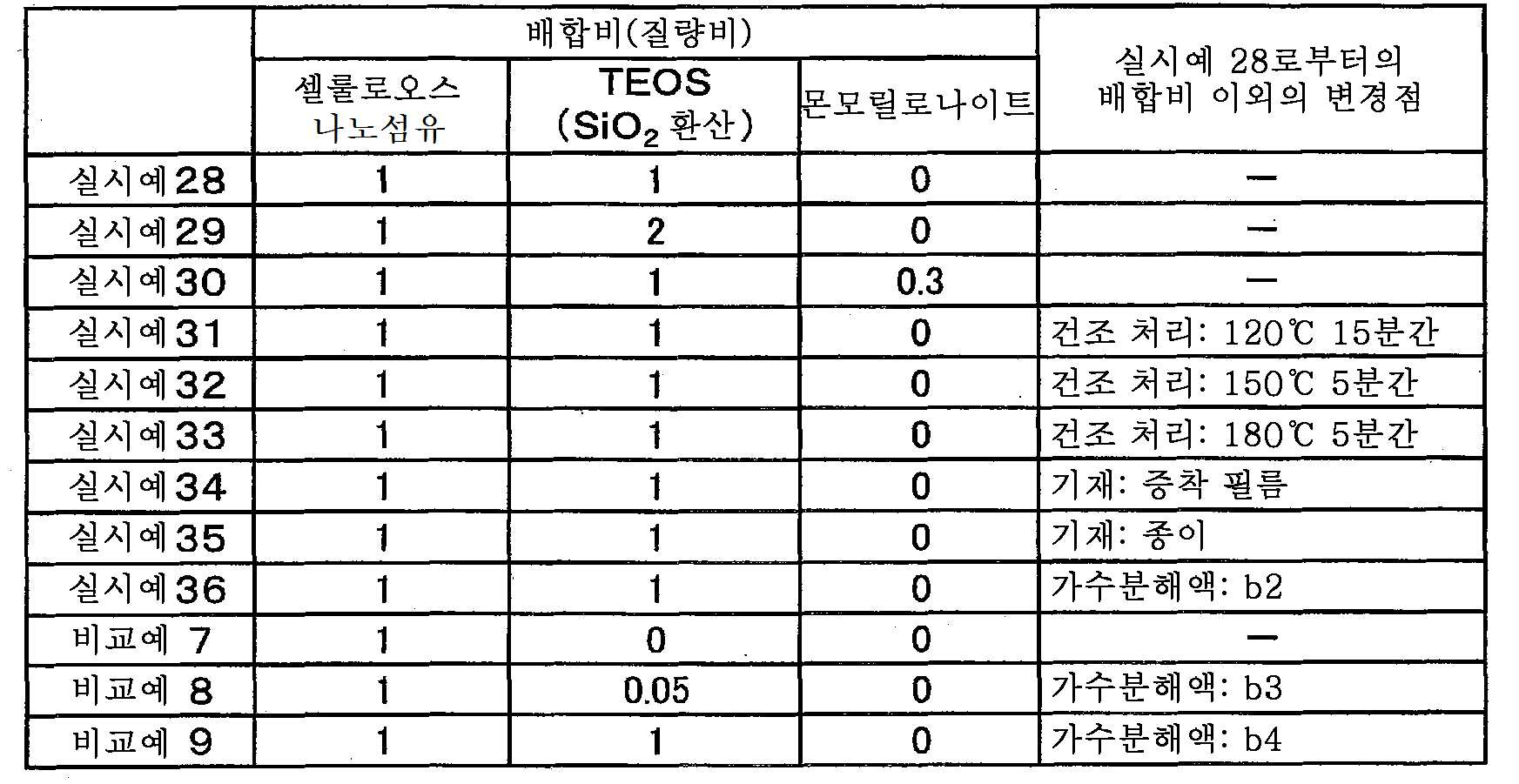

상기 결과에 나타낸 바와 같이, 실시예 28 내지 36의 가스 배리어 필름은, 모두 TEOS의 가수분해물을 배합하지 않은 비교예 7에 비하여 산소 투과도가 대폭 낮고, 모두 30 cm3/m2·day 이하이며, 고습도 조건하에서의 산소 가스 배리어성이 높았다. 또한, 이들 중에서 실시예 28 내지 34, 36의 가스 배리어 필름은, 수증기 투과도가 45 g/m2·day 이하로 낮고, 고습도 조건하에서의 수증기 배리어성도 높았다. 상기 산소 투과도 및 수증기 투과도는, 기재로서 증착 필름을 이용한 실시예 34에서 특히 낮았다. 또한, 실시예 28 내지 35의 가스 배리어 필름은, 도공액을 도포한 면(가스 배리어층 표면)의 평활성도 높았다.As shown in the above results, the gas barrier films of Examples 28 to 36 had significantly lower oxygen permeability than those of Comparative Example 7 in which no hydrolyzate of TEOS was added, all of which were 30 cm 3 / m 2 · day or less, The oxygen gas barrier property under high humidity conditions was high. Of these, the gas barrier films of Examples 28 to 34 and 36 had a low water vapor transmission rate of 45 g / m 2 · day or less and a high water vapor barrier property under high humidity conditions. The oxygen permeability and the water vapor permeability were particularly low in Example 34 using the evaporated film as a base material. In the gas barrier films of Examples 28 to 35, the surface (gas barrier layer surface) coated with the coating liquid also had high smoothness.
한편, TEOS의 가수분해물을 배합하지 않은 비교예 7, 셀룰로오스 나노섬유/TEOS(SiO2 환산)의 질량비가 20인 비교예 8, 가수분해액의 pH가 4.5인 비교예 9는, 고습도 조건하에서의 산소 가스 배리어성이 낮고, 수증기 배리어성에 대해서도 실시예 28 내지 36에 비하여 낮았다. 특히 비교예 8 내지 9는, TEOS의 가수분해물을 배합함에도 불구하고, 비교예 7보다도 산소 가스 배리어성이 낮았다.On the other hand, in Comparative Example 7 in which the hydrolyzate of TEOS was not added, Comparative Example 8 in which the mass ratio of cellulose nano fiber / TEOS (in terms of SiO 2 ) was 20, and Comparative Example 9 in which the pH of the hydrolyzate was 4.5, The gas barrier properties were low and the water vapor barrier properties were also lower than those of Examples 28 to 36. [ In particular, Comparative Examples 8 to 9 showed lower oxygen gas barrier properties than Comparative Example 7, even though the hydrolyzate of TEOS was blended.
다음으로, 셀룰로오스 나노섬유의 평균 섬유 폭이 50 nm 이하이고, 또한 셀룰로오스 나노섬유의 카르복시기량이 2.0 내지 4.0 mmol/g인 예에 대해서 설명한다.Next, an example in which the average fiber width of the cellulose nanofibers is 50 nm or less and the amount of the carboxyl group of the cellulose nanofibers is 2.0 to 4.0 mmol / g will be described.
이하에 나타내는 방법에 의해, 셀룰로오스의 TEMPO 산화 반응, 및 분산 처리를 순서대로 행하여 셀룰로오스 나노섬유를 제작하였다.Cellulose nanofibers were prepared by performing the TEMPO oxidation reaction of cellulose and the dispersion treatment in this order by the method shown below.
<제조예 10: 셀룰로오스 나노섬유 분산액의 제조>≪ Preparation Example 10: Preparation of cellulose nano fiber dispersion >
[셀룰로오스의 TEMPO 산화][TEMPO oxidation of cellulose]
(재료)(material)
셀룰로오스: 표백 크래프트 펄프(플레처 챌린지 캐나다, Machenziej) Cellulose: Bleached Craft Pulp (Fletcher Challenge Canada, Machenziej)
TENPO: 시판품(도쿄 가세이 고교) TENPO: Commodity (Tokyo Kasei High School)
차아염소산나트륨: 시판품(와코 쥰야꾸)Sodium hypochlorite: Commercially available product (Wako Pure Chemical Industries, Ltd.)
브롬화나트륨: 시판품(와코 쥰야꾸)Sodium bromide: Commercially available product (Wako Pure Chemical Industries, Ltd.)
(TEMPO 산화)(TEMPO oxidation)
표백 크래프트 펄프 10 g(건조 중량 환산)을 물 500 ml 중에서 밤새 정치하여 펄프를 팽윤시켰다. 이를 표 1에 나타낸 각 조건의 온도로 조정하고, TEMPO 0.1 g과 브롬화나트륨 1 g을 첨가하여 펄프의 현탁액으로 하였다. 또한, 교반하면서 셀룰로오스 중량당 10 mmol/g의 차아염소산나트륨을 첨가하였다. 이 때, 약 1 N의 수산화나트륨 수용액을 첨가하여 펄프 현탁액의 pH를 약 10.5로 유지하였다. 그 후, 표 1에 나타낸 각 조건의 시간만큼 반응을 행한 후, 2 N 염산으로 중화 처리하고, 추가로 수세하여 산화셀룰로오스(산형)를 얻었다.10 g (in terms of dry weight) of bleached kraft pulp was allowed to stand overnight in 500 ml of water to swell the pulp. The temperature was adjusted to the respective conditions shown in Table 1, and 0.1 g of TEMPO and 1 g of sodium bromide were added to obtain a pulp suspension. In addition, 10 mmol / g sodium hypochlorite per weight of cellulose was added with stirring. At this time, about 1 N aqueous sodium hydroxide solution was added to maintain the pH of the pulp suspension at about 10.5. Thereafter, the reaction was carried out for each of the conditions shown in Table 1, neutralized with 2 N hydrochloric acid, and further washed with water to obtain cellulose oxide (acid type).
[카르복시기량의 측정][Measurement of amount of carboxy group]
얻어진 산화셀룰로오스의 카르복시기량을, 명세서에 기재된 방법에 따라 측정하였다. 그 결과를 하기 표 6에 나타내었다.The amount of the carboxyl group of the obtained oxidized cellulose was measured according to the method described in the specification. The results are shown in Table 6 below.
[산화셀룰로오스의 분산 처리][Dispersion treatment of cellulose oxide]
얻어진 산화셀룰로오스를 이온 교환수로 고형분 농도 1%로 조정하고, 하기 표 5에 나타내는 각 조건의 pH(산화셀룰로오스가 분산 가능해지는 pH)가 되도록, 0.5 N 수산화나트륨을 이용하여 pH 조정을 행하였다. 또한, 표 5의 조건 2 내지 5, 및 8의 각 조건에 대해서는 pH 조정을 행하지 않았다. 그 후, 고속 회전 믹서를 이용하여, 표 5에 나타내는 각 조건의 시간만큼 교반하여 투명한 셀룰로오스 나노섬유 분산액(막 형성용 조성물)을 얻었다.The obtained cellulose oxide was adjusted to a solid concentration of 1% by ion-exchange water and pH was adjusted by using 0.5 N sodium hydroxide so that the pH of each condition shown in Table 5 (the pH at which cellulose oxide became dispersible) was obtained. In addition, no pH adjustment was performed for the respective conditions of conditions 2 to 5 and 8 in Table 5. [ Thereafter, a transparent cellulose nano fiber dispersion (composition for film formation) was obtained by stirring using a high-speed rotary mixer for a time shown in Table 5 for each time.
얻어진 셀룰로오스 나노섬유의 평균 섬유 폭 및 결정화도는, 명세서에 기재된 방법에 따라 측정하였다. 또한, 내수성은 이하의 방법으로 측정하였다. 그 측정 결과를 표 6에 나타내었다.The average fiber width and crystallinity of the obtained cellulose nanofibers were measured according to the method described in the specification. The water resistance was measured by the following method. The measurement results are shown in Table 6.
[내수성 평가][Evaluation of water resistance]
셀룰로오스 나노섬유 분산액을 이용하여 캐스트 필름을 제작하였다. 그 캐스트 필름의 질량(g)을 측정하고, 그 후 캐스트 필름을 순수에 1분간 침지하였다. 상기 캐스트 필름을 취출하고, 그 표면에 부착된 여분의 물을 흡수한 후, 그의 질량(g)을 측정하였다. 각 캐스트 필름의 침지 전의 질량 및 침지 후의 질량으로부터, 이하의 식에 의해 팽윤 배율을 산출하였다. 상기 팽윤 배율이 낮을수록 물에 팽윤하기 어려워, 내수성이 높다고 할 수 있다.A cast film was prepared using a cellulose nano fiber dispersion. The mass (g) of the cast film was measured, and then the cast film was immersed in pure water for 1 minute. The cast film was taken out, the excess water adhered to the surface thereof was absorbed, and its mass (g) was measured. The swelling magnification was calculated from the mass before immersion and the mass after immersion of each cast film by the following formula. The lower the swelling ratio is, the more difficult it is to swell in water and the higher the water resistance.
팽윤 배율=(침지 후의 중량)/(침지 전의 중량)Swelling magnification = (weight after immersion) / (weight before immersion)
<참고예 1 내지 4>≪ Reference Examples 1 to 4 >
[참고예 1 내지 4에 있어서의 가스 배리어성 필름의 제작] [Production of gas barrier film in Reference Examples 1 to 4]
표 5의 조건 1 내지 4에서 제작한 셀룰로오스 나노섬유 분산액을 각각 참고예 1 내지 4의 코팅액으로서 이용하였다. 두께 12 ㎛ 폴리에틸렌테레프탈레이트 필름(루미러 P60, 도레이사 제조) 기재 상에 코팅액을, 바 코팅법에 의해 막 두께 0.25 ㎛가 되도록 도포한 후, 120℃, 15분간 건조시켜 가스 배리어층을 형성하여 가스 배리어성 필름을 제작하였다.Cellulose nanofiber dispersions prepared in the conditions 1 to 4 in Table 5 were used as the coating liquids of Reference Examples 1 to 4, respectively. A coating solution was applied to a substrate of 12 탆 thick polyethylene terephthalate film (Rumirror P60, manufactured by Doreya Corporation) to a thickness of 0.25 탆 by a bar coating method and dried at 120 캜 for 15 minutes to form a gas barrier layer A gas barrier film was produced.
<비교예 10 내지 13>≪ Comparative Examples 10 to 13 &
[비교예 10 내지 13에 있어서의 가스 배리어성 필름의 제작] [Production of Gas Barrier Film in Comparative Examples 10 to 13]
표 5의 조건 5 내지 8에서 제작한 셀룰로오스 나노섬유 분산액을 각각 비교예 10 내지 13의 코팅액으로서 이용하였다. 두께 12 ㎛ 폴리에틸렌테레프탈레이트 필름(루미러 P60, 도레이사 제조) 기재 상에 코팅액을, 바 코팅법에 의해 막 두께 0.25 ㎛가 되도록 도포한 후, 120℃, 15분간 건조시켜 가스 배리어층을 형성하여 가스 배리어성 필름을 제작하였다.The cellulose nanofiber dispersions prepared in the conditions 5 to 8 of Table 5 were used as the coating liquids of Comparative Examples 10 to 13, respectively. A coating solution was applied to a substrate of 12 탆 thick polyethylene terephthalate film (Rumirror P60, manufactured by Doreya Corporation) to a thickness of 0.25 탆 by a bar coating method and dried at 120 캜 for 15 minutes to form a gas barrier layer A gas barrier film was produced.
얻어진 가스 배리어성 필름의 헤이즈를 명세서에 기재된 방법에 따라 측정하였다. 또한, 산소 투과도는 이하의 방법으로 측정하였다. 그 측정 결과를 표 6에 나타내었다.The haze of the obtained gas-barrier film was measured according to the method described in the specification. The oxygen permeability was measured by the following method. The measurement results are shown in Table 6.
[산소 투과도(등압법)(cm3/m2·day·Pa)] [Oxygen Permeability (Equivalent Pressure) (cm 3 / m 2 · day · Pa)]
산소 투과도 측정 장치 MOCON(OX-TRAN 2/21, 모던 컨트롤사 제조)을 이용하여, 고습도(70%RH)의 분위기하에서 측정을 행하였다. 가스 배리어성 필름의 산소 투과도를 측정하였다.Measurement was carried out in an atmosphere of high humidity (70% RH) using an oxygen permeability meter MOCON (OX-TRAN 2/21, manufactured by Modern Control Co., Ltd.). The oxygen permeability of the gas barrier film was measured.


이상의 결과로부터, 카르복시기량이 2 내지 4 mmol/g이고, 또한 섬유 폭이 50 nm 이하인 셀룰로오스 나노섬유를 포함하는 막 형성용 조성물을 이용하여 형성된 성형체는, 고습도하(70%RH하)에서 산소 배리어성이 우수한 것을 알 수 있었다. 특히, 카르복시기량이 2.5 내지 4 mmol/g인 범위에서는, 0.5 N 수산화나트륨을 이용하여 pH 조정을 행하지 않아도, 고속 회전 믹서로 60분간 교반함으로써, 산화셀룰로오스가 50 nm 이하인 섬유가 되고, 그의 셀룰로오스 나노섬유를 포함하는 막 형성용 조성물을 이용하여 형성된 성형체는, 고습도하(70%RH하)에서 우수한 산소 배리어성을 나타내는 것을 알 수 있었다. 즉, 카르복시기량이 2.5 내지 4 mmol/g인 범위에서는, 나트륨 이온과 같은 양이온을 첨가하지 않고, 50 nm 이하의 셀룰로오스 나노섬유를 얻을 수 있으며, 그의 셀룰로오스 나노섬유를 포함하는 성형체는 고습도하(70%RH하)에서 우수한 산소 배리어성을 나타내었다.From the above results, it was found that the molded article formed using the film-forming composition comprising the cellulose nanofibers having a carboxyl group content of 2 to 4 mmol / g and a fiber width of 50 nm or less had oxygen barrier properties under high humidity (70% RH) Was superior. Particularly, when the amount of the carboxyl group is in the range of 2.5 to 4 mmol / g, the pH of the cellulose nano fiber is 50 nm or less by stirring with a high-speed rotary mixer for 60 minutes without pH adjustment using 0.5 N sodium hydroxide, , The molded article formed using the film-forming composition containing the compound represented by the formula (1) exhibited excellent oxygen barrier properties under high humidity (70% RH). That is, cellulose nanofibers of 50 nm or less can be obtained without adding cations such as sodium ions in the range of 2.5 to 4 mmol / g of the carboxyl group, and the molded article containing the cellulose nanofibers can be obtained under high humidity (70% RH) exhibited excellent oxygen barrier properties.
또한, 예를 들면 알콕시실란의 가수분해물을 상기 막 형성용 조성물에 첨가하면, 그의 가스 배리어재 형성용 조성물에 의해 형성한 성형체는, 고습도 조건하에서도 더 높은 가스 배리어성을 유지할 수 있다. 알콕시실란으로는 테트라메톡시실란, 테트라에톡시실란, 메틸트리메톡시실란, 메틸트리에톡시실란, 디메틸디메톡시실란, 디메틸디에톡시실란 등을 들 수 있지만, 테트라에톡시실란(TEOS)이 특히 바람직하다.
Further, for example, when a hydrolyzate of an alkoxysilane is added to the above film-forming composition, the formed body formed from the composition for regenerating the gas barrier can maintain a higher gas barrier property even under high humidity conditions. Examples of the alkoxysilane include tetramethoxysilane, tetraethoxysilane, methyltrimethoxysilane, methyltriethoxysilane, dimethyldimethoxysilane, dimethyldiethoxysilane and the like. However, tetraethoxysilane (TEOS) desirable.
Claims (18)
상기 실란 커플링제로서 아미노기를 갖는 실란 커플링제를 포함하고,
상기 아미노기를 갖는 실란 커플링제의 배합량이 상기 셀룰로오스 나노섬유에 대하여 0.5 내지 30 질량%이며,
추가로 무기층상 화합물을 함유하는,
막 형성용 조성물. A composition for forming a film comprising a cellulose nanofibers dispersed in an aqueous medium and a silane coupling agent in an aqueous dispersion,
And a silane coupling agent having an amino group as the silane coupling agent,
The blending amount of the silane coupling agent having an amino group is 0.5 to 30 mass% with respect to the cellulose nanofiber,
Further comprising an inorganic layer compound,
(2).
Applications Claiming Priority (7)
| Application Number | Priority Date | Filing Date | Title |
|---|---|---|---|
| JP2010071712 | 2010-03-26 | ||
| JPJP-P-2010-071712 | 2010-03-26 | ||
| JPJP-P-2010-075185 | 2010-03-29 | ||
| JP2010075185 | 2010-03-29 | ||
| JPJP-P-2010-082331 | 2010-03-31 | ||
| JP2010082331 | 2010-03-31 | ||
| PCT/JP2011/054989 WO2011118360A1 (en) | 2010-03-26 | 2011-03-03 | Film-forming composition and sheet |
Publications (2)
| Publication Number | Publication Date |
|---|---|
| KR20130018248A KR20130018248A (en) | 2013-02-20 |
| KR101800474B1 true KR101800474B1 (en) | 2017-11-22 |
Family
ID=44672928
Family Applications (1)
| Application Number | Title | Priority Date | Filing Date |
|---|---|---|---|
| KR1020127025024A Active KR101800474B1 (en) | 2010-03-26 | 2011-03-03 | Film-forming composition and sheet |
Country Status (6)
| Country | Link |
|---|---|
| US (1) | US20130022827A1 (en) |
| EP (1) | EP2554589B1 (en) |
| JP (1) | JP5704165B2 (en) |
| KR (1) | KR101800474B1 (en) |
| CN (1) | CN102770484A (en) |
| WO (1) | WO2011118360A1 (en) |
Cited By (1)
| Publication number | Priority date | Publication date | Assignee | Title |
|---|---|---|---|---|
| KR20190102619A (en) | 2018-02-26 | 2019-09-04 | 고려대학교 산학협력단 | Cellulose membrane and manufacturing method thereof |
Families Citing this family (45)
| Publication number | Priority date | Publication date | Assignee | Title |
|---|---|---|---|---|
| FI123630B (en) * | 2011-10-24 | 2013-08-30 | Teknologian Tutkimuskeskus Vtt | Process for making NFC films on substrate |
| JP5921960B2 (en) * | 2012-06-04 | 2016-05-24 | 第一工業製薬株式会社 | Composition containing inorganic fine particles and film using the same |
| JP5658725B2 (en) * | 2012-10-29 | 2015-01-28 | トクラス株式会社 | Method for producing modified fibrillated cellulose, method for producing resin product, and resin product |
| KR101373928B1 (en) * | 2013-05-24 | 2014-03-12 | 김계수 | Heat transfer coating solution composition and digital sublimation transfer textile using thereof |
| CN105247136B (en) * | 2013-06-03 | 2019-06-14 | 王子控股株式会社 | Method for producing microfiber-containing sheet |
| EP3025857B1 (en) * | 2013-07-25 | 2018-06-06 | Toppan Printing Co., Ltd. | Sheet material and barrier packaging container using same, and process for manufacturing sheet material |
| EP3095815B1 (en) * | 2014-01-17 | 2018-11-28 | Nippon Paper Industries Co., Ltd. | Dry solids of anionically modified cellulose nanofibers and processes for preparing them |
| JP2015218299A (en) * | 2014-05-20 | 2015-12-07 | 凸版印刷株式会社 | Method for producing cellulose nanofiber, cellulose nanofiber, and dispersion thereof |
| RU2720941C2 (en) * | 2015-06-30 | 2020-05-14 | Биллерудкорснас Аб | Antioxygen protection based on modified cellulose fibers |
| WO2017046755A1 (en) | 2015-09-17 | 2017-03-23 | Stora Enso Oyj | A method for producing a film having good barrier properties |
| JP2017101185A (en) * | 2015-12-03 | 2017-06-08 | 株式会社ミマキエンジニアリング | Coating agent, manufacturing method of printed matter, printed matter |
| JP5996082B1 (en) * | 2015-12-25 | 2016-09-21 | 第一工業製薬株式会社 | Cellulose nanofiber and resin composition |
| CN105664864B (en) * | 2016-01-08 | 2018-05-01 | 中南大学 | A kind of preparation method of vascular plant Quito hole oxidation polymerization chelate adsorption and application |
| EP3406442B1 (en) | 2016-01-20 | 2023-11-29 | Oji Holdings Corporation | Laminate and method for producing laminate |
| WO2017147481A1 (en) * | 2016-02-26 | 2017-08-31 | The Penn State Research Foundation | Nanofilled solid polymer electrolytes |
| SE539754C2 (en) | 2016-03-22 | 2017-11-14 | Stora Enso Oyj | Oxygen barrier film and laminate and methods of manufacturing the same |
| SE539786C2 (en) | 2016-06-22 | 2017-11-28 | Stora Enso Oyj | Microfibrillated cellulose film |
| SE1650962A1 (en) * | 2016-07-01 | 2018-01-02 | Stora Enso Oyj | A method for the production of a film comprising microfibrillated cellulose and a film comprising microfibrillated cellulose |
| JP6927225B2 (en) * | 2016-08-12 | 2021-08-25 | 凸版印刷株式会社 | Phosphor protective film, wavelength conversion sheet and light emitting unit |
| SE540365C2 (en) | 2016-09-28 | 2018-08-14 | Stora Enso Oyj | A method for the production of a film comprising microfibrillated cellulose, a film and a paper or paperboard product |
| SE540407C2 (en) * | 2016-11-01 | 2018-09-11 | Stora Enso Oyj | Forming of a film comprising nanocellulose |
| JP6954584B2 (en) * | 2017-01-26 | 2021-10-27 | 石原ケミカル株式会社 | Hydrophilic coating composition |
| PT3594301T (en) * | 2017-03-07 | 2022-05-26 | Kao Corp | Film comprising hydrophobized cellulose fibers and oil |
| SE540870C2 (en) * | 2017-04-12 | 2018-12-11 | Stora Enso Oyj | A gas barrier film comprising a mixture of microfibrillated cellulose and microfibrillated dialdehyde cellulose and a method for manufacturing the gas barrier film |
| CN107331865B (en) * | 2017-05-31 | 2019-12-13 | 郑州轻工业学院 | Preparation method of cellulose nanofiber/silk fibroin-based porous nitrogen-doped 2D carbon nanosheet electrode material |
| SE542193C2 (en) | 2017-10-20 | 2020-03-10 | Stora Enso Oyj | A method for producing a film having good barrier properties and a film having good barrier properties |
| JP7069664B2 (en) * | 2017-11-28 | 2022-05-18 | 凸版印刷株式会社 | Gas barrier film |
| SE541932C2 (en) | 2017-12-21 | 2020-01-07 | Stora Enso Oyj | Laminate having oxygen barrier properties and a method for producing the same |
| SE542054C2 (en) | 2017-12-22 | 2020-02-18 | Stora Enso Oyj | Multilayer film comprising microfibrillated cellulose and a method of manufacturing a multilayer film |
| SE541631C2 (en) | 2018-03-08 | 2019-11-19 | Stora Enso Oyj | A method for producing an oxygen barrier film comprising dialdehyde cellulose fibers |
| CN108752833B (en) * | 2018-05-28 | 2020-12-29 | 山东隆昌塑业有限公司 | A kind of composite barrier wrapping film and preparation method thereof |
| SE543618C2 (en) | 2018-11-22 | 2021-04-20 | Stora Enso Oyj | Gas barrier film for a paper or paperboard based packaging material comprising microfibrillated cellulose surface grafted with a fatty acid halide and a thermoplastic polymer layer |
| KR102224439B1 (en) | 2019-01-24 | 2021-03-10 | 율촌화학 주식회사 | Composition for barrier film coating, barrier film comprising the same and preparation method thereof |
| JP7126970B2 (en) * | 2019-03-08 | 2022-08-29 | 日本製紙株式会社 | Aqueous dispersion for forming gas-barrier filmy material, gas-barrier filmy material, gas-barrier laminate, and method for producing gas-barrier filmy material |
| SE545297C2 (en) | 2019-06-27 | 2023-06-20 | Stora Enso Oyj | A paper or papperboard packaging material comprising a gas barrier film |
| JP7289141B2 (en) * | 2019-11-13 | 2023-06-09 | 平岡織染株式会社 | Antifouling coating film-forming composition, antifouling coating film, and industrial material sheet with antifouling coating film |
| SE545172C2 (en) | 2020-11-18 | 2023-05-02 | Stora Enso Oyj | Barrier film for packaging material |
| KR102535703B1 (en) * | 2020-11-30 | 2023-05-25 | 한국생산기술연구원 | Barrier film manufacturing method containing cellulose nanofibers |
| JP7273076B2 (en) * | 2021-01-14 | 2023-05-12 | シーカ・ハマタイト株式会社 | Two liquid urethane adhesive |
| IT202100003311A1 (en) * | 2021-02-15 | 2022-08-15 | Qwarzo Italia S R L | PAPER WATERPROOFING TREATMENT AND WATERPROOF PAPER OBTAINED THUS |
| CN113501683B (en) * | 2021-07-13 | 2022-06-21 | 浙江理工大学 | Preparation method of boehmite-nano cellulose fiber-halloysite composite flame-retardant material |
| WO2023013632A1 (en) * | 2021-08-02 | 2023-02-09 | 王子ホールディングス株式会社 | Laminate, anchoring agent for surface protective layer, anchor sheet, layered sheet, and application thereof |
| KR102596058B1 (en) * | 2021-09-23 | 2023-10-30 | 한국화학연구원 | Bacterial nanocellulose transparent film, manufacturing method thereof, and packaging material using the same |
| KR102598137B1 (en) * | 2022-11-24 | 2023-11-06 | 율촌화학 주식회사 | High-barrier biodegradable film and preparation method thereof |
| FI20253502A1 (en) * | 2023-02-09 | 2025-09-09 | Senai/Cetiqt Servico Nacional De Aprendizagem Industrial Centro De Tecnologia Da Industria Quim E Te | Base material for forming a cellulose packaging material and the use thereof |
Citations (3)
| Publication number | Priority date | Publication date | Assignee | Title |
|---|---|---|---|---|
| JP2009220315A (en) * | 2008-03-14 | 2009-10-01 | Toppan Printing Co Ltd | Transparent gas-barrier film |
| JP2009298972A (en) * | 2008-06-17 | 2009-12-24 | Kao Corp | Cellulose fiber and manufacturing method thereof |
| JP2009299043A (en) * | 2008-05-13 | 2009-12-24 | Mitsubishi Chemicals Corp | Minute cellulose fiber dispersion liquid, polymer cellulose composite and opening method of cellulose fiber |
Family Cites Families (16)
| Publication number | Priority date | Publication date | Assignee | Title |
|---|---|---|---|---|
| DE69124214T2 (en) * | 1990-12-05 | 1997-08-07 | Ppg Industries Inc | Wet-laid fibrous thermoplastic material and aqueous dispersion for its production |
| JP3012756B2 (en) | 1993-05-06 | 2000-02-28 | 昭和電工株式会社 | Multilayer laminate and manufacturing method thereof |
| JP2790054B2 (en) | 1993-09-30 | 1998-08-27 | 凸版印刷株式会社 | Gas barrier laminate film and packaging material using this laminate film |
| JP4816842B2 (en) | 2000-03-23 | 2011-11-16 | 凸版印刷株式会社 | Gas barrier material |
| JP2001279016A (en) * | 2000-03-31 | 2001-10-10 | Oji Paper Co Ltd | Cellulosic biodegradable sheet and method for producing the same |
| JP5252464B2 (en) | 2000-09-28 | 2013-07-31 | Jsr株式会社 | Gas barrier coating composition, method for producing the same, and gas barrier coating film |
| US20050008763A1 (en) * | 2002-09-24 | 2005-01-13 | Schachter Steven C. | Antimicrobial coatings for medical applications |
| US7605206B2 (en) * | 2005-11-04 | 2009-10-20 | Glen Burnie Technologies, Llc | Method of compatibilizing non polymer solid fillers in polymeric materials and compositions therefrom |
| JP4998981B2 (en) * | 2006-06-20 | 2012-08-15 | 国立大学法人 東京大学 | Fine cellulose fiber |
| JP4845129B2 (en) * | 2007-03-28 | 2011-12-28 | 国立大学法人京都大学 | Flexible substrate and manufacturing method thereof |
| JP2008274525A (en) * | 2007-04-06 | 2008-11-13 | Asahi Kasei Corp | Low-weight cellulose nonwoven fabric |
| JP2008308802A (en) | 2007-06-18 | 2008-12-25 | Univ Of Tokyo | Method for producing cellulose nanofiber |
| JP2009057772A (en) | 2007-08-31 | 2009-03-19 | Furukawa Electric Co Ltd:The | Building cooling system |
| WO2010055839A1 (en) * | 2008-11-13 | 2010-05-20 | 住友ベークライト株式会社 | Composite compositions and composites |
| WO2011118521A1 (en) * | 2010-03-24 | 2011-09-29 | 凸版印刷株式会社 | Laminated body, method for producing same, and molding container |
| CN102821949B (en) * | 2010-03-25 | 2016-08-10 | 凸版印刷株式会社 | Gas-barrier multilayer body and packaging material |
-
2011
- 2011-03-03 KR KR1020127025024A patent/KR101800474B1/en active Active
- 2011-03-03 CN CN2011800101100A patent/CN102770484A/en active Pending
- 2011-03-03 EP EP11759168.5A patent/EP2554589B1/en active Active
- 2011-03-03 WO PCT/JP2011/054989 patent/WO2011118360A1/en not_active Ceased
- 2011-03-03 JP JP2012506909A patent/JP5704165B2/en active Active
-
2012
- 2012-09-26 US US13/627,436 patent/US20130022827A1/en not_active Abandoned
Patent Citations (3)
| Publication number | Priority date | Publication date | Assignee | Title |
|---|---|---|---|---|
| JP2009220315A (en) * | 2008-03-14 | 2009-10-01 | Toppan Printing Co Ltd | Transparent gas-barrier film |
| JP2009299043A (en) * | 2008-05-13 | 2009-12-24 | Mitsubishi Chemicals Corp | Minute cellulose fiber dispersion liquid, polymer cellulose composite and opening method of cellulose fiber |
| JP2009298972A (en) * | 2008-06-17 | 2009-12-24 | Kao Corp | Cellulose fiber and manufacturing method thereof |
Cited By (1)
| Publication number | Priority date | Publication date | Assignee | Title |
|---|---|---|---|---|
| KR20190102619A (en) | 2018-02-26 | 2019-09-04 | 고려대학교 산학협력단 | Cellulose membrane and manufacturing method thereof |
Also Published As
| Publication number | Publication date |
|---|---|
| US20130022827A1 (en) | 2013-01-24 |
| EP2554589B1 (en) | 2017-12-13 |
| JP5704165B2 (en) | 2015-04-22 |
| WO2011118360A1 (en) | 2011-09-29 |
| CN102770484A (en) | 2012-11-07 |
| JPWO2011118360A1 (en) | 2013-07-04 |
| KR20130018248A (en) | 2013-02-20 |
| EP2554589A1 (en) | 2013-02-06 |
| EP2554589A4 (en) | 2013-08-28 |
Similar Documents
| Publication | Publication Date | Title |
|---|---|---|
| KR101800474B1 (en) | Film-forming composition and sheet | |
| US9850352B2 (en) | Fine cellulose fiber dispersion liquid and manufacturing method thereof, cellulose film and laminate body | |
| JP5515312B2 (en) | Coating agent and molded body | |
| JP6107658B2 (en) | Film-forming composition, laminate, film, sheet substrate, packaging material, and method for producing film-forming composition | |
| JP5407304B2 (en) | Laminated body | |
| JP5879674B2 (en) | Sheet manufacturing method | |
| KR101886880B1 (en) | Gas barrier laminate and packaging material | |
| JP5350825B2 (en) | Gas barrier laminate and production method thereof | |
| JP2012149114A (en) | Film-forming composition, sheet and packaging material | |
| JP5678450B2 (en) | Gas barrier material and method for producing the same |
Legal Events
| Date | Code | Title | Description |
|---|---|---|---|
| PA0105 | International application |
Patent event date: 20120925 Patent event code: PA01051R01D Comment text: International Patent Application |
|
| PG1501 | Laying open of application | ||
| A201 | Request for examination | ||
| PA0201 | Request for examination |
Patent event code: PA02012R01D Patent event date: 20160222 Comment text: Request for Examination of Application |
|
| E902 | Notification of reason for refusal | ||
| PE0902 | Notice of grounds for rejection |
Comment text: Notification of reason for refusal Patent event date: 20170310 Patent event code: PE09021S01D |
|
| PE0701 | Decision of registration |
Patent event code: PE07011S01D Comment text: Decision to Grant Registration Patent event date: 20170915 |
|
| GRNT | Written decision to grant | ||
| PR0701 | Registration of establishment |
Comment text: Registration of Establishment Patent event date: 20171116 Patent event code: PR07011E01D |
|
| PR1002 | Payment of registration fee |
Payment date: 20171116 End annual number: 3 Start annual number: 1 |
|
| PG1601 | Publication of registration | ||
| PR1001 | Payment of annual fee |
Payment date: 20201103 Start annual number: 4 End annual number: 4 |
|
| PR1001 | Payment of annual fee |
Payment date: 20211027 Start annual number: 5 End annual number: 5 |
|
| PR1001 | Payment of annual fee |
Payment date: 20221019 Start annual number: 6 End annual number: 6 |
|
| PR1001 | Payment of annual fee |
Payment date: 20231017 Start annual number: 7 End annual number: 7 |
|
| PR1001 | Payment of annual fee |
Payment date: 20241008 Start annual number: 8 End annual number: 8 |