KR101787777B1 - Photochemical process for producing artemisinin - Google Patents
Photochemical process for producing artemisinin Download PDFInfo
- Publication number
- KR101787777B1 KR101787777B1 KR1020127008220A KR20127008220A KR101787777B1 KR 101787777 B1 KR101787777 B1 KR 101787777B1 KR 1020127008220 A KR1020127008220 A KR 1020127008220A KR 20127008220 A KR20127008220 A KR 20127008220A KR 101787777 B1 KR101787777 B1 KR 101787777B1
- Authority
- KR
- South Korea
- Prior art keywords
- group
- alkyl
- formula
- artemisinin
- substituted
- Prior art date
- Legal status (The legal status is an assumption and is not a legal conclusion. Google has not performed a legal analysis and makes no representation as to the accuracy of the status listed.)
- Active
Links
- 238000000034 method Methods 0.000 title claims abstract description 44
- BLUAFEHZUWYNDE-NNWCWBAJSA-N artemisinin Chemical compound C([C@](OO1)(C)O2)C[C@H]3[C@H](C)CC[C@@H]4[C@@]31[C@@H]2OC(=O)[C@@H]4C BLUAFEHZUWYNDE-NNWCWBAJSA-N 0.000 title claims abstract description 42
- 229960004191 artemisinin Drugs 0.000 title claims abstract description 42
- 229930101531 artemisinin Natural products 0.000 title claims abstract description 42
- 239000002253 acid Substances 0.000 claims abstract description 32
- 238000004519 manufacturing process Methods 0.000 claims abstract description 11
- 239000000203 mixture Substances 0.000 claims description 58
- YMWUJEATGCHHMB-UHFFFAOYSA-N Dichloromethane Chemical group ClCCl YMWUJEATGCHHMB-UHFFFAOYSA-N 0.000 claims description 39
- IMNFDUFMRHMDMM-UHFFFAOYSA-N N-Heptane Chemical group CCCCCCC IMNFDUFMRHMDMM-UHFFFAOYSA-N 0.000 claims description 35
- 125000001072 heteroaryl group Chemical group 0.000 claims description 33
- 229910052736 halogen Inorganic materials 0.000 claims description 30
- 150000002367 halogens Chemical class 0.000 claims description 30
- LFQSCWFLJHTTHZ-UHFFFAOYSA-N Ethanol Chemical compound CCO LFQSCWFLJHTTHZ-UHFFFAOYSA-N 0.000 claims description 28
- 125000003118 aryl group Chemical group 0.000 claims description 27
- 239000011541 reaction mixture Substances 0.000 claims description 26
- 125000004169 (C1-C6) alkyl group Chemical group 0.000 claims description 25
- 125000000217 alkyl group Chemical group 0.000 claims description 25
- 150000001875 compounds Chemical class 0.000 claims description 23
- 125000001424 substituent group Chemical group 0.000 claims description 22
- DTQVDTLACAAQTR-UHFFFAOYSA-N Trifluoroacetic acid Chemical group OC(=O)C(F)(F)F DTQVDTLACAAQTR-UHFFFAOYSA-N 0.000 claims description 17
- 239000003960 organic solvent Substances 0.000 claims description 15
- 239000003377 acid catalyst Substances 0.000 claims description 13
- 238000006243 chemical reaction Methods 0.000 claims description 12
- 229910052760 oxygen Inorganic materials 0.000 claims description 12
- VLKZOEOYAKHREP-UHFFFAOYSA-N n-Hexane Chemical compound CCCCCC VLKZOEOYAKHREP-UHFFFAOYSA-N 0.000 claims description 11
- 239000003504 photosensitizing agent Substances 0.000 claims description 11
- 125000004400 (C1-C12) alkyl group Chemical group 0.000 claims description 10
- 125000006376 (C3-C10) cycloalkyl group Chemical group 0.000 claims description 10
- QVGXLLKOCUKJST-UHFFFAOYSA-N atomic oxygen Chemical compound [O] QVGXLLKOCUKJST-UHFFFAOYSA-N 0.000 claims description 9
- 239000001301 oxygen Substances 0.000 claims description 9
- KFZMGEQAYNKOFK-UHFFFAOYSA-N Isopropanol Chemical compound CC(C)O KFZMGEQAYNKOFK-UHFFFAOYSA-N 0.000 claims description 8
- OFBQJSOFQDEBGM-UHFFFAOYSA-N Pentane Chemical compound CCCCC OFBQJSOFQDEBGM-UHFFFAOYSA-N 0.000 claims description 8
- 125000006710 (C2-C12) alkenyl group Chemical group 0.000 claims description 7
- UFHFLCQGNIYNRP-UHFFFAOYSA-N Hydrogen Chemical compound [H][H] UFHFLCQGNIYNRP-UHFFFAOYSA-N 0.000 claims description 7
- 150000001335 aliphatic alkanes Chemical class 0.000 claims description 7
- 229910052739 hydrogen Inorganic materials 0.000 claims description 7
- 239000001257 hydrogen Substances 0.000 claims description 7
- 125000003342 alkenyl group Chemical group 0.000 claims description 6
- 125000003710 aryl alkyl group Chemical group 0.000 claims description 6
- 150000002148 esters Chemical class 0.000 claims description 6
- 238000000926 separation method Methods 0.000 claims description 6
- 239000002904 solvent Substances 0.000 claims description 6
- YNHJECZULSZAQK-UHFFFAOYSA-N tetraphenylporphyrin Chemical compound C1=CC(C(=C2C=CC(N2)=C(C=2C=CC=CC=2)C=2C=CC(N=2)=C(C=2C=CC=CC=2)C2=CC=C3N2)C=2C=CC=CC=2)=NC1=C3C1=CC=CC=C1 YNHJECZULSZAQK-UHFFFAOYSA-N 0.000 claims description 6
- XDTMQSROBMDMFD-UHFFFAOYSA-N Cyclohexane Chemical compound C1CCCCC1 XDTMQSROBMDMFD-UHFFFAOYSA-N 0.000 claims description 5
- 125000001316 cycloalkyl alkyl group Chemical group 0.000 claims description 5
- 125000000753 cycloalkyl group Chemical group 0.000 claims description 5
- 125000004446 heteroarylalkyl group Chemical group 0.000 claims description 5
- 238000002360 preparation method Methods 0.000 claims description 5
- 238000001816 cooling Methods 0.000 claims description 4
- CXKWCBBOMKCUKX-UHFFFAOYSA-M methylene blue Chemical compound [Cl-].C1=CC(N(C)C)=CC2=[S+]C3=CC(N(C)C)=CC=C3N=C21 CXKWCBBOMKCUKX-UHFFFAOYSA-M 0.000 claims description 4
- 229910052757 nitrogen Inorganic materials 0.000 claims description 4
- 125000002023 trifluoromethyl group Chemical group FC(F)(F)* 0.000 claims description 4
- 230000003197 catalytic effect Effects 0.000 claims description 3
- 238000000746 purification Methods 0.000 claims description 3
- IICCLYANAQEHCI-UHFFFAOYSA-N 4,5,6,7-tetrachloro-3',6'-dihydroxy-2',4',5',7'-tetraiodospiro[2-benzofuran-3,9'-xanthene]-1-one Chemical group O1C(=O)C(C(=C(Cl)C(Cl)=C2Cl)Cl)=C2C21C1=CC(I)=C(O)C(I)=C1OC1=C(I)C(O)=C(I)C=C21 IICCLYANAQEHCI-UHFFFAOYSA-N 0.000 claims description 2
- 239000002841 Lewis acid Substances 0.000 claims description 2
- 150000007513 acids Chemical class 0.000 claims description 2
- 150000001298 alcohols Chemical class 0.000 claims description 2
- 150000001412 amines Chemical class 0.000 claims description 2
- 239000003849 aromatic solvent Substances 0.000 claims description 2
- 150000002170 ethers Chemical class 0.000 claims description 2
- 125000000623 heterocyclic group Chemical group 0.000 claims description 2
- 150000002576 ketones Chemical class 0.000 claims description 2
- 150000007517 lewis acids Chemical class 0.000 claims description 2
- 229960000907 methylthioninium chloride Drugs 0.000 claims description 2
- 150000002825 nitriles Chemical class 0.000 claims description 2
- 238000001556 precipitation Methods 0.000 claims description 2
- 229930187593 rose bengal Natural products 0.000 claims description 2
- 229940081623 rose bengal Drugs 0.000 claims description 2
- STRXNPAVPKGJQR-UHFFFAOYSA-N rose bengal A Natural products O1C(=O)C(C(=CC=C2Cl)Cl)=C2C21C1=CC(I)=C(O)C(I)=C1OC1=C(I)C(O)=C(I)C=C21 STRXNPAVPKGJQR-UHFFFAOYSA-N 0.000 claims description 2
- 150000003462 sulfoxides Chemical class 0.000 claims description 2
- 229950003937 tolonium Drugs 0.000 claims description 2
- HNONEKILPDHFOL-UHFFFAOYSA-M tolonium chloride Chemical compound [Cl-].C1=C(C)C(N)=CC2=[S+]C3=CC(N(C)C)=CC=C3N=C21 HNONEKILPDHFOL-UHFFFAOYSA-M 0.000 claims description 2
- 239000002798 polar solvent Substances 0.000 claims 2
- 125000005915 C6-C14 aryl group Chemical group 0.000 claims 1
- GBCAVSYHPPARHX-UHFFFAOYSA-M n'-cyclohexyl-n-[2-(4-methylmorpholin-4-ium-4-yl)ethyl]methanediimine;4-methylbenzenesulfonate Chemical compound CC1=CC=C(S([O-])(=O)=O)C=C1.C1CCCCC1N=C=NCC[N+]1(C)CCOCC1 GBCAVSYHPPARHX-UHFFFAOYSA-M 0.000 claims 1
- 238000010792 warming Methods 0.000 claims 1
- XLYOFNOQVPJJNP-UHFFFAOYSA-N water Substances O XLYOFNOQVPJJNP-UHFFFAOYSA-N 0.000 description 24
- YXFVVABEGXRONW-UHFFFAOYSA-N Toluene Chemical compound CC1=CC=CC=C1 YXFVVABEGXRONW-UHFFFAOYSA-N 0.000 description 15
- -1 allylic hydroperoxides Chemical class 0.000 description 15
- 235000019441 ethanol Nutrition 0.000 description 15
- 230000015572 biosynthetic process Effects 0.000 description 13
- 239000000047 product Substances 0.000 description 13
- 238000003756 stirring Methods 0.000 description 13
- 238000003786 synthesis reaction Methods 0.000 description 13
- BVKZGUZCCUSVTD-UHFFFAOYSA-L Carbonate Chemical compound [O-]C([O-])=O BVKZGUZCCUSVTD-UHFFFAOYSA-L 0.000 description 10
- VWGPQZZLIAQJCE-UHFFFAOYSA-N dihydroarteanniun B Natural products C1CC(C)C2CCC3(C)OC3C32C1C(C)C(=O)O3 VWGPQZZLIAQJCE-UHFFFAOYSA-N 0.000 description 9
- 239000012044 organic layer Substances 0.000 description 9
- ZWEHNKRNPOVVGH-UHFFFAOYSA-N 2-Butanone Chemical compound CCC(C)=O ZWEHNKRNPOVVGH-UHFFFAOYSA-N 0.000 description 7
- ZMANZCXQSJIPKH-UHFFFAOYSA-N Triethylamine Chemical compound CCN(CC)CC ZMANZCXQSJIPKH-UHFFFAOYSA-N 0.000 description 6
- 239000006227 byproduct Substances 0.000 description 6
- 239000010410 layer Substances 0.000 description 6
- 229920006395 saturated elastomer Polymers 0.000 description 6
- 239000007787 solid Substances 0.000 description 6
- 150000000999 L-dehydro ascorbic acids Chemical class 0.000 description 5
- QSHDDOUJBYECFT-UHFFFAOYSA-N mercury Chemical compound [Hg] QSHDDOUJBYECFT-UHFFFAOYSA-N 0.000 description 5
- 229910052753 mercury Inorganic materials 0.000 description 5
- 125000001997 phenyl group Chemical group [H]C1=C([H])C([H])=C(*)C([H])=C1[H] 0.000 description 5
- 238000001953 recrystallisation Methods 0.000 description 5
- SYBYTAAJFKOIEJ-UHFFFAOYSA-N 3-Methylbutan-2-one Chemical compound CC(C)C(C)=O SYBYTAAJFKOIEJ-UHFFFAOYSA-N 0.000 description 4
- IJGRMHOSHXDMSA-UHFFFAOYSA-N Atomic nitrogen Chemical compound N#N IJGRMHOSHXDMSA-UHFFFAOYSA-N 0.000 description 4
- BZLVMXJERCGZMT-UHFFFAOYSA-N Methyl tert-butyl ether Chemical compound COC(C)(C)C BZLVMXJERCGZMT-UHFFFAOYSA-N 0.000 description 4
- 238000007539 photo-oxidation reaction Methods 0.000 description 4
- QTBSBXVTEAMEQO-UHFFFAOYSA-N Acetic acid Chemical compound CC(O)=O QTBSBXVTEAMEQO-UHFFFAOYSA-N 0.000 description 3
- CSCPPACGZOOCGX-UHFFFAOYSA-N Acetone Chemical compound CC(C)=O CSCPPACGZOOCGX-UHFFFAOYSA-N 0.000 description 3
- WEVYAHXRMPXWCK-UHFFFAOYSA-N Acetonitrile Chemical compound CC#N WEVYAHXRMPXWCK-UHFFFAOYSA-N 0.000 description 3
- OKTJSMMVPCPJKN-UHFFFAOYSA-N Carbon Chemical group [C] OKTJSMMVPCPJKN-UHFFFAOYSA-N 0.000 description 3
- RTZKZFJDLAIYFH-UHFFFAOYSA-N Diethyl ether Chemical compound CCOCC RTZKZFJDLAIYFH-UHFFFAOYSA-N 0.000 description 3
- XEKOWRVHYACXOJ-UHFFFAOYSA-N Ethyl acetate Chemical compound CCOC(C)=O XEKOWRVHYACXOJ-UHFFFAOYSA-N 0.000 description 3
- OKKJLVBELUTLKV-UHFFFAOYSA-N Methanol Chemical compound OC OKKJLVBELUTLKV-UHFFFAOYSA-N 0.000 description 3
- ZMXDDKWLCZADIW-UHFFFAOYSA-N N,N-Dimethylformamide Chemical compound CN(C)C=O ZMXDDKWLCZADIW-UHFFFAOYSA-N 0.000 description 3
- SJRJJKPEHAURKC-UHFFFAOYSA-N N-Methylmorpholine Chemical compound CN1CCOCC1 SJRJJKPEHAURKC-UHFFFAOYSA-N 0.000 description 3
- 125000001797 benzyl group Chemical group [H]C1=C([H])C([H])=C(C([H])=C1[H])C([H])([H])* 0.000 description 3
- 125000001495 ethyl group Chemical group [H]C([H])([H])C([H])([H])* 0.000 description 3
- 239000000543 intermediate Substances 0.000 description 3
- 150000004702 methyl esters Chemical class 0.000 description 3
- 125000002496 methyl group Chemical group [H]C([H])([H])* 0.000 description 3
- OGNVQLDIPUXYDH-ZPKKHLQPSA-N (2R,3R,4S)-3-(2-methylpropanoylamino)-4-(4-phenyltriazol-1-yl)-2-[(1R,2R)-1,2,3-trihydroxypropyl]-3,4-dihydro-2H-pyran-6-carboxylic acid Chemical compound CC(C)C(=O)N[C@H]1[C@H]([C@H](O)[C@H](O)CO)OC(C(O)=O)=C[C@@H]1N1N=NC(C=2C=CC=CC=2)=C1 OGNVQLDIPUXYDH-ZPKKHLQPSA-N 0.000 description 2
- RFFLAFLAYFXFSW-UHFFFAOYSA-N 1,2-dichlorobenzene Chemical compound ClC1=CC=CC=C1Cl RFFLAFLAYFXFSW-UHFFFAOYSA-N 0.000 description 2
- WKBOTKDWSSQWDR-UHFFFAOYSA-N Bromine atom Chemical compound [Br] WKBOTKDWSSQWDR-UHFFFAOYSA-N 0.000 description 2
- ZAMOUSCENKQFHK-UHFFFAOYSA-N Chlorine atom Chemical compound [Cl] ZAMOUSCENKQFHK-UHFFFAOYSA-N 0.000 description 2
- HEDRZPFGACZZDS-UHFFFAOYSA-N Chloroform Chemical compound ClC(Cl)Cl HEDRZPFGACZZDS-UHFFFAOYSA-N 0.000 description 2
- 229930187998 Dihydroarteannuin Natural products 0.000 description 2
- IAZDPXIOMUYVGZ-UHFFFAOYSA-N Dimethylsulphoxide Chemical compound CS(C)=O IAZDPXIOMUYVGZ-UHFFFAOYSA-N 0.000 description 2
- LYCAIKOWRPUZTN-UHFFFAOYSA-N Ethylene glycol Chemical compound OCCO LYCAIKOWRPUZTN-UHFFFAOYSA-N 0.000 description 2
- PXGOKWXKJXAPGV-UHFFFAOYSA-N Fluorine Chemical compound FF PXGOKWXKJXAPGV-UHFFFAOYSA-N 0.000 description 2
- NTIZESTWPVYFNL-UHFFFAOYSA-N Methyl isobutyl ketone Chemical compound CC(C)CC(C)=O NTIZESTWPVYFNL-UHFFFAOYSA-N 0.000 description 2
- UIHCLUNTQKBZGK-UHFFFAOYSA-N Methyl isobutyl ketone Natural products CCC(C)C(C)=O UIHCLUNTQKBZGK-UHFFFAOYSA-N 0.000 description 2
- LRHPLDYGYMQRHN-UHFFFAOYSA-N N-Butanol Chemical compound CCCCO LRHPLDYGYMQRHN-UHFFFAOYSA-N 0.000 description 2
- JUJWROOIHBZHMG-UHFFFAOYSA-N Pyridine Chemical compound C1=CC=NC=C1 JUJWROOIHBZHMG-UHFFFAOYSA-N 0.000 description 2
- WYURNTSHIVDZCO-UHFFFAOYSA-N Tetrahydrofuran Chemical compound C1CCOC1 WYURNTSHIVDZCO-UHFFFAOYSA-N 0.000 description 2
- 230000003213 activating effect Effects 0.000 description 2
- 239000012190 activator Substances 0.000 description 2
- RDOXTESZEPMUJZ-UHFFFAOYSA-N anisole Chemical compound COC1=CC=CC=C1 RDOXTESZEPMUJZ-UHFFFAOYSA-N 0.000 description 2
- GDTBXPJZTBHREO-UHFFFAOYSA-N bromine Substances BrBr GDTBXPJZTBHREO-UHFFFAOYSA-N 0.000 description 2
- 229910052794 bromium Inorganic materials 0.000 description 2
- 230000005587 bubbling Effects 0.000 description 2
- 125000002837 carbocyclic group Chemical group 0.000 description 2
- 150000004649 carbonic acid derivatives Chemical class 0.000 description 2
- 229910052801 chlorine Inorganic materials 0.000 description 2
- 239000000460 chlorine Substances 0.000 description 2
- 238000002425 crystallisation Methods 0.000 description 2
- 230000008025 crystallization Effects 0.000 description 2
- JHIVVAPYMSGYDF-UHFFFAOYSA-N cyclohexanone Chemical compound O=C1CCCCC1 JHIVVAPYMSGYDF-UHFFFAOYSA-N 0.000 description 2
- RIFGWPKJUGCATF-UHFFFAOYSA-N ethyl chloroformate Chemical compound CCOC(Cl)=O RIFGWPKJUGCATF-UHFFFAOYSA-N 0.000 description 2
- 230000005281 excited state Effects 0.000 description 2
- 238000001914 filtration Methods 0.000 description 2
- 229910052731 fluorine Inorganic materials 0.000 description 2
- 239000011737 fluorine Substances 0.000 description 2
- 230000001506 immunosuppresive effect Effects 0.000 description 2
- 206010025135 lupus erythematosus Diseases 0.000 description 2
- UAEPNZWRGJTJPN-UHFFFAOYSA-N methylcyclohexane Chemical compound CC1CCCCC1 UAEPNZWRGJTJPN-UHFFFAOYSA-N 0.000 description 2
- 125000001624 naphthyl group Chemical group 0.000 description 2
- 230000000750 progressive effect Effects 0.000 description 2
- 238000011084 recovery Methods 0.000 description 2
- 239000007858 starting material Substances 0.000 description 2
- 229910052717 sulfur Inorganic materials 0.000 description 2
- 230000001225 therapeutic effect Effects 0.000 description 2
- 125000000391 vinyl group Chemical group [H]C([*])=C([H])[H] 0.000 description 2
- GMELMFSDPDSXOZ-UHFFFAOYSA-N (1,1,1-trichloro-2-methylpropan-2-yl) carbonochloridate Chemical compound ClC(Cl)(Cl)C(C)(C)OC(Cl)=O GMELMFSDPDSXOZ-UHFFFAOYSA-N 0.000 description 1
- 125000006656 (C2-C4) alkenyl group Chemical group 0.000 description 1
- SCYULBFZEHDVBN-UHFFFAOYSA-N 1,1-Dichloroethane Chemical compound CC(Cl)Cl SCYULBFZEHDVBN-UHFFFAOYSA-N 0.000 description 1
- OCJBOOLMMGQPQU-UHFFFAOYSA-N 1,4-dichlorobenzene Chemical compound ClC1=CC=C(Cl)C=C1 OCJBOOLMMGQPQU-UHFFFAOYSA-N 0.000 description 1
- 125000001478 1-chloroethyl group Chemical group [H]C([H])([H])C([H])(Cl)* 0.000 description 1
- 125000006017 1-propenyl group Chemical group 0.000 description 1
- YBYIRNPNPLQARY-UHFFFAOYSA-N 1H-indene Natural products C1=CC=C2CC=CC2=C1 YBYIRNPNPLQARY-UHFFFAOYSA-N 0.000 description 1
- LJCZNYWLQZZIOS-UHFFFAOYSA-N 2,2,2-trichlorethoxycarbonyl chloride Chemical compound ClC(=O)OCC(Cl)(Cl)Cl LJCZNYWLQZZIOS-UHFFFAOYSA-N 0.000 description 1
- 125000000453 2,2,2-trichloroethyl group Chemical group [H]C([H])(*)C(Cl)(Cl)Cl 0.000 description 1
- SVDDJQGVOFZBNX-UHFFFAOYSA-N 2-chloroethyl carbonochloridate Chemical compound ClCCOC(Cl)=O SVDDJQGVOFZBNX-UHFFFAOYSA-N 0.000 description 1
- 125000001340 2-chloroethyl group Chemical group [H]C([H])(Cl)C([H])([H])* 0.000 description 1
- JWUJQDFVADABEY-UHFFFAOYSA-N 2-methyltetrahydrofuran Chemical compound CC1CCCO1 JWUJQDFVADABEY-UHFFFAOYSA-N 0.000 description 1
- 125000000094 2-phenylethyl group Chemical group [H]C1=C([H])C([H])=C(C([H])=C1[H])C([H])([H])C([H])([H])* 0.000 description 1
- 125000003903 2-propenyl group Chemical group [H]C([*])([H])C([H])=C([H])[H] 0.000 description 1
- ZCYVEMRRCGMTRW-UHFFFAOYSA-N 7553-56-2 Chemical group [I] ZCYVEMRRCGMTRW-UHFFFAOYSA-N 0.000 description 1
- 235000003826 Artemisia Nutrition 0.000 description 1
- 235000001405 Artemisia annua Nutrition 0.000 description 1
- 240000000011 Artemisia annua Species 0.000 description 1
- 235000003261 Artemisia vulgaris Nutrition 0.000 description 1
- XGRKMKMMGBQQAQ-VEQRKTIJSA-N CCCC[C@@](C)(OOC1(C[C@H](C)CC2)[C@@H]2[C@H]2C)[O-]3=[NH+][C@]13OC2=O Chemical compound CCCC[C@@](C)(OOC1(C[C@H](C)CC2)[C@@H]2[C@H]2C)[O-]3=[NH+][C@]13OC2=O XGRKMKMMGBQQAQ-VEQRKTIJSA-N 0.000 description 1
- WUBHAGITHKWGPI-KRUJCJHPSA-N CCOC(OC([C@@](C)(C1)[C@H]2[C@]11C=C(C)CC[C@@]1(C)[C@H](C)CC2)=O)=O Chemical compound CCOC(OC([C@@](C)(C1)[C@H]2[C@]11C=C(C)CC[C@@]1(C)[C@H](C)CC2)=O)=O WUBHAGITHKWGPI-KRUJCJHPSA-N 0.000 description 1
- OABXCNOTPNCZND-OWYFMNJBSA-N CCOC(OC([C@H](C)[C@H]1[C@H]2C=C(C)CC[C@H]2[C@H](C)CC1)=O)=O Chemical compound CCOC(OC([C@H](C)[C@H]1[C@H]2C=C(C)CC[C@H]2[C@H](C)CC1)=O)=O OABXCNOTPNCZND-OWYFMNJBSA-N 0.000 description 1
- ACVBZXOVQRBXTB-XPSJOHQASA-N C[C@H]([C@H]1[C@H]2C=C(C)CC[C@H]2[C@H](C)CC1)C(OC(OCc1ccccc1)=O)=O Chemical compound C[C@H]([C@H]1[C@H]2C=C(C)CC[C@H]2[C@H](C)CC1)C(OC(OCc1ccccc1)=O)=O ACVBZXOVQRBXTB-XPSJOHQASA-N 0.000 description 1
- VWGPQZZLIAQJCE-DWIPZSBTSA-N Dihydroarteannuin B Natural products C([C@H]1[C@H](C)CC2)C[C@@]3(C)O[C@H]3[C@@]31[C@@H]2[C@H](C)C(=O)O3 VWGPQZZLIAQJCE-DWIPZSBTSA-N 0.000 description 1
- XTHFKEDIFFGKHM-UHFFFAOYSA-N Dimethoxyethane Chemical compound COCCOC XTHFKEDIFFGKHM-UHFFFAOYSA-N 0.000 description 1
- MYMOFIZGZYHOMD-UHFFFAOYSA-N Dioxygen Chemical compound O=O MYMOFIZGZYHOMD-UHFFFAOYSA-N 0.000 description 1
- SNRUBQQJIBEYMU-UHFFFAOYSA-N Dodecane Natural products CCCCCCCCCCCC SNRUBQQJIBEYMU-UHFFFAOYSA-N 0.000 description 1
- 241000196324 Embryophyta Species 0.000 description 1
- BDAGIHXWWSANSR-UHFFFAOYSA-M Formate Chemical compound [O-]C=O BDAGIHXWWSANSR-UHFFFAOYSA-M 0.000 description 1
- 206010028980 Neoplasm Diseases 0.000 description 1
- 241000242677 Schistosoma japonicum Species 0.000 description 1
- 238000010521 absorption reaction Methods 0.000 description 1
- 239000004480 active ingredient Substances 0.000 description 1
- 125000002178 anthracenyl group Chemical group C1(=CC=CC2=CC3=CC=CC=C3C=C12)* 0.000 description 1
- 230000002141 anti-parasite Effects 0.000 description 1
- 239000000010 aprotic solvent Substances 0.000 description 1
- 244000030166 artemisia Species 0.000 description 1
- 235000009052 artemisia Nutrition 0.000 description 1
- FIHJKUPKCHIPAT-AHIGJZGOSA-N artesunate Chemical compound C([C@](OO1)(C)O2)C[C@H]3[C@H](C)CC[C@@H]4[C@@]31[C@@H]2O[C@@H](OC(=O)CCC(O)=O)[C@@H]4C FIHJKUPKCHIPAT-AHIGJZGOSA-N 0.000 description 1
- 229960004991 artesunate Drugs 0.000 description 1
- HSDAJNMJOMSNEV-UHFFFAOYSA-N benzyl chloroformate Chemical compound ClC(=O)OCC1=CC=CC=C1 HSDAJNMJOMSNEV-UHFFFAOYSA-N 0.000 description 1
- BMRWNKZVCUKKSR-UHFFFAOYSA-N butane-1,2-diol Chemical compound CCC(O)CO BMRWNKZVCUKKSR-UHFFFAOYSA-N 0.000 description 1
- 125000000484 butyl group Chemical group [H]C([*])([H])C([H])([H])C([H])([H])C([H])([H])[H] 0.000 description 1
- 201000011510 cancer Diseases 0.000 description 1
- 150000001721 carbon Chemical group 0.000 description 1
- 229910052799 carbon Inorganic materials 0.000 description 1
- 150000001732 carboxylic acid derivatives Chemical group 0.000 description 1
- 239000003610 charcoal Substances 0.000 description 1
- 239000007806 chemical reaction intermediate Substances 0.000 description 1
- 239000003153 chemical reaction reagent Substances 0.000 description 1
- MVPPADPHJFYWMZ-UHFFFAOYSA-N chlorobenzene Chemical compound ClC1=CC=CC=C1 MVPPADPHJFYWMZ-UHFFFAOYSA-N 0.000 description 1
- QOPVNWQGBQYBBP-UHFFFAOYSA-N chloroethyl chloroformate Chemical compound CC(Cl)OC(Cl)=O QOPVNWQGBQYBBP-UHFFFAOYSA-N 0.000 description 1
- 125000003016 chromanyl group Chemical group O1C(CCC2=CC=CC=C12)* 0.000 description 1
- 125000001995 cyclobutyl group Chemical group [H]C1([H])C([H])([H])C([H])(*)C1([H])[H] 0.000 description 1
- 125000004850 cyclobutylmethyl group Chemical group C1(CCC1)C* 0.000 description 1
- 125000006622 cycloheptylmethyl group Chemical group 0.000 description 1
- 125000000113 cyclohexyl group Chemical group [H]C1([H])C([H])([H])C([H])([H])C([H])(*)C([H])([H])C1([H])[H] 0.000 description 1
- 125000004210 cyclohexylmethyl group Chemical group [H]C([H])(*)C1([H])C([H])([H])C([H])([H])C([H])([H])C([H])([H])C1([H])[H] 0.000 description 1
- 125000001511 cyclopentyl group Chemical group [H]C1([H])C([H])([H])C([H])([H])C([H])(*)C1([H])[H] 0.000 description 1
- 125000004851 cyclopentylmethyl group Chemical group C1(CCCC1)C* 0.000 description 1
- 125000001559 cyclopropyl group Chemical group [H]C1([H])C([H])([H])C1([H])* 0.000 description 1
- 125000004186 cyclopropylmethyl group Chemical group [H]C([H])(*)C1([H])C([H])([H])C1([H])[H] 0.000 description 1
- 238000010908 decantation Methods 0.000 description 1
- 125000003493 decenyl group Chemical group [H]C([*])=C([H])C([H])([H])C([H])([H])C([H])([H])C([H])([H])C([H])([H])C([H])([H])C([H])([H])C([H])([H])[H] 0.000 description 1
- 125000002704 decyl group Chemical group [H]C([H])([H])C([H])([H])C([H])([H])C([H])([H])C([H])([H])C([H])([H])C([H])([H])C([H])([H])C([H])([H])C([H])([H])* 0.000 description 1
- 229940117389 dichlorobenzene Drugs 0.000 description 1
- SBZXBUIDTXKZTM-UHFFFAOYSA-N diglyme Chemical compound COCCOCCOC SBZXBUIDTXKZTM-UHFFFAOYSA-N 0.000 description 1
- JYGAZEJXUVDYHI-DGTMBMJNSA-N dihydroartemisinic acid Chemical class C1CC(C)=C[C@@H]2[C@H]([C@@H](C)C(O)=O)CC[C@@H](C)[C@@H]21 JYGAZEJXUVDYHI-DGTMBMJNSA-N 0.000 description 1
- SXYIRMFQILZOAM-HVNFFKDJSA-N dihydroartemisinin methyl ether Chemical compound C1C[C@H]2[C@H](C)CC[C@H]3[C@@H](C)[C@@H](OC)O[C@H]4[C@]32OO[C@@]1(C)O4 SXYIRMFQILZOAM-HVNFFKDJSA-N 0.000 description 1
- JYGAZEJXUVDYHI-UHFFFAOYSA-N dihydroartemisininic acid Natural products C1CC(C)=CC2C(C(C)C(O)=O)CCC(C)C21 JYGAZEJXUVDYHI-UHFFFAOYSA-N 0.000 description 1
- 125000003438 dodecyl group Chemical group [H]C([H])([H])C([H])([H])C([H])([H])C([H])([H])C([H])([H])C([H])([H])C([H])([H])C([H])([H])C([H])([H])C([H])([H])C([H])([H])C([H])([H])* 0.000 description 1
- 239000000975 dye Substances 0.000 description 1
- 238000005516 engineering process Methods 0.000 description 1
- 230000005283 ground state Effects 0.000 description 1
- 125000003187 heptyl group Chemical group [H]C([*])([H])C([H])([H])C([H])([H])C([H])([H])C([H])([H])C([H])([H])C([H])([H])[H] 0.000 description 1
- 125000006038 hexenyl group Chemical group 0.000 description 1
- 125000004051 hexyl group Chemical group [H]C([H])([H])C([H])([H])C([H])([H])C([H])([H])C([H])([H])C([H])([H])* 0.000 description 1
- 150000002430 hydrocarbons Chemical group 0.000 description 1
- WGCNASOHLSPBMP-UHFFFAOYSA-N hydroxyacetaldehyde Natural products OCC=O WGCNASOHLSPBMP-UHFFFAOYSA-N 0.000 description 1
- 125000003454 indenyl group Chemical group C1(C=CC2=CC=CC=C12)* 0.000 description 1
- 125000001041 indolyl group Chemical group 0.000 description 1
- 230000002452 interceptive effect Effects 0.000 description 1
- 125000000959 isobutyl group Chemical group [H]C([H])([H])C([H])(C([H])([H])[H])C([H])([H])* 0.000 description 1
- 125000004491 isohexyl group Chemical group C(CCC(C)C)* 0.000 description 1
- 125000001972 isopentyl group Chemical group [H]C([H])([H])C([H])(C([H])([H])[H])C([H])([H])C([H])([H])* 0.000 description 1
- JMMWKPVZQRWMSS-UHFFFAOYSA-N isopropanol acetate Natural products CC(C)OC(C)=O JMMWKPVZQRWMSS-UHFFFAOYSA-N 0.000 description 1
- 229940011051 isopropyl acetate Drugs 0.000 description 1
- 125000001449 isopropyl group Chemical group [H]C([H])([H])C([H])(*)C([H])([H])[H] 0.000 description 1
- 125000005956 isoquinolyl group Chemical group 0.000 description 1
- GWYFCOCPABKNJV-UHFFFAOYSA-M isovalerate Chemical compound CC(C)CC([O-])=O GWYFCOCPABKNJV-UHFFFAOYSA-M 0.000 description 1
- 150000002596 lactones Chemical class 0.000 description 1
- 201000004792 malaria Diseases 0.000 description 1
- 239000000463 material Substances 0.000 description 1
- UZKWTJUDCOPSNM-UHFFFAOYSA-N methoxybenzene Substances CCCCOC=C UZKWTJUDCOPSNM-UHFFFAOYSA-N 0.000 description 1
- SKTCDJAMAYNROS-UHFFFAOYSA-N methoxycyclopentane Chemical compound COC1CCCC1 SKTCDJAMAYNROS-UHFFFAOYSA-N 0.000 description 1
- CXHHBNMLPJOKQD-UHFFFAOYSA-M methyl carbonate Chemical compound COC([O-])=O CXHHBNMLPJOKQD-UHFFFAOYSA-M 0.000 description 1
- GYNNXHKOJHMOHS-UHFFFAOYSA-N methyl-cycloheptane Natural products CC1CCCCCC1 GYNNXHKOJHMOHS-UHFFFAOYSA-N 0.000 description 1
- 125000004370 n-butenyl group Chemical group [H]\C([H])=C(/[H])C([H])([H])C([H])([H])* 0.000 description 1
- 125000004923 naphthylmethyl group Chemical group C1(=CC=CC2=CC=CC=C12)C* 0.000 description 1
- 125000004593 naphthyridinyl group Chemical group N1=C(C=CC2=CC=CN=C12)* 0.000 description 1
- 125000001971 neopentyl group Chemical group [H]C([*])([H])C(C([H])([H])[H])(C([H])([H])[H])C([H])([H])[H] 0.000 description 1
- 125000004433 nitrogen atom Chemical group N* 0.000 description 1
- 125000001400 nonyl group Chemical group [H]C([*])([H])C([H])([H])C([H])([H])C([H])([H])C([H])([H])C([H])([H])C([H])([H])C([H])([H])C([H])([H])[H] 0.000 description 1
- 125000004365 octenyl group Chemical group C(=CCCCCCC)* 0.000 description 1
- 125000002347 octyl group Chemical group [H]C([*])([H])C([H])([H])C([H])([H])C([H])([H])C([H])([H])C([H])([H])C([H])([H])C([H])([H])[H] 0.000 description 1
- 150000002894 organic compounds Chemical class 0.000 description 1
- 230000003647 oxidation Effects 0.000 description 1
- 238000007254 oxidation reaction Methods 0.000 description 1
- 125000004430 oxygen atom Chemical group O* 0.000 description 1
- 244000045947 parasite Species 0.000 description 1
- GJVFBWCTGUSGDD-UHFFFAOYSA-L pentamethonium bromide Chemical compound [Br-].[Br-].C[N+](C)(C)CCCCC[N+](C)(C)C GJVFBWCTGUSGDD-UHFFFAOYSA-L 0.000 description 1
- 125000001147 pentyl group Chemical group C(CCCC)* 0.000 description 1
- 125000000864 peroxy group Chemical group O(O*)* 0.000 description 1
- AHWALFGBDFAJAI-UHFFFAOYSA-N phenyl carbonochloridate Chemical compound ClC(=O)OC1=CC=CC=C1 AHWALFGBDFAJAI-UHFFFAOYSA-N 0.000 description 1
- 125000000286 phenylethyl group Chemical group [H]C1=C([H])C([H])=C(C([H])=C1[H])C([H])([H])C([H])([H])* 0.000 description 1
- 125000003386 piperidinyl group Chemical group 0.000 description 1
- 239000003880 polar aprotic solvent Substances 0.000 description 1
- 125000004368 propenyl group Chemical group C(=CC)* 0.000 description 1
- 230000000069 prophylactic effect Effects 0.000 description 1
- QQKDTTWZXHEGAQ-UHFFFAOYSA-N propyl carbonochloridate Chemical compound CCCOC(Cl)=O QQKDTTWZXHEGAQ-UHFFFAOYSA-N 0.000 description 1
- 125000001436 propyl group Chemical group [H]C([*])([H])C([H])([H])C([H])([H])[H] 0.000 description 1
- 239000003586 protic polar solvent Substances 0.000 description 1
- UMJSCPRVCHMLSP-UHFFFAOYSA-N pyridine Natural products COC1=CC=CN=C1 UMJSCPRVCHMLSP-UHFFFAOYSA-N 0.000 description 1
- 238000010791 quenching Methods 0.000 description 1
- 230000000171 quenching effect Effects 0.000 description 1
- 125000005493 quinolyl group Chemical group 0.000 description 1
- 238000007142 ring opening reaction Methods 0.000 description 1
- 125000002914 sec-butyl group Chemical group [H]C([H])([H])C([H])([H])C([H])(*)C([H])([H])[H] 0.000 description 1
- 238000010517 secondary reaction Methods 0.000 description 1
- 125000003808 silyl group Chemical group [H][Si]([H])([H])[*] 0.000 description 1
- 208000017520 skin disease Diseases 0.000 description 1
- 239000012265 solid product Substances 0.000 description 1
- 239000012453 solvate Substances 0.000 description 1
- 239000000126 substance Substances 0.000 description 1
- HXJUTPCZVOIRIF-UHFFFAOYSA-N sulfolane Chemical compound O=S1(=O)CCCC1 HXJUTPCZVOIRIF-UHFFFAOYSA-N 0.000 description 1
- 150000003457 sulfones Chemical class 0.000 description 1
- 238000010189 synthetic method Methods 0.000 description 1
- 125000000999 tert-butyl group Chemical group [H]C([H])([H])C(*)(C([H])([H])[H])C([H])([H])[H] 0.000 description 1
- YLQBMQCUIZJEEH-UHFFFAOYSA-N tetrahydrofuran Natural products C=1C=COC=1 YLQBMQCUIZJEEH-UHFFFAOYSA-N 0.000 description 1
- 150000004992 toluidines Chemical class 0.000 description 1
- 230000009466 transformation Effects 0.000 description 1
- 238000000844 transformation Methods 0.000 description 1
- ITMCEJHCFYSIIV-UHFFFAOYSA-N triflic acid Chemical compound OS(=O)(=O)C(F)(F)F ITMCEJHCFYSIIV-UHFFFAOYSA-N 0.000 description 1
- 125000002948 undecyl group Chemical group [H]C([*])([H])C([H])([H])C([H])([H])C([H])([H])C([H])([H])C([H])([H])C([H])([H])C([H])([H])C([H])([H])C([H])([H])C([H])([H])[H] 0.000 description 1
- 229920002554 vinyl polymer Polymers 0.000 description 1
Classifications
-
- C—CHEMISTRY; METALLURGY
- C07—ORGANIC CHEMISTRY
- C07C—ACYCLIC OR CARBOCYCLIC COMPOUNDS
- C07C51/00—Preparation of carboxylic acids or their salts, halides or anhydrides
- C07C51/347—Preparation of carboxylic acids or their salts, halides or anhydrides by reactions not involving formation of carboxyl groups
- C07C51/36—Preparation of carboxylic acids or their salts, halides or anhydrides by reactions not involving formation of carboxyl groups by hydrogenation of carbon-to-carbon unsaturated bonds
-
- C—CHEMISTRY; METALLURGY
- C07—ORGANIC CHEMISTRY
- C07C—ACYCLIC OR CARBOCYCLIC COMPOUNDS
- C07C69/00—Esters of carboxylic acids; Esters of carbonic or haloformic acids
- C07C69/96—Esters of carbonic or haloformic acids
-
- B—PERFORMING OPERATIONS; TRANSPORTING
- B01—PHYSICAL OR CHEMICAL PROCESSES OR APPARATUS IN GENERAL
- B01J—CHEMICAL OR PHYSICAL PROCESSES, e.g. CATALYSIS OR COLLOID CHEMISTRY; THEIR RELEVANT APPARATUS
- B01J19/00—Chemical, physical or physico-chemical processes in general; Their relevant apparatus
- B01J19/08—Processes employing the direct application of electric or wave energy, or particle radiation; Apparatus therefor
- B01J19/12—Processes employing the direct application of electric or wave energy, or particle radiation; Apparatus therefor employing electromagnetic waves
- B01J19/122—Incoherent waves
- B01J19/127—Sunlight; Visible light
-
- C—CHEMISTRY; METALLURGY
- C07—ORGANIC CHEMISTRY
- C07C—ACYCLIC OR CARBOCYCLIC COMPOUNDS
- C07C68/00—Preparation of esters of carbonic or haloformic acids
- C07C68/02—Preparation of esters of carbonic or haloformic acids from phosgene or haloformates
-
- C—CHEMISTRY; METALLURGY
- C07—ORGANIC CHEMISTRY
- C07D—HETEROCYCLIC COMPOUNDS
- C07D493/00—Heterocyclic compounds containing oxygen atoms as the only ring hetero atoms in the condensed system
- C07D493/12—Heterocyclic compounds containing oxygen atoms as the only ring hetero atoms in the condensed system in which the condensed system contains three hetero rings
- C07D493/18—Bridged systems
-
- C—CHEMISTRY; METALLURGY
- C07—ORGANIC CHEMISTRY
- C07D—HETEROCYCLIC COMPOUNDS
- C07D493/00—Heterocyclic compounds containing oxygen atoms as the only ring hetero atoms in the condensed system
- C07D493/22—Heterocyclic compounds containing oxygen atoms as the only ring hetero atoms in the condensed system in which the condensed system contains four or more hetero rings
-
- C—CHEMISTRY; METALLURGY
- C07—ORGANIC CHEMISTRY
- C07C—ACYCLIC OR CARBOCYCLIC COMPOUNDS
- C07C2602/00—Systems containing two condensed rings
- C07C2602/02—Systems containing two condensed rings the rings having only two atoms in common
- C07C2602/14—All rings being cycloaliphatic
- C07C2602/26—All rings being cycloaliphatic the ring system containing ten carbon atoms
- C07C2602/28—Hydrogenated naphthalenes
-
- Y—GENERAL TAGGING OF NEW TECHNOLOGICAL DEVELOPMENTS; GENERAL TAGGING OF CROSS-SECTIONAL TECHNOLOGIES SPANNING OVER SEVERAL SECTIONS OF THE IPC; TECHNICAL SUBJECTS COVERED BY FORMER USPC CROSS-REFERENCE ART COLLECTIONS [XRACs] AND DIGESTS
- Y02—TECHNOLOGIES OR APPLICATIONS FOR MITIGATION OR ADAPTATION AGAINST CLIMATE CHANGE
- Y02A—TECHNOLOGIES FOR ADAPTATION TO CLIMATE CHANGE
- Y02A50/00—TECHNOLOGIES FOR ADAPTATION TO CLIMATE CHANGE in human health protection, e.g. against extreme weather
- Y02A50/30—Against vector-borne diseases, e.g. mosquito-borne, fly-borne, tick-borne or waterborne diseases whose impact is exacerbated by climate change
Landscapes
- Chemical & Material Sciences (AREA)
- Organic Chemistry (AREA)
- Chemical Kinetics & Catalysis (AREA)
- Toxicology (AREA)
- Physics & Mathematics (AREA)
- Electromagnetism (AREA)
- Health & Medical Sciences (AREA)
- General Health & Medical Sciences (AREA)
- Oil, Petroleum & Natural Gas (AREA)
- Engineering & Computer Science (AREA)
- Heterocyclic Carbon Compounds Containing A Hetero Ring Having Oxygen Or Sulfur (AREA)
- Organic Low-Molecular-Weight Compounds And Preparation Thereof (AREA)
- Low-Molecular Organic Synthesis Reactions Using Catalysts (AREA)
- Laminated Bodies (AREA)
Abstract
아르테미시닌을 제조하기 위한 신규한 광화학 방법이 제공된다. 아르테미시닌의 제조에 유용한 특정 다이하이드로아르테미신산 유도체들이 또한 제공된다.A novel photochemical process for producing artemisinin is provided. Certain dihydroartemic acid derivatives useful in the manufacture of artemisinin are also provided.
Description
본 출원은 2009년 9월 1일자로 출원된 유럽 특허 출원 제09305805.5호에 대한 35 U.S.C. § 119 하의 우선권을 주장한다.This application is a continuation-in-part application of European Patent Application No. 09305805.5, filed September 1, 2009, at 35 U.S.C. It asserts priority under § 119.
본 발명자들은 아르테미시닌(artemisinin)을 제조하기 위한 신규한 광화학 방법을 아르테미시닌의 제조에 유용한 특정 다이하이드로아르테미신산 유도체들(dihydroartemisinic acid derivatives)과 함께 제공한다.The present inventors provide a novel photochemical process for preparing artemisinin with certain dihydroartemisinic acid derivatives useful for the production of artemisinin.
전통적인 중국 약재 청호(Qinghao)(Artemisia annua L.)의 치료 활성 성분인 아르테미시닌은 퍼옥시 기(peroxy group)를 가지는 세스퀴테르페노이드 락톤(sesquiterpenoid lactone)이다. 아르테미시닌의 화학 구조는 하기 식 (A)에 나타나 있다:Artemisinin, a therapeutic active ingredient of the traditional Chinese medicinal plant Qinghao (Artemisia annua L.), is a sesquiterpenoid lactone having a peroxy group. The chemical structure of artemisinin is shown in the following formula (A):

아르테미시닌은 우수한 말라리아 예방 효과를 가질 뿐 아니라 Schistosoma japonicum 등과 같은 다른 기생균들(parasites)에 대한 효과적인 구충 활성(anti-parasitic activity)을 또한 가진다. 게다가 아르테미시닌은 면역 억제성인 것으로 밝혀졌으며, 한 때 홍반성 루푸스(lupus erythematosus)를 치료하기 위한 임상 시험에 사용되어, 전망이 밝은 결과를 나타내었다. 관련 연구의 확장으로, 아르테미시닌의 유도체인 아르테수네이트(artesunate)가 아르테미시닌 보다 강력한 면역 억제 활성을 가지는 것으로 밝혀졌다. 그것은 홍반성 루푸스와 몇몇 피부 질환들의 치료에 있어서 더욱 우수한 치료 효과를 달성할 수 있다. Artemisinin not only has an excellent malaria prophylactic effect but also has an effective anti-parasitic activity against other parasites such as Schistosoma japonicum. In addition, artemisinin has been shown to be immunosuppressive and has once been used in clinical trials to treat lupus erythematosus, with promising results. As an extension of related research, artesunate, a derivative of artemisinin, has been shown to have stronger immunosuppressive activity than artemisinin. It can achieve better therapeutic effects in the treatment of lupus erythematosus and some skin disorders.
몇몇 연구들에서 아르테미시닌 또는 그 유도체들이 암의 치료에 중요한 역할을 할 수 있는 것으로 나타났다.Several studies have shown that artemisinin or its derivatives can play an important role in the treatment of cancer.
따라서 아르테미시닌은 유용한 화합물이며, 그것을 제조하기 위한 간편한 방법이 필요하다. Therefore, artemicinin is a useful compound, and there is a need for an easy method for producing it.
하기 식 (B)의 다이하이드로아르테미신산들(DHAA)The dihydroartemic acids (DHAA) of formula (B)

또는 DHAA 유도체들, 특히 그 에스테르들이 출발 화합물들로 사용되는, 여러 합성 경로들이 문헌에 개시되어 있다(Tetrahedron 2002 (58), 909-923). 이들 DHAA 유도체들은, 다른 어떤 단계들보다도, 감광제(photosensitizer)를 사용한 그들의 광산화(photooxidation)를 포함하는 방법에 사용된다. 아르테미시닌을 제공하기 위해 추가적인 변환들이 일어난다. 특히, 광산화 후에 얻은 알릴릭 하이드로퍼옥사이드들(allylic hydroperoxides)은 극성 비양성자성 용매(polar aprotic solvent)에서 재배열(rearrangement) 된다.Or DHAA derivatives, in particular esters thereof, are used as starting compounds have been described in the literature (Tetrahedron 2002 (58), 909-923). These DHAA derivatives are used in methods involving their photooxidation using photosensitizers, among other steps. Additional transformations take place to provide artemisinin. In particular, the allylic hydroperoxides obtained after photooxidation are rearranged in a polar aprotic solvent.
DHAA의 부분입체 이성질체(diastereoisomer)는 하기 식 (B1)으로 표시된다:The diastereoisomer of DHAA is represented by the following formula (B1): < RTI ID = 0.0 >
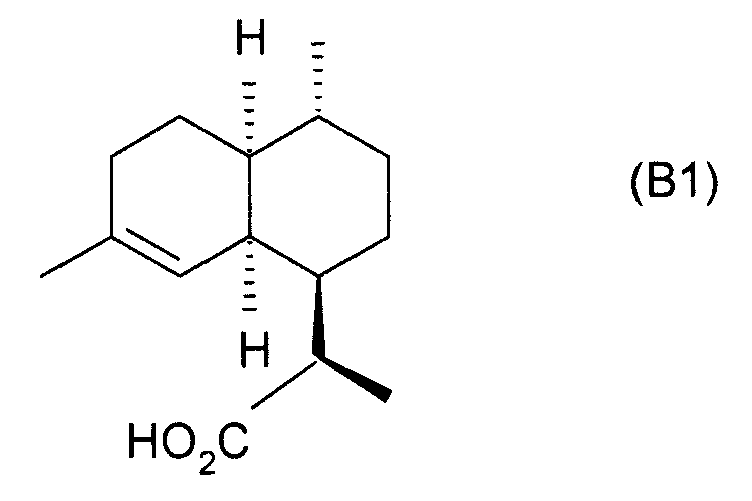
16 단계들을 포함하여 구성되는 방법의 제3 단계의 초기에 아르테미시닌의 합성 중간산물(화합물 4)을 얻기 위해 광화학 산화(photochemical oxidation)가 사용되는 방법이 "Tetrahedron Letters, 1993 (34), 4435-4438"에 개시되어 있다. 이 문헌에는 또한 프로세스의 말기에 사용되는 DHAA의 메틸 에스테르들이 개시되어 있다.(Tetrahedron Letters, 1993 (34), 4435 < RTI ID = 0.0 > (3) < / RTI > -4438 " This document also discloses the methyl esters of DHAA used at the end of the process.
그러나, DHAA 또는 DHAA 의 메틸 에스테르들로부터 출발하는 종래의 합성 방법들은, 특히, 다음과 같은 단점들을 가진다:However, conventional synthetic methods starting from methyl esters of DHAA or DHAA, in particular, have the following disadvantages:
- 전형적인 방법들로 DHAA 에스테르를 제조하는 것은 덜 효과적이고, 또는 값비싸거나 안전하지 않은 시약들(reagents)의 사용을 필요로 하고;- The preparation of DHAA esters by typical methods requires the use of less effective or costly or unsafe reagents;
- 프로세스를 수행할 때, 개환(ring opening)과 같은, 부차적인 반응들을 통해 얻어진 부산물들이 매질(medium)에 존재하기 때문에 DHAA 또는 그 에스테르들로부터 최종적으로 얻은 아르테미시닌은 불안정하며; 그리고- Artemisinin finally obtained from DHAA or its esters is unstable when the process is carried out, since byproducts from secondary reactions such as ring opening are present in the medium; And
- 수득된 아르테미시닌의 수율이 낮다. - The yield of the obtained artemisinin is low.
또한, 문헌에 개시되어 있는 방법들은 그들을 산업적 규모로 적용하지 못하게 할 수 있는 매우 많은 단계들을 포함한다.In addition, the methods disclosed in the literature include a number of steps that can prevent them from being applied on an industrial scale.
카복실산 기능이 특정 활성화 기들(activating groups)을 통해 활성화되는 다이하이드로아르테미신산 유도체들을 사용함으로써, 제조 비용을 크게 낮추면서도, 단일-용기 광화학 프로세스(one-pot photochemical process)에 의해 높은 수율로 아르테미시닌을 얻는 것이 가능할 수 있다는 것이 이제 밝혀졌다. By using dihydroartemic acid derivatives whose carboxylic acid function is activated through certain activating groups, a single-pot photochemical process can be used to produce artemisia It now turns out that it may be possible to obtain nin.
이들 활성화 기들과 특별히 설계된 반응 파라미터들의 사용으로 다음과 같은 장점들 중의 하나 이상을 제공할 수 있다는 것이 밝혀졌다:It has been found that the use of these activators and specially designed reaction parameters can provide one or more of the following advantages:
- DHAA의 활성화된 유도체들을 출발 물질로 사용하는 것은 락톤화(lactonisation)와 같은 간섭 반응들(interfering reactions)을 통해 불필요한 부산물들의 생성을 제한할 수 있고;The use of activated derivatives of DHAA as starting materials can limit the production of unnecessary by-products through interfering reactions such as lactonisation;
- DHAA 또는 그 에스테르들과 비교하여, 활성화 기들이 더 우수한 이탈기들(leaving groups) 인 이들 활성화 유도체들을 사용할 때, 반응의 속도(kinetics)가 증가될 수 있으며; 그리고In comparison to DHAA or its esters, the kinetics of the reaction can be increased when the activators use these activating derivatives which are better leaving groups; And
- DHAA의 활성화 유도체들의 제조는 1 단계의 단순하고 정량적인 과정일 수 있다. - Production of activated derivatives of DHAA can be a simple and quantitative process in one step.
아르테미시닌을 제조하기 위한 적합한 방법을 얻으려고 함에 있어서, 선행 기술 방법들은, 불필요한 부산물들이 나오지 않게 하고 아르테미시닌이 잘 생성되게 하기 위해서, 수득된 불필요한 부산물들을 분석하고 정량화하기 위해, 특히 그들의 생성 속도론에 관하여 연구되었다.In attempting to obtain a suitable method for preparing artemisinin, the prior art methods have been used to analyze and quantify the resulting unwanted byproducts in order to avoid unnecessary byproducts and to produce artemicinin well, Kinetics has been studied.
이 연구에서, 프로세스 중에 온도를 서서히 상승시킴으로써 여러 반응 중간산물들의 생성을 제어하는 것이 가능함이 밝혀졌다. 출발물(starting product)은 (0℃ 아래의) 낮은 온도에서 제1 합성 중간산물로 변환되었고, 이것은 그 다음에 0℃에서 제2 합성 중간산물로 변환되었다. 그 다음 단계에서 온도를 상승시키는 것은 이 제2 합성 중간산물의 아르테미시닌으로의 완전한 변환을 가능하게 하였다. In this work it has been found possible to control the production of various reaction intermediates by slowly raising the temperature during the process. The starting product was converted to the first synthetic intermediate at a low temperature (below 0 ° C), which was then converted to the second synthetic intermediate at 0 ° C. Raising the temperature in the next step allowed complete conversion of this second synthetic intermediate to artemisinin.
따라서 불필요한 부산물들의 생성을 제한하고 아르테미시닌의 수율을 증가시키기 위해 설계된 온도 레벨들을 사용함으로써 프로세스를 최적화하는 것이 가능하다는 것이 밝혀졌다.It has therefore been found possible to optimize the process by using the temperature levels designed to limit the production of unnecessary byproducts and increase the yield of artemicinin.
이 연구는, 예를 들어, 온도, 시간 및 합성 단계들의 순서와 같은 반응 파라미터들을 결합시킴으로써 아르테미시닌을 제조하기 위한 특정 프로세스("단일-용기" 프로세스)를 설계하는 것을 가능하게 만들었다. This study made it possible to design a specific process ("single-vessel" process) for manufacturing artemisinin by combining reaction parameters such as, for example, temperature, time and order of synthesis steps.
또한, 반응 파라미터들을 적절히 결합시킴으로써, 선행 기술에 가르침이 있었거나 제안되지 않았던 두 개의 연이은 산화 단계들이 함께 연계되어 있는, 아르테미시닌을 얻기 위한 "단일 용기" 반응 프로세스를 수행하는 것이 이제 가능하다. It is now also possible to perform a " single vessel "reaction process to obtain artemisinin, in which the two successive oxidation steps, which have been taught or not taught in the prior art, are linked together by properly combining the reaction parameters.
본 발명에 의해,According to the present invention,
- (i) 하기 식 (I)의 다이하이드로아르테미신산 (DHAA) 유도체:- (i) dihydroartemic acid (DHAA) derivatives of formula (I)

[상기 식에서,[In the above formula,
- X 는, O, S, NH 또는 NO이고,X is O, S, NH or NO,
- Y 는, 하기 식 (II), (III) 및 (IV)로부터 선택되는 기(group)이거나,- Y is a group selected from the following formulas (II), (III) and (IV)
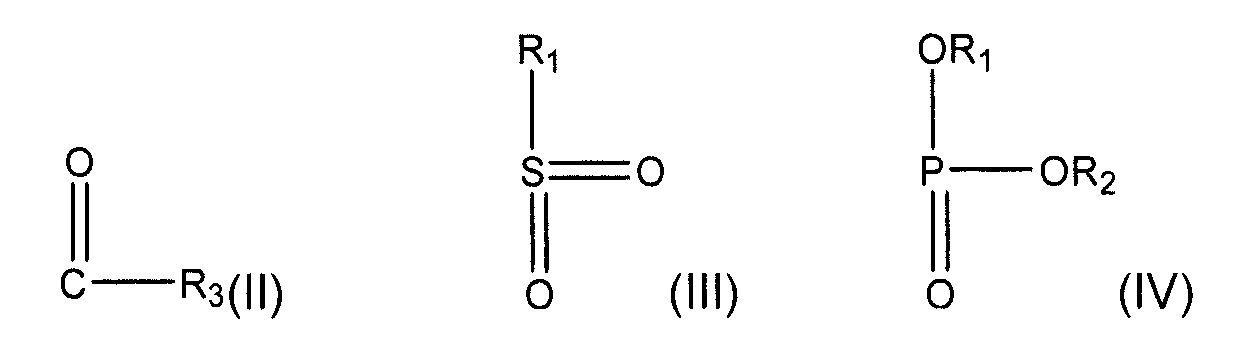
또는, X 가 O 일 때, Y 는 OR4 을 나타낼 수 있으며,Or when X is O, Y can represent OR < 4 >
- R1 과 R2 는, 서로 독립적으로, 수소; 선형 또는 가지형인 C1-C12 알킬 기 또는 C3-C10 사이클로알킬 기(상기 알킬 기는 치환되지 않거나 C1-C6 알킬 기 및 할로겐으로부터 선택된 하나 또는 그보다 많은 치환기(들)로 치환됨); 트라이플루오로메틸 기; 사이클로알킬알킬 기(여기서, 사이클로알킬 및 알킬은 위에 정의된 바와 같음); 선형 또는 가지형인 C2-C12 알케닐 기(상기 알케닐 기는 치환되지 않거나 C1-C6 알킬 기 및 할로겐으로부터 선택된 하나 또는 그보다 많은 치환기(들)로 치환됨); C5-C14 아릴 또는 헤테로아릴 기(상기 아릴 또는 헤테로아릴 기는 치환되지 않거나 C1-C6 알킬 기 및 할로겐으로부터 선택된 하나 또는 그보다 많은 치환기(들)로 치환됨); 아릴알킬 기(여기서, 아릴 및 알킬은 위에 정의된 바와 같음); 또는 헤테로아릴알킬 기(여기서, 헤테로아릴 및 알킬은 위에 정의된 바와 같음)이고; R 1 and R 2 are, independently of each other, hydrogen; A linear or branched C 1 -C 12 alkyl group or a C 3 -C 10 cycloalkyl group wherein said alkyl group is unsubstituted or substituted with one or more substituent (s) selected from C 1 -C 6 alkyl groups and halogens, ; A trifluoromethyl group; Cycloalkylalkyl groups wherein the cycloalkyl and alkyl are as defined above; A C 2 -C 12 alkenyl group which is linear or branched (said alkenyl group being unsubstituted or substituted by one or more substituent (s) selected from C 1 -C 6 alkyl groups and halogens); A C 5 -C 14 aryl or heteroaryl group wherein said aryl or heteroaryl group is unsubstituted or substituted with one or more substituent (s) selected from C 1 -C 6 alkyl groups and halogens; Arylalkyl groups wherein aryl and alkyl are as defined above; Or a heteroarylalkyl group, wherein heteroaryl and alkyl are as defined above;
- R3 은, R1, OR1, NHR1 또는 NR1R2 (여기서, R1 과 R2 는 위에 정의된 바와 같음)이며; R 3 is R 1 , OR 1 , NHR 1 or NR 1 R 2 , wherein R 1 and R 2 are as defined above;
- R4 는, 수소를 나타낼 수 없는 것을 제외하고는, R1 과 동일하고, 그렇지 않으면 R4 는 실릴 기를 나타냄]; R 4 is the same as R 1 , except that it can not represent hydrogen; otherwise, R 4 represents a silyl group;
(ii) 적어도 하나의 유기 용매 및 (iii) 감광제를 포함하여 구성되는 혼합물을 제조하는 단계,(ii) at least one organic solvent and (iii) a photosensitizer,
- 상기 혼합물을 광원(light source)을 사용하여 광산화(photooxidation) 처리하는 단계, 및- photooxidation of the mixture using a light source, and
- 이렇게 얻어진 아르테미시닌을 회수하는 단계를 포함하여 구성되는, 아르테미시닌의 제조 방법이 제공된다.And recovering the thus obtained artemisinin, which comprises the steps of:
본 발명의 몇몇 구체예들에서, 하기 식 (Ia)의 DHAA 유도체In some embodiments of the invention, the DHAA derivative of formula (Ia)

(상기 식에서, X 와 Y 는 위에 정의된 바와 같음)가 상기 방법에 사용된다.(Wherein X and Y are as defined above) is used in the process.
라세미 형태(racemic form) 하의 식 (I)의 화합물이 상기 방법에 사용될 때, 예를 들어, 결정화(crystallization) 및 여과와 같은 일반적인 정제 방법에 의한 아르테미시닌의 회수 후에, 식 (Ia)의 입체 화학을 가지지 않는 부분입체 이성질체를 반응 혼합물로부터 분리할 수 있는데, 존재할 수 있는 불필요한 부산물도 이와 동시에 분리할 수 있다.When the compound of formula (I) under the racemic form is used in the process, after recovery of the artemisinin by a conventional purification method such as, for example, crystallization and filtration, the compound of formula (Ia) A diastereomer that does not have stereochemistry can be separated from the reaction mixture, and any unnecessary byproducts that may be present can also be separated at the same time.
이와 달리, 반응 혼합물을 광산화 처리하기 전에 부분입체 이성질체들의 분리를 수행하여, 식 (Ia)의 부분입체 이성질체만이 그 다음의 프로세스 단계들에 포함되도록 할 수 있다.Alternatively, the separation of the diastereomers may be carried out prior to the photo-oxidation treatment of the reaction mixture such that only the diastereomer of formula (Ia) is included in the subsequent process steps.
본 발명의 상세한 설명에 의하면, 유기 용매는 다른 물질들을 용매화시키기 위해 사용되는, 유기 화합물, 즉, 적어도 하나의 탄소 원자를 포함하는 화합물을 의미한다.According to the detailed description of the present invention, an organic solvent means an organic compound, i.e., a compound comprising at least one carbon atom, which is used to solvate other materials.
유기 용매들은 양성자성 용매들과 비양성자성 용매들을 포함하며, 극성 또는 비극성일 수 있다.Organic solvents include protic solvents and aprotic solvents, and may be polar or non-polar.
적합한 유기 용매들의 예들이 아래에 주어져 있다.Examples of suitable organic solvents are given below.
선형 또는 가지형인 C1-C12 알킬 기는, 예를 들어, 메틸, 에틸, 프로필, 이소프로필, 부틸, 이소부틸, 세크-부틸, 터트-부틸, 펜틸, 이소펜틸, 세크-펜틸, 터트-펜틸, 네오펜틸, 헥실, 이소헥실, 세크-헥실, 터트-헥실, 헵틸, 옥틸, 노닐, 데실, 운데실 및 도데실로부터 선택될 수 있다. 몇몇 구체예들에서, 선형 또는 가지형인 C1-C6 알킬 기들이 선택될 수 있다.C 1 -C 12 alkyl groups which are linear or branched are for example methyl, ethyl, propyl, isopropyl, butyl, isobutyl, sec-butyl, tert-butyl, pentyl, isopentyl, sec- , Neopentyl, hexyl, isohexyl, sec-hexyl, tert-hexyl, heptyl, octyl, nonyl, decyl, undecyl and dodecyl. In some embodiments, linear or branched C 1 -C 6 alkyl groups may be selected.
C3-C10 사이클로알킬 기는, 하나 또는 둘의 고리들(rings)을 포함하여 구성될 수 있는 탄소고리 기(carbocyclic group)를 나타내며, 예를 들면, 사이클로프로필, 사이클로부틸, 사이클로펜틸 또는 사이클로헥실과 같은 기이다. A C 3 -C 10 cycloalkyl group represents a carbocyclic group which may be composed of one or two rings and is, for example, cyclopropyl, cyclobutyl, cyclopentyl or cyclohexyl It is like a thread.
C2-C12 알케닐 기는, 하나 또는 그보다 많은 불포화 결합들(unsaturated bonds)을 포함하는 선형 또는 가지형 탄화수소 기를 나타내며, 예를 들면, 에테닐 또는 비닐, 프로페닐 또는 알릴, 1-프로페닐, n-부테닐, i-부테닐, 3-메틸부트-2-에닐, n-펜테닐, 헥세닐, 헵테닐, 옥테닐, 데세닐(decenyl) 과 같은 기이다. 몇몇 구체예들에서, 선형 또는 가지형인 C2-C4 알케닐 기들이 선택될 수 있다.The C 2 -C 12 alkenyl group refers to a linear or branched hydrocarbon group containing one or more unsaturated bonds and includes, for example, ethenyl or vinyl, propenyl or allyl, 1-propenyl, n-butenyl, i-butenyl, 3-methylbut-2-enyl, n-pentenyl, hexenyl, heptenyl, octenyl, decenyl. In some embodiments, linear or branched C 2 -C 4 alkenyl groups may be selected.
사이클로알킬알킬 기는, 그 사이클로알킬과 알킬이 위에 정의된 바와 같은 기를 나타내며, 예를 들면, 사이클로프로필메틸, 사이클로부틸메틸, 사이클로펜틸메틸, 사이클로헥실메틸, 사이클로헵틸메틸, 사이클로프로필에틸 또는 사이클로헥실에틸과 같은 기이다.Cycloalkylalkyl groups are those wherein the cycloalkyl and alkyl represent groups as defined above and include, for example, cyclopropylmethyl, cyclobutylmethyl, cyclopentylmethyl, cyclohexylmethyl, cycloheptylmethyl, cyclopropylethyl or cyclohexylethyl .
C5-C14 아릴 기는, 하나 또는 둘의 고리들을 포함하여 구성되는 불포화 탄소고리 기를 나타내며, 예를 들면, 페닐, 나프틸, 인데닐 또는 안트라세닐(anthracenyl)과 같은 기이다. 몇몇 구체예들에서, C5-C14 아릴 기는 페닐이다. The C 5 -C 14 aryl group represents an unsaturated carbon ring group comprising one or two rings, for example, a group such as phenyl, naphthyl, indenyl or anthracenyl. In some embodiments, the C 5 -C 14 aryl group is phenyl.
아릴알킬은, 그 아릴과 알킬이 위에 정의된 바와 같은 탄소고리 기를 나타내며, 예를 들면, 벤질, 페닐에틸, 2-페닐에틸 또는 나프틸메틸과 같은 기이다. 몇몇 구체예들에서, 아릴알킬은 벤질이다.Arylalkyl refers to a carbon ring group as defined above wherein the aryl and alkyl are groups such as, for example, benzyl, phenylethyl, 2-phenylethyl or naphthylmethyl. In some embodiments, the arylalkyl is benzyl.
C5-C14 헤테로아릴 기는, 하나, 둘 또는 세 개의 고리들을 포함하여 구성되는 방향족 탄소고리 기, 또는 두 개의 고리들(여기서, 하나의 고리는 방향족이고 다른 고리는 완전히 수소화됨)을 포함하여 구성되는 탄소고리 기, 또는 세 개의 고리들(여기서, 적어도 하나의 고리는 방향족이고, 다른 고리(들)은 완전히 수소화되며, 상기 탄소고리(carbocyclic ring)는 산소 및 질소 원자들로부터 선택되는 동일하거나 상이한 하나 또는 그보다 많은 헤테로원자들을 포함하여 구성됨)을 포함하여 구성되는 탄소고리 기를 나타내며, 예를 들면, 푸릴, 피롤릴, 옥사졸릴, 옥사다이아졸릴, 이속사졸릴, 이미다졸릴, 피라졸릴, 피리딜, 피리미디닐, 피리다지닐, 피라지닐, 테트라졸릴, 벤조푸라닐, 인돌릴(indolyl), 푸리닐, 퀴놀릴(quinolyl), 이소퀴놀릴, 크로마닐(chromanyl) 및 나프티리디닐(naphthyridinyl)과 같은 기이다.The C 5 -C 14 heteroaryl group may be an aromatic carbon ring group comprising one, two or three rings, or two rings (where one ring is aromatic and the other ring is fully hydrogenated) Wherein at least one ring is aromatic and the other ring (s) is fully hydrogenated and the carbocyclic ring is the same or different selected from oxygen and nitrogen atoms, A heteroaryl group, a heteroaryl group, a heteroaryl group, a heteroaryl group, a heteroaryl group, a heteroaryl group, a heteroaryl group, a heteroaryl group, a heteroaryl group, Indolyl, furinyl, quinolyl, isoquinolyl, chromanyl and naphthyl, each of which may be optionally substituted with one or more substituents selected from the group consisting of halogen, T is a group such as piperidinyl (naphthyridinyl).
헤테로아릴알킬 기는, 그 헤테로아릴과 알킬이 위에 정의된 바와 같은 기를 나타낸다. A heteroarylalkyl group refers to a group as defined above wherein the heteroaryl and alkyl are as defined above.
할로겐들은 불소, 염소, 브롬 및 요오드 원자들로부터 선택될 수 있다. Halogens may be selected from fluorine, chlorine, bromine and iodine atoms.
본 명세서에 설명된 방법에 사용되는 적어도 하나의 유기 용매는, 예를 들어, 다음과 같은 것들로부터 선택될 수 있다:The at least one organic solvent used in the process described herein can be selected, for example, from the following:
- 메탄올, 에탄올, 이소프로판올, 부탄올, 1,2-부탄다이올, 1-3-부탄다이올, 글라이콜 등과 같은 알코올들; Alcohols such as methanol, ethanol, isopropanol, butanol, 1,2-butanediol, 1-3-butanediol, glycol and the like;
- 다이클로로메탄, 클로로포름, 다이클로로에탄, 모노클로로벤젠, 다이클로로벤젠, 오르토다이클로로벤젠 등과 같은 염소화(chlorinated) 용매들; Chlorinated solvents such as dichloromethane, chloroform, dichloroethane, monochlorobenzene, dichlorobenzene, orthodichlorobenzene and the like;
- 아세톤, 부탄온, 메틸에틸케톤 (MEK), 메틸이소부틸케톤 (MiBK), 메틸이소프로필케톤 (MiPK), 사이클로헥사논 등과 같은 케톤들;Ketones such as acetone, butaneone, methyl ethyl ketone (MEK), methyl isobutyl ketone (MiBK), methyl isopropyl ketone (MiPK), cyclohexanone and the like;
- 다이메틸설폭사이드 등과 같은 설폭사이드들;Sulfoxides such as dimethyl sulfoxide and the like;
- 설폴레인(sulfolane) 등과 같은 설폰들(sulfones);Sulfones such as sulfolane and the like;
- 아세토나이트릴 등과 같은 나이트릴들;Nitriles such as acetonitrile and the like;
- 다이메틸포름아마이드 등과 같은 N,N-이중치환 아민들;N, N-disubstituted amines such as dimethylformamide and the like;
- 에틸아세테이트, 이소프로필아세테이트 등과 같은 에스테르들;Esters such as ethyl acetate, isopropyl acetate and the like;
- 피리딘 등과 같은 질소화 헤테로고리들(nitrogenated heterocycles);Nitrogenated heterocycles such as pyridine and the like;
- 다이에틸에테르, 메틸 터트-부틸에테르 (MTBE), 메틸사이클로펜틸에테르, 테트라하이드로퓨란, 2-메틸테트라하이드로퓨란, 다이메톡시에탄 (글라임), 다이글라임(diglyme), 트라이글라임 등과 같은 에테르들;Diethyl ether, methyl tert-butyl ether (MTBE), methyl cyclopentyl ether, tetrahydrofuran, 2-methyltetrahydrofuran, dimethoxyethane (glime), diglyme, The same ethers;
- n-헵탄, n-헥산, 사이클로헥산, n-펜탄, CMC (사이클로헥산과 메틸사이클로헥산의 혼합물) 등과 같은 알칸들;alkanes such as n-heptane, n-hexane, cyclohexane, n-pentane, CMC (mixture of cyclohexane and methylcyclohexane);
- 예를 들어, 아니솔 또는 톨루엔 등과 같은 방향족 용매들;- aromatic solvents such as, for example, anisole or toluene;
- 및 그 혼합물들. - and mixtures thereof.
몇몇 구체예들에서, 특히 안전상의 이유로 다이클로로메탄이 사용된다. 몇몇 구체예들에서, 유기 용매들의 혼합물이 사용된다. In some embodiments, dichloromethane is used, especially for safety reasons. In some embodiments, a mixture of organic solvents is used.
상기 목록은 모든 것을 망라한 것이 아니며, 이 분야의 통상의 지식을 가진 자는 그의 일반적 지식을 토대로 적절한 유기 용매 또는 유기 용매들의 혼합물을 선택할 수 있다.The above list is not exhaustive, and those of ordinary skill in the art can select suitable organic solvents or mixtures of organic solvents based on their general knowledge.
몇몇 구체예들에서, 적어도 하나의 유기 용매가 식 (I) 또는 (Ia)의 다이하이드로아르테미신산 유도체를 기준으로 약 4 내지 20 의 부피비로 사용된다.In some embodiments, at least one organic solvent is used in a volume ratio of about 4 to 20, based on the dihydroartemic acid derivative of formula (I) or (Ia).
감광제는, 빛에 의해 전자적으로 들뜬 상태(D*) 일 때, 억셉터 분자(acceptor molecule: A) (예를 들어, 기저 상태 산소)에게 그 에너지를 전달할 수 있는, 도너 분자(donor molecule: D) 이다. 이러한 프로세스가 진행되는 동안에, 도너 분자(D*)가 비활성화되고, 억셉터 분자의 들뜬 상태(A*)(예를 들어, 싱글릿(singlet) 상태 산소)가 만들어진다. 감광제들(Sensitizers)은 일반적으로 가시광선을 흡수하는 염료이다("Photochemical Technology " page22 -23 from A. M. Braun , M.-T. Maurette et E. Oliveros edition John Wiley and Sons, 및 " March's Advanced Organic Chemistry " page 316, Fifth Edition M.B. Smith and J. March Wiley 참조).A photosensitizer is a donor molecule (D) that is capable of transferring its energy to an acceptor molecule (e.g., ground state oxygen) when in an electronically excited state (D * ) by light. ) to be. During this process, the donor molecule (D * ) is deactivated and the excited state of the acceptor molecule (A * ) (e.g., singlet oxygen) is created. Sensitizers are generally dyes that absorb visible light (see " Photochemical Technology " page22 -23 from AM Braun , M.-T. Maurette et E. Oliveros edition John Wiley and Sons, and " March's Advanced Organic Chemistry " page 316, Fifth Edition MB Smith and J. March Wiley Reference).

감광제는, 예를 들어, 로즈 벵갈(Rose bengal), 테트라페닐포르피린 (TPP), 테트라페닐포르피린 유도체들 (TPP 유도체들), 예컨대, 메탈로포르피린, 테트라메틸티오닌 클로라이드 (메틸렌 블루), 및 톨루이딘 블루(toluidine blue)로부터 선택될 수 있다. 몇몇 구체예들에서, 로즈 벵갈 또는 TPP 가 사용된다. 감광제는, 예를 들어, 식 (I) 또는 (Ia)의 다이하이드로아르테미신산 유도체를 기준으로 0.000004 내지 0.0002 당량(equivalent)과 같은, 식 (I) 또는 (Ia)의 다이하이드로아르테미신산 유도체를 기준으로 약 0.000001 내지 1 당량의 범위내에 있는 몰비(molar ratio)로 사용될 수 있다.The photosensitizer may be selected from, for example, Rose bengal, tetraphenylporphyrine (TPP), tetraphenylporphyrine derivatives (TPP derivatives) such as metalloporphyrin, tetramethylthionine chloride (methylene blue), and toluidine And may be selected from toluidine blue. In some embodiments, Rose Bengal or TPP is used. The photosensitizer may be a dihydroartemic acid derivative of formula (I) or (Ia), such as, for example, 0.000004 to 0.0002 equivalents, based on the dihydroartemic acid derivative of formula (I) Can be used in a molar ratio ranging from about 0.000001 to 1 equivalent based on the total weight of the composition.
광원은 감광제의 흡수 파장에서 광자들을 방출할 수 있는 광원으로 구성될 수 있다. 그러한 광원은, 예를 들어, 할로겐 램프, 수은 또는 질소 램프[여기서, 수은 또는 질소는 도핑될(doped) 수 있음], 레이저 램프, 다이오드 램프 및 자연광(natural light)으로부터 선택될 수 있다.The light source may comprise a light source capable of emitting photons at the absorption wavelength of the photosensitizer. Such light sources may be selected, for example, from halogen lamps, mercury or nitrogen lamps (where mercury or nitrogen may be doped), laser lamps, diode lamps and natural light.
몇몇 구체예들에서, 할로겐 또는 수은 램프들이 사용된다.In some embodiments, halogen or mercury lamps are used.
상기 목록은 모든 것을 망라한 것이 아니며, 이 분야의 통상의 지식을 가진 자는 그의 일반적 지식을 토대로 적절한 램프를 선택할 수 있다.The above list is not exhaustive and a person of ordinary skill in the art can select an appropriate lamp based on his general knowledge.
몇몇 구체예들에서, 혼합물은 적어도 하나의 산 촉매(acid catalyst)를 포함하여 구성되는데, 그러한 산 촉매의 예를 들면, (i) 예컨대, 트리플산(triflic acid), 아세트산 및 트라이플루오로아세트산과 같은, 적어도 하나의 양성자성 산, 및/또는 (ii) 예컨대, FeCl3, Ln(OTf)3, AlCl3, SnCl3, TiCl4 또는 ZnCl2 와 같은 적어도 하나의 루이스 산(Lewis acid)이다. 몇몇 구체예들에서, 트라이플루오로아세트산이 사용된다. 몇몇 구체예들에서, 산 촉매는 식 (I) 또는 (Ia)의 화합물의 당량 당 0.5 내지 2 당량(들)의 양으로 존재할 수 있다.In some embodiments, the mixture comprises at least one acid catalyst, examples of such acid catalysts being (i) a mixture of triflic acid, acetic acid and trifluoroacetic acid and (Ii) at least one Lewis acid such as, for example, FeCl 3 , Ln (OTf) 3 , AlCl 3 , SnCl 3 , TiCl 4 or ZnCl 2 , and / or at least one protic acid, In some embodiments, trifluoroacetic acid is used. In some embodiments, the acid catalyst may be present in an amount of from 0.5 to 2 equivalents (s) per equivalent of compound of formula (I) or (Ia).
몇몇 구체예들에서, 본 명세서에 설명된 방법은:In some embodiments, the methods described herein comprise:
- 대기 온도(ambient temperature)에서 (i) 위에 정의된 식 (I) 또는 (Ia)의 다이하이드로아르테미신산 유도체, (ii) 적어도 하나의 유기 용매 및 (iii) 감광제를 포함하여 구성되는 혼합물을 제조하는 단계,At ambient temperature, (i) a dihydroartemic acid derivative of formula (I) or (Ia) as defined above, (ii) at least one organic solvent and (iii) Manufacturing steps,
- 상기 반응 혼합물을, 공기 또는 산소 기포를 발생시키면서, 약 -78℃ 내지 대기 온도의 범위내에 있는 온도로 냉각시키는 단계,Cooling the reaction mixture to a temperature in the range of about -78 캜 to atmospheric temperature, with evolution of air or oxygen bubbles,
- 촉매량(catalytic amount)의 산 촉매를 첨가하는 단계, Adding a catalytic amount of an acid catalyst,
- 광원의 스위치를 켜는 단계,- switching on the light source,
- 상기 반응 혼합물을 12 시간 내지 24 시간 동안 동일한 온도로 유지시키는 단계,Maintaining the reaction mixture at the same temperature for 12 to 24 hours,
- 상기 반응 혼합물을 2 내지 4 시간 동안 약 5 내지 15°의 범위내에 있는 온도로 그리고 그 다음에 1 내지 3 시간 동안 약 15 내지 25℃의 범위내에 있는 더 높은 온도로 워밍 업(warming up)하는 단계,The reaction mixture is warmed up to a temperature in the range of about 5 to 15 ° for 2 to 4 hours and then to a higher temperature in the range of about 15 to 25 ° C for 1 to 3 hours step,
- 순차적으로, 즉 연달아 또는 동시에 상기 광원의 스위치를 끄고, 공기 또는 산소 기포 발생을 멈추고, 뒤이어 대기 온도들에서 켄처(quencher)를 가함으로써 반응을 정지시키는 단계, Stopping the reaction by switching off the light source sequentially, i. E. Sequentially or simultaneously, stopping air or oxygen bubbling, followed by a quencher at ambient temperatures,
- 상기 반응 혼합물을 1 내지 3 시간 동안 약 15℃ 내지 25℃의 범위 내에 있는 온도로 유지시키는 단계, 및Maintaining the reaction mixture at a temperature in the range of about 15 ° C to 25 ° C for 1 to 3 hours, and
- 아르테미시닌을 회수하는 단계를 포함하여 구성될 수 있다.- recovering the artemisinin.
대기 온도는 약 18 내지 25℃의 범위내에 있는 것으로 이해된다. The atmospheric temperature is understood to be in the range of about 18 to 25 占 폚.
범위들은 명시된 종점들(endpoints) 사이에 있는 그리고 명시된 종점들을 포함하는 모든 지점들을 포함하는 것으로 이해된다. 예를 들어, 약 15 내지 25℃의 온도 범위는 약 15 ℃와 약 25℃ 사이에 있는 모든 온도를 포함한다. 마찬가지로1 내지 3 시간의 시간 범위는 1 시간과 3 시간 사이에 있는 모든 시점(time point)을 포함한다.The ranges are understood to include all points between specified endpoints and including specified endpoints. For example, the temperature range of about 15 to 25 占 폚 includes all temperatures between about 15 占 폚 and about 25 占 폚. Similarly, the time range of 1 to 3 hours includes all time points between 1 and 3 hours.
몇몇 구체예들에서, 반응 조건은 다음과 같다:In some embodiments, the reaction conditions are as follows:
- 제1 냉각 단계는 -5℃와 -20℃ 사이의 온도, 예컨대, -10℃의 온도에서 수행하고;The first cooling step is carried out at a temperature between -5 ° C and -20 ° C, for example at a temperature of -10 ° C;
- 워밍 업 단계 동안에, 반응 혼합물을 2 시간 동안 10℃로 데우고 그 다음에 1 시간 동안, 20℃와 같은, 대기 온도로 데우며, 그리고/또는During the warming-up step, the reaction mixture is warmed to 10 DEG C for 2 hours and then cooled to ambient temperature, such as 20 DEG C for 1 hour, and / or
- 반응을 정지시킨 후에, 반응 혼합물을 2 시간 동안, 20℃와 같은, 대기 온도로 유지시킨다.After quenching the reaction, the reaction mixture is maintained at ambient temperature, such as 20 ° C, for 2 hours.
몇몇 구체예들에서, 촉매량의 산 촉매를 첨가하고, 광원의 스위치를 켠 후에, 반응 혼합물을 3 내지 24 시간 동안 대기 온도로 유지시킨다. 몇몇 구체예들에서, 이 기간은 3 내지 12 시간이다. 이 기간은 광원의 세기(strength-power), 감광제의 양, 및/또는 기포 발생 조건들에 좌우될 수 있다.In some embodiments, a catalytic amount of an acid catalyst is added, and after turning on the light source, the reaction mixture is maintained at ambient temperature for 3 to 24 hours. In some embodiments, the period is 3 to 12 hours. This period can depend on the strength-power of the light source, the amount of photosensitizer, and / or bubbling conditions.
몇몇 구체예들에서, 산 촉매는 상술한 군(group)으로부터 선택될 수 있는 양성자성 산이다. 몇몇 구체예들에서, 산 촉매는 트라이플루오로아세트산이다. In some embodiments, the acid catalyst is a protic acid, which can be selected from the group described above. In some embodiments, the acid catalyst is trifluoroacetic acid.
몇몇 구체예들에서, 아르테미시닌을 회수하기 전에, 반응 혼합물을 차콜(charcoal)로 처리한다.In some embodiments, the reaction mixture is treated with charcoal prior to recovery of artemisinin.
아르테미시닌은 이 분야의 통상의 지식을 가진 자에게 공지되어 있는 다양한 방법에 의해 최종 단계에서 회수될 수 있다. 몇몇 구체예들에서, 아르테미시닌은 결정화와 여과에 의해 회수될 수 있다.Artemisinin can be recovered at the final stage by a variety of methods known to those of ordinary skill in the art. In some embodiments, artemisinin can be recovered by crystallization and filtration.
몇몇 구체예들에서, 아르테미시닌은 용매/알코올 혼합물에서의 침전 및 분리에 의해 최종 단계에서 회수된다. 몇몇 구체예들에서, 용매/알코올 혼합물은 알칸/알코올 혼합물이다. 몇몇 구체예들에서, 용매는 n-헵탄, n-헥산, 사이클로헥산, n-펜탄, 및 CMC로부터 선택되고, 알코올은 에탄올과 이소프로판올로부터 선택된다. 몇몇 구체예들에서, 알칸 대 알코올의 비율은 10:1 (알칸 부피/알코올 부피)이다.In some embodiments, artemisinin is recovered in the final step by precipitation and separation in a solvent / alcohol mixture. In some embodiments, the solvent / alcohol mixture is an alkane / alcohol mixture. In some embodiments, the solvent is selected from n-heptane, n-hexane, cyclohexane, n-pentane, and CMC, and the alcohol is selected from ethanol and isopropanol. In some embodiments, the ratio of alkane to alcohol is 10: 1 (alkane volume / alcohol volume).
선택적으로, 아르테미시닌의 순도를 증가시키기 위해 추가적인 정제 단계가 수행될 수 있다. 예를 들어, 회수된 아르테미시닌은, 예컨대, 헵탄 (예: n-헵탄), 헥산 (예: n-헥산 또는 사이클로헥산), 펜탄 (예: n-펜탄), 및 CMC 와 같은 적절한 용매에 침전될 수 있고, 알코올/물 혼합물에서 재결정될(recrystallized) 수 있다. 몇몇 구체예들에서, 알코올/물 혼합물은 에탄올/물 또는 이소프로판올/물이다. Optionally, additional purification steps may be performed to increase the purity of artemisinin. For example, the recovered artemisinin can be isolated and purified in a suitable solvent such as, for example, heptane (e.g. n-heptane), hexane (e.g. n-hexane or cyclohexane), pentane Precipitated, and recrystallized in an alcohol / water mixture. In some embodiments, the alcohol / water mixture is ethanol / water or isopropanol / water.
이렇게 얻어진 아르테미시닌은 높은 순도 등급을 가지며, 재결정 수율은 90% 보다 높다.The obtained artemisinin has a high purity grade and the yield of recrystallization is higher than 90%.
하기 식 (I)의 화합물들이 또한 제공되며:Compounds of formula (I) are also provided:

상기 식에서In the above formula
- X 는, O, S, NH 또는 NO 이고,X is O, S, NH or NO,
- Y 는, 하기 식 (II), (III) 및 (IV)으로부터 선택되는 기이며 :- Y is a group selected from the following formulas (II), (III) and (IV)

- R1 과 R2 는, 서로 독립적으로, 수소; 선형 또는 가지형인 C1-C12 알킬 기 또는 C3-C10 사이클로알킬 기(상기 알킬 기는 치환되지 않거나 C1-C6 알킬 기 및 할로겐으로부터 선택된 하나 또는 그보다 많은 치환기(들)로 치환됨); 트라이플루오로메틸 기; 사이클로알킬알킬 기(여기서, 사이클로알킬 및 알킬은 위에 정의된 바와 같음); 선형 또는 가지형인 C2-C12 알케닐 기(상기 알케닐 기는 치환되지 않거나 C1-C6 알킬 기 및 할로겐으로부터 선택된 하나 또는 그보다 많은 치환기(들)로 치환됨); C5-C14 아릴 또는 헤테로아릴 기(상기 아릴 또는 헤테로아릴 기는 치환되지 않거나 C1-C6 알킬 기 및 할로겐으로부터 선택된 하나 또는 그보다 많은 치환기(들)로 치환됨); 아릴알킬 기(여기서, 아릴 및 알킬은 위에 정의된 바와 같음); 또는 헤테로아릴알킬 기(여기서, 헤테로아릴 및 알킬은 위에 정의된 바와 같음)이고; 그리고R 1 and R 2 are, independently of each other, hydrogen; A linear or branched C 1 -C 12 alkyl group or a C 3 -C 10 cycloalkyl group wherein said alkyl group is unsubstituted or substituted with one or more substituent (s) selected from C 1 -C 6 alkyl groups and halogens, ; A trifluoromethyl group; Cycloalkylalkyl groups wherein the cycloalkyl and alkyl are as defined above; A C 2 -C 12 alkenyl group which is linear or branched (said alkenyl group being unsubstituted or substituted by one or more substituent (s) selected from C 1 -C 6 alkyl groups and halogens); A C 5 -C 14 aryl or heteroaryl group wherein said aryl or heteroaryl group is unsubstituted or substituted with one or more substituent (s) selected from C 1 -C 6 alkyl groups and halogens; Arylalkyl groups wherein aryl and alkyl are as defined above; Or a heteroarylalkyl group, wherein heteroaryl and alkyl are as defined above; And
- R3 은, R1, OR1, NHR1 또는 NR1R2 (여기서, R1 과 R2 는 위에 정의된 바와 같음)이다.R 3 is R 1 , OR 1 , NHR 1 or NR 1 R 2 , wherein R 1 and R 2 are as defined above.
몇몇 구체예들에서, 식 (I)의 화합물들은 하기 식 (Ia)으로 표시되는 부분입체 이성질체들이며:In some embodiments, the compounds of formula (I) are diastereomers represented by formula (Ia)

상기 식에서, X 와 Y 는 위에 정의된 바와 같다. Wherein X and Y are as defined above.
식 (I) 및 (Ia)의 화합물들의 몇몇 구체예들에서, 화합물들은 X 가 산소 원자인 것들이다.In some embodiments of the compounds of formulas (I) and (Ia), the compounds are those wherein X is an oxygen atom.
몇몇 구체예들에서, 식 (I) 및 (Ia)의 화합물들은:In some embodiments, the compounds of formulas (I) and (Ia)
- X 가, O 이고;X is O;
- Y 는, 하기 식 (II), (III) 및 (IV)로부터 선택되는 기이며:Y is a group selected from the following formulas (II), (III) and (IV)

- R1 과 R2 는, 서로 독립적으로, 수소; 선형 또는 가지형인 C1-C12 알킬 기 또는 C3-C10 사이클로알킬 기(상기 알킬 기는 치환되지 않거나 C1-C6 알킬 기 및 할로겐으로부터 선택된 하나 또는 그보다 많은 치환기(들)로 치환됨); 트라이플루오로메틸 기; 선형 또는 가지형인 C2-C12 알케닐 기(상기 알케닐 기는 치환되지 않거나 C1-C6 알킬 기 및 할로겐으로부터 선택된 하나 또는 그보다 많은 치환기(들)로 치환됨); 또는 C5-C14 아릴 또는 헤테로아릴 기(상기 아릴 또는 헤테로아릴 기는 치환되지 않거나 C1-C6 알킬 기 및 할로겐으로부터 선택된 하나 또는 그보다 많은 치환기(들)로 치환됨)이고; 그리고R 1 and R 2 are, independently of each other, hydrogen; A linear or branched C 1 -C 12 alkyl group or a C 3 -C 10 cycloalkyl group wherein said alkyl group is unsubstituted or substituted with one or more substituent (s) selected from C 1 -C 6 alkyl groups and halogens, ; A trifluoromethyl group; A C 2 -C 12 alkenyl group which is linear or branched (said alkenyl group being unsubstituted or substituted by one or more substituent (s) selected from C 1 -C 6 alkyl groups and halogens); Or a C 5 -C 14 aryl or heteroaryl group wherein said aryl or heteroaryl group is unsubstituted or substituted with one or more substituent (s) selected from C 1 -C 6 alkyl groups and halogens; And
- R3 은, R1, OR1, NHR1 또는 NR1R2 (여기서, R1 과 R2 는 위에 정의된 바와 같음)인, 화합물들이다.- R 3 is a compound wherein R 1 , OR 1 , NHR 1 or NR 1 R 2 , wherein R 1 and R 2 are as defined above.
몇몇 구체예들에서, 식 (I) 및 (Ia)의 그러한 화합물들은:In some embodiments, such compounds of formulas (I) and (Ia) are:
- X 가 O 이고;X is O;
- Y 는, 하기 식 (II)의 기를 나타내며:- Y represents a group of formula (II)

상기 식에서, R3 은 OR1 이고, R1 은, 선형 또는 가지형인 C1-C12 알킬 기 또는 C3-C10 사이클로알킬 기(상기 알킬 기는 치환되지 않거나 C1-C6 알킬 기 및 할로겐으로부터 선택된 하나 또는 그보다 많은 치환기(들)로 치환됨), 또는 C5-C14 아릴 또는 헤테로아릴 기, 그리고 몇몇 구체예들에서는 페닐 기(상기 아릴 또는 헤테로아릴 기는 치환되지 않거나 C1-C6 알킬 기 및 할로겐으로부터 선택된 하나 또는 그보다 많은 치환기(들)로 치환됨)인, 화합물들이다.Wherein R 3 is OR 1 and R 1 is a linear or branched C 1 -C 12 alkyl group or a C 3 -C 10 cycloalkyl group wherein said alkyl group is unsubstituted or substituted by C 1 -C 6 alkyl groups and halogen (S), or a C 5 -C 14 aryl or heteroaryl group, and in some embodiments a phenyl group (said aryl or heteroaryl group is unsubstituted or substituted with C 1 -C 6 An alkyl group and a halogen). ≪ / RTI >
식 (I) 또는 (Ia)의 화합물들은, 일반적인 방법들에 따라, 예를 들어, 다이하이드로아르테미신산과, 예컨대, 식 Y-X-C(O)-hal (여기서, hal 은, 염소, 불소 또는 브롬이고, X 와 Y 는 위에 정의된 바와 같음)의 할로포르메이트(haloformate)의 에스테르화(esterification)에 의해 제조될 수 있다.Compounds of formula (I) or (Ia) may be prepared according to the usual methods, for example by reacting dihydroartemic acid with a compound of formula YXC (O) -hal wherein hal is chlorine, fluorine or bromine, Wherein X and Y are as defined above. ≪ Desc / Clms Page number 7 >
몇몇 구체예들에서, X 는 산소를 나타내고, Y 는 위에 정의된 식 (II)의 기를 나타내는데, 여기서, R3 은, OR1 이고, R1 은, 선형 또는 가지형인 C1-C12 알킬 기 또는 C3-C10 사이클로알킬 기(상기 알킬 기는 치환되지 않거나 C1-C6 알킬 기 및 할로겐으로부터 선택된 하나 또는 그보다 많은 치환기(들)로 치환됨), 또는 C5-C14 아릴 또는 헤테로아릴 기, 그리고 몇몇 구체예들에서는 페닐 기(상기 아릴 또는 헤테로아릴 기는 치환되지 않거나 C1-C6 알킬 기 및 할로겐으로부터 선택된 하나 또는 그보다 많은 치환기(들)로 치환됨)이다.In some embodiments, X represents oxygen and Y represents a group of formula (II) as defined above wherein R 3 is OR 1 and R 1 is a linear or branched C 1 -C 12 alkyl group Or a C 3 -C 10 cycloalkyl group wherein said alkyl group is unsubstituted or substituted with one or more substituent (s) selected from C 1 -C 6 alkyl groups and halogens, or C 5 -C 14 aryl or heteroaryl And in some embodiments, the phenyl group (wherein the aryl or heteroaryl group is unsubstituted or substituted with one or more substituent (s) selected from C 1 -C 6 alkyl groups and halogens).
몇몇 구체예들에서, 식 (I) 또는 (Ia)의 화합물을 제조하는 단계는, 중간산물 화합물인 식 (I) 또는 (Ia)의 화합물을 분리하지 않고서, 아르테미시닌을 제조하는 그 다음의 단계들에 결합될 수 있다.In some embodiments, the step of preparing a compound of formula (I) or (Ia) may be carried out by reacting a compound of formula (I) or (Ia) Steps may be combined.
또한, 본 발명은, 아르테미시닌을 제조하기 위한, 위에 정의된 식 (I) 또는 (Ia)의 화합물들의 용도를 제공한다. The invention also provides the use of compounds of formula (I) or (Ia) as defined above for the preparation of artemisinin.
아래에 기술된 실시예들(working examples)은 본 발명에 의한 방법과 화합물들을 설명하기 위한 것으로서, 결코 본 발명의 범위를 제한하지 않는다.The working examples set forth below are illustrative of the methods and compounds of the present invention and are not intended to limit the scope of the invention in any way.
다음의 실험 파트에서, 실시예 1 내지 실시예 10은 식 (I) 또는 (Ia)의 다이하이드로아르테미신산 유도체들의 제조에 관한 것이며, 실시예 11 내지 실시예 13은 식 (I) 또는 (Ia)의 다이하이드로아르테미신산 유도체로부터 출발하는 아르테미시닌의 제조에 관한 것이다.In the following experimental part, examples 1 to 10 relate to the preparation of dihydroartemic acid derivatives of formula (I) or (Ia), examples 11 to 13 relate to the preparation of dihydroartemic acid derivatives of formula (I) or ≪ / RTI > dihydroartemic < RTI ID = 0.0 > acid < / RTI >
실시예Example 1: (3R)- 1: (3R) - 다이하이드로아르테안누인Dihydroartean nuin (( dihydroarteannuindihydroarteannuin ) B ) B 메틸methyl 카보네이트Carbonate 또는 (3R)- Or (3R) - 다이하이드로아르테안누인Dihydroartean nuin B 산, B acid, 메틸methyl 혼합 mix 카보네이Carboney 트(( methyl mixed carbonate)의methyl mixed carbonate 합성 synthesis

얼음조(ice bath)에서 5.04 g (0.021 mol)의 DHAA와 2.43 g (0.024 mol)의 트라이에틸아민 (Et3N) 그리고 25 mL 톨루엔의 교반 용액(stirred solution)에 2.08 g (0.022 mol)의 메틸 클로로포르메이트를 5 분 이내에 한 방울씩 첨가한다. 첨가 후에, 20-30 분 동안 계속 교반한다.To a stirred solution of 5.04 g (0.021 mol) of DHAA, 2.43 g (0.024 mol) of triethylamine (Et3N) and 25 mL of toluene in an ice bath was added 2.08 g (0.022 mol) Add one drop of formate within 5 minutes. After addition, stirring is continued for 20-30 minutes.
이 혼합물을 그 다음에 물 (2 x 100 mL)로 2회 세척하고, MgSO4 로 탈수시킨다. 그 다음에 용액을 감압(reduced pressure) 하에 건조한 상태로 농축시켜서, 5.18 g의 유성 잔류물(oily residue)을 얻는다 (미정제 수율 = 83.2 %). 생성물은 그 자체로 사용될 수 있다.The mixture is dehydrated by then washed twice with water (2 x 100 mL), and MgSO 4. The solution is then concentrated to dryness under reduced pressure to give 5.18 g of an oily residue (crude yield = 83.2%). The product can be used as such.
실시예Example 2: (3R)- 2: (3R) - 다이하이드로아르테안누인Dihydroartean nuin B 산, 2,2,2- B acid, 2,2,2- 트라이클로로에틸Trichloroethyl 혼합 mix 카보네이트의Of carbonate 합성 synthesis

얼음조에서 5.07 g (0.021 mol)의 DHAA와 2.43 g (0.024 mol)의 Et3N 그리고 25 mL 톨루엔의 교반 용액에 4.72 g (0.022 mol)의 2,2,2-트라이클로로에틸 클로로포르메이트를 5 분 이내에 한 방울씩 첨가한다. 첨가 후에, 20-30 분 동안 계속 교반한다.To a stirred solution of 5.07 g (0.021 mol) of DHAA and 2.43 g (0.024 mol) of Et 3 N and 25 mL of toluene in an ice bath was added 4.72 g (0.022 mol) of 2,2,2-trichloroethyl chloroformate Add one drop within 5 minutes. After addition, stirring is continued for 20-30 minutes.
이 혼합물을 그 다음에 물 (2 x 100 mL)로 2회 세척하고, MgSO4 로 탈수시킨다. 그 다음에 용액을 감압 하에 건조한 상태로 농축시켜서, 8.39 g 의 유성 잔류물을 얻는다 (미정제 수율 = 96.3%). 생성물은 그 자체로 사용될 수 있다.
The mixture is dehydrated by then washed twice with water (2 x 100 mL), and MgSO 4. The solution was then concentrated to dryness under reduced pressure to give 8.39 g of oily residue (crude yield = 96.3%). The product can be used as such.
실시예Example 3: (3R)- 3: (3R) - 다이하이드로아르테안누인Dihydroartean nuin B 산, 에틸 혼합 B acid, ethyl mixture 카보네이트의Of carbonate 합성 synthesis
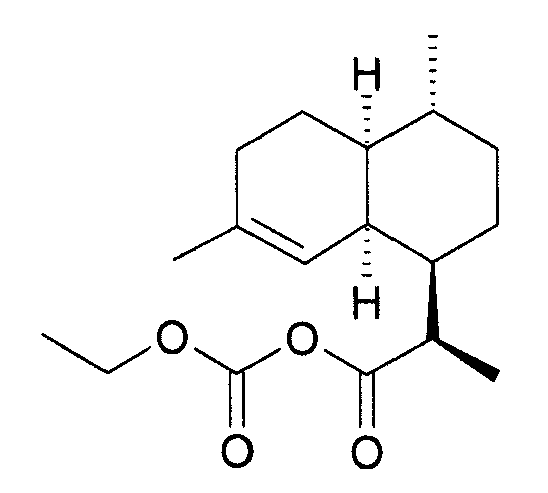
얼음조에서 대다수의 이성질체가 풍부한 5.11 g (0.022 mol)의 DHAA와 3.42 g (0.025 mol)의 K2CO3 그리고 25 mL 톨루엔의 교반 용액에 2.27 g (0.021 mol)의 에틸 클로로포르메이트를 5 분 이내에 한 방울씩 첨가한다. 첨가 후에, 20-30 분 동안 계속 교반한다.To a stirred solution of 5.11 g (0.022 mol) of DHAA, 3.42 g (0.025 mol) of K 2 CO 3 and 25 mL of toluene in an ice bath, 2.27 g (0.021 mol) of ethyl chloroformate was added for 5 min Add one drop each time. After addition, stirring is continued for 20-30 minutes.
이 혼합물을 그 다음에 물 (2 x 100 mL)로 2회 세척하고, MgSO4 로 탈수시킨다. 그 다음에 용액을 감압 하에 건조한 상태로 농축시켜서, 5.57 g 의 유성 잔류물을 얻는다(미정제 수율 = 85.4 %). 생성물은 그 자체로 사용될 수 있다.The mixture is dehydrated by then washed twice with water (2 x 100 mL), and MgSO 4. The solution was then concentrated to dryness under reduced pressure to give 5.57 g of oily residue (crude yield = 85.4%). The product can be used as such.
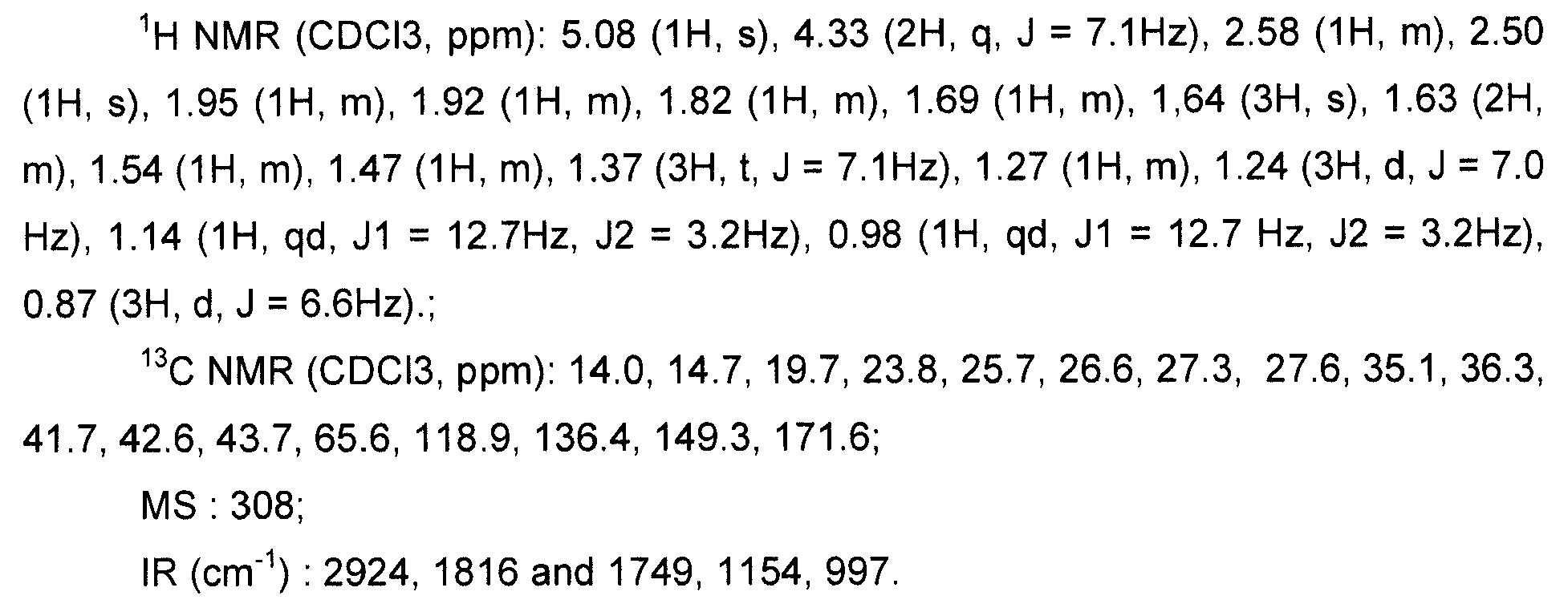
실시예Example 4: (3R/S)- 4: (3R / S) - 다이하이드로아르테안누인Dihydroartean nuin B 산, 에틸 혼합 B acid, ethyl mixture 카보네이트Carbonate (부분입체 이성질체 혼합물)의 합성 (Diastereomeric mixture)
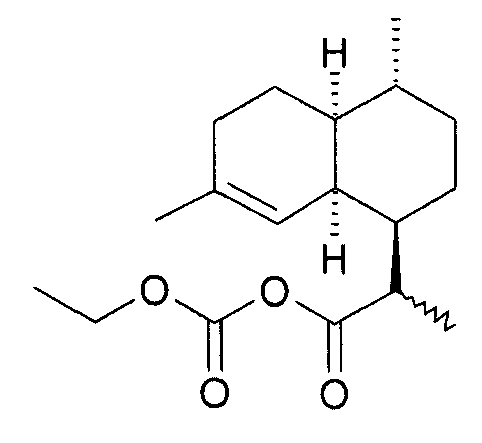
얼음조에서 5.11 g (0.022 mol)의 라세미 DHAA와 2.45 g (0.024 mol)의 N-메틸모르폴린 그리고 25 mL의 톨루엔의 교반 용액에 2.27 g (0.021 mol)의 에틸 클로로포르메이트를 5 분 이내에 한 방울씩 첨가한다. 첨가 후에, 20-30 분 동안 계속 교반한다.To a stirred solution of 5.11 g (0.022 mol) of racemic DHAA, 2.45 g (0.024 mol) of N-methylmorpholine and 25 mL of toluene in an ice bath was added 2.27 g (0.021 mol) of ethyl chloroformate in 5 min Add one drop. After addition, stirring is continued for 20-30 minutes.
이 혼합물을 그 다음에 물 (2 x 100 mL)로 2회 세척하고, MgSO4 로 탈수시킨다. 그 다음에 용액을 감압 하에 건조한 상태로 농축시켜서, 6.11g 의 유성 잔류물을 얻는다 (미정제 수율 = 93.6 %). 생성물은 그 자체로 사용될 수 있다.
The mixture is dehydrated by then washed twice with water (2 x 100 mL), and MgSO 4. The solution was then concentrated to dryness under reduced pressure to give 6.11 g of oily residue (crude yield = 93.6%). The product can be used as such.
실시예Example 5: (3R)- 5: (3R) - 다이하이드로아르테안누인Dihydroartean nuin B 산, 벤질 혼합 B acid, benzyl mixture 카보네이트의Of carbonate 합성 synthesis

얼음조에서 5.08 g (0.021 mol)의 DHAA 와 3.31 g (0.024 mol)의 K2CO3 그리고 25 mL의 다이클로로메탄의 교반 용액에 3.64 g (0.021 mol)의 벤질 클로로포르메이트 를 5 분 이내에 한 방울씩 첨가한다. 첨가 후에, 20-30 분 동안 계속 교반한다.To a stirred solution of 5.08 g (0.021 mol) of DHAA, 3.31 g (0.024 mol) of K 2 CO 3 and 25 mL of dichloromethane in an ice bath was added 3.64 g (0.021 mol) of benzyl chloroformate in less than 5 min Add the drops one by one. After addition, stirring is continued for 20-30 minutes.
이 혼합물을 그 다음에 물 (2 x 100 mL)로 2회 세척하고, MgSO4 로 탈수시킨다. 그 다음에 용액을 감압 하에 건조한 상태로 농축시켜서, 7.63 g 의 유성 잔류물을 얻는다 (미정제 수율 = 97.4 %). 생성물은 그 자체로 사용될 수 있다.
The mixture is dehydrated by then washed twice with water (2 x 100 mL), and MgSO 4. The solution was then concentrated to dryness under reduced pressure to give 7.63 g of oily residue (crude yield = 97.4%). The product can be used as such.
실시예Example 6: (3R)- 6: (3R) - 다이하이드로아르테안누인Dihydroartean nuin B 산, B acid, 페닐Phenyl 혼합 mix 카보네이트의Of carbonate 합성 synthesis
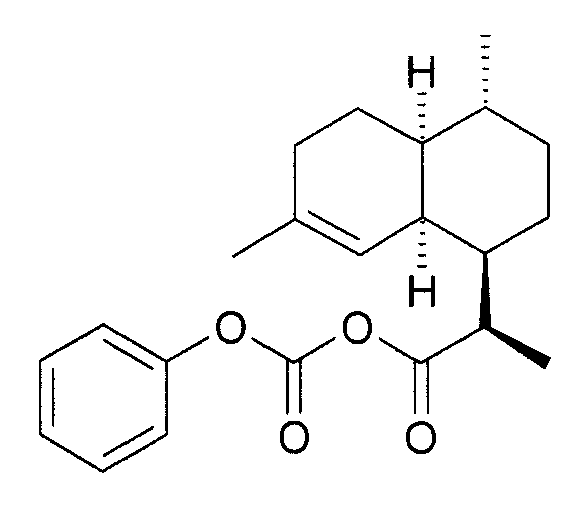
얼음조에서 5.08 g (0.021 mol) DHAA 와 3.36 g (0.024 mol)의 K2CO3 그리고 25 mL의 다이클로로메탄의 교반 용액에 3.48 g (0.022 mol)의 페닐 클로로포르메이트를 5 분 이내에 한 방울씩 첨가한다. 첨가 후에, 20-30 분 동안 계속 교반한다.To a stirred solution of 5.08 g (0.021 mol) DHAA, 3.36 g (0.024 mol) K 2 CO 3 and 25 mL dichloromethane in an ice bath, 3.48 g (0.022 mol) phenyl chloroformate was added dropwise within 5 min Respectively. After addition, stirring is continued for 20-30 minutes.
이 혼합물을 그 다음에 물 (2 x 100 mL)로 2회 세척하고, MgSO4 로 탈수시킨다. 그 다음에 용액을 감압 하에 건조한 상태로 농축시켜서, 6.85 g 의 유성 잔류물을 얻는다. 이것은 90.8%의 미정제 수율을 나타낸다. 생성물은 그 자체로 사용될 수 있다.
The mixture is dehydrated by then washed twice with water (2 x 100 mL), and MgSO 4. The solution is then concentrated to dryness under reduced pressure to give 6.85 g of an oily residue. This represents a crude yield of 90.8%. The product can be used as such.
실시예Example 7: (3R)- 7: (3R) - 다이하이드로아르테안누인Dihydroartean nuin B 산, 1- B acid, 1- 클로로에틸Chloroethyl 혼합 mix 카보네이트의Of carbonate 합성 synthesis
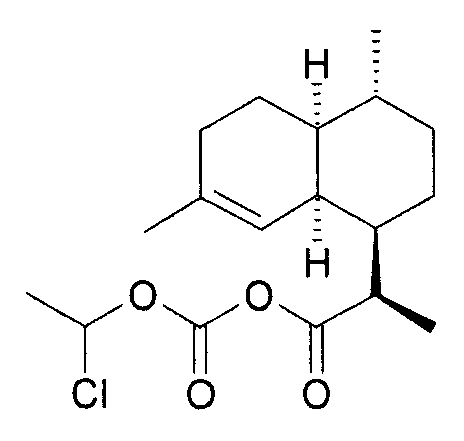
얼음조에서 5.03 g (0.021 mol)의 DHAA와 3.44 g (0.025 mol)의 K2CO3 그리고 25 mL의 다이클로로메탄의 교반 용액에 3.02 g (0.021 mol)의 1-클로로에틸 클로로포르메이트를 5 분 이내에 한 방울씩 첨가한다. 첨가 후에, 20-30 분 동안 계속 교반한다.To a stirred solution of 5.03 g (0.021 mol) of DHAA, 3.44 g (0.025 mol) of K 2 CO 3 and 25 mL of dichloromethane in an ice bath was added 3.02 g (0.021 mol) of 1-chloroethyl chloroformate Add one drop within minutes. After addition, stirring is continued for 20-30 minutes.
이 혼합물을 그 다음에 물 (2 x 100 mL)로 2회 세척하고, MgSO4 로 탈수시킨다. 그 다음에 용액을 감압 하에 건조한 상태로 농축시켜서, 5.84 g 의 유성 잔류물을 얻는다 (미정제 수율 = 80.5 %). 생성물은 그 자체로 사용될 수 있다.
The mixture is dehydrated by then washed twice with water (2 x 100 mL), and MgSO 4. The solution was then concentrated to dryness under reduced pressure to give 5.84 g of oily residue (crude yield = 80.5%). The product can be used as such.
실시예Example 8: (3R)- 8: (3R) - 다이하이드로아르테안누인Dihydroartean nuin B 산, 프로필 혼합 B acid, profile blend 카보네이트Carbonate 의 합성 Synthesis of

얼음조에서 5.02 g (0.021 mol) DHAA와 4.22 g (0.031 mol)의 K2CO3 그리고 25 mL 다이클로로메탄의 교반 용액에 2.62 g (0.021 mol)의 프로필 클로로포르메이트를 5 분 이내에 한 방울씩 첨가한다. 첨가 후에, 20-30 분 동안 계속 교반한다.To a stirred solution of 5.02 g (0.021 mol) DHAA, 4.22 g (0.031 mol) K 2 CO 3 and 25 mL dichloromethane in an ice bath was added 2.62 g (0.021 mol) of propyl chloroformate dropwise within 5 min . After addition, stirring is continued for 20-30 minutes.
이 혼합물을 그 다음에 물 (2 x 100 mL)로 2회 세척하고, MgSO4 로 탈수시킨다. 그 다음에 용액을 감압 하에 건조한 상태로 농축시켜서, 6.53 g 의 유성 잔류물을 얻는다 (미정제 수율 = 95.7 %). 생성물은 그 자체로 사용될 수 있다.
The mixture is dehydrated by then washed twice with water (2 x 100 mL), and MgSO 4. The solution was then concentrated to dryness under reduced pressure to give 6.53 g of oily residue (crude yield = 95.7%). The product can be used as such.
실시예Example 9: (3R)- 9: (3R) - 다이하이드로아르테안누인Dihydroartean nuin B 산, 2,2,2- B acid, 2,2,2- 트라이클로로Trichloro -1,1-다이메틸 혼합 -1,1-dimethyl mixture 카보네이트의Of carbonate 합성 synthesis
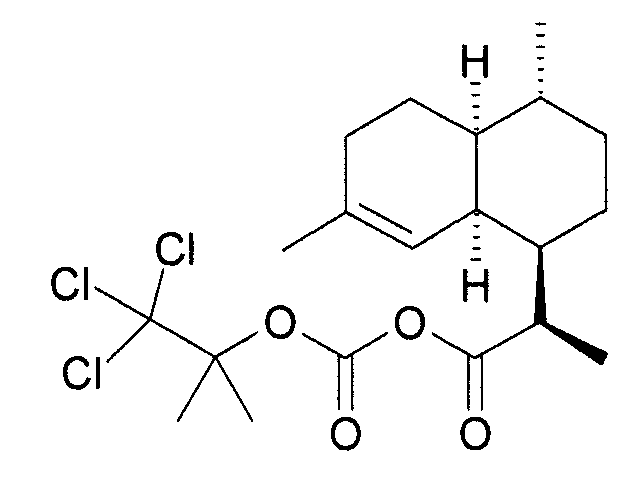
얼음조에서 5.04 g (0.021 mol) DHAA와 3.85 g (0.028 mol) K2CO3 그리고 25 mL 다이클로로메탄의 교반 용액에 5.08 g (0.021 mol)의 2,2,2-트라이클로로-1,1-다이메틸에틸 클로로포르메이트를 5 분 이내에 한 방울씩 첨가한다. 첨가 후에, 20-30 분 동안 계속 교반한다.To a stirred solution of 5.04 g (0.021 mol) DHAA, 3.85 g (0.028 mol) K 2 CO 3 and 25 mL dichloromethane in an ice bath was added 5.08 g (0.021 mol) of 2,2,2-trichloro-1,1 -Dimethylethyl chloroformate is added dropwise within 5 min. After addition, stirring is continued for 20-30 minutes.
이 혼합물을 그 다음에 물 (2 x 100 mL)로 2회 세척하고, MgSO4 로 탈수시킨다. 그 다음에 용액을 감압 하에 건조한 상태로 농축시켜서, 8.52 g 의 유성 잔류물을 얻는다 (미정제 수율 = 91.3 %). 생성물은 그 자체로 사용될 수 있다.
The mixture is dehydrated by then washed twice with water (2 x 100 mL), and MgSO 4. The solution was then concentrated to dryness under reduced pressure to give 8.52 g of oily residue (crude yield = 91.3%). The product can be used as such.
실시예Example 10: (3R)- 10: (3R) - 다이하이드로아르테안누인Dihydroartean nuin B 산, 2- B acid, 2- 클로로에틸Chloroethyl 혼합 mix 카보네이트의Of carbonate 합성 synthesis
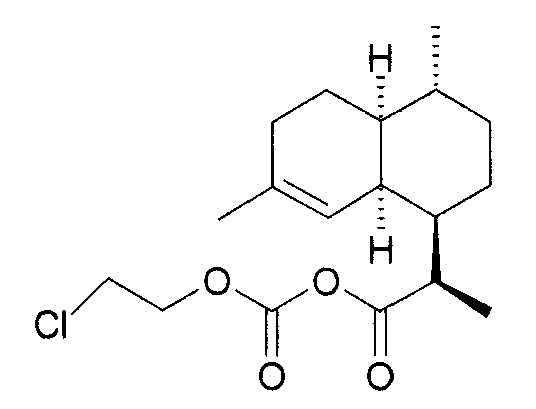
얼음조에서 5.01 g (0.021 mol)의 DHAA와 4.04 g (0.029 mol)의 K2CO3 그리고 25 mL의 다이클로로메탄의 교반 용액에 3.04 g (0.021 mol)의 2-클로로에틸 클로로포르메이트를 5 분 이내에 한 방울씩 첨가한다. 첨가 후에, 20-30 분 동안 계속 교반한다.To a stirred solution of 5.01 g (0.021 mol) of DHAA, 4.04 g (0.029 mol) of K 2 CO 3 and 25 mL of dichloromethane in an ice bath was added 3.04 g (0.021 mol) of 2-chloroethyl chloroformate Add one drop within minutes. After addition, stirring is continued for 20-30 minutes.
이 혼합물을 그 다음에 물 (2 x 100 mL)로 2회 세척하고, MgSO4 로 탈수시킨다. 그 다음에 용액을 감압 하에 건조한 상태로 농축시켜서, 6.78 g 의 유성 잔류물을 얻는다 (미정제 수율 = 93.5 %). 생성물은 그 자체로 사용될 수 있다.
The mixture is dehydrated by then washed twice with water (2 x 100 mL), and MgSO 4. The solution was then concentrated to dryness under reduced pressure to give 6.78 g of oily residue (crude yield = 93.5%). The product can be used as such.
실시예Example 11: 11: 아르테미시닌의Artemicinin 합성 synthesis
4 g의 상기 실시예 1 내지 실시예 10에서 제조된 식 (I) 또는 (Ia)의 다이하이드로아르테미신산 (DHAA) 유도체 (1 당량), 0.01 당량의 테트라페닐포르피린 및 80 mL의 메틸렌 클로라이드를 20℃ 에서 깨끗한 0.2 리터들이 반응기(reactor)에 넣었다.4 g of the dihydroartemic acid (DHAA) derivative (1 equivalent) of formula (I) or (Ia) prepared in Examples 1 to 10 above, 0.01 equivalents of tetraphenylporphyrin and 80 mL of methylene chloride Lt; RTI ID = 0.0 > 20 C < / RTI >
그 다음에 혼합물을 -10℃로 냉각시키고, 300-400 rpm으로 교반하면서 혼합물에 공기 또는 산소의 기포를 발생시킨다(40-50 mL/분). 30 분 후에, 트라이플루오로아세트산 (TFA, 0.5 당량) 을 첨가하고, 할로겐 램프의 스위치를 켠다.The mixture is then cooled to -10 DEG C and air or oxygen bubbles are generated in the mixture (40-50 mL / min) while stirring at 300-400 rpm. After 30 minutes, trifluoroacetic acid (TFA, 0.5 eq.) Is added and the halogen lamp is switched on.
혼합물을 -10℃ 에서 밤새 (~19 시간) 교반한 후에 10℃ (60 분)로 데우고, 60 분 동안 10℃에서 교반한다.The mixture is stirred at -10 ° C overnight (~19 h), then warmed to 10 ° C (60 min) and stirred at 10 ° C for 60 min.
그 후에 혼합물을 약 60 분 동안 20℃로 데운 다음에 공기 도입을 멈추고, 램프 스위치를 끄고, 혼합물을 2 시간 동안 20℃에서 교반한다.The mixture is then warmed to 20 DEG C for about 60 minutes, then the introduction of air is stopped, the lamp switch is turned off, and the mixture is stirred at 20 DEG C for 2 hours.
그 후에 반응 혼합물을 20 mL의 물 그리고 그 다음에 20 mL의 포화 NaHCO3 수용액을 첨가하여 처리한다. 그리고 나서 결과로서 얻은 혼합물을 경사분리(decantation)를 위해 방치시켜서, 두 개의 층들이 분리되었다. 그 다음에 유기 층을 용기(vessel)에 되돌려 넣고, 20 mL의 물 그리고 그 다음에 20 mL의 포화 NaHCO3 수용액을 첨가하여 다시 세척한다. 경사분리 및 층 분리 후에, 유기 층을 20 ml의 물로 세척한다.The reaction mixture is then treated by adding 20 mL of water and then 20 mL of saturated aqueous NaHCO 3 solution. The resulting mixture was then left for decantation, and the two layers were separated. The organic layer is then returned to the vessel and again washed with 20 mL of water and then with 20 mL of saturated aqueous NaHCO 3 solution. After decanting and layer separation, the organic layer is washed with 20 ml of water.
경사분리 후에, 유기 층을 회전 증발 농축기(rotary evaporator)를 사용하여 30℃에서 점진적 진공(progressive vacuum) 하에 농축시킨다. 탈수된 생성물을 실온에서 결정화한다(crystallize). 그 다음에 12 mL의 n-헵탄을 첨가하고, 혼합물을 20℃에서 1 시간 동안 교반한다.After decanting, the organic layer is concentrated under a progressive vacuum at 30 < 0 > C using a rotary evaporator. The dehydrated product is crystallized at room temperature. 12 mL of n-heptane is then added and the mixture is stirred at 20 < 0 > C for 1 hour.
그 후에 반응 혼합물을 부흐너 깔때기(Buchner funnel) (n°3) 하에 여과한다. 그리고 나서 습한 고형물(wet solid)을 먼저 8 mL 그리고 그 다음에 12 mL의 n-헵탄으로 세척한다.The reaction mixture is then filtered under Buchner funnel (n ° 3). The wet solids are then washed first with 8 mL and then with 12 mL of n-heptane.
그 다음에 습한 고형물을 진공 하에 40℃에서 밤새 (~15 시간) 건조시킨다. The wet solids are then dried under vacuum at 40 ° C overnight (~15 hours).
미정제 아르테미시닌을 우수한 적정 수율(titrated yield)(62% ti/ti)로 얻는다. The crude artemisminin is obtained in excellent titre yield (62% ti / ti).
필요하면, n-헵탄에 침전된 고형 생성물에 대해 에탄올/물 혼합물 (70/30)에서의 추가적인 재결정 단계가 수행될 수 있다. 이렇게 얻어진 아르테미시닌은 우수한 순도와 90% 보다 높은 재결정 수율을 가진다.If necessary, an additional recrystallization step in the ethanol / water mixture (70/30) can be performed on the solid product precipitated in n-heptane. The obtained artemisinin has excellent purity and yield of recrystallization higher than 90%.
실시예Example 12: 12: 아르테미시닌의Artemicinin 합성 synthesis
상기 실시예 3에서 제조된 식 (I) 또는 (Ia)의 혼합 카보네이트 유도체(mixed carbonate derivative)(100 g, 1당량) 와 다이클로로메탄 (550 mL)의 용액, 그리고 0.00031 당량의 테트라페닐포르피린을 20℃ 에서 깨끗한 반응기에 넣었다.A solution of the mixed carbonate derivative (100 g, 1 eq.) Of formula (I) or (Ia) prepared in Example 3 and dichloromethane (550 mL) and 0.00031 eq of tetraphenylporphyrin Lt; RTI ID = 0.0 > 20 C < / RTI >
그 다음에 혼합물을 -10℃로 냉각시키고, 200 rpm으로 교반하면서 혼합물에 공기 또는 산소의 기포를 발생시킨다(260-300 mL/분). 30 분 후에, 수은 램프의 스위치를 켜고, 트라이플루오로아세트산 (TFA, 0.5 당량)을 첨가한다.The mixture is then cooled to -10 DEG C and air or oxygen bubbles are generated in the mixture (260-300 mL / min) while stirring at 200 rpm. After 30 minutes, the mercury lamp is switched on and trifluoroacetic acid (TFA, 0.5 eq.) Is added.
혼합물을 -10℃ 에서 7 시간 동안 교반하고, 공기 도입을 멈추고, 램프 스위치를 끈다.The mixture was stirred at -10 DEG C for 7 hours, the introduction of air was stopped, and the lamp switch was turned off.
그 후에 반응 혼합물을 30 분 동안 20℃로 데우고, 2 시간 동안 20℃에서 교반한다.The reaction mixture is then warmed to 20 [deg.] C for 30 minutes and stirred at 20 [deg.] C for 2 hours.
그 후에 반응 혼합물을 200 mL의 물 그리고 그 다음에 200 mL의 포화NaHCO3 수용액을 첨가하여 처리한다. 그리고 나서 결과로서 얻은 혼합물을 경사분리를 위해 방치시켜서, 두 개의 층들이 분리되었다. 그 다음에 유기 층을 용기에 되돌려 넣고, 200 mL의 물 그리고 그 다음에 200 mL의 포화 NaHCO3 수용액을 첨가하여 다시 세척한다. 경사분리 및 층 분리 후에, 유기 층을 200 mL의 물로 세척한다.The reaction mixture is then treated by adding 200 mL of water and then 200 mL of saturated aqueous NaHCO 3 solution. The resulting mixture was then left to decant, and the two layers were separated. The organic layer is then returned to the vessel and washed again with 200 mL of water and then with 200 mL of saturated aqueous NaHCO 3 solution. After decanting and layer separation, the organic layer is washed with 200 mL of water.
경사분리 후에, 유기 층을 회전 증발 농축기를 사용하여 30℃에서 점진적 진공 하에 농축시킨다. 탈수된 생성물을 실온에서 결정화한다. 그 다음에 300 mL의 n-헵탄과 30 mL의 에틸 알코올을 첨가한다. 결과로서 얻은 혼합물을 50℃에서 1 시간 동안 교반한다. 반응 혼합물을 1 시간 동안 20℃로 냉각시키고, 30 분 동안 20℃에서 교반한다. After decanting, the organic layer is concentrated under a gradual vacuum at 30 < 0 > C using a rotary evaporator. The dehydrated product is crystallized at room temperature. Then 300 mL of n-heptane and 30 mL of ethyl alcohol are added. The resulting mixture is stirred at 50 < 0 > C for 1 hour. The reaction mixture is cooled to 20 [deg.] C for 1 hour and stirred at 20 [deg.] C for 30 minutes.
그 후에 반응 혼합물을 부흐너 깔때기(n°3) 하에 여과한다. 그리고 나서 습한 고형물을 200 mL의 n-헵탄으로 2회 세척한다.The reaction mixture is then filtered under Buchner funnel (n ° 3). The wet solids are then washed twice with 200 mL of n-heptane.
그 다음에 습한 고형물을 진공 하에 40℃에서 밤새 (~15 시간) 건조시킨다. The wet solids are then dried under vacuum at 40 ° C overnight (~15 hours).
수득된 고도로 순수한 아르테미시닌의 수율은 실시예 11의 추가적인 재결정 단계 없이 51 %이다.
The yield of highly pure artemisinin obtained is 51% without the additional recrystallization step of Example 11.
실시예Example 13: 13: 아르테미시닌의Artemicinin 합성 synthesis
상기 실시예 3에서 제조된 식 (I) 또는 (Ia)의 혼합 카보네이트 유도체 (650 g - 93% 순도, 1당량)와 다이클로로메탄 (4 L)의 용액, 그리고 0.00027 당량의 테트라페닐포르피린을 20℃ 에서 깨끗한 반응기에 넣는다.A solution of the mixed carbonate derivative (650 g - 93% purity, 1 eq.) Of formula (I) or (Ia) prepared in Example 3 and dichloromethane (4 L) and 0.00027 eq of tetraphenylporphyrin was added to 20 Lt; RTI ID = 0.0 > C < / RTI >
그 다음에 혼합물을 -10℃로 냉각시키고, 교반하면서 혼합물에 공기 또는 산소의 기포를 발생시킨다(900 mL/분). 30 분 후에, 수은 램프의 스위치를 켜고, 트라이플루오로아세트산 (TFA, 0.5 당량)을 첨가한다.The mixture is then cooled to -10 DEG C and air or oxygen bubbles are generated in the mixture (900 mL / min) with stirring. After 30 minutes, the mercury lamp is switched on and trifluoroacetic acid (TFA, 0.5 eq.) Is added.
혼합물을 -10℃ 에서 밤새 교반한다. 그 후에 혼합물을 40 분 동안 20℃로 데우고, 공기 도입을 멈추고, 램프 스위치를 끈다.The mixture is stirred at -10 < 0 > C overnight. The mixture is then warmed to 20 ° C for 40 minutes, the introduction of air is stopped, and the lamp switch is turned off.
그 후에 반응 혼합물을 650 mL의 물 그리고 그 다음에 1300 mL의 포화NaHCO3 수용액을 첨가하여 처리한다. 그리고 나서 결과로서 얻은 혼합물을 경사분리를 위해 방치시켜서, 두 개의 층들이 분리되었다. 그 다음에 유기 층을 용기에 되돌려 넣고, 650 mL의 물 그리고 그 다음에 650 mL의 포화 NaHCO3 수용액을 첨가하여 다시 세척한다. 경사분리 및 층 분리 후에, 유기 층을 최종적으로 1300 mL의 물로 세척한다.The reaction mixture is then treated by adding 650 mL of water followed by 1300 mL of saturated aqueous NaHCO 3 solution. The resulting mixture was then left to decant, and the two layers were separated. The organic layer is then returned to the vessel and washed again with 650 mL of water followed by 650 mL of saturated aqueous NaHCO 3 solution. After decanting and layer separation, the organic layer is finally washed with 1300 mL of water.
경사분리 후에, 유기 층을 30℃에서 점진적 진공 하에 농축시키고, 1950 mL의 n-헵탄을 첨가하였다. 농축을 일정한 부피까지 진행하여 잔류 다이클로로메탄을 제거한다. 195 mL의 에틸 알코올을 그 다음에 첨가하였다. 결과로서 얻은 혼합물을 50℃에서 1 시간 동안 교반한다. 반응 혼합물을 2 시간 동안 20℃로 냉각시키고, 1 시간 동안 20℃에서 교반한다. After decanting, the organic layer was concentrated at 30 < 0 > C under progressive vacuum and 1950 mL n-heptane was added. Concentration is allowed to proceed to a certain volume to remove residual dichloromethane. 195 mL of ethyl alcohol was then added. The resulting mixture is stirred at 50 < 0 > C for 1 hour. The reaction mixture is cooled to 20 < 0 > C for 2 h and stirred at 20 < 0 > C for 1 h.
그 후에 반응 혼합물을 부흐너 깔때기(n°3) 하에 여과한다. 그리고 나서 습한 고형물을 1300 mL의 n-헵탄으로 2회 세척한다.The reaction mixture is then filtered under Buchner funnel (n ° 3). The wet solids are then washed twice with 1300 mL of n-heptane.
그 다음에 습한 고형물을 진공 하에 40℃에서 건조시킨다. The wet solids are then dried under vacuum at < RTI ID = 0.0 > 40 C. < / RTI >
수득된 고도로 순수한 아르테미시닌의 수율은 실시예 11의 추가적인 재결정 단계 없이 56 %이다.The yield of highly pure artemisinin obtained is 56% without the additional recrystallization step of Example 11.
활성화된 DHAA 유도체들(실시예 1 내지 실시예 10)을 사용하여 수득한 미정제 아르테미시닌의 적정 수율들(titrated yields)이 하기 표 1에 요약되어 있다.The titrated yields of crude artemisinin obtained using activated DHAA derivatives (Examples 1 to 10) are summarized in Table 1 below.
<표 1><Table 1>

상기 결과들은 본 발명의 방법에 따라 활성화 DHAA 유도체들을 사용하여 얻은 아르테미시닌의 수율들이, 수득된 아르테미시닌의 수율이 기껏해야 30%에 이르는 것으로 개시되어 있는, "Tetrahedron Lett. 1993, 4435-4438"에 설명된 것과 같은, 선행 기술 방법들에서 DHAA 메틸 에스테르들을 사용할 때, 문헌에서 얻어진 것들 보다 현저히 더 높음을 보여준다.These results show that the yields of artemicinin obtained using activated DHAA derivatives according to the method of the present invention are at least as high as 30% of the obtained artemisinin, "Tetrahedron Lett. 1993, 4435- 4438 ", using DHAA methyl esters in the prior art methods, as compared to those obtained in the literature.
Claims (23)

[상기 식에서
- X는 O이고,
- Y는 하기 식 (II)이고,

- R3은 OR1이고, 여기서 R1은 수소; 선형 또는 가지형인 C1-C12 알킬 기 또는 C3-C10 사이클로알킬 기(상기 알킬 기는 치환되지 않거나 C1-C6 알킬 기 및 할로겐으로부터 선택된 하나 또는 그보다 많은 치환기(들)로 치환됨); 사이클로알킬알킬 기(여기서, 사이클로알킬 및 알킬은 위에 정의된 바와 같음); 선형 또는 가지형인 C2-C12 알케닐 기(상기 알케닐 기는 치환되지 않거나 C1-C6 알킬 기 및 할로겐으로부터 선택된 하나 또는 그보다 많은 치환기(들)로 치환됨); C5-C14 아릴 또는 헤테로아릴 기(상기 아릴 또는 헤테로아릴 기는 치환되지 않거나 C1-C6 알킬 기 및 할로겐으로부터 선택된 하나 또는 그보다 많은 치환기(들)로 치환됨); 아릴알킬 기(여기서, 아릴 및 알킬은 위에 정의된 바와 같음); 또는 헤테로아릴알킬 기(여기서, 헤테로아릴 및 알킬은 위에 정의된 바와 같음)이고;
(ii) 적어도 하나의 유기 용매 및 (iii) 감광제를 포함하여 구성되는 혼합물을 제조하는 단계,
- 상기 혼합물을 광원을 사용하여 광산화 처리하는 단계, 및
- 이렇게 얻어진 아르테미시닌을 회수하는 단계를 포함하여 구성되는, 아르테미시닌의 제조 방법.- (i) a dihydroartemic acid derivative of formula (I):
[In the above formula
X is O,
- Y is the formula (II)
R 3 is OR 1 , wherein R 1 is hydrogen; A linear or branched C 1 -C 12 alkyl group or a C 3 -C 10 cycloalkyl group wherein said alkyl group is unsubstituted or substituted with one or more substituent (s) selected from C 1 -C 6 alkyl groups and halogens, ; Cycloalkylalkyl groups wherein the cycloalkyl and alkyl are as defined above; A C 2 -C 12 alkenyl group which is linear or branched (said alkenyl group being unsubstituted or substituted by one or more substituent (s) selected from C 1 -C 6 alkyl groups and halogens); A C 5 -C 14 aryl or heteroaryl group wherein said aryl or heteroaryl group is unsubstituted or substituted with one or more substituent (s) selected from C 1 -C 6 alkyl groups and halogens; Arylalkyl groups wherein aryl and alkyl are as defined above; Or a heteroarylalkyl group, wherein heteroaryl and alkyl are as defined above;
(ii) at least one organic solvent and (iii) a photosensitizer,
- photo-oxidizing the mixture with a light source, and
And recovering the thus obtained artemisinin.

상기 식에서, X 와 Y 가 제1항에 정의된 바와 같은 것을 특징으로 하는, 아르테미시닌의 제조 방법.The dihydroartemic acid derivative according to claim 1, wherein the dihydroartemic acid derivative has the formula (Ia)
Wherein X and Y are as defined in claim 1. 2. A process for the preparation of artemisinin according to claim 1,
- 대기 온도에서 (i) 제1항 또는 제2항에 정의된 식 (I) 또는 (Ia)의 다이하이드로아르테미신산 유도체, (ii) 적어도 하나의 유기 용매, 및 (iii) 감광제를 포함하여 구성되는 반응 혼합물을 제조하는 단계,
- 상기 반응 혼합물을, 공기 또는 산소 기포를 발생시키면서, -78℃ 내지 대기 온도의 범위 내에 있는 온도로 냉각시키는 제1 냉각 단계,
- 촉매량의 산 촉매를 첨가하는 단계,
- 광원의 스위치를 켜는 단계,
- 상기 반응 혼합물을 3시간 내지 24시간 동안 동일한 온도로 유지시키는 단계,
- 상기 반응 혼합물을 2 내지 4시간 동안 5 내지 15℃의 범위 내에 있는 온도로 그리고 그 다음에 1 내지 3시간 동안 15 내지 25℃의 범위 내에 있는 더 높은 온도로 워밍 업(warming up)하는 단계,
- 반응을 정지시키고, 뒤이어 대기 온도들에서 켄처를 가하는 단계,
- 상기 반응 혼합물을 1 내지 3시간 동안 15℃ 내지 25℃의 범위 내에 있는 온도로 유지시키는 단계, 및
- 이렇게 얻어진 아르테미시닌을 회수하는 단계를 포함하여 구성되는 것을 특징으로 하는, 아르테미시닌의 제조 방법.3. The method according to claim 1 or 2,
(Ii) at least one organic solvent; and (iii) a photosensitizing agent, at ambient temperature, at a temperature of at least about < RTI ID = 0.0 > Preparing a reaction mixture to be constituted,
A first cooling step in which the reaction mixture is cooled to a temperature in the range of from -78 ° C to atmospheric temperature, while generating air or oxygen bubbles,
Adding a catalytic amount of an acid catalyst,
- switching on the light source,
Maintaining the reaction mixture at the same temperature for 3 to 24 hours,
Warming up the reaction mixture to a temperature in the range of 5 to 15 占 폚 for 2 to 4 hours and then to a higher temperature in the range of 15 to 25 占 폚 for 1 to 3 hours,
- stopping the reaction, followed by applying a quencher at ambient temperatures,
Maintaining the reaction mixture at a temperature in the range of 15 [deg.] C to 25 [deg.] C for 1 to 3 hours, and
- recovering the thus obtained artemisinin. ≪ RTI ID = 0.0 > 8. < / RTI >
- 상기 제1 냉각 단계는 -5℃와 -20℃ 사이의 온도에서 수행하고;
- 상기 워밍 업 단계 동안에, 상기 반응 혼합물을 2시간 동안 10℃로 데우고 그 다음에 대기 온도로 데우며, 그리고/또는
- 반응을 정지시킨 후에, 상기 반응 혼합물을 2시간 동안 대기 온도로 유지시키는 것을 특징으로 하는, 아르테미시닌의 제조 방법.13. The method of claim 12,
- the first cooling step is carried out at a temperature between -5 [deg.] C and -20 [deg.] C;
During the warming-up step, the reaction mixture is warmed to 10 DEG C for 2 hours and then to ambient temperature and / or
- after stopping the reaction, maintaining the reaction mixture at ambient temperature for 2 hours.

상기 식에서
- X는 O이고,
- Y는 하기 식 (II)이고,

- R3은 OR1이고, 여기서 R1은 수소; 선형 또는 가지형인 C1-C12 알킬 기 또는 C3-C10 사이클로알킬 기(상기 알킬 기는 치환되지 않거나 C1-C6 알킬 기 및 할로겐으로부터 선택된 하나 또는 그보다 많은 치환기(들)로 치환됨); 사이클로알킬알킬 기(여기서, 사이클로알킬 및 알킬은 위에 정의된 바와 같음); 선형 또는 가지형인 C2-C12 알케닐 기(상기 알케닐 기는 치환되지 않거나 C1-C6 알킬 기 및 할로겐으로부터 선택된 하나 또는 그보다 많은 치환기(들)로 치환됨); C5-C14 아릴 또는 헤테로아릴 기(상기 아릴 또는 헤테로아릴 기는 치환되지 않거나 C1-C6 알킬 기 및 할로겐으로부터 선택된 하나 또는 그보다 많은 치환기(들)로 치환됨); 아릴알킬 기(여기서, 아릴 및 알킬은 위에 정의된 바와 같음); 또는 헤테로아릴알킬 기(여기서, 헤테로아릴 및 알킬은 위에 정의된 바와 같음)인, 화합물.As the compound of the following formula (I)
In the above formula
X is O,
- Y is the formula (II)
R 3 is OR 1 , wherein R 1 is hydrogen; A linear or branched C 1 -C 12 alkyl group or a C 3 -C 10 cycloalkyl group wherein said alkyl group is unsubstituted or substituted with one or more substituent (s) selected from C 1 -C 6 alkyl groups and halogens, ; Cycloalkylalkyl groups wherein the cycloalkyl and alkyl are as defined above; A C 2 -C 12 alkenyl group which is linear or branched (said alkenyl group being unsubstituted or substituted by one or more substituent (s) selected from C 1 -C 6 alkyl groups and halogens); A C 5 -C 14 aryl or heteroaryl group wherein said aryl or heteroaryl group is unsubstituted or substituted with one or more substituent (s) selected from C 1 -C 6 alkyl groups and halogens; Arylalkyl groups wherein aryl and alkyl are as defined above; Or a heteroarylalkyl group, wherein heteroaryl and alkyl are as defined above.

상기 식에서, X 와 Y는 제18항에 정의된 바와 같다.19. A compound according to claim 18, which is a diastereomer of formula (Ia).
Wherein X and Y are as defined in claim 18.
Applications Claiming Priority (3)
| Application Number | Priority Date | Filing Date | Title |
|---|---|---|---|
| EP09305805.5 | 2009-09-01 | ||
| EP09305805A EP2289897A1 (en) | 2009-09-01 | 2009-09-01 | Photochemical process for producing artemisinin |
| PCT/EP2010/062811 WO2011026865A1 (en) | 2009-09-01 | 2010-09-01 | Photochemical process for producing artemisinin |
Publications (2)
| Publication Number | Publication Date |
|---|---|
| KR20120065373A KR20120065373A (en) | 2012-06-20 |
| KR101787777B1 true KR101787777B1 (en) | 2017-10-18 |
Family
ID=41557558
Family Applications (1)
| Application Number | Title | Priority Date | Filing Date |
|---|---|---|---|
| KR1020127008220A Active KR101787777B1 (en) | 2009-09-01 | 2010-09-01 | Photochemical process for producing artemisinin |
Country Status (24)
| Country | Link |
|---|---|
| US (2) | US8507697B2 (en) |
| EP (2) | EP2289897A1 (en) |
| JP (1) | JP5719366B2 (en) |
| KR (1) | KR101787777B1 (en) |
| CN (1) | CN102596967B (en) |
| AP (1) | AP2988A (en) |
| AU (2) | AU2010291253B2 (en) |
| BR (1) | BR112012004702B1 (en) |
| CA (1) | CA2772264C (en) |
| CL (1) | CL2012000554A1 (en) |
| CO (1) | CO6511258A2 (en) |
| CY (1) | CY1121969T1 (en) |
| EA (1) | EA021181B1 (en) |
| ES (1) | ES2561080T3 (en) |
| HU (1) | HUE027477T2 (en) |
| IL (1) | IL218346A0 (en) |
| MA (1) | MA33596B1 (en) |
| MX (1) | MX358030B (en) |
| MY (1) | MY155962A (en) |
| NZ (1) | NZ598878A (en) |
| PL (1) | PL2473512T3 (en) |
| SG (1) | SG178600A1 (en) |
| SI (1) | SI2473512T1 (en) |
| WO (1) | WO2011026865A1 (en) |
Families Citing this family (6)
| Publication number | Priority date | Publication date | Assignee | Title |
|---|---|---|---|---|
| EP2289897A1 (en) * | 2009-09-01 | 2011-03-02 | Sanofi-Aventis | Photochemical process for producing artemisinin |
| WO2013030247A1 (en) | 2011-08-29 | 2013-03-07 | MAX-PLANCK-Gesellschaft zur Förderung der Wissenschaften e.V. | Method and device for the synthesis of artemisinin |
| CN103788110B (en) * | 2013-11-28 | 2015-10-28 | 湖南科源生物制品有限公司 | A kind of take arteannuinic acid as the method that Artemisinin prepared by raw material |
| CN110327984B (en) * | 2019-07-12 | 2022-04-22 | 西北工业大学 | Pt @ PCN-224 photocatalyst for preparing artemisinin from dihydroarteannuic acid and preparation method thereof |
| CN110590802B (en) * | 2019-09-18 | 2021-02-02 | 浙江海正药业股份有限公司 | Chemical semi-synthesis method of artemisinin |
| CN116606303A (en) * | 2023-05-10 | 2023-08-18 | 中科苏州药物研究院 | New process for preparing artemisinin and photoreactor used by process |
Citations (2)
| Publication number | Priority date | Publication date | Assignee | Title |
|---|---|---|---|---|
| US5002582A (en) | 1982-09-29 | 1991-03-26 | Bio-Metric Systems, Inc. | Preparation of polymeric surfaces via covalently attaching polymers |
| JP2008545716A (en) | 2005-05-27 | 2008-12-18 | アミリス バイオテクノロジーズ,インコーポレーテッド | Conversion of amorpha-4,11-diene to artemisinin and artemisinin precursor |
Family Cites Families (10)
| Publication number | Priority date | Publication date | Assignee | Title |
|---|---|---|---|---|
| CN1023603C (en) * | 1990-01-12 | 1994-01-26 | 中国科学院上海有机化学研究所 | Method for synthesizing artemisinin from artemisinic acid |
| US4992561A (en) | 1990-05-11 | 1991-02-12 | The United States Of America As Represented By The Secretary Of The Army | Simple conversion of artemisinic acid into artemisinin |
| CN1034017C (en) * | 1993-03-25 | 1997-02-12 | 中国科学院上海有机化学研究所 | 4-place substituted analog of artemisinin |
| IN184682B (en) | 1995-12-29 | 2000-09-23 | Council Scient Ind Res | |
| JP3148136B2 (en) | 1996-12-26 | 2001-03-19 | 高砂香料工業株式会社 | Novel chiral diphosphine compound, intermediate for producing the same, transition metal complex having the diphosphine compound as a ligand, and asymmetric hydrogenation catalyst containing the complex |
| US5995084A (en) * | 1997-01-17 | 1999-11-30 | Tritech Microelectronics, Ltd. | Touchpad pen-input and mouse controller |
| IN188174B (en) | 1997-03-17 | 2002-08-31 | Council Scient Ind Res | |
| JP3549390B2 (en) | 1998-03-23 | 2004-08-04 | 高砂香料工業株式会社 | Ruthenium-phosphine complex and method for producing the same |
| WO2009088404A1 (en) | 2007-12-30 | 2009-07-16 | Amyris Biotechnologies, Inc. | Processes for the preparation of artemisinin an its precursors |
| EP2289897A1 (en) * | 2009-09-01 | 2011-03-02 | Sanofi-Aventis | Photochemical process for producing artemisinin |
-
2009
- 2009-09-01 EP EP09305805A patent/EP2289897A1/en not_active Withdrawn
-
2010
- 2010-09-01 ES ES10751915.9T patent/ES2561080T3/en active Active
- 2010-09-01 CN CN201080049390.1A patent/CN102596967B/en active Active
- 2010-09-01 JP JP2012526082A patent/JP5719366B2/en active Active
- 2010-09-01 AP AP2012006186A patent/AP2988A/en active
- 2010-09-01 EP EP10751915.9A patent/EP2473512B1/en active Active
- 2010-09-01 MY MYPI2012000913A patent/MY155962A/en unknown
- 2010-09-01 NZ NZ598878A patent/NZ598878A/en unknown
- 2010-09-01 BR BR112012004702-7A patent/BR112012004702B1/en active IP Right Grant
- 2010-09-01 KR KR1020127008220A patent/KR101787777B1/en active Active
- 2010-09-01 PL PL10751915T patent/PL2473512T3/en unknown
- 2010-09-01 HU HUE10751915A patent/HUE027477T2/en unknown
- 2010-09-01 US US12/873,925 patent/US8507697B2/en active Active
- 2010-09-01 SG SG2012014114A patent/SG178600A1/en unknown
- 2010-09-01 EA EA201270343A patent/EA021181B1/en not_active IP Right Cessation
- 2010-09-01 SI SI201031120A patent/SI2473512T1/en unknown
- 2010-09-01 AU AU2010291253A patent/AU2010291253B2/en active Active
- 2010-09-01 MX MX2012002652A patent/MX358030B/en active IP Right Grant
- 2010-09-01 WO PCT/EP2010/062811 patent/WO2011026865A1/en not_active Ceased
- 2010-09-01 CA CA2772264A patent/CA2772264C/en active Active
-
2012
- 2012-02-27 IL IL218346A patent/IL218346A0/en active IP Right Grant
- 2012-02-29 CL CL2012000554A patent/CL2012000554A1/en unknown
- 2012-03-21 MA MA34707A patent/MA33596B1/en unknown
- 2012-03-22 CO CO12048458A patent/CO6511258A2/en active IP Right Grant
-
2013
- 2013-07-12 US US13/940,316 patent/US20130299338A1/en not_active Abandoned
-
2016
- 2016-01-27 CY CY20161100071T patent/CY1121969T1/en unknown
- 2016-06-16 AU AU2016204057A patent/AU2016204057B2/en active Active
Patent Citations (2)
| Publication number | Priority date | Publication date | Assignee | Title |
|---|---|---|---|---|
| US5002582A (en) | 1982-09-29 | 1991-03-26 | Bio-Metric Systems, Inc. | Preparation of polymeric surfaces via covalently attaching polymers |
| JP2008545716A (en) | 2005-05-27 | 2008-12-18 | アミリス バイオテクノロジーズ,インコーポレーテッド | Conversion of amorpha-4,11-diene to artemisinin and artemisinin precursor |
Also Published As
Similar Documents
| Publication | Publication Date | Title |
|---|---|---|
| KR101787777B1 (en) | Photochemical process for producing artemisinin | |
| ES2536488T3 (en) | Method for the preparation of (R) -1-aryl-2-tetrazolyl-ethyl ester of carbamic acid | |
| Lin et al. | Highly efficient construction of chiral dispirocyclic oxindole/thiobutyrolactam/chromanone complexes through Michael/cyclization cascade reactions with a rosin-based squaramide catalyst | |
| ES2444570T3 (en) | Method for preparing 3-hydroxytetrahydrofuran using cyclodehydration | |
| JP5764771B2 (en) | Azadirs-Alder reaction catalyst and method for producing tetrahydropyridine compound using the same | |
| Chatterjee et al. | Dehydrative intramolecular nitrone cycloaddition in confined aqueous media: a green chemical route to cis-fused chromano [4, 3-c] isoxazoles | |
| JP2009073739A (en) | Method for producing highly pure optically active 1-aryl-1,3-propanediol acceptable as medicine intermediate | |
| CA2413515C (en) | Carbamate and thiocarbamate podophyllotoxin derivatives, preparation method and pharmaceutical compositions containing them | |
| HK1171740B (en) | Photochemical process for producing artemisinin | |
| CA2685413A1 (en) | Process for preparing dorzolamide | |
| Lim et al. | Kopsine and danuphylline alkaloids from Kopsia. biomimetic partial synthesis of danuphylline B | |
| RU2282633C9 (en) | Method for preparing 1,11-dialkyl-3,5-dihydrofuro-[2',3':3,4]-cyclohepta[c]isochromens | |
| Han et al. | A base-mediated aerobic oxidative synthesis of cyclopent-2-enol derivatives from doubly activated cyclopropanes and substituted acetonitriles | |
| KR20210065881A (en) | Process for Preparing Maxacalcitol and Intermediate Therefor | |
| Matsuo et al. | Concise formal synthesis of (S)-gregatin B | |
| Gheorghiu et al. | The reaction of ketene with carbon-carbon. sigma. bonds. The case of Moore's ketene | |
| Gonzales et al. | A study of the intramolecular cyclization reactions of some derivatives of 3-arylsulfonyl cycloalkanols | |
| Jung et al. | An efficient synthesis of novel spirodeoxoartemisinin with 2-pyrazoline ring | |
| Padwa et al. | A Novel Oxidative Rearrangement of N-Furanyl Carbamates Uncovered During a Planned Synthesis of a Daphniphyllum Alkaloid. | |
| CN113527231A (en) | Synthetic method of heterocyclic substituted coelenterazine compounds | |
| FR2459243A1 (en) | NOVEL OXAZOLINO-AZETIDINONES AND PROCESS FOR THEIR PREPARATION | |
| FR2647114A1 (en) | Process for the preparation of a tetracyclic compound and application of this process for the preparation of 1,2,3,4,10,14b- hexahydro-2-methyldibenzo[c,f]pyrazino[1,2-a]azepine | |
| JPH02111732A (en) | Optically active (+)-dicyclopentadiene derivative and production thereof |
Legal Events
| Date | Code | Title | Description |
|---|---|---|---|
| PA0105 | International application |
Patent event date: 20120330 Patent event code: PA01051R01D Comment text: International Patent Application |
|
| PG1501 | Laying open of application | ||
| A201 | Request for examination | ||
| PA0201 | Request for examination |
Patent event code: PA02012R01D Patent event date: 20150901 Comment text: Request for Examination of Application |
|
| E902 | Notification of reason for refusal | ||
| PE0902 | Notice of grounds for rejection |
Comment text: Notification of reason for refusal Patent event date: 20170118 Patent event code: PE09021S01D |
|
| PE0701 | Decision of registration |
Patent event code: PE07011S01D Comment text: Decision to Grant Registration Patent event date: 20170731 |
|
| GRNT | Written decision to grant | ||
| PR0701 | Registration of establishment |
Comment text: Registration of Establishment Patent event date: 20171012 Patent event code: PR07011E01D |
|
| PR1002 | Payment of registration fee |
Payment date: 20171012 End annual number: 3 Start annual number: 1 |
|
| PG1601 | Publication of registration | ||
| PR1001 | Payment of annual fee |
Payment date: 20200928 Start annual number: 4 End annual number: 4 |
|
| PR1001 | Payment of annual fee |
Payment date: 20210915 Start annual number: 5 End annual number: 5 |
|
| PR1001 | Payment of annual fee |
Payment date: 20220915 Start annual number: 6 End annual number: 6 |
|
| PR1001 | Payment of annual fee |
Payment date: 20230918 Start annual number: 7 End annual number: 7 |
|
| PR1001 | Payment of annual fee |
Payment date: 20240919 Start annual number: 8 End annual number: 8 |