KR101730199B1 - Charged particles - Google Patents
Charged particles Download PDFInfo
- Publication number
- KR101730199B1 KR101730199B1 KR1020127001662A KR20127001662A KR101730199B1 KR 101730199 B1 KR101730199 B1 KR 101730199B1 KR 1020127001662 A KR1020127001662 A KR 1020127001662A KR 20127001662 A KR20127001662 A KR 20127001662A KR 101730199 B1 KR101730199 B1 KR 101730199B1
- Authority
- KR
- South Korea
- Prior art keywords
- formula
- particles
- dye
- charged
- pigment
- Prior art date
- Legal status (The legal status is an assumption and is not a legal conclusion. Google has not performed a legal analysis and makes no representation as to the accuracy of the status listed.)
- Expired - Fee Related
Links
- PYUXLINKXPEWAF-UHFFFAOYSA-N CCCCN(CCCC)CCC[Si](C)(C)C(C)(C)O[Si](C)(C)C(C)(C)O[Si](C)(C)CCCC Chemical compound CCCCN(CCCC)CCC[Si](C)(C)C(C)(C)O[Si](C)(C)C(C)(C)O[Si](C)(C)CCCC PYUXLINKXPEWAF-UHFFFAOYSA-N 0.000 description 1
- KFUMZZACSYJEET-UHFFFAOYSA-N CCCC[Si](C)(C)O[Si](C)(C)O[Si](C)(C)CCCN Chemical compound CCCC[Si](C)(C)O[Si](C)(C)O[Si](C)(C)CCCN KFUMZZACSYJEET-UHFFFAOYSA-N 0.000 description 1
- XWNHWLXGNLZCKB-UHFFFAOYSA-O C[Si+2]CCO[Si+](CCC[PH+](c1ccccc1)c1ccccc1-c1ccccc1)(OC[S+](C)C)O[Si+](C)(C)C Chemical compound C[Si+2]CCO[Si+](CCC[PH+](c1ccccc1)c1ccccc1-c1ccccc1)(OC[S+](C)C)O[Si+](C)(C)C XWNHWLXGNLZCKB-UHFFFAOYSA-O 0.000 description 1
- 0 Cc(c(*)c(C)c(Nc1nc(Nc2cc(*)ccc2)nc(Cl)n1)c1C)c1Nc(cc(*)c(N)c1C(c2ccccc22)=O)c1C2=O Chemical compound Cc(c(*)c(C)c(Nc1nc(Nc2cc(*)ccc2)nc(Cl)n1)c1C)c1Nc(cc(*)c(N)c1C(c2ccccc22)=O)c1C2=O 0.000 description 1
- BJJRJZZIYBKBTE-ZQHSETAFSA-N Oc(c(c(cc1S(O)(=O)=O)c2)ccc2Nc2nc(Cl)nc(Cl)n2)c1/N=N/c(cc1)ccc1S(CCOS(O)(=O)=O)(=O)=O Chemical compound Oc(c(c(cc1S(O)(=O)=O)c2)ccc2Nc2nc(Cl)nc(Cl)n2)c1/N=N/c(cc1)ccc1S(CCOS(O)(=O)=O)(=O)=O BJJRJZZIYBKBTE-ZQHSETAFSA-N 0.000 description 1
Classifications
-
- C—CHEMISTRY; METALLURGY
- C09—DYES; PAINTS; POLISHES; NATURAL RESINS; ADHESIVES; COMPOSITIONS NOT OTHERWISE PROVIDED FOR; APPLICATIONS OF MATERIALS NOT OTHERWISE PROVIDED FOR
- C09B—ORGANIC DYES OR CLOSELY-RELATED COMPOUNDS FOR PRODUCING DYES, e.g. PIGMENTS; MORDANTS; LAKES
- C09B69/00—Dyes not provided for by a single group of this subclass
- C09B69/008—Dyes containing a substituent, which contains a silicium atom
-
- C—CHEMISTRY; METALLURGY
- C09—DYES; PAINTS; POLISHES; NATURAL RESINS; ADHESIVES; COMPOSITIONS NOT OTHERWISE PROVIDED FOR; APPLICATIONS OF MATERIALS NOT OTHERWISE PROVIDED FOR
- C09B—ORGANIC DYES OR CLOSELY-RELATED COMPOUNDS FOR PRODUCING DYES, e.g. PIGMENTS; MORDANTS; LAKES
- C09B69/00—Dyes not provided for by a single group of this subclass
- C09B69/02—Dyestuff salts, e.g. salts of acid dyes with basic dyes
- C09B69/04—Dyestuff salts, e.g. salts of acid dyes with basic dyes of anionic dyes with nitrogen containing compounds
-
- C—CHEMISTRY; METALLURGY
- C09—DYES; PAINTS; POLISHES; NATURAL RESINS; ADHESIVES; COMPOSITIONS NOT OTHERWISE PROVIDED FOR; APPLICATIONS OF MATERIALS NOT OTHERWISE PROVIDED FOR
- C09B—ORGANIC DYES OR CLOSELY-RELATED COMPOUNDS FOR PRODUCING DYES, e.g. PIGMENTS; MORDANTS; LAKES
- C09B69/00—Dyes not provided for by a single group of this subclass
- C09B69/10—Polymeric dyes; Reaction products of dyes with monomers or with macromolecular compounds
- C09B69/103—Polymeric dyes; Reaction products of dyes with monomers or with macromolecular compounds containing a diaryl- or triarylmethane dye
-
- G—PHYSICS
- G02—OPTICS
- G02F—OPTICAL DEVICES OR ARRANGEMENTS FOR THE CONTROL OF LIGHT BY MODIFICATION OF THE OPTICAL PROPERTIES OF THE MEDIA OF THE ELEMENTS INVOLVED THEREIN; NON-LINEAR OPTICS; FREQUENCY-CHANGING OF LIGHT; OPTICAL LOGIC ELEMENTS; OPTICAL ANALOGUE/DIGITAL CONVERTERS
- G02F1/00—Devices or arrangements for the control of the intensity, colour, phase, polarisation or direction of light arriving from an independent light source, e.g. switching, gating or modulating; Non-linear optics
- G02F1/01—Devices or arrangements for the control of the intensity, colour, phase, polarisation or direction of light arriving from an independent light source, e.g. switching, gating or modulating; Non-linear optics for the control of the intensity, phase, polarisation or colour
- G02F1/165—Devices or arrangements for the control of the intensity, colour, phase, polarisation or direction of light arriving from an independent light source, e.g. switching, gating or modulating; Non-linear optics for the control of the intensity, phase, polarisation or colour based on translational movement of particles in a fluid under the influence of an applied field
- G02F1/166—Devices or arrangements for the control of the intensity, colour, phase, polarisation or direction of light arriving from an independent light source, e.g. switching, gating or modulating; Non-linear optics for the control of the intensity, phase, polarisation or colour based on translational movement of particles in a fluid under the influence of an applied field characterised by the electro-optical or magneto-optical effect
- G02F1/167—Devices or arrangements for the control of the intensity, colour, phase, polarisation or direction of light arriving from an independent light source, e.g. switching, gating or modulating; Non-linear optics for the control of the intensity, phase, polarisation or colour based on translational movement of particles in a fluid under the influence of an applied field characterised by the electro-optical or magneto-optical effect by electrophoresis
-
- G—PHYSICS
- G02—OPTICS
- G02F—OPTICAL DEVICES OR ARRANGEMENTS FOR THE CONTROL OF LIGHT BY MODIFICATION OF THE OPTICAL PROPERTIES OF THE MEDIA OF THE ELEMENTS INVOLVED THEREIN; NON-LINEAR OPTICS; FREQUENCY-CHANGING OF LIGHT; OPTICAL LOGIC ELEMENTS; OPTICAL ANALOGUE/DIGITAL CONVERTERS
- G02F1/00—Devices or arrangements for the control of the intensity, colour, phase, polarisation or direction of light arriving from an independent light source, e.g. switching, gating or modulating; Non-linear optics
- G02F1/01—Devices or arrangements for the control of the intensity, colour, phase, polarisation or direction of light arriving from an independent light source, e.g. switching, gating or modulating; Non-linear optics for the control of the intensity, phase, polarisation or colour
- G02F1/165—Devices or arrangements for the control of the intensity, colour, phase, polarisation or direction of light arriving from an independent light source, e.g. switching, gating or modulating; Non-linear optics for the control of the intensity, phase, polarisation or colour based on translational movement of particles in a fluid under the influence of an applied field
- G02F1/1675—Constructional details
- G02F2001/1678—Constructional details characterised by the composition or particle type
Landscapes
- Chemical & Material Sciences (AREA)
- Physics & Mathematics (AREA)
- Organic Chemistry (AREA)
- Nonlinear Science (AREA)
- Chemical Kinetics & Catalysis (AREA)
- Electrochemistry (AREA)
- Molecular Biology (AREA)
- Life Sciences & Earth Sciences (AREA)
- Health & Medical Sciences (AREA)
- General Physics & Mathematics (AREA)
- Optics & Photonics (AREA)
- Inks, Pencil-Leads, Or Crayons (AREA)
- Compositions Of Macromolecular Compounds (AREA)
- Electrochromic Elements, Electrophoresis, Or Variable Reflection Or Absorption Elements (AREA)
- Paints Or Removers (AREA)
- Silicon Polymers (AREA)
- Pigments, Carbon Blacks, Or Wood Stains (AREA)
Abstract
바람직하게는 SiO2, Al2O3 및/또는 TiO2의 무기 코어, 또는 본질적으로 유기 안료 및/또는 안료 유도체로 이루어진 코어를 갖는 부피 5 nm3 내지 5억 nm3의 하전 입자, 및 입자로부터 분리가능하고 입자에 공유 연결되어 있지 않은 반대 이온을 포함하며, 상기 반대 이온은 탄소 원자에 직접 결합되어 있는 규소 원자를 포함하는 것인 조성물이 기재되어 있다. 바람직하게는, 상기 하전 입자는 상기 무기 코어에 부착된 염료를 포함하고, 상기 반대 이온은 적합한 브릿지 원을 통해, 양으로 하전된 4급 질소 또는 인 원자에 또는 음이온성 관능기를 갖는 잔기에 연결된 (폴리)실록산 잔기를 포함한다. 상기 조성물은 예를 들어 전기영동 디스플레이에서 균질 분산액의 형태로 사용될 수 있다. Preferably from charged particles, and particles of SiO 2, Al 2 O 3 and / or TiO 2 of the inorganic core, or essentially the volume having a core consisting of an organic pigment and / or pigment derivative 5 nm 3 to 500 million nm 3 Wherein the counterion comprises a counter ion that is separable and not covalently linked to the particle, and wherein the counterion comprises a silicon atom directly bonded to a carbon atom. Preferably, the charged particles comprise a dye attached to the inorganic core, wherein the counterion is connected to a positively charged quaternary nitrogen or phosphorus atom through a suitable bridge source or to a residue having an anionic functional group Poly) siloxane moieties. The composition may be used, for example, in the form of a homogeneous dispersion in an electrophoretic display.
Description
본 발명은 특이적으로 관능화된 하전 나노입자 및 탄소 원자에 직접 결합되어 있는 규소 원자를 포함하는 반대 이온을 포함하는 조성물, 및 전기영동, 예를 들어 전기영동 디스플레이에서의 상기 조성물 및 반대 이온의 용도에 관한 것이다.The present invention relates to compositions comprising specifically functionalized charged nanoparticles and counter ions comprising a silicon atom directly bonded to a carbon atom, and to a composition comprising the composition in electrophoresis, And the use of counterions.
전기영동은 전기장 영향 하의 유체에 대한 분산 입자 또는 하전 분자의 운동이다.Electrophoresis is the movement of dispersed particles or charged molecules on a fluid under the influence of an electric field.
전기영동 디스플레이는 일반적으로 고체 (하전 입자)와 액체 (분산 매질)의 계면에서 생성된 전기 이중층을 포함하고, 여기서 하전 입자는 원동력으로서 전기장에 의해 발휘된 힘을 사용하여 하전 입자에 의해 갖게 된 전하에 반대되는 극성을 갖는 전극으로 이동한다. An electrophoretic display generally comprises an electric double layer created at the interface of a solid (charged particles) and a liquid (dispersion medium), wherein the charged particles are charged using a force exerted by the electric field as a driving force, To an electrode having a polarity opposite to that of the electrode.
전기영동 디스플레이, 특히 전자 종이에 있어서, 일단 일부 콘텐츠가 표시되는 경우에는, 디스플레이는 심지어 전압이 무전류 상태에 적용되더라도 보다 장기간 동안 잔류할 수 있는 것이 중요하다. 이는 다른 유형의 디스플레이, 예를 들어 LCD 또는 LED 디스플레이와는 대조적이다. LCD 디스플레이에 대한 추가의 차이점은 전기영동 디스플레이는 LCD 디스플레이보다 밝은 태양광에서 더 쉽게 볼 수 있다는 사실에 있다.For electrophoretic displays, particularly electronic paper, once some of the content is displayed, it is important that the display is able to remain for a longer period of time even if the voltage is applied to the no-current condition. This is in contrast to other types of displays, such as LCD or LED displays. An additional difference to LCD displays is the fact that electrophoretic displays are easier to see in bright sunlight than LCD displays.
본 발명은 이러한 전기영동 디스플레이용으로 전자 잉크로서 사용될 수 있고 풀 컬러(full colour) 범위를 포괄할 수 있는 분산성 하전 입자를 제공한다.The present invention provides dispersive charged particles that can be used as electronic inks for such electrophoretic displays and can cover the full color range.
WO 2007/048721 A1 (이 출원은 참조로 본원에 포함됨)은 양 또는 음 전하를 띠고, 유기 발색단이 무기 코어의 표면상에서 브릿지 원(bridge member)을 통해 산소 원자에 공유 결합되어 있는 SiO2, Al2O3 또는 혼합된 SiO2 및 Al2O3 입자의 무기 코어를 포함하는 착색 나노-, 서브마이크로- 또는 마이크로입자의 전기영동 디스플레이에서의 용도를 기재한다. 상기 입자 상의 상기 양 전하는 음이온성 반대 이온, 바람직하게는 플루오라이드, 클로라이드, 메틸 술페이트, 에틸 술페이트, 포르메이트 또는 아세테이트에 의해 중화된다. 상기 입자 상의 음 전하는 알칼리 금속 이온, 또는 암모늄 또는 포스포늄 이온으로부터 선택된 양이온성 반대 이온에 의해 중화된다.WO 2007/048721 A1, which is incorporated herein by reference, discloses a photoresist composition comprising SiO 2 , Al < RTI ID = 0.0 > Desc / Clms Page number 5 > In an electrophoretic display of colored nano-, submicromin- or microparticles comprising an inorganic core of 2 O 3 or mixed SiO 2 and Al 2 O 3 particles is described. The positive charges on the particle are neutralized by an anionic counterion, preferably fluoride, chloride, methyl sulfate, ethyl sulfate, formate or acetate. The negative charge on the particle is neutralized by an alkali metal ion, or a cationic counterion selected from ammonium or phosphonium ions.
WO 2007/048721 A1에 개시된 반대 이온은 도데칸과 같은 매우 비극성인 용매에 사용하기에는 명백히 이상적이지 않다. 이들은 우수한 용매화를 위한 극성 용매를 필요로 한다. 그러나, 극성 용매는 에너지 효율이 우수한 전기영동 디스플레이용으로는 적합하지 않은데, 이는 그들의 전도성으로 인해 전기 에너지의 손실이 초래될 수 있기 때문이다. The counterion disclosed in WO 2007/048721 A1 is clearly not ideal for use in very highly polar solvents such as dodecane. They require polar solvents for good solvation. However, polar solvents are not suitable for energy efficient electrophoretic displays because their conductivity can lead to the loss of electrical energy.
본 발명에서 해결하고자 하는 과제는 이러한 단점을 극복하는 것이었다.The problem to be solved by the present invention was to overcome such shortcomings.
본원에 기재한 바와 같은 이러한 문제의 해결에 따라서 특별한 반대 이온이 사용되고, 상기 반대 이온은 바람직하게는 적합한 브릿지 원을 통해, 음으로 또는 바람직하게는 양으로 하전된 관능기에 연결된 (폴리)실록산 잔기를 포함한다. As a solution to this problem as described herein, particular counter-ions are used, and the counter-ions preferably include a (poly) siloxane moiety linked to a negatively or positively charged functional group through a suitable bridge source .
본 발명은 부피 5 nm3 내지 5억 nm3, 예를 들어 5천만 nm3의 하전 입자, 및 입자로부터 분리가능하고 입자에 공유 연결되어 있지 않은 반대 이온을 포함하며, 상기 반대 이온은 탄소 원자에 직접 결합되어 있는 규소 원자를 포함하는 것인 조성물, 및 특히 균질 분산액 형태의 이러한 조성물에 관한 것이다.The present invention includes charged particles of volume 5 nm 3 to 500 nm 3 , for example 50 nm 3 nm, and counterions that are separable from the particles and not covalently linked to the particles, Wherein the composition comprises silicon atoms bonded directly thereto, and particularly to such compositions in the form of a homogeneous dispersion.
상술한 바와 같이, 하전 입자의 부피는 5 nm3 내지 5억 nm3, 예를 들어 5천만 nm3, 특히 10 nm3 내지 100만 nm3, 바람직하게는 25 nm3 내지 500,000 nm3, 가장 바람직하게는 25 nm3 내지 100,000 nm3이다. 입자는 바람직하게는 대략 구형이다. 구형 입자의 바람직한 직경은 2 nm 내지 500 nm, 특히 3 nm 내지 100 nm, 바람직하게는 3 nm 내지 50 nm, 가장 바람직하게는 3 nm 내지 30 nm이다. 구의 부피 V에 대한 식, 즉 V = 1/6πd3를 이용하여, 이들 직경 d는 근사치인 입자 부피 약 4 nm3 (직경 2 nm), 14 nm3 (직경 3 nm), 14000 nm3 (직경 30 nm), 63000 nm3 (직경 50 nm), 500000 nm3 (직경 100 nm), 및 6천3백만 nm3 (직경 500 nm) 각각에 상응한다.As described above, the volume of the charged particles is 5 nm 3 To 50 million nm 3 , for example 50 million nm 3 , in particular 10 nm 3 To 1 million nm 3 , preferably 25 nm 3 To 500,000 nm 3 , most preferably 25 nm 3 To 100,000 nm 3 . The particles are preferably substantially spherical. The preferred diameter of spherical particles is from 2 nm to 500 nm, especially from 3 nm to 100 nm, preferably from 3 nm to 50 nm, and most preferably from 3 nm to 30 nm. Using the equation for the volume V of the sphere, V = 1/6? D 3 , these diameters d have an approximate particle volume of about 4 nm 3 (Diameter 2 nm), 14 nm 3 (Diameter 3 nm), 14000 nm 3 (Diameter 30 nm), 63000 nm 3 (diameter 50 nm), 500000 nm 3 (Diameter 100 nm), and 63 million nm 3 (diameter 500 nm), respectively.
바람직하게는, 하전 입자는 무기 코어, 예컨대 특히 SiO2, Al2O3, TiO2 또는 혼합된 SiO2, Al2O3 및/또는 TiO2 코어를 갖는다. 혼합된 무기 입자는 예를 들어 TiO2 또는 Al2O3의 코어를 함유할 수 있고, 이는 SiO2로 코팅되어 있다. 또는, 하전 입자의 코어는 하기에 추가로 기재된 바와 같이 통상 개질된 유기 안료를 포함한다. 하전 입자의 코어는 유기 (공-)중합체, 예컨대 폴리스티렌을 포함하는 (공-)중합체를 포함하지 않는다.Preferably, the charged particle is an inorganic core, such as in particular SiO 2, Al 2 O 3, TiO 2 or a mixture of SiO 2, Al 2 O 3 and / or TiO 2 Core. The mixed inorganic particles may contain, for example, a core of TiO 2 or Al 2 O 3 , which is coated with SiO 2 . Alternatively, the core of the charged particle comprises an organic pigment that is typically modified as further described below. The core of the charged particles does not include an organic (co-) polymer such as polystyrene.
바람직하게는, 염료는 상기 무기 코어에 직접 또는 브릿지 원을 통해 공유 결합된다.Preferably, the dye is covalently bonded to the inorganic core either directly or via a bridge source.
바람직하게는, 하전 입자는, 표면 상에서 산소 원자에 공유 결합된, 화학식 I의 라디칼을 포함하는 SiO2, Al2O3, TiO2 또는 혼합된 SiO2, Al2O3 및/또는 TiO2 입자이다.Preferably, the charged particles are SiO 2 , Al 2 O 3 , TiO 2 containing the radical of formula (I) covalently bonded to the oxygen atom on the surface Or mixed SiO 2 , Al 2 O 3 and / or TiO 2 Particle.
<화학식 I>(I)
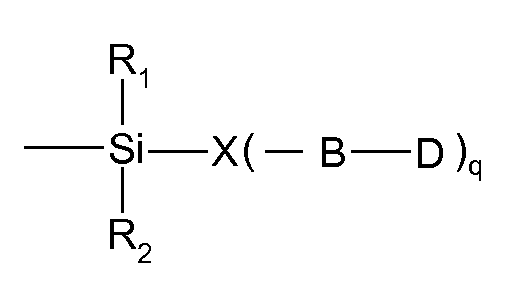
상기 식에서,In this formula,
q는 1 내지 4이고, q is from 1 to 4,
R1 및 R2는 서로 독립적으로 수소, 코어 표면-O-, 또는 치환기이고,R < 1 > and R < 2 > are each independently hydrogen, a core surface -O-,
X는 알킬렌, 예컨대 분지형 또는 바람직하게는 직쇄의 바람직하게는 1 내지 20개의 탄소 원자를 갖는 알킬렌, 바람직하게는 -(CH2)y-이고, 여기서 y는 1 내지 8이고,X is alkylene, such as branched or preferably straight-chain, preferably alkylene having 1 to 20 carbon atoms, preferably - (CH 2 ) y -, wherein y is 1 to 8,
B는 직접 결합 또는 D로 연장되는 브릿지 원이고, B is a direct bond or a bridge circle extending to D,
D는 염료의 잔기, 예컨대 특히 유기 발색단을 포함하는 염료이다.D is a dye comprising a residue of a dye, such as, in particular, an organic chromophore.
바람직하게는, D는 염료의 하전된 잔기이다. D가 하전되지 않은 경우, 입자에 공유 결합된 또 다른 하전된 기에 의해 전하가 입자에 도입될 수 있다. 이러한 경우, 예를 들어, 상기 화학식 I에서 D 또는 B-D가 하전된 기에 의해 치환될 수 있다.Preferably, D is a charged residue of the dye. If D is not charged, charge can be introduced into the particle by another charged group covalently attached to the particle. In this case, for example, D or B-D in the above formula (I) may be substituted by a charged group.
-Si(R1, R2)-X-B- 잔기 [하기 화학식 (72) 내지 (76) 참조]을 이미 함유하는 일부 염기가 있다. 이러한 경우 D는 또 다른 -Si(R1, R2)-X-B- 잔기를 도입할 필요없이 무기 코어에 직접 연결될 수 있다.There are some bases which already contain a -Si (R 1 , R 2 ) -XB- residue (see formulas (72) to (76) below). In this case, D can be directly linked to the inorganic core without the need to introduce another -Si (R 1 , R 2 ) -XB- moiety.
입자는 염료의 혼합물을 포함할 수 있다. 흑색 염료 혼합물의 경우를 제외하고, 통상 입자당 한 종류의 염료가 바람직하다.The particles may comprise a mixture of dyes. Except for the case of the black dye mixture, one kind of dye per particle is usually preferred.
입자는 화학식 I의 기 이외에 코어 표면에 부착된 추가의 기를 포함하여, 예를 들어 입자의 분산성을 향상시키고, 분산액을 안정화시키고, 염료를 안정화시키는 등을 할 수 있다.The particles may contain additional groups attached to the core surface in addition to the group of formula I, for example, to improve the dispersibility of the particles, stabilize the dispersion, stabilize the dye, and the like.
탄소 원자에 직접 결합되어 있는 규소 원자를 포함하는 반대 이온 이외에, 입자는 비-공유 결합된 반대 이온을 포함할 수 있다.In addition to the counterion comprising a silicon atom directly bonded to a carbon atom, the particle may comprise a non-covalently bonded counterion.
q는 특히 1 또는 2, 바람직하게는 1이다. 알킬렌 잔기 X가 2개 이상의 탄소 원자를 함유할 경우 q는 또한 3 또는 4를 나타낼 수 있다. q is especially 1 or 2, preferably 1. Q may also represent 3 or 4 when the alkylene moiety X contains two or more carbon atoms.
R1 및 R2는, 예를 들어 서로 독립적으로 수소; C5-C12-시클로알킬; -O- 또는 -S-가 개재될 수 있고/있거나 할로겐, 예컨대, 바람직하게는 플루오린에 의해 치환될 수 있는 C1-C25알킬; C2-C24알케닐; 페닐; C7-C9페닐알킬; -OR5; 
R5는 수소; -O- 또는 -S-가 개재될 수 있는 C1-C25알킬; C2-C24알케닐; 페닐; C7-C9페닐알킬; 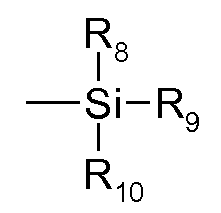
R6 및 R7은 서로 독립적으로 수소; C5-C12-시클로알킬; -O- 또는 -S-가 개재될 수 있고/있거나 할로겐, 예컨대, 바람직하게는 플루오린에 의해 치환될 수 있는 C1-C25알킬; C2-C24알케닐; 페닐; C7-C9페닐알킬; 또는 -OR5이고,R 6 and R 7 are independently of each other hydrogen; C 5 -C 12 -cycloalkyl; C 1 -C 25 alkyl, which may be interrupted by -O- or -S- and / or which may be substituted by halogen, such as preferably fluorine; C 2 -C 24 alkenyl; Phenyl; C 7 -C 9 phenylalkyl; Or -OR < 5 &
R8, R9 및 R10은 서로 독립적으로 수소; -O- 또는 -S-가 개재될 수 있는C1-C25알킬; C2-C24알케닐; 페닐; 또는 C7-C9페닐알킬이다.R 8 , R 9 And R < 10 > are independently from each other hydrogen; C 1 -C 25 alkyl, which may be interrupted by -O- or -S-; C 2 -C 24 alkenyl; Phenyl; Or C 7 -C 9 phenylalkyl.
C5-C12-시클로알킬은 치환되지 않거나 C1-C7알킬에 의해 치환될 수 있고, 예를 들어 시클로펜틸, 1-메틸-시클로펜틸, 시클로헥실, 1-메틸-시클로헥실, 2-메틸-시클로헥실, 3-메틸-시클로헥실, 시클로헵틸, 시클로옥틸, 또는 시클로도데실이다.C 5 -C 12 -cycloalkyl may be unsubstituted or substituted by C 1 -C 7 alkyl and include, for example, cyclopentyl, 1-methyl-cyclopentyl, cyclohexyl, 1-methyl- Methyl-cyclohexyl, 3-methyl-cyclohexyl, cycloheptyl, cyclooctyl, or cyclododecyl.
C1-C25알킬로서의 R1, R2, R5, R6, R7, R8, R9 및 R10은 분지형 또는 비분지형 라디칼일 수 있고, 예를 들어 메틸, 에틸, 프로필, 이소프로필, n-부틸, sec-부틸, 이소부틸, tert-부틸, 2-에틸부틸, n-펜틸, 이소펜틸, 1-메틸펜틸, 1,3-디메틸부틸, n-헥실, 1-메틸헥실, n-헵틸, 이소헵틸, 1,1,3,3-테트라메틸부틸, 1-메틸헵틸, 3-메틸헵틸, n-옥틸, 2-에틸헥실, 1,1,3-트리메틸헥실, 1,1,3,3-테트라메틸펜틸, 노닐, 데실, 운데실, 1-메틸운데실, 도데실, 1,1,3,3,5,5-헥사메틸헥실, 트리데실, 테트라데실, 펜타데실, 헥사데실, 헵타데실, 옥타데실, 이코실 또는 도코실이다. 알킬 라디칼은 개재가 없거나 -O- 또는 -S-가 개재될 수 있다. 알킬 라디칼, 예컨대 -O- 또는 -S-가 개재된 C2-C25알킬, 특히 C3-C25알킬은, 예를 들어 CH3-O-CH2CH2-, CH3-S-CH2CH2-, CH3-O-CH2CH2-O-CH2CH2-, CH3-O-CH2CH2-O-CH2CH2-, CH3-(O-CH2CH2-)2O-CH2CH2-, CH3-(O-CH2CH2-)3O-CH2CH2- 또는 CH3-(O-CH2CH2-)4O-CH2CH2-이다.R 1 , R 2 , R 5 , R 6 , R 7 , R 8 , R 9 and R 10 as C 1 -C 25 alkyl can be branched or unbranched radicals and include, for example, methyl, ethyl, N-propyl, isopropyl, n-butyl, sec-butyl, isobutyl, tert-butyl, , n-heptyl, isoheptyl, 1,1,3,3-tetramethylbutyl, 1-methylheptyl, 3-methylheptyl, n-octyl, Tetramethylpentyl, nonyl, decyl, undecyl, 1-methyl undecyl, dodecyl, 1,1,3,3,5,5-hexamethylhexyl, tridecyl, tetradecyl, pentadecyl , Hexadecyl, heptadecyl, octadecyl, eicosyl or docosyl. The alkyl radical may be interrupted or interrupted by -O- or -S-. Alkyl radicals such as -O- or -S- is interposed C 2 -C 25 alkyl, especially C 3 -C 25 alkyl is, for example, CH 3 -O-CH 2 CH 2 -, CH 3 -S-CH 2 CH 2 -, CH 3 -O -CH 2 CH 2 -O-CH 2 CH 2 -, CH 3 -O-CH 2 CH 2 -O-CH 2 CH 2 -, CH 3 - (O-CH 2 CH 2 -) 2 O - CH 2 CH 2 -, CH 3 - (O - CH 2 CH 2 -) 3 O - CH 2 CH 2 - or CH 3 - (O - CH 2 CH 2 -) 4 O - CH 2 CH 2 -.
C1-C12알킬, 특히 C1-C8알킬 (상기 알킬 라디칼에는 개재가 없거나 또는 -O-가 개재될 수 있음)이 바람직하다.C 1 -C 12 alkyl, especially C 1 -C 8 alkyl (wherein said alkyl radical may be interrupted or -O- may intervene) is preferred.
2 내지 24개의 탄소 원자를 갖는 알케닐로서의 R1, R2, R5, R6, R7, R8, R9 및 R10은 분지형 또는 비분지형 라디칼일 수 있고, 예를 들어 비닐, 프로페닐, 2-부테닐, 3-부테닐, 이소부테닐, n-2,4-펜타디에닐, 3-메틸-2-부테닐, n-2-옥테닐, n-2-도데세닐, 이소-도데세닐, 올레일, n-2-옥타데세닐 또는 n-4-옥타데세닐이다. 바람직하게는 3 내지 18개, 특히 3 내지 12개, 예를 들어 3 내지 6개, 특히 3 내지 4개의 탄소 원자를 갖는 알케닐이다.R 1 , R 2 , R 5 , R 6 , R 7 , R 8 , R 9 and R 10 as alkenyl having 2 to 24 carbon atoms can be branched or unbranched radicals and are, for example, vinyl, Propenyl, 2-butenyl, 3-butenyl, isobutenyl, n-2,4-pentadienyl, Dodecenyl, oleyl, n-2-octadecenyl or n-4-octadecenyl. Preferably 3 to 18, in particular 3 to 12, for example 3 to 6, in particular 3 to 4 carbon atoms.
C7-C9페닐알킬로서의 R1, R2, R5, R6, R7, R8, R9 및 R10은, 예를 들어 서로 독립적으로 벤질, α-메틸벤질, α,α-디메틸벤질 또는 2-페닐에틸이다. 바람직하게는 벤질이다.R 1 , R 2 , R 5 , R 6 , R 7 , R 8 , R 9 and R 10 as C 7 -C 9 phenylalkyl are independently for example benzyl, α-methylbenzyl, Dimethylbenzyl or 2-phenylethyl. Preferably benzyl.
R5는 바람직하게는 수소, C1-C4알킬, 또는 입자 표면, 특히 Al2O3 표면, TiO2 표면 또는 SiO2 표면과 같은 입자 표면이다. 매우 바람직한 R5는 SiO2 표면이다.R 5 is preferably hydrogen, C 1 -C 4 alkyl, or a particle surface, especially a particle surface such as an Al 2 O 3 surface, a TiO 2 surface, or a SiO 2 surface. A highly preferred R 5 is a SiO 2 surface.
R6 및 R7은 바람직하게는 서로 독립적으로 -OR5 또는 C1-C4알킬, 특히 메틸이다.R 6 and R 7 are preferably independently of one another -OR 5 or C 1 -C 4 alkyl, especially methyl.
R8, R9 및 R10은 바람직하게는 서로 독립적으로 C1-C4알킬, 특히 메틸이다.R 8 , R 9 and R 10 are preferably independently of each other C 1 -C 4 alkyl, especially methyl.
바람직하게는, R1 및 R2는 -OR5; 
보다 바람직하게는, R1 및 R2는 화학식 -OR5의 라디칼이고, 여기서 R5는 Al2O3 표면, TiO2 표면 또는 SiO2 표면, 특히 SiO2 표면과 같은 코어 표면의 부분이다.More preferably, R 1 and R 2 are radicals of the formula -OR 5 , where R 5 is a portion of the core surface such as an Al 2 O 3 surface, a TiO 2 surface or a SiO 2 surface, especially a SiO 2 surface.
y는 1 내지 8, 바람직하게는 2, 3 또는 4, 특히 3이다.y is 1 to 8, preferably 2, 3 or 4, especially 3.
브릿지 원 B는 염료 D를 알킬렌 잔기 X에 공유 연결시킬 수 있는 화학 브릿지이면 어느 종류이나 가능하다.Bridge circle B can be any chemical bridge that allows dye D to be covalently linked to the alkylene residue X.
B는 예를 들어, 직접 결합, 또는 -NR3-, -O-, -S-, -NR3-C1-C25알킬렌-NR3-, -NR3-SO2-, -NR3-CO-, -OC(O)-, -OC(O)O-, -OC(O)NR3-, 및 C1-C25알킬렌으로부터 선택된 브릿지 원이고, 여기서 알킬렌은 -O-, -S-, -N(R3)-, -N+(R3)2-, -CO-, -O-CO-, -CO-O-, -N(R3)-CO-, -CO-N(R3)- 및 페닐렌으로 이루어진 군으로부터 선택된 하나 이상의 라디칼에 의해 결합될 수 있고/있거나 그가 개재될 수 있고, 여기서 R3는 수소 또는 치환되지 않거나 치환된 C1-C12알킬, 예를 들어 히드록시에 의해 치환된 C1-C12알킬, 예컨대 2-히드록시-에틸이다. C1-C25알킬렌 라디칼은 치환되지 않거나, 예를 들어 양이온성 또는 음이온성 기, 예컨대 -N+(R3)3, -SO3 - 또는 -COO-에 의하거나 또는 히드록시에 의해, 바람직하게는 히드록시에 의해 치환될 수 있다. 상기에서 언급한 페닐렌 라디칼은 치환되지 않거나, 예를 들어 히드록실, 할로겐, 카르복시, 술포네이토, 아미노, 아세틸아미노 또는 모노- 또는 디(C1-C8알킬)아미노에 의해 치환될 수 있다. 알킬 라디칼로서의 R3는 앞서 언급한 히드록시 또는 양이온성 또는 음이온성 기, 특히 양이온성 암모늄 기 또는 음이온성 카르복시, 술페이토 또는 술포네이토 기에 의해 치환될 수 있다. 하나 초과의 R3 기가 브릿지 원 B에 존재할 경우 R3 기는 서로 동일하거나 상이할 수 있다. 바람직하게는, R3는 수소 또는 C1-C12알킬, 특히 수소 또는 C1-C4알킬이다. 매우 바람직한 R3는 수소이다.B is, for example, a direct bond, or -NR 3 -, -O-, -S-, -NR 3 -C 1 -C 25 alkylene group -NR 3 -, -NR 3 -SO 2 -, -NR 3 -O-, -OC (O) -, -OC (O) O-, -OC (O) NR 3 -, and C 1 -C 25 alkylene, -S-, -N (R 3) - , -N + (R 3) 2 -, -CO-, -O-CO-, -CO-O-, -N (R 3) -CO-, -CO -N (R 3) - and the phenyl can be joined by one or more radicals selected from the group consisting of alkylene, and / or he may be interposed, in which R 3 is unsubstituted or substituted with hydrogen or substituted C 1 -C 12 alkyl, For example C 1 -C 12 alkyl substituted by hydroxy, such as 2-hydroxy-ethyl. C 1 -C 25 alkylene radical is optionally substituted with, for example, cationic or anionic groups, for example -N + (R 3) 3, -SO 3 - or by a hydroxy, - or -COO Preferably by hydroxy. The above-mentioned phenylene radicals may be unsubstituted or substituted by, for example, hydroxyl, halogen, carboxy, sulfonato, amino, acetylamino or mono- or di (C 1 -C 8 alkyl) amino . R 3 as an alkyl radical may be substituted by the aforementioned hydroxy or a cationic or anionic group, especially a cationic ammonium group or an anionic carboxy, sulfato or sulfonato group. More than one R < 3 & When the group is present in the bridge circle B, R < 3 > The groups may be the same or different. Preferably, R 3 is hydrogen or C 1 -C 12 alkyl, especially hydrogen or C 1 -C 4 alkyl. Very preferred R < 3 > is hydrogen.
바람직하게는, B는 직접 결합, 또는 화학식 -A1-C1-C25알킬렌-A2-, -A1-C1-C25알킬렌-페닐렌-A2- 또는 -A1-페닐렌-C1-C25알킬렌-A2-의 브릿지 원이고, 여기서 C1-C25알킬렌은 개재가 없거나 상기에서 제시한 바와 같은 개재가 있고, A1 및 A2는 직접 결합, 또는 상기에서 제시한 바와 같은 라디칼이다. 바람직한 A1 및 A2는 직접결합, -O-, -S-, -N(R3)-, -CO-, -O-CO-, -CO-O-, -N(R3)-CO-, -CO-N(R3)-, 특히 -N(R3)-, -O- 또는 -S-이고, 여기서 R3는 상기에서 정의한 바와 같다. 매우 바람직한 A1 및 A2는 직접 결합 또는 -N(R3)-, 특히 직접 결합 또는 -NH-이다. C1-C25알킬렌에 대해서, 개재가 없거나 -O-, -N(R3)-, -N+(R3)2-, -CO-, -CO-O-, -CO-N(R3)- 및 페닐렌, 특히 -O-, -NH-, -CO-O-, -CO-NH- 및 페닐렌, 및 보다 바람직하게는 -CO-O-, -CO-NH- 및 페닐렌으로 이루어진 군으로부터 선택된 하나 이상의 라디칼이 개재되는 것이 바람직하다. C1-C25알킬렌 및 페닐렌은 상기에서 제시한 바와 같이 치환될 수 있거나, 바람직하게는 치환되지 않을 수 있다. 일반적으로, C1-C25알킬렌라디칼로는 C2-C25알킬렌, 특히 C1-C16-알킬렌 또는 C2-C16알킬렌, 더 특히 C1-C7-알킬렌 또는 C2-C7알킬렌이 바람직하다.Preferably, B is a direct bond or a direct bond or a group of the formula -A 1 -C 1 -C 25 alkylene-A 2 -, -A 1 -C 1 -C 25 alkylene-phenylene-A 2 - or -A 1 - C 1 -C 25 alkylene-A 2 -, wherein C 1 -C 25 alkylene is absent or intervening as provided above, A 1 and A 2 are direct bonds, Or a radical as set forth above. Preferred A 1 and A 2 are a direct bond, -O-, -S-, -N (R 3 ) -, -CO-, -O-CO-, -CO-O-, -N (R 3 ) -CO -, -CO-N (R 3 ) -, in particular -N (R 3 ) -, -O- or -S-, wherein R 3 is as defined above. Highly preferred A 1 and A 2 are a direct bond or -N (R 3 ) -, in particular a direct bond or -NH-. For C 1 -C 25 alkylene, there is no intervening member or is -O-, -N (R 3 ) -, -N + (R 3 ) 2 -, -CO-, -CO-O-, R 3 ) - and phenylene, especially -O-, -NH-, -CO-O-, -CO-NH- and phenylene, and more preferably -CO-O-, -CO- It is preferable that at least one radical selected from the group consisting of hydrogen is interposed. C 1 -C 25 alkylene and phenylene may be substituted or preferably unsubstituted as indicated above. In general, C 1 -C 25 alkylene radicals are C 2 -C 25 alkylenes, especially C 1 -C 16 -alkylene or C 2 -C 16 alkylenes, more particularly C 1 -C 7 -alkylene or C 2 -C 7 alkylene is preferred.
보다 바람직하게는, B는 직접 결합, 또는 화학식 -A1-C1-C25알킬렌-A2-, -A1-C1-C25알킬렌-페닐렌-A2- 또는 -A1-페닐렌-C1-C25알킬렌-A2-의 브릿지 원이고, 여기서 A1 및 A2는 직접 결합, -O-, -S-, -N(R3)-, -CO-, -O-CO-, -CO-O-, -N(R3)-CO- 또는 -CO-N(R3)-이고, C1-C25알킬렌 라디칼은 개재가 없거나 -O-, -S-, -N(R3)-, -N+(R3)2-, -CO-, -O-CO-, -CO-O-, -N(R3)-CO-, -CO-N(R3)- 및 페닐렌으로 이루어진 군으로부터 선택된 하나 이상의 라디칼이 개재되고, 여기서 R3는 상기에서 정의한 바와 같다.More preferably, B is a direct bond, or the formula -A 1 -C 1 -C 25 alkylene -A 2 -, -A 1 -C 1 -C 25 alkylene-phenylene -A 2 - or -A 1 -Phenylene-C 1 -C 25 alkylene-A 2 - wherein A 1 and A 2 are direct bonds, -O-, -S-, -N (R 3 ) -, -CO-, -CO-O-, -N (R 3 ) -CO- or -CO-N (R 3 ) - and the C 1 -C 25 alkylene radical is not interrupted or is replaced by -O-, S-, -N (R 3) - , -N + (R 3) 2 -, -CO-, -O-CO-, -CO-O-, -N (R 3) -CO-, -CO- N (R < 3 >) - and phenylene are interrupted, wherein R < 3 > is as defined above.
중요하게는, B는 직접 결합, 또는 화학식 -A1-C1-C25알킬렌-A2-, -A1-C1-C25알킬렌-페닐렌-A2- 또는 -A1-페닐렌-C1-C25알킬렌-A2-의 브릿지 원이고, 여기서 A1 및 A2는 직접 결합, -N(R3)-, -O- 또는 -S-이고, 여기서 R3는 상기에서 정의한 바와 같고, C1-C25알킬렌 라디칼은 개재가 없거나 -O-, -S-, -NH-, -CO-, -O-CO-, -CO-O-, -NH-CO-, -CO-NH- 및 페닐렌으로 이루어진 군으로부터 선택된 하나 이상의 라디칼이 개재된다. Importantly, B is a direct bond or a direct bond or a group of the formula -A 1 -C 1 -C 25 alkylene-A 2 -, -A 1 -C 1 -C 25 alkylene-phenylene-A 2 - or -A 1 - and the source of the bridge, in which a 1 and a 2 is a direct bond, -N (R 3) - - phenylene -C 1 -C 25 alkylene, and 2 -A, -O- or -S-, wherein R 3 is C 1 -C 25 alkylene radical is unsubstituted or is optionally substituted with one or more substituents selected from the group consisting of -O-, -S-, -NH-, -CO-, -O-CO-, -CO-O-, -NH-CO -, -CO-NH- and phenylene are intervened.
매우 중요하게는, B는 직접 결합, 또는 화학식 -NH-C1-C25알킬렌-A2- 또는 -NH-C1-C25알킬렌-페닐렌-A2-의 브릿지 원이고, 여기서 A2는 직접 결합 또는 -NH-이고, C1-C25알킬렌 라디칼은 개재가 없거나 -CO-O-, -CO-NH- 및 페닐렌으로 이루어진 군으로부터 선택된 하나 이상의 라디칼이 개재된다. C1-C25알킬렌 및 페닐렌은 상기에서 제시한 바와 같이 치환될 수 있거나, 바람직하게는 치환되지 않을 수 있다.Very importantly, B is a direct bond or a bridge member of the formula -NH-C 1 -C 25 alkylene-A 2 - or -NH-C 1 -C 25 alkylene-phenylene-A 2 - A 2 is a direct bond or -NH-, and the C 1 -C 25 alkylene radical is interrupted, or at least one radical selected from the group consisting of -CO-O-, -CO-NH- and phenylene is interposed. C 1 -C 25 alkylene and phenylene may be substituted or preferably unsubstituted as indicated above.
가장 중요하게는, B는 직접 결합, 또는 -NR3-, -O-, -S-, -NR3-C1-C25알킬렌-NR3-, -NR3-SO2-, -NR3-CO-, -OC(O)- 및 -OC(O)NR3-로부터 선택된 브릿지 원이다. Most importantly, B is a direct bond or a bond, -NR 3 -, -O-, -S-, -NR 3 -C 1 -C 25 alkylene-NR 3 -, -NR 3 -SO 2 - 3 -CO-, -OC (O) - and -OC (O) NR 3 -.
사용된 브릿지 원의 종류에 의존하여, 화학식 Ia에 나타낸 바와 같이 하나 초과의 염료 D가 브릿지 원 B에 공유 연결될 수도 있고, 여기서 z는 1 내지 4이고 다른 기호들은 상기 및 하기에서 정의한 바와 같다.Depending on the type of bridge source used, more than one dye D may be covalently linked to bridge circle B as shown in formula Ia, wherein z is from 1 to 4 and the other symbols are as defined above and below.
<화학식 Ia><Formula Ia>
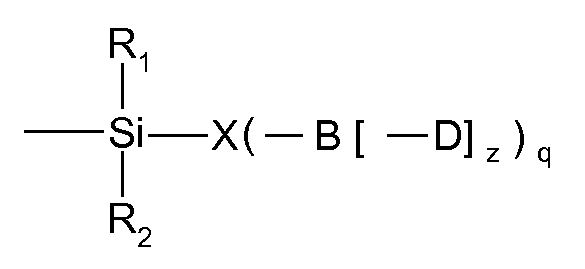
예를 들어 B가 -NR3-를 나타내고 R3가 2-히드록시-에틸을 나타낼 경우 또 다른 염료 분자가 히드록시 기를 통해 연결될 수 있다.For example, when B represents -NR 3 - and R 3 represents 2-hydroxy-ethyl, another dye molecule may be linked via a hydroxy group.
D는 바람직하게는 음이온성 및/또는 양이온성 기, 예컨대 보레이트, 술페이트, 포스포네이트, 포스페이트, -CSS-, CSO- 및 특히 4급 암모늄 또는 포스포늄, SO3 - 또는 COO-를 함유하는 염료의 라디칼이고, 이는 입자의 전체 전하에 기여한다. 염료는 파장이 200 내지 1500 nm, 특히 400 내지 800 nm인 전자파방사선을 흡수하는 발색단을 함유한다.D is preferably an anionic and / or cationic group such as a borate, sulfate, phosphonate, phosphate, -CSS-, CSO- And especially a quaternary ammonium or a radical of a dye containing phosphonium, SO 3 - or COO - , which contributes to the total charge of the particles. The dye contains a chromophore which absorbs electromagnetic radiation having a wavelength of 200 to 1500 nm, in particular 400 to 800 nm.
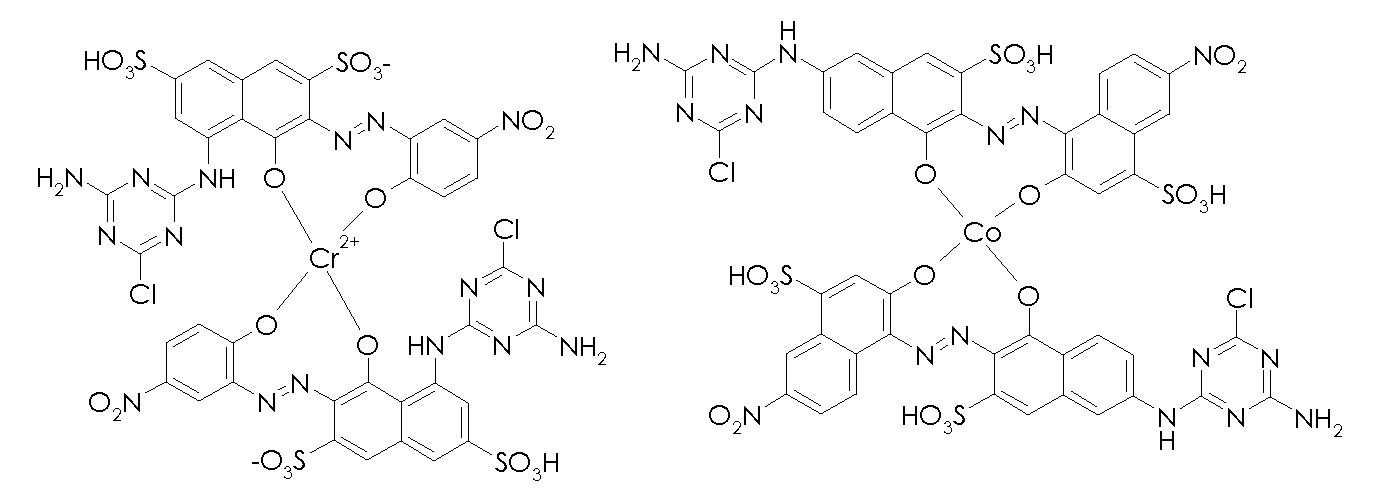
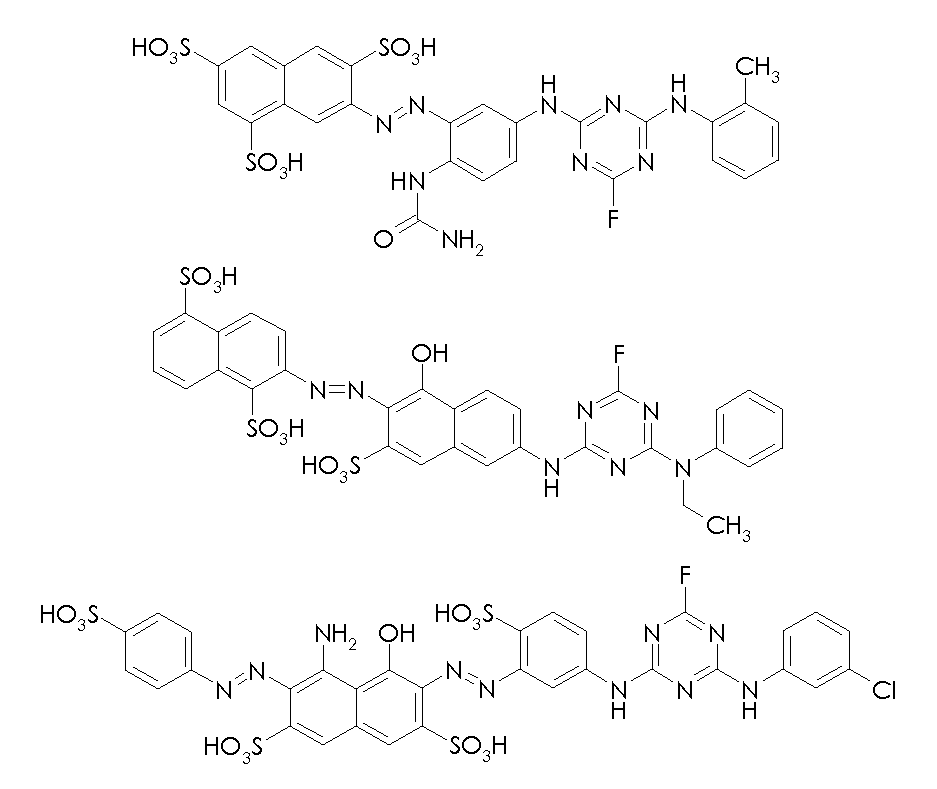
D는 바람직하게는 아크리딘, 안트라퀴논, 아조메틴, 모노아조, 디스아조, 폴리아조, 벤조디푸라논, 쿠마린, 디케토피롤로피롤, 디옥사진, 디페닐메탄, 포르마잔, 인디고이드, 메틴, 폴리메틴, 나프탈이미드, 나프토퀴논, 니트로아릴, 옥사진, 페리논, 페릴렌, 페나진, 프탈로시아닌, 피렌퀴논, 퀴나크리돈, 퀴논이민, 퀴노프탈론, 스틸벤, 스티릴, 티아진, 티오크산텐, 트리아릴메탄, 크산텐 또는 금속 착체 염료의 라디칼이고, 보다 바람직하게는 모노아조, 디스아조, 폴리아조, 안트라퀴논, 프탈로시아닌, 포르마잔, 디옥사진 또는 금속 착체 염료의 라디칼, 및 예컨대 본원에 참조로 포함된 WO 2007/048721 A1에 기재된 것들이다.D is preferably selected from the group consisting of acridine, anthraquinone, azomethine, monoazo, disazo, polyazo, benzodifuranone, coumarin, diketopyrrolopyrrole, dioxazine, diphenylmethane, formazan, indigoid, , Polymethine, naphthalimide, naphthoquinone, nitroaryl, oxazine, perinone, perylene, phenazine, phthalocyanine, pyrenequinone, quinacridone, quinoneimine, quinophthalone, stilbene, A radical of a thioxanthone, thiazine, thioxanthene, triarylmethane, xanthene or metal complex dyes, more preferably a radical of a monoazo, disazo, polyazo, anthraquinone, phthalocyanine, formazan, dioxazine or metal complex dye , And those described, for example, in WO 2007/048721 Al, which is incorporated herein by reference.
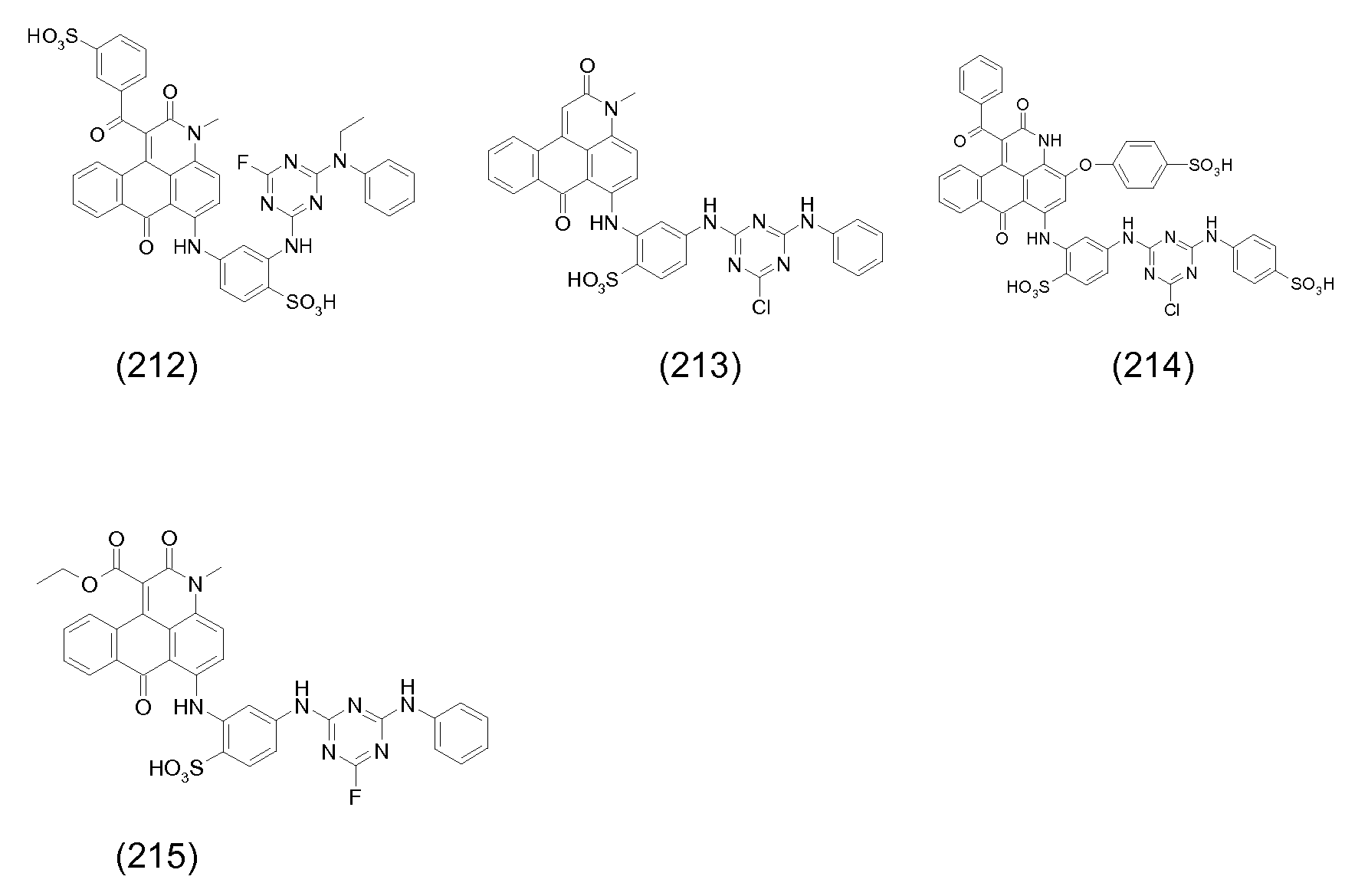
가장 바람직하게는, D는 예를 들어 본원에서 하기에 예시한 바와 같은, 안트라퀴논, 아조메틴, 모노아조, 디스아조, 폴리아조, 벤조디푸라논, 디옥사진, 포르마잔, 프탈로시아닌, 트리아릴메탄, 아조 금속 착체, 폴리메틴, 크산텐, 페나진, 디아자스티릴 또는 안트라피리돈 염료의 라디칼이다. Most preferably, D is, for example, an anthraquinone, azomethine, monoazo, disazo, polyazo, benzodifuranone, dioxazine, formazan, phthalocyanine, triarylmethane , Azo metal complexes, polymethine, xanthene, phenazine, diazastyryl or anthrapyridone dyes.
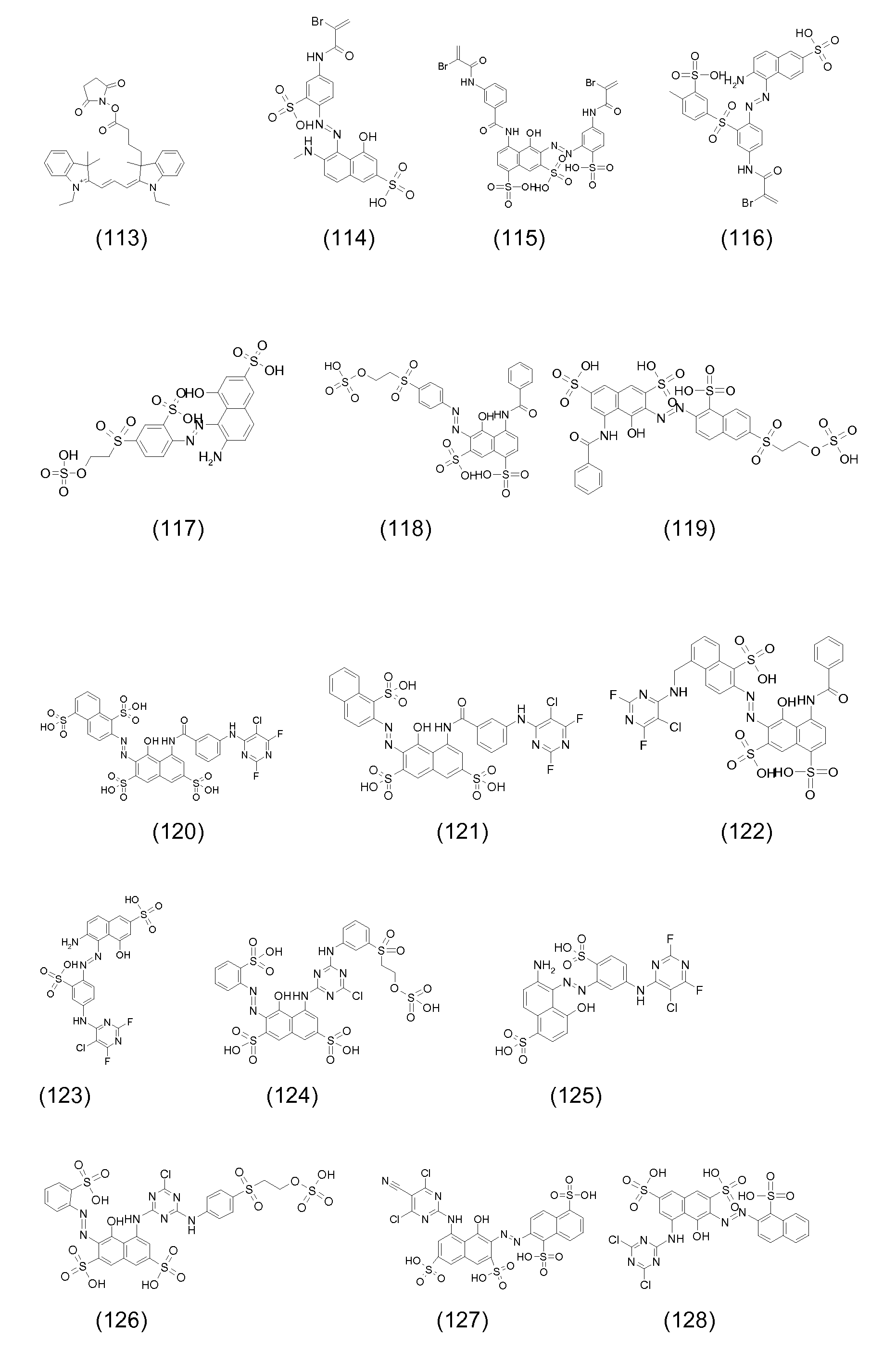
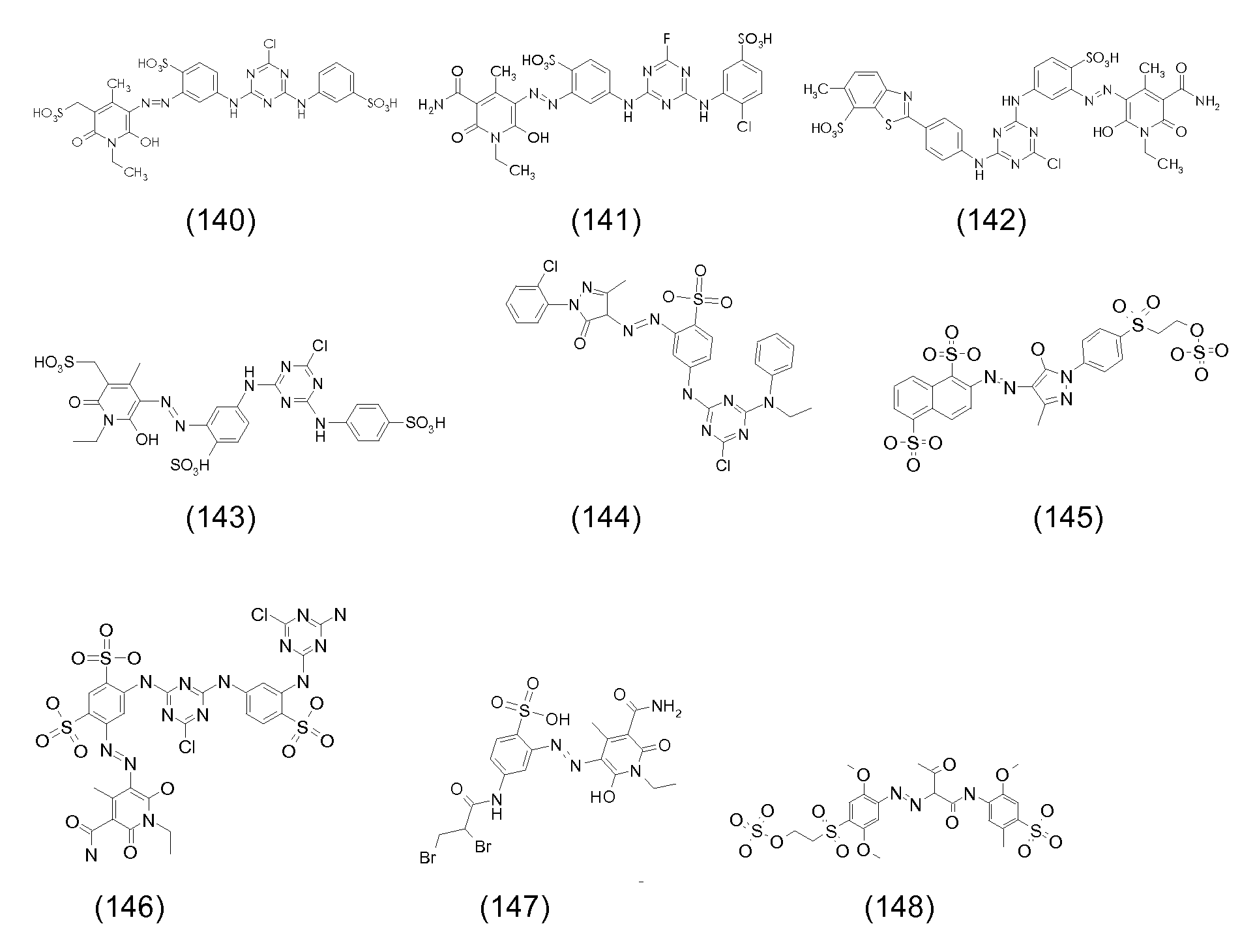
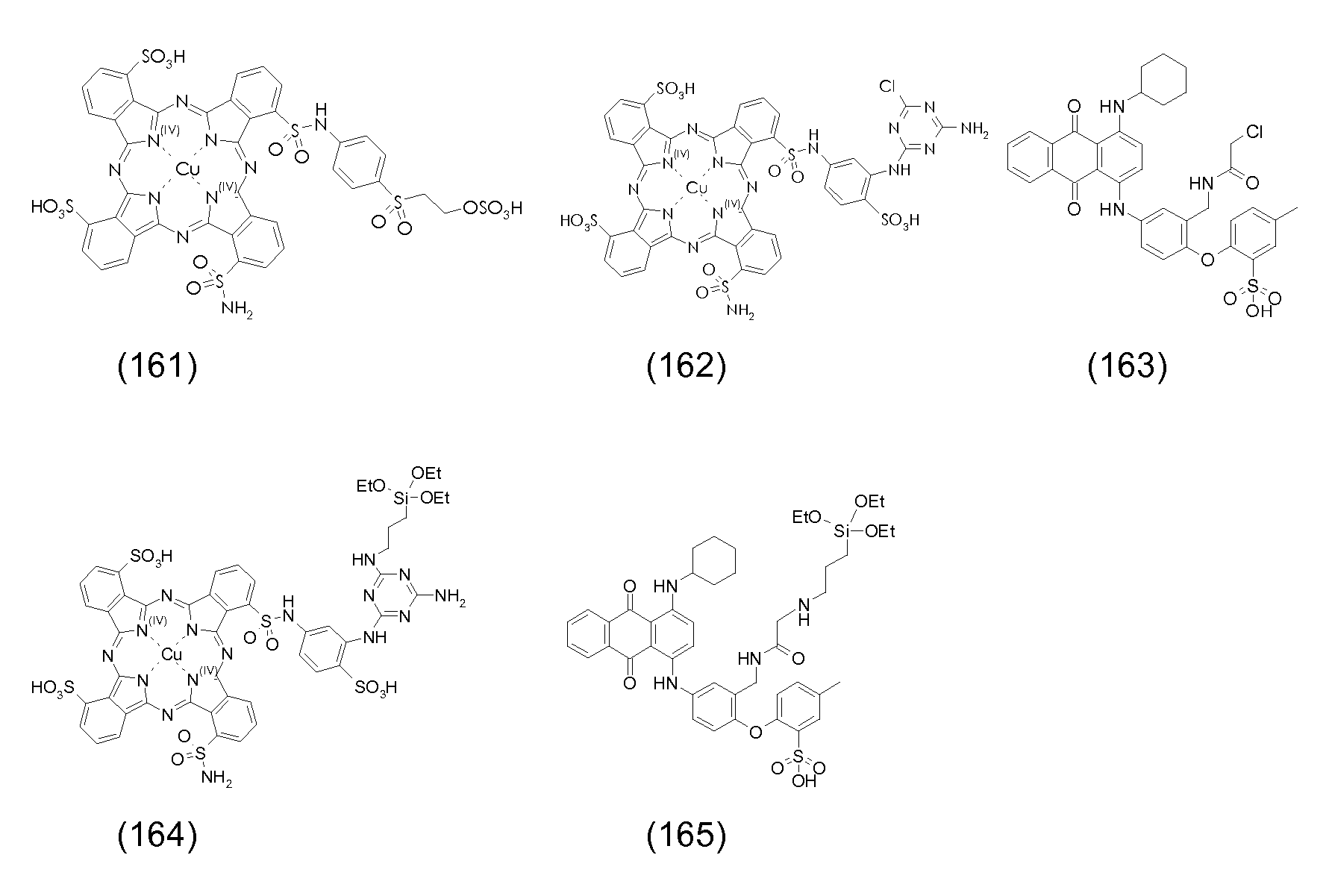
본 발명의 맥락 내에서 사용될 수 있는 선택된 반응성 염료의 예의 화학식을 하기에 도시하였다. 통상적으로, 염료의 화학식은, 염료는 보통은 이들의 염 형태로 사용된다는 사실과 상관없이, 이들의 유리 산 및/또는 염기의 형태로 나타내어 진다. 반응성 염료는 당업자에게 공지된 방식으로, 예를 들어 부가 또는 치환 반응에 의해 이들 염료를 본 발명에 기재된 입자에 연결시키는데 사용될 수 있는 반응성 기를 함유한다. Formulas of examples of selected reactive dyes that can be used in the context of the present invention are shown below. Typically, the formulas of the dyes are expressed in the form of their free acids and / or bases, irrespective of the fact that the dyes are usually used in their salt form. The reactive dyes contain reactive groups that can be used to link these dyes to the particles described in the present invention, for example, by addition or substitution reactions, in a manner known to those skilled in the art.
반응성 녹색 염료의 예는 하기와 같다:Examples of reactive green dyes are:
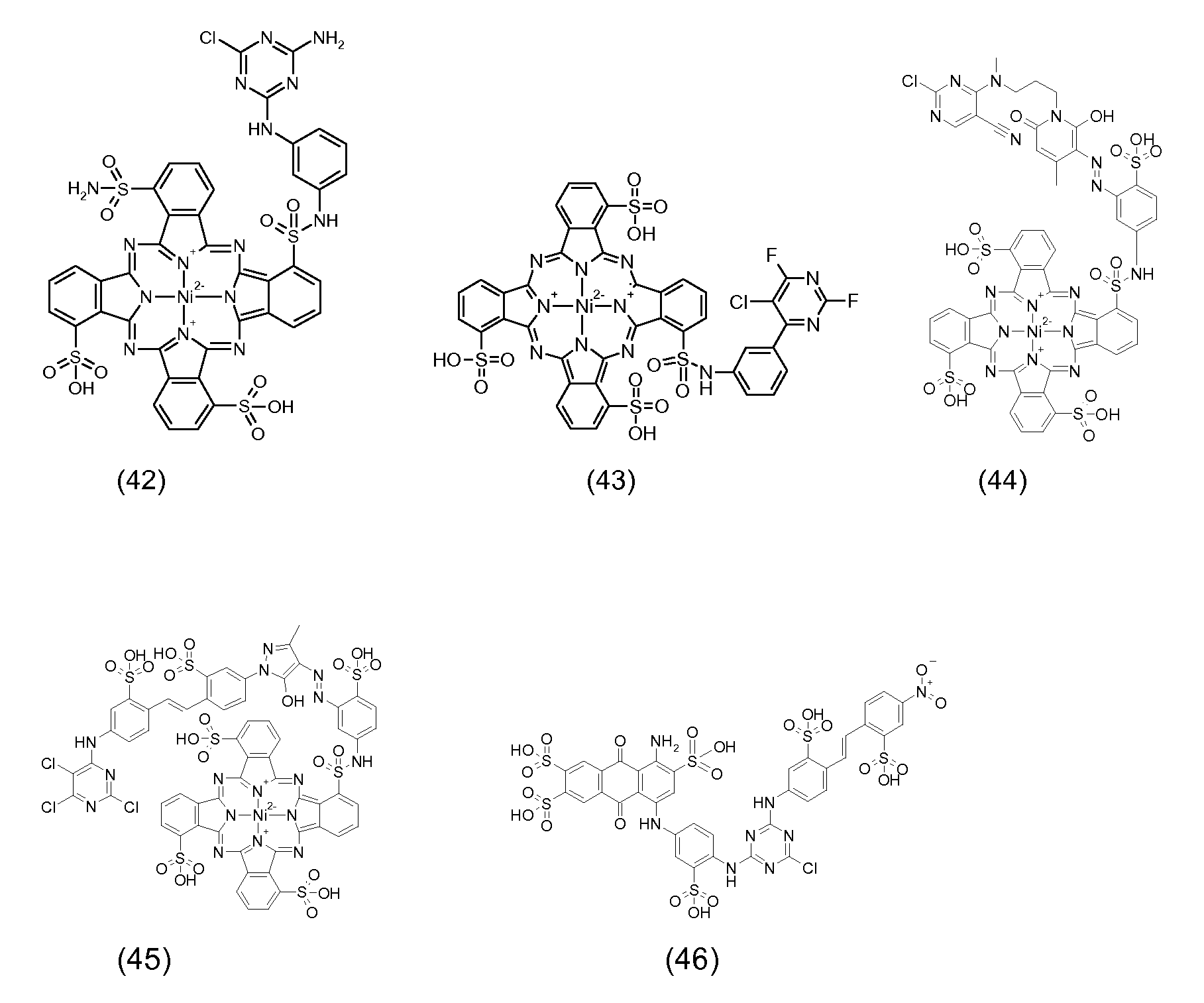
본 발명의 맥락 내에서 사용될 수 있는 반응성 청색 염료의 예는 실시예 5, 단계 5.1에서 그의 나트륨 염 형태로 도시된 화학식 (24)의 청색 염료, 및 하기의 것들이다:Examples of reactive blue dyes that can be used in the context of the present invention are the blue dyes of the formula (24) shown in their sodium salt form in Example 5, step 5.1, and the following:


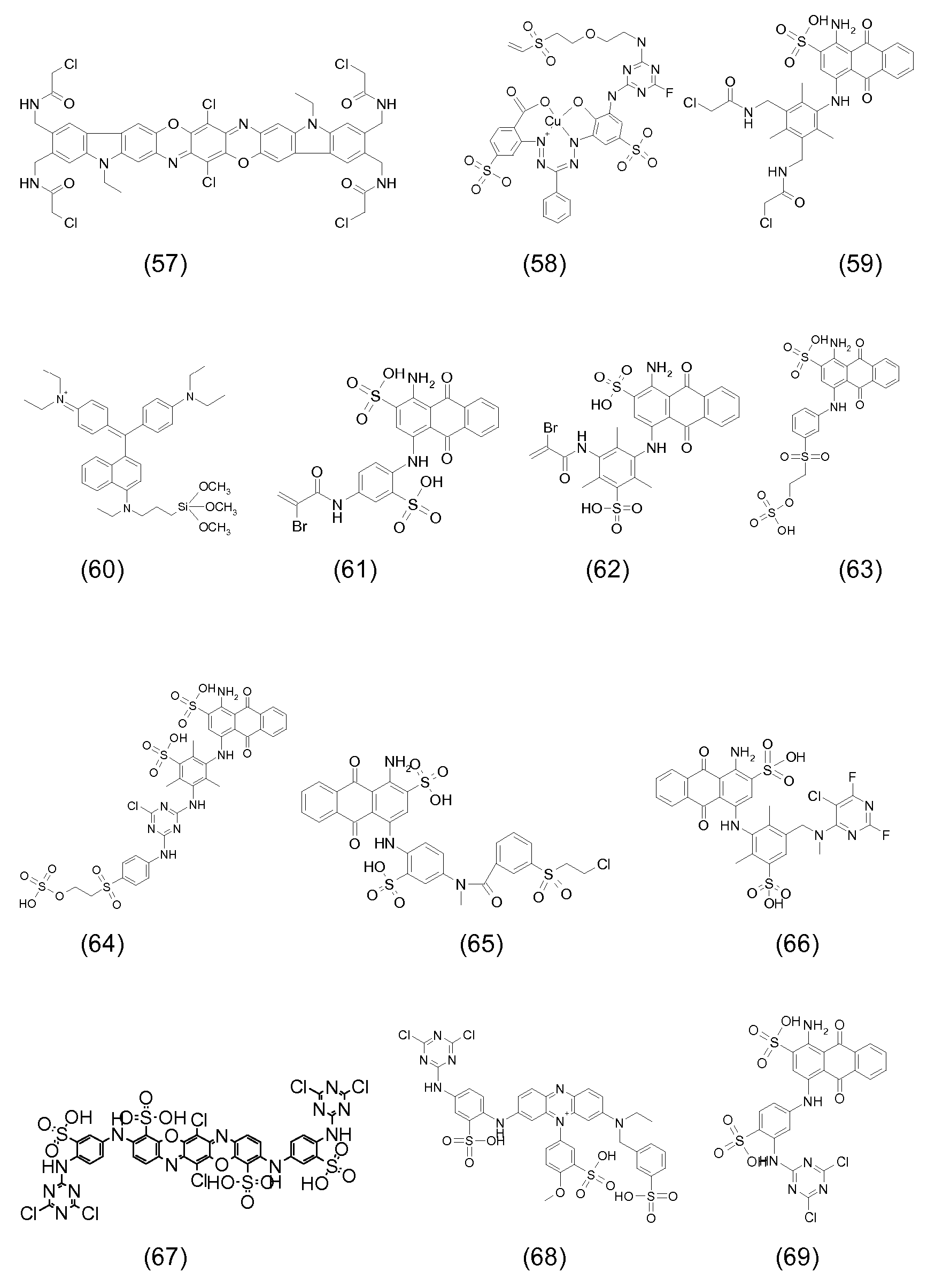

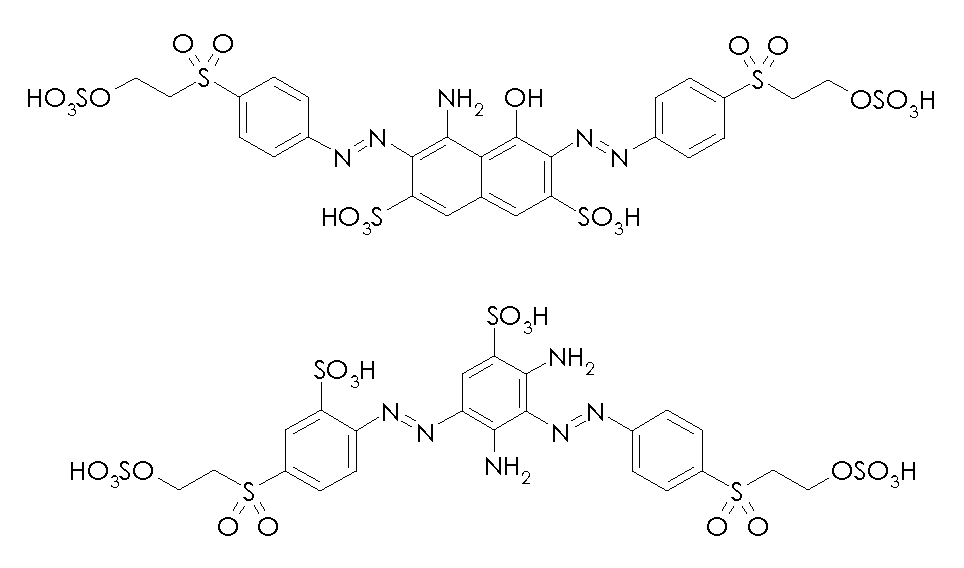
본 발명의 맥락 내에서 사용될 수 있는 반응성 흑색 염료 및 이러한 염료의 혼합물의 예는 하기와 같다:Examples of reactive black dyes that can be used in the context of the present invention and mixtures of such dyes are:
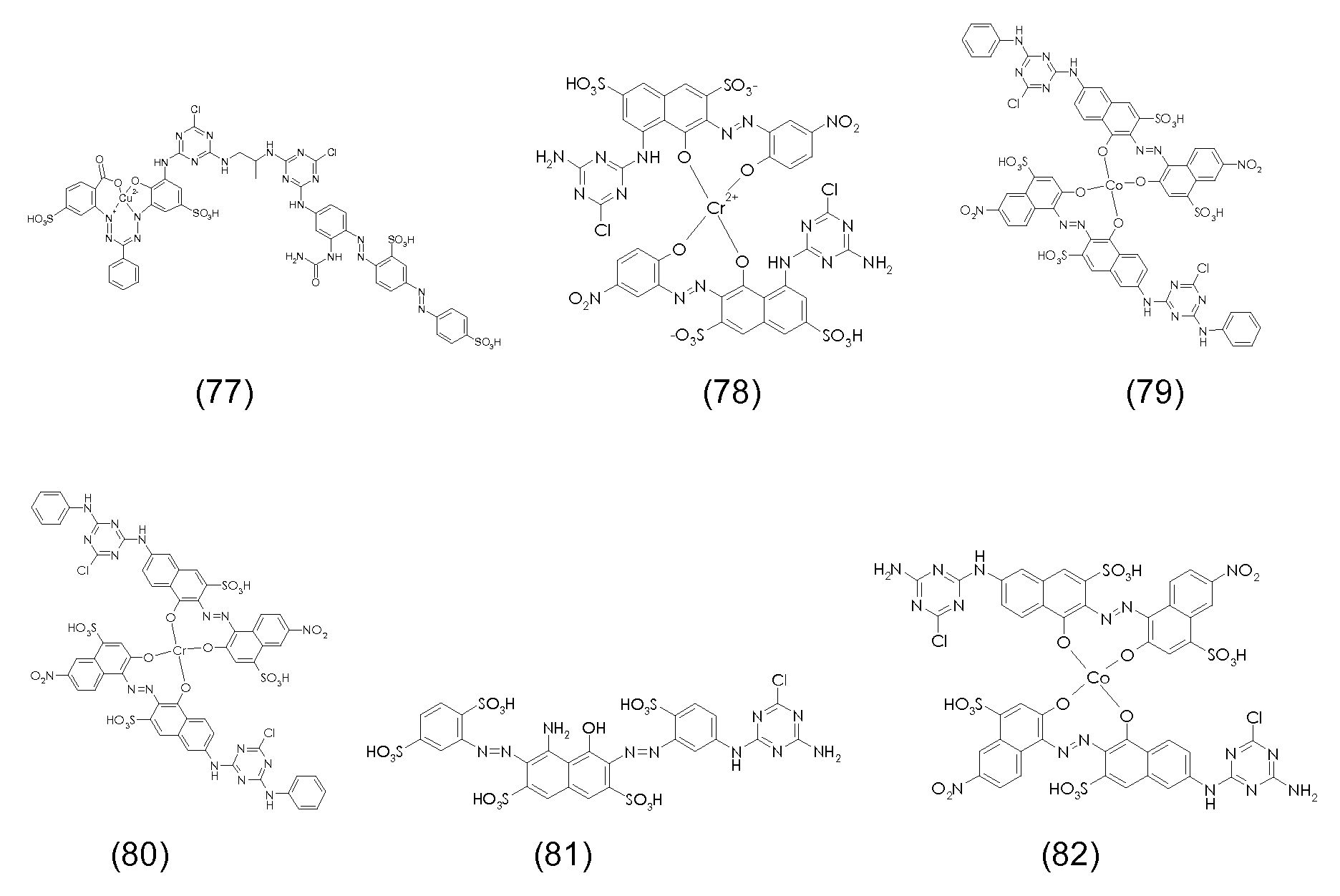
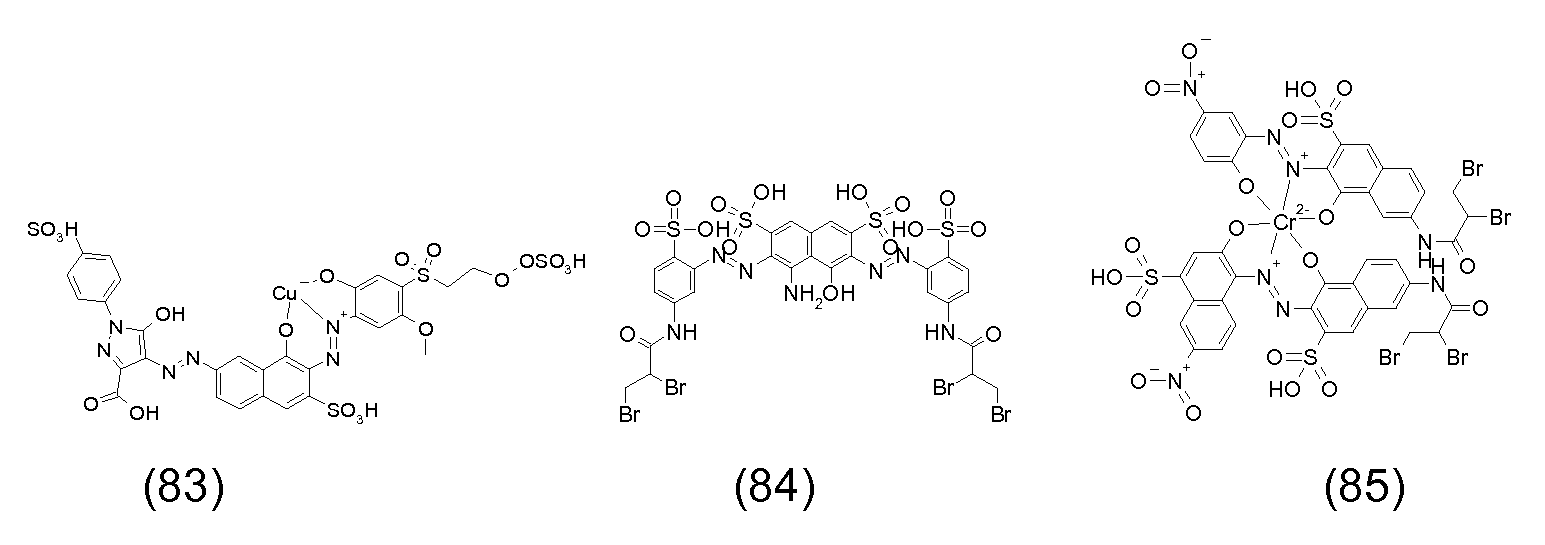
52부의 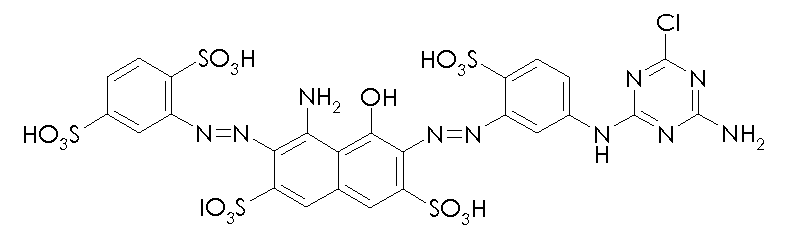
12부의 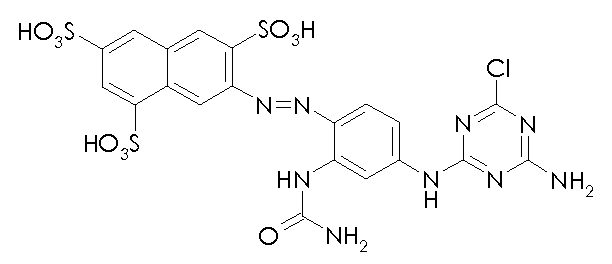
22부의 
를 포함하는 혼합물 (86)Lt; RTI ID = 0.0 > 86 <
를 포함하는 혼합물 (87)(87)
를 포함하는 혼합물 (88)(88)
34부의 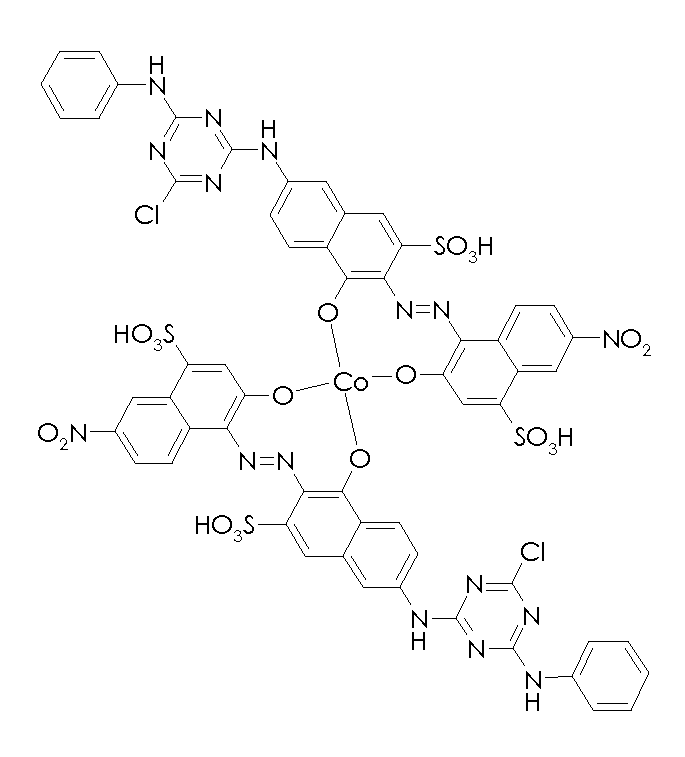

를 포함하는 혼합물 (89)(89)
를 포함하는 혼합물 (209)0.0 > 209 < / RTI >
90부의 
10부의 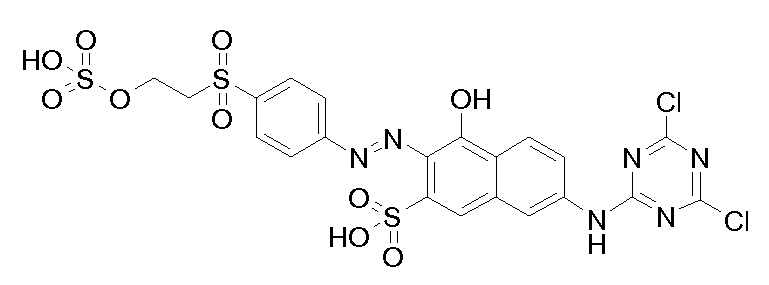
를 포함하는 혼합물 (90)Lt; RTI ID = 0.0 > 90 <
62부의 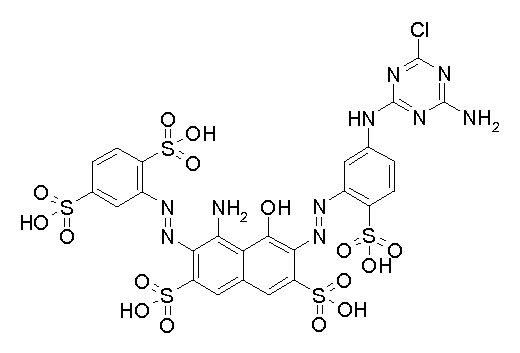
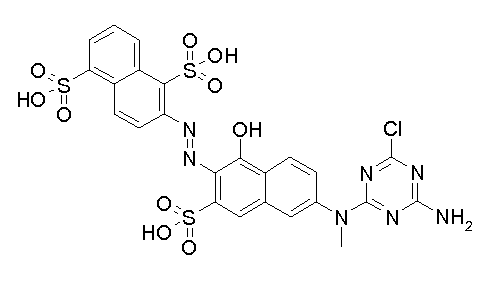
14부의 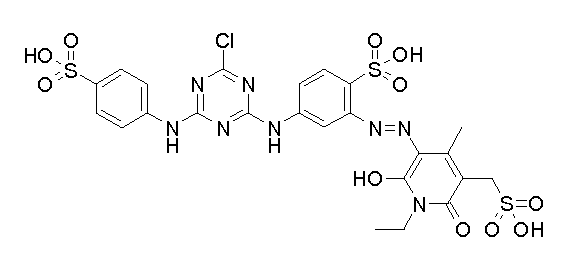
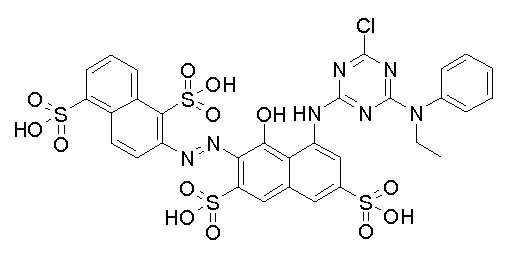
를 포함하는 혼합물 (90a)Lt; RTI ID = 0.0 > (90a) <
본 발명의 맥락 내에서 사용될 수 있는 반응성 적색 또는 마젠타색 염료의 예는 실시예 1, 단계 1.2, 및 실시예 6, 단계 6.4에 각각 도시된 화학식 (4) 및 (32)의 마젠타색 염료, 및 하기의 것들이다:Examples of reactive red or magenta dyes which can be used in the context of the present invention are the magenta dyes of the formulas (4) and (32) shown in Examples 1, 1.2 and 6, These are:
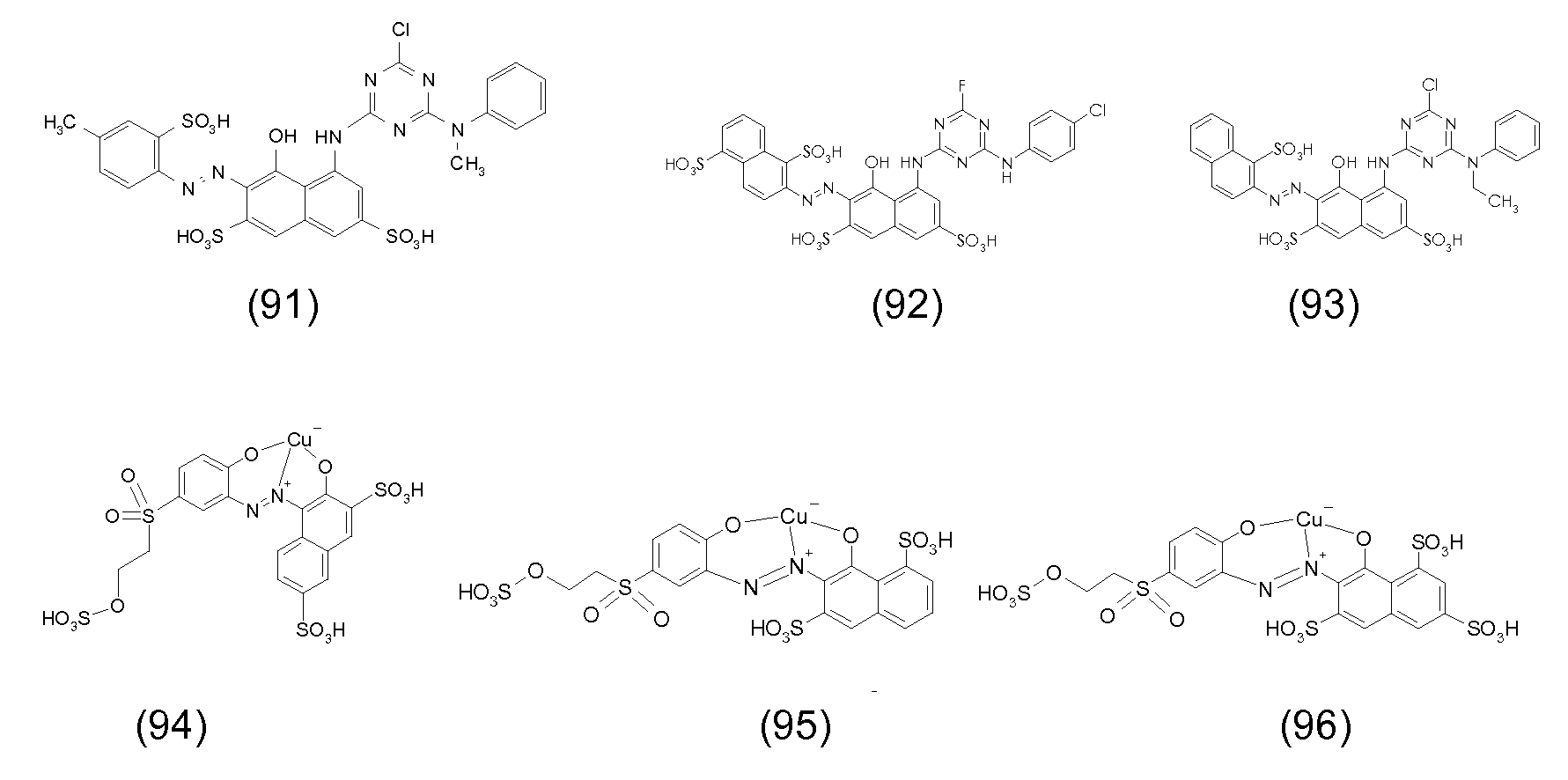
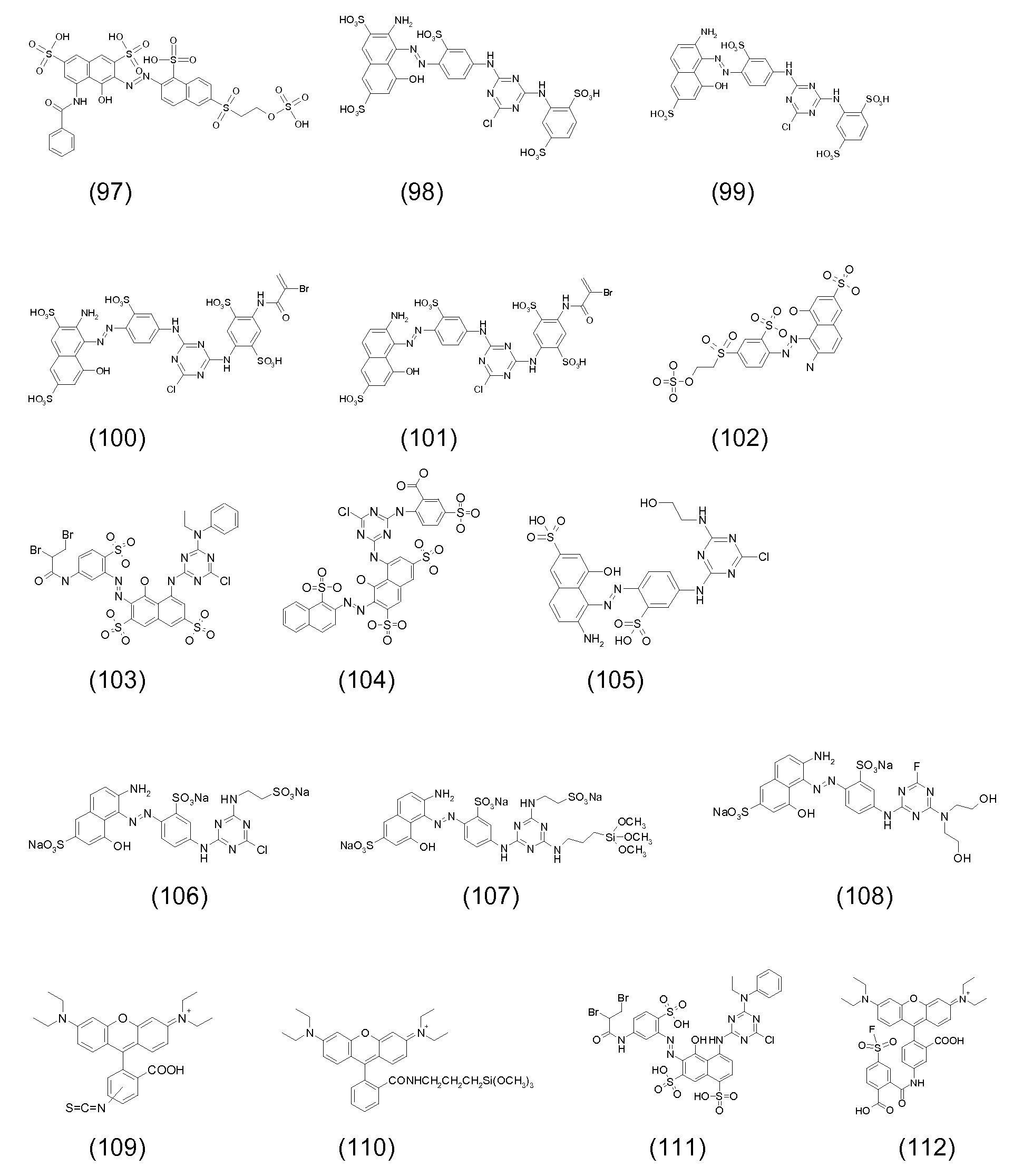

본 발명의 맥락 내에서 사용될 수 있는 반응성 황색 염료의 예는 실시예 2, 단계 2.1에 기재된 화학식 (12)의 화합물, 및 하기의 것들이다: Examples of reactive yellow dyes that can be used in the context of the present invention are compounds of formula (12) as described in example 2, step 2.1, and the following:

본 발명의 맥락 내에서 사용될 수 있는 반응성 시안색 염료의 예는 실시예 2, 단계 2.1에 기재된 화학식 (17)의 화합물, 및 하기의 것이다: Examples of reactive cyan dyes that can be used in the context of the present invention are compounds of formula (17) as described in example 2, step 2.1, and the following:
무기 코어 및 공유 결합된 염료를 포함하는 관능화된 입자는 바람직하게는 녹색, 청색, 시안색, 적색, 마젠타색, 황색 또는 흑색 성분으로서 사용된다.The functionalized particles comprising an inorganic core and a covalently bonded dye are preferably used as green, blue, cyan, red, magenta, yellow or black components.
바람직하게는, 본 발명은 무기 코어를 갖는 부피 5 nm3 내지 5억 nm3의 하전 입자, 및 입자로부터 분리가능하고 입자에 공유 연결되어 있지 않은 반대 이온을 포함하며, 상기 반대 이온은 적합한 브릿지 원을 통해, 양으로 또는 음으로 하전된 관능기에 연결된 (폴리)실록산 잔기를 포함하는 것인 조성물에 관한 것이다.Preferably, the present invention is separated from the volume of 5 nm 3 to 500 million nm 3 having an inorganic core of charged particles, and particles containing a counter ion that is not covalently coupled to the particles, and the counter ion is a suitable bridge circle (Poly) siloxane moieties linked to a positively charged or negatively charged functional group through a polymeric siloxane moiety.
무기 코어 대신에, 관능화된 입자는 하기에 기재된 바와 같이 통상 개질되어 있고 중합체성 안료 또는 중합체성 염료와는 상이한 유기 안료로부터 제조되거나 본질적으로 이러한 유기 안료로 이루어진 코어를 함유할 수 있고/있거나 유기 (공-)중합체, 예컨대 폴리스티렌을 포함하는 유기 (공-)중합체를 함유하지 않는다.Instead of an inorganic core, the functionalized particles may contain a core which is usually modified as described below and which is prepared from an organic pigment which is different from the polymeric pigment or polymeric dye or consists essentially of such an organic pigment and / (Co-) polymers including (co) polymers such as polystyrene.
따라서, 본 발명은 또한 본질적으로 유기 안료 및/또는 유기 안료 유도체로 이루어진 코어를 갖는 부피 5 nm3 내지 5억 nm3의 하전 입자, 및 입자로부터 분리가능하고 입자에 공유 연결되어 있지 않은 반대 이온을 포함하며, 상기 반대 이온은 탄소 원자에 직접 결합되어 있는 규소 원자, 예컨대 적합한 브릿지 원을 통해, 양으로 또는 음으로 하전된 관능기에 연결된 (폴리)실록산 잔기를 포함하는 것인 조성물에 관한 것이다.Accordingly, the present invention also provides the counter ion is not removable from the inherently charged particles, and particles of the organic pigment and / or volume of 5 nm 3 to 500 million nm 3 having a core made of an organic pigment derivative, and the shared connection to the particle And the counterion comprises a (poly) siloxane moiety connected to a positive or negative charged functional group through a silicon atom directly bonded to the carbon atom, such as a suitable bridge source.
바람직한 유기 안료는 예를 들어 카본 블랙 또는 1-아미노-안트라퀴논, 안탄트론, 안트라피리미딘, 아조, 아조메틴, 퀴나크리돈, 퀴나크리돈퀴논, 퀴노프탈론, 디옥사진, 디케토피롤로피롤, 플라반트론, 인단트론, 이소인돌린, 이소인돌리논, 이소비올란트론, 페리논, 페릴렌, 프탈로시아닌, 피란트론, 티오인디고 또는 옥소벤조푸라닐리덴-디히드로인돌론계의 안료이고, 적용가능한 경우, 금속 착체 또는 레이크의 형태이고, 특히 치환되지 않거나 부분적으로 할로겐화된, 옥소- 또는 티오-치환된 프탈로시아닌, 예컨대 구리, 아연 또는 니켈 프탈로시아닌, 1,4-디케토-3,6-디아릴-피롤로[3,4-c]피롤, 디옥사진, 이소인돌리논, 인단트론, 페릴렌 및 퀴나크리돈이다. 아조 안료는, 예를 들어 커플링, 축합 또는 레이크 형성에 의해 수득가능한 임의의 공지된 하위부류로부터의 예를 들어 모노- 또는 디스-아조 안료일 수 있다.The preferred organic pigments are, for example, carbon black or 1-amino-anthraquinone, anthanthrone, anthrapyrimidine, azo, azomethine, quinacridone, quinacridonequinone, quinophthalone, dioxazine, diketopyrrolopyrrole, Pyranthrone, thioindigo or oxobenzofuranylidene-dihydroindolonone pigments, which are applicable to the present invention, and which are applicable to the present invention, In particular in the form of metal complexes or rake, especially unsubstituted or partially halogenated, oxo- or thio-substituted phthalocyanines such as copper, zinc or nickel phthalocyanine, 1,4-diketo-3,6- Pyrrolo [3,4-c] pyrrole, dioxazine, isoindolinone, indanthrone, perylene and quinacridone. The azo pigments may be, for example, mono-or dis-azo pigments from any known sub-class obtainable, for example, by coupling, condensation or rake formation.
현저히 유용한 것은 색지수(Colour Index)에 기재된 안료이고, 피그먼트 옐로우(Pigment Yellow) 1, 3, 12, 13, 14, 15, 17, 24, 34, 42, 53, 62, 73, 74, 83, 93, 95, 108, 109, 110, 111, 119, 120, 123, 128, 129, 139, 147, 150, 151, 154, 164, 168, 173, 174, 175, 180, 181, 184, 185, 188, 191, 191:1, 191:2, 193, 194 및 199; 피그먼트 오렌지(Pigment Orange) 5, 13, 16, 22, 31, 34, 40, 43, 48, 49, 51, 61, 64, 71, 73 및 81; 피그먼트 레드(Pigment Red) 2, 4, 5, 23, 48, 48:1, 48:2, 48:3, 48:4, 52:2, 53:1, 57, 57:1, 88, 89, 101, 104, 112, 122, 144, 146, 149, 166, 168, 170, 177, 178, 179, 181, 184, 185, 190, 192, 194, 202, 204, 206, 207, 209, 214, 216, 220, 221, 222, 224, 226, 242, 248, 254, 255, 262, 264, 270 및 272; 피그먼트 브라운(Pigment Brown) 23, 24, 25, 33, 41, 42, 43 및 44; 피그먼트 바이올렛(Pigment Violet) 19, 23, 29, 31, 37 및 42; 피그먼트 블루(Pigment Blue) 15, 15:1, 15:2, 15:3, 15:4, 15:6, 16, 25, 26, 28, 29, 60, 64 및 66; 피그먼트 그린(Pigment Green) 7, 17, 36, 37 및 50; 피그먼트 블랙(Pigment Black) 7, 20, 21, 31 및 32; 배트 레드(Vat Red) 74; 3,6-디(3',4'-디클로로-페닐)-2,5-디히드로-피롤로[3,4-c]-피롤-1,4-디온, 3,6-디(4'-시아노-페닐)-2,5-디히드로-피롤로-[3,4-c]-피롤-1,4-디온, 3-페닐-6-(4'-tert-부틸-페닐)-2,5-디히드로-피롤로-[3,4-c]피롤-1,4-디온 및 본원의 단계 16.1에 도시된 잠정적(tentative) 화학식 (208)의 화합물; 및 그의 혼합물 및 고용체가 포함된다.Remarkably useful are the pigments described in the Color Index, Pigment Yellow 1, 3, 12, 13, 14, 15, 17, 24, 34, 42, 53, 62, 73, 74, 83 , 93, 95, 108, 109, 110, 111, 119, 120, 123, 128, 129, 139, 147, 150, 151, 154, 164, 168, 173, 174, 175, 180, 181, 184, 185 , 188, 191, 191: 1, 191: 2, 193, 194 and 199; Pigment Orange 5, 13, 16, 22, 31, 34, 40, 43, 48, 49, 51, 61, 64, 71, 73 and 81; Pigment Red 2, 4, 5, 23, 48, 48: 1, 48: 2, 48: 3, 48: 4, 52: 2, 53: , 101, 104, 112, 122, 144, 146, 149, 166, 168, 170, 177, 178, 179, 181, 184, 185, 190, 192, 194, 202, 204, 206, 207, 209, 214 , 216, 220, 221, 222, 224, 226, 242, 248, 254, 255, 262, 264, 270 and 272; Pigment Brown 23, 24, 25, 33, 41, 42, 43 and 44; Pigment Violet 19, 23, 29, 31, 37 and 42; Pigment Blue 15, 15: 1, 15: 2, 15: 3, 15: 4, 15: 6, 16, 25, 26, 28, 29, 60, 64 and 66; Pigment Green 7, 17, 36, 37 and 50; Pigment Black 7, 20, 21, 31 and 32; Vat Red 74; Pyrrolo [3,4-c] -pyrrole-1,4-dione, 3,6-di (4 ', 5'- 3-phenyl-6- (4'-tert-butyl-phenyl) - < / RTI & 2,5-dihydro-pyrrolo- [3,4-c] pyrrole-1,4-dione and the tentative compound of formula (208) as shown in step 16.1 herein; And mixtures and solids thereof.
상술한 바와 같이, 유기 안료를 본원의 맥락 내에서 유용하게 만들기 위해서는 통상 유기 안료를 개질할 필요가 있다. 이러한 개질은 그의 표면상에 양 또는 음전하를 띠지 않는 모든 유기 안료에 대해 필요한데, 이는 이러한 전하가 본원의 특허청구범위 제1항에 정의된 반대 이온을 끌어당길 필요가 있기 때문이다.As described above, it is generally necessary to modify the organic pigment in order to make the organic pigment useful within the context of the present invention. This modification is necessary for all organic pigments that do not positively or negatively charge on their surface since such charges need to attract the counter ions defined in claim 1 of the present application.
개질은 예를 들어 본원의 실시예 11 내지 23에 예시한 바와 같이 상이한 방법으로 수행될 수 있는데, 안료의 음이온성 또는 양이온성 기를 갖는 유도체의 단지 적은 비율을 제조하고 상기 안료 유도체의 작은 비율을 사용하여 비개질된 안료의 표면을 예를 들어 흡착 또는 침전에 의해 커버하는 것으로 충분하다. 이는 예를 들어 WO 02/48268 A1 및 WO 02/48269 A1 (이들 둘 다 본원에 참조로 포함됨)에 기재된 바와 같이 수행할 수 있다.The modification can be carried out in different ways, for example as exemplified in Examples 11 to 23 herein, wherein only a small proportion of the derivatives having anionic or cationic groups of the pigment are made and a small proportion of the pigment derivative is used To cover the surface of the unmodified pigment by, for example, adsorption or precipitation. This can be done, for example, as described in WO 02/48268 Al and WO 02/48269 A1, both of which are incorporated herein by reference.
음이온성 안료 유도체는 바람직하게는 앞서 언급한 유기 안료 중 하나의 유도체, 바람직하게는 술포네이트, 술페이트, 카르복실레이트, 카르보네이트, 포스포네이트 또는 포스페이트, 가장 바람직하게는 술포네이트 또는 술페이트이다. 이들 기는 비공액 연결기, 예를 들어 알킬렌, 에테르 및/또는 티오 기를 통해 부착되지만, 바람직하게는 발색단의 방향족 기에 직접 결합된다. 적절하게는,음이온성 안료 유도체의 양은 양성자화 산 형태로서 산출하여 비개질된 안료에 대해서 0.1 내지 15 중량%, 바람직하게는 0.2 내지 12 중량%, 가장 바람직하게는 0.5 내지 5 중량%이다. The anionic pigment derivative is preferably a derivative of one of the aforementioned organic pigments, preferably a sulfonate, a sulfate, a carboxylate, a carbonate, a phosphonate or a phosphate, most preferably a sulphonate or sulfate to be. These groups are attached via non-conjugated linkages such as alkylene, ether and / or thio groups, but are preferably bonded directly to the chromophore aromatic group. Suitably, the amount of the anionic pigment derivative is from 0.1 to 15% by weight, preferably from 0.2 to 12% by weight, and most preferably from 0.5 to 5% by weight, based on the unmodified pigment, calculated as the protonated acid form.
양이온성 안료 유도체는 바람직하게는 앞서 언급한 유기 안료 중 하나의 유도체, 바람직하게는 포스포늄 및 가장 바람직하게는 암모늄 유도체이다. 이들 포스포늄 또는 암모늄 기는 연결기, 예를 들어 페닐렌, 나프틸렌, 알킬렌, 알케닐렌, 시클로알킬렌, 시클로알케닐렌, 알키닐, 카르보닐, 카르보네이트, 에스테르, 아미드, 에테르 또는 티오 기를 통해 부착될 수 있거나, 발색단의 방향족 기에 직접 결합된다. 바람직하게는, 암모늄 또는 포스포늄은 공액되지 않거나 단지 부분적으로 공액된 연결기를 통해 안료에 결합된다. 양이온성 안료 또는 양이온성 안료 유도체는 또는 안료의 양성자화 형태 또는 트리페닐메탄 착색제의 양이온성 형태일 수 있다. 적절하게는, 양이온성 안료 유도체의 양은 비개질된 안료에 대해서 0.1 내지 15 중량%, 바람직하게는 0.2 내지 12 중량%, 가장 바람직하게는 0.5 내지 5 중량%이다. The cationic pigment derivative is preferably a derivative of one of the aforementioned organic pigments, preferably a phosphonium and most preferably an ammonium derivative. These phosphonium or ammonium groups may be linked via a linking group such as phenylene, naphthylene, alkylene, alkenylene, cycloalkylene, cycloalkenylene, alkynyl, carbonyl, carbonate, ester, amide, ether or thio group Attached directly to the aromatic group of the chromophore. Preferably, the ammonium or phosphonium is bonded to the pigment through an unconjugated or only partially conjugated linking group. Cationic pigments or cationic pigment derivatives may be either the protonated form of the pigment or the cationic form of the triphenylmethane colorant. Suitably, the amount of cationic pigment derivative is from 0.1 to 15% by weight, preferably from 0.2 to 12% by weight, most preferably from 0.5 to 5% by weight, based on the unmodified pigment.
보다 바람직하게는, 예를 들어 전기영동 디스플레이 제조용으로 관능화된 입자의 혼합물이 사용되고, 관능화된 입자는 적색, 녹색 및 청색 성분 (RGB, European Broadcasting Union E.B.U. Tech 3213-E 표준값)으로서 사용되거나, 관능화된 입자는 시안색, 마젠타색, 황색 및 키(흑색) 성분 (CMYK, ISO 2846 표준)으로서 사용된다.More preferably, for example, a mixture of functionalized particles is used for electrophoretic display manufacture, and the functionalized particles are used as red, green and blue components (RGB, European Broadcasting Union EBU Tech 3213-E standard values) The functionalized particles are used as cyan, magenta, yellow and key (black) components (CMYK, ISO 2846 standard).
상이한 착색 염료를 사용함으로써, 필요한 임의의 색상을 가지며 광범위한 제타 전위를 갖고 분산액 중에서 안정한, 상당히 단일분산성(homodisperse)인 입자를 제조할 수 있다.By using different coloring dyes, it is possible to produce particles which have any desired color and have a wide zeta potential and are stable in the dispersion and which are fairly homodisperse.
입자 크기는 좁은 입자 크기 분포로 조정하기 쉽기 때문에, 투명뿐만 아니라 불투명한 착색 입자를 제조할 수 있다. 이는 투명 또는 불투명한 착색 입자를 필요로 할 수 있는 상이한 디스플레이 처리방법에 관해서 중요하다.Since the particle size is easy to adjust with a narrow particle size distribution, opaque colored particles as well as transparent can be produced. This is important for different display processing methods that may require transparent or opaque colored particles.
탄소 원자에 직접 결합되어 있는 규소 원자를 포함하는 (입자로부터 분리가능하고 입자에 공유 연결되어 있지 않은) 반대 이온은 바람직하게는 적합한 브릿지 원을 통해 하전된 기, 예를 들어 음으로 또는 바람직하게는 양으로 하전된 관능기에 연결된 (폴리)실록산 잔기를 포함한다. 특히, 상기 반대 이온은 적합한 브릿지 원, 예를 들어 알킬렌 기를 통해, 하전된 기, 예를 들어 음으로 또는 바람직하게는 양으로 하전된 관능기, 예를 들어 하전 금속 착체, 4급 (양으로 하전된) 질소 또는 인 원자, 또는 음이온성 기, 예를 들어 카르복실레이트 음이온 (COO-), 또는 바람직하게는 보레이트, 예를 들어 -[B(OH)3]-, 술페이트 (-OSO3-), 포스포네이트, 포스페이트, -CSS- 또는 CSO-, 또는 특히 바람직하게는 술포네이트 음이온 (SO3 -)에, 또는 음이온성 기를 갖는 잔기에 연결된 하나 이상의, 특히 1 내지 4, 더 특히 1 내지 3, 및 바람직하게는 1 내지 2의 (폴리)실록산 잔기를 포함한다. 바람직하게는, 반대 이온은 단지 하나의 하전된 기/하전된 부위를 갖고/갖거나, 하전 입자의 코어가 유기 안료 및/또는 안료 유도체를 포함하는 경우, 카르복실레이트 음이온 (COO-)을 포함하지 않는다. The counter ions (which are separable from the particles and not covalently linked to the particles) containing silicon atoms directly bonded to the carbon atoms are preferably bonded via a suitable bridge source to a charged group such as, for example, And a (poly) siloxane moiety linked to a positively charged functional group. In particular, the counterion may be introduced via a suitable bridge source, for example an alkylene group, through a charged group, for example a negatively or preferably positively charged functional group such as a charge metal complex, quaternary a) a nitrogen or phosphorus atom, or an anionic group, such as carboxylate anions (COO -), or preferably a borate, for example, - [B (OH) 3] -, sulphate (-OSO 3 - ), Phosphonate, phosphate, -CSS- or CSO-, or particularly preferably to the sulfonate anion (SO 3 - ), or to one or more, especially 1 to 4, 3, and preferably 1 to 2 (poly) siloxane residues. Preferably, the counterion is only if a single charged group / have charged sites / have or, in the charged particle core include organic pigments and / or pigment derivative, a carboxylate anion (COO -) include I never do that.
실록산은 이의 주쇄가 주로 -Si(R'2)-O- 형태의 단위 (여기서 R'는 수소 원자, 치환되지 않거나 할로겐화된 탄화수소 기, 예컨대 특히 C1-C7알킬, 바람직하게는 메틸 또는 에틸임), 또는, 분지형 실록산인 경우, 화학식 -O-Si(R"2)- 잔기 또는 -O-Si(R"2)- 형태의 단위 (여기서, R"는 R'의 의미 중 하나를 갖지만, R'와 동일하거나 상이할 수 있음)로 이루어진 또 다른 실록산 잔기로 이루어진 임의의 화합물이다. 실록산은 규소와 산소 원자가 교호하는 분지형 또는 비분지형 주쇄 -Si-O-Si-O-를 갖고, 측쇄 R' (및 R", 각각)는 규소 원자에 부착되어 있다. 유기 측쇄 (R' 및 R" ≠ H)를 갖는 중합된 실록산은 실리콘 또는 폴리실록산으로서 주지되어 있다. (폴리)실록산에서 규소와 산소 원자가 교호하는 상기 주쇄 -Si-O-Si-O-는 통상 -Si-H에 의해 및/또는 말단기 중의 탄소 원자에 대한 직접 결합을 통해 주쇄 중의 규소 원자에 연결된 말단기에 의해 종결된다. (폴리)실록산의 통상의 말단기는 탄화수소 잔기, 예컨대 알킬, 시클로알킬 또는 페닐 기이고, 이들 모두는 할로겐화, 예를 들어 플루오린화될 수 있다. 본 발명의 경우 (폴리)실록산의 하나 이상의 말단기는 하전된 기, 예를 들어 상기에서 정의한 바와 같은 것을 포함한다.The siloxane is preferably a siloxane whose backbone is predominantly composed of units of the form -Si (R ' 2 ) -O-, where R' is a hydrogen atom, an unsubstituted or halogenated hydrocarbon group such as in particular C 1 -C 7 alkyl, Or a branched siloxane unit of the formula -O-Si (R " 2 ) -substituted or -O-Si (R" 2 ) - wherein R " But may be the same as or different from R '.) The siloxane may have a branched or unbranched main chain-Si-O-Si-O- in which silicon and oxygen atoms are interchanged , And side chain R '(and R ", respectively) are attached to a silicon atom. The polymerized siloxane having organic side chains (R 'and R "≠ H) is known as silicone or polysiloxane. The main chain-Si-O-Si-O-, in which silicon and oxygen atoms alternate in (poly) Is terminated by a Si-H and / or a terminal group connected to a silicon atom in the main chain through a direct bond to a carbon atom in the terminal group. The usual terminal groups of the (poly) siloxane are hydrocarbon residues such as alkyl, cycloalkyl Or a phenyl group, all of which may be halogenated, e.g., fluorinated. In the context of the present invention, at least one terminal group of the (poly) siloxane includes a charged group, such as those defined above.
상기에서 정의한 바와 같은 하전된 기와, 이의 모든 4 원자가가 하기 화학식 (203) 및 (204)에 의해 예시된 바와 같이 탄소 원자에 직접 결합되어 있는 규소 원자를 포함하는 반대 이온은 덜 바람직하다. A counter ion containing a silicon atom, as defined above, and a silicon atom whose all four valences are directly bonded to a carbon atom as illustrated by the following formulas (203) and (204) are less preferred.
탄소 원자에 직접 결합되어 있는 규소 원자를 포함하는 반대 이온의 예는 하기와 같다:Examples of counter ions comprising a silicon atom directly bonded to a carbon atom are:
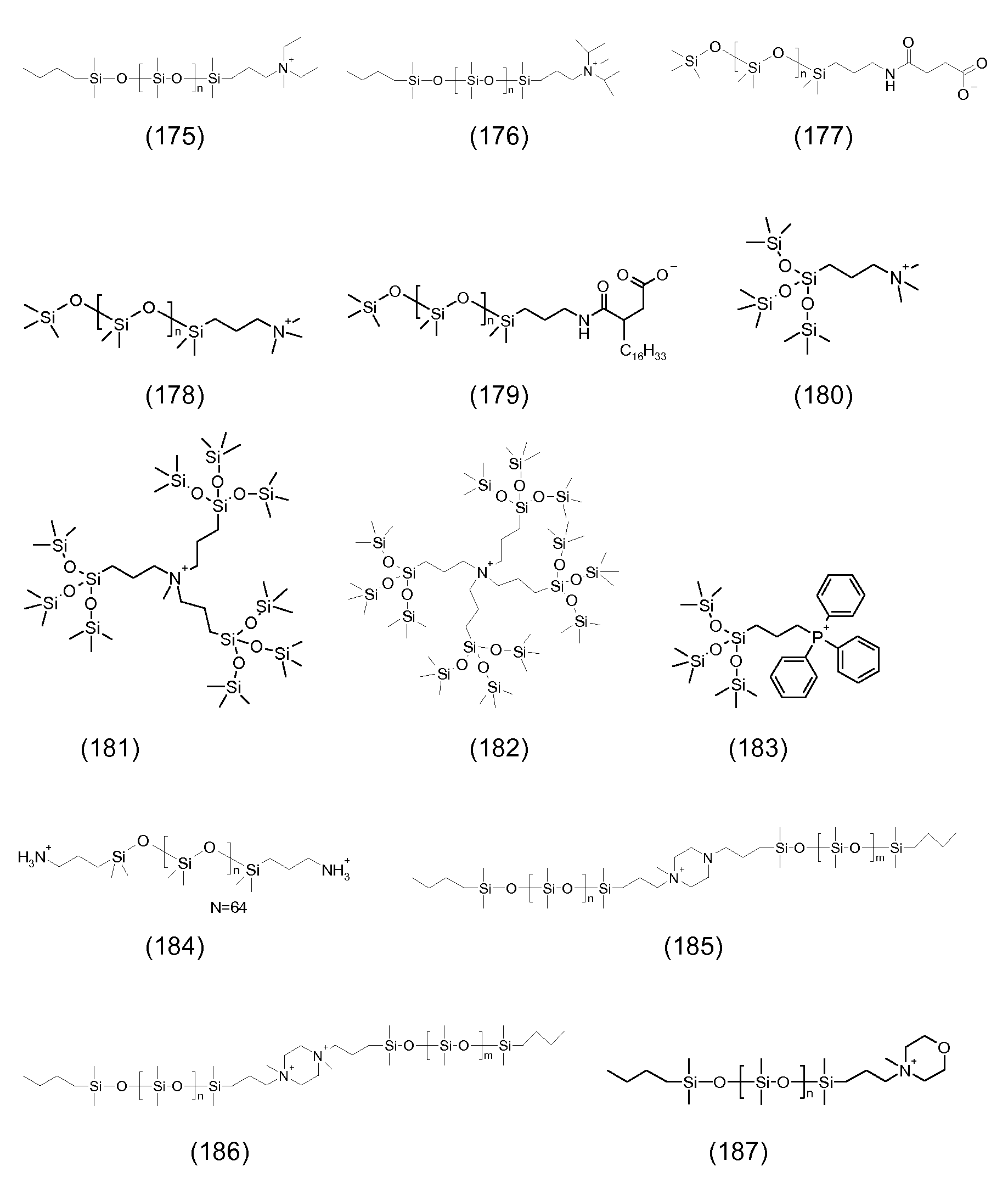


상기 예에서 n은 0 내지 1000, 특히 0 내지 100 또는 10 내지 100, 더 특히 0 내지 50 또는 0 내지 20, 바람직하게는 5 내지 20 또는 5 내지 15, 예를 들어 10 내지 13, 바람직하게는 11이다.In this example, n is an integer from 0 to 1000, in particular from 0 to 100 or from 10 to 100, more particularly from 0 to 50 or from 0 to 20, preferably from 5 to 20 or from 5 to 15, for example from 10 to 13, to be.
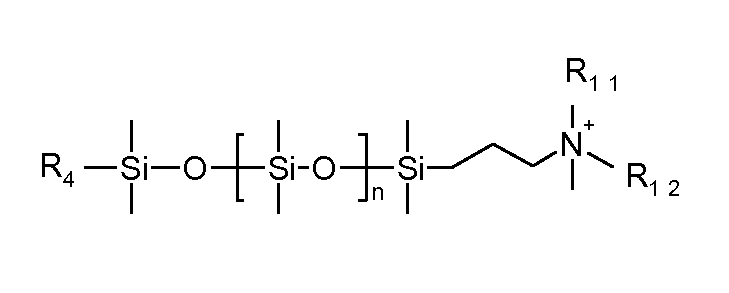
바람직한 반대 이온은 n이 상기한 의미 중 어느 하나이고, 각각의 R4, R11 및 R12가 서로 독립적으로 수소 또는 C1-C12알킬, 바람직하게는 C1-C12알킬인 화학식 II의 것이다.Preferred counter-ions are those of formula (II) wherein n is any of the above-mentioned meanings and each of R 4 , R 11 and R 12 independently of one another is hydrogen or C 1 -C 12 alkyl, preferably C 1 -C 12 alkyl will be.
<화학식 II>≪
본 발명의 부분을 형성하는 반대 이온은 당업자에게 공지된 방식으로 제조될 수 있다 (예를 들어 WO 2008/033908 A2, DE 2226823 A1, US 4005028 A, US 2008/0076938 A1 및 US 4587321 A 참조).The counterions forming part of the present invention may be prepared in a manner known to those skilled in the art (see for example WO 2008/033908 A2, DE 2226823 A1, US 4005028 A, US 2008/0076938 A1 and US 4587321 A).
예를 들어, 4급 질소 원자를 포함하는 반대 이온을 제조하기 위하여, 말단 수소 원자를 갖는 (폴리)실록산으로부터 출발 [실시예 1, 단계 1.3, 화학식 (6) 참조]하고 이를 적합한 촉매, 예를 들어 산화백금의 존재 하에 말단 C=C 이중 결합을 갖는 지방족 아민, 예를 들어 알릴 아민과 반응시킬 수 있다. 이어서 수득된 생성물 중의 아미노 기는, 예를 들어 적합한 지방족 할로겐화물, 예컨대 알킬 할라이드, 예컨대 n-부틸-브로마이드 및/또는 메틸 아이오다이드 [실시예 1, 단계 1.3 및 1.5 참조] 또는 실록산 잔기에 의해 치환된 알킬 할라이드 [실시예 6, 단계 6.2 및 6.3 및 단계 6.2에서 화학식 (28) 참조]와의 반응에 의해 추가로 N-치환되고 최종적으로 4급화된다. 유리하게는, 입체 장애의 이유로, 작은 지방족 할로겐화물, 예컨대 메틸 아이오다이드를 최종 4급화 단계용으로 사용한다. 메틸 아이오다이드를 또한 N-치환을 수행하는데 사용하여 하나의 단일 반응 단계에서 2급, 3급 및 4급 질소 원자를 생성시킬 수 있다 [실시예 7, 단계 7.1 참조].For example, starting from (poly) siloxane having a terminal hydrogen atom (see Example 1, Step 1.3, Chemical Formula (6)) and preparing a suitable catalyst, for example, Can be reacted with an aliphatic amine having a terminal C = C double bond in the presence of platinum oxide, for example, an allylamine. The amino group in the product obtained can then be substituted, for example, with a suitable aliphatic halide such as an alkyl halide such as n-butyl-bromide and / or methyl iodide [see Example 1, steps 1.3 and 1.5] Substituted and finally quatemized by reaction with an alkyl halide (see Example 6, steps 6.2 and 6.3 and step (6) in step 6.2). Advantageously, for reasons of steric hindrance, a small aliphatic halide such as methyl iodide is used for the final quaternization step. Methyl iodide can also be used to perform N-substitution to produce secondary, tertiary and quaternary nitrogen atoms in one single reaction step [see Example 7, Step 7.1].
4급 인 원자를 포함하는 반대 이온은 예를 들어 실록산 잔기에 의해 치환된 알킬 할라이드 [단계 6.2에서 화학식 (28) 참조]를 적합한 용매, 예컨대 적합한 에테르, 예를 들어 환형 에테르, 예컨대 테트라히드로푸란 중에서, 적합한 염기, 예컨대 탄산나트륨의 존재 하에 적합한 포스핀, 즉 삼치환된 포스판, 예컨대 트리페닐포스핀과 반응시킴으로써 제조할 수 있다 [실시예 8, 단계 8.1 참조].The counterion comprising a quaternary atom can be removed, for example, from an alkyl halide substituted by a siloxane moiety [see formula (28) in step 6.2] in a suitable solvent such as a suitable ether, such as a cyclic ether such as tetrahydrofuran , In the presence of a suitable base, such as sodium carbonate, with a suitable phosphine, i. E. A trisubstituted fospane, such as triphenylphosphine [see Example 8, Step 8.1].
상기 화학식 (177) 또는 (179)과 같이 카르복실레이트 기를 포함하는 반대 이온은 예를 들어 바람직하게는 1급 아미노-치환된 실록산을 숙신산 무수물 또는 그의 유도체와 반응시킴으로써 합성할 수 있다.The counterion containing a carboxylate group as represented by the chemical formula (177) or (179) can be synthesized, for example, by reacting a primary amino-substituted siloxane with succinic anhydride or a derivative thereof.
상기 화학식 (202) 또는 (194)와 같이 술포네이트 기를 포함하는 반대 이온은 예를 들어 아미노- 또는 히드록시-치환된 실록산 및 술톤, 예를 들어 1,3-프로판술톤 (1,2-옥사티올란 2,2-디옥시드; 화학초록집(Chemical Abstracts) No. 1120-71-4)을 반응시킴으로써 합성할 수 있다.The counterion comprising a sulfonate group as in the above formulas (202) or (194) may for example be an amino- or hydroxy-substituted siloxane and a sultone such as 1,3-propanesultone (1,2-oxathiolane 2,2-dioxide, Chemical Abstracts No. 1120-71-4).
본 발명은 또한 전기영동 장치에 있어서 반대 이온의 용도 및 신규한 반대 이온 그 자체에 관한 것이다. 특히, 4급 인 원자를 포함하는 많은 반대 이온 [단계 8.1에서 화학식 (37) 참조]은 신규하고 그 자체가 청구되어 있다.The invention also relates to the use of counterions in the electrophoresis apparatus and to the novel counterions themselves. In particular, many counter ions (see formula (37) in Step 8.1), including quaternary atoms, are novel and claimed in themselves.
무기 코어 및 이에 공유 결합된 염료를 포함하는 하전 입자는 또한 예를 들어 본원에 참조로 포함된 WO 2007/048721 A1, 또는 US 5378574 A에 기재된 제조방법과 유사하게, 또는 문헌 [F. M. Winnik et al., "New water-dispersible silica-based pigments: synthesis and characterization", Dyes and Pigments volume 14, issue 2, 1990, pages 101-112]에 기재된 바와 같이, 당업자에게 공지된 방식으로 제조될 수 있다. Charged particles comprising an inorganic core and a dye covalently bonded thereto can also be prepared, for example, in analogy to the preparation method described in WO 2007/048721 Al, or US 5378574 A, which is incorporated herein by reference, or as described in F. As described in M. Winnik et al., "New water-dispersible silica-based pigments: synthesis and characterization", Dyes and Pigments volume 14, issue 2, 1990, pages 101-112, .
비개질된, 즉 관능화되지 않은 입자, 특히 무기 코어 및 이에 공유 결합된 염료를 포함하는 하전 입자의 제조를 위한 출발 물질로서 유용한 그러한 나노입자는 분말 또는 분산액으로서 상이한 공급처 [예컨대 데구사(Degussa), 한스 케미(Hanse Chemie), 닛산 케미칼스(Nissan Chemicals), 클라리언트(Clariant), 에이치.씨. 스타크(H.C. Starck), 나노프로덕츠(Nanoproducts) 또는 니아콜 나노 테크놀로지스(Nyacol Nano Technologies)]로부터 시판되고 있다. 시판되는 실리카 나노입자의 예는 데구사로부터의 에어로실(Aerosil)


관능화되지 않은 입자 (예컨대 실리카, 알루미나 또는 이산화티탄 입자)의 무기 코어는 예를 들어 실시예 1, 단계 1.1.에서 화학식 (1)로부터 명백한 바와 같이 표면 상에 유리 히드록시 기를 포함한다. 염료는 앞서 본원에서 화학식 I 또는 Ia로 예시한 바와 같이, 이러한 히드록시 기에, 직접 또는, 바람직하게는 간접적으로 공유 결합된다.The inorganic core of the non-functionalized particles (such as silica, alumina, or titanium dioxide particles) includes, for example, a free hydroxyl group on the surface as is apparent from Formula (1) in Example 1, Step 1.1. The dyes are covalently bonded directly or, preferably indirectly, to such hydroxy groups as exemplified by Formulas I or Ia hereinbefore.
예를 들어 무기 코어는 먼저 아민의 지방족 부분 중의 탄소 원자에 결합된, 트리알콕시-실릴 기, 디알콕시-알킬-실릴 기 또는 알콕시-디알킬-실릴 기, 바람직하게는 트리메톡시실릴 기를 갖는 지방족 아민과, 예를 들어 3-트리메톡시실릴-프로필 아민과 하기 반응식 (여기서, X는 예를 들어 알킬렌 기, 예를 들어 트리메틸렌을 나타냄)에 예시된 바와 같이 반응시킬 수 있다 [실시예 1, 단계 1.1, 화학식 (2) 참조]. 또는, 알콕시 기 대신에 규소 원자 상의 다른 관능가, 예컨대 예를 들어 할라이드 (특히 클로라이드) 또는 실라마이드를 사용할 수 있다. For example, the inorganic core may be first reacted with a trialkoxy-silyl, dialkoxy-alkyl-silyl or alkoxy-dialkyl-silyl group, preferably aliphatic with a trimethoxysilyl group, bonded to a carbon atom in the aliphatic portion of the amine Can be reacted with an amine, for example 3-trimethoxysilyl-propylamine, as illustrated in the following reaction scheme (wherein X represents, for example, an alkylene group, for example trimethylene) 1, Step 1.1, Chemical Formula (2)]. Alternatively, other functionalities on the silicon atom may be used in place of the alkoxy group, for example halide (especially chloride) or silamide.
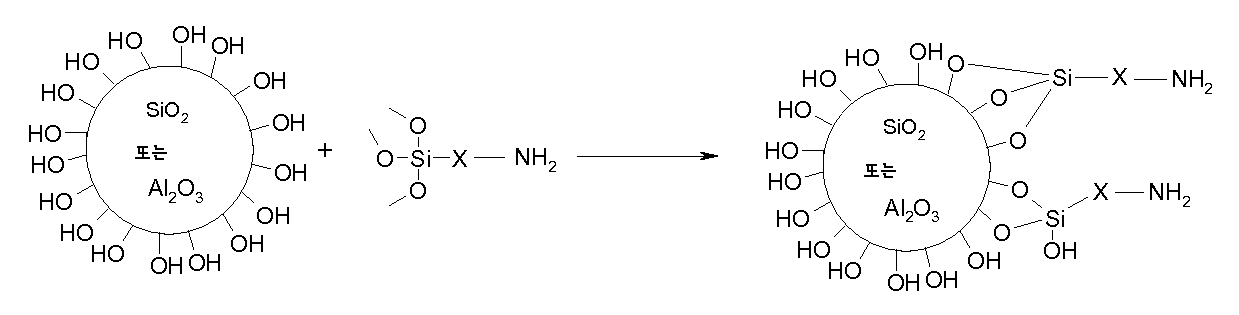
바람직하게는, 수득된 표면 개질된 입자는 당업자에게 공지된 방식으로, 예를 들어 적합한 여과, 원심분리, 투석, 삼투압, 침강 등에 의해 가용성 부분을 제거하여 정제된다.Preferably, the resultant surface-modified particles are purified in a manner known to those skilled in the art, for example by removal of the soluble portion by suitable filtration, centrifugation, dialysis, osmotic pressure, sedimentation, and the like.
이어서 수득된 중간체는 중간체 중의 아미노 기와 반응할 수 있는 관능기를 갖는 염료와 반응될 수 있다. 한 이러한 관능기는, 할로겐 원자, 예컨대 특히,예를 들어 실시예 1, 단계 1.2에 도시된 화학식 (4)의 염료 중에 존재하는 바와 같은 1,3,5-트리아진 고리 중에서 염소 치환기이다.The resulting intermediate can then be reacted with a dye having a functional group capable of reacting with the amino group in the intermediate. One such functional group is a chlorine substituent in a 1,3, 5-triazine ring, such as is present, for example, in a dye of formula (4) shown, for example, in Example 1, step 1.2.
다수의 염료, 예컨대 앞서 본원에 도시된 화학식 (72) 내지 (76)의 것은 트리알콕시-실릴 잔기를 함유한다. 이들 염료는 먼저 브릿지 원을 도입하지 않고 무기 코어에 직접 연결될 수 있다. 이러한 종류의 염료의 무기 코어로의 공유 결합은 무기 코어의 트리알콕시-실릴 기를 갖는 지방족 아민과의 상기 반응과 유사하게 수행할 수 있다.A number of dyes, such as those of formulas (72) - (76) shown herein above, contain a trialkoxy-silyl moiety. These dyes can be connected directly to the inorganic core without first introducing a bridge source. Covalent bonding of this kind of dye to the inorganic core can be carried out similar to the above reaction with an aliphatic amine having a trialkoxy-silyl group of an inorganic core.
바람직하게는, 수득된 염색된 입자는 당업자에게 공지된 방식으로, 예를 들어 적합한 여과, 원심분리, 투석, 삼투압, 침강 등에 의해 가용성 부분을 제거하여 정제된다.Preferably, the resulting dyed particles are purified in a manner known to those skilled in the art, for example by removal of the soluble portion by suitable filtration, centrifugation, dialysis, osmotic pressure, sedimentation, and the like.
본 발명의 하전 입자 및 반대 이온을 포함하는 조성물은 예를 들어 분산액의 형태로 사용될 수 있다. 액체 분산액은 예를 들어 하기와 같이 제조한다:Compositions comprising charged particles and counterions of the present invention can be used, for example, in the form of a dispersion. The liquid dispersion is prepared, for example, as follows:
하전 입자의 수성 분산액을 적합한 알칸올, 예컨대 에탄올과, 적합한 알칸, 예를 들어 펜탄 또는 헥산 또는 그의 혼합물, 예컨대 비점이 40 내지 60℃인 석유 에테르의 혼합물 중의 반대 이온의 용액에 첨가하고, 수득된 2상(two-phase) 시스템을 승온, 예를 들어 60℃에서 교반한다. 냉각 및 상 분리 후 유기 상을 탈이온수로 완전히 세척하였다. 실온에서 및 상압에서 액체인 적합한 용매, 예를 들어 적합한 치환되지 않거나 할로겐화된 탄화수소 용매, 예를 들어 테트라클로로에틸렌 또는 적합한 알칸, 예컨대 n-도데칸, 또는 적합한 환형 탄화수소, 예컨대 테트랄린 (1,2,3,4-테트라히드로나프탈렌), 또는 하기에 언급한 임의의 기타 고절연(high-insulation) 유기 용매를 유기 상에 첨가하고 저비점 유기 용매를 진공 중에서 제거하여 하전 입자 및 반대 이온을 용매, 예를 들어 도데칸 중에 포함하는 목적하는 조성물의 분산액을 수득한다.The aqueous dispersion of charged particles is added to a solution of the counterion in a mixture of a suitable alkanol, such as ethanol, with a suitable alkane, such as pentane or hexane, or a mixture thereof, for example a petroleum ether with a boiling point of 40 to 60 DEG C, The two-phase system is stirred at elevated temperature, for example 60 ° C. After cooling and phase separation, the organic phase was washed thoroughly with deionized water. For example, a suitable unsubstituted or halogenated hydrocarbon solvent such as tetrachlorethylene or a suitable alkane such as n-dodecane or a suitable cyclic hydrocarbon such as tetralin (1, 2, 3, 4, 2,3,4-tetrahydronaphthalene), or any other high-insulation organic solvent mentioned below, is added to the organic phase and the low boiling organic solvent is removed in vacuo to remove the charged particles and the counter- For example, a dispersion of the desired composition contained in dodecane.
필요에 따라, 수득된 분산액은 예를 들어 응집물을 원심분리로 제거하여 균질하게 제조할 수 있다. 전형적으로, 분산 입자는 직경 또는 평균 입자 크기가 약 10 내지 1000, 특히 10 내지 600 또는 500, 바람직하게는 10 내지 300 또는 200 나노미터(nm), 예를 들어 50 내지 500 또는 100 또는 300 nm인 나노입자이다. 평균 입자 크기의 하한으로서 10 nm, 특히 20 nm가 바람직하다. 구의 부피 V에 대한 식, 즉 V = 1/6πd3를 이용하여, 이들 직경 d는 근사치인 입자 부피 약 500 nm3 (직경 10 nm), 63000 nm3 (직경 50 nm), 500000 nm3 (직경 100 nm), 4백만 nm3 (직경 200 nm), 1천4백만 nm3 (직경 300 nm), 6천3백만 nm3 (직경 500 nm), 1억1천만 nm3 (직경 600 nm), 및 5억 nm3 (직경 1000 nm) 각각에 상응한다. 입자 크기는 예를 들어 전자현미경법 또는 광자상관 분광법(Photon Correlation Spectroscopy) 또는 중탄성 광산란(Quasi-Elastic Light Scattering)으로 또한 공지된 동적 광산란법으로 결정할 수 있다.If necessary, the obtained dispersion can be homogeneously prepared, for example, by removing the agglomerates by centrifugation. Typically, the dispersed particles have a diameter or average particle size of about 10 to 1000, especially 10 to 600 or 500, preferably 10 to 300 or 200 nanometers (nm), such as 50 to 500 or 100 or 300 nm Nanoparticles. The lower limit of the average particle size is preferably 10 nm, especially 20 nm. Using the equation for the volume V of the sphere, i.e. V = 1/6? D 3 , these diameters d have an approximate particle volume of about 500 nm 3 (Diameter 10 nm), 63000 nm 3 (Diameter 50 nm), 500000 nm 3 (100 nm in diameter), 4 million nm 3 (Diameter 200 nm), 1 cheon 4 baekman 3 nm (diameter 300 nm), 6 cheon baekman 3 nm 3 (diameter: 500 nm), 1 eok 1 cheonman 3 nm (diameter 600 nm), and 500 million nm 3 (Diameter 1000 nm). The particle size can be determined, for example, by dynamic light scattering, also known as electron microscopy or photon correlation spectroscopy or quasi-elastic light scattering.
본 발명의 하전 입자 및 반대 이온을 비분산 형태로 포함하는 조성물을 제조하기 위하여 상기한 바와 같이 진행시킬 수 있지만, 더 고분자량의 탄화수소 용매, 예컨대 도데칸을 탈이온수로 세척된 유기 상에 가하는 대신에, 유기 상을 진공 중에서 증발시킨다. 필요한 경우, 수득된 비분산 조성물을 상기한 바와 같이 분산시킬 수 있다. 그러나, 본 발명의 조성물을 기체, 예컨대 보호 기체, 예컨대 아르곤 ("기체상 유체") 또는 심지어 진공 중에서 분산된 분말 형태로 사용할 수도 있다. 기체상 유체 중 전기광학 재료의 분산액은 예를 들어 US20090122389 A1 (단락 [0015] 참조)에 개시되어 있다.Although it can be proceeded as described above to prepare a composition comprising the charged particles of the present invention and the counterion in a non-dispersed form, it may be advantageous to add a higher molecular weight hydrocarbon solvent such as dodecane to the organic phase washed with deionized water , The organic phase is evaporated in vacuo. If necessary, the obtained non-dispersed composition can be dispersed as described above. However, the compositions of the present invention may also be used in the form of a powder such as a gas, such as a protective gas, such as argon ("gaseous phase") or even in vacuo. A dispersion of an electro-optic material in a gas phase fluid is disclosed, for example, in US20090122389 A1 (see paragraph [0015]).
본 발명에 따른 입자의 유기 함량은 입자의 전체 중량을 기준으로 하여, 예를 들어 5 내지 95 중량%, 특히 10 내지 90, 20 내지 90, 30 내지 90, 40 내지 90 또는 50 내지 90 중량%이다.The organic content of the particles according to the invention is, for example, from 5 to 95% by weight, in particular from 10 to 90,20 to 90,30 to 90,40 to 90 or 50 to 90% by weight, based on the total weight of the particles .
본 발명은 순수, 즉 비분산 형태, 및 분산, 특히 균질 분산 형태 둘 다의 조성물에 관한 것이다.The present invention relates to compositions of both pure, i.e., non-dispersed, and dispersed, especially homogeneous, dispersed forms.
이러한 전기영동 분산액용으로, 입자의 침하(settlement)가 일어나지 않는 것은 중요하다.For such an electrophoretic dispersion, it is important that the settlement of the particles does not occur.
액체 분산 매질로서 고절연 유기 용매가 바람직하다. 이들 용매에는 방향족 탄화수소, 예컨대 톨루엔, 크실렌, 및 알킬벤젠; 지방족 탄화수소, 예컨대 펜탄, 헥산, 옥탄, 데칸 또는 도데칸; 지환족 탄화수소, 예컨대 시클로헥산 및 메틸 시클로헥산; 할로겐화된 탄화수소, 예컨대 메틸렌 클로라이드, 클로로포름, 사염화탄소, 1,2-디클로로에탄, 테트라클로로에틸렌, 및 1,2-디클로로-벤젠; 미네랄 오일, 예컨대 실리콘 오일 및 플루오로카본 오일; 식물성 오일, 예컨대 올리브 오일; 및 장쇄 지방산 에스테르가 포함된다. 이들 용매는 단독으로 또는 혼합하여 사용할 수 있다. 지방족 탄화수소 및 방향족 탄화수소가 바람직하다.A highly insulating organic solvent is preferable as the liquid dispersion medium. These solvents include aromatic hydrocarbons such as toluene, xylene, and alkyl benzene; Aliphatic hydrocarbons such as pentane, hexane, octane, decane or dodecane; Alicyclic hydrocarbons such as cyclohexane and methylcyclohexane; Halogenated hydrocarbons such as methylene chloride, chloroform, carbon tetrachloride, 1,2-dichloroethane, tetrachlorethylene, and 1,2-dichloro-benzene; Mineral oils such as silicone oil and fluorocarbon oil; Vegetable oils such as olive oil; And long chain fatty acid esters. These solvents may be used alone or in combination. Aliphatic hydrocarbons and aromatic hydrocarbons are preferred.
액체 분산 매질은 본 발명에 따른 관능화된 입자를 0.01 내지 50 중량%, 바람직하게는 0.01 내지 25 중량%, 특히 0.1 내지 10 중량%의 양으로 포함할 수 있다.The liquid dispersion medium may contain the functionalized particles according to the invention in an amount of from 0.01 to 50% by weight, preferably from 0.01 to 25% by weight, in particular from 0.1 to 10% by weight.
분산액은 추가의 첨가제, 예컨대 적합한 분산제, 전하조절제 및/또는 안정화제를 함유할 수 있다.The dispersion may contain further additives, such as suitable dispersing agents, charge control agents and / or stabilizers.
본 발명은 또한 전기영동 디스플레이, 바람직하게는 전자 종이용으로 또한 "전자 잉크"로도 칭해지는 전기영동 잉크의 형태의 이들 조성물의 용도에 관한 것이다.The present invention also relates to the use of these compositions in the form of electrophoretic displays, preferably electroformed ink, also referred to as "electronic ink ".
전기영동 잉크 디스플레이의 작동 원리는 많은 상이한 장치에서 특허들 (예를 들어 US 2009/0040594 A1 및 이 출원에서 인용된 장치 구조물 및 디스플레이 기술과 관련된 모든 특허, 및 하기에 언급한 추가의 특허출원들 참조) 및 간행물에 기재되어 있고 당업자에게 공지되어 있다. 전기영동 잉크 디스플레이의 기본 작동 원리는 매우 간단하다. 예를 들어, 광학 활성 유체 (전기영동 잉크)를 두 전극 사이에 놓는다. 이들 전극 중 하나는 투명하고, 따라서 색상의 어떠한 변화도 가시적이다. 활성 유체는 전극 사이에 적용된 전기장의 변화에 의해 영향받게 된다. 전기 영동 잉크 디스플레이는 예를 들어 3개의 층으로 구축된다. 예를 들어, 제1 층은 산화인듐주석(ITO)으로 코팅된 투명 호일이다. 이 층은 상부 전극으로서 작용한다. 제2 층은, 건식 필름 레지스트로 제조된 화소 구조이다. 이는 감광성 재료이고 리소스래피 공정으로 구조화될 수 있다. 화소화된 층의 구조로 인해 전기영동 잉크는 확실하게 고정된다. 제3 층은 배면 전극(back-electrode)이다. 가요성 디스플레이용으로 플렉스 호일(flex foil)이 사용된다. 비가요성 디스플레이용으로 통상의 인쇄회로기판(printed circuit board)을 사용할 수 있다.The operating principle of the electrophoretic ink display is described in many different devices (see, for example, US 2009/0040594 Al and all the patents relating to the device structure and display technology cited in this application, and the additional patent applications mentioned below) ) And publications, which are well known to those skilled in the art. The basic operating principle of the electrophoretic ink display is very simple. For example, an optically active fluid (electrophoretic ink) is placed between two electrodes. One of these electrodes is transparent, and therefore any change in color is visible. The active fluid is affected by changes in the electric field applied between the electrodes. The electrophoretic ink display is constructed, for example, in three layers. For example, the first layer is a transparent foil coated with indium tin oxide (ITO). This layer acts as an upper electrode. The second layer is a pixel structure made of a dry film resist. This is a photosensitive material and can be structured as a resource reclamation process. Due to the structure of the fluorinated layer, the electrophoretic ink is firmly fixed. The third layer is a back-electrode. A flex foil is used for the flexible display. A conventional printed circuit board can be used for the non-flexible display.
전기영동 잉크 디스플레이의 한 가능한 작동 원리는 다음과 같다: 전기장의 제1 상태에서 모든 착색 하전 입자는 배면 전극으로 끌어당겨질 것이다. 곧 콘트라스트 유체의 색상이 투명 전극에 나타날 것이다. 전기장이 바뀌면, 입자는 전면 전극(front electrode)으로 끌어당겨질 것이다. 투명한 전면의 색상이 입자의 색상으로 변할 것이다. 입자가 분산되어 있는 유체의 점도 때문에, 및 정전기 인력으로 인해 입자는 그 장소에 잔류하게 될 것이다. 입자는 너무 가벼워 유체중에서 주변으로 유동(flow around)할 수 없다. 이는 이 기술에서 큰 장점인데, 아이들 타임(idle time) 동안에 전력이 전혀 필요하지 않기 때문이다.One possible operating principle of an electrophoretic ink display is as follows: in the first state of the electric field all colored charged particles will be attracted to the back electrode. The color of the contrast fluid will soon appear on the transparent electrode. When the electric field is changed, the particles will be attracted to the front electrode. The color of the transparent front will change to the color of the particle. Because of the viscosity of the fluid in which the particles are dispersed, and because of the electrostatic attraction, the particles will remain in place. The particles are too light to flow around in the fluid. This is a great advantage in this technique because no power is needed during idle time.
전자 잉크의 주요 성분은 전자 디스플레이로의 집적을 위한 필름 중에서 다수 (예를 들어 수백만)의 대략 사람의 머리카락 직경 정도의 아주 작은 마이크로캡슐이다. 한 실시양태, 흑백 디스플레이에서 각각의 마이크로캡슐은 투명한 유체 중에 현탁되어 있는, 양으로 하전된 백색 입자와 음으로 하전된 흑색 입자를 함유한다. 음 전압(장:field)이 상부 전극에 적용되면, 백색 입자는 마이크로캡슐의 상부로 이동되고 여기서 이들이 사용자에게 가시화된다. 이로써 그 지점에서 표면이 하얗게 나타나도록 한다. 동시에, 반대의 양 전압은 음으로 하전된 흑색 입자를 마이크로캡슐의 기저부로 끌어당겨 그곳에서 이들은 보이지 않게 가려진다. 이러한 공정을 역전시킴으로써, 흑색 입자는 캡슐의 상부에 나타나고, 이로써 이제 그 지점에서 표면이 어둡게 된다. 이러한 시도로 인해 이미지 또는 텍스트가 디스플레이 표면에서 가시화될 수 있다. The main component of the electronic ink is a very small microcapsule of a large number (e.g., millions) of approximately a human hair diameter in a film for integration into an electronic display. In one embodiment, monochrome display, each microcapsule contains positively charged white particles and negatively charged black particles suspended in a clear fluid. When a negative voltage (field) is applied to the top electrode, the white particles are moved to the top of the microcapsule where they are visible to the user. This causes the surface to appear white at that point. At the same time, the opposite positive voltage pulls the negatively charged black particles to the base of the microcapsule, where they are obscured. By reversing this process, the black particles appear at the top of the capsule, thereby making the surface dark at that point. This attempt may result in images or text being visible on the display surface.
본 발명의 추가의 목적은 전기영동 디스플레이 입자로서 본 발명에 따라 관능화된 입자를 포함하는 전기영동 디스플레이, 특히 전자 종이이다. 관능화된 입자에 대해서는 상기에 제시한 정의 및 바람직한 범위와 동일하다.A further object of the present invention is an electrophoretic display, in particular an electronic paper, comprising particles functionalized according to the invention as electrophoretic display particles. The functionalized particles are the same as defined and preferred ranges given above.
본 발명의 조성물이 사용될 수 있는 전기영동 장치를 포함하는 전기영동 디스플레이 시스템은 공지되어 있다 (예를 들어 US-B-5,914,806, US-A-2004/0094422, 및 WO-A-02/079869 참조). 전기영동 디스플레이 시스템은 통상 복수의 이러한 전기영동 장치를 포함한다.Electrophoretic display systems including electrophoretic devices in which the composition of the present invention can be used are known (see, for example, US-B-5,914,806, US-A-2004/0094422, and WO-A-02/079869) . Electrophoretic display systems typically include a plurality of such electrophoretic devices.
전기영동 디스플레이 시스템은, 예를 들어 각각 한 쌍의 기판 (전극) 및 기판 사이에 위치한 전기영동 분산액을 포함하는 전기영동 장치를 포함하고, 여기서 하나 이상의 기판은 투명한 재료를 포함하고, 기판은 이들 사이에 예정된 간격으로 위치하고, 전기영동 분산액은 적어도 액체 분산 매질 및 표면 전하를 갖는 전기영동 입자를 함유한다. 전압이 기판 사이에 적용되면, 전기영동 입자는 전기영동적으로 표면 전하 및 전기장의 방향에 의존하여 이동하고, 이로 인해 전기영동 입자의 분포가 변하게 된다. 따라서, 전기영동 장치의 색상이 투명한 기판 측에서 보면 변하게 된다. 다시 말해, 하전 입자가 기판 중 하나로 이동하고, 이는 디스플레이 표면으로서의 역할을 하고, 하전 입자가 갖는 색상이 인식된다. 이렇게 하여, 목적하는 이미지가 적용된 전압의 조절에 의해 표시될 수 있다.An electrophoretic display system includes, for example, an electrophoretic device comprising an electrophoretic dispersion positioned between, for example, a pair of substrates (electrodes) and a substrate, wherein the at least one substrate comprises a transparent material, The electrophoretic dispersion containing electrophoretic particles having at least a liquid dispersion medium and a surface charge. When a voltage is applied between the substrates, the electrophoretic particles electrophoretically move depending on the direction of the surface charge and the electric field, thereby changing the distribution of the electrophoretic particles. Therefore, the color of the electrophoresis apparatus changes when viewed from the transparent substrate side. In other words, the charged particles move to one of the substrates, which serves as the display surface, and the color of the charged particles is recognized. In this way, the desired image can be displayed by adjusting the applied voltage.
일부 디스플레이 장치는 적색 입자를 함유하고, 일부 디스플레이 장치는 녹색 입자를 함유하고, 일부 디스플레이 장치는 청색 입자를 함유하는 것이 바람직하다. 또 다른 실시양태에 따라서 일부 디스플레이 장치는 시안색 입자를 함유하고, 일부 디스플레이 장치는 마젠타색 입자를 함유하고, 일부 디스플레이 장치는 황색 입자를 함유하고, 일부 디스플레이 장치는 흑색 입자를 함유하는 것이 바람직하다. 디스플레이 장치를 개별적으로 제시함으로써, 디스플레이는 선택된 휘도 레벨에서 선택된 색상에 상응하는 외관을 제공할 수 있다.It is preferred that some display devices contain red particles, some display devices contain green particles, and some display devices contain blue particles. According to another embodiment, it is preferred that some display devices contain cyan particles, some display devices contain magenta particles, some display devices contain yellow particles, and some display devices contain black particles . By presenting the display devices individually, the display can provide an appearance corresponding to the selected color at the selected brightness level.
흥미로운 유형의 전기영동 디스플레이는 소위 마이크로셀 전기영동 디스플레이다. 마이크로셀 전기영동 디스플레이에서 입자 함유 분산 매질이 담체 매질 내에서 형성된 복수의 캐비티에 잔류한다 (예를 들어 WO-A-02/01281 참조).An interesting type of electrophoretic display is the so-called microcell electrophoretic display. In a microcell electrophoretic display, a particle-containing dispersion medium remains in a plurality of cavities formed in the carrier medium (see, for example, WO-A-02/01281).
바람직한 전기영동 디스플레이는 전자 종이이다. 이는 전형적으로 시트형 디스플레이 기능층을 포함하는 시트형 디스플레이이다.A preferred electrophoretic display is electronic paper. This is typically a sheet-like display comprising a sheet-like display functional layer.
특별한 장치 구조에서, 하나 초과의 상이하고 투명한 색상이 다층 시스템에서 동시에 표시될 수 있고, 여기서 혼합된 색상이 육안으로 보이게 된다.In a particular device architecture, more than one different and transparent color can be displayed simultaneously in a multi-layer system, where the mixed color is visible to the naked eye.
본 발명은 또한 균질 분산액 형태의 청구된 조성물, 전기영동 디스플레이에서 그의 용도, 및 전기영동에서의, 적합한 브릿지 원을 통해, 양으로 하전된 4급 질소 또는 인 원자에 또는 음이온성 관능기를 갖는 잔기에 연결된 (폴리)실록산 잔기를 포함하는 반대 이온의 용도에 관한 것이다. 본 발명은 또한 신규한 반대 이온 그 자체에 관한 것이다.The present invention also relates to the claimed composition in the form of a homogeneous dispersion, its use in electrophoretic displays, and its use in electrophoresis, through a suitable bridge source, to positively charged quaternary nitrogen or phosphorus atoms or to residues having anionic functional groups To the use of counterions comprising linked (poly) siloxane moieties. The invention also relates to the novel counterions themselves.
하기 실시예로 본 발명을 예시적으로 설명한다.The following examples illustrate the invention.
실시예Example
실시예Example 1: 화학식 (10)의 1: Compound of formula (10) 암모늄실록산Ammonium siloxane 개질된Reformed 마젠타색 염색된 나노입자 Magenta dyed nanoparticles

하기 단계 1.5에 기재된 34 mg의 화합물 (9)을 3 ml의 에탄올과 3 ml의 석유 에테르 (비등 범위 40 내지 60℃)의 혼합물에 용해시키고 3.3 중량%의 염색된 나노입자 (나트륨 염)를 함유하는 하기 단계 1.2에 기재된 화합물 (5)의 0.89 g의 수성 분산액을 첨가하였다. 2상 시스템을 가열된 오일조 중에 함침시킨 바이알 중에서 15분 동안 60℃에서 교반하였다. 냉각 후, 두 상이 분리되었다. 유기 상을 4 ml의 탈이온수로 2회 세척하였다. 1 ml의 n-도데칸을 첨가하였다. 밤새 방치한 후, 저비점 유기 용매를 진공 중에서 제거하여 도데칸 중의 나노입자 (10)의 적색 분산액 0.75 g을 수득하였다. 응집물을 원심분리로 제거한 후, 분산액은 적용 시험(applicatorial testing)용으로 균질하였다 (하기 결과 참조). 이를 장치 중에 마젠타색 전기영동 잉크로서 사용할 수 있다.34 mg of the compound ( 9 ) described in Step 1.5 below are dissolved in a mixture of 3 ml of ethanol and 3 ml of petroleum ether (boiling range 40-60 ° C) and 3.3% by weight of dyed nanoparticles (sodium salt) 0.89 g of the aqueous dispersion of compound ( 5 ) described in step 1.2 below was added. The two-phase system was stirred in a vial impregnated in a heated oil bath for 15 minutes at 60 < 0 > C. After cooling, the two phases were separated. The organic phase was washed twice with 4 ml of deionized water. 1 ml of n-dodecane was added. After leaving overnight, the low boiling organic solvent was removed in vacuo to give a red dispersion of nanoparticles ( 10 ) in dodecane 0.75 g was obtained. After removing the agglomerates by centrifugation, the dispersion was homogenized for applicatorial testing (see results below). It can be used as a magenta electrophoretic ink in the apparatus.
분산된 하전 나노입자의 직경은 말번 제타사이저 나노시리즈(Malvern Zetasizer Nanoseries) (공급처: 말번 인스트루먼츠 엘티디.(Malvern Instruments Ltd.), 영국)에 의해 동적 광산란법에 의해 측정하여 176 nm였다.The diameter of the dispersed charged nanoparticles was 176 nm as determined by dynamic light scattering method by Malvern Zetasizer Nanoseries (Malvern Instruments Ltd., UK).
표면 개질된 분산된 하전 나노입자의 제타 전위 (ξ)는 말번 제타사이저 나노시리즈에 의해 측정하여 -19.4 mV이고, 전기영동 이동도 μ는 스몰루초브스키 관계식(Smoluchowsky relation) (ξ= μη/ε, 여기서 μ는 이동도이고, η=1.344 mPa*s은 25℃에서 매질의 점도이고 ε=2.0은 20℃에서의 유전율임)으로부터 산출하여 40V에서 -1.66e-2 x 10⁻⁸ m2/Vs이었다.The zeta potential (?) Of the surface-modified dispersed charged nanoparticles was -19.4 mV as measured by a Malvern Zetasizer Nano series and the electrophoretic mobility μ was determined by the Smoluchowsky relation (ξ = μη / ε, where μ is the mobility, η = 1.344 mPa * s is the viscosity of the medium at 25 ° C. and ε = 2.0 is the dielectric constant at 20 ° C.) and is -1.66e-2 × 10 -8 m 2 / Vs.
제타 전위의 중요성은 그의 절대 (즉, 양 또는 음)값이 콜로이드상 분산액의 안정성에 관련된다는 것이다. 제타 전위는 분산액 중에서 근접하고 유사하게 하전된 입자간의 척력 정도를 나타내는 것이다. 충분히 작은 분자 및 입자, 예컨대 본 발명의 나노 입자에 있어서, 높은 제타 전위는 안정성을 부여하고, 즉 분산액은 응집되지 않는다. 전위가 낮으면, 인력이 척력을 초과하여 분산액이 파손되고 응집된다. 따라서, 높은 제타 전위 (음 또는 양)를 갖는 콜로이드는 전기적으로 안정화되지만 낮은 제타 전위를 갖는 콜로이드는 응고되거나 응집되는 경향이 있다. 제타 전위의 다른 중요성은 전기장의 영향하에 입자의 이동성이 제타 전위에 비례한다는 것이다. (절대) 제타 전위가 높을수록, 입자의 이동과 두 상태간의 스위칭이 빨라진다.The importance of the zeta potential is that its absolute (i.e. positive or negative) value is related to the stability of the colloidal dispersion. The zeta potential represents the degree of repulsion between closely charged and similarly charged particles in the dispersion. In sufficiently small molecules and particles, such as the nanoparticles of the present invention, high zeta potentials impart stability, i.e., the dispersion is not agglomerated. If the dislocation is low, the attraction exceeds the repulsive force and the dispersion is broken and agglomerated. Thus, a colloid with a high zeta potential (negative or positive) is electrically stabilized, but a colloid with a low zeta potential tends to solidify or agglomerate. Another significance of the zeta potential is that the mobility of particles under the influence of the electric field is proportional to the zeta potential. (Absolute) The higher the zeta potential, the faster the particle movement and the switching between the two states.
전기영동 이동도는 입자 속도와 전기장 강도 간의 비례 계수이다.The electrophoretic mobility is a proportional coefficient between the particle velocity and the field strength.
비분산 형태의 화학식 (10)의 암모늄실록산 개질된 마젠타색 염색된 나노입자를 제조하기 위하여 상기와 같이 진행할 수 있지만, 도데칸을 4 ml의 탈이온수로 2회 세척한 유기 상에 가하는 대신에, 유기 상을 진공 중에서 증발시켰다.Ammonium siloxane of formula (10) in nondispersed form can be prepared as described above to prepare modified magenta dyed nanoparticles, but instead of adding dodecane to the organic phase washed twice with 4 ml of deionized water, The organic phase was evaporated in vacuo.
출발 물질 (9) 및 (5)를 하기와 같이 제조하였다:The starting materials ( 9 ) and ( 5 ) were prepared as follows:
단계 1.1: 아미노프로필-개질된-나노입자 (3) Step 1.1: Aminopropyl-modified-nanoparticles ( 3 )
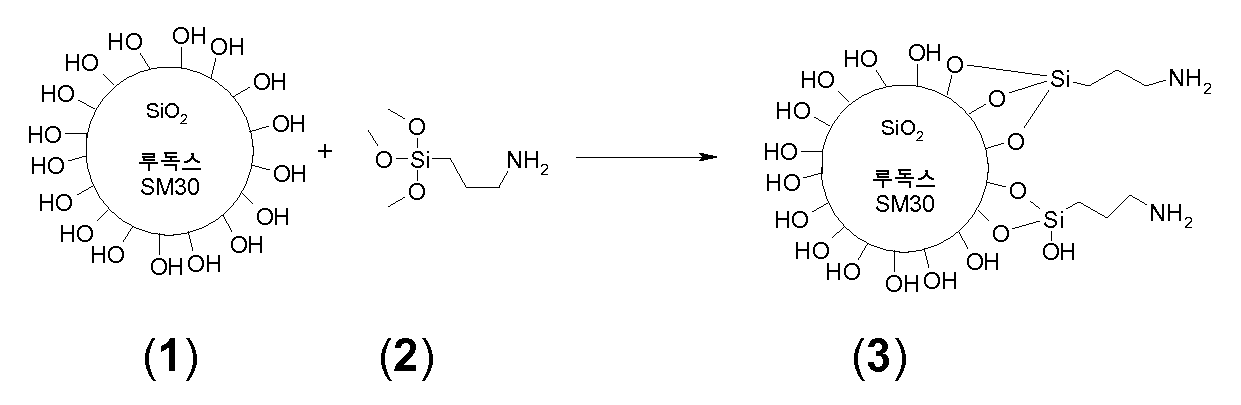
46.3 g의 도식적 "화학식"(1)의 루독스 SM-30 (수중 실리카 나노입자 30 중량%의 분산액; 그레이스-데이비슨(Grace-Davison); 평균 직경 5 내지 15 nm, 특히 7 내지 10 nm, 예를 들어 8 nm)를 46 ml의 물로 희석시키고 10분 동안 주위 온도에서 13.8g의 새롭게 산-활성화된 앰벌라이트(Amberlite)
이 분산액을 용해된 물질로부터 분리하고 진공 중에서 농축시켜 5.1 중량%의 3-아미노프로필실란 개질된 실리카 나노입자 (3)를 함유하는 302 g의 분산액을 수득하였다.The dispersion was separated from the dissolved material and concentrated in vacuo to give 302 g of a dispersion containing 5.1% by weight of 3-aminopropylsilane-modified silica nanoparticles ( 3 ).
단계 1.2: 마젠타색 염료 개질된 나노입자 (반대 이온: 나트륨) (5) Step 1.2: Magenta dye modified nanoparticles (counterion: sodium) ( 5 )
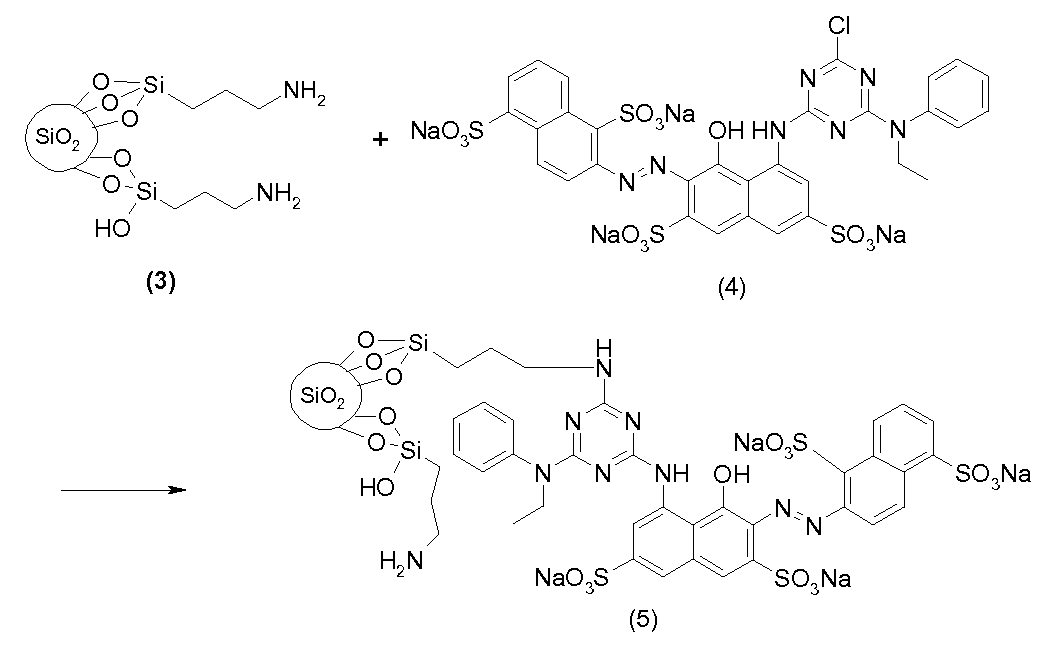
22.5 g의 물질 (3)의 분산액 (에탄올 중 5.1 중량%의 고체)을 반응 플라스크 중의 30 ml의 N,N-디메틸아세트아미드에 첨가하였다. 530 mg의 무수 탄산나트륨을 가한 다음, 30 ml의 N,N-디메틸아세트아미드 중의 화학식 (4)의 4.77 g의 반응성 마젠타색 염료의 용액을 첨가하였다. 혼합물을 교반하면서 16시간 동안 105℃로 가열한 다음, 주위 온도로 냉각시켰다.22.5 g of a dispersion of substance 3 (5.1% by weight of solid in ethanol) was added to 30 ml of N , N -dimethylacetamide in the reaction flask. 530 mg of anhydrous sodium carbonate was added and a solution of 4.77 g of reactive magenta dye of formula ( 4 ) in 30 ml of N , N -dimethylacetamide was added. The mixture was heated to 105 DEG C for 16 hours with stirring and then cooled to ambient temperature.
반응 혼합물을 800 ml의 에탄올에 붓고, 생성물을 원심분리하여 단리하고, 물에 재분산시켰다. 입자를 용해된 물질로부터 분리하고, 마지막으로 100 ml의 용적으로 농축시켰다. 이 분산액은 3.3 중량%의 염료-부착된 나노입자 (5)를 함유하였다.The reaction mixture was poured into 800 ml of ethanol, the product was isolated by centrifugation and redispersed in water. The particles were separated from the dissolved material and finally concentrated to a volume of 100 ml. This dispersion contained 3.3% by weight of dye-attached nanoparticles ( 5 ).
분산된 하전 나노입자의 직경은 말번 제타사이저 나노시리즈에 의해 동적 광산란법에 의해 측정하여 174 nm였다.The diameter of the dispersed charged nanoparticles was 174 nm as measured by the dynamic light scattering method with a ZetaSerizer nanosarcometer.
대안적인 합성 방법은 EP 0355062, 실시예 VI (아미노프로필트리에톡시실란-개질된 실리카), 프로시온 투르쿼이즈(Procion Turquoise) HA (염료-부착된 실리카) 대신에 상기 화학식 (4) (나트륨 염)을 사용한 실시예 XVI에 기재되어 있다.An alternative synthetic method is to use the compound of formula (4) (sodium (meth) acrylate) in place of EP 0355062, Example VI (aminopropyltriethoxysilane-modified silica), Procion Turquoise HA ≪ RTI ID = 0.0 > salt). ≪ / RTI >
단계 1.3: 아미노프로필-폴리디메틸실록산 (7) Step 1.3: Aminopropyl-polydimethylsiloxane (7)
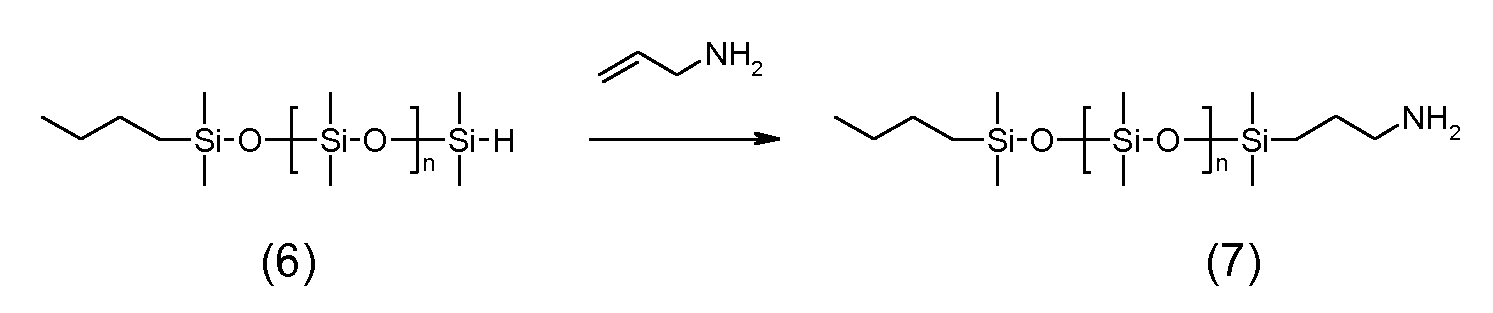
1 g의 화합물 (6), 칫소 코포레이션(Chisso Corp., Japan)에 의해 상품명 FM 0111으로 시판되고 한쪽 말단은 부틸 기로 다른 쪽 말단은 히드라이드로 종결된 분자량이 대략 1,000 (즉, n이 약 11임)인 선형 폴리(디메틸실록산)을 375 ㎕ (286 mg)의 알릴 아민 중의 11.5 mg의 산화백금의 현탁액에 첨가하였다. 혼합물을 가열된 오일조 중에 함침시킨 바이알 중에서 16시간 동안 105℃에서 교반하였다. 주위 온도로 냉각 후, 반응 혼합물을 막 필터 (폴리테트라플루오로에틸렌 [PTFE], 기공 크기 0.45 ㎛)를 통해 여과시켰다. 과량의 알릴 아민을 진공 중에서 제거한 후, 화학식 (7)의 생성물을 황색을 띤 약간 탁한 액체의 형태로 수득하였다. 1H-NMR은 출발 히드라이도실란이 완전히 사라지고 반응이 알릴 아민의 3-위치에서 >90% 선택성 (1-위치에 비해)으로 일어난 것으로 나타났다; 1 g of Compound (6), commercially available under the trade name FM 0111 by Chisso Corp., Japan, having a molecular weight of about 1,000 (i.e., n is about 11) ending with a butyl group at the other end and a hydride end at the other end ) Linear poly (dimethylsiloxane) was added to a suspension of 11.5 mg of platinum oxide in 375 l (286 mg) of allylamine. The mixture was stirred at 105 [deg.] C for 16 hours in a vial impregnated in a heated oil bath. After cooling to ambient temperature, the reaction mixture was filtered through a membrane filter (polytetrafluoroethylene [PTFE], pore size 0.45 mu m). After removal of the excess allylamine in vacuo, the product of formula ( 7 ) was obtained in the form of a slightly yellowish turbid liquid. ≪ 1 > H-NMR showed that the starting hydraidosilane disappeared completely and the reaction occurred> 90% selective (relative to the 1-position) at the 3-position of the allylamine;

단계 1.4: N,N-디부틸아미노-프로필-폴리디메틸실록산 (8) Step 1.4: N, N-dibutylamino-propyl-polydimethylsiloxane ( 8 )
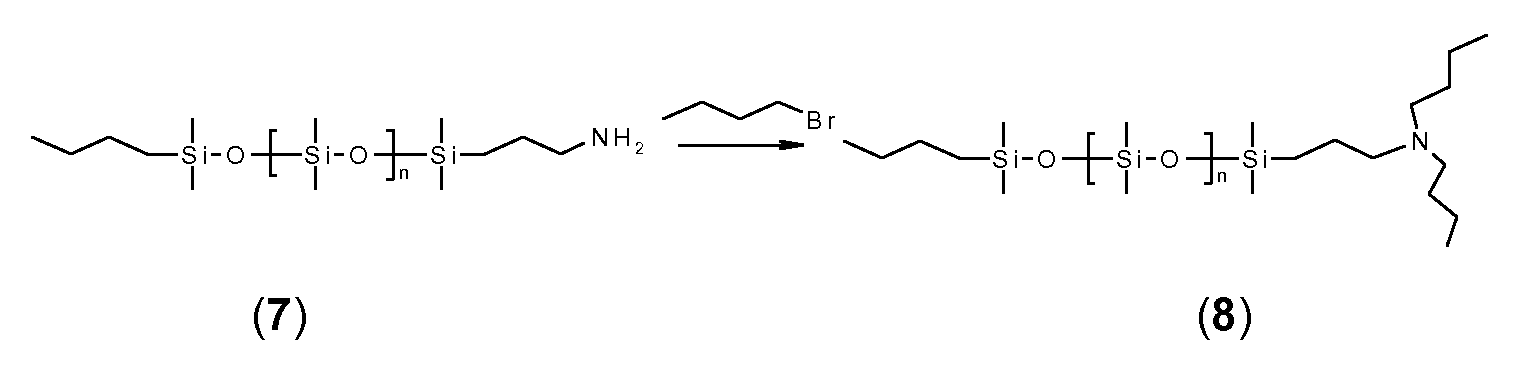
3 g의 화합물 (7)을 10 ml의 n-부틸 브로마이드에 용해시키고, 1.73 g의 무수 탄산나트륨을 첨가하고, 현탁액을 가열된 오일조 중으로 함침시킨 밀폐된 바이알 중에서 3시간 동안 105℃에서 교반하였다. 주위 온도로 냉각 후, 반응 혼합물을 메틸렌 클로라이드로 희석시키고 물로 세척하고, 수성 상을 다시 한번 메틸렌 클로라이드로 추출시켰다. 합한 유기 상을 무수 황산나트륨 상에서 건조시켜, 용매를 진공 중에서 제거한 후, 3.0 g의 황갈색 오일을 수득하였다.3 g of compound ( 7 ) was dissolved in 10 ml of n-butyl bromide, 1.73 g of anhydrous sodium carbonate was added and the suspension was stirred at 105 DEG C for 3 hours in a sealed vial impregnated in a heated oil bath. After cooling to ambient temperature, the reaction mixture was diluted with methylene chloride, washed with water, and the aqueous phase was once again extracted with methylene chloride. The combined organic phases were dried over anhydrous sodium sulfate and the solvent removed in vacuo to give 3.0 g of a tan oil.
2 g의 이러한 조 반응 생성물을 HPLC로 정제하여 (실리카겔, 헵탄-이소프로판올 90:10), 0.57 g의 담황색(slightly yellowish)을 띤 투명 오일을 수득하였고, 이는 1H- 및 13C-NMR에 따르면 >95%의 3급 아민 (8)이다. 2 g of this crude reaction product was purified by HPLC (silica gel, heptane-isopropanol 90:10) to give 0.57 g of a slightly yellowish clear oil which was characterized by 1 H- and 13 C-NMR > 95% of tertiary amines ( 8 ).
단계 1.5: 메틸-디부틸-암모늄프로필-폴리디메틸실록산 (9) Step 1.5: Methyl-dibutyl-ammonium propyl-polydimethylsiloxane (9)
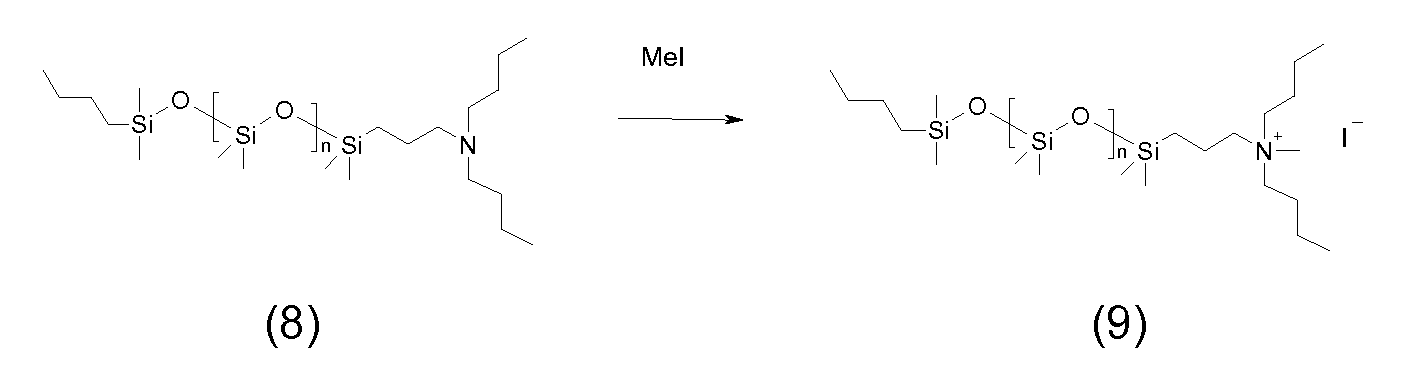
560 mg의 화합물 (8)을 2.7 ml의 메틸 아이오다이드에 용해시키고, 이 용액을 가열된 오일조 중으로 함침시킨 밀폐된 바이알 중에서 20분 동안 45℃에서 교반하였다. 주위 온도로 냉각 후, 과량의 메틸 아이오다이드를 진공 중에서 제거하여, 화합물 (9)을 황색을 띤 점성 오일 형태로 수득하였고 1H-NMR은 3급 아민의 4급 암모늄 염으로의 완전한 전환을 나타냈다; 560 mg of Compound (8) was dissolved in 2.7 ml of methyl iodide and the solution was stirred in a sealed vial impregnated in a heated oil bath for 20 minutes at 45 < 0 > C. After cooling to ambient temperature, excess methyl iodide was removed in vacuo to give compound (9) in the form of a yellow viscous oil, and 1 H-NMR indicated complete conversion of the tertiary amine to the quaternary ammonium salt Indicated;

실시예Example 2: 2: 암모늄실록산Ammonium siloxane 개질된Reformed 황색 염색된 나노입자 Yellow dyed nanoparticles
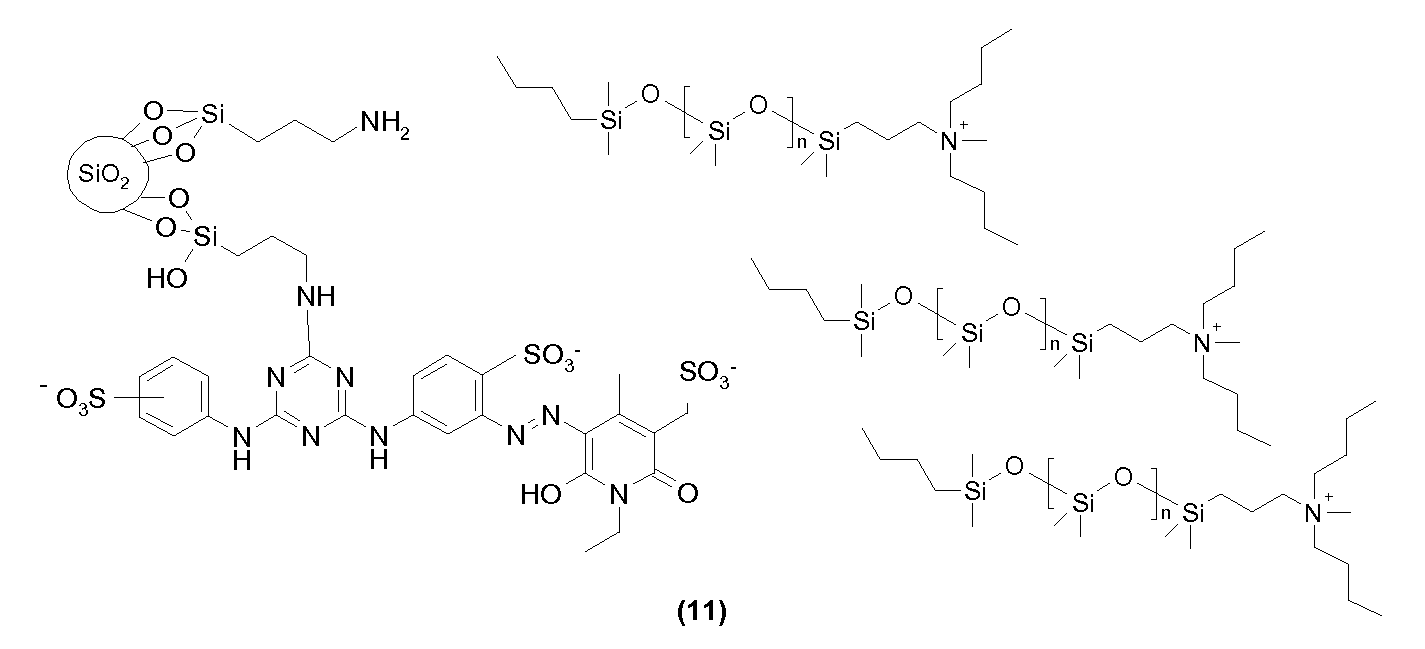
하기 단계 1.5에 기재된 34 mg의 화합물 (9)을 3 ml의 에탄올과 3 ml의 석유 에테르 (비등 범위 40 내지 60℃)의 혼합물에 용해시키고 나트륨 염으로서 1.9 중량%의 나노입자를 함유하는 화합물 (13)의 1.94 g의 수성 분산액을 첨가하였다. 2상 시스템을 가열된 오일조 중에 함침시킨 바이알 중에서 15분 동안 60℃에서 교반하였다. 냉각 후, 두 상이 분리되었다. 유기 상을 각각 4 ml의 탈이온수로 2회 세척하였다. 1 ml의 n-도데칸을 첨가하였다. 밤새 방치한 후, 저비점 유기 용매를 진공 중에서 제거하여 도데칸 중의 나노입자 (11)의 황색 분산액 0.77 g을 수득하였다. 응집물을 원심분리로 제거한 후, 분산액은 균질하였고 장치 중에서 황색 전기영동 잉크로서 사용할 수 있다.34 mg of the compound ( 9 ) described in the following step 1.5 was dissolved in a mixture of 3 ml of ethanol and 3 ml of petroleum ether (boiling range 40 to 60 ° C), and a compound containing 1.9% by weight of nanoparticles as a sodium salt 13 ) was added. The two-phase system was stirred in a vial impregnated in a heated oil bath for 15 minutes at 60 < 0 > C. After cooling, the two phases were separated. The organic phase was washed twice with 4 ml each of deionized water. 1 ml of n-dodecane was added. After allowing to stand overnight, the low-boiling organic solvent was removed in vacuo to give a yellow dispersion of nanoparticles ( 11 ) in dodecane 0.77 g was obtained. After removing the agglomerates by centrifugation, the dispersion is homogeneous and can be used as a yellow electrophoretic ink in the apparatus.
분산된 하전 나노입자의 직경은 말번 제타사이저 나노시리즈에 의해 동적 광산란법에 의해 측정하여 213 nm였다.The diameter of the dispersed charged nanoparticles was 213 nm as measured by the dynamic light scattering method with a Zetasizer nanosarcometer.
표면 개질된 분산된 하전 나노입자의 제타 전위 (ξ)는 말번 제타사이저 나노시리즈에 의해 측정하여 -7.74 mV이고, 전기영동 이동도 μ는 스몰루초브스키 관계식으로부터 산출하여 40V에서 -6.64e-3 x 10⁻⁸ m2/Vs이었다.The zeta potential (ξ) of the surface-modified dispersed charged nanoparticles was -7.74 mV as measured by a Malvern Zetasizer Nano-series, and the electrophoretic mobility μ was calculated from the Small- 3 x 10 -8 m 2 / Vs.
출발 물질인 화학식 (13)을 하기와 같이 제조하였다:The starting material, Formula (13), was prepared as follows:
단계 2.1: 황색 염료 개질된 나노입자 (13) (반대 이온: 나트륨) Step 2.1: Yellow dye modified nanoparticles (13) (counterion: sodium)

22.5 g의 화합물 (1)의 분산액 (에탄올 중 5.1 중량%의 고체)을 반응 플라스크 중의 30 ml의 N,N-디메틸아세트아미드에 첨가하였다. 530 mg의 무수 탄산나트륨을 가한 다음, 30 ml의 N,N-디메틸아세트아미드 중의 화학식 (12)의 3.99 g의 반응성 황색 염료의 현탁액을 첨가하였다. 혼합물을 교반하면서 16시간 동안 105℃로 가열한 다음, 주위 온도로 냉각시켰다. 반응 혼합물을 800 ml의 에탄올에 붓고, 생성물을 원심분리하여 분리하고, 물에 재분산시켰다. 입자 분산액을 용해된 물질로부터 분리하고, 마지막으로 72.04 g의 질량으로 농축시켰다. 이 분산액은 1.9 중량%의 염료-부착된 나노입자 (13)를 함유하였다.22.5 g of a dispersion of compound ( 1 ) (5.1% by weight solids in ethanol) was added to 30 ml of N , N -dimethylacetamide in the reaction flask. 530 mg of anhydrous sodium carbonate was added and a suspension of 3.99 g of the reactive yellow dye of formula ( 12 ) in 30 ml of N , N -dimethylacetamide was added. The mixture was heated to 105 DEG C for 16 hours with stirring and then cooled to ambient temperature. The reaction mixture was poured into 800 ml of ethanol, the product was separated by centrifugation and redispersed in water. The particle dispersion was separated from the dissolved material and finally concentrated to a mass of 72.04 g. This dispersion contained 1.9 wt% dye-attached nanoparticles ( 13 ).
실시예Example 3: 3: 암모늄실록산Ammonium siloxane 개질된Reformed 시안색 염색된 나노입자 (14) Cyan dyed nanoparticles (14)
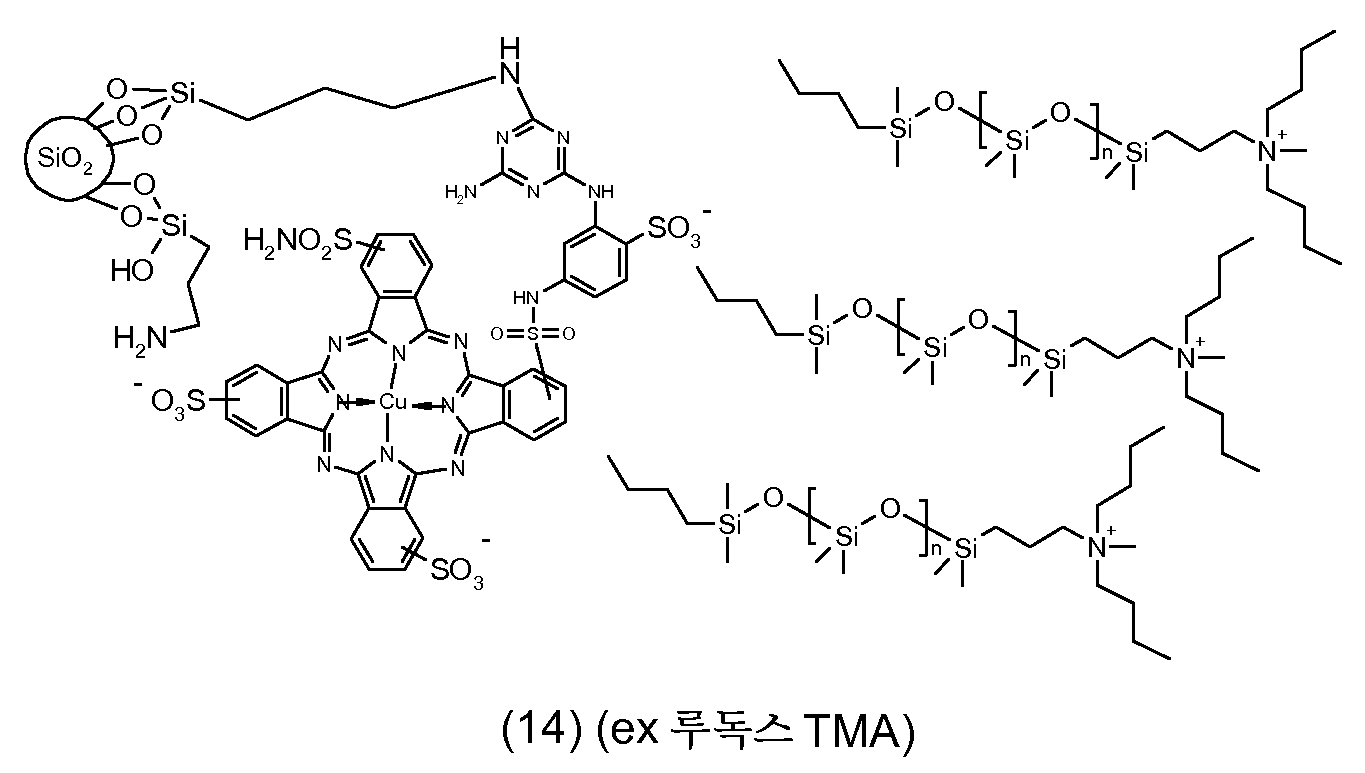
실시예 2에 기재된 바와 유사하게, 나노입자 (18)를 단계 1.5에 기재된 암모늄-폴리디메틸실록산 (9)과 반응시켜 도데칸 중의 시안색 염색된 나노입자 (14) (여기서 n 은 약 11임)의 균질 분산액을 수득하였다 [단계 1.3, 화학식 (7) 참조]. 이 분산액을 장치 중에서 시안색 전기영동 잉크로서 사용할 수 있다. Similar to that described in Example 2, nanoparticles 18 were reacted with the ammonium-polydimethylsiloxane 9 as described in step 1.5 to give cyan dyed nanoparticles 14 in dodecane (where n is about 11) (Step 1.3, see chemical formula (7)). This dispersion can be used as a cyan electrophoretic ink in a device.
출발 물질을 하기와 같이 제조하였다:The starting material was prepared as follows:
단계 3.1: 아미노프로필-개질된-나노입자 (16)Step 3.1: Aminopropyl-modified-nanoparticles (16)
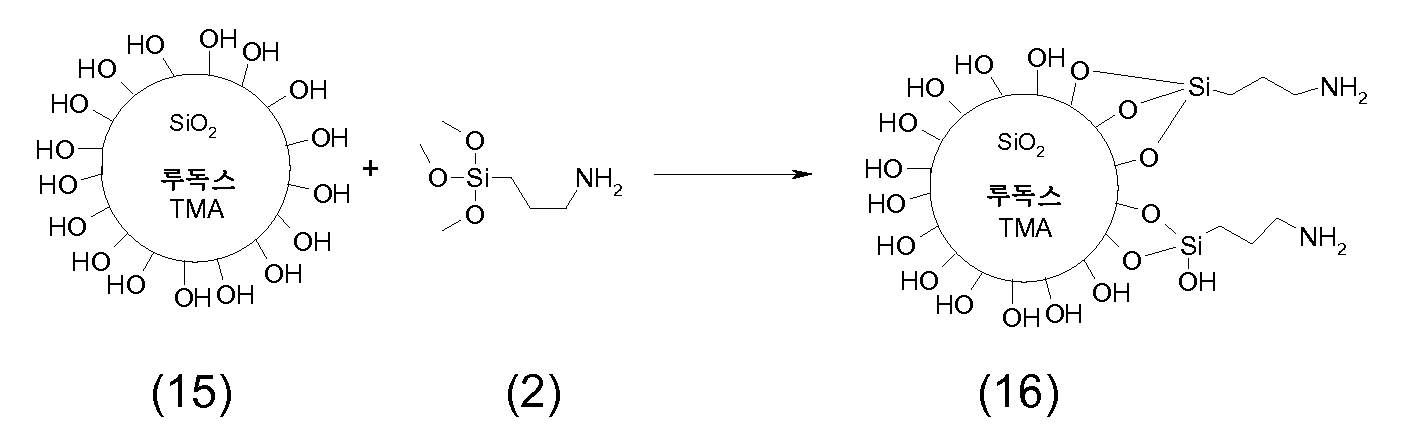
도식적 "화학식"(15)의 루독스 TMA (수중 실리카 나노입자 34 중량%의 분산액; 알드리치(Aldrich))를 단계 1.1에 기재된 바와 유사하게 (3-아미노프로필)-트리메톡시실란 (2)과 반응시켜 에탄올 중의 화학식 (16)의 유기적으로 개질된 나노입자 (분산액의 고체 함량: 13%, 고체 잔류물에 대한 원소 분석: N: 1.1%)를 수득하였다.Rudox TMA (34 wt% dispersion in water silica nanoparticles, Aldrich) of the schematic "Formula" ( 15 ) was reacted with (3-aminopropyl) -trimethoxysilane (2) To give organically modified nanoparticles of formula (16) in ethanol ( solids content of dispersion: 13%, elemental analysis for solid residues: N: 1.1%) in ethanol.
단계 3.2: 시안색 염료 개질된 나노입자 (반대 이온: 나트륨) (18)Step 3.2: Cyan dye modified nanoparticles (counterion: sodium) (18)
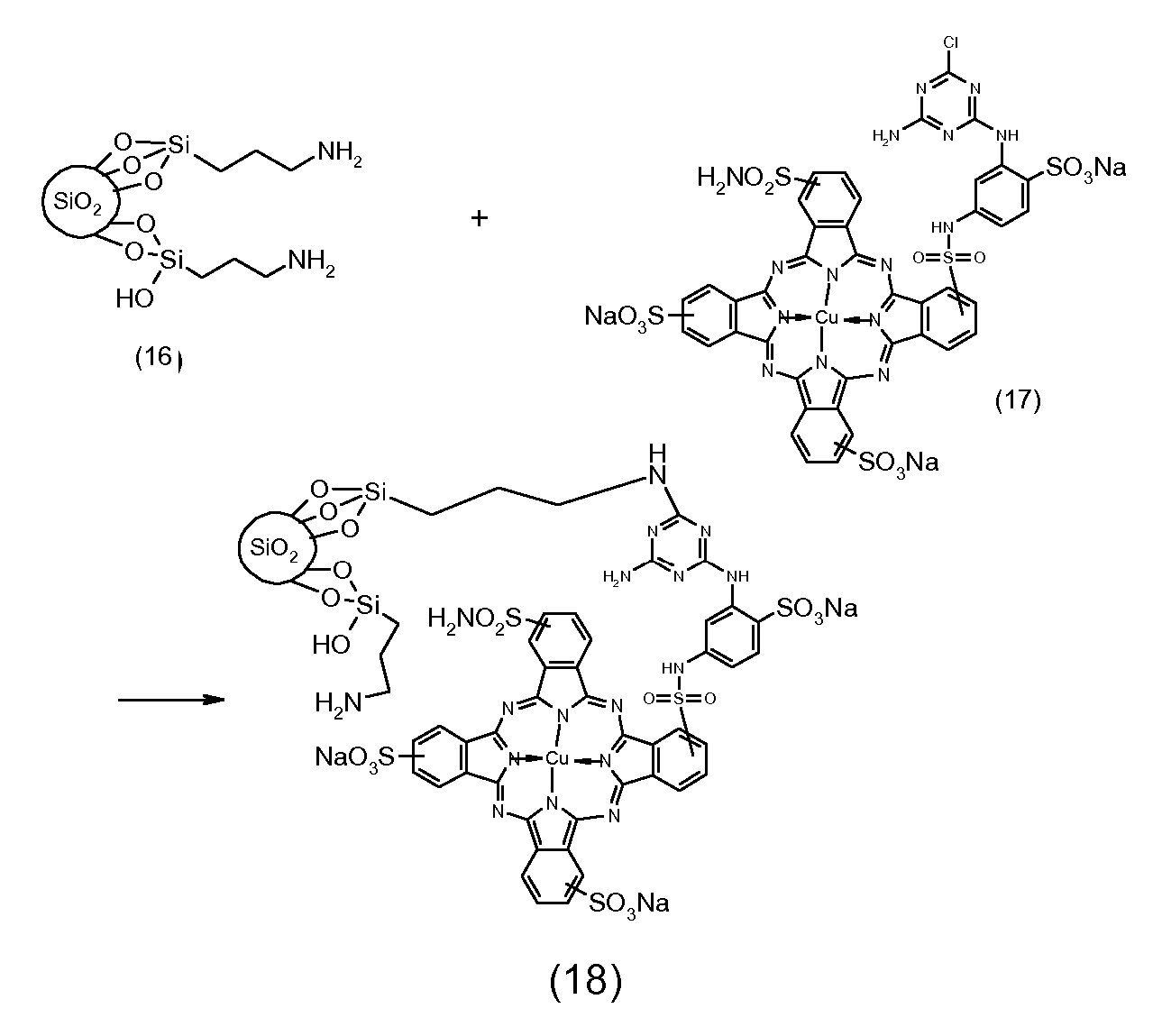
단계 1.2에 기재된 바와 유사하게, 나노입자 (16)를 화학식 (17)의 반응성 시안색 염료와 반응시켜 시안색 나노입자 (18)를 수득하였다 (분산액의 고체 함량: 2.1%, 고체 잔류물에 대한 원소 분석: C: 7.28%, H: 1.16%, N: 2.95%, S: 1.58%).Similar to that described in step 1.2, nanoparticles 16 were reacted with reactive cyan dyes of formula (17) to give cyan nanoparticles 18 (solid content of dispersion: 2.1%, for solid residues Elemental analysis: C: 7.28%, H: 1.16%, N: 2.95%, S: 1.58%).
실시예Example 4: 4: 암모늄실록산Ammonium siloxane 개질된Reformed 시안색Cyan 염색된 나노입자 (19) Dyed nanoparticles (19)
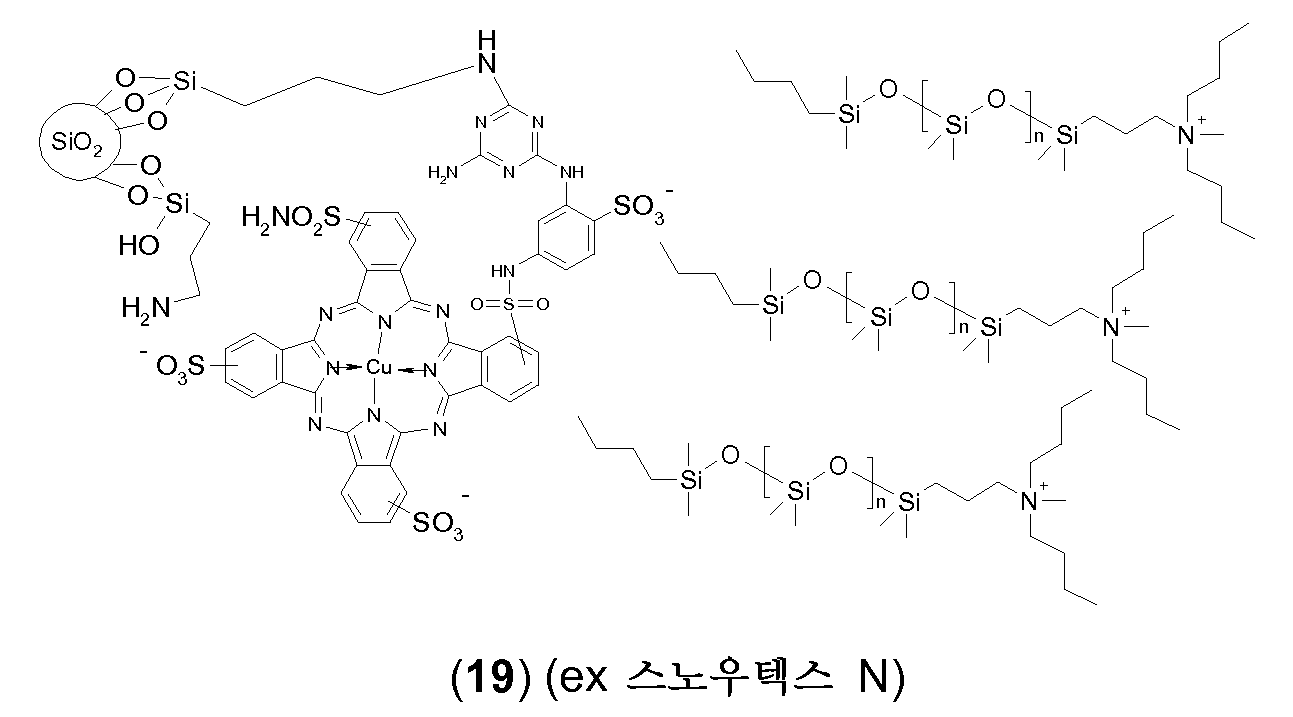
실시예 1에 기재된 바와 유사하게 나노입자 (22) (단계 4.2 참조)를 암모늄-폴리디메틸실록산 (9)과 반응시켜 도데칸 중의 시안색 염색된 나노입자 (19)(ex 스노우텍스 N)의 균질 분산액을 수득하였다. 이 분산액은 시안색 전기영동 잉크로서 시험하였다.Similar to that described in Example 1, nanoparticles 22 (see step 4.2 ) were reacted with ammonium-polydimethylsiloxane 9 to form cyan dyed nanoparticles 19 (ex Snowtex N) in dodecane A homogeneous dispersion was obtained. This dispersion was tested as a cyan electrophoretic ink.
출발 물질을 하기와 같이 제조하였다:The starting material was prepared as follows:
단계 4.1: 아미노프로필-개질된-나노입자 (21)Step 4.1: Aminopropyl-modified-nanoparticles (21)
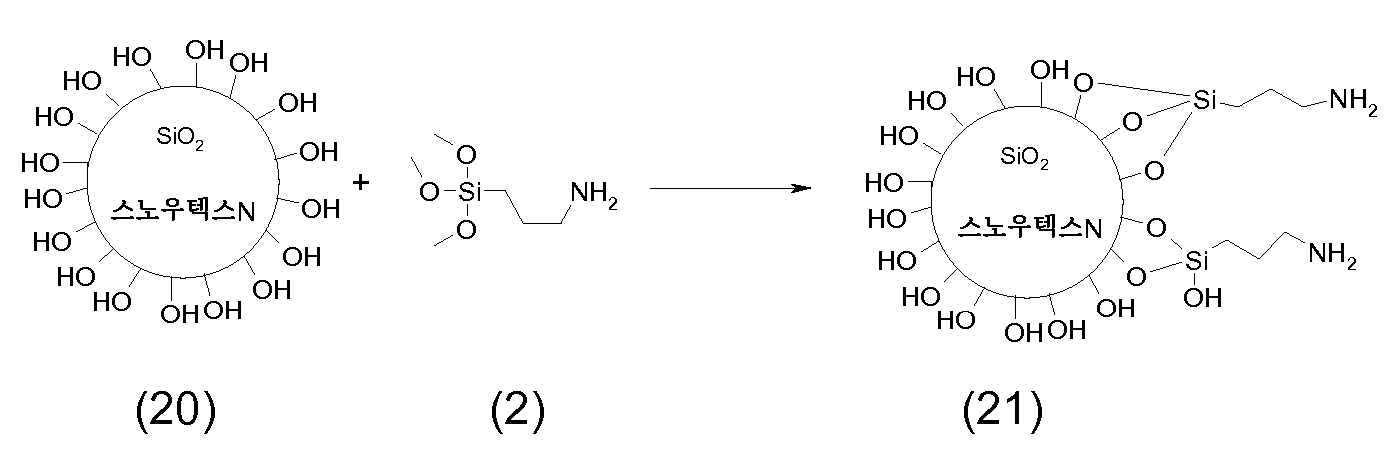
단계 1.1에서와 유사하게 도식적 "화학식"(20)의 스노우텍스 N (수중 실리카 나노입자 21 중량%의 분산액; 닛산 케미칼즈)을 (3-아미노프로필)-트리메톡시실란 (2)과 반응시켜 에탄올 중의 화학식 (21)의 유기적으로 개질된 나노입자를 수득하였다 (분산액의 고체 함량: 5.4%, 고체 잔류물에 대한 원소 분석: C: 4.91%, H: 1.23%, N: 1.72%).(A dispersion of 21 wt% in water silica nanoparticles; Nissan Chemicals, Inc.) of the schematic "Formula" ( 20 ) was reacted with (3-aminopropyl) -trimethoxysilane To a solution of the compound of formula (21) Organic modified nanoparticles were obtained (solids content of the dispersion: 5.4%, elemental analysis for solid residues: C: 4.91%, H: 1.23%, N: 1.72%).
단계 4.2: 시안색 염료 개질된 나노입자 (반대 이온: 나트륨) (22)Step 4.2: Cyan dye modified nanoparticles (counterion: sodium) (22)
단계 1.2에서와 유사하게, 나노입자 (21) (ex 스노우텍스 N)를 화학식 (17)의 반응성 시안색 염료와 반응시켜 시안색 나노입자 (22)를 수득하였다 (분산액의 고체 함량: 1.36%, 고체 잔류물에 대한 원소 분석: C: 11.08%, H: 1.43%, N: 4.52%, S: 2.47%). Similar to step 1.2, nanoparticles 21 (ex Snowtex N) were reacted with reactive cyan dyes of formula (17) to give cyan nanoparticles 22 (solids content of the dispersion: 1.36% Elemental analysis for the solid residue: C: 11.08%, H: 1.43%, N: 4.52%, S: 2.47%).
실시예Example 5: ( 5: ( 하전된Charged 청색 나노입자) Blue nanoparticles)
암모늄실록산 개질된 청색 염색된 나노입자 (23) Ammonium siloxane modified blue dyed nanoparticles ( 23 )
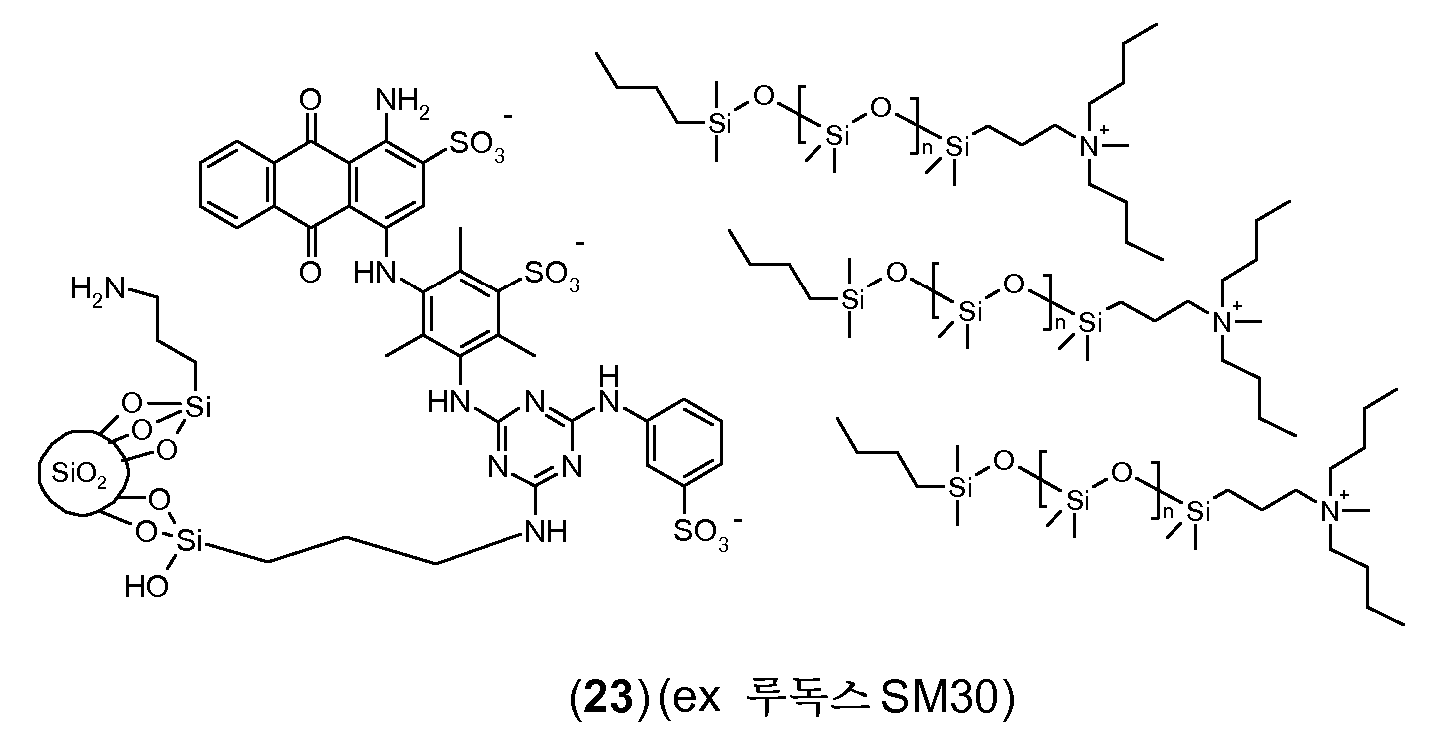
실시예 1에서와 유사하게 나노입자 (25) (단계 5.1 참조)를 암모늄-폴리디메틸실록산 (9)과 반응시켜 도데칸 중의 청색 염색된 나노입자 (23)의 균질 분산액을 수득하였다. 이 분산액을 장치 중에서 청색 전기영동 잉크로서 사용할 수 있다. Similar to Example 1, nanoparticles 25 (see step 5.1 ) were reacted with ammonium-polydimethylsiloxane 9 to obtain a homogeneous dispersion of blue-stained nanoparticles 23 in dodecane. This dispersion can be used as a blue electrophoretic ink in an apparatus.
분산된 하전 나노입자의 직경은 말번 제타사이저 나노시리즈에 의해 동적 광산란법에 의해 측정하여 164 nm였다.The diameter of the dispersed charged nanoparticles was 164 nm as measured by dynamic light scattering method using a Zetasizer nanosarcometer.
표면 개질된 분산된 하전 나노입자의 제타 전위 (ξ)는 말번 제타사이저 나노시리즈에 의해 측정하여 -17.7 mV이고, 전기영동 이동도 μ는 스몰루초브스키 관계식으로부터 산출하여 40V에서 -1.52e-2 x 10⁻⁸ m2/Vs이었다.The zeta potential (ξ) of the surface-modified dispersed charged nanoparticles was -17.7 mV as measured by a Malvern Zetasizer Nano series, and the electrophoretic mobility μ was calculated from the Small-Lozowski relationship and was -1.52e- 2 x 10 -8 m 2 / Vs.
출발 물질을 하기와 같이 제조하였다:The starting material was prepared as follows:
단계 5.1: 청색 염료 개질된 나노입자 (반대 이온: 나트륨) (25)Step 5.1: Blue dye modified nanoparticles (counterion: sodium) (25)
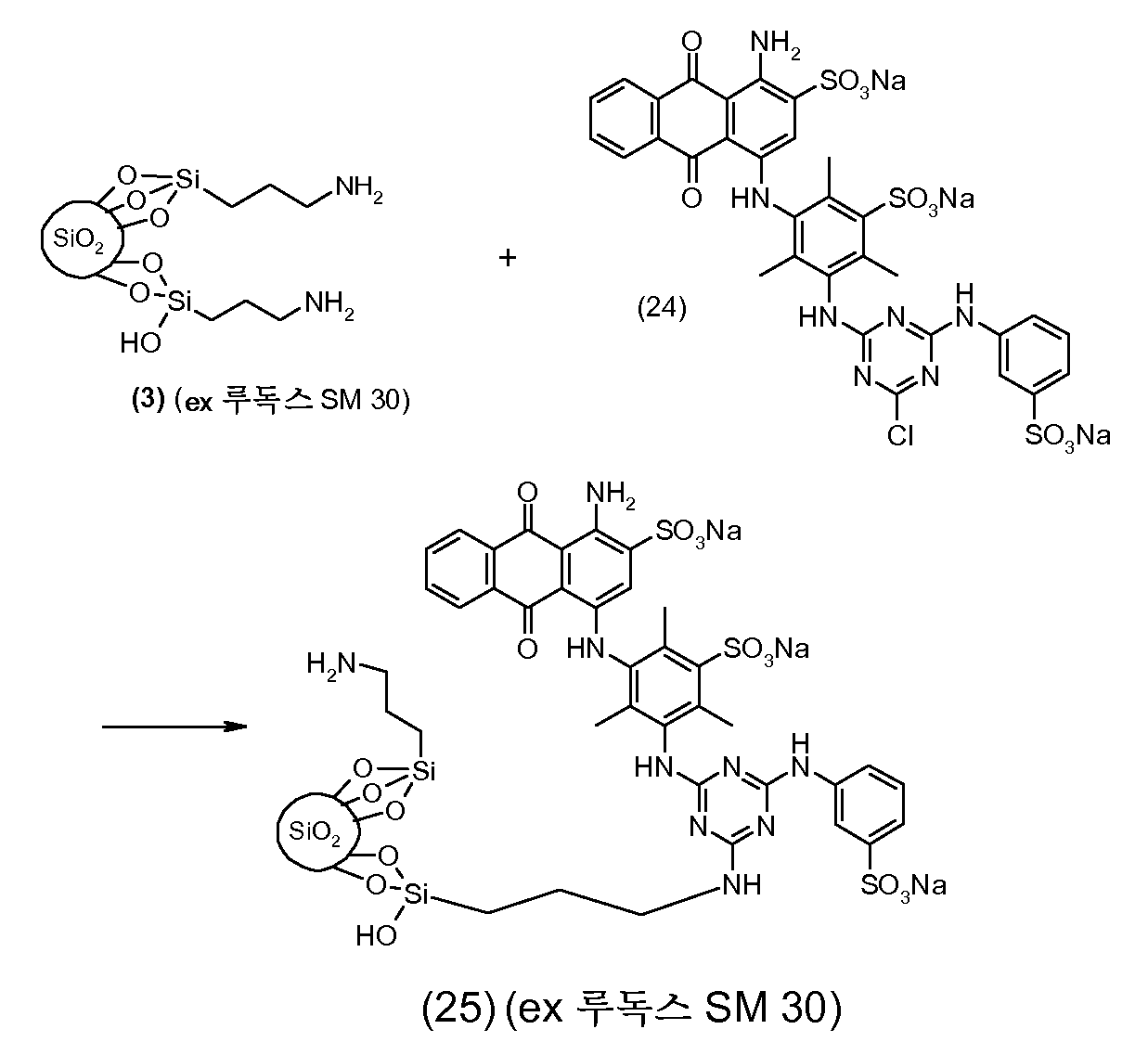
단계 1.2에 기재된 바와 유사하게 나노입자 (3)를 화학식 (24)의 반응성 청색 염료와 반응시켜 청색 나노입자 (25)를 수득하였다 (분산액의 고체 함량: 3.3%, 고체 잔류물에 대한 원소 분석: C: 15.48%, H: 2.02%, N: 4.33%, S: 3.02%). The nanoparticles (3) were reacted with the reactive blue dye of the formula (24) to obtain blue nanoparticles (25) (solid content of the dispersion: 3.3%, elemental analysis for solid residues: C: 15.48%, H: 2.02%, N: 4.33%, S: 3.02%).
실시예Example 6: 6: 암모늄실록산Ammonium siloxane 개질된Reformed 마젠타색 염색된 나노입자 (26) Magenta Dyed Nanoparticles (26)
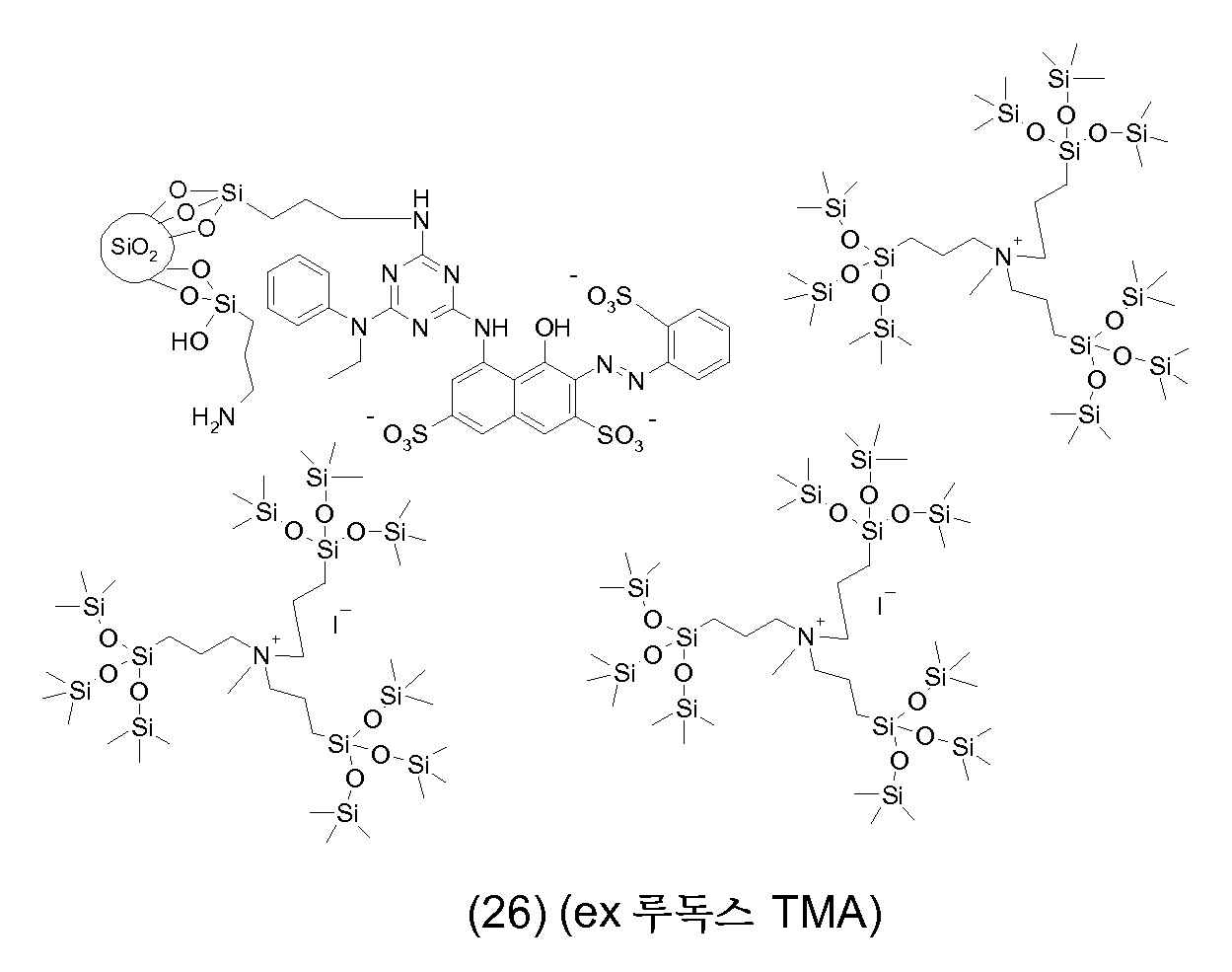
실시예 1에 기재된 바와 유사하게 나노입자 (33) (단계 6.4 참조)를 암모늄-폴리디메틸실록산 (31)과 반응시켜 도데칸 중의 마젠타색 염색된 나노입자 (26)의 균질 분산액을 수득하였다. 이 분산액을 장치 중에서 마젠타색 전기영동 잉크로서 사용할 수 있다. Similar to that described in Example 1, the nanoparticles 33 (see step 6.4 ) were reacted with ammonium-polydimethylsiloxane 31 to form the magenta dyed nanoparticles 26 in dodecane A homogeneous dispersion was obtained. This dispersion can be used as a magenta electrophoretic ink in a device.
출발 물질을 하기와 같이 제조하였다:The starting material was prepared as follows:
단계 6.1: 아이오도프로필실란 (28) Step 6.1: Iodopropyl silane (28)
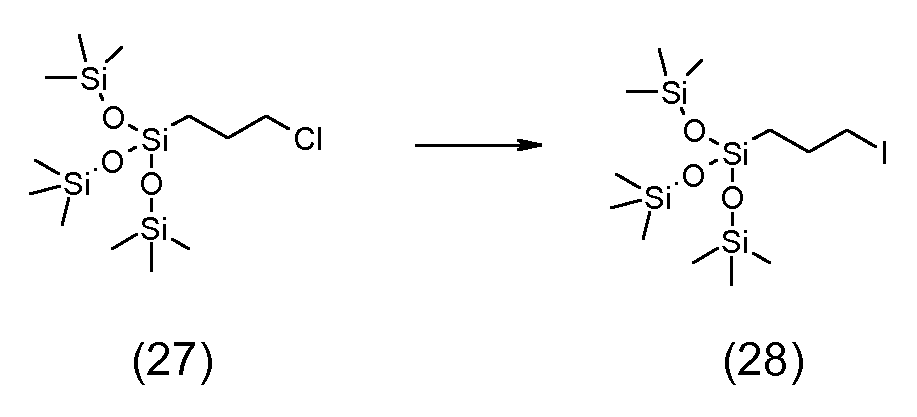
90 g의 3-클로로프로필트리스(트리메틸실록시)실란 (27) (화학초록집 No. 18077-31-1) 및 105.22 g의 나트륨 아이오다이드를 250 ml의 아세톤에 첨가하고 24시간 동안 환류교반하였다. 아세톤을 증발시키고 잔류물을 메틸렌 클로라이드 중에 녹였다. 유기 상을 물로 세척하고, 건조시키고 증발시켰다. 89 g의 목적하는 3-아이오도프로필-트리스(트리메틸실록시)실란 (28)을 수득하였다; 90 g of 3-chloropropyltris (trimethylsiloxy) silane (27) (Chemical Abstract No. 18077-31-1) and 105.22 g of sodium iodide were added to 250 ml of acetone and refluxed for 24 hours . The acetone was evaporated and the residue was dissolved in methylene chloride. The organic phase was washed with water, dried and evaporated. 89 g of the desired 3-iodopropyl-tris (trimethylsiloxy) silane (28) was obtained;

단계 6.2: 트리스(트리스(트리메틸실록시)실릴프로필)아민 (30) Step 6.2: Tris (tris (trimethylsiloxy) silylpropyl) amine (30)

14.3 g의 3-아이오도프로필트리스(트리메틸실록시)실란 (28), 5.7 g의 3-아미노프로필트리스(트리메틸실록시)실란 및 9.6 g의 탄산나트륨을 50 ml의 디메틸아세트아미드에 첨가하고 15시간 동안 80℃에서 교반하였다. 이어서 디메틸아세트아미드를 증발시키고 잔류물을 메틸렌 클로라이드 중에 녹였다. 유기 상을 물로 세척하고, 건조시키고 증발시켰다. 생성물을 실리카겔 상에서 컬럼 크로마토그래피로 정제하여 7 g의 담황색을 띤 오일로서 화학식 (30)을 수득하였다; 14.3 g of 3-iodopropyltris (trimethylsiloxy) silane (28) , 5.7 g of 3-aminopropyltris (trimethylsiloxy) silane and 9.6 g of sodium carbonate were added to 50 ml of dimethylacetamide and stirred for 15 hours 0.0 > 80 C. < / RTI > The dimethylacetamide was then evaporated and the residue was dissolved in methylene chloride. The organic phase was washed with water, dried and evaporated. The product was purified by column chromatography on silica gel to give 7 g of the compound of formula (30) as a pale yellow oil;

단계 6.3: 메틸-트리스(트리스(트리메틸실록시)실릴프로필)암모늄 아이오다이드 (31)Step 6.3: Methyl-tris (tris (trimethylsiloxy) silylpropyl) ammonium iodide (31)
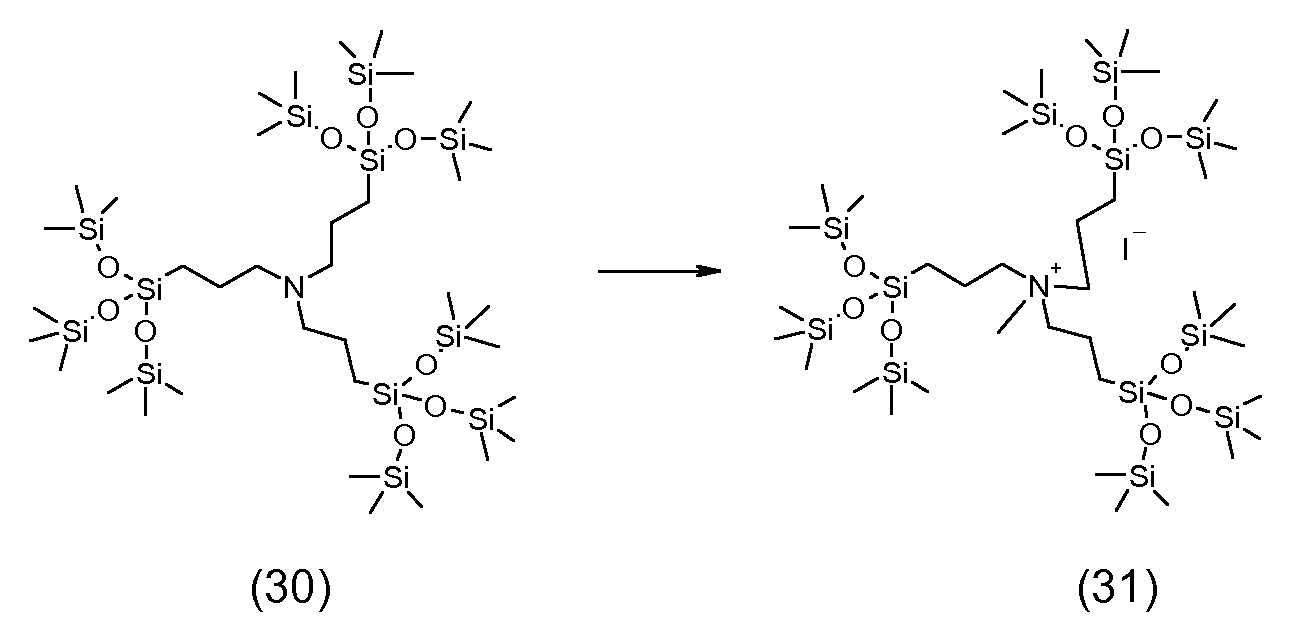
1.42 g의 트리스(트리스(트리메틸실록시)실릴프로필)아민 (30), 1.2 g의 메틸 아이오다이드 및 0.9 g의 탄산나트륨을 50 ml의 아세톤에 첨가하였다. 반응 혼합물을 15시간 동안 환류교반하였다. 용매를 증발시키고 잔류물을 메틸렌 클로라이드 중에 녹였다. 이어서 유기 상을 물로 세척하고, 건조시키고 증발시켰다. 잔류물은 목적 생성물 메틸-트리스(트리스(트리메틸실록시)실릴프로필)암모늄 아이오다이드 (31)를 함유하였다; 
단계 6.4: 마젠타색 염료 개질된 나노입자 (반대 이온: 나트륨) (33) Step 6.4: Magenta dye modified nanoparticles (counterion: sodium) (33)
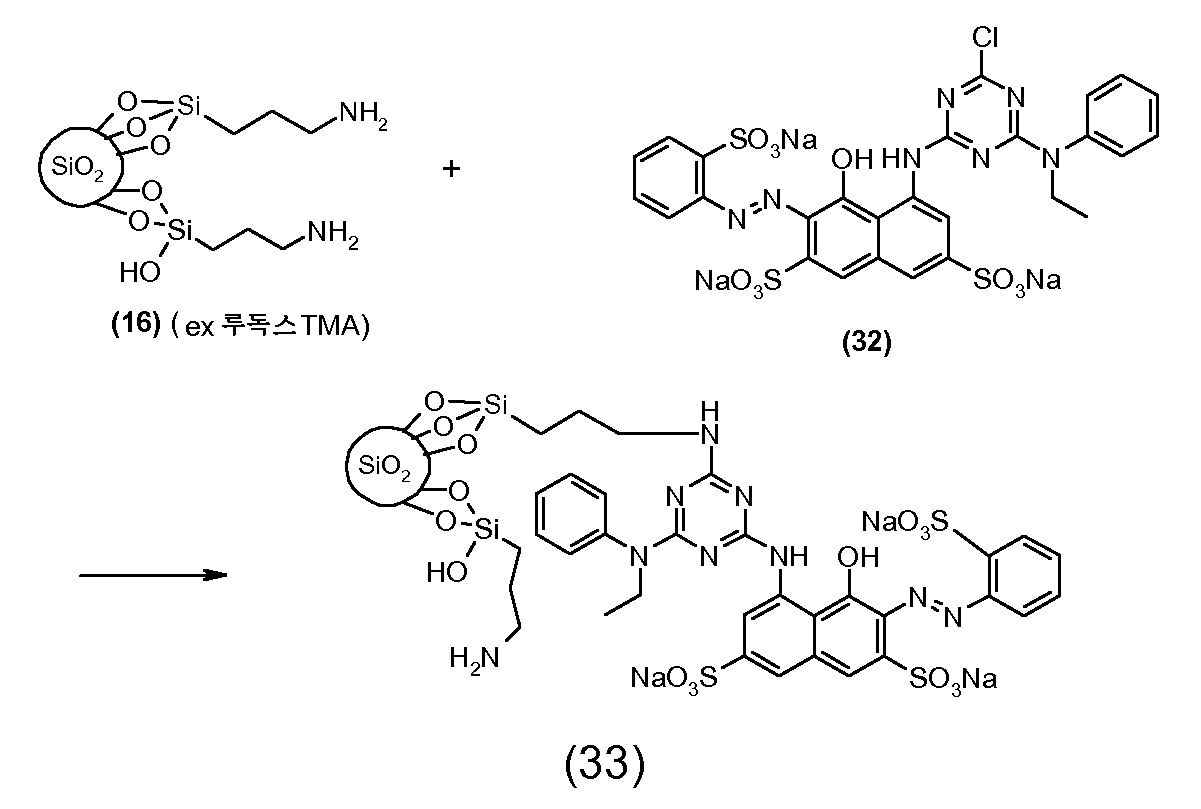
단계 1.2에 기재된 바와 유사하게 화학식 (16)의 나노입자를 화학식 (32)의 반응성 마젠타색 염료와 반응시켜 마젠타색 나노입자 (33)를 수득하였다 (분산액의 고체 함량: 8.6%, 고체 잔류물에 대한 원소 분석: S: 1.33%).Similar to that described in step 1.2, the nanoparticles of formula (16) were reacted with the reactive magenta dye of formula (32) to give magenta nanoparticles (33) (solid content of dispersion: 8.6%, solid residue Elemental analysis for S: 1.33%).
실시예Example 7: 7: 암모늄실록산Ammonium siloxane 개질된Reformed 마젠타색 염색된 나노입자 (34) Magenta dyed nanoparticles (34)
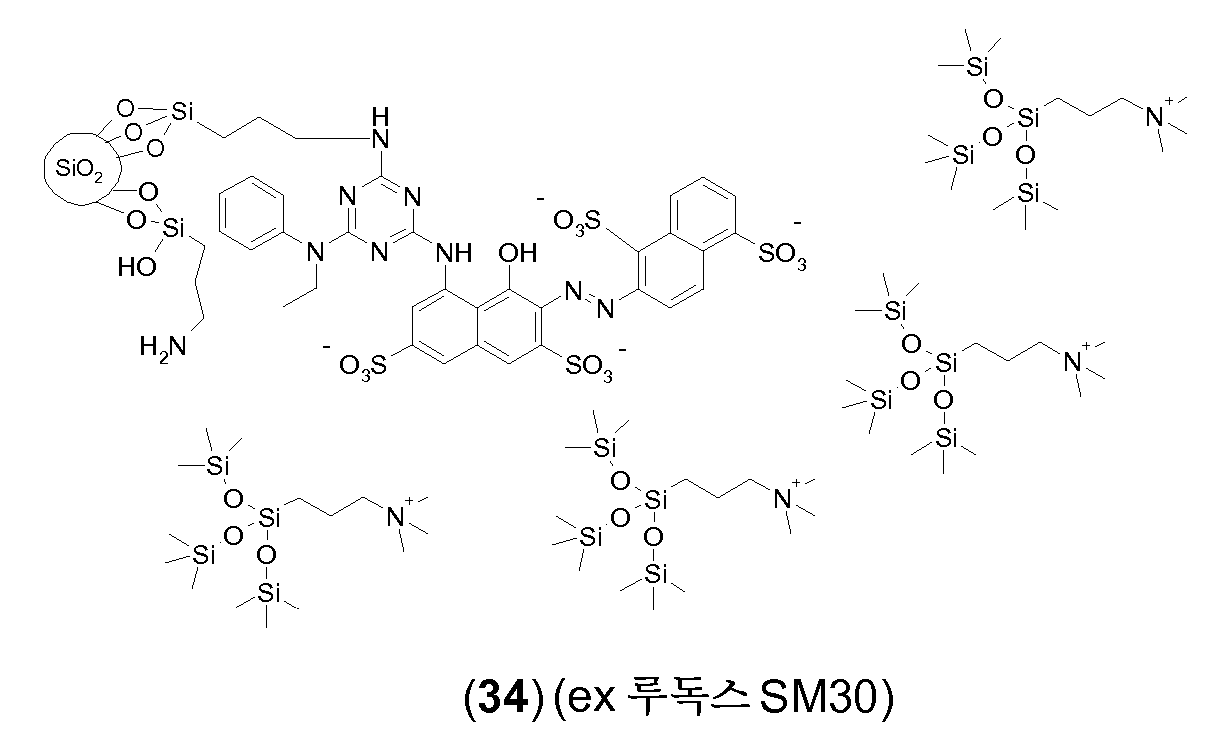
실시예 1에 기재된 바와 유사하게 단계 1.2에 기재된 화학식 (5)의 나노입자를 단계 7.1에 기재된 화학식 (35)의 암모늄-폴리디메틸실록산과 반응시켜 화학식 (34)의 마젠타색 염색된 나노입자의 균질 분산액을 수득하였다. The nanoparticles of formula ( 5 ) described in step 1.2 were reacted with the ammonium-polydimethylsiloxane of formula ( 35 ) described in step 7.1 to obtain the homogeneous (yellow) color of the magenta dyed nanoparticles of formula ( 34 ) A dispersion was obtained.
화학식 (34)의 나노입자의 분산액 용매로서 테트랄린을 도데칸 대신에 사용할 수 있다. 이 분산액을 장치 중에서 마젠타색 전기영동 잉크로서 사용할 수 있다. Tetralin can be used instead of dodecane as a dispersion solvent of nanoparticles of formula ( 34 ). This dispersion can be used as a magenta electrophoretic ink in a device.
단계 7.1: N,N,N-트리메틸-N-[3-(트리스-트리메틸실록시-실릴)-프로필]암모늄 아이오다이드 (35) Step 7.1: N, N, N-trimethyl-N- [3- (tris-trimethylsiloxy-silyl) -propyl] ammonium iodide ( 35 )
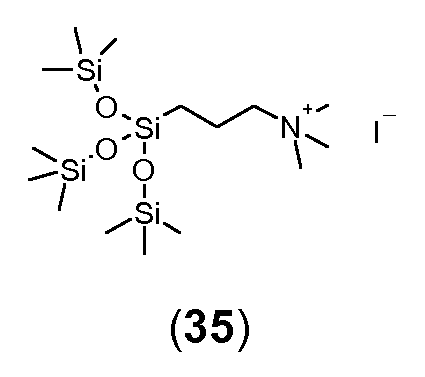
0.8 g의 3-아미노프로필트리스(트리메틸실록시)실란, 1.8 g의 메틸 아이오다이드 및 1.35 g의 탄산나트륨을 50 ml의 디메틸포름아미드에 첨가하였다. 반응 혼합물을 3시간 동안 실온에서 교반하였다. 용매를 증발시키고 잔류물을 메틸렌 클로라이드 및 물 중에 녹였다. 이어서 유기 상을 물로 세척하고, 건조시키고 증발시켜 화합물 (35)을 수득하였다; 0.8 g of 3-aminopropyltris (trimethylsiloxy) silane, 1.8 g of methyl iodide and 1.35 g of sodium carbonate were added to 50 ml of dimethylformamide. The reaction mixture was stirred for 3 hours at room temperature. The solvent was evaporated and the residue was dissolved in methylene chloride and water. The organic phase was then washed with water, dried and evaporated to give compound ( 35 );

실시예Example 8: 8: 포스포늄실록산Phosphonium siloxane 개질된Reformed 마젠타색 염색된 나노입자 (36) Magenta Dyed Nanoparticles (36)
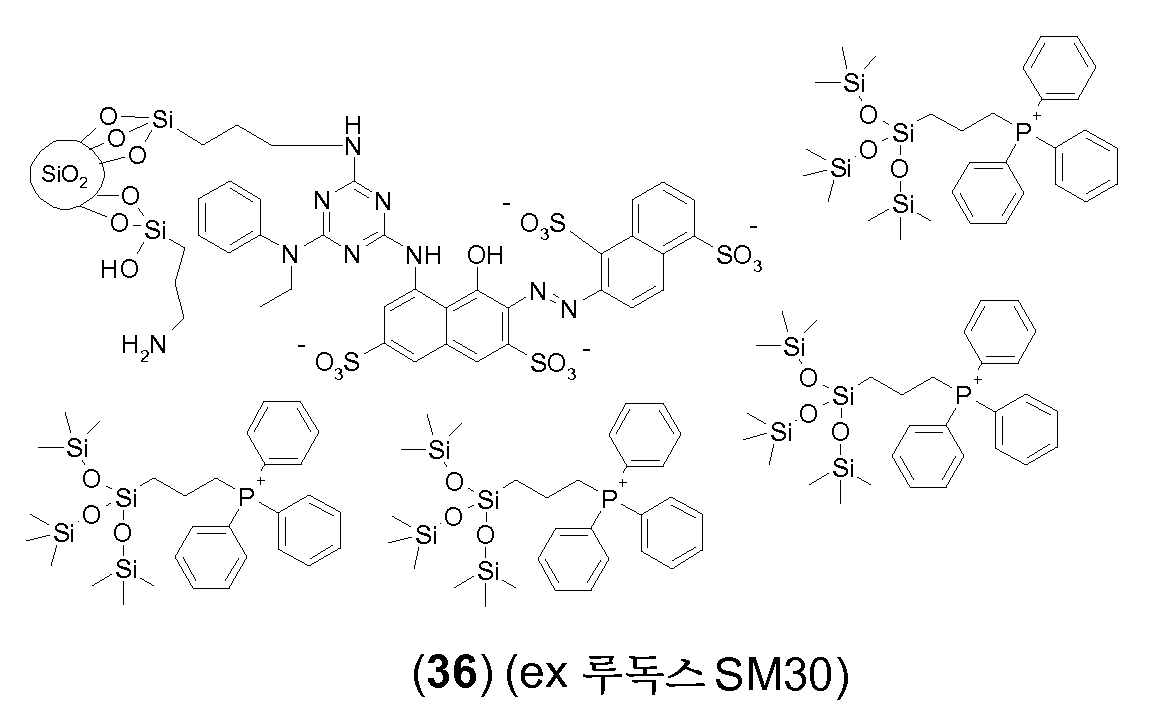
실시예 1에 기재된 바와 유사하게 단계 1.2에 기재된 화학식 (5)의 나노입자를 단계 8.1에 기재된 화학식 (37)의 트리페닐-(트리스(트리메틸실록시)실릴프로필)포스포늄 아이오다이드와 반응시켜 화학식 (36)의 마젠타색 염색된 나노입자의 균질 분산액을 수득하였다. ( 5 ) as described in example 1 was reacted with triphenyl- (tris (trimethylsiloxy) silylpropyl) phosphonium iodide of formula ( 37 ) described in step 8.1 to give A homogeneous dispersion of magenta dyed nanoparticles of formula ( 36 ) was obtained.
화학식 (36)의 나노입자의 분산액 용매로서 테트랄린을 도데칸 대신에 사용할 수 있다. 이 분산액을 장치 중에서 마젠타색 전기영동 잉크로서 사용할 수 있다. Tetralin can be used instead of dodecane as a dispersion solvent of nanoparticles of formula ( 36 ). This dispersion can be used as a magenta electrophoretic ink in a device.
단계 8.1: 트리페닐-(트리스(트리메틸실록시)실릴프로필)포스포늄 아이오다이드 (37) Step 8.1: Triphenyl- (tris (trimethylsiloxy) silylpropyl) phosphonium iodide ( 37 )

단계 6.1에 기재된 1.0 g의 3-아이오도프로필트리스(트리메틸실록시)실란 (28), 1.7 g의 트리페닐포스핀 및 0.69 g의 탄산나트륨을 50 ml의 테트라히드로푸란에 첨가하였다. 반응 혼합물을 2일 동안 환류교반하였다. 용매를 증발시키고 잔류물을 실리카겔 상에서 컬럼 크로마토그래피로 정제하여 목적하는 포스포늄 염 (37)을 수득하였다; 
실시예Example 9: 9: 암모늄실록산Ammonium siloxane 개질된Reformed 황색 염색된 나노입자 (38) Yellow dyed nanoparticles (38)
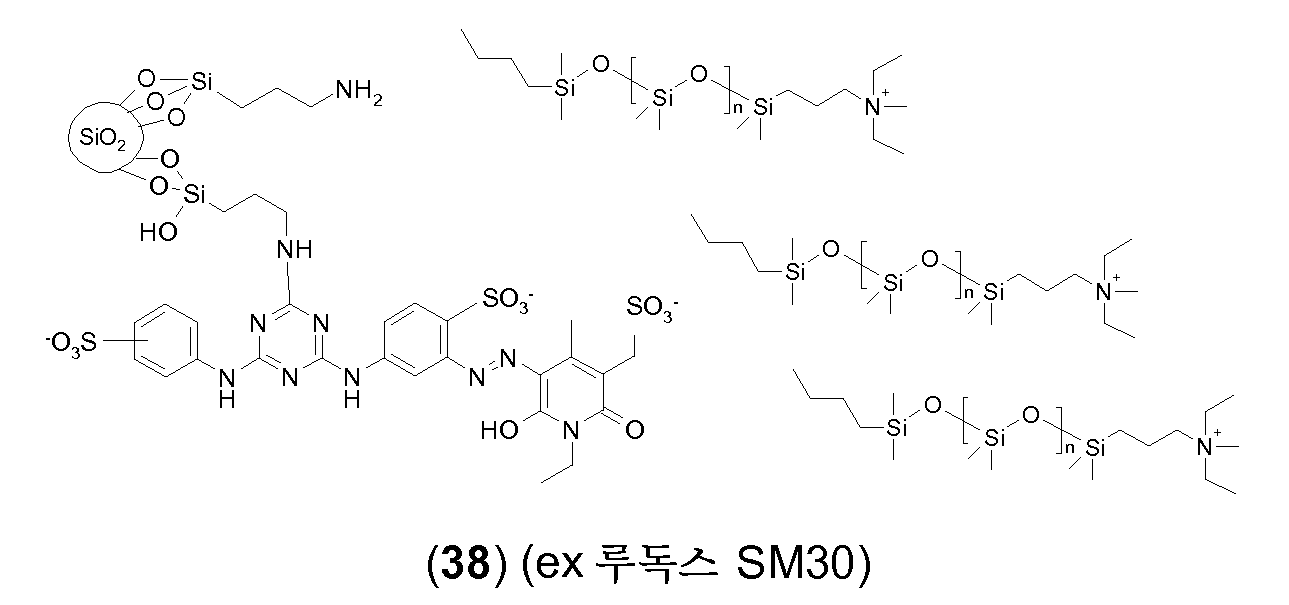
실시예 2에서 화합물 (11)에 대해 기재된 바와 유사하게, 나노입자 (13)를 화합물 (39)(단계 9.1 참조)과 반응시켜 황색 염색된 나노입자 26의 균질 분산액 수득하였다. 도데칸 대신에 이소파르(Isopar) G를 분산액 용매로서 사용하였다. 이 분산액은 장치 중에서 황색 전기영동 잉크로서 사용된다.Similar to what was described for compound ( 11 ) in Example 2, nanoparticles ( 13 ) were reacted with compound ( 39 ) (see step 9.1) to give a homogeneous dispersion of yellow stained nanoparticles (26). Isopar G was used as a dispersion solvent instead of dodecane. This dispersion is used as a yellow electrophoretic ink in the apparatus.
단계 9.1: 메틸-디에틸-암모늄프로필렌-폴리디메틸실록산 (39)Step 9.1: Methyl-diethyl-ammonium propylene-polydimethylsiloxane ( 39 )
단계 1.5에서 화합물 (9)에 대해 기재된 바와 유사하게 화합물 (39)을 제조하였다; Compound ( 39 ) was prepared analogously as described for compound ( 9 ) in step 1.5;

실시예Example 10: 10: 암모늄실록산Ammonium siloxane 개질된Reformed 시안색Cyan 염색된 나노입자 (40) The dyed nanoparticles (40)
실시예 4에서 화합물 (19)에 대해 기재된 바와 유사하게, 나노입자 (22)를 화합물 (41)(단계 10.1 참조)과 반응시켜 시안색 염색된 나노입자 (40)의 균질 분산액을 수득하였다. 이 분산액은 장치 중에서 시안색 전기영동 잉크로서 사용된다.Similar to that described for compound ( 19 ) in Example 4, nanoparticles ( 22 ) were reacted with compound ( 41 ) (see step 10.1) to give a homogeneous dispersion of cyan dyed nanoparticles ( 40 ). This dispersion is used as a cyan electrophoretic ink in the apparatus.
단계 10.1: 메틸-디이소프로필-암모늄프로필렌-폴리디메틸실록산 (41) Step 10.1: Methyl-diisopropyl-ammonium propylene-polydimethylsiloxane ( 41 )
단계 1.5에서 화합물 (9)에 대해 기재된 바와 유사하게 화합물 (41)을 제조하였다; Compound ( 41 ) was prepared analogously as described for compound ( 9 ) in step 1.5;

실시예Example 11: 11: 적색Red 안료 입자를 포함하는 전기영동 잉크 Electrophoretic ink containing pigment particles
실시예 2에 기재된 바와 유사하게, 단계 11.1에 기재된 개질된 안료 입자의 수성 현탁액을 단계 1.5에 도시된 화학식 (9)의 암모늄-폴리디메틸실록산과 반응시켰다. 2상 시스템을 가열된 오일조 중에 함침시킨 바이알 중에서 15분 동안 60℃에서 교반하였다. 냉각 후, 두 상이 분리되었다. 유기 상을 세척하였다. 밤새 방치한 후, 저비점 유기 용매를 진공 중에서 제거하여 도데칸 중의 개질된 안료의 적색 분산액을 수득하였다. 응집물을 원심분리로 제거한 후, 분산액은 균질하였고 장치 중에서 적색 전기영동 잉크로서 사용할 수 있다. Similar to that described in Example 2, an aqueous suspension of the modified pigment particles described in Step 11.1 was reacted with the ammonium-polydimethylsiloxane of Formula ( 9 ) shown in Step 1.5. The two-phase system was stirred in a vial impregnated in a heated oil bath for 15 minutes at 60 < 0 > C. After cooling, the two phases were separated. The organic phase was washed. After standing overnight, the low boiling organic solvent was removed in vacuo to give a red dispersion of the modified pigment in dodecane. After removing the agglomerates by centrifugation, the dispersion is homogeneous and can be used as a red electrophoretic ink in the apparatus.
단계 11.1: 화학식 (205)의 염 혼련된 C.I. (색지수) 피그먼트 레드 254 [CAS-No. 84632-65-5; 이르가진(IRGAZIN) DPP 레드 BO ex CIBA SC; 3,6-비스(4-클로로페닐)-2,5-디히드로피롤로[3,4-c]피롤-1,4-디온]의 41.1 % 수성 프레스 케이크 39.1 g 및 DE-4037556 A1의 실시예 1a) 및 1b)에 기재된 바와 같이 수득될 수 있는 화학식 (205), (206) 및 (207)의 3개의 화합물의 부분적으로 술폰화된 혼합물의 나트륨 염의 28.6% 수성 필터 케이크 0.28 g을 분산기 혼합기 (disperser mixer) (카울즈 용해기(Cowles dissolver))로 90분 동안 150 ml 물 중에 분산시켰다.Step 11.1: Salt of Compound ( 205 ) CI (Color Index) Pigment Red 254 [CAS-No. 84632-65-5; IRGAZIN DPP Red BO ex CIBA SC; 39.1 g of a 41.1% aqueous press cake of 3,6-bis (4-chlorophenyl) -2,5-dihydropyrrolo [3,4-c] pyrrole-1,4-dione] and DE-4037556 A1 0.28 g of the 28.6% aqueous filter cake of the sodium salt of the partially sulfonated mixture of the three compounds of formulas ( 205 ), ( 206) and (207 ), which can be obtained as described in Examples 1a) and 1b) and dispersed in 150 ml water for 90 minutes with a disperser mixer (Cowles dissolver).

실시예Example 12: 청색 안료 입자를 포함하는 전기영동 잉크 12: Electrophoretic ink containing blue pigment particles
실시예 2에 기재된 바와 유사하게, 단계 12.1에 기재된 바와 같이 제조된 안료의 수성 현탁액을 단계 1.5에 도시된 화학식 (9)의 암모늄-폴리디메틸실록산과 반응시켜 청색 전기영동 잉크를 제조하였다.Similar to that described in Example 2, a blue electrophoretic ink was prepared by reacting an aqueous suspension of the pigment prepared as described in Step 12.1 with ammonium-polydimethylsiloxane of Formula ( 9 ) shown in Step 1.5.
단계 12.1: 화학식 (221)의 염 혼련된 구리 프탈로시아닌 블루 15.3 (C.I. 피그먼트 블루 15.3; C.I. NO.: 74160:3; CAS NO: 147-14-8; 이르가라이트(IRGALITE) 블루 GLO; ex CIBA SC)의 49.2% 수성 필터 케이크 23.1 g 및 화학식 (222)의 모노-술폰화된 (나트륨 염으로서) 구리 프탈로시아닌 (26.4% 수성 필터 케이크로서) 유도체 0.42 g을 함께 100 ml의 물 중에 카울즈 용해기로 90분 동안 분산시켰다. Step 12.1: Salt of compound of formula ( 221 ) CI Pigment Blue 15.3 (CI Pigment Blue 15.3; CI NO .: 74160: 3; CAS NO: 147-14-8; IRGALITE Blue GLO; ex CIBA 23.1 g of a 49.2% aqueous filter cake of formula ( 222 ) and 0.42 g of copper phthalocyanine (as a 26.4% aqueous filter cake) derivative as mono-sulphonated (as a sodium salt) of formula ( 222 ) were added to 100 ml of water in a Cowles dissolver And dispersed for 90 minutes.
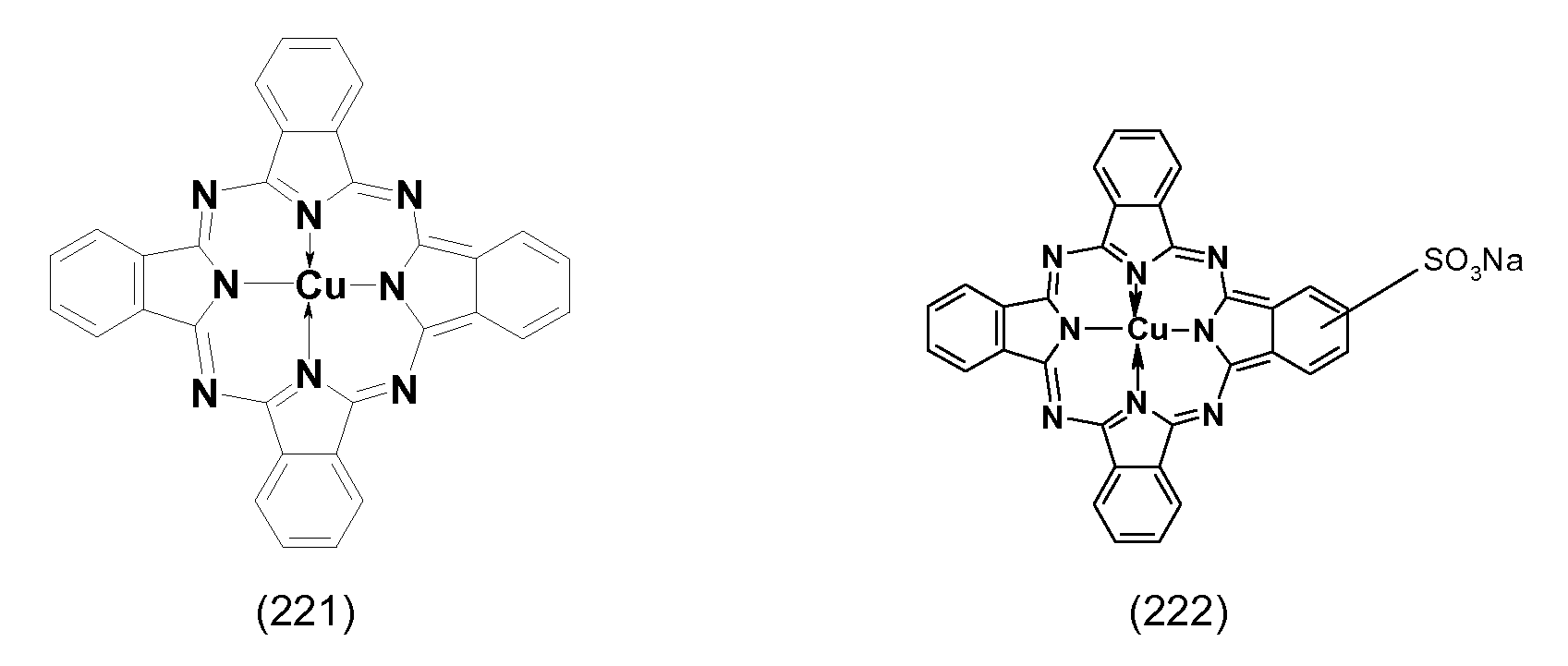
실시예Example 13: 청색 안료 입자를 포함하는 전기영동 잉크 13: Electrophoretic ink containing blue pigment particles
실시예 2에 기재된 바와 유사하게, 단계 13.1에 기재된 바와 같이 제조된 안료의 수성 현탁액을 단계 1.5에 도시된 화학식 (9)의 암모늄-폴리디메틸실록산과 반응시켜 청색 전기영동 잉크를 제조하였다. Similar to that described in Example 2, a blue electrophoretic ink was prepared by reacting an aqueous suspension of the pigment prepared as described in Step 13.1 with ammonium-polydimethylsiloxane of Formula ( 9 ) shown in Step 1.5.
단계 13.1: 화학식 (221)의 염 혼련된 C.I. 피그먼트 블루 15.3 (이르가라이트 블루 GLO ex CIBA SC)의 49.2% 수성 필터 케이크 23.4 g 및 안료 상승작용제 (분산제) 솔스퍼스(SOLSPERSE) 5000 [CAS No. 70750-63-9; 루브리졸 어드밴스드 머티리얼즈 인크.(Lubrizol Advanced Materials Inc.); 화학식 (222)에 상응하고 차이점은 솔스퍼스 5000은 나트륨 염이 아니지만, 4급 암모늄 염과 유사함] 0.23 g을 함께 100 ml의 물 중에 카울즈 용해기로 90분 동안 분산시켰다. 현탁액을 여과지 상에서 여과한 후, 물로 세척하고 생성물을 진공 오븐 중에서 80℃에서 건조시켰다.Step 13.1: Salt of formula (221) 23.4 g of a 49.2% aqueous filter cake of CI Pigment Blue 15.3 (Irgarite Blue GLO ex CIBA SC) and a pigment synergist (dispersant) SOLSPERSE 5000 [CAS No . 70750-63-9; Lubrizol Advanced Materials Inc.); 0.23 g corresponding to the formula ( 222 ), the difference being that the Solspers 5000 is not a sodium salt, but quaternary ammonium salt) are dispersed together in a Cowles dissolver in 100 ml of water for 90 minutes. The suspension was filtered on filter paper, then washed with water and the product was dried in a vacuum oven at 80 < 0 > C.
실시예Example 14: 녹색 안료 입자를 포함하는 전기영동 잉크 14: Electrophoretic ink containing green pigment particles
실시예 2에 기재된 바와 유사하게, 단계 14.1에 기재된 바와 같이 제조된 안료의 수성 현탁액을 단계 1.5에 도시된 화학식 (9)의 암모늄-폴리디메틸실록산과 반응시켜 녹색 전기영동 잉크를 제조하였다.Similar to that described in Example 2, a green electrophoretic ink was prepared by reacting an aqueous suspension of the pigment prepared as described in Step 14.1 with ammonium-polydimethylsiloxane of Formula ( 9 ) shown in Step 1.5.
단계 14.1: C.I. 피그먼트 그린 7 (C.I. 74260; 구리 프탈로시아닌 그린; 폴리클로로 구리 프탈로시아닌; 이르가라이트 그린 GFNP; ex CIBA SC)의 38.9% 수성 필터 케이크 13.5 g 및 구리 프탈로시아닌 유도체 (217) 0.11 g을 카울즈 용해기로 90분 동안 분산시켰다.Step 14.1: 13.5 g of a 38.9% aqueous filter cake of CI Pigment Green 7 (CI 74260; copper phthalocyanine green; polychloro copper phthalocyanine; Irgalit green GFNP; ex CIBA SC) and 0.11 g of copper phthalocyanine derivative ( 217 ) Lt; / RTI > dissolver for 90 minutes.
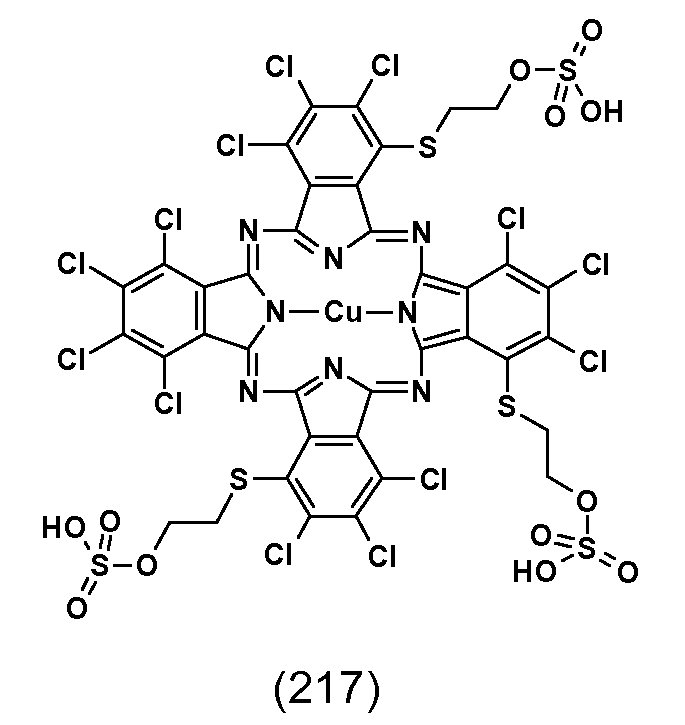
실시예Example 15: 녹색 안료 입자를 포함하는 전기영동 잉크 15: Electrophoretic ink containing green pigment particles
실시예 2에 기재된 바와 유사하게, 단계 15.1에 기재된 바와 같이 제조된 안료의 수성 현탁액을 단계 1.5에 도시된 화학식 (9)의 암모늄-폴리디메틸실록산과 반응시켜 녹색 전기영동 잉크를 제조하였다. Similar to that described in Example 2, a green electrophoretic ink was prepared by reacting an aqueous suspension of the pigment prepared as described in Step 15.1 with ammonium-polydimethylsiloxane of Formula (9) shown in Step 1.5.
단계 15.1: CI 피그먼트 그린 36 (구리 프탈로시아닌 그린 분말 [cp 그린 360009]; 폴리브로모프탈로 그린; C.I. NO.: 74265 CAS NO: 14302-13-7; 이르가라이트 그린 6G ex CIBA SC)의 35.5% 수성 필터 케이크 14 g 및 단계 14.1에 도시된 구리 프탈로시아닌 유도체 (217) 0.12 g을 카울즈 용해기로 90분 동안 분산시켰다.Step 15.1: Preparation of 35.5 of CI Pigment Green 36 (copper phthalocyanine green powder [cp green 360009], polyribomorphal green, CI NO .: 74265 CAS NO: 14302-13-7, Irgalit green 6G ex CIBA SC) 14 g of the aqueous filter cake and 0.12 g of the copper phthalocyanine derivative 217 shown in Step 14.1 were dispersed in a Cowles dissolver for 90 minutes.
실시예Example 16: 흑색 안료 입자를 포함하는 전기영동 잉크 16: Electrophoretic ink containing black pigment particles
실시예 2에 기재된 바와 유사하게, 단계 16.1에 기재된 바와 같이 제조된 안료의 수성 현탁액을 단계 1.5에 도시된 화학식 (9)의 암모늄-폴리디메틸실록산과 반응시켜 흑색 전기영동 잉크를 제조하였다. Similar to that described in Example 2, a black electrophoretic ink was prepared by reacting an aqueous suspension of the pigment prepared as described in Step 16.1 with ammonium-polydimethylsiloxane of Formula (9) shown in Step 1.5.
단계 16.1: WO 00/24736 A1의 페이지 35 실시예 12B에 따라 수득될 수 있는 잠정적 화학식 (208)의 미분화된 옥소벤조푸라닐리덴-디히드로인돌론 10 g을 100 ml의 물 중에 18시간 동안 분산시켰다. Step 16.1: page 35 of WO 00/24736 A1 10 g of micronized oxobenzofuranylidene-dihydroindolone of provisional formula ( 208 ) obtainable according to Example 12B is dispersed in 100 ml of water for 18 hours .
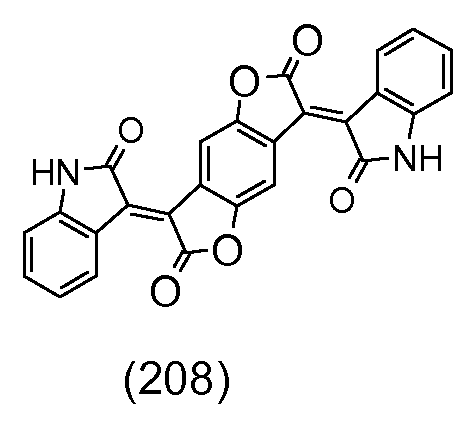
잠정적 화학식 (208)은 WO 00/24736 A1에 "바이올렛 분말"로서 기재되어 있다. 본 특허출원의 발명자들은 상기 화학식 (208)을 상기 실시예 12b에 따라 수득된 생성물과 가장 유사한 구조를 나타내는 것으로 생각하지만, 그 구조가 절대적으로 확실한 것은 아니다. 정확한 구조는 이성질체, 특히 화학식 (208)의 시스/트랜스-이성질체, 또는 이러한 이성질체의 혼합물에 또한 상응할 수 있을 것이다.The provisional formula ( 208 ) is described as "violet powder" in WO 00/24736 A1. The inventors of this patent application think that the above formula ( 208 ) represents the structure most similar to the product obtained according to the above Example 12b, but the structure is not absolutely certain. The precise structure may also correspond to the isomer, especially the cis / trans-isomer of formula ( 208 ), or a mixture of such isomers.
2.9 g의 물 중의 0.7 g의 술파닐산 (4-아미노벤젠 술폰산) 및 1.38 g의 35% 염산 용액을 4℃에서 1.08 ml의 4M NaNO2 수용액과 별도로 처리하였다. 디아조늄 염을 단계 16.1에 따라 수득된 안료 현탁액에 첨가하였다. 냉각을 제거하고 혼합물을 4℃에서 23℃로 연속적으로 교반하면서 가온한 다음 50℃로 1시간 동안 가열하였다.2.9 g of 35% hydrochloric acid solution of sulfamic acid of 0.7 g in water (4-aminobenzenesulfonic acid) and 1.38 g was treated at 4 ℃ with 1.08 ml 4M NaNO 2 solution of the separately. The diazonium salt was added to the pigment suspension obtained according to step 16.1. The cooling was removed and the mixture was warmed from 4 ° C to 23 ° C with continuous stirring and then heated to 50 ° C for 1 hour.
실시예Example 17: 흑색 안료 입자를 포함하는 전기영동 잉크 17: Electrophoretic ink containing black pigment particles
실시예 2에 기재된 바와 유사하게, 단계 17.1에 기재된 바와 같이 제조된 안료의 수성 현탁액을 단계 1.5에 도시된 화학식 (9)의 암모늄-폴리디메틸실록산과 반응시켜 흑색 전기영동 잉크를 제조하였다. Similar to that described in Example 2, a black electrophoretic ink was prepared by reacting an aqueous suspension of the pigment prepared as described in Step 17.1 with ammonium-polydimethylsiloxane of Formula (9) shown in Step 1.5.
단계 17.1: 10 g의 C.I. 피그먼트 블랙 7을 100 ml 물 중에 밤새 분산시켰다. 2.9 g의 물 중의 0.7 g의 술파닐산 및 1.38 g의 농축 염산을 4℃에서 1.08 ml의 4M NaNO2 용액과 별도로 처리하였다. 디아조늄 염을 안료 현탁액에 서서히 첨가하였다. 냉각을 제거하고 혼합물을 4℃에서 실온으로 연속적으로 교반하면서 가온한 다음 40℃로 2시간 동안 가열하였다.Step 17.1: 10 g of CI Pigment Black 7 was dispersed in 100 ml of water overnight. 2.9 g of concentrated hydrochloric acid and 1.38 g of sulfamic acid in 0.7 g of water was treated at 4 ℃ and 4M NaNO 2 solution of 1.08 ml of separately. The diazonium salt was slowly added to the pigment suspension. The cooling was removed and the mixture was warmed to 4 ° C with continuous stirring at room temperature and then heated to 40 ° C for 2 hours.
실시예Example 18: 18: 적색Red 안료 입자를 포함하는 전기영동 잉크 Electrophoretic ink containing pigment particles
실시예 2에 기재된 바와 유사하게, 단계 18.1에 기재된 바와 같이 제조된 안료의 수성 현탁액을 단계 18.2에 기재된 바와 같이 제조된 화학식 (225)의 이칼륨 염과 반응시켜 적색 전기영동 잉크를 제조하였다.Similar to that described in Example 2, an aqueous suspension of the pigment prepared as described in Step 18.1 was reacted with this potassium salt of Formula ( 225 ) prepared as described in Step 18.2 to prepare a red electrophoretic ink.
단계 18.1: 화학식 (218)의 염 혼련된 C.I. 피그먼트 레드 264의 43.8 % 수성 프레스 케이크 45.6 g을 200 ml의 물에 분산시켰다.Step 18.1: Salt of formula ( 218 ) 45.6 g of a 43.8% aqueous press cake of kneaded CI Pigment Red 264 was dispersed in 200 ml of water.
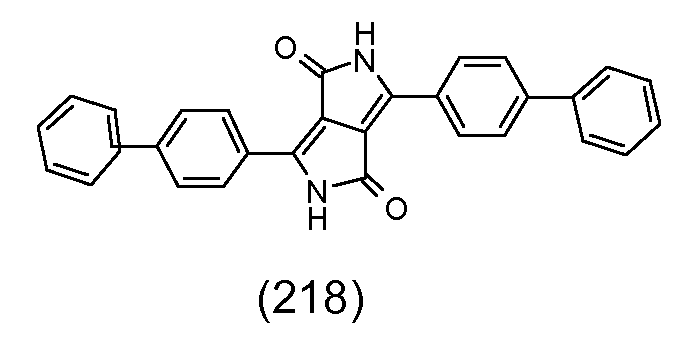
별도로, 15 g의 물 및 7 ml의 HCl 중의 화학식 (219)의 프로카인의 히드로클로라이드의 5.5 g의 용액을 0 내지 4℃에서 5.5 ml의 4M NaNO2 수용액으로 처리하였다.Separately, 5.5 g of a solution of 5.5 g of the hydrochloride of procaine of formula ( 219 ) in 15 g of water and 7 ml of HCl was treated with 5.5 ml of a 4 M aqueous NaNO 2 solution at 0-4 ° C.
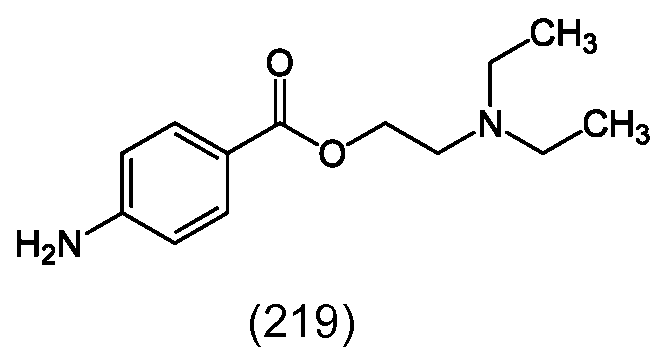
디아조늄 염을 안료 현탁액에 서서히 첨가하였다. 0 내지 4℃에서 15분 동안 교반 후, 현탁액을 23℃에서 1시간 동안 교반한 다음 50℃로 가열하고 추가로 1시간 동안 교반하였다.The diazonium salt was slowly added to the pigment suspension. After stirring for 15 minutes at 0-4 < 0 > C, the suspension was stirred at 23 < 0 > C for 1 hour, then heated to 50 < 0 > C and stirred for an additional 1 hour.
단계 18.2: 화학식 (225)의 이칼륨 염의 제조 Step 18.2: Preparation of this potassium salt of formula ( 225 )
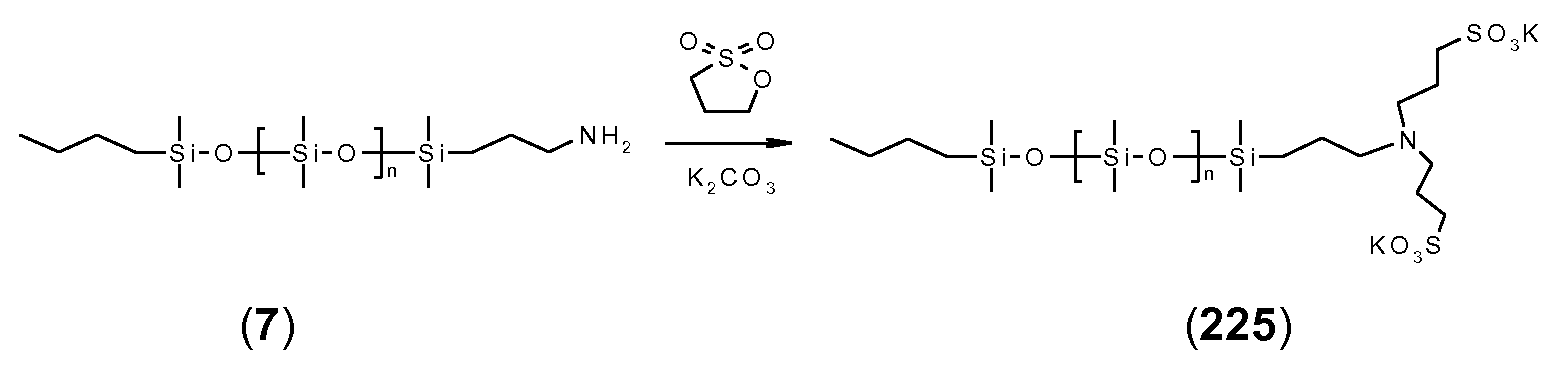
단계 1.3에 기재된 2 g의 화합물 (7)을 10 ml의 디메틸포름아미드에 용해시킨 다음, 0.8 g의 무수 탄산칼륨 및 0.7 g의 1,3-프로판술톤을 첨가하고, 현탁액을 밤새 105℃에서 교반하였다. 주위 온도로 냉각 후, 반응 혼합물을 물로 희석시키고, 화학식 (225)의 이칼륨 염을 분리하였다 [본원의 우선권주장 서류 페이지 23에 개시된 화학식 (202)의 상응하는 음이온 참조].2 g of the compound ( 7 ) described in Step 1.3 are dissolved in 10 ml of dimethylformamide, 0.8 g of anhydrous potassium carbonate and 0.7 g of 1,3-propanesultone are added and the suspension is stirred overnight at 105 < Respectively. After cooling to ambient temperature, the reaction mixture was diluted with water and the potassium salt of formula ( 225 ) was isolated (see the corresponding anion of formula ( 202 ) disclosed in this priority sheet on page 23).
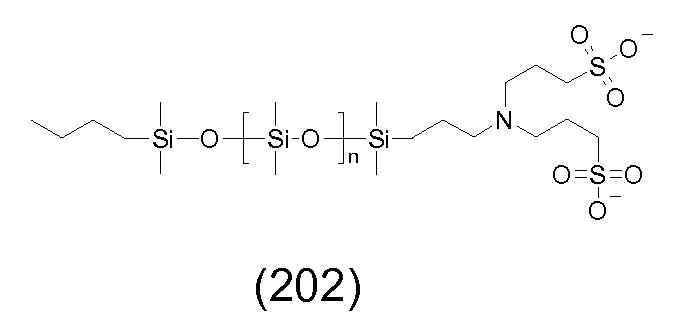
실시예Example 19: 청색 안료 입자를 포함하는 전기영동 잉크 19: Electrophoretic ink containing blue pigment particles
C.I. 피그먼트 블루 15:3 (구리 프탈로시아닌 블루; C.I. No.: 74160:3; CAS No: 147-14-8)의 프레스케이크를 C.I. 피그먼트 레드 264의 프레스케이크 대신에 사용한 것을 제외하고는 실시예 18에서와 같이 진행하였다.C.I. A press cake of Pigment Blue 15: 3 (copper phthalocyanine blue; C.I. No .: 74160: 3; CAS No: 147-14-8) The procedure was as in Example 18, except that the press cake of Pigment Red 264 was used instead.
실시예Example 20: 청색 안료 입자를 포함하는 전기영동 잉크 20: Electrophoretic ink containing blue pigment particles
C.I. 피그먼트 블루 15:1 (C.I. 피그먼트 블루 15:3 이외의 또 다른 변형)의 프레스케이크를 C.I. 피그먼트 레드 264의 프레스케이크 대신에 사용한 것을 제외하고는, 실시예 18에서와 같이 진행하였다.C.I. Pigment Blue 15: 1 (another variation other than C.I. Pigment Blue 15: 3) was applied to C.I. The procedure was as in Example 18, except that the press cake of Pigment Red 264 was used instead.
실시예Example 21: 마젠타색 안료 입자를 포함하는 전기영동 잉크 21: Electrophoretic ink containing magenta pigment particles
실시예 2에 기재된 바와 유사하게, 단계 21.1에 기재된 바와 같이 제조된 안료의 수성 현탁액을 단계 18.2에 기재된 화학식 (225)의 술폰화 폴리디메틸실록산과 반응시켜 마젠타색 전기영동 잉크를 제조하였다.Similar to that described in Example 2, a magenta electrophoretic ink was prepared by reacting an aqueous suspension of the pigment prepared as described in Step 21.1 with a sulfonated polydimethylsiloxane of Formula ( 225 ) described in Step 18.2.
단계 21.1: 화학식 (220)의 C.I. 피그먼트 레드 122 (CAS Nos. 980-26-7 및 16043-40-6; EU No. 213-561-3; C.I.No.: 73915)의 31.5 % 수성 프레스 케이크 63 g을 180 ml의 물에 분산시켰다. Step 21.1: To a solution of C.I. 63 g of a 31.5% aqueous press cake of Pigment Red 122 (CAS Nos. 980-26-7 and 16043-40-6; EU No. 213-561-3; CINo .: 73915) was dispersed in 180 ml of water .
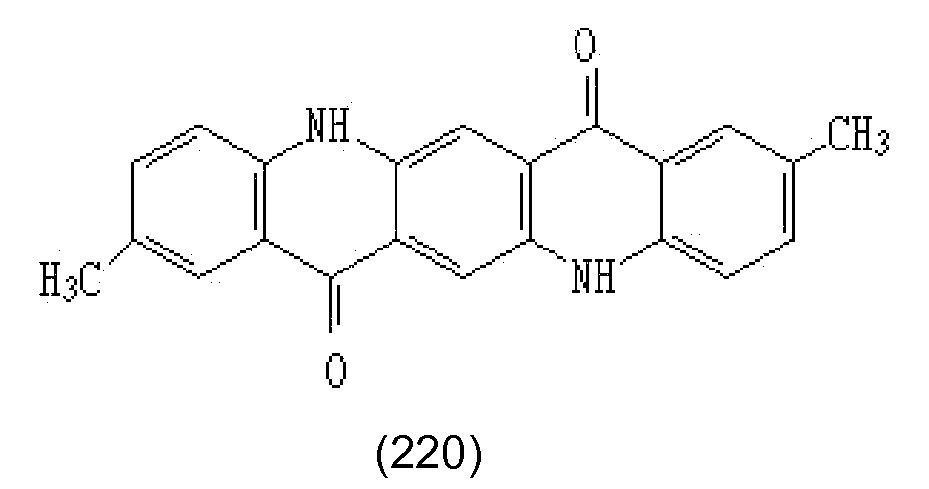
별도로, 15 g의 물 및 7 ml의 HCl 중의 프로카인 히드로클로라이드의 5.5 g의 용액을 0 내지 4℃에서 5.5 ml의 4M NaNO2 수용액으로 처리하였다. 디아조늄 염을 안료 현탁액에 첨가하였다.Separately, a solution of 5.5 g of procaine hydrochloride in 15 g of water and 7 ml of HCl was treated with 5.5 ml of 4 M NaNO 2 aqueous solution at 0-4 ° C. The diazonium salt was added to the pigment suspension.
실시예Example 22: 황색 안료 입자를 포함하는 전기영동 잉크 22: Electrophoretic ink containing yellow pigment particles
화학식 (223)의 C.I. 피그먼트 옐로우 128의 프레스케이크를 C.I. 피그먼트 레드 122의 프레스케이크 대신에 사용한 것을 제외하고는, 실시예 21에서와 같이 진행하였다. The procedure was as in Example 21, except that the press cake of CI Pigment Yellow 128 of Formula ( 223 ) was used in place of the press cake of CI Pigment Red 122.
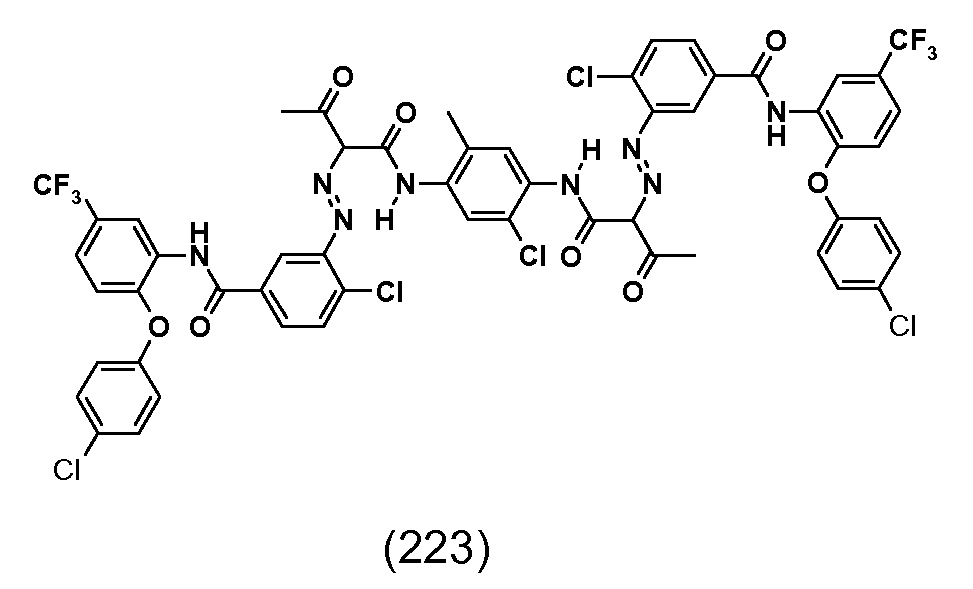
실시예Example 23: 적색 안료 입자를 포함하는 전기영동 잉크 23: Electrophoretic ink containing red pigment particles
술폰화된 C.I. 피그먼트 레드 254를 동일한 양 (건조 중량으로 산출함)의The sulfonated C.I. Pigment Red 254 in the same amount (calculated on a dry weight basis)
a) US-A-4914211의 실시예 11A에 기재된 디케토피롤로피롤 카르복실레이트, 또는a) a diketopyrrolopyrrole carboxylate as described in Example 11A of US-A-4914211, or
b) US-A-4914211의 실시예 16에 기재된 디케토피롤로피롤 포스포네이트b) The diketopyrrolopyrrole phosphonate described in Example 16 of US-A-4914211
로 대체한 것을 제외하고는, 실시예 11에서와 같이 진행하였다.The procedure of Example 11 was repeated, except that < RTI ID = 0.0 >
Claims (14)
<화학식 I>

상기 식에서,
q는 1 내지 4이고,
R1 및 R2는 서로 독립적으로 수소, 코어 표면-O-, 또는 -O- 또는 -S-가 개재될 수 있고/있거나 할로겐에 의해 치환될 수 있는 C5-C25알킬; C2-C24알케닐; 페닐; C7-C9페닐알킬; -OR5;

에서 선택되는 치환기이고,
R5는 수소; -O- 또는 -S-가 개재될 수 있는 C1-C25알킬; C2-C24알케닐; 페닐; C7-C9페닐알킬;
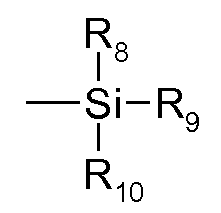
R6 및 R7은 서로 독립적으로 수소; C5-C12-시클로알킬; -O- 또는 -S-가 개재될 수 있고/있거나 할로겐에 의해 치환될 수 있는 C1-C25알킬; C2-C24알케닐; 페닐; C7-C9페닐알킬; 또는 -OR5이고,
R8, R9 및 R10은 서로 독립적으로 수소; -O- 또는 -S-가 개재될 수 있는 C1-C25알킬; C2-C24알케닐; 페닐; 또는 C7-C9페닐알킬이고,
X는 C1-C20알킬렌이고,
B는 직접 결합 또는 D로 연장되는 브릿지 원이고,
D는 염료의 하전 잔기이다.5. The composition according to claim 4, wherein the dye is covalently bonded to the oxygen atom via a radical of the formula (I) on the surface of the core.
(I)
In this formula,
q is from 1 to 4,
R 1 and R 2 are independently of each other hydrogen, C 5 -C 25 alkyl, which may be interrupted by -O- or -O- or -S-, optionally substituted by halogen; C 2 -C 24 alkenyl; Phenyl; C 7 -C 9 phenylalkyl; -OR 5 ;
, ≪ / RTI >
R 5 is hydrogen; C 1 -C 25 alkyl, which may be interrupted by -O- or -S-; C 2 -C 24 alkenyl; Phenyl; C 7 -C 9 phenylalkyl;
R 6 and R 7 are independently of each other hydrogen; C 5 -C 12 -cycloalkyl; C 1 -C 25 alkyl, which may be interrupted by -O- or -S- or may be substituted by halogen; C 2 -C 24 alkenyl; Phenyl; C 7 -C 9 phenylalkyl; Or -OR < 5 &
R 8 , R 9 and R 10 are independently of each other hydrogen; C 1 -C 25 alkyl, which may be interrupted by -O- or -S-; C 2 -C 24 alkenyl; Phenyl; Or C 7 -C 9 phenylalkyl,
X is C 1 -C 20 alkylene,
B is a direct bond or a bridge circle extending to D,
D is the charged residue of the dye.

<화학식 II>
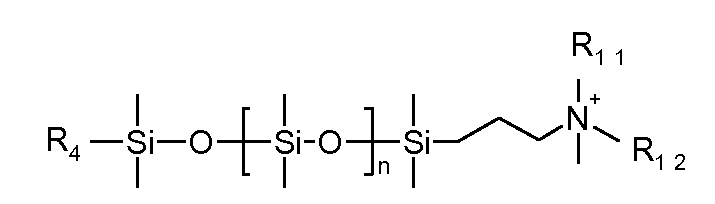
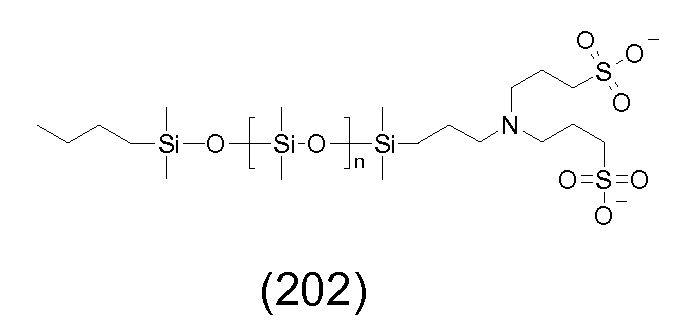
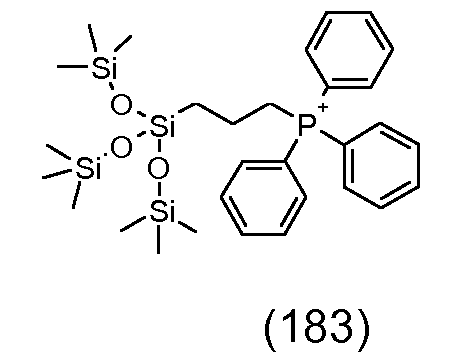
≪
Applications Claiming Priority (3)
| Application Number | Priority Date | Filing Date | Title |
|---|---|---|---|
| EP09163640 | 2009-06-24 | ||
| EP09163640.7 | 2009-06-24 | ||
| PCT/EP2010/058206 WO2010149505A2 (en) | 2009-06-24 | 2010-06-11 | Charged particles |
Publications (2)
| Publication Number | Publication Date |
|---|---|
| KR20120106704A KR20120106704A (en) | 2012-09-26 |
| KR101730199B1 true KR101730199B1 (en) | 2017-04-25 |
Family
ID=41480322
Family Applications (1)
| Application Number | Title | Priority Date | Filing Date |
|---|---|---|---|
| KR1020127001662A Expired - Fee Related KR101730199B1 (en) | 2009-06-24 | 2010-06-11 | Charged particles |
Country Status (9)
| Country | Link |
|---|---|
| US (1) | US9403987B2 (en) |
| EP (1) | EP2445971B1 (en) |
| JP (1) | JP5705217B2 (en) |
| KR (1) | KR101730199B1 (en) |
| CN (1) | CN102803398B (en) |
| ES (1) | ES2443148T3 (en) |
| RU (1) | RU2548071C2 (en) |
| TW (1) | TWI491680B (en) |
| WO (1) | WO2010149505A2 (en) |
Cited By (1)
| Publication number | Priority date | Publication date | Assignee | Title |
|---|---|---|---|---|
| KR20200040723A (en) * | 2013-12-17 | 2020-04-20 | 동우 화인켐 주식회사 | Colored curable resin composition |
Families Citing this family (17)
| Publication number | Priority date | Publication date | Assignee | Title |
|---|---|---|---|---|
| CN103502222B (en) | 2011-05-06 | 2016-08-17 | 巴斯夫欧洲公司 | There is the chromophore of perfluoroalkyl substituents |
| US8961831B2 (en) | 2011-05-31 | 2015-02-24 | E Ink California, Llc | Silane-containing pigment particles for electrophoretic display |
| JP5981729B2 (en) * | 2012-02-27 | 2016-08-31 | イー インク コーポレイション | Electrophoretic particles, electrophoretic particle dispersion, display medium, and display device |
| KR101654452B1 (en) * | 2012-04-03 | 2016-09-05 | 바스프 에스이 | Colored charged silsesquioxanes |
| US9228063B2 (en) | 2012-04-03 | 2016-01-05 | Basf Se | Colored charged silsesquioxanes |
| CN103013172B (en) * | 2012-12-27 | 2014-04-09 | 天津城市建设学院 | Preparation method of modified pigment yellow 12 |
| WO2014133526A1 (en) * | 2013-02-28 | 2014-09-04 | Empire Technology Development Llc | Colored pigment particles for electrophoretic displays |
| EP2986658A4 (en) * | 2013-04-19 | 2017-03-08 | Basf Se | Colored charged silsesquioxanes |
| JP6340814B2 (en) * | 2013-06-04 | 2018-06-13 | セイコーエプソン株式会社 | Electrophoretic particles, method for producing electrophoretic particles, electrophoretic dispersion, display device, and electronic apparatus |
| JP6326854B2 (en) * | 2013-06-24 | 2018-05-23 | セイコーエプソン株式会社 | Electrophoretic particles, electrophoretic dispersion, display sheet, display device, and electronic device |
| PT3295244T (en) | 2015-05-11 | 2021-10-26 | E Ink California Llc | ELECTROPHORETIC VISUALIZATION FLUID |
| KR20170112926A (en) * | 2016-03-30 | 2017-10-12 | 주식회사 나노브릭 | Microcapsule Comprising Color Soft Bead and Manufacturing Method the Same |
| WO2018011143A1 (en) * | 2016-07-12 | 2018-01-18 | Basf Se | Electrophoretic ink providing coloured and transparent states |
| KR20200015543A (en) * | 2017-06-01 | 2020-02-12 | 바스프 에스이 | Electrophoretic Inks Provide Bistable Stability |
| US11326026B2 (en) * | 2019-04-09 | 2022-05-10 | Xerox Corporation | Removable silicone films and related methods |
| CN116496501B (en) * | 2023-04-04 | 2024-03-29 | 浙江精一新材料科技有限公司 | Liquid polysiloxane with lactam group and light valve |
| WO2025013897A1 (en) * | 2023-07-11 | 2025-01-16 | 富士フイルム株式会社 | Method for producing compound, and compound |
Citations (2)
| Publication number | Priority date | Publication date | Assignee | Title |
|---|---|---|---|---|
| WO2007048721A1 (en) * | 2005-10-26 | 2007-05-03 | Ciba Holding Inc. | Coloured particles for electrophoretic displays |
| US20070163463A1 (en) * | 2005-12-15 | 2007-07-19 | Hida Hasinovic | Interior protectant/cleaner composition |
Family Cites Families (16)
| Publication number | Priority date | Publication date | Assignee | Title |
|---|---|---|---|---|
| US4566908A (en) * | 1984-02-24 | 1986-01-28 | Mita Industrial Company, Limited | Azoic pigments having a silica core |
| US4680103A (en) * | 1986-01-24 | 1987-07-14 | Epid. Inc. | Positive particles in electrophoretic display device composition |
| US4877451A (en) * | 1988-08-17 | 1989-10-31 | Xerox Corporation | Ink jet inks containing colored silica particles |
| US5378574A (en) * | 1988-08-17 | 1995-01-03 | Xerox Corporation | Inks and liquid developers containing colored silica particles |
| US5041590A (en) * | 1990-01-04 | 1991-08-20 | Dow Corning Corporation | Quaternary ammonium functional siloxane surfactants |
| RU2108354C1 (en) * | 1996-09-05 | 1998-04-10 | Виктор Михайлович Копылов | Method for production of composite pigment |
| RU2137801C1 (en) * | 1997-12-10 | 1999-09-20 | ОПТИВА, Инк. | Material for dichroic photopolarizers |
| US5914806A (en) | 1998-02-11 | 1999-06-22 | International Business Machines Corporation | Stable electrophoretic particles for displays |
| TWI315439B (en) * | 2002-07-30 | 2009-10-01 | Sipix Imaging Inc | Novel microencapsulation processes and composition for electrophoretic displays |
| DE10346944A1 (en) * | 2003-10-09 | 2005-05-04 | Basf Ag | Polyester-containing dyed textiles are post-cleaned and softened in an acidic dye bath in a single step by adding sulfinates, buffers and softeners |
| JP2007169507A (en) * | 2005-12-22 | 2007-07-05 | Chisso Corp | Ammonium silane-modified silicon-containing fine particles, display liquid for electrophoretic display device, and electrophoretic display element including the same |
| US7349147B2 (en) | 2006-06-23 | 2008-03-25 | Xerox Corporation | Electrophoretic display medium containing solvent resistant emulsion aggregation particles |
| JP5374368B2 (en) * | 2006-07-05 | 2013-12-25 | チバ ホールディング インコーポレーテッド | Colored organic electrophoretic particles |
| JP4033225B1 (en) * | 2006-08-29 | 2008-01-16 | 富士ゼロックス株式会社 | Display medium, display device, and display method |
| JP2008175973A (en) * | 2007-01-17 | 2008-07-31 | Brother Ind Ltd | Electrophoretic display medium and electrophoretic display device |
| CN101186657B (en) * | 2007-12-28 | 2010-06-02 | 北京交通大学 | Method for synthesizing microspheres for electronic paper by titanium dioxide or dye embedding method and application of microspheres for electronic paper in medium with low dielectric constant |
-
2010
- 2010-06-11 CN CN201080028592.8A patent/CN102803398B/en not_active Expired - Fee Related
- 2010-06-11 ES ES10725136.5T patent/ES2443148T3/en active Active
- 2010-06-11 EP EP10725136.5A patent/EP2445971B1/en not_active Not-in-force
- 2010-06-11 WO PCT/EP2010/058206 patent/WO2010149505A2/en not_active Ceased
- 2010-06-11 KR KR1020127001662A patent/KR101730199B1/en not_active Expired - Fee Related
- 2010-06-11 RU RU2012102095/05A patent/RU2548071C2/en not_active IP Right Cessation
- 2010-06-11 US US13/376,874 patent/US9403987B2/en not_active Expired - Fee Related
- 2010-06-11 JP JP2012516631A patent/JP5705217B2/en not_active Expired - Fee Related
- 2010-06-23 TW TW099120504A patent/TWI491680B/en not_active IP Right Cessation
Patent Citations (2)
| Publication number | Priority date | Publication date | Assignee | Title |
|---|---|---|---|---|
| WO2007048721A1 (en) * | 2005-10-26 | 2007-05-03 | Ciba Holding Inc. | Coloured particles for electrophoretic displays |
| US20070163463A1 (en) * | 2005-12-15 | 2007-07-19 | Hida Hasinovic | Interior protectant/cleaner composition |
Cited By (2)
| Publication number | Priority date | Publication date | Assignee | Title |
|---|---|---|---|---|
| KR20200040723A (en) * | 2013-12-17 | 2020-04-20 | 동우 화인켐 주식회사 | Colored curable resin composition |
| KR102199589B1 (en) | 2013-12-17 | 2021-01-07 | 동우 화인켐 주식회사 | Colored curable resin composition |
Also Published As
| Publication number | Publication date |
|---|---|
| JP5705217B2 (en) | 2015-04-22 |
| EP2445971A2 (en) | 2012-05-02 |
| US9403987B2 (en) | 2016-08-02 |
| TW201114851A (en) | 2011-05-01 |
| CN102803398A (en) | 2012-11-28 |
| WO2010149505A3 (en) | 2011-05-05 |
| RU2548071C2 (en) | 2015-04-10 |
| JP2012530824A (en) | 2012-12-06 |
| TWI491680B (en) | 2015-07-11 |
| WO2010149505A2 (en) | 2010-12-29 |
| US20120229884A1 (en) | 2012-09-13 |
| ES2443148T3 (en) | 2014-02-18 |
| RU2012102095A (en) | 2013-07-27 |
| EP2445971B1 (en) | 2013-11-27 |
| KR20120106704A (en) | 2012-09-26 |
| CN102803398B (en) | 2014-12-10 |
Similar Documents
| Publication | Publication Date | Title |
|---|---|---|
| KR101730199B1 (en) | Charged particles | |
| KR101517873B1 (en) | Encapsulated dispersions comprising electrophoretically mobile organic colorants | |
| KR101416681B1 (en) | Encapsulated dispersions comprising electrophoretically mobile organic colorants | |
| WO2009100803A2 (en) | Fluid compositions for colour electrophoretic displays | |
| KR20150003263A (en) | Particles for electrophoretic displays comprising a core and a random-copolymer coating | |
| KR20130137706A (en) | Colored fluid and multi-phase liquid colored composition | |
| EP3484966A1 (en) | Electrophoretic ink providing coloured and transparent states | |
| CN114410123B (en) | Modified copper phthalocyanine, preparation method, application and blue electronic ink | |
| US20250076723A1 (en) | Electrophoretic Particles Comprising an Organic Pigment and Graphene Oxide | |
| KR20260018089A (en) | Electrophoretic particles containing organic pigments and graphene oxide |
Legal Events
| Date | Code | Title | Description |
|---|---|---|---|
| PA0105 | International application |
St.27 status event code: A-0-1-A10-A15-nap-PA0105 |
|
| PG1501 | Laying open of application |
St.27 status event code: A-1-1-Q10-Q12-nap-PG1501 |
|
| A201 | Request for examination | ||
| P11-X000 | Amendment of application requested |
St.27 status event code: A-2-2-P10-P11-nap-X000 |
|
| P13-X000 | Application amended |
St.27 status event code: A-2-2-P10-P13-nap-X000 |
|
| PA0201 | Request for examination |
St.27 status event code: A-1-2-D10-D11-exm-PA0201 |
|
| P22-X000 | Classification modified |
St.27 status event code: A-2-2-P10-P22-nap-X000 |
|
| E902 | Notification of reason for refusal | ||
| PE0902 | Notice of grounds for rejection |
St.27 status event code: A-1-2-D10-D21-exm-PE0902 |
|
| P11-X000 | Amendment of application requested |
St.27 status event code: A-2-2-P10-P11-nap-X000 |
|
| P13-X000 | Application amended |
St.27 status event code: A-2-2-P10-P13-nap-X000 |
|
| E701 | Decision to grant or registration of patent right | ||
| PE0701 | Decision of registration |
St.27 status event code: A-1-2-D10-D22-exm-PE0701 |
|
| GRNT | Written decision to grant | ||
| PR0701 | Registration of establishment |
St.27 status event code: A-2-4-F10-F11-exm-PR0701 |
|
| PR1002 | Payment of registration fee |
St.27 status event code: A-2-2-U10-U12-oth-PR1002 Fee payment year number: 1 |
|
| PG1601 | Publication of registration |
St.27 status event code: A-4-4-Q10-Q13-nap-PG1601 |
|
| R18-X000 | Changes to party contact information recorded |
St.27 status event code: A-5-5-R10-R18-oth-X000 |
|
| R18-X000 | Changes to party contact information recorded |
St.27 status event code: A-5-5-R10-R18-oth-X000 |
|
| PC1903 | Unpaid annual fee |
St.27 status event code: A-4-4-U10-U13-oth-PC1903 Not in force date: 20200420 Payment event data comment text: Termination Category : DEFAULT_OF_REGISTRATION_FEE |
|
| PC1903 | Unpaid annual fee |
St.27 status event code: N-4-6-H10-H13-oth-PC1903 Ip right cessation event data comment text: Termination Category : DEFAULT_OF_REGISTRATION_FEE Not in force date: 20200420 |
|
| P22-X000 | Classification modified |
St.27 status event code: A-4-4-P10-P22-nap-X000 |
|
| R18-X000 | Changes to party contact information recorded |
St.27 status event code: A-5-5-R10-R18-oth-X000 |