KR101709928B1 - Error control on-demand - Google Patents
Error control on-demand Download PDFInfo
- Publication number
- KR101709928B1 KR101709928B1 KR1020117015250A KR20117015250A KR101709928B1 KR 101709928 B1 KR101709928 B1 KR 101709928B1 KR 1020117015250 A KR1020117015250 A KR 1020117015250A KR 20117015250 A KR20117015250 A KR 20117015250A KR 101709928 B1 KR101709928 B1 KR 101709928B1
- Authority
- KR
- South Korea
- Prior art keywords
- vector
- data packet
- transmission
- receiving unit
- tsv
- Prior art date
- Legal status (The legal status is an assumption and is not a legal conclusion. Google has not performed a legal analysis and makes no representation as to the accuracy of the status listed.)
- Expired - Fee Related
Links
Images


Classifications
-
- H—ELECTRICITY
- H04—ELECTRIC COMMUNICATION TECHNIQUE
- H04L—TRANSMISSION OF DIGITAL INFORMATION, e.g. TELEGRAPHIC COMMUNICATION
- H04L1/00—Arrangements for detecting or preventing errors in the information received
- H04L1/004—Arrangements for detecting or preventing errors in the information received by using forward error control
- H04L1/0056—Systems characterized by the type of code used
- H04L1/0057—Block codes
-
- H—ELECTRICITY
- H04—ELECTRIC COMMUNICATION TECHNIQUE
- H04L—TRANSMISSION OF DIGITAL INFORMATION, e.g. TELEGRAPHIC COMMUNICATION
- H04L1/00—Arrangements for detecting or preventing errors in the information received
- H04L1/12—Arrangements for detecting or preventing errors in the information received by using return channel
Landscapes
- Engineering & Computer Science (AREA)
- Computer Networks & Wireless Communication (AREA)
- Signal Processing (AREA)
- Data Exchanges In Wide-Area Networks (AREA)
- Detection And Prevention Of Errors In Transmission (AREA)
Abstract
본 발명은, 멀티캐스트 전송에 특히 유리한 패킷 스위칭된 네트워크에서의 새로운 에러 제어 패러다임에 관한 것이다. 전송 상태 벡터 TSV(T)는 새로운 출력 데이터 패킷(Dj-1)이 전송을 위해 스케줄링될 때마다 송신기측에서 업데이트된다. 대응하는 수신 상태 벡터 RSV(R)는 새로운 인입 및 정확하게 인덱스된 데이터 패킷(Dj-1)이 유효하게 수신될 때마다 수신기측에서 유사하게 업데이트된다. 분실되거나 파손된 데이터 패킷(Dj)이 검출되는 즉시, RSV의 업데이트가 보류된다. 그 후에 현재 TSV의 값 또는 그 일부를 획득하기 위한 요청이 송신기에 전송된다. 그 후에 현재 TSV의 값(Sk, m)으로부터, 최종 업데이트된 RSV의 값(Sj-1)으로부터, 및 다른 방식으로 유효하게 수신된 데이터 패킷들(Dj+1,..., Dk)로부터 오류가 있는 데이터 패킷이 복구된다. 본 발명은 특히, 그 패러다임을 구현하는 전송 유닛(100) 및 수신 유닛(200)과, 대응적으로 데이터 손실 또는 데이터 파손에 대해 인덱스된 데이터 패킷들의 흐름을 보호하는 방법 및 인덱스된 데이터 패킷들의 흐름 내에서 분실되거나 파손된 데이터 패킷을 복구하는 방법에 관한 것이다.The present invention relates to a new error control paradigm in packet switched networks that is particularly advantageous for multicast transmissions. The transmission state vector TSV (T) is updated at the transmitter side whenever a new output data packet Dj-1 is scheduled for transmission. The corresponding reception state vector RSV (R) is similarly updated at the receiver side whenever a new incoming and correctly indexed data packet Dj-1 is validly received. As soon as a lost or corrupted data packet Dj is detected, updating of the RSV is suspended. A request is then sent to the transmitter to obtain the value of the current TSV or a portion thereof. (Dj + 1, ..., Dk) from the value (Sk, m) of the current TSV, from the last updated RSV value (Sj-1) Is recovered. The invention particularly relates to a transmission unit (100) and a receiving unit (200) implementing the paradigm, a method for protecting the flow of data packets correspondingly indexed for data loss or data corruption, and a method for protecting the flow of indexed data packets The present invention relates to a method for recovering lost or corrupted data packets in a network.
Description
본 발명은 패킷 스위칭된 네트워크에서의 새로운 에러 제어 패러다임(new error control paradigm)에 관한 것이다.The present invention relates to a new error control paradigm in packet switched networks.
패킷 스위칭된 네트워크들은 본질적으로 신뢰할 수 없으며, 패킷들을 지연시키거나, 손실시키거나, 분실하거나, 또는 이들을 비순차적으로 전달하지 않을 것을 보장하지 않는 것을 의미한다. Packet switched networks are inherently untrustworthy, meaning that they do not guarantee that packets will be delayed, lost, lost, or otherwise unsequentially delivered.
순방향 에러 정정(FEC) 및 재전송은 패킷 스위칭된 네트워크를 통해 신뢰할 수 있는 통신을 제공하기 위한 기본 에러 제어 패러다임들이다. Forward error correction (FEC) and retransmission are basic error control paradigms for providing reliable communications over packet switched networks.
재전송은 파손되거나 분실된 데이터 패킷들의 재송신이며,Retransmissions are the retransmission of broken or lost data packets,
- 수신된 정보의 무결성을 체크하기 위한 체크섬들(또는 유사한 것),Checksums (or the like) for checking the integrity of the received information,
- 확인응답들, 즉 수신자로부터 어떤 리턴 채널을 통한 송신자쪽으로의 명시적 수신들,- acknowledgments, that is, explicit receipt from the recipient to the sender over a certain return channel,
- 분실되거나 손실된 패킷들의 재전송(송신자 또는 수신자에 의해 개시됨)에 의존한다. - re-transmission of lost or lost packets (initiated by sender or receiver).
재전송은, 각각의 미결(즉, 아직까지 확인응답되지 않은) 패킷의 카피가, 존재한다면, 추가의 재전송을 위해 송신자측에서 유지되는 것을 내포한다.Retransmission implies that a copy of each outstanding (i.e., not yet acknowledged) packet is retained on the sender side for further retransmission, if any.
재전송 전략들의 여러 형태들이 존재하며, 가장 두드러지게는:There are several forms of retransmission strategies, most notably:
- 선택적 확인응답(SACK): 수신자는 패킷들, 메시지들 또는 세그먼트들이 정확하게 수신되었음과, 덧붙여 패킷들이 정확하게 수신되지 않았음을 송신자에게 명시적으로 통지한다. Optional acknowledgment (SACK): The recipient explicitly notifies the sender that packets, messages or segments have been received correctly and that the packets have not been correctly received.
- 누적 확인응답: 수신자가 패킷들, 메시지들 또는 세그먼트들을 정확하게 수신된 것으로서 확인응답하며, 확인응답은 모든 이전 패킷들이 역시 정확하게 수신되었음을 내포한다. 전송 제어 프로토콜(TCP)은 누적 확인응답을 이용한다. Cumulative acknowledgment: The recipient acknowledges that packets, messages or segments have been received correctly, and the acknowledgment implies that all previous packets have also been correctly received. The Transmission Control Protocol (TCP) uses a cumulative acknowledgment.
- 부정적 확인응답(NACK): 수신자는 패킷들, 메시지들 또는 세그먼트들이 부정확하게 수신되었고 따라서 재전송되어야 하는 것을 송신자에게 명시적으로 통지한다. Negative acknowledgment (NACK): The recipient explicitly notifies the sender that packets, messages or segments have been received incorrectly and therefore must be retransmitted.
재전송은 멀티캐스트 전송, 즉 하나의 송신자가 하나의 공용 데이터 스트림으로 많은 수신자들을 서빙하는 경우에 불리하다. 통상적으로, 멀티캐스트 전송에 대한 신뢰성은 부정적 확인응답들 및 유니캐스트와 동시적 통신 채널을 통한 재전송에 의해 달성된다. 상당량의 데이터 패킷들은 최종-사용자에 대한 수용 가능한 경험 품질(QoE: Quality of Experience)을 달성하도록 멀티캐스트 복제 노드에서 또는 서버측에서 유지되야 한다. 재전송 캐시의 크기는 수신자로부터 재전송 유닛으로의 왕복 시간(RTT: Round Trip Time)에 의존하고, 요구된 패킷이 최종적으로 수신자에게 도달하도록 하기 위해 필요할 수 있는 재-전송의 수에 의존한다(즉, 잡음 및/또는 네트워크 환경에 따라, 가입자가 경험할 수 있다). 통상적으로, 최종 100-200ms의 비디오 정보(즉, 약 50 내지 100 데이터 패킷들)는 각각 및 모든 브로드캐스팅된 채널들에 대해 캐싱되어야 한다. 유사하게, 상당량의 전용 유니캐스트 통신 리소스들은 많은 가입자들을 서빙하도록 패킷 재전송을 위해 제공되어야 한다. 분명하게, 이러한 솔루션은 가입자들 및 채널들의 수가 증가할 때 스케일링 가능하지 않다. Retransmissions are disadvantageous for multicast transmissions, that is, when one sender serves many recipients with one common data stream. Typically, reliability for multicast transmissions is achieved by negative acknowledgments and retransmissions over unicast and concurrent communication channels. A substantial amount of data packets must be maintained at the multicast replica node or at the server side to achieve an acceptable quality of experience (QoE) for the end-user. The size of the retransmission cache depends on the round trip time (RTT) from the receiver to the retransmission unit and depends on the number of re-transmissions that may be needed to cause the requested packet to ultimately reach the receiver (i.e., The subscriber may experience, depending on the noise and / or network environment). Typically, the final 100-200 ms of video information (i.e., about 50 to 100 data packets) must be cached for each and all broadcasted channels. Similarly, a significant amount of dedicated unicast communication resources must be provided for packet retransmission to serve a large number of subscribers. Obviously, this solution is not scalable as the number of subscribers and channels increases.
FEC는 정보 데이터에 대한 리던던트 데이터의 추가이다. 이것은 수신기가 자체적으로 (일부 경계 내에서) 에러들을 검출 및 정정하도록 허용하지만, 일부 데이터 오버헤드를 훼손시킨다. 따라서, FEC는 재전송들이 비교적 비싸거나 불가능한 경우들에 적용된다. FEC is the addition of redundant data to the information data. This allows the receiver to detect and correct errors on its own (within some boundaries), but it corrupts some data overhead. Therefore, FEC applies to cases where retransmissions are relatively expensive or impossible.
FEC의 2개의 주요 카테고리들은, 리드 솔로몬(RS), 골레이(Golay), 보즈 앤 레이-차우드허리(BCH: Bose and Ray-chaudhuri) 및 해밍 코드들과 같은 블록 코딩과 콘볼루션 코딩이다. 에러 정정에서 가장 최근의 개발은 터보 코딩으로서, 2개 이상의 비교적 간단한 콘볼루션 코드들과 인터리버를 조합하여 샤논 한도(shannon limit)의 소수 내로 수행할 수 있는 블록 코드를 생성하는 방식이다. The two main categories of FEC are block coding and convolutional coding, such as Reed Solomon (RS), Golay, Bose and Ray-chaudhuri (BCH), and Hamming codes. The most recent development in error correction is a method of generating block codes that can be performed within a fraction of a shannon limit by combining two or more relatively simple convolutional codes and an interleaver as a turbo coding.
FEC는 수용 가능한 QoE를 달성하기 위해 상당량의 데이터 오버헤드가 요구되고, 그에 의해 다른 서비스들에 의해 이용될 대응하는 채널 대역폭을 방해한다는 점에서 역시 불리하다. FEC is also disadvantageous in that a considerable amount of data overhead is required to achieve acceptable QoE, thereby hindering the corresponding channel bandwidth to be used by other services.
수신 유닛쪽으로 인덱스된 데이터 패킷들의 흐름을 전송하고:Transmitting a flow of data packets indexed to the receiving unit:
- 새로운 출력 데이터 패킷이 전송을 위해 스케줄링될 때마다 전송 상태 벡터 TSV를 업데이트하도록 구성된 전송 상태 계산 수단으로서, TSV는 새로운 인입 데이터 패킷이 유효하게 수신될 때마다 상기 수신 유닛에서 유사하게 업데이트된 대응하는 수신 상태 벡터 RSV와 매칭하고, 상기 새로운 인입 데이터 패킷의 인덱스는 다음의 예상된 데이터 패킷 인덱스인, 상기 전송 상태 계산 수단,- transmission status calculation means configured to update the transmission status vector TSV each time a new output data packet is scheduled for transmission, wherein the TSV is configured to update the likewise updated corresponding response The received state vector RSV and the index of the new incoming data packet is the next expected data packet index,
- 상기 수신 유닛으로부터의 요청시, 상기 TSV의 적어도 하나의 벡터 성분의 각각의 것들에 대해, 적어도 하나의 현재 성분값을 전송하도록 구성된 통신 수단으로서, 상기 적어도 하나의 현재 성분값은 상기 RSV의 최종 업데이트된 벡터값과 조합될 때, 다른 방식으로 유효하게 수신된 데이터 패킷들과 조합될 때, 적어도 하나의 분실되거나 파손된 데이터 패킷의 복구를 허용하는, 상기 통신 수단을 포함하는 전송 유닛에 의해, - communication means configured to, upon request from the receiving unit, transmit, for each of the at least one vector component of the TSV, at least one current component value, the at least one current component value being the final When combined with updated vector values, when combined with validly received data packets in other ways, allows recovery of at least one lost or corrupted data packet,
대응적으로, 전송 유닛으로부터 인덱스된 데이터 패킷들의 흐름을 수신하고:Correspondingly, it receives the flow of indexed data packets from the transmitting unit:
- 새로운 인입 데이터 패킷이 유효하게 수신될 때마다 수신 상태 벡터 RSV를 업데이트하도록 구성된 수신 상태 계산 수단으로서, 상기 새로운 인입 데이터 패킷의 인덱스는 다음의 예상된 데이터 패킷 인덱스이고, RSV는 새로운 출력 데이터 패킷이 전송을 위해 스케줄링될 때마다 상기 전송 유닛에서 유사하게 업데이트된 대응하는 전송 상태 벡터 TSV와 매칭하는, 상기 수신 상태 계산 수단,- receive status calculation means configured to update a receive status vector RSV each time a new incoming data packet is validly received, the index of the new incoming data packet being the next expected data packet index, Each time it is scheduled for transmission, matches the corresponding transmission state vector TSV similarly updated in the transmission unit,
- 상기 TSV의 적어도 하나의 벡터 성분의 각각의 것들에 대해, 상기 전송 유닛으로부터 적어도 하나의 현재 성분값을 획득하도록 구성된 통신 수단, - communication means configured to obtain, for each of the at least one vector component of the TSV, at least one current component value from the transmission unit,
- 상기 적어도 하나의 현재 성분값으로부터, 상기 RSV의 최종 업데이트된 벡터값으로부터, 다른 방식으로 유효하게 수신된 데이터 패킷들로부터 분실되거나 파손된 데이터 패킷을 복구하도록 구성된 복구 수단을 포함하는 수신 유닛에 의해, 본 발명의 목적들이 달성되고 상술된 종래 기술의 단점들이 극복된다. - recovery means configured to recover, from said at least one current component value, a lost or corrupted data packet from validly received data packets in a different manner from the last updated vector value of said RSV , The objects of the present invention are achieved and the disadvantages of the prior art described above are overcome.
전송 상태 벡터(TSV) 및 수신 상태 벡터(RSV)는 전송측 및 수신측에서 각각 최신 데이터가 유지된다. TSV 및 RSV는 새로운 출력 데이터 패킷이 전송을 위해 스케줄링될 때마다, 그리고 새로운 인입 및 인접하여 인덱스된 데이터 패킷(즉, 그 인덱스가 다음의 예상된 데이터 패킷 인덱스임)이 유효하게 수신될 때마다 공용 알고리즘에 따라 업데이트된다. 어떻게든, TSV 및 RSV는, 소형 형태이긴 하지만 전송 및 수신 이력(즉, 어떤 정보 바이트들이 전송되고 수신되었는지)의 추적을 유지한다. 통상적으로, TSV 및 RSV는 하나 이상의 벡터 성분들(즉, 벡터 방향에 의존한 로우들 또는 컬럼들)을 포함하고, 각각의 벡터 성분의 길이는 데이터 패킷 길이와 매칭한다. TSV 및 RSV는 전송 및 수신의 일반적으로 동의된 인덱스에서 어떤 초기 상태로 리셋되며, 이 인덱스는 데이터 패킷 자체에 인코딩된 대응하는 데이터 패킷 인덱스와 매칭한다. 이들 인덱스들은 반드시 일치할 필요는 없지만, 그들 사이의 매칭 상응이 요구된다. The transmission state vector (TSV) and the reception state vector (RSV) are kept up to date on the transmitting side and the receiving side, respectively. TSV and RSV are used whenever a new output data packet is scheduled for transmission and whenever a new incoming and adjacent indexed data packet (i. E., The index is the next expected data packet index) is validly received Algorithm. In some ways, the TSV and RSV keep track of the transmission and reception history (i. E., Which information bytes are transmitted and received), though in a compact form. Typically, TSV and RSV comprise one or more vector components (i. E., Rows or columns depending on the vector direction), and the length of each vector component matches the data packet length. TSV and RSV are reset to some initial state in a generally agreed upon index of transmission and reception, and this index matches the corresponding data packet index encoded in the data packet itself. These indices do not necessarily have to match, but a matching correspondence between them is required.
수신된 데이터 패킷들의 흐름 내에서 분실되거나 파손된 데이터 패킷이 검출되는 즉시, 수신기는 전송기와 동기를 벗어나게 되고 RSV를 더 이상 업데이트할 수 없다. 그 후에 현재 TSV의 값, 즉 최종 업데이트된 TSV의 값 또는 그 일부 뿐만 아니라 그 값이 대응하는 전송 인덱스를 획득하기 위한 요청이 전송기에 전송된다. 이들 전송 상태 정보를 최종 업데이트된 RSV의 값과 조합하거나, 그렇지 않고 정확하게 수신된 데이터 패킷들과 조합함으로써, 분실되거나 파손된 데이터 패킷을 알려지지 않은 파라미터들로서 구성하는 데이터 심볼들(예를 들면, 비트들, 바이트들)로 수학식들의 세트를 도출한다. 전송 및 수신 상태 벡터의 계산이 이들 수학식들이 반전 가능하게 되는 경우, 분실되거나 파손된 데이터 심볼들이 복구될 수 있고, RSV의 업데이트가 재개될 수 있으며, 이것은 본원에 더 기재될 것이다. As soon as a lost or corrupted data packet is detected in the flow of received data packets, the receiver goes out of synchronization with the transmitter and can no longer update the RSV. A request is then sent to the transmitter to obtain the value of the current TSV, i. E. The value of the last updated TSV, or a portion thereof, as well as its corresponding transmission index. By combining these transmission status information with the values of the last updated RSV, or by combining them with correctly received data packets, data symbols (e.g., bits) that constitute lost or corrupted data packets as unknown parameters , Bytes). ≪ / RTI > If the calculation of the transmit and receive state vectors makes these equations reversible, the lost or corrupted data symbols can be recovered and the update of the RSV can be resumed, which will be further described herein.
본 발명은, 에러 제어 정보가 요구시에만 전송되고 분실되거나 파손된 데이터가 정확한 범위까지 복구되어야 한다는 점에서 유리하다. 본 발명은 또한, 전체 전송 이력이 어떻게든 단일 상태 벡터로 컴파일되고, 단일 상태 벡터는 데이터 패킷들이 재전송을 위해 유지되는 대응하는 전송 캐시보다 소수의 성분들을 갖고, 그에 의해 메모리 요건을 중요도의 정도까지 해제한다는 점에서 유리하다. 마지막으로, 그러나 역시 중요한 것이지만, 수신기는 그 사용자에 대한 요구된 QoE를 달성하기 위해 그 수신 캐시 및 복구 전략을 치수화할 수 있다. 전송기는 최악의 경우의 시나리오를 수용하기 위한 수백개의 패킷들의 트랙을 추적할 필요가 없다. 다만 상태 벡터의 치수가 중요하다; 벡터 요소들이 많을수록 복구될 수 있는 데이터 패킷들이 많아지고 데이터 통신 시스템이 더욱 탄력적이다. The present invention is advantageous in that the error control information is only transmitted on demand and that the lost or broken data must be recovered to the correct range. The present invention also relates to a system and method for transmitting and receiving data, wherein the entire transmission history is somehow compiled into a single state vector, wherein the single state vector has fewer components than the corresponding transmission cache in which data packets are maintained for retransmission, It is advantageous in that it releases it. Last but not least, the receiver can dimension its receive cache and recovery strategy to achieve the required QoE for that user. The transmitter does not need to track a few hundred packets of packets to accommodate the worst-case scenario. However, the dimensions of the state vector are important; The more vector elements, the more data packets can be recovered and the data communication system is more resilient.
수신측에서의 더 적은 계산 복잡도 또는 더 낮은 복구 능력으로 인해 RSV가 실제 TSV의 서브세트일 수 있고, 그 경우 TSV는 그 특정 수신기의 RSV와 매칭하는 TSV의 서브세트로 구성되어야 함을 유념한다. Note that RSV may be a subset of the actual TSV due to less computational complexity or lower recovery capabilities at the receiving end, in which case the TSV should be composed of a subset of TSVs that match the RSV of that particular receiver.
또한, 전송 및 수신 상태 정보의 계산이 통신 프로토콜 스위트(communication protocol suite)의 임의의 층에서 실행될 수 있음을 유념한다. 예를 들면, 층 2(L2)에서, 전송 및 수신 상태 정보는 예를 들면, 이더넷 페이로드로부터 계산되고(그리고 이더넷 프레임들이 하나의 방식 또는 다른 방식으로 인덱스된다고 가정하고), 단방향 유니캐스트 또는 멀티캐스트 통신들이 존재하는 만큼의 많은 상태 벡터들이 존재한다. 대안적으로, 전송 및 수신 상태 정보의 계산은 특정 타입의 트래픽 또는 페이로드로 제한될 수 있다. It is also noted that the calculation of transmission and reception status information may be performed at any layer of the communication protocol suite. For example, at layer 2 (L2), the transmit and receive status information is calculated, for example, from the Ethernet payload (and assuming Ethernet frames are indexed in one way or another), unidirectional unicast or multi There are as many state vectors as there are cast communications. Alternatively, the computation of transmit and receive status information may be limited to a particular type of traffic or payload.
본 발명에 따른 전송 유닛의 예는 비디오 헤드 엔드와 같은 인코딩 디바이스, 또는 멀티미디어 서버, 또는 디지털 가입자 회선 액세스 멀티미디어(DSLAM) 또는 무선/모바일 기지국과 같은 중간 복제 노드이고, 본 발명에 따른 수신 유닛의 예는 셋톱 박스(STB) 또는 모뎀 또는 라우터와 같은 가입자 게이트웨이, 또는 텔레비전 세트 또는 개인용 컴퓨터 또는 무선/모바일 단말기와 같은 가입자 단말기, 또는 디코딩 디바이스이다. An example of a transmission unit according to the present invention is an encoding device such as a video head end, or a multimedia server, or an intermediate replica node such as a digital subscriber line access multimedia (DSLAM) or a wireless / mobile base station, Such as a set-top box (STB) or a modem or router, or a subscriber terminal, such as a television set or personal computer or a wireless / mobile terminal, or a decoding device.
본 발명에 따른 전송 유닛의 다른 실시예는, 상기 통신 수단은 또한 상기 TSV의 현재 벡터값을 상기 수신 유닛쪽으로 주기적으로 광고하도록 구성된다는 것을 특징으로 한다. Another embodiment of the transmission unit according to the invention is characterized in that the communication means are also arranged to periodically advertise the current vector value of the TSV towards the receiving unit.
현재 TSV의 값을 정규적으로 광고(또는 브로드캐스팅)함으로써, 전송 유닛은 수신 유닛이 때때로 그 RSV를 재동기시키게 하고, 그에 의해 검출되지 않은 데이터 파손으로 인한 계산 착오들을 회피시킨다. 너무 많은 파손이 있는 패킷들의 경우에도 도움이 되며, 이 경우, 수신기는 정규 동작을 재개하도록 전송기와 상태 벡터를 재동기시켜야 한다. By regularly advertising (or broadcasting) the value of the current TSV, the transmitting unit causes the receiving unit to occasionally resynchronize its RSV, thereby avoiding calculation errors due to undetected data corruption. It is also helpful for packets with too many corruptions, in which case the receiver must resynchronize the state vector with the transmitter to resume normal operation.
본 발명에 따른 전송 유닛의 대안적인 실시예는, 상기 통신 수단은 또한 상기 수신 유닛의 제어 하에서 상기 적어도 하나의 벡터 성분을 선택하도록 구성되는 것을 특징으로 하고, 대응적으로 본 발명에 따른 수신 유닛의 대안적인 실시예는, 상기 수신 유닛은 상기 TSV 내에서 상기 적어도 하나의 벡터 성분을 선택하도록 구성된 선택기를 더 포함하는 것을 특징으로 한다.An alternative embodiment of the transmitting unit according to the invention is characterized in that the communication means is also arranged to select the at least one vector component under the control of the receiving unit, An alternative embodiment is characterized in that the receiving unit further comprises a selector configured to select the at least one vector component within the TSV.
수신기는 복구 처리에 필요한 전송 상태 정보의 양을 면밀히 제어하며, 즉 예를 들면 임펄스 잡음으로 인해 대량의 연속하는 데이터 패킷이 분실되는 경우보다 단일 데이터 패킷이 여기 저기서 분실되는 경우에 더 적은 TSV의 성분들이 요구된다. 에러 제어 정보량은 가입자가 경험하는 특정 채널 손실과 매칭하고, 그에 의해 FEC 패러다임(에러 제어 정보는 각각 및 모든 전송된 페이로드에 디폴트로 첨부되는)에 대한 대역폭 사용을 완화시키고 그 대역폭을 다른 동시적인 서비스들에 이용 가능하게 한다. The receiver closely controls the amount of transmission status information required for the recovery process, i.e., when a single data packet is lost up and down, such as when a large number of consecutive data packets are lost due to impulsive noise, Are required. The error control information amount is matched to the specific channel loss experienced by the subscriber thereby mitigating bandwidth usage for the FEC paradigm (error control information is attached to each and every transmitted payload by default) Services. ≪ / RTI >
제 1 실시예에서, 상기 적어도 하나의 벡터 성분은 정보의 현재량에 따라 선택되고 그 복구는 계류중이다.In a first embodiment, the at least one vector component is selected according to the current amount of information, and the recovery is pending.
제 2 실시예에서, 상기 적어도 하나의 벡터 성분은 정보의 추정량에 따라 선택되고, 그 복구는 상기 적어도 하나의 현재 성분값의 수신시 계류중인 것으로 예상된다. In a second embodiment, the at least one vector component is selected according to an estimated amount of information, and the recovery is expected to be pending upon receipt of the at least one current component value.
지금부터 들어오는 오류가 있는 패킷들을 예측함으로써, 처음 요청된 TSV의 성분들이 오류가 있는 패킷들의 증가하는 수에 더 이상 충분하지 않는 경우, 및 부가의 TSV의 성분들이 더 요청되어야 하는 경우 새로운 통신 라운드를 회피한다. 분실되거나 파손된 정보의 예상량은 통상적으로 관찰된 에러 패턴 및 RTT 측정들에 기초한다. 이 실시예는 더욱 고속의 데이터 복구를 달성하지만, 예상이 너무 비관적인 경우에 어떤 부가의 오버헤드를 희생한다. By predicting incoming packets with errors from now on, if the components of the first requested TSV are no longer sufficient for an increasing number of erroneous packets, and if additional TSV components are to be requested more, Avoid. Estimated amounts of lost or broken information are typically based on observed error patterns and RTT measurements. This embodiment achieves faster data recovery, but sacrifices some additional overhead if the prediction is too pessimistic.
본 발명에 따른 전송 유닛 및 수신 유닛의 또 다른 실시예는 상기 통신 수단은 무상태 데이터 통신 프로토콜(stateless data communication protocol)에 의해 서로 통신하도록 구성되는 것을 특징으로 한다. Yet another embodiment of a transmitting unit and a receiving unit according to the present invention is characterized in that the communication means is configured to communicate with each other by stateless data communication protocol.
요청되고 전송되는 전송 상태 정보는 현재의 정보들이며, 따라서, 요청 클라이언트에 상관없이 동일하다. 현재 상태 벡터의 제 1 전송이 실패하면, 후속 상태 벡터의 제 2 전송이 발생할 것이다. 사용자 데이터그램 프로토콜(UDP)과 같은 무상태 통신 프로토콜이 특히 적합하다. 결과적으로, 전송측에서 통신 컨텍스트가 유지될 필요가 없어서, 이 솔루션을 매우 스케일링 가능하게 한다. 이 실시예는 멀티캐스트 전송에 특히 유리하다. The transmission status information requested and transmitted is current information, and therefore is the same regardless of the requesting client. If the first transmission of the current state vector fails, a second transmission of the subsequent state vector will occur. Stateless communication protocols such as User Datagram Protocol (UDP) are particularly suitable. As a result, the communication context does not need to be maintained on the transmitting side, making this solution highly scalable. This embodiment is particularly advantageous for multicast transmission.
본 발명은 또한, 데이터 손실 또는 데이터 파손에 대해서 수신 유닛쪽으로 전송되는 인덱스된 데이터 패킷들의 흐름을 보호하는 방법으로서:The invention also provides a method for protecting the flow of indexed data packets transmitted to a receiving unit for data loss or data corruption, comprising:
- 새로운 출력 데이터 패킷이 전송을 위해 스케줄링될 때마다 전송 상태 벡터 TSV를 업데이트하는 단계로서, TSV는 새로운 인입 데이터 패킷이 유효하게 수신될 때마다 상기 수신 유닛에서 유사하게 업데이트된 대응하는 수신 상태 벡터 RSV와 매칭하고, 상기 새로운 인입 데이터 패킷의 인덱스는 다음의 예상된 데이터 패킷 인덱스인, 상기 업데이트 단계,Updating the transmission state vector TSV each time a new output data packet is scheduled for transmission, such that whenever a new incoming data packet is effectively received, the TSV updates the corresponding received state vector RSV And wherein the index of the new incoming data packet is the next expected data packet index,
- 상기 수신 유닛으로부터의 요청시, 상기 TSV의 적어도 하나의 벡터 성분의 각각의 것들에 대해, 적어도 하나의 현재 성분값을 전송하는 단계로서, 상기 적어도 하나의 현재 성분값은 상기 RSV의 최종 업데이트된 벡터값과 조합될 때, 다른 방식으로 유효하게 수신된 데이터 패킷들과 조합될 때, 적어도 하나의 분실되거나 파손된 데이터 패킷의 복구를 허용하는, 상기 전송 단계를 포함하는 것을 특징으로 하는, 상기 수신 유닛쪽으로 전송되는 인덱스된 데이터 패킷들의 흐름을 보호하기 위한 방법과,- sending, upon a request from the receiving unit, at least one current component value for each of at least one vector component of the TSV, wherein the at least one current component value is the last updated When combined with a vector value, permits recovery of at least one lost or corrupted data packet when combined with validly received data packets in different ways. ≪ RTI ID = 0.0 > A method for protecting the flow of indexed data packets transmitted to a unit,
전송 유닛으로부터 수신되는 인덱스된 데이터 패킷들의 흐름 내에서 분실되거나 파손된 데이터 패킷을 복구하기 위한 방법으로서:CLAIMS What is claimed is: 1. A method for recovering lost or corrupted data packets in a stream of indexed data packets received from a transmitting unit, comprising:
- 새로운 인입 데이터 패킷이 유효하게 수신될 때마다 수신 상태 벡터 RSV를 업데이트하는 단계로서, 상기 새로운 인입 데이터 패킷의 인덱스는 다음의 예상된 데이터 패킷 인덱스이고, RSV는 새로운 출력 데이터 패킷이 전송을 위해 스케줄링될 때마다 상기 전송 유닛에서 유사하게 업데이트된 대응하는 전송 상태 벡터 TSV와 매칭하는, 상기 업데이트 단계,Updating the receive state vector RSV each time a new incoming data packet is validly received, the index of the new incoming data packet being the next expected data packet index, and RSV indicating that the new outgoing data packet is scheduled for transmission Each corresponding to a corresponding transmission state vector TSV similarly updated in the transmission unit,
- 상기 TSV의 적어도 하나의 벡터 성분의 각각의 것들에 대해, 상기 전송 유닛으로부터 적어도 하나의 현재 성분값을 획득하는 단계,- obtaining, for each of at least one vector component of the TSV, at least one current component value from the transmission unit,
- 상기 적어도 하나의 현재 성분값으로부터, 상기 RSV의 최종 업데이트된 벡터값으로부터, 다른 방식으로 유효하게 수신된 데이터 패킷들로부터 상기 분실되거나 파손된 데이터 패킷을 복구하는 단계를 포함하는 것을 특징으로 하는, 상기 분실되거나 파손된 데이터 패킷을 복구하기 위한 방법에 관한 것이다. - recovering said lost or corrupted data packet from validly received data packets in a different manner from said last updated vector value of said RSV from said at least one current component value, And a method for recovering the lost or corrupted data packet.
본 발명에 따른 전송 유닛의 실시예들은 수신 유닛쪽으로 전송되는 인덱스된 데이터 패킷들의 흐름을 데이터 손실 또는 데이터 파손으로부터 보호하는 본 발명에 따른 방법의 실시예들과 상응하고, 본 발명에 따른 수신 유닛의 실시예들은 전송 유닛으로부터 수신되는 인덱스된 데이터 패킷들의 흐름 내에서 분실되거나 파손된 데이터 패킷을 복구하기 위한 본 발명에 따른 방법의 실시예들과 상응한다. Embodiments of the transmission unit according to the invention correspond to embodiments of the method according to the invention for protecting the flow of indexed data packets transmitted to the receiving unit against data loss or data corruption, Embodiments correspond to embodiments of the method according to the present invention for recovering lost or corrupted data packets in the flow of indexed data packets received from a transmitting unit.
본 발명의 상기 및 다른 목적들 및 특징들은 더욱 명백해질 것이며, 본 발명 자체는 첨부 도면들과 함께 취해진 실시예의 다음의 기술을 참조하면 최상으로 이해될 것이다.These and other objects and features of the present invention will become more apparent and the invention itself will be best understood by referring to the following description of an embodiment taken in conjunction with the accompanying drawings.
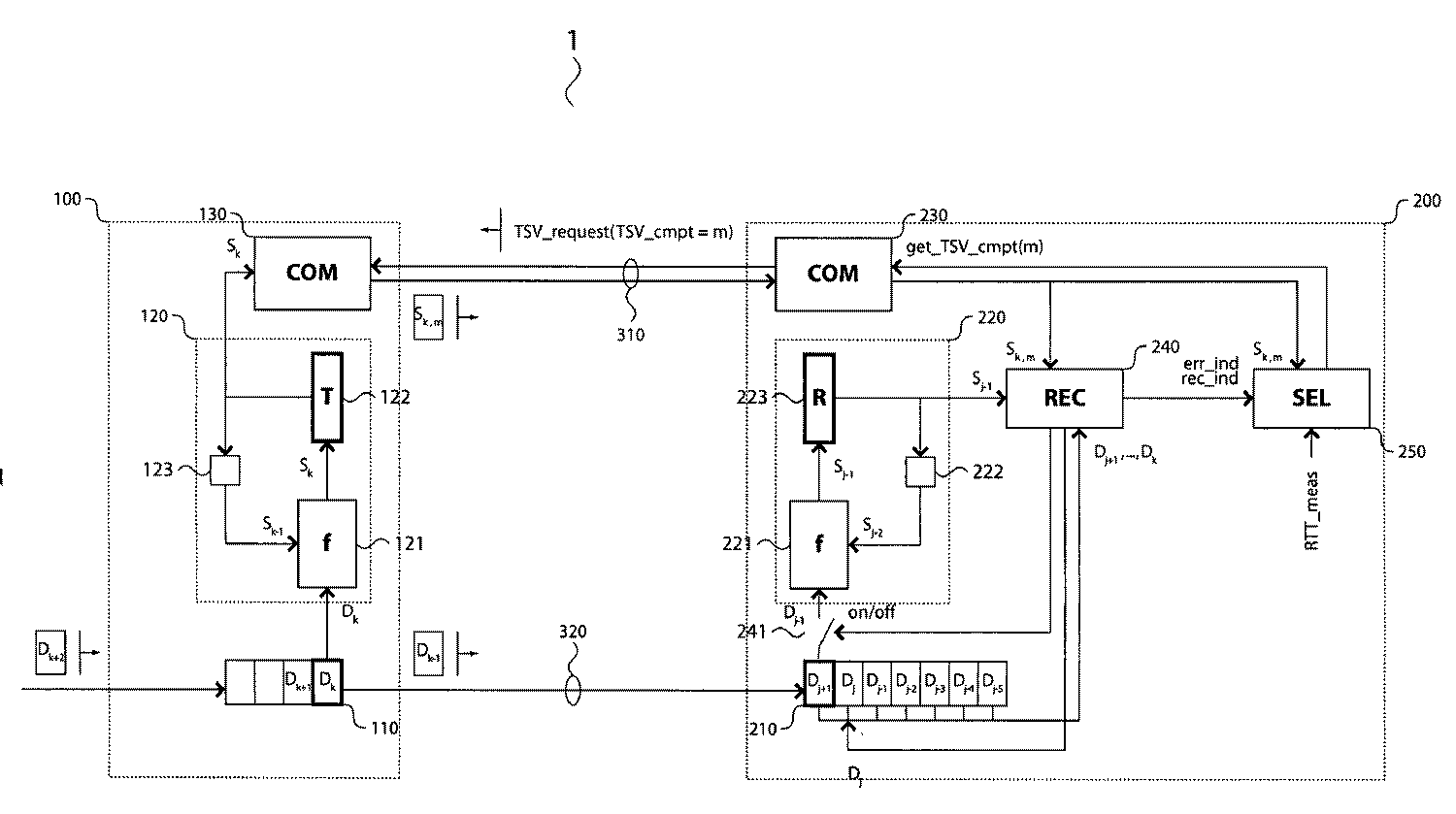
도 1은 본 발명에 따른 전송 유닛 및 수신 유닛을 도시한 도면.
도 2는 전송 유닛과 수신 유닛 사이의 정보 흐름의 예를 도시한 도면.1 shows a transmitting unit and a receiving unit according to the present invention;
2 shows an example of an information flow between a transmitting unit and a receiving unit;
도 1에서는 통신 시스템(1)을 보게 되며, 통신 시스템(1)은:1, a
- 전송 유닛(100) 및- transmitting unit (100) and
- 수신 유닛(200)을 포함한다. - receiving unit (200).
전송 유닛(100) 및 수신 유닛(200)은 패킷 스위칭된 통신 네트워크를 통해 서로 결합되며, 패킷 스위칭된 통신 네트워크는 다른 중간 네트워크 노드들(도시되지 않음)을 포함할 수 있고, 전송 유닛(100)으로부터 수신 유닛(200)쪽으로 데이터 패킷들이 운반되는 데이터 경로(310)와, 전송 유닛(100)과 수신 유닛(200) 사이에 에러 제어 메시지들이 교환되는 에러 제어 경로(320)를 지원한다. The
전송 유닛(100) 및 수신 유닛(200)은 인덱스된 데이터 패킷들 Dj-5, Dj-4, Dj-3, Dj-2, Dj-1, Dj ..., Dk-1, Dk, Dk+1, Dk+2, ..., 의 흐름을 각각 전송 및 수신하며, j는 분실된 특정 데이터 패킷의 인덱스를 표시하고, k는 전송 유닛(100)에 의한 전송을 위해 스케줄링되는 데이터 패킷의 인덱스를 표시하고, j < k이다. The transmitting
본 발명의 예시적인 실시예에서, 데이터 패킷들 D는 복수의 수신기들(예를 들면 수신 유닛(200))이 청취하는 멀티캐스트 어드레스로 제한된 RTP 패킷들이다. RTP 패킷들은 RTP 헤더에 인코딩된 16-비트 RTP 시퀀스 번호로 인덱스된다. TSV 및 RSV 값들은 RTP 페이로드로부터 계산된다. RTP 페이로드는 가변 길이일 수 있고, 어떤 경우에 그것은 알려진 비트 패턴으로 패딩된다. 전송중인 멀티캐스트 스트림들이 존재하는 만큼의 TSV들의 많은 예들이 존재하고, 청취중인 멀티캐스트 스트림들이 존재하는 만큼의 RSV들의 많은 예들이 존재한다. In an exemplary embodiment of the invention, data packets D are RTP packets limited to a multicast address that a plurality of receivers (e.g., the receiving unit 200) listens to. RTP packets are indexed with a 16-bit RTP sequence number encoded in the RTP header. TSV and RSV values are calculated from the RTP payload. The RTP payload can be of variable length, and in some cases it is padded with a known bit pattern. There are many examples of as many TSVs as there are multicast streams in transit, and there are as many examples of RSVs as there are multicast streams being listened to.
전송 유닛(100)은 다음의 기능 블록들을 포함한다:The
- 전송을 위해 스케줄링되기 전의 데이터 패킷들 D이 유지되는 전송 캐시(110),A
- TSV T를 계산하기 위한 전송 상태 계산 유닛(120), 및A transmission
- 통신 유닛(130).- communication unit (130).
전송 캐시(110)는 전송 상태 계산 유닛(120)에 결합된다. 전송 상태 계산 유닛(120)은 통신 유닛(130)에도 또한 결합된다.
전송 상태 계산 유닛(120)은 새로운 출력 데이터 패킷, 현재 Dk가 전송을 위해 스케줄링될 때마다 TSV T의 값을 업데이트하도록 구성된다. The transmission
예시적인 실시예로서, 전송 상태 계산 유닛(120)은:As an illustrative embodiment, the transmission
- TSV T의 최종 업데이트된 값, 현재 Sk가 유지되는 데이터 저장소(123),- the last updated value of TSV T, the
- TSV T의 이전 값, 현재 Sk-1이 업데이트되기 전에 그 값을 래치하기 위한 래치(122)(또는 시프트 레지스터 또는 유사물), 및- a previous value of TSV T, a latch 122 (or shift register or the like) for latching its value before the current Sk-1 is updated, and
- 래치(122)에 의해 래치될 때 제 1 인수로서 TSV T의 이전 값, 현재 Sk-1을 수용하고 제 2 인수로서 전송을 위해 스케줄링된 새로운 데이터 패킷의 RTP 페이로드, 현재 Dk를 수용하고, 출력으로서 TSV T의 새로운 값, 현재 Sk를 산출하고, 새로운 값은 데이터 저장소(123)로 푸싱되는 동안 이전 값은 래치(122)에 의해 래치되는 함수 f(121)를 포함한다. Receives a previous value of TSV T as the first argument, the current Sk-1, and the RTP payload of the new data packet scheduled for transmission as the second argument, current Dk, when latched by the
전송 상태 계산 알고리즘은 실시예의 동작을 참조하면 명확해질 것이다. The transmission state calculation algorithm will be clarified with reference to the operation of the embodiment.
통신 유닛(130)은 수신 유닛(200)에 의해 선택되는 TSV의 성분들의 현재(즉, 최종 업데이트된) 값을, 그 값이 대응하는 데이터 패킷 인덱스와 함께 수신 유닛(200)에 공급하도록 구성된다.The
통신 유닛(130)은 통신 프로토콜로서 UDP를 이용한다. The
수신 유닛(200)은 다음의 기능 블록들을 포함한다:Receiving
- 다른 처리 전의 유효하게 수신된 데이터 패킷들 D가 유지되는 수신 캐시(210),A receive
- RSV R을 계산하기 위한 수신 상태 계산 유닛(220),A reception
- 통신 유닛(230),A
- 복구 유닛(240),
- 선택기(250).- selector (250).
수신 캐시(210)는 수신 상태 계산 유닛(220)에 결합된다. 복구 수단(240)은 수신 캐시(210)에, 수신 상태 계산 유닛(220)에, 및 선택기(250)에 결합된다. 선택기(250)는 또한 통신 유닛(230)에 결합된다. The receive
수신 상태 계산 유닛(220)은 새로운 인입 데이터 패킷이 유효하게 수신될 때마다 RSV R의 값, 현재 최대 데이터 패킷 Dj-1을 업데이트하도록 구성되며, 그 인덱스는 다음의 예상된 데이터 패킷 인덱스이다. Receive
수신 상태 계산 유닛(220)은:The reception
- RSV R의 최종 업데이트된 값, 현재 Sj-1이 유지된 데이터 저장소(223),- the last updated value of RSV R, the
- RSV R의 이전 값, 현재 Sj-2가 업데이트되기 전에 이를 래치하기 위한 래치(222), 및A previous value of RSV R, a
- 전송 유닛(100)의 함수(121)와 같고, 래치(222)에 의해 래치된 바와 같이 RSV R의 이전 값, 현재 Sj-2를 제 1 인수로서 수용하고, 유효하게 수신된 데이터 패킷의 RTP 페이로드, 현재 Dj-1을 제 2 인수로서 수용하고, RSV R의 새로운 값, 현재 Sj-1을 출력으로서 산출하고, 새로운 값이 데이터 저장소(223)에 푸싱되는 동안 이전 값이 래치(222)에 의해 래치되는 함수 f(221)를 포함한다. - accepts the previous value of RSV R, current Sj-2, as a function of the
수신 상태 계산 알고리즘은 실시예의 동작을 참조하면 명확해질 것이다. The reception state calculation algorithm will be clarified with reference to the operation of the embodiment.
통신 유닛(230)은 전송 유닛(200)으로부터 TSV T의 고의로 선택된 벡터 성분들이 현재값뿐만 아니라 그 값이 대응하는 데이터 패킷 인덱스를 획득하도록 구성된다. 현재, 통신 유닛(230)은 TSV T의 m번째 성분의 현재값을 요청하고, 응답으로서 값 Sk, m을 획득하며, k는 그 값이 대응하는 RTP 시퀀스 번호를 표시한다. The
통신 유닛(230)은 통신 프로토콜로서 UDP를 이용한다. The
복구 유닛(240)은 분실되거나 파손된 데이터 패킷, 현재 Dj를 검출하고, 그 결과, 스위치(241)(도 1을 참조)를 통해 RSV R의 업데이트를 보류하도록 구성된다. 현재, RSV의 값은 새로운 데이터 패킷들 Dj+1, ..., Dk이 들어오는 동안 Sj-1로 고정되며, 그것은 이들 인덱스들 중 어느 것도 다음의 예상된 데이터 패킷 인덱스, 현재 인덱스 j가 아니기 때문이다. The
복구 유닛(240)은 또한, RSV R의 최종 업데이트된 값, 현재 Sj-1로부터, 요청된 TSV 성분(들)으로부터의 현재값, 현재 Sk, m으로부터, 및 그렇지 않으면 정확하게 수신된 데이터 패킷들, 현재 Dj+1, ..., Dk로부터 분실되거나 파손된 데이터 패킷, 현재 Dj를 복구하도록 구성된다. 복구된 패킷은 다른 처리를 위해 수신 캐시(210)로 푸싱되고, RSV R의 업데이트는 스위치(241)(도 1 참조)를 통해 재개된다. The
복구 유닛(240)은 또한, 분실되거나 파손된 데이터 패킷이 검출될 때마다(도 1의 err_ind 참조), 또한 분실되거나 파손된 데이터 패킷이 복구될 때마다(도 1의 rec_ind 참조) 선택기(250)에 통지하도록 구성된다. The
복구 알고리즘은 실시예의 동작을 참조하면 명확해질 것이다.The recovery algorithm will become clear with reference to the operation of the embodiment.
선택기(250)는 하나 이상의 분실되거나 파손된 데이터 패킷들을 복구할 수 있도록 정확한 TSV의 성분들을 선택하도록 구성된다. 현재, 선택기(250)는 TSV T의 m번째 성분을 선택하고, 통신 유닛(230)이 이를 획득하도록 요청한다(도 1의 get_TSV_cmpt(m) 참조).The
TSV의 성분들의 선택은 하기에 기초한다:The selection of the components of the TSV is based on:
- 존재한다면, 이미 이용 가능한 전송 상태 정보,- if available, transmission status information already available,
- RSV R의 최종 업데이트된 값 이후의 분실되거나 파손된 데이터 패킷들의 현재 수, 또는 대안적으로, 분실되거나 파손된 데이터 패킷들의 추정된 수, 이것은 선택될 TSV의 성분들로부터 복구되어야 할 것이다.- the current number of lost or corrupted data packets after the last updated value of RSV R, or alternatively, the estimated number of lost or corrupted data packets, which shall be recovered from the components of the TSV to be selected.
분실되거나 파손된 데이터 패킷들의 수의 추정은 다음의 요인들에 기초한다:Estimation of the number of lost or corrupted data packets is based on the following factors:
- 복구 유닛(240)에 의해 통지된 바와 같은 에러 및 복구 정보(도 1의 err_ind 및 rec_ind 참조)로서, 선택기(250)가 어떤 RSV의 값이 이용 가능하고 대응하는 TSV의 값, 현재 인덱스 j-1을 따르는 것으로 예상되는지에 대해 최종 데이터 패킷 인덱스를 결정하도록 허용하는, 상기 에러 및 복구 정보,(See err_ind and rec_ind in FIG. 1) as informed by the
- 예를 들면, 통신 유닛(230)에 의해 실행되는 수신기 유닛(200)과 전송 유닛(100) 사이의 RTT의 측정들(도 1의 RTT_meas 참조)로서, 선택기(250)가 어떤 선택될 TSV의 성분들이 이용 가능할지에 대해 데이터 패킷 인덱스, 현재 인덱스 k를 추정하도록 허용하는, 상기 RTT의 측정들,The
- 복구 유닛(240)으로부터 또는 하부층으로부터의 에러 정보에 기초하여 예를 들면 선택기(250)에 의해 실행되는 에러 비율 측정들(예를 들면, 오류가 있는 패킷들의 예상된 비율).Error rate measurements (e. G., The expected percentage of erroneous packets) that are performed, for example, by the
추정은 또한 부가의 에러 타이밍 정보(예를 들면, 지속기간, 주파수, 하루 중 언제 및/또는 주 중 언제 발생)로 향상될 수 있다. The estimate may also be enhanced with additional error timing information (e.g., duration, frequency, at any time of the day and / or during the week).
데이터 통신 시스템(1)의 동작이 지금부터 이어진다. The operation of the
Dk를 전송 유닛(100)에서 수신 유닛(200)으로 전송되어야 하는 k번째 패킷으로 둔다(여기서 k는 RTP 시퀀스 번호와 같은 패킷 인덱스를 표시한다). 이 패킷은 계산들(덧셈, 곱셈 등)이 수행될 수 있는 L개의 심볼들(예를 들면, 비트들 또는 바이트들)로 나누어진다. 임의 타입의 심볼들이 이용될 수 있지만, 덧셈 및 곱셈이 이러한 필드에 잘 규정되어 있으므로, 실시예들에서 우리는 심볼들로서 갈르와 필드(GF: Galois Field)의 요소들을 이용할 것임을 유념한다. 이하에서 여전히 용어 "패킷(packet)"을 이용하지만, 패킷은 L개의 심볼들로 세그먼트되고 이들 심볼들(l = 1, ..., L)의 각각은 동일한 방식으로 정확하게 병렬로 다루어짐을 언급하지 않지만 그렇게 가정한다. 특히, 우리가 구성할 에러 정정 정보는 병렬로 계산된 다수 M의 정정 심볼들로 구성된다. 즉, 패킷의 각각의 데이터 심볼(l = 1, ..., L)에 대해, M개의 정정 심볼들의 벡터가 연관된다. 이들 L개의 벡터들, M개의 정정 패킷들이 구성될 수 있다: m번째 정정 패킷은 각각의 m번째 정정 심볼(M개의 심볼들의 벡터 중에서)과 모든 데이터 심볼 l을 조합하여 구성된다. 이것은 정정 패킷들이 데이터 패킷들과 동일한 크기가 되게 한다. 데이터 패킷들이 동일한 크기가 아닌 경우, 최대 패킷 크기가 취해져야 하고, 더 짧은 패킷들은 더미 정보로 스터퍼링(stuffed)되어야 한다.Dk as the kth packet to be transmitted from the
패킷 손실 또는 패킷 파손으로부터 패킷들의 전송을 보호하기 위하여, 다음의 방식이 제안된다. 전송 유닛(100)은 인덱스된 TSV를 유지하고, 그 값은 Sk = [Sk, 1; Sk, 2; ...;Sk, M]로 표시된다. 이러한 M-차원 TSV는 다음의 수학식에 따라 각각 전송된 패킷 Dk에 대해 업데이트된다:In order to protect the transmission of packets from packet loss or packet corruption, the following scheme is proposed. The

함수 fk는 패킷 Dk의 페이로드의 값과 이전 패킷 Sk-1와 연관된 상태 벡터 값을 입력들로서 취하고 새로운 상태 벡터 값 Sk를 출력으로 생성하는 벡터 함수이다. 함수 fk 자체는 k에 의존할 수 있음을 유념한다. 즉, 일반적으로 각각의 패킷에 대해, 상태 벡터를 계산하기 위한 새로운 규칙이 이용될 수 있다. 그러나, 우리는 함수 fk가 k에 의존하지 않는 경우들로 실시예들을 제한할 것이고, 우리는 그 함수를 f로 표시할 것이다. The function fk is a vector function that takes as inputs the value of the payload of the packet Dk and the state vector value associated with the previous packet Sk-1 and generates a new state vector value Sk as an output. Note that the function fk itself may depend on k. That is, for each packet in general, a new rule for calculating a state vector may be used. However, we will limit the embodiments to cases where the function fk does not depend on k, and we will denote the function as f.
수신 유닛(200)은 유사하게 RSV를 업데이트하며, 그 값은 전송측에서 계산된 TSV의 대응하는 값과 매칭한다. 전송 유닛(100) 및 수신 유닛(200) 둘다는 동일한 초기 상태 S0에서 시작하고 정확하게 동일한 함수 f를 이용한다. 이와 같이 전송 및 수신측에서의 상태 벡터들은 서로의 사본들이 정확하다. 패킷, 즉 패킷 Dj가 분실되면, 수신 유닛(200)은 동기를 벗어나고 전송기의 현재 상태 벡터의 잘 선택된 서브세트를 전송 유닛(100)에 요구한다. 이 요청이 전송 유닛(100)에 도달하기 전에 다소 시간이 걸리므로, 현재 벡터는 지금 Sk이고, k = j + r이고, r은 RTT 및 패킷 간 시간에 의존하는 어떤 양수이다. 전송 유닛(100)은 현재 시퀀스 번호 k와 함께 Sk의 요청된 엔트리들을 수신 유닛(200)에 전송한다. 이 정보가 도달할 때, 수신 유닛(200)은 대부분의 경우에 분실된 패킷을 재구성할 수 있다. 분실된 패킷이 재구성되는 경우, 수신 유닛(200)은 그 상태 벡터를 전송 유닛(100)의 상태 벡터와 동기하도록 유지할 수 있다. 어떤 이유로, 분실된 패킷이 재구성될 수 없는 경우, 수신 유닛(200)은 그 상태 벡터가 전송 유닛(100)의 상태 벡터와 동기하는 상태로 유지되는 것을 여전히 확인해야 한다(충분한 정정 정보를 요청하거나, 상태 벡터를 특정 패킷 인덱스에서 어떤 동의된 값으로 재초기화하거나, 또는 송신기에서 수신기로 상태 벡터 T의 주기적인 광고에 의존함으로써). Receiving
정정 정보가 대응하는 시퀀스 번호, 즉 k가 어떤 헤더 필드에서의 에러 정정 정보와 함께 피기백할 수 있다고 가정한다면, 상태 벡터의 하나의 엔트리의 전송은 하나의 패킷의 재전송이 행해지는 것과 정확히 동일한 용량을 요구한다는 것을 유념한다. Assuming that the correction information can be piggybacked with the corresponding sequence number, i.e., k, with the error correction information in a header field, the transmission of one entry of the state vector is done in exactly the same capacity as the retransmission of one packet . ≪ / RTI >
수신기측에서의 재구성은, 분실된 데이터 패킷 Dj가 어떻게 상태 벡터 Sj + r = Sk에 영향을 미치는지를 수신기가 알고 있다는 사실에 기초한다. j와 j+r(포함하여) 사이에 다른 패킷 손실들이 존재하지 않는 경우, 수신기는 이것이 수신한 Sj+r의 엔트리(또는 엔트리들)를 산출하는 패킷 Dj를 선택해야 한다. 함수 f가 잘 선택되면, 이 솔루션 Dj는 고유하며, 이것은 본원에 더 기재될 것이다. j와 j+r(포함하여) 사이에, 즉 j+s(s<r)에서 부가의 패킷 손실들이 존재하는 경우, 수신기는 그 현재 상태 벡터의 다른 잘 선택된 엔트리들을 전송기에 요구한다. 따라서 우리는 다음과 같은 손실 기간을 규정한다: 하나의 데이터 패킷의 손실로 시작하고(수신기의 상태 벡터가 전송기의 상태 벡터와 동기를 벗어나는 결과를 가지고), 그 상태 벡터를 전송기의 상태 벡터와 재동기화하기 위해 수신기가 다시 충분한 정보를 가질 때까지 지속한다(손실 기간 동안의 모든 패킷 손실들이 재구성될 수 있기 때문에 또는 수신기가 전송기로부터 완전한 상태 벡터를 수신하기 때문에).The reconstruction at the receiver side is based on the fact that the receiver knows how the lost data packet Dj affects the state vector Sj + r = Sk. If there are no other packet losses between j and j + r (inclusive), the receiver must select packet Dj that computes the entry (or entries) of Sj + r it received. If the function f is well chosen, this solution Dj is unique and will be described further herein. If there are additional packet losses between j and j + r (inclusive), i.e. j + s (s < r), the receiver requires the transmitter to have other well-selected entries in its current state vector. We therefore define the following loss periods: start with the loss of one data packet (with the result that the receiver's state vector is out of synchronization with the transmitter's state vector) (Since all packet losses during the loss period can be reconstructed or the receiver receives a complete state vector from the transmitter).
이것은 도 2에 도시된다. 패킷들 D1 내지 D15는 전송 유닛(100)(Tx)에서 수신 유닛(200)(Rx)쪽으로 전송된다. 패킷들 D3이 분실된다. 결과적으로, 수신 유닛(200)은 TSV의 제 1 성분을 요청한다(데이터 패킷 D4의 수신시 도 2의 TSV_request(제 1 비교) 참조). 전송 유닛(100)이 데이터 패킷 D10의 전송을 스케줄링하는 동안 요청들이 도달한다. 전송 유닛(100)은 TSV의 제 1 성분의 현재값, 현재 S10, 1뿐만 아니라, 그 값이 대응하는 전송 인덱스, 현재 k = 10을 전송함으로써 요청에 응답한다. 그 후에, 수신 유닛은 RSV의 최종 업데이트된 값, 현재 S2 = [S2, 1; S2, 2]로부터, 그렇지 않으면 정확하게 수신된 데이터 패킷들 D4, D5, D6, D7, D8, D9 및 D10으로부터, 및 전송기의 상태 벡터의 제 1 성분의 현재값, 현재 S10, 1로부터 분실된 데이터 패킷 D3을 재구성할 수 있다. 실제로 우리는 다음과 같이 기재할 수 있다: This is shown in Fig. Packets D1 to D15 are transmitted from the transmitting unit 100 (Tx) to the receiving unit 200 (Rx). Packets D3 are lost. As a result, the receiving

손실 기간은 현재 데이터 패킷 D3에서 시작하고 정정 정보 S10, 1의 수신시 종료하고(도 2의 loss_period 참조), 따라서, 데이터 패킷들 D3 내지 D10을 포함한다. The loss period begins at the current data packet D3 and ends upon receipt of the correction information S10, 1 (see loss_period in FIG. 2) and thus includes data packets D3 through D10.
데이터 패킷 D3이 복구되었으면, RSV의 업데이트가 재개될 수 있다. If the data packet D3 has been recovered, the update of the RSV can be resumed.
다른 데이터 패킷이 분실된다면, 다른 TSV의 성분들에 대한 새로운 요청이 발생되고, 그에 의해 손실 기간을 적절히 연장한다. If another data packet is lost, a new request for the components of another TSV is generated, thereby extending the loss period appropriately.
본 발명에서, 함수 f만이 현재 패킷 Dk를 인수로서 취하지만, 다수의 가장 최근의 패킷들, 즉 Dk, Dk-1, ...,을 인수로서 취하는 다른 함수가 역시 예상될 수 있지만, 이것은 당연히 전송 캐시(110)의 크기를 증가시킨다. In the present invention, although only the function f takes the current packet Dk as an argument, other functions taking as arguments a number of the most recent packets, i.e. Dk, Dk-1, ..., may also be expected, Thereby increasing the size of the
손실 기간 동안 분실되거나 파손된 패킷들을 재구성하기 위한 방법과 어떤 종류의 정정 정보가 어떤 환경에서 요구되는지는 특정 실시예에 의존한다.The method for reconstructing lost or corrupted packets during a loss period, and what kind of correction information is required in certain circumstances, depends on the particular embodiment.
제 1 실시예에서, 심볼들은 2개의 요소들의 GF 또는 GF(2), 즉 비트들 {0, 1}의 요소들이다. 상태 벡터 Sk는 단 하나의 엔트리(M = 1)를 가지고, 따라서 스칼라로 감소한다. 함수 f(Dk, Sk-1)(k에 의존하지 않고 선택됨)는 Dk 및 Sk-1의 이진 합(즉, XOR)이다:In the first embodiment, the symbols are the elements of GF or GF (2), i.e. bits {0, 1} of two elements. The state vector Sk has only one entry (M = 1), thus decreasing to a scalar. The function f (Dk, Sk-1) (selected independent of k) is the binary sum (i.e., XOR) of Dk and Sk-1:

시간 패킷의 어떤 순간에, Dj-1이 정확하게 수신되었고, 수신 유닛(200)이 전송 유닛(100)과 동기된다(즉, 둘다 동일한 상태 Sj-1을 가진다)고 가정한다. 패킷 Dj가 손실되면, 수신 유닛(200)은 전송기의 현재 상태의 형태하에서 정정 정보를 요청한다. 이 요청의 도달시, 전송 유닛(100)은 상태 Sj+r의 값과 연관된 시퀀스 번호 j+r을 리턴한다. 이 정보가 도달할 때, 수신 유닛(200)은 수학식을 풀어야 한다:It is assumed that at some instant in time packet Dj-1 has been received correctly and that the receiving

Dj+r이 정확하게 수신될 때까지 패킷들 Dj+1이 제공되어 C가 계산될 수 있고, 그 경우 Dj가 직접 뒤따른다:Until Dj + r is received correctly, packets Dj + 1 are provided and C can be computed, in which case Dj follows directly:

패킷 Dj는 패킷들의 세트 {Dj+1, ..., Dj+r}에서 임의의 다른 손실이 존재하는 경우에 재구성될 수 없다. 그러므로, 이 시스템은 하나의 손실 기간에 하나의 패킷 손실을 정정할 수 있지만, 2개 이상의 패킷 손실들을 정정하는데 실패한다. The packet Dj can not be reconstructed if there is any other loss in the set of packets {Dj + 1, ..., Dj + r}. Therefore, this system can correct one packet loss in one loss period, but fails to correct two or more packet losses.
상태 Sj+r의 수신 후에, 수신기 상태는 다시 전송기 상태와 동기한다(그래서 손실 기간은 r 패킷들 후에 종료한다)는 것을 유념한다. Note that after receipt of state Sj + r, the receiver state synchronizes again with the transmitter state (so the loss period ends after r packets).
수신 유닛(200)의 요청시 전송 유닛(100)에 의해 전송된 정정 정보가 손실되고(또는 등가적으로 요청 자체가 손실되고), 예를 들면, 타이머가 만료하기 때문에 이것이 검출 가능하다면, 수신 유닛(200)은 새로운 업데이트를 지속적으로 요청하여(k를 변수로 만들지만, 손실 기간 지속구간들을 확률로 만드는 것을 제외하고, 이것은 다른 결과를 가지지 않음), 전송 유닛(100)과 적어도 동기된 상태로 남아 있을 수 있다. 대안적으로, 수신 유닛(200)은 상태 벡터의 현재값을 광고하기 위하여 전송 유닛(100)을 대기할 수 있다. If the correction information transmitted by the
제 2 실시예에서, 심볼들은 GF(pq)의 요소들이며, p는 소수이고(대부분의 경우들에서 p = 2) q ≥ 1이다. 이 GF에는 Q = pq 요소들이 존재한다. 이러한 필드는 덧셈을 위해 0으로 표시된 고유한 중성 요소(unique neutral element)를 포함하고, 곱셈을 위해 1로 표시된 고유한 중성 요소를 포함한다. 상태 정보는 이 GF의 요소들의 M-차원 어레이이고, 벡터 함수 f(Dk, Sk-1)(k에 의존하지 않고 선택됨)는 다음과 같이 규정된다:In the second embodiment, the symbols are elements of GF (p q ), p is a prime number (p = 2 in most cases) and q ≥ 1. There are Q = p q elements in this GF. These fields contain a unique neutral element denoted as 0 for addition and a unique neutral element denoted as 1 for multiplication. The state information is an M-dimensional array of elements of this GF, and the vector function f (Dk, Sk-1) (selected independent of k) is defined as:

여기서, A는 (MxM) 매트릭스이고 a는 GF(pq)에서 (Mx1)-매트릭스(즉, 벡터)이다. 이 규정에 이용된 덧셈 및 곱셈은 GF(pq)로부터의 것들이다. Wherein, A is (MxM) matrix a is (Mx1) in the (p q) GF - a matrix (i.e., vector). Addition and multiplication used in this specification are those from GF (p q ).
시간의 어떤 순간에, 패킷 Dj-1은 정확하게 수신되고, 수신 유닛(200)은 전송 유닛(100)과 동기되었다(즉, 둘다 동일한 상태 Sj-1을 가진다)고 가정한다. 패킷 Dj가 손실되면, 수신 유닛(200)은 전송기의 상태 벡터의 제 1 성분의 형태 하에서 정정 정보를 요청한다. 이 요청의 도달시, 전송 유닛(100)은 상태 sj+r, 1의 값 및 연관된 시퀀스 번호 j+r을 리턴한다. 이 정정 정보가 도달하는 순간에, 수신 유닛(200)은 손실된 패킷을 재구성하도록 시도할 수 있다. 패킷들의 세트 {Dj+1, ..., Dj+r}에서 다른 손실이 존재하지 않는 경우, 이를 즉시 행할 수 있다(제 1 실시예와 매우 유사한 절차로). 그 세트에 임의의 다른 손실이 존재하지 않는 경우, 즉 패킷 Dj+s(s<r) 역시 손실된 경우, 수신 유닛(200)은 전송기의 현재 상태 벡터의 제 2 성분의 형태 하에서 정정 정보를 요청한다. 결과적으로, 전송 유닛(100)은 상태 Sj+s+r', 2의 값과 연관된 시퀀스 번호 j+s+r'를 리턴한다. r'은 r과 (약간) 상이함을 유념한다. 제 2 손실 후에 다른 손실 r' 패킷들이 존재하지 않으면, 수신 유닛(200)은 원칙적으로 두 분실된 패킷들을 재구성하기에 충분한 정보를 가진다. 존재한다면, 수신 유닛(200)은 전송기의 현재 상태 벡터의 제 3 성분을 요청한다 등등.At some point in time, it is assumed that packet Dj-1 is correctly received and that the receiving
특정 순간에, 수신 유닛(200)은 정정 정보의 n개의 조각들을 수신하였고, 재구성할 n개의 분실된 패킷이 존재한다. GF의 속성들을 이용함으로써, n개의 분실된 패킷들을 재구성하기 위하여, 다음의 형태의 매트릭스 수학식을 풀어야 한다는 것을 쉽게 알 수 있다:At a particular instant, the receiving
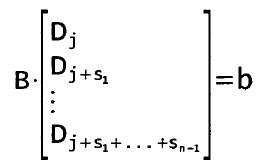
여기서, s1, ..., sn-1은 n개의 분실된 패킷들 사이의 인덱스 오프셋들이고, B는 A 및 a에 의존하는 (nxn)-매트릭스이고, b는 A, a, 분실되지 않은 패킷들의 값, 제 1 패킷 손실 전의 상태 벡터 및 수신된 정정 정보에 의존하는 (nx1)-매트릭스(즉, 벡터)이다.B is the (nxn) -matrix depending on A and a, b is A, a, and n is the number of packets that have not been lost (Nx1) -matrix (i. E., Vector) that depends on the state vector before the first packet loss and the received correction information.
매트릭스 A 및 벡터는 매트릭스 B가 가능한 많은 손실 패턴들에 대해 반전 가능(invertible)하도록 잘 선택되어야 한다. 특히, 벡터는 0과 동일한 엔트리들을 가져서는 안 된다. 실제로, 그리고 보편성을 잃지 않고, 벡터는 모든 엔트리들이 1과 동일하게 선택될 수 있다. 매트릭스 B가 반전을 가지면, n개의 분실된 패킷들이 재구성될 수 있고, 수신 유닛(200)은 전송 유닛(100)과 재동기될 수 있다. 매트릭스 B가 반전 가능하지 않은 (바라건대 드문) 경우, n개의 분실된 패킷들은 재구성될 수 없고, 수신 유닛(200)은 전송 유닛(100)에 대한 완전한 상태 벡터의 "현재(current)"버전을 (지속적으로)요청하거나, 전송 유닛(100)이 그 값을 광고할 때까지 대기한다. 이 정보를 수신한 후에, 수신 유닛(200)은 다시 동기 상태가 된다(그리고 손실 기간이 종료된다). n은 M으로 제한됨을 유념한다. M개보다 많은 손실들이 손실 기간에 존재하는 경우, 수신 유닛(200)은 이들을 정정할 수 없고, 다시 전송기에 대한 완전한 상태 벡터의 "현재" 버전을 (지속적으로)요청해야 하거나, 다음 광고를 대기한다.The matrix A and vector should be well chosen such that matrix B is invertible for as many loss patterns as possible. In particular, vectors must not have entries equal to zero. In fact, and without loss of generality, the vector can be chosen so that all entries are equal to one. If matrix B has an inverse, n lost packets may be reconstructed and receiving
제 3 실시예는 제 2 실시예와 유사하다. 이것은 동일한 GF를 이용한다. 덧셈을 위한 중성 요소와 곱셈을 위한 중성 요소 외에도, 이러한 필드는 또한 α로 표시된 적어도 하나의 소위 기본 요소(primitive element)를 포함하는 것이 알려져 있다. 이 기본 요소는 모든 0 < t < Q-1에 대해 αt ≠ 1 및 αQ-1 = 1인 속성을 가진다. The third embodiment is similar to the second embodiment. This uses the same GF. In addition to the neutrals for addition and the neutrals for multiplication, these fields are also known to contain at least one so-called primitive element denoted by a. This primitive has the property that α t ≠ 1 and α Q-1 = 1 for all 0 <t <Q-1.
제 2 실시예에서와 같이, 상태 정보는 GF의 요소들의 M-차원 벡터이다. 벡터 함수 f(Dk, Sk-1)(k에 의존하지 않고 선택됨)는 엔트리마다 규정된다. 상태 벡터의 m번째 엔트리는 다음과 같이 규정된다:As in the second embodiment, the state information is an M-dimensional vector of elements of GF. The vector function f (Dk, Sk-1) (selected independent of k) is defined for each entry. The mth entry of the state vector is defined as:

여기서, m = 1, ..., M 및 M < Q-1이다.Where m = 1, ..., M and M < Q-1.
시간의 어떤 순간에 패킷 Dj-1은 정확하게 수신되고 수신 유닛(200)은 전송 유닛(100)과 동기된다(즉, 둘다 동일한 상태 Sj-1을 가진다)는 것을 가정한다. 패킷 Dj이 손실되면, 수신 유닛(200)은 전송기의 상태 벡터의 제 1 성분의 형태 하에서 정정 정보를 요청한다. 이 요청의 도달시, 전송 유닛(100)은 sj+r, 1의 값 및 연관된 시퀀스 번호 j+r을 리턴한다. 이 정정 정보가 도달하는 순간, 수신기는 손실된 패킷을 재구성하도록 시도할 수 있다. 패킷들의 세트 {Dj+1, ..., Dj+r}에서 다른 손실이 존재하지 않는 경우, 이를 즉시 행할 수 있다. 그 세트 내에 임의의 다른 손실이 존재하는 경우, 즉 패킷 Dj+s 역시 손실된 경우, 수신기는 전송기의 현재 상태 벡터의 첫 번째 2개의 성분들의 형태 하에서 정정 정보를 요청한다. 결과적으로, 전송 유닛(100)은 상태 [Sj+s+r', 1; Sj+s+r', 2]의 값과 연관된 시퀀스 번호 j+s+r'를 리턴한다. 이전과 같이 r'는 r과 (약간) 상이할 수 있음을 유념한다. 제 2 손실 후에 r' 패킷들의 다른 손실이 존재하지 않는 경우, 수신기는 두 분실된 패킷들을 재구성하기에 충분한 정보를 가진다. 존재하는 경우에는 수신기가 상태 벡터의 첫 번째 3개의 성분들을 요청한다 등등. It is assumed that at some moment in time the packet Dj-1 is correctly received and that the receiving
특정 순간에 수신 유닛(200)이 상태 벡터의 첫 번째 n개의 성분들(하나의 특정 패킷과 연관된) 모두를 정확하게 수신하고 (Dj, Dj+s1, ..., Dj+s1+...+sn -1)를 재구성하기 위해 n개의 분실된 패킷이 존재한다면, 수신 유닛(200)은 모든 분실된 패킷들(및 전송 유닛(100)과 재동기할 수 있도록 모든 연관된 상태 벡터들)을 재구성하기에 충분한 정보를 가진다. 이렇게 하기 위해서 수신기가 다음 형태의 수학식들의 선형 세트를 풀어야 하는지를 판단하는 것은 성가시지만 간단하다:At a specific moment the receiving

여기서, b는 α 및 정확하게 수신된 패킷들의 값, 제 1 패킷 손실 전의 상태 벡터 Sj-1 및 수신된 정정 정보에 의존하는 (nx1)-매트릭스이다. Where b is a (nx1) -matrix that depends on a and the value of the correctly received packets, the state vector Sj-1 before the first packet loss, and the received correction information.
좌측상의 (nxn)-매트릭스는 반데몬드 매트릭스(Vandermonde)이고 이 매트릭스의 제 2 로우 상의 모든 요소들이 상이한 경우 반전 가능하다(따라서, 수학식들의 세트는 고유해를 가진다). α가 기본 요소이기 때문에, 모두 s1+...+sn -1 < Q-1인 경우에 이것이 보장된다. 결과적으로, 많아야 M개의 패킷들이 하나의 손실 기간에 재구성될 수 있고, 이 손실 기간은 Q-1 패킷들보다 더 작게 남아 있어야 한다. The (nxn) -matrix on the left is a Vandermonde and is reversible if all the elements on the second row of the matrix are different (thus, the set of mathematical equations has a unique solution). Since α is a fundamental element, this is guaranteed when s 1 +... + s n -1 <Q -1 . As a result, at most M packets can be reconstructed in one loss period, and this loss period should remain smaller than Q-1 packets.
상태 벡터(및 하나의 특정 패킷과 연관됨)의 제 1 m개의 엔트리들 모두가 정확하게 수신되지 않으면(또는 등가적으로 이 정정 정보에 대한 요청이 손실되면), 수신 유닛(200)은 요청을 재발행해야 한다(또는 그 동안 더 많은 패킷들이 손실된 경우 그 요청을 업데이트해야 한다). M개보다 많은 패킷들이 손실된 경우, 또는 손실 기간이 Q-1을 넘는 즉시, 수신 유닛(200)은 전송 유닛(100)의 완전한 상태 벡터를 지속적으로 요청해야 하거나, 다음 광고를 대기해야 한다. If all of the first m entries of the state vector (and associated with a particular packet) are not correctly received (or equivalently, if the request for this correction information is lost), then the receiving
제 2 실시예와 비교하면, 이러한 제 3 실시예는 더 큰 정정 정보를 생성하지만 손실 패킷들을 더 많이 정정할 수 있다. Compared with the second embodiment, this third embodiment can generate more correction information but can more correct lost packets.
제 4 실시예는 제 3 실시예와 동일하지만, 손실 특징들은 거의 상수 길이의 버스트들에서 손실들이 발생한다는 것이 선험적으로 알려져 있다. 이 경우, 상태 벡터의 차원 M은 가장 긴 예상된 버스트 크기와 동일하게 선택된다. 패킷 손실이 검출되면, 완성된 상태 벡터는 즉시 요청된다. 그 외에는 제 3 실시예에서와 동일한 절차가 적용된다. The fourth embodiment is the same as the third embodiment, but it is a priori known that loss characteristics occur in bursts of almost constant length. In this case, the dimension M of the state vector is chosen to be equal to the longest expected burst size. If packet loss is detected, the completed state vector is immediately requested. Otherwise, the same procedure as in the third embodiment is applied.
전송 유닛(100)은, 통상적으로 오류 발생이 쉬운 환경(예를 들면, DSL 회선을 통한 간섭 및 임펄스 잡음)에 속하는 DSLAM 또는 무선/모바일 기지국과 같은 액세스 노드에서 구현되는 것이 유리하다. 이것은 RTT를 감소시키고 따라서 손실 기간의 길이를 감소시켜서, 다른 TSV의 성분들의 전송을 덜 예상하게 하고, 또한 파손되거나 분실된 정보가 존재한다면, 그 양의 예상을 개선시킨다. The
수신 유닛(200)은 가입자 게이트웨이 또는 단말기의 일부를 형성할 수 있다. 수신 유닛(200)은 또한, 디코딩 디바이스의 일부를 형성할 수도 있으며, 이 경우, 수신 캐시(210)는, 다른 디코딩 및 플레이 아웃 전에 데이터 패킷이 유지되는 디-지터링 버퍼(de-jittering buffer)를 나타낸다. The receiving
특허청구범위에서도 또한 이용되는 용어 '포함(comprising)'은 이후에 나열된 수단들에 제한되는 것으로 해석되어서는 안 됨을 유념한다. 따라서, 수단 'A 및 B를 포함하는 디바이스'의 표현의 범위는 구성요소들 A 및 B로만 구성된 디바이스들로 제한되어서는 안 된다. 그것은 본 발명과 관련하여, 디바이스의 관련 구성요소들은 A 및 B임을 의미한다. It is noted that the term 'comprising', also used in the claims, should not be construed as being limited to the means listed thereafter. Thus, the scope of the representation of the device comprising means A and B should not be limited to devices consisting only of components A and B. Which in the context of the present invention means that the relevant components of the device are A and B.
특허청구범위에서도 또한 이용되는 용어 '결합된(coupled)'은 직접 접속들만으로 제한되는 것으로 해석되어서는 안 됨을 또한 유념한다. 따라서, '디바이스 B에 결합된 디바이스 A'의 표현의 범위는 디바이스 A의 출력이 디바이스 B의 입력에 직접 접속되는 및/또는 그 반대로 접속되는 디바이스들 또는 시스템들로 제한되어서는 안 된다. 그것은 A의 출력과 B의 입력 및/또는 그 반대의 사이의 경로가 존재한다는 것을 의미한다. It is also noted that the term 'coupled', also used in the claims, should not be construed as being limited to direct connections. Thus, the range of representation of 'device A coupled to device B' should not be limited to devices or systems in which the output of device A is directly connected to the input of device B and / or vice versa. Which means that there is a path between the output of A and the input of B and / or vice versa.
본 발명의 실시예들은 기능 블록들의 의미로 상술되었다. 상기에 주어진 이들 블록들의 기능적 기술로부터, 전자 디바이스들을 설계하는 분야의 통상의 기술자는 이들 블록들의 실시예들이 잘 알려진 전자 구성요소들로 제조될 수 있는 방법이 명백할 것이다. 따라서, 기능 블록들의 컨텐트들의 상세한 아키텍처는 주어지지 않는다. Embodiments of the present invention have been described above in terms of functional blocks. From the functional description of these blocks given above, it will be clear to those of ordinary skill in the art of designing electronic devices how the embodiments of these blocks can be fabricated with well known electronic components. Thus, the detailed architecture of the contents of the functional blocks is not given.
본 발명의 원리들이 특정 장치와 함께 상술되었지만, 이 기술은 예의 방식으로만 이루어질 뿐, 첨부된 특허청구범위에 규정된 바와 같이, 본 발명의 범위에 대한 제한으로서 이루어진 것이 아님을 명확히 이해한다. While the principles of the invention have been described above in connection with specific devices, it is clearly understood that the same is by way of illustration only and not as a limitation on the scope of the invention, as defined in the appended claims.
Claims (17)
- 새로운 출력 데이터 패킷(Dj-1)이 전송을 위해 스케줄링될 때마다 전송 상태 벡터 TSV(T)의 벡터 성분들을 연속적으로 업데이트하도록 구성된 전송 상태 계산 수단(120)으로서, 새로운 인입 데이터 패킷(Dj-1)이 유효하게 수신될 때마다, TSV는 상기 수신 유닛에서 벡터 성분들이 유사하게 업데이트된 대응하는 수신 상태 벡터 RSV(R)에 매칭되고, 상기 새로운 인입 데이터 패킷(Dj-1)의 인덱스는 다음의 예상된 데이터 패킷 인덱스인, 상기 전송 상태 계산 수단(120),
- 상기 수신 유닛으로부터의 요청시, 상기 TSV의 적어도 하나의 벡터 성분의 각각에 대해 적어도 하나의 현재 성분값(sk, m)을 전송하도록 구성된 통신 수단(130)으로서, 상기 적어도 하나의 현재 성분값(sk, m)이 상기 RSV의 최종 업데이트된 벡터값(Sj-1), 및 유효하게 수신된 데이터 패킷들(Dj+1, ..., Dk)과 조합될 때, 적어도 하나의 분실되거나 파손된 데이터 패킷(Dj)의 복구를 허용하는, 상기 통신 수단(130)을 포함하는 것을 특징으로 하는, 전송 유닛(100).1. A transmission unit (100) for transmitting a flow of data packets indexed to a receiving unit (200), comprising:
- transmission state calculation means (120) configured to continuously update vector components of a transmission state vector TSV (T) whenever a new output data packet (Dj-1) is scheduled for transmission, the new incoming data packet (Dj- 1) is validly received, the TSV matches the corresponding received state vector RSV (R) with the vector components similarly updated in the receiving unit, and the index of the new incoming data packet Dj-1 is The transmission state calculation means 120,
- communication means (130) configured to transmit, upon a request from the receiving unit, at least one current component value (sk, m) for each of at least one vector component of the TSV, (sk, m) is combined with the last updated vector value (Sj-1) of the RSV and the validly received data packets (Dj + 1, ..., Dk), at least one lost or broken (130) which permits the recovery of the data packet (Dj) that has been received.
상기 통신 수단은 또한 상기 TSV의 현재 벡터값을 상기 수신 유닛쪽으로 주기적으로 광고하도록 구성되는 것을 특징으로 하는, 전송 유닛(100).The method according to claim 1,
Wherein the communication means is also configured to periodically advertise the current vector value of the TSV towards the receiving unit.
상기 통신 수단은 또한 상기 수신 유닛의 제어 하에서 상기 적어도 하나의 벡터 성분을 선택하도록 구성되는 것을 특징으로 하는, 전송 유닛(100).The method according to claim 1,
Wherein the communication means is further configured to select the at least one vector component under the control of the receiving unit.
상기 통신 수단은 또한 사용자 데이터그램 프로토콜(UDP; User Datagram Protocol)에 의해 상기 수신 유닛과 통신하도록 구성되는 것을 특징으로 하는, 전송 유닛(100).The method according to claim 1,
Wherein the communication means is further configured to communicate with the receiving unit by means of a User Datagram Protocol (UDP).
- 새로운 출력 데이터 패킷(Dj-1)이 전송을 위해 스케줄링될 때마다 전송 상태 벡터 TSV(T)의 벡터 성분들을 연속적으로 업데이트하는 단계로서, 새로운 인입 데이터 패킷(Dj-1)이 유효하게 수신될 때마다, TSV는 상기 수신 유닛에서 벡터 성분들이 유사하게 업데이트된 대응하는 수신 상태 벡터 RSV(R)에 매칭되고, 상기 새로운 인입 데이터 패킷(Dj-1)의 인덱스는 다음의 예상된 데이터 패킷 인덱스인, 상기 전송 상태 벡터 TSV 업데이트 단계,
- 상기 수신 유닛으로부터의 요청시, 상기 TSV의 적어도 하나의 벡터 성분의 각각에 대해 적어도 하나의 현재 성분값(sk, m)을 전송하는 단계로서, 상기 적어도 하나의 현재 성분값(sk, m)이 상기 RSV의 최종 업데이트된 벡터값(Sj-1), 및 유효하게 수신된 데이터 패킷들(Dj+1, ..., Dk)과 조합될 때, 적어도 하나의 분실되거나 파손된 데이터 패킷(Dj)의 복구를 허용하는, 상기 적어도 하나의 현재 성분값 전송 단계를 포함하는 것을 특징으로 하는, 인덱스된 데이터 패킷들의 흐름을 보호하는 방법.CLAIMS What is claimed is: 1. A method of protecting flow of indexed data packets transmitted to a receiving unit (200) for data loss or data corruption, comprising:
- continuously updating the vector components of the transmission state vector TSV (T) whenever a new output data packet (Dj-1) is scheduled for transmission, whereby a new incoming data packet (Dj-1) Each time the TSV is matched to a corresponding received state vector RSV (R) with similar vector components in the receiving unit, the index of the new incoming data packet Dj-1 is the next expected data packet index , Updating the transmission state vector TSV,
- sending, upon a request from the receiving unit, at least one current component value (sk, m) for each of at least one vector component of the TSV, the at least one current component value sk, Is combined with the last updated vector value Sj-1 of the RSV and validly received data packets Dj + 1, ..., Dk, at least one lost or broken data packet Dj Wherein said at least one current component value transfer step permits recovery of said at least one current component value.
- 새로운 인입 데이터 패킷(Dj-1)이 유효하게 수신될 때마다 수신 상태 벡터 RSV(R)의 벡터 성분들을 연속적으로 업데이트하도록 구성된 수신 상태 계산 수단(220)으로서, 상기 새로운 인입 데이터 패킷(Dj-1)의 인덱스는 다음의 예상된 데이터 패킷 인덱스이고, 새로운 출력 데이터 패킷(Dj-1)이 전송을 위해 스케줄링될 때마다, RSV는 상기 전송 유닛에서 벡터 성분들이 유사하게 업데이트된 대응하는 전송 상태 벡터 TSV(T)에 매칭되는, 상기 수신 상태 계산 수단(220),
- 상기 TSV의 적어도 하나의 벡터 성분의 각각에 대해 상기 전송 유닛으로부터 적어도 하나의 현재 성분값(sk, m)을 획득하도록 구성된 통신 수단(230),
- 상기 적어도 하나의 현재 성분값으로부터, 상기 RSV의 최종 업데이트된 벡터값(Sj-1)에서, 및 유효하게 수신된 데이터 패킷들(Dj+1, ..., Dk)에서 분실되거나 파손된 데이터 패킷(Dj)을 복구하도록 구성된 복구 수단(240)을 포함하는 것을 특징으로 하는, 인덱스된 데이터 패킷들의 흐름을 수신하는 수신 유닛(200).A receiving unit (200) for receiving a flow of indexed data packets from a transmitting unit (100), the receiving unit comprising:
- Receive state calculation means (220) configured to continuously update vector components of the receive state vector RSV (R) each time a new incoming data packet (Dj-1) is validly received, said new incoming data packet (Dj- 1 is the next expected data packet index, and whenever a new output data packet Dj-1 is scheduled for transmission, the RSV determines whether the vector components in the transmission unit are correspondingly updated in the transmission state vector The reception state calculation means 220, which matches the TSV (T)
- communication means (230) configured to obtain at least one current component value (sk, m) from the transmission unit for each of at least one vector component of the TSV,
- from the at least one current component value, at the last updated vector value (Sj-1) of the RSV and at the validly received data packets (Dj + 1, ..., Dk) A receiving unit (200) for receiving a flow of indexed data packets, characterized by comprising recovery means (240) configured to recover a packet (Dj).
상기 수신 유닛은 상기 TSV 내에서 상기 적어도 하나의 벡터 성분을 선택하도록 구성된 선택기(250)를 더 포함하는 것을 특징으로 하는, 인덱스된 데이터 패킷들의 흐름을 수신하는 수신 유닛(200).10. The method of claim 9,
Characterized in that the receiving unit further comprises a selector (250) configured to select the at least one vector component within the TSV.
상기 적어도 하나의 벡터 성분은 데이터 패킷들의 현재 수에 따라 선택되고, 그 복구는 계류중(pending)인 것을 특징으로 하는, 인덱스된 데이터 패킷들의 흐름을 수신하는 수신 유닛(200).11. The method of claim 10,
Characterized in that the at least one vector component is selected according to the current number of data packets and the recovery is pending.
상기 적어도 하나의 벡터 성분은 데이터 패킷들의 추정된 수에 따라 선택되고, 그 복구는 상기 적어도 하나의 현재 성분값의 수신시 계류중인 것으로 예상되는 것을 특징으로 하는, 인덱스된 데이터 패킷들의 흐름을 수신하는 수신 유닛(200).11. The method of claim 10,
Characterized in that the at least one vector component is selected according to an estimated number of data packets and the recovery is expected to be pending upon receipt of the at least one current component value Receiving unit (200).
상기 통신 수단은 또한 사용자 데이터그램 프로토콜(UDP)에 의해 상기 전송 유닛과 통신하도록 구성되는 것을 특징으로 하는, 인덱스된 데이터 패킷들의 흐름을 수신하는 수신 유닛(200).10. The method of claim 9,
Characterized in that the communication means is further configured to communicate with the transmission unit by a User Datagram Protocol (UDP). A receiving unit (200) for receiving a flow of indexed data packets.
- 새로운 인입 데이터 패킷(Dj-1)이 유효하게 수신될 때마다 수신 상태 벡터 RSV(R)의 벡터 성분들을 연속적으로 업데이트하는 단계로서, 상기 새로운 인입 데이터 패킷(Dj-1)의 인덱스는 다음의 예상된 데이터 패킷 인덱스이고, 새로운 출력 데이터 패킷(Dj-1)이 전송을 위해 스케줄링될 때마다, RSV는 상기 전송 유닛에서 벡터 성분들이 유사하게 업데이트된 대응하는 전송 상태 벡터 TSV(T)에 매칭되는, 상기 수신 상태 벡터 RSV(R) 업데이트 단계,
- 상기 TSV의 적어도 하나의 벡터 성분의 각각에 대해 상기 전송 유닛으로부터 적어도 하나의 현재 성분값(sk, m)을 획득하는 단계,
- 상기 적어도 하나의 현재 성분값으로부터, 상기 RSV의 최종 업데이트된 벡터값(Sj-1)에서, 및 유효하게 수신된 데이터 패킷들(Dj+1, ..., Dk)에서 상기 분실되거나 파손된 데이터 패킷을 복구하는 단계를 포함하는 것을 특징으로 하는, 분실되거나 파손된 데이터 패킷(Dj)을 복구하는 방법.A method for recovering a lost or corrupted data packet (Dj) in the flow of indexed data packets received from a transmitting unit (100)
Continuously updating the vector components of the receive state vector RSV (R) whenever a new incoming data packet Dj-1 is validly received, the index of the new incoming data packet Dj- Every time the new output data packet Dj-1 is scheduled for transmission, the RSV will match the vector components in the transmission unit to the corresponding updated transmission state vector TSV (T) , Updating the reception state vector RSV (R)
- obtaining at least one current component value (sk, m) from the transmission unit for each of at least one vector component of the TSV,
From the at least one current component value, at the last updated vector value (Sj-1) of the RSV and at the validly received data packets (Dj + 1, ..., Dk) And recovering the lost or corrupted data packet (Dj).
Applications Claiming Priority (3)
| Application Number | Priority Date | Filing Date | Title |
|---|---|---|---|
| EP08291139.7 | 2008-12-03 | ||
| EP08291139.7A EP2194667B1 (en) | 2008-12-03 | 2008-12-03 | Error control on-demand |
| PCT/EP2009/008429 WO2010063408A1 (en) | 2008-12-03 | 2009-11-24 | Error control on-demand |
Publications (2)
| Publication Number | Publication Date |
|---|---|
| KR20110097917A KR20110097917A (en) | 2011-08-31 |
| KR101709928B1 true KR101709928B1 (en) | 2017-02-24 |
Family
ID=40792460
Family Applications (1)
| Application Number | Title | Priority Date | Filing Date |
|---|---|---|---|
| KR1020117015250A Expired - Fee Related KR101709928B1 (en) | 2008-12-03 | 2009-11-24 | Error control on-demand |
Country Status (6)
| Country | Link |
|---|---|
| US (1) | US8677220B2 (en) |
| EP (1) | EP2194667B1 (en) |
| JP (1) | JP5647991B2 (en) |
| KR (1) | KR101709928B1 (en) |
| CN (1) | CN102239658B (en) |
| WO (1) | WO2010063408A1 (en) |
Families Citing this family (8)
| Publication number | Priority date | Publication date | Assignee | Title |
|---|---|---|---|---|
| US9935781B2 (en) * | 2012-01-20 | 2018-04-03 | Arris Enterprises Llc | Managing a large network using a single point of configuration |
| US9769704B2 (en) * | 2012-09-17 | 2017-09-19 | Intel Corporation | Methods for accessing to base station that uses sack mechanism and apparatuses using the same |
| CN104133732B (en) * | 2014-06-23 | 2017-11-28 | 合肥工业大学 | For the fault-tolerance approach of TSV failure sorteds in 3D NoC |
| US9756146B2 (en) | 2015-05-19 | 2017-09-05 | Intel IP Corporation | Secure boot download computations based on host transport conditions |
| KR102290020B1 (en) * | 2015-06-05 | 2021-08-19 | 삼성전자주식회사 | Semiconductor memory device providing analiysis and relief of soft data fail in stacked chips |
| CN108260164B (en) * | 2018-01-31 | 2019-02-01 | 成都物梦工场信息技术有限公司 | Method, apparatus and computer-readable storage medium for managing IoT base stations |
| US11368250B1 (en) | 2020-12-28 | 2022-06-21 | Aira Technologies, Inc. | Adaptive payload extraction and retransmission in wireless data communications with error aggregations |
| US11575469B2 (en) | 2020-12-28 | 2023-02-07 | Aira Technologies, Inc. | Multi-bit feedback protocol systems and methods |
Citations (1)
| Publication number | Priority date | Publication date | Assignee | Title |
|---|---|---|---|---|
| JP2008131153A (en) | 2006-11-17 | 2008-06-05 | Toshiba Corp | COMMUNICATION DEVICE, COMMUNICATION METHOD, AND COMMUNICATION PROGRAM |
Family Cites Families (10)
| Publication number | Priority date | Publication date | Assignee | Title |
|---|---|---|---|---|
| JPH05235978A (en) * | 1992-02-17 | 1993-09-10 | Nec Corp | Asynchronizing transfer mode communication system |
| US7296204B2 (en) * | 2003-05-30 | 2007-11-13 | Wegener Communications, Inc. | Error correction apparatus and method |
| FR2861517B1 (en) * | 2003-10-23 | 2006-01-27 | Thomson Licensing Sa | METHOD OF RECONSTRUCTING LOST PACKETS AND APPARATUSES IMPLEMENTING THE METHOD |
| US7643480B2 (en) * | 2004-01-22 | 2010-01-05 | Hain-Ching Liu | Method and system for reliably and efficiently transporting data over a network |
| JP4252596B2 (en) * | 2004-03-03 | 2009-04-08 | 三菱電機株式会社 | Packet transfer device |
| US7443785B2 (en) * | 2004-03-17 | 2008-10-28 | Sony Ericsson Mobile Communications Ab | Selective error correction for ad hoc networks having multiple communication modes |
| FR2869744A1 (en) * | 2004-04-29 | 2005-11-04 | Thomson Licensing Sa | METHOD FOR TRANSMITTING DIGITAL DATA PACKETS AND APPARATUS IMPLEMENTING THE METHOD |
| JP4405875B2 (en) * | 2004-08-25 | 2010-01-27 | 富士通株式会社 | Method and apparatus for generating data for error correction, generation program, and computer-readable recording medium storing the program |
| CA2539367A1 (en) * | 2005-03-30 | 2006-09-30 | At&T Corp. | Loss tolerant transmission control protocol |
| JP4693576B2 (en) * | 2005-09-30 | 2011-06-01 | 株式会社東芝 | Data transfer control device and data transfer control method |
-
2008
- 2008-12-03 EP EP08291139.7A patent/EP2194667B1/en not_active Not-in-force
-
2009
- 2009-11-24 JP JP2011538877A patent/JP5647991B2/en not_active Expired - Fee Related
- 2009-11-24 KR KR1020117015250A patent/KR101709928B1/en not_active Expired - Fee Related
- 2009-11-24 US US13/129,015 patent/US8677220B2/en not_active Expired - Fee Related
- 2009-11-24 CN CN200980148489.4A patent/CN102239658B/en not_active Expired - Fee Related
- 2009-11-24 WO PCT/EP2009/008429 patent/WO2010063408A1/en not_active Ceased
Patent Citations (1)
| Publication number | Priority date | Publication date | Assignee | Title |
|---|---|---|---|---|
| JP2008131153A (en) | 2006-11-17 | 2008-06-05 | Toshiba Corp | COMMUNICATION DEVICE, COMMUNICATION METHOD, AND COMMUNICATION PROGRAM |
Non-Patent Citations (1)
| Title |
|---|
| ITU-T, H.223, "Multiplexing protocol for low bit rate multimedia communication", 2001.07. |
Also Published As
| Publication number | Publication date |
|---|---|
| US20110258519A1 (en) | 2011-10-20 |
| JP2012510767A (en) | 2012-05-10 |
| JP5647991B2 (en) | 2015-01-07 |
| KR20110097917A (en) | 2011-08-31 |
| CN102239658B (en) | 2014-12-24 |
| WO2010063408A1 (en) | 2010-06-10 |
| US8677220B2 (en) | 2014-03-18 |
| EP2194667B1 (en) | 2017-03-15 |
| EP2194667A1 (en) | 2010-06-09 |
| CN102239658A (en) | 2011-11-09 |
Similar Documents
| Publication | Publication Date | Title |
|---|---|---|
| KR101709928B1 (en) | Error control on-demand | |
| Michel et al. | QUIC-FEC: Bringing the benefits of Forward Erasure Correction to QUIC | |
| US9515775B2 (en) | Method and apparatus for improving the performance of TCP and other network protocols in a communication network | |
| CN102668384B (en) | Be there is the broadcast system of the steadily increase redundancy transmitted by unicast system | |
| US8230316B2 (en) | Forward error correction for burst and random packet loss for real-time multi-media communication | |
| US8996946B2 (en) | Application of fountain forward error correction codes in multi-link multi-path mobile networks | |
| Shi et al. | Integration of Reed-Solomon codes to licklider transmission protocol (LTP) for space DTN | |
| US8201057B2 (en) | System and method for inter-packet channel coding and decoding | |
| US20080285476A1 (en) | Method and System for Implementing a Forward Error Correction (FEC) Code for IP Networks for Recovering Packets Lost in Transit | |
| KR20030011211A (en) | Methods and systems for forward error correction based loss recovery for interactive video transmission | |
| Qiao et al. | A two-step adaptive error recovery scheme for video transmission over wireless networks | |
| GB2520867A (en) | Jitter buffer | |
| US7929527B2 (en) | Transport protocol for efficient aggregation of heterogeneous lossy paths | |
| Nikaein et al. | MA-FEC: A QoS-based adaptive FEC for multicast communication in wireless networks | |
| Ali et al. | Bandwidth efficient adaptive forward error correction mechanism with feedback channel | |
| Sengupta et al. | Exploiting MAC flexibility in WiMAX for media streaming | |
| Liu et al. | Polar-quic: Adaptive packet-level polar coding-assisted quic in satellite networks | |
| Michel et al. | Adding forward erasure correction to quic | |
| Cabrera et al. | Do not waste the waste: Packetized rateless algebraic consistency for ieee 802.11 networks | |
| Donner et al. | Reliable multicast based on DVB-RCS | |
| Lei et al. | Reliable Data Transmission Based on Erasure-resilient Code in Wireless Sensor Networks. | |
| Karetsi | The impact of coding depth on sliding window RLNC protocols | |
| Linder et al. | Scalable multicast data distribution for different transport service classes | |
| Bajić et al. | A hybride procedure with selective retransmission for aggregated packets of unequal length | |
| Lundqvist et al. | On the optimization of local and end-to-end forward error correction |
Legal Events
| Date | Code | Title | Description |
|---|---|---|---|
| PA0105 | International application |
St.27 status event code: A-0-1-A10-A15-nap-PA0105 |
|
| PG1501 | Laying open of application |
St.27 status event code: A-1-1-Q10-Q12-nap-PG1501 |
|
| P22-X000 | Classification modified |
St.27 status event code: A-2-2-P10-P22-nap-X000 |
|
| R18-X000 | Changes to party contact information recorded |
St.27 status event code: A-3-3-R10-R18-oth-X000 |
|
| A201 | Request for examination | ||
| P11-X000 | Amendment of application requested |
St.27 status event code: A-2-2-P10-P11-nap-X000 |
|
| P13-X000 | Application amended |
St.27 status event code: A-2-2-P10-P13-nap-X000 |
|
| PA0201 | Request for examination |
St.27 status event code: A-1-2-D10-D11-exm-PA0201 |
|
| E902 | Notification of reason for refusal | ||
| PE0902 | Notice of grounds for rejection |
St.27 status event code: A-1-2-D10-D21-exm-PE0902 |
|
| P11-X000 | Amendment of application requested |
St.27 status event code: A-2-2-P10-P11-nap-X000 |
|
| P13-X000 | Application amended |
St.27 status event code: A-2-2-P10-P13-nap-X000 |
|
| E902 | Notification of reason for refusal | ||
| PE0902 | Notice of grounds for rejection |
St.27 status event code: A-1-2-D10-D21-exm-PE0902 |
|
| P11-X000 | Amendment of application requested |
St.27 status event code: A-2-2-P10-P11-nap-X000 |
|
| P13-X000 | Application amended |
St.27 status event code: A-2-2-P10-P13-nap-X000 |
|
| E701 | Decision to grant or registration of patent right | ||
| PE0701 | Decision of registration |
St.27 status event code: A-1-2-D10-D22-exm-PE0701 |
|
| GRNT | Written decision to grant | ||
| PR0701 | Registration of establishment |
St.27 status event code: A-2-4-F10-F11-exm-PR0701 |
|
| PR1002 | Payment of registration fee |
St.27 status event code: A-2-2-U10-U12-oth-PR1002 Fee payment year number: 1 |
|
| PG1601 | Publication of registration |
St.27 status event code: A-4-4-Q10-Q13-nap-PG1601 |
|
| R18-X000 | Changes to party contact information recorded |
St.27 status event code: A-5-5-R10-R18-oth-X000 |
|
| FPAY | Annual fee payment |
Payment date: 20200115 Year of fee payment: 4 |
|
| PR1001 | Payment of annual fee |
St.27 status event code: A-4-4-U10-U11-oth-PR1001 Fee payment year number: 4 |
|
| PC1903 | Unpaid annual fee |
St.27 status event code: A-4-4-U10-U13-oth-PC1903 Not in force date: 20210221 Payment event data comment text: Termination Category : DEFAULT_OF_REGISTRATION_FEE |
|
| PC1903 | Unpaid annual fee |
St.27 status event code: N-4-6-H10-H13-oth-PC1903 Ip right cessation event data comment text: Termination Category : DEFAULT_OF_REGISTRATION_FEE Not in force date: 20210221 |