KR101694238B1 - Thermosetting resin composition, cured product thereof, active ester resin, semiconductor sealing material, prepreg, printed circuit board, and build-up film - Google Patents
Thermosetting resin composition, cured product thereof, active ester resin, semiconductor sealing material, prepreg, printed circuit board, and build-up film Download PDFInfo
- Publication number
- KR101694238B1 KR101694238B1 KR1020127029499A KR20127029499A KR101694238B1 KR 101694238 B1 KR101694238 B1 KR 101694238B1 KR 1020127029499 A KR1020127029499 A KR 1020127029499A KR 20127029499 A KR20127029499 A KR 20127029499A KR 101694238 B1 KR101694238 B1 KR 101694238B1
- Authority
- KR
- South Korea
- Prior art keywords
- resin
- hydroxyl group
- phenolic hydroxyl
- active ester
- group
- Prior art date
- Legal status (The legal status is an assumption and is not a legal conclusion. Google has not performed a legal analysis and makes no representation as to the accuracy of the status listed.)
- Active
Links
- 229920005989 resin Polymers 0.000 title claims abstract description 212
- 239000011347 resin Substances 0.000 title claims abstract description 212
- 150000002148 esters Chemical class 0.000 title claims abstract description 104
- 239000011342 resin composition Substances 0.000 title claims abstract description 75
- 229920001187 thermosetting polymer Polymers 0.000 title claims abstract description 67
- 239000004065 semiconductor Substances 0.000 title abstract description 13
- 239000003566 sealing material Substances 0.000 title 1
- 239000003822 epoxy resin Substances 0.000 claims abstract description 49
- 229920000647 polyepoxide Polymers 0.000 claims abstract description 49
- ISWSIDIOOBJBQZ-UHFFFAOYSA-N phenol group Chemical group C1(=CC=CC=C1)O ISWSIDIOOBJBQZ-UHFFFAOYSA-N 0.000 claims description 142
- 125000002887 hydroxy group Chemical group [H]O* 0.000 claims description 107
- 125000003118 aryl group Chemical group 0.000 claims description 70
- -1 benzoylnaphthyl group Chemical group 0.000 claims description 61
- OFOBLEOULBTSOW-UHFFFAOYSA-N Malonic acid Chemical compound OC(=O)CC(O)=O OFOBLEOULBTSOW-UHFFFAOYSA-N 0.000 claims description 56
- 238000000034 method Methods 0.000 claims description 52
- VEXZGXHMUGYJMC-UHFFFAOYSA-M Chloride anion Chemical compound [Cl-] VEXZGXHMUGYJMC-UHFFFAOYSA-M 0.000 claims description 34
- WPYMKLBDIGXBTP-UHFFFAOYSA-N benzoic acid Chemical compound OC(=O)C1=CC=CC=C1 WPYMKLBDIGXBTP-UHFFFAOYSA-N 0.000 claims description 32
- 239000003960 organic solvent Substances 0.000 claims description 27
- 239000000463 material Substances 0.000 claims description 24
- 239000000203 mixture Substances 0.000 claims description 22
- 125000001624 naphthyl group Chemical group 0.000 claims description 15
- 125000004435 hydrogen atom Chemical group [H]* 0.000 claims description 14
- 239000002966 varnish Substances 0.000 claims description 13
- RYGMFSIKBFXOCR-UHFFFAOYSA-N Copper Chemical compound [Cu] RYGMFSIKBFXOCR-UHFFFAOYSA-N 0.000 claims description 11
- 239000011889 copper foil Substances 0.000 claims description 8
- 125000000524 functional group Chemical group 0.000 claims description 8
- 239000011256 inorganic filler Substances 0.000 claims description 8
- 229910003475 inorganic filler Inorganic materials 0.000 claims description 8
- 238000010438 heat treatment Methods 0.000 claims description 7
- 125000005199 aryl carbonyloxy group Chemical group 0.000 claims description 5
- 230000003014 reinforcing effect Effects 0.000 claims description 5
- 238000003825 pressing Methods 0.000 claims description 4
- 125000003236 benzoyl group Chemical group [H]C1=C([H])C([H])=C(C([H])=C1[H])C(*)=O 0.000 claims description 3
- 238000007865 diluting Methods 0.000 claims description 3
- 238000005470 impregnation Methods 0.000 claims description 2
- 238000007493 shaping process Methods 0.000 claims description 2
- UFWIBTONFRDIAS-UHFFFAOYSA-N Naphthalene Chemical group C1=CC=CC2=CC=CC=C21 UFWIBTONFRDIAS-UHFFFAOYSA-N 0.000 claims 8
- 125000004957 naphthylene group Chemical group 0.000 abstract description 26
- 125000000217 alkyl group Chemical group 0.000 abstract description 22
- 125000004432 carbon atom Chemical group C* 0.000 abstract description 20
- 125000000843 phenylene group Chemical group C1(=C(C=CC=C1)*)* 0.000 abstract description 18
- 239000002131 composite material Substances 0.000 abstract 1
- 239000008393 encapsulating agent Substances 0.000 abstract 1
- 239000003063 flame retardant Substances 0.000 description 34
- 239000002253 acid Substances 0.000 description 33
- RNFJDJUURJAICM-UHFFFAOYSA-N 2,2,4,4,6,6-hexaphenoxy-1,3,5-triaza-2$l^{5},4$l^{5},6$l^{5}-triphosphacyclohexa-1,3,5-triene Chemical compound N=1P(OC=2C=CC=CC=2)(OC=2C=CC=CC=2)=NP(OC=2C=CC=CC=2)(OC=2C=CC=CC=2)=NP=1(OC=1C=CC=CC=1)OC1=CC=CC=C1 RNFJDJUURJAICM-UHFFFAOYSA-N 0.000 description 27
- HEMHJVSKTPXQMS-UHFFFAOYSA-M Sodium hydroxide Chemical compound [OH-].[Na+] HEMHJVSKTPXQMS-UHFFFAOYSA-M 0.000 description 27
- 239000010410 layer Substances 0.000 description 25
- DFQICHCWIIJABH-UHFFFAOYSA-N naphthalene-2,7-diol Chemical compound C1=CC(O)=CC2=CC(O)=CC=C21 DFQICHCWIIJABH-UHFFFAOYSA-N 0.000 description 25
- 229920003986 novolac Polymers 0.000 description 23
- 150000001875 compounds Chemical class 0.000 description 21
- 238000006243 chemical reaction Methods 0.000 description 20
- IJGRMHOSHXDMSA-UHFFFAOYSA-N Atomic nitrogen Chemical compound N#N IJGRMHOSHXDMSA-UHFFFAOYSA-N 0.000 description 19
- 239000005011 phenolic resin Substances 0.000 description 19
- NTIZESTWPVYFNL-UHFFFAOYSA-N Methyl isobutyl ketone Chemical compound CC(C)CC(C)=O NTIZESTWPVYFNL-UHFFFAOYSA-N 0.000 description 17
- KWYUFKZDYYNOTN-UHFFFAOYSA-M Potassium hydroxide Chemical compound [OH-].[K+] KWYUFKZDYYNOTN-UHFFFAOYSA-M 0.000 description 15
- 239000003054 catalyst Substances 0.000 description 15
- 230000015572 biosynthetic process Effects 0.000 description 14
- 239000003795 chemical substances by application Substances 0.000 description 13
- 238000004519 manufacturing process Methods 0.000 description 13
- 238000003786 synthesis reaction Methods 0.000 description 13
- XLYOFNOQVPJJNP-UHFFFAOYSA-N water Substances O XLYOFNOQVPJJNP-UHFFFAOYSA-N 0.000 description 13
- ZWEHNKRNPOVVGH-UHFFFAOYSA-N 2-Butanone Chemical compound CCC(C)=O ZWEHNKRNPOVVGH-UHFFFAOYSA-N 0.000 description 12
- 239000002904 solvent Substances 0.000 description 12
- KJCVRFUGPWSIIH-UHFFFAOYSA-N 1-naphthol Chemical compound C1=CC=C2C(O)=CC=CC2=C1 KJCVRFUGPWSIIH-UHFFFAOYSA-N 0.000 description 11
- VYPSYNLAJGMNEJ-UHFFFAOYSA-N Silicium dioxide Chemical compound O=[Si]=O VYPSYNLAJGMNEJ-UHFFFAOYSA-N 0.000 description 11
- 239000012435 aralkylating agent Substances 0.000 description 11
- 150000001491 aromatic compounds Chemical class 0.000 description 11
- 125000003178 carboxy group Chemical group [H]OC(*)=O 0.000 description 11
- 150000004820 halides Chemical class 0.000 description 11
- 238000002156 mixing Methods 0.000 description 11
- QTWJRLJHJPIABL-UHFFFAOYSA-N 2-methylphenol;3-methylphenol;4-methylphenol Chemical compound CC1=CC=C(O)C=C1.CC1=CC=CC(O)=C1.CC1=CC=CC=C1O QTWJRLJHJPIABL-UHFFFAOYSA-N 0.000 description 10
- 239000002313 adhesive film Substances 0.000 description 10
- 229930003836 cresol Natural products 0.000 description 10
- RTZKZFJDLAIYFH-UHFFFAOYSA-N ether Substances CCOCC RTZKZFJDLAIYFH-UHFFFAOYSA-N 0.000 description 10
- 229910052751 metal Inorganic materials 0.000 description 10
- 239000002184 metal Substances 0.000 description 10
- 150000002989 phenols Chemical class 0.000 description 10
- CSCPPACGZOOCGX-UHFFFAOYSA-N Acetone Chemical compound CC(C)=O CSCPPACGZOOCGX-UHFFFAOYSA-N 0.000 description 9
- YXFVVABEGXRONW-UHFFFAOYSA-N Toluene Chemical compound CC1=CC=CC=C1 YXFVVABEGXRONW-UHFFFAOYSA-N 0.000 description 9
- 239000007864 aqueous solution Substances 0.000 description 9
- 239000002585 base Substances 0.000 description 9
- PASDCCFISLVPSO-UHFFFAOYSA-N benzoyl chloride Chemical compound ClC(=O)C1=CC=CC=C1 PASDCCFISLVPSO-UHFFFAOYSA-N 0.000 description 9
- LNEPOXFFQSENCJ-UHFFFAOYSA-N haloperidol Chemical compound C1CC(O)(C=2C=CC(Cl)=CC=2)CCN1CCCC(=O)C1=CC=C(F)C=C1 LNEPOXFFQSENCJ-UHFFFAOYSA-N 0.000 description 9
- 239000011810 insulating material Substances 0.000 description 9
- JWAZRIHNYRIHIV-UHFFFAOYSA-N 2-naphthol Chemical compound C1=CC=CC2=CC(O)=CC=C21 JWAZRIHNYRIHIV-UHFFFAOYSA-N 0.000 description 8
- 239000003377 acid catalyst Substances 0.000 description 8
- FDQSRULYDNDXQB-UHFFFAOYSA-N benzene-1,3-dicarbonyl chloride Chemical compound ClC(=O)C1=CC=CC(C(Cl)=O)=C1 FDQSRULYDNDXQB-UHFFFAOYSA-N 0.000 description 8
- 125000001797 benzyl group Chemical group [H]C1=C([H])C([H])=C(C([H])=C1[H])C([H])([H])* 0.000 description 8
- 230000018044 dehydration Effects 0.000 description 8
- 238000006297 dehydration reaction Methods 0.000 description 8
- 239000011521 glass Substances 0.000 description 8
- NXPPAOGUKPJVDI-UHFFFAOYSA-N naphthalene-1,2-diol Chemical compound C1=CC=CC2=C(O)C(O)=CC=C21 NXPPAOGUKPJVDI-UHFFFAOYSA-N 0.000 description 8
- 229910052757 nitrogen Inorganic materials 0.000 description 8
- ZWLPBLYKEWSWPD-UHFFFAOYSA-N o-toluic acid Chemical compound CC1=CC=CC=C1C(O)=O ZWLPBLYKEWSWPD-UHFFFAOYSA-N 0.000 description 8
- 239000000758 substrate Substances 0.000 description 8
- 239000000654 additive Substances 0.000 description 7
- 239000003513 alkali Substances 0.000 description 7
- 239000000945 filler Substances 0.000 description 7
- 125000002496 methyl group Chemical group [H]C([H])([H])* 0.000 description 7
- 238000001228 spectrum Methods 0.000 description 7
- 238000001644 13C nuclear magnetic resonance spectroscopy Methods 0.000 description 6
- HIXDQWDOVZUNNA-UHFFFAOYSA-N 2-(3,4-dimethoxyphenyl)-5-hydroxy-7-methoxychromen-4-one Chemical compound C=1C(OC)=CC(O)=C(C(C=2)=O)C=1OC=2C1=CC=C(OC)C(OC)=C1 HIXDQWDOVZUNNA-UHFFFAOYSA-N 0.000 description 6
- 239000005711 Benzoic acid Substances 0.000 description 6
- WVDDGKGOMKODPV-UHFFFAOYSA-N Benzyl alcohol Chemical compound OCC1=CC=CC=C1 WVDDGKGOMKODPV-UHFFFAOYSA-N 0.000 description 6
- YMWUJEATGCHHMB-UHFFFAOYSA-N Dichloromethane Chemical compound ClCCl YMWUJEATGCHHMB-UHFFFAOYSA-N 0.000 description 6
- WSFSSNUMVMOOMR-UHFFFAOYSA-N Formaldehyde Chemical compound O=C WSFSSNUMVMOOMR-UHFFFAOYSA-N 0.000 description 6
- ZMXDDKWLCZADIW-UHFFFAOYSA-N N,N-Dimethylformamide Chemical compound CN(C)C=O ZMXDDKWLCZADIW-UHFFFAOYSA-N 0.000 description 6
- CTQNGGLPUBDAKN-UHFFFAOYSA-N O-Xylene Chemical compound CC1=CC=CC=C1C CTQNGGLPUBDAKN-UHFFFAOYSA-N 0.000 description 6
- ZMANZCXQSJIPKH-UHFFFAOYSA-N Triethylamine Chemical compound CCN(CC)CC ZMANZCXQSJIPKH-UHFFFAOYSA-N 0.000 description 6
- 235000010233 benzoic acid Nutrition 0.000 description 6
- 230000000694 effects Effects 0.000 description 6
- RAXXELZNTBOGNW-UHFFFAOYSA-N imidazole Natural products C1=CNC=N1 RAXXELZNTBOGNW-UHFFFAOYSA-N 0.000 description 6
- 229910052698 phosphorus Inorganic materials 0.000 description 6
- 239000011574 phosphorus Substances 0.000 description 6
- 230000001681 protective effect Effects 0.000 description 6
- 238000003756 stirring Methods 0.000 description 6
- 239000008096 xylene Substances 0.000 description 6
- UIHCLUNTQKBZGK-UHFFFAOYSA-N Methyl isobutyl ketone Natural products CCC(C)C(C)=O UIHCLUNTQKBZGK-UHFFFAOYSA-N 0.000 description 5
- OAICVXFJPJFONN-UHFFFAOYSA-N Phosphorus Chemical compound [P] OAICVXFJPJFONN-UHFFFAOYSA-N 0.000 description 5
- XUIMIQQOPSSXEZ-UHFFFAOYSA-N Silicon Chemical compound [Si] XUIMIQQOPSSXEZ-UHFFFAOYSA-N 0.000 description 5
- WNROFYMDJYEPJX-UHFFFAOYSA-K aluminium hydroxide Chemical compound [OH-].[OH-].[OH-].[Al+3] WNROFYMDJYEPJX-UHFFFAOYSA-K 0.000 description 5
- 238000000434 field desorption mass spectrometry Methods 0.000 description 5
- 238000003475 lamination Methods 0.000 description 5
- 239000007788 liquid Substances 0.000 description 5
- VTHJTEIRLNZDEV-UHFFFAOYSA-L magnesium dihydroxide Chemical compound [OH-].[OH-].[Mg+2] VTHJTEIRLNZDEV-UHFFFAOYSA-L 0.000 description 5
- 239000000347 magnesium hydroxide Substances 0.000 description 5
- 229910001862 magnesium hydroxide Inorganic materials 0.000 description 5
- 229940043265 methyl isobutyl ketone Drugs 0.000 description 5
- 229920000412 polyarylene Polymers 0.000 description 5
- 229910052710 silicon Inorganic materials 0.000 description 5
- GADSJKKDLMALGL-UHFFFAOYSA-N 2-propylbenzoic acid Chemical compound CCCC1=CC=CC=C1C(O)=O GADSJKKDLMALGL-UHFFFAOYSA-N 0.000 description 4
- VTYYLEPIZMXCLO-UHFFFAOYSA-L Calcium carbonate Chemical compound [Ca+2].[O-]C([O-])=O VTYYLEPIZMXCLO-UHFFFAOYSA-L 0.000 description 4
- OKTJSMMVPCPJKN-UHFFFAOYSA-N Carbon Chemical compound [C] OKTJSMMVPCPJKN-UHFFFAOYSA-N 0.000 description 4
- NBIIXXVUZAFLBC-UHFFFAOYSA-N Phosphoric acid Chemical compound OP(O)(O)=O NBIIXXVUZAFLBC-UHFFFAOYSA-N 0.000 description 4
- JUJWROOIHBZHMG-UHFFFAOYSA-N Pyridine Chemical compound C1=CC=NC=C1 JUJWROOIHBZHMG-UHFFFAOYSA-N 0.000 description 4
- QAOWNCQODCNURD-UHFFFAOYSA-N Sulfuric acid Chemical compound OS(O)(=O)=O QAOWNCQODCNURD-UHFFFAOYSA-N 0.000 description 4
- KKEYFWRCBNTPAC-UHFFFAOYSA-N Terephthalic acid Chemical compound OC(=O)C1=CC=C(C(O)=O)C=C1 KKEYFWRCBNTPAC-UHFFFAOYSA-N 0.000 description 4
- 239000000853 adhesive Substances 0.000 description 4
- 230000001070 adhesive effect Effects 0.000 description 4
- 229950011260 betanaphthol Drugs 0.000 description 4
- 239000012295 chemical reaction liquid Substances 0.000 description 4
- 150000001805 chlorine compounds Chemical class 0.000 description 4
- 239000011248 coating agent Substances 0.000 description 4
- 238000000576 coating method Methods 0.000 description 4
- 230000000052 comparative effect Effects 0.000 description 4
- 150000007973 cyanuric acids Chemical class 0.000 description 4
- JHIVVAPYMSGYDF-UHFFFAOYSA-N cyclohexanone Chemical compound O=C1CCCCC1 JHIVVAPYMSGYDF-UHFFFAOYSA-N 0.000 description 4
- 229910001873 dinitrogen Inorganic materials 0.000 description 4
- 230000032050 esterification Effects 0.000 description 4
- 238000005886 esterification reaction Methods 0.000 description 4
- 239000004744 fabric Substances 0.000 description 4
- 239000011888 foil Substances 0.000 description 4
- 239000005350 fused silica glass Substances 0.000 description 4
- 229910052736 halogen Inorganic materials 0.000 description 4
- 150000002367 halogens Chemical class 0.000 description 4
- 239000012796 inorganic flame retardant Substances 0.000 description 4
- QQVIHTHCMHWDBS-UHFFFAOYSA-N isophthalic acid Chemical compound OC(=O)C1=CC=CC(C(O)=O)=C1 QQVIHTHCMHWDBS-UHFFFAOYSA-N 0.000 description 4
- 238000005259 measurement Methods 0.000 description 4
- JDSHMPZPIAZGSV-UHFFFAOYSA-N melamine Chemical compound NC1=NC(N)=NC(N)=N1 JDSHMPZPIAZGSV-UHFFFAOYSA-N 0.000 description 4
- OENHRRVNRZBNNS-UHFFFAOYSA-N naphthalene-1,8-diol Chemical compound C1=CC(O)=C2C(O)=CC=CC2=C1 OENHRRVNRZBNNS-UHFFFAOYSA-N 0.000 description 4
- XNGIFLGASWRNHJ-UHFFFAOYSA-N phthalic acid Chemical compound OC(=O)C1=CC=CC=C1C(O)=O XNGIFLGASWRNHJ-UHFFFAOYSA-N 0.000 description 4
- 238000010926 purge Methods 0.000 description 4
- 239000000376 reactant Substances 0.000 description 4
- 230000009257 reactivity Effects 0.000 description 4
- 239000010703 silicon Substances 0.000 description 4
- 238000006467 substitution reaction Methods 0.000 description 4
- 238000012360 testing method Methods 0.000 description 4
- 239000013638 trimer Substances 0.000 description 4
- 125000000026 trimethylsilyl group Chemical group [H]C([H])([H])[Si]([*])(C([H])([H])[H])C([H])([H])[H] 0.000 description 4
- FPZWZCWUIYYYBU-UHFFFAOYSA-N 2-(2-ethoxyethoxy)ethyl acetate Chemical compound CCOCCOCCOC(C)=O FPZWZCWUIYYYBU-UHFFFAOYSA-N 0.000 description 3
- GSKNLOOGBYYDHV-UHFFFAOYSA-N 2-methylphenol;naphthalen-1-ol Chemical compound CC1=CC=CC=C1O.C1=CC=C2C(O)=CC=CC2=C1 GSKNLOOGBYYDHV-UHFFFAOYSA-N 0.000 description 3
- 239000004254 Ammonium phosphate Substances 0.000 description 3
- XEKOWRVHYACXOJ-UHFFFAOYSA-N Ethyl acetate Chemical compound CCOC(C)=O XEKOWRVHYACXOJ-UHFFFAOYSA-N 0.000 description 3
- 229920000877 Melamine resin Polymers 0.000 description 3
- MUBZPKHOEPUJKR-UHFFFAOYSA-N Oxalic acid Chemical compound OC(=O)C(O)=O MUBZPKHOEPUJKR-UHFFFAOYSA-N 0.000 description 3
- 239000004721 Polyphenylene oxide Substances 0.000 description 3
- 229910052782 aluminium Inorganic materials 0.000 description 3
- XAGFODPZIPBFFR-UHFFFAOYSA-N aluminium Chemical compound [Al] XAGFODPZIPBFFR-UHFFFAOYSA-N 0.000 description 3
- 229910000148 ammonium phosphate Inorganic materials 0.000 description 3
- 235000019289 ammonium phosphates Nutrition 0.000 description 3
- 150000004945 aromatic hydrocarbons Chemical class 0.000 description 3
- 150000001639 boron compounds Chemical class 0.000 description 3
- 229910052799 carbon Inorganic materials 0.000 description 3
- 125000005708 carbonyloxy group Chemical group [*:2]OC([*:1])=O 0.000 description 3
- 239000004020 conductor Substances 0.000 description 3
- 238000001816 cooling Methods 0.000 description 3
- MNNHAPBLZZVQHP-UHFFFAOYSA-N diammonium hydrogen phosphate Chemical compound [NH4+].[NH4+].OP([O-])([O-])=O MNNHAPBLZZVQHP-UHFFFAOYSA-N 0.000 description 3
- 150000002484 inorganic compounds Chemical class 0.000 description 3
- 229910010272 inorganic material Inorganic materials 0.000 description 3
- 238000002844 melting Methods 0.000 description 3
- 229910000000 metal hydroxide Inorganic materials 0.000 description 3
- 150000004692 metal hydroxides Chemical class 0.000 description 3
- VSWALKINGSNVAR-UHFFFAOYSA-N naphthalen-1-ol;phenol Chemical compound OC1=CC=CC=C1.C1=CC=C2C(O)=CC=CC2=C1 VSWALKINGSNVAR-UHFFFAOYSA-N 0.000 description 3
- FZZQNEVOYIYFPF-UHFFFAOYSA-N naphthalene-1,6-diol Chemical compound OC1=CC=CC2=CC(O)=CC=C21 FZZQNEVOYIYFPF-UHFFFAOYSA-N 0.000 description 3
- 150000007524 organic acids Chemical class 0.000 description 3
- 125000002524 organometallic group Chemical group 0.000 description 3
- 150000002903 organophosphorus compounds Chemical class 0.000 description 3
- 229920006380 polyphenylene oxide Polymers 0.000 description 3
- 150000003839 salts Chemical class 0.000 description 3
- 238000000926 separation method Methods 0.000 description 3
- 239000000377 silicon dioxide Substances 0.000 description 3
- 239000007787 solid Substances 0.000 description 3
- 125000001424 substituent group Chemical group 0.000 description 3
- LLZRNZOLAXHGLL-UHFFFAOYSA-J titanic acid Chemical compound O[Ti](O)(O)O LLZRNZOLAXHGLL-UHFFFAOYSA-J 0.000 description 3
- RIOQSEWOXXDEQQ-UHFFFAOYSA-N triphenylphosphine Chemical class C1=CC=CC=C1P(C=1C=CC=CC=1)C1=CC=CC=C1 RIOQSEWOXXDEQQ-UHFFFAOYSA-N 0.000 description 3
- UGZADUVQMDAIAO-UHFFFAOYSA-L zinc hydroxide Chemical compound [OH-].[OH-].[Zn+2] UGZADUVQMDAIAO-UHFFFAOYSA-L 0.000 description 3
- 229910021511 zinc hydroxide Inorganic materials 0.000 description 3
- 229940007718 zinc hydroxide Drugs 0.000 description 3
- DXZMANYCMVCPIM-UHFFFAOYSA-L zinc;diethylphosphinate Chemical compound [Zn+2].CCP([O-])(=O)CC.CCP([O-])(=O)CC DXZMANYCMVCPIM-UHFFFAOYSA-L 0.000 description 3
- XPNGNIFUDRPBFJ-UHFFFAOYSA-N (2-methylphenyl)methanol Chemical compound CC1=CC=CC=C1CO XPNGNIFUDRPBFJ-UHFFFAOYSA-N 0.000 description 2
- SSUJUUNLZQVZMO-UHFFFAOYSA-N 1,2,3,4,8,9,10,10a-octahydropyrimido[1,2-a]azepine Chemical compound C1CCC=CN2CCCNC21 SSUJUUNLZQVZMO-UHFFFAOYSA-N 0.000 description 2
- HNASEWFYPPRNKM-UHFFFAOYSA-N 1-(methoxymethyl)-4-methylbenzene Chemical compound COCC1=CC=C(C)C=C1 HNASEWFYPPRNKM-UHFFFAOYSA-N 0.000 description 2
- NGNBDVOYPDDBFK-UHFFFAOYSA-N 2-[2,4-di(pentan-2-yl)phenoxy]acetyl chloride Chemical compound CCCC(C)C1=CC=C(OCC(Cl)=O)C(C(C)CCC)=C1 NGNBDVOYPDDBFK-UHFFFAOYSA-N 0.000 description 2
- CGMMPMYKMDITEA-UHFFFAOYSA-N 2-ethylbenzoic acid Chemical compound CCC1=CC=CC=C1C(O)=O CGMMPMYKMDITEA-UHFFFAOYSA-N 0.000 description 2
- ILYSAKHOYBPSPC-UHFFFAOYSA-N 2-phenylbenzoic acid Chemical compound OC(=O)C1=CC=CC=C1C1=CC=CC=C1 ILYSAKHOYBPSPC-UHFFFAOYSA-N 0.000 description 2
- ZDFKSZDMHJHQHS-UHFFFAOYSA-N 2-tert-butylbenzoic acid Chemical compound CC(C)(C)C1=CC=CC=C1C(O)=O ZDFKSZDMHJHQHS-UHFFFAOYSA-N 0.000 description 2
- OIGWAXDAPKFNCQ-UHFFFAOYSA-N 4-isopropylbenzyl alcohol Chemical compound CC(C)C1=CC=C(CO)C=C1 OIGWAXDAPKFNCQ-UHFFFAOYSA-N 0.000 description 2
- GZVHEAJQGPRDLQ-UHFFFAOYSA-N 6-phenyl-1,3,5-triazine-2,4-diamine Chemical compound NC1=NC(N)=NC(C=2C=CC=CC=2)=N1 GZVHEAJQGPRDLQ-UHFFFAOYSA-N 0.000 description 2
- CPELXLSAUQHCOX-UHFFFAOYSA-M Bromide Chemical compound [Br-] CPELXLSAUQHCOX-UHFFFAOYSA-M 0.000 description 2
- VYZAMTAEIAYCRO-UHFFFAOYSA-N Chromium Chemical compound [Cr] VYZAMTAEIAYCRO-UHFFFAOYSA-N 0.000 description 2
- 239000004593 Epoxy Substances 0.000 description 2
- PIICEJLVQHRZGT-UHFFFAOYSA-N Ethylenediamine Chemical compound NCCN PIICEJLVQHRZGT-UHFFFAOYSA-N 0.000 description 2
- KRHYYFGTRYWZRS-UHFFFAOYSA-M Fluoride anion Chemical compound [F-] KRHYYFGTRYWZRS-UHFFFAOYSA-M 0.000 description 2
- 238000005727 Friedel-Crafts reaction Methods 0.000 description 2
- VEXZGXHMUGYJMC-UHFFFAOYSA-N Hydrochloric acid Chemical compound Cl VEXZGXHMUGYJMC-UHFFFAOYSA-N 0.000 description 2
- QIGBRXMKCJKVMJ-UHFFFAOYSA-N Hydroquinone Chemical compound OC1=CC=C(O)C=C1 QIGBRXMKCJKVMJ-UHFFFAOYSA-N 0.000 description 2
- XEEYBQQBJWHFJM-UHFFFAOYSA-N Iron Chemical compound [Fe] XEEYBQQBJWHFJM-UHFFFAOYSA-N 0.000 description 2
- UQSXHKLRYXJYBZ-UHFFFAOYSA-N Iron oxide Chemical compound [Fe]=O UQSXHKLRYXJYBZ-UHFFFAOYSA-N 0.000 description 2
- AFVFQIVMOAPDHO-UHFFFAOYSA-N Methanesulfonic acid Chemical compound CS(O)(=O)=O AFVFQIVMOAPDHO-UHFFFAOYSA-N 0.000 description 2
- FXHOOIRPVKKKFG-UHFFFAOYSA-N N,N-Dimethylacetamide Chemical compound CN(C)C(C)=O FXHOOIRPVKKKFG-UHFFFAOYSA-N 0.000 description 2
- PXHVJJICTQNCMI-UHFFFAOYSA-N Nickel Chemical compound [Ni] PXHVJJICTQNCMI-UHFFFAOYSA-N 0.000 description 2
- CDBYLPFSWZWCQE-UHFFFAOYSA-L Sodium Carbonate Chemical compound [Na+].[Na+].[O-]C([O-])=O CDBYLPFSWZWCQE-UHFFFAOYSA-L 0.000 description 2
- PPBRXRYQALVLMV-UHFFFAOYSA-N Styrene Chemical compound C=CC1=CC=CC=C1 PPBRXRYQALVLMV-UHFFFAOYSA-N 0.000 description 2
- WYURNTSHIVDZCO-UHFFFAOYSA-N Tetrahydrofuran Chemical compound C1CCOC1 WYURNTSHIVDZCO-UHFFFAOYSA-N 0.000 description 2
- XLOMVQKBTHCTTD-UHFFFAOYSA-N Zinc monoxide Chemical compound [Zn]=O XLOMVQKBTHCTTD-UHFFFAOYSA-N 0.000 description 2
- 125000004018 acid anhydride group Chemical group 0.000 description 2
- PNEYBMLMFCGWSK-UHFFFAOYSA-N aluminium oxide Inorganic materials [O-2].[O-2].[O-2].[Al+3].[Al+3] PNEYBMLMFCGWSK-UHFFFAOYSA-N 0.000 description 2
- 229910000147 aluminium phosphate Inorganic materials 0.000 description 2
- VSCWAEJMTAWNJL-UHFFFAOYSA-K aluminium trichloride Chemical compound Cl[Al](Cl)Cl VSCWAEJMTAWNJL-UHFFFAOYSA-K 0.000 description 2
- 239000004760 aramid Substances 0.000 description 2
- 229920003235 aromatic polyamide Polymers 0.000 description 2
- 125000005161 aryl oxy carbonyl group Chemical group 0.000 description 2
- 125000004429 atom Chemical group 0.000 description 2
- 235000019445 benzyl alcohol Nutrition 0.000 description 2
- AGEZXYOZHKGVCM-UHFFFAOYSA-N benzyl bromide Chemical compound BrCC1=CC=CC=C1 AGEZXYOZHKGVCM-UHFFFAOYSA-N 0.000 description 2
- KCXMKQUNVWSEMD-UHFFFAOYSA-N benzyl chloride Chemical compound ClCC1=CC=CC=C1 KCXMKQUNVWSEMD-UHFFFAOYSA-N 0.000 description 2
- 229940073608 benzyl chloride Drugs 0.000 description 2
- IISBACLAFKSPIT-UHFFFAOYSA-N bisphenol A Chemical compound C=1C=C(O)C=CC=1C(C)(C)C1=CC=C(O)C=C1 IISBACLAFKSPIT-UHFFFAOYSA-N 0.000 description 2
- PXKLMJQFEQBVLD-UHFFFAOYSA-N bisphenol F Chemical compound C1=CC(O)=CC=C1CC1=CC=C(O)C=C1 PXKLMJQFEQBVLD-UHFFFAOYSA-N 0.000 description 2
- 150000001649 bromium compounds Chemical class 0.000 description 2
- 229910000019 calcium carbonate Inorganic materials 0.000 description 2
- 125000002915 carbonyl group Chemical group [*:2]C([*:1])=O 0.000 description 2
- YCIMNLLNPGFGHC-UHFFFAOYSA-N catechol Chemical compound OC1=CC=CC=C1O YCIMNLLNPGFGHC-UHFFFAOYSA-N 0.000 description 2
- 229910052804 chromium Inorganic materials 0.000 description 2
- 239000011651 chromium Substances 0.000 description 2
- 238000002485 combustion reaction Methods 0.000 description 2
- 229910052802 copper Inorganic materials 0.000 description 2
- 239000010949 copper Substances 0.000 description 2
- 238000004132 cross linking Methods 0.000 description 2
- GDVKFRBCXAPAQJ-UHFFFAOYSA-A dialuminum;hexamagnesium;carbonate;hexadecahydroxide Chemical compound [OH-].[OH-].[OH-].[OH-].[OH-].[OH-].[OH-].[OH-].[OH-].[OH-].[OH-].[OH-].[OH-].[OH-].[OH-].[OH-].[Mg+2].[Mg+2].[Mg+2].[Mg+2].[Mg+2].[Mg+2].[Al+3].[Al+3].[O-]C([O-])=O GDVKFRBCXAPAQJ-UHFFFAOYSA-A 0.000 description 2
- PPQREHKVAOVYBT-UHFFFAOYSA-H dialuminum;tricarbonate Chemical compound [Al+3].[Al+3].[O-]C([O-])=O.[O-]C([O-])=O.[O-]C([O-])=O PPQREHKVAOVYBT-UHFFFAOYSA-H 0.000 description 2
- ZUOUZKKEUPVFJK-UHFFFAOYSA-N diphenyl Chemical compound C1=CC=CC=C1C1=CC=CC=C1 ZUOUZKKEUPVFJK-UHFFFAOYSA-N 0.000 description 2
- 239000000428 dust Substances 0.000 description 2
- 125000004185 ester group Chemical group 0.000 description 2
- 125000001495 ethyl group Chemical group [H]C([H])([H])C([H])([H])* 0.000 description 2
- 238000011156 evaluation Methods 0.000 description 2
- 230000002349 favourable effect Effects 0.000 description 2
- 150000002222 fluorine compounds Chemical class 0.000 description 2
- NBVXSUQYWXRMNV-UHFFFAOYSA-N fluoromethane Chemical compound FC NBVXSUQYWXRMNV-UHFFFAOYSA-N 0.000 description 2
- 230000009477 glass transition Effects 0.000 description 2
- 238000007731 hot pressing Methods 0.000 description 2
- XMBWDFGMSWQBCA-UHFFFAOYSA-N hydrogen iodide Chemical compound I XMBWDFGMSWQBCA-UHFFFAOYSA-N 0.000 description 2
- 229910001701 hydrotalcite Inorganic materials 0.000 description 2
- 229960001545 hydrotalcite Drugs 0.000 description 2
- AMWRITDGCCNYAT-UHFFFAOYSA-L hydroxy(oxo)manganese;manganese Chemical compound [Mn].O[Mn]=O.O[Mn]=O AMWRITDGCCNYAT-UHFFFAOYSA-L 0.000 description 2
- 239000011229 interlayer Substances 0.000 description 2
- 150000004694 iodide salts Chemical class 0.000 description 2
- 238000010030 laminating Methods 0.000 description 2
- ZLNQQNXFFQJAID-UHFFFAOYSA-L magnesium carbonate Chemical compound [Mg+2].[O-]C([O-])=O ZLNQQNXFFQJAID-UHFFFAOYSA-L 0.000 description 2
- 239000001095 magnesium carbonate Substances 0.000 description 2
- 229910000021 magnesium carbonate Inorganic materials 0.000 description 2
- 230000008018 melting Effects 0.000 description 2
- 229910044991 metal oxide Inorganic materials 0.000 description 2
- 150000004706 metal oxides Chemical class 0.000 description 2
- 150000007522 mineralic acids Chemical class 0.000 description 2
- 239000005078 molybdenum compound Substances 0.000 description 2
- 150000002752 molybdenum compounds Chemical class 0.000 description 2
- JKQOBWVOAYFWKG-UHFFFAOYSA-N molybdenum trioxide Chemical compound O=[Mo](=O)=O JKQOBWVOAYFWKG-UHFFFAOYSA-N 0.000 description 2
- 238000000465 moulding Methods 0.000 description 2
- PSHKMPUSSFXUIA-UHFFFAOYSA-N n,n-dimethylpyridin-2-amine Chemical compound CN(C)C1=CC=CC=N1 PSHKMPUSSFXUIA-UHFFFAOYSA-N 0.000 description 2
- XOOMNEFVDUTJPP-UHFFFAOYSA-N naphthalene-1,3-diol Chemical compound C1=CC=CC2=CC(O)=CC(O)=C21 XOOMNEFVDUTJPP-UHFFFAOYSA-N 0.000 description 2
- VAWFFNJAPKXVPH-UHFFFAOYSA-N naphthalene-1,6-dicarboxylic acid Chemical compound OC(=O)C1=CC=CC2=CC(C(=O)O)=CC=C21 VAWFFNJAPKXVPH-UHFFFAOYSA-N 0.000 description 2
- ZUVBIBLYOCVYJU-UHFFFAOYSA-N naphthalene-1,7-diol Chemical compound C1=CC=C(O)C2=CC(O)=CC=C21 ZUVBIBLYOCVYJU-UHFFFAOYSA-N 0.000 description 2
- RXOHFPCZGPKIRD-UHFFFAOYSA-N naphthalene-2,6-dicarboxylic acid Chemical compound C1=C(C(O)=O)C=CC2=CC(C(=O)O)=CC=C21 RXOHFPCZGPKIRD-UHFFFAOYSA-N 0.000 description 2
- 150000004780 naphthols Chemical class 0.000 description 2
- QJGQUHMNIGDVPM-UHFFFAOYSA-N nitrogen group Chemical group [N] QJGQUHMNIGDVPM-UHFFFAOYSA-N 0.000 description 2
- 125000001820 oxy group Chemical group [*:1]O[*:2] 0.000 description 2
- RVTZCBVAJQQJTK-UHFFFAOYSA-N oxygen(2-);zirconium(4+) Chemical compound [O-2].[O-2].[Zr+4] RVTZCBVAJQQJTK-UHFFFAOYSA-N 0.000 description 2
- 239000002245 particle Substances 0.000 description 2
- WVDDGKGOMKODPV-ZQBYOMGUSA-N phenyl(114C)methanol Chemical compound O[14CH2]C1=CC=CC=C1 WVDDGKGOMKODPV-ZQBYOMGUSA-N 0.000 description 2
- 150000003018 phosphorus compounds Chemical class 0.000 description 2
- 230000000704 physical effect Effects 0.000 description 2
- 239000000049 pigment Substances 0.000 description 2
- 229920000139 polyethylene terephthalate Polymers 0.000 description 2
- 239000005020 polyethylene terephthalate Substances 0.000 description 2
- BWHMMNNQKKPAPP-UHFFFAOYSA-L potassium carbonate Chemical compound [K+].[K+].[O-]C([O-])=O BWHMMNNQKKPAPP-UHFFFAOYSA-L 0.000 description 2
- 239000000843 powder Substances 0.000 description 2
- 125000001436 propyl group Chemical group [H]C([*])([H])C([H])([H])C([H])([H])[H] 0.000 description 2
- LLHKCFNBLRBOGN-UHFFFAOYSA-N propylene glycol methyl ether acetate Chemical compound COCC(C)OC(C)=O LLHKCFNBLRBOGN-UHFFFAOYSA-N 0.000 description 2
- UMJSCPRVCHMLSP-UHFFFAOYSA-N pyridine Natural products COC1=CC=CN=C1 UMJSCPRVCHMLSP-UHFFFAOYSA-N 0.000 description 2
- 239000002994 raw material Substances 0.000 description 2
- GHMLBKRAJCXXBS-UHFFFAOYSA-N resorcinol Chemical compound OC1=CC=CC(O)=C1 GHMLBKRAJCXXBS-UHFFFAOYSA-N 0.000 description 2
- 230000000979 retarding effect Effects 0.000 description 2
- LTURHSAEWJPFAA-UHFFFAOYSA-N sulfuric acid;1,3,5-triazine-2,4,6-triamine Chemical compound OS(O)(=O)=O.NC1=NC(N)=NC(N)=N1 LTURHSAEWJPFAA-UHFFFAOYSA-N 0.000 description 2
- 238000004381 surface treatment Methods 0.000 description 2
- LXEJRKJRKIFVNY-UHFFFAOYSA-N terephthaloyl chloride Chemical compound ClC(=O)C1=CC=C(C(Cl)=O)C=C1 LXEJRKJRKIFVNY-UHFFFAOYSA-N 0.000 description 2
- JOXIMZWYDAKGHI-UHFFFAOYSA-N toluene-4-sulfonic acid Chemical compound CC1=CC=C(S(O)(=O)=O)C=C1 JOXIMZWYDAKGHI-UHFFFAOYSA-N 0.000 description 2
- 150000003918 triazines Chemical class 0.000 description 2
- 238000006227 trimethylsilylation reaction Methods 0.000 description 2
- 238000005406 washing Methods 0.000 description 2
- JIAARYAFYJHUJI-UHFFFAOYSA-L zinc dichloride Chemical compound [Cl-].[Cl-].[Zn+2] JIAARYAFYJHUJI-UHFFFAOYSA-L 0.000 description 2
- XAEWLETZEZXLHR-UHFFFAOYSA-N zinc;dioxido(dioxo)molybdenum Chemical compound [Zn+2].[O-][Mo]([O-])(=O)=O XAEWLETZEZXLHR-UHFFFAOYSA-N 0.000 description 2
- 229910001928 zirconium oxide Inorganic materials 0.000 description 2
- YSLBFFIVJGJBSA-UHFFFAOYSA-N (4-ethylphenyl)methanol Chemical compound CCC1=CC=C(CO)C=C1 YSLBFFIVJGJBSA-UHFFFAOYSA-N 0.000 description 1
- KGSFMPRFQVLGTJ-UHFFFAOYSA-N 1,1,2-triphenylethylbenzene Chemical compound C=1C=CC=CC=1C(C=1C=CC=CC=1)(C=1C=CC=CC=1)CC1=CC=CC=C1 KGSFMPRFQVLGTJ-UHFFFAOYSA-N 0.000 description 1
- WBODDOZXDKQEFS-UHFFFAOYSA-N 1,2,3,4-tetramethyl-5-phenylbenzene Chemical group CC1=C(C)C(C)=CC(C=2C=CC=CC=2)=C1C WBODDOZXDKQEFS-UHFFFAOYSA-N 0.000 description 1
- FRASJONUBLZVQX-UHFFFAOYSA-N 1,4-dioxonaphthalene Natural products C1=CC=C2C(=O)C=CC(=O)C2=C1 FRASJONUBLZVQX-UHFFFAOYSA-N 0.000 description 1
- BOKGTLAJQHTOKE-UHFFFAOYSA-N 1,5-dihydroxynaphthalene Chemical compound C1=CC=C2C(O)=CC=CC2=C1O BOKGTLAJQHTOKE-UHFFFAOYSA-N 0.000 description 1
- VQRBXYBBGHOGFT-UHFFFAOYSA-N 1-(chloromethyl)-2-methylbenzene Chemical compound CC1=CC=CC=C1CCl VQRBXYBBGHOGFT-UHFFFAOYSA-N 0.000 description 1
- LZBOHNCMCCSTJX-UHFFFAOYSA-N 1-(chloromethyl)-3-methylbenzene Chemical compound CC1=CC=CC(CCl)=C1 LZBOHNCMCCSTJX-UHFFFAOYSA-N 0.000 description 1
- DUBCVXSYZVTCOC-UHFFFAOYSA-N 1-(chloromethyl)-4-ethylbenzene Chemical compound CCC1=CC=C(CCl)C=C1 DUBCVXSYZVTCOC-UHFFFAOYSA-N 0.000 description 1
- DMHZDOTYAVHSEH-UHFFFAOYSA-N 1-(chloromethyl)-4-methylbenzene Chemical compound CC1=CC=C(CCl)C=C1 DMHZDOTYAVHSEH-UHFFFAOYSA-N 0.000 description 1
- HLQZCRVEEQKNMS-UHFFFAOYSA-N 1-(chloromethyl)-4-phenylbenzene Chemical compound C1=CC(CCl)=CC=C1C1=CC=CC=C1 HLQZCRVEEQKNMS-UHFFFAOYSA-N 0.000 description 1
- ACXAXLPBLVCLGC-UHFFFAOYSA-N 1-(methoxymethyl)-2-methylbenzene Chemical compound COCC1=CC=CC=C1C ACXAXLPBLVCLGC-UHFFFAOYSA-N 0.000 description 1
- QVHCCKLBSWVWQB-UHFFFAOYSA-N 1-(methoxymethyl)-3-methylbenzene Chemical compound COCC1=CC=CC(C)=C1 QVHCCKLBSWVWQB-UHFFFAOYSA-N 0.000 description 1
- NVZWEEGUWXZOKI-UHFFFAOYSA-N 1-ethenyl-2-methylbenzene Chemical compound CC1=CC=CC=C1C=C NVZWEEGUWXZOKI-UHFFFAOYSA-N 0.000 description 1
- JZHGRUMIRATHIU-UHFFFAOYSA-N 1-ethenyl-3-methylbenzene Chemical compound CC1=CC=CC(C=C)=C1 JZHGRUMIRATHIU-UHFFFAOYSA-N 0.000 description 1
- PBFCCXAJSMYMJK-UHFFFAOYSA-N 1-ethyl-4-(methoxymethyl)benzene Chemical compound CCC1=CC=C(COC)C=C1 PBFCCXAJSMYMJK-UHFFFAOYSA-N 0.000 description 1
- IVORCBKUUYGUOL-UHFFFAOYSA-N 1-ethynyl-2,4-dimethoxybenzene Chemical compound COC1=CC=C(C#C)C(OC)=C1 IVORCBKUUYGUOL-UHFFFAOYSA-N 0.000 description 1
- LHENQXAPVKABON-UHFFFAOYSA-N 1-methoxypropan-1-ol Chemical compound CCC(O)OC LHENQXAPVKABON-UHFFFAOYSA-N 0.000 description 1
- 125000004343 1-phenylethyl group Chemical group [H]C1=C([H])C([H])=C(C([H])=C1[H])C([H])(*)C([H])([H])[H] 0.000 description 1
- WAXIFMGAKWIFDQ-UHFFFAOYSA-N 1-tert-butyl-4-(chloromethyl)benzene Chemical compound CC(C)(C)C1=CC=C(CCl)C=C1 WAXIFMGAKWIFDQ-UHFFFAOYSA-N 0.000 description 1
- WJFKNYWRSNBZNX-UHFFFAOYSA-N 10H-phenothiazine Chemical compound C1=CC=C2NC3=CC=CC=C3SC2=C1 WJFKNYWRSNBZNX-UHFFFAOYSA-N 0.000 description 1
- VILCJCGEZXAXTO-UHFFFAOYSA-N 2,2,2-tetramine Chemical compound NCCNCCNCCN VILCJCGEZXAXTO-UHFFFAOYSA-N 0.000 description 1
- HGUFODBRKLSHSI-UHFFFAOYSA-N 2,3,7,8-tetrachloro-dibenzo-p-dioxin Chemical compound O1C2=CC(Cl)=C(Cl)C=C2OC2=C1C=C(Cl)C(Cl)=C2 HGUFODBRKLSHSI-UHFFFAOYSA-N 0.000 description 1
- OAYXUHPQHDHDDZ-UHFFFAOYSA-N 2-(2-butoxyethoxy)ethanol Chemical compound CCCCOCCOCCO OAYXUHPQHDHDDZ-UHFFFAOYSA-N 0.000 description 1
- CZAZXHQSSWRBHT-UHFFFAOYSA-N 2-(2-hydroxyphenyl)-3,4,5,6-tetramethylphenol Chemical compound OC1=C(C)C(C)=C(C)C(C)=C1C1=CC=CC=C1O CZAZXHQSSWRBHT-UHFFFAOYSA-N 0.000 description 1
- MPCHQYWZAVTABQ-UHFFFAOYSA-N 2-(chloromethyl)naphthalene Chemical compound C1=CC=CC2=CC(CCl)=CC=C21 MPCHQYWZAVTABQ-UHFFFAOYSA-N 0.000 description 1
- XNWFRZJHXBZDAG-UHFFFAOYSA-N 2-METHOXYETHANOL Chemical compound COCCO XNWFRZJHXBZDAG-UHFFFAOYSA-N 0.000 description 1
- LBLYYCQCTBFVLH-UHFFFAOYSA-N 2-Methylbenzenesulfonic acid Chemical compound CC1=CC=CC=C1S(O)(=O)=O LBLYYCQCTBFVLH-UHFFFAOYSA-N 0.000 description 1
- ZNQVEEAIQZEUHB-UHFFFAOYSA-N 2-ethoxyethanol Chemical compound CCOCCO ZNQVEEAIQZEUHB-UHFFFAOYSA-N 0.000 description 1
- SVONRAPFKPVNKG-UHFFFAOYSA-N 2-ethoxyethyl acetate Chemical compound CCOCCOC(C)=O SVONRAPFKPVNKG-UHFFFAOYSA-N 0.000 description 1
- KXGFMDJXCMQABM-UHFFFAOYSA-N 2-methoxy-6-methylphenol Chemical class [CH]OC1=CC=CC([CH])=C1O KXGFMDJXCMQABM-UHFFFAOYSA-N 0.000 description 1
- ADHMUPZYLITZIH-UHFFFAOYSA-N 2-methylpropoxymethylbenzene Chemical compound CC(C)COCC1=CC=CC=C1 ADHMUPZYLITZIH-UHFFFAOYSA-N 0.000 description 1
- YZEZMSPGIPTEBA-UHFFFAOYSA-N 2-n-(4,6-diamino-1,3,5-triazin-2-yl)-1,3,5-triazine-2,4,6-triamine Chemical compound NC1=NC(N)=NC(NC=2N=C(N)N=C(N)N=2)=N1 YZEZMSPGIPTEBA-UHFFFAOYSA-N 0.000 description 1
- RNLHGQLZWXBQNY-UHFFFAOYSA-N 3-(aminomethyl)-3,5,5-trimethylcyclohexan-1-amine Chemical compound CC1(C)CC(N)CC(C)(CN)C1 RNLHGQLZWXBQNY-UHFFFAOYSA-N 0.000 description 1
- JJCKHVUTVOPLBV-UHFFFAOYSA-N 3-Methylbenzyl alcohol Chemical compound CC1=CC=CC(CO)=C1 JJCKHVUTVOPLBV-UHFFFAOYSA-N 0.000 description 1
- JLBJTVDPSNHSKJ-UHFFFAOYSA-N 4-Methylstyrene Chemical compound CC1=CC=C(C=C)C=C1 JLBJTVDPSNHSKJ-UHFFFAOYSA-N 0.000 description 1
- UNDXPKDBFOOQFC-UHFFFAOYSA-N 4-[2-nitro-4-(trifluoromethyl)phenyl]morpholine Chemical compound [O-][N+](=O)C1=CC(C(F)(F)F)=CC=C1N1CCOCC1 UNDXPKDBFOOQFC-UHFFFAOYSA-N 0.000 description 1
- KMTDMTZBNYGUNX-UHFFFAOYSA-N 4-methylbenzyl alcohol Chemical compound CC1=CC=C(CO)C=C1 KMTDMTZBNYGUNX-UHFFFAOYSA-N 0.000 description 1
- SFQKUYZYGVLQAC-UHFFFAOYSA-N 5-(chloromethyl)acenaphthylene Chemical group C1=CC2=CC=CC3=C2C1=CC=C3CCl SFQKUYZYGVLQAC-UHFFFAOYSA-N 0.000 description 1
- ZUHMEUFBTDOKPX-UHFFFAOYSA-N 6-[2-(4,6-diamino-1,3,5-triazin-2-yl)ethyl]-1,3,5-triazine-2,4-diamine Chemical compound NC1=NC(N)=NC(CCC=2N=C(N)N=C(N)N=2)=N1 ZUHMEUFBTDOKPX-UHFFFAOYSA-N 0.000 description 1
- OMIHGPLIXGGMJB-UHFFFAOYSA-N 7-oxabicyclo[4.1.0]hepta-1,3,5-triene Chemical group C1=CC=C2OC2=C1 OMIHGPLIXGGMJB-UHFFFAOYSA-N 0.000 description 1
- 229910018072 Al 2 O 3 Inorganic materials 0.000 description 1
- 239000004114 Ammonium polyphosphate Substances 0.000 description 1
- DKPFZGUDAPQIHT-UHFFFAOYSA-N Butyl acetate Natural products CCCCOC(C)=O DKPFZGUDAPQIHT-UHFFFAOYSA-N 0.000 description 1
- DJHFANWQDFCAFK-UHFFFAOYSA-N C[NH+](C(C1[NH+](C)[O-])c2ccc1cc2)[O-] Chemical compound C[NH+](C(C1[NH+](C)[O-])c2ccc1cc2)[O-] DJHFANWQDFCAFK-UHFFFAOYSA-N 0.000 description 1
- QPLDLSVMHZLSFG-UHFFFAOYSA-N Copper oxide Chemical compound [Cu]=O QPLDLSVMHZLSFG-UHFFFAOYSA-N 0.000 description 1
- 239000005751 Copper oxide Substances 0.000 description 1
- 244000241257 Cucumis melo Species 0.000 description 1
- 235000015510 Cucumis melo subsp melo Nutrition 0.000 description 1
- MQJKPEGWNLWLTK-UHFFFAOYSA-N Dapsone Chemical compound C1=CC(N)=CC=C1S(=O)(=O)C1=CC=C(N)C=C1 MQJKPEGWNLWLTK-UHFFFAOYSA-N 0.000 description 1
- RPNUMPOLZDHAAY-UHFFFAOYSA-N Diethylenetriamine Chemical compound NCCNCCN RPNUMPOLZDHAAY-UHFFFAOYSA-N 0.000 description 1
- 229910021578 Iron(III) chloride Inorganic materials 0.000 description 1
- 239000002841 Lewis acid Substances 0.000 description 1
- ZOKXTWBITQBERF-UHFFFAOYSA-N Molybdenum Chemical compound [Mo] ZOKXTWBITQBERF-UHFFFAOYSA-N 0.000 description 1
- SECXISVLQFMRJM-UHFFFAOYSA-N N-Methylpyrrolidone Chemical compound CN1CCCC1=O SECXISVLQFMRJM-UHFFFAOYSA-N 0.000 description 1
- 238000005481 NMR spectroscopy Methods 0.000 description 1
- LGRFSURHDFAFJT-UHFFFAOYSA-N Phthalic anhydride Natural products C1=CC=C2C(=O)OC(=O)C2=C1 LGRFSURHDFAFJT-UHFFFAOYSA-N 0.000 description 1
- 239000004698 Polyethylene Substances 0.000 description 1
- 239000004743 Polypropylene Substances 0.000 description 1
- 229910052581 Si3N4 Inorganic materials 0.000 description 1
- 229910004298 SiO 2 Inorganic materials 0.000 description 1
- 239000006087 Silane Coupling Agent Substances 0.000 description 1
- BQCADISMDOOEFD-UHFFFAOYSA-N Silver Chemical compound [Ag] BQCADISMDOOEFD-UHFFFAOYSA-N 0.000 description 1
- ATJFFYVFTNAWJD-UHFFFAOYSA-N Tin Chemical compound [Sn] ATJFFYVFTNAWJD-UHFFFAOYSA-N 0.000 description 1
- 229910021627 Tin(IV) chloride Inorganic materials 0.000 description 1
- GWEVSGVZZGPLCZ-UHFFFAOYSA-N Titan oxide Chemical compound O=[Ti]=O GWEVSGVZZGPLCZ-UHFFFAOYSA-N 0.000 description 1
- RTAQQCXQSZGOHL-UHFFFAOYSA-N Titanium Chemical compound [Ti] RTAQQCXQSZGOHL-UHFFFAOYSA-N 0.000 description 1
- 229910021536 Zeolite Inorganic materials 0.000 description 1
- HCHKCACWOHOZIP-UHFFFAOYSA-N Zinc Chemical compound [Zn] HCHKCACWOHOZIP-UHFFFAOYSA-N 0.000 description 1
- FMRLDPWIRHBCCC-UHFFFAOYSA-L Zinc carbonate Chemical compound [Zn+2].[O-]C([O-])=O FMRLDPWIRHBCCC-UHFFFAOYSA-L 0.000 description 1
- FJJCIZWZNKZHII-UHFFFAOYSA-N [4,6-bis(cyanoamino)-1,3,5-triazin-2-yl]cyanamide Chemical compound N#CNC1=NC(NC#N)=NC(NC#N)=N1 FJJCIZWZNKZHII-UHFFFAOYSA-N 0.000 description 1
- NJYZCEFQAIUHSD-UHFFFAOYSA-N acetoguanamine Chemical compound CC1=NC(N)=NC(N)=N1 NJYZCEFQAIUHSD-UHFFFAOYSA-N 0.000 description 1
- 230000002378 acidificating effect Effects 0.000 description 1
- 238000007259 addition reaction Methods 0.000 description 1
- 230000000996 additive effect Effects 0.000 description 1
- 239000012790 adhesive layer Substances 0.000 description 1
- 229910000288 alkali metal carbonate Inorganic materials 0.000 description 1
- 150000008041 alkali metal carbonates Chemical class 0.000 description 1
- 150000008044 alkali metal hydroxides Chemical class 0.000 description 1
- DTOSIQBPPRVQHS-PDBXOOCHSA-N alpha-linolenic acid Chemical compound CC\C=C/C\C=C/C\C=C/CCCCCCCC(O)=O DTOSIQBPPRVQHS-PDBXOOCHSA-N 0.000 description 1
- 235000020661 alpha-linolenic acid Nutrition 0.000 description 1
- 229940118662 aluminum carbonate Drugs 0.000 description 1
- 150000001412 amines Chemical class 0.000 description 1
- 235000019826 ammonium polyphosphate Nutrition 0.000 description 1
- 229920001276 ammonium polyphosphate Polymers 0.000 description 1
- 229940058344 antitrematodals organophosphorous compound Drugs 0.000 description 1
- 125000002029 aromatic hydrocarbon group Chemical group 0.000 description 1
- 125000003710 aryl alkyl group Chemical group 0.000 description 1
- 150000007860 aryl ester derivatives Chemical group 0.000 description 1
- QBLDFAIABQKINO-UHFFFAOYSA-N barium borate Chemical compound [Ba+2].[O-]B=O.[O-]B=O QBLDFAIABQKINO-UHFFFAOYSA-N 0.000 description 1
- RQPZNWPYLFFXCP-UHFFFAOYSA-L barium dihydroxide Chemical compound [OH-].[OH-].[Ba+2] RQPZNWPYLFFXCP-UHFFFAOYSA-L 0.000 description 1
- 229910001863 barium hydroxide Inorganic materials 0.000 description 1
- AYJRCSIUFZENHW-DEQYMQKBSA-L barium(2+);oxomethanediolate Chemical compound [Ba+2].[O-][14C]([O-])=O AYJRCSIUFZENHW-DEQYMQKBSA-L 0.000 description 1
- SRSXLGNVWSONIS-UHFFFAOYSA-N benzenesulfonic acid Chemical compound OS(=O)(=O)C1=CC=CC=C1 SRSXLGNVWSONIS-UHFFFAOYSA-N 0.000 description 1
- 229940092714 benzenesulfonic acid Drugs 0.000 description 1
- VBQRUYIOTHNGOP-UHFFFAOYSA-N benzo[c][2,1]benzoxaphosphinine 6-oxide Chemical compound C1=CC=C2P(=O)OC3=CC=CC=C3C2=C1 VBQRUYIOTHNGOP-UHFFFAOYSA-N 0.000 description 1
- 239000004305 biphenyl Substances 0.000 description 1
- 235000010290 biphenyl Nutrition 0.000 description 1
- 229910052797 bismuth Inorganic materials 0.000 description 1
- JCXGWMGPZLAOME-UHFFFAOYSA-N bismuth atom Chemical compound [Bi] JCXGWMGPZLAOME-UHFFFAOYSA-N 0.000 description 1
- 229910000416 bismuth oxide Inorganic materials 0.000 description 1
- 238000007664 blowing Methods 0.000 description 1
- 229910021538 borax Inorganic materials 0.000 description 1
- KGBXLFKZBHKPEV-UHFFFAOYSA-N boric acid Chemical compound OB(O)O KGBXLFKZBHKPEV-UHFFFAOYSA-N 0.000 description 1
- 239000004327 boric acid Substances 0.000 description 1
- MAYUYFCAPVDYBQ-UHFFFAOYSA-N butoxymethylbenzene Chemical compound CCCCOCC1=CC=CC=C1 MAYUYFCAPVDYBQ-UHFFFAOYSA-N 0.000 description 1
- JHIWVOJDXOSYLW-UHFFFAOYSA-N butyl 2,2-difluorocyclopropane-1-carboxylate Chemical compound CCCCOC(=O)C1CC1(F)F JHIWVOJDXOSYLW-UHFFFAOYSA-N 0.000 description 1
- AXCZMVOFGPJBDE-UHFFFAOYSA-L calcium dihydroxide Chemical compound [OH-].[OH-].[Ca+2] AXCZMVOFGPJBDE-UHFFFAOYSA-L 0.000 description 1
- 239000000920 calcium hydroxide Substances 0.000 description 1
- 229910001861 calcium hydroxide Inorganic materials 0.000 description 1
- 239000003990 capacitor Substances 0.000 description 1
- 150000001721 carbon Chemical group 0.000 description 1
- 150000001732 carboxylic acid derivatives Chemical class 0.000 description 1
- 238000010538 cationic polymerization reaction Methods 0.000 description 1
- 230000008859 change Effects 0.000 description 1
- 229910017052 cobalt Inorganic materials 0.000 description 1
- 239000010941 cobalt Substances 0.000 description 1
- GUTLYIVDDKVIGB-UHFFFAOYSA-N cobalt atom Chemical compound [Co] GUTLYIVDDKVIGB-UHFFFAOYSA-N 0.000 description 1
- 229910021446 cobalt carbonate Inorganic materials 0.000 description 1
- ZOTKGJBKKKVBJZ-UHFFFAOYSA-L cobalt(2+);carbonate Chemical compound [Co+2].[O-]C([O-])=O ZOTKGJBKKKVBJZ-UHFFFAOYSA-L 0.000 description 1
- 238000013329 compounding Methods 0.000 description 1
- 238000009833 condensation Methods 0.000 description 1
- 239000011231 conductive filler Substances 0.000 description 1
- 229910000431 copper oxide Inorganic materials 0.000 description 1
- 238000003851 corona treatment Methods 0.000 description 1
- 229910002026 crystalline silica Inorganic materials 0.000 description 1
- MIHINWMALJZIBX-UHFFFAOYSA-N cyclohexa-2,4-dien-1-ol Chemical compound OC1CC=CC=C1 MIHINWMALJZIBX-UHFFFAOYSA-N 0.000 description 1
- 238000013461 design Methods 0.000 description 1
- TYIXMATWDRGMPF-UHFFFAOYSA-N dibismuth;oxygen(2-) Chemical compound [O-2].[O-2].[O-2].[Bi+3].[Bi+3] TYIXMATWDRGMPF-UHFFFAOYSA-N 0.000 description 1
- QGBSISYHAICWAH-UHFFFAOYSA-N dicyandiamide Chemical compound NC(N)=NC#N QGBSISYHAICWAH-UHFFFAOYSA-N 0.000 description 1
- DENRZWYUOJLTMF-UHFFFAOYSA-N diethyl sulfate Chemical compound CCOS(=O)(=O)OCC DENRZWYUOJLTMF-UHFFFAOYSA-N 0.000 description 1
- 239000000539 dimer Substances 0.000 description 1
- HNPSIPDUKPIQMN-UHFFFAOYSA-N dioxosilane;oxo(oxoalumanyloxy)alumane Chemical compound O=[Si]=O.O=[Al]O[Al]=O HNPSIPDUKPIQMN-UHFFFAOYSA-N 0.000 description 1
- ZZTCPWRAHWXWCH-UHFFFAOYSA-N diphenylmethanediamine Chemical compound C=1C=CC=CC=1C(N)(N)C1=CC=CC=C1 ZZTCPWRAHWXWCH-UHFFFAOYSA-N 0.000 description 1
- 238000009826 distribution Methods 0.000 description 1
- 239000010459 dolomite Substances 0.000 description 1
- 229910000514 dolomite Inorganic materials 0.000 description 1
- 238000001035 drying Methods 0.000 description 1
- 239000000975 dye Substances 0.000 description 1
- 229920001971 elastomer Polymers 0.000 description 1
- 238000007772 electroless plating Methods 0.000 description 1
- 238000009713 electroplating Methods 0.000 description 1
- 239000003995 emulsifying agent Substances 0.000 description 1
- 238000005516 engineering process Methods 0.000 description 1
- 230000007613 environmental effect Effects 0.000 description 1
- 125000003700 epoxy group Chemical group 0.000 description 1
- 150000002168 ethanoic acid esters Chemical class 0.000 description 1
- 230000001747 exhibiting effect Effects 0.000 description 1
- KTWOOEGAPBSYNW-UHFFFAOYSA-N ferrocene Chemical compound [Fe+2].C=1C=C[CH-]C=1.C=1C=C[CH-]C=1 KTWOOEGAPBSYNW-UHFFFAOYSA-N 0.000 description 1
- RAQDACVRFCEPDA-UHFFFAOYSA-L ferrous carbonate Chemical compound [Fe+2].[O-]C([O-])=O RAQDACVRFCEPDA-UHFFFAOYSA-L 0.000 description 1
- 238000011049 filling Methods 0.000 description 1
- 238000011010 flushing procedure Methods 0.000 description 1
- ANSXAPJVJOKRDJ-UHFFFAOYSA-N furo[3,4-f][2]benzofuran-1,3,5,7-tetrone Chemical compound C1=C2C(=O)OC(=O)C2=CC2=C1C(=O)OC2=O ANSXAPJVJOKRDJ-UHFFFAOYSA-N 0.000 description 1
- 150000002357 guanidines Chemical class 0.000 description 1
- 125000005843 halogen group Chemical group 0.000 description 1
- 150000002391 heterocyclic compounds Chemical class 0.000 description 1
- FUZZWVXGSFPDMH-UHFFFAOYSA-N hexanoic acid Chemical compound CCCCCC(O)=O FUZZWVXGSFPDMH-UHFFFAOYSA-N 0.000 description 1
- 230000007062 hydrolysis Effects 0.000 description 1
- 238000006460 hydrolysis reaction Methods 0.000 description 1
- 150000002460 imidazoles Chemical class 0.000 description 1
- 238000001746 injection moulding Methods 0.000 description 1
- 238000009413 insulation Methods 0.000 description 1
- XJTQJERLRPWUGL-UHFFFAOYSA-N iodomethylbenzene Chemical compound ICC1=CC=CC=C1 XJTQJERLRPWUGL-UHFFFAOYSA-N 0.000 description 1
- 229910052742 iron Inorganic materials 0.000 description 1
- RBTARNINKXHZNM-UHFFFAOYSA-K iron trichloride Chemical compound Cl[Fe](Cl)Cl RBTARNINKXHZNM-UHFFFAOYSA-K 0.000 description 1
- ZFSLODLOARCGLH-UHFFFAOYSA-N isocyanuric acid Chemical compound OC1=NC(O)=NC(O)=N1 ZFSLODLOARCGLH-UHFFFAOYSA-N 0.000 description 1
- 150000002576 ketones Chemical class 0.000 description 1
- 150000007517 lewis acids Chemical class 0.000 description 1
- 229960004488 linolenic acid Drugs 0.000 description 1
- KQQKGWQCNNTQJW-UHFFFAOYSA-N linolenic acid Natural products CC=CCCC=CCC=CCCCCCCCC(O)=O KQQKGWQCNNTQJW-UHFFFAOYSA-N 0.000 description 1
- 239000000944 linseed oil Substances 0.000 description 1
- 235000021388 linseed oil Nutrition 0.000 description 1
- WPBNNNQJVZRUHP-UHFFFAOYSA-L manganese(2+);methyl n-[[2-(methoxycarbonylcarbamothioylamino)phenyl]carbamothioyl]carbamate;n-[2-(sulfidocarbothioylamino)ethyl]carbamodithioate Chemical compound [Mn+2].[S-]C(=S)NCCNC([S-])=S.COC(=O)NC(=S)NC1=CC=CC=C1NC(=S)NC(=O)OC WPBNNNQJVZRUHP-UHFFFAOYSA-L 0.000 description 1
- ZQKXQUJXLSSJCH-UHFFFAOYSA-N melamine cyanurate Chemical compound NC1=NC(N)=NC(N)=N1.O=C1NC(=O)NC(=O)N1 ZQKXQUJXLSSJCH-UHFFFAOYSA-N 0.000 description 1
- 239000000155 melt Substances 0.000 description 1
- 229940098779 methanesulfonic acid Drugs 0.000 description 1
- GQKZBCPTCWJTAS-UHFFFAOYSA-N methoxymethylbenzene Chemical compound COCC1=CC=CC=C1 GQKZBCPTCWJTAS-UHFFFAOYSA-N 0.000 description 1
- 230000004048 modification Effects 0.000 description 1
- 238000012986 modification Methods 0.000 description 1
- 239000012778 molding material Substances 0.000 description 1
- 229910052750 molybdenum Inorganic materials 0.000 description 1
- 239000011733 molybdenum Substances 0.000 description 1
- 229910000476 molybdenum oxide Inorganic materials 0.000 description 1
- 125000002950 monocyclic group Chemical group 0.000 description 1
- 239000000178 monomer Substances 0.000 description 1
- PCILLCXFKWDRMK-UHFFFAOYSA-N naphthalene-1,4-diol Chemical compound C1=CC=C2C(O)=CC=C(O)C2=C1 PCILLCXFKWDRMK-UHFFFAOYSA-N 0.000 description 1
- JRNGUTKWMSBIBF-UHFFFAOYSA-N naphthalene-2,3-diol Chemical compound C1=CC=C2C=C(O)C(O)=CC2=C1 JRNGUTKWMSBIBF-UHFFFAOYSA-N 0.000 description 1
- MNZMMCVIXORAQL-UHFFFAOYSA-N naphthalene-2,6-diol Chemical compound C1=C(O)C=CC2=CC(O)=CC=C21 MNZMMCVIXORAQL-UHFFFAOYSA-N 0.000 description 1
- WPUMVKJOWWJPRK-UHFFFAOYSA-N naphthalene-2,7-dicarboxylic acid Chemical compound C1=CC(C(O)=O)=CC2=CC(C(=O)O)=CC=C21 WPUMVKJOWWJPRK-UHFFFAOYSA-N 0.000 description 1
- 230000007935 neutral effect Effects 0.000 description 1
- 229910052759 nickel Inorganic materials 0.000 description 1
- 229910000480 nickel oxide Inorganic materials 0.000 description 1
- 239000012299 nitrogen atmosphere Substances 0.000 description 1
- QGLKJKCYBOYXKC-UHFFFAOYSA-N nonaoxidotritungsten Chemical compound O=[W]1(=O)O[W](=O)(=O)O[W](=O)(=O)O1 QGLKJKCYBOYXKC-UHFFFAOYSA-N 0.000 description 1
- 239000004745 nonwoven fabric Substances 0.000 description 1
- 235000005985 organic acids Nutrition 0.000 description 1
- 150000002894 organic compounds Chemical class 0.000 description 1
- 239000012044 organic layer Substances 0.000 description 1
- 125000001477 organic nitrogen group Chemical group 0.000 description 1
- 235000006408 oxalic acid Nutrition 0.000 description 1
- 239000007800 oxidant agent Substances 0.000 description 1
- MPQXHAGKBWFSNV-UHFFFAOYSA-N oxidophosphanium Chemical class [PH3]=O MPQXHAGKBWFSNV-UHFFFAOYSA-N 0.000 description 1
- TWNQGVIAIRXVLR-UHFFFAOYSA-N oxo(oxoalumanyloxy)alumane Chemical compound O=[Al]O[Al]=O TWNQGVIAIRXVLR-UHFFFAOYSA-N 0.000 description 1
- PQQKPALAQIIWST-UHFFFAOYSA-N oxomolybdenum Chemical compound [Mo]=O PQQKPALAQIIWST-UHFFFAOYSA-N 0.000 description 1
- GNRSAWUEBMWBQH-UHFFFAOYSA-N oxonickel Chemical compound [Ni]=O GNRSAWUEBMWBQH-UHFFFAOYSA-N 0.000 description 1
- 230000035515 penetration Effects 0.000 description 1
- GUSFEBGYPWJUSS-UHFFFAOYSA-N pentaazanium;[oxido(phosphonatooxy)phosphoryl] phosphate Chemical compound [NH4+].[NH4+].[NH4+].[NH4+].[NH4+].[O-]P([O-])(=O)OP([O-])(=O)OP([O-])([O-])=O GUSFEBGYPWJUSS-UHFFFAOYSA-N 0.000 description 1
- 229920001568 phenolic resin Polymers 0.000 description 1
- 229950000688 phenothiazine Drugs 0.000 description 1
- ACVYVLVWPXVTIT-UHFFFAOYSA-N phosphinic acid Chemical class O[PH2]=O ACVYVLVWPXVTIT-UHFFFAOYSA-N 0.000 description 1
- 150000003009 phosphonic acids Chemical class 0.000 description 1
- PTMHPRAIXMAOOB-UHFFFAOYSA-N phosphoramidic acid Chemical compound NP(O)(O)=O PTMHPRAIXMAOOB-UHFFFAOYSA-N 0.000 description 1
- VBQCHPIMZGQLAZ-UHFFFAOYSA-N phosphorane Chemical class [PH5] VBQCHPIMZGQLAZ-UHFFFAOYSA-N 0.000 description 1
- 238000007747 plating Methods 0.000 description 1
- 229920003207 poly(ethylene-2,6-naphthalate) Polymers 0.000 description 1
- 229920006122 polyamide resin Polymers 0.000 description 1
- 229920000515 polycarbonate Polymers 0.000 description 1
- 239000004417 polycarbonate Substances 0.000 description 1
- 229920000728 polyester Polymers 0.000 description 1
- 229920000573 polyethylene Polymers 0.000 description 1
- 239000011112 polyethylene naphthalate Substances 0.000 description 1
- 239000002685 polymerization catalyst Substances 0.000 description 1
- 229920000098 polyolefin Polymers 0.000 description 1
- 229920000137 polyphosphoric acid Polymers 0.000 description 1
- 229920001155 polypropylene Polymers 0.000 description 1
- 229920001296 polysiloxane Polymers 0.000 description 1
- 229920000915 polyvinyl chloride Polymers 0.000 description 1
- 239000004800 polyvinyl chloride Substances 0.000 description 1
- 229910000027 potassium carbonate Inorganic materials 0.000 description 1
- 239000002243 precursor Substances 0.000 description 1
- 230000008569 process Effects 0.000 description 1
- RPTKMZRQBREOMV-UHFFFAOYSA-N propoxymethylbenzene Chemical compound CCCOCC1=CC=CC=C1 RPTKMZRQBREOMV-UHFFFAOYSA-N 0.000 description 1
- 238000007788 roughening Methods 0.000 description 1
- 235000012239 silicon dioxide Nutrition 0.000 description 1
- HQVNEWCFYHHQES-UHFFFAOYSA-N silicon nitride Chemical compound N12[Si]34N5[Si]62N3[Si]51N64 HQVNEWCFYHHQES-UHFFFAOYSA-N 0.000 description 1
- 229920002545 silicone oil Polymers 0.000 description 1
- 229920002050 silicone resin Polymers 0.000 description 1
- 229920002379 silicone rubber Polymers 0.000 description 1
- 239000004945 silicone rubber Substances 0.000 description 1
- 229910000029 sodium carbonate Inorganic materials 0.000 description 1
- 239000004328 sodium tetraborate Substances 0.000 description 1
- 235000010339 sodium tetraborate Nutrition 0.000 description 1
- 238000005507 spraying Methods 0.000 description 1
- 238000012916 structural analysis Methods 0.000 description 1
- 239000000454 talc Substances 0.000 description 1
- 229910052623 talc Inorganic materials 0.000 description 1
- 150000003512 tertiary amines Chemical class 0.000 description 1
- 238000010998 test method Methods 0.000 description 1
- YLQBMQCUIZJEEH-UHFFFAOYSA-N tetrahydrofuran Natural products C=1C=COC=1 YLQBMQCUIZJEEH-UHFFFAOYSA-N 0.000 description 1
- 239000011135 tin Substances 0.000 description 1
- 229910052718 tin Inorganic materials 0.000 description 1
- XOLBLPGZBRYERU-UHFFFAOYSA-N tin dioxide Chemical compound O=[Sn]=O XOLBLPGZBRYERU-UHFFFAOYSA-N 0.000 description 1
- 229910001887 tin oxide Inorganic materials 0.000 description 1
- HPGGPRDJHPYFRM-UHFFFAOYSA-J tin(iv) chloride Chemical compound Cl[Sn](Cl)(Cl)Cl HPGGPRDJHPYFRM-UHFFFAOYSA-J 0.000 description 1
- 229910052719 titanium Inorganic materials 0.000 description 1
- 239000010936 titanium Substances 0.000 description 1
- OGIDPMRJRNCKJF-UHFFFAOYSA-N titanium oxide Inorganic materials [Ti]=O OGIDPMRJRNCKJF-UHFFFAOYSA-N 0.000 description 1
- FOZHTJJTSSSURD-UHFFFAOYSA-J titanium(4+);dicarbonate Chemical compound [Ti+4].[O-]C([O-])=O.[O-]C([O-])=O FOZHTJJTSSSURD-UHFFFAOYSA-J 0.000 description 1
- 238000001721 transfer moulding Methods 0.000 description 1
- SRPWOOOHEPICQU-UHFFFAOYSA-N trimellitic anhydride Chemical compound OC(=O)C1=CC=C2C(=O)OC(=O)C2=C1 SRPWOOOHEPICQU-UHFFFAOYSA-N 0.000 description 1
- AAAQKTZKLRYKHR-UHFFFAOYSA-N triphenylmethane Chemical compound C1=CC=CC=C1C(C=1C=CC=CC=1)C1=CC=CC=C1 AAAQKTZKLRYKHR-UHFFFAOYSA-N 0.000 description 1
- BIKXLKXABVUSMH-UHFFFAOYSA-N trizinc;diborate Chemical compound [Zn+2].[Zn+2].[Zn+2].[O-]B([O-])[O-].[O-]B([O-])[O-] BIKXLKXABVUSMH-UHFFFAOYSA-N 0.000 description 1
- 239000002383 tung oil Substances 0.000 description 1
- WFKWXMTUELFFGS-UHFFFAOYSA-N tungsten Chemical compound [W] WFKWXMTUELFFGS-UHFFFAOYSA-N 0.000 description 1
- 229910052721 tungsten Inorganic materials 0.000 description 1
- 239000010937 tungsten Substances 0.000 description 1
- 229910001930 tungsten oxide Inorganic materials 0.000 description 1
- 125000000391 vinyl group Chemical group [H]C([*])=C([H])[H] 0.000 description 1
- 229920002554 vinyl polymer Polymers 0.000 description 1
- 239000010457 zeolite Substances 0.000 description 1
- 229910052725 zinc Inorganic materials 0.000 description 1
- 239000011701 zinc Substances 0.000 description 1
- 239000011667 zinc carbonate Substances 0.000 description 1
- 235000004416 zinc carbonate Nutrition 0.000 description 1
- 229910000010 zinc carbonate Inorganic materials 0.000 description 1
- 239000011592 zinc chloride Substances 0.000 description 1
- 235000005074 zinc chloride Nutrition 0.000 description 1
- 239000011787 zinc oxide Substances 0.000 description 1
- BNEMLSQAJOPTGK-UHFFFAOYSA-N zinc;dioxido(oxo)tin Chemical compound [Zn+2].[O-][Sn]([O-])=O BNEMLSQAJOPTGK-UHFFFAOYSA-N 0.000 description 1
- PZRXQXJGIQEYOG-UHFFFAOYSA-N zinc;oxido(oxo)borane Chemical compound [Zn+2].[O-]B=O.[O-]B=O PZRXQXJGIQEYOG-UHFFFAOYSA-N 0.000 description 1
Images


Classifications
-
- C—CHEMISTRY; METALLURGY
- C08—ORGANIC MACROMOLECULAR COMPOUNDS; THEIR PREPARATION OR CHEMICAL WORKING-UP; COMPOSITIONS BASED THEREON
- C08G—MACROMOLECULAR COMPOUNDS OBTAINED OTHERWISE THAN BY REACTIONS ONLY INVOLVING UNSATURATED CARBON-TO-CARBON BONDS
- C08G65/00—Macromolecular compounds obtained by reactions forming an ether link in the main chain of the macromolecule
- C08G65/34—Macromolecular compounds obtained by reactions forming an ether link in the main chain of the macromolecule from hydroxy compounds or their metallic derivatives
- C08G65/48—Polymers modified by chemical after-treatment
-
- C—CHEMISTRY; METALLURGY
- C08—ORGANIC MACROMOLECULAR COMPOUNDS; THEIR PREPARATION OR CHEMICAL WORKING-UP; COMPOSITIONS BASED THEREON
- C08G—MACROMOLECULAR COMPOUNDS OBTAINED OTHERWISE THAN BY REACTIONS ONLY INVOLVING UNSATURATED CARBON-TO-CARBON BONDS
- C08G59/00—Polycondensates containing more than one epoxy group per molecule; Macromolecules obtained by polymerising compounds containing more than one epoxy group per molecule using curing agents or catalysts which react with the epoxy groups
- C08G59/02—Polycondensates containing more than one epoxy group per molecule
- C08G59/04—Polycondensates containing more than one epoxy group per molecule of polyhydroxy compounds with epihalohydrins or precursors thereof
- C08G59/06—Polycondensates containing more than one epoxy group per molecule of polyhydroxy compounds with epihalohydrins or precursors thereof of polyhydric phenols
- C08G59/08—Polycondensates containing more than one epoxy group per molecule of polyhydroxy compounds with epihalohydrins or precursors thereof of polyhydric phenols from phenol-aldehyde condensates
-
- C—CHEMISTRY; METALLURGY
- C08—ORGANIC MACROMOLECULAR COMPOUNDS; THEIR PREPARATION OR CHEMICAL WORKING-UP; COMPOSITIONS BASED THEREON
- C08G—MACROMOLECULAR COMPOUNDS OBTAINED OTHERWISE THAN BY REACTIONS ONLY INVOLVING UNSATURATED CARBON-TO-CARBON BONDS
- C08G59/00—Polycondensates containing more than one epoxy group per molecule; Macromolecules obtained by polymerising compounds containing more than one epoxy group per molecule using curing agents or catalysts which react with the epoxy groups
- C08G59/18—Macromolecules obtained by polymerising compounds containing more than one epoxy group per molecule using curing agents or catalysts which react with the epoxy groups ; e.g. general methods of curing
- C08G59/40—Macromolecules obtained by polymerising compounds containing more than one epoxy group per molecule using curing agents or catalysts which react with the epoxy groups ; e.g. general methods of curing characterised by the curing agents used
- C08G59/42—Polycarboxylic acids; Anhydrides, halides or low molecular weight esters thereof
-
- C—CHEMISTRY; METALLURGY
- C08—ORGANIC MACROMOLECULAR COMPOUNDS; THEIR PREPARATION OR CHEMICAL WORKING-UP; COMPOSITIONS BASED THEREON
- C08G—MACROMOLECULAR COMPOUNDS OBTAINED OTHERWISE THAN BY REACTIONS ONLY INVOLVING UNSATURATED CARBON-TO-CARBON BONDS
- C08G59/00—Polycondensates containing more than one epoxy group per molecule; Macromolecules obtained by polymerising compounds containing more than one epoxy group per molecule using curing agents or catalysts which react with the epoxy groups
- C08G59/18—Macromolecules obtained by polymerising compounds containing more than one epoxy group per molecule using curing agents or catalysts which react with the epoxy groups ; e.g. general methods of curing
- C08G59/40—Macromolecules obtained by polymerising compounds containing more than one epoxy group per molecule using curing agents or catalysts which react with the epoxy groups ; e.g. general methods of curing characterised by the curing agents used
- C08G59/42—Polycarboxylic acids; Anhydrides, halides or low molecular weight esters thereof
- C08G59/4223—Polycarboxylic acids; Anhydrides, halides or low molecular weight esters thereof aromatic
-
- C—CHEMISTRY; METALLURGY
- C08—ORGANIC MACROMOLECULAR COMPOUNDS; THEIR PREPARATION OR CHEMICAL WORKING-UP; COMPOSITIONS BASED THEREON
- C08G—MACROMOLECULAR COMPOUNDS OBTAINED OTHERWISE THAN BY REACTIONS ONLY INVOLVING UNSATURATED CARBON-TO-CARBON BONDS
- C08G59/00—Polycondensates containing more than one epoxy group per molecule; Macromolecules obtained by polymerising compounds containing more than one epoxy group per molecule using curing agents or catalysts which react with the epoxy groups
- C08G59/18—Macromolecules obtained by polymerising compounds containing more than one epoxy group per molecule using curing agents or catalysts which react with the epoxy groups ; e.g. general methods of curing
- C08G59/40—Macromolecules obtained by polymerising compounds containing more than one epoxy group per molecule using curing agents or catalysts which react with the epoxy groups ; e.g. general methods of curing characterised by the curing agents used
- C08G59/42—Polycarboxylic acids; Anhydrides, halides or low molecular weight esters thereof
- C08G59/4246—Polycarboxylic acids; Anhydrides, halides or low molecular weight esters thereof polymers with carboxylic terminal groups
- C08G59/4269—Macromolecular compounds obtained by reactions other than those involving unsaturated carbon-to-carbon bindings
- C08G59/4276—Polyesters
-
- C—CHEMISTRY; METALLURGY
- C08—ORGANIC MACROMOLECULAR COMPOUNDS; THEIR PREPARATION OR CHEMICAL WORKING-UP; COMPOSITIONS BASED THEREON
- C08G—MACROMOLECULAR COMPOUNDS OBTAINED OTHERWISE THAN BY REACTIONS ONLY INVOLVING UNSATURATED CARBON-TO-CARBON BONDS
- C08G59/00—Polycondensates containing more than one epoxy group per molecule; Macromolecules obtained by polymerising compounds containing more than one epoxy group per molecule using curing agents or catalysts which react with the epoxy groups
- C08G59/18—Macromolecules obtained by polymerising compounds containing more than one epoxy group per molecule using curing agents or catalysts which react with the epoxy groups ; e.g. general methods of curing
- C08G59/40—Macromolecules obtained by polymerising compounds containing more than one epoxy group per molecule using curing agents or catalysts which react with the epoxy groups ; e.g. general methods of curing characterised by the curing agents used
- C08G59/62—Alcohols or phenols
-
- C—CHEMISTRY; METALLURGY
- C08—ORGANIC MACROMOLECULAR COMPOUNDS; THEIR PREPARATION OR CHEMICAL WORKING-UP; COMPOSITIONS BASED THEREON
- C08J—WORKING-UP; GENERAL PROCESSES OF COMPOUNDING; AFTER-TREATMENT NOT COVERED BY SUBCLASSES C08B, C08C, C08F, C08G or C08H
- C08J5/00—Manufacture of articles or shaped materials containing macromolecular substances
- C08J5/24—Impregnating materials with prepolymers which can be polymerised in situ, e.g. manufacture of prepregs
-
- C—CHEMISTRY; METALLURGY
- C08—ORGANIC MACROMOLECULAR COMPOUNDS; THEIR PREPARATION OR CHEMICAL WORKING-UP; COMPOSITIONS BASED THEREON
- C08L—COMPOSITIONS OF MACROMOLECULAR COMPOUNDS
- C08L63/00—Compositions of epoxy resins; Compositions of derivatives of epoxy resins
-
- C—CHEMISTRY; METALLURGY
- C08—ORGANIC MACROMOLECULAR COMPOUNDS; THEIR PREPARATION OR CHEMICAL WORKING-UP; COMPOSITIONS BASED THEREON
- C08L—COMPOSITIONS OF MACROMOLECULAR COMPOUNDS
- C08L67/00—Compositions of polyesters obtained by reactions forming a carboxylic ester link in the main chain; Compositions of derivatives of such polymers
- C08L67/02—Polyesters derived from dicarboxylic acids and dihydroxy compounds
- C08L67/03—Polyesters derived from dicarboxylic acids and dihydroxy compounds the dicarboxylic acids and dihydroxy compounds having the carboxyl- and the hydroxy groups directly linked to aromatic rings
-
- C—CHEMISTRY; METALLURGY
- C08—ORGANIC MACROMOLECULAR COMPOUNDS; THEIR PREPARATION OR CHEMICAL WORKING-UP; COMPOSITIONS BASED THEREON
- C08L—COMPOSITIONS OF MACROMOLECULAR COMPOUNDS
- C08L71/00—Compositions of polyethers obtained by reactions forming an ether link in the main chain; Compositions of derivatives of such polymers
- C08L71/08—Polyethers derived from hydroxy compounds or from their metallic derivatives
-
- C—CHEMISTRY; METALLURGY
- C09—DYES; PAINTS; POLISHES; NATURAL RESINS; ADHESIVES; COMPOSITIONS NOT OTHERWISE PROVIDED FOR; APPLICATIONS OF MATERIALS NOT OTHERWISE PROVIDED FOR
- C09D—COATING COMPOSITIONS, e.g. PAINTS, VARNISHES OR LACQUERS; FILLING PASTES; CHEMICAL PAINT OR INK REMOVERS; INKS; CORRECTING FLUIDS; WOODSTAINS; PASTES OR SOLIDS FOR COLOURING OR PRINTING; USE OF MATERIALS THEREFOR
- C09D171/00—Coating compositions based on polyethers obtained by reactions forming an ether link in the main chain; Coating compositions based on derivatives of such polymers
- C09D171/08—Polyethers derived from hydroxy compounds or from their metallic derivatives
-
- H—ELECTRICITY
- H01—ELECTRIC ELEMENTS
- H01B—CABLES; CONDUCTORS; INSULATORS; SELECTION OF MATERIALS FOR THEIR CONDUCTIVE, INSULATING OR DIELECTRIC PROPERTIES
- H01B3/00—Insulators or insulating bodies characterised by the insulating materials; Selection of materials for their insulating or dielectric properties
- H01B3/18—Insulators or insulating bodies characterised by the insulating materials; Selection of materials for their insulating or dielectric properties mainly consisting of organic substances
- H01B3/30—Insulators or insulating bodies characterised by the insulating materials; Selection of materials for their insulating or dielectric properties mainly consisting of organic substances plastics; resins; waxes
- H01B3/40—Insulators or insulating bodies characterised by the insulating materials; Selection of materials for their insulating or dielectric properties mainly consisting of organic substances plastics; resins; waxes epoxy resins
-
- H—ELECTRICITY
- H01—ELECTRIC ELEMENTS
- H01B—CABLES; CONDUCTORS; INSULATORS; SELECTION OF MATERIALS FOR THEIR CONDUCTIVE, INSULATING OR DIELECTRIC PROPERTIES
- H01B3/00—Insulators or insulating bodies characterised by the insulating materials; Selection of materials for their insulating or dielectric properties
- H01B3/18—Insulators or insulating bodies characterised by the insulating materials; Selection of materials for their insulating or dielectric properties mainly consisting of organic substances
- H01B3/30—Insulators or insulating bodies characterised by the insulating materials; Selection of materials for their insulating or dielectric properties mainly consisting of organic substances plastics; resins; waxes
- H01B3/42—Insulators or insulating bodies characterised by the insulating materials; Selection of materials for their insulating or dielectric properties mainly consisting of organic substances plastics; resins; waxes polyesters; polyethers; polyacetals
- H01B3/421—Polyesters
-
- H—ELECTRICITY
- H05—ELECTRIC TECHNIQUES NOT OTHERWISE PROVIDED FOR
- H05K—PRINTED CIRCUITS; CASINGS OR CONSTRUCTIONAL DETAILS OF ELECTRIC APPARATUS; MANUFACTURE OF ASSEMBLAGES OF ELECTRICAL COMPONENTS
- H05K1/00—Printed circuits
- H05K1/02—Details
- H05K1/03—Use of materials for the substrate
- H05K1/0313—Organic insulating material
- H05K1/032—Organic insulating material consisting of one material
- H05K1/0326—Organic insulating material consisting of one material containing O
-
- H—ELECTRICITY
- H05—ELECTRIC TECHNIQUES NOT OTHERWISE PROVIDED FOR
- H05K—PRINTED CIRCUITS; CASINGS OR CONSTRUCTIONAL DETAILS OF ELECTRIC APPARATUS; MANUFACTURE OF ASSEMBLAGES OF ELECTRICAL COMPONENTS
- H05K1/00—Printed circuits
- H05K1/02—Details
- H05K1/03—Use of materials for the substrate
- H05K1/0313—Organic insulating material
- H05K1/0353—Organic insulating material consisting of two or more materials, e.g. two or more polymers, polymer + filler, + reinforcement
- H05K1/0373—Organic insulating material consisting of two or more materials, e.g. two or more polymers, polymer + filler, + reinforcement containing additives, e.g. fillers
-
- C—CHEMISTRY; METALLURGY
- C08—ORGANIC MACROMOLECULAR COMPOUNDS; THEIR PREPARATION OR CHEMICAL WORKING-UP; COMPOSITIONS BASED THEREON
- C08J—WORKING-UP; GENERAL PROCESSES OF COMPOUNDING; AFTER-TREATMENT NOT COVERED BY SUBCLASSES C08B, C08C, C08F, C08G or C08H
- C08J2363/00—Characterised by the use of epoxy resins; Derivatives of epoxy resins
-
- C—CHEMISTRY; METALLURGY
- C08—ORGANIC MACROMOLECULAR COMPOUNDS; THEIR PREPARATION OR CHEMICAL WORKING-UP; COMPOSITIONS BASED THEREON
- C08J—WORKING-UP; GENERAL PROCESSES OF COMPOUNDING; AFTER-TREATMENT NOT COVERED BY SUBCLASSES C08B, C08C, C08F, C08G or C08H
- C08J2367/00—Characterised by the use of polyesters obtained by reactions forming a carboxylic ester link in the main chain; Derivatives of such polymers
- C08J2367/02—Polyesters derived from dicarboxylic acids and dihydroxy compounds
- C08J2367/03—Polyesters derived from dicarboxylic acids and dihydroxy compounds the dicarboxylic acids and dihydroxy compounds having the hydroxy and the carboxyl groups directly linked to aromatic rings
-
- C—CHEMISTRY; METALLURGY
- C08—ORGANIC MACROMOLECULAR COMPOUNDS; THEIR PREPARATION OR CHEMICAL WORKING-UP; COMPOSITIONS BASED THEREON
- C08J—WORKING-UP; GENERAL PROCESSES OF COMPOUNDING; AFTER-TREATMENT NOT COVERED BY SUBCLASSES C08B, C08C, C08F, C08G or C08H
- C08J2371/00—Characterised by the use of polyethers obtained by reactions forming an ether link in the main chain; Derivatives of such polymers
- C08J2371/08—Polyethers derived from hydroxy compounds or from their metallic derivatives
-
- H—ELECTRICITY
- H05—ELECTRIC TECHNIQUES NOT OTHERWISE PROVIDED FOR
- H05K—PRINTED CIRCUITS; CASINGS OR CONSTRUCTIONAL DETAILS OF ELECTRIC APPARATUS; MANUFACTURE OF ASSEMBLAGES OF ELECTRICAL COMPONENTS
- H05K2201/00—Indexing scheme relating to printed circuits covered by H05K1/00
- H05K2201/01—Dielectrics
- H05K2201/0104—Properties and characteristics in general
- H05K2201/012—Flame-retardant; Preventing of inflammation
-
- H—ELECTRICITY
- H05—ELECTRIC TECHNIQUES NOT OTHERWISE PROVIDED FOR
- H05K—PRINTED CIRCUITS; CASINGS OR CONSTRUCTIONAL DETAILS OF ELECTRIC APPARATUS; MANUFACTURE OF ASSEMBLAGES OF ELECTRICAL COMPONENTS
- H05K3/00—Apparatus or processes for manufacturing printed circuits
- H05K3/30—Assembling printed circuits with electric components, e.g. with resistor
- H05K3/32—Assembling printed circuits with electric components, e.g. with resistor electrically connecting electric components or wires to printed circuits
- H05K3/321—Assembling printed circuits with electric components, e.g. with resistor electrically connecting electric components or wires to printed circuits by conductive adhesives
- H05K3/323—Assembling printed circuits with electric components, e.g. with resistor electrically connecting electric components or wires to printed circuits by conductive adhesives by applying an anisotropic conductive adhesive layer over an array of pads
-
- H—ELECTRICITY
- H05—ELECTRIC TECHNIQUES NOT OTHERWISE PROVIDED FOR
- H05K—PRINTED CIRCUITS; CASINGS OR CONSTRUCTIONAL DETAILS OF ELECTRIC APPARATUS; MANUFACTURE OF ASSEMBLAGES OF ELECTRICAL COMPONENTS
- H05K3/00—Apparatus or processes for manufacturing printed circuits
- H05K3/46—Manufacturing multilayer circuits
- H05K3/4644—Manufacturing multilayer circuits by building the multilayer layer by layer, i.e. build-up multilayer circuits
- H05K3/4673—Application methods or materials of intermediate insulating layers not specially adapted to any one of the previous methods of adding a circuit layer
- H05K3/4676—Single layer compositions
-
- Y—GENERAL TAGGING OF NEW TECHNOLOGICAL DEVELOPMENTS; GENERAL TAGGING OF CROSS-SECTIONAL TECHNOLOGIES SPANNING OVER SEVERAL SECTIONS OF THE IPC; TECHNICAL SUBJECTS COVERED BY FORMER USPC CROSS-REFERENCE ART COLLECTIONS [XRACs] AND DIGESTS
- Y10—TECHNICAL SUBJECTS COVERED BY FORMER USPC
- Y10T—TECHNICAL SUBJECTS COVERED BY FORMER US CLASSIFICATION
- Y10T428/00—Stock material or miscellaneous articles
- Y10T428/31504—Composite [nonstructural laminate]
- Y10T428/31511—Of epoxy ether
-
- Y—GENERAL TAGGING OF NEW TECHNOLOGICAL DEVELOPMENTS; GENERAL TAGGING OF CROSS-SECTIONAL TECHNOLOGIES SPANNING OVER SEVERAL SECTIONS OF THE IPC; TECHNICAL SUBJECTS COVERED BY FORMER USPC CROSS-REFERENCE ART COLLECTIONS [XRACs] AND DIGESTS
- Y10—TECHNICAL SUBJECTS COVERED BY FORMER USPC
- Y10T—TECHNICAL SUBJECTS COVERED BY FORMER US CLASSIFICATION
- Y10T428/00—Stock material or miscellaneous articles
- Y10T428/31504—Composite [nonstructural laminate]
- Y10T428/31511—Of epoxy ether
- Y10T428/31529—Next to metal
Landscapes
- Chemical & Material Sciences (AREA)
- Chemical Kinetics & Catalysis (AREA)
- Organic Chemistry (AREA)
- Health & Medical Sciences (AREA)
- Polymers & Plastics (AREA)
- Medicinal Chemistry (AREA)
- Engineering & Computer Science (AREA)
- Materials Engineering (AREA)
- Physics & Mathematics (AREA)
- Spectroscopy & Molecular Physics (AREA)
- Microelectronics & Electronic Packaging (AREA)
- Manufacturing & Machinery (AREA)
- Wood Science & Technology (AREA)
- Life Sciences & Earth Sciences (AREA)
- General Chemical & Material Sciences (AREA)
- Reinforced Plastic Materials (AREA)
- Compositions Of Macromolecular Compounds (AREA)
- Epoxy Resins (AREA)
- Phenolic Resins Or Amino Resins (AREA)
Abstract
그 경화물에 있어서 저(低)유전율, 저(低)유전정접이면서, 우수한 내열성과 난연성을 겸비시킨 열경화성 수지 조성물, 그 경화물, 이들의 성능을 발현시키는 활성 에스테르 수지, 상기 조성물로부터 얻어지는 반도체 봉지 재료, 프리프레그, 회로 기판, 및 빌드업 필름을 제공한다. 폴리아릴렌옥시 구조(Ⅰ)와, 복수의 상기 구조(Ⅰ) 중의 방향족 탄소 원자가 하기 구조식 1

(식 중, Ar은 페닐렌기, 탄소 원자수 1∼4의 알킬기의 1∼3개로 핵치환된 페닐렌기, 나프틸렌기, 탄소 원자수 1∼4의 알킬기의 1∼3개로 핵치환된 나프틸렌기를 나타낸다)로 표시되는 구조 부위(Ⅱ)를 개재(介在)하여 결합된 수지 구조를 갖는 활성 에스테르 수지(A), 및 에폭시 수지(B)를 필수 성분으로 한다.A thermosetting resin composition having a low dielectric constant and a low dielectric loss tangent and excellent heat resistance and flame retardancy in the cured product, a cured product thereof, an active ester resin expressing the properties, and a semiconductor encapsulant obtained from the composition Materials, prepregs, circuit boards, and build-up films. A polyaryleneoxy structure (I), and a plurality of aromatic carbon atoms in the structure (I)
(Wherein Ar represents a phenylene group, naphthylene group, naphthylene group substituted with 1 to 3 of alkyl groups having 1 to 4 carbon atoms, naphthylene group substituted with 1 to 3 of alkyl groups having 1 to 4 carbon atoms, An active ester resin (A) having a resin structure in which a structural moiety (II) represented by the formula (II) is interposed between the epoxy resin (B) and the epoxy resin (B).
Description
본 발명은 그 경화물에 있어서 우수한 난연성, 내열성, 저(低)유전정접을 발현하고, 또한, 용제 용해성이 우수한 성능을 갖는 열경화성 수지 조성물, 그 경화물, 및 이에 사용하는 활성 에스테르 수지, 그리고 당해 열경화성 수지 조성물 반도체 봉지 재료, 프리프레그, 회로 기판, 및 빌드업 필름에 관한 것이다.The present invention relates to a thermosetting resin composition which exhibits excellent flame retardance, heat resistance and low dielectric tangent in the cured product and has excellent solvent solubility, a cured product thereof, and an active ester resin used therefor, TECHNICAL FIELD The present invention relates to a semiconductor encapsulating material, a prepreg, a circuit board, and a build-up film.
에폭시 수지 및 그 경화제를 필수 성분으로 하는 에폭시 수지 조성물은, 그 경화물에 있어서 우수한 내열성과 절연성을 발현하므로, 반도체나 다층 프린트 기판 등의 전자 부품 용도에 있어서 널리 사용되고 있다.BACKGROUND ART Epoxy resin compositions comprising an epoxy resin and a curing agent thereof as essential components exhibit excellent heat resistance and insulation properties in the cured product, and thus are widely used in electronic parts such as semiconductors and multilayer printed boards.
이 전자 부품 용도 중에서도 다층 프린트 기판 절연 재료의 기술 분야에서는, 최근, 각종 전자 기기에 있어서의 신호의 고속화, 고주파수화가 진행되고 있다. 그러나, 신호의 고속화, 고주파수화에 수반하여, 충분히 낮은 유전율을 유지하면서 낮은 유전정접을 얻는 것이 곤란해지고 있다.Among these electronic parts applications, in the technical field of a multilayer printed circuit board insulating material, in recent years, the speed of signals and the increase in frequency have been advanced in various electronic apparatuses. However, it has become difficult to obtain a low dielectric loss tangent while maintaining a sufficiently low dielectric constant with increasing speed of signal and high frequency signal.
그래서, 고속화, 고주파수화된 신호에 대해서도, 충분히 낮은 유전율을 유지하면서 충분히 낮은 유전정접을 발현하는 경화체를 얻는 것이 가능한 열경화성 수지 조성물의 제공이 요망되고 있다. 이들 저유전율·저유전정접을 실현 가능한 재료로서, 페놀노볼락 수지 중의 페놀성 수산기를 아릴에스테르화하여 얻어지는 활성 에스테르 화합물을 에폭시 수지용 경화제로서 사용하는 기술이 알려져 있다(하기 특허문헌 1 참조).Therefore, it is desired to provide a thermosetting resin composition capable of obtaining a cured body that exhibits a sufficiently low dielectric tangent while maintaining a sufficiently low dielectric constant, even for a high-speed, high-frequency hydrated signal. As a material capable of realizing the low dielectric constant and low dielectric loss tangent, there is known a technique of using an active ester compound obtained by aryl esterifying a phenolic hydroxyl group in a phenol novolak resin as a curing agent for an epoxy resin (refer to Patent Document 1 below).
그러나, 전자 부품에 있어서의 고주파화나 소형화의 경향으로부터 다층 프린트 기판 절연 재료에도 매우 고도의 내열성이 요구되고 있는 바, 상기한 페놀노볼락 수지 중의 페놀성 수산기를 아릴에스테르화하여 얻어지는 활성 에스테르 화합물은, 아릴에스테르 구조의 도입에 의해 경화물의 가교 밀도가 저하해버려, 경화물의 내열성이 충분하지 않은 것이었다. 이와 같이 내열성과 저유전율·저유전정접은 양립이 곤란한 것이었다.However, from the tendency of high frequency and miniaturization in electronic parts, a very high heat resistance is required for a multilayered printed circuit board insulating material. The active ester compound obtained by aryl esterifying a phenolic hydroxyl group in the above- The cross-linking density of the cured product is lowered by introduction of the aryl ester structure, and the heat resistance of the cured product is not sufficient. As described above, it was difficult to combine heat resistance with low dielectric constant and low dielectric constant tangent.
한편, 상기한 반도체나 다층 프린트 기판의 분야에 사용되는 절연 재료는, 다이옥신 문제를 대표로 하는 환경 문제에의 대응이 불가결해져 있어, 최근, 첨가계의 할로겐계 난연제를 사용하지 않고, 수지 자체에 난연 효과를 갖게 한 소위 할로겐 프리의 난연 시스템의 요구가 높아지고 있다. 그런데, 상기한 페놀노볼락 수지 중의 페놀성 수산기를 아릴에스테르화하여 얻어지는 활성 에스테르 화합물은, 유전 특성은 양호해지지만, 그 분자 구조 내에 연소하기 쉬운 펜던트상의 방향족 탄화수소기가 많이 함유되기 때문에, 경화물의 난연성이 뒤떨어져, 상기한 할로겐 프리의 난연 시스템을 구축할 수 없는 것이었다.On the other hand, the insulating material used in the above-described semiconductor or multilayer printed circuit boards is indispensable to cope with environmental problems typified by the dioxin problem. In recent years, the halogen-based flame retardant of the additive system has not been used, So-called halogen-free flame retardant system which has a flame retardant effect is increasing. However, the active ester compound obtained by aryl-esterifying a phenolic hydroxyl group in the phenol novolak resin has good dielectric properties, but contains a large amount of pendant aromatic hydrocarbon groups which are likely to be burned in the molecular structure. Therefore, The halogen-free flame retarding system described above could not be constructed.
따라서, 본 발명이 해결하고자 하는 과제는, 그 경화물에 있어서 저유전율, 저유전정접이면서, 우수한 내열성과 난연성을 겸비시킨 열경화성 수지 조성물, 그 경화물, 이들의 성능을 발현시키는 활성 에스테르 수지, 상기 조성물로부터 얻을 수 있는 반도체 봉지 재료, 프리프레그, 회로 기판, 및 빌드업 필름을 제공하는 것에 있다.Accordingly, a problem to be solved by the present invention is to provide a thermosetting resin composition having a low dielectric constant and a low dielectric loss tangent and excellent heat resistance and flame retardancy in the cured product, a cured product thereof, an active ester resin expressing the properties, A prepreg, a circuit board, and a build-up film which can be obtained from the composition.
본 발명자들은, 상기 과제를 해결하기 위해 예의 검토한 결과, 에폭시 수지용 경화제로서, 폴리아릴렌옥시 구조를 주골격으로서 갖고, 또한, 그 말단에 활성 에스테르 구조 부위를 도입함으로써, 그 경화물에 있어서, 저유전율, 저유전정접을 가지면서, 또한, 우수한 내열성과 난연성을 겸비시킬 수 있음을 발견하고, 본 발명을 완성하기에 이르렀다.Means for Solving the Problems As a result of intensive studies to solve the above problems, the present inventors have found that a curing agent for an epoxy resin having a polyaryleneoxy structure as a main skeleton and introducing an active ester structure site at the terminal thereof, , A low dielectric constant and a low dielectric loss tangent, and can also combine excellent heat resistance and flame retardancy, and have completed the present invention.
즉, 본 발명은 폴리아릴렌옥시 구조(Ⅰ)와, 복수의 상기 구조(Ⅰ) 중의 방향족 탄소 원자가 하기 구조식 1That is, the present invention relates to a polyaryleneoxy resin (I) having a structure in which the aromatic carbon atoms in a plurality of the structures (I)

(식 중, Ar은 페닐렌기, 탄소 원자수 1∼4의 알킬기의 1∼3개로 핵치환된 페닐렌기, 나프틸렌기, 탄소 원자수 1∼4의 알킬기의 1∼3개로 핵치환된 나프틸렌기를 나타낸다)(Wherein Ar represents a phenylene group, naphthylene group, naphthylene group substituted with 1 to 3 of alkyl groups having 1 to 4 carbon atoms, naphthylene group substituted with 1 to 3 of alkyl groups having 1 to 4 carbon atoms, Lt; / RTI >
로 표시되는 구조 부위(Ⅱ)를 개재(介在)하여 결합된 수지 구조를 갖는 활성 에스테르 수지(A), 및 에폭시 수지(B)를 필수 성분으로 하는 것을 특징으로 하는 열경화성 수지 조성물에 관한 것이다.And an epoxy resin (B) as essential components. The present invention relates to a thermosetting resin composition, which comprises an active ester resin (A) having a resin structure in which a structural part (II)
본 발명은 또한, 상기 열경화성 수지 조성물을 경화시켜 얻어지는 경화물에 관한 것이다.The present invention also relates to a cured product obtained by curing the above-mentioned thermosetting resin composition.
본 발명은 또한, 폴리아릴렌옥시 구조(Ⅰ)와, 복수의 상기 구조(Ⅰ) 중의 방향족 탄소 원자가 하기 구조식 1The present invention also relates to a polyaryleneoxy resin (I) having a structure in which the aromatic carbon atoms in a plurality of the structures (I)

(식 중, Ar은 페닐렌기, 탄소 원자수 1∼4의 알킬기의 1∼3개로 핵치환된 페닐렌기, 나프틸렌기, 탄소 원자수 1∼4의 알킬기의 1∼3개로 핵치환된 나프틸렌기를 나타낸다)(Wherein Ar represents a phenylene group, naphthylene group, naphthylene group substituted with 1 to 3 of alkyl groups having 1 to 4 carbon atoms, naphthylene group substituted with 1 to 3 of alkyl groups having 1 to 4 carbon atoms, Lt; / RTI >
로 표시되는 구조 부위(Ⅱ)를 개재하여 결합된 수지 구조를 갖는 것을 특징으로 하는 활성 에스테르 수지에 관한 것이다.(II) represented by the following structural formula (II): " (II) "
본 발명은 또한, 상기 열경화성 수지 조성물에 있어서의 상기 활성 에스테르 수지(A) 및 상기 에폭시 수지(B)에 더하여, 또한 무기질 충전재(C)를 조성물 중 70∼95질량%가 되는 비율로 함유하는 열경화성 수지 조성물로 이루어지는 것을 특징으로 하는 반도체 봉지 재료에 관한 것이다.The present invention also relates to a thermosetting resin composition comprising, in addition to the active ester resin (A) and the epoxy resin (B) in the thermosetting resin composition, an inorganic filler (C) in a proportion of 70 to 95% And a resin composition.
본 발명은 또한, 상기 열경화성 수지 조성물을 유기 용제에 희석한 것을 보강 기재에 함침하고, 얻어지는 함침 기재를 반(半)경화시킴으로써 얻어지는 프리프레그에 관한 것이다.The present invention also relates to a prepreg obtained by impregnating a reinforcing base material with the above-mentioned thermosetting resin composition diluted with an organic solvent and semi-curing the obtained impregnation base material.
본 발명은 또한, 상기 열경화성 수지 조성물을 유기 용제에 희석한 바니시를 얻어, 이를 판상(板狀)으로 부형(賦形)한 것과 구리박을 가열 가압 성형함으로써 얻어지는 회로 기판에 관한 것이다.The present invention also relates to a circuit board obtained by obtaining a varnish obtained by diluting the above-mentioned thermosetting resin composition with an organic solvent, shaping it into a plate shape, and hot-pressing the copper foil.
본 발명은 또한, 상기 열경화성 수지 조성물을 유기 용제에 희석한 것을 기재 필름 위에 도포하고, 건조시킴으로써 얻어지는 빌드업 필름에 관한 것이다.The present invention also relates to a build-up film obtained by applying the above thermosetting resin composition diluted with an organic solvent onto a base film and drying the base film.
본 발명에 의하면, 그 경화물에 있어서 저유전율, 저유전정접이면서, 우수한 내열성과 난연성을 겸비시킨 열경화성 수지 조성물, 그 경화물, 이들의 성능을 발현시키는 활성 에스테르 수지, 상기 조성물로부터 얻어지는 반도체 봉지 재료, 프리프레그, 및 회로 기판을 제공할 수 있다.According to the present invention, it is possible to provide a thermosetting resin composition having a low dielectric constant and a low dielectric loss tangent but also excellent heat resistance and flame retardancy in the cured product thereof, an active ester resin expressing the cured product thereof, a semiconductor encapsulating material , A prepreg, and a circuit board can be provided.
도 1은 합성예 1에서 얻어진 페놀성 수산기 함유 수지(A-1)의 GPC 차트도.
도 2는 합성예 1에서 얻어진 페놀성 수산기 함유 수지(A-1)의 FD-MS의 스펙트럼.
도 3은 합성예 1에서 얻어진 페놀 수지(A-1)의 트리메틸실릴화법에 의한 FD-MS의 스펙트럼.
도 4는 실시예 1에서 얻어진 활성 에스테르 수지(B-3)의 GPC 차트도.
도 5는 실시예 1에서 얻어진 활성 에스테르 수지(B-3)의 FD-MS의 스펙트럼.
도 6은 실시예 1에서 얻어진 활성 에스테르 수지(B-3)의 13C-NMR 차트도.
도 7은 실시예 4에서 얻어진 활성 에스테르 수지(B-6)의 GPC 차트도.1 is a GPC chart of the phenolic hydroxyl group-containing resin (A-1) obtained in Synthesis Example 1. Fig.
2 is a spectrum of FD-MS of the phenolic hydroxyl group-containing resin (A-1) obtained in Synthesis Example 1. Fig.
3 is a spectrum of FD-MS obtained by the trimethylsilylation method of the phenol resin (A-1) obtained in Synthesis Example 1. Fig.
4 is a GPC chart of the active ester resin (B-3) obtained in Example 1. Fig.
5 is a spectrum of FD-MS of the active ester resin (B-3) obtained in Example 1. Fig.
6 is a 13 C-NMR chart of the active ester resin (B-3) obtained in Example 1. Fig.
7 is a GPC chart of the active ester resin (B-6) obtained in Example 4. Fig.
이하, 본 발명을 상세하게 설명한다.Hereinafter, the present invention will be described in detail.
본 발명의 열경화성 수지 조성물로 사용하는 활성 에스테르 수지(A)는, 폴리아릴렌옥시 구조(Ⅰ)와, 복수의 상기 구조(Ⅰ) 중의 방향족 탄소 원자가 하기 구조식 1The active ester resin (A) used as the thermosetting resin composition of the present invention is a resin composition comprising a polyaryleneoxy structure (I) and a plurality of aromatic carbon atoms in the structure (I)

(식 중, Ar은 페닐렌기, 탄소 원자수 1∼4의 알킬기의 1∼3개로 핵치환된 페닐렌기, 나프틸렌기, 탄소 원자수 1∼4의 알킬기의 1∼3개로 핵치환된 나프틸렌기를 나타낸다)(Wherein Ar represents a phenylene group, naphthylene group, naphthylene group substituted with 1 to 3 of alkyl groups having 1 to 4 carbon atoms, naphthylene group substituted with 1 to 3 of alkyl groups having 1 to 4 carbon atoms, Lt; / RTI >
로 표시되는 구조 부위(Ⅱ)를 개재하여 결합된 수지 구조를 갖는 것이다.(II) represented by the following formula (I).
본 발명에서는, 분자 주골격에 폴리아릴렌옥시 구조(Ⅰ)를 가지므로, 우수한 내열성 및 난연성을 경화물에 부여할 수 있음과 함께, 당해 구조가 상기 구조식 1로 결합된 구조를 가지므로, 경화물에 저유전율, 저유전정접과 같은 우수한 유전 특성을 겸비시킬 수 있다. 본래, 다관능 페놀성 수산기 함유 수지의 페놀성 수산기를 아릴카르보닐옥시화한 수지 구조 중에 갖는 활성 에스테르 수지에서는, 당해 아릴카르보닐옥시기에 기인하여 내열성이나 난연성이 저하하는 바, 본 발명에서는 이와 같은 내열성이나 난연성의 저하가 거의 인정되지 않는 것은, 특필해야 할 점이다.In the present invention, since the polyaryleneoxy structure (I) is contained in the molecular skeleton, excellent heat resistance and flame retardancy can be imparted to the cured product, and since the structure has the structure bonded to the structural formula 1, The cargo can have excellent dielectric properties such as low dielectric constant and low dielectric tangent. Essentially, in the active ester resin having a structure in which the phenolic hydroxyl group of the polyfunctional phenolic hydroxyl group-containing resin is formed into an arylcarbonyloxy group, the heat resistance and the flame retardancy are lowered due to the arylcarbonyloxy group. In the present invention, It should be noted that a decrease in heat resistance and flame retardancy is hardly recognized.
상기한 활성 에스테르 수지(A)는, 특히, 경화물의 내열성이 우수한 점에서, 그 연화점이 120∼200℃의 범위, 특히 120∼190℃의 범위에 있는 것이 바람직하다.It is preferable that the above-mentioned active ester resin (A) has a softening point in the range of 120 to 200 占 폚, especially 120 to 190 占 폚, particularly in view of the excellent heat resistance of the cured product.
여기에서, 활성 에스테르 수지(A)의 주골격을 구성하는 폴리아릴렌옥사이드 구조(Ⅰ)는, 구체적으로는, 폴리나프틸렌옥사이드 구조, 및 탄소 원자수 1∼4의 알킬기로 치환된 폴리나프틸렌옥사이드 구조 등의 나프틸렌옥사이드계 구조, 그리고, 폴리페닐렌옥사이드 구조, 및 탄소 원자수 1∼4의 알킬기로 치환된 폴리페닐렌옥사이드 구조 등의 페닐렌옥사이드계 구조를 들 수 있다.Here, the polyarylene oxide structure (I) constituting the main skeleton of the active ester resin (A) specifically includes a polynaphthylene oxide structure and a polyarnylene oxide structure substituted with an alkyl group having 1 to 4 carbon atoms A phenylene oxide structure such as a naphthylene oxide structure such as an oxide structure, a polyphenylene oxide structure, and a polyphenylene oxide structure substituted with an alkyl group having 1 to 4 carbon atoms.
이러한 활성 에스테르 수지(A)는, 구체적으로는, 하기 구조식 2Specifically, the active ester resin (A) is represented by the following structural formula 2

[식 중, R1 및 R2은 각각 독립하여, 메틸기 또는 수소 원자이며, Ar은, 페닐렌기, 탄소 원자수 1∼4의 알킬기의 1∼3개로 핵치환된 페닐렌기, 나프틸렌기, 탄소 원자수 1∼4의 알킬기의 1∼3개로 핵치환된 나프틸렌기, n은 1 또는 2의 정수이다]로 표시되는 구조 부위(α)를 방향핵 상의 치환기로서 결합시킨 분자 구조를 갖는 폴리아릴렌옥시 구조(Ⅰ)와, 복수의 상기 구조(Ⅰ) 중의 방향족 탄소 원자가 하기 구조식 1R 1 and R 2 are each independently a methyl group or a hydrogen atom, Ar is a phenylene group, a phenylene group, a naphthylene group, a carbon atom substituted with 1 to 3 of alkyl groups having 1 to 4 carbon atoms A naphthylene group substituted with 1 to 3 of the alkyl groups of 1 to 4 atoms, and n is an integer of 1 or 2] is bonded as a substituent on the aromatic nucleus, (I) and a plurality of aromatic carbon atoms in the structure (I) satisfy the following structural formula 1

(식 중, Ar은 페닐렌기, 탄소 원자수 1∼4의 알킬기의 1∼3개로 핵치환된 페닐렌기, 나프틸렌기, 탄소 원자수 1∼4의 알킬기의 1∼3개로 핵치환된 나프틸렌기를 나타낸다)(Wherein Ar represents a phenylene group, naphthylene group, naphthylene group substituted with 1 to 3 of alkyl groups having 1 to 4 carbon atoms, naphthylene group substituted with 1 to 3 of alkyl groups having 1 to 4 carbon atoms, Lt; / RTI >
로 표시되는 구조 부위(Ⅱ)를 개재하여 결합된 수지 구조를 갖고 있으며, 또한, 그 연화점이 120∼200℃의 범위에 있는 것(이하, 이를 「활성 에스테르 수지(a1)」라고 약기함), 또는,(Hereinafter abbreviated as " active ester resin (a1) ") and a structural part (II) represented by the following formula or,
하기 구조식 3-1The following structural formula 3-1

(식 중, X는 수소 원자, 또는 벤조일나프틸기를 나타낸다. n은 0∼2의 정수이다)(Wherein X represents a hydrogen atom or a benzoylnaphthyl group, and n represents an integer of 0 to 2)
로 표시되는 나프틸렌에테르 구조 부위(α)가, 하기 구조식 3-2(2), wherein the naphthylene ether structure moiety < RTI ID = 0.0 >

로 표시되는 구조 부위(β)를 개재하여 결합한 수지 구조를 갖고 있으며, 또한, 그 양말단이 수소 원자, 벤조일기, 벤조일카르보닐기, 또는 카르복시기인 수지 구조를 갖는 것(이하, 이를 「활성 에스테르 수지(a2)」라고 약기함)이, 경화물에 있어서의 난연성, 내열성, 및 유전 특성이 우수한 것이 되는 점에서 바람직하다.(Hereinafter referred to as " active ester resin (hereinafter referred to as " active ester resin ") having a resin structure in which a terminal a2) ") is preferable because it is excellent in flame retardancy, heat resistance, and dielectric properties in a cured product.
여기에서, 상기 활성 에스테르 수지(a1)에 대해서 상술하면, 당해 활성 에스테르 수지(a1)의 분자 구조 중에 존재하는 폴리아릴렌옥시 구조는, 폴리페닐렌옥시 구조, 또는 폴리나프틸렌옥시 구조 등을 기본 골격으로 하고 있으며, 그 방향핵 상의 치환기로서 하기 구조식 2Here, as described above for the active ester resin (a1), the polyaryleneoxy structure present in the molecular structure of the active ester resin (a1) is preferably a polyphenylene oxide structure or a polynaphthyleneoxy structure As a substituent on the aromatic nucleus,

[구조식 1 중, R1 및 R2은 각각 독립하여, 메틸기 또는 수소 원자이며, Ar은, 페닐렌기, 탄소 원자수 1∼4의 알킬기의 1∼3개로 핵치환된 페닐렌기, 나프틸렌기, 탄소 원자수 1∼4의 알킬기의 1∼3개로 핵치환된 나프틸렌기, n은 1 또는 2의 정수이다]로 표시되는 구조 부위(α)를 갖는 것을 들 수 있다. 여기에서, 구조식 2로 표시되는 구조 부위는, 구체적으로는, 벤질기, 1-페닐에틸기, 2-페닐프로필기, 및 이들의 방향핵에 메틸기, 에틸기, 프로필기, 또는 t-부틸기가 결합한 구조 부위를 들 수 있다. 이들 중에서도 특히 내열성의 점에서 벤질기인 것이 바람직하다.[Wherein, in the structural formula 1, R 1 and R 2 are each independently a methyl group or a hydrogen atom, Ar is a phenylene group, a phenylene group substituted with 1 to 3 of alkyl groups having 1 to 4 carbon atoms, a naphthylene group, A naphthylene group substituted with 1 to 3 of the alkyl groups having 1 to 4 carbon atoms and n is an integer of 1 or 2]. Here, the structural moiety represented by the structural formula 2 specifically includes a benzyl group, a 1-phenylethyl group, a 2-phenylpropyl group, and a structure in which a methyl group, an ethyl group, a propyl group, or a t- Site. Among them, benzyl group is preferable in view of heat resistance.
또한, 상기 활성 에스테르 수지(a1)는, 상술한 대로, 복수의 상기 구조(Ⅰ) 중의 방향족 탄소 원자가 하기 구조식 1The above-mentioned active ester resin (a1) has a structure in which the aromatic carbon atoms in a plurality of the structures (I)

(식 중, Ar은 페닐렌기, 탄소 원자수 1∼4의 알킬기의 1∼3개로 핵치환된 페닐렌기, 나프틸렌기, 탄소 원자수 1∼4의 알킬기의 1∼3개로 핵치환된 나프틸렌기를 나타낸다)(Wherein Ar represents a phenylene group, naphthylene group, naphthylene group substituted with 1 to 3 of alkyl groups having 1 to 4 carbon atoms, naphthylene group substituted with 1 to 3 of alkyl groups having 1 to 4 carbon atoms, Lt; / RTI >
로 표시되는 구조 부위(Ⅱ)를 개재하여 결합된 수지 구조를 갖는 것이다.(II) represented by the following formula (I).
이러한 구조식 1로 표시되는 구조 부위(Ⅱ)는, 구체적으로는, 벤젠-1,2-디카르보닐옥시, 벤젠-1,3-디카르보닐옥시, 벤젠-1,4-디카르보닐옥시, 나프탈렌-2,6-디카르보닐옥시, 나프탈렌-2,7-디카르보닐옥시, 및 이들의 방향핵에 메틸기, 에틸기, 프로필기, 또는 t-부틸기 등의 알킬기가 결합한 구조 부위를 들 수 있다. 이들 중에서도 특히 용제 용해성의 점에서 벤젠-1,2-디카르보닐옥시, 벤젠-1,3-디카르보닐옥시, 또는 벤젠-1,4-디카르보닐옥시인 것이 바람직하다.Specific examples of the structural moiety (II) represented by the structural formula 1 include benzene-1,2-dicarbonyloxy, benzene-1,3-dicarbonyloxy, benzene-1,4-dicarbonyloxy, Naphthalene-2,6-dicarbonyloxy, naphthalene-2,7-dicarbonyloxy, and structural moieties in which an alkyl group such as a methyl group, an ethyl group, a propyl group or a t- have. Of these, benzene-1,2-dicarbonyloxy, benzene-1,3-dicarbonyloxy and benzene-1,4-dicarbonyloxy are particularly preferred from the standpoint of solvent solubility.
여기에서, 상기한 복수의 폴리아릴렌옥시 구조(Ⅰ)가 구조 부위(Ⅱ)로 결합된 분자 구조를 가질 경우, 그 제법상, 그 분자 말단은, 폴리아릴렌옥시 구조에 기인하는 페놀성 수산기이거나, 혹은, 구조 부위(Ⅱ)에 기인하는 카르복실기를 갖게 된다. 본 발명에 있어서의 활성 에스테르 수지(a1)에서는, 페놀성 수산기, 또는 카르복실기를 갖고 있어도 되지만, 분자 말단이 페놀성 수산기가 될 경우에는, 이를, 벤조산, 혹은, 페닐벤조산, 메틸벤조산, 에틸벤조산, n-프로필벤조산, i-프로필벤조산 및 t-부틸벤조산 등의 알킬벤조산, 그리고 이들의 산불화물, 산염화물, 산브롬화물, 산요오드화물 등의 산할로겐화물 등에 의해 방향족 에스테르화된 구조를 갖는 것이 바람직하고, 다른 한편, 분자 말단이, 카르복실기가 될 경우에는, 페놀, 크레졸, p-t-부틸페놀, 1-나프톨, 2-나프톨 등의 1가 페놀계 화합물과 반응시켜 에스테르화된 구조를 갖는 것이 바람직하다.When the plurality of polyaryleneoxy structures (I) described above have a molecular structure bonded to the structural moiety (II), the molecular end of the polyaryleneoxy structure (I) is preferably a phenolic hydroxyl group derived from a polyaryleneoxy structure Or a carboxyl group attributable to the structural moiety (II). The active ester resin (a1) in the present invention may have a phenolic hydroxyl group or a carboxyl group. When the molecular end is a phenolic hydroxyl group, it may be a benzoic acid, or a benzoic acid, a methylbenzoic acid, an alkylbenzoic acid such as n-propylbenzoic acid, i-propylbenzoic acid and t-butylbenzoic acid, and an acid halide such as an acid fluoride, an acid chloride, an acid bromide or an acid iodide thereof and the like On the other hand, when the molecular end is a carboxyl group, it is preferable to have an esterified structure by reacting with a monovalent phenol compound such as phenol, cresol, pt-butylphenol, 1-naphthol or 2-naphthol .
이와 같은 활성 에스테르 수지(a1)는, 폴리아릴렌옥시 구조를 주골격으로 하는 페놀성 수산기 함유 수지로서, 그 방향핵 상의 치환기로서 하기 구조식 2Such an active ester resin (a1) is a phenolic hydroxyl group-containing resin having a polyaryleneoxy structure as a main skeleton, and as a substituent on the aromatic nucleus,

[구조식 1 중, R1 및 R2은 각각 독립하여, 메틸기 또는 수소 원자이며, Ar은, 페닐렌기, 탄소 원자수 1∼4의 알킬기의 1∼3개로 핵치환된 페닐렌기, 나프틸렌기, 탄소 원자수 1∼4의 알킬기의 1∼3개로 핵치환된 나프틸렌기, n은 1 또는 2의 정수이다]로 표시되는 구조 부위(α)가 결합한 분자 구조를 갖는 페놀성 수산기 함유 수지(a1-1)를, 방향족 디카르복시산 또는 방향족 디카르복시산 염화물(a1-2)과 반응시킴으로써 얻을 수 있다.[Wherein, in the structural formula 1, R 1 and R 2 are each independently a methyl group or a hydrogen atom, Ar is a phenylene group, a phenylene group substituted with 1 to 3 of alkyl groups having 1 to 4 carbon atoms, a naphthylene group, (A1) having a molecular structure in which a structural part (?) Represented by the following formula (1) is bonded to a structural part (?) Represented by the general formula -1) with an aromatic dicarboxylic acid or an aromatic dicarboxylic acid chloride (a1-2).
또한, 활성 에스테르 수지(a1)가, 그 분자 말단에 아릴카르보닐옥시기를 갖는 것일 경우, 당해 활성 에스테르 수지(a1)를 제조하는 방법은, 상기 페놀성 수산기 함유 수지(a1-1), 방향족 디카르복시산 또는 방향족 디카르복시산 염화물(a1-2), 및 1관능성 방향족 카르복시산 또는 그 염화물(a1-3)을 동시에 반응시키거나, 혹은, 상기 페놀성 수산기 함유 수지(a1-1)에 1관능성 방향족 카르복시산 또는 그 염화물(a1-3)을 반응시킨 후, 방향족 디카르복시산 또는 방향족 디카르복시산 염화물(a1-2)을 반응시키는 방법을 들 수 있다.When the active ester resin (a1) has an arylcarbonyloxy group at its molecular terminal, the method for producing the active ester resin (a1) is preferably a method of producing the phenolic hydroxyl group-containing resin (a1-1) (A2) and a monofunctional aromatic carboxylic acid or a chloride thereof (a1-3) are simultaneously reacted, or the phenolic hydroxyl group-containing resin (a1-1) is reacted with a monofunctional aromatic A carboxylic acid or a chloride thereof (a1-3) is reacted, and then an aromatic dicarboxylic acid or an aromatic dicarboxylic acid chloride (a1-2) is reacted.
또한, 활성 에스테르 수지(a1)가, 그 분자 말단에 아릴옥시카르보닐기를 가질 경우, 당해 활성 에스테르 수지(a1)를 제조하는 방법은, 상기 페놀성 수산기 함유 수지(a1-1), 방향족 디카르복시산 또는 방향족 디카르복시산 염화물(a1-2), 및 1가 페놀계 화합물(a1-4)을 반응시키는 방법을 들 수 있다.When the active ester resin (a1) has an aryloxycarbonyl group at its molecular terminal, the method for producing the active ester resin (a1) is preferably a method in which the phenolic hydroxyl group-containing resin (a1-1), the aromatic dicarboxylic acid An aromatic dicarboxylic acid chloride (a1-2), and a monovalent phenol compound (a1-4).
본 발명에서는, 이들 중에서도 특히 활성 에스테르 화합물로서 관능기 농도의 조정이 용이한 점에서, 상기 활성 에스테르 수지(a1)는, 폴리아릴렌옥시 구조를 주골격으로 하는 페놀성 수산기 함유 수지로서, 그 방향핵 상의 치환기로서 하기 구조식 2In the present invention, among these, the active ester resin (a1) is a phenolic hydroxyl group-containing resin having a polyaryleneoxy structure as a main skeleton in that it is easy to adjust the functional group concentration as an active ester compound, Lt; RTI ID = 0.0 > 2 < / RTI &

[구조식 1 중, R1 및 R2은 각각 독립하여, 메틸기 또는 수소 원자이며, Ar은, 페닐렌기, 탄소 원자수 1∼4의 알킬기의 1∼3개로 핵치환된 페닐렌기, 나프틸렌기, 탄소 원자수 1∼4의 알킬기의 1∼3개로 핵치환된 나프틸렌기, n은 1 또는 2의 정수이다]로 표시되는 구조 부위(α)가 결합한 분자 구조를 갖는 페놀성 수산기 함유 수지(a1-1)와, 1관능성 방향족 카르복시산 또는 그 염화물(a1-3)을, 상기 수지(a1-1) 중의 페놀성 수산기가 잔존하도록 반응시키고, 계속하여, 방향족 디카르복시산 또는 방향족 디카르복시산 염화물(a1-2)과 반응시켜 얻어지는 것이 바람직하고, 또한, 얻어지는 활성 에스테르 수지(a1)의 내열성이 양호해지는 점에서, 폴리아릴렌옥시 구조를 주골격으로 하는 페놀성 수산기 함유 수지로서, 그 방향핵 상의 치환기로서 하기 구조식 2[Wherein, in the structural formula 1, R 1 and R 2 are each independently a methyl group or a hydrogen atom, Ar is a phenylene group, a phenylene group substituted with 1 to 3 of alkyl groups having 1 to 4 carbon atoms, a naphthylene group, (A1) having a molecular structure in which a structural part (?) Represented by the following formula (1) is bonded to a structural part (?) Represented by the general formula -1) and a monofunctional aromatic carboxylic acid or its chloride (a1-3) so that the phenolic hydroxyl group in the resin (a1-1) remains, and subsequently reacting the aromatic dicarboxylic acid or the aromatic dicarboxylic acid chloride -2), and from the viewpoint that the obtained active ester resin (a1) has good heat resistance, a phenolic hydroxyl group-containing resin having a polyaryleneoxy structure as a main skeleton, Lt; RTI ID = 0.0 &

[구조식 1 중, R1 및 R2은 각각 독립하여, 메틸기 또는 수소 원자이며, Ar은, 페닐렌기, 탄소 원자수 1∼4의 알킬기의 1∼3개로 핵치환된 페닐렌기, 나프틸렌기, 탄소 원자수 1∼4의 알킬기의 1∼3개로 핵치환된 나프틸렌기, n은 1 또는 2의 정수이다]로 표시되는 구조 부위(α)가 결합한 분자 구조를 갖는 페놀성 수산기 함유 수지(a1-1)와, 1관능성 방향족 카르복시산 또는 그 염화물(a1-3)과, 방향족 디카르복시산 또는 방향족 디카르복시산 염화물(a1-2)의 혼합물을, 상기 수지(a1-1) 중의 페놀성 수산기에 반응시켜 얻어지는 것이 바람직하다.[Wherein, in the structural formula 1, R 1 and R 2 are each independently a methyl group or a hydrogen atom, Ar is a phenylene group, a phenylene group substituted with 1 to 3 of alkyl groups having 1 to 4 carbon atoms, a naphthylene group, (A1) having a molecular structure in which a structural part (?) Represented by the following formula (1) is bonded to a structural part (?) Represented by the general formula 1), a mixture of a monofunctional aromatic carboxylic acid or its chloride (a1-3) and an aromatic dicarboxylic acid or an aromatic dicarboxylic acid chloride (a1-2) is reacted with a phenolic hydroxyl group in the resin (a1-1) .
여기에서 사용하는 페놀성 수산기 함유 수지(a1-1)는, 구체적으로는, 폴리아릴렌옥시 구조를 구성하는 방향핵 1몰당 상기 분자 구조(α)를 구성하는 방향핵의 존재 비율이 0.1∼1.0몰이 되는 범위이며, 또한, 그 연화점이 70∼200℃의 범위인 것이 바람직하다. 즉, 상기 폴리아릴렌옥시 구조를 구성하는 방향핵 1몰당 상기 분자 구조(α)를 구성하는 방향핵의 존재 비율이 1.0 이하로 함으로써, 경화물의 내열성이 비약적으로 향상하는 것 외에, 난연성도 높아진다. 한편, 0.1 이상으로 함으로써 경화물의 난연성이 양호한 것이 되는 것 외에, 경화물의 유전정접도 낮은 것이 된다. 또한, 페놀성 수산기 함유 수지(a1-1)에 있어서의, 상기 폴리아릴렌옥시 구조를 구성하는 방향핵 1몰당 상기 분자 구조(α)를 구성하는 방향핵의 존재 비율이란, 상기한 대로, 페놀성 수산기 함유 수지(a1-1)의 제조 방법에 있어서의 디히드록시 방향족 화합물(a1) 1몰에 대한 상기 아랄킬화제(a2)의 몰수에 상당한다.Specifically, the phenolic hydroxyl group-containing resin (a1-1) used herein preferably has a proportion of the aromatic nucleus constituting the molecular structure (?) Per 1 mole of the aromatic nucleus constituting the polyaryleneoxy structure of 0.1 to 1.0 And the softening point thereof is preferably in the range of 70 to 200 ° C. That is, when the ratio of the presence of the aromatic nucleus constituting the molecular structure (?) Per one mole of the aromatic nucleus constituting the polyaryleneoxy structure is 1.0 or less, the heat resistance of the cured product is remarkably improved and the flame retardancy is also increased. On the other hand, when it is 0.1 or more, the flame retardancy of the cured product becomes good, and the dielectric loss tangent of the cured product becomes low. The presence ratio of the aromatic nucleus constituting the molecular structure (?) Per 1 mole of the aromatic nucleus constituting the polyaryleneoxy structure in the phenolic hydroxyl group-containing resin (a1-1) Corresponds to the number of moles of the aralkylating agent (a2) relative to 1 mole of the dihydroxy aromatic compound (a1) in the production method of the hydroxyl-containing resin (a1-1).
또한, 페놀성 수산기 함유 수지(a1-1)는, 그 연화점이 70∼200℃의 범위로 함으로써, 최종적으로 얻어지는 활성 에스테르 수지(a1)의 유기 용제에의 용해성이 높아져, 회로 기판용 바니시에 적합한 재료가 되는 것 외에, 폴리아릴렌옥시 구조의 주쇄가 비교적 긴 것이 되어, 종래에 없는 난연 성능을 발현시킬 수 있다.When the softening point of the phenolic hydroxyl group-containing resin (a1-1) is in the range of 70 to 200 占 폚, the solubility of the finally obtained active ester resin (a1) in the organic solvent becomes high and is suitable for varnish for circuit boards In addition to being a material, the main chain of the polyaryleneoxy structure is relatively long, and a flame retardant performance unexpected to be achieved can be exhibited.
이와 같이 페놀성 수산기 함유 수지(a1-1)는, 연화점이 높고, 또한, 그에 비해 상기 분자 구조(α)를 구성하는 방향핵의 존재 비율이 낮은 것을 특징으로 하고 있다. 폴리아릴렌옥시 구조의 주쇄가 비교적 길어져, 우수한 용제 용해성을 발현함과 함께, 회로 기판 용도에 있어서의 고도의 난연 성능에도 대응하는 것이 가능해진다.Thus, the phenolic hydroxyl group-containing resin (a1-1) is characterized by a high softening point and a low proportion of the orientation nuclei constituting the molecular structure (?). The main chain of the polyaryleneoxy structure becomes comparatively long, and excellent solvent solubility is exhibited, and it is possible to cope with a high flame retarding performance in the use of a circuit board.
상기 페놀성 수산기 함유 수지(a1-1)는, 활성 에스테르 수지로 했을 때의 경화 후의 유전 특성이나 내습성의 개선 효과가 우수하며, 또한, 유동성이 우수한 점에서, 상기 페놀성 수산기 함유 수지(a1-1)의 수산기 당량이 100∼220g/eq.의 범위, 특히 120∼220g/eq.의 범위에 있는 것이 바람직하다.The above-mentioned phenolic hydroxyl group-containing resin (a1-1) is preferably a phenolic hydroxyl group-containing resin (a1-a), since the phenolic hydroxyl group-containing resin (a1-1) is excellent in the effect of improving the dielectric property and moisture resistance after curing when it is an active ester resin, -1) is in the range of 100 to 220 g / eq., Particularly preferably in the range of 120 to 220 g / eq.
상기한 페놀성 수산기 함유 수지(a1-1)는, 상기한 대로, 폴리나프틸렌옥시 구조를 상기 폴리아릴렌옥사이드 구조(Ⅰ)로서 갖는 것이 우수한 난연 효과를 발현하고, 또한, 유전정접도 낮아지는 점에서 바람직하고, 구체적으로는, 하기일반식(1')The above-mentioned phenolic hydroxyl group-containing resin (a1-1), as described above, exhibits an excellent flame retardant effect by having the polynarylene oxide structure (I) as the polynaphthyleneoxy structure, and the dielectric loss tangent (1 '), and more specifically,

으로 표시되는 구조 단위(Ⅰ')를 반복 단위로 하고, 그 양말단에 페놀성 수산기를 갖는 연화점 70∼200℃의 페놀성 수산기 함유 수지인 것이 유기 용제에의 용해성이 우수하며, 또한, 난연성 및 내열성이 우수한 경화물을 줄 수 있는 점에서 바람직하다.Is a phenolic hydroxyl group-containing resin having a phenolic hydroxyl group at both ends and a softening point of 70 to 200 캜, which is excellent in solubility in an organic solvent, It is preferable from the viewpoint of giving a cured product excellent in heat resistance.
여기에서 상기 일반식(1') 중, X는 수소 원자 또는 하기 일반식(1'')In the general formula (1 '), X represents a hydrogen atom or a group represented by the following general formula (1' ')

으로 표시되는 구조 부위이며, 또한, 상기 일반식(1') 및 일반식(1'') 중의 R은 하기 일반식(2')And R in the formulas (1 ') and (1' ') is a structural moiety represented by the following formula (2'):

으로 표시되는 구조 부위(α')이며, 일반식(2') 중의 n은 1 또는 2이며, 또한, 일반식(1'') 중의 p의 값은 0∼3의 정수이다. 단, 상기 페놀성 수산기 함유 수지(a1-1)는, 그 분자 구조 중, 상기 구조 부위(α')를 나프탈렌환 1개당 0.1∼1.0개가 되는 비율로 갖는 것이다.(2 ') is 1 or 2, and the value of p in the general formula (1' ') is an integer of 0 to 3. The phenolic hydroxyl group-containing resin (a1-1) has, in its molecular structure, the structural portion (a ') at a ratio of 0.1 to 1.0 per one naphthalene ring.
또한, 상기 일반식(1')에서 나프탈렌 골격에의 결합 위치는 나프탈렌환을 구성하는 2개의 환 중 어느 것이어도 된다. 또한, 페놀성 수산기 함유 수지(a1-1) 중, 상기 구조 부위(α')의 존재 비율이 나프탈렌 골격 1개에 대하여 1.0개 이하로 함으로써, 경화물의 내열성이 비약적으로 향상하는 것 외에, 난연성도 높아진다. 한편, 0.1 이상으로 함으로써 경화물의 난연성이 양호한 것이 되는 것 외에, 경화물의 유전정접도 낮은 것이 된다. 여기에서, 나프탈렌 골격에 대한 구조 부위(α')의 존재 비율은, 상술한 대로, 그 제조 방법에 있어서의 디히드록시나프탈렌 1몰에 대한 아랄킬화제의 몰수에 상당한다.The bonding position to the naphthalene skeleton in the general formula (1 ') may be any of two rings constituting the naphthalene ring. In addition, when the proportion of the structural part (a ') in the phenolic hydroxyl group-containing resin (a1-1) is 1.0 or less relative to one naphthalene skeleton, the heat resistance of the cured product is remarkably improved, . On the other hand, when it is 0.1 or more, the flame retardancy of the cured product becomes good, and the dielectric loss tangent of the cured product becomes low. Here, the existence ratio of the structural moiety? 'To the naphthalene skeleton corresponds to the number of moles of the aralkylating agent relative to 1 mole of dihydroxynaphthalene in the production method as described above.
페놀성 수산기 함유 수지(a1-1)는, 디히드록시 방향족 화합물과, 아랄킬화제를, 산촉매의 존재 하에 반응시키는 방법에 의해 제조할 수 있다.The phenolic hydroxyl group-containing resin (a1-1) can be produced by reacting a dihydroxy aromatic compound and an aralkylating agent in the presence of an acid catalyst.
구체적으로는, 디히드록시 방향족 화합물과, 상기 아랄킬화제를 산촉매의 존재에 반응시킴으로써, 폴리아릴렌 구조를 주골격으로 하여 그 양말단에 페놀성 수산기를 갖고, 또한, 당해 폴리아릴렌 구조의 방향핵상에 아랄킬기가 펜던트상(狀)으로 결합한 구조의 페놀성 수산기 함유 수지(a1-1)를 얻을 수 있다.Specifically, a dihydroxy aromatic compound and the aralkylating agent are reacted in the presence of an acid catalyst to form a polyarylene structure having a main skeleton and having a phenolic hydroxyl group at both ends of the polyarylene structure and having a polyarylene structure A phenolic hydroxyl group-containing resin (a1-1) having a structure in which an aralkyl group is bonded in a pendant form on an aromatic nucleus can be obtained.
여기에서, 상기 디히드록시 방향족 화합물과, 상기 아랄킬화제의 반응 비율은, 몰 기준으로, 반응 비율(디히드록시 방향족 화합물/아랄킬화제)이 1/0.1∼1/1.0이 되는 범위인 것이 최종적으로 얻어지는 활성 에스테르 수지의 난연성과 내열성의 밸런스가 양호한 것이 되는 점에서 바람직하다.Here, the reaction ratio of the dihydroxy aromatic compound and the aralkylating agent is in the range of 1 / 0.1 to 1 / 1.0 in terms of the reaction ratio (dihydroxy aromatic compound / aralkylating agent) Is preferable in that the balance between flame retardancy and heat resistance of the finally obtained active ester resin is good.
여기에서 사용할 수 있는 디히드록시 방향족 화합물은, 예를 들면 카테콜, 레조르시놀, 및 하이드로퀴논 등의 2가 페놀, 그리고, 1,2-디히드록시나프탈렌, 1,3-디히드록시나프탈렌, 1,4-디히드록시나프탈렌, 1,5-디히드록시나프탈렌, 1,6-디히드록시나프탈렌, 1,7-디히드록시나프탈렌, 1,8-디히드록시나프탈렌, 2,3-디히드록시나프탈렌, 2,6-디히드록시나프탈렌, 2,7-디히드록시나프탈렌 등의 디히드록시나프탈렌을 들 수 있다. 이들 중에서도 최종적으로 얻어지는 활성 에스테르 수지(A)의 경화물의 난연성이 한층 양호한 것이 되고, 또한, 당해 경화물의 유전정접도 낮아져 유전 특성이 양호해지는 점에서 디히드록시나프탈렌, 그 중에서도 1,6-디히드록시나프탈렌 또는 2,7-디히드록시나프탈렌이 바람직하고, 특히 2,7-디히드록시나프탈렌이 바람직하다.The dihydroxyaromatic compounds that can be used here include, for example, divalent phenols such as catechol, resorcinol, and hydroquinone, and 1,2-dihydroxynaphthalene, 1,3-dihydroxynaphthalene , 1,4-dihydroxynaphthalene, 1,5-dihydroxynaphthalene, 1,6-dihydroxynaphthalene, 1,7-dihydroxynaphthalene, 1,8-dihydroxynaphthalene, 2,3- And dihydroxynaphthalene such as dihydroxynaphthalene, 2,6-dihydroxynaphthalene, and 2,7-dihydroxynaphthalene. Among these, dihydroxynaphthalene is preferable because the flame retardancy of the cured product of the finally obtained active ester resin (A) becomes better and the dielectric loss tangent of the cured product becomes lower and dielectric properties become better. Among them, 1,6- Ricinaphthalene or 2,7-dihydroxynaphthalene is preferable, and 2,7-dihydroxynaphthalene is particularly preferable.
다음으로, 상기 아랄킬화제는, 벤질클로라이드, 벤질브로마이드, 벤질요오다이드, o-메틸벤질클로라이드, m-메틸벤질클로라이드, p-메틸벤질클로라이드, p-에틸벤질클로라이드, p-이소프로필벤질클로라이드, p-tert-부틸벤질클로라이드, p-페닐벤질클로라이드, 5-클로로메틸아세나프틸렌, 2-나프틸메틸클로라이드, 1-클로로메틸-2-나프탈렌 및 이들의 핵치환 이성체, α-메틸벤질클로라이드, 그리고 α,α-디메틸벤질클로라이드 등; 벤질메틸에테르, o-메틸벤질메틸에테르, m-메틸벤질메틸에테르, p-메틸벤질메틸에테르, p-에틸벤질메틸에테르 및 이들의 핵치환 이성체, 벤질에틸에테르, 벤질프로필에테르, 벤질이소부틸에테르, 벤질n-부틸에테르, p-메틸벤질메틸에테르 및 그 핵치환 이성체 등; 벤질 알코올, o-메틸벤질 알코올, m-메틸벤질 알코올, p-메틸벤질 알코올, p-에틸벤질 알코올, p-이소프로필벤질 알코올, p-tert-부틸벤질 알코올, p-페닐벤질 알코올, α-나프틸카르비놀 및 이들의 핵치환 이성체, α-메틸벤질 알코올, 및 α,α-디메틸벤질 알코올 등; 스티렌, o-메틸스티렌, m-메틸스티렌, p-메틸스티렌, α-메틸스티렌, β-메틸스티렌 등을 들 수 있다.Next, the aralkylating agent is at least one compound selected from the group consisting of benzyl chloride, benzyl bromide, benzyl iodide, o-methylbenzyl chloride, m-methylbenzyl chloride, p-methylbenzyl chloride, p-ethylbenzyl chloride, , p-tert-butylbenzyl chloride, p-phenylbenzyl chloride, 5-chloromethylacenaphthylene, 2-naphthylmethyl chloride, 1-chloromethyl-2-naphthalene and nuclear substitution isomers thereof, , And?,? - dimethylbenzyl chloride, and the like; Benzyl methyl ether, o-methyl benzyl methyl ether, m-methyl benzyl methyl ether, p-methyl benzyl methyl ether, p-ethyl benzyl methyl ether and nuclear substitution isomers thereof, benzyl ethyl ether, benzyl propyl ether, benzyl isobutyl ether , Benzyl n-butyl ether, p-methylbenzyl methyl ether and nuclear substituted isomers thereof; Benzyl alcohol, o-methyl benzyl alcohol, m-methyl benzyl alcohol, p-methyl benzyl alcohol, p-ethyl benzyl alcohol, p- isopropyl benzyl alcohol, p- Naphthylcarbinol and nuclear substitution isomers thereof,? -Methylbenzyl alcohol,?,? - dimethylbenzyl alcohol and the like; Styrene, o-methylstyrene, m-methylstyrene, p-methylstyrene,? -Methylstyrene,? -Methylstyrene and the like.
이들 중에서도, 특히 벤질클로라이드, 벤질브로마이드, 및 벤질 알코올이, 최종적으로 얻어지는 활성 에스테르 수지의 경화물에 있어서 난연 효과가 한층 현저한 것이 되는 점에서 바람직하다.Among these, benzyl chloride, benzyl bromide, and benzyl alcohol are particularly preferable in that the flame-retarding effect of the cured product of the finally obtained active ester resin becomes more remarkable.
여기에서, 디히드록시 방향족 화합물과 아랄킬화제의 반응에서 사용할 수 있는 산촉매는, 예를 들면 인산, 황산, 염산 등의 무기산, 옥살산, 벤젠설폰산, 톨루엔설폰산, 메탄설폰산, 플루오로메탄설폰산 등의 유기산, 염화알루미늄, 염화아연, 염화제2주석, 염화제2철, 디에틸황산 등의 프리델-크래프츠 촉매를 들 수 있다.Examples of the acid catalyst which can be used in the reaction of the dihydroxy aromatic compound and the aralkylating agent include inorganic acids such as phosphoric acid, sulfuric acid and hydrochloric acid, organic acids such as oxalic acid, benzenesulfonic acid, toluenesulfonic acid, methanesulfonic acid, fluoromethane And Friedel-Crafts catalysts such as aluminum chloride, zinc chloride, stannic chloride, ferric chloride, and diethylsulfuric acid.
또한, 상기한 산촉매의 사용량은, 목표로 하는 변성율 등에 따라 적의(適宜) 선택할 수 있지만, 예를 들면 무기산이나 유기산의 경우에는 디히드록시 방향족 화합물 100질량부에 대하여, 0.001∼5.0질량부, 바람직하게는 0.01∼3.0질량부가 되는 범위이며, 프리델-크래프츠 촉매의 경우에는 디히드록시 방향족 화합물 1몰에 대하여, 0.2∼3.0몰, 바람직하게는 0.5∼2.0몰이 되는 범위인 것이 바람직하다.The amount of the acid catalyst to be used may be appropriately selected depending on the targeted modification ratio and the like. For example, in the case of an inorganic acid or an organic acid, the acid catalyst is used in an amount of 0.001 to 5.0 parts by mass relative to 100 parts by mass of the dihydroxy aromatic compound, Preferably in the range of 0.01 to 3.0 mass parts, and in the case of the Friedel-Crafts catalyst, it is preferably in the range of 0.2 to 3.0 mol, preferably 0.5 to 2.0 mol, per 1 mol of the dihydroxy aromatic compound.
상기 디히드록시 방향족 화합물과 아랄킬화제의 반응은, 분자량이 높아져 연화점의 조정이 용이해지는 점에서 유기 용매를 사용하는 것이 바람직하다.The reaction between the dihydroxy aromatic compound and the aralkylating agent is preferably an organic solvent because the molecular weight is increased and the softening point can be easily controlled.
또한, 상기 반응은, 구체적으로는, 유기 용매 존재 하에 디히드록시 방향족 화합물, 아랄킬화제, 및 상기 산촉매를 용해시켜, 우선, 100∼140℃의 온도조건에서 전반응 시간의 1/2∼2/3가 되는 시간 반응시킨 후, 계속하여, 140∼180℃로 승온시켜 반응시키는 방법이 얻어지는 페놀성 수산기 함유 수지(a1-1)의 연화점이 높아지는 점에서 바람직하다.Specifically, the reaction is carried out by dissolving the dihydroxyaromatic compound, the aralkylating agent, and the acid catalyst in the presence of an organic solvent and firstly dissolving the dihydroxyaromatic compound, the aralkylating agent, and the acid catalyst in a solvent at a temperature of 100 to 140 캜, / 3, and thereafter, the temperature is raised to 140 to 180 DEG C to react the phenolic hydroxyl group-containing resin (a1-1).
다른 한편, 방향족 디카르복시산 또는 방향족 디카르복시산 염화물(a1-2)로서는, 구체적으로는, 프탈산, 이소프탈산, 테레프탈산, 2,6-나프탈렌디카르복시산, 1,6-나프탈렌디카르복시산, 2,7-나프탈렌디카르복시산, 및 이들의 산염화물을 들 수 있다. 이들 중에서도 특히 용제 용해성과 내열성의 밸런스의 점에서 이소프탈산클로라이드, 테레프탈산클로라이드가 바람직하다.On the other hand, examples of the aromatic dicarboxylic acid or aromatic dicarboxylic acid chloride (a1-2) include phthalic acid, isophthalic acid, terephthalic acid, 2,6-naphthalene dicarboxylic acid, 1,6-naphthalene dicarboxylic acid, 2,7- Dicarboxylic acids, and acid chlorides thereof. Of these, isophthalic acid chloride and terephthalic acid chloride are particularly preferred from the standpoint of balance between solvent solubility and heat resistance.
또한, 페놀성 수산기 함유 수지(a1-1)와, 방향족 디카르복시산 또는 방향족 디카르복시산 염화물(a1-2)에 가하여, 1관능성 방향족 카르복시산 또는 그 염화물(a1-3), 또는 1가 페놀계 화합물(a1-4)을 더 반응시킬 경우, 1관능성 방향족 카르복시산 또는 그 염화물(a1-3)로서는, 벤조산, 혹은, 페닐벤조산, 메틸벤조산, 에틸벤조산, n-프로필벤조산, i-프로필벤조산 및 t-부틸벤조산 등의 알킬벤조산, 그리고 이들의 산불화물, 산염화물, 산브롬화물, 산요오드화물 등의 산할로겐화물 등을 들 수 있다. 페놀성 수산기 함유 수지(a1-1) 중의 페놀성 수산기와의 반응성이 양호한 것이 되는 점에서 벤조산 염화물 또는 알킬벤조산 염기물인 것이 바람직하다. 한편, 1가 페놀계 화합물(a1-4)로서는, 페놀, 크레졸, p-t-부틸페놀, 1-나프톨, 2-나프톨 등을 들 수 있지만, 이들 중에서도, 페놀, 크레졸, 1-나프톨이, 역시 카르복실기 또는 산무수물기의 반응성이 양호한 점에서 바람직하다.Further, it is preferable to add a monofunctional aromatic carboxylic acid or its chloride (a1-3) or a monovalent phenol compound (a1-2) in addition to the phenolic hydroxyl group-containing resin (a1-1) and the aromatic dicarboxylic acid or aromatic dicarboxylic acid chloride (a1-4) are further reacted, examples of the monofunctional aromatic carboxylic acid or its chloride (a1-3) include benzoic acid, phenylbenzoic acid, methylbenzoic acid, ethylbenzoic acid, n-propylbenzoic acid, -Butylbenzoic acid, and acid halides thereof such as acid fluorides, acid chlorides, acid bromides and acid iodides. Is preferably a benzoic acid chloride or an alkylbenzoic acid base in that the reactivity with the phenolic hydroxyl group in the phenolic hydroxyl group-containing resin (a1-1) is favorable. Examples of the monovalent phenol compound (a1-4) include phenol, cresol, pt-butylphenol, 1-naphthol and 2-naphthol. Among them, phenol, cresol and 1- Or the reactivity of the acid anhydride group is preferable.
활성 에스테르 수지(a1)는, 상기한 대로, 이하의 방법 1∼4의 방법에 의해 제조할 수 있다. 방법 1에 의하면, 활성 에스테르 수지(a1)에 분자 말단은 페놀성 수산기 또는 카르복실기가 되고, 방법 2 또는 3에 의하면, 그 분자 말단은, 아릴카르보닐옥시기가 된다. 또한 방법 4에 의하면, 그 분자 말단은, 아릴옥시카르보닐기가 된다.The active ester resin (a1) can be produced by the following methods 1 to 4 as described above. According to the method 1, the molecular terminal of the active ester resin (a1) is a phenolic hydroxyl group or a carboxyl group, and according to the method 2 or 3, the molecular end becomes an arylcarbonyloxy group. According to the method 4, the molecular end thereof becomes an aryloxycarbonyl group.
방법 1: 페놀성 수산기 함유 수지(a1-1)를, 방향족 디카르복시산 또는 방향족 디카르복시산 염화물(a1-2)과 반응시키는 방법.Method 1: A method of reacting a phenolic hydroxyl group-containing resin (a1-1) with an aromatic dicarboxylic acid or an aromatic dicarboxylic acid chloride (a1-2).
방법 2: 페놀성 수산기 함유 수지(a1-1), 방향족 디카르복시산 또는 방향족 디카르복시산 염화물(a1-2), 및 1관능성 방향족 카르복시산 또는 그 염화물(a1-3)을 반응시키는 방법.Method 2: A method of reacting a phenolic hydroxyl group-containing resin (a1-1), an aromatic dicarboxylic acid or an aromatic dicarboxylic acid chloride (a1-2), and a monofunctional aromatic carboxylic acid or its chloride (a1-3).
방법 3: 페놀성 수산기 함유 수지(a1-1)에 1관능성 방향족 카르복시산 또는 그 염화물(a1-3)을 반응시킨 후, 방향족 디카르복시산 또는 방향족 디카르복시산 염화물(a1-2)을 반응시키는 방법.Method 3: A method of reacting a phenolic hydroxyl group-containing resin (a1-1) with a monofunctional aromatic carboxylic acid or its chloride (a1-3) followed by reacting an aromatic dicarboxylic acid or an aromatic dicarboxylic acid chloride (a1-2).
방법 4: 페놀성 수산기 함유 수지(a1-1), 방향족 디카르복시산 또는 방향족 디카르복시산 염화물(a1-2), 및 1가 페놀계 화합물(a1-4)을 반응시키는 방법.Method 4: A method of reacting a phenolic hydroxyl group-containing resin (a1-1), an aromatic dicarboxylic acid or an aromatic dicarboxylic acid chloride (a1-2), and a monohydric phenol compound (a1-4).
여기에서, 방법 1은, 구체적으로는, 페놀성 수산기 함유 수지(a1-1)를, 방향족 디카르복시산 또는 방향족 디카르복시산 염화물(a1-2)을 염기성 촉매 하에 반응시키는 방법을 들 수 있다. 또한, 페놀성 수산기 함유 수지(a1-1)와 방향족 디카르복시산 또는 방향족 디카르복시산 염화물(a1-2)의 반응 비율은, 양자의 몰비[(a1-1)/(a1-2)]가 1.0/0.1∼1.0/1.0이 되는 비율인 것이 용제 용해성의 점에서 바람직하다.Here, Method 1 specifically includes a method of reacting a phenolic hydroxyl group-containing resin (a1-1) with an aromatic dicarboxylic acid or an aromatic dicarboxylic acid chloride (a1-2) under a basic catalyst. The reaction ratio of the phenolic hydroxyl group-containing resin (a1-1) and the aromatic dicarboxylic acid or the aromatic dicarboxylic acid chloride (a1-2) is preferably 1.0 / (a1-1) / (a1-2) Is preferably from 0.1 to 1.0 / 1.0, from the viewpoint of solvent solubility.
다음으로, 방법 2는, 구체적으로는, 페놀성 수산기 함유 수지(a1-1), 방향족 디카르복시산 또는 방향족 디카르복시산 염화물(a1-2), 및 1관능성 방향족 카르복시산 또는 그 염화물(a1-3)을, 염기성 촉매의 존재 하에 반응시키는 방법을 들 수 있고, 이들의 반응 비율은, 페놀성 수산기 함유 수지(a1-1) 중의 수산기에 대한, 방향족 디카르복시산 또는 방향족 디카르복시산 염화물(a1-2)의 카르복실기 또는 그 할라이드의 당량비[산(또는 할라이드)/OH]가 0.05/1.0∼0.6/1.0의 범위이며, 또한, 당해 페놀성 수산기 함유 수지(a1-1) 중의 수산기에 대한, 1관능성 방향족 카르복시산 또는 그 염화물(a1-3)의 카르복실기 또는 그 할라이드의 당량비[산(또는 할라이드)/OH]가 0.4/1.0∼0.95/1.0의 범위인 것이 내열성의 점에서 바람직하다.Next, the method 2 is concretely a method in which a phenolic hydroxyl group-containing resin (a1-1), an aromatic dicarboxylic acid or an aromatic dicarboxylic acid chloride (a1-2), and a monofunctional aromatic carboxylic acid or its chloride (a1-3) In the presence of a basic catalyst. The reaction ratio of these is preferably in the range of from 1 to 100 parts by weight, relative to the hydroxyl group in the phenolic hydroxyl group-containing resin (a1-1), of an aromatic dicarboxylic acid or an aromatic dicarboxylic acid chloride (a1-2) The ratio of the equivalent ratio of the carboxyl group or its halide [acid (or halide) / OH] to the hydroxyl group in the phenolic hydroxyl group-containing resin (a1-1) is in the range of 0.05 / 1.0-0.6 / Or an equivalent ratio [acid (or halide) / OH] of the carboxyl group or its halide of the chloride (a1-3) is preferably in the range of 0.4 / 1.0 to 0.95 / 1.0 from the viewpoint of heat resistance.
다음으로, 방법 3은, 구체적으로는, 페놀성 수산기 함유 수지(a1-1)와 1관능성 방향족 카르복시산 또는 그 염화물(a1-3)을 그들의 당량비[산(또는 할라이드)/OH]가 0.4/1.0∼0.95/1.0의 범위가 되는 비율로, 염기성 촉매 하의 존재 하에 반응시킨 후, 얻어진 중간체와, 방향족 디카르복시산 또는 방향족 디카르복시산 염화물(a1-2)을, 상기 페놀성 수산기 함유 수지(a1-1) 중의 수산기에 대한 방향족 디카르복시산 또는 방향족 디카르복시산 염화물(a1-2)의 카르복실기 또는 그 할라이드의 당량비[산(또는 할라이드)/OH]가 0.05/1.0∼0.6/1.0의 범위에서, 염기성 촉매 하에 반응시키는 방법을 들 수 있다.Next, Method 3 is concretely a method in which the phenolic hydroxyl group-containing resin (a1-1) and the monofunctional aromatic carboxylic acid or its chloride (a1-3) are reacted at an equivalent ratio [acid (or halide) / OH] (A1-1) is reacted with an aromatic dicarboxylic acid or an aromatic dicarboxylic acid chloride (a1-2) in the presence of a base catalyst in a ratio of from 1.0 to 0.95 / 1.0, (Acid (or halide) / OH] of the carboxyl group or its halide of the aromatic dicarboxylic acid or the aromatic dicarboxylic acid chloride (a1-2) relative to the hydroxyl group in the acidic .
다음으로, 방법 4는, 구체적으로는, 페놀성 수산기 함유 수지(a1-1), 방향족 디카르복시산 또는 방향족 디카르복시산 염화물(a1-2), 및 1가 페놀계 화합물(a1-4)을, 염기성 촉매의 존재 하에 반응시키는 방법을 들 수 있고, 이들의 반응 비율은, 페놀성 수산기 함유 수지(a1-1) 중의 수산기에 대한, 방향족 디카르복시산 또는 방향족 디카르복시산 염화물(a1-2)의 카르복실기 또는 그 할라이드의 당량비[산(또는 할라이드)/OH]가 1.25/1.0∼2.0/1.0의 범위이며, 또한, 상기 페놀성 수산기 함유 수지(a1-1) 중의 수산기에 대한 1가 페놀계 화합물(a1-4)의 페놀성 수산기의 당량비[페놀성 수산기/(a1-1) 중의 OH]가 0.25/1.0∼2.0/1.0의 범위인 것이 용제 용해성과 내열성의 밸런스의 점에서 바람직하다.Next, the method 4 is concretely conducted by mixing the phenolic hydroxyl group-containing resin (a1-1), the aromatic dicarboxylic acid or aromatic dicarboxylic acid chloride (a1-2), and the monohydric phenol compound (a1-4) And the reaction ratio thereof is selected so that the reaction ratio of the carboxyl group of the aromatic dicarboxylic acid or the aromatic dicarboxylic acid chloride (a1-2) to the hydroxyl group in the phenolic hydroxyl group-containing resin (a1-1) (A1-4) to the hydroxyl group in the phenolic hydroxyl group-containing resin (a1-1) is in the range of 1.25 / 1.0 to 2.0 / 1.0, (Phenolic hydroxyl group / OH in (a1-1)) of 0.25 / 1.0 to 2.0 / 1.0 is preferable in view of balance of solvent solubility and heat resistance.
상기 방법 1∼4에서 사용할 수 있는 알칼리 촉매로서는, 수산화나트륨, 수산화칼륨, 트리에틸아민, 피리딘 등을 들 수 있다. 이들 중에서도 특히 수산화나트륨, 수산화칼륨을 수용액의 상태로 사용할 수 있어, 생산성이 양호해지는 점에서 바람직하다.Examples of the alkali catalyst that can be used in the above methods 1 to 4 include sodium hydroxide, potassium hydroxide, triethylamine, pyridine and the like. Of these, sodium hydroxide and potassium hydroxide can be used in the form of an aqueous solution, which is preferable in terms of productivity.
상기 방법 1∼4의 반응에서는, 각 원료 성분은, 유기 용매에 용해시켜 반응에 도움이 되게 하는 것이 바람직하고, 여기에서 사용하는 유기 용매로서는, 톨루엔, 디클로로메탄 등을 들 수 있다.In the reactions of the above methods 1 to 4, it is preferable that each raw material component is dissolved in an organic solvent to facilitate the reaction. Examples of the organic solvent to be used here include toluene, dichloromethane and the like.
상기 방법 1∼4 중에서도, 특히, 얻어지는 활성 에스테르 수지의 내열성이 우수한 점에서 방법 2가 바람직하고, 또한, 활성 에스테르 구조 부분의 농도의 조정이 용이한 점에서, 방법 3이 바람직하다.Among the above methods 1 to 4, the method 2 is preferable in view of the excellent heat resistance of the obtained active ester resin, and the method 3 is preferable in that the concentration of the active ester structural part can be easily adjusted.
이와 같이 하여 얻어지는 활성 에스테르 수지(a1)는, 그 연화점이 120∼200℃인 것이, 유기 용제에의 용해성이 높아져, 회로 기판용 바니시에 적합한 재료가 되는 것 외에, 폴리아릴렌옥시 구조의 주쇄가 비교적 긴 것이 되어, 종래에 없는 난연 성능을 발현시킬 수 있는 점에서 바람직하다.The active ester resin (a1) obtained in this way has a softening point of 120 to 200 캜, which is high in solubility in an organic solvent and becomes a material suitable for a varnish for a circuit board. In addition to the fact that the main chain of the polyaryleneoxy structure It is relatively long and is preferable in that it can exhibit a flame retardant performance which is not conventionally known.
또한, 상기 활성 에스테르 수지(a1)는, 그 전구체인 페놀성 수산기 함유 수지(a1-1)의 제조시, 디히드록시 방향족 화합물을 원료로 하는 폴리아릴렌옥사이드 구조를 형성시키는 것이 바람직하고, 이 경우, 페놀성 수산기 함유 수지(a1-1)는, 주로 직쇄상의 활성 에스테르 수지로서 얻을 수 있다. 그러나, 당해 수지 성분 중에는, 부분적으로 폴리나프틸렌옥사이드 구조 중의 나프탈렌환에, 다른 히드록시나프탈렌환이 직접 결합에 의해 결합한 분자 구조를 가진 다관능 페놀성 수산기 함유 수지를 활성 에스테르화한 것도 함유될 수 있다. 그러므로, 이 경우, 상기 활성 에스테르 수지(a1)는, 분기상의 활성 에스테르 수지로서 얻을 수 있다. 여기에서, 상기 활성 에스테르 수지(a1)를 회로 기판 용도에 적용할 때에는 활성 에스테르 수지(a1) 중의 관능기 농도를 보다 한층 낮게 하여 경화 후의 유전 특성이나 내습성의 개선을 도모하는 것이 바람직하다. 여기에서, 상기 활성 에스테르 수지(a1)의 분자량을 크게 했을 경우에는, 관능기 농도가 낮아져 경화물에 있어서의 유전 특성이나 내습성이 우수한 것이 되는 것 외에, 유기 용제에의 용해성이 양호해져, 회로 기판용 바니시에 적합한 것이 된다. 다른 한편, 활성 에스테르 수지(a1) 중의 관능기 농도가 지나치게 낮아질 경우에는, 경화성이 뒤떨어지는 것 외에, 경화물의 가교 밀도도 저하하여, 경화 후의 내열성의 개선 효과도 작아지므로, 상기 활성 에스테르 수지(a1)는, 그 에스테르를 구성하는 카르보닐옥시기의 당량이 220∼350g/eq.의 범위인 것이 바람직하고, 특히 내열성의 점에서 220∼300g/eq.의 범위인 것이 바람직하다.The active ester resin (a1) preferably forms a polyarylene oxide structure having a dihydroxy aromatic compound as a raw material in the production of the phenolic hydroxyl group-containing resin (a1-1), which is a precursor thereof, , The phenolic hydroxyl group-containing resin (a1-1) can be obtained mainly as a linear active ester resin. However, the resin component may also contain a polyfunctional phenolic hydroxyl group-containing resin having a molecular structure in which a naphthalene ring in the polynaphthylene oxide structure is partially bonded with another hydroxynaphthalene ring by a direct bond, . Therefore, in this case, the active ester resin (a1) can be obtained as a branched-phase active ester resin. Here, when the active ester resin (a1) is applied to a circuit board, it is preferable to lower the functional group concentration in the active ester resin (a1) to improve the dielectric property and humidity resistance after curing. Here, when the molecular weight of the active ester resin (a1) is increased, the functional group concentration is lowered so that the dielectric property and humidity resistance of the cured product are excellent, the solubility in the organic solvent is improved, It is suitable for varnish. On the other hand, when the concentration of the functional group in the active ester resin (a1) is too low, the curability is poor and the cross-linking density of the cured product lowers and the effect of improving the heat resistance after curing also becomes small, , The equivalent of the carbonyloxy group constituting the ester is preferably in the range of 220 to 350 g / eq., And particularly preferably in the range of 220 to 300 g / eq. In terms of heat resistance.
다음으로, 활성 에스테르 수지(a2)는, 상기한 대로, 하기 구조식 3-1Next, the active ester resin (a2), as described above, is represented by the following structural formula 3-1

(식 중, X는 수소 원자, 또는 벤조일나프틸기를 나타낸다. n은 1∼3의 정수이다)(Wherein X represents a hydrogen atom or a benzoylnaphthyl group, and n represents an integer of 1 to 3)
로 표시되는 나프틸렌에테르 구조 부위(α)가, 하기 구조식 3-2(2), wherein the naphthylene ether structure moiety < RTI ID = 0.0 >

로 표시되는 구조 부위(β)를 개재하여 결합한 수지 구조를 갖는 것이다.And a structural part (?) Represented by the following formula (3).
여기에서, 상기한 복수의 나프틸렌에테르 구조 부위(α)가 구조 부위(β)에서 결합된 분자 구조를 가질 경우, 그 제법상, 그 분자 말단은, 구조 부위(α)에 기인하는 페놀성 수산기이거나, 혹은, 구조 부위(β)에 기인하는 카르복실기를 갖게 된다. 본 발명에 있어서의 활성 에스테르 수지(a2)에서는, 페놀성 수산기, 또는 카르복실기를 갖고 있어도 되지만, 분자 말단이 페놀성 수산기가 될 경우에는, 이를, 벤조산, 혹은, 페닐벤조산, 메틸벤조산, 에틸벤조산, n-프로필벤조산, i-프로필벤조산 및 t-부틸벤조산 등의 알킬벤조산, 그리고 이들의 산불화물, 산염화물, 산브롬화물, 산요오드화물 등의 산할로겐화물 등에 의해 방향족 에스테르화된 구조를 갖는 것이 바람직하고, 다른 한편, 분자 말단이, 카르복실기가 될 경우에는, 페놀, 크레졸, p-t-부틸페놀, 1-나프톨, 2-나프톨 등의 1가 페놀과 반응시켜 에스테르화된 구조를 갖는 것이 바람직하다.Herein, when the plurality of naphthylene ether structure moieties (?) Have a molecular structure bonded at the structure moiety?, The molecular ends of the naphthylene ether moiety have a phenolic hydroxyl group Or has a carboxyl group attributable to the structural moiety?. In the present invention, the active ester resin (a2) may have a phenolic hydroxyl group or a carboxyl group. When the molecular terminal is a phenolic hydroxyl group, it may be a benzoic acid or a benzoic acid, a methylbenzoic acid, an alkylbenzoic acid such as n-propylbenzoic acid, i-propylbenzoic acid and t-butylbenzoic acid, and an acid halide such as an acid fluoride, an acid chloride, an acid bromide or an acid iodide thereof and the like On the other hand, in the case where the molecular end is a carboxyl group, it is preferable to have an esterified structure by reacting with a monohydric phenol such as phenol, cresol, pt-butylphenol, 1-naphthol or 2-naphthol.
상기 구조식 3-1로 표시되는 나프틸렌에테르 구조 부위(α)는, 구체적으로는, 나프탈렌 구조 중의 옥시기와의 결합 위치가 1,6위치, 2,7위치의 것이 바람직하고, 또한, 하기 구조식 3-2로 표시되는 구조 부위(β)는, 페닐렌기 중의 옥시기와의 결합 위치가 1,3위치의 것이 바람직하다. 따라서, 상기 활성 에스테르 수지(a2) 중 바람직한 것으로서는, 예를 들면 하기의 구조식 E-1∼E-3으로 표시되는 활성 에스테르 수지를 들 수 있다.Specifically, the naphthylene ether structure moiety (?) Represented by the above-mentioned formula (3-1) is preferably a moiety in which the bonding position with the oxy group in the naphthalene structure is 1,6 position, 2,7 position, The structure moiety? Represented by -2 is preferably a moiety in which the bonding position with the oxy group in the phenylene group is 1, 3 position. Therefore, preferred examples of the active ester resin (a2) include active ester resins represented by the following structural formulas E-1 to E-3.

또한, 상기 구조식 E-1∼E-3에서 「Bz」는 벤조일기를 나타낸다.In the structural formulas E-1 to E-3, " Bz " represents a benzoyl group.
이상 상술한 활성 에스테르 수지(a2)는, 예를 들면 폴리나프틸렌에테르인 페놀성 수산기 함유 수지(a2-1)를, 방향족 디카르복시산 또는 방향족 디카르복시산 염화물(a1-2)과 반응시킴으로써 얻을 수 있다. 또한, 상기한 대로, 페놀성 수산기 함유 수지(a2-1)와, 방향족 디카르복시산 또는 방향족 디카르복시산 염화물(a1-2)에 가하여, 1관능성 방향족 카르복시산 또는 그 염화물(a1-3), 또는 1가 페놀계 화합물(a1-4)을 더 반응시킴으로써, 분자 말단을 에스테르화하는 것이, 경화물의 유전 특성에 보다 우수한 것이 되는 점에서 바람직하다.The above-mentioned active ester resin (a2) can be obtained, for example, by reacting a phenolic hydroxyl group-containing resin (a2-1) which is a polynaphthylene ether with an aromatic dicarboxylic acid or an aromatic dicarboxylic acid chloride (a1-2) . As described above, it is also possible to add a monofunctional aromatic carboxylic acid or its chloride (a1-3), or a monocyclic aromatic carboxylic acid (a1-2) in addition to the aromatic dicarboxylic acid or aromatic dicarboxylic acid chloride (a1-2) (A1-4) is further reacted to esterify the molecular terminal, which is preferable in that the dielectric property of the cured product is superior to that of the cured product.
여기에서, 폴리나프틸렌에테르인 페놀성 수산기 함유 수지(a2-1)를 제조하는 방법은, 디히드록시나프탈렌을 산촉매의 존재 하에 반응시킨 후, 저분자량체를 유기 용매에서 반복하여 추출하는 방법, 및 디히드록시나프탈렌을 염기성 촉매의 존재 하에 반응시키는 방법을 들 수 있다. 본 발명에서는, 이들 중에서도 후자의 방법이 생산성이 우수한 점에서 바람직하다.Here, the method for producing the phenolic hydroxyl group-containing resin (a2-1) which is a polynaphthylene ether is a method in which dihydroxynaphthalene is reacted in the presence of an acid catalyst and then the low molecular weight is repeatedly extracted in an organic solvent, and And a method in which dihydroxynaphthalene is reacted in the presence of a basic catalyst. In the present invention, among these, the latter method is preferred because of its excellent productivity.
페놀성 수산기 함유 수지(a2-1)의 제조에 사용되는 디히드록시나프탈렌은, 예를 들면 1,3-디히드록시나프탈렌, 1,6-디히드록시나프탈렌, 1,7-디히드록시나프탈렌, 1,8-디히드록시나프탈렌, 2,3-디히드록시나프탈렌, 및 2,7-디히드록시나프탈렌을 들 수 있다. 이들 중에서도 1,6-디히드록시나프탈렌, 2,7-디히드록시나프탈렌이 바람직하고, 특히 2,7-디히드록시나프탈렌이 최종적으로 얻어지는 활성 에스테르 수지(a2)의 경화성과, 그 경화물의 난연성이 우수한 점에서 바람직하다.Examples of the dihydroxynaphthalene used in the production of the phenolic hydroxyl group-containing resin (a2-1) include 1,3-dihydroxynaphthalene, 1,6-dihydroxynaphthalene, 1,7-dihydroxynaphthalene , 1,8-dihydroxynaphthalene, 2,3-dihydroxynaphthalene, and 2,7-dihydroxynaphthalene. Among them, 1,6-dihydroxynaphthalene and 2,7-dihydroxynaphthalene are preferable, and in particular, the curability of the active ester resin (a2) in which 2,7-dihydroxynaphthalene is finally obtained and the flame retardancy Is preferable.
페놀성 수산기 함유 수지(a2-1)의 제조에 사용되는 염기성 촉매는, 구체적으로는 수산화나트륨, 수산화칼륨 등의 알칼리 금속 수산화물, 탄산나트륨, 탄산칼륨 등의 알칼리 금속 탄산염, 트리페닐포스핀 등의 인계 화합물을 들 수 있다. 이들의 염기성 촉매는 단독 또는 2종 이상을 병용(倂用)하여 사용할 수도 있다.Specific examples of the basic catalyst used in the production of the phenolic hydroxyl group-containing resin (a2-1) include alkali metal hydroxides such as sodium hydroxide and potassium hydroxide, alkali metal carbonates such as sodium carbonate and potassium carbonate, phosphoric acid such as triphenylphosphine Compounds. These basic catalysts may be used singly or in combination of two or more.
계속하여, 이와 같이 하여 얻어진 페놀성 수산기 함유 수지(a2-1)와 반응시키는 방향족 디카르복시산 또는 방향족 디카르복시산 염화물(a1-2)로서는, 구체적으로는, 프탈산, 이소프탈산, 테레프탈산, 2,6-나프탈렌디카르복시산, 1,6-나프탈렌디카르복시산, 2,7-나프탈렌디카르복시산, 및 이들의 산염화물을 들 수 있다. 이들 중에서도 특히 용제 용해성과 내열성의 밸런스의 점에서 이소프탈산클로라이드, 테레프탈산클로라이드가 바람직하다.Specific examples of the aromatic dicarboxylic acid or aromatic dicarboxylic acid chloride (a1-2) to be reacted with the thus obtained phenolic hydroxyl group-containing resin (a2-1) include phthalic acid, isophthalic acid, terephthalic acid, 2,6- Naphthalenedicarboxylic acid, 1,6-naphthalenedicarboxylic acid, 2,7-naphthalenedicarboxylic acid, and acid chlorides thereof. Of these, isophthalic acid chloride and terephthalic acid chloride are particularly preferred from the standpoint of balance between solvent solubility and heat resistance.
또한, 페놀성 수산기 함유 수지(a2-1)와, 방향족 디카르복시산 또는 방향족 디카르복시산 염화물(a1-2)에 더하여, 1관능성 방향족 카르복시산 또는 그 염화물(a1-3), 또는 1가 페놀계 화합물(a1-4)을 더 반응시킬 경우, 1관능성 방향족 카르복시산 또는 그 염화물(a1-3)로서는, 벤조산, 혹은, 페닐벤조산, 메틸벤조산, 에틸벤조산, n-프로필벤조산, i-프로필벤조산 및 t-부틸벤조산 등의 알킬벤조산, 그리고 이들의 산불화물, 산염화물, 산브롬화물, 산요오드화물 등의 산할로겐화물 등을 들 수 있다. 페놀성 수산기 함유 수지(a1-1) 중의 페놀성 수산기와의 반응성이 양호한 것이 되는 점에서 벤조산 염화물 또는 알킬벤조산 염기물인 것이 바람직하다. 한편, 1가 페놀계 화합물(a1-4)로서는, 페놀, 크레졸, p-t-부틸페놀, 1-나프톨, 2-나프톨 등을 들 수 있지만, 이들 중에서도, 페놀, 크레졸, 1-나프톨이, 역시 카르복실기 또는 산무수물기와의 반응성이 양호한 점에서 바람직하다.In addition to the phenolic hydroxyl group-containing resin (a2-1) and the aromatic dicarboxylic acid or the aromatic dicarboxylic acid chloride (a1-2), the monofunctional aromatic carboxylic acid or its chloride (a1-3) (a1-4) are further reacted, examples of the monofunctional aromatic carboxylic acid or its chloride (a1-3) include benzoic acid, phenylbenzoic acid, methylbenzoic acid, ethylbenzoic acid, n-propylbenzoic acid, -Butylbenzoic acid, and acid halides thereof such as acid fluorides, acid chlorides, acid bromides and acid iodides. Is preferably a benzoic acid chloride or an alkylbenzoic acid base in that the reactivity with the phenolic hydroxyl group in the phenolic hydroxyl group-containing resin (a1-1) is favorable. Examples of the monovalent phenol compound (a1-4) include phenol, cresol, pt-butylphenol, 1-naphthol and 2-naphthol. Among them, phenol, cresol and 1- Or from the viewpoint of good reactivity with the acid anhydride group.
여기에서, 상기 페놀성 수산기 함유 수지(a2-1), 및 방향족 디카르복시산 또는 방향족 디카르복시산 염화물(a1-2), 바람직하게는, 관능성 방향족 카르복시산 또는 그 염화물(a1-3), 또는 1가 페놀계 화합물(a1-4)을 더 반응시키는 방법은, 구체적으로는, 이들의 각 성분을 알칼리 촉매의 존재 하에 반응시킬 수 있다.Here, the phenolic hydroxyl group-containing resin (a2-1) and the aromatic dicarboxylic acid or aromatic dicarboxylic acid chloride (a1-2), preferably the functional aromatic carboxylic acid or its chloride (a1-3) More specifically, the respective components of the phenol compound (a1-4) may be reacted in the presence of an alkali catalyst.
여기에서 사용할 수 있는 알칼리 촉매로서는, 수산화나트륨, 수산화칼륨, 트리에틸아민, 피리딘 등을 들 수 있다. 이들 중에서도 특히 수산화나트륨, 수산화칼륨을 수용액의 상태로 사용할 수 있어, 생산성이 양호해지는 점에서 바람직하다.Examples of the alkali catalyst which can be used here include sodium hydroxide, potassium hydroxide, triethylamine, pyridine and the like. Of these, sodium hydroxide and potassium hydroxide can be used in the form of an aqueous solution, which is preferable in terms of productivity.
상기 반응은, 구체적으로는 유기 용매의 존재 하에서, 상기한 각 성분을 혼합하고, 상기 알칼리 촉매 또는 그 수용액을 연속적 내지 단속적으로 적하하면서 반응시키는 방법을 들 수 있다. 그때, 알칼리 촉매의 수용액의 농도는, 3.0∼30질량%의 범위인 것이 바람직하다. 또한, 여기에서 사용할 수 있는 유기 용매로서는, 톨루엔, 디클로로메탄 등을 들 수 있다.Specifically, the above-mentioned reaction can be performed by mixing the above-mentioned components in the presence of an organic solvent and reacting the alkali catalyst or the aqueous solution thereof continuously or intermittently. At this time, the concentration of the aqueous solution of the alkali catalyst is preferably in the range of 3.0 to 30 mass%. Examples of the organic solvent usable herein include toluene, dichloromethane, and the like.
반응 종료 후는, 알칼리 촉매의 수용액을 사용하고 있을 경우에는, 반응액을 정치(靜置) 분액하고, 수층을 제거하여, 남은 유기층을 세정 후의 수층이 거의 중성이 될 때까지 반복하여, 목적으로 하는 수지를 얻을 수 있다.After the completion of the reaction, when an aqueous solution of an alkali catalyst is used, the reaction liquid is left to stand, and the aqueous layer is removed, and the remaining organic layer is repeated until the aqueous layer after washing becomes almost neutral, Can be obtained.
이와 같이 하여 얻어지는 활성 에스테르 수지(a2)는, 그 연화점이 120∼200℃인 것이, 유기 용제에의 용해성이 높아져, 회로 기판용 바니시에 적합한 재료가 되는 것 외에, 폴리아릴렌옥시 구조의 주쇄가 비교적 긴 것이 되어, 종래에 없는 난연 성능을 발현시킬 수 있는 점에서 바람직하다.The active ester resin (a2) obtained in this way has a softening point of 120 to 200 占 폚 in that the solubility in an organic solvent becomes high and becomes a material suitable for varnish for a circuit board. In addition to the fact that the main chain of the polyaryleneoxy structure is It is relatively long and is preferable in that it can exhibit a flame retardant performance which is not conventionally known.
이상 상술한 상기 활성 에스테르 수지(a2)는, 그 수지 구조 중에 갖는 에스테르를 구성하는 카르보닐옥시기 및 페놀성 수산기의 양자를 관능기로 한 당량수가 220∼300g/eq.의 범위인 것이, 유기 용제에의 용해성 및 경화물의 내열성이 우수한 것이 되는 점에서 바람직하다.The above-mentioned active ester resin (a2) has an equivalent number of 220 to 300 g / eq. In terms of the number of carbonyloxy groups and phenolic hydroxyl groups constituting the ester contained in the resin structure, And the heat resistance of the cured product is excellent.
본 발명에서 사용하는 활성 에스테르 수지(A)는, 상기한 대로, 상기 활성 에스테르 수지(a1) 및 상기 활성 에스테르 수지(a2)를 들 수 있지만, 본 발명에서는 특히 난연성의 개선 효과가 큰 점에서, 상기 활성 에스테르 수지(a1)가 바람직하다.As described above, the active ester resin (A) used in the present invention includes the above-mentioned active ester resin (a1) and the above-mentioned active ester resin (a2), but in the present invention, The above-mentioned active ester resin (a1) is preferred.
다음으로, 본 발명의 열경화성 수지 조성물에서 사용하는 에폭시 수지(B)는, 예를 들면 비스페놀A형 에폭시 수지, 비스페놀F형 에폭시 수지, 비페닐형 에폭시 수지, 테트라메틸비페닐형 에폭시 수지, 페놀노볼락형 에폭시 수지, 크레졸노볼락형 에폭시 수지, 트리페닐메탄형 에폭시 수지, 테트라페닐에탄형 에폭시 수지, 디시클로펜타디엔-페놀 부가 반응형 에폭시 수지, 페놀아랄킬형 에폭시 수지, 나프톨노볼락형 에폭시 수지, 나프톨아랄킬형 에폭시 수지, 나프톨-페놀 공축(共縮) 노볼락형 에폭시 수지, 나프톨-크레졸 공축 노볼락형 에폭시 수지, 방향족 탄화수소포름알데히드 수지 변성 페놀 수지형 에폭시 수지, 비페닐 변성 노볼락형 에폭시 수지 등을 들 수 있다. 이들 에폭시 수지 중에서도, 특히 난연성이 우수한 경화물을 얻을 수 있는 점에서, 테트라메틸비페놀형 에폭시 수지, 비페닐아랄킬형 에폭시 수지, 노볼락형 에폭시 수지를 사용하는 것이 바람직하다.Next, the epoxy resin (B) to be used in the thermosetting resin composition of the present invention is, for example, bisphenol A type epoxy resin, bisphenol F type epoxy resin, biphenyl type epoxy resin, tetramethylbiphenyl type epoxy resin, Cresol novolak type epoxy resin, triphenylmethane type epoxy resin, tetraphenylethane type epoxy resin, dicyclopentadiene-phenol addition reaction type epoxy resin, phenol aralkyl type epoxy resin, naphthol novolak type epoxy resin , Naphthol aralkyl type epoxy resins, naphthol-phenol co-condensation novolac type epoxy resins, naphthol-cresol coaxial novolak type epoxy resins, aromatic hydrocarbon formaldehyde resin modified phenol resin type epoxy resins, biphenyl-modified novolak type epoxy Resins and the like. Of these epoxy resins, tetramethylbiphenol type epoxy resins, biphenylaralkyl type epoxy resins, and novolak type epoxy resins are preferably used in view of obtaining a cured product having particularly excellent flame retardancy.
본 발명의 열경화성 수지 조성물에 있어서의 상기 활성 에스테르 수지(A), 및 에폭시 수지(B)의 배합량은, 경화성 및 경화물의 제(諸)물성이 양호한 것이 되는 점에서, 상기 에폭시 수지(B) 중의 에폭시기 1당량당, 상기 활성 에스테르 수지(A) 중의 에스테르를 구성하는 카르보닐옥시기가, 0.8∼1.5당량이 되는 비율인 것이 바람직하고, 특히, 경화물에 있어서 우수한 난연성을 유지한 채 유전 특성 및 내열성을 개선할 수 있는 점에서, 1.1∼1.3당량이 되는 비율인 것이 바람직하다.The blending amount of the active ester resin (A) and the epoxy resin (B) in the thermosetting resin composition of the present invention is such that the physical properties of the curing property and the cured product are good, It is preferable that the ratio of the equivalent of 0.8 to 1.5 equivalents of the carbonyloxy group constituting the ester in the active ester resin (A) per 1 equivalent of the epoxy group is preferable, and in particular, the dielectric property and heat resistance It is preferable that the ratio be 1.1 to 1.3 equivalents.
본 발명의 열경화성 수지 조성물은, 상기한 활성 에스테르 수지(A) 및 에폭시 수지(B)에 더하여, 에폭시 수지용 경화제를 병용해도 된다. 여기에서 사용할 수 있는 에폭시 수지용 경화제로서는, 예를 들면 아민계 화합물, 아미드계 화합물, 산무수물계 화합물, 페놀계 화합물 등의 경화제를 사용할 수 있다. 구체적으로는, 아민계 화합물로서는 디아미노디페닐메탄, 디에틸렌트리아민, 트리에틸렌테트라민, 디아미노디페닐설폰, 이소포론디아민, 이미다졸, BF3-아민 착체(錯體), 구아니딘 유도체 등을 들 수 있고, 아미드계 화합물로서는, 디시안디아미드, 리놀렌산의 2량체와 에틸렌디아민으로 합성되는 폴리아미드 수지 등을 들 수 있고, 산무수물계 화합물로서는, 무수 프탈산, 무수 트리멜리트산, 무수 피로멜리트산, 무수 말레산, 테트라히드로 무수 프탈산, 메틸테트라히드로 무수 프탈산, 무수 메틸나딕산, 헥사히드로 무수 프탈산, 메틸헥사히드로 무수 프탈산 등을 들 수 있고, 페놀계 화합물로서는, 페놀노볼락 수지, 크레졸노볼락 수지, 방향족 탄화수소포름알데히드 수지 변성 페놀 수지, 디시클로펜타디엔페놀 부가형 수지, 페놀아랄킬 수지, 나프톨아랄킬 수지, 트리메틸올메탄 수지, 테트라페닐올에탄 수지, 나프톨노볼락 수지, 나프톨-페놀 공축 노볼락 수지, 나프톨-크레졸 공축 노볼락 수지, 비페닐 변성 페놀 수지(비스메틸렌기로 페놀핵이 연결된 다가 페놀 화합물), 비페닐 변성 나프톨 수지(비스메틸렌기로 페놀핵이 연결된 다가 나프톨 화합물), 아미노트리아진 변성 페놀 수지(멜라민이나 벤조구아나민 등으로 페놀핵이 연결된 다가 페놀 화합물) 등의 다가 페놀 화합물을 들 수 있다.The thermosetting resin composition of the present invention may be used in combination with a curing agent for an epoxy resin in addition to the above-mentioned active ester resin (A) and the epoxy resin (B). As the curing agent for an epoxy resin usable herein, for example, a curing agent such as an amine compound, an amide compound, an acid anhydride compound, or a phenol compound can be used. Specific examples of the amine compound include diaminodiphenylmethane, diethylenetriamine, triethylenetetramine, diaminodiphenylsulfone, isophoronediamine, imidazole, BF 3 -amine complex, guanidine derivative, etc. Examples of the amide compound include dicyandiamide, a dimer of linolenic acid and a polyamide resin synthesized with ethylenediamine. Examples of the acid anhydride compound include phthalic anhydride, trimellitic anhydride, pyromellitic anhydride Examples of the phenolic compound include phenol novolak resin, cresol novolak resin, and phenol novolak resin. Examples of the phenol compound include phenol novolak resin, cresol novolac resin, A phenol resin, a phenol resin, a phenol resin, a phenol resin, a phenol resin, a phenol resin, Naphthol-phenol co-novolac resins, naphthol-cresol co-novolak resins, biphenyl-modified phenol resins (biphenyl-modified phenolic resins having a phenylene nucleus linked with a bismethylene group) Phenol compounds), biphenyl-modified naphthol resins (multifunctional phenol compounds in which phenol nuclei are linked by bismethylene groups), aminotriazine-modified phenol resins (polyhydric phenol compounds in which phenol nuclei are linked by melamine or benzoguanamine) .
이들 중에서도, 특히 방향족 골격을 분자 구조 내에 많이 함유하는 것이 난연 효과의 점에서 바람직하고, 구체적으로는, 페놀노볼락 수지, 크레졸노볼락 수지, 방향족 탄화수소포름알데히드 수지, 변성 페놀 수지, 페놀아랄킬 수지, 나프톨아랄킬 수지, 나프톨노볼락 수지, 나프톨-페놀 공축 노볼락 수지, 나프톨-크레졸 공축 노볼락 수지, 비페닐 변성 페놀 수지, 비페닐 변성 나프톨 수지, 아미노 트리아진 변성 페놀 수지가 난연성이 우수하므로 바람직하다.Of these, particularly, it is preferable that the aromatic skeleton is contained in a large amount in the molecular structure in view of the flame retardant effect. Specifically, phenol novolak resin, cresol novolak resin, aromatic hydrocarbon formaldehyde resin, modified phenol resin, , Naphthol aralkyl resin, naphthol novolac resin, naphthol-phenol co-novolac resin, naphthol-cresol coaxial novolak resin, biphenyl-modified phenol resin, biphenyl-modified naphthol resin and aminotriazine modified phenol resin desirable.
상기한 에폭시 수지용 경화제를 병용할 경우, 그 사용량은 유전 특성의 점에서 10∼50질량%의 범위인 것이 바람직하다.When the curing agent for an epoxy resin is used in combination, the amount of the curing agent to be used is preferably in the range of 10 to 50% by mass in terms of dielectric properties.
또한 필요에 따라 본 발명의 열경화성 수지 조성물에 경화 촉진제를 적의 병용할 수도 있다. 상기 경화 촉진제로서는 여러가지 것을 사용할 수 있지만, 예를 들면 인계 화합물, 제3급 아민, 이미다졸, 유기산 금속염, 루이스산, 아민 착염 등을 들 수 있다. 특히 빌드업 재료 용도나 회로 기판 용도로서 사용할 경우에는, 내열성, 유전 특성, 내솔더링성 등이 우수한 점에서, 디메틸아미노피리진이나 이미다졸이 바람직하다. 특히 반도체 봉지 재료 용도로서 사용할 경우에는, 경화성, 내열성, 전기 특성, 내습 신뢰성 등이 우수한 점에서, 인계 화합물에서는 트리페닐포스핀, 제3급 아민에서는 1,8-디아자비시클로-[5.4.0]-운데센(DBU)이 바람직하다.If necessary, a curing accelerator may be used in combination with the thermosetting resin composition of the present invention. As the curing accelerator, various compounds can be used, and examples thereof include phosphorus compounds, tertiary amines, imidazoles, organic acid metal salts, Lewis acids, and amine complex salts. Particularly, when used as a build-up material application or a circuit board application, dimethylaminopyridine and imidazole are preferable from the viewpoint of excellent heat resistance, dielectric properties, solderability and the like. Particularly, when used as a semiconductor encapsulating material, triphenylphosphine is used as a phosphorus compound and 1,8-diazabicyclo- [5.4.0 ] -Undecene (DBU) is preferred.
이상 상술한 본 발명의 열경화성 수지 조성물은, 상기한 대로, 우수한 용제 용해성을 발현하는 것을 특징으로 하고 있다. 따라서, 당해 열경화성 수지 조성물은, 상기 각 성분 외에 유기 용제(C)를 배합하는 것이 바람직하다. 여기에서 사용할 수 있는 상기 유기 용제(C)로서는, 메틸에틸케톤, 아세톤, 디메틸포름아미드, 메틸이소부틸케톤, 메톡시프로판올, 시클로헥산온, 메틸셀로솔브, 에틸디글리콜아세테이트, 프로필렌글리콜모노메틸에테르아세테이트 등을 들 수 있고, 그 선택이나 적정한 사용량은 용도에 따라 적의 선택할 수 있지만, 예를 들면 프린트 배선판 용도로는, 메틸에틸케톤, 아세톤, 1-메톡시-2-프로판올 등의 비점이 160℃ 이하의 극성 용제인 것이 바람직하고, 또한, 불휘발분 40∼80질량%가 되는 비율로 사용하는 것이 바람직하다. 한편, 빌드업용 접착 필름 용도로는, 유기 용제(C)로서, 예를 들면 아세톤, 메틸에틸케톤, 시클로헥산온 등의 케톤류, 아세트산에틸, 아세트산부틸, 셀로솔브아세테이트, 프로필렌글리콜모노메틸에테르아세테이트, 카르비톨아세테이트 등의 아세트산에스테르류, 셀로솔브, 부틸카르비톨 등의 카르비톨류, 톨루엔, 크실렌 등의 방향족 탄화수소류, 디메틸포름아미드, 디메틸아세트아미드, N-메틸피롤리돈 등을 사용하는 것이 바람직하고, 또한, 불휘발분 30∼60질량%가 되는 비율로 사용하는 것이 바람직하다.The above-mentioned thermosetting resin composition of the present invention is characterized by exhibiting excellent solvent solubility as described above. Therefore, it is preferable that the thermosetting resin composition is blended with the organic solvent (C) in addition to the above components. Examples of the organic solvent (C) usable herein include organic solvents such as methyl ethyl ketone, acetone, dimethylformamide, methylisobutylketone, methoxypropanol, cyclohexanone, methylcellosolve, ethyldiglycol acetate, propylene glycol monomethyl Ether acetate and the like. The selection and the appropriate amount to be used may be appropriately selected depending on the application. For example, in the case of a printed wiring board, methyl ethyl ketone, acetone, 1-methoxy- Deg.] C or less, and is preferably used in a proportion of the nonvolatile matter of 40 to 80 mass%. On the other hand, examples of the adhesive film for build-up include organic solvents (C) such as ketones such as acetone, methyl ethyl ketone and cyclohexanone, ethyl acetate, butyl acetate, cellosolve acetate, propylene glycol monomethyl ether acetate, It is preferable to use acetic acid esters such as carbitol acetate and carbitol acetate, carbitols such as cellosolve and butyl carbitol, aromatic hydrocarbons such as toluene and xylene, dimethylformamide, dimethylacetamide and N-methylpyrrolidone And the nonvolatile matter content is 30 to 60% by mass.
또한, 상기 열경화성 수지 조성물은, 난연성을 발휘시키기 위해, 예를 들면 프린트 배선판의 분야에서는, 신뢰성을 저하시키지 않는 범위에서, 실질적으로 할로겐 원자를 함유하지 않는 비할로겐계 난연제를 배합해도 된다.In order to exhibit flame retardancy, the thermosetting resin composition may be blended with a halogen-free flame retardant that does not substantially contain halogen atoms, for example, in the field of printed wiring boards, without lowering the reliability.
상기 비할로겐계 난연제로서는, 예를 들면 인계 난연제, 질소계 난연제, 실리콘계 난연제, 무기계 난연제, 유기 금속염계 난연제 등을 들 수 있고, 그들의 사용시에도 하등 제한되는 것이 아니라, 단독으로 사용해도, 동일계의 난연제를 복수 사용해도 되고, 또한, 상이한 계(系)의 난연제를 조합하여 사용하는 것도 가능하다.Examples of the non-halogen flame retardant include phosphorus flame retardants, nitrogen flame retardants, silicone flame retardants, inorganic flame retardants, and organic metal salt flame retardants. Or a combination of flame retardants of different system types may be used in combination.
상기 인계 난연제로서는, 무기계, 유기계 중 어느 것도 사용할 수 있다. 무기계 화합물로서는, 예를 들면 적린, 인산1암모늄, 인산2암모늄, 인산3암모늄, 폴리인산암모늄 등의 인산암모늄류, 인산아미드 등의 무기계 함질소 인 화합물을 들 수 있다.As the phosphorus flame retardant, any of inorganic and organic flame retardants may be used. Examples of the inorganic compound include inorganic phosphorus compounds such as ammonium phosphate, ammonium phosphate, ammonium phosphate, ammonium triphosphate, and ammonium polyphosphate; and inorganic nitrogenous compounds such as phosphoric acid amide.
또한, 상기 적린은, 가수분해 등의 방지를 목적으로 하여 표면 처리가 실시되어 있는 것이 바람직하고, 표면 처리 방법으로서는, 예를 들면 (ⅰ) 수산화마그네슘, 수산화알루미늄, 수산화아연, 수산화티타늄, 산화비스무트, 수산화비스무트, 질산비스무트 또는 이들 혼합물 등의 무기 화합물로 피복 처리하는 방법, (ⅱ) 수산화마그네슘, 수산화알루미늄, 수산화아연, 수산화티타늄 등의 무기 화합물, 및 페놀 수지 등의 열경화성 수지의 혼합물로 피복 처리하는 방법, (ⅲ) 수산화마그네슘, 수산화알루미늄, 수산화아연, 수산화티타늄 등의 무기 화합물의 피막 위에 페놀 수지 등의 열경화성 수지로 이중으로 피복 처리하는 방법 등을 들 수 있다.The surface treatment is preferably carried out for the purpose of preventing the hydrolysis and the like. Examples of the surface treatment include (i) magnesium hydroxide, aluminum hydroxide, zinc hydroxide, titanium hydroxide, bismuth oxide (Ii) a method of coating with a mixture of inorganic compounds such as magnesium hydroxide, aluminum hydroxide, zinc hydroxide, titanium hydroxide and the like, and a thermosetting resin such as phenol resin, (Iii) a method of double coating a coating film of an inorganic compound such as magnesium hydroxide, aluminum hydroxide, zinc hydroxide, titanium hydroxide or the like with a thermosetting resin such as phenol resin, and the like.
상기 유기 인계 화합물로서는, 예를 들면 인산에스테르 화합물, 포스폰산 화합물, 포스핀산 화합물, 포스핀옥시드 화합물, 포스포란 화합물, 유기계 함질소 인 화합물 등의 범용 유기 인계 화합물 외에, 9,10-디히드로-9-옥사-10-포스파페난트렌=10-옥시드, 10-(2,5-디히드록시페닐)-10H-9-옥사-10-포스파페난트렌=10-옥시드, 10-(2,7-디히드록시나프틸)-10H-9-옥사-10-포스파페난트렌=10-옥시드 등의 환상(環狀) 유기 인 화합물 및 그것을 에폭시 수지나 페놀 수지 등의 화합물과 반응시킨 유도체 등을 들 수 있다.Examples of the organophosphorus compounds include general organic phosphorus compounds such as phosphoric acid ester compounds, phosphonic acid compounds, phosphinic acid compounds, phosphine oxide compounds, phosphorane compounds and organic nitrogen-containing compounds, as well as 9,10-dihydro- Oxa-10-phosphaphenanthrene 10-oxide, 10- (2,5-dihydroxyphenyl) -10H-9-oxa- Cyclic organophosphorous compounds such as 2,7-dihydroxynaphthyl) -10H-9-oxa-10-phosphaphenanthrene = 10-oxide and the like are reacted with a compound such as an epoxy resin or a phenol resin And derivatives thereof.
그들의 배합량으로서는, 인계 난연제의 종류, 열경화성 수지 조성물의 다른 성분, 원하는 난연성의 정도에 따라 적의 선택되는 것이지만, 예를 들면 활성 에스테르 수지(A), 에폭시 수지(B), 비할로겐계 난연제 및 그 밖의 충전재나 첨가제 등 모두를 배합한 열경화성 수지 조성물 100질량부 중, 적린을 비할로겐계 난연제로서 사용할 경우에는 0.1∼2.0질량부의 범위로 배합하는 것이 바람직하고, 유기 인 화합물을 사용할 경우에는 마찬가지로 0.1∼10.0질량부의 범위로 배합하는 것이 바람직하며, 특히 0.5∼6.0질량부의 범위로 배합하는 것이 바람직하다.The blending amount thereof is appropriately selected depending on the kind of the phosphorus-based flame retardant, the other components of the thermosetting resin composition, and the desired degree of flame retardancy, and examples thereof include an active ester resin (A), an epoxy resin (B) When 100 parts by mass of the thermosetting resin composition containing both the filler and additives is used as the non-halogen flame retardant, it is preferable to blend in the range of 0.1 to 2.0 parts by mass, and when the organic phosphorus compound is used, By mass, and more preferably 0.5 to 6.0 parts by mass.
또한 상기 인계 난연제를 사용할 경우, 당해 인계 난연제에 하이드로탈사이트, 수산화마그네슘, 붕소 화합물, 산화지르코늄, 흑색 염료, 탄산칼슘, 제올라이트, 몰리브덴산아연, 활성탄 등을 병용해도 된다.When the phosphorus flame retardant is used, hydrotalcite, magnesium hydroxide, boron compound, zirconium oxide, black dye, calcium carbonate, zeolite, zinc molybdate, activated carbon, etc. may be used in combination with the phosphorus flame retardant.
상기 질소계 난연제로서는, 예를 들면 트리아진 화합물, 시아누르산 화합물, 이소시아누르산 화합물, 페노티아진 등을 들 수 있고, 트리아진 화합물, 시아누르산 화합물, 이소시아누르산 화합물이 바람직하다.Examples of the nitrogen-based flame retardant include triazine compounds, cyanuric acid compounds, isocyanuric acid compounds and phenothiazine, and triazine compounds, cyanuric acid compounds and isocyanuric acid compounds are preferable .
상기 트리아진 화합물로서는, 예를 들면 멜라민, 아세토구아나민, 벤조구아나민, 멜론, 멜람, 숙시노구아나민, 에틸렌디멜라민, 폴리인산멜라민, 트리구아나민 등 외에, 예를 들면 황산구아닐멜라민, 황산멜렘, 황산멜람 등의 황산아미노트리아진 화합물, 상기 아미노트리아진 변성 페놀 수지, 및 당해 아미노트리아진 변성 페놀 수지를 동유(桐油), 이성화 아마인유 등으로 더 변성한 것 등을 들 수 있다.Examples of the triazine compound include melamine, acetoguanamine, benzoguanamine, melon, melam, succinoguanamine, ethylenediamine, polyphosphoric acid melamine, tricyanamine, and the like, for example, Sulfuric acid amelotriazine compounds such as melamine sulfate and melamine sulfate, aminotriazine-modified phenol resins described above, and those obtained by further modifying the aminotriazine-modified phenolic resin with tung oil and isophthalic linseed oil.
상기 시아누르산 화합물의 구체예로서는, 예를 들면 시아누르산, 시아누르산멜라민 등을 들 수 있다.Specific examples of the cyanuric acid compound include cyanuric acid, melamine cyanuric acid, and the like.
상기 질소계 난연제의 배합량으로서는, 질소계 난연제의 종류, 열경화성 수지 조성물의 다른 성분, 원하는 난연성의 정도에 따라 적의 선택되는 것이지만, 예를 들면 활성 에스테르 수지(A), 에폭시 수지(B), 비할로겐계 난연제 및 그 밖의 충전재나 첨가제 등 모두를 배합한 열경화성 수지 조성물 100질량부 중, 0.05∼10질량부의 범위로 배합하는 것이 바람직하고, 특히 0.1∼5질량부의 범위로 배합하는 것이 바람직하다.The amount of the nitrogen-based flame retardant is appropriately selected depending on the kind of the nitrogen-based flame retardant, the other components of the thermosetting resin composition, and the desired degree of flame retardancy. Examples thereof include an active ester resin (A), an epoxy resin (B) Based flame retardant and other fillers and additives, it is preferable to blend in the range of 0.05 to 10 parts by mass, particularly preferably 0.1 to 5 parts by mass, based on 100 parts by mass of the thermosetting resin composition.
또한 상기 질소계 난연제를 사용할 때, 금속 수산화물, 몰리브덴 화합물 등을 병용해도 된다.When the nitrogen-based flame retardant is used, a metal hydroxide, a molybdenum compound or the like may be used in combination.
상기 실리콘계 난연제로서는, 규소 원자를 함유하는 유기 화합물이면 특별히 제한이 없이 사용할 수 있고, 예를 들면 실리콘 오일, 실리콘 고무, 실리콘 수지 등을 들 수 있다.As the silicon-based flame retardant, any organic compound containing a silicon atom can be used without particular limitation, and examples thereof include silicone oil, silicone rubber, silicone resin and the like.
상기 실리콘계 난연제의 배합량으로서는, 실리콘계 난연제의 종류, 열경화성 수지 조성물의 다른 성분, 원하는 난연성의 정도에 따라 적의 선택되는 것이지만, 예를 들면 활성 에스테르 수지(A), 에폭시 수지(B), 비할로겐계 난연제 및 그 밖의 충전재나 첨가제 등 모두를 배합한 열경화성 수지 조성물 100질량부 중, 0.05∼20질량부의 범위로 배합하는 것이 바람직하다. 또한 상기 실리콘계 난연제를 사용할 때, 몰리브덴 화합물, 알루미나 등을 병용해도 된다.The blending amount of the silicon-based flame retardant is appropriately selected depending on the kind of the silicon-based flame retardant, the other components of the thermosetting resin composition, and the desired degree of flame retardancy. Examples thereof include an active ester resin (A), an epoxy resin (B) And other fillers, additives, etc., in a range of 0.05 to 20 parts by mass, based on 100 parts by mass of the thermosetting resin composition. When the silicon-based flame retardant is used, a molybdenum compound or alumina may be used in combination.
상기 무기계 난연제로서는, 예를 들면 금속 수산화물, 금속 산화물, 금속 탄산염 화합물, 금속분, 붕소 화합물, 저융점 유리 등을 들 수 있다.Examples of the inorganic flame retardant include a metal hydroxide, a metal oxide, a metal carbonate compound, a metal powder, a boron compound, and a low melting point glass.
상기 금속 수산화물의 구체예로서는, 예를 들면 수산화알루미늄, 수산화마그네슘, 돌로마이트, 하이드로탈사이트, 수산화칼슘, 수산화바륨, 수산화지르코늄 등을 들 수 있다.Specific examples of the metal hydroxide include aluminum hydroxide, magnesium hydroxide, dolomite, hydrotalcite, calcium hydroxide, barium hydroxide and zirconium hydroxide.
상기 금속 산화물의 구체예로서는, 예를 들면 몰리브덴산아연, 삼산화몰리브덴, 주석산아연, 산화주석, 산화알루미늄, 산화철, 산화티타늄, 산화망간, 산화지르코늄, 산화아연, 산화몰리브덴, 산화코발트, 산화비스무트, 산화크롬, 산화니켈, 산화구리, 산화텅스텐 등을 들 수 있다.Specific examples of the metal oxide include zinc molybdate, molybdenum trioxide, zinc stannate, tin oxide, aluminum oxide, iron oxide, titanium oxide, manganese oxide, zirconium oxide, zinc oxide, molybdenum oxide, Chromium, nickel oxide, copper oxide, tungsten oxide, and the like.
상기 금속 탄산염 화합물의 구체예로서는, 예를 들면 탄산아연, 탄산마그네슘, 탄산칼슘, 탄산바륨, 염기성 탄산마그네슘, 탄산알루미늄, 탄산철, 탄산코발트, 탄산티타늄 등을 들 수 있다.Specific examples of the metal carbonate compound include zinc carbonate, magnesium carbonate, calcium carbonate, barium carbonate, basic magnesium carbonate, aluminum carbonate, iron carbonate, cobalt carbonate, titanium carbonate and the like.
상기 금속분의 구체예로서는, 예를 들면 알루미늄, 철, 티타늄, 망간, 아연, 몰리브덴, 코발트, 비스무트, 크롬, 니켈, 구리, 텅스텐, 주석 등을 들 수 있다.Specific examples of the metal powder include aluminum, iron, titanium, manganese, zinc, molybdenum, cobalt, bismuth, chromium, nickel, copper, tungsten and tin.
상기 붕소 화합물의 구체예로서는, 예를 들면 붕산아연, 메타붕산아연, 메타붕산바륨, 붕산, 붕사 등을 들 수 있다.Specific examples of the boron compound include zinc borate, zinc metaborate, barium metaborate, boric acid, borax and the like.
상기 저융점 유리의 구체예로서는, 예를 들면 시프리(보쿠스이·브라운사), 수화(水和) 유리 SiO2-MgO-H2O, PbO-B2O3계, ZnO-P2O5-MgO계, P2O5-B2O3-PbO-MgO계, P-Sn-O-F계, PbO-V2O5-TeO2계, Al2O3-H2O계, 붕규산납계 등의 유리상 화합물을 들 수 있다.Specific examples of the low-melting glass, for example, Schiff Li (beam kuseuyi, brown Co.), hydrated (水和) glass SiO 2 -MgO-H 2 O, PbO-B 2 O 3 based, ZnO-P 2 O 5 P 2 O 5 -B 2 O 3 -PbO-MgO-based, P-Sn-OF-based, PbO-V 2 O 5 -TeO 2 based, Al 2 O 3 -H 2 O based, borosilicate based ≪ / RTI >
상기 무기계 난연제의 배합량으로서는, 무기계 난연제의 종류, 열경화성 수지 조성물의 다른 성분, 원하는 난연성의 정도에 따라 적의 선택되는 것이지만, 예를 들면 활성 에스테르 수지(A), 에폭시 수지(B), 비할로겐계 난연제 및 그 밖의 충전재나 첨가제 등 모두를 배합한 열경화성 수지 조성물 100질량부 중, 0.05∼20질량부의 범위로 배합하는 것이 바람직하고, 특히 0.5∼15질량부의 범위로 배합하는 것이 바람직하다.The blending amount of the inorganic flame retardant is appropriately selected depending on the kind of the inorganic flame retardant, the other components of the thermosetting resin composition, and the degree of desired flame retardancy. Examples thereof include an active ester resin (A), an epoxy resin (B) And other fillers and additives, it is preferable to blend in the range of 0.05 to 20 parts by mass, particularly preferably 0.5 to 15 parts by mass, in 100 parts by mass of the thermosetting resin composition.
상기 유기 금속염계 난연제로서는, 예를 들면 페로센, 아세틸아세토네이트 금속 착체, 유기 금속 카르보닐 화합물, 유기 코발트염 화합물, 유기 설폰산 금속염, 금속 원자와 방향족 화합물 또는 복소환 화합물이 이온 결합 또는 배위 결합한 화합물 등을 들 수 있다.Examples of the organometallic salt-based flame retardant include compounds in which an ionic bond or coordination bond is formed between a metal atom and an aromatic compound or a heterocyclic compound, such as ferrocene, an acetylacetonate metal complex, an organometallic carbonyl compound, an organic cobalt salt compound, And the like.
상기 유기 금속염계 난연제의 배합량으로서는, 유기 금속염계 난연제의 종류, 열경화성 수지 조성물의 다른 성분, 원하는 난연성의 정도에 따라 적의 선택되는 것이지만, 예를 들면 활성 에스테르 수지(A), 에폭시 수지(B), 비할로겐계 난연제 및 그 밖의 충전재나 첨가제 등 모두를 배합한 열경화성 수지 조성물 100질량부 중, 0.005∼10질량부의 범위로 배합하는 것이 바람직하다.The blending amount of the organometallic salt-based flame retardant is appropriately selected depending on the kind of the organometallic salt-based flame retardant, the other components of the thermosetting resin composition, and the desired degree of flame retardancy. Examples thereof include an active ester resin (A), an epoxy resin Halogenated flame retardant, and other fillers, additives, etc., in an amount of 0.005 to 10 parts by mass based on 100 parts by mass of the thermosetting resin composition.
본 발명의 열경화성 수지 조성물에는, 필요에 따라 무기질 충전재를 배합할 수 있다. 상기 무기질 충전재로서는, 예를 들면 용융 실리카, 결정 실리카, 알루미나, 질화규소, 수산화알루미늄 등을 들 수 있다. 상기 무기 충전재의 배합량을 특히 크게 할 경우에는 용융 실리카를 사용하는 것이 바람직하다. 상기 용융 실리카는 파쇄상, 구상(球狀) 중 어느 것도 사용 가능하지만, 용융 실리카의 배합량을 높이며 또한 성형 재료의 용융 점도의 상승을 억제하기 위해서는, 구상의 것을 주로 사용하는 편이 바람직하다. 또한 구상 실리카의 배합량을 높이기 위해서는, 구상 실리카의 입도 분포를 적당히 조정하는 것이 바람직하다. 그 충전률은 난연성을 고려하여, 높은 편이 바람직하고, 열경화성 수지 조성물의 전체량에 대하여 20질량% 이상이 특히 바람직하다. 또한 도전 페이스트 등의 용도에 사용할 경우에는, 은분이나 구리분 등의 도전성 충전제를 사용할 수 있다.In the thermosetting resin composition of the present invention, an inorganic filler may be added if necessary. Examples of the inorganic filler include fused silica, crystalline silica, alumina, silicon nitride, aluminum hydroxide and the like. When the blending amount of the inorganic filler is made particularly large, fused silica is preferably used. Any of crushed or spherical fused silica can be used. However, in order to increase the blending amount of fused silica and to suppress the increase of the melt viscosity of the molding material, it is preferable to use a spherical one. Further, in order to increase the amount of the spherical silica to be blended, it is preferable to appropriately adjust the particle size distribution of the spherical silica. The charging rate is preferably high in consideration of flame retardancy, and particularly preferably 20% by mass or more based on the total amount of the thermosetting resin composition. When it is used for a conductive paste or the like, a conductive filler such as silver powder or copper powder can be used.
본 발명의 열경화성 수지 조성물은, 필요에 따라, 실란커플링제, 이형제, 안료, 유화제 등의 여러가지 배합제를 첨가할 수 있다.If necessary, various additives such as a silane coupling agent, a releasing agent, a pigment, and an emulsifier may be added to the thermosetting resin composition of the present invention.
본 발명의 열경화성 수지 조성물은, 상기한 각 성분을 균일하게 혼합함으로써 얻을 수 있다. 본 발명의 활성 에스테르 수지(A), 에폭시 수지(B), 또한 필요에 따라 경화 촉진제가 배합된 본 발명의 열경화성 수지 조성물은 종래 알려져 있는 방법과 같은 방법으로 용이하게 경화물로 할 수 있다. 당해 경화물로서는 적층물, 주형물, 접착층, 도막, 필름 등의 성형 경화물을 들 수 있다.The thermosetting resin composition of the present invention can be obtained by uniformly mixing the respective components described above. The thermosetting resin composition of the present invention, in which the active ester resin (A), the epoxy resin (B) and, if necessary, the curing accelerator of the present invention are blended, can be easily made into a cured product by a method similar to a conventionally known method. Examples of the cured product include molded cured products such as a laminate, a mold, an adhesive layer, a coating film, and a film.
본 발명의 열경화성 수지 조성물이 사용되는 용도로서는, 경질 프린트 배선판 재료, 플렉시블 배선 기판용 수지 조성물, 빌드업 기판용 층간 절연 재료 등의 회로 기판용 절연 재료, 반도체 봉지 재료, 도전 페이스트, 빌드업용 접착 필름, 수지 주형 재료, 접착제 등을 들 수 있다. 이들 각종 용도 중, 경질 프린트 배선판 재료, 전자 회로 기판용 절연 재료, 빌드업용 접착 필름 용도로는, 콘덴서 등의 수동 부품이나 IC칩 등의 능동 부품을 기판 내에 메워넣은 소위 전자 부품 내장용 기판용의 절연 재료로서 사용할 수 있다. 이들 중에서도, 고난연성, 고내열성, 저열팽창성, 및 용제 용해성과 같은 특성으로부터 경질 프린트 배선판 재료, 플렉시블 배선 기판용 수지 조성물, 빌드업 기판용 층간 절연 재료 등의 회로 기판용 재료, 및 반도체 봉지 재료에 사용하는 것이 바람직하다.Examples of applications in which the thermosetting resin composition of the present invention is used include insulating materials for circuit boards such as a hard printed wiring board material, a resin composition for a flexible wiring board, an interlayer insulating material for a buildup substrate, a semiconductor encapsulating material, a conductive paste, , A resin mold material, an adhesive, and the like. Of these various applications, for use as hard printed wiring board materials, insulating materials for electronic circuit boards, and adhesive films for build-up, passive components such as capacitors and so-called electronic parts built- It can be used as an insulating material. Among them, a material for a circuit board such as a rigid printed wiring board material, a resin composition for a flexible wiring board, an interlayer insulating material for a build-up substrate, and the like, and a semiconductor encapsulating material are preferable from the characteristics such as high flame resistance, high heat resistance, low thermal expansion, Is preferably used.
여기에서, 본 발명의 회로 기판은, 열경화성 수지 조성물을 유기 용제에 희석한 바니시를 얻어, 이를 판상으로 부형한 것을 구리박과 적층하고, 가열 가압 성형하여 제조되는 것이다. 구체적으로는, 예를 들면 경질 프린트 배선 기판을 제조하기 위해서는, 상기 유기 용제를 함유하는 바니시상의 열경화성 수지 조성물을, 유기 용제를 더 배합하여 바니시화하고, 이를 보강 기재에 함침하여, 반경화 시킴으로써 제조되는 본 발명의 프리프레그를 얻어, 이에 구리박을 겹쳐 가열 압착시키는 방법을 들 수 있다. 여기에서 사용할 수 있는 보강 기재는, 종이, 유리포, 유리 부직포, 아라미드지, 아라미드포, 유리 매트, 유리 러빙포 등을 들 수 있다. 이러한 방법을 더 상술하면, 우선, 상기한 바니시상의 열경화성 수지 조성물을, 사용한 용제종에 따른 가열 온도, 바람직하게는 50∼170℃에서 가열함으로써, 경화물인 프리프레그를 얻는다. 이때, 사용하는 열경화성 수지 조성물과 보강 기재의 질량 비율로서는, 특별히 한정되지 않지만, 통상, 프리프레그 중의 수지분이 20∼60질량%가 되도록 조제하는 것이 바람직하다. 계속하여, 상기와 같이 하여 얻어진 프리프레그를, 통상의 방법에 의해 적층하고, 적의 구리박을 겹쳐, 1∼10㎫의 가압 하에 170∼250℃에서 10분∼3시간 가열 압착시킴으로써, 목적으로 하는 회로 기판을 얻을 수 있다.Here, the circuit board of the present invention is produced by obtaining a varnish obtained by diluting a thermosetting resin composition with an organic solvent, laminating the resulting varnish in the form of a plate with a copper foil, and applying heat pressing. Specifically, for example, in order to produce a hard printed wiring board, a varnish-based thermosetting resin composition containing the organic solvent is further blended with an organic solvent to make it into a varnish, impregnated with the reinforcing base material, And a copper foil is laminated on the prepreg, followed by hot pressing. Examples of the reinforcing substrate usable herein include paper, glass cloth, glass nonwoven fabric, aramid paper, aramid cloth, glass mat, glass rubbing cloth and the like. This method is further described in detail. First, a prepreg which is a cured product is obtained by heating the aforementioned thermosetting resin composition on the varnish at a heating temperature according to the kind of the solvent used, preferably 50 to 170 占 폚. At this time, the mass ratio of the thermosetting resin composition to the reinforcing base material to be used is not particularly limited, but it is usually preferable to prepare the resin composition so that the resin content in the prepreg is 20 to 60% by mass. Subsequently, the prepreg obtained as described above is laminated by a usual method, and the copper foil of the lamination is stacked and heated and pressed at 170 to 250 DEG C for 10 minutes to 3 hours under pressure of 1 to 10 MPa, A circuit board can be obtained.
본 발명의 열경화성 수지 조성물로부터 플렉시블 배선 기판을 제조하기 위해서는, 활성 에스테르 수지(A) 및 에폭시 수지(B), 및 유기 용제를 배합하고, 리버스롤 코터, 콤마 코터 등의 도포기를 사용하여, 전기 절연성 필름에 도포한다. 계속하여, 가열기를 사용하여 60∼170℃에서 1∼15분간 가열하고, 용매를 휘발시켜, 접착제 조성물을 B-스테이지화한다. 계속하여, 가열롤 등을 사용하여, 접착제에 금속박을 열압착한다. 그때의 압착 압력은 2∼200N/㎝, 압착 온도는 40∼200℃가 바람직하다. 그래서 충분한 접착 성능이 얻어지면, 여기에서 끝내도 상관없지만, 완전 경화가 필요할 경우에는, 또한 100∼200℃에서 1∼24시간의 조건에서 후경화시키는 것이 바람직하다. 최종적으로 경화시킨 후의 접착제 조성물막의 두께는 5∼100㎛의 범위가 바람직하다.In order to produce a flexible wiring board from the thermosetting resin composition of the present invention, an active ester resin (A), an epoxy resin (B) and an organic solvent are blended and electrically insulated by using a coater such as a reverse roll coater or a comma coater To a film. Subsequently, the mixture is heated at 60 to 170 DEG C for 1 to 15 minutes using a heater, and the solvent is volatilized to make the adhesive composition B-stage. Subsequently, a metal foil is thermally bonded to the adhesive using a heating roll or the like. At that time, the pressing pressure is 2 to 200 N / cm, and the pressing temperature is preferably 40 to 200 deg. Therefore, if full adhesion is required, it may be finished. However, when complete curing is required, it is preferable to post-cure at 100 to 200 DEG C for 1 to 24 hours. The thickness of the adhesive composition film after final curing is preferably in the range of 5 to 100 mu m.
본 발명의 열경화성 수지 조성물로부터 빌드업 기판용 층간 절연 재료를 얻는 방법으로서는, 예를 들면 고무, 필러 등을 적의 배합한 당해 열경화성 수지 조성물을, 회로를 형성한 배선 기판에 스프레이 코팅법, 커튼 코팅법 등을 사용하여 도포한 후, 경화시킨다. 그 후, 필요에 따라 소정의 쓰루홀부 등의 구멍내기를 행한 후, 조화제(粗化劑)에 의해 처리하고, 그 표면을 탕세(湯洗)함으로써, 요철을 형성시키고, 구리 등의 금속을 도금 처리한다. 상기 도금 방법으로서는, 무전해 도금, 전해 도금 처리가 바람직하고, 또한 상기 조화제로서는 산화제, 알칼리, 유기 용제 등을 들 수 있다. 이와 같은 조작을 원하는 바에 따라 순차 반복하고, 수지 절연층 및 소정의 회로 패턴의 도체층을 교호(交互)로 빌드업하여 형성함으로써, 빌드업 기판을 얻을 수 있다. 단, 쓰루홀부의 구멍내기는, 최외층의 수지 절연층의 형성 후에 행한다. 또한, 구리박 위에서 당해 수지 조성물을 반경화시킨 수지 부착 구리박을, 회로를 형성한 배선 기판 위에, 170∼250℃에서 가열 압착함으로써 조화면을 형성, 도금 처리의 공정을 생략하고, 빌드업 기판을 제작하는 것도 가능하다.As a method for obtaining an interlaminar insulating material for a build-up substrate from the thermosetting resin composition of the present invention, it is possible to apply the thermosetting resin composition containing, for example, rubber, filler or the like to the wiring substrate on which circuits are formed by a spray coating method, , And then cured. Thereafter, if necessary, a predetermined through-hole portion is formed, the surface is treated with a roughening agent, and the surface is subjected to hot water washing to form irregularities, thereby forming a metal such as copper Plated. As the plating method, electroless plating and electrolytic plating treatment are preferable, and as the above-mentioned coarsening agent, an oxidizing agent, an alkali, an organic solvent and the like can be given. The build-up substrate can be obtained by sequentially repeating such operations and repeating the steps of alternately building up the resin insulating layer and the conductor layer of a predetermined circuit pattern. However, the penetration of the through hole portion is performed after formation of the resin insulating layer in the outermost layer. Further, a copper foil with a resin obtained by semi-curing the resin composition on a copper foil is heated and pressed at 170 to 250 占 폚 on a wiring board on which circuits are formed to form a roughened surface, Or the like.
다음으로, 본 발명의 열경화성 수지 조성물로부터 반도체 봉지 재료를 제조하기 위해서는, 활성 에스테르 수지(A) 및 에폭시 수지(B), 및 무기 충전제 등의 배합제를 필요에 따라 압출기, 니더, 롤 등을 사용하여 균일해질 때까지 충분히 용융 혼합하는 방법을 들 수 있다. 그때, 무기 충전제로서는, 통상 실리카가 사용되지만, 그 경우, 열경화성 수지 조성물 중, 무기질 충전재를 70∼95질량%가 되는 비율로 배합함으로써, 본 발명의 반도체 봉지 재료가 된다. 반도체 패키지 성형으로서는, 당해 조성물을 주형, 혹은 트랜스퍼 성형기, 사출 성형기 등을 사용하여 성형하고, 50∼200℃에서 2∼10시간으로 더 가열함으로써 성형물인 반도체 장치를 얻는 방법을 들 수 있다.Next, in order to produce a semiconductor encapsulating material from the thermosetting resin composition of the present invention, a compounding agent such as an active ester resin (A), an epoxy resin (B) and an inorganic filler is optionally used in an extruder, And the mixture is melted and mixed sufficiently until it becomes homogeneous. At this time, silica is generally used as the inorganic filler, but in this case, the inorganic filler in the thermosetting resin composition is compounded in a proportion of 70 to 95% by mass to obtain the semiconductor encapsulating material of the present invention. As the semiconductor package molding, there is a method of molding the composition by using a mold, a transfer molding machine, an injection molding machine or the like, and further heating at 50 to 200 DEG C for 2 to 10 hours to obtain a semiconductor device as a molded product.
본 발명의 열경화성 수지 조성물로부터 빌드업용 접착 필름을 제조하는 방법은, 예를 들면 본 발명의 열경화성 수지 조성물을, 지지 필름 위에 도포하고 수지 조성물층을 형성시켜 다층 프린트 배선판용의 접착 필름으로 하는 방법을 들 수 있다.The method for producing a build-up adhesive film from the thermosetting resin composition of the present invention is, for example, a method of applying the thermosetting resin composition of the present invention onto a support film and forming a resin composition layer to form an adhesive film for a multilayer printed circuit board .
본 발명의 열경화성 수지 조성물을 빌드업용 접착 필름에 사용할 경우, 당해 접착 필름은, 진공 라미네이트법에 있어서의 라미네이트의 온도 조건(통상 70℃∼140℃)으로 연화하고, 회로 기판의 라미네이트와 동시에, 회로 기판에 존재하는 비어홀 혹은 쓰루홀 내의 수지 충전이 가능한 유동성(수지 흐름)을 나타내는 것이 중요하며, 이와 같은 특성을 발현하도록 상기 각 성분을 배합하는 것이 바람직하다.When the thermosetting resin composition of the present invention is used for a build-up adhesive film, the adhesive film is softened under the temperature condition (usually 70 ° C to 140 ° C) of the laminate in the vacuum lamination method, It is important to show the fluidity (resin flow) capable of filling the resin in the via holes or through holes existing in the substrate, and it is preferable to blend each of the components so as to exhibit such characteristics.
여기에서, 다층 프린트 배선판의 쓰루홀의 직경은 통상 0.1∼0.5㎜, 깊이는 통상 0.1∼1.2㎜이며, 통상 이 범위에서 수지 충전을 가능하게 하는 것이 바람직하다. 또한 회로 기판의 양면을 라미네이트할 경우에는 쓰루홀의 1/2 정도 충전되는 것이 바람직하다.Here, the diameter of the through-hole of the multilayered printed circuit board is usually 0.1 to 0.5 mm, and the depth is usually 0.1 to 1.2 mm, and it is preferable that resin charging is possible in this range. In addition, when both sides of the circuit board are laminated, it is preferable that they are filled to about 1/2 of the through holes.
상기한 접착 필름을 제조하는 방법은, 구체적으로는, 바니시상의 본 발명의 열경화성 수지 조성물을 조제한 후, 지지 필름의 표면에, 이 바니시상의 조성물을 도포하고, 더 가열, 혹은 열풍 분사 등에 의해 유기 용제를 건조시켜 열경화성 수지 조성물의 층(α)을 형성시킴으로써 제조할 수 있다.Specifically, the method for producing the above-mentioned adhesive film can be carried out in the following manner. Specifically, the thermosetting resin composition of the present invention on a varnish is prepared, the composition of the varnish is applied to the surface of the support film, To form a layer (?) Of the thermosetting resin composition.
형성되는 층(α)의 두께는, 통상, 도체층의 두께 이상으로 한다. 회로 기판이 갖는 도체층의 두께는 통상 5∼70㎛의 범위이므로, 수지 조성물층의 두께는 10∼100㎛의 두께를 갖는 것이 바람직하다.The thickness of the formed layer? Is usually set to be not less than the thickness of the conductor layer. Since the thickness of the conductor layer of the circuit board is usually in the range of 5 to 70 mu m, the thickness of the resin composition layer preferably has a thickness of 10 to 100 mu m.
또한, 상기 층(α)은, 후술하는 보호 필름으로 보호되어 있어도 된다. 보호 필름으로 보호함으로써, 수지 조성물층 표면에의 먼지 등의 부착이나 흠집을 방지할 수 있다.Further, the layer (?) May be protected by a protective film described later. By protecting with a protective film, it is possible to prevent adhesion and scratches of dust on the surface of the resin composition layer.
상기한 지지 필름 및 보호 필름은, 폴리에틸렌, 폴리프로필렌, 폴리염화비닐 등의 폴리올레핀, 폴리에틸렌테레프탈레이트(이하 「PET」라고 약칭하는 경우가 있음), 폴리에틸렌나프탈레이트 등의 폴리에스테르, 폴리카보네이트, 폴리이미드, 또한 이형지나 구리박, 알루미늄박 등의 금속박 등을 들 수 있다. 또한, 지지 필름 및 보호 필름은 매드 처리, 코로나 처리 외에, 이형 처리를 실시하고 있어도 된다.The above-mentioned support film and protective film may be formed of a material selected from the group consisting of polyolefins such as polyethylene, polypropylene and polyvinyl chloride, polyesters such as polyethylene terephthalate (hereinafter sometimes abbreviated as " PET "), polyethylene naphthalate, polycarbonate, , Metal foil such as aluminum foil, copper foil and aluminum foil. The support film and the protective film may be subjected to a release treatment in addition to the mat treatment and the corona treatment.
지지 필름의 두께는 특별히 한정되지 않지만, 통상 10∼150㎛이며, 바람직하게는 25∼50㎛의 범위에서 사용된다. 또한 보호 필름의 두께는 1∼40㎛로 하는 것이 바람직하다.The thickness of the support film is not particularly limited, but is usually 10 to 150 mu m, preferably 25 to 50 mu m. The thickness of the protective film is preferably 1 to 40 mu m.
상기한 지지 필름은, 회로 기판에 라미네이트한 후에, 혹은 가열 경화함으로써 절연층을 형성한 후에 박리된다. 접착 필름을 가열 경화한 후에 지지 필름을 박리하면, 경화 공정에서의 먼지 등의 부착을 방지할 수 있다. 경화 후에 박리할 경우, 통상, 지지 필름에는 미리 이형 처리가 실시된다.The above-mentioned support film is peeled off after the insulating layer is formed by laminating on the circuit board or by heating and curing. When the support film is peeled off after heating and curing the adhesive film, adhesion of dust or the like in the curing process can be prevented. When peeling off after curing, the release film is usually subjected to release treatment in advance.
다음으로, 상기와 같이 하여 얻어진 접착 필름을 사용하여 다층 프린트 배선판을 제조하는 방법은, 예를 들면 층(α)이 보호 필름으로 보호되어 있을 경우에는 이들을 박리한 후, 층(α)을 회로 기판에 직접 접하도록, 회로 기판의 편면 또는 양면에, 예를 들면 진공 라미네이트법에 의해 라미네이트한다. 라미네이트의 방법은 배치식(batch type)이어도 롤에 의한 연속식이어도 된다. 또한 라미네이트를 행하기 전에 접착 필름 및 회로 기판을 필요에 따라 가열(프리히트)해 두어도 된다.Next, a method for producing a multilayer printed wiring board using the adhesive film obtained as described above, for example, when the layer (?) Is protected by a protective film, after peeling off the layer (?), For example, by vacuum lamination, so as to be in direct contact with the surface of the circuit board. The laminate may be of a batch type or a roll type continuous type. Further, the adhesive film and the circuit board may be heated (preheated) as needed before lamination.
라미네이트의 조건은, 압착 온도(라미네이트 온도)를 바람직하게는 70∼140℃, 압착 압력을 바람직하게는 1∼11kgf/㎠(9.8×104∼107.9×104N/㎡)로 하고, 공기압 20㎜Hg(26.7hPa) 이하의 감압 하에서 라미네이트하는 것이 바람직하다.Condition of the laminate is preferably a contact bonding temperature (lamination temperature) 70~140 ℃, preferably 1~11kgf / ㎠ (9.8 × 10 4 ~107.9 × 10 4 N / ㎡) the contact pressure to, and the
본 발명의 열경화성 수지 조성물을 도전 페이스트로서 사용할 경우에는, 예를 들면 미세 도전성 입자를 당해 열경화성 수지 조성물 중에 분산시켜 이방성 도전막용 조성물로 하는 방법, 실온에서 액상인 회로 접속용 페이스트 수지 조성물이나 이방성 도전 접착제로 하는 방법을 들 수 있다.When the thermosetting resin composition of the present invention is used as a conductive paste, for example, there are a method of dispersing fine conductive particles in the thermosetting resin composition to prepare a composition for an anisotropic conductive film, a paste resin composition for circuit connection for liquid connection at room temperature, .
또한, 본 발명의 열경화성 수지 조성물은, 또한 레지스트 잉크로서 사용하는 것도 가능하다. 이 경우, 상기 열경화성 수지 조성물에, 에틸렌성 불포화 이중 결합을 갖는 비닐계 모노머와, 경화제로서 양이온 중합 촉매를 배합하고, 또한, 안료, 탈크, 및 필러를 가하여 레지스트 잉크용 조성물로 한 후, 스크린 인쇄 방식으로 인쇄 기판 위에 도포한 후, 레지스트 잉크 경화물로 하는 방법을 들 수 있다.The thermosetting resin composition of the present invention can also be used as a resist ink. In this case, a composition for a resist ink is prepared by blending a vinyl monomer having an ethylenically unsaturated double bond and a cation polymerization catalyst as a curing agent, adding a pigment, talc, and a filler to the thermosetting resin composition, A method in which a resist ink is cured after being applied onto a printed substrate in the above-mentioned manner.
본 발명의 경화물을 얻는 방법으로서는, 예를 들면 상기 방법에 의해 얻어진 조성물을, 20∼250℃ 정도의 온도 범위에서 가열하면 된다.As a method of obtaining the cured product of the present invention, for example, the composition obtained by the above method may be heated in a temperature range of about 20 to 250 캜.
따라서, 본 발명에 의하면, 할로겐계 난연제를 사용하지 않아도 고도의 난연성을 발현하는 환경성이 우수한 열경화성 수지 조성물을 얻을 수 있다. 또한, 이들 경화물에 있어서의 우수한 유전 특성은, 고주파 디바이스의 고속 연산 속도화를 실현할 수 있다. 또한, 당해 페놀성 수산기 함유 수지는, 본 발명의 제조 방법으로 용이하게 효율적으로 제조할 수 있어, 목적으로 하는 상술한 성능의 레벨에 따른 분자 설계가 가능해진다.Therefore, according to the present invention, it is possible to obtain a thermosetting resin composition that exhibits high flame retardancy and is excellent in the environment without using a halogen-based flame retardant. In addition, excellent dielectric properties in these cured products can realize high-speed operation speed of a high-frequency device. In addition, the phenolic hydroxyl group-containing resin can be easily and efficiently produced by the production method of the present invention, and the molecular design according to the desired level of performance described above becomes possible.
[실시예][Example]
다음으로 본 발명을 실시예, 비교예에 보다 구체적으로 설명하는데, 이하에서 「부」 및 「%」는 특별히 명시가 없는 한 질량 기준이다. 또한, 150℃에서의 용융 점도 및 연화점 측정, GPC 측정, 13C-NMR, FD-MS 스펙트럼은 이하의 조건으로 측정했다.EXAMPLES Next, the present invention will be described more specifically with reference to examples and comparative examples. In the following, " part " and "%" are on a mass basis unless otherwise specified. The measurement of melt viscosity and softening point at 150 ° C, GPC measurement, 13 C-NMR and FD-MS spectra were carried out under the following conditions.
1) 150℃에서의 용융 점도: ASTM D4287에 준거했다.1) Melting viscosity at 150 占 폚: ASTM D4287.
2) 연화점 측정법: JIS K7234에 준거했다.2) Measuring method of softening point: Comply with JIS K7234.
3) GPC:3) GPC:
·장치: 도소 가부시키가이샤제 「HLC-8220 GPC」에 의해 하기의 조건 하에 측정했다.Apparatus: Measured by "HLC-8220 GPC" made by Tosoh Corporation under the following conditions.
칼럼: 도소 가부시키가이샤제 TSK-GEL G2000HXL + G2000HXL + G3000HXL + G4000HXLColumn: TSK-GEL G2000HXL + G2000HXL + G3000HXL + G4000HXL manufactured by Tosoh Corporation
용매: 테트라히드로푸란Solvent: tetrahydrofuran
유속: 1ml/minFlow rate: 1 ml / min
검출기: RIDetector: RI
4) 13C-NMR: 니혼덴시 가부시키가이샤제 「NMR GSX270」에 의해 측정했다.4) 13 C-NMR: Measured by "NMR GSX270" manufactured by Nippon Denshoku Industries Co.,
5) FD-MS: 니혼덴시 가부시키가이샤제 이중수속형 질량 분석 장치 「AX505H(FD505H)」에 의해 측정했다.5) FD-MS: Measured by a double slave type mass spectrometer "AX505H (FD505H)" manufactured by Nippon Denshoku Industries Co.,
[합성예 1][Synthesis Example 1]
온도계, 적하 깔때기, 냉각관, 분류관, 교반기를 부착한 플라스크에, 2,7-디히드록시나프탈렌을 160g(1.0몰), 벤질 알코올 25g(0.25몰), 크실렌 160g, 파라톨루엔설폰산·1수화물 2g을 투입하고, 실온 하에서, 질소를 취입하면서 교반했다. 그 후, 140℃로 승온하여, 생성되는 물과 계 외로 유거(留去)하면서 4시간 교반했다(동시에 유거하는 크실렌은 계 내로 되돌림). 그 후, 150℃로 승온하여, 생성되는 물과 크실렌을 계 외로 유거하면서 3시간 교반했다. 반응 종료 후, 20% 수산화나트륨 수용액 2g을 첨가하여 중화한 후, 수분 및 크실렌을 감압 하 제거하여 페놀성 수산기 함유 수지(A-1)를 178g 얻었다. 얻어진 페놀성 수산기 함유 수지(A-1)는 갈색 고체이며, 수산기 당량은 178그램/당량, 연화점은 130℃였다.160 g (1.0 mole) of 2,7-dihydroxynaphthalene, 25 g (0.25 mole) of benzyl alcohol, 160 g of xylene, 160 g of para-toluenesulfonic acid, and 1 g of para-toluenesulfonic acid were added to a flask equipped with a thermometer, a dropping funnel, 2 g of hydrate was added and stirred while blowing nitrogen at room temperature. Thereafter, the temperature was raised to 140 占 폚, and stirring was carried out for 4 hours while distilling off the produced water from the system (the xylene which remained at the same time was returned to the system). Thereafter, the temperature was raised to 150 캜, and stirring was performed for 3 hours while distilling the generated water and xylene out of the system. After completion of the reaction, 2 g of a 20% aqueous solution of sodium hydroxide was added to neutralize the mixture, and the water and xylene were removed under reduced pressure to obtain 178 g of a phenolic hydroxyl group-containing resin (A-1). The resulting phenolic hydroxyl group-containing resin (A-1) was a brown solid, having a hydroxyl group equivalent of 178 g / equivalent and a softening point of 130 캜.
얻어진 페놀성 수산기 함유 수지(A-1)의 GPC 차트를 도 1에 나타낸다.A GPC chart of the resulting phenolic hydroxyl group-containing resin (A-1) is shown in Fig.
페놀성 수산기 함유 수지(A-1)의 MS(도 2) 및 13C-NMR에 의한 구조 해석을 행함과 함께, 또한, 트리메틸실릴화법에 의한 MS(도 3)의 측정에 사용하기 위해, 페놀성 수산기 함유 수지(A-1)를 트리메틸실릴화하고, 계속하여, MS로부터 이하의 a.∼f.의 피크를 확인했다.In order to perform structural analysis of the phenolic hydroxyl group-containing resin (A-1) by MS (FIG. 2) and 13 C-NMR and to use it in the measurement of MS by the trimethylsilylation method (FIG. 3) The hydroxyl-containing resin (A-1) was trimethylsilylated, and the following peaks from a to f were confirmed from MS.
a. 2,7-디히드록시나프탈렌(Mw:160)에 벤질기(분자량 Mw:90)가 1개 부가된 피크(M+=250), 또한 벤질기(분자량 Mw:90)가 2개 부가된 피크(M+=340).a. A peak (M + = 250) in which one benzyl group (molecular weight Mw: 90) was added to 2,7-dihydroxynaphthalene (Mw: 160) (M < + & gt ; = 340).
따라서 2,7-디히드록시나프탈렌 1몰에 벤질기가 1몰 결합한 구조의 화합물 및 2몰 결합한 구조의 화합물임을 확인했다.Thus, it was confirmed that the compound was a compound having a structure in which 1 mol of benzyl group was bonded to 1 mol of 2,7-dihydroxynaphthalene and a structure in which 2 mol of the benzyl group was bonded.
b. 2,7-디히드록시나프탈렌 2량체의 피크(M+=302), 또한, 이에 트리메틸실릴기(분자량 Mw:72)가 2개 부가된 피크(M+=446).b. (M + = 446) in which two peaks of a 2,7-dihydroxynaphthalene dimer (M + = 302) and a trimethylsilyl group (molecular weight Mw: 72) were added thereto.
따라서, b.는, 2,7-디히드록시나프탈렌 2량체 에테르 화합물임을 확인했다.Thus, it was confirmed that b. Was a 2,7-dihydroxynaphthalene dimer ether compound.
c. 2,7-디히드록시나프탈렌 3량체의 피크(M+=444), 또한, 이에 트리메틸실릴기(분자량 Mw:72)가 2개 부가된 피크(M+=588) 및 3개 부가된 피크(M+=660).c. A peak (M + = 588) in which two peaks of 2,7-dihydroxynaphthalene trimer (M + = 444) and a trimethylsilyl group (molecular weight Mw: 72) were added thereto and a peak M < + & gt ; = 660).
따라서, c.는, 2,7-디히드록시나프탈렌 3량체 에테르 화합물 및 2,7-디히드록시나프탈렌 2량체 에테르의 1몰에 2,7-디히드록시나프탈렌이 1몰 핵탈수하여 생성된 구조의 3량체 화합물임을 확인했다.Thus, c. Shows that 2,7-dihydroxynaphthalene tetramer ether compound and 2,7-dihydroxynaphthalene dimer ether are reacted with 1 mole of 2,7-dihydroxynaphthalene produced by dehydrating 1 mole of 2,7- Structure as a trimer compound.
d. 2,7-디히드록시나프탈렌 4량체의 피크(M+=586), 또한, 이에 트리메틸실릴기(분자량 Mw:72)가 2개 부가된 피크(M+=730) 및 3개 부가된 피크(M+=802).d. (M + = 730) in which two peaks of a 2,7-dihydroxynaphthalene tetramer (M + = 586) and a trimethylsilyl group (molecular weight Mw: 72) M + = 802).
따라서, d.는, 2,7-디히드록시나프탈렌 4량체 에테르 화합물 및 2,7-디히드록시나프탈렌 3량체 에테르의 1몰에 2,7-디히드록시나프탈렌이 1몰 핵탈수하여 생성된 구조의 4량체 화합물임을 확인했다.Thus, d. Shows that 2,7-dihydroxynaphthalene tetramer ether compound and 2,7-dihydroxynaphthalene trimer ether are reacted with 1 mole of 2,7-dihydroxynaphthalene produced by dehydrating 1 mole of 2,7- Structure as a tetrameric compound.
e. 2,7-디히드록시나프탈렌 5량체의 피크(M+=729), 또한, 이에 트리메틸실릴기(분자량 Mw:72)가 2개 부가된 피크(M+=873) 및 3개 부가된 피크(M+=944) 및 4개 부가된 피크(M+=1016).e. A peak (M + = 873) in which two peaks of 2,7-dihydroxynaphthalene pentamer (M + = 729) and a trimethylsilyl group (molecular weight Mw: 72) were added thereto and a peak M + = 944) and four added peaks (M + = 1016).
따라서, e.는, 2,7-디히드록시나프탈렌 5량체 에테르 화합물 및 2,7-디히드록시나프탈렌 4량체 에테르의 1몰에 2,7-디히드록시나프탈렌이 1몰 핵탈수하여 생성된 구조의 5량체 화합물 및 2,7-디히드록시나프탈렌 3량체 에테르의 1몰에 2,7-디히드록시나프탈렌이 2몰 핵탈수하여 생성된 구조의 5량체 화합물임을 확인했다.Thus, e. Is a product obtained by dehydrating 1 mole of 2,7-dihydroxynaphthalene with 1 mole of 2,7-dihydroxynaphthalene pentamer ether compound and 2,7-dihydroxynaphthalene tetramer ether And pentameric compound of 2,7-dihydroxynaphthalene was produced by dehydrating 2 moles of 2,7-dihydroxynaphthalene to 1 mole of 2,7-dihydroxynaphthalene trimer ether.
f. b∼e의 각각에 벤질기(분자량 Mw:90)가 1개 부가된 피크, 또한 벤질기(분자량 Mw:90)가 2개 부가된 피크.f. (molecular weight Mw: 90) was added to each of b-e to b-e, and a peak to which two benzyl groups (molecular weight Mw: 90) were added.
따라서 b∼e의 각각에 1몰에 벤질기가 1몰 결합한 구조의 화합물 및 2몰 결합한 구조의 화합물임을 확인했다.Thus, it was confirmed that each of b to e was a compound having a structure in which 1 mol of a benzyl group was bonded to 1 mol and a structure in which a benzyl group was in a 2 mol% relationship.
[합성예 2][Synthesis Example 2]
반응 온도를 150℃ 3시간으로 하여 벤질 알코올의 사용량을 108g(1.0몰)으로 바꾸고, 크실렌 160g을 첨가하지 않은 것 이외는 합성예 1과 같이 반응을 행하여, 페놀성 수산기 함유 수지(A-2)를 240g 얻었다. 이 페놀성 수산기 함유 수지(A-2)는 갈색 고체이며, 수산기 당량은 160그램/당량, 연화점은 77℃였다.The reaction was carried out in the same manner as in Synthesis Example 1 except that the reaction temperature was 150 ° C for 3 hours, the amount of benzyl alcohol used was changed to 108 g (1.0 mole), and 160 g of xylene was not added. The phenolic hydroxyl group- . The phenolic hydroxyl group-containing resin (A-2) was a brown solid, having a hydroxyl group equivalent of 160 grams / equivalent and a softening point of 77 ° C.
[합성예 3][Synthesis Example 3]
온도계, 적하 깔때기, 냉각관, 분류관, 교반기를 부착한 플라스크에 페놀성 수산기 함유 수지(A-1) 178g과 메틸이소부틸케톤(이하, 「MIBK」라고 약기함) 816g을 투입하고, 계 내를 감압 질소 치환하여 용해시켰다. 계속하여, 염화벤조일 126.5g(0.90몰)을 투입하고 그 후, 질소 가스 퍼지를 실시하면서, 계 내를 60℃ 이하로 제어하여, 20% 수산화나트륨 수용액 189.0g을 3시간 걸쳐 적하했다. 계속하여 이 조건 하에서 1.0시간 교반을 계속했다. 반응 종료 후, 정치 분액하고, 수층을 제거했다. 또한 반응물이 용해해 있는 MIBK상(相)에 물을 투입하여 약 15분간 교반 혼합하고, 정치 분액하여 수층을 제거했다. 수층의 PH가 7이 될 때까지 이 조작을 반복했다. 그 후, 디캔터 탈수로 수분을 제거하고, 계속해서 감압 탈수로 MIBK를 제거하여, 활성 에스테르 수지(B-1)를 얻었다. 이 활성 에스테르 수지(B-1)의 관능기 당량은 투입비로부터 272그램/당량, 연화점은 125℃였다. 또한 페놀성 수산기에 대한 에스테르화율은 90%였다. MS 스펙트럼으로부터 페놀성 수산기 함유 수지(A-1)에 함유되는 각각의 화합물에 염화벤조일이 탈염산을 수반하여 반응하는 화합물의 피크를 활성 에스테르 수지로 확인했다. 13C-NMR의 165ppm 피크로부터 에스테르기 유래의 카르보닐의 탄소의 생성을 확인했다.178 g of a phenolic hydroxyl group-containing resin (A-1) and 816 g of methyl isobutyl ketone (hereinafter abbreviated as "MIBK") were fed into a flask equipped with a thermometer, a dropping funnel, a cooling tube, Were dissolved in a nitrogen atmosphere under reduced pressure. Subsequently, 126.5 g (0.90 mol) of benzoyl chloride was added and 189.0 g of a 20% sodium hydroxide aqueous solution was added dropwise over 3 hours while controlling the temperature in the system to 60 캜 or lower while nitrogen gas purging was carried out. Stirring was continued for 1.0 hour under these conditions. After completion of the reaction, the reaction liquid was subjected to liquid separation, and the aqueous layer was removed. Water was added to the MIBK phase in which the reactants were dissolved, and the mixture was stirred and mixed for about 15 minutes. This operation was repeated until the pH of the aqueous layer reached 7. Thereafter, water was removed by decanter dehydration, and MIBK was subsequently removed by vacuum dehydration to obtain an active ester resin (B-1). The functional group equivalent of this active ester resin (B-1) was 272 grams / equivalent from the charge ratio, and the softening point was 125 ° C. The esterification rate to the phenolic hydroxyl group was 90%. From the MS spectrum, the peak of the compound which reacts with each compound contained in the phenolic hydroxyl group-containing resin (A-1) with benzoyl chloride dehydrochloric acid was identified as the active ester resin. From the 165 ppm peak of < 13 > C-NMR, the generation of carbon of carbonyl from the ester group was confirmed.
[합성예 4][Synthesis Example 4]
염화벤조일 70.3g(0.50몰)으로 바꾼 것 이외는 합성예 3과 같이 반응하여, 활성 에스테르 수지(B-2)를 얻었다. 이 활성 에스테르 수지(B-2)의 관능기 당량은 투입비로부터 230그램/당량, 연화점은 128℃였다.(B-2) was obtained in the same manner as in Synthesis Example 3, except that 70.3 g (0.50 mole) of benzoyl chloride was used. The equivalent weight of the active ester resin (B-2) was 230 grams / equivalent from the charge ratio, and the softening point was 128 占 폚.
[실시예 1][Example 1]
온도계, 적하 깔때기, 냉각관, 분류관, 교반기를 부착한 플라스크에 활성 에스테르 수지(B-1) 272g과 메틸이소부틸케톤(이하, 「MIBK」라고 약기함) 816g을 투입하고, 계 내를 감압 질소 치환하여 용해시켰다. 계속하여, 이소프탈산클로라이드 10.1g(0.05몰)을 투입하고 그 후, 질소 가스 퍼지를 실시하면서, 계 내를 60℃ 이하로 제어하여, 20% 수산화나트륨 수용액 21g을 3시간 걸쳐 적하했다. 계속하여 이 조건 하에서 1.0시간 교반을 계속했다. 반응 종료 후, 정치 분액하여, 수층을 제거했다. 또한 반응물이 용해해 있는 MIBK상에 물을 투입하여 약 15분간 교반 혼합하고, 정치 분액하여 수층을 제거했다. 수층의 PH가 7이 될 때까지 이 조작을 반복했다. 그 후, 디캔터 탈수로 수분을 제거하고, 계속해서 감압 탈수로 MIBK를 제거하여, 활성 에스테르 수지(B-3)를 얻었다. 이 활성 에스테르 수지(B-3)의 관능기 당량은 투입비로부터 278그램/당량, 연화점은 135℃였다. 또한 페놀성 수산기에 대한 에스테르화율은 100%였다. 얻어진 활성 에스테르 수지의 GPC 차트를 도 4에 나타낸다. MS 스펙트럼(도 5)으로부터 활성 에스테르 수지(B-1)에 함유되는 각각의 화합물에 이소프탈산클로라이드가 탈염산을 수반하여 반응하는 화합물의 피크를 활성 에스테르 수지(B-3)로 확인했다. 13C-NMR(도 6)의 165ppm 피크로부터 에스테르기 유래의 카르보닐의 탄소의 생성을 확인했다.272 g of the active ester resin (B-1) and 816 g of methyl isobutyl ketone (hereinafter abbreviated as "MIBK") were charged into a flask equipped with a thermometer, a dropping funnel, a cooling tube, a flow tube and a stirrer, And dissolved by nitrogen substitution. Subsequently, 10.1 g (0.05 mol) of isophthalic acid chloride was added, and 21 g of a 20% sodium hydroxide aqueous solution was added dropwise over 3 hours while controlling the temperature of the system at 60 캜 or lower while purging with nitrogen gas. Stirring was continued for 1.0 hour under these conditions. After the completion of the reaction, the mixture was separated into a liquid and a water layer. Water was added to the MIBK in which the reactants were dissolved, and the mixture was stirred and mixed for about 15 minutes. This operation was repeated until the pH of the aqueous layer reached 7. Thereafter, water was removed by decanter dehydration, and MIBK was subsequently removed by vacuum dehydration to obtain an active ester resin (B-3). The functional equivalent of the active ester resin (B-3) was 278 grams / equivalent from the charge ratio, and the softening point was 135 ° C. The esterification rate to the phenolic hydroxyl group was 100%. A GPC chart of the obtained active ester resin is shown in Fig. From the MS spectrum (FIG. 5), the peak of the compound which reacts with each of the compounds contained in the active ester resin (B-1) accompanied by dehydrochloric acid in the presence of isophthalic chloride was confirmed as the active ester resin (B-3). From the 165 ppm peak of < 13 > C-NMR (Fig. 6), the generation of carbon of carbonyl from the ester group was confirmed.
[실시예 2][Example 2]
활성 에스테르 수지(B-2) 230g에, 이소프탈산클로라이드 50.5g(0.25몰)으로 바꾼 것 이외는 실시예 1과 같이 반응하여, 활성 에스테르 수지(B-4)를 얻었다. 이 활성 에스테르 수지(B-4)의 관능기 당량은 투입비로부터 262그램/당량, 연화점은 175℃였다.An active ester resin (B-4) was obtained in the same manner as in Example 1 except that 230.5 g of the active ester resin (B-2) was changed to 50.5 g (0.25 mol) of isophthalic acid chloride. The equivalent weight of the active ester resin (B-4) was 262 grams / equivalent based on the charging ratio, and the softening point was 175 ° C.
[실시예 3][Example 3]
온도계, 적하 깔때기, 냉각관, 분류관, 교반기를 부착한 플라스크에, 합성예 2에서 얻어진 페놀성 수산기 함유 수지(A-2) 160g과 메틸이소부틸케톤(이하, 「MIBK」라고 약기함) 480g을 투입하고, 계 내를 감압 질소 치환하여 용해시켰다. 계속하여, 이소프탈산클로라이드 69.0g(0.34몰), 염화벤조일 46.4g(0.33몰)을 투입하고 그 후, 질소 가스 퍼지를 실시하면서, 계 내를 60℃ 이하로 제어하여, 20% 수산화나트륨 수용액 210g을 3시간 걸쳐 적하했다. 계속하여 이 조건 하에서 1.0시간 교반을 계속했다. 반응 종료 후, 정치 분액하고, 수층을 제거했다. 또한 반응물이 용해해 있는 MIBK상에 물을 투입하여 약 15분간 교반 혼합하고, 정치 분액하여 수층을 제거했다. 수층의 PH가 7이 될 때까지 이 조작을 반복했다. 그 후, 디캔터 탈수로 수분을 제거하고, 계속해서 감압 탈수로 MIBK를 제거하여, 활성 에스테르 수지(B-5)를 얻었다. 이 활성 에스테르 수지(B-5)의 관능기 당량은 투입비로부터 238그램/당량, 연화점은 189℃였다. 또한 페놀성 수산기에 대한 에스테르화율은 100%였다. MS 스펙트럼으로부터 페놀성 수산기 함유 수지(A-3)에 함유되는 각각의 화합물에 염화벤조일 및 이소프탈산클로라이드가 탈염산을 수반하여 반응하는 화합물의 피크를 활성 에스테르 수지(B-5)로 확인했다.160 g of the phenolic hydroxyl group-containing resin (A-2) obtained in Synthesis Example 2 and 480 g of methyl isobutyl ketone (hereinafter abbreviated as " MIBK ") were placed in a flask equipped with a thermometer, a dropping funnel, And the inside of the system was dissolved by substituting with nitrogen under reduced pressure. Subsequently, 69.0 g (0.34 mol) of isophthalic acid chloride and 46.4 g (0.33 mol) of benzoyl chloride were introduced. Thereafter, the system was controlled at 60 占 폚 or lower while nitrogen gas purge was carried out to obtain 210 g Was added dropwise over 3 hours. Stirring was continued for 1.0 hour under these conditions. After completion of the reaction, the reaction liquid was subjected to liquid separation, and the aqueous layer was removed. Water was added to the MIBK in which the reactants were dissolved, and the mixture was stirred and mixed for about 15 minutes. This operation was repeated until the pH of the aqueous layer reached 7. Thereafter, water was removed by decanter dehydration, and MIBK was subsequently removed by vacuum dehydration to obtain an active ester resin (B-5). The equivalent weight of the active ester resin (B-5) was 238 grams / equivalent from the charge ratio, and the softening point was 189 占 폚. The esterification rate to the phenolic hydroxyl group was 100%. From the MS spectrum, the peaks of the compounds in which benzoyl chloride and isophthalic chloride were reacted with dehydrochloric acid to each compound contained in the phenolic hydroxyl group-containing resin (A-3) were confirmed as the active ester resin (B-5).
[실시예 4][Example 4]
온도계, 적하 깔때기, 냉각관, 분류관, 교반기를 부착한 플라스크에 페놀 수지(A-1) 178g과 메틸이소부틸케톤(이하, 「MIBK」라고 약기함) 816g을 투입하고, 계 내를 감압 질소 치환하여 용해시켰다. 계속하여, 염화벤조일 126.5g(0.90몰)과 이소프탈산클로라이드 10.1g(0.05몰)을 투입하고 그 후, 질소 가스 퍼지를 실시하면서, 계 내를 60℃ 이하로 제어하여, 20% 수산화나트륨 수용액 210.0g을 3시간 걸쳐 적하했다. 계속하여 이 조건 하에서 1.0시간 교반을 계속했다. 반응 종료 후, 정치 분액하고, 수층을 제거했다. 또한 반응물이 용해해 있는 MIBK상에 물을 투입하여 약 15분간 교반 혼합하고, 정치 분액하여 수층을 제거했다. 수층의 PH가 7이 될 때까지 이 조작을 반복했다. 그 후, 디캔터 탈수로 수분을 제거하고, 계속해서 감압 탈수로 MIBK를 제거하여, 활성 에스테르 수지(B-6)를 얻었다. 이 활성 에스테르 수지(B-6)의 관능기 당량은 투입비로부터 272그램/당량, 연화점은 130℃였다. 또한 페놀성 수산기에 대한 에스테르화율은 100%였다. 얻어진 활성 에스테르 수지의 GPC 차트를 도 7에 나타낸다.178 g of phenol resin (A-1) and 816 g of methyl isobutyl ketone (hereinafter abbreviated as MIBK) were charged into a flask equipped with a thermometer, a dropping funnel, a cooling tube, a flow tube and a stirrer, . Subsequently, 126.5 g (0.90 mol) of benzoyl chloride and 10.1 g (0.05 mol) of isophthalic acid chloride were introduced. Thereafter, the system was controlled at 60 캜 or lower while nitrogen gas purging was carried out, and 20% sodium hydroxide aqueous solution 210.0 g was added dropwise over 3 hours. Stirring was continued for 1.0 hour under these conditions. After completion of the reaction, the reaction liquid was subjected to liquid separation, and the aqueous layer was removed. Water was added to the MIBK in which the reactants were dissolved, and the mixture was stirred and mixed for about 15 minutes. This operation was repeated until the pH of the aqueous layer reached 7. Thereafter, water was removed by decanter dehydration, and MIBK was subsequently removed by vacuum dehydration to obtain an active ester resin (B-6). The functional equivalent of the active ester resin (B-6) was 272 grams / equivalent based on the charging ratio, and the softening point was 130 ° C. The esterification rate to the phenolic hydroxyl group was 100%. A GPC chart of the obtained active ester resin is shown in Fig.
[비교예 1][Comparative Example 1]
페놀성 수산기 함유 수지(A-1)를 페놀노볼락 수지(DIC(주)제 「페놀라이트 TD-2090」, 수산기 당량 105g/eq, 연화점 120℃) 105g으로 바꾼 것 이외는 합성예 3과 같이(염화벤조일 126.5g(0.90몰)을 사용) 반응하여(사용), 활성 에스테르 수지(B-7)를 188g 얻었다. 이 활성 에스테르 수지(B-7)의 관능기 당량은 투입비로부터 199그램/당량이었다.Was obtained in the same manner as in Synthesis Example 3, except that the phenolic hydroxyl group-containing resin (A-1) was changed to phenol novolak resin ("phenolite TD-2090" manufactured by DIC Corporation, hydroxyl group equivalent 105 g / eq, softening
실시예 5∼8 및 비교예 2∼4(열경화성 수지 조성물의 조정 및 물성 평가)Examples 5 to 8 and Comparative Examples 2 to 4 (Adjustment of thermosetting resin composition and evaluation of physical properties)
하기, 표 1에 기재된 배합에 따라, 에폭시 수지로서, 페놀노볼락형 에폭시 수지(DIC(주)제 「N-770」, 에폭시 당량: 183g/eq), 경화제로서 (B-3)∼(B-7)을 배합하고, 또한, 경화 촉매로서 디메틸아미노피리진 0.5phr을 가하여, 최종적으로 각 조성물의 불휘발분(N.V.)이 58질량%가 되도록 메틸에틸케톤을 배합하여 조정했다.(N-770, epoxy equivalent: 183 g / eq) as a phenol novolak type epoxy resin (DIC) and 183 g / eq as an epoxy resin and (B-3) -7), 0.5 phr of dimethylaminopyridine was added as a curing catalyst, and finally methyl ethyl ketone was added to adjust the nonvolatile fraction (NV) of each composition to 58 mass%.
계속하여, 하기와 같은 조건으로 경화시켜 적층판을 시작(試作)하고, 하기의 방법으로 내열성, 유전 특성 및 난연성을 평가했다. 결과를 표 1에 나타낸다.Subsequently, the laminate was cured under the following conditions (trial production), and heat resistance, dielectric properties and flame retardancy were evaluated by the following methods. The results are shown in Table 1.
<적층판 제작 조건>≪ Conditions for producing laminates &
기재: 닛토보세키 가부시키가이샤제 유리 크로스 「#2116」(210×280㎜)Glass cloth "# 2116 " (210 x 280 mm) made by Nitto Boseki Co.,
플라이수: 6 프리프레그화 조건: 160℃Number of plies: 6 Prepreging condition: 160 캜
경화 조건: 200℃, 40kg/㎠로 1.5시간, 성형 후 판두께: 0.8㎜Curing condition: 200 DEG C, 40 kg / cm < 2 > for 1.5 hours, plate thickness after forming: 0.8 mm
<내열성(유리 전이 온도)>≪ Heat resistance (glass transition temperature) >
점탄성 측정 장치(DMA: 레오메트릭사제 고체 점탄성 측정 장치 RSAII, 렉탱귤러텐션법; 주파수 1㎐, 승온 속도 3℃/min)를 사용하여, 탄성율 변화가 최대가 되는(tanδ 변화율이 가장 큰) 온도를 유리 전이 온도로서 평가했다.Using a viscoelasticity measuring device (DMA: solid viscoelasticity measuring device RSAII manufactured by Rheometric Company, Rectangular tension method: frequency 1 Hz, temperature raising rate 3 ° C / min), the temperature at which the change in the modulus of elasticity becomes maximum Was evaluated as the glass transition temperature.
<유전율 및 유전정접의 측정>≪ Measurement of dielectric constant and dielectric tangent &
JIS-C-6481에 준거하여, 애질런트·테크놀로지 가부시키가이샤제 임피던스·머터리얼·아날라이저 「HP4291B」에 의해, 절건 후 23℃, 습도 50%의 실내에 24시간 보관한 후의 시험편의 1G㎐에서의 유전율 및 유전정접을 측정했다.Of the test piece after being stored in an indoor room at 23 ° C and a humidity of 50% for 24 hours by means of an impedance analyzer "HP4291B" manufactured by Agilent Technologies, Inc. in accordance with JIS-C-6481 Dielectric constant and dielectric tangent were measured.
<난연성><Flammability>
UL-94 시험법에 준거하여, 두께 0.8㎜의 시험편 5개 사용하여 연소 시험을 행했다.In accordance with the UL-94 test method, five test pieces each having a thickness of 0.8 mm were used for a combustion test.
[표 1][Table 1]

표 1의 각주:Footnotes in Table 1:
B-3: 실시예 1에서 얻어진 활성 에스테르 수지(B-3)B-3: The active ester resin (B-3) obtained in Example 1
B-4: 실시예 2에서 얻어진 활성 에스테르 수지(B-4)B-4: The active ester resin (B-4) obtained in Example 2
B-5: 실시예 3에서 얻어진 활성 에스테르 수지(B-5)B-5: Active ester resin (B-5) obtained in Example 3
B-6: 실시예 4에서 얻어진 활성 에스테르 수지(B-6)B-6: The active ester resin (B-6) obtained in Example 4
B-7: 비교예 1에서 얻어진 활성 에스테르 수지(B-7)B-7: The active ester resin (B-7) obtained in Comparative Example 1
N-770: 페놀노볼락형 에폭시 수지(DIC(주)제 「N-770」, 에폭시 당량: 183g/eq.)N-770: phenol novolak type epoxy resin ("N-770" manufactured by DIC Corporation, epoxy equivalent: 183 g / eq.)
A-1: 합성예 1에서 얻어진 페놀성 수산기 함유 수지(A-1)A-1: The phenolic hydroxyl group-containing resin (A-1) obtained in Synthesis Example 1
A-2: 합성예 2에서 얻어진 페놀성 수산기 함유 수지(A-2)A-2: The phenolic hydroxyl group-containing resin (A-2) obtained in Synthesis Example 2
* 1: 1회의 접염(接炎)에 있어서의 최대 연소 시간(초)* 1: Maximum burning time in one flushing (second)
* 2: 시험편 5개의 합계 연소 시간(초)* 2: Total burning time (seconds) of 5 test pieces
또한, 「자소(自消)」로 나타낸 평가 결과는, V-1에 요구되는 난연성(ΣF≤250초 또한 Fmax≤30초)은 충족시키지 않지만, 연소(염(炎)의 클램프 도달)에는 이르지 않고 소화(消火)한 레벨이다.In addition, the evaluation result indicated by "self-extinguishing" does not satisfy the flame retardancy (ΣF ≤ 250 sec and F max ≤ 30 sec) required for V-1, but the combustion (the clamp reaches the flame) It is a level that has not been lit yet and has been extinguished.
Claims (18)

(상기 일반식(1')에서 나프탈렌 골격에의 결합 위치는 나프탈렌환을 구성하는 2개의 환 중 어느 것이어도 된다)
으로 표시되는 구조 단위(1')를 반복 단위로 하고, 그 양말단에 페놀성 수산기를 갖는 연화점 70∼200℃의 페놀성 수산기 함유 수지로서, 상기 일반식(1') 중, X는 수소 원자 또는 하기 일반식(1'')

으로 표시되는 구조 부위이며, 또한, 상기 일반식(1') 및 일반식(1'') 중 R은 하기 일반식(2')

으로 표시되는 구조 부위(α')이며, 일반식(2') 중의 n은 1 또는 2이고, 또한, 상기 일반식(1') 및 일반식(1'') 중의 p의 값은 0∼2의 정수이며, 또한, 그 분자 구조 중, 상기 구조 부위(α')를 나프탈렌환 1개당 0.1∼1.0개가 되는 비율로 갖고 있는 페놀성 수산기 함유 수지(a1-1)와, 1관능성 방향족 카르복시산 또는 그 염화물(a1-3)을, 상기 수지(a1-1) 중의 페놀성 수산기가 잔존하도록 반응시키고, 계속하여, 방향족 디카르복시산 또는 방향족 디카르복시산 염화물(a1-2)과 반응시켜 얻어지는 활성 에스테르 수지(A), 및 에폭시 수지(B)를 필수 성분으로 하는 것을 특징으로 하는 열경화성 수지 조성물.(1 ') < RTI ID = 0.0 >
(The bonding position to the naphthalene skeleton in the general formula (1 ') may be any of two rings constituting the naphthalene ring)
Is a phenolic hydroxyl group-containing resin having a phenolic hydroxyl group at both ends and a softening point of 70 to 200 캜, wherein X is a hydrogen atom (1 '), (1 ")< / RTI >
(1 ') and the general formula (1'') is a structural moiety represented by the following general formula (2'):
(2 ') is 1 or 2, and the value of p in the general formulas (1') and (1 '') is 0 to 2 (A1-1) having a structural part (a ') in the proportion of 0.1 to 1.0 per one naphthalene ring, and a monofunctional aromatic carboxylic acid or a monofunctional aromatic carboxylic acid , Reacting the chloride (a1-3) with the phenolic hydroxyl group in the resin (a1-1) so as to remain, and subsequently reacting with an aromatic dicarboxylic acid or an aromatic dicarboxylic acid chloride (a1-2) A), and an epoxy resin (B) as essential components.

(상기 일반식(1')에서 나프탈렌 골격에의 결합 위치는 나프탈렌환을 구성하는 2개의 환 중 어느 것이어도 된다)
으로 표시되는 구조 단위(Ⅰ')를 반복 단위로 하고, 그 양말단에 페놀성 수산기를 갖는 연화점 70∼200℃의 페놀성 수산기 함유 수지로서, 상기 일반식(1') 중, X는 수소 원자 또는 하기 일반식(1'')

으로 표시되는 구조 부위이며, 또한, 상기 일반식(1') 및 일반식(1'') 중의 R은 하기 일반식(2')

으로 표시되는 구조 부위(α')이며, 일반식(2') 중의 n은 1 또는 2이며, 또한, 상기 일반식(1') 및 일반식(1'') 중의 p의 값은 0∼2의 정수이며, 또한, 그 분자 구조 중, 상기 구조 부위(α')를 나프탈렌환 1개당 0.1∼1.0개가 되는 비율로 갖고 있는 페놀성 수산기 함유 수지(a1-1)와,
1관능성 방향족 카르복시산 또는 그 염화물(a1-3)과 방향족 디카르복시산 또는 방향족 디카르복시산 염화물(a1-2)의 혼합물을 반응시켜 얻어지는 활성 에스테르 수지(A), 및 에폭시 수지(B)를 필수 성분으로 하는 것을 특징으로 하는 열경화성 수지 조성물.(1 ') < RTI ID = 0.0 >
(The bonding position to the naphthalene skeleton in the general formula (1 ') may be any of two rings constituting the naphthalene ring)
Is a phenolic hydroxyl group-containing resin having a phenolic hydroxyl group at both terminal ends thereof and having a softening point of 70 to 200 deg. C, wherein X is a hydrogen atom (1 '), (1 ")< / RTI >
And R in the formulas (1 ') and (1'') is a structural moiety represented by the following formula (2'):
(2 ') is 1 or 2, and the value of p in the general formulas (1') and (1 '') is 0 to 2 , A phenolic hydroxyl group-containing resin (a1-1) having an integer of from 0.1 to 1.0 per one naphthalene ring in the molecular structure and the structural part (? ')
(A) obtained by reacting a monofunctional aromatic carboxylic acid or its chloride (a1-3) with a mixture of an aromatic dicarboxylic acid or an aromatic dicarboxylic acid chloride (a1-2), and an epoxy resin (B) And a thermosetting resin composition.

(식 중, X는 수소 원자, 또는 벤조일나프틸기를 나타낸다. n은 2∼3의 정수이다)로 표시되는 나프틸렌에테르 구조 부위(α)가, 하기 구조식 3-2

으로 표시되는 구조 단위(β)를 개재(介在)하여 결합한 수지 구조를 갖고 있으며, 또한, 그 양말단이 벤조일기인 수지 구조를 갖는 활성 에스테르 수지(A), 및 에폭시 수지(B)를 필수 성분으로 하는 것을 특징으로 하는 열경화성 수지 조성물.The following structural formula 3-1
(Wherein X represents a hydrogen atom or a benzoylnaphthyl group, and n represents an integer of 2 to 3) is represented by the following structural formula 3-2
(A) having a resin structure having a resin structure in which a structural unit (?) Represented by the following formula (1) is bonded and interposed therebetween and a resin structure in which both terminal ends thereof are benzoyl groups, and an epoxy resin And a thermosetting resin composition.
상기 활성 에스테르 수지(A)가, 그 수지 구조 중에 갖는 아릴카르보닐옥시기를 1관능성의 관능기로 했을 경우의 관능기 당량이 220∼350g/eq.의 범위가 되는 것인 열경화성 수지 조성물.4. The method according to any one of claims 1 to 3,
Wherein the functional group equivalent of the active ester resin (A) when the arylcarbonyloxy group contained in the resin structure is a monofunctional functional group is 220 to 350 g / eq.

(상기 일반식(1')에서 나프탈렌 골격에의 결합 위치는 나프탈렌환을 구성하는 2개의 환 중 어느 것이어도 된다)
으로 표시되는 구조 단위(Ⅰ')를 반복 단위로 하고, 그 양말단에 페놀성 수산기를 갖는 연화점 70∼200℃의 페놀성 수산기 함유 수지로서, 상기 일반식(1') 중, X는 수소 원자 또는 하기 일반식(1'')

으로 표시되는 구조 부위이며, 또한, 상기 일반식(1') 및 일반식(1'') 중의 R은 하기 일반식(2')

으로 표시되는 구조 부위(α')이며, 일반식(2') 중의 n은 1 또는 2이고, 또한, 상기 일반식(1') 및 일반식(1'') 중의 p의 값은 0∼2의 정수이며, 또한, 그 분자 구조 중, 상기 구조 부위(α')를 나프탈렌환 1개당 0.1∼1.0개가 되는 비율로 갖고 있는 페놀성 수산기 함유 수지(a1-1)와, 1관능성 방향족 카르복시산 또는 그 염화물(a1-3)을, 상기 수지(a1-1) 중의 페놀성 수산기가 잔존하도록 반응시키고, 계속하여, 방향족 디카르복시산 또는 방향족 디카르복시산 염화물(a1-2)과 반응시켜 얻어지는 수지 구조를 갖는 것을 특징으로 하는 활성 에스테르 수지.(1 ') < RTI ID = 0.0 >
(The bonding position to the naphthalene skeleton in the general formula (1 ') may be any of two rings constituting the naphthalene ring)
Is a phenolic hydroxyl group-containing resin having a phenolic hydroxyl group at both terminal ends thereof and having a softening point of 70 to 200 deg. C, wherein X is a hydrogen atom (1 '), (1 ")< / RTI >
And R in the formulas (1 ') and (1'') is a structural moiety represented by the following formula (2'):
(2 ') is 1 or 2, and the value of p in the general formulas (1') and (1 '') is 0 to 2 (A1-1) having a structural part (a ') in the proportion of 0.1 to 1.0 per one naphthalene ring, and a monofunctional aromatic carboxylic acid or a monofunctional aromatic carboxylic acid And reacting the chloride (a1-3) with the aromatic dicarboxylic acid or aromatic dicarboxylic acid chloride (a1-2) to react with the phenolic hydroxyl group in the resin (a1-1) to remain, ≪ / RTI >

(상기 일반식(1')에서 나프탈렌 골격에의 결합 위치는 나프탈렌환을 구성하는 2개의 환 중 어느 것이어도 된다)
으로 표시되는 구조 단위(Ⅰ')를 반복 단위로 하고, 그 양말단에 페놀성 수산기를 갖는 연화점 70∼200℃의 페놀성 수산기 함유 수지로서, 상기 일반식(1') 중, X는 수소 원자 또는 하기 일반식(1'')
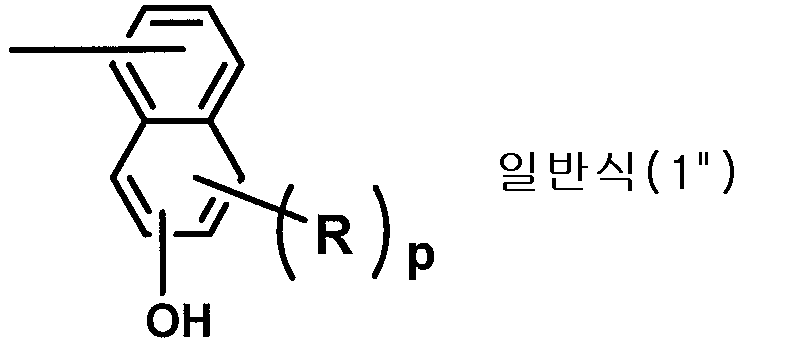
으로 표시되는 구조 부위이며, 또한, 상기 일반식(1') 및 일반식(1'') 중의 R은 하기 일반식(2')

으로 표시되는 구조 부위(α')이며, 일반식(2') 중의 n은 1 또는 2이고, 또한, 상기 일반식(1') 및 일반식(1'') 중의 p의 값은 0∼2의 정수이며, 또한, 그 분자 구조 중, 상기 구조 부위(α')를 나프탈렌환 1개당 0.1∼1.0개가 되는 비율로 갖고 있는 페놀성 수산기 함유 수지(a1-1)와,
1관능성 방향족 카르복시산 또는 그 염화물(a1-3)과 방향족 디카르복시산 또는 방향족 디카르복시산 염화물(a1-2)의 혼합물을 반응시켜 얻어지는 수지 구조를 갖는 것을 특징으로 하는 활성 에스테르 수지.(1 ') < RTI ID = 0.0 >
(The bonding position to the naphthalene skeleton in the general formula (1 ') may be any of two rings constituting the naphthalene ring)
Is a phenolic hydroxyl group-containing resin having a phenolic hydroxyl group at both terminal ends thereof and having a softening point of 70 to 200 deg. C, wherein X is a hydrogen atom (1 '), (1 ")< / RTI >
And R in the formulas (1 ') and (1'') is a structural moiety represented by the following formula (2'):
(2 ') is 1 or 2, and the value of p in the general formulas (1') and (1 '') is 0 to 2 , A phenolic hydroxyl group-containing resin (a1-1) having an integer of from 0.1 to 1.0 per one naphthalene ring in the molecular structure and the structural part (? ')
Wherein the active ester resin has a resin structure obtained by reacting a mixture of a monofunctional aromatic carboxylic acid or its chloride (a1-3) with an aromatic dicarboxylic acid or an aromatic dicarboxylic acid chloride (a1-2).

(식 중, X는 수소 원자, 또는 벤조일나프틸기를 나타낸다. n은 2∼3의 정수이다)로 표시되는 나프틸렌에테르 구조 부위(α)가, 하기 구조식 3-2

으로 표시되는 구조 부위(β)를 개재하여 결합한 수지 구조를 갖고 있으며, 또한, 그 양말단이 벤조일기인 수지 구조를 갖는 것을 특징으로 하는 활성 에스테르 수지.The following structural formula 3-1
(Wherein X represents a hydrogen atom or a benzoylnaphthyl group, and n represents an integer of 2 to 3) is represented by the following structural formula 3-2
, And having a resin structure in which both terminal ends thereof are benzoyl groups.
Applications Claiming Priority (3)
| Application Number | Priority Date | Filing Date | Title |
|---|---|---|---|
| JPJP-P-2010-151984 | 2010-07-02 | ||
| JP2010151984 | 2010-07-02 | ||
| PCT/JP2011/063141 WO2012002119A1 (en) | 2010-07-02 | 2011-06-08 | Thermosetting resin composition, cured product thereof, active ester resin, semiconductor sealing material, prepreg, printed circuit board, and build-up film |
Publications (2)
| Publication Number | Publication Date |
|---|---|
| KR20130098860A KR20130098860A (en) | 2013-09-05 |
| KR101694238B1 true KR101694238B1 (en) | 2017-01-09 |
Family
ID=45401849
Family Applications (1)
| Application Number | Title | Priority Date | Filing Date |
|---|---|---|---|
| KR1020127029499A Active KR101694238B1 (en) | 2010-07-02 | 2011-06-08 | Thermosetting resin composition, cured product thereof, active ester resin, semiconductor sealing material, prepreg, printed circuit board, and build-up film |
Country Status (7)
| Country | Link |
|---|---|
| US (1) | US8669333B2 (en) |
| EP (1) | EP2589625B1 (en) |
| JP (1) | JP5120520B2 (en) |
| KR (1) | KR101694238B1 (en) |
| CN (1) | CN102985485B (en) |
| TW (1) | TWI510545B (en) |
| WO (1) | WO2012002119A1 (en) |
Families Citing this family (34)
| Publication number | Priority date | Publication date | Assignee | Title |
|---|---|---|---|---|
| TWI417313B (en) * | 2011-05-27 | 2013-12-01 | 迪愛生股份有限公司 | Active ester resin, method for producing the same, thermosetting resin composition, semiconductor packaging material, prepreg, circuit substrate, assembly film, and cured product |
| JP5500408B2 (en) * | 2012-03-21 | 2014-05-21 | Dic株式会社 | Active ester resin, thermosetting resin composition, cured product thereof, semiconductor sealing material, prepreg, circuit board, and build-up film |
| JP6205692B2 (en) * | 2012-09-03 | 2017-10-04 | 味の素株式会社 | Thermosetting epoxy resin composition, insulating film forming adhesive film and multilayer printed wiring board |
| CN102850722B (en) * | 2012-09-07 | 2015-08-19 | 广东生益科技股份有限公司 | Composition epoxy resin and the prepreg using it to make and copper-clad laminate |
| TWI572665B (en) * | 2012-10-17 | 2017-03-01 | Dainippon Ink & Chemicals | Active ester resin, epoxy resin composition, cured object thereof, prepreg, circuit board and build-up film |
| WO2015104973A1 (en) * | 2014-01-07 | 2015-07-16 | Dic株式会社 | Polyarylene ether resin, production method for polyarylene ether resin, curable resin material, cured product thereof, semiconductor sealing material, prepreg, circuit board, and build-up film |
| CN104892902B (en) * | 2014-03-03 | 2018-01-05 | 广东生益科技股份有限公司 | A kind of compositions of thermosetting resin and application thereof |
| CN105153234B (en) * | 2014-06-13 | 2018-01-30 | 广东生益科技股份有限公司 | A kind of phenoxy cyclotriphosphazene active ester, halogen-free resin composition and application thereof |
| KR20160106673A (en) * | 2014-06-13 | 2016-09-12 | 셍기 테크놀로지 코. 엘티디. | Phenoxy cyclotriphosphazene active ester, halogen-free resin composition and use thereof |
| JP6493027B2 (en) * | 2014-07-08 | 2019-04-03 | Dic株式会社 | Epoxy resin composition, curable resin composition, active ester, cured product, semiconductor sealing material, semiconductor device, prepreg, flexible wiring substrate, circuit substrate, build up film, build up substrate, fiber reinforced composite material, molded article |
| KR102468448B1 (en) * | 2014-11-17 | 2022-11-17 | 세키스이가가쿠 고교가부시키가이샤 | Sealing agent for liquid crystal dropping methods, vertically conducting material and liquid crystal display element |
| JP6376392B2 (en) * | 2014-11-21 | 2018-08-22 | Dic株式会社 | Epoxy resin composition, curable resin composition, active ester, cured product, semiconductor sealing material, semiconductor device, prepreg, flexible wiring board, circuit board, build-up film, build-up board, fiber reinforced composite material, molded product |
| TWI685540B (en) * | 2014-12-15 | 2020-02-21 | 日商迪愛生股份有限公司 | Thermosetting resin composition, its cured product, and active ester resin used therefor |
| CN105906785B (en) | 2015-02-19 | 2019-12-03 | Icl-Ip美国有限公司 | Epoxy resin flame retardant containing phosphonate and phosphinate functional groups |
| US10252965B2 (en) | 2015-11-11 | 2019-04-09 | Air Water Inc. | Vinylbenzylated phenol compound, method of manufacturing vinylbenzylated phenol compound, activated ester resin, method of manufacturing activated ester resin, thermoset resin composition, hardened material of thermoset resin composition, interlayer insulating material, prepreg, and method of manufacturing prepreg |
| JP7385344B2 (en) * | 2016-03-28 | 2023-11-22 | 積水化学工業株式会社 | Thermosetting resin composition and multilayer substrate |
| TWI722185B (en) * | 2016-05-18 | 2021-03-21 | 日商迪愛生股份有限公司 | Epoxy resin, manufacturing method, epoxy resin composition and hardened product thereof |
| CN109415483B (en) * | 2016-07-06 | 2021-09-14 | Dic株式会社 | Active ester resin and cured product thereof |
| CN109415485B (en) * | 2016-07-06 | 2021-02-02 | Dic株式会社 | Active ester resin and cured product thereof |
| CN109476821B (en) * | 2016-07-06 | 2021-05-07 | Dic株式会社 | Active ester resin and cured product thereof |
| JP6763788B2 (en) * | 2017-01-10 | 2020-09-30 | 味の素株式会社 | Thermosetting epoxy resin composition, adhesive film for forming an insulating layer and multilayer printed wiring board |
| JP7013444B2 (en) * | 2017-03-14 | 2022-01-31 | 三井金属鉱業株式会社 | Resin composition, copper foil with resin, dielectric layer, copper-clad laminate, capacitor element and printed wiring board with built-in capacitor |
| TWI620763B (en) * | 2017-04-27 | 2018-04-11 | Taiwan Union Technology Corporation | Resin composition, and prepreg, metal-clad laminate and printed circuit board prepared using the same |
| US11407708B2 (en) * | 2017-06-21 | 2022-08-09 | Dic Corporation | Active ester compound and composition and cured product obtained using the same |
| US11548977B2 (en) * | 2017-06-21 | 2023-01-10 | Dic Corporation | Active ester resin and composition and cured product using the same |
| TWI820025B (en) * | 2017-06-28 | 2023-11-01 | 日商迪愛生股份有限公司 | Curable compositions, cured materials, semiconductor sealing materials and printed wiring boards |
| EP3856840B1 (en) * | 2018-09-27 | 2024-08-21 | Basf Se | Epoxy resin composition |
| JP7123731B2 (en) * | 2018-10-11 | 2022-08-23 | 積水化学工業株式会社 | Resin materials and multilayer printed wiring boards |
| CN109836631A (en) * | 2019-02-02 | 2019-06-04 | 广东生益科技股份有限公司 | Vinyl thermoset resin composition, prepreg, laminate and printed circuit board |
| WO2020162537A1 (en) * | 2019-02-08 | 2020-08-13 | 積水化学工業株式会社 | Ester compound, resin composition, cured product, and build-up film |
| CN110511360B (en) * | 2019-08-30 | 2021-12-10 | 广东同宇新材料有限公司 | Active ester resin and preparation method and application thereof |
| JP7323048B2 (en) * | 2020-03-03 | 2023-08-08 | Dic株式会社 | Active ester, curable resin composition, and cured product |
| CN116157270B (en) * | 2020-08-19 | 2025-10-03 | Dic株式会社 | Hardening resin |
| JPWO2023190020A1 (en) | 2022-03-29 | 2023-10-05 |
Family Cites Families (15)
| Publication number | Priority date | Publication date | Assignee | Title |
|---|---|---|---|---|
| JPH03203925A (en) * | 1989-12-29 | 1991-09-05 | Kawasaki Steel Corp | Polyester resin improved in wet heat stability and production thereof |
| JPH0782348A (en) * | 1993-07-22 | 1995-03-28 | Hitachi Chem Co Ltd | Epoxy resin composition and cured product thereof |
| JP2002012650A (en) * | 2000-06-30 | 2002-01-15 | Dainippon Ink & Chem Inc | Epoxy resin composition for low dielectric materials |
| US7141627B2 (en) * | 2002-10-31 | 2006-11-28 | Dainippon Ink And Chemicals, Inc. | Epoxy resin composition |
| KR20050093808A (en) * | 2002-12-27 | 2005-09-23 | 티디케이가부시기가이샤 | Resin composition, cured resin, cured resin sheet, laminate, prepreg, electronic part, and multilayer substrate |
| TWI366575B (en) * | 2005-03-18 | 2012-06-21 | Dainippon Ink & Chemicals | Epoxy resin composition and cured article thereof, novel epoxy resin and production method thereof, and novel phenol resin |
| JP5245199B2 (en) * | 2005-03-18 | 2013-07-24 | Dic株式会社 | Epoxy resin composition, cured product thereof, novel epoxy resin, production method thereof, and novel phenol resin |
| JP4285491B2 (en) * | 2006-02-28 | 2009-06-24 | Dic株式会社 | Epoxy resin composition, cured product thereof, novel epoxy resin, novel phenol resin, and semiconductor sealing material |
| JP4259536B2 (en) | 2006-03-29 | 2009-04-30 | Dic株式会社 | Method for producing phenol resin and method for producing epoxy resin |
| MY154545A (en) * | 2006-02-28 | 2015-06-30 | Dainippon Ink & Chemicals | Method of producing phenol resin and method of producing epoxy resin |
| JP5387872B2 (en) | 2006-07-31 | 2014-01-15 | Dic株式会社 | Epoxy resin composition and cured product thereof |
| JP5181769B2 (en) * | 2008-03-26 | 2013-04-10 | Dic株式会社 | Epoxy resin composition and cured product thereof |
| JP2008291279A (en) * | 2008-09-08 | 2008-12-04 | Dic Corp | Epoxy resin composition |
| JP5463859B2 (en) | 2009-11-06 | 2014-04-09 | Dic株式会社 | Epoxy resin composition, cured product thereof, novel epoxy resin, novel phenol resin, prepreg, and circuit board |
| JP5648832B2 (en) * | 2010-07-02 | 2015-01-07 | Dic株式会社 | Thermosetting resin composition, cured product thereof, active ester resin, semiconductor sealing material, prepreg, circuit board, and build-up film |
-
2011
- 2011-06-08 KR KR1020127029499A patent/KR101694238B1/en active Active
- 2011-06-08 WO PCT/JP2011/063141 patent/WO2012002119A1/en not_active Ceased
- 2011-06-08 JP JP2012505918A patent/JP5120520B2/en active Active
- 2011-06-08 CN CN201180032852.3A patent/CN102985485B/en active Active
- 2011-06-08 EP EP11800587.5A patent/EP2589625B1/en active Active
- 2011-06-08 US US13/807,663 patent/US8669333B2/en active Active
- 2011-07-01 TW TW100123250A patent/TWI510545B/en active
Also Published As
| Publication number | Publication date |
|---|---|
| EP2589625B1 (en) | 2016-10-26 |
| JP5120520B2 (en) | 2013-01-16 |
| TWI510545B (en) | 2015-12-01 |
| EP2589625A1 (en) | 2013-05-08 |
| WO2012002119A1 (en) | 2012-01-05 |
| KR20130098860A (en) | 2013-09-05 |
| CN102985485B (en) | 2014-09-03 |
| CN102985485A (en) | 2013-03-20 |
| JPWO2012002119A1 (en) | 2013-08-22 |
| US20130101857A1 (en) | 2013-04-25 |
| EP2589625A4 (en) | 2014-07-16 |
| TW201211149A (en) | 2012-03-16 |
| US8669333B2 (en) | 2014-03-11 |
Similar Documents
| Publication | Publication Date | Title |
|---|---|---|
| KR101694238B1 (en) | Thermosetting resin composition, cured product thereof, active ester resin, semiconductor sealing material, prepreg, printed circuit board, and build-up film | |
| KR101780991B1 (en) | Active ester resin, method for producing same, thermosetting resin composition, cured product thereof, semiconductor sealing material, prepreg, circuit board, and build-up film | |
| JP6098766B2 (en) | Thermosetting resin composition, cured product thereof, and active ester resin used therefor | |
| KR101703719B1 (en) | Active ester resin, thermosetting resin composition, cured product of same, semiconductor encapsulation material, prepreg, circuit board, and build-up film | |
| JP5648832B2 (en) | Thermosetting resin composition, cured product thereof, active ester resin, semiconductor sealing material, prepreg, circuit board, and build-up film | |
| JP5262915B2 (en) | Curable resin composition, cured product thereof, printed wiring board, ester compound, ester resin, and production method thereof | |
| US9963544B2 (en) | Active ester resin containing phosphorus atom, epoxy resin composition and cured product thereof, prepreg, circuit board, and build-up film | |
| KR20150073161A (en) | Active ester resin, epoxy resin composition, cured product thereof, prepreg, circuit board, and build-up film | |
| JP6070134B2 (en) | Active ester resin, curable resin composition, cured product thereof, and printed wiring board | |
| JP5729605B2 (en) | Thermosetting resin composition, cured product thereof, active ester resin, semiconductor sealing material, prepreg, circuit board, and build-up film | |
| JP5463859B2 (en) | Epoxy resin composition, cured product thereof, novel epoxy resin, novel phenol resin, prepreg, and circuit board | |
| JP6376395B2 (en) | Active ester compound, active ester resin, curable composition, cured product thereof, buildup film, semiconductor sealing material, prepreg, circuit board, and method for producing active ester resin | |
| WO2014171193A1 (en) | Modified phenolic resin, method for producing modified phenolic resin, modified epoxy resin, method for producing modified epoxy resin, curable resin composition, cured product of same, and printed wiring board | |
| JP5850228B2 (en) | Curable resin composition, cured product thereof, cyanate ester resin, semiconductor sealing material, prepreg, circuit board, and build-up film | |
| KR20150060684A (en) | Epoxy resin, curable resin composition, cured product thereof, and printed circuit board | |
| JP6048734B2 (en) | Active ester resin, curable resin composition, cured product thereof, and printed wiring board | |
| JP6048738B2 (en) | Active ester resin, curable resin composition, cured product thereof, and printed wiring board | |
| JP6277595B2 (en) | Curable composition, cured product, and printed wiring board |
Legal Events
| Date | Code | Title | Description |
|---|---|---|---|
| PA0105 | International application |
Patent event date: 20121109 Patent event code: PA01051R01D Comment text: International Patent Application |
|
| PG1501 | Laying open of application | ||
| A201 | Request for examination | ||
| PA0201 | Request for examination |
Patent event code: PA02012R01D Patent event date: 20160517 Comment text: Request for Examination of Application |
|
| E701 | Decision to grant or registration of patent right | ||
| PE0701 | Decision of registration |
Patent event code: PE07011S01D Comment text: Decision to Grant Registration Patent event date: 20161206 |
|
| GRNT | Written decision to grant | ||
| PR0701 | Registration of establishment |
Comment text: Registration of Establishment Patent event date: 20170103 Patent event code: PR07011E01D |
|
| PR1002 | Payment of registration fee |
Payment date: 20170104 End annual number: 3 Start annual number: 1 |
|
| PG1601 | Publication of registration | ||
| FPAY | Annual fee payment |
Payment date: 20191217 Year of fee payment: 4 |
|
| PR1001 | Payment of annual fee |
Payment date: 20191217 Start annual number: 4 End annual number: 4 |
|
| PR1001 | Payment of annual fee |
Payment date: 20201216 Start annual number: 5 End annual number: 5 |
|
| PR1001 | Payment of annual fee |
Payment date: 20211221 Start annual number: 6 End annual number: 6 |
|
| PR1001 | Payment of annual fee |
Payment date: 20241224 Start annual number: 9 End annual number: 9 |