KR101593637B1 - Modeling system for muscle cell activation and method thereof - Google Patents
Modeling system for muscle cell activation and method thereof Download PDFInfo
- Publication number
- KR101593637B1 KR101593637B1 KR1020140107832A KR20140107832A KR101593637B1 KR 101593637 B1 KR101593637 B1 KR 101593637B1 KR 1020140107832 A KR1020140107832 A KR 1020140107832A KR 20140107832 A KR20140107832 A KR 20140107832A KR 101593637 B1 KR101593637 B1 KR 101593637B1
- Authority
- KR
- South Korea
- Prior art keywords
- muscle
- formula
- activation
- equation
- length
- Prior art date
- Legal status (The legal status is an assumption and is not a legal conclusion. Google has not performed a legal analysis and makes no representation as to the accuracy of the status listed.)
- Active
Links
Images




Classifications
-
- G—PHYSICS
- G16—INFORMATION AND COMMUNICATION TECHNOLOGY [ICT] SPECIALLY ADAPTED FOR SPECIFIC APPLICATION FIELDS
- G16Z—INFORMATION AND COMMUNICATION TECHNOLOGY [ICT] SPECIALLY ADAPTED FOR SPECIFIC APPLICATION FIELDS, NOT OTHERWISE PROVIDED FOR
- G16Z99/00—Subject matter not provided for in other main groups of this subclass
-
- G—PHYSICS
- G06—COMPUTING OR CALCULATING; COUNTING
- G06F—ELECTRIC DIGITAL DATA PROCESSING
- G06F30/00—Computer-aided design [CAD]
- G06F30/20—Design optimisation, verification or simulation
-
- G—PHYSICS
- G06—COMPUTING OR CALCULATING; COUNTING
- G06F—ELECTRIC DIGITAL DATA PROCESSING
- G06F17/00—Digital computing or data processing equipment or methods, specially adapted for specific functions
- G06F17/10—Complex mathematical operations
-
- G—PHYSICS
- G16—INFORMATION AND COMMUNICATION TECHNOLOGY [ICT] SPECIALLY ADAPTED FOR SPECIFIC APPLICATION FIELDS
- G16H—HEALTHCARE INFORMATICS, i.e. INFORMATION AND COMMUNICATION TECHNOLOGY [ICT] SPECIALLY ADAPTED FOR THE HANDLING OR PROCESSING OF MEDICAL OR HEALTHCARE DATA
- G16H50/00—ICT specially adapted for medical diagnosis, medical simulation or medical data mining; ICT specially adapted for detecting, monitoring or modelling epidemics or pandemics
- G16H50/50—ICT specially adapted for medical diagnosis, medical simulation or medical data mining; ICT specially adapted for detecting, monitoring or modelling epidemics or pandemics for simulation or modelling of medical disorders
Landscapes
- Engineering & Computer Science (AREA)
- Physics & Mathematics (AREA)
- Data Mining & Analysis (AREA)
- Theoretical Computer Science (AREA)
- General Physics & Mathematics (AREA)
- Medical Informatics (AREA)
- Health & Medical Sciences (AREA)
- Public Health (AREA)
- Databases & Information Systems (AREA)
- Mathematical Physics (AREA)
- General Engineering & Computer Science (AREA)
- General Health & Medical Sciences (AREA)
- Biomedical Technology (AREA)
- Pathology (AREA)
- Primary Health Care (AREA)
- Epidemiology (AREA)
- Algebra (AREA)
- Computational Mathematics (AREA)
- Mathematical Analysis (AREA)
- Mathematical Optimization (AREA)
- Pure & Applied Mathematics (AREA)
- Software Systems (AREA)
- Evolutionary Computation (AREA)
- Computer Hardware Design (AREA)
- Geometry (AREA)
- Prostheses (AREA)
- Management, Administration, Business Operations System, And Electronic Commerce (AREA)
Abstract
생물리학적으로 적합하고 자극 주파수(excitation frequency) 및 근육 길이와 같은 생리학적 입력 조건이 넓은 범위인 경우에 대해 근육 세포 활성화의 동적거동을 모델링하는 근육 세포 활성화 모델링 시스템 및 방법이 개시된다. 상기 근육 세포 활성화 모델링 시스템은, 척수 운동뉴런(motoneurons)에서 척수 신경 신호를 입력 받아 근육 세포질에서의 Ca2+ 농도 변화로 변환하는 제1 모듈; 상기 제1 모듈에서 변환된 Ca2+ 농도 변화 정보를 입력 받아 근육 활성화 동적거동(activation dynamics) 정보로 변환하는 제2 모듈; 및 상기 제2 모듈에서 변환된 근육 활성화의 동적거동 정보를 입력 받아 근력으로 변환하는 제3 모듈을 포함하며, 상기 제1 모듈 및 상기 제2 모듈은 각각 Ca2+ 농도 및 근육 활성화의 근육 길이에 대한 의존성을 보상한다.A muscle cell activation modeling system and method are disclosed that are biologically compatible and model the dynamic behavior of muscle cell activation for a wide range of physiological input conditions such as excitation frequency and muscle length. The muscle cell activation modeling system includes a first module that receives a spinal nerve signal from a spinal motor neuron and converts it into a Ca 2+ concentration change in the muscle cytoplasm; A second module for receiving the converted Ca 2+ concentration change information from the first module and converting the received Ca 2+ concentration change information into activation dynamics information of muscle activation; And a third module that receives and converts the dynamic behavior information of the muscle activation converted by the second module into muscle force, wherein the first module and the second module each have a Ca 2+ concentration and a muscle length of muscle activation Compensate for dependency on.
Description
본 발명은 근육 세포 활성화 모델링 시스템 및 방법에 관한 것으로, 더욱 상세하게는 생물리학적으로 적합하고 자극 주파수(excitation frequency) 및 근육 길이와 같은 생리학적 입력 조건이 넓은 범위인 경우라도 근육 세포 활성화를 동적으로 모델링 할 수 있는 근육 세포 활성화 모델링 시스템 및 방법에 관한 것이다.The present invention relates to a system and a method for modeling muscle cell activation, and more particularly, to a system and method for modeling muscle cell activation. More particularly, the present invention relates to a system and method for modeling muscle cell activation, To a modeling system and method for activating muscle cells.
동물의 신체 운동은 골격근의 수축에 의해 발생하는 힘으로부터 유도된다. 근력의 조절은 척수로부터의 신경 자극의 레벨뿐만 아니라 근육 움직임의 형상에 의존하는 것으로 잘 알려져 있다(Burke et al., 1973, Brown et al., 1996, Brown et al., 1998, Rassier et al., 1999). 그러나, 움직임이 발생하는 동안 운동뉴런의 점화 패턴과 근육의 힘 생산 결과를 동시에 측정하는 것은 실험 기법(Heckman and Enoka, 2012)의 한계로 인해 여전히 도전적인 일이다. 따라서, 체계적인 운동 신경 제어를 이해하기 위해, 근육 운동 중 입력으로서 임펄스 트레인을 수용하고 힘 출력을 생성할 수 있는 근육 모델이 요구되어 왔다.An animal's body movement is derived from the forces generated by the contraction of the skeletal muscle. It is well known that muscle strength control depends not only on the level of nerve stimulation from the spinal cord but also on the shape of muscle movements (Burke et al., 1973, Brown et al., 1996, Brown et al., 1998, Rassier et al. , 1999). However, simultaneous measurement of motor neuron Ignition patterns and muscle force production during motion is still challenging due to limitations of experimental techniques (Heckman and Enoka, 2012). Thus, in order to understand systematic motor neuron control, a muscle model has been demanded that can accept impulse trains as input during muscle motion and generate force output.
인간 자세 및 운동의 시뮬레이션 연구에 사용된 가장 대중적인 근육 모델은, 공식이 간단하고 실행이 용이하기 때문에, 힘 생산에 대한 힐-타입 모델(Hill-type model)일 것이다 (Zajac, 1989, Gerritsen et al., 1996, Sartori et al., 2012). 최근의 연구는, 큰 스케일의 시뮬레이션에 현재 사용된 힐-타입 근육 모델과 실제 데이터를 직접 비교하였다(Millard et al., 2013, Perreault et al., 2003, Sandercock and Heckman, 1997b). The most popular muscle model used in simulations of human posture and movement would be a Hill-type model of force production because the formulation is simple and easy to implement (Zajac, 1989, Gerritsen et al., 1996, Sartori et al., 2012). Recent studies have directly compared the actual data with the heal-type muscle model currently used for large-scale simulations (Millard et al., 2013, Perreault et al., 2003, Sandercock and Heckman, 1997b).
그러나, 현재 힐-타입 모델이 생리학적 조건하에서 충분히 정확도를 갖지 못한다는 유사한 결론이 그 연구들에서 이루어졌다. 특히, 모델과 실험 데이터 사이의 오차가, 최대로 흥분된 케이스에 비교할 때 신경 자극의 준최대 범위(sub maximal range)에서 월등한 것으로 보고되었다. 더하여, 생리학적 범위 내에서 근육 길이가 변화하는 동안 근육 운동에 대한 활성화 역동성(activation dynamics)의 의존성이 확인되었다. However, similar conclusions have been made in these studies that current heel-type models are not sufficiently accurate under physiological conditions. In particular, the error between the model and the experimental data was reported to be superior in the submaximal range of nerve stimulation as compared to the case with maximum excitation. In addition, the dependence of activation dynamics on muscle motility during the change of muscle length within the physiological range was confirmed.
힐타입 모델의 오차는, 생리학적 입력 조건 하에서 신경-근육-골격(neuro-musculo-seletal) 모델의 현실적인 시뮬레이션에서의 발전을 현저하게 저해하여온 힐-타입 모델에 대한 활성화 역동성(dynamics)을 예측하는데 어려움이 있기 때문일 것이다. 일반적으로 활성화 역동성은, 관심 근육으로부터 기록된 원시 근전도(EMG) 데이터에 기반하여 현상학적으로 측정되거나(Thelen et al., 1994, Lloyd and Besier, 2003) 근절(sarcomere)에서 크로스 브릿지(cross-bridge)를 형성하는 가늘고 두꺼운 근필라멘트(myofilaments)의 시공적인 상호작용을 기술하는 헉슬리(Huxley) 공식을 기계론적으로 푸는 것에 의해 측정되었다(Laforet et al., 2011, Wong, 1971). The error of the heel-type model predicts the dynamics of the activation of the heel-type model, which has significantly inhibited development in realistic simulations of the neuro-musculo-seletal model under physiological input conditions This is probably due to the difficulty. In general, activation dynamics are either phenomenologically measured based on recorded EMG data from the muscle of interest (Thelen et al., 1994, Lloyd and Besier, 2003), cross-bridge (Laforet et al., 2011, Wong, 1971), which describes the constructive interactions of thin and thick myofilaments that form a thick,
근전도 기반 모델은 적은 수의 모델 파라미터를 이용하여 비교적 용이하게 실행될 수 있으나, 근육 시스템의 전체적인 성능에 집중하여 보면 근육 세포 활성화의 기저를 이루는 세부 메커니즘에 대한 통찰이 어렵다. 반대로, 크로스-브릿지(또는 헉슬리-타입) 모델은 근육 세포 활성화를 기계론적으로 모델링하기 위한 프레임워크를 제공하지만, 이들 시스템 방정식의 경직된 특성은 특히 넓은 범위에서 모델 파리미터 값이 변화하는 동안 수치적으로 방정식을 푸는에 있어 안정성 문제를 발생시킨다(Zahalak, 1981, Zahalak and Ma, 1990).EMG-based models can be relatively easily implemented using a small number of model parameters, but focusing on the overall performance of the muscle system makes it difficult to gain insight into the underlying mechanisms underlying muscle cell activation. Conversely, the cross-bridge (or Huxley-type) model provides a framework for mechanically modeling muscle cell activation, but the rigid properties of these system equations are numerically Resulting in stability problems in solving equations (Zahalak, 1981, Zahalak and Ma, 1990).
이와 같이 기존의 근육 모델은 추상적으로 개발되어 다양한 생물리학적 성질을 가지는 근육세포들을 사실적으로 모델링하는데 한계가 있었다.Thus, existing muscle models have been abstractly developed and have limited realistic modeling of muscle cells with diverse biological properties.
상기와 같은 종래 기술의 문제점을 해결하기 위해, 본 발명은 실험적으로 모델 변수들을 결정하는 수학적 기법을 개발하여 특정 근육 세포의 주요 생물리학적 성질들을 사실적으로 반영하는 근육세포의 모델링 시스템 및 방법을 제공하고자 한다.In order to solve the problems of the prior art as described above, the present invention provides a modeling system and a method of muscle cell which realistically reflects major biologic properties of a specific muscle cell by developing a mathematical technique for experimentally determining model parameters I want to.
상기 기술적 과제를 해결하기 위한 수단으로서 본 발명의 근육세포 활성화 모델링 시스템은, 척수 운동뉴런(motoneurons)에서 생성된 척수 신경 신호를 입력 받아 근육 세포질(myoplasm)에서 Ca2+ 농도 변화로 변환하는 제1 모듈; 상기 제1 모듈에서 변환된 Ca2+의 농도 변화 정보를 입력 받아 근육 활성화의 동적거동 (activation dynamics) 정보로 변환하는 제2 모듈; 및 상기 제2 모듈에서 변환된 근육 활성화의 동적거동 정보를 입력 받아 근력으로 변환하는 제3 모듈을 포함하며, 상기 제1 모듈 및 상기 제2 모듈은 각각 Ca2+ 농도 및 근육 활성화의 근육 길이에 대한 의존성을 보상한다. As a means for solving the above technical problem, the muscle cell activation modeling system of the present invention is a system for inputting spinal nerve signals generated from spinal motor neurons and converting a signal from muscle cell cytoplasm into a Ca 2+ concentration change module; A second module for receiving information on concentration change of Ca 2+ converted in the first module and converting the information into activation dynamics information of muscle activation; And a third module that receives and converts the dynamic behavior information of the muscle activation converted by the second module into muscle force, wherein the first module and the second module each have a Ca 2+ concentration and a muscle length of muscle activation Compensate for dependency on.
본 발명의 일 실시형태에서, 상기 제1 모듈은 근육 세포질그물(sarcoplasmic reticulum:SR) 및 근육 세포질(sarcoplasm: SP)의 두 부분 모델링을 포함할 수 있다.In one embodiment of the invention, the first module may comprise two-part modeling of a sarcoplasmic reticulum (SR) and a sarcoplasm (SP).
본 발명의 일 실시형태에서, 상기 제1 모듈은, 근육의 세포질그물 및 세포질 모델과 화학적 반응의 협동성(cooperativity)을 포함하여 다음의 식 1 내지 식 10과 같은 연산을 통한 모델링을 실행할 수 있다.In one embodiment of the present invention, the first module can perform modeling through operations such as the following
[식 1][Formula 1]

[식 2][Formula 2]

[식 3][Formula 3]

[식 4][Formula 4]

[식 5][Formula 5]

[식 6][Formula 6]

[식 7][Equation 7]

[식 8][Equation 8]

[식 9][Equation 9]

[식 10][Equation 10]

(CaSR: 칼슘 농도, CS: 칼세퀘스트린(calsequestrin), R: 근육 세포질그물로부터 방출되는 Ca2+의 유동율, U: 근육 세포질그물로 흡수되는 Ca2+의 유동율, K1, K2: 화학적 반응 계수, Pmax: 근육 세포질그물로부터 방출되는 최대 투과율(permeability), 


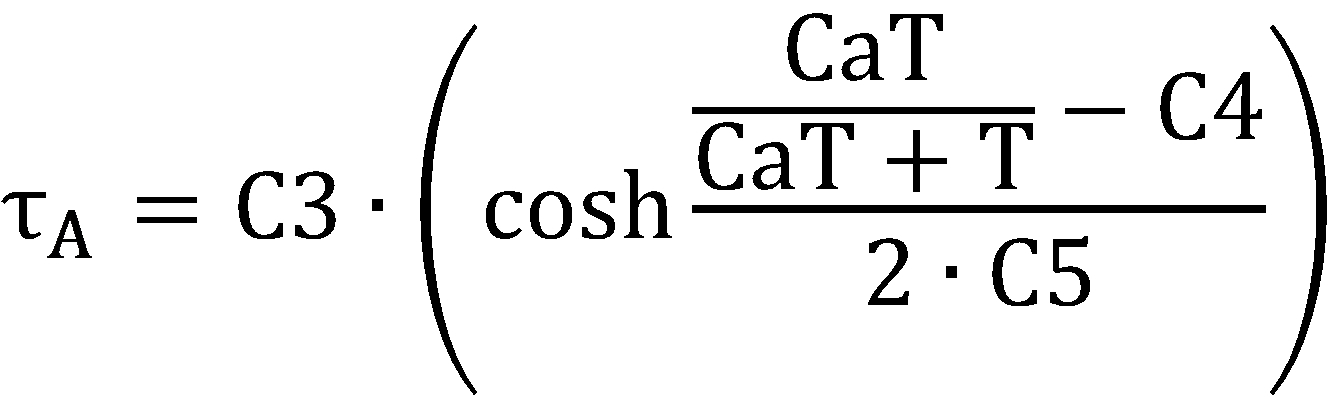
본 발명의 일 실시형태에서, 상기 제2 모듈은, Ca2+과 결합하는 트로포닌 사이트의 전체 수로 정규화된 Ca2+-결합 트로포닌(CaT)과 활성화 레벨(A) 사이의 관계를 다음의 식 11과 같이 모델링할 수 있다.In one embodiment of the present invention, the second module is the normalized total number of Ca troponin sites that combine with Ca 2+ 2+ - the relationship between the combination troponin (CaT) and the level of activation (A) and then the Can be modeled as shown in Equation (11).
[식 11][Equation 11]

(
본 발명의 일 실시형태에서, 상기 제3 모듈은, 수축성(contractile) 및 직렬 탄성(serial elastic) 요소로 구성된 힐(Hill) 기반 근육 모델의 최간 형태에 기초하여 하기 식 12 내지 식 15와 같이 모델링을 실행할 수 있다.In one embodiment of the present invention, the third module is modeled as follows (12) through (15) based on the best form of a Hill-based muscle model composed of contractile and serial elastic elements: .
[식 12][Equation 12]

[식 13][Formula 13]

[식 14][Equation 14]

[식 15][Formula 15]

(P0: 최적 근육 길이(optimal muscle length)에서 최대 근력, KSE: P0로 정규화된 직렬 탄성 요소의 경직도(stiffness), a0, b0, c0 및 d0: 힐-마쉬마(Hill-Mashima) 방정식 계수, 
본 발명의 일 실시형태에서, KSE는, 최대 자극(full excitation)으로 등척성 수축(isometric contraction)이 진행되는 동안 순간적인 근육 길이의 단축이 이루어질 때 수축성 요소의 변화가 무시될 수 있음을 가정하여 결정될 수 있다.In one embodiment of the present invention, K SE assumes that changes in contractile elements can be neglected when shortening of the muscle length is achieved while isometric contraction is under full excitation Can be determined.
본 발명의 일 실시형태에서, 상기 식 14 및 식 15의 a0 내지 d0는, V-T 곡선 상의 네 개의 데이터 포인트((VS,1, TS,1), (VS,2, TS,2), (VL,1, TL,1), (VL,2, TL,2))에 대해 역방정식을 유도함으로써 길이-장력(L-T) 및 속도-장력(V-T) 특성에 기반하여 다음의 식 16 내지 식 19와 같이 분석적으로 결정될 수 있다.In one embodiment of the present invention, of the
[식 16][Formula 16]

[식 17][Formula 17]

[식 18][Formula 18]

[식 19][Formula 19]

(VS,1 및 VS,2: 최소 및 최대 단축 속도, VL,1 및 VL,2: 최소 및 최대 연장 속도)(V S, 1 and V S, 2 : minimum and maximum shrink speed, V L, 1 and V L, 2 : minimum and maximum extension speed)
본 발명의 일 실시형태에서, K5는 근육 길이(Xm)의 함수로 다음의 식 20과 같이 보상될 수 있다.In one embodiment of the present invention, K5 is a function of muscle length (X m) can be compensated for as follows:
[식 20][Formula 20]

(


본 발명의 일 실시형태에서, 근육 활성화의 근육 길이에 대한 의존성은 근육 길이와 속도의 함수로서 다음의 식 21과 같이 보상될 수 있다.In one embodiment of the invention, the dependence of muscle activation on muscle length can be compensated as a function of muscle length and velocity,
[식 21][Formula 21]

(A: 제2 모듈에서 산출된 근육 활성화의 동적거동 정보이고, A*: 제3 모듈로 제공된 보상된 근육 활성화의 동적거동 정보, 


(A: information on the dynamic behavior of the muscle activation calculated in the second module, A * : information on the dynamic behavior of the compensated muscle activation provided in the third module,
상기 기술적 과제를 해결하기 위한 다른 수단으로서 본 발명은, 척수 운동뉴런(motoneurons)으로부터의 척수 신경 신호를 입력 받아 근육 세포질에서의 Ca2+ 농도 변화로 변환하는 제1 단계;In another aspect of the present invention, there is provided a method for detecting a spinal cord neuron, comprising the steps of: receiving a spinal nerve signal from a spinal motor neuron and converting it into a Ca 2+ concentration change in a muscle cytoplasm;
상기 제1 모듈에서 변환된 Ca2+ 의 농도 변화 정보를 입력 받아 근육 활성화의 동적거동 (activation dynamics) 정보로 변환하는 제2 단계; 및A second step of receiving information on concentration change of Ca 2+ converted in the first module and converting the information into activation dynamics information of muscle activation; And
상기 제2 모듈에서 변환된 근육 활성화의 동적거동 정보를 입력 받아 근력으로 변환하는 제3 단계를 포함하며,And a third step of receiving the dynamic behavior information of the muscle activation converted by the second module and converting it into muscle force,
상기 제1 단계 및 상기 제2 단계는 각각 생리학적으로 움직이는 동안 Ca2+ 농도 정보 및 근육 활성화의 근육 길이에 대한 의존성을 보상하는 근육 세포 활성화 모델링 방법을 제공한다.The first and second steps provide a method of modeling muscle cell activation that compensates for Ca 2+ concentration information and dependence of muscle activation on muscle length during physiological movement, respectively.
본 발명의 근육 세포 활성화 모델링 시스템 및 방법에 따르면, 신경 자극 및 근육 움직임의 폭넓은 생리학적 조건에서 근육의 복잡한 근력 생성을 사실적으로 모사할 수 있을 뿐만 아니라 생리학적으로 사실적인 신경 세포 모델을 재구축하고 동적거동을 모의할 수 있는 일반적인 신경 시뮬레이터 소프트웨어 환경에서도 효과적으로 구현이 가능해 진다. According to the muscle cell activation modeling system and method of the present invention, it is possible to reproduce a physiologically realistic neuron model as well as realistically simulate the complex muscle force generation of muscles in a wide range of physiological conditions of nerve stimulation and muscle movement And can be effectively implemented in a general neural simulator software environment capable of simulating dynamic behavior.
또한, 본 발명의 근육 세포 활성화 모델링 시스템 및 방법에 따르면 큰 규모의 신경-근육 시뮬레이션의 정확도를 향상시키고 나아가 적절한 움직임을 발생시키는 신경계의 근력제어 기전에 대한 이해를 향상시키는데 크게 기여할 수 있다.Also, according to the muscle cell activation modeling system and method of the present invention, it is possible to improve the accuracy of the neural-muscle simulation on a large scale and further contribute to improve understanding of the muscle force control mechanism of the neural system that generates appropriate movement.
또한, 본 발명의 근육 세포 활성화 모델링 시스템 및 방법에 의하면 특정 근육 세포의 주요 생물리학적 성질들을 측정한 실험 자료를 그대로 반영할 수 있는 근육 세포 모델링을 달성할 수 있다. In addition, according to the muscle cell activation modeling system and method of the present invention, muscle cell modeling that can directly reflect experimental data measuring major biological properties of specific muscle cells can be achieved.
이러한 본 발명의 근육 세포 활성화 모델링 방법을 이용하면, 생체 근골격계 손상이나 상실로 인해 생긴 운동 기능 장애를 복구하기 위한 신경-기계 인터페이스 기술 및 첨단 의수/의족 보철 장치와 같은 재활 분야, 및 생체 근전도 신호를 측정하여 생체 근육의 기능 상태를 진단하는 의료진단장치 개발 분야 및 신약 개발을 위한 시험 평가 분야와 같은 의료 분야에 큰 기술 진전을 이룩할 수 있다.By using the muscle cell activation modeling method of the present invention, it is possible to provide a neuromuscular-machine interface technique for restoring a motor dysfunction caused by injury or loss of a living musculoskeletal system, a rehabilitation field such as an advanced prosthetic / And the medical field such as the field of development of the medical diagnostic apparatus for diagnosing the functional state of the living muscles and the field of the test evaluation for the development of the new drug.
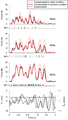
도 1은 본 발명에 따른 모듈화된 근육 세포 모델의 블록도이다.
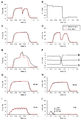
도 2는 최적 길이로 중심값이 결정된 세 가지 서로 다른 근육 길이 (-16 mm, -8 mm and 0 mm)에서 다양한 자극 주파수(10, 20 and 40 Hz)에 대한 모델 및 실제 근육(즉, CT09)의 연축(twitch) 및 경증 강축(sub tetanus) 응답을 나타낸 도면이다.
도 3은 최대 자극에서 길이-장력 및 속도-장력의 특성을 도시한 도면이다.
도 4는 근육 길이가 시간에 따라 불규칙적으로 변동하는 동안 근력 생성을 도시한 도면이다.
도 5는 근육 길이 및 자극 주파수가 시간에 따라 불규칙적으로 변동하는 동안 근력 생성을 도시한 도면이다.
도 6은 표본(CT95)에서 길이 및 주파수가 시간에 따라 불규칙적으로 변동하는 동안 근력 생성을 도시한 도면이다.
도 7은 표본(CT95)에 대한 모델 파라미터 값의 결정을 도시한 도면이다.
도 8은 약한 경련성 근수축(sub tetanic contractions) 동안 발생하는 근력에 대한 A(t)의 선형 대 비선형 가중(summation)의 영향을 도시한 도면이다.Figure 1 is a block diagram of a modular muscle cell model according to the present invention.
Figure 2 shows the model and actual muscle (i.e., CT09) at various stimulation frequencies (10, 20 and 40 Hz) at three different muscle lengths (-16 mm, -8 mm and 0 mm) ), And a slightly stronger sub-tetanus response.
3 is a graph showing the characteristics of length-tension and velocity-tension in the maximum stimulus.
Fig. 4 is a diagram showing muscle power generation while the muscle length fluctuates irregularly with time. Fig.
FIG. 5 is a diagram showing muscle power generation while the muscle length and stimulation frequency fluctuate irregularly with time. FIG.
FIG. 6 is a diagram showing muscle power generation while the length and frequency in the sample (CT95) fluctuate irregularly with time.
Figure 7 shows the determination of model parameter values for a sample (CT95).
Figure 8 is a plot showing the effect of linear vs. nonlinear summation of A (t) on muscle strength that occurs during weak sub-tetanic contractions.
본 발명의 연구자들은, 생체의 보행(locomotion)을 모방한 생물리학적 움직임 동안 척수의 운동 뉴런으로부터 발생된 신경신호(spike train)에 의해 힐-타입 근육 모델에 근육 활성화의 동적거동(activation dynamics)이 유도될 수 있음을 발견하여, 이로부터 새로운 근육 세포 활성화 모델링 방법에 도달하였다. The researchers of the present invention found that the activation dynamics of muscle activation in the heel-type muscle model by a spike train generated from the motor neurons of the spinal cord during biologic movements mimicking the locomotion of the living body, Can be induced, leading to a new model of muscle cell activation modeling.
본 발명의 근육 세포 활성화 모델링 방법에서는, 근력을 생성하는 동안 근육 세포질(sarcoplasm) 내에서 발생하는 신경 명령의 순차적인 신호 변환 과정이 모듈화되어 모델링되고 각 모듈의 모델 파라미터 값들은 정적 조건(즉, 등척성(isometric) 및 등속성(isovelocity))에서 측정되는 실험 데이터에 기반하여 결정되도록 모듈화된 시스템의 형태로 모델링된다. In the muscle cell activation modeling method of the present invention, the sequential signal conversion process of the neural commands occurring in the sarcoplasm during the generation of the muscle force is modularized and the model parameter values of each module are classified into static conditions (i.e., isometric is modeled in the form of a modular system so as to be determined based on experimental data measured in isometric and isovelocity.
또한, 자극 주파수 및 근육 길이가 정적으로 혹은 동적으로 변화하는 동안 본 발명의 근육 세포 활성화 모델(수정된 힐-타입 모델)이 예측한 근력과 고양이 가자미근(cat soleus muscles)으로부터 측정된 실제 데이터를 비교하여 근육 활성화의 주파수 및 길이에 대한 의존성을 식별하였다. In addition, while the stimulation frequency and muscle length are changed statically or dynamically, the muscle power activation model of the present invention (modified heel-type model) is compared with the predicted muscle strength and actual data measured from cat soleus muscles To identify the dependence on muscle activation frequency and length.
그에 따라, 근육 활성화의 주파수 및 길이 의존성에 대해 보상이 이루어진 본 발명의 근육 세포 활성화 모델(수정된 힐-타입 모델)과 근육 길이의 변화를 다르게 적용하여 측정한 고양이 가자미근(cat soleus muscles)의 근력생성을 비교하여 개발된 근육 세포 활성화 모델링 방법이 검증되었다.
Accordingly, the muscular cell activation model (modified heel-type model) of the present invention, which is compensated for the frequency and length dependence of muscle activation, and the muscular strength of the cat soleus muscles measured by differently applying the changes in muscle length The modeling method of muscle cell activation, which was developed by comparing the production, was verified.
이하, 첨부된 도면 및 실시예를 참조하여 본 발명을 보다 상세하게 설명한다. 그러나, 본 발명의 실시예는 여러 가지 다른 형태로 변형될 수 있으며, 본 발명의 범위가 이하 설명되는 실시예로 한정되는 것은 아니다. 본 발명의 실시예는 본 발명이 속하는 기술분야에서 통상의 지식을 가진 자에게 본 발명을 보다 완전하게 설명하기 위해서 제공되는 것이다. 또한, 본 발명을 설명함에 있어서, 정의되는 용어들은 본 발명에서의 기능을 고려하여 정의 내려진 것으로, 이는 당 분야에 종사하는 기술자의 의도 또는 관례 등에 따라 달라질 수 있으므로, 본 발명의 기술적 구성요소를 한정하는 의미로 이해되어서는 아니 될 것이다.
Hereinafter, the present invention will be described in more detail with reference to the accompanying drawings and embodiments. However, the embodiments of the present invention can be modified into various other forms, and the scope of the present invention is not limited to the embodiments described below. The embodiments of the present invention are provided so that those skilled in the art can more fully understand the present invention. In addition, in describing the present invention, the defined terms are defined in consideration of the functions of the present invention, and they may be changed depending on the intention or custom of the technician working in the field, so that the technical components of the present invention are limited It will not be understood as meaning.
실시예Example
실험 데이터Experimental data
두 마리의 성체 고양이의 좌측 뒷다리로부터 데이터를 수집하였다(즉, 모델 개발을 위한 한 마리(CT09) 및 모델 검증을 위한 다른 한 마리(CT95)). Data were collected from the left hind legs of two adult cats (ie, one for model development (CT09) and another for model validation (CT95)).
축약하면, 고양이는 아이소프루레인(isoflurane)(1.5-3.0 %)으로 마취되었다. 가자미근이 노출되었으며, 그 말단 건(distal tendon)이 컴퓨터로 제어되는 풀러에 부착되었다. 가자미 신경을 제외한 다른 모든 뒷다리 말초 신경들은 끊어졌다. L4부터 S2까지의 동측성 배근(ipsilateral dorsal roots) 만이 가자미 근육으로부터 감각 피드백을 제거하기 위해 트랜섹되었다. 뇌제거(decerebration)는 중간뇌 수준에서 실시되었다. 뒷다리 및 코어 온도는 복사열을 이용하여 생리학적 한계 내에서 유지되었다. 실험의 마지막에서 동물들은 펜토바비탈(pentobarbital) (100 mg/kg i.v.)으로 희생되었다.In short, the cat was anesthetized with isoflurane (1.5-3.0%). The soleus was exposed, and the distal tendon was attached to a computer controlled puller. All other hind limb nerves except for the fluke nerves were cut off. Only ipsilateral dorsal roots from L4 to S2 were transsexed to remove sensory feedback from the soleus muscles. Decerebration was performed at the middle brain level. Hind legs and core temperature were maintained within physiological limits using radiant heat. At the end of the experiment, the animals were sacrificed with pentobarbital (100 mg / kg i.v.).
근육에 대한 자극은, 근복(muscle belly)의 근위 및 원위(proximal and distal) 부분에 스테인리스 스틸 세선을 이용한 전기적 자극에 의해 이루어졌다. 전근(ventral root)에 대한 후크 전극(hook electrode)을 이용한 경우에도 유사한 결과가 획득되었다. 모든 실험이 진행되는 동안 반복가능하고 일관된 힘을 생산할 수 있도록 자극 강도는 전체 점증(recruitment)를 유도하기 위해 요구되는 것의 50 -100 % 이상으로 설정되었다. Stimulation of the muscles was done by electrical stimulation with stainless steel wire on the proximal and distal parts of the muscle belly. A similar result was obtained using a hook electrode for ventral root. Strength of stimulation was set at 50-100% or more of that required to induce total recruitment, so as to produce repeatable and consistent force during all experiments.
근육 길이는 위치 서보 시스템인 컴퓨터 제어 근육 풀러(AV-50; ADI, Alexandria, VA)에 의해 제어되었다. 이 장치는 60 kN/m보다 큰 강성(stiffness)를 가지며 약 50 Hz의 소신호 위치 대역폭을 갖는다. 근육 길이는 풀러 샤프트에 부착된 LVDT(500 DC-B; Shaevitz, Hampton, VA)에 의해 측정되었다. 근력은 샤프트와 직렬 배치된 트렌스듀서(Model 31 (stiffness >2MN/m); Sensotec, Columbus, OH) 기반 스트레인 게이지에 의해 측정되었다. 힘 및 위치 데이터는 1 kHz(MIO-16; National Instruments, Austin, TX)로 샘플링 되었다. 또한, 활성 근육 반응을 결정하기 위해, 각각의 섭동(perturbation)에 대한 수동적 반응이 측정되고 근육 수축이 발생하는 동안 측정된 데이터에서 제외 되었다.Muscle length was controlled by computer controlled muscle puller (AV-50; ADI, Alexandria, VA), a positional servo system. The device has stiffness greater than 60 kN / m and has a small signal location bandwidth of about 50 Hz. Muscle length was measured by LVDT (500 DC-B; Shaevitz, Hampton, VA) attached to a puller shaft. Muscle strength was measured by a strain gauge based on a Model 31 (stiffness> 2MN / m; Sensotec, Columbus, Ohio) in series with the shaft. Force and position data were sampled at 1 kHz (MIO-16; National Instruments, Austin, Tex.). In addition, to determine the active muscle response, the passive response to each perturbation was measured and excluded from the measured data during the onset of muscle contraction.
실험 사이의 간격(적어도 1분)이 피로를 방지하기에 충분히 크게 확보된 다섯 개의 실험 프로토콜 동안 활성 근력이 기록되었다: 1) -16 mm, -8 mm 및 0 mm의 근육 길이에서 경련 반응, 2) 각 근육 길이에서 10, 20 및 40 Hz 자극 주파수에 대한 강직 경련(titanic) 반응, 3) 완전 흥분 상태(즉, 100 Hz)에서 길이-장력(L-T) 및 속도-장력(V-T) 특성, 4) 근육의 직렬 탄성 요소(serial elastic component)의 강성(stiffness)를 측정하기 위해 2mm로 근육 길이의 단계적 단축, 5) 0 ~ -16mm 및 자극 주파수 사이의 근육 길이에 대한 임의 변조.Active muscle strengths were recorded during five experimental protocols where the interval between experiments (at least 1 minute) was sufficiently large to prevent fatigue: 1) convulsions at muscle lengths of -16 mm, -8 mm and 0 mm, 2 3) the length-tension (LT) and velocity-tension (VT) characteristics in the fully excited state (ie 100 Hz), 4 ) Stepwise shortening of the muscle length to 2 mm to measure the stiffness of the serial elastic component of the muscle, 5) random modulation of the muscle length between 0 to -16 mm and the excitation frequency.
비억제 운동(unrestrained locomotion)이 이루어지는 동안 가자미근 길이 변화와 일치하는 근육 길이의 임의 변화가 0 내지 5 Hz 범위의 대역폭에서 생성되었다(Goslow et al., 1973). 근육 길이의 시간 경로(time course)가 정규 분포 임의 파형을 필터링하는 저역통과필터에 의해 생성되었다. 모든 길이의 섭동(perturbations)이 생리학적 최대값보다 -8 mm 이하 동작점 주변에 집중되었다. 생리학적 최대 길이(0 mm)가 L-T 곡선의 피크를 넘어 약 4 mm에 상응하였다. 자극 트레인은 일정하며 0.01초 내지 바람직한 평균 인터펄스(interpulse) 간격(10, 20 and 30 Hz)의 두 배의 범위에 균일하게 분포된 임의 인터펄스 간격을 가졌다.
During the unrestrained locomotion, any change in muscle length consistent with the change in the length of the soleus muscle was produced in a bandwidth ranging from 0 to 5 Hz (Goslow et al., 1973). The time course of the muscle length was generated by a low - pass filter that filters the normally distributed arbitrary waveform. Perturbations of all lengths were concentrated around the operating point below -8 mm below the physiological maximum. The maximum physiological length (0 mm) corresponded to about 4 mm beyond the peak of the LT curve. The stimulation trains were constant and had random interpulse spacing uniformly distributed over a range of 0.01 seconds to twice the desired mean interpulse interval (10,20 and 30 Hz).
모듈러 모델링 프레임워크Modular Modeling Framework
도 1은 본 발명에 따른 모듈러 근육 모델의 블록도이다. 1 is a block diagram of a modular muscle model according to the present invention.
도 1에 도시된 것과 같이, 본 발명에서, 모듈화된 모델링 프레임워크가 디자인 되었다. 세 개의 모듈이, 척수 운동뉴런(motoneurons)으로부터의 척수 신경 신호(즉, 스파이크 트레인(spike train))가 근력을 생성하는데 일반적으로 겪는 세 가지 신호 변환의 생리학적 특성을 캡쳐한다. As shown in Fig. 1, in the present invention, a modular modeling framework has been designed. Three modules capture the physiological characteristics of the three signal transductions that spinal nerve signals from spinal motor neurons (ie, spike trains) typically experience in generating muscle strength.
먼저, 제1 모듈을 통해 운동뉴런으로부터의 전기적 신호는 근육 세포질에서의 Ca2+ 농도로 변환된다. 이어, 제2 모듈은 Ca2+ 농도를 활성화 레벨(activation level)로 변환하는 역할을 담당한다. 제3 모듈은 활성화 레벨을 근력으로 변환한다. 새로운 근육 모델은 뉴런의 컴퓨터 시뮬레이션을 위한 일반적인 플랫폼으로서 사용되고 있는 NEURON 소프트웨어(Hines and Carnevale, 1997)에서 실행되었다.
First, electrical signals from motor neurons through the first module are converted to Ca 2+ concentrations in the muscle cytoplasm. Next, the second module is responsible for converting the Ca 2+ concentration to an activation level. The third module converts the activation level to muscle force. The new muscle model was implemented in NEURON software (Hines and Carnevale, 1997), which is being used as a general platform for computer simulation of neurons.
제1 모듈: 근육 세포질에서 스파이크 트레인을 Ca2+ 농도 정보로 변환한다. First module : converts spike trains into Ca 2+ concentration information in muscle cytoplasm.
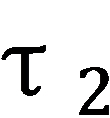
두 컴파트먼트(compartment) 모델링(근육 세포질그물(sarcoplasmic reticulum:SR) 및 근육 세포질(sarcoplasm: SP)) 특성 및 반응의 협동작용(cooperativity)(Ca2+- 트로포닌(troponin) 결합(binding)을 가능하게 하는 화학적 반응 계수(K6)로 힘 정보의 피드백)의 특징이 이 모델링 프레임워크에서 유지되었다. SR에서 칼슘 농도(CaSR)의 역동성은, 자유 칼슘 이온과 다음의 식으로 주어지는 칼세퀘스트린(calsequestrin: CS) 사이의 화학적 반응을 관장하는 두 개의 화학적 반응 계수(K1 및 K2)에 의해 결정될 수 있다.Two compartment modeling (sarcoplasmic reticulum (SR) and sarcoplasm (SP)) characteristics and cooperativity of reactions (Ca 2+ -troponin binding) Feedback of force information to the chemical reaction coefficient (K6), which enables the reaction force to be maintained) has been maintained in this modeling framework. The dynamics of calcium (Ca SR) in the SR Castle, given by free calcium ions and the following equation kalse Quest Lin (calsequestrin: CS) can be determined by a couple of reaction coefficient (K1 and K2) governing the reaction between have.
[식 1][Formula 1]

[식 2][Formula 2]

[식 3][Formula 3]

여기서, R 및 U는 SR로부터 방출되는 Ca2+ 유동율 및 SR로 재흡수되는 Ca2+ 유동율이며, 다음과 같이 수학적으로 모델링된다.Wherein, R, and U is a flow rate that Ca 2+ uptake by Ca 2+ flux rate and SR emitted from the SR, is mathematically modeled by the following:
[식 4][Formula 4]

[식 5][Formula 5]

여기서, Pmax는 SR의 최대 투과율(permeability)이고, 
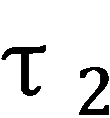
이어, 이 모듈의 SP에서 Ca2+ 농도(CaSP)는, R 및 U를 통해 SR과 상호 작용하는 동안 자유 완충 물질(free buffer substance)(B) 및 씬 필라멘트(thin filament) 내 트로포닌(troponin)(T)과 상호 작용함으로써 제어된다. 이 화학 물질들 사이의 반응은 다음의 식과 같이 네 개의 반응 상수(K3-K6)에 의해 결정된다.The Ca 2+ concentration in the SP of this module (Ca SP ) is then determined by measuring the free buffer substance (B) and troponin in the thin filament troponin < / RTI > (T). The reaction between these chemicals is determined by four reaction constants (K3-K6) as follows.
[식 6][Formula 6]

[식 7][Equation 7]

[식 8][Equation 8]

[식 9][Equation 9]

[식 10][Equation 10]

여기서, K3 및 K4는 Ca2+ 및 Ca2+-결합 버퍼(CaSPB) 사이의 진행 및 역행 화학적 반응 계수고, K5 및 K6는 Ca2+ 및 Ca2+-결합 트로포닌(CaSPT) 사이의 진행 및 역행 화학적 반응 계수다. K6는 근육 세포 활성화(A)의 함수이다: K6

제2 모듈: 제2 모듈은, 근육 세포질(sarcoplasm)에서의 Ca2+ 농도(CaSP)와 힘의 관계는, Ca2+ 결합에 대한 트로포닌 사이트의 전체 수로 정규화된 Ca2+-결합 트로포닌(CaT)과 활성화 레벨(A) 사이의 관계의 형태로 모델에 포함된다. 근절(sarcomere)에서 크로스-브릿지(cross-bridge) 구조의 동적 특성을 기술한 모리스-레카 공식(Morris-Lecar formulation) (Morris and Lecar, 1981)을 사용하여, 정규화된 CaT의 함수로서 A의 역동성(dynamics)이 다음 식과 같이 다섯 개의 파라미터(C1-C5)로 나타났다. Second Module : In the second module, the relationship between Ca 2+ concentration (Ca SP ) and force in the sarcoplasm of the muscle is determined by the Ca 2+ -binding troposphere normalized to the total number of troponin sites for Ca 2+ binding Is included in the model in the form of a relationship between nin (CaT) and activation level (A). Using the Morris-Lecar formulation (Morris and Lecar, 1981) describing the dynamic characteristics of a cross-bridge structure in the sarcomere, the function of A as a function of normalized CaT The dynamics are represented by five parameters (C1-C5) as follows.
[식 11][Equation 11]


여기서, C1은 근육의 반 활성화(half muscle activation)를 생성하는 Ca2+-결합 트로포닌의 정규화된 농도이고, C2는 C1에서 활성화 곡선의 기울기이며, C3는 온도에 대한 환산 계수(scaling factor)이고, C4는 최대 시상수에서 Ca2+-결합 트로포닌의 정규화된 농도이며, C5는 곡선의 기울기를 결정한다.Where C1 is the normalized concentration of Ca2 + -binding troponin that produces half-muscle activation, C2 is the slope of the activation curve at C1, C3 is the scaling factor for temperature, , C4 is the normalized concentration of Ca2 + -binding troponin at maximum time constants, and C5 determines the slope of the curve.
제3 모듈: 이어, A를 근력으로 변환하는 과정이 수축성(contractile) 요소 및 직렬 탄성(serial elastic) 요소의 두 요소로 구성되어 모델링된다. 이 모듈에서, 힘 출력(F)은 최초 길이에 대한 수축성 요소의 편차(

[식 12][Equation 12]

여기서, P0는 최적 근육 길이에서 최대 근력이며, KSE는 P0로 정규화된 직렬 탄성 요소의 경직도(stiffness)이다.Where P 0 is the maximum muscle strength at optimal muscle length, and K SE is the stiffness of the series elastic element normalized to P 0 .
다양한 범위의 근육 길이 및 활성화 레벨에서 식 12에서 
[식 13][Formula 13]

[식 14][Equation 14]

[식 15][Formula 15]

여기서, a0, b0, c0 및 d0는 힐-마쉬마(Hill-Mashima) 방정식 계수이며, 
Where a 0 , b 0 , c 0 and d 0 are the Hill-Mashima equation coefficients,
모델 파라미터 값의 결정Determination of model parameter values
파라미터 값들은 실험 데이터로부터 직접적으로 기초한 개별 모듈에 대해 결정되었다. 본 발명에서, 제1 모듈의 모든 파라미터 값은 쥐 표본(mice preparatioin)으로부터 실험적으로 확인된 문헌(Westerblad and Allen, 1994) 에서 직접 채택되었다. 제3 모듈의 파라미터 값들은 두 가지 실험 조건에 기반하여 분석적으로 결정되었다. 먼저, 식 12의 KSE는, 최대 자극(full excitation)으로 등척성 수축(isometric contraction)이 진행되는 동안 순간적인 근육 길이의 단축이 이루어질 때 수축성 요소의 변화가 무시될 수 있음을 가정하여 결정될 수 있다(도 7의 A and B 참조). 근육 길이 및 근력에서 변화 데이터가 주어지면, KSE는 식 12를 사용하여 연산될 수 있다.
The parameter values were determined for individual modules based directly on the experimental data. In the present invention, all parameter values of the first module were directly adopted in an experimentally confirmed document (Westerblad and Allen, 1994) from a mouse preparation. The parameter values of the third module were determined analytically based on two experimental conditions. First, the K SE of
힐-마쉬마 계수(즉, 식 14 및 15의 a0-d0)는, V-T 곡선 상의 네 개의 데이터 포인트((VS,1, TS,1), (VS,2, TS,2), (VL,1, TL,1), (VL,2, TL,2))에 대해 역방정식을 유도함으로써 길이-장력(L-T) 및 속도-장력(V-T) 특성에 기반하여 다음의 식 16 내지 식 19에 의해 분석적으로 결정될 수 있다. 여기서, VS,1 및 VS,2는 최소 및 최대 단축 속도이고, VL,1 및 VL,2는 최소 및 최대 연장 속도이다. Hill-Marsh Do coefficient (in other words,
[식 16][Formula 16]

[식 17][Formula 17]

[식 18][Formula 18]

[식 19][Formula 19]

제2 모듈의 파라미터 값(C1-C5)은 최적 근육 길이에서 1 내지 40 Hz의 자극 주파수 범위에 대한 연축(twitch) 및 경증 강축성(sub tetanus)의 실험 데이터에 일치하도록 조정될 수 있다. 파라미터 값의 최적화는 NEURON 소프트웨어(Hines and Carnevale, 1997)에 구축된 최적화 도구를 사용하여 이루어질 수 있다.
The parameter values (C1-C5) of the second module can be adjusted to match experimental data of twitch and light tetraus for the excitation frequency range of 1 to 40 Hz at optimal muscle length. Optimization of parameter values can be accomplished using an optimization tool built into NEURON software (Hines and Carnevale, 1997).
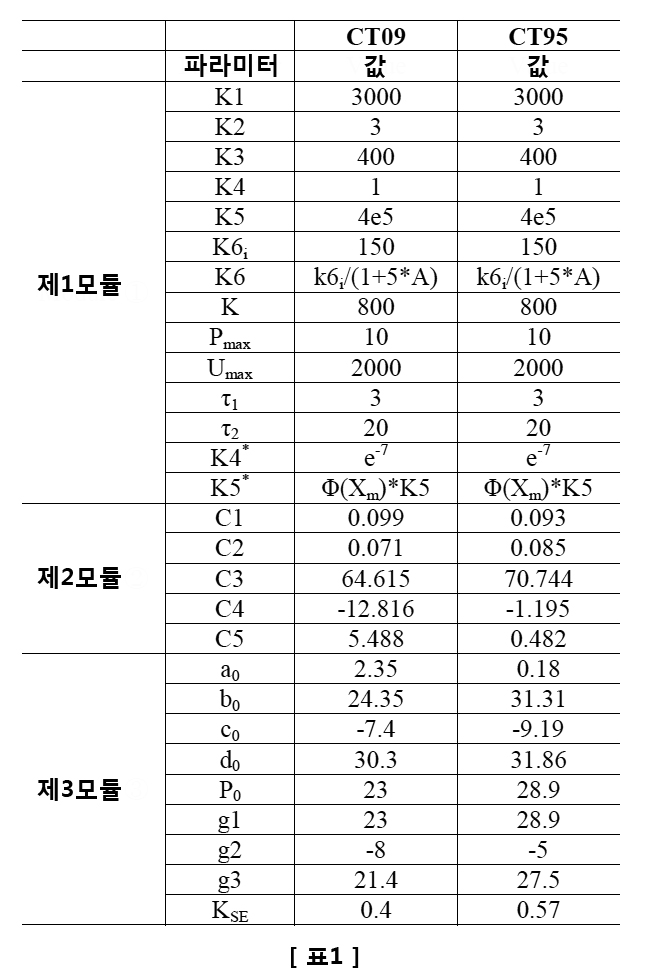
본 발명에서 제안된 모델링 기법을 검증하기 위해, 모든 단계들이 다른 고양이 표본(즉, CT95)으로부터 획득된 다른 실험 데이터 세트에 대해 반복되었다. 본 발명에서 사용된 모든 파라미터 값들이 표 1에 나타난다.To verify the modeling technique proposed in the present invention, all steps were repeated for different experimental data sets obtained from different cat specimens (i.e., CT95). All parameter values used in the present invention are shown in Table 1.
다양한 근육 길이에서 연축(twitch) 및 경증 강축(sub tetanus)이 진행되는 동안(즉, 등척성(isometric)) 특정된 힘 데이터를 비교하는 정적 조건(즉, 등척성)에서 개선된 힐 모델(도 1)을 테스트 하였으며, 이어 일정한 속도의 넓은 범위에 대해 강축이 진행되는 동안(즉, 등속성(isovelocity)) 테스트 하였다. 정적 조건에서 활성화 역동성(activation dynamics)(도 1의 A(t))의 길이 의존성을 보상한 후, 자극 주파수와 근육 길이의 동적인 변화가 이루어지는 동안 동적 조건에서 근육 운동에 대한 활성화 역동성(A(t))의 의존성을 더 확인하였다. 최종적으로, 다른 근육 표본(즉, CT95)로부터 획득된 힘 데이터에 대해 개선된 힐 모델을 검증하였다.
An improved heel model (FIG. 1) in static conditions (i.e., isometric) comparing specified force data during progression of a twitch and sub tetanus at various muscle lengths (i.e., isometric) Were tested and then tested during a strong axis (i. E., Isovelocity) for a wide range of constant velocity. After compensating for the length dependence of the activation dynamics (A (t) in FIG. 1) under static conditions, the dynamic dynamics of the excitation frequency and muscle length were measured to determine the activation dynamics A (t)). Finally, an improved heel model was verified against force data obtained from other muscle specimens (i.e., CT95).
다양한 근육 길이에서 연축(twitch) 및 경증 강축(sub tetanus) 응답Responses to twitch and sub tetanus responses at various muscle lengths
도 2는 최적 길이로 중심값이 결정된 세 가지 서로 다른 근육 길이 (-16 mm, -8 mm and 0 mm)에서 다양한 자극 주파수(10, 20 and 40 Hz)에 대한 모델 및 실제 근육(즉, CT09)의 연축(twitch) 및 경증 강축(sub tetanus) 응답을 나타낸다. 모델 파라미터의 초기값은 동일 근육에서 최적 길이일 때 측정된 힘 데이터(도 2E)에 일치하도록 조정되었다.Figure 2 shows the model and actual muscle (i.e., CT09) at various stimulation frequencies (10, 20 and 40 Hz) at three different muscle lengths (-16 mm, -8 mm and 0 mm) ) And a slight sub-tetanus response. The initial values of the model parameters were adjusted to match the force data measured at the optimal length in the same muscle (Figure 2E).
길이가 최적 길이로부터 짧아지거나 길어질 때, 모델과 실제 근육 간의 힘 생산 오차는 현저하게 심화되었다. 모델의 활성화 역동성은 길이가 0 mm로 길어질 때 과소 측정된 반면(도 2D), 길이가 -16 mm로 짧아질 때 과대 측정 되었다(도 2F). 근육 길이에 대한 활성화 역동성의 의존성을 계량화하기 위해, 활성화 역동성(A(t))이 각 길이에서 측정된 실제 근육의 연축 반응(도 2A-2C에서 검은색 점선)으로부터 역추정되었다(inversely estimated). A(t)의 크기 변화의 정도는 근육 길이를 증가시킬 때보다 단축 시킬 때 더욱 심화되었다. When the length was shortened or longer than the optimal length, the force production error between the model and the actual muscle was significantly increased. The activation dynamics of the model were underestimated when the length was lengthened to 0 mm (Fig. 2D) while overestimated when the length was shortened to -16 mm (Fig. 2F). In order to quantify the dependence of activation dynamics on muscle length, the activation dynamics (A (t)) was inversely estimated from the spasticity response of the actual muscle measured at each length (black dashed line in Figures 2A-2C) ). The magnitude of the change in size of A (t) was further exacerbated when the muscle length was shortened.
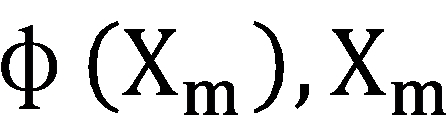
근육 길이에 대한 활성화 크기의 의존성은 Ca2+-단백질 반응의 화학적 반응 계수(즉, 도 1에서 K5)를 근육 길이(Xm)의 함수로 결정함으로써 보상되었다.The dependence of activation size on muscle length was compensated by determining the chemical response coefficient of the Ca 2+ -protein response (ie,
[식 20][Formula 20]

상기 식 20에서, 


활성화 역동성의 길이 의존성을 보상한 후, 실제 데이터에 대한 모델 오차는 낮은 레벨의 자극 주파수(40 Hz 미만)에 대해 특히 현저하게 감소한다. 높은 레벨의 자극 주파수(40 Hz 초과)에서, 길이 의존성에 대한 보성과 상관 없이 힘 생산의 큰 차이점이 존재하지 않는다. 이러한 결과에 따라, 전체 자극 범위에서 활성화 역동성은 시간에 따른 근육 길이의 일정한 변화에 의해 크게 영향을 받지 않음을 예측할 수 있었다(즉, 등속성(isovelocity) 조건).
After compensating for the length dependence of the activation dynamics, the model error for the actual data is particularly markedly reduced for lower stimulus frequencies (less than 40 Hz). At higher levels of excitation frequency (above 40 Hz), there is no significant difference in force production independent of the ability to depend on length. Based on these results, it was predicted that activation dynamics in the entire range of stimulation were not significantly affected by a constant change in muscle length over time (ie, isovelocity condition).
최대 자극 상태에서 등척성-등속성-등척성 수축Isometric-isokinetic-isometric contraction at maximum stimulus
이어, 활성화 역동성의 길이 의존성에 대한 보상이 이루어진 모델은 최대 자극 상태(100 Hz) 하에서 고양이 가자미근의 길이-장력(L-T) 및 속도-장력(V-T) 특성에 대해 평가가 이루어진다. 속도가 활성화 역동성(A(t))에 영향을 미치는 지를 측정하기 위해, 식 12 내지 식 15를 이용하여 최적 길이에서 실제 근육의 강축성 반응(tetanic response)으로부터 A(t)가 역으로 측정될 수 있다(도 3A). 동일한 입력 조건에서, 역으로 측정된 A(t)에 기초하여 예측된 힘은 실제 근육 및 등척성 조건하에서 보상된 모델과 비교되었다.The model with compensation for the length dependence of activation dynamics is then evaluated for the length-tension (L-T) and velocity-tension (V-T) characteristics of the cat litter under the maximum stimulation condition (100 Hz). To determine if the velocity affects the activation dynamics (A (t)), A (t) is determined inversely from the tetanic response of the actual muscle at optimal
도 3B-3G는 역모델(흑색 점선), 보상된 모델(적색 점선) 및 실제 근육(흑색 실선) 간의 근육 힘의 비교를 도시한다. 도 2에서 예견된 바와 같이, 다양한 레벨에서 근육 길이를 지속시키는 동안 역 모델 및 보상 모델은 모두 실제 근육에서의 힘 발현의 시간 경로와 잘 일치되었다. 두 모델 간의 강축성 반응에서의 일치는 보상 모델의 A(t)가 역 모델의 그것과 유사하다는 것을 의미한다. Figures 3B-3G illustrate a comparison of muscle forces between the inverse model (black dashed line), the compensated model (red dotted line) and the actual muscle (black solid line). As predicted in FIG. 2, both the inverse model and the compensated model were in good agreement with the time path of force expression in real muscle while sustaining muscle length at various levels. The agreement in the stiffening reaction between the two models implies that A (t) of the compensation model is similar to that of the inverse model.
이러한 결과는, 보상 모델의 칼슘 역동성(도 1의 제1 모듈에서 모델링된)이 최대 자극에서 등척성 수축에 대한 A(t)의 생리학적인 패턴을 나타낼 수 있으며 자극 주파수 증가에 따라 A(t)의 길이 의존도가 약해지는 경향이 있음을 나타낸다. 등속성 수축이 이루어지는 동안, 역 모델 및 새로운 모델은 모두 A(t)가 최대 자극 하에서 시간에 대한 일정한 길이 변화에 의해 큰 영향을 받지 않음을 나타내는 실험 데이터와 잘 일치하였다.These results indicate that the calcium dynamics of the compensation model (modeled in the first module of Fig. 1) can represent a physiological pattern of A (t) for isometric contraction in the maximal stimulation and A (t) The dependence of the length tends to be weak. During isokinetic contraction, the inverse model and the new model were in good agreement with the experimental data, indicating that A (t) is not significantly affected by constant length changes over time under maximum excitation.
그러나, 등속성 수축이 끝난 후 등척성 조건에서 근육 힘이 재발현 되었을 때, 시뮬레이션된 데이터와 실제 데이터 사이에 차이가 발생하였다. 양 방법에 의한 시뮬에이션 결과는 일정한 속도로 근육을 단축시킨 후 과대 예측된 반면, 시뮬레이션 결과는 일정 속도로 길이 증가가 이루어진 후 과소 예측되었다. 본 발명에서는 근본적인 메커니즘이 여전히 불명료하므로, 근육 힘에 대한 속도 의존성 이력(history) 효과는 고려되지 않았다.
However, there was a difference between simulated data and actual data when muscular strength was re-expressed in isometric conditions after isokinetic contraction. Simulation results by both methods were overestimated after shortening the muscles at a constant rate, whereas the simulation results were underestimated after increasing the length at a constant rate. Since the underlying mechanism is still obscure in the present invention, a rate-dependent history effect on muscle force has not been considered.
근육 길이 및 자극 주파수의 동적 변화 시의 힘 생산Muscle length and force production during dynamic change of excitation frequency
정적 조건(등척성 및 등속성)에서 A(t)의 길이 의존성을 설명하면서, 식 20에 의한 수정 힐 모델의 보상이 동적 입력 조건 하에서 힘 생성을 예측하기에 충분한지에 대해 평가하였다. 자극 주파수가 10 내지 30 Hz 사이에서 변화하였고 근육 길이는 운동 상태를 모방하는 126 내지 0 mm의 범위에서 무작위로 변동하였다(도 4의 아래).We have evaluated whether the compensation of the modified heel model according to Eq. (20) is sufficient to predict force generation under dynamic input conditions, while explaining the length dependence of A (t) in static conditions (isometric and isochronous). The stimulation frequency varied between 10 and 30 Hz and muscle length varied randomly in the range of 126 to 0 mm (FIG. 4, bottom) mimicking the motor status.
도 4는 정적 조건에서 보상된 모델(적색 점선)과 다른 주파수 레벨에서 길이의 동적 변동 시 획득된 실험 데이터(흑색 실선) 사이의 근육 힘을 비교한 것을 도시한다. 시뮬레이션 오차가 두 선(적색 점선 및 흑색 실선) 사이의 차이에 기초하여 인식된다. 보상 모델에서 근육 세포 활성화가 양(길이 증가)의 속도 수축이 진행되는 동안(도 4에서 수직으로 회색인 영역) 최적 길이 미만의 근육 길이에 대해 주로 과대 측정되었다. 이 관찰에 기초하여, 운동과 같은 움직임이 있는 동안 활성화 역동성의 의존성은 근육 길이(Xm) 및 속도(Vm)의 함수로서 모델링 되었다.Fig. 4 shows a comparison of the muscle forces between the compensated model (red dotted line) under static conditions and the experimental data (black solid line) obtained at the time of dynamic variation of length at different frequency levels. The simulation error is recognized based on the difference between the two lines (red dotted line and black solid line). In the compensation model, muscle cell activation was predominantly overestimated for muscle lengths below the optimal length during progression of velocity (increasing length) velocity contraction (vertical gray area in FIG. 4). Based on this observation, the dependence of activation dynamics during movement, such as motion, was modeled as a function of muscle length (X m ) and velocity (V m ).
[식 21][Formula 21]

여기서 A는 제2 모듈에서 산출된 활성화 레벨이고, A*는 근육 운동의 결과로서 제3 모듈로의 업데이트된 입력이다. 


전체적으로, 길이 및 속도의 함수(식 21)로서 활성화 레벨을 조정하는 것은 시뮬레이션 오차의 현저한 감소를 가져온다. 그러나, 식 21에 의한 보상은 낮은 레벨의 자극 주파수(<10 Hz)에서 활성화 역동성의 과대측정을 억제하기에 충분하지 않았다. 사실, 시뮬레이션 오차가 있는 움직임이 발생하는 동안 느리게 감소하는 힘 출력의 기여도는 이러한 낮은 주파수에서 중요하게 되었다. 이러한 움직임 유도 힘의 감소 하에서 분자적 메커니즘이 보고된 적이 없으므로, 근육 움직임이 발생하는 동안 K4의 값을 1의 초기값에서부터 e-7로 변화시킴으로써 이 모델 오차를 임의로 보상하였다(힘 발현 시 K4의 기여도에 대한 도 9를 참조). 이러한 모든 결과는 활성화 역동성으로의 움직임 정보(근육 길이 및 속도)의 피드백이 근육 모델의 사실적인 시뮬레이션에 요구된다는 점을 강조하는 것이다. Overall, adjusting the activation level as a function of length and velocity (Equation 21) results in a significant reduction in simulation error. However, the compensation according to Equation 21 was not sufficient to suppress the overdriving of the activation dynamics at the low level of the excitation frequency (< 10 Hz). In fact, the contribution of a slowly decreasing force output during motion with simulated error has become important at these lower frequencies. This model error was arbitrarily compensated by varying the value of K4 from the initial value of 1 to e- 7 during muscle movement, since no molecular mechanism has been reported under this reduced motion-induced force (K4 See Figure 9 for contribution). All of these results emphasize that feedback of motion information (muscle length and velocity) to activation dynamics is required for realistic simulation of the muscle model.
또한, 식 21에 의해 보상된 모델과 K4의 단계 감소가 스파이크 주파수가 10, 20 및 30 Hz의 평균 주파수로 임의 변동되는 조건에서 생성된 근육 힘을 예측할 수 있다는 것을 확인하였다(도 5). 전체적으로, 시뮬레이션 결과와 실험 데이터가 양호하게 일치하였다. 도 4에 나타난 바와 같이, 양의 근육 속도(즉, 길어지는) 동안 최적 근육 길이보다 근육 길이가 더 단축될 때 시뮬레이션 오차가 두드러졌다.
In addition, it was confirmed that the model compensated by Eq. (21) and the step reduction of K4 can predict the muscle force generated under the condition that the spike frequency is randomly varied at an average frequency of 10, 20 and 30 Hz (Fig. 5). Overall, the simulation and experimental data were in good agreement. As shown in Fig. 4, the simulation error was pronounced when the muscle length was shorter than the optimal muscle length during the positive muscle velocity (i.e., lengthening).
신규의 근육 모델링 기법의 검증Verification of new muscle modeling techniques
고양이 가자미근(CT09)에서 확인된 A(t)의 모든 의존성은 고양이 가자미근의 다른 표본(CT95)에서 일관되게 나타났다. 예를 들어, CT95에서 A(t)는 연축(twitch) 및 경증 강축(sub tetanus) 응답 동안 근육 길이에 의존하였다(힘 생성의 상세한 내용은 도 7 G-J 참조). 근육 길이에서 동적 변화가 발생하는 동안, CT95에서 A(t)는 CT09에서 관찰된 것과 같이 양의 속도에서 최적 길이 미만의 근육 운동에 대해 주로 과대 측정되었다(도 6).All dependence of A (t) identified in the cat litter (CT09) consistently appeared in another sample of cat litter (CT95). For example, in CT95 A (t) was dependent on muscle length during twitch and sub tetanus responses (see Figure 7 G-J for details of force generation). During dynamic changes in muscle length, A (t) in CT95 was predominantly overestimated for less than optimal length muscle movements at positive rates, as observed in CT09 (Figure 6).
제1 모듈을 제외한 새로운 모델 파라미터 값의 세트가 방법에서 제시된 단계들을 따라 CT95에 대해 결정되었다(도 7, 표 1). 정적 및 동적 조건에서 A(t)의 의존성에 대해 CT09에서 확인된 동일한 보상 메커니즘이 CT95에 적용되었다. CT09 근육 모델은 근육 길이와 주파수를 무작위로 변동시키는 도 5에 도시된 것과 동일한 동적 조건하에서 테스트되었다. 일반적으로, 시뮬레이션 결과와 실제 데이터가 양호하게 일치하였다. 이러한 일치는 A(t)의 의존성에 대한 본 발명에서 제안된 보상 메커니즘이 근육 길이 및 자극 주파수와 같은 입력의 동적 조건하에서 발생하는 모델 오차를 감소시키기 위해 고양이 가자미근에 적용될 수 있음을 나타낸다.
A set of new model parameter values, with the exception of the first module, was determined for the CT95 according to the steps presented in the method (FIG. 7, Table 1). The same compensation mechanism identified in CT09 for the dependence of A (t) in static and dynamic conditions was applied to CT95. The CT09 muscle model was tested under the same dynamic conditions as shown in Figure 5, which randomly varied muscle length and frequency. In general, the simulation results and the actual data were in good agreement. This agreement indicates that the compensation mechanism proposed in the present invention for the dependence of A (t) can be applied to the cat litter to reduce the model error that occurs under dynamic conditions of input such as muscle length and excitation frequency.
힐-타입 근육 모델이 근육 움직임이 발생하는 동안 실제 운동뉴런(motoneuron)과 직접적으로 상호작용하도록 하기 위해, 근육 세포 활성화의 역동성(A(t))은 계산적으로 효율적이며 생리학적으로 타당한 방식으로 모델링될 수 있음을 설명하였다. 모델을 실제 근육과 비교하는 과정에서, 정적(등척성) 자극에 있어 A(t)의 강한 의존성을 발견하였다. 근육 길이의 동적인 변화가 발생하는 동안 움직임 유도 활성화 저하에 따른 최적 길이 미만의 근육 움직임에서의 A(t)의 억제는 모델의 예측 정확도에 있어 중요하였다. 이러한 모든 결과는 근육 움직임의 정적 및 동적 길이 변화의 영향이 생리학적 움직임 하에서 힐-타입 근육 모델의 실제 시뮬레이션에 대해 고려되어야 한다는 점을 강조한다.
In order for the heel-type muscle model to interact directly with the motoneuron during muscle movement, the dynamics of muscle cell activation (A (t)) is computationally efficient and in a physiologically relevant manner Can be modeled. In comparing the model with actual muscle, we found a strong dependence of A (t) on static (isometric) stimulation. The inhibition of A (t) in muscle movements less than optimal length due to lowered motion induced activation during dynamic changes in muscle length was important for the prediction accuracy of the model. All these results emphasize that the effects of static and dynamic length changes of muscle movements should be considered for the actual simulation of heel-type muscle models under physiological motions.
이전 연구와의 비교Comparison with previous studies
생리학적 데이터에 직접 기반하여 모델 파라미터들이 개별 모듈에 의해 결정되는 본 발명의 새로운 모델링 기법과는 달리, 종래 연구에서 모든 모델 파리미터들은 한정된 입력 조건에서 목표 근육의 전체적인 입력-출력 특성을 매칭시키도록 조정된다. Unlike the novel modeling technique of the present invention, in which model parameters are determined by individual modules based directly on physiological data, in the prior art all model parameters were adjusted to match the overall input- do.
따라서, 종래 모델들은, 정적 상태에서 계산적으로나(Shames et al., 1996) 실험적으로(Backx et al., 1995) 모두 [Ca2+] 및 근육 힘 사이의 비선형 관계에 의해 특정되어진 힘 생성 상 Ca의 협조적인 영향을 획득할 수 있는지가 불명확하였다. Thus, conventional models have shown that the force-generating phase, Ca ( 2 ), which is specified by a non-linear relationship between [Ca 2+ ] and muscle force both computationally in a static state (Shames et al., 1996) It is unclear whether the cooperative effects of
본 발명에서, 다섯 가지 파라미터(식 11에서 C1-C5)를 포함하는 모리스-레카 방정식(Morris-Lecar equations)을 이용하여 이 관계를 명시적으로 나타내었다. In the present invention, this relationship is explicitly expressed using Morris-Lecar equations including five parameters (C1-C5 in Equation 11).
종래 기술에서는Ca-힘 관계를 측정하기 위한 도구를 갖지 못하므로, C1-C5는 최적 길이에서 실제 근육의 연축 및 경증 강축(sub tetani)을 매칭시키도록 수치적으로 조정되었다. In the prior art, C1-C5 was numerically adjusted to match the spasm of the actual muscle and the subterranean peak (sub tetani) at optimal length, since there was no tool to measure the Ca-force relationship.
한편, Ca-힘 관계의 비선형적 형태가 중요한지 확인하기 위해, 선형적 케이스를 [Ca2+]-힘의 비선형 관계와 비교하였다. 이 비교 결과는, 선형 관계를 갖는 모델이 넓은 범위의 자극 주파수에서 고양이 가지미근의 경증 강축성 반응을 감소시키는 경우 현저한 시뮬레이션 오차를 발생시킴을 명백하게 나타내었다(도 8). 이러한 모든 결과는 [Ca2+]-힘의 비선형 관계가 넓은 범위의 입력(신경 자극 및 길이 변화)에 대해 근육 반응의 현실적인 시뮬레이션을 반영함을 나타낸다. On the other hand, in order to confirm the importance of the nonlinear form of the Ca-force relationship, the linear case was compared to the nonlinear relationship of [Ca 2+ ] force. The results of this comparison clearly show that the model with linear relationship generates a significant simulation error when reducing the mild intensifying response of the cats in the wide range of stimulation frequencies (Fig. 8). All of these results indicate that the nonlinear relationship of [Ca 2+ ] force reflects a realistic simulation of muscle response to a wide range of inputs (nerve stimulation and length changes).
길이 의존도 보상이 이루어지지 않은 초기 모델에서 활성화 역동성은 최적 일이 미만으로 길이가 단축될 때 과대 측정되었다(도 2F). 본 발명에서, 이러한 길이 의존성을 갖는 활성화의 저하는, 근육 길이의 함수로서 Ca2+-트로포닌 반응의 단일 화학적 반응 계수(도 1의 K5)를 설정함으로써 임의로 실행될 수 있다. 결과로서, 길이 변화에 따라 모듈화된 K5를 갖는 보상 모델은 연축 및 경증 강축성 수축 동안 힘 발현의 상승 단계와 잘 매칭되었다. Activation dynamics in the initial model without length dependence compensation were overestimated when the length was shortened to less than optimal (Fig. 2F). In the present invention, this decrease in activation with length dependence can be optionally performed by setting a single chemical reaction coefficient (K5 in Fig. 1) of the Ca < 2 + > -troponin reaction as a function of muscle length. As a result, the compensation model with modulated K5 with varying lengths matched well with the rising phase of force development during spasm and mild stiffness contraction.
근육 움직임 동안 힐-타입 근육 모델의 오차가 현저하게 나타났다(Millard et al., 2013, Sandercock and Heckman, 1997b, Perreault et al., 2003). 본 발명에서, 이러한 모델 오차가, 특히 낮은 레벨의 자극 주파수에서 등척성 수축이 발생하는 동안 심각할 수 있다는 것을 입증하였다(도 2E). 모델과 실제 근육 간의 오차는, 등척성 수축 동안 획득된 결과(도 1)와 유사하게 최적화된 길이보다 짧은 근육 길이에서 모델의 과잉 활성화(hyper-activation)로 인해 주로 나타났다. 움직임이 발생하는 동안 과인 활성화와 관련된 이러한 모델 오차는, 근육 길이의 늦은 변화 및 넓은 폭의 펄스 자극을 위해 제안된 근육 길이 및 속도로 구성된 공식에 기반하여 보상되었다 (Shue and Crago, 1998). 그러나, 임펄스 자극과 함께 상대적으로 빠른 모드에서 근육이 이동하는 케이스에서, 근육 길이가 속도와 비교하여 동적 근육 변화가 발생하는 동안 활성화 레벨의 모듈화에 더 큰 영향을 끼친다는 것을 발견하였다. 사실, 활성화 역동성에 대한 속도의 영향은 모델에서 거의 무시할 수 있었다(식 19에서 
개별 연구들이 관심을 갖는 입력 조건 및 종(species)에서 차이가 나므로, 본 발명과 종래 연구 사이의 활성화 역동성의 의존성에 대한 보상 메커니즘의 직접적인 비교는 어렵다. 본 발명에서는, 넓은 범위의 입력 조건: 자극 주파수(1 내지 100 Hz) 및 길이 변화(등척, 등속성 및 동적)에서 성체 고양이 가자미근에서 힘 생산에 초점을 두었다. 우리가 아는 한, 본 발명은 포유류에서 전체 범위의 자극 주파수 및 근육 길이의 생리학적 변화에 대한 근육 세포 모델링을 보여주는 최초의 발명이다.
Direct comparisons of compensation mechanisms for dependence of activation dynamics between the present invention and conventional studies are difficult because the individual studies differ in the input conditions and species of interest. The present invention focuses on the production of forces in adult cattle louse by a wide range of input conditions: stimulus frequency (1 to 100 Hz) and length changes (isoclinic, isokinetic and dynamic). As far as we know, the present invention is the first invention to show muscle cell modeling for physiological changes in the full range of stimulation frequencies and muscle length in mammals.
힐-타입 근육 모델을 이용한 많은 신경근 시뮬레이션에서 활성화 역동성의 스파이크-구동 모델에 대한 필요성이 존재하여 왔다. 본 발명에서 개발된 활성화 모델은 생리학 관련 신경 자극 및 근육 움직임 하에서 근육 행동 시뮬레이션뿐만 아니라 신경 모델이 일반적으로 재구성하는 신경 시뮬레이터에서 효과적인 구현을 가능하게 한다. 새로운 힐-타입 근육 모델이 큰 스케일의 신경 근 시뮬레이션의 정확도를 향상시키고 나아가 적절한 움직임을 발생시키는 근육 힘의 신경 제어에 대한 이해를 향상시키는데 기여하기를 희망한다.
There has been a need for an active dynamics spike-driven model in many neuromuscular simulations using a heel-type muscle model. The activation model developed in the present invention enables effective implementation in the neural simulator in which the neural model is reconstructed in general, as well as simulation of muscle behavior under physiologically relevant nerve stimulation and muscle movement. We hope that the new heel-type muscle model will contribute to improving the accuracy of large-scale neuromuscular simulation and further the understanding of neurological control of muscle forces that produce appropriate movement.
본 발명의 상세한 설명에서는 구체적인 실시 예에 관하여 설명하였으나 본 발명의 범위에서 벗어나지 않는 한도 내에서 여러 가지 변형이 가능함은 물론이다. 그러므로 본 발명의 범위는 설명된 실시 예에 국한되지 않으며, 후술되는 특허청구의 범위 및 이 특허청구의 범위와 균등한 것들에 의해 정해져야 한다.Although the present invention has been described in connection with certain exemplary embodiments, it is to be understood that the invention is not limited to the disclosed exemplary embodiments. Therefore, the scope of the present invention should not be limited to the embodiments described, but should be determined by the scope of the following claims and equivalents thereof.
Claims (16)
상기 제1 모듈에서 변환된 상기 Ca2+의 농도 변화 정보를 입력 받아 근육 활성화의 동적거동(activation dynamics) 정보로 변환하는 제2 모듈; 및
상기 제2 모듈에서 변환된 근육 활성화의 동적거동 정보를 입력 받아 근력 정보로 변환하는 제3 모듈을 포함하며,
상기 제1 모듈 및 상기 제2 모듈은 각각 Ca2+ 농도 및 근육 활성화의 근육 길이에 대한 의존성을 보상하는 것을 특징으로 하는 근육 세포 활성화 모델링 시스템.A first module for receiving an electrical signal corresponding to a spinal nerve signal generated in spinal motor neurons and converting the electrical signal into information on the concentration of Ca 2+ in the myoplasm;
A second module for receiving the concentration change information of the Ca 2+ converted from the first module and converting the information into activation dynamics information of muscle activation; And
And a third module for receiving the dynamic behavior information of the muscle activation converted by the second module and converting the received information into muscle strength information,
Wherein the first module and the second module compensate for the dependence of Ca 2+ concentration and muscle activation on muscle length, respectively.
상기 제1 모듈은 근육 세포질그물(sarcoplasmic reticulum:SR) 및 근육 세포질(sarcoplasm: SP)의 두 부분 모델링을 포함하는 것을 특징으로 하는 근육 세포 활성화 모델링 시스템.The method according to claim 1,
Wherein the first module comprises two-part modeling of a sarcoplasmic reticulum (SR) and a sarcoplasm (SP).
상기 제1 모듈은, 근육 세포질그물 모델 및 근육 세포질 모델 및 화학적 반응의 협동성(cooperativity)를 이용하여 하기 식 1 내지 식 10과 같은 연산을 통한 모델링을 실행하는 하는 것을 특징으로 하는 근육 세포 활성화 모델링 시스템.
[식 1]

[식 2]

[식 3]

[식 4]

[식 5]

[식 6]

[식 7]

[식 8]

[식 9]

[식 10]

(CaSR: 칼슘 농도, CS: 칼세퀘스트린(calsequestrin), R: 근육 세포질그물로부터 방출되는 Ca2+의 유동율, U: 근육 세포질그물로 흡수되는 Ca2+의 유동율, K1, K2: 화학적 반응 계수, Pmax: 근육 세포질그물로부터 방출되는 최대 투과율(permeability),


Wherein the first module performs modeling through computations such as the following equations (1) to (10) using the muscle cell cytoplasm model, the muscle cytoplasm model, and the cooperativity of the chemical reaction .
[Formula 1]
[Formula 2]
[Formula 3]
[Formula 4]
[Formula 5]
[Formula 6]
[Equation 7]
[Equation 8]
[Equation 9]
[Equation 10]
(Ca SR : calcium concentration, CS: calsequestrin, R: flow rate of Ca 2+ released from muscle cytoplasmic net, U: flow rate of Ca 2+ absorbed into muscle cytoplasmic net, K1, K2: chemical reaction Coefficient, P max : maximum permeability emitted from the muscle cytoplasmic net,
상기 제2 모듈은,
Ca2+과 결합하는 트로포닌 사이트의 전체 수로 정규화된 Ca2+-결합 트로포닌(CaT)과 활성화 역동성(A) 사이의 관계를 하기 식 11과 같이 모델링하는 것을 특징으로 하는 근육 세포 활성화 모델링 시스템.
[식 11]

(

Wherein the second module comprises:
The normalized total number of Ca troponin sites that combine with Ca 2+ 2+ - binding troponin activate muscle cells to modeling wherein the model as shown in the following equation 11. The relationship between (CaT) and activation dynamics (A) system.
[Equation 11]
(
상기 제3 모듈은,
수축성(contractile) 및 직렬 탄성(serial elastic) 요소로 구성된 힐(Hill) 기반 근육 모델의 최간 형태에 기초하여 하기 식 12 내지 식 15와 같이 모델링을 실행하는 것을 특징으로 하는 근육 세포 활성화 모델링 시스템.
[식 12]

[식 13]

[식 14]

[식 15]

(P0: 최적 근육 길이(optimal muscle length)에서 최대 근력, KSE: P0로 정규화된 직렬 탄성 요소의 경직도(stiffness), a0, b0, c0 및 d0: 힐-마쉬마(Hill-Mashima) 방정식 계수,

The third module includes:
Wherein the modeling is performed according to the following formulas 12 to 15 based on the best mode of a Hill-based muscle model composed of contractile and serial elastic elements.
[Equation 12]
[Formula 13]
[Equation 14]
[Formula 15]
(P 0 : maximum muscle strength at optimal muscle length, K SE : stiffness of a series elastic element normalized to P 0 , a 0 , b 0 , c 0 and d 0 : heel-mashima Hill-Mashima) Equation coefficient,
상기 식 14 및 식 15의 a0 내지 d0는, V-T 곡선 상의 네 개의 데이터 포인트((VS,1, TS,1), (VS,2, TS,2), (VL,1, TL,1), (VL,2, TL,2))에 대해 역방정식을 유도함으로써 길이-장력(L-T) 및 속도-장력(V-T) 특성에 기반하여 하기 식 16 내지 식 19와 같이 분석적으로 결정된 것을 특징으로 하는 근육 세포 활성화 모델링 시스템.
[식 16]

[식 17]

[식 18]

[식 19]

(VS,1 및 VS,2: 최소 및 최대 단축 속도, VL,1 및 VL,2: 최소 및 최대 연장 속도)6. The method of claim 5,
Of formula 14 and formula 15 a 0 to d 0, the four data points ((V S, 1, T S, 1), (V S, 2, T S, 2) on the VT curve, (V L, 1, T L, 1), (V L, 2, T L, 2)) by inducing an inverse equation for the length-tension (LT) and the speed-to based on the tension (VT) characteristics equation 16 to equation 19 Wherein the muscle cell activation modeling system is characterized by being analytically determined as follows.
[Formula 16]
[Formula 17]
[Formula 18]
[Formula 19]
(V S, 1 and V S, 2 : minimum and maximum shrink speed, V L, 1 and V L, 2 : minimum and maximum extension speed)
K5는 근육 길이(Xm)의 함수로 하기 식 20과 같이 보상되는 것을 특징으로 하는 근육 세포 활성화 모델링 시스템.
[식 20]

(


K5 is a muscle cell activation model system, it characterized in that the compensation as shown in the following equation 20 as functions of muscle length (X m).
[Formula 20]
(
근육 활성화의 근육 길이에 대한 의존성은 근육 길이와 속도의 함수로서 하기 식 21과 같이 보상되는 것을 특징으로 하는 근육 세포 활성화 모델링 시스템.
[식 21]

(A:는 제2 모듈에서 산출된 근육 활성화의 동적거동 정보이고, A*: 제3 모듈로 제공된 보상된 근육 활성화의 동적거동 정보,


Wherein the dependence of muscle activation on muscle length is compensated as a function of muscle length and velocity as shown in Equation 21 below.
[Formula 21]
(A: is the dynamic behavior information of the muscle activation calculated in the second module, A * : the dynamic behavior information of the compensated muscle activation provided by the third module,
상기 제1 단계에서 변환된 상기 Ca2+의 농도 정보를 입력 받아 근육 활성화의 동적거동 정보로 변환하는 제2 단계; 및
상기 제2 단계에서 변환된 근육 활성화의 동적거동 정보를 입력 받아 근력 정보로 변환하는 제3 단계를 포함하며,
상기 제1 단계 및 상기 제2 단계는 각각 Ca2+ 농도 및 근육 활성화의 근육 길이에 대한 의존성을 보상하는 것을 특징으로 하는 생리학적 움직임에 따른 근육 세포 활성화 모델링 방법.A first step of receiving an electric signal corresponding to a spinal nerve signal generated in spinal motor neurons and converting the electric signal into information on the concentration of Ca 2+ in a myoplasm;
A second step of receiving the concentration information of the Ca 2+ converted in the first step and converting the information into dynamic behavior information of the muscle activation; And
And a third step of receiving the dynamic behavior information of the muscle activation converted in the second step and converting it into muscle strength information,
Wherein said first step and said second step each compensate for the dependence of Ca 2+ concentration and muscle activation on muscle length.
상기 제1 단계는,
근육 세포질그물 모델, 근육 세포질 모델 및 화학적 반응의 협동성(cooperativity)을 이용하여 하기 식 1 내지 식 10과 같은 연산을 통한 모델링을 실행하는 것을 특징으로 하는 근육 세포 활성화 모델링 방법.
[식 1]

[식 2]

[식 3]

[식 4]

[식 5]

[식 6]

[식 7]

[식 8]

[식 9]

[식 10]

(CaSR: 칼슘 농도, CS: 칼세퀘스트린(calsequestrin), R: 근육 세포질그물로부터 방출되는 Ca2+의 유동율, U: 근육 세포질그물로 흡수되는 Ca2+의 유동율, K1, K2: 화학적 반응 계수, Pmax: 근육 세포질그물로부터 방출되는 최대 투과율(permeability),



In the first step,
Wherein modeling is carried out through computations such as the following equations (1) to (10) using the muscle cell cytoplasm model, the muscle cytoplasm model, and the cooperativity of chemical reactions.
[Formula 1]
[Formula 2]
[Formula 3]
[Formula 4]
[Formula 5]
[Formula 6]
[Equation 7]
[Equation 8]
[Equation 9]
[Equation 10]
(Ca SR : calcium concentration, CS: calsequestrin, R: flow rate of Ca 2+ released from muscle cytoplasmic net, U: flow rate of Ca 2+ absorbed into muscle cytoplasmic net, K1, K2: chemical reaction Coefficient, P max : maximum permeability emitted from the muscle cytoplasmic net,
상기 제2 단계는,
Ca2+과 결합하는 트로포닌 사이트의 전체 수로 정규화된 Ca2+-결합 트로포닌(CaT)과 활성화 역동성(A) 사이의 관계를 하기 식 11과 같이 모델링하는 것을 특징으로 하는 근육 세포 활성화 모델링 방법.
[식 11]

(

The second step comprises:
The normalized total number of Ca troponin sites that combine with Ca 2+ 2+ - binding troponin activate muscle cells to modeling wherein the model as shown in the following equation 11. The relationship between (CaT) and activation dynamics (A) Way.
[Equation 11]
(
상기 제3 단계는,
수축성(contractile) 및 직렬 탄성(serial elastic) 요소로 구성된 힐(Hill) 기반 근육 모델의 최간 형태에 기초하여 하기 식 12 내지 식 15와 같이 모델링을 실행하는 것을 특징으로 하는 근육 세포 활성화 모델링 방법.
[식 12]

[식 13]

[식 14]

[식 15]

(P0: 최적 근육 길이(optimal muscle length)에서 최대 근력, KSE: P0로 정규화된 직렬 탄성 요소의 경직도(stiffness), a0, b0, c0 및 d0: 힐-마쉬마(Hill-Mashima) 방정식 계수,

In the third step,
Wherein the modeling is carried out according to the following formulas 12 to 15 based on the best mode of a Hill-based muscle model composed of contractile and serial elastic elements.
[Equation 12]
[Formula 13]
[Equation 14]
[Formula 15]
(P 0 : maximum muscle strength at optimal muscle length, K SE : stiffness of a series elastic element normalized to P 0 , a 0 , b 0 , c 0 and d 0 : heel-mashima Hill-Mashima) Equation coefficient,
KSE는, 최대 자극(full excitation)으로 등척성 수축(isometric contraction)이 진행되는 동안 순간적인 근육 길이의 단축이 이루어질 때 수축성 요소의 변화가 무시될 수 있음을 가정하여 결정된 것을 특징으로 하는 근육 세포 활성화 모델링 방법.13. The method of claim 12,
K SE is determined on the assumption that the change in shrinkage factor can be neglected when the instantaneous muscle length is shortened during isometric contraction with full excitation. Modeling method.
상기 식 14 및 식 15의 a0 내지 d0는, V-T 곡선 상의 네 개의 데이터 포인트((VS,1, TS,1), (VS,2, TS,2), (VL,1, TL,1), (VL,2, TL,2))에 대해 역방정식을 유도함으로써 길이-장력(L-T) 및 속도-장력(V-T) 특성에 기반하여 하기 식 16 내지 식 19와 같이 분석적으로 결정된 것을 특징으로 하는 근육 세포 활성화 모델링 방법.
[식 16]

[식 17]

[식 18]

[식 19]

(VS,1 및 VS,2: 최소 및 최대 단축 속도, VL,1 및 VL,2: 최소 및 최대 연장 속도)14. The method of claim 13,
Of formula 14 and formula 15 a 0 to d 0, the four data points ((V S, 1, T S, 1), (V S, 2, T S, 2) on the VT curve, (V L, 1, T L, 1), (V L, 2, T L, 2)) by inducing an inverse equation for the length-tension (LT) and the speed-to based on the tension (VT) characteristics equation 16 to equation 19 Wherein the muscle cell activation modeling method is characterized in that it is determined analytically.
[Formula 16]
[Formula 17]
[Formula 18]
[Formula 19]
(V S, 1 and V S, 2 : minimum and maximum shrink speed, V L, 1 and V L, 2 : minimum and maximum extension speed)
K5는 근육 길이(Xm)의 함수로 하기 식 20과 같이 보상되는 것을 특징으로 하는 근육 세포 활성화 모델링 방법.
[식 20]

(


K5 are how active muscle cells modeling characterized in that the compensation as shown in the following equation 20 as functions of muscle length (X m).
[Formula 20]
(
근육 활성화의 근육 길이에 대한 의존성은 근육 길이와 속도의 함수로서 하기 식 21과 같이 보상되는 것을 특징으로 하는 근육 세포 활성화 모델링 방법.
[식 21]

(A:는 제2 모듈에서 산출된 근육 활성화의 동적거동 정보이고, A*: 제3 모듈로 제공된 보상된 근육 활성화의 동적거동 정보,


Wherein the dependence of muscle activation on muscle length is compensated as a function of muscle length and velocity as shown in Equation 21 below.
[Formula 21]
(A: is the dynamic behavior information of the muscle activation calculated in the second module, A * : the dynamic behavior information of the compensated muscle activation provided by the third module,
Priority Applications (2)
| Application Number | Priority Date | Filing Date | Title |
|---|---|---|---|
| KR1020140107832A KR101593637B1 (en) | 2014-08-19 | 2014-08-19 | Modeling system for muscle cell activation and method thereof |
| US14/680,809 US20170154133A9 (en) | 2014-08-19 | 2015-04-07 | Modeling System and Method for Muscle Cell Activation |
Applications Claiming Priority (1)
| Application Number | Priority Date | Filing Date | Title |
|---|---|---|---|
| KR1020140107832A KR101593637B1 (en) | 2014-08-19 | 2014-08-19 | Modeling system for muscle cell activation and method thereof |
Publications (1)
| Publication Number | Publication Date |
|---|---|
| KR101593637B1 true KR101593637B1 (en) | 2016-02-15 |
Family
ID=55348513
Family Applications (1)
| Application Number | Title | Priority Date | Filing Date |
|---|---|---|---|
| KR1020140107832A Active KR101593637B1 (en) | 2014-08-19 | 2014-08-19 | Modeling system for muscle cell activation and method thereof |
Country Status (2)
| Country | Link |
|---|---|
| US (1) | US20170154133A9 (en) |
| KR (1) | KR101593637B1 (en) |
Cited By (1)
| Publication number | Priority date | Publication date | Assignee | Title |
|---|---|---|---|---|
| CN114139378A (en) * | 2021-12-02 | 2022-03-04 | 中国人民解放军军事科学院国防科技创新研究院 | Muscle time-varying mechanical modeling method and device considering morphological changes and electronic equipment |
Families Citing this family (4)
| Publication number | Priority date | Publication date | Assignee | Title |
|---|---|---|---|---|
| CN108629074B (en) * | 2018-03-15 | 2020-04-28 | 哈尔滨理工大学 | A modeling method for finite element model of skeletal muscle bundles |
| US11138350B2 (en) * | 2018-08-09 | 2021-10-05 | Zoox, Inc. | Procedural world generation using tertiary data |
| CN112365985A (en) * | 2020-11-10 | 2021-02-12 | 哈尔滨理工大学 | Skeletal muscle multi-scale model modeling method based on sarcoplasmic reticulum environment |
| CN114469142B (en) * | 2022-01-06 | 2024-06-21 | 中南大学 | Muscle strength decoding method based on human muscle dynamics model and electromyographic signals |
-
2014
- 2014-08-19 KR KR1020140107832A patent/KR101593637B1/en active Active
-
2015
- 2015-04-07 US US14/680,809 patent/US20170154133A9/en not_active Abandoned
Non-Patent Citations (3)
| Title |
|---|
| 논문 2003 |
| 논문 2004 |
| 논문2005 |
Cited By (2)
| Publication number | Priority date | Publication date | Assignee | Title |
|---|---|---|---|---|
| CN114139378A (en) * | 2021-12-02 | 2022-03-04 | 中国人民解放军军事科学院国防科技创新研究院 | Muscle time-varying mechanical modeling method and device considering morphological changes and electronic equipment |
| CN114139378B (en) * | 2021-12-02 | 2024-04-23 | 中国人民解放军军事科学院国防科技创新研究院 | Muscle time-varying mechanical modeling method and device considering morphological changes, and electronic equipment |
Also Published As
| Publication number | Publication date |
|---|---|
| US20170154133A9 (en) | 2017-06-01 |
| US20160055276A1 (en) | 2016-02-25 |
Similar Documents
| Publication | Publication Date | Title |
|---|---|---|
| KR101593637B1 (en) | Modeling system for muscle cell activation and method thereof | |
| Koo et al. | Feasibility of using EMG driven neuromusculoskeletal model for prediction of dynamic movement of the elbow | |
| Riener et al. | A physiologically based model of muscle activation verified by electrical stimulation | |
| JP2013516258A (en) | Method for determining artificial limb movements from EEG signals | |
| Song et al. | Computationally efficient models of neuromuscular recruitment and mechanics | |
| Bobet et al. | A comparison of models of force production during stimulated isometric ankle dorsiflexion in humans | |
| Loeb et al. | Linking musculoskeletal mechanics to sensorimotor neurophysiology | |
| Kim et al. | An action potential-driven model of soleus muscle activation dynamics for locomotor-like movements | |
| Williams et al. | Computationally efficient modeling of proprioceptive signals in the upper limb for prostheses: a simulation study | |
| Ito et al. | Self-reorganization of neuronal activation patterns in the cortex under brain-machine interface and neural operant conditioning | |
| Camilleri et al. | Are the maximum shortening velocity and the shape parameter in a Hill-type model of whole muscle related to activation? | |
| Maltenfort et al. | Spindle model responsive to mixed fusimotor inputs and testable predictions of β feedback effects | |
| Gollee et al. | A nonlinear approach to modeling of electrically stimulated skeletal muscle | |
| Iyengar et al. | The NEUROiD neuromusculoskeletal movement simulation platform | |
| Farahat et al. | An apparatus for characterization and control of isolated muscle | |
| Cancrini et al. | PRISM: Parameter recovery identification from synthetic modeling | |
| US8140166B2 (en) | Activating a non-isometric functional movement through electrical stimulation | |
| Jailani et al. | Development of dynamic muscle model with functional electrical stimulation | |
| HIJIKATA et al. | Model-based design of a muscle mass for a biohybrid actuator | |
| Chou | Efficacy of Hammerstein models in capturing the dynamics of isometric muscle stimulated at various frequencies | |
| KR102588317B1 (en) | Method for designing stimulation signal for spinal motorneuron stimulation | |
| Koelewijn et al. | Predictive Simulations of Gait with Exoskeletons that Alter Energetics | |
| Mountjoy et al. | Contraction-based variations in upper limb EMG-force models under isometric conditions | |
| Bhatti et al. | Muscle forces and fatigue in a digital human environment | |
| Jiang et al. | JiSuJi, a virtual muscle for small animal simulations, accurately predicts force from naturalistic spike trains |
Legal Events
| Date | Code | Title | Description |
|---|---|---|---|
| PA0109 | Patent application |
St.27 status event code: A-0-1-A10-A12-nap-PA0109 |
|
| PA0201 | Request for examination |
St.27 status event code: A-1-2-D10-D11-exm-PA0201 |
|
| D13-X000 | Search requested |
St.27 status event code: A-1-2-D10-D13-srh-X000 |
|
| D14-X000 | Search report completed |
St.27 status event code: A-1-2-D10-D14-srh-X000 |
|
| PE0902 | Notice of grounds for rejection |
St.27 status event code: A-1-2-D10-D21-exm-PE0902 |
|
| P11-X000 | Amendment of application requested |
St.27 status event code: A-2-2-P10-P11-nap-X000 |
|
| P13-X000 | Application amended |
St.27 status event code: A-2-2-P10-P13-nap-X000 |
|
| E701 | Decision to grant or registration of patent right | ||
| PE0701 | Decision of registration |
St.27 status event code: A-1-2-D10-D22-exm-PE0701 |
|
| GRNT | Written decision to grant | ||
| PR0701 | Registration of establishment |
St.27 status event code: A-2-4-F10-F11-exm-PR0701 |
|
| PR1002 | Payment of registration fee |
St.27 status event code: A-2-2-U10-U11-oth-PR1002 Fee payment year number: 1 |
|
| PG1601 | Publication of registration |
St.27 status event code: A-4-4-Q10-Q13-nap-PG1601 |
|
| FPAY | Annual fee payment |
Payment date: 20181212 Year of fee payment: 4 |
|
| PR1001 | Payment of annual fee |
St.27 status event code: A-4-4-U10-U11-oth-PR1001 Fee payment year number: 4 |
|
| R18-X000 | Changes to party contact information recorded |
St.27 status event code: A-5-5-R10-R18-oth-X000 |
|
| P22-X000 | Classification modified |
St.27 status event code: A-4-4-P10-P22-nap-X000 |
|
| FPAY | Annual fee payment |
Payment date: 20191203 Year of fee payment: 5 |
|
| PR1001 | Payment of annual fee |
St.27 status event code: A-4-4-U10-U11-oth-PR1001 Fee payment year number: 5 |
|
| R18-X000 | Changes to party contact information recorded |
St.27 status event code: A-5-5-R10-R18-oth-X000 |
|
| PR1001 | Payment of annual fee |
St.27 status event code: A-4-4-U10-U11-oth-PR1001 Fee payment year number: 6 |
|
| PR1001 | Payment of annual fee |
St.27 status event code: A-4-4-U10-U11-oth-PR1001 Fee payment year number: 7 |
|
| PN2301 | Change of applicant |
St.27 status event code: A-5-5-R10-R13-asn-PN2301 St.27 status event code: A-5-5-R10-R11-asn-PN2301 |
|
| PR1001 | Payment of annual fee |
St.27 status event code: A-4-4-U10-U11-oth-PR1001 Fee payment year number: 8 |
|
| PR1001 | Payment of annual fee |
St.27 status event code: A-4-4-U10-U11-oth-PR1001 Fee payment year number: 9 |
|
| PR1001 | Payment of annual fee |
St.27 status event code: A-4-4-U10-U11-oth-PR1001 Fee payment year number: 10 |
|
| U11 | Full renewal or maintenance fee paid |
Free format text: ST27 STATUS EVENT CODE: A-4-4-U10-U11-OTH-PR1001 (AS PROVIDED BY THE NATIONAL OFFICE) Year of fee payment: 10 |