KR101488403B1 - Aerosolized fluoroquinolones and uses thereof - Google Patents
Aerosolized fluoroquinolones and uses thereof Download PDFInfo
- Publication number
- KR101488403B1 KR101488403B1 KR1020077029629A KR20077029629A KR101488403B1 KR 101488403 B1 KR101488403 B1 KR 101488403B1 KR 1020077029629 A KR1020077029629 A KR 1020077029629A KR 20077029629 A KR20077029629 A KR 20077029629A KR 101488403 B1 KR101488403 B1 KR 101488403B1
- Authority
- KR
- South Korea
- Prior art keywords
- delete delete
- levofloxacin
- drug
- composition
- aerosol
- Prior art date
- Legal status (The legal status is an assumption and is not a legal conclusion. Google has not performed a legal analysis and makes no representation as to the accuracy of the status listed.)
- Active
Links
- 229940124307 fluoroquinolone Drugs 0.000 title claims abstract description 141
- GSDSWSVVBLHKDQ-JTQLQIEISA-N Levofloxacin Chemical compound C([C@@H](N1C2=C(C(C(C(O)=O)=C1)=O)C=C1F)C)OC2=C1N1CCN(C)CC1 GSDSWSVVBLHKDQ-JTQLQIEISA-N 0.000 claims abstract description 354
- 229960003376 levofloxacin Drugs 0.000 claims abstract description 354
- 239000000203 mixture Substances 0.000 claims abstract description 230
- 239000000443 aerosol Substances 0.000 claims abstract description 147
- 238000000034 method Methods 0.000 claims abstract description 110
- 210000004072 lung Anatomy 0.000 claims abstract description 66
- 238000004519 manufacturing process Methods 0.000 claims abstract description 8
- 239000000843 powder Substances 0.000 claims description 97
- 208000015181 infectious disease Diseases 0.000 claims description 65
- 241000894006 Bacteria Species 0.000 claims description 44
- -1 marbophloxacin Chemical compound 0.000 claims description 43
- 206010057190 Respiratory tract infections Diseases 0.000 claims description 41
- MYSWGUAQZAJSOK-UHFFFAOYSA-N ciprofloxacin Chemical compound C12=CC(N3CCNCC3)=C(F)C=C2C(=O)C(C(=O)O)=CN1C1CC1 MYSWGUAQZAJSOK-UHFFFAOYSA-N 0.000 claims description 38
- 238000011282 treatment Methods 0.000 claims description 33
- 201000003883 Cystic fibrosis Diseases 0.000 claims description 29
- 230000002685 pulmonary effect Effects 0.000 claims description 27
- ZRCVYEYHRGVLOC-HYARGMPZSA-N gemifloxacin Chemical compound C1C(CN)C(=N/OC)/CN1C(C(=C1)F)=NC2=C1C(=O)C(C(O)=O)=CN2C1CC1 ZRCVYEYHRGVLOC-HYARGMPZSA-N 0.000 claims description 23
- 229960003170 gemifloxacin Drugs 0.000 claims description 23
- 239000008194 pharmaceutical composition Substances 0.000 claims description 22
- 229960003405 ciprofloxacin Drugs 0.000 claims description 19
- ZQPPMHVWECSIRJ-KTKRTIGZSA-N oleic acid Chemical compound CCCCCCCC\C=C/CCCCCCCC(O)=O ZQPPMHVWECSIRJ-KTKRTIGZSA-N 0.000 claims description 16
- 150000001768 cations Chemical class 0.000 claims description 13
- TWRXJAOTZQYOKJ-UHFFFAOYSA-L Magnesium chloride Chemical compound [Mg+2].[Cl-].[Cl-] TWRXJAOTZQYOKJ-UHFFFAOYSA-L 0.000 claims description 12
- 230000003204 osmotic effect Effects 0.000 claims description 12
- XUBOMFCQGDBHNK-JTQLQIEISA-N (S)-gatifloxacin Chemical compound FC1=CC(C(C(C(O)=O)=CN2C3CC3)=O)=C2C(OC)=C1N1CCN[C@@H](C)C1 XUBOMFCQGDBHNK-JTQLQIEISA-N 0.000 claims description 11
- 229960003923 gatifloxacin Drugs 0.000 claims description 11
- 229960003702 moxifloxacin Drugs 0.000 claims description 10
- FABPRXSRWADJSP-MEDUHNTESA-N moxifloxacin Chemical compound COC1=C(N2C[C@H]3NCCC[C@H]3C2)C(F)=CC(C(C(C(O)=O)=C2)=O)=C1N2C1CC1 FABPRXSRWADJSP-MEDUHNTESA-N 0.000 claims description 10
- 210000002345 respiratory system Anatomy 0.000 claims description 10
- 208000032376 Lung infection Diseases 0.000 claims description 9
- QIPQASLPWJVQMH-DTORHVGOSA-N Orbifloxacin Chemical compound C1[C@@H](C)N[C@@H](C)CN1C1=C(F)C(F)=C2C(=O)C(C(O)=O)=CN(C3CC3)C2=C1F QIPQASLPWJVQMH-DTORHVGOSA-N 0.000 claims description 9
- 229960004780 orbifloxacin Drugs 0.000 claims description 9
- 241000606125 Bacteroides Species 0.000 claims description 8
- XEEYBQQBJWHFJM-UHFFFAOYSA-N Iron Chemical compound [Fe] XEEYBQQBJWHFJM-UHFFFAOYSA-N 0.000 claims description 8
- 241000589517 Pseudomonas aeruginosa Species 0.000 claims description 8
- 239000011575 calcium Substances 0.000 claims description 8
- 229960001180 norfloxacin Drugs 0.000 claims description 8
- OGJPXUAPXNRGGI-UHFFFAOYSA-N norfloxacin Chemical compound C1=C2N(CC)C=C(C(O)=O)C(=O)C2=CC(F)=C1N1CCNCC1 OGJPXUAPXNRGGI-UHFFFAOYSA-N 0.000 claims description 8
- OYPRJOBELJOOCE-UHFFFAOYSA-N Calcium Chemical compound [Ca] OYPRJOBELJOOCE-UHFFFAOYSA-N 0.000 claims description 7
- XBHBWNFJWIASRO-UHFFFAOYSA-N 6-fluoro-1-(4-fluorophenyl)-4-oxo-7-(1-piperazinyl)-3-quinolinecarboxylic acid Chemical compound C12=CC(N3CCNCC3)=C(F)C=C2C(=O)C(C(=O)O)=CN1C1=CC=C(F)C=C1 XBHBWNFJWIASRO-UHFFFAOYSA-N 0.000 claims description 6
- 241000606790 Haemophilus Species 0.000 claims description 6
- FYYHWMGAXLPEAU-UHFFFAOYSA-N Magnesium Chemical compound [Mg] FYYHWMGAXLPEAU-UHFFFAOYSA-N 0.000 claims description 6
- 241000193998 Streptococcus pneumoniae Species 0.000 claims description 6
- 229910052791 calcium Inorganic materials 0.000 claims description 6
- QGPKADBNRMWEQR-UHFFFAOYSA-N clinafloxacin Chemical compound C1C(N)CCN1C1=C(F)C=C2C(=O)C(C(O)=O)=CN(C3CC3)C2=C1Cl QGPKADBNRMWEQR-UHFFFAOYSA-N 0.000 claims description 6
- 229950001320 clinafloxacin Drugs 0.000 claims description 6
- 239000011777 magnesium Substances 0.000 claims description 6
- 229910052749 magnesium Inorganic materials 0.000 claims description 6
- 229910001629 magnesium chloride Inorganic materials 0.000 claims description 6
- 229950007734 sarafloxacin Drugs 0.000 claims description 6
- 229960004954 sparfloxacin Drugs 0.000 claims description 6
- DZZWHBIBMUVIIW-DTORHVGOSA-N sparfloxacin Chemical compound C1[C@@H](C)N[C@@H](C)CN1C1=C(F)C(N)=C2C(=O)C(C(O)=O)=CN(C3CC3)C2=C1F DZZWHBIBMUVIIW-DTORHVGOSA-N 0.000 claims description 6
- 241000191940 Staphylococcus Species 0.000 claims description 5
- 229910052782 aluminium Inorganic materials 0.000 claims description 5
- XAGFODPZIPBFFR-UHFFFAOYSA-N aluminium Chemical compound [Al] XAGFODPZIPBFFR-UHFFFAOYSA-N 0.000 claims description 5
- 229940031000 streptococcus pneumoniae Drugs 0.000 claims description 5
- 239000011701 zinc Substances 0.000 claims description 5
- 241000589516 Pseudomonas Species 0.000 claims description 4
- 241000194017 Streptococcus Species 0.000 claims description 4
- HCHKCACWOHOZIP-UHFFFAOYSA-N Zinc Chemical compound [Zn] HCHKCACWOHOZIP-UHFFFAOYSA-N 0.000 claims description 4
- 229910052725 zinc Inorganic materials 0.000 claims description 4
- 241000588780 Bordetella parapertussis Species 0.000 claims description 3
- 241000588832 Bordetella pertussis Species 0.000 claims description 3
- 208000006545 Chronic Obstructive Pulmonary Disease Diseases 0.000 claims description 3
- 241000588749 Klebsiella oxytoca Species 0.000 claims description 3
- 241000588747 Klebsiella pneumoniae Species 0.000 claims description 3
- 241000588770 Proteus mirabilis Species 0.000 claims description 3
- 241000607715 Serratia marcescens Species 0.000 claims description 3
- 241000191967 Staphylococcus aureus Species 0.000 claims description 3
- 241001464905 Staphylococcus saccharolyticus Species 0.000 claims description 3
- 241000193985 Streptococcus agalactiae Species 0.000 claims description 3
- 241000193996 Streptococcus pyogenes Species 0.000 claims description 3
- 229910052742 iron Inorganic materials 0.000 claims description 3
- 229940030998 streptococcus agalactiae Drugs 0.000 claims description 3
- 241000589969 Borreliella burgdorferi Species 0.000 claims description 2
- 241000589877 Campylobacter coli Species 0.000 claims description 2
- 241000589874 Campylobacter fetus Species 0.000 claims description 2
- 241000589875 Campylobacter jejuni Species 0.000 claims description 2
- 241001647372 Chlamydia pneumoniae Species 0.000 claims description 2
- 241000193163 Clostridioides difficile Species 0.000 claims description 2
- 241000193403 Clostridium Species 0.000 claims description 2
- 241000193155 Clostridium botulinum Species 0.000 claims description 2
- 241000193468 Clostridium perfringens Species 0.000 claims description 2
- 241000588697 Enterobacter cloacae Species 0.000 claims description 2
- 241000194032 Enterococcus faecalis Species 0.000 claims description 2
- 241000590002 Helicobacter pylori Species 0.000 claims description 2
- 241000588915 Klebsiella aerogenes Species 0.000 claims description 2
- 241000589242 Legionella pneumophila Species 0.000 claims description 2
- 241000186779 Listeria monocytogenes Species 0.000 claims description 2
- 241000588621 Moraxella Species 0.000 claims description 2
- 241000186367 Mycobacterium avium Species 0.000 claims description 2
- 241000186364 Mycobacterium intracellulare Species 0.000 claims description 2
- 241000187479 Mycobacterium tuberculosis Species 0.000 claims description 2
- 241000202934 Mycoplasma pneumoniae Species 0.000 claims description 2
- 206010035664 Pneumonia Diseases 0.000 claims description 2
- 241000588767 Proteus vulgaris Species 0.000 claims description 2
- 241000589540 Pseudomonas fluorescens Species 0.000 claims description 2
- 241000589776 Pseudomonas putida Species 0.000 claims description 2
- 241001354013 Salmonella enterica subsp. enterica serovar Enteritidis Species 0.000 claims description 2
- 241000531795 Salmonella enterica subsp. enterica serovar Paratyphi A Species 0.000 claims description 2
- 241000293871 Salmonella enterica subsp. enterica serovar Typhi Species 0.000 claims description 2
- 241000293869 Salmonella enterica subsp. enterica serovar Typhimurium Species 0.000 claims description 2
- 241000607762 Shigella flexneri Species 0.000 claims description 2
- 241000191963 Staphylococcus epidermidis Species 0.000 claims description 2
- 241000191984 Staphylococcus haemolyticus Species 0.000 claims description 2
- 241000192087 Staphylococcus hominis Species 0.000 claims description 2
- 241000122973 Stenotrophomonas maltophilia Species 0.000 claims description 2
- 241000607626 Vibrio cholerae Species 0.000 claims description 2
- 241000607272 Vibrio parahaemolyticus Species 0.000 claims description 2
- 241000607481 Yersinia intermedia Species 0.000 claims description 2
- 238000000889 atomisation Methods 0.000 claims description 2
- 229940092559 enterobacter aerogenes Drugs 0.000 claims description 2
- 229940032049 enterococcus faecalis Drugs 0.000 claims description 2
- 229940037467 helicobacter pylori Drugs 0.000 claims description 2
- 229940115932 legionella pneumophila Drugs 0.000 claims description 2
- 229940049964 oleate Drugs 0.000 claims description 2
- 229940007042 proteus vulgaris Drugs 0.000 claims description 2
- 241000186216 Corynebacterium Species 0.000 claims 2
- UGJMXCAKCUNAIE-UHFFFAOYSA-N Gabapentin Chemical compound OC(=O)CC1(CN)CCCCC1 UGJMXCAKCUNAIE-UHFFFAOYSA-N 0.000 claims 2
- 241000607734 Yersinia <bacteria> Species 0.000 claims 2
- 201000009890 sinusitis Diseases 0.000 claims 2
- 241001148471 unidentified anaerobic bacterium Species 0.000 claims 2
- 241001550224 Apha Species 0.000 claims 1
- 241001112285 Berta Species 0.000 claims 1
- 241000588807 Bordetella Species 0.000 claims 1
- 241001453380 Burkholderia Species 0.000 claims 1
- 241001495410 Enterococcus sp. Species 0.000 claims 1
- 241000186359 Mycobacterium Species 0.000 claims 1
- 241000588653 Neisseria Species 0.000 claims 1
- 241000588768 Providencia Species 0.000 claims 1
- 241000607768 Shigella Species 0.000 claims 1
- 241000191980 Staphylococcus intermedius Species 0.000 claims 1
- 208000003217 Tetany Diseases 0.000 claims 1
- 229960002870 gabapentin Drugs 0.000 claims 1
- 235000014347 soups Nutrition 0.000 claims 1
- 238000009472 formulation Methods 0.000 abstract description 128
- 239000003306 quinoline derived antiinfective agent Substances 0.000 abstract description 63
- 208000035143 Bacterial infection Diseases 0.000 abstract description 16
- 208000022362 bacterial infectious disease Diseases 0.000 abstract description 16
- 238000012387 aerosolization Methods 0.000 abstract description 8
- 239000003814 drug Substances 0.000 description 196
- 229940079593 drug Drugs 0.000 description 191
- 239000002245 particle Substances 0.000 description 180
- 239000007788 liquid Substances 0.000 description 92
- 239000000243 solution Substances 0.000 description 89
- 235000019640 taste Nutrition 0.000 description 80
- 235000002639 sodium chloride Nutrition 0.000 description 63
- 150000003839 salts Chemical class 0.000 description 59
- 230000000694 effects Effects 0.000 description 57
- 238000002360 preparation method Methods 0.000 description 50
- 150000001875 compounds Chemical class 0.000 description 49
- 239000000546 pharmaceutical excipient Substances 0.000 description 49
- 239000004599 antimicrobial Substances 0.000 description 45
- 238000012360 testing method Methods 0.000 description 43
- XLYOFNOQVPJJNP-UHFFFAOYSA-N water Substances O XLYOFNOQVPJJNP-UHFFFAOYSA-N 0.000 description 43
- 229940024606 amino acid Drugs 0.000 description 40
- 235000001014 amino acid Nutrition 0.000 description 39
- 150000001413 amino acids Chemical class 0.000 description 39
- 150000002632 lipids Chemical class 0.000 description 38
- 238000004659 sterilization and disinfection Methods 0.000 description 37
- 230000001954 sterilising effect Effects 0.000 description 36
- 210000004027 cell Anatomy 0.000 description 35
- 238000002474 experimental method Methods 0.000 description 35
- QIQXTHQIDYTFRH-UHFFFAOYSA-N octadecanoic acid Chemical compound CCCCCCCCCCCCCCCCCC(O)=O QIQXTHQIDYTFRH-UHFFFAOYSA-N 0.000 description 35
- 230000001965 increasing effect Effects 0.000 description 33
- 229940112141 dry powder inhaler Drugs 0.000 description 32
- 239000002244 precipitate Substances 0.000 description 32
- 230000000845 anti-microbial effect Effects 0.000 description 31
- 230000000670 limiting effect Effects 0.000 description 31
- 239000002105 nanoparticle Substances 0.000 description 31
- 239000008117 stearic acid Substances 0.000 description 31
- 238000004090 dissolution Methods 0.000 description 30
- 239000003607 modifier Substances 0.000 description 30
- 235000021355 Stearic acid Nutrition 0.000 description 29
- 239000003795 chemical substances by application Substances 0.000 description 29
- OQCDKBAXFALNLD-UHFFFAOYSA-N octadecanoic acid Natural products CCCCCCCC(C)CCCCCCCCC(O)=O OQCDKBAXFALNLD-UHFFFAOYSA-N 0.000 description 29
- 210000003296 saliva Anatomy 0.000 description 28
- 239000008247 solid mixture Substances 0.000 description 28
- 239000008101 lactose Substances 0.000 description 27
- 229960001375 lactose Drugs 0.000 description 27
- GUBGYTABKSRVRQ-QKKXKWKRSA-N Lactose Natural products OC[C@H]1O[C@@H](O[C@H]2[C@H](O)[C@@H](O)C(O)O[C@@H]2CO)[C@H](O)[C@@H](O)[C@H]1O GUBGYTABKSRVRQ-QKKXKWKRSA-N 0.000 description 26
- 239000002609 medium Substances 0.000 description 25
- 239000007787 solid Substances 0.000 description 25
- 239000000725 suspension Substances 0.000 description 25
- 239000013078 crystal Substances 0.000 description 24
- 229920000642 polymer Polymers 0.000 description 24
- BLUGYPPOFIHFJS-UUFHNPECSA-N (2s)-n-[(2s)-1-[[(3r,4s,5s)-3-methoxy-1-[(2s)-2-[(1r,2r)-1-methoxy-2-methyl-3-oxo-3-[[(1s)-2-phenyl-1-(1,3-thiazol-2-yl)ethyl]amino]propyl]pyrrolidin-1-yl]-5-methyl-1-oxoheptan-4-yl]-methylamino]-3-methyl-1-oxobutan-2-yl]-3-methyl-2-(methylamino)butanamid Chemical compound CN[C@@H](C(C)C)C(=O)N[C@@H](C(C)C)C(=O)N(C)[C@@H]([C@@H](C)CC)[C@H](OC)CC(=O)N1CCC[C@H]1[C@H](OC)[C@@H](C)C(=O)N[C@H](C=1SC=CN=1)CC1=CC=CC=C1 BLUGYPPOFIHFJS-UUFHNPECSA-N 0.000 description 23
- 208000007934 ACTH-independent macronodular adrenal hyperplasia Diseases 0.000 description 23
- VEXZGXHMUGYJMC-UHFFFAOYSA-N Hydrochloric acid Chemical compound Cl VEXZGXHMUGYJMC-UHFFFAOYSA-N 0.000 description 23
- 239000003242 anti bacterial agent Substances 0.000 description 23
- 239000000523 sample Substances 0.000 description 23
- 239000002904 solvent Substances 0.000 description 23
- 239000007921 spray Substances 0.000 description 22
- 229920000858 Cyclodextrin Polymers 0.000 description 21
- 239000006185 dispersion Substances 0.000 description 21
- 230000002209 hydrophobic effect Effects 0.000 description 21
- 150000003904 phospholipids Chemical class 0.000 description 21
- PEDCQBHIVMGVHV-UHFFFAOYSA-N Glycerine Chemical compound OCC(O)CO PEDCQBHIVMGVHV-UHFFFAOYSA-N 0.000 description 20
- 239000002253 acid Substances 0.000 description 20
- 230000001580 bacterial effect Effects 0.000 description 20
- 150000002500 ions Chemical class 0.000 description 20
- 239000003380 propellant Substances 0.000 description 20
- 241000282414 Homo sapiens Species 0.000 description 19
- 125000001931 aliphatic group Chemical group 0.000 description 19
- 239000006069 physical mixture Substances 0.000 description 19
- 229940088710 antibiotic agent Drugs 0.000 description 18
- 230000015572 biosynthetic process Effects 0.000 description 18
- 239000003085 diluting agent Substances 0.000 description 18
- 206010011224 Cough Diseases 0.000 description 17
- 125000001797 benzyl group Chemical group [H]C1=C([H])C([H])=C(C([H])=C1[H])C([H])([H])* 0.000 description 17
- 238000012512 characterization method Methods 0.000 description 17
- 238000000113 differential scanning calorimetry Methods 0.000 description 17
- 230000000813 microbial effect Effects 0.000 description 17
- 239000000047 product Substances 0.000 description 17
- 238000004448 titration Methods 0.000 description 17
- 102100032341 PCNA-interacting partner Human genes 0.000 description 16
- 101710196737 PCNA-interacting partner Proteins 0.000 description 16
- 230000000844 anti-bacterial effect Effects 0.000 description 16
- 230000003115 biocidal effect Effects 0.000 description 16
- 238000000338 in vitro Methods 0.000 description 16
- 238000005259 measurement Methods 0.000 description 16
- 238000001694 spray drying Methods 0.000 description 16
- 239000000126 substance Substances 0.000 description 16
- 210000001519 tissue Anatomy 0.000 description 16
- GUBGYTABKSRVRQ-XLOQQCSPSA-N Alpha-Lactose Chemical compound O[C@@H]1[C@@H](O)[C@@H](O)[C@@H](CO)O[C@H]1O[C@@H]1[C@@H](CO)O[C@H](O)[C@H](O)[C@H]1O GUBGYTABKSRVRQ-XLOQQCSPSA-N 0.000 description 15
- 238000005033 Fourier transform infrared spectroscopy Methods 0.000 description 15
- 239000005642 Oleic acid Substances 0.000 description 15
- HEMHJVSKTPXQMS-UHFFFAOYSA-M Sodium hydroxide Chemical compound [OH-].[Na+] HEMHJVSKTPXQMS-UHFFFAOYSA-M 0.000 description 15
- 238000013459 approach Methods 0.000 description 15
- 125000003118 aryl group Chemical group 0.000 description 15
- 239000012530 fluid Substances 0.000 description 15
- 238000002844 melting Methods 0.000 description 15
- 230000008018 melting Effects 0.000 description 15
- 230000009467 reduction Effects 0.000 description 15
- 238000005507 spraying Methods 0.000 description 15
- WRIDQFICGBMAFQ-UHFFFAOYSA-N (E)-8-Octadecenoic acid Natural products CCCCCCCCCC=CCCCCCCC(O)=O WRIDQFICGBMAFQ-UHFFFAOYSA-N 0.000 description 14
- LQJBNNIYVWPHFW-UHFFFAOYSA-N 20:1omega9c fatty acid Natural products CCCCCCCCCCC=CCCCCCCCC(O)=O LQJBNNIYVWPHFW-UHFFFAOYSA-N 0.000 description 14
- QSBYPNXLFMSGKH-UHFFFAOYSA-N 9-Heptadecensaeure Natural products CCCCCCCC=CCCCCCCCC(O)=O QSBYPNXLFMSGKH-UHFFFAOYSA-N 0.000 description 14
- ZQPPMHVWECSIRJ-UHFFFAOYSA-N Oleic acid Natural products CCCCCCCCC=CCCCCCCCC(O)=O ZQPPMHVWECSIRJ-UHFFFAOYSA-N 0.000 description 14
- 239000002585 base Substances 0.000 description 14
- QXJSBBXBKPUZAA-UHFFFAOYSA-N isooleic acid Natural products CCCCCCCC=CCCCCCCCCC(O)=O QXJSBBXBKPUZAA-UHFFFAOYSA-N 0.000 description 14
- 239000002502 liposome Substances 0.000 description 14
- 239000000463 material Substances 0.000 description 14
- 230000002829 reductive effect Effects 0.000 description 14
- 108060008226 thioredoxin Proteins 0.000 description 14
- SJJCQDRGABAVBB-UHFFFAOYSA-N 1-hydroxy-2-naphthoic acid Chemical compound C1=CC=CC2=C(O)C(C(=O)O)=CC=C21 SJJCQDRGABAVBB-UHFFFAOYSA-N 0.000 description 13
- VEXZGXHMUGYJMC-UHFFFAOYSA-M Chloride anion Chemical compound [Cl-] VEXZGXHMUGYJMC-UHFFFAOYSA-M 0.000 description 13
- 102100036407 Thioredoxin Human genes 0.000 description 13
- 239000008186 active pharmaceutical agent Substances 0.000 description 13
- 229940088679 drug related substance Drugs 0.000 description 13
- 244000005700 microbiome Species 0.000 description 13
- 230000003285 pharmacodynamic effect Effects 0.000 description 13
- LFQSCWFLJHTTHZ-UHFFFAOYSA-N Ethanol Chemical compound CCO LFQSCWFLJHTTHZ-UHFFFAOYSA-N 0.000 description 12
- 102000016387 Pancreatic elastase Human genes 0.000 description 12
- 108010067372 Pancreatic elastase Proteins 0.000 description 12
- 239000004480 active ingredient Substances 0.000 description 12
- 239000000872 buffer Substances 0.000 description 12
- KRKNYBCHXYNGOX-UHFFFAOYSA-N citric acid Chemical class OC(=O)CC(O)(C(O)=O)CC(O)=O KRKNYBCHXYNGOX-UHFFFAOYSA-N 0.000 description 12
- 230000007246 mechanism Effects 0.000 description 12
- 238000002156 mixing Methods 0.000 description 12
- WLJNZVDCPSBLRP-UHFFFAOYSA-N pamoic acid Chemical compound C1=CC=C2C(CC=3C4=CC=CC=C4C=C(C=3O)C(=O)O)=C(O)C(C(O)=O)=CC2=C1 WLJNZVDCPSBLRP-UHFFFAOYSA-N 0.000 description 12
- 238000002560 therapeutic procedure Methods 0.000 description 12
- 238000001157 Fourier transform infrared spectrum Methods 0.000 description 11
- FAPWRFPIFSIZLT-UHFFFAOYSA-M Sodium chloride Chemical compound [Na+].[Cl-] FAPWRFPIFSIZLT-UHFFFAOYSA-M 0.000 description 11
- 239000000654 additive Substances 0.000 description 11
- 239000002054 inoculum Substances 0.000 description 11
- 230000008569 process Effects 0.000 description 11
- 239000004094 surface-active agent Substances 0.000 description 11
- IJGRMHOSHXDMSA-UHFFFAOYSA-N Atomic nitrogen Chemical compound N#N IJGRMHOSHXDMSA-UHFFFAOYSA-N 0.000 description 10
- 208000009079 Bronchial Spasm Diseases 0.000 description 10
- 208000014181 Bronchial disease Diseases 0.000 description 10
- 206010006482 Bronchospasm Diseases 0.000 description 10
- WQZGKKKJIJFFOK-GASJEMHNSA-N Glucose Natural products OC[C@H]1OC(O)[C@H](O)[C@@H](O)[C@@H]1O WQZGKKKJIJFFOK-GASJEMHNSA-N 0.000 description 10
- DHMQDGOQFOQNFH-UHFFFAOYSA-N Glycine Chemical compound NCC(O)=O DHMQDGOQFOQNFH-UHFFFAOYSA-N 0.000 description 10
- 230000007423 decrease Effects 0.000 description 10
- 238000009826 distribution Methods 0.000 description 10
- 239000012669 liquid formulation Substances 0.000 description 10
- 229910052751 metal Inorganic materials 0.000 description 10
- 239000002184 metal Substances 0.000 description 10
- 239000006070 nanosuspension Substances 0.000 description 10
- 230000000241 respiratory effect Effects 0.000 description 10
- 230000001225 therapeutic effect Effects 0.000 description 10
- QTBSBXVTEAMEQO-UHFFFAOYSA-N Acetic acid Chemical compound CC(O)=O QTBSBXVTEAMEQO-UHFFFAOYSA-N 0.000 description 9
- YMWUJEATGCHHMB-UHFFFAOYSA-N Dichloromethane Chemical compound ClCCl YMWUJEATGCHHMB-UHFFFAOYSA-N 0.000 description 9
- OKKJLVBELUTLKV-UHFFFAOYSA-N Methanol Chemical compound OC OKKJLVBELUTLKV-UHFFFAOYSA-N 0.000 description 9
- 230000008901 benefit Effects 0.000 description 9
- 229940097362 cyclodextrins Drugs 0.000 description 9
- 235000003599 food sweetener Nutrition 0.000 description 9
- 235000010979 hydroxypropyl methyl cellulose Nutrition 0.000 description 9
- 239000001866 hydroxypropyl methyl cellulose Substances 0.000 description 9
- 229920003088 hydroxypropyl methyl cellulose Polymers 0.000 description 9
- UFVKGYZPFZQRLF-UHFFFAOYSA-N hydroxypropyl methyl cellulose Chemical compound OC1C(O)C(OC)OC(CO)C1OC1C(O)C(O)C(OC2C(C(O)C(OC3C(C(O)C(O)C(CO)O3)O)C(CO)O2)O)C(CO)O1 UFVKGYZPFZQRLF-UHFFFAOYSA-N 0.000 description 9
- 238000001727 in vivo Methods 0.000 description 9
- 238000003801 milling Methods 0.000 description 9
- 239000012466 permeate Substances 0.000 description 9
- 239000012071 phase Substances 0.000 description 9
- 239000011780 sodium chloride Substances 0.000 description 9
- 239000003765 sweetening agent Substances 0.000 description 9
- 238000002076 thermal analysis method Methods 0.000 description 9
- IZFHEQBZOYJLPK-SSDOTTSWSA-N (R)-dihydrolipoic acid Chemical compound OC(=O)CCCC[C@@H](S)CCS IZFHEQBZOYJLPK-SSDOTTSWSA-N 0.000 description 8
- CIWBSHSKHKDKBQ-JLAZNSOCSA-N Ascorbic acid Chemical compound OC[C@H](O)[C@H]1OC(=O)C(O)=C1O CIWBSHSKHKDKBQ-JLAZNSOCSA-N 0.000 description 8
- FBPFZTCFMRRESA-KVTDHHQDSA-N D-Mannitol Chemical compound OC[C@@H](O)[C@@H](O)[C@H](O)[C@H](O)CO FBPFZTCFMRRESA-KVTDHHQDSA-N 0.000 description 8
- CSNNHWWHGAXBCP-UHFFFAOYSA-L Magnesium sulfate Chemical compound [Mg+2].[O-][S+2]([O-])([O-])[O-] CSNNHWWHGAXBCP-UHFFFAOYSA-L 0.000 description 8
- 241000124008 Mammalia Species 0.000 description 8
- 229930195725 Mannitol Natural products 0.000 description 8
- 241001465754 Metazoa Species 0.000 description 8
- 241000700159 Rattus Species 0.000 description 8
- 229930006000 Sucrose Natural products 0.000 description 8
- CZMRCDWAGMRECN-UGDNZRGBSA-N Sucrose Chemical compound O[C@H]1[C@H](O)[C@@H](CO)O[C@@]1(CO)O[C@@H]1[C@H](O)[C@@H](O)[C@H](O)[C@@H](CO)O1 CZMRCDWAGMRECN-UGDNZRGBSA-N 0.000 description 8
- 239000000969 carrier Substances 0.000 description 8
- 229920002678 cellulose Polymers 0.000 description 8
- 235000010980 cellulose Nutrition 0.000 description 8
- 238000010668 complexation reaction Methods 0.000 description 8
- 238000011161 development Methods 0.000 description 8
- 230000018109 developmental process Effects 0.000 description 8
- 150000002016 disaccharides Chemical class 0.000 description 8
- 239000002552 dosage form Substances 0.000 description 8
- 239000008103 glucose Substances 0.000 description 8
- 235000001727 glucose Nutrition 0.000 description 8
- 239000000594 mannitol Substances 0.000 description 8
- 235000010355 mannitol Nutrition 0.000 description 8
- 229960001855 mannitol Drugs 0.000 description 8
- 229920001223 polyethylene glycol Polymers 0.000 description 8
- 239000005720 sucrose Substances 0.000 description 8
- 229960004793 sucrose Drugs 0.000 description 8
- 229920001450 Alpha-Cyclodextrin Polymers 0.000 description 7
- PWKSKIMOESPYIA-BYPYZUCNSA-N L-N-acetyl-Cysteine Chemical compound CC(=O)N[C@@H](CS)C(O)=O PWKSKIMOESPYIA-BYPYZUCNSA-N 0.000 description 7
- 229960004308 acetylcysteine Drugs 0.000 description 7
- 229940043377 alpha-cyclodextrin Drugs 0.000 description 7
- 239000007864 aqueous solution Substances 0.000 description 7
- WQZGKKKJIJFFOK-VFUOTHLCSA-N beta-D-glucose Chemical compound OC[C@H]1O[C@@H](O)[C@H](O)[C@@H](O)[C@@H]1O WQZGKKKJIJFFOK-VFUOTHLCSA-N 0.000 description 7
- 239000001913 cellulose Substances 0.000 description 7
- 229940106189 ceramide Drugs 0.000 description 7
- 230000008021 deposition Effects 0.000 description 7
- 238000004108 freeze drying Methods 0.000 description 7
- 235000011187 glycerol Nutrition 0.000 description 7
- 230000002401 inhibitory effect Effects 0.000 description 7
- 239000012528 membrane Substances 0.000 description 7
- 150000002772 monosaccharides Chemical class 0.000 description 7
- 230000000510 mucolytic effect Effects 0.000 description 7
- 230000035772 mutation Effects 0.000 description 7
- 244000052769 pathogen Species 0.000 description 7
- 230000001105 regulatory effect Effects 0.000 description 7
- 230000029058 respiratory gaseous exchange Effects 0.000 description 7
- 229920006395 saturated elastomer Polymers 0.000 description 7
- 235000000346 sugar Nutrition 0.000 description 7
- 229960000497 trovafloxacin Drugs 0.000 description 7
- WVPSKSLAZQPAKQ-CDMJZVDBSA-N trovafloxacin Chemical compound C([C@H]1[C@@H]([C@H]1C1)N)N1C(C(=CC=1C(=O)C(C(O)=O)=C2)F)=NC=1N2C1=CC=C(F)C=C1F WVPSKSLAZQPAKQ-CDMJZVDBSA-N 0.000 description 7
- IZHVBANLECCAGF-UHFFFAOYSA-N 2-hydroxy-3-(octadecanoyloxy)propyl octadecanoate Chemical compound CCCCCCCCCCCCCCCCCC(=O)OCC(O)COC(=O)CCCCCCCCCCCCCCCCC IZHVBANLECCAGF-UHFFFAOYSA-N 0.000 description 6
- XEKOWRVHYACXOJ-UHFFFAOYSA-N Ethyl acetate Chemical compound CCOC(C)=O XEKOWRVHYACXOJ-UHFFFAOYSA-N 0.000 description 6
- 241000699670 Mus sp. Species 0.000 description 6
- 238000002835 absorbance Methods 0.000 description 6
- 230000004913 activation Effects 0.000 description 6
- QVGXLLKOCUKJST-UHFFFAOYSA-N atomic oxygen Chemical compound [O] QVGXLLKOCUKJST-UHFFFAOYSA-N 0.000 description 6
- 239000001110 calcium chloride Substances 0.000 description 6
- 229910001628 calcium chloride Inorganic materials 0.000 description 6
- 230000001419 dependent effect Effects 0.000 description 6
- 238000013461 design Methods 0.000 description 6
- 235000014113 dietary fatty acids Nutrition 0.000 description 6
- 208000037265 diseases, disorders, signs and symptoms Diseases 0.000 description 6
- 229930195729 fatty acid Natural products 0.000 description 6
- 239000000194 fatty acid Substances 0.000 description 6
- 238000004128 high performance liquid chromatography Methods 0.000 description 6
- 230000002458 infectious effect Effects 0.000 description 6
- 239000010410 layer Substances 0.000 description 6
- 239000008176 lyophilized powder Substances 0.000 description 6
- 239000003921 oil Substances 0.000 description 6
- 235000019198 oils Nutrition 0.000 description 6
- 150000007524 organic acids Chemical class 0.000 description 6
- 239000001301 oxygen Substances 0.000 description 6
- 229910052760 oxygen Inorganic materials 0.000 description 6
- WTJKGGKOPKCXLL-RRHRGVEJSA-N phosphatidylcholine Chemical compound CCCCCCCCCCCCCCCC(=O)OC[C@H](COP([O-])(=O)OCC[N+](C)(C)C)OC(=O)CCCCCCCC=CCCCCCCCC WTJKGGKOPKCXLL-RRHRGVEJSA-N 0.000 description 6
- 230000002265 prevention Effects 0.000 description 6
- 108090000765 processed proteins & peptides Proteins 0.000 description 6
- 238000011321 prophylaxis Methods 0.000 description 6
- 238000004088 simulation Methods 0.000 description 6
- 125000003107 substituted aryl group Chemical group 0.000 description 6
- 150000008163 sugars Chemical class 0.000 description 6
- 239000006228 supernatant Substances 0.000 description 6
- 238000012546 transfer Methods 0.000 description 6
- 238000000870 ultraviolet spectroscopy Methods 0.000 description 6
- KILNVBDSWZSGLL-KXQOOQHDSA-N 1,2-dihexadecanoyl-sn-glycero-3-phosphocholine Chemical compound CCCCCCCCCCCCCCCC(=O)OC[C@H](COP([O-])(=O)OCC[N+](C)(C)C)OC(=O)CCCCCCCCCCCCCCC KILNVBDSWZSGLL-KXQOOQHDSA-N 0.000 description 5
- 102000007469 Actins Human genes 0.000 description 5
- 108010085238 Actins Proteins 0.000 description 5
- UXVMQQNJUSDDNG-UHFFFAOYSA-L Calcium chloride Chemical compound [Cl-].[Cl-].[Ca+2] UXVMQQNJUSDDNG-UHFFFAOYSA-L 0.000 description 5
- 239000001116 FEMA 4028 Substances 0.000 description 5
- 108010010803 Gelatin Proteins 0.000 description 5
- 239000004471 Glycine Substances 0.000 description 5
- 241000282412 Homo Species 0.000 description 5
- DGAQECJNVWCQMB-PUAWFVPOSA-M Ilexoside XXIX Chemical compound C[C@@H]1CC[C@@]2(CC[C@@]3(C(=CC[C@H]4[C@]3(CC[C@@H]5[C@@]4(CC[C@@H](C5(C)C)OS(=O)(=O)[O-])C)C)[C@@H]2[C@]1(C)O)C)C(=O)O[C@H]6[C@@H]([C@H]([C@@H]([C@H](O6)CO)O)O)O.[Na+] DGAQECJNVWCQMB-PUAWFVPOSA-M 0.000 description 5
- 206010061218 Inflammation Diseases 0.000 description 5
- KDXKERNSBIXSRK-YFKPBYRVSA-N L-lysine Chemical compound NCCCC[C@H](N)C(O)=O KDXKERNSBIXSRK-YFKPBYRVSA-N 0.000 description 5
- 239000013543 active substance Substances 0.000 description 5
- 230000000996 additive effect Effects 0.000 description 5
- 238000004458 analytical method Methods 0.000 description 5
- 150000001450 anions Chemical class 0.000 description 5
- 229960004853 betadex Drugs 0.000 description 5
- 239000002775 capsule Substances 0.000 description 5
- 150000001720 carbohydrates Chemical class 0.000 description 5
- 230000003247 decreasing effect Effects 0.000 description 5
- 201000010099 disease Diseases 0.000 description 5
- 239000002270 dispersing agent Substances 0.000 description 5
- 238000012377 drug delivery Methods 0.000 description 5
- 238000001035 drying Methods 0.000 description 5
- 239000000839 emulsion Substances 0.000 description 5
- 238000011156 evaluation Methods 0.000 description 5
- 239000003172 expectorant agent Substances 0.000 description 5
- 238000001125 extrusion Methods 0.000 description 5
- 210000001508 eye Anatomy 0.000 description 5
- 150000004665 fatty acids Chemical class 0.000 description 5
- 239000010419 fine particle Substances 0.000 description 5
- 229920000159 gelatin Polymers 0.000 description 5
- 239000008273 gelatin Substances 0.000 description 5
- 235000019322 gelatine Nutrition 0.000 description 5
- 235000011852 gelatine desserts Nutrition 0.000 description 5
- 239000012510 hollow fiber Substances 0.000 description 5
- 238000011534 incubation Methods 0.000 description 5
- 230000004054 inflammatory process Effects 0.000 description 5
- 238000011068 loading method Methods 0.000 description 5
- 210000004379 membrane Anatomy 0.000 description 5
- 239000011859 microparticle Substances 0.000 description 5
- 239000004005 microsphere Substances 0.000 description 5
- 210000000214 mouth Anatomy 0.000 description 5
- 230000007935 neutral effect Effects 0.000 description 5
- 229910052757 nitrogen Inorganic materials 0.000 description 5
- 230000002093 peripheral effect Effects 0.000 description 5
- 229940124531 pharmaceutical excipient Drugs 0.000 description 5
- 230000000144 pharmacologic effect Effects 0.000 description 5
- 102000004196 processed proteins & peptides Human genes 0.000 description 5
- 239000011734 sodium Substances 0.000 description 5
- 229910052708 sodium Inorganic materials 0.000 description 5
- 238000003860 storage Methods 0.000 description 5
- 230000009885 systemic effect Effects 0.000 description 5
- 230000007704 transition Effects 0.000 description 5
- DDMOUSALMHHKOS-UHFFFAOYSA-N 1,2-dichloro-1,1,2,2-tetrafluoroethane Chemical compound FC(F)(Cl)C(F)(F)Cl DDMOUSALMHHKOS-UHFFFAOYSA-N 0.000 description 4
- NRJAVPSFFCBXDT-HUESYALOSA-N 1,2-distearoyl-sn-glycero-3-phosphocholine Chemical compound CCCCCCCCCCCCCCCCCC(=O)OC[C@H](COP([O-])(=O)OCC[N+](C)(C)C)OC(=O)CCCCCCCCCCCCCCCCC NRJAVPSFFCBXDT-HUESYALOSA-N 0.000 description 4
- VBICKXHEKHSIBG-UHFFFAOYSA-N 1-monostearoylglycerol Chemical compound CCCCCCCCCCCCCCCCCC(=O)OCC(O)CO VBICKXHEKHSIBG-UHFFFAOYSA-N 0.000 description 4
- ZLICIITZJTYKAQ-DIOULYMOSA-N 7-[(3r)-3-(1-aminocyclopropyl)pyrrolidin-1-yl]-1-[(1r,2s)-2-fluorocyclopropyl]-8-methoxy-4-oxoquinoline-3-carboxylic acid Chemical compound COC1=C(N2C[C@@H](CC2)C2(N)CC2)C=CC(C(C(C(O)=O)=C2)=O)=C1N2[C@@H]1C[C@@H]1F ZLICIITZJTYKAQ-DIOULYMOSA-N 0.000 description 4
- CPELXLSAUQHCOX-UHFFFAOYSA-M Bromide Chemical compound [Br-] CPELXLSAUQHCOX-UHFFFAOYSA-M 0.000 description 4
- RGHNJXZEOKUKBD-SQOUGZDYSA-N D-gluconic acid Chemical compound OC[C@@H](O)[C@@H](O)[C@H](O)[C@@H](O)C(O)=O RGHNJXZEOKUKBD-SQOUGZDYSA-N 0.000 description 4
- QMLVECGLEOSESV-RYUDHWBXSA-N Danofloxacin Chemical compound C([C@@H]1C[C@H]2CN1C)N2C(C(=CC=1C(=O)C(C(O)=O)=C2)F)=CC=1N2C1CC1 QMLVECGLEOSESV-RYUDHWBXSA-N 0.000 description 4
- 108010053770 Deoxyribonucleases Proteins 0.000 description 4
- 102000016911 Deoxyribonucleases Human genes 0.000 description 4
- 102100038199 Desmoplakin Human genes 0.000 description 4
- JZNWSCPGTDBMEW-UHFFFAOYSA-N Glycerophosphorylethanolamin Natural products NCCOP(O)(=O)OCC(O)CO JZNWSCPGTDBMEW-UHFFFAOYSA-N 0.000 description 4
- 229920002153 Hydroxypropyl cellulose Polymers 0.000 description 4
- QNAYBMKLOCPYGJ-REOHCLBHSA-N L-alanine Chemical compound C[C@H](N)C(O)=O QNAYBMKLOCPYGJ-REOHCLBHSA-N 0.000 description 4
- CKLJMWTZIZZHCS-REOHCLBHSA-N L-aspartic acid Chemical compound OC(=O)[C@@H](N)CC(O)=O CKLJMWTZIZZHCS-REOHCLBHSA-N 0.000 description 4
- AGPKZVBTJJNPAG-WHFBIAKZSA-N L-isoleucine Chemical compound CC[C@H](C)[C@H](N)C(O)=O AGPKZVBTJJNPAG-WHFBIAKZSA-N 0.000 description 4
- ROHFNLRQFUQHCH-YFKPBYRVSA-N L-leucine Chemical compound CC(C)C[C@H](N)C(O)=O ROHFNLRQFUQHCH-YFKPBYRVSA-N 0.000 description 4
- COLNVLDHVKWLRT-QMMMGPOBSA-N L-phenylalanine Chemical compound OC(=O)[C@@H](N)CC1=CC=CC=C1 COLNVLDHVKWLRT-QMMMGPOBSA-N 0.000 description 4
- KZSNJWFQEVHDMF-BYPYZUCNSA-N L-valine Chemical compound CC(C)[C@H](N)C(O)=O KZSNJWFQEVHDMF-BYPYZUCNSA-N 0.000 description 4
- ROHFNLRQFUQHCH-UHFFFAOYSA-N Leucine Natural products CC(C)CC(N)C(O)=O ROHFNLRQFUQHCH-UHFFFAOYSA-N 0.000 description 4
- 239000000232 Lipid Bilayer Substances 0.000 description 4
- 239000004472 Lysine Substances 0.000 description 4
- 229920003171 Poly (ethylene oxide) Polymers 0.000 description 4
- 239000002202 Polyethylene glycol Substances 0.000 description 4
- 229920002472 Starch Polymers 0.000 description 4
- WYURNTSHIVDZCO-UHFFFAOYSA-N Tetrahydrofuran Chemical compound C1CCOC1 WYURNTSHIVDZCO-UHFFFAOYSA-N 0.000 description 4
- KZSNJWFQEVHDMF-UHFFFAOYSA-N Valine Natural products CC(C)C(N)C(O)=O KZSNJWFQEVHDMF-UHFFFAOYSA-N 0.000 description 4
- 238000002441 X-ray diffraction Methods 0.000 description 4
- 238000010521 absorption reaction Methods 0.000 description 4
- 230000002378 acidificating effect Effects 0.000 description 4
- 150000007513 acids Chemical class 0.000 description 4
- 230000001154 acute effect Effects 0.000 description 4
- 239000000853 adhesive Substances 0.000 description 4
- 238000005273 aeration Methods 0.000 description 4
- 235000004279 alanine Nutrition 0.000 description 4
- HFHDHCJBZVLPGP-RWMJIURBSA-N alpha-cyclodextrin Chemical compound OC[C@H]([C@H]([C@@H]([C@H]1O)O)O[C@H]2O[C@@H]([C@@H](O[C@H]3O[C@H](CO)[C@H]([C@@H]([C@H]3O)O)O[C@H]3O[C@H](CO)[C@H]([C@@H]([C@H]3O)O)O[C@H]3O[C@H](CO)[C@H]([C@@H]([C@H]3O)O)O3)[C@H](O)[C@H]2O)CO)O[C@@H]1O[C@H]1[C@H](O)[C@@H](O)[C@@H]3O[C@@H]1CO HFHDHCJBZVLPGP-RWMJIURBSA-N 0.000 description 4
- 239000003963 antioxidant agent Substances 0.000 description 4
- 235000006708 antioxidants Nutrition 0.000 description 4
- 235000010323 ascorbic acid Nutrition 0.000 description 4
- 229960005070 ascorbic acid Drugs 0.000 description 4
- 239000011668 ascorbic acid Substances 0.000 description 4
- 230000004888 barrier function Effects 0.000 description 4
- 235000019658 bitter taste Nutrition 0.000 description 4
- 230000015556 catabolic process Effects 0.000 description 4
- HVYWMOMLDIMFJA-DPAQBDIFSA-N cholesterol Chemical compound C1C=C2C[C@@H](O)CC[C@]2(C)[C@@H]2[C@@H]1[C@@H]1CC[C@H]([C@H](C)CCCC(C)C)[C@@]1(C)CC2 HVYWMOMLDIMFJA-DPAQBDIFSA-N 0.000 description 4
- 235000015165 citric acid Nutrition 0.000 description 4
- 238000000576 coating method Methods 0.000 description 4
- 229960004385 danofloxacin Drugs 0.000 description 4
- 238000001647 drug administration Methods 0.000 description 4
- 238000005516 engineering process Methods 0.000 description 4
- 229960002549 enoxacin Drugs 0.000 description 4
- IDYZIJYBMGIQMJ-UHFFFAOYSA-N enoxacin Chemical compound N1=C2N(CC)C=C(C(O)=O)C(=O)C2=CC(F)=C1N1CCNCC1 IDYZIJYBMGIQMJ-UHFFFAOYSA-N 0.000 description 4
- 238000001704 evaporation Methods 0.000 description 4
- 230000008020 evaporation Effects 0.000 description 4
- RWSXRVCMGQZWBV-WDSKDSINSA-N glutathione Chemical compound OC(=O)[C@@H](N)CCC(=O)N[C@@H](CS)C(=O)NCC(O)=O RWSXRVCMGQZWBV-WDSKDSINSA-N 0.000 description 4
- 238000000227 grinding Methods 0.000 description 4
- 150000005828 hydrofluoroalkanes Chemical class 0.000 description 4
- 235000010977 hydroxypropyl cellulose Nutrition 0.000 description 4
- AGPKZVBTJJNPAG-UHFFFAOYSA-N isoleucine Natural products CCC(C)C(N)C(O)=O AGPKZVBTJJNPAG-UHFFFAOYSA-N 0.000 description 4
- 229960000310 isoleucine Drugs 0.000 description 4
- 235000014705 isoleucine Nutrition 0.000 description 4
- JVTAAEKCZFNVCJ-UHFFFAOYSA-N lactic acid Chemical compound CC(O)C(O)=O JVTAAEKCZFNVCJ-UHFFFAOYSA-N 0.000 description 4
- 235000005772 leucine Nutrition 0.000 description 4
- HQKMJHAJHXVSDF-UHFFFAOYSA-L magnesium stearate Chemical compound [Mg+2].CCCCCCCCCCCCCCCCCC([O-])=O.CCCCCCCCCCCCCCCCCC([O-])=O HQKMJHAJHXVSDF-UHFFFAOYSA-L 0.000 description 4
- 229910052943 magnesium sulfate Inorganic materials 0.000 description 4
- 235000019341 magnesium sulphate Nutrition 0.000 description 4
- 230000014759 maintenance of location Effects 0.000 description 4
- 230000000873 masking effect Effects 0.000 description 4
- 239000011159 matrix material Substances 0.000 description 4
- 229940066491 mucolytics Drugs 0.000 description 4
- 239000003960 organic solvent Substances 0.000 description 4
- 239000008188 pellet Substances 0.000 description 4
- COLNVLDHVKWLRT-UHFFFAOYSA-N phenylalanine Natural products OC(=O)C(N)CC1=CC=CC=C1 COLNVLDHVKWLRT-UHFFFAOYSA-N 0.000 description 4
- 235000008729 phenylalanine Nutrition 0.000 description 4
- 150000008104 phosphatidylethanolamines Chemical class 0.000 description 4
- 229920000036 polyvinylpyrrolidone Polymers 0.000 description 4
- 239000001267 polyvinylpyrrolidone Substances 0.000 description 4
- 235000013855 polyvinylpyrrolidone Nutrition 0.000 description 4
- 238000001556 precipitation Methods 0.000 description 4
- 235000018102 proteins Nutrition 0.000 description 4
- 102000004169 proteins and genes Human genes 0.000 description 4
- 108090000623 proteins and genes Proteins 0.000 description 4
- LISFMEBWQUVKPJ-UHFFFAOYSA-N quinolin-2-ol Chemical compound C1=CC=C2NC(=O)C=CC2=C1 LISFMEBWQUVKPJ-UHFFFAOYSA-N 0.000 description 4
- 238000011084 recovery Methods 0.000 description 4
- 210000000664 rectum Anatomy 0.000 description 4
- 230000008261 resistance mechanism Effects 0.000 description 4
- CVHZOJJKTDOEJC-UHFFFAOYSA-N saccharin Chemical compound C1=CC=C2C(=O)NS(=O)(=O)C2=C1 CVHZOJJKTDOEJC-UHFFFAOYSA-N 0.000 description 4
- HFHDHCJBZVLPGP-UHFFFAOYSA-N schardinger α-dextrin Chemical compound O1C(C(C2O)O)C(CO)OC2OC(C(C2O)O)C(CO)OC2OC(C(C2O)O)C(CO)OC2OC(C(O)C2O)C(CO)OC2OC(C(C2O)O)C(CO)OC2OC2C(O)C(O)C1OC2CO HFHDHCJBZVLPGP-UHFFFAOYSA-N 0.000 description 4
- 230000035945 sensitivity Effects 0.000 description 4
- 239000007790 solid phase Substances 0.000 description 4
- 239000008107 starch Substances 0.000 description 4
- 235000019698 starch Nutrition 0.000 description 4
- 229940032147 starch Drugs 0.000 description 4
- 238000000859 sublimation Methods 0.000 description 4
- 230000008022 sublimation Effects 0.000 description 4
- 125000001424 substituent group Chemical group 0.000 description 4
- CYRMSUTZVYGINF-UHFFFAOYSA-N trichlorofluoromethane Chemical compound FC(Cl)(Cl)Cl CYRMSUTZVYGINF-UHFFFAOYSA-N 0.000 description 4
- 210000001215 vagina Anatomy 0.000 description 4
- 239000004474 valine Substances 0.000 description 4
- 235000014393 valine Nutrition 0.000 description 4
- HDTRYLNUVZCQOY-UHFFFAOYSA-N α-D-glucopyranosyl-α-D-glucopyranoside Natural products OC1C(O)C(O)C(CO)OC1OC1C(O)C(O)C(O)C(CO)O1 HDTRYLNUVZCQOY-UHFFFAOYSA-N 0.000 description 3
- CITHEXJVPOWHKC-UUWRZZSWSA-N 1,2-di-O-myristoyl-sn-glycero-3-phosphocholine Chemical compound CCCCCCCCCCCCCC(=O)OC[C@H](COP([O-])(=O)OCC[N+](C)(C)C)OC(=O)CCCCCCCCCCCCC CITHEXJVPOWHKC-UUWRZZSWSA-N 0.000 description 3
- PORPENFLTBBHSG-MGBGTMOVSA-N 1,2-dihexadecanoyl-sn-glycerol-3-phosphate Chemical compound CCCCCCCCCCCCCCCC(=O)OC[C@H](COP(O)(O)=O)OC(=O)CCCCCCCCCCCCCCC PORPENFLTBBHSG-MGBGTMOVSA-N 0.000 description 3
- TZCPCKNHXULUIY-RGULYWFUSA-N 1,2-distearoyl-sn-glycero-3-phosphoserine Chemical compound CCCCCCCCCCCCCCCCCC(=O)OC[C@H](COP(O)(=O)OC[C@H](N)C(O)=O)OC(=O)CCCCCCCCCCCCCCCCC TZCPCKNHXULUIY-RGULYWFUSA-N 0.000 description 3
- BIABMEZBCHDPBV-MPQUPPDSSA-N 1,2-palmitoyl-sn-glycero-3-phospho-(1'-sn-glycerol) Chemical compound CCCCCCCCCCCCCCCC(=O)OC[C@H](COP(O)(=O)OC[C@@H](O)CO)OC(=O)CCCCCCCCCCCCCCC BIABMEZBCHDPBV-MPQUPPDSSA-N 0.000 description 3
- 239000004475 Arginine Substances 0.000 description 3
- SPFYMRJSYKOXGV-UHFFFAOYSA-N Baytril Chemical compound C1CN(CC)CCN1C(C(=C1)F)=CC2=C1C(=O)C(C(O)=O)=CN2C1CC1 SPFYMRJSYKOXGV-UHFFFAOYSA-N 0.000 description 3
- FEWJPZIEWOKRBE-JCYAYHJZSA-N Dextrotartaric acid Chemical compound OC(=O)[C@H](O)[C@@H](O)C(O)=O FEWJPZIEWOKRBE-JCYAYHJZSA-N 0.000 description 3
- 241000588724 Escherichia coli Species 0.000 description 3
- IAYPIBMASNFSPL-UHFFFAOYSA-N Ethylene oxide Chemical compound C1CO1 IAYPIBMASNFSPL-UHFFFAOYSA-N 0.000 description 3
- 230000005526 G1 to G0 transition Effects 0.000 description 3
- 108010024636 Glutathione Proteins 0.000 description 3
- ZWZWYGMENQVNFU-UHFFFAOYSA-N Glycerophosphorylserin Natural products OC(=O)C(N)COP(O)(=O)OCC(O)CO ZWZWYGMENQVNFU-UHFFFAOYSA-N 0.000 description 3
- 235000010469 Glycine max Nutrition 0.000 description 3
- 241000606768 Haemophilus influenzae Species 0.000 description 3
- 108010033040 Histones Proteins 0.000 description 3
- 102000008100 Human Serum Albumin Human genes 0.000 description 3
- 108091006905 Human Serum Albumin Proteins 0.000 description 3
- XUJNEKJLAYXESH-REOHCLBHSA-N L-Cysteine Chemical compound SC[C@H](N)C(O)=O XUJNEKJLAYXESH-REOHCLBHSA-N 0.000 description 3
- ODKSFYDXXFIFQN-BYPYZUCNSA-P L-argininium(2+) Chemical compound NC(=[NH2+])NCCC[C@H]([NH3+])C(O)=O ODKSFYDXXFIFQN-BYPYZUCNSA-P 0.000 description 3
- WHUUTDBJXJRKMK-VKHMYHEASA-N L-glutamic acid Chemical compound OC(=O)[C@@H](N)CCC(O)=O WHUUTDBJXJRKMK-VKHMYHEASA-N 0.000 description 3
- HNDVDQJCIGZPNO-YFKPBYRVSA-N L-histidine Chemical compound OC(=O)[C@@H](N)CC1=CN=CN1 HNDVDQJCIGZPNO-YFKPBYRVSA-N 0.000 description 3
- QIVBCDIJIAJPQS-VIFPVBQESA-N L-tryptophane Chemical compound C1=CC=C2C(C[C@H](N)C(O)=O)=CNC2=C1 QIVBCDIJIAJPQS-VIFPVBQESA-N 0.000 description 3
- KDXKERNSBIXSRK-UHFFFAOYSA-N Lysine Natural products NCCCCC(N)C(O)=O KDXKERNSBIXSRK-UHFFFAOYSA-N 0.000 description 3
- MUBZPKHOEPUJKR-UHFFFAOYSA-N Oxalic acid Chemical compound OC(=O)C(O)=O MUBZPKHOEPUJKR-UHFFFAOYSA-N 0.000 description 3
- 239000004372 Polyvinyl alcohol Substances 0.000 description 3
- OFOBLEOULBTSOW-UHFFFAOYSA-N Propanedioic acid Natural products OC(=O)CC(O)=O OFOBLEOULBTSOW-UHFFFAOYSA-N 0.000 description 3
- DNIAPMSPPWPWGF-UHFFFAOYSA-N Propylene glycol Chemical compound CC(O)CO DNIAPMSPPWPWGF-UHFFFAOYSA-N 0.000 description 3
- FEWJPZIEWOKRBE-UHFFFAOYSA-N Tartaric acid Natural products [H+].[H+].[O-]C(=O)C(O)C(O)C([O-])=O FEWJPZIEWOKRBE-UHFFFAOYSA-N 0.000 description 3
- HDTRYLNUVZCQOY-WSWWMNSNSA-N Trehalose Natural products O[C@@H]1[C@@H](O)[C@@H](O)[C@@H](CO)O[C@@H]1O[C@@H]1[C@H](O)[C@@H](O)[C@@H](O)[C@@H](CO)O1 HDTRYLNUVZCQOY-WSWWMNSNSA-N 0.000 description 3
- ZMANZCXQSJIPKH-UHFFFAOYSA-N Triethylamine Chemical compound CCN(CC)CC ZMANZCXQSJIPKH-UHFFFAOYSA-N 0.000 description 3
- QIVBCDIJIAJPQS-UHFFFAOYSA-N Tryptophan Natural products C1=CC=C2C(CC(N)C(O)=O)=CNC2=C1 QIVBCDIJIAJPQS-UHFFFAOYSA-N 0.000 description 3
- 241000607447 Yersinia enterocolitica Species 0.000 description 3
- 235000011054 acetic acid Nutrition 0.000 description 3
- 230000001070 adhesive effect Effects 0.000 description 3
- HDTRYLNUVZCQOY-LIZSDCNHSA-N alpha,alpha-trehalose Chemical compound O[C@@H]1[C@@H](O)[C@H](O)[C@@H](CO)O[C@@H]1O[C@@H]1[C@H](O)[C@@H](O)[C@H](O)[C@@H](CO)O1 HDTRYLNUVZCQOY-LIZSDCNHSA-N 0.000 description 3
- AWUCVROLDVIAJX-UHFFFAOYSA-N alpha-glycerophosphate Natural products OCC(O)COP(O)(O)=O AWUCVROLDVIAJX-UHFFFAOYSA-N 0.000 description 3
- 230000003078 antioxidant effect Effects 0.000 description 3
- ODKSFYDXXFIFQN-UHFFFAOYSA-N arginine Natural products OC(=O)C(N)CCCNC(N)=N ODKSFYDXXFIFQN-UHFFFAOYSA-N 0.000 description 3
- 235000009697 arginine Nutrition 0.000 description 3
- 238000003556 assay Methods 0.000 description 3
- 244000052616 bacterial pathogen Species 0.000 description 3
- WHGYBXFWUBPSRW-FOUAGVGXSA-N beta-cyclodextrin Chemical compound OC[C@H]([C@H]([C@@H]([C@H]1O)O)O[C@H]2O[C@@H]([C@@H](O[C@H]3O[C@H](CO)[C@H]([C@@H]([C@H]3O)O)O[C@H]3O[C@H](CO)[C@H]([C@@H]([C@H]3O)O)O[C@H]3O[C@H](CO)[C@H]([C@@H]([C@H]3O)O)O[C@H]3O[C@H](CO)[C@H]([C@@H]([C@H]3O)O)O3)[C@H](O)[C@H]2O)CO)O[C@@H]1O[C@H]1[C@H](O)[C@@H](O)[C@@H]3O[C@@H]1CO WHGYBXFWUBPSRW-FOUAGVGXSA-N 0.000 description 3
- 235000011175 beta-cyclodextrine Nutrition 0.000 description 3
- 230000036760 body temperature Effects 0.000 description 3
- 230000037396 body weight Effects 0.000 description 3
- 230000008859 change Effects 0.000 description 3
- 239000002131 composite material Substances 0.000 description 3
- 239000000470 constituent Substances 0.000 description 3
- 238000013270 controlled release Methods 0.000 description 3
- 229920001577 copolymer Polymers 0.000 description 3
- 235000018417 cysteine Nutrition 0.000 description 3
- XUJNEKJLAYXESH-UHFFFAOYSA-N cysteine Natural products SCC(N)C(O)=O XUJNEKJLAYXESH-UHFFFAOYSA-N 0.000 description 3
- 230000006378 damage Effects 0.000 description 3
- 238000006731 degradation reaction Methods 0.000 description 3
- 238000001514 detection method Methods 0.000 description 3
- HPNMFZURTQLUMO-UHFFFAOYSA-N diethylamine Chemical compound CCNCC HPNMFZURTQLUMO-UHFFFAOYSA-N 0.000 description 3
- NOCJXYPHIIZEHN-UHFFFAOYSA-N difloxacin Chemical compound C1CN(C)CCN1C(C(=C1)F)=CC2=C1C(=O)C(C(O)=O)=CN2C1=CC=C(F)C=C1 NOCJXYPHIIZEHN-UHFFFAOYSA-N 0.000 description 3
- 229950001733 difloxacin Drugs 0.000 description 3
- 239000012470 diluted sample Substances 0.000 description 3
- 229960003724 dimyristoylphosphatidylcholine Drugs 0.000 description 3
- 229960005160 dimyristoylphosphatidylglycerol Drugs 0.000 description 3
- BPHQZTVXXXJVHI-AJQTZOPKSA-N ditetradecanoyl phosphatidylglycerol Chemical compound CCCCCCCCCCCCCC(=O)OC[C@H](COP(O)(=O)OC[C@@H](O)CO)OC(=O)CCCCCCCCCCCCC BPHQZTVXXXJVHI-AJQTZOPKSA-N 0.000 description 3
- 150000004662 dithiols Chemical class 0.000 description 3
- 231100000673 dose–response relationship Toxicity 0.000 description 3
- 239000003995 emulsifying agent Substances 0.000 description 3
- 229960000740 enrofloxacin Drugs 0.000 description 3
- 230000007613 environmental effect Effects 0.000 description 3
- 229950000206 estolate Drugs 0.000 description 3
- 239000000796 flavoring agent Substances 0.000 description 3
- 235000019634 flavors Nutrition 0.000 description 3
- GDSRMADSINPKSL-HSEONFRVSA-N gamma-cyclodextrin Chemical compound OC[C@H]([C@H]([C@@H]([C@H]1O)O)O[C@H]2O[C@@H]([C@@H](O[C@H]3O[C@H](CO)[C@H]([C@@H]([C@H]3O)O)O[C@H]3O[C@H](CO)[C@H]([C@@H]([C@H]3O)O)O[C@H]3O[C@H](CO)[C@H]([C@@H]([C@H]3O)O)O[C@H]3O[C@H](CO)[C@H]([C@@H]([C@H]3O)O)O[C@H]3O[C@H](CO)[C@H]([C@@H]([C@H]3O)O)O3)[C@H](O)[C@H]2O)CO)O[C@@H]1O[C@H]1[C@H](O)[C@@H](O)[C@@H]3O[C@@H]1CO GDSRMADSINPKSL-HSEONFRVSA-N 0.000 description 3
- 229940080345 gamma-cyclodextrin Drugs 0.000 description 3
- 150000004676 glycans Chemical class 0.000 description 3
- 229940074045 glyceryl distearate Drugs 0.000 description 3
- 229940093915 gynecological organic acid Drugs 0.000 description 3
- 229940047650 haemophilus influenzae Drugs 0.000 description 3
- 150000008282 halocarbons Chemical class 0.000 description 3
- 230000036541 health Effects 0.000 description 3
- HNDVDQJCIGZPNO-UHFFFAOYSA-N histidine Natural products OC(=O)C(N)CC1=CN=CN1 HNDVDQJCIGZPNO-UHFFFAOYSA-N 0.000 description 3
- 235000014304 histidine Nutrition 0.000 description 3
- 239000001863 hydroxypropyl cellulose Substances 0.000 description 3
- 238000002664 inhalation therapy Methods 0.000 description 3
- 238000002347 injection Methods 0.000 description 3
- 239000007924 injection Substances 0.000 description 3
- 230000003993 interaction Effects 0.000 description 3
- 238000007912 intraperitoneal administration Methods 0.000 description 3
- 238000001990 intravenous administration Methods 0.000 description 3
- 239000006166 lysate Substances 0.000 description 3
- 235000018977 lysine Nutrition 0.000 description 3
- 159000000003 magnesium salts Chemical class 0.000 description 3
- 229940071648 metered dose inhaler Drugs 0.000 description 3
- 229920000609 methyl cellulose Polymers 0.000 description 3
- 235000010981 methylcellulose Nutrition 0.000 description 3
- 239000001923 methylcellulose Substances 0.000 description 3
- 239000000693 micelle Substances 0.000 description 3
- 150000007522 mineralic acids Chemical class 0.000 description 3
- ODLHGICHYURWBS-FOSILIAISA-N molport-023-220-444 Chemical compound CC(O)COC[C@@H]([C@@H]([C@H]([C@@H]1O)O)O[C@@H]2O[C@H]([C@H](O[C@@H]3O[C@@H](COCC(C)O)[C@@H]([C@H]([C@@H]3O)O)O[C@@H]3O[C@@H](COCC(C)O)[C@@H]([C@H]([C@@H]3O)O)O[C@@H]3O[C@@H](COCC(C)O)[C@@H]([C@H]([C@@H]3O)O)O[C@@H]3O[C@@H](COCC(C)O)[C@@H]([C@H]([C@@H]3O)O)O3)[C@@H](O)[C@@H]2O)COCC(O)C)O[C@H]1O[C@@H]1[C@@H](O)[C@H](O)[C@H]3O[C@H]1COCC(C)O ODLHGICHYURWBS-FOSILIAISA-N 0.000 description 3
- 239000001788 mono and diglycerides of fatty acids Substances 0.000 description 3
- 210000003928 nasal cavity Anatomy 0.000 description 3
- 239000006199 nebulizer Substances 0.000 description 3
- AVPQPGFLVZTJOR-RYUDHWBXSA-N nemonoxacin Chemical compound COC1=C(N2C[C@@H](N)C[C@H](C)C2)C=CC(C(C(C(O)=O)=C2)=O)=C1N2C1CC1 AVPQPGFLVZTJOR-RYUDHWBXSA-N 0.000 description 3
- 229960002353 nemonoxacin Drugs 0.000 description 3
- 235000005985 organic acids Nutrition 0.000 description 3
- 238000010979 pH adjustment Methods 0.000 description 3
- 238000005192 partition Methods 0.000 description 3
- 230000035699 permeability Effects 0.000 description 3
- 239000000825 pharmaceutical preparation Substances 0.000 description 3
- 108010064470 polyaspartate Proteins 0.000 description 3
- 229920000728 polyester Polymers 0.000 description 3
- 235000010482 polyoxyethylene sorbitan monooleate Nutrition 0.000 description 3
- 229920001282 polysaccharide Polymers 0.000 description 3
- 239000005017 polysaccharide Substances 0.000 description 3
- 229920002451 polyvinyl alcohol Polymers 0.000 description 3
- 239000002243 precursor Substances 0.000 description 3
- 239000003755 preservative agent Substances 0.000 description 3
- 230000002335 preservative effect Effects 0.000 description 3
- 229940081974 saccharin Drugs 0.000 description 3
- 235000019204 saccharin Nutrition 0.000 description 3
- 239000000901 saccharin and its Na,K and Ca salt Substances 0.000 description 3
- 238000004626 scanning electron microscopy Methods 0.000 description 3
- 210000002966 serum Anatomy 0.000 description 3
- 210000003491 skin Anatomy 0.000 description 3
- APSBXTVYXVQYAB-UHFFFAOYSA-M sodium docusate Chemical compound [Na+].CCCCC(CC)COC(=O)CC(S([O-])(=O)=O)C(=O)OCC(CC)CCCC APSBXTVYXVQYAB-UHFFFAOYSA-M 0.000 description 3
- 238000000527 sonication Methods 0.000 description 3
- 241000894007 species Species 0.000 description 3
- 150000003431 steroids Chemical class 0.000 description 3
- 238000003756 stirring Methods 0.000 description 3
- 150000005846 sugar alcohols Chemical class 0.000 description 3
- 208000024891 symptom Diseases 0.000 description 3
- 239000003826 tablet Substances 0.000 description 3
- 235000002906 tartaric acid Nutrition 0.000 description 3
- 239000011975 tartaric acid Substances 0.000 description 3
- 239000006068 taste-masking agent Substances 0.000 description 3
- UWHCKJMYHZGTIT-UHFFFAOYSA-N tetraethylene glycol Chemical compound OCCOCCOCCOCCO UWHCKJMYHZGTIT-UHFFFAOYSA-N 0.000 description 3
- 230000036962 time dependent Effects 0.000 description 3
- 229960000707 tobramycin Drugs 0.000 description 3
- NLVFBUXFDBBNBW-PBSUHMDJSA-N tobramycin Chemical compound N[C@@H]1C[C@H](O)[C@@H](CN)O[C@@H]1O[C@H]1[C@H](O)[C@@H](O[C@@H]2[C@@H]([C@@H](N)[C@H](O)[C@@H](CO)O2)O)[C@H](N)C[C@@H]1N NLVFBUXFDBBNBW-PBSUHMDJSA-N 0.000 description 3
- 230000000699 topical effect Effects 0.000 description 3
- 210000003708 urethra Anatomy 0.000 description 3
- 229940098232 yersinia enterocolitica Drugs 0.000 description 3
- YLCSLYZPLGQZJS-VDQHJUMDSA-N (2r)-2-acetamido-3-sulfanylpropanoic acid;(2s)-2,6-diaminohexanoic acid Chemical compound CC(=O)N[C@@H](CS)C(O)=O.NCCCC[C@H](N)C(O)=O YLCSLYZPLGQZJS-VDQHJUMDSA-N 0.000 description 2
- JNYAEWCLZODPBN-JGWLITMVSA-N (2r,3r,4s)-2-[(1r)-1,2-dihydroxyethyl]oxolane-3,4-diol Chemical class OC[C@@H](O)[C@H]1OC[C@H](O)[C@H]1O JNYAEWCLZODPBN-JGWLITMVSA-N 0.000 description 2
- LVGUZGTVOIAKKC-UHFFFAOYSA-N 1,1,1,2-tetrafluoroethane Chemical compound FCC(F)(F)F LVGUZGTVOIAKKC-UHFFFAOYSA-N 0.000 description 2
- SLKDGVPOSSLUAI-PGUFJCEWSA-N 1,2-dihexadecanoyl-sn-glycero-3-phosphoethanolamine zwitterion Chemical compound CCCCCCCCCCCCCCCC(=O)OC[C@H](COP(O)(=O)OCCN)OC(=O)CCCCCCCCCCCCCCC SLKDGVPOSSLUAI-PGUFJCEWSA-N 0.000 description 2
- SNKAWJBJQDLSFF-NVKMUCNASA-N 1,2-dioleoyl-sn-glycero-3-phosphocholine Chemical compound CCCCCCCC\C=C/CCCCCCCC(=O)OC[C@H](COP([O-])(=O)OCC[N+](C)(C)C)OC(=O)CCCCCCC\C=C/CCCCCCCC SNKAWJBJQDLSFF-NVKMUCNASA-N 0.000 description 2
- LDMOEFOXLIZJOW-UHFFFAOYSA-N 1-dodecanesulfonic acid Chemical compound CCCCCCCCCCCCS(O)(=O)=O LDMOEFOXLIZJOW-UHFFFAOYSA-N 0.000 description 2
- PYVRVRFVLRNJLY-KTKRTIGZSA-N 1-oleoyl phosphatidylethanolamine Chemical compound CCCCCCCC\C=C/CCCCCCCC(=O)OCC(O)COP(O)(=O)OCCN PYVRVRFVLRNJLY-KTKRTIGZSA-N 0.000 description 2
- IIZPXYDJLKNOIY-JXPKJXOSSA-N 1-palmitoyl-2-arachidonoyl-sn-glycero-3-phosphocholine Chemical compound CCCCCCCCCCCCCCCC(=O)OC[C@H](COP([O-])(=O)OCC[N+](C)(C)C)OC(=O)CCC\C=C/C\C=C/C\C=C/C\C=C/CCCCC IIZPXYDJLKNOIY-JXPKJXOSSA-N 0.000 description 2
- HZAXFHJVJLSVMW-UHFFFAOYSA-N 2-Aminoethan-1-ol Chemical compound NCCO HZAXFHJVJLSVMW-UHFFFAOYSA-N 0.000 description 2
- IZXIZTKNFFYFOF-UHFFFAOYSA-N 2-Oxazolidone Chemical compound O=C1NCCO1 IZXIZTKNFFYFOF-UHFFFAOYSA-N 0.000 description 2
- NIXOWILDQLNWCW-UHFFFAOYSA-N 2-Propenoic acid Natural products OC(=O)C=C NIXOWILDQLNWCW-UHFFFAOYSA-N 0.000 description 2
- WZPBZJONDBGPKJ-VEHQQRBSSA-L 2-[(z)-[1-(2-amino-1,3-thiazol-4-yl)-2-[[(2s,3s)-2-methyl-4-oxo-1-sulfonatoazetidin-3-yl]amino]-2-oxoethylidene]amino]oxy-2-methylpropanoate Chemical compound O=C1N(S([O-])(=O)=O)[C@@H](C)[C@@H]1NC(=O)C(=N/OC(C)(C)C([O-])=O)\C1=CSC(N)=N1 WZPBZJONDBGPKJ-VEHQQRBSSA-L 0.000 description 2
- QCQCHGYLTSGIGX-GHXANHINSA-N 4-[[(3ar,5ar,5br,7ar,9s,11ar,11br,13as)-5a,5b,8,8,11a-pentamethyl-3a-[(5-methylpyridine-3-carbonyl)amino]-2-oxo-1-propan-2-yl-4,5,6,7,7a,9,10,11,11b,12,13,13a-dodecahydro-3h-cyclopenta[a]chrysen-9-yl]oxy]-2,2-dimethyl-4-oxobutanoic acid Chemical compound N([C@@]12CC[C@@]3(C)[C@]4(C)CC[C@H]5C(C)(C)[C@@H](OC(=O)CC(C)(C)C(O)=O)CC[C@]5(C)[C@H]4CC[C@@H]3C1=C(C(C2)=O)C(C)C)C(=O)C1=CN=CC(C)=C1 QCQCHGYLTSGIGX-GHXANHINSA-N 0.000 description 2
- 235000006491 Acacia senegal Nutrition 0.000 description 2
- 244000215068 Acacia senegal Species 0.000 description 2
- 108010088751 Albumins Proteins 0.000 description 2
- 102000009027 Albumins Human genes 0.000 description 2
- QGZKDVFQNNGYKY-UHFFFAOYSA-O Ammonium Chemical compound [NH4+] QGZKDVFQNNGYKY-UHFFFAOYSA-O 0.000 description 2
- 241000588779 Bordetella bronchiseptica Species 0.000 description 2
- CURLTUGMZLYLDI-UHFFFAOYSA-N Carbon dioxide Chemical compound O=C=O CURLTUGMZLYLDI-UHFFFAOYSA-N 0.000 description 2
- RYGMFSIKBFXOCR-UHFFFAOYSA-N Copper Chemical compound [Cu] RYGMFSIKBFXOCR-UHFFFAOYSA-N 0.000 description 2
- CMSMOCZEIVJLDB-UHFFFAOYSA-N Cyclophosphamide Chemical compound ClCCN(CCCl)P1(=O)NCCCO1 CMSMOCZEIVJLDB-UHFFFAOYSA-N 0.000 description 2
- RGHNJXZEOKUKBD-UHFFFAOYSA-N D-gluconic acid Natural products OCC(O)C(O)C(O)C(O)C(O)=O RGHNJXZEOKUKBD-UHFFFAOYSA-N 0.000 description 2
- 229920002307 Dextran Polymers 0.000 description 2
- 235000019739 Dicalciumphosphate Nutrition 0.000 description 2
- LYCAIKOWRPUZTN-UHFFFAOYSA-N Ethylene glycol Chemical compound OCCO LYCAIKOWRPUZTN-UHFFFAOYSA-N 0.000 description 2
- 102000004878 Gelsolin Human genes 0.000 description 2
- 108090001064 Gelsolin Proteins 0.000 description 2
- AEMRFAOFKBGASW-UHFFFAOYSA-N Glycolic acid Chemical compound OCC(O)=O AEMRFAOFKBGASW-UHFFFAOYSA-N 0.000 description 2
- 229920000084 Gum arabic Polymers 0.000 description 2
- 239000004354 Hydroxyethyl cellulose Substances 0.000 description 2
- 229920000663 Hydroxyethyl cellulose Polymers 0.000 description 2
- PIWKPBJCKXDKJR-UHFFFAOYSA-N Isoflurane Chemical compound FC(F)OC(Cl)C(F)(F)F PIWKPBJCKXDKJR-UHFFFAOYSA-N 0.000 description 2
- ONIBWKKTOPOVIA-BYPYZUCNSA-N L-Proline Chemical compound OC(=O)[C@@H]1CCCN1 ONIBWKKTOPOVIA-BYPYZUCNSA-N 0.000 description 2
- FFEARJCKVFRZRR-BYPYZUCNSA-N L-methionine Chemical compound CSCC[C@H](N)C(O)=O FFEARJCKVFRZRR-BYPYZUCNSA-N 0.000 description 2
- OUYCCCASQSFEME-QMMMGPOBSA-N L-tyrosine Chemical compound OC(=O)[C@@H](N)CC1=CC=C(O)C=C1 OUYCCCASQSFEME-QMMMGPOBSA-N 0.000 description 2
- AFVFQIVMOAPDHO-UHFFFAOYSA-N Methanesulfonic acid Chemical compound CS(O)(=O)=O AFVFQIVMOAPDHO-UHFFFAOYSA-N 0.000 description 2
- ACFIXJIJDZMPPO-NNYOXOHSSA-N NADPH Chemical compound C1=CCC(C(=O)N)=CN1[C@H]1[C@H](O)[C@H](O)[C@@H](COP(O)(=O)OP(O)(=O)OC[C@@H]2[C@H]([C@@H](OP(O)(O)=O)[C@@H](O2)N2C3=NC=NC(N)=C3N=C2)O)O1 ACFIXJIJDZMPPO-NNYOXOHSSA-N 0.000 description 2
- FVJZSBGHRPJMMA-IOLBBIBUSA-N PG(18:0/18:0) Chemical compound CCCCCCCCCCCCCCCCCC(=O)OC[C@H](COP(O)(=O)OC[C@@H](O)CO)OC(=O)CCCCCCCCCCCCCCCCC FVJZSBGHRPJMMA-IOLBBIBUSA-N 0.000 description 2
- NBIIXXVUZAFLBC-UHFFFAOYSA-N Phosphoric acid Chemical compound OP(O)(O)=O NBIIXXVUZAFLBC-UHFFFAOYSA-N 0.000 description 2
- 229920002732 Polyanhydride Polymers 0.000 description 2
- 229920000805 Polyaspartic acid Polymers 0.000 description 2
- 229920001213 Polysorbate 20 Polymers 0.000 description 2
- ZLMJMSJWJFRBEC-UHFFFAOYSA-N Potassium Chemical compound [K] ZLMJMSJWJFRBEC-UHFFFAOYSA-N 0.000 description 2
- ONIBWKKTOPOVIA-UHFFFAOYSA-N Proline Natural products OC(=O)C1CCCN1 ONIBWKKTOPOVIA-UHFFFAOYSA-N 0.000 description 2
- GOOHAUXETOMSMM-UHFFFAOYSA-N Propylene oxide Chemical compound CC1CO1 GOOHAUXETOMSMM-UHFFFAOYSA-N 0.000 description 2
- LCTONWCANYUPML-UHFFFAOYSA-N Pyruvic acid Chemical compound CC(=O)C(O)=O LCTONWCANYUPML-UHFFFAOYSA-N 0.000 description 2
- NJCJBUHJQLFDSW-UHFFFAOYSA-N Rufloxacin Chemical compound C1CN(C)CCN1C1=C(F)C=C2C(=O)C(C(O)=O)=CN3CCSC1=C32 NJCJBUHJQLFDSW-UHFFFAOYSA-N 0.000 description 2
- DBMJMQXJHONAFJ-UHFFFAOYSA-M Sodium laurylsulphate Chemical compound [Na+].CCCCCCCCCCCCOS([O-])(=O)=O DBMJMQXJHONAFJ-UHFFFAOYSA-M 0.000 description 2
- 241001464947 Streptococcus milleri Species 0.000 description 2
- QAOWNCQODCNURD-UHFFFAOYSA-L Sulfate Chemical compound [O-]S([O-])(=O)=O QAOWNCQODCNURD-UHFFFAOYSA-L 0.000 description 2
- QAOWNCQODCNURD-UHFFFAOYSA-N Sulfuric acid Chemical compound OS(O)(=O)=O QAOWNCQODCNURD-UHFFFAOYSA-N 0.000 description 2
- KKEYFWRCBNTPAC-UHFFFAOYSA-N Terephthalic acid Chemical compound OC(=O)C1=CC=C(C(O)=O)C=C1 KKEYFWRCBNTPAC-UHFFFAOYSA-N 0.000 description 2
- 239000004098 Tetracycline Substances 0.000 description 2
- 229920002359 Tetronic® Polymers 0.000 description 2
- 241000251539 Vertebrata <Metazoa> Species 0.000 description 2
- TVXBFESIOXBWNM-UHFFFAOYSA-N Xylitol Natural products OCCC(O)C(O)C(O)CCO TVXBFESIOXBWNM-UHFFFAOYSA-N 0.000 description 2
- DSNRWDQKZIEDDB-GCMPNPAFSA-N [(2r)-3-[2,3-dihydroxypropoxy(hydroxy)phosphoryl]oxy-2-[(z)-octadec-9-enoyl]oxypropyl] (z)-octadec-9-enoate Chemical compound CCCCCCCC\C=C/CCCCCCCC(=O)OC[C@H](COP(O)(=O)OCC(O)CO)OC(=O)CCCCCCC\C=C/CCCCCCCC DSNRWDQKZIEDDB-GCMPNPAFSA-N 0.000 description 2
- ATBOMIWRCZXYSZ-XZBBILGWSA-N [1-[2,3-dihydroxypropoxy(hydroxy)phosphoryl]oxy-3-hexadecanoyloxypropan-2-yl] (9e,12e)-octadeca-9,12-dienoate Chemical compound CCCCCCCCCCCCCCCC(=O)OCC(COP(O)(=O)OCC(O)CO)OC(=O)CCCCCCC\C=C\C\C=C\CCCCC ATBOMIWRCZXYSZ-XZBBILGWSA-N 0.000 description 2
- 235000010489 acacia gum Nutrition 0.000 description 2
- YAJCHEVQCOHZDC-QMMNLEPNSA-N actrapid Chemical compound C([C@@H](C(=O)N[C@@H](CC(C)C)C(=O)N[C@H]1CSSC[C@H]2C(=O)N[C@H](C(=O)N[C@@H](CO)C(=O)N[C@H](C(=O)N[C@@H](C(N[C@@H](CO)C(=O)N[C@@H](CC(C)C)C(=O)N[C@@H](CC=3C=CC(O)=CC=3)C(=O)N[C@@H](CCC(N)=O)C(=O)N[C@@H](CC(C)C)C(=O)N[C@@H](CCC(O)=O)C(=O)N[C@@H](CC(N)=O)C(=O)N[C@@H](CC=3C=CC(O)=CC=3)C(=O)N[C@@H](CSSC[C@H](NC(=O)[C@H](C(C)C)NC(=O)[C@H](CC(C)C)NC(=O)[C@H](CC=3C=CC(O)=CC=3)NC(=O)[C@H](CC(C)C)NC(=O)[C@H](C)NC(=O)[C@H](CCC(O)=O)NC(=O)[C@H](C(C)C)NC(=O)[C@H](CC(C)C)NC(=O)[C@H](CC=3N=CNC=3)NC(=O)[C@H](CO)NC(=O)CNC1=O)C(=O)NCC(=O)N[C@@H](CCC(O)=O)C(=O)N[C@@H](CCCNC(N)=N)C(=O)NCC(=O)N[C@@H](CC=1C=CC=CC=1)C(=O)N[C@@H](CC=1C=CC=CC=1)C(=O)N[C@@H](CC=1C=CC(O)=CC=1)C(=O)N[C@@H]([C@H](C)O)C(=O)N1[C@@H](CCC1)C(=O)N[C@@H](CCCCN)C(=O)N[C@@H]([C@H](C)O)C(O)=O)C(=O)N[C@@H](CC(N)=O)C(O)=O)=O)CSSC[C@@H](C(N2)=O)NC(=O)[C@H](CCC(N)=O)NC(=O)[C@H](CCC(O)=O)NC(=O)[C@H](C(C)C)NC(=O)[C@@H](NC(=O)CN)[C@H](C)CC)[C@H](C)CC)[C@H](C)O)NC(=O)[C@H](CCC(N)=O)NC(=O)[C@@H](NC(=O)[C@@H](NC(=O)[C@@H](N)CC=1C=CC=CC=1)C(C)C)C(N)=O)C1=CNC=N1 YAJCHEVQCOHZDC-QMMNLEPNSA-N 0.000 description 2
- 238000005054 agglomeration Methods 0.000 description 2
- 230000004075 alteration Effects 0.000 description 2
- 150000001412 amines Chemical class 0.000 description 2
- 239000013011 aqueous formulation Substances 0.000 description 2
- 238000000149 argon plasma sintering Methods 0.000 description 2
- IAOZJIPTCAWIRG-QWRGUYRKSA-N aspartame Chemical compound OC(=O)C[C@H](N)C(=O)N[C@H](C(=O)OC)CC1=CC=CC=C1 IAOZJIPTCAWIRG-QWRGUYRKSA-N 0.000 description 2
- 229940009098 aspartate Drugs 0.000 description 2
- 235000003704 aspartic acid Nutrition 0.000 description 2
- 229960003644 aztreonam Drugs 0.000 description 2
- 239000011324 bead Substances 0.000 description 2
- 229960000686 benzalkonium chloride Drugs 0.000 description 2
- WPYMKLBDIGXBTP-UHFFFAOYSA-N benzoic acid Chemical compound OC(=O)C1=CC=CC=C1 WPYMKLBDIGXBTP-UHFFFAOYSA-N 0.000 description 2
- CADWTSSKOVRVJC-UHFFFAOYSA-N benzyl(dimethyl)azanium;chloride Chemical compound [Cl-].C[NH+](C)CC1=CC=CC=C1 CADWTSSKOVRVJC-UHFFFAOYSA-N 0.000 description 2
- OQFSQFPPLPISGP-UHFFFAOYSA-N beta-carboxyaspartic acid Natural products OC(=O)C(N)C(C(O)=O)C(O)=O OQFSQFPPLPISGP-UHFFFAOYSA-N 0.000 description 2
- 239000011230 binding agent Substances 0.000 description 2
- 229920002988 biodegradable polymer Polymers 0.000 description 2
- 239000004621 biodegradable polymer Substances 0.000 description 2
- 239000003124 biologic agent Substances 0.000 description 2
- 230000004071 biological effect Effects 0.000 description 2
- 229920001400 block copolymer Polymers 0.000 description 2
- 239000007853 buffer solution Substances 0.000 description 2
- 239000001506 calcium phosphate Substances 0.000 description 2
- 235000014633 carbohydrates Nutrition 0.000 description 2
- 125000003178 carboxy group Chemical group [H]OC(*)=O 0.000 description 2
- 239000012159 carrier gas Substances 0.000 description 2
- 239000005018 casein Substances 0.000 description 2
- BECPQYXYKAMYBN-UHFFFAOYSA-N casein, tech. Chemical compound NCCCCC(C(O)=O)N=C(O)C(CC(O)=O)N=C(O)C(CCC(O)=N)N=C(O)C(CC(C)C)N=C(O)C(CCC(O)=O)N=C(O)C(CC(O)=O)N=C(O)C(CCC(O)=O)N=C(O)C(C(C)O)N=C(O)C(CCC(O)=N)N=C(O)C(CCC(O)=N)N=C(O)C(CCC(O)=N)N=C(O)C(CCC(O)=O)N=C(O)C(CCC(O)=O)N=C(O)C(COP(O)(O)=O)N=C(O)C(CCC(O)=N)N=C(O)C(N)CC1=CC=CC=C1 BECPQYXYKAMYBN-UHFFFAOYSA-N 0.000 description 2
- 235000021240 caseins Nutrition 0.000 description 2
- 125000002091 cationic group Chemical group 0.000 description 2
- 238000005119 centrifugation Methods 0.000 description 2
- 235000012000 cholesterol Nutrition 0.000 description 2
- 229940107161 cholesterol Drugs 0.000 description 2
- 238000000975 co-precipitation Methods 0.000 description 2
- 239000011248 coating agent Substances 0.000 description 2
- 239000011247 coating layer Substances 0.000 description 2
- 230000009918 complex formation Effects 0.000 description 2
- 238000007906 compression Methods 0.000 description 2
- 230000006835 compression Effects 0.000 description 2
- 238000011109 contamination Methods 0.000 description 2
- 238000001816 cooling Methods 0.000 description 2
- 239000010949 copper Substances 0.000 description 2
- 229910052802 copper Inorganic materials 0.000 description 2
- 229940096516 dextrates Drugs 0.000 description 2
- 239000008121 dextrose Substances 0.000 description 2
- NEFBYIFKOOEVPA-UHFFFAOYSA-K dicalcium phosphate Chemical compound [Ca+2].[Ca+2].[O-]P([O-])([O-])=O NEFBYIFKOOEVPA-UHFFFAOYSA-K 0.000 description 2
- 229940038472 dicalcium phosphate Drugs 0.000 description 2
- 229910000390 dicalcium phosphate Inorganic materials 0.000 description 2
- 229940087091 dichlorotetrafluoroethane Drugs 0.000 description 2
- GTXJHJOCVPTNTP-MLJFYOOPSA-N dimethyl-α-cyclodextrin Chemical compound COC[C@H]([C@H]([C@@H]([C@H]1OC)O)O[C@H]2O[C@@H]([C@@H](O[C@H]3O[C@H](COC)[C@H]([C@@H]([C@H]3OC)O)O[C@H]3O[C@H](COC)[C@H]([C@@H]([C@H]3OC)O)O[C@H]3O[C@H](COC)[C@H]([C@@H]([C@H]3OC)O)O3)[C@H](O)[C@H]2OC)COC)O[C@@H]1O[C@H]1[C@H](O)[C@@H](OC)[C@@H]3O[C@@H]1COC GTXJHJOCVPTNTP-MLJFYOOPSA-N 0.000 description 2
- XBDQKXXYIPTUBI-UHFFFAOYSA-N dimethylselenoniopropionate Natural products CCC(O)=O XBDQKXXYIPTUBI-UHFFFAOYSA-N 0.000 description 2
- 239000002612 dispersion medium Substances 0.000 description 2
- 229960000878 docusate sodium Drugs 0.000 description 2
- VYFYYTLLBUKUHU-UHFFFAOYSA-N dopamine Chemical compound NCCC1=CC=C(O)C(O)=C1 VYFYYTLLBUKUHU-UHFFFAOYSA-N 0.000 description 2
- 239000003937 drug carrier Substances 0.000 description 2
- 239000013583 drug formulation Substances 0.000 description 2
- 229940126534 drug product Drugs 0.000 description 2
- 210000005069 ears Anatomy 0.000 description 2
- 235000013399 edible fruits Nutrition 0.000 description 2
- 230000003628 erosive effect Effects 0.000 description 2
- 239000000686 essence Substances 0.000 description 2
- 150000002148 esters Chemical class 0.000 description 2
- 238000001914 filtration Methods 0.000 description 2
- 239000012467 final product Substances 0.000 description 2
- 239000011888 foil Substances 0.000 description 2
- 239000012634 fragment Substances 0.000 description 2
- 239000003205 fragrance Substances 0.000 description 2
- 239000012458 free base Substances 0.000 description 2
- 230000008014 freezing Effects 0.000 description 2
- 238000007710 freezing Methods 0.000 description 2
- 230000006870 function Effects 0.000 description 2
- 239000007789 gas Substances 0.000 description 2
- 239000011521 glass Substances 0.000 description 2
- 239000000174 gluconic acid Substances 0.000 description 2
- 235000012208 gluconic acid Nutrition 0.000 description 2
- 229930195712 glutamate Natural products 0.000 description 2
- 229940075529 glyceryl stearate Drugs 0.000 description 2
- 229920000578 graft copolymer Polymers 0.000 description 2
- 239000008187 granular material Substances 0.000 description 2
- BXWNKGSJHAJOGX-UHFFFAOYSA-N hexadecan-1-ol Chemical compound CCCCCCCCCCCCCCCCO BXWNKGSJHAJOGX-UHFFFAOYSA-N 0.000 description 2
- IPCSVZSSVZVIGE-UHFFFAOYSA-N hexadecanoic acid Chemical compound CCCCCCCCCCCCCCCC(O)=O IPCSVZSSVZVIGE-UHFFFAOYSA-N 0.000 description 2
- 239000012943 hotmelt Substances 0.000 description 2
- 235000019447 hydroxyethyl cellulose Nutrition 0.000 description 2
- 230000006872 improvement Effects 0.000 description 2
- 238000011065 in-situ storage Methods 0.000 description 2
- 230000005764 inhibitory process Effects 0.000 description 2
- 150000007529 inorganic bases Chemical class 0.000 description 2
- CDAISMWEOUEBRE-GPIVLXJGSA-N inositol Chemical compound O[C@H]1[C@H](O)[C@@H](O)[C@H](O)[C@H](O)[C@@H]1O CDAISMWEOUEBRE-GPIVLXJGSA-N 0.000 description 2
- 229960000367 inositol Drugs 0.000 description 2
- 230000003434 inspiratory effect Effects 0.000 description 2
- 230000007794 irritation Effects 0.000 description 2
- 229960002725 isoflurane Drugs 0.000 description 2
- AWJUIBRHMBBTKR-UHFFFAOYSA-N isoquinoline Chemical compound C1=NC=CC2=CC=CC=C21 AWJUIBRHMBBTKR-UHFFFAOYSA-N 0.000 description 2
- 239000004310 lactic acid Substances 0.000 description 2
- 235000014655 lactic acid Nutrition 0.000 description 2
- 235000010445 lecithin Nutrition 0.000 description 2
- 239000000787 lecithin Substances 0.000 description 2
- 229940067606 lecithin Drugs 0.000 description 2
- 239000006194 liquid suspension Substances 0.000 description 2
- 230000007774 longterm Effects 0.000 description 2
- 239000000314 lubricant Substances 0.000 description 2
- 235000019359 magnesium stearate Nutrition 0.000 description 2
- HEBKCHPVOIAQTA-UHFFFAOYSA-N meso ribitol Natural products OCC(O)C(O)C(O)CO HEBKCHPVOIAQTA-UHFFFAOYSA-N 0.000 description 2
- 229930182817 methionine Natural products 0.000 description 2
- VLKZOEOYAKHREP-UHFFFAOYSA-N methyl pentane Natural products CCCCCC VLKZOEOYAKHREP-UHFFFAOYSA-N 0.000 description 2
- OSWPMRLSEDHDFF-UHFFFAOYSA-N methyl salicylate Chemical compound COC(=O)C1=CC=CC=C1O OSWPMRLSEDHDFF-UHFFFAOYSA-N 0.000 description 2
- 239000003094 microcapsule Substances 0.000 description 2
- 239000007908 nanoemulsion Substances 0.000 description 2
- XTEGVFVZDVNBPF-UHFFFAOYSA-N naphthalene-1,5-disulfonic acid Chemical compound C1=CC=C2C(S(=O)(=O)O)=CC=CC2=C1S(O)(=O)=O XTEGVFVZDVNBPF-UHFFFAOYSA-N 0.000 description 2
- KVBGVZZKJNLNJU-UHFFFAOYSA-N naphthalene-2-sulfonic acid Chemical compound C1=CC=CC2=CC(S(=O)(=O)O)=CC=C21 KVBGVZZKJNLNJU-UHFFFAOYSA-N 0.000 description 2
- 210000002850 nasal mucosa Anatomy 0.000 description 2
- 229930027945 nicotinamide-adenine dinucleotide Natural products 0.000 description 2
- 231100000957 no side effect Toxicity 0.000 description 2
- 239000012454 non-polar solvent Substances 0.000 description 2
- 239000002736 nonionic surfactant Substances 0.000 description 2
- 210000001331 nose Anatomy 0.000 description 2
- 150000007523 nucleic acids Chemical class 0.000 description 2
- 102000039446 nucleic acids Human genes 0.000 description 2
- 108020004707 nucleic acids Proteins 0.000 description 2
- OQILCOQZDHPEAZ-UHFFFAOYSA-N octyl palmitate Chemical compound CCCCCCCCCCCCCCCC(=O)OCCCCCCCC OQILCOQZDHPEAZ-UHFFFAOYSA-N 0.000 description 2
- 150000007530 organic bases Chemical class 0.000 description 2
- XLYOFNOQVPJJNP-UHFFFAOYSA-O oxonium Chemical compound [OH3+] XLYOFNOQVPJJNP-UHFFFAOYSA-O 0.000 description 2
- 238000010951 particle size reduction Methods 0.000 description 2
- 230000001717 pathogenic effect Effects 0.000 description 2
- 230000002572 peristaltic effect Effects 0.000 description 2
- 239000008200 pharmaceutical coating composition Substances 0.000 description 2
- 150000003905 phosphatidylinositols Chemical class 0.000 description 2
- XNGIFLGASWRNHJ-UHFFFAOYSA-N phthalic acid Chemical compound OC(=O)C1=CC=CC=C1C(O)=O XNGIFLGASWRNHJ-UHFFFAOYSA-N 0.000 description 2
- 229920003023 plastic Polymers 0.000 description 2
- 239000004033 plastic Substances 0.000 description 2
- 238000007747 plating Methods 0.000 description 2
- 229920001983 poloxamer Polymers 0.000 description 2
- 239000004417 polycarbonate Substances 0.000 description 2
- 229920000515 polycarbonate Polymers 0.000 description 2
- 235000010486 polyoxyethylene sorbitan monolaurate Nutrition 0.000 description 2
- 239000000256 polyoxyethylene sorbitan monolaurate Substances 0.000 description 2
- 229920000136 polysorbate Polymers 0.000 description 2
- 229920000053 polysorbate 80 Polymers 0.000 description 2
- 239000011591 potassium Substances 0.000 description 2
- 229910052700 potassium Inorganic materials 0.000 description 2
- 230000003389 potentiating effect Effects 0.000 description 2
- 230000035755 proliferation Effects 0.000 description 2
- 230000009325 pulmonary function Effects 0.000 description 2
- 230000005855 radiation Effects 0.000 description 2
- 238000011160 research Methods 0.000 description 2
- 208000020029 respiratory tract infectious disease Diseases 0.000 description 2
- 229960004062 rufloxacin Drugs 0.000 description 2
- YGSDEFSMJLZEOE-UHFFFAOYSA-N salicylic acid Chemical compound OC(=O)C1=CC=CC=C1O YGSDEFSMJLZEOE-UHFFFAOYSA-N 0.000 description 2
- 238000001878 scanning electron micrograph Methods 0.000 description 2
- CDAISMWEOUEBRE-UHFFFAOYSA-N scyllo-inosotol Natural products OC1C(O)C(O)C(O)C(O)C1O CDAISMWEOUEBRE-UHFFFAOYSA-N 0.000 description 2
- 230000028327 secretion Effects 0.000 description 2
- 239000013049 sediment Substances 0.000 description 2
- 238000004062 sedimentation Methods 0.000 description 2
- 230000035807 sensation Effects 0.000 description 2
- 235000019615 sensations Nutrition 0.000 description 2
- 210000004911 serous fluid Anatomy 0.000 description 2
- 238000004513 sizing Methods 0.000 description 2
- 239000002002 slurry Substances 0.000 description 2
- RTVVXRKGQRRXFJ-UHFFFAOYSA-N sodium;2-sulfobutanedioic acid Chemical compound [Na].OC(=O)CC(C(O)=O)S(O)(=O)=O RTVVXRKGQRRXFJ-UHFFFAOYSA-N 0.000 description 2
- 239000002047 solid lipid nanoparticle Substances 0.000 description 2
- 239000012453 solvate Substances 0.000 description 2
- 125000006850 spacer group Chemical group 0.000 description 2
- 238000004611 spectroscopical analysis Methods 0.000 description 2
- 239000008223 sterile water Substances 0.000 description 2
- 230000002459 sustained effect Effects 0.000 description 2
- 230000008685 targeting Effects 0.000 description 2
- 239000012085 test solution Substances 0.000 description 2
- 235000019364 tetracycline Nutrition 0.000 description 2
- 150000003522 tetracyclines Chemical class 0.000 description 2
- 229940040944 tetracyclines Drugs 0.000 description 2
- YLQBMQCUIZJEEH-UHFFFAOYSA-N tetrahydrofuran Natural products C=1C=COC=1 YLQBMQCUIZJEEH-UHFFFAOYSA-N 0.000 description 2
- 238000002411 thermogravimetry Methods 0.000 description 2
- 231100000827 tissue damage Toxicity 0.000 description 2
- 230000000451 tissue damage Effects 0.000 description 2
- 229930003799 tocopherol Natural products 0.000 description 2
- 239000011732 tocopherol Substances 0.000 description 2
- JOXIMZWYDAKGHI-UHFFFAOYSA-N toluene-4-sulfonic acid Chemical compound CC1=CC=C(S(O)(=O)=O)C=C1 JOXIMZWYDAKGHI-UHFFFAOYSA-N 0.000 description 2
- ODLHGICHYURWBS-LKONHMLTSA-N trappsol cyclo Chemical compound CC(O)COC[C@H]([C@H]([C@@H]([C@H]1O)O)O[C@H]2O[C@@H]([C@@H](O[C@H]3O[C@H](COCC(C)O)[C@H]([C@@H]([C@H]3O)O)O[C@H]3O[C@H](COCC(C)O)[C@H]([C@@H]([C@H]3O)O)O[C@H]3O[C@H](COCC(C)O)[C@H]([C@@H]([C@H]3O)O)O[C@H]3O[C@H](COCC(C)O)[C@H]([C@@H]([C@H]3O)O)O3)[C@H](O)[C@H]2O)COCC(O)C)O[C@@H]1O[C@H]1[C@H](O)[C@@H](O)[C@@H]3O[C@@H]1COCC(C)O ODLHGICHYURWBS-LKONHMLTSA-N 0.000 description 2
- 229940029284 trichlorofluoromethane Drugs 0.000 description 2
- GETQZCLCWQTVFV-UHFFFAOYSA-N trimethylamine Chemical compound CN(C)C GETQZCLCWQTVFV-UHFFFAOYSA-N 0.000 description 2
- 229920001664 tyloxapol Polymers 0.000 description 2
- MDYZKJNTKZIUSK-UHFFFAOYSA-N tyloxapol Chemical compound O=C.C1CO1.CC(C)(C)CC(C)(C)C1=CC=C(O)C=C1 MDYZKJNTKZIUSK-UHFFFAOYSA-N 0.000 description 2
- 229960004224 tyloxapol Drugs 0.000 description 2
- OUYCCCASQSFEME-UHFFFAOYSA-N tyrosine Natural products OC(=O)C(N)CC1=CC=C(O)C=C1 OUYCCCASQSFEME-UHFFFAOYSA-N 0.000 description 2
- 235000002374 tyrosine Nutrition 0.000 description 2
- 210000003932 urinary bladder Anatomy 0.000 description 2
- 229920002554 vinyl polymer Polymers 0.000 description 2
- 235000012431 wafers Nutrition 0.000 description 2
- 229920003169 water-soluble polymer Polymers 0.000 description 2
- 238000001238 wet grinding Methods 0.000 description 2
- 229950000339 xinafoate Drugs 0.000 description 2
- 239000000811 xylitol Substances 0.000 description 2
- 235000010447 xylitol Nutrition 0.000 description 2
- HEBKCHPVOIAQTA-SCDXWVJYSA-N xylitol Chemical compound OC[C@H](O)[C@@H](O)[C@H](O)CO HEBKCHPVOIAQTA-SCDXWVJYSA-N 0.000 description 2
- 229960002675 xylitol Drugs 0.000 description 2
- NOOLISFMXDJSKH-UTLUCORTSA-N (+)-Neomenthol Chemical compound CC(C)[C@@H]1CC[C@@H](C)C[C@@H]1O NOOLISFMXDJSKH-UTLUCORTSA-N 0.000 description 1
- QBYIENPQHBMVBV-HFEGYEGKSA-N (2R)-2-hydroxy-2-phenylacetic acid Chemical compound O[C@@H](C(O)=O)c1ccccc1.O[C@@H](C(O)=O)c1ccccc1 QBYIENPQHBMVBV-HFEGYEGKSA-N 0.000 description 1
- MTCFGRXMJLQNBG-REOHCLBHSA-N (2S)-2-Amino-3-hydroxypropansäure Chemical compound OC[C@H](N)C(O)=O MTCFGRXMJLQNBG-REOHCLBHSA-N 0.000 description 1
- LNAZSHAWQACDHT-XIYTZBAFSA-N (2r,3r,4s,5r,6s)-4,5-dimethoxy-2-(methoxymethyl)-3-[(2s,3r,4s,5r,6r)-3,4,5-trimethoxy-6-(methoxymethyl)oxan-2-yl]oxy-6-[(2r,3r,4s,5r,6r)-4,5,6-trimethoxy-2-(methoxymethyl)oxan-3-yl]oxyoxane Chemical compound CO[C@@H]1[C@@H](OC)[C@H](OC)[C@@H](COC)O[C@H]1O[C@H]1[C@H](OC)[C@@H](OC)[C@H](O[C@H]2[C@@H]([C@@H](OC)[C@H](OC)O[C@@H]2COC)OC)O[C@@H]1COC LNAZSHAWQACDHT-XIYTZBAFSA-N 0.000 description 1
- QFAPUKLCALRPLH-UXXRCYHCSA-N (2r,3s,4s,5r,6r)-2-(hydroxymethyl)-6-nonoxyoxane-3,4,5-triol Chemical compound CCCCCCCCCO[C@@H]1O[C@H](CO)[C@@H](O)[C@H](O)[C@H]1O QFAPUKLCALRPLH-UXXRCYHCSA-N 0.000 description 1
- QKDHBVNJCZBTMR-LLVKDONJSA-N (R)-temafloxacin Chemical compound C1CN[C@H](C)CN1C(C(=C1)F)=CC2=C1C(=O)C(C(O)=O)=CN2C1=CC=C(F)C=C1F QKDHBVNJCZBTMR-LLVKDONJSA-N 0.000 description 1
- ICLYJLBTOGPLMC-KVVVOXFISA-N (z)-octadec-9-enoate;tris(2-hydroxyethyl)azanium Chemical compound OCCN(CCO)CCO.CCCCCCCC\C=C/CCCCCCCC(O)=O ICLYJLBTOGPLMC-KVVVOXFISA-N 0.000 description 1
- WBYWAXJHAXSJNI-VOTSOKGWSA-M .beta-Phenylacrylic acid Natural products [O-]C(=O)\C=C\C1=CC=CC=C1 WBYWAXJHAXSJNI-VOTSOKGWSA-M 0.000 description 1
- YFMFNYKEUDLDTL-UHFFFAOYSA-N 1,1,1,2,3,3,3-heptafluoropropane Chemical compound FC(F)(F)C(F)C(F)(F)F YFMFNYKEUDLDTL-UHFFFAOYSA-N 0.000 description 1
- YNGDWRXWKFWCJY-UHFFFAOYSA-N 1,4-Dihydropyridine Chemical compound C1C=CNC=C1 YNGDWRXWKFWCJY-UHFFFAOYSA-N 0.000 description 1
- IQXJCCZJOIKIAD-UHFFFAOYSA-N 1-(2-methoxyethoxy)hexadecane Chemical compound CCCCCCCCCCCCCCCCOCCOC IQXJCCZJOIKIAD-UHFFFAOYSA-N 0.000 description 1
- GHPCICSQWQDZLM-UHFFFAOYSA-N 1-(4-chlorophenyl)sulfonyl-1-methyl-3-propylurea Chemical compound CCCNC(=O)N(C)S(=O)(=O)C1=CC=C(Cl)C=C1 GHPCICSQWQDZLM-UHFFFAOYSA-N 0.000 description 1
- SERLAGPUMNYUCK-DCUALPFSSA-N 1-O-alpha-D-glucopyranosyl-D-mannitol Chemical compound OC[C@@H](O)[C@@H](O)[C@H](O)[C@H](O)CO[C@H]1O[C@H](CO)[C@@H](O)[C@H](O)[C@H]1O SERLAGPUMNYUCK-DCUALPFSSA-N 0.000 description 1
- PZNPLUBHRSSFHT-RRHRGVEJSA-N 1-hexadecanoyl-2-octadecanoyl-sn-glycero-3-phosphocholine Chemical compound CCCCCCCCCCCCCCCCCC(=O)O[C@@H](COP([O-])(=O)OCC[N+](C)(C)C)COC(=O)CCCCCCCCCCCCCCC PZNPLUBHRSSFHT-RRHRGVEJSA-N 0.000 description 1
- LNETULKMXZVUST-UHFFFAOYSA-N 1-naphthoic acid Chemical compound C1=CC=C2C(C(=O)O)=CC=CC2=C1 LNETULKMXZVUST-UHFFFAOYSA-N 0.000 description 1
- RZRNAYUHWVFMIP-KTKRTIGZSA-N 1-oleoylglycerol Chemical compound CCCCCCCC\C=C/CCCCCCCC(=O)OCC(O)CO RZRNAYUHWVFMIP-KTKRTIGZSA-N 0.000 description 1
- OWEGMIWEEQEYGQ-UHFFFAOYSA-N 100676-05-9 Natural products OC1C(O)C(O)C(CO)OC1OCC1C(O)C(O)C(O)C(OC2C(OC(O)C(O)C2O)CO)O1 OWEGMIWEEQEYGQ-UHFFFAOYSA-N 0.000 description 1
- SMZOUWXMTYCWNB-UHFFFAOYSA-N 2-(2-methoxy-5-methylphenyl)ethanamine Chemical compound COC1=CC=C(C)C=C1CCN SMZOUWXMTYCWNB-UHFFFAOYSA-N 0.000 description 1
- FLPJVCMIKUWSDR-UHFFFAOYSA-N 2-(4-formylphenoxy)acetamide Chemical compound NC(=O)COC1=CC=C(C=O)C=C1 FLPJVCMIKUWSDR-UHFFFAOYSA-N 0.000 description 1
- FKOKUHFZNIUSLW-UHFFFAOYSA-N 2-Hydroxypropyl stearate Chemical compound CCCCCCCCCCCCCCCCCC(=O)OCC(C)O FKOKUHFZNIUSLW-UHFFFAOYSA-N 0.000 description 1
- RFVNOJDQRGSOEL-UHFFFAOYSA-N 2-hydroxyethyl octadecanoate Chemical compound CCCCCCCCCCCCCCCCCC(=O)OCCO RFVNOJDQRGSOEL-UHFFFAOYSA-N 0.000 description 1
- WLAMNBDJUVNPJU-UHFFFAOYSA-N 2-methylbutyric acid Chemical compound CCC(C)C(O)=O WLAMNBDJUVNPJU-UHFFFAOYSA-N 0.000 description 1
- BMYNFMYTOJXKLE-UHFFFAOYSA-N 3-azaniumyl-2-hydroxypropanoate Chemical compound NCC(O)C(O)=O BMYNFMYTOJXKLE-UHFFFAOYSA-N 0.000 description 1
- UOQHWNPVNXSDDO-UHFFFAOYSA-N 3-bromoimidazo[1,2-a]pyridine-6-carbonitrile Chemical compound C1=CC(C#N)=CN2C(Br)=CN=C21 UOQHWNPVNXSDDO-UHFFFAOYSA-N 0.000 description 1
- SQBMDSYKQUZMRS-UHFFFAOYSA-N 4-fluoro-1h-quinolin-2-one Chemical compound C1=CC=C2C(F)=CC(=O)NC2=C1 SQBMDSYKQUZMRS-UHFFFAOYSA-N 0.000 description 1
- HIQIXEFWDLTDED-UHFFFAOYSA-N 4-hydroxy-1-piperidin-4-ylpyrrolidin-2-one Chemical compound O=C1CC(O)CN1C1CCNCC1 HIQIXEFWDLTDED-UHFFFAOYSA-N 0.000 description 1
- LEILBPMISZFZQK-GFCCVEGCSA-N 5-amino-7-[(7s)-7-azaniumyl-5-azaspiro[2.4]heptan-5-yl]-1-cyclopropyl-6-fluoro-8-methyl-4-oxoquinoline-3-carboxylate Chemical compound C12([C@H](N)CN(C1)C1=C(C3=C(C(C(C(O)=O)=CN3C3CC3)=O)C(N)=C1F)C)CC2 LEILBPMISZFZQK-GFCCVEGCSA-N 0.000 description 1
- WBXUUAMKUGUMTA-UHFFFAOYSA-N 6-carbamoyl-2,3-dioctadecylbenzoic acid Chemical compound CCCCCCCCCCCCCCCCCCC1=CC=C(C(N)=O)C(C(O)=O)=C1CCCCCCCCCCCCCCCCCC WBXUUAMKUGUMTA-UHFFFAOYSA-N 0.000 description 1
- XZIIFPSPUDAGJM-UHFFFAOYSA-N 6-chloro-2-n,2-n-diethylpyrimidine-2,4-diamine Chemical compound CCN(CC)C1=NC(N)=CC(Cl)=N1 XZIIFPSPUDAGJM-UHFFFAOYSA-N 0.000 description 1
- WUWFMDMBOJLQIV-UHFFFAOYSA-N 7-(3-aminopyrrolidin-1-yl)-1-(2,4-difluorophenyl)-6-fluoro-4-oxo-1,4-dihydro-1,8-naphthyridine-3-carboxylic acid Chemical compound C1C(N)CCN1C(C(=C1)F)=NC2=C1C(=O)C(C(O)=O)=CN2C1=CC=C(F)C=C1F WUWFMDMBOJLQIV-UHFFFAOYSA-N 0.000 description 1
- CYZKABVRITVCDA-YFZNFVDXSA-N 7-[(4z)-3-(aminomethyl)-4-methoxyimino-3-methylpyrrolidin-1-yl]-1-cyclopropyl-6-fluoro-4-oxoquinoline-3-carboxylic acid;hydrochloride Chemical compound Cl.C1C(CN)(C)C(=N/OC)/CN1C(C(=C1)F)=CC2=C1C(=O)C(C(O)=O)=CN2C1CC1 CYZKABVRITVCDA-YFZNFVDXSA-N 0.000 description 1
- MPORYQCGWFQFLA-ONPDANIMSA-N 7-[(7s)-7-amino-5-azaspiro[2.4]heptan-5-yl]-8-chloro-6-fluoro-1-[(1r,2s)-2-fluorocyclopropyl]-4-oxoquinoline-3-carboxylic acid;trihydrate Chemical compound O.O.O.C([C@H]1N)N(C=2C(=C3C(C(C(C(O)=O)=CN3[C@H]3[C@H](C3)F)=O)=CC=2F)Cl)CC11CC1.C([C@H]1N)N(C=2C(=C3C(C(C(C(O)=O)=CN3[C@H]3[C@H](C3)F)=O)=CC=2F)Cl)CC11CC1 MPORYQCGWFQFLA-ONPDANIMSA-N 0.000 description 1
- GSDSWSVVBLHKDQ-UHFFFAOYSA-N 9-fluoro-3-methyl-10-(4-methylpiperazin-1-yl)-7-oxo-2,3-dihydro-7H-[1,4]oxazino[2,3,4-ij]quinoline-6-carboxylic acid Chemical compound FC1=CC(C(C(C(O)=O)=C2)=O)=C3N2C(C)COC3=C1N1CCN(C)CC1 GSDSWSVVBLHKDQ-UHFFFAOYSA-N 0.000 description 1
- DPSPPJIUMHPXMA-UHFFFAOYSA-N 9-fluoro-5-methyl-1-oxo-6,7-dihydro-1H,5H-pyrido[3,2,1-ij]quinoline-2-carboxylic acid Chemical compound C1CC(C)N2C=C(C(O)=O)C(=O)C3=C2C1=CC(F)=C3 DPSPPJIUMHPXMA-UHFFFAOYSA-N 0.000 description 1
- WBZFUFAFFUEMEI-UHFFFAOYSA-M Acesulfame k Chemical compound [K+].CC1=CC(=O)[N-]S(=O)(=O)O1 WBZFUFAFFUEMEI-UHFFFAOYSA-M 0.000 description 1
- QTBSBXVTEAMEQO-UHFFFAOYSA-M Acetate Chemical compound CC([O-])=O QTBSBXVTEAMEQO-UHFFFAOYSA-M 0.000 description 1
- 241001673062 Achromobacter xylosoxidans Species 0.000 description 1
- 241000588624 Acinetobacter calcoaceticus Species 0.000 description 1
- 241001148231 Acinetobacter haemolyticus Species 0.000 description 1
- 206010067484 Adverse reaction Diseases 0.000 description 1
- 241000607528 Aeromonas hydrophila Species 0.000 description 1
- WSVLPVUVIUVCRA-KPKNDVKVSA-N Alpha-lactose monohydrate Chemical compound O.O[C@@H]1[C@@H](O)[C@@H](O)[C@@H](CO)O[C@H]1O[C@@H]1[C@@H](CO)O[C@H](O)[C@H](O)[C@H]1O WSVLPVUVIUVCRA-KPKNDVKVSA-N 0.000 description 1
- 239000005995 Aluminium silicate Substances 0.000 description 1
- RUXPNBWPIRDVTH-UHFFFAOYSA-N Amifloxacin Chemical compound C1=C2N(NC)C=C(C(O)=O)C(=O)C2=CC(F)=C1N1CCN(C)CC1 RUXPNBWPIRDVTH-UHFFFAOYSA-N 0.000 description 1
- 244000144730 Amygdalus persica Species 0.000 description 1
- 206010002091 Anaesthesia Diseases 0.000 description 1
- 235000007119 Ananas comosus Nutrition 0.000 description 1
- 244000099147 Ananas comosus Species 0.000 description 1
- WZPBZJONDBGPKJ-UHFFFAOYSA-N Antibiotic SQ 26917 Natural products O=C1N(S(O)(=O)=O)C(C)C1NC(=O)C(=NOC(C)(C)C(O)=O)C1=CSC(N)=N1 WZPBZJONDBGPKJ-UHFFFAOYSA-N 0.000 description 1
- 108700042778 Antimicrobial Peptides Proteins 0.000 description 1
- 102000044503 Antimicrobial Peptides Human genes 0.000 description 1
- 108010011485 Aspartame Proteins 0.000 description 1
- 241000416162 Astragalus gummifer Species 0.000 description 1
- 241001135322 Bacteroides eggerthii Species 0.000 description 1
- 241000606124 Bacteroides fragilis Species 0.000 description 1
- 241000606123 Bacteroides thetaiotaomicron Species 0.000 description 1
- 241000606219 Bacteroides uniformis Species 0.000 description 1
- 241000606215 Bacteroides vulgatus Species 0.000 description 1
- MGQLHRYJBWGORO-LLVKDONJSA-N Balofloxacin Chemical compound C1[C@H](NC)CCCN1C1=C(F)C=C2C(=O)C(C(O)=O)=CN(C3CC3)C2=C1OC MGQLHRYJBWGORO-LLVKDONJSA-N 0.000 description 1
- 239000005711 Benzoic acid Substances 0.000 description 1
- KWIUHFFTVRNATP-UHFFFAOYSA-N Betaine Natural products C[N+](C)(C)CC([O-])=O KWIUHFFTVRNATP-UHFFFAOYSA-N 0.000 description 1
- BVKZGUZCCUSVTD-UHFFFAOYSA-M Bicarbonate Chemical group OC([O-])=O BVKZGUZCCUSVTD-UHFFFAOYSA-M 0.000 description 1
- BTBUEUYNUDRHOZ-UHFFFAOYSA-N Borate Chemical compound [O-]B([O-])[O-] BTBUEUYNUDRHOZ-UHFFFAOYSA-N 0.000 description 1
- 241000283690 Bos taurus Species 0.000 description 1
- 241000167854 Bourreria succulenta Species 0.000 description 1
- WKBOTKDWSSQWDR-UHFFFAOYSA-N Bromine atom Chemical compound [Br] WKBOTKDWSSQWDR-UHFFFAOYSA-N 0.000 description 1
- 241000589513 Burkholderia cepacia Species 0.000 description 1
- YDNKGFDKKRUKPY-JHOUSYSJSA-N C16 ceramide Natural products CCCCCCCCCCCCCCCC(=O)N[C@@H](CO)[C@H](O)C=CCCCCCCCCCCCCC YDNKGFDKKRUKPY-JHOUSYSJSA-N 0.000 description 1
- ONAIRGOTKJCYEY-XXDXYRHBSA-N CCCCCCCCCCCCCCCCCC(O)=O.O[C@H]1[C@H](O)[C@@H](CO)O[C@@]1(CO)O[C@@H]1[C@H](O)[C@@H](O)[C@H](O)[C@@H](CO)O1 Chemical compound CCCCCCCCCCCCCCCCCC(O)=O.O[C@H]1[C@H](O)[C@@H](CO)O[C@@]1(CO)O[C@@H]1[C@H](O)[C@@H](O)[C@H](O)[C@@H](CO)O1 ONAIRGOTKJCYEY-XXDXYRHBSA-N 0.000 description 1
- 241000282472 Canis lupus familiaris Species 0.000 description 1
- OKTJSMMVPCPJKN-UHFFFAOYSA-N Carbon Chemical compound [C] OKTJSMMVPCPJKN-UHFFFAOYSA-N 0.000 description 1
- 108010076119 Caseins Proteins 0.000 description 1
- 229920002101 Chitin Polymers 0.000 description 1
- 229920001661 Chitosan Polymers 0.000 description 1
- 208000017667 Chronic Disease Diseases 0.000 description 1
- 206010009137 Chronic sinusitis Diseases 0.000 description 1
- WBYWAXJHAXSJNI-SREVYHEPSA-N Cinnamic acid Chemical compound OC(=O)\C=C/C1=CC=CC=C1 WBYWAXJHAXSJNI-SREVYHEPSA-N 0.000 description 1
- 241000588919 Citrobacter freundii Species 0.000 description 1
- 235000019499 Citrus oil Nutrition 0.000 description 1
- 108010078777 Colistin Proteins 0.000 description 1
- 208000035473 Communicable disease Diseases 0.000 description 1
- 206010010904 Convulsion Diseases 0.000 description 1
- 241000186227 Corynebacterium diphtheriae Species 0.000 description 1
- 241000918600 Corynebacterium ulcerans Species 0.000 description 1
- XZMCDFZZKTWFGF-UHFFFAOYSA-N Cyanamide Chemical compound NC#N XZMCDFZZKTWFGF-UHFFFAOYSA-N 0.000 description 1
- 241001071944 Cyta Species 0.000 description 1
- GUBGYTABKSRVRQ-CUHNMECISA-N D-Cellobiose Chemical compound O[C@@H]1[C@@H](O)[C@H](O)[C@@H](CO)O[C@H]1O[C@@H]1[C@@H](CO)OC(O)[C@H](O)[C@H]1O GUBGYTABKSRVRQ-CUHNMECISA-N 0.000 description 1
- FBPFZTCFMRRESA-FSIIMWSLSA-N D-Glucitol Natural products OC[C@H](O)[C@H](O)[C@@H](O)[C@H](O)CO FBPFZTCFMRRESA-FSIIMWSLSA-N 0.000 description 1
- FBPFZTCFMRRESA-JGWLITMVSA-N D-glucitol Chemical compound OC[C@H](O)[C@@H](O)[C@H](O)[C@H](O)CO FBPFZTCFMRRESA-JGWLITMVSA-N 0.000 description 1
- WQZGKKKJIJFFOK-QTVWNMPRSA-N D-mannopyranose Chemical compound OC[C@H]1OC(O)[C@@H](O)[C@@H](O)[C@@H]1O WQZGKKKJIJFFOK-QTVWNMPRSA-N 0.000 description 1
- NOOLISFMXDJSKH-UHFFFAOYSA-N DL-menthol Natural products CC(C)C1CCC(C)CC1O NOOLISFMXDJSKH-UHFFFAOYSA-N 0.000 description 1
- 230000004568 DNA-binding Effects 0.000 description 1
- 241001600125 Delftia acidovorans Species 0.000 description 1
- 108010008532 Deoxyribonuclease I Proteins 0.000 description 1
- 102000007260 Deoxyribonuclease I Human genes 0.000 description 1
- 239000004338 Dichlorodifluoromethane Substances 0.000 description 1
- 108010016626 Dipeptides Proteins 0.000 description 1
- YTPLMLYBLZKORZ-UHFFFAOYSA-N Divinylene sulfide Natural products C=1C=CSC=1 YTPLMLYBLZKORZ-UHFFFAOYSA-N 0.000 description 1
- 206010059866 Drug resistance Diseases 0.000 description 1
- 206010052804 Drug tolerance Diseases 0.000 description 1
- 208000000059 Dyspnea Diseases 0.000 description 1
- 206010013975 Dyspnoeas Diseases 0.000 description 1
- KCXVZYZYPLLWCC-UHFFFAOYSA-N EDTA Chemical compound OC(=O)CN(CC(O)=O)CCN(CC(O)=O)CC(O)=O KCXVZYZYPLLWCC-UHFFFAOYSA-N 0.000 description 1
- 241000196324 Embryophyta Species 0.000 description 1
- 241000588914 Enterobacter Species 0.000 description 1
- 241000194031 Enterococcus faecium Species 0.000 description 1
- 102000004190 Enzymes Human genes 0.000 description 1
- 108090000790 Enzymes Proteins 0.000 description 1
- 241000283086 Equidae Species 0.000 description 1
- UAUDZVJPLUQNMU-UHFFFAOYSA-N Erucasaeureamid Natural products CCCCCCCCC=CCCCCCCCCCCCC(N)=O UAUDZVJPLUQNMU-UHFFFAOYSA-N 0.000 description 1
- ULGZDMOVFRHVEP-RWJQBGPGSA-N Erythromycin Chemical class O([C@@H]1[C@@H](C)C(=O)O[C@@H]([C@@]([C@H](O)[C@@H](C)C(=O)[C@H](C)C[C@@](C)(O)[C@H](O[C@H]2[C@@H]([C@H](C[C@@H](C)O2)N(C)C)O)[C@H]1C)(C)O)CC)[C@H]1C[C@@](C)(OC)[C@@H](O)[C@H](C)O1 ULGZDMOVFRHVEP-RWJQBGPGSA-N 0.000 description 1
- 239000001856 Ethyl cellulose Substances 0.000 description 1
- ZZSNKZQZMQGXPY-UHFFFAOYSA-N Ethyl cellulose Chemical compound CCOCC1OC(OC)C(OCC)C(OCC)C1OC1C(O)C(O)C(OC)C(CO)O1 ZZSNKZQZMQGXPY-UHFFFAOYSA-N 0.000 description 1
- PIICEJLVQHRZGT-UHFFFAOYSA-N Ethylenediamine Chemical compound NCCN PIICEJLVQHRZGT-UHFFFAOYSA-N 0.000 description 1
- 241000282326 Felis catus Species 0.000 description 1
- 229920001917 Ficoll Polymers 0.000 description 1
- 241000192125 Firmicutes Species 0.000 description 1
- 235000016623 Fragaria vesca Nutrition 0.000 description 1
- 240000009088 Fragaria x ananassa Species 0.000 description 1
- 235000011363 Fragaria x ananassa Nutrition 0.000 description 1
- 241000589602 Francisella tularensis Species 0.000 description 1
- 229930091371 Fructose Natural products 0.000 description 1
- 239000005715 Fructose Substances 0.000 description 1
- RFSUNEUAIZKAJO-ARQDHWQXSA-N Fructose Chemical compound OC[C@H]1O[C@](O)(CO)[C@@H](O)[C@@H]1O RFSUNEUAIZKAJO-ARQDHWQXSA-N 0.000 description 1
- 241000207201 Gardnerella vaginalis Species 0.000 description 1
- WHUUTDBJXJRKMK-UHFFFAOYSA-N Glutamic acid Natural products OC(=O)C(N)CCC(O)=O WHUUTDBJXJRKMK-UHFFFAOYSA-N 0.000 description 1
- 244000068988 Glycine max Species 0.000 description 1
- 108010015899 Glycopeptides Proteins 0.000 description 1
- 102000002068 Glycopeptides Human genes 0.000 description 1
- 102000003886 Glycoproteins Human genes 0.000 description 1
- 108090000288 Glycoproteins Proteins 0.000 description 1
- 102000005744 Glycoside Hydrolases Human genes 0.000 description 1
- 108010031186 Glycoside Hydrolases Proteins 0.000 description 1
- AIJTTZAVMXIJGM-UHFFFAOYSA-N Grepafloxacin Chemical compound C1CNC(C)CN1C(C(=C1C)F)=CC2=C1C(=O)C(C(O)=O)=CN2C1CC1 AIJTTZAVMXIJGM-UHFFFAOYSA-N 0.000 description 1
- 229920003114 HPC-L Polymers 0.000 description 1
- 229920003115 HPC-SL Polymers 0.000 description 1
- 241000606788 Haemophilus haemolyticus Species 0.000 description 1
- 241000606766 Haemophilus parainfluenzae Species 0.000 description 1
- 206010019233 Headaches Diseases 0.000 description 1
- 102000001554 Hemoglobins Human genes 0.000 description 1
- 108010054147 Hemoglobins Proteins 0.000 description 1
- HTTJABKRGRZYRN-UHFFFAOYSA-N Heparin Chemical compound OC1C(NC(=O)C)C(O)OC(COS(O)(=O)=O)C1OC1C(OS(O)(=O)=O)C(O)C(OC2C(C(OS(O)(=O)=O)C(OC3C(C(O)C(O)C(O3)C(O)=O)OS(O)(=O)=O)C(CO)O2)NS(O)(=O)=O)C(C(O)=O)O1 HTTJABKRGRZYRN-UHFFFAOYSA-N 0.000 description 1
- 102100036284 Hepcidin Human genes 0.000 description 1
- SQUHHTBVTRBESD-UHFFFAOYSA-N Hexa-Ac-myo-Inositol Natural products CC(=O)OC1C(OC(C)=O)C(OC(C)=O)C(OC(C)=O)C(OC(C)=O)C1OC(C)=O SQUHHTBVTRBESD-UHFFFAOYSA-N 0.000 description 1
- 102000006947 Histones Human genes 0.000 description 1
- 101001021253 Homo sapiens Hepcidin Proteins 0.000 description 1
- 101000851058 Homo sapiens Neutrophil elastase Proteins 0.000 description 1
- 101001105486 Homo sapiens Proteasome subunit alpha type-7 Proteins 0.000 description 1
- 101000852559 Homo sapiens Thioredoxin Proteins 0.000 description 1
- 229920001612 Hydroxyethyl starch Polymers 0.000 description 1
- 241001454354 Kingella Species 0.000 description 1
- LKDRXBCSQODPBY-AMVSKUEXSA-N L-(-)-Sorbose Chemical compound OCC1(O)OC[C@H](O)[C@@H](O)[C@@H]1O LKDRXBCSQODPBY-AMVSKUEXSA-N 0.000 description 1
- 235000019766 L-Lysine Nutrition 0.000 description 1
- GHSJKUNUIHUPDF-BYPYZUCNSA-N L-thialysine Chemical compound NCCSC[C@H](N)C(O)=O GHSJKUNUIHUPDF-BYPYZUCNSA-N 0.000 description 1
- XAGMUUZPGZWTRP-ZETCQYMHSA-N LSM-5745 Chemical compound C([C@@H](N1C2=C(C(C(C(O)=O)=C1)=O)C=C1F)C)OC2=C1C1(N)CC1 XAGMUUZPGZWTRP-ZETCQYMHSA-N 0.000 description 1
- BPFYOAJNDMUVBL-UHFFFAOYSA-N LSM-5799 Chemical compound C1CN(C)CCN1C1=C(F)C=C2C(=O)C(C(O)=O)=CN3N(C)COC1=C32 BPFYOAJNDMUVBL-UHFFFAOYSA-N 0.000 description 1
- 208000032420 Latent Infection Diseases 0.000 description 1
- 235000017858 Laurus nobilis Nutrition 0.000 description 1
- 235000019501 Lemon oil Nutrition 0.000 description 1
- 108010028275 Leukocyte Elastase Proteins 0.000 description 1
- 102000016799 Leukocyte elastase Human genes 0.000 description 1
- WHXSMMKQMYFTQS-UHFFFAOYSA-N Lithium Chemical compound [Li] WHXSMMKQMYFTQS-UHFFFAOYSA-N 0.000 description 1
- 208000004852 Lung Injury Diseases 0.000 description 1
- 239000005913 Maltodextrin Substances 0.000 description 1
- 229920002774 Maltodextrin Polymers 0.000 description 1
- GUBGYTABKSRVRQ-PICCSMPSSA-N Maltose Natural products O[C@@H]1[C@@H](O)[C@H](O)[C@@H](CO)O[C@@H]1O[C@@H]1[C@@H](CO)OC(O)[C@H](O)[C@H]1O GUBGYTABKSRVRQ-PICCSMPSSA-N 0.000 description 1
- 241000220225 Malus Species 0.000 description 1
- 235000011430 Malus pumila Nutrition 0.000 description 1
- 235000015103 Malus silvestris Nutrition 0.000 description 1
- 241001293418 Mannheimia haemolytica Species 0.000 description 1
- CERQOIWHTDAKMF-UHFFFAOYSA-N Methacrylic acid Chemical compound CC(=C)C(O)=O CERQOIWHTDAKMF-UHFFFAOYSA-N 0.000 description 1
- RJQXTJLFIWVMTO-TYNCELHUSA-N Methicillin Chemical compound COC1=CC=CC(OC)=C1C(=O)N[C@@H]1C(=O)N2[C@@H](C(O)=O)C(C)(C)S[C@@H]21 RJQXTJLFIWVMTO-TYNCELHUSA-N 0.000 description 1
- 241000588655 Moraxella catarrhalis Species 0.000 description 1
- 241000588772 Morganella morganii Species 0.000 description 1
- 229920000715 Mucilage Polymers 0.000 description 1
- 102000016943 Muramidase Human genes 0.000 description 1
- 108010014251 Muramidase Proteins 0.000 description 1
- 241000699666 Mus <mouse, genus> Species 0.000 description 1
- 241000186362 Mycobacterium leprae Species 0.000 description 1
- KWIUHFFTVRNATP-UHFFFAOYSA-O N,N,N-trimethylglycinium Chemical compound C[N+](C)(C)CC(O)=O KWIUHFFTVRNATP-UHFFFAOYSA-O 0.000 description 1
- 108010062010 N-Acetylmuramoyl-L-alanine Amidase Proteins 0.000 description 1
- CRJGESKKUOMBCT-VQTJNVASSA-N N-acetylsphinganine Chemical compound CCCCCCCCCCCCCCC[C@@H](O)[C@H](CO)NC(C)=O CRJGESKKUOMBCT-VQTJNVASSA-N 0.000 description 1
- MBBZMMPHUWSWHV-BDVNFPICSA-N N-methylglucamine Chemical compound CNC[C@H](O)[C@@H](O)[C@H](O)[C@H](O)CO MBBZMMPHUWSWHV-BDVNFPICSA-N 0.000 description 1
- 241000588652 Neisseria gonorrhoeae Species 0.000 description 1
- 241000588650 Neisseria meningitidis Species 0.000 description 1
- GRYLNZFGIOXLOG-UHFFFAOYSA-N Nitric acid Chemical compound O[N+]([O-])=O GRYLNZFGIOXLOG-UHFFFAOYSA-N 0.000 description 1
- 206010067482 No adverse event Diseases 0.000 description 1
- 241001135232 Odoribacter splanchnicus Species 0.000 description 1
- 235000019502 Orange oil Nutrition 0.000 description 1
- KYGZCKSPAKDVKC-UHFFFAOYSA-N Oxolinic acid Chemical compound C1=C2N(CC)C=C(C(O)=O)C(=O)C2=CC2=C1OCO2 KYGZCKSPAKDVKC-UHFFFAOYSA-N 0.000 description 1
- 229910019142 PO4 Inorganic materials 0.000 description 1
- 235000021314 Palmitic acid Nutrition 0.000 description 1
- 241000606210 Parabacteroides distasonis Species 0.000 description 1
- 101150034459 Parpbp gene Proteins 0.000 description 1
- 241000606856 Pasteurella multocida Species 0.000 description 1
- 206010034133 Pathogen resistance Diseases 0.000 description 1
- 235000019483 Peanut oil Nutrition 0.000 description 1
- DYUQAZSOFZSPHD-UHFFFAOYSA-N Phenylpropanol Chemical compound CCC(O)C1=CC=CC=C1 DYUQAZSOFZSPHD-UHFFFAOYSA-N 0.000 description 1
- 229920001244 Poly(D,L-lactide) Polymers 0.000 description 1
- 239000004952 Polyamide Substances 0.000 description 1
- 239000004698 Polyethylene Substances 0.000 description 1
- 108010020346 Polyglutamic Acid Proteins 0.000 description 1
- 108010040201 Polymyxins Proteins 0.000 description 1
- 239000004721 Polyphenylene oxide Substances 0.000 description 1
- 239000004743 Polypropylene Substances 0.000 description 1
- 229920001214 Polysorbate 60 Polymers 0.000 description 1
- 102100021201 Proteasome subunit alpha type-7 Human genes 0.000 description 1
- 108010029485 Protein Isoforms Proteins 0.000 description 1
- 102000001708 Protein Isoforms Human genes 0.000 description 1
- 241000576783 Providencia alcalifaciens Species 0.000 description 1
- 241000588777 Providencia rettgeri Species 0.000 description 1
- 241000588778 Providencia stuartii Species 0.000 description 1
- PWNMXPDKBYZCOO-UHFFFAOYSA-N Prulifloxacin Chemical compound C1=C2N3C(C)SC3=C(C(O)=O)C(=O)C2=CC(F)=C1N(CC1)CCN1CC=1OC(=O)OC=1C PWNMXPDKBYZCOO-UHFFFAOYSA-N 0.000 description 1
- 235000009827 Prunus armeniaca Nutrition 0.000 description 1
- 244000018633 Prunus armeniaca Species 0.000 description 1
- 235000006040 Prunus persica var persica Nutrition 0.000 description 1
- 208000032536 Pseudomonas Infections Diseases 0.000 description 1
- 241000168225 Pseudomonas alcaligenes Species 0.000 description 1
- 206010061924 Pulmonary toxicity Diseases 0.000 description 1
- 235000014443 Pyrus communis Nutrition 0.000 description 1
- 240000001987 Pyrus communis Species 0.000 description 1
- IWYDHOAUDWTVEP-UHFFFAOYSA-N R-2-phenyl-2-hydroxyacetic acid Natural products OC(=O)C(O)C1=CC=CC=C1 IWYDHOAUDWTVEP-UHFFFAOYSA-N 0.000 description 1
- 101100288143 Rattus norvegicus Klkb1 gene Proteins 0.000 description 1
- 240000007651 Rubus glaucus Species 0.000 description 1
- 235000011034 Rubus glaucus Nutrition 0.000 description 1
- 235000009122 Rubus idaeus Nutrition 0.000 description 1
- 206010040047 Sepsis Diseases 0.000 description 1
- MTCFGRXMJLQNBG-UHFFFAOYSA-N Serine Natural products OCC(N)C(O)=O MTCFGRXMJLQNBG-UHFFFAOYSA-N 0.000 description 1
- 241000607764 Shigella dysenteriae Species 0.000 description 1
- 241000607760 Shigella sonnei Species 0.000 description 1
- BLRPTPMANUNPDV-UHFFFAOYSA-N Silane Chemical compound [SiH4] BLRPTPMANUNPDV-UHFFFAOYSA-N 0.000 description 1
- VYPSYNLAJGMNEJ-UHFFFAOYSA-N Silicium dioxide Chemical compound O=[Si]=O VYPSYNLAJGMNEJ-UHFFFAOYSA-N 0.000 description 1
- VMHLLURERBWHNL-UHFFFAOYSA-M Sodium acetate Chemical compound [Na+].CC([O-])=O VMHLLURERBWHNL-UHFFFAOYSA-M 0.000 description 1
- 241001147691 Staphylococcus saprophyticus Species 0.000 description 1
- 241001147693 Staphylococcus sp. Species 0.000 description 1
- 201000005010 Streptococcus pneumonia Diseases 0.000 description 1
- 108010034396 Streptogramins Proteins 0.000 description 1
- KDYFGRWQOYBRFD-UHFFFAOYSA-N Succinic acid Chemical class OC(=O)CCC(O)=O KDYFGRWQOYBRFD-UHFFFAOYSA-N 0.000 description 1
- NINIDFKCEFEMDL-UHFFFAOYSA-N Sulfur Chemical compound [S] NINIDFKCEFEMDL-UHFFFAOYSA-N 0.000 description 1
- 235000005212 Terminalia tomentosa Nutrition 0.000 description 1
- 244000125380 Terminalia tomentosa Species 0.000 description 1
- 102000002933 Thioredoxin Human genes 0.000 description 1
- 229920001615 Tragacanth Polymers 0.000 description 1
- 206010069363 Traumatic lung injury Diseases 0.000 description 1
- GSEJCLTVZPLZKY-UHFFFAOYSA-N Triethanolamine Chemical compound OCCN(CCO)CCO GSEJCLTVZPLZKY-UHFFFAOYSA-N 0.000 description 1
- PHYFQTYBJUILEZ-UHFFFAOYSA-N Trioleoylglycerol Natural products CCCCCCCCC=CCCCCCCCC(=O)OCC(OC(=O)CCCCCCCC=CCCCCCCCC)COC(=O)CCCCCCCC=CCCCCCCCC PHYFQTYBJUILEZ-UHFFFAOYSA-N 0.000 description 1
- 239000007983 Tris buffer Substances 0.000 description 1
- 108010059993 Vancomycin Proteins 0.000 description 1
- 235000009499 Vanilla fragrans Nutrition 0.000 description 1
- 244000263375 Vanilla tahitensis Species 0.000 description 1
- 235000012036 Vanilla tahitensis Nutrition 0.000 description 1
- 240000004922 Vigna radiata Species 0.000 description 1
- 235000009754 Vitis X bourquina Nutrition 0.000 description 1
- 235000012333 Vitis X labruscana Nutrition 0.000 description 1
- 240000006365 Vitis vinifera Species 0.000 description 1
- 235000014787 Vitis vinifera Nutrition 0.000 description 1
- 241000607479 Yersinia pestis Species 0.000 description 1
- 241000607477 Yersinia pseudotuberculosis Species 0.000 description 1
- FOLJTMYCYXSPFQ-CJKAUBRRSA-N [(2r,3s,4s,5r,6r)-6-[(2s,3s,4s,5r)-3,4-dihydroxy-5-(hydroxymethyl)-2-(octadecanoyloxymethyl)oxolan-2-yl]oxy-3,4,5-trihydroxyoxan-2-yl]methyl octadecanoate Chemical compound O[C@@H]1[C@@H](O)[C@H](O)[C@@H](COC(=O)CCCCCCCCCCCCCCCCC)O[C@@H]1O[C@@]1(COC(=O)CCCCCCCCCCCCCCCCC)[C@@H](O)[C@H](O)[C@@H](CO)O1 FOLJTMYCYXSPFQ-CJKAUBRRSA-N 0.000 description 1
- 241000606834 [Haemophilus] ducreyi Species 0.000 description 1
- 239000003070 absorption delaying agent Substances 0.000 description 1
- 238000009825 accumulation Methods 0.000 description 1
- 235000010358 acesulfame potassium Nutrition 0.000 description 1
- 239000000619 acesulfame-K Substances 0.000 description 1
- DPXJVFZANSGRMM-UHFFFAOYSA-N acetic acid;2,3,4,5,6-pentahydroxyhexanal;sodium Chemical compound [Na].CC(O)=O.OCC(O)C(O)C(O)C(O)C=O DPXJVFZANSGRMM-UHFFFAOYSA-N 0.000 description 1
- PMZXXNPJQYDFJX-UHFFFAOYSA-N acetonitrile;2,2,2-trifluoroacetic acid Chemical compound CC#N.OC(=O)C(F)(F)F PMZXXNPJQYDFJX-UHFFFAOYSA-N 0.000 description 1
- 125000000641 acridinyl group Chemical group C1(=CC=CC2=NC3=CC=CC=C3C=C12)* 0.000 description 1
- 230000003213 activating effect Effects 0.000 description 1
- 239000012190 activator Substances 0.000 description 1
- 230000002730 additional effect Effects 0.000 description 1
- 239000002671 adjuvant Substances 0.000 description 1
- 230000006838 adverse reaction Effects 0.000 description 1
- 230000002776 aggregation Effects 0.000 description 1
- 238000004220 aggregation Methods 0.000 description 1
- 125000002877 alkyl aryl group Chemical group 0.000 description 1
- 150000005215 alkyl ethers Chemical class 0.000 description 1
- WQZGKKKJIJFFOK-PHYPRBDBSA-N alpha-D-galactose Chemical compound OC[C@H]1O[C@H](O)[C@H](O)[C@@H](O)[C@H]1O WQZGKKKJIJFFOK-PHYPRBDBSA-N 0.000 description 1
- 229910000147 aluminium phosphate Inorganic materials 0.000 description 1
- 235000012211 aluminium silicate Nutrition 0.000 description 1
- SNAAJJQQZSMGQD-UHFFFAOYSA-N aluminum magnesium Chemical compound [Mg].[Al] SNAAJJQQZSMGQD-UHFFFAOYSA-N 0.000 description 1
- 229950009484 amifloxacin Drugs 0.000 description 1
- 150000003862 amino acid derivatives Chemical class 0.000 description 1
- 229940126575 aminoglycoside Drugs 0.000 description 1
- 230000037005 anaesthesia Effects 0.000 description 1
- 238000013103 analytical ultracentrifugation Methods 0.000 description 1
- 238000010171 animal model Methods 0.000 description 1
- 125000000129 anionic group Chemical group 0.000 description 1
- 239000010617 anise oil Substances 0.000 description 1
- 230000002744 anti-aggregatory effect Effects 0.000 description 1
- 239000002260 anti-inflammatory agent Substances 0.000 description 1
- 229940121363 anti-inflammatory agent Drugs 0.000 description 1
- 230000002790 anti-mutagenic effect Effects 0.000 description 1
- 229940121375 antifungal agent Drugs 0.000 description 1
- 239000003429 antifungal agent Substances 0.000 description 1
- 238000011203 antimicrobial therapy Methods 0.000 description 1
- 239000002216 antistatic agent Substances 0.000 description 1
- 239000012736 aqueous medium Substances 0.000 description 1
- 239000007900 aqueous suspension Substances 0.000 description 1
- 159000000032 aromatic acids Chemical class 0.000 description 1
- 125000006615 aromatic heterocyclic group Chemical group 0.000 description 1
- 239000008122 artificial sweetener Substances 0.000 description 1
- 235000021311 artificial sweeteners Nutrition 0.000 description 1
- 239000000605 aspartame Substances 0.000 description 1
- 235000010357 aspartame Nutrition 0.000 description 1
- 229960003438 aspartame Drugs 0.000 description 1
- 208000006673 asthma Diseases 0.000 description 1
- 229960004099 azithromycin Drugs 0.000 description 1
- MQTOSJVFKKJCRP-BICOPXKESA-N azithromycin Chemical compound O([C@@H]1[C@@H](C)C(=O)O[C@@H]([C@@]([C@H](O)[C@@H](C)N(C)C[C@H](C)C[C@@](C)(O)[C@H](O[C@H]2[C@@H]([C@H](C[C@@H](C)O2)N(C)C)O)[C@H]1C)(C)O)CC)[C@H]1C[C@@](C)(OC)[C@@H](O)[C@H](C)O1 MQTOSJVFKKJCRP-BICOPXKESA-N 0.000 description 1
- 229950000805 balofloxacin Drugs 0.000 description 1
- 239000010620 bay oil Substances 0.000 description 1
- 235000013871 bee wax Nutrition 0.000 description 1
- 239000012166 beeswax Substances 0.000 description 1
- 125000000499 benzofuranyl group Chemical group O1C(=CC2=C1C=CC=C2)* 0.000 description 1
- 235000010233 benzoic acid Nutrition 0.000 description 1
- 125000004196 benzothienyl group Chemical group S1C(=CC2=C1C=CC=C2)* 0.000 description 1
- 150000001576 beta-amino acids Chemical class 0.000 description 1
- GUBGYTABKSRVRQ-QUYVBRFLSA-N beta-maltose Chemical compound OC[C@H]1O[C@H](O[C@H]2[C@H](O)[C@@H](O)[C@H](O)O[C@@H]2CO)[C@H](O)[C@@H](O)[C@@H]1O GUBGYTABKSRVRQ-QUYVBRFLSA-N 0.000 description 1
- 229960003237 betaine Drugs 0.000 description 1
- 230000027455 binding Effects 0.000 description 1
- 239000012867 bioactive agent Substances 0.000 description 1
- 239000004623 biodegradable polyanhydride Substances 0.000 description 1
- 239000012620 biological material Substances 0.000 description 1
- 229920001222 biopolymer Polymers 0.000 description 1
- MKHVZQXYWACUQC-UHFFFAOYSA-N bis(2-hydroxyethyl)azanium;dodecyl sulfate Chemical compound OCCNCCO.CCCCCCCCCCCCOS(O)(=O)=O MKHVZQXYWACUQC-UHFFFAOYSA-N 0.000 description 1
- 210000004369 blood Anatomy 0.000 description 1
- 239000008280 blood Substances 0.000 description 1
- 239000012267 brine Substances 0.000 description 1
- GDTBXPJZTBHREO-UHFFFAOYSA-N bromine Substances BrBr GDTBXPJZTBHREO-UHFFFAOYSA-N 0.000 description 1
- 229910052794 bromium Inorganic materials 0.000 description 1
- 239000004044 bronchoconstricting agent Substances 0.000 description 1
- 230000002741 bronchospastic effect Effects 0.000 description 1
- 239000006172 buffering agent Substances 0.000 description 1
- KDYFGRWQOYBRFD-NUQCWPJISA-N butanedioic acid Chemical class O[14C](=O)CC[14C](O)=O KDYFGRWQOYBRFD-NUQCWPJISA-N 0.000 description 1
- 159000000007 calcium salts Chemical class 0.000 description 1
- CJZGTCYPCWQAJB-UHFFFAOYSA-L calcium stearate Chemical compound [Ca+2].CCCCCCCCCCCCCCCCCC([O-])=O.CCCCCCCCCCCCCCCCCC([O-])=O CJZGTCYPCWQAJB-UHFFFAOYSA-L 0.000 description 1
- 235000013539 calcium stearate Nutrition 0.000 description 1
- 239000008116 calcium stearate Substances 0.000 description 1
- 238000004364 calculation method Methods 0.000 description 1
- 125000003917 carbamoyl group Chemical group [H]N([H])C(*)=O 0.000 description 1
- 229910052799 carbon Inorganic materials 0.000 description 1
- 125000004432 carbon atom Chemical group C* 0.000 description 1
- 239000001569 carbon dioxide Substances 0.000 description 1
- 229910002092 carbon dioxide Inorganic materials 0.000 description 1
- BVKZGUZCCUSVTD-UHFFFAOYSA-N carbonic acid Chemical class OC(O)=O BVKZGUZCCUSVTD-UHFFFAOYSA-N 0.000 description 1
- 150000001735 carboxylic acids Chemical class 0.000 description 1
- 229920003123 carboxymethyl cellulose sodium Polymers 0.000 description 1
- 229940063834 carboxymethylcellulose sodium Drugs 0.000 description 1
- 210000002421 cell wall Anatomy 0.000 description 1
- ZVEQCJWYRWKARO-UHFFFAOYSA-N ceramide Natural products CCCCCCCCCCCCCCC(O)C(=O)NC(CO)C(O)C=CCCC=C(C)CCCCCCCCC ZVEQCJWYRWKARO-UHFFFAOYSA-N 0.000 description 1
- 229940081733 cetearyl alcohol Drugs 0.000 description 1
- 229950009789 cetomacrogol 1000 Drugs 0.000 description 1
- 229960000541 cetyl alcohol Drugs 0.000 description 1
- 229940074979 cetyl palmitate Drugs 0.000 description 1
- YMKDRGPMQRFJGP-UHFFFAOYSA-M cetylpyridinium chloride Chemical compound [Cl-].CCCCCCCCCCCCCCCC[N+]1=CC=CC=C1 YMKDRGPMQRFJGP-UHFFFAOYSA-M 0.000 description 1
- 229960001927 cetylpyridinium chloride Drugs 0.000 description 1
- 239000013043 chemical agent Substances 0.000 description 1
- 238000007385 chemical modification Methods 0.000 description 1
- 238000006243 chemical reaction Methods 0.000 description 1
- 239000007795 chemical reaction product Substances 0.000 description 1
- 239000003638 chemical reducing agent Substances 0.000 description 1
- 238000002512 chemotherapy Methods 0.000 description 1
- 235000019693 cherries Nutrition 0.000 description 1
- 229960005091 chloramphenicol Drugs 0.000 description 1
- WIIZWVCIJKGZOK-RKDXNWHRSA-N chloramphenicol Chemical compound ClC(Cl)C(=O)N[C@H](CO)[C@H](O)C1=CC=C([N+]([O-])=O)C=C1 WIIZWVCIJKGZOK-RKDXNWHRSA-N 0.000 description 1
- 150000008280 chlorinated hydrocarbons Chemical class 0.000 description 1
- 150000001805 chlorine compounds Chemical class 0.000 description 1
- KYKAJFCTULSVSH-UHFFFAOYSA-N chloro(fluoro)methane Chemical compound F[C]Cl KYKAJFCTULSVSH-UHFFFAOYSA-N 0.000 description 1
- OEYIOHPDSNJKLS-UHFFFAOYSA-N choline Chemical compound C[N+](C)(C)CCO OEYIOHPDSNJKLS-UHFFFAOYSA-N 0.000 description 1
- 229960001231 choline Drugs 0.000 description 1
- 238000004587 chromatography analysis Methods 0.000 description 1
- 208000027157 chronic rhinosinusitis Diseases 0.000 description 1
- 235000013985 cinnamic acid Nutrition 0.000 description 1
- 229930016911 cinnamic acid Natural products 0.000 description 1
- 239000010630 cinnamon oil Substances 0.000 description 1
- 229960004621 cinoxacin Drugs 0.000 description 1
- VDUWPHTZYNWKRN-UHFFFAOYSA-N cinoxacin Chemical compound C1=C2N(CC)N=C(C(O)=O)C(=O)C2=CC2=C1OCO2 VDUWPHTZYNWKRN-UHFFFAOYSA-N 0.000 description 1
- 230000004087 circulation Effects 0.000 description 1
- 239000010500 citrus oil Substances 0.000 description 1
- 239000010634 clove oil Substances 0.000 description 1
- 238000011260 co-administration Methods 0.000 description 1
- 239000008199 coating composition Substances 0.000 description 1
- 230000001427 coherent effect Effects 0.000 description 1
- 229960003346 colistin Drugs 0.000 description 1
- 229940075614 colloidal silicon dioxide Drugs 0.000 description 1
- 230000001332 colony forming effect Effects 0.000 description 1
- 238000002648 combination therapy Methods 0.000 description 1
- 239000007891 compressed tablet Substances 0.000 description 1
- 235000009508 confectionery Nutrition 0.000 description 1
- 238000010924 continuous production Methods 0.000 description 1
- 239000000599 controlled substance Substances 0.000 description 1
- 239000012059 conventional drug carrier Substances 0.000 description 1
- 239000008162 cooking oil Substances 0.000 description 1
- 239000006184 cosolvent Substances 0.000 description 1
- 238000003869 coulometry Methods 0.000 description 1
- 238000004132 cross linking Methods 0.000 description 1
- 235000010947 crosslinked sodium carboxy methyl cellulose Nutrition 0.000 description 1
- 125000004122 cyclic group Chemical group 0.000 description 1
- 229960004397 cyclophosphamide Drugs 0.000 description 1
- GVJHHUAWPYXKBD-UHFFFAOYSA-N d-alpha-tocopherol Natural products OC1=C(C)C(C)=C2OC(CCCC(C)CCCC(C)CCCC(C)C)(C)CCC2=C1C GVJHHUAWPYXKBD-UHFFFAOYSA-N 0.000 description 1
- GHVNFZFCNZKVNT-UHFFFAOYSA-M decanoate Chemical compound CCCCCCCCCC([O-])=O GHVNFZFCNZKVNT-UHFFFAOYSA-M 0.000 description 1
- 125000003074 decanoyl group Chemical group [H]C([H])([H])C([H])([H])C([H])([H])C([H])([H])C([H])([H])C([H])([H])C([H])([H])C([H])([H])C([H])([H])C(*)=O 0.000 description 1
- 238000000354 decomposition reaction Methods 0.000 description 1
- JDRSMPFHFNXQRB-IBEHDNSVSA-N decyl glucoside Chemical compound CCCCCCCCCCO[C@@H]1O[C@H](CO)[C@@H](O)[C@H](O)[C@H]1O JDRSMPFHFNXQRB-IBEHDNSVSA-N 0.000 description 1
- 230000002950 deficient Effects 0.000 description 1
- 230000018044 dehydration Effects 0.000 description 1
- 238000006297 dehydration reaction Methods 0.000 description 1
- 230000003111 delayed effect Effects 0.000 description 1
- 238000002716 delivery method Methods 0.000 description 1
- 230000006866 deterioration Effects 0.000 description 1
- 238000011982 device technology Methods 0.000 description 1
- 150000001982 diacylglycerols Chemical class 0.000 description 1
- 238000011026 diafiltration Methods 0.000 description 1
- 238000003745 diagnosis Methods 0.000 description 1
- 125000005265 dialkylamine group Chemical class 0.000 description 1
- 150000001985 dialkylglycerols Chemical class 0.000 description 1
- 238000000502 dialysis Methods 0.000 description 1
- PXBRQCKWGAHEHS-UHFFFAOYSA-N dichlorodifluoromethane Chemical compound FC(F)(Cl)Cl PXBRQCKWGAHEHS-UHFFFAOYSA-N 0.000 description 1
- 235000019404 dichlorodifluoromethane Nutrition 0.000 description 1
- 229940042935 dichlorodifluoromethane Drugs 0.000 description 1
- 238000009792 diffusion process Methods 0.000 description 1
- ZCPCLAPUXMZUCD-UHFFFAOYSA-M dihexadecyl(dimethyl)azanium;chloride Chemical compound [Cl-].CCCCCCCCCCCCCCCC[N+](C)(C)CCCCCCCCCCCCCCCC ZCPCLAPUXMZUCD-UHFFFAOYSA-M 0.000 description 1
- 238000007865 diluting Methods 0.000 description 1
- 238000010790 dilution Methods 0.000 description 1
- 239000012895 dilution Substances 0.000 description 1
- 239000000539 dimer Substances 0.000 description 1
- 238000007907 direct compression Methods 0.000 description 1
- 208000037771 disease arising from reactivation of latent virus Diseases 0.000 description 1
- 229940079868 disodium laureth sulfosuccinate Drugs 0.000 description 1
- YGAXLGGEEQLLKV-UHFFFAOYSA-L disodium;4-dodecoxy-4-oxo-2-sulfonatobutanoate Chemical compound [Na+].[Na+].CCCCCCCCCCCCOC(=O)CC(C([O-])=O)S([O-])(=O)=O YGAXLGGEEQLLKV-UHFFFAOYSA-L 0.000 description 1
- 239000012153 distilled water Substances 0.000 description 1
- 208000002173 dizziness Diseases 0.000 description 1
- POULHZVOKOAJMA-UHFFFAOYSA-M dodecanoate Chemical compound CCCCCCCCCCCC([O-])=O POULHZVOKOAJMA-UHFFFAOYSA-M 0.000 description 1
- NLEBIOOXCVAHBD-QKMCSOCLSA-N dodecyl beta-D-maltoside Chemical compound O[C@@H]1[C@@H](O)[C@H](OCCCCCCCCCCCC)O[C@H](CO)[C@H]1O[C@@H]1[C@H](O)[C@@H](O)[C@H](O)[C@@H](CO)O1 NLEBIOOXCVAHBD-QKMCSOCLSA-N 0.000 description 1
- MOTZDAYCYVMXPC-UHFFFAOYSA-N dodecyl hydrogen sulfate Chemical compound CCCCCCCCCCCCOS(O)(=O)=O MOTZDAYCYVMXPC-UHFFFAOYSA-N 0.000 description 1
- JZKFHQMONDVVNF-UHFFFAOYSA-N dodecyl sulfate;tris(2-hydroxyethyl)azanium Chemical compound OCCN(CCO)CCO.CCCCCCCCCCCCOS(O)(=O)=O JZKFHQMONDVVNF-UHFFFAOYSA-N 0.000 description 1
- XJWSAJYUBXQQDR-UHFFFAOYSA-M dodecyltrimethylammonium bromide Chemical compound [Br-].CCCCCCCCCCCC[N+](C)(C)C XJWSAJYUBXQQDR-UHFFFAOYSA-M 0.000 description 1
- 229960003638 dopamine Drugs 0.000 description 1
- 108010067396 dornase alfa Proteins 0.000 description 1
- 235000012489 doughnuts Nutrition 0.000 description 1
- 239000006196 drop Substances 0.000 description 1
- 238000009509 drug development Methods 0.000 description 1
- 238000009513 drug distribution Methods 0.000 description 1
- 239000003596 drug target Substances 0.000 description 1
- 230000009977 dual effect Effects 0.000 description 1
- 230000003246 elastolytic effect Effects 0.000 description 1
- 238000000921 elemental analysis Methods 0.000 description 1
- 230000008030 elimination Effects 0.000 description 1
- 238000003379 elimination reaction Methods 0.000 description 1
- 239000008387 emulsifying waxe Substances 0.000 description 1
- 239000003623 enhancer Substances 0.000 description 1
- 230000002255 enzymatic effect Effects 0.000 description 1
- 229940088598 enzyme Drugs 0.000 description 1
- 210000004955 epithelial membrane Anatomy 0.000 description 1
- CCIVGXIOQKPBKL-UHFFFAOYSA-M ethanesulfonate Chemical compound CCS([O-])(=O)=O CCIVGXIOQKPBKL-UHFFFAOYSA-M 0.000 description 1
- 235000019325 ethyl cellulose Nutrition 0.000 description 1
- 229920001249 ethyl cellulose Polymers 0.000 description 1
- 239000010642 eucalyptus oil Substances 0.000 description 1
- 229940044949 eucalyptus oil Drugs 0.000 description 1
- 230000005713 exacerbation Effects 0.000 description 1
- 230000005284 excitation Effects 0.000 description 1
- 150000002194 fatty esters Chemical class 0.000 description 1
- 230000002349 favourable effect Effects 0.000 description 1
- 239000000835 fiber Substances 0.000 description 1
- 239000010408 film Substances 0.000 description 1
- 229960003306 fleroxacin Drugs 0.000 description 1
- XBJBPGROQZJDOJ-UHFFFAOYSA-N fleroxacin Chemical compound C1CN(C)CCN1C1=C(F)C=C2C(=O)C(C(O)=O)=CN(CCF)C2=C1F XBJBPGROQZJDOJ-UHFFFAOYSA-N 0.000 description 1
- 229960000702 flumequine Drugs 0.000 description 1
- 238000001506 fluorescence spectroscopy Methods 0.000 description 1
- 229940118764 francisella tularensis Drugs 0.000 description 1
- 125000000524 functional group Chemical group 0.000 description 1
- 125000002541 furyl group Chemical group 0.000 description 1
- 230000000799 fusogenic effect Effects 0.000 description 1
- 229930182830 galactose Natural products 0.000 description 1
- 229960001430 garenoxacin Drugs 0.000 description 1
- NJDRXTDGYFKORP-LLVKDONJSA-N garenoxacin Chemical compound N([C@@H](C1=CC=2)C)CC1=CC=2C(C=1OC(F)F)=CC=C(C(C(C(O)=O)=C2)=O)C=1N2C1CC1 NJDRXTDGYFKORP-LLVKDONJSA-N 0.000 description 1
- 239000003365 glass fiber Substances 0.000 description 1
- 235000013922 glutamic acid Nutrition 0.000 description 1
- 239000004220 glutamic acid Substances 0.000 description 1
- 229960003180 glutathione Drugs 0.000 description 1
- YQEMORVAKMFKLG-UHFFFAOYSA-N glycerine monostearate Natural products CCCCCCCCCCCCCCCCCC(=O)OC(CO)CO YQEMORVAKMFKLG-UHFFFAOYSA-N 0.000 description 1
- 229960005150 glycerol Drugs 0.000 description 1
- SVUQHVRAGMNPLW-UHFFFAOYSA-N glycerol monostearate Natural products CCCCCCCCCCCCCCCCC(=O)OCC(O)CO SVUQHVRAGMNPLW-UHFFFAOYSA-N 0.000 description 1
- 229940080812 glyceryl caprate Drugs 0.000 description 1
- 229940087068 glyceryl caprylate Drugs 0.000 description 1
- BBKFSSMUWOMYPI-UHFFFAOYSA-N gold palladium Chemical compound [Pd].[Au] BBKFSSMUWOMYPI-UHFFFAOYSA-N 0.000 description 1
- 244000000059 gram-positive pathogen Species 0.000 description 1
- 239000010651 grapefruit oil Substances 0.000 description 1
- 229960000642 grepafloxacin Drugs 0.000 description 1
- 239000001963 growth medium Substances 0.000 description 1
- 108091005708 gustatory receptors Proteins 0.000 description 1
- 229910052736 halogen Inorganic materials 0.000 description 1
- 150000002367 halogens Chemical class 0.000 description 1
- 210000003128 head Anatomy 0.000 description 1
- 231100000869 headache Toxicity 0.000 description 1
- 230000035876 healing Effects 0.000 description 1
- 238000010438 heat treatment Methods 0.000 description 1
- 229910001385 heavy metal Inorganic materials 0.000 description 1
- 229920000669 heparin Polymers 0.000 description 1
- UKACHOXRXFQJFN-UHFFFAOYSA-N heptafluoropropane Chemical compound FC(F)C(F)(F)C(F)(F)F UKACHOXRXFQJFN-UHFFFAOYSA-N 0.000 description 1
- NIDYWHLDTIVRJT-UJPOAAIJSA-N heptyl-β-d-glucopyranoside Chemical compound CCCCCCCO[C@@H]1O[C@H](CO)[C@@H](O)[C@H](O)[C@H]1O NIDYWHLDTIVRJT-UJPOAAIJSA-N 0.000 description 1
- 239000012674 herbal formulation Substances 0.000 description 1
- PXDJXZJSCPSGGI-UHFFFAOYSA-N hexadecanoic acid hexadecyl ester Natural products CCCCCCCCCCCCCCCCOC(=O)CCCCCCCCCCCCCCC PXDJXZJSCPSGGI-UHFFFAOYSA-N 0.000 description 1
- QAKXLTNAJLFSQC-UHFFFAOYSA-N hexadecyl tetradecanoate Chemical compound CCCCCCCCCCCCCCCCOC(=O)CCCCCCCCCCCCC QAKXLTNAJLFSQC-UHFFFAOYSA-N 0.000 description 1
- 102000052502 human ELANE Human genes 0.000 description 1
- 102000056461 human TXN Human genes 0.000 description 1
- 229930195733 hydrocarbon Natural products 0.000 description 1
- 150000002430 hydrocarbons Chemical class 0.000 description 1
- XLYOFNOQVPJJNP-UHFFFAOYSA-M hydroxide Chemical compound [OH-] XLYOFNOQVPJJNP-UHFFFAOYSA-M 0.000 description 1
- 150000001261 hydroxy acids Chemical class 0.000 description 1
- 125000002887 hydroxy group Chemical group [H]O* 0.000 description 1
- WGCNASOHLSPBMP-UHFFFAOYSA-N hydroxyacetaldehyde Natural products OCC=O WGCNASOHLSPBMP-UHFFFAOYSA-N 0.000 description 1
- 229940050526 hydroxyethylstarch Drugs 0.000 description 1
- 229920003063 hydroxymethyl cellulose Polymers 0.000 description 1
- 229940031574 hydroxymethyl cellulose Drugs 0.000 description 1
- 229940031704 hydroxypropyl methylcellulose phthalate Drugs 0.000 description 1
- 229920003132 hydroxypropyl methylcellulose phthalate Polymers 0.000 description 1
- 239000000815 hypotonic solution Substances 0.000 description 1
- 239000005457 ice water Substances 0.000 description 1
- 230000036039 immunity Effects 0.000 description 1
- 239000012535 impurity Substances 0.000 description 1
- 230000002779 inactivation Effects 0.000 description 1
- 125000001041 indolyl group Chemical group 0.000 description 1
- 239000003701 inert diluent Substances 0.000 description 1
- 239000012678 infectious agent Substances 0.000 description 1
- 230000036512 infertility Effects 0.000 description 1
- 230000028709 inflammatory response Effects 0.000 description 1
- 238000001802 infusion Methods 0.000 description 1
- 239000004615 ingredient Substances 0.000 description 1
- 229940041682 inhalant solution Drugs 0.000 description 1
- 229910052500 inorganic mineral Inorganic materials 0.000 description 1
- 239000002198 insoluble material Substances 0.000 description 1
- 230000000968 intestinal effect Effects 0.000 description 1
- 230000003834 intracellular effect Effects 0.000 description 1
- 239000007928 intraperitoneal injection Substances 0.000 description 1
- 230000009545 invasion Effects 0.000 description 1
- 238000011835 investigation Methods 0.000 description 1
- XMBWDFGMSWQBCA-UHFFFAOYSA-M iodide Chemical compound [I-] XMBWDFGMSWQBCA-UHFFFAOYSA-M 0.000 description 1
- 239000003456 ion exchange resin Substances 0.000 description 1
- 229920003303 ion-exchange polymer Polymers 0.000 description 1
- 239000002563 ionic surfactant Substances 0.000 description 1
- 230000001788 irregular Effects 0.000 description 1
- 239000000905 isomalt Substances 0.000 description 1
- 235000010439 isomalt Nutrition 0.000 description 1
- HPIGCVXMBGOWTF-UHFFFAOYSA-N isomaltol Natural products CC(=O)C=1OC=CC=1O HPIGCVXMBGOWTF-UHFFFAOYSA-N 0.000 description 1
- 229940074928 isopropyl myristate Drugs 0.000 description 1
- XUGNVMKQXJXZCD-UHFFFAOYSA-N isopropyl palmitate Chemical compound CCCCCCCCCCCCCCCC(=O)OC(C)C XUGNVMKQXJXZCD-UHFFFAOYSA-N 0.000 description 1
- JJWLVOIRVHMVIS-UHFFFAOYSA-N isopropylamine Chemical compound CC(C)N JJWLVOIRVHMVIS-UHFFFAOYSA-N 0.000 description 1
- 239000000644 isotonic solution Substances 0.000 description 1
- 239000007951 isotonicity adjuster Substances 0.000 description 1
- NLYAJNPCOHFWQQ-UHFFFAOYSA-N kaolin Chemical compound O.O.O=[Al]O[Si](=O)O[Si](=O)O[Al]=O NLYAJNPCOHFWQQ-UHFFFAOYSA-N 0.000 description 1
- 229960000829 kaolin Drugs 0.000 description 1
- 239000003835 ketolide antibiotic agent Substances 0.000 description 1
- 230000002147 killing effect Effects 0.000 description 1
- 239000000832 lactitol Substances 0.000 description 1
- 235000010448 lactitol Nutrition 0.000 description 1
- VQHSOMBJVWLPSR-JVCRWLNRSA-N lactitol Chemical compound OC[C@H](O)[C@@H](O)[C@@H]([C@H](O)CO)O[C@@H]1O[C@H](CO)[C@H](O)[C@H](O)[C@H]1O VQHSOMBJVWLPSR-JVCRWLNRSA-N 0.000 description 1
- 229960003451 lactitol Drugs 0.000 description 1
- 229940099563 lactobionic acid Drugs 0.000 description 1
- 229960001021 lactose monohydrate Drugs 0.000 description 1
- 229940070765 laurate Drugs 0.000 description 1
- 239000010501 lemon oil Substances 0.000 description 1
- 125000001909 leucine group Chemical group [H]N(*)C(C(*)=O)C([H])([H])C(C([H])([H])[H])C([H])([H])[H] 0.000 description 1
- 229940080397 levofloxacin 25 mg/ml Drugs 0.000 description 1
- 229960003907 linezolid Drugs 0.000 description 1
- TYZROVQLWOKYKF-ZDUSSCGKSA-N linezolid Chemical compound O=C1O[C@@H](CNC(=O)C)CN1C(C=C1F)=CC=C1N1CCOCC1 TYZROVQLWOKYKF-ZDUSSCGKSA-N 0.000 description 1
- 239000008263 liquid aerosol Substances 0.000 description 1
- 238000009688 liquid atomisation Methods 0.000 description 1
- 239000007791 liquid phase Substances 0.000 description 1
- 239000006193 liquid solution Substances 0.000 description 1
- 229910052744 lithium Inorganic materials 0.000 description 1
- 210000004185 liver Anatomy 0.000 description 1
- 244000144972 livestock Species 0.000 description 1
- ZEKZLJVOYLTDKK-UHFFFAOYSA-N lomefloxacin Chemical compound FC1=C2N(CC)C=C(C(O)=O)C(=O)C2=CC(F)=C1N1CCNC(C)C1 ZEKZLJVOYLTDKK-UHFFFAOYSA-N 0.000 description 1
- 229960002422 lomefloxacin Drugs 0.000 description 1
- 231100000053 low toxicity Toxicity 0.000 description 1
- 230000004199 lung function Effects 0.000 description 1
- 231100000515 lung injury Toxicity 0.000 description 1
- 239000003580 lung surfactant Substances 0.000 description 1
- 229940066294 lung surfactant Drugs 0.000 description 1
- 239000012931 lyophilized formulation Substances 0.000 description 1
- 239000004325 lysozyme Substances 0.000 description 1
- 235000010335 lysozyme Nutrition 0.000 description 1
- 229960000274 lysozyme Drugs 0.000 description 1
- 229960003511 macrogol Drugs 0.000 description 1
- 239000003120 macrolide antibiotic agent Substances 0.000 description 1
- 229940041033 macrolides Drugs 0.000 description 1
- 229920002521 macromolecule Polymers 0.000 description 1
- ZLNQQNXFFQJAID-UHFFFAOYSA-L magnesium carbonate Chemical compound [Mg+2].[O-]C([O-])=O ZLNQQNXFFQJAID-UHFFFAOYSA-L 0.000 description 1
- 239000001095 magnesium carbonate Substances 0.000 description 1
- 229910000021 magnesium carbonate Inorganic materials 0.000 description 1
- VZCYOOQTPOCHFL-UPHRSURJSA-N maleic acid Chemical compound OC(=O)\C=C/C(O)=O VZCYOOQTPOCHFL-UPHRSURJSA-N 0.000 description 1
- 239000011976 maleic acid Substances 0.000 description 1
- 239000000845 maltitol Substances 0.000 description 1
- 235000010449 maltitol Nutrition 0.000 description 1
- VQHSOMBJVWLPSR-WUJBLJFYSA-N maltitol Chemical compound OC[C@H](O)[C@@H](O)[C@@H]([C@H](O)CO)O[C@H]1O[C@H](CO)[C@@H](O)[C@H](O)[C@H]1O VQHSOMBJVWLPSR-WUJBLJFYSA-N 0.000 description 1
- 229940035436 maltitol Drugs 0.000 description 1
- 229940035034 maltodextrin Drugs 0.000 description 1
- 229960002510 mandelic acid Drugs 0.000 description 1
- WPBNNNQJVZRUHP-UHFFFAOYSA-L manganese(2+);methyl n-[[2-(methoxycarbonylcarbamothioylamino)phenyl]carbamothioyl]carbamate;n-[2-(sulfidocarbothioylamino)ethyl]carbamodithioate Chemical compound [Mn+2].[S-]C(=S)NCCNC([S-])=S.COC(=O)NC(=S)NC1=CC=CC=C1NC(=S)NC(=O)OC WPBNNNQJVZRUHP-UHFFFAOYSA-L 0.000 description 1
- 229960002531 marbofloxacin Drugs 0.000 description 1
- 102000042270 mask family Human genes 0.000 description 1
- 108091077616 mask family Proteins 0.000 description 1
- 230000035800 maturation Effects 0.000 description 1
- 238000010339 medical test Methods 0.000 description 1
- 239000001525 mentha piperita l. herb oil Substances 0.000 description 1
- 229940041616 menthol Drugs 0.000 description 1
- 239000002207 metabolite Substances 0.000 description 1
- 150000002739 metals Chemical class 0.000 description 1
- 229940098779 methanesulfonic acid Drugs 0.000 description 1
- WBYWAXJHAXSJNI-UHFFFAOYSA-N methyl p-hydroxycinnamate Natural products OC(=O)C=CC1=CC=CC=C1 WBYWAXJHAXSJNI-UHFFFAOYSA-N 0.000 description 1
- 229960001047 methyl salicylate Drugs 0.000 description 1
- 229960003085 meticillin Drugs 0.000 description 1
- 239000004530 micro-emulsion Substances 0.000 description 1
- 244000000010 microbial pathogen Species 0.000 description 1
- 230000005012 migration Effects 0.000 description 1
- 238000013508 migration Methods 0.000 description 1
- 235000010755 mineral Nutrition 0.000 description 1
- 239000011707 mineral Substances 0.000 description 1
- 239000003595 mist Substances 0.000 description 1
- 238000012544 monitoring process Methods 0.000 description 1
- 239000000178 monomer Substances 0.000 description 1
- LPUQAYUQRXPFSQ-DFWYDOINSA-M monosodium L-glutamate Chemical compound [Na+].[O-]C(=O)[C@@H](N)CCC(O)=O LPUQAYUQRXPFSQ-DFWYDOINSA-M 0.000 description 1
- 235000013923 monosodium glutamate Nutrition 0.000 description 1
- 239000004223 monosodium glutamate Substances 0.000 description 1
- 229940076266 morganella morganii Drugs 0.000 description 1
- 238000010172 mouse model Methods 0.000 description 1
- 210000003097 mucus Anatomy 0.000 description 1
- ONHFWHCMZAJCFB-UHFFFAOYSA-N myristamine oxide Chemical compound CCCCCCCCCCCCCC[N+](C)(C)[O-] ONHFWHCMZAJCFB-UHFFFAOYSA-N 0.000 description 1
- 229940104868 myristamine oxide Drugs 0.000 description 1
- WQEPLUUGTLDZJY-UHFFFAOYSA-N n-Pentadecanoic acid Natural products CCCCCCCCCCCCCCC(O)=O WQEPLUUGTLDZJY-UHFFFAOYSA-N 0.000 description 1
- JORAUNFTUVJTNG-BSTBCYLQSA-N n-[(2s)-4-amino-1-[[(2s,3r)-1-[[(2s)-4-amino-1-oxo-1-[[(3s,6s,9s,12s,15r,18s,21s)-6,9,18-tris(2-aminoethyl)-3-[(1r)-1-hydroxyethyl]-12,15-bis(2-methylpropyl)-2,5,8,11,14,17,20-heptaoxo-1,4,7,10,13,16,19-heptazacyclotricos-21-yl]amino]butan-2-yl]amino]-3-h Chemical compound CC(C)CCCCC(=O)N[C@@H](CCN)C(=O)N[C@H]([C@@H](C)O)CN[C@@H](CCN)C(=O)N[C@H]1CCNC(=O)[C@H]([C@@H](C)O)NC(=O)[C@H](CCN)NC(=O)[C@H](CCN)NC(=O)[C@H](CC(C)C)NC(=O)[C@@H](CC(C)C)NC(=O)[C@H](CCN)NC1=O.CCC(C)CCCCC(=O)N[C@@H](CCN)C(=O)N[C@H]([C@@H](C)O)CN[C@@H](CCN)C(=O)N[C@H]1CCNC(=O)[C@H]([C@@H](C)O)NC(=O)[C@H](CCN)NC(=O)[C@H](CCN)NC(=O)[C@H](CC(C)C)NC(=O)[C@@H](CC(C)C)NC(=O)[C@H](CCN)NC1=O JORAUNFTUVJTNG-BSTBCYLQSA-N 0.000 description 1
- BOUCRWJEKAGKKG-UHFFFAOYSA-N n-[3-(diethylaminomethyl)-4-hydroxyphenyl]acetamide Chemical compound CCN(CC)CC1=CC(NC(C)=O)=CC=C1O BOUCRWJEKAGKKG-UHFFFAOYSA-N 0.000 description 1
- HEGSGKPQLMEBJL-UHFFFAOYSA-N n-octyl beta-D-glucopyranoside Natural products CCCCCCCCOC1OC(CO)C(O)C(O)C1O HEGSGKPQLMEBJL-UHFFFAOYSA-N 0.000 description 1
- 229960000210 nalidixic acid Drugs 0.000 description 1
- MHWLWQUZZRMNGJ-UHFFFAOYSA-N nalidixic acid Chemical compound C1=C(C)N=C2N(CC)C=C(C(O)=O)C(=O)C2=C1 MHWLWQUZZRMNGJ-UHFFFAOYSA-N 0.000 description 1
- 125000001624 naphthyl group Chemical group 0.000 description 1
- 229930014626 natural product Natural products 0.000 description 1
- 238000002663 nebulization Methods 0.000 description 1
- VVGIYYKRAMHVLU-UHFFFAOYSA-N newbouldiamide Natural products CCCCCCCCCCCCCCCCCCCC(O)C(O)C(O)C(CO)NC(=O)CCCCCCCCCCCCCCCCC VVGIYYKRAMHVLU-UHFFFAOYSA-N 0.000 description 1
- 229910017604 nitric acid Inorganic materials 0.000 description 1
- 230000008518 non respiratory effect Effects 0.000 description 1
- 239000012457 nonaqueous media Substances 0.000 description 1
- 231100000252 nontoxic Toxicity 0.000 description 1
- 230000003000 nontoxic effect Effects 0.000 description 1
- 235000015097 nutrients Nutrition 0.000 description 1
- GLDOVTGHNKAZLK-UHFFFAOYSA-N octadecan-1-ol Chemical compound CCCCCCCCCCCCCCCCCCO GLDOVTGHNKAZLK-UHFFFAOYSA-N 0.000 description 1
- YPMOZWCBANATQH-UHFFFAOYSA-N octyl 7-methyloctanoate Chemical compound CCCCCCCCOC(=O)CCCCCC(C)C YPMOZWCBANATQH-UHFFFAOYSA-N 0.000 description 1
- HEGSGKPQLMEBJL-RKQHYHRCSA-N octyl beta-D-glucopyranoside Chemical compound CCCCCCCCO[C@@H]1O[C@H](CO)[C@@H](O)[C@H](O)[C@H]1O HEGSGKPQLMEBJL-RKQHYHRCSA-N 0.000 description 1
- 229960001699 ofloxacin Drugs 0.000 description 1
- 229950010745 olamufloxacin Drugs 0.000 description 1
- KVWDHTXUZHCGIO-UHFFFAOYSA-N olanzapine Chemical compound C1CN(C)CCN1C1=NC2=CC=CC=C2NC2=C1C=C(C)S2 KVWDHTXUZHCGIO-UHFFFAOYSA-N 0.000 description 1
- 229960005017 olanzapine Drugs 0.000 description 1
- 229940005483 opioid analgesics Drugs 0.000 description 1
- 230000003287 optical effect Effects 0.000 description 1
- 238000005457 optimization Methods 0.000 description 1
- 239000010502 orange oil Substances 0.000 description 1
- 239000002357 osmotic agent Substances 0.000 description 1
- 229940041024 other aminoglycosides in atc Drugs 0.000 description 1
- 230000002018 overexpression Effects 0.000 description 1
- 235000006408 oxalic acid Nutrition 0.000 description 1
- 125000002971 oxazolyl group Chemical group 0.000 description 1
- 229960000321 oxolinic acid Drugs 0.000 description 1
- 239000003002 pH adjusting agent Substances 0.000 description 1
- 239000006179 pH buffering agent Substances 0.000 description 1
- 238000004806 packaging method and process Methods 0.000 description 1
- FJKROLUGYXJWQN-UHFFFAOYSA-N papa-hydroxy-benzoic acid Natural products OC(=O)C1=CC=C(O)C=C1 FJKROLUGYXJWQN-UHFFFAOYSA-N 0.000 description 1
- 229940051027 pasteurella multocida Drugs 0.000 description 1
- 229960002625 pazufloxacin Drugs 0.000 description 1
- 239000000312 peanut oil Substances 0.000 description 1
- 229920001277 pectin Polymers 0.000 description 1
- 235000010987 pectin Nutrition 0.000 description 1
- 239000001814 pectin Substances 0.000 description 1
- FHFYDNQZQSQIAI-UHFFFAOYSA-N pefloxacin Chemical compound C1=C2N(CC)C=C(C(O)=O)C(=O)C2=CC(F)=C1N1CCN(C)CC1 FHFYDNQZQSQIAI-UHFFFAOYSA-N 0.000 description 1
- 229960004236 pefloxacin Drugs 0.000 description 1
- 229940117924 peg-150 stearate Drugs 0.000 description 1
- 229940089510 peg-4 stearate Drugs 0.000 description 1
- 229940086539 peg-7 glyceryl cocoate Drugs 0.000 description 1
- 235000019477 peppermint oil Nutrition 0.000 description 1
- 239000002304 perfume Substances 0.000 description 1
- 239000008249 pharmaceutical aerosol Substances 0.000 description 1
- 125000000951 phenoxy group Chemical group [H]C1=C([H])C([H])=C(O*)C([H])=C1[H] 0.000 description 1
- 125000001997 phenyl group Chemical group [H]C1=C([H])C([H])=C(*)C([H])=C1[H] 0.000 description 1
- NBIIXXVUZAFLBC-UHFFFAOYSA-K phosphate Chemical compound [O-]P([O-])([O-])=O NBIIXXVUZAFLBC-UHFFFAOYSA-K 0.000 description 1
- 239000010452 phosphate Substances 0.000 description 1
- 239000008363 phosphate buffer Substances 0.000 description 1
- 150000008105 phosphatidylcholines Chemical class 0.000 description 1
- 150000008106 phosphatidylserines Chemical class 0.000 description 1
- 150000004713 phosphodiesters Chemical group 0.000 description 1
- 230000036470 plasma concentration Effects 0.000 description 1
- 239000013612 plasmid Substances 0.000 description 1
- 239000004014 plasticizer Substances 0.000 description 1
- 235000021018 plums Nutrition 0.000 description 1
- 231100000374 pneumotoxicity Toxicity 0.000 description 1
- 229920001987 poloxamine Polymers 0.000 description 1
- 229920000233 poly(alkylene oxides) Polymers 0.000 description 1
- 229920001515 polyalkylene glycol Polymers 0.000 description 1
- 229920002647 polyamide Polymers 0.000 description 1
- 229920000570 polyether Polymers 0.000 description 1
- 229920000573 polyethylene Polymers 0.000 description 1
- 229920000139 polyethylene terephthalate Polymers 0.000 description 1
- 239000005020 polyethylene terephthalate Substances 0.000 description 1
- 229920002557 polyglycidol polymer Polymers 0.000 description 1
- 239000004626 polylactic acid Substances 0.000 description 1
- XDJYMJULXQKGMM-UHFFFAOYSA-N polymyxin E1 Natural products CCC(C)CCCCC(=O)NC(CCN)C(=O)NC(C(C)O)C(=O)NC(CCN)C(=O)NC1CCNC(=O)C(C(C)O)NC(=O)C(CCN)NC(=O)C(CCN)NC(=O)C(CC(C)C)NC(=O)C(CC(C)C)NC(=O)C(CCN)NC1=O XDJYMJULXQKGMM-UHFFFAOYSA-N 0.000 description 1
- KNIWPHSUTGNZST-UHFFFAOYSA-N polymyxin E2 Natural products CC(C)CCCCC(=O)NC(CCN)C(=O)NC(C(C)O)C(=O)NC(CCN)C(=O)NC1CCNC(=O)C(C(C)O)NC(=O)C(CCN)NC(=O)C(CCN)NC(=O)C(CC(C)C)NC(=O)C(CC(C)C)NC(=O)C(CCN)NC1=O KNIWPHSUTGNZST-UHFFFAOYSA-N 0.000 description 1
- 229920000098 polyolefin Polymers 0.000 description 1
- 229920001184 polypeptide Polymers 0.000 description 1
- 229920001155 polypropylene Polymers 0.000 description 1
- 229940068965 polysorbates Drugs 0.000 description 1
- 229920001289 polyvinyl ether Polymers 0.000 description 1
- 229920006316 polyvinylpyrrolidine Polymers 0.000 description 1
- 239000011148 porous material Substances 0.000 description 1
- 230000001376 precipitating effect Effects 0.000 description 1
- 238000003825 pressing Methods 0.000 description 1
- 230000003449 preventive effect Effects 0.000 description 1
- 150000003141 primary amines Chemical class 0.000 description 1
- 125000002924 primary amino group Chemical group [H]N([H])* 0.000 description 1
- 230000000750 progressive effect Effects 0.000 description 1
- 230000000069 prophylactic effect Effects 0.000 description 1
- 235000019260 propionic acid Nutrition 0.000 description 1
- 229960001224 prulifloxacin Drugs 0.000 description 1
- 210000004879 pulmonary tissue Anatomy 0.000 description 1
- 238000010298 pulverizing process Methods 0.000 description 1
- 235000019633 pungent taste Nutrition 0.000 description 1
- 125000004309 pyranyl group Chemical group O1C(C=CC=C1)* 0.000 description 1
- 125000004076 pyridyl group Chemical group 0.000 description 1
- 229940107700 pyruvic acid Drugs 0.000 description 1
- 238000011158 quantitative evaluation Methods 0.000 description 1
- IUVKMZGDUIUOCP-BTNSXGMBSA-N quinbolone Chemical compound O([C@H]1CC[C@H]2[C@H]3[C@@H]([C@]4(C=CC(=O)C=C4CC3)C)CC[C@@]21C)C1=CCCC1 IUVKMZGDUIUOCP-BTNSXGMBSA-N 0.000 description 1
- 125000002943 quinolinyl group Chemical group N1=C(C=CC2=CC=CC=C12)* 0.000 description 1
- 229940072132 quinolone antibacterials Drugs 0.000 description 1
- 150000007660 quinolones Chemical class 0.000 description 1
- 229960005442 quinupristin Drugs 0.000 description 1
- WTHRRGMBUAHGNI-LCYNINFDSA-N quinupristin Chemical compound N([C@@H]1C(=O)N[C@@H](C(N2CCC[C@H]2C(=O)N(C)[C@@H](CC=2C=CC(=CC=2)N(C)C)C(=O)N2C[C@@H](CS[C@H]3C4CCN(CC4)C3)C(=O)C[C@H]2C(=O)N[C@H](C(=O)O[C@@H]1C)C=1C=CC=CC=1)=O)CC)C(=O)C1=NC=CC=C1O WTHRRGMBUAHGNI-LCYNINFDSA-N 0.000 description 1
- 108700028429 quinupristin Proteins 0.000 description 1
- GHBFNMLVSPCDGN-UHFFFAOYSA-N rac-1-monooctanoylglycerol Chemical compound CCCCCCCC(=O)OCC(O)CO GHBFNMLVSPCDGN-UHFFFAOYSA-N 0.000 description 1
- 239000002516 radical scavenger Substances 0.000 description 1
- 230000011514 reflex Effects 0.000 description 1
- 230000008929 regeneration Effects 0.000 description 1
- 238000011069 regeneration method Methods 0.000 description 1
- 231100000828 respiratory toxicity Toxicity 0.000 description 1
- 239000011435 rock Substances 0.000 description 1
- 229960003889 rosoxacin Drugs 0.000 description 1
- XBPZXDSZHPDXQU-UHFFFAOYSA-N rosoxacin Chemical compound C1=C2N(CC)C=C(C(O)=O)C(=O)C2=CC=C1C1=CC=NC=C1 XBPZXDSZHPDXQU-UHFFFAOYSA-N 0.000 description 1
- 238000010079 rubber tapping Methods 0.000 description 1
- 229960004889 salicylic acid Drugs 0.000 description 1
- 239000012266 salt solution Substances 0.000 description 1
- 239000012488 sample solution Substances 0.000 description 1
- 239000012047 saturated solution Substances 0.000 description 1
- 238000000646 scanning calorimetry Methods 0.000 description 1
- 238000007790 scraping Methods 0.000 description 1
- 150000003335 secondary amines Chemical class 0.000 description 1
- 238000000926 separation method Methods 0.000 description 1
- 229960001153 serine Drugs 0.000 description 1
- 239000008159 sesame oil Substances 0.000 description 1
- 235000011803 sesame oil Nutrition 0.000 description 1
- 229940007046 shigella dysenteriae Drugs 0.000 description 1
- 229940115939 shigella sonnei Drugs 0.000 description 1
- 208000013220 shortness of breath Diseases 0.000 description 1
- 229910000077 silane Inorganic materials 0.000 description 1
- 235000021309 simple sugar Nutrition 0.000 description 1
- 229960003177 sitafloxacin Drugs 0.000 description 1
- 238000005549 size reduction Methods 0.000 description 1
- 206010041232 sneezing Diseases 0.000 description 1
- 239000000344 soap Substances 0.000 description 1
- 239000001632 sodium acetate Substances 0.000 description 1
- 235000017281 sodium acetate Nutrition 0.000 description 1
- 239000001509 sodium citrate Substances 0.000 description 1
- NLJMYIDDQXHKNR-UHFFFAOYSA-K sodium citrate Chemical compound O.O.[Na+].[Na+].[Na+].[O-]C(=O)CC(O)(CC([O-])=O)C([O-])=O NLJMYIDDQXHKNR-UHFFFAOYSA-K 0.000 description 1
- 235000019333 sodium laurylsulphate Nutrition 0.000 description 1
- 229940102541 sodium trideceth sulfate Drugs 0.000 description 1
- KLYDBHUQNXKACI-UHFFFAOYSA-M sodium;2-[2-(2-tridecoxyethoxy)ethoxy]ethyl sulfate Chemical compound [Na+].CCCCCCCCCCCCCOCCOCCOCCOS([O-])(=O)=O KLYDBHUQNXKACI-UHFFFAOYSA-M 0.000 description 1
- HPALAKNZSZLMCH-UHFFFAOYSA-M sodium;chloride;hydrate Chemical compound O.[Na+].[Cl-] HPALAKNZSZLMCH-UHFFFAOYSA-M 0.000 description 1
- 239000007962 solid dispersion Substances 0.000 description 1
- 239000007909 solid dosage form Substances 0.000 description 1
- 229940035044 sorbitan monolaurate Drugs 0.000 description 1
- 239000000600 sorbitol Substances 0.000 description 1
- 238000002798 spectrophotometry method Methods 0.000 description 1
- 238000009987 spinning Methods 0.000 description 1
- 230000006641 stabilisation Effects 0.000 description 1
- 238000011105 stabilization Methods 0.000 description 1
- 230000000087 stabilizing effect Effects 0.000 description 1
- 238000012289 standard assay Methods 0.000 description 1
- 229940037649 staphylococcus haemolyticus Drugs 0.000 description 1
- SFVFIFLLYFPGHH-UHFFFAOYSA-M stearalkonium chloride Chemical compound [Cl-].CCCCCCCCCCCCCCCCCC[N+](C)(C)CC1=CC=CC=C1 SFVFIFLLYFPGHH-UHFFFAOYSA-M 0.000 description 1
- 229940057981 stearalkonium chloride Drugs 0.000 description 1
- 229960004274 stearic acid Drugs 0.000 description 1
- 229940041030 streptogramins Drugs 0.000 description 1
- KDYFGRWQOYBRFD-UHFFFAOYSA-L succinate(2-) Chemical compound [O-]C(=O)CCC([O-])=O KDYFGRWQOYBRFD-UHFFFAOYSA-L 0.000 description 1
- 229940097346 sulfobutylether-beta-cyclodextrin Drugs 0.000 description 1
- BDHFUVZGWQCTTF-UHFFFAOYSA-M sulfonate Chemical compound [O-]S(=O)=O BDHFUVZGWQCTTF-UHFFFAOYSA-M 0.000 description 1
- 239000011593 sulfur Substances 0.000 description 1
- 229910052717 sulfur Inorganic materials 0.000 description 1
- 238000004808 supercritical fluid chromatography Methods 0.000 description 1
- 239000000829 suppository Substances 0.000 description 1
- 230000009897 systematic effect Effects 0.000 description 1
- 230000008337 systemic blood flow Effects 0.000 description 1
- 239000000454 talc Substances 0.000 description 1
- 235000012222 talc Nutrition 0.000 description 1
- 229910052623 talc Inorganic materials 0.000 description 1
- 230000036327 taste response Effects 0.000 description 1
- 239000001962 taste-modifying agent Substances 0.000 description 1
- 229940105956 tea-dodecylbenzenesulfonate Drugs 0.000 description 1
- 229960004576 temafloxacin Drugs 0.000 description 1
- 150000003512 tertiary amines Chemical class 0.000 description 1
- 238000011287 therapeutic dose Methods 0.000 description 1
- 231100001274 therapeutic index Toxicity 0.000 description 1
- 125000001544 thienyl group Chemical group 0.000 description 1
- 239000010409 thin film Substances 0.000 description 1
- 229940094937 thioredoxin Drugs 0.000 description 1
- 235000010384 tocopherol Nutrition 0.000 description 1
- 229960001295 tocopherol Drugs 0.000 description 1
- 125000002640 tocopherol group Chemical class 0.000 description 1
- 235000019149 tocopherols Nutrition 0.000 description 1
- 238000011200 topical administration Methods 0.000 description 1
- 229950008187 tosufloxacin Drugs 0.000 description 1
- 231100000331 toxic Toxicity 0.000 description 1
- 230000002588 toxic effect Effects 0.000 description 1
- 235000010487 tragacanth Nutrition 0.000 description 1
- 239000000196 tragacanth Substances 0.000 description 1
- 229940116362 tragacanth Drugs 0.000 description 1
- VZCYOOQTPOCHFL-UHFFFAOYSA-N trans-butenedioic acid Natural products OC(=O)C=CC(O)=O VZCYOOQTPOCHFL-UHFFFAOYSA-N 0.000 description 1
- 238000002834 transmittance Methods 0.000 description 1
- 229940117013 triethanolamine oleate Drugs 0.000 description 1
- 239000013638 trimer Substances 0.000 description 1
- YFTHZRPMJXBUME-UHFFFAOYSA-N tripropylamine Chemical compound CCCN(CCC)CCC YFTHZRPMJXBUME-UHFFFAOYSA-N 0.000 description 1
- LENZDBCJOHFCAS-UHFFFAOYSA-N tris Chemical compound OCC(N)(CO)CO LENZDBCJOHFCAS-UHFFFAOYSA-N 0.000 description 1
- UPCXAARSWVHVLY-UHFFFAOYSA-N tris(2-hydroxyethyl)azanium;acetate Chemical compound CC(O)=O.OCCN(CCO)CCO UPCXAARSWVHVLY-UHFFFAOYSA-N 0.000 description 1
- GPRLSGONYQIRFK-MNYXATJNSA-N triton Chemical compound [3H+] GPRLSGONYQIRFK-MNYXATJNSA-N 0.000 description 1
- 229960004418 trolamine Drugs 0.000 description 1
- 229960000281 trometamol Drugs 0.000 description 1
- 238000011144 upstream manufacturing Methods 0.000 description 1
- 230000002485 urinary effect Effects 0.000 description 1
- 210000001635 urinary tract Anatomy 0.000 description 1
- MYPYJXKWCTUITO-LYRMYLQWSA-N vancomycin Chemical compound O([C@@H]1[C@@H](O)[C@H](O)[C@@H](CO)O[C@H]1OC1=C2C=C3C=C1OC1=CC=C(C=C1Cl)[C@@H](O)[C@H](C(N[C@@H](CC(N)=O)C(=O)N[C@H]3C(=O)N[C@H]1C(=O)N[C@H](C(N[C@@H](C3=CC(O)=CC(O)=C3C=3C(O)=CC=C1C=3)C(O)=O)=O)[C@H](O)C1=CC=C(C(=C1)Cl)O2)=O)NC(=O)[C@@H](CC(C)C)NC)[C@H]1C[C@](C)(N)[C@H](O)[C@H](C)O1 MYPYJXKWCTUITO-LYRMYLQWSA-N 0.000 description 1
- 229960003165 vancomycin Drugs 0.000 description 1
- MYPYJXKWCTUITO-UHFFFAOYSA-N vancomycin Natural products O1C(C(=C2)Cl)=CC=C2C(O)C(C(NC(C2=CC(O)=CC(O)=C2C=2C(O)=CC=C3C=2)C(O)=O)=O)NC(=O)C3NC(=O)C2NC(=O)C(CC(N)=O)NC(=O)C(NC(=O)C(CC(C)C)NC)C(O)C(C=C3Cl)=CC=C3OC3=CC2=CC1=C3OC1OC(CO)C(O)C(O)C1OC1CC(C)(N)C(O)C(C)O1 MYPYJXKWCTUITO-UHFFFAOYSA-N 0.000 description 1
- 239000012808 vapor phase Substances 0.000 description 1
- 210000003462 vein Anatomy 0.000 description 1
- 230000035899 viability Effects 0.000 description 1
- 229940118696 vibrio cholerae Drugs 0.000 description 1
- 238000011179 visual inspection Methods 0.000 description 1
- 239000001993 wax Substances 0.000 description 1
- 230000003442 weekly effect Effects 0.000 description 1
- 239000000080 wetting agent Substances 0.000 description 1
- GVJHHUAWPYXKBD-IEOSBIPESA-N α-tocopherol Chemical compound OC1=C(C)C(C)=C2O[C@@](CCC[C@H](C)CCC[C@H](C)CCCC(C)C)(C)CCC2=C1C GVJHHUAWPYXKBD-IEOSBIPESA-N 0.000 description 1
- 150000008505 β-D-glucopyranosides Chemical class 0.000 description 1
- 150000003952 β-lactams Chemical class 0.000 description 1
Images


Classifications
-
- A—HUMAN NECESSITIES
- A61—MEDICAL OR VETERINARY SCIENCE; HYGIENE
- A61K—PREPARATIONS FOR MEDICAL, DENTAL OR TOILETRY PURPOSES
- A61K31/00—Medicinal preparations containing organic active ingredients
- A61K31/33—Heterocyclic compounds
- A61K31/395—Heterocyclic compounds having nitrogen as a ring hetero atom, e.g. guanethidine or rifamycins
- A61K31/535—Heterocyclic compounds having nitrogen as a ring hetero atom, e.g. guanethidine or rifamycins having six-membered rings with at least one nitrogen and one oxygen as the ring hetero atoms, e.g. 1,2-oxazines
- A61K31/5375—1,4-Oxazines, e.g. morpholine
- A61K31/538—1,4-Oxazines, e.g. morpholine ortho- or peri-condensed with carbocyclic ring systems
-
- A—HUMAN NECESSITIES
- A61—MEDICAL OR VETERINARY SCIENCE; HYGIENE
- A61K—PREPARATIONS FOR MEDICAL, DENTAL OR TOILETRY PURPOSES
- A61K9/00—Medicinal preparations characterised by special physical form
- A61K9/0012—Galenical forms characterised by the site of application
- A61K9/007—Pulmonary tract; Aromatherapy
- A61K9/0073—Sprays or powders for inhalation; Aerolised or nebulised preparations generated by other means than thermal energy
- A61K9/0078—Sprays or powders for inhalation; Aerolised or nebulised preparations generated by other means than thermal energy for inhalation via a nebulizer such as a jet nebulizer, ultrasonic nebulizer, e.g. in the form of aqueous drug solutions or dispersions
-
- A—HUMAN NECESSITIES
- A61—MEDICAL OR VETERINARY SCIENCE; HYGIENE
- A61K—PREPARATIONS FOR MEDICAL, DENTAL OR TOILETRY PURPOSES
- A61K31/00—Medicinal preparations containing organic active ingredients
- A61K31/33—Heterocyclic compounds
- A61K31/395—Heterocyclic compounds having nitrogen as a ring hetero atom, e.g. guanethidine or rifamycins
- A61K31/435—Heterocyclic compounds having nitrogen as a ring hetero atom, e.g. guanethidine or rifamycins having six-membered rings with one nitrogen as the only ring hetero atom
- A61K31/4353—Heterocyclic compounds having nitrogen as a ring hetero atom, e.g. guanethidine or rifamycins having six-membered rings with one nitrogen as the only ring hetero atom ortho- or peri-condensed with heterocyclic ring systems
- A61K31/4375—Heterocyclic compounds having nitrogen as a ring hetero atom, e.g. guanethidine or rifamycins having six-membered rings with one nitrogen as the only ring hetero atom ortho- or peri-condensed with heterocyclic ring systems the heterocyclic ring system containing a six-membered ring having nitrogen as a ring heteroatom, e.g. quinolizines, naphthyridines, berberine, vincamine
-
- A—HUMAN NECESSITIES
- A61—MEDICAL OR VETERINARY SCIENCE; HYGIENE
- A61K—PREPARATIONS FOR MEDICAL, DENTAL OR TOILETRY PURPOSES
- A61K31/00—Medicinal preparations containing organic active ingredients
- A61K31/33—Heterocyclic compounds
- A61K31/395—Heterocyclic compounds having nitrogen as a ring hetero atom, e.g. guanethidine or rifamycins
- A61K31/435—Heterocyclic compounds having nitrogen as a ring hetero atom, e.g. guanethidine or rifamycins having six-membered rings with one nitrogen as the only ring hetero atom
- A61K31/47—Quinolines; Isoquinolines
-
- A—HUMAN NECESSITIES
- A61—MEDICAL OR VETERINARY SCIENCE; HYGIENE
- A61K—PREPARATIONS FOR MEDICAL, DENTAL OR TOILETRY PURPOSES
- A61K31/00—Medicinal preparations containing organic active ingredients
- A61K31/33—Heterocyclic compounds
- A61K31/395—Heterocyclic compounds having nitrogen as a ring hetero atom, e.g. guanethidine or rifamycins
- A61K31/535—Heterocyclic compounds having nitrogen as a ring hetero atom, e.g. guanethidine or rifamycins having six-membered rings with at least one nitrogen and one oxygen as the ring hetero atoms, e.g. 1,2-oxazines
- A61K31/5375—1,4-Oxazines, e.g. morpholine
- A61K31/5383—1,4-Oxazines, e.g. morpholine ortho- or peri-condensed with heterocyclic ring systems
-
- A—HUMAN NECESSITIES
- A61—MEDICAL OR VETERINARY SCIENCE; HYGIENE
- A61K—PREPARATIONS FOR MEDICAL, DENTAL OR TOILETRY PURPOSES
- A61K33/00—Medicinal preparations containing inorganic active ingredients
- A61K33/06—Aluminium, calcium or magnesium; Compounds thereof, e.g. clay
-
- A—HUMAN NECESSITIES
- A61—MEDICAL OR VETERINARY SCIENCE; HYGIENE
- A61K—PREPARATIONS FOR MEDICAL, DENTAL OR TOILETRY PURPOSES
- A61K33/00—Medicinal preparations containing inorganic active ingredients
- A61K33/14—Alkali metal chlorides; Alkaline earth metal chlorides
-
- A—HUMAN NECESSITIES
- A61—MEDICAL OR VETERINARY SCIENCE; HYGIENE
- A61K—PREPARATIONS FOR MEDICAL, DENTAL OR TOILETRY PURPOSES
- A61K9/00—Medicinal preparations characterised by special physical form
- A61K9/0012—Galenical forms characterised by the site of application
- A61K9/007—Pulmonary tract; Aromatherapy
- A61K9/0073—Sprays or powders for inhalation; Aerolised or nebulised preparations generated by other means than thermal energy
- A61K9/0075—Sprays or powders for inhalation; Aerolised or nebulised preparations generated by other means than thermal energy for inhalation via a dry powder inhaler [DPI], e.g. comprising micronized drug mixed with lactose carrier particles
-
- A—HUMAN NECESSITIES
- A61—MEDICAL OR VETERINARY SCIENCE; HYGIENE
- A61K—PREPARATIONS FOR MEDICAL, DENTAL OR TOILETRY PURPOSES
- A61K9/00—Medicinal preparations characterised by special physical form
- A61K9/10—Dispersions; Emulsions
- A61K9/12—Aerosols; Foams
-
- A—HUMAN NECESSITIES
- A61—MEDICAL OR VETERINARY SCIENCE; HYGIENE
- A61P—SPECIFIC THERAPEUTIC ACTIVITY OF CHEMICAL COMPOUNDS OR MEDICINAL PREPARATIONS
- A61P11/00—Drugs for disorders of the respiratory system
-
- A—HUMAN NECESSITIES
- A61—MEDICAL OR VETERINARY SCIENCE; HYGIENE
- A61P—SPECIFIC THERAPEUTIC ACTIVITY OF CHEMICAL COMPOUNDS OR MEDICINAL PREPARATIONS
- A61P31/00—Antiinfectives, i.e. antibiotics, antiseptics, chemotherapeutics
- A61P31/04—Antibacterial agents
-
- C—CHEMISTRY; METALLURGY
- C07—ORGANIC CHEMISTRY
- C07D—HETEROCYCLIC COMPOUNDS
- C07D498/00—Heterocyclic compounds containing in the condensed system at least one hetero ring having nitrogen and oxygen atoms as the only ring hetero atoms
- C07D498/02—Heterocyclic compounds containing in the condensed system at least one hetero ring having nitrogen and oxygen atoms as the only ring hetero atoms in which the condensed system contains two hetero rings
- C07D498/06—Peri-condensed systems
-
- A—HUMAN NECESSITIES
- A61—MEDICAL OR VETERINARY SCIENCE; HYGIENE
- A61K—PREPARATIONS FOR MEDICAL, DENTAL OR TOILETRY PURPOSES
- A61K9/00—Medicinal preparations characterised by special physical form
- A61K9/14—Particulate form, e.g. powders, Processes for size reducing of pure drugs or the resulting products, Pure drug nanoparticles
-
- A—HUMAN NECESSITIES
- A61—MEDICAL OR VETERINARY SCIENCE; HYGIENE
- A61K—PREPARATIONS FOR MEDICAL, DENTAL OR TOILETRY PURPOSES
- A61K9/00—Medicinal preparations characterised by special physical form
- A61K9/14—Particulate form, e.g. powders, Processes for size reducing of pure drugs or the resulting products, Pure drug nanoparticles
- A61K9/141—Intimate drug-carrier mixtures characterised by the carrier, e.g. ordered mixtures, adsorbates, solid solutions, eutectica, co-dried, co-solubilised, co-kneaded, co-milled, co-ground products, co-precipitates, co-evaporates, co-extrudates, co-melts; Drug nanoparticles with adsorbed surface modifiers
- A61K9/145—Intimate drug-carrier mixtures characterised by the carrier, e.g. ordered mixtures, adsorbates, solid solutions, eutectica, co-dried, co-solubilised, co-kneaded, co-milled, co-ground products, co-precipitates, co-evaporates, co-extrudates, co-melts; Drug nanoparticles with adsorbed surface modifiers with organic compounds
-
- Y—GENERAL TAGGING OF NEW TECHNOLOGICAL DEVELOPMENTS; GENERAL TAGGING OF CROSS-SECTIONAL TECHNOLOGIES SPANNING OVER SEVERAL SECTIONS OF THE IPC; TECHNICAL SUBJECTS COVERED BY FORMER USPC CROSS-REFERENCE ART COLLECTIONS [XRACs] AND DIGESTS
- Y02—TECHNOLOGIES OR APPLICATIONS FOR MITIGATION OR ADAPTATION AGAINST CLIMATE CHANGE
- Y02A—TECHNOLOGIES FOR ADAPTATION TO CLIMATE CHANGE
- Y02A50/00—TECHNOLOGIES FOR ADAPTATION TO CLIMATE CHANGE in human health protection, e.g. against extreme weather
- Y02A50/30—Against vector-borne diseases, e.g. mosquito-borne, fly-borne, tick-borne or waterborne diseases whose impact is exacerbated by climate change
Landscapes
- Health & Medical Sciences (AREA)
- Chemical & Material Sciences (AREA)
- General Health & Medical Sciences (AREA)
- Public Health (AREA)
- Pharmacology & Pharmacy (AREA)
- Medicinal Chemistry (AREA)
- Life Sciences & Earth Sciences (AREA)
- Animal Behavior & Ethology (AREA)
- Veterinary Medicine (AREA)
- Epidemiology (AREA)
- Organic Chemistry (AREA)
- Engineering & Computer Science (AREA)
- Dispersion Chemistry (AREA)
- Bioinformatics & Cheminformatics (AREA)
- Pulmonology (AREA)
- General Chemical & Material Sciences (AREA)
- Nuclear Medicine, Radiotherapy & Molecular Imaging (AREA)
- Otolaryngology (AREA)
- Chemical Kinetics & Catalysis (AREA)
- Inorganic Chemistry (AREA)
- Communicable Diseases (AREA)
- Oncology (AREA)
- Pharmaceuticals Containing Other Organic And Inorganic Compounds (AREA)
- Medicinal Preparation (AREA)
- Cosmetics (AREA)
Abstract
본 명세서에 개시된 것은 에어로졸화에 적합한 플루오로퀴놀론 제제 및 폐의 박테리아 감염을 치료하기 위한 플루오로퀴놀론 항균제의 에어로졸 투여를 위한 이러한 제제의 용도이다. 특히 폐의 박테리아 감염을 위해 제제화되고 전달된 흡입된 레보플록사신이 기재되어 있다. 방법은 흡입 프로토콜 및 생산을 위한 제조 공정 및 기재된 조성물의 용도를 포함한다.Disclosed herein are fluoroquinolone formulations suitable for aerosolization and the use of such formulations for aerosol administration of fluoroquinolone antimicrobial agents to treat bacterial infections of the lungs. In particular, inhaled levofloxacin formulated and delivered for bacterial infection of the lungs is described. Methods include inhalation protocols and manufacturing processes for production and use of the described compositions.
레보플록사신, 플루오로퀴놀론 Levofloxacin, fluoroquinolone
Description
관련 출원Related application
본 출원은 2005년 5월 18일에 출원된 미국 임시 출원 60/682,530호, 2005년 7월 1일에 출원된 미국 임시 출원 60/696,160호, 및 2006년 2월 13일에 출원된 미국 임시 출원 60/773,300호에 대하여 우선권을 주장한 것으로, 상기 출원은 그 전체로서 본 명세서에 참조 인용되어 있다.This application claims the benefit of U.S. Provisional Application No. 60 / 682,530, filed May 18, 2005, U.S. Provisional Application No. 60 / 696,160, filed July 1, 2005, and U.S. Provisional Application, filed on February 13, 60 / 773,300, the entirety of which is incorporated herein by reference in its entirety.
관련 기술의 설명Description of Related Technology
항생제는 지난 반세기 동안 감염성 질환의 치료에 효과적인 수단이었다. 1980년대 후반, 항균 요법이 발달함에 따라, 패혈증 환자의 순환계의 박테리아 감염 또는 낭포성 섬유증 환자의 폐의 박테리아 감염 등과 같이, 항생제가 전달되기 어렵거나 항생제가 효과적이지 않은 기관 또는 환경에서 감염이 발생되지 않는 한, 선진국에서 환자에게 발생하는 대부분의 박테리아성 감염이 제어될 수 있었다. 그러나, 통상적인 감염에서 조차 항균제를 사용하게 됨에 따라, 다중 저항 메커니즘이 널리 퍼지게 되고 가장 공격적인 항균 요법의 임상적 유용성 조차 위협하게 되었다. 주요 병원 및 간병 센터에서 항균 저항성 변종(strain)은 매우 공통적으로 증가했다. 항균 저항성 변종의 증가 결과는 보다 높은 질병률 및 사망률, 보다 긴 입원 기간, 및 치료 비용의 증가를 포함한다.Antibiotics have been an effective means of treating infectious diseases for the past half century. In the late 1980s, with the development of antibacterial therapy, infection occurred in institutions or environments where antibiotics were difficult to deliver or antibiotics were not effective, such as bacterial infections in the circulatory system of patients with sepsis or bacterial infections in the lungs of patients with cystic fibrosis Unless otherwise, most bacterial infections in patients in developed countries could be controlled. However, the use of antimicrobial agents even in conventional infections has widened the multiple resistance mechanism and threatened even the clinical utility of the most aggressive antimicrobial therapy. In the major hospitals and care centers, antimicrobial resistance strains have increased very commonly. The consequences of increased antimicrobial resistance variants include higher morbidity and mortality, longer hospital stays, and increased treatment costs.
박테리아는 항균제의 활성을 극복하는 몇몇 다른 메커니즘을 발전시켰다. 이러한 저항 메커니즘은 어느 분자 또는 항균제 군에 특이적일 수 있으며, 비특이적일 수 있고, 관련 없는 항균제에 대한 저항과 관련될 수 있다. 몇몇 저항 메커니즘은 단일 박테리아성 변종 내에 존재할 수 있고, 이들 메커니즘은 독립적으로 행동하거나 항균제 또는 항균제들의 조합된 활성을 극복하는데 상승적으로 활동할 수 있다. 특정 메커니즘은 약물의 열화, 효소의 변이에 의한 약물의 비활성화, 및 약물 타겟의 변경을 포함한다.Bacteria have developed several other mechanisms to overcome the activity of antimicrobial agents. This resistance mechanism may be specific to any molecule or group of antimicrobial agents, may be nonspecific, and may be associated with resistance to an irrelevant antimicrobial agent. Some resistance mechanisms may exist within a single bacterial strain, and these mechanisms may act synergistically to act independently or overcome the combined activity of antimicrobial agents or antimicrobial agents. Specific mechanisms include deterioration of the drug, inactivation of the drug by mutation of the enzyme, and alteration of the drug target.
그러나, 항균제의 세포내 이동이 감소하거나 세포로부터 외부 매체로의 약물 유출이 증가함에 따라, 항균제의 타겟에의 접근이 방지되거나 감소되는, 보다 일반적인 약물 저항 메커니즘이 있다. 이들 메커니즘은 모두 타겟 영역(target site)에서의 약물 농도를 보다 낮게 하고, 이들 메커니즘이 없었다면 박테리아 세포를 억제하거나 살균시켰을 하나 이상의 항균제의 존재하에 박테리아가 생존하도록 한다. 몇몇 박테리아는 멤브레인을 포함하는 세포 벽의 낮은 투과성 및 항균제의 활성 유출을 조합한 메커니즘을 모두 이용한다.However, there is a more general drug resistance mechanism in which access to the target of the antimicrobial agent is prevented or reduced as the intracellular migration of the antimicrobial agent is reduced or the drug efflux from the cell is increased to the external medium. Both of these mechanisms allow the bacteria to survive in the presence of one or more antimicrobial agents that would lower the drug concentration at the target site and would otherwise inhibit or kill the bacterial cells. Some bacteria utilize both the low permeability of the cell wall, including the membrane, and the mechanism that combines the active efflux of the antimicrobial agent.
발명의 개요Summary of the Invention
다양한 실시예들은 단기 신속 에어로졸 투여를 이용하고, 고농도 약물을 전달하여 감염된 조직을 약물에 직접 노출시킴에 의해 인간 및/또는 가축의 폐 감염 및 호흡관 치료용 최적의 항균 활성을 위한 조성물 및 방법을 제공한다. 특히, 몇몇 실시예에 있어서, 플루오로퀴놀론계 항생제로부터 농축된 용량의 제제가, 호흡기, 폐, 및 피부, 직장, 질, 요도, 방광, 눈 및 귀를 포함하는 다른 비경구 국소 구획에 전달되어 최대 농도의 활성 약물을 생성하지만 이들 구획에 한정되는 것은 아니다. 상이한 약물 생성물은 용량, 제형, 농도 및 전달 프로파일에 따라 상이한 항균 효과를 생성하는 것으로 알려져 있으므로, 몇몇 실시예들은 요법적으로 현저한 항균 효과를 내는 특정 제제 및 전달 파라미터를 제공한다. 본 발명은, 분명히 박테리아성 감염된 환자를 치료하는 데 필요한 항균 기준 및 특정 농도를 충족하는 에어로졸 투여가 가능하도록 제제화된 레보플록사신과 같은 특정 플루오로퀴놀론 항생제를 포함하지만 이에 한정되는 것은 아니다. 이들 제제 및 방법은 1 이상의 에어로졸 요법 생성물 조건에 대하여 상업적으로 이용 가능한 흡입 장치와 함께 이용할 수 있다.Various embodiments are directed to compositions and methods for optimal antimicrobial activity for the treatment of lung infections and respiratory tract infections in humans and / or livestock by directing short-term rapid aerosol administration and directing infected tissues to the drug by delivering high concentration drugs to provide. In particular, in some embodiments, a dose of the agent enriched in concentration from a fluoroquinolone antibiotic is delivered to the respiratory tract, the lungs and other parenteral localized compartments including the skin, rectum, vagina, urethra, bladder, eyes and ears Produces the maximum concentration of active drug but is not limited to these compartments. Since different drug products are known to produce different antimicrobial effects depending on their dosage, formulation, concentration and delivery profile, some embodiments provide specific formulation and delivery parameters that have a significantly antimicrobial effect. The present invention includes, but is not limited to, certain fluoroquinolone antibiotics, such as levofloxacin, formulated to enable aerosol administration to meet the antimicrobial criteria and specific concentrations required to treat bacterially infected patients. These formulations and methods can be used with commercially available inhalation devices for at least one aerosol therapy product condition.
코 내 또는 경구 흡입을 통한 코, 공동, 호흡관, 및 폐 구획으로의 에어로졸 직접 투여는 비호흡기 경로로의 약물 전달과 연관된 별도의 호흡기 독성의 위험을 감소시키면서, 호흡기 감염 부위에 고농도의 약물을 전달하도록 한다. 또한, 감염 부위에 직접 투여하는 것은 국소적 약물 농도를 높게 하고, 항생제 군에 특이한 "신속 투여, 고농도, 국소 노출" 멸균 효과를 가능하게 하는 특성을 가지게 한다. 따라서, 특정 항생제 화합물 및 요법 조성물의 미생물 멸균 효과는 제제 및 전달 파라미터에 따라 변화한다. 재-제형화되고 신규 전달 기법에 의해 투여되는 현존하는 약물 화합물에 대한 보다 새로운 조성물 및 전달 방법이 개발될 수 있다. 직장, 질, 요도, 방광, 눈, 및 귀에 플루오로퀴놀론을 고농도로 직접 노출시킴을 통해서, 다른 국소 감염도 이러한 발견으로부터 수혜받을 수 있다.Direct administration of aerosol to the nose, cavity, respiratory tract, and lung compartments via nasal or oral inhalation reduces the risk of separate respiratory toxicity associated with drug delivery to the non-respiratory tract, . In addition, direct administration to the site of infection has the property of increasing the local drug concentration and enabling the sterilization effect of "rapid administration, high concentration, local exposure" unique to the antibiotic group. Thus, the microbial sterilization effect of certain antibiotic compounds and therapeutic compositions varies with formulation and delivery parameters. Newer compositions and delivery methods for existing drug compounds that are re-formulated and administered by the novel delivery technique can be developed. Other local infections can also benefit from this finding by direct exposure to high concentrations of fluoroquinolones in the rectum, vagina, urethra, bladder, eyes, and ears.
플루오로퀴놀론 약물군의 구성원 각각은, 생물학적 이용 가능성(F), 폐로부터의 평균 흡수 시간(MAT), 에어로졸 투여 이후의 타액 및/또는 폐 조직(Cmax), 기관지 세척 유체(BAL: Bronchial Lavage Fluid), 상피내막액(ELF: Epithelial Lining Fluid) 내의 최대 약물 농도, 폐 체류 시간, 곡선하면적(AUC: Area Under the Curve), 항균 활성에 요구되는 항생제의 최소 억제농도(MIC: Minimal Inhibitory Concentration), AUC/MIC 비율, 국소 및 전신 안정을 포함하는 고유 약리학적 특성을 나타낸다. 본 발명은 동물 및 인간의 박테리아 감염을 치료하기 위한 에어로졸 전달을 통하여 단기 신속 에어로졸 투여를 이용하고, 고농도 약물을 전달하여 감염된 조직(ELF, 타액, BAL, 조직)을 약물에 직접 노출시키는 것을 특징으로 한다.Each of the members of the fluoroquinolone drug group may be classified as having a bioavailability F, an average absorption time from the lungs (MAT), saliva and / or lung tissue (Cmax) after aerosol administration, Bronchial Lavage Fluid (BAL) , Maximum drug concentration in ELF (epithelial lining fluid), lung retention time, Area Under the Curve (AUC), Minimal Inhibitory Concentration (MIC) required for antimicrobial activity, AUC / MIC ratio, local and systemic stability. The present invention is characterized by the use of short-term rapid aerosol administration through aerosol delivery to treat bacterial infections in animals and humans, and the direct exposure of infected tissues (ELF, saliva, BAL, tissue) do.
요법적 투여를 위해 의도된 임의의 조성물에 존재하는 임상적 및 약리학적 요구뿐만 아니라, 약물 혼합물 특유의 많은 물리화학적 인자 또한 고려하여야한다. 이들은 수용해도, 점성, 분배 계수(LogP), 다양한 제형 중에서의 예상 안정성, 삼투질농도(osmolality), 표면장력, pH, pKa, pKb, 용해속도, 타액 투과성, 타액 결합/불활성화, 테이스트(taste), 및 급성 내성 포함하지만 이에 한정되는 것은 아니다.In addition to the clinical and pharmacological requirements present in any of the compositions intended for regulatory administration, many physico-chemical factors specific to the drug mixture should also be considered. These include water solubility, viscosity, partition coefficient (LogP), predicted stability in various formulations, osmolality, surface tension, pH, pKa, pKb, dissolution rate, saliva permeability, saliva binding / ), And acute tolerance.
생성물 제형을 디자인하는 경우 고려하는 다른 인자는 플루오로퀴놀론의 물리 화학 특성 및 항균 활성, 질환 표시, 임상적 수용성(clinical acceptance), 및 환자 적합성이다. 본 발명을 제한하지 않는 예로, 필요한 경우 에어로졸 플루오로퀴놀론 생성물은 단순 액상 제제(예, 비캡슐화된 수용성 부형제/염에 수용성인 플루오로퀴놀론), 복합(complex) 액상(예를 들어 지질, 리포좀(liposome), 시클로덱스트린, 미세캡슐화물, 및 에멀젼과 같은 수용성 부형제를 이용하여 캡슐화되거나 복합체화된 플루오로퀴놀론), 복합체 서스펜션(저 용해성이고 안정한 나노서스펜션 단독 또는 공결정/공침전 복합체 중의 나노서스펜션, 또는 고형지질 나노입자와 같은 저용해성 지질과의 혼합물로서의 플루오로퀴놀론), 또는 건조 분말(건조 분말 플루오로퀴놀론 단독 또는 공결정/공침전/스프레이 건조 복합체 또는 저용해성 부형제/염 또는 락토오즈와 같이 쉽게 용해되는 블렌드와의 혼합물 중의 건조 분말 플루오로퀴놀론)의 제형일 수 있다.Other factors to consider when designing product formulations are the physico-chemical properties and antibacterial activity of fluoroquinolones, disease indications, clinical acceptance, and patient compliance. As a non-limiting example of the present invention, the aerosol fluoroquinolone product may, if necessary, be formulated as a single liquid formulation (e.g., a non-encapsulated aqueous excipient / salt-soluble fluoroquinolone), a complex liquid (e.g., complex suspensions (low-solubility, stable nanosuspensions alone, or nanosuspensions in a co-crystal / coprecipitate complex), complex suspensions (e.g., encapsulated or complexed fluoroquinolones with water-soluble excipients such as liposomes, liposomes, cyclodextrins, microcapsules, Or as a mixture of low solubility lipids such as solid lipid nanoparticles), or as a dry powder (such as a dry powder fluoroquinolone alone or a co-crystal / coprecipitate / spray dried complex or a low solubility excipient / salt or lactose) Dry powdered fluoroquinolone in a mixture with an easily soluble blend).
생성물 제형과 연관된 것은 포장에 대한 고려이다. 본 발명을 제한하지 않는 예로서, 내재적 생성물 안정성(intrinsic product stability), 안정성을 제공하는 동결 건조에 대한 요구, 장치 선택(예, 액체 분무기, 건조-분말 흡입기, 미터-용량 흡입기), 패키지 형태(장치 내부로 주입된 이후 즉시 또는 그 이전에 용해되는 동결 건조물 또는 액체로서 바이알(vial) 중의 단순 액체 또는 복합 액체 제제, 장치 내부로 주입된 이후 즉시 또는 그 이전에 용해되는 용해성 염/부형제 성분을 가지거나 가지지 않는 동결 건조물 제제 또는 액체로서 바이알 중의 복합 서스펜션 제제, 액체 및 고체 성분의 분리 패키지, 바이알, 캡슐 또는 블리스터 팩(blister pack) 중의 건조 분말 제제, 및 쉽게 용해되거나 용해성이 낮은 고체 제제와 함께 또는 별도의 용기에 단독으로 쉽게 용해되거나 용해성이 낮은 고체 제제로서 패킹된 다른 제제를 포함하는 패키지에 대한 고려이다. 분리가능하도록 패키지된 모든 제제는 전달 장치 내부로 주입한 이후 즉시 또는 그 이전에 혼합되도록 제조될 것이다.)Associated with the product formulation is packaging considerations. Examples of non-limiting examples of the invention include, but are not limited to, intrinsic product stability, requirements for lyophilization to provide stability, device selection (e.g., liquid atomizer, dry-powder inhaler, A simple liquid or complex liquid formulation in a vial as a lyophilizate or liquid that is dissolved immediately before or after being injected into the device, a soluble salt / excipient ingredient that is dissolved immediately or prior to injection into the device Combined suspension formulations in liquid or solid components, vials, dry powder formulations in capsules or blister packs, and solid preparations with low solubility or low solubility Or another agent packed as a solid preparation which is easily dissolved alone in a separate container or has a low solubility A consideration of the package, including all preparations the package to be separated will be made to be mixed immediately after or before injection into the delivery device.)
몇몇 다른 태양에 있어서, 본 발명은 레보플록사신과 같은 플루오로퀴놀론 항균제의 에어로졸 및 국소 전달에 관한 것이다. 레보플록사신은, 에어로졸(예, 액체 분무, 건조 분말 분산 또는 미터-용량 흡입을 통해서) 또는 비경구(예, 수성 서스펜션, 유성 제제 등 또는 방울, 스프레이, 좌약, 고약 또는 연고 등으로서)에 의해 임상적으로 바람직한 농도의 플루오로퀴놀론을 복용할 수 있도록 하는 데 유리한 용해도 특성을 가지고, 예를 들어 박테리아 감염된 척추 동물 또는 감염의 위험이 있는 대상의 급성 또는 예방 치료를 위한 방법에 사용될 수 있다. In some other aspects, the present invention relates to aerosol and topical delivery of fluoroquinolone antibacterial agents such as levofloxacin. Levofloxacin may be administered orally or parenterally by an aerosol (e.g., via liquid spray, dry powder dispersion or metered dose inhalation) or parenterally (e.g., as an aqueous suspension, oily formulation or drop, spray, suppository, For example, in methods for the acute or prophylactic treatment of bacteria infected vertebrates or subjects at risk of infections. ≪ RTI ID = 0.0 > [0040] < / RTI >
다른 것들로서, 오플록사신(ofloxacin), 로메플록사신(lomefloxacin), 페플록사신(pefloxacin), 시프로플록사신(ciprofloxacin), 가티플록사신(gatifloxacin), 제미플록사신(gemifloxacin), 목시플록사신(moxifloxacin), 토수플록사신(tosufloxacin), 파주플록사신(pazufloxacin), 루플록사신(rufloxacin), 플레록사신(fleroxacin), 발로플록사신(balofloxacin), 스파르플록사신(sparfloxacin), 트로바플록사신(trovafloxacin), 에녹사신(enoxacin), 노르플록사신(norfloxacin), 클리나플록사신(clinafloxacin), 그레파플록사신(grepafloxacin), 시타플록사신(sitafloxacin), 마르보플록사신(marbofloxacin), 오르비플록사신(orbifloxacin), 사라플록사신(sarafloxacin), 다노플록사신(danofloxacin), 디플록사신(difloxacin), 엔로플록사신(enrofloxacin), 가레녹사신(garenoxacin), 프룰리플록사신(prulifloxacin), 올라무플록사신(olamufloxacin), DX-619, TG-873870 및 DW-276을 포함한다. Others include, but are not limited to, ofloxacin, lomefloxacin, pefloxacin, ciprofloxacin, gatifloxacin, gemifloxacin, moxifloxacin, , Tosufloxacin, pazufloxacin, rufloxacin, fleroxacin, balofloxacin, sparfloxacin, trovafloxacin, trovafloxacin, ), Enoxacin, norfloxacin, clinafloxacin, grepafloxacin, sitafloxacin, marbofloxacin, orbifloxacin (see, for example, orbifloxacin, sarafloxacin, danofloxacin, difloxacin, enrofloxacin, garenoxacin, prulifloxacin, and no-opaque Olamufloxacin, DX-619, TG-873870 and DW-276 It should.
바람직한 실시예에 있어서, 본 발명의 방법은 폐가 병원성 박테리아로 감염된 대상에게 투여된 농축 에어로졸 레보플록사신을 사용하여 환자의 박테리아 감염을 치료한다. In a preferred embodiment, the method of the present invention uses a concentrated aerosol levofloxacin administered to a subject infected with a pulmonary pathogenic bacteria to treat a patient ' s bacterial infection.
상기 요법적 방법은 특정 병원성 박테리아 또는 내성 박테리아로 감염된 환자를 확인하는 것과 같은 진단 단계를 포함할 수 있다. 몇몇 실시예에 있어서, 상기 방법은 플루오로퀴놀론 항균제에 내성을 증가시킬 수 있는 박테리아가 이식된 환자를 확인하는 것을 더 포함한다. 본 발명의 몇몇 실시예에 있어서, 에어로졸 레보플록사신의 전달된 양은 내성을 극복하거나, 레보플록사신의 내성 증가를 방지하는 데 충분하다. 본 발명의 일 실시예에 있어서, 미생물에 대한 플루오로퀴놀론 항균제 화합물의 MIC는 약 2 ㎍/ml 이상이다.The methodology may include a diagnostic step, such as identifying a particular pathogenic bacterium or a patient infected with a resistant bacterium. In some embodiments, the method further comprises identifying a patient who has been implanted with a bacteria capable of increasing resistance to a fluoroquinolone antimicrobial agent. In some embodiments of the present invention, the delivered amount of aerosol levofloxacin is sufficient to overcome tolerance or prevent resistance to levofloxacin. In one embodiment of the present invention, the MIC of the fluoroquinolone antimicrobial compound for the microorganism is at least about 2 ug / ml.
본 발명의 다른 실시예에 있어서, 에어로졸 레보플록사신의 전달된 양은 내성을 극복하거나, 약 4 ㎍/ml 이상의 플루오로퀴놀론 항균제 화합물의 MIC를 나타내는 유기물의 추가 내성을 방지하는 데 충분하다.In another embodiment of the present invention, the delivered amount of aerosol levofloxacin is sufficient to overcome tolerance or to prevent further resistance of the organism to the MIC of a fluoroquinolone antimicrobial compound of about 4 ug / ml or greater.
본 발명의 또 다른 실시예에 있어서, 에어로졸 플루오로퀴놀론의 전달된 양은 내성을 극복하거나, 약 8 ㎍/ml 이상의 플루오로퀴놀론 항균제 화합물의 MIC를 나타내는 유기물의 추가 내성을 방지하는 데 충분하다.In another embodiment of the present invention, the delivered amount of aerosol fluoroquinolone is sufficient to overcome tolerance or prevent further resistance of the organism to the MIC of the fluoroquinolone antimicrobial compound of about 8 ug / ml or greater.
본 발명의 또 다른 실시예에 있어서, 에어로졸 플루오로퀴놀론의 전달된 양은 내성을 극복하거나, 약 16 ㎍/ml 이상의 플루오로퀴놀론 항균제 화합물의 MIC를 나타내는 유기물의 추가 내성을 방지하는 데 충분하다.In another embodiment of the present invention, the delivered amount of aerosol fluoroquinolone is sufficient to overcome tolerance or to prevent further resistance of the organism to the MIC of the fluoroquinolone antimicrobial compound above about 16 [mu] g / ml.
본 발명의 또 다른 실시예에 있어서, 에어로졸 플루오로퀴놀론의 전달된 양은 내성을 극복하거나, 약 32 ㎍/ml 이상의 플루오로퀴놀론 항균제 화합물의 MIC를 나타내는 유기물의 추가 내성을 방지하는 데 충분하다.In another embodiment of the present invention, the delivered amount of aerosol fluoroquinolone is sufficient to overcome tolerance or to prevent further resistance of the organism to the MIC of the fluoroquinolone antimicrobial compound above about 32 ug / ml.
본 발명의 또 다른 실시예에 있어서, 본 발명의 방법은, 현재 감염된 부위 또는 잠재 감염 부위에서의 항균 최소 억제농도를 달성하기 위한 플루오로퀴놀론 항균제를, 미생물 감염 자각 증상이 없거나 또는 낮은 증상의 만성 담체 또는 항균 감염되기 쉬운 대상에게 투여하는 것을 포함하는 대상의 예방 치료를 위해 제공된다. 본 발명의 일 실시예에 있어서, 상기 방법은 감염의 악화 위험이 있거나 박테리아 감염 위험이 있는 대상을 확인하는 것을 더 포함한다.In another embodiment of the present invention, the method of the present invention further comprises administering a fluoroquinolone antimicrobial agent to achieve an antimicrobial minimal inhibitory concentration at the current infected site or latent infection site, To a subject that is susceptible to infection, carrier or antibacterial infection. In one embodiment of the invention, the method further comprises identifying a subject at risk of exacerbation of the infection or at risk of bacterial infection.
본 발명의 또 다른 실시예에 있어서, 본 발명의 방법은, 상피내막액, 타액, 폐 조직 또는 기관지 세척 유체 중의 약물 농도로서 측정될 수 있는 폐 내 문턱 약물 농도를 생성하고 유지하는 플루오로퀴놀론의 에어로졸 투여를 통해 환자의 급성 또는 예방 치료를 위해 제공된다. 본 발명의 일 실시예는 인간 및 동물의 박테리아 감염을 치료하기 위해 단기 신속 에어로졸 투여를 이용하고, 고농도 약물을 전달하여 감염된 조직을 약물에 직접 노출시킨다.In another embodiment of the present invention, the method of the present invention further comprises the step of administering an aerosol of fluoroquinolone to generate and maintain a threshold drug concentration in the lung that can be measured as drug concentration in the epithelial membrane fluid, saliva, lung tissue, Administration for the acute or prophylactic treatment of the patient. One embodiment of the present invention utilizes short-term rapid aerosol administration to treat bacterial infections in humans and animals, and directs infected tissues directly to the drug by delivering high-concentration drugs.
본 발명의 또 다른 실시예에 있어서, 본 발명의 방법은, 미생물로 감염된 대상에게 플루오로퀴놀론 항균제를 투여하여 감염 부위에서의 항균 최소 억제농도를 달성하는 것을 포함하는 대상의 항균 감염을 치료하기 위해 제공된다. 본 발명의 일 실시예에 있어서, 상기 방법은 항균제에 내성이 있는 미생물로 감염된 환자를 확인하는 것을 더 포함한다. In another embodiment of the present invention, the method comprises administering a fluoroquinolone antimicrobial agent to a subject infected with the microorganism to achieve an antimicrobial minimal inhibitory concentration at the site of infection to treat an antimicrobial infection of the subject / RTI > In one embodiment of the present invention, the method further comprises identifying a patient infected with a microorganism resistant to the antimicrobial agent.
본 발명의 또 다른 실시예에 있어서, 본 발명의 방법은 감염 부위 또는 감염 위험이 있는 부위에서의 문턱 약물 농도를 생성하고 유지하는 플루오로퀴놀론의 비경구 또는 코 이외의 국소 투여를 통해 환자의 급성 또는 예방 치료를 위해 제공된다. 본 발명의 일 실시예는 피부, 직장, 질, 요도, 눈 조직, 및 귀 조직의 박테리아 감염을 방지하거나 치료하기 위해 단기 신속 에어로졸 투여를 이용하고, 고농도 약물을 전달하여 감염된 조직을 약물에 직접 노출시킨다.In another embodiment of the present invention, the method of the present invention can be used to treat patients with acute or chronic illnesses by parenteral or non-nasal topical administration of fluoroquinolones to generate and maintain threshold drug concentrations at the site of infection or at risk of infection Or prophylactic treatment. One embodiment of the present invention utilizes short-term rapid aerosol administration to prevent or treat bacterial infections of the skin, rectum, vagina, urethra, eye tissue, and ear tissue, delivering high-concentration drugs and directing the infected tissue directly to the drug .
본 발명의 또 다른 실시예에 있어서, 본 발명의 방법은 흡입에 의한 플루오로퀴놀론 항균제 투여를 위해 제공되는바, 흡입된 액체 또는 건조 분말 에어로졸은 1 내지 10 마이크론 공기역학중량평균지름(MMAD: Mass Median Aerodynamic Diameter)의 입경을 가지고, 입경 기하 표준 편차는 3 마이크론과 같거나 그보다 작다. 본 발명의 또 다른 실시예에서, 입경은 2 내지 약 5 마이크론 공기역학중량평균지름이고, 입경 기하 표준 편차는 2 마이크론과 같거나 그보다 작다. 일 실시예에 있어서, 입경 기하 표준 편차는 약 1.8 마이크론과 같거나 그보다 작다.In another embodiment of the present invention, the method of the present invention is provided for administration of fluoroquinolone antibiotics by inhalation, wherein the inhaled liquid or dry powder aerosol has an aerodynamic weight average diameter (MMAD) of from 1 to 10 microns Median Aerodynamic Diameter, and the particle geometry standard deviation is equal to or less than 3 microns. In another embodiment of the present invention, the particle size is from 2 to about 5 microns aerodynamic weight average diameter, and the particle size standard deviation is less than or equal to 2 microns. In one embodiment, the particle geometry standard deviation is less than or equal to about 1.8 microns.
상술한 본 발명의 몇몇 실시예에 따른 방법에 있어서, 플루오로퀴놀론 항균 최소 억제 농도는, 약 5분의 기간 이상, 약 10분의 기간 이상, 약 20분의 기간 이상, 약 30분의 기간 이상, 약 1시간, 2시간의 기간 이상, 약 4시간의 기간 또는 15분 간격의 다른 시간 값 이상 동안 감염 부위에 잔류한다. 효과적인 플루오로퀴놀론 항균 최소 억제 농도는 요법 효과를 유발하기에 충분하고, 상기 효과는 감염 부위에 편재될 수 있다. 몇몇 실시예에 있어서, 1 이상의 레보플록사신 투여는 2 배, 4 배, 8 배, 16 배, 32 배, 64 배, 128 배, 256 배, 512 배, 1028 배, 2056 배, 및 4112 배의 항균 MIC의 모든 정수치를 포함하여, 1배 내지 5000배의 감염 또는 잠재 감염 유기물 MIC의 ELF, BAL, 및/또는 타액 플루오로퀴놀론 농도를 달성한다. In the method according to some of the embodiments of the invention described above, the fluoroquinolone antibacterial minimal inhibitory concentration is at least about 5 minutes, at least about 10 minutes, at least about 20 minutes, at least about 30 minutes , About 1 hour, over a period of 2 hours, about 4 hours, or another time value of 15 minutes apart. An effective fluoroquinolone antimicrobial minimal inhibitory concentration is sufficient to cause a therapeutic effect, and the effect may be localized at the site of infection. In some embodiments, one or more levofloxacin doses may be administered at a dose of 2, 4, 8, 16, 32, 64, 128, 256, 512, 1028, 2056, BAL, and / or salivary fluoroquinolone concentrations of from 1 to 5000 times infectious or potentially infectious organism MICs, including all integer values of < RTI ID = 0.0 >
본 발명의 몇몇 실시예들에 있어서, 플루오로퀴놀론 항균제는, 10, 15, 20, 25, 30, 35, 40 및 45mg과 같은 모든 정수치를 포함하여 날마다 적어도 5 내지 50mg의 호흡하기에 알맞은 전달 용량을 달성하기 위해 1 이상의 투약에 의하여 폐 부위와 같은 곳에 투여된다. 마찬가지로, 플루오로퀴놀론 항균제는, 55, 60, 65, 70, 75, 80, 85, 90, 및 95mg과 같은 모든 정수치를 포함하여 날마다 적어도 50 내지 100mg의 호흡하기에 알맞은 전달 용량을 달성하기 위해 1 이상의 투약에 의하여 투여된다. 상술한 몇몇 실시예들에 따른 방법에 있어서, 플루오로퀴놀론 항균제는, 105, 110, 115, 120, 125, 130, 135, 140 및 145mg과 같은 모든 정수치를 포함하여 날마다 적어도 150mg 이상의 호흡하기에 알맞은 전달 용량을 달성하기 위해 1 이상의 투약에 의하여 투여된다. 플루오로퀴놀론 항균제는 상기 호흡하기에 알맞은 전달 용량으로 20분 이하, 10분 이하, 7분 이하, 5분 이하, 3분 이하, 및 2분 이하 동안 투여된다. 상술한 본 발명의 몇몇 다른 실시예에 있어서, 항균제는 오플록사신, 로메플록사신, 페플록사신, 시프로플록사신, 가티플록사신, 제미플록사신, 목시플록사신, 토수플록사신, 파주플록사신, 루플록사신, 플레록사신, 발로플록사신, 스파르플록사신, 트로바플록사신, 에녹사신, 노르플록사신, 클리나플록사신, 그레파플록사신, 시타플록사신, 마르보플록사신, 오르비플록사신, 사라플록사신, 다노플록사신, 디플록사신, 엔로플록사신, 가레녹사신, 프룰리플록사신, 올라무플록사신, DX-619, TG-873870 및 DW-276로 이루어진 군으로부터 선택되지만, 레보플록사신이 바람직하다.In some embodiments of the present invention, the fluoroquinolone antimicrobial agent may be administered at a dose of at least 5 to 50 mg per day, including all integer values such as 10, 15, 20, 25, 30, 35, 40 and 45 mg, Lt; RTI ID = 0.0 > lung < / RTI > Likewise, fluoroquinolone antimicrobial agents are used to achieve a delivery capacity of at least 50 to 100 mg per day, including all integer values such as 55, 60, 65, 70, 75, 80, 85, 90, Or more. In a method according to some of the embodiments described above, the fluoroquinolone antimicrobial agent is at least 150 mg per day, including all integer values such as 105, 110, 115, 120, 125, 130, 135, 140 and 145 mg, Is administered by one or more dosing to achieve delivery capacity. The fluoroquinolone antimicrobial is administered for less than 20 minutes, less than 10 minutes, less than 7 minutes, less than 5 minutes, less than 3 minutes, and less than 2 minutes in a delivery volume suitable for respiration. In some other embodiments of the invention described above, the antimicrobial agent is at least one selected from the group consisting of oproxacin, lomeproxacin, pheoproxacin, ciprofloxacin, gatifloxacin, gemifloxacin, moxifloxacin, The present invention relates to a method for the treatment or prevention of a disease selected from the group consisting of gynecologist, feloxacin, valfloxacin, sparfloxacin, trovafloxacin, enoxacin, norfloxacin, clinafloxacin, gifeproxacin, DF-619, TG-873870 and DW-276, while levofloxacin is selected from the group consisting of fenofibrosin, sarafloxacin, danofloxacin, difloxacin, enlofloxacin, .
상술한 본 발명의 몇몇 실시예의 방법에 있어서, 상기 박테리아는 슈도모나스 애루기노사(Pseudomonas aeruginosa), 슈도모나스 플루오레센스(Pseudomonas fluorescens), 슈도모나스 아시도보란스(Pseudomonas acidovorans), 슈도모나스 알칼리제네스(Pseudomonas alcaligenes), 슈도모나스 푸티다(Pseudomonas putida), 스테노트로포모나스 말토필리아(Stenotrophomonas maltophilia), 부르크홀데리아 세파시아(Burkholderia cepacia), 애로모나스 히드로필리아(Aeromonas hydrophilia), 에스체리치아 콜리(Escherichia coli), 시트로박터 프로인디이(Citrobacter freundii), 살모넬라 티피무리움(Salmonella typhimurium), 살모넬라 티피(Salmonella typhi), 살모넬라 파라티피(Salmonella paratyphi), 살모넬라 엔테리티디스(Salmonella enteritidis), 시겔라 디센테리애(Shigella dysenteriae), 시겔라 플렉스네리(Shigella flexneri), 시겔라 소네이(Shigella sonnei), 엔테로박터 클로아캐(Enterobacter cloacae), 엔테로박터 애로게네스(Enterobacter aerogenes), 클렙시엘라 뉴모니애(Klebsiella pneumoniae), 클렙시엘라 옥시토카(Klebsiella oxytoca), 세라티아 마르세스센스(Serratia marcescens), 프란시셀라 툴라렌시스(Francisella tularensis), 모르가넬라 모르가니이(Morganella morganii), 프로테우스 미라빌리스(Proteus mirabilis), 프로테우스 불가리스(Proteus vulgaris), 프로비덴시아 알카리파시엔스(Providencia alcalifaciens), 프로비덴시아 레트게리(Providencia rettgeri), 프로비덴시아 스투아르티이(Providencia stuartii), 아시네토박터 칼코아세티쿠스(Acinetobacter calcoaceticus), 아시네토박터 헤모리티쿠스(Acinetobacter haemolyticus), 예르시니아 엔테로콜리티카(Yersinia enterocolitica), 예르시니아 페스티스(Yersinia pestis), 예르시니아 슈도튜버쿨로시스(Yersinia pseudotuberculosis), 예르시니아 인터미디아(Yersinia intermedia), 보르데텔라 페르투시스(Bordetella pertussis), 보르데텔라 파라페르투시스(Bordetella parapertussis), 보르데텔라 브론치셉티카(Bordetella bronchiseptica), 해모필루스 인플루엔재(Haemophilus influenzae), 해모필루스 파라인플루엔재(Haemophilus parainfluenzae), 해모필루스 헤모리티쿠스(Haemophilus haemolyticus), 해모필루스 파라헤모리티쿠스(Haemophilus parahemolyticus), 해모필루스 듀크레이이(Haemophilus ducreyi), 파스퇴렐라 물토시다(Pasteurella multocida), 파스퇴렐라 해몰리티카(Pasteurella haemolytica), 브란하멜라 카타르할리스(Branhamella catarrhalis), 헬리코박터 파일로리(Helicobacter pylori), 캄파일로박터 페투스(Campylobacter fetus), 캄파일로박터 제주니(Campylobacter jejuni), 캄파일로박터 콜리(Campylobacter coli), 보렐리아 부르그도르페리(Borrelia burgdorferi), 비브리오 콜레래(Vibrio cholerae), 비브리오 파라헤모리티쿠스(Vibrio parahaemolyticus), 레기오넬라 뉴모필라(Legionella pneumophila), 리스테리아 모노시토게네스(Listeria monocytogenes), 네이세리아 고노르호에애(Neisseria gonorrhoeae), 네이세리아 메닝기티디스(Neisseria meningitidis), 킹겔라(Kingella), 모락셀라(Moraxella), 가드네렐라 바지날리스(Gardnerella vaginalis), 박테로이데스 프라질리스(Bacteroides fragilis), 박테로이데스 디스타소니스(Bacteroides distasonis), 박테로이데스 3452A 호몰로지 그룹(Bacteroides 3452A homology group), 박테로이데스 불가투스(Bacteroides vulgatus), 박테로이데스 오발루스(Bacteroides ovalus), 박테로이데스 쎄타이오타오마이크론(Bacteroides thetaiotaomicron), 박테로이데스 유니포미스(Bacteroides uniformis), 박테로이데스 에게르씨이(Bacteroides eggerthii), 및 박테로이데스 스플란치니쿠스(Bacteroides splanchnicus)와 같은 그램 음성 박테리아이다. 상술한 몇몇 실시예에 있어서, 상기 박테리아는 그램 음성 혐기성 박테리아이고, 이에 제한되는 것은 아니지만, 박테로이데스 프라질리스, 박테로이데스 디스타소니스, 박테로이데스 3452A 호몰로지 그룹, 박테로이데스 불가투스, 박테로이데스 오발루스, 박테로이데스 쎄타이오타오마이크론, 박테로이데스 유니포미스, 박테로이데스 에게르씨이, 및 박테로이데스 스플란치니쿠스를 포함한다. 상술한 본 발명의 몇몇 실시예에 따른 방법에 있어서, 상기 박테리아는 그램 양성 박테리아이고, 이에 제한되는 것은 아니지만, 코리네박테리움 디프테리애(Corynebacterium diphtheriae), 코리네박테리움 울서란스(Corynebacterium ulcerans), 스트렙토코쿠스 뉴모니애(Streptococcus pneumoniae), 스트렙토코쿠스 아갈락티애(Streptococcus agalactiae), 스트렙토코쿠스 피오게네스(Streptococcus pyogenes), 스트렙토코쿠스 밀레리(Streptococcus milleri), 스트렙토코쿠스(Streptococcus)(Group G), 스트렙토코쿠스 (Group C/F), 엔테로코쿠스 패칼리스(Enterococcus faecalis), 엔테로코쿠스 패시움(Enterococcus faecium), 스타필로코쿠스 아우레우스(Staphylococcus aureus), 스타필로코쿠스 에피더미디스(Staphylococcus epidermidis), 스타필로코쿠스 사프로피티쿠스(Staphylococcus saprophyticus), 스타필로코쿠스 인터메디우스(Staphylococcus intermedius), 스타필로코쿠스 하이쿠스 서브스프. 하이쿠스(Staphylococcus hyicus subsp. hyicus), 스타필로코쿠스 헤모리티쿠스(Staphylococcus haemolyticus), 스타필로코쿠스 호미니스(Staphylococcus hominis), 및 스타필로코쿠스 사카롤리티쿠스(Staphylococcus saccharolyticus)를 포함한다. 상술한 본 발명의 몇몇 실시예에 따른 방법에 있어서, 상기 박테리아는 그램 양성 혐기성 박테리아이고, 이에 제한되는 것은 아니지만, 클로스트리디움 디피실레(Clostridium difficile), 클로스트리디움 퍼프린젠스(Clostridium perfringens), 클로스트리디움 테티니(Clostridium tetini), 및 클로스트리디움 보툴리눔(Clostridium botulinum)을 포함한다. 상술한 본 발명의 몇몇 실시예에 따른 방법에 있어서, 상기 박테리아는 항산균(acid-fast bacteria)이고, 이에 제한되는 것은 아니지만, 미코박테리움 튜버쿨로시스(Mycobacterium tuberculosis), 미코박테리움 아비움(Mycobacterium avium), 미코박테리움 인트라셀룰라레(Mycobacterium intracellulare), 및 미코박테리움 레프래(Mycobacterium leprae)이다. 상술한 본 발명의 몇몇 실시예에 따른 방법에 있어서, 상기 박테리아는 비정형 박테리아(atypical bacteria)이고, 이에 제한되는 것은 아니지만 츨라미디아 뉴모니애(Chlamydia pneumoniae), 및 미코플라스마 뉴모니애(Mycoplasma pneumoniae)를 포함한다.In some of the above-described methods of the present invention, the bacteria are selected from the group consisting of Pseudomonas aeruginosa, Pseudomonas fluorescens, Pseudomonas acidovorans, Pseudomonas alcaligenes, Pseudomonas putida, Stenotrophomonas maltophilia, Burkholderia cepacia, Aeromonas hydrophilia, Escherichia coli, sheet roots, For example, Citrobacter freundii, Salmonella typhimurium, Salmonella typhi, Salmonella paratyphi, Salmonella enteritidis, Shigella dysenteriae, Shigella flexneri, Shigella sonnei, But are not limited to, Enterobacter cloacae, Enterobacter aerogenes, Klebsiella pneumoniae, Klebsiella oxytoca, Serratia marcescens, Such as Francisella tularensis, Morganella morganii, Proteus mirabilis, Proteus vulgaris, Providencia alcalifaciens, Providencia rettgeri, Providencia stuartii, Acinetobacter calcoaceticus, Acinetobacter haemolyticus, Yersinia enterocolitica (e. G. Yersinia enterocolitica, Yersinia pestis, Yersinia pseudotuberculosis, Yersinia enterocolitica, Bordetella pertussis, Bordetella parapertussis, Bordetella bronchiseptica, Haemophilus influenzae (Haemophilus influenzae), Yersinia intermedia, Bordetella pertussis, Bordetella parapertussis, Bordetella bronchiseptica, Haemophilus influenzae ), Haemophilus parainfluenzae, Haemophilus haemolyticus, Haemophilus parahemolyticus, Haemophilus ducreyi, Pars, But are not limited to, Pasteurella multocida, Pasteurella haemolytica, Branhamella catarrhalis, Helicobacter pylori, Campylobacter fetus, For example, Campylobacter jejuni, Campylobacter coli, Borrelia burgdorferi, Vibrio cholerae, For example, Vibrio parahaemolyticus, Legionella pneumophila, Listeria monocytogenes, Neisseria gonorrhoeae, Neisseria meningitidis, such as, for example, meningitidis, Kingella, Moraxella, Gardnerella vaginalis, Bacteroides fragilis, Bacteroides distasonis, Bacteroides 3452A homology group, Bacteroides vulgatus, Bacteroides ovalus, Bacteroides thetaiotaomicron, Bactoides des Uni-Fungi, Bacteroides such as Bacteroides uniformis, Bacteroides eggerthii, and Bacteroides splanchnicus, The bacteria. In some of the embodiments described above, the bacteria is a gram negative anaerobic bacterium and is selected from the group consisting of, but not limited to, bacteriodesprazylis, bacteriodes desistaronis, bacteriodides 3452A homologous group, , Baceteroides ovalus, Baceteroidesceitaiotao micron, Baceteroides unipomis, Baceteroides, Lei, and Baceteroides desplanchnikus. In some of the above-described methods according to some embodiments of the present invention, the bacteria are gram positive bacteria and include but are not limited to Corynebacterium diphtheriae, Corynebacterium ulcerans, Streptococcus pneumoniae, Streptococcus agalactiae, Streptococcus pyogenes, Streptococcus milleri, Streptococcus pneumoniae, Streptococcus pneumoniae, Streptococcus agalactiae, Streptococcus pyogenes, Streptococcus milleri, Streptococcus pneumoniae, (Group G), Streptococcus (Group C / F), Enterococcus faecalis, Enterococcus faecium, Staphylococcus aureus, Staphylococcus epidermidis, Staphylococcus saprophyticus, Staphylococcus i intermedius, Staphylococcus spp. ntermedius), Staphylococcus hycus subsp. Staphylococcus sp. Hyacus, Staphylococcus haemolyticus, Staphylococcus hominis, and Staphylococcus saccharolyticus. The term " Staphylococcus saccharolyticus " . In some of the above-described methods according to some embodiments of the present invention, the bacteria is a gram positive anaerobic bacterium and includes, but is not limited to, Clostridium difficile, Clostridium perfringens, Clostridium tetini, and Clostridium botulinum. In some embodiments of the present invention, the bacteria are acid-fast bacteria and include but are not limited to Mycobacterium tuberculosis, Mycobacterium avium Mycobacterium avium, Mycobacterium intracellulare, and Mycobacterium leprae. In some embodiments of the invention described above, the bacteria are atypical bacteria and include but are not limited to Chlamydia pneumoniae and Mycoplasma pneumoniae ).
상술한 본 발명의 몇몇 실시예들에 따른 방법에 있어서, 상기 대상은 인간이다. 상술한 본 발명의 몇몇 실시예들에 따른 방법에 있어서, 상기 대상은 낭포성 섬유증을 앓고 있는 인간이다. 상술한 본 발명의 몇몇 실시예들에 따른 방법에 있어서, 상기 대상은 폐렴, 만성 폐쇄성 폐질환, 또는 부비강염(sinusitis)을 앓고 있는 인간이거나, 기계적으로 산소를 불어넣은 인간이다.In a method according to some embodiments of the invention described above, the object is a human being. In a method according to some embodiments of the present invention as described above, the subject is a human suffering from cystic fibrosis. In some embodiments of the above-described methods of the invention, the subject is a human being, or a mechanically oxygenated human, suffering from pneumonia, chronic obstructive pulmonary disease, or sinusitis.
본 발명의 또 다른 실시예에 있어서, 상술한 바와 같이 약 200 mOsmol/kg 내지 약 1250 mOsmol/kg의 삼투질 농도를 가지는 단순 액상 플루오로퀴놀론 항균 제제(예, 비캡슐화된 수용성 부형제에 수용성인 플루오로퀴놀론)를 포함하는 약학적 조성물이 제공된다. 본 발명의 일 실시예에 있어서, 상기 용액은 약 30 mM 내지 약 300 mM의 투과물질 이온 농도를 가진다. 본 발명의 일 실시예에 있어서, 상기 삼투질 농도는 약 250 mOsmol/kg 내지 약 1050 mOsmol/kg이다. 본 발명의 일 실시예에 있어서, 상기 삼투질 농도는 350 mOsmol/kg 내지 약 750 mOsmol/kg이고, 가장 바람직하게는 약 300 mOsmol/kg이다.In another embodiment of the present invention, a simple liquid fluoroquinolone antimicrobial agent having an osmotic concentration of from about 200 mOsmol / kg to about 1250 mOsmol / kg as described above (eg, a non-encapsulated aqueous excipient, ≪ / RTI > quinolone). In one embodiment of the present invention, the solution has a permeant ion concentration of from about 30 mM to about 300 mM. In one embodiment of the present invention, the osmolality concentration is about 250 mOsmol / kg to about 1050 mOsmol / kg. In one embodiment of the present invention, the osmolality concentration is from 350 mOsmol / kg to about 750 mOsmol / kg, and most preferably about 300 mOsmol / kg.
본 발명의 또 다른 실시예에 있어서, 약 30 mM 내지 약 300 mM, 바람직하게는 약 50 mM 내지 약 200 mM의 투과물질 이온 농도를 가지는 단순 액상 플루오로퀴놀론 항균 제제를 포함하는 약학적 조성물이 제공된다.In another embodiment of the present invention, there is provided a pharmaceutical composition comprising a simple liquid fluoroquinolone antimicrobial agent having a permeate ion concentration of from about 30 mM to about 300 mM, preferably from about 50 mM to about 200 mM. do.
본 발명의 또 다른 실시예에 있어서, 상술한 바와 같이 약 200 mOsmol/kg 내지 약 1250 mOsmol/kg의 용액 삼투질 농도를 가지는 복합 액상 플루오로퀴놀론 항균 제제(예, 지질, 리포좀, 사이클로덱스트린, 미세캡슐화물, 및 에멀젼과 같은 수용성 부형제를 이용하여 캡슐화되거나 복합체화된 플루오로퀴놀론)를 포함하는 약학적 조성물이 제공된다. 본 발명의 또 다른 실시예에 있어서, 상기 용액은 약 30 mM 내지 약 300 mM의 투과물질 이온 농도를 가진다. 본 발명의 일 실시예에 있어서, 상기 삼투질 농도는 약 250 mOsmol/kg 내지 약 1050 mOsmol/kg이다. 본 발명의 일 실시예에 있어서, 상기 삼투질 농도는 350 mOsmol/kg 내지 약 750 mOsmol/kg이고, 가장 바람직하게는 약 300 mOsmol/kg이다.In another embodiment of the present invention, a combination liquid fluoroquinolone antimicrobial agent having a solution osmotic concentration of about 200 mOsmol / kg to about 1250 mOsmol / kg as described above (e.g., lipid, liposome, cyclodextrin, A fluoroquinolone encapsulated or complexed with a water-soluble excipient such as an emulsifying agent, such as an emulsifier, and the like). In another embodiment of the present invention, the solution has a permeant ion concentration of from about 30 mM to about 300 mM. In one embodiment of the present invention, the osmolality concentration is about 250 mOsmol / kg to about 1050 mOsmol / kg. In one embodiment of the present invention, the osmolality concentration is from 350 mOsmol / kg to about 750 mOsmol / kg, and most preferably about 300 mOsmol / kg.
본 발명의 또 다른 실시예에 있어서, 약 30 mM 내지 약 300 mM의 투과물질 이온 농도를 가지는 복합 액상 플루오로퀴놀론 항균 제제를 포함하는 약학적 조성물이 제공된다. 본 발명의 일 실시예에 있어서, 조성물 내에 하나 이상의 투과물질 이온은 염화물 및 브롬화물로 이루어진 군으로부터 선택된다.In another embodiment of the present invention, there is provided a pharmaceutical composition comprising a complex liquid fluoroquinolone antimicrobial agent having a permeate ion concentration of from about 30 mM to about 300 mM. In one embodiment of the present invention, the one or more permeate ions in the composition are selected from the group consisting of chloride and bromide.
본 발명의 또 다른 실시예에 있어서, 약 50 mM 내지 약 200 mM의 투과물질 이온 농도를 가지는 복합 액상 플루오로퀴놀론 항균 제제를 포함하는 약학적 조성물이 제공된다. 본 발명의 일 실시예에 있어서, 조성물 내에 하나 이상의 투과물질 이온은 염화물 및 브롬화물로 이루어진 군으로부터 선택된다.In another embodiment of the present invention, there is provided a pharmaceutical composition comprising a combination liquid fluoroquinolone antimicrobial agent having a permeate ion concentration of from about 50 mM to about 200 mM. In one embodiment of the present invention, the one or more permeate ions in the composition are selected from the group consisting of chloride and bromide.
본 발명의 또 다른 실시예에 있어서, 상술한 바와 같이 약 200 mOsmol/kg 내지 약 1250 mOsmol/kg의 용액 삼투질 농도를 가지는 복합 액상 플루오로퀴놀론 항균 제제(저 수용성이고 안정한 나노서스펜션 단독 또는 공결정/공침전 복합체 중의 나노서스펜션, 또는 지질 나노서스펜션과 같은 저용해성 지질과의 혼합물로서의 플루오로퀴놀론)를 포함하는 약학적 조성물이 제공된다. 상기 용액은 약 30 mM 내지 약 300 mM의 투과물질 이온 농도를 가진다. 본 발명의 일 실시예에 있어서, 상기 삼투질 농도는 약 250 mOsmol/kg 내지 약 1050 mOsmol/kg이다. 본 발명의 일 실시예에 있어서, 상기 삼투질 농도는 350 mOsmol/kg 내지 약 750 mOsmol/kg이고, 가장 바람직하게는 약 300 mOsmol/kg이다.In another embodiment of the present invention, a combination liquid fluoroquinolone antimicrobial agent having a solution osmolality concentration of about 200 mOsmol / kg to about 1250 mOsmol / kg as described above (a low water solubility, stable nanosuspension, / A fluoroquinolone as a mixture with a low solubility lipid such as a liposome nanosuspension), is provided. The solution has a permeant ion concentration of about 30 mM to about 300 mM. In one embodiment of the present invention, the osmolality concentration is about 250 mOsmol / kg to about 1050 mOsmol / kg. In one embodiment of the present invention, the osmolality concentration is from 350 mOsmol / kg to about 750 mOsmol / kg, and most preferably about 300 mOsmol / kg.
본 발명의 또 다른 실시예에 있어서, 약 30 mM 내지 약 300 mM의 투과물질 이온 농도를 가지는 복합 서스펜션 플루오로퀴놀론 항균 제제를 포함하는 약학적 조성물이 제공된다. 본 발명의 일 실시예에 있어서, 조성물 내에 하나 이상의 투과물질 이온은 염화물 및 브롬화물로 이루어진 군으로부터 선택된다.In another embodiment of the present invention, there is provided a pharmaceutical composition comprising a composite suspension fluoroquinolone antimicrobial agent having a permeate ion concentration of from about 30 mM to about 300 mM. In one embodiment of the present invention, the one or more permeate ions in the composition are selected from the group consisting of chloride and bromide.
본 발명의 또 다른 실시예에 있어서, 약 50 mM 내지 약 200 mM의 투과물질 이온 농도를 가지는 복합 서스펜션 플루오로퀴놀론 항균 제제를 포함하는 약학적 조성물이 제공된다. 본 발명의 일 실시예에 있어서, 조성물 내에 하나 이상의 투과물질 이온은 염화물 및 브롬화물로 이루어진 군으로부터 선택된다.In another embodiment of the present invention, there is provided a pharmaceutical composition comprising a composite suspension fluoroquinolone antimicrobial agent having a permeate ion concentration of from about 50 mM to about 200 mM. In one embodiment of the present invention, the one or more permeate ions in the composition are selected from the group consisting of chloride and bromide.
본 발명의 또 다른 실시예에 있어서, 테이스트 마스크제(taste-masking agent)를 포함하는 약학적 조성물이 제공된다. 본 발명이 이에 제한되는 것은 아니지만 테이스트-마스크제는 슈가, 플루오로퀴놀론과 복합화하는 2가 또는 3가 양이온, 최적화된 삼투질농도, 및/또는 최적화된 투과물질 이온 농도를 포함한다.In another embodiment of the present invention, there is provided a pharmaceutical composition comprising a taste-masking agent. While the present invention is not limited in this respect, the taste-masking agent includes sugar, a divalent or trivalent cation complexed with fluoroquinolone, an optimized osmotic concentration, and / or an optimized permeant ion concentration.
본 발명의 또 다른 실시예에 있어서, 단순 건조 분말 플루오로퀴놀론 항균제 화합물(예, 락토오즈와 같은 블렌드제와 함께 또는 블렌드제가 제거된 건조 분말 제형 중의 단독 플루오로퀴놀론)을 포함하는 약학적 조성물이 제공된다.In another embodiment of the present invention, a pharmaceutical composition comprising a simple dry powdered fluoroquinolone antimicrobial compound (e.g., a single fluoroquinolone in a dry powder formulation with or without a blend agent such as lactose) / RTI >
본 발명의 또 다른 실시예에 있어서, 복합 건조 분말 플루오로퀴놀론 항균 제제(예, 락토오즈와 같은 블렌드제와 함께 또는 블렌드제가 제거된 건조 분말 제형 중의 저수용성 부형제/염과의 혼합물, 또는 공결정/공침전/스프레이 건조 복합체 중의 플루오로퀴놀론)를 포함하는 약학적 조성물이 제공된다.In another embodiment of the present invention, a combination of a complex dry powdered fluoroquinolone antimicrobial agent (e.g., a blend with a low water soluble excipient / salt in a dry powder formulation with or without a blend agent, such as lactose, / Coprecipitation / spray-dried complex). ≪ / RTI >
본 발명의 또 다른 실시예에 있어서, 입경은 약 2 내지 약 5 마이크론 공기역학중량평균지름이고 입경 기하 표준 편차는 약 2.5 마이크론 공기역학중량평균지름과 같거나 그보다 작은 용액의 에어로졸을 생성하기 위해 적용되고, 용기와 공패키지되거나 물리적으로 연결된 분무기, 및 플루오로퀴놀론 항균제 용액을 포함하는 용기를 포함하는 플루오로퀴놀론 항균제를 투여하기 위한 시스템이 제공된다. 본 발명의 일 실시예에 있어서, 입경 기하 표준 편차는 2.0 마이크론과 같거나 그보다 작다. 일 실시예에 있어서, 입경 기하 표준 편차는 약 1.8 마이크론과 같거나 그보다 작다.In yet another embodiment of the invention, the particle size is about 2 to about 5 microns aerodynamic weight average diameter and the particle size standard deviation is about 2.5 microns aerodynamic weight average diameter or less There is provided a system for administering a fluoroquinolone antimicrobial agent comprising a container comprising a container comprising a solution of a fluoroquinolone antimicrobial agent and a spray or co-packaged or physically connected container. In one embodiment of the present invention, the particle size standard deviation is less than or equal to 2.0 microns. In one embodiment, the particle geometry standard deviation is less than or equal to about 1.8 microns.
본 발명의 또 다른 실시예에 있어서, 입경은 약 2 내지 약 5 마이크론 공기역학중량평균지름이고 입경 기하 표준 편차는 약 3.0 마이크론 공기역학중량평균지름과 같거나 그보다 작은 분산된 건조 분말 에어로졸을 생성하기 위해 적용되고, 용기와 연결된 건조 분말 흡입기, 및 플루오로퀴놀론 항균제 건조 분말을 포함하는 용기를 포함하는 플루오로퀴놀론 항균제를 투여하기 위한 시스템이 제공된다. 본 발명의 일 실시예에 있어서, 입경 표준 편차는 2.5 마이크론과 같거나 그보다 작다. 일 실시예에 있어서, 입경 표준 편차는 약 2.0 마이크론과 같거나 그보다 작다. In yet another embodiment of the invention, the particle size is from about 2 to about 5 microns aerodynamic weight average diameter and the particle size standard deviation is less than or equal to about 3.0 microns aerodynamic weight average diameter to produce a dispersed dry powder aerosol There is provided a system for administering a fluoroquinolone antimicrobial agent comprising a container comprising a dry powder inhaler, and a dry powder of a fluoroquinolone antimicrobial agent, applied to the container. In one embodiment of the present invention, the particle size standard deviation is less than or equal to 2.5 microns. In one embodiment, the particle size standard deviation is less than or equal to about 2.0 microns.
본 발명의 또 다른 실시예에 있어서, 약학적 제제를 에어로졸화하여 경구내 투여 이후 하부 호흡관 및 폐 구획에 전달하는 데 적용되는 에어로졸화기(aerosolizer), 및 퀴놀론 항균제를 포함하는 약학적 제제를 포함하는 용기를 포함하는 키트(kit)가 제공된다. 상기 제제는 건조 분말로서 또는 미터-용량 흡입기를 통하여 전달될 수도 있다.In another embodiment of the present invention, a pharmaceutical formulation comprising an aerosolizer and a quinolone antimicrobial agent applied to aerosolize the pharmaceutical formulation and deliver it to the lower respiratory tract and lung compartment after oral administration A kit is provided that includes a container for delivering the product. The formulation may be delivered as a dry powder or through a metered dose inhaler.
본 발명의 또 다른 실시예에 있어서, 약학적 제제를 에어로졸화하여 코 안에 투여 이후 비강에 전달하는 데 적용되는 에어로졸화기, 및 퀴놀론 항균제를 포함하는 약학적 제제를 포함하는 용기를 포함하는 키트(kit)가 제공된다. 상기 제제는 건조 분말로서 또는 미터-용량 흡입기를 통하여 전달될 수도 있다.In another embodiment of the present invention there is provided a kit comprising a container comprising a pharmaceutical formulation comprising an aerosolizer, which is applied to aerosolize the pharmaceutical formulation and deliver it to the nasal cavity after administration to the nose, and a quinolone antibacterial agent Is provided. The formulation may be delivered as a dry powder or through a metered dose inhaler.
상술한 일반적인 설명 및 후술하는 상세한 설명은 모두 예시적인 것이고 설명을 위한 것일 뿐 청구된 본 발명을 제한하는 것은 아님을 이해해야 한다.It is to be understood that both the foregoing general description and the following detailed description are exemplary and explanatory and are not restrictive of the invention as claimed.
도면의 설명Description of Drawings
도 1은 박테리아 멸균에 대한 플루오로퀴놀론 및 다른 항생제의 용량:MIC 연관관계를 나타낸 그래프이다.1 is a graph depicting the dose: MIC association of fluoroquinolone and other antibiotics for bactericidal sterilization.
도 2는 CF 환자 대 건강한 대조군 모두에게 경구 복용 이후 시프로플록사신 장액 농도를 나타낸 그래프이다.Figure 2 is a graph showing the concentration of cefuroxacin serous fluid after oral administration to both CF patients versus healthy controls.
도 3은 경구 복용 이후 시프로플록사신 타액 및 장액 농도를 나타낸 그래프이다.FIG. 3 is a graph showing the concentration of ciprofloxacin saliva and intestinal fluid after oral administration.
도 4a는 대수 PAM1020 세포에 대한 레보플록사신 시간-살균 영향을 나타낸 그래프이다.4A is a graph showing levofloxacin time-kill effect on logarithmic PAM1020 cells.
도 4b는 대수 PAM1032 세포에 대한 레보플록사신 시간-살균 영향을 나타낸 그래프이다.Figure 4b is a graph showing levofloxacin time-kill effect on logarithmic PAM1032 cells.
도 5a는 정지상 PAM1020 세포에 대한 레보플록사신 시간-살균 영향을 나타낸 그래프이다.5A is a graph showing levofloxacin time-kill effect on stationary phase PAM1020 cells.
도 5b는 정지상 PAM1032 세포에 대한 레보플록사신 시간-살균 영향을 나타낸 그래프이다.Figure 5b is a graph showing levofloxacin time-kill effect on stationary phase PAM1032 cells.
도 6a는 레보플록사신에 10분 동안 노출한 이후 PAM1020 재성장을 나타낸 그래프이다.6A is a graph showing PAM1020 regrowth after 10 minutes exposure to levofloxacin.
도 6b는 레보플록사신에 160분 동안 노출한 이후 PAM1020 재성장을 나타낸 그래프이다.6B is a graph showing PAM1020 regrowth after 160 minutes of exposure to levofloxacin.
도 6c는 레보플록사신에 10분 동안 노출한 이후 PAM1032 재성장을 나타낸 그래프이다.Figure 6C is a graph showing PAM1032 regrowth after 10 minutes of exposure to levofloxacin.
도 6d는 레보플록사신에 160분 동안 노출한 이후 PAM1032 재성장을 나타낸 그래프이다.6D is a graph showing PAM1032 regrowth after 160 minutes of exposure to levofloxacin.
도 7a는 산소 제한 조건에서의 후기-대수(late-logarithmic) PAM1020 세포에 대한 레보플록사신 시간-살균 영향을 나타낸 그래프이다.FIG. 7A is a graph showing levofloxacin time-kill effect on late-logarithmic PAM1020 cells under oxygen restriction conditions. FIG.
도 7b는 산소 제한 조건에서의 후기-대수(late-logarithmic) PAM1032 세포에 대한 레보플록사신 시간-살균 영향을 나타낸 그래프이다.Figure 7b is a graph showing levofloxacin time-kill effect on late-logarithmic PAM1032 cells under oxygen conditions.
도 8a는 뮬러-힌톤 배지(MHB: Meuller-Hinton Broth) 중의 PAM1032의 레보플록사신의 살균 동력학을 나타낸 그래프이다.8A is a graph showing the sterilization kinetics of levofloxacin of PAM1032 in Meuller-Hinton broth (MHB).
도 8b는 낭포성 섬유증에 걸린 타액 중의 PAM1032의 레보플록사신의 살균 동력학을 나타낸 그래프이다.8B is a graph showing the sterilization kinetics of levofloxacin of PAM1032 in saliva affected by cystic fibrosis.
도 9는 슈도모나스 생체필름 상의 레보플록사신 살균 효과를 나타낸 그래프이다.9 is a graph showing the sterilizing effect of levofloxacin on a Pseudomonas biofilm.
도 10은 중공 섬유 모델 내의 반감기가 10분이고, Cmax가 1000 ㎍/ml인 레보플록사신의 멸균 효과를 나타낸 그래프이다.10 is a graph showing the sterilization effect of levofloxacin having a half-life of 10 minutes and a Cmax of 1000 占 퐂 / ml in a hollow fiber model.
도 11은 중공 섬유 모델 내의 반감기가 10분이고, Cmax가 600 ㎍/ml인 레보플록사신의 멸균 효과를 나타낸 그래프이다.11 is a graph showing the sterilization effect of levofloxacin having a half-life time of 10 minutes and a Cmax of 600 占 퐂 / ml in a hollow fiber model.
도 12는 건조 분말 레보플록사신을 미소화하는 데 사용된 미소화 압력 대 평균 레보플록사신 건조 분말 입경에 관한 그래프이다.Figure 12 is a graph relating to the microdepressed pressure versus average levofloxacin dry powder particle size used to micronize dry powder levofloxacin.
도 13a 및 도 13b는 예비 미소화 및 미소화된 건조 분말 레보플록사신의 DSC 프로파일을 나타내는 그래프이다.13A and 13B are graphs showing the DSC profile of pre-micronized and micronized dry powdered levofloxacin.
도 14a는 예비 미소화된 건조 분말 레보플록사신의 SEM 현미경 사진(photomicrograph)을 나타낸 그래프이다.14A is a graph showing a SEM photomicrograph of pre-micronized dry powder levofloxacin.
도 14b는 미소화된 건조 분말 레보플록사신의 SEM 현미경 사진을 나타낸 그래프이다.FIG. 14B is a graph showing an SEM micrograph of the microfined dried powder levofloxacin. FIG.
도 15는 예비 미소화 및 미소화된 건조 분말 레보플록사신의 X선 회절을 나타낸 그래프이다.15 is a graph showing X-ray diffraction of preliminary micronized and micronized dry powder levofloxacin.
도 16은 산 적정에 의한 레보플록사신의 pH 용해도 프로파일을 나타낸 그래프이다.16 is a graph showing the pH solubility profile of levofloxacin by acid titration.
도 17은 HCl을 이용하여 레보플록사신을 적정하는 동안 pH를 측정한 그래프이다.FIG. 17 is a graph showing pH measured during titration of levofloxacin using HCl. FIG.
도 18은 Vt[OH] 대 레보플록사신의 Vt를 나타낸 그래프이다.18 is a graph showing Vt [OH] versus Vt of levofloxacin.
도 19는 NaOH를 이용하여 레보플록사신을 적정하는 동안 pH를 측정한 그래프이다.FIG. 19 is a graph of pH measured during titration of levofloxacin using NaOH. FIG.
도 20은 레보플록사신을 적정하는 동안 dpH/dV 대 NaOH 적정제의 부피(Vt)를 측정한 그래프이다.Figure 20 is a graph of the volume (vt) of dpH / dV vs. NaOH titration during titration of levofloxacin.
도 21은 257nm에서의 레보플록사신 용액의 흡광도 대 pH를 측정한 그래프이다.21 is a graph showing absorbance versus pH of levofloxacin solution at 257 nm.
도 22a 내지 도 22d는 파모산(pamoic acid), 레보플록사신, 레보플록사신 파모산 공결정화된 침전물, 레보플록사신-파모산 물리적 혼합물의 DSC 스캔을 나타낸 그래프이다.Figures 22A-22D are graphs showing DSC scans of a physical mixture of pamoic acid, levofloxacin, levofloxacin palmococcal crystallized precipitate, levofloxacin-paramoan.
도 23a 내지 도 23d는 파모산, 레보플록사신, 레보플록사신 파모산 공결정화된 침전물, 레보플록사신-파모산 물리적 혼합물의 FTIR 스펙트럼을 나타낸 그래프이다.23A-23D are graphs showing the FTIR spectra of a physical mixture of paramyxan, levofloxacin, levofloxacin palmococcal crystallized precipitate, levofloxacin-paramoan.
도 24a 및 도 24b는 크시나포산(xinafoic acid), 및 레보플록사신 크시나포산 공결정화된 침전물의 DSC 스캔을 나타낸 그래프이다.24A and 24B are graphs showing DSC scans of xinafoic acid, and co-crystallized precipitates of levofloxacin xinafoic acid.
도 25a 및 도 25b는 크시나포산, 및 레보플록사신 크시나포산 공결정의 FTIR 스펙트럼을 나타낸 그래프이다.25A and 25B are graphs showing the FTIR spectra of xinafoic acid and levofloxacin xinafoic acid co-crystals.
도 26a 내지 도 26c는 스테아르산(stearic acid), 레보플록사신 스테아르산 공결정화된 침전물, 및 레보플록사신- 스테아르산 물리적 혼합물의 DSC 스캔을 나타낸 그래프이다.Figures 26A-26C are graphs showing DSC scans of stearic acid, levofloxacin stearic acid co-crystallized precipitate, and levofloxacin-stearic acid physical mixture.
도 27a 내지 도 27c는 스테아르산, 레보플록사신 스테아르산 공결정화된 침전물, 및 레보플록사신- 스테아르산 물리적 혼합물의 FTIR 스펙트럼을 나타낸 그래프이다.27A-27C are graphs showing FTIR spectra of stearic acid, levofloxacin stearic acid co-crystallized precipitate, and levofloxacin-stearic acid physical mixture.
도 28a 내지 도 28e는 올레산(oleic acid), 레보플록사신 올레산 공결정화된 침전물, 레보플록사신 및 올레산의 물리적 혼합물(50:50), 레보플록사신 및 올레산의 물리적 혼합물(10:90), 및 레보플록사신 및 올레산의 물리적 혼합물(90:10)의 DSC 스캔을 나타낸 그래프이다.28A-28E illustrate a physical mixture (50:50) of oleic acid, levofloxacin oleic acid co-crystallized precipitate, levofloxacin and oleic acid, a physical mixture of levofloxacin and oleic acid (10:90), and a physical mixture of levofloxacin and oleic acid (90:10). ≪ / RTI >
도 29a 내지 도 29c는 올레산, 레보플록사신 올레산 공결정화된 침전물, 레보플록사신 및 올레산의 물리적 혼합물 동몰(equimol)에 대한 레보플록사신-올레산 공결정화된 침전물의 FTIR 스펙트럼을 나타낸 그래프이다.29A-29C are graphs showing the FTIR spectra of levofloxacin-oleic acid co-crystallized precipitates for equimol of physical mixture of oleic acid, levofloxacin oleic acid co-crystallized precipitate, levofloxacin and oleic acid.
도 30은 실온, 40℃에서의 올레산 및 레보플록사신의 공결정화된 침전물, 및 40℃에서의 동몰의 물리적 혼합물의 동적 용해도를 나타내는 그래프이다.30 is a graph showing the dynamic solubility of a co-crystallized precipitate of oleic acid and levofloxacin at room temperature, 40 캜, and an equimolar physical mixture at 40 캜.
도 31은 레보플록사신 크시나포에이트(xinafoate)의 용해 프로파일을 나타낸 그래프이다.31 is a graph showing the dissolution profile of levofloxacin xinafoate.
도 32는 2 내지 10분 사이의 기간에 초점을 맞춘 레보플록사신 크시나포에이트의 용해 프로파일을 나타낸 그래프이다.Figure 32 is a graph showing the dissolution profile of levofloxacin cisnapoate focusing on a period between 2 and 10 minutes.
도 33은 10 내지 30분 사이의 기간에 초점을 맞춘 레보플록사신 크시나포에이트의 용해 프로파일을 나타낸 그래프이다.Figure 33 is a graph showing the dissolution profiles of levofloxacin cis isnapioate focusing on periods between 10 and 30 minutes.
도 34는 레보플록사신 염기의 용해 프로파일을 나타낸 그래프이다.34 is a graph showing the dissolution profile of levofloxacin base.
도 35는 레보플록사신 파모에이트(pamoate)의 용해 프로파일을 나타낸 그래프이다.35 is a graph showing the dissolution profile of levofloxacin pamoate.
도 36은 2 내지 10분 사이의 기간에 초점을 맞춘 레보플록사신 파모에이트의 용해 프로파일을 나타낸 그래프이다.Figure 36 is a graph showing the dissolution profile of levofloxacin pamoate with a focus on the period between 2 and 10 minutes.
도 37은 10 내지 60분 사이의 기간에 초점을 맞춘 레보플록사신 파모에이트의 용해 프로파일을 나타낸 그래프이다.Figure 37 is a graph showing the dissolution profile of levofloxacin pamoate with a focus on the period between 10 and 60 minutes.
도 38은 레보플록사신 스테아레이트의 용해 프로파일을 나타낸 그래프이다.38 is a graph showing the dissolution profile of levofloxacin stearate.
도 39는 2 내지 10분 사이의 기간에 초점을 맞춘 레보플록사신 스테아레이트의 용해 프로파일을 나타낸 그래프이다.39 is a graph showing the dissolution profile of levofloxacin stearate focused on a period between 2 and 10 minutes.
도 40은 10 내지 30분 사이의 기간에 초점을 맞춘 레보플록사신 스테아레이트의 용해 프로파일을 나타낸 그래프이다.Figure 40 is a graph showing the dissolution profile of levofloxacin stearate with a focus on the period between 10 and 30 minutes.
도 41은 2가 및 3가 양이온에 의한 레보플록사신의 복합체화를 나타낸 그래프이다.41 is a graph showing the complexation of levofloxacin by divalent and trivalent cations.
도 42는 Mg2+에 의한 레보플록사신의 이중 적정(dual titration) 복합체화를 나타낸 그래프이다.Figure 42 is a graph showing dual titration complexation of levofloxacin by Mg2 +.
도 43은 Fe2+에 의한 레보플록사신의 이중 적정 복합체화를 나타낸 그래프이다. Figure 43 is a graph showing the double complexation of levofloxacin by Fe < 2 + >.
도 44는 Ca2+에 의한 레보플록사신의 이중 적정 복합체화를 나타낸 그래프이다.Figure 44 is a graph showing the double complexation of levofloxacin by Ca < 2 + >.
도 45는 Zn2+에 의한 레보플록사신의 이중 적정 복합체화를 나타낸 그래프이다.FIG. 45 is a graph showing the double complexation of levofloxacin by Zn2 +. FIG.
도 46은 Ca2+에 의해 복합체화된 레보플록사신 대 자유 레보플록사신을 나타낸 그래프이다.46 is a graph showing levofloxacin versus free levofloxacin complexed with Ca < 2 + >.
도 47은 Mg2+에 의해 복합체화된 레보플록사신 대 자유 레보플록사신을 나타낸 그래프이다.Figure 47 is a graph showing levofloxacin versus free levofloxacin complexed with Mg2 +.
도 48은 Fe2+에 의해 복합체화된 레보플록사신 대 자유 레보플록사신을 나타낸 그래프이다.Figure 48 is a graph showing levofloxacin versus free levofloxacin complexed with Fe < 2 + >.
도 49는 Zn2+에 의해 복합체화된 레보플록사신 대 자유 레보플록사신을 나타낸 그래프이다.49 is a graph showing levofloxacin versus free levofloxacin complexed with Zn < 2 + >.
도 50은 Mg2+ 존재하의 레보플록사신의 용해도를 나타낸 그래프이다.50 is a graph showing the solubility of levofloxacin in the presence of Mg2 +.
도 51은 일정 이온 농도에서 Mg2+ 존재하의 레보플록사신의 용해도를 나타낸 그래프이다.51 is a graph showing the solubility of levofloxacin in the presence of Mg2 + at a constant ion concentration.
도 52는 스펙트로플루오메트리(spectrofluorometry)로 측정한 Fe2+에 의한 레보플록사신의 복합체화를 나타낸 그래프이다.52 is a graph showing the complexation of levofloxacin by Fe2 + measured by spectrofluorometry.
도 53은 스펙트로플루오메트리로 측정한 Zn2+에 의한 레보플록사신의 복합체화를 나타낸 그래프이다.53 is a graph showing complexation of levofloxacin by Zn2 + measured by spectrophofrometry.
상세한 설명details
항균제의 농도가 감염 부위에서 안전하게 증가될 수 있다면 항균제 내성 병원체와 연관된 많은 문제들은 완화될 수 있다. 예를 들어 항균제를 전신 농도로 대대적으로 유발하지 않고 감염 부위에 직접 고농도로 항균제를 투여함으로써 폐 감염을 치료할 수 있다. 따라서, 본 명세서에 것은 개시된 폐의 박테리아 감염을 치료하기 위한 약물 조성물을 전달하기 위한 향상된 방법이다. 보다 상세하게는, 본 명세서에 기재된 바와 같이 항균제 내성 빈도를 감소시키고, 저항성 폐 감염에 대한 효과를 증가시키기 위해 박테리아 감염이 의심되는 것을 살균시키기에 충분한 농도로 에어로졸 레보플록사신 및 다른 플루오로퀴놀론을 흡입하여 안전하게 전달할 수 있다는 점이 발견되었다.Many problems associated with antimicrobial-resistant pathogens can be alleviated if the concentration of antimicrobial agent can be safely increased at the site of infection. For example, a lung infection can be treated by directly administering an antimicrobial agent at a high concentration directly to an infected site without causing the antimicrobial agent to occur at a systemic concentration. Thus, herein is an improved method for delivering a pharmaceutical composition for treating a bacterial infection of the disclosed lung. More particularly, the present invention relates to a method of reducing the frequency of antimicrobial resistance, as described herein, and inhalation of aerosol levofloxacin and other fluoroquinolones at a concentration sufficient to sterilize suspected bacterial infections to increase the effect on resistant lung infections It has been found that it can be delivered safely.
정의Justice
용어 "투여" 또는 "투여하는"은 척추 동물에게 적량의 항균 약학적 조성물을 수여하는 방법을 의미한다. 바람직한 투여 방법은 예를 들어 약학적 조성물의 성분, 잠재적 또는 실제 박테리아 감염 부위, 연관된 미생물, 실제 미생물 감염의 경중도 등 다양한 인자에 의존하여 변화한다.The term " administering "or" administering "means administering an appropriate amount of an antimicrobial pharmaceutical composition to a vertebrate animal. The preferred method of administration varies depending on various factors such as, for example, the composition of the pharmaceutical composition, the potential or actual bacterial infection site, the associated microorganism, the severity of the actual microbial infection, and the like.
"담체" 또는 "부형제"는 예를 들어 화합물의 용해도를 증가시키는 것과 같이, 화합물의 투여를 촉진하는 데 사용되는 화합물 또는 물질이다. 고체 담체는, 예를 들어, 전분, 락토오즈, 디칼슘 포스페이트, 수크로즈, 및 카올린을 포함한다. 액체 담체는 예를 들어 멸균수, 염수(saline), 완충액, 비이온성 계면활성제, 및 오일과 같은 식용유, 땅콩 오일 및 참기름(sesame oil)을 포함한다. 또한, 기술 분야에서 통상적으로 사용되는 다양한 보조제(adjuvant)도 포함될 수 있다. 이들 및 다른 화합물들은 예를 들어 Merck Index, Merck & Company, Rahway, NJ.와 같은 문헌에 기재되어 있다. 약학적 조성물 중의 다양한 성분의 포섭에 대한 고려는 예를 들어 Gilman et al. (Eds.) (1990), Goodman and Gilman's, The Pharmacological Basis of Therapeutics, 8th Ed., Pergamon Press.에 기재되어 있다."Carrier" or "excipient" is a compound or substance used to facilitate the administration of a compound, such as, for example, increasing the solubility of the compound. Solid carriers include, for example, starch, lactose, dicalcium phosphate, sucrose, and kaolin. Liquid carriers include, for example, sterile water, saline, buffers, non-ionic surfactants, and cooking oils such as oils, peanut oil and sesame oil. In addition, various adjuvants commonly used in the art may also be included. These and other compounds are described in, for example, Merck Index, Merck & Company, Rahway, NJ. Consideration of the inclusion of various components in pharmaceutical compositions is described, for example, in Gilman et al. (Eds.) (1990), Goodman and Gilman ' s, The Pharmacological Basis of Therapeutics, 8th Ed., Pergamon Press.
본 명세서에 사용된 "진단"은 건강 상태 또는 질환 상태의 규명 및 특성화를 돕는 화합물, 방법, 시스템, 또는 장치이다. 상기 진단은 기술 분야에서 공지된 바와 같은 표준 분석에서 사용될 수 있다.As used herein, "diagnosis" is a compound, method, system, or device that aids in the identification and characterization of a health condition or disease condition. Such diagnostics can be used in standard assays as is known in the art.
용어 "포유동물"은 이것의 통상의 생물적 의미로 사용된다. 따라서, 포유동물은 특히 인간, 소, 말, 개, 및 고양이를 포함하지만 많은 다른 종들도 포함한다.The term "mammal" is used in its usual biological sense. Thus, mammals include, among other things, humans, cows, horses, dogs, and cats, but also many other species.
용어 "미생물 감염"은 숙주 유기체 중에 병원체 미생물이 침입한 상태 또는 이들의 예기치 않은 번식을 의미한다. 이는 포유동물 또는 다른 유기체의 신체 상에 또는 신체 내에 평균적으로 존재하는 미생물의 과도한 증식을 포함한다. 보다 일반적으로, 미생물 감염은 미생물 개체군의 존재가 숙주 포유동물에게 손상을 주는 모든 상황일 수 있다. 따라서, 과도한 수의 미생물 개체군이 포유동물의 신체 상 또는 신체 내에 존재하거나, 미생물 개체군의 존재의 효과가 포유동물의 세포 또는 다른 조직을 손상시키는 경우 미생물 감염이 발생한다.The term " microbial infection "refers to the invasion of pathogenic microorganisms into host organisms or their unexpected propagation. This includes excessive proliferation of microorganisms present on the body or on average in the body of mammals or other organisms. More generally, a microbial infection can be any situation where the presence of the microbial population damages the host mammal. Thus, microbial infection occurs when an excessive number of microbial populations are present in the body or body of the mammal, or the effect of the presence of the microbial population damages the cells or other tissues of the mammal.
용어 "약학적으로 허용가능한 담체" 또는 "약학적으로 허용가능한 부형제"는 모든 용매, 분산매, 코팅, 항박테리아제, 항진균제(antifungal agent), 등장 및 흡수 지연제 등을 포함한다. 약학적으로 활성인 물질을 위한 이러한 매질 및 제제의 사용은 기술 분야에 널리 공지되어 있다. 임의의 종래 매질 또는 제제가 활성 성분과 양립 불가한 경우가 아닌 한, 이를 요법적 조성물에 사용하는 것은 심사숙고하였다. 추가 활성 성분도 또한 조성물 내에 통합될 수 있다.The term " pharmaceutically acceptable carrier "or" pharmaceutically acceptable excipient "includes all solvents, dispersion media, coatings, antibacterial agents, antifungal agents, isotonic and absorption delaying agents and the like. The use of such media and preparations for pharmaceutically active substances is well known in the art. Except insofar as any conventional media or formulation is incompatible with the active ingredient, it is contemplated to use it in a therapeutic composition. Additional active ingredients may also be incorporated into the composition.
용어 "약학적으로 허용가능한 염"은 생물학적 효과 및 본 발명의 화합물의 물성을 보유하는 염으로서, 생물학적으로 바람직하지 않은 것이 아닌 염을 지칭한다. 많은 경우에 있어서, 본 발명의 화합물은 아미노기 및/또는 카르복실기 또는 이와 유사한 기의 존재에 의해 산 및/또는 염기의 염을 형성할 수 있다. 약학적으로 허용가능한 산 첨가 염은 무기산 및 유기산으로 형성될 수 있다. 염이 유도될 수 있는 무기산은, 예를 들어 염산, 브롬화수소산, 황산, 질산, 인산 등을 포함한다. 염이 유도될 수 있는 유기산은, 예를 들어 아세트산, 프로피온산, 나프토산, 올레산, 팔미트산, 파모(엠보)산, 스테아르산, 글리콜산, 피루브산, 옥살산, 말레산, 말론산, 숙신산, 푸마르산, 타르타르산, 시트르산, 아스코브산, 글루코헵톤산, 글루쿠론산, 락트산, 락토비오산, 타르타르산, 벤조산, 신남산, 만델산, 메탄술폰산, 에탄술폰산, p-톨루엔술폰산, 살리실산 등을 포함한다. 약학적으로 허용가능한 염기 첨가 염은 무기 및 유기 염기로 형성될 수 있다. 염이 유도될 수 있는 무기 염기는 예를 들어, 나트륨, 칼륨, 리튬, 암모늄, 칼슘, 마그네슘, 철, 아연, 구리, 망간, 알루미늄 등을 포함한다. 특히 바람직한 것은 암모늄, 칼륨, 나트륨, 칼슘 및 마그네슘염이다. 염이 유도될 수 있는 유기 염기는, 예를 들어 1차, 2차, 및 3차 아민, 자연적으로 발생하는 치환 아민을 포함하는 치환 아민, 시클릭 아민, 염기성 이온 교환 수지 등을 포함하고, 특히 이소프로필아민, 트리메틸아민, 디에틸아민, 트리에틸아민, 트리프로필아민, 히스티딘, 아르기닌, 리신, 베네타민, N-메틸-글루사민, 및 에탄올아민을 포함한다. 다른 산은 도데실술푸르산, 나프탈렌-1,5-디술폰산, 나프탈렌-2-술폰산, 및 사카린을 포함한다.The term "pharmaceutically acceptable salts" refers to those salts which possess the biological effects and properties of the compounds of the present invention, which are not biologically undesirable. In many cases, the compounds of the present invention can form salts of acids and / or bases by the presence of amino and / or carboxyl groups or similar groups. Pharmaceutically acceptable acid addition salts may be formed with inorganic and organic acids. The inorganic acid from which the salt can be derived includes, for example, hydrochloric acid, hydrobromic acid, sulfuric acid, nitric acid, phosphoric acid and the like. The organic acids from which the salts can be derived are, for example, acetic acid, propionic acid, naphthoic acid, oleic acid, palmitic acid, pamoic acid, stearic acid, glycolic acid, pyruvic acid, oxalic acid, maleic acid, malonic acid, Gluconic acid, lactic acid, lactobionic acid, tartaric acid, benzoic acid, cinnamic acid, mandelic acid, methanesulfonic acid, ethanesulfonic acid, p-toluenesulfonic acid, salicylic acid and the like. Pharmaceutically acceptable base addition salts may be formed with inorganic and organic bases. The inorganic base from which the salt can be derived includes, for example, sodium, potassium, lithium, ammonium, calcium, magnesium, iron, zinc, copper, manganese, aluminum and the like. Particularly preferred are ammonium, potassium, sodium, calcium and magnesium salts. Organic bases from which salts can be derived include, for example, primary, secondary, and tertiary amines, substituted amines including naturally occurring substituted amines, cyclic amines, basic ion exchange resins, and the like, Isopropylamine, trimethylamine, diethylamine, triethylamine, tripropylamine, histidine, arginine, lysine, venetamine, N-methylglucamine, and ethanolamine. Other acids include dodecylsulfuric acid, naphthalene-1,5-disulfonic acid, naphthalene-2-sulfonic acid, and saccharin.
"용매화합물"은 플루오로퀴놀론 항균제, 대사산물 또는 이들의 염 및 용매의 상호작용에 의해 형성된 화합물을 지칭한다. 바람직한 용매화합물은 수화물을 포함하는 약학적으로 허용가능한 용매화합물이다."Solvent" refers to a compound formed by the interaction of a fluoroquinolone antimicrobial agent, a metabolite or salt thereof and a solvent. A preferred solvate is a pharmaceutically acceptable solvate comprising a hydrate.
박테리아와 같은 미생물의 항균제에 대한 반응의 관점에서, 용어 "민감성(susceptibility)"은 항균제의 존재를 위한 미생물의 감도를 의미한다. 따라서, 민감성을 증가시키는 것은 미생물이 미생물 세포를 둘러싸는 매질 중의 낮은 농도의 항균제에 의해 억제되는 것을 의미한다. 이는 이러한 미생물이 항균제에 대해 보다 민감하다고 말하는 것과 균등하다. 대부분의 경우 항균제의 최소 억제 농도는 감소하였다.The term "susceptibility" in the context of the reaction of a microorganism such as a bacteria to an antimicrobial agent means the sensitivity of the microorganism for the presence of the antimicrobial agent. Thus, increasing the sensitivity means that the microorganism is inhibited by a low concentration of the antimicrobial agent in the medium surrounding the microbial cells. This is equivalent to saying that these microorganisms are more sensitive to antimicrobial agents. In most cases, the minimum inhibitory concentration of the antimicrobial agent decreased.
본 명세서에 개시된 바와 같이 "요법적 유효량" 또는 "약학적 유효량"은 요법적 효과를 가지는 플루오로퀴놀론 항균제를 의미한다. 치료에 유용한 플루오로퀴놀론 항균제의 용량은 요법적 유효량이다. 따라서 본 명세서에 사용한 바와 같이, 요법적 유효량은 임상 실험 결과 및/또는 모델 동물 감염 염구에 의해 판단되는 소정의 요법 효과를 생성하는 플루오로퀴놀론 항균제의 양을 의미한다. 특정 실시예에 있어서, 플루오로퀴놀론 항균제는 소정 용량으로 투여되고, 따라서 요법적 유효량은 투여된 용량의 양이다. 이러한 양 및 플루오로퀴놀론 항균제의 양은 당업자에 의해 일상적으로 결정될 수 있으며, 연관된 미생물 변종(microbial strain)과 같은 몇몇 인자에 따라 변화한다. 이러한 양은 추가로 환자의 신장, 체중, 성별, 연령 및 이전 병력에 의존한다. 예방 치료에 있어서, 요법적 유효량은 미생물 감염을 방지하는 데 효과적인 양이다.As used herein, "therapeutically effective amount" or "pharmaceutically effective amount" means a fluoroquinolone antimicrobial agent having regulatory effects. The dosage of the fluoroquinolone antimicrobial agent useful in therapy is a therapeutically effective amount. Thus, as used herein, a therapeutically effective amount refers to the amount of a fluoroquinolone antimicrobial agent that produces the desired therapeutic effect as judged by clinical laboratory results and / or by the model animal infectious agent. In certain embodiments, the fluoroquinolone antimicrobial agent is administered in a predetermined dose, so a therapeutically effective amount is the amount administered. The amount and amount of fluoroquinolone antimicrobial agent can be routinely determined by those skilled in the art and will vary depending on several factors such as the microbial strain involved. This amount is additionally dependent on the patient's height, weight, sex, age, and previous history. In prophylactic treatment, a therapeutically effective amount is an amount effective to prevent microbial infection.
"요법적 효과"는 1 이상의 감염 증상을 어느 정도 완화시키고, 감염을 고치는 것을 포함한다. "고치는(Curing)"은 감염에 연관된 과도한 수의 생존가능한 미생물을 전통적인 측정에 의한 검출의 문턱점 또는 그 이하까지 완전히 또는 실질적으로 제거하는 것을 포함하여, 감염 증상을 제거하는 것을 의미한다. 그러나, 장기 또는 영구 효과를 가지는 감염은 고치는 것이 달성된 이후에도 존재할 수 있다(예, 광범위한 조직 손상). 본 명세서에 사용한 바와 같이, "요법적 효과"는 숙주 내 박테리아 부하(bacterial load)의 통계적으로 현저한 감소, 내성 출현, 또는 인간 임상 결과 또는 동물 연구에 의해 측정된 감염 증상의 향상으로 정의된다. A " regulatory effect "includes alleviating the symptoms of one or more infections to some extent and correcting the infection. "Curing" means eliminating the symptoms of infection, including completely or substantially eliminating an excessive number of viable microorganisms associated with the infection to or below the threshold of detection by conventional measurements. However, infection with a long-term or permanent effect may exist even after healing is achieved (e.g., extensive tissue damage). As used herein, "regulatory effect" is defined as a statistically significant decrease in bacterial load in a host, resistance to the emergence, or improvement of infection symptoms as measured by human clinical or animal studies.
본 명세서에 사용된 "치료(treat)", "치료(treatment)" 또는 "치료하는"은 예방 및/또는 요법 목적의 약학적 조성물을 투여하는 것을 의미한다. 용어 "예방 치료"는 아직 감염되지 않았으나 특정 감염에 민감하거나 감염 위험이 있는 환자를 치료하는 것을 의미한다. 용어 "요법 치료"는 감염으로부터 이미 고통받고 있는 환자에게 치료를 제공하는 것을 의미한다. 따라서, 바람직한 실시예에 있어서, 치료는, 요법적 유효량의 플루오로퀴놀론 항균제를 (요법 또는 예방 목적 중 어느 하나로) 포유동물에게 투여하는 것이다.&Quot; Treat, "" treatment, " or" treating "as used herein means administering a pharmaceutical composition for preventive and / or therapeutic purposes. The term "prophylactic treatment" means treating a patient who is not yet infected, but is susceptible to or susceptible to a particular infection. The term "therapy therapy" refers to providing therapy to a patient already suffering from an infection. Thus, in a preferred embodiment, the treatment is to administer a therapeutically effective amount of a fluoroquinolone antimicrobial agent to the mammal (either for therapeutic or prophylactic purposes).
약동학(PK: Pharmacokinetics)은 신체 내 항균 농도의 시간 경과에 관한 것이다. 약력학(PD: Pharmacodynamics)은 약동학 및 생체 내 항균 효과 사이의 연관관계에 관한 것이다. PK/PD 파라미터는 항균 노출과 항균 활성을 연관시킨다. 항균제에 의한 살균 속도는 항균 모드의 활동에 의존하고, 살균에 필요한 시간 길이(시간에 의존) 또는 증가하는 농도 효과(농도 의존)에 의해 결정된다. 따라서, 다양한 활동의 메커니즘으로 항균제의 요법 효과를 예측하기 위해, 상이한 PK/PD 파라미터가 사용될 수 있다.Pharmacokinetics (PK) relates to the time course of antimicrobial concentrations in the body. Pharmacodynamics (PD) relates to the link between pharmacokinetics and in vivo antimicrobial effects. PK / PD parameters associate antimicrobial exposure with antimicrobial activity. The rate of sterilization by the antimicrobial agent depends on the activity of the antimicrobial mode and is determined by the time length (time dependent) or increasing concentration effect (concentration dependent) required for sterilization. Thus, different PK / PD parameters can be used to predict the therapeutic effect of the antimicrobial agent as a mechanism of various activities.
"AUC/MIC 비"는 PK/PD 파라미터의 일례이다. AUC는 (인간 또는 동물의) 생체 내 항균제의 플라즈마 또는 감염 부위 농도-시간 곡선 아래의 면적으로 정의된다. AUC/MIC 비는 개별 항균제에 대한 24시간 AUC를 생체 외에서 측정된 동일한 항균제에 대한 MIC로 나눗셈함으로써 측정된다. 예를 들어 플루오로퀴놀론을 용량 의존적 살균시키는 항균제 활성은 AUC/MIC 비의 크기로 잘 예측할 수 있다.The "AUC / MIC ratio" is an example of a PK / PD parameter. The AUC is defined as the area under the plasma or infectious site concentration-time curve of the (in human or animal) in vivo antimicrobial agent. The AUC / MIC ratio is determined by dividing the 24-hour AUC for each individual antimicrobial agent by the MIC for the same antimicrobial agent measured in vitro. For example, the antimicrobial activity of dose-dependent sterilization of fluoroquinolones can be well predicted by the magnitude of the AUC / MIC ratio.
"Cmax/MIC" 비는 또 다른 PK/PD 파라미터이다. 이는 MIC에 대한 조직 또는 플라즈마 내 최대 약물 농도를 나타낸다. 플루오로퀴놀론 및 아미노글리코시드는 Cmax:MIC는 내성이 억제되는 경우 생체 내 박테리아 살균을 예상할 수 있는 예이다.The "Cmax / MIC" ratio is another PK / PD parameter. This represents the maximum drug concentration in the tissue or plasma for the MIC. Fluoroquinolones and aminoglycosides are examples where Cmax: MIC is predictive of bacterial sterilization in vivo when resistance is suppressed.
"MIC보다 큰 시간(T>MIC)"은 또 다른 PK/PD 파라미터이다. MIC를 초과하는 플라즈마 또는 감염 부위 농도의 투약 간격 백분율로 표현된다. 시간 의존적 살균(베타-락탐 또는 옥사졸리디논)에 따른 항균제의 활성은 T>MIC 비의 크기에 의해 잘 예측된다."Time greater than MIC (T > MIC)" is another PK / PD parameter. Expressed as a percentage of the dosing interval of the plasma or infectious site concentration above the MIC. The activity of antimicrobial agents according to time-dependent sterilization (beta-lactam or oxazolidinone) is well predicted by the magnitude of the T> MIC ratio.
용어 "투여 간격(dosing interval)"은 복수의 투약 계획 동안 의약품의 2개의 연속 용량의 투여 사이의 시간을 의미한다. 예를 들어, 매일 2회 투여되는 시프로플록사신(종래 400 mg b.i.d의 투약 계획) 및 하루 한번 투여되는 레보플록사신(500mg 또는 750mg q.d.)의 경우 투여 간격은 각각 12 시간 및 24 시간이다.The term " dosing interval "means the time between administration of two consecutive doses of the drug during a plurality of dosing regimes. For example, in the case of ciprofloxacin (conventional 400 mg b.i.d) administered twice daily and levofloxacin (500 mg or 750 mg q.d.) administered once a day, the administration intervals are 12 hours and 24 hours, respectively.
본 명세서에 사용된 바와 같이 의약품의 생체 내 농도의 "피크 기간"은 약학적 농도가 플라즈마 또는 감염 부위 최대 농도의 50% 이상인 경우 약학적 투여 간격의 시간으로 정의된다. 몇몇 실시예에 있어서, "피크 기간"은 항균제 투여 간격을 설명하는 것으로 사용된다.As used herein, a "peak period" of a drug in vivo concentration is defined as the time of the pharmacological dose interval when the drug concentration is greater than 50% of the maximum plasma or infectious site concentration. In some embodiments, the "peak period" is used to describe the interval of administration of the antimicrobial agent.
"호흡할 수 있는 전달 용량"은 흡기와 호기의 비가 1:1이고 분당 15 호흡인 유럽 표준 패턴으로 프로그램된 시뮬레이터를 사용하여 5 마이크론과 같거나 그 이하인 호흡 시뮬레이터의 흡입기 동안 흡입된 약물량이다. "Breathable delivery volume" is the amount of drug inhaled during the inhaler of a breath simulator that is equal to or less than 5 microns using a simulator programmed with a European standard pattern with a 1: 1 inspiratory to expiratory ratio of 15 breaths per minute.
흡입된 에어로졸 및 국소(Inhalation aerosols and topical ( 비경구Parenteral ) ) 플루우로퀴놀론Fluouroquinolone 전달의 장점 Benefits of Delivery
살균 항생제 속도는 항생 모드의 활동에 의존하며, 항생제가 살균시키는 데 요구되는 시간 길이(시간 의존적) 또는 항균 농도의 증가 효과(농도 의존)에 의해 결정된다. 플루오로퀴놀론은, 요법 효과가 감염 병원체의 MIC 이상의 높은 국소 피크 농도를 요구하는 경우 농도-의존, 시간-살균 활성에 의해 특징지워진다.The rate of sterilization antibiotics depends on the activity of the antibiotic mode and is determined by the time duration (time dependent) or the increasing effect (concentration dependent) of the antimicrobial concentration required to sterilize the antibiotic. Fluoroquinolones are characterized by concentration-dependent, time-fungicidal activity when the therapeutic effect requires a high local peak concentration above the MIC of the infecting agent.
인간, 동물 및 생체 외 감염 모델 중의 플루오로퀴놀론 효과는 AUC:MIC 비 및 Cmax:MIC 비와 연결된다. 폐 조직 내 플루오로퀴놀론의 종래의 약동학적 불확실성이 존재하였으므로, (래트 및 인간 PK 모델로부터 예상되는 바와 같이) 매우 짧은 반감기를 가지는 레보플록사신의 높은 용량이 보다 연장된 체류 시간을 가진 조건하에서 확인되는 것보다 우수한 박테리아 살균을 야기하는지 여부를 결정하기 위한 다수의 생체 외 연구가 수행되었다. 이들 연구에 있어서, MIC의 0.018 배 - 1024 배인 레보플록사신 농도가 표준 살균-커브 및 중공 섬유 분석에서 평가되었다. 이들 분석 모두에 있어서, 고농도의 레보플록사신은 매우 멸균성이 있었고, 10 내지 20분 후 이들의 살균 최대 농도에 도달하였다. 레보플록사신이 이러한 농도를 유지하거나 10분의 반감기가 주어진다면 이러한 살균 농도는 유지된다. 따라서, 신속히 전달된 20 - 50 mg의 호흡할 수 있도록 증착된 에어로졸 레보플록사신 용량(초기 800 내지 1600 ㎍/ml의 ELF 농도를 생성하는)과 같은 특별히 제제화된 레보플록사신의 신속 전달 및 높은 용량은 최대 32 ㎍/ml 이하의 내성 유기체 및 민감한 유기체에 대하여 멸균성이 있다. 플루오로퀴놀론의 이러한 고유 항균 특성은 피부, 눈, 귀, 직장, 질, 요로(urinary tract)의 감염 또는 예방을 포함하여 국부적으로 변경될 수 있으나 이에 제한되는 것은 아니다.Fluoroquinolone effects in human, animal and in vitro infection models are linked to AUC: MIC ratio and Cmax: MIC ratio. Since there was a conventional pharmacokinetic uncertainty of fluoroquinolone in pulmonary tissues, the high doses of levofloxacin with very short half-lives (as expected from rat and human PK models) were found under conditions with longer retention times A number of in vitro studies have been conducted to determine whether or not it results in better bacterial sterilization. In these studies, levofloxacin concentrations ranging from 0.018 to 1024 times the MIC were evaluated in the standard sterilization-curve and hollow fiber analysis. In both of these assays, high concentrations of levofloxacin were highly sterile and reached their maximum bactericidal concentration after 10 to 20 minutes. This level of sterility is maintained if levofloxacin maintains this concentration or is given a half-life of 10 minutes. Thus, the rapid delivery and high dose of specially formulated levofloxacin, such as a rapidly delivered 20 to 50 mg respirable aerosol levofloxacin dose (producing an initial ELF concentration of 800 to 1600 ug / ml) / ml < / RTI > and susceptible organisms. This inherent antibacterial property of fluoroquinolones may be altered locally, including, but not limited to, infection, or prevention of skin, eye, ear, rectum, vagina, urinary tract.
상이한 전달 모델의 효과를 측정하기 위해, 모두 기관내 투여 이후 래트 PK 및 마우스 효과를 이용하여 AUC 형상 향상 레보플록사신 제제를 준비하고 비 AUC 형상 향상 레보플록사신 제제 및 다른 항균제와 비교하여 생체 내 측정하였다. 종래 래트 시스템에서 나타난 바와 같이, 약물들 간에 폐의 약동학에서 차이가 있었으며, 몇몇 제제는 보다 낮은 AUC(예, 레보플록사신)를 나타내었고, 반면, 제미플록사신 또는 토브라마이신과 같은 다른 것들은 보다 느린 폐 정화(clearance)에 기인한 보다 높은 농도를 나타낸다. 에어로졸 용량으로 감염된 단일 용량 마우스 모델을 연구하여 화합물 사이에 다양한 효과를 나타내었다. 도 1을 참조하면, 에어로졸화된 용량을 MIC로 나눈 데이터의 분석은 용량:MIC 비 및 멸균 활성 사이의 강한 상관관계를 나타내었다(R2=0.89). 이들 데이터는 이 모델 내 초기 박테리아 활성이 약물의 폐 정화에 의해 영향받지 않았다는 점을 암시한다. 폐 정화는 마우스에서 평가하지 않았으나, 스케일된 래트 값을 이용하여 AUC에 대한 용량을 개질시키는 것은 연관관계를 떨어뜨리는 것으로 예상된다. 따라서, 이 데이터는 레보플록사신에 대한 AUC의 형상을 최적화하는 것은 에어로졸 레보플록사신이 호흡관 및 폐 감염을 치료하는 데 효과적이도록 하는 데 필요하지 않을 수 있다는 점을 암시한다.To measure the effects of different delivery models, AUC profile enhanced levofloxacin preparations were prepared using rat PK and mouse effects after intravaginal administration, and measured in vivo compared to non-AUC profile enhanced levofloxacin and other antimicrobial agents. As shown in the prior art rats, there was a difference in pulmonary pharmacokinetics between drugs, some formulations showed lower AUC (e.g., levofloxacin), while others, such as gemifloxacin or tobramycin, It represents a higher concentration due to clearance. Single dose mouse models infected with aerosol doses were studied to show various effects between compounds. Referring to Figure 1, analysis of data of aerosolized dose divided by MIC showed a strong correlation between dose: MIC ratio and sterilization activity (R2 = 0.89). These data suggest that the initial bacterial activity in this model was not affected by lung cleansing of the drug. Pulmonary clearance was not assessed in mice, but modifying capacity for AUC using scaled rat values is expected to reduce the association. Thus, this data suggests that optimizing the shape of the AUC for levofloxacin may not be necessary for aerosol levofloxacin to be effective in treating respiratory tract and pulmonary infections.
최근 플루오로퀴놀론을 조사한 것은 결과적으로 요법 동안 상승하는 박테리아성 내성에 대한 "돌연변이 선택 윈도우(MSW:mutant selection window)"의 개념을 발달시켰다. 이 개념은 돌연변이가 생체 외 및 생체 내에서 보다 빈번하게 선택되는 농도 범위를 규명하는 것을 돕는다. 하부 경계의 윈도우는 감염시키는 세포의 대부분(MIC에 의해 근사)을 살균시키는 최소 농도이고, 반면 윈도우의 상부 경계는 최소 민감성 제1 단계 돌연변이의 성장을 방지하는 약물 농도이다. 상부 경계 농도 이상에서 감염 박테리아의 성장은 2이상의 내성 돌연변이의 존재를 요구한다. 이 상부 경계는 돌연변이 방지 농도(MPC: Mutant Prevention Concentration)로 지시된다. MPC의 값은 박테리아 및 플루오로퀴놀론에 따라 변화하고, MIC보다 10 내지 20배 높을 수 있다. 몇몇 모델링 연구는 감염 부위에서 MPC를 초과하는 약물 농도가 클수록, 치료가 내성 증가를 보다 효과적으로 방지할 것이라는 점을 예증하였다. 반대로, MSW 내에 존재하는 항생제 농도가 클수록 내성 돌연변이를 선택할 가능성이 높아진다. 중요한 점은 현재 승인된 경구 또는 정맥내 레보플록사신의 투여 계획은 이 항생제를 P. 애루기노사 (Pa) 및 S. 뉴모니아와 같은 병원체에 대한 투여 간격의 20%이상 MSW 내부로 위치시켰다. 따라서, 고농도의 레보플록사신 내성은 이들 병원체 모두에 대하여 보고되었다.Recent investigation of fluoroquinolones has resulted in the development of the concept of a "mutant selection window" (MSW) for elevated bacterial resistance during therapy. This concept helps to identify the range of concentrations at which mutations are more frequently selected in vitro and in vivo. The window at the lower border is the minimum concentration that sterilizes most of the infecting cells (approximated by MIC), while the upper border of the window is the drug concentration that prevents the growth of the minimal sensitive first stage mutation. Growth of infectious bacteria above the upper boundary concentration requires the presence of two or more resistant mutations. This upper boundary is indicated by the Mutant Prevention Concentration (MPC). The value of MPC varies depending on the bacteria and fluoroquinolone, and may be 10 to 20 times higher than the MIC. Several modeling studies have demonstrated that the greater the concentration of drug in excess of MPC at the site of infection, the more effective the treatment will be to increase tolerance. Conversely, the greater the concentration of antibiotics present in the MSW, the greater the likelihood of selecting resistant mutations. Importantly, currently approved oral or intravenous levofloxacin dosing regimens place this antibiotic into the MSW within 20% of the dosing interval for pathogens such as P. aeruginosa (Pa) and S. pneumoniae. Therefore, high concentrations of levofloxacin resistance have been reported for all of these pathogens.
따라서, 본 발명의 일 실시예에 있어서, 감염 부위의 레보플록사신의 농도는 흡입 요법을 이용하여 이를 직접 폐에 전달하고, 이에 따라 레보플록사신이 MSW 내에 존재하는 시간의 양을 감소시킴으써 증가시킬 수 있다. 이러한 요법적 접근은 보다 넓은 범위의 병원체(레보플록사신 내성 계통을 포함)를 커버할 수 있고, 추가 내성 증가를 방지하고, 보다 짧은 코스의 레보플록사신 요법을 이끌어 낸다.Thus, in one embodiment of the present invention, the concentration of levofloxacin at the infected site can be increased by inhalation therapy to deliver it directly to the lungs, thereby reducing the amount of time that levofloxacin is present in the MSW. This regulatory approach can cover a broader range of pathogens (including the levofloxacin resistant strain), prevent further resistance increases, and lead to shorter courses of levofloxacin therapy.
비-ratio- CFCF 및 And CFCF 개체군에 경구 투여된 플루오로퀴놀론의 약동학 Pharmacokinetics of Orally Administered Fluoroquinolones in Populations
CFCF 환자의 타액 농도 Saliva concentration of patient
시프로플록사신의 약동학은 경구 투여 이후 CF 환자에서 광범위하게 연구되었다. 실제로, 시프로플록사신의 장액 PK 프로파일은 건강한 자원자에 대비 CF 환자에서 매우 유사함이 예증되었다(도 2).The pharmacokinetics of ciprofloxacin have been extensively studied in CF patients following oral administration. Indeed, the serous PK profile of ciprofloxacin has been shown to be very similar in CF patients to healthy volunteers (Fig. 2).
또한, 시프로플록사신의 타액 대 시간 프로파일은 경구 투여 이후의 이것의 장액 프로파일과 매우 유사하다(도 3). 750mg의 경구 투여 이후, 장액 및 타액에 대해 각각 4.2 ㎍/ml 이하, 3.5 ㎍/ml 이하의 피크 농도가 달성되었다. 장액 및 타액 농도는 1.5 및 4 시간(h)에서 피크를 가졌다. 타액 내부의 시프로플록사신의 총량이 장액 농도에 비해 상대적으로 높은 반면 절대 농도는 Pa와 같은 목적 유기체의 MIC에 비해 낮다. 이 데이터는 이러한 낮은 약물 농도에 대한 내성 증가에 기인한 열악한 임상 결과와 일치한다.In addition, the saliva versus time profile of ciprofloxacin is very similar to its syneresis profile after oral administration (Fig. 3). After oral administration of 750 mg, peak concentrations of less than 4.2 μg / ml and less than 3.5 μg / ml were achieved for serous and saliva, respectively. Serum and saliva concentrations had peaks at 1.5 and 4 hours (h). The total amount of ciprofloxacin in the saliva is relatively higher than that of the serous fluid, whereas the absolute concentration is lower than that of the target organism such as Pa. This data is consistent with poor clinical outcome due to increased tolerance to these low drug concentrations.
낭포성 섬유증 중인 폐내 레보플록사신의 약동학에 대한 데이터는 입수할 수 없지만 오플록사신과 밀접하게 연관된 데이터는 1980년대 및 1990년대에 출판되었다. 오플록사신은 우선성(dextro-rotatory)(미생물적으로 불활성) 및 좌선성(levo-rotatory)(레보플록사신-미생물적으로 활성)의 라세미 혼합체로 이루어진다. 연구 결과는 2성분의 약동학 물성이 유사하다는 것을 나타내었다. 시프로플록사신의 연구와 비교하여 오플록사신은 시플록사신보다 긴 반감기 및 큰 타액내 분포(79% 대 21%)를 가졌다.Data on the pharmacokinetics of levofloxacin in cystic fibrosis in the absence of data are not available, but data closely linked to opocosacin were published in the 1980s and 1990s. Ophloxacin consists of a racemic mixture of dextro-rotatory (microbiologically inert) and levo-rotatory (levofloxacin - microbially active). The results showed that the pharmacokinetic properties of the two components were similar. Compared with ciprofloxacin studies, afloxacin had longer half-life and greater saliva distribution (79% versus 21%) than cyfloxacin.
폐 lungs 상피내막액Intraepithelial membrane fluid
그램 양성 감염을 획득한 공동체 내 플루오로퀴놀론의 용도 및 발전에 대한 보다 최근의 강조는 폐 상피내막액의 폐내 약동학 연구에 집중되었다. 이 유체 내로의 약물 분배의 관련도는 낭포성 섬유증의 세팅에 있어서 분명하지 않지만, 약물 약리학의 통찰은 이러한 연구로부터 얻을 수 있다. 레보플록사신은 폐 조직으로 잘 침투한다. 폐 조직 농도는 일반적으로 플라즈마 농도보다 2 내지 5배 높다. 최근의 몇몇 연구(표 1에 요약)는 750 mg의 경구 투여 이후 건강한 대상의 레보플록사신의 ELF 농도는 최대 약 20 ㎍/ml에 도달한다. 750 mg의 레보플록사신을 경구 또는 IV 투여한 이후 CF 환자의 타액 내에 유사한 피크 농도가 예상된다. 반대로, 시프로플록사신은 레보플록사신보다 훨씬 덜 효과적으로 폐 조직에 침투한다. 돌연변이 선택 윈도우의 연구에 기초하면, 이러한 ELF 플루오로퀴놀론 약물 농도는 감염 유기체에 대한 10 내지 20배 MIC의 요구되는 돌연변이 방지 농도를 달성하기에 불충분하다.A more recent emphasis on the use and development of fluoroquinolones in communities that have acquired gram positive infections has focused on intrapulmonary pharmacokinetic studies of intrahepatic fluid. Although the relevance of drug distribution into this fluid is unclear in the setting of cystic fibrosis, insights into pharmacological pharmacology can be gleaned from these studies. Levofloxacin penetrates well into lung tissue. The lung tissue concentration is generally 2 to 5 times higher than the plasma concentration. Several recent studies (summarized in Table 1) show that ELF concentrations of levofloxacin in healthy subjects reach a maximum of about 20 μg / ml after oral administration of 750 mg. Similar peak concentrations are expected in saliva of CF patients after oral or IV administration of 750 mg of levofloxacin. Conversely, ciprofloxacin penetrates lung tissue much less effectively than levofloxacin. Based on studies of mutation selection windows, such ELF fluoroquinolone drug concentrations are insufficient to achieve the required antimutagenic concentration of 10-20 fold MIC for the infecting organism.
[표 1][Table 1]
사람의 people's 상피내막액Intraepithelial membrane fluid 중의 Of 레보플록사신Levofloxacin 농도 density

퀴놀론Quinolone
본 명세서에 기재된 바와 같은 용도를 가지는 퀴놀론의 비한정 예는, 아미플록사신(amifloxacin), 씨녹사신(cinoxacin), 시프로플록사신, 에녹사신, 플레록사신, 플루메퀸(flumequine), 로메플록사신, 날리딕시산(nalidixic acid), 노르플록사신, 오플록사신, 레보플록사신, 로메플록사신, 옥솔린산(oxolinic acid), 페플록사신, 로속사신(rosoxacin), 테마플록사신(temafloxacin), 토수플록사신, 스파르플록사신, 클리나플록사신, 가티플록사신, 목시플록사신; 제미플록사신; 가레녹사신; 올라무플록사신, 클리노플록사신(clinofloxacin), 트로바플록사신, 발로플록사신, 프룰리플록사신, 목시플록사신, 제미플록사신, 루플록사신, 시타플록사신 (본 명세서에 그 전체로 참조 인용된 Sato, K, et al., 1992, Antimicrob Agents Chemother. 37:1491-98), 마르보플록사신, 오르비플록사신, 사라플록사신, 다노플록사신, 디플록사신, 엔로플록사신, TG-873870., DX-619, DW-276, ABT-492, DV-7751a (Tanaka, M, et al., 1992, Antimicrob Agents Chemother. 37:2212-18), 및 F-1061(본 명세서에 그 전체로 참조 인용된 Kurosaka et al., Interscience Conference on Antimicrobial Agents and Chemotherapy, 2003, 43rd:Chicago)을 포함한다.Non-limiting examples of quinolones having utility as described herein include, but are not limited to, amifloxacin, cinoxacin, ciprofloxacin, enoxacin, floroxacin, flumequine, romexcloxacin, Nalidixic acid, norfloxacin, oproxacin, levofloxacin, lomeproxacin, oxolinic acid, phefloxacin, rosoxacin, temafloxacin, Flocassin, clinafloxacin, gatifloxacin, moxifloxacin; Gemicloxacin; Lenoxacin; Ascorbic acid, clinofloxacin, trovafloxacin, valofloxacin, prurifluroxasin, moxifloxacin, gemifloxacin, rufroxacin, cyta flocassin (referred to herein in their entirety by reference) Antibiotic Agents Chemother. 37: 1491-98), marbophloxacin, orbifloxacin, sarafloxacin, danofloxacin, difloxacin, enrofloxacin, TG Antimicrob Agents Chemother. 37: 2212-18), and F-1061 (referred to herein as " Antibodies "), DX-619, DW-276, ABT- Kurosaka et al., Interscience Conference on Antimicrobial Agents and Chemotherapy, 2003, 43rd: Chicago, incorporated by reference herein in its entirety).
치료 또는 예방 방법Treatment or prevention methods
본 발명의 몇몇 실시예에 있어서, 감염으로 고통받는 동물을 플루오로퀴놀론 항균제로 치료함으로써 포유동물을 포함하는 동물의 미생물 감염을 치료하는 방법이 제공된다. 본 발명의 몇몇 실시예에 있어서, 에어로졸 형성 및 흡입 이후 플루오로퀴놀론 항균제가 투여될 수 있다. 따라서, 이 치료 방법은 (바람직하지 않은 부작용을 유발할 수 있는) 높은 비경구 용량 농도에 대한 요구에 의해, 또는 모든 임상적으로 효과적인 임의의 항균제의 부족에 의해 비경구로 전달되는 항균제를 사용하여 치료하기 어려운 미생물 계통을 포함하는 폐 감염의 치료에 특히 적당하다. 본 발명의 일 실시예에 있어서, 이 방법은 플루오로퀴놀론 항균제를 감염 부위에 직접 투여하기 위해 사용될 수 있다. 이러한 방법은 미생물 감염 부위에 항균제의 양을 최대화하고 전신 노출을 감소시킬 수 있다. 이 방법은 내성 미생물의 선택 빈도를 감소시킴으로써 플루오로퀴놀론 항균제에 민감한 미생물을 포함하여 감염을 치료하는 데 적당할 수도 있다. 이 방법은 미생물 감염 부위에 항균제의 양을 증가시킴에 의해 그렇지 않을 경우 플루오로퀴놀론 항균제에 대한 내성을 가졌을 미생물을 포함하는 감염을 치료하기에도 적당하다. 내성 계통을 가진 것으로 알려진 그룹의 구성원인 박테리아 또는 내성 계통을 가진 것으로 알려진 박테리아 종에 의한 박테리아 감염 특성인 증상을 가진 대상을 진단함에 의해, 대상이 내성을 증가시킬 수 있는 박테리아로 감염된 것을 규명할 수 있다. 또한, 박테리아는, 내성 계통을 가진 것으로 알려진 그룹의 구성원인 박테리아 또는 내성 계통을 가진 것으로 알려진 박테리아 종으로 규명되고 배양될 수 있다.In some embodiments of the invention, a method of treating a microbial infection in an animal, including a mammal, is provided by treating an animal suffering from an infection with a fluoroquinolone antimicrobial agent. In some embodiments of the invention, the fluoroquinolone antimicrobial agent may be administered after aerosol formation and inhalation. Thus, this treatment method can be used to treat patients with a need for high parenteral dose concentrations (which can cause undesirable side effects), or with antimicrobial agents delivered parenterally by the lack of any clinically effective antimicrobial agent It is particularly suitable for the treatment of lung infections involving difficult microbial strains. In one embodiment of the invention, the method can be used to administer a fluoroquinolone antimicrobial agent directly to the site of infection. This method can maximize the amount of antimicrobial agent in the microbial infection site and reduce systemic exposure. This method may be suitable for treating infections including microorganisms susceptible to fluoroquinolone antibiotics by reducing the frequency of selection of resistant microorganisms. This method is also suitable for treating infections involving microorganisms that would otherwise have resistance to fluoroquinolone antimicrobial agents by increasing the amount of antimicrobial agent at the site of microbial infection. By diagnosing a subject who is symptomatic of a bacterial infection characterized by a bacterial species known to be a member of a group known to be resistant to the resistance system or a resistant strain, the subject may be infected with a bacteria that may increase tolerance have. In addition, the bacteria may be identified and cultured as a bacterium that is a member of a group known to have the resistance system or a bacterial species known to have the resistance system.
본 발명의 몇몇 실시예에 있어서, 에어로졸 플루오로퀴놀론 항균제는 박테리아내 내성 출현 또는 내성이 증가할 기회가 없도록 살균 효과를 증가시키기에 충분한 농도로 투여될 수 있다.In some embodiments of the present invention, the aerosol fluoroquinolone antimicrobial agent may be administered at a concentration sufficient to increase the bactericidal effect so that there is no opportunity for increased tolerance to resistance or tolerance in the bacteria.
본 발명의 몇몇 실시예에 있어서, 에어로졸 플루오로퀴놀론 요법은 다른 에어로졸, 경구 또는 비경구 항생제와 함께 요법 순서를 변경하거나 이와 조합하여 치료 또는 예방으로서 투여될 수 있다. 비한정 예로, 이들은 에어로졸 토브라마이신 및/또는 다른 아미노글리코시드, 에어로졸 아즈트레오남(aztreonam) 및/또는 다른 베타박탐 또는 모노박탐(monobactam), 에어로졸 시프로플록사신 및/또는 다른 플루오로퀴놀론, 에어로졸 아지트로마이신(azithromycin) 및/또는 다른 마크롤리드(macrolide) 또는 케톨리드(ketolide), 테트라사이클린 및/또는 다른 테트라사이클린, 퀴누프리스틴(quinupristin) 및/또는 다른 스트렙토그라민(streptogramin), 리네졸리드(linezolid) 및/또는 다른 옥사졸리디논(oxazolidinone), 반코마이신(vancomycin) 및/또는 다른 글리코펩티드, 다른 클로람페니콜(chloramphenicol) 및/또는 다른 페니콜(phenicol), 및 콜리스틴(colistin) 및/또는 다른 폴리믹신(polymyxin)을 포함할 수 있다.In some embodiments of the present invention, the aerosol fluoroquinolone therapy may be administered as a treatment or prophylaxis with altering or in combination therapies with other aerosols, oral or parenteral antibiotics. By way of non-limiting example, they may be used in combination with aerosol tobramycin and / or other aminoglycosides, aerosol aztreonam and / or other betasulfam or monobactam, aerosol ciprofloxacin and / or other fluoroquinolones, (S), azithromycin and / or other macrolides or ketolides, tetracyclines and / or other tetracyclines, quinupristin and / or other streptogramins, linezolides linezolid and / or other oxazolidinone, vancomycin and / or other glycopeptides, other chloramphenicol and / or other phenicol, and / or colistin and / or other poly And may include a polymyxin.
약학적 조성물Pharmaceutical composition
본 명세서에 기재된 방법을 위해 플루오로퀴놀론 항균제는 흡입기를 이용하여 투여될 수 있다. 본 발명의 몇몇 실시예에 있어서, 본 명세서에 개시된 플루오로퀴놀론 항균제는 에어로졸 제제, 양호한 테이스트(taste), 저장 안정성, 및 환자 안정성 및 내구성에 적합한 약학적 조성물로서 생성된다.For the methods described herein, the fluoroquinolone antimicrobial agent may be administered using an inhaler. In some embodiments of the present invention, the fluoroquinolone antimicrobial agents disclosed herein are produced as pharmaceutical compositions suitable for aerosol formulations, good taste, storage stability, and patient stability and durability.
본 발명의 몇몇 실시예에 있어서, 제조된 플루오로퀴놀론의 구조적 아형(isoform)의 함량은 내성 능력, 항균제 활성 및 안정성을 위해 최적화될 수 있다.In some embodiments of the present invention, the content of structural isoforms of the fluoroquinolones produced can be optimized for resistance capabilities, antimicrobial activity, and stability.
투여administration
본 명세서에 개시된 플루오로퀴놀론 항균제는 예를 들어 이미 기재된 질환 상태의 치료를 제공하기에 충분한 투약 용량과 같은 요법적 유효량으로 투여될 수 있다. 에어로졸 전달을 위한 최적의 인간 투약 용량 농도는 아직 결정되지 않았지만, 일반적으로 (본 명세서에 기재된 플루오로퀴놀론 항균제 대부분에 대해) 레보플록사신의 일일 에어로졸 용량은 약 0.1 내지 10 mg/신체 중량 kg, 바람직하게는 약 0.2 내지 5.0 mg/신체 중량 kg, 가장 바람직하게는 약 0.4 내지 4.0 mg/신체 중량 kg이다. 따라서, 70 kg인 개인에게 투여하기 위한 투여 용량 범위는 7.0 내지 700.0 mg/일, 바람직하게는 14.0 내지 350.0 mg/일, 가장 바람직하게는 28.0 내지 280.0 mg/일 일 수 있다. 투여된 활성 화합물의 양은 물론 치료될 대상 및 질환 상태, 고통의 경중, 투여 스케줄 및 방식, 및 처방하는 의사의 판단에 의존할 수 있다. 예를 들어 레보플록사신의 에어로졸 투여를 위한 바람직한 용량 범위는 20 내지 400 mg/일이다.The fluoroquinolone antimicrobial agents disclosed herein may be administered in a therapeutically effective amount, for example, a dosage amount sufficient to provide for the treatment of the disease conditions already described. The optimal human dose dose concentration for aerosol delivery has not yet been determined, but generally the daily aerosol dose of levofloxacin (for most of the fluoroquinolone antimicrobial agents described herein) is about 0.1 to 10 mg / kg body weight, About 0.2 to 5.0 mg / kg of body weight, most preferably about 0.4 to 4.0 mg / kg of body weight. Thus, the dosage range for administration to a 70 kg individual may be 7.0 to 700.0 mg / day, preferably 14.0 to 350.0 mg / day, most preferably 28.0 to 280.0 mg / day. The amount of active compound administered may, of course, depend on the subject and disease condition to be treated, the severity of the affliction, the schedule and manner of administration, and the judgment of the prescribing physician. For example, a preferred dose range for aerosol administration of levofloxacin is 20 to 400 mg / day.
본 명세서에 개시된 플루오로퀴놀론 항균제 또는 이의 약학적으로 허용가능한 염의 투여는, 이에 한정되는 것은 아니지만 에어로졸 흡입을 포함하는 유사 유틸리티로 기능하는 허용된 모든 제제 투여 모드를 통해 가능하다.Administration of a fluoroquinolone antimicrobial agent or a pharmaceutically acceptable salt thereof disclosed herein is possible through all permissible formulation modes of administration that serve as similar utilities, including, but not limited to, aerosol inhalation.
약학적으로 허용가능한 조성물은, 예를 들어 분말, 액체, 서스펜션, 착화물, 리포좀, 미립자 등과 같은 고체, 반고체, 액체, 및 에어로졸 투약 형태를 포함한다. 바람직하게는 상기 조성물은 정확한 용량의 단일 투여에 적합한 단위 투약 형태로 제공된다. 단일 투약 형태는 함께 조합되고 패키지되어 환자에게 주간 또는 월간으로 공급하고, 염수, 테이스트 마스크제, 약학적 부형제, 및 다른 활성 성분 또는 담체와 같은 다른 화합물을 혼입할 수도 있다.Pharmaceutically acceptable compositions include solid, semi-solid, liquid, and aerosol dosage forms such as, for example, powders, liquids, suspensions, complexes, liposomes, Preferably, the composition is provided in unit dosage form suitable for single dose administration of precise dosages. Single dosage forms may be combined and packaged together and supplied to the patient weekly or monthly, and may incorporate other compounds such as saline, a taste masking agent, a pharmaceutical excipient, and other active ingredients or carriers.
플루오로퀴놀론 항균제는 단독으로 투여되거나 보다 일반적으로는 종래의 약학적 담체, 부형제 등(예, 만니톨(mannitol), 락토오즈, 전분, 마그네슘 스테아레이트(stearate), 나트륨 사카린, 탈쿰(talcum), 셀룰로오즈, 나트륨 크로스카르멜로오즈(crosscarmellose), 글루코오스, 젤라틴, 수크로즈, 마그네슘 카보네이트, 마그네슘 염화물, 마그네슘 설페이트, 칼슘 염화물, 락토오즈, 수크로즈, 글루코오스)과 조합하여 투여될 수 있다. 필요한 경우, 약학적 조성물은 습윤제, 유화제(emulsifying agent), 가용화제(solubilizing agent), pH 버퍼링제등과 같은 소량의 무독성 보조 물질(예, 아세트산 나트륨, 구연산 나트륨, 사이클로덱스트린 유도체, 소르비타나 모노라우레이트, 트리에탄올아민 아세테이트, 트리에탄올아민 올레이트 등)을 함유할 수도 있다. 일반적으로 목적하는 투여 모드에 따라 약학 제제는 본 발명의 화합물의 약 0.005 내지 95 중량%, 바람직하게는 0.5 내지 50 중량%를 함유할 수 있다. 이러한 투약 제형을 제조하는 방법이 공지되어 있거나 당업자에게 자명하다. 예를 들어, Remington's Pharmaceutical Sciences, Mack Publishing Company, Easton, Pennsylvania를 참조할 수 있다.Fluoroquinolone antimicrobial agents may be administered alone or in a more general manner as conventional pharmaceutical carriers, excipients, etc. (e.g., mannitol, lactose, starch, magnesium stearate, sodium saccharin, talcum, , Sodium croscarmellose, glucose, gelatin, sucrose, magnesium carbonate, magnesium chloride, magnesium sulfate, calcium chloride, lactose, sucrose, glucose). If desired, the pharmaceutical compositions may also contain minor amounts of non-toxic auxiliary substances such as wetting agents, emulsifying agents, solubilizing agents, pH buffering agents and the like (for example, sodium acetate, sodium citrate, cyclodextrin derivatives, sorbitan mono Laurate, triethanolamine acetate, triethanolamine oleate, and the like). Generally, depending on the mode of administration desired, the pharmaceutical preparations may contain from about 0.005 to 95% by weight, preferably from 0.5 to 50% by weight, of the compounds of the present invention. Methods of manufacturing such dosage forms are known or will be apparent to those skilled in the art. See, for example, Remington ' s Pharmaceutical Sciences, Mack Publishing Company, Easton, Pennsylvania.
본 발명의 바람직한 일 실시예에 있어서, 상기 조성물은 액체, 현탁될 고체, 건조 분말, 동결건조물, 또는 다른 조성물을 함유하는 바이알과 같은 단일 투약 제형의 형태를 가질 수 있고, 이에 따라 상기 조성물은 활성 성분과 함께 락토오즈, 수크로즈, 디칼슘 포스페이트 등과 같은 희석제, 마그네슘 스테아레이트 등과 같은 윤활제, 및 전분, 검 아카시아, 폴리비닐피롤리딘, 젤라틴, 셀룰로오즈, 셀룰로오즈 유도체 등과 같은 바인더를 함유할 수 있다.In a preferred embodiment of the invention, the composition may have the form of a single dosage form such as a vial containing a liquid, a solid to be suspended, a dry powder, a lyophilizate, or other composition, A lubricant such as lactose, sucrose, and dicalcium phosphate, a lubricant such as magnesium stearate, and a binder such as starch, gum acacia, polyvinyl pyrrolidine, gelatin, cellulose, cellulose derivatives and the like.
약학적으로 투여가능한 액상 조성물은, 예를 들어 상기 정의한 활성 화합물 및 담체(예, 물, 염수, 수성 포도당(aqueous dextrose), 글리세롤, 글리콜, 에탄올 등) 중의 임의의 약학적 보조제를 용해시키고, 분산시키는 등에 의하여 용액 또는 서스펜션을 형성함으로써 제조할 수 있다. 에어로졸화될 용액은 액체 용액 또는 서스펜션, 에멀젼으로서, 또는 에어로졸 생성 및 흡입 이전에 액중 서스펜션 또는 용해에 적당한 고체 제형 중의 어느 하나의 종래의 제형으로 제조될 수 있다. 상기 에어로졸 조성물 중에 함유된 활성 화합물 백분율은 화합물의 활성 및 대상의 필요뿐만 아니라 이의 특성에 매우 의존적이다. 그러나, 용액 중의 0.01 내지 90%의 활성 성분 백분율은 채택 가능하고, 상기 조성물이 고체인 경우 보다 높을 수 있고, 상기 백분율로 후속 희석될 것이다. 본 발명의 몇몇 실시예에 있어서, 상기 조성물은 용액 중의 활성제 1.0% 내지 50.0%를 포함한다.A pharmaceutically acceptable liquid composition can be prepared by dissolving, for example, any pharmaceutical adjuvant in the active compound and carrier as defined above (e.g., water, saline, aqueous dextrose, glycerol, glycol, ethanol, Or the like to form a solution or a suspension. The solution to be aerosolized may be prepared as a liquid solution or suspension, as an emulsion, or as a conventional formulation of any of the solid formulations suitable for suspension or dissolution in suspension prior to aerosol production and inhalation. The percentage of active compound contained in the aerosol composition is highly dependent on the activity of the compound and the needs of the subject as well as its properties. However, a percentage of the active ingredient of 0.01 to 90% in the solution is acceptable and may be higher than that of the composition if it is solid and will be subsequently diluted with this percentage. In some embodiments of the present invention, the composition comprises from 1.0% to 50.0% of active agent in solution.
플루오로퀴놀론 제제는, 테이스트-마스크 특성, 향상된 내성 능력 및/또는 AUC 형상-향상 제제를 제공하는 단순 제제 및 복합 제제 등 2개의 그룹으로 분리될 수 있다. 단순 제제는 다시 3개의 그룹으로 분리될 수 있다. 1. 단순 제제는 분무를 위한 수계 액상 제제를 포함할 수 있다. 제한되지 않는 예로 수계 액상 제제는 플루오로퀴놀론 단독 또는 플루오로퀴놀론 및 비캡슐화된 수용성 부형제로 이루어진다. 2. 단순 제제는 분무 또는 미터-용량 흡입을 위한 유기계 액상 제제를 포함할 수도 있다. 제한되지 않는 예로 유기계 액상 제제는 플루오로퀴놀론 단독 또는 플루오로퀴놀론 및 비캡슐화된 유기 용해성 부형제로 이루어진다. 3. 단순 제제는 건조 분말 흡입기를 이용하여 투여하기 위한 건조 분말 제제를 포함할 수도 있다. 제한되지 않는 예로 건조 분말 제제는, 플루오로퀴놀론 단독, 또는 락토오즈와 같은 블렌드제와 함께 또는 블렌드제가 제거된 수용성 또는 유기 용해성 비캡슐화된 부형제 및 플루오로퀴놀론으로 이루어질 수 있다. 복합 제제는 다시 5개의 그룹으로 분리될 수 있다. 1. 복합 제제는 분무를 위한 수계 액상 제제를 포함할 수 있다. 제한되지 않는 예로 수계 액상 복합 제제는 지질, 리포좀, 시클로덱스트린, 미세캡슐화물, 및 에멀젼과 같은 수용성 부형제를 이용하여 캡슐화되거나 복합체화된 플루오로퀴놀론으로 이루어질 수 있다. 2. 복합 제제는 분무 또는 미터-용량 흡입을 위한 유기계 액상 제제를 포함할 수도 있다. 제한되지 않는 예로 유기계 액상 복합 제제는 지질, 미세캡슐화물, 및 역상 수계 에멀젼과 같은 유기 용해성 부형제를 이용하여 캡슐화되거나 복합체화된 플루오로퀴놀론으로 이루어질 수 있다. 3. 복합 제제는 분무를 위한 저 용해성, 수계 액상 제제를 포함할 수도 있다. 제한되지 않는 예로 저 용해성, 수계 액상 복합 제제는 저 수용성 안정한 나노서스펜션 단독 또는 공결정/공침전 부형제 복합체 중의 나노서스펜션, 또는 지질 나노서스펜션과 같은 저 용해성 지질과의 혼합물로서의 플루오로퀴놀론을 포함한다. 4. 복합 제제는 분무 또는 미터-용량 흡입을 위한 저 용해성, 유기계 액상 제제를 포함할 수도 있다. 제한되지 않는 예로 저 용해성, 유기계 액상 복합 제제는 저 유기용해성이고 안정한 나노서스펜션 단독 또는 공결정/공침전 부형제 복합체 중의 나노서스펜션, 또는 지질 나노서스펜션과 같은 저 유기용해성 지질과의 혼합물로서의 플루오로퀴놀론을 포함한다. 5. 복합 제제는 건조 분말 흡입기를 이용하여 투여하기 위한 건조 분말 제제를 포함할 수도 있다. 제한되지 않는 예로 복합 건조 분말 제제는, 공결정/공침전/스프레이 건조 복합체 중의 플루오로퀴놀론, 또는 락토오즈와 같은 블렌드제와 함께 또는 블렌드제가 제거된 건조 분말 제형 중의 저수용성 부형제/염과 플루오로퀴놀론과의 혼합물로 이루어질 수 있다. 단순 및 복합 제제의 제조를 위한 특정 방법은 본 명세서에 기재되어 있다.The fluoroquinolone preparations can be divided into two groups, such as simple and combined preparations, which provide a taste-masking characteristic, an improved tolerance ability and / or an AUC shape-enhancing agent. Simple formulations can be further divided into three groups. 1. Simple preparations may contain aqueous liquid preparations for spraying. By way of non-limiting example, aqueous liquid preparations consist of fluoroquinolone alone or fluoroquinolone and non-encapsulated water-soluble excipients. 2. Simple formulations may also contain organic liquid formulations for spraying or metered-dose inhalation. By way of non-limiting example, the organic liquid formulations comprise fluoroquinolone alone or fluoroquinolone and non-encapsulated organic soluble excipients. 3. Simple formulations may also include dry powder formulations for administration using a dry powder inhaler. By way of non-limiting example, the dry powder formulation may be comprised of a fluoroquinolone alone, or a water soluble or organic soluble non-encapsulated excipient and a fluoroquinolone with or without a blend such as lactose. The combination preparation can be further divided into five groups. 1. The combined preparation may contain a water-based liquid preparation for spraying. By way of a non-limiting example, aqueous liquid combination formulations may be comprised of fluoroquinolones encapsulated or complexed with liposomes, liposomes, cyclodextrins, microcapsules, and water-soluble excipients such as emulsions. 2. The combined preparation may contain an organic liquid formulation for spraying or metered-dose inhalation. By way of a non-limiting example, the organic-based liquid combination preparation may be composed of lipoic, microcapsulated, and fluoroquinolones encapsulated or complexed with an organic soluble excipient such as a reversed aqueous emulsion. 3. The combination preparation may also include a low-solubility, aqueous liquid formulation for spraying. As a non-limiting example, a low solubility, aqueous liquid composition comprises a fluoroquinolone as a mixture of a low water solubility stable nanosuspension alone or a co-precipitant in a co-crystal / co-precipitant excipient complex or a low solubility lipid such as a lipid nanosuspension. 4. Combination preparations may also contain low-solubility, organic liquid formulations for spraying or metered-dose inhalation. As a non-limiting example, a low-solubility, organic-based liquid formulation comprises a fluoroquinolone as a mixture of a low organic solubility stable nanosuspension alone, or a nanosuspension in a co-crystal / coprecipitate excipient complex, or a low organic solubility lipid such as a lipid nanosuspension . 5. Combination preparations may also contain a dry powder formulation for administration using a dry powder inhaler. By way of example, and not by way of limitation, the composite dry powder formulation may be formulated with a low-water-soluble excipient / salt in a dry powder formulation with or without a blend such as fluoroquinolone or lactose in a co-crystal / coprecipitate / Quinolone. ≪ / RTI > Specific methods for the preparation of simple and complex formulations are described herein.
에어로졸 전달Aerosol delivery
본 명세서에 기재된 플루오로퀴놀론 항균제는 호흡관 중 감염 부위에 에어로졸로서 직접 투여되는 것이 바람직하다. 본 발명의 몇몇 실시예에 있어서, 에어로졸 전달은 슈도모나스 폐 감염과 같은 폐의 감염을 치료하기 위해 사용된다.The fluoroquinolone antibacterial agent described herein is preferably administered directly as an aerosol to the site of infection in the respiratory tract. In some embodiments of the present invention, aerosol delivery is used to treat infection of the lungs, such as Pseudomonas pulmonary infection.
몇몇 장치 기술이 존재하여 건조 분말 또는 액상 에어로졸화된 생성물 중 어느 하나를 전달한다. 건조 분말 제제는 일반적으로 약물 전달을 위해 더 적은 시간이 요구되고, 보다 길고 보다 고비용의 전개(development) 노력이 요구된다. 반대로, 액상 제제는 역사적으로 보다 긴 투여 기간으로 어려움을 겪었지만, 보다 짧고 보다 저비용의 전개 노력의 장점을 가진다. 본 명세서에 개시된 플루오로퀴놀론 항균제는 용해도가 범위를 가지고, 일반적으로 안정하고, 테이스트 범위를 가진다. 본 발명의 일 실시예에서, 플루오로퀴놀론 항균제 레보플록사신은 중성 pH에서 수용성이고, 수용액에서 안정하고 테이스트가 없다.Several device technologies exist to deliver either dry powder or liquid aerosolized products. Dry powder formulations generally require less time for drug delivery and require longer and more expensive development efforts. Conversely, liquid formulations have historically suffered from a longer administration period, but have the advantage of shorter, lower cost deployment efforts. The fluoroquinolone antimicrobial agents disclosed herein have a range of solubility, are generally stable, and have a taste range. In one embodiment of the invention, the fluoroquinolone antibiotic levofloxacin is water-soluble at neutral pH, stable in aqueous solution and free from taste.
따라서, 본 발명의 일 실시예에 있어서, 본 명세서에 개시된 플루오로퀴놀론 항균제의 특정 제제는 특정 에어로졸화 장치와 조합되어, 감염 부위에서 최대 약물 증착 및 최대 내성 능력을 위해 최적화된 흡입을 위한 에어로졸이 제공된다. 최적화될 수 있는 인자는 용액 또는 고체 입자 제제, 전달 속도, 및 입경, 에어로졸화 장치에 의해 생성된 분포를 가진다.Thus, in one embodiment of the present invention, certain formulations of the fluoroquinolone antimicrobial agents disclosed herein are combined with specific aerosolization devices to provide an aerosol for inhalation that is optimized for maximum drug deposition and maximum tolerance capability at the site of infection / RTI > Factors that can be optimized have a solution or solid particle formulation, delivery rate, and particle size, distribution generated by an aerosolization device.
입경 및 분포Particle size and distribution
일반적으로 흡입된 입자는, 일반적으로 보다 큰 입자에서 우세한 충돌(impaction), 및 보다 작은 입자에서 보편적인 침전 등 2개의 메커니즘 중 하나에 의해 증착된다. 흡입된 입자의 운동량이 입자가 공기 흐름을 따르지 않고 생리적 표면과 부딪힐 만큼 충분히 큰 경우 충돌이 발생한다. 반대로, 흡입된 공기 흐름을 따라 이동한 매우 작은 입자가, 공기 흐름 내에서 무작위 확산의 결과로 생리적 표면과 충돌할 때 주로 깊은 폐 내에서 침전이 발생한다. Generally, inhaled particles are deposited by one of two mechanisms: predominantly impaction in larger particles, and universal precipitation in smaller particles. Collisions occur when the momentum of the inhaled particles is large enough that the particles do not follow the airflow and hit the physiological surface. Conversely, sedimentation occurs mainly in deep lungs when very small particles traveling along the inhaled air flow collide with the physiological surface as a result of random diffusion in the air flow.
폐에 투여하기 위해 상부 기도를 피하고, 중간 및 하부 기도를 선호한다. 폐로의 약물 전달은 입 및 목구멍을 통한 에어로졸 흡입에 의해 달성될 수 있다. 약 5 마이크론 이상의 공기역학중량평균지름을 가진 입자는 일반적으로 폐에 도달하지 않는다. 대신, 이들은 목구멍의 뒷부분에 충격을 가하고, 삼켜져서 경구 흡수될 수 있다. 약 2 내지 5 마이크론의 직경을 가지는 입자는 상부 내지 중부 폐 영역(기도로서 역할함)에 도달하기에 충분히 작지만, 너무 커서 폐포(alveoli)에 도달할 수 없다. 보다 작은 입자, 즉 직경이 약 0.5 내지 2 마이크론인 입자는 폐포 영역에 도달할 수 있다. 매우 작은 입자는 방출될 수도 있지만 약 0.5 마이크론보다 작은 직경을 가지는 입자는 침전에 의해 폐포 영역에 증착될 수도 있다. 입경 측정은 체적평균지름(VMD: Volumetric Mean Diameter), 중량평균지름(MMD: Mass Median Diameter), 또는 MMAD를 의미할 수 있다. 이들은 충돌(MMD 및 MMAD) 또는 레이저(VMD)에 의해 제조될 수 있다. 액상 입자의 경우 예를 들어 표준 습도와 같은 환경 조건이 유지되는 경우 VMD, MMD, 및 MMAD는 동일할 수 있다. 그러나, 습도가 유지되지 않으면, 충돌 측정 동안의 탈수에 의해 MMD 및 MMAD 측정은 VMD보다 작게된다. 이를 설명하기 위해, VMD, MMD, 및 MMAD 측정은 VMD, MMD, 및 MMAD의 설명을 비교할 수 있는 표준 조건하에 있는 것으로 고려된다. 마찬가지로, MMD 및 MMAD의 건조분말 입경 측정도 비교할 수 있는 것으로 고려된다.Avoid the upper airway to administer to the lungs and prefer the middle and lower airways. Drug delivery to the lungs can be achieved by inhalation of the aerosol through the mouth and throat. Particles with an aerodynamic weight average diameter of greater than about 5 microns generally do not reach the lungs. Instead, they can impact the back of the throat, be swallowed and be absorbed orally. Particles having a diameter of about 2 to 5 microns are small enough to reach the upper to central lung regions (which serve as airways), but are too large to reach the alveoli. Smaller particles, that is, particles having a diameter of about 0.5 to 2 microns, can reach the alveolar region. Very small particles may be emitted, but particles with diameters less than about 0.5 microns may be deposited in the alveolar region by precipitation. The particle size measurement may mean volumetric mean diameter (VMD), mass median diameter (MMD), or MMAD. They can be manufactured by impact (MMD and MMAD) or laser (VMD). In the case of liquid particles, VMD, MMD, and MMAD may be the same, for example, if environmental conditions such as standard humidity are maintained. However, if the humidity is not maintained, the MMD and MMAD measurements become smaller than the VMD by dehydration during the impact measurement. To illustrate this, VMD, MMD, and MMAD measurements are considered to be under standard conditions that allow comparison of VMD, MMD, and MMAD descriptions. Likewise, the dry powder particle size measurements of MMD and MMAD are considered to be comparable.
본 발명의 몇몇 실시예에 있어서, 에어로졸의 입경을 최적화하여, 감염 부위에서의 플루오로퀴놀론 항균제 증착을 최대화하고 내성 능력을 최대화한다. 에어로졸 입경은 공기역학중량평균지름의 견지에서 표현될 수 있다. 대형 입자(예, MMAD>5 ㎛)는 이들이 상부 기도의 곡면을 순항하기에 너무 크기 때문에 상부 기도에 증착될 수 있다. 소형 입자(예, MMAD<2 ㎛)는 하부 기도에 거의 증착되지 않고, 이에 따라 방출되며, 추가적으로 상부 기도에 증착될 수 있다. 따라서, 불내성(intolerability)(예, 기침 및 기관지 경련)은 반복된 흡입 및 방출 동안 소형 입자의 침전 및 대형 입자의 흡입 충돌 모두로부터 야기된 상부 기도 증착으로부터 발생할 수 있다. 따라서, 본 발명의 일 실시예에 있어서, 상부 기도 증착과 연관된 불내성을 최소화하고 감염된 중부 폐 영역에서의 증착을 최대화하기 위해 최적 입경(MMAD = 2 ~ 5㎛)을 사용한다. 또한, 제한된 기하표준편차(GSD: Geometric Standard Deviation)를 가지는 제한된 입경 종류(generation)는 증착 및 내성 능력을 최적화할 수 있다. 좁은 GSD는 소정의 MMAD 크기 범위 외부의 입자수를 제한한다. 본 발명의 일 실시예에 있어서, 본 명세서에 개시된 1 이상의 화합물을 함유하는 에어로졸은 약 2.5 마이크론과 같거나 작은 GSD를 가지고 약 2 내지 5 마이크론의 MMAD를 가진 것으로 제공된다. 본 발명의 또 다른 실시예에 있어서, 약 2 마이크론과 같거나 작은 GSD를 가지고 약 2.8 내지 4.3 마이크론의 MMAD를 가진 에어로졸이 제공된다. 본 발명의 또 다른 실시예에 있어서, 약 1.8 마이크론과 같거나 작은 GSD를 가지고 약 2.5 내지 4.5 마이크론의 MMAD를 가진 에어로졸이 제공된다.In some embodiments of the present invention, the particle size of the aerosol is optimized to maximize fluoroquinolone antimicrobial deposition at the site of infection and maximize tolerance capability. The aerosol particle size can be expressed in terms of aerodynamic weight average diameter. Large particles (eg, MMAD> 5 μm) can be deposited on the upper airway because they are too large to cruise the curves of the upper airways. Small particles (eg, MMAD <2 μm) are rarely deposited on the lower airway, and thus released, and can be additionally deposited on the upper airway. Thus, intolerability (e.g., coughing and bronchospasm) may arise from top airway deposition resulting from both sedimentation of small particles and suction collisions of large particles during repeated inhalation and exhalation. Thus, in one embodiment of the present invention, an optimal particle size (MMAD = 2 to 5 mu m) is used to minimize intolerance associated with upper airway deposition and to maximize deposition in the infected central lung area. In addition, limited particle size generation with limited geometric standard deviation (GSD) can optimize deposition and resistance capabilities. The narrow GSD limits the number of particles outside the predetermined MMAD size range. In one embodiment of the invention, an aerosol containing one or more of the compounds disclosed herein is provided having an MMAD of about 2 to 5 microns with a GSD of less than or equal to about 2.5 microns. In another embodiment of the present invention, an aerosol is provided having an MMAD of about 2.8 to 4.3 microns with a GSD of less than or equal to about 2 microns. In another embodiment of the present invention, an aerosol is provided having a GSD of about 1.8 microns or less and an MMAD of about 2.5 to 4.5 microns.
본 명세서에 개시된 호흡용 전달(전신 또는 국소 분배)을 위한 플루오로퀴놀론 항균제는 수성 제제, 또는 할로겐화 탄화수소 프로펠런트(propellant) 중의 용액 또는 서스펜션, 또는 건조 분말로서 투여될 수 있다. 수성 제제는 수압(hydraulic) 또는 초음파 연무화(atomization) 중 어느 하나를 이용한 액상 분무기에 의해 에어로졸화될 수 있다. 프로펠런트계 시스템은 적당한 압력화 미터-용량 흡입기(pMDI: pressurized Metered-Dose Inhaler)를 사용할 수 있다. 건조 분말은 약물 물질을 효과적으로 분산할 수 있는 건조분말 흡입 장치를 사용할 수 있다. 바람직한 입경 및 분포는 적당한 장치를 선택함으로써 수득할 수 있다.Fluoroquinolone antimicrobial agents for respiratory delivery (systemic or topical dispensing) disclosed herein can be administered as aqueous solutions, or as solutions or suspensions in a halogenated hydrocarbon propellant, or as a dry powder. The aqueous formulation may be aerosolized by a liquid atomizer using either hydraulic or ultrasonic atomization. Propellent systems can use a suitable pressurized metered-dose inhaler (pMDI). The dry powder may be a dry powder inhaler capable of effectively dispersing the drug substance. Preferred particle diameters and distributions can be obtained by selecting a suitable apparatus.
액상 분무기Liquid sprayer
본 발명의 일 실시예에 있어서, 분무기는 주로 약 2 내지 5 마이크론의 MMAD를 가지는, 본 명세서에 개시된 플루오로퀴놀론 항균제의 에어로졸을 형성하도록 하는 것을 기초로 선택된다. 본 발명의 일 실시예에 있어서, 플루오로퀴놀론 항균제의 전달량은 호흡기 감염에 대한 요법적 효과를 제공한다.In one embodiment of the present invention, the atomizer is selected on the basis of having an aerosol of the fluoroquinolone antimicrobial agent disclosed herein, having an MMAD of about 2 to 5 microns. In one embodiment of the invention, the amount of fluoroquinolone antibiotic delivered provides a regulatory effect on respiratory infections.
종래에, 제트 및 초음파의 2개의 타입의 분무기가 2 내지 4㎛의 입경을 가지는 에어로졸 입자를 생성하고 전달할 수 있다는 점을 나타내었다. 이들 입경은 슈도모나스 애루기노사, 에스체리치아 콜리, 엔테로박터 종, 클렙시엘라 뉴모니애, K. 옥시토카, 프로테우스 미라빌리스, 슈도모나스 애루기노사, 세라티아 마르세스센스, 해모필루스 인플루엔재, 부르크홀데리아 세파시아, 스테노트로포모나스 말토필리아, 알칼리제네스 크일로속시단(alcaligenes xylosoxidan), 및 다중 약물 내성 슈도모나스 애루기노사와 같은 그램-음성 박테리아에 의해 야기된 폐의 박테리아 감염을 치료하기에 최적인 것으로 알려졌다. 그러나, 특별히 제제화된 용액을 사용하지 않으면, 이들 분무기는 요법적 효과를 달성하기에 충분한 양의 약물을 투여하기 위해 통상 대형 체적을 필요로 한다. 제트 분무기는 수용액의 에어로졸 방울로의 공기압 파괴를 이용한다. 초음파 분무기는 압전 결정에 의한 수용액의 공유를 이용한다. 그러나, 통상적으로 제트 분무기는 임상 조건하에서 약 10%의 효과만이 있고 초음파 분무기는 약 5%의 효과만이 있다. 분무기 내에 대용량의 약물이 위치함에도 불구하고, 폐 내에 흡수되고 증착된 약학 물질의 양은 10%의 분획이다.It has been shown in the past that two types of atomizers, jet and ultrasonic, can produce and deliver aerosol particles having a particle size of 2 to 4 탆. These particle sizes may be selected from the group consisting of Pseudomonas aeruginosa, Escherichia coli, Enterobacter species, Klebsiella pneumoniae, K. oxytoca, Proteus mirabilis, Pseudomonas aeruginosa, Serratia marcescens, Bacterial infections of the lungs caused by gram-negative bacteria, such as, for example, Jahr Holgeria sephacia, Stentonlofomonas maltophilia, Alcaligenes xylosoxidan, and multiple drug resistant Pseudomonas aeruginosa, It is known to be optimal for treatment. However, unless specifically formulated solutions are used, these sprayers typically require large volumes to administer a sufficient amount of drug to achieve a regulatory effect. Jet sprayers utilize pneumatic breakdown of aerosol droplets of aqueous solution. Ultrasonic atomizers utilize the sharing of aqueous solution by piezoelectric crystals. However, the jet sprayer typically only has an effect of about 10% under clinical conditions and the ultrasonic sprayer has an effect of about 5%. Despite the presence of large doses of drug in the atomizer, the amount of pharmaceutical material absorbed and deposited in the lung is a fraction of 10%.
또한, 본 발명의 일 실시예에 있어서, 진동 메시 분무기는 본 명세서에 개시된 플루오로퀴놀론 항균제의 에어로졸을 전달하는 데 사용된다. 진동 메시 분무기는 격벽에 의해 유체와 접촉하는 액체 저장 용기 및 흡입과 방출 밸브로 이루어진다. 본 발명의 일 실시예에 있어서, 약 1 내지 약 5 mL의 플루오로퀴놀론 항균제는 저장 용기에 위치하고, 에어로졸 발생기는 선택적으로 약 1 내지 약 5㎛의 입경을 가지는 연무화된 에어로졸을 생성한다.Further, in one embodiment of the present invention, the vibrating mesh sprayer is used to deliver an aerosol of the fluoroquinolone antibacterial agent disclosed herein. The vibrating mesh atomizer comprises a liquid reservoir and a suction and discharge valve in contact with the fluid by the septum. In one embodiment of the invention, about 1 to about 5 mL of the fluoroquinolone antimicrobial agent is placed in a reservoir and the aerosol generator selectively produces an aerosolized aerosol having a particle size of about 1 to about 5 mu m.
제한되지 않는 예로, 본 명세서에 개시된 플루오로퀴놀론 항균제는 액상 분무 흡입기에 위치하고, 약 1 내지 약 5 mL의 투여 용액 중에 약 7 내지 약 700 mg, 바람직하게는 약 1 내지 약 5 mL의 투여 용액 중에 약 14 내지 약 350 mg, 가장 바람직하게는 약 1 내지 약 5 mL의 투여 용액 중에 약 28 내지 약 280 mg을 전달하는 투약 용량으로 제조되며, MMAD 입경은 약 2 내지 5 ㎛이다.By way of example, and not limitation, the fluoroquinolone antimicrobial agents disclosed herein are placed in a liquid atomization inhaler and are dosed in from about 1 to about 5 mL of the administration solution in about 7 to about 700 mg, preferably about 1 to about 5 mL, From about 14 to about 350 mg, most preferably from about 1 to about 5 mL, of a dosage of from about 28 to about 280 mg, and the MMAD particle size is about 2 to 5 mu m.
제한되지 않는 예로, 분무된 플루오로퀴놀론 항균제는, 약 20분 이하, 바람직하게는 약 10분 이하, 보다 바람직하게는 약 7분 이하, 보다 바람직하게는 약 5분 이하, 보다 바람직하게는 약 3분 이하, 및 몇몇 경우 가장 바람직하게는 보다 바람직하게는 약 2분 이하의 상술한 호흡 전달 용량으로 투여될 수 있다.By way of a non-limiting example, the sprayed fluoroquinolone antimicrobial agent may be used for about 20 minutes or less, preferably about 10 minutes or less, more preferably about 7 minutes or less, more preferably about 5 minutes or less, Min, and in some cases most preferably less than about 2 minutes, of the above-mentioned respiratory delivery capacity.
제한되지 않는 예로, 다른 환경 하에서, 분무화된 플루오로퀴놀론 항균제는 향상된 내성 능력을 달성할 수 있고/달성할 수 있거나 긴 시간 기간 동안 투여된 경우 AUC 형상 특성을 나타낼 수 있다. 이러한 조건 하에서, 상기 기재된 호흡 전달 용량은 약 2분 이상, 바람직하게는 약 3분 이상, 보다 바람직하게는 약 5분 이상, 보다 바람직하게는 약 7분 이상, 보다 바람직하게는 약 10분 이상, 몇몇 경우 가장 바람직하게는 약 10 내지 20분 이상 투여될 수 있다.By way of example, and not limitation, under other circumstances, the atomized fluoroquinolone antimicrobial agent may achieve enhanced resistance capabilities and / or may exhibit AUC shape characteristics when administered over an extended period of time. Under these conditions, the respiratory transfer capacity described above is at least about 2 minutes, preferably at least about 3 minutes, more preferably at least about 5 minutes, more preferably at least about 7 minutes, more preferably at least about 10 minutes, In some cases most preferably about 10 to 20 minutes or more.
수성 및 다른 비압축화된 액상 시스템에 있어서, (소형 체적 분무기를 포함하는) 다양한 분무기는 제제를 에어로졸화하는 데 유용하다. 압축 구동 분무기는 제트 기술을 참조하고, 압축 공기를 사용하여 액상 에어로졸을 발생시킨다. 상기 장치는, 예를 들어 Healthdyne Technologies, Inc., Invacare, Inc., Mountain Medical Equipment, Inc., Pari Respiratory, Inc., Mada Medical, Inc., Puritan-Bennet; Schuco, Inc., DeVilbiss Health Care, Inc., 및 Hospitak, Inc.로부터 상업적으로 이용할 수 있다. 초음파 분무기는 압전 결정의 진동 형태의 기계적 에너지에 의존하여 호흡성 액적을 생성하고, 예를 들어 Omron Heathcare, Inc. 및 DeVilbiss Health Care, Inc.로부터 상업적으로 이용가능하다. 진동 메시 분무기는 압전 펄스 또는 기계적 펄스 중 어느 한에 의존하여 호흡성 액적을 발생시킨다. 본 명세서에 기재된 플루오로퀴놀론 항균제와 함께 사용하기 위한 분무기의 다른 예는 미국 특허 제 4,268,460; 4,253,468; 4,046,146; 3,826,255; 4,649,911; 4,510,929; 4,624,251; 5,164,740; 5,586,550; 5,758,637; 6,644,304; 6,338,443; 5,906,202; 5,934,272; 5,960,792; 5,971,951; 6,070,575; 6,192,876; 6,230,706; 6,349,719; 6,367,470; 6,543,442; 6,584,971; 6,601,581; 4,263,907; 5,709,202; 5,823,179; 6,192,876; 6,644,304; 5,549,102; 6,083,922; 6,161,536; 6,264,922; 6,557,549; 및 6,612,303호에 기재되어 있으며 전부 그 전체로서 본 명세서에 참조 인용되어 있다. 본 명세서에 기재된 플루오로퀴놀론 항균제와 함께 사용될 수 있는 분무기의 상업적 예는 Aerogen에 의해 제조된 Respirgard II(R), Aeroneb(R), Aeroneb(R) Pro, 및 Aeroneb(R) Go; Aradigm에 의해 제조된 AERx(R) and AERx Essence(TM); Respironics, Inc.에 의해 제조된 Porta-Neb(R), Freeway Freedom(TM), Sidestream, Ventstream and I-neb; 및 PARI, GmbH에 의해 제조된 PARI LC-Plus(R), PARI LC-Star(R), 및 e-Flow7m을 포함한다. 한정되지 않는 추가 예로, 그 전체로서 본 명세서에 참조 인용된 미국 특허 제 6,196,219호를 들 수 있다.For aqueous and other uncompacted liquid phase systems, various sprayers (including small volume sprayers) are useful for aerosolizing the formulation. Compressed drive sprayers refer to jet technology and use compressed air to generate liquid aerosols. The device may be, for example, from Healthdyne Technologies, Inc., Invacare, Inc., Mountain Medical Equipment, Inc., Pari Respiratory, Inc., Mada Medical, Inc., Puritan-Bennet; Schuco, Inc., DeVilbiss Health Care, Inc., and Hospitak, Inc. Ultrasonic atomizers generate respirable droplets depending on the mechanical energy of the vibrational form of the piezoelectric crystal, for example Omron Heathcare, Inc. And < RTI ID = 0.0 > DeVilbiss Health Care, < / RTI > Vibrating mesh sprayers rely on either piezoelectric pulses or mechanical pulses to generate respiratory droplets. Other examples of atomizers for use with the fluoroquinolone antimicrobial agents described herein are disclosed in U.S. Patent Nos. 4,268,460; 4,253,468; 4,046,146; 3,826,255; 4,649,911; 4,510,929; 4,624,251; 5,164,740; 5,586,550; 5,758,637; 6,644,304; 6,338,443; 5,906,202; 5,934,272; 5,960,792; 5,971,951; 6,070,575; 6,192,876; 6,230,706; 6,349,719; 6,367,470; 6,543,442; 6,584,971; 6,601,581; 4,263,907; 5,709,202; 5,823,179; 6,192,876; 6,644,304; 5,549,102; 6,083,922; 6,161,536; 6,264,922; 6,557,549; And 6,612,303, all of which are incorporated herein by reference in their entirety. Commercial examples of atomisers that can be used with the fluoroquinolone antimicrobial agents described herein include Respirgard II (R), Aeroneb (R), Aeroneb (R) Pro, and Aeroneb (R) Go manufactured by Aerogen; AERx (R) and AERx Essence (TM) manufactured by Aradigm; Porta-Neb (R), Freeway Freedom (TM), Sidestream, Ventstream and I-neb manufactured by Respironics, Inc. And PARI LC-Plus (R) manufactured by PARI, GmbH, PARI LC-Star (R), and e-Flow7m. An additional, non-limiting example is U.S. Patent No. 6,196,219, which is incorporated herein by reference in its entirety.
본 발명의 몇몇 실시예에 있어서, 약물 용액은 환자가 분무기를 사용하기 이전에 형성된다. 본 발명의 다른 실시예에 있어서, 약물은 고체 제형으로 분무기로 저장된다. 이 경우, 모두 그 전체로서 본 명세서에 참조 인용된 미국 특허 제 6,427,682호 및 PCT 공개 제 WO 03/035030호에 기재된 것과 같이 분무기를 활성화시켜 상기 용액을 혼합한다. 고체 약물은 임의로 부형제와 결합하여 이러한 분무기내에서 고체 조성물을 형성하고 액체 용매로부터 분리된 구획에 저장된다. In some embodiments of the invention, the drug solution is formed before the patient uses the atomizer. In another embodiment of the present invention, the drug is stored as an atomizer in a solid dosage form. In this case, the solution is mixed by activating the atomizer as described in U.S. Patent No. 6,427,682 and PCT Publication No. WO 03/035030, both of which are incorporated herein by reference in their entirety. The solid medicament is optionally combined with an excipient to form a solid composition in such a sprayer and stored in a compartment separated from the liquid solvent.
상기 액체 용매는 고체 조성물을 용해하여, 에어로졸화되고 흡입될 수 있는 액체 조성물을 형성할 수 있다. 다른 인자들 중에 이러한 능력은 양의 선택, 및 잠재적인 액체 조성의 기능이다. 취급을 용이하게 하고, 재현가능한 투여를 위해 멸균 수용액은 단기간에 고체 조성물을 용해시킬 수 있으며, 이 경우 약하게 셰이킹할 수도 있다. 본 발명의 몇몇 실시예에 있어서, 최종 액체는 약 30초 이내의 시간 이후에 사용할 수 있다. 몇몇 경우 고체 조성물은 약 20초, 바람직하게는 약 10초 이내에 용해된다. 본 명세서에 사용된 바와 같이, 용어 "용해하다(용해된)", "용해하는", 및 "용해"는 고체 조성물의 분해 및 활성 화합물의 방출, 즉 용해를 의미한다. 고체 조성물을 액체 용매로 용해시킨 결과 활성 화합물이 용해 상태로 수용되는 액체 조성물이 형성된다. 본 명세서에 사용한 바와 같이, 활성 화합물은 90 중량% 이상, 바람직하게는 95 중량% 이상이 용해된 경우 용해 상태이다.The liquid solvent can dissolve the solid composition to form a liquid composition that can be aerosolized and inhaled. Among other factors, this ability is a function of the positive selection and potential liquid composition. For ease of handling and reproducible administration, the sterile aqueous solution may dissolve the solid composition in a short period of time, in which case it may be weakly shaken. In some embodiments of the present invention, the final liquid can be used after about 30 seconds or less. In some cases, the solid composition dissolves within about 20 seconds, preferably within about 10 seconds. As used herein, the terms " dissolve ", "dissolve ", and" dissolve "mean decomposition of the solid composition and release, i.e. dissolution, of the active compound. Dissolution of the solid composition in a liquid solvent results in the formation of a liquid composition in which the active compound is held in a dissolved state. As used herein, the active compound is in a dissolved state when at least 90 wt%, preferably at least 95 wt%, of the active compound is dissolved.
기초적인 분리된 구획 분무기 디자인과 관련하여, 동일한 용기 또는 주요 패키지의 분리된 챔버 내에 수성 액체 및 고체 조성물을 수용하는 데 보다 유용한 지 여부 또는 이들이 별도의 용기에 제공되어야 하는지 여부에 따른 특정 용도에 주로 의존한다. 분리된 용기가 사용되는 경우 이들은 동일한 2차 패키지 내에 세트로 제공된다. 분리된 용기를 사용하는 것은 2 이상의 용량의 활성 화합물을 함유하는 분무기에 특히 바람직하다. 다중 용량 키트에 제공되는 용기의 총 개수에는 제한이 없다. 본 발명의 일 실시예에 있어서, 고체 조성물은 다중 용기 또는 용기의 다중 챔버 내에 단위 용량으로 제공되지만, 액체 용매는 하나의 챔버 또는 용기에 제공된다. 이 경우 바람직한 디자인은 미터-용량 분산기 중의 액체를 제공하고, 이러한 미터-용량 분산기는, 액체를 미터링(metering)하기 위한 기계 펌프와 같은 분산 장치로 폐쇄된 유리병 또는 플라스틱 병으로 이루어질 수 있다.With respect to the basic split-zone sprayer design, it is primarily intended for specific applications depending on whether they are more useful in accommodating aqueous liquid and solid compositions in separate chambers of the same or major package, or whether they should be provided in separate containers It depends. If separate containers are used, they are provided in sets in the same secondary package. The use of separate containers is particularly preferred for sprayers containing at least two doses of the active compound. There is no limit to the total number of containers provided in the multi-dose kit. In one embodiment of the present invention, the solid composition is provided in a multi-chamber or multiple chambers of a vessel in unit volume, while a liquid solvent is provided in one chamber or vessel. In this case, the preferred design provides a liquid in the metered-dose disperser, which may consist of a closed glass or plastic bottle with a dispersing device, such as a mechanical pump, for metering the liquid.
본 발명의 또 다른 실시예에 있어서, 다중-용량 분리-구획 분무기에 대하여, 다중 용기 또는 용기의 다중 챔버 내에 고체 조성물 및 액체 용매 모두가 매칭된 단위 용량으로 제공된다. 예를 들어 2개의 챔버를 가진 용기는 챔버 중 하나 안의 1 단위의 고체 조성물 및 다른 챔버 안의 1 단위의 액체를 수용하는 데 사용될 수 있다. 본 명세서에 사용된 바와 같이 1 단위는 1 단위 용량, 즉 고체 조성물에 존재하는 약물의 양에 의해 정의된다. 그러나, 이러한 2개의 챔버를 가진 용기는 1개의 단일 약물 용량만을 함유하는 분무기에도 유용하게 사용될 수 있다.In yet another embodiment of the present invention, for multi-dose separation-zone atomizers, both the solid composition and the liquid solvent are provided in matched unit volumes in multiple chambers of multiple vessels or vessels. For example, a vessel having two chambers may be used to receive one unit of solid composition in one of the chambers and one unit of liquid in the other chamber. As used herein, one unit is defined by the unit dose, i.e., the amount of drug present in the solid composition. However, containers with these two chambers can also be usefully used in sprayers containing only a single drug dose.
본 발명의 일 실시예의 분리-구획 분무기에 있어서, 2개의 블리스터(blister)를 가지는 블리스터 팩이 사용된다. 블리스터는, 용량 단위의 최종 액체 조성물을 준비하기 위해 매칭된 양의 액체 용매 및 고체 조성물을 함유하는 챔버를 나타낸다. 본 명세서에 사용된 블리스터팩은 열성형되거나 압력성형된 주요 패키지 단위를 나타내고, 가장 바람직하게는 알루미늄과 같은 금속 호일을 임의로 포함하는 중합성 패키지 물질을 포함하는 것을 나타낸다. 블리스터 팩은 내용물을 용이하게 분배하도록 형상화될 수 있다. 예를 들어 팩의 일측이, 테이퍼(taper)될 수 있거나, 테이퍼부를 가지거나, 블리스터팩을 열자마자 내용물이 테이퍼화된 말단에서 다른 용기로 분배될 수 있는 영역을 가질 수 있다. 테이퍼화된 말단은 팁을 나타낼 수 있다.In a separate-zone atomizer of an embodiment of the present invention, a blister pack having two blisters is used. The blister represents a chamber containing a matched amount of liquid solvent and a solid composition to prepare a final liquid composition in dosage units. The blister pack as used herein refers to a major package unit thermoformed or pressure molded and most preferably comprises a polymeric package material optionally comprising a metal foil such as aluminum. The blister pack can be shaped to facilitate dispensing of the contents. For example, one side of the pack may be tapered, have a tapered portion, or have an area where the contents may be dispensed from the tapered end to another container upon opening the blister pack. The tapered end may represent a tip.
본 발명의 몇몇 실시예에 있어서, 블리스터 팩의 2개의 챔버는 채널에 의해 연결되고, 상기 채널은 액체 용매를 함유하는 블리스터로부터 고체 조성물을 함유하는 블리스터로 유체를 지시하는 데 적용된다. 저장 동안, 채널은 실(seal)로 밀폐된다. 이 경우, 실은 액체 용매가 고체 조성물과 접촉하는 것을 방지하는 모든 구조물이다. 실은 파괴하거나 제거할 수 있는 것이 바람직하다. 분무기가 사용될 때 실의 파괴 또는 제거는 액체 용매가 다른 챔버로 들어가고, 고체 조성물을 용해하도록 한다. 용해 공정은 블리스터 팩을 셰이킹함으로써 향상될 수 있다. 따라서, 흡입을 위한 최종 액체 조성물이 수득되고, 액체는 팩이 어떻게 유지되는 가에 따라 채널에 의해 연결된 팩의 챔버 중 어느 하나 또는 양쪽에 존재한다.In some embodiments of the present invention, the two chambers of the blister pack are connected by a channel, which is applied from a blister containing a liquid solvent to a blister containing a solid composition. During storage, the channel is sealed with a seal. In this case, the yarn is any structure that prevents the liquid solvent from contacting the solid composition. It is preferable that the yarn can be destroyed or removed. When an atomizer is used, breaking or removal of the seal causes the liquid solvent to enter the other chamber and dissolve the solid composition. The dissolution process can be improved by shaking the blister pack. Thus, a final liquid composition for inhalation is obtained, and the liquid is present in either or both of the chambers of the pack connected by the channels depending on how the pack is maintained.
본 발명의 또 다른 실시예에 따르면, 챔버 중 하나, 바람직하게는 블리스터 팩의 테이퍼화 부에 보다 밀접한 하나는, 챔버로부터 테이퍼화 영역의 원위점으로 신장되는 제2 채널과 연결된다. 저장하는 동안 제2 채널은 팩의 외부와 연결되지 않고, 공기 밀폐 양식으로 폐쇄된다. 임의로, 제2 채널의 원위점은 파괴할 수 있거나 제거할 수 있는 캡 또는 경계(closure)이고, 예를 들어 비틀어 여는(twist- off) 캡, 파괴하여 여는(break-off) 캡, 절단하여 여는(cut-off) 캡일 수 있다.According to another embodiment of the invention, one of the chambers, preferably one closer to the tapered portion of the blister pack, is connected to a second channel extending from the chamber to the distal point of the tapered region. During storage, the second channel is not connected to the outside of the pack, but is closed in an airtight manner. Optionally, the origin of the second channel is a cap or closure that can be broken or removed, such as a twist-off cap, a break-off cap, and may be a cut-off cap.
본 발명의 일 실시예에 있어서, 2개의 구획을 가지는 바이알 또는 용기가 사용된다. 구획은, 용량 단위의 최종 액체 조성물을 준비하기 위해 매칭된 양의 액체 용매 및 고체 조성물을 함유하는 챔버를 나타낸다. (한정되지 않는 예로, 2개의 용해성 부형제 또는 플루오로퀴놀론이 저장하기에 안정하지 않으나 투여를 위해 동일한 혼합물로서 바람직한 경우) 액체 조성물 및 제2 액체 용매는 용량 단위의 최종 액체 조성물을 준비하기 위해 매칭된 양으로 저장될 수 있다. In one embodiment of the invention, a vial or vessel having two compartments is used. The compartment represents a chamber containing a quantity of liquid solvent and a solid composition that is matched to prepare the final liquid composition in dosage units. (If the two soluble excipients or fluoroquinolones are not stable to storage, but are preferred as the same mixture for administration), the liquid composition and the second liquid solvent are mixed to prepare a final liquid composition in volume units Can be stored in a positive amount.
본 발명의 몇몇 실시예에 있어서, 바이알 또는 용기가 채널 또는 파괴가능한 배리어에 의해 연결된 경우와 같이, 2개의 구획이 물리적으로 분리되되 유체는 연결될 수 있다. 상기 채널 또는 배리어는 투여 이전에 혼합이 가능하도록 2개의 구획 사이에 유체를 지시하는 데 사용된다. 저장하는 동안 상기 채널은 실 또는 손상되지 않은 파괴가능한 배리어로 밀폐된다. 이러한 의미에서, 실은 2개의 구획내의 내용물의 혼합을 방지하는 모든 구조물이다. 실은 완전히 파괴할 수 있거나 제거될 수 있다. 실의 파괴 또는 제거는 사용될 분무기가 액체 용매를 다른 챔버로 들어가게 하고, 고체 조성물을 용해하거나, 2개의 액체가 혼합되도록 하는 경우일 수 있다. 용해 또는 혼합 공정은 용기를 셰이킹함으로써 향상될 수 있다. 따라서, 흡입을 위한 최종 액체 조성물이 수득되고, 액체는 팩이 어떻게 유지되는 가에 따라 채널 또는 파괴가능한 배리어에 의해 연결된 팩의 챔버 중 어느 하나 또는 양쪽에 존재한다.In some embodiments of the invention, the two compartments are physically separated and the fluid can be connected, such as when the vial or container is connected by a channel or a breakable barrier. The channels or barriers are used to direct fluid between two compartments to allow mixing prior to administration. During storage, the channel is sealed with a sealable or undamaged, destructible barrier. In this sense, threads are all structures that prevent mixing of contents in two compartments. The yarn can be completely destroyed or removed. Failure or removal of the seal may be the case where the atomizer to be used causes the liquid solvent to enter the other chamber, dissolve the solid composition, or allow the two liquids to mix. The dissolving or mixing process can be improved by shaking the container. Thus, a final liquid composition for inhalation is obtained, and the liquid is present in either or both of the chambers of the pack connected by channels or a breakable barrier depending on how the pack is maintained.
고체 조성물 그 자체는 약물의 생리화학적 특성, 요구되는 용해 속도, 비용 고려 및 다른 범주에 따라 상이한 다양한 타입의 투약 제형으로 제공될 수 있다. 본 발명의 일 실시예에 있어서, 상기 고체 조성물은 단일 단위이다. 이것은 약물의 단일 단위는 단일의 물리적으로 형상화된 고체 제형 또는 성형품으로 이루어진다는 점을 암시한다. 다시 말해, 단위가 응집성이 없는 다중 단위 투약 제형과 반대로 고체 조성물은 응집성이다.The solid composition itself may be provided in various different types of dosage forms depending on the physiochemical properties of the drug, the dissolution rate required, cost considerations, and other categories. In one embodiment of the present invention, the solid composition is a single unit. This implies that a single unit of drug is composed of a single physically shaped solid formulation or molded article. In other words, as opposed to multi-unit dosage forms where the units are not coherent, the solid composition is cohesive.
고체 조성물의 투약 제형으로 사용될 수 있는 단일 단위의 예는 압축 정제(compressed tablet), 필름상 단위, 호일상 단위, 웨이퍼, 동결건조된 매트릭스 단위 등과 같은 정제를 포함한다. 바람직한 실시예에 있어서, 고체 조성물은 고다공성 동결건조된 제형이다. 웨이퍼 또는 동결건조된 정제로도 불리는 이러한 동결건조물은 활성 화합물이 신속하게 용해되도록 하는 이들의 신속 분해에 특히 유용하다.Examples of single units that can be used as dosage forms for solid compositions include tablets such as compressed tablets, film-like units, foil-based units, wafers, lyophilized matrix units, and the like. In a preferred embodiment, the solid composition is a high porosity lyophilized formulation. Such lyophilizates, also referred to as wafers or lyophilized tablets, are particularly useful for their rapid degradation, which allows the active compound to dissolve quickly.
다른 한편으로, 몇몇 응용을 위해 고체 조성물은 상술한 바와 같이 다중 단위 투약 제형으로 형성될 수도 있다. 중합 단위의 예는 분말, 알갱이, 미소입자, 펠릿, 비드, 동결건조된 분말 등일 수 있다. 본 발명의 일 실시예에 있어서, 고체 조성물은 동결건조된 분말이다. 이러한 분산된 동결건조 시스템은 다수의 분말 입자를 포함하고, 분말의 형성에 사용된 동결건조 공정에 의해 각 입자는 불규칙하고 다공성인 미세구조물을 가지고, 이를 통해 분말은 매우 신속하게 물을 흡수하고 빠르게 용해될 수 있다.On the other hand, for some applications, the solid composition may be formed into a multi-unit dosage formulation as described above. Examples of polymerized units may be powders, granules, microparticles, pellets, beads, lyophilized powders, and the like. In one embodiment of the present invention, the solid composition is a lyophilized powder. This dispersed lyophilization system comprises a plurality of powder particles, each of which has irregular and porous microstructures, by means of the freeze-drying process used to form the powder, through which the powder can absorb water very quickly and rapidly Lt; / RTI >
신속하게 약물을 용해시킬 수 있는 또 다른 타입의 다중미립자 시스템은, 약물이 별도의 입자의 외부 표면에 위치하도록 약물로 코팅된 수용성 부형제로 이루어진 분말, 알갱이, 펠릿이다. 이러한 타입의 시스템에 있어서, 수용성 저분자량 부형제는 이러한 코팅된 입자의 코어(core)를 준비하는 데 유용하고, 수용성 저분자량 부형제는 후속 공정에서 바람직하게는 바인더, 동공 형성제, 사카라이드, 슈가 알코올, 필름 형성 중합체, 가소제, 또는 약학적 코팅 조성물에 사용되는 다른 부형제, 및 약물을 포함하는 코팅 조성물로 코팅될 수 있다.Another type of multiparticulate system that can rapidly dissolve the drug is powder, granules, or pellets of a water-soluble excipient coated with a drug such that the drug is located on the outer surface of the discrete particle. In this type of system, water-soluble low-molecular weight excipients are useful for preparing cores of such coated particles, and water-soluble low molecular weight excipients are preferably used in subsequent processes, such as binders, pore formers, saccharides, sugar alcohols , Film forming polymers, plasticizers, or other excipients used in pharmaceutical coating compositions, and drugs.
본 발명의 다른 실시예에 있어서, 고체 조성물은 불용성 물질로 이루어진 다중 단위 상에 코팅된 코팅층과 유사하다. 불용성 단위의 예는 유리, 중합체, 금속, 및 광물염으로 이루어진 비드를 포함한다. 또한, 요구되는 효과는 주로 코팅층의 신속한 분해 및 빠른 약물 용해이고, 이는 특히 높은 표면 대 체적비를 가지는 물리적 제제 내에 고체 조성물을 제공함으로써 달성된다. 통상적으로, 약물 및 수용성 저분자량 부형제뿐만 아니라 코팅 조성물은 코팅 용해성 입자로 상기 언급한 것과 같은 1 이상의 부형제 또는 약학적 코팅 조성물에 유용한 것으로 공지된 다른 모든 부형제를 포함한다. In another embodiment of the present invention, the solid composition is similar to a coating layer coated on multiple units of insoluble material. Examples of insoluble units include beads made of glass, polymers, metals, and mineral salts. In addition, the required effect is primarily rapid dissolution of the coating layer and fast drug dissolution, which is achieved by providing a solid composition in a physical formulation having a particularly high surface to volume ratio. Typically, the drug and water-soluble low molecular weight excipient as well as the coating composition include one or more excipients such as those mentioned above as the coating soluble particles, or all other excipients known to be useful in pharmaceutical coating compositions.
소정의 효과를 달성하기 위해 고체 조성물 내로 1 이상의 수용성 저분자량 부형제를 혼합하는 것이 유용할 수 있다. 예를 들어 일 부형제는 약물 담체 및 희석제 성능용으로 선택될 수 있고, 이에 반해 다른 부형제는 pH를 조정하기 위해 선택될 수 있다. 최종 액체 조성물이 완충될 것이 요구되는 경우 함께 버퍼 시스템을 형성하는 2개의 부형제가 선택될 수 있다.It may be useful to mix one or more water-soluble, low molecular weight excipients into the solid composition to achieve the desired effect. For example, one excipient may be selected for drug carrier and diluent performance, while another excipient may be selected to adjust the pH. If the final liquid composition is required to be buffered, two excipients that together form a buffer system may be selected.
본 발명의 일 실시예에 있어서, 분리된-구획 분무기 내에 사용될 액체는 본 명세서에 주된 성분이 물인 액체로 정의된 수성 액체이다. 액체는 물 만으로 이루어질 필요는 없지만, 일 실시예에서 물로 정제된다. 본 발명의 또 다른 실시예에 있어서, 액체는 다른 성분 또는 물질, 바람직하게는 다른 액체 성분을 함유하고, 용해된 고체를 함유할 수도 있다. 물 이외의 다른 액체 성분으로 유용할 수 있는 것은 프로필렌 글리콜, 글리세롤, 및 폴리에틸렌 글리콜을 포함한다. 용질로서 고체 화합물을 혼합시키는 이유 중 하나는 이러한 화합물이 최종 액체 조성물 내에서 바람직하지만, 고체 조성물 또는 활성 성분과 같은 이들의 성분과 양립할 수 없기 때문이다.In one embodiment of the present invention, the liquid to be used in the separate-zone sprayer is an aqueous liquid defined herein as a liquid whose main component is water. The liquid need not consist of water alone, but in one embodiment it is purified with water. In another embodiment of the present invention, the liquid contains other components or materials, preferably other liquid components, and may also contain dissolved solids. What may be useful as a liquid component other than water include propylene glycol, glycerol, and polyethylene glycol. One of the reasons for mixing solid compounds as solutes is that these compounds are preferred in the final liquid composition, but are incompatible with their components such as solid compositions or active ingredients.
액체 용매에 대한 또 다른 바람직한 특성은 이것이 멸균된 것이라는 점이다. 수성 액체는 멸균을 보장하는 조치가 없으면 상당한 미생물 오염 및 증식 위험에 직면하기 쉽다. 실질적으로 멸균된 액체를 제공하기 위해 허용가능한 항균제 또는 보존제의 유효량이 혼합되거나 액체가 제공되기 전에 멸균될 수 있고, 공기 밀폐 실을 이용하여 실링할 수 있다. 본 발명의 일 실시예에 있어서, 액체는 보존제가 제거된 멸균된 액체이고, 적당한 공기-밀폐 용기 내에 제공된다. 그러나, 분무기가 다중 용량의 활성 화합물을 수용하는 또 다른 실시예에 따르면, 액체는 미터-용량 분배기와 같은 다중 용량 용기 내에 공급될 수 있고, 최초 사용 이후 미생물 오염을 방지하는 보존제를 필요로 할 수 있다.Another desirable property for liquid solvents is that it is sterilized. The aqueous liquid is susceptible to significant microbial contamination and proliferation risks without measures to ensure sterilization. An effective amount of an acceptable antimicrobial agent or preservative may be mixed to provide a substantially sterilized liquid, or it may be sterilized before the liquid is dispensed, and may be sealed using an airtight compartment. In one embodiment of the invention, the liquid is a sterile liquid from which the preservative has been removed and is provided in a suitable air-tight container. However, according to another embodiment in which the sprayer accommodates multiple volumes of active compound, the liquid may be supplied in a multi-dose container such as a meter-dose dispenser and may require a preservative to prevent microbial contamination after initial use have.
미터 용량 흡입기(Meter Capacity Inhaler ( MDIMDI ))
프로펠런트 구동 흡입기(pMDI)는 각각의 작용시 미터링된 용량의 의약을 방출한다. 이 의약은 할로겐화된 탄화수소와 같은 적당한 프로펠런트 중의 약물 물질의 용액 또는 서스펜션으로 제제화된다. pMDI는 예를 들어 Newman, S. P.,Aerosols and the Lung, Clarke et al., eds., pp. 197-224 (Butterworths, London, England, 1984).에 기재되어 있다.A propellant driven inhaler (pMDI) emits a metered dose of medication at each actuation. The medicament is formulated as a solution or suspension of the drug substance in a suitable propellant such as a halogenated hydrocarbon. pMDI is described, for example, in Newman, S. P., Aerosols and the Lung, Clarke et al., eds., pp. 197-224 (Butterworths, London, England, 1984).
본 발명의 일 실시예에 있어서, MDI 중의 약물 물질의 입경은 최적으로 선택할 수 있다. 본 발명의 몇몇 실시예에 있어서, 활성 성분의 입자는 약 50 마이크론 이하의 직경을 가진다. 본 발명의 몇몇 실시예에 있어서, 활성 성분의 입자는 약 10 마이크론 이하의 직경을 가진다. 본 발명의 몇몇 실시예에 있어서, 활성 성분의 입자는 약 1 내지 5 마이크론의 직경을 가진다. 본 발명의 몇몇 실시예에 있어서, 활성 성분의 입자는 약 1 마이크론 이하의 직경을 가진다. 본 발명의 몇몇 유용한 실시예에 있어서, 활성 성분의 입자는 약 2 내지 5 마이크론의 직경을 가진다.In one embodiment of the invention, the particle size of the drug substance in MDI can be chosen optimally. In some embodiments of the present invention, the particles of the active ingredient have a diameter of about 50 microns or less. In some embodiments of the present invention, the particles of the active ingredient have a diameter of about 10 microns or less. In some embodiments of the invention, the particles of the active ingredient have a diameter of about 1 to 5 microns. In some embodiments of the invention, the particles of the active ingredient have a diameter of about 1 micron or less. In some useful embodiments of the present invention, the particles of the active ingredient have a diameter of about 2 to 5 microns.
MDI와 함께 사용하기 위한 프로펠런트는 기술분야에서 공지된 임의의 프로펠런트일 수 있다. 프로펠런트의 예는 디클로로디플루오로메탄, 트리클로로플루오로메탄, 및 디클로로테트라플루오로에탄과 같은 클로로플루오로카본(CFC: ChloroFluoroCarbon), 히드로플루오로알칸(HFA: Hydrofluoroalkane), 및 이산화 탄소를 포함한다. CFC의 사용과 연관된 환경 문제 때문에 CFC 대신 HFA를 사용하는 것이 유용할 수 있다. HFA를 함유하는 의약 에어로졸 제제의 예는 전부 본 명세서에 그 전체로서 참조 인용된 미국 특허 제 6,585,958; 2,868,691 및 3,014,844호에 기재되어 있다. 본 발명의 몇몇 실시예에 있어서, 공용매는 프로펠런트와 혼합되어 약물 물질의 용해 또는 서스펜션을 촉진한다.The propellant for use with MDI can be any propellant known in the art. Examples of propellants include chlorofluorocarbon (CFC), hydrofluoroalkane (HFA), and carbon dioxide such as dichlorodifluoromethane, trichlorofluoromethane, and dichlorotetrafluoroethane. . Because of environmental problems associated with the use of CFCs, it may be useful to use HFA instead of CFCs. Examples of pharmaceutical aerosol formulations containing HFA are described in U.S. Patent Nos. 6,585,958, which is incorporated herein by reference in its entirety; 2,868,691 and 3,014,844. In some embodiments of the invention, the cosolvent is mixed with propellant to facilitate dissolution or suspension of the drug substance.
본 발명의 몇몇 실시예에 있어서, 프로펠런트 및 활성 성분은 본 명세서에 그 전체로서 참조 인용된 미국 특허 제 4,534,345호에 기재된 바와 같은 분리 용기에 수용된다.In some embodiments of the present invention, the propellant and active ingredients are housed in a separate vessel as described in U.S. Patent No. 4,534,345, which is incorporated herein by reference in its entirety.
본 발명의 몇몇 실시예에 있어서, 본 명세서에 사용된 MDI는 레버(lever), 버튼 또는 다른 작동기를 누르는 환자에 의해 작동된다. 본 발명의 다른 실시예에 있어서, 에어로졸의 방출은 각각 본 명세서에 그 전체로서 참조 인용된 미국 특허 제 6,672,304; 5,404,871; 5,347,998; 5,284,133; 5,217,004; 5,119,806; 5,060,643; 4,664,107; 4,648,393; 3,789,843; 3,732,864; 3,636,949; 3,598,294; 3,565,070; 3,456,646; 3,456,645; 및 3,456,644호에 기재된 바와 같이 초기에 약물 단위를 껴안고 있다가 이후 환자가 흡입하기 시작하면 활성 화합물 에어로졸이 방출되도록 호흡 활성화된다. 이러한 시스템은 보다 많은 활성 화합물이 환자의 폐 내부로 들어가게 한다. 환자가 적당한 투약 용량의 활성 성분을 얻도록 도와주는 또 다른 메커니즘은 양자 모두 본 명세서에 그 전체로서 참조 인용된 미국 특허 제 4,470,412 및 5,385,140호에 기재된 바와 같이 환자가 약물을 흡입하는 1 이상의 호흡을 이용하도록 하는 밸브 메커니즘을 포함한다.In some embodiments of the invention, the MDI used herein is operated by a patient pressing a lever, button or other actuator. In another embodiment of the invention, the release of the aerosol is described in U.S. Patent Nos. 6,672,304; 5,404,871; 5,347,998; 5,284,133; 5,217,004; 5,119,806; 5,060,643; 4,664,107; 4,648,393; 3,789,843; 3,732,864; 3,636,949; 3,598,294; 3,565,070; 3,456,646; 3,456,645; And 3,456,644, the respiration is activated so that the active compound aerosol is released when the patient begins to inhale. This system allows more active compounds to enter the patient ' s lungs. Another mechanism that assists the patient in obtaining the appropriate dosage of active ingredient is to use one or more breaths to which the patient inhales the drug as described in U.S. Patent Nos. 4,470,412 and 5,385,140, both of which are incorporated herein by reference in their entirety. And a valve mechanism for allowing the valve to be opened.
기술분야에서 공지되고 본 명세서에 사용하기에 적합한 MDI의 추가 예는 전부 본 명세서에 그 전체로서 참조 인용된 미국 특허 제 6,435,177; 6,585,958; 5,642,730; 6,223,746; 4,955,371; 5,404,871; 5,364,838; 및 6,523,536호에 기재된 것을 포함한다.Additional examples of MDIs known in the art and suitable for use herein include those described in U.S. Patent Nos. 6,435,177; 6,585,958; 5,642,730; 6,223,746; 4,955,371; 5,404,871; 5,364,838; And 6,523,536.
건조 분말 흡입기(Dry powder inhaler ( DPIDPI ))
건조 분말 흡입기에는 2가지 주된 디자인이 있다. 하나의 디자인은 약물용 저장기(reservoir)가 장치 내부에 위치하는 미터링 장치로서, 환자는 흡입 챔버 내에 일 용량의 약물을 첨가한다. 다른 하나의 디자인은 분리 용기 내에서 각각의 개별 용량이 제조된 팩토리 미터링된 장치(factory-metered device) 이다. 양 시스템은 약 1 내지 5 ㎛의 중량평균지름의 소형 입자의 약물 제제에 의존하고, 통상 보다 큰 부형제 입자(통상 직경이 100 ㎛인 락토오즈 입자)와의 공-제제를 포함한다. 약물 분말은 (장치 미터링 또는 팩토리-미터링 투약 용량의 파괴 중 어느 하나에 의해) 흡입 챔버 내부에 위치하고, 환자의 흡기성 유속은 분말이 장치 밖으로 나와 경구 동공 내부로 들어가도록 촉진한다. 분말 경로의 비-라미나(non-laminar) 유속 특성은 부형제-약물이 분해되도록 하고, 소형 약물 입자가 폐 내 깊숙한 곳에 증착되는 반면, 대형 부형제 입자가 목구멍의 후방에 충돌되도록 한다.The dry powder inhaler has two main designs. One design is a metering device in which a reservoir for medication is located inside the device, and the patient adds a dose of drug in the suction chamber. The other design is a factory-metered device in which individual capacities are fabricated in a separate vessel. Both systems rely on small particle drug formulations with a weight average diameter of about 1 to 5 micrometers and usually contain co-formulations with larger excipient particles (typically lactose particles with a diameter of 100 micrometers). The drug powder is located within the suction chamber (either by device metering or by destruction of the factory-metering dosing volume), and the patient's inspiratory flow rate promotes the powder to enter the device and into the oral cavity. The non-laminar flow characteristics of the powder path cause the excipient-drug to dissolve and allow the large excipient particles to collide behind the throat while small drug particles are deposited deep into the lungs.
액상 분무 및 MDI에 의해, 플루오로퀴놀론 항균제 에어로졸 제제의 입경은 최적화될 수 있다. 입경이 약 5 ㎛ MMAD 이상인 경우 상기 입자가 상부 기도에 증착된다. 에어로졸의 입경이 약 1 ㎛보다 작은 경우 이것이 폐포 내부로 전달되고 전신 혈액 순환으로 전달될 수 있다.By liquid spray and MDI, the particle size of the fluoroquinolone antimicrobial aerosol formulation can be optimized. When the particle size is greater than about 5 탆 MMAD, the particles are deposited on the upper airway. If the particle size of the aerosol is less than about 1 탆, it can be transferred into the alveoli and transmitted through the systemic blood circulation.
제한되지 않는 예로, 건조 분말 흡입기에서, 본 명세서에 개시된 플루오로퀴놀론 항균제는 약 1 내지 약 5 mL의 투여 용액으로부터 약 7 내지 약 700 mg, 바람직하게는 약 1 내지 약 5 mL 중에 14 내지 350 mg, 가장 바람직하게는 약 1 내지 약 5 mL 중에 28 내지 280 mg이 전달되는 투약 용량으로 제조되고, MMAD 입경은 약 2 내지 5 ㎛으로 생성된다.By way of non-limiting example, in a dry powder inhaler, the fluoroquinolone antimicrobial agent disclosed herein may be administered in an amount of from about 1 to about 5 mL of the administration solution, from about 7 to about 700 mg, preferably from about 1 to about 5 mL, , Most preferably from about 1 to about 5 mL, and MMAD particle size of about 2 to 5 mu m.
본 발명의 몇몇 실시예에 있어서, 본 명세서에 기재된 플루오로퀴놀론 항균제를 분배하기 위해 건조 분말 흡입기(DPI)가 사용된다. DPI는 미소 건조 분말 제형 중에 약물 물질을 함유한다. 통상적으로 환자에 의한 흡입은 건조 입자가 환자의 폐 내부로 인입된 에어로졸 연무를 형성하게 한다. 미소 건조 약물 입자는 기술분야에서 공지된 임의의 수법에 의해 생성될 수 있다. 몇몇 잘 알려진 수법은 제트 밀 또는 다른 분쇄 장치의 사용, 포화 또는 과포화 용액으로부터의 침전, 스프레이 건조, 생체 내 미세화(Hovione), 또는 초임계 유체 방법을 사용하는 것을 포함한다. 통상적인 분말 제제는 구형 펠릿 또는 접착제 혼합물을 포함한다. 접착제 혼합물에 있어서, 약물 입자는 직경이 약 50 내지 100 마이크론인 락토오즈 모노하이드레이트와 같은 보다 큰 담체 입자에 부착된다. 보다 큰 담체 입자는 담체/약물 응집체에 공기역학적 힘을 증가시켜 에어로졸 형성을 향상시킨다. 난류 및/또는 기계적 장치는 응집체를 이들의 구성 부분으로 파괴한다. 보다 큰 담체 입자가 입 또는 목구멍에 증착되는 동안 보다 작은 약물 입자는 폐로 인입된다. 접착제 혼합물의 몇몇 예는 전부 본 명세서에 그 전체로서 참조 인용된 미국 특허 제 5,478,578호 PCT 공보 제 WO 95/11666, WO 87/05213, WO 96/23485, 및 WO 97/03649호에 기재되어 있다. 추가 부형제도 약물물질과 함께 포함될 수 있다.In some embodiments of the present invention, a dry powder inhaler (DPI) is used to dispense the fluoroquinolone antimicrobial agents described herein. The DPI contains the drug substance in the microdish powder formulation. Inhalation by the patient typically causes the dry particles to form aerosol mist that is drawn into the patient ' s lungs. The microdermabrasion particles can be produced by any technique known in the art. Some well known techniques include the use of a jet mill or other grinding apparatus, precipitation from a saturated or supersaturated solution, spray drying, in vivo fining, or using supercritical fluid methods. Conventional powder formulations include spherical pellets or adhesive mixtures. In the adhesive mixture, the drug particles are attached to larger carrier particles, such as lactose monohydrate, having a diameter of about 50 to 100 microns. Larger carrier particles enhance aerosol formation by increasing aerodynamic forces on the carrier / drug aggregate. Turbulence and / or mechanical devices destroy agglomerates into their constituent parts. Smaller drug particles enter the lungs while larger carrier particles are deposited in the mouth or throat. Some examples of adhesive mixtures are described in U.S. Patent No. 5,478,578, PCT Publication Nos. WO 95/11666, WO 87/05213, WO 96/23485, and WO 97/03649, all of which are incorporated herein by reference in their entirety. Additional excipients may also be included with the drug substance.
DPI에는 통상적으로 3가지 타입이 있는 바, 이들 모두는 본 명세서에 기재된 플루오로퀴놀론 항균제와 함께 사용될 수 있다. 단일 용량 DPI에 있어서, 약물 물질/부형제의 1 용량을 함유하는 캡슐은 흡입기 내에 적재된다. 작동시, 캡슐이 갈라지고, 건조 분말 흡입기를 이용하여 건조 분말이 분산되고 흡입되도록 한다. 추가의 용량을 분산하기 위해 사용된 캡슐을 제거하고 추가의 캡슐을 적재한다. 단일 용량 DPI의 예는 전부 본 명세서에 그 전체로서 참조 인용된 미국 특허 제 3,807,400; 3,906,950; 3,991,761; 및 4,013,075호에 기재되어 있다. 중복 단위 용량 DPI에 있어서, 복수의 단일 용량 구획을 함유하는 패키지가 제공된다. 예를 들어, 패키지는 각 블리스터 구획이 1 용량을 함유하는 블리스터 팩을 포함할 수 있다. 각 용량은 블리스터 구획이 갈라지면서 분배될 수 있다. 패키지 중의 구획의 임의의 몇몇 배열이 이용될 수 있다. 예를 들어 회전 또는 스트립 배치가 일반적이다. 중복 단위 용량 DPI의 예는 전부 본 명세서에 그 전체로서 참조 인용된 EPO 특허출원 공개 제 0211595A2, 0455463A1, 및 0467172Al에 기재되어 있다. 중복 용량 DPI에 있어서, 건조 분말의 단일 저장기가 사용된다. 전부 본 명세서에 그 전체로서 참조 인용된 미국 특허 제 5,829,434; 5,437,270; 2,587,215; 5,113,855; 5,840,279; 4,688,218; 4,667,668; 5,033,463; 및 4,805,811호, 및 PCT 공개공보 제 WO 92/09322호에 기재된 바와 같이, 저장기로부터 에어로졸화 및 흡입될 단일 용량의 양을 측정하는 메커니즘이 제공된다.There are typically three types of DPIs, all of which can be used with the fluoroquinolone antimicrobial agents described herein. For single dose DPI, a capsule containing one dose of drug substance / excipient is loaded into the inhaler. In operation, the capsules are cracked, and the dry powder inhaler is used to disperse and inhale the dry powder. Remove the capsules used to distribute additional capacity and load additional capsules. Examples of single dose DPIs are described in U.S. Patent Nos. 3,807,400; 3,906,950; 3,991,761; And 4,013,075. For a redundant unit capacity DPI, a package containing a plurality of single capacity compartments is provided. For example, the package may comprise a blister pack wherein each blister compartment contains one dose. Each capacity can be dispensed as the blister compartments are cracked. Any number of arrangements of compartments in the package may be used. For example, rotation or strip placement is common. Examples of redundant unit dose DPI are described in EPO Patent Applications Publication Nos. 0211595A2, 0455463A1, and 0467172Al, all of which are incorporated herein by reference in their entirety. For redundant capacity DPI, a single reservoir of dry powder is used. U.S. Patent No. 5,829,434, which is incorporated herein by reference in its entirety; 5,437,270; 2,587,215; 5,113,855; 5,840,279; 4,688,218; 4,667,668; 5,033,463; And 4,805,811, and a mechanism for measuring the amount of a single dose to be aerosolized and inhaled from the reservoir, as described in PCT Publication No. WO 92/09322.
본 발명의 몇몇 실시예에 있어서, DPI의 작동을 촉진하기 위해 환자의 흡입에 추가하거나 환자의 흡입 대신 보조 에너지가 제공될 수 있다. 전부 본 명세서에 그 전체로서 참조 인용된 미국 특허 제 3,906,950; 5,113,855; 5,388,572; 6,029,662호 및 PCT 공개공보 제 WO 93/12831, WO 90/07351, 및 WO 99/62495호에 기재된 바와 같이, 예를 들어 분말 탈-응집화에 도움을 주기 위해 압축 공기가 제공될 수 있다. 전부 본 명세서에 그 전체로서 참조 인용된 미국 특허 제 3,948,264; 3,971,377; 4,147,166; 6,006,747호, 및 PCT 공개공보 제 WO 98/03217호에 기재된 바와 같이 전기적으로 구동되는 압축기(impeller)도 제공될 수 있다. 또 다른 메커니즘은 본 명세서에 그 전체로서 참조 인용된 PCT 공개공보 제 WO 90/13327호에 기재된 것과 같은 전기적으로 구동되는 탭핑 피스톤(tapping piston)이다. 다른 DPI는 전부 본 명세서에 그 전체로서 참조 인용된 미국 특허 제 5,694,920 및 6,026,809호에 기재된 바와 같은 진동기를 사용할 수 있다. 마지막으로, 본 명세서에 그 전체로서 참조 인용된 PCT 공개공보 제 WO 93/24165호에 기재된 바와 같은 스크레이퍼 시스템(scraper system)이 채택될 수 있다.In some embodiments of the invention, auxiliary energy may be provided in lieu of patient inhalation or in addition to patient inhalation to facilitate operation of the DPI. U.S. Patent 3,906,950, which is incorporated herein by reference in its entirety; 5,113,855; 5,388,572; Compressed air may be provided to assist in, for example, powder de-agglomeration, as described in U.S. Patent No. 6,029,662 and PCT Publication Nos. WO 93/12831, WO 90/07351, and WO 99/62495. U.S. Patent 3,948,264, which is incorporated herein by reference in its entirety; 3,971,377; 4,147,166; No. 6,006,747, and an electrically driven impeller as described in PCT Publication No. WO 98/03217. Another mechanism is an electrically driven tapping piston, such as that described in PCT Publication No. WO 90/13327, which is incorporated herein by reference in its entirety. Other DPIs may use vibrators such as those described in U.S. Patent Nos. 5,694,920 and 6,026,809, which are incorporated herein by reference in their entirety. Finally, a scraper system as described in PCT Publication No. WO 93/24165, which is incorporated herein by reference in its entirety, can be employed.
본 명세서에 사용하기 위한 DPI의 추가예는 전부 본 명세서에 그 전체로서 참조 인용된 미국 특허 제 4,811,731; 5,113,855; 5,840,279; 3,507,277; 3,669,113; 3,635,219; 3,991,761; 4,353,365; 4,889,144, 4,907,538; 5,829,434; 6,681,768; 6,561,186; 5,918,594; 6,003,512; 5,775,320; 5,740,794; 및 6,626,173호에 기재되어 있다.Additional examples of DPIs for use herein are described in U.S. Patent Nos. 4,811,731, which is incorporated herein by reference in its entirety; 5,113,855; 5,840,279; 3,507,277; 3,669,113; 3,635,219; 3,991,761; 4,353,365; 4,889,144, 4,907,538; 5,829,434; 6,681,768; 6,561,186; 5,918,594; 6,003,512; 5,775,320; 5,740,794; And 6,626,173.
본 발명의 몇몇 실시예에 있어서, 전부 본 명세서에 그 전체로서 참조 인용된 미국 특허 제 4,470,412; 4,790,305; 4,926,852; 5,012,803; 5,040,527; 5,024,467; 5,816,240; 5,027,806; 및 6,026,807호에 기재된 바와 같은 환자에 의해 흡수되는 약물 물질의 양을 증가시키기 위해 본 명세서에 기재된 임의의 흡입기와 함께 스페이서 또는 챔버가 사용될 수 있다. 예를 들어, 스페이서는 에어로졸 생성 시간으로부터 이 에어로졸이 환자의 입으로 들어가는 시간을 지연시킬 수 있다. 이러한 지연은 환자의 흡입과 에어로졸 생성 사이의 동기화를 향상시킬 수 있다. 전부 본 명세서에 그 전체로서 참조 인용된 미국 특허 제 4,809,692; 4,832,015; 5,012,804; 5,427,089; 5,645,049; 및 5,988,160호에 기재된 바와 같이, 전통적인 마우스피스(mouthpiece)를 사용하는 데 어려움이 있는 유아 또는 다른 환자를 위해 마스크가 통합될 수 있다.In some embodiments of the present invention, U.S. Patent Nos. 4,470,412, which is incorporated herein by reference in its entirety; 4,790,305; 4,926,852; 5,012,803; 5,040,527; 5,024,467; 5,816,240; 5,027,806; And 6,026,807, spacers or chambers may be used with any of the inhalers described herein to increase the amount of drug substance absorbed by the patient. For example, the spacers may delay the time that the aerosol enters the patient ' s mouth from the aerosol generation time. This delay can improve synchronization between the patient ' s suction and aerosol generation. U.S. Patent No. 4,809,692, which is incorporated herein by reference in its entirety; 4,832,015; 5,012,804; 5,427,089; 5,645,049; And 5,988,160, masks may be incorporated for infants or other patients who have difficulty using traditional mouthpieces.
건조 분말의 탈응집 및 에어로졸화를 포함하는 건조 분말 흡입기(DPI)는 약물 투약 용량을 전달하는 단위를 통해 인입된 흡입 공기(inspired air)의 분출에 대개 의존한다. 이러한 장치는 예를 들어, 흡입 단계 및 주입 단계를 가지는 공기압 분말 이젝터(ejector)와 관련된 미국 특허 제 4,807,814호, 축성 공기 유체 튜브를 가지는 핸드 헬드(hand-held) 분말 분산기가 기재된 SU 628930(요약), 벤튜리 제한의 축성 공기 유입 튜브 업스트림(upstream)을 가지는 벤튜리 이덕터(venturi eductor)가 기재된 Fox et al., Powder and Bulk Engineering, 33-36 페이지 (1988년 3월), 접을 수 있는 팽창 챔버를 가지는 핸드 헬드 분말 분산기가 기재된 EP 347 779, 및 약물용 건조 분말 전달 장치와 관련된 미국 특허 제 5,785,049호에 기재되어 있다. A dry powder inhaler (DPI), including de-agglomeration and aerosolization of dry powder, is usually dependent on the ejection of inspired air introduced through the unit delivering the medication dose. Such devices are described, for example, in U.S. Patent No. 4,807,814, which relates to pneumatic powder ejectors having an inhalation and an infusion step, SU 628930 (Summary), which describes a hand-held powder dispenser having an air- , Fox et al., Powder and Bulk Engineering, 33-36 (March 1988), describing a venturi eductor with a venturi eductor upstream of the venturi tube of the Venturi limit, a collapsible inflation EP 347 779, which describes a hand-held powder disperser having a chamber, and U.S. Patent No. 5,785,049, which relates to a dry powder delivery device for medicament.
용액/분산 제제Solution / dispersion formulation
본 발명의 일 실시예에 있어서, 용해성 또는 나노미립자 약물 입자를 함유하는 수성 제제가 제공된다. 수성 에어로졸 제제의 경우, 약물은 약 1 mg/mL 내지 약 700 mg/mL의 농도로 존재할 수 있다. 이러한 제제는 매우 짧은 시간 기간 동안 대량의 약물 물질을 폐로 전달되도록 하는 추가의 장점을 가진 보다 농축된 에어로졸 제제와 함께 사용되어 폐의 적절한 영역에 효과적인 전달을 제공한다. 본 발명의 일 실시예에 있어서, 제제는 최적화되어 양호하게 내성화된 제제(well tolerated formulation)를 제공한다. 따라서, 본 발명의 일 실시예에 있어서, 본 명세서에 개시된 플루오로퀴놀론 항균제는 양호한 테이스트, 약 5.5 내지 약 7의 pH, 약 200 내지 약 1250mOsmol/kg의 삼투질 농도, 30 내지 약 300 mM의 투과물질 이온 농도를 가지도록 제제화된다.In one embodiment of the present invention, there is provided an aqueous formulation containing soluble or nanoparticulate drug particles. For aqueous aerosol formulations, the drug may be present at a concentration of from about 1 mg / mL to about 700 mg / mL. These formulations are used in conjunction with more concentrated aerosol formulations with the added benefit of delivering large quantities of drug substance to the lungs over a very short period of time to provide effective delivery to the proper area of the lung. In one embodiment of the invention, the formulation is optimized to provide a well-tolerated formulation. Thus, in one embodiment of the present invention, the fluoroquinolone antimicrobial agents disclosed herein have a good taste, a pH of about 5.5 to about 7, an osmolality of about 200 to about 1250 mOsmol / kg, a permeability of 30 to about 300 mM Is formulated to have a substance ion concentration.
본 발명의 일 실시예에 있어서, 에어로졸 제제의 제조를 위해 사용된 용액 또는 희석제는 약 4.5 내지 약 7.5, 바람직하게는 약 5.5 내지 약 7.0의 pH 범위를 가지는 에어로졸 제제의 제조를 위해 사용될 수 있다. 이 pH 범위는 내성 능력을 향상시킨다. 에어로졸이 산성 또는 염기성인 경우, 이는 기관지 경련 및 기침을 유발할 수 있다. 안전한 범위의 pH는 상대적이고, 몇몇 환자는 중간 정도의 산성 에어로졸을 인내할 수 있는 반면, 다른 환자들은 기관지 경련을 일으킬 수 있다. pH가 약 4.5 미만인 모든 에어로졸은 통상적으로 기관지 경련을 유발한다. pH가 약 4.5 내지 약 5.5인 에어로졸은 경우에 따라 기관지 경련을 유발한다. pH가 약 7.5 초과인 모든 에어로졸은, 신체 조직이 일반적으로 알칼리성 에어로졸을 완화할 수 없으므로 낮은 내성을 가진다. pH가 약 4.5 미만 및 약 7.5 이상으로 조절된 에어로졸은 극심한 기관지 경련 기침 및 염증 반응을 수반하는 폐의 자극을 유발한다. 환자의 기관지 경련, 기침 또는 염증을 회피하기 위해서뿐만 아니라 이러한 이유를 위해 에어로졸 제제를 위한 최적 pH는 약 5.5 내지 약 7.0으로 측정되었다. 결과적으로 본 발명의 일 실시예에 있어서, 본 명세서에 기재한 용도를 위한 에어로졸 제제는 약 4.5 내지 약 7.5의 pH, 바람직하게는 약 5.5 내지 약 7.5의 pH로 조절될 수 있다. 가장 바람직한 pH 범위는 약 5.5 내지 약 7.5이다.In one embodiment of the invention, the solution or diluent used for the preparation of the aerosol formulation may be used for the preparation of aerosol preparations having a pH range of from about 4.5 to about 7.5, preferably from about 5.5 to about 7.0. This pH range improves the ability to resist. If the aerosol is acidic or basic, it can lead to bronchospasm and cough. The safe range of pH is relative, some patients can tolerate moderate acid aerosols, while others can cause bronchospasm. All aerosols with a pH below about 4.5 typically cause bronchospasm. Aerosols with a pH of about 4.5 to about 5.5 can cause bronchospasm as the case may be. All aerosols with a pH of greater than about 7.5 have low tolerance because body tissues generally can not alleviate alkaline aerosols. Aerosols whose pH is adjusted to less than about 4.5 and greater than about 7.5 cause irritation of the lungs accompanied by severe bronchospasm coughing and inflammatory reactions. Optimal pH for aerosol preparations was determined to be about 5.5 to about 7.0 for this reason as well as to avoid bronchospasm, cough or inflammation in patients. Consequently, in one embodiment of the present invention, the aerosol formulation for the use described herein can be adjusted to a pH of about 4.5 to about 7.5, preferably a pH of about 5.5 to about 7.5. The most preferred pH range is from about 5.5 to about 7.5.
제한되지 않는 예로, 조성물은 완충제 또는 pH 조절제, 유기산 또는 염기로부터 제조된 일반적인 염을 포함할 수도 있다. 대표적인 완충제는 시트르산, 아스코브산, 글루콘산(gluconic acid), 카본산(carbonic acid), 타르타르산, 숙신산, 아세트산의 유기산 염, 또는 프탈산(phthalic acid), 트리스(Tris), 트로메타민(tromethamine), 히드로염화물, 또는 포스페이트 완충액을 포함한다.As a non-limiting example, the composition may comprise a common salt prepared from a buffer or pH adjusting agent, an organic acid or a base. Representative buffers include organic acid salts of citric acid, ascorbic acid, gluconic acid, carbonic acid, tartaric acid, succinic acid, acetic acid, or phthalic acid, tris, tromethamine, , ≪ / RTI > hydrochloride, or phosphate buffer.
많은 환자들은 쓴 감각, 짠 감각, 단 감각, 금속 감각을 포함하는 다양한 화학적 테이스트에 민감도를 증가시켰다. 양호한 내성을 가지는 약물 생성물을 생성하기 위해, 제한되지 않는 예로, 테이스트 마스부 부형제, 조절된 삼투질 농도, 및 감미제의 첨가를 통해 테이스트 마스킹이 달성될 수 있다.Many patients have increased sensitivity to a variety of chemical tastes including bitter, salty, sweet, and metallic sensations. In order to produce a drug product with good tolerance, taste masking can be achieved, for example, through the addition of a taste mask additive, a controlled osmolality concentration, and a sweetening agent.
많은 환자들이 다양한 화학 약제에 대한 증가된 민감도를 가지고, 기관지 경련성(bronchospastic), 천식성(asthmatic) 발병률 또는 다른 기침 발병률이 높을 수 있다. 이들의 기도는 저삼투압(hypotonic) 또는 고삼투압(hypertonic) 조건 및 산성 또는 알칼리성 조건에 특히 민감하고, 염화물과 같은 임의의 투과이온(permeant ion)의 존재에 민감하다. 이들 조건의 불균형 또는 특정 값 이상의 염화물의 존재는 기관지 경련 발생 또는 염증 발생 및/또는 흡입성 제제를 이용한 치료를 크게 손상시키는 기침을 야기한다. 이들 조건들 모두는 에어로졸화된 약물을 경기관지 공간(endobronchial space) 내부로 효과적으로 전달하는 것을 방지한다. Many patients may have increased sensitivity to a variety of chemical agents and may have bronchospastic, asthmatic or other cough incidence. Their airways are particularly sensitive to hypotonic or hypertonic conditions and acid or alkaline conditions and are sensitive to the presence of any permeant ion such as chloride. The imbalance of these conditions or the presence of chlorides above a certain value causes a cough that greatly disturbs the occurrence of bronchospasm or the development of inflammation and / or treatment with an inhalation preparation. All of these conditions prevent effective delivery of the aerosolized drug into the endobronchial space.
본 발명의 몇몇 실시예에 있어서, 본 명세서에 개시된 플루오로퀴놀론 항균제의 수용액의 삼투질농도는 부형제를 제공함에 의해 조정된다. 몇몇 경우에 있어서, 특정 염화물 또는 또 다른 음이온의 양은 에어로졸화된 항생제를 성공적이고 효과적으로 전달하는 데 요구된다. 그러나, 이러한 양들은 제공된 양보다 적고 통상적으로 다른 화합물의 에어로졸을 위해 사용된다는 점이 밝혀졌다.In some embodiments of the present invention, the osmolality of the aqueous solution of the fluoroquinolone antimicrobial agent disclosed herein is adjusted by providing an excipient. In some cases, the amount of a particular chloride or other anion is required to successfully and effectively deliver the aerosolized antibiotic. However, it has been found that these amounts are less than the amounts provided and are typically used for aerosols of other compounds.
기관지 경련 또는 기침 반사는 에어로졸화를 위한 희석제의 동일한 삼투질 농도에 반응하지 않는다. 그러나, 이들은 희석제의 삼투질 농도가 특정 범위에 있는 경우 충분히 조절되고/조절되거나 억제될 수 있다. 안정하고 내성 있는 요법 화합물의 에어로졸화를 위한 바람직한 용액은 총 삼투질 농도가 약 200 내지 1250 mOsmol/kg이고, 염화물 농도 범위가 30 내지 300 mM, 바람직하게는 50 내지 150 mM이다. 이 삼투질 농도는 기관지 경련을 조절하고, 투과물질 음이온으로서의 염화물 농도는 기침을 조절한다. 이들이 모두 투과물질 이온이기 때문에 브롬 또는 요오드 음이온은 염화물로 치환될 수 있다. 또한, 바이카보네이트는 염화물 이온으로 치환될 수 있다.Bronchospasm or cough reflex does not respond to the same osmotic concentration of the diluent for aerosolization. However, they can be sufficiently controlled / controlled or inhibited if the osmolality of the diluent is within a certain range. A preferred solution for aerosolization of stable and resistant therapeutic compounds is a total osmotic concentration of about 200 to 1250 mOsmol / kg and a chloride concentration range of 30 to 300 mM, preferably 50 to 150 mM. This osmotic concentration controls bronchospasm and chloride concentration as a permeant anion regulates cough. Since they are all permeant ions, the bromine or iodine anion can be replaced by a chloride. Further, the bicarbonate may be substituted with a chloride ion.
제한되지 않는 예로, 에어로졸 플루오로퀴놀론 항균제를 위한 제제는 약 1 내지 5mL의 희석 염수(1/10 내지 1/1의 보통 염수) 당 플루오로퀴놀론 항균제 약 7 내지 700 mg, 바람직하게는 약 14 내지 약 300 mg, 가장 바람직하게느 약 28 내지 약 280 mg을 포함할 수 있다. 도한, 레보플록사신 용액의 농도는 약 25 mg/mL 이상, 약 35 mg/mL 이상, 바람직하게는 약 40 mg/mL 이상이고, 50 mg/mL 이상과 같거나 더 높을 수 있다.By way of a non-limiting example, formulations for aerosol fluoroquinolone antimicrobial agents comprise about 7 to 700 mg of fluoroquinolone antimicrobial agent per about 1 to 5 mL of diluted saline (1/10 to 1/1 of normal saline) About 300 mg, and most preferably about 28 to about 280 mg. The concentration of levofloxacin solution may be greater than or equal to about 25 mg / mL, greater than or equal to about 35 mg / mL, preferably greater than or equal to about 40 mg / mL, and greater than or equal to 50 mg / mL.
본 발명의 일 실시예에 있어서, 용액 삼투질 농도는 약 100 내지 약 600 mOsmol/kg이다. 다양한 다른 실시예에 있어서, 용액 삼투질 농도는 약 200 내지 약 1250 mOsmol/kg이고, 약 250 내지 약 1050 mOsmol/kg이고, 약 350 내지 약 750 mOsmol/kg일 수 있다.In one embodiment of the invention, the solution osmotic concentration is from about 100 to about 600 mOsmol / kg. In various other embodiments, the solution osmolality concentration is from about 200 to about 1250 mOsmol / kg, from about 250 to about 1050 mOsmol / kg, and from about 350 to about 750 mOsmol / kg.
본 발명의 일 실시예에 있어서, 투과물질 이온 농도는 약 25 mM 내지 약 400 mM이다. 다양한 다른 실시예에 있어서, 투과이온(permeant ion) 농도는 약 30 mM 내지 약 300 mM, 약 40 mM 내지 약 200 mM, 약 50 mM 내지 약 150 mM일 수 있다.In one embodiment of the present invention, the permeant ion concentration is from about 25 mM to about 400 mM. In various other embodiments, the permeant ion concentration may be from about 30 mM to about 300 mM, from about 40 mM to about 200 mM, from about 50 mM to about 150 mM.
고체 입자 제제Solid particle formulation
본 발명의 몇몇 실시예에 있어서, 고체 약물 나노입자는 건조 에어로졸을 발생시키는 데 사용하거나 또는 액체 서스펜션 중의 나노입자를 발생시키기 위해 제공된다. 나노미립자를 약물을 포함하는 분말은 응집된 약물 나노입자로 이루어진 건조 분말을 형성하기 위한 표면 개질제 및 나노미립자 약물의 스프레이 건조 수성 분산에 의해 제조될 수 있다. 본 발명의 일 실시예에 있어서, 응집물은 깊은 폐 전달에 적합한 약 1 내지 2 마이크론의 크기를 가질 수 있다. 응집물 입자 크기는 스프레이 건조 분산 중에 약물 농도를 증가시키거나 스프레이 건조기에 의해 생성된 방울 크기를 증가시킴에 의해 코 점막 또는 상부 기관지 영역과 같은 타겟 대체 전달 영역으로 증가할 수 있다.In some embodiments of the present invention, solid drug nanoparticles are provided to generate a dry aerosol or to generate nanoparticles in a liquid suspension. The powder comprising the nanoparticulate drug can be prepared by spray-drying aqueous dispersion of the surface modifier and nanoparticulate drug to form a dry powder of agglomerated drug nanoparticles. In one embodiment of the present invention, the agglomerate may have a size of about 1 to 2 microns suitable for deep lung delivery. The agglomerate particle size may increase to a target alternative delivery area, such as the nasal mucosa or upper bronchial area, by increasing the drug concentration during spray drying dispersion or by increasing the size of the drops produced by the spray dryer.
또한, 약물 및 표면 개질제의 수성 분산은 스프레이 건조된 경우 호흡성 희석 입자를 형성하는 락토오즈 또는 만니톨과 같은 용해된 희석제를 함유할 수 있고, 각각 적어도 하나의 임베딩된(embedded) 약물 나노입자 및 표면 개질제를 함유한다. 임베딩된 약물을 함유하는 희석제 입자는 깊은 폐 전달에 적합한 약 1 내지 2 마이크론의 입자 크기를 가진다. 또한, 희석제 입자 크기는 스프레이 건조 이전에 수성 분산 중에 용해된 희석제의 농도를 증가시키거나 스프레이 건조기에 의해 발생된 방울 크기를 증가시킴에 의해 상부 기관지 영역 또는 코 점막과 같은 타겟 대체 전달 영역까지 증가될 수 있다. In addition, the aqueous dispersion of drug and surface modifier may contain dissolved diluents such as lactose or mannitol that form respirable diluent particles when spray dried, each containing at least one embedded drug nanoparticle and a surface And a modifier. The diluent particles containing the embedded drug have a particle size of about 1-2 microns suitable for deep lung delivery. The diluent particle size may also be increased to increase the concentration of dissolved diluent in the aqueous dispersion prior to spray drying or to increase the size of droplets generated by the spray drier to a target delivery region, such as the upper bronchial region or nasal mucosa .
스프레이-건조된 분말은 단독 또는 동결 건조된 나노미립자 분말과 조합되어 DPI 또는 pMDI에서 사용될 수 있다. 또한, 약물 나노입자를 함유하는 스프레이 건조 분말은 재구성될 수 있고, 제트 분무기 또는 초음파 분무기에 사용되어 각 방울이 적어도 하나의 약물 나노입자를 함유하는 호흡성 방울 크기를 가지는 수성 분산을 발생시킬 수 있다. 농축된 나노미립자 분산은 본 발명의 이러한 태양으로도 사용될 수 있다.Spray-dried powders may be used in DPI or pMDI in combination with single or lyophilized nanoparticle powders. In addition, the spray dried powder containing the drug nanoparticles can be reconstituted and used in a jet atomizer or an ultrasonic atomizer to generate an aqueous dispersion having a respiratory droplet size wherein each droplet contains at least one drug nanoparticle. Concentrated nanoparticle dispersion can also be used in this aspect of the present invention.
나노미립자 약물 분산도 동결 건조되어 코 또는 폐 전달에 적합한 분말을 수득할 수 있다. 이러한 분말은 표면 개질제를 가지는 응집된 나노미립자 약물 입자를 함유할 수 있다. 이러한 응집물은 예를 들어 약 2 내지 5 마이크론 MMAD의 호흡성 범위 내의 크기를 가질 수 있다.Nanoparticulate drug dispersion can also be lyophilized to obtain a powder suitable for nasal or pulmonary delivery. Such powders may contain agglomerated nanoparticulate drug particles having a surface modifier. Such an aggregate may have a size within the respiratory extent of, for example, about 2 to 5 microns MMAD.
적합한 입자 크기의 동결 건조된 분말은 락토오즈 또는 만니톨과 같은 용해된 희석제를 추가로 함유하는 약물 및 표면 개질제의 수성 분산을 동결 건조함으로써 수득할 수도 있다. 이러한 경우 동결 건조된 분말은 각각 적어도 하나의 임베딩된 약물 나노 입자를 함유하는 희석제의 호흡성 입자로 구성된다.A lyophilized powder of suitable particle size may be obtained by lyophilizing the aqueous dispersion of the drug and surface modifier further containing a dissolved diluent such as lactose or mannitol. In this case, the lyophilized powder is composed of respirable particles of a diluent each containing at least one embedded drug nanoparticle.
동결 건조된 분말은 DPI 또는 pMDI로 사용될 수 있고, 단독 또는 스프레이 건조된 나노미립자 분말과 조합하여 사용될 수 있다. 또한, 약물 나노입자를 함유하는 동결 건조된 분말은 재구성될 수 있고, 제트 분무기 또는 초음파 분무기 중 어느 하나에 사용되어 각 방울이 적어도 하나의 약물 나노입자를 함유하는 호흡성 방울 크기를 가지는 수성 분산을 생성할 수 있다.The lyophilized powder can be used as DPI or pMDI and can be used alone or in combination with spray dried nanoparticle powders. The lyophilized powder containing the drug nanoparticles can also be reconstituted and used in either a jet atomizer or an ultrasonic atomizer to generate an aqueous dispersion having a respiratory droplet size, each droplet containing at least one drug nanoparticle can do.
본 발명의 일 실시예는 나노미립자 약물 입자 및 표면 개질제를 포함하는 프로펠런트계 시스템을 위한 공정 및 조성물과 연관된다. 이러한 제제는 주위 압력 또는 고압력 조건 하에서 액상 프로펠런트 중의 표면 개질제 및 굵은 약물 물질을 습식 밀링(wet millimg)함으로써 제조할 수 있다. 또한 약물 나노 입자를 함유하는 건조 분말은 약물 나노 입자의 수성 분산 및 종래의 pMDI에 사용하기 위해 적합한 프로펠런트 내부로 분산된 결과 분말을 동결 건조 또는 스프레이 건조함에 의해 제조할 수 있다. 이러한 나노미립자 pMDI 제제는 코 또는 폐 전달을 위해 사용될 수 있다. 폐 전달을 위해, 이러한 제제는 이러한 방법으로부터 이용가능한 작은 입자 크기(예, 약 1 내지 약 2 마이크론 MMAD) 때문에 깊은 폐 영역으로의 전달을 증가시킬 수 있다. 농축된 에어로졸 제제는 pMDI에도 사용될 수 있다.One embodiment of the present invention relates to processes and compositions for propellant-based systems comprising nanoparticulate drug particles and surface modifiers. Such formulations may be prepared by wet milling the surface modifier and coarse drug substance in the liquid propellant under ambient or high pressure conditions. The dry powder containing the drug nanoparticles can also be prepared by lyophilizing or spray drying the resulting powder dispersed in a propellant suitable for use in aqueous dispersion of drug nanoparticles and conventional pMDI. Such nanoparticulate pMDI formulations can be used for nasal or pulmonary delivery. For pulmonary delivery, these agents can increase delivery to the deep lung area due to the small particle size (e.g., about 1 to about 2 microns MMAD) available from this method. Concentrated aerosol formulations can also be used for pMDI.
또 다른 실시예는 폐 또는 코 전달을 위한 나노미립자 조성물을 함유하는 건조 분말과 연관된다. 분말은 나노미립자 약물 입자의 호흡성 응집물 또는 적어도 하나의 임베딩된 약물 나노입자를 함유하는 희석제의 호흡성 입자로 구성될 수 있다. 나노미립자 약물 입자를 함유하는 분말은 스프레이 건조 또는 동결 건조를 통해 물을 제거함으로써 나노입자의 수성 분산으로부터 제조될 수 있다. 스프레이 건조는 보다 적은 시간을 소모하고 동결건조보다 덜 비싸고, 따라서 더욱 비용 효과적이다. 그러나, 생물학적 약제(biological)와 같은 특정 약물은 건조 분말 제제를 제조하는 데 있어 스프레이 건조보다 동결건조로부터 이득을 얻는다.Another embodiment relates to a dry powder containing a nanoparticulate composition for pulmonary or nasal delivery. The powder may be composed of respirable particles of nanoparticulate drug particles or of respirable particles of a diluent containing at least one embedded drug nanoparticle. Powders containing nanoparticulate drug particles can be prepared from aqueous dispersion of nanoparticles by removing water through spray drying or lyophilization. Spray drying consumes less time and is less expensive than freeze drying and is therefore more cost effective. However, certain drugs, such as biological agents, benefit from lyophilization over spray drying in preparing dry powder formulations.
건조 분말 에어로졸 전달에 사용되고, 입자 직경이 약 2 내지 5 마이크론 MMAD인 종래의 미세화된 약물 입자는, 이들 분말에서 본질적인 정전 응집력 때문에 종종 미터링하고 적은량으로 분산하기 어렵다. 이러한 어려움은 불완전한 분말 분산 및 최적 다음의(sub-optimal) 폐로의 전달뿐만 아니라 약물 물질의 전달 장치로의 손실을 유발할 수 있다. 많은 약물 화합물, 특히 단백질 및 펩티드는 깊은 폐 전달 및 전신 흡수를 위해 의도된다. 종래에 제조된 건조 분말의 평균 입자 크기가 통상 약 2 내지 약 5 마이크론 범위이기 때문에, 폐포 영역에 실제 도달하는 물질의 분절은 매우 작을 수 있다. 따라서, 미소화된 건조 분말의 폐, 특히 폐포 영역으로의 전달은 분말 자체의 특성 때문에 일반적으로 매우 비효율적이다.Conventional micronized drug particles, which are used for dry powder aerosol delivery and have a particle size of about 2 to 5 microns MMAD, are often difficult to meter and disperse in small amounts due to the intrinsic electrostatic cohesive force in these powders. This difficulty can lead to incomplete powder dispersion and delivery to the sub-optimal lungs as well as loss of the drug substance to the delivery device. Many drug compounds, especially proteins and peptides, are intended for deep pulmonary delivery and systemic absorption. Because the conventionally prepared dry powders typically have an average particle size in the range of from about 2 to about 5 microns, the fraction of material that actually reaches the alveolar region can be very small. Thus, the transfer of the micronised dry powder to the lungs, particularly the alveolar region, is generally very inefficient due to the nature of the powder itself.
나노미립자를 함유하는 건조 분말 에어로졸은 미소화된 약물 물질과 비교하여 보다 작게 형성될 수 있고, 이에 따라 깊은 폐로 효율적으로 전달하기에 적당하다. 더구나, 나노미립자 약물의 응집물은 형상이 구형이고, 양호한 유동 특성을 가지며, 폐 또는 비강 내에 투여된 조성물의 증착 및 용량 미터링에 도움을 준다.Dry powder aerosols containing nanoparticles can be formed to be smaller compared to micronized drug materials and are therefore suitable for efficient delivery to deep lungs. Moreover, the agglomerates of nanoparticulate drugs are spherical in shape, have good flow properties, and aid in the deposition and capacity metering of compositions administered into the lung or nasal cavity.
건조 나노미립자 조성물은 DPI 및 pMDI 모두에 사용될 수 있다. 본 명세서에 사용된 "건조"는 물을 약 5% 이하로 가지는 조성물을 의미한다.Dry nanoparticle compositions can be used for both DPI and pMDI. As used herein, "drying" means a composition having less than about 5% water.
본 발명의 일 실시예에 있어서, 광 산란 방법으로 측정하였을 때, 유효 평균 입경이 약 1000 nm 이하, 보다 바람직하게는 약 400 nm 이하, 보다 바람직하게는 약 300 nm 이하, 보다 바람직하게는 약 250 nm 이하, 보다 바람직하게는 약 200 nm 이하인 나노입자를 함유하는 조성물이 제공된다. 약 1000 nm 이하의 유효 평균 입경은 광산란 수법으로 측정한 경우 약물 입자의 50% 이상이 약 1000 nm 이하의 중량 평균 입경을 가지는 것을 의미한다. 바람직하게는 약물 입자의 70% 이상이 약 1000 nm 이하의 중량 평균 입경, 보다 바람직하게는 약물 입자의 90% 이상이 약 1000 nm 이하의 중량 평균 입경, 보다 더 바람직하게는 약물 입자의 95% 이상이 약 1000 nm 이하의 중량 평균 입경을 가진다.In one embodiment of the present invention, when measured by the light scattering method, the effective average particle diameter is about 1000 nm or less, more preferably about 400 nm or less, more preferably about 300 nm or less, more preferably about 250 nm or less, more preferably about 200 nm or less. An effective average particle diameter of about 1000 nm or less means that at least 50% of the drug particles have a weight average particle diameter of about 1000 nm or less when measured by a light scattering method. Preferably, at least 70% of the drug particles have a weight average particle size of less than about 1000 nm, more preferably at least 90% of the drug particles have a weight average particle size of less than about 1000 nm, more preferably at least 95% And has a weight average particle diameter of about 1000 nm or less.
수성 에어로졸 제제의 경우, 나노미립자 약제는 약 5.0 mg/mL 내지 약 700 mg/mL의 농도로 존재할 수 있다. 건조 분말 에어로졸 제제의 경우, 나노미립자 약제는 소정의 약물 투약 용량에 따라 약 5.0 mg/g 내지 약 1000 mg/g의 농도로 존재할 수 있다. 수성 에어로졸 제제의 경우 약 5.0 mg/mL 내지 약 700 mg/mL, 및 건조 분말 에어로졸 제제의 경우 약 5.0 mg/g 내지 약 1000 mg/g의 농도인 나노미립자 약물을 함유하는 것을 정의된 농축 나노미립자 에어로졸이 특별히 제공된다. 이러한 제제는 짧은 투여 시간, 즉 종래의 폐 흡입 요법에서 확인되는 최대 4 내지 20분의 투여 시간에 비해 용량 당 약 3 내지 15초 이하의 시간 동안 폐 또는 비강의 적합한 영역에 효과적인 전달을 제공한다.For aqueous aerosol formulations, the nanoparticulate agent may be present at a concentration of from about 5.0 mg / mL to about 700 mg / mL. For dry powder aerosol formulations, the nanoparticulate agent may be present at a concentration of from about 5.0 mg / g to about 1000 mg / g, depending on the dosage of the medication prescribed. Defined nanoparticles containing a nanoparticulate drug at a concentration of from about 5.0 mg / mL to about 700 mg / mL for aqueous aerosol formulations and from about 5.0 mg / g to about 1000 mg / g for dry powder aerosol formulations Aerosols are specially provided. Such formulations provide effective delivery to the appropriate area of the lung or nasal cavity for a short administration time, i.e., a time of about 3 to 15 seconds or less per dose, as compared to an administration time of up to 4 to 20 minutes as identified in conventional lung inhalation therapy.
에어로졸 투여를 위한 나노미립자 약물 조성물은 예를 들어 (1) 그라인딩(grinding) 또는 침전에 의해 수득되는 나노미립자 약물의 분산을 분산시킴에 의해, (2) 나노미립자 약물 및 표면 개질제의 응집물의 건조 분말을 에어로졸화함에 의해(에어로졸화된 조성물은 추가로 희석제를 함유할 수 있음), 또는 (3) 비-수성 프로펠런트 중의 약물 응집물 또는 나노미립자 약물의 서스펜션을 에어로졸화함에 의해 형성될 수 있다. 추가로 희석제를 함유할 수 있는 표면 개질제 및 나노미립자 약물의 응집물은 비 압축 또는 압축 비수성 시스템으로 형성될 수 있다. 농축 에어로졸 제제는 이러한 방법을 통하여 형성될 수 있다.The nanoparticulate drug composition for aerosol administration can be prepared, for example, by (1) dispersing the dispersion of the nanoparticulate drug obtained by grinding or precipitation, (2) drying the nanoparticulate drug and the aggregate of the surface modifier (The aerosolized composition may additionally contain a diluent), or (3) aerosolizing the suspension of the drug aggregate or nanoparticulate drug in the non-aqueous propellant. Surface modifiers and aggregates of nanoparticulate drugs, which may additionally contain diluents, can be formed into an uncompressed or compression non-aqueous system. Concentrated aerosol formulations can be formed through this method.
나노미립자를 수득하기 위한 수성 약물의 밀링(milling)은, 액상 분산매 중에 약물 입자를 분산시키고, 그라인딩 미디어(media)의 존재하에 기계적 수단을 적용하여 약물의 입자 크기를 소정의 유효 평균 입경으로 감소시킴에 의해 수행할 수 있다. 입자는 1 이상의 표면 개질제의 존재하에 크기가 감소할 수 있다. 또한, 입자는 마찰(attrition)이후 1 이상의 표면 개질제와 함께 접촉할 수 있다. 희석제와 같은 다른 화합물은 크기 감소 공정 중에 약물/표면 개질제 조성물에 첨가할 수 있다. 분산은 연속식 모드 또는 배치(batch) 모드로 제조될 수 있다.Milling of an aqueous drug to obtain nanoparticles can be achieved by dispersing the drug particles in a liquid dispersion medium and applying mechanical means in the presence of a grinding media to reduce the particle size of the drug to a predetermined effective average particle size . ≪ / RTI > The particles can be reduced in size in the presence of at least one surface modifier. In addition, the particles can be contacted with one or more surface modifiers after attrition. Other compounds, such as diluents, may be added to the drug / surface modifier composition during the size reduction process. The dispersion can be produced in a continuous mode or a batch mode.
나노미립자 분산을 형성하는 또 다른 방법은 미소침전에 의해서 수행된다. 이 방법은, 1 이상의 표면 개질제, 및 용해된 중금속 불순물 또는 모든 미량의 독성 용매가 제거된 1 이상의 콜로이드 안정성 향상 표면 활성화제 및 1 이상의 표면 개질제의 존재하에 약물의 안정한 분산을 준비하는 방법이다. 이러한 방법은, 예를 들어, (1) 혼합하면서 적합한 용매 중에 약물을 용해시키고, (2) 혼합하면서 (1) 단계로부터 제제를 1 이상의 표면 개질제를 포함하는 용액에 첨가하여 정화된(clear) 용액을 형성하고, (3) 적합한 비용매를 사용하여, 혼합하면서 (2) 단계로부터 제제를 침전시키는 것을 포함한다. 상기 방법은 형성된 염이 존재하는 경우 종래의 수단에 의한 분산제의 농축, 여과투석(diafiltration) 및 투석(dialysis)에 의해 모든 형성된 염을 후속 제거할 수 있다. 결과나노미립자 약물 분산은 액상 분무기에 사용되거나 가공되어 DPI 또는 pMDI에 사용하기 위한 건조 분말을 형성할 수 있다.Another method of forming nanoparticle dispersions is by microprecipitation. The method is a method for preparing a stable dispersion of a drug in the presence of at least one surface modifier and at least one colloidal stability-enhancing surface activator and at least one surface modifier from which dissolved trace heavy metal impurities or all traces of toxic solvents have been removed. This method can be carried out, for example, by: (1) dissolving the drug in a suitable solvent while mixing; (2) adding the agent from the step (1) to a solution containing at least one surface modifying agent while mixing to form a clear solution , And (3) precipitating the formulation from step (2) while mixing, using a suitable non-solvent. The process can be followed by removal of all formed salts by concentration, diafiltration and dialysis of the dispersant by conventional means in the presence of the salt formed. The resulting nanoparticulate drug dispersion can be used in a liquid atomizer or processed to form a dry powder for use in DPI or pMDI.
비수성, 비압축 밀링 시스템에 있어서, 실온에서 약 1 atm 또는 그 미만의 증기압을 가지고, 약물 물질이 필연적으로 불용성인 비수성 액체가 습식 밀링 매질로 사용되어 나노미립자 약물 조성물을 형성할 수 있다. 이러한 공정에 있어서, 약물 및 표면 개질제의 슬러리는 비수성 매질에서 밀링되어 나노미립자 약물 입자를 생성한다. 적합한 비수성 매질의 예는 에탄올, 트리클로로모노플루오로메탄(CFC-11), 및 디클로로테트라플루오로에탄(CFC-114)을 포함한다. CFC-114는 증발을 회피하기 위해 보다 제어된 조겅을 요구하지만 CFC-11을 사용하는 장점은 한계 냉각 실온까지도 핸들링될 수 있다는 점이다. 밀링을 완료한 후 액상 매질은 진공 또는 가열 하에 제거되고 회수되어 건조 나노미립자 조성물을 형성할 수 있다. 이어서, 상기 건조 조성물은 적합한 용기 내로 충전될 수 있고, 최종 프로펠런트로 채워질 수 있다. 이상적으로 염소화 탄화수소를 함유하지 않는 예시적 최종 생성물 프로펠런트는 HFA-134a(테트라플루오로에탄) 및 HFA-227(헵타플루오로프로판)을 포함한다. 환경적 이유로 비염소화 프로펠런트가 바람직할 수 있지만, 본 발명의 일 태양에서는 염소화 프로펠런트도 사용할 수 있다.In non-aqueous, non-pressurized milling systems, non-aqueous liquids having a vapor pressure of about 1 atm or less at room temperature and which are inevitably insoluble in the drug substance can be used as a wet milling media to form nanoparticulate drug compositions. In this process, the slurry of drug and surface modifier is milled in a non-aqueous medium to produce nanoparticulate drug particles. Examples of suitable non-aqueous media include ethanol, trichloromonofluoromethane (CFC-11), and dichlorotetrafluoroethane (CFC-114). CFC-114 requires more controlled control to avoid evaporation, but the advantage of using CFC-11 is that it can be handled to the marginal cooling room temperature. After completion of the milling, the liquid medium can be removed and recovered under vacuum or heat to form a dry nanoparticle composition. The dry composition may then be filled into a suitable container and filled with the final propellant. An exemplary end product propellant that ideally does not contain chlorinated hydrocarbons includes HFA-134a (tetrafluoroethane) and HFA-227 (heptafluoropropane). While chlorine-free propellants may be preferred for environmental reasons, chlorinated propellants may also be used in one aspect of the present invention.
비수성, 압축 밀링 시스템이 있어서, 실온에서 1 atm 보다 매우 큰 증기압을 가지는 비수성 액상 매질이 밀링 공정에 사용되어 나노미립자 약물 조성물을 형성할 수 있다. 밀링 매질이 적합한 할로겐화 탄화수소 프로펠런트인 경우, 결과 분산제는 적합한 pMDI 용기 내로 직접 충전될 수 있다. 또한, 밀링 매질은 진공 또는 가열 하에 제거되고 회수되어 건조 나노미립자 조성물을 수득할 수 있다. 이어서 이 조성물은 적합한 용기에 충전되고 pMDI 내에서 사용하기 위해 적합한 프로펠런트로 채워질 수 있다.There is a non-aqueous, compression milling system in which a non-aqueous liquid medium with a vapor pressure much greater than 1 atm at room temperature can be used in the milling process to form nanoparticulate drug compositions. If the milling medium is a suitable halogenated hydrocarbon propellant, the resulting dispersant can be charged directly into a suitable pMDI vessel. In addition, the milling media can be removed and recovered under vacuum or heat to yield a dry nanoparticle composition. The composition can then be filled into a suitable container and filled with a propellant suitable for use in a pMDI.
스프레이 건조는 액상 매질 중의 약물의 입경 감소 이후 나노미립자 약물 입자를 함유하는 분말을 수득하는 데 사용된다. 일반적으로, 액상 매질이 실온에서 약 1 atm 이하의 증기압을 가지는 경우 스프레이 건조가 사용될 수 있다. 스프레이 건조기는 액체 증발 및 건조 분말 수집을 가능하게 하는 장치이다. 용액 또는 서스펜션의 액체 샘플이 스프레이 노즐로 공급된다. 상기 노즐은 직경이 약 20 내지 약 100 ㎛의 범위인 샘플의 방울로서, 이후에 담체 가스에 의해 건조 챔버 내부로 이송되는 방울을 생성한다. 담체 가스 온도는 통상 약 80 내지 약 200℃이다. 방울은 신속 액체 증발하게 하여, 이후에 사이클론 장비 하부의 특수 저장기 내에 수집된 건조 입자를 남긴다.Spray drying is used to obtain powders containing nanoparticulate drug particles after particle size reduction of the drug in the liquid medium. Generally, spray drying may be used if the liquid medium has a vapor pressure of less than about 1 atm at room temperature. Spray dryers are devices that allow liquid evaporation and dry powder collection. A liquid sample of the solution or suspension is supplied to the spray nozzle. The nozzle is a droplet of a sample having a diameter in the range of from about 20 to about 100 microns and then creates droplets that are transported into the drying chamber by the carrier gas. The carrier gas temperature is usually about 80 to about 200 캜. The droplets cause rapid liquid evaporation, leaving behind the dry particles collected in special reservoirs under cyclone equipment.
액체 샘플이 표면 개질제 및 나노입자의 수성 분산제로 이루어진 경우, 수집된 생성물은 나노미립자 약물 입자의 구형 응집물로 이루어질 수 있다. 액체 샘플이 불활성 희석제 물질(예, 락토오즈 또는 만니톨)이 용해되는 나노입자의 수성 분산제로 이루어질 수 있고, 수집된 생성물은 임베딩된 나노미립자 약물 입자를 함유하는 희석제 입자(예, 락토오즈 또는 만니톨)로 이루어질 수 있다. 수집된 생성물의 최종 크기는 조절될 수 있고, 스프레이 건조기 노즐에 의해 생성된 방울 크기뿐만 아니라 액체 샘플 중의 희석제 및/또는 나노미립자 약물의 농도에 의존할 수 있다. 수집된 생성물은 폐 또는 코 전달을 위한 종래의 DPI로 사용될 수 있고, pMDI에 사용하기 위한 프로펠런트 중에 분산될 수 있거나, 입자는 분무기에 사용하기 위한 물로 재구성될 수 있다.When the liquid sample is composed of a surface modifier and an aqueous dispersant of nanoparticles, the collected product may be spherical agglomerates of nanoparticulate drug particles. The liquid sample may consist of an aqueous dispersant of nanoparticles in which the inert diluent material (e.g., lactose or mannitol) is dissolved and the collected product may contain diluent particles (e.g., lactose or mannitol) containing embedded nanoparticulate drug particles, ≪ / RTI > The final size of the collected product can be controlled and can depend on the size of the droplets produced by the spray dryer nozzle as well as the concentration of diluent and / or nanoparticulate drug in the liquid sample. The collected product can be used as a conventional DPI for pulmonary or nasal delivery, dispersed in propellants for use in pMDI, or the particles can be reconstituted with water for use in a sprayer.
몇몇 경우 스프레이 건조된 물질로 불활성 담체를 첨가하여 최종 생성물의 미터링 특성을 향상시키는 것이 바람직할 수 있다. 이들은 특히 스프레이 건조된 분말이 매우 작은(5 ㎛ 이하) 경우이거나, 목적하는 용량이 극히 작은 경우 일 수 있으며, 이에 의해 용량 미터링이 어려워진다. 일반적으로 (벌크제로도 공지된) 이러한 담체 입자는 너무 커서 폐로 전달되기 어렵고, 단순히 입 및 목과 충돌하고 삼켜져니다. 이러한 담체는 일반적으로 락토오즈, 만니톨, 또는 트레할로오즈(trehalose)와 같은 당으로 이루어진다. 폴리사카라이드 및 셀룰로오스 화합물(cellulosics)를 포함하는 다른 불활성 물질은 담체로서도 유용할 수 있다.In some cases it may be desirable to add an inert carrier to the spray dried material to improve the metering characteristics of the final product. These may be particularly when the spray-dried powder is very small (5 μm or less), or the desired capacity is extremely small, thereby making capacity metering difficult. In general, these carrier particles (also known as bulk agents) are too large to be delivered to the lungs and simply collide with the mouth and neck. Such carriers generally consist of sugars such as lactose, mannitol, or trehalose. Other inert materials, including polysaccharides and cellulosics, may also be useful as carriers.
종래의 DPI에 사용된 나노미립자 약물 입자를 함유하는 스프레이 건조된 분말은 pMDI에 사용하기 위한 프로펠런트에 분산되거나 분무기와 함께 사용하기 위한 액상 매질 중에 재구성될 수 있다. Spray dried powders containing nanoparticulate drug particles used in conventional DPI may be dispersed in a propellant for use in a pMDI or reconstituted in a liquid medium for use with an atomizer.
낮은 녹는점(예, 약 70 내지 약 150℃)을 가지는 화합물 또는 예컨대, 생물학적 약제 같이, 열에 의해 변성되거나 불안정해지는 화합물의 경우, 건조 분말 나노입자 의약 조성물을 얻는데 승화가 증발보다 선호된다. 이는 승화의 경우 스프레이-건조와 관계된 고온 처리를 피할 수 있기 때문이다. 게다가, 냉각 건조 또는 동결 건조라고 지칭되는 승화는 약물 화합물 특히, 생물학적 생성물의 보존 안정성(shelf stability)을 증가시킬 수 있다. 동결 건조된 입자들은 또한 다시 액상으로 만들어 분무기에서 사용될 수 있다. 동결 건조된 나노미립자의 약물 입자들의 응집체는 비강 또는 폐 전달용 DPI와 pMDI에서 단독으로 사용되거나, 건조 분말 중간체(intermediate)와 함께 혼합될 수 있다. For compounds that have low melting points (e.g., from about 70 to about 150 ° C) or that are thermally denatured or unstable, such as, for example, biological agents, sublimation is preferred to evaporation to obtain dry powder nanoparticle pharmaceutical compositions. This is because in the case of sublimation, high temperature treatment related to spray-drying can be avoided. In addition, sublimation, referred to as chilled drying or lyophilization, can increase the shelf stability of drug compounds, particularly biological products. The lyophilized particles can also be made liquid again and used in the sprayer. Agglomerates of drug particles of lyophilized nanoparticles may be used alone in DPI and pMDI for nasal or pulmonary delivery, or may be mixed with a dry powdered intermediate.
승화는 생성물을 동결하고, 샘플을 고진공 조건에서 처리하는 것을 포함한다. 이는 형성된 얼음이 고상에서 기상으로 바로 변화도록 한다. 이러한 처리는 매우 효율적이므로, 스프레이-건조보다 더 높은 수율을 제공한다. 동결 건조된 결과 생성물은 약물과 표면 개질제를 포함한다. 약물은 일반적으로 응집된 상태로 존재하며, DPI 또는 pMDI에서 사용되거나, 희석제(락토오즈, 만니톨 등)와 함께 사용되거나, (비강 또는 폐) 흡입제용으로 단독으로 사용되거나, 분무기에서 사용을 위하여 재구성될 수 있다. Sublimation involves freezing the product and treating the sample under high vacuum conditions. This allows the formed ice to change directly from the solid phase to the vapor phase. This treatment is very efficient and thus provides a higher yield than spray-drying. The lyophilized resultant product comprises the drug and the surface modifier. Drugs generally exist in aggregated form and may be used in DPI or pMDI, used with diluents (lactose, mannitol, etc.), alone (nasal or pulmonary) for inhalants, or reconstituted .
리포좀Liposome 조성물 Composition
몇몇 실시예에서, 여기서 개시되는 플루오르퀴놀론 항균제는 리포좀 입자로 제제화될 수 있으며, 이는 흡입 전달용으로 에어로졸화될 수 있다. 본 발명에서 사용되는 지질은 중성 지질 및 대전된 지질을 포함하는 다양한 지질 중 하나일 수 있다. 바람직한 특성을 가지는 담체 시스템은 지질, 약물 표적화 그룹 및 순환제의 적절한 결합으로 제조될 수 있다. 또한, 여기서 제공되는 조성물은 리포좀 또는 지질 입자, 바람직하게는 지질 입자의 제형에 있을 수 있다. 본 명세서에 사용되는 것처럼, "지질 입자"는 핵산을 감싸고 수성 내부(aqueous interior)가 거의 없거나 또는 없는 지질 이중층 담체를 지칭한다. 더욱 구체적으로, 핵산 상의 음전하와 이온 결합 또는 이온 쌍(예, 플라스미드 포스포디에스테르 골격)을 형성하는 양이온 지질을 포함하는 자가-정렬된 지질 이중층을 설명하는 데 사용된다. 내부층은 또한 중성 또는 융합(fusogenic) 지질을 포함할 수 있으며, 일부 실시예에서는 음으로 대전된 지질을 포함할 수 있다. 입자의 외부층은 일반적으로 내부층의 소수성 꼬리와 꼬리-꼬리(tail-to-tail) 형태(리포좀에서와 같이)로 배열되는 지질 혼합물을 포함할 수 있다. 외부층의 지질 상에 극성 머리부(head group)는 입자의 외부 표면을 형성할 수 있다.In some embodiments, the fluoroquinolone antimicrobial agent disclosed herein can be formulated as liposomal particles, which can be aerosolized for inhalation delivery. The lipid used in the present invention may be one of various lipids including neutral lipid and charged lipid. A carrier system having desirable properties can be prepared with appropriate combinations of lipid, drug targeting group and circulating agent. In addition, the composition provided herein may be in the form of liposomes or lipid particles, preferably lipid particles. As used herein, "lipid particles" refers to lipid bilayer carriers that encapsulate nucleic acids and have little or no aqueous interior. More specifically, it is used to describe a self-aligned lipid bilayer that includes cationic lipids that form negative charges and ionic bonds or ionic pairs (e.g., plasmid phosphodiester backbones) on the nucleic acid. The inner layer may also include neutral or fusogenic lipids, and in some embodiments may include negatively charged lipids. The outer layer of the particles may generally comprise a lipid mixture arranged in a hydrophobic tail and a tail-to-tail form (as in a liposome) of the inner layer. A polar head group on the lipid of the outer layer can form the outer surface of the particle.
리포좀 생리 활성제는 지속적인 요법 효과 또는 덜 빈번한 투여가 가능하도록 하는 낮은 독성 및 향상된 요법지수(therapeutic index)를 가지도록 설계될 수 있다. 리포좀은 원하는 의약품을 트랩하는 이중층으로 구성된다. 이는 다른 층들의 지질 내 또는 층들 사이의 수성 공간 내에 트랩된 의약품을 가지는 동심 이중층의 다중층 소낭(multilamellar vesicle)으로 배치될 수 있다. Liposome bioactive agents can be designed to have a low toxicity and an improved therapeutic index to allow for sustained therapeutic effect or less frequent administration. Liposomes consist of a bilayer that traps the desired medicines. It can be placed in a multilamellar vesicle of concentric bilayer with trapped drug in the lipid of the other layers or in the aqueous space between the layers.
비제한적 예로, 조성물에서 사용되는 지질은 인지질, 토코페롤, 스테로이드, 지방산, 알부민과 같은 당단백질, 음이온성 지질 및 양이온성 지질을 포함하는 합성, 반합성 또는 자연 발생적 지질일 수 있다. 인지질은 에그 포스파티딜콜린(egg phosphatidylcholine; EPC), 에그 포스파티딜글리세롤(egg phosphatidylglycerol; EPG), 에그 포스파티딜리노시톨(egg phosphatidylinositol; EPI), 에그 포스파티딜세린(egg phosphatidylserine; EPS), 포스파티딜에탄올아민 (phosphatidylethanolamine; EPE) 및 에그 포스파티딕산(egg phosphatidic acid; EPA); 소야(soya) 대응물, 소이 포스파티딜콜린(soy phosphatidylcholine; SPC); SPG, SPS, SPI, SPE 및 SPA; 수소화된(hydrogenated) 에그 및 소야 대응물(예, HEPC, HSPC), 12 내지 26개의 탄소 원자의 사슬을 포함하는 글리세롤의 2 및 3 위치의 지방산과 콜린, 글리세롤, 이노시톨, 세린, 에탄올아민 뿐만 아니라 대응되는 포스파티딕산을 포함하는 글리세롤의 1 위치의 다른 머리부(head group)의 에스테르 결합으로 이루어진 다른 인지질을 포함한다. 이러한 지방산의 사슬은 포화되거나 불포화될 수 있으며, 인지질은 다른 사슬 길이 및 다른 불포화도의 지방산으로 구성될 수 있다. 특히 제제의 조성물은 디팔미토일 포스파티딜콜린(dipalmitoylphosphatidylcholine; DPPC), 디올레오일 포스파티딜콜린(dioleoylphosphatidylcholine; DOPC)와 디올레오일 포스파티딜글리세롤(dioleoylphosphatidylglycerol; DOPG) 뿐만 아니라 자연 발생적 폐 계면활성제(lung surfactant)의 주요 성분을 포함할 수 있다. 다른 예는 디미리스토일포스파티디콜린(dimyristoylphosphatidycholine; DMPC)과 디미리스토일포스파티딜글리세롤(dimyristoylphosphatidylglycerol; DMPG), 디팔미토일포스파티드콜린(dimyristoylphosphatidcholine; DPPC)과 디팔미토일포스파티딜글리세롤(dimyristoylphosphatidylglycerol; DPPG), 디스테아로일포스파티딜콜린(distearoylphosphatidylcholine; DSPC)과 디스테아로일포스파티딜글리세롤(distearoylphosphatidylglycerol; DSPG), 디올레일포스파티딜에탄올아민(dioleylphosphatidylethanolamine; DOPE)과 팔미토일스테아로일포스파티딜콜린(palmitoylstearoylphosphatidylcholine; PSPC)과 팔미토일스테아로일포스파티딜글리세롤(palmitoylstearoylphosphatidylglycerol; PSPG)과 같은 혼합 인지질과, 모노-올레오일-포스파티딜에탄올아민(mono-oleoyl-phosphatidylethanolamine; MOPE)과 같은 싱글 아실화된 인지질을 포함한다. By way of non-limiting example, the lipids used in the composition may be synthetic, semisynthetic or naturally occurring lipids including phospholipids, tocopherols, steroids, fatty acids, glycoproteins such as albumin, anionic lipids and cationic lipids. The phospholipid may be selected from the group consisting of egg phosphatidylcholine (EPC), egg phosphatidylglycerol (EPG), egg phosphatidylinositol (EPI), egg phosphatidylserine (EPS), phosphatidylethanolamine ) And egg phosphatidic acid (EPA); Soy soap, soy phosphatidylcholine (SPC); SPG, SPS, SPI, SPE and SPA; Hydrogenated egg and soybean counterparts (e.g., HEPC, HSPC), fatty acids at
바람직한 실시예에서, PEG-개질된 지질은 응집 방지제로서 본 발명의 조성물에 사용될 수 있다. PEG-개질된 지질의 사용은 리포좀 또는 지질 담체의 표면 상에 벌크 PEG 그룹을 배치하고 담체의 외부에 DNA의 결합을 방지한다(이에 의해 지질 담체의 응집과 교차 결합을 억제한다). PEG-세라미드의 사용은 종종 선호되며 멤브레인 이중층의 안정화와 순환 체류시간의 연장의 추가적인 효과를 가진다. 또한 PEG-세라미드는 지질 이중층 내에 PEG-세라미드의 체류시간을 조절하도록 다른 지질 꼬리 길이(tail length)로 제조될 수 있다. 이러한 방법으로 "프로그램 가능한" 방출을 이룰 수 있으며, 이는 지질 담체의 융해를 조절할 수 있다. 예를 들어, 세라미드의 일부에 부착된 C20-아실기를 가지는 PEG-세라미드는 22 시간의 반감기로 지질 이중층 담체에서 방출될 수 있다. C14-및 C8-아실기를 가지는 PEG-세라미드는 각각 10분의 반감기 및 1분 미만의 반감기로 동일한 담체에서 방출될 수 있다. 결과적으로, 지질 꼬리 길이의 선택은 이중층이 알고 있는 속도로 불안정화되는(그리고 이에 의해 융합되는) 조성물을 제공한다. 조금 덜 바람직할지라도, 다른 PEG-지질 또는 지질-폴리옥시에틸렌 콘쥬게이트(conjugate)가 본 발명의 조성물에서 사용될 수 있다. 적절한 PEG-개질된 지질의 예는 PEG-개질된 포스파티딜에탄올아민과 포스파티딕산, PEG-개질된 디아실글리세롤과 디알킬글리세롤, PEG-개질된 디알킬아민과 PEG-개질된 12,2-디아실옥시프로판-3-아민을 포함한다. 더욱 바람직하게 미국특허번호 5,820,873에 개시되는 PEG-세라미드 콘쥬게이트(예, PEG-Cer-Cg, PEG-Cer-Ci4 또는 PEG-Cer-C20)가 참조 인용된다.In a preferred embodiment, the PEG-modified lipids can be used in compositions of the present invention as anti-aggregation agents. The use of PEG-modified lipids places bulk PEG groups on the surface of liposomes or lipid carriers and prevents binding of DNA to the outside of the carrier (thereby inhibiting aggregation and cross-linking of lipid carriers). The use of PEG-ceramides is often preferred and has the additional effect of stabilizing the membrane bilayer and prolonging the circulation residence time. PEG-ceramides can also be prepared with different lipid tail lengths to control the residence time of the PEG-ceramides within the lipid bilayer. In this way, "programmable" release can be achieved, which can control the melting of the lipid carrier. For example, PEG-ceramides having a C 20 -acyl group attached to a portion of the ceramide may be released from the lipid bilayer carrier with a half-life of 22 hours. PEG-ceramides with C 14 - and C 8 -acyl groups can be released from the same carrier with a half-life of 10 minutes and a half-life of less than 1 minute, respectively. As a result, the choice of lipid tail length provides a composition that is destabilized (and thus fused) at a known rate of bilayer. Although less preferred, other PEG-lipid or lipid-polyoxyethylene conjugates may be used in the compositions of the present invention. Examples of suitable PEG-modified lipids are PEG-modified phosphatidylethanolamine and phosphatidic acid, PEG-modified diacyl glycerol and dialkyl glycerol, PEG-modified dialkylamine and PEG-modified 12,2-dia 3-amine. ≪ / RTI > More preferably, reference is made to PEG-ceramide conjugates (e.g., PEG-Cer-Cg, PEG-Cer-Ci4 or PEG-Cer-C20) disclosed in U.S. Patent No. 5,820,873.
본 발명의 조성물은 약 50 nm 내지 약 40 nm 직경의 리포좀 조성물이 제공되도록 제조될 수 있다. 당업자는 캡슐에 넣어지는 부피에 따라 조성물의 크기는 더 크거나 더 작을 수 있다는 것을 알 수 있을 것이다. 예컨대, 더 큰 부피에서, 크기 분포는 일반적으로 약 80 nm 내지 약 300nm일 수 있다.The compositions of the present invention may be prepared to provide a liposome composition of about 50 nm to about 40 nm diameter. One skilled in the art will appreciate that the size of the composition may be larger or smaller depending on the volume to be encapsulated. For example, in larger volumes, the size distribution may generally be from about 80 nm to about 300 nm.
표면 개질제(Surface modifier ( surface표면 modifiermodifier ))
본 명세서에 개시된 플루오로퀴놀론 항균제는 공지의 유기 및 무기 약학적 부형제로부터 선택될 수 있는 적합한 표면 개질제와 함께 약학적 조성물로 제조될 수 있다. 이러한 부형제는 저분자량의 올리고머, 중합체, 계면활성제 및 자연 생성물을 포함한다. 바람직한 표면 개질제는 비이온 및 이온 계면활성제를 포함한다. 두 이상의 표면 개질제가 결합하여 사용될 수도 있다.The fluoroquinolone antimicrobial agents disclosed herein can be made into pharmaceutical compositions with suitable surface modifying agents that can be selected from known organic and inorganic pharmaceutical excipients. Such excipients include low molecular weight oligomers, polymers, surfactants and natural products. Preferred surface modifiers include nonionic and ionic surfactants. Two or more surface modifiers may be used in combination.
표면 개질제의 대표적인 예는 세틸 피리디늄 클로라이드, 젤라틴, 카세인, 레시틴(포스파티드), 덱스트란, 글리세롤, 검 아카시아(gum acacia), 콜레스테롤, 트라가캔스(tragacanth), 스테아르산, 벤잘코늄 클로라이드, 칼슘 스테아레이트, 글리세롤 모노스테아레이트, 세토스아릴 알코올, 세토마크로골 유화 왁스(cetomacrogol emulsifying wax) 소르비탄 에스테르, 폴리옥시에틸렌 알킬 에테르(예, 세토마크로골 1000과 같은 마크로골 에테르), 폴리옥시에틸렌 파자마유 유도체, 폴리옥시에틸렌 소르비탄 지방산 에스테르(예, Tween 20.RTM, Tween 80.RTM과 같은 상업적으로 이용가능한 Tweens.RTM(ICI Specialty Chemicals)); 폴리에틸렌 글리콜(예, Carbowaxs 3350.RTM과 1450.RTM., 및 Carbopol 934.RTM, (Union Carbide)), 도데실 트리메틸 암모늄 브로미드, 폴리옥시에틸렌에스테아레이트, 콜로이달 실리콘 디옥사이드, 포스페이트, 나트륨 도데실설페이트, 카르복시메틸셀룰로오즈 칼슘, 하이드록시프로필 셀룰로오즈(HPC, HPC-SL 및 HPC-L), 하이드록시프로필 메틸 셀룰로오즈(HPMC), 카르복시메틸셀룰로오즈 나트륨, 메틸셀룰로오즈, 하이드록시에틸세룰로즈, 하이드록시프로필셀룰로오즈, 하이드록시프로필메틸-셀룰로오즈 프탈레이트, 비결정 셀룰로오즈, 마그네슘 알루미늄 실리케이트, 트리에탄올아민, 폴리비닐 알코올(PVA), 폴리비닐피롤리돈(PVP), (틸록사폴, 슈레리원 및 트리톤으로도 알려진) 에틸렌 옥사이드와 포름알데히드를 포함하는 사용한 4-(1,1,3,3-테타아메틸부틸)-페놀 중합체(4-(1,1,3,3-tetaamethylbutyl)-phenol polymer), 폴록사머(예, 에틸렌 옥사이드와 프로필렌 옥사이드의 블록 공중합체인 Pluronics F68.RTM, 및 Fl08.RTM.); 폴록삼닌(poloxamnine, 예, 폴록사민 908.RTM 으로도 알려져 있으며, 에틸렌디아민에 프로필렌 옥사이드와 에틸렌 옥사이드를 연속적으로 첨가하여 생성된 사관능성 블록 공중합체인 Tetronic 908.RTM(BASF Wyandotte Corporation, Parsippany, NJ.)); 디미리스토일 포스파티딜 글리세롤, 디옥틸술포석신에이트(dioctylsulfosuccinate; DOSS)와 같은 대전된 인지질; 테트로닉 1508.RTM; (T-1508) (BASF Wyandotte Corporation), 나트륨 술포숙신산의 디알킬에스테르(예, 나트륨 술포숙신산의 디옥틸 에스테르인 Aerosol OT.RTM(American Cyanamid)); 나트륨 로릴 설페이트인 Duponol P.RTM(DuPont); 알킬 아릴 폴리에테르 술포네이트인 Tritons X-200.RTM(Rohm and Haas); 수크로즈 스테아레이트와 수크로즈 디스테아레이트의 혼합물인 Crodestas F-110.RTM.(Croda Inc.); Olin-log.RTM, 또는 계면 활성제 10-G.RTM(Olin Chemicals, Stamford, Conn.)로 알려진 p-이소노닐페녹시폴리-(글리시돌); Crodestas SL-40.RTM(Croda, Inc.); 및 C18H37CH2(CON(CH3)-CH2(CHOH)4(CH2OH)2인 SA9OHCO(Eastman Kodak Co.); 데카노일-N-메틸글루카미드; n-데실-β-D-글루코피라노시드; n-데실-β-D-말토피라노시드; n-도데실-β-D-글루코피라노시드; n-도데실-β-D-말토시드; 헵타노일-N-메틸글루카미드; n-헵틸-β-D-글루코피라노시드; n-헵틸-β-D-티오글루코시드; n-헥실-β-D-글루코피라노시드; 노나노일-N-메틸글루카미드; n-노일-β-D-글루코피라노시드; 옥타노일-N-메틸글루카르미드(octanoyl-N-methylglucarmide); n-옥틸-β-D-글루코피라노시드; 옥틸-β-D-티오글루코피라노시드 등을 포함한다. 틸록사폴은 스테로이드의 폐 또는 비강 전달용, 특히 흡입 치료용 표면 개질제로 특히 선호된다. Representative examples of surface modifying agents include cetylpyridinium chloride, gelatin, casein, lecithin (phosphatide), dextran, glycerol, gum acacia, cholesterol, tragacanth, stearic acid, benzalkonium chloride, But are not limited to, calcium stearate, glycerol monostearate, cetearyl alcohol, cetomacrogol emulsifying wax sorbitan esters, polyoxyethylene alkyl ethers (e.g., macrogol ethers such as cetomacrogol 1000), polyoxyethylene pajamas oil derivatives, polyoxyethylene sorbitan fatty acid esters (for example,
본 명세서에 개시된 본 명세서에 용액에 사용되는 계면 활성제의 예는 암모늄 라우레쓰 설레이트, 세타민 옥사이드, 세트리모늄 클로라이드, 세틸 알코올, 세틸 미리스테이트, 세틸 팔미테이트, 코카미드 DEA, 코카미도프로필 베타인, 코카미도프로필아민 옥사이도, 코카미드 MEA, DEA 라우릴 설페이트, 디-스테아릴 프탈산 아미드, 디세틸 디메틸 암모늄 클로라이드, 디팔미토일에틸 하이드록세틸모늄, 디나트륨 라우레쓰 술포석신에이트, 디(하이드로제네이트) 탈로우 프탈산, 글리세릴 디라우레이트, 글리세릴 디스테아레이트, 글리세릴 올레에이트, 글리세릴 스테아레이트, 이소프로필 미리스테이트 nf, 이소프로필 팔미테이트 nf, 라우라미드 DEA, 라우라미드 MEA, 라우라미드 옥사이드, 미리스타민 옥사이드, 옥틸 이소노나노에이트, 옥틸 팔미테이트, 옥틸도데실 네오펜타노에이트, 올레알코늄 클로라이드, PEG-2 스테아레이트, PEG-32 글리세릴 카프릴레이트/카프레이트, PEG-32 글리세릴 스테아레이트, PEG-4 및 PEG-150 스테아레이트와디스테아레이트, PEG-4 내지 PEG-150 라우레이트와 디라우레이트, PEG-4 내지 PEG-150 올레이트와 디올레이트, PEG-7 글리세릴 코코에이트, PEG-8 밀랍, 프로필렌 글리콜 스테아레이트, 나트륨 C14 - 16 올레핀 술포네이트, 나트륨 라우릴 술포아세테이트, 나트륨 라우릴 설페이트, 나트륨 트리데세쓰 설페이트, 스테아랄코늄 클로라이드, 스테아라미드 옥사이드, TEA-도데실벤젠 술포네이트, TEA 라우릴 설페이트를 포함한다. 그러나 이에 한정하는 것은 아니다.Examples of surfactants used herein in the solutions disclosed herein include, but are not limited to, ammonium laureth sulfate, cetamin oxide, settimuronium chloride, cetyl alcohol, cetyl myristate, cetyl palmitate, cocamide DEA, , Cocamidopropylamine oxides, cocamide MEA, DEA lauryl sulfate, di-stearyl phthalic acid amide, dicetyldimethylammonium chloride, dipalmitoyl ethyl hydroxethylmonium, disodium laureth sulfosuccinate, di Glyceryl distearate, glyceryl oleate, glyceryl stearate, isopropyl myristate nf, isopropyl palmitate nf, lauraamide DEA, lauraamide MEA (hydrogeneate), terephthalic acid, glyceryl distearate, glyceryl distearate, , Laura midoxide, myristamine oxide, octyl isononanoate, octyl palmitate, ox PEG-32 glyceryl caprylate / caprate, PEG-32 glyceryl stearate, PEG-4 and PEG-150 stearate wastestrate , PEG-4 to PEG-150 laurate and dilaurate, PEG-4 to PEG-150 oleate and diolate, PEG-7 glyceryl cocoate, PEG-8 beeswax, propylene glycol stearate, sodium C14-16 Sodium lauryl sulfate, sodium trideceth sulfate, stearalkonium chloride, stearamide oxide, TEA-dodecylbenzenesulfonate, TEA lauryl sulfate, and the like. However, the present invention is not limited thereto.
이러한 표면 개질제의 대부분은 약학적 부형제로 알려져 있으며, 참조 인용되는 미국 의약품 협회와 영국 의약품 협회에서 공동으로 출판한 "Handbook of Pharmaceutical Excipients(The Pharmaceutical Press, 1986)"에 자세하게 설명되어 있다. 표면 개질제는 상업적으로 이용가능하며/이용가능하거나 당해 기술 분야에서의 공지의 기술로 제조될 수 있다. 약물 및 표면 개질제의 상대적은 양은 다양하게 변할 수 있으며, 표면 개질제의 최적화 양은 예컨대, 선택된 특정 약물 및 표면 개질제, 미셀(micelle)을 형성할 경우 표면 개질제의 임계적 미셀 농도, 표면 개질제의 친수친유평형(hydrophilic-lipophilic-balance; HLB), 표면 개질제의 녹는점, 표면 개질제 및/또는 약제의 수용해도(water solubility), 표면 개질제 수용액의 표면 장력 등에 의존할 수 있다.Most of these surface modifying agents are known as pharmaceutical excipients and are described in detail in the " Handbook of Pharmaceutical Excipients (The Pharmaceutical Press, 1986) "jointly published by the American Pharmaceutical Association and the British Pharmaceutical Association. Surface modifiers are commercially available / available or may be prepared by techniques known in the art. The relative amounts of the drug and surface modifier may vary, and the optimized amount of the surface modifier may vary depending on, for example, the particular drug selected and the surface modifier, the critical micelle concentration of the surface modifier when micelles are formed, the hydrophilic-lipophilic balance (HLB), the melting point of the surface modifier, the water solubility of the surface modifier and / or the agent, the surface tension of the aqueous solution of the surface modifier, and the like.
본 발명에서, 표면 개질제에 대한 약제의 최적비는 ~0.1% 내지 ~99.9% 플루오로퀴놀론 항균제, 더욱 바람직하게 약 10% 내지 약 90%이다. In the present invention, the optimum ratio of the agent to the surface modifying agent is from 0.1% to 99.9% fluoroquinolone antimicrobial agent, more preferably from about 10% to about 90%.
마이크로스피어Microsphere
물에 용해되는 약물 화합물의 적절양을 우선 첨가에 의해, 마이크로스피어는 플루오로퀴놀론의 폐 전달에 사용될 수 있다. 예를 들어, 수성 레보플록사신 용액은 얼음물(ice bath)에서 1-3분 동안 프로브 초음파 처리에 의해 폴리(DL-락티드-코-글리코리드)(PLGA)의 소정의 양(0.1-1 % w/v)을 포함하는 메틸렌 클로라이드에 분산될 수 있다. 별도로 레보플록사신은 PLGA(01-1% w/v)를 포함하는 메틸렌 클로라이드에 용해될 수 있다. 생성된 w/o(water in oil) 초에멀젼(primary emulsion) 또는 중합체/약물 용액은 얼음물에서 3-5 분 동안 프로브 초음파 처리에 의해 1-2% 폴리비닐 알코올(미리 4 ℃로 냉각된)을 구성하는 수성 연속상(aqueous continuous phase)에 분산될 수 있다. 생성된 에멀젼은 상온에서 메틸렌 클로라이드가 증발하도록, 2-4 시간 동안 계속 교반될 수 있다. 이에 의해 생성된 미소입자는 8000-10000 rpm에서 5-10 분 동안 원심분리에 의해 연속상(continuous phase)에서 분리될 수 있다. 침전된 입자는 증류수로 세번 정도 세척되고 동결 건조될 수 있다. 동결 건조된 레보플록사신 미소입자는 20 ℃에서 보관될 수 있다.By first adding an appropriate amount of the drug compound dissolved in water, the microspheres can be used for the pulmonary delivery of fluoroquinolones. For example, an aqueous levofloxacin solution may be pre-treated with a predetermined amount (0.1-1% w / w) of poly (DL-lactide-co-glycoride) (PLGA) by probe sonication for 1-3 minutes in an ice bath, v). < / RTI > Separately, levofloxacin can be dissolved in methylene chloride containing PLGA (01-1% w / v). The resulting w / o (water in oil) primary emulsion or polymer / drug solution is washed with 1-2% polyvinyl alcohol (precooled to 4 ° C) by probe sonication in ice water for 3-5 minutes And may be dispersed in the constituent aqueous continuous phase. The resulting emulsion can be stirred continuously for 2-4 hours, allowing the methylene chloride to evaporate at ambient temperature. The resultant microparticles can be separated in a continuous phase by centrifugation at 8000-10000 rpm for 5-10 minutes. The precipitated particles can be washed three times with distilled water and lyophilized. The lyophilized levofloxacin microparticles can be stored at 20 ° C.
비제한적인 예로, 스프레이 건조 접근법은 레보플록사신 마이크로스피어를 제조하는데 이용될 수 있다. 레보플록사신의 적절양이 PLGA(0.1-1%)를 함유하는 메틸렌 클로라이드에 용해될 수 있다. 이 용액은 마이크로스피어를 획득하도록 스프레이 건조될 수 있다.As a non-limiting example, a spray drying approach may be used to prepare levofloxacin microspheres. A suitable amount of levofloxacin may be dissolved in methylene chloride containing PLGA (0.1-1%). This solution can be spray dried to obtain microspheres.
비제한적인 예로, 레보플록사신 미소입자는 크기 분포(요건: 90%<5 μm, 95%<10 μm), 형태, 약물 봉입률(drug loading efficiency)과 적절한 기술과 방법을 사용한 약물 방출로 특정될 수 있다. As a non-limiting example, levofloxacin microparticles can be characterized by size distribution (requirement: 90% <5 μm, 95% <10 μm), morphology, drug loading efficiency and drug release using appropriate techniques and methods have.
비제한적 예로, 이러한 접근법은 또한 나노입자계 제제(for nanoparticle-based formulation)용 저용해도 레보플록사신 염 제형과 같은 고상, AUC 형태-강화(shape-enhancing) 제제의 수용해도를 격리(sequester)하고 향상시키는데 사용될 수 있다. By way of non-limiting example, this approach also sequester and enhance the aqueous solubility of solid, AUC shape-enhancing agents such as low solubility levofloxacin salt formulations for nanoparticle-based formulations Can be used.
플루오로퀴놀론의 특정양은, 물과 96 에서 75%로 희석되었을 경우 용액 내 플루오로퀴놀론을 유지하는데 필요한 96% 에탄올의 최소양에 우선 용해될 수 있다. 그리고 이 용액은 75% 에탄올 용액을 얻도록 물로 희석될 수 있으며, 이후에 w/w 약물/중합체 비(1:2, 1:1, 2:1, 3:1, 4:1, 6:1, 9:1 및 19:1)를 얻도록 파타세타몰의 특정 양이 첨가될 수 있다. 이러한 최종 용액은 피드비(feed rate) 15 mL/min; 내부 온도 110℃; 외부 온도 85℃; 압력 4 bar 및 건조 공기 처리량 35m3/hr 조건에서 스프레이 건조된다. 그리고 분말을 수집하여 데시케이터(dessiccator)에서 진공 보관된다. The specific amount of fluoroquinolone may be first dissolved in the minimum amount of 96% ethanol needed to maintain the fluoroquinolone in solution when diluted to 96 to 75% with water. This solution can then be diluted with water to obtain a 75% ethanol solution, which is then diluted with water to obtain a w / w drug / polymer ratio (1: 2, 1: 1, 2: 1, 3: 1, 4: , 9: 1, and 19: 1). This final solution had a feed rate of 15 mL / min; Internal temperature 110 캜;
고상 지질 입자Solid lipid particle
플루오로퀴놀론 고상 지질 입자의 제조는 지질 용해물(포파티딜 콜린과 포스파티딜 세린과 같은 인지질)에 약물을 적어도 지질의 녹는점을 유지하면서 용해시키고, 약물을 포함하는 용해물을 뜨거운 수상 계면 활성제 용액(일반적으로 1-5% w/v)에 적어도 지질의 녹는점을 유지하면서 분산하는 것을 포함할 수 있다. 조분산(coarse dispersion)은 나노에멀젼을 얻도록 MicrofluidizerRTM을 사용하여 1-10 분 동안 균질화될 수 있다. 나노에멀젼을 4-25 ℃ 사이 온도로 냉각하는 것은 지질을 다시 고상화하고, 고상 지질 나노입자의 형성을 야기할 수 있다. 제제 파마미터(지질 매트릭스의 형태, 계면 활성제 농도 및 생성 파라미터)의 최적화는 장기의 약물 전달을 이루기 위하여 실시될 수 있다. 비제한적인 예로, 이러한 접근법은 또한 나노입자계 제제용 저농도 레보플록사신 염 제형과 같은 고상, AUC 형태-강화 제제의 수용해도를 격리하고 향상시키는데 사용될 수 있다.The preparation of fluoroquinolone solid lipid particles involves dissolving the drug in lipid lysates (phosphatidylcholines and phosphatidylserines, phospholipids such as phosphatidylcholine and phosphatidylserine) while retaining at least the melting point of the lipid, and dissolving the drug-containing lysate in a hot aqueous surfactant solution (Generally 1-5% w / v) while maintaining the melting point of the lipid. Coarse dispersion can be homogenized for 1-10 minutes using a Microfluidizer RTM to obtain a nanoemulsion. Cooling the nanoemulsion to a temperature between 4-25 ° C may reshape the lipid and cause the formation of solid lipid nanoparticles. Optimization of formulation pumps (lipid matrix form, surfactant concentration and production parameters) can be performed to achieve long term drug delivery. By way of non-limiting example, this approach can also be used to isolate and improve the solubility of solid, AUC form-fortified formulations, such as low-concentration levofloxacin salt formulations for nanoparticulate formulations.
용융-압출(Melt-extrusion ( meltmelt -- extrusionextrusion ) ) AUCAUC 형태-강화 제제 Form - fortified formulations
용융-압출 AUC 형태-강화 플루오로퀴놀론 제제는 계면 활성제를 첨가 또는 마이크로-에멀젼을 제조함으로써 약물을 미셀에 용해, 시클로덱스트린과 같은 다른 분자와 함께 포접 화합물(inclusion complex) 형성, 약물의 나노입자를 형성, 또는 무정질 약물을 중합체 매트릭스에 임베딩(embedding)하는 것에 의해 제조할 수 있다. 약물을 중합체 매트릭스에 임베딩하는 것은 고상 분상을 생성한다. 고상 분산은 용매 방법과 핫 용해 방법 두 가지 방법으로 제조될 수 있다. 용매 방법은 유기 용매를 사용하되, 약물과 적절한 중합체는 용해되고 (스프레이) 건조된다. 이 방법의 주요 단점은 유기 용매를 사용하는 것과 배치 모드 생성 공정이다. 핫 용해 방법은 적절한 중합체에 약물을 분산 또는 용해시키기 위해 열을 사용한다. 용융-압출 공정은 핫 용해 방법의 최적화 버젼이다. 용융-압출 접근법의 장점은 유기 용매를 사용하지 않는 것과 지속적 생성 공정이다. 용융-압출은 새로운 의약품 기술로서, 이에 대한 문헌은 제한되어 있다. 셋-업 기술은 비제한적 예로, 레보플록사신 또는 다른 플루오로퀴놀론의 AUC 형태-강화 제제를 생성하기 위하여, 플루오로퀴놀론, 하이드록시프로필-b-시클로덱스트린(HP-b-CD), 및 하이드록시프로필메틸셀룰로오즈(HPMC)의 혼합 및 분출을 포함한다. 시클로덱스트린은 외부 표면 상의 하이드록시 기가 있으며 중심에 공동이 있는 도넛형 분자이다. 시클로덱스트린은 포접 화합물 형성에 의해 약물을 고립시킨다. 시클로덱스트린과 약물 사이의 복합체 형성은 광범위하게 연구되고 있다. 수용성 중합체는 복합체 형성동안 중합체와 공-복합된 시클로덱스트린과 약물의 안정화된 복합체를 형성하도록 시클로덱스트린 및 약물과 상호작용한다고 알려져 있다. 이러한 복합체는 일반적인 시클로덱스트린-약물 복합제보다 안정하다. 일 예로, HPMC는 수용성이므로; 용해물 내의 HP-b-CD와 함께 이러한 중합체의 사용은 수용성 AUC 형태-강화 제제를 생성할 수 있다. 비제한적 예로, 이러한 접근법은 또한 나노입자계 제제용 저용해도 레보플로사신 염 제제와 같은 고상, AUC 형태-강화 제제의 수용해도를 고립시키고 향상시키는데 사용될 수 있다.Molten-extruded AUC forms - Enhanced fluoroquinolone preparations can be prepared by dissolving the drug in micelles by adding a surfactant or by making micro-emulsions, forming inclusion complexes with other molecules such as cyclodextrins, forming nanoparticles of the drug , Or by embedding an amorphous drug in a polymer matrix. Embedding the drug in the polymer matrix produces solid phase powder. Solid phase dispersion can be prepared by two methods, solvent method and hot melting method. The solvent method employs an organic solvent in which the drug and the appropriate polymer are dissolved and spray dried. The main disadvantages of this method are the use of organic solvents and the batch mode generation process. The hot melt method uses heat to disperse or dissolve the drug in a suitable polymer. The melt-extrusion process is an optimized version of the hot-melt method. The advantages of the melt-extrusion approach are the absence of organic solvents and the continuous production process. Melting - extrusion is a new medicine technology, and the literature on this is limited. The set-up technique may include, but is not limited to, fluoroquinolone, hydroxypropyl-b-cyclodextrin (HP-b-CD), and hydroxypropylmethylcellulose to produce AUC form-fortified formulations of levofloxacin or other fluoroquinolones. Mixing and ejecting methylcellulose (HPMC). Cyclodextrins are donut molecules with a hydroxy group on the outer surface and a cavity in the center. Cyclodextrins isolate drugs by inclusion compound formation. Complex formation between cyclodextrin and drug has been extensively studied. Water-soluble polymers are known to interact with cyclodextrins and drugs to form stabilized complexes of the drug with the cyclodextrin co-complexed with the polymer during complex formation. Such complexes are more stable than conventional cyclodextrin-drug complexes. As an example, HPMC is water-soluble; The use of such polymers with HP-b-CD in lysates can produce water-soluble AUC form-fortified formulations. By way of non-limiting example, this approach can also be used to isolate and improve the solubility of solid phase, AUC form-fortified formulations, such as low solubility levoprotaxanes for nanoparticulate formulations.
공침전물Co-precipitate
플루오로퀴놀론 제제 공침전물은 약리학적 활성이 없는 중합 물질과 공침전물 형성에 의해 제조될 수 있다. 다양한 수용해성 중합체로 AUC 형태-강화 제제를 생성하는 공침전물 또는 분자 고상 분산의 형성은 이들의 생체 외(in vitro) 용해 속도 및/또는 생체 내(in vivo) 흡수에서 현저히 느려질 수 있다는 것을 설명하였다. 분말 생성물의 제조에서, 용해비는 입자 크기에 영향을 많이 받으므로, 분쇄가 일반적으로 입자 크기 감소를 위하여 사용된다. 더구나 (분쇄와 같은)강한 힘은 표면 에너지를 증가시고 입자 크기를 감소시킬 뿐만 아니라 결정 격자의 왜곡을 야기할 수 있다. 하이드록시프로필메틸셀룰로오즈, b-시클로덱스트린, 키틴과 키토산, 결정성 셀룰로오즈, 젤라틴과 약물을 공-분쇄하는 것은 용해 특성을 향상시켜서, 다른 점에서 생물학적으로 쉽게 이용가능한 플루오로퀴놀론용 AUC 형태-강화제가 얻어질 수 있다. 비제한적 예로, 이러한 접근법은 또한 나노입자계 제제용 저용해도 레보플록사신 염 제형과 같은 고상, AUC 형태 강화 제제의 수용해도를 고립시키고 향상시키는데 사용될 수 있다.A fluoroquinolone co-precipitate can be prepared by co-precipitation with a polymeric material that is free of pharmacological activity. It has been demonstrated that the formation of co-precipitates or molecular solid dispersions that produce AUC form-fortified formulations with various water-soluble polymers can be significantly slowed in their in vitro dissolution rate and / or in vivo absorption . In the preparation of the powder product, the dissolution ratio is heavily influenced by the particle size, so pulverization is generally used for particle size reduction. Moreover, strong forces (such as grinding) can increase surface energy and reduce particle size, as well as cause distortion of the crystal lattice. Co-milling hydroxypropylmethylcellulose, b-cyclodextrin, chitin and chitosan, crystalline cellulose, gelatin and drug improves dissolution properties and is readily biologically readily available for other fluoroquinolone AUC form-enhancers Can be obtained. By way of non-limiting example, this approach can also be used to isolate and improve the solubility of solid, AUC type fortified formulations, such as low solubility levofloxacin salt formulations for nanoparticulate formulations.
분산-향상 펩티드Dispersion-Enhancing Peptides
조성물은 둘 이상의 류신 잔류물을 포함하는 하나 이상의 디- 또는 트리펩티드를 포함할 수 있다. 비제한적 예로, 미국 특허 번호 6,835,372에서 개시한 분산-향상 펩티드는 본 발명에서 인용되고 원용된다. 이 특허는 디-류실을 포함하는 디펩티드(예, 디류신)와 트리펩티드가 분말 조성물의 분산성을 향상시키는 능력이 뛰어나다고 개시하고 있다. The composition may comprise one or more di- or tripeptides comprising two or more leucine residues. By way of non-limiting example, the dispersion-enhancing peptides disclosed in U.S. Patent No. 6,835,372 are cited and referenced herein. This patent discloses that dipeptides (e.g., dirulizines) and tripeptides, including di-lysyl, are superior in their ability to improve the dispersibility of powder compositions.
다른 실시예에서, 아미노산을 포함하는 고분산성 입자를 사용할 수 있다. 소수성 아미노산이 바람직하다. 적절한 아미노산은 자연발생적 및 비자연발생적 소수성 아미노산을 포함한다. 일부 자연발생적 소수성 아미노산과 비자연발생적 아미노산은 예컨대, 베타-아미노산(beta-amino acid)을 포함하나, 이에 한정하는 것은 아니다. 소수성 아미노산의 D, L 및 라세믹 배열 모두 사용될 수 있다. 적절한 소수성 아미노산은 또한 아미노산 유사체를 포함할 수 있다. 여기서 사용되는 아미노산 유사체는 하기의 구조를 가지는 아미노산의 D 또는 L 배열을 포함한다.In another embodiment, highly dispersible particles comprising amino acids may be used. Hydrophobic amino acids are preferred. Suitable amino acids include naturally occurring and non-naturally occurring hydrophobic amino acids. Some naturally occurring hydrophobic and non-naturally occurring amino acids include, but are not limited to, beta-amino acids. Both D, L and the racemic arrangement of hydrophobic amino acids can be used. Suitable hydrophobic amino acids may also include amino acid analogs. The amino acid analogs used herein include D or L sequences of amino acids having the structure:
-NH-CHR-CO--NH-CHR-CO-
여기서 R은 지방족기, 치환된 지방족기, 벤질기, 치환된 벤질기, 방향족기 또는 치환된 방향족기이며 여기서 R은 자연발생적 아미노산의 측쇄에 대응되지 않는다. 본 명세서에서 사용되는 지방족기는 포화된 직쇄형, 분지형, 고리형 C1-C8 탄화수소를 포함하며, 이들은 완전히 포화되며, 질소, 산소 또는 황과 같은 이원자를 포함하고 및/또는 하나 이상의 불포화부를 포함한다. 방향족기는 페닐과 나프틸과 같은 카르보시클릭 방향족기, 이미다조일, 인돌일, 티엔일, 푸란일, 피리딜, 피란일, 옥사졸일, 벤조티엔일, 벤조푸란일, 퀴놀린일, 이소퀴놀린일 및 아크리딘틸과 같은 헤테로시클릭 방향족기를 포함한다. Wherein R is an aliphatic group, a substituted aliphatic group, a benzyl group, a substituted benzyl group, an aromatic group or a substituted aromatic group, wherein R does not correspond to the side chain of the naturally occurring amino acid. Aliphatic groups as used herein include saturated straight, branched, cyclic C1-C8 hydrocarbons, which are fully saturated and include a divalent group such as nitrogen, oxygen or sulfur and / or include one or more unsaturated moieties . The aromatic group may be a carbocyclic aromatic group such as phenyl and naphthyl, imidazoyl, indolyl, thienyl, furanyl, pyridyl, pyranyl, oxazolyl, benzothienyl, benzofuranyl, quinolinyl, isoquinoline And heterocyclic aromatic groups such as acridinyl.
지방족기, 방향족기 또는 벤질기 상의 적절한 치환기는 -OH, 할로겐(-Br, -Cl, -I 및 -F)-O(지방족, 치환된 방향족, 벤질, 치환된 벤질, 아릴 또는 치환된 아릴기), -CN, -NO2, -COOH, NH2, -NH(지방족기, 치환된 지방족기, 벤질, 치한된 벤질, 아릴 또는 치환된 아릴기), -N(지방족, 치환된 지방족, 벤질, 치환된 벤질, 아릴 또는 치환된 아릴기)2, -COO(지방족, 치환된 지방족, 벤질, 치환된 벤질, 아릴 또는 치환된 아릴기), CONH2, -CONH(지방족, 치환된 지방족, 벤질, 치환된 벤질, 아릴 또는 치환된 아릴기), -SH, -S(지방족, 치환된 지방족, 벤질, 치환된 벤질, 방향족 또는 치환된 방향족기) 및 -NH-C(=NH)-NH2를 포함한다. 치환된 벤질 또는 방향족기는 또한 치환기로서 지방족 또는 치환된 지방족기를 포함 수 있다. 치환된 지방족기는 또한 치환기로서 벤질, 치환된 벤질, 아릴 또는 치환된 아릴기를 포함할 수 있다. 치환된 지방족, 치환된 방향족 또는 치환된 벤질기는 하나 이상의 치환기를 포함할 수 있다. 아미노산 치환기를 변경하는 것은 예컨대, 친수성인 자연 아미노산의 친유성 또는 소수성을 증가시킨다. Suitable substituents on the aliphatic, aromatic or benzyl group are -OH, halogen (-Br, -Cl, -I and -F) -O (aliphatic, substituted aromatic, benzyl, substituted benzyl, aryl or substituted aryl ), -CN, -NO2, -COOH, NH2, -NH (an aliphatic group, a substituted aliphatic group, a benzyl group, a substituted benzyl group, an aryl group or a substituted aryl group), -N (aliphatic, Substituted benzyl, aryl or substituted aryl group) 2, -COO (aliphatic, substituted aliphatic, benzyl, substituted benzyl, aryl or substituted aryl group), CONH2, -CONH (aliphatic, substituted aliphatic, Benzyl, aryl or substituted aryl groups), -SH, -S (aliphatic, substituted aliphatic, benzyl, substituted benzyl, aromatic or substituted aromatic groups) and -NH-C (= NH) -NH2. Substituted benzyl or aromatic groups may also include aliphatic or substituted aliphatic groups as substituents. Substituted aliphatic groups may also include benzyl, substituted benzyl, aryl or substituted aryl groups as substituents. Substituted aliphatic, substituted aromatic or substituted benzyl groups may contain one or more substituents. Altering the amino acid substituent increases, for example, the lipophilic or hydrophobic nature of the hydrophilic natural amino acid.
다수의 적절한 아미노산, 아미노산 유사체 및 이들의 염은 상업적으로 이용가능할 수 있다. 또한 당해 기술 분야의 공지의 기술로 합성될 수도 있다Many suitable amino acids, amino acid analogs and their salts may be commercially available. It may also be synthesized by techniques known in the art
소수성은 일반적으로 비극성 용매와 물 사이의 아미노산의 파티션(partition) 정도로 정의된다. 소수성 아미노산은 비극성 용매에 대하여 더 친화성을 나타낸다. 아미노산의 상대적인 소수성은 소수성도(hydrophobicity scale)로 표시되며, 이에 의하면 글리신은 0.5의 값을 가진다. 이에 의하면 물과 친화적인 아미노산은 0.5 미만의 값을 가지며, 비극성 용매와 친화적인 아미노산은 0.5 초과의 값을 가진다. 여기서 소수성 아미노산이라 지칭되는 아미노산은 소수성도가 0.5 이상의 값을 가진다. 즉, 적어도 글리신 이상으로 비극성산에 파티션되는 경향성을 가진다. Hydrophobicity is generally defined as the degree of partition of the amino acid between the nonpolar solvent and water. Hydrophobic amino acids show more affinity for non-polar solvents. The relative hydrophobicity of the amino acids is indicated by the hydrophobicity scale, which means that glycine has a value of 0.5. According to this, water-friendly amino acids have a value of less than 0.5, and non-polar solvent-compatible amino acids have a value of more than 0.5. Herein, the amino acid referred to as hydrophobic amino acid has a hydrophobicity degree of 0.5 or more. That is, it has a tendency to partition into at least a nonpolar acid more than glycine.
본 발명에서 사용되는 아미노산의 예는 글리신, 프롤린, 알라닌, 시스테인, 메티오닌, 발린, 류신, 티오신, 이소류신, 페닐알라닌, 트리프토판을 포함하나, 이에 제한되는 것은 아니다. 바람직한 소수성 아미노산은 류신, 이소류신, 알라닌, 발린, 페닐알라닌 및 글리신을 포함한다. 소수성 아미노산들의 화합물 또한 이용될 수도 있다. 게다가. 화합물 전체적으로는 소수성인, 소수성 및 (바람직하게 물에 파티션되는) 친수성 아미노산의 화합물, 또한 이용될 수 있다. Examples of amino acids used in the present invention include, but are not limited to, glycine, proline, alanine, cysteine, methionine, valine, leucine, thiosine, isoleucine, phenylalanine and tryptophan. Preferred hydrophobic amino acids include leucine, isoleucine, alanine, valine, phenylalanine and glycine. Compounds of hydrophobic amino acids may also be used. Besides. Compounds of hydrophobic and hydrophilic amino acids (preferably partitioned in water) that are hydrophobic throughout the compound may also be used.
아미노산은 본 발명의 입자 내에 적어도 10 중량%의 양으로 존재할 수 있다. 바람직하게, 아미노산은 본 발명의 입자 내에 약 20 내지 약 80 중량% 범위의 양으로 존재할 수 있다. 소수성 아미노산의 염은 본 발명의 입자 내에 적어도 10 중량%의 양으로 존재할 수 있다. 바람직하게 아미노산 염은 입자 내에 약 20 내지 약 80 중량% 범위의 양으로 존재할 수 있다. 바람직한 실시예에서 입자는 약 0.4 g/cm3보다 작은 탭 밀도(tap density)를 가진다. The amino acid may be present in the particles of the present invention in an amount of at least 10% by weight. Preferably, the amino acid can be present in the particles of the present invention in an amount ranging from about 20 to about 80 weight percent. Salts of hydrophobic amino acids may be present in the particles of the present invention in an amount of at least 10% by weight. Preferably, the amino acid salt may be present in the particles in an amount ranging from about 20% to about 80% by weight. In a preferred embodiment, the particles have a tap density of less than about 0.4 g / cm < 3 >.
아미노산을 포함하는 입자를 형성하고 전달하는 방법은 미국특허번호 6,586,008 "Use of Simple Amino Acids to Form Porous Particles During Spray Drying"에 개시되어 있으며, 이에 대한 기술은 본 발명에 전부 참조 인용된다.Methods for forming and delivering amino acid-containing particles are disclosed in U.S. Patent No. 6,586,008, "Use of Simple Amino Acids to Form Porous Particles During Spray Drying", the disclosure of which is incorporated herein by reference in its entirety.
단백질/아미노산Protein / amino acid
단백질 부형제는 인체 혈청 알부민(HSA), 재조합형 인체 알부민(rHA), 젤라틴, 카세인, 헤모글로빈 등의 알부민을 포함할 수 있다. 완충용액으로도 사용될 수 있는, 적절한 아미노산(본 발명의 디레우실-펩티드의 외부)는 알라닌, 글리신, 아르기닌, 베타인, 히스티딘, 글루타민산, 아스파르트산, 시스테인, 리신, 류신, 이소류신, 발린, 메티오닌, 페닐알라닌, 아스파탐, 티로신, 트리프토판 등을 포함한다. 분산제로서 작용하는 아미노산과 폴리펩티드가 바람직하다. 이러한 카테고리에 속하는 아미노산은 류신, 발린, 이소류신, 트리프토판, 알라닌, 메티오닌, 페닐알라닌, 티로신, 히스티딘 및 프롤린과 같은 소수성 아미노산을 포함한다. 분산성-향상 펩티드 부형제는 상기에서 언급한 것과 같은 아미노산 성분을 하나 이상 포함하는 디머, 트리머, 테트라머 및 펜타머를 포함한다. Protein excipients may include albumin such as human serum albumin (HSA), recombinant human albumin (rHA), gelatin, casein, hemoglobin, and the like. Suitable amino acids (external to the direucyl-peptides of the invention) that can also be used as buffer solutions include, but are not limited to, alanine, glycine, arginine, betaine, histidine, glutamic acid, aspartic acid, cysteine, lysine, leucine, isoleucine, valine, Phenylalanine, aspartame, tyrosine, tryptophan, and the like. Amino acids and polypeptides acting as dispersants are preferred. Amino acids belonging to this category include hydrophobic amino acids such as leucine, valine, isoleucine, tryptophan, alanine, methionine, phenylalanine, tyrosine, histidine and proline. Dispersibility-enhancing peptide excipients include dimers, trimers, tetramers and pentamers containing at least one amino acid component as mentioned above.
탄수화물carbohydrate
비제한적 예로, 탄수화물 부형제는 프럭토즈, 말토즈, 갈락토즈, 글루코오스, D-만노즈, 소르보즈 등의 단당류; 락토즈, 수크로즈, 트레할로즈, 셀로비오즈 등의 등의 이당류; 라프모즈, 멜레지토즈, 말토덱스트린, 덱스트란, 전분 등과 같은 다당류; 만니톨, 자일리톨, 말티톨, 락티톨, 자일리톨 소르비톨(글루시톨), 피라노실 소르비톨, 미오이노시톨, 이소말트, 트레할로즈 등과 같은 알디톨을 포함할 수 있다.As a non-limiting example, carbohydrate excipients include monosaccharides such as fructose, maltose, galactose, glucose, D-mannose, sorbose; Disaccharides such as lactose, sucrose, trehalose, cellobiose and the like; Polysaccharides such as Lafomose, meleletose, maltodextrin, dextran, starch and the like; And alditols such as mannitol, xylitol, maltitol, lactitol, xylitol sorbitol (glucitol), pyranosyl sorbitol, myoinositol, isomalt, trehalose and the like.
중합체polymer
비제한적 예로, 조성물은 중합체 부형제/첨가제를 포함할 수 있다. 첨가제는 예컨대, 폴리비닐피롤리돈, 하이드록시메틸셀룰로오즈, 하이드록시에틸셀룰로오즈 및 하이드록시프로필메틸셀르로즈와 같은 셀룰로오즈 유도체, 피콜스(Ficolls, 중합당), 하이드록시에틸전분, 덱스트레이트(비제한적 예로, 시클로덱스트린은 2-하이드록시프로필-베타-시클로덱스트린, 2-하이드록시프로필-감마-시클로덱스트린, 랜덤리메틸레이트(randomly methylated)-베타-시클로덱스트린, 디메틸-알파-시클로덱스트린, 디메틸-베타-시클로덱스트린, 말토실-알파-시클로덱스트린, 글루코실-1-알파-시클로덱스트린, 글루코실-2-알파-시클로덱스트린, 알파-시클로덱스트린, 베타-시클로덱스트린, 감마-시클로덱스트린 및 술포부틸에테르-베타-시클로덱스트린을 포함할 수 있다.), 폴리에틸렌 글리콜 및 펙틴이 또한 사용될 수 있다. As a non-limiting example, the composition may comprise polymeric excipients / additives. Additives include, for example, cellulose derivatives such as polyvinylpyrrolidone, hydroxymethylcellulose, hydroxyethylcellulose and hydroxypropylmethylcellulose, Ficolls, hydroxyethyl starch, dextrates (including, but not limited to, For example, cyclodextrins may be selected from the group consisting of 2-hydroxypropyl-beta-cyclodextrin, 2-hydroxypropyl- gamma- cyclodextrin, randomly methylated- beta-cyclodextrin, dimethyl- alpha -cyclodextrin, Alpha-cyclodextrin, beta-cyclodextrin, gamma-cyclodextrin, gamma-cyclodextrin, and sulfobutyls, such as beta-cyclodextrin, maltosyl- alpha -cyclodextrin, glucosyl-1-alpha-cyclodextrin, glucosyl- Ether-beta-cyclodextrin), polyethylene glycol and pectin may also be used.
사용되는 고분산성 입자는 생리 활성제와 생체친화성 그리고 바람직하게 생분해성 중합체, 공중합체, 또는 혼합물을 포함한다. 중합체는 ⅰ) 전달되는 약제와 약제의 안정성 및 전달에 따른 활성 유지를 제공하는 중합체 사이의 상호작용 ⅱ) 중합체의 분해 속도 및 이에 의한 약물의 방출 프로파일 속도 ⅲ) 표면 특성 및 화학적 개질을 통한 약물 표적화 능력 ⅳ) 입자 다공성(particle porosity)을 포함하는 입자의 다양한 특성들을 최적화하도록 선택될 수 있다. The highly dispersible particles employed include biocompatible and preferably biodegradable polymers, copolymers, or mixtures with physiologically active agents. The polymer is preferably selected from the group consisting of i) the interaction between the delivered drug and the drug, and ii) the rate of degradation of the polymer and thereby the release rate profile of the drug, iii) the drug targeting through surface properties and chemical modification Ability iv) to optimize various properties of the particles including particle porosity.
폴리무수물과 같은 표면 침식(surface eroding) 중합체가 입자를 형성하는데 사용될 수 있다. 예를 들어, 폴리[(p-카르복시페녹시)헥산 무수물](PCPH)와 같은 폴리무수물이 사용될 수 있다. 생분해성 폴리무수물은 미국특허번호 4,857,311에 개시되어 있다. 폴리(하이드록시산)을 포함하는 폴리에스테르계와 같은 벌크 침식 중합체 또한 사용될 수 있다. 예를 들어, 플로글리콜산(PGA), 폴리락트산(PLA) 또는 이들의 공중합체가 입자를 형성하는데 사용될 수 있다. 폴리에스테르는 또한 대전되거나 아미노산과 같은 작용기를 가질 수 있다. 바람직한 실시예에서, 조절된 방출 특성을 가지는 입자는 디팔미토일 포스파티딜콜린(DPPC)와 같은 계면 활성제를 사용하는 폴리(DL-락틱-코-글리콜산)(PLGA) 및/또는 폴리(D, L-락트산)으로 형성될 수 있다. Surface eroding polymers such as polyanhydrides may be used to form the particles. For example, polyanhydrides such as poly [(p-carboxyphenoxy) hexane anhydride] (PCPH) may be used. Biodegradable polyanhydrides are disclosed in U.S. Patent No. 4,857,311. Bulk erosion polymers such as polyester-based polymers including poly (hydroxy acids) may also be used. For example, poglycolic acid (PGA), polylactic acid (PLA), or copolymers thereof can be used to form the particles. The polyester may also be charged or have functional groups such as amino acids. In a preferred embodiment, the particles with controlled release characteristics are selected from the group consisting of poly (DL-lactic-co-glycolic acid) (PLGA) and / or poly (D, L- Lactic acid).
다른 중합체는 폴리아미드, 폴리카르보네이트, 폴리에틸렌, 폴리프로필렌, 폴리(에틸렌 글리콜), 폴리(에틸렌 옥사이드), 폴리(에틸렌 테레프탈레이트)과 같은 폴리알킬렌, 폴리비닐 알코올, 폴리비닐 에테르 및 폴리비닐 에스테르와 같은 폴리 비닐 조성물, 아크릴산과 메타크릴산의 중합체, 셀룰로오즈와 다른 다당류, 및 펩티드 또는 단백질, 또는 공중합체 또는 이들의 혼합물를 포함한다. 중합체는 체내에서 다양한 조절된 약물 전달 용도의 분해 속도와 적절한 안정성을 가지도록 선택되거나 개질될 수 있다.Other polymers include polyamides, polycarbonates, polyethylenes, polypropylenes, polyalkenes such as poly (ethylene glycol), poly (ethylene oxide), poly (ethylene terephthalate), polyvinyl alcohol, polyvinyl ether and polyvinyl Polyvinyl compounds such as esters, polymers of acrylic acid and methacrylic acid, cellulose and other polysaccharides, and peptides or proteins, or copolymers or mixtures thereof. Polymers may be selected or modified to have a rate of degradation and proper stability in a variety of controlled drug delivery applications in the body.
고분산성 입자는 Hrkach et al., Macromolecules, 28: 4736-4739 (1995); 및 Hrkach et al., "Poly(L-Lactic acid-co-amino acid) Graft Copolymers: A Class of Functional Biodegradable Biomaterials", Biodegredable Polymer for Bioapplications, ACS Symposium Series No. 627, Raphael M, Ottenbrite et al., Eds., American Chemical Society, Chapter 8, pp. 93-101, 1996.에 개시되어 있는 것처럼, 작용화된 폴리에스테르 그라프트(graft) 공중합체로 형성될 수 있다.Highly disperse particles are described by Hrkach et al., Macromolecules, 28: 4736-4739 (1995); And Hrkach et al., "Poly (Lactic acid-co-amino acid) Graft Copolymers: A Class of Functional Biodegradable Biomaterials ", Biodegradable Polymer for Bioapplications, ACS Symposium Series No. 627, Raphael M, Ottenbrite et al., Eds., American Chemical Society,
본 발명의 바람직한 실시예에서, 생리 활성제와 인지질을 포함하는 고분산성 입자가 사용된다. 적절한 인지질의 예는 포스파티딜콜린, 포스파티딜에탄올아민, 포스파티딜글리세롤, 포스파티딜세린, 포스파티딜리노시톨 및 이들의 화합물을 포함하나, 이에 제한되는 것이다. 인지질의 구체적인 예는 포스파티딜콜린 디팔미토일 포스파티딜콜린(DPPC), 디팔미토일 포스파티딜에탄올아민(DPPE), 디스테아로일 포스파티딜콜린(DSPC), 디팔미토일 포스파티딜 글리세롤(DPPG) 또는 이들의 화합물을 포함하나, 이에 한정되는 것은 아니다. 다른 인지질은 당업자에게 알려져 있다. 바람직한 실시예에서 인지질은 폐에 내생적이다.In a preferred embodiment of the present invention, highly dispersible particles comprising a physiologically active agent and a phospholipid are used. Examples of suitable phospholipids include, but are not limited to, phosphatidylcholine, phosphatidylethanolamine, phosphatidylglycerol, phosphatidylserine, phosphatidylinositol, and compounds thereof. Specific examples of the phospholipids include phosphatidylcholine dipalmitoylphosphatidylcholine (DPPC), dipalmitoylphosphatidylethanolamine (DPPE), distearoylphosphatidylcholine (DSPC), dipalmitoylphosphatidylglycerol (DPPG) But is not limited thereto. Other phospholipids are known to those skilled in the art. In a preferred embodiment, the phospholipids are endogenous to the lungs.
인지질은 입자 내에서 약 0에서 약 90 중량% 범위의 양으로 존재할 수 있다. 더욱 일반적으로 인지질은 입자 내에서 약 10에서 약 60 중량% 범위의 양으로 존재할 수 있다.The phospholipid can be present in the particles in an amount ranging from about 0 to about 90% by weight. More generally, the phospholipids can be present in the particles in an amount ranging from about 10 to about 60% by weight.
본 발명의 다른 실시예에서, 인지질 또는 이들의 화합물은 조절된 방출 특성을 고분산성 입자에 제공하도록 선택된다. 특정 인지질의 상전이 온도는 환자의 생리적 체온 미만, 근처 또는 초과일 수 있다. 바람직한 상전이 온도는 30 ℃에서 50 ℃(예, 환자의 평소 체온의 +/- 10 ℃ 범위내)이다. 상전이 온도에 따라 인지질 또는 인지질 화합물을 선택하여, 입자는 조절된 방출 특성을 가지도록 설계될 수 있다. 예를 들어, 환자의 체온보다 높은 상전이 온도를 가지는 인지질 또는 인지질 화합물을 포함하는 입자 투여에 의해, 도파민 전구체, 작용약 또는 전구체 및/또는 작용약의 화합물의 방출이 늦추어질 수 있다. 반면에 입자 내에 낮은 전이온도를 가지는 인지질을 포함함으로써, 빠른 방출을 이룰 수 있다.In another embodiment of the present invention, the phospholipids or compounds thereof are selected to provide controlled release characteristics to the highly dispersible particles. The phase transition temperature of a particular phospholipid may be below, near or exceed the physiological body temperature of the patient. The preferred phase transition temperature is from 30 占 폚 to 50 占 폚 (e.g., within +/- 10 占 폚 of the patient's normal body temperature). By selecting a phospholipid or phospholipid compound according to the phase transition temperature, the particles can be designed to have controlled release characteristics. For example, the release of dopamine precursors, excipients or precursors and / or compounds of opioids may be delayed by administration of a particle comprising a phospholipid or phospholipid compound having a phase transition temperature higher than the body temperature of the patient. On the other hand, by including a phospholipid having a low transition temperature in the particle, rapid release can be achieved.
테이스트Taste 마스크, 향 등 Mask, incense, etc.
비제한적 예로, 조성물은 착향제, 테이스트 마스크제, 무기염(예, 나트륨 클로라이드), 항균제(예, 벤잘코늄 클로라이드), 감미료, 산화 방지제, 대전 방지제, 계면 활성제(예, "TWEEN 20"과 "TWEEN 80"과 같은 폴리소르베이트), 소르비탄 에스테르, 사카린, 시클로덱스트린, 지질(예, 포스파티딜에탄올아민, 다른 포스파티딜콜린 및 레시틴과 같은 인지질), 지방산과 지방에스테르, 스테로이드(예, 콜레스테롤), 및 킬레이트제(예, EDTA, 아연, 및 다른 적절한 양이온)을 더 포함할 수 있다. 본 발명에 따른 조성물에 적절한 다른 약학적 부형제 및/또는 첨가제는 "Remington: The Science & Practice of Pharmacy, 19 thed., Williams & Williams, (1995)"와 "Physician's Desk Reference, 52 nd ed., Medical Economics, Montvale, NJ. (1998)"에 나열되어 있다.(E.g., "
비제한적 예로, 플루오로퀴놀론 제제용 테이스트 마스크제 부류는 향료, 감미료 및 다른 다양한 코팅 방법(coating strategy)을 포함한다. 비제한적 예로, 이러한 것들은 수쿠로즈, 덱스트로즈(dextrose) 및 락토즈와 같은 당, 카르복시산, 마그네슘과 칼슘과 같은 염(불특정 또는 킬레이트계 플루오르퀴놀론 테이스트 마스크), 멘톨, 아르기닌, 리신 및 모노나트륨 글루타메이트와 같은 아미노산 또는 아미노산 유도체, 및 합성 향료 오일과 향료 에어로매틱(aeromatic) 및/또는 식물, 잎, 꽃, 과일 등에서 추출한 천연 오일 및 이들의 화합물에서 선택될 수 있다. 이들은 계피 오일, 살리실산 메틸, 박하 오일, 클로버 오일, 베이 오일, 아니스 오일, 유칼리 오일, 바닐라 오일, 레몬 오일, 오렌지 오일과 같은 감귤류 오일, 포도 및 포도열매 오일, 사과, 복숭아, 배, 딸기, 라즈베리, 체리, 자두, 파인애플, 살구 등을 포함하는 과일 엣센스 등을 포함한다. 추가적인 감미료는 수크로즈, 포도당, 아스파테딤(NutrasweetRTM), 아세술팜-케이(acesulfame-K), 수크룰로오즈와 사카닉, 유기산(비제한적인 예로서, 시트르산 및 아스파르트산)을 포함한다. 이러한 향료는 약 0.05 내지 약 4% 존재할 수 있다. 불쾌한 흡입 약물의 테이스트를 마스크 또는 개선시키는 다른 접근법은 예컨대, 약물이 미각 수용체와 반응하기 위해서는 용해되어야 하므로, 약물의 용해도를 감소시키는 것이다. 이에 의해 약물의 전달 고상 제형는 미각 반응을 피할 수 있으며, 원하는 개선된 미각 효과를 얻을 수 있다. 플루오로퀴놀론의 용해도를 감소시키는 비제한적인 방법은 본 명세서에서 예컨대, 레보플록사신 또는 제미플록사신과 크시나포산, 올레산, 스테아르산 및 파모산의 염 제형으로 기술된다. 추가적인 공-촉진제는 디하이드로피리딘 및 폴리비닐 피롤리돈과 같은 중합체를 포함한다. 또한 테이스트 마스크 하는 것은 친유성 소낭(lipopilic vesicle)의 생성에 의하여 달성될 수 있다. 추가적인 코팅 또는 캡핑제는 덱스트레이트(비제한적인 예로 시클로덱스트린은 2-하이드록시프로필-베타-시클로덱스트린, 2-하이드록시프로필-감마-시클로덱스트린, 랜덤리메틸레이티드-베타-시클로덱스트린, 디메틸-알파-시클로덱스트린, 디메틸-베타-시클로덱스트린, 말토실-알파-시클로덱스트린, 글루코실-1-알파-시클로덱스트린, 글루코실-2-알파-시클로덱스트린, 알파-시클로덱스트린, 베타-시클로덱스트린, 감마-시클로덱스트린과 술포부틸에테르-베타-시클로덱스트린을 포함할 수 있다.), 에틸 셀룰로오즈, 메틸 셀룰로오즈, 하이드록시프로필 셀룰로오즈, 하이드록시 프로필 메틸 셀룰로오즈 와 같은 개질된 셀룰로오즈, 폴리알킬렌 글리콜, 폴리알킬렌 옥사이드, 당 및 당 알코올, 왁스, 셀락, 아크릴(acrylic) 및 이들의 혼합물을 포함한다. 비제한적인 예로, 플루오로퀴놀론의 비용해 제형을 전달하는 다른 방법은 약물 단독으로, 또는 결정성 미소화, 건조 분말, 스프레이-건조된 그리고 나노서스펜션 제제로서 단순 비-용해성 영향 제제(affecting formulation)로 투여하는 것이다. 그러나, 대체 방법은 테이스트-개질제를 포함한다. 이는 플루오로퀴놀론 활성 약제와 혼합되거나, 코팅되거나 또는 다른 점에서 결합된 테이스트 마스크 물질을 포함한다. 그러나 이러한 첨가는 다른 선택된 약물 생성 첨가물 예컨대, 점액 용해제(mucolytic agent)의 맛을 또한 개선시킬 수도 있다. 이러한 물질의 비제한적인 예는 산 인지질, 리소인지질, 토코페롤, 폴리에틸렌글리콜 석신에이트와 엠본산(파모에이트)을 포함한다. 이러한 약제의 다수는 단독으로 또는 에어로졸 투여용 플루오로퀴놀론과 결합하여 사용될 수 있다. As a non-limiting example, a flavor mask family for a fluoroquinolone preparation includes flavors, sweeteners, and various other coating strategies. These include, but are not limited to, sugars such as sucrose, dextrose and lactose, salts with carboxylic acids, salts such as magnesium and calcium (unspecified or chelated fluoroquinolone taste masks), menthol, arginine, lysine and monosodium glutamate The same amino acid or amino acid derivative, and synthetic perfume oil and fragrance aeromatic and / or natural oils extracted from plants, leaves, flowers, fruits, and the like and compounds thereof. These include citrus oils such as cinnamon oil, methyl salicylate, peppermint oil, clove oil, bay oil, anise oil, eucalyptus oil, vanilla oil, lemon oil and orange oil, grape and grape fruit oil, apple, peach, pear, strawberry, raspberry , Fruit essences including cherries, plums, pineapples, apricots, and the like. Additional sweeteners include sucrose, glucose, Nutrasweet RTM , acesulfame-K, sucroulose and saccharin, organic acids (such as, but not limited to, citric acid and aspartic acid) . Such fragrances may be present from about 0.05% to about 4%. Another approach to masking or improving the taste of an unpleasant inhalation drug is to reduce the solubility of the drug, for example, since the drug must be dissolved to react with the taste receptor. By this, the transfer solid preparation of the drug can avoid the taste response, and the desired improved taste effect can be obtained. Non-limiting methods of reducing the solubility of fluoroquinolones are described herein, for example, as salt formulations of levofloxacin or gemifloxacin and xinafoic acid, oleic acid, stearic acid and pamoic acid. Additional co-promoters include polymers such as dihydropyridine and polyvinylpyrrolidone. Taste masking can also be achieved by the production of lipopilic vesicles. Additional coatings or capping agents include, but are not limited to, dextrates (cyclodextrins include, but are not limited to, 2-hydroxypropyl-beta-cyclodextrin, 2-hydroxypropyl- gamma- cyclodextrin, randomlymethylatedbeta- cyclodextrin, dimethyl Alpha-cyclodextrin, alpha-cyclodextrin, alpha-cyclodextrin, dimethyl-beta-cyclodextrin, maltosyl-alpha-cyclodextrin, glucosyl-1 alpha -cyclodextrin, glucosyl- , Gamma-cyclodextrin and sulfobutyl ether-beta-cyclodextrin), modified cellulose such as ethyl cellulose, methyl cellulose, hydroxypropyl cellulose, hydroxypropylmethyl cellulose, polyalkylene glycol, poly Alkylene oxides, sugars and sugar alcohols, waxes, celluloses, acrylic, and mixtures thereof. By way of non-limiting example, other methods of delivering an uncooled form of fluoroquinolone may be used alone or in combination with a simple non-soluble affecting formulation as crystalline microspheres, dry powders, spray-dried and nanosuspension preparations, ≪ / RTI > However, alternative methods include taste-modifying agents. This includes a taste mask material that is mixed, coated, or otherwise bonded with a fluoroquinolone active agent. However, such addition may also improve the taste of other selected drug-producing additives such as mucolytic agents. Non-limiting examples of such materials include acid phospholipids, lysophospholipids, tocopherol, polyethylene glycol succinate, and embic acid (pamoate). Many of these agents can be used alone or in combination with fluoroquinolones for aerosol administration.
점액 용해제Mucolytic agent
플루오로퀴놀론의 에어로졸 치료 동안 타액의 점도를 감소시키는 약제가 첨가된 제제를 생성하는 방법은 다음을 포함한다. 이러한 약제는 고정적 조합(fixed combination)으로 제조되거나 에어로졸 플루오로퀴놀론 치료에 이어 투여될 수도 있다.Methods for producing a drug-added formulation that reduces the viscosity of saliva during aerosol treatment of fluoroquinolones include: Such agents may be formulated in fixed combinations or may be administered following aerosol fluoroquinolone therapy.
가장 일반적으로 처방되는 약제는 고분자 사이의 디설파이드 결합을 깨뜨려 체외의 점액을 분해하는 N-아세틸시스테인(NAC)이다. 이러한 타액의 점성 완화는 호흡관에서 이의 제거를 용이하게 한다. 또한 NAC는 산소 라디칼 스캐빈저(scavenger)로 작용할 수 있다. NAC는 구강으로 또는 흡입에 의해 투여될 수 있다. 이들 투여 방법의 차이는 공식적으로 연구되지 않았다. 구강 투여 후에, NAC는 간과 장에서 시스테인, 글루타티논 산화 방지제의 전구체로 환원된다. 산화 방지 특성은 낭포성 섬유증(cystic fibrosis; CF)에서 폐 기능의 쇠퇴를 방지하는데 효과적일 수 있다. 분무 NAC는 일반적으로 특히, 유럽 대륙에서 점성 감소에 의해 가래침 뱉는 것을 향상시키기 위하여 CF 환자에게 처방된다. 이들의 근본적인 목적은 CF에서 폐 기능의 쇠퇴를 감소시키는 것이다.The most commonly prescribed drug is N-acetylcysteine (NAC), which cleaves disulfide bonds between polymers and degrades mucilage outside the body. This viscous relaxation of saliva facilitates its removal from the respiratory tract. NAC can also act as an oxygen radical scavenger. NAC can be administered either orally or by inhalation. Differences in these methods of administration have not been formally studied. After oral administration, NAC is reduced to a cysteine, glutathione antioxidant precursor in the liver. Antioxidant properties may be effective in preventing the decline of pulmonary function in cystic fibrosis (CF). Spray NAC is generally prescribed to CF patients to improve spitting by viscous reduction, especially in continental Europe. Their fundamental goal is to reduce the decline in pulmonary function in CF.
L-리신-N-아세틸시스테인에이트(ACC) 또는 나시스텔린(NAL)은 점액 용해, 산화 방지 및 항염증 작용을 하는 새로운 점액 작용제(mucoactive agent)이다. 화학적으로 이는 ACC의 염이다. 이 약물은 L-리신과 ACC의 상조적인 점액 용해성 때문에 모(母)분자(parent molecule)보다 뛰어난 활성을 보인다. 또한 이들의 거의 중성인 pH 6.2는 기관지 경련시 폐에 매우 소량의 투여를 가능하게 하며, 이는 산성인 ACC(pH 2.2)의 경우에는 그러하지 못하다. NAL은 요구되는 폐 복용량이 매우 높고(약 2mg) 미소화된 약물은 끈적거리고 점착력이 있어서 재분산성 제제를 형성하는데 어려움이 있으므로, 흡입 제형으로 제제화되기 어렵다. NAL은 초기에 MDI(Metered-Dose Inhaler)를 포함하는 클로로플루오로카본(CFC)으로서 개발되었는데, 이는 이러한 제형이 매우 쉽고 간단하게 개발할 수 있어 임상전 및 초기 임상 연구를 시작할 수 있었기 때문이다. NAL MDI는 2 mg/puff를 전달하며, 이로부터 약 10%가 건강한 지원자들의 폐에 도달할 수 있었다. 필요한 복용량을 얻기 위하여 12 퍼프(puff)만큼이 필요하므로, 이 제제의 주요 불편 중의 하나는 환자의 수용 상태(patient compliance)이다. 또한 환자층(patient population, 12)의 대다수에서 마주치는 정합(coordination) 문제와 함께 의약품으로부터 CFC 가스의 점진적인 제거는 NAL의 새로운 생약 제형의 개발을 초래하였다. DPI(Dry Powder Inhaler)는 MDI가 가진 수용 문제를 해결하고, 어린 아이들을 포함한 가능한 넓은 환자층에게 최적화되고, 재생가능하며, 편안하게 약물을 투여하는 방법과 결합되어 선택되었다.L-lysine-N-acetylcysteine (ACC) or nasysterin (NAL) is a novel mucoactive agent that acts as a mucolytic, antioxidant and anti-inflammatory agent. Chemically, it is a salt of ACC. This drug shows superior activity to the parent molecule due to the inherent mucolytic nature of L-lysine and ACC. Their nearly neutral pH 6.2 also allows very small doses to be administered to the lungs during bronchial seizures, which is not the case for acidic ACC (pH 2.2). The NAL is very difficult to formulate as an inhalation formulation because the required lung dose is very high (about 2 mg) and the micronized drug is sticky and cohesive, making it difficult to form a redispersible formulation. NAL was originally developed as chlorofluorocarbons (CFCs) containing Metered-Dose Inhalers (MDIs) because these formulations were very easy and simple to develop, allowing preclinical and early clinical studies to begin. NAL MDI delivered 2 mg / puff, from which about 10% could reach the lungs of healthy volunteers. One of the major inconveniences of this formulation is the patient compliance, as 12 puffs are needed to obtain the required dose. In addition, the gradual removal of CFC gas from the drug with the coordination problem encountered in the majority of the patient population (12) has led to the development of a new herbal formulation of NAL. The Dry Powder Inhaler (DPI) was chosen in combination with a method of solving the acceptance problems of MDI and delivering drugs that are optimized, reproducible, and comfortable for the widest possible patient population, including young children.
NAL의 DPI 제제는 비통상적인 락토즈(일반적으로 정제의 직접 압축에 의한), 즉, RD(Roller-Dried) 무수화[베타]-락토즈의 사용을 포함한다. 체외에서 모노도즈 DPI 장치로 시험될 경우, 이러한 분말 제제는 명목상 복용량(nominal dose)의 적어도 30%의 미세 입자 파편(fine particle fraction; FPF)을 생성한다. 즉, MDI를 사용한 경우보다 3배 이상이다. 이러한 접근법은 공투여 또는 고정적 조합 투여 항생 치료용 플루오로퀴놀론 항생제와 결합하여 사용될 수 있다. DPI formulations of NAL include the use of unconventional lactose (generally by direct compression of the tablet), i.e., Roller-Dried (RD) anhydrate [beta] -lactose. When tested in vitro with a monodose DPI device, such a powder formulation produces a fine particle fraction (FPF) of at least 30% of the nominal dose. That is, it is three times or more as compared with the case of using MDI. This approach may be used in combination with fluoroquinolone antibiotics for co-administration or fixed combination administration antibiotic therapy.
점액 용해 활성 외에, 낭포성 섬유증 환자의 기도 내에 과도한 호중성 엘라스타제 활성은 점진적인 폐 손상을 초래한다. 환원제에 의한 엘라스타제 상의 디설파이드 결합의 붕괴는 엘라스타제의 효소 활성을 변화시킬 수 있다. 엘라스타제 활성에 영향을 미치는 세가지 자연발생적 디티올 환원 시스템( 1) 에스체리치아 콜리 티오레독신(Trx) 시스템 2) 재조합형 인체 티오레독신(rhTrx) 시스템, 3) 디하이드로리포산(DHLA))이 조사되었다. Trx 시스템은 Trx, Trx 환원요소 및 NADPH로 구성된다. 엘라스타제 활성의 분광 분석에서 나타나는 것처럼, 두개의 Trx 시스템과 DHLA는 CF 타액의 용해상(용액)에 존재하는 엘라소톨리틱 활성(elastolytic activity) 뿐만 아니라 정제된 인체 호중성 엘라스타제를 억제한다. 세개의 Trx 시스템 구성 중 하나의 제거는 억제를 방지한다. 모노티올 N-아세틸시스테인과 환원된 글루타티온을 비교하면, 디티올이 더 큰 엘라스타제 억제를 나타낸다. 연구용 도구로서 Trx를 효율화하도록, rhTrx의 안정하고 환원된 제형이 합성되어 단일 성분으로 사용된다. 환원된 rhTrx는 NADPH 또는 Trx 환원 효소 없이 정제된 엘라스타제와 CF 타액 용액 엘라스타제를 억제한다. Trx와 DHLA는 점액 용해 효과를 가지므로, 점액 용해 처리 후에, 엘라스타제 활성의 변화를 조사하였다. 처리되지 않은 CF 타액을 바로 환원된 rhTrx, Trx 시스템, DHLA, 또는 DNase로 처리하였다. Trx 시스템과 DHLA는 엘라스타제 활성을 증가시키지 않는 반면, 환원된 rhTrx 처리는 용액 엘라스타제 활성을 60% 증가시켰다. 대조적으로, DNase 처리 후 엘라스타제 활성은 190% 증가하였다. 점액용해 효과와 함께 엘라스타제 활성을 제한하는 Trx 및 DHLA의 능력은 이러한 화합물들이 CF 치료 가능성이 있도록 한다. In addition to mucolytic activity, excessive neutrophil elastase activity in the airways of patients with cystic fibrosis results in progressive lung injury. The disruption of the disulfide bond on the elastase by the reducing agent can change the enzymatic activity of the elastase. Three natural dithiol reduction systems affecting elastase activity are: (1) Escherichia coli thioredoxin (Trx) system, (2) recombinant human thioredoxin (rhTrx) system, (3) dihydrolipoic acid (DHLA) ) Were investigated. The Trx system consists of Trx, Trx reduction elements and NADPH. As demonstrated by the spectroscopic analysis of elastase activity, the two Trx systems and DHLA inhibit purified human neutrophil elastase as well as the elastolytic activity present in the solute (solution) of CF saliva . Removal of one of the three Trx system configurations prevents inhibition. Comparing monothiol N-acetylcysteine to reduced glutathione, dithiols exhibit greater elastase inhibition. To make Trx efficient as a research tool, stable and reduced formulations of rhTrx are synthesized and used as a single component. Reduced rhTrx inhibits purified elastase and CF saliva solution elastase without NADPH or Trx reductase. Since Trx and DHLA have a mucolytic effect, changes in elastase activity were examined after the mucolytic treatment. Untreated CF saliva was directly treated with reduced rhTrx, Trx system, DHLA, or DNase. The Trx system and DHLA did not increase elastase activity, whereas the reduced rhTrx treatment increased the solution elastase activity by 60%. In contrast, elastase activity after DNase treatment was increased by 190%. The ability of Trx and DHLA to limit elastase activity with mucolytic effect makes these compounds potentially treatable by CF.
또한 일반적인 기도 분비물(airway fluid)에는 없으나 CF 환자의 타액에 존재하는 F-액틴과 DNA의 번들(bundle)은, 오염된 기도의 정화를 억제하고 CF의 병상을 악화시키는, 타액의 개질된 점성력 있는 특성에 기여한다. 이와 같은 불리한 특성을 바꾸는 하나의 접근법은 효소적으로 DNA를 성분 모노머(constituent monomer)로 분해하는 DNase와 F-액틴을 작은 파편으로 절단하는 겔솔린(gelsolin)을 이용하여 이러한 섬질(纖質)의 응집체(filamentous aggregate)를 제거하는 것이다. DNA와 F-액틴 상의 고농도의 음의 표면 전하는, 히스톤, 항균성 펩티드, 기도 분비물에 널리 퍼진 다른 양전하 분자와 같은 다가의 양이온에 의해, 단독으로 강한 정전기적 반발을 나타내는 이러한 섬사(纖絲, filament)의 번들이 안정화될 수 있다는 암시한다. 게다가, 사실상 히스톤 Hl 또는 리소자임 첨가 후 형성된 F-액틴 또는 DNA의 번들은 중합 아스파테이트 또는 글루타메이트와 같은 가용성 다가의 음이온에 의해 효과적으로 용해되는 것이 관찰되었다. 폴리-아스파테이트 또는 폴리-글루타메이트의 첨가는 또한 CF 타액 내의 DNA와 액틴을 포함하는 번들을 분산시키며, 이러한 샘플의 탄성 모듈러스를 DNase I 또는 겔솔린 처리 후에 얻어지는 레벨 정도로 낮춘다. 폴리-아스파르트산의 첨가는, 히소톤 Hl와 형성된 DNA 번들을 포함하는 샘플에 첨가될 경우 DNase 활성을 또한 증가시킨다. CF 타액에 첨가될 경우, 폴리-아스파르트산은 내생적 항균성 요소의 활성화를 암시하는, 박테리아의 성장을 상당히 감소시킨다. 이러한 연구 결과는 가용성 다가 음이온이 단독으로 또는 다른 점액 용해제와 함께, CF 타액내에 형성되어 있는 대전된 바이오중합체의 큰 번들을 선택적으로 분리할 수 있다는 것을 암시한다. The bundle of F-actin and DNA present in the saliva of the CF patient, but not in the airway fluid, is a modified, viscous fluid of saliva that inhibits the cleansing of contaminated airways and exacerbates CF disease Contributes to the characteristics. One approach to altering these disadvantages is to use DNase, which degrades DNA to constituent monomers enzymatically, and gelsolin, which cleaves F-actin into small fragments, To remove the filamentous aggregate. The high concentration of negative surface charge on DNA and F-actin is caused by these multivalent cations, such as histones, antimicrobial peptides, and other positively charged molecules prevalent in airway secretions, and these filaments, which exhibit strong electrostatic repulsion, Lt; RTI ID = 0.0 > stabilization. ≪ / RTI > In addition, it has been observed that virtually the bundles of F-actin or DNA formed after histone Hl or lysozyme addition are effectively dissolved by soluble multivalent anions such as polymerized aspartate or glutamate. The addition of poly-aspartate or poly-glutamate also disperses the bundle containing DNA and actin in the CF saliva and lowers the elastic modulus of this sample to the level obtained after DNase I or gelsolin treatment. The addition of poly-aspartic acid also increases DNase activity when added to samples containing histone HI and formed DNA bundles. When added to CF saliva, poly-aspartic acid significantly reduces bacterial growth, suggesting the activation of endogenous antimicrobial elements. These findings suggest that soluble multivalent anions, alone or together with other mucolytic agents, can selectively isolate large bundles of charged biopolymers that are formed in CF saliva.
이렇게 NAC, 비분별된 헤파린, 환원된 글루타티온, 디티올, Trx, DHLA, 다른 모노티올, DNAse, 도나세 알파(dornase alpha), 고삼투압 제제(예, 350 mOsmol/kg보다 큰 삼투질농도), 중합 아스파테이트 또는 글루타메이트와 같은 다가 음이온, 글리코시다제 및 상기에서 언급한 다른 예들은, 플루오로퀴놀론 항생제 및 에어로졸 투여용 다른 점액 용해제와 조합하여, 타액의 점도 감소에 의한 나은 분배, (개선된 타액의 이동도 및 점막 정화에 의한) 향상된 폐 기능 및 면역 염증 반응으로부터 감소된 폐 조직 손상을 통한 임상 결과 향상을 통하여 항균성 활성을 향상시킨다.Thus, NAC, unfractionated heparin, reduced glutathione, dithiol, Trx, DHLA, other monothiols, DNAse, dornase alpha, osmotic agents (eg, osmolality greater than 350 mOsmol / kg) Polydisperse anions such as polymerized aspartate or glutamate, glycosidases and other examples mentioned above may be used in combination with fluoroquinolone antibiotics and other mucolytics for aerosol administration to achieve better distribution by reducing the viscosity of the saliva, To improve the antimicrobial activity through improved lung function and improved clinical results through reduced lung tissue damage from the immune inflammatory response.
실험예Experimental Example
이하의 실험예들은 본 발명을 다양한 측면에서 수행하기 위해 심사숙고된 최적의 형태를 설명할 뿐만 아니라, 상술한 본 발명의 사용 방법을 더욱 충분히 설명해 준다. 이하의 실험예들은 결코 본 발명의 범위를 제한하지 않으며, 단지 설명을 목적으로 존재하는 것으로 이해되어야 한다. 본 명세서에 인용된 모든 참고 문헌은 그 전체로서 참조 인용된다.The following experimental examples illustrate the best mode contemplated for carrying out the invention in various aspects, as well as more fully illustrating the method of use of the invention described above. The following examples should not be construed as limiting the scope of the invention, but merely as being for illustrative purposes. All references cited herein are incorporated by reference in their entirety.
실험예Experimental Example 1 단기 에어로졸 플루오로퀴놀론 노출을 가진 높은 국부 농도. High local concentration with short term aerosol fluoroquinolone exposure.
플루오로퀴놀론, 예를 들어 레보플록사신의 에어로졸 투여는 래트 및 인간의 상피내막액에서 고농도를 형성한다. 그러나, 이러한 용량은 투여 후에 신속히 감소하는 것으로 관찰되어 왔다.Aerosol administration of fluoroquinolones, such as levofloxacin, forms high concentrations in rat and human intraepithelial fluid. However, such doses have been observed to decrease rapidly after administration.
단기, 고농도의 레보플록사신이 P. 애루기노사(PA)의 치료에 효과적일 수 있는지를 결정하기 위해, 서로 다른 조건에서 성장된(grown) 상기 유기체(organism)의 다양한 계통에 대하여 살균 활성(bactericidal activity)을 측정하는 연구를 수행하였다. 낭포성 섬유증(Cystic Fibrosis; CF) 폐 내의 PA의 성장 및 조건에 관하여 알려진 것들에 기초하여 그것들을 선택하였다. 본 실험에서는 P. 애루기노사의 4가지 동질 유전자형 계통(isogenic strain)을 사용하였다(표 2).In order to determine whether short-term, high-dose levofloxacin can be effective in the treatment of P. aeruginosa (PA), bactericidal activity against various strains of the organism grown under different conditions ) Were measured. They were selected based on what is known about the growth and condition of PA in the cystic fibrosis (CF) lung. In this experiment, four isogenic strains of P. aeruginosa were used (Table 2).
[표 2][Table 2]
시간-살균 실험(Time-sterilization experiment ( TimeTime -- KillingKilling ExperimentExperiment )에 사용된 ) Used in PAPA 의 계통System of

PAM1020은 부모 야생형(parent wild-type) 계통이고, PAM1032은 레보플록사신을 세포 밖으로 배출할 수 있는 MexAB-OprM 유출 펌프의 과발현으로 인하여 레보플록사신 내성이 증가된 nalB 돌연변이를 포함한다.PAM1020 is a parent wild-type strain, and PAM1032 contains a nalB mutation with increased levofloxacin resistance due to overexpression of the MexAB-OprM efflux pump, which is able to excrete levofloxacin out of the cell.
실험 1.
방법Way
접종체Inoculum (( inoculuminoculum ) 제조) Produce
계통을 35℃의 뮐러-힌톤 배지(Mueller-Hinton Broth; MHB)에서 호기성으로 밤새도록 성장하였다. 이어서, 배지를 신선한 MHB 100ml를 첨가하여 1:1000으로 희석하고, OD600 ~0.3으로 성장시켜 CFU/ml ~108에 달하였다. 적절한 농도의 레보플록사신(노출 농도와 비교해서 2X)과 함께 미리 데워진 MHB 배지 10ml가 담긴 50ml 플라스크들에 각각 상기 배지 10ml를 옮겼다.The lines were grown aerobically overnight in Mueller-Hinton Broth (MHB) at 35 ° C. Then, the medium was diluted to 1: 1000 with 100 ml of fresh MHB, and grown to an OD of 600 to 0.3, reaching CFU / ml to 10 8 . 10 ml of the medium was transferred to 50 ml flasks containing 10 ml of pre-warmed MHB medium with an appropriate concentration of levofloxacin (2X compared to the exposure concentration).
노출exposure
모든 계통을 10분, 20분, 40분, 80분, 및 160분 동안 처리하였다. 하기의 레보플록사신(㎍/ml) 농도를 PAM1020 및 PAM1032의 노출에 사용하였다: 16, 32, 64, 128 및 256. 모든 계통을 각 농도에서 10분, 20분, 40분, 80분, 및 160분 동안 처리하였다.All lines were treated for 10, 20, 40, 80, and 160 minutes. The following concentrations of levofloxacin (μg / ml) were used for exposure of PAM1020 and PAM1032: 16, 32, 64, 128 and 256. All lines were exposed at 10, 20, 40, Lt; / RTI >
생존 가능한 세포 수 측정(Measurement of viable cell count ( determinationdetermination ))
적당한 시간에서, 각 노출 배지 1ml을 2분간 원심분리하고, 침전물(pellet)을 약물 처리하지 않은 MHB 1ml로 두 번 헹구고, 1ml MHB로 재현탁하였다. 방울(10㎕) 플래이팅 방법(drop plating method)으로 MHB 플래이트 상에 연속 희석된 시료(이중으로)를 플래이팅하여 생존 가능한 세포 수를 집계하였다. 검출 한계는 100 CFU/ml이었다. 살균은 항생제 노출의 개시 시각에서 집계된 세포와 상대적으로 계산된 대수 감소로 기록하였다. 상대적인 항생제의 농도(대응하는 계통의 MIC 대비)를 사용하였다. 항생제 노출의 개시에서의 세포 수를 표 3에 나타내었다.At the appropriate time, 1 ml of each exposure medium was centrifuged for 2 minutes, and the pellet was rinsed twice with 1 ml of untreated MHB and resuspended in 1 ml MHB. The number of viable cells was counted by scraping the serially diluted samples (doublets) on a MHB plate in a drop (10 μl) dropping method. The detection limit was 100 CFU / ml. Sterilization was recorded as a relative decrease in logarithm to the counted cells at the onset of antibiotic exposure. The relative antibiotic concentration (relative to the MIC of the corresponding strain) was used. The number of cells at the onset of antibiotic exposure is shown in Table 3.
[표 3][Table 3]
최초 세균 노출 시각에서의 세균 수.Number of bacteria at the time of the first bacterial exposure.

결과result
가장 감염되기 쉬운 계통인 PAM1020에 대하여, 256배 MIC(64㎍/ml이 테스트됨)에 대응하는 농도의 레보플록사신과 함께 10분간 배양한 후에 최대 살균(생존 가능한 세포 수에서 5.5 대수 감소)을 달성하였다. 가장 낮은 농도(16㎍/ml 또는 64배 MIC)와 함께 테스트하여 5-대수 살균을 이미 달성하였다(도 4a). 계통 PAM1032에 대하여, 상기 128배 MIC (128㎍/ml)을 넘는 농도에 도달하는 한, 노출 10분은 최대 살균(5 대수 이상)을 유발하기에 충분하였다. 단기 노출(10분 또는 20분)에서, 128배 MIC 아래의 농도에서 더 적은 살균이 관찰되었다. 더 긴 노출 시간에서는, 16배 MIC 및 그 이상에 대응하는 농도가 비슷한 최대 살균을 도출하였다(도 4b). 상기 결과들은 슈도모나스 애루기노사의 대수 세포(logarithmic cell)가 고농도의 레보플록사신에 단기 노출된 후 효과적으로 살균된다는 것을 나타낸다.For PAM1020, the most susceptible strain, maximum bactericidal (5.5 log reduction in viable cell number) was achieved after incubation with levofloxacin at a concentration corresponding to 256-fold MIC (64 [mu] g / ml tested) . Tested with the lowest concentration (16 [mu] g / ml or 64x MIC) to achieve 5-logarithmic sterilization already (Fig. 4a). For system PAM1032, 10 min exposure was sufficient to cause maximal sterilization (greater than or equal to 5) as long as the concentration exceeded the above 128-fold MIC (128 g / ml). At short-term exposure (10 or 20 minutes), less sterilization was observed at concentrations below 128-fold MIC. At longer exposure times, maximal sterilization with similar concentrations corresponding to 16-fold MIC and higher was derived (FIG. 4B). These results indicate that Pseudomonas aeruginosa logarithmic cells are effectively sterilized after a short exposure to high concentrations of levofloxacin.
실험 2. 정지기(
방법Way
접종체Inoculum 제조 Produce
계통을 35℃의 뮐러-힌톤 배지(Mueller-Hinton Broth; MHB)(총 350ml)에서 호기성으로 밤새도록 성장하였다. 하룻밤 지난 배지의 원심 분리 및 상층액의 여과를 진행하여 소비된 배지를 수득하였다. 배지를 소비된 배지에 첨가하여 OD=0.3으로 희석하였다. 동일한 배지를 사용하여 항생제의 농도를 제조하였다(실험 1과 동일). The strain was aerobically grown overnight in Mueller-Hinton Broth (MHB) (total 350 ml) at 35 占 폚. After overnight centrifugation of the medium and filtration of the supernatant, the spent medium was obtained. The medium was added to the spent medium and diluted to OD = 0.3. Concentrations of antibiotics were prepared using the same media (same as experiment 1).
노출exposure
생존 가능한 세포 수의 집계를 측정에 대한 항생제의 농도, 노출 시간은 실험 1에서와 같다.The concentration of antibiotics and the exposure time for measuring the number of viable cell counts were the same as in
결과result
항생제 노출의 개시에서의 세포 수를 표 4에 나타내었다.The number of cells at the onset of antibiotic exposure is shown in Table 4.
[표 4][Table 4]
최초 세균 노출 시각에서의 세균 수.Number of bacteria at the time of the first bacterial exposure.

PAM1020의 정지기 세포에 대하여, 64배 상기 MIC(16㎍/ml)에 대응하는 최저 농도 및 최단 시간인 10분 노출에서 최대 살균이 관찰되었다(도 5a). 그러나, PAM1032는 짧은 노출 시간에서 64 MIC 농도에서 최대 살균(4 대수)으로 명백한 용량-의존성 살균임을 증명하였다. 연장된 노출 시간이 더 큰 살균 범위를 도출하지 않았다. 그러나, 더 긴 노출 시간에서 동일한 살균을 획득하기 위해서는 더 낮은 농도의 약물(drug)이 요구되었다(도 5b). For stator cells of PAM1020, maximal sterilization was observed at a minimum concentration and a shortest time of 10 minutes, corresponding to 64 times the MIC (16 占 퐂 / ml) (Fig. 5a). However, PAM1032 demonstrated a clear dose-dependent sterilization at maximum exposure (minus 4) at a concentration of 64 MIC at short exposure times. The extended exposure time did not yield a larger sterilization range. However, lower concentrations of drug were required to achieve the same sterilization at longer exposure times (Figure 5b).
다음으로, 다양한 농도의 레보플록사신으로 10분 또는 160분 동안 처리한 후, PAM1020 및 PAM1032의 재성장을 비교하였다. 대응하는 처리 후에, 세포를 항생제가 없는 배지로 두 번 헹궜다. 세포 150㎕을 96웰-플래이트에 배치하고, SpectraMax(Molecular Devices)을 이용하여 A660에서 성장을 연속적으로 관찰하였다. 그 결과는 도 6a 내지 도 6d에 나타내었다.Next, the regrowth of PAM1020 and PAM1032 was compared after treatment with various concentrations of levofloxacin for 10 or 160 minutes. After the corresponding treatment, the cells are rinsed twice with antibiotic-free medium. 150 [mu] l of cells were placed in a 96 well plate and growth was continuously monitored at A660 using SpectraMax (Molecular Devices). The results are shown in Figs. 6A to 6D.
상기 결과는 세포가 고농도의 레보플록사신으로 10분 동안 또는 160분 동안 처리되었는지, 양 계통의 재성장이 대략 동일한 시간에서 관찰됨을 증명한다. 나아가 상기 결과들은 고농도의 레보플록사신으로 단기 처리에서의 효율성을 지지한다.The results demonstrate that the cells were treated with high concentrations of levofloxacin for 10 minutes or 160 minutes and regeneration of both lines was observed at approximately the same time. Furthermore, these results support the efficiency of short-term treatment with high concentration of levofloxacin.
실험 3. 산소-제한 조건하에서 성장된 세포에 대항하는
방법Way
접종체Inoculum 제조 Produce
밤새 배양된 배지(overnight cultures)는 뮐러-힌톤 배지(Mueller-Hinton Broth; MHB)에서 호기성으로 밤새도록 성장되었고, 이어서 바로 위에 성장 플라스크를 채운 MHB에 1:10000으로 희석하였다. 섞지 않고 37℃에서 OD~0.3으로 배지를 성장시켰다. 통기 조건(250ml 플라스크 내에 배지 50ml, 강하게 섞음)하에서는 ~5시간인 것과 비교하여, 상기 조건에서 OD=0.3에 도달하는데 평균 ~20시간이 필요했다. 분석에서, OD=0.3은 후반-대수기 성장에 대응하는 것으로 나타났다. 감소된 통기, 항생제의 농도, 노출 시간, 생존 가능한 세포 수의 측정은 실험 1 및 실험 2와 같았다.Overnight cultures were grown aerobically overnight in Mueller-Hinton Broth (MHB) and then diluted 1: 10000 in MHB immediately above the growth flask. The medium was grown at 37 占 폚 without mixing in an OD of 0.3. Under the aeration conditions (50 ml of medium in a 250 ml flask, intensive mixing) ~ 20 hours were required to reach OD = 0.3 under these conditions, compared to ~ 5 hours. In the analysis, OD = 0.3 was found to correspond to late-to-late growth. Reduced aeration, concentration of antibiotics, exposure time and number of viable cells were measured as in
결과result
항생제 노출의 개시에서의 세포 수는 표 5에 나타내었다.The number of cells at the onset of antibiotic exposure is shown in Table 5.
[표 5][Table 5]
최초 세균 노출 시간에서의 세균 수.Number of bacteria at initial bacterium exposure time.

PAM1020의 경우에서, 최단 시간(10분) 동안 레보플록사신 최저 농도로 노출한 후, 거의 최대 살균 (일반적인 통기 하에서 4.5 대수 대(對) 4 대수가 관찰되었다.)을 달성하였다(도 7a). PAM1032의 경우에서, 128 내지 256배 MIC에 대응하는 농도에서 최고 살균이 관찰되었고, 10분 또는 20분 동안 노출에서는 용량-의존성 살균이 관찰되었다. 더 긴 노출 간격에서 조금 강한(1 대수 차이 이하) 살균이 관찰되었다(도 7b). 이러한 데이타는 산소 제한 조건하의 후반 대수기의 세포들은 고농도의 레보플록사신으로 단기 노출된 후에 효과적으로 살균됨을 보여준다.In the case of PAM1020, after achieving the lowest concentration of levofloxacin for the shortest time (10 minutes), almost maximal sterilization was achieved (4.5 logarithms vs. 4 logarithms under normal aeration) (FIG. 7A). In the case of PAM1032, the highest sterilization was observed at a concentration corresponding to 128 to 256 times the MIC, and dose-dependent sterilization was observed at 10 or 20 minutes of exposure. Slightly strong (less than one logarithmic difference) sterilization was observed at longer exposure intervals (Fig. 7B). These data show that late-stage cells under oxygen conditions are effectively sterilized after short-term exposure to high concentrations of levofloxacin.
실험 4.
방법Way
계통 PAM 1032(MIC=1㎍/ml)를 MHB에서 OD=1(성장의 후반-지수기/초기 정지기)로 성장하였고, 이어서 10배 농축된 MHB에서 10배 농축하였다. 그리고 나서, MHB를 본래의 농도로 유지하고 있는 96웰 둥근 바닥 플래이트내 90㎕ 타액 또는 물에 10㎕ 세포를 첨가하였다. 정량 플래이트를 37℃에서 5분 동안 미리 데우고, 다양한 농도의 레보플록사신 (512㎍/ml, 128㎍/ml, 32㎍/ml, 8㎍/ml, 2㎍/ml, 및 0.5㎍/ml)을 첨가했다. 적절한 시간에, 각각의 처리 배지 10㎕를 MHB에 100배 희석하여 레보플록사신의 이동(carryover)을 최소화하였다. 연속 희석된 시료를 방울(10㎕) 플래이팅 방법(drop plating method)으로 MHB 플래이트에 플래이팅하여 생존 가능한 세포 수를 집계하였다. 검출 한계는 104 CFU/ml이었다. 살균은 레보플록사신 처리 후 생존한 시작 접종체의 비율(%)로 기록하였다. 결과는 도 8a 및 도 8b에 나타내었다.The line PAM 1032 (MIC = 1 / / ml) was grown in MHB to OD = 1 (late-exponential / initial stop of growth) and then 10-fold concentrated in 10-fold concentrated MHB. Then, 10 [mu] l cells were added to 90 [mu] l saliva or water in a 96 well round bottom plate keeping the MHB at the original concentration. The quantitative plates were preheated for 5 minutes at 37 占 폚, and various concentrations of levofloxacin (512 μg / ml, 128 μg / ml, 32 μg / ml, 8 μg / ml, 2 μg / ml, and 0.5 μg / ml) did. At the appropriate time, 10 μl of each treatment medium was diluted 100-fold in MHB to minimize carryover of levofloxacin. The serially diluted samples were plated on a MHB plate by drop (10 μl) drop plating method to count viable cells. The detection limit was 10 4 CFU / ml. Sterilization was recorded as the percentage of surviving inoculum after treatment with levofloxacin (%). The results are shown in Figs. 8A and 8B.
결과result
상기 결과는 타액이 레보플록사신에 의한 살균 정도에 약하게 영향을 주는 반면, 고농도 항생제에서 단기 처리된 후의 타액 내 레보플록사신에 의한 빠르고 광범위한(크기의 5번째 까지) 살균이 여전히 관찰되었다. While the above results show that saliva affects the degree of sterilization by levofloxacin, rapid and extensive (up to 5th size) sterilization by levofloxacin in saliva after short-term treatment with high-concentration antibiotics was still observed.
실험 5.
방법Way
생막Vigor 제조 Produce
MHB 플래이트 위의 폴리카보네이트막 필터(polycarbonate membrane filter; 직경, 25mm; Poretics, Livermore, CA)상에 군체 생막을 성장하였다. 밤새 배양된 배지(overnight culture) PAM1032를 OD=0.3으로 희석하고, 그리고 나서 신선한 MHB에 1:100으로 희석하였다. 상기 배지 5㎕를 막 필터에 스폿(spot)하였다. 박테리아를 37℃에서 48시간동안 배양하였다(생막 성숙).The colony forming membrane was grown on a polycarbonate membrane filter (
노출exposure
성장 필터를 3ml의 염수 또는 염수 및 128㎍/ml 및 1024㎍/ml의 레보플록사신을 포함하는 튜브 안에 배치하였다. 각 튜브를 10분 및 80분 간 처리하였다. 배양 시간이 경과되기 전인 약 5분에, 튜브들을 강하게 와동시키거나(vortexed)(A) 초음파을 쐬고(sonicated) 와동시켜(B) 세포를 분리하였다. 각 노출 배지의 1ml를 2분간 원심분리하고, 침전물을 약픔 처리하지 않은 MHB 1ml로 두 번 헹구고, MHB 1ml로 재현탁하였다. 연속 희석된(serially diluted) 시료를 방울(10㎕) 플래이팅 방법(drop plating method)으로 MHB 플래이트에 플래이팅(plating)하여 생존 가능한 세포 수를 집계하였다. 결과는 도 9에 나타냈다.The growth filters were placed in tubes containing 3 ml of saline or brine and 128 [mu] g / ml and 1024 [mu] g / ml levofloxacin. Each tube was treated for 10 min and 80 min. About five minutes before the incubation time, the tubes were vortexed (A), sonicated (sonicated) and vortexed (B) to separate the cells. One ml of each of the exposed media was centrifuged for 2 minutes, the precipitate was rinsed twice with 1 ml of ungared MHB, and resuspended in 1 ml of MHB. Serially diluted samples were plated on a MHB plate by a drop (10 μl) drop plating method to count viable cells. The results are shown in Fig.
결과result
상기 데이타는 최저 농도의 레보플록사신으로 테스트(128배 MIC)된 10분 후 최대 살균(~2 대수)이 획득된 것을 증명하였다. 더 높은 농도의 레보플록사신에서 어떤 추가적인 살균도 관찰되지 않았다. 이러한 데이타는 대수기 또는 정지기 세포에 비하여 군체 생막이 살균에 더 내성이 있음을 나타낸다. 그러나, 생막에 대항하는 살균 활성을 관찰한 최대값(상기 조건 하에서 99%)이 10분의 레보플록사신 노출 후에 달성되었다.The data demonstrated that maximum disinfection (~ 2 logarithm) was obtained after 10 minutes of testing with the lowest concentration of levofloxacin (128-fold MIC). No further sterilization was observed with higher concentrations of levofloxacin. These data indicate that colonies are more resistant to sterilization than large or stationary cells. However, the maximum observed (99% under the above conditions) of bactericidal activity against viable cells was achieved after 10 minutes of levofloxacin exposure.
실험 6. 생체 외(
감염에 대한 시험관 내 약력학 모델은 --성장한 세균성 접종체의 노출을 고려하여 생체 내에서 일어날 수 있는 약물의 농도를 변화하였다. 이러한 접근의 강도는 사람에서 혈청(serum) 농도 대(對) 약물의 시간 프로파일을 실험실 내의 시험관 내에서 모의 실험하여 약물 및 표적 병원체(target pathogen)에 대한 최적의 노출 프로파일(예를 들어, 용량 및 투여 간격)을 결정할 수 있다는 것이다.In vitro pharmacodynamic models for infection - changes in the concentrations of drugs that can occur in vivo, taking into account exposure of the grown bacterial inoculum. The strength of this approach is that the time profile of the serum concentration versus drug in humans is simulated in vitro in the laboratory to determine the optimal exposure profile for the drug and target pathogen (e.g., Administration interval) can be determined.
하기의 보고는 플루오로퀴놀론의 에어로졸 투여 후의 최대 살균 효과를 제공할 Cmax 및 AUC를 측정하기 위해 설계된 실험을 설명한다.The following report describes an experiment designed to measure Cmax and AUC to provide the maximum sterilization effect of aerosol administration of fluoroquinolones.
물질 및 방법Materials and methods
감염에 대한 시험관 내 In vitro testing for infection 약력학Pharmacodynamics 모델 Model
시험관 내 약력학 모델은 중심 구획 (유사 "혈청" 구획) 및 주변 구획("혈관 밖의")으로 이루어져 있다. 주변 구획은 중심 구획이 연속하여 배열된 인공 모세관 집합(artificial capillary units)(Unisyn, Hopkinton, MA)으로 이루어져 있다. 각 모세관 집합은 약 10,000MW의 분자 크기 체류(molecular size retention)를 가지는 작은 반투과성 섬유 다발을 가져서 영양소는 통과시키지만 세균은 통과시키지 않는다. 전체 시스템을 37℃로 조절된 건열 배양기(dry heat incubator)내에 설치한다.The in vitro pharmacodynamic model consists of a central compartment (similar "serum" compartment) and a peripheral compartment ("extravascular"). Peripheral compartments consist of artificial capillary units (Unisyn, Hopkinton, MA) with consecutive central compartments. Each capillary assembly has a small semi-permeable bundle of fibers with a molecular size retention of about 10,000 MW, allowing nutrients to pass but not bacteria. The entire system is placed in a dry heat incubator adjusted to 37 占 폚.
중심 및 주변 구획 모두를 뮐러-힌톤 배지로 채웠다. 각 주변 구획(모세관 집합 및 배관)은 성장 배지 약 23ml를 포함하였다.Both the central and peripheral compartments were filled with Mueller-Hinton medium. Each surrounding compartment (capillary assembly and piping) contained approximately 23 ml of growth medium.
세균을 상기 모델의 주변 챔버로 전하였고, 약물의 첫 "용량"에 앞서 2시간 동안 성장시켰다. 약물 용량을 중심 구획에 투여하고, 연동 펌프(peristaltic pump)로 주변 챔버들에 공급하였다. 상기 모델내의 농도는 원하는 정화(clearance)로 조절된 부가적인 연동 펌프에 의해 전해진 약물 처리하지 않은 배지로 중심 구획을 희석하는 것에 의한 첫 번째 제거(반감기)에 따라 감소하였다.Bacteria were transferred to the peripheral chambers of the model and grown for 2 hours prior to the first "dose" of drug. The drug dose was administered to the central compartment and fed to the surrounding chambers with a peristaltic pump. The concentration in the model decreased with the first elimination (half-life) by diluting the central compartment with untreated media delivered by an additional peristaltic pump adjusted to the desired clearance.
약물 및 세균 농도의 측정을 위해 다양한 간격에서 주변 구획들로부터 시료들(0.3 ml)을 취합하였다. 시료들을 주변 구획으로부터 취합하고, 약물 농도를 HPLC로 분석하였다. Samples (0.3 ml) were collected from the surrounding compartments at various intervals to determine drug and bacterial concentrations. Samples were collected from the surrounding compartments and analyzed for drug concentration by HPLC.
세균의 테스트 계통Test system of bacteria
슈도모나스 애루기노사 PAM1032 및 PAM1582. 레보플록사신에 대한 상기 계통들의 MIC는 각각 1.0 및 32㎍/ml이다.Pseudomonas aeruginosa PAM1032 and PAM1582. The MICs of the lines for levofloxacin are 1.0 and 32 ug / ml, respectively.
접종체Inoculum 제조 Produce
계통을 35℃의 뮐러-힌톤 배지(MHB)에서 호기성으로 밤새도록 성장시키고, 신선한 MHB에 계대 배양(subculture)하고, 35℃에서 2시간 동안 재배양하였다. 2시간 후, 상기 접종체를 최종 농도 약 1.0×10⁶CFU/ml로 1:1000 더 희석하였다. 희석 결과, 2.3ml를 중공섬유(hollow-fiber) 바이오리액터(bioreactor)(Unisyn, Hopkinton, MA)의 각 주변 챔버 내로 주입하였다.The lines were aerobically grown overnight in Mueller-Hinton medium (MHB) at 35 占 폚, subcultured in fresh MHB, and re-cultured at 35 占 폚 for 2 hours. After 2 hours, the inoculum was further diluted 1: 1000 with a final concentration of about 1.0 x 10 6 CFU / ml. As a result of dilution, 2.3 ml were injected into each of the peripheral chambers of a hollow-fiber bioreactor (Unisyn, Hopkinton, Mass.).
약동학Pharmacokinetics
레보플록사신의 반감기를 10분으로 조절하여 사람의 폐 구획에 대한 하기의 레보플록사신의 에어로졸 전달을 관찰하였다. 목표된 Cmax는 두 실험에 대해 1000 및 600㎍/ml였다. The half-life of levofloxacin was adjusted to 10 minutes to observe the following aerosol delivery of levofloxacin on human lung compartments. The target Cmax was 1000 and 600 μg / ml for both experiments.
결과result
목표하였던 바와 같이, 상기 모델은 실험 5에 대하여 10분의 레보플록사신 반감기 및 Cmax 1000㎍/ml를 나타냈다. 비교해보면, 실험 6을 변경하여 실험 5와 동일한 반감기를 달성하되, Cmax 600㎍/ml를 목표하였다.As was aimed, the model exhibited a half-life of levofloxacin of 10 min and 1000 μg / ml of Cmax for
상기 두 가지의 투약 계획(regimen)의 살균 효과는 Cmax와 연관되었다. Cmax 1000㎍/ml를 가지는 실험 5에서, 최대 살균 효과는 PAM1032를 포함하는 10분 이내의 세균 집계에서 5대수 감소로, PAM1582를 포함하는 20분 이내의 세균 집계에서 4대수 감소로 관찰되었고, 실험의 잔존 2시간에 걸쳐 재성장은 관찰되지 않았다(도 10). 반대로, 실험 6에서 사용된 Cmax 600㎍/ml은 PAM1032에 대한 세균 집계에서 5 대수 감소를 유지하였던 것에 반해, 비록 실험 1에서 관찰되었던 10분 대신에 30분이 소요되었음에도, 45분 후 PAM1582에 대한 세균 집계에서 단지 3 대수 감소가 관찰되었다(도 11). 게다가, PAM1582는 2시간 실험 창의 종결 전에 최초의 재성장이 나타났다.The bactericidal effect of the two regimens was associated with Cmax. In
결론conclusion
레보플록사신은 1㎍/ml의 MIC를 가지는 계통에 대항하여 Cmax 600 및 1000㎍/ml 모두에서 99.9999%까지 세균 감소를 이룰 수 있다. 그러나, 최대 살균 활성은 Cmax 600㎍/ml에서 3X 더 많은 시간을 요구한다. 또한, 레보플록사신은 32㎍/ml의 MIC를 가지는 계통에 대항하여 Cmax 600㎍/ml를 가지고 99.99%까지 세균 감소를 이룰 수 있다. 그러나, 최대 효과에 도달하기 위한 시간은 45분이다. 대조적으로, 레보플록사신은 Cmax 1000㎍/ml를 가지는 이러한 내성 계통의 99.999%까지 세균 감소를 이룰 수 있고, 최대 효과에 대한 시간은 20분으로 감소된다. 이러한 결과들로부터, 레보플록사신의 매우 높은, 그러나 단기 노출은 플라스크 및 중공섬유 양 모델 모두에서 빠르고, 지속적인 세균 살균을 야기한다. 함께 취합해보면, 상기 결과들은 최초의 800㎍/ml를 달성한 레보플록사신 또는 다른 플루오로퀴놀론 인간 ELF 또는 타액 농도는 PAM1582(32㎍/ml의 MIC)로 대표되는 MIC99 개체군에 대한 상기 항생제의 영향을 달성하기에 충분하다는 것을 나타낸다.Levofloxacin can achieve 99.9999% bacterial reduction in both
실험예Experimental Example 2 - 항균성 플루오로퀴놀론의 에어로졸 특성의 측정. 2 - Determination of aerosol properties of antibacterial fluoroquinolones.
도입Introduction
목적. 이 연구의 목적은 에어로졸 투여에 의한 폐의 세균 감염에 대한 치료에 대하여 다양한 플루오로퀴놀론을 분무(nebulization)에 의해 전달하고 제제화하는 능력을 평가하는 것이다. 평가된 플루오로퀴놀론은 표 6에 나타내었다. purpose. The aim of this study was to evaluate the ability to deliver and formulate a variety of fluoroquinolones by nebulization for the treatment of bacterial infections of the lungs by aerosol administration. The evaluated fluoroquinolones are shown in Table 6.
[표 6][Table 6]
테스트된Tested 플루오로퀴놀론. Fluoroquinolone.
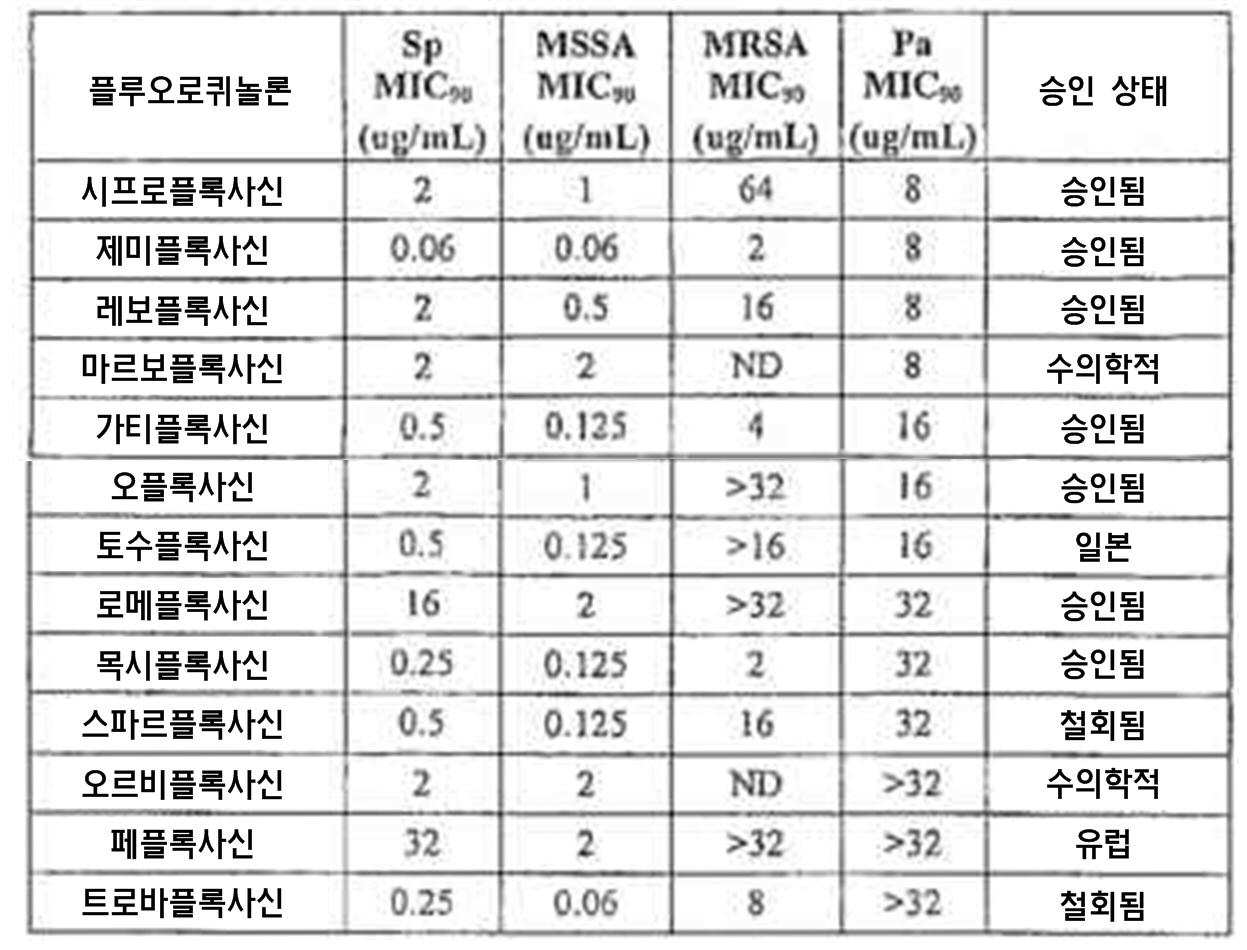
이러한 플루오로퀴놀론들은 그들의 효용성(availability), 승인 상태(approval status) 및 항균성 특성(antimicrobial properties) 등에 근거하여 선택되었다. 모든 테스트된 플루오로퀴놀론들은 미국에서 최근 승인되었거나 승인되었으나 후에 여러가지 부작용(adverse reactions)에 의해 철회된 것들이다. 게다가, 수의학적 적용(veterinary application)에서 사용하는 몇몇의 플루오로퀴놀론도 평가하였다. 호흡관 감염(respiratory tract infection)을 초래하는 세균성 병원체들 중에서, 슈도모나스 애루기노사(Pseudomonas 애루기노사; Pa) 및 메티실린 내성 스타필로코커스 아우레우스(Methicillin Resistant Staphylococcus Aureus; MRSA)는 플루오로퀴놀론 처리로 가장 치료가 어렵다. 스트렙토코커스 뉴모니아(Streptococcus pneumonia; Sp)는 아마도 호흡관 감염을 초래하는 가장 중요한 병원체일 것이며, 수많은 보고들은 이 세균에서 높은 비율의 플루오로퀴놀론 내성을 증명한다. Pa 및 MRSA 각각에 대한 MIC90는 4㎍/ml에서 32㎍/ml까지 및 2㎍/ml에서 >32㎍/ml까지의 범위를 갖는다. 시프로플록사신, 레보플록사신, 제미플록사신 및 가티플록사신 대(vs) 제미플록사신 및 목시플록사신은 Pa 및 MRSA 각각에 대항하여 가장 효능이 있다.These fluoroquinolones were selected based on their availability, approval status and antimicrobial properties. All tested fluoroquinolones were recently approved or approved in the United States, but were subsequently withdrawn by adverse reactions. In addition, some fluoroquinolones used in veterinary applications were also evaluated. Among bacterial pathogens that cause respiratory tract infection, Pseudomonas aeruginosa (Pa) and Methicillin-resistant Staphylococcus aureus (MRSA) are known as fluoroquinolones Treatment is the most difficult to treat. Streptococcus pneumonia (Sp) is probably the most important pathogen causing respiratory tract infections, and numerous reports demonstrate a high rate of fluoroquinolone resistance in this bacterium. The MIC 90 for each of Pa and MRSA ranges from 4 / / ml to 32 / / ml and from 2 / / ml to> 32 / / ml. Ciprofloxacin, levofloxacin, gemifloxacin, and gatifloxacin vs gemifloxacin and moxifloxacin are the most potent against Pa and MRSA, respectively.
표 7은 잠재적인 평가에 대한 추가적 플루오로퀴놀론의 목록을 포함한다. 목록에서 가장 미생물학적으로 흥미로운 화합물은 부작용 때문에 중지된 클리나플록사신 및 올라무플록사신과, 상태 Ⅲ(Phase Ⅲ) 의학적 시험에 있는 시토플록사신이다. Table 7 contains a list of additional fluoroquinolones for potential evaluation. The most microbiologically interesting compounds in the list are clinafloxacin and omeproloxacin, which are stopped due to side effects, and citofloxacin in the Phase III medical test.
[표 7][Table 7]
잠재적인 평가에 대한 플루오로퀴놀론.Fluoroquinolone for potential evaluation.

이러한 두 개의 표 내의 플루오로퀴놀론은 에어로졸 플로오로키놀론 후보에 대한 하나의 선택장을 나타낸다. 임상 개발의 초기 단계에 있는 DX-619 및 DW-286 등과 같은 몇몇 유력한 플루오로퀴놀론들은 향후 연구에서도 중요할 것이다.The fluoroquinolones in these two tables represent one selection field for aerosol fluoroquinolone candidates. Some potent fluoroquinolones such as DX-619 and DW-286 in the early stages of clinical development will be important in future studies.
분무를 위한 특이적 물리-화학적 고려는 수용성 용해도(aqueous solubility), 점성(viscosity) 및 표면 장력(surface tension) 등을 포함한다. 약물의 수용성 용해도는 충분한 것이 최소 투여 요구를 만족하거나 넘기에 유리하다. 적재 약물 농도도 전달 시간에 영향을 미친다. 더욱 긴 전달 시간은 상업적으로 허용 불가능하거나, 열악한 환자 순응(patient compliance)에 이를 수 있다. 비록 더욱 긴 전달 시간이 AUC 형태를 효과적으로 변경할 수 있지만, 비-제한 실험예에 의해, PARI eFlow 장치는 5분 이하에서 수용성 레보플록사신 4ml를 투여하는 것으로 발견되었다. 게다가, 이러한 효과적인 장치를 사용하면, 시간틀(timeframe) 내에서 본원 발명에서 설명한 효과적인 용량으로 고농도의 레보플록사신을 전달할 수 있고, 나아가 최적의 플루오로퀴놀론 치료에 필요한 신속 투여, 고농도 약물 요구 조건들을 가능케할 수 있다.Specific physical-chemical considerations for spraying include aqueous solubility, viscosity and surface tension, and the like. Sufficient solubility of the drug in water is sufficient to meet or exceed the minimum dosage requirements. Loading drug concentration also affects delivery time. Longer delivery times can be either commercially unacceptable or lead to poor patient compliance. By way of non-limiting experimental example, the PARI eFlow device was found to administer 4 ml of soluble levofloxacin in less than 5 minutes, although longer delivery times can effectively change the AUC form. In addition, using such an effective device, it is possible to deliver high concentrations of levofloxacin in the effective doses described in the present invention within a timeframe, and furthermore to enable rapid administration, high drug requirements required for optimal fluoroquinolone therapy .
플루오로퀴놀론의 경우, pH는 직적접으로 용해도에 영향을 준다. 일반적으로, 용해도는 pH가 1.5 내지 6.5의 범위에서 증가함과 함께 두드러지게 감소한다. pH 또한 환자 내성 능력(patient tolerability)에 영향을 미치기 때문에(아래 참조), 에어로졸을 통한 폐 전달(pulmonary delivery)을 위한 플루오로퀴놀론의 최적의 선택은 소정의 용해도 및 pH 레벨을 갖는 것이다.In the case of fluoroquinolones, pH directly affects solubility. In general, the solubility decreases markedly with increasing pH in the range of 1.5 to 6.5. Optimal selection of fluoroquinolones for pulmonary delivery via aerosol is of a given solubility and pH level, since pH also affects patient tolerability (see below).
이 실행가능성 연구의 목적을 위해, 목적 용해도를 치료 용량의 계산 및 이용 가능한 분무를 위한 전달 측정을 기초로, 10mg/mL 또는 그 이상, 4.5pH 또는 그 이상으로 설정하였다. 돌연변이 저지 농도(mutant prevention concentration; MPC)를 넘기 위해, 에어로졸 투여 후의 플루오로퀴놀론의 피크(peak) 농도는 감염 유기체의 MIC에 따라 감염 부위에서 약 100㎍/ml 내지 약 1000㎍/ml에 유리하게 도달한다. 이러한 고려 사항들에 기초하여, 치료학적으로 관련된 범위내에 있는 최소 용량을 적어도 약 30-40mg 호흡가능한 전달 용량(Respirable Delivered Dose; RDD)으로 계획하였다. 인간 폐 내의 레보플록사신의 상대적 반감기가 주어졌으므로, 4분 이하에서 상기 용량을 전달하는 최대 성능 효율로 동작하는 고-효율 바이브레이팅-메시 장치(high-efficiency vibrating-mesh device)에서 약 2 mL(약 50 mg/mL)의 부피 내에 적어도 약 100mg의 적재된 용량을 가지고 분무에 의한 상기 투여의 실질적 달성을 얻을 수 있다. 표준 초음파(standard ultrasonic) 또는 분사 분무(jet nebulizer)는 약 5mL(약 80mg/mL)의 부피에서 적어도 약 400mg의 용량을 적재하는 것을 필요로 할 수 있다. 그러나, 이러한 보다 덜 효율적인 장치에 의한 투여율은 단기 노출로 높은 국부 농도(local concentration)를 달성하기에 충분하지 않을 수 있다. 유사한 효과가 있는 용량은 건조 분말의 레보플록사신을 투여하여 성취할 수 있으며, 이것은 레보플록사신의 빠른 용해도 특성이 이러한 원하는 가용성 약물 농도를 도출하는 빠른 용해를 가능케 할 수 있다. 그러나, 플루오로퀴놀론 AUC 형태 프로파일의 변경 또는 대안 농도가 바람직할 수 있다.For the purpose of this feasibility study, the intended solubility was set at 10 mg / mL or more, 4.5 pH or more based on the calculation of the therapeutic dose and the delivery measurements for the available spray. To exceed the mutant prevention concentration (MPC), the peak concentration of fluoroquinolone after aerosol administration is advantageously from about 100 μg / ml to about 1000 μg / ml at the site of infection, depending on the MIC of the infecting organism . Based on these considerations, the minimum dose within a therapeutically relevant range was planned to be at least about 30-40 mg Respirable Delivered Dose (RDD). Given the relative half-life of levofloxacin in the human lungs, a high-efficiency vibrating-mesh device operating at maximum performance efficiency delivering the dose in less than 4 minutes should be approximately 2 mL (approximately 50 gt; mg / mL) < / RTI > with a loading capacity of at least about 100 mg. Standard ultrasonic or jet nebulizers may require loading a volume of at least about 400 mg at a volume of about 5 mL (about 80 mg / mL). However, dosing rates by such less efficient devices may not be sufficient to achieve a high local concentration with short-term exposure. Capacities with similar efficacy can be achieved by administration of dry powder levofloxacin, which may allow fast dissolution characteristics of levofloxacin to elicit such desired soluble drug concentrations. However, alteration of the fluoroquinolone AUC form profile or alternative concentrations may be desirable.
선택적으로, 수용성 용해도가 중요하다고 할 지라도, 보다 낮은 가용성 플루오로퀴놀론의 분무를 가능하게 하기 위해 입자(particle) 또는 복합체화(complexation) 기술을 이용한 제제를 예상하는 것이 가능하다. 유감스럽게도, 더 난해한 제제는 복잡성 및 약물 개발 비용 모두를 증가시키고, 분사 및 초음파 분무기의 경우에는 전달 효율에서 뚜렷한 감소, 그리고 또다른 설계 요소를 최종 의약 제품으로 도입하는 능력을 제한한다.Alternatively, although water solubility is important, it is possible to anticipate a formulation using particles or complexation techniques to enable the spraying of lower soluble fluoroquinolones. Unfortunately, more complicated formulations increase both complexity and cost of drug development and, in the case of injection and ultrasonic atomizers, a significant reduction in delivery efficiency and the ability to introduce yet another design element into the final product.
약물 용해도 외에도, 바이브레이팅-메시 장치에 있어서 분무는 약물 제제의 표면 장력에도 또한 민감하다. 그러므로, 본 발명의 일 실시예에 있어서, 약물 농도, 첨가제 농도의 변경 및/또는 계면 활성제의 부가에 의해 제제화하는 동안 표면 장력을 조절한다.In addition to drug solubility, spraying in a vibrating-mesh device is also sensitive to the surface tension of the drug formulation. Therefore, in one embodiment of the present invention, the surface tension is controlled during formulation by changing drug concentration, additive concentration, and / or addition of surfactant.
효과적인 분무에 영향을 주는 요소 외에도, 환자 내성 능력 및 순응에 대한 또 다른 요소를 고려할 수 있다. 비-제한 실험예에 의하여, 이런 요소들은 삼투질 농도(osmolality), pH 및 테이스트(taste)을 포함할 수 있다. 삼투질 농도는 호흡관에서 민감한 내성 능력(tolerability)에 영향을 주며, 제제화하는 동안 대부분의 약물에 대하여 최적화될 수 있다. 유사하게, 에어로졸의 pH는 또한 내성 능력에 기여할 수 있으나, 아직까지는 단지 제제의 pH가 4.5이하일 때 부정적이다. 그러므로, pH가 플루오로퀴놀론 용해도에 직접적으로 기여하기 때문에, 용해도에 대해 4.5이하의 pH가 요구되는 플루오로퀴놀론은 내성이 열악할 수 있다. 최종적으로, 플루오로퀴놀론 테이스트는 양호한 환자 순응에 영향을 줄 수 있다. 플루오로퀴놀론은 일반적으로 불쾌하고, 때때로 매우 강렬한 테이스트가 연상되는 것으로 알려져 있다. 열악한 약물 테이스트를 방지할 수 있는 적용 가능한 기술들이 있으나, 이러한 기술들은 복잡성 및 비용이 증가하며, 플루오로퀴놀론의 경우에는 완전히 효과적이지 않을 수 있다. 따라서, pH와 유사하게, 테이스트는 분무에 적합한 플루오로퀴놀론을 확인하는 것을 고려할 수 있다.In addition to factors affecting effective spraying, another factor in patient tolerance and compliance may be considered. By non-limiting experimental examples, these factors may include osmolality, pH and taste. Osmotic concentration affects the tolerability of the respiratory tract in the respiratory tract and can be optimized for most drugs during formulation. Similarly, the pH of the aerosol may also contribute to the ability to resist, but so far it is only negative when the pH of the formulation is below 4.5. Therefore, fluoroquinolones, which require a pH of less than 4.5 for their solubility, may be poorer in resistance, since the pH directly contributes to the solubility of the fluoroquinolone. Finally, fluoroquinolone tastes can affect good patient compliance. Fluoroquinolones are generally known to be uncomfortable, sometimes with a very intense taste. There are applicable techniques that can prevent poor drug taste, but these techniques increase complexity and cost, and may not be completely effective in the case of fluoroquinolones. Thus, similar to pH, tastes can be considered to identify suitable fluoroquinolones for spraying.
테스트 용액의 제조 및 특성화Preparation and characterization of test solutions
표 8에 나타낸 바와 같이, 여러 출처 중 하나에서 항생제를 구입하였다.Antibiotics were purchased from one of several sources, as shown in Table 8.
[표 8][Table 8]
플루오로퀴놀론 테스트 용액의 제조.Preparation of Fluoroquinolone Test Solution.

a. LKT: LKT Laboratories. LG: LG Chem. NA. 출처 부재. a. LKT: LKT Laboratories. LG: LG Chem. NA. Absence of source.
b. 재료의 순도를 테스트 했음. GMP 또는 퍼센트 API로 설명됨. b. The purity of the material was tested. Described as GMP or Percent API.
c. 25 mg/ml 용액.c. 25 mg / ml solution.
각 항생제 2 내지 20mg 시료를 멸균 플라스틱 튜브에서 무게를 재고, 일정 부피의 멸균수로 배양하여 10mg/mL의 용액 또는 서스펜션을 만들었다. 후속 취급에 앞서, 시료를 이따금씩 혼합(mixing)하며 실온에서 대략 10분간 배양하였다.Each 2 to 20 mg sample of each antibiotic was weighed in a sterile plastic tube and incubated in a constant volume of sterile water to make a 10 mg / mL solution or suspension. Prior to subsequent handling, samples were occasionally mixed and incubated at room temperature for approximately 10 minutes.
상기 배양 단계에 이어, 그들의 관측 가능한 외관에 대하여 항생제 용액을 관찰하였고, 표 9에 나타낸 결과와 같다.Following this incubation step, antibiotic solutions were observed for their observable appearance and are shown in Table 9.
테스트된 플루오로퀴놀론 중에서 5 개는 관측 가능한 가용성이며, 무색 또는 진한 황색이었다. 8개는 관측 가능한 불용성이었고, 관측 가능한 침전물을 가지는 모든 경우에서 흐림(미세 미입자), 불투명(밀집한 미세 내지 중간 미입자), 또는 탁함(두껍고, 큰 미립자 슬러리) 중 어느 하나를 나타내었다. 이들의 최초 용액의 pH를 측정하였고, 3.5에서 7.0까지로 범위를 정했다. 불용성 용액을 관측 가능한 용해도 지점으로 1N HCl로 적정하여, 가용화된 용액의 pH를 관찰하였다. 마르보플록사신, 스파르플록사신 및 투소플록사신의 경우, 용해도는 pH 1.5까지 도달하지 못하였고 그 후 산의 첨가를 중지하였다. 오플록사신을 제외하고, 상기 적정된 용액의 pH는 1.5 내지 3.0의 범위였다.Of the fluoroquinolones tested, 5 were observable soluble and colorless or dark yellow. Eight were observable insoluble and exhibited either cloudy (micro-fine particles), opaque (dense fine to medium fine grains), or turbid (thick, large fine grained slurry) in all cases with observable sediments. The pH of their initial solution was measured and ranged from 3.5 to 7.0. The insoluble solution was titrated with 1N HCl at the observable solubility point and the pH of the solubilized solution was monitored. In case of marbophloxacin, sparfloxacin and touofloxacin, the solubility did not reach the pH of 1.5 and then the addition of the acid was stopped. With the exception of oproxacin, the pH of the titrated solution ranged from 1.5 to 3.0.
[표 9][Table 9]
플루오로퀴놀론 용액 특성.Fluoroquinolone solution characteristics.

a. NR: pH 조절이 요구되지 않음. 플루오로퀴놀론은 최초 용액에서 pH≥4에서 가용성이었음.a. NR: pH adjustment not required. The fluoroquinolone was soluble in the initial solution at pH? 4.
pH 조절 후에, 이따금씩 혼합하며 10분 배양 기간을 둔 후, 에어로졸 내성 능력 및 테이스트 테스트 직전에 용액의 최종 외관을 측정하였다. 결과를 표 10에 나타내었다.After pH adjustment, occasional mixing and a 10 minute incubation period were performed, and the final appearance of the solution was measured immediately before the aerosol tolerance ability and taste test. The results are shown in Table 10.
[표 10][Table 10]
플루오로퀴놀론 최종 용액의 외관.Appearance of the final solution of fluoroquinolone.

Y=황색; LY=연한 황색; VLY=매우 연한 황색; DY=짙은 황색; C=무색; W =백색.Y = yellow; LY = light yellow; VLY = very light yellow; DY = dark yellow; C = colorless; W = white.
흡입(inhalation)에 의한 전달에 적절한 용액에 선호되는 용해도(4.5 또는 그 이상의 pH에서 10mg/mL)를 보이는 화합물은 레보플록사신, 제미플록사신, 목시플록사신, 오플록사신 및 페플록사신이었다. 레보플록사신, 오플록사신 및 목시플록사신은 가장 양호한 용해도/pH 특성을 보였다.Compounds that showed the preferred solubility (10 mg / mL at pH 4.5 or higher) for solutions suitable for delivery by inhalation were levofloxacin, gemifloxacin, moxifloxacin, oproxacin and phefloxacin. Levofloxacin, oproxacin and moxifloxacin showed the best solubility / pH characteristics.
테이스트Taste 및 내성 능력 평가 And tolerance assessment
두 가지의 평가를 수행하여 테이스트 및 내성 능력에 대한 플루오로퀴놀론 용액의 적절성을 결정하였다.Two evaluations were performed to determine the suitability of the fluoroquinolone solution for taste and tolerance ability.
첫째로, 경구 테이스트 테스트(oral taste test)에서 단독의, 건강한 인간 지원자에게 혀의 중앙 앞 부분에 직접적으로 물질을 두어 테스트 시료의 20㎕ 부분의 테이스트를 측정하였다. 그리고 나서, 테이스트를 1분 기간을 넘어 모니터하였다. 이 테스트를 준비된 최초 용액뿐만 아니라 pH 조절 후의 최후 용액에도 수행하였다. 데이타는 표 11에 나타내었다.First, in an oral taste test, a 20 μl portion of the test sample was measured by placing the material directly on the center front of the tongue to a single, healthy human volunteer. The taste was then monitored over a one minute period. This test was performed not only on the initial solution prepared but also on the last solution after pH adjustment. The data are shown in Table 11.
[표 11][Table 11]
경구 플루오로퀴놀론 Oral fluoroquinolone 테이스트Taste 테스트. Test.

pH의 저하는 일반적으로 용액의 테이스트 특성을 향상시키는 효과를 가진다. 가티플록사신, 제미플록사신, 시프로플록사신, 오르비플록사신 및 트로바플록사신은 테이스트 테스팅에서 가장 낮게 바람직하였다. 테스트된 플루오로퀴놀론 중에서, 레보플록사신은 테스트된 농도에서 테이스트에 대하여 내성이 있는 유일한 플루오로퀴놀론이었다. 로메플록사신은 적당히 강한 아몬드 같은(almond-like) 테이스트를 가졌고, 상기 테이스트는 약간 불쾌했다.The lowering of the pH generally has an effect of improving the taste characteristics of the solution. Gatifloxacin, gemifloxacin, ciprofloxacin, orbifloxacin and trovafloxacin were the least desirable in taste testing. Among tested fluoroquinolones, levofloxacin was the only fluoroquinolone resistant to tastes at the tested concentrations. Romexcrox had moderately strong almond-like tastes, and the taste was slightly unpleasant.
두번째 테스트에서, 테스트 제제의 0.5ml 알리쿼트(aliquot)로부터의 작은 에어로졸 시료의 내성 능력 및 테이스트를 단독의, 건강한 인간 지원자에게 PARI eFlow 분무기에서 분무한 후에 관찰하였다(표 12).In the second test, the tolerance and taste of the small aerosol sample from the 0.5 ml aliquot of the test formulation was observed after spraying a single, healthy human volunteer on the PARI eFlow sprayer (Table 12).
[표 12][Table 12]
에어로졸 플루오로퀴놀론 내성 능력 및 Aerosol fluoroquinolone resistance ability and 테이스트Taste 테스트. Test.
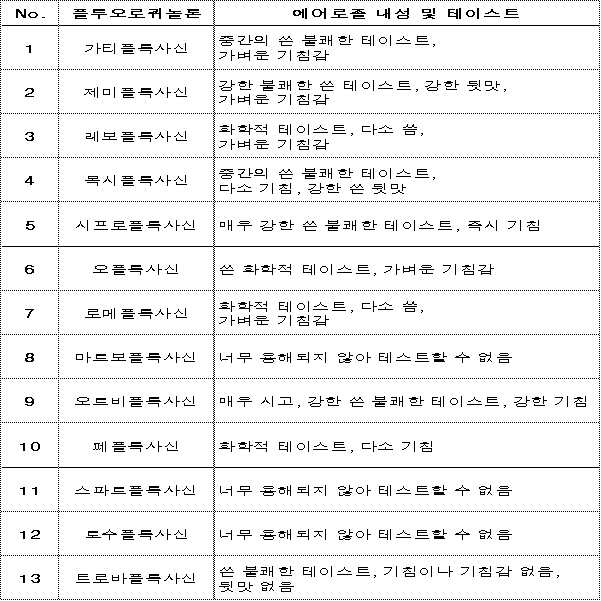
오르비플록사신, 마르보플록사신 및 트로바플록사신의 경우, 용해도 제한 때문에 더 적은 부분을 테스트하였다. 눈금 측정(calibration) 실험에서, 흡입기는 1.64 마이크론 VMD의 기하 표준 편차(Geometric Standard Deviation; GSD)를 가지는 4.1 마이크론(micron) VMD 에어로졸 아웃풋(output)을 생산하였다. 이러한 측정에 부가하여, 흡입기는 54.9% (5 마이크론 이하의 입자들에서 방사 용량의 퍼센트)의 미세 입자 용량 (Fine Particle Dose; FPD)을 생산하였다. 매우 짧은 투여 기간 동안 및 투여 후 10분의 기간 동안의 약물의 내성 능력 및 테이스트를 모니터하였다. 내성 능력 파라미터(파라미터)는 아래의 타입들과 같다: (i)기침, 기침감(cough sensation), 또는 재채기 (ii)목(throat)의 염증(irritation), 뜨거움(burning) 또는 긴장(tightness), (ii)콧구멍(nasal passages) 또는 눈에서 염증 또는 점액 분비(runniness), (iii)폐의 염증, 뜨거움, 또는 긴장이나 숨가쁨, 및 (iv)어지럼증(dizziness), 두통, 구역질 또는 다른 시스템적 효과들.In the case of orbifloxacin, marbophloxacin and trovafloxacin, fewer parts were tested for solubility limitations. In a calibration experiment, the inhaler produced a 4.1 micron VMD aerosol output with a Geometric Standard Deviation (GSD) of 1.64 micron VMD. In addition to these measurements, the inhaler produced Fine Particle Dose (FPD) of 54.9% (percent of spinning capacity at particles below 5 microns). The drug tolerance ability and taste during a very short administration period and during a 10 minute period after administration were monitored. The immunity ability parameters are as follows: (i) cough, cough sensation, or sneezing; (ii) irritation, burning or tightness of the throat; , (ii) inflammation or mucus secretion in the nasal passages or eyes, (iii) inflammation of the lungs, hotness or tension or shortness of breath, and (iv) dizziness, headache, Enemy effects.
마르보플록사신, 스파르플록사신 및 투소플록사신은 너무 용해되지 않아 본 테스트를 평가하지 못하였다. 나머지 테스트된 플루오로퀴놀론에 대하여, 상기 ii, iii 또는 iv 카테고리에서 에어로졸 노출을 하는 동안 또는 후, 내성 능력 효과는 관찰되지 않았다. 가티플록사신, 목시플록사신 시프로플록사신, 오르비플록사신 및 페플록사신은 모두 기침과 관련되었다. 시프로플록사신 및 오르비플록사신의 경우에서, 이것은 용액의 낮은 pH과 연관될 수 있다. 테스트된 플루오로퀴놀론들 중에서, 레보플록사신 10mg/ml에서 가장 좋은 테이스트 특성을 가졌다. 오플록사신, 로메플록사신 및 페플록사신은 레보플록사신 보다 더 많은 식별 가능한 테이스트를 가졌으며, 또한 투여의 짧은 코스(course) 동안에도 허용 가능하였다.Marbophloxacin, sparfloxacin, and touofloxacin were not overly soluble and did not evaluate this test. For the remaining tested fluoroquinolones, no resistance-resistance effect was observed during or after aerosol exposure in the ii, iii or iv category. Gatifloxacin, moxifloxacin, ciprofloxacin, orbifloxacin, and pherophocassin all were associated with cough. In the case of ciprofloxacin and orbifloxacin, this can be associated with a low pH of the solution. Of the tested fluoroquinolones, levofloxacin had the best tasting properties at 10 mg / ml. Ophloxacin, romexlogoxin and pheoproxasin had more recognizable tastes than levofloxacin, and were also acceptable during a short course of administration.
플루오로퀴놀론 Fluoroquinolone 테이스트Taste 테스트로부터의 요약 및 결론 Summary and Conclusions from Tests
본 조사에서 테스트된 13개의 플루오로퀴놀론 중에서, 레보플록사신은 에어로졸 투여에 대하여 선호되는 물리-화학적 특성을 가졌으며, 테스트된 플루오로퀴놀론 중에서 가장 민감한 내성 능력을 보였다(표 13). 레보플록사신은 또한 호흡 병원체에 대한 가장 좋은 항균 프로파일들 중의 하나를 가지는 것으로 인정되며, 슈도모나스 애루기노사 감염의 치료에 대한 시프로플록사신과 비교하여 가장 높은 생체 효능을 가지는 것 또한 인정되었다.Of the thirteen fluoroquinolones tested in this study, levofloxacin had the physico-chemical properties preferred for aerosol administration and showed the most sensitive tolerance ability among tested fluoroquinolones (Table 13). Levofloxacin is also recognized as having one of the best antimicrobial profiles for respiratory pathogens and has also been shown to have the highest bioavailability compared to ciprofloxacin for the treatment of Pseudomonas aeruginosa infection.
[표 13][Table 13]
분무에 대한 전체적인 적합성.Overall suitability for spraying.

오플록사신, 로메플록사신 및 페플록사신은 10mg/mL에서 레보플록사신 보다 더 낮은 용해도 및 더 강한 테이스트를 보였다. 오플록사신은 레보플록사신보다 2배 적은 효능이 있고, 로메플록사신 및 페플록사신은 4배 적은 효능이 있다. 이러한 항생제의 더 높은 농도는 선호되는 효능 및 15분 이하의 투여 시간을 가진다.Orophocassin, lomeproxacin, and pherophocassin showed lower solubility and stronger tastes than levofloxacin at 10 mg / mL. Oropharkaxin is twice as effective as levofloxacin, while romexclocassin and phephroxacin have four times less efficacy. Higher concentrations of such antibiotics have a favorable efficacy and an administration time of 15 minutes or less.
별도의 연구에서, 유사한 방식으로 수행된 노르플록사신을 테스트하여, 그람-양성(gram-positive) 병원체에 대항하여 상당히 더 적은 활성을 가지는 점을 제외하고, 가티플록사신과 매우 유사한 용해도, 테이스트 및 효능 프로파일을 갖는 것을 발견하였다. In a separate study, Norfloxacin performed in a similar manner tested the solubility, taste and flavor characteristics very similar to gatifloxacin, except that it had significantly less activity against Gram-positive pathogens, Efficacy profile.
레보플록사신Levofloxacin 및 제미플록사신의 And gemifloxacin 에어로졸염Aerosol salt (( AerosolAerosol SaltSalt ) 제제의 ) Of formulation 테이스트Taste 테스트 Test
상기 연구들의 결과에 기초하여, 레보플록사신, 및 이의 라세미 화합물(racemate)인 오플록사신, 뿐만 아니라 제미플록사신, 및 더 작은 범위에서 가티플록사신 및 노르플록사신은 폐의 항세균성 치료를 위한 에어로졸 투여에 적용가능하다. 레보플록사신 및 제미플록사신의 테이스트 및 민감한 내성 능력(기침감 및 기침) 특성을 더 나아가 테스트하기 위해, 몇몇의 제제를 다양한 유기적 및 비유기적 산(acid)으로 제조하였고, 앞서 설명한 방식으로 테스트하였다. 용액을 물 10ml에 레보플록사신 500mg의 첫번째 첨가하거나, 염수(saline) 20ml에 제미플록사신 500mg을 첨가하고(용해도 제한에 의함), HCl 또는 유기산(organic acid)로 pH ~6.5으로 적정하고, 그리고 나서 소듐 클로라이드(sodium chloride)로 ~300mOsmol/kg으로 용액을 포함하는 레보플록사신의 삼투질 농도를 조절하여 제조하였다. 테스트된 제제를 표 14에 표시하였다.On the basis of the results of these studies, levofloxacin, and its racemate, oproxacin, as well as gemifloxacin, and to a lesser extent gatifloxacin and norfloxacin, Lt; / RTI > To further test the taste and sensitive tolerance properties (coughing and coughing) properties of levofloxacin and gemifloxacin, several preparations were prepared with various organic and inorganic acids and tested in the manner described above. 500 mg of levofloxacin is first added to 10 ml of water or 500 mg of gemifloxacin is added to 20 ml of saline (by solubility limitation), titrated to pH ~ 6.5 with HCl or organic acid, Was prepared by adjusting the osmotic concentration of levofloxacin containing solution at ~ 300 mOsmol / kg with sodium chloride. The tested formulations are shown in Table 14.
신중히 제어되고, 머리-대-머리(head-to-head), 완전한 블라인드 테스트에서, 레보플록사신 농도 50mg/mL, 및 제미플록사신 농도 25 mg/mL에서, 상술한 것과 동일한 방법으로 총 3명의 건강한 인간 지원자에게 상기 제제를 테스트하였다. 결과를 표 15 및 16에 나타내었다.At a controlled, head-to-head, complete blind test, at a levofloxacin concentration of 50 mg / mL and a gemifloxacin concentration of 25 mg / mL, The applicant was tested for the formulation. The results are shown in Tables 15 and 16.
이러한 결과들은 레보플록사신의 염산(hydrochloric acid), 시트르산(citric acid) 및 아스코르브산(ascorbic acid) 제제가, 레보플록사신의 아세트산(acetic acid), 락트산(lactic acid) 및 타르타르산(tartaric acid) 제제와 비교하여, 더 우수한 테이스트 및 내성 능력을 가지는 것을 증명한다. 나아가, 이러한 레보플록사신 제제는 등가의(equivalent) 제미플록사신 제제보다 더 우수한 테이스트 및 내성 능력을 가진다. 제미플록사신에 대하여, 시트르산 제제 제미 플록사신의 HCl 및 아스코르브산 제제와 비교하여 더 우수한 테이스트 및 내성 능력을 가지며, 추가적인 제제 정제(refinement)와 함께 에어로졸 투여에 적용가능할 것이다..These results indicate that hydrochloric acid, citric acid and ascorbic acid of levofloxacin are superior to acetic acid, lactic acid and tartaric acid of levofloxacin, It proves to have better taste and tolerance ability. Furthermore, such levofloxacin preparations have a better taste and tolerance ability than equivalent gemifloxacin preparations. With respect to gemifloxacin, it has better taste and tolerance ability than HCl and ascorbic acid preparations of citric acid formulation gemifloxacin and will be applicable to aerosol administration with additional formulation refinement.
[표 14][Table 14]
레보플록사신Levofloxacin 및 제미플록사신 제제. And gemifloxacin.

[표 15][Table 15]
50 50 mgmg // mLmL 에서 in 레보플록사신Levofloxacin 제제의 에어로졸 Aerosol formulations 테이스트Taste 및 내성 능력. And tolerance.

[표 16][Table 16]
25 25 mgmg // mLmL 에서 제미플록사신 제제의 Of Gemifloxacin in 테이스트Taste 및 내성 능력. And tolerance.

추가적인 에어로졸 Additional aerosols 레보플록사신Levofloxacin 제제의 Formulation 테이스트Taste 테스팅Testing
추가적인 레보플록사신 첨가제 조합의 테이스트 및 내성 능력 특성을 시스테매틱 방식(systematic manner)으로 테스트하기 위해, 일련의 제제를 제조하여 테스트하였다. 제제들을 표 17에 열거하였다. 그들은 물로 레보플록사신을 혼합하고, 표 17에 열거된 첨가체를 첨가하고, 필요하다면 희석한 HCl로 원하는 pH로 적정하여 제조한 슈가, 염(salt), 감미제 및 다른 첨가제 등을 포함하며, 삼투질 농도는 본 연구에 대해 최적화되지 않았다. 그러나, Advanced Instruments Model 3250 Osmometer를 이용하여 삼투질 농도를 측정하였다. 시료 250㎕에 행해진 상기 측정은 어는점 내림(freezing point depression)에 의존하여 삼투질 농도를 측정한다. To test the taste and tolerance properties of additional levofloxacin additive combinations in a systematic manner, a series of formulations were prepared and tested. The formulations are listed in Table 17. They include sugars, salts, sweeteners and other additives prepared by mixing levofloxacin with water, adding the additives listed in Table 17 and, if necessary, titrating to the desired pH with dilute HCl, Were not optimized for this study. However, osmolality was measured using an
신중히 제어되고, 머리-대-머리(head-to-head), 완전히 블라인드(blinded) 테스트에서, 상술한 바와 같이 동일한 방식으로 일련의 테스트들(A-G)로 총 3명의 건강한 인간 지원자에게 상기 제제들을 테스트하였다. 모든 테스트는 완전한 블라인드 방식(fully blinded fashion)으로 수행되었다. 테스트의 결과(표 19 내지 25)를 아래에 설명하였다. 하기의 스코어링 시스템을 사용하였다(표 18).In a carefully controlled, head-to-head, totally blinded test, a total of three healthy human volunteers with a series of tests (AG) in the same manner as described above, Respectively. All tests were performed in a fully blinded fashion. The results of the tests (Tables 19 to 25) are described below. The following scoring system was used (Table 18).
테스트 A: 감미료의 테이스트 테스팅 , 2가 금속염( Divalent Metal Salts ), 및 계면 활성제( Surface Active Agent ). 이 테스트는 감미료, 칼슘과 마그네슘염, 및 계면 활성제(예를 들어, 글리세린 및 PS-80)를 포함하였다. 표 17에 나타낸 바와 같이, 감미료를 포함하는 제제들은 약간 쓴(mildly bitter) 테이스트를 보였고, 금속 테이스트를 가졌다. 인공 감미료는 관찰된 것과 달리 쓴맛(bitterness)와는 별개의 쓴 테이스트(bitter taste)를 생성하는 것으로 보였다. 가장 두드러지게, CaCl2를 포함하는 제제는 대조군(MgCl2는 본 실험에서 테스트하지 않음)과 비교하여 가장 개선된 테이스트를 가졌다(표 19). Test A: Taste of Sweetener Testing, divalent metal salts (Divalent Metal Salts), and surfactants (Surface Active Agent ). This test included sweeteners, calcium and magnesium salts, and surfactants (e.g., glycerin and PS-80). As shown in Table 17, the formulations containing the sweetener showed mildly bitter tastes and had metal tastes. Artificial sweeteners appeared to produce a bitter taste that is distinct from the bitterness observed. Most notably, the formulation containing CaCl 2 had the most improved taste compared to the control (MgCl 2 not tested in this experiment) (Table 19).
테스트 B: 칼슘 클로라이드의 존재 하에서 단당류( Mono -) 및 이당류( Disaccharide )의 테이스트 테스팅 . 본 실험에서 스크린된(screened) 모든 제제는 대조군 시료보다 더 좋은 맛이 나고, 양호한 내성을 가졌다. 칼슘염 및 당을 모두 포함하는 제제는 둘 중 하나 단독의 경우보다 양호하게 수행하였다. 상기 화합물들은 다양한 메커니즘을 통해 테이스트를 개선하는 것을 암시한다. 상기 제제들 중에서, 5% CaCl2 + 7.5 % 글루코오스가 가장 양호하게 작용하였다. 락토오즈는 다른 당보다 더 낮은 농도에서 존재한다는 점을 언급해 둔다(표 20). Test B: monosaccharides (Mono -) in the presence of calcium chloride in taste and disaccharides (Disaccharide) Testing . All of the screened preparations in this experiment had better taste and better tolerance than the control samples. The preparation containing both the calcium salt and the saccharide performed better than either alone. These compounds imply improving taste through a variety of mechanisms. Of these formulations, 5% CaCl 2 + 7.5% glucose worked best. Note that lactose exists at a lower concentration than other sugars (Table 20).
[표 17][Table 17]
다양한 첨가제를 포함하는 Containing various additives 레보플록사신Levofloxacin 제제. Formulation.
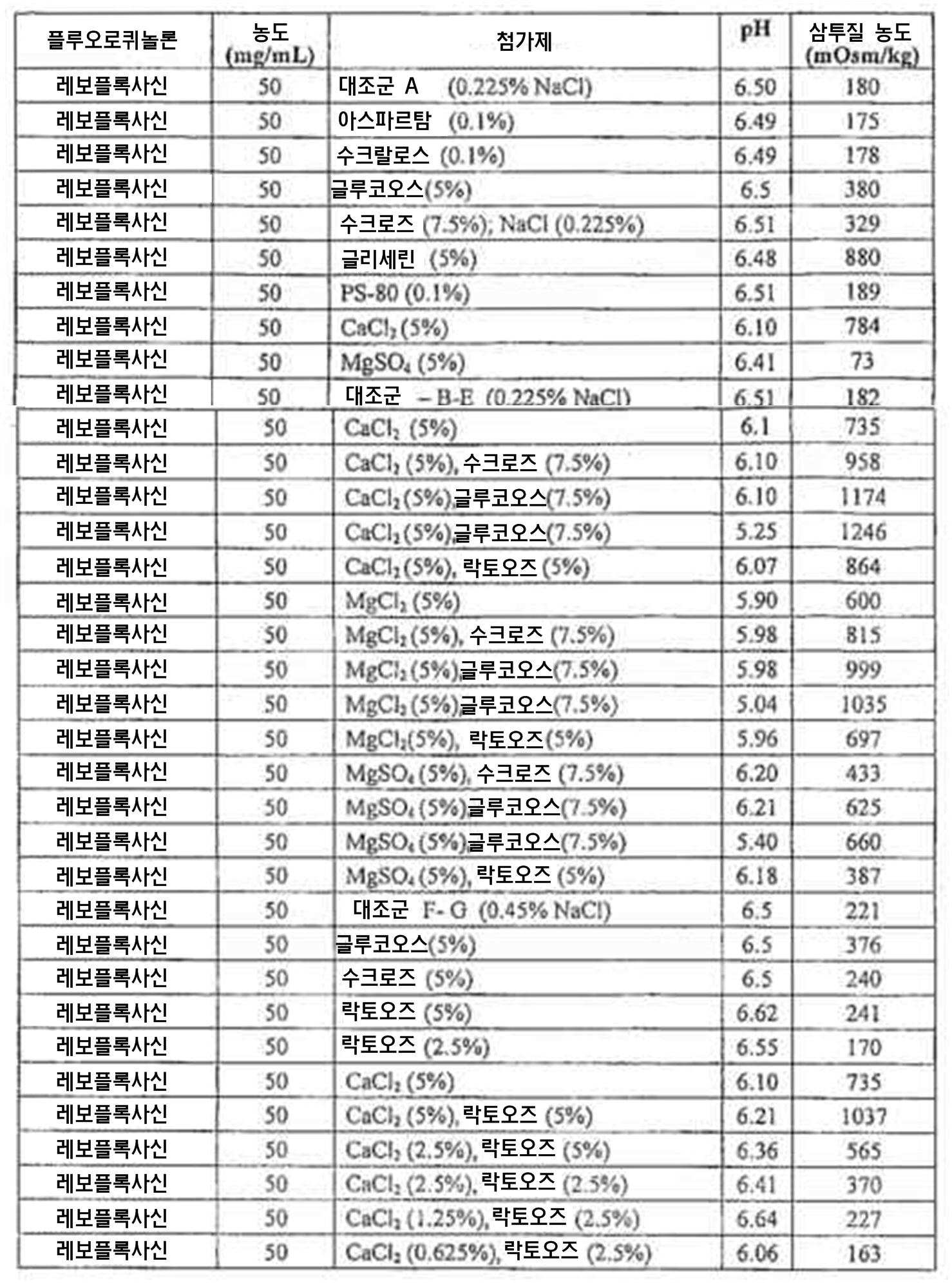
[표 18][Table 18]
테이스트Taste 테스트 Test 스코어링Scoring 시스템. system.

[표 19][Table 19]
감미료, 2가 금속염, 및 계면 활성제를 포함하는 Sweeteners, divalent metal salts, and surfactants. 레보플록사신Levofloxacin 제제의 Formulation 테이Tei 스트 및 내성 능력.Strength and tolerance.

[표 20][Table 20]
레보플록사신Levofloxacin CaClCaCl 22 제제의 Formulation 테이스트Taste 및 내성 능력. And tolerance.

테스트 C: 마그네슘 클로라이드 존재 하에서 단당류( Mono -) 및 이당류( Disaccharide)의 테이스트 테스팅 . 상술한 바와 같이, 본 실험에서 스크린된(screened) 모든 제제는 대조군 시료보다 더 좋은 맛이 나고, 양호한 내성을 가졌다. 마그네슘염 및 락토오즈를 모두 포함하는 제제는 둘 중 하나 단독의 경우보다 약간 양호하게 작용하였다. 본 실험에서 2가 금속염 및 단당(simple sugar)을 결합시키는 것은 테이스트를 개선하는데 효과적이라는 것을 확인하였다(표 21). Test C: Determination of monosaccharide ( Mono -) and disaccharide in the presence of magnesium chloride Taste Testing . As described above, all of the preparations screened in this experiment had better taste and good tolerance than the control samples. The formulation containing both the magnesium salt and the lactose worked slightly better than either alone. It was confirmed in this experiment that combining divalent metal salts and simple sugars is effective in improving the taste (Table 21).
[표 21][Table 21]
레보플록사신Levofloxacin MgClMgCl 22 제제의 Formulation 테이스트Taste 및 내성 능력. And tolerance.

테스트 D: 마그네슘 술페이트 ( magnesium sulfate ) 존재 하에서 단당류( Mono -) 및 이당류( Disaccharide )의 테이스트 테스팅 . 칼슘 및 마그네슘 클로라이드에서 처럼, 마그네슘 술페이트 및 글루코오스, 수크로즈 또는 락토오즈를 포함하는 제제는 대조군 시료보다 더 좋은 맛이 났다. 본 실험은 2가 금속염 및 단당을 결합시키는 것이 테이스트를 개선한다는 점을 재확인하였다(표 22). Test D: magnesium sulfate (magnesium Under sulfate) present monosaccharides (Mono - the taste) and disaccharides (Disaccharide) Testing . As with calcium and magnesium chloride, preparations containing magnesium sulfate and glucose, sucrose or lactose tasted better than the control samples. This experiment reaffirmed that combining divalent metal salt and monosaccharide improves the taste (Table 22).
[표 22][Table 22]
레보플록사신Levofloxacin MgSOMgSO4 44 제제의 Formulation 테이스트Taste 및 내성 능력. And tolerance.
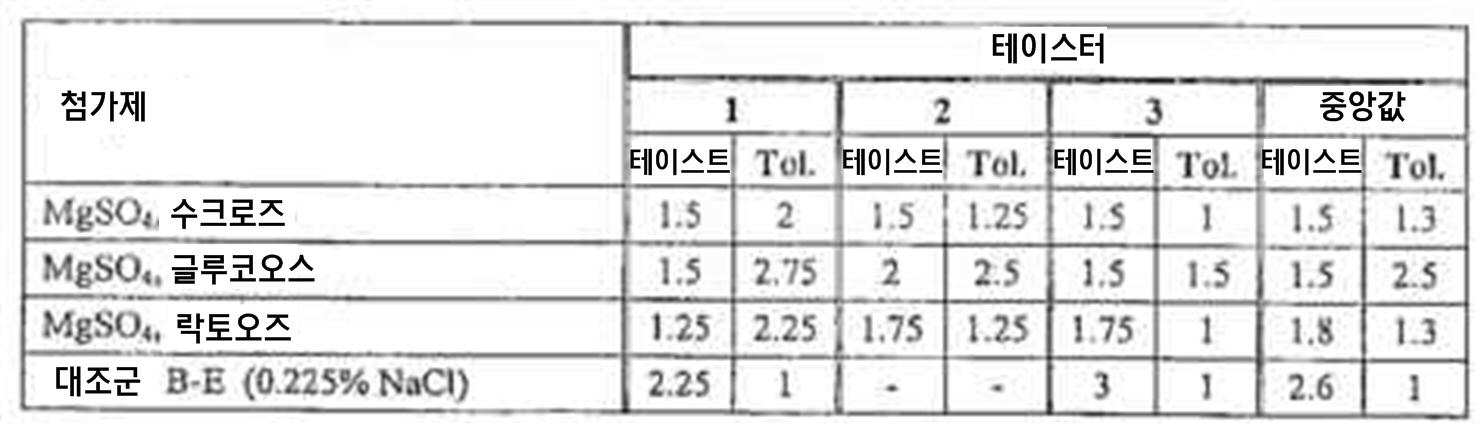
테스트 E: 낮고 높은 pH 에서 글루코오스 존재 하에서 2가 금속염의 테이스트 테스팅 . 본 실험에서, 테이스트 및 내성 능력에 대한 3개의 2가 양이온염(divalent cation salts) 각각의 조합에서 글루코오스의 효과를 낮고(≤5.5) 높은(≥6.0) pH에서 테스트 하였다. 보다 높은 pH에서 작지만 일관된 테이스트의 개선이 관찰되었다(표 23). Test E: Taste of divalent metal salt in the presence of glucose at low and high pH Testing . In this experiment, the effect of glucose on the combination of each of the three divalent cation salts for taste and tolerance was low (≤5.5) and tested at high (≥6.0) pH. A small but consistent improvement in taste was observed at higher pH (Table 23).
[표 23][Table 23]
낮은 low pHpH 대 높은 High vs. high pHpH 에서 in 레보플록사신Levofloxacin CaClCaCl 22 제제의 Formulation 테이스트Taste 및 내성 능력. And tolerance.

테스트 F. 단당류( Mono -) 및 이당류( Disaccharide )의 테이스트 테스팅 . 본 실험에서 스크린된(screened) 모든 제제는 대조군 시료보다 더 좋은 맛이 나고, 양호한 내성을 가졌다. 5%에서의 3개 당 모두는 대조군보다 양호하였고, 2.5%에서 테스트된 락토오즈는 대조군보다 좋은 맛이 났지만, 5%만큼 좋지는 않았다. 본 실험은 단당이 테이스트를 개선한다는 것을 재확인하였다(표 24). Taste and the disaccharide (Disaccharide) - Test F. monosaccharides (Mono) Testing . All of the screened preparations in this experiment had better taste and better tolerance than the control samples. All three at 5% were better than the control, and the lactose tested at 2.5% tasted better than the control, but not as good as 5%. This experiment reaffirmed that monosaccharide improves taste (Table 24).
[표 24][Table 24]
레보플록사신Levofloxacin 당 제제의 Per-sugar 테이스트Taste 및 내성 능력. And tolerance.

테스트 G. 락토오즈 존재 하에서 레보플록사신 CaCl 2 제제의 테이스트 및 내성 능력. 본 실험에서는, 칼슘 클로라이드 및 락토오즈의 농도를 변화시키면서 레보플록사신을 제제화하였다(표 25). 이러한 일련의 실험을 통해 언급한 바와 같이, 2가 금속염 및 당을 포함하는 모든 제제는 대조군 제제와 비교하여 테이스트 및 내성 능력에 대해서 개선되었다. 가장 중요한 것은, 5% 락토오즈의 존재 하에서의 5% 칼슘 클로라이드 또는 2.5% 칼슘 클로라이드는 감소하는 레보플록사신 쓴맛에서 가장 효과적이었다. 이들 첨가제 농도의 추가적인 감소는 덜 효과적이었다. Test G. levofloxacin under the lactose present Taste and tolerance of CaCl 2 preparations . In this experiment, levofloxacin was formulated with varying concentrations of calcium chloride and lactose (Table 25). As noted through this series of experiments, all formulations containing divalent metal salts and sugars have been improved for taste and tolerance capabilities compared to control formulations. Most importantly, 5% calcium chloride or 2.5% calcium chloride in the presence of 5% lactose was most effective in decreasing levofloxacin bitter taste. Additional reductions in these additive concentrations were less effective.
[표 25][Table 25]
락토오즈Lactooz 존재 하에서의 In the presence of 레보플록사신Levofloxacin CaClCaCl 22 제제의 Formulation 테이스트Taste 및 내성 능력. And tolerance.

실험예 3 - PARI LC Plus 제트 분무기( Jet Nebulizer )에서 에어로졸 레보플 록사신 특성화( Characterization ) . Experimental Example 3 - Preparation of PARI LC Plus jet sprayers (Jet Aerosol Lebo flat rock reaper characterized in Nebulizer) (Characterization).
하기의 연구들은 제트 분무기를 통해 환자에게 투약하는 레보플록사신의 에어로졸화 전달에 대한 잠재력을 설명한다. 이러한 과제를 달성하기 위해, 간단한 레보플록사신 제제를 제조하고, 에어로졸을 제트 분무기 내에서 특성화하였다. 이러한 연구의 결과를 하기의 요약에 나타내었다.The following studies illustrate the potential for aerosolized delivery of levofloxacin to patients via jet sprayers. To accomplish this task, a simple levofloxacin formulation was prepared and the aerosol was characterized in a jet atomizer. The results of these studies are shown in the following summary.
레보플록사신 흡입 용액(55mg/ml)을 ProNeb Compressor를 가진 PARI LC Plus 기체 제트 분무기(Air Jet Nebulizer)를 사용하여 평가하였다. 방사 용량, 입자 크기 분배 및 미세 입자 파편을 마플 밀러 임팩터(Marple Miller Impactor)를 이용하여 캐스캐이드 충돌(cascade impaction)에 의해 측정하였다. 에어로졸화된 의약들의 시험관 내 성능을 평가하는 데에 앞서 언급된 파라미터들을 사용하였다.Levofloxacin inhalation solution (55 mg / ml) was evaluated using a PARI LC Plus Air Jet Nebulizer with ProNeb Compressor. Radiation capacity, particle size distribution and fine particle debris were measured by cascade impaction using a Marple Miller Impactor. The parameters mentioned above were used to evaluate the in vitro performance of aerosolized medicines.
마플Sparrow 밀러 연구( Miller Research ( MarpleMarple MillerMiller StudyStudy ))
목적. 입자 크기 분배를 측정하고, 환자 흡입할 것으로 예상되는(호흡하기에 알맞은 파편) 약물의 양을 재기 위함이다. 두번째 목적은 분무기에서 배출된 레보플록사신의 양인 방사 용량을 측정하는 것이다. purpose. The particle size distribution is measured and the amount of drug expected to be inhaled by the patient (the fraction suitable for breathing) is recovered. The second objective is to measure the dose of levofloxacin emitted from the sprayer.
방법. 제제: 55mg/ml 레보플록사신, 120mM 클로라이드, 70mM 소듐, pH 6.7. 중성 pH, 6ml에 300mg 용량(dosage)을 허용하는 최대 용해도로부터 제제를 정하였다. PARI LC Plus 기체-제트 분무기에 ProNeb Compressor로 레보플록사신 제제의 5.5 ml을 첨가하였다. 분무기 컵은 총 302mg의 레보플록사신을 포함하였다. 분무기는 60l/min의 기체 유량(airflow rate)으로 흐르는 마플 밀러 임팩터(Marple Miller Impactor; MMI)와 인라인(inline)으로 연결되었다. 각 분무기(n=2)는 건조한 상태(15분 동안의 시각적(visual) 조사에 의한 판단으로 에어로졸이 생산되지 않음)에서 흘렀다. 에어로졸화 이후에, MMI를 해체하였고, 레보플록사신을 이동상(90/10 ACN:물)으로 USP 엔트리 포트, 각각의 임팩터 콜렉션 컵(stage) 및 유리 섬유 필터로부터 정량적으로 추출하였다. 에어로졸화 후에 분무기 내에 남아있는 제제(컵 및 마우스피스)도 역시 정량하였다. Way. Formulation: 55 mg / ml levofloxacin, 120 mM chloride, 70 mM sodium, pH 6.7. The formulation was formulated at a neutral pH, the maximum solubility permitting a dose of 300 mg to 6 ml. 5.5 ml of levofloxacin formulation was added to the PARI LC Plus gas-jet atomizer as a ProNeb Compressor. The sprayer cup contained a total of 302 mg of levofloxacin. The atomizer was connected in-line with the Marple Miller Impactor (MMI), which flows at a gas flow rate of 60 l / min. Each sprayer (n = 2) flowed in a dry state (no aerosol produced as judged by visual inspection for 15 minutes). After aerosolization, MMI was disassembled and levofloxacin was quantitatively extracted from the USP EntryPort, each of the impactor collection cups and the glass fiber filter with mobile phase (90/10 ACN: water). The formulation (cup and mouthpiece) remaining in the sprayer after aerosolization was also quantified.
결과result
표 26에 나타낸 바와 같이, MMI 실험으로부터 회복된 평균 총량은 170.2mg이었다. 예상하였던 회복량은 302mg이었다. 이것은 총 회복량이 ~57%임을 의미하며, 이는 충돌에 기초한 연구에 대하여 일반적으로 받아들여지는(총 회복량 85%-115%) 설명을 만족하지 않는 것이다. 이러한 차이는 LC Plus 분무기 장치에 레보플록사신이 비특이적으로 부착(adherence)되었기 때문인 것으로 밝혀졌다. 미세 입자 내에서 분무기가 방출하는 약물의 평균 퍼센트는 ~72%였다. 따라서, 호흡가능한 방사 용량은 89.7mg이었다. ~50%가 정상적인 평상 호흡(tidal breathing) 동안 흡입되지 않는다고 가정하면, 300mg 용량에 대하여 총 ~40mg이 폐에 침전될 것이다. 그러나, 상기 장치로 느린(slow) 투여 시간을 제공하면, 폐정화(pulmonary clearance)와의 경쟁이 최대 플루오로퀴놀론 항균 활성 및 내성 방해(prevention)을 위해 요구되는 "신속 투여, 고농도" 복용을 위해 필요한 최소 농도를 충족시키기에 충분한 레보플록사신의 축적을 방지할 수 있을 것이다.As shown in Table 26, the average total amount recovered from the MMI experiment was 170.2 mg. The expected recovery was 302 mg. This means that the total recovery is ~ 57%, which does not satisfy the general acceptance (85% -115% of recovery) for collision-based studies. This difference was due to the non-specific adherence of levofloxacin to the LC Plus sprayer device. The average percentage of drug released by the atomizer in the microparticles was ~ 72%. Therefore, the respirable radiation dose was 89.7 mg. Assuming ~ 50% is not inhaled during normal tidal breathing, a total of ~ 40 mg for 300 mg dose will be deposited in the lung. However, providing a slower administration time to the device would require competition for pulmonary clearance for "rapid, high" dosing, which is required for maximum fluoroquinolone antimicrobial activity and tolerance prevention It would be possible to prevent accumulation of levofloxacin sufficient to meet the minimum concentration.
[표 26][Table 26]
마플Sparrow 밀러 Miller 임팩터Impactor 데이타Data 세트. set.

실험예Experimental Example 4 플루오로퀴놀론 및 4 fluoroquinolone and 프루로오퀴놀론Fruroquinolone 제제의 동물 모델 및 평가. Animal models and evaluation of formulations.
약동학 모델Pharmacokinetic model
각 연구 당 6 마리 래트에게 래터럴 꼬리 정맥(lateral tail vein)을 통하여 단일의 느린 볼러스(bolus) 정맥주사 용량 10mg/kg을 주거나, 마이크로스프레이 에어로졸 발생 장치(PennCentury, Philadelphia, PA)를 사용하여 단일의 마이크로스프레이 에어로졸 용량 10mg/kg을 주었다. 3시간에 걸쳐 다양한 시간에서 혈액 시료를 얻어서 플라즈마 약력학 파라미터를 측정하였다. 2 마리의 래트를 투여 후 0.5, 1.5 및 3시간에서 희생시켜, 폐, 기관지폐포 세척(BroncheoAlveolar Lavage; BAL), 및 상피내막액(Epithelial Lining Fluid; ELF) 레벨을 측정하였다. 플라즈마 및 조직 농도는 HPLC 방법으로 측정하였고, 그리고 나서 WinNonlin을 이용하여 데이타를 채웠다. 데이타는 표 27에 나타내었다.Six rats per study were given a single bolus intravenous dose of 10 mg / kg via a lateral tail vein or a single bolus intravenous dose of 10 mg / kg via a microspray aerosol generator (PennCentury, Philadelphia, PA) Of micro spray aerosol capacity of 10 mg / kg. Plasma pharmacokinetic parameters were measured by obtaining blood samples at various times over 3 hours. Bronchooalveolar lavage (BAL), and Epithelial Lining Fluid (ELF) levels were measured by sacrificing at 0.5, 1.5 and 3 hours after administration of two rats. Plasma and tissue concentrations were measured by HPLC method, and then data was filled using WinNonlin. The data are shown in Table 27.
효능 모델Efficacy model
P. 애루기노사 계통 PAM1723을 35℃, 지속적인 통기 조건 하의 뮐러-힌톤 배지(MHB)에서 성장시키고, 16시간 후, 접종체를 신선한 MHB에서 계대배양하였고, 35℃, 지속적인 통기 하에서, 4시간 동안 재성장하도록 하였다. 미리 정해진 플래이트 카운트와 600nm 흡광도의 상호작용으로 접종체를 약 5×10⁶ CFU/ml로 조절하였다. 수컷 CFW 마우스(4-6 주, N= 4/그룹)를 1 일째 및 4 일째에 사이클로포스파마이드(cyclophosphamide) 150 mg/kg의 복막내 주사(intraperitoneal injection)하여 뉴트로페닉(neutropenic)하게 하였다(Cytoxan, Mead Johnson, Princeton, NJ). 5 일째에, 이소플루란 마취(isoflurane anesthesia)(4 L/min으로 흐르는 산소 내의 5% 이소플루란)하에서 접종체 0.05ml을 기관내 적하(intratracheal instillation)하여 마우스를 감염시켰다. 감염 후 2시간에, 마우스에게 25 mg/kg 용량의 각 플루오로퀴놀론을 복막 내 또는 기관 내 투여하였다. 처리 후 1시간 및 4시간에 마우스를 희생시켜, 폐를 제거하고, 균질화(homogenized)하고, 플래이트하여 군체수를 측정하였다. 데이타를 표 28에 나타내었다.The P. aureus strain PAM1723 was grown in Mueller-Hinton medium (MHB) under continuous aeration conditions at 35 DEG C and after 16 hours the inoculum was subcultured in fresh MHB and incubated at 35 DEG C for 4 hours Re-grow. The inoculum was adjusted to about 5 × 10 6 CFU / ml by interaction of a predetermined plate count and absorbance at 600 nm. Male CFW mice (4-6 weeks, N = 4 / group) were neutropenic by intraperitoneal injection of
[표 27][Table 27]
약동학 Pharmacokinetics 모델링modelling ..

래트 약력학 연구에서, 플루오로퀴놀론의 에어로졸 투여는 테스트된 모든 플루오로퀴놀론에 대하여 ELF AUCs 0.5 내지 3시간이 증가하는 결과를 나타내었으며, 토브라마이신 역시, 이는 투여의 에어로졸 경로는 감염에 대항하여 증가된 효능을 일으킬 것을 암시한다.In rats pharmacokinetic studies, aerosol administration of fluoroquinolones resulted in an increase in ELF AUCs of 0.5 to 3 hours for all tested fluoroquinolones, and tobramycin also showed that the aerosol route of administration increased with increasing infection ≪ / RTI >
마우스의 폐 감염 모델에서, 약동학 연구 래트에 의해 제안되었던 증가된 효능을 확인하였다. 테스트된 모든 플루오로퀴놀론에 대하여, 투여의 에어로졸 경로(기관내, 또는 IT)는, 투여의 복막 내(IP) 경로 보다 세균수의 더 큰 감소를 초래하며, 증가된 효능이 관찰된 것은 직접적 에어로졸 투여에 의해 유도된 높은 국부 농도에 기인한 것임을 암시한다.In the lung infection model of mice, pharmacokinetic studies confirmed the increased efficacy suggested by the rat. For all fluoroquinolones tested, the aerosol route of administration (intratracheal or IT) results in a greater reduction in bacterial count than the intraperitoneal (IP) route of administration, and the observed increased efficacy is due to the direct aerosol Lt; RTI ID = 0.0 > localized < / RTI > concentration induced by administration.
[표 28][Table 28]
효능 efficacy 모델링modelling ..
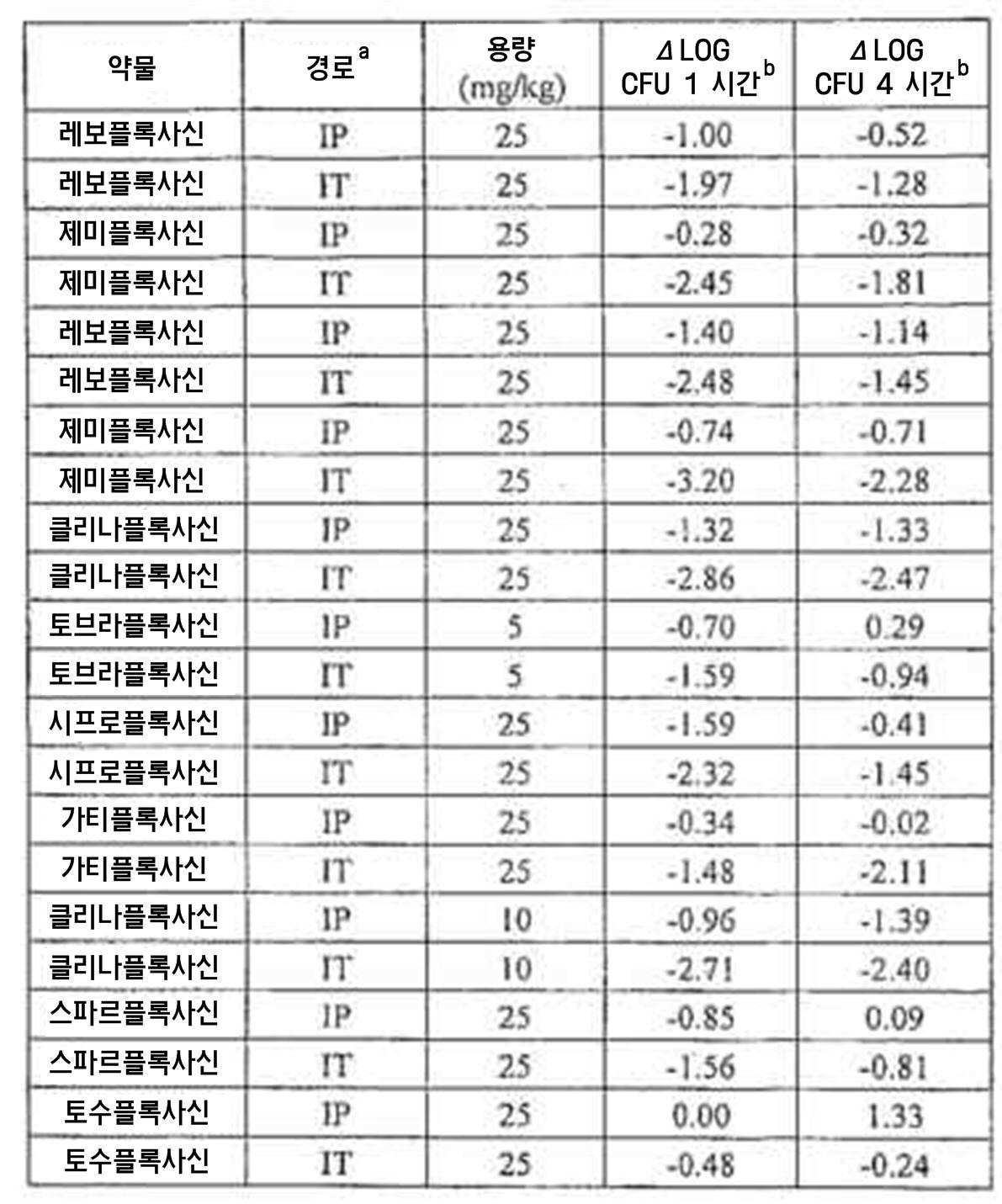
a. 약물 투여의 경로. a. Routes of drug administration.
b. 약물 투여 후 시간.b. Time after drug administration.
실험예Experimental Example 5 - 5 - PARIPARI eFIoweFIow 분무기에서 에어로졸 In the sprayer, 레보플록사신Levofloxacin 특성화. Characterization.
레이저 입자 사이징(Laser particle sizing LaserLaser ParticleParticle SizingSizing ))
장치 성능을 방사된 입자의 크기를 측정하여 특성화하였다. 비제한적 실험예에 의해, 레보플록사신 용액의 방사된 에어로졸의 입자 크기 측정을 하기의 조건 하에서 말번 스프레이텍(Malvern Spraytec) 입자 크기 측정기로 수행할 수 있다. 주위 조건을 조절하여 23.0℃와 24.0℃ 사이의 실온 및 42% 내지 45%의 상대 습도를 유지하였다. 레보플록사신 25mg/ml를 "40" 분무 헤드(nebulizing head)로 맞춰진 2 PARI eFlow 분무기에 적재하였다. 말번 스프레이텍 입자 크기 측정기에 대한 소프트웨어를 하기의 정보를 계산하도록 프로그램하였다. A)체적평균지름(Volume Mean Diameter; VMD), 레이저 빔을 통과하는 입자의 체적 평균. B)기하 표준 편차(Geometric Standard Deviation; GSD), 직경 84th 퍼센타일(percentile)/직경 50th 퍼센타일. C)입자 ≤5마이크론의 %, 5 마이크론 이하인 입자수의 퍼센트 또는 입자>1 마이크론 및 7 마이크론의 %, 1 및 7 마이크론 사이의 입자수의 퍼센트.The device performance was characterized by measuring the size of radiated particles. By way of non-limiting example, the particle size measurement of the aerosols of the levofloxacin solution can be performed with a Malvern Spraytec particle size meter under the following conditions. The ambient conditions were adjusted to maintain a room temperature between 23.0 ° C and 24.0 ° C and a relative humidity between 42% and 45%.
25 mg/ml의 레보플록사신 2 ml를 상기 장치에 적재하였다. 상기 장치의 마우스피스(mouthpiece)를 마우스피스의 팁(tip)이 x축 상에서 빔(beam)의 중앙으로부터 2cm 및 y축 상에서 레이저의 광학 렌즈에 최대한 가깝게 배치하였다. 환경을 조절하여, 20 LMP의 총 분무기 흐름을 획득하는 양으로 분무기를 통해 비스듬한 흐름이 제공되었다. 분무기를 켜고, 측정에 앞서 지속적으로 1분 동안 흐르도록 하였다. 측정 시퀀스(sequence)를 1분 후 시작하였고, 측정을 1초 간격으로 1분 동안 지속적으로 하였다. 측정 상태의 종결점에서, 이러한 60 기록들은 VMD, GSD 및 % ≤5 마이크론 및 % >1 및 <7 마이크론에 대하여 평균적이다. 마지막으로, 아웃풋 비율을 측정하기 위해 분무기의 무게를 재었다.2 ml of 25 mg / ml levofloxacin was loaded into the device. The mouthpiece of the device was placed with the tip of the dental mouthpiece as close as possible to the optical lens of the laser on the x-axis, 2 cm from the center of the beam and on the y-axis. The environment was adjusted to provide an oblique flow through the atomizer in an amount to obtain a total atomizer flow of 20 LMP. The sprayer was turned on and allowed to flow continuously for 1 minute prior to the measurement. The measurement sequence was started after 1 minute and the measurement was continued for 1 minute at 1 second intervals. At the end of the measurement state, these 60 records are average for VMD, GSD and% ≤ 5 microns and%> 1 and <7 microns. Finally, the atomizer was weighed to measure the output ratio.
호흡 시뮬레이션 연구(Breathing simulation study BreathBreath SimulationSimulation StudiesStudies ))
1:1의 들숨(inspiration) 대비 날숨(expiration) 비율로 분당 15호흡의 유럽 기준 패턴(European Standard pattern)을 사용하도록 프로그램된 PARI 콤파스 호흡 시뮬레이터을 이용하여 자연적인(natural) 흡입과 유사한 조건하에서 장치 성능을 측정하였다. 그러한 측정을 23.0℃와 24.0℃ 사이의 실온 및 42% 내지 45%의 상대 습도를 유지하도록 조절할 수 있는 주위 조건하에서 수행하였다. 본 실험에 대하여, PARI eFlow 장치에 25mg/ml의 레보플록사신 용액 4 ml를 적재하였다.Using a PARI Compass breath simulator programmed to use the European Standard pattern of 15 breaths per minute at a rate of 1: 1 inspiration to expiration, the device performance under conditions similar to natural inhalation Were measured. Such measurements were performed under ambient conditions that could be adjusted to maintain room temperature between 23.0 [deg.] C and 24.0 [deg.] C and 42% to 45% relative humidity. For this experiment, 4 ml of 25 mg / ml levofloxacin solution was loaded into the PARI eFlow device.
호흡 시뮬레이션을 개시하고, 분무기를 시작하였다. 장치는 분무를 중지할 때까지 연속적으로 흐르도록하였다. 지속기간은 분무의 개시로부터 시간을 측정하였다. 분무한 후에, 들숨 및 날숨 필터들을 알려진 양의 용제(solvent)(dH2O)로 개별적으로 세정하였다. 분무기 컵도 또한 개별적으로 세정하였다. 정량 평가를 위해, 개별적인 세정을 290 나노미터의 파장(wavelength)에서 분광광도법(spectrophotometry)을 통하여 분석하였고, 결과 농도를 함유량(content)로 전환하였다. 이러한 정량적인 데이타를 사용하여, 하기의 분석을 만들었다. A) 들숨 용량 (Inspired Dose; ID), 들숨 필터로부터 분석된 약물의 총량. B) 잔여 용량 (Residual Does; RD), 분무의 마지막에 분무기로부터 분석된 약물의 양. C) 미세 입자 용량 (Fine Particle Dose; FPD), 호흡가능한 파편에 의해 증가된 ID(예를 들어, 선택된 장치로부터 방사된 입자의 크기를 측정하하기 위해 사용되는 방법에 의존하는 % 입자 ≤ 5 마이크론 VMD). D) 지속 기간, 분무의 처음부터 끝까지의 시간. E) 호흡가능한 전달 용량 (Respirable Delivered Dose; RDD), % ID, 예를 들어, ≤ 5 마이크론 VMD.The breath simulation was started and the atomizer was started. The device was allowed to flow continuously until the spray ceased. The duration was measured from the onset of spraying. After spraying, the inhalation and exhalation filters were individually washed with a known amount of solvent (dH 2 O). The sprayer cups were also individually rinsed. For quantitative evaluation, individual rinses were analyzed by spectrophotometry at a wavelength of 290 nanometers and the resulting concentration was converted to a content. Using these quantitative data, the following analysis was made. A) Inspired Dose (ID), the total amount of drug analyzed from the inspiration filter. B) Residual Does (RD), the amount of drug analyzed from the sprayer at the end of the spray. C) Fine Particle Dose (FPD), Increased ID by breathable debris (eg% particle ≤ 5 microns depending on the method used to measure the size of the particles emitted from the selected device VMD). D) Duration, time from beginning to end of spray. E) Respirable Delivered Dose (RDD),% ID, for example, ≤ 5 microns VMD.
표 29의 결과는 >15 min에서 등가의 용량을 전달하는 PAR LC Plus 장치로부터의 300mg 용량과 비교하여, 레보플록사신의 100mg 용량이 PARI eFlow 장치를 사용하여 ~4분 내에 폐 구획에서 플루오로퀴놀론 ~34 mg을 축적할 수 있다는 것을 나타낸다(표 29). 상술한 바와 같이, "신속 투여, 고농도" 투여 및 전달 모델에서, LC Plus로부터 15분 전달 시간은 부족한 것으로 보이는 것에 반하여, 레보플록사신 35-40mg의 4분 투여 시간은 최대 플루오로퀴놀론 활성을 위한 기준(criteria)을 충족시킬 수 있을 것이다. 그러나, 더욱 신속한 투여(예를 들어, 2분 내 2ml 용량 전달 35-40mg 레보플록사신에서 50mg/ml)가 가능하도록 약물 농도를 증가하는 것은 상기 최소의 요구조건들을 더욱 만족시키는 것으로 보일 것이다. 게다가, 더 짧은 투여 시간은 환자의 투여 순응을 개선할 것이다. 추가적으로, 10mg/ml 이상의 농도에서 레보플록사신의 저장성 용액(hypotonic solution)은 흡입에 대해 열악한 내성을 가진다는 점을 언급해 둘 필요가 있다.The results in Table 29 show that the 100 mg dose of levofloxacin is equivalent to the fluoroquinolone in the lung compartment within ~ 4 minutes using the PARI eFlow device, compared to the 300 mg dose from the PAR LC Plus device delivering equivalent doses at> 15 min. mg (Table 29). As noted above, in the "fast dose, high dose" dosing and delivery model, the 15 min transfer time from LC Plus appears to be deficient, whereas the 4 min administration time of levofloxacin 35-40 mg is the standard for maximum fluoroquinolone activity criteria. However, increasing the drug concentration to allow for more rapid administration (e.g., 50 mg / ml in 2-ml dose delivered 35-40 mg levofloxacin in 2 minutes) would seem to further satisfy the minimum requirements. In addition, shorter dosing times will improve patient compliance. In addition, it should be noted that a hypotonic solution of levofloxacin at a concentration of 10 mg / ml or higher has poor resistance to inhalation.
[표 29][Table 29]
레보플록사신Levofloxacin
에어로졸 특성 (적재 용량 100 Aerosol properties (

실험예Experimental Example 6 - 건강한 인간 6 - healthy human SubjectSubject 에서 에어로졸 Aerosol 레보플록사신의Levofloxacin 내성 능력. Resistant ability.
방법Way
하나의 과제에서, 건강한 지원자의 에어로졸 상태의 레보플록사신의 전달의 실행가능성(feasibility)을 3.4 마이크론 체적평균지름 (VMD) 입자를 만드는 에어로겐 클리니컬 바이브레이팅 메시 장치(Aerogen Clinical vibrating mesh device) 또는 ~2 마이크론 MMAD(이하, "에어로겐 소형(Aerogen Small)")를 사용하거나, ~4.7 마이크론 VMD 입자을 생성하는 PARI eFlow 분무기를 사용(이하 "PARI 대형(PARI Large)")하여 수립하였다. 등장성 용액(isotonic solution)에서 10 mg, 35mg, 및 55mg의 용량에서 4.25 mg/mL 또는 18.75 mg/mL 농도의 레보플록사신을 테스트하였다.In one task, the feasibility of delivery of levofloxacin in the aerosolized form of a healthy volunteer was measured using an Aerogen Clinical vibrating mesh device to create a 3.4 micron volumetric mean diameter (VMD) (Hereinafter "PARI Large") using micron MMAD (hereinafter "Aerogen Small") or using a PARI eFlow atomizer to produce ~ 4.7 micron VMD particles. Levofloxacin concentrations of 4.25 mg / mL or 18.75 mg / mL were tested in doses of 10 mg, 35 mg, and 55 mg in an isotonic solution.
결과result
첫번째 테스트에서, 4.25 mg/mL 용액의 6 mL를 에어로겐 소형 분무기(Aerogen Small nebulizer)를 사용하여 흡입하였다. 호흡 시뮬레이션을 사용하는 별개의 시험관 내 장치 특성화 연구에 기초하여 측정된 RDD는 10mg이었다. 전달 시간은 22분이었다. 목, 기도(airway) 또는 폐에서, 투여하는 동안 또는 투여 후에, 기침감이나 기침을 포함하는 식별가능한 부작용(adverse effects)은 관찰되지 않았으며, 투여하는 동안과 투여 후에 단지 약간의 화학적 테이스트가 있을 뿐이었다. 약물 투여 이후 30분의 모니터링 기간에 대하여 부작용이나 테이스트는 관찰되지 않았다. 이러한 낮은 농도와 용량, 그리고 늦은 비율의 투여에서, 레보플록사신은 좋은 내성이 있었다.In the first test, 6 mL of the 4.25 mg / mL solution was inhaled using an Aerogen Small nebulizer. Based on a separate in vitro device characterization study using respiration simulation, the measured RDD was 10 mg. The delivery time was 22 minutes. No adverse effects, including coughing or coughing, have been observed in the neck, airways or lungs during or after administration, and there are only a few chemical tastes during and after administration . No side effects or tastes were observed for a 30-minute monitoring period after drug administration. At these low doses and doses, and at a late rate, levofloxacin was well tolerated.
두번째 테스트에서, 18.75 mg/mL 용액의 4ml를 에어로겐 소형 분무기를 이용하여 흡입하였다. 호흡 시뮬레이션을 사용하는 별개의 시험관 내 장치 특성화 연구에 기초하여 측정된 RDD는 35mg이었다. 약물의 투여를 위한 전달 시간은 14 분이었다. 용량이 증가하는데도 불구하고, 민감한 내성 능력은 투여하는 동안 및 투여 후 모두의 첫번째 테스트와 매우 비슷하였다. 더욱 강했던 테이스트는 레보플록사신의 더욱 쓰고/금속성의 화학적 테이스트 특성을 가진 용액이었다. 테이스트는 투여가 끝난 후 몇 분의 기간 동안 더욱 식별가능하였다. In the second test, 4 ml of the 18.75 mg / mL solution was inhaled using an aerosol compact atomizer. The measured RDD was 35 mg based on a separate in vitro device characterization study using respiration simulation. The delivery time for administration of the drug was 14 minutes. Despite increasing doses, the sensitive tolerance ability was very similar to the first test both during and after administration. The stronger taste was a solution with the more worn / metallic chemical taste properties of levofloxacin. The taste was further identifiable during a few minutes after administration.
세번째 테스트에서, 18.75 mg/mL 용액의 4 mL를 PARI 대형 장치(PARI Large device)를 사용하여 흡입하였다. 호흡 시뮬레이션을 사용하는 별개의(separate) 시험관 내 장치 특성화 연구에 기초하여 측정된 RDD는 ~55mg이었다(<5 마이크론 FPD 한정을 사용함). 약물 투여에 대한 전달 시간은 ~5분이었다. 테스트 2와 비교하여 입자 크기 및 약물에 대한 전달률이 뚜렷하게 증가되었음에도 불구하고, 상술한 바와 같은 테이스트의 민감한 효과들외에는 목, 기도 또는 폐에서, 용량의 전달 후 투여 기간의 처음부터 끝까지 및 관찰 기간 30 분 동안, 기침감 또는 기침을 포함하는 부작용은 일어나지 않았다. 노출에 대한 정확한 측정인 약물의 비뇨기 회복(urinary recovery)으로 대략 55 mg의 계획된 호흡가능한 용량을 성공적으로 전달하였음을 확인하였다.In a third test, 4 mL of the 18.75 mg / mL solution was inhaled using a PARI Large device. Based on a separate in vitro device characterization study using respiratory simulation, the measured RDD was ~ 55 mg (using a <5 micron FPD restriction). The delivery time for the drug administration was ~ 5 minutes. Despite the significant increase in particle size and delivery rate to the drug compared to
이러한 결과들은 인간 주제에 대한 테스트된 중간(intermediate) 농도에서 레보플록사신의 에어로졸 전달의 실행가능성을 증명하며, 더 높은 농도 및 용량, 능력 및 테이스트에 대해 적절히 제제화되는 것이 성취가능하다는 것을 암시한다.These results demonstrate the feasibility of aerosol delivery of levofloxacin at a tested intermediate concentration on human subjects, suggesting that it is achievable to formulate properly for higher concentrations and capacities, abilities and tastes.
실험예Experimental Example 7 - 7 - 레보플록사신Levofloxacin 미세화. Minification.
레보플록사신Levofloxacin 미세화 Refinement
건조 분말 레보플록사신 염기는 건조 분말 폐 투여를 이용하여 레보플록사신의 높은 국부 농도 노출 치료, 테이스트-마스크 또는 AUC 형태-향상된 전달에 대하여 미세화될 수 있다. 최근 조사되고 있는 또 다른 접근들은 분무-건조 및 인 시츄 미세화 기술을 포함한다. 이러한 접근은 제한없이 오플록사신, 로메플록사신, 페플록사신, 시프로플록사신, 가티플록사신, 제미플록사신, 목시플록사신, 투소플록사신, 파주플록사신, 루플록사신, 플레록사신, 발로플록사신, 스파르플록사신, 트로바플록사신, 에녹사신, 노르플록사신, 클리나플록사신, 그레파플록사신, 시타플록사신, 마르보플록사신, 오르비플록사신, 사라플록사신, 다노플록사신, 디플록사신, 엔로플록사신, 가레녹사신, 프룰리플록사신, 올라무플록사신, DX-619, TG-873870 및 DW- 276 등을 포함하는 또 다른 플루오로퀴놀론 항생제를 가지고 사용될 수 있다.Dry powder levofloxacin bases can be micronized for high localized exposure treatment, taste-mask or AUC form-enhanced delivery of levofloxacin using dry powder lung administration. Other approaches being investigated recently include spray-drying and in situ microfabrication techniques. Such approaches include, but are not limited to, ophlockacin, romefloxacin, peproxacin, ciprofloxacin, gatifloxacin, gemifloxacin, moxifloxacin, touofloxacin, pazlofacaxin, rufloxacin, feloxacin, , Sparfloxacin, trovafloxacin, enoxacin, norfloxacin, clinafloxacin, gifeproxacin, cyperflaxacin, marbophloxacin, orbifloxacin, sarafloxacin, danofloxacin, di May be used with another fluoroquinolone antibiotic, including floxazin, enrofloxacin, grenoxacin, prurifluroxacin, olafluorescin, DX-619, TG-873870 and DW-276,
서술(Description( DescriptionDescription ))
미세화하는 레보플록사신 염기의 실행가능성을 특성화하기 위해, 하기의 연구들을 수행하였다.In order to characterize the feasibility of micronized levofloxacin bases, the following studies were performed.
미세화Refinement
레보플록사신 약물 분말을 제트 밀(jet mill)을 사용하여 미세화 하였다. 미세화 후, 약물 분말을 5-6 마이크론 사이인 것과 더 미세한 파편인 두 가지 파편으로 취합하였다.The levofloxacin drug powder was micronized using a jet mill. After micronization, the drug powder was collected into two fragments of between 5-6 microns and finer debris.
분말 특성화Powder characterization
레이저 회절 기술을 이용하여 밀링(milling) 전후 입자 크기 및 입자 크기 분배에 대하여, 약물을 특성화하였다. 약물의 물리적 형태에서 어떠한 변화를 시차주사열량계(Differential Scanning Calorimetery; DSC) 및 X-레이 회절(X-Ray Diffraction; XRD)로 평가하였다. 입자 형태학(particle morphology)은 전자주사현미경(Scanning Electron Microscopy; SEM)을 이용하여 연구되었다. 미세화 전후 약물 분말의 평형 수분 용량을 열중량분석기(ThermoGravimetric Analysis; TGA) 또는 칼피셔(Karl Fischer)로 측정하였다. 미세화 동안 약물 물질의 어떠한 감소를 HPLC로 평가하였다. 분리 조건을 사용하여 미세화 이후에 신규의 피크(peak)가 형성되었는지 측정하였다.The laser diffraction technique was used to characterize the drug for particle size and particle size distribution before and after milling. Any changes in the physical form of the drug were evaluated by Differential Scanning Calorimetry (DSC) and X-Ray Diffraction (XRD). Particle morphology was studied using Scanning Electron Microscopy (SEM). The equilibrium moisture content of the drug powder before and after micronization was measured by Thermogravimetric Analysis (TGA) or Karl Fischer. Any reduction in drug substance during micronization was assessed by HPLC. Separation conditions were used to determine if new peaks were formed after micronization.
미세화Refinement
실험 방법론Experimental Methodology
레보플록사신의 두 개의 배치(batch)를 제트 밀(Glen Mills)을 사용하여 미세화하였다. 방법 개발을 수행하여 a) 5-6 마이크론 및 b) 2-3 마이크론 사이로 요구되는 파편 크기를 달성하기 위한 미세화 압력을 측정하였다. 심파텍(Sympatec) HELOS 레이저 회절 입자 크기 분석기로 레보플록사신의 입자 크기를 측정하였다.Two batches of levofloxacin were micronized using a jet mill (Glen Mills). Method development was performed to determine the micronization pressure to achieve the required debris size between a) 5-6 microns and b) 2-3 microns. The particle size of levofloxacin was measured with a Sympatec HELOS laser diffraction particle size analyzer.
결과result
도 12는 평균 입자 직경 (X50) 대 미세화 압력의 플롯(plot)을 나타낸다. 레보플록사신의 첫번째 배치는 미세화 전 10.6 마이크론의 평균 입자 직경을 나타냈다. 미세화 압력이 증가함에 따라 입자 크기가 감소하는 것을 플롯으로부터 알 수 있다. 2.5 마이크론의 크기를 달성하는 데 약 120 psi의 압력이 요구되었다. 레보플록사신의 두번째 배치에서, 미세화 전 12.99 마이크론의 평균 입자 크기를 가지며, 5.2 마이크론의 입자 크기를 달성하는 데 30 psi의 압력이 요구되었다.Figure 12 shows a plot of mean particle diameter (X50) versus micronization pressure. The first batch of levofloxacin showed an average particle diameter of 10.6 microns prior to micronization. It can be seen from the plot that the particle size decreases with increasing micronization pressure. A pressure of about 120 psi was required to achieve a size of 2.5 microns. In a second batch of levofloxacin, an average particle size of 12.99 microns prior to micronization was required and a pressure of 30 psi was required to achieve a particle size of 5.2 microns.
분말 특성화Powder characterization
시차주사열량계(Differential Differential scanning calorimeter ScanningScanning calorimetrycalorimetry ))
실험 방법론Experimental Methodology
프리-미세화(pre-micronize)의 시차주사열량계 뿐만 아니라 미세화된 레보플록사신(평균 입자 크기 2.5 마이크론)을 TA Instrument DSC Q1000을 사용하여 수행하였다. 각 시료의 1-2mg을 팬(pan)에 넣어 무게를 재었고, 봉하고(seal), 질소하에서 10℃/분으로 25℃에서 300℃까지 가열하였다.A pre-micronized differential scanning calorimeter as well as micronized levofloxacin (mean particle size 2.5 microns) were performed using a TA Instrument DSC Q1000. 1-2 mg of each sample was weighed into a pan and sealed and heated from 25 占 폚 to 300 占 폚 at 10 占 폚 / min under nitrogen.
결과result
프리-미세화된 및 미세화된 레보플록사신 DSC 프로파일들을 도 13a 및 13b에 나타내었다. 프리-미세화된 레보플록사신과 비교하여 미세화된 경우의 DSC 프로파일에서의 차이는 없었다.Pre-micronized and micronized levofloxacin DSC profiles are shown in Figures 13a and 13b. There was no difference in the DSC profile when micronized compared to pre-micronised levofloxacin.
실험 방법론Experimental Methodology
분말(미세화된 및 프리-미세화된)은 금-팔라듐으로 코팅된 알루미늄 스터브(stub) 상의 더블-사이드 카본 탭(double-sided carbon tab)에 부착되었다. 전자주사현미경(SEM)을 이용하여 스터브 상의 분말의 몇몇 다양한 영역의 현미경사진(photomicrograph)을 찍었다.The powder (micronized and pre-micronized) was attached to a double-sided carbon tab on an aluminum stub coated with gold-palladium. A photomicrograph of several different areas of the powder on the stub was taken using a scanning electron microscope (SEM).
결과result
프리-미세화된 및 미세화된 레보플록사신의 대표적인 전자주사현미경사진(Scanning electron micrograph)을 도 14a 및 14b에 나타내었다. 레보플록사신의 크리스탈(crystal)은 미세화 전처럼 편평(plate)하다. 이러한 형태를 미세화 후에도 계속 유지한다.Representative scanning electron micrographs of pre-micronized and micronized levofloxacin are shown in Figures 14a and 14b. The crystals of levofloxacin are as flat as before micronization. This form is maintained even after miniaturization.
실험 방법론Experimental Methodology
분말 시료의 얇은 막을 XRD 시료 홀더 내의 제로 백그라운드 플래이트(zero background plate)상에 배치하였다. 하기의 조건들 하에서 Scintag XDS 2000 회절측정기(diffractometer)를 이용하여 각 시료를 분석하였다.A thin film of the powder sample was placed on a zero background plate in an XRD sample holder. Each sample was analyzed using a
여기 소스(Excitation source): 구리 K α X-rays; 스캔비율: 분당 1°Excitation source: copper K α X-rays; Scan rate: 1 ° per minute
전압: 40 KV; 전류: 35 mA.Voltage: 40 KV; Current: 35 mA.
결과result
프리-미세화된 및 미세화된 레보플록사신의 X-ray 회절 플롯을 도 15에 나타내었다. 9°에서 회절된 피크의 강도는 미세화 후에 감소되었다. 이러한 결과들은 올란자파인(olanzapine)의 미세화에 대한 논문에서 보고된 바(Stephenson G5A. The Rigaku Journal, 22 (2005): 2-15)에 준하였다. 회절된 피크의 상대적 강도에서의 감소는 크리스탈에 대한 새로운 면의 형성때문일 것이다. 미세화 후에 가장 발달된 면은 강도가 최대로 감소된 부분일 것이다.An X-ray diffraction plot of pre-micronized and micronized levofloxacin is shown in FIG. The intensity of the peak diffracted at 9 [deg.] Was reduced after micronization. These results were reported in Stephenson G5A. The Rigaku Journal, 22 (2005): 2-15), which was reported in a paper on the miniaturization of olanzapine. The reduction in the relative intensity of the diffracted peak will be due to the formation of a new face for the crystal. The most developed surface after micronization will be the portion with the greatest intensity reduction.
실험 방법론Experimental Methodology
미세화된 및 프리-미세화된 레보플록사신 시료의 15-25 mg를 메탄올(미리 정해진 수분 용량을 포함)에 용해하였고, 시료 내의 수분 용량을 Aquastar 3000 Coulometric Karl Fisher Titrator 로 측정하였다.15-25 mg of micronized and pre-micronised levofloxacin samples were dissolved in methanol (including predetermined water content) and the water content in the sample was measured with an
결과result
칼 피셔 분석(Karl Fisher analysis)의 결과를 표 30에 나타내었다.The results of Karl Fisher analysis are shown in Table 30.
[표 30][Table 30]
프리free 및 포스트 미세화된 And post-micronized 레보플록사신의Levofloxacin 수분 용량. Moisture capacity.

실험예Experimental Example 8 - 8 - 레보플록사신Levofloxacin 염기의 Base 프리제제Free preparation ..
본 연구의 목표는 염기를 특성화하여 다양한 제제 접근을 위한 레보플록사신 염기의 물리-화학적 성능 및 제한을 이해하는 것이었다. 본 연구의 목적은 레보플록사신 염기의 물리화학적 특성을 특성화하는 데에 있다.The aim of this study was to understand the physico-chemical performance and limitations of levofloxacin bases for different formulation approaches by characterizing the bases. The purpose of this study is to characterize physicochemical properties of levofloxacin base.
프리제제Free preparation
pHpH -용해도 연구- solubility study
레보플록사신의 용해도를 pH의 기능으로 측정하였다. pH 범위 2-10에서 버퍼(buffer)를 처음 제조하였다. 각 버퍼의 소량의 알리쿼트(~200-250㎕)를 약물로 포화시켰고, 평형 용해도를 성취하기 위해 흔들었다(agitate). 그리고 나서 시료를 원심분리하였고, 상층액(supernatant)을 UV 또는 HPLC로 용해된 약물에 대하여 분석하였다. 본 연구에서 사용된 버퍼는 용해도 결과에 영향을 주는 것으로 나타났다(별개의 버퍼 카운터-이온(counter-ion)은 용액에서 별개의 레보염(levo salt) 형태를 형성할 수 있기 때문). 따라서, pH-용해도 역시 버퍼의 부재하에서 평가할 것이다(적정을 통해).The solubility of levofloxacin was measured by the function of pH. Buffers were initially prepared in pH range 2-10. A small aliquot of each buffer (~ 200-250 μl) was saturated with the drug and agitated to achieve equilibrium solubility. The sample was then centrifuged and the supernatant analyzed for the drug dissolved by UV or HPLC. The buffers used in this study appeared to affect the solubility results (because a separate buffer counter-ion can form a separate levo salt form in solution). Thus, pH-solubility will also be assessed in the absence of buffer (via titration).
pKapKa 측정 Measure
레보플록사신의 pKa를 적정법(titrimetry)을 이용하여 측정하였다. 얻어진 pKa 값을 UV 분광광도법(UV spectrophotometry)으로 확인하였다. 이러한 정보는 레보플록사신에 대한 염을 선택하는 것을 돕고, 폐 내의 pH 조건하에서 레보플록사신에 대한 차지(charge)를 측정하는데 사용되었다.The pKa of levofloxacin was measured by titrimetry. The pKa value obtained was confirmed by UV spectrophotometry. This information helped to select salts for levofloxacin and was used to measure the charge for levofloxacin under pH conditions in the lungs.
액체 시스템에 대한 For liquid systems 프리제제Free preparation
액체 제제의 실행가능성을 염수(saline) 단독에서 제제에 대한 기준 파라미터(baseline parameter)로서 (a) 용해도 및 (b) 표면 장력을 이용하여 조사하였다.The feasibility of the liquid formulation was investigated in saline alone using (a) solubility and (b) surface tension as baseline parameters for the formulation.
레보플록사신에On levofloxacin 대한 About 프리제제Free preparation 연구 Research
HPLCHPLC 방법 전환( How to switch transfertransfer ))
실험 방법론Experimental Methodology
HPLC 방법을 사용하여 레보플록사신 분석의 선형(linearity), 정확성(accuracy), 및 정밀도(precision)를 평가하였다. 사용된 컬럼(column)은 30℃에서 50×4.6 mm, Onyx Monolithic C18 (Phenomenex)였다. 이동상은 물에 0.1% TFA가 85% 및 0.1% TFA 아세토니트릴(acetonitrile)이 15%로 이루어졌다. 유량(folw rate)을 3ml/분으로 조절하였다. 시료를 크로마토그래피 시스템에 주입하였고, 277nm에서 유출(effluent)을 모니터하였다.The linearity, accuracy, and precision of levofloxacin assay were evaluated using HPLC methods. The column used was 50 × 4.6 mm, Onyx Monolithic C18 (Phenomenex) at 30 ° C. The mobile phase consisted of 85% of 0.1% TFA and 15% of 0.1% TFA acetonitrile in water. The folw rate was adjusted to 3 ml / min. Samples were injected into the chromatography system and the effluent monitored at 277 nm.
결과result
레보플록사신에 대한 보유 시간(retention time)은 대략 0.82분이었다. 분석은 5-15 ㎍/ml의 범위에 걸쳐 1.000의 상관 계수(correlation coefficient)로 선형적인 것을 발견하였다. 상대 표준 편차(Relative Standard Deviation; RSD)는 0.5 %이하였고, 정확성은 98-102% 이내였다.The retention time for levofloxacin was approximately 0.82 min. The assay was linear over a range of 5-15 / / ml with a correlation coefficient of 1.000. Relative Standard Deviation (RSD) was less than 0.5% and accuracy was within 98-102%.
pHpH -용해도 연구- solubility study
적정에 의하여By titration
실험 방법론Experimental Methodology
0.1 N HCl에서 레보플록사신의 포화된 용액을 NaOH로 적정하였다. 각각의 염기 첨가 후에, 용액을 와동시켜(vortexing) 섞었다. 시료 용액의 알리쿼트를 제거하고, 원심분리하였고, 상층액을 288 nm에서 UV 스펙트로스코피(UV spectroscopy)로 분석하였다. 동일한 용액을 HCl로 다시 적정하였다.A saturated solution of levofloxacin in 0.1 N HCl was titrated with NaOH. After each base addition, the solution was vortexed and mixed. The aliquot of the sample solution was removed, centrifuged, and the supernatant was analyzed by UV spectroscopy at 288 nm. The same solution was again titrated with HCl.
결과result
레보플록사신의 pH-용해도 프로파일을 도 16에 나타내었다. 적정법에 의해, 레보플록사신은 pH 7.3에서 25.4 mg/ml의 용해도를 보였다. 그러나 쉐이킹(shaking) 실험의 결과와는 대조적으로, 적정법에 의한 용해도는 pH 6.5이하로 감소하였고 이는 공통 이온 효과(common ion effect)에 원인이 있을 수 있을 것이다. HCl에서 레보플록사신 용액을 제조하였기때문에, 용액 내에 레보플록사신의 하이드로클로라이드염이 형성되었을 수 있다. 나아가 염산의 형태 내에 클로라이드 이온의 첨가는 하이드로클로라이드염의 용해도를 억제할 수 있다.The pH-solubility profile of levofloxacin is shown in Fig. By titration, levofloxacin showed a solubility of 25.4 mg / ml at pH 7.3. However, in contrast to the results of shaking experiments, the titratable solubility decreased below pH 6.5, which may be responsible for the common ion effect. Since the levofloxacin solution was prepared from HCl, the hydrochloride salt of levofloxacin may have formed in the solution. Furthermore, the addition of the chloride ion in the form of hydrochloric acid can inhibit the solubility of the hydrochloride salt.
pKapKa 측정 Measure
적정법에In titration 의하여 By
실험 방법론Experimental Methodology
물(18.45 mg/g)에서 레보플록사신 용액(18 mg/g)을 제조하였다.. 용액의 최초 pH는 7.36이었다. 상기 용액을 1N HCl로 적정하였다. 측정된 HCl의 알리쿼트를 첨가하였고, 각각의 첨가 후에 pH를 기록하였다. 적정을 pH 1까지 지속하였다.The levofloxacin solution (18 mg / g) was prepared from water (18.45 mg / g). The initial pH of the solution was 7.36. The solution was titrated with 1N HCl. Aliquots of the measured HCl were added and the pH was recorded after each addition. The titration was continued to
산성의(acidic) pKa를 측정하기 위해, 0.1N HCl에서 레보플록사신 용액(18.38 mg/g)을 제조하였다. 용액의 최초 pH는 1.32였다. 용액을 1N NaOH로 적정하였다. 적정을 pH 6.55까지 지속하였다.To measure the acidic pKa, levofloxacin solution (18.38 mg / g) was prepared in 0.1 N HCl. The initial pH of the solution was 1.32. The solution was titrated with 1N NaOH. The titration was continued to pH 6.55.
결과result
도 17은 pH 대(Vs) 레보플록사신의 적정을 위해 HCl로 첨가한 적정제(titrant) 부피의 플롯을 보여준다. 본 데이타는 하기의 방정식(equation)으로 맞추어졌다.Figure 17 shows a plot of the titrant volume added with HCl for titration of pH versus (Vs) levofloxacin. This data was fitted with the following equation.

여기서,here,
Vt = 첨가된 적정제의 부피V t = volume of added titrant
Vep= 등가점까지 첨가된 적정제의 부피V ep = Volume of titrant added to equivalent point
[OH-] = 하이드록사이드 이온 농도 = Kw/[H+][OH - ] = hydroxide ion concentration = Kw / [H + ]
[H+] = 하이드로늄 이온 농도 = 10- pH [H + ] = concentration of hydronium ion = 10 - pH
Vt [OH-] 대(Vs) Vt 의 플롯은 직선을 보였다(도 18). 데이타는 프리-등가점 영역에서부터 나타났다. 기울기에서 다음을 얻었다.The plot of V t [OH - ] vs. Vs V t showed a straight line (Fig. 18). The data appeared from the pre-equivalent point region. The following were obtained from the slope:

도 19는 pH 대 레보플록사신의 적정을 위해 NaOH로 첨가한 적정제 부피의 플롯을 보여준다. 산성의 pKa는 너무 낮아(<2.0) 계산하기가 어려웠다. 그러나, pKa의 러프한(rough) 근사는 등가점의 절반(half)의 pH로 만들 수 있다. 플롯 dpH/dV 대(vs) 적정제의 부피(Vt)의 플롯으로부터(도 20), 등가점은 250㎕이다. 등가점의 절반의 pH(예를 들어, Vt = 125㎕일 때)는 1.6이다. 그러므로 산성의 pKa ~ 1.6이다.Figure 19 shows a plot of titration volume added with NaOH for titration of pH versus levofloxacin. The acidity pKa was too low (<2.0) to be difficult to calculate. However, a rough approximation of pKa can be made at half the pH of the equivalent point. From the plot of plot dpH / dV vs. (vs) titration volume (V t ) (Fig. 20), the equivalent point is 250 μl. The half-value of the equivalent point (for example, when V t = 125 μl) is 1.6. Therefore, the acidity is pKa ~ 1.6.
UVUV 스펙트로스코피에On Spectroscopy 의하여 By
실험 방법론Experimental Methodology
레보플록사신의 희석 용액(0.013 mg/ml)을 여러가지 버퍼에서 제조하였다. 사용된 버퍼들은 HCl(pH 1, 2), 아세테이트(pH 4, 5), 포스페이트(pH 6, 7, 8) 및 보레이트(pH 9,10)이었다. 레보플록사신 용액을 257 nm에서 UV 스펙트로스코피를 이용하여 분석하였다.Dilute solution of levofloxacin (0.013 mg / ml) was prepared in various buffers. The buffers used were HCl (
결과result
pH 대(Vs) 레보플록사신 용액의 257 nm에서의 흡광도의 플롯을 도 21에 나타내었다. 이러한 데이터를 변형된 헨더슨 하셀바흐 방정식(Henderson Hasselbach Equation)으로 맞추었다.A plot of the absorbance at 257 nm of the pH vs. (Vs) levofloxacin solution is shown in FIG. This data was fitted to the modified Henderson Hasselbach Equation.

여기서,here,
Abs관찰됨 = 레보플록사신 용액의 흡광도Abs observed = Absorbance of levofloxacin solution
AbsHA = pH 1.2에서 레보플록사신 용액의 흡광도;Abs HA = absorbance of levofloxacin solution at pH 1.2;
Abs A- = pH 7.8에서 레보플록사신 용액의 흡광도;Abs A- = absorbance of levofloxacin solution at pH 7.8;
[H+] = 하이드로늄 이온 농도 = 10- pH [H + ] = concentration of hydronium ion = 10 - pH
맞춰진 방정식이 제공한 pKa의 평가 = 5.91.Evaluation of the pKa provided by the fitted equation = 5.91.
실험예Experimental Example 9 - 9 - 레보플록사신Levofloxacin 염 형성. Salt formation.
본 연구의 목적은 감소되는 용해도 및/또는 용해를 통하여 AUC 형태-향상 특성을 얻을 수 있는 레보플록사신의 다양한 염 형태를 제조하는 것이다. 이러한 이익은 나노입자 서스펜션(suspension) 또는 건조 분말 흡입을 이용한 후속의 폐 투여에서 레보플록사신의 약력학 특성을 변경할 수 있다. 이러한 제제를 최적화하여, 감소하는 용해도 염 형태로부터 레보플록사신의 배출(release)을 연장할 수 있다. 이러한 특성은 또한 제한없이 제미플록사신, 가티플록사신, 노르플록사신, 투소플록사신, 시타플록사신 사라플록사신, 프룰리플록사신, 및 파주플록사신 등을 포함하는 또 다른 플루오로퀴놀론 항생제에 편입될 수도 있다. 테이스트 마스킹, AUC 형태-향상, 나노입자 서스펜션 및 건조 분말 흡입 투여를 위한 제미플록사신의 다양한 염 형태 및 공침전물(co-precipitate)을 특성화하는 연구들이 진행중이다. 최근 조사되고 있는 또 다른 접근들은 분무-건조 및 인 시츄 미세화 기술들을 포함한다.The aim of this study was to prepare various salt forms of levofloxacin that can achieve AUC form-enhancing properties through reduced solubility and / or dissolution. This benefit may alter the pharmacodynamic properties of levofloxacin in subsequent lung administration using nanoparticle suspensions or dry powder inhalation. By optimizing these formulations, the release of levofloxacin can be extended from the decreasing solubility salt form. These characteristics are also incorporated into another fluoroquinolone antibiotic, including, without limitation, gemifloxacin, gatifloxacin, norfloxacin, touofloxacin, cyafloxacin sarafloxacin, prurifluxroxin, . Studies are underway to characterize various salt forms and co-precipitates of gemifloxacin for taste masking, AUC form-enhancement, nanoparticle suspension and dry powder inhalation administration. Other approaches being investigated recently include spray-drying and in situ finishing techniques.
서스펜션 및 분말 제제를 위하여, 특이적 염 형태는 생성물 성능에 대한 임팩트(impact)를 가질 수 있는 중요한 물리적 및 화학적 특성을 제공할 수 있다. AUC 형태-향상 제제에 대하여, 염 선택의 목적은 용해도의 감소 및/또는 레보플록사신의 용해 비율의 감소였다. 산성 반대이온을 하기 내용에 의해 선택할 수 있다.For suspension and powder formulations, specific salt forms can provide significant physical and chemical properties that may have an impact on product performance. For AUC form-enhancing agents, the purpose of salt selection was to decrease solubility and / or decrease the dissolution rate of levofloxacin. The acidic counterion can be selected by the following.
녹는점(melting point)의 조작(manipulation): 녹는점의 증가는 대체로 염 용해도의 감소와 동반된다. 평면이고(planar), 높은 온도에서 녹기 시작하는 방향족 산(aromatic acid)에서 형성된 염은 일반적으로 높은 녹는점을 가지는 크리스탈린염(crystalline salt)을 형성한다.Manipulation of the melting point: The increase in melting point is generally accompanied by a decrease in salt solubility. Salts formed from aromatic acids that are planar and start to melt at high temperatures generally form crystalline salts with high melting points.
소수성(hydrophobicity)의 조작: 소수성 콘쥬게이트(conjugate) 산으로 형성된 염은 소수성이어서 습식(wet)이 어렵고, 결국 연장된 용해를 야기할 것이다. 염 제조를 위해 선택된 산(acid)의 예들을 아래와 같이 열거한다. Manipulation of hydrophobicity: Salts formed with hydrophobic conjugate acids are hydrophobic, making them difficult to wet and eventually leading to extended dissolution. Examples of acids selected for salt preparation are listed below.
a) 파모산(pamoic acid)(에본산(embonic acid) )a) pamoic acid (embonic acid)
b) 2-나프탈렌 술폰산(2-naphthalene sulfonic acid)(납실산(napsylic acid)) b) 2-naphthalene sulfonic acid (napsylic acid)
c) 올레산(oleic acid) c) oleic acid
d) 크시나포산(Xinafoic acid)d) Xinafoic acid
e) 스테아르산(stearic acid) e) stearic acid
f) 라우릴 술포네이트(lauryl sulfonate)(에스톨레이트(estolate))f) lauryl sulfonate (estolate)
고려되는 또 다른 요소들은 염 표면 특성, 다형체(polymorph) 및 화학적 안정성을 포함한다.Other factors considered include salt surface properties, polymorph and chemical stability.
서술Description
연구의 목적은 그것의 용해도 및/또는 용해 비율을 감소시키기 위해 레보플록사신의 염 형태를 제조하는 것이었다. 목표는 아래와 같았다.The aim of the study was to prepare salt forms of levofloxacin to reduce its solubility and / or dissolution rate. The goals were as follows.
(a) 허용가능한 첨가제(들)로 염을 형성하는 동안 보다 적은 가용성을 가지는 레보플록사신의 제조.(a) Preparation of levofloxacin with less solubility during salt formation with acceptable additive (s).
(b) 자유 염기 보다 더 낮은 용해도 및/또는 용해 비율을 가질 레보플록사신의 염 형태를 제조하는 것.(b) to produce a salt form of levofloxacin which will have a lower solubility and / or dissolution rate than the free base.
상기 과제를 달성하기 위해, 분자의 염기 사이트(site)에서 염을 제조하는 것에 노력을 집중하였다(pKa ~ 6.8).In order to achieve the above object, efforts have been focused on preparing salts at the base sites of the molecules (pKa ~ 6.8).
파모산(mp = 280℃) 및 납실산(napsylic acid)(mp = 125℃)은 염이 소수성 특성을 가지는 것으로 기대되는 평면이고, 소수성 구조를 가진다. 파모산의 높은 녹는점은 높은 온도에서 녹기 시작하는 크리스탈린 염 형태를 생산할 수 있다. 폐 전달에 대해 인정되기 때문에 올레산을 우선적으로 선택하였다. 그것은 (1)이하의 조건을 만족시키지 않을 수 있는 낮은 녹는점(4℃)를 가지지만, 그러나 긴 지방성 사슬(aliphatic chain)은 용해도를 감소시키기에 충분한 소수성을 제공할 수 있는 것으로 여겨졌다. 크시나포산(Xinafoic acid)(mp= 195℃) 역시 염이 소수성 특성을 가지는 것으로 기대되는 평면이고, 소수성 구조를 가짐으로써 염 형성으로 선택되었다. 스테아르산 및 라우릴 술포네이트(에스톨레이트)를 선택한 이론적 근거는 올레산과 유사하였으며, 단지 이들의 폐 독성은 알려지지 않았다. 에스톨레이트는 경구 전달(에리스로마이신 에스톨레이트는 대략 1/12th의 자유 염기 용해도를 가지며, 경구 서스펜션으로 제제화됨)에서 인정되었다.Pamoic acid (mp = 280 ° C) and napsylic acid (mp = 125 ° C) are planar and hydrophobic structures in which the salt is expected to have hydrophobic properties. The high melting point of pamoic acid can produce a crystalline salt form that begins to melt at high temperatures. Oleic acid was preferentially chosen because it is recognized for lung transfer. It has been found that (1) it has a low melting point (4 캜) which may not meet the following conditions, but a long aliphatic chain can provide sufficient hydrophobicity to reduce solubility. Xinafoic acid (mp = 195 ° C) was also chosen for salt formation by having a planar, hydrophobic structure in which the salt is expected to have hydrophobic properties. The rationale for selecting stearic acid and laurylsulfonate (estolate) was similar to oleic acid, and their lung toxicity was unknown. Estolate was found in oral delivery (erythromycin esters have a free base solubility of approximately 1/12 th and are formulated as oral suspensions).
염 형성Salt formation
일반적으로, 레보플록사신 염기 및 산을 허용가능한 휘발성 물질, 유기적 용제(1:1 몰비)에서 용해하였고, 실온에서 교반하였다. 크리스탈화된 생성물을 여과하고, 건조하고, 특성화하여 형성하였다. 특성화는 DSC, FTIR, 및 원소 분석(elemental analysis)으로 이루어질 수 있다.Generally, levofloxacin base and acid were dissolved in an acceptable volatile organic solvent (1: 1 molar ratio) and stirred at room temperature. The crystallized product was formed by filtration, drying, and characterization. Characterization can be done by DSC, FTIR, and elemental analysis.
파모산과Pamosan and 함께 together 레보플록사신의Levofloxacin 코- nose- 크리스탈의Of crystal 형성 및 특성화. Formation and characterization.
실험 방법론Experimental Methodology
파모산과Pamosan and 함께 together 레보플록사신의Levofloxacin 코- nose- 크리스탈의Of crystal 형성 formation
0.31 g (0.8 mM)의 파모산을 테트라하이드로퓨란 (TetraHydroFuran; THF) 100ml에서 교반하여 용해하였다. 이것에, 0.30 g (0.8 mM)의 레보플록사신을 첨가하였고, 교반하여 용해시켰고, 결과 용액을 2.5시간 동안 리플럭스(reflux)하였다. 형성된 서스펜션을 실온으로 냉각시키고, 여과하여, 획득한 침전물을 3 시간 동안 약 70℃에서 진공 상태로 건조하였다.0.31 g (0.8 mM) of pamoic acid was dissolved by stirring in 100 ml of tetrahydrofuran (THF). To this, 0.30 g (0.8 mM) of levofloxacin was added, dissolved by stirring, and the resulting solution was refluxed for 2.5 hours. The suspension formed was cooled to room temperature, filtered, and the obtained precipitate was dried under vacuum at about 70 < 0 > C for 3 hours.
특성화Characterization
열분석(Thermal analysis). (a) 파모산 (b) 레보플록사신 (c) 레보플록사신 파모네이트 코-크리스탈화된 침전물 (d) 파모산 및 레보플록사신의 물리적 혼합물의 열분석을 시차주사열량계 (TA Instrument DSC Q1000)을 사용하여 수행하였다. 각 시료의 2-5mg을 팬(pan)에 넣어 무게를 재었고, 봉하고(seal), 질소하에서 10℃/분으로 25℃에서 300℃까지 가열하였다.Thermal analysis. (b) levofloxacin (c) levofloxacin pamoate co-crystallized precipitate (d) Thermal analysis of a physical mixture of paramoiocin and levofloxacin was performed using a differential scanning calorimeter (TA Instrument DSC Q1000). 2-5 mg of each sample was weighed into a pan and sealed and heated from 25 占 폚 to 300 占 폚 at 10 占 폚 / min under nitrogen.
푸리에 변환 적외선 분광기(Fourier transform Infrared; FT-IR) 스펙트로스코피. (a) 파모산 (b) 레보플록사신 (c) 레보플록사신 파모네이트 코-크리스탈화된 침전물 (d) 파모산 및 레보플록사신의 물리적 혼합물의 FT-IR 스펙트로스코피를 FTIR 스펙트로미터(spectrometer)(모델 IRPrestige-21, Shimadzu)을 사용하여 수행하였다.Fourier Transform Infrared (FT-IR) spectroscopy. (d) FT-IR spectroscopy of physical mixtures of paramosan and levofloxacin was measured with an FTIR spectrometer (model IRPrestige-21, Shimadzu).
포화 용해도. 레보플록사신 및 레보플록사신 파모산 코-크리스탈화된 침전물의 포화 용해도를 과량의 고체를 물로 평형을 유지시킴으로써 측정하였다. 서스펜션을 HCl로 pH's 4, 5, 6 및 7를 조절하고, 혼합하고, 원심분리하여 288 nm에서 UV 스펙트로스코피를 이용하여 상층액을 분석하였다. Saturation solubility. Saturated solubility of levofloxacin and levofloxacin pamoic acid co-crystallized sediments was measured by maintaining excess solids equilibrated with water. The suspension was adjusted to pH's 4, 5, 6 and 7 with HCl, mixed, centrifuged and analyzed for supernatant using UV spectroscopy at 288 nm.
결과result
열분석. (a) 파모산 (b) 레보플록사신 (c) 레보플록사신 파모네이트 코-크리스탈 침전물 (d) 파모산 및 레보플록사신의 물리적 혼합물의 DSC 스캔을 도 22a 내지 도 22d에 나타내었다. 파모산 및 레보플록사신은 각각 330℃ 및 239℃에서 샤프한 엔도섬(endotherm)을 나타냈으며, 이것은 파모산 및 레보플록사신 각각의 용해에 기인한 것이라고 할 수 있다. 레보플록사신 파모네이트 코-크리스탈의 DSC 프로파일은 210℃에서 하나의 주요한 엔도섬을 나타내었다. 레보플록사신 및 파모산의 1:1 몰혼합물(molar admixture)은 129℃ 및 220℃에서 폭 넓은(broad) 엔도섬을 나타내었다.Thermal analysis. (a) Pamoic acid (b) levofloxacin (c) levofloxacin pamoate co-crystal precipitate (d) DSC scans of physical mixtures of paramoi and levofloxacin are shown in Figures 22a-22d. Pamoic acid and levofloxacin exhibited a sharp endotherm at 330 ° C and 239 ° C, respectively, which is due to the dissolution of each of palmosan and levofloxacin. The DSC profile of the levofloxacin pamoate co-crystal showed one major endo-island at 210 ° C. A 1: 1 molar admixture of levofloxacin and pamoic acid showed a broad endo islet at 129 ° C and 220 ° C.
FTIR. (a) 파모산 (b) 레보플록사신 (c) 레보플록사신 파모네이트 코-크리스탈화된 침전물 (d) 파모산 및 레보플록사신의 물리적 혼합물로부터 수득된 FTIR 스펙트럼을 도 23a 내지 도 23d에 나타내었다. C=O 그룹의 스트레칭(stretching)에서 기인하는, 1650cm-1에서 파모산의 FTIR 스펙트럼에서 고강도 흡수 대역(high absorption band)은 코-크리스탈에서 크게 감소하였다.FTIR. (a) Famoic acid (b) levofloxacin (c) levofloxacin pamoate co-crystallized precipitate (d) FTIR spectra obtained from a physical mixture of paramyxan and levofloxacin are shown in Figures 23a-23d. The high absorption band in the FTIR spectrum of paramyx at 1650 cm -1 , which is attributed to the stretching of the C = O group, was greatly reduced in the co-crystal.
포화 용해도. 표 31은 다양한 pH's에서 레보플록사신 및 레보플록사신 파모네이트의 포화 용해도 데이터를 나타낸다. 버퍼 산(acid)이 레보플록사신의 용해도에 영향을 주기 때문에, 물에서 용해도를 측정하였다. 그러나 물에서 쉐이킹 레보플록사신 또는 염 용액을 쉐이킹한 후에, pH가 이동하였고, 특히 pH 5의 레보플록사신 용액이 pH 1.6으로 이동하였다. pH 5의 용액은 레보플록사신의 두 pKa's(~1.6 및 ~6)사이에 있다, 그러한 용액은 더 낮은 버퍼 용량을 가질 것이므로, pH가 이동한다. 약물의 pKa's 근처 pH's의 용액은 높은 버퍼 용량을 가지고, pH 변화에도 내성이 있다. 레보플록사신 파모네이트의 용해도는 모든 pH's의 레보플록사신의 그것 보다 상당히 적었다. Saturation solubility. Table 31 shows saturation solubility data for levofloxacin and levofloxacin pamoate at various pH's. Since the buffer acid affects the solubility of levofloxacin, solubility in water was measured. However, after shaking the shaking levofloxacin or salt solution in water, the pH shifted, particularly the levofloxacin solution at
[표 31][Table 31]
레보플록사신Levofloxacin 및 And 레보플록사신Levofloxacin 파모네이트의Pomanate 포화 용해도 Saturation solubility 데이타Data ..
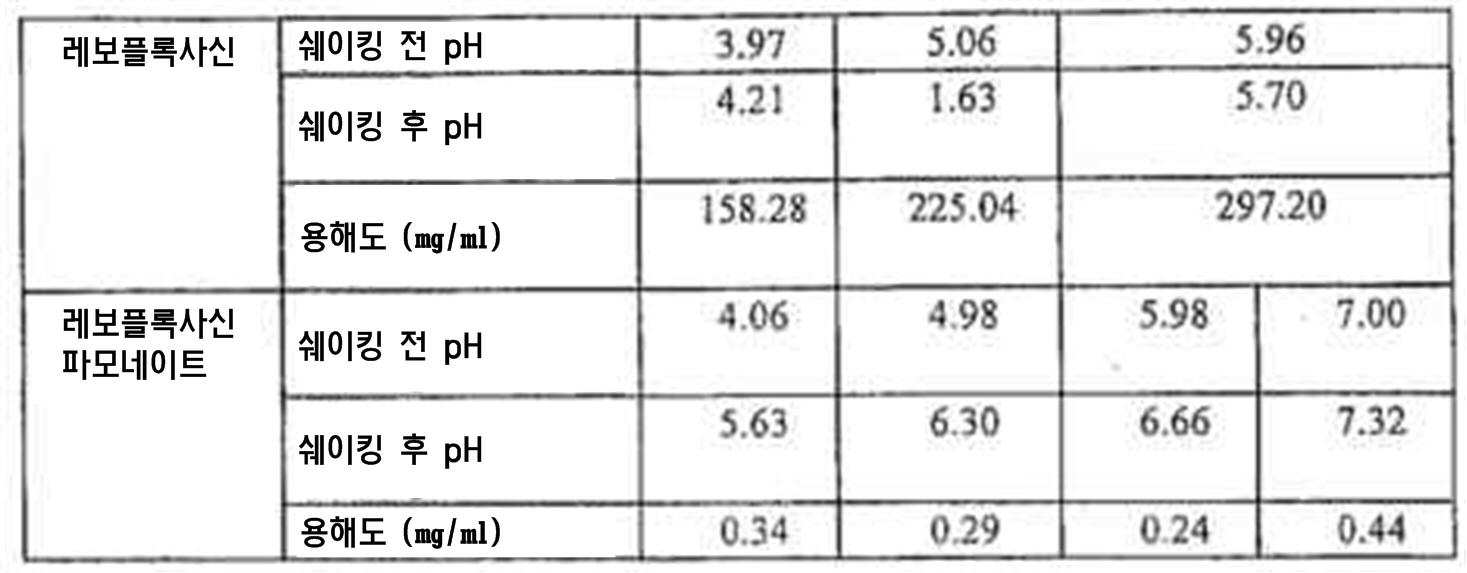
해석Translate
레보플록사신 파모네이트의 코-크리스탈화된 침전물은 레보플록사신, 파모산 및 그들의 물리적 혼합물의 경우와 다른 녹는점 및 FTIR 스펙트럼을 가지기 때문에, 파모산과 레보플록사신의 등분자 복합체(equimolar complex)은 레보플록사신보다 상당히 더 낮은 용해도를 가지는 염 레보플록사신 파모네이트일 수 있다.Since the co-crystallized precipitates of levofloxacin pamoate have different melting points and FTIR spectra than those of levofloxacin, paramosan, and their physical mixtures, the equimolar complex of paramo acid and levofloxacin is significantly lower than levofloxacin Lt; RTI ID = 0.0 > levofloxacin < / RTI > pamoate having solubility.
크시나포산과Xishnapo Mountains 함께 하는With 레보플록사신의Levofloxacin 코- nose- 크리스탈의Of crystal 형성 및 특성화. Formation and characterization.
실험 방법론Experimental Methodology
크시나포산과Xishnapo Mountains 함께 하는With 레보플록사신의Levofloxacin 코- nose- 크리스탈의Of crystal 형성 formation
1.004 g (2.7 mM)의 레보플록사신을 80 ml 에틸아세테이트에서 리플럭스하여 용해시켰다. 이것에 35 ml의 에틸아세테이트에 용해된 0.51 g (2.7 mM)의 크시나포산을 첨가하고, 상기 용액을 교반 조건하에서 주위 온도(ambient temperature)로 밤새도록 냉각하였다. 수득된 서스펜션을 여과하였고, 침전물을 약 3.5 시간 동안 75℃에서 진공 상태로 건조하였다.1.004 g (2.7 mM) of levofloxacin was refluxed and dissolved in 80 ml of ethyl acetate. To this was added 0.51 g (2.7 mM) of xinafoic acid dissolved in 35 ml of ethyl acetate and the solution was allowed to cool overnight at ambient temperature under stirring conditions. The resulting suspension was filtered, and the precipitate was dried under vacuum at 75 캜 for about 3.5 hours.
특성화Characterization
열분석. (a) 크시나포산 (b) 레보플록사신 크시나포에이트 코-크리스탈화된 침전물의 열분석을 시차주사열량계(TA Instrument DSC Q1000)를 사용하여 수행하였다. 각 시료의 2-5 mg 팬(pan)에 넣어 무게를 재었고, 봉하고(seal), 질소하에서 10℃/분으로 25℃에서 300℃까지 가열하였다.Thermal analysis. (a) Xinafoate (b) Thermal analysis of levofloxacin cisaponite co-crystallized precipitate was performed using a differential scanning calorimeter (TA Instrument DSC Q1000). Weighed in a 2-5 mg pan of each sample and weighed and heated from 25 占 폚 to 300 占 폚 at 10 占 폚 / min under nitrogen.
푸리에 변환 적외선 분광기(FT-IR) 스펙트로스코피. (a) 크시나포산 (b) 레보플록사신 크시나포에이트 코-크리스탈화된 침전물의 FT-IR 스펙트로스코피를 FTIR 스펙트로미터(모델 IRPrestige-21, Shimadzu)를 사용하여 수행하였다.Fourier Transform Infrared Spectroscopy (FT-IR) spectroscopy. FT-IR spectroscopy of (a) xinafoic acid (b) levofloxacin cisnapoate co-crystallized precipitate was performed using an FTIR spectrometer (model IRPrestige-21, Shimadzu).
포화 용해도. 과량의 고체를 물로 평형을 유지시킴으로써 레보플록사신 크시나포산 코-크리스탈화된 침전물의 포화 용해도를 측정하였다. 서스펜션을 HCl로 pH's 4, 5, 6 및 7로 조절하고 쉐이킹하고, 원심분리하여 288 nm에서 UV 스펙트로스코피를 이용하여 상층액을 분석하였다. Saturation solubility. The saturation solubility of the levofloxacin xcinofasco-co-crystallized precipitate was measured by maintaining the excess solids equilibrated with water. The suspension was adjusted to pH's 4, 5, 6 and 7 with HCl, shaken, centrifuged and the supernatant was analyzed using UV spectroscopy at 288 nm.
결과result
열분석. (a) 크시나포산 (b) 레보플록사신 크시나포에이트 코-크리스탈화된 침전물의 DSC 프로파일을 도 24a 및 도 24b에 나타내었다. 레보플록사신 크시나포에이트 코-크리스탈화된 침전물은 크시나포산(216℃) 및 레보플록사신(239℃)의 경우와는 다르게 196℃에서 녹기 시작하는 엔도섬을 나타내었다.Thermal analysis. The DSC profiles of (a) cinnafoic acid (b) levofloxacin cisnapoate co-crystallized precipitate are shown in Figures 24a and 24b. The levofloxacin cisapartite co-crystallized precipitate exhibited endo islands that began to melt at 196 ° C, unlike those of xinafoic acid (216 ° C) and levofloxacin (239 ° C).
FTIR. (a) 크시나포산 (b) 레보플록사신 크시나포에이트 코-크리스탈화된 침전물에서 수득된 FTIR 스펙트럼을 도 25a 및 도 25b 에 나타내었다. 코크리스탈의 FTIR 스펙트럼은 크시나포산 및 레보플록사신의 그것과 구별되는 파수(wave number)에서 투과율(transmittance) 최소값(minima's) 나타낸다.FTIR. The FTIR spectra obtained from (a) xinafoic acid (b) levofloxacin xcisapoate co-crystallized precipitate are shown in Figures 25a and 25b. The FTIR spectrum of the cochlear shows the minimum transmittance (minima's) at the wave number distinct from that of xinafoic acid and levofloxacin.
포화 용해도. 표 32는 다양한 pH's에서 레보플록사신 크시나포에이트의 포화 용해도 데이터를 나타낸다. 크시나포에이트염의 용해도는 레보플록사신 염기 및 레보플록사신 파모네이트 코크리스탈의 그것 사이의 중간 생성물(intermediate)이었다.Saturation solubility. Table 32 shows the saturation solubility data of levofloxacin cinnabarate at various pH's. The solubility of the cisapartite salt was intermediate between that of the levofloxacin base and the levofloxacin pamoate coccyx.
[표 32][Table 32]
레보플록사신Levofloxacin 크시나포에이트Xcapsao 코- nose- 크리스탈의Of crystal 포화 용해도 Saturation solubility 데이타Data ..

해석Translate
레보플록사신 파모네이트의 코-크리스탈화된 침전물은 레보플록사신 및 크시나포산의 그것과는 다른 녹는점 및 FTIR 스펙트럼을 가진다. 이는 레보플록사신 크시나포에이트 염의 형성이 가능하다는 것을 암시한다. 이 염은 레보플록사신 및 레보플록사신 파모네이트 사이의 중간 용해도를 가진다.The co-crystallized precipitate of levofloxacin pamoate has a different melting point and FTIR spectrum than those of levofloxacin and xinafoic acid. This suggests that formation of levofloxacin cisapartite salt is possible. This salt has an intermediate solubility between levofloxacin and levofloxacin pamoate.
스테아르산과Stearic acid 함께 together 레보플록사신의Levofloxacin 공-결정 형성 및 특성화 Co-crystal formation and characterization
실험 방법론Experimental Methodology
스테아르산과Stearic acid 함께 together 레보플록사신의Levofloxacin 공-결정의 형성 Formation of co-crystals
0.77 g (2.07 mM)의 스테아르산을 40 ml의 메탄올에서 가열 및 소니케이션(sonication)에 의해 용해시켰다. 이것에, 60 ml의 메탄올에 용해된 1.00 g (2.07 mM)의 레보플록사신을 첨가하였다. 결과 용액을 약 15 분 동안 55℃에서 가열하였다. 이어서 실온으로 냉각하고, 그리고 나서 -20℃로 냉각하였다. 수득된 서스펜션을 여과하였다.0.77 g (2.07 mM) of stearic acid was dissolved in 40 ml of methanol by heating and sonication. To this was added 1.00 g (2.07 mM) of levofloxacin dissolved in 60 ml of methanol. The resulting solution was heated at < RTI ID = 0.0 > 55 C < / RTI > Then cooled to room temperature, and then cooled to -20 < 0 > C. The resulting suspension was filtered.
특성화Characterization
열분석. (a) 스테아르산 (b) 레보플록사신 스테아레이트 공-결정화된 침전물 (c) 스테아르산 및 레보플록사신의 물리적 혼합물의 열분석을 시차주사열량계 (TA Instrument DSC Q1000)을 사용하여 수행하였다. 각 시료의 2-5 mg을 팬(pan)에 넣어 무게를 재었고, 봉하고(seal), 질소하에서 10℃/분으로 25℃에서 300℃까지 가열하였다.Thermal analysis. Thermal analysis of physical mixtures of (a) stearic acid (b) levofloxacin stearate co-crystallized precipitate (c) stearic acid and levofloxacin was performed using a differential scanning calorimeter (TA Instrument DSC Q1000). 2-5 mg of each sample was weighed into a pan and sealed and heated from 25 占 폚 to 300 占 폚 at 10 占 폚 / min under nitrogen.
푸리에 변환 적외선 분광기(FT-IR) 스펙트로스코피. (a) 스테아르산 (b) 레보플록사신 스테아르산 공-결정화된 침전물 (d) 스테아르산 및 레보플록사신의 물리적 혼합물의 FT-IR 스펙트로스코피를 FTIR 스펙트로미터(spectrometer)(모델 IRPrestige-21, Shimadzu)을 사용하여 수행하였다.Fourier Transform Infrared Spectroscopy (FT-IR) spectroscopy. (d) FT-IR spectroscopy of a physical mixture of stearic acid and levofloxacin was carried out using an FTIR spectrometer (model IRPrestige-21, Shimadzu), with (a) stearic acid, (b) levofloxacin stearic acid co- Respectively.
포화 용해도. 레보플록사신 및 레보플록사신 스테아르산 공-결정화된 침전물의 포화 용해도를 과량의 고체를 물로 평형을 유지시킴으로써 측정하였다. 서스펜션을 HCl로 pH's 4, 5, 6 및 7를 조절하고, 쉐이킹하고, 원심분리하여 288 nm에서 UV 스펙트로스코피를 이용하여 상층액을 분석하였다. Saturation solubility. Saturated solubility of levofloxacin and levofloxacin stearic acid co-crystallized precipitates was measured by maintaining excess solids equilibrated with water. The suspension was adjusted to pH's 4, 5, 6 and 7 with HCl, shaken, centrifuged and analyzed for supernatant using UV spectroscopy at 288 nm.
결과result
열분석. (a) 스테아르산 (b) 레보플록사신 스테아레이트 공-결정 침전물 (d) 스테아르산 및 레보플록사신의 물리적 혼합물의 DSC 스캔을 도 26a 내지 도 26c에 나타내었다. 스테아르산 및 레보플록사신은 각각 76.4℃ 및 239℃에서 샤프한 엔도섬(endotherm)을 나타냈으며, 이것은 스테아르산 및 레보플록사신 각각의 용해(melting)에 기인한 것이라고 할 수 있다. 레보플록사신 스테아르산 공-결정의 DSC 프로파일은 88.03℃ 및 138.54℃에서 두 개의 샤프한 엔도섬을, 231℃ 및 242.72℃에서 부수적인 엔도섬을 나타내었다. 부수적인 엔도섬은 본래의 시료 내의 잔여 레보플록사신의 추적량(trace quantities)의 용해에 기인한 것일 수 있다. 레보플록사신 및 스테아르산의 1:1 몰혼합물은 68.87℃, 134.43℃ 및 240.74℃에서 엔도섬이, 79.73℃ 및 86.74℃에서 부수적인 엔도섬이 나타났다.Thermal analysis. A DSC scan of a physical mixture of (a) stearic acid (b) levofloxacin stearate co-crystal precipitate (d) stearic acid and levofloxacin is shown in Figures 26a-26c. Stearic acid and levofloxacin exhibited a sharp endotherm at 76.4 ° C and 239 ° C, respectively, which is attributable to the melting of stearic acid and levofloxacin, respectively. The DSC profile of levofloxacin stearic acid co-crystals showed two sharp endo islands at 88.03 < 0 > C and 138.54 < 0 > C and an ancillary endo islands at 231 < 0 > C and 242.72 & Ancillary endo islands may be due to the dissolution of trace quantities of residual levofloxacin in the original sample. A 1: 1 molar mixture of levofloxacin and stearic acid exhibited endo islands at 68.87 ° C, 134.43 ° C and 240.74 ° C, endo islands, at 79.73 ° C and 86.74 ° C, respectively.
FTIR. (a) 스테아르산 (b) 레보플록사신 스테아르산 공-결정화된 침전물 (c) 스테아르산 및 레보플록사신의 물리적 혼합물에서 수득된 FTIR 스펙트럼을 도 27a 내지 도 27c에 나타내었다. C=O 스트레치 밴드가 스테아르산, 공-결정화된 침전물 및 물리적 혼합물에서 각각 1700, 1705 and 1721 cm- 1 에서 관찰되었다.FTIR. (a) stearic acid (b) levofloxacin stearic acid co-crystallized precipitate (c) FTIR spectra obtained in a physical mixture of stearic acid and levofloxacin are shown in Figures 27A-27C. C = O stretching band is stearic acid, co-was observed in 1 - respectively 1700, 1705 and 1721 cm in the crystallized precipitate, and the physical mixture.
포화 용해도. 표 33은 다양한 pH's에서 레보플록사신 스테아르산 공-결정의 포화 용해도 데이터를 나타낸다.Saturation solubility. Table 33 shows saturation solubility data of levofloxacin stearic acid co-crystals at various pH's.
[표 33][Table 33]
레보플록사신Levofloxacin 스테아르산Stearic acid 공-결정의 포화 용해도 Saturation solubility of co-crystals 데이타Data ..

해석Translate
레보플록사신 스테아르산 공-결정 침전물의 DSC 프로파일은 두 개의 엔도섬을 나타낸다. 세 개의 엔도섬 중의 하나는 코크리스탈의 용해에서 기인할 것이다. 두번째 엔도섬의 본질(nature)은 관찰된 것을 포함한다. 레보플록사신 스테아르산 공-결정 침전물은 레보플록사신보다 낮은 용해도 수치를 가지기 때문에, 침전물은 레보플록사신 스테아레이트 염인 것이 가능할 것이다.The DSC profile of the levofloxacin stearic acid co-crystal precipitate represents two endo islands. One of the three endo islands will result from the dissolution of the nose crystal. The nature of the second endo island includes what is observed. Since the levofloxacin stearic acid coarse-crystal precipitate has a lower solubility value than levofloxacin, the precipitate would be levofloxacin stearate salt.
올레산과 함께 With oleic acid 레보플록사신의Levofloxacin 공-결정의 형성 및 특성화 Formation and characterization of co-crystals
실험 방법론Experimental Methodology
올레산과 함께 With oleic acid 레보플록사신의Levofloxacin 공-결정의 형성 Formation of co-crystals
0.78 g (2.76 mM)의 올레산을 10 ml 클로로포름(chloroform)에 용해시켰다. 이것에, 10 ml의 클로로포름에 용해된 1.025 g (2.76 mM)의 레보플록사신을 첨가하였다. 결과 용액을 완전히 섞었고, 40 ℃에서 증발시켰다.0.78 g (2.76 mM) of oleic acid was dissolved in 10 ml of chloroform. To this was added 1.025 g (2.76 mM) of levofloxacin dissolved in 10 ml of chloroform. The resulting solution was mixed thoroughly and evaporated at 40 ° C.
특성화Characterization
열분석. (a) 올레산 (b) 레보플록사신 올리에이트 공-결정 침전물 (c) 올레산 및 레보플록사신의 물리적 혼합물 (50:50) (d) 올레산 및 레보플록사신의 물리적 혼합물 (10:90) 및 (e) 올레산 및 레보플록사신의 물리적 혼합물 (90:10)의 열분석을 시차주사열량계 (TA Instrument DSC Q1000)를 사용하여 수행하였다. 각 시료의 2-5 mg을 팬(pan)에 넣어 무게를 재었고, 봉하고(seal), 질소하에서 1℃/분 또는 10℃/분 에서 25℃ 내지 250℃까지 가열하였다.Thermal analysis. (c) a physical mixture of oleic acid and levofloxacin (50:50); (d) a physical mixture of oleic acid and levofloxacin (10:90); and (e) a mixture of oleic acid and levofloxacin Thermal analysis of the physical mixture (90:10) was performed using a differential scanning calorimeter (TA Instrument DSC Q1000). 2-5 mg of each sample was weighed into a pan and sealed and heated from 25 ° C to 250 ° C at 1 ° C / min or 10 ° C / min under nitrogen.
푸리에 변환 적외선 분광기 (FT-IR) 스펙트로스코피. (a) 올레산 (b) 레보플록사신 올레산 공-결정화된 침전물 (d) 올레산 및 레보플록사신의 물리적 혼합물의 FT-IR 스펙트로스코피를 FTIR 스펙트로미터 (spectrometer) (모델 IRPrestige-21, Shimadzu)을 사용하여 수행하였다.Fourier Transform Infrared Spectroscopy (FT-IR) spectroscopy. FT-IR spectroscopy of physical mixtures of (a) oleic acid (b) levofloxacin oleic acid co-crystallized precipitate (d) oleic acid and levofloxacin was performed using an FTIR spectrometer (model IRPrestige-21, Shimadzu).
동적 용해도(Kinetic Solubility) 측정. 레보플록사신 올리에이트 공-결정화된 침전물 (50 mg)을 2 ml의 물에 현탁하였다. 서스펜션을 HCL로 pH 7로 조절하고, 쉐이킹하였다. 상기 공-결정의 용해도를 다양한 시간 간격에서 측정하였다. 본 연구를 실온 및 40℃에서 수행하였다. 레보플록사신 및 올레산의 등몰 물리적 혼합물의 동적 용해도를 수행하였고, 40℃에서 공-결정의 그것과 비교하였다. Determination of kinetic solubility. The levofloxacin oleate co-crystallized precipitate (50 mg) was suspended in 2 ml of water. The suspension was adjusted to
결과result
열분석 . (a) 올레산 (b) 레보플록사신 올리에이트 공-결정 침전물 (c) 올레산 및 레보플록사신의 물리적 혼합물 (50:50) (d) 올레산 및 레보플록사신의 물리적 혼합물 (10:90) 및 (e) 올레산 및 레보플록사신의 물리적 혼합물 (90:10)의 DSC 스캔을 도 28a 내지 도 28e에 나타내었다. 올레산 온도기록도(thermogram)는 -6.15℃ 및 13.05℃에서 엔도섬을 나타내었다. -6.15℃에서 엔도섬은 감마-알파 올레산 상전이(phase transition) (Crowley KJ, 1999)에 대응하였다. 올레산과 함께 하는 레보플록사신의 등몰 물리적 혼합물은 123.69℃, 179.35℃ 및 224℃에서 엔도섬을 나타내는 것에 반하여, 레보플록사신 올리에이트 공-결정화된 침전물은 127.69℃에서 엔도섬을 나타내었다. 등몰 물리적 혼합물은 공-결정의 녹는점에 가까운 엔도섬을 보여주고 있고, 고체상에서 올레산 및 레보플록사신 사이에서 가능한 상호작용(reaction)을 암시하고 있다. 이러한 현상을 조사하기 위해, 레보플록사신 및 올레산 (90: 10) 및 (10: 90)의 물리적 혼합물에 대한 DSC를 수행하였다. 레보플록사신 및 올레산의 혼합물 (10:90)은 10.33℃(올레산이 녹을 수 있음) 및 281℃에서 주요한 엔도섬을 나타낸다. 공-결정의 녹는점 근처에 위치한 엔도섬는 나타나지 않았다. 레보플록사신 올레산 (90: 10) 물리적 혼합물은 올레산에 대하여 10℃인 멜팅 엔도섬이 나타나지 않았다. 그것은 79.77℃ 및 128℃(공-결정의 녹는점에 가까운)에서 엔도섬을 나타내며, 다량의 레보플록사신 존재하에서 레보플록사신 및 올레산의 상호작용이 가능하다는 것을 암시한다. Thermal analysis . (c) a physical mixture of oleic acid and levofloxacin (50:50); (d) a physical mixture of oleic acid and levofloxacin (10:90); and (e) a mixture of oleic acid and levofloxacin A DSC scan of the physical mixture (90:10) is shown in Figures 28a-e. The oleic acid thermogram showed endo islands at -6.15 ℃ and 13.05 ℃. At -6.15 ℃, endo islands corresponded to the gamma-alpha oleic acid phase transition (Crowley KJ, 1999). The equimolar physical mixture of levofloxacin with oleic acid showed endo islands at 123.69 ° C, 179.35 ° C and 224 ° C, whereas the levofloxacin oleate co-crystallized precipitate showed endo islands at 127.69 ° C. Equimolar physical mixtures show endo islands close to the melting point of the co-crystals, suggesting a possible reaction between oleic acid and levofloxacin in the solid phase. To investigate this phenomenon, DSC was performed on physical mixtures of levofloxacin and oleic acid (90: 10) and (10: 90). A mixture of levofloxacin and oleic acid (10:90) represents 10.33 ° C (oleic acid can be dissolved) and 281 ° C, the major endo islands. The endo island near the melting point of the ball-crystals did not appear. The physical mixture of levofloxacin oleic acid (90: 10) did not show melting endo islands at 10 ° C for oleic acid. It indicates endo islands at 79.77 ° C and 128 ° C (near the melting point of the co-crystals), suggesting that the interaction of levofloxacin and oleic acid is possible in the presence of large amounts of levofloxacin.
FTIR. 올레산의 FTIR 스펙트럼은 각각 1710cm-1에서 C=O 스트레치 강한 피크를, 1462 및 937 cm-1에서 O-H 인-플레인(in-plane) 및 아웃-오브-플레인(out-of-plane) 대역을 나타낸다.FTIR. FTIR spectra of oleic acid is OH C = O stretch of the strongest peak in each of 1710cm -1, at 1462 cm -1 and 937 - shows the plane (out-of-plane) band-plane (in-plane) and an out-of .
C=O 그룹의 스트레칭에서 기인하는, 올레산의 FTIR 스펙트럼에서 1710 cm-1에서 고강도 흡수 대역은 코크리스탈에서 약간 감소하였다. 올레산 내의 1462 및 937 cm-1에서 O-H 인플레인 및 아웃오브플레인 대역은 공-결정에서 없었다. 물리적 혼합물의 FTIR 스펙트럼은 상기 염의 그것과는 다르다(도 29a 내지 도 29c).In the FTIR spectrum of oleic acid, which originates from the stretching of the C = O group, the high intensity absorption band at 1710 cm -1 slightly decreased in the nose crystal. At 1462 and 937 cm < -1 > in oleic acid, the OH inline and out-of-plane bands were absent in the co-crystals. The FTIR spectrum of the physical mixture is different from that of the salt (Figs. 29A to 29C).
동적 용해도 측정Dynamic solubility measurement
도 30은 실온 및 40℃에서 공-결정화된 침전물과 함께 수행된 동적 용해도 실험에 대한 데이터를 나타낸다. 실온에서의 공-결정의 용해도는 약 0.9 mg/ml였으며, 연구의 기간 전체로 일정하게 유지되었다. 40℃에서, 용해도는 15분에 1.17 mg/ml에서 4 시간에 1.86 mg/ml로 증가하였고, 24 시간까지 거의 지속적으로 유지되었다. 40℃에서 등몰 물리적 혼합물의 용해도 프로파일은 공-결정의 그것과는 구별되어 보였다. 물리적 혼합물은 공-결정 (24 시간에서 1.89 mg/ml)과 비교하여 더 높은 용해도(24 시간에서 9.16 mg/ml)를 가진다.Figure 30 shows data for a dynamic solubility experiment performed with co-crystallized precipitates at room temperature and 40 < 0 > C. The solubility of co-crystals at room temperature was about 0.9 mg / ml and remained constant throughout the study period. At 40 ° C, the solubility increased from 1.17 mg / ml at 15 minutes to 1.86 mg / ml at 4 hours and remained nearly constant until 24 hours. The solubility profile of the isomorphic mixture at 40 ° C was distinct from that of the co-crystals. The physical mixture has a higher solubility (from 24 hours to 9.16 mg / ml) compared to the co-crystals (24 hours to 1.89 mg / ml).
해석Translate
등몰 물리적 혼합물의 DSC 데이터는 공-결정화된 침전물의 용해 엔도섬 근처에 위치한 엔도섬을 나타낸다. 그러나 공-결정의 FTIR 및 용해도 데이터는 낮은 포화 용해도를 가지는 공-결정을 가지는 물리적 혼합물의 그것과는 다르다. 레보플록사신 염기에 대한 25 mg/ml와 대조적으로 공-결정의 포화 용해도는 0.9 mg/ml 온도이다.The DSC data of the conformal physical mixture represent the endo islands located near the dissolution end islands of the co-crystallized precipitate. However, the FTIR and solubility data of the co-crystals are different from that of a physical mixture having a co-crystal with low saturation solubility. In contrast to 25 mg / ml for levofloxacin base, the saturation solubility of co-crystals is 0.9 mg / ml.
그러나 레보플록사신 올리에이트 염은 자연상태에서는 왁시(waxy)하여, 그라인드(grind)/미세화하고 그것을 포뮬레이트하기가 어려울 수 있다. 왁스 같은 약물 지방산 염, 프로프라놀롤(propranolol) 올리에이트의 진득진득하고(tacky) 변형가능한(deformable) 특성은 입자 크기가 감소하는 어려움을 야기하는 것으로 보고되었다(Crowley. J., et al, International journal of Pharmaceutics, 2000, 211 (1-2): 9-17).However, levofloxacin oleate salts may waxy in nature and may be difficult to grind / refine and formulate. The tacky, deformable properties of propanolol oleate, a drug fatty acid salt such as wax, have been reported to cause difficulties in reducing particle size (Crowley. J., et al., International journal of Pharmaceutics, 2000, 211 (1-2): 9-17).
용해 비율 연구 Dissolution rate study
레보플록사신Levofloxacin 크시나포에이트Xcapsao
실험 방법론Experimental Methodology
50 mg의 레보플록사신 크시나포에이트염을 37℃, pH 7.4 트리스(Tris) 버퍼 500ml를 포함하는 용해 배스(bath)에서 현탁하였고, 100 rpm의 패들(paddle)을 이용하여 회전시켰다(rotated). 5 ml 시료를 주기적인 시간 간격에서 제거하였고, 동일한 부피의 일반 버퍼로 교체하였다.50 mg of levofloxacin cisapoate salt was suspended in a dissolution bath containing 500 ml of pH 7.4 Tris buffer at 37 占 폚 and rotated using a 100 rpm paddle. 5 ml samples were removed at regular time intervals and replaced with the same volume of normal buffer.
결과result
레보플록사신 크시나포에이트의 용해 프로파일을 도 31에 나타내었다. 이것은 2-10 분의 초기 단계에서 레보플록사신 크시나포에이트의 용해 비율이 10- 30 분에서 보여진 것보다 더 빠름을 보여주었다. 레보플록사신 크시나포에이트를 용해 배지에 첨가할 때, 그것은 미세 분말로 흩어지고, 이러한 미세 입자로부터의 용해가 대략 1.24 mg/min 더 빠르다(도 32). 시간과 함께, 분말은 덩어리가 되어 패들에 의해 형성된 와류 내에서 이동하며, 그것에 의해 용해 비율이 0.28 mg/min으로 감소한다(도 33).The dissolution profile of levofloxacin cisapartrate is shown in Fig. This showed that the dissolution rate of levofloxacin cisaponite at the early stage of 2-10 min was faster than at 10-30 min. When levofloxacin cis isnapoate is added to the dissolution medium, it is scattered into the fine powder and the dissolution from these fine particles is approximately 1.24 mg / min faster (Figure 32). With time, the powder becomes agglomerated and moves in a vortex formed by the paddle, thereby reducing the dissolution rate to 0.28 mg / min (Figure 33).
레보플록사신Levofloxacin
실험 방법론Experimental Methodology
200 mg의 레보플록사신을 37℃, pH 7.4 트리스(Tris) 버퍼 500ml를 포함하는 용해 배스(bath)에서 현탁하였고, 100 rpm의 패들(paddle)을 이용하여 회전시켰다. 5 ml 시료를 주기적인 시간 간격에서 제거하였고, 동일한 부피의 일반 버퍼로 교체하였다.200 mg of levofloxacin was suspended in a dissolution bath containing 500 ml of pH 7.4 Tris buffer at 37 占 폚 and spun using a 100 rpm paddle. 5 ml samples were removed at regular time intervals and replaced with the same volume of normal buffer.
결과result
레보플록사신의 용해 프로파일을 도 34에 나타내었다. 레보플록사신이 염 자체의 용해 비율보다 더욱 고용해도를 가짐으로써 매우 빨라졌다. 레보플록사신에서도 역시, 더욱 초기의 용해는 미세하게 흩어진 입자를 형성하고, 따라서 더 빠른 용해 비율을 형성한다. 후반 단계에서 입자는 덩어리가 되어, 용해 비율을 감소시켰다.The dissolution profile of levofloxacin is shown in Fig. Levofloxacin was much faster than having the solubility rate of the salt itself. Even with levofloxacin, more initial dissolution forms finely dispersed particles, thus forming a faster dissolution rate. In the latter stage, the particles became lumps, reducing the dissolution rate.
레보플록사신Levofloxacin 파모네이트Pamonate
실험 방법론Experimental Methodology
10 mg의 레보플록사신 파모네이트 염을 37℃, pH 7.4 트리스(Tris) 버퍼 500ml를 포함하는 용해 배스(bath)에서 현탁하였고, 100 rpm의 패들(paddle)을 이용하여 회전시켰다. 5 ml 시료를 주기적인 시간 간격(2, 5, 10, 15, 20, 25, 30, 45, 60, 120, 240, 1320 및 1440 분)에서 제거하였고, 동일한 부피의 일반 버퍼로 교체하였다. 본 연구는 중복하여(in duplicate) 수행하였다.10 mg of levofloxacin pamoate salt was suspended in a dissolution bath containing 500 ml of pH 7.4 Tris buffer at 37 占 폚 and spun using a 100 rpm paddle. 5 ml samples were removed at periodic time intervals (2, 5, 10, 15, 20, 25, 30, 45, 60, 120, 240, 1320 and 1440 minutes) and replaced with regular buffers of the same volume. This study was performed in duplicate.
결과result
레보플록사신 파모네이트의 용해 프로파일을 도 35에 나타내었다. 2-10 분의 초기 단계에서 레보플록사신 파모네이트의 용해 비율은 10-60 분에서 보여지는 것 보다 빠른 것으로 보였다. 용해 배지에 레보플록사신 파모네이트를 첨가할 때, 그것은 미세 분말로 흩어지고, 이러한 미세 입자로부터의 용해가 대략 0.146 mg/min으로 빨라졌다(도 36). 시간과 함께, 분말은 덩어리가 되어 패들에 의해 형성된 와류 내에서 이동하며, 그것에 의해 용해 비율이 0.0331 mg/min으로 감소한다(도 37).The dissolution profile of levofloxacin pamoate is shown in Fig. At an early stage of 2-10 min, the dissolution rate of levofloxacin pamoate appeared to be faster than that seen at 10-60 min. When levofloxacin pamoate was added to the dissolution medium, it was dispersed into the fine powder, and the dissolution from such fine particles was accelerated to approximately 0.146 mg / min (FIG. 36). With time, the powder becomes agglomerated and moves in a vortex formed by the paddle, thereby reducing the dissolution rate to 0.0331 mg / min (Figure 37).
레보플록사신Levofloxacin 스테아레이트Stearate
실험 방법론Experimental Methodology
25 mg의 레보플록사신 스테아레이트 염을 37℃, pH 7.4 트리스(Tris) 버퍼 500ml를 포함하는 용해 배스(bath)에서 현탁하였고, 100 rpm의 패들(paddle)을 이용하여 회전시켰다. 5 ml 시료를 주기적인 시간 간격(2, 5, 10, 15, 20, 25, 30, 45, 60, 120, 240, 1320 및 1440 분)에서 제거하였고, 동일한 부피의 일반 버퍼로 교체하였다.25 mg of levofloxacin stearate salt was suspended in a dissolution bath containing 500 ml of a pH 7.4 Tris buffer at 37 占 폚 and spun using a 100 rpm paddle. 5 ml samples were removed at periodic time intervals (2, 5, 10, 15, 20, 25, 30, 45, 60, 120, 240, 1320 and 1440 minutes) and replaced with regular buffers of the same volume.
결과result
레보플록사신 스테아레이트의 용해 프로파일을 도 38에 나타내었다. 2-10 분의 초기 단계에서 레보플록사신 스테아레이트의 용해 비율은 0.499 mg/min이었으며(도 39), 이는 10- 30 분에서 보여지는 것 보다 빠른 것(0.161 mg/min)으로 보였다(도 40).The dissolution profile of levofloxacin stearate is shown in Fig. The dissolution rate of levofloxacin stearate at the early stage of 2-10 minutes was 0.499 mg / min (Fig. 39), which was faster (0.161 mg / min) than that seen at 10-30 min (Fig.
레보플록사신 및 염의 용해를 용해 배스 내에 용해된 용질의 농도가 포화 용해도의 10%의 이상에 결코 도달하지 못하는 양으로 수행하였다. 이는 싱크 조건(sink condition)을 유지하려는 시도에서 행해졌다.The dissolution of levofloxacin and salt was carried out in such an amount that the concentration of solute dissolved in the dissolution bath never reached above 10% of the saturation solubility. This was done in an attempt to maintain a sink condition.
상기 및 또 다른 염 형태 및 공침전물 등의 용해 비율에 있어서, 레보플록사신, 제미플록사신 및 다른 플루오로퀴놀론 항생제의 이러한 AUC 형태-향상 형태는 나노입자 서스펜션 (용해도 <100 ug/ml, 늦은 용해 비율) 또는 마이크론-크기의 건조 분말 (용해도 >100 ug/ml, 나노서스펜션에 가장 좋은 경우 보다 더욱 빠른 용해 비율)에 가장 적합할 것이다. 건조 분말 제제를 능동적(active) 또는 수동적(passive) 건조 분말 흡입기 중 어느 하나를 이용하여 투여할 수 있는 것에 반하여, 나노입자 서스펜션을 분사, 초음파의, 또는 바이브레이팅 메시 기술을 이용한 분무로 투여할 수 있다.Such AUC form-enhanced forms of levofloxacin, gemifloxacin and other fluoroquinolone antibiotics, in terms of dissolution rates such as above and in other salt forms and coprecipitates, have been reported in nanoparticle suspensions (solubility <100 ug / ml, late dissolution rate) Or micron-sized dry powder (solubility> 100 μg / ml, faster dissolution rate than best for nanosuppression). While the dry powder formulation may be administered using either an active or passive dry powder inhaler, the nanoparticle suspension may be administered by spray, ultrasound, or spray using a vibrating mesh technique have.
실험예Experimental Example 11 - 11 - 레보플록사신Levofloxacin 고체 지질( Solid lipid ( LipidLipid ) 나노입자.) Nanoparticles.
본 연구의 목표는 레보플록사신의 고체 지질 나노입자를 제조하여 용해도 및 용해가 감소되는 동안의 AUC 형태-향상 특성을 얻는 것이었다. 이러한 이익은 후속될 나노입자 서스펜션 또는 건조 분말 흡입 제제를 사용하는 폐 투여에서 레보플록사신의 약력학 특성을 향상시킬 수 있다. 이러한 제제들을 최적화하여 감소된 용해도 염 형태로부터 레보플록사신의 배출을 연장한다. 이러한 특성은 또한 제한 없이 제미플록사신, 가티플록사신, 노르플록사신, 투소플록사신, 시타플록사신 사라플록사신, 프룰리플록사신, 및 파주플록사신 등을 포함하는 또 다른 플루오로퀴놀론 항생제로 통합될 수 있다. 테이스트 마스킹, AUC 형태-향상, 나노입자 서스펜션 및 건조 분말 흡입 투여에 대한 제미플록사신의 다양한 지질 나노입자 형태들을 특성화하는 연구들 또한 진행 중이다. 최근 연구되고 있는 고체 지질 나노입자에 대한 또 다른 접근은 분무-건조 및 인 시츄 미세화 기술을 포함한다.The aim of this study was to prepare solid lipid nanoparticles of levofloxacin to obtain AUC morphology-improving properties during the decrease of solubility and dissolution. This benefit may improve the pharmacodynamic properties of levofloxacin in lung administration using a subsequent nanoparticle suspension or dry powder inhaler formulation. These formulations are optimized to extend the release of levofloxacin from the reduced solubility salt form. These characteristics may also be incorporated into another fluoroquinolone antibiotic, including, without limitation, gemifloxacin, gatifloxacin, norfloxacin, touofloxacin, cyafloxacin sarafloxacin, prurifluxroxin, . Studies are also underway to characterize various lipid nanoparticle forms of gemifloxacin for taste masking, AUC form-enhancement, nanoparticle suspension and dry powder inhalation administration. Another approach to solid lipid nanoparticles currently being studied involves spray-drying and in situ microfabrication techniques.
프리제제Free preparation 연구 Research
각 화합물(레보플록사신 염 및 금속 양이온 복합체을 포함)을 1-옥탄올(octanol)로 구획화하는 것을 다양한 관련 pH 값에서 결정하였다. 시간의 기능으로 구획화하는 것을 평가하여, 레보플록사신의 해리(dissociation)가 일어나는 지(염 및 복합체 둘 모두로부터)를 측정하였고, 염의 경우에도 지방산 성분의 선택적 구획화가 시간이 흐르면서 발생하는지를 측정하였다. 의미있는 구획화를 가지는 화합물(들)(log P>2.0)을 다양한 지질 용해물(melt)에서 그것의 용해도에 대하여 평가하였다. 추가적으로, 친지질성(lipophilic) 플루오로퀴놀론(이용가능하다면)의 구획화도 또한 연구되고 있으므로, 다양한 지질 용해물에서 그것의 용해도를 평가할 수 있을 것이다. 약물이 그 안에서 충분히 녹을 수 있는 지질을 고체 지질 나노입자의 제제로 선택할 것이다. 고체 지질 나노입자에서 약물의 충분한 적재 용량을 수득하기 위한 필요조건(prerequisite)은 지질 용해물에서 약물의 고용해도였다.The partitioning of each compound (including levofloxacin salts and metal cation complexes) into 1-octanol was determined at various relevant pH values. The partitioning by function of time was assessed to determine if dissociation of levofloxacin occurred (both from the salt and the complex) and whether the selective partitioning of fatty acid components occurred over time in the case of salts. Compound (s) (log P > 2.0) with significant compartmentalization were evaluated for their solubility in various lipid solids. Additionally, the compartmentalisation of lipophilic fluoroquinolones (if available) is also being studied, so that their solubility in various lipid solutes can be assessed. Lipids that the drug can dissolve sufficiently in it will be selected as the formulation of solid lipid nanoparticles. The prerequisite for obtaining a sufficient loading capacity of the drug in solid lipid nanoparticles was the solubility of the drug in the lipid lysate.
고체 지질 나노입자의 제제Formulations of solid lipid nanoparticles
고체 지질 나노입자의 제제는 뜨거운 수용성의 계면 활성제 용액에서 약물을 포함하는 용해물의 흩어지는 것 다음으로 전형적으로 지질 용해물에서 약물을 용해하는 것과 연관된다. 열악한 흩어짐을 Microfluidizer 막 균질화하여 나노에멀젼(nanoemulsion)을 얻었다. 나노에멀젼을 실온으로 냉각하여 지질로 재고체화하여 고체 지질 나노입자의 형성을 유도하였다. 연장된 약물 전달을 달성하기 위해 제제 파라미터(지질 매트릭스의 타입, 계면 활성제 농도 및 생산 파라미터)의 최적화를 수행할 것이다.Formulations of solid lipid nanoparticles are typically associated with dissolving the drug in the lipid lysate following dissolution of the drug-containing lysate in a hot water soluble surfactant solution. The poor dispersion was homogenized by Microfluidizer membrane to obtain a nanoemulsion. The nanoemulsion was cooled to room temperature and reconstituted with lipids to induce the formation of solid lipid nanoparticles. Optimization of formulation parameters (type of lipid matrix, surfactant concentration and production parameters) will be performed to achieve extended drug delivery.
고체 지질 나노입자의 특성화Characterization of solid lipid nanoparticles
나노입자를 동적광산란기구(Dynamic Light Scattering instrument)를 사용하여 크기 및 제타 포텐셜(zeta potential)에 대하여 특성화하고 있으며, 반면 레이저 회절은 큰 마이크로입자의 검출을 위해 사용될 것이다.Nanoparticles are characterized for size and zeta potential using a Dynamic Light Scattering instrument, while laser diffraction will be used for detection of large microparticles.
합성이 완료될 때, 시차주사열량연구(differential scanning calorimetric study)를 수행하여, 지질의 물리적 형태에 유도된 어떤 가능한 변형을 조사할 것이다.When the synthesis is complete, a differential scanning calorimetric study will be conducted to investigate any possible variations induced in the physical form of the lipid.
시험관 내 약물 방출 테스팅에는 적절한 방법론을 사용할 것이다.An appropriate methodology will be used for in vitro drug release testing.
실험예Experimental Example 10 - 10 - 레보플록사신Levofloxacin 금속 이온 복합체. Metal ion complex.
본 연구의 목표는 다양한 킬레이트(chelate) 염 형태의 레보플록사신을 준비하여 용해도, 용해 및/또는 생물학적 이용가능성(bioavailability)에서의 변화를 통해 테이스트-마스킹 특성, AUC 형태-향상 특성을 수득하는 것이었다. 이러한 이익은 나노입자 서스펜션, 건조 분말 흡입 또는 간단한 액체 제제를 사용한 폐 투여를 따라 레보플록사신의 약력학 특성을 향상할 수 있다. 이러한 제제를 최적화하여, 변경된 용해도, 또는 느린-방출 또는 낮은 생물학적 이용가능성 킬레이트로부터 레보플록사신의 AUC 형태-향상 제제를 만들어낼 수 있다. 이러한 특성은 또한 제한 없이 제미플록사신, 가티플록사신, 노르플록사신, 투소플록사신, 시타플록사신 사라플록사신, 프룰리플록사신, 및 파주플록사신 등을 포함하는 또 다른 플루오로퀴놀론 항생제로 통합될 수 있다. 또한, 테이스트 마스킹, AUC 형태-향상, 나노입자 서스펜션 및 건조 분말 흡입 투여를 위한 제미플록사신의 킬레이트 및 다양한 형태를 특성화를 위한 연구도 진행 중이다.The goal of this study was to prepare levofloxacin in a variety of chelate salt forms to obtain taste-masking properties, AUC form-enhancing properties through changes in solubility, dissolution and / or bioavailability. These benefits can improve the pharmacodynamic properties of levofloxacin following nanoparticle suspension, dry powder inhalation, or pulmonary administration using simple liquid formulations. Such a formulation can be optimized to produce an AUC form-enhancing agent of levofloxacin from altered solubility, or slow-release or low bioavailability chelates. These characteristics may also be incorporated into another fluoroquinolone antibiotic, including, without limitation, gemifloxacin, gatifloxacin, norfloxacin, touofloxacin, cyafloxacin sarafloxacin, prurifluxroxin, . Studies are also underway to characterize chelates and various forms of gemifloxacin for taste masking, AUC form-enhancement, nanoparticle suspension and inhalation of dry powder.
레보플록사신Levofloxacin -금속 이온 복합체의 제조- Preparation of metal ion complex
예비 연구Preliminary study
레보플록사신 및 주어진 양이온의 염의 혼합물을 탈이온수(deionized water)에서 용해가능하게 하였고, 소듐 하이드록사이드로 적정하였다. Alfred Martin의 Pysucal Pharmacy(4th Edition, pp 261-263)에 기재된 바와 같이, 적정 커브를 레보플록사신 단독에 대해 수득된 것과 비교하여 레보플록사신-금속 복합체의 형성을 평가하였다. 그리고 나서, 다양한 금속 양이온(예를 들어, Ca2+, Mg2+, 등등)의 염을 평가하여 후속될 평가에 대해 허용가능한 후보(들)을 확인하였다. 양이온 및 레보플록사신의 다른 몰비 또한 평가하였다.A mixture of levofloxacin and a salt of a given cation was made soluble in deionized water and titrated with sodium hydroxide. As described in Alfred Martin's Pysucal Pharmacy (4th Edition, pp 261-263), titration curves were compared to those obtained for levofloxacin alone to evaluate the formation of levofloxacin-metal complexes. The salts of the various metal cations (e.g., Ca2 +, Mg2 +, etc.) were then evaluated to identify acceptable candidate (s) for subsequent evaluation. Other molar ratios of cations and levofloxacin were also evaluated.
복합체의 제조Manufacture of Composites
레보플록사신 용액을 선택된 금속염의 수용성 용액에 대항하여 적정하였다. 일정한 pH에서 적정을 수행하였다. 적용가능한 방법, 예를 들어, 적정법, 분광형광도법(spectrofluorometry), 용해도, 등을 포함하는 다양한 방법으로 복합체의 형성을 모니터하였다. 방법에 의존되는 복합화 반응의 종결점을 채택하였다.The levofloxacin solution was titrated against an aqueous solution of the selected metal salt. Titration was performed at constant pH. The formation of the complex was monitored by a variety of methods including applicable methods, such as titration, spectrofluorometry, solubility, and the like. The end of the complexation reaction, which depends on the method, was adopted.
레보플록사신Levofloxacin 복합체의 특성화 Characterization of complexes
레보플록사신-금속 양이온 복합체를 적절한 방법론을 사용하여 화학량론(stoichiometry), 형성 상수 및 해리 해리동력학(dissociation kinetics)에 대해 특성화하였다.Levofloxacin-metal cation complexes were characterized for stoichiometry, formation constant and dissociation kinetics using appropriate methodology.
목표goal
금속 양이온(2가 및 3가)을 가진 레보플록사신 복합체를 특성화하고, 제제화하는 것.Characterization and formulation of levofloxacin complexes with metal cations (bivalent and trivalent).
복합체의 평가Evaluation of Composites
예비조사(Preliminary investigation)는 레보플록사신이 금속 양이온을 가지는 가용성 복합체를 형성한다는 것을 암시하였다. 결과적으로, 침전(precipitation)에 의한 복합체 공정의 평가는 불가능하였다. 시도하였던 또 다른 접근을 이하에 기술하였다.Preliminary investigations have suggested that levofloxacin forms soluble complexes with metal cations. As a result, it was impossible to evaluate the composite process by precipitation. Another approach I have attempted is described below.
적정법Titration method
이 접근은 레보플록사신의 카르복시산(carboxylic acid) 부분이 주어진 금속 양이온과 함께 복합체 형성에 관여한다는 가정 및 복합화(complexation)가 레보플록사신으로부터의 양자(proton) 배출(release)를 야기한다는 가정을 기초로 하였다. 배출된 양자의 농도는 복합화의 범위(결합 상수(binding constant)에 의존함) 및 복합체의 화학량론에 비례할 것이다(Physical Pharmacy: 4th Edition by Alfred Martin; pp-261-263).This approach was based on the assumption that the carboxylic acid moiety of levofloxacin is involved in complex formation with the given metal cation and that the complexation causes proton release from levofloxacin. The concentration of the excreted protons will be proportional to the range of complexation (depending on the binding constant) and the stoichiometry of the complex (Physical Pharmacy: 4th Edition by Alfred Martin; pp. 261-263).
실험 방법론Experimental Methodology
약 0.35 mmoles의 레보플록사신(탈이온수 16mL 내)을 금속 양이온의 염(등몰)의 존재 및 부존재하에서 6N NaOH로 적정하였다. NaOH로 적정하기 전에, 레보플록사신 용액을 6N HCl로 2.0이하의 pH 값으로 산성화하였다. 사용된 금속 양이온의 염은 칼슘 클로라이드, 마그네슘 클로라이드, 페로우스(ferrous) 클로라이드, 징크(zinc) 클로라이드, 알루미늄 술페이트 및 알루미늄 클로라이드 등을 포함한다.Approximately 0.35 mmoles of levofloxacin (in 16 mL of deionized water) was titrated with 6N NaOH in the presence and absence of salt (equimolar) of the metal cation. Prior to titration with NaOH, the levofloxacin solution was acidified with 6N HCl to a pH value of 2.0 or less. Salts of the metal cations used include calcium chloride, magnesium chloride, ferrous chloride, zinc chloride, aluminum sulfate and aluminum chloride and the like.
결과result
도 41에 나타낸 바와 같이, 금속 양이온 존재 하에서 수행된 적정은 레보플록사신 단독의 경우와 비교하여 적정 커브의 긍정적인(positive) 이동을 야기하였으며, 이는 금속 양이온의 존재하에서 용액의 특이적 pH를 수득하기 위해 추가적인 NaOH (적정제)가 요구된다는 것을 암시한다. 어떤 점에서 적정 커브에서 이동의 크기는 복합화에 의해 배출된 양자의 몰(mole), 그러므로 복합화된 레보플록사신의 몰을 나타낸다.As shown in Figure 41, the titration performed in the presence of a metal cation caused a positive shift of the titration curve as compared to the case of levofloxacin alone, which resulted in obtaining a specific pH of the solution in the presence of the metal cation Suggesting that additional NaOH (titrant) is required. At some point, the magnitude of the shift in the titration curve represents the mole of both released by the complexation, and thus the molarity of the combined levofloxacin.
복합화 (결합 및/또는 화학량론)의 범위는 Ca < Mg < Zn = Fe < Al 의 순서로 증가하는 것을 나타내며, 이는 현재의 논문과 논리적으로 일치한다.The range of complexation (bond and / or stoichiometry) shows that Ca <Mg <Zn = Fe <Al increases in order, which is logically consistent with the current paper.
주(Note): 알루미늄 클로라이드 및 알루미늄 술페이트는 산과 유사한(acid-like) 특성을 가지며, 수용성 용액의 pH가 더 낮을 수 있다는 것은 상기 논문으로부터 언급되었다. 따라서, AlCl3 및 Al2(SO4)3로 얻어진 적정 커브는 레보플록사신과 함께 하는 복합화에 대한 결정적인 정보를 제공하지 못할 수 있다.Note: Aluminum chloride and aluminum sulfate have acid-like properties, and it is mentioned from the article that the pH of the aqueous solution can be lower. Therefore, the appropriate curves obtained with AlCl 3 and Al 2 (SO 4) 3 may not provide crucial information on complexation with levofloxacin.
듀얼Dual 적정 proper
본 접근에서는 레보플록사신 용액을 주어진 금속 양이온의 용액으로 적정하여 아마도 복합화를 통한 양자(proton)의 배출에 기인하는 pH에서의 떨어짐을 관찰하였다. 이어서 NaOH를 추가하여 레보플록사신 용액의 최초 pH로 돌아갔다(양이온 용액의 첨가 전). 이것은 주어진 pH에서 복합화된 형태에서 레보플록사신의 파편을 측정할 수 있게 한다. In this approach, the levofloxacin solution was titrated with a solution of the given metal cation to observe a drop in pH, probably due to proton excretion through complexation. NaOH was then added to return the original pH of the levofloxacin solution (before addition of the cation solution). This makes it possible to measure fragments of levofloxacin in a complexed form at a given pH.
실험 방법론Experimental Methodology
약 1.55-1.72 mmole의 레보플록사신을 탈이온수에서 용해가능하게 하였고, 결과 용액을 6N HCl을 가지고 원하는 최초 pH로 산성화하였다. 이렇게 산성화된 레보플록사신 용액을 금속 양이온 (Ca2 +, Mg2 +, Fe2 + 및 Zn2 +)이 농축된 용액의 알려진 부피로 적정하였다. pH 변화를 6N NaOH를 첨가하여 중성화하였(최초 pH로)고, 첨가된 NaOH 용액의 부피를 기록하였다. NaOH로 중성화함으로써 따라오는 금속 양이온 용액의 첨가를, 금속 양이온 용액의 첨가가 레보플록사신 용액의 pH 변화를 유도하지 못할 때까지 지속하였으며, 이는 복합화의 종결점을 알려줄 것이다. pH 변화를 중성화하는 데 필요한 NaOH의 누적적인 양에 대항하여 첨가된 금속 양이온의 누적적인 양을 플롯하였다(도 42 내지 45).Approximately 1.55-1.72 mmole of levofloxacin was made soluble in deionized water and the resulting solution was acidified to the desired initial pH with 6N HCl. The acidified levofloxacin solution was titrated to the known volume of the solution in which the metal cations (Ca 2 + , Mg 2 + , Fe 2 + and Zn 2 + ) were concentrated. The pH change was neutralized by adding 6N NaOH (to initial pH) and the volume of added NaOH solution recorded. The addition of the metal cation solution followed by neutralization with NaOH continued until the addition of the metal cation solution failed to induce a pH change of the levofloxacin solution, which would reveal the end point of the complexion. The cumulative amount of metal cations added was plotted against the cumulative amount of NaOH needed to neutralize the pH change (Figures 42-45).
결과result
도 42 내지 45로부터, 평탄역(plateau) 영역을 외삽법에 의해 추정하여(extrapolate), 복합화에 기인한 pH 변화를 중성화하는 데 필요한 NaOH의 총량을 수득하였다. 이러한 값들은 또한 복합화된 형태에서 레플록사신의 양을 나타낸다(레보플록사신의 복합화는 프로톤의 등가 배출을 야기하는 것으로 가정). Ca2 +, Mg2 +, Fe2 + 및 Zn2 +와 함께 복합화된 형태에서 레보플록사신의 양은 각각 0.8, 1.0, 1.3 및 1.1 mmole이다. 이들은 각각 Ca2 +, Mg2 +, Fe2+ 및 Zn2 +에 대한 46.5, 64.5, 77.8 및 64.5% 복합화를 나타낸다. 복합화는 레보플록사신의 총 농도에 의존적이라는 점을 언급해 둔다.From Figures 42 to 45, the plateau region was extrapolated to obtain the total amount of NaOH needed to neutralize the pH change due to the complexation. These values also indicate the amount of re flocosacin in the complexed form (assuming that complexation of levofloxacin causes an equivalent release of protons). The amounts of levofloxacin in complexed form with Ca 2 + , Mg 2 + , Fe 2 + and Zn 2 + are 0.8, 1.0, 1.3 and 1.1 mmole, respectively. Each of which Ca 2 +, Mg 2 +, shows a 46.5, 64.5, 77.8 and 64.5% for complexed Fe 2+ and Zn + 2. It should be noted that complexation is dependent on total concentration of levofloxacin.
결합 상수뿐만 아니라 금속 양이온과 함께 레보플록사신 혼합물에 대한 복합화의 화학량론을 다음과 같이 측정하였다.The stoichiometry of the complexation for the levofloxacin mixture with the metal cation as well as the binding constant was determined as follows.

상기 M, A 및 MAn은 각각 금속 양이온, 레보플록사신 및 그 복합체를 나타낸다. Kb는 평형 결합 상수일 것이다. 상기 반응은 'n' moles의 레보플록사신이 1 몰의 금속과 작용하여 1 몰의 복합체를 생산한다는 것을 가정한다.M, A and MA n each represent a metal cation, levofloxacin and a complex thereof. K b is the equilibrium constant. This reaction assumes that nof moles of levofloxacin acts on one mole of the metal to produce one mole of the complex.

[MAn]은 형성된 복합체의 농도이다.[MA n ] is the concentration of the complex formed.
[M] 및 [A]는 각각 비결합 금속 및 비결합 레보플록사신이다.[M] and [A] are unbound metal and non-bound levofloxacin, respectively.
Eq.1을 다시 정리하면, In summary,
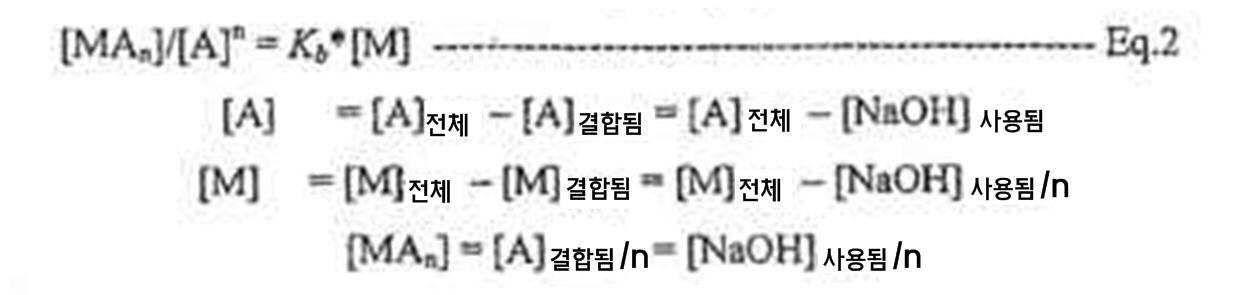
주( Note ): [NaOH]사용됨은 어떤 주어진 점에서 금속 양이온의 첨가에 의해 유발된 pH 변화(아마도 복합화에 기인함)를 중성화하기 위해 사용된 소듐 하이드록사이드의 농도이다. Note (Note): [NaOH] is used the concentration of sodium hydroxide used to neutralize the (due to possibly complexed) pH change caused by the addition of the metal cation in any given point.
Eq.2를 변형하여 아래의 식을 얻을 수 있다.The following equation can be obtained by modifying Eq.2.

[M] 대 [A]결합됨/[A]n의 플롯은 nKb의 기울기를 갖는 직선을 야기하는 것을 Eq. 3으로부터 추론할 수 있다. 이때, The plot of [M] versus [A] bounded / [A] n gives rise to a straight line with a slope of nKb. 3. ≪ / RTI > At this time,
n = 1은, 1:1 복합체,n = 1 is a 1: 1 complex,
n = 2은, 2:1 복합체,n = 2 is a 2: 1 complex,
n = 3은, 3: 1 복합체 등등.n = 3, 3: 1 complex, and so on.
도 46 내지 49에서 아래로 도시된 것은 각각 Ca2 +, Mg2 +, Fe2 + 및 Zn2 +에 대한 상기 플롯들이다.Shown below in Figure 46 to 49 are not the plot for each of Ca 2 +, Mg 2 +,
도 46 내지 49에서 나타낸 바와 같이, 각각의 양이온에 대하여 평가된 [A]결합됨/[A]n 대 nKb *[M]의 플롯은 n=2 (Ca2+에서 n=2는 n=1보다 더 좋은 핏(fit)을 가져왔다. 이러한 결과는 Ca2 +, Mg2 +, Fe2 + 및 Zn2 +을 가지는 레보플록사신 복합체가 양이온 1몰당 약물 2 mole의 화학량론(2:1)으로 형성된 것을 암시한다. As shown in Figures 46 to 49, the plot of [A] bound / [A] n to nK b * [M] evaluated for each cation is n = 2 (Ca2 + to n = 2 for n = 1 This result shows that the levofloxacin complex with Ca 2 + , Mg 2 + , Fe 2 + and Zn 2 + is formed by stoichiometry (2: 1) of 2 moles of drug per mole of cation It implies.
n=2를 이용하여, 상기 복합체에 대한 결합 상수를 각각의 선형 플롯의 기울기로부터 측정할 수 있다.Using n = 2, the binding constants for the complex can be determined from the slope of each linear plot.
log(Kb)로 나타낸 2:1 복합체에 대한 결합 상수는 다음과 같다. Ca2 +=2.75, Mg2+=3.69, Zn2 +=4.44, Fe2 +=4.54.The binding constants for the 2: 1 complex in log (K b ) are as follows. Ca 2 + = 2.75, Mg 2+ = 3.69,
용해도Solubility
이 방법은 복합화의 화학량론을 결정하는 상대적으로 간단한 방식을 참작하였다. 상기 접근은 복합화 용제(주어진 금속 양이온)의 농도 증가의 존재하에서 약물(레보플록사신)의 용해도 평가를 포함하였다. 상기 약물(복합화된 것+복합화되지 않은 것)의 총 용해도가 복합화 때문에 선형적으로 증가할 것이고, 약물 및 복합체 모두의 포화 용해도에 대응하는 평탄역에 도달할 것으로 예상하였다. 그러한 용해도 커브로부터 화학량론을 측정하는 것은 다른 곳에도 상세히 설명되었다(Physical Pharmacy: 4th Edition by Alfred Martin; pp 265).This method takes into account a relatively simple method of determining the stoichiometry of the complexation. The approach included an assessment of the solubility of the drug (levofloxacin) in the presence of increasing concentrations of the complexing agent (the given metal cation). The total solubility of the drug (complexed + uncomplexed) would increase linearly due to complexation and expected to reach a plateau corresponding to the saturation solubility of both drug and complex. Measuring stoichiometry from such solubility curves has also been described elsewhere (Physical Pharmacy: 4th Edition by Alfred Martin; pp. 265).
실험 방법론Experimental Methodology
과량의 레보플록사신(양을 기록하였음)을 MgCl2 농도의 증가 존재에서 와류혼합기(vortex mixer)를 사용하여 25 mM MES 버퍼 (pH 5.99)와 함께 흔들었다. 그리고 나서 시료를 여과하였고, 여과액(filtrate)을 적절히 희석하였고, 분광광도법으로 분석하여 레보플록사신 농도를 측정하였다(도 50).An excess of levofloxacin (the amount recorded) was shaken with 25 mM MES buffer (pH 5.99) using a vortex mixer in the presence of increasing MgCl 2 concentration. The sample was then filtered, the filtrate was diluted appropriately and analyzed by spectrophotometry to determine levofloxacin concentration (FIG. 50).
결과result
도 50에 나타낸 바와 같이, 레보플록사신의 용해도는 MgCl2 농도의 증가와 함께 증가하였다. 그러나, 평탄역 용해도 (~650mM 레보플록사신)을 넘어서, 용해도에서는 그 이상의 증가가 관찰되었으나, 이는 예상했던 프로파일과 일치하지 않는 것이다. 이는 레보플록사신 용해도에 대한 이온 강도의 효과 때문이었다. 모든 용액의 최종 pH가 비록 5.99보다 크기는 하지만(최종 pH ~7.0) 일정하다는 점을 지적해 두는 것이 중요하다. As shown in Figure 50, the solubility of levofloxacin increased with increasing MgCl 2 concentration. However, beyond the flat inverse solubility (~ 650mM levofloxacin), a further increase in solubility was observed, but this did not match the expected profile. This was due to the effect of ionic strength on levofloxacin solubility. It is important to point out that the final pH of all solutions is constant, although greater than 5.99 (final pH ~ 7.0).
이어서, 0.5M MES 버퍼 (pH 5.99)로 일정한 이온 강도 ~1.0M (NaCl로 조절하였음)에서 상기 실험을 반복하여 용액의 버퍼 용량을 향상시켰다(도 51).This experiment was then repeated with 0.5M MES buffer (pH 5.99) at a constant ionic strength ~1.0M (adjusted to NaCl) to improve the buffer capacity of the solution (Figure 51).
분광형광도법(Spectrophotometric method ( SpectrofluorometrySpectrofluorometry ))
복합화가 플루오로퀴놀론 형광 특성의 변화와 관련된다는 현재 논문 증거에 기초로 이 접근을 적용하여 레보플록사신 복합화를 평가하였다. 주어진 금속 양이온의 다양한 농도 존재하에서 레보플록사신의 발광의 변화를 모니터링함으로써 복합화의 결합 상수뿐만 아니라 화학량론을 결정하는 것이 가능하였다. This approach was applied to assess levofloxacin complexation based on the current paper evidence that complexation is associated with changes in fluoroquinolone fluorescence properties. It was possible to determine the stoichiometry as well as the binding constants of the complexation by monitoring the change in emission of levofloxacin in the presence of various concentrations of a given metal cation.
실험 방법론Experimental Methodology
298 nm 및 498 nm의 여기(excitation) 및 발산(emission) 파장에서 각각 레보플록사신 발광을 평가하였다. 연구를 두 개의 다른 pH 값, 예를 들어 5.0 (아세테이트) 및 9.0 (히스티딘)에서 수행하였다. 일정한 레보플록사신 농도를 포함하되 주어진 양이온의 농도가 증가하는 일련의 용액을 레보플록사신에 의해 기인한 발광에 대하여 분석하였다. 연구된 금속염은 CaCl2, MgCl2, FeCl2, ZnCl2 및 Al2(SO4)3 등을 포함하였다.The levofoxacin emission was evaluated at excitation and emission wavelengths of 298 nm and 498 nm, respectively. The study was carried out at two different pH values, for example 5.0 (acetate) and 9.0 (histidine). A series of solutions containing a constant concentration of levofloxacin but increasing the concentration of the given cation were analyzed for the emission caused by levofloxacin. The studied metal salts include CaCl 2 , MgCl 2 , FeCl 2 , ZnCl 2, and Al 2 (SO 4 ) 3 .
결과result
표 34에 나타낸 바와 같이, 의미있는 데이터를 오직 Fe2 + 및 Zn2 +에 대해서만 얻었다. 나머지 양이온들에 대하여, 레보플록사신 및 양이온의 상대 농도를 최적화하여 레보플록사신 형광의 변화에서 특이적인 경향을 관찰할 필요가 있었다.As shown in Table 34, the only meaningful data was obtained only for Fe + 2 and Zn + 2. For the remaining cations, it was necessary to observe specific trends in the change of levofloxacin fluorescence by optimizing the relative concentrations of levofloxacin and cations.
레보플록사신 발광에 있어서 Fe2 + 및 Zn2 + 농도 증가의 영향을 도 52 및 53에 각각 나타내었다.The effect of the increase in Fe 2 + and Zn 2 + concentrations in the levofloxacin luminescence is shown in FIGS. 52 and 53, respectively.
상술한 바와 같이, Fe2 + 및 Zn2 + 모두는 레보플록사신과 함께하는 2:1 복합체를 형성하는 것으로 보인다; 그러나, 레보플록사신 형광에 대한 그들의 영향은 상이하다(도 52 및 53). 이에 대한 정확한 이유는 지금 시점에서 불명확하다.As noted above, both Fe 2 + and Zn 2 + appear to form a 2: 1 complex with levofloxacin; However, their effects on levofloxacin fluorescence are different (Figures 52 and 53). The exact reason for this is unclear at this point.
[표 34][Table 34]
양이온 존재하에서 In the presence of a cation 레보플록사신의Levofloxacin 형광 특성. Fluorescence characteristics.

레보플록사신Levofloxacin 복합체의 시료 The sample of the composite
레보플록사신 복합체의 7 개의 시료를 효능 및 약동학에 대하여 생체 내 평가하였다. 테스트한 시료의 자세한 사항은 아래 표 35에 나타내었다.Seven samples of the levofloxacin complex were evaluated in vivo for efficacy and pharmacokinetics. Details of the tested samples are shown in Table 35 below.
[표 35][Table 35]
레보플록사신Levofloxacin 복합체의 Composite 몰비Mole ratio ..
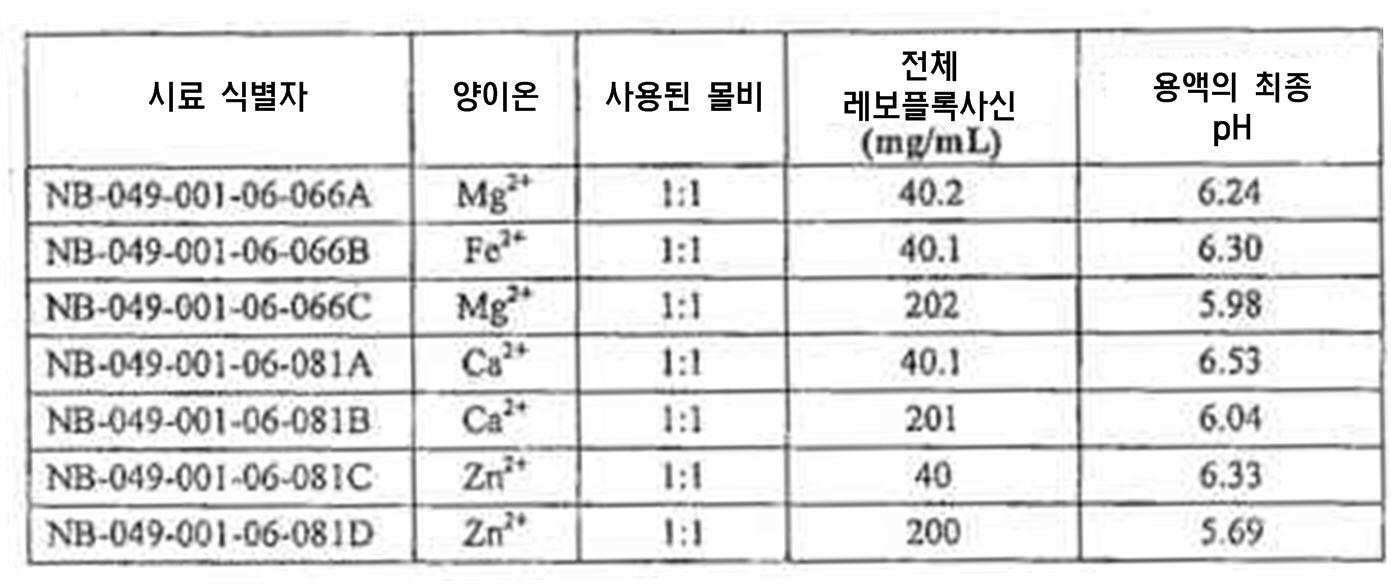
결론 및 신규 단계Conclusion and New Stage
우리의 듀얼 적정 연구에서 얻어진 결과는 레보플록사신이 모든 2가 금속 양이온과 함께 2:1 복합체를 형성한다는 것을 암시한다. Ca2 +, Mg2 +, Fe2 + 및 Zn2 +와의 복합화에 대한 결합 상수(log Kb)는 각각 2.75, 3.69, 4.44 및 4.54이다.The results from our dual titration study suggest that levofloxacin forms a 2: 1 complex with all bivalent metal cations. Ca 2 +, Mg 2 +,
실험예Experimental Example 11 - 유기산을 가지는 11 - with organic acids 레보플록사신Levofloxacin 및 제미플록사신 제제. And gemifloxacin.
실험 방법론Experimental Methodology
레보플록사신 용액을 15-20 ml의 물에 50 또는 100 mg의 레보플록사신 염기를 용해시켜 제조하였다. 물에서 레보플록사신 용액의 최초의 pH는 약 7.3이었다. 용액의 pH를 물에서 준비된 산의 약 10% 용액으로 조절하였다. 레보플록사신 용액의 pH를 조절하기 위해 사용된 산(acid)은 다음과 같았다: 아세트산, 아스코르브산, 시트르산, 락트산, 타르타르산 및 프로피온산. 용액의 부피를 최종 부피의 대략 90%로 만든 후에, 용액의 삼투질 농도를 측정하고, 물에서 준비된 약 20%의 소듐 클로라이드 용액으로 300 mOsm/kg로 조절하였다. pH 및 삼투질 농도 조절 후에, 용액의 부피를 물로 약 25ml까지 만들고, 그것의 표면 장력을 측정하였다. 부피를 보충한 후 pH 및 삼투질 농도를 측정하고, 표 36에 기록하였다. (정확한 레보플록사신의 정확한 양을 측정하였고, pH를 조절하기 위해 필요한 산, 삼투질 농도를 조절하기 위한 소듐 클로라이드 및 용액의 최종 부피를 표 36에 나열하였다). 용액 내의 레보플록사신의 용량을 HPLC로 측정하였다.Levofloxacin solutions were prepared by dissolving 50 or 100 mg of levofloxacin base in 15-20 ml of water. The initial pH of the levofloxacin solution in water was about 7.3. The pH of the solution was adjusted to about 10% solution of the acid prepared in water. The acids used to control the pH of the levofloxacin solution were: acetic acid, ascorbic acid, citric acid, lactic acid, tartaric acid and propionic acid. After making the volume of the solution about 90% of the final volume, the osmolality of the solution was measured and adjusted to about 300 mOsm / kg with about 20% sodium chloride solution prepared in water. After adjusting the pH and osmotic concentration, the volume of the solution was made up to about 25 ml with water and its surface tension was measured. After replenishing the volume, the pH and osmolality concentrations were measured and reported in Table 36. (The exact amount of correct levofloxacin was determined, the sodium chloride needed to adjust the acid, osmotic concentration to adjust pH, and the final volume of solution listed in Table 36). The volume of levofloxacin in the solution was measured by HPLC.
결과result
유기산을 가지는 레보플록사신 제제의 자세한 사항은 아해 표 36에 나타내었다. HPLC의 결과는 표 37에 나타내었다.Details of levofloxacin formulations with organic acids are shown in Table 36. [ The results of HPLC are shown in Table 37.
타르타르산을 사용하여 100 mg/ml 레보플록사신 용액의 pH를 조절할 때, 침전물이 형성되었다.When tartaric acid was used to adjust the pH of the 100 mg / ml levofloxacin solution, a precipitate formed.
주(Note): 아세트산, 시트르산 및 아스코르브산을 포함하는 용액을 HPLC 분석을 위해 다시 제조하였다. 따라서 표 36 및 표 37의 이들 용액에 대한 이론적인 농도는 다르다. Note: Solutions containing acetic acid, citric acid and ascorbic acid were again prepared for HPLC analysis. The theoretical concentrations for these solutions in Tables 36 and 37 are therefore different.
유기 염기를 포함하는 제미플록사신 제제 A gemifloxacin formulation containing an organic base
실험 방법론 및 결과Experimental methodology and results
소듐 Sodium 아스코르베이트를Ascorbate 포함하는 제미플록사신 제제 Containing gemifloxacin preparation
50.30 mg의 제미플록사신 메실레이트 (40.37 mg 제미플록사신과 등가)을 1.5ml 물에 첨가하였다. 결과 용액은 흐렸다. 그것을 0.45 마이크론 필터를 통해 여과하였다. pH 4.28을 포함하는 필터링 후 1.3 ml의 용액을 수득하였다. 물에서 제조된 10% 소듐 아스코르베이트 용액 400 ㎕으로 이 용액의 pH를 5.48로 조절하였다(pH를 조절하기 위해 필요한 염기의 양 = 0.04 g). 본 용액의 삼투질 농도는 308 mOsm/kg이었고, 따라서 소듐 클로라이드를 사용하여 삼투질 농도를 조절하지 않았다. 용액의 최종 부피는 1.7 ml였다. *이러한 제제에서 제미플록사신의 이론적인 농도는 20.59 mg/ml일 것이다.50.30 mg of gemiproxacin mesylate (equivalent to 40.37 mg gemifloxacin) was added to 1.5 ml water. The resulting solution was cloudy. It was filtered through a 0.45 micron filter. After filtering containing pH 4.28, a solution of 1.3 ml was obtained. The pH of the solution was adjusted to 5.48 with 400 μl of 10% sodium ascorbate solution prepared in water (amount of base needed to adjust pH = 0.04 g). The osmolality concentration of this solution was 308 mOsm / kg and therefore did not regulate the osmotic concentration using sodium chloride. The final volume of the solution was 1.7 ml. The theoretical concentration of gemifloxacin in these preparations will be 20.59 mg / ml.
[표 36][Table 36]
유기산을 포함하는 Containing an organic acid 레보플록사신의Levofloxacin 제제. Formulation.

*이론적인 농도 = 여과된 용액내의 제미플록사신의 이론적인 양 (본 경우에서 여과된 1.3 mL에서 35mg의 제미플록사신)/용액의 최종 부피(본 경우에 1.7 mL). * Theoretical concentration = the theoretical amount of gemifloxacin in the filtered solution (35 ml of gemifloxacin in 1.3 ml filtered in this case) / final volume of solution (1.7 ml in this case).
[표 37][Table 37]
제제 내의 Within the formulation 레보플록사신의Levofloxacin 이론적인 농도 및 측정된 농도 Theoretical and measured concentrations

주(Note): 아세트산, 시트르산 및 아스코르브산을 포함하는 용액을 다시 제조하였다. 따라서 표 36 및 표 37의 이들 용액에 대한 이론적인 농도는 다르다.Note: Solutions containing acetic acid, citric acid and ascorbic acid were again prepared. The theoretical concentrations for these solutions in Tables 36 and 37 are therefore different.
소듐 Sodium 락테이트를Lactate 포함하는 제미플록사신 제제 Containing gemifloxacin preparation
1.8 ml 물에 50.05 mg의 제미플록사신 메실레이트 (40.17 mg 제미플록사신과 등가)를 첨가하였다. 결과 용액은 흐렸다. 그것을 0.45 마이크론 필터를 통해 여과하였다. pH 4.21을 포함하는 필터링 후 1.52 ml의 용액을 수득하였다. 물에서 제조된 20%의 소듐 락테이트 용액 180 ㎕으로 이 용액의 pH를 5.42로 조절하였다(pH를 조절하기 위해 필요한 염기의 양 = 0.036 g). 본 용액의 삼투질 농도는 478 mOsm/kg이었고, 용액의 최종 부피는 1.7 ml였다. 이러한 제제에서 제미플록사신의 이론적인 농도는 19.95 mg/ml일 것이다.To 1.8 ml water was added 50.05 mg of gemifloxacin mesylate (equivalent to 40.17 mg gemifloxacin). The resulting solution was cloudy. It was filtered through a 0.45 micron filter. After filtering containing pH 4.21, 1.52 ml of solution was obtained. The pH of the solution was adjusted to 5.42 with 180 l of a 20% solution of sodium lactate prepared in water (amount of base needed to adjust pH = 0.036 g). The osmolality of this solution was 478 mOsm / kg and the final volume of the solution was 1.7 ml. The theoretical concentration of gemifloxacin in this formulation will be 19.95 mg / ml.
소듐 아세테이트를 포함하는 제미플록사신 제제A gemifloxacin formulation containing sodium acetate
50.47 mg의 제미플록사신 메실레이트 (40.50 mg 제미플록사신과 등가)을 2.0ml 물에 첨가하였다. 결과 용액은 흐렸다. 그것을 0.45 마이크론 필터를 통해 여과하였다. pH 4.40을 포함하는 필터링 후 1.77 ml의 용액을 수득하였다. 물에서 제조된 10%의 소듐 아세테이트 용액 50 ㎕으로 이 용액의 pH를 5.40으로 조절하였다(pH를 조절하기 위해 필요한 염기의 양 = 0.005 g). 본 용액의 삼투질 농도는 192 mOsm/kg이었다. 본 용액의 삼투질 농도를 물에서 제조된 20%의 소듐 클로라이드 용액 28 ㎕를 사용하여 295 mOsm/ kg로 조절하였다.50.47 mg of gemiproxacin mesylate (equivalent to 40.50 mg gemifloxacin) was added to 2.0 ml water. The resulting solution was cloudy. It was filtered through a 0.45 micron filter. After filtering containing pH 4.40, 1.77 ml of a solution was obtained. The pH of the solution was adjusted to 5.40 with 50 μl of a 10% sodium acetate solution prepared in water (the amount of base needed to adjust the pH = 0.005 g). The osmolality of this solution was 192 mOsm / kg. The osmolality of this solution was adjusted to 295 mOsm / kg using 28 μl of 20% sodium chloride solution prepared in water.
소듐 Sodium 프로피오네이트를Propionate 포함하는 제미플록사신 제제 Containing gemifloxacin preparation
50.00 mg의 제미플록사신 메실레이트 (40.13 mg 제미플록사신과 등가)을 1.9ml 물에 첨가하였다. 결과 용액은 흐렸다. 그것을 0.45 마이크론 필터를 통해 여과하였다. pH 4.32을 포함하는 필터링 후 1.39 ml의 용액을 수득하였다. 물에서 제조된 20% 소듐 프로피오네이트 용액 30 ㎕으로 이 용액의 pH를 5.50으로 조절하였다(pH를 조절하기 위해 필요한 염기의 양 = 0.006 g). 본 용액의 삼투질 농도는 183 mOsm/kg이었다. 본 용액의 삼투질 농도를 물에서 제조된 22%의 소듐 클로라이드 용액 25 ㎕를 사용하여 296 mOsm/kg로 조절하였다. 본 용액은 237mOsm/Kg으로의 삼투질 농도 조절과 함께 다시 제조되었다. 50.00 mg of gemifloxacin mesylate (equivalent to 40.13 mg of gemifloxacin) was added to 1.9 ml of water. The resulting solution was cloudy. It was filtered through a 0.45 micron filter. After filtering containing pH 4.32, 1.39 ml of solution was obtained. The pH of the solution was adjusted to 5.50 with 30 [mu] l of 20% sodium propionate solution prepared in water (amount of base needed to adjust pH = 0.006 g). The osmolality of this solution was 183 mOsm / kg. The osmolality of this solution was adjusted to 296 mOsm / kg with 25 μl of 22% sodium chloride solution prepared in water. This solution was reconstituted with osmotic concentration control at 237 mOsm / Kg.
소듐 Sodium 시트레이트를Citrate 포함하는 제미플록사신 제제 Containing gemifloxacin preparation
49.92 mg의 제미플록사신 메실레이트 (40.06 mg 제미플록사신과 등가)을 1.9ml 물에 첨가하였다. 결과 용액은 흐렸다. 그것을 0.45 마이크론 필터를 통해 여과하였다. pH 4.20을 포함하는 필터링 후 1.63 ml의 용액을 수득하였다. 물에서 제조된 20% 소듐 시트레이트 용액 30 ㎕으로 이 용액의 pH를 5.39으로 조절하였다(pH를 조절하기 위해 필요한 염기의 양 = 0.003 g)49.92 mg of gemiproxacin mesylate (equivalent to 40.06 mg of gemifloxacin) was added to 1.9 ml of water. The resulting solution was cloudy. It was filtered through a 0.45 micron filter. After filtering containing pH 4.20, 1.63 ml of solution was obtained. The pH of the solution was adjusted to 5.39 with 30 [mu] l of 20% sodium citrate solution prepared in water (amount of base needed to adjust pH = 0.003 g)
실험예Experimental Example 12 - 12 - 레보플록사신의Levofloxacin 마이크로스피어Microsphere (( MicrosphereMicrosphere ).).
본 연구의 목표는 용해도 및/또는 용해가 감소되는 동안의 테이스트-마스킹, 및 AUC 형태-향상 특성을 얻을 수 있는 레보플록사신의 다양한 마이크로스피어 형태를 제조하는 것이다. 이러한 이익은 후속될 나노입자 서스펜션 및 건조 분말 흡입을 사용하는 폐 투여에서 레보플록사신의 약력학 특성을 향상시킬 것이다. 이러한 제제들을 최적화하여 감소된 용해도 또는 용해 형태로부터 레보플록사신의 배출을 연장한다. 이러한 특성은 또한 제한 없이 제미플록사신, 가티플록사신, 노르플록사신, 투소플록사신, 시타플록사신 사라플록사신, 프룰리플록사신, 및 파주플록사신을 포함하는 또 다른 플루오로퀴놀론 항생제로 통합될 수 있다. 테이스트 마스킹, AUC 형태-향상, 나노입자 서스펜션 및 건조 분말 흡입 투여에 대한 제미플록사신의 마이크로스피어들을 특성화하는 연구들 또한 진행 중이다. 최근 연구되고 있는 건조 분말 투여에 대한 또 다른 접근은 분무-건조 및 인 시츄 마이크론화 기술을 포함한다.The goal of this study is to produce a variety of microsphere forms of levofloxacin that can achieve taste-masking and AUC form-enhancing properties while reducing solubility and / or solubility. This benefit will improve the pharmacodynamic properties of levofloxacin in pulmonary administration using subsequent nanoparticle suspensions and dry powder inhalation. These formulations are optimized to extend the release of levofloxacin from the reduced solubility or dissolution profile. Such characteristics may also be incorporated into another fluoroquinolone antibiotic, including, without limitation, gemifloxacin, gatifloxacin, norfloxacin, touofloxacin, sytafloxacin sarafloxacin, prurifluxroxin, and paju flocasin . Studies are also underway to characterize microspheres of gemifloxacin for taste masking, AUC form-enhancement, nanoparticle suspension and dry powder inhalation administration. Another approach to the recently studied dry powder administration involves spray-drying and in situ micronization techniques.
레보플록사신에On levofloxacin 대한 About 프리제제Free preparation
프리제제Free preparation 연구 Research
프리제제 연구를 수행하여 공정이 진행되는 동안 사용될 것으로 예상되는 다양한 용제에서 레보플록사신 및 폴리머의 용해도를 측정하였다.Free formulation studies were conducted to measure the solubility of levofloxacin and polymer in various solvents expected to be used during the process.
마이크로스피어의Microsphere 제조 Produce
스프레이 건조 기술을 레보플록사신이 적제된 폴리머 마이크로입자를 제제화하여 사용하고 있다. 마이크로스피어의 제제는 전형적으로 허용가능한 용제에서 약물 및 폴리머를 용해하는 것과 연관될 것이다. 상기 용액은 스프레이 건조기를 이용하여 용제를 증발시키는 스프레이 건조하고 있으며, 이로 인해 폴리머 매트릭스에의 약물을 트랩한다. 제제 파라미터 (약물: 폴리머 비율, 폴리머 용액 농도 및 생산 파라미터)의 최적화를 수행하여 원하는 마이크로 입자 크기, 최적의 약물 적재 및 시험관 내 약물 배출을 달성하고 있다.Spray drying technique is used to form polymer microparticles containing levofloxacin. Formulations of microspheres will typically be associated with dissolving the drug and polymer in an acceptable solvent. The solution is spray dried using a spray drier to evaporate the solvent, thereby trapping the drug into the polymer matrix. Optimization of formulation parameters (drug: polymer ratio, polymer solution concentration and production parameters) is performed to achieve the desired microparticle size, optimal drug loading and in vitro drug release.
마이크로스피어의Microsphere 특성화 Characterization
마이크로입자를 SEM을 이용하여 그들의 형태(morphology)에 대해 특성화할 수 것이고, 현미경 또는 허용가능한 기술 (레이저 회절)은 그들의 크기를 측정하기 위해 사용될 수 있다.Microparticles will be able to be characterized for their morphology using SEM, and microscopes or acceptable techniques (laser diffraction) can be used to measure their size.
허용가능한 용제내의 마이크로스피에서 약물을 추출하여 UV/HLPC로 추출물을 분석함으로써 약물 적재를 측정할 것이다.Drug loads will be measured by extracting the drug from the microspheres in an acceptable solvent and analyzing the extract with UV / HLPC.
USP 용해 기구를 사용하여 마이크로스피어로부터 약물 배출을 수행할 것이다.The USP dissolution apparatus will be used to perform drug discharge from the microspheres.
실험예Experimental Example 13 - 13 - 래트에서의In rats 흡입 독성학( Inhalation toxicity ToxicologyToxicology ).).
수컷 및 암컷 Sprague-Dawley 래트에서 에어로졸화된 레보플록사신의 4 일 non-GLP 증가 용량 연구에서, 25 mg/ml의 레보플록사신 용액을 1 일째에 1시간 동안 투여하였고, 2 내지 4일째에는 하루마다 2시간 동안 50 mg/ml의 레보플록사신 용액을 투여하였다. 치료 기간 동안 독성의 임상학적 징후(sign)는 관찰되지 않았다. 마지막 용량의 투여 후 24 시간 검시에서 어떤 발견이 나타나지 않았다.In a 4-day non-GLP increased dose study of aerosolized levofloxacin in male and female Sprague-Dawley rats, 25 mg / ml levofloxacin solution was administered for 1 hour on
수컷 및 암컷 Sprague-Dawley 래트에 대한 에어로졸화된 레보플록사신의 GLP 연구에서, 에어로졸화된 레보플록사신을 수컷에게 6.92 mg/kg/day의 평균 용량으로 매일 투여하였고, 암컷에게 10.04 mg/kg/day를 4 일 내내 코만을 사용하는(nose-only) 에어로졸 전달 장치를 사용하여 투여하였다. 연구 기간에 걸쳐 총 노출은 암컷 및 수컷에 대해 각각 29 및 42 mg/kg이었다. 각 용량을 매일 2 시간에 걸쳐 전달하였다. 본 연구에 대한 용량은 2 시간에 걸쳐 장치에서 투여할 수 있는 레보플록사신의 최대 용해도에 기초하여 선택되었다. 독성의 임상학적 징후는 관찰되지 않았고, 모든 동물들은 4일 처리 기간 동안 생존하였다. 마지막 용량의 투여 후 동물의 검사에서는 어떤 발견이 나타나지 않았다.In a GLP study of aerosolized levofloxacin against male and female Sprague-Dawley rats, aerosolized levofloxacin was administered daily to males at an average dose of 6.92 mg / kg / day and 10.04 mg / kg / Throughout the day with a nose-only aerosol delivery device. Total exposures were 29 and 42 mg / kg for females and males, respectively, over the study period. Each dose was delivered daily for 2 hours. The doses for this study were selected based on the maximum solubility of levofloxacin, which can be administered in the device over 2 hours. No clinical signs of toxicity were observed, and all animals survived the 4 day treatment period. No findings were found in animal tests after the last dose.
Sprague-Dawley 래트에 대한 28-일 GLP 연구에서, 동물들을 에어졸화된 레보플록사신 또는 살린의 3 용량 수준에서 임의로 추출하였다. 비히클 대조군 및 가장 높은 용량을 사용한 추가적인 회복 그룹도 처리하고, 최종 용량 이후의 14일 회복 기간 동안 관찰하였다. 평균의 에어졸화된 레보플록사신 용량은 수컷 래트에 대해 1.49, 3.63, 및 7.29 mg/kg/day이고, 암컷 래트에 대해 2.20, 5.35, 및 11.01 mg/kg/day였다. 28-일 처리 기간에 걸쳐 총 노출은 수컷에 대해서는 41.7 및 204.1 mg/kg 사이였고, 암컷에 대해서는 61.6 및 308.3 mg/kg사이의 범위였다. 각 용량을 매일 2 시간에 걸쳐 전달하였다. 용량과 관련된 독성의 임상학적 징후는 관찰되지 않았고, 모든 동물들은 28일 처리 기간 동안 생존하였다. 마지막 용량의 투여 후 동물의 검시에서 14일 회복 기간 동안의 혹독함으로 쇠퇴된 후두(larynx)에 용량과 관련된 후두의 비늘 모양의(squamous) 세포 과형성(hyperplasia)이 나타났다. In a 28-day GLP study on Sprague-Dawley rats, animals were randomly extracted at three dose levels of aerosolized levofloxacin or saline. Vehicle control and additional recovery groups using the highest dose were also treated and observed over a 14 day recovery period after the final dose. The average aerosolized levofloxacin doses were 1.49, 3.63, and 7.29 mg / kg / day for male rats and 2.20, 5.35, and 11.01 mg / kg / day for female rats. Over the 28-day treatment period, total exposure was between 41.7 and 204.1 mg / kg for males and between 61.6 and 308.3 mg / kg for females. Each dose was delivered daily for 2 hours. No clinical signs of dose-related toxicity were observed, and all animals survived the 28-day treatment period. Squamous cell hyperplasia of the larynx associated with dose appeared in the larynx, which declined to severity during the 14-day recovery period after the last dose administration of the animal.
Claims (100)
Applications Claiming Priority (7)
| Application Number | Priority Date | Filing Date | Title |
|---|---|---|---|
| US68253005P | 2005-05-18 | 2005-05-18 | |
| US60/682,530 | 2005-05-18 | ||
| US69616005P | 2005-07-01 | 2005-07-01 | |
| US60/696,160 | 2005-07-01 | ||
| US77330006P | 2006-02-13 | 2006-02-13 | |
| US60/773,300 | 2006-02-13 | ||
| PCT/US2006/019351 WO2006125132A2 (en) | 2005-05-18 | 2006-05-18 | Aerosolized fluoroquinolones and uses thereof |
Related Child Applications (2)
| Application Number | Title | Priority Date | Filing Date |
|---|---|---|---|
| KR1020147002452A Division KR101538677B1 (en) | 2005-05-18 | 2006-05-18 | Aerosolized fluoroquinolones and uses thereof |
| KR1020147016750A Division KR101488402B1 (en) | 2005-05-18 | 2006-05-18 | Aerosolized fluoroquinolones and uses thereof |
Publications (2)
| Publication Number | Publication Date |
|---|---|
| KR20080052511A KR20080052511A (en) | 2008-06-11 |
| KR101488403B1 true KR101488403B1 (en) | 2015-02-04 |
Family
ID=37056548
Family Applications (3)
| Application Number | Title | Priority Date | Filing Date |
|---|---|---|---|
| KR1020077029629A Active KR101488403B1 (en) | 2005-05-18 | 2006-05-18 | Aerosolized fluoroquinolones and uses thereof |
| KR1020147002452A Active KR101538677B1 (en) | 2005-05-18 | 2006-05-18 | Aerosolized fluoroquinolones and uses thereof |
| KR1020147016750A Active KR101488402B1 (en) | 2005-05-18 | 2006-05-18 | Aerosolized fluoroquinolones and uses thereof |
Family Applications After (2)
| Application Number | Title | Priority Date | Filing Date |
|---|---|---|---|
| KR1020147002452A Active KR101538677B1 (en) | 2005-05-18 | 2006-05-18 | Aerosolized fluoroquinolones and uses thereof |
| KR1020147016750A Active KR101488402B1 (en) | 2005-05-18 | 2006-05-18 | Aerosolized fluoroquinolones and uses thereof |
Country Status (23)
| Country | Link |
|---|---|
| EP (2) | EP2594272B1 (en) |
| JP (2) | JP5279487B2 (en) |
| KR (3) | KR101488403B1 (en) |
| CN (2) | CN101222927B (en) |
| AU (1) | AU2006247053B2 (en) |
| CA (2) | CA2608273C (en) |
| CY (2) | CY1118137T1 (en) |
| DK (2) | DK2594272T3 (en) |
| ES (2) | ES2599313T3 (en) |
| HR (1) | HRP20161230T2 (en) |
| HU (3) | HUE038814T2 (en) |
| IL (3) | IL187346A (en) |
| LT (2) | LT1901749T (en) |
| LU (1) | LUC00004I2 (en) |
| ME (1) | ME02562B (en) |
| MX (1) | MX359219B (en) |
| NZ (3) | NZ591509A (en) |
| PL (2) | PL2594272T3 (en) |
| PT (2) | PT2594272T (en) |
| RS (1) | RS55114B1 (en) |
| RU (2) | RU2603638C2 (en) |
| SI (1) | SI2594272T1 (en) |
| WO (1) | WO2006125132A2 (en) |
Families Citing this family (47)
| Publication number | Priority date | Publication date | Assignee | Title |
|---|---|---|---|---|
| US7838532B2 (en) | 2005-05-18 | 2010-11-23 | Mpex Pharmaceuticals, Inc. | Aerosolized fluoroquinolones and uses thereof |
| US8524734B2 (en) | 2005-05-18 | 2013-09-03 | Mpex Pharmaceuticals, Inc. | Aerosolized fluoroquinolones and uses thereof |
| LT1991201T (en) * | 2006-02-10 | 2018-07-25 | Pari Pharma Gmbh | Nebulised antibiotics for inhalation therapy |
| EP2030644A1 (en) | 2007-08-31 | 2009-03-04 | PARI Pharma GmbH | Aerosols for sinunasal drug delivery |
| CA2703672A1 (en) * | 2007-10-25 | 2009-04-30 | Revalesio Corporation | Compositions and methods for modulating cellular membrane-mediated intracellular signal transduction |
| EP2098219A1 (en) | 2008-03-05 | 2009-09-09 | PARI Pharma GmbH | Macrolide compositions having improved taste and stability |
| KR101621986B1 (en) | 2008-05-15 | 2016-05-17 | 노파르티스 아게 | Pulmonary delivery of a fluoroquinolone |
| WO2010042549A1 (en) * | 2008-10-07 | 2010-04-15 | Mpex Pharmaceuticals, Inc. | Inhalation of levofloxacin for reducing lung inflammation |
| WO2010042553A1 (en) * | 2008-10-07 | 2010-04-15 | Mpex Pharmaceuticals, Inc. | Aerosol fluoroquinolone formulations for improved pharmacokinetics |
| WO2010096242A1 (en) * | 2009-02-18 | 2010-08-26 | Aradigm Corporation | Ph-modulated formulations for pulmonary delivery |
| CN107050032A (en) * | 2009-04-24 | 2017-08-18 | 哈里逊奥芬有限责任公司 | The method that pulmonary bacterial is treated using fluoroquinolones |
| WO2011003091A1 (en) * | 2009-07-02 | 2011-01-06 | Alcon Research, Ltd. | Compositions comprising finafloxacin and methods for treating ophthalmic, otic, or nasal infections |
| EP2467138A4 (en) * | 2009-08-19 | 2013-11-06 | Mpex Pharmaceuticals Inc | Use of aerosolized antibiotics for treating chronic obstructive pulmonary disease |
| HUE038033T2 (en) | 2009-08-28 | 2018-10-29 | Hercules Llc | Film coating composition from solid powder compounds |
| AU2015275224C1 (en) * | 2009-09-04 | 2017-11-16 | Horizon Therapeutics U.S. Holding Llc | Use of aerosolized levofloxacin for treating cystic fibrosis |
| JP6180012B2 (en) | 2009-09-04 | 2017-08-16 | ラプター ファーマスーティカルズ,インコーポレイテッド | Use of aerosolized levofloxacin to treat cystic fibrosis |
| JP6000946B2 (en) * | 2010-07-12 | 2016-10-05 | クセリア ファーマシューティカルズ エーピーエスXellia Pharmaceuticals ApS | Composition for the treatment of pulmonary infections |
| CN101914483B (en) * | 2010-09-02 | 2013-07-31 | 福建新大陆生物技术股份有限公司 | Liquid-based thin-layer cell preservation solution and use thereof |
| CN107096014B (en) | 2010-09-29 | 2022-07-15 | 普马特里克斯营业公司 | Monovalent metal cation dry powder for inhalation |
| US10092552B2 (en) * | 2011-01-31 | 2018-10-09 | Avalyn Pharma Inc. | Aerosol pirfenidone and pyridone analog compounds and uses thereof |
| EP2491920A1 (en) * | 2011-02-25 | 2012-08-29 | Deva Holding Anonim Sirketi | Effervescent tablet, sachet and dry syrup of gemifloxacin |
| CN107596518B (en) | 2012-02-29 | 2021-04-23 | 普马特里克斯营业公司 | Inhalable dry powder |
| US9707228B2 (en) | 2012-05-21 | 2017-07-18 | Agency For Science, Technology And Research | Dry powder formulation |
| CA2907032C (en) * | 2013-03-15 | 2021-04-20 | I.E.Me.St - Istituto Euro Mediterraneo Di Scienza E Tecnologia | 1, 2, 4-oxadiazol compounds active against gram-positive pathogens |
| JP6799201B2 (en) | 2013-07-31 | 2020-12-16 | アヴァリン ファーマ インク. | Aerosol Tyrosine Kinase Inhibitor Compounds and Their Use |
| US11064913B2 (en) | 2013-10-25 | 2021-07-20 | Force Impact Technologies, Inc. | Impact sensing wearable device and method |
| US20160250142A1 (en) * | 2013-10-30 | 2016-09-01 | Inspirx Llc | Inhaled aerosolized immuno-chemotherapy for the treatement of mdr tb |
| CN103755730B (en) * | 2014-01-28 | 2016-05-04 | 广西师范大学 | Marbofloxacin-calcium chelate and synthetic method thereof and application |
| FR3020810B1 (en) * | 2014-05-06 | 2016-05-06 | Servier Lab | NEW SALT OF IVABRADINE AND PROCESS FOR PREPARING SAME |
| WO2016140219A1 (en) | 2015-03-02 | 2016-09-09 | 武田薬品工業株式会社 | Suspension or composition containing nano-cocrystal and manufacturing method therefor |
| CN105534988B (en) * | 2015-12-21 | 2019-04-16 | 山东省蚕业研究所 | A kind of volume increase of silkworm, prevention and treatment bacterium medicine and its application |
| WO2018011040A1 (en) * | 2016-07-13 | 2018-01-18 | INSERM (Institut National de la Santé et de la Recherche Médicale) | Plga microparticles loaded with a fluoroquinolone for the treatment of respiratory diseases |
| CN109260180A (en) * | 2017-07-17 | 2019-01-25 | 北京盈科瑞创新药物研究有限公司 | A kind of moxifloxacin hydrochloride Neulized inhalation pharmaceutical solutions and preparation method thereof |
| CN108414313A (en) * | 2018-02-27 | 2018-08-17 | 中国科学院北京基因组研究所 | A kind of sputum liquefaction agent, the kit containing it and its application |
| US11510618B2 (en) | 2018-12-20 | 2022-11-29 | Force Impact Technologies, Inc. | Method of manufacturing mouth guard having internal components for sensing impact forces |
| GB201900389D0 (en) * | 2019-01-11 | 2019-02-27 | Queens Univ Of Belfast | Solvent and water-free lipid-based nanoparticles and their methods of manufacture |
| US20200253960A1 (en) * | 2019-02-11 | 2020-08-13 | Aradigm Corporation | Antibiotic formulations for treating of cavity infections |
| KR102208837B1 (en) * | 2019-05-14 | 2021-02-01 | 경북대학교 산학협력단 | Composition for inhibiting adhesion, invasion of bacteria or antibacterial resistance comprising methyl gallate and fluoroquinolone antibacterial agent |
| CN112569211A (en) * | 2019-09-27 | 2021-03-30 | 盈科瑞(天津)创新医药研究有限公司 | Gatifloxacin solution for inhalation and preparation method thereof |
| CN110823876B (en) * | 2019-11-14 | 2022-06-28 | 东南大学 | A kind of preparation method and application of optical composite metal nanomaterial |
| CN111053761B (en) * | 2020-01-16 | 2022-05-03 | 杭州旦承医药科技有限公司 | Bisphosphonic acid medicine for inhalation, preparation method thereof and application thereof in chronic obstructive pulmonary disease |
| US20220016292A1 (en) * | 2020-07-20 | 2022-01-20 | Virushield, Inc. | Antiviral Compound with UV Reflectivity |
| WO2022034226A1 (en) | 2020-08-14 | 2022-02-17 | Universidad De Navarra | Avermectin and milbemycin compositions for inhalation |
| CN112322696B (en) * | 2020-11-19 | 2022-06-03 | 浙江省动物疫病预防控制中心 | Method for evaluating drug resistance strength of flora |
| WO2022240897A1 (en) * | 2021-05-10 | 2022-11-17 | Sepelo Therapeutics, Llc | Pharmaceutical composition comprising delafloxacin for administration into the lung |
| CN113952320B (en) * | 2021-09-18 | 2022-03-18 | 健康元药业集团股份有限公司 | Drug assembly containing tobramycin inhalation solution and application thereof |
| WO2025252927A1 (en) * | 2024-06-07 | 2025-12-11 | The Provost, Fellows, Foundation Scholars & The Other Members Of Board, Of The College Of The Holy & Undivided Trinity Of Queen Elizabeth Near Dublin | Vaccine compositions and methods and uses thereof |
Citations (3)
| Publication number | Priority date | Publication date | Assignee | Title |
|---|---|---|---|---|
| WO2002018345A1 (en) * | 2000-08-29 | 2002-03-07 | Chiron Corporation | Quinoline antibacterial compounds and methods of use thereof |
| WO2002072102A1 (en) * | 2001-03-05 | 2002-09-19 | Ortho-Mcneil Pharmaceutical, Inc. | Taste masked liquid pharmaceutical compositions |
| JP2003513046A (en) * | 1999-11-01 | 2003-04-08 | アルコン,インコーポレイテッド | Pharmaceutical composition containing fluoroquinolone antibiotic and xanthan gum |
Family Cites Families (143)
| Publication number | Priority date | Publication date | Assignee | Title |
|---|---|---|---|---|
| US2587215A (en) | 1949-04-27 | 1952-02-26 | Frank P Priestly | Inhalator |
| BE555319A (en) | 1956-03-21 | 1900-01-01 | ||
| BE556587A (en) | 1957-01-31 | 1957-04-11 | ||
| US3669113A (en) | 1966-03-07 | 1972-06-13 | Fisons Ltd | Inhalation device |
| US3507277A (en) | 1966-09-17 | 1970-04-21 | Fisons Pharmaceuticals Ltd | Inhalation device |
| US3456645A (en) | 1967-01-19 | 1969-07-22 | Dart Ind Inc | Inhalation-actuated aerosol dispensing device |
| US3456646A (en) | 1967-01-19 | 1969-07-22 | Dart Ind Inc | Inhalation-actuated aerosol dispensing device |
| US3456644A (en) | 1967-01-19 | 1969-07-22 | Dart Ind Inc | Inhalation-actuated aerosol dispensing device |
| GB1268051A (en) | 1968-06-07 | 1972-03-22 | Fisons Pharmaceuticals Ltd | Inhalation device |
| US3565070A (en) | 1969-02-28 | 1971-02-23 | Riker Laboratories Inc | Inhalation actuable aerosol dispenser |
| US3636949A (en) | 1969-08-08 | 1972-01-25 | Armstrong Kropp Dev Corp | Inhalation-initiated aerosol dispenser |
| BE758834A (en) | 1969-11-13 | 1971-05-12 | Riker Laboratoires Inc | AEROSOL DISPENSER ACTIVATED BY INHALATION |
| GB1383761A (en) | 1971-02-25 | 1974-02-12 | Woodcraft Dc | Inhalation device for use with an aerosol container |
| US3732864A (en) | 1971-06-07 | 1973-05-15 | Schering Corp | Inhalation coordinated aerosol dispensing device |
| IT941426B (en) | 1971-07-17 | 1973-03-01 | Isf Spa | SWIRL-CHAMBER INHALER FOR POWDER-SHAPING MEDICINAL SUBSTANCES |
| US3826255A (en) | 1972-06-22 | 1974-07-30 | Hudson Oxygen Therapy Sales Co | Intermittent positive pressure breathing manifold |
| FR2224175B1 (en) | 1973-04-04 | 1978-04-14 | Isf Spa | |
| IT1016489B (en) | 1974-03-18 | 1977-05-30 | Isf Spa | INHALER |
| US3971377A (en) | 1974-06-10 | 1976-07-27 | Alza Corporation | Medicament dispensing process for inhalation therapy |
| IT1017153B (en) | 1974-07-15 | 1977-07-20 | Isf Spa | APPARATUS FOR INHALATIONS |
| YU41046B (en) | 1974-08-22 | 1986-10-31 | Schering Ag | Medicine inholating device |
| SU628930A1 (en) | 1974-11-26 | 1978-10-25 | Московский научно-исследовательский институт туберкулеза | Device for introducing medicinal powders |
| US3948264A (en) | 1975-05-21 | 1976-04-06 | Mead Johnson & Company | Inhalation device |
| US4147166A (en) | 1977-05-02 | 1979-04-03 | American Cyanamid Company | Oral inhalator powder dispenser |
| US4268460A (en) | 1977-12-12 | 1981-05-19 | Warner-Lambert Company | Nebulizer |
| US4253468A (en) | 1978-08-14 | 1981-03-03 | Steven Lehmbeck | Nebulizer attachment |
| US4263907A (en) | 1979-05-14 | 1981-04-28 | Lindsey Joseph W | Respirator nebulizer |
| BR8007911A (en) | 1979-12-06 | 1981-06-16 | Glaxo Group Ltd | PERFECTED INHALER |
| SE438261B (en) | 1981-07-08 | 1985-04-15 | Draco Ab | USE IN A DOSHALATOR OF A PERFORED MEMBRANE |
| US4688218A (en) | 1981-07-15 | 1987-08-18 | Etablissement Public De Diffusion Dit "Telediffusion De France" | Multiplex channels for continuous flow for numerical signal |
| US4470412A (en) | 1982-03-19 | 1984-09-11 | Trutek Research, Inc. | Inhalation valve |
| US4510929A (en) | 1982-04-30 | 1985-04-16 | Bordoni Maurice E | Disposable radioactive aerosol inhalation apparatus |
| US4649911A (en) | 1983-09-08 | 1987-03-17 | Baylor College Of Medicine | Small particle aerosol generator for treatment of respiratory disease including the lungs |
| GB8328808D0 (en) | 1983-10-28 | 1983-11-30 | Riker Laboratories Inc | Inhalation responsive dispensers |
| US4624251A (en) | 1984-09-13 | 1986-11-25 | Riker Laboratories, Inc. | Apparatus for administering a nebulized substance |
| US4648393A (en) | 1984-11-02 | 1987-03-10 | Ackrad Laboratories, Inc. | Breath activated medication spray |
| FR2575678B1 (en) | 1985-01-04 | 1988-06-03 | Saint Gobain Vitrage | PNEUMATIC POWDER EJECTOR |
| US4805811A (en) | 1985-03-29 | 1989-02-21 | Aktiebolaget Draco | Dosage device |
| SE8603252L (en) | 1985-07-30 | 1987-01-31 | Glaxo Group Ltd | DEVICE FOR SUPPLYING MEDICINE TO PATIENTS |
| US4809692A (en) | 1986-01-31 | 1989-03-07 | Trudell Medical | Pediatric asthmatic medication inhaler |
| IT1204826B (en) | 1986-03-04 | 1989-03-10 | Chiesi Farma Spa | INHALATION PHARMACEUTICAL COMPOSITIONS |
| US4926852B1 (en) | 1986-06-23 | 1995-05-23 | Univ Johns Hopkins | Medication delivery system phase one |
| US4790305A (en) | 1986-06-23 | 1988-12-13 | The Johns Hopkins University | Medication delivery system |
| US5119806A (en) | 1987-05-12 | 1992-06-09 | Glaxo Inc. | Inhalation device |
| KR910000142B1 (en) | 1987-05-29 | 1991-01-21 | 니혼 다바고 상교오 가부시기가이샤 | Filter for cigarette |
| US4857311A (en) | 1987-07-31 | 1989-08-15 | Massachusetts Institute Of Technology | Polyanhydrides with improved hydrolytic degradation properties |
| US4907538A (en) | 1988-05-09 | 1990-03-13 | Little Suamico Products Inc. | Multiple bin cow feeder |
| US4832015A (en) | 1988-05-19 | 1989-05-23 | Trudell Medical | Pediatric asthmatic inhaler |
| IT1217890B (en) | 1988-06-22 | 1990-03-30 | Chiesi Farma Spa | DOSED AEROSOL INHALATION DEVICE |
| FR2636716B1 (en) | 1988-09-21 | 1990-12-07 | Staubli Sa Ets | DEVICE FOR COUPLING ELEMENT HOLDER PLATES OF MULTIPLE FITTINGS |
| ES2051371T3 (en) | 1988-10-04 | 1994-06-16 | Univ Johns Hopkins | AEROSOL INHALER. |
| DK479189D0 (en) | 1989-01-06 | 1989-09-28 | Hans Gernot Schenk | INHALER |
| US5012804A (en) | 1989-03-06 | 1991-05-07 | Trudell Medical | Medication inhaler with adult mask |
| US5012803A (en) | 1989-03-06 | 1991-05-07 | Trudell Medical | Modular medication inhaler |
| GB8908647D0 (en) | 1989-04-17 | 1989-06-01 | Glaxo Group Ltd | Device |
| WO1990013327A1 (en) | 1989-04-28 | 1990-11-15 | Riker Laboratories, Inc. | Dry powder inhalation device |
| US4955371A (en) | 1989-05-08 | 1990-09-11 | Transtech Scientific, Inc. | Disposable inhalation activated, aerosol device for pulmonary medicine |
| IT1237118B (en) | 1989-10-27 | 1993-05-18 | Miat Spa | MULTI-DOSE INHALER FOR POWDER DRUGS. |
| US5113855A (en) | 1990-02-14 | 1992-05-19 | Newhouse Michael T | Powder inhaler |
| US5192548A (en) | 1990-04-30 | 1993-03-09 | Riker Laboratoires, Inc. | Device |
| GB9015077D0 (en) | 1990-07-09 | 1990-08-29 | Riker Laboratories Inc | Inhaler |
| GB9015522D0 (en) | 1990-07-13 | 1990-08-29 | Braithwaite Philip W | Inhaler |
| IT1243344B (en) | 1990-07-16 | 1994-06-10 | Promo Pack Sa | MULTI-DOSE INHALER FOR POWDER MEDICATIONS |
| US5060643A (en) | 1990-08-07 | 1991-10-29 | Tenax Corporation | Breath-activated inhalation device |
| GB9026025D0 (en) | 1990-11-29 | 1991-01-16 | Boehringer Ingelheim Kg | Inhalation device |
| US5217004A (en) | 1990-12-13 | 1993-06-08 | Tenax Corporation | Inhalation actuated dispensing apparatus |
| US5040527A (en) | 1990-12-18 | 1991-08-20 | Healthscan Products Inc. | Metered dose inhalation unit with slide means |
| US5404871A (en) | 1991-03-05 | 1995-04-11 | Aradigm | Delivery of aerosol medications for inspiration |
| US5164740A (en) | 1991-04-24 | 1992-11-17 | Yehuda Ivri | High frequency printing mechanism |
| AU651882B2 (en) | 1991-05-14 | 1994-08-04 | Visiomed Group Limited | Aerosol inhalation device |
| ES2141108T3 (en) | 1991-07-02 | 2000-03-16 | Inhale Inc | METHOD AND DEVICE FOR PROVIDING DRUGS IN AEROSOL. |
| DK0540775T3 (en) | 1991-11-07 | 1997-08-25 | Ritzau Pari Werk Gmbh Paul | Especially for use in inhalation therapy apparatus |
| DE4140689B4 (en) | 1991-12-10 | 2007-11-22 | Boehringer Ingelheim Kg | Inhalable powders and process for their preparation |
| DE4142238A1 (en) | 1991-12-20 | 1993-06-24 | Boehringer Ingelheim Kg | POWDER INHALATOR WITH POWDER SUPPORT FROM REGULAR MICROSTRUCTURES |
| DE59307510D1 (en) | 1992-05-29 | 1997-11-13 | Ggu Gesundheits Umweltforsch | DEVICE FOR PRODUCING INHALABLE ACTIVE SUBSTANCE PARTICLES |
| US5785049A (en) | 1994-09-21 | 1998-07-28 | Inhale Therapeutic Systems | Method and apparatus for dispersion of dry powder medicaments |
| US5284133A (en) | 1992-07-23 | 1994-02-08 | Armstrong Pharmaceuticals, Inc. | Inhalation device with a dose-timer, an actuator mechanism, and patient compliance monitoring means |
| EG20543A (en) * | 1992-10-30 | 1999-07-31 | Procter & Gamble | Process for preparing of novel antimicrobial -5- (n-heterosubstituted amino) quinolones |
| NZ250105A (en) | 1992-11-09 | 1996-07-26 | Monaghan Canadian Ltd | Inhalator mask; one-way valve opens upon exhalation |
| WO1994014492A2 (en) | 1992-12-18 | 1994-07-07 | Schering Corporation | Inhaler for powdered medications |
| US5934272A (en) | 1993-01-29 | 1999-08-10 | Aradigm Corporation | Device and method of creating aerosolized mist of respiratory drug |
| US5364838A (en) | 1993-01-29 | 1994-11-15 | Miris Medical Corporation | Method of administration of insulin |
| US5558085A (en) | 1993-01-29 | 1996-09-24 | Aradigm Corporation | Intrapulmonary delivery of peptide drugs |
| US5709202A (en) | 1993-05-21 | 1998-01-20 | Aradigm Corporation | Intrapulmonary delivery of aerosolized formulations |
| GB9322014D0 (en) | 1993-10-26 | 1993-12-15 | Co Ordinated Drug Dev | Improvements in and relating to carrier particles for use in dry powder inhalers |
| US5388572A (en) | 1993-10-26 | 1995-02-14 | Tenax Corporation (A Connecticut Corp.) | Dry powder medicament inhalator having an inhalation-activated piston to aerosolize dose and deliver same |
| US5642730A (en) | 1994-06-17 | 1997-07-01 | Trudell Medical Limited | Catheter system for delivery of aerosolized medicine for use with pressurized propellant canister |
| US5820873A (en) | 1994-09-30 | 1998-10-13 | The University Of British Columbia | Polyethylene glycol modified ceramide lipids and liposome uses thereof |
| GB9501841D0 (en) | 1995-01-31 | 1995-03-22 | Co Ordinated Drug Dev | Improvements in and relating to carrier particles for use in dry powder inhalers |
| JP4484247B2 (en) | 1995-02-24 | 2010-06-16 | エラン ファーマ インターナショナル,リミティド | Aerosol containing nanoparticle dispersion |
| US5586550A (en) | 1995-08-31 | 1996-12-24 | Fluid Propulsion Technologies, Inc. | Apparatus and methods for the delivery of therapeutic liquids to the respiratory system |
| US5758637A (en) | 1995-08-31 | 1998-06-02 | Aerogen, Inc. | Liquid dispensing apparatus and methods |
| US6427682B1 (en) | 1995-04-05 | 2002-08-06 | Aerogen, Inc. | Methods and apparatus for aerosolizing a substance |
| US5921237A (en) | 1995-04-24 | 1999-07-13 | Dura Pharmaceuticals, Inc. | Dry powder inhaler |
| US6672304B1 (en) | 1995-06-08 | 2004-01-06 | Innovative Devices, Llc | Inhalation actuated device for use with metered dose inhalers (MDIs) |
| ATE209518T1 (en) | 1995-06-21 | 2001-12-15 | Asta Medica Ag | MEDICINAL POWDER CARTRIDGE WITH INTEGRATED DOSING DEVICE AND POWDER INHALER |
| AUPN417395A0 (en) | 1995-07-14 | 1995-08-10 | Techbase Pty. Ltd. | An improved spacer |
| JP5042447B2 (en) * | 1995-07-21 | 2012-10-03 | 第一三共株式会社 | Mixed preparation |
| GB9515182D0 (en) | 1995-07-24 | 1995-09-20 | Co Ordinated Drug Dev | Improvements in and relating to powders for use in dry powder inhalers |
| US6209538B1 (en) | 1995-08-02 | 2001-04-03 | Robert A. Casper | Dry powder medicament inhalator having an inhalation-activated flow diverting means for triggering delivery of medicament |
| SE9502799D0 (en) | 1995-08-10 | 1995-08-10 | Astra Ab | Device in inhalers |
| CN1104899C (en) * | 1995-12-21 | 2003-04-09 | 美国辉瑞有限公司 | Injectable quinolone formulations |
| US5694920A (en) | 1996-01-25 | 1997-12-09 | Abrams; Andrew L. | Inhalation device |
| US6026809A (en) | 1996-01-25 | 2000-02-22 | Microdose Technologies, Inc. | Inhalation device |
| US5823179A (en) | 1996-02-13 | 1998-10-20 | 1263152 Ontario Inc. | Nebulizer apparatus and method |
| US6083922A (en) | 1996-04-02 | 2000-07-04 | Pathogenesis, Corp. | Method and a tobramycin aerosol formulation for treatment prevention and containment of tuberculosis |
| FR2747311B1 (en) | 1996-04-10 | 1998-08-14 | Pf Medicament | POWDER AND COMPRESSED AIR INHALER |
| US5906202A (en) | 1996-11-21 | 1999-05-25 | Aradigm Corporation | Device and method for directing aerosolized mist to a specific area of the respiratory tract |
| US6349719B2 (en) | 1997-02-24 | 2002-02-26 | Aradigm Corporation | Formulation and devices for monitoring the efficacy of the delivery of aerosols |
| US6006747A (en) | 1997-03-20 | 1999-12-28 | Dura Pharmaceuticals, Inc. | Dry powder inhaler |
| US5855564A (en) | 1997-08-20 | 1999-01-05 | Aradigm Corporation | Aerosol extrusion mechanism |
| US6293279B1 (en) | 1997-09-26 | 2001-09-25 | Trudell Medical International | Aerosol medication delivery apparatus and system |
| HUP0003917A3 (en) | 1997-10-08 | 2001-04-28 | Sepracor Inc Marlborough | Dosage form for aerosol administration of water-sensitive medicaments |
| US6003512A (en) | 1997-11-13 | 1999-12-21 | Lovelace Respiratory Research Institute | Dust gun-aerosol generator and generation |
| DK1129741T3 (en) | 1997-11-19 | 2006-08-07 | Microflow Eng Sa | Inhaler atomizer |
| US6192876B1 (en) | 1997-12-12 | 2001-02-27 | Astra Aktiebolag | Inhalation apparatus and method |
| US6223746B1 (en) | 1998-02-12 | 2001-05-01 | Iep Pharmaceutical Devices Inc. | Metered dose inhaler pump |
| US6026807A (en) | 1998-02-27 | 2000-02-22 | Diemolding Corporation | Metered dose inhaler cloud chamber |
| US6257233B1 (en) | 1998-06-04 | 2001-07-10 | Inhale Therapeutic Systems | Dry powder dispersing apparatus and methods for their use |
| AU748867B2 (en) | 1998-07-24 | 2002-06-13 | Jagotec Ag | Medicinal aerosol formulations |
| GB2343122B (en) | 1998-10-26 | 2003-01-08 | Medic Aid Ltd | Improvements in and relating to nebulisers |
| US6070575A (en) | 1998-11-16 | 2000-06-06 | Aradigm Corporation | Aerosol-forming porous membrane with certain pore structure |
| US6584971B1 (en) | 1999-01-04 | 2003-07-01 | Medic-Aid Limited | Drug delivery apparatus |
| US6338443B1 (en) | 1999-06-18 | 2002-01-15 | Mercury Enterprises, Inc. | High efficiency medical nebulizer |
| ES2299430T3 (en) * | 1999-06-29 | 2008-06-01 | Lg Life Sciences, Ltd. | USE OF GEMIFLOXACINE COMPOUNDS AGAINST BACTERIA. |
| US6586008B1 (en) | 1999-08-25 | 2003-07-01 | Advanced Inhalation Research, Inc. | Use of simple amino acids to form porous particles during spray drying |
| DK1223915T3 (en) | 1999-10-29 | 2006-03-06 | Nektar Therapeutics | Dry powder preparations with improved dispersivity |
| US20010049366A1 (en) * | 2000-02-09 | 2001-12-06 | Alcon Universal Ltd. | Topical solution formulations containing an antibiotic and a corticosteroid |
| CA2406185C (en) | 2000-04-11 | 2011-03-15 | Trudell Medical International | Aerosol delivery apparatus with positive expiratory pressure capacity |
| WO2002024167A1 (en) * | 2000-09-19 | 2002-03-28 | Daiichi Pharmaceutical Co., Ltd. | Medicinal composition |
| US6601581B1 (en) | 2000-11-01 | 2003-08-05 | Advanced Medical Applications, Inc. | Method and device for ultrasound drug delivery |
| US6626173B2 (en) | 2001-01-08 | 2003-09-30 | Iep Pharmaceutical Devices Inc. | Dry powder inhaler |
| US6523536B2 (en) | 2001-03-12 | 2003-02-25 | Birdsong Medical Devices, Inc. | Dual-canister inhaler having a spacer and easy to operate lever mechanism |
| US6681768B2 (en) | 2001-06-22 | 2004-01-27 | Sofotec Gmbh & Co. Kg | Powder formulation disintegrating system and method for dry powder inhalers |
| HRP20040322A2 (en) * | 2001-10-09 | 2004-12-31 | Bristol Myers Squibb Co | Flashmelt oral dosage formulation |
| AU2002350622B2 (en) | 2001-10-24 | 2006-09-14 | Pari Pharma Gmbh | Kit for the preparation of a pharmaceutical composition |
| US20030171340A1 (en) * | 2002-02-07 | 2003-09-11 | Jenefir Isbister | Methods of disease treatment using metal-complexed tetracycline antibiotics |
| JP4290381B2 (en) * | 2002-04-11 | 2009-07-01 | 学校法人 聖マリアンナ医科大学 | Emulsion containing pyridonecarboxylic acid compound |
| RU2373937C9 (en) * | 2003-02-10 | 2010-07-27 | Байер Шеринг Фарма Акциенгезельшафт | Therapy of respiratory apparatus bacteriosis by local application of fluoroquinolones |
| ATE382338T1 (en) * | 2003-03-19 | 2008-01-15 | Jordanian Pharmaceutical Mfg | NON-HYGROSCOPIC PHARMACEUTICAL COMPOSITIONS CONTAINING NON-HYDRATED QUINOLONE CARBONIC ACID |
| RU2245134C1 (en) * | 2003-09-02 | 2005-01-27 | Открытое акционерное общество "Красфарма" | Ofloxacine composition for injections |
| WO2005089738A2 (en) * | 2004-03-17 | 2005-09-29 | Mpex Pharmaceuticals, Inc. | Use and administration of bacterial efflux pump inhibitors |
| WO2006100875A1 (en) * | 2005-03-24 | 2006-09-28 | Daiichi Sankyo Company, Limited | Pharmaceutical composition |
-
2006
- 2006-05-18 PL PL12007354T patent/PL2594272T3/en unknown
- 2006-05-18 PL PL06760146T patent/PL1901749T3/en unknown
- 2006-05-18 LT LTEP06760146.8T patent/LT1901749T/en unknown
- 2006-05-18 HU HUE12007354A patent/HUE038814T2/en unknown
- 2006-05-18 NZ NZ591509A patent/NZ591509A/en unknown
- 2006-05-18 ES ES06760146.8T patent/ES2599313T3/en active Active
- 2006-05-18 KR KR1020077029629A patent/KR101488403B1/en active Active
- 2006-05-18 AU AU2006247053A patent/AU2006247053B2/en active Active
- 2006-05-18 PT PT120073549T patent/PT2594272T/en unknown
- 2006-05-18 MX MX2015003856A patent/MX359219B/en unknown
- 2006-05-18 CA CA2608273A patent/CA2608273C/en active Active
- 2006-05-18 CA CA2900093A patent/CA2900093C/en active Active
- 2006-05-18 EP EP12007354.9A patent/EP2594272B1/en active Active
- 2006-05-18 KR KR1020147002452A patent/KR101538677B1/en active Active
- 2006-05-18 RS RS20160898A patent/RS55114B1/en unknown
- 2006-05-18 PT PT67601468T patent/PT1901749T/en unknown
- 2006-05-18 CN CN200680026156.0A patent/CN101222927B/en active Active
- 2006-05-18 NZ NZ597290A patent/NZ597290A/en unknown
- 2006-05-18 DK DK12007354.9T patent/DK2594272T3/en active
- 2006-05-18 HR HRP20161230TT patent/HRP20161230T2/en unknown
- 2006-05-18 EP EP06760146.8A patent/EP1901749B1/en active Active
- 2006-05-18 DK DK06760146.8T patent/DK1901749T3/en active
- 2006-05-18 CN CN201410195250.5A patent/CN104173323B/en active Active
- 2006-05-18 WO PCT/US2006/019351 patent/WO2006125132A2/en not_active Ceased
- 2006-05-18 KR KR1020147016750A patent/KR101488402B1/en active Active
- 2006-05-18 JP JP2008512525A patent/JP5279487B2/en active Active
- 2006-05-18 NZ NZ563417A patent/NZ563417A/en unknown
- 2006-05-18 ES ES12007354.9T patent/ES2685315T3/en active Active
- 2006-05-18 HU HUE06760146A patent/HUE030419T2/en unknown
- 2006-05-18 SI SI200632279T patent/SI2594272T1/en unknown
-
2007
- 2007-11-13 IL IL187346A patent/IL187346A/en active IP Right Grant
-
2011
- 2011-05-10 RU RU2011118619/04A patent/RU2603638C2/en active
-
2013
- 2013-01-10 JP JP2013002399A patent/JP5690853B2/en active Active
- 2013-07-17 IL IL227521A patent/IL227521A/en active IP Right Grant
-
2015
- 2015-07-07 IL IL239821A patent/IL239821B/en active IP Right Grant
-
2016
- 2016-10-13 RU RU2016140347A patent/RU2016140347A/en not_active Application Discontinuation
- 2016-10-25 CY CY20161101069T patent/CY1118137T1/en unknown
- 2016-11-15 ME MEP-2016-236A patent/ME02562B/en unknown
-
2017
- 2017-01-30 LU LU00004C patent/LUC00004I2/fr unknown
- 2017-01-31 HU HUS1700005C patent/HUS1700005I1/en unknown
- 2017-02-01 CY CY2017006C patent/CY2017006I2/en unknown
- 2017-02-01 LT LTPA2017002C patent/LTC1901749I2/en unknown
Patent Citations (3)
| Publication number | Priority date | Publication date | Assignee | Title |
|---|---|---|---|---|
| JP2003513046A (en) * | 1999-11-01 | 2003-04-08 | アルコン,インコーポレイテッド | Pharmaceutical composition containing fluoroquinolone antibiotic and xanthan gum |
| WO2002018345A1 (en) * | 2000-08-29 | 2002-03-07 | Chiron Corporation | Quinoline antibacterial compounds and methods of use thereof |
| WO2002072102A1 (en) * | 2001-03-05 | 2002-09-19 | Ortho-Mcneil Pharmaceutical, Inc. | Taste masked liquid pharmaceutical compositions |
Also Published As
Similar Documents
| Publication | Publication Date | Title |
|---|---|---|
| KR101488403B1 (en) | Aerosolized fluoroquinolones and uses thereof | |
| US10987357B2 (en) | Aerosolized fluoroquinolones and uses thereof | |
| US7838532B2 (en) | Aerosolized fluoroquinolones and uses thereof | |
| AU2013203605B2 (en) | Aerosolized fluoroquinolones and uses thereof | |
| US20220047604A1 (en) | Aerosolized fluoroquinolones and uses thereof | |
| RU2428986C2 (en) | Aerosol fluorochinolones and their applications | |
| HK1185555A (en) | Aerosolized fluoroquinolones and uses thereof | |
| HK1118461B (en) | Aerosolized fluoroquinolones and uses thereof |
Legal Events
| Date | Code | Title | Description |
|---|---|---|---|
| PA0105 | International application |
Patent event date: 20071218 Patent event code: PA01051R01D Comment text: International Patent Application |
|
| AMND | Amendment | ||
| PG1501 | Laying open of application | ||
| A201 | Request for examination | ||
| PA0201 | Request for examination |
Patent event code: PA02012R01D Patent event date: 20110511 Comment text: Request for Examination of Application |
|
| AMND | Amendment | ||
| E902 | Notification of reason for refusal | ||
| PE0902 | Notice of grounds for rejection |
Comment text: Notification of reason for refusal Patent event date: 20130304 Patent event code: PE09021S01D |
|
| AMND | Amendment | ||
| E601 | Decision to refuse application | ||
| PE0601 | Decision on rejection of patent |
Patent event date: 20131030 Comment text: Decision to Refuse Application Patent event code: PE06012S01D Patent event date: 20130304 Comment text: Notification of reason for refusal Patent event code: PE06011S01I |
|
| A107 | Divisional application of patent | ||
| AMND | Amendment | ||
| J201 | Request for trial against refusal decision | ||
| PA0104 | Divisional application for international application |
Comment text: Divisional Application for International Patent Patent event code: PA01041R01D Patent event date: 20140128 |
|
| PJ0201 | Trial against decision of rejection |
Patent event date: 20140128 Comment text: Request for Trial against Decision on Refusal Patent event code: PJ02012R01D Patent event date: 20131030 Comment text: Decision to Refuse Application Patent event code: PJ02011S01I Appeal kind category: Appeal against decision to decline refusal Appeal identifier: 2014101000520 Request date: 20140128 |
|
| PB0901 | Examination by re-examination before a trial |
Comment text: Amendment to Specification, etc. Patent event date: 20140128 Patent event code: PB09011R02I Comment text: Request for Trial against Decision on Refusal Patent event date: 20140128 Patent event code: PB09011R01I Comment text: Amendment to Specification, etc. Patent event date: 20130604 Patent event code: PB09011R02I Comment text: Amendment to Specification, etc. Patent event date: 20121106 Patent event code: PB09011R02I Comment text: Amendment to Specification, etc. Patent event date: 20071220 Patent event code: PB09011R02I |
|
| E902 | Notification of reason for refusal | ||
| PE0902 | Notice of grounds for rejection |
Comment text: Notification of reason for refusal Patent event date: 20140328 Patent event code: PE09021S01D |
|
| A107 | Divisional application of patent | ||
| PA0104 | Divisional application for international application |
Comment text: Divisional Application for International Patent Patent event code: PA01041R01D Patent event date: 20140618 |
|
| E90F | Notification of reason for final refusal | ||
| PE0902 | Notice of grounds for rejection |
Comment text: Final Notice of Reason for Refusal Patent event date: 20140827 Patent event code: PE09021S02D |
|
| B701 | Decision to grant | ||
| PB0701 | Decision of registration after re-examination before a trial |
Patent event date: 20141230 Comment text: Decision to Grant Registration Patent event code: PB07012S01D Patent event date: 20140228 Comment text: Transfer of Trial File for Re-examination before a Trial Patent event code: PB07011S01I |
|
| GRNT | Written decision to grant | ||
| PR0701 | Registration of establishment |
Comment text: Registration of Establishment Patent event date: 20150126 Patent event code: PR07011E01D |
|
| PR1002 | Payment of registration fee |
Payment date: 20150127 End annual number: 3 Start annual number: 1 |
|
| PG1601 | Publication of registration | ||
| FPAY | Annual fee payment |
Payment date: 20180103 Year of fee payment: 4 |
|
| PR1001 | Payment of annual fee |
Payment date: 20180103 Start annual number: 4 End annual number: 4 |
|
| FPAY | Annual fee payment |
Payment date: 20190111 Year of fee payment: 5 |
|
| PR1001 | Payment of annual fee |
Payment date: 20190111 Start annual number: 5 End annual number: 5 |
|
| PR1001 | Payment of annual fee |
Payment date: 20210115 Start annual number: 7 End annual number: 7 |
|
| PR1001 | Payment of annual fee |
Payment date: 20220119 Start annual number: 8 End annual number: 8 |
|
| PR1001 | Payment of annual fee |
Payment date: 20230119 Start annual number: 9 End annual number: 9 |
|
| PR1001 | Payment of annual fee |
Payment date: 20240124 Start annual number: 10 End annual number: 10 |
|
| PR1001 | Payment of annual fee |
Payment date: 20241224 Start annual number: 11 End annual number: 11 |