KR101453181B1 - Thienopyridine ester derivative containing cyano group, preparation method, use and composition thereof - Google Patents
Thienopyridine ester derivative containing cyano group, preparation method, use and composition thereof Download PDFInfo
- Publication number
- KR101453181B1 KR101453181B1 KR1020127031045A KR20127031045A KR101453181B1 KR 101453181 B1 KR101453181 B1 KR 101453181B1 KR 1020127031045 A KR1020127031045 A KR 1020127031045A KR 20127031045 A KR20127031045 A KR 20127031045A KR 101453181 B1 KR101453181 B1 KR 101453181B1
- Authority
- KR
- South Korea
- Prior art keywords
- compound
- pharmaceutically acceptable
- acceptable salt
- formula
- tetrahydrothieno
- Prior art date
- Legal status (The legal status is an assumption and is not a legal conclusion. Google has not performed a legal analysis and makes no representation as to the accuracy of the status listed.)
- Expired - Fee Related
Links
- UMLFTCYAQPPZER-UHFFFAOYSA-N N#Cc1ccc(CBr)cc1 Chemical compound N#Cc1ccc(CBr)cc1 UMLFTCYAQPPZER-UHFFFAOYSA-N 0.000 description 1
- QLZIARKIPQZALH-UHFFFAOYSA-N N#Cc1ccc(CN(CCC2S3)CC2=CC3=O)cc1 Chemical compound N#Cc1ccc(CN(CCC2S3)CC2=CC3=O)cc1 QLZIARKIPQZALH-UHFFFAOYSA-N 0.000 description 1
- PYQVFGJHIWJNFS-UHFFFAOYSA-N O=C1SC(CCNC2)C2=C1 Chemical compound O=C1SC(CCNC2)C2=C1 PYQVFGJHIWJNFS-UHFFFAOYSA-N 0.000 description 1
Classifications
-
- C—CHEMISTRY; METALLURGY
- C07—ORGANIC CHEMISTRY
- C07D—HETEROCYCLIC COMPOUNDS
- C07D495/00—Heterocyclic compounds containing in the condensed system at least one hetero ring having sulfur atoms as the only ring hetero atoms
- C07D495/02—Heterocyclic compounds containing in the condensed system at least one hetero ring having sulfur atoms as the only ring hetero atoms in which the condensed system contains two hetero rings
- C07D495/04—Ortho-condensed systems
-
- A—HUMAN NECESSITIES
- A61—MEDICAL OR VETERINARY SCIENCE; HYGIENE
- A61K—PREPARATIONS FOR MEDICAL, DENTAL OR TOILETRY PURPOSES
- A61K31/00—Medicinal preparations containing organic active ingredients
- A61K31/33—Heterocyclic compounds
- A61K31/395—Heterocyclic compounds having nitrogen as a ring hetero atom, e.g. guanethidine or rifamycins
- A61K31/435—Heterocyclic compounds having nitrogen as a ring hetero atom, e.g. guanethidine or rifamycins having six-membered rings with one nitrogen as the only ring hetero atom
- A61K31/4353—Heterocyclic compounds having nitrogen as a ring hetero atom, e.g. guanethidine or rifamycins having six-membered rings with one nitrogen as the only ring hetero atom ortho- or peri-condensed with heterocyclic ring systems
- A61K31/4365—Heterocyclic compounds having nitrogen as a ring hetero atom, e.g. guanethidine or rifamycins having six-membered rings with one nitrogen as the only ring hetero atom ortho- or peri-condensed with heterocyclic ring systems the heterocyclic ring system having sulfur as a ring hetero atom, e.g. ticlopidine
-
- A—HUMAN NECESSITIES
- A61—MEDICAL OR VETERINARY SCIENCE; HYGIENE
- A61K—PREPARATIONS FOR MEDICAL, DENTAL OR TOILETRY PURPOSES
- A61K47/00—Medicinal preparations characterised by the non-active ingredients used, e.g. carriers or inert additives; Targeting or modifying agents chemically bound to the active ingredient
- A61K47/06—Organic compounds, e.g. natural or synthetic hydrocarbons, polyolefins, mineral oil, petrolatum or ozokerite
- A61K47/08—Organic compounds, e.g. natural or synthetic hydrocarbons, polyolefins, mineral oil, petrolatum or ozokerite containing oxygen, e.g. ethers, acetals, ketones, quinones, aldehydes, peroxides
- A61K47/10—Alcohols; Phenols; Salts thereof, e.g. glycerol; Polyethylene glycols [PEG]; Poloxamers; PEG/POE alkyl ethers
-
- A—HUMAN NECESSITIES
- A61—MEDICAL OR VETERINARY SCIENCE; HYGIENE
- A61K—PREPARATIONS FOR MEDICAL, DENTAL OR TOILETRY PURPOSES
- A61K47/00—Medicinal preparations characterised by the non-active ingredients used, e.g. carriers or inert additives; Targeting or modifying agents chemically bound to the active ingredient
- A61K47/06—Organic compounds, e.g. natural or synthetic hydrocarbons, polyolefins, mineral oil, petrolatum or ozokerite
- A61K47/26—Carbohydrates, e.g. sugar alcohols, amino sugars, nucleic acids, mono-, di- or oligo-saccharides; Derivatives thereof, e.g. polysorbates, sorbitan fatty acid esters or glycyrrhizin
-
- A—HUMAN NECESSITIES
- A61—MEDICAL OR VETERINARY SCIENCE; HYGIENE
- A61K—PREPARATIONS FOR MEDICAL, DENTAL OR TOILETRY PURPOSES
- A61K9/00—Medicinal preparations characterised by special physical form
- A61K9/0012—Galenical forms characterised by the site of application
- A61K9/0019—Injectable compositions; Intramuscular, intravenous, arterial, subcutaneous administration; Compositions to be administered through the skin in an invasive manner
-
- A—HUMAN NECESSITIES
- A61—MEDICAL OR VETERINARY SCIENCE; HYGIENE
- A61K—PREPARATIONS FOR MEDICAL, DENTAL OR TOILETRY PURPOSES
- A61K9/00—Medicinal preparations characterised by special physical form
- A61K9/14—Particulate form, e.g. powders, Processes for size reducing of pure drugs or the resulting products, Pure drug nanoparticles
- A61K9/16—Agglomerates; Granulates; Microbeadlets ; Microspheres; Pellets; Solid products obtained by spray drying, spray freeze drying, spray congealing,(multiple) emulsion solvent evaporation or extraction
- A61K9/1605—Excipients; Inactive ingredients
- A61K9/1629—Organic macromolecular compounds
- A61K9/1652—Polysaccharides, e.g. alginate, cellulose derivatives; Cyclodextrin
-
- A—HUMAN NECESSITIES
- A61—MEDICAL OR VETERINARY SCIENCE; HYGIENE
- A61K—PREPARATIONS FOR MEDICAL, DENTAL OR TOILETRY PURPOSES
- A61K9/00—Medicinal preparations characterised by special physical form
- A61K9/14—Particulate form, e.g. powders, Processes for size reducing of pure drugs or the resulting products, Pure drug nanoparticles
- A61K9/19—Particulate form, e.g. powders, Processes for size reducing of pure drugs or the resulting products, Pure drug nanoparticles lyophilised, i.e. freeze-dried, solutions or dispersions
-
- A—HUMAN NECESSITIES
- A61—MEDICAL OR VETERINARY SCIENCE; HYGIENE
- A61K—PREPARATIONS FOR MEDICAL, DENTAL OR TOILETRY PURPOSES
- A61K9/00—Medicinal preparations characterised by special physical form
- A61K9/20—Pills, tablets, discs, rods
- A61K9/2004—Excipients; Inactive ingredients
- A61K9/2022—Organic macromolecular compounds
- A61K9/205—Polysaccharides, e.g. alginate, gums; Cyclodextrin
- A61K9/2054—Cellulose; Cellulose derivatives, e.g. hydroxypropyl methylcellulose
-
- A—HUMAN NECESSITIES
- A61—MEDICAL OR VETERINARY SCIENCE; HYGIENE
- A61K—PREPARATIONS FOR MEDICAL, DENTAL OR TOILETRY PURPOSES
- A61K9/00—Medicinal preparations characterised by special physical form
- A61K9/20—Pills, tablets, discs, rods
- A61K9/2004—Excipients; Inactive ingredients
- A61K9/2022—Organic macromolecular compounds
- A61K9/205—Polysaccharides, e.g. alginate, gums; Cyclodextrin
- A61K9/2059—Starch, including chemically or physically modified derivatives; Amylose; Amylopectin; Dextrin
-
- A—HUMAN NECESSITIES
- A61—MEDICAL OR VETERINARY SCIENCE; HYGIENE
- A61P—SPECIFIC THERAPEUTIC ACTIVITY OF CHEMICAL COMPOUNDS OR MEDICINAL PREPARATIONS
- A61P7/00—Drugs for disorders of the blood or the extracellular fluid
- A61P7/02—Antithrombotic agents; Anticoagulants; Platelet aggregation inhibitors
-
- A—HUMAN NECESSITIES
- A61—MEDICAL OR VETERINARY SCIENCE; HYGIENE
- A61P—SPECIFIC THERAPEUTIC ACTIVITY OF CHEMICAL COMPOUNDS OR MEDICINAL PREPARATIONS
- A61P9/00—Drugs for disorders of the cardiovascular system
-
- A—HUMAN NECESSITIES
- A61—MEDICAL OR VETERINARY SCIENCE; HYGIENE
- A61P—SPECIFIC THERAPEUTIC ACTIVITY OF CHEMICAL COMPOUNDS OR MEDICINAL PREPARATIONS
- A61P9/00—Drugs for disorders of the cardiovascular system
- A61P9/10—Drugs for disorders of the cardiovascular system for treating ischaemic or atherosclerotic diseases, e.g. antianginal drugs, coronary vasodilators, drugs for myocardial infarction, retinopathy, cerebrovascula insufficiency, renal arteriosclerosis
Landscapes
- Health & Medical Sciences (AREA)
- Chemical & Material Sciences (AREA)
- Life Sciences & Earth Sciences (AREA)
- General Health & Medical Sciences (AREA)
- Veterinary Medicine (AREA)
- Public Health (AREA)
- Medicinal Chemistry (AREA)
- Animal Behavior & Ethology (AREA)
- Pharmacology & Pharmacy (AREA)
- Epidemiology (AREA)
- Engineering & Computer Science (AREA)
- Organic Chemistry (AREA)
- Bioinformatics & Cheminformatics (AREA)
- General Chemical & Material Sciences (AREA)
- Chemical Kinetics & Catalysis (AREA)
- Oil, Petroleum & Natural Gas (AREA)
- Nuclear Medicine, Radiotherapy & Molecular Imaging (AREA)
- Dermatology (AREA)
- Cardiology (AREA)
- Heart & Thoracic Surgery (AREA)
- Biochemistry (AREA)
- Molecular Biology (AREA)
- Urology & Nephrology (AREA)
- Vascular Medicine (AREA)
- Diabetes (AREA)
- Hematology (AREA)
- Heterocyclic Carbon Compounds Containing A Hetero Ring Having Oxygen Or Sulfur (AREA)
- Pharmaceuticals Containing Other Organic And Inorganic Compounds (AREA)
Abstract
식(I)의 구조를 갖는 화합물 또는 약제학적으로 허용되는 염, 이의 제조방법 및 용도가 본 발명에 개시되고, 여기서 R은 시아노기이다. 본 발명에 제공되는 화합물은 항혈소판 응집 활성을 갖고, 혈소판 응집에 의해 야기되는 관상동맥 증후군, 심근경색증 또는 심근허혈과 같은 심장 및 뇌 혈관 질환을 예방 또는 치료하기 위한 약을 제조하는데 사용될 수 있다.

Description
본 발명은 의학 기술 분야에 속하고, 항혈소판 응집의 효과를 갖는 일종의 화합물, 및 이의 제조방법 및 용도에 관한 것이다. 더욱 구체적으로, 본 발명은 시아노기를 함유하는 티에노피리딘 에스테르 유도체, 이의 제조방법 및 용도에 관한 것이다.
The present invention belongs to the field of medical technology, and relates to a kind of compound having an effect of anti-platelet aggregation, and a production method and use thereof. More specifically, the present invention relates to a cyano group-containing thienopyridine ester derivative, its preparation method and its use.
혈전증(Thrombosis)은 인간의 건강과 삶을 위협하고, 외과적 수술의 일반적인 합병증 및 중재적 혈관 조형술(interventional angioplasty) 후 재차단의 요소인 급성 심근경색증, 뇌졸증 및 폐색전증(acute myocardial infarction, apoplexy and pulmonary embolism) 등과 같은 심장, 뇌 및 폐 순환 장애를 야기한다. 최근 발전 되어온 혈전 용해법, 중재적 요법 및 외과적 치료가 급성 심근경색증 및 뇌경색을 치료하는데 현저한 진전을 만들고, 환자를 구할 성공률을 매우 개선하고, 삶의 질을 현저히 개선했지만, 심장 및 뇌혈관 질환의 장애율은 여전히 30% 수준이다. 따라서, 최근에 심장 및 뇌 혈관 질환을 예방 및 치료하는 새로운 약을 개발하는 것에 대한 관심 및 연구가 집중되고 있다.
Thrombosis threatens human health and life and may cause acute myocardial infarction, acute myocardial infarction, apoplexy and pulmonary disease, which are factors of general complications of surgical surgery and re-intervention after interventional angioplasty embolism, and the like. Recent advances in thrombolytic therapy, interventional therapy and surgical treatment have made remarkable progress in treating acute myocardial infarction and cerebral infarction, greatly improving the success rate of patients and improving quality of life, The failure rate is still around 30%. Therefore, there is a growing interest and research in recent years to develop new drugs for the prevention and treatment of cardiovascular and cerebrovascular diseases.
혈전증, 예컨대 손상된 혈관벽의 표면에 혈소판의 점착 및 응고, 울혈(blood stasis), 응혈 인자(clotting factor)의 활성화에 의해 야기되는 트롬빈(thrombin)의 형성, 플라스민(plasmin)의 낮은 활성도 등을 야기하는 다양한 요소들이 있다. 이러한 요소들에 있어서, 혈소판은 트롬빈에 필수적인 물질이므로, 혈소판의 응집을 억제하는 것은 혈전증의 예방 및 치료에 중요한 역할을 한다. 아데노신 디포스페이트 (ADP)는 혈소판 활성 및 응집 효과의 증폭에 중요한 작용 물질이고, 혈소판의 기능을 억제하기 위해 ADP 리셉터를 차단함으로써 병리학적 혈전증 (관동맥성 심장병(coronary heart disease), 뇌혈관 질환(cerebrovascular disease), 폐색전증, 혈전성정맥염 등) 및 심근경색증, 협심증(unstable angina pectoris), 말초 혈관 질환(peripheral vascular disease), 울혈성 심부전(congestive heart failure) 등을 예방하는데 중요한 접근법이 된다.
Thrombosis, such as the adhesion and coagulation of platelets on the surface of a damaged vessel wall, blood stasis, formation of thrombin caused by activation of clotting factor, and low activity of plasmin, There are a variety of factors. In these factors, platelets are essential for thrombin, so inhibiting platelet aggregation plays an important role in the prevention and treatment of thrombosis. Adenosine diphosphate (ADP) is an important agonist for the amplification of platelet activity and aggregation effect, and blocks ADP receptor to inhibit platelet function, thereby causing pathological thrombosis (coronary heart disease, cerebrovascular disease It is an important approach to prevent myocardial infarction, unstable angina pectoris, peripheral vascular disease, congestive heart failure, and the like.
클로피도그렐(Clopidogrel)은, 종래의 항혈소판제 티클로피딘(Ticlopidine)의 구조적 변형에 기초하여 개발된, ADP 리셉터 억제제의 일선의 임상 항혈소판제이다. 클로피도그렐 제품이 시판되자마자, 더 강한 항혈전 효과와 더 작은 ADR에 의해 시장을 빠르게 점유하게 되었다. 그러나, 10년 이상의 임상 실험 동안, TTP 및 HUS (hemolytic uremic syndrome) 등의 부작용이 발견되어왔다. 클로피도그렐은 항혈소판 약리 작용을 생성하지만, 출혈성 질환의 부작용을 보여주는 것은 주목할 만하다. 클로피도그렐은 치료학적 복용량에서 Tmax가 길고, 시작이 느리기 때문에, 투여량을 통제하기 어렵고, 아마도 출혈성 질환을 더 증가시킬 것이다. 한편, 클로피도그렐은 매우 약한 알칼리도를 갖는 오일성 물질이기 때문에, 강산과 반응함으로써 염화(salified)될 수 있고, 정제하기 어렵다. 클로피도그렐의 염은 습윤한 조건 하에서는 불안정하고, 이의 유리된 염기는 다시 침전될 수 있고, 이의 강한 산도에 기인하여(due to its strong acidity) 제제의 관점에서(in terms of formulation) 일부 범위로 제한된다.
Clopidogrel is a line of clinical antiplatelet agents for ADP receptor inhibitors developed on the basis of structural modification of the conventional antiplatelet agent Ticlopidine. As soon as the clopidogrel product was marketed, the market became quickly occupied by the stronger antithrombotic effect and smaller ADR. However, during more than a decade of clinical trials, side effects such as TTP and HUS (hemolytic uremic syndrome) have been found. Clopidogrel produces antiplatelet pharmacological action, but it is noteworthy that it exhibits side effects of hemorrhagic disease. Clopidogrel is difficult to control dosage, and probably will further increase bleeding disorders, because of its long T max and slow onset at therapeutic doses. On the other hand, since clopidogrel is an oily substance having a very weak alkalinity, it can be salified by reacting with strong acids and is difficult to purify. The salt of clopidogrel is unstable under wet conditions and its free base can be precipitated again and due to its strong acidity is limited to some extent in terms of formulation .
그 후, 클로피도그렐에 기초하여, 일본의 Daiichi Sankyo Company Limited와 미국의 Eli Lilly and Company가 새로운 항혈소판제 프라수그렐(Prasugrel), 다른 ADP 리셉터 억제제를 공동 개발했다. 많은 연구자들은 프라수그렐이 클로피도그렐보다 더욱 활성적이고, 작용 시작이 더 빠르며, 프라수그렐에 대한 환자들의 반응의 차이가 클로피도그렐에 비해 작다는 것을 발견했다. 클로피도그렐과 프라수그렐의 임상 통제 실험의 결과는, 프라수그렐은 비치명적 심장 마비 및 뇌졸중에 의해 야기되는 사망률을 감소하는데 효과적이지만, 환자에게 더욱 출혈을 발생시킨다는 것을 나타낸다. 따라서, 안전성과 항혈소판 응집 활성이 우수한 신규 약제를 연구 및 개발하는 것이 필요하다.Subsequently, on the basis of clopidogrel, Daiichi Sankyo Company Limited of Japan and Eli Lilly and Company of the United States jointly developed a new antiplatelet agent Prasugrel, another ADP receptor inhibitor. Many researchers have found that praxigrel is more active than clopidogrel, has a faster onset of action, and the patients' response to praxigrel is smaller than clopidogrel. The results of clinical control experiments with clopidogrel and prasugrel indicate that prasugrel is effective in reducing mortality caused by non-fatal heart attack and stroke, but also causes more bleeding in patients. Therefore, it is necessary to research and develop new drugs having excellent safety and anti-platelet aggregation activity.

티에노피리딘 화합물에 관한 합성 방법 및 검토는 이하 문헌에서 발견될 수 있다: CN1683373, US4681888, US4529596, GB1501797, WO02059128, US4174448, GB1561504, WO2004094374, JP6135970 및 JP63264588.
Synthesis methods and studies on thienopyridine compounds can be found in the following references: CN1683373, US4681888, US4529596, GB1501797, WO02059128, US4174448, GB1561504, WO2004094374, JP6135970 and JP63264588.
본 발명의 목적은 시아노기를 함유하는 티에노피리딘 에스테르 유도체를 제공하는 것이다.
An object of the present invention is to provide a thienopyridine ester derivative containing a cyano group.
본 발명의 다른 목적은 시아노기를 함유하는 상기 티에노피리딘 에스테르 유도체 또는 주요 유효 성분으로서 이의 약제학적으로 허용되는 염을 포함하는 약제학적 조성물을 제공하는 것이다.
Another object of the present invention is to provide a pharmaceutical composition comprising the thienopyridine ester derivative containing a cyano group or a pharmaceutically acceptable salt thereof as a main active ingredient.
본 발명의 또 다른 목적은 시아노기를 함유하는 상기 티에노피리딘 에스테르 유도체 및 이의 약제학적으로 허용되는 염을 제조하는 방법을 제공하는 것이다.
It is still another object of the present invention to provide a method for preparing the thienopyridine ester derivative containing cyano group and a pharmaceutically acceptable salt thereof.
본 발명의 또 다른 목적은 시아노기를 함유하는 상기 티에노피리딘 에스테르 유도체 및 이의 약제학적으로 허용되는 염을 항혈소판제의 용도, 특히 혈소판 응집에 의해 야기되는 심장 및 뇌 혈관 질환, 예컨대 관상동맥 증후군(coronary artery syndromes), 심근경색증(myocardial infarction) 또는 심근허혈(myocardial ischemia) 등을 예방 또는 치료하기 위한 약을 제조하는 용도를 제공하는 것이다.
It is still another object of the present invention to provide a method for the treatment of cardiovascular and cerebrovascular diseases caused by platelet aggregation, for example, coronary artery syndrome (" coronary syndrome " coronary artery syndromes, myocardial infarction, or myocardial ischemia. The present invention also provides a method for preventing or treating such diseases.
본 발명은 식 I의 구조를 갖는 화합물 및 이의 약제학적으로 허용되는 염을 제공한다:The present invention provides compounds having the structure of Formula I and pharmaceutically acceptable salts thereof:

여기서, R은 시아노기이다.
Here, R is a cyano group.
본 발명에 제공되는 식 I의 구조를 갖는 화합물은 하기 화합물 I-1, I-2 및 I-3이 바람직하다: The compounds having the structure of the formula I provided in the present invention are preferably the following compounds I-1, I-2 and I-3:
I-1: 5-(2-시아노벤질)-4,5,6,7-테트라하이드로티에노[3,2-c]피리딘-2-일 아세테이트 (5-(2-cyanobenzyl)-4,5,6,7-tetrahydrothieno[3,2-c]pyridin-2-yl acetate);I-1: 5- (2-cyanobenzyl) -4,5,6,7-tetrahydrothieno [3,2- c] pyridin- 5,6,7-tetrahydrothieno [3,2- c ] pyridin-2-yl acetate);
I-2: 5-(3-시아노벤질)-4,5,6,7-테트라하이드로티에노[3,2-c]피리딘-2-일 아세테이트 (5-(3-cyanobenzyl)-4,5,6,7-tetrahydrothieno[3,2-c]pyridin-2-yl acetate);I-2: 5- (3-cyanobenzyl) -4,5,6,7-tetrahydrothieno [3,2- c] pyridin- 5,6,7-tetrahydrothieno [3,2- c ] pyridin-2-yl acetate);
I-3: 5-(4-시아노벤질)-4,5,6,7-테트라하이드로티에노[3,2-c]피리딘-2-일 아세테이트 (5-(4-cyanobenzyl)-4,5,6,7-tetrahydrothieno[3,2-c]pyridin-2-yl acetate).
I-3: 5- (4-cyanobenzyl) -4,5,6,7-tetrahydrothieno [3,2- c] pyridin- 5,6,7-tetrahydrothieno [3,2- c ] pyridin-2-yl acetate).
본 발명에 따라서, 식 I의 구조를 갖는 화합물이 제공되고, 여기서 약제학적으로 허용되는 염은, 무기산 또는 유기산을 갖는 식 I의 화합물로 형성되는 염을 포함하고, 여기서 특히 바람직한 염은: 약제학적으로 허용되는 염, 예컨대 하이드로클로라이드(hydrochlorides), 하이드로브로마이드(hydrobromides), 하이드리오데이트(hydriodates), 설페이트(sulfates), 하이드로설페이트(hydrosulfates), 포스페이트(phosphates), 하이드로포스페이트(hydrophosphates), 아세테이트(acetates), 프로피오네이트(propionates), 부티레이트(butyrates), 락테이트(lactates), 메실레이트(mesylates), 토실레이트(tosilates), 말레이트(maleates), 벤조에이트(benzoates), 석시네이트(succinates), 타르트레이트(tartrates), 시트레이트(citrates), 푸마레이트(fumarates), 타우레이트(taurates), 글루코네이트(gluconates), 및 아미노산염 등이다.
According to the present invention there is provided a compound having the structure of formula I wherein the pharmaceutically acceptable salt comprises a salt formed with a compound of formula I having an inorganic or organic acid wherein particularly preferred salts are: Such as hydrochlorides, hydrobromides, hydriodates, sulfates, hydrosulfates, phosphates, hydrophosphates, acetates, and the like. But are not limited to, propionates, butyrates, lactates, mesylates, tosylates, maleates, benzoates, succinates, Tartrates, citrates, fumarates, taurates, gluconates, and amino acid salts, and the like. .
본 발명은 식 I의 화합물을 제조하는 방법을 더 제공하고, 특정 제조 경로는 하기와 같다:The present invention further provides a process for preparing a compound of formula I, wherein the specific route of preparation is as follows:

여기서, R은 시아노기이고; X는 브롬 또는 염소이다.
Wherein R is a cyano group; X is bromine or chlorine.
티에노피리돈의 하이드로클로라이드는, 중간체를 제조하기 위해 디클로로메탄(dichloromethane), 트리클로로메탄(trichloromethane), 아세토니트릴(acetonitrile) 또는 톨루엔(toluene) 등의 용매 중에서, 산-결합제(acid-binding agent), 예컨대 트리에틸아민(triethylamine), 피리딘(pyridine), 포타슘 카보네이트(potassium carbonate), 소듐 카보네이트(sodium carbonate), 소듐 비카보네이트(sodium bicarbonate), 포타슘 비카보네이트(potassium bicarbonate), 소듐 하이드록시드(sodium hydroxide) 또는 포타슘 하이드록시드(potassium hydroxide) 등의 존재하에, -10℃ 내지 -105℃에서 시아노기로 치환된 벤질 브로마이드 또는 벤질 클로라이드와 반응된다. 상기 중간체는, 표적 생성물(target product) I을 제조하기 위해, 디클로로메탄, 트리클로로메탄 또는 톨루엔 중에서, 산-결합제, 예컨대 트리에틸아민, 피리딘, 포타슘 카보네이트, 소듐 카보네이트, 소듐 비카보네이트, 포타슘 비카보네이트, 소듐 하이드록시드 또는 포타슘 하이드록시드의 존재하에, -30℃ 내지 -65℃에서 아세트산 무수물, 아세트산, 아세틸 클로라이드 또는 아세틸 브로마이드와 더 반응된다.
The hydrochloride of thienopyridone can be reacted with an acid-binding agent (e.g., an acid-binding agent) in a solvent such as dichloromethane, trichloromethane, acetonitrile or toluene to prepare an intermediate For example, triethylamine, pyridine, potassium carbonate, sodium carbonate, sodium bicarbonate, potassium bicarbonate, sodium hydroxide (sodium bicarbonate), potassium bicarbonate sodium hydroxide or potassium hydroxide in the presence of a base such as benzyl bromide or benzyl chloride substituted with cyano group at -10 ° C to -105 ° C. The intermediate may be reacted with an acid-coupling agent, such as triethylamine, pyridine, potassium carbonate, sodium carbonate, sodium bicarbonate, potassium bicarbonate, sodium bicarbonate or the like, in dichloromethane, trichloromethane or toluene to prepare the target product I. , Acetic acid, acetyl chloride or acetyl bromide in the presence of sodium hydroxide or potassium hydroxide at -30 ° C to -65 ° C.
상기 반응에서 제조된 다양한 중간체 또는 생성물 화합물(resulting product compound) I은, 약제학적으로 허용되는 염을 제조하기 위해, 디에틸 에테르, DMF, 아세톤, 메탄올, 에탄올, 에틸 아세테이트 또는 DMSO에 용해될 수 있고, 무기산 또는 유기산 용액을 적하 첨가될 수 있다.
The various intermediate products or product compounds I prepared in this reaction can be dissolved in diethyl ether, DMF, acetone, methanol, ethanol, ethyl acetate or DMSO to produce pharmaceutically acceptable salts , An inorganic acid or an organic acid solution may be added dropwise.
특정 조작을 포함할 수 있다: 상기 중간체 또는 생성물 화합물을 디에틸 에테르, DMF, 아세톤, 메탄올, 에탄올, 에틸 아세테이트 또는 DMSO에 용해하고, 하이드로클로라이드를 제조하기 위해, 상기 혼합물에 디에틸 에테르 중 하이드로겐 클로라이드 용액을 pH=2가 될 때까지 얼음물 배스에서 적하 첨가하는 단계; 또는 상기 화합물을 디에틸 에테르, DMF, 아세톤, 메탄올, 에탄올, 에틸 아세테이트 또는 DMSO에 용해하고, 타우레이트를 얻기 위해, 상기 혼합물에 등몰의 타우린을 첨가하고, 상기 혼합물을 가열 및 교반하는 단계; 또는 상기 화합물을 디에틸 에테르, DMF, 아세톤, 메탄올, 에탄올, 에틸 아세테이트 또는 DMSO에 용해하고, 설페이트 등을 제조하기 위해, 상기 혼합물에 농축 황산(concentrated sulfuric acid)을 pH=3이 될 때까지 얼음물 배스에서 적하 첨가하는 단계.
The intermediate or product compound may be dissolved in diethyl ether, DMF, acetone, methanol, ethanol, ethyl acetate or DMSO and, to prepare the hydrochloride, a mixture of hydrogen in diethyl ether Adding the chloride solution dropwise in an ice water bath until pH = 2; Or dissolving the compound in diethyl ether, DMF, acetone, methanol, ethanol, ethyl acetate or DMSO, adding equimolar taurine to the mixture to obtain a taurate, heating and stirring the mixture; Alternatively, the compound is dissolved in diethyl ether, DMF, acetone, methanol, ethanol, ethyl acetate or DMSO, and concentrated sulfuric acid is added to the mixture to produce sulfate or the like. A step of dropwise addition in a bath.
본 발명에 제공되는 화합물은 혈소판 응집에 의해 야기되는 인간의 질병을 치료하는데 효과적이다. 본 발명의 화합물은 임의의 제제(preparation) 없이 직접 투여될 수 있지만, 화합물은 약제학적 제제(pharmaceutical preparation)의 형태로 사용되는 것이 바람직하다. 투여 경로는 비경구적(예컨대 정맥내 또는 근육내) 또는 경구적 투여일 수 있다.
The compounds provided in the present invention are effective for treating human diseases caused by platelet aggregation. Although the compounds of the present invention may be administered directly without any preparation, it is preferred that the compound is used in the form of a pharmaceutical preparation. The route of administration may be parenteral (e.g. intravenous or intramuscular) or oral administration.
본 발명은, 식 I의 구조를 갖는 상기 화합물 또는 약제학적으로 허용되는 이의 염을 항혈소판제의 용도, 및 식 I의 구조를 갖는 상기 화합물 또는 약제학적으로 허용되는 이의 염을 항혈소판 응집을 위한 약을 제조하는 용도를 더 제공한다. 여기서, 항혈소판 응집용 약은 혈소판 응집에 의해 야기되는, 심장 및 뇌 혈관 질환을 치료 또는 예방하는 약이고, 여기서, 심장 및 뇌 혈관 질환은 관상동맥 증후군(coronary artery syndromes), 심근경색증(myocardial infarction) 또는 심근허혈(myocardial ischemia)일 수 있다.
The present invention also relates to the use of such compounds having the structure of formula I or a pharmaceutically acceptable salt thereof as an antiplatelet agent and the use of said compound having the structure of formula I or a pharmaceutically acceptable salt thereof as a medicament for antiplatelet aggregation ≪ / RTI > Herein, the drug for anti-platelet aggregation is a drug for treating or preventing a cardiac and cerebrovascular disease caused by platelet aggregation, wherein the cardiac and cerebrovascular disease is selected from the group consisting of coronary artery syndromes, myocardial infarction ) Or myocardial ischemia.
본 발명은 항혈소판 응집을 위한 약제학적 조성물을 더 제공하고, 상기 약제학적 조성물은 본 발명에 따른 식 I의 구조를 갖는 화합물 또는 이의 약제학적으로 허용되는 염, 및 약제학적으로 허용되는 담체 및/또는 첨가제를 치료학적 유효량을 포함한다. 본 발명의 약제학적 조성물에 따라서, 약제학적 조성물은 고체 경구 제제(a solid oral preparation), 액체 경구 제제(a liquid oral preparation) 또는 주사(an injection)일 수 있다.
The present invention further provides a pharmaceutical composition for anti-platelet aggregation comprising a compound having the structure of Formula I according to the invention, or a pharmaceutically acceptable salt thereof, and a pharmaceutically acceptable carrier and / Or a therapeutically effective amount of an additive. Depending on the pharmaceutical composition of the present invention, the pharmaceutical composition may be a solid oral preparation, a liquid oral preparation or an injection.
본 발명은 심장 및 뇌 혈관 질환을 치료하는 방법을 제공하고, 상기 방법은 본 발명에 따른 식 I의 구조를 갖는 화합물의 치료학적 유효량을 치료가 필요한 환자에게 투여하거나, 본 발명에 제공되는 약제학적 조성물의 치료학적 유효량을 치료가 필요한 환자에게 투여하는 단계를 포함한다.
The present invention provides a method for treating cardiovascular and cerebrovascular disease comprising administering to a patient in need thereof a therapeutically effective amount of a compound having the structure of Formula I according to the present invention, Administering a therapeutically effective amount of the composition to a patient in need of such treatment.
본 발명의 화합물의 약제학적 조성물의 제조 방법은 이하와 같다: 표준 및 종래의 기술을 사용하여 본 발명의 화합물과 약제학적으로 허용되는 고체 또는 액체 담체를 혼합하고, 마이크로입자 또는 마이크로스피어를 제조하기 위해, 선택적으로 이것을 약제학적으로 허용되는 보조제 및 첨가제와 혼합한다. 고체 제제는, 타블렛, 분산된 과립(dispersed granules), 캡슐, 방출 억제된 타블렛(sustained release tablet), 방출 억제된 펠렛(sustained release pellet) 등을 포함한다. 고체 담체는 희석제, 향미제, 가용화제, 윤활제, 서스펜션화제(suspending agent), 접착제, 붕해제(disintegrating agent), 또는 코팅제로 작용할 수 있는 적어도 하나의 물질일 수 있다. 내부 고체 담체(Inert solid carrier)로는 마그네슘 포스페이트(magnesium phosphate), 마그네슘 스테아레이트(magnesium stearate), 탈컴 파우더(talcum powder), 락토오스, 펙틴, 프로필렌글리콜, 폴리소르베이트(polysorbate) 80, 덱스트린, 전분, 젤라틴, 셀룰로오스 물질, 예컨대 메틸셀룰로오스(methylcellulose) 및 미정질 셀룰로오스(microcrystalline cellulose), 용융점이 낮은 파라핀, 폴리에틸렌글리콜, 만니톨, 및 코코아버터 등을 들 수 있다. 액체 제제로는 용액, 서스펜션, 예컨대 주사 및 파우더 등을 들 수 있다.
Methods for preparing pharmaceutical compositions of the compounds of the present invention are as follows: By using standard and conventional techniques to mix a compound of the present invention with a pharmaceutically acceptable solid or liquid carrier and to prepare microparticles or microspheres Optionally, it is admixed with pharmaceutically acceptable adjuvants and additives. Solid formulations include tablets, dispersed granules, capsules, sustained release tablets, sustained release pellets, and the like. The solid carrier can be at least one substance that can act as a diluent, flavoring agent, solubilizer, lubricant, suspending agent, adhesive, disintegrating agent, or coating agent. Examples of the internal solid carrier include magnesium phosphate, magnesium stearate, talcum powder, lactose, pectin, propylene glycol, polysorbate 80, dextrin, starch, Gelatin, cellulosic materials such as methylcellulose and microcrystalline cellulose, low melting point paraffin, polyethylene glycol, mannitol, and cocoa butter. Liquid formers include solutions, suspensions, such as injections and powders.
약제학적 조성물 및 단위 복용 형태에 함유되는 유효 성분(active ingredient)(본 발명의 화합물)의 양은 환자의 상태 및 의사의 진단에 따라 구체적으로 결정될 수 있고, 사용되는 화합물의 양 또는 농도는 다양한 범위 내에서 조절될 수 있다. 일반적으로 활성 화합물(active compound)의 양은 조성물의 0.5-90중량%, 바람직하게는 조성물의 0.5-70중량%이다.
The amount of the active ingredient (compound of the present invention) contained in the pharmaceutical composition and unit dosage form can be specifically determined according to the condition of the patient and the diagnosis of the physician, and the amount or concentration of the compound to be used can be varied within a wide range Lt; / RTI > Generally, the amount of active compound is 0.5-90% by weight of the composition, preferably 0.5-70% by weight of the composition.
본 발명은 이하 실시예를 참조하여 더 상세히 설명할 것이고, 이하 실시예는 단순히 본 발명을 분명히 보여주거나 설명할 뿐이고, 본 발명의 범위를 제한하지 않는다. 화합물은 HPLC(high performance liquid chromatography) 및 TLC(thin-layer chromatography)에 의해 시험된다. 화합물의 구조는 IR(infrared spectroscopy), 핵자기 공명 분광법(1H NMR, 13C NMR), MS(mass spectrography) 등과 같은 시험에 의해 더 확인될 수 있다.
The present invention will now be described in more detail with reference to the following examples, which are merely illustrative or illustrative of the present invention, and do not limit the scope of the present invention. The compounds are tested by HPLC (high performance liquid chromatography) and TLC (thin-layer chromatography). The structure of the compound can be further confirmed by tests such as IR (infrared spectroscopy), nuclear magnetic resonance spectroscopy (1 H NMR, 13 C NMR), mass spectrography (MS) and the like.
실시예Example 1 One
중간체 1의 제조Preparation of intermediate 1

교반기, 콘덴서 및 온도계가 구비된 반응 플라스크에, 19.2g의 5,6,7,7a-테트라하이드로티에노[3,2-c]피리딘-2(4H)-온을 첨가한 후, 70mL 아세토니트릴에 용해하고, 교반하에 -10℃까지 냉각했다. 41.5g의 무수 포타슘 카보네이트를 상기 혼합물에 첨가했다. 배치에서 상기 반응 시스템에 19.6g의 2-시아노벤질 브로마이드를 첨가한 후, 반응 혼합물을 45℃까지 가열하고, 4시간 동안 반응을 계속했다(반응의 종료는 TLC에 의해 모니터링되었음). 그 후, 상기 반응 혼합물을 여과하고, 여과액 중 용매 아세토니트릴을 건조할 때까지 증발시켰다. 50mL의 디클로로메탄을 잔여물에 첨가하고, 혼합물을 물 (3×50mL)로 세정했다. 디클로로메탄 층을 분리하여, 무수 소듐 설페이트 상에서 모두 건조시키고, 여과했다. 디클로로메탄을 감압하에 증발시켜, 22.6g의 황색 오일 생성물(product)을 얻었다 (HPLC: 97.2%). Rf = 0.47 [싱글 포인트(single point), 전개 용매(developing solvent): v (페트로륨 에테르(petroleum ether)): v (에틸 아세테이트) = 1:2]. MS, m/Z: 270.0 (M).
Tetrahydrothieno [3,2- c ] pyridin-2 ( 4H ) -one was added to a reaction flask equipped with a stirrer, a condenser and a thermometer, Dissolved in nitrile, and cooled to -10 캜 under stirring. 41.5 g of anhydrous potassium carbonate was added to the mixture. After the addition of 19.6 g of 2-cyanobenzyl bromide to the reaction system in the batch, the reaction mixture was heated to 45 < 0 > C and the reaction was continued for 4 hours (end of reaction monitored by TLC). The reaction mixture was then filtered and the solvent acetonitrile in the filtrate was evaporated to dryness. 50 mL of dichloromethane was added to the residue, and the mixture was washed with water (3 x 50 mL). The dichloromethane layer was separated, dried over both anhydrous sodium sulfate and filtered. The dichloromethane was evaporated under reduced pressure to give 22.6 g of a yellow oil product (HPLC: 97.2%). Rf = 0.47 [single point, developing solvent: v (petroleum ether): v (ethyl acetate) = 1: 2]. MS, m / z: 270.0 (M).
실시예Example 2 2
중간체 2의 제조 Preparation of intermediate 2

교반기, 콘덴서 및 온도계가 구비된 반응 플라스크에, 19.2g의 5,6,7,7a-테트라하이드로티에노[3,2-c]피리딘-2(4H)-온을 첨가한 후, 80mL 디클로로메탄에 분산시키고, 교반하에 0℃까지 냉각했다. 30.4g의 트리에틸아민을 상기 혼합물에 첨가했다. 배치에서 상기 반응 시스템에 15.2g의 3-시아노벤질 브로마이드를 첨가한 후, 반응 혼합물을 환류까지 가열하고, 5시간 동안 반응을 계속했다(반응의 종료는 TLC에 의해 모니터링되었음). 반응액을 물 (3×80mL)로 세정했다. 그 후, 디클로로메탄 층을 분리하여, 무수 소듐 설페이트 상에서 모두 건조시키고, 여과했다. 디클로로메탄을 감압하에 증발시켜, 20.8g의 미황색 오일 생성물(product)을 얻었다 (HPLC: 96.4%). Rf = 0.45 [싱글 포인트, 전개 용매: v (페트로륨 에테르): v (에틸 아세테이트) = 1:2]. MS, m/Z: 270.0 (M).
Tetrahydrothieno [3,2- c ] pyridin-2 ( 4H ) -one was added to a reaction flask equipped with a stirrer, a condenser and a thermometer, Methane, and cooled to 0 占 폚 under stirring. 30.4 g of triethylamine was added to the mixture. After 15.2 g of 3-cyanobenzyl bromide was added to the reaction system in the batch, the reaction mixture was heated to reflux and the reaction was continued for 5 h (the end of the reaction was monitored by TLC). The reaction solution was washed with water (3 x 80 mL). The dichloromethane layer was then separated, dried all over anhydrous sodium sulfate, and filtered. The dichloromethane was evaporated under reduced pressure to give 20.8 g of a pale yellow oil product (HPLC: 96.4%). Rf = 0.45 (single point, developing solvent: v (petroleum ether): v (ethyl acetate) = 1: 2]. MS, m / z: 270.0 (M).
실시예Example 3 3
중간체 3의 제조Preparation of intermediate 3

교반기, 콘덴서 및 온도계가 구비된 반응 플라스크에, 19.2g의 5,6,7,7a-테트라하이드로티에노[3,2-c]피리딘-2(4H)-온을 첨가한 후, 65mL 톨루엔에 분산시키고, 교반하에 10℃까지 냉각했다. 23.7g의 피리딘을 상기 혼합물에 첨가했다. 배치에서 상기 반응 시스템에 19.6g의 4-시아노벤질 브로마이드를 첨가한 후, 반응 혼합물을 95℃까지 가열하고, 2.5시간 동안 반응을 계속했다(반응의 종료는 TLC에 의해 모니터링되었음). 반응 혼합물을 물 (3×50mL)로 세정했다. 그 후, 톨루엔 층을 분리하여, 무수 소듐 설페이트 상에서 모두 건조시키고, 여과했다. 톨루엔을 감압하에 증발시켜, 21.4g의 황색 오일 생성물(product)을 얻었다 (HPLC: 94.2%). Rf = 0.41 [싱글 포인트, 전개 용매: v (페트로륨 에테르): v (에틸 아세테이트) = 1:2]. MS, m/Z: 270.0 (M).
Tetrahydrothieno [3,2- c ] pyridin-2 ( 4H ) -one was added to a reaction flask equipped with a stirrer, a condenser and a thermometer, 19.2 g of 5,6,7,7a- And cooled to 10 캜 under stirring. 23.7 g of pyridine was added to the mixture. After the addition of 19.6 g of 4-cyanobenzyl bromide to the reaction system in the batch, the reaction mixture was heated to 95 ° C and the reaction continued for 2.5 hours (end of reaction monitored by TLC). The reaction mixture was washed with water (3 x 50 mL). The toluene layer was then separated, dried over both anhydrous sodium sulfate and filtered. The toluene was evaporated under reduced pressure to give 21.4 g of a yellow oil product (HPLC: 94.2%). Rf = 0.41 (single point, developing solvent: v (petroleum ether): v (ethyl acetate) = 1: 2]. MS, m / z: 270.0 (M).
실시예Example 4 4
(5-(2-시아노벤질)-4,5,6,7-테트라하이드로티에노[3,2-c]피리딘-2-일)아세테이트 (화합물 I-1)가 실시예에서 제조되었다.(5- (2-cyanobenzyl) -4,5,6,7-tetrahydrothieno [3,2- c ] pyridin-2-yl) acetate (Compound I-1) was prepared in the Examples.

교반기, 콘덴서 및 온도계가 구비된 반응 플라스크에, 2.7g의 중간체 1을 첨가한 후, 10mL 디클로로메탄에 용해했다. 1.2g의 소듐 하이드록시드를 교반 하에 상기 혼합물에 첨가했다. 그 후, 반응 시스템을 -20℃까지 냉각하고, 1.02g의 아세트산 무수물을 배치에서 반응 시스템에 첨가했다. 첨가 후, 반응 혼합물을 1시간 동안 실온에서 교반을 계속했다 (반응의 종료는 TLC에 의해 모니터링되었음). 그 후, 반응 혼합물을 물 (3×15mL)로 세정했다. 디클로로메탄 층을 분리하여, 무수 소듐 설페이트 상에서 모두 건조시키고, 여과했다. 디클로로메탄을 감압하에 증발시키고, 잔여물을 컬럼에 의해 정제하여 백색 고체 생성물(product)을 얻었다 (HPLC: 99.6%). Rf=0.58 [싱글 포인트, 전개 용매: v (페트로륨 에테르): v (에틸 아세테이트) = 4:1]. 1H NMR (DMSO-d6, 400MHz)δ: 2.253(s,3H), 2.700(s,2H), 2.767~2.780(d,2H), 3.402(s,2H), 3.816(s,2H), 6.421(s,1H), 7.452~7.489(t,1H), 7.606~7.625(d,1H), 7.660~7.697(t,1H), 7.803~7.822(d,1H). MS, m/Z: 312.0(M).
To a reaction flask equipped with a stirrer, a condenser and a thermometer, 2.7 g of Intermediate 1 was added and dissolved in 10 mL of dichloromethane. 1.2 g of sodium hydroxide was added to the mixture with stirring. The reaction system was then cooled to -20 DEG C and 1.02 g of acetic anhydride was added to the reaction system in batch. After the addition, the reaction mixture was allowed to stir at room temperature for 1 hour (end of reaction monitored by TLC). The reaction mixture was then washed with water (3 x 15 mL). The dichloromethane layer was separated, dried over both anhydrous sodium sulfate and filtered. The dichloromethane was evaporated under reduced pressure and the residue was purified by column to give a white solid product (HPLC: 99.6%). Rf = 0.58 (single point, developing solvent: v (petroleum ether): v (ethyl acetate) = 4: 1]. 2H NMR (DMSO- d6 , 400 MHz)?: 2.253 (s, 3H), 2.700 (s, 2H), 2.767-2.780 (d, 2H), 3.402 s, 1H), 7.452-7.489 (t, 1H), 7.606-7.625 (d, 1H), 7.660-7.697 (t, 1H), 7.803-7.822 (d, 1H). MS, m / z: 312.0 (M).
실시예Example 5 5
(5-(3-시아노벤질)-4,5,6,7-테트라하이드로티에노[3,2-c]피리딘-2-일)아세테이트 (화합물 I-2)가 실시예에서 제조되었다.(5- (3-cyanobenzyl) -4,5,6,7-tetrahydrothieno [3,2- c ] pyridin-2-yl) acetate (Compound I-2) was prepared in the Examples.

교반기, 콘덴서 및 온도계가 구비된 반응 플라스크에, 2.7g의 중간체 2를 첨가한 후, 15mL 트리클로로메탄에 용해했다. 3.0g의 트리에틸아민을 교반 하에 상기 혼합물에 첨가했다. 그 후, 반응 시스템을 -30℃까지 냉각하고, 0.78g의 아세틸 클로라이드를 배치에서 반응 시스템에 첨가했다. 첨가 후, 반응 혼합물을 2.5시간 동안 10℃에서 교반을 계속했다 (반응의 종료는 TLC에 의해 모니터링되었음). 그 후, 반응 혼합물을 물 (3×15mL)로 세정했다. 트리클로로메탄 층을 분리하여, 무수 소듐 설페이트 상에서 모두 건조시키고, 여과했다. 트리클로로메탄을 감압하에 증발시키고, 잔여물을 컬럼에 의해 정제하여 백색 고체 생성물(product)을 얻었다 (HPLC: 99.0%). Rf=0.56 [싱글 포인트, 전개 용매: v (페트로륨 에테르): v (에틸 아세테이트) = 4:1]. 1H NMR (DMSO-d6, 400MHz)δ: 2.255(s,3H), 2.701(s,2H), 2.769~2.782(d,2H), 3.403(s,2H), 3.817(s,2H), 6.423(s,1H), 7.367~7.402(t,1H), 7.543~7.561(d,1H), 7.632~7.650(d,1H), 7.916~7.927(s,1H). MS, m/Z: 312.0(M).
To a reaction flask equipped with a stirrer, a condenser and a thermometer, 2.7 g of Intermediate 2 was added and dissolved in 15 mL of trichloromethane. 3.0 g of triethylamine was added to the mixture with stirring. The reaction system was then cooled to -30 ° C and 0.78 g of acetyl chloride was added to the reaction system in batches. After addition, the reaction mixture was allowed to stir at 10 [deg.] C for 2.5 hours (end of reaction monitored by TLC). The reaction mixture was then washed with water (3 x 15 mL). The trichloromethane layer was separated, dried all over anhydrous sodium sulfate and filtered. The trichloromethane was evaporated under reduced pressure and the residue was purified by column to give a white solid product (HPLC: 99.0%). Rf = 0.56 (single point, developing solvent: v (petroleum ether): v (ethyl acetate) = 4: 1]. 2H NMR (DMSO- d6 , 400 MHz)?: 2.255 (s, 3H), 2.701 (s, 2H), 2.769-2.782 s, 1H), 7.367-7.402 (t, 1H), 7.543-7.561 (d, 1H), 7.632-7.650 (d, 1H), 7.916-7.992 (s, 1H). MS, m / z: 312.0 (M).
실시예Example 6 6
(5-(4-시아노벤질)-4,5,6,7-테트라하이드로티에노[3,2-c]피리딘-2-일)아세테이트 (화합물 I-3)가 실시예에서 제조되었다.(5- (4-cyanobenzyl) -4,5,6,7-tetrahydrothieno [3,2- c ] pyridin-2-yl) acetate (Compound I-3) was prepared in the Examples.

교반기, 콘덴서 및 온도계가 구비된 반응 플라스크에, 2.7g의 중간체 3을 첨가한 후, 20mL 톨루엔에 용해했다. 4.14g의 무수 포타슘 카보네이트를 교반 하에 상기 혼합물에 첨가했다. 그 후, 반응 시스템을 -10℃까지 냉각하고, 0.60g의 아세트산을 배치에서 반응 시스템에 첨가했다. 첨가 후, 반응 혼합물을 3시간 동안 30℃에서 교반을 계속했다 (반응의 종료는 TLC에 의해 모니터링되었음). 그 후, 반응 혼합물을 물 (3×20mL)로 세정했다. 톨루엔 층을 분리하여, 무수 소듐 설페이트 상에서 모두 건조시키고, 여과했다. 톨루엔을 감압하에 증발시키고, 잔여물을 컬럼에 의해 정제하여 백색 고체 생성물(product)을 얻었다 (HPLC: 99.7%). Rf = 0.58 [싱글 포인트, 전개 용매: v (페트로륨 에테르): v (에틸 아세테이트) = 4:1]. 1H NMR (DMSO-d6, 400MHz)δ: 2.252(s,3H), 2.698(s,2H), 2.766~2.778(d,2H), 3.401(s,2H), 3.815(s,2H), 6.419(s,1H), 7.865~7.889(d,2H), 8.021~8.044(d,2H). MS, m/Z: 312.0(M).
To a reaction flask equipped with a stirrer, a condenser and a thermometer, 2.7 g of Intermediate 3 was added and dissolved in 20 mL of toluene. 4.14 g of anhydrous potassium carbonate was added to the mixture with stirring. The reaction system was then cooled to -10 DEG C and 0.60 g of acetic acid was added to the reaction system in batch. After the addition, the reaction mixture was stirred for 3 hours at 30 < 0 > C (end of reaction monitored by TLC). The reaction mixture was then washed with water (3 x 20 mL). The toluene layer was separated, dried over both anhydrous sodium sulfate and filtered. Toluene was evaporated under reduced pressure and the residue was purified by column to give a white solid product (HPLC: 99.7%). Rf = 0.58 (single point, developing solvent: v (petroleum ether): v (ethyl acetate) = 4: 1]. 1H NMR (DMSO- d6, 400MHz) δ: 2.252 (s, 3H), 2.698 (s, 2H), 2.766 ~ 2.778 (d, 2H), 3.401 (s, 2H), 3.815 (s, 2H), 6.419 ( s, 1 H), 7.865 ~ 7.889 (d, 2H), 8.021 ~ 8.044 (d, 2H). MS, m / z: 312.0 (M).
실시예Example 7 7
실시예 4에서 제조된 화합물 I-1의 하이드로클로라이드의 제조: 2.0g의 고체 제품의 화합물 I-1을 10mL의 무수 디에틸 에테르에 용해했다. 상기 혼합물을 얼음물 배스에서 0℃까지 냉각한 후 디에틸 에테르 중 하이드로겐 클로라이드, 15% 용액을 pH가 2가될 때까지 상기 혼합물에 적하 첨가했다. 상기 혼합물을 약 1시간 동안 얼음물 배스에서 교반을 계속한 후, 여과하여 백색 고체를 얻었다.
Preparation of the hydrochloride of compound I-1 prepared in example 4: 2.0 g of the solid product, compound I-1, was dissolved in 10 mL of anhydrous diethyl ether. After cooling the mixture to 0 ° C in an ice bath, a 15% solution of hydrogen chloride in diethyl ether was added dropwise to the mixture until the pH was 2. The mixture was allowed to stir in an ice water bath for about 1 hour and then filtered to give a white solid.
실시예Example 8 8
실시예 5에서 제조된 화합물 I-2의 타우레이트의 제조: 2.0g의 고체 제품의 화합물 I-2를 15mL의 무수 에탄올에 용해했다. 상기 혼합물을 환류까지 가열한 후, 등몰의 타우린을 상기 혼합물에 첨가했다. 상기 혼합물을 약 3시간 동안 환류 온도에서 교반을 계속했다. 반응 완료 후, 혼합물을 24시간 동안 실온에 정치하여 둔 후, 여과하여 백색 고체를 얻었다.
Preparation of the taurate of the compound I-2 prepared in Example 5: 2.0 g of the solid product, Compound I-2, was dissolved in 15 mL of anhydrous ethanol. After heating the mixture to reflux, equimolar taurine was added to the mixture. The mixture was stirred at reflux temperature for about 3 hours. After completion of the reaction, the mixture was allowed to stand at room temperature for 24 hours, and then filtered to obtain a white solid.
실시예Example 9 9
실시예 6에서 제조된 화합물 I-3의 설페이트의 제조: 2.5g의 고체 제품의 화합물 I-3을 20mL의 무수 메탄올에 용해했다. 상기 혼합물을 얼음물 배스에서 5℃까지 냉각한 후, 농축 황산 용액을 pH가 3이 될 때까지 상기 혼합물에 적하 첨가했다. 상기 혼합물을 약 0.5시간 동안 얼음물 배스에서 교반을 계속한 후, 여과하여 백색 고체를 얻었다.
Preparation of the sulfate of the compound I-3 prepared in Example 6: 2.5 g of the solid product, Compound I-3, was dissolved in 20 mL of anhydrous methanol. After cooling the mixture to 5 캜 in an ice bath, the concentrated sulfuric acid solution was added dropwise to the mixture until the pH reached 3. The mixture was stirred for about 0.5 h in an ice water bath and then filtered to give a white solid.
본 발명의 시아노기를 함유하는 티에노피리딘 에스테르 유도체의 약제학적 조성물을 더욱 충분히 설명하기 위해, 이하 실시예 10-13 제법이 제공된다. 이들 실시예는 본 발명을 설명하기 위한 것일 뿐, 본 발명의 범위를 제한하지 않는다. 상기 제법은 본 발명의 임의의 활성 화합물 또는 이의 염으로부터 제조될 수 있고, 바람직하게는 실시예 4-6의 방법에 의해 제조되는 화합물로부터 제조될 수 있다.
In order to more fully explain the pharmaceutical composition of the cyano group-containing thienopyridine ester derivative of the present invention, the preparation method of Example 10-13 is provided below. These examples are for illustrative purposes only and are not intended to limit the scope of the invention. The process may be prepared from any active compound of the present invention or a salt thereof, preferably from a compound prepared by the method of Examples 4-6.
실시예Example 10 10
이하 성분을 사용한 경질 젤라틴 캡슐의 제조: Preparation of hard gelatin capsules using the following ingredients:
양/캡슐Sheep / capsule
화합물 I-1 75 mgCompound I-1 75 mg
전호화분 녹말 100 mgChunho potted starch 100 mg
폴록사머 4 mgPoloxamer 4 mg
소듐 카르복시메틸 녹말 10 mg10 mg of sodium carboxymethyl starch
마그네슘 스테아레이트 20 mgMagnesium stearate 20 mg
10% 포비돈 에탄올 용액 q.s.10% povidone ethanol solution q.s.
제조 방법: 상기 성분들을 미리 건조하여, 사용을 위해 100메시의 체(100 mesh sieves)로 스크리닝했다(screened). 그 후, 상기 성분의 규정된 양을 균등하게 혼합하고, 3번 60메시의 체로 스크리닝했다. 10% 포비돈 에탄올 (95%) 용액 (q.s.)을 상기 혼합물에 첨가하여 습윤체(wet mass)를 제조했다. 상기 습윤체를 18메시의 체를 통과시킴으로써 과립화했다(granulated). 40℃에서 얻어진 과립을 건조하고, 16메시의 체로 스크리닝함으로써 이들을 분립(sizing)한 후, 이들을 경질 젤라틴 캡슐에 채웠다.
Preparation method: The ingredients were pre-dried and screened with 100 mesh sieves for use. Thereafter, the prescribed amounts of the components were evenly mixed and screened three times with a mesh of 60 mesh. A solution (qs) of 10% povidone ethanol (95%) was added to the mixture to prepare a wet mass. The wetted material was granulated by passing through a sieve of 18 mesh. The granules obtained at 40 占 폚 were dried and screened by sieve of 16 mesh to size them and then filled into hard gelatin capsules.
실시예Example 11 11
이하 성분을 사용한 타블렛의 제조: Preparation of tablets using the following ingredients:
양/캡슐Sheep / capsule
화합물 I-1의 하이드로클로라이드 75 mg75 mg of the hydrochloride of compound I-1
녹말 45 mgStarch 45 mg
미정질 셀룰로오스 40 mgMicrocrystalline cellulose 40 mg
소듐 카르복시메틸 녹말 4.5 mg4.5 mg of sodium carboxymethyl starch
마그네슘 스테아레이트 1 mgMagnesium stearate 1 mg
탈컴 파우더 1 mgTalc powder 1 mg
폴록사머 3 mgPoloxamer 3 mg
제조 방법: 상기 성분들을 미리 건조하여, 사용을 위해 100메시의 체(100 mesh sieves)로 스크리닝했다(screened). 첨가제의 규정된 양을 균등하게 혼합한 후, 유효 성분을 증점 희석법(incremental dilution method)에 의해 상기 첨가제에 첨가하고, 각각의 첨가 후, 유효 성분과 첨가제를 잘 혼합시키기 위해 상기 혼합물을 전체로 및 2-3번 균등하게 혼합했다. 상기 혼합물을 20메시의 체로 스크리닝하고, 2시간 동안 55℃에서 건조했다. 얻어진 건조 과립을 16메시의 체로 스크리닝함으로써 분립하고, 중간체 함량을 시험했다. 균등히 혼합한 후, 과립을 정제기(tableting machine)에서 타블렛에 압축했다.
Preparation method: The ingredients were pre-dried and screened with 100 mesh sieves for use. After uniformly mixing the prescribed amounts of the additives, the active ingredients are added to the additives by incremental dilution method and, after each addition, They were mixed evenly 2-3 times. The mixture was screened with a sieve of 20 mesh and dried at 55 캜 for 2 hours. The obtained dried granules were separated by screening with a sieve of 16 mesh, and the intermediate content was tested. After even mixing, the granules were compressed into tablets in a tableting machine.
실시예Example 12 12
주사(injection)의 제조:Preparation of injection:
화합물 I-2의 타우레이트 45 mg45 mg of the taurate of compound I-2
프로필렌글리콜 100 mgPropylene glycol 100 mg
폴리소르베이트 80 q.s.Polysorbate 80 q.s.
증류수 300 mLDistilled water 300 mL
제조 방법: 소르비톨과 프로필렌글리콜이 용해된 주사용 증류수에 유효 성분을 첨가했다. 약용 알칼리를 상기 혼합물에 첨가하고, 유효 성분을 용해하도록 pH를 4-8로 조절했다. 활성 탄소(Active carbon)를 상기 혼합물에 첨가하고, 교반하고, 30분 동안 흡수시킨 후, 탄소를 제거하고, 혼합물을 미세 여과하고, 채우고 밀봉하고 살균했다.
Preparation method: The active ingredient was added to distilled water for injection in which sorbitol and propylene glycol were dissolved. Medicinal alkalis were added to the mixture and the pH was adjusted to 4-8 to dissolve the active ingredient. Active carbon was added to the mixture, stirred, absorbed for 30 minutes, then the carbon was removed, the mixture was microfiltered, filled, sealed and sterilized.
실시예Example 13 13
감압하에 동결 건조된 파우더의 제조:Preparation of lyophilized powder under reduced pressure:
화합물 I-3의 설페이트 50 mg50 mg of the sulfate of the compound I-3
약용 알칼리 0.1-7.0%Medicinal alkali 0.1-7.0%
만니톨 55-80%Mannitol 55-80%
제조 방법: 유효 성분을 주사용 증류수에 첨가하고, 약용 알칼리를 상기 혼합물에 첨가하여, 유효 성분을 용해하도록 pH를 4-8로 조절했다. 만니톨을 상기 혼합물에 첨가하고, 상기 혼합물을 주사로 요구되는 바와 같이 오토클레이브했다(the mixture was autoclaved as requested by injections). 활성 탄소(Active carbon)를 상기 혼합물에 첨가하고, 상기 혼합물을 밀리포어 필터(millipore filter)를 통해 여과했다. 여과물을 따로 패킹하고, 루즈 럼프(loose lump)를 동결-건조법(freeze-drying method)에 의해 제조한 후, 밀봉하여 제품을 얻었다.
Preparation method: The active ingredient was added to distilled water for injection, and a medicinal alkali was added to the mixture to adjust the pH to 4-8 so as to dissolve the active ingredient. Mannitol was added to the mixture, and the mixture was autoclaved as requested by injections as required by injection. Active carbon was added to the mixture and the mixture was filtered through a millipore filter. The filtrate was packed separately and a loose lump was prepared by the freeze-drying method and sealed to obtain a product.
식 I의 구조를 갖는 본 발명의 화합물 및 이의 약제학적으로 허용되는 염은 혈소판 응고에 대해 명백한 억제 효과를 갖는다. 레트(rat)의 혈소판 응집에 대한 본 발명의 화합물의 억제 효과는 이하 약력학 실험에 의해 더 설명된다.
The compounds of the present invention and their pharmaceutically acceptable salts having the structure of Formula I have a clear inhibitory effect on platelet aggregation. The inhibitory effect of the compounds of the invention on platelet aggregation of the rat is further illustrated by the following pharmacodynamic experiments.
레트의 혈소판 응집에 대한 억제 효과 실험:
Inhibitory effect of platelet aggregation on retort :
1. 시험약 및 시약(Experimental medicines and reagents):1. Experimental medicines and reagents:
실시예 4-9에서 제조된, 화합물 I-1, I-2 및 I-3, 화합물 I-1의 하이드로클로라이드, 화합물 I-2의 타우레이트, 및 화합물 I-3의 설페이트가 사용되었다.The hydrochlorides of the compounds I-1, I-2 and I-3, the compounds I-1, the taurates of the compound I-2 and the sulfates of the compound I-3 prepared in Examples 4-9 were used.
ADP: SIGMA Co. 제품ADP: SIGMA Co. product
소듐 카르복시메틸셀룰로오스(Sodium carboxymethylcellulose) 800-1200: Sinopharm Chemical Reagent Co., Ltd., 배치 번호: F20051103.
Sodium carboxymethylcellulose 800-1200: Sinopharm Chemical Reagent Co., Ltd., Batch number: F20051103.
2. 실험 동물: 2. Experimental animals:
위스타 레트(Wistar rats): SPF 그레이드, 수컷, The Institute of Laboratory Animal Science, Chinese Academy of Medical Sciences 제공, license No. SCXK (jing) 2005-0013.
Wistar rats: SPF grade, male, provided by The Institute of Laboratory Animal Science, Chinese Academy of Medical Sciences, license no. SCXK (jing) 2005-0013.
3. 실험 기기:3. Experimental instrument:
PAM-3 듀얼 채널 혈소판 응집 측정기: Jiangsu Danyang Radio Factory 제품.
PAM-3 dual channel platelet aggregation meter: Jiangsu Danyang Radio Factory products.
4. 실험방법 및 결과:4. Experimental methods and results:
200-250 g으로 칭량되는 건강한 수컷 위스타 레트를 선택하여 임의로 군을 나누었다. 실험은 3개의 배치에서 수행되고, 각각의 배치는 보통의 대조군과 6 화합물 군으로 나뉘고, 전체 2 용량의 군은 각각의 배치에서 시험되었다. 화합물 I-1, I-2 및 I-3, 화합물 I-1의 하이드로클로라이드, 화합물 I-2의 타우레이트, 및 화합물 I-3의 설페이트로 설정된 2 용량의 군은 각각 15mg/kg 및 30mg/kg이다. 10 ml/kg·bw의 복용 체적으로 위내 투여(Intragastric administration)가 사용되었다. 보통의 대조군은 0.5% CMC-Na과 동일한 양이 제공되었다. 투여 2시간 후, 40 mg/kg의 펜토바비탈 소듐이 마취 동안 복막에 주입되었고 (1 ml/kg), 혈액은 복대동맥(abdominal aorta)으로부터 수집되었다. 3.8%의 소듐 시트레이트를 항응고요법에 사용하고, PRP(platelet-rich plasma) 및 PPP(platelet-poor plasma)가 각각 제조되었다. ADP 유도된 혈소판 응집의 최대 퍼센트(최종 농도: 1.08μM)는 PAM-3 듀얼 채널 혈소판 응집 측정기로 시험되었다.
A healthy male Wistarret weighing 200-250 g was selected and randomly divided into groups. Experiments were performed in three batches, each batch divided into a normal control and six compound groups, and a total of two dose groups were tested in each batch. Groups of two doses set with the compounds I-1, I-2 and I-3, the hydrochloride of the compound I-1, the taurate of the compound I-2 and the sulfate of the compound I- 3 were 15 mg / kg and 30 mg / kg. Intragastric administration was used with a dose volume of 10 ml / kg · bw. The normal control group was given the same amount as 0.5% CMC-Na. After 2 hours of administration, 40 mg / kg of pentobarbital sodium was injected into the peritoneum (1 ml / kg) during anesthesia and blood was collected from the abdominal aorta. 3.8% sodium citrate was used for anticoagulation, and platelet-rich plasma (PRP) and platelet-poor plasma (PPP) were prepared, respectively. The maximum percentage of ADP-induced platelet aggregation (final concentration: 1.08 [mu] M) was tested with a PAM-3 dual channel platelet aggregation meter.
실험 결과는 표 1 및 표 2에 나타냈다.
The experimental results are shown in Tables 1 and 2.
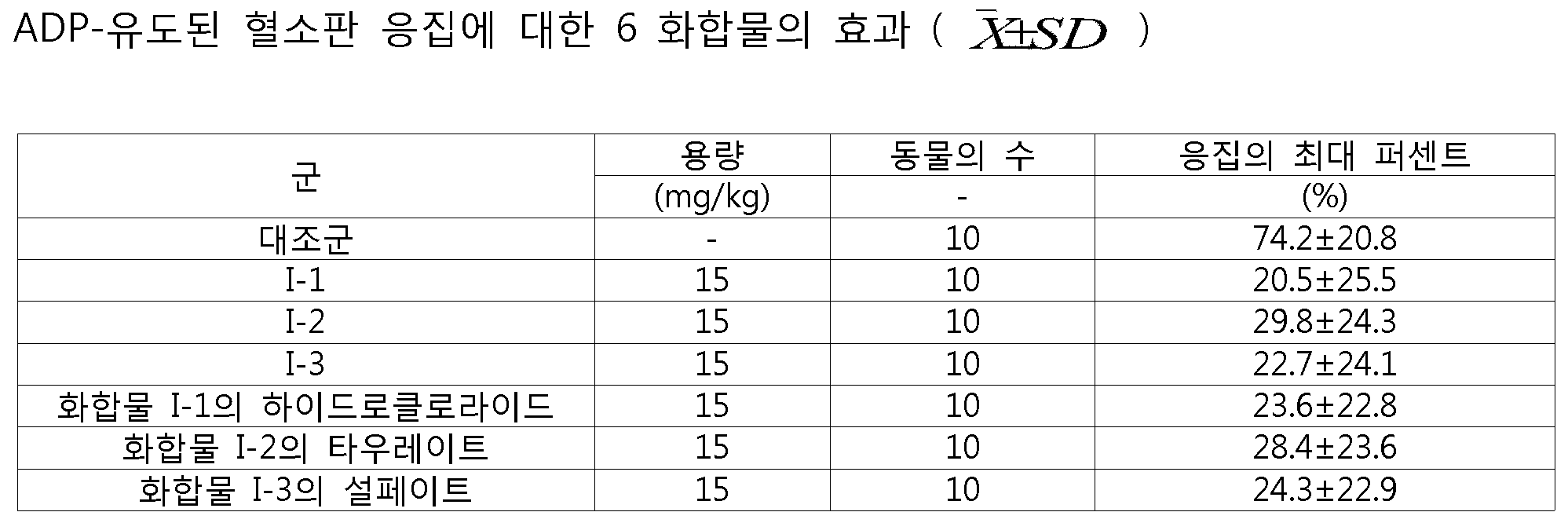

본 발명의 화합물 (15, 30 mg/kg)은 보통의 대조군과 비교하여 ADP-유도된 혈소판 응집에 대한 명백한 억제 효과가 있음을 표 1 및 2의 데이터로부터 확인할 수 있다. 따라서, 본 발명의 화합물은, 혈소판 응집에 의해 야기되는, 심장 및 뇌 혈관 질환, 예컨대 관상동맥 증후군(coronary artery syndromes), 심근경색증(myocardial infarction) 및 심근허혈(myocardial ischemia)을 예방 또는 치료하는데 사용될 수 있다.
It can be seen from the data in Tables 1 and 2 that the compound of the present invention (15, 30 mg / kg) has a clear inhibitory effect on ADP-induced platelet aggregation as compared with the normal control. The compounds of the present invention are therefore useful for the prevention or treatment of cardiovascular and cerebrovascular diseases such as coronary artery syndromes, myocardial infarction and myocardial ischemia caused by platelet aggregation .
동물에 대한 약력학적 연구: Pharmacodynamic studies on animals :
레트에 대한 위내 투여의 실험 중, 예비 연구 결과는, 본 발명의 화합물 I-1, I-2 및 I-3, 화합물 I-1의 하이드로클로라이드, 화합물 I-2의 타우레이트, 및 화합물 I-3의 설페이트 및 시판약 클로피도그렐(Clopidogrel)은 모두 프로드러그(prodrug)이고, 이들은 치료학적 효과를 얻기 위해, 관련 효소의 작용 하에 생체 내에서 활성 대사물질 티올로 전환될 필요가 있다는 것을 보여준다. 그러나, 화합물 I-1, I-2 및 I-3, 화합물 I-1의 하이드로클로라이드, 화합물 I-2의 타우레이트, 및 화합물 I-3의 설페이트의 전환율(conversion rate)은 클로피도그렐에 비해 약 5배 높고, 활성 대사물질의 피크 농도일 때 시간(time to peak concentration)은 50분 내지 1시간이어서, 클로피도그렐보다 빠르다. 따라서, 본 발명의 화합물은 작용의 시작이 더 빨라진 항혈소판약으로 개선된 것으로 보인다.
1, I-2 and I-3 of the present invention, the hydrochloride of compound I-1, the taurate of compound I-2, and the compound I- 3 and the marketed drug Clopidogrel are all prodrugs and show that they need to be converted in vivo to active metabolite thiols under the action of related enzymes in order to obtain a therapeutic effect. However, the conversion rates of the compounds I-1, I-2 and I-3, the hydrochloride of the compound I-1, the taurate of the compound I-2 and the sulfate of the compound I- Time to peak concentration of active metabolite is 50 minutes to 1 hour, which is faster than clopidogrel. Therefore, the compounds of the present invention appear to have improved to an anti-platelet drug with a faster onset of action.
레트에Leto 대한 2주의 독성 연구 ( Toxicity Studies in Korean 2 클로피도그렐과의With clopidogrel 비교) compare)
재료 및 방법:
Materials and Methods:
시험 화합물: 화합물 I-1 및 클로피도그렐.
Test compounds: Compound I-1 and clopidogrel.
용액의 제조: 화합물 I-1을 0.5% CMC-Na 및 옥수수 오일과 갈은(grind) 후, 초음파 조건 하에서 용해했다. 사용 전에 100 mg/ml의 서스펜션을 제조하여 아침마다 1 ml/100g를 위내에 투여했다.
Preparation of solution: Compound I-1 was dissolved in ultrasonic condition after grinding with 0.5% CMC-Na and corn oil. Suspensions of 100 mg / ml were prepared before use and administered 1 ml / 100 g in the stomach every morning.
실험 동물: 약 180g으로 칭량되는 SD 레트, 각 군 내에 7마리 암컷, 7마리 수컷.
Experimental animals: SD retort weighing about 180 g, 7 females and 7 males in each group.
분류 및 용량 요법: 화합물 I-1을 2주 동안 하루에 한번 1000 mg/kg의 용량으로 위내에 투여했다. 동일한 양의 용매를 블랭크 대조군(blank control group)에 위내 투여하고, 동일한 양(1000 mg/kg)의 클로피도그렐을 포지티브 대조군(positive control group)에 위내 투여했다.
Classification and dose regimens: Compound I-1 was administered in the stomach at a dose of 1000 mg / kg once daily for two weeks. The same amount of solvent was administered intravaginally in a blank control group and clopidogrel in the same amount (1000 mg / kg) was administered intracutaneously to a positive control group.
실험 결과:Experiment result:
전체 시험 기간 동안 모든 약물 투여된 군에서 레트의 사망이 발생했고, 사망의 특정 수 및 시간은 표 3에 나타냈다. 위내 투여의 3일째부터, 레트의 코 주변에 출혈 분비가 화합물 I-1 군 및 클로피도그렐 군에서 모두 관찰될 수 있지만, 클로피도그렐 군에서보다 화합물 I-1 군에서 명백히 경미했다.
During the entire study period, deaths occurred in all drug-treated groups and the specific number and time of death were shown in Table 3. From the third day of stomach administration, hemorrhagic secretions around the nose of the rat could be observed in both the compound I-1 and clopidogrel groups, but apparently mild in the compound I-1 group than in the clopidogrel group.

Claims (13)

여기서, R은 시아노기임.
A compound having the structure of Formula I or a pharmaceutically acceptable salt thereof:
Wherein R is a cyano group.
상기 화합물은 하기 화합물 중 하나로부터 선택되는, 식 I의 구조를 갖는 화합물 또는 이의 약제학적으로 허용되는 염:
I-1: 5-(2-시아노벤질)-4,5,6,7-테트라하이드로티에노[3,2-c]피리딘-2-일 아세테이트 (5-(2-cyanobenzyl)-4,5,6,7-tetrahydrothieno[3,2-c]pyridin-2-yl acetate);
I-2: 5-(3-시아노벤질)-4,5,6,7-테트라하이드로티에노[3,2-c]피리딘-2-일 아세테이트 (5-(3-cyanobenzyl)-4,5,6,7-tetrahydrothieno[3,2-c]pyridin-2-yl acetate);
I-3: 5-(4-시아노벤질)-4,5,6,7-테트라하이드로티에노[3,2-c]피리딘-2-일 아세테이트 (5-(4-cyanobenzyl)-4,5,6,7-tetrahydrothieno[3,2-c]pyridin-2-yl acetate).
The method according to claim 1,
Wherein said compound is selected from one of the following compounds: < EMI ID =
I-1: 5- (2-cyanobenzyl) -4,5,6,7-tetrahydrothieno [3,2- c] pyridin- 5,6,7-tetrahydrothieno [3,2- c ] pyridin-2-yl acetate);
I-2: 5- (3-cyanobenzyl) -4,5,6,7-tetrahydrothieno [3,2- c] pyridin- 5,6,7-tetrahydrothieno [3,2- c ] pyridin-2-yl acetate);
I-3: 5- (4-cyanobenzyl) -4,5,6,7-tetrahydrothieno [3,2- c] pyridin- 5,6,7-tetrahydrothieno [3,2- c ] pyridin-2-yl acetate).
상기 약제학적으로 허용되는 염은 무기산 또는 유기산을 갖는 식 I의 화합물에 의해 형성되는 염을 포함하는, 식 I의 구조를 갖는 화합물 또는 이의 약제학적으로 허용되는 염.
The method according to claim 1,
Or a pharmaceutically acceptable salt thereof, wherein said pharmaceutically acceptable salt comprises a salt formed by a compound of formula I having an inorganic or organic acid.
상기 약제학적으로 허용되는 염은 하이드로클로라이드(hydrochlorides), 하이드로브로마이드(hydrobromides), 하이드리오데이트(hydriodates), 설페이트(sulfates), 하이드로설페이트(hydrosulfates), 포스페이트(phosphates), 하이드로포스페이트(hydrophosphates), 아세테이트(acetates), 프로피오네이트(propionates), 부티레이트(butyrates), 락테이트(lactates), 메실레이트(mesylates), 토실레이트(tosilates), 말레이트(maleates), 벤조에이트(benzoates), 석시네이트(succinates), 타르트레이트(tartrates), 시트레이트(citrates), 푸마레이트(fumarates), 타우레이트(taurates), 글루코네이트(gluconates), 및 식 I의 화합물의 아미노산염으로부터 선택되는, 식 I의 구조를 갖는 화합물 또는 이의 약제학적으로 허용되는 염.
The method of claim 3,
The pharmaceutically acceptable salts include, but are not limited to, hydrochlorides, hydrobromides, hydriodates, sulfates, hydrosulfates, phosphates, hydrophosphates, but are not limited to, acetates, propionates, butyrates, lactates, mesylates, tosilates, maleates, benzoates, succinates, ), Tartrates, citrates, fumarates, taurates, gluconates, and amino acid salts of the compounds of formula I. Or a pharmaceutically acceptable salt thereof.
(1) 중간체를 제조하기 위해, 디클로로메탄(dichloromethane), 트리클로로메탄(trichloromethane), 아세토니트릴(acetonitrile) 또는 톨루엔(toluene) 중에서, 트리에틸아민(triethylamine), 피리딘(pyridine), 포타슘 카보네이트(potassium carbonate), 소듐 카보네이트(sodium carbonate), 소듐 비카보네이트(sodium bicarbonate), 포타슘 비카보네이트(potassium bicarbonate), 소듐 하이드록시드(sodium hydroxide) 또는 포타슘 하이드록시드(potassium hydroxide)의 존재하에, -10℃ 내지 -105℃에서 시아노기로 치환된 벤질 브로마이드 또는 벤질 클로라이드와 5,6,7,7a-테트라하이드로티에노[3,2-c]피리딘-2(4H)-온의 하이드로클로라이드를 반응시키는 단계;
(2) 식 I의 화합물을 제조하기 위해, 디클로로메탄, 트리클로로메탄 또는 톨루엔 중에서, 트리에틸아민, 피리딘, 포타슘 카보네이트, 소듐 카보네이트, 소듐 비카보네이트, 포타슘 비카보네이트, 소듐 하이드록시드 또는 포타슘 하이드록시드의 존재하에, -30℃ 내지 -50℃에서 아세트산 무수물, 아세트산, 아세틸 클로라이드 또는 아세틸 브로마이드와 단계(1)에서 제조된 중간체를 반응시키는 단계.
A process for preparing a compound having the structure of formula (I) according to any one of claims 1 to 4, or a pharmaceutically acceptable salt thereof, comprising the steps of:
(1) In order to prepare an intermediate, triethylamine, pyridine, potassium carbonate (potassium) in dichloromethane, trichloromethane, acetonitrile or toluene, in the presence of a carbonate, sodium carbonate, sodium bicarbonate, potassium bicarbonate, sodium hydroxide or potassium hydroxide at -10 ° C With benzyl bromide or benzyl chloride substituted with cyano group at -105 < 0 > C to the hydrochloride of 5,6,7,7a-tetrahydrothieno [3,2-c] pyridin-2 (4H) ;
(2) In order to prepare the compound of formula I, the reaction is carried out in a suitable solvent, such as dichloromethane, trichloromethane or toluene, in the presence of a base such as triethylamine, pyridine, potassium carbonate, sodium carbonate, sodium bicarbonate, potassium bicarbonate, Reacting the intermediate prepared in step (1) with acetic anhydride, acetic acid, acetyl chloride or acetyl bromide in the presence of a seed at -30 ° C to -50 ° C.
상기 방법은,
약제학적으로 허용되는 염을 제조하기 위해, 식 I의 화합물 또는 중간체를 디에틸 에테르, DMF, 아세톤, 메탄올, 에탄올, 에틸 아세테이트 또는 DMSO로 용해하는 단계, 및
무기산 또는 유기산 용액을 적하 첨가하는 단계를 더 포함하는, 식(I)의 구조를 갖는 화합물 또는 이의 약제학적으로 허용되는 염을 제조하는 방법.
6. The method of claim 5,
The method comprises:
Dissolving a compound of formula I or an intermediate thereof with diethyl ether, DMF, acetone, methanol, ethanol, ethyl acetate or DMSO to prepare a pharmaceutically acceptable salt, and
(I) or a pharmaceutically acceptable salt thereof, further comprising the step of adding dropwise an inorganic or organic acid solution.
A pharmaceutical composition for antiplatelet aggregation comprising as an active ingredient a compound having the structure of formula I according to any one of claims 1 to 4 or a pharmaceutically acceptable salt thereof.
A pharmaceutical composition comprising coronary artery syndromes, myocardial infarction or myocardial infarction comprising as active ingredient a compound having the structure of formula I according to any one of claims 1 to 4 or a pharmaceutically acceptable salt thereof. A pharmaceutical composition for preventing or treating myocardial ischemia.
상기 약제학적 조성물은 제1항 내지 제4항 중 어느 한 항에 따른 식 I의 구조를 갖는 화합물 또는 약제학적으로 허용되는 염, 및 약제학적으로 허용되는 담체, 첨가제, 또는 약제학적으로 허용되는 담체 및 첨가제를 치료학적 유효량으로 포함하는 것을 특징으로 하는, 약제학적 조성물.
A pharmaceutical composition for anti-platelet aggregation comprising:
The pharmaceutical composition comprises a compound having the structure of formula I according to any one of claims 1 to 4 or a pharmaceutically acceptable salt thereof, and a pharmaceutically acceptable carrier, additive or pharmaceutically acceptable carrier And a therapeutically effective amount of an additive.
상기 약제학적 조성물은 고체 경구 제제(a solid oral preparation), 액체 경구 제제(a liquid oral preparation) 또는 주사(an injection)인, 약제학적 조성물.10. The method of claim 9,
Wherein said pharmaceutical composition is a solid oral preparation, a liquid oral preparation or an injection.
Applications Claiming Priority (3)
| Application Number | Priority Date | Filing Date | Title |
|---|---|---|---|
| CN201010171152.X | 2010-05-13 | ||
| CN201010171152.XA CN102241690B (en) | 2010-05-13 | 2010-05-13 | Thienopyridine ester derivative, the Preparation Method And The Use of one class nitrile group-containing |
| PCT/CN2011/000492 WO2011140816A1 (en) | 2010-05-13 | 2011-03-23 | Thienopyridine ester derivative containing nitrile, preparation method, use and composition thereof |
Publications (2)
| Publication Number | Publication Date |
|---|---|
| KR20130014580A KR20130014580A (en) | 2013-02-07 |
| KR101453181B1 true KR101453181B1 (en) | 2014-10-22 |
Family
ID=44913881
Family Applications (1)
| Application Number | Title | Priority Date | Filing Date |
|---|---|---|---|
| KR1020127031045A Expired - Fee Related KR101453181B1 (en) | 2010-05-13 | 2011-03-23 | Thienopyridine ester derivative containing cyano group, preparation method, use and composition thereof |
Country Status (6)
| Country | Link |
|---|---|
| US (1) | US8809366B2 (en) |
| EP (1) | EP2570417B1 (en) |
| JP (1) | JP5575979B2 (en) |
| KR (1) | KR101453181B1 (en) |
| CN (1) | CN102241690B (en) |
| WO (1) | WO2011140816A1 (en) |
Families Citing this family (9)
| Publication number | Priority date | Publication date | Assignee | Title |
|---|---|---|---|---|
| CN102241690B (en) | 2010-05-13 | 2015-08-12 | 天津药物研究院 | Thienopyridine ester derivative, the Preparation Method And The Use of one class nitrile group-containing |
| CN104098586B (en) * | 2013-04-03 | 2016-08-17 | 天津药物研究院 | The crystal formation of the thienopyridine lipid derivant of nitrile group-containing, its preparation method and application |
| CN103553985B (en) * | 2013-11-15 | 2015-05-20 | 天津理工大学 | 4-methoxy-N,N-bisubstituted phenyl-1,3-benzene bisulfonamide compound and application thereof |
| CN106999455A (en) * | 2014-12-16 | 2017-08-01 | 边钟贤 | Modified taurine and the pharmaceutical composition for being used to preventing or treating metabolic disease containing modified taurine |
| CN105777774A (en) * | 2016-03-02 | 2016-07-20 | 天津药物研究院有限公司 | Crystal form X of Tipidogrel free alkali and preparation method and application thereof |
| CN105566345A (en) * | 2016-03-02 | 2016-05-11 | 天津药物研究院有限公司 | (5-(2-cyanobenzyl)-4,5,6,7-tetrahydrothiophene[3,2-c]pyridine-2-yl)acetate crystal form III and preparation method and application thereof |
| CN105566346A (en) * | 2016-03-02 | 2016-05-11 | 天津药物研究院有限公司 | (5-(2-cyanobenzyl)-4,5,6,7-tetrahydrothiophene[3,2-c]pyridine-2-yl)acetate crystal form I and preparation method and application thereof |
| CN105777775A (en) * | 2016-03-02 | 2016-07-20 | 天津药物研究院有限公司 | Crystal form IX of Tipidogrel free alkali and preparation method and application thereof |
| CN107474057B (en) * | 2016-06-07 | 2021-03-12 | 天津药物研究院有限公司 | Crystal form of (5- (2-cyanobenzyl) -4,5,6, 7-tetrahydrothieno [3,2-c ] pyridine-2-yl) acetate hydrochloride, preparation method and application thereof |
Citations (2)
| Publication number | Priority date | Publication date | Assignee | Title |
|---|---|---|---|---|
| US4097482A (en) * | 1975-08-06 | 1978-06-27 | Centre D'etudes Pour L'industrie Pharmaceutique | 5-O-Cyanobenzyl-4,5,6,7-tetrahydro-thieno 3,2-c!pyridine maleate |
| WO2010015144A1 (en) * | 2008-08-02 | 2010-02-11 | 鲁南制药集团股份有限公司 | The hydrosulfate of prasugrel, its pharmaceutical combination and uses thereof |
Family Cites Families (20)
| Publication number | Priority date | Publication date | Assignee | Title |
|---|---|---|---|---|
| FR2215948B1 (en) * | 1973-02-01 | 1976-05-14 | Centre Etd Ind Pharma | |
| FR2312247A1 (en) | 1975-05-30 | 1976-12-24 | Parcor | THIENO-PYRIDINE DERIVATIVES, THEIR PREPARATION PROCESS AND THEIR APPLICATIONS |
| FR2397417A1 (en) | 1977-07-12 | 1979-02-09 | Parcor | PROCESS FOR PREPARATION OF THIENOPYRIDINE DERIVATIVES |
| US4321266A (en) * | 1980-10-06 | 1982-03-23 | Sanofi | 5-o-Cyanobenzyl-4,5,6,7-tetrahydrothieno [3,2-C] pyridine |
| US4400384A (en) * | 1980-10-06 | 1983-08-23 | Sanofi, S.A. | 5-o-Cyanobenzyl-4,5,6,7-tetrahydrothieno [3,2-c] pyridine methanesulfonate and other novel salts thereof |
| FR2495156A1 (en) * | 1980-11-28 | 1982-06-04 | Sanofi Sa | THIENO-PYRIDINONE DERIVATIVES, PROCESS FOR THEIR PREPARATION AND THEIR THERAPEUTIC APPLICATION |
| FR2530247B1 (en) | 1982-07-13 | 1986-05-16 | Sanofi Sa | NOVEL THIENO (3, 2-C) PYRIDINE DERIVATIVES, PROCESS FOR THEIR PREPARATION AND THERAPEUTIC APPLICATION |
| GB8429087D0 (en) | 1984-11-16 | 1984-12-27 | Scras | Thienopyridine derivatives |
| JPS63264588A (en) | 1987-04-17 | 1988-11-01 | Kyowa Hakko Kogyo Co Ltd | Production of thienopyridine derivative |
| FI101150B (en) * | 1991-09-09 | 1998-04-30 | Sankyo Co | Process for the preparation of tetrahydrothione nopyridine derivatives useful as a drug |
| JPH06135970A (en) | 1992-10-27 | 1994-05-17 | Fuji Photo Film Co Ltd | 2-alkoxycarbonyl-5-o-chlorobenzyl-4,5,6,7-tetrahydro(3,2-c)thienopyridine derivative and its production |
| JP5000841B2 (en) | 2001-01-24 | 2012-08-15 | カディラ ヘルスケア リミティド | Method for producing clopidogrel |
| US6858734B2 (en) | 2003-04-23 | 2005-02-22 | Rhodia Pharma Solutions Inc. | Preparation of (S)-Clopidogrel and related compounds |
| CN1318428C (en) | 2005-02-23 | 2007-05-30 | 天津药物研究院 | Thiophenopyridine substituted acetyl hyarazine derivative |
| CN101177430A (en) * | 2007-12-11 | 2008-05-14 | 鲁南制药集团股份有限公司 | Hydrogenated pyridine derivative and method for preparing salt thereof |
| CN101402641B (en) * | 2008-11-20 | 2011-05-04 | 天津药物研究院 | Oxime derivatives containing thienopyridine, preparation method and application thereof |
| WO2011029456A1 (en) * | 2009-09-09 | 2011-03-17 | Synthon Bv | A process for making prasugrel and its intermediates |
| CN101693718B (en) * | 2009-10-28 | 2011-10-19 | 天津药物研究院 | Ester derivative containing thienopyridine and preparation method and application thereof |
| CN102241690B (en) | 2010-05-13 | 2015-08-12 | 天津药物研究院 | Thienopyridine ester derivative, the Preparation Method And The Use of one class nitrile group-containing |
| CN101845051B (en) * | 2010-06-11 | 2011-11-16 | 天津药物研究院 | Nitrogen-containing heterocyclic thienopyridine compounds and preparation method and application thereof |
-
2010
- 2010-05-13 CN CN201010171152.XA patent/CN102241690B/en active Active
-
2011
- 2011-03-23 EP EP20110780039 patent/EP2570417B1/en not_active Not-in-force
- 2011-03-23 WO PCT/CN2011/000492 patent/WO2011140816A1/en not_active Ceased
- 2011-03-23 KR KR1020127031045A patent/KR101453181B1/en not_active Expired - Fee Related
- 2011-03-23 JP JP2013509425A patent/JP5575979B2/en not_active Expired - Fee Related
-
2012
- 2012-11-12 US US13/674,850 patent/US8809366B2/en not_active Expired - Fee Related
Patent Citations (2)
| Publication number | Priority date | Publication date | Assignee | Title |
|---|---|---|---|---|
| US4097482A (en) * | 1975-08-06 | 1978-06-27 | Centre D'etudes Pour L'industrie Pharmaceutique | 5-O-Cyanobenzyl-4,5,6,7-tetrahydro-thieno 3,2-c!pyridine maleate |
| WO2010015144A1 (en) * | 2008-08-02 | 2010-02-11 | 鲁南制药集团股份有限公司 | The hydrosulfate of prasugrel, its pharmaceutical combination and uses thereof |
Also Published As
| Publication number | Publication date |
|---|---|
| WO2011140816A1 (en) | 2011-11-17 |
| US8809366B2 (en) | 2014-08-19 |
| EP2570417A1 (en) | 2013-03-20 |
| CN102241690A (en) | 2011-11-16 |
| CN102241690B (en) | 2015-08-12 |
| EP2570417A4 (en) | 2013-09-04 |
| US20130072521A1 (en) | 2013-03-21 |
| EP2570417B1 (en) | 2015-05-13 |
| KR20130014580A (en) | 2013-02-07 |
| JP5575979B2 (en) | 2014-08-20 |
| JP2013526488A (en) | 2013-06-24 |
Similar Documents
| Publication | Publication Date | Title |
|---|---|---|
| KR101453181B1 (en) | Thienopyridine ester derivative containing cyano group, preparation method, use and composition thereof | |
| CN103261161B (en) | The crystallized form of coagulation factor xa inhibitors | |
| CA2808520C (en) | Methods for the treatment or prophylaxis of thrombosis or embolism | |
| CN102464658B (en) | Oxazolidinone derivative and preparation method and application thereof | |
| JP2003246735A (en) | Pharmaceuticals containing hydropyridine derivative acid addition salts | |
| JP2011529859A (en) | Prasugrel bisulfate and its drug composition and its application | |
| CN101974015B (en) | Ester compound, preparation method and application thereof | |
| CN107922448B (en) | A kind of deuterated thienopiperidine derivative, preparation method and application thereof | |
| EP3701937A1 (en) | Stable pharmaceutical composition containing non-steroidal anti-inflammatory drug derivative | |
| CN103517909B (en) | Novel anti-platelet compound addition salt | |
| RU2526624C2 (en) | Thienopyridine ester derivative, containing cyanogroup, method of its obtaining, its application and based on it composition | |
| CN102268012B (en) | Thiazole derivative and preparation method and application thereof | |
| CN115463133A (en) | Pharmaceutical composition, preparation method and application thereof | |
| JP7052043B2 (en) | Thienopyridine derivative containing unsaturated aliphatic olefinic bond, its preparation method and use | |
| CN112778371B (en) | Thienopyridine derivative and preparation method and application thereof | |
| CN102796093B (en) | Thiomorpholine-containing pyrrole derivatives and their preparation method and use | |
| CN102351878B (en) | Isoxazole derivatives as well as preparation method and application thereof | |
| CN105646524A (en) | Crystal form IV of (5-2(2-cyanobenzyl)-4,5,6,7-tetrahydrothieno[3,2-c]pyridine-2-yl)acetate and preparation method and application thereof | |
| CN105646526A (en) | Crystal form VII of (5-2(2-cyanobenzyl)-4,5,6,7-tetrahydrothieno[3,2-c]pyridine-2-yl)acetate and preparation method and application thereof | |
| CN105646523A (en) | Clopidogrel freebase crystal form VIII and preparation method and application thereof | |
| CN105777774A (en) | Crystal form X of Tipidogrel free alkali and preparation method and application thereof | |
| CN105646527A (en) | Crystal form V of (5-2(2-cyanobenzyl)-4,5,6,7-tetrahydrothieno[3,2-c]pyridine-2-yl)acetate and preparation method and application thereof | |
| CN105777775A (en) | Crystal form IX of Tipidogrel free alkali and preparation method and application thereof | |
| CN105646525A (en) | Crystal form II of (5-(2-cyanobenzyl)-4,5,6,7-tetrahydrothieno[3,2-c]pyridine-2-yl)acetate and preparation method and application thereof | |
| HK40082657A (en) | Pharmaceutical composition, formulation thereof, preparation method therefor and use thereof |
Legal Events
| Date | Code | Title | Description |
|---|---|---|---|
| A201 | Request for examination | ||
| PA0105 | International application |
St.27 status event code: A-0-1-A10-A15-nap-PA0105 |
|
| PA0201 | Request for examination |
St.27 status event code: A-1-2-D10-D11-exm-PA0201 |
|
| P11-X000 | Amendment of application requested |
St.27 status event code: A-2-2-P10-P11-nap-X000 |
|
| P13-X000 | Application amended |
St.27 status event code: A-2-2-P10-P13-nap-X000 |
|
| PG1501 | Laying open of application |
St.27 status event code: A-1-1-Q10-Q12-nap-PG1501 |
|
| E902 | Notification of reason for refusal | ||
| PE0902 | Notice of grounds for rejection |
St.27 status event code: A-1-2-D10-D21-exm-PE0902 |
|
| E13-X000 | Pre-grant limitation requested |
St.27 status event code: A-2-3-E10-E13-lim-X000 |
|
| P11-X000 | Amendment of application requested |
St.27 status event code: A-2-2-P10-P11-nap-X000 |
|
| P13-X000 | Application amended |
St.27 status event code: A-2-2-P10-P13-nap-X000 |
|
| E701 | Decision to grant or registration of patent right | ||
| PE0701 | Decision of registration |
St.27 status event code: A-1-2-D10-D22-exm-PE0701 |
|
| GRNT | Written decision to grant | ||
| PR0701 | Registration of establishment |
St.27 status event code: A-2-4-F10-F11-exm-PR0701 |
|
| PR1002 | Payment of registration fee |
St.27 status event code: A-2-2-U10-U12-oth-PR1002 Fee payment year number: 1 |
|
| PG1601 | Publication of registration |
St.27 status event code: A-4-4-Q10-Q13-nap-PG1601 |
|
| LAPS | Lapse due to unpaid annual fee | ||
| PC1903 | Unpaid annual fee |
St.27 status event code: A-4-4-U10-U13-oth-PC1903 Not in force date: 20171015 Payment event data comment text: Termination Category : DEFAULT_OF_REGISTRATION_FEE |
|
| PC1903 | Unpaid annual fee |
St.27 status event code: N-4-6-H10-H13-oth-PC1903 Ip right cessation event data comment text: Termination Category : DEFAULT_OF_REGISTRATION_FEE Not in force date: 20171015 |