KR101450408B1 - Crosslinked polyolefin polymer blends - Google Patents
Crosslinked polyolefin polymer blends Download PDFInfo
- Publication number
- KR101450408B1 KR101450408B1 KR1020127008213A KR20127008213A KR101450408B1 KR 101450408 B1 KR101450408 B1 KR 101450408B1 KR 1020127008213 A KR1020127008213 A KR 1020127008213A KR 20127008213 A KR20127008213 A KR 20127008213A KR 101450408 B1 KR101450408 B1 KR 101450408B1
- Authority
- KR
- South Korea
- Prior art keywords
- polymer
- derived units
- derived
- ethylene
- weight
- Prior art date
- Legal status (The legal status is an assumption and is not a legal conclusion. Google has not performed a legal analysis and makes no representation as to the accuracy of the status listed.)
- Active
Links
Images


Classifications
-
- C—CHEMISTRY; METALLURGY
- C08—ORGANIC MACROMOLECULAR COMPOUNDS; THEIR PREPARATION OR CHEMICAL WORKING-UP; COMPOSITIONS BASED THEREON
- C08L—COMPOSITIONS OF MACROMOLECULAR COMPOUNDS
- C08L23/00—Compositions of homopolymers or copolymers of unsaturated aliphatic hydrocarbons having only one carbon-to-carbon double bond; Compositions of derivatives of such polymers
- C08L23/02—Compositions of homopolymers or copolymers of unsaturated aliphatic hydrocarbons having only one carbon-to-carbon double bond; Compositions of derivatives of such polymers not modified by chemical after-treatment
-
- C—CHEMISTRY; METALLURGY
- C08—ORGANIC MACROMOLECULAR COMPOUNDS; THEIR PREPARATION OR CHEMICAL WORKING-UP; COMPOSITIONS BASED THEREON
- C08L—COMPOSITIONS OF MACROMOLECULAR COMPOUNDS
- C08L23/00—Compositions of homopolymers or copolymers of unsaturated aliphatic hydrocarbons having only one carbon-to-carbon double bond; Compositions of derivatives of such polymers
- C08L23/02—Compositions of homopolymers or copolymers of unsaturated aliphatic hydrocarbons having only one carbon-to-carbon double bond; Compositions of derivatives of such polymers not modified by chemical after-treatment
- C08L23/10—Homopolymers or copolymers of propene
- C08L23/14—Copolymers of propene
- C08L23/145—Copolymers of propene with monomers having two or more carbon-to-carbon double bonds
-
- C—CHEMISTRY; METALLURGY
- C08—ORGANIC MACROMOLECULAR COMPOUNDS; THEIR PREPARATION OR CHEMICAL WORKING-UP; COMPOSITIONS BASED THEREON
- C08J—WORKING-UP; GENERAL PROCESSES OF COMPOUNDING; AFTER-TREATMENT NOT COVERED BY SUBCLASSES C08B, C08C, C08F, C08G or C08H
- C08J3/00—Processes of treating or compounding macromolecular substances
- C08J3/24—Crosslinking, e.g. vulcanising, of macromolecules
-
- C—CHEMISTRY; METALLURGY
- C08—ORGANIC MACROMOLECULAR COMPOUNDS; THEIR PREPARATION OR CHEMICAL WORKING-UP; COMPOSITIONS BASED THEREON
- C08J—WORKING-UP; GENERAL PROCESSES OF COMPOUNDING; AFTER-TREATMENT NOT COVERED BY SUBCLASSES C08B, C08C, C08F, C08G or C08H
- C08J5/00—Manufacture of articles or shaped materials containing macromolecular substances
- C08J5/18—Manufacture of films or sheets
-
- C—CHEMISTRY; METALLURGY
- C08—ORGANIC MACROMOLECULAR COMPOUNDS; THEIR PREPARATION OR CHEMICAL WORKING-UP; COMPOSITIONS BASED THEREON
- C08L—COMPOSITIONS OF MACROMOLECULAR COMPOUNDS
- C08L23/00—Compositions of homopolymers or copolymers of unsaturated aliphatic hydrocarbons having only one carbon-to-carbon double bond; Compositions of derivatives of such polymers
- C08L23/02—Compositions of homopolymers or copolymers of unsaturated aliphatic hydrocarbons having only one carbon-to-carbon double bond; Compositions of derivatives of such polymers not modified by chemical after-treatment
- C08L23/16—Ethene-propene or ethene-propene-diene copolymers
-
- C—CHEMISTRY; METALLURGY
- C08—ORGANIC MACROMOLECULAR COMPOUNDS; THEIR PREPARATION OR CHEMICAL WORKING-UP; COMPOSITIONS BASED THEREON
- C08L—COMPOSITIONS OF MACROMOLECULAR COMPOUNDS
- C08L2205/00—Polymer mixtures characterised by other features
- C08L2205/02—Polymer mixtures characterised by other features containing two or more polymers of the same C08L -group
-
- C—CHEMISTRY; METALLURGY
- C08—ORGANIC MACROMOLECULAR COMPOUNDS; THEIR PREPARATION OR CHEMICAL WORKING-UP; COMPOSITIONS BASED THEREON
- C08L—COMPOSITIONS OF MACROMOLECULAR COMPOUNDS
- C08L2205/00—Polymer mixtures characterised by other features
- C08L2205/03—Polymer mixtures characterised by other features containing three or more polymers in a blend
-
- C—CHEMISTRY; METALLURGY
- C08—ORGANIC MACROMOLECULAR COMPOUNDS; THEIR PREPARATION OR CHEMICAL WORKING-UP; COMPOSITIONS BASED THEREON
- C08L—COMPOSITIONS OF MACROMOLECULAR COMPOUNDS
- C08L23/00—Compositions of homopolymers or copolymers of unsaturated aliphatic hydrocarbons having only one carbon-to-carbon double bond; Compositions of derivatives of such polymers
- C08L23/02—Compositions of homopolymers or copolymers of unsaturated aliphatic hydrocarbons having only one carbon-to-carbon double bond; Compositions of derivatives of such polymers not modified by chemical after-treatment
- C08L23/10—Homopolymers or copolymers of propene
-
- C—CHEMISTRY; METALLURGY
- C08—ORGANIC MACROMOLECULAR COMPOUNDS; THEIR PREPARATION OR CHEMICAL WORKING-UP; COMPOSITIONS BASED THEREON
- C08L—COMPOSITIONS OF MACROMOLECULAR COMPOUNDS
- C08L2312/00—Crosslinking
- C08L2312/06—Crosslinking by radiation
Landscapes
- Chemical & Material Sciences (AREA)
- Health & Medical Sciences (AREA)
- Chemical Kinetics & Catalysis (AREA)
- Medicinal Chemistry (AREA)
- Polymers & Plastics (AREA)
- Organic Chemistry (AREA)
- Engineering & Computer Science (AREA)
- Manufacturing & Machinery (AREA)
- Materials Engineering (AREA)
- Compositions Of Macromolecular Compounds (AREA)
- Processes Of Treating Macromolecular Substances (AREA)
Abstract
본 발명은 가교결합된 폴리올레핀 블렌드, 그의 제조 방법, 및 이로부터 제조된 제품에 관한 것이다. 하나의 구체적인 실시양태에서, 폴리올레핀 블렌드는 제 1 반응기에서 형성된 제 1 중합체 및 제 2 반응기에서 형성된 제 2 중합체를 포함한다. 제 1 및 제 2 중합체 뿐만 아니라 이들의 블렌드는 프로필렌, 에틸렌 및 다이엔으로부터의 단위들을 포함할 수 있다. 그다음, 블렌딩된 조성물은 하나 이상의 공가교제, 산화방지제 및/또는 다른 첨가제와 배합될 수 있고, 바람직하게는 에너지성 광자에 노출됨으로써 가교결합된다. 가교결합된 중합체는 특히 섬유, 필름 및 부직물을 제조하는데 유용하다. The present invention relates to a crosslinked polyolefin blend, a process for producing the same, and a product made therefrom. In one specific embodiment, the polyolefin blend comprises a first polymer formed in a first reactor and a second polymer formed in a second reactor. The first and second polymers as well as the blends thereof may comprise units from propylene, ethylene and diene. The blended composition may then be blended with one or more co-crosslinking agents, antioxidants and / or other additives, and preferably crosslinked by exposure to an energy photon. Crosslinked polymers are particularly useful for making fibers, films, and nonwovens.
Description
본 발명은 가교결합된 폴리올레핀 중합체 블렌드, 이의 제조 방법, 및 이로부터 제조된 제품에 관한 것이다.
The present invention relates to crosslinked polyolefin polymer blends, to a process for their preparation, and to products made therefrom.
관련 출원과의 상호참조Cross reference to related application
본원은, 그 전체를 본원에서 참고로 인용하는, 2009년 10월 2일자로 출원된 미국 가특허 출원 제 61/248,190 호를 우선권으로 주장한다. 본원은, 그 전체를 본원에서 참고로 인용하는, 2008년 5월 30일자로 출원된 미국 특허 출원 제 12/130,745 호와 관련된다.
This application claims priority from U.S. Provisional Patent Application No. 61 / 248,190, filed October 2, 2009, the entirety of which is incorporated herein by reference. This application is related to U.S. Patent Application No. 12 / 130,745, filed May 30, 2008, the entirety of which is incorporated herein by reference.
폴리올레핀 중합체 및 중합체 블렌드는, 광범위한 용도에서의 이들의 다재다능성 및 응용가능성에 대해 공지되어 있다. 특히, 프로필렌과, 에틸렌과 같은 다른 α-올레핀의 공중합체를 비롯한 많은 폴리올레핀 중합체는, 우수한 신장성, 탄성 및 강도를 요구하는 적용례에서의 사용에 적합하다. 우수한 신장성 및 탄성을 갖는 물질들은, 내구성 제품 이외에, 다양한 일회용 제품(이로서 한정하는 것은 아니지만, 요실금용 패드, 일회용 기저귀, 배변연습용 팬티, 의류, 속옷, 스포츠의류, 자동차 트림, 문지방, 가스켓 및 가구 장식 재료를 포함)을 제조하는데 사용된다. 의류의 경우, 신장성 및 탄성은, 상기 물질이 착용자 신체에 밀접하게 맞게 순응하도록 하는 성능이다.Polyolefin polymers and polymer blends are known for their versatility and applicability in a wide range of applications. In particular, many polyolefin polymers, including copolymers of propylene and other? -Olefins such as ethylene, are suitable for use in applications requiring excellent stretchability, resilience and strength. Materials with superior stretchability and elasticity can be used in a variety of disposable products, including, but not limited to, incontinence pads, disposable diapers, training pants, clothing, underwear, sports apparel, automotive trim, And decorative materials). In the case of garments, extensibility and elasticity are the performances that cause the material to conform closely to the wearer's body.
다수의 물질들은 상온에서 우수한 응력-스트레인 특성 및 탄성을 나타내는 것으로 공지되어 있지만, 종종 탄성 물질은, 반복되는 사용 동안, 승온된 또는 낮은 온도에서의 연장 및 수축 동안, 또는 여름철의 자동차 내부에서, 순응성을 제공하거나 사용 동안 꼭 맞음(fit)을 보장하는 것이 바람직하다. 고온에서의 탄성은 온도 사이클 동안 엄격한 공차(tolerance)를 유지하는데 중요하다. 특히, 의류 또는 속옷류의 반복 착용을 위해 사용되는 탄성 물질은 세탁 후에도 그의 일체성 및 탄성 성능을 유지해야만 한다.Although many materials are known to exhibit excellent stress-strain characteristics and elasticity at room temperature, elastic materials are often used during prolonged use, during extended and contraction at elevated or low temperatures, Or to ensure fit during use. Elasticity at high temperatures is important to maintain a tight tolerance during temperature cycling. In particular, elastic materials used for repeated wear of garments or undergarments must maintain their integrity and elastic performance even after washing.
분절화 폴리우레탄 우레아 탄성 물질인 스판덱스는 다양한 내구성 직물에서 현재 사용된다. 예를 들어, 스판덱스로부터 제조된 직물은 세탁가능 의류, 직물, 내구성 및 일회용 가구 및 침구 등에서 사용되어 왔다. 통상적인 비가교된 폴리올레핀계 탄성 물질과 유사하게, 스판덱스로 제조된 제품은, 고온에 적용되는 경우, 일체성, 형태 및 탄성을 손실할 수 있다. 따라서, 스판덱스는, 고온 섬유, 예를 들어 폴리에스터 섬유와의 다수의 공동-편물화 적용례의 경우 적합하지 않다.Spandex, a segmented polyurethane urea elastomer, is currently used in a variety of durable fabrics. For example, fabrics made from spandex have been used in laundryable garments, fabrics, durability and disposable furniture and bedding. Similar to conventional uncrosslinked polyolefinic elastomeric materials, products made from spandex can lose integrity, shape and elasticity when applied at high temperatures. Thus, spandex is not suitable for many co-knit applications with high temperature fibers, for example polyester fibers.
우수한 탄성을 갖는 폴리프로필렌계 중합체가 공지되어 있고 연신성 의류를 위해 사용된다. 예를 들어, 미국특허 제 6,525,157 호, 미국특허 제 6,342,565 호 참고. 미국특허 제 6,342,565 호는, 특히 폴리올레핀의 블렌드를 포함하는, 부드럽고, 영구 변형-저항성인 어닐링 섬유를 개시하고 있다. 상기 블렌드는, 12,000psi 이하의 굴곡 탄성율을 갖고, 75 내지 98중량%의 제 1 중합체 성분 및 2 내지 25중량%의 제 2 중합체 성분을 갖는다. 제 1 중합체 성분은, 80중량% 이상의 프로필렌 및 20중량% 이하의 에틸렌을 갖고 DSC에 의한 융점(Tm)이 25 내지 70℃이고, 융합열이 25J/g 미만인 프로필렌-에틸렌 중합체이다. 제 2 중합체 성분은, 130℃ 초과의 DSC에 의한 융점 및 120J/g 초과의 융합열을 갖는 입체규칙성 아이소택틱 폴리프로필렌이다. 섬유는, 400% 인장 변형으로부터 80% 이하의 영구 변형에 대한 저항(resistance to set)을 나타낸다. 폴리올레핀 블렌드는 실질적으로 비-가교결합된 것으로 알려져 있다. Polypropylene polymers with good elasticity are known and are used for extensible garments. See, for example, U.S. Patent No. 6,525,157, U.S. Patent No. 6,342,565. U.S. Patent No. 6,342,565 discloses a soft, permanent strain-resistant annealing fiber, particularly comprising a blend of polyolefins. The blend has a flexural modulus of less than or equal to 12,000 psi, 75 to 98 weight percent of the first polymer component, and 2 to 25 weight percent of the second polymer component. The first polymer component is a propylene-ethylene polymer having 80% by weight or more of propylene and 20% by weight or less of ethylene, a melting point (Tm) by DSC of 25 to 70 DEG C and a fusion heat of less than 25 J / g. The second polymer component is a stereoregular isotactic polypropylene having a melting point by DSC of greater than 130 DEG C and a fusion heat of greater than 120 J / g. The fibers exhibit a resistance to set of less than 80% permanent deformation from 400% tensile strain. Polyolefin blends are known to be substantially non-crosslinked.
미국특허 제 6,500,563 호는, 110℃ 미만의 Tm을 갖는 폴리프로필렌 및 아이소택틱하게 배열된 프로필렌 유도 서열 및 105℃ 미만의 Tm을 갖는 프로필렌-에틸렌 공중합체로부터 제조된 블렌드를 비롯한, 2종의 상이한 유형의 폴리프로필렌의 블렌드를 개시하고 있다.U.S. Patent No. 6,500,563 discloses a polypropylene composition comprising two different polyolefins, including a polypropylene having a Tm of less than 110 ° C and a blend made from a propylene-ethylene copolymer having an isotactically aligned propylene-derived sequence and a Tm of less than 105 ° C Type blends of polypropylene.
미국특허 공개공보 제 2006/0183861 호는, 다작용화된 아크릴레이트, 다작용화된 메타크릴레이트, 작용화된 폴리부타다이엔 수지, 작용화된 시아누레이트 및 알릴 아이소시아누레이트로 구성된 군 중에서 선택된 하나 이상의 성분, 및 입체장애 페놀, 포스파이트 및 입체장애 아민으로 구성된 군 중에서 선택된 하나 이상의 성분과 혼합된 프로필렌계 중합체로 제조된 블렌드를 비롯한, 가교결합된 탄성중합체 조성물을 개시하고 있다. 상기 블렌드는 전자빔 조사에 노출됨으로써 가교결합된다.U.S. Patent Application Publication No. 2006/0183861 discloses a process for producing a polyurethane foam comprising the steps of: selecting from the group consisting of a polyfunctionalized acrylate, a polyfunctionalized methacrylate, a functionalized polybutadiene resin, a functionalized cyanurate and an allyl isocyanurate Discloses cross-linked elastomeric compositions, including blends made from propylene polymers mixed with one or more components and one or more components selected from the group consisting of sterically hindered phenols, phosphites and hindered amines. The blend is crosslinked by exposure to electron beam irradiation.
아이소택틱 폴리프로필렌; 충격 개질량의 에틸렌-프로필렌계 고무, 또는 저밀도 에틸렌 공중합체; 및 상용화제로서의 프로필렌계 탄성중합체의 3성분 블렌드는 유럽특허 제 946640 호, 유럽특허 제 964641 호, 유럽특허 제 969043 호 및 유럽특허 제 1098934 호에 개시되어 있다. Isotactic polypropylene; Impact-modified ethylene-propylene rubber, or low density ethylene copolymer; And a propylene-based elastomer as a compatibilizer are disclosed in European Patent No. 946640, European Patent No. 964641, European Patent No. 969043 and European Patent No. 1098934.
국제특허 공개공보 제 04/014988 호는 폴리-알파-올레핀과 같은 비-작용화된 가소화제와 아이소택틱 폴리프로필렌의 블랜드를 개시하고 있다. 국제특허 공개공보 제 03/040233 호는 또한 주된 매트릭스 상으로서의 아이소택틱 폴리프로필렌 및 충격 개질제로서 작용하는 프로필렌계 공중합체와의 2성분 블렌드를 개시한다.International Patent Publication No. 04/014988 discloses blends of isotactic polypropylene with non-functionalized plasticizers such as poly-alpha-olefins. International Patent Publication No. 03/040233 also discloses a two component blend of isotactic polypropylene as the predominant matrix phase and a propylene-based copolymer acting as an impact modifier.
유럽특허 제 1003814 호 및 미국특허 제 6,642,316 호는, 소량의 아이소택틱 폴리프로필렌 및 주요량의 에틸렌계 탄성중합체의 2성분 블렌드를 개시한다. 유럽특허 제 0374695 호는, 40중량% 이하의 프로필렌계 공중합체를 사용하는 가시적으로 균일한 2성분 블렌드를 개시하고 있다. 국제특허 공개공보 제 00/69963 호는 25J/g 미만의 융합열을 갖는 프로필렌 에틸렌계 탄성중합체 75 내지 95중량%를 갖는 2성분 블렌드로 구성된 필름을 개시하고 있다.European Patent No. 1003814 and US Patent No. 6,642, 316 disclose a binary blend of minor amounts of isotactic polypropylene and major amounts of ethylene-based elastomers. EP 0374695 discloses a visually homogeneous binary blend using up to 40% by weight of a propylene-based copolymer. WO 00/69963 discloses a film composed of a two component blend having 75 to 95% by weight of propylene ethylenic elastomer having a fusion heat of less than 25 J / g.
다른 관련 참고문헌들은, 미국특허 공개공보 제 2006/102149 호, 제 2005/0107529 호; 제 2005/0107530 호; 제 2005/0131142 호; 및 제 2005/0107534 호를 포함한다. Other related references are disclosed in U.S. Patent Application Publication Nos. 2006/102149, 2005/0107529; 2005/0107530; 2005/0131142; And 2005/0107534.
당분야에 개시된 것과 같은 많은 폴리올레핀 블렌드는, 섬유, 필름, 부직물, 압출 코팅 및 성형 제품과 같은 제품으로 형성되기 전에, 중간 저장 목적으로 펠렛으로 형성된다. 그러나, 이러한 조성물 중 일부는 장기간 동안 불량한 펠렛 안정성을 나타내어, 펠렛들의 응집을 유발하고 펠렛의 불량한 유출성(pourability) 및 유동성을 나타낸다.Many polyolefin blends, such as those disclosed in the art, are formed into pellets for intermediate storage purposes before being formed into articles such as fibers, films, nonwovens, extrusion coatings, and molded products. However, some of these compositions exhibit poor pellet stability over a long period of time, causing agglomeration of the pellets and exhibiting poor pourability and fluidity of the pellets.
따라서, 폭넓은 적용례에서 사용하기에 우수한 신장성 및 탄성을 나타내면서, 우수한 펠렛 안정성을 나타내는 새롭고 개선된 프로필렌계 물질에 대한 요구가 계속되고 있다.Thus, there continues to be a need for new and improved propylene-based materials that exhibit excellent pellet stability while exhibiting excellent extensibility and resiliency for use in a wide variety of applications.
발명의 요약SUMMARY OF THE INVENTION
본 발명은 2종 이상의 반응기에서 제조된 2종 이상의 중합체로 형성된 중합체 블렌드 및 이러한 중합체 블렌드의 제조 방법에 관한 것이다. 일부 실시양태에서, 중합체 블렌드는, 에너지성 광자에 노출시킴으로써 적어도 부분적으로 가교결합되고, 무엇보다도 섬유, 필름 및 부직물을 포함하는 제품으로 추가로 형성될 수 있다. 본원에서 기술한 중합체 블렌드는, 당업계에 공지된 유사한 물질과 비교시, 개선된 펠렛 안정성 및 개선된 기계적 및 탄성 특성을 나타낸다.The present invention relates to polymer blends formed of two or more polymers prepared in two or more reactors and to a process for preparing such polymer blends. In some embodiments, the polymer blend may be additionally formed as an article that is at least partially crosslinked by exposure to an energy photon, among other things, including fibers, films, and nonwovens. The polymer blends described herein exhibit improved pellet stability and improved mechanical and elastic properties when compared to similar materials known in the art.
도 1은, 비-가교결합된 본 발명 및 비교예 물질의, 신도(%) 함수로서의 응력(MPa)을 도시한다.
도 2는, 가교결합된 본 발명 및 비교예 물질의, 신도(%) 함수로서의 응력(MPa)을 도시한다.
도 3은, 공가교제(coagent)를 포함하거나 포함하지 않는 물질, 및 비교예인 비-가교결합된 물질의, 신도(%) 함수로서의 응력(MPa)을 도시한다.Figure 1 shows the stress (MPa) as a function of elongation (%) of the non-crosslinked inventive and comparative materials.
Figure 2 shows the stress (MPa) as a function of elongation (%) of the crosslinked inventive and comparative materials.
Figure 3 shows the stress (MPa) as a function of elongation (%) of a material with or without coagent, and a comparative non-crosslinked material.
본 발명은 폴리올레핀 중합체 블렌드 및 그의 제조 방법에 관한 것이다. 보다 구체적으로, 본 발명의 실시양태는, 제 1 반응기에서 형성된 제 1 프로필렌계 중합체와 제 2 반응기에서 형성된 제 2 프로필렌계 중합체의 블렌드를 포함한다. 이러한 중합체 블렌드들은, 무엇보다도 공가교제, 산화방지제, 2차 탄성중합체, 폴리프로필렌, 첨가제, 충전제 및 첨가제 오일을 포함하는 다양한 부가적인 성분들과 배합될 수 있다. 상기 블렌드들은 자외선(UV), x-선 및 감마선을 비롯한 공급원으로부터의 에너지성 광자에 노출시 적어도 부분적으로 가교결합될 수 있다. 일부 실시양태에서, 중합체 블렌드의 가교결합은 전자빔 조사에 의해 달성된다. 본원에서 기술된 중합체 블렌드는, 단일 반응기에서 제조된 유사한 블렌드와 비교시, 개선된 펠렛 안정성을 나타내고, 뛰어난 기계적 및 탄성 특성들을 나타낸다. 특히, 본원에서 개시된 중합체 블렌드가 공가교제, 산화방지제, 또는 둘다와 배합되고, 그다음 가교결합되는 경우, 이는, 동일한 방식으로 제조되고 유사한 조성을 갖지만, 공가교제 및 산화방지제가 없이 제조된 가교결합된 중합체 블렌드에 비해, 피크 응력, 피크 신도, 및 인장 세트(tension set)와 같은 개선된 특성들을 갖는다. 중합체 블렌드 및 그의 제조 방법은, 하기에서 보다 상세하게 설명된다.The present invention relates to polyolefin polymer blends and processes for their preparation. More specifically, embodiments of the present invention comprise a blend of a first propylene-based polymer formed in a first reactor and a second propylene-based polymer formed in a second reactor. These polymer blends may be blended with various additional components, including, inter alia, a co-crosslinking agent, an antioxidant, a secondary elastomer, a polypropylene, an additive, a filler and an additive oil. The blends may be at least partially cross-linked upon exposure to an energy photon from a source including ultraviolet (UV), x-ray and gamma rays. In some embodiments, cross-linking of the polymer blend is achieved by electron beam irradiation. The polymer blends described herein exhibit improved pellet stability as compared to similar blends made in a single reactor and exhibit excellent mechanical and elastic properties. In particular, when the polymer blend disclosed herein is blended with a co-crosslinking agent, an antioxidant, or both, and then crosslinked, it is a crosslinked polymer prepared in the same manner and having a similar composition, but without a co-crosslinking agent and an antioxidant Compared to a blend, it has improved properties such as peak stress, peak elongation, and tension set. Polymer blends and methods for their preparation are described in more detail below.
중합체 포함 블렌드Polymer blend
본 발명은 제 1 반응기에서 제조된 제 1 중합체 및 제 2 반응기에서 제조된 제 2 중합체를 포함한다. 제 1 및 제 2 중합체는 전형적으로 올레핀계 중합체이고, 일부 실시양태에서, 각각 프로필렌계 단독중합체 또는 공중합체이다. 본원에서 사용되는 바와 같이, "공중합체"란 용어는, α-올레핀 및 다이엔으로부터 유도된 공단량체를 포함하는 2종 이상의 상이한 공단량체 유형을 공중합함으로서 제조된 물질을 의미하고자 한다. 하나 이상의 다른 상이한 공단량체 유형도 공중합체에 포함될 수 있어서, 공중합체 정의는 삼원공중합체 뿐만 아니라 4종 이상의 상이한 공단량체 유형을 포함하는 공중합체를 포함한다. 본원에서 사용되는 "단량체" 또는 "공단량체"란 용어는, 중합체를 형성하는데 사용되는 단량체, 즉 중합 전에 형태상으로 미반응된 화합물을 지칭할 수 있고, 또한 이것이 중합체에 도입된 후의 단량체(이는, 중합 반응 때문에 중합 반응 이전에 비해 더 적은 수의 수소 원자를 갖는 본원에서 "[단량체]-유도된 단위"로 지칭될 수도 있음)를 지칭할 수도 있다. 프로필렌 단량체, 에틸렌 단량체 및 다이엔 단량체를 비롯한 상이한 단량체가 본원에서 논의된다. The present invention comprises a first polymer made in a first reactor and a second polymer made in a second reactor. The first and second polymers are typically olefinic polymers and, in some embodiments, propylene-based homopolymers or copolymers, respectively. As used herein, the term "copolymer " is intended to mean a material prepared by copolymerizing two or more different comonomer types, including comonomers derived from alpha-olefins and dienes. One or more other different comonomer types may also be included in the copolymer so that the copolymer definition includes copolymers including not only ternary copolymers but also four or more different comonomer types. The term "monomer" or "comonomer" as used herein can refer to a monomer used to form a polymer, i.e., a compound that has not been morphologically uncharged prior to polymerization, May be referred to herein as "[monomer] -derived units" herein having fewer hydrogen atoms than before the polymerization reaction due to polymerization). Different monomers, including propylene monomers, ethylene monomers and diene monomers, are discussed herein.
본 발명의 일부 실시양태에서, 제 1 및 제 2 중합체는 각각 프로필렌 및 하나 이상의 공단량체의 공중합체이다. 공단량체는 선형 또는 분지형일 수 있다. 하나 이상의 실시양태에서, 선형 공단량체는 에틸렌, 또는 이로서 한정하는 것은 아니지만 1-부텐, 1-헥센, 및 1-옥텐을 비롯한 C4 내지 C8 α-올레핀을 포함할 수 있다. 분지형 공단량체는 4-메틸-1-펜텐, 3-메틸-1-펜텐 및 3,5,5-트라이메틸-1-헥센을 포함할 수 있다. 하나 이상의 실시양태에서, 공단량체는 스티렌을 포함할 수 있다. In some embodiments of the present invention, the first and second polymers are each a copolymer of propylene and at least one comonomer. The comonomer may be linear or branched. In one or more embodiments, the linear comonomers may comprise ethylene, or C 4 to C 8 alpha-olefins, including but not limited to 1-butene, 1-hexene, and 1-octene. Branched comonomers may include 4-methyl-1-pentene, 3-methyl-1-pentene and 3,5,5-trimethyl-1-hexene. In one or more embodiments, the comonomer may comprise styrene.
일부 실시양태에서, 제 1 및 제 2 중합체는 각각 프로필렌과 에틸렌의 공중합체이다(또한 다른 단량체도 포함할 수 있다). 예를 들어, 제 1 및 제 2 중합체는 동일하거나 상이할 수 있고, 각각 약 75 내지 약 99중량%의 프로필렌으로부터 유도된 단위 및 약 1 내지 약 25중량%의 에틸렌으로부터 유도된 단위를 각각 포함할 수 있다. 일부 실시양태에서, 제 1 중합체는 약 12 내지 약 20중량%의 에틸렌-유도된 단위, 또는 약 14 내지 약 18중량%의 에틸렌-유도된 단위를 포함할 수 있다. 동일하거나 다른 실시양태에서, 제 2 중합체는 약 3 내지 약 10중량%의 에틸렌-유도된 단위, 또는 약 5 내지 약 8중량%의 에틸렌-유도된 단위를 포함할 수 있다. 본 발명의 하나의 실시양태에서, 제 1 중합체는 제 2 중합체에 비해 에틸렌 함량이 높다. 예를 들어, 제 1 중합체는 제 2 중합체에 비해 적어도 3중량%, 또는 적어도 5중량%, 또는 적어도 7중량%, 또는 적어도 9중량% 많은 에틸렌-유도된 단위를 포함할 수 있다. In some embodiments, the first and second polymers are copolymers of propylene and ethylene, respectively (and may also include other monomers). For example, the first and second polymers may be the same or different, each comprising about 75 to about 99 weight percent of a unit derived from propylene and from about 1 to about 25 weight percent of a unit derived from ethylene . In some embodiments, the first polymer may comprise from about 12 to about 20 weight percent ethylene-derived units, or from about 14 to about 18 weight percent ethylene-derived units. In the same or different embodiments, the second polymer may comprise from about 3 to about 10 weight percent ethylene-derived units, or from about 5 to about 8 weight percent ethylene-derived units. In one embodiment of the present invention, the first polymer has a higher ethylene content than the second polymer. For example, the first polymer may comprise at least 3 wt%, or at least 5 wt%, or at least 7 wt%, or at least 9 wt% more ethylene-derived units relative to the second polymer.
본원의 하나 이상의 실시양태에서, 제 2 중합체는 다르게는 더 소량의 에틸렌을 포함하거나 에틸렌이 전혀 없어서, 제 2 중합체가 폴리프로필렌(RCP)의 호모폴리프로필렌 또는 랜덤 공중합체일 수 있다. 예시적인 RCP는 전형적으로 약 1 내지 약 8중량% 공단량체 또는 약 2 내지 약 5중량%의 공단량체를 포함한다. 하나 이상의 실시양태에서, RCP 공단량체는 에틸렌이다.In one or more embodiments of the invention, the second polymer may alternatively be a homopolypropylene or random copolymer of polypropylene (RCP), with a smaller amount of ethylene or no ethylene, so that the second polymer may be a homopolypropylene or random copolymer of polypropylene (RCP). Exemplary RCPs typically comprise from about 1 to about 8 weight percent comonomer or from about 2 to about 5 weight percent comonomer. In one or more embodiments, the RCP comonomer is ethylene.
선택적으로, 제 1 및 제 2 중합체는 또한 하나 이상의 다이엔을 포함할 수 있다. "다이엔"이란 용어는, 2개의 불포화 부위를 갖는 탄화수소 화합물, 즉 탄소 원자를 연결하는 2개의 이중 결합을 갖는 화합물로서 정의된다. 문맥에 따라, 본 특허 출원에서 "다이엔"이라는 용어는 광범위하게 중합, 예를 들어 중합 매질의 일부를 형성하기 이전의 다이엔 단량체, 또는 중합이 개시된 이후의 다이엔 단량체(또한, 다이엔 단량체 단위 또는 다이엔-유도된 단위로 지칭된다)를 지칭한다. 본 발명에서 사용하기에 적합한 예시적인 다이엔은, 이로서 한정하는 것은 아니지만, 부타다이엔, 펜타다이엔, 헥사다이엔(예를 들어, 1,4-헥사다이엔), 헵타다이엔(예를 들어, 1,6-헵타다이엔), 옥타다이엔(예를 들어, 1,7-옥타다이엔), 노나다이엔(예를 들어, 1,8-노나다이엔), 데카다이엔(예를 들어, 1,9-데카다이엔), 운데카다이엔(예를 들어, 1,10-운데카다이엔), 도데카다이엔(예를 들어, 1,11-도데카다이엔), 트라이데카다이엔(예를 들어, 1,12-트라이데카다이엔), 테트라데카다이엔(예를 들어, 1,13-테트라데카다이엔), 펜타데카다이엔, 헥사데카다이엔, 헵타데카다이엔, 옥타데카다이엔, 노나데카다이엔, 이코사다이엔, 헤네이코사다이엔, 도코사다이엔, 트라이코사다이엔, 테트라코사다이엔, 펜타코사다이엔, 헥사코사다이엔, 헵타코사다이엔, 옥타코사다이엔, 노나코사다이엔, 트라이아콘타다이엔, 및 1000g/mol 미만의 분자량(Mw)을 갖는 폴리부타다이엔을 포함한다. 직쇄 비환식 다이엔의 예는, 이로서 한정하는 것은 아니지만, 1,4-헥사다이엔 및 1,6-옥타다이엔이다. 분지쇄 비환식 다이엔의 예는, 이로서 한정하는 것은 아니지만, 5-메틸-1,4-헥사다이엔, 3,7-다이메틸-1,6-옥타다이엔, 및 3,7-다이메틸-1,7-옥타다이엔이다. 단일환 지환족 다이엔의 예로는, 이로서 한정하는 것은 아니지만, 1,4-사이클로헥사다이엔, 1,5-사이클로옥타다이엔, 및 1,7-사이클로도데카다이엔을 포함한다. 다환 지환족 접합 및 브릿지화 고리 다이엔의 예는, 이로서 한정하는 것은 아니지만, 테트라하이드로인덴; 노르보나다이엔; 메틸테트라하이드로인덴; 다이사이클로펜타다이엔; 바이사이클로(2.2.1)헵타-2,5-다이엔; 및 알케닐-, 알킬리덴-, 사이클로알케닐-, 및 사이클로알킬리덴 노르보넨[예를 들어, 5-메틸렌-2-노르보넨, 5-에틸리덴-2-노르보넨, 5-프로페닐-2-노르보넨, 5-아이소프로필리덴-2-노르보넨, 5-(4-사이클로펜테닐)-2-노르보넨, 5-사이클로헥실리덴-2-노르보넨, 및 5-비닐-2-노르보넨을 포함함]을 포함한다. 사이클로알케닐-치환된 알켄의 예는, 이로서 한정하는 것은 아니지만, 비닐 사이클로헥센, 알릴 사이클로헥센, 비닐사이클로옥텐, 4-비닐사이클로헥센, 알릴 사이클로데센, 비닐사이클로도데센, 및 테트라사이클로도데카다이엔을 포함한다. 본 발명의 일부 실시양태에서, 다이엔은, 5-에틸리덴-2-노르보넨(ENB); 1,4-헥사다이엔; 5-메틸렌-2-노르보넨(MNB); 1,6-옥타다이엔; 5-메틸-1,4-헥사다이엔; 3,7-다이메틸-1,6-옥타다이엔; 1,3-사이클로펜타다이엔; 1,4-사이클로헥사다이엔; 비닐 노르보넨(VNB); 다이사이클로펜타다이엔(DCPD), 및 그의 조합 중에서 선택된다. 하나 이상의 실시양태에서, 다이엔은 ENB이다.Optionally, the first and second polymers may also comprise one or more dienes. The term "diene" is defined as a hydrocarbon compound having two unsaturated moieties, i.e., a compound having two double bonds connecting carbon atoms. Depending on the context, the term "diene" in this patent application refers to a wide range of polymerization, e.g., a diene monomer prior to forming a portion of the polymerization medium, or a diene monomer after polymerization is initiated Unit or a diene-derived unit). Exemplary dienes suitable for use in the present invention include, but are not limited to, butadiene, pentadiene, hexadiene (e.g., 1,4-hexadiene), heptadiene (For example, 1,6-heptadiene), octadienes (e.g., 1,7-octadienes), nonadienes (e.g., 1,8-nonadienes), decadienes For example 1,9-decadienes, undecadienes, for example 1,10-undecadienes, dodecadienes, for example 1,11-dodecadienes, (For example, 1,12-tridecadiyene), tetradecadienes (for example, 1,13-tetradecadiyene), pentadecadienes, hexadecadiyenes, heptadecenes But are not limited to, dienes, octadecadienes, nonadecadienes, icosadaienes, heneicosadaienes, docosadayenes, tricosadayenes, tetraconodadiene, pentacodadiene, hexacodadiene, It is an octakosadaien , Nonacodadiene, triacontadiene, and polybutadiene having a molecular weight (Mw) of less than 1000 g / mol. Examples of straight chain acyclic dienes include, but are not limited to, 1,4-hexadiene and 1,6-octadiene. Examples of branched chain acyclic dienes include, but are not limited to, 5-methyl-1,4-hexadiene, 3,7-dimethyl-1,6-octadiene, and 3,7- -1,7-octadienes. Examples of monocyclic alicyclic dienes include, but are not limited to, 1,4-cyclohexadiene, 1,5-cyclooctadiene, and 1,7-cyclododecadienes. Examples of polycyclic alicyclic junctions and bridged cyclic dienes include, but are not limited to, tetrahydroindene; Norbornadiene; Methyltetrahydroindene; Dicyclopentadiene; Bicyclo [2.2.1] hept-2,5-diene; And alkenyl-, alkylidene-, cycloalkenyl-, and cycloalkylidene norbornen [e.g., 5-methylene-2-norbornene, 5-ethylidene- Norbornene, 5-isopropylidene-2-norbornene, 5- (4-cyclopentenyl) -2-norbornene, 5-cyclohexylidene- Including < / RTI > bonen]. Examples of cycloalkenyl-substituted alkenes include, but are not limited to, vinylcyclohexene, allylcyclohexene, vinylcyclooctene, 4-vinylcyclohexene, allylcyclodecene, vinylcyclododecene, and tetracyclododecadai Yen. In some embodiments of the invention, the diene is selected from the group consisting of: 5-ethylidene-2-norbornene (ENB); 1,4-hexadiene; 5-methylene-2-norbornene (MNB); 1,6-octadienes; 5-methyl-1,4-hexadiene; 3,7-dimethyl-1,6-octadiene; 1,3-cyclopentadiene; 1,4-cyclohexadiene; Vinylnorbornene (VNB); Dicyclopentadiene (DCPD), and combinations thereof. In one or more embodiments, the diene is an ENB.
제 1 및 제 2 중합체는, 동일하거나 상이한 양의 다이엔-유도된 단위를 포함할 수 있다. 일부 실시양태에서, 제 1 및 제 2 중합체는 각각 0.05 내지 약 6중량%의 다이엔-유도된 단위를 포함한다. 추가의 실시양태에서, 제 1 중합체는 약 0.5 내지 약 5.0중량%의 다이엔-유도된 단위, 또는 약 1.0 내지 약 3.0중량%의 다이엔-유도된 단위를 포함한다. 일부 또는 상이한 실시양태에서, 제 2 중합체는 약 0.1 내지 약 1.0중량%의 다이엔-유도된 단위를 포함한다.The first and second polymers may comprise the same or different amounts of diene-derived units. In some embodiments, the first and second polymers each comprise from 0.05 to about 6 weight percent of a diene-derived unit. In a further embodiment, the first polymer comprises from about 0.5 to about 5.0 weight percent of a diene-derived unit, or from about 1.0 to about 3.0 weight percent of a diene-derived unit. In some or different embodiments, the second polymer comprises from about 0.1 to about 1.0 weight percent of the diene-derived units.
제 1 및 제 2 중합체의 중량 평균 분자량(Mw)은 5,000,000 g/몰 이하이고, 수 평균 분자량(Mn)은 약 3,000,000 g/몰 이하이고, z-평균 분자량(Mz)은 약 10,000,000 g/몰 이하이고, 기준선으로서 아이소택틱 폴리프로필렌을 사용하여 중합체의 중량 평균 분자량에서 측정시, g' 지수는 0.95 이상이고, 이들 모두는 예를 들어 3D SEC(GPC-3D로서 지칭함)로 측정될 수 있다. Wherein the first and second polymers have a weight average molecular weight (Mw) of less than 5,000,000 g / mole, a number average molecular weight (Mn) of less than about 3,000,000 g / mole and a z- And g 'index is not less than 0.95 when measured at the weight average molecular weight of the polymer using isotactic polypropylene as a baseline, all of which can be measured, for example, in 3D SEC (referred to as GPC-3D).
하나 이상의 실시양태에서, 제 1 및 제 2 중합체는 동일하거나 상이한 Mw를 갖고, 각각 Mw이 약 5,000 내지 약 5,000,000 g/몰이거나, Mw이 약 10,000 내지 약 1,000,000이거나, Mw이 약 20,000 내지 약 500,000이거나, Mw이 약 50,000 내지 약 400,000이되, 여기서 Mw는 본원에서 기술된 바와 같이 측정된다.In one or more embodiments, the first and second polymers have the same or different Mw, each having an Mw of from about 5,000 to about 5,000,000 g / mole, or a Mw of from about 10,000 to about 1,000,000, or a Mw of from about 20,000 to about 500,000 , Mw is from about 50,000 to about 400,000, wherein Mw is measured as described herein.
하나 이상의 실시양태에서, 제 1 및 제 2 중합체는 동일하거나 상이한 Mn을 가질 수 있고, 각각 Mn이 약 2,500 내지 약 2,500,000 g/몰이거나, Mn이 약 5,000 내지 약 500,000이거나, Mn이 약 10,000 내지 약 250,000이거나, Mn이 약 25,000 내지 약 200,000이고, 여기서 Mn은 본원에서 기술한 바와 같이 측정된다.In one or more embodiments, the first and second polymers may have the same or different Mn and each have a Mn of about 2,500 to about 2,500,000 g / mole, a Mn of about 5,000 to about 500,000, a Mn of about 10,000 to about 250,000, or Mn of about 25,000 to about 200,000, wherein Mn is measured as described herein.
하나 이상의 실시양태에서, 제 1 및 제 2 중합체는 동일하거나 상이한 Mz를 갖고, 각각 Mz가 약 10,000 내지 약 7,000,000 g/몰이거나, 또는 Mz가 약 50,000 내지 약 1,000,000이거나, Mz가 약 80,000 내지 약 700,000이거나, Mz가 약 100,000 내지 약 500,000이고, 여기서 Mz는 본원에서 기술한 바와 같이 측정된다.In one or more embodiments, the first and second polymers have the same or different Mz, wherein each Mz is from about 10,000 to about 7,000,000 g / mole, or Mz is from about 50,000 to about 1,000,000, or Mz is from about 80,000 to about 700,000 Or Mz is from about 100,000 to about 500,000, wherein Mz is measured as described herein.
제 1 및 제 2 중합체의 분자량 분포(MWD = (Mw/Mn))(종종, "다분산 지수"(PDI)로 지칭된다)는 동일하거나 상이할 수 있고, 약 1.5 내지 40일 수 있다. 일부 실시양태에서, MWD의 상한치는 40, 20, 10, 5, 또는 4.5일 수 있고, 하한치는 1.5, 1.8, 또는 2.0일 수 있다. 하나 이상의 실시양태에서, 제 1 중합체 또는 제 2 중합체 또는 둘다의 MWD는 약 1.8 내지 5이다. 분자량(Mn, Mw, 및 Mz) 및 분자량 분포(MWD)를 측정하기 위한 기법은, 미국특허 제 4,540,753 호(코즈위스(Cozewith), 주(Ju) 및 베르스트레이트(Verstrate))(미국 실무의 목적 상 본원에서 참고로 인용된다)와 여기에서 인용된 문헌들, 미국 실무의 목적 상 본원에서 참고로 인용된, 문헌[Macromolecules, 1988, volume 21, p 3360(Verstrate et al)]과 여기에서 인용된 문헌들에서 발견할 수 있고, 그 전체를 본원에서 참고로 인용하는 특허인 미국특허 제 5,625,157 호의 제5단락, 제1행 내지 제44행에 개시된 절차에 따른다. The molecular weight distribution (MWD = (Mw / Mn)) (often referred to as "polydispersity index" (PDI)) of the first and second polymers can be the same or different and can range from about 1.5 to 40. In some embodiments, the upper limit of the MWD may be 40, 20, 10, 5, or 4.5, and the lower limit may be 1.5, 1.8, or 2.0. In at least one embodiment, the MWD of the first polymer or the second polymer, or both, is from about 1.8 to about 5. Techniques for measuring molecular weights (Mn, Mw, and Mz) and molecular weight distributions (MWD) are described in U.S. Patent 4,540,753 (Cozewith, Ju, and Verstrate) (Macromolecules, 1988, volume 21, p 3360 (Verstrate et al), which is incorporated herein by reference for purposes of US practice, and references cited therein Line, lines 1 to 44 of U.S. Patent No. 5,625,157, the disclosure of which is incorporated herein by reference in its entirety.
하나 이상의 실시양태에서, 제 1 및 제 2 중합체의 g' 지수 값은 0.95 이상, 또는 0.97 이상, 또는 0.99 이상이고, 여기서 g'는 기준선으로서 아이소택틱 폴리프로필렌의 고유점도를 사용하여 중합체의 Mw에서 측정한다. 본원에서 사용하는 경우, g 지수는 하기와 같이 정의된다:In one or more embodiments, the g 'index value of the first and second polymers is greater than or equal to 0.95, or greater than or equal to 0.97, or greater than or equal to 0.99, wherein g' is the Mw of the polymer using the intrinsic viscosity of the isotactic polypropylene as a baseline . As used herein, the g index is defined as:
[수학식 1][Equation 1]

여기서, ηb는 중합체의 고유 점도이고, ηl은 중합체와 동일한 점도-평균 분자량(Mv)의 선형 중합체의 고유 점도이다. ηl = ΚΜν α, K 및 α는 선형 중합체에 대해 측정된 값이고, g' 지수 측정을 위해 사용된 것과 동일한 장치 상에서 수득되어야 한다.Where eta b is the intrinsic viscosity of the polymer and [eta] l is the intrinsic viscosity of the linear polymer of the same viscosity-average molecular weight (Mv) as the polymer. η l = ΚΜ ν α , K and α are the values measured for the linear polymer and should be obtained on the same apparatus as used for the g 'index measurement.
하나 이상의 실시양태에서, 제 1 및 제 2 중합체는 동이하거나 상이한 밀도를 가질 수 있고, 상기 밀도는 ASTM D-1505 시험 방법에 따라 측정시 상온에서 약 0.85 g/㎤ 내지 약 0.92 g/㎤, 약 0.87 g/㎤ 내지 0.90 g/㎤, 약 0.88 g/㎤ 내지 약 0.89 g/㎤일 수 있다.In one or more embodiments, the first and second polymers may have the same or different densities, and the density may range from about 0.85 g / cm3 to about 0.92 g / cm3 at room temperature, as measured according to the ASTM D-1505 test method, 0.87 g / cm3 to 0.90 g / cm3, and about 0.88 g / cm3 to about 0.89 g / cm3.
하나 이상의 실시양태에서, 제 1 및 제 2 중합체의 용융 유속(MFR, 230℃에서 2.16 kg 중량)은 ASTM D-1238(A) 시험 방법에 따라 측정시 0.2 g/10분 이상일 수 있다. 제 1 및 제 2 중합체의 MFR는 동일하거나 상이할 수 있다. 일부 실시양태에서, 제 1 중합체 또는 제 2 중합체 또는 둘다의 MFR(230℃에서 2.16 kg)은 약 0.5 g/10분 내지 약 200 g/10분, 약 1 g/10분 내지 약 100 g/10분이다. 일부 실시양태에서, 제 1 및/또는 제 2 중합체의 MFR은 약 0.5 g/10분 내지 약 200 g/10분, 약 2 g/10분 내지 약 30 g/10분, 약 5 g/10분 내지 약 30 g/10분, 약 10 g/10분 내지 약 30 g/10분, 약 10 g/10분 내지 약 25 g/10분, 약 2 g/10분 내지 약 10 g/10분이다.In one or more embodiments, the melt flow rates (MFR, 2.16 kg weight at 230 占 폚) of the first and second polymers may be at least 0.2 g / 10 min as measured according to the ASTM D-1238 (A) test method. The MFRs of the first and second polymers may be the same or different. In some embodiments, the MFR (2.16 kg at 230 캜) of the first or second polymer or both is from about 0.5 g / 10 min to about 200 g / 10 min, from about 1 g / 10 min to about 100 g / 10 min Min. In some embodiments, the MFR of the first and / or second polymer is from about 0.5 g / 10 min to about 200 g / 10 min, from about 2 g / 10 min to about 30 g / 10 min, from about 5 g / 10 min To about 30 g / 10 min, from about 10 g / 10 min to about 30 g / 10 min, from about 10 g / 10 min to about 25 g / 10 min, from about 2 g / 10 min to about 10 g / 10 min .
제 1 및/또는 제 2 중합체의 125℃(ML1+4)에서의 무니 점도는, ASTM D1646에 따라 측정시, 100 미만, 75 미만, 60 미만, 30 미만일 수 있다. 제 1 및 제 2 중합체의 무니 점도는 동일하거나 상이할 수 있다.The Mooney viscosity of the first and / or second polymer at 125 占 폚 (ML1 + 4) may be less than 100, less than 75, less than 60, less than 30, as measured according to ASTM D1646. The Mooney viscosity of the first and second polymers may be the same or different.
하나 이상의 실시양태에서, 제 1 중합체 또는 제 2 중합체 또는 둘다는, 후술하는 DSC 절차에 따라 측정된 융합열(Hf)을 가질 수 있고, 상기 융합열은 약 0.5 J/g 이하, 약 80 J/g 이하, 약 75 J/g 이하, 약 70 J/g 이하, 약 60 J/g 이하, 약 50 J/g 이하이다. 제 1 중합체 또는 제 2 중합체 또는 둘다의 융합열은, 약 1 J/g 이상, 약 5 J/g 이상일 수 있다. 또다른 실시양태에서, 제 1 중합체 또는 제 2 중합체 또는 둘다의 융합열(Hf)은, 약 0.5 J/g 내지 약 75 J/g, 약 1 J/g 내지 약 75 J/g, 약 3 J/g 내지 약 35 J/g일 수 있다. 일부 실시양태에서, 중합체 및 조성물은, 그의 융점(Tm) 및 융합열 둘다의 측면에서 특징화될 수 있고, 이러한 특징들은 중합체 쇄에 의한 결정도 형성을 방해하는 공단량체 또는 입체 불규칙성의 존재에 의해 영향을 받을 수 있다. 하나 이상의 실시양태에서, 제 1 중합체 또는 제 2 중합체 또는 둘다의 융합열은, 1.0 J/g, 또는 1.5 J/g, 또는 3.0 J/g, 또는 4.0 J/g, 또는 6.0 J/g, 또는 7.0 J/g의 하한치 내지 30 J/g, 또는 35 J/g, 또는 40 J/g, 또는 50 J/g, 또는 60 J/g, 또는 70 J/g, 또는 75 J/g, 또는 80 J/g의 상한치의 범위이다. 제 1 및 제 2 중합체의 융합열은 동일하거나 상이할 수 있다.In one or more embodiments, the first polymer or second polymer, or both, may have a fusion heat (Hf) measured according to the DSC procedure described below, wherein the fusion heat is less than or equal to about 0.5 J / g, g or less, about 75 J / g or less, about 70 J / g or less, about 60 J / g or less, about 50 J / g or less. The fusion heat of the first polymer or the second polymer, or both, may be at least about 1 J / g and at least about 5 J / g. In another embodiment, the heat of fusion (Hf) of the first polymer or the second polymer or both is from about 0.5 J / g to about 75 J / g, from about 1 J / g to about 75 J / g, / g to about 35 J / g. In some embodiments, the polymer and composition can be characterized in terms of both their melting point (Tm) and the fusing row, and these characteristics can be enhanced by the presence of comonomers or steric irregularities that interfere with the formation of crystallinity by polymer chains It can be affected. In one or more embodiments, the heat of fusion of the first polymer or the second polymer, or both, is 1.0 J / g, or 1.5 J / g, or 3.0 J / g, or 4.0 J / g, or 6.0 J / Or a lower limit of 30 J / g, or 35 J / g, or 40 J / g, or 50 J / g, or 60 J / g, or 70 J / g, or 75 J / The upper limit of J / g is in the range. The heat of fusion of the first and second polymers may be the same or different.
제 1 및 제 2 중합체의 결정도는 결정도의 백분률(즉, % 결정도)로 표현될 수도 있다. 하나 이상의 실시양태에서, 제 1 중합체 및 제 2 중합체는 동일하거나 상이한 결정도를 갖고, 중합체 중 하나 또는 둘다의 % 결정도는 0.5% 내지 40%, 또는 1% 내지 30%, 또는 5% 내지 25%의 범위일 수 있고, 여기서 % 결정도는 후술하는 DSC 절차에 따라 결정된다. 참고로, 가장 높은 차수의 폴리프로필렌의 열 에너지는 189 J/g(즉, 100% 결정도는 209 J/g임)로 인정된다.The crystallinity of the first and second polymers may be expressed as a percentage of the crystallinity (i.e., percent crystallinity). In one or more embodiments, the first polymer and the second polymer have the same or different crystallinity, and the percent crystallinity of one or both of the polymers may range from 0.5% to 40%, or 1% to 30%, or 5% to 25% Range, where the percent determination is determined according to the DSC procedure described below. By way of reference, the heat energy of the highest order polypropylene is 189 J / g (i.e., 100% crystallinity is 209 J / g).
이러한 수준의 결정도 이외에, 제 1 및 제 2 중합체는 하나의 넓은 용융 전이를 가질 수 있다. 그러나, 중합체는 주요 피크에 인접한 2차 용융 피크를 나타낼 수 있지만, 본원의 목적을 위해서, 이러한 2차 용융 피크는 단일 융점으로서 함께 고려되고, 이러한 피크들 중에서 (본원에서 기술한 기준선에 비해) 가장 높은 것이 중합체의 융점으로 고려된다.In addition to this level of crystallinity, the first and second polymers may have one broad melt transition. However, for purposes of the present application, such secondary melting peaks may be considered together as a single melting point, and among these peaks (compared to the baseline described herein), the polymer may exhibit a second melting peak close to the main peak, The higher is considered as the melting point of the polymer.
제 1 및 제 2 중합체는 동일하거나 상이한 융점을 가질 수 있고, 일부 실시양태에서, 제 1 및 제 2 중합체 중 하나 또는 둘다는, 110℃ 이하, 100℃ 이하, 90℃ 이하, 80℃ 이하, 75℃ 이하, 약 25℃ 내지 약 80℃, 약 25℃ 내지 약 75℃, 약 30℃ 내지 약 65℃의 융점(DSC에 의해 측정)을 갖는다. 이러한 실시양태 또는 다른 실시양태에서, 제 2 중합체의 융점은 제 1 중합체의 융점보다 높고, 약 105℃ 초과, 약 110℃ 초과, 약 115℃ 초과일 수 있다.The first and second polymers may have the same or different melting points, and in some embodiments, one or both of the first and second polymers may have a melting point of 110 占 폚 or lower, 100 占 폚 or lower, 90 占 폚 or lower, 80 占 폚 or lower, 75 (Measured by DSC) of from about 25 占 폚 to about 80 占 폚, from about 25 占 폚 to about 75 占 폚, from about 30 占 폚 to about 65 占 폚. In this or other embodiments, the melting point of the second polymer is higher than the melting point of the first polymer, and can be greater than about 105 占 폚, greater than about 110 占 폚, greater than about 115 占 폚.
시차 주사 열량계(DSC) 절차는, 제 1 및 제 2 중합체 및 제 1 중합체와 제 2 중합체의 블렌드의 융합열 및 용융 온도를 측정하기 위해서 사용될 수 있다. 방법은 하기와 같다: 약 0.5그램의 중합체를 측량하고, 백킹 시크로서 "DSC 몰드"와 마일라(Mylar)를 사용하여 약 140℃ 내지 150℃에서 약 15 내지 20밀의 두께로 가압하였다. 공기 중에 걸어두어(마일라는 제거하지 않음), 가압된 패드를 주변 온도까지 냉각시켰다. 가압된 패드를 약 8일 동안 상온에서 어닐링시켰다(23 내지 25℃). 이러한 기간의 마지막에서, 펀치 다이를 사용하여 가압 패드로부터 약 15 내지 20mg 디스크를 제거하고, 10마이크로리터 알루미늄 샘플 팬에 두었다. 상기 샘플을 시차 주사 열량계(퍼킨 엘머 피리스 1 열 분석 시스템)에 두고 약 -100℃까지 냉각하였다. 샘플을 10℃/분으로 가열하여 약 165℃의 최종 온도를 얻었다. 열 출력(샘플의 용융 피크 하의 면적으로서 기록함)은, 융합열의 척도이고, 주울/중합체의 그램으로 표현될 수 있고, 퍼킨 엘머 시스템에 의해 자동적으로 계산된다. 융점은, 온도 함수로서 중합체의 열 용량을 증가시키는 경우, 기준선 측정치에 비해 샘플의 용융 범위에서의 최대 열 흡수 온도로서 기록된다. Differential Scanning Calorimetry (DSC) procedures can be used to measure the fusion heat and melt temperature of the first and second polymers and the blend of the first and second polymers. Approximately 0.5 grams of polymer were weighed and pressed to a thickness of about 15 to 20 mils at about 140 DEG C to 150 DEG C using a "DSC mold" and Mylar as backing seeks. The pad was allowed to hang in the air (not removed) and the pressurized pad was allowed to cool to ambient temperature. The pressurized pad was annealed at room temperature for about 8 days (23-25 DEG C). At the end of this period, about 15 to 20 mg discs were removed from the press pad using a punch die and placed in a 10 micron aluminum sample pan. The sample was placed in a differential scanning calorimeter (Perkin Elmer Phillips single column analysis system) and cooled to about -100 ° C. The sample was heated to 10 캜 / min to obtain a final temperature of about 165 캜. The heat output (recorded as the area under the melting peak of the sample) is a measure of the heat of fusion and can be expressed in grams of joule / polymer and is automatically calculated by the PerkinElmer system. The melting point is recorded as the maximum heat absorption temperature in the melting range of the sample relative to the baseline measurement when increasing the heat capacity of the polymer as a function of temperature.
제 1 및/또는 제 2 중합체는, 추가로 75% 이상, 80% 이상, 82% 이상, 85% 이상, 또는 90% 이상의, 13C NMR에 의해 측정시, 3개의 프로필렌 단위의 트리아드 입체규칙도를 추가로 가질 수 있다. 일부 실시양태에서, 제 1 중합체, 제 2 중합체 또는 둘다의 트리아드 입체규칙도는 약 50 내지 약 99%, 또는 약 60 내지 약 99%, 또는 약 75 내지 약 99%, 또는 약 80 내지 약 99%, 또는 약 60 내지 약 97%의 범위일 수 있다. 트리아드 입체규칙도는, 본원에서 참고로 인용중인 미국특허 출원 공개공보 제 2004/0236042 호에 기술된 방법에 의해 측정된다.The first and / or second polymers, to add at least 75%, at least 80%, at least 82%, 85% or more, or as determined by at least 90%, 13 C NMR, triad tacticity of three propylene units Can be additionally provided. In some embodiments, the triad stereoregularity of the first polymer, the second polymer, or both is from about 50 to about 99%, or from about 60 to about 99%, or from about 75 to about 99%, or from about 80 to about 99 %, Or from about 60% to about 97%. The triad stereoregraph is measured by the method described in U.S. Patent Application Publication No. 2004/0236042, which is incorporated herein by reference.
중합체 블렌드의 제조Preparation of polymer blends
본원에서 기술된 유형의 중합체로 제조된 입자는 일반적으로 만지기에 부드럽고 점착성일 수 있다. 이러한 특성들은 많은 최종 용도에 바람직한 반면, 중합체는 저장 및 취급 문제를 보유할 수 있다. 예를 들어, 이러한 중합체로 제조된 것으로, 산업계에서 일반적으로 펠렛으로 지칭되는 중합체 입자는, 특히 주변 온도에서 장기간 창고에서 보관 후, 응집되는 경향이 있다(또는 제한적인 유동을 나타낸다). Particles made of polymers of the type described herein may generally be soft and tacky to the touch. While these properties are desirable for many end uses, polymers can have storage and handling problems. For example, polymer particles made from such polymers, commonly referred to in the industry as pellets, tend to agglomerate (or exhibit limited flow), especially after storage in a long-term warehouse at ambient temperature.
이러한 펠렛의 응집은, 펠렛의 생산 후, 처음 몇 시간 또는 몇 일 이내에 펠렛의 저장 및 취급 동안 중합체의 변형으로 인한 것이다. 특히, 생산 후, 중합체 펠렛은, 일반적으로, 그의 외면이 평평한 표면과는 대조적인 곡면을 갖는, 구형, 원통형, 디스크형 또는 다른 형태를 갖는다. 일반적으로, 펠렛의 곡면은 최소 접촉면을 갖고 따라서 서로 자유롭게 미끄러질 수 있기 때문에, 중합체 펠렛들은 자유 유동성(free-flowing)이다. 그러나, 특정 환경하에서, 특히 상당히 수직인 치수를 갖는 용기에 저장되는 경우, 펠렛이 서로를 가압되면, 저장하는 동안 펠렛의 곡면이 평평해질 수 있다. 중합체 펠렛의 표면의 이러한 평탄화가 발생하는 경우, 접촉 면적은 유의적으로 증가하고, 서로 미끄러지는 펠렛 표면의 능력을 감소시키고, 후속적인 가공 단계 동안 입자들의 응집 또는 제한된 유동이 유발된다.The agglomeration of such pellets is due to the deformation of the polymer during storage and handling of the pellets within the first few hours or days after production of the pellets. In particular, after production, the polymer pellets generally have a spherical, cylindrical, disc-shaped or other shape whose outer surface has a curved surface as opposed to a flat surface. In general, the polymer pellets are free-flowing because the curved surfaces of the pellets have minimal contact surfaces and thus can slide freely with respect to each other. However, under certain circumstances, especially when stored in a container with a substantially vertical dimension, once the pellets are pressed against one another, the curved surface of the pellets can be flattened during storage. When such planarization of the surface of the polymer pellets occurs, the contact area increases significantly, reduces the ability of the pellet surface to slide with each other, and causes agglomeration or limited flow of particles during subsequent processing steps.
결정화 속도를 증가시킴으로써, 펠렛 표면의 평탄화는, 덜 발생할 수 있고, 펠렛들은 통상적인 중합체의 마무리 단계 코스에서 보다 단단해질 수 있어서, 펠렛이 높은 주변 온도에서 장기간 보관하는 경우에도, 자유-유동 펠렛을 제공한다.By increasing the rate of crystallization the planarization of the pellet surface can be less and the pellets can become harder in the course of the finishing step of conventional polymers so that even if the pellets are stored at high ambient temperatures for long periods, to provide.
펠렛 표면의 평탄화에 대한 펠렛의 저항성은, 중합체 결정화 수준과 관련되고, 중합체 펠렛의 경도를 측정함으로써 결정될 수 있다. 일반적으로, 하나의 실시양태에서, 50 이상의 쇼어 A 경도(ASTM 2240)는 펠렛에게 감소된 응집 경향을 제공하는 것으로 측정되었다. 또다른 실시양태에서, 55 이상의 쇼어 A 경도는 펠렛에게 감소된 응집 경향을 제공한다. 추가의 실시양태에서, 60 이상의 쇼어 A 경도는 펠렛에게 감소된 응집 경향을 제공한다. 많은 저 결정도 중합체로부터 제조된 펠렛이 생산 후에 이러한 수준의 경도를 달성할 수 있는 반면, 프로필렌계 중합체, 및 결정화 속도가 에틸렌계 중합체 및 공중합체들에 비해 느린 것으로 공지된 공중합체의 경우 펠렛이 기간 경과에 따라 느리게 결정화되기 때문에, 이러한 수준의 경도를 유지하기 전에 수 일이 걸릴 수 있다. 본원에서 기술된 방법들은 생산 후 짧은 기간의 시간 동안 경도를 제공하도록 중합체 펠렛의 결정화 속도를 높이고, 이는 긴 저장 기간 이후에도 펠렛들이 자유롭게 유동하는 것을 가능하게 한다.The resistance of the pellet to planarization of the pellet surface is related to the level of polymer crystallization and can be determined by measuring the hardness of the polymer pellets. Generally, in one embodiment, a Shore A hardness of 50 or greater (ASTM 2240) was determined to provide a reduced aggregation tendency to the pellets. In another embodiment, a Shore A hardness of at least 55 provides a reduced aggregation tendency to the pellets. In a further embodiment, a Shore A hardness of 60 or more provides a reduced aggregation tendency to the pellets. While pellets made from many low crystallinity polymers can achieve this level of hardness after production, propylene-based polymers and pellets that are known to be slower in crystallization rate than ethylene polymers and copolymers It may take a few days before this level of hardness is maintained, since it crystallizes slowly over time. The methods described herein increase the crystallization rate of the polymer pellets to provide hardness for a short period of time after production, which allows the pellets to freely flow even after a long storage period.
본원에서 기술한 방법 및 블렌드의 특정 실시양태에서, 제 1 중합체는 제 2 중합체와 블렌딩되어, 중합체 블렌드를 생성하고, 이것을 펠렛 형태로 가공하는 경우, 제 1 중합체 단독으로부터 생성된 펠렛들에 비해, 비교적 짧은 기간 동안(즉, 펠렛의 초기 냉각 이후 40 분 이내, 또는 30 분 이내, 또는 20 분 이내, 또는 15 분 이내에서), 50 이상, 52 이상, 55 이상, 57 이상, 또는 60 이상의 쇼어 A 경도를 제공하기에 충분한 결정화 상태를 달성할 수 있다. In certain embodiments of the methods and blends described herein, the first polymer is blended with the second polymer to produce a polymer blend, and when processed into pellet form, compared to pellets produced from the first polymer alone, At least 50, at least 52, at least 55, at least 57, or at least 60 Shore A (within 40 minutes, or within 30 minutes, or within 20 minutes, or within 15 minutes after the initial cooling of the pellets) A crystallization state sufficient to provide hardness can be achieved.
이러한 개시의 목적을 위해, 전술한 바와 같은 제 1 중합체는 저 결정도 중합체로 고려될 수 있지만, 전술한 바와 같이 제 2 중합체는 일반적으로 고 결정도 중합체로 고려될 수 있다. 저 결정도 중합체로부터 제조된 펠렛의 응집 경향은, 저 결정도 중합체를, 고 결정도를 갖는 프로필렌-유도된 단위를 포함하는 하나 이상의 고 결정도 중합체와 블렌딩함으로써, 감소 또는 배제될 수 있는 것으로 밝혀졌다. 이러한 개시내용의 목적을 위해, 프로필렌-유도된 단위를 포함하는 고 결정도 중합체는 적어도 90중량%의 프로필렌 유도된 단위를 포함하고 적어도 100℃의 용융 온도를 갖는 중합체를 의미한다. For purposes of this disclosure, the first polymer as described above may be considered as a low crystallinity polymer, but as described above, the second polymer may generally be considered as a highly crystalline polymer. The aggregation tendency of pellets made from low crystallinity polymers has been found to be reduced or eliminated by blending low crystallinity polymers with one or more highly crystalline polymers comprising propylene-derived units having high crystallinity . For purposes of this disclosure, a highly crystalline polymer comprising propylene-derived units means a polymer comprising at least 90% by weight of propylene-derived units and having a melting temperature of at least 100 캜.
본원에서 기술한 방법 및 블렌드의 특정 실시양태에서, 제 1 저 결정도 중합체 및 제 2 고 결정도 중합체의 용액을, 개별적인 직렬 또는 병렬 중합체 단계에서 중합체를 생산하는 공정에 걸쳐 블렌딩한다. 예를 들어, 제 1 저 결정도 중합체는 제 1 반응기에서 생성될 수 있다. 제 1 중합체의 용액을 함유하는 제 1 반응기로부터의 유출물을 제 2 반응기로 옮기고, 여기서 제 2 고 결정도 중합체를 생산하기에 필수적인 촉매 및 단량체와 접촉하여, 제 2 중합체의 용액이 제 2 반응기에서 제 1 중합체의 존재하에서 생성된다. 이것이 직렬 반응기 공정으로 지칭된다.In certain embodiments of the methods and blends described herein, solutions of the first low crystallinity polymer and the second highly crystalline polymer are blended throughout the process of producing the polymer in separate serial or parallel polymer stages. For example, a first low crystallinity polymer may be produced in the first reactor. Transferring the effluent from the first reactor containing a solution of the first polymer to a second reactor wherein the solution of the second polymer is contacted with a catalyst and monomer essential for producing the second highly crystalline polymer, In the presence of the first polymer. This is referred to as a series reactor process.
제 1 중합체 및 제 2 중합체 둘다는 용액 중합 반응기에서 생성될 수 있다. 이러한 공정으로부터의 중합체 성분들의 용액을 조합하면, 제 2 공중합체의 중합 동안 제 1 및 제 2 중합체가 밀접하게 블렌딩된다. 블렌딩된 중합체들은, 그다음 제 2 반응기로부터 배출되어, 통상적인 가공 설비 및 기법을 사용하여 중합체 입자, 섬유, 필름, 부직물, 또는 기타 최종 제품으로 가공된다. Both the first polymer and the second polymer may be produced in a solution polymerization reactor. When combining solutions of the polymer components from such a process, the first and second polymers are intimately blended during the polymerization of the second copolymer. The blended polymers are then discharged from the second reactor and processed into polymer particles, fibers, films, nonwovens, or other finished products using conventional processing equipment and techniques.
선택적으로, 제 1 저 결정도 중합체는, 제 2 반응기에서 생성된 제 2 고 결정도 중합체와 병렬로 제 1 반응기에서 생성될 수 있다. 병렬 중합 공정에서, 제 1 및 제 2 중합체는, 병렬 반응기에서 생성되며, 개별적인 중합체의 용액을 함유하는 각각의 반응기로부터의 유출물은 유출물들을 블렌딩하기 위한 장치를 향하여, 블렌딩된 중합체 성분들의 용액을 생성한다. 그다음, 블렌딩된 중합체는 용액으로부터 회수되고 통상적인 공정 설비 및 기법에 따라 입자, 섬유, 필름, 부직물 또는 기타 최종마무리된 제품들로 가공된다.Optionally, a first low crystallinity polymer can be produced in the first reactor in parallel with the second highly crystalline polymer produced in the second reactor. In a parallel polymerization process, the first and second polymers are produced in a parallel reactor, and the effluent from each reactor containing a solution of the individual polymer is directed to the apparatus for blending the effluents, a solution of the blended polymer components . The blended polymer is then recovered from the solution and processed into particles, fibers, films, nonwovens or other finished products according to conventional process equipment and techniques.
본원에서 사용하기에 적합한 중합 촉매 및 중합 조건을 비롯한 본원에서 기술한 중합체 블렌드의 생산에 적합한 직렬 및 병렬 공정의 보다 상세한 설명은, 본원에서 그 전체를 참고로 인용하는, 미국 특허출원 공개공보 제 2004/0024146 호 및 미국 특허출원 공개공보 제 2006/0183861 호에서 발견된다.A more detailed description of serial and parallel processes suitable for the production of the polymer blends described herein, including polymerization catalysts and polymerization conditions suitable for use herein, can be found in US Patent Application Publication 2004 < RTI ID = 0.0 > / 0024146 and U.S. Patent Application Publication No. 2006/0183861.
본 발명의 대안의 실시양태에서, 제 1 및 제 2 중합체는 고압 용액 공정에서 생성될 수 있다. 본원에서 사용하기 위한 중합 조건 및 적합한 촉매를 포함하는 이러한 공정은, 본원에서 그 전체를 참고로 인용중인 미국 특허출원 공개공보 제 2009/0163642 호에 보다 상세하게 기술되어 있다.In an alternative embodiment of the present invention, the first and second polymers may be produced in a high pressure solution process. Such processes, including polymerization conditions and suitable catalysts for use herein, are described in more detail in U.S. Patent Application Publication No. 2009/0163642, which is incorporated herein by reference in its entirety.
본 발명의 일부 실시양태에서, 제 1 반응기에서 제 1 중합체를 포함하는 중합체 용액을 중합하고, 제 2 반응기에서 제 2 중합체를 포함하는 중합체 용액을 중합하고, 제 1 중합체 용액와 제 2 중합체 용액을 조합하여 중합체 블렌드 용액을 생성하고, 중합체 블렌드 용액을 가공하여 중합체 블렌드를 생성함으로써, 본 발명의 중합체 블렌드가 생성된다.In some embodiments of the present invention, in a first reactor, a polymer solution comprising a first polymer is polymerized, a polymer solution comprising a second polymer is polymerized in a second reactor, a combination of a first polymer solution and a second polymer solution To produce a polymer blend solution, and processing the polymer blend solution to produce a polymer blend, thereby producing a polymer blend of the present invention.
중합체 polymer 블렌드의Blend 특성들 Characteristics
본 발명의 특정 실시양태에서, 전술한 이중 반응기 공정에 의해 생성된 중합체 블렌드는, 순수한 형태로, 약 45중량% 내지 약 98중량%, 또는 약 50중량% 내지 약 98중량%, 또는 약 60중량% 내지 약 98중량%, 또는 약 70중량% 내지 약 98중량%의 제 1 중합체, 및 약 2중량% 내지 약 55중량%, 또는 약 2중량% 내지 약 50중량%, 또는 약 2중량% 내지 약 40중량%, 또는 약 2중량% 내지 약 30중량%의 제 2 중합체를 포함할 수 있다. 다른 실시양태에서, 순수한 형태로, 본원에서 기술한 중합체 블렌드는, 약 80중량% 내지 약 95중량%의 제 1 중합체, 및 약 5중량% 내지 약 20중량%의 제 2 중합체를 포함할 수 있다. 다른 실시양태에서, 순수한 형태로, 본원에서 기술한 중합체 블렌드는 약 90중량% 내지 약 95중량%의 제 1 중합체 및 약 5중량% 내지 약 10중량%의 제 2 중합체를 포함한다.In certain embodiments of the present invention, the polymer blend produced by the dual reactor process described above, in pure form, comprises from about 45 wt% to about 98 wt%, or from about 50 wt% to about 98 wt%, or from about 60 wt% % To about 98%, or from about 70% to about 98%, and from about 2% to about 55%, or from about 2% to about 50% About 40 wt%, or about 2 wt% to about 30 wt% of a second polymer. In another embodiment, in pure form, the polymer blend described herein may comprise from about 80 wt% to about 95 wt% of the first polymer, and from about 5 wt% to about 20 wt% of the second polymer . In another embodiment, in pure form, the polymer blend described herein comprises from about 90% to about 95% by weight of the first polymer and from about 5% to about 10% by weight of the second polymer.
본 발명의 추가 실시양태에서, 중합체 블렌드는, 약 10 내지 약 18중량%, 또는 약 12 내지 약 16중량%의 총 에틸렌 함량을 포함할 수 있다. 동일하거나 다른 실시양태에서, 블렌드들은 약 0.1 내지 약 5.0중량%의 다이엔-유도된 단위, 또는 약 0.5 내지 약 3.0중량%의 다이엔-유도된 단위, 또는 약 1.0 내지 약 2.0중량%의 다이엔-유도된 단위를 포함할 수 있다.In a further embodiment of the present invention, the polymer blend may comprise a total ethylene content of from about 10 to about 18 weight percent, or from about 12 to about 16 weight percent. In the same or different embodiments, the blends may comprise from about 0.1 to about 5.0 weight percent of a diene-derived unit, or from about 0.5 to about 3.0 weight percent of a diene-derived unit, or from about 1.0 to about 2.0 weight percent of a die And may include yen-derived units.
일부 다른 실시양태에서, 본원에서 기술한 중합체 블렌드는, ASTM D-1238(A) 시험 방법에 따라 측정시, 약 1 내지 약 10 g/10분의 융용 유속(MFR, 230℃에서의 2.16 kg 중량)을 가질 수 있다. 추가 실시양태에서, 블렌드의 MFR는 약 3 내지 약 7 g/10분이다.In some other embodiments, the polymer blends described herein have a melt flow rate (MFR, 2.16 kg weight at 230 占 폚, measured at ASTM D-1238 (A) ). In a further embodiment, the MFR of the blend is from about 3 to about 7 g / 10 min.
일부 실시양태에서, 중합체 블렌드는, 약 10,000 내지 약 200,000 g/몰, 또는 약 20,000 내지 약 150,000, 또는 약 30,000 내지 약 100,000의 Mn을 가질 수 있다. 동일하거나 다른 실시양태에서, 중합체 블렌드는, 약 100,000 내지 약 400,000 g/몰, 또는 약 150,000 내지 약 300,000, 또는 약 200,000 내지 약 250,000의 Mw를 가질 수 있다. 중합체 블렌드는, 약 1.5 내지 약 10, 또는 약 2.0 내지 약 4.0의 MWD도 가질 수 있다. 추가로, 중합체 블렌드는, 약 0.94 내지 약 0.99, 또는 약 0.95 내지 약 0.98의 g'도 가질 수 있다.In some embodiments, the polymer blend may have a Mn of from about 10,000 to about 200,000 g / mole, or from about 20,000 to about 150,000, or from about 30,000 to about 100,000. In the same or different embodiments, the polymer blend may have a Mw of from about 100,000 to about 400,000 g / mole, or from about 150,000 to about 300,000, or from about 200,000 to about 250,000. The polymer blend may also have an MWD of from about 1.5 to about 10, or from about 2.0 to about 4.0. Additionally, the polymer blend may have a g 'of from about 0.94 to about 0.99, or from about 0.95 to about 0.98.
본원에서 기술한 중합체 블렌드는, 일부 실시양태에서, 약 100℃ 초과, 약 110℃ 초과, 또는 약 115℃ 초과의 융점을 가질 수 있다. 추가로, 중합체 블렌드의 융합열은, 약 30 J/g 미만, 약 25 J/g 미만, 약 20 J/g 미만일 수 있다. 본 발명의 일부 실시양태에서, 전술한 바와 같이 이중 반응기에서 제조된 중합체 블렌드는, 전체적으로 동일한 조성을 갖지만, 반응기 블렌드라기 보다는 제 1 및 제 2 중합체를 물리적으로 블렌딩함으로써 제조된 중합체 블렌드의 융점보다 적어도 약 5℃ 크거나, 적어도 약 10℃ 큰 융점을 갖는다. The polymer blends described herein may, in some embodiments, have a melting point of greater than about 100 占 폚, greater than about 110 占 폚, or greater than about 115 占 폚. In addition, the fusion heat of the polymer blend may be less than about 30 J / g, less than about 25 J / g, less than about 20 J / g. In some embodiments of the present invention, the polymer blend produced in a dual reactor as described above has a generally identical composition but is at least about the melting point of the polymer blend prepared by physically blending the first and second polymers rather than the reactor blend 5 占 폚, or at least about 10 占 폚.
중합체 블렌드의 배합Blend of polymer blend
본 발명의 일부 실시양태에서, 본원에서 기술한 중합체 블렌드는 하나 이상의 추가 성분들과 배합될 수 있다. 중합체 블렌드와의 배합을 위해 적합한 추가 성분들은, 당업계에 공지되어 있고, 이로서 한정하는 것은 아니지만, 공가교제, 산화방지제, 2차 탄성중합체, 폴리프로필렌, 첨가제, 충전제 및 첨가제 오일을 포함할 수 있다. 추가 실시양태에서, 중합체 블렌드들은 추가 성분들의 존재 또는 부재하에서, 하나 이상의 공가교제 또는 하나 이상의 산화방지제와 배합된다. 특정 실시양태에서, 중합체 블렌드는 공가교제 및 산화방지제와 배합된다.In some embodiments of the present invention, the polymer blends described herein can be combined with one or more additional ingredients. Additional components suitable for blending with the polymer blend are known in the art and may include, but are not limited to, co-crosslinking agents, antioxidants, secondary elastomers, polypropylene, additives, fillers and additive oils . In further embodiments, the polymer blends are combined with one or more co-crosslinking agents or one or more antioxidants in the presence or absence of additional components. In certain embodiments, the polymer blend is combined with a co-crosslinking agent and an antioxidant.
하나 이상의 실시양태에서, 본원에서 기술한 개별적인 물질들 및 성분들, 예를 들어 본원에서 기술한 중합체 블렌드 및 선택적으로, 하나 이상의 공가교제, 산화방지제, 2차 탄성중합체, 폴리프로필렌, 첨가제, 충전제 및/또는 첨가제 오일은 용융 혼합으로 블렌딩되어 배합된 블렌드를 형성할 수 있다. 요구되는 전단력을 발생시키고 배합을 위해 혼합할 수 있는 기기의 예는, 하나 이상의 혼합 팁(tip) 또는 플라이트(flight)를 갖는 니더(kneader) 또는 혼합 요소를 갖는 압출기, 하나 이상의 스크류를 갖는 압출기, 같은-방향(co) 또는 반대-방향(counter) 회전 유형의 압출기, 밴버리 혼합기, 퍼렐 연속 혼합기(Farrell Continuous mixer), 및 버스 니더(Buss kneader)를 포함한다. 요구되는 혼합, 온도 및 체류 시간의 강도 및 유형은, 반죽 또는 혼합 요소들, 스크류 디자인 및 스크류 속도(3000 미만의 RPM)의 선택과 함께 전술한 기기 중 하나의 선택에 의해 달성될 수 있다. In one or more embodiments, the individual materials and components described herein, such as the polymer blends described herein, and optionally one or more co-crosslinking agents, antioxidants, secondary elastomers, polypropylene, / Or the additive oil may be blended with a melt blend to form a blended blend. Examples of devices that can produce the desired shear force and blend for compounding include an extruder having a kneader or blending element having at least one blending tip or flight, an extruder having at least one screw, A Banbury mixer, a Farrell Continuous mixer, and a Buss kneader in the same direction (co) or counter-rotation type. The strength and type of mixing, temperature and residence time required can be achieved by the choice of one of the devices described above, with the choice of kneading or mixing elements, screw design and screw speed (RPM below 3000).
하나 이상의 실시양태에서, 공가교제, 산화방지제 및/또는 다른 첨가제들은, 압출기 또는 버스 니더를 사용하는 경우, 또는 시간상 이후에, 다른 중합체 성분들과 동일한 시간에 또는 이후의 다운스트림에 도입될 수 있다. 추가의 실시양태에서, 공가교제, 산화방지제, 및/또는 다른 첨가제들은 인-라인 배합으로 중합체 생성물에 도입될 수 있고, 여기서 첨가제들은 제 2 중합체가 생성될 때 제 2 반응기에 도입된다. 이는 부가적인 배합 단계 및 설비의 요구를 배제한다. 다른 첨가제들은, 기술한 공가교제 및 산화방지제 이외에, 이로 한정하는 것은 아니지만, 블록킹방지제, 대전방지제, 자외선 안정화제, 안료, 착색제, 핵형성제, 방화제 또는 난연제, 가소화제, 가황제 또는 경화제, 가황촉진제 또는 경화촉진제, 점착제, 유동 개선제, 윤활제, 이형제, 발포제, 강화제, 및 가공 보조제를 포함할 수 있다. 첨가제는 순수한 형태로 또는 마스터 배치로 블렌드에 첨가될 수 있다. 본 발명의 배합된 중합체 블렌드에서 사용하기에 적합한 충전제는 당업계에 공지되어 있고, 과립형, 섬유형 및 분말형 충전제를 포함할 수 있다. 본 발명에서 사용하기에 적합할 수 있는 구체적인 충전제는, 무엇보다도 천연 및 합성 점토, 카본 블랙, 및 규조토를 포함한다.In one or more embodiments, the co-crosslinking agent, antioxidant and / or other additives may be introduced at the same time as or after the other polymer components, either downstream using an extruder or a bus kneader, or later on . In further embodiments, co-crosslinking agents, antioxidants, and / or other additives may be introduced into the polymer product in an in-line blend wherein the additives are introduced into the second reactor when the second polymer is produced. This precludes the need for additional formulation steps and equipment. Other additives may include, but are not limited to, antiblocking agents, antistatic agents, ultraviolet stabilizers, pigments, colorants, nucleating agents, fire retardants or flame retardants, plasticizers, vulcanizing or curing agents, vulcanization accelerators, Or hardening accelerators, tackifiers, flow improvers, lubricants, release agents, foaming agents, reinforcing agents, and processing aids. The additive may be added to the blend in pure form or as a master batch. Fillers suitable for use in the blended polymer blends of the present invention are well known in the art and may include granular, fibrous, and powdered fillers. Specific fillers that may be suitable for use in the present invention include, among others, natural and synthetic clays, carbon black, and diatomaceous earth.
중합체 블렌드와 함께, 배합될 예시적인 성분들은 하기에 상세하게 기술되어 있지만, 당분야의 숙련자들은 하기 설명이 포괄적인 아니라는 점 및 본원에서 기술한 중합체 블렌드와 함께 배합하기에 적합한 임의의 물질들이 사용될 수 있다는 점을 인식할 것이다.Exemplary ingredients to be combined with the polymer blend are described in detail below, but one skilled in the art will appreciate that the following description is not exhaustive and that any materials suitable for blending with the polymer blend described herein may be used Will be recognized.
공가교제Co-bridge
본원에서 기술한 중합체 블렌드는, 선택적으로 하나 이상의 공가교제를 포함한다. 적합한 공가교제는 액체 및 금속성 다작용성 아크릴레이트 및 메타크릴레이트, 작용화된 폴리부타다이엔 수지, 작용화된 시아누레이트 및 알릴 아이소시아누레이트를 포함할 수 있다. 보다 구체적으로, 적합한 공가교제는, 이로서 한정하는 것은 아니지만, 다작용성 비닐 또는 알릴 화합물, 예를 들어 트라이알릴 시아누레이트, 트라이알릴 아이소시아누레이트, 펜타에리쓰리톨 테트라메타크릴레이트, 에틸렌 글리콜 다이메타크릴레이트, 다이알릴 말리에이트, 다이프로파르길 말리에이트, 다이프로파르길 모노알릴 시아누레이트, 아조비스아이소부티로니트릴 등, 및 이들의 조합을 들 수 있다. 하나 이상의 실시양태에서, 적합한 공가교제는, 트라이아크릴레이트를 포함하고, 구체적인 실시양태에서, 공가교제는 트라이메틸올프로판 트라이메타크릴레이트이다. 시판중인 공가교제는 예를 들어 사토머(Sartomer)에서 구입할 수 있다. 예시적인 공가교제는 사토머 350이다.The polymer blends described herein optionally include one or more co-crosslinking agents. Suitable co-crosslinking agents may include liquid and metallic multifunctional acrylates and methacrylates, functionalized polybutadiene resins, functionalized cyanurates and allyl isocyanurates. More specifically, suitable co-crosslinking agents include, but are not limited to, polyfunctional vinyl or allyl compounds such as triallyl cyanurate, triallyl isocyanurate, pentaerythritol tetramethacrylate, ethylene glycol di Methacrylate, diallyl maleate, dipropargyl maleate, dipropargyl monoallyl cyanurate, azobisisobutyronitrile, and the like, and combinations thereof. In one or more embodiments, suitable co-crosslinking agents include triacrylates, and in specific embodiments, co-crosslinking agent is trimethylolpropane triacrylate. Commercially available co-crosslinking agents can be obtained, for example, from Sartomer. An exemplary glucometer is satomer 350.
하나 이상의 실시양태에서, 중합체 블렌드는, 블렌드의 총 중량을 기준으로 0.1중량% 이상의 공가교제를 함유한다. 하나 이상의 실시양태에서, 공가교제(들)의 양은, 블렌드의 총 중량을 기준으로 약 0.1중량% 내지 약 15중량%의 범위일 수 있다. 하나 이상의 실시양태에서, 공가교제(들)의 양은 블렌드의 총 중량을 기준으로 0.1중량%, 1.5중량% 또는 2.0중량%의 하한치 내지 약 4.0중량%, 7.0중량%, 또는 15중량%의 상한치의 범위일 수 있다. 추가의 실시양태에서, 공가교제(들)의 양은, 블렌드의 총 중량을 기준으로 약 3중량%이다.In at least one embodiment, the polymer blend contains at least 0.1 wt.% Of a co-crosslinking agent based on the total weight of the blend. In one or more embodiments, the amount of co-crosslinking agent (s) may range from about 0.1% to about 15% by weight based on the total weight of the blend. In one or more embodiments, the amount of co-crosslinking agent (s) is from 0.1% by weight, 1.5% by weight or 2.0% by weight lower limit to about 4.0% by weight, 7.0% by weight, or 15% by weight based on the total weight of the blend Lt; / RTI > In a further embodiment, the amount of co-crosslinking agent (s) is about 3% by weight based on the total weight of the blend.
산화방지제Antioxidant
본원에서 기술한 중합체 블렌드는 선택적으로 하나 이상의 산화방지제를 포함할수 있다. 산화방지제의 예는, 이로서 한정하는 것은 아니지만, 퀴놀레인, 예를 들어 트라이메틸하이드록시퀴놀레인(TMQ); 이미다졸, 예를 들어, 아연 머캅토 톨루일 이미다졸(ZMTI); 및 통상적인 산화방지제, 예를 들어 입체장애 페놀, 락톤, 포스페이트 및 입체장애 아민을 포함한다. 추가로, 적합한 산화방지제는, 예를 들어 시바 가이기 코포레이션(Ciba Geigy Corp.)에서 어가포스(Irgafos) 168, 어가녹스(Irganox) 1010, 어가녹스 3790, 어가녹스 B225, 어가녹스 1035, 어가포스 126, 어가스탭(Irgastab) 410, 및 치마소브(Chimassorb) 944로 시판중이다. 하나 이상의 실시양태에서, 산화방지제는, 포스파이트 에스터를 포함하고, 특히 트리스-(2,4-다이-3급-부틸페닐)포스파이트일 수 있다. 하나 이상의 산화방지제는, 성형 또는 제조 공정 동안의 열화로부터 보호하고/보호하거나 쇄 열화의 정도를 우수하게 제어하기 위해서 중합체에 첨가할 수 있다.The polymer blends described herein may optionally comprise one or more antioxidants. Examples of antioxidants include, but are not limited to, quinoline, such as trimethylhydroxyquinoline (TMQ); Imidazoles such as zinc mercaptopurylimidazole (ZMTI); And conventional antioxidants, such as sterically hindered phenols, lactones, phosphates and hindered amines. In addition, suitable antioxidants are, for example, those available from Ciba Geigy Corp. under the trade names Irgafos 168, Irganox 1010, Irganox 3790, Irganox B225, Irganox 1035, 126, Irgastab 410, and Chimassorb 944. In one or more embodiments, the antioxidant comprises a phosphite ester, especially tris- (2,4-di-tert-butylphenyl) phosphite. The one or more antioxidants may be added to the polymer to protect and / or protect from deterioration during molding or manufacturing processes, or to control the degree of chain deterioration to an excellent degree.
하나 이상의 실시양태에서, 중합체 블렌드는, 블렌드의 총 중량을 기준으로 0.1중량% 이상의 산화방지제르 포함한다. 하나 이상의 실시양태에서, 산화방지제의 양은 블렌드의 총 중량을 기준으로 약 0.1중량% 내지 약 5중량%의 범위일 수 있다. 다른 실시양태에서, 산화방지제의 양은, 블렌드의 총 중량을 기준으로 약 0.1중량%, 0.15중량% 또는 0.2중량%의 하한치 내지 약 1중량%, 2.5중량%, 또는 5중량%의 상한치의 범위일 수 있다. 추가 실시양태에서, 산화방지제의 양은, 블렌드의 총 중량을 기준으로 약 0.2중량%이다. In at least one embodiment, the polymer blend comprises at least 0.1% by weight, based on the total weight of the blend, of an antioxidant. In one or more embodiments, the amount of antioxidant may range from about 0.1 wt% to about 5 wt%, based on the total weight of the blend. In another embodiment, the amount of antioxidant is in the range of a lower limit of from about 0.1 wt%, 0.15 wt%, or 0.2 wt% to an upper limit of about 1 wt%, 2.5 wt%, or 5 wt% based on the total weight of the blend . In a further embodiment, the amount of antioxidant is about 0.2 weight percent, based on the total weight of the blend.
2차 Secondary 탄성중합체Elastomer
본 발명의 중합체 블렌드는 선택적으로 하나 이상의 2차 탄성 성분들을 포함할 수 있다. 하나 이상의 구체적인 실시양태에서, 2차 탄성 성분들은 하나 이상의 에틸렌-프로필렌 공중합체(EP)이거나 이를 포함할 수 있다. 바람직하게, 에틸렌-프로필렌 중합체(EP)는 비-결정성, 예를 들어 혼성-배열성(atactic) 또는 무정형이지만, 구체적인 실시양태에서, EP는 결정성일 수 있다("반-결정성"을 포함함). EP의 결정도는 바람직하게는 에틸렌으로부터 유도되고, 특정 물질의 결정도가 에틸렌으로부터 유도되는지 여부를 평가하기 위해서 수많은 공개된 방법, 절차 및 기법이 사용가능하다. EP의 결정도는, 조성물로부터 EP를 제거하고, 그다음 잔류 프로필렌계 중합체의 결정도를 평가함으로써, 프로필렌계 중합체의 결정도와는 구분될 수 있다. 측정된 이러한 결정도는 일반적으로 폴리에틸렌의 결정도를 사용함으로써 보정되고, 공단량체 함량과 관련된다. 이러한 경우의 %결정도는, 폴리에틸렌 결정도의 백분율로서 측정되고, 따라서 에틸렌으로부터의 결정도의 기원이 확정된다. The polymer blend of the present invention may optionally comprise one or more secondary elastic components. In one or more specific embodiments, the secondary elastic components may be or comprise one or more ethylene-propylene copolymers (EP). Preferably, the ethylene-propylene polymer (EP) is non-crystalline, e.g., atactic or amorphous, but in specific embodiments, the EP can be crystalline box). The crystallinity of EP is preferably derived from ethylene, and a number of published methods, procedures and techniques are available for assessing whether the crystallinity of a particular material is derived from ethylene. The crystallinity of EP can be distinguished from the crystallinity of the propylene polymer by removing EP from the composition and then evaluating the crystallinity of the residual propylene polymer. The measured crystallinity is generally corrected by using the crystallinity of polyethylene and is related to the comonomer content. The percent crystallinity in this case is measured as a percentage of the polyethylene crystallinity and thus the origin of the crystallinity from ethylene is determined.
하나 이상의 실시양태에서, EP는 특히 다이엔을 비롯한 하나 이상의 선택적인 폴리엔을 포함할 수 있고; 따라서, EP는 에틸렌-프로필렌-다이엔 터폴리머(일반적으로 "EPDM"을 지칭함)일 수 있다. 선택적인 폴리엔은, 하나 이상의 불포화 결합 중합체에 용이하게 도입되는, 2개 이상의 불포화 결합을 갖는 임의의 탄화수소 구조일 수 있는 것으로 고려된다. 제 2 결합은 중합에 부분적으로 참여하여 장쇄 가지를 형성하지만, 바람직하게 이후의 중합 과정에서의 후속적인 경화 또는 가황에 적합한 적어도 일부의 불포화 결합을 제공한다. EP 또는 EPDM 공중합체의 예는, 엑손모빌 케미칼(ExxonMobil Chemicals)로부터의 상표명 비스탈론(Vistalon)으로 시판중인 것들을 포함한다. 일부 시판중인 EPDM은 다우(Dow)로부터 상품명 노르델(Nordel) IP 및 MG로 시판중이다. 특정 고무 성분들(예를 들어, EPDM, 예를 들어 비스탈론 3666)은, 고무 성분을 열가소성 물질과 조합하기 전에, 미리-블렌딩한 첨가제 오일을 포함한다. 사용된 첨가제 오일의 유형은, 특정 고무 성분과 함께 관례상 사용되는 것이다.In one or more embodiments, the EP may comprise one or more optional polyenes, especially including dienes; Thus, EP can be an ethylene-propylene-diene terpolymer (commonly referred to as "EPDM "). It is contemplated that the optional polyene may be any hydrocarbon structure having two or more unsaturated bonds, which is readily introduced into one or more unsaturated bonding polymers. The second bond partly participates in the polymerization to form long chain branches, but preferably provides at least some unsaturated bonds suitable for subsequent curing or vulcanization in the subsequent polymerization process. Examples of EP or EPDM copolymers include those sold under the tradename Vistalon from ExxonMobil Chemicals. Some commercially available EPDMs are commercially available from Dow under the trade names Nordel IP and MG. Certain rubber components (e. G., EPDM, e. G., Bismaleon 3666) include pre-blended additive oils prior to combining the rubber component with the thermoplastic material. The type of additive oil used is customarily used with certain rubber components.
선택적인 폴리엔의 예는, 이로서 한정하는 것은 아니지만, 부타다이엔; 펜타다이엔; 헥사다이엔(예를 들어, 1,4-헥사다이엔); 헵타다이엔(예를 들어, 1,6-헵타다이엔); 옥타다이엔(예를 들어, 1,7-옥타다이엔); 노나다이엔(예를 들어, 1,8-노나다이엔); 데카다이엔(예를 들어, 1,9-데카다이엔); 운데카다이엔(예를 들어, 1,10-운데카다이엔); 도데카다이엔(예를 들어, 1,11-도데카다이엔); 트라이데카다이엔(예를 들어, 1,12-트라이데카다이엔); 테트라데카다이엔(예를 들어, 1,13-테트라데카다이엔); 펜타데카다이엔; 헥사데카다이엔; 헵타데카다이엔; 옥타데카다이엔; 노나데카다이엔; 이코사다이엔; 헤네이코사다이엔; 도코사다이엔; 트라이코사다이엔; 테트라코사다이엔; 펜타코사다이엔; 헥사코사다이엔; 헵타코사다이엔; 옥타코사다이엔; 노나코사다이엔; 트라이아콘타다이엔; 및 1000 g/mol 미만의 분자량을 갖는 폴리부타다이엔을 포함한다. 직쇄 비환식 다이엔의 예는, 이로서 한정하는 것은 아니지만, 1,4-헥사다이엔 및 1,6-옥타다이엔이다. 분지쇄 비환식 다이엔의 예는, 이로서 한정하는 것은 아니지만, 5-메틸-1,4-헥사다이엔, 3,7-다이메틸-1,6-옥타다이엔, 및 3,7-다이메틸-1,7-옥타다이엔을 포함한다. 단일환 지환족 다이엔의 예는, 이로서 한정하는 것은 아니지만, 1,4-사이클로헥사다이엔, 1,5-사이클로옥타다이엔, 및 1,7-사이클로도데카다이엔을 포함한다. 다환식 지환족 접합 및 브릿지화 고리 다이엔의 예는, 이로서 한정하는 것은 아니지만, 테트라하이드로인덴; 노르보나다이엔; 메틸테트라하이드로인덴; 다이사이클로펜타다이엔; 바이사이클로(2.2.1)헵타-2,5-다이엔; 및 알케닐-; 알킬리덴-; 사이클로알케닐-; 및 사이클로알킬리덴 노르보넨[예를 들어, 5-메틸렌-2-노르보넨; 5-에틸리덴-2-노르보넨; 5-프로페닐-2-노르보넨; 5-아이소프로필리덴-2-노르보넨; 5-(4-사이클로펜테닐)-2-노르보넨; 5-사이클로헥실리덴-2-노르보넨; 및 5-비닐-2-노르보넨을 포함함]을 포함한다. 사이클로알케닐-치환된 알켄의 예는, 이로서 한정하는 것은 아니지만, 비닐 사이클로헥센; 알릴 사이클로헥센; 비닐사이클로옥텐; 4-비닐사이클로헥센; 알릴 사이클로데센; 비닐사이클로도데센; 및 테트라사이클로도데카다이엔을 포함한다.Examples of optional polyenes include, but are not limited to, butadiene; Pentadienes; Hexadiene (e. G., 1,4-hexadiene); Heptadienes (e.g., 1,6-heptadienes); Octadienes (e.g., 1,7-octadienes); Nonadienes (for example, 1,8-nonadienes); Decadienes (e.g., 1,9-decadienes); Undecadienes (for example, 1,10-undecadienes); Dodecadienes (e.g., 1,11-dodecadienes); Tridecadienes (e.g., 1,12-tridecadiyne); Tetradecadienes (e.g., 1,13-tetradecadiyne); Pentadecadienes; Hexadecadien; Heptadecadienes; Octadecadienes; Nonadecadien; Ikosadaien; Haneikosadaien; Tokosadaien; Tricosadiene; Tetracosadiene; Pentacosadiene; Hexacodadiene; Heptacosadene; Octakosadiene; Nonakosadaien; Triacontadaine; And polybutadiene having a molecular weight of less than 1000 g / mol. Examples of straight chain acyclic dienes include, but are not limited to, 1,4-hexadiene and 1,6-octadiene. Examples of branched chain acyclic dienes include, but are not limited to, 5-methyl-1,4-hexadiene, 3,7-dimethyl-1,6-octadiene, and 3,7- -1,7-octadiene. Examples of monocyclic alicyclic dienes include, but are not limited to, 1,4-cyclohexadiene, 1,5-cyclooctadiene, and 1,7-cyclododecadienes. Examples of polycyclic alicyclic junctions and bridged cyclic dienes include, but are not limited to, tetrahydroindene; Norbornadiene; Methyltetrahydroindene; Dicyclopentadiene; Bicyclo [2.2.1] hept-2,5-diene; And alkenyl-; Alkylidene-; Cycloalkenyl-; And cycloalkylidene norbornene [e.g., 5-methylene-2-norbornene; 5-ethylidene-2-norbornene; 5-propenyl-2-norbornene; 5-isopropylidene-2-norbornene; 5- (4-cyclopentenyl) -2-norbornene; 5-cyclohexylidene-2-norbornene; And 5-vinyl-2-norbornene. Examples of cycloalkenyl-substituted alkenes include, but are not limited to, vinylcyclohexene; Allylcyclohexene; Vinyl cyclooctene; 4-vinylcyclohexene; Allyl cyclodecene; Vinylcyclododecene; And tetracyclododecadienes.
또다른 실시양태에서, 2차 탄성중합체 성분은, 이로서 한정하는 것은 아니지만, 스티렌/부타다이엔 고무(SBR); 스티렌/아이소프렌 고무(SIR); 스티렌/아이소프렌/부타다이엔 고무(SIBR); 스티렌-부타다이엔-스티렌 블록 공중합체(SBS); 수소화된 스티렌-에틸렌/부틸렌-스티렌 블록 공중합체(SEBS); 수소화된 스티렌-에틸렌 블록 공중합체(SEB); 스티렌-아이소프렌-스티렌 블록 공중합체(SIS); 스티렌-아이소프렌 블록 공중합체(SI); 수소화된 스티렌-아이소프렌 블록 공중합체(SEP); 수소화된 스티렌-아이소프렌-스티렌 블록 공중합체(SEPS); 스티렌-에틸렌/부틸렌-에틸렌 블록 공중합체(SEBE); 스티렌-에틸렌-스티렌 블록 공중합체(SES); 에틸렌-에틸렌/부틸렌 블록 공중합체(EEB); 에틸렌-에틸렌/부틸렌/스티렌 블록 공중합체(수소화된 BR-SBR 블록 공중합체); 에틸렌-에틸렌/부틸렌-에틸렌 블록 공중합체(EEBE); 에틸렌-에틸렌/알파-올레핀 블록 공중합체; 폴리아이소프렌 고무; 폴리부타다이엔 고무; 아이소프렌 부타다이엔 고무(IBR); 폴리설파이드; 니트릴 고무; 프로필렌 옥사이드 중합체; 스타-분지된 부틸 고무와 할로겐화된 스타-분지된 부틸 고무; 브롬화된 부틸 고무; 염소화 부틸 고무; 스타-분지된 폴리아이소부틸렌 고무; 스타-분지된 브롬화된 부틸(폴리아이소부틸렌/아이소프렌 공중합체) 고무; 폴리(아이소부틸렌-코-알킬스티렌); 바람직하게는 아이소부틸렌/메틸스티렌 공중합체, 예를 들어 아이소부틸렌/메타-브로모메틸스티렌; 아이소부틸렌/브로모메틸스티렌; 아이소부틸렌/클로로메틸스티렌; 할로겐화된 아이소부틸렌 사이클로펜타다이엔; 및 아이소부틸렌/클로로메틸스티렌, 및 이들의 혼합물을 포함한다. 바람직한 2차 탄성중합체 성분은, 수소화된 스티렌-에틸렌/부틸렌-스티렌 블록 공중합체(SEBS), 및 수소화된 스티렌-아이소프렌-스티렌 블록 공중합체(SEPS)를 포함한다.In another embodiment, the secondary elastomer component includes, but is not limited to, styrene / butadiene rubber (SBR); Styrene / isoprene rubber (SIR); Styrene / isoprene / butadiene rubber (SIBR); Styrene-butadiene-styrene block copolymer (SBS); Hydrogenated styrene-ethylene / butylene-styrene block copolymer (SEBS); Hydrogenated styrene-ethylene block copolymer (SEB); Styrene-isoprene-styrene block copolymer (SIS); Styrene-isoprene block copolymer (SI); Hydrogenated styrene-isoprene block copolymer (SEP); Hydrogenated styrene-isoprene-styrene block copolymer (SEPS); Styrene-ethylene / butylene-ethylene block copolymer (SEBE); Styrene-ethylene-styrene block copolymer (SES); Ethylene-ethylene / butylene block copolymer (EEB); Ethylene-ethylene / butylene / styrene block copolymer (hydrogenated BR-SBR block copolymer); Ethylene-ethylene / butylene-ethylene block copolymer (EEBE); Ethylene-ethylene / alpha-olefin block copolymers; Polyisoprene rubber; Polybutadiene rubber; Isoprenebutadiene rubber (IBR); Polysulfide; Nitrile rubber; Propylene oxide polymers; Star-branched butyl rubber and halogenated star-branched butyl rubber; Brominated butyl rubber; Chlorinated butyl rubber; Star-branched polyisobutylene rubber; Star-branched brominated butyl (polyisobutylene / isoprene copolymer) rubbers; Poly (isobutylene-co-alkylstyrene); Preferably isobutylene / methylstyrene copolymers such as isobutylene / meta-bromomethylstyrene; Isobutylene / bromomethylstyrene; Isobutylene / chloromethylstyrene; Halogenated isobutylene cyclopentadiene; And isobutylene / chloromethylstyrene, and mixtures thereof. Preferred secondary elastomer components include hydrogenated styrene-ethylene / butylene-styrene block copolymer (SEBS), and hydrogenated styrene-isoprene-styrene block copolymer (SEPS).
2차 탄성중합체 성분은 또한 천연 고무일 수 있거나 천연 고무를 포함할 수 있다. 천연 고무는, 문헌[Subramaniam in RUBBER TECHNOLOGY, pp. 179-208 (1995)]에 상세하게 기술되어 있다. 적합한 천연 고무는, 말레이시아 고무, 예를 들어 SMR CV, SMR 5, SMR 10, SMR 20, 및 SMR 50 및 이들의 혼합물을 포함할 수 있고, 여기서 천연 고무는 30 내비 120, 보다 바람직하게는 40 내지 65의 100℃(ML1+4)에서의 무니 점도를 갖는다. 본원에서 지칭하는 무니 점도는 ASTM D-1646에 따른다. The secondary elastomer component may also be a natural rubber or may comprise a natural rubber. Natural rubbers are described in Subramaniam in RUBBER TECHNOLOGY, pp. 179-208 (1995). Suitable natural rubbers may include Malaysian rubbers, such as SMR CV, SMR 5,
2차 탄성중합체 성분은 하나 이상의 합성 고무일 수 있거나, 하나 이상의 합성 고무를 포함할 수 있다. 적합한 시판중인 합성 고무들은 나트신(NATSYN; 상표)(굿이어 케미칼 캄파니(Goodyear Chemical Company)), 및 부덴(BUDENE; 상표) 1207 또는 BR 1207(굿이어 케미칼 캄파니)을 포함한다. 바람직한 고무는, 고 시스-폴리부타다이엔(cis-BR)이다. "시스-폴리부타다이엔" 또는 "고 시스-폴리부타다이엔"이란, 시스 성분의 양이 95% 이상인, 1,4-시스 폴리부타다이엔이 사용됨을 의미한다. 고 시스-폴리부타다이엔의 시판중인 상품의 예는 부덴(상표) 1207이다.The secondary elastomer component may be one or more synthetic rubbers or may comprise one or more synthetic rubbers. Suitable commercially available synthetic rubbers include NATSYN (Goodyear Chemical Company), and BUDENE (trademark) 1207 or BR 1207 (Goodyear Chemical Company). A preferred rubber is cis-polybutadiene (cis-BR). "Cis-polybutadiene" or "gossypolybutadiene" means that 1,4-cis-polybutadiene having an amount of the sheath component of 95% or more is used. An example of a commercially available product of gossypolybutadiene is Budan (trademark) 1207.
2차 탄성중합체 성분은, 하나의 실시양태에서, 50phr 이하, 또는 또다른 실시양태에서 40 phr 이하, 또다른 실시양태에서는 30 phr 이하의 양으로 존재할 수 있다. 하나 이상의 실시양태에서, 2차 고무 성분의 양은, 약 1, 7, 또는 20 phr의 하한치 내지 약 25, 35, 또는 50 phr의 상한치의 범위일 수 있다.The secondary elastomer component may be present in an amount of 50 phr or less in one embodiment, or 40 phr or less in another embodiment, and 30 phr or less in another embodiment. In at least one embodiment, the amount of secondary rubber component may range from a lower limit of about 1, 7, or 20 phr to an upper limit of about 25, 35, or 50 phr.
폴리프로필렌Polypropylene
하나 이상의 실시양태에서, 본원에서 기술된 배합된 중합체 블렌드는 부가적인 양의 폴리프로필렌을 함유할 수 있다. 본원에서 사용된 "폴리프로필렌"이란 용어는 (적어도 하나의 특허 또는 공개공보에서 반영된 바와 같이) 당업계의 숙련자들에 의해 "폴리프로필렌"으로 고려되는 임의의 중합체를 의미하고, 프로필렌의 호모, 충격 및 랜덤 중합체를 포함한다. 바람직하게, 본원에서 기술된 조성물에서 사용된 폴리프로필렌은, 110℃ 초과의 융점을 갖고, 90중량% 이상의 프로필렌 단위를 함유하고, 이러한 단위들의 아이소택틱 서열을 포함한다. 또한, 폴리프로필렌은 혼성-배열성 서열 또는 신디오택틱 서열 또는 둘다를 함유할 수 있다. 폴리프로필렌은 또한 본질적으로 신디오택틱 서열을 포함하여, 폴리프로필렌의 융점이 110℃ 초과일 수 있다. 폴리프로필렌은 독점적으로 프로필렌 단량체로부터 유도될 수 있거나(즉, 단지 프로필렌 단위만을 포함함), 주로 프로필렌으로부터 유도되고(80% 초과의 프로필렌) 나머지는 올레핀, 특히 에틸렌 및/또는 C4-C10 알파-올레핀으로부터 유도될 수 있다. 다르게는 본원에서 언급한 바와 같이, 특정 폴리프로필렌은 높은 MFR(예를 들어, 10, 15, 또는 20 g/10분의 하한치 내지 25 내지 30 g/10분의 상한치)를 갖는다. 다른 것은 낮은 MFR, 예를 들어, 1.0 미만의 MFR를 갖는 "분획" 폴리프로필렌을 갖는다. 높은 MFR을 갖는 것은, 가공 또는 배합의 용이함으로 인해 바람직할 수 있다.In one or more embodiments, the blended polymer blend described herein may contain an additional amount of polypropylene. The term " polypropylene " as used herein means any polymer considered to be "polypropylene" by those skilled in the art (as reflected in at least one patent or publication) And random polymers. Preferably, the polypropylene used in the compositions described herein has a melting point of greater than 110 DEG C, contains at least 90 weight percent propylene units, and includes the isotactic sequences of such units. In addition, the polypropylene may contain a hybrid-aligned sequence or a syndiotactic sequence, or both. The polypropylene may also contain essentially syndiotactic sequences, and the melting point of the polypropylene may be above 110 ° C. The polypropylene can be derived exclusively from propylene monomers (i.e. containing only propylene units), predominantly derived from propylene (greater than 80% propylene) and the remainder being olefins, especially ethylene and / or C 4 -C 10 alpha - olefins. ≪ / RTI > Alternatively, as mentioned herein, certain polypropylenes have a high MFR (e.g., a lower limit of 10, 15, or 20 g / 10 min to an upper limit of 25 to 30 g / 10 min). The other has a "fraction" polypropylene with a low MFR, e.g., an MFR of less than 1.0. Having a high MFR may be desirable due to ease of processing or compounding.
첨가제 오일Additive oil
본원에서 기술된 중합체 블렌드는 또한 선택적으로 하나 이상의 첨가제 오일을 포함한다. "첨가제 오일"이란 용어는, "가공 오일" 및 "연장제 오일" 둘다를 포함한다. 예를 들어, "첨가제 오일"은 탄화수소 오일 및 가소화제, 예를 들어 유기 에스터 및 합성 가소화제를 포함할 수 있다. 많은 첨가제 오일은, 석유 분획으로부터 유도되고, 이들이 파라핀계, 나프텐계 또는 방향족 오일의 부류에 속하는지 여부에 따라 특정 ASTM 명칭을 갖는다. 다른 유형의 첨가제 오일은 미네랄유, 알파 올레핀계 합성유, 예를 들어 액체 폴리부틸렌, 예를 들어, 상품명 파라폴(Parapol, 등록상표)로 시판중인 상품을 포함한다. 석유계 오일 이외의 첨가제 오일, 예를 들어 석탄 타르 및 파인 타르(pine tar)로부터 유도된 오일, 뿐만 아니라 합성 오일, 예를 들어 폴리올레핀 물질(예를 들어, 스펙트라신(SpectraSyn, 상표) 및 엘레바스트(Elevast, 상표), 둘다 엑손모빌 케미칼 캄파니에서 공급됨)이 사용될 수 있다. The polymer blends described herein also optionally comprise one or more additive oils. The term "additive oil" includes both "process oil" and "extender oil ". For example, "additive oil" may include hydrocarbon oils and plasticizers, such as organic esters and synthetic plasticizers. Many additive oils are derived from petroleum fractions and have specific ASTM names depending on whether they belong to the class of paraffinic, naphthenic or aromatic oils. Other types of additive oils include mineral oils, alpha olefinic synthetic oils, such as liquid polybutylene, e.g., products sold under the trade name Parapol (R). For example, oils derived from coal tar and pine tar, as well as synthetic oils such as polyolefin materials (e.g., SpectraSyn TM and Elebast TM) (Elevast, trademark), both supplied by ExxonMobil Chemical Company) can be used.
당분야의 화학자들은 구체적인 조성물과 함께 어떠한 유형의 오일이 사용되어야만 하는지 알 것이고, 첨가될 오일의 적합한 양(정량)을 결정할 수 있을 것이다. 첨가제 오일은, 블렌드 100중량부 당 약 5 내지 약 300 중량부의 양으로 존재할 수 있다.Chemists of the art will know what type of oil should be used with the specific composition and will be able to determine the appropriate amount (amount) of oil to be added. The additive oil may be present in an amount of from about 5 to about 300 parts by weight per 100 parts by weight of the blend.
일부 실시양태에서, 첨가제 오일은 폴리부텐 오일을 포함한다. 바람직한 폴리부텐 오일의 Mn은 15,000 미만이고, 3 내지 8의 탄소수, 보다 바람직하게는 4 내지 6의 탄소수를 갖는 올레핀-유도된 단위의 단독중합체 또는 공중합체를 포함한다. 하나 이상의 실시양태에서, 폴리부텐은, C4 라피네이트의 단독중합체 또는 공중합체이다. "폴리부텐" 중합체로 지칭되는 바람직한 저분자량 중합체의 실시양태는, 예를 들어, 문헌[SYNTHETIC LUBRICANTS AND HIGH-PERFORMANCE FUNCTIONAL FLUIDS 357-392(Leslie R. Rudnick & Ronald L. Shubkin, ed., Marcel Dekker 1999)]에 기술되어 있다(본원 이후에, "폴리부텐 가공유" 또는 "폴리부텐"으로 지칭함).In some embodiments, the additive oil comprises polybutene oil. Preferred polybutene oils include homopolymers or copolymers of olefin-derived units having Mn of less than 15,000 and having from 3 to 8 carbon atoms, more preferably from 4 to 6 carbon atoms. In one or more embodiments, the polybutene is a homopolymer or copolymer of C 4 raffinate. An embodiment of a preferred low molecular weight polymer referred to as a "polybutene" polymer is described, for example, in Synthesis Letters, 1999) (hereinafter referred to as "polybutene processing oil" or "polybutene").
하나 이상의 실시양태에서, 폴리부텐 가공유는, 적어도 아이소부틸렌 유도된 단위, 선택적으로 1-부텐 유도된 단위, 및/또는 2-부텐 유도된 단위를 갖는 공중합체이다. 하나의 실시양태에서, 폴리부텐은, 아이소부틸렌의 경우 단독중합체, 또는 아이소부틸렌과 1-부텐 또는 2-부텐의 공중합체, 또는 아이소부틸렌과 1-부텐과 2-부텐의 터폴리머(여기서, 아이소부틸렌 유도된 단위는 공중합체의 40 내지 100중량%이고, 1-부텐 유도된 단위는 공중합체의 0 내지 40중량%이고, 2-부텐 유도된 단위는 공중합체의 0 내지 40중량%이다)이다. 또다른 실시양태에서, 폴리부텐은, 아이소부틸렌 유도된 단위가 공중합체의 40 내지 99중량%이고, 1-부텐 유도된 단위가 공중합체의 2 내지 40중량%이고, 2-부텐 유도된 단위가 공중합체의 0 내지 30중량%인, 공중합체 또는 터폴리머이다. 또다른 실시양태에서, 폴리부텐은, 3개의 단위의 터폴리머이며, 여기서 아이소부틸렌 유도된 단위는 공중합체의 40 내지 96중량%이고, 1-부텐 유도된 단위는 공중합체의 2 내지 40중량%이고, 2-부텐 유도된 단위는 공중합체의 2 내지 20중량%이다. 또다른 실시양태에서, 폴리부텐은, 단독중합체 또는 아이소부틸렌과 1-부텐의 공중합체이고, 여기서 아이소부틸렌 유도된 단위는 단독중합체 또는 공중합체의 65 내지 100중량%이고, 1-부텐 유도된 단위는 공중합체의 0 내지 35중량%이다. 적합한 가공유의 시판중인 예는, 솔텍스 신테틱 오일 앤드 루브리칸트(Soltex Synthetic Oils and Lubricant) 또는 BP/이노빈(BP/Innovene)으로부터의 가공유 또는 폴리부텐 등급의 파라폴(PARAPOL, 상표) 시리즈 또는 인도폴(Indopol, 상표) 오일을 포함한다. In one or more embodiments, the polybutene processing oil is a copolymer having at least an isobutylene derived unit, optionally a 1-butene derived unit, and / or a 2-butene derived unit. In one embodiment, the polybutene is a homopolymer of isobutylene or a copolymer of isobutylene and 1-butene or 2-butene, or a copolymer of isobutylene and 1-butene and 2-butene ( Wherein the isobutylene derived units are from 40 to 100% by weight of the copolymer, the 1-butene derived units are from 0 to 40% by weight of the copolymer and the 2-butene derived units are from 0 to 40% by weight of the copolymer %). In another embodiment, the polybutene is selected from the group consisting of 40 to 99 wt.% Of the isobutylene derived units, 2 to 40 wt.% Of the 1-butene derived units, 2-butene derived units Of the copolymer is 0 to 30% by weight of the copolymer. In another embodiment, the polybutene is a terpolymer of three units wherein the isobutylene derived units are from 40 to 96 weight percent of the copolymer and the 1-butene derived units are from 2 to 40 weight percent of the copolymer %, And the 2-butene derived unit is 2 to 20 wt% of the copolymer. In another embodiment, the polybutene is a homopolymer or a copolymer of isobutylene and 1-butene, wherein the isobutylene derived units are from 65 to 100% by weight of the homopolymer or copolymer, The unit is 0 to 35% by weight of the copolymer. Commercially available examples of suitable processing oils are processed oils from the Soltex Synthetic Oils and Lubricants or BP / Innovene or PARAPOL series of polybutene grades, And indopol (trademark) oils.
특정 실시양태에서, 가공유 또는 가공유들은, 블렌드의 100중량부를 기준으로 1 내지 60, 2 내지 40, 4 내지 35, 또는 5 내지 30중량부로 존재할 수 있다.In certain embodiments, the process oil or process oil may be present at from 1 to 60, from 2 to 40, from 4 to 35, or from 5 to 30 parts by weight, based on 100 parts by weight of the blend.
적용례Application
배합되거나 배합되지 않는, 본 발명의 중합체 블렌드는, 당업계의 숙련자들에게 공지된 마무리처리 방법에 의해 폭넓게 다양한 마무리처리된 제품으로 형성 또는 성형될 수 있다. 이러한 제품들은, 이로서 한정하는 것은 아니지만, 필름, 섬유, 부직물, 코팅, 성형 제품 등을 포함할 수 있다. 마무리처리 제품은, 임의의 적합한 방법, 예를 들어 압출, 취입 성형, 사출 성형, 용융취입, 스펀본딩, 압축성형, 방사, 및 당업계의 숙련자들에게 익숙한 것으로 공지된 다른 공정들에 의해 형성될 수 있다. 본 발명의 블렌드는 특히 연신성 탄성 물질을 요구하는 적용례, 예를 들어 무엇보다도 일회용 기저귀, 배변연습용 팬티, 요실금 패드, 의류, 속옷, 스포츠 의류, 자동차 트림, 문풍지, 가스켓 및 가구 덮개에서 특히 유용하다. The polymer blends of the present invention, either blended or not blended, can be formed or shaped into a wide variety of finished products by a finishing process known to those skilled in the art. Such products may include, but are not limited to, films, fibers, nonwovens, coatings, molded products, and the like. The finished product may be formed by any suitable method such as extrusion, blow molding, injection molding, melt blowing, spun bonding, compression molding, spinning, and other processes known to those skilled in the art . The blends of the present invention are particularly useful in applications requiring extensible elastic materials, such as disposable diapers, pantyhose, incontinence pads, clothing, underwear, sportswear, automotive trim, windbreak pads, gaskets and furniture covers, among others .
가교결합Crosslinking
본 발명의 중합체 블렌드는, 전술한 바와 같은 배합되거나 배합되지 않거나, 마무리처리된 제품으로 형성되거나 형성되지 않거나, 당업계에 공지된 다양한 방법에 의해 적어도 부분적으로 가교결합될 수 있다. 중합체 블렌드를 적어도 부분적으로 가교결합시키기 위한 하나의 이러한 방법은, 에너지성 광자에 상기 블렌드를 노출시킴에 의한 것이다. 특히, 블렌드의 가교결합은, 상기 블렌드를 가시광보다 큰 진동수를 갖는 전자기선, 예를 들어 근자외선, 극자외선, 연질 x-선, 경질 x-선, 감마선, 및 고에너지 감마선에 노출시킴으로써 달성될 수 있다. 본 발명의 특정 실시양태에서, 가교결합은 전자빔 조사(electron beam radiation, 또는 "e-beam")에 의해 달성된다.The polymer blend of the present invention may be at least partially crosslinked by a variety of methods known in the art, with or without blending as described above, with or without a finished product. One such method for at least partially cross-linking polymer blends is by exposing the blend to an energy photon. In particular, cross-linking of the blend is accomplished by exposing the blend to electromagnetic radiation having a frequency greater than visible light, such as near-ultraviolet, extreme ultraviolet, soft x-rays, gamma rays, and high energy gamma rays . In certain embodiments of the present invention, cross-linking is accomplished by electron beam radiation (or "e-beam").
전자빔 조사는, 일반적으로 낮은 투과율 및 높은 선량률을 특징으로 하는 이온화 에너지 형태이다. 전자들은, 펄스화 또는 연속적인 빔을 생산할 수 있는 가속기로 지칭되는 설비에 의해 발생된다. "빔"은 초점으로부터 보다 넓은 영역, 예를 들어 선 또는 필드의 범위일 수 있는, 전자들에 노출되는 임의의 영역을 의미한다. 전자들은, 높은 농도의 전자들을 발생시키는 일련의 캐쏘드(전기적으로 가열된 텅스텐 필라멘트)에 의해 생산된다. 그다음, 이러한 전자들은 포텐셜에 의해 가속된다. 가속화 포텐셜은 요구되는 침투 깊이에 따라 전형적으로 keV 내지 MeV 범위이다(여기서, eV는 전자 볼트를 지칭한다). 조사 선량은 일반적으로 그레이(Gray)(단위)로 측정되지만, 라드(rad)로 측정되기도 하며, 여기서 1 Gy는 100 rad와 동일하거나, 보다 전형적으로, 10 kGy는 1 Mrad와 동일하다. 상업적인 전자빔 단위는 일반적으로 50 keV 내지 10 MeV(백만 전자 볼트) 초과의 에너지의 범위이다.Electron beam irradiation is generally an ionizing energy form characterized by a low transmittance and a high dose rate. Electrons are generated by a facility called an accelerator capable of producing pulsed or continuous beams. "Beam" means any area that is exposed to electrons, which may range from a focal point to a larger area, e.g., a line or field. Electrons are produced by a series of cathodes (electrically heated tungsten filaments) that generate a high concentration of electrons. Then, these electrons are accelerated by the potential. The acceleration potential is typically in the keV to MeV range, depending on the penetration depth required (where eV refers to electron volts). The irradiated dose is generally measured in gray (units), but also measured in rad, where 1 Gy equals 100 rad, or more typically, 10 kGy equals 1 Mrad. Commercial electron beam units typically range in energy from 50 keV to 10 MeV (million electron volts).
본원에서 하나 이상의 실시양태에서, 중합체 블렌드 또는 중합체 블렌드로부터 형성된 제품은 적어도 부분적으로 가교결합되거나 경화되어 내열성이 된다. 본원에서 사용되는 경우, "내열성"이란 용어는 중합체 조성물 또는 중합체 조성물로부터 형성된 제품이 본원에서 기술한 고온 열-고정 테스트를 통과하는 능력을 지칭한다. 본원에서 사용되는 경우, "경화된", "가교결합된", "적어도 부분적으로 경화된" 및 "적어도 부분적으로 가교결합된"은 조성물의 총 중량을 기준으로 2중량% 이상의 불용성 물질을 갖는 조성물을 지칭한다. 하나 이상의 실시양태에서, 본원에서 기술한 조성물은, 속슬렛 추출법에 의해 용매로서 자일렌을 사용시 3중량% 이상, 5중량% 이상, 10중량% 이상, 20중량% 이상, 35중량% 이상, 45중량% 이상, 65중량% 이상, 75중량% 이상, 85중량% 이상, 95중량% 미만의 불용성 물질을 제공하는 정도로 경화될 수 있다.In one or more embodiments herein, the product formed from the polymer blend or polymer blend is at least partially cross-linked or cured to become heat resistant. As used herein, the term "heat resistance" refers to the ability of a product formed from a polymer composition or polymer composition to pass through the high temperature heat-immobilization test described herein. As used herein, the terms "cured "," crosslinked ", "at least partially cured ", and" at least partially crosslinked " Quot; In one or more embodiments, the compositions described herein comprise at least 3 wt%, at least 5 wt%, at least 10 wt%, at least 20 wt%, at least 35 wt%, at least 45 wt% of xylene as solvent, To provide an insoluble material in an amount of at least 95 wt%, at least 65 wt%, at least 75 wt%, at least 85 wt%, and less than 95 wt%.
구체적인 실시양태에서, 가교결합은, 본원에서 기술한 중합체를 전자빔 조사에 적용함으로써 달성된다. 적합한 전자빔 설비는 이-빔 서비스 인코포레이티드(E-BEAM Services, Inc.) 또는 피시티 엔지니어드 시스템 엘엘씨(PCT Engineered Systems, LLC)로부터 입수가능하다. 구체적인 실시양태에서, 전자들은 다수의 노출시 약 100 kGy 이하의 선량으로 사용된다. 상기 공급원은, 목적하는 선량을 공급할 수 있는 파워 출력을 갖는, 약 50 KeV 내지 10 MeV 초과의 범위에서 작동하는 임의의 전자빔 유닛일 수 있다. 전자 전압은, 예를 들어 100,000 eV; 300,000 eV; 1,000,000 eV; 2,000,000 eV; 3,000,000 eV; 또는 6,000,000 eV일 수 있는 적절한 수준으로 조절될 수 있다. 중합체 및 중합체 제품을 조사하기 위한 넓은 범위의 장치가 유용하다.In a specific embodiment, cross-linking is achieved by applying the polymers described herein to electron beam irradiation. Suitable electron beam equipment is available from E-BEAM Services, Inc. or PCT Engineered Systems, LLC. In a specific embodiment, the electrons are used at a dose of less than about 100 kGy at multiple exposures. The source may be any electron beam unit operating in the range of greater than about 50 KeV to 10 MeV, with a power output capable of supplying the desired dose. The electron voltage may be, for example, 100,000 eV; 300,000 eV; 1,000,000 eV; 2,000,000 eV; 3,000,000 eV; Or 6,000,000 eV. ≪ / RTI > A wide range of apparatus for examining polymer and polymer products is useful.
효과적인 조사는, 일반적으로 약 10 kGy 내지 약 100 kGy, 또는 약 20 내지 약 90 kGy, 또는 약 30 내지 약 80 kGy, 또는 약 50 내지 약 60 kGy의 선량으로 수행된다. 본 실시양태의 구체적인 양태에서, 조사는 상온에서 수행된다.Effective irradiation is generally performed at a dose of about 10 kGy to about 100 kGy, or about 20 to about 90 kGy, or about 30 to about 80 kGy, or about 50 to about 60 kGy. In a specific embodiment of this embodiment, the irradiation is carried out at ambient temperature.
이론적으로 구속하고자 하는 것은 아니지만, 본원에서 기술한 본 발명의 중합체와 같이, 프로필렌 및 에틸렌을 포함하는 중합체를 조사하면, 2개의 경쟁 과정이 발생하는 것으로 생각된다. 펜단트 메틸 기를 함유하는 중합체 쇄의 일부(예를 들어 프로필렌으로부터 유도된 중합체 단위)에서, 중합체 주쇄내 탄소 원자는 조사시 쇄 절단되기 쉬워서 분자량 감소를 유발한다. 조사 과정은 또한 중합체 쇄의 주쇄를 구성하는 탄소와 수소 원자 사이의 결합을 절단하여, 인접한 중합체 쇄 상의 유리 라디칼과의 가교결합에 이용가능한 유리 라디칼을 생성한다. 따라서, 조사는, 중합체 망상을 축조하는 가교결합 뿐만 아니라 넓은 중합체 망상의 형성을 방해하는 절단을 유발한다. 우수한 인장 및 탄성을 갖는 중합체를 제공하기 위해서, 인접한 중합체 쇄의 가교결합을 독려하면서 쇄 절단을 감소시키는 것이 바람직하다.While not intending to be bound by theory, it is believed that irradiation of polymers containing propylene and ethylene, such as the polymers of the present invention described herein, is believed to result in two competing processes. In a part of the polymer chain containing a pendant methyl group (for example, a polymer unit derived from propylene), the carbon atoms in the polymer main chain are liable to be chain-cleaved at the time of irradiation, resulting in a decrease in molecular weight. The irradiation process also cleaves bonds between the carbon and hydrogen atoms that make up the backbone of the polymer chain, creating free radicals that are available for crosslinking with free radicals on adjacent polymer chains. Thus, the irradiation causes cleavage which interferes with the formation of a broad polymer network as well as cross-linking to form a polymer network. In order to provide polymers with good tensile and elastic properties, it is desirable to reduce chain breaks while encouraging cross-linking of adjacent polymer chains.
주로 프로필렌을 함유하는 중합체에서, 조사시 발생하는 주된 기작은 절단이다. 다른 한편으로, 폴리에틸렌 중합체에서, 주된 기작은 가교결합이다. 따라서, 본원에서 기술한 프로필렌-풍부 중합체 블렌드내 에틸렌-유도된 단위의 도입은 가교결합을 개선시키고, 쇄 절단을 감소시켜, 개선된 가교결합을 유도한다. 무엇보다도, ENB와 같은, 중합체 블렌드로의 비-공액 다이엔의 도입은 전체 중합체 블렌드에서의 가교결합에 대한 큰 선호도를 발생시킨다.In polymers containing predominantly propylene, the main mechanism that occurs during irradiation is truncation. On the other hand, in polyethylene polymers, the main mechanism is crosslinking. Thus, the introduction of ethylene-derived units in the propylene-rich polymer blends described herein improves cross-linking, reduces chain breakage, and leads to improved cross-linking. Above all, the introduction of a non-conjugated diene into a polymer blend, such as ENB, creates a large preference for crosslinking in the entire polymer blend.
본원의 중합체 블렌드를 추가로 최적화하고 가교결합을 개선시키기 위해서, 공가교제 및 산화방지제는 조사 이전에 배합 단계에서 중합체 블렌드 배합물에 첨가될 수 있다. 또다시 이론에 의해 얽매이고자 하는 것은 아니지만, 공가교제는 가교결합 거동을 개선시키는 반면, 산화방지제는 쇄 절단을 억제하는 것으로 여겨진다. 따라서, 전체적으로 공가교제, 산화방지제 또는 둘다가 결핍된 중합체에 비해, 전체적으로 가교결합을 개선시킨다. 다시 말해서, 본원에서 기술한 본 발명의 중합체 블렌드의 중합체 쇄는 감소된 절단으로 인하여 길이가 보다 길게 유지되어, 중합체 블렌드 내부의 긴 거리에 걸쳐서 연장되는 가교결합된 망상을 형성한다. 이러한 개선된 가교결합은 중합체의 개선된 인장 세트, 신도, 응력 및 다른 기계적 특성들을 유도한다.To further optimize the polymer blend herein and improve cross-linking, co-crosslinkers and antioxidants may be added to the polymer blend blend in the blending step prior to irradiation. Again, while not intending to be bound by theory, it is believed that a co-crosslinking agent improves crosslinking behavior while an antioxidant inhibits chain breaking. Thus, overall, it improves the crosslinking, as compared to the polymer which is deficient in the whole co-crosslinking agent, antioxidant or both. In other words, the polymer chains of the polymer blends of the present invention described herein retain their length longer due to reduced cleavage, forming a crosslinked network that extends over long distances within the polymer blend. Such improved cross-linking leads to improved tensile set, elongation, stress and other mechanical properties of the polymer.
또다른 실시양태에서, 가교결합은, 전자빔 경화 이외에, 하나 이상의 화학 시약에 노출시킴으로써 달성될 수도 있다. 예시적인 화학 시약은, 이로서 한정하는 것은 아니지만, 퍼옥사이드 및 다른 유리 라디칼 발생제, 황 화합물, 페놀계 수지 및 실리콘 하이드라이드를 포함한다. 이러한 실시양태의 구체적인 양태에서, 가교결합제는 제품에 균일하게 적용될 수 있도록 유체이거나, 유체로 전환된다. 유체 가교결합제는, 가스(예를 들어, 황 다이클로라이드), 액체(예를 들어, 아크조 노벨(Akzo Nobel)에서 시판중인 트리고녹스(Trigonox) C), 용액(예를 들어, 아세톤내 다이큐밀 퍼옥사이드), 또는 이들의 현탁액(예를 들어, 물내 다이큐밀 퍼옥사이드의 현탁액 또는 유화제, 또는 퍼옥사이드계 산화환원 시스템)인 화합물을 포함한다. In another embodiment, cross-linking may be accomplished by exposure to one or more chemical reagents in addition to electron beam curing. Exemplary chemical reagents include, but are not limited to, peroxide and other free radical generators, sulfur compounds, phenolic resins, and silicone hydrides. In a specific embodiment of this embodiment, the cross-linking agent is a fluid or is converted to a fluid so as to be uniformly applied to the product. Fluid cross-linking agents may be selected from the group consisting of gases (e.g., sulfur dichloride), liquids (e.g., Trigonox C commercially available from Akzo Nobel), solutions (e.g., Peroxides), or suspensions thereof (e.g., suspensions or emulsions of dicumyl peroxide in water, or peroxide-based redox systems).
예시적인 퍼옥사이드는, 이로서 한정하는 것은 아니지만, 다이큐밀 퍼옥사이드; 다이-3급-부틸 퍼옥사이드; t-부틸 퍼벤조에이트; 벤조일 퍼옥사이드; 큐멘 하이드로퍼옥사이드; t-부틸 퍼옥토에이트; 메틸 에틸 케톤 퍼옥사이드; 2,5-다이메틸-2,5-다이(t-부틸 퍼옥시)헥산; 라우릴 퍼옥사이드; 및 3급-부틸 퍼아세테이트를 들 수 있다. 사용되는 경우, 퍼옥사이드 경화제는 일반적으로 유기 퍼옥사이드들 중에서 선택된다. 유기 퍼옥사이드의 예는, 이로서 한정하는 것은 아니지만, 다이-3급-부틸 퍼옥사이드; 다이큐밀 퍼옥사이드; t-부틸큐밀 퍼옥사이드; α,α-비스(3급-부틸퍼옥시) 다이아이소프로필 벤젠; 2,5-다이메틸-2,5-다이(t-부틸퍼옥시)헥산; 1,1-다이(t-부틸퍼옥시)-3,3,5-트라이메틸 사이클로헥산; 부틸-4,4-비스(3급-부틸퍼옥시) 발리레이트; 벤조일 퍼옥사이드; 라우로일 퍼옥사이드; 다이라우로일 퍼옥사이드; 2,5-다이메틸-2,5-다이(3급-부틸퍼옥시) 헥센-3; 및 이들의 혼합물을 포함한다. 또한, 다이아릴 퍼옥사이드; 케톤 퍼옥사이드; 퍼옥시 다이카보네이트; 퍼옥시에스터; 다이알킬 퍼옥사이드; 하이드로퍼옥사이드; 퍼옥시케탈; 및 이들의 혼합물들이 사용될 수 있다.Exemplary peroxides include, but are not limited to, dicumyl peroxide; Di-tert-butyl peroxide; t-butyl perbenzoate; Benzoyl peroxide; Cumene hydroperoxide; t-butyl peroctoate; Methyl ethyl ketone peroxide; 2,5-dimethyl-2,5-di (t-butylperoxy) hexane; Lauryl peroxide; And tert-butyl peracetate. When used, peroxide curing agents are generally selected from organic peroxides. Examples of organic peroxides include, but are not limited to, di-tert-butyl peroxide; Dicumyl peroxide; t-butyl cumyl peroxide; alpha, alpha -bis (tert-butylperoxy) diisopropylbenzene; 2,5-dimethyl-2,5-di (t-butylperoxy) hexane; 1,1-di (t-butylperoxy) -3,3,5-trimethylcyclohexane; Butyl-4, 4-bis (tert-butylperoxy) valerate; Benzoyl peroxide; Lauroyl peroxide; Di-lauroyl peroxide; 2,5-dimethyl-2,5-di (tert-butylperoxy) hexene-3; And mixtures thereof. Also, diaryl peroxide; Ketone peroxide; Peroxydicarbonate; Peroxyesters; Dialkyl peroxides; Hydroperoxides; Peroxyketals; And mixtures thereof.
하나 이상의 실시양태에서, 가교결합은 하이드로실릴화 기법을 사용하여 수행될 수 있다.In one or more embodiments, cross-linking may be performed using a hydrosilylation technique.
하나 이상의 실시양태에서, 가교결합은, 불활성 또는 산소-제한 분위기하에서 수행될 수 있다. 적합한 분위기는, 헬륨, 아르곤, 질소, 이산화탄소, 제논 및/또는 진공을 사용함으로써 제공될 수 있다.In one or more embodiments, cross-linking may be performed in an inert or oxygen-limited atmosphere. A suitable atmosphere may be provided by using helium, argon, nitrogen, carbon dioxide, xenon and / or vacuum.
화학 시약에 의한 또는 조사에 의한 가교결합은, 가교결합 촉매, 예를 들어 유기 염기, 카복실산, 및 유기금속성 화합물 예를 들어 유기 티타네이트, 및 납, 코발트, 철, 니켈, 아연 및 주석의 착체 또는 카복실레이트(예를 들어, 다이부틸주석다이라우레이트, 다이옥틸주석 말리에이트, 다이부틸 주석 다이아세테이트, 다이부틸 주석 다이옥토에이트, 제1 주석 아세테이트, 제1 주석 옥토에이트, 납 나프테네이트, 아연 카프릴레이트, 코발트 나프테네이트 등)로 촉진될 수 있다. 조사가 자외선에 의해 달성되는 경우, UV 방사선의 존재하에서 유리 라디칼을 발생시키는 하나 이상의 UV 민감제가, 가교결합을 촉진시키기 위해서 사용될 수 있다. 이러한 UV 민감제는 당업계에 공지되어 있고, 할로겐화된 다핵 케톤; 알킬 페논, 벤조페논 및 트라이사이클릭 접합 고리 화합물 중에서 선택된 유기 카보닐 화합물; 및 카보닐화된 페놀 핵 설포닐 클로라이드를 포함한다.Crosslinking by chemical reagents or by irradiation can be carried out in the presence of a crosslinking catalyst such as an organic base, a carboxylic acid and an organometallic compound such as an organic titanate and a complex of lead, cobalt, iron, nickel, (For example, dibutyl tin dilaurate, dioctyl tin maleate, dibutyl tin diacetate, dibutyl tin dioctoate, tin acetate, tin octoate, lead naphthenate, zinc Caprylate, cobalt naphthenate, and the like). If the irradiation is achieved by ultraviolet radiation, one or more UV sensitizers that generate free radicals in the presence of UV radiation may be used to promote cross-linking. Such UV sensitizers are well known in the art and include halogenated polynuclear ketones; An organic carbonyl compound selected from alkylphenones, benzophenones and tricyclic fused ring compounds; And carbonylated phenol nucleosulphonyl chloride.
가교결합 중합체 블렌드의 특성들Properties of crosslinked polymer blends
본원에서 기술한 적어도 부분적으로 가교결합된 블렌드는 우수한 기계적 및 탄성 특성과, 개선된 펠렛 안정성을 조합하여 다양한 용도에 적합한 최적화된 물질을 제공한다. 구체적으로, 본 발명의 블렌드들은 단일 반응기에서 제조된 유사한 조성의 블렌드보다 우수한 펠렛 안정성을 나타낸다. 본원에서 기술한 가교결합된 배합된 블렌드로서 하나 이상의 공가교제 및 하나 이상의 산화방지제를 함유하는 블렌드는, 또한 유사한 방식으로 제조되었으나 공가교제 및 산화방지제가 결핍되어 있는 유사한 가교결합된 조성물과 비교할 때, 우수한 기계적 및 탄성 특성들을 나타낸다.The at least partially cross-linked blends described herein combine excellent mechanical and elastic properties with improved pellet stability to provide optimized materials suitable for a variety of applications. In particular, the blends of the present invention exhibit better pellet stability than blends of similar compositions made in a single reactor. A blend containing one or more co-crosslinking agents and one or more antioxidants as cross-linked blended blends as described herein is also prepared in a similar manner, but when compared to similar cross-linked compositions that are deficient in co-crosslinking agents and antioxidants, Exhibit excellent mechanical and elastic properties.
놀랍게도, 본원에서 기술한 가교결합된 블렌드에 공가교제 및 산화방지제 둘다를 포함시키면, 앞서 자세하게 설명한 바와 같이 상승 효과를 가져서, 공가교제 및 산화방지제 둘다를 갖지는 않지만, 공가교제 또는 산화방지제를 포함하는 유사한 조성물에 비해서 개선된 특성을 유발한다.It has been surprisingly found that the inclusion of both a co-crosslinking agent and an antioxidant in the crosslinked blends described herein provides a synergistic effect as described in detail above and does not have both co-crosslinking agents and antioxidants, Resulting in improved properties compared to similar compositions.
본 발명에서 설명한 방법 및 배합물의 결과로서, 하나 이상의 실시양태에서, 본 발명의 중합체 블렌드는, 동일한 조성을 갖되 반응기 블렌딩이 아니라 중합체를 물리적으로 블렌딩함으로써 형성된 중합체 블렌드보다 적어도 약 5℃보다 높은 용융 온도를 갖는다.As a result of the methods and formulations described herein, in one or more embodiments, the polymer blend of the present invention has a melting temperature that is at least about 5 ° C higher than the polymer blend formed by physically blending the polymer with the same composition but not with the reactor blend .
동일하거나 다른 실시양태에서, 공가교제를 포함하는 본원의 중합체 블렌드 조성물은, 동일한 방식으로 제조되고 동일한 조성을 갖되 공가교제가 결핍된 중합체보다 보다 큰 피크 응력 및/또는 피크 신도를 나타낸다. 일부 실시양태에서, 공가교제를 포함하는 본원의 중합체 블렌드 조성물은, 동일한 방식으로 제조되고 동일한 조성을 갖되 공가교제가 결핍된 중합체에 비해 가교결합시 인장 세트 측면에서 큰 개선점을 나타낸다. In the same or different embodiments, the polymer blend compositions of the present disclosure comprising a co-crosslinking agent exhibit greater peak stress and / or peak elongation than polymers having the same composition but having the same composition but having a co-crosslinking agent. In some embodiments, the polymer blend compositions herein comprising a co-crosslinker exhibit significant improvements in terms of tensile set upon crosslinking compared to polymers that have the same composition but are devoid of co-crosslinkers.
동일하거나 다른 실시양태에서, 산화방지제를 포함하는 본원의 중합체 블렌드 조성물은, 동일한 방식으로 제조되고 동일한 조성을 갖되 산화방지제가 결핍된 중합체보다 보다 큰 피크 응력 및/또는 피크 신도를 나타낸다. 일부 실시양태에서, 산화방지제를 포함하는 본원의 중합체 블렌드 조성물은, 동일한 방식으로 제조되고 동일한 조성을 갖되 산화방지제가 결핍된 중합체에 비해 가교결합시 인장 세트 측면에서 큰 개선점을 나타낸다. In the same or different embodiments, the polymer blend compositions of the present disclosure comprising antioxidants exhibit greater peak stress and / or peak elongation than polymers having the same composition but lacking antioxidants, prepared in the same manner. In some embodiments, the polymer blend compositions of the present disclosure comprising antioxidants exhibit significant improvements in terms of tensile set upon crosslinking compared to polymers that are prepared in the same manner and have the same composition but lacking antioxidants.
추가의 실시양태에서, 공가교제 및 산화방지제 둘다를 포함하는 본원의 중합체 블렌드 조성물은, 동일한 방식으로 제조되고 동일한 조성을 갖되 공가교제 및/또는 산화방지제 둘다가 결핍된 중합체보다 보다 큰 피크 응력 및/또는 피크 신도를 나타낸다. 일부 실시양태에서, 공가교제 및 산화방지제 둘다를 포함하는 본원의 중합체 블렌드 조성물은, 동일한 방식으로 제조되고 동일한 조성을 갖되 공가교제 및/또는 산화방지제 둘다가 결핍된 중합체에 비해 가교결합시 인장 세트 측면에서 큰 개선점을 나타낸다. In a further embodiment, the polymer blend compositions of the present disclosure, which comprise both a co-crosslinking agent and an antioxidant, exhibit greater peak stresses and / or lower peak stresses than polymers with the same composition but both of the co-crosslinking agent and / Peak elongation. In some embodiments, the present polymer blend compositions comprising both a co-crosslinking agent and an antioxidant are prepared in the same way and have the same composition, but in the case of crosslinking, in terms of tensile set at crosslinking compared to polymers lacking both co-crosslinking agents and / Represents a major improvement.
실시예Example
하기 논의는 하기 비-제한적인 실시예를 참고로 하여 추가로 기술될 수 있다.The following discussion can be further described with reference to the following non-limiting examples.
A 내지 E로 표시한 5종의 중합체 블렌드는, 병렬 반응기 구성 및 비스사이클로펜타다이엔일 메탈로센 촉매 시스템을 사용하여 전술한 바와 같은 이중 반응기 공정에 의해 제조하였다. 블렌드를 구성하는 제 1 중합체 및 제 2 중합체의 특성을 포함하는 블렌드의 특성을 하기 표 1에 기록하였다. The five polymer blends, designated A through E, were prepared by a dual reactor process as described above using a parallel reactor configuration and a biscyclopentadienyl metallocene catalyst system. The properties of the blends comprising the properties of the first polymer and the second polymer constituting the blend are reported in Table 1 below.
[표 1][Table 1]
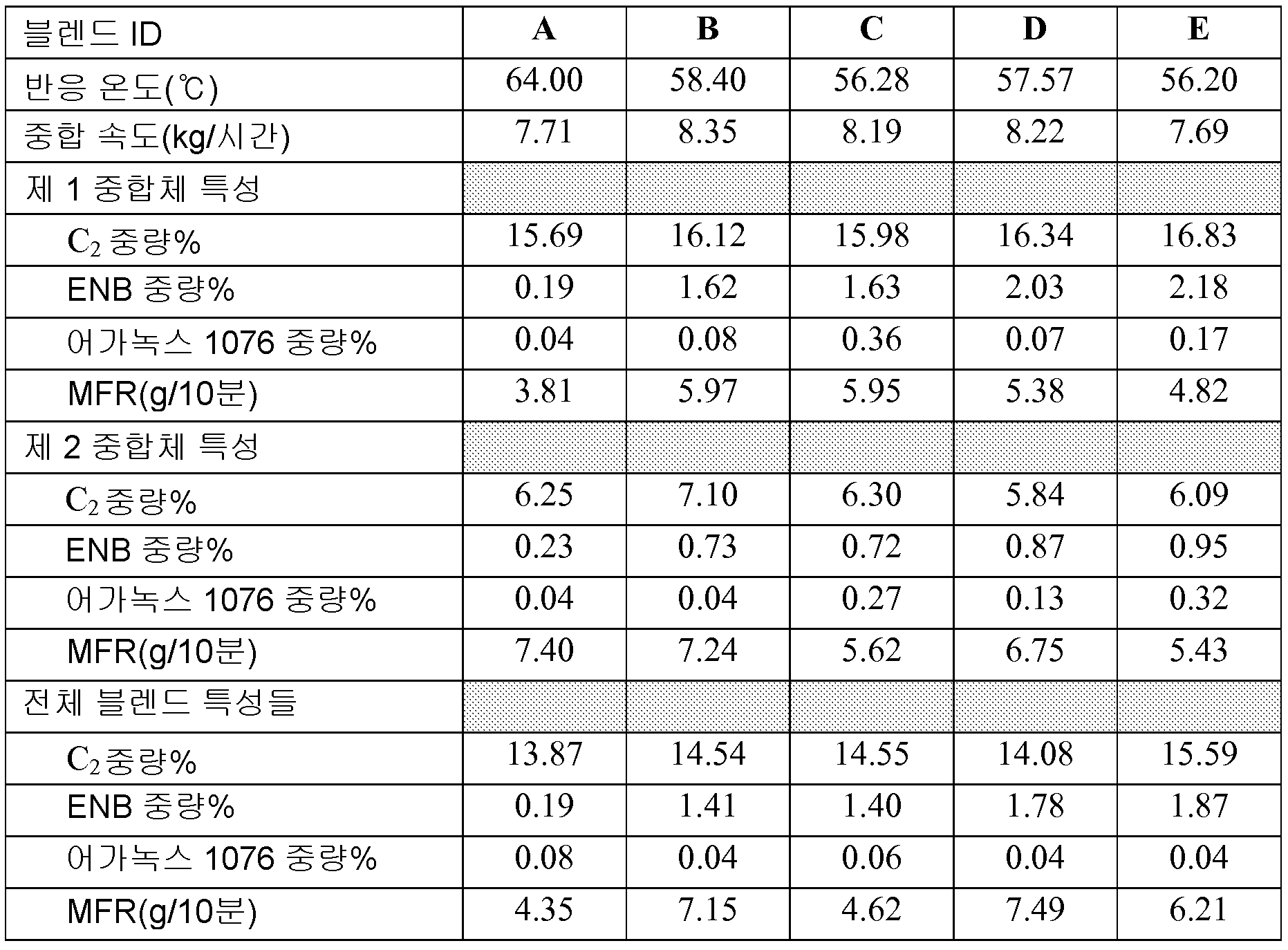
중합체 블렌드 A 내지 E의 분자량 특성 및 열 특성을 하기 표 2에 나타냈다. 유사한 조성을 갖지만 단일 반응기에서 제조된 비교예 중합체에 대해서도 동일한 특성들을 나타냈다. 구체적으로, 비교예 중합체는 엑손모빌 케미칼 캄파니로부터 비스타맥스(Vistamaxx, 상표) 6102로서 시판중이며, 이는 약 16중량%의 에틸렌을 포함하고 약 2 g/10분의 MFR를 갖는다.The molecular weight and thermal properties of the polymer blends A to E are shown in Table 2 below. The same properties were also shown for comparative polymers having similar compositions but prepared in a single reactor. Specifically, the comparative polymer is commercially available from ExxonMobil Chemical Company as Vistamaxx 6102, which contains about 16% by weight of ethylene and has a MFR of about 2 g / 10 min.
[표 2][Table 2]
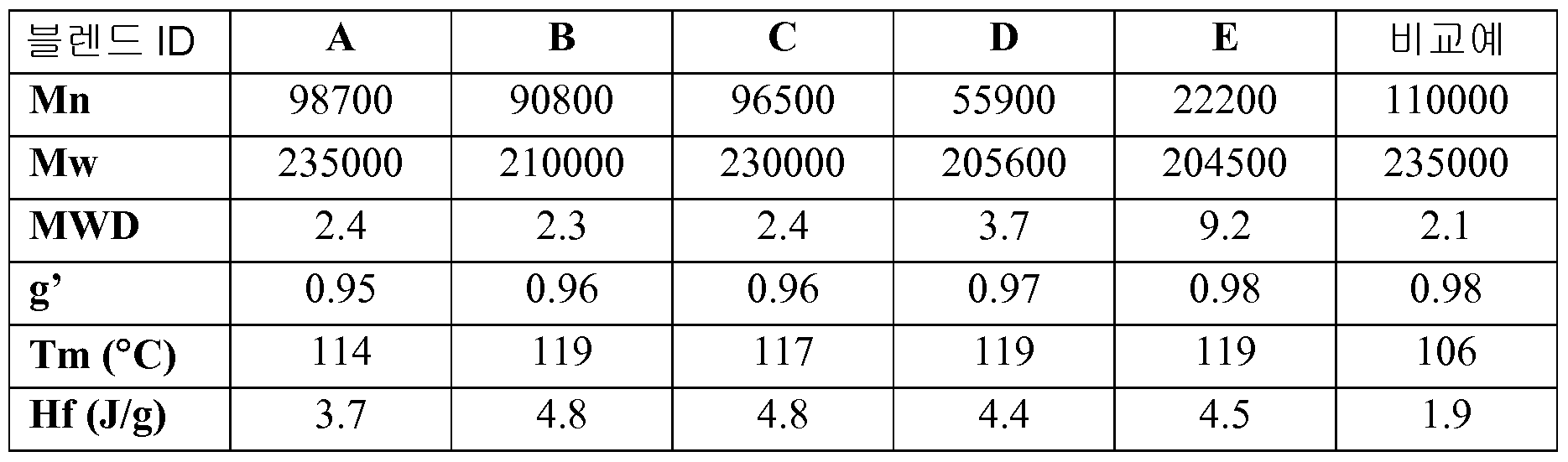
실시예 1 내지 11Examples 1 to 11
중합체 블렌드 A 내지 E는, 그다음 폴리프로필렌, 공가교제, 산화방지제 또는 이들의 조합과 배합하였다. 각각의 조성물은 브라벤더(Brabender) 열가소성 배합기에서 제조하였다. 블렌드 A 내지 E의 펠렛을, 3분 동안 150℃의 용융 온도에서 산화방지제와 함께 질소 블랭킷의 존재하에서 브라벤더에 충전시켰다. 그다음, 온도를 140℃로 낮추고, 공가교제, 산화방지제 및/또는 폴리프로필렌을 첨가하고 약 2분 동안 혼합하여 균일한 블렌드를 수득하였다. 그다음, 배합된 블렌드를 압축 몰딩 프레스에서 75밀 두께의 플라크 및 10밀 두께의 필름으로 성형하였다. The polymer blends A to E were then blended with polypropylene, a co-crosslinking agent, an antioxidant, or a combination thereof. Each composition was prepared in a Brabender thermoplastic blender. The pellets of blends A to E were charged to the brabender in the presence of a nitrogen blanket with an antioxidant at a melting temperature of 150 DEG C for 3 minutes. Then, the temperature was lowered to 140 占 폚, a co-crosslinking agent, an antioxidant and / or polypropylene was added and mixed for about 2 minutes to obtain a uniform blend. The blended blend was then formed into a 75 mil thick plaque and 10 mil thick film in a compression molding press.
본원에서 실시예 1 내지 6으로 표시한, 결과물인 배합된 배합물은, 먼저 50 kGy 및 그다음 60 kGy에서의 전자빔 조사를 사용하여 가교결합시켰다. 실시예 1 내지 6의 조성물, 가공 조건 및 기계적 특성을 하기 표 3에 기록하였다.The resulting combined formulations, designated herein as Examples 1-6, were first cross-linked using electron beam irradiation at 50 kGy and then at 60 kGy. The compositions, processing conditions and mechanical properties of Examples 1 to 6 are reported in Table 3 below.
비교예는 또한 블렌드가 공가교제, 산화방지제 또는 폴리프로필렌을 함유하지 않는다는 점을 제외하고는 동일한 절차를 사용하여 중합체 블렌드 A 내지 E로부터 제조하였다. 비교예 7 내지 11의 조성물, 가공 조건, 및 기계적 특성들은 하기 표 4에 기록하였다. The comparative example was also prepared from polymer blends A to E using the same procedure except that the blend did not contain a co-crosslinking agent, antioxidant or polypropylene. The compositions, processing conditions, and mechanical properties of Comparative Examples 7 to 11 are listed in Table 4 below.
PP 9122는, 2 내지 3 중량%의 에틸렌-유도된 단위 및 나머지량의 폴리프로필렌을 함유하는 폴리프로필렌(RCP)의 랜덤 공중합체이다. PP 9122는 2.1g/10분의 MFR(230℃에서 2.16 kg) 및 0.9 g/㎤의 밀도를 갖는다. 1% 시컨트(secant) 굴곡 탄성율은, ASTM D790A로 측정시 140 kPsi이다. PP 9122는 엑손모빌 케미칼 캄파니로부터 시판중이다.PP 9122 is a random copolymer of polypropylene (RCP) containing from 2 to 3% by weight of ethylene-derived units and the remainder of the polypropylene. PP 9122 has a MFR of 2.1 g / 10 min (2.16 kg at 230 캜) and a density of 0.9 g / cm 3. The 1% secant flexural modulus is 140 kPsi as measured by ASTM D790A. PP 9122 is commercially available from ExxonMobil Chemical Company.
사토머 350은, 사토머 캄파니 인코포레이티드(Sartomer Company, Inc.)에서 시판중인 트라이메틸올프로판 트라이메타크릴레이트 공가교제이다.Sartomer 350 is a trimethylolpropane trimethacrylate co-crosslinking agent commercially available from Sartomer Company, Inc.
어가포스 168은, 시바 스페셜티 케미칼스(Ciba Specialty Chemicals)에서 시판중인 산화방지제이다.Eagar Force 168 is an antioxidant commercially available from Ciba Specialty Chemicals.
조성물의 물리적 특성들은 경화 전 및 후에 평가되었다. 경도는 ASTM 2240에 따라 측정하고, 블렌드의 인장 세트는 상온 및 70℃에서 ASTM D412에 따라 측정하였다. 인장 세트에 대한 상온 및 70℃ 시험에 있어서, 샘플은 지그(Jig) 상의 50% 장력하에서 30분 동안 시험 온도에서 노화시키고 지그로부터 제거한 후 30분 동안 상온에서 어닐링하였다. 자일렌 속슬렛 용매 추출 테스트는, 속슬렛 추출기(추출 시간: 12 시간)를 사용하여 경화된 샘플 위에서 ASTM D5492에 따라 시험하여, 전자빔 경화 이후에 가교결합된 물질의 수준을 파악하였다. 결과는 하기와 같이 표현하였다:Physical properties of the compositions were evaluated before and after curing. The hardness was measured according to ASTM 2240, and the tensile set of the blend was measured according to ASTM D412 at room temperature and 70 캜. For the normal temperature and 70 deg. C test on the tensile set, the samples were aged at the test temperature for 30 minutes under 50% tension on the jig and removed from the jig and then annealed at room temperature for 30 minutes. The xylene sultlet solvent extraction test was conducted according to ASTM D5492 on a cured sample using a Soxhlet extractor (extraction time: 12 hours) to determine the level of cross-linked material after electron beam curing. The results were expressed as:
자일렌 불용성 물질% = 추출 후 중량/추출 전 중량 * 100% Xylene insoluble matter% = weight after extraction / weight before extraction * 100
[표 3][Table 3]
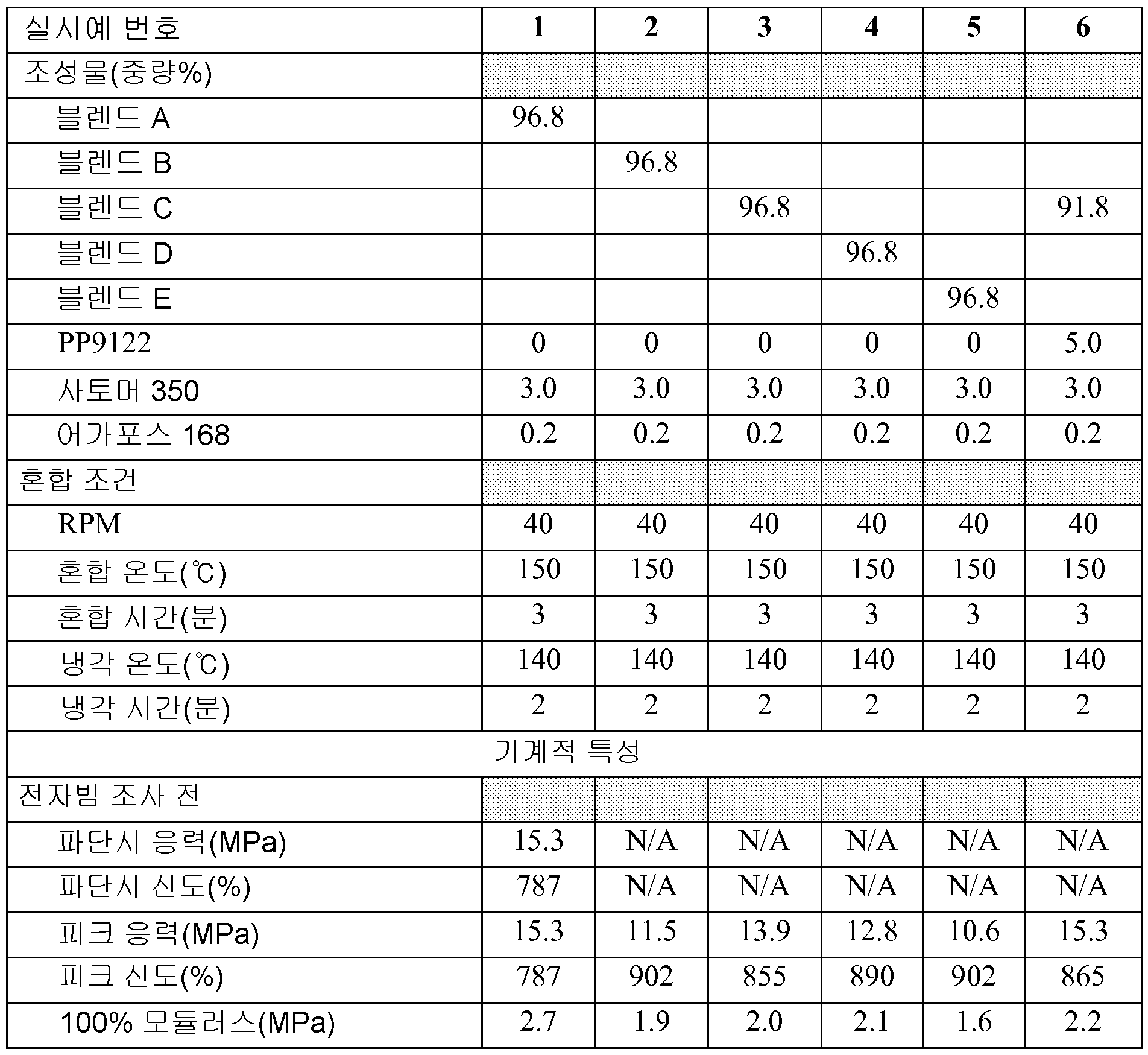
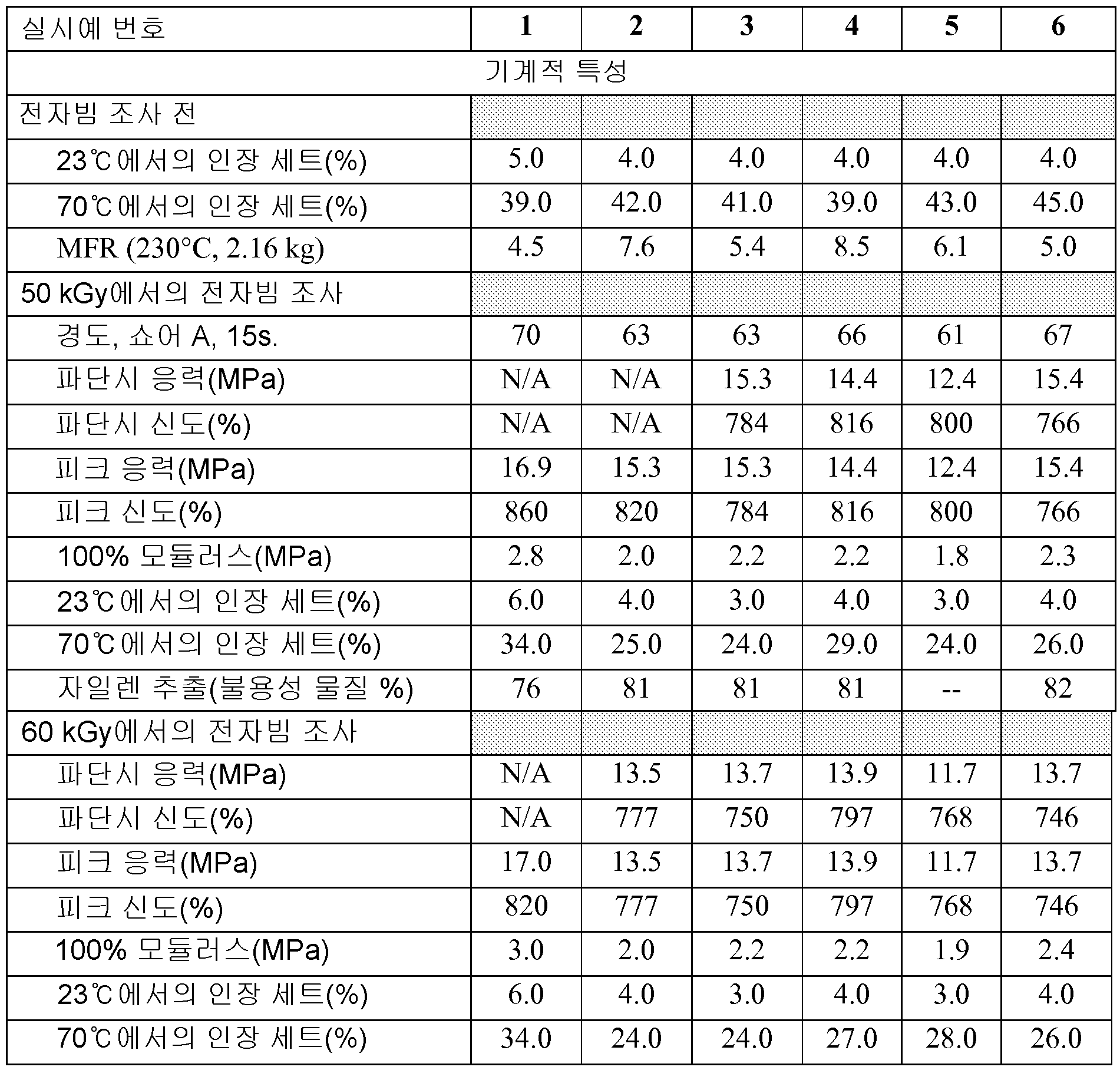
[표 4](비교예)[Table 4] (Comparative Example)
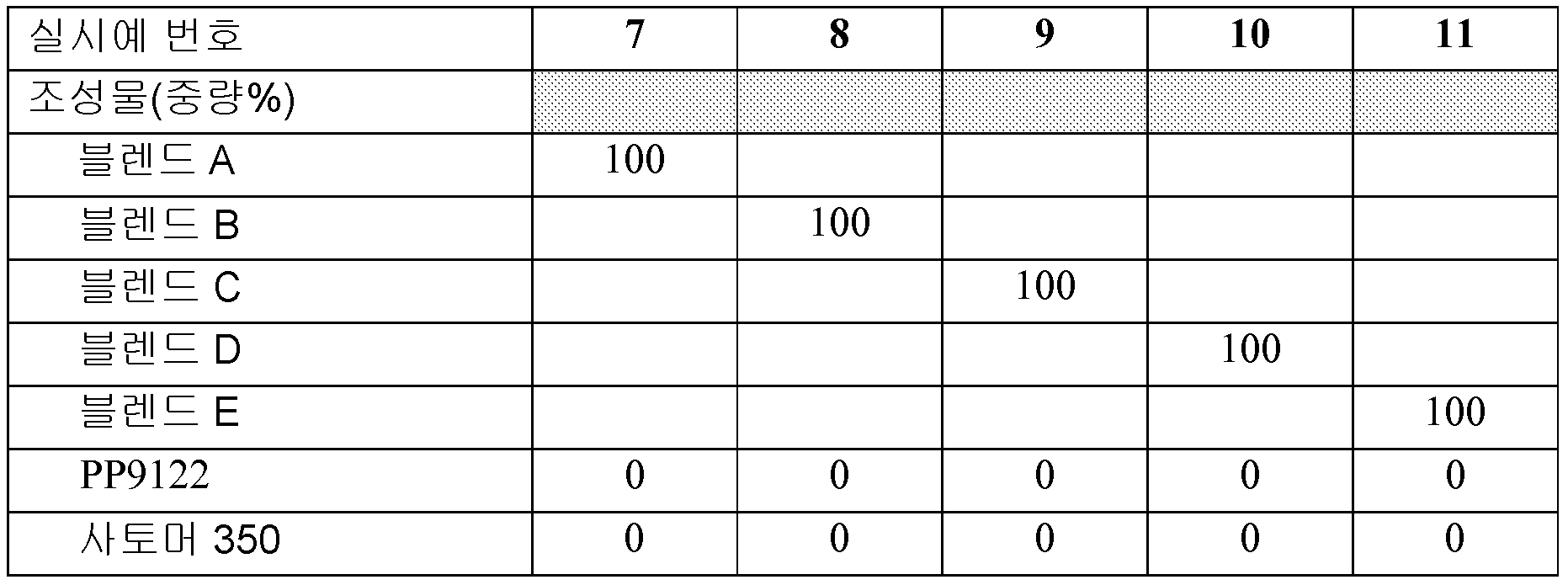

비교예 7 내지 11의 기계적 특성들과 실시예 1 내지 6의 기계적 특성들을 비교함으로써 명백한 바와 같이, 본 발명의 중합체 블렌드에 하나 이상의 공가교제 및 하나 이상의 산화방지제를 첨가하면, 매우 개선된 기계적 특성들을 나타낸다. 예를 들어, 모든 실시예의 경우, 전자빔의 조사 전 및 후에서의 피크 응력차를 비교하면, 공가교제 및 산화방지제를 함유하는 실시예 1 내지 6의 경우 피크 응력 측정치가 증가한(개선된) 반면, 가교결합시 비교예 7 내지 11의 피크 응력 측정치는 감소하였음(악화되었다)을 나타낸다. 모든 실시예에 있어서 70℃의 인장 세트 값의 유사한 비교는, 모든 샘플에 의해 인장 세트의 개선(인장 세트 %의 감소로 표시됨)이 나타났지만, 공가교제 및 산화방지제 둘다를 함유하는 샘플의 경우 개선이 보다 컸음을 나타낸다.As is apparent by comparing the mechanical properties of Comparative Examples 7 to 11 with the mechanical properties of Examples 1 to 6, the addition of one or more co-crosslinking agents and one or more antioxidants to the polymer blend of the present invention provides highly improved mechanical properties . For example, in all embodiments, comparing the peak stress differences before and after the irradiation of the electron beam reveals that the peak stress measurements are increased (improved) for Examples 1 to 6 that contain a co-crosslinking agent and an antioxidant, Peak stress measurements of Comparative Examples 7 to 11 during crosslinking show a decrease (deteriorated). A similar comparison of the tensile set values at 70 캜 for all examples showed an improvement in the tensile set (indicated by a reduction in the tensile set%) by all samples, but in the case of samples containing both a co-crosslinking agent and an antioxidant Respectively.
전술한 실시예는 가교결합된 블렌드의 탄성 특성이 비-공액된 다이엔의 첨가에 의해 개선됨을 추가로 설명한다. 이것은, 블렌드 A로부터 제조되고 매우 소량의 다이엔(0.19 중량% ENB)을 포함하는 실시예 1 및 7를, 블렌드 B, C, D 및 E로부터 제조되고 1.41 내지 1.87중량%로 다이엔 함량을 변화시킨 나머지 실시예와 비교함으로써 나타난다. 예를 들어, 실시예 1 및 7의 70℃에서의 인장 세트는 전자빔 조사에 의한 가교결합시 본질적으로 동일한 반면, 나머지 실시예의 인장 세트는 조사 이후 상당히 개선된다.The foregoing examples further illustrate that the elastic properties of the crosslinked blend are improved by the addition of non-conjugated dienes. This shows that Examples 1 and 7 prepared from Blend A and containing a very small amount of dienes (0.19 wt% ENB) were prepared from Blends B, C, D and E and varied in diene content from 1.41 to 1.87 wt% ≪ / RTI > For example, the tensile sets at 70 < 0 > C of Examples 1 and 7 are essentially the same at cross-linking by electron beam irradiation, while the tensile sets of the remaining embodiments are significantly improved after irradiation.
도 1은, 심지어 가교결합 전에, 이중 반응기 공정에 의한 중합체 블렌드의 생산으로부터의 개선된 인장 특성들을 도시한다. 특히, 도 1은, 실시예 1, 3 및 4의 비가교결합된 블렌드 및 단일 반응기에서 제조된 2종의 비교예 중합체 블렌드에 대한 신도의 함수로서 응력을 나타낸다.Figure 1 shows the improved tensile properties from the production of the polymer blend by a dual reactor process, even prior to crosslinking. In particular, Figure 1 shows the stress as a function of elongation for the unbonded blends of Examples 1, 3 and 4 and for the two comparative polymer blends produced in a single reactor.
도 2는, 이중 반응기 공정에서 형성된 중합체 블렌드의 가교결합으로부터의 개선된 인장 특성들을 도시한다. 특히, 도 2는, 실시예 1, 3 및 4와, 단일 반응기에서 제조된 상응하는 가교결합된 중합체 블렌드에 대한 신도의 함수로서의 응력을 나타낸다.Figure 2 shows the improved tensile properties from crosslinking of polymer blends formed in a dual reactor process. In particular, Figure 2 shows the stresses as a function of elongation for Examples 1, 3 and 4 and the corresponding crosslinked polymer blend prepared in a single reactor.
도 3은, 본 발명의 중합체 블렌드내 공가교제의 첨가로부터의 개선된 인장 특성을 설명한다. 특히, 도 3은, 가교결합 전 및 후 둘다의 경우, 공가교제를 함유하는 실시예 2에 대해, 또한 가교결합 후, 공가교제를 함유하지 않는 실시예 8에 대해, 신도의 함수로서 응력을 나타낸다.Figure 3 illustrates the improved tensile properties from the addition of a co-crosslinking agent in the polymer blend of the present invention. In particular, Figure 3 shows the stress as a function of elongation for Example 2 containing a co-crosslinking agent and for Example 8 which does not contain co-crosslinking agent after crosslinking, both before and after crosslinking .
편의상, 다양한 구체적인 테스트 절차는, 인장 세트, 파단시 신도(%), 쇼어 A 경도 등의 측정에 대해 앞에서 기술하였다. 그러나, 당업계의 숙련자라면 본 특허출원을 읽고 조성물 또는 중합체가 청구의 범위에서 나타내는 구체적인 특성들을 보유하는지 여부를 확인하고자 할 것이고, 구체적으로 밝힌 절차들이 바람직하지만, 상기 특성들을 확인하기 위해서 어떠한 공개되거나 잘 인식된 방법 또는 테스트 절차도 따를 수 있다. 상이한 절차로 상이한 결과 또는 측정치가 수득될지라도, 각각의 청구범위는 이러한 절차 중 어떠한 결과도 포괄할 것으로 해석되어야 한다. 따라서, 당업계의 숙련자라면, 청구의 범위에서 밝힌 측정된 특성들의 실험적인 변수를 예상할 것이다. 모든 수치 값은, 일반적으로 테스트의 특성 측면에서 언급된 값들을 "약" 또는 "대략적으로"로 수식하는 것으로 고려될 수 있다. For convenience, various specific test procedures have been described above for measurements such as tensile set, elongation at break (%), Shore A hardness, and the like. It will be understood by those skilled in the art, however, that this patent application should be read to ascertain whether the composition or polymer possesses the specific properties set forth in the claims, and the procedures specifically disclosed are preferred, Well-recognized methods or testing procedures can be followed. Although different results or measurements are obtained in different procedures, each claim should be construed as encompassing any result of such procedure. Thus, one of ordinary skill in the art will anticipate the experimental variables of the measured properties disclosed in the claims. All numerical values can be considered as modifying the values generally mentioned in terms of the characteristics of the test to "about" or "roughly ".
본원에서 다양한 양태의 조성물을 기술하고 있지만, 본 발명의 추가의 구체적인 실시양태는, 하기 문단에서 설명하는 것을 포함한다:While the disclosure herein describes compositions of various embodiments, further specific embodiments of the present invention include those described in the following paragraphs:
AA. 가교결합 중합체 블렌드의 제조 방법으로서, AA. A process for producing a crosslinked polymer blend,
a) 제 1 반응기에서 제 1 중합체를 포함하는 중합체 용액을 중합하는 단계; a) polymerizing a polymer solution comprising a first polymer in a first reactor;
b) 제 2 반응기에서 제 2 중합체를 포함하는 중합체 용액을 중합하는 단계; b) polymerizing a polymer solution comprising a second polymer in a second reactor;
c) 제 1 중합체 용액과 제 2 중합체 용액을 조합하여 중합체 블렌드 용액을 제조하는 단계; c) combining the first polymer solution and the second polymer solution to produce a polymer blend solution;
d) 상기 중합체 블렌드 용액을 가공하여 중합체 블렌드를 제조하는 단계; 및d) processing said polymer blend solution to produce a polymer blend; And
e) 상기 중합체 블렌드를 에너지성 광자로 처리함으로써, 상기 중합체 블렌드를 적어도 부분적으로 가교결합시키는 단계e) at least partially crosslinking said polymer blend by treating said polymer blend with an energy photon,
를 포함하고, 상기 제 1 및 제 2 중합체 각각이 약 75 내지 약 99중량%의 프로필렌-유도된 단위, 약 1 내지 약 25중량%의 에틸렌-유도된 단위, 및 약 0.05 내지 약 6중량%의 다이엔-유도된 단위를 포함하는, 방법.Wherein each of said first and second polymers comprises from about 75 to about 99 weight percent propylene-derived units, from about 1 to about 25 weight percent ethylene-derived units, and from about 0.05 to about 6 weight percent Diene-derived units.
AB. 문단 AA의 방법으로서, 제 1 중합체가 약 12 내지 약 20중량%의 에틸렌-유도된 단위를 포함하는, 방법.AB. The method of paragraph AA, wherein the first polymer comprises from about 12% to about 20% by weight of ethylene-derived units.
AC. 전술한 문단들 중 어느 한 문단의 방법으로서, 제 1 중합체가 약 14 내지 약 18중량%의 에틸렌-유도된 단위를 포함하는, 방법.AC. 15. The method of any one of the preceding paragraphs, wherein the first polymer comprises from about 14 to about 18 weight percent ethylene-derived units.
AD. 전술한 문단들 중 어느 한 문단의 방법으로서, 제 2 중합체가 약 3 내지 약 10중량%의 에틸렌-유도된 단위를 포함하는, 방법.AD. The method of any one of the preceding paragraphs, wherein the second polymer comprises from about 3 to about 10 weight percent ethylene-derived units.
AE. 전술한 문단들 중 어느 한 문단의 방법으로서, 제 2 중합체가 약 5 내지 약 8중량%의 에틸렌-유도된 단위를 포함하는, 방법. AE. The method of any one of the preceding paragraphs, wherein the second polymer comprises from about 5 to about 8 weight percent ethylene-derived units.
AF. 전술한 문단들 중 어느 한 문단의 방법으로서, 제 1 중합체가 약 0.5 내지 약 5중량%의 다이엔-유도된 단위를 포함하는, 방법. AF. The method of any one of the preceding paragraphs, wherein the first polymer comprises from about 0.5 to about 5 weight percent diene-derived units.
AG. 전술한 문단들 중 어느 한 문단의 방법으로서, 제 1 중합체가 약 1 내지 약 3중량%의 다이엔-유도된 단위를 포함하는, 방법. AG. The method of any one of the preceding paragraphs, wherein the first polymer comprises from about 1 to about 3 weight percent diene-derived units.
AH. 전술한 문단들 중 어느 한 문단의 방법으로서, 제 2 중합체가 약 0.1 내지 약 1.0중량%의 다이엔-유도된 단위를 포함하는, 방법. AH. The method of any one of the preceding paragraphs, wherein the second polymer comprises from about 0.1 to about 1.0 weight percent diene-derived units.
AI. 전술한 문단들 중 어느 한 문단의 방법으로서, 제 1 중합체가 약 14 내지 약 18중량%의 에틸렌-유도된 단위 및 약 1 내지 약 3중량%의 다이엔-유도된 단위를 포함하고, 제 2 중합체가 약 5 내지 약 8중량%의 에틸렌-유도된 단위 및 약 0.1 내지 약 1.0중량%의 다이엔-유도된 단위를 포함하는, 방법.AI. The method of any of the preceding paragraphs, wherein the first polymer comprises from about 14 to about 18 weight percent ethylene-derived units and from about 1 to about 3 weight percent diene-derived units, Wherein the polymer comprises from about 5 to about 8 weight percent ethylene-derived units and from about 0.1 to about 1.0 weight percent diene-derived units.
AJ. 전술한 문단들 중 어느 한 문단의 방법으로서, 중합체 블렌드가 약 10 내지 약 18중량%의 에틸렌-유도된 단위를 포함하는, 방법.AJ. The method of any one of the preceding paragraphs, wherein the polymer blend comprises from about 10 to about 18 weight percent ethylene-derived units.
AK. 전술한 문단들 중 어느 한 문단의 방법으로서, 중합체 블렌드가 약 12 내지 약 16중량%의 에틸렌-유도된 단위를 포함하는, 방법. AK. The method of any one of the preceding paragraphs, wherein the polymer blend comprises from about 12% to about 16% by weight of ethylene-derived units.
AL. 전술한 문단들 중 어느 한 문단의 방법으로서, 중합체 블렌드가 약 0.1 내지 약 5.0중량%의 다이엔-유도된 단위를 포함하는, 방법. AL. The method of any one of the preceding paragraphs, wherein the polymer blend comprises from about 0.1 to about 5.0 weight percent diene-derived units.
AM. 전술한 문단들 중 어느 한 문단의 방법으로서, 중합체 블렌드가 약 0.5 내지 약 3.0중량%의 다이엔-유도된 단위를 포함하는, 방법. AM. The method of any one of the preceding paragraphs, wherein the polymer blend comprises from about 0.5 to about 3.0 weight percent diene-derived units.
AN. 전술한 문단들 중 어느 한 문단의 방법으로서, 중합체 블렌드가 약 1.0 내지 약 2.0중량%의 다이엔-유도된 단위를 포함하는, 방법. AN. The method of any one of the preceding paragraphs, wherein the polymer blend comprises from about 1.0 to about 2.0 weight percent diene-derived units.
AO. 전술한 문단들 중 어느 한 문단의 방법으로서, 에너지성 광자가 자외선, 전자, x-선 또는 감마선의 형태인, 방법.AO. The method of any one of the preceding paragraphs wherein the energy photons are in the form of ultraviolet, electron, x-ray or gamma radiation.
AP. 전술한 문단들 중 어느 한 문단의 방법으로서, 중합체 블렌드가 약 30 내지 약 100 kGy 양으로 전자빔 조사 처리되는, 방법.AP. Wherein the polymer blend is subjected to electron beam irradiation in an amount of from about 30 to about 100 kGy, as a method of any of the paragraphs of the foregoing paragraphs.
AQ. 전술한 문단들 중 어느 한 문단의 방법으로서, 중합체 블렌드가 약 50 내지 약 60 kGy 양으로 전자빔 조사 처리되는, 방법.AQ. The method of any one of the preceding paragraphs, wherein the polymer blend is subjected to electron beam irradiation in an amount of from about 50 to about 60 kGy.
AR. 전술한 문단들 중 어느 한 문단의 방법으로서, 중합체 블렌드가, 가교결합 전에 하나 이상의 섬유, 필름, 부직물 또는 기타 제품으로 형성되는, 방법.AR. 20. A method according to any one of the preceding paragraphs, wherein the polymer blend is formed into one or more fibers, films, nonwoven or other articles prior to crosslinking.
AS. 전술한 문단들 중 어느 한 문단의 방법으로서, 중합체 블렌드가, 가교결합 전에, 하나 이상의 공가교제, 산화방지제, 2차 탄성중합체, 폴리프로필렌, 첨가제 또는 이들의 임의의 조합물과 배합되는, 방법.AS. Wherein the polymer blend is combined with at least one co-crosslinking agent, an antioxidant, a secondary elastomer, a polypropylene, an additive or any combination thereof prior to crosslinking, as a method of any one of the paragraphs of the foregoing paragraphs.
AT. 문단 AS의 방법으로서, 공가교제가 트라이아크릴레이트인, 방법.AT. The method of paragraph AS, wherein the co-crosslinking agent is a triacrylate.
AU. 문단 AS 내지 AT 중 어느 한 문단의 방법으로서, 산화방지제가 포스페이트 에스터인, 방법. AU. The method of any one of paragraphs AS to AT, wherein the antioxidant is a phosphate ester.
AV. 문단 AS 내지 AU 중 어느 한 문단의 방법으로서, 중합체 블렌드가 하나 이상의 공가교제 및 하나 이상의 산화방지제와 배합되는, 방법.AV. The method of any one of paragraphs AS to AU wherein the polymer blend is combined with at least one co-crosslinking agent and at least one antioxidant.
AW. 문단 AS 내지 AV 중 어느 한 문단의 방법으로서, 공가교제가 트라이아크릴레이트이고, 산화방지제가 포스페이트 에스터인, 방법.AW. The method of any one of paragraphs AS to AV, wherein the co-crosslinking agent is a triacrylate and the antioxidant is a phosphate ester.
AX. 문단 AS 내지 AW 중 어느 한 문단의 방법으로서, 배합된 중합체 블렌드가, 에너지성 광자로 처리되기 전에, 추가로 하나 이상의 섬유, 필름, 부직물, 또는 다른 제품으로 형성되는, 방법.AX. The method of any one of paragraphs AS to AW, wherein the blended polymer blend is formed further into one or more fibers, films, nonwoven, or other articles before being treated with the energy photons.
AY. 제 1 반응기에서 형성된 제 1 중합체와 제 2 반응기에서 형성된 제 2 중합체의 반응기 블렌드를 수득하고 이를 가공함으로써 형성된 중합체 블렌드를 포함하는 중합체 조성물로서, 제 1 및 제 2 중합체 각각이 약 75 내지 약 99중량%의 프로필렌-유도된 단위, 약 1 내지 약 25중량%의 에틸렌-유도된 단위, 및 약 0.05 내지 약 6중량%의 다이엔-유도된 단위를 포함하는, 중합체 조성물.AY. A polymeric composition comprising a polymer blend formed by obtaining and processing a reactor blend of a first polymer formed in a first reactor and a second polymer formed in a second reactor, wherein each of the first and second polymers has a weight of from about 75 to about 99 weight percent Derived units, from about 1 to about 25 weight percent ethylene-derived units, and from about 0.05 to about 6 weight percent diene-derived units.
AZ. 문단 AY의 중합체 조성물로서, 제 1 중합체가 약 12 내지 약 20중량%의 에틸렌-유도된 단위를 포함하는, 중합체 조성물.AZ. The polymer composition of Paragraph AY, wherein the first polymer comprises from about 12% to about 20% by weight of ethylene-derived units.
BA. 문단 AY 내지 AZ 중 어느 한 문단의 중합체 조성물로서, 제 1 중합체가 약 14 내지 약 18중량%의 에틸렌-유도된 단위를 포함하는, 중합체 조성물.BA. The polymer composition of any one of paragraphs AY to AZ, wherein the first polymer comprises from about 14 to about 18 weight percent ethylene-derived units.
BB. 문단 AY 내지 BA 중 어느 한 문단의 중합체 조성물로서, 제 2 중합체가 약 3 내지 약 10중량%의 에틸렌-유도된 단위를 포함하는, 중합체 조성물.BB. The polymer composition of any one of paragraphs AY to BA, wherein the second polymer comprises from about 3 to about 10 weight percent ethylene-derived units.
BC. 문단 AY 내지 BB 중 어느 한 문단의 중합체 조성물로서, 제 2 중합체가 약 5 내지 약 8중량%의 에틸렌-유도된 단위를 포함하는, 중합체 조성물.BC. The polymer composition of any one of paragraphs AY to BB, wherein the second polymer comprises from about 5 to about 8 weight percent ethylene-derived units.
BD. 문단 AY 내지 BC 중 어느 한 문단의 중합체 조성물로서, 제 1 중합체가 약 0.5 내지 약 5중량%의 다이엔-유도된 단위를 포함하는, 중합체 조성물.BD. The polymer composition of any one of paragraphs AY to BC, wherein the first polymer comprises from about 0.5 to about 5 weight percent diene-derived units.
BE. 문단 AY 내지 BD 중 어느 한 문단의 중합체 조성물로서, 제 1 중합체가 약 1.0 내지 약 3.0중량%의 다이엔-유도된 단위를 포함하는, 중합체 조성물.BE. The polymer composition of any one of paragraphs AY to BD, wherein the first polymer comprises from about 1.0 to about 3.0 weight percent diene-derived units.
BF. 문단 AY 내지 BE 중 어느 한 문단의 중합체 조성물로서, 제 2 중합체가 약 0.1 내지 약 1.0중량%의 다이엔-유도된 단위를 포함하는, 중합체 조성물.BF. The polymer composition of any one of paragraphs AY to BE, wherein the second polymer comprises from about 0.1 to about 1.0 weight percent diene-derived units.
BG. 문단 AY 내지 BF 중 어느 한 문단의 중합체 조성물로서, 제 1 중합체가 약 14 내지 약 18중량%의 에틸렌-유도된 단위 및 약 1 내지 약 3중량%의 다이엔-유도된 단위를 포함하고, 제 2 중합체가 약 5 내지 약 8중량%의 에틸렌-유도된 단위 및 약 0.1 내지 약 1.0중량%의 다이엔-유도된 단위를 포함하는, 중합체 조성물.BG. The polymer composition of any one of paragraphs AY to BF, wherein the first polymer comprises from about 14 to about 18 weight percent of an ethylene-derived unit and from about 1 to about 3 weight percent of a diene- 2 polymer comprises from about 5 to about 8 weight percent ethylene-derived units and from about 0.1 to about 1.0 weight percent diene-derived units.
BH. 문단 AY 내지 BG 중 어느 한 문단의 중합체 조성물로서, 중합체 블렌드가 약 10 내지 약 18중량%의 에틸렌-유도된 단위를 포함하는, 중합체 조성물.Bi. The polymer composition of any one of paragraphs AY to BG, wherein the polymer blend comprises from about 10 to about 18 weight percent ethylene-derived units.
BI. 문단 AY 내지 BH 중 어느 한 문단의 중합체 조성물로서, 중합체 블렌드가 약 12 내지 약 16중량%의 에틸렌-유도된 단위를 포함하는, 중합체 조성물.BI. The polymer composition of any one of paragraphs AY to BH, wherein the polymer blend comprises from about 12 to about 16 weight percent ethylene-derived units.
BJ. 문단 AY 내지 BI 중 어느 한 문단의 중합체 조성물로서, 중합체 블렌드가 약 0.1 내지 약 5.0중량%의 다이엔-유도된 단위를 포함하는, 중합체 조성물.BJ. The polymer composition of any one of paragraphs AY to BI, wherein the polymer blend comprises from about 0.1 to about 5.0 weight percent diene-derived units.
BK. 문단 AY 내지 BJ 중 어느 한 문단의 중합체 조성물로서, 중합체 블렌드가 약 0.5 내지 약 3.0중량%의 다이엔-유도된 단위를 포함하는, 중합체 조성물.BK. The polymer composition of any one of paragraphs AY to BJ, wherein the polymer blend comprises from about 0.5 to about 3.0 weight percent diene-derived units.
BL. 문단 AY 내지 BK 중 어느 한 문단의 중합체 조성물로서, 중합체 블렌드가 약 1.0 내지 약 2.0중량%의 다이엔-유도된 단위를 포함하는, 중합체 조성물.BL. The polymer composition of any one of paragraphs AY to BK wherein the polymer blend comprises from about 1.0 to about 2.0 weight percent diene-derived units.
BM. 문단 AY 내지 BL 중 어느 한 문단의 중합체 조성물로서, 중합체 블렌드가 에너지성 광자로 이것을 처리함으로써 적어도 부분적으로 가교결합되는, 중합체 조성물.UN. The polymer composition of any one of paragraphs AY to BL, wherein the polymer blend is at least partially crosslinked by treating it with an energy photon.
BN. 문단 BM의 중합체 조성물로서, 에너지성 광자가 자외선, 전자, x-선 또는 감마선의 형태인, 중합체 조성물.BN. The polymer composition of paragraph BM, wherein the energy photons are in the form of ultraviolet, electron, x-ray or gamma radiation.
BO. 문단 BM 내지 BN 중 어느 한 문단의 중합체 조성물로서, 중합체 블렌드가 약 30 내지 약 100 kGy으로 전자빔 조사 처리된, 중합체 조성물.BO. The polymer composition of any one of paragraphs BM to BN, wherein the polymer blend is subjected to electron beam irradiation treatment at about 30 to about 100 kGy.
BP. 문단 BM 내지 BO 중 어느 한 문단의 중합체 조성물로서, 중합체 블렌드가 약 50 내지 약 60 kGy으로 전자빔 조사 처리된, 중합체 조성물.BP. The polymer composition of any one of paragraphs BM to BO, wherein the polymer blend is subjected to electron beam irradiation treatment at about 50 to about 60 kGy.
BQ. 문단 BM 내지 BP 중 어느 한 문단의 중합체 조성물로서, 중합체 블렌드가 가교결합 전에 하나 이상의 섬유, 필름, 부직물, 또는 다른 제품으로 형성되는, 중합체 조성물. BQ. The polymer composition of any one of paragraphs BM to BP, wherein the polymer blend is formed from one or more fibers, films, nonwoven, or other articles prior to crosslinking.
BR. 문단 BQ의 중합체 조성물로서, 상기 섬유, 필름, 부직물, 또는 다른 제품이 전자빔 조사를 통해 적어도 부분적으로 가교결합된, 중합체 조성물.BR. The polymer composition of paragraph BQ, wherein said fiber, film, nonwoven, or other article is at least partially crosslinked via electron beam irradiation.
BS. 문단 AY 내지 BR 중 어느 한 문단의 중합체 조성물로서, 중합체 블렌드가 하나 이상의 공가교제, 산화방지제, 2차 탄성중합체, 폴리프로필렌, 첨가제, 또는 이들의 임의의 조합과 추가로 배합되는, 조성물.BS. The polymer composition of any one of paragraphs AY to BR, wherein the polymer blend is further compounded with one or more co-crosslinking agents, antioxidants, secondary elastomers, polypropylene, additives, or any combination thereof.
BT. 문단 BS의 방법으로서, 공가교제가 트라이아크릴레이트인, 방법. BT. The method of paragraph BS, wherein the co-crosslinking agent is a triacrylate.
BU. 문단 BS 내지 BT 중 어느 한 문단의 방법으로서, 상기 산화방지제가 포스페이트 에스터인, 방법. THIS IS. The method of any one of paragraphs BS to BT, wherein the antioxidant is a phosphate ester.
BV. 문단 BS 내지 BU 중 어느 한 문단의 방법으로서, 중합체 블렌드를 하나 이상의 공가교제 및 하나 이상의 산화방지제와 배합하는, 방법.BV. The method of any one of paragraphs BS to BU, wherein the polymer blend is combined with at least one co-crosslinking agent and at least one antioxidant.
BW. 문단 BS 내지 BV 중 어느 한 문단의 방법으로서, 공가교제가 트라이아크릴레이트이고, 산화방지제가 포스페이트 에스터인, 방법.BW. The method of any of paragraphs BS to BV, wherein the co-crosslinking agent is triacrylate and the antioxidant is a phosphate ester.
BX. 문단 AY 내지 BW 중 어느 한 문단의 중합체 조성물을 전자빔 조사 처리하여 가교결합시킴으로써 형성된 적어도 부분적으로 가교결합된 중합체 조성물.BX. An at least partially crosslinked polymer composition formed by cross-linking a polymer composition of any one of paragraphs AY to BW by electron beam irradiation.
BY. 문단 AY 내지 BX 중 어느 한 문단의 중합체 조성물로서, 중합체 블렌드의 용융 유속이 약 0.1 내지 약 10.0 g/10분인, 중합체 조성물.BY. The polymer composition of any one of paragraphs AY to BX, wherein the polymer blend has a melt flow rate of from about 0.1 to about 10.0 g / 10 minutes.
BZ. 문단 AY 내지 BY 중 어느 한 문단의 중합체 조성물로서, 중합체 블렌드의 용융 유속이 약 3.0 내지 약 7.0 g/10분인, 중합체 조성물.BZ. The polymer composition of any one of paragraphs AY to BY, wherein the polymer blend has a melt flow rate of from about 3.0 to about 7.0 g / 10 min.
CA. 문단 AY 내지 BZ 중 어느 한 문단의 중합체 조성물로서, 중합체 블렌드의 분자량 분포도가 약 1.5 내지 약 10.0인, 중합체 조성물.CA. The polymer composition of any one of paragraphs AY to BZ, wherein the polymer blend has a molecular weight distribution of from about 1.5 to about 10.0.
CB. 문단 AY 내지 CA 중 어느 한 문단의 중합체 조성물로서, 중합체 블렌드의 분자량 분포도가 약 2.0 내지 약 4.0인, 중합체 조성물.CB. The polymer composition of any one of paragraphs AY to CA, wherein the polymer blend has a molecular weight distribution of from about 2.0 to about 4.0.
CC. 문단 AY 내지 CB 중 어느 한 문단의 중합체 조성물로서, 중합체 블렌드의 용융 온도가 약 110℃ 초과인, 중합체 조성물.CC. The polymer composition of any one of paragraphs AY to CB, wherein the polymer blend has a melt temperature of greater than about 110 < 0 > C.
CD. 문단 AY 내지 CC 중 어느 한 문단의 중합체 조성물로서, 중합체 블렌드의 용융 온도가 약 115℃ 초과인, 중합체 조성물.CD. The polymer composition of any one of paragraphs AY to CC, wherein the polymer blend has a melt temperature of greater than about 115 < 0 > C.
CE. 문단 AY 내지 CD 중 어느 한 문단의 중합체 조성물로서, 중합체 블렌드의 용융 온도가, 동일한 조성을 갖되 반응기 블렌딩이 아니라 중합체를 물리적으로 블렌딩함으로써 형성된 중합체 블렌드보다 적어도 약 5℃ 더 높은 용융 온도를 갖는, 중합체 조성물.CE. The polymer composition of any of paragraphs AY to CD, wherein the polymer blend has a melting temperature of at least about 5 DEG C higher than the polymer blend formed by physically blending the polymer, but not the reactor blend, .
CF. 문단 BX 내지 CE 중 어느 한 문단의 가교결합된 중합체 조성물로서, 중합체 조성물이 공가교제를 포함하고, 중합체 조성물의 피크 응력이 동일한 방식으로 제조되고 동일한 조성을 갖되 공가교제가 결핍된 중합체의 피크 응력보다 큰, 가교결합된 중합체 조성물.CF. A crosslinked polymer composition according to any one of paragraphs BX to CE wherein the polymer composition comprises a co-crosslinking agent and the peak stress of the polymer composition is produced in the same manner and has the same composition but greater than the peak stress of the polymer deficient in the co- A crosslinked polymer composition.
CG. 문단 BX 내지 CF 중 어느 한 문단의 가교결합된 중합체 조성물로서, 중합체 조성물이 공가교제를 포함하고, 중합체 조성물의 피크 신도가, 동일한 방식으로 제조되고 동일한 조성을 갖되 공가교제가 결핍된 중합체의 피크 신도보다 큰, 가교결합된 중합체 조성물.CG. A crosslinked polymer composition according to any one of paragraphs BX to CF, wherein the polymer composition comprises a co-crosslinking agent and the peak elongation of the polymer composition is greater than the peak elongation of the polymer having the same composition but having the same composition but lacking the co- , ≪ / RTI >
CH. 문단 BX 내지 CG 중 어느 한 문단의 가교결합된 중합체 조성물로서, 중합체 조성물이 공가교제를 포함하고, 중합체 조성물이 동일한 방식으로 제조되고 동일한 조성을 갖되 공가교제가 결핍된 중합체에 비해, 가교결합시 인장 세트의 큰 개선을 나타내는, 가교결합된 중합체 조성물.CH. A crosslinked polymer composition according to any one of paragraphs BX to CG wherein the polymer composition comprises a co-crosslinking agent and the polymer composition is prepared in the same manner and has the same composition, The crosslinked polymer composition shows a great improvement.
CI. 문단 BX 내지 CH 중 어느 한 문단의 가교결합된 중합체 조성물로서, 중합체 조성물이 산화방지제를 포함하고, 중합체 조성물의 피크 응력이 동일한 방식으로 제조되고 동일한 조성을 갖되 산화방지제가 결핍된 중합체의 피크 응력보다 큰, 가교결합된 중합체 조성물.CI. A crosslinked polymer composition according to any one of paragraphs BX to CH wherein the polymer composition comprises an antioxidant and the peak stress of the polymer composition is prepared in the same manner and is greater than the peak stress of the polymer having the same composition but lacking the antioxidant , ≪ / RTI >
CJ. 문단 BX 내지 CI 중 어느 한 문단의 가교결합된 중합체 조성물로서, 중합체 조성물이 산화방지제를 포함하고, 중합체 조성물의 피크 신도가, 동일한 방식으로 제조되고 동일한 조성을 갖되 산화방지제가 결핍된 중합체의 피크 신도보다 큰, 가교결합된 중합체 조성물.CJ. A crosslinked polymer composition according to any one of paragraphs BX to CI wherein the polymer composition comprises an antioxidant and the peak elongation of the polymer composition is greater than the peak elongation of the polymer having the same composition but having the same composition but lacking an antioxidant, A large, cross-linked polymer composition.
CK. 문단 BX 내지 CJ 중 어느 한 문단의 가교결합된 중합체 조성물로서, 중합체 조성물이 산화방지제를 포함하고, 중합체 조성물이 동일한 방식으로 제조되고 동일한 조성을 갖되 산화방지제가 결핍된 중합체에 비해, 가교결합시 인장 세트의 큰 개선을 나타내는, 가교결합된 중합체 조성물.CK. A crosslinked polymer composition according to any one of paragraphs BX to CJ wherein the polymer composition comprises an antioxidant and wherein the polymer composition is prepared in the same manner and has the same composition but with an antioxidant deficiency, ≪ / RTI > of the polymer composition.
CL. 문단 BX 내지 CK 중 어느 한 문단의 가교결합된 중합체 조성물로서, 중합체 조성물이 공가교제 및 산화방지제를 포함하고, 조성물의 피크 응력, 피크 신도 또는 인장 세트 중 하나 이상이, 동일한 방식으로 제조되고 동일한 조성을 갖되 공가교제 및 산화방지제가 결핍된 중합체에 비해, 개선된, 가교결합된 중합체 조성물.CL. A crosslinked polymer composition according to any one of paragraphs BX to CK, wherein the polymer composition comprises a co-crosslinking agent and an antioxidant, and at least one of the peak stress, peak elongation or tensile set of the composition is prepared in the same manner and has the same composition Crosslinked polymer composition as compared to a polymer lacking a co-crosslinking agent and an antioxidant.
CM. 제 1 반응기에서 형성된 제 1 중합체 및 제 2 반응기에서 형성된 제 2 중합체의 반응기 블렌드를 수득하고 이를 가공함으로써 형성된 중합체 블렌드를 포함하는, 적어도 부분적으로 가교결합된 중합체 조성물로서: CM. An at least partially crosslinked polymer composition comprising a polymer blend formed by obtaining and processing a reactor blend of a first polymer formed in a first reactor and a second polymer formed in a second reactor,
a) 제 1 중합체가 약 14 내지 약 18중량%의 에틸렌-유도된 단위 및 약 1.0 내지 약 3.0중량%의 다이엔-유도된 단위를 포함하고; a) the first polymer comprises from about 14 to about 18 weight percent ethylene-derived units and from about 1.0 to about 3.0 weight percent diene-derived units;
b) 제 2 중합체가 약 5 내지 약 8중량%의 에틸렌-유도된 단위 및 약 0.1 내지 약 1.0중량%의 다이엔-유도된 단위를 포함하고; b) the second polymer comprises from about 5 to about 8 weight percent ethylene-derived units and from about 0.1 to about 1.0 weight percent diene-derived units;
c) 중합체 블렌드가 하나 이상의 공가교제 및 하나 이상의 산화방지제와 배합되어 있고;c) the polymer blend is combined with at least one co-crosslinking agent and at least one antioxidant;
d) 배합된 중합체 조성물이 전자빔 조사 처리에 의해 적어도 부분적으로 가교결합되고,d) the blended polymer composition is at least partially crosslinked by electron beam irradiation treatment,
조성물의 피크 응력, 피크 신도 또는 인장 세트 중 하나 이상이, 동일한 방식으로 제조되고 동일한 조성을 갖되 공가교제 및 산화방지제가 결핍되어 있는 중합체보다 큰, 적어도 부분적으로 가교결합된 중합체 조성물.At least partially crosslinked polymer composition wherein at least one of the peak stress, peak elongation, or tensile set of the composition is produced in the same manner and has the same composition but is devoid of a co-crosslinking agent and an antioxidant.
특정 실시양태 및 특징부들은 한 세트의 수치 상한치와 한 세트의 수치 하한치를 사용하여 기재되어 있다. 다른 언급이 없는 한, 임의의 하한치로부터 임의의 상한치까지의 범위가 고려된다고 인정되어야 한다. 특정 하한치, 상한치 및 범위는 하기의 하나 이상의 청구의 범위에 나타나 있다. 모든 수치는, 언급된 값이 "약" 또는 "대략"으로 수식된 것이고, 당업계의 숙련자들이 예상하는 실험 에러 및 편차를 고려한다. Certain embodiments and features are described using a set of numerical upper limits and a set of numerical lower limits. Unless otherwise stated, it should be recognized that ranges from any lower limit to any upper limit are considered. Specific lower limits, upper limits and ranges are set forth in one or more of the following claims. All numbers are expressed as " about "or" approximately " and refer to experimental errors and deviations expected by those skilled in the art.
청구의 범위에서 사용되는 용어가 앞서 정의되지 않은 경우, 하나 이상의 인쇄된 공개공보 또는 허여된 특허에 반영된 바와 같이 당분야의 숙련자들이 상기 용어에 부여하는 가장 넓은 의미가 부여되어야만 한다. 추가로, 모든 특허, 테스트 절차 및 본원에서 인용된 다른 문헌들은, 이러한 개시내용들이, 본원과 모순되지 않는 한, 이러한 인용이 법률상 허용되는 최대한으로 참고로 온전히 인용된다.Where the terms used in the claims are not defined above, the broadest meaning given to the term by one of ordinary skill in the art should be given as reflected in one or more published published publications or granted patents. In addition, all patents, test procedures, and other documents cited herein are fully incorporated by reference to the extent such reference is allowed by law, as long as such disclosure is not inconsistent with the present disclosure.
전술한 내용은 본 발명의 실시양태에 관한 것이지만, 본 발명의 다른 실시양태 및 추가의 실시양태는, 본원의 기본 범주로부터 벗어나지 않으면서 유도될 수 있고, 그의 범주는 하기 청구의 범위에 의해 결정된다.While the foregoing is directed to embodiments of the present invention, other and further embodiments of the invention may be derived without departing from the basic scope thereof, and the scope thereof is determined by the scope of the following claims .
첨부된 청구의 범위 각각은 개별적인 발명들을 정의하는데, 이는 침해 목적을 위해 청구의 범위에서 명시된 다양한 구성요소 또는 제한사항의 균등물을 포함하는 것으로 인정된다. 문맥에 따라, "발명"과 관련된 모든 참고자료는 몇몇 경우 특정한 구체적인 실시양태에만 관계될 수 있다. 다른 경우, "발명"과 관련된 참고자료는 꼭 청구의 범위의 전체일 필요는 없지만 그 중 하나 이상에서 인용된 청구 대상과 관계될 것이다. 구체적인 실시양태, 버전 및 예를 포함한 각각의 발명이 본원에 기술되어 있지만, 상기 발명은 이러한 실시양태, 버전 또는 예로만 한정되지 않으며, 본 특허 출원의 정보가 입수가능한 정보 및 기술과 조합될 때, 당분야의 숙련자들이 본 발명을 이용하여 만들 수 있는 것까지 포함한다.Each of the appended claims defines separate inventions which are, for infringement purposes, recognized as including the equivalents of various elements or limitations specified in the claims. Depending on the context, all references relating to the "invention" may in some cases relate only to a specific concrete embodiment. In other instances, references relating to the "invention" do not necessarily have to be the entirety of the claims, but will relate to the claims cited in one or more of them. While each invention, including specific embodiments, versions and examples, is described herein, it is to be understood that the invention is not limited to such embodiments, versions or examples, and that when the information in this patent application is combined with information and technology available, But may be made by those skilled in the art using the present invention.
Claims (25)
b) 제 2 반응기에서 메탈로센 촉매의 존재 하에, 프로필렌, 에틸렌 및 다이엔을 중합시켜 제 2 중합체를 포함하는 중합체 용액을 형성하는 단계;
c) 상기 제 1 중합체 용액과 상기 제 2 중합체 용액을 조합하여 중합체 블렌드 용액을 제조하는 단계;
d) 상기 중합체 블렌드 용액을 가공하여 중합체 블렌드를 제조하는 단계; 및
e) 상기 블렌드를 에너지성 광자(energetic photon)로 처리함으로써, 상기 중합체 블렌드를 적어도 부분적으로 가교결합시키는 단계
를 포함하고,
상기 제 1 중합체가 75 내지 99중량%의 프로필렌-유도된 단위, 12 내지 20중량%의 에틸렌-유도된 단위, 및 0.5 내지 5중량%의 다이엔-유도된 단위를 포함하되, 제 1 중합체 중의 프로필렌-유도된 단위, 에틸렌-유도된 단위 및 다이엔-유도된 단위의 합이 100 중량%를 초과하지 않고,
상기 제 2 중합체가 75 내지 99 중량%의 프로필렌-유도된 단위, 3 내지 10 중량%의 에틸렌-유도된 단위 및 0.1 내지 1 중량% 다이엔-유도된 단위를 포함하되, 제 2 중합체 중의 프로필렌-유도된 단위, 에틸렌-유도된 단위 및 다이엔-유도된 단위의 합이 100 중량%를 초과하지 않고,
상기 중합체 블렌드가 프로필렌-유도된 단위, 10 내지 18 중량%의 에틸렌-유도된 단위 및 0.1 내지 5 중량%의 다이엔-유도된 단위를 포함하되, 중합체 블렌드 중의 프로필렌-유도된 단위, 에틸렌-유도된 단위 및 다이엔-유도된 단위의 합이 100 중량%를 초과하지 않는, 가교결합된 중합체 블렌드의 제조 방법.a) polymerizing propylene, ethylene and diene in the presence of a metallocene catalyst in a first reactor to form a polymer solution comprising a first polymer;
b) polymerizing propylene, ethylene and diene in the presence of a metallocene catalyst in a second reactor to form a polymer solution comprising a second polymer;
c) combining the first polymer solution and the second polymer solution to produce a polymer blend solution;
d) processing said polymer blend solution to produce a polymer blend; And
e) at least partially crosslinking the polymer blend by treating the blend with an energetic photon,
Lt; / RTI >
Wherein the first polymer comprises from 75 to 99 weight percent of a propylene-derived unit, from 12 to 20 weight percent of an ethylene-derived unit, and from 0.5 to 5 weight percent of a diene-derived unit, The sum of the propylene-derived units, the ethylene-derived units and the diene-derived units does not exceed 100% by weight,
Wherein the second polymer comprises from 75 to 99 weight percent of a propylene-derived unit, from 3 to 10 weight percent of an ethylene-derived unit and from 0.1 to 1 weight percent of a diene-derived unit, The sum of the derived units, the ethylene-derived units and the diene-derived units does not exceed 100% by weight,
Wherein the polymer blend comprises a propylene-derived unit, from 10 to 18 wt% of an ethylene-derived unit and from 0.1 to 5 wt% of a diene-derived unit, wherein the propylene- Wherein the sum of the units derived and the diene-derived units does not exceed 100% by weight.
상기 에너지성 광자가 자외선, 전자, x-선 또는 감마선의 형태인, 방법.The method according to claim 1,
Wherein the energy photons are in the form of ultraviolet, electron, x-ray or gamma radiation.
상기 중합체 블렌드가 30 내지 100 kGy 양으로 전자빔 조사 처리되는, 방법.The method according to claim 1,
Wherein the polymer blend is subjected to electron beam irradiation in an amount of 30 to 100 kGy.
상기 중합체 블렌드가, 가교결합 전에 하나 이상의 섬유, 필름, 부직물 또는 기타 제품으로 형성되는, 방법.10. A method according to any one of claims 1, 8 and 9,
Wherein the polymer blend is formed of one or more fibers, films, nonwoven or other articles prior to crosslinking.
상기 제 1 중합체가 75 내지 99중량%의 프로필렌-유도된 단위, 12 내지 20중량%의 에틸렌-유도된 단위, 및 0.05 내지 5중량%의 다이엔-유도된 단위를 포함하고,
상기 제 2 중합체가 75 내지 99 중량%의 프로필렌-유도된 단위, 3 내지 10 중량%의 에틸렌-유도된 단위 및 0.1 내지 1 중량% 다이엔-유도된 단위를 포함하고, 상기 중합체 블렌드가 프로필렌-유도된 단위, 10 내지 18 중량%의 에틸렌-유도된 단위 및 0.1 내지 5 중량%의 다이엔-유도된 단위를 포함하되,
제 1 중합체 중의 프로필렌-유도된 단위, 에틸렌-유도된 단위 및 다이엔-유도된 단위의 합이 100 중량%를 초과하지 않고, 제 2 중합체 중의 프로필렌-유도된 단위, 에틸렌-유도된 단위 및 다이엔-유도된 단위의 합이 100 중량%를 초과하지 않고, 중합체 블렌드 중의 프로필렌-유도된 단위, 에틸렌-유도된 단위 및 다이엔-유도된 단위의 합이 100 중량%를 초과하지 않는, 중합체 조성물.A polymer composition comprising a polymer blend formed by obtaining and processing a reactor blend of a first polymer formed in a first reactor and a second polymer formed in a second reactor,
Wherein the first polymer comprises from 75 to 99 weight percent of a propylene-derived unit, from 12 to 20 weight percent of an ethylene-derived unit, and from 0.05 to 5 weight percent of a diene-derived unit,
Wherein said second polymer comprises from 75 to 99 weight percent propylene-derived units, from 3 to 10 weight percent ethylene-derived units, and from 0.1 to 1 weight percent diene-derived units, wherein said polymer blend is a propylene- Derived units, 10 to 18 wt% of ethylene-derived units and 0.1 to 5 wt% of diene-derived units,
Wherein the sum of the propylene-derived units, the ethylene-derived units and the diene-derived units in the first polymer does not exceed 100% by weight and the sum of the propylene-derived units, the ethylene- Wherein the sum of the ene-derived units does not exceed 100% by weight and the sum of the propylene-derived units, ethylene-derived units and diene-derived units in the polymer blend does not exceed 100% .
상기 중합체 블렌드가 30 내지 100 kGy으로 전자빔 조사 처리되는, 중합체 조성물.12. The method of claim 11,
Wherein the polymer blend is subjected to electron beam irradiation treatment at 30 to 100 kGy.
b) 제 2 반응기에서 제 2 중합체를 포함하는 중합체 용액을 중합하는 단계로서, 상기 제 2 중합체가 제 2 중합체의 중량을 기준으로 75 내지 99 중량%의 프로필렌-유도된 단위, 1 내지 25 중량%의 에틸렌-유도된 단위 및 0.05 내지 6 중량%의 다이엔-유도된 단위를 포함하되, 제 2 중합체 중의 프로필렌-유도된 단위, 에틸렌-유도된 단위 및 다이엔-유도된 단위의 합이 100 중량%를 초과하지 않는, 단계;
c) 상기 제 1 중합체, 상기 제 2 중합체 및 하나 이상의 UV 민감제를 조합하여 중합체 블렌드를 형성하는 단계; 및
d) 상기 중합체 블렌드를 UV 조사에 의해 적어도 부분적으로 가교결합시키는 단계
를 포함하는, 가교결합된 중합체 블렌드의 제조 방법.a) polymerizing a polymer solution comprising a first polymer in a first reactor, wherein the first polymer comprises from 75 to 99% by weight, based on the weight of the first polymer, of a propylene-derived unit, from 1 to 25% Derived units and 0.05 to 6% by weight diene-derived units, wherein the sum of the propylene-derived units, the ethylene-derived units and the diene-derived units in the first polymer is 100 weight percent %, ≪ / RTI >
b) polymerizing a polymer solution comprising a second polymer in a second reactor, wherein the second polymer comprises from 75 to 99% by weight, based on the weight of the second polymer, of propylene-derived units, from 1 to 25% Derived units and 0.05 to 6% by weight diene-derived units, wherein the sum of the propylene-derived units, ethylene-derived units and diene-derived units in the second polymer is 100 weight percent %, ≪ / RTI >
c) combining said first polymer, said second polymer and said at least one UV sensitizer to form a polymer blend; And
d) at least partially crosslinking said polymer blend by UV irradiation
≪ / RTI > wherein the blend is a polymer blend.
a) 상기 제 1 중합체가 제 1 중합체의 중량을 기준으로 75 내지 99 중량%의 프로필렌-유도된 단위, 14 내지 18 중량%의 에틸렌-유도된 단위 및 1.0 내지 3.0 중량%의 다이엔-유도된 단위를 포함하되, 제 1 중합체 중의 프로필렌-유도된 단위, 에틸렌-유도된 단위 및 다이엔-유도된 단위의 합이 100 중량%를 초과하지 않고;
b) 상기 제 2 중합체가 제 2 중합체의 중량을 기준으로 75 내지 99 중량%의 프로필렌-유도된 단위, 5 내지 8 중량%의 에틸렌-유도된 단위 및 0.1 내지 1.0 중량%의 다이엔-유도된 단위를 포함하되, 제 2 중합체 중의 프로필렌-유도된 단위, 에틸렌-유도된 단위 및 다이엔-유도된 단위의 합이 100 중량%를 초과하지 않고;
c) 상기 중합체 블렌드가 하나 이상의 공가교제, 하나 이상의 산화방지제 및 하나 이상의 UV 민감제를 포함하고;
d) 상기 중합체 블렌드가, UV 조사 처리에 의해 적어도 부분적으로 가교결합되고;
동일한 방법으로 제조되고 동일한 조성을 갖지만, 공가교제 및 산화방지제가 없는 중합체에 비해, 피크 응력, 피크 신도 및 인장 세트(tension set) 중 하나 이상이 더 큰, 가교결합된 중합체 블렌드.An at least partially cross-linked polymer blend comprising a reactor blend of a first polymer formed in a first reactor and a second polymer formed in a second reactor,
a) the first polymer comprises from 75 to 99% by weight, based on the weight of the first polymer, of propylene-derived units, from 14 to 18% by weight of ethylene-derived units and from 1.0 to 3.0% Units, wherein the sum of the propylene-derived units, the ethylene-derived units and the diene-derived units in the first polymer does not exceed 100% by weight;
b) the second polymer comprises from 75 to 99% by weight, based on the weight of the second polymer, of a propylene-derived unit, from 5 to 8% by weight of ethylene-derived units and from 0.1 to 1.0% Units, the sum of propylene-derived units, ethylene-derived units and diene-derived units in the second polymer not exceeding 100% by weight;
c) said polymer blend comprises at least one co-crosslinking agent, at least one antioxidant and at least one UV sensitizer;
d) said polymer blend is at least partially crosslinked by UV irradiation treatment;
Wherein at least one of the peak stress, peak elongation, and tension set is greater than that of a polymer prepared in the same manner and having the same composition but no co-crosslinking agent and no antioxidant.
Applications Claiming Priority (3)
| Application Number | Priority Date | Filing Date | Title |
|---|---|---|---|
| US24819009P | 2009-10-02 | 2009-10-02 | |
| US61/248,190 | 2009-10-02 | ||
| PCT/US2010/050243 WO2011041230A1 (en) | 2009-10-02 | 2010-09-24 | Crosslinked polyolefin polymer blends |
Publications (2)
| Publication Number | Publication Date |
|---|---|
| KR20120061944A KR20120061944A (en) | 2012-06-13 |
| KR101450408B1 true KR101450408B1 (en) | 2014-10-14 |
Family
ID=43126911
Family Applications (1)
| Application Number | Title | Priority Date | Filing Date |
|---|---|---|---|
| KR1020127008213A Active KR101450408B1 (en) | 2009-10-02 | 2010-09-24 | Crosslinked polyolefin polymer blends |
Country Status (6)
| Country | Link |
|---|---|
| US (3) | US8742019B2 (en) |
| EP (1) | EP2483351B1 (en) |
| KR (1) | KR101450408B1 (en) |
| CN (1) | CN102549064B (en) |
| SG (1) | SG178395A1 (en) |
| WO (1) | WO2011041230A1 (en) |
Families Citing this family (26)
| Publication number | Priority date | Publication date | Assignee | Title |
|---|---|---|---|---|
| US8765832B2 (en) | 2011-10-14 | 2014-07-01 | Exxonmobil Chemical Patents Inc. | Polyolefin-based crosslinked compositions and methods of making them |
| KR101450408B1 (en) * | 2009-10-02 | 2014-10-14 | 엑손모빌 케미칼 패턴츠 인코포레이티드 | Crosslinked polyolefin polymer blends |
| EP2703528A1 (en) * | 2012-08-31 | 2014-03-05 | baumhueter extrusion GmbH | Cross-linked polyethylene fibre, its use and process for its manufacture |
| WO2014084893A1 (en) | 2012-11-30 | 2014-06-05 | Dow Global Technologies Llc | Ethylene/alpha-olefin/polyene based compositions |
| US9416265B2 (en) | 2012-11-30 | 2016-08-16 | Exxonmobil Chemical Patents Inc. | Methods of forming compositions and articles |
| US8901191B2 (en) * | 2013-02-13 | 2014-12-02 | Lion Copolymer Geismar, Llc | Dual curable ethylene propylene diene polymer rubber coating using a photoinitiator and a peroxide |
| SG10201709919RA (en) | 2013-06-04 | 2017-12-28 | Exxonmobil Chemical Patents Inc | Polymer compositions and nonwoven compositions prepared therefrom |
| US20150166770A1 (en) * | 2013-12-18 | 2015-06-18 | E I Du Pont De Nemours And Company | Enhanced flame retardant articles |
| CN103898631B (en) * | 2014-04-18 | 2015-09-02 | 浙江华峰氨纶股份有限公司 | Rubber combined elastomer of a kind of polyurethane-urea and preparation method thereof |
| US10882981B2 (en) | 2014-09-30 | 2021-01-05 | Exxonmobil Chemical Patents Inc. | Propylene-based polymer additives for improved tire tread performance |
| US10336845B2 (en) | 2014-09-30 | 2019-07-02 | Exxonmobil Chemical Patents Inc. | Low ethylene amorphous propylene-ethylene-diene terpolymer compositions |
| US9555288B1 (en) * | 2014-12-10 | 2017-01-31 | Allison Lucas | Bath and swim cap with a seamless element |
| US9487653B2 (en) * | 2015-12-08 | 2016-11-08 | Exxonmobil Chemical Patents Inc. | Process of making crosslinked polyolefin polymer blends and compositions prepared thereof |
| EP3478732B1 (en) | 2016-06-30 | 2023-01-11 | Dow Global Technologies LLC | Ethylene/alpha-olefin/polyene interpolymers and compositions containing the same |
| BR112018077402B1 (en) | 2016-06-30 | 2023-04-25 | Dow Global Technologies Llc | COMPOSITIONS BASED ON ETHYLENE/ALPHA-OLEFIN/POLYENE |
| EP3672811A1 (en) | 2017-08-24 | 2020-07-01 | Dow Global Technologies LLC | Ethylene/c5-c10 alpha-olefin/ polyene interpolymers |
| WO2019112728A1 (en) * | 2017-12-08 | 2019-06-13 | Exxonmobil Chemical Patents Inc. | Elastomeric terpolymer compositions for corner molding applications |
| WO2019133197A1 (en) | 2017-12-29 | 2019-07-04 | Dow Global Technologies Llc | Method for modifying polycarbonate blends |
| KR102597958B1 (en) | 2017-12-29 | 2023-11-06 | 다우 글로벌 테크놀로지스 엘엘씨 | polyolefin acrylic particles |
| BR112020016302A2 (en) | 2018-02-14 | 2020-12-15 | Dow Global Technologies Llc | COMPOSITIONS OF ETHYLENE / ALPHA-OLEPHINE INTERPOLYMER WITH IMPROVED LONG TERM THERMAL AGING PERFORMANCE |
| CN111902435B (en) * | 2018-03-19 | 2024-07-19 | 埃克森美孚化学专利公司 | Elastomeric propylene-alpha-olefin-diene terpolymer composition |
| US20220056222A1 (en) | 2018-12-17 | 2022-02-24 | Arkema France | Multi(meth)acrylate-functionalized resins as co-agents for crosslinking of thermoplastic polymers |
| CN110708636B (en) * | 2019-10-31 | 2020-11-20 | 歌尔股份有限公司 | Sound generating device's vibrating diaphragm and sound generating device |
| CN112480536B (en) * | 2020-11-27 | 2023-04-14 | 江苏金发科技新材料有限公司 | Polypropylene composition and preparation and application thereof |
| CN116897107A (en) * | 2020-12-15 | 2023-10-17 | 赛尔格有限责任公司 | Dry-laid polyethylene films, coated films, separators and related methods |
| EP4680662A2 (en) * | 2023-03-13 | 2026-01-21 | Borealis GmbH | High melt strength polypropylene |
Citations (1)
| Publication number | Priority date | Publication date | Assignee | Title |
|---|---|---|---|---|
| US20080032079A1 (en) | 2006-08-02 | 2008-02-07 | Abdelhadi Sahnoune | Propylene-based polymer article |
Family Cites Families (31)
| Publication number | Priority date | Publication date | Assignee | Title |
|---|---|---|---|---|
| US4367185A (en) * | 1980-02-25 | 1983-01-04 | The Furukawa Electric Co., Ltd. | Method of producing crosslinked polypropylene foam |
| US4540753A (en) | 1983-06-15 | 1985-09-10 | Exxon Research & Engineering Co. | Narrow MWD alpha-olefin copolymers |
| KR900009719A (en) | 1988-12-16 | 1990-07-05 | 엠. 데이비드 레오나이드 | New Ethylene-Propylene Copolymer |
| JP3171422B2 (en) * | 1994-04-20 | 2001-05-28 | 日本原子力研究所 | Method for producing modified polypropylene and molded article |
| IL130346A0 (en) * | 1996-12-17 | 2000-06-01 | Advanced Elastomer Systems | Thermoplastic elastomeric compositions |
| WO1998031283A1 (en) | 1997-01-17 | 1998-07-23 | Assurance Medical,Inc. | Tissue examination |
| US7232871B2 (en) | 1997-08-12 | 2007-06-19 | Exxonmobil Chemical Patents Inc. | Propylene ethylene polymers and production process |
| US6525157B2 (en) | 1997-08-12 | 2003-02-25 | Exxonmobile Chemical Patents Inc. | Propylene ethylene polymers |
| US6635715B1 (en) | 1997-08-12 | 2003-10-21 | Sudhin Datta | Thermoplastic polymer blends of isotactic polypropylene and alpha-olefin/propylene copolymers |
| EP0921152B1 (en) * | 1997-12-02 | 2006-04-05 | Ciba SC Holding AG | Polyolefin materials having enhanced surface durability and methods of making the same by exposure to radiation |
| US6288171B2 (en) | 1998-07-01 | 2001-09-11 | Advanced Elastomer Systems, L.P. | Modification of thermoplastic vulcanizates using random propylene copolymers |
| DE69935815T2 (en) | 1998-07-01 | 2007-12-27 | Exxonmobil Chemical Patents Inc., Baytown | Elastic mixture with crystal polymers and crystallizable polymers of propene |
| JP2000103330A (en) * | 1998-07-31 | 2000-04-11 | Aisin Seiki Co Ltd | Negative pressure booster |
| AU5007500A (en) * | 1999-05-13 | 2000-12-05 | Exxon Chemical Patents Inc. | Elastic fibers and articles made therefrom, including crystalline and crystallizable polymers of propylene |
| US6500563B1 (en) | 1999-05-13 | 2002-12-31 | Exxonmobil Chemical Patents Inc. | Elastic films including crystalline polymer and crystallizable polymers of propylene |
| CA2323307A1 (en) * | 2000-10-16 | 2002-04-16 | Peter Jackson | Crosslinked, heat shrinkable polypropylene compositions |
| WO2003040233A2 (en) | 2001-11-06 | 2003-05-15 | Dow Global Technologies Inc. | Impact resistant polymer blends of crystalline polypropylene and partially crystalline, low molecular weight impact modifiers |
| US6960635B2 (en) * | 2001-11-06 | 2005-11-01 | Dow Global Technologies Inc. | Isotactic propylene copolymers, their preparation and use |
| JP4206235B2 (en) | 2002-08-09 | 2009-01-07 | 日清紡績株式会社 | Composite particle having carbodiimide resin layer and method for producing the same |
| CN1890276B (en) | 2003-11-14 | 2014-02-26 | 埃克森美孚化学专利公司 | Propylene-based elastomers and uses thereof |
| US20060052540A1 (en) | 2004-09-09 | 2006-03-09 | Maria Ellul | Thermoplastic vulcanizates |
| JP4466340B2 (en) | 2004-11-18 | 2010-05-26 | トヨタ自動車株式会社 | Fuel supply device |
| CN101111558B (en) | 2005-01-31 | 2012-06-06 | 埃克森美孚化学专利公司 | Polymer blends and pellets and methods of producing same |
| US7935760B2 (en) * | 2005-06-22 | 2011-05-03 | Exxonmobil Chemical Patents Inc. | Process of making a heterogeneous polymer blend |
| US7928164B2 (en) * | 2005-06-22 | 2011-04-19 | Exxonmobil Chemical Patents Inc. | Homogeneous polymer blend and process of making the same |
| US7863364B2 (en) | 2006-01-17 | 2011-01-04 | Exxonmobil Chemical Patents Inc. | Process for making dynamically-loaded articles comprising propylene-based elastomers, composition for use in such processes, and article made using such processes |
| EP2049590B1 (en) * | 2006-08-01 | 2012-02-01 | ExxonMobil Chemical Patents Inc. | Multimodal ethylene-alpha-olefin elastomers and process for making |
| US7744803B2 (en) * | 2006-08-02 | 2010-06-29 | Shawcor Ltd. | Photo-crosslinkable polyolefin compositions |
| US7615589B2 (en) * | 2007-02-02 | 2009-11-10 | Exxonmobil Chemical Patents Inc. | Properties of peroxide-cured elastomer compositions |
| US7867433B2 (en) | 2008-05-30 | 2011-01-11 | Exxonmobil Chemical Patents Inc. | Polyolefin-based crosslinked articles |
| KR101450408B1 (en) * | 2009-10-02 | 2014-10-14 | 엑손모빌 케미칼 패턴츠 인코포레이티드 | Crosslinked polyolefin polymer blends |
-
2010
- 2010-09-24 KR KR1020127008213A patent/KR101450408B1/en active Active
- 2010-09-24 SG SG2012010039A patent/SG178395A1/en unknown
- 2010-09-24 CN CN201080043117.8A patent/CN102549064B/en active Active
- 2010-09-24 EP EP10760877.0A patent/EP2483351B1/en active Active
- 2010-09-24 US US13/394,346 patent/US8742019B2/en active Active
- 2010-09-24 WO PCT/US2010/050243 patent/WO2011041230A1/en not_active Ceased
-
2011
- 2011-10-14 US US13/273,333 patent/US8765834B2/en active Active
-
2012
- 2012-06-25 US US13/532,276 patent/US9040601B2/en active Active
Patent Citations (1)
| Publication number | Priority date | Publication date | Assignee | Title |
|---|---|---|---|---|
| US20080032079A1 (en) | 2006-08-02 | 2008-02-07 | Abdelhadi Sahnoune | Propylene-based polymer article |
Also Published As
| Publication number | Publication date |
|---|---|
| CN102549064B (en) | 2014-04-30 |
| US8742019B2 (en) | 2014-06-03 |
| US20120077898A1 (en) | 2012-03-29 |
| CN102549064A (en) | 2012-07-04 |
| WO2011041230A1 (en) | 2011-04-07 |
| SG178395A1 (en) | 2012-03-29 |
| US9040601B2 (en) | 2015-05-26 |
| EP2483351A1 (en) | 2012-08-08 |
| US20120202915A1 (en) | 2012-08-09 |
| EP2483351B1 (en) | 2017-11-15 |
| US20120309862A1 (en) | 2012-12-06 |
| KR20120061944A (en) | 2012-06-13 |
| US8765834B2 (en) | 2014-07-01 |
Similar Documents
| Publication | Publication Date | Title |
|---|---|---|
| KR101450408B1 (en) | Crosslinked polyolefin polymer blends | |
| CN102076759B (en) | Polyolefin-based crosslinked articles | |
| US8076416B2 (en) | Thermoplastic vulcanizates and their use | |
| US8202467B2 (en) | Propylene-based polymer article | |
| JPH10502968A (en) | Dynamic vulcanizable polyolefin composition | |
| KR101914794B1 (en) | Fabric including polyolefin elastic fiber | |
| US8765832B2 (en) | Polyolefin-based crosslinked compositions and methods of making them | |
| US20060052540A1 (en) | Thermoplastic vulcanizates | |
| KR101851409B1 (en) | Polyolefin elastic fiber | |
| US8975334B2 (en) | Crosslinkable propylene-based copolymers, methods for preparing the same, and articles made therefrom | |
| US9487653B2 (en) | Process of making crosslinked polyolefin polymer blends and compositions prepared thereof | |
| US9416265B2 (en) | Methods of forming compositions and articles |
Legal Events
| Date | Code | Title | Description |
|---|---|---|---|
| A201 | Request for examination | ||
| AMND | Amendment | ||
| E13-X000 | Pre-grant limitation requested |
St.27 status event code: A-2-3-E10-E13-lim-X000 |
|
| P11-X000 | Amendment of application requested |
St.27 status event code: A-2-2-P10-P11-nap-X000 |
|
| P13-X000 | Application amended |
St.27 status event code: A-2-2-P10-P13-nap-X000 |
|
| PA0105 | International application |
St.27 status event code: A-0-1-A10-A15-nap-PA0105 |
|
| PA0201 | Request for examination |
St.27 status event code: A-1-2-D10-D11-exm-PA0201 |
|
| PG1501 | Laying open of application |
St.27 status event code: A-1-1-Q10-Q12-nap-PG1501 |
|
| E902 | Notification of reason for refusal | ||
| PE0902 | Notice of grounds for rejection |
St.27 status event code: A-1-2-D10-D21-exm-PE0902 |
|
| T11-X000 | Administrative time limit extension requested |
St.27 status event code: U-3-3-T10-T11-oth-X000 |
|
| T11-X000 | Administrative time limit extension requested |
St.27 status event code: U-3-3-T10-T11-oth-X000 |
|
| AMND | Amendment | ||
| E13-X000 | Pre-grant limitation requested |
St.27 status event code: A-2-3-E10-E13-lim-X000 |
|
| P11-X000 | Amendment of application requested |
St.27 status event code: A-2-2-P10-P11-nap-X000 |
|
| P13-X000 | Application amended |
St.27 status event code: A-2-2-P10-P13-nap-X000 |
|
| E601 | Decision to refuse application | ||
| PE0601 | Decision on rejection of patent |
St.27 status event code: N-2-6-B10-B15-exm-PE0601 |
|
| T11-X000 | Administrative time limit extension requested |
St.27 status event code: U-3-3-T10-T11-oth-X000 |
|
| AMND | Amendment | ||
| E13-X000 | Pre-grant limitation requested |
St.27 status event code: A-2-3-E10-E13-lim-X000 |
|
| P11-X000 | Amendment of application requested |
St.27 status event code: A-2-2-P10-P11-nap-X000 |
|
| P13-X000 | Application amended |
St.27 status event code: A-2-2-P10-P13-nap-X000 |
|
| PX0901 | Re-examination |
St.27 status event code: A-2-3-E10-E12-rex-PX0901 |
|
| PX0701 | Decision of registration after re-examination |
St.27 status event code: A-3-4-F10-F13-rex-PX0701 |
|
| X701 | Decision to grant (after re-examination) | ||
| GRNT | Written decision to grant | ||
| PR0701 | Registration of establishment |
St.27 status event code: A-2-4-F10-F11-exm-PR0701 |
|
| PR1002 | Payment of registration fee |
St.27 status event code: A-2-2-U10-U12-oth-PR1002 Fee payment year number: 1 |
|
| PG1601 | Publication of registration |
St.27 status event code: A-4-4-Q10-Q13-nap-PG1601 |
|
| PR1001 | Payment of annual fee |
St.27 status event code: A-4-4-U10-U11-oth-PR1001 Fee payment year number: 4 |
|
| FPAY | Annual fee payment |
Payment date: 20180928 Year of fee payment: 5 |
|
| PR1001 | Payment of annual fee |
St.27 status event code: A-4-4-U10-U11-oth-PR1001 Fee payment year number: 5 |
|
| FPAY | Annual fee payment |
Payment date: 20190924 Year of fee payment: 6 |
|
| PR1001 | Payment of annual fee |
St.27 status event code: A-4-4-U10-U11-oth-PR1001 Fee payment year number: 6 |
|
| PR1001 | Payment of annual fee |
St.27 status event code: A-4-4-U10-U11-oth-PR1001 Fee payment year number: 7 |
|
| PR1001 | Payment of annual fee |
St.27 status event code: A-4-4-U10-U11-oth-PR1001 Fee payment year number: 8 |
|
| PR1001 | Payment of annual fee |
St.27 status event code: A-4-4-U10-U11-oth-PR1001 Fee payment year number: 9 |
|
| PR1001 | Payment of annual fee |
St.27 status event code: A-4-4-U10-U11-oth-PR1001 Fee payment year number: 10 |
|
| PR1001 | Payment of annual fee |
St.27 status event code: A-4-4-U10-U11-oth-PR1001 Fee payment year number: 11 |
|
| PR1001 | Payment of annual fee |
St.27 status event code: A-4-4-U10-U11-oth-PR1001 Fee payment year number: 12 |
|
| U11 | Full renewal or maintenance fee paid |
Free format text: ST27 STATUS EVENT CODE: A-4-4-U10-U11-OTH-PR1001 (AS PROVIDED BY THE NATIONAL OFFICE) Year of fee payment: 12 |