KR101281461B1 - Multi-touch input method and system using image analysis - Google Patents
Multi-touch input method and system using image analysis Download PDFInfo
- Publication number
- KR101281461B1 KR101281461B1 KR1020120042526A KR20120042526A KR101281461B1 KR 101281461 B1 KR101281461 B1 KR 101281461B1 KR 1020120042526 A KR1020120042526 A KR 1020120042526A KR 20120042526 A KR20120042526 A KR 20120042526A KR 101281461 B1 KR101281461 B1 KR 101281461B1
- Authority
- KR
- South Korea
- Prior art keywords
- image
- region
- hand region
- feature point
- hand
- Prior art date
- Legal status (The legal status is an assumption and is not a legal conclusion. Google has not performed a legal analysis and makes no representation as to the accuracy of the status listed.)
- Expired - Fee Related
Links
Images


Classifications
-
- G—PHYSICS
- G06—COMPUTING OR CALCULATING; COUNTING
- G06F—ELECTRIC DIGITAL DATA PROCESSING
- G06F3/00—Input arrangements for transferring data to be processed into a form capable of being handled by the computer; Output arrangements for transferring data from processing unit to output unit, e.g. interface arrangements
- G06F3/01—Input arrangements or combined input and output arrangements for interaction between user and computer
- G06F3/03—Arrangements for converting the position or the displacement of a member into a coded form
- G06F3/041—Digitisers, e.g. for touch screens or touch pads, characterised by the transducing means
- G06F3/0416—Control or interface arrangements specially adapted for digitisers
-
- G—PHYSICS
- G06—COMPUTING OR CALCULATING; COUNTING
- G06F—ELECTRIC DIGITAL DATA PROCESSING
- G06F3/00—Input arrangements for transferring data to be processed into a form capable of being handled by the computer; Output arrangements for transferring data from processing unit to output unit, e.g. interface arrangements
- G06F3/01—Input arrangements or combined input and output arrangements for interaction between user and computer
- G06F3/03—Arrangements for converting the position or the displacement of a member into a coded form
- G06F3/041—Digitisers, e.g. for touch screens or touch pads, characterised by the transducing means
- G06F3/0412—Digitisers structurally integrated in a display
-
- G—PHYSICS
- G06—COMPUTING OR CALCULATING; COUNTING
- G06T—IMAGE DATA PROCESSING OR GENERATION, IN GENERAL
- G06T5/00—Image enhancement or restoration
- G06T5/70—Denoising; Smoothing
-
- G—PHYSICS
- G06—COMPUTING OR CALCULATING; COUNTING
- G06T—IMAGE DATA PROCESSING OR GENERATION, IN GENERAL
- G06T7/00—Image analysis
- G06T7/0002—Inspection of images, e.g. flaw detection
- G06T7/0012—Biomedical image inspection
-
- G—PHYSICS
- G06—COMPUTING OR CALCULATING; COUNTING
- G06T—IMAGE DATA PROCESSING OR GENERATION, IN GENERAL
- G06T7/00—Image analysis
- G06T7/10—Segmentation; Edge detection
- G06T7/11—Region-based segmentation
-
- G—PHYSICS
- G06—COMPUTING OR CALCULATING; COUNTING
- G06T—IMAGE DATA PROCESSING OR GENERATION, IN GENERAL
- G06T7/00—Image analysis
- G06T7/20—Analysis of motion
- G06T7/277—Analysis of motion involving stochastic approaches, e.g. using Kalman filters
-
- G—PHYSICS
- G06—COMPUTING OR CALCULATING; COUNTING
- G06T—IMAGE DATA PROCESSING OR GENERATION, IN GENERAL
- G06T7/00—Image analysis
- G06T7/60—Analysis of geometric attributes
- G06T7/66—Analysis of geometric attributes of image moments or centre of gravity
-
- G—PHYSICS
- G06—COMPUTING OR CALCULATING; COUNTING
- G06T—IMAGE DATA PROCESSING OR GENERATION, IN GENERAL
- G06T7/00—Image analysis
- G06T7/90—Determination of colour characteristics
-
- G—PHYSICS
- G06—COMPUTING OR CALCULATING; COUNTING
- G06F—ELECTRIC DIGITAL DATA PROCESSING
- G06F2203/00—Indexing scheme relating to G06F3/00 - G06F3/048
- G06F2203/041—Indexing scheme relating to G06F3/041 - G06F3/045
- G06F2203/04106—Multi-sensing digitiser, i.e. digitiser using at least two different sensing technologies simultaneously or alternatively, e.g. for detecting pen and finger, for saving power or for improving position detection
Landscapes
- Engineering & Computer Science (AREA)
- Theoretical Computer Science (AREA)
- Physics & Mathematics (AREA)
- General Physics & Mathematics (AREA)
- Computer Vision & Pattern Recognition (AREA)
- General Engineering & Computer Science (AREA)
- Human Computer Interaction (AREA)
- Multimedia (AREA)
- Geometry (AREA)
- Health & Medical Sciences (AREA)
- General Health & Medical Sciences (AREA)
- Medical Informatics (AREA)
- Nuclear Medicine, Radiotherapy & Molecular Imaging (AREA)
- Radiology & Medical Imaging (AREA)
- Quality & Reliability (AREA)
- Image Analysis (AREA)
Abstract
본 발명은 영상분석을 이용한 멀티 터치 입력 방법 및 시스템에 관한 것으로, 보다 구체적으로는 특정 영역을 터치하고자 하는 사용자의 신체 일부를 포함하는 영상을 획득하는 영상획득단계; 상기 영상으로부터 상기 사용자의 신체 일부와 배경영역을 구분하도록 상기 영상 내 피부영역을 검출하는 피부영역검출단계; 상기 피부영역 내 각 화소에 대하여 레이블링(labeling)을 수행하여 손영역을 검출하는 손영역검출단계; 상기 영상 내 노이즈를 모폴로지(morphology) 알고리즘에 기초하여 제거하는 노이즈필터링단계; 상기 손영역 내 무게중심점을 검출하는 무게중심검출단계; 상기 손영역의 무게중심점으로부터 적어도 하나의 동심원을 형성하고, 상기 적어도 하나의 동심원과 교차하는 적어도 하나의 특징점을 검출하는 특징점검출단계; 및 상기 손영역의 무게중심점과 상기 특징점간에 거리를 연산하고, 그 연산결과에 기초하여 사용자의 터치여부를 판단하는 터치여부판단단계;를 포함한다.
본 발명의 영상분석을 이용한 멀티 터치 입력 방법 및 시스템은 조도가 다양하게 변화하는 환경에서 촬영된 영상으로부터 조도의 변화여부와 상관없이 사용자의 손동작에 따른 터치여부를 정확하게 인식할 수 있는 효과가 있다. The present invention relates to a multi-touch input method and system using image analysis, and more particularly, an image acquisition step of acquiring an image including a body part of a user who wants to touch a specific area; A skin region detection step of detecting a skin region in the image so as to distinguish a body part and a background region of the user from the image; A hand region detection step of detecting a hand region by performing labeling on each pixel in the skin region; A noise filtering step of removing noise in the image based on a morphology algorithm; A center of gravity detection step of detecting a center of gravity in the hand region; A feature point detection step of forming at least one concentric circle from the center of gravity of the hand region and detecting at least one feature point intersecting the at least one concentric circle; And a touch determination step of calculating a distance between the center of gravity of the hand region and the feature point and determining whether the user touches based on the result of the calculation.
The multi-touch input method and system using the image analysis of the present invention has an effect of accurately recognizing whether the user touches the hand gesture regardless of whether the illumination changes from the image photographed in an environment in which the illumination varies.
Description
본 발명은 영상분석을 이용한 멀티 터치 입력 방법 및 시스템에 관한 것으로, 특히 영상 내 포함된 손의 무게중심 검출을 통해 움직임을 분석하여 사용자의 터치 여부를 확인하는 영상분석을 이용한 멀티 터치 입력 방법 및 시스템에 관한 것이다.
The present invention relates to a multi-touch input method and system using image analysis, and more particularly, to a multi-touch input method and system using image analysis for checking a user's touch by analyzing movement by detecting the center of gravity of a hand included in an image. It is about.
컴퓨터 정보기술의 발전으로 인하여 정보기기의 사용이 보편화됨에 따라, 정보기기와 사용자 사이에 상호작용에 대한 중요성이 점차 증가하고 있다. 이러한 정보기기와 사용자 간에 상호작용은 텍스트 위주의 인터페이스에서 인간의 다양한 제스처 등을 사용하며, 사용자 경험을 중요시하는 MMI(Man-Machine Interface) 방식으로 발전하는 추세이다. 이러한 정보기기와 사용자간에 상호작용을 위해 사용되는 터치스크린은 사용자의 경험을 고려한 대표적인 입력장치로서, 스마트폰, 태블릿 PC, 게임 등에 널리 적용되고 있다. 이러한 터치스크린 입력방식은 직관적인 도구인 사용자의 손을 이용하여 직접 입력하기 때문에, 별도의 입력장치가 필요하지 않고, 사용자의 훈련 정도와 상관없이 사용할 수 있는 장점을 갖는다. As the use of information devices is becoming more common due to the development of computer information technology, the importance of interaction between information devices and users is gradually increasing. The interaction between the information device and the user is using a variety of human gestures in the text-oriented interface, and the trend is developing to the MMI (Man-Machine Interface) method that emphasizes the user experience. The touch screen used for interaction between the information device and the user is a representative input device considering the user's experience, and is widely applied to a smartphone, a tablet PC, and a game. Since the touch screen input method directly inputs using the user's hand, which is an intuitive tool, it does not need a separate input device and has an advantage that it can be used regardless of the degree of training of the user.
이러한 터치스크린 입력방식은 크게 저항막(감압) 방식, 정전용량 방식, 적외선 방식, 초음파 방식 등으로 나누어진다. 먼저, 저항막 방식은 모든 도구를 이용하여 화면을 터치할 수 있는 장점을 가진 반면, 터치스크린의 화면 선명도가 감소하고, 충격에 약하는 단점을 가진다. 또한, 정전용량 방식은 화면을 살짝 스치듯 만져도 터치 입력이 가능하고, 화질의 저하 또한 발생하지 않는 장점을 가지나, 손가락과 같이 전자를 유도하는 물질이 아닌 다른 물체가 화면을 터치하는 경우, 터치 입력이 불가능하고, 내구성이 약하는 단점을 갖는다. 또한 이러한 단점 외에도 종래의 터치스크린이 점차 대형화되고, 높은 곳에 위치하는 경우에는 사용자의 손가락 등이 닿지 않는 사각지역이 발생하게 되는 문제점이 발생했다. The touch screen input method is largely divided into a resistive film, a capacitive method, an infrared method, and an ultrasonic method. First, the resistive film method has the advantage of touching the screen using all the tools, while reducing the screen sharpness of the touch screen, and has the disadvantage of being weak to impact. In addition, the capacitive method has the advantage that touch input is possible even if the screen is slightly touched, and the image quality is not degraded. However, when an object other than a substance that induces an electron such as a finger touches the screen, the touch input is It is impossible and has the disadvantage of poor durability. In addition, in addition to these disadvantages, the conventional touch screen is gradually enlarged, when the location is located in a high place there is a problem that a blind area does not reach the user's fingers, etc. occurred.
이러한 문제점을 해결하기 위해, 비전을 기반으로 하는 사용자의 손동작을 인식하는 기술이 연구되고 있다. 이러한 손동작 인식 기술은 글러브 데이터를 이용하는 기술과, 비전을 이용하는 기술로 나누어진다. 먼저, 글러브 데이터를 이용한 손동작 인식기술을 살펴보면, 손의 각 부위에 굴절계측기를 장착한 장갑을 사용자가 손에 착용하고, 자신의 손가락을 굴절시키면, 상기 굴절계측기를 통해 출력된 출력값에 의해 손동작에 대한 정확한 위치를 획득하는 기술이다. 하지만, 이러한 글러브 데이터를 이용한 손동작 인식기술은 사용자의 손가락에 대한 굴절여부를 확인하기 위하여, 고가의 센서가 사용되고, 사용자와 센서간의 연결선이 필요하기 때문에 사용에 불편이 따르며, 손동작을 수행하는데 있어서, 상기 연결선에 의해 행동반경이 제약된다는 문제점이 존재했다. In order to solve this problem, a technology for recognizing a user's hand gesture based on vision has been studied. Such gesture recognition technology is divided into technology using glove data and technology using vision. First, referring to hand gesture recognition technology using glove data, when a user wears a glove equipped with a refractometer on each part of the hand and refractes his / her finger, the hand gesture is controlled by an output value output through the refractometer. Is the technique of obtaining the correct position. However, in the hand gesture recognition technology using the glove data, an expensive sensor is used to check whether the user's finger is deflected, and a connection line between the user and the sensor is required. There is a problem that the behavior radius is limited by the connection line.
이와 달리, 비전을 이용하여 손동작을 인식하는 기술은 별도의 기계장치를 이용하지 않고도, 비전 카메라를 통해 손동작을 포함하는 영상을 획득하여 손동작을 분석한다. 하지만, 이러한 비전을 이용한 손동작 인식 기술은 주변 환경의 조도 변화에 따라 매우 민감하여 사용자의 피부 뿐만 아니라, 피부와 유사한 색상에 대해서도 사용자의 피부로 인식하여 노이즈를 발생함에 따라, 다양하고 복잡한 환경 속에서 사용자의 손 형상만을 정확하게 검출하여 인식하기 어려운 문제점이 발생했다.
In contrast, a technology for recognizing hand gestures using vision analyzes hand gestures by acquiring an image including hand gestures through a vision camera without using a separate machine. However, the hand gesture recognition technology using this vision is very sensitive according to the change in the illumination of the surrounding environment and recognizes not only the user's skin but also the color similar to the skin as the user's skin, thus generating noise in various and complex environments. There is a problem that it is difficult to accurately detect only the shape of the user's hand.
상기와 같은 종래 기술의 문제점을 해결하기 위해, 본 발명은 조도변화에 영향을 받지 않고, 사용자의 손 동작을 정확하게 인식할 수 있는 영상분석을 이용한 멀티 터치 입력 방법 방법 및 시스템을 제공하고자 한다.
In order to solve the problems of the prior art as described above, the present invention is to provide a multi-touch input method and system using an image analysis that can accurately recognize the user's hand motion without being affected by the change in illumination.
위와 같은 과제를 해결하기 위한 본 발명의 한 실시 예에 따른 영상분석을 이용한 멀티 터치 입력 방법은 특정 영역을 터치하고자 하는 사용자의 신체 일부를 포함하는 영상을 획득하는 영상획득단계; 상기 영상으로부터 상기 사용자의 신체 일부와 배경영역을 구분하도록 상기 영상 내 피부영역을 검출하는 피부영역검출단계; 상기 피부영역 내 각 화소에 대하여 레이블링(labeling)을 수행하여 손영역을 검출하는 손영역검출단계; 상기 영상 내 노이즈를 모폴로지(morphology) 알고리즘에 기초하여 제거하는 노이즈필터링단계; 상기 손영역 내 무게중심점을 검출하는 무게중심검출단계; 상기 손영역의 무게중심점으로부터 적어도 하나의 동심원을 형성하고, 상기 적어도 하나의 동심원과 교차하는 적어도 하나의 특징점을 검출하는 특징점검출단계; 및 상기 손영역의 무게중심점과 상기 특징점간에 거리를 연산하고, 그 연산결과에 기초하여 사용자의 터치여부를 판단하는 터치여부판단단계;를 포함한다.According to an aspect of the present invention, there is provided a multi-touch input method using image analysis, including: an image acquisition step of acquiring an image including a part of a user's body to touch a specific area; A skin region detection step of detecting a skin region in the image so as to distinguish a body part and a background region of the user from the image; A hand region detection step of detecting a hand region by performing labeling on each pixel in the skin region; A noise filtering step of removing noise in the image based on a morphology algorithm; A center of gravity detection step of detecting a center of gravity in the hand region; A feature point detection step of forming at least one concentric circle from the center of gravity of the hand region and detecting at least one feature point intersecting the at least one concentric circle; And a touch determination step of calculating a distance between the center of gravity of the hand region and the feature point and determining whether the user touches based on the result of the calculation.
특히, 상기 사용자의 신체 일부를 포함하는 영상으로부터 획득한 RGB정보를 HSV(Hue Saturation Value) 컬러모델로 변환하는 영상획득단계를 포함할 수 있다. In particular, the method may include an image acquisition step of converting RGB information obtained from an image including a part of the user's body into a Hue Saturation Value (HSV) color model.
보다 바람직하게는 상기 영상 내 화소 중 인접하는 화소에 대하여 동일한 이진신호를 포함하는지 여부를 검출하는 화소검출과정; 동일한 이진신호를 포함하는 각 화소에 대하여 고유번호를 할당하는 레이블링과정; 고유번호가 할당되고, 인접하여 배치된 각 화소 그룹 영역의 크기가 기준 손영역의 크기 보다 작은지 여부를 판단하는 손영역판단과정; 및 상기 화소 그룹 영역의 크기가 기준 손영역의 크기 보다 작은 경우 상기 화소 그룹을 제거하여 상기 영상 내 손영역을 검출하는 손영역검출과정;을 포함하는 손영역검출단계를 포함할 수 있다. More preferably, a pixel detection process of detecting whether the same binary signal is included in adjacent pixels among the pixels in the image; A labeling process of allocating a unique number to each pixel including the same binary signal; A hand region determination process of determining whether a size of each pixel group region adjacently assigned and assigned a unique number is smaller than that of the reference hand region; And a hand region detection step of detecting a hand region in the image by removing the pixel group when the size of the pixel group region is smaller than the size of the reference hand region.
보다 바람직하게는 상기 영상의 배경영역을 확장하고, 상기 피부영역을 축소하는 침식연산과정; 상기 영상의 배경영역을 축소하고, 상기 피부영역을 확장하는 팽창연산과정; 상기 영상의 미세 노이즈를 제거하는 열림연산과정; 및 상기 영상의 상기 피부영역 내 빈 화소를 채우는 닫힘연산과정; 중 적어도 하나의 과정을 수행하는 노이즈필터링단계를 포함할 수 있다. More preferably, the erosion calculation process extends the background region of the image and reduces the skin region; An expansion operation of reducing the background area of the image and expanding the skin area; An open operation process of removing fine noise of the image; And a closing operation of filling empty pixels in the skin region of the image. It may include a noise filtering step of performing at least one of the process.
보다 바람직하게는 상기 손영역의 추출된 특징점의 위치를 칼만필터(Kalman filter)를 이용하여 추적하는 특징점추적과정; 을 더 포함하는 특징점검출단계를 포함할 수 있다. More preferably, the feature point tracking process of tracking the location of the extracted feature points of the hand region using a Kalman filter; It may include a feature point detection step further comprising.
보다 바람직하게는 상기 손영역의 무게중심점으로부터 적어도 하나의 특징점까지의 거리를 각각 연산하는 거리연산과정; 및 거리연산결과가 기설정된 기준거리보다 짧은 경우, 해당 특징점을 터치하였다고 판단하는 터치여부판단과정;을 포함하는 터치여부판단단계를 포함할 수 있다. More preferably, the distance calculation step of calculating the distance from the center of gravity of the hand area to at least one feature point, respectively; And a touch determination step of determining whether the feature point has been touched when the distance calculation result is shorter than the preset reference distance.
위와 같은 과제를 해결하기 위한 본 발명의 다른 실시 예에 따른 영상분석을 이용한 멀티 터치 입력 방법시스템은 특정 영역을 터치하고자 하는 사용자의 신체 일부를 포함하는 영상을 획득하는 영상획득부; 상기 영상으로부터 상기 사용자의 신체 일부와 배경영역을 구분하도록 상기 영상 내 피부영역을 검출하는 피부영역검출부; 상기 피부영역으로부터 각 화소별 레이블링(labeling)을 통해 손영역을 검출하는 손영역검출부; 상기 영상 내 노이즈를 모폴로지(morphology) 알고리즘에 기초하여 제거하는 노이즈필터링부; 상기 손영역 내 무게중심점을 검출하는 무게중심검출부; 상기 손영역의 무게중심점으로부터 적어도 하나의 동심원을 형성하고, 상기 적어도 하나의 동심원과 교차하는 적어도 하나의 특징점을 검출하는 특징점검출부; 및 상기 손영역의 무게중심점과 상기 특징점간에 거리를 연산하고, 그 연산결과에 기초하여 사용자의 터치여부를 판단하는 터치여부판단부;를 포함한다. According to another aspect of the present invention, there is provided a multi-touch input method system using image analysis, including: an image acquisition unit for acquiring an image including a body part of a user who wants to touch a specific area; A skin region detector for detecting a skin region in the image to distinguish a part of the user's body and a background region from the image; A hand region detector detecting a hand region by labeling each pixel from the skin region; A noise filtering unit to remove the noise in the image based on a morphology algorithm; A center of gravity detection unit for detecting a center of gravity in the hand region; A feature point detector configured to form at least one concentric circle from the center of gravity of the hand region, and detect at least one feature point intersecting the at least one concentric circle; And a touch determination unit calculating a distance between the center of gravity of the hand region and the feature point and determining whether the user touches based on the result of the calculation.
보다 바람직하게는 상기 사용자의 신체 일부를 포함하는 영상을 입력받는 영상입력모듈; 및 상기 영상으로부터 RGB정보를 획득하고, 상기 RGB정보를 HSV(Hue Saturation Value) 컬러모델로 변환하는 영상정보변환모듈;을 포함하는 영상획득부를 포함할 수 있다. More preferably, the image input module for receiving an image including a body part of the user; And an image acquiring module for acquiring RGB information from the image and converting the RGB information into a Hue Saturation Value (HSV) color model.
보다 바람직하게는 상기 영상 내 화소 중 인접하는 화소에 대하여 동일한 이진신호를 갖는 영역을 검출하는 이진신호검출모듈; 동일한 이진신호를 포함하는 각 화소에 대하여 고유번호를 할당하는 레이블링모듈; 상기 고유번호가 할당된 각 화소 그룹 영역의 크기가 기준 손영역의 크기 보다 작은지 여부를 판단하는 손영역판단모듈; 및 상기 화소 그룹 영역의 크기가 기준 손영역의 크기 보다 작다고 판단하는 경우, 상기 화소 그룹을 제거하여 상기 영상 내 손영역을 검출하는 검출모듈;을 포함하는 손영역검출부를 포함할 수 있다. More preferably, a binary signal detection module for detecting a region having the same binary signal with respect to adjacent pixels among the pixels in the image; A labeling module for assigning a unique number to each pixel including the same binary signal; A hand region determination module that determines whether a size of each pixel group region to which the unique number is assigned is smaller than a size of a reference hand region; And a detection module that detects the hand region in the image by removing the pixel group when determining that the size of the pixel group region is smaller than the size of the reference hand region.
보다 바람직하게는 상기 영상의 배경영역을 확장하고, 상기 피부영역을 축소하는 침식연산모듈; 상기 영상의 배경영역을 축소하고, 상기 피부영역을 확장하는 팽창연산모듈; 상기 영상의 미세 노이즈를 제거하는 열림연산모듈; 및 상기 영상의 상기 피부영역 내 빈 화소를 채우는 닫힘연산모듈;을 포함하는 노이즈필터링부를 포함할 수 있다. More preferably, the erosion calculation module extends the background region of the image and reduces the skin region; An expansion operation module which reduces the background area of the image and expands the skin area; An open operation module for removing fine noise of the image; And a closed operation module filling the empty pixels in the skin region of the image.
특히, 상기 손영역의 특징점의 위치를 추적하는 칼만필터(Kalman filter)를 포함하는 특징점추출부를 포함할 수 있다. In particular, it may include a feature point extraction unit including a Kalman filter for tracking the position of the feature point of the hand region.
보다 바람직하게는 상기 손영역의 무게중심점으로부터 적어도 하나의 특징점까지의 거리를 각각 연산하는 거리연산모듈; 및 거리연산결과가 기설정된 기준거리보다 짧은 경우, 해당 특징점을 터치하였다고 판단하는 터치판단모듈;을 포함하는 터치여부판단부를 포함할 수 있다.
More preferably, the distance calculation module for calculating the distance from the center of gravity of the hand region to at least one feature point, respectively; And a touch determination module determining that the corresponding feature point has been touched when the distance calculation result is shorter than a preset reference distance.
본 발명의 영상분석을 이용한 멀티 터치 입력 방법 및 시스템은 조도가 다양하게 변화하는 환경에서 촬영된 영상으로부터 조도의 변화여부와 상관없이 사용자의 손동작에 따른 터치여부를 정확하게 인식할 수 있는 효과가 있다. The multi-touch input method and system using the image analysis of the present invention has an effect of accurately recognizing whether the user touches the hand gesture regardless of whether the illumination changes from the image photographed in an environment in which the illumination varies.
또한 본 발명의 영상분석을 이용한 멀티 터치 입력 방법 및 시스템은 별도의 기계장치를 사용하지 않고도 비전 카메라를 통해 획득한 영상에 대한 분석을 통해 사용자의 손동작을 인식함에 따라, 시스템의 제조비용을 감소시킬 수 있는 효과가 있다. In addition, the multi-touch input method and system using the image analysis of the present invention can reduce the manufacturing cost of the system as the user's hand gestures are recognized through the analysis of the image acquired through the vision camera without using a separate machine. It can be effective.
더불어, 본 발명의 영상분석을 이용한 멀티 터치 입력 방법 및 시스템은 영상분석을 통해 사용자의 손동작에 따른 터치여부를 인식함에 따라, 터치여부 검출에 따른 소요시간을 감소시켜, 실시간으로 사용자의 터치 여부를 확인할 수 있는 효과가 있다. In addition, the multi-touch input method and system using the image analysis according to the present invention recognizes whether the user touches the user's hand through the image analysis, thereby reducing the time required for detecting whether the user touches the user in real time. You can see the effect.
이와 더불어, 본 발명의 영상분석을 이용한 멀티 터치 입력 방법 및 시스템은 사용자의 손동작에 대한 오차보정을 수행함에 따라, 보다 정확한 손동작을 확인할 수 있어, 사용자 만족도를 향상시킬 수 있는 효과가 있다.
In addition, the multi-touch input method and system using the image analysis according to the present invention performs error correction for the user's hand gestures, thereby making it possible to check the hand gestures more accurately, thereby improving user satisfaction.
도 1은 본 발명의 일 실시 예에 따른 영상분석을 이용한 멀티 터치 입력 시스템의 블록도이다.
도 2는 본 발명의 다른 실시 예에 따른 영상분석을 이용한 멀티 터치 입력 방법의 순서도이다.
도 3은 영상의 RGB 컬러모델 및 HSV 컬러모델에 따른 영상 내 피부영역 및 배경영역에 대한 색상분류를 나타낸 그래프이다.
도 4는 HSV 컬러모델에 따른 영상 내 피부영역을 검출하는 과정을 나타낸 도면이다.
도 5는 본 발명의 손영역검출단계에 대한 세부과정을 나타낸 순서도이다.
도 6은 영상 내 각 화소에 대한 레이블링과정을 나타낸 도면이다.
도 7은 영상 내 손영역을 검출하는 과정을 나타낸 도면이다.
도 8은 모폴로지 알고리즘 중 침식연산과정을 이용한 노이즈 제거과정을 나타낸 도면이다.
도 9는 모폴로지 알고리즘 중 팽창연산과정을 이용한 노이즈 제거과정을 나타낸 도면이다.
도 10은 손영역 내 검출된 무게중심점을 나타낸 도면이다.
도 11은 손영역 내 무게중심점을 기준으로 동심원이 형성된 도면이다.
도 12는 손영역 내 특징점 추출에 대한 일련의과정을 나타낸 도면이다.
도 13은 사용자의 각 손가락별 터치 동작감지를 나타내는 도면이다. 1 is a block diagram of a multi-touch input system using image analysis according to an embodiment of the present invention.
2 is a flowchart illustrating a multi-touch input method using image analysis according to another embodiment of the present invention.
FIG. 3 is a graph illustrating color classification of skin regions and background regions in an image according to an RGB color model and an HSV color model of an image.
4 is a diagram illustrating a process of detecting a skin region in an image according to an HSV color model.
5 is a flowchart illustrating a detailed process of the hand region detection step of the present invention.
6 is a diagram illustrating a labeling process for each pixel in an image.
7 is a diagram illustrating a process of detecting a hand region in an image.
8 is a diagram illustrating a noise removal process using an erosion operation of a morphology algorithm.
9 is a diagram illustrating a noise removal process using an expansion operation of a morphology algorithm.
10 is a diagram showing the center of gravity detected in the hand region.
11 is a diagram in which concentric circles are formed based on the center of gravity in the hand region.
12 is a diagram illustrating a series of processes for extracting feature points in a hand region.
FIG. 13 is a diagram illustrating a touch motion detection of each finger of a user.
이하, 본 발명을 바람직한 실시 예와 첨부한 도면을 참고로 하여 본 발명이 속하는 기술 분야에서 통상의 지식을 가진 자가 용이하게 실시할 수 있도록 상세히 설명한다. 그러나 본 발명은 여러 가지 상이한 형태로 구현될 수 있으며, 여기에서 설명하는 실시 예에 한정되는 것은 아니다. DETAILED DESCRIPTION OF THE PREFERRED EMBODIMENT Hereinafter, the present invention will be described in detail with reference to preferred embodiments and accompanying drawings, which will be easily understood by those skilled in the art. The present invention may, however, be embodied in many different forms and should not be construed as limited to the embodiments set forth herein.
본 발명의 구성을 살펴보기에 앞서, 본 발명에서 사용되는 용어 중 '터치'란, 특정영역에 각종 수단을 통해 물리적으로 접촉하여 선택하는 상태를 나타내는 것외에도, 특정영역을 물리적으로 접촉하지는 않지만, 상기 특정영역을 선택하기 위한 사용자의 여러 행동(또는 각종 수단을 이용하는 행동)을 포함하는 것을 모두 통칭하여 '터치'로 사용하도록 한다.Before looking at the configuration of the present invention, the term 'touch' used in the present invention does not physically contact a specific region, in addition to indicating a state of physically contacting and selecting a specific region through various means. Anything including various actions (or actions using various means) of the user for selecting the specific area are collectively used as 'touch'.
이하, 도 1을 참조하여, 본 발명의 일 실시 예에 따른 영상분석을 이용한 멀티 터치 입력 시스템에 대하여 자세히 살펴보도록 한다. Hereinafter, a multi-touch input system using image analysis according to an embodiment of the present invention will be described in detail with reference to FIG. 1.
도 1은 본 발명의 일 실시 예에 따른 영상분석을 이용한 멀티 터치 입력 시스템의 블록도이다. 1 is a block diagram of a multi-touch input system using image analysis according to an embodiment of the present invention.
도 1에 도시된 바와 같이, 본 발명의 영상분석을 이용한 멀티 터치 입력 시스템(100)은 영상획득부(110), 피부영역검출부(120), 손영역검출부(132), 노이즈필터링부(140), 무게중심검출부(150), 특징점검출부(160) 및 터치여부판단부(170)를 포함한다. As shown in FIG. 1, the
영상획득부(110)는 터치를 수행하고자 하는 사용자의 신체 일부를 포함하는 영상을 촬영한 비전 카메라로부터 입력받아 획득하며, 영상입력모듈(112) 및 영상정보변환모듈(114)을 포함한다. The
영상입력모듈(112)은 터치를 입력할 수 있는 상기 사용자의 신체 일부(예를 들면, 손)를 포함하는 영상을 입력받는다. 이때, 입력받은 영상은 사용자의 신체일부 뿐만 아니라, 배경과 같은 터치 입력과 관계없는 물체가 포함될 수 있다. The
영상정보변환모듈(114)은 입력받은 상기 영상으로부터 RGB정보를 획득하고, 상기 RGB정보를 HSV(Hue Saturation Value) 컬러모델로 변환한다. 이때 변환되는 HSV 컬러모델이라 함은, 컴퓨터 공간에서 각 컬러를 규정지어 재현할 수 있는 색의 공간을 나타내는 것으로서, 색의 삼속성에 기인하여 H는 색상(Hue), S는 채도(Saturation), V는 명도(Value)를 나타낸 것을 말한다. 이처럼, 획득한 영상을 HSV 컬러모델로 변환함에 따라, 외부 요인 중 조도의 영향과 상관없이 사용자의 손영역을 보다 정확하게 확인할 수 있다. The image
피부영역검출부(120)는 입력받은 상기 영상 내 포함된 사용자의 신체 일부와 배경영역을 구분하기 위하여, 상기 영상으로부터 사용자의 신체를 나타내는 피부영역을 검출한다. 이때, 검출된 피부영역은 사용자가 터치 입력을 수행하고자 하는 손 뿐만 아니라, 사용자의 얼굴, 어깨, 전신의 일 부분 등이 포함될 수 있다. The skin
손영역검출부(130)는 상기 피부영역검출부(120)를 통해 검출된 피부영역 중 각 화소별 레이블링(labeling)과정을 통해 터치 입력을 수행할 수 있는 손영역을 검출하며, 이진신호검출모듈(132), 레이블링모듈(134), 손영역판단모듈(136) 및 검출모듈(138)을 포함한다. 상기 레이블링과정이란, 배열구조로 이루어지는 영상(이미지)에 대하여 화소영역을 각각 구분하는 것이다. The
이진신호검출모듈(132)은 HSV 컬러모델로 변환되어 이진신호를 갖는 영상 내 화소 중 특정화소를 기준으로 상기 특정화소와 상하, 좌우, 대각선에 인접하여 위치하는 화소가 상호 밀접한 연관이 존재하는지 즉, 상기 특정화소가 갖는 이진신호와 동일한 이진신호를 갖는지 여부를 확인하여, 동일한 이진신호를 갖는 적어도 하나의 화소를 검출한다. The binary
레이블링모듈(134)은 상기 이진신호검출모듈(132)이 검출한 특정화소와 동일한 이진신호를 갖는 상하, 좌우, 대각선에 각각 인접하여 위치하는 화소에 서로 동일한 고유번호를 할당하여, 화소 그룹을 생성한다. The
손영역판단모듈(136)은 동일한 고유번호가 할당된 각 화소 그룹의 크기가 기설정된 기준 손영역의 크기 보다 작은지 여부를 판단한다. 이러한 판단과정은 검출된 화소 그룹이 사용자의 터치 입력을 위한 손이 아닌 다른 신체 일부 예를 들면, 얼굴, 어깨와 같은 부분을 손으로 오인하여 검출하는 것을 방지하며, 또한 정확한 손영역을 검출하도록 한다. 이러한 손영역판단모듈(136)은 영상 내 존재하는 모든 화소 그룹에 대하여 기준 손영역의 크기보다 작은지 여부를 판단하는 과정을 수행한다. The hand
검출모듈(138)은 상기 손영역판단모듈(136)이 해당 화소 그룹의 크기가 기준 손영역의 크기 보다 작다고 판단하는 경우에는, 영상 내 검출된 적어도 하나의 화소 그룹 중에서 해당하는 화소 그룹을 제거하며, 이러한 판단과정을 상기 손영역판단모듈(136)이 각 화소그룹마다 반복 수행함에 따라, 최종적으로 영상 내 존재하는 손영역을 검출한다. When the hand
노이즈필터링부(140)는 상기 영상 내 노이즈를 모폴로지(morphology) 알고리즘에 기초하여 제거하며, 침식연산모듈(142), 팽창연산모듈(144), 열림연산모듈(146) 및 닫힘연산모듈(148)을 포함한다. The
침식연산모듈(142)은 상기 영상의 배경영역을 확장하고, 검출하고자 하는 상기 피부영역을 축소한다. The
팽창연산모듈(144)은 상기 영상의 배경영역을 축소하고, 상기 피부영역을 확장한다. The
열림연산모듈(146)은 상기 영상 내 존재하는 미세 노이즈를 제거한다. The
닫힘연산모듈(148)은 상기 영상의 피부영역 내 빈 화소를 채운다. The
무게중심검출부(150)는 모멘트(moment) 이론에 기초하여 상기 손영역 내 무게중심점(Center Of Gravity)을 검출한다. The center of
특징점검출부(160)는 상기 손영역의 무게중심점으로부터 상기 손영역 내 손가락의 끝단까지 적어도 하나의 동심원을 형성하고, 손가락 마디와 상기 동심원이 교차하는 적어도 하나의 지점을 특징점으로서 검출한다. 이러한 특징점검출부(160)는 손영역 내 특징점의 위치를 추적하는 칼만필터(Kalman filter)를 포함하여, 상기 칼만필터를 통해 영상 내 손이 빠르게 움직이거나, 영상 내 존재하는 노이즈로 인하여 손영역의 특징점을 검출하기 어려운 경우에 손영역 내 추출된 특징점의 위치를 추적한다. 이러한 칼만필터는 시간변화, 비정상여부, 다중 채널 시스템을 포함하는 모든 선형시스템에 적용할 수 있는 순환필터로서, 인공위성 항법 자료의 실시간 처리에 주로 활용되고, 탐사자료의 필터링에도 사용된다. The feature
터치여부판단부(170)는 영상 내 손영역의 무게중심점과 적어도 하나의 특징점간에 거리를 각각 연산하고, 그 연산결과에 기초하여 손에 의한 사용자의 터치여부를 판단하며, 거리연산모듈(172) 및 터치판단모듈(174)을 포함할 수 있다. The
거리연산모듈(172)은 상기 손영역의 무게중심점으로부터 적어도 하나의 특징점까지의 거리를 각각 연산한다. The distance calculation module 172 calculates a distance from the center of gravity of the hand region to at least one feature point, respectively.
터치판단모듈(174)은 상기 무게중심점으로부터 각 특징점까지의 거리연산결과가 기설정된 기준거리보다 짧은 경우에는 손영역의 손가락부분이 터치 동작을 위해 접혔다고 보아, 해당 특징점이 사용자에 의해 터치되었다고 판단한다. When the distance calculation result from the center of gravity point to each feature point is shorter than a preset reference distance, the
이하에서, 도 2를 참조하여, 본 발명의 다른 실시 예에 따른 영상분석을 이용한 멀티 터치 입력 방법에 대하여 자세히 살펴보도록 한다. Hereinafter, a multi-touch input method using image analysis according to another embodiment of the present invention will be described in detail with reference to FIG. 2.
도 2는 본 발명의 다른 실시 예에 따른 영상분석을 이용한 멀티 터치 입력 방법의 순서도이다.2 is a flowchart illustrating a multi-touch input method using image analysis according to another embodiment of the present invention.
도 2에 도시된 바와 같이, 본 발명의 영상분석을 이용한 멀티 터치 입력방법은 먼저, 특정 영역을 터치하고자 하는 사용자의 신체 일부를 포함하는 영상을 촬영한 비전카메라로부터 촬영한 영상을 획득한다(S210). 이때, 상기 사용자의 신체 일부를 포함하는 영상으로부터 RGB정보를 획득한 후, 획득한 영상을 하기의 수학식 1에 따라 HSV(Hue Saturation Value) 컬러모델로 변환한다. As shown in FIG. 2, in the multi-touch input method using the image analysis of the present invention, first, an image captured by a vision camera photographing an image including a part of a user's body to touch a specific area is obtained (S210). ). In this case, after obtaining RGB information from an image including the body part of the user, and converts the obtained image into a Hue Saturation Value (HSV) color model according to
[수학식 1][Equation 1]

이때, 변환되는 상기 HSV 컬러모델은 색상의 분포(H), 순수한 색상에 하얀 빛이 포함된 정도를 나타낸 채도(S) 및 빛의 밝기를 나타내는 명도(V)를 나타내는 것으로서, 명도값을 제거 또는 조절하는 경우에는 외부 요인에 의한 조도변화로부터 영향을 받지 않는 색상모델을 생성할 수 있다. In this case, the transformed HSV color model represents the distribution of color (H), the saturation (S) indicating the degree of white light included in pure color, and the brightness (V) indicating the brightness of light, and removing the brightness value. In case of adjustment, it is possible to generate a color model which is not affected by the illumination change caused by external factors.
도 3(a)는 영상의 RGB 컬러모델에 따른 영상 내 피부영역 및 배경영역에 대한 색상분류를 나타낸 그래프이고, 도 3(b)는 HSV 컬러모델에 따른 영상 내 피부영역 및 배경영역에 대한 색상분류를 나타낸 그래프이다.Figure 3 (a) is a graph showing the color classification of the skin region and background region in the image according to the RGB color model of the image, Figure 3 (b) is a color of the skin region and background region in the image according to the HSV color model Graph showing classification.
도 3에 도시된 바와 같이, 비전 카메라로부터 획득한 영상을 RGB 컬러모델에 따라 나타낸 것을 외부 요인에 의한 조도 변화에 영향을 받지 않는 색상모델을 생성하기 위해, HSV 컬러모델로 변환한다. As shown in FIG. 3, the image obtained from the vision camera is converted into an HSV color model in order to generate a color model that is not affected by the illumination intensity change caused by external factors.
이처럼, 영상의 색상표현 중 피부영역과 배경영역에 분리가 어려운 RGB컬러모델에서 HSV컬러모델로 변환함에 따라, 영상 내 사용자의 신체 일부를 나타내는 피부영역과 배경영역을 용이하게 분리할 수 있게 된다. As such, by converting the RGB color model, which is difficult to separate the skin region and the background region, from the color representation of the image to the HSV color model, the skin region and the background region representing the user's body part in the image can be easily separated.
상술한 바와 같이, 원본영상을 HSV 컬러모델로 변환함에 따라 이진신호로 표현된 이진영상으로부터 피부영역을 검출한다(S220). As described above, the skin region is detected from the binary image represented by the binary signal as the original image is converted into the HSV color model (S220).
도 4(a)는 카메라로부터 획득한 원본영상을 나타낸 도면이고, 도 4(b)는 상기 원본영상에 대하여 HSV 컬러모델로 변환한 영상을 나타낸 도면이다. 4 (a) is a view showing the original image obtained from the camera, Figure 4 (b) is a view showing the image converted to the HSV color model for the original image.
도 4(a)에 도시된 바와 같이, 원본영상에서는 사용자의 손, 얼굴 뿐만 아니라, 배경까지 모두 포함되어 있으나, 도 4(b)에서는 배경영역은 모두 검은색으로 처리되어 있으며, 사용자의 피부영역을 나타내는 손과 얼굴에 대하여 하얀색으로 처리되는 것을 알 수 있다. 즉, 도 4(b)에서는 0과 1의 이진신호를 통해 영상이 표현됨에 따라 피부영역과 배경영역을 분리할 수 있다. As shown in FIG. 4 (a), the original image includes not only the user's hand and face but also the background. In FIG. 4 (b), the background area is all processed in black color and the skin area of the user. It can be seen that the white color is applied to the hands and the face. That is, in FIG. 4 (b), the skin region and the background region may be separated as the image is expressed through binary signals of 0 and 1.
상기 피부영역 내 각 화소에 대하여 레이블링(labeling)을 수행하여 손영역을 검출한다(S230). The hand region is detected by labeling each pixel in the skin region (S230).
도 5를 참조하여, 피부영역 내 손영역 검출과정에 대하여 보다 자세히 살펴보도록 한다. Referring to FIG. 5, the process of detecting the hand region in the skin region will be described in more detail.
도 5는 도 2의 손영역검출단계의 세부과정을 나타낸 순서도이다.FIG. 5 is a flowchart illustrating a detailed process of the hand region detecting step of FIG. 2.
도 5에 도시된 바와 같이, 상기 영상 내 화소 중 특정화소를 선별하고, 선별된 특정화소를 기준으로 상기 특정화소와 상하, 좌우, 대각선에 인접하여 위치하는 화소에 대하여 상기 특정화소가 갖는 이진신호와 동일한 이진신호를 포함하는지 여부를 검출한다(S231).As shown in FIG. 5, a specific pixel of the pixels in the image is selected, and a binary signal of the specific pixel is located with respect to pixels positioned adjacent to the specific pixel up, down, left, and right on the basis of the selected specific pixel. It is detected whether or not to include the same binary signal (S231).
만약 상기 특정화소에 인접하여 위치하는 화소에 대하여 동일한 이진신호를 포함(S232)하는 경우, 동일한 이진신호를 갖는 적어도 하나의 화소에 대하여 고유번호를 할당한다(S233). If the same binary signal is included in the pixel positioned adjacent to the specific pixel (S232), a unique number is assigned to at least one pixel having the same binary signal (S233).
도 6은 영상 내 각 화소에 대한 레이블링과정을 나타낸 도면이다.6 is a diagram illustrating a labeling process for each pixel in an image.
도 6(a)에 도시된 바와 같이, 각 화소가 0과 1로 표현되는 이진영상에 있어서, 특정화소에 대하여 0 또는 1 중 동일한 이진신호를 가지며, 인접하여 위치하는 화소가 존재하는 것을 알 수 있으며, 이러한 화소들은 하나의 화소 그룹으로 나누어지는 것을 알 수 있다. 예를 들어, 도 6(a)에는 1번부터 4번까지의 총 4개의 화소 그룹이 존재하며, 각 화소그룹별로 동일한 고유번호를 할당한다. 즉, 첫 번째 화소 그룹 내 화소들은 모두 동일한 '1'번을 할당받고, 두 번째 화소 그룹 내 화소들은 모두 고유번호 '2'번을 할당받는다. As shown in FIG. 6A, in a binary image in which each pixel is represented by 0 and 1, it can be seen that pixels having the same binary signal of 0 or 1 with respect to a specific pixel and adjacent pixels are present. The pixels may be divided into one pixel group. For example, a total of four
이처럼 동일한 고유번호를 할당받은 각 화소 그룹의 크기가 기설정된 기준 손영역의 크기보다 작은지 여부를 판단한다(S234).Thus, it is determined whether the size of each pixel group assigned the same unique number is smaller than the size of the preset reference hand region (S234).
만약 각 화소 그룹의 크기가 기준 손영역의 크기보다 작다고 판단(S235)하는 경우, 해당하는 화소 그룹을 제거한다(S236). 하지만 영상 내 적어도 하나의 화소 그룹이 존재함에 따라, 존재하는 화소 그룹마다 기 설정된 손영역의 크기와 비교하는 과정을 반복하여 수행한다.If it is determined that the size of each pixel group is smaller than the size of the reference hand region (S235), the corresponding pixel group is removed (S236). However, as there is at least one pixel group in the image, the process of comparing the preset hand region with the size of the preset hand region is repeatedly performed.
이에 따라, 영상 내 존재하는 화소 그룹의 크기가 기설정된 손영역의 크기 보다 같거나 큰 경우, 영상 내 손영역을 검출한다(S237). Accordingly, when the size of the pixel group existing in the image is equal to or larger than the size of the preset hand region, the hand region in the image is detected (S237).
도 7은 영상 내 손영역을 검출하는 과정을 나타낸 도면이다. 7 is a diagram illustrating a process of detecting a hand region in an image.
도 7(a)은 원본영상을 HSV 컬러모델로 변환하여 생성된 이진영상이다. 이러한 이진영상에 대하여 상술한 과정 S231 내지 S237을 수행함에 따라 도 7(b)에 도시된 바와 같이, 피부영역 중에서도 얼굴영역이 아닌 터치 입력이 가능한 손영역이 검출되는 것을 알 수 있다. 7 (a) is a binary image generated by converting an original image into an HSV color model. As the processes S231 to S237 described above are performed with respect to the binary image, as shown in FIG. 7B, a hand region capable of touch input instead of a face region is detected among skin regions.
또한 HSV 컬러모델로 변환된 영상 내 노이즈를 모폴로지(morphology) 알고리즘에 기초하여 제거한다(S240). 이러한 모폴로지 알고리즘은 상기 영상의 배경영역을 확장하고 상기 피부영역을 축소하거나, 상기 영상의 배경영역을 축소하고 상기 피부영역을 확장하거나, 상기 영상의 미세 노이즈를 제거하거나, 상기 영상의 상기 피부영역 내 빈 화소를 채우는 과정 중 적어도 하나의 과정을 수행할 수 있다. In addition, the noise in the image converted into the HSV color model is removed based on a morphology algorithm (S240). The morphology algorithm extends the background region of the image and reduces the skin region, reduces the background region of the image and expands the skin region, removes fine noise of the image, or within the skin region of the image. At least one process of filling the empty pixels may be performed.
도 8은 모폴로지 알고리즘 중 침식연산과정을 이용한 노이즈 제거과정을 나타낸 도면이다.8 is a diagram illustrating a noise removal process using an erosion operation of a morphology algorithm.
예를 들어, 도 8(a)은 이진신호 '1'로 표현되는 피부영역과 '0'으로 표현되는 배경영역을 포함하는 이진영상에 대하여, 도 8(b)에 도시된 바와 같이, 이진신호 '1'로 표현되는 상기 피부영역을 원래의 영상크기보다 축소되고, '0'으로 표현되는 상기 배경영역을 원래의 영상크기보다 확장시킨 것을 알 수 있다. 이러한 과정을 침식연산과정이라 하며, 상기 침식연산과정을 통해 상기 피부영역과 배경영역 사이에 노이즈가 존재하는 경우에 이를 제거할 수 있고, 전체 영상 내 존재하는 미세한 물체를 용이하게 제거할 수 있다. 또한, 영상 내부에 돌출된 부분을 감소시키거나 증가시킴으로써, 서로 닿은 물체를 분리할 수도 있다. For example, FIG. 8A illustrates a binary image including a skin region represented by a binary signal '1' and a background region represented by '0', as shown in FIG. 8B. It can be seen that the skin region represented by '1' is smaller than the original image size, and the background region represented by '0' is expanded than the original image size. Such a process is called an erosion operation process, and when the noise is present between the skin region and the background region through the erosion operation process, it can easily remove fine objects existing in the entire image. In addition, by reducing or increasing the protruding portion inside the image, it is possible to separate the objects in contact with each other.
도 9는 모폴로지 알고리즘 중 팽창연산과정을 이용한 노이즈 제거과정을 나타낸 도면이다. 9 is a diagram illustrating a noise removal process using an expansion operation of a morphology algorithm.
도 9(a)에 도시된 바와 같이, '1'로 표현되는 피부영역과 '0'으로 표현되는 배경영역을 포함하는 이진영상에 대하여, 도 9(b)에 도시된 바와 같이, 이진신호 '1'로 표현되는 상기 피부영역이 원래의 영상크기보다 확대되고, 이진신호 '0'으로 표현되는 상기 배경영역이 원래의 영상크기보다 확장되는 것을 알 수 있다. 이러한 과정을 팽창연산과정이라 하며, 상기 팽창연산과정을 통해, 피부영역 내부의 돌출부는 감소시키고, 외부의 돌출부는 증가시킨다. 이에 따라, 피부영역 내부에 발생한 구멍과 같은 공간을 채우거나 짧게 끊어진 영역을 연결할 수 있다. As shown in FIG. 9 (a), for a binary image including a skin region represented by '1' and a background region represented by '0', as shown in FIG. 9 (b), the binary signal ' It can be seen that the skin region represented by 1 'is enlarged than the original image size, and the background region represented by the binary signal' 0 'is enlarged than the original image size. This process is called an expansion operation process. Through the expansion operation process, the protrusions inside the skin region are reduced, and the protrusions outside are increased. Accordingly, it is possible to fill a space such as a hole generated inside the skin area or to connect a short broken area.
이후, 검출된 손영역으로부터 무게중심점을 검출한다(S250). 상기 무게중심점을 검출하기 위해, 모멘트 이론을 이용할 수 있다. 먼저, 손영역은 원과 비슷한 모양을 갖는 손바닥영역과 작고 긴 사각형 모양을 갖는 손가락영역으로 나누어지며, 하기의 수학식 2를 통해 2차원 공간에서 영상 I(x,y)에 대한 모멘트값을 연산할 수 있다.Thereafter, the center of gravity is detected from the detected hand region (S250). To detect the center of gravity, moment theory can be used. First, the hand region is divided into a palm region having a shape similar to a circle and a finger region having a small, long rectangular shape. The moment value for the image I (x, y) is calculated in two-dimensional space through
[수학식 2]&Quot; (2) "

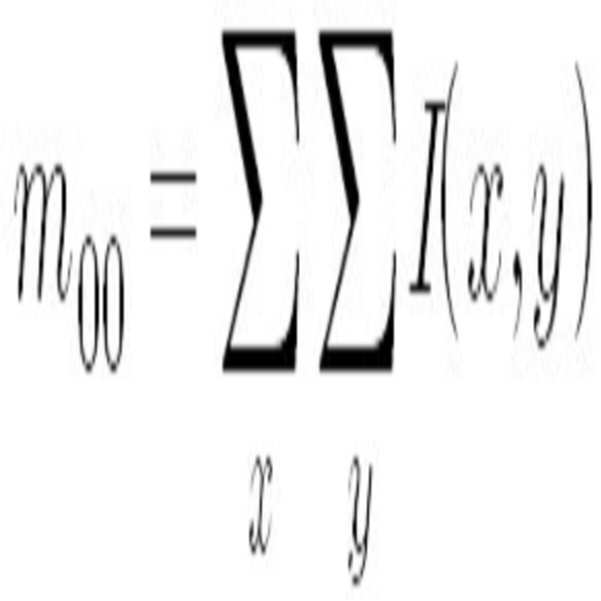
이때, 상기 p.q는 외곽선 내부의 식별번호를 나타내며, mpq는 p.q 위치에서 외곽선에 대한 총 모멘트값을 나타낸다. At this time, the pq represents the identification number inside the outline, m pq represents the total moment value for the outline at the pq position.
이와 같이 연산된 영상 I(x,y)의 모멘트값 m00에 대하여 하기의 수학식 3을 통해 각 화소들간의 합으로 연산할 수 있다. The moment value m 00 of the image I (x, y) calculated as described above may be calculated as the sum of the pixels through
[수학식 3]&Quot; (3) "
또한, 하기의 수학식 4를 이용하여 손영역에 대한 1차 모멘트값을 연산할 수 있다. In addition, the first moment value for the hand region may be calculated using
[수학식 4]&Quot; (4) "

이와 같이, 연산된 손영역의 1차 모멘트값을 하기의 수학식 5에 대입하면, 손영역의 무게중심점을 연산할 수 있다. As such, by substituting the calculated first moment value of the hand region into Equation 5 below, the center of gravity of the hand region can be calculated.
[수학식 5]&Quot; (5) "
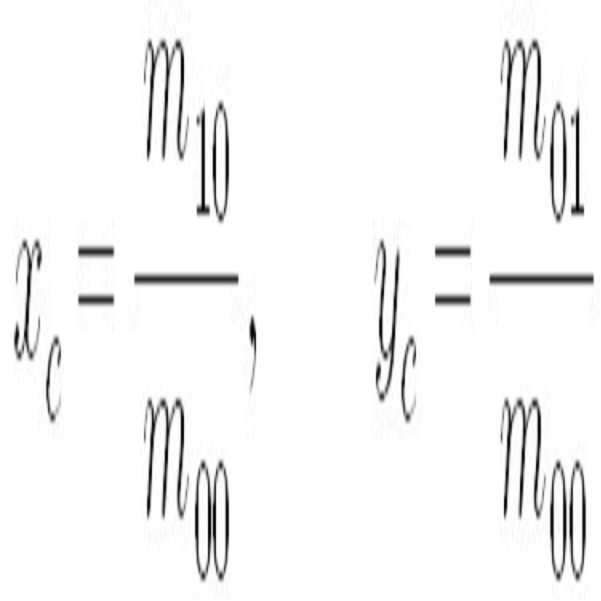
즉, x축에 해당하는 모멘트값(m10)과 y축에 해당하는 모멘트값(m01)을 각각 2차원 공간의 총 모멘트 값(m00)으로 나눔으로써, 2차원 공간에서 외곽선정보를 이용하여 손영역의 무게중심값에 해당하는 위치좌표(x,y)를 연산할 수 있다.That is, by dividing the moment value (m 10 ) corresponding to the x-axis and the moment value (m 01 ) corresponding to the y-axis by the total moment value (m 00 ) of the two-dimensional space, the outline information is used in the two-dimensional space. The position coordinates (x, y) corresponding to the center of gravity of the hand region can be calculated.
도 10은 손영역 내 검출된 무게중심점을 나타낸 도면이다.10 is a diagram showing the center of gravity detected in the hand region.
도 10에 도시된 바와 같이, 레이블링된 손영역(a)으로부터 상기 손영역 내 무게중심점이 검출된 영상(b)을 획득할 수 있게 된다. As shown in FIG. 10, it is possible to obtain an image b from which the center of gravity in the hand region is detected from the labeled hand region a.
앞서 무게중심점을 검출한 영상에 대하여, 상기 손영역의 무게중심점을 기준으로 하여 상기 무게중심점으로부터 적어도 하나의 동심원을 형성하고, 상기 적어도 하나의 동심원과 교차하는 적어도 하나의 특징점을 검출한다(S260). With respect to the image of the center of gravity detected earlier, at least one concentric circle is formed from the center of gravity based on the center of gravity of the hand region, and at least one feature point intersecting the at least one concentric circle is detected (S260). .
도 11은 손영역 내 무게중심점을 기준으로 동심원이 형성된 도면이다. 11 is a diagram in which concentric circles are formed based on the center of gravity in the hand region.
도 11에 도시된 바와 같이, 과정 S250을 통해 손영역 내 무게중심점을 검출한 영상에서 상기 무게중심점을 중심으로 하는 동심원을 형성한다. 이때, 상기 동심원의 지름은 손영역 중 손바닥의 크기보다 큰 것이 바람직하며, 또한 상기 동심원은 손영역 중 손가락이 끝나는 부분까지 형성되도록 연속하여 형성한다. 이에 따라, 상기 동심원을 통해 손영역 중 손가락이 끝나는 지점을 확인할 수 있는데, 이때 형성된 동심원과 상기 손가락의 마디가 교차하는 지점을 특징점으로 검출할 수 있다. As shown in FIG. 11, a concentric circle is formed around the center of gravity in the image of detecting the center of gravity in the hand region through the process S250. At this time, the diameter of the concentric circles is preferably larger than the size of the palm of the hand region, the concentric circles are formed continuously to form the end of the finger of the hand region. Accordingly, the point where the finger ends in the hand region through the concentric circle can be confirmed, and the point where the formed concentric circle and the node of the finger intersect can be detected as a feature point.
이와 같이, 손영역의 특징점을 검출하는데 있어서, 영상 내 손이 빠르게 움직이거나, 영상 내 존재하는 노이즈로 인하여 손영역의 특징점을 검출하기 어려운 경우에는 칼만필터를 이용하여 손영역 내 추출된 특징점의 위치를 추적할 수 있다. 이때 사용되는 칼만필터는 시간변화, 비정상여부, 다중 채널 시스템을 포함하는 모든 선형시스템에 적용할 수 있는 순환필터로서, 인공위성 항법 자료의 실시간 처리에 주로 활용되고, 탐사자료의 필터링에도 사용된다. As described above, when detecting a feature point of the hand region, when the hand in the image moves quickly or it is difficult to detect the feature point of the hand region due to noise present in the image, the position of the feature point extracted in the hand region using a Kalman filter Can be tracked. The Kalman filter used at this time is a cyclic filter that can be applied to all linear systems including time variation, abnormality, and multi-channel system. It is mainly used for real-time processing of satellite navigation data, and is also used for filtering exploration data.
이후, 상기 손영역 내 무게중심점과 각각 검출된 특징점간에 거리를 연산하고, 그 연산결과에 기초하여 사용자의 터치여부를 판단한다(S270). Thereafter, a distance is calculated between the center of gravity in the hand region and each detected feature point, and it is determined whether the user is touched based on the calculation result (S270).
도 12는 손영역 내 특징점 추출에 대한 일련의과정을 나타낸 도면이다.12 is a diagram illustrating a series of processes for extracting feature points in a hand region.
결국 도 12(a)에 도시된 바와 같이, 사용자의 신체 일부가 포함되는 24bit RGB 원본영상을 도12(b)와 같이, HSV 컬러모델로 변환하고, 도 12(c)에 도시된 바와 같이, 상기 영상 중 피부영역으로 표시되는 영역에 대하여 레이블링 과정을 수행한 후, 손영역을 검출한다. 이후, 도 12(d)에 도시된 바와 같이, 상기 손영역 내 특징점을 검출하고, 도 12(e)와 같이, 동심원 형성을 통해 검출된 손영역 내 무게중심점과, 손영역의 끝단에 위치하는 특징점간 거리를 연산하여 도 12(f)에 도시된 바와 같이, 최종적인 손영역 내 무게중심점으로부터 특징점까지를 거리를 파악할 수 있게 된다. As shown in FIG. 12 (a), the 24-bit RGB original image including the user's body part is converted into the HSV color model as shown in FIG. 12 (b), and as shown in FIG. 12 (c), After performing a labeling process on an area displayed as a skin area in the image, a hand area is detected. Then, as shown in FIG. 12 (d), the feature points in the hand region are detected, and as shown in FIG. 12 (e), the center of gravity in the hand region detected through concentric circles and the end of the hand region are located. By calculating the distance between the feature points, as shown in FIG. 12 (f), the distance from the center of gravity in the final hand region to the feature point can be determined.
또한, 손영역의 무게중심점으로부터 각각의 특징점까지의 거리연산을 통해 손가락별 터치 동작의 수행여부를 확인할 수 있다. In addition, it is possible to check whether or not a touch operation for each finger is performed by calculating a distance from the center of gravity of the hand region to each feature point.
도 13은 사용자의 각 손가락별 터치동작의 감지를 나타낸 도면이다. 13 is a diagram illustrating detection of a user's finger touch operation.
도 13(a)는 검지손가락의 터치동작을 도 13(b)는 중지손가락의 터치동작을 도 13(c)는 약지손가락의 터치동작을 도 13(d)는 새끼손가락의 터치동작을 각각 나타낸다. FIG. 13A shows a touch operation of an index finger, FIG. 13B shows a touch operation of a middle finger, FIG. 13C shows a touch operation of a ring finger, and FIG. 13D shows a touch operation of a little finger. .
또한, 이러한 영상분석을 이용한 멀티 터치 입력 방법은 컴퓨터로 실행하기 위한 프로그램이 기록된 컴퓨터 판독가능 기록매체에 저장될 수 있다. 이때, 컴퓨터가 읽을 수 있는 기록매체는 컴퓨터 시스템에 의하여 읽혀질 수 있는 데이터가 저장되는 모든 종류의 기록 장치를 포함한다. 컴퓨터가 읽을 수 있는 기록 장치의 예로는 ROM, RAM, CD-ROM, DVD±ROM, DVD-RAM, 자기 테이프, 플로피 디스크, 하드 디스크(hard disk), 광데이터 저장장치 등이 있다. 또한, 컴퓨터가 읽을 수 있는 기록매체는 네트워크로 연결된 컴퓨터 장치에 분산되어 분산방식으로 컴퓨터가 읽을 수 있는 코드가 저장되고 실행될 수 있다.In addition, the multi-touch input method using the image analysis may be stored in a computer readable recording medium in which a program for execution by a computer is recorded. At this time, the computer-readable recording medium includes all kinds of recording devices in which data that can be read by a computer system is stored. Examples of the computer readable recording medium include ROM, RAM, CD-ROM, DVD 占 ROM, DVD-RAM, magnetic tape, floppy disk, hard disk, optical data storage, and the like. The computer readable recording medium can also be distributed over network coupled computer devices so that the computer readable code is stored and executed in a distributed fashion.
본 발명의 영상분석을 이용한 멀티 터치 입력 방법 및 시스템은 조도가 다양하게 변화하는 환경에서 촬영된 영상으로부터 조도의 변화여부와 상관없이 사용자의 손동작에 따른 터치여부를 정확하게 인식할 수 있는 효과가 있다. The multi-touch input method and system using the image analysis of the present invention has an effect of accurately recognizing whether the user touches the hand gesture regardless of whether the illumination changes from the image photographed in an environment in which the illumination varies.
또한 본 발명의 영상분석을 이용한 멀티 터치 입력 방법 및 시스템은 별도의 기계장치를 사용하지 않고도 비전 카메라를 통해 획득한 영상에 대한 분석을 통해 사용자의 손동작을 인식함에 따라, 시스템의 제조비용을 감소시킬 수 있는 효과가 있다. In addition, the multi-touch input method and system using the image analysis of the present invention can reduce the manufacturing cost of the system as the user's hand gestures are recognized through the analysis of the image acquired through the vision camera without using a separate machine. It can be effective.
더불어, 본 발명의 영상분석을 이용한 멀티 터치 입력 방법 및 시스템은 영상분석을 통해 사용자의 손동작에 따른 터치여부를 인식함에 따라, 터치여부 검출에 따른 소요시간을 감소시켜, 실시간으로 사용자의 터치 여부를 확인할 수 있는 효과가 있다. In addition, the multi-touch input method and system using the image analysis according to the present invention recognizes whether the user touches the user's hand through the image analysis, thereby reducing the time required for detecting whether the user touches the user in real time. You can see the effect.
이와 더불어, 본 발명의 영상분석을 이용한 멀티 터치 입력 방법 및 시스템은 사용자의 손동작에 대한 오차보정을 수행함에 따라, 보다 정확한 손동작을 확인할 수 있어, 사용자 만족도를 향상시킬 수 있는 효과가 있다.In addition, the multi-touch input method and system using the image analysis according to the present invention performs error correction for the user's hand gestures, thereby making it possible to check the hand gestures more accurately, thereby improving user satisfaction.
상기에서는 본 발명의 바람직한 실시 예에 대하여 설명하였지만, 본 발명은 이에 한정되는 것이 아니고 본 발명의 기술 사상 범위 내에서 여러 가지로 변형하여 실시하는 것이 가능하고 이 또한 첨부된 특허청구범위에 속하는 것은 당연하다.
While the present invention has been described in connection with what is presently considered to be practical exemplary embodiments, it is to be understood that the invention is not limited to the disclosed embodiments, but, on the contrary, Do.
110: 영상획득부 120: 피부영역검출부
130: 손영역검출부 140: 노이즈필터링부
150: 무게중심검출부 160: 특징점검출부
170: 터치여부판단부110: image acquisition unit 120: skin area detection unit
130: hand area detection unit 140: noise filtering unit
150: center of gravity detection unit 160: feature point detection unit
170: touch determination unit
Claims (13)
피부영역검출부가 상기 영상으로부터 상기 사용자의 신체 일부와 배경영역을 구분하도록 상기 영상 내 피부영역을 검출하는 피부영역검출단계;
손영역검출부가 상기 피부영역 내 각 화소에 대하여 레이블링(labeling)을 수행하여 손영역을 검출하는 손영역검출단계;
노이즈필터링부가 상기 영상 내 노이즈를 모폴로지(morphology) 알고리즘에 기초하여 제거하는 노이즈필터링단계;
무게중심검출부가 상기 손영역 내 무게중심점을 검출하는 무게중심검출단계;
특징점검출부가 상기 손영역의 무게중심점으로부터 적어도 하나의 동심원을 형성하고, 상기 손영역 내 손가락 마디와 상기 적어도 하나의 동심원과 교차하는 적어도 하나의 특징점을 검출하는 특징점검출단계; 및
터치여부판단부가 상기 손영역의 무게중심점과 상기 특징점간에 거리를 연산하고, 그 연산결과에 기초하여 사용자의 터치여부를 판단하는 터치여부판단단계;
를 포함하는 영상분석을 이용한 멀티 터치 입력 방법.
An image acquisition step of acquiring an image including a body part of a user who wants to touch a specific area;
A skin region detecting step of detecting a skin region in the image so that a skin region detecting unit distinguishes a body region and a background region of the user from the image;
A hand region detecting step of detecting a hand region by performing a labeling on each pixel in the skin region by the hand region detecting unit;
A noise filtering step of removing noise in the image based on a morphology algorithm by a noise filtering unit;
A center of gravity detection unit for detecting a center of gravity within the hand region by a center of gravity detection unit;
A feature point detection step of forming a feature point detection unit to form at least one concentric circle from the center of gravity of the hand region, and detecting at least one feature point intersecting the finger node and the at least one concentric circle in the hand region; And
A touch determination step, wherein the touch determination unit calculates a distance between the center of gravity of the hand region and the feature point, and determines whether the user touches based on the calculation result;
Multi-touch input method using an image analysis comprising a.
상기 영상획득단계는
상기 영상획득부가 상기 사용자의 신체 일부를 포함하는 영상으로부터 획득한 RGB정보를 HSV(Hue Saturation Value) 컬러모델로 변환하는 것을 특징으로 하는 영상분석을 이용한 멀티 터치 입력 방법.
The method of claim 1,
The image acquiring step
The image acquisition unit multi-touch input method using the image analysis, characterized in that for converting the RGB information obtained from the image including the body part of the user to a HSV (Hue Saturation Value) color model.
상기 손영역검출단계는
상기 손영역검출부가 상기 영상 내 화소 중 인접하는 화소에 대하여 동일한 이진신호를 포함하는지 여부를 검출하는 화소검출과정;
상기 손영역검출부가 동일한 이진신호를 포함하는 각 화소에 대하여 고유번호를 할당하는 레이블링과정;
상기 손영역검출부가 고유번호가 할당되고, 인접하여 배치된 각 화소 그룹 영역의 크기가 기준 손영역의 크기보다 작은지 여부를 판단하는 손영역판단과정; 및
상기 손영역검출부가 상기 화소 그룹 영역의 크기가 기준 손영역의 크기보다 작은 경우 상기 화소 그룹을 제거하여 상기 영상 내 손영역을 검출하는 손영역검출과정;
을 포함하는 것을 특징으로 하는 영상분석을 이용한 멀티 터치 입력 방법.
The method of claim 1,
The hand region detection step
A pixel detection process of detecting whether the hand region detection unit includes the same binary signal with respect to adjacent pixels among the pixels in the image;
A labeling process of assigning a unique number to each pixel including the same binary signal by the hand region detector;
A hand region determination process of determining whether the hand region detection unit is assigned a unique number and whether the size of each adjacent pixel group region is smaller than the size of the reference hand region; And
A hand region detection process of detecting a hand region in the image by removing the pixel group when the size of the pixel group region is smaller than that of the reference hand region;
Multi-touch input method using an image analysis, characterized in that it comprises a.
상기 노이즈필터링단계는
상기 노이즈필터링부가 상기 영상의 배경영역을 확장하고, 상기 피부영역을 축소하는 침식연산과정;
상기 영상의 배경영역을 축소하고, 상기 피부영역을 확장하는 팽창연산과정;
상기 영상의 미세 노이즈를 제거하는 열림연산과정; 및
상기 영상의 상기 피부영역 내 빈 화소를 채우는 닫힘연산과정;
중 적어도 하나의 과정을 수행하는 것을 특징으로 하는 영상분석을 이용한 멀티 터치 입력 방법.
The method of claim 1,
The noise filtering step
An erosion calculation process in which the noise filtering unit extends the background region of the image and reduces the skin region;
An expansion operation of reducing the background area of the image and expanding the skin area;
An open operation process of removing fine noise of the image; And
A closing operation of filling empty pixels in the skin region of the image;
Multi-touch input method using image analysis, characterized in that to perform at least one of the process.
상기 특징점검출단계는
상기 특징점검출부가 상기 손영역의 추출된 특징점의 위치를 칼만필터(Kalman filter)를 이용하여 추적하는 특징점추적과정;
을 더 포함하는 것을 특징으로 하는 영상분석을 이용한 멀티 터치 입력 방법.
The method of claim 1,
The feature point detection step
A feature point tracking process of the feature point detection unit tracking a position of the extracted feature point of the hand region by using a Kalman filter;
Multi-touch input method using a video analysis, characterized in that it further comprises.
상기 터치여부판단단계는
상기 터치여부판단부가 상기 손영역의 무게중심점으로부터 적어도 하나의 특징점까지의 거리를 각각 연산하는 거리연산과정; 및
상기 터치여부판단부가 거리연산결과가 기설정된 기준거리보다 짧은 경우, 해당 특징점을 터치하였다고 판단하는 터치여부판단과정;
을 포함하는 것을 특징으로 하는 영상분석을 이용한 멀티 터치 입력 방법.
The method of claim 1,
The touch determination step is
A distance calculation process of the touch determining unit calculating the distance from the center of gravity of the hand region to at least one feature point, respectively; And
A touch determination process in which the touch determination unit determines that the corresponding feature point is touched when the distance calculation result is shorter than a preset reference distance;
Multi-touch input method using an image analysis, characterized in that it comprises a.
A computer-readable recording medium having recorded thereon a program for executing a method according to any one of claims 1 to 6 by a computer.
상기 영상으로부터 상기 사용자의 신체 일부와 배경영역을 구분하도록 상기 영상 내 피부영역을 검출하는 피부영역검출부;
상기 피부영역으로부터 각 화소별 레이블링(labeling)을 통해 손영역을 검출하는 손영역검출부;
상기 영상 내 노이즈를 모폴로지(morphology) 알고리즘에 기초하여 제거하는 노이즈필터링부;
상기 손영역 내 무게중심점을 검출하는 무게중심검출부;
상기 손영역의 무게중심점으로부터 적어도 하나의 동심원을 형성하고, 상기 손영역 내 손가락 마디와 상기 적어도 하나의 동심원과 교차하는 적어도 하나의 특징점을 검출하는 특징점검출부; 및
상기 손영역의 무게중심점과 상기 특징점간에 거리를 연산하고, 그 연산결과에 기초하여 사용자의 터치여부를 판단하는 터치여부판단부;
를 포함하는 영상분석을 이용한 멀티 터치 입력 시스템.
An image acquisition unit which acquires an image including a part of a body of a user who wants to touch a specific area;
A skin region detector for detecting a skin region in the image to distinguish a part of the user's body and a background region from the image;
A hand region detector detecting a hand region by labeling each pixel from the skin region;
A noise filtering unit to remove the noise in the image based on a morphology algorithm;
A center of gravity detection unit for detecting a center of gravity in the hand region;
A feature point detector for forming at least one concentric circle from the center of gravity of the hand region and detecting at least one feature point that intersects the finger node and the at least one concentric circle in the hand region; And
A touch whether determining unit calculating a distance between the center of gravity of the hand region and the feature point and determining whether the user touches based on the result of the calculation;
Multi-touch input system using an image analysis comprising a.
상기 영상획득부는
상기 사용자의 신체 일부를 포함하는 영상을 입력받는 영상입력모듈; 및
상기 영상으로부터 RGB정보를 획득하고, 상기 RGB정보를 HSV(Hue Saturation Value) 컬러모델로 변환하는 영상정보변환모듈;
을 포함하는 것을 특징으로 하는 영상분석을 이용한 멀티 터치 입력 시스템.
9. The method of claim 8,
The image acquisition unit
An image input module configured to receive an image including a body part of the user; And
An image information conversion module for obtaining RGB information from the image and converting the RGB information into a Hue Saturation Value (HSV) color model;
Multi-touch input system using image analysis, characterized in that it comprises a.
상기 손영역검출부는
상기 영상 내 화소 중 인접하는 화소에 대하여 동일한 이진신호를 갖는 영역을 검출하는 이진신호검출모듈;
동일한 이진신호를 포함하는 각 화소에 대하여 고유번호를 할당하는 레이블링모듈;
상기 고유번호가 할당된 각 화소 그룹 영역의 크기가 기준 손영역의 크기보다 작은지 여부를 판단하는 손영역판단모듈; 및
상기 화소 그룹 영역의 크기가 기준 손영역의 크기보다 작다고 판단하는 경우, 상기 화소 그룹을 제거하여 상기 영상 내 손영역을 검출하는 검출모듈;
을 포함하는 것을 특징으로 하는 영상분석을 이용한 멀티 터치 입력 시스템.
9. The method of claim 8,
The hand area detection unit
A binary signal detection module for detecting a region having the same binary signal among adjacent pixels in the image;
A labeling module for assigning a unique number to each pixel including the same binary signal;
A hand region determination module that determines whether a size of each pixel group region to which the unique number is assigned is smaller than a size of a reference hand region; And
A detection module for detecting a hand region in the image by removing the pixel group when determining that the size of the pixel group region is smaller than the size of the reference hand region;
Multi-touch input system using image analysis, characterized in that it comprises a.
상기 노이즈필터링부는
상기 영상의 배경영역을 확장하고, 상기 피부영역을 축소하는 침식연산모듈;
상기 영상의 배경영역을 축소하고, 상기 피부영역을 확장하는 팽창연산모듈;
상기 영상의 미세 노이즈를 제거하는 열림연산모듈; 및
상기 영상의 상기 피부영역 내 빈 화소를 채우는 닫힘연산모듈;
을 포함하는 것을 특징으로 하는 영상분석을 이용한 멀티 터치 입력 시스템.
9. The method of claim 8,
The noise filtering unit
An erosion calculation module that extends the background region of the image and reduces the skin region;
An expansion operation module which reduces the background area of the image and expands the skin area;
An open operation module for removing fine noise of the image; And
A closed operation module that fills empty pixels in the skin region of the image;
Multi-touch input system using image analysis, characterized in that it comprises a.
상기 특징점검출부는
상기 손영역의 특징점의 위치를 추적하는 칼만필터(Kalman filter)를 포함하는 것을 특징으로 하는 영상분석을 이용한 멀티 터치 입력 시스템.
9. The method of claim 8,
The feature point detection unit
And a Kalman filter for tracking the position of the feature point of the hand region.
상기 터치여부판단부는
상기 손영역의 무게중심점으로부터 적어도 하나의 특징점까지의 거리를 각각 연산하는 거리연산모듈; 및
거리연산결과가 기설정된 기준거리보다 짧은 경우, 해당 특징점을 터치하였다고 판단하는 터치판단모듈;
을 포함하는 것을 특징으로 하는 영상분석을 이용한 멀티 터치 입력 시스템.9. The method of claim 8,
The touch determination unit
A distance calculation module for calculating a distance from the center of gravity of the hand region to at least one feature point, respectively; And
A touch determination module for determining that the corresponding feature point is touched when the distance calculation result is shorter than a preset reference distance;
Multi-touch input system using image analysis, characterized in that it comprises a.
Priority Applications (1)
| Application Number | Priority Date | Filing Date | Title |
|---|---|---|---|
| KR1020120042526A KR101281461B1 (en) | 2012-04-24 | 2012-04-24 | Multi-touch input method and system using image analysis |
Applications Claiming Priority (1)
| Application Number | Priority Date | Filing Date | Title |
|---|---|---|---|
| KR1020120042526A KR101281461B1 (en) | 2012-04-24 | 2012-04-24 | Multi-touch input method and system using image analysis |
Publications (1)
| Publication Number | Publication Date |
|---|---|
| KR101281461B1 true KR101281461B1 (en) | 2013-07-03 |
Family
ID=48996411
Family Applications (1)
| Application Number | Title | Priority Date | Filing Date |
|---|---|---|---|
| KR1020120042526A Expired - Fee Related KR101281461B1 (en) | 2012-04-24 | 2012-04-24 | Multi-touch input method and system using image analysis |
Country Status (1)
| Country | Link |
|---|---|
| KR (1) | KR101281461B1 (en) |
Cited By (5)
| Publication number | Priority date | Publication date | Assignee | Title |
|---|---|---|---|---|
| KR101483741B1 (en) | 2014-02-10 | 2015-01-27 | 전남대학교산학협력단 | Method of touch gesture recognition using depth slice pattern image and system thereof |
| KR101794148B1 (en) * | 2014-03-26 | 2017-11-06 | 인텔 코포레이션 | Efficient free-space finger recognition |
| KR101841503B1 (en) | 2015-12-09 | 2018-03-28 | 동아대학교 산학협력단 | ASL Numbers Recognition Method Using Hierarchical Moment Invariants Based on Edge Image |
| KR101864533B1 (en) * | 2017-03-21 | 2018-06-04 | 고려대학교 세종산학협력단 | Method and Apparatus for Segmentation of Touching Objects using Concave Sections and Concave Points |
| JP2021184232A (en) * | 2020-05-21 | 2021-12-02 | 株式会社トゥービーソフトTobesoft Co., Ltd. | An electronic terminal device that recognizes a user's hand gesture and executes a control command and its operation method |
Citations (2)
| Publication number | Priority date | Publication date | Assignee | Title |
|---|---|---|---|---|
| KR20110080871A (en) * | 2010-01-07 | 2011-07-13 | 성균관대학교산학협력단 | Portable information terminal and content control method using rear finger movement and gesture recognition |
| KR20110132076A (en) * | 2010-06-01 | 2011-12-07 | 금오공과대학교 산학협력단 | Non-contact screen control system and non-contact screen control method in the system |
-
2012
- 2012-04-24 KR KR1020120042526A patent/KR101281461B1/en not_active Expired - Fee Related
Patent Citations (2)
| Publication number | Priority date | Publication date | Assignee | Title |
|---|---|---|---|---|
| KR20110080871A (en) * | 2010-01-07 | 2011-07-13 | 성균관대학교산학협력단 | Portable information terminal and content control method using rear finger movement and gesture recognition |
| KR20110132076A (en) * | 2010-06-01 | 2011-12-07 | 금오공과대학교 산학협력단 | Non-contact screen control system and non-contact screen control method in the system |
Cited By (6)
| Publication number | Priority date | Publication date | Assignee | Title |
|---|---|---|---|---|
| KR101483741B1 (en) | 2014-02-10 | 2015-01-27 | 전남대학교산학협력단 | Method of touch gesture recognition using depth slice pattern image and system thereof |
| KR101794148B1 (en) * | 2014-03-26 | 2017-11-06 | 인텔 코포레이션 | Efficient free-space finger recognition |
| KR101841503B1 (en) | 2015-12-09 | 2018-03-28 | 동아대학교 산학협력단 | ASL Numbers Recognition Method Using Hierarchical Moment Invariants Based on Edge Image |
| KR101864533B1 (en) * | 2017-03-21 | 2018-06-04 | 고려대학교 세종산학협력단 | Method and Apparatus for Segmentation of Touching Objects using Concave Sections and Concave Points |
| JP2021184232A (en) * | 2020-05-21 | 2021-12-02 | 株式会社トゥービーソフトTobesoft Co., Ltd. | An electronic terminal device that recognizes a user's hand gesture and executes a control command and its operation method |
| JP6994206B2 (en) | 2020-05-21 | 2022-01-14 | 株式会社トゥービーソフト | An electronic terminal device that recognizes a user's hand gesture and executes a control command and its operation method |
Similar Documents
| Publication | Publication Date | Title |
|---|---|---|
| JP5887775B2 (en) | Human computer interaction system, hand-to-hand pointing point positioning method, and finger gesture determination method | |
| JP5709227B2 (en) | Information processing apparatus, information processing method, and program | |
| EP2891950B1 (en) | Human-to-computer natural three-dimensional hand gesture based navigation method | |
| US8768006B2 (en) | Hand gesture recognition | |
| EP2980755B1 (en) | Method for partitioning area, and inspection device | |
| CN103383731B (en) | A kind of projection interactive method based on finger tip location, system and the equipment of calculating | |
| JP2014137818A (en) | Method and device for identifying opening and closing operation of palm, and man-machine interaction method and facility | |
| KR20100138602A (en) | Apparatus and method for detecting a hand of a subject in real time | |
| CN105378593A (en) | Method and system for human-to-computer gesture based simultaneous interactions using singular points of interest on a hand | |
| CN106778456B (en) | Optimization method and device for handwriting input | |
| JP6066093B2 (en) | Finger shape estimation device, finger shape estimation method, and finger shape estimation program | |
| CN106648078B (en) | Multi-mode interaction method and system applied to intelligent robot | |
| TWI571772B (en) | Virtual mouse driving apparatus and virtual mouse simulation method | |
| KR101281461B1 (en) | Multi-touch input method and system using image analysis | |
| KR102052449B1 (en) | System for virtual mouse and method therefor | |
| KR20150075648A (en) | Method and recording medium for contactless input interface with real-time hand pose recognition | |
| Hartanto et al. | Real time hand gesture movements tracking and recognizing system | |
| US20260012698A1 (en) | Information processing apparatus, image capturing system, method, and non-transitory computer-readable storage medium for selecting a trained model | |
| CN111460858A (en) | Method and device for determining pointed point in image, storage medium and electronic equipment | |
| KR101614798B1 (en) | Non-contact multi touch recognition method and system using color image analysis | |
| Rupanagudi et al. | A novel and secure methodology for keyless ignition and controlling an automobile using air gestures | |
| TWI507919B (en) | Method for tracking and recordingfingertip trajectory by image processing | |
| CN106339089A (en) | Human-computer interaction action identification system and method | |
| Babu et al. | Touchless User Interface for Sketching Using Hand Gesture Recognition | |
| KR101130063B1 (en) | Method for contents control based human hand gesture recognition for integrated display device of next generation |
Legal Events
| Date | Code | Title | Description |
|---|---|---|---|
| A201 | Request for examination | ||
| PA0109 | Patent application |
St.27 status event code: A-0-1-A10-A12-nap-PA0109 |
|
| PA0201 | Request for examination |
St.27 status event code: A-1-2-D10-D11-exm-PA0201 |
|
| A302 | Request for accelerated examination | ||
| PA0302 | Request for accelerated examination |
St.27 status event code: A-1-2-D10-D17-exm-PA0302 St.27 status event code: A-1-2-D10-D16-exm-PA0302 |
|
| E902 | Notification of reason for refusal | ||
| PE0902 | Notice of grounds for rejection |
St.27 status event code: A-1-2-D10-D21-exm-PE0902 |
|
| P11-X000 | Amendment of application requested |
St.27 status event code: A-2-2-P10-P11-nap-X000 |
|
| P13-X000 | Application amended |
St.27 status event code: A-2-2-P10-P13-nap-X000 |
|
| E701 | Decision to grant or registration of patent right | ||
| PE0701 | Decision of registration |
St.27 status event code: A-1-2-D10-D22-exm-PE0701 |
|
| GRNT | Written decision to grant | ||
| PR0701 | Registration of establishment |
St.27 status event code: A-2-4-F10-F11-exm-PR0701 |
|
| PR1002 | Payment of registration fee |
St.27 status event code: A-2-2-U10-U11-oth-PR1002 Fee payment year number: 1 |
|
| PG1601 | Publication of registration |
St.27 status event code: A-4-4-Q10-Q13-nap-PG1601 |
|
| P14-X000 | Amendment of ip right document requested |
St.27 status event code: A-5-5-P10-P14-nap-X000 |
|
| P14-X000 | Amendment of ip right document requested |
St.27 status event code: A-5-5-P10-P14-nap-X000 |
|
| R18-X000 | Changes to party contact information recorded |
St.27 status event code: A-5-5-R10-R18-oth-X000 |
|
| FPAY | Annual fee payment |
Payment date: 20160615 Year of fee payment: 4 |
|
| PR1001 | Payment of annual fee |
St.27 status event code: A-4-4-U10-U11-oth-PR1001 Fee payment year number: 4 |
|
| FPAY | Annual fee payment |
Payment date: 20170421 Year of fee payment: 5 |
|
| PR1001 | Payment of annual fee |
St.27 status event code: A-4-4-U10-U11-oth-PR1001 Fee payment year number: 5 |
|
| FPAY | Annual fee payment |
Payment date: 20180614 Year of fee payment: 6 |
|
| PR1001 | Payment of annual fee |
St.27 status event code: A-4-4-U10-U11-oth-PR1001 Fee payment year number: 6 |
|
| R18-X000 | Changes to party contact information recorded |
St.27 status event code: A-5-5-R10-R18-oth-X000 |
|
| FPAY | Annual fee payment |
Payment date: 20190530 Year of fee payment: 7 |
|
| PR1001 | Payment of annual fee |
St.27 status event code: A-4-4-U10-U11-oth-PR1001 Fee payment year number: 7 |
|
| PR1001 | Payment of annual fee |
St.27 status event code: A-4-4-U10-U11-oth-PR1001 Fee payment year number: 8 |
|
| R18-X000 | Changes to party contact information recorded |
St.27 status event code: A-5-5-R10-R18-oth-X000 |
|
| P22-X000 | Classification modified |
St.27 status event code: A-4-4-P10-P22-nap-X000 |
|
| PC1903 | Unpaid annual fee |
St.27 status event code: A-4-4-U10-U13-oth-PC1903 Not in force date: 20210628 Payment event data comment text: Termination Category : DEFAULT_OF_REGISTRATION_FEE |
|
| K11-X000 | Ip right revival requested |
St.27 status event code: A-6-4-K10-K11-oth-X000 |
|
| PC1903 | Unpaid annual fee |
St.27 status event code: N-4-6-H10-H13-oth-PC1903 Ip right cessation event data comment text: Termination Category : DEFAULT_OF_REGISTRATION_FEE Not in force date: 20210628 |
|
| PR0401 | Registration of restoration |
St.27 status event code: A-6-4-K10-K13-oth-PR0401 |
|
| R401 | Registration of restoration | ||
| PR1001 | Payment of annual fee |
St.27 status event code: A-4-4-U10-U11-oth-PR1001 Fee payment year number: 9 |
|
| R18-X000 | Changes to party contact information recorded |
St.27 status event code: A-5-5-R10-R18-oth-X000 |
|
| PR1001 | Payment of annual fee |
St.27 status event code: A-4-4-U10-U11-oth-PR1001 Fee payment year number: 10 |
|
| PR1001 | Payment of annual fee |
St.27 status event code: A-4-4-U10-U11-oth-PR1001 Fee payment year number: 11 |
|
| R18-X000 | Changes to party contact information recorded |
St.27 status event code: A-5-5-R10-R18-oth-X000 |
|
| PN2301 | Change of applicant |
St.27 status event code: A-5-5-R10-R13-asn-PN2301 St.27 status event code: A-5-5-R10-R11-asn-PN2301 |
|
| PN2301 | Change of applicant |
St.27 status event code: A-5-5-R10-R13-asn-PN2301 St.27 status event code: A-5-5-R10-R11-asn-PN2301 |
|
| R18-X000 | Changes to party contact information recorded |
St.27 status event code: A-5-5-R10-R18-oth-X000 |
|
| P22-X000 | Classification modified |
St.27 status event code: A-4-4-P10-P22-nap-X000 |
|
| PR1001 | Payment of annual fee |
St.27 status event code: A-4-4-U10-U11-oth-PR1001 Fee payment year number: 12 |