KR101242117B1 - Apparatus and method for routing of broadcast data frame in mesh network wiht multiple mesh portals - Google Patents
Apparatus and method for routing of broadcast data frame in mesh network wiht multiple mesh portals Download PDFInfo
- Publication number
- KR101242117B1 KR101242117B1 KR1020060051069A KR20060051069A KR101242117B1 KR 101242117 B1 KR101242117 B1 KR 101242117B1 KR 1020060051069 A KR1020060051069 A KR 1020060051069A KR 20060051069 A KR20060051069 A KR 20060051069A KR 101242117 B1 KR101242117 B1 KR 101242117B1
- Authority
- KR
- South Korea
- Prior art keywords
- mesh
- data frame
- broadcast data
- received
- address
- Prior art date
- Legal status (The legal status is an assumption and is not a legal conclusion. Google has not performed a legal analysis and makes no representation as to the accuracy of the status listed.)
- Active
Links
Images


Classifications
-
- H—ELECTRICITY
- H04—ELECTRIC COMMUNICATION TECHNIQUE
- H04H—BROADCAST COMMUNICATION
- H04H20/00—Arrangements for broadcast or for distribution combined with broadcast
- H04H20/42—Arrangements for resource management
-
- H—ELECTRICITY
- H04—ELECTRIC COMMUNICATION TECHNIQUE
- H04L—TRANSMISSION OF DIGITAL INFORMATION, e.g. TELEGRAPHIC COMMUNICATION
- H04L12/00—Data switching networks
- H04L12/28—Data switching networks characterised by path configuration, e.g. LAN [Local Area Networks] or WAN [Wide Area Networks]
-
- H—ELECTRICITY
- H04—ELECTRIC COMMUNICATION TECHNIQUE
- H04L—TRANSMISSION OF DIGITAL INFORMATION, e.g. TELEGRAPHIC COMMUNICATION
- H04L45/00—Routing or path finding of packets in data switching networks
- H04L45/16—Multipoint routing
-
- H—ELECTRICITY
- H04—ELECTRIC COMMUNICATION TECHNIQUE
- H04L—TRANSMISSION OF DIGITAL INFORMATION, e.g. TELEGRAPHIC COMMUNICATION
- H04L65/00—Network arrangements, protocols or services for supporting real-time applications in data packet communication
-
- H—ELECTRICITY
- H04—ELECTRIC COMMUNICATION TECHNIQUE
- H04W—WIRELESS COMMUNICATION NETWORKS
- H04W40/00—Communication routing or communication path finding
- H04W40/02—Communication route or path selection, e.g. power-based or shortest path routing
Landscapes
- Engineering & Computer Science (AREA)
- Signal Processing (AREA)
- Computer Networks & Wireless Communication (AREA)
- Business, Economics & Management (AREA)
- General Business, Economics & Management (AREA)
- Multimedia (AREA)
- Data Exchanges In Wide-Area Networks (AREA)
Abstract
본 발명은 메시 네트워크의 외부 네트워크와 상기 메시 네트워크의 내부의 다수의 메시 포인트들 간의 통신 인터페이스를 제공하는 다수의 메시 포탈들을 포함하는 상기 메시 네트워크에서 상기 다수의 메시 포인트들이 각각 상기 다수의 메시 포탈들 각각으로부터 제1브로드캐스트 데이터프레임을 수신하면, 상기 수신한 제1브로드캐스트 데이터프레임의 목적지 주소와 기 등록된 메시 포탈의 주소를 비교하고, 상기 수신한 제1브로드캐스트 데이터프레임의 목적지 주소와 상기 기 등록된 메시 포탈의 주소가 동일한 경우, 상기 수신한 제1브로드캐스트 데이터프레임을 브로드캐스팅하고, 상기 수신한 제1브로드캐스트 데이터프레임의 목적지 주소와 상기 기 등록된 메시 포탈의 주소가 다른 경우, 상기 수신한 제1브로드캐스트 데이터프레임을 폐기한다.
무선 메시 네트워크, 801.11s, 브로드캐스트 데이터프레임, 메시 포탈, 메시 포인트
The present invention relates to a plurality of mesh portals in which each of the plurality of mesh points in the mesh network includes a plurality of mesh portals that provide a communication interface between an external network of a mesh network and a plurality of mesh points inside the mesh network. When the first broadcast data frame is received from each, the destination address of the received first broadcast data frame is compared with the address of the registered mesh portal, and the destination address of the received first broadcast data frame is compared with the destination address. When the address of the registered mesh portal is the same, when the received first broadcast data frame is broadcast, and the destination address of the received first broadcast data frame is different from the address of the registered mesh portal, Discarding the received first broadcast data frame All.
Wireless Mesh Network, 801.11s, Broadcast Dataframes, Mesh Portals, Mesh Points
Description
도 1은 본 발명의 일 실시 예에 따른 멀티 메시 포탈을 갖는 메시 네트워크의 외부에서 내부로 수신되는 브로드캐스트 데이터프레임의 라우팅 과정을 보여주는 도면,1 is a view illustrating a routing process of a broadcast data frame received from the outside of a mesh network having a multi-mesh portal according to an embodiment of the present invention;
도 2는 802.11s에 따른 데이터프레임의 구조도,2 is a structural diagram of a data frame according to 802.11s;
도 3은 종래기술에 따른 라우팅 과정에서 사용되는 브로드캐스트 데이터프레임의 주요부만을 간략히 도시한 도면,FIG. 3 is a diagram schematically illustrating only a main part of a broadcast data frame used in a routing process according to the prior art; FIG.
도 4 및 도 5는 도 1의 라우팅 과정에서 사용되는 브로드캐스트 데이터프레임들의 주요부만을 간략히 도시한 도면,4 and 5 schematically illustrate only a main part of broadcast data frames used in the routing process of FIG. 1;
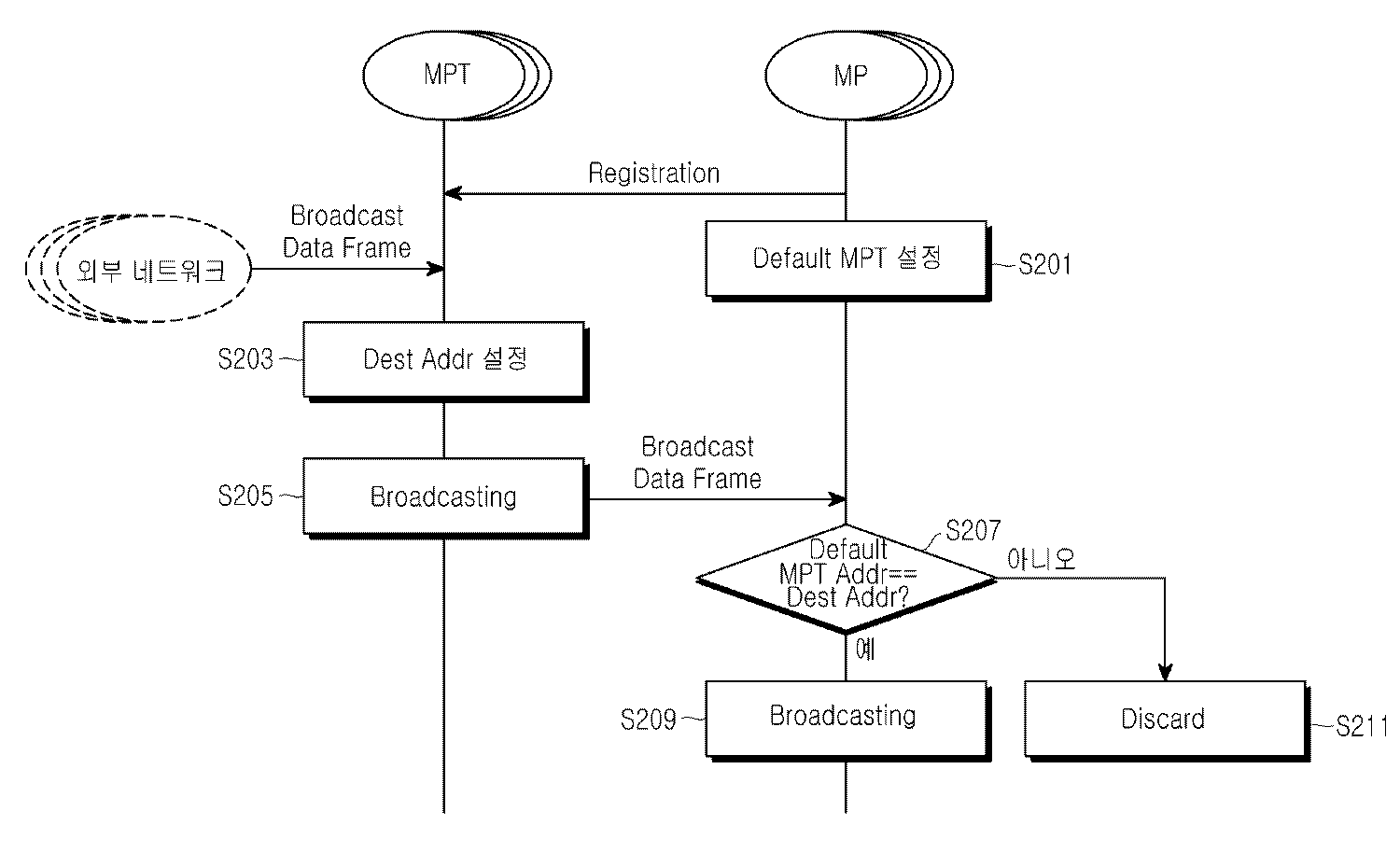
도 6은 본 발명의 바람직한 실시 예에 따른 멀티 메시 포탈을 갖는 메시 네트워크의 외부에서 내부로 수신되는 브로드캐스트 데이터프레임의 라우팅 과정을 보여주는 신호처리도,6 is a signal processing diagram illustrating a routing process of a broadcast data frame received internally from the outside of a mesh network having a multi-mesh portal according to an embodiment of the present invention;
도 7은 본 발명의 일 실시 예에 따른 멀티 메시 포탈을 갖는 메시 네트워크의 내부에서 외부로 송신되는 브로드캐스트 데이터프레임의 라우팅 과정을 보여주는 도면, 7 is a diagram illustrating a routing process of a broadcast data frame transmitted from the inside of a mesh network having a multi-mesh portal according to an embodiment of the present invention.
도 8은 도 7의 라우팅 과정에서 사용되는 브로드캐스트 데이터프레임들의 주요부만을 간략히 보여주는 도면, FIG. 8 is a diagram schematically showing only a main part of broadcast data frames used in the routing process of FIG.
도 9는 본 발명의 일 실시 예에 따른 멀티 메시 포탈을 갖는 메시 네트워크에서 브로드캐스트 데이터프레임의 라우팅 과정에서 생성되는 라우팅 테이블 및 브릿지 테이블과, 그들의 생성과정을 보여주는 도면.9 is a diagram illustrating a routing table and a bridge table generated during routing of broadcast data frames in a mesh network having a multi-mesh portal according to an embodiment of the present invention, and a process of generating them.
본 발명은 무선랜에 적용되는 무선 메시 네트워크에 관한 것으로서, 특히 다수의 메시 포탈들을 갖는 무선 메시 네트워크에서 상기 메시 네트워크 내부의 각 메시 포인트들이 송/수신하는 브로드캐스트 데이터프레임을 중복되지 않게 라우팅할 수 있도록 하는 멀티 메시 포탈을 갖는 메시 네트워크에서 브로드캐스트 데이터프레임의 라우팅 장치 및 방법과 그 시스템에 관한 것이다.BACKGROUND OF THE INVENTION 1. Field of the Invention The present invention relates to a wireless mesh network applied to a wireless LAN. In particular, in a wireless mesh network having a plurality of mesh portals, broadcast data frames transmitted and received by each mesh point within the mesh network can be not duplicated. An apparatus, method, and system for routing broadcast data frames in a mesh network having a multi-mesh portal are provided.
유비쿼터스 시대의 무선 네트워크 시장에 새로운 패러다임을 제시할 것으로 기대되고 있는 무선 메시 네트워크는 도시나 특정 지역 전체를 대상으로 고속 인터넷을 지원할 수 있도록 고정형과 모바일 노드들을 무선 링크로 연결한 802.11s를 기반으로 하는 멀티홉 Ad-hoc 네트워크의 일종으로서, 전통적인 무선랜을 설치하기 쉽지 않은 대학 캠퍼스와 같은 넓은 지역 및 케이블을 설치하기 어려운 운동장, 공항, 항구, 공원, 쇼핑몰, 박물관 등 댁내와 도심지에 매우 적합한 무선 솔루션이 다. The wireless mesh network, which is expected to present a new paradigm in the ubiquitous wireless network market, is based on 802.11s, which connects fixed and mobile nodes with wireless links to support high-speed Internet for the entire city or a specific region. A type of multi-hop ad-hoc network that is ideally suited for homes and downtowns, such as campuses, airports, harbors, parks, shopping malls, museums, and other large areas, such as university campuses where traditional wireless LANs are not easy to install. to be.
통상적인 메시 네트워크는 다수의 메시 포인트들을 포함하며, 외부의 네트워크나 브릿지 등 외부노드와 통신을 위한 노드인 다수의 메시 포탈을 구비한다. 본 발명의 상세한 설명에서 사용되는 '노드(Node)'라는 표현은 메시 네트워크를 구성하는 모든 액세스포인트(Access Point) 및 메시 네트워크에 연결된 모든 액세스포인트들을 총괄하여 지칭한다.A typical mesh network includes a plurality of mesh points, and has a plurality of mesh portals that are nodes for communicating with an external node such as an external network or a bridge. The expression 'node' used in the detailed description of the present invention refers collectively to all access points constituting the mesh network and all access points connected to the mesh network.
일반적으로 메시 포탈은 메시 네트워크에 하나 밖에 존재하지 않지만 현재 표준화가 진행 중인 802.11s에서는 다수의 메시 포탈들을 지원한다. 다수의 메시 포탈들은 패킷이 수신되면 패킷의 목적지가 메시 네트워크의 외부에 있는지 내부에 있는지 검사하여 목적지가 내부에 있는 경우에는 메시 네트워크 내부로 패킷을 포워딩하고, 외부에 있는 경우에는 외부로 패킷을 포워딩한다. 이를 위하여 메시 포탈들은 메시 네트워크 내의 모든 노드들의 정보를 알고 있으며, 메시 네트워크에 새롭게 조인(join)하는 메시 포인트에 대하여 등록(registration) 과정을 거쳐 새로운 노드가 새로 연결되었다는 것을 인식하게 된다.Generally, there is only one mesh portal in a mesh network, but 802.11s, which is currently being standardized, supports multiple mesh portals. Multiple mesh portals, when a packet is received, check whether the packet's destination is outside or inside the mesh network, forwarding the packet inside the mesh network if the destination is inside, or forwarding the packet outside if it is outside. do. To this end, the mesh portals know the information of all nodes in the mesh network, and recognize that a new node is newly connected through a registration process for a mesh point newly joined to the mesh network.
802.11s에서는 메시 네트워크에 다수의 메시 포탈들이 존재하는 경우에는 각각의 메시 포인트들과 다수의 메시 포탈 간에 브로드캐스팅 형태로 송/수신되는 데이터프레임의 트래픽을 방지하기 위해 각 메시 포인트들은 자신의 디폴트(Default)로 선정된 메시 포탈로만 패킷을 전송하도록 되어 있다. 메시 네트워크의 모든 메시 포인트들은 상기 등록과정을 거쳐 자신의 디폴트 메시 포탈을 선정하여 등록하고, 메시 네트워크의 외부 네트워크로 브로드캐스트 데이터프레임(Broadcast Data Frame)을 전송하는 경우에, 등록된 디폴트 메시 포탈로만 브로드캐스트 데이터프레임을 포워딩한다. 이에 따라 메시 포탈은 자신을 지정하여 수신되는 유니캐스트(Unicast) 데이터프레임에 대해서만 처리하게 되므로, 메시 포탈만이 메시 포인트로부터의 데이터프레임에 대해서 처리하고, 자신을 지정하지 않은 데이터프레임을 수신한 메시 포탈은 메시 포인트로부터 수신되는 데이터프레임을 폐기한다.In 802.11s, when multiple mesh portals exist in a mesh network, each mesh point is assigned its own default value to prevent traffic of data frames sent and received in broadcast form between each mesh point and multiple mesh portals. Only packets are sent to the mesh portal selected by default. All mesh points of the mesh network select and register their default mesh portal through the registration process, and transmit only broadcast data frames to the external network of the mesh network, and only the registered default mesh portal is registered. Forward broadcast data frames. As a result, the mesh portal processes only the unicast data frames that are received by specifying itself. Therefore, only the mesh portal processes the data frames from the mesh point and receives the data frames that do not specify itself. The portal discards data frames received from mesh points.
이러한 경우에, 다수의 메시 포탈이 네트워크 상에 존재함에도 불구하고 디폴트 메시 포탈만이 사용되기 때문에 트래픽을 분산시켜 전송할 수 있는 메시 네트워크 기술의 장점을 활용할 수 없게 되는 문제점이 있다.In this case, there is a problem in that even though a plurality of mesh portals exist on the network, only the default mesh portal is used so that the advantage of the mesh network technology that can distribute and transmit traffic cannot be utilized.
한편, 메시 네트워크의 외부에서 내부로 브로드캐스트 데이터프레임이 수신되는 경우에, 상술한 종래기술에 있어서는 다수의 메시 포탈들의 프레임 브로드캐스팅 및 이를 수신한 각 메시 포인트들의 브로드캐스팅으로 인한 프레임의 라우팅 중복이 발생한다. 즉, 브로드캐스트 데이터프레임은 모든 메시 포인트들로 포워딩되기 위하여 목적지 주소 필드에 "ALL" 값을 가지기 때문에, 모든 메시 포인트들은 하나 이상의 메시 포탈들에 의해 브로드캐스팅되어 수신한 동일한 프레임을 중복하여 브로드캐스팅하게 된다. 따라서, 최악의 경우에는 브로드캐스트 데이터프레임이 순환(Looping)되면서 네트워크의 트래픽을 크게 증가시키는 문제점 있었기 때문에, 802.11s에서는 다수의 메시 포탈을 허용하지 않고 있었다.On the other hand, when broadcast data frames are received from outside of the mesh network to the inside, in the above-described conventional technique, frame broadcasting of a plurality of mesh portals and routing duplication of frames due to broadcasting of each mesh point that receives the same Occurs. In other words, because a broadcast dataframe has a value of "ALL" in the destination address field to be forwarded to all mesh points, all mesh points are broadcast by one or more mesh portals to duplicate the same frame received. Done. Therefore, in the worst case, since the broadcast data frames were looping, the traffic of the network was greatly increased. Thus, 802.11s did not allow multiple mesh portals.
그러므로, 무선 메시 네트워크 상에서 다수의 메시 포탈이 존재하는 경우, 브로드캐스트 데이터프레임에 대하여 라우팅의 중복을 방지함과 동시에 멀티 메시 포탈의 장점을 활용함으로써 네트워크의 트래픽을 감소시킬 수 있는 방안이 요망된다. Therefore, when there are a plurality of mesh portals on a wireless mesh network, there is a need for a method capable of reducing the traffic of the network by utilizing the advantages of the multi-mesh portal while preventing duplicated routing for broadcast data frames.
따라서, 본 발명의 목적은 멀티 메시 포탈을 갖는 메시 네트워크에서 브로드캐스트 데이터프레임의 중복된 라우팅을 방지하는 브로드캐스트 데이터프레임의 라우팅 장치 및 방법과 그 시스템을 제공함에 있다.Accordingly, an object of the present invention is to provide an apparatus and method for routing broadcast data frames and a system thereof to prevent duplicate routing of broadcast data frames in a mesh network having a multi-mesh portal.
또한, 본 발명의 다른 목적은 멀티 메시 포탈을 갖는 메시 네트워크에서 메시 포인트가 수신한 데이터프레임의 목적지가 메시 네트워크의 내부인지 외부인지 구분할 수 있는 브로드캐스트 데이터프레임의 라우팅 장치 및 방법과 그 시스템을 제공함에 있다.In addition, another object of the present invention is to provide an apparatus and method for routing a broadcast data frame capable of distinguishing whether a destination of a data frame received by a mesh point is inside or outside the mesh network in a mesh network having a multi-mesh portal. Is in.
또한, 본 발명의 또 다른 목적은 멀티 메시 포탈을 갖는 메시 네트워크에서 다수의 메시 포탈을 활용하여 브로드캐스트 데이터프레임을 전송할 수 있는 브로드캐스트 데이터프레임의 라우팅 장치 및 방법과 그 시스템을 제공함에 있다.In addition, another object of the present invention to provide a broadcast data frame routing apparatus and method and a system capable of transmitting a broadcast data frame utilizing a plurality of mesh portal in a mesh network having a multi-mesh portal.
또한, 본 발명의 또 다른 목적은 멀티 메시 포탈을 갖는 메시 네트워크에서 특정 메시 포탈로의 트래픽이 집중되는 것을 방지할 수 있는 브로드캐스트 데이터프레임의 라우팅 장치 및 방법과 그 시스템을 제공함에 있다.It is still another object of the present invention to provide an apparatus and method for routing broadcast data frames and a system for preventing traffic from being concentrated on a specific mesh portal in a mesh network having a multi-mesh portal.
또한, 본 발명의 또 다른 목적은 멀티 메시 포탈을 갖는 메시 네트워크에서 전송되는 트래픽의 홉(hop) 수를 감소시킴으로서 엔드 투 엔드(end-to-end)의 전송지연을 감소시킬 수 있는 브로드캐스트 데이터프레임의 라우팅 장치 및 방법과 그 시스템을 제공함에 있다.In addition, another object of the present invention is to reduce the number of hops of traffic transmitted in a mesh network having a multi-mesh portal, thereby reducing the transmission delay of end-to-end broadcast data. An apparatus and method for routing a frame and a system thereof are provided.
또한, 본 발명의 또 다른 목적은 멀티 메시 포탈을 갖는 메시 네트워크에서 경로 설정 시 참조할 테이블이 라우팅 테이블인지 브릿지 테이블인지 여부를 구분할 수 있는 브로드캐스트 데이터프레임의 라우팅 장치 및 방법과 그 시스템을 제공함에 있다.Another object of the present invention is to provide an apparatus and method for routing a broadcast data frame capable of distinguishing whether a table to be referred to in setting up a route in a mesh network having a multi-mesh portal is a routing table or a bridge table and a system thereof. have.
또한, 본 발명의 또 다른 목적은 멀티 메시 포탈을 갖는 메시 네트워크에서 경로가 실효되었을 경우 라우트 디스커버리 절차(Route Discovery Procedure)를 수행할 지 디폴트 브릿지 절차(Default Bridge Procedure)를 수행할 지 결정할 수 있는 브로드캐스트 데이터프레임의 라우팅 장치 및 방법과 그 시스템을 제공함에 있다.In addition, another object of the present invention is to provide a broadcast for determining whether to perform a route discovery procedure or a default bridge procedure when a path is invalid in a mesh network having a multi-mesh portal. An apparatus and method for routing cast data frames and a system thereof are provided.
상술한 바를 달성하기 위한 본 발명에서 제안하는 방법은; 메시 네트워크의 외부 네트워크와 상기 메시 네트워크의 내부의 다수의 메시 포인트들 간의 통신 인터페이스를 제공하는 다수의 메시 포탈들을 포함하는 상기 메시 네트워크에서 상기 다수의 메시 포인트들이 각각 브로드캐스트 데이터프레임을 라우팅하는 방법에 있어서, 상기 다수의 메시 포탈들 각각으로부터 제1브로드캐스트 데이터프레임을 수신하면, 상기 수신한 제1브로드캐스트 데이터프레임의 목적지 주소와 기 등록된 메시 포탈의 주소를 비교하는 과정과, 상기 수신한 제1브로드캐스트 데이터프레임의 목적지 주소와 상기 기 등록된 메시 포탈의 주소가 동일한 경우, 상기 수신한 제1브로드캐스트 데이터프레임을 브로드캐스팅하는 과정과, 상기 수신한 제1브로드캐스트 데이터프레임의 목적지 주소와 상기 기 등록된 메시 포탈의 주소가 다른 경우, 상기 수신한 제1브로드캐스트 데이터프레임을 폐기하는 과정을 포함한다.
또한 본 발명에서 제안하는 다른 방법은; 메시 네트워크의 외부 네트워크와 상기 메시 네트워크의 내부의 다수의 메시 포인트들 간의 통신 인터페이스를 제공하는 다수의 메시 포탈들을 포함하는 상기 메시 네트워크에서 상기 다수의 메시 포탈들이 각각 브로드캐스트 데이터프레임을 라우팅하는 방법에 있어서, 상기 외부 네트워크로부터 제1브로드캐스트 데이터프레임을 수신하면, 상기 수신한 제1브로드캐스트 데이터프레임의 목적지 주소 필드에 자신의 주소 정보를 포함시킴으로써 상기 자신의 주소를 상기 수신한 제1브로드캐스트 데이터프레임의 목적지 주소로 설정하는 과정과, 상기 목적지 주소가 설정된 제1브로드캐스트 데이터프레임을 상기 다수의 메시 포인트들로 브로드캐스팅하는 과정을 포함한다.
본 발명에서 제안하는 메시 네트워크는; 상기 메시 네트워크의 내부의 다수의 메시 포인트들과, 상기 메시 네트워크의 외부 네트워크와 상기 다수의 메시 포인트들 간의 통신 인터페이스를 제공하는 다수의 메시 포탈들을 포함하며, 상기 다수의 메시 포인트들은 각각 상기 다수의 메시 포탈들 각각으로부터 제1브로드캐스트 데이터프레임을 수신하면, 상기 수신한 제1브로드캐스트 데이터프레임의 목적지 주소와 기 등록된 메시 포탈의 주소를 비교하고, 상기 수신한 제1브로드캐스트 데이터프레임의 목적지 주소와 상기 기 등록된 메시 포탈의 주소가 동일한 경우 상기 수신한 제1브로드캐스트 데이터프레임을 브로드캐스팅하고, 상기 수신한 제1브로드캐스트 데이터프레임의 목적지 주소와 상기 기 등록된 메시 포탈의 주소가 다른 경우 상기 수신한 제1브로드캐스트 데이터프레임을 폐기함을 특징으로 한다.
그리고 본 발명에서 제안하는 다른 메시 네트워크는; 상기 메시 네트워크의 내부의 다수의 메시 포인트들과, 상기 메시 네트워크의 외부 네트워크와 상기 다수의 메시 포인트들 간의 통신 인터페이스를 제공하는 다수의 메시 포탈들을 포함하며, 상기 다수의 메시 포탈들은 각각 상기 외부 네트워크로부터 제1브로드캐스트 데이터프레임을 수신하면, 상기 수신한 제1브로드캐스트 데이터프레임의 목적지 주소 필드에 자신의 주소 정보를 포함시킴으로써 상기 자신의 주소를 상기 수신한 제1브로드캐스트 데이터프레임의 목적지 주소로 설정하고, 상기 목적지 주소가 설정된 제1브로드캐스트 데이터프레임을 상기 다수의 메시 포인트들로 브로드캐스팅함을 특징으로 한다.
본 발명에서 제안하는 시스템은; 메시 네트워크에서 브로드캐스트 데이터프레임을 라우팅하는 시스템에 있어서, 상기 메시 네트워크의 내부에 존재하며, 각각 제1브로드캐스트 데이터프레임을 수신하면, 상기 수신한 제1브로드캐스트 데이터프레임의 목적지 주소와 기 등록된 메시 포탈의 주소를 비교하고, 상기 수신한 제1브로드캐스트 데이터프레임의 목적지 주소와 상기 기 등록된 메시 포탈의 주소가 동일한 경우 상기 수신한 제1브로드캐스트 데이터프레임을 브로드캐스팅하고, 상기 수신한 제1브로드캐스트 데이터프레임의 목적지 주소와 상기 기 등록된 메시 포탈의 주소가 다른 경우 상기 수신한 제1브로드캐스트 데이터프레임을 폐기하는 다수의 메시 포인트들과, 상기 메시 네트워크의 외부 네트워크와 상기 메시 네트워크의 내부의 다수의 메시 포인트들 간의 통신 인터페이스를 제공하며, 각각 상기 외부 네트워크로부터 제2브로드캐스트 데이터프레임을 수신하면, 상기 수신한 제2브로드캐스트 데이터프레임의 목적지 주소 필드에 자신의 주소 정보를 포함시킴으로써 상기 자신의 주소를 상기 수신한 제2브로드캐스트 데이터프레임의 목적지 주소로 설정하고, 상기 목적지 주소가 설정된 제2브로드캐스트 데이터프레임을 상기 다수의 메시 포인트들로 브로드캐스팅하는 다수의 메시 포탈들을 포함한다.The method proposed by the present invention for achieving the above-mentioned; In the mesh network comprising a plurality of mesh portals providing a communication interface between an external network of the mesh network and a plurality of mesh points inside the mesh network. The method may include: when receiving a first broadcast data frame from each of the plurality of mesh portals, comparing a destination address of the received first broadcast data frame with an address of a registered mesh portal; If the destination address of the one broadcast data frame and the address of the registered mesh portal is the same, broadcasting the received first broadcast data frame, the destination address of the received first broadcast data frame and The address of the registered mesh portal Other cases, including the step of discarding the received first broadcast data frame.
In addition, another method proposed by the present invention; In the mesh network comprising a plurality of mesh portals providing a communication interface between an external network of a mesh network and a plurality of mesh points inside the mesh network. And receiving the first broadcast data by receiving the first broadcast data frame from the external network by including the address information in the destination address field of the received first broadcast data frame. And setting the destination address of the frame and broadcasting the first broadcast data frame in which the destination address is set to the plurality of mesh points.
The mesh network proposed in the present invention; A plurality of mesh points within the mesh network and a plurality of mesh portals that provide a communication interface between the outer network of the mesh network and the plurality of mesh points, each of the plurality of mesh points When receiving the first broadcast data frame from each of the mesh portals, the destination address of the received first broadcast data frame is compared with the address of the registered mesh portal, and the destination of the received first broadcast data frame is received. If the address is the same as the address of the registered mesh portal, the received first broadcast data frame is broadcast, and the destination address of the received first broadcast data frame is different from the address of the registered mesh portal. Discarding the received first broadcast data frame .
And another mesh network proposed in the present invention; A plurality of mesh portals within the mesh network and a plurality of mesh portals that provide a communication interface between the external network of the mesh network and the plurality of mesh points, each of the plurality of mesh portals each being the external network; When receiving the first broadcast data frame from, by including its own address information in the destination address field of the received first broadcast data frame to the destination address of the received first broadcast data frame And broadcast the first broadcast data frame in which the destination address is set to the plurality of mesh points.
The system proposed in the present invention; A system for routing broadcast data frames in a mesh network, wherein the broadcast data frames exist in the mesh network, and when receiving a first broadcast data frame, the destination address of the received first broadcast data frame and the registered address are pre-registered. Compare the addresses of the mesh portal, and if the destination address of the received first broadcast data frame and the address of the registered mesh portal are the same, broadcast the received first broadcast data frame, and receive the received first A plurality of mesh points discarding the received first broadcast data frame when the destination address of the 1 broadcast data frame and the address of the registered mesh portal are different, and the external network of the mesh network and the mesh network Communication interface between multiple mesh points inside And receiving the second broadcast data frame from the external network, and including the own address information in the destination address field of the received second broadcast data frame. And a plurality of mesh portals set to a destination address of a two broadcast data frame, and broadcasting a second broadcast data frame having the destination address set to the plurality of mesh points.
이하 본 발명을 첨부된 도면을 참조하여 상세히 설명하면 다음과 같다.Hereinafter, the present invention will be described in detail with reference to the accompanying drawings.
우선, 본 발명에 따른 멀티 메시 포탈을 갖는 메시 네트워크에서 브로드캐스트 데이터프레임의 라우팅 장치 및 방법을 설명함에 있어서, 본 발명의 특징이 쉽게 이해될 수 있도록 브로드캐스트 데이터프레임이 메시 네트워크의 외부에서 내부로 수신되는 경우와 내부에서 외부로 전송되는 경우로 구분하여 설명하도록 한다.First, in describing a routing apparatus and method for broadcasting data frames in a mesh network having a multi-mesh portal according to the present invention, the broadcast data frames are moved from the outside of the mesh network to the inside so that the features of the present invention can be easily understood. A description will be made of the case where it is received and the case where it is transmitted from the inside to the outside.
도 1은 본 발명의 일 실시 예에 따른 멀티 메시 포탈을 갖는 메시 네트워크의 외부에서 내부로 수신되는 브로드캐스트 데이터프레임의 라우팅 과정을 보여주는 도면으로서, 도 1에 도시된 바와 같이 메시 네트워크(100)의 외부에서 내부로 브로드캐스트 데이터프레임이 수신되는 경우에, 상술한 종래기술에 있어서는 제1메시 포탈(110) 및 제2메시 포탈(120)의 프레임 브로드캐스팅 및 이를 수신한 각 메시 포인트들의 브로드캐스팅으로 인한 프레임의 라우팅 중복이 발생한다. 이를 설명하기 위해 도 2에 802.11s에 따른 데이터프레임의 구조도를 나타내었고, 도 3에 종래기술에 따른 라우팅 과정에서 사용되는 브로드캐스트 데이터프레임 구조를 주요부만으로 간략히 도시하였다. FIG. 1 is a diagram illustrating a routing process of a broadcast data frame received internally from the outside of a mesh network having a multi-mesh portal according to an embodiment of the present invention. As shown in FIG. In the case where the broadcast data frame is received from the outside to the inside, in the above-described conventional technology, the frame broadcasting of the
도 3에 도시된 바와 같이, 브로드캐스트 데이터프레임이 모든 메시 포인트들로 포워딩되기 위하여 목적지 주소 필드에 "ALL" 값을 가지기 때문에, 메시 포인트(B)는 제1메시 포탈(110)에 의해 브로드캐스팅되어 수신한 프레임을 브로드캐스팅할 뿐만 아니라, 제2메시 포탈(120)에 의해 브로드캐스팅되어 메시 포인트(D)를 통해 수신한 동일한 프레임을 중복하여 브로드캐스팅하게 된다. 마찬가지로 메시 포인트(E), 메시 포인트(F) 및 메시 포인트(G)도 프레임의 중복된 라우팅을 수행하게 됨으로써 최악의 경우에는 브로드캐스트 데이터프레임이 순환(Looping)되면서 네트워크의 트래픽을 크게 증가시키는 문제점 있었기 때문에, 802.11s에서는 다수의 메시 포탈을 허용하지 않고 있었다.As shown in FIG. 3, the mesh point B is broadcast by the
도 4 및 도 5는 도 1의 라우팅 과정에서 사용되는 브로드캐스트 데이터프레임들의 주요부만을 간략히 도시한 도면으로서, 802.11s에서 규정하고 있는 Four Address Frame의 구조를 중심으로 도시한 것이다. 또한, 도 6은 본 발명의 바람직한 실시 예에 따른 멀티 메시 포탈을 갖는 메시 네트워크의 외부에서 내부로 수신되는 브로드캐스트 데이터프레임의 라우팅 과정을 보여주는 신호처리도이다.FIG. 4 and FIG. 5 briefly illustrate only the main parts of the broadcast data frames used in the routing process of FIG. 1 and show the structure of the four address frames defined in 802.11s. 6 is a signal processing diagram illustrating a routing process of a broadcast data frame received internally from the outside of a mesh network having a multi-mesh portal according to an exemplary embodiment of the present invention.
도 1 및 도 6에 도시된 바와 같이, 메시 네트워크(100)의 외부네트워크로부터 브로드캐스트 데이터프레임이 수신되는 경우에, 제1메시 포탈(110) 및 제2메시 포탈(120)은 수신한 브로드캐스트 데이터프레임의 목적지 주소 필드에 각각 자신의 주소정보를 기입(S203)한 후 이를 브로드캐스팅 한다(S205). 상기 브로드캐스팅 되는 브로드캐스트 데이터프레임은 메시 네트워크(100) 내부의 모든 메시 포인트들로부터 상기 목적지 주소정보가 검사되고, 기 설정된 자신의 디폴트 메시 포탈 정보와 비교하여(S207) 동일한 주소이면 브로드캐스팅되고(S209), 다른 주소이면 브로드캐스팅되지 않고 폐기된다(S211).1 and 6, when broadcast data frames are received from an external network of the
도 4 및 도 5을 참조하면, 제1메시 포탈(110)로 수신되고, 브로드캐스팅 된 브로드캐스트 데이터프레임의 목적지 주소 필드에는 'MPT1'와 같이 제1메시 포탈(110)의 주소가 기입되며, 제2메시 포탈(120)로부터 브로드캐스팅 된 브로드캐스트 데이터프레임의 목적지 주소 필드에는 'MPT2'와 같이 제2메시 포탈(120)의 주소가 기입된다. 목적지 주소 필드에 각각 서로 다른 메시 포탈의 주소를 가지는 상기 브로드캐스트 데이터프레임들은 메시 포인트(A) 및 메시 포인트(G)를 거쳐 메시 포인트(B)와 메시 포인트(E)로 각각 전송된다. 상기 메시 포인트(B)와 상기 메시 포인트(E) 사이에도 도 4 및 도 5의 브로드캐스트 데이터프레임들이 각각 전송된다. 이때, 본 발명에 따른 라우팅 방법에서는 상기 메시 포인트(B)에서 수신한 도 5의 브로드캐스트 데이터프레임은 더 이상 브로드캐스팅 되지 않고 폐기되며, 마찬가지로 상기 메시 포인트(E)에서 수신한 도 4의 브로드캐스트 데이터프레임은 더 이상 브로드캐스팅 되지 않고 폐기된다. 4 and 5, the address of the
따라서, 상술한 바와 같이 본 발명에 따른 브로드캐스트 데이터프레임의 라우팅 방법에 의하여 브로드캐스트 데이터프레임의 중복된 처리가 방지되어 브로드캐스트 데이터프레임의 중복전송 및 전송hop 수가 감소함으로써 전체적인 네트워크의 트래픽이 감소하고 지연이 감소하게 된다. 뿐만 아니라, 브로드캐스트 데이터프레임의 중복처리 방지로 다수의 메시 포탈들의 사용이 허용됨으로써 특정한 메시 포탈로의 트래픽이 집중되는 것을 방지할 수 있어 메시 네트워크의 안정성과 신뢰성을 더욱 향상시켜 준다.Therefore, as described above, the overlapping processing of broadcast data frames is prevented by the routing method of broadcast data frames according to the present invention, thereby reducing the number of redundant transmissions and transmission hops of the broadcast data frames, thereby reducing the overall network traffic. The delay is reduced. In addition, the avoidance of duplicate processing of broadcast data frames allows the use of multiple mesh portals, thereby preventing traffic from concentrating on specific mesh portals, further improving the stability and reliability of the mesh network.
한편, 본 발명에 따른 브로드캐스트 데이터프레임의 라우팅 방법에 있어서, 상술한 바와 같이 브로드캐스트 데이터프레임의 목적지 주소 필드에 메시 포탈의 주소정보를 기입할 수도 있으나, 802.11s의 기본 4 어드레스 프레임 구조를 그대로 유지하면서 수신한 브로드캐스트 데이터프레임을 브로드캐스팅 한 메시 포탈의 정보를 표시하는 필드를 옵션 형태로 추가한 데이터프레임을 사용할 수도 있다.Meanwhile, in the routing method of the broadcast data frame according to the present invention, although the address information of the mesh portal may be written in the destination address field of the broadcast data frame as described above, the basic 4-address frame structure of 802.11s is used as it is. You can also use a dataframe with an optional field that displays information about the mesh portal that broadcasts the received broadcast dataframe.
도 7은 본 발명의 일 실시 예에 따른 멀티 메시 포탈을 갖는 메시 네트워크의 내부에서 외부로 송신되는 브로드캐스트 데이터프레임의 라우팅 과정을 보여주는 도면이고, 도 8은 도 7의 라우팅 과정에서 사용되는 브로드캐스트 데이터프레임들의 주요부만을 간략히 보여주는 도면이다. 도 8의 (a)는 메시 포인트(D)에서 브로드캐스팅 되는 데이터프레임을, (b)는 메시 포인트(A)에서 브로드캐스팅 되는 데이터프레임을, 그리고 (c)는 메시 포인트(G)에서 브로드캐스팅 되는 데이터프레임을 각각 나타낸 것으로서 목적지 주소 필드가 모두 'ALL'로 표시된다.7 is a diagram illustrating a routing process of broadcast data frames transmitted from the inside of a mesh network having a multi-mesh portal to the outside according to an embodiment of the present invention, and FIG. 8 is a broadcast used in the routing process of FIG. The figure briefly shows the main parts of the data frames. (A) of FIG. 8 shows a data frame broadcasted at mesh point (D), (b) shows a data frame broadcasted at mesh point (A), and (c) is broadcasted at mesh point (G). Each data frame is displayed. All destination address fields are displayed as 'ALL'.
따라서, 상기 도 4 및 도 5와 도 8에 도시된 바와 같이 메시 네트워크(100)의 모든 메시 포인트들은 수신한 브로드캐스트 데이터프레임의 목적지 주소 필드를 검사하여, 목적지 주소 필드가 'ALL'이면 해당 브로드캐스트 데이터프레임이 메시 네트워크(100) 내부에서 발생한 것임을 알 수 있으며, 상기 목적지 주소 필드가 특정한 메시 포탈의 주소정보를 가지고 있으면 메시 네트워크(100)의 외부에서 수신된 것임을 수신한 브로드캐스트 데이터프레임의 목적지 주소 필드로부터 용이하게 판별할 수 있다.Accordingly, as shown in FIGS. 4, 5, and 8, all mesh points of the
즉, 임의의 메시 포인트가 브로드캐스트 데이터프레임을 수신하였을 때, 목적지 주소 필드가 어느 특정한 메시 포탈이면 목적지가 메시 네트워크(100)의 외부에 있음을 알 수 있으므로 해당 데이터프레임을 메시 포탈을 통해 밖으로 전송해야 한다는 것을 알 수 있고, 이에 따라 자신의 디폴트 메시 포탈로 최소한의 hop수로 지연없이 데이터프레임을 전송할 수 있다. 또한, 수신한 브로드캐스트 데이터프레임의 목적지 주소 필드가 'ALL'인 경우에는 목적지가 메시 네트워크(100)의 내부에 있음을 알 수 있으므로 메시 네트워크(100) 내에서만 목적지를 찾으면 되기 때문에 전달하는 데이터프레임의 hop 수와 지연을 더욱 감소시킬 수 있다. 이때, 메시 포인트들은 목적지 주소 필드가 모든 메시 포탈 주소로 설정된 데이터프레임을 처리하는데 있어서, 프레임의 중복 여부는 소스 주소(src addr), 목적지 주소(dest addr) 및 E2E_seq_ctrl 필드 등의 튜플(Tuple) 값을 통해 판단한다.That is, when an arbitrary mesh point receives a broadcast data frame, if the destination address field is any particular mesh portal, it can be known that the destination is outside the
한편, 802.11s에서는 라우팅테이블을 이용하여 목적지가 메시 네트워크(100)의 외부에 있는지 내부에 있는지 판단할 것을 규정하고 있기 때문에, 본 발명에 따른 브로드캐스트 데이터프레임 라우팅 방법에 따른 라우팅 테이블 및 브릿지 테이블의 생성과정을 도 9에 도시하였다. 도 9는 본 발명의 일 실시 예에 따른 멀티 메시 포탈을 갖는 메시 네트워크에서 브로드캐스트 데이터프레임의 라우팅 과정에서 생성되는 라우팅 테이블 및 브릿지 테이블과, 그들의 생성과정을 보여주는 도면으로서, 각 메시 포인트들은 브로드캐스트 데이터프레임을 수신한 경우에 라우팅 테이블 및 브릿지 테이블을 생성하고, 이를 이용하여 목적지가 메시 네트워크(100)의 내부 및 외부 중 어디에 존재하는지를 구분한다. Meanwhile, in 802.11s, the routing table is used to determine whether the destination is outside or inside the
도 9를 참조하면, 메시 포인트는 메시 네트워크(100)의 내부로부터의 브로드캐스트 데이터프레임을 수신한 경우, 즉 목적지 주소가 'ALL'이 아닌 브로드캐스트 데이터프레임인 경우에는 브릿지 테이블을 생성하여 저장한다. 또한, 메시 포인트는 브로드캐스트 데이터프레임의 목적지 주소가 'ALL'인 경우에는 라우팅 테이블을 생성하고 이를 저장한다. Referring to FIG. 9, the mesh point generates and stores a bridge table when receiving a broadcast data frame from the inside of the
이를 좀 더 상세히 설명하면, 제2메시 포탈(120)로부터 메시 포인트(G)로 브로드캐스팅 된 데이터프레임의 목적지 주소 필드는 제2메시 포탈(120)의 주소정보가 설정되어 있으므로 메시 포인트(G)는 자신의 디폴트 메시 포탈의 주소와 수신한 브로드캐스트 데이터프레임의 목적지 주소 필드를 비교하여 동일하므로 이를 브로드캐스팅한다. 이때, 상기 목적지 주소 필드는 'ALL'이 아니므로 브릿지 테이블에 저장되는데, 상기 브릿지 테이블의 목적지 주소 필드에는 데이터프레임의 발신지 주소(Origination Address)인 소스 주소정보를 설정하고, 메시 포탈로 가기 위한 Next hop 주소 필드에는 발신지 주소이며, 자신의 디폴트 메시 포탈인 제2메시 포탈(120)의 주소정보를 설정한다. 한편, 라우팅 테이블이 실효된 경우에는 라우트 디스커버리(Route Discovery)를 수행한다. In more detail, the destination address field of the data frame broadcasted from the
또한, 메시 포인트(F)로부터 메시 포인트(G)로 브로드캐스팅 되는 데이터프레임의 목적지 주소 필드는 'ALL'이므로 라우팅 테이블에 저장되는데, 상기 라우팅 테이블의 목적지 주소 필드에는 데이터프레임의 발신지 주소인 메시 포인트(D)의 주소정보를 설정하고 Next hop 주소 필드에는 발신지 주소인 메시 포인트(F)의 주소정보를 설정한다. 한편, 브릿지 테이블이 실효된 경우에는 Silently Discard 또는 Portal Update Request Message를 전송한다. 이에 따라 각 메시 포인트들은 목적지가 외부에 있다고 판단되면 브로드캐스팅 할 필요없이 바로 메시 포탈을 통해 전송토록 하고, 목적지가 내부에 있다고 판단되면 Route Request Message를 통해 포워딩한다.In addition, since the destination address field of the data frame broadcasted from the mesh point F to the mesh point G is 'ALL', the destination address field of the data frame is stored in the routing table. The destination address field of the routing table includes the mesh point which is the source address of the data frame. Set the address information of (D), and set the address information of the mesh point (F) as the source address in the Next hop address field. On the other hand, when the bridge table is invalid, a Silently Discard or Portal Update Request message is transmitted. Accordingly, when the mesh point is determined that the destination is outside, the mesh points are sent directly through the mesh portal without broadcasting, and when the destination is inside, the mesh point is forwarded through the Route Request Message.
상술한 바와 같이 본 발명에 따른 멀티 메시 포탈을 갖는 메시 네트워크에서 브로드캐스트 데이터프레임의 라우팅 장치 및 시스템은, 멀티 홉 라우팅(Multi-hop Routing)을 지원하는 메시 네트워크에서 외부 네트워크와의 연결노드로서 동작하는 메시 포탈이 메시 네트워크 외부로부터 전송된 브로드캐스트 데이터프레임을 메시 네트워크 내부로 재전송할 경우, 자신의 MAC 주소 또는 이에 상응하는 ID정보를 해당 데이터프레임에 포함시킴으로써 메시 네트워크의 모든 메시 포인트들이 자신이 기 등록한 메시 포탈로부터의 데이터프레임이 도달했는지 여부를 상기 ID정보를 통해 판단할 수 있도록 한다. 상기 메시 포탈로부터 데이터프레임을 수신한 메시 포인트는 목적지 주소 필드를 검사하여 자신이 기 등록한 메시 포탈로부터의 데이터프레임이면 이를 포워딩하고, 그렇지 않으면 이를 처리하지 않고 폐기함으로써 브로드캐스트 데이터프레임의 중복된 라우팅을 방지한다.As described above, the apparatus and system for routing broadcast data frames in a mesh network having a multi-mesh portal according to the present invention operate as a connection node with an external network in a mesh network supporting multi-hop routing. When a mesh portal retransmits a broadcast data frame transmitted from outside the mesh network into the mesh network, all mesh points of the mesh network may be created by including their MAC address or corresponding ID information in the data frame. It is possible to determine whether the data frame from the registered mesh portal has arrived through the ID information. The mesh point receiving the data frame from the mesh portal checks the destination address field and forwards it if it is a data frame from the mesh portal registered in advance. Otherwise, the mesh point discards without processing the duplicated routing of the broadcast data frame. prevent.
또한, 본 발명에 따른 상기 메시 포인트는 자신이 브로드캐스트 데이터메시지를 전송할 경우, 메시 포탈의 ID정보가 아닌 모든 메시 포탈의 정보를 데이터프레임의 목적지 주소 필드에 설정하여 재전송하는 기능을 포함한다. 이에 따라, 메시 포인트는 메시 포탈의 ID정보가 모든 메시 포탈로 설정된 브로드캐스트 데이터프레임을 수신하면 이를 폐기하지 않고 재전송하는 기능을 더 수행한다. 이에 따라, 브로드캐스트 데이터프레임의 목적지 주소 필드로부터 해당 프레임이 메시 네트워크의 외부에서 수신된 것인지 내부에서 전송된 것인지 용이하게 판별할 수 있다.In addition, the mesh point according to the present invention includes a function of retransmitting by setting information of all mesh portals, not ID information of the mesh portal, in the destination address field of the data frame, when the mesh point transmits the broadcast data message. Accordingly, when the mesh point receives the broadcast data frame in which the ID information of the mesh portal is set to all mesh portals, the mesh point further performs a function of retransmitting it without discarding it. Accordingly, it can be easily determined whether the frame is received from the outside of the mesh network or transmitted from the destination address field of the broadcast data frame.
또한, 본 발명에 따른 상기 메시 포인트 및 상기 메시 포탈은 목적지 주소가 임의의 특정 메시 포탈 또는 모든 메시 포탈로 설정된 브로드캐스트 데이터프레임을 수신하면 해당 프레임의 주소 정보를 이용하여 라우팅 및 브릿지 경로를 도출한다. 즉, 메시 포탈의 ID정보가 포함된 브로드캐스트 데이터프레임을 수신한 경우에는 해당 프레임을 전송한 노드는 메시 네트워크의 외부에 존재하므로 브릿지 테이블에 관련 정보를 저장하고, 모든 메시 포탈의 ID정보가 포함된 브로드캐스트 데이터프레임을 수신한 경우에는 해당 프레임을 전송한 노드는 메시 네트워크 내부에 존재하므로 관련 정보를 라우팅 테이블에 저장한다. 이에 따라, 브로드캐스트 데이터프레임의 목적지가 메시 네트워크의 내부에 존재하는지 외부에 존재하는지를 용이하게 파악할 수 있다.In addition, when the mesh point and the mesh portal according to the present invention receive a broadcast data frame in which a destination address is set to any particular mesh portal or all mesh portals, the mesh point and the mesh portal derive a routing and bridge path using the address information of the frame. . In other words, when a broadcast data frame including ID information of a mesh portal is received, the node transmitting the frame exists outside the mesh network, so the related information is stored in the bridge table, and the ID information of all mesh portals is included. When the received broadcast data frame is received, the node transmitting the frame exists in the mesh network, and thus stores relevant information in the routing table. Accordingly, it is possible to easily determine whether the destination of the broadcast data frame exists inside or outside the mesh network.
상술한 바와 같이 본 발명은 멀티 메시 포탈을 갖는 메시 네트워크에서 브로드캐스트 데이터프레임의 중복된 라우팅을 방지할 수 있는 효과가 있다. As described above, the present invention has an effect of preventing duplicate routing of broadcast data frames in a mesh network having a multi-mesh portal.
또한, 본 발명은 멀티 메시 포탈을 갖는 메시 네트워크에서 다수의 메시 포탈을 활용하여 브로드캐스트 데이터프레임의 트래픽을 분산시켜 전송할 수 있는 장점이 있다. 이에 따라, 특정 메시 포탈로의 트래픽이 집중되는 것을 방지할 수 있는 이점이 있다.In addition, the present invention has the advantage that it is possible to distribute and transmit the traffic of the broadcast data frame utilizing a plurality of mesh portal in a mesh network having a multi-mesh portal. Accordingly, there is an advantage in that traffic to a particular mesh portal can be prevented from being concentrated.
뿐만 아니라, 본 발명은 멀티 메시 포탈을 갖는 메시 네트워크에서 전송되는 트래픽의 홉(hop) 수를 감소시킴으로서 엔드 투 엔드(end-to-end)의 전송지연을 감소시키는 효과가 있다.In addition, the present invention has the effect of reducing the end-to-end transmission delay by reducing the number of hops of traffic transmitted in the mesh network having a multi-mesh portal.
또한, 본 발명은 멀티 메시 포탈을 갖는 메시 네트워크에서 경로 설정 시 참조할 테이블이 라우팅 테이블인지 브릿지 테이블인지 여부를 구분할 수 있는 장점이 있으며, 이에 따라 메시 포인트가 수신한 데이터프레임의 목적지가 메시 네트워크의 내부인지 외부인지 구분할 수 있어 안정적이고 신뢰할 수 있는 라우팅을 제공할 수 있는 장점이 있다. In addition, the present invention has the advantage that can be distinguished whether the table to be referenced when setting the route in the mesh network having a multi-mesh portal whether the routing table or the bridge table, so that the destination of the data frame received by the mesh point is It can distinguish whether it is internal or external, and it has the advantage of providing stable and reliable routing.
Claims (23)
Priority Applications (1)
| Application Number | Priority Date | Filing Date | Title |
|---|---|---|---|
| US11/541,641 US7869434B2 (en) | 2005-10-06 | 2006-10-03 | Apparatus, method and system for routing a broadcast data frame in a mesh network with multiple mesh portals |
Applications Claiming Priority (2)
| Application Number | Priority Date | Filing Date | Title |
|---|---|---|---|
| US72391005P | 2005-10-06 | 2005-10-06 | |
| US60/723,910 | 2005-10-06 |
Publications (2)
| Publication Number | Publication Date |
|---|---|
| KR20070038871A KR20070038871A (en) | 2007-04-11 |
| KR101242117B1 true KR101242117B1 (en) | 2013-03-12 |
Family
ID=38160039
Family Applications (1)
| Application Number | Title | Priority Date | Filing Date |
|---|---|---|---|
| KR1020060051069A Active KR101242117B1 (en) | 2005-10-06 | 2006-06-07 | Apparatus and method for routing of broadcast data frame in mesh network wiht multiple mesh portals |
Country Status (2)
| Country | Link |
|---|---|
| US (1) | US7869434B2 (en) |
| KR (1) | KR101242117B1 (en) |
Families Citing this family (12)
| Publication number | Priority date | Publication date | Assignee | Title |
|---|---|---|---|---|
| US8638806B2 (en) * | 2007-05-25 | 2014-01-28 | Hand Held Products, Inc. | Wireless mesh point portable data terminal |
| US7929860B2 (en) * | 2007-10-15 | 2011-04-19 | Motorola Mobility, Inc. | System and method for sonet equipment fault management |
| US8315197B2 (en) * | 2008-01-25 | 2012-11-20 | Cisco Technology, Inc. | Bridging wireless and wired media in a computer network |
| TWI396409B (en) * | 2008-05-21 | 2013-05-11 | Ralink Technology Corp | Method for delivering multicast packet to mesh network |
| US20110007678A1 (en) * | 2009-07-07 | 2011-01-13 | Nokia Corporation | Hierarchy for group addressed frames delivery |
| US20110090833A1 (en) * | 2009-10-21 | 2011-04-21 | Nokia Corporation | Group addressed frame delivery in wireless networks |
| EP3313030B1 (en) * | 2015-07-29 | 2020-09-09 | Huawei Technologies Co., Ltd. | Data transmission method, device and system for wireless local area network mesh network |
| CN105992262B (en) * | 2016-06-30 | 2020-03-27 | 西安电子科技大学 | Self-adaptive mode switching method of wireless Mesh network |
| CN107865686A (en) * | 2016-09-26 | 2018-04-03 | 青岛大学附属医院 | A kind of dichotomous atlas and axis hook fixed system of intelligence |
| CN110943917B (en) * | 2019-11-26 | 2021-09-24 | 中国电子科技集团公司第五十四研究所 | A Method for Reducing Redundant Packets in Multi-routing Networks |
| JP7361309B2 (en) * | 2020-01-31 | 2023-10-16 | パナソニックIpマネジメント株式会社 | Wireless communication device, wireless communication method, and wireless communication system |
| CN113518405B (en) | 2020-04-09 | 2023-03-07 | 瑞昱半导体股份有限公司 | mesh network system |
Citations (3)
| Publication number | Priority date | Publication date | Assignee | Title |
|---|---|---|---|---|
| KR20040084238A (en) * | 2003-03-27 | 2004-10-06 | 주식회사 젤라인 | A hierarchical medium access control method for point-to-multipoint communication |
| KR20050066478A (en) * | 2003-12-26 | 2005-06-30 | 한국전자통신연구원 | Method for routing of mobile ad-hoc network |
| KR20050065872A (en) * | 2003-12-24 | 2005-06-30 | 한국전자통신연구원 | Method for processing packet of ad hoc network |
Family Cites Families (5)
| Publication number | Priority date | Publication date | Assignee | Title |
|---|---|---|---|---|
| US6317434B1 (en) * | 1999-04-14 | 2001-11-13 | Verizon Laboratories Inc. | Data link layer switch with multicast capability |
| JP4501230B2 (en) * | 2000-05-30 | 2010-07-14 | 株式会社日立製作所 | IPv4-IPv6 multicast communication method and apparatus |
| JP4258698B2 (en) * | 2001-03-21 | 2009-04-30 | 日本電気株式会社 | Broadcast system, broadcast method thereof, and broadcast program |
| US7502354B1 (en) * | 2005-04-15 | 2009-03-10 | Nvidia Corporation | Mesh networking using point coordination function |
| US7660318B2 (en) * | 2005-09-20 | 2010-02-09 | Cisco Technology, Inc. | Internetworking support between a LAN and a wireless mesh network |
-
2006
- 2006-06-07 KR KR1020060051069A patent/KR101242117B1/en active Active
- 2006-10-03 US US11/541,641 patent/US7869434B2/en active Active
Patent Citations (3)
| Publication number | Priority date | Publication date | Assignee | Title |
|---|---|---|---|---|
| KR20040084238A (en) * | 2003-03-27 | 2004-10-06 | 주식회사 젤라인 | A hierarchical medium access control method for point-to-multipoint communication |
| KR20050065872A (en) * | 2003-12-24 | 2005-06-30 | 한국전자통신연구원 | Method for processing packet of ad hoc network |
| KR20050066478A (en) * | 2003-12-26 | 2005-06-30 | 한국전자통신연구원 | Method for routing of mobile ad-hoc network |
Also Published As
| Publication number | Publication date |
|---|---|
| US7869434B2 (en) | 2011-01-11 |
| US20070081482A1 (en) | 2007-04-12 |
| KR20070038871A (en) | 2007-04-11 |
Similar Documents
| Publication | Publication Date | Title |
|---|---|---|
| CN1926820B (en) | Method, communication device and system for checking neighbor node using NDP in wireless multi-hop network | |
| US8064416B2 (en) | Route selection in wireless networks | |
| Beijar | Zone routing protocol (ZRP) | |
| US7738859B2 (en) | Multi-node communication system and method of requesting, reporting and collecting destination-node-based measurements and route-based measurements | |
| US8467297B2 (en) | Hybrid mesh routing protocol | |
| US8441958B2 (en) | Directed acyclic graph discovery and network prefix information distribution relative to a clusterhead in an ad hoc mobile network | |
| KR101423331B1 (en) | Mobile ad hoc network routing system based on hardware address, method and computer readable medium | |
| US20160150459A1 (en) | Techniques to support heterogeneous network data path discovery | |
| US7961627B2 (en) | Method and system for generating antenna selection signals in OFDM transceivers with fewer RF chains than antennas in MIMO wireless networks | |
| WO2020177580A1 (en) | Method for processing data packets at node in bluetooth mesh network | |
| US20070110024A1 (en) | System and method for spanning tree cross routes | |
| US9380513B2 (en) | Reducing broadcast duplication in hybrid wireless mesh protocol routing | |
| US20070274232A1 (en) | Method, Communication Device and System for Detecting Neighboring Nodes in a Wireless Multihop Network Using Ndp | |
| US20120014309A1 (en) | Wireless communication apparatus, wireless network system, data transfer method, and recording medium | |
| KR101242117B1 (en) | Apparatus and method for routing of broadcast data frame in mesh network wiht multiple mesh portals | |
| KR100663854B1 (en) | Network system, control unit, router unit, access point and mobile terminal | |
| KR102610923B1 (en) | Vehicular neighbor discovery for ip-based vehicular networks | |
| JP4167226B2 (en) | Method for use in an ad hoc mode WLAN system | |
| EP2041922B1 (en) | Method for generating an extended route request message and an extended route reply message for route discovery procedures | |
| US9930608B2 (en) | Method and system for operating a vehicular data network based on a layer-2 periodic frame broadcast, in particular a routing protocol | |
| US20060274700A1 (en) | Autonomous mode for a plurality of nested mobile networks | |
| US9232389B2 (en) | Mixed mode security for mesh networks | |
| KR100521139B1 (en) | Method for processing packet of ad hoc network | |
| KR101535633B1 (en) | Data transmission method and apparatus and data transmission system in ad -hoc network | |
| JP2007181056A (en) | Path selection method |
Legal Events
| Date | Code | Title | Description |
|---|---|---|---|
| PA0109 | Patent application |
Patent event code: PA01091R01D Comment text: Patent Application Patent event date: 20060607 |
|
| PG1501 | Laying open of application | ||
| A201 | Request for examination | ||
| PA0201 | Request for examination |
Patent event code: PA02012R01D Patent event date: 20110607 Comment text: Request for Examination of Application Patent event code: PA02011R01I Patent event date: 20060607 Comment text: Patent Application |
|
| PE0902 | Notice of grounds for rejection |
Comment text: Notification of reason for refusal Patent event date: 20120731 Patent event code: PE09021S01D |
|
| E701 | Decision to grant or registration of patent right | ||
| PE0701 | Decision of registration |
Patent event code: PE07011S01D Comment text: Decision to Grant Registration Patent event date: 20121205 |
|
| GRNT | Written decision to grant | ||
| PR0701 | Registration of establishment |
Comment text: Registration of Establishment Patent event date: 20130305 Patent event code: PR07011E01D |
|
| PR1002 | Payment of registration fee |
Payment date: 20130306 End annual number: 3 Start annual number: 1 |
|
| PG1601 | Publication of registration | ||
| FPAY | Annual fee payment |
Payment date: 20160219 Year of fee payment: 4 |
|
| PR1001 | Payment of annual fee |
Payment date: 20160219 Start annual number: 4 End annual number: 4 |
|
| FPAY | Annual fee payment |
Payment date: 20170221 Year of fee payment: 5 |
|
| PR1001 | Payment of annual fee |
Payment date: 20170221 Start annual number: 5 End annual number: 5 |
|
| FPAY | Annual fee payment |
Payment date: 20180220 Year of fee payment: 6 |
|
| PR1001 | Payment of annual fee |
Payment date: 20180220 Start annual number: 6 End annual number: 6 |
|
| FPAY | Annual fee payment |
Payment date: 20190221 Year of fee payment: 7 |
|
| PR1001 | Payment of annual fee |
Payment date: 20190221 Start annual number: 7 End annual number: 7 |
|
| FPAY | Annual fee payment |
Payment date: 20200225 Year of fee payment: 8 |
|
| PR1001 | Payment of annual fee |
Payment date: 20200225 Start annual number: 8 End annual number: 8 |
|
| PR1001 | Payment of annual fee |
Payment date: 20210222 Start annual number: 9 End annual number: 9 |
|
| PR1001 | Payment of annual fee |
Payment date: 20220216 Start annual number: 10 End annual number: 10 |
|
| PR1001 | Payment of annual fee |
Payment date: 20230214 Start annual number: 11 End annual number: 11 |
|
| PR1001 | Payment of annual fee |
Payment date: 20240219 Start annual number: 12 End annual number: 12 |