KR101145534B1 - Methods and systems for controlling computers or linking to internet resources from physical and electronic objects - Google Patents
Methods and systems for controlling computers or linking to internet resources from physical and electronic objects Download PDFInfo
- Publication number
- KR101145534B1 KR101145534B1 KR1020017014758A KR20017014758A KR101145534B1 KR 101145534 B1 KR101145534 B1 KR 101145534B1 KR 1020017014758 A KR1020017014758 A KR 1020017014758A KR 20017014758 A KR20017014758 A KR 20017014758A KR 101145534 B1 KR101145534 B1 KR 101145534B1
- Authority
- KR
- South Korea
- Prior art keywords
- data
- bedoop
- image
- user
- information
- Prior art date
- Legal status (The legal status is an assumption and is not a legal conclusion. Google has not performed a legal analysis and makes no representation as to the accuracy of the status listed.)
- Expired - Lifetime
Links
Images


Classifications
-
- G—PHYSICS
- G06—COMPUTING OR CALCULATING; COUNTING
- G06F—ELECTRIC DIGITAL DATA PROCESSING
- G06F17/00—Digital computing or data processing equipment or methods, specially adapted for specific functions
-
- G—PHYSICS
- G07—CHECKING-DEVICES
- G07F—COIN-FREED OR LIKE APPARATUS
- G07F17/00—Coin-freed apparatus for hiring articles; Coin-freed facilities or services
- G07F17/26—Coin-freed apparatus for hiring articles; Coin-freed facilities or services for printing, stamping, franking, typing or teleprinting apparatus
-
- G—PHYSICS
- G06—COMPUTING OR CALCULATING; COUNTING
- G06F—ELECTRIC DIGITAL DATA PROCESSING
- G06F16/00—Information retrieval; Database structures therefor; File system structures therefor
- G06F16/90—Details of database functions independent of the retrieved data types
- G06F16/95—Retrieval from the web
- G06F16/955—Retrieval from the web using information identifiers, e.g. uniform resource locators [URL]
- G06F16/9554—Retrieval from the web using information identifiers, e.g. uniform resource locators [URL] by using bar codes
-
- G—PHYSICS
- G06—COMPUTING OR CALCULATING; COUNTING
- G06Q—INFORMATION AND COMMUNICATION TECHNOLOGY [ICT] SPECIALLY ADAPTED FOR ADMINISTRATIVE, COMMERCIAL, FINANCIAL, MANAGERIAL OR SUPERVISORY PURPOSES; SYSTEMS OR METHODS SPECIALLY ADAPTED FOR ADMINISTRATIVE, COMMERCIAL, FINANCIAL, MANAGERIAL OR SUPERVISORY PURPOSES, NOT OTHERWISE PROVIDED FOR
- G06Q30/00—Commerce
- G06Q30/02—Marketing; Price estimation or determination; Fundraising
Landscapes
- Engineering & Computer Science (AREA)
- Physics & Mathematics (AREA)
- Theoretical Computer Science (AREA)
- General Physics & Mathematics (AREA)
- Databases & Information Systems (AREA)
- Business, Economics & Management (AREA)
- Finance (AREA)
- General Engineering & Computer Science (AREA)
- Strategic Management (AREA)
- Data Mining & Analysis (AREA)
- Accounting & Taxation (AREA)
- Development Economics (AREA)
- Entrepreneurship & Innovation (AREA)
- General Business, Economics & Management (AREA)
- Game Theory and Decision Science (AREA)
- Marketing (AREA)
- Economics (AREA)
- Mathematical Physics (AREA)
- Software Systems (AREA)
- Editing Of Facsimile Originals (AREA)
- Image Processing (AREA)
- Information Transfer Between Computers (AREA)
Abstract
물리적 또는 전자적 객체들이 식별자들로 부호화되고, 이러한 객체들을 만나는 컴퓨터 시스템들로부터 객체에 적절한 응답들을 트리거(trigger)하기 위해 서빙한다. 부호화는 스테가노그래피를 이용하여(steganographic) 이루어지므로(예를 들어, 디지털 워터마크(watermark)들에 의해), 이러한 식별자들의 존재는 객체들을 만나는 사람에게 명백하지 않다. 예시적인 애플리케이션은 프린트된 잡지광고(20)를 보고 대응하는 인터넷 페이지로의 링크(link)를 개시하는 컴퓨터 시스템이다. 이러한 한가지 실시에서, 컴퓨터 시스템은 광고에 부호화된 식별자를 감지하고, 그 식별자를 원격 데이터베이스에 전하고, 데이터베이스(17)로부터 대응하는 인터넷 어드레스(18a, 18b, 18c)를 수신하고, 또한 브라우저(browser)를 그 어드레스(18a, 18b, 18c)에 연결시킨다. 똑같은 배열은 프린트된 상품 카탈로그들로부터의 온라인(on-line) 주문에 이용될 수 있다. 또 다른 애플리케이션은 프린트된 스프레드시트(spreadsheet)(20)를 보고, 편집을 위해 동일한 문서의 전자 버전을 디스크 저장기로부터 검색하는 컴퓨터 시스템이다.

워터마크, 컴퓨터 시스템, 원격 컴퓨터, 광고
Physical or electronic objects are encoded with identifiers and served to trigger appropriate responses to the object from computer systems that encounter these objects. Since the encoding is steganographic (eg by digital watermarks), the presence of these identifiers is not apparent to the person meeting the objects. An example application is a computer system that looks at a printed magazine advertisement 20 and initiates a link to the corresponding internet page. In one such embodiment, the computer system detects the identifier encoded in the advertisement, passes the identifier to the remote database, receives the corresponding Internet address 18a, 18b, 18c from the database 17, and also browsers. Is connected to its addresses 18a, 18b, and 18c. The same arrangement can be used for on-line orders from printed product catalogs. Another application is a computer system that looks at a printed spreadsheet 20 and retrieves an electronic version of the same document from disk storage for editing.
Watermark, Computer System, Remote Computer, Advertising
Description
컴퓨터들을 제어하거나 물리적 및 전자적 객체들로부터 인터넷 리소스들에 링크하기 위한 방법들 및 시스템들에 관한 것이다.Methods and systems for controlling computers or linking to Internet resources from physical and electronic objects.
"비두프(bedoop)". 이는 사람들이 데스크탑 카메라 앞에 잡지 광고를 느긋하게 놓고 들을 수 있는 소리이다. 신기하게, 그 광고와 연관된 마케팅 및 판매 웹 사이트(web site)가 컴퓨터에 디스플레이된다. 더 많은 정보? 지금 사길 원하는가? 전체 제품 라인을 볼 것인가? 아무 문제가 없다."Bedoop". This is a sound that people can hear and relax with a magazine ad in front of a desktop camera. Curiously, a marketing and sales web site associated with the advertisement is displayed on a computer. More info? Do you want to buy now? Will you see the entire product line? There is no problem.
"비두프". 같은 사람들이 데스크탑 카메라 앞에 신용 카드를 놓았을 때 같은 소리가 들린다. 즉석에서, 웹 페이지에 디스플레이된 제품이 구매된다. 화면 뒤에서는 보안 구매 링크가 초기화되어, 필요한 모든 정보를 판매자에게 전송시킨다. 신용 카드를 시계방향으로 틀면, 구매자는 익일 배달을 선택한다."Bidoop". The same sounds when the same people put their credit cards in front of the desktop camera. On the fly, the product displayed on the web page is purchased. Behind the screen, a secure purchase link is initiated, sending all necessary information to the seller. If the credit card is turned clockwise, the buyer chooses the next day's delivery.
본 명세서에서 설명되는 바람직한 실시예는 이러하다. 비록 본 예는 다소 특정되지만, 그럼에도 불구하고 디지털 카메라와 같은 입력 디바이스가 마우스 및 키보드와 잘 경쟁할만한 범용 이용자 인터페이스 디바이스가 될 때 가능한 애플리케이션의 광범위한 어레이를 직관적으로 암시한다.This is the preferred embodiment described herein. Although this example is somewhat specific, it nevertheless intuitively suggests a wide array of applications possible when an input device such as a digital camera becomes a universal user interface device that can compete well with a mouse and keyboard.
특정한 실시예들의 한 특성은 그렇게 스캐닝되는 객체(object)나 서류가, 적절하게 구성된 디바이스, 컴퓨터, 또는 기구에 의해 신속하게 판독되어 작용될 수 있는 디지털 정보를 포함하는 것이다. 이러한 실시예는 이 디지털 정보가 객체들에 미적으로 감추어지는 것을 계획한다. 이들 객체는 디지털 워터마킹(digital watermarking)과 같이 광범위한 범위의 데이터 부호화 기술들을 이용하여, 미리 사전에 표시된다.One feature of certain embodiments is that the object or document so scanned includes digital information that can be quickly read and acted upon by a properly configured device, computer, or instrument. This embodiment envisions that this digital information is aesthetically hidden in the objects. These objects are pre-marked in advance using a wide range of data encoding techniques, such as digital watermarking.
비록 기술의 이러한 특성은 디지털 정보가 때로 지각할 수 없도록 객체에 집적되는 평면 객체 애플리케이션에 집중되지만, 이런 제한을 의미하지 않는다. 객체들은 본래 3차원이고 시각적으로 보다 명백하고 또한/또는 미리 존재하는(즉, "사전에(pro-actively)" 삽입되지 않거나 그 자체로 "디지털적(digital)"이지도 않은) 정보가 될 수 있다. 이러한 변형에는 다른 실시 내용이 덧붙여진다. 유사하게, 대부분의 이들 설명이 그에 부착된 디지털 메시지의 형태를 갖는 객체들에 집중되지만, 기술의 일부 특성은 이러한 것을 갖지 않는 객체들에 적용될 수 있고, 여기서는 패턴 인식 및 몸짓 입력의 종래 기술에 더 넓은 애플리케이션 어레이를 이루도록 이 기술과 조합되어 도입될 수 있다.Although this characteristic of the technology is focused on planar object applications where digital information is sometimes integrated into objects so that they are not perceptible, this does not imply this limitation. Objects can be information that is inherently three-dimensional and visually clear and / or pre-existing (ie, not inserted "pro-actively" or "digital" by itself). have. Such modifications are accompanied by other implementations. Similarly, while most of these descriptions are focused on objects in the form of digital messages attached to them, some features of the technique can be applied to objects that do not have them, which are further described in the prior art of pattern recognition and gesture input. It can be introduced in combination with this technology to form a wide array of applications.
명백해질 바와 같이, 그 기술은 광학 입력 및 부호화된 영상을 이용하는 시스템에 제한되지 않는다. 대응하는 기술은 또한 부호화된 오디오와 이용될 수 있다. 즉, 물리적 또는 전자적 "객체(object)"는 여기서 상세히 설명되는 원리를 이용할 수 있다.As will be apparent, the technique is not limited to systems using optical inputs and encoded images. The corresponding technique may also be used with coded audio. That is, a physical or electronic "object" can utilize the principles described in detail herein.
"비두프". 냉장고가 내는 것 같은 그 소리는 10세 아이가 빈 우유통을 잡고 작은 가게에 있을 때, 간단한 카메라/프로세서 유닛/네트 연결을 갖추고 누적된 배달 리스트에 항목을 부가한다. 컴퓨터 혐오자들이 World Wide Web에 대해 회의적인 첫발을 내딛을 때, 인터넷 카페내에서 계속 울려 퍼질 수 있다. 그 소리는 단골 고객이 그 주의 행운 고객에게 $500 상을 지불하는 사이렌 소리를 기대하면서 그의 식사를 점검하는 샌드위치 카드를 가지고 패스트푸드점에 들릴 때 들린다. 청색 시나리오가 많이 있다."Bidoop". The sound, like a fridge, adds items to a cumulative delivery list with a simple camera / processor unit / net connection when a 10-year-old is in a small store holding an empty milk carafe. When computer haters take skeptical first steps toward the World Wide Web, they can continue to ring in Internet cafes. The sound is heard when a regular customer comes to a fast food restaurant with a sandwich card that checks his meal, hoping for a siren to pay $ 500 to the lucky customer of the week. There are many blue scenarios.
이와 같이, 본 기술의 이러한 특성은 컴퓨터에 대한 강력한 최신 이용자 인터페이스에 연관된다. 이들 새로운 이용자 인터페이스들은 마우스와 키보드가 결코 할 수 없는 방식으로 매일 전세계로 확장된다. 매일 객체들이 참여 디바이스에 신원 및 기능을 통신하게 함으로서, World Wide Web에 전체적으로 새로운 차원이 제공될 뿐만 아니라, 기본적인 가정용 및 사무용 컴퓨팅이 일부 진보되어 판매될 수 있다.As such, this feature of the present technology relates to a powerful modern user interface to the computer. These new user interfaces are expanding around the world every day in ways that a mouse and keyboard can never do. By allowing objects to communicate identities and functions to participating devices every day, not only does a whole new dimension be provided on the World Wide Web, but basic home and office computing can be sold with some advances.
한 특성에 따라, 본 발명은 컴퓨터 시스템에서의 데이터 처리 방법을 포함하고, 이는 (a) 문서의 전자 버전을 구성하는데 애플리케이션 프로그램을 이용하는 단계; (b) 문서를 종이에 프린트하고, 프린트하는 것이 복수 비트의 보조 데이터를 부호화하는 기계 판독가능 표시(indicia)로 표시되는 것을 포함하는 단계; 및 (c) 문서의 전자 버전이 저장되는 위치를 식별하는 데이터와 연관되어 복수 비트의 보조 데이터를 저장하는 단계를 포함한다.According to one aspect, the invention includes a method of processing data in a computer system, comprising: (a) using an application program to construct an electronic version of a document; (b) printing the document on paper, the printing comprising being represented by a machine readable indicia encoding a plurality of bits of auxiliary data; And (c) storing a plurality of bits of auxiliary data in association with data identifying a location where the electronic version of the document is stored.
다른 특성에 따라, 본 발명은 컴퓨터 시스템에서의 데이터 처리 방법을 포함하고, 이는 (a) 프린트된 문서를 광학 포착 디바이스에 제시하는 단계; (b) 부호화된 복수 비트의 데이터를 복호화하기 위해 상기 디바이스에 의해 만들어진 영상 데이터를 처리하는 단계; (c) 상기 복호화된 복수 비트의 데이터를 기초로, 상기 프린트된 문서에 대응하는 소프트웨어 애플리케이션을 개시하는 단계; 및 (d) 상기 문서의 전자 버전을 오픈하는데 상기 소프트웨어 애플리케이션을 이용하는 단계를 포함한다.According to another aspect, the present invention includes a data processing method in a computer system, comprising: (a) presenting a printed document to an optical capture device; (b) processing the image data produced by the device to decode the encoded plurality of bits of data; (c) launching a software application corresponding to the printed document based on the decoded multiple bits of data; And (d) using the software application to open the electronic version of the document.
또 다른 특성에 따라, 본 발명은 특정 데이터 종류를 특정하게 그에 대응하는 특정 소프트웨어 프로그램과 연관시키는 레지스트리 데이터베이스와 함께 운영 체제를 포함하는 컴퓨터를 동작시키는 방법을 포함하고, 그 방법은 또한: (a) 영상 데이터의 프레임(frame)을 제공하는 단계; (b) 영상 데이터로부터 복수 비트의 식별자 데이터를 복호화하는 단계; (c) 상기 식별자 데이터에 대응하는 소프트웨어 프로그램을 식별하기 위해 레지스트리 데이터베이스와 상의하는 단계; 및 (d) 식별된 소프트웨어 프로그램을 불러 오픈하는 단계를 포함한다.According to yet another aspect, the invention includes a method of operating a computer including an operating system with a registry database that associates a particular type of data with a particular software program corresponding thereto, the method further comprising: (a) Providing a frame of image data; (b) decoding the plurality of bits of identifier data from the image data; (c) consulting a registry database to identify a software program corresponding to the identifier data; And (d) invoking and opening the identified software program.
또 다른 특성에 따라, 본 발명은 시각적으로 인식가능한 프린트 증인을 갖춘 기판을 갖는 인사 카드를 포함하고, 여기서 그 카드는 영상 처리 디바이스에 의해 복호화될 수 있는 복수 비트의 이진 데이터로 부호화되고, 상기 카드에 대응하는 영상, 비디오, 및/또는 오디오 프레젠테이션이 제공되는 웹 사이트에 컴퓨터를 연결시키는데 이용된다.According to another feature, the invention comprises a greeting card having a substrate with a visually recognizable print witness, wherein the card is encoded with a plurality of bits of binary data that can be decoded by an image processing device, the card Is used to connect a computer to a web site on which an image, video, and / or audio presentation corresponding to.
또 다른 특성에 따라, 본 발명은 주문화된 인사를 제공하는 방법을 포함하고, 이는: (a) 부호화된 복수 비트의 데이터를 갖는 인사 카드를 제공하는 단계; (b) 상기 카드에 대응하는 웹 사이트 표시를 주문화하는 단계; (c) 카드를 수납자에게 제공하는 단계; (d) 카드로부터 부호화된 복수 비트의 데이터를 복호화하는 단계; 및 (e) 복호화된 복수 비트의 데이터에 응답하여, 수납자에게 웹 사이트 표시를 제시하는 단계를 포함한다.According to yet another aspect, the present invention includes a method of providing a customized greeting, comprising: (a) providing a greeting card having encoded multiple bits of data; (b) customizing a website display corresponding to the card; (c) providing the card to the recipient; (d) decoding the plurality of bits of data encoded from the card; And (e) in response to the decoded plural bits of data, presenting the website representation to the recipient.
또 다른 특성에 따라 잡지를 프린트하는 방법을 포함하고, 이는: (a) 복수 비트의 데이터를 부호화하기 위해 광고의 전자 표시를 처리하는 단계; (b) 부호화된 광고 페이지를 산출하기 위해 상기 전자 표시에 따라 광고하는 페이지를 프린트하는 단계; 및 (c) 상기 페이지를 잡지로 묶는 단계를 포함하고, 여기서 상기 복수 비트의 데이터는 데이터베이스에서 엔트리(entry)를 식별하기 위해 동작하고, 상기 데이터베이스 엔트리는 저장된 상기 광고와 연관된 웹 페이지의 인터넷 어드레스를 갖는다.According to another feature, a method of printing a magazine comprises: (a) processing an electronic representation of an advertisement to encode a plurality of bits of data; (b) printing the advertising page according to the electronic display to produce an encoded advertising page; And (c) enclosing the page into a magazine, wherein the plurality of bits of data operate to identify an entry in a database, the database entry identifying the internet address of the web page associated with the stored advertisement. Have
또 다른 특성에 따라, 본 발명은 프로모션 방법을 포함하고, 이는: (a) 복수 비트의 데이터를 숨기도록 프린트 광고를 부호화하는 단계; (b) 복수 비트의 데이터를 추출하기 위해 프린트 광고를 처리하는 단계; 및 (c) 프린트 광고에 의해 프로모션되는 제품이나 서비스에 연관된 정보를 소비자에게 제공하는 웹 사이트에 인터넷 웹 브라우저(browser)를 연결시키는데 추출된 복수 비트의 데이터 중 적어도 일부를 이용하는 단계를 포함한다.According to yet another aspect, the present invention includes a promotion method, comprising: (a) encoding a print advertisement to hide a plurality of bits of data; (b) processing the print advertisement to extract a plurality of bits of data; And (c) using at least some of the extracted plurality of bits of data to connect an internet web browser to a web site that provides information related to the product or service promoted by the print advertisement to the consumer.
또 다른 특성에 따라, 본 발명은 프린트 광고에 대한 소비자 응답을 결정하는 방법을 포함하고, 이는: (a) 제1 데이터로 제1 프린트 광고를 부호화하는 단계; (b) 제1 데이터와 다른 제2 데이터로 제2 프린트 광고를 부호화하는 단계; (c) 소비자 디바이스가 상기 광고와 연관된 웹 페이지에 연결될 수 있도록 제1 및 제2 데이터가 식별자를 제공하는 단계; 및 (d) 상기 식별자 각각으로 인한 링크 트래픽(link traffic)을 모니터하고, 그에 의해 광고에 대한 소비자 응답을 결정하는 단계를 포함한다.According to another feature, the invention includes a method of determining a consumer response to a print advertisement, comprising: (a) encoding a first print advertisement with first data; (b) encoding the second print advertisement with second data different from the first data; (c) the first and second data providing an identifier such that a consumer device can connect to a web page associated with the advertisement; And (d) monitoring link traffic due to each of the identifiers, thereby determining a consumer response to the advertisement.
또 다른 특성에 따라, 본 발명은 프로모션 방법을 포함하고, 이는: (a) 광학 센서 디바이스의 시각 내에서 소매품, 소매품에 대한 패키지, 또는 프린트 광고로 구성된 리스트로부터 선택된 객체를 제공하는 단계; (b) 객체에 대응하는 광학 데이터를 포착하는 단계; (c) 광학 데이터로부터 복수 비트의 디지털 데이터를 복호화하는 단계; (d) 상기 복호화된 데이터 중 적어도 일부를 원격 컴퓨터에 전하는 단계; 및 (e) 상기 복호화된 데이터의 제공에 응답하여 상이 수여되어야 하는가 여부를 원격 컴퓨터에서 결정하는 단계를 포함한다.According to another feature, the present invention includes a promotion method, comprising: (a) providing a selected object from a list consisting of a retail product, a package for the retail product, or a print advertisement within the perspective of the optical sensor device; (b) capturing optical data corresponding to the object; (c) decoding the plurality of bits of digital data from the optical data; (d) communicating at least some of the decrypted data to a remote computer; And (e) determining at the remote computer whether a prize should be awarded in response to providing the decrypted data.
또 다른 특성에 따라, 본 발명은 인터넷 웹 브라우저를 포함하는 컴퓨터를 이용하여 잡지와 상호작용하는 방법을 포함하고, 이는: (a) 센서를 갖는 주변 디바이스를 제공하는 단계; (b) 웹 브라우저를 제1 인터넷 어드레스에 연결하기 위해 잡지에서 인접한 제1 광고에 주변 디바이스를 위치시키는 단계; 및 (c) 웹 브라우저를 제2 인터넷 어드레스에 연결하기 위해 잡지에서 인접한 제2 광고에 주변 디바이스를 위치시키는 단계를 포함한다.According to another feature, the invention includes a method of interacting with a magazine using a computer comprising an internet web browser, comprising: (a) providing a peripheral device having a sensor; (b) placing the peripheral device in a first adjacent ad in the magazine to connect the web browser to the first internet address; And (c) placing the peripheral device in a second ad adjacent to the magazine to connect the web browser to the second internet address.
또 다른 특성에 따라, 본 발명은 컴퓨터 주변기기와 이용 방법을 포함하고, 주변기기는 그와 연관된 인터넷 브라우저를 갖는 컴퓨터 시스템과 조합되어 이용되고, 주변기기는: (a) 이용자의 손바닥내에 고정되고 매체에 들어가도록 적응된 하우징(housing); (b) 적어도 하나의 감지 소자를 갖고 광학 데이터를 만드는 광학 센서; (c) 매체를 센서로 영상화시키는 렌즈를 포함하고, 이용 방법은: (a) 프린트된 광고 일부에 주변기기를 들여 보내는 단계; (b) 광고에 부호화된 복수 비트의 정보를 복호화하기 위해 광학 데이터를 처리하는 단계; 및 (c) 상기 광고와 연관된 인터넷 웹 페이지에 인터넷 브라우저를 연결시키는데 상기 복수 비트의 정보를 이용하는 단계를 포함한다.According to another feature, the invention comprises a computer peripheral and a method of use, the peripheral being used in combination with a computer system having an internet browser associated therewith, the peripheral being: (a) locked in the palm of the user and entered into the medium; A housing adapted to make; (b) an optical sensor having at least one sensing element for producing optical data; (c) a lens for imaging the medium with a sensor, the method of use comprising: (a) introducing a peripheral to a portion of the printed advertisement; (b) processing the optical data to decode a plurality of bits of information encoded in the advertisement; And (c) using the plurality of bits of information to connect an internet browser to an internet web page associated with the advertisement.
또 다른 특성에 따라, 본 발명은 전자 상거래 방법을 포함하고, 이는: (a) 영상이 복수 비트의 이진 데이터로 부호화된 경우, 판매자에 의해 판매되도록 제공된 항목의 영상을 포함하는 프린트 카탈로그를 제공하는 단계; (b) 대응하는 광학 데이터를 만들도록 영상을 광학적으로 감지하는 단계; (c) 광학 데이터로부터 부호화된 데이터를 복호화하는 단계; 및 (d) 상기 복호화된 데이터를 이용하여 판매자로부터 항목을 전자적으로 주문하는 단계를 포함한다. 주문은 초기 저장 소비자 프로파일 정보 (예를 들면, 옷 크기 데이터)를 이용할 수 있고, 부호화는 스테가노그래픽(steganographic)이 될 수 있다.According to another feature, the present invention includes an electronic commerce method, which comprises: (a) providing a print catalog comprising an image of an item provided for sale by a seller when the image is encoded with multiple bits of binary data; step; (b) optically sensing the image to produce corresponding optical data; (c) decoding the encoded data from the optical data; And (d) electronically ordering an item from a seller using the decrypted data. The order may use initial stored consumer profile information (eg, clothes size data) and the encoding may be steganographic.
또 다른 특성에 따라, 본 발명은 마이크로폰, 변조기, 및 RF 증폭기를 포함하는 무선 전화 핸드셋을 포함하고, 그 디바이스는 오디오를 수신하여 오디오 변조를 운반하는 RF 신호를 전송하기 위해 동작하고, 핸드셋은 광학 데이터를 만드는 광학 센서, 객체를 센서에 영상화하는 렌즈, 및 객체에서 디지털 워터마크 또는 바코드(barcode)에 의해 운반되는 복수 비트의 식별자 데이터를 복호화하는 디코더를 더 포함한다.According to another feature, the invention comprises a wireless telephone handset comprising a microphone, a modulator, and an RF amplifier, the device operative to receive audio and transmit an RF signal carrying the audio modulation, the handset being optical And an optical sensor for producing data, a lens for imaging the object on the sensor, and a decoder for decoding the plurality of bits of identifier data carried by the digital watermark or barcode in the object.
또 다른 특성에 따라, 본 발명은 이용자가 원격 컴퓨터에 연결되게 허용하는 영상-기반의 네트워크 네비게이션(navigation) 방법을 포함하고, 이는: (a) 프린트 객체로부터 부호화 데이터를 검출하는 단계; (b) 상기 부호화 데이터에 따라 네트워크를 통해 원격 컴퓨터에 연결되는 단계; 및 (c) 이용자의 우편 코드(zip code)를 원격 컴퓨터에 제공하는 단계를 포함한다.According to another feature, the present invention includes an image-based network navigation method that allows a user to connect to a remote computer, comprising: (a) detecting encoded data from a print object; (b) connecting to a remote computer via a network according to the encoded data; And (c) providing the user's zip code to the remote computer.
또 다른 특성에 따라, 본 발명은: (a) 제1 객체로부터 객체 식별자를 감지하는 단계; (b) 제1 디바이스로부터 제2 디바이스에 상기 제1 객체 식별자를 전송하는 단계; (c) 응답하여, 상기 제2 디바이스에서, 상기 제1 객체 식별자에 대응하는 어드레스 정보를 식별하고 이를 제1 디바이스에 전송하는 단계; (d) 상기 어드레스 정보에 따라 제1 디바이스로부터 링크를 개시하는 단계; (e) 상기 제2 디바이스에서, 상기 제1 객체에 연관된 추가 객체를 식별하고, 상기 추가 객체에 대응하는 추가 어드레스 정보를 식별하고, 또한 제1 디바이스에 상기 추가 어드레스 정보를 전송하는 단계; 및 (f) 제1 디바이스에서 메모리에 상기 추가 어드레스 정보를 저장하는 단계를 포함하고, 여기서 상기 식별된 추가 객체 중에 포함된 객체가 제1 디바이스에 의해 감지되면, 대응하는 어드레스 정보는 제2 디바이스와 통신하는 간섭 지연 없이 제1 디바이스에서 상기 메모리로부터 회복될 수 있다.According to yet another aspect, the present invention provides a method for detecting an object, comprising: (a) detecting an object identifier from a first object; (b) transmitting the first object identifier from a first device to a second device; (c) in response, at the second device, identifying address information corresponding to the first object identifier and transmitting it to the first device; (d) initiating a link from a first device according to the address information; (e) at the second device, identifying additional objects associated with the first object, identifying additional address information corresponding to the additional object, and also transmitting the additional address information to the first device; And (f) storing the additional address information in a memory at the first device, wherein if an object included in the identified additional object is detected by the first device, the corresponding address information is associated with the second device. The memory can be recovered from the first device without communicating interference delays.
또 다른 특성에 따라, 본 발명은 기계 판독가능 데이터의 검출기와 상기 기계 판독가능 데이터와 연관되어 이용되는 소프트웨어 프로그램을 갖고, 데이터 패킷(packet)을 원격 시스템에 전송하기 위해 동작할 수 있는 장치를 포함하고, 상기 데이터 패킷은 (a) 상기 소프트웨어 프로그램의 식별자; 및 (b) 검출된 기계 판독가능 데이터 중 적어도 일부를 포함한다.According to another feature, the present invention includes a detector of machine readable data and a software program used in association with the machine readable data, the apparatus being operable to transmit a data packet to a remote system. And the data packet comprises (a) an identifier of the software program; And (b) at least some of the detected machine readable data.
또 다른 특성에 따라, 본 발명은 기계 판독가능 데이터의 검출기와 상기 기계 판독가능 데이터와 연관되어 이용되는 소프트웨어 프로그램을 갖고, 데이터 패킷을 원격 시스템에 전송하기 위해 동작할 수 있는 장치를 포함하고, 상기 데이터 패킷은 (a) 컨텍스트(context) 또는 환경 식별자; 및 (b) 검출된 기계 판독가능 데이터 중 적어도 일부를 포함한다.According to yet another aspect, the present invention includes a device having a detector of machine readable data and a software program used in association with the machine readable data, the apparatus being operable to transmit a data packet to a remote system; The data packet may comprise (a) a context or environment identifier; And (b) at least some of the detected machine readable data.
또 다른 특성에 따라, 본 발명은 네트워크화된 컴퓨터 시스템을 포함하고, 이는 원격 컴퓨터상의 소프트웨어 프로그램으로부터 전송된 워터마크 데이터에 응답하여, 상기 원격 컴퓨터에 대한 광고 데이터의 전송을 초기화한다.According to another feature, the invention comprises a networked computer system, which, in response to watermark data sent from a software program on a remote computer, initiates the transmission of advertising data to the remote computer.
상기 임의의 배열에서, 부호화는 스테가노그래픽 (예를 들어, 디지털 워터마킹에 의해)이 되거나, 다른 기계 판독가능 데이터(예를 들면, 바코드 등)를 이용할 수 있다. 보다 일반적으로, 금방 고찰된 배열은 광학 또는 영상 데이터 이외의 것(예를 들면, 오디오 데이터, 자기 스트라이프(stripe) 정보 등)으로 실시될 수 있는 대응부를 갖는다.In any of the above arrangements, the encoding may be steganographic (eg, by digital watermarking) or other machine readable data (eg, barcodes, etc.). More generally, the arrangement just discussed has a counterpart that can be implemented with something other than optical or image data (eg, audio data, magnetic stripe information, etc.).
상기의 내용은 이후 상세히 설명될 기술의 발명적인 다수의 특성 중 일부에 연관된다. 본 기술의 이들 특성 및 다른 특성은 첨부된 도면을 참고로 진행되는 다음의 상세한 설명으로부터 보다 용이하게 명백해진다.The foregoing relate to some of the many inventive features of the technology that will be described in detail later. These and other features of the present technology are more readily apparent from the following detailed description, which proceeds with reference to the accompanying drawings.
도 1은 본 기술을 이용하는 시스템의 주요 처리 구성성분을 도시하는 도면.1 illustrates the main processing components of a system utilizing the present technology.
도 2는 도 1의 응답 처리를 실행하는 시스템을 도시하는 블록도.FIG. 2 is a block diagram illustrating a system for executing the response processing of FIG. 1. FIG.
도 3은 도 2의 시스템에서 이용되는 창조적인 디바이스를 보다 특정하게 설명하는 블록도. 3 is a block diagram illustrating more specifically the creative device used in the system of FIG.
도 4는 도 2의 시스템에서 특정한 상단 레벨 데이터 흐름을 설명하는 도면.4 illustrates a particular top level data flow in the system of FIG.
도 5는 도 2의 라우터(router)와 연관된 특정 데이터 흐름을 설명하는 도면.FIG. 5 illustrates a specific data flow associated with the router of FIG.
도 6은 도 2의 등록 처리와 연관되는 특정 데이터 흐름을 설명하는 도면.FIG. 6 is a diagram illustrating a specific data flow associated with the registration process of FIG. 2. FIG.
도 7은 도 2의 제작 처리기와 연관된 특정 데이터 흐름을 설명하는 도면.FIG. 7 illustrates a specific data flow associated with the fabrication processor of FIG. 2. FIG.
도 8 내지 도 10은 시스템으로부터 화면 쇼트(shot)의 순차를 도시하는 도면.8-10 illustrate a sequence of screen shots from a system.
도 11은 본 기술의 또 다른 실시예를 도시하는 블록도.11 is a block diagram depicting yet another embodiment of the present technology.
도 12는 본 기술의 또 다른 실시예를 도시하는 블록도.12 is a block diagram illustrating yet another embodiment of the present technology.
도 13은 종래 기술의 스캐너를 도시하는 블록도.Fig. 13 is a block diagram showing a scanner of the prior art.
도 14는 곡선 경로를 따라 스캐닝되는 객체를 도시하는 도면.14 illustrates an object scanned along a curved path.
도 15는 객체 포장이 검출될 수 있는 방법을 도시하는 도면.15 illustrates how object packaging can be detected.
도 16은 특정한 객체 속성을 결정하는 쌍안(binocular) 처리의 이용을 도시하는 도면.FIG. 16 illustrates the use of binocular processing to determine specific object attributes.
도 17은 워터마크 그리드(watermark grid)를 도시하는 도면.FIG. 17 illustrates a watermark grid. FIG.
도 18은 미리 포장된 워터마크 그리드를 도시하는 도면.18 shows a prepackaged watermark grid.
도 19는 또 다른 미리 포장된 워터마크 그리드를 도시하는 도면.FIG. 19 illustrates yet another prepackaged watermark grid. FIG.
기본적으로, 본 내용에서 설명된 기술은 이용자가 컴퓨터-기반의 디바이스와 상호작용할 수 있는 발전된 시스템으로 간주된다. 간단한 본성과 매일 객체(예를 들면, 우유통)와 이용되기 위한 적응성은 설명된 기술을 셀 수 없는 애플리케이션에 매우 적절하게 만든다.Basically, the technology described herein is considered an advanced system that allows a user to interact with a computer-based device. The simple nature and adaptability to use with everyday objects (eg milk bottles) make the described technology very suitable for countless applications.
본 내용에서 설명된 주제의 다양성 및 큰 범위로 인하여, 정돈된 제출이 이루어지기 어렵다. 보다 나은 배열을 위해, 본 명세서는 2개의 메인 파트로 나뉜다. 제1 파트는 본 기술의 다양성을 설명하기 위해 다양한 방법, 애플리케이션, 및 시스템을 설명한다. 제2 파트는 보다 특정하게 프린트-대-인터넷 애플리케이션에 초점이 맞추어진다. 파트 III에서는 짧은 결론 부분이 주어진다.Due to the diversity and wide range of subjects described in this document, ordered submissions are difficult to achieve. For a better arrangement, this specification is divided into two main parts. The first part describes various methods, applications, and systems to illustrate the variety of the present technology. The second part is more specifically focused on print-to-internet applications. In Part III a short conclusion is given.
명백해질 바와 같이, 이후 주어지는 많은 국소 섹션은 모두 다른 섹션을 기본으로 밝혀진다. 보다 나은 해석을 위해, 제1 파트의 섹션들은 다소 랜덤한 순서로 주어진다. 일반 원리 및 각 섹션으로부터의 특정 내용은 다른 섹션에서도 또한 애플리케이션을 찾을 수 있음을 인식하여야 한다.As will be evident, many of the topical sections given hereafter all turn out to be based on other sections. For better interpretation, the sections of the first part are given in a somewhat random order. It should be recognized that the general principles and specific content from each section can also be found in other sections.
상황을 혼합하여, 본 명세서는 거의 1년에 걸쳐 출원된 수개의 우선 출원으로부터 서술된다. 따라서, 똑같은 개념에 때로 여러번 표현되고, 각각이 먼저 발견되었던 애플리케이션의 컨텍스트 및 날짜에 의존하여 다른 면을 반영하게 된다.In keeping with the circumstances, this specification is described from several preferred applications filed over nearly a year. Thus, the same concept is sometimes expressed many times, each reflecting a different facet, depending on the context and date of the application that was first discovered.
"비두프(Bedoop)"란 말은 출원인의 기술 상업화에서 Digimarc DediaBridge로 교체된다. 두 용어가 모두 본 명세서에서 이용되지만, 똑같은 기술을 칭한다.The word "Bedoop" is replaced by Digimarc DediaBridge in Applicant's technical commercialization. Both terms are used herein, but refer to the same technique.
본 내용의 길이가 제어에서 벗어나 구성되는 것을 방지하기 위해, 다른 섹션의 특성에 대한 다양한 순열과 조합은 철저하게 설명되지 않는다. 본 발명자는 이러한 조합/순열을 확실하게 제공하기 위해 의도하지만, 실질적으로는 이러한 지시에 따라 궁극적으로 시스템을 실시하는 사람에게 상세한 합성이 남겨지도록 요구한다.In order to prevent the length of the disclosure from being constructed out of control, various permutations and combinations of the characteristics of the other sections are not exhaustive. We intend to reliably provide such a combination / permutation, but in practice it requires that detailed synthesis be left to the person who ultimately implements the system according to these instructions.
파트 1
디지털 워터마킹(Digital Watermarking) 및 다른 부호화 기술에 대한 소개Introduction to Digital Watermarking and Other Encoding Technologies
디지털 워터마킹(일종의 스테가노그래픽 데이터(steganographic data) 부호화)에 대한 기술 만큼 그에 대한 애플리케이션이 많이 있다. 독자는 다수의 다양한 방법과 친근한 것으로 가정된다. 이하에 몇 가지가 후술된다.
1998년 7월 31일 출원되고 현재 WO0007356로 공개된 본 양수인의 이전 출원 09/127,502호는 디지털 데이터를 운반하면서 매체의 명확한 음영(tint)을 약간 변화시키도록 매체에 매우 섬세한 선이 프린트될 수 있는 기술을 도시한다. 1998년 5월 6일 출원되고 현재 WO 9953428로 공표된 공동-소유 출원 09/074,034호는 프린트된 영상의 윤곽선이 디지털 데이터를 운반하기 위해 조정될 수 있는 방법을 설명한다. (그 기술은 프린트 텍스트 문자 뿐만 아니라 특정하게 고려되는 선 기술의 영상에 적용될 수 있다) 양수인의 특허 5,850,481은 종이나 다른 매체의 표면이 광학적으로 검출가능한 이진 데이터를 운반하기 위해 텍스처(texture) 처리될 수 있는 방법을 설명한다. 양수인의 특허 5,862,260, 5,841,886, 및 5,809,160은 사진과 다른 영상을 스테가노그래피를 이용하여 부호화하는 다양한 기술을 설명한다.There are as many applications for this as technology for digital watermarking (a type of steganographic data encoding). The reader is assumed to be familiar with many different methods. Some are described below.
Previous Assignee Application No. 09 / 127,502, filed on July 31, 1998 and now published as WO0007356, allows very delicate lines to be printed on the medium to slightly alter the apparent tint of the medium while carrying digital data. Illustrate the technique. Co-owned application 09 / 074,034, filed May 6, 1998 and now published as WO 9953428, describes how the contours of a printed image can be adjusted to carry digital data. (The technique can be applied not only to printed text characters, but also to images of line technologies that are specifically considered.) Assignee's patent 5,850,481 describes that surfaces of paper or other media can be textured to convey optically detectable binary data. Explain how you can do it. Assignee's patents 5,862,260, 5,841,886, and 5,809,160 describe various techniques for encoding photos and other images using steganography.
삭제delete
일부 워터마킹 기술은 공간 정의역에서 이루어지는 변화를 기초로 한다; 다른 것은 변형 정의역에서 이루어지는 변화를 기초로 한다(예를 들면, DCT, 웨이브릿(wavelet)).Some watermarking techniques are based on changes made in the spatial domain; Others are based on changes made in the deformation domain (eg DCT, wavelet).
프린트 텍스트의 워터마킹은 1994년 6월 12-16일, Soc 컨퍼런스, IEEE Comm. 컴퓨터에 대한 인포콤'94 컨퍼런스의 회보(Proceedings of INFOCOM'94 Conference on Computer, IEEE Comm. Soc Conference) pp. 1278-1287의 "문서 복사를 억제하는 전자 마킹 및 식별 기술(Electronic Marking and Identification Techniques to Discourage Document Copying)"; 1995년도 정보 과학 및 시스템들에 대한 29회 컨퍼런스 회보(Preceedings of the Twenty-Ninth Conference on Information Sciences and Systems) p. 482-9의 "문서 영상에서 정보 감추기(Hiding Information in Document Images)"; 및 컴퓨터 통신에 관한 컨퍼런스인 IEEE 컴퓨터 및 통신 학회들의 제 14 회 연례 합동 컨퍼런스, IEEE 인포콤'95의 회보(Proceedings of IEEE INFOCOM'95, The Conference on Computer Communications, Fourteenth Annual Joint Conference of the IEEE Computer and Communications Societies)에서의 "선과 단어 쉬프트를 이용한 문서 마킹 및 식별(Document markign and identification using both line and word shifting)"; 사람들에게의 정보 전송(Bringing Information to People)(Cat. No. 95CH35759), p.853-60 vol. 2, 1995를 포함하는 브라실(Brassil)에 의한 다양한 논문으로 도시된 바와 같이, 문자 형상, 문자 장식, 선 공간 등을 약간 변화시켜 이루어질 수 있다.Watermarking of printed text was performed on June 12-16, 1994, at the Soc Conference, IEEE Comm. Proceedings of INFOCOM'94 Conference on Computer, IEEE Comm. Soc Conference pp. 1278-1287, "Electronic Marking and Identification Techniques to Discourage Document Copying"; 1995 Preceedings of the Twenty-Ninth Conference on Information Sciences and Systems p. "Hiding Information in Document Images" of 482-9; And the 14th Annual Joint Conference of IEEE Computer and Communications Institutes, The Conference on Computer Communications, Fourteenth Annual Joint Conference of the IEEE Computer and "Document markign and identification using both line and word shifting" in Communications Societies; Bringing Information to People (Cat. No. 95CH35759), p.853-60 vol. As shown in various papers by Brassil, including 2, 1995, it may be made by slightly changing the shape of letters, letter decorations, line spaces, and the like.
상기는 단지 워터마킹에서 큰 프린트물의 샘플링이다. 당업자는 모두가 일반적으로 이후 설명될 새로운 개념과 이용되기에 적절한 이러한 기술과 친숙한 것으로 가정된다.The above is just sampling of large prints in watermarking. Those skilled in the art are all assumed to be familiar with these techniques, which are generally suitable for use with the new concepts described later.
비록 상기 설명은 디지털 워터마킹을 이용하는 애플리케이션에 초점을 맞추지만, 이러한 애플리케이션들 중 특정한 것은 다른 방법으로 특정한 애플리케이션 요구조건에 의존하여 ID 및 2D 바코드, 자기 잉크 문자 인식(magnetic ink character recognition, MICR), 광학 문자 인식(optical character recognition, OCR), 광학 마크 인식(optical mark recognition, OMR), 무선 주파수 식별(radio frequency identification, RF/ID), UV/IR 식별 기술, 데이터 글립(data glyphs), 유기체 트랜지스터, 자기 스트라이프(magnetic stripe) 등을 포함하는 다른 데이터 부호화 기술을 이용할 수 있다.Although the above description focuses on applications using digital watermarking, certain of these applications may alternatively depend on specific application requirements, such as ID and 2D barcodes, magnetic ink character recognition (MICR), Optical character recognition (OCR), optical mark recognition (OMR), radio frequency identification (RF / ID), UV / IR identification technology, data glyphs, organic transistors Other data encoding techniques, including magnetic stripe and the like.
기본 원리 - 냉장고 및 데스크탑 클러터(clutter)Basic Principles-Refrigerator and Desktop Clutter
도 11을 참고로, 본 기술의 기본 실시예(110)는 광학 센서(112), 컴퓨터(114), 및 인터넷(18)으로의 네트워크 연결(116)을 포함한다. 도시된 광학 센서(112)는 눈에 띄는 320 대 200 픽셀(pixel)(칼라 또는 흑백)의 해상도를 갖는 디지털 카메라로, 초당 5회 영상 데이터의 프레임을 포착하고 이를 하나 이상의 프레임 버퍼에 저장한다. 이들 영상 데이터의 프레임은 비두프 데이터(Bedoop data)의 존재시 컴퓨터(114)에 의해 분석된다. (기본적으로, 비두프 데이터는 시스템(110)에 의해 인식되는 복수 비트 데이터 부호화의 형태 - 많은 실시예에서, 일부 작용을 개시하는 데이터 - 이다.) 일단 검출되면, 시스템은 검출된 비두프 데이터에 따라 응답된다(예를 들면, 일부 로컬 작용을 초기화함으로서, 또는 예를 들어, 인터넷을 통해, AOL과 같은 온라인(online) 서비스를 통해, 또는 게시 시스템과 같은 포인트-대-포인트 다이얼업(dial-up) 통신을 이용하여 원격 컴퓨터와 통신함으로써).Referring to FIG. 11, a
우유통의 예를 고려해 본다. 우유통에 대한 도판 제작은 비두프 데이터를 운반하기 위해 채택될 수 있다. 바람직한 실시예에서, 비두프 데이터는 우유통 위에 스테가노그래피를 이용하여 부호화된다(예를 들면, 디지털 워터마크 처리된다). 다양한 디지털 워터마킹 기술이 공지되어 있다 - 이들은 모두 숨겨진 형태로 데이터를 운반한다(즉, 사람의 직관으로는 디지털적으로 부호화된 데이터가 주어지는 것이 명확하지 않다). 바람직한 기술은 휘도 또는 우유통에 프린트된 텍스트나 도판에서 선택된 점의 윤곽선을 약간 변화시킴으로서, 또는 랜덤한 패턴으로 우유통상에 작은 잉크 방울을 흩어놓음으로서 동작된다. 이들 기술은 각각 우유통에 걸친 영역에 국부적인 휘도를 변화시키는 효과를 갖는다 - 컴퓨터(114)에 의해 검출될 수 있고 부호화된 디지털 데이터를 추출하기 위해 복호화될 수 있는 휘도 변화. 우유통의 경우, 데이터는 예를 들어 Apenrose 상표 우유의 1/2 갤론 우유통으로 객체를 식별하기 위해 동작할 수 있다.Consider the example of a milk carafe. Plate manufacturing for the milk carafe can be adapted to carry Bedoop data. In a preferred embodiment, Bedoop data is encoded (eg, digital watermarked) using steganography on a milk carafe. Various digital watermarking techniques are known-they all carry data in hidden form (ie, it is not clear that digitally encoded data is given to human intuition). Preferred techniques operate by slightly changing the brightness or outline of selected points in the text or plate printed on the carafe, or by scattering small ink droplets on the carafe in a random pattern. Each of these techniques has the effect of varying the brightness local to the area across the carafe-a brightness change that can be detected by the
도 11은 쇼핑 목록을 컴파일하는데 이용되고 냉장고 문에 통합될 수 있는 장치이다. 우유통 및 다른 비두프-부호화 포장은 광학 센서로 유지될 수 있다. 컴퓨터(114)가 비두프 데이터의 존재를 검출하고 이를 성공적으로 복호화할 때, 이는 스피커 또는 다른 오디오 트랜스듀서(transducer)(122)로부터 확인음("be-doop")을 전한다. 이어서, 컴퓨터는 막 검출된 객체를 식별하는 데이터를 잡화 목록에 부가한다. 이 목록은 국부적으로(냉장고나 집의 어느 한 위치에 있는 디스크 저장기 또는 비휘발성 RAM(124) 등에) 또는 원격적으로(예를 들면, 이용자가 선택된 가게나 어느 한 곳에 위치한 서버 컴퓨터로) 유지될 수 있다. 어떠한 경우든, 그 목록은 원하면 이용자의 가정에 있는 디스플레이(예를 들어, 기구 전면에 설치된 LCD 화면(126))상에 디스플레이된다. 종래의 이용자 인터페이스 기술은 이용자가 디스플레이된 목록을 스크롤하고 원하면 항목을 제거하는 등을 허용하기 위해 이용될 수 있다.11 is a device that can be used to compile a shopping list and integrated into a refrigerator door. The milk carafe and other Bedoop-encoded packages can be held with an optical sensor. When the
주기적으로, 목록화된 잡화가 구매될 수 있고, 그 목록은 클리어된다. 한 실시예에서는 목록이 프린트되고(가정이나 가게에서), 이용자는 종래의 방식과 똑같이 가게에 가서 이를 구매한다. 또 다른 실시예에서는 점원이 선반에서 목록화된 항목을 꺼낸다(인터넷이나 전화로 운반된 이용자 요구에 응답하여, 또는 이후 상세히 설명될 제스처(gesture)에 의해). 일단 목록이 뽑아지면, 점원은 이용자에게 잡화가 픽업에 이용가능함을 경고하거나(예를 들어, 다시 인터넷이나 가게 메시지에 의해), 점원이 잡화를 직접 이용자의 집으로 배달할 수 있다. 물론, 원하는 경우, 온라인 지불 기계가 이용될 수 있다.Periodically, the listed sundries can be purchased, and the list is cleared. In one embodiment, the list is printed (at home or in a store) and the user goes to the store and purchases it in the same way as in the conventional manner. In another embodiment, the clerk retrieves the items listed from the shelf (in response to user requests carried over the Internet or by phone, or by gestures described later in detail). Once the list is drawn, the clerk can warn the user that the miscellaneous goods are available for pickup (e.g., by Internet or store message again), or the clerk can deliver them directly to the user's home. Of course, if desired, an online payment machine can be used.
전체적으로 연관되지 않은 비두프 애플리케이션을 고려해 본다. 마이크로소프트 Excel 스프레드시트가 종이에 프린트되고, 그 종이가 사무실 직원 책상의 클러터 더미에 묻힌다. 몇 달 후에, 그 스프레드시트가 다시 문제가 되어 클러터 더미를 뒤지게 된다. 데이터에 변화가 이루어져야 하지만, 파일명이 길어서 파일명을 잊은 상태이다. 직원은 단순히 데스크탑 컴퓨터와 연관된 카메라 앞에 프린트된 페이지를 들고 있으면 된다. 잠시후, 파일의 전자 버전이 작업자의 컴퓨터 디스플레이에 나타난다.Consider a Bedoop application that is not entirely related. A Microsoft Excel spreadsheet is printed on paper, and the paper is buried in a clutter pile at an office worker's desk. A few months later, the spreadsheet becomes a problem again, looking through the clutter pile. Changes must be made to the data, but the file name is long and the file name is forgotten. The employee simply needs to hold the printed page in front of the camera associated with the desktop computer. After a while, an electronic version of the file appears on the operator's computer display.
페이지가 원래대로 프린트되었을 때, 작은 잉크 방울이나 토너가 종이 위에 감지할 수 없는 패턴으로 분포되는데, 이에 의해 복수 비트의 이진수(예를 들면, 24-128 비트)로 페이지가 스테가노그래피를 이용하여 부호화되었다. 데이터베이스(예를 들면, 운영 체제, Excel 프로그램, 프린터 드라이버 등에 의해 유지되는)는 파일의 전자 버전이 저장되었던 파일명과 경로와 연관되어 이 숫자(예를 들면, UID(Universal Identifier)라 칭하여지는 20비트) 일부, 문서내의 페이지수, 및 다른 유용한 정보(예를 들면, 파일 제작자, 생성 날짜 등)를 저장한다.When the page is printed intact, small drops of ink or toner are distributed in a pattern that cannot be detected on the paper, thereby allowing the page to be steganographically processed using multiple bits of binary number (eg, 24-128 bits). Encoded. The database (e.g. maintained by the operating system, Excel program, printer driver, etc.) is associated with the file name and path where the electronic version of the file was stored and is associated with this number (e.g. ) Some, number of pages in the document, and other useful information (e.g., file creator, creation date, etc.).
문서의 스테가노그래픽적인(steganographic) 부호화 및 데이터베이스의 업데이트는 소프트웨어 애플리케이션(예를 들면, Excel)으로 실행될 수 있다. 이 옵션은 이용자에 의해 한번 선택되고 이후에 모든 프린트 문서에 적용되거나(예를 들면, "옵션" 드롭다운(drop-down) 메뉴에서 이용자의 선택에 의해), 프린트 대화창 일부로 이용자에게 주어져 각 프린트 작업에 대해 선택될 수 있다(또는 선택되지 않을 수 있다).Steganographic encoding of the document and updating of the database can be performed with a software application (eg Excel). This option can be selected once by the user and subsequently applied to all print documents (for example, by the user's choice in the "Options" drop-down menu), or given to the user as part of the print dialog, for each print job. Can be selected (or not selected) for.
이러한 프린트된 페이지가 나중에 카메라에 제시되면, 컴퓨터는 자동적으로 페이지에서 부호화 데이터의 존재를 검출하고, 이를 복호화하여, 20-비트 UID 데이터에 대응하는 파일명/위치/페이지를 식별하기 위해 데이터베이스와 상의하고, 또한 식별된 파일을 정확한 페이지에 오픈시킨다(예를 들면, Excel을 시작한 이후에). 이 애플리케이션은 비두프 기술 중 많은 "포탈로서 지면(paper as portal)" 애플리케이션 중 하나이다.When such a printed page is later presented to the camera, the computer automatically detects the presence of encoded data in the page, decodes it, and consults the database to identify the file name / location / page corresponding to the 20-bit UID data. Also, open the identified file on the correct page (eg after starting Excel). This application is one of many "paper as portal" applications of Bedoop technology.
상기는 여기서 설명되는 기술의 무수한 애플리케이션 중 단지 2개이다. 다음 논의에서는 많은 다른 애플리케이션이 설명된다. 그러나, 명세서의 길이에 관계없이, 이 기술의 광범위한 분기 중 몇가지만이 설명될 수 있다.The above are just two of the myriad applications of the technology described herein. Many other applications are described in the following discussion. However, regardless of the length of the specification, only a few of the broad branches of this technology can be described.
상술된 기본 실시예에 대해 보다 상세한 내용은 다른 애플리케이션을 탐구하기 이전에 도움이 될 수 있다.More details about the basic embodiments described above may be helpful before exploring other applications.
광학optics
시스템이 객체로부터 스테가노그래피를 이용하여 부호화된 데이터를 복호화하기 위해, 객체의 영상은 디지털 카메라의 CCD(또는 다른 CMOS) 센서에 충분히 초점이 맞추어져야 한다. 저비용 실시예에서, 카메라는 예를 들어 2-24 인치의 범위로(더 크거나 작은 길이가 물론 이용될 수 있다) 고정된 공칭 초점 거리를 갖는다. 카메라가 연속적으로 데이터의 프레임을 포착하여 분석하므로, 이용자는 디코더가 스테가노그래피를 이용하여 부호화된 데이터를 복호화하는데 성공하여 확인 "비두프" 오디오 신호를 전송할 때까지 센서 쪽으로, 또는 그로부터 멀리 객체를 이동시킬 수 있다.In order for the system to decode the data encoded using steganography from the object, the image of the object must be sufficiently focused on the CCD (or other CMOS) sensor of the digital camera. In low cost embodiments, the camera has a fixed nominal focal length, for example in the range of 2-24 inches (larger or smaller lengths can of course be used). As the camera continuously captures and analyzes frames of data, the user moves the object toward or away from the sensor until the decoder has successfully decoded the encoded data using steganography to transmit a confirming "bidoop" audio signal. You can move it.
보다 섬세한 실시예에서는 공지된 자동-초점 기술이 이용될 수 있다.In more delicate embodiments, known auto-focusing techniques can be used.
다른 실시예에서는 특정한 애플리케이션에 따라, 카메라(또는 다른 센서)에 선택적으로 이용될 수 있는 하나 이상의 보조 고정-초점 렌즈가 갖추어질 수 있다. 이러한 실시예는 항상 센서 위에 놓이는 제1 고정 초점 렌즈를 갖고, 하나 이상의 보조 렌즈가 광학적으로 병렬 연결될 수 있다(예를 들면, 경첩(hinge)이나 슬라이드(slide) 배열에 의해). 이러한 배열은 예를 들어, 전용 비두프 센서일 뿐만 아니라 다른 영상화 작업도 실행할 때 바람직하다. 카메라가 비두프에 이용될 때, 보조 렌즈는 정해진 위치(예를 들면, 플립된 위치)에 놓여, 제1 렌즈의 초점 거리(비두프에 비적절하게 긴, 예를 들어 무한대)를 적절한 비두프 영상화 범위(예를 들어, 1 피트)로 변화시킨다.In other embodiments, one or more secondary fixed-focus lenses may be equipped that may optionally be used in a camera (or other sensor), depending on the particular application. This embodiment has a first fixed focus lens that always rests on the sensor, and one or more auxiliary lenses can be optically connected in parallel (eg by a hinge or slide arrangement). Such an arrangement is desirable, for example, when not only a dedicated Bedoop sensor but also performs other imaging tasks. When the camera is used for Bedoop, the secondary lens is placed in a fixed position (e.g. flipped position), so that the fodder distance (unsuitably long, e.g. infinity to the Bedoop) of the first lens is appropriate. Change to imaging range (
다른 렌즈-스위칭 실시예는 항상 센서 위에 놓이는 고정된 렌즈를 이용하지 않고, 그 대신에 센서 위의 위치로 이동될 수 있는 2개 이상의 렌즈를 이용한다. 다른 렌즈를 선택함으로써, 무한대, 6 피트, 및 1 피트와 같은 초점 길이가 선택될 수 있다.Other lens-switching embodiments do not always use a fixed lens that rests on the sensor, but instead use two or more lenses that can be moved to a position on the sensor. By selecting another lens, focal lengths such as infinity, 6 feet, and 1 foot can be selected.
이러한 모든 배열에서는 영상화되는 객체 중 스테가노그래피를 이용하여 부호화된 부분이 영상 프레임의 상당 부분을 채우는 것이 바람직하다(필수적이지는 않지만). 객체는 다양한 크기, 예를 들면, 10 대 12 인치 전면 패널의 시리얼 박스 또는 정확히 1 인치 제곱인 구매 증명서가 될 수 있다. 이 요구조건을 만족시키기 위해, 작은 객체는 큰 객체 보다 카메라에 더 가깝게 배치될 필요가 있다. 시스템의 광학은 예를 들어, 초점 거리의 범위내에서 다양한 크기의 객체들을 적절하게 영상화하기 위해 적절한 개구(aperture) 크기 및 보조 조명(필요한 경우)를 선택하여 설계될 수 있다.In all such arrangements, it is desirable (but not required) that the portion of the object being imaged to be encoded using steganography fill a significant portion of the image frame. The object may be of various sizes, for example a serial box of 10 to 12 inch front panels or a proof of purchase that is exactly 1 inch squared. To meet this requirement, small objects need to be placed closer to the camera than large objects. The optics of the system can be designed by selecting the appropriate aperture size and auxiliary illumination (if necessary), for example, to properly image objects of various sizes within the range of focal length.
일부 실시예는 초점 거리의 이슈를 방지하고, 객체의 크기 및/또는 그 변위를 제한함으로서 의도되는 객체를 식별한다. 한 예는 명함을 영상화하기 위해 설계된 명함 판독기이다. 다양한 디바이스가 공지되어 있다.Some embodiments identify the intended object by preventing issues of focal length and by limiting the size and / or displacement of the object. One example is a business card reader designed to image a business card. Various devices are known.
복호화/부호화Decryption / Encoding
영상 데이터의 분석은 다양한 공지 방법으로 이루어질 수 있다. 현재에는 대부분의 스테가노그래픽 복호화가 필요한 분석을 실행하기 위해 적절한 소프트웨어 지시에 의해 프로그램된 범용 마이크로프로세서에 의존한다. 물론, 전용 하드웨어, 재프로그램가능한 게이트 어레이, 또는 다른 기술을 이용하는 것과 같은 다른 배열도 이용될 수 있다.Analysis of the image data may be performed by various known methods. Currently, most steganographic decoding relies on general purpose microprocessors programmed by appropriate software instructions to perform the analysis required. Of course, other arrangements may also be used, such as using dedicated hardware, reprogrammable gate arrays, or other techniques.
스테가노그래픽 복호화 처리는 3가지 단계를 수반한다. 제1 단계에서는 객체의 위치를 정한다. 제2 단계에서는 객체의 지향성이 고려된다. 제3 단계에서는 비두프 데이터가 비두프 객체에 대응하는 영상 데이터로부터 추출된다.The steganographic decoding process involves three steps. The first step is to locate the object. In the second step, the directivity of the object is taken into account. In the third step, Bedoop data is extracted from image data corresponding to the Bedoop object.
제1 단계, 객체 위치는 다양한 단서에 의해 구해질 수 있다. 한가지는 객체의 배치이다; 전형적으로 영상 필드의 중심은 객체상의 한 점이 된다. 주변 데이터는 이어서 객체의 경계를 고려하여 분석될 수 있다.In the first step, the object location can be obtained by various clues. One is the placement of objects; Typically the center of the image field is a point on the object. Peripheral data may then be analyzed taking into account the boundaries of the objects.
다른 위치 기술은 경미한 이동이다. 비록 이용자가 전형적으로 객체를 정지시켜 유지하기 위해 시도하지만, 통상적으로 영상 프레임내에 비두프 객체의 지터(jitter)가 있다(예를 들면, 전후 수개의 픽셀). 대조적으로 배경 시각적 클러터는 전형적으로 고정된다. 그래서, 이러한 이동은 영상 데이터내에서 비두프 객체를 식별하기 위해 감지되어 이용된다.Another location technique is slight migration. Although the user typically attempts to keep the object stationary, there is typically jitter of Bedoop objects within the picture frame (eg, several pixels before and after). In contrast, the background visual clutter is typically fixed. Thus, this movement is detected and used to identify Bedoop objects in the image data.
또 다른 객체-위치 단서는 객체 형상이다. 많은 비두프 객체는 직사각형의 형상(또는 카메라에 의해 관찰된 바에 따라 사다리꼴)이다. 그래서, 직선 에지 경계는 가능한 비두프 데이터의 면적을 정의하는데 이용될 수 있다.Another object-location clue is object shape. Many Bedoop objects are rectangular in shape (or trapezoidal as observed by the camera). Thus, a straight edge boundary can be used to define the area of possible Bedoop data.
칼라는 일부 컨텍스트에서 유용한 또 다른 객체 식별 단서이다.Colors are another object identification clue that is useful in some contexts.
또 다른 객체 위치 단서는 공간 주파수이다. 잘 정의된 초점 구역을 갖는 영상화 시스템에서는 원하지 않는 시각적 클러터가 초점 거리에 있어 흐려지게 된다. 비두프 객체는 대조하여, 초점내에 있어 섬세한 세부 내용으로 특징지워질 수 있다. 섬세한 세부 내용과 연관된 고주파수에서 영상 데이터를 분석하는 것은 의도되는 객체를 서로 구별하는데 이용될 수 있다.Another object location clue is spatial frequency. In imaging systems with well-defined focus zones, unwanted visual clutter becomes blurred at the focal length. Bedoop objects, by contrast, are in focus and can be characterized with fine details. Analyzing image data at high frequencies associated with fine details can be used to distinguish the intended objects from one another.
객체에서의 특징적인 마킹(객체 지향성을 결정하는 것과 연관되어 이후 논의될 바와 같이)은 또한 감지되어 객체의 위치를 정하는데 이용될 수 있다.Characteristic markings on an object (as will be discussed later in connection with determining object directivity) can also be sensed and used to locate an object.
일단 비두프 객체가 영상 데이터내에 위치하면, 의도되는 객체에 대응하지 않는 영상 데이터를 제거하기 위해 마스킹(masking)이 적용될 수 있다(원하는 경우).Once the Bedoop object is located in the image data, masking may be applied (if desired) to remove the image data that does not correspond to the intended object.
복호화하고 비두프 데이터의 지향성을 결정하는 처리에서의 다음 단계는 유사하게 시각적 단서를 참고로 고려될 수 있다. 예를 들어, 일부 객체는 의식되지 않는 격자선 데이터, 또는 지향성을 결정하는데 도움이 되도록 비두프 데이터와 스테가노그래피를 이용하여 부호화되는 다른 측정 데이터를 포함한다. 다른 것들은 지향성을 고려하기 위해 하나의 목적을 위해 배치되거나(예를 들면, 기준선 또는 기선) 다른 목적으로도 동작하는(예를 들면, 텍스트의 선) 명확한 마킹을 이용할 수 있다. 에지-검출 알고리즘은 또한 에지를 참고로 객체의 지향성을 유도하는데 이용될 수 있다.The next step in the process of decoding and determining the directivity of the Bedoop data can similarly be considered with reference to visual cues. For example, some objects include unconscious gridline data, or other measurement data encoded using Bedoop data and steganography to help determine directivity. Others may use explicit markings that are placed for one purpose (e.g., baseline or baseline) or act on other purposes (e.g., lines of text) to account for directivity. Edge-detection algorithms can also be used to derive the directivity of an object with reference to an edge.
일부 실시예는 궁극적인 비두프 데이터 추출에 도움이 되는 처리의 일부 지점에서 영상 데이터를 필터링한다. 이러한 필터링의 이용은 특정한 광학 센서로 인한 영상 데이터 결함을 완화시키는 것이다. 예를 들어, CCD 어레이는 균일한 간격의 이산점에서 광학 영상을 샘플링하는 규칙적인 간격의 센서를 갖는다. 이러한 이산적 샘플링은 영상 데이터의 변형에 영향을 주어 특정한 영상 결함을 만든다. 적절하게 구성된 필터는 일부 결함을 감소시킬 수 있다.Some embodiments filter the image data at some point in the processing to help extract the ultimate Bedoop data. The use of such filtering is to mitigate image data defects due to certain optical sensors. For example, CCD arrays have regularly spaced sensors that sample optical images at evenly spaced discrete points. This discrete sampling affects the deformation of the image data to create specific image defects. Properly configured filters can reduce some defects.
(일부 배열에서는 지향성을 결정하는 단계가 생략될 수 있다. 예를 들어, 명함 레코더는 결함으로부터 확실히 자유롭고 공지된 스케일의 데이터를 만든다. 또는, 비두프 데이터의 부호화가 비교적 특정한 왜곡 메커니즘에 영향을 받지 않는 방법으로 이루어질 수 있다. 예를 들어, 데이터점의 행과 열에서 현재 바람직한 부호화 배열이 2D 그리드(grid)를 기초로 동작되는 동안, 부호화는 다른 방법으로 또 다른 것을 기초로 행해질 수 있다(예를 들어, 부호화 형태가 회전 대칭되어, 영상 데이터의 회전 상태가 무시될 수 있다). 또 다른 실시예에서는 이 정보 없이 복호화가 쉽게 진행될 수 있기 때문에, 지향성-결정 단계가 생략될 수 있다. 예를 들어, Fourier-Mellin 변환에 의존하는 복호화는 스케일 및 회전이 무시될 수 있는 데이터를 만든다.)(In some arrangements, the step of determining directivity may be omitted. For example, a business card recorder may be free from defects and produce data at a known scale. Alternatively, encoding of Bedoop data may not be affected by relatively specific distortion mechanisms. For example, while the currently preferred encoding arrangement in rows and columns of data points is operated on a 2D grid, the encoding can be done on another basis in another way (eg For example, the encoding form is rotationally symmetrical, so that the rotation state of the image data can be ignored.) In another embodiment, since the decoding can easily proceed without this information, the directivity-determining step can be omitted. For example, decoding that relies on the Fourier-Mellin transform produces data whose scale and rotation can be ignored.)
일단 객체의 지향성이 고려되면, 영상 데이터는 가상적으로 재등록되어, 실제적으로 이를 또 다른 투시법으로 맵핑한다(예를 들면, 직선으로 둘러싸인 영상면). 이 맵핑은 예를 들어, 원래 비두프 영상 데이터의 회전 상태, 스케일 상태, 차동 스케일 상태, 및 X-Y 오프셋(offset)을 보상하는데 공지된 영상 처리 기술을 이용할 수 있다. 결과적인 데이터 프레임은 이어서 스테가노그래피를 이용하여 부호화된 비두프 데이터를 추출하기 위해 보다 쉽게 처리될 수 있다.Once the directivity of the object is taken into account, the image data is virtually re-registered to actually map it to another perspective (e.g., an image plane surrounded by a straight line). This mapping can use, for example, known image processing techniques to compensate for the rotational state, scale state, differential scale state, and X-Y offset of the original Bedoop image data. The resulting data frame can then be processed more easily to extract encoded Bedoop data using steganography.
바람직한 실시예에서, 영상 데이터가 직선으로 둘러싼 평면 형태에 재맵핑된 이후에는 이진 데이터가 부호화된 영상 데이터내에서 위치를 식별하는 인식되지 않는 격자선 데이터가 감지된다. 바람직하게, 이진 데이터는 예를 들어, 8-대-8 패치(patch)의 블록에서 여분으로 부호화된다. 각 패치는 하나 이상의 픽셀을 포함한다. (패치는 전형적으로 정사각형이므로, 1, 4, 9, 또는 16 등의 픽셀을 포함한다.) 부호화(예를 들면, 객체에 미리 존재하는 제작) 이전에 각 패치의 공칭 휘도는 약간 증가되거나 감소되어 이진수 "1" 또는 "0"을 부호화한다. 그 변화는 일반적으로 관찰자에게 감지될 수 없을 만큼 작지만, 통계적으로 영상 데이터로부터 검출될 수 있다 - 특히 이러한 블록이 여러개 분석에 이용가능한 경우. 바람직하게, 변화 정도는 아래에 놓인 영상의 문자에 적응되고, 사람이 이를 주목하기 어려운 영역에서 비교적 큰 변화가 이루어진다. 이와 같이 부호화된 각 블록은 복수 비트의 데이터(예를 들면, 16-128 비트)를 운반할 수 있다. 객체에 걸친 타일 형태에서 이러한 블록의 부호화는 데이터가 확실한 형태로 운반되도록 허용한다.In a preferred embodiment, after the image data has been remapped to a straight line-shaped planar form, unrecognized grid line data identifying the position in the image data where the binary data is encoded is detected. Preferably, the binary data is redundantly encoded, for example, in blocks of 8-to-8 patches. Each patch contains one or more pixels. (Patches are typically square, so include 1, 4, 9, or 16 pixels, etc.) Before coding (e.g., pre-existing objects), the nominal luminance of each patch may be slightly increased or decreased. Encode binary "1" or "0". The change is generally small enough to be undetectable to the observer, but can be detected statistically from the image data-especially if such blocks are available for multiple analysis. Preferably, the degree of change is adapted to the text of the underlying image, and relatively large changes are made in areas where it is difficult for a person to notice. Each block encoded in this manner may carry a plurality of bits of data (eg, 16-128 bits). The encoding of these blocks in the form of tiles across objects allows the data to be conveyed in certain forms.
물론, 여러번 비두프 센서가 응시되어 비두프 데이터를 갖지 않는 영상 프레임을 포착한다. 바람직하게, 검출 처리는 비두프 데이터가 비-비두프 영상 데이터로부터 잘못 고려되지 않도록 보장하기 위해 1회 이상의 점검을 포함한다. 복호화된 데이터를 유효하게 하는데는 다양한 기술이 이용될 수 있다. 예를 들어, 에러 검출 코드는 비두프 페이로드(payload)에 포함되어 다른 비두프 페이로드와 대응관계를 확인하기 위해 점검될 수 있다. 유사하게, 시스템은 영상 데이터내에서 똑같은 비두프 데이터가 다른 타일 발췌내에 주어지는 것을 확인할 수 있다.Of course, several times the Bedoop sensor gazes to capture an image frame that does not have Bedoop data. Preferably, the detection process includes one or more checks to ensure that Bedoop data is not incorrectly considered from the non-Boop image data. Various techniques may be used to validate the decrypted data. For example, the error detection code may be included in the Bedoop payload and checked to verify correspondence with other Bedoop payloads. Similarly, the system can confirm that the same Bedoop data in the image data is given in different tile excerpts.
특정한 부호화 및 복호화 기술의 상세한 내용은 미국 특허 5,862,260 및 출원 09/503,881호에서 볼 수 있다. 기술된 바와 같이, 데이터는 타일을 기초로 부호화될 수 있고, 각 타일은 한 측에 64 내지 256개 요소가 있다. 각 요소는 0.01 인치 제곱이 될 수 있다. 비두프 페이로드 데이터는 타일 블록을 채우도록 다양한 에러-허용 코드화 기술(예를 들면, 콘볼루션 코드화(convolutions coding), 격자 코드화(trellis coding), 터보 코드화(turbo coding) 등)에 의해 여분으로 나타내질 수 있다. 이와 같이, 각 비트는 여분으로 부호화되어, "1"은 특정 픽셀에서 증가로 나타내지고, 다른 픽셀에서 감소로 나타내진다. 증가 및 감소는 부호화되는 영상의 시각적 마스킹 특성에 따라 스케일링될 수 있다. 측정 신호는 타일 데이터 신호와 합산될 수 있고, 공지된 패턴에서 각 사분면 당 12-64 스펙트럼 임펄스를 갖도록 주파수 정의역에 맞추어진 신호를 포함할 수 있다. 검출하는 동안, 공지된 주파수 정의역 좌표로부터 이들 임펄스의 회전 또는 스케일링은 영상의 회전 또는 스케일링이 고려되어 보상되도록 허용한다.Details of specific encoding and decoding techniques can be found in US Pat. No. 5,862,260 and Application 09 / 503,881. As described, data can be encoded on a tile basis, with each tile having between 64 and 256 elements on one side. Each element can be 0.01 inch squared. Bedoop payload data is redundantly represented by various error-tolerant coding techniques (e.g., convolutions coding, trellis coding, turbo coding, etc.) to fill tile blocks. Can lose. As such, each bit is coded redundantly, such that "1" is represented by an increase in one pixel and a decrease in another pixel. The increase and decrease may be scaled according to the visual masking characteristic of the image to be encoded. The measurement signal may be summed with the tile data signal and may include a signal tailored to the frequency domain to have 12-64 spectral impulses per quadrant in known patterns. During detection, the rotation or scaling of these impulses from known frequency domain coordinates allows the rotation or scaling of the image to be considered and compensated for.
데이터 구조, 포맷, 프로토콜, 및 하부구조Data structures, formats, protocols, and infrastructure
바람직한 시스템에서, 비두프 데이터 페이로드는 64 비트이다. 이 페이로드는 3개 필드 CLASS(12 비트), DNS(24 비트), 및 UID(24 비트)로 나뉜다. (에러-점검 또는 에러-정정 비트에서 제공되는 바와 같이, 다른 페이로드 길이, 필드, 및 분할도 물론 가능하다.)In a preferred system, the Bedoop data payload is 64 bits. This payload is divided into three fields CLASS (12 bits), DNS (24 bits), and UID (24 bits). (Other payload lengths, fields, and divisions are of course possible, as provided in the error-check or error-correction bits.)
간략하게, CLASS ID는 비두프 데이터의 가장 기초적인 부분이고, 친근한 인터넷 분류법에서 제한된 수의 상단 레벨 정의역과 유사하다(예를 들면, .com, .net, .org, .mil, .edu, .jp, .de, .uk 등). 이는 기본적으로 객체형의 표시자이다. DNS ID는 데이터의 중간 레벨이고, 인터넷 서버 어드레스와 유사하다(예를 들면, biz.yahoo, interactive.wsj 등). UID는 입도의 가장 섬세한 레벨이고, 대략적으로 특정한 서버상의 인터넷 페이지와 유사할 수 있다(예를 들면, edition/current/summaries/front.htm, daily/home/default.hts 등).In short, the CLASS ID is the most basic part of Bedoop data and is similar to a limited number of top-level domains in friendly Internet taxonomy (eg, .com, .net, .org, .mil, .edu,. jp, .de, .uk, etc.) It is basically an indicator of an object type. DNS IDs are intermediate levels of data and are similar to Internet server addresses (eg biz.yahoo, interactive.wsj, etc.). The UID is the finest level of granularity and can be roughly similar to Internet pages on a particular server (eg, edition / current / summaries / front.htm, daily / home / default.hts, etc.).
일반적으로, CLASS ID 및 DNS ID는 집합적으로 어떠한 종류의 비두프 데이터가 객체상에 있는가를 시스템에 나타내준다. 원격 서버에 의존하는 비두프 시스템의 경우, CLASS 및 DNS ID는 비두프 데이터에 응답하는 서버 컴퓨터를 식별하는데 이용된다. UID는 어느 응답이 제공되어야 하는가를 정확하게 결정한다.In general, the CLASS ID and DNS ID collectively indicate to the system what kind of Bedoop data is on the object. For Bedoop systems that rely on remote servers, the CLASS and DNS IDs are used to identify server computers that respond to Bedoop data. The UID determines exactly which response should be provided.
냉장고 비두프 시스템의 경우, 친숙하지 않은 CLASS/DNS ID 데이터를 갖는 객체를 만나면 무슨 일이 일어나는가? 시스템은 전혀 응답하지 않거나 "비두프 객체를 보았지만, 무엇인지 모르겠습니다"를 나타내는 달콤한 음성(또는 다른 피드백)으로 응답하기 위해 프로그램될 수 있다.For refrigerator Bedoop systems, what happens when you encounter an object with unfamiliar CLASS / DNS ID data? The system can be programmed to respond with no sweet voice (or other feedback) indicating no response at all or "I saw a Bedoop object, but I don't know what it is".
대부분의 시스템은 여러 등급의 비두프 객체에 응답할 수 있다. 간단한 소프트웨어-기반의 시스템은 CLASS/DNS ID(선택적으로 UID)를 고정된 값에 비교할 수 있고, 프로그램 실시를 대응하는 서브루틴에 분기시킬 수 있다. 유사하게, 하드웨어-기반의 시스템은 검출된 CLASS/DNS ID에 의존하여 다른 회로를 작동시킬 수 있다.Most systems can respond to many classes of Bedoop objects. Simple software-based systems can compare the CLASS / DNS ID (optionally UID) to a fixed value and branch program execution to the corresponding subroutine. Similarly, hardware-based systems can operate other circuits depending on the detected CLASS / DNS ID.
비두프 입력 디바이스를 갖춘 컴퓨터의 경우(예를 들면, 내장 카메라를 갖는 소니 바이오 픽쳐북(Sony VAIO PictureBook) 랩탑 또는 연결 카메라를 갖는 데스크탑 개인용 컴퓨터), 운용 시스템의 레지스트리 데이터베이스는 다른 애플리케이션 프로그램을 다른 CLASS/DNS ID와 연관시키는데 이용될 수 있다(마이크로소프트 Excel 및 Word 소프트웨어 애플리케이션을 각각 발동시키도록 .XLS 및 .DOC 파일 확장자가 현존하는 운영 체제 레지스트리들에 의해 공통적으로 연관된 것과 같이). 새로운 비두프 애플리케이션이 인스톨될 때, 이는 처리할 CLASS/DNS ID를 나타내는 레지스트리 데이터베이스에서 엔트리(entry)를 로그(log)시킨다. 이후에, CLASS/DNS ID를 갖는 객체를 만날 때, 운용 시스템은 자동적으로 적절한 방식으로 비두프 데이터에 서비스를 제공하기 위해 대응하는 애플리케이션을 시작한다.For a computer with a Bedoop input device (for example, a Sony VAIO PictureBook laptop with a built-in camera or a desktop personal computer with a connected camera), the registry database of the operating system may have different application programs in different CLASS / It can be used to associate with DNS IDs (as .XLS and .DOC file extensions are commonly associated by existing operating system registries to launch Microsoft Excel and Word software applications, respectively). When a new Bedoop application is installed, it logs an entry in the registry database that represents the CLASS / DNS ID to process. Later, when encountering an object with a CLASS / DNS ID, the operating system automatically launches the corresponding application to service Bedoop data in an appropriate manner.
때로는 컴퓨터 시스템이 등록된 애플리케이션 프로그램을 갖지 않는 비두프 객체를 만날 수 있다. 이러한 경우, 디폴트(default) 비두프 애플리케이션이 발동될 수 있다. 이 디폴트 애플리케이션은 예를 들어, 원격 서버 컴퓨터(또는 이러한 컴퓨터의 네트워크)에 인터넷 링크를 설립하고, 그 원격 컴퓨터에 비두프 데이터(또는 비두프 데이터의 일부)를 전송할 수 있다. 원격 서버는 응답 자체를 담당하거나, 발신 컴퓨터에 적절하게 응답하는 방법을 지시하거나, 이들 두 응답의 조합을 담당할 수 있다. (이러한 배열은 추후 더 고려된다.)Sometimes a computer system may encounter Bedoop objects that do not have a registered application program. In such a case, a default Bedoop application may be invoked. This default application may, for example, establish an internet link to a remote server computer (or a network of such computers) and send Bedoop data (or a portion of Bedoop data) to that remote computer. The remote server may be responsible for the response itself, instructing the originating computer how to respond appropriately, or for the combination of both responses. (This arrangement is further considered later.)
도 12는 상기 배열을 이용하는 설계를 도시한다.12 shows a design using the arrangement.
로컬 비두프 시스템(128)(예를 들어, 종래 개인용 컴퓨터(129)를 이용하여 실시될 수 있는)에서, 카메라, 스캐너, 또는 다른 광학 센서(130)는 영상 데이터를 디코더(132)(운용 시스템(133)의 소프트웨어 성분으로 실시될 수 있는)에 제공한다. 디코더(132)는 복수 비트의 비두프 데이터를 고려하기 위해 영상 데이터를 분석한다. 이 비두프 데이터의 CLASS ID는 비두프 레지스트리(134)에 적용된다. 레지스트리는 고려되는 비두프 데이터에 서비스를 제공하기 위해 설계된 로컬 비두프 애플리케이션(136)을 식별하여 시작함으로서 응답된다.In the local Bedoop system 128 (eg, which may be practiced using a conventional personal computer 129), a camera, scanner, or other
때로, 시스템(128)은 수개의 다른 응답이 적절할 수 있는 비두프 객체를 만날 수 있다. 프린트된 사무실 문서의 경우, 예를 들어, 한 응답은 상술된 바와 같을 수 있다 - 편집 준비가 된 파일의 전자 버전을 컴퓨터에 제공한다. 그러나, 예를 들어, 메시지 어드레스 필드에 이미 지정된 작가의 이메일 어드레스로 프린트된 문서의 작가에 이메일 메시지를 기록하는 것과 같이, 다른 응답을 또한 원할 수 있다.At times,
이러한 다른 응답은 다른 비두프 애플리케이션에 의해 처리되거나, 단일 비두프 애플리케이션에 의해 모두 제공되는 옵션이 될 수 있다. 전자의 경우, CLASS/DNS ID가 복호화되어 운용 시스템에 제공될 때, 레지스트리는 2개(또는 그 이상)의 프로그램이 발동될 수 있음을 나타낸다. 운용 시스템은 이어서 이용자가 어느 형태의 응답이 지정되길 원하는지 알도록 이용자에게 대화 상자를 제공할 수 있다. 선택적으로, 이용자가 짧은 주기(예를 들면, 3초)내에 지정하지 않으면, 디폴트 선택이 이루어질 수 있다. 운용 시스템은 이어서 선택된 응답에 대응하는 비두프 애플리케이션을 시작할 수 있다.These different responses may be handled by other Bedoop applications, or may be options provided by both a single Bedoop application. In the former case, when the CLASS / DNS ID is decrypted and provided to the operating system, the registry indicates that two (or more) programs can be invoked. The operating system may then present a dialog box to the user to know what type of response the user wants to be assigned. Optionally, a default selection may be made if the user does not specify within a short period (eg, 3 seconds). The operating system can then start the Bedoop application corresponding to the selected response.
유사한 배열은 단일 비두프 애플리케이션이 두 응답을 모두 제공할 수 있는 경우 이용된다. 이러한 경우, 운용 시스템은 단일 비두프 애플리케이션을 시작하고(해결될 모호성이 없으므로), 애플리케이션은 이용자에게 선택을 나타낸다. 다시, 이용자는 선택하거나, 디폴트 선택이 자동적으로 이루어질 수 있다.Similar arrangements are used where a single Bedoop application can provide both responses. In this case, the operating system launches a single Bedoop application (there is no ambiguity to be resolved), and the application presents a choice to the user. Again, the user can make a selection or a default selection can be made automatically.
전술된 상황에서는 이용자가 전통적인 대화 상자에서 키보드나 마우스를 이용하여 선택을 이룰 수 있다. 그러나, 비두프는 또 다른, 일반적으로 더 쉬운, 형태의 상호작용을 제공한다. 이용자는 광학 센서 입력을 통해 선택을 이룰 수 있다. 예를 들어, 객체를 우측으로 이동시키면, 대화 상자의 우측에 있는 UI 버튼이 선택될 수 있고; 객체를 좌측으로 이동시키면, 대화 상자의 좌측에 있는 UI 버튼이 선택될 수 있고; 객체를 카메라 쪽으로 이동시키면, 선택된 버튼이 활성화된다. 이후 논의될 바와 같이, 많은 다른 기술이 가능하다.In the situation described above, the user can make a selection using a keyboard or a mouse in a traditional dialog box. However, Bedoop provides another, generally easier, form of interaction. The user can make a selection through the optical sensor input. For example, moving an object to the right may cause a UI button on the right side of the dialog to be selected; If you move the object to the left, the UI button on the left side of the dialog can be selected; Moving the object towards the camera activates the selected button. As will be discussed later, many other techniques are possible.
레지스트리(134)가 인식되지 않거나, 다른 방법으로 그 특정한 CLASS/DNS의 비두프 데이터에 응답하는 방법을 알지 못하면, 레지스트리는 디폴트 비두프 의뢰인 애플리케이션을 시작한다. 이 의뢰인 애플리케이션은 실제로 원격 마스터 등록 서버 컴퓨터(42)와 통신하기 위해 로컬 비두프 시스템(128)상의 웹 브라우저(40)에 지시한다. 로컬 컴퓨터는 비두프 데이터를 이 마스터 서버에 전한다. 마스터 서버(42)는 CLASS ID를 조사하고, 비두프 데이터를(직접적으로 또는 삽입 서버를 통해) 대응하는 CLASS 서버(44)에 전한다. (단일 서버가 수개 등급의 비두프 데이터를 취급할 수 있지만, 보다 전형적으로 각 CLASS에 대해 전용 서버가 있다.)If the
각 CLASS 서버(44)는 분포된 DNS 서버의 트리(tree)(46) 루트(root)로 동작한다. 예를 들어, DNS 서버 트리의 제1 단(50)에서 DNS 서버(48a)는 "000"으로 시작하는 DNS ID를 갖는 비두프 데이터를 취급한다. 유사하게, DNS 서버(48b)는 "001"로 시작하는 DNS ID를 갖는 비두프 데이터를 취급한다.Each CLASS server 44 acts as a tree 46 root of the distributed DNS server. For example, in the first stage 50 of the DNS server tree, DNS server 48a handles Bedoop data with DNS IDs starting with "000". Similarly, DNS server 48b handles Bedoop data with DNS IDs starting with "001".
제1 단(50)에서의 각 DNS 서버는 실제로 비두프 데이터를 DNS 데이터의 제4 내지 제6 비트에 따라 트리의 제2 단에서 8개 서버 중 하나에 비두프 데이터를 전한다. 트리는 DNS 리프(leaf) 노드 서버(56)의 단자 레벨까지 이 형태로 계속된다.Each DNS server in the first stage 50 actually delivers Bedoop data to one of eight servers in the second stage of the tree according to the fourth through sixth bits of the DNS data. The tree continues in this fashion up to the terminal level of DNS leaf node server 56.
결국, 이 네트워크로 전해진 비두프 데이터는 DNS 리프 노드 서버(56)에 이른다. 그 리프 노드 서버는 비두프 데이터를 취급하거나, 그렇게 하는 또 다른 서버(58)에 로컬 비두프 시스템을 재조정할 수 있다. 그 최종 서버는 - DNS 리프 노드 서버나 또 다른 서버이든 - 필요한 경우 또 다른 정보에 대해 로컬 비두프 시스템에 문의할 수 있고, 응답하는 방법을 로컬 비두프 시스템에 지시하거나, 일부 또는 응답 자체를 다루어 로컬 비두프 시스템에 다시 적절한 데이터를 간단히 응답할 수 있다.As a result, Bedoop data transmitted to this network reaches the DNS leaf node server 56. The leaf node server may handle Bedoop data or readjust the local Bedoop system to another server 58 that does so. The final server-whether it is a DNS leaf node server or another server-can contact the local Bedoop system for further information if necessary, instruct the local Bedoop system how to respond, or handle some or the response itself. You can simply reply the appropriate data back to your local Bedoop system.
DNS 리프 노드 서버에 의해 응답을 실제로 취급하는 또 다른 서버로 로컬 비두프 시스템이 재조정되는 배열에서, 또 다른 서버로의 액세스는 비두프 데이터의 수신에 맞추어진 포트(59)(예를 들면, 특별한 URL)를 통과할 수 있다.In an arrangement where the local Bedoop system is rescheduled to another server that actually handles the response by the DNS leaf node server, access to another server may be configured on a port 59 (e.g., specially adapted for receiving Bedoop data). URL).
전형적인 실시에서, 대부분 또는 모든 서버는 미러(mirror) 처리되거나, 다른 방법으로 복제/여분이 있어, 각 컴퓨터의 실패가 시스템의 동작을 손상시키지 않는다.In a typical implementation, most or all servers are mirrored or otherwise replicated / external, so that the failure of each computer does not impair the operation of the system.
캐싱(caching)은 서버의 트리를 통해 고속 응답에 제공될 수 있다. 즉, 특정하게 공통적으로 만나는 CLASS/DNS ID에 대한 리프 노드의 응답은 트리(들)에 미리 일시적으로 저장될 수 있다. 서버 네트워크를 통해 전파되는 비두프 데이터는 캐시 충돌이 있는 경우 중간 서버로부터 응답을 촉구할 수 있다.Caching can be provided for fast response through the tree of servers. In other words, the leaf node's response to a particular commonly encountered CLASS / DNS ID may be temporarily stored in advance in the tree (s). Bedoop data propagating through the server network may prompt a response from the intermediate server if there is a cache conflict.
원하면, 상기 설명된 서버 트리를 통한 비두프 트래픽은 어떠한 시스템이 어떠한 비두프 데이터를 전송하고 있는가 등에 대해 인구통계 및 통계학 정보를 수집하기 위해 모니터될 수 있다. 이러한 정보의 한가지 용도는 과중한 이용의 영역에 더 가까운 DNS 리소스의 위치를 가상적으로 재조정하기 위해 더 나은 서버 로드의 균형을 위해 DNS 네트워크를 동적으로 재구성하는 것이다. 이러한 정보의 또 다른 이용은 마케팅을 위해, 예를 들어 이들 특성을 덜 이용하는 것처럼 보이는 이용자 그룹(예를 들면, 인터넷 도메인(domain))내에서 특정한 비두프 특성 및 애플리케이션을 프로모션하는 것이다.If desired, Bedoop traffic through the server tree described above may be monitored to collect demographic and statistical information about which system is sending what Bedoop data, and the like. One use of this information is to dynamically reconfigure the DNS network for better server load balancing to virtually relocate DNS resources closer to the area of heavy use. Another use of this information is to promote specific Bedoop features and applications for marketing, for example within a group of users that appear to use these features less (eg, the Internet domain).
인터넷, 예를 들면, 협력 네트워크에 연결된 특정 이용자 네트워크내에서, 발신 비두프 시스템내에서 취급되지 않는 비두프 데이터는 먼저 협력 네트워크내에서 비두프 명칭 서버에 전해질 수 있다. 그 서버는 특정한 종류의 비두프 데이터를 인식하고, 이를 취급하기에 적절한 협력 네트워크내의 리소스를 알게 된다. 가능한 경우, 협력 네트워크내에서 이러한 리소스에 대한 전송이 이루어진다. 이들 리소스(예를 들면, 협력 서버들)는 협력 우선순위(preference)에 맞추어진 방법으로 비두프 데이터에 응답할 수 있다. 협력 비두프 명칭 서버가 비두프 데이터에 응답할 수 있는 협력 네트워크내에서 리소스를 알지 못하면, 협력 명칭 서버는 이어서 데이터를 상술된 공중 비두프 네트워크에 전한다. (이러한 전송은 마스터 등록 서버에 주어질 수 있거나, 협력 명칭 서버가 DNS 서버 트리내에서 적절한 서버의 어드레스를 아는 범위로, 또는 DNS 서버가 특정한 비두프 데이터를 지시하는 또 다른 서버로 그에 따라 로컬 비두프 시스템을 재조정할 수 있다.)Within a particular user network connected to the Internet, for example a collaborative network, Bedoop data that is not handled within the originating Bedoop system may first be delivered to a Bedoop name server within the collaborative network. The server recognizes certain kinds of Bedoop data and knows the resources in the collaborative network that are appropriate to handle it. Where possible, transmissions for these resources are made within the cooperating network. These resources (eg, collaborative servers) may respond to Bedoop data in a manner tailored to the collaborative preferences. If the collaborative Bedoop name server does not know a resource in the collaborative network that can respond to Bedoop data, the collaborative name server then forwards the data to the public Bedoop network described above. (These transmissions can be given to the master registration server, or the local name server can be assigned to a range where the cooperative name server knows the address of the appropriate server in the DNS server tree, or another server to which the DNS server points to specific Bedoop data. The system can be readjusted.)
전형적인 풍부한 비두프 실시에서, 로컬 시스템은 비두프 서비스, 애플리케이션, 또는 프로토콜의 라이브러리(librariy)들을 가질 수 있다. 다른 것들은 모든 컴퓨터에서 공통적으로 이용가능하다. 일부는 매우 보안되어, 암호화 및/또는 해킹(hacking) 방지 수단, 또는 일반적으로 인식되지 않는 데이터 프로토콜을 이용한다. 다른 것들은 쉐어웨어(shareware) 또는 개방-소스 프로그래밍 시도의 결과이다.In a typical rich Bedoop implementation, the local system may have libraries of Bedoop services, applications, or protocols. Others are common to all computers. Some are very secure and use encryption and / or hacking prevention means, or data protocols that are not generally recognized. Others are the result of shareware or open-source programming attempts.
막 설정된 배열은 CLASS/DNS/UID 데이터로 12/24/24 비트 프로토콜을 이용하였지만, 일부 애플리케이션에서는 프로토콜이 인터넷 통신에서 일반적으로 이용되는 것과 더 가깝게 정합하는 것이 유리하다. 예를 들어, 인터넷 도메인 명칭 서버(Domain Name Server, DNS)에 대한 IP 어드레스는 현재 32 비트이고, 가까운 미래에는 64 또는 128 비트로 확장될 것으로 예상된다. 비두프 시스템의 DNS 필드는 인터넷 표준에 따를 수 있다.The just-established arrangement used the 12/24 / 24-bit protocol with CLASS / DNS / UID data, but for some applications it is advantageous to match the protocol closer to what is commonly used in Internet communications. For example, IP addresses for Internet Domain Name Servers (DNS) are currently 32 bits, and are expected to expand to 64 or 128 bits in the near future. The DNS field of the Bedoop system may conform to Internet standards.
인사 카드, 생일 카드 등Greeting card, birthday card etc
이 기술과 연관된 기본 원리의 일부를 더 설명하기 위해, 비두프 데이터로 부호화된(예를 들면, 텍스처(texture), 프린트 등에 의해) 인사 카드 등을 고려해 본다. 이러한 카드를 수신할 때, 수신자는 이를 랩탑 또는 다른 컴퓨터에서 영상 포착 디바이스 앞에 유지시킨다. 컴퓨터는 인사 카드에 주어지는 것을 보상하기 위해 주식 또는 주문화된 표시(영상, 비디오, 오디오-비디오 등)를 갖는 인터넷 웹 페이지를 디스플레이하여 응답한다.To further illustrate some of the basic principles associated with this technique, consider greeting cards and the like encoded with Bedoop data (eg, by texture, print, etc.). When receiving such a card, the receiver keeps it in front of the image capture device on a laptop or other computer. The computer responds by displaying an Internet web page with stock or customized indications (images, videos, audio-videos, etc.) to compensate for what is given to the greeting card.
웹 사이트 표시는 카드 판매 시점이나 카드가 구매된 이후 임의의 시점에서 전송자에 의해 개인화될 수 있다(예를 들면, 텍스트 메시지, 최근 가족 사진 등으로). 최신 경우에서는 예를 들면, 카드가 일렬화될 수 있다. 카드 홈을 취한 이후에, 구매자는 카드 판매자의 웹 사이트를 방문하고 적절한 이용자 인터페이스에서 카드 일련 번호를 입력할 수 있다. 구매자에게는 이어서 웹 인사의 주문을 용이하게 하기 위해 다양한 단순 편집 툴(tool)이 제공된다. 전송자가 웹 인사를 지정하는 것이 끝날 때, 종료된 웹 페이지 데이터는 일련 번호에 대응하는 사이트에 저장된다(공급자 웹 사이트에 있는 소프트웨어에 의해).The website display may be personalized by the sender at the point of sale of the card or at any point after the card has been purchased (eg, with a text message, a recent family picture, etc.). In the latest case, for example, the cards can be serialized. After taking the card home, the buyer can visit the card seller's website and enter the card serial number in the appropriate user interface. The buyer is then provided with a variety of simple editing tools to facilitate ordering of web greetings. When the sender finishes specifying the web greeting, the terminated web page data is stored at the site corresponding to the serial number (by software at the provider website).
수신자에 의해 카드가 수신되고 비두프 센서 앞에 유지될 때, CLASS, DNS, UID 데이터는 카드로부터 복호화된다. CLASS 및 DNS 데이터는 대응하는 DNS 리프 노드 서버에 이르도록(아마도 홀마크(Hallmark) 축하 인사 회사에 의해 유지되는) 상술된 서버 네트워크를 네비게이트 처리하는데 이용된다. 리프 노드 서버는 테이블, 데이터베이스, 또는 다른 데이터 구조를 비두프 데이터로부터의 UID를 인덱스 처리하고, 그 데이터 구조로부터 최종 웹 사이트의 어드레스 - 전송자에 의해 주문된 인사가 저장된 똑같은 어드레스를 구한다. 그 어드레스는 그 어드레스에 있는 웝 페이지가 로드되어 디스플레이되는 지시와 함께(예를 들면, HTML 재전송으로) DNS 리프 노드 서버에 의해 다시 로컬 컴퓨터로 제공된다. 로컬 컴퓨터는 컴파일하여, 주문된 웹 인사를 카드 수신자에게 제공한다.When the card is received by the receiver and held in front of the Bedoop sensor, the CLASS, DNS, UID data is decrypted from the card. CLASS and DNS data are used to navigate the server network described above (possibly maintained by Hallmark Congratulations Greeting Company) to the corresponding DNS leaf node server. The leaf node server indexes the UID from Bedoop data in a table, database, or other data structure, and obtains from that data structure the same address where the address ordered by the sender of the final web site is stored. The address is provided back to the local computer by the DNS leaf node server with an indication (eg, by HTML retransmission) that the web page at that address is loaded and displayed. The local computer compiles and presents the ordered web greeting to the card recipient.
미리 부호화된 카드가 전송자에 의해 구매되고 웹-디스플레이가 이어서 주문되는 전술된 실시예에서, 웹 사이트의 어드레스는 전형적으로 카드 공급자에 의해 결정된다. 그러나, 이것이 그 경우일 필요는 없다. 유사하게, 카드는 전형적인 카드 가게의 형태로 "구매(purchased)"될 필요가 없다.In the above-described embodiment, where the pre-encoded card is purchased by the sender and the web-display is subsequently ordered, the address of the web site is typically determined by the card provider. However, this need not be the case. Similarly, cards do not need to be "purchased" in the form of a typical card store.
상기 다른 방법을 설명하기 위해, 예를 들어 인사 카드 전문 웹 사이트를 방문함으로써, 인사 카드를 온라인으로 수용하는 것을 고려해 본다. 적절한 이용자-선택으로(선택적으로, 주문하여), 원하는 카드는 전송자의 가정에 있는 잉크젯 또는 다른 프린터를 이용하여 프린트될 수 있다. 이러한 경우, 카드상의 비두프 데이터는 유사하게 주문될 수 있다. 카드 판매자에 의해 결정된 사이트에 이르는 대신에, 데이터는 전송자의 개인용 웹 페이지 또는 또 다른 임의의 웹 어드레스에 이를 수 있다.To illustrate this alternative method, consider accepting a greeting card online, for example by visiting a website specializing in greeting cards. With appropriate user-selection (optionally, ordering), the desired card can be printed using an inkjet or other printer in the sender's home. In this case, Bedoop data on the card can be similarly ordered. Instead of reaching the site determined by the card seller, the data may reach the sender's personal web page or another arbitrary web address.
이러한 배열을 이루기 위해, 전송자는 원하는 웹 페이지를 지시함으로서 DNS 리프 노드 서버가 특정한 세트의 비두프 데이터에 응답하기 위해 배열되어야 한다. 개인이 전형적으로 DNS 서버를 소유하지 않을 때, 인터넷 서비스 제공자가 공통적으로 소유한다. AOL이 간단한 툴을 제공하여 가입자가 자체 최신 웹 페이지를 관리하기 위해 허용하는 것과 같이, 인터넷 서비스 제공자는 유사하게 간단한 툴을 제공하여 가입자가 DNS 리프 노드 서버를 이용하기 위해 허용할 수 있다. 각 가입자는 20 UID까지 지정될 수 있다. 툴은 이용자가 각 UID에 대해 대응하는 웹 어드레스를 정의하기 위해 허용한다. 비두프 애플리케이션이 DNS 리프 노드 서버에 이르고 이들 UID 중 하나를 제공할 때마다, 서버는 대응하는 웹 어드레스에서 웹 페이지를 로드하여 제공하기 위해 발신 컴퓨터에 지시한다.To achieve this arrangement, the sender must direct the DNS leaf node server to respond to a particular set of Bedoop data by pointing to the desired web page. When an individual typically does not own a DNS server, it is commonly owned by an Internet service provider. Just as AOL provides simple tools to allow subscribers to manage their latest web pages, Internet service providers can similarly provide simple tools to allow subscribers to use DNS leaf node servers. Each subscriber can be assigned up to 20 UIDs. The tool allows the user to define the corresponding web address for each UID. Each time the Bedoop application reaches a DNS leaf node server and provides one of these UIDs, the server instructs the originating computer to load and serve the web page at the corresponding web address.
인사 카드를 주문하기 이전에, 전송자는 전송자의 이용가능한 UID 중 하나에 대응하여 원하는 목적지 웹 어드레스의 어드레스를 저장하는데 인터넷 서비스 제공자에 의해 제공되는 툴을 이용한다. 인사 카드를 주문할 때, 전송자는 막 언급된 UID를 포함하여 부호화될 비두프 데이터를 지정한다. 인사 카드 애플리케이션은 이 데이터를 제작물에 부호화하고 결과의 카드를 프린트한다. 이 카드가 나중에 수신자에 의해 비두프 시스템에 제공될 때, 수신자 시스템은 전송자에 의해 지정된 웹 페이지를 로드하여 디스플레이한다.Prior to ordering a greeting card, the sender uses a tool provided by the Internet service provider to store the address of the desired destination web address corresponding to one of the sender's available UIDs. When ordering a greeting card, the sender specifies Bedoop data to be encoded, including the UID just mentioned. The greeting card application encodes this data into the production and prints the resulting card. When this card is later presented to the Bedoop system by the recipient, the recipient system loads and displays the web page designated by the sender.
비두프 리소스에서의 광고Ad on Bedoop Resources
전술된 배열에서, 인터넷 서비스 제공자는 서비스에 의해 유지되는 DNS 서버에서 제한된 수의 UID를 각 가입자에게 이용가능하게 만든다. 기업은 전형적으로 자체 DNS ID(또는 자체 CLASS ID(들))와 같은 비두프 리소스를 더 많이 필요로 한다.In the arrangement described above, the Internet service provider makes a limited number of UIDs available to each subscriber at the DNS server maintained by the service. Enterprises typically need more Bedoop resources, such as their DNS ID (or their CLASS ID (s)).
비두프 시스템의 변형이 기본적으로 제한된 수의 CLASS ID 및 DNS ID를 제공하기 위해 확장가능하지만, 설명된 시스템에서는 이들 리소스가 제한된다. 공공 서비스, 비영리, 및 학술적인 애플리케이션은 요금없이 또는 적절한 요금만으로 비두프 리소스에 비교적 일반적으로 액세스하여야 한다. 대조하여, 기업은 리소스에 대해 잠재적으로 무한 요구를 최적화하는 요금을 지불하기 위해 기대된다. 작은 사업은 소정의 CLASS/DNS ID 하에서 UID의 블록을 임대할 수 있다. 더 큰 사업은 전체적인 DNS ID 또는 전체적인 CLASS ID에 전체적인 권리를 얻을 수 있다(같은 크기에서 더 많은 요금으로).While variants of the Bedoop system are basically scalable to provide a limited number of CLASS IDs and DNS IDs, these resources are limited in the described systems. Public services, non-profit, and academic applications should have relatively general access to Bedoop resources at no or only reasonable rates. In contrast, companies are expected to pay a fee that optimizes potentially infinite demand for resources. A small business can rent a block of UIDs under a given CLASS / DNS ID. Larger businesses can get full rights to the full DNS ID or the full CLASS ID (at the same size and at a higher rate).
DNS ID( 및 CLASS ID)를 지정하기 위한 웹-기반의 시스템은 인터넷 도메인의 등록을 위해 Internic.com과 Networksolution.com에 의해 성공적으로 이용된 것들 이후에 모델화될 수 있다. 이용자는 명칭, 어드레스, 및 요금청구 정보로 웹-기반의 형태를 채우고; 시스템은 전세계의 서버에서 감추어진 시스템 하부구조 모두에 필요한 변화를 이룬다 - 데이터베이스, 라우팅 테이블(routing table) 등의 업데이트.A web-based system for specifying DNS IDs (and CLASS IDs) can be modeled after those successfully used by Internic.com and Networksolution.com for registration of Internet domains. The user fills out a web-based form with name, address, and billing information; The system makes the necessary changes to all of the hidden system infrastructure on servers around the world-updating databases, routing tables, and so on.
제어 액세스 IDControl access ID
상술된 실시예가 주문된 비두프 인사 카드를 제작하는데 잉크-젯 프린터를 이용한 것과 똑같은 원리가 사진-ID와 같은 액세스-제어 객체에 적용될 수 있다.The same principle as using the ink-jet printer to fabricate the Bedoop greeting card with the above-described embodiment can be applied to an access-controlled object such as a photo-ID.
새로운 고용으로 인터뷰하고 있는 입사 후보를 고려해 본다. 후보의 방문이 기대되지만, 이는 건물 경비원에 의해 인식되지 못한다. 이 애플리케이션과 다른 많은 애플리케이션에서, 다음과 같은 배열이 이용될 수 있다:Consider a candidate who is interviewing for a new employment. A candidate's visit is expected, but it is not recognized by building guards. In this and many other applications, the following arrays can be used:
고용주는 후보에게 액세스 코드를 이메일로 보내거나 다른 방법으로 전송한다. (코드는 전송을 위해 암호화될 수 있다.) 코드는 소정의 날짜에 특정한 시간 주기 동안만 유효하다(예를 들면, 1999년 6월 28일 9:00a.m. - 11:00a.m.).Employers may email or otherwise send the candidate access codes. (The code can be encrypted for transmission.) The code is only valid for a certain time period on a given date (eg, June 28, 1999, 9:00 a.m.-11:00 a.m.) .
액세스 코드를 수신하면, 후보는 자동차 관리국(Department of Motor Vehicles, DMV)의 웹 사이트로부터 그의 운전면허증 사진의 최근 복사본을 다운로드(download) 받는다. DMV는 이미 비두프 코드로 이 사진을 부호화하였다. 이 데이터는 주에서 운행하는 DNS 리프 노드 서버(56)에 이른다. 그 서버에 사진으로부터 복호화된 UID가 주어질 때, 서버는 데이터베이스를 액세스하고 요구하는 컴퓨터에 사진으로 표사된 사람의 이름을 나타내는 텍스트 스트링을 복귀시킨다.Upon receiving the access code, the candidate downloads a recent copy of his driver's license picture from the website of the Department of Motor Vehicles (DMV). DMV has already encoded this picture with Bedoop code. This data reaches the state-run DNS leaf node server 56. When the server is given a decrypted UID from the picture, the server returns a text string that represents the name of the person represented in the picture to the computer that is accessing and requesting the database.
후보는 이 사진을 액세스 뱃지(badge)에 포함시킨다. 소프트웨어 애플리케이션을 이용하여(이러한 목적으로 특별히 제공된, 예를 들어 마이크로소프트 오피스와 같이 사무 제품 일부), 사진은 액세스 뱃지 템플릿(template)로 옮겨진다. 고용주로부터 이메일 전송된 액세스 코드도 또한 이 애플리케이션에 제공된다. "인쇄(Print)"를 선택하면, 후보 컴퓨터와 연관된 잉크-젯 프린터가 그의 DMV 사진 및 이름을 포함하는 액세스 뱃지를 프린트하고, 또한 고용주가 제공한 액세스 코드에 따라 스테가노그래피를 이용하여 부호화된다.The candidate includes this photo in the access badge. Using a software application (part of an office product, for example Microsoft Office, specifically provided for this purpose), the photos are transferred to an access badge template. Access codes emailed from employers are also provided in this application. When you select "Print", the ink-jet printer associated with the candidate computer prints an access badge containing its DMV picture and name, and is also encoded using steganography according to the access code provided by the employer. .
뱃지에 프린트된 이름은 사진으로부터 추출된 비두프 데이터에 응답하여 DMV의 DNS 서버로부터 구해진다(후보 컴퓨터에 의해). (이 애플리케이션에서는 대부분의 것들과 다르게, 사진이 비두프 처리의 일부로 스캐닝되지 않는다. 그 대신에, 사진은 이미 디지털 형태로 이용가능하므로, 비두프 복호화가 디지털 표시로부터 직접 진행된다.)The name printed on the badge is obtained from the DMV's DNS server in response to Bedoop data extracted from the picture (by the candidate computer). (Unlike most things in this application, photos are not scanned as part of Bedoop processing. Instead, photos are already available in digital form, so Bedoop decoding proceeds directly from the digital display.)
보안을 위해, 액세스 코드는 표준적인 비두프 기술을 이용하여 삽입되지 않는다. 대신에, 비표준 포맷(전형적으로 스테가노그래픽적으로)이 이용된다. 이 액세스 코드의 삽입은 카드의 전체 표면에 걸쳐지거나, 특정한 영역에 제한될 수 있다(예를 들면, 사진이 차지하는 영역을 제외).For security purposes, access codes are not inserted using standard Bedoop techniques. Instead, non-standard formats (typically steganographically) are used. The insertion of this access code can span the entire surface of the card, or be restricted to a particular area (eg, excluding the area occupied by the picture).
약속된 날짜에 후보는 고용주의 건물에 출석한다. 외부 정문에서, 후보는 삽입된 건물 액세스 코드를 판독하여 인증을 위해 이를 점검하는 광학 센서 디바이스에 뱃지를 제공하고, 후보가 허용된 시간내에 도착하면, 문을 열어준다.On the date promised the candidate is present in the employer's building. At the external front door, the candidate reads the inserted building access code, provides a badge to the optical sensor device that checks it for authentication, and opens the door when the candidate arrives within the allowed time.
건물 내부에서, 후보는 경비원을 만날 수 있다. 친숙하지 않은 사람을 보면, 경비원은 시각적으로 뱃지상의 사진을 후보 얼굴과 비교한다. 부가하여, 경비원은 휴대용 비두프 디바이스 또는 건물에 산재되어 있는(예를 들면, 모든 전화기에 있는) 다수의 비두프 시스템 중 하나에 뱃지를 제공할 수 있다. 비두프 시스템은 카드로부터(즉, DMV 사진으로부터) 비두프 데이터를 추출하고, 이 비두프 데이터로 DMV의 DNS 서버에 문의하고, 응답으로 사진에 표시된 사람의 이름을 수신한다. (비두프 시스템이 전화이면, 이름은 전화기에 일반적으로 제공되는 작은 LCD 디스플레이상에 디스플레이될 수 있다.)Inside the building, candidates can meet with security guards. When you see someone unfamiliar, the guard visually compares the photograph on the badge with the candidate's face. In addition, the guard may provide a badge to one of the Bedoop devices or a number of Bedoop systems scattered throughout the building (eg, on all telephones). The Bedoop system extracts Bedoop data from the card (ie, from a DMV picture), queries the DMV's DNS server with this Bedoop data, and receives the name of the person indicated in the picture in response. (If the Bedoop system is a phone, the name can be displayed on a small LCD display that is usually provided on the phone.)
경비원은 뱃지에 프린트된 이름과 비두프 시스템에 의해 복귀된 이름을 점검한다. 프린트된 이름과 비두프-복호화된 이름이 정합되면(또한, 선택적으로 그 이름의 사람이 들어오도록 인증되어 그렇게 하였음을 보도록 정문 로그를 점검하면), 경비원은 후보를 통과시킬 수 있다.The guard checks the name printed on the badge and the name returned by the Bedoop system. If the printed name and Bedoop-decrypted name match (and also check the front door log to see that the person of that name is authorized to come in), the guard can pass the candidate.
전술된 배열은 매우 높은 보안성을 제공하지만, 이 보안성은 후보가 미리 고용주를 방문하지 않고, 고용주가 어떤 후보자인가 알지 못하고, 또한 후보 자신에 의해 만들어진 액세스 뱃지를 이용하여 이루어지는 것으로 인식된다.While the above arrangement provides very high security, it is recognized that the candidate does not visit the employer in advance, does not know which candidate the employer is, and also uses the access badge made by the candidate himself.
이러한 가정용-프린트 뱃지 실시예의 변형은 다양한 애플리케이션을 찾는다. 웹을 통해 영화 또는 이벤트 티켓을 구매하는 것을 고려해 본다. 이용자는 그에 삽입된 엔트리 코드를 갖는 액세스 티켓을 프린트할 수 있다. 영화관이나 이벤트장에 도착하면, 이용자는 엔트리 코드를 복호화하는 광학 스캔 디바이스에 티켓을 제공하고, 그의 유효성을 점검하고, 엔트리를 인증하고, 또한 그 엔트리 코드를 이용된 것으로 표시한다(똑같은 코드로 프린트된 티켓으로 다수의 이용자가 이용하는 것을 방지하기 위해).Variations of this home-print badge embodiment find various applications. Consider purchasing a movie or event ticket over the web. The user can print an access ticket with an entry code inserted therein. Upon arriving at a movie theater or event site, the user gives a ticket to the optical scanning device that decrypts the entry code, checks its validity, authenticates the entry, and also marks the entry code as used (print with the same code). To prevent a large number of users from using a purchased ticket).
또 다른 제어 액세스 IDAnother control access ID
본 기술을 이용하여 매우 다양한 액세스 제어 시스템이 실시될 수 있다. 상기는 단지 한 예이다.A wide variety of access control systems can be implemented using the present technology. The above is just one example.
또 다른 애플리케이션은 ID 카드, 비두프 기술, 및 근접 검출 기술(일반적으로 RFID라 공지된)을 이용한다.Another application uses ID cards, Bedoop technology, and proximity detection technology (commonly known as RFID).
ID 카드는 스테가노그래피를 이용하여 부호화된 지참인의 사진을 갖는 뱃지 등이 될 수 있다. 그 카드는 또한 유일한 사인 신호가 특정한 개인을 식별한다고 가정하여, 연관된 근접 검출기로부터 추출되어 방사 필드에 의해 검출되는 전력이 가해지지 않은 전자 회로와 같은 근접 ID 디바이스를 포함한다.The ID card may be a badge or the like having a photograph of the bearer encoded using steganography. The card also includes a proximity ID device, such as an unpowered electronic circuit that is extracted from an associated proximity detector and detected by the radiation field, assuming that the unique sign signal identifies a particular individual.
건물에는 영상 센서(비디오 카메라 등과 같은), 연관된 비두프 검출 시스템, 및 근접 검출기가 제공될 수 있다. 뱃지를 단 이용자가 접근할 때, 근접 검출기는 카메라에 신호를 전하여 영상 데이터를 포착한다. 비두프 검출 시스템은 뱃지 사진을 식별하고(예를 들면, 이전 애플리케이션에서 설명된 단서에 의해 또는 이러한 도움 없이), 광학 데이터를 포착하고, 또한 그에 숨겨진 스테가노그래피를 이용하여 삽입된 데이터를 추출하기 위해 이를 복호화한다. 액세스 제어 시스템은 이어서 근접 센서로부터 연관된 뱃지 ID가 뱃지상의 사진으로부터 추출된 비두프 데이터에 대응하는가 여부를 점검한다. 그런 경우, 액세스가 부여되고; 그렇지 않은 경우에는 데이터가 로그되고 알람이 울린다.The building may be provided with an image sensor (such as a video camera, etc.), an associated Bedoop detection system, and a proximity detector. When the user with the badge approaches, the proximity detector sends a signal to the camera to capture the image data. The Bedoop detection system identifies badge photos (e.g., with or without such clues described in previous applications), captures optical data, and also extracts embedded data using steganography hidden therein. To decrypt it. The access control system then checks whether the associated badge ID from the proximity sensor corresponds to Bedoop data extracted from the photograph on the badge. If so, access is granted; If not, data is logged and an alarm sounds.
이러한 배열에 의해, 가정 보안성이 증가된다. 더 이상 근접-기반의 액세스 뱃지가 다른 개인의 화상으로 대치되도록 변경되지 않는다. 사진이 교환되면, 근접 시스템 ID 및 삽입된 사진 데이터는 정합되지 않아, 인증되지 않고 시도되는 액세스를 플래그(flag) 처리한다.By this arrangement, home security is increased. The proximity-based access badge is no longer changed to be replaced by another person's picture. When the picture is exchanged, the proximity system ID and the inserted picture data are not matched, flagging the unauthorized access attempt.
똑같은 원리는 RF-기반의 근접 검출 시스템에 제한되지 않고 다른 많은 컨텍스트에 적용될 수 있다. 예를 들어, 사진으로부터 복호화된 데이터는 뱃지와 연관된 다른 형태의 기계-감지 개인용 신원과 비교될 수 있다. 이들은, 그에 제한되지 않지만, 바 코드 ID, 매그-스트라이프(mag-stripe) ID 카드, 스마트 카드(smart card) 등을 포함한다. 또는 뱃지와 연관되지 않은 신원 측정치와 비교될 수 있다(예를 들면, 망막 스캔, 음성 프린트, 또는 다른 생물 측정 데이터).The same principle is not limited to RF-based proximity detection systems and can be applied to many other contexts. For example, the data decrypted from the picture can be compared to other forms of machine-sensitive personal identity associated with the badge. These include, but are not limited to, bar code IDs, mag-stripe ID cards, smart cards, and the like. Or identity measurements not associated with the badge (eg, retinal scan, voice print, or other biometric data).
잉크-젯 프린팅Ink-jet printing
상기 논의에서는 스테가노그래픽적으로 부호화된 표시를 기판에 제공하는 수단으로 잉크-젯 프린팅을 이용하는 것이 언급된다. 다음 논의는 동작 원리 일부에서 확장된다.In the above discussion, mention is made of using ink-jet printing as a means of providing a steganographically encoded representation to a substrate. The following discussion expands on some of the principles of operation.
잉크-젯 프린터(때로는 버블(bubble)-젯 프린터라 칭하여지는)에서 기본 물리학 및 매우 낮은 레벨의 아날로그 전자 동작은 임의의 형태의 기판에서 매우 엷은 배경 디지털 워터마킹을 지지하기에 이상적으로 적절하다. (기판의 밝은 착색을 통한 워터마킹은 미국 출원 09/127,502호에 대응하는 공표된 명세서 WO0007356에서 논의된다.) 일반적으로, "잉크 젯 프린터로 프린트할 수 있으면, 이를 워터마크 처리할 수 있다(if you can print it with an ink jet printer, you can watermark it)"는 말은 간단한 텍스트 문자에 대해서도(아마도 특별히) 대부분 정확하다. 즉, 상업적인 오프셋 프린팅 및 다른 플레이트-기반의 기술과 같이, 보다 전통적인 프린팅 기술에서 일반적으로 이용가능하지 않은 잉크-젯 프린팅 영역에서는 어느 정도의 탄력성 및 제어가 있다. (이는 잉크-젯이 플레이트-기반의 기술 보다 더 나은 질을 가짐을 말하는 것이 아니다; 이는 어떠한 것 보다 잉크 방울의 통계를 더 처리하여야 한다.) 짙게 잉크 패턴화된 배경, 사진 그 자체, 및 그 사이의 모든 것을 통해 모든 방법으로 일반 관찰자가 "백색 종이(white paper)"로 보게 되는 매우 엷은 배경 착색으로부터 연속체 범위가 정해지는 경우, 더 짙은 착색 배경도 또한 가능하다.In ink-jet printers (sometimes referred to as bubble-jet printers), basic physics and very low levels of analog electronic operation are ideally suited to support very thin background digital watermarking on any type of substrate. (Watermarking through bright coloring of the substrate is discussed in published specification WO0007356, which corresponds to US application 09 / 127,502.) In general, "If you can print with an ink jet printer, you can watermark it (if "can you print it with an ink jet printer, you can watermark it)" is mostly correct even for simple text characters (perhaps especially). That is, there is some flexibility and control in the ink-jet printing area that is not commonly available in more traditional printing techniques, such as commercial offset printing and other plate-based techniques. (This is not to say that ink-jets are of better quality than plate-based technologies; they must process the ink droplet statistics more than anything.) The dark ink patterned background, the photo itself, and the like Darker colored backgrounds are also possible if the continuum ranges from very pale background coloring that the general observer sees as "white paper" in every way through everything in between.
일부 실시예에서, 잉크-젯 드라이버 소프트웨어는 기존 프린터 드라이버에 제공된 것 보다 더 하단 레벨의 각 방울 방사 제어를 제공하기 위해 수정되고, 이들은 본래 텍스트 및 그래픽에 최적화된다. 이러한 실시예에서, "워터마킹(watermarking)" 프린트 모드는 이용자가 선택할 수 있거나(예를 들면, 고 품질, 이코노-패스트(Econo-Fast) 등에 부가하여) 워터마크 데이터를 프린트하고 있는 애플리케이션 소프트웨어에 의해 자동적으로 선택이 이루어질 수 있는 또 다른 옵션이다.In some embodiments, the ink-jet driver software is modified to provide lower drop angular emission control than that provided in existing printer drivers, which are inherently optimized for text and graphics. In such an embodiment, the "watermarking" print mode may be selected by the user (e.g., in addition to high quality, Econo-Fast, etc.) or to the application software that is printing the watermark data. Another option can be made automatically by
보다 복잡한 실시예에서, 워터마크 데이터는 다른 영상/텍스트 데이터와 무관하게 프린터 드라이버 소프트웨어에 적용된다. 프린터 드라이버는 영상/텍스트 데이터에 대한 통상적인 프린트 밀도, 및 분리되어 적용되는 워터마크 데이터에 대해 보다 정확하게 제어되는 더 섬세한 밀도로 방울들을 배출하기 위해 배열된다. (후자는 전자에 대해 약간 변조된 신호로 이루어질 수 있다.) 이 배열은 기존 프린터 환경에 기본적으로 투명한 집적화를 제공한다 - 특정하게 이용하는 소프트웨어 애플리케이션을 제외하고 아무도 워터마킹 기능에 대해 염려할 필요가 없다.In more complex embodiments, the watermark data is applied to the printer driver software regardless of other image / text data. The printer driver is arranged to eject droplets at a conventional print density for image / text data, and at a finer density, which is more precisely controlled for separately applied watermark data. (The latter can be done with a slightly modulated signal for the former.) This arrangement provides transparent integration by default in existing printer environments-no one needs to worry about the watermarking feature, except for software applications that specifically use it. .
웹-기반 물질의 소비자 마킹Consumer Marking of Web-Based Materials
프린트 매체의 다양한 항목은 웹에서 발신될 수 있지만, 가정에서 프린트된다. 예로는 영화 티켓, 쿠폰, 자동차 소책자 등이 포함된다. 비두프 데이터는 소프트웨어 애플리케이션에 의해 또는 프린터 드라이버에 의해 프린트시 부가 또는 수정될 수 있다. (다른 방법으로, 비두프 데이터는 프린트를 위해 이용자의 시스템에 다운로드되기 이전에 이용자에 대응하기 위해 주문될 수 있다.)Various items of print media can be sent from the web, but printed at home. Examples include movie tickets, coupons, car booklets, and the like. Bedoop data can be added or modified at the time of printing by a software application or by a printer driver. (Alternatively, Bedoop data can be ordered to correspond to the user before being downloaded to the user's system for printing.)
로컬 프린팅을 위해 다운로드하기 이전에 영상 파일을 비두프-부호화하는 것과 반대되는 국부적인 비두프-부호화 프린트 영상에 대한 이점은 부호화가 로컬 프린터의 특정한 특성에 따라 주문될 수 있는 것이다(예를 들면, 확실성을 증가시키 거나 가시성을 감소시킴으로서) - 특성들은 일반적으로 원격 서버에 공지되지 않는다.The advantage of local Bedoop-encoded print images as opposed to Bedoop-encoding an image file prior to downloading for local printing is that the encoding can be ordered according to the particular characteristics of the local printer (e.g., By increasing certainty or decreasing visibility)-properties are generally not known to remote servers.
한가지 특정한 예에서, 비두프 데이터의 UID 필드는 이용자 프로파일의 데이터베이스에 대한 인덱스로 동작하는 값과 함께 기록될 수 있어, 프린트 항목이 주어지는 나중 시스템이 프로파일 데이터에 따라 그들의 응답을 개별화하기 위해 허용한다.In one particular example, the UID field of Bedoop data can be recorded along with a value that acts as an index to the database of the user profile, allowing later systems given a print item to personalize their responses according to the profile data.
다른 예에서, UID 필드는 예를 들어, 프린트 매체가 실제로 특정한 장소에, 또는 특정한 이용자에 의해, 또는 특정한 시간에 프린트되었음을 확인하기 위해 인증 목적으로 동작한다.In another example, the UID field operates for authentication purposes, for example, to confirm that the print media was actually printed at a particular place, by a particular user, or at a particular time.
커피 머그Coffee mug
소매 커피집에서, 소비자들은 일반적으로 매일 똑같은 음료를 주문한다("하프-디카프, 작은, 저지방 라테(half-decaf, short, skinny latte)"). 일부 소비자는 출납원에 개인 커피 머그를 제공하고, 세라믹이나 금속을 종이 보다 선호하여, 쓰레기/재활용 문제를 방지한다.In retail coffee shops, consumers generally order the same drink every day ("half-decaf, short, skinny latte"). Some consumers provide personal coffee mugs to cashiers and prefer ceramics or metals over paper to avoid waste / recycling issues.
마시는 사람의 "레귤러(regular)" 주문은 머그 자체에서 또는 보다 일반적으로 머그에 적용된 부착 라벨에서 비두프-부호화될 수 있다. 부호화는 또 다른 미적 영상(예를 들면, 작품이나 사진)에 부가하여 있을 수 있거나, 마킹이 순수한 데이터가 될 수 있다. 우표 크기의 라벨이 이용될 수 있다.The drinker's "regular" order may be Bedoop-encoded either in the mug itself or, more generally, in an adhesive label applied to the mug. The encoding may be in addition to another aesthetic image (eg, a work or a picture), or the marking may be pure data. Stamp-sized labels can be used.
머그를 출납원에게 줄 때, 고객은 간단히 "레귤러"라 말할 수 있다. 출납원은 현금 레지스터와 연관된 비두프 시스템의 광학 스캔 디바이스 앞에 머그를 통과시킨다. 시스템은 데이터를 스테가노그래피를 이용하여 복호화하고, 대응하는 주문("하프-디카프, 작은, 저지방 라테(hlaf-decaf, short, skinny latte)")을 문자로 또는 음향적으로(예를 들어, 음성 합성기에 의해) 출납원 또는 점원에 제공한다. 현금 레지스터 시스템은 또한 요구되는 음료의 현재 상태를 공지하고, 그에 따라 요금을 정한다.When giving a mug to a cashier, the customer can simply say "regular." The cashier passes the mug in front of the optical scanning device of the Bedoop system associated with the cash register. The system decodes the data using steganography and writes the corresponding order ("half-decaf, short, skinny latte") literally or acoustically (e.g., Provides to cashier or cashier, by voice synthesizer). The cash register system also announces the current state of the beverage required and sets the fee accordingly.
설명된 종류의 라벨은 다른 부착 스티커와 같이 미리 프린트된 롤에서 출납원에게 이용가능하거나, 요구시 프린트될 수 있다. (후자의 경우에서는 소매점에서의 공간 제한으로 작은 라벨 프린터가 가장 적절하다.) 개인 머그로 음료를 주문하는 고객은 정확히 주문된 음료에 대응하는 라벨을 취하고 이를 다음에 이용되도록 머그에 적용한다.Labels of the described type are available to cashiers in preprinted rolls, like other adhesive stickers, or can be printed on demand. (In the latter case, a small label printer is most appropriate due to space limitations in retail stores.) A customer ordering a beverage with a personal mug takes a label corresponding to the exactly ordered beverage and applies it to the mug for the next use.
이 기본 테마의 변형에서, 머그 라벨은 소비자의 신용 카드 번호 또는 그 소비자에 대해 커피 판매자가 유지하는 지불 카운트 번호와 같이, 전자 지불 정보로 더 부호화될 수 있다(또는 보충 라벨이 제공되어 부호화될 수 있다). 머그가 음료 주문을 위해 스캐닝될 때, 시스템은 유사하게 지불 정보를 검출하고, 적절한 카운트에 대한 대응하는 요금을 청구한다. (보안 이유들에 대해, 시스템은 머그가 하루에 구매하는 커피 음료의 말하자면 $5보다 많이 승인하는데 이용될 수 없도록 배열된다.)In a variation of this basic theme, the mug label may be further encoded with electronic payment information, such as a consumer's credit card number or a payment count number maintained by the coffee seller for that consumer (or supplemental labels may be provided and encoded). have). When the mug is scanned for a beverage order, the system similarly detects the payment information and charges the corresponding fee for the appropriate count. (For security reasons, the system is arranged so that the mug cannot be used to approve more than $ 5, so to speak, of coffee drinks that you purchase per day.)
이 테마의 다른 변형에서, 시스템은, 유행하는 마케팅 고려사항들에 따라, 고객에 의해 이루어진 커피 구매의 전자 로그를 유지하고, 그 고객에게 음료들이 구매된지 8 또는 12 등 이후에 무료 음료가 보답된다. In another variation of this theme, the system maintains an electronic log of coffee purchases made by the customer, according to trending marketing considerations, and the customer is rewarded with a
이 테마의 또 다른 변형에서, 비두프 라벨된 머그들을 이용하는 레귤러 고객 들은 예를 들면, 매 N 차의 그러한 고객이 현금 또는 구매 경품으로 보답받는 주기적인 판촉상품을 기대할 수 있다. N 차 머그가 주시될 때 벨들이 행하여진다. (N은 500과 같은 고정된 수가 될 수 있고, 또는 일반적으로 공지된 범위 또는 공지된 평균내에서 랜덤한 수가될 수 있다.)In another variation of this theme, regular customers using Bedoop-labeled mugs can expect, for example, periodic promotional items where every N such customers are rewarded with cash or purchase prizes. Bells are done when the Nth mug is watched. (N can be a fixed number, such as 500, or can be a random number within a generally known range or known average.)
워핑(warping) 및 초점 이슈들Warping and Focus Issues
커피잔은 2차원이 아닌 물건의 예다. 다른 종류는 청량음료 캔이다. 특별한 이슈는 그러한 물건의 표면에 부호화 및 복호화 마킹을 실시할 때 발생된다. 예를 들면, 카메라 또는 그 비슷한 물건과 같은 것으로 감지할 때 영상의 일부가 카메라로부터 캔 표면의 다른 부분까지의 거리차이에 의해 초점이 흐려질 것이다.Coffee mugs are examples of non-two-dimensional objects. Another kind is soft drink cans. Special issues arise when encoding and decoding markings on the surface of such objects. For example, when detecting something like a camera or the like, part of the image will be out of focus due to the difference in distance from the camera to another part of the can surface.
캔과 같은 2차원이 아닌 물건으로부터 획득되어지는 영상의 일부가 초점이 흐려질 지라도 그것들은 여전히 유용한 영상 데이타를 전송한다. 초점이 흐려진 부분은 단지 흐릴 뿐이며 그것은 마치 저역 통과 필터를 통과한 것과 마찬가지이다. 그러나, 이러한 정보를 이용하기 위해서는 복잡성이 먼저 해결되어야 한다: 워핑 카메라로 바라보면, 캔을 둘러싼 평면 제작품이 워핑 되어진다. 카메라로부터 가장 가까운 부분이 공칭 전체 스케일로 나타나지만 캔의 곡면으로 이어지는 부분(카메라로부터 바라보는 것으로)은 점차 공간적으로 더욱 압축되게 나타난다. 워터 마킹 기술이 이용됨에도 불구하고 캔 표면의 물리적 워핑 현상은 마치 부호화된 워터마크 데이터의 워핑같이 명백히 나타난다.Even if part of the image acquired from a non-2D object such as a can is out of focus, they still transmit useful image data. The out-of-focus part is only blurry, as if it passed through a low pass filter. However, in order to use this information, the complexity must first be solved: with a warping camera, the flat product surrounding the can is warped. The part closest to the camera appears at the nominal full scale, but the part leading to the curved surface of the can (as viewed from the camera) gradually appears to be more spatially compressed. Despite the use of watermarking techniques, physical warping of the can surface appears as if warping of encoded watermark data.
삭제delete
이번 이슈를 취급하는 방법은 이러한 광학적 왜곡을 설명하기 위한 워터마크 패턴을 미리 워핑 처리하는 것이다. The way to deal with this issue is to warp the watermark pattern in advance to account for this optical distortion.
휘도를 직접적으로 다루는 워터 마킹 기술에 있어서, 워터마킹이 적용되어지는 격자는 실린더 캔에서 감지되는 제작물의 연속적인 광학적 왜곡을 극복하기 위해 미리 왜곡될 수 있다. Pepsi 또는 Coke 캔을 고려해 본다. 시각적 중심선은 로고(캔의 전면)의 중심을 관통할 수 있으며, 워터마크 격자타일의 한 개의 중심선으로 이용된다. 이 중심선의 각 측면에서 격자는 연속적으로 스트레칭된다. 이런 스트레칭이 카메라로 보았을 때 워터마크 격자가 캔의 모서리로 향하여 연속적으로압축되어 지기 보다는 균등히 직선으로 보이도록 계산되어 진다.In a watermarking technique that directly deals with luminance, the grating to which watermarking is applied may be pre-distorted to overcome the continuous optical distortion of the workpiece as detected in the cylinder can. Consider a Pepsi or Coke can. The visual centerline can penetrate the center of the logo (front of the can) and serve as one centerline of the watermark grid tile. On each side of this centerline the lattice is stretched continuously. This stretching is calculated so that the watermark grid looks evenly straight when viewed with the camera, rather than being continuously compressed towards the can's edge.
그러한 접근의 예가 그림에 보여진다. 도 17은 워터 마킹 평면 물건에 흔히 이용되는 워핑되지 않은 격자를 보여준다. 도 18은 캔의 곡면으로 인한 광학적 왜곡을 설명하기 위하여 사전에 워핑된 격자를 보여준다. 제작물(즉, 라벨)의 중심선은 점선으로 보여진다. An example of such an approach is shown in the figure. 17 shows an unwarped grating commonly used for water marking flat objects. 18 shows a grating previously warped to account for optical distortion due to the curved surface of the can. The centerline of the production (ie, label) is shown in dashed lines.
전형적으로 격자는 원통이기 보다는 정사각형이다. 더욱이, 예시된 왜곡은 묘사된 격자가 캔정면으로부터 +/-90도 각도로 통과하리라는 예상을 할 수 있다. 또한 격자는 전형적으로 작아서(한면이 1인치), 여러개의 격자들이 +/-90도의 범위내에서 서로 인접하게 기울어져 있다. 더더욱 예시된 사전 워핑은 무한 투영에 기초한다(즉, 캔의 표면을 무한의 거리에서 바라보면 중심선으로부터 전 +/-90도를 포함하게 된다). 일반적으로 워핑은 전형적인 렌즈와 사물간의 거리(2-24인치)를 이용한 유한 투영에 기초하여 계산될 것이며, 결과적으로 중심선으로부터 전 +/-90도 보다는 적은 시야를 포함하게 된다.Typically the grid is square rather than cylindrical. Moreover, the illustrated distortions can be expected that the depicted grating will pass at an angle of +/- 90 degrees from the canned surface. Also, the gratings are typically small (one inch on one side) so that the gratings are inclined adjacent to one another in the range of +/- 90 degrees. Further illustrated prewarping is based on infinite projections (ie, looking at the surface of the can at infinite distance will include a full +/- 90 degrees from the centerline). In general, warping will be calculated based on finite projection using a typical lens-to-object distance (2-24 inches), resulting in a field of view less than +/- 90 degrees from the centerline.
예시된 격자는 단지 수평방향으로 사전 워핑되며, 기하학적 왜곡에 의해 이루어지는 곡면과 일치한다. 다른 기하학적 왜곡이 또한 생기며 이는 카메라로부터 멀어지게 되는 캔의 다른 부분에 기인된 것이다. 더 정도가 멀어지게 되면 외관이 더욱 작아진다. 따라서, 카메라로부터 더욱 멀리 위치하게 될 격자요소는 거리에 의한 기하학적 왜곡을 사전 보상하기 위해 더욱 커져야 한다. 그러한 거리에 의한 기하학적 왜곡은 수평 수직으로 동일하게 나타난다. 그래서 정밀한 사전 워핑 일수록 중앙선으로 부터의 점차적인 배치에 수평/수직으로 격자셀을 점차적으로 부풀리게 되며, 이로 인해 거리에 의해 점점 작아 보이는 효과에 대응하게 된다. 도 19는 그러한 사전 워핑의 기본적인 속성을 나타낸다.The illustrated grating is only prewarped in the horizontal direction and coincides with the surface made by geometric distortion. Other geometric distortions also occur due to other parts of the can that are away from the camera. The further away, the smaller the appearance. Thus, the grid element that will be located further away from the camera must be larger to precompensate for geometric distortion by distance. The geometric distortion by such distances appears equally horizontally and vertically. Therefore, the more precise prewarping, the more inflated the grid cells horizontally and vertically with the gradual arrangement from the centerline, thereby responding to the effect of getting smaller by distance. 19 shows the basic attributes of such prewarping.
후자에 설명된 사전 워핑의 정도는 카메라 렌즈로부터의 캔의 정면까지의 거리에 달려있다. 만약 거리가 2인치 정도라면 멀리 볼수록 작아지는 현상은 피트이상의 거리에서는 더욱 자명해 진다. 후자의 경우, 투영된 사물의 가장 멀리까지의 거리가 가장 가까운 부분의 거리의 110%가 될 수도 있으며 반면에, 전자의 경우 비율이 200% 이상이 될 수도 있다. The amount of prewarping described in the latter depends on the distance from the camera lens to the front of the can. If the distance is about 2 inches, the smaller the distance, the more obvious the distance. In the latter case, the distance to the furthest distance of the projected object may be 110% of the distance of the nearest part, while in the former case, the ratio may be 200% or more.
예시된 사전 워핑은 그러한 것의 전형이며 워터마크가 격자 형태를 이용한 픽셀 영역에 적용될 때 이용될 수 있다. 그것이 바로 공간영역에서의 사전 워핑이다. 다른 워터 마킹 접근방법은 자연적으로 다른 종류의 사전 워핑을 요구하게 되며 예상된 워터마크 자료의 표시를 상호 교환하게 된다. 예를 들면, 변형된 영역에서의 변하는 영상계수에 의존하는 워터 마킹 기술은 다른 수정작업이 필요하다. 개념적으로 이러한 수정은 동일하다(즉, 의도된 워터마크 정보를 가진 명백한 영상으로 된다). 그러나, 표시는 도 17과 도 18와 같은 예시와 같이 될 것 같지는 않다(즉, 격자도면이 아니라 변형계수가 변하기 때문에 공간영역 보다는 변형영역에서의 워핑이 요구된다).The illustrated prewarping is typical of such and can be used when a watermark is applied to a pixel region using a grid form. That is prewarping in the space domain. Different watermarking approaches naturally require different kinds of prewarping and will interchange the representation of expected watermark material. For example, watermarking techniques that rely on changing image coefficients in the deformed area require other modifications. Conceptually this correction is the same (i.e. it becomes a clear image with the intended watermark information). However, the display is unlikely to be the same as the example shown in Figs. 17 and 18 (ie, warping is required in the deformation region rather than the spatial region because the deformation coefficient is changed rather than the lattice diagram).
비록 지금까지의 설명이 영상을 사전 워핑하는 데 초점을 맞추었다 하더라도 문제는 다르게 취급될 수 있다. 만약, 사전 워핑이 되지 않은 직선의 워터마크가 원통형 캔에 적용된다면 워터마크 감지기가 가능한 왜곡에 대응하기 위해 비워핑 조작에 이용될 수 있다. 즉, 감지기가 중심선으로부터 떨어진 픽셀을 효과적으로 스트레치 시키기 위해 픽셀 데이터를 시각적으로 조정하여 적절한 직선관계로 회복시킨다.Although the description so far has focused on prewarping the image, the problem can be treated differently. If a straight watermark that has not been prewarped is applied to the cylindrical can, then the watermark detector can be used in a non-warping operation to counteract the possible distortion. That is, the detector visually adjusts the pixel data to effectively stretch the pixels away from the centerline and restores the proper linear relationship.
한가지 구체화된 예로서, 감지된 영상데이터가 평면이라고 가정하고 비워핑없이 첫 번째 시험 복호화된다고 하자. 만약, 워터마크가 감지되지 않는다면 동일 데이터(또는 이어지는 영상 데이터의 구조)가 판독 가능한 워터마크가 도출되는지 여부를 알기위해 시험적으로 비워핑된다. 다른 특성의 여러개의 연속적인 비워핑이 시험되어 질 수 있다. 또 다른 구체적인 예로써, 감지기가 영상 데이터로부터 식별된 워터마크가 받아들여지는 비워핑 기능이 나타날 때까지 다른 비워핑 기능(비워핑이 아닌 것을 포함한다)이 연속적으로 순환 이용되어 질 수 있다.As one specific example, assume that the sensed image data is planar and first decoded without dewarping. If no watermark is detected, the same data (or the structure of subsequent image data) is experimentally warped to see if a readable watermark is derived. Several consecutive dewarpings of different characteristics can be tested. As another specific example, other non-warping functions (including non-warping) may be continuously used until the detector shows a non-warping function where a watermark identified from the image data is accepted.
만약 적용이 가능하다면, 이용자가 비워핑 기능의 단독 또는 제한적인 범위내에서 적용되도록 사물의 모양을 지정할 수도 있다. 또는 이용자가 감지기에 전체적인 단서를 단순히 제공할 수 있다(즉, 워터마크와 연관된 이용자 인터페이스에서 "잡지(magazine)들" 또는 "식료품(grocery product)들" 등을 선택함으로써). 전자의 경우, 중간이 융통성이 있다고 알려졌으며 평면이 아닌 무작위의 단순 곡면을 가정할 수 있다. 그러한 경우, 감지기는 영상화된 면이 평면이라고 가정하면서 워터마크를 복호화 시키기 위해 많은 시간을 소비할 수 도 있으며 때로는 잡지 면이 다른 방향으로 약간 늘어졌다면 적당하게 4개 또는 8개의 다른 비워핑 기능중 한가지를 적용하려고 할 것이다. 후자의 경우, 식료품은 대개 융통성이 거의 없기 때문에 상대적으로 가장 흔하게 평면 또는 원통형의 예측가능한 모양을 가진다. 그런 경우, 감지기는 사물이 평면이라는 가정하에 복호화에 절반의 시간을 소비하고 나머지 절반의 시간은 다양한 원통형의 비워핑 기능 사이에서 소비한다. If applicable, the user may specify the shape of the object to be applied alone or within a limited range of non-warping functions. Or the user can simply provide the sensor with an overall clue (ie, by selecting "magazines" or "grocery products", etc. in the user interface associated with the watermark). In the former case, the middle is known to be flexible and one can assume a random simple curved surface rather than a plane. In such cases, the detector may spend a lot of time deciphering the watermark, assuming that the imaged plane is flat, and sometimes one of four or eight other non-warping functions as appropriate if the magazine plane is slightly stretched in the other direction. Will try to apply. In the latter case, food products are usually relatively inflexible and therefore have the most common planar or cylindrical predictable shape. In that case, the detector spends half the time decoding and assuming that the object is a plane and the other half spends between the various cylindrical non-warping functions.
지금까지 영상 워터 마킹에 대해 논의가 되었지만 이러한 원리가 오디오 워터마킹에 적용될 수도 있다.Although video watermarking has been discussed so far, this principle can be applied to audio watermarking.
스마트 엘리베이터Smart elevator
또 다른 구체적 예로써, 건물의 엘리베이터는 한 개 이상의 광학 포착 디바이스를 장착하고 있다. 각 디바이스는 엘리베이터 방의 내용을 모니터한 것을 검사하며 ID 카드와 같은 비두프 부호화 객체를 본다. As another specific example, an elevator in a building is equipped with one or more optical capture devices. Each device inspects the contents of the elevator room and sees Bedoop encoded objects such as ID cards.
비두프 부호화 객체을 감지함에 있어서, 엘리베이터는 데이터 중에서 착용자가 이용하는 사무실의 층을 결정한다. 시스템은 이용자의 버튼 이용에 관계없이 그 층을 자동으로 지정하게 된다. (엘리베이터의 버튼판은 가장 최근에 선택된 층을 지우기 위해 조작될 수 있는 새로운 버튼을 제공해야 한다. 그렇지 않을 경우 이용자는 다른 층으로 가게된다.)In detecting Bedoop encoded objects, the elevator determines which floor of the office the wearer uses from the data. The system will automatically assign the floor regardless of the user's button usage. (The elevator's button board must provide a new button that can be manipulated to erase the most recently selected floor. Otherwise the user will go to another floor.)
식별을 돕기 위해서 비두프 객체(명찰)는 광학 포착 디바이스의 가시 범위내에서 다른 것과 비교 쉽게 구별될 수 있도록 독특한 색채를 가질 수 있다. 또는 객체에 재반사 코팅을 할 수 있으며 엘리베이터에는 알려진 분광 또는 일시적인 수준의 조명원 중의 한가지 이상을 장착할 수 있다(일정한 적외선, 단일 또는 복수선의 분광, 알려진 주기의 파동광선원; 확산기를 지닌 LED 또는 반도체 레이저등이 각각 또는 영상 포착 디바이스와 함께 이용될 수 있다). 자동표시기등의 다른 것들을 객체 위치 포착에 비슷하게 이용할 수 있다. 그러한 모든 경우에 광학 포착 디바이스는 다양한 시각 센서을 이용 자동 표시 단서를 감지한다. 이후, 디바이스는 복호화에 적당한 디지털 부호화 객체의 고 해상도 영상을 획득하기 위해 물리적 또는 전기적으로 작동되거나 확대된다.To aid identification, Bedoop objects (nameplates) may have unique colors so that they can be easily distinguished from others within the visible range of the optical capture device. Alternatively, the object may be re-reflective coated and the elevator may be equipped with one or more of a known spectral or transient level illumination source (constant infrared, single or multiple line spectral, known periodic wave light source; LED with diffuser or Semiconductor lasers or the like can be used with each or with an image capturing device). Others like auto indicators can be used similarly for object positioning. In all such cases, the optical capture device uses various visual sensors to detect automatic indication cues. The device is then physically or electrically operated or enlarged to obtain a high resolution image of the digitally encoded object suitable for decoding.
잡지magazine
잡지(신문) 면은 또 다른 "포탈로서의 지면(paper as portal)"을 제공하기 위해서 비두프 데이터로 스테가노그래피 부호화시킬 수 있다. 전자에 설명된 사무실 서류의 경우처럼 부호화된 데이터는 동일하거나 연관된 내용을 가진 컴퓨터 위치(웹 페이지)에 대한 어드레스를 산출한다.The magazine page may be steganographically encoded with Bedoop data to provide another "paper as portal." As in the case of the office document described previously, the encoded data yields an address to a computer location (web page) with the same or related content.
한 구체적 예로서, 빈 잡지 페이지가 출판에 앞서 비두프 부호화 된다. 워터마킹이 각 페이지에 실질적으로 감지 불가능한 잉크 방울을 미세한 형태로 뿌리는 고속의 잉크젯 디바이스로 수행될 수 있다. 각 페이지가 서로 다르게 워터마킹되어 복호화할 때, 동일잡지의 21페이지가 22페이지와 상이하게 워터마킹될 수 있다(1999년 6월 21일 발행의 106페이지는 1999년 6월 28일 발행의 106페이지와는 구별될 수 있다). 필요하다면, 각 페이지는 나중에 출판될 페이지의 기사의 실제 바운더리 또는 3열 5행의 격자 등으로 영역을 분리할 수 있다. 각 영역은 페이지의 다른 부분이 각기 다른 웹 데이터로 안내하도록 하는 비두프 코드를 전송한다.As one specific example, blank magazine pages are Bedoop encoded prior to publication. Watermarking can be performed with a high speed inkjet device that sprinkles, in fine form, substantially undetectable ink droplets on each page. When each page is watermarked differently and decrypted, 21 pages of the same magazine may be watermarked differently from 22 pages (106 pages published on June 21, 1999 are 106 pages published on June 28, 1999). And can be distinguished from). If necessary, each page can be divided into sections, such as a real boundary of an article on a later published page, or a grid of three to five rows. Each area sends Bedoop code that directs different parts of the page to different web data.
워터마킹과 출판된 후, 생산된 페이지는 완성된 잡지를 만들기 위해 통상의 잡지책과 동일한 과정을 거친다. (잡지의 모든 페이지가 워터마킹될 필요는 없다.)After watermarking and publication, the produced page goes through the same process as a regular magazine book to produce a finished magazine. (Not all pages in a magazine need to be watermarked.)
물론 워터마킹은 잉크젯 출판이외의 다른 공정에 의해 영향을 받을 수 있다. 예를 들면, 압력 로울러에 의해 글자화 하는 것은 많은 분량의 페이지 생산에 알맞은 다른 선택이 된다. 광고에 이용된 제작물은 상용의 워터마킹 소프트웨어(Adobe 포토샵, 코렐(Corel) 이미지 편집기 등)를 이용하여 디지털 워터마킹이 될 수 있다. Of course, watermarking can be affected by processes other than inkjet publishing. For example, lettering by pressure rollers is another option for producing large pages. The production used in the commercial can be digital watermarked using commercial watermarking software (Adobe Photoshop, Corel image editor, etc.).
비두프가 가능한 컴퓨터의 광학 스캐너 디바이스에 대응한 잡지를 만들면, 컴퓨터는 비두프 데이터를 감지한 후 복호화시키고 웹 브라우저를 가동시켜 비두프 데이터에 대응된 인터넷 어드레스로 가게한다. 만약 잡지의 페이지가 광고라면 인터넷 어드레스는 광고의 내용의 보충 정보를 제공한다. 예를 들면, 잡지 페이지가 식품 광고라면 비두프 데이터는 광고된 항목이 제공되어 이용할 수 있는 웹 페이지를 식별할 수 있다. 만약 잡지 페이지가 적도 해변 사진을 포함하고 있다면 비두프 데이터는 사진에 보여진 해변으로 가기를 원하는 독자에게 운임이나 숙박료에 대한 정보를 제공하는 웹 페이지(여행사)로 가도록 할 수 있다. (운임 정보는 디스플레이된 페이지의 주문을 허용하기 위해 이용자 컴퓨터에 저장되고 웹 사이트에 중계되는 이용자 프로파일 데이터를 참고로 판독자의 거주지 공항에 주문될 수 있다.)When a magazine corresponding to the Bedoop-capable computer's optical scanner device is made, the computer detects and decrypts Bedoop data and launches a web browser to direct to the Internet address corresponding to Bedoop data. If the magazine's page is an advertisement, the Internet address provides supplemental information about the content of the advertisement. For example, if the magazine page is a food advertisement, Bedoop data may identify a web page on which the advertised item is provided and available. If the magazine page contains pictures of the equatorial beach, Bedoop data can direct a web page (travel agency) that provides information about fares or rates to readers who want to go to the beaches shown in the photo. (Fare information can be ordered at the reader's residence airport with reference to user profile data stored on the user's computer and relayed to the website to allow ordering of displayed pages.)
비두프 데이터가 주도하는 자료는 매주, 매일 또는 어떤 기준에 의해 최신화 될 수 있다. 따라서, 만약 한 달이 지난 잡지의 페이지가 비두프 디바이스에 제공된다면 결과로써 생기는 데이터는 순간적으로 최신화 될 것이다. 연결되는 데이터는 음성 또는 화상자료를 포함할 수 있다.The data led by Bedoop data can be updated weekly, daily or by some criteria. Thus, if a month's page is available on the Bedoop device, the resulting data will be updated instantly. The data to be linked may include audio or video data.
광고의 경우, 비두프 데이터의 포함은 광고주에게 광고의 가치를 증가시켜 잡지의 발행자가 광고주로부터 많은 광고요금을 받을 수 있는 장점을 지닌다. 이렇게 증가된 광고비는 고가치의 광고를 가능케 한 비두프 기술 및 설비를 제공한 회사와 나눌 수 있다.In the case of advertisements, the inclusion of Bedoop data increases the value of advertisements to advertisers, so that the publisher of the magazine can receive a large advertising fee from the advertiser. These increased advertising costs can be shared with companies that provide Bedoop technology and facilities that enable high value advertising.
명함 애플리케이션Business card application
기존의 명함은 텍스트 처리, 워터마크 착색, 잉크젯 분사, 텍스트 스테가노그래피 등에 의해 비두프 데이터로 스테가노그래프 부호화 시킬 수 있다. 전자에 기술된 많은 구체적 예와 같이 스테가노그래프 부호화는 스캐닝 하는 동안에 카드의 임의 회전이나 스케일 왜곡등에 의해 쉽게 스테가노그래프 복호화 시킬 수 있다. (상기 언급된 기술 중 몇 가지는 출원자의 이전 특허 신청과 위에 소개된 발간물에 나타나 있다.) 다른 다양한 기술은 당업자에게 널리 알려져 있다.Existing business cards can be steganographically encoded with Bedoop data by text processing, watermark coloring, inkjet injection, text steganography, and the like. As with many of the specific examples described above, steganographic coding can be easily steganographically decoded by random rotation or scale distortion of the card during scanning. (Some of the techniques mentioned above appear in the applicant's previous patent applications and in the publications introduced above.) Various other techniques are well known to those skilled in the art.
명함 수령자가 비두프 감지기 앞에서 명함을 들고 있을 때 로컬 시스템상의 조작 시스템이 국부 비두프 적용을 시작할 것이다. 순차적으로 국부 비두프는 원격의 명함 서버에 외부 인터넷 연결을 할 것이다. 서버의 어드레스는 이미 국부 비두프에 알려져 있거나(이전 이용에 의해 이미 저장되었음) 국부 비두프 시스템이 명함 서버에 연결하기 위해, 위에 설명된 DNS 네트워크를 항해 할 수 있다. When the business card recipient is holding the business card in front of the Bedoop detector, the operating system on the local system will begin applying the local Bedoop. In turn, local Bedoop will establish an external Internet connection to the remote business card server. The address of the server is already known to the local Bedoop (already stored by previous use) or the local Bedoop system can navigate the DNS network described above to connect to the business card server.
명함 서버의 데이터베이스는 UID 마다 한 개의 데이터베이스를 저장하는 방법으로 많은 양의 명함 데이터를 유지한다. 그러한 서버가 국부 비두프 시스템으로부터 비두프 데이터를 수신했을 때 서버는 UID를 분석하고 연관된 데이터베이스 기록에 액세스한다. 이러한 기록은 대개 기존의 명함에 포함된 것보다 많은 정보를 포함한다. 기록의 예로써 이름, 직책, 회사 전화번호, 회사 팩스, 집 전화번호, 집 팩스, 휴대폰, 이메일, 회사명, 회사 인터넷 어드레스, 개인 홈페이지 어드레스, 비서의 이름, 배우자 이름, 생일 등이 될 수 있다. 이러한 기록은 원래의 비두프 시스템으로 전송된다.The database of the business card server maintains a large amount of business card data by storing one database for each UID. When such a server receives Bedoop data from the local Bedoop system, the server analyzes the UID and accesses the associated database records. These records usually contain more information than is included in existing business cards. Examples of records could include name, job title, company phone number, company fax, home phone number, home fax, cell phone, email, company name, company internet address, personal homepage address, secretary's name, spouse's name, birthday, etc. . These records are sent to the original Bedoop system.
국부 비두프 시스템이 데이터를 가지며 이용자로부터 어떻게 처리해야 하는지 더 이상의 지시를 받을 필요가 없다. 전화 다이얼을 눌러야 하는가? 정보가 국부 시스템상의 개인 접촉 매니저 데이터 베이스에 들어가야 하는가? 등이다.The local Bedoop system has data and no longer needs to be instructed by the user how to handle it. Do I need to dial the phone? Should information enter the personal contact manager database on the local system? And so on.
구체적 예로써, 국부 시스템은 텍스트 프롬프트, 합성 음성등에 의해 이용자에게 가용한 선택을 제공한다. 이용자는 시스템에 의해 요구되어지는 대로 명함을 조작함으로써 응답한다(위 회사전화로 이동, 아래 집 전화로 이동, 오른쪽 회사 홈페이지로 이동, 왼쪽 개인 홈페이지로 이동, 데이터베이스 기록(템플릿에 의한 필터 처리된)으로부터 개인 접촉 관리자 데이터베이스로의 어떤 요소로 들어가기 위해 왼쪽으로 회전 등). 국부 비두프 시스템에 위의 행동에 따라 응답한다.As a specific example, the local system provides a selection available to the user by text prompt, synthesized voice, and the like. The user responds by manipulating the business card as required by the system (go to the top company phone, go to the bottom home phone, go to the right company home page, go to the left personal home page, database records (filtered by templates)) Rotate left to enter any element from the Personal Contact Manager database to, etc.). Respond to the local Bedoop system according to the above behavior.
어떤 명함 전송자는 명함 수령자에게 유용한 부가의 정보를 선택 할 수 있다-접촉 관리 소프트 웨어 적용에 의한 알려진 이상의 정보 말이다. 예를 들면, 명함 전송의 반응으로 국부 비두프 시스템에 의해 제공되어지는 한 가지의 선택은 명함 제공자의 개인 달력을 검토하는 것이 될 런 지도 모른다. (명함 제공자는 그의 웹 액세스 컴퓨터에 개인 일정을 유지 할 수 있다.) 그러한 조정에 의해 명함 수령자는 언제 명함 제공자가 회사에 있는지 언제 약속이 되었는지 등을 알 수가 있다. Some business card senders may select additional information that may be useful to the business card recipient—known information beyond the application of contact management software. For example, one option provided by the local Bedoop system in response to the business card transfer may be to review the personal calendar of the business card provider. (The business card provider can keep a personal schedule on his web-access computer.) Such adjustments allow the business card recipient to know when the business card provider is in the company and when the appointment was made.
대개 일반 웹 브라우저에서는 웹 일정에 접속할 수 없지만 비두프 데이터에 대한 반응으로는 접근이 가능하다(이것은 인증서 또는 암호의 형태로 취급되어 질지도 모른다).Normal web browsers do not allow access to the web calendar, but can be accessed in response to Bedoop data (this may be treated as a certificate or password).
어떤 이용자는 여러 단계의 접근인가가 되는 여러 형태로 부호화된 카드를 소유할 수 도 있다. 따라서 어떤 카드는 어떠한 일정 정보도 없이 전체 페이지에 액세스하며 다른 카드는 오늘 또는 이번 주에만 가능한 동일하거나 다른 페이지에 액세스가능하고, 또 다른 카드(배우자 카드)는 카드 제공자의 완전한 일정에 액세스할 수 있게 하는 동일 또는 다른 페이지에 접속할 수도 있다. 이용자는 제공 가능한 개인 정보의 양에 따라 각각의 개인에게 다른 카드를 제공할 수 있다.Some users may have cards that have been encoded in different forms, giving different levels of access. Thus, some cards have access to the entire page without any schedule information, others have access to the same or different pages available today or only this week, and another card (spouse card) has access to the card provider's complete schedule. You can also access the same or different pages. The user may provide different cards to each individual depending on the amount of personal information available.
연관되는 구체적 예로써, 비두프 명함 데이터에 상응하는 데이터 베이스 기록은 전화번호 필드 "현재(now)"를 포함할 수 있다. 이러한 필드는 명함 제공자와의 가장 적합한 통신이 되도록 하루종일 지속적으로 최신화 된다. 명함 제공자가 집에서 사무실로 갈 때, 사무실을 떠나 차량으로 이동할 때, 주중에 다른 도시의 회사 사무실에서 근무할 때 등 이런 데이터 필드가 지속적으로 최신화 된다. (무선 연결되는 휴대용 GPS 수신자는 개인의 즉각적인 위치 파악에 의해 가능한 여러 개의 전화번호 중 현재의 번호를 연결할 수 있다.) 데이터 베이스 기록이 "현재"의 번호로 정렬하면 그때 현재의 가능 정보를 제공한다.As a specific example of association, a database record corresponding to Bedoop business card data may include a telephone number field "now." These fields are constantly updated throughout the day to ensure the best communication with the business card provider. These data fields are constantly updated, such as when a business card provider goes from home to the office, leaves the office, moves to a vehicle, and works in a company office in another city during the week. (Wireless GPS receivers that are wirelessly connected can connect to the current number among multiple phone numbers possible by an individual's immediate location.) If the database records are sorted by "current" number, then the current available information is provided. .
비두프가 가능한 공중전화를 고려해 보자. 전화하기 위해, 카드가 비두프 감지기 앞에 놓여 진다(또는 광학 스캐너를 통과해야 한다). 그러면 전화가 명함 서버의 데이터 베이스를 검색하여 "현재"의 번호로 다이얼하게 된다.Consider a payphone capable of Bedoop. To call, the card is placed in front of the Bedoop detector (or must pass through an optical scanner). The phone then searches the business card server's database and dials the "current" number.
데이터 베이스의 기록에 저장된 어떠한 필드라도 최신화 시키기 위해서는 카드 제공자는 서면 인증 특권을 전송하는 특별한 카드를 이용할 수 있다. 이 특별한 카드는 특별하게 부호화된 명함의 종류이며 또는 카드 제공자의 유일한 또 다른 객체(카드 제공자의 운전면허증)가 될 수 있다. To update any field stored in the database record, the card provider may use a special card that transmits written authorization privileges. This special card may be a specially encoded type of business card or may be the only other object of the card provider (card provider's driver's license).
명함과 개인 일정에 대한 참고는 단지 보여주기 위한 것이다. 한세기를 거슬러 올라가 생각해 볼 때 "전화카드(calling card)"은 그의 관심사가 사업보다는 사회적 가치에 비중을 두는 사람들에 의해 이용되어졌다. 지금 바로 언급된 원리가 유사히 적용된다면, 청소년들은 새로운 친구가 개인정보, 좋아하는 음악, 소품, 비디오 클립등 개인신상에 관한 자료를 교환하기 위해 카드를 가지고 다닌다. 카드는 전혀 스테가노그래프 부호화된 비두프와 상관없는 목적을 위해 장식되어질 수 있다.References to business cards and personal calendars are for illustration only. Back in the century, "calling cards" have been used by those whose interests focus on social values rather than business. If the principles just mentioned apply similarly, teens carry cards with new friends to exchange personal information such as personal information, favorite music, props and video clips. The card can be decorated for purposes that are not related to steganographic coded Bedoop at all.
제스처 입력 Gesture input
비두프 시스템은 임베드된 눈금 데이터 또는 다른 기술을 참조하여 스케일 상태, 회전상태, X-Y 오프셋, 특정 스케일 상태등을 결정할 수 있다. 만약 스캔 디바이스가 적정한 고 프레임 비율(초당 5 또는 10 프레임)로 작동된다면 이러한 4개의 변수중 어느 것 또는 모두에서의 변화는 시간에 따라 트랙킹될 것이며 이는 부가 입력으로 될 것이다.The Bedoop system can refer to embedded scale data or other techniques to determine scale states, rotation states, X-Y offsets, specific scale states, and the like. If the scan device is operated at an appropriate high frame rate (5 or 10 frames per second) the change in any or all of these four variables will be tracked over time and this will be an additional input.
전술된 예에서 비두프 스캐너 앞에서의 객체의 좌 우 이동은 대화상자의 좌 우에 위치한 버튼의 선택을 유도한다. 이것이 스캐닝된 객체의 X-Y 오프셋의 변화이다. 그 예에서, 카메라를 향하여 객체를 안쪽으로 이동시키면 선택된 버튼이 활성화될 것이다.In the above example, left and right movement of the object in front of the Bedoop scanner leads to selection of a button located at the left and right of the dialog box. This is the change in the X-Y offset of the scanned object. In that example, moving the object inwards towards the camera will activate the selected button.
유사한 방식으로, 객체를 좌 또는 우로 비틀면 적절히 프로그램된 비두프 적용으로 두가지 반응중 한가지를 즉각 실행할 수 있다. (이것이 회전상태에서의 변화이다). 마찬가지로, 카메라를 향하거나 반대 방향으로 객체를 기울이는 것은 애플리케이션에서 두가지 중 한가지의 반응을 야기할 수 있다. (이것이 차동 스케일 상태의 변화임)In a similar way, twisting an object left or right allows one of two reactions to be executed immediately with a properly programmed Bedoop application. (This is a change in rotation). Similarly, tilting an object toward or away from the camera can cause either reaction in an application. (This is a change in differential scale state)
예를 들어 전술되었던 명함의 경우는 컴퓨터의 비두프 스캐너앞에 카드가 위치될 수 있다. 만약 카드를 왼쪽으로 비틀게 되면 컴퓨터는 웹 브라우저를 카드의 비두프 데이터에 상응한 웹 페이지 어드레스로 가게 한다. 만약 카드를 오른쪽으로 비틀면 카드에 의해 사전 지정된 이메일 어드레스로 가도록 된 이메일 템플릿을 연다.For example, in the case of the business card described above, the card may be placed in front of the Bedoop scanner of the computer. If the card is twisted to the left, the computer directs the web browser to the web page address corresponding to the card's Bedoop data. If you twist the card to the right, you open an email template that is directed to the email address preassigned by the card.
다른 예로, 스캐너를 향하여 정 모서리로 카드를 비틀면 마우스 오른쪽 버튼을 누른 효과로 스캐너와 멀어지면서 정 모서리로 카드를 비틀면 마우스 왼쪽 버튼을 누른 효과로 이용될 수 있다. As another example, twisting the card to the right corner toward the scanner may be used as the effect of pressing the left mouse button when twisting the card to the right corner while moving away from the scanner with the effect of pressing the right mouse button.
위치 변수 4개중 2개를 동시 변환시키는 것은 컴퓨터에 입력하는 4개 방법 중 1개로 활용될 수 있다. (1.안쪽으로 움직이면서 왼쪽으로 비틈; 2.바깥쪽으로 움직이면서 왼쪽으로 비틈; 3.안쪽으로 움직이면서 오른쪽으로 비틈; 4.바깥쪽으로 움직이면서 오른쪽으로 비틈). 이들 변수중 3개 변수 또는 4개 모두의 동시 변환은 유사한 방식으로 컴퓨터에 입력하는 8개 또는 16개의 방법중 1개로 활용될 수 있다. Simultaneous conversion of two of the four position variables can be utilized in one of four ways of inputting to a computer. (1.Gap to the left while moving inward; 2.Gap to the left while moving outward; 3.Gap to the right while moving inward; 4.Gap to the right while moving outward). Simultaneous conversion of three or all four of these variables can be utilized in one of eight or sixteen ways of inputting to a computer in a similar manner.
이러한 모드에서의 객체에 대한 2개 이상의 동시 조작은 대개 다루기 쉽지 않고 한가지 모드에서의 조작을 특징짓는 단순하고 직관적인 감정을 상실케 한다. 그러나, 다른 모드에서 동시적이 아닌 순차적 카드의 조작에 의해 비슷한 효과를 달성할 수 있다. (왼쪽으로 비틀어서 안쪽으로 이동). 더구나, 순차적 조작은 동일 모드가 계속하여 두 번 이용될 수 있도록 한다(안쪽으로 이동한 후 다시 바깥쪽으로 이동). 그러한 객체의 순차적 조작으로 임의의 복잡한 입력이 비두프 시스템에 전송된다. Two or more simultaneous operations on an object in this mode are usually unwieldy and lose the simple and intuitive feeling that characterizes the operation in one mode. However, similar effects can be achieved by the operation of sequential cards that are not simultaneous in other modes. (Twist left and move inward). Moreover, sequential operation allows the same mode to be used twice over and over again (moving inward and then outward). Sequential manipulation of such objects sends any complex input to the Bedoop system.
디지털 부호화된 객체는 위에 언급된 동작 입력이 필요 없다는 것이 인식될 것이다. 영상 데이터로 구분될 수 있는 어떠한 객체도 위에 언급된 방식으로 이용자에 의해 조작 가능하며 적절한 시스템이 객체의 이동을 인식 그에 따라 대응할 수 있다. 객체의 디지털 데이터에 관한 규정이 기능의 많은 차원(조작될 객체의 디지털 부호화에 의존 동일 동작이 다른 의미를 가질 수 있도록 하는 것)을 제공하지만 이것이 필수적인 것은 아니다. It will be appreciated that the digitally encoded object does not need the above mentioned operational input. Any object that can be divided into image data can be manipulated by the user in the manner mentioned above and an appropriate system can recognize the movement of the object and respond accordingly. Although the provisions regarding the digital data of an object provide many dimensions of functionality (depending on the digital encoding of the object to be manipulated, allowing the same operation to have different meanings), this is not essential.
더구나 디지털 부호화된 동작 객체의 영역 내에서는 스테가노그래프 부호화가 필수적인 것이 아니다. 광학적으로 인식 가능한 디지털 부호화한 알려진 어떤 형태(1D, 2D 바코드들)도 쉽게 운용될 수 있다. Moreover, steganographic coding is not essential within the domain of digitally coded motion objects. Any known form of optically recognizable digitally encoded (1D, 2D barcodes) can be easily operated.
설명된 실시예에서, 명함 또는 사진이 여기서 말하는 객체로 이용되지만 선택 가능한 객체의 범위는 근본적으로 제한되지 않는다.In the described embodiment, business cards or photographs are used as the objects referred to herein, but the range of selectable objects is not fundamentally limited.
역동적인 동작이 그러한 객체에 영향을 받는 유일한 통신수단은 아니다. 정적인 위치(객체를 다른방향으로 제공)도 선택적으로 운용될 수 있다.Dynamic behavior is not the only means of communication affected by such objects. Static locations (providing objects in different directions) may optionally be operated.
잡지 광고를 고려해 보자. 책을 세워 페이지의 전면이 제공되면 첫 번째 반응이 유발된다. 페이지가 90도로 회전되어 제공되면 두 번째 반응이 유발된다. 유사하게 180도 회전(위 아래가 바뀜) 이나 270도 회전도 반응을 유발할 것이다. 비두프 감지기가 이런 다른 형태의 회전상태를 잡지 페이지로부터 식별되는 워터마크 신호의 특성을 참조하여 감지한다(출원인의 이전 특허에서 상세히 설명된 의식되지 않는 격자 신호로부터 식별된 회전상태를 참조하여).Consider a magazine ad. When the book is opened and the front of the page is provided, the first reaction is triggered. When the page is rotated 90 degrees, a second response is triggered. Similarly, a 180-degree turn (upside down) or 270-degree turn will trigger a response. The Bedoop detector senses this other form of rotation by referring to the characteristic of the watermark signal identified from the magazine page (with reference to the rotational state identified from the unconscious grid signal detailed in the applicant's previous patent).
제스처 복호화 모듈Gesture decoding module
비두프 시스템의 제스처 입력의 복호화가 영향을 받는 다양한 방법이 있다. 어떤 비두프 시스템에서는 이런 기능이 비두프 애플리케이션의 일부로써 제공된다. 그러나 대개의 애플리케이션분야에서는 동작의 이동을 식별하기 위해서 가공하지 않은 프레임 데이터가 제공되어져야 한다. 이런 기능이 전형적으로 많은 비두프 애플리케이션에서 이용되기 때문에 프레임 데이터를 분석하고 비두프 적용의 표준화된 형태로 동작 출력을 만들기 위해서 단일 동작 해석 소프트웨어 기능(대개 운영 체제 단계)을 제공하는 것을 선호한다. There are a variety of ways in which the decryption of the gesture input of the Bedoop system is affected. On some Bedoop systems, this functionality is provided as part of the Bedoop application. However, in most application areas, raw frame data must be provided to identify movement of the motion. Since this feature is typically used in many Bedoop applications, it is preferred to provide a single motion analysis software function (usually operating system level) to analyze frame data and produce motion output in a standardized form of Bedoop application.
그러한 1가지 시스템에서, 동작 복호화 모듈은 연속의 영상 데이터 프레임내에서 부호화된 객체를 추적하고 시간에 따른 객체의 위치와 조작을 특성화시키는 여러 파라미터를 출력한다. 이런 파라미터중의 두 가지는 영상 데이터의 현재 프레임내에서의 객체의 X-Y 위치이다. 모듈은 객체의 참조점(혹은 여러개)을 식별하고 2개의 상응한 위치 데이터(X,Y)를 출력한다. 첫 번째는 프레임 폭의 비율로 나타나는 영상 프레임의 중심으로부터 참조점의 수평 오프셋을 나타낸다. 두 개의 보충 제공 또는 양과 음의 값을 표시하는 다른 표시가 참조점이 중심 프레임 우측에 있다면 파라미터가 양의 값을 가지고 참조점이 중심 프레임 좌측에 있다면 음의 값을 가질 수 있도록 이용될 수 있다. 두 번째 파라미터인 Y 값은 유사하게 참조점의 위치가 중앙 프레임 상 하에 위치함에 따라 특성화 시킨다(위에 존재하면 양의 값을 가지도록). 두 파라미터 각각은 7비트 바이트로 표현될 수 있다. 영상 데이터의 새로운 프레임이 처리될 때 마다 X,Y 파라미터의 쌍이 동작 복호화 모듈로 출력된다.In one such system, the motion decoding module tracks the coded object within a series of image data frames and outputs several parameters that characterize the position and manipulation of the object over time. Two of these parameters are the X-Y position of the object within the current frame of image data. The module identifies the reference point (or several) of the object and outputs two corresponding positional data (X, Y). The first indicates the horizontal offset of the reference point from the center of the image frame expressed as a ratio of frame widths. Two supplementary provisions or other indications indicating positive and negative values may be used to enable the parameter to have a positive value if the reference point is to the right of the center frame and to have a negative value if the reference point is to the left of the center frame. The second parameter, Y, is similarly characterized as the position of the reference point above and below the center frame (if it is above, have a positive value). Each of the two parameters may be represented by a 7 bit byte. Each time a new frame of image data is processed, a pair of X and Y parameters is output to the motion decoding module.
많은 애플리케이션에서, 객체의 X,Y의 절대치는 중요하지 않다. 그 보다는, 시스템 반응의 어떠한 단면을 통제하는 것은 바로 프레임 대 프레임으로부터의 객체의 X,Y 방향 이동이다. 비두프 애플리케이션은 그러한 이동을 식별하기 위해 프레임마다 위에 언급한 두 파라미터의 변화를 감시할 수 있다. 그러나 대개는 동작 복호화 모듈이 이런 기능을 수행하며 두 개의 새로운 파라미터 X'와 Y'를 출력한다. X'는 전 프레임 폭의 비율과 같이 마지막 영상 프레임이후 참조점의 좌 우측 방향으로의 이동을 표시한다. 다시 이 파라미터는 두 개의 보충형태로 제공되는데 우측 방향으로의 이동은 양의 값을 좌측 방향으로의 이동은 음의 값을 가진다. Y' 파라미터는 유사한 방식으로 마지막 프레임 이후 참조점의 상 하 방향으로의 이동을 표시한다.In many applications, the absolute value of an object's X and Y is not important. Rather, it is the X, Y direction of the object from frame to frame that controls any cross section of the system's response. The Bedoop application can monitor the change of the two parameters mentioned above frame by frame to identify such a move. Usually, however, the motion decoding module performs this function and outputs two new parameters X 'and Y'. X 'indicates the movement in the left and right directions of the reference point after the last image frame as the ratio of the previous frame width. Again, this parameter is provided in two complementary forms: a shift in the right direction has a positive value and a shift in the left direction has a negative value. The Y 'parameter indicates the movement of the reference point in the up and down direction since the last frame in a similar manner.
객체의 스케일, 차동 스케일, 회전상태가 유사하게 분석되어지며 동작 복호화 모듈로부터 출력된 파라미터에 의해 나타내어진다. The scale, differential scale, and rotation state of the object are similarly analyzed and represented by the parameters output from the motion decoding module.
스케일 상태는 객체의 두 개 이상의 참조점(카드의 대각선 모서리)을 참고함으로써 식별되어질 수 있다. 두 점간의 거리(또는 세 개 이상의 점에 의한 면적)가 식별되어져서 영상 프레임의 대각선 크기의 비율(또는 면적)로서 표현된다. 7비트 이진수 표시일 수 도 있는 단일 출력 파라미터 A 가 출력이 된다. The scale state can be identified by referring to two or more reference points of the object (the diagonal edges of the card). The distance between two points (or the area by three or more points) is identified and expressed as a ratio (or area) of the diagonal size of the image frame. The output is a single output parameter A, which may be a 7-bit binary representation.
X,Y 데이터와 마찬가지로 동작 복호화 모듈이 마지막 프레임이후 스케일 상태의 변화를 감시하여 상응한 출력 파라미터 A'를 산출한다. 이 파라미터는 양의 값은 마지막 프레임이후 감지기로 향한 객체의 이동은 양의 값 반대방향은 음의 값 등 두가지 형태로 표현된다.Similar to the X and Y data, the motion decoding module monitors the change in scale state since the last frame and calculates the corresponding output parameter A '. This parameter can be expressed in two forms: the positive value moves the object toward the detector after the last frame, and the negative value goes in the opposite direction.
차동 스케일 파라미터인 B는 객체의 4개의 참조점(카드 4개 모서리의 중심선)을 참고하여 식별될 수 있다. 카드 측면의 2개의 점은 수평선을 정의하고 카드 상하 모서리 2개의 점은 수직선을 정의한다. 이 2개선 길이의 비율이 차동 스케일의 척도이다. 이 비율은 장축선에 대한 단축선의 백분율로 표시된다(이 비율은 항상 0과 1사이에 있다). 다시 말해, 2개의 7비트 표시가 양의 값은 수직선이 짧을 때, 음의 값은 수평선이 짧을 때 이용된다. (이전과 마찬가지로, 동적 파라미터인 B' 가 또한 식별될 수 있으며 마지막 프레임이후 차동 스케일 파라미터인 B'의 변화를 다시 똑같이 7비트 형태로 표시한다).The differential scale parameter B can be identified by referring to the four reference points of the object (the centerline of the four corners of the card). Two points on the side of the card define a horizontal line and two points on the top and bottom edges of the card define a vertical line. The ratio of these two line lengths is a measure of the differential scale. This ratio is expressed as a percentage of the short axis relative to the long axis (this ratio is always between 0 and 1). In other words, two 7-bit displays are used when positive values are short for vertical lines and negative values when short horizontal lines. (As before, the dynamic parameter B 'can also be identified and again represents the same 7-bit form of change in the differential scale parameter B' since the last frame).
회전상태 파라미터 C는 객체의 2개 참조점에 의해 정의되는 선의 각도 방향에 의해 식별된다(카드 2개 측면의 중심선). 이 파라미터는 참조 방향(수평의)으로부터 시계방향으로의 회전 오프셋의 백분율로 표현되는 7비트 이진수 값으로 부호화된다. (2대의 참고점은 데이터가 0도부터 360도까지 전범위에 걸쳐 있다면 객체의 각도 위치에 상관없이 구별되어져야 한다. 만약 이 2개의 점이 구별이 되지 않는다면 그것은 단지 180도 내에서만 데이터를 표현할 가능성을 내포한다. 전과 동일하게, 동적 파라미터 C'또한 마지막 프레임이후 회전 상태 파라미터인 C의 변화를 표현하기 위해 식별되어질 수 있다. 이 파라미터는 7비트 2가지 형태로써 양의 값은 시계방향으로의 변화를 표현한다.The rotation state parameter C is identified by the angular direction of the line defined by the two reference points of the object (center line of two sides of the card). This parameter is encoded as a 7-bit binary value expressed as a percentage of the rotational offset from the reference direction (horizontal) to the clockwise direction. (The two reference points should be distinguished regardless of the angular position of the object if the data is in the full range from 0 to 360 degrees. If these two points are not distinguishable, it is only possible to represent the data within 180 degrees. As before, the dynamic parameter C 'can also be identified to represent the change in rotational state parameter C since the last frame, which is a 7-bit two form, with positive values changing clockwise. Express
물론 전자의 분석 기술과 제공 방법은 예에 불과하다. 당업자는 특정한 비두프 애플리케이션의 요구를 만족시키기 위한 많은 다른 조작들을 인지할 것이다. Of course, the former analytical techniques and methods of provision are just examples. Those skilled in the art will recognize many other operations to meet the needs of a particular Bedoop application.
실례가 되는 시스템으로, 비두프 애플리케이션 프로그램은 API등 표준화된 인터페이스 프로토콜을 통해 동작 복호화 모듈과 소통한다. 1개 API는 현재의 위치 파라미터(X, Y, A, B, C)중 몇 개 또는 전부에 대해 동작 입력 모듈을 질의할 수 있다. 모듈은 요청된 파라미터로 요구하는 애플리케이션에 대응한다. 다른 API는 현재의 이동 데이터(X', Y', A', B', C')중 몇 개 또는 전부에 대해 동작 입력 모듈을 질의할 수 있다. 또 다른 API는 각 프레임마다 식별되는 바와 같이 현재의 상태에 기초해서 위치 또는 이동 데이터에 대해 몇 개 또는 전부에 대한 업데이트된 값을 제공하기 위해 동작 복호화 모듈을 요구할 수 있다. 보충 API는 지나간 조작을 중지한다. 그러한 조작으로 인해 모든 동작 데이터가 이용가능하게 되지만 비두프 애플리케이션 프로그램은 필요한 특정 데이터만을 요구되어질 때만 획득할 뿐이다. As an example system, Bedoop application programs communicate with behavior decoding modules through standardized interface protocols such as APIs. One API may query the motion input module for some or all of the current location parameters (X, Y, A, B, C). The module corresponds to the application requesting with the requested parameters. Other APIs may query the motion input module for some or all of the current movement data (X ', Y', A ', B', C '). Another API may require an action decoding module to provide updated values for some or all of the position or movement data based on the current state as identified for each frame. The supplementary API stops past operations. Such operation makes all operational data available, but the Bedoop application program only acquires when required specific data is required.
외부 서버와 통신하는 비두프의 적용에서 단지 비두프 데이터(CLASS, DNS, 선택적으로 UID)가 최초로 전송될지 모른다. 만약 원격의 서버가 대응방법을 결정하는데 있어 동작 데이터를 고려할 필요가 있을 때 원격 서버가 필요한 데이터에 대해 국부 비두프 시스템에 등록할 수 있다. 요청된 동작 데이터가 국부 비두프 시스템에 의해 원격 서버로 1번 이상의 분리된 전송으로 송달되어진다.In Bedoop's application, which communicates with external servers, only Bedoop data (CLASS, DNS, and optionally UID) may be sent first. If the remote server needs to consider motion data in determining the response, the remote server can register with the local Bedoop system for the necessary data. The requested operational data is delivered by the local Bedoop system in one or more separate transmissions to the remote server.
다른 구체적 예에서, 동작 데이터가 저 대역폭(영상 프레임당 대략 56비트) 이기 때문에 데이터가 일상적, 자동적으로 원격 서버로 보내져서 동작 데이터가 필요시 즉각적으로 이용가능하다. 예를 시행하면, 이 데이터가 패킷의 첫 번째 바이트(X 파라미터)가 "1" 싱크 비트 나머지 바이트가 "0" 싱크 비트로 고정되도록 8 바이트 패킷에 조립되어진다. (싱크 비트가 정확한 패킷 복호화를 위해 이용될 수 있다.)In another specific example, since the motion data is low bandwidth (approximately 56 bits per image frame), the data is sent to the remote server routinely and automatically so that the motion data is immediately available when needed. As an example, this data is assembled into an 8 byte packet such that the first byte (X parameter) of the packet is fixed with the "1" sync bit and the remaining bytes fixed with the "0" sync bit. (Sink bits can be used for correct packet decoding.)
또 다른 예에서, 동작 데이터의 조합된 패킷을 수용하기 위해 보통의 64 비트 비두프 길이를 확장하는 것이 유용하다. 이것은 반대의 비트(즉, 비두프 패킷의 UID 분야)의 이용에 의해 영향 받을 수 있다. 이 비트는 정상적으로 "0"값을 가진다. 만약 "1" 이라면 그것은 단지 비두프 데이터가 통상의 64 비트가 아니며 동작 데이터의 패킷을 포함하는 64 비트를 지닌 128 비트이다.In another example, it is useful to extend the normal 64-bit Bedoop length to accommodate a combined packet of operational data. This may be affected by the use of the opposite bit (ie the UID field of the Bedoop packet). This bit normally has a value of "0". If "1" it is just 128 bits with 64 bits containing Bedoop data rather than the usual 64 bits containing the packet of operation data.
유사한 확장 프로토콜이 다른 보조 데이터와 비두프 데이터를 결합시키기 위해 이용될 수 있다. 예를 들면, UID 필드에서 다르게 저장된 비트는 비두프 데이터이후의 256 비트 데이터 필드 - 알려진 방법으로 비두프 데이터를 결국 지원하는 원격 컴퓨터에 의해 해석될 데이터 필드를 송신할 수도 있다. (그러한 비트는 개인신상 데이터, 신용카드 데이터 등을 송신할 수 있다.) 순차적으로 첨부된 데이터 필드는 더 이상의 부가 데이터의 출현을 알리는 1개 이상의 비트를 포함할 수도 있다.Similar extension protocols can be used to combine other auxiliary data with Bedoop data. For example, a bit stored differently in the UID field may transmit a 256-bit data field after Bedoop data-a data field to be interpreted by a remote computer that eventually supports Bedoop data in a known manner. (These bits may transmit personally identifiable data, credit card data, etc.) The sequentially appended data fields may include one or more bits indicating the appearance of further additional data.
할머니들Grannies
컴퓨터가 대부분의 사람들이 이용하기에는 복잡하다는 것이 공통된 불만사항이다. 초보자라도 쉽게 이용할 수 있도록 컴퓨터와 이용자간의 작용을 단순화시키려는 시도는 대개 많은 경험자를 좌절시킨다.A common complaint is that computers are complex for most people to use. Attempts to simplify the interaction between the computer and the user so that even beginners can easily use it usually frustrate many experienced users.
현재 기술의 한 특성에 따라, 컴퓨터 이용자의 복잡한 것들이 시스템과 상호작용하는 그 이용자에 의해 지정되는 물건에 스테가노그래피를 이용하여 나타내진다. 컴퓨터가 스테가노그래프 부호화 데이터를 감지하고 이에 따라 이용자와 상호작용하는 모드를 할당한다.In accordance with one aspect of the present technology, complexities of a computer user are represented using steganography on an object designated by that user who interacts with the system. The computer detects steganographic encoded data and assigns a mode for interacting with the user accordingly.
인터넷 브라우저 소프트웨어를 고려해 보자. 당업자는 액세스할 수 있는 다른 기능을 잘 알고 있다. 즉 다양한 드롭 다운 메뉴, 하위 메뉴, 키보드 단축키, 마우스 오른쪽 클릭에 의한 메뉴, 마우스 스크롤 휠 버튼 등에 의해서 말이다.Consider internet browser software. Those skilled in the art are familiar with other functions that can be accessed. That is, various drop down menus, submenus, keyboard shortcuts, right-click menus, mouse scroll wheel buttons, and so on.
동작 인터페이스가 이용자와 컴퓨터간의 상호작용을 단순화시킬 커다란 장래를 가지고 있다 할지라도, 초보자와 당업자간의 이분법이 지속되어 한 무리의 이용집단이 다른 이용자 집단을 좌절시킬 것 같다.Although the operating interface has a great future that will simplify the interaction between the user and the computer, the dichotomy between beginners and those skilled in the art is likely to persist and a group of users will frustrate other groups of users.
근소한 이러한 차이를 극복하기 위해 이용자 물건의 부호화에 의해 지정된 당업자 단계에 이르게 하는 다양한 방법으로 동작에 의해 컴퓨터를 반응시킬 수 있다. 예를 들어 당업자에게는 인터넷 브라우저 소프트웨어에서 활성화되는 동작 인터페이스가 광학 탐지기를 향하여 객체의 좌측 모서리를 기울임으로써 가장 좋아하는 웹 어드레스를 나타나게 할 수도 있다. 어드레스 목록이 나타나면 목록을 위로부터 스크롤 다운하기 위해 객체를 우측으로 회전할 지도 모른다. 객체를 우측으로 회전시키면 아래서부터 위로 즐겨찾기의 목록을 스크롤할 수 있다. 스크롤 속도는 기준방향으로부터 객체의 회전하는 정도에 따라 변하게 된다. To overcome these slight differences, the computer can be reacted by operation in a variety of ways leading to steps of those skilled in the art designated by the encoding of the user's object. For example, a person skilled in the art may have an operational interface activated in Internet browser software to reveal their favorite web address by tilting the left edge of the object towards the optical detector. When the address list appears, you may rotate the object to the right to scroll down the list from above. Rotate the object to the right to scroll through the list of favorites from bottom to top. The scroll speed changes with the degree of rotation of the object from the reference direction.
반대로 초보자에게는 객체를 조작하는 것이 더 혼동스러울 수도 있다. 감지기를 향하여 객체의 좌측 모서리를 기울게 하는 것이 조작하는 것 만큼이나 실수가 빈번하게 발생할 수도 있다. 그러한 이용자를 위해 화면상의 커서를 이동하는데는 객체를 단순한 X-Y 이동으로, 객체를 감지기를 향하여 이동시키면 선택(마우스 좌측 클릭과 비슷하게)하는 식으로보다 만족할 만한 인터페이스가 제공될 수도 있다. Conversely, manipulating objects can be more confusing for beginners. Tilting the left edge of the object towards the detector can be as common as making manipulations. Moving a cursor on the screen for such a user may provide a more satisfactory interface, such as moving the object with a simple X-Y move and moving the object toward the detector (similar to a left mouse click).
(바로 위에 인용한 예에서 당업자는 즐겨찾기 목록을 부른다. 다른 "즐겨찾기(Favorate)들" 목록은 각기 다른 객체에 의해 작용되도록 컴퓨터에 의해 유지된다. 1개의 객체를 이용하는 남편에게 다른 객체를 이용하는 아내와는 다른 "즐겨찾기" 목록을 제공한다.) (In the example immediately cited above, a person skilled in the art calls a list of favorites. The list of other "favorites" is maintained by the computer to be operated by different objects. Provide a different "favorite" list than your wife.)
프린트된 사진Printed photos
사진이 묘사된 사람과 연관되는 정보(접촉 정보, 개인 이력 정보 등)로 가도록 비두프 데이터를 지닌 스테가노그래프 부호화될 수 있다. The photos may be steganographically encoded with Bedoop data to go to information associated with the person depicted (contact information, personal history information, etc.).
그러한 사진은 전화의 비두프 감지기에 노출될 수 있다. 간단한 구체적 예로써, 전화는 연관된 기준 전화번호를 획득하기 위해 비두프 데이터를 단순히 처리하여 번호를 다이얼한다. 다른 예는, 집으로 전화, 사무실로 전화 등 다양한 선택이 가능하다. 예를 들어, 전화기 앞에 사진을 제공하여 좌측으로 이동시키면 집으로 전화, 우측으로 이동시키면 사무실로 전화하기 위해 하는 것이다. Such a picture may be exposed to the Bedoop detector of the phone. As a simple specific example, the telephone simply processes the Bedoop data and dials the number to obtain an associated reference telephone number. Another example is a variety of choices, such as calling home, calling to the office. For example, if you provide a picture in front of the phone and move it to the left, it is to call home and to the right to call the office.
전화기의 성능이 더욱 개선되고 다기능화 됨에 따라, 다른 조작은 다른 작동을 시킬 수 있다. 예를 들어, 컴퓨터/전화 혼용 디바이스에서 사진을 시계방향으로 회전시키면 사진 속 인원의 집에 있는 웹 카메라로부터 비디오 자료를 획득하는 웹 어드레스로 가도록 웹 브라우저를 가동시킬 수도 있을 것이다. 사진을 시계방향으로 회전시키면 사진속 인원의 미리 지정된 E 메일 어드레스로 가도록 E 메일 양식을 제공할 수 있다. 우측으로의 사진의 움직임은 이용자 입력 등에 더 응답하여 제공될 수 있는, 동일한 개인 또는 주제를 나타내는 다른 사진들에 대한 시스템 상의 데이터베이스에 대해 질문할 수 있다.As the performance of the telephone is further improved and multifunctional, different operations can cause different operations. For example, rotating a picture clockwise on a mixed computer / telephone device could trigger a web browser to go to a web address that obtains video material from a web camera at the home of the person in the picture. Rotating the picture clockwise can provide an E-mail form to go to a pre-determined E-mail address for the person in the picture. The movement of the picture to the right may query a database on the system for other pictures representing the same person or subject, which may be provided in response to user input or the like.
이 실시예 및 다른 실시예에서, 객체를 조작하는 것을 돕기 위해 비두프 디바이스가 이용자에게 즉각 반응하기 위해 하는 것이 유용하다. 음성(집으로 전화하려면 사진을 좌측으로 움직여라) 또는 시각적(지시 화살을 좌,우측으로 제공)으로 가능하다.In this and other embodiments, it is useful for the Bedoop device to immediately react to the user to help manipulate the object. You can do it by voice (move the picture to the left to call home) or visually (provide arrows to the left and right).
사진의 비두프 데이터는 사진의 뒷면에 설명하거나 앨범의 사진밑에 쓰는 것처럼 사진에 주석을 다는 데 이용되어질 수 있다. 비두프 데이터는 사진 소유자가 각 사진의 UID와 연관되어 텍스트 또는 음성 설명에 들어가는 것이 가능한 원격 데이터베이스에 접속할 수 있다. 몇 년 지나면, 누군가의 이름이 생각나지 않을 때 사진을 비두프 감지기 앞에 위치시키면 시스템이 몇 년 전에 사진 소유자에 의해 제공된 주석을 제공하는 것이 가능해 질 것이다.The Bedoop data of a picture can be used to annotate the picture as described on the back of the picture or underneath the picture in the album. Bedoop data can access a remote database that allows a picture owner to enter text or voice descriptions associated with each picture's UID. After a few years, placing the picture in front of the Bedoop detector when someone's name is forgotten will make it possible for the system to provide annotations provided by the picture owner several years ago.
운전면허증 및 카드 Driver's license and card
운전면허증, 주민카드 또는 다른 신분 증명 서류 등이 웹에서 소유자의 기록의 액세스를 허용하는 비두프 데이터에 인증을 함으로써 부호화될 수도 있다. 비두프 시스템에 서류를 제공할 때 시스템이 웹 브라우저로 하여금 서류에 부호화된 데이터에 상응하는 개인 어드레스를 지시한다. 그 어드레스에서 서류의 소유자는 개인에 의해 유지되고 있는 신용조회는 물론이고 국세 및 지방세 환급 데이터, 주민등록에 관한 사항 등과 같은 정부의 기록을 열람할 수 있다. 여러 기능중의 이용자 선택은 서류의 조작에 의해 영향 받을 수 있다. (주민등록번호, 어머니 이름 등과 같은 추가적인 데이터가 서류가 분실되었을 경우 개인 사생활 보호를 위해서 이용자에게 요구될 수 있다.)A driver's license, resident card or other identification document may be encoded by authenticating Bedoop data that allows access to the owner's records on the web. When providing a document to the Bedoop system, the system directs the web browser to a personal address corresponding to the data encoded in the document. At that address, the owner of the document can view government records, such as national and local tax refund data, resident registration, as well as credit checks held by the individual. User selection among the various functions can be influenced by the manipulation of documents. (Additional data, such as resident registration number and mother's name, may be required to protect your privacy if documents are lost.)
운전면허증을 비두프 시스템 감지기 앞에서 조작함으로써 이용자는 면허증 갱신을 요구하고 연관된 세금을 지불할 수 있다.By manipulating the driver's license in front of the Bedoop system detector, the user can request a license renewal and pay the associated tax.
은행카드(직불,신용등)가 비두프 데이터로 부호화되어 카드 소유자가 계정에 대한 은행기록에 액세스할 수 있다. (개인을 보호하기 위해 PIN 코드 입력이 요구 될 수도 있다.)Bank cards (debit, credit, etc.) are encoded with Bedoop data so that cardholders can access the bank records for their accounts. (You may be required to enter your PIN code to protect yourself.)
그런 서류들이 다를 개인의 데이터에 액세스할 수 있도록 이용될 수 있다. 한가지 예가 E 메일이다. 여행자는 공항의 비두프 부스앞에 멈추어 면허증을 제공해야 할지도 모른다. 어떠한 조작도 없이 부스는 연관된 화면에 여행자를 기다리고 있는 E메일을 보여줄 수도 있다. Such documents can be used to access different individuals' data. One example is E-mail. Travelers may have to stop in front of the airport's Bedoop booth and provide a license. Without any manipulation, the booth can show an e-mail waiting for the traveler on the associated screen.
면허증을 인식하자마자 비두프 부스는 운전 면허증에 부호화된 비두프 데이터를 제공함으로 조작을 인증하는 원격 사이트(교통부, 다른 정부 부처, 개인 연관 기관 또는 여행자에 의해 유지되는)에 액세스할 수 있으며 그런 인증된 액세스에 대응하여 개인이 사전에 허용한 정보를 획득한다. 정보는 E 메일 계정과 암호정보를 포함할 수 있다. 이 정보를 이용함에 있어 부스는 상응한 E메일 서버에 요청하여 최근에 수신된 메일의 제공을 위해 다운로드한다. (처리과정중, 예를 들면, 프라이버시를 보장하기 위해, 다운로드된 E메일을 제공하기전 민감한 E메일 암호를 원격사이트에 질의 시에, 어떤 부분에서는 PIN 숫자입력을 요구할 지도 모른다)As soon as the license is recognized, Bedoop Booth can access remote sites (maintained by the Department of Transportation, other government departments, privately-affiliated agencies or travelers) that authorize manipulation by providing encoded Bedoop data on the driver's license. Respond to the access to obtain information previously allowed by the individual. The information may include e-mail account and password information. In using this information, Booth makes a request to the corresponding E-mail server and downloads it to provide the most recently received mail. (In some processes, for example, to ensure privacy, when querying a remote site for a sensitive e-mail password before providing a downloaded e-mail, some parts may require a PIN number entry).
지갑 속의 다른 카드들 또한 다양한 기능을 위해 부호화할 수 있다. 샌드위치 12개 이상 구매시 1개를 사은품으로 주려는 지역 샌드위치점은 주 고객 카드를 비두프 데이터로 부호화하여 가게 웹에 의한 샌드위치 배달이 되도록 할 수 있다. 고객은 주 고객카드 대신에 명함이나 신분서류를 이용 가게의 비두프 감지기 앞에서 신호하여 샌드위치 가게의 컴퓨터에 의해 유지되는 계정에 구매 포인트를 적립할 수 있다. Other cards in the wallet can also be encoded for various functions. A local sandwich shop that wants to give one free gift for purchases of 12 or more sandwiches can encode the main customer card into Bedoop data for sandwich delivery via the store's web. The customer may use a business card or identity document instead of the main loyalty card to signal in front of the store's Bedoop detector to earn purchase points in an account maintained by the sandwich shop's computer.
식권, 건강보험증 그리고 의료 처방전 등이 새로운 기능의 제공을 위해 마찬가지로 디지털 데이터로 부호화 될 수 있다. Meal tickets, health insurance cards and medical prescriptions can be encoded into digital data as well to provide new functionality.
COMDEX와 같은 상업 전시회에서 판매자들은 두껍고 방대한 팜플렛등을 발행하지 않아도 된다. 대신에 그들은 멋지게 만들어진 선전용 카드만 제공할 지도 모른다. 나중에 카드를 비두프 감지기에 제공하면 각 카드는 웹에 의한 설명을 듣게 되며 이는 선택적으로 선전용 비디오 와 기타 다른 멀티미디어 요소를 포함한다. 이용자는 즉각적으로 이용자의 득별한 요구에 대한 설명을 듣게 될 수 있다. 만약 이용자가 더 이상의 정보를 원하면 마우스를 클릭하면 된다(또는 카드를 비틀면 된다.)At commercial trade shows like COMDEX, sellers do not have to publish thick and massive brochures. Instead they may only offer nicely crafted promotional cards. Later, when the cards are presented to Bedoop detectors, each card is heard by the Web, which optionally includes promotional video and other multimedia elements. The user may be immediately informed of the user's specific needs. If the user wants more information, they can click the mouse (or twist the card).
경품 및 제품 프로모션 Sweepstakes and Product Promotions
제품의 포장(콜라 캔, 음료수 병, 펩시 12개 포장 박스)에 경품 목적을 위해 부호화할 수 있다. 부호화는 비두프에 스캐닝되었을 때 현금이나 물품을 받을 수 있는 100명중 1명에 해당되는 경품으로 인지되도록 항목별로 주문 생산할 수 있다. 비두프 데이터가 내장된 항목에 대해 원격 서버는 경품이 수여될 수 있도록 또는 작은 경품에 대해서는 지역 판매자에게 현물이나 현금을 보상받을 수 있는 경품증을 발행할 수 있도록 고객에게 접촉 정보(어드레스, 전화번호)를 질문할 수 있다. 일단 상품의 수령자가 원격서버에 인지되면 서버상의 UID에는 그 항목이 다른 경품행사에 참가하지 못하기 위해 경품이 지급되었음을 표시된다.The product's packaging (cola cans, soda bottles, 12 Pepsi packaging boxes) can be encoded for prizes. Coding can be ordered item by item to be recognized as a prize for one in 100 people who can receive cash or goods when scanned by Bedoop. Contact information (addresses, phone numbers, etc.) may be used by the remote server to win prizes for items with built-in Bedoop data or to issue prizes for small prizes to be paid in kind or cash to local sellers. Can be asked. Once the recipient of the prize is recognized by the remote server, the UID on the server indicates that the prize has been paid to prevent the item from participating in another prize.
그런 다른 예는, 모든 항목을 동일하게 부호화한다. 승자는 무작위로 결정한다. 예를 들면, 경품 기간 중 전세계 많은 사람이 비두프 시스템에 콜라 캔을 제공할지도 모른다. 각 이용자 컴퓨터상의 상응한 비두프가 비두프 데이터를 상응한 웹 어드레스에 제출한다. 이러한 데이터가 서버 컴퓨터에 연결됨에 따라 매 N 번째 데이터가 승자로 간주되고 이에 상응한 상품 수령증이나 선물이 당첨자가 생긴 비두프 시스템으로 배송될 것이다.Another such example encodes all items equally. The winner is determined randomly. For example, many people around the world may offer cola cans to Bedoop systems during the giveaway. The corresponding Bedoop on each user's computer submits the Bedoop data to the corresponding web address. As this data is connected to the server computer, every N The first data will be considered the winner and the corresponding prize receipt or gift will be sent to the winner's Bedoop system.
고객 비두프 시스템으로부터 행사참가 제출을 수신하는 서버 컴퓨터는 한사람의 고객이 고의적으로 경품을 타기 위해 여러개의 데이터를 무차별 제출하는 것을 방지하기 위해 조치해야 한다. (예를 들면, 포함된 E메일 어드레스, IP어드레스를 검사하여, 만약 동일 어드레스가 지난 1시간 내에 제출된 데이터에 있다면 제출된 데이터를 고려하지 않으면 된다. 이용자 컴퓨터가 1시간에 1번 이상 행사에 참가하는 것을 방지하기 위해 유사한 대책이 마련될 것이다. 물론 좀더 복잡한 방지책이 마련될 수 있다.)Server computers that receive event submissions from a customer Bedoop system should take steps to prevent a single customer from involuntarily submitting multiple data for a prize. (E.g. check the included e-mail address and IP address, and if the same address is in the submitted data within the last hour, then the submitted data should not be considered. Similar measures will be taken to prevent participation, although more complex measures can be taken.)
원통형 음료수 캔과 같은 평면이 아닌 제품 포장은 아래 설명될 부호화 및 복호화 있어 어떤 광학적 관심을 불러 온다.Non-planar product packaging, such as cylindrical beverage cans, brings some optical interest in the encoding and decoding described below.
제품 정보 및 주문Product Information and Order
제품 포장 및 광고가 비두프 데이터로 부호화될 수 있는데 이는 비두프 시스템에 제공되었을 때 제품을 구매한 곳의 웹 페이지로 연결하거나 많은 정보를 획득할 수 있다. 일단 연결이 되기만 하면 이용자를 전에 설명된 식으로 객체를 조작, 즉, 카메라를 향하여 객체를 이동시키면 주문; 카메라로부터 이격시키면 정보 제공을하기 위해 지시할 수 있다,. 만약 주문을 위해 이용자가 객체를 카메라를 향하여 이동시키면 배달사항을 구체화하기 위해 이용자가 즉각적으로 조작하기 위해 할 수 있다(죄측으로 회전하면 익일 배달, 우측으로 회전하면 정상배달). 만약 제품 정보를 요청하기 위해 객체가 카메라로부터 멀어지면, 이용자를 즉각적으로 요구하는 정보의 형태를 지시할 수 있도록 조작하기 위해 할 수 있다(조리법을 원하면 객체를 좌측으로 회전, FDA 영양정보를 원하면 우측으로 회전, 그 회사의 다른 상품정보를 위해서는 객체를 위로 이동, 생산자에게 E메일을 보내기 원하면 객체를 아래로 이동). Product packaging and advertisements can be encoded with Bedoop data, which, when provided to the Bedoop system, can link to a web page where the product was purchased or obtain a lot of information. Once connected, the user can manipulate the object in the manner described previously, ie move the object towards the camera to place an order; Spaced apart from the camera can instruct to provide information. If the user moves the object towards the camera for the order, the user can do it immediately to specify the delivery (next day delivery if rotated to the right, normal delivery if rotated to the right). If an object moves away from the camera to request product information, it can be manipulated to direct the user to the type of information they require immediately (rotate the object to the left for recipes, to the right for FDA nutrition information). Rotate to move the object up for other product information of the company, or move the object down if you want to send an email to the producer).
우편 어드레스 정보와 함께 신용카드 또는 다른 고객카드의 청구내역이 비두프 시스템 파일에 저장될 수 있으며 구매행위가 시작되었을 때 또는 이용자가 그러한 정보의 송신에 동의한 후에(동의는 상술된 방법중 한가지 방법으로 포장 또는 광고를 조작함으로써 송신된다) 자동적으로 거래 웹 사이트에 연결된다.Billings of credit or other customer cards, along with postal address information, may be stored in Bedoop system files and are initiated at the time of purchase or after the user has consented to transmit such information (consent is one of the methods described above). Are sent by manipulating the packaging or advertising) and are automatically connected to the trading website.
컴퓨터 액세스 카드Computer access card
위에서 고려되었던 액세스 카드는 보안 건물에 액세스 허용을 위해 이용되었다. 연관된 원리가 컴퓨터 액세스 카드에 이용될 수 있다. The access card considered above was used for granting access to the secured building. Associated principles may be used for computer access cards.
운전면허증, 사원증 또는 다른 서류가 컴퓨터의 비두프 감지기에 제공된다. 그러면 컴퓨터가 이용자를 인지하여 반응의 여러 단계를 취할 수 있다.A driver's license, employee card or other document is provided to the Bedoop detector on the computer. The computer can then recognize the user and take different stages of the reaction.
한가지 반응은 네트워크에 로그온 하는 것이다. 다른 방법은 컴퓨터가 이용자가 선호하는 방법으로 조정하는 방법을 알고 있기에 이용자 신상명세서를 컴퓨터 상에 올린다. 비두프 부호화 객체를 조작함으로써 이용자는 더 많은 환경을 변경시킬 수 있다(표준의 사업 생산성 적용과 소프트 웨어 개발 적용을 위해서는 RORC-P를 좌측으로 회전; 점심시간 조정, 재고파악 및 오락 게임을 시작하기 위해서는 좌측으로 회전하는 등.)One response is to log on to the network. Another way is to post the user profile on the computer because the computer knows how to adjust it in the way that the user prefers. By manipulating Bedoop encoded objects, users can change more environments (rotate RORC-P to the left for standard business productivity applications and software development applications; adjust lunch breaks, start inventory, and start entertainment games). In order to rotate to the left.)
호텔에서의 컴퓨터 서비스가 점차 증가하고 있다. 운전면허증을 제공함으로써 호텔 룸의 비두프가 장착된 컴퓨터가 비두프 데이터에 의해 지시된 원격 사이트를 연결할 수 있으며 이용자가 선호하는 데이터를 획득하고 호텔의 컴퓨터가 이용자의 컴퓨터 작업환경과 비슷하기 위해 조정할 수 있다.Computer services in hotels are increasing. By providing a driver's license, a Bedoop-equipped computer in the hotel room can connect to the remote site indicated by Bedoop data, obtain the user's preferred data, and adjust the hotel's computer to match the user's computer workplace. Can be.
오디오/비디오 디스크, 소프트웨어 및 서적 Audio / Video Discs, Software, and Books
비두프 데이터는 CD/DVD 디스크 표면, 상표(또는 인증서), 삽입 또는 제작물, 동일하게 동봉(보석상자, 플라스틱 상자등), 책 표지, 책 페이지등에 표시하거나 텍스트로 전송될 수 있다. 위의 어떠한 객체라도 연관된 웹 사이트로의 연결을 위해 비두프 디바이스에 제공될 수 있다. 소비자는 다는 선택을 위해 객체를 조작(또는 다른 선택)할 수 있다.Bedoop data can be displayed or transmitted as text on CD / DVD disc surfaces, trademarks (or certificates), inserts or productions, likewise enclosed (jewel boxes, plastic boxes, etc.), book covers, book pages, and the like. Any of the above objects can be provided to Bedoop devices for connection to the associated web site. The consumer can manipulate (or other selection) the object for different choices.
음악분야에 있어서의 한가지 선택사항은 다른 CD에 수록된 동일 가수의 음악을 또는 다른 가수들의 동일 장르의 음악을 MP3 또는 다른 도구로 수신할 수 있다. 다른 선택은 동일 가수가 나오는 뮤직 비디오을 시청하는 것이다. 또 다른 선택은 그 가수의 콘서트의 티켓을 구입하는 것이다. 판매대에서는 소비자가 구입하기전 샘플 음악을 청취할 수 있다. One option in the field of music may receive the same singer's music on different CDs or the same genre of other singers with an MP3 or other tool. Another option is to watch a music video with the same singer. Another option is to buy tickets for the singer's concert. At the point of sale, the consumer can listen to sample music before purchasing.
비디오 DVD에 있어서도 유사한 선택이 가능하다. 비디오의 경우, 동일 감독의 다른 영화 또는 영화 스타의 다른 영화 목록을 포함할 수 있다. 소프트웨어의 경우, 선택은 자문, 버그 해결, 최근 발매된 제품 또는 업그레이드 등을 포함할 수 있다. 자연적으로 이용자는 이러한 사이트에서 예를들어 동일 가수의 다른 음악, 동일 스타의 다른 영화, 소프트웨어 업그레이드 등을 구입할 수 있다.Similar choices are available for video DVDs. In the case of a video, it may include a list of other films of the same director or another film of a movie star. In the case of software, choices may include advice, bug fixes, recently released products or upgrades, and the like. Naturally, users can buy different music from the same singer, different movies from the same star, software upgrades, etc. on these sites.
활자화된 서적류에도 비두프 데이터를 활용하는 유사한 선택이 가능하다.Similar choices can be made for typed books using Bedoop data.
어린이들은 유아시절에 책장을 넘기면서 역학을 배운다. 어린이는 페이지의 영상을 보는 것을 알게되며 영상과 연관된 이야기를 듣는 것을 즐긴다. 대개는 부모가 책을 읽고 어린이는 그림을 보면서 따라간다. 어린이는 반복하는 이야기를 즐긴다. 영상을 보면서 반복적으로 이야기 듣는 방법은 글 읽는 방법과 즐기는 방법을 배우는 우수한 역학이 된다.Children learn mechanics by turning the bookshelf as a child. The child learns to watch the video on the page and enjoys hearing the story associated with the video. Usually parents read books and children follow pictures. The child enjoys repeating stories. Listening to the story repeatedly while watching the video is an excellent way to learn how to read and enjoy the story.
내장된 디지털 워터마크 데이터가 어린이가 영상을 볼 수 있고 독립적으로 이야기를 듣게되는 위의 과정을 자동화시킨다. 그러한 조정으로 읽기를 가르치는 동안 어린이에게 즐거움을 선사하여 책을 사랑하기 위해 만들며 동시에 어린이에게 독립성과 자동화된 역학에 친밀감을 준다. Built-in digital watermark data automates the above process, allowing children to watch videos and listen to stories independently. Such adjustments provide children with pleasure while teaching reading and make them love books, while at the same time giving children a sense of independence and automated mechanics.
보다 특정하게 서적내의 영상 또는 페이지의 종이면은 디지털 워터마크를 포함한다. 어린이가 책장을 넘기게 됨에 따라 카메라가 영상을 포착하여 컴퓨터가 워터마크를 판독한다. 보여지는 페이지에 대응하는 텍스트를 획득하기 위해 국부 또는 원격의 데이터 저장소를 색인하는데 워터마크가 이용된다. 텍스트 음성 전환기기를 이용하여 어린이에게 글을 음성으로 읽어준다. (기존의 방법과는 달리 데이터 저장소는 단순한 텍스트 보다는 디지털화된 음성을 보유한다.) 따라서 어린이가 책장을 넘기면서 페이지에 활자화된 글을 듣게된다. 어린이는 책장을 넘김으로써 과정을 통제한다. 어린이는 자연스럽게 활자화된 글과 컴퓨터에 의해 읽어지는 글 사이의 연관성을 깨우치게 된다.More specifically, the paper surface of an image or page in a book includes a digital watermark. As the child turns the pages, the camera captures the image and the computer reads the watermark. The watermark is used to index a local or remote data store to obtain text corresponding to the page being viewed. Read text to the child using a text-to-speech device. (Unlike traditional methods, data repositories retain digitized voice rather than simple text.) So, as children turn the pages of the book, they hear the printed text on the pages. The child controls the process by turning the pages. Children learn the connection between naturally printed text and computer-readable text.
광고 트래킹Ad tracking
광고주는 일반적으로 똑같은 제품 또는 서비스에 대해 다른 광고를 이용하고, 통계 그룹내에서 어느 광고가 보다 효과적인가 추적하는 수단을 이용한다. 비두프는 이러한 기능을 제공할 수 있다.Advertisers generally use different ads for the same product or service, and use a means to track which ads are more effective within a group of statistics. Bedoop can provide this functionality.
하와이 휴가를 프로모션하는 여행 서비스 웹 사이트를 고려해 본다. 몇가지 광고로부터의 비두프 데이터는 소비자를 이 사이트로 이끌 수 있다.Consider a travel service website that promotes Hawaii vacations. Bedoop data from several advertisements can bring consumers to the site.
동일한 광고가 몇가지 다른 잡지에 배치될 수 있다. 각각은 다른 비두프 UID로 부호화된다. 사이트에 대한 비두프 문의의 UID를 모니터함으로서, 여행 서비스각 어느 잡지가 최고의 소비자 응답을 산출하는가(예를 들면, 천명의 독자 당)를 결정할 수 있다.The same advertisement may be placed in several different magazines. Each is coded with a different Bedoop UID. By monitoring the UID of Bedoop queries for the site, it is possible to determine which magazine each travel service yields the best consumer response (eg, per thousand readers).
유사하게, 하나의 잡지내에서, 2개 이상의 광고가 비두프 데이터로 부호화되어 사이트에 이르게 한다 - 다시, 각각은 다른 UID로 부호화된다. 사이트를 액세스하는데 이용된 UID의 분석은 어느 광고가 보다 효과적이었나를 나타낼 수 있다.Similarly, within one magazine, two or more advertisements are encoded with Bedoop data leading to a site-again, each with a different UID. Analysis of the UID used to access the site may indicate which advertisements were more effective.
상기 예에서의 2가지 UID는 모두 똑같은 인터넷 목적지에 이르게 하거나, 다른 목적지에 이르게 할 수 있다.Both UIDs in the above example can lead to the same Internet destination or to different destinations.
인터넷 링크의 순간적인 특성은 광고주가 프린트 광고에 대한 소비자 응답이 시간에 따라 어떻게 변하는가 배우도록 허용하고, 특정한 제품에 대한 광고를 보다 효과적으로 만들도록 돕는 정보를 산출한다.The instantaneous nature of the Internet links allows advertisers to learn how consumer responses to print ads change over time and yield information that helps make advertising for particular products more effective.
상기의 보다 섬세한 변화 및 조합이 물론 가능하다. 소비자가 광고에 응답하여 개인 정보를 제공하면(미리 저장된 개인용 프로파일 데이터에 액세스를 허용함으로서, 또는 웹-기반의 형태를 채움으로서, 또는 광고를 조작함으로서(예를 들어, "당신이 오늘 아침 커피를 마셨으면, 광고를 당신의 비두프 센서 쪽으로 옮겨주세요(please move the ad towards your Bedoop sensor if you drank coffee this morning)")), 보다 풍부한 통계 데이터가 수집될 수 있다.More delicate variations and combinations of the above are possible, of course. When a consumer provides personal information in response to an advertisement (either by allowing access to pre-stored personal profile data, or by filling in a web-based form, or by manipulating the advertisement (for example, Once you have drank, please move the ad towards your Bedoop sensor if you drank coffee this morning "), and richer statistical data may be collected.
카드들의 롤로덱스(Rolodex)Rolodex of cards
상술된 바와 같은 비두프-부호화 명함은 롤로덱스와 같은 배열로 전화 또는 컴퓨터 가까이에 누적되어 유지될 수 있다. 냉장고 얼음 제작기가 오동작하면, 집 소유주는 몇 년전 이용되었던 가전 수리공의 카드를 찾아, 이를 비두프 센서에 제공할 수 있다. 수리공의 회사에(예를 들면, 웹 사이트 또는 전화를 통해) 링크가 설립된다. 웹 사이트에서, 수리공은 이용가능한 시간, 현재 요구 스케쥴 등과 같은 기본 정보를 제공할 수 있다. 집 소유주는 문제점을 상의하기 위해 전화회담(예를 들면, NetMeeting)을 발동시키도록 옵션을 선택할 수 있다(카드 제스처에 의해, 또는 다른 방법으로). 또는, 집 소유주는 이메일을 보내도록 또 다른 옵션을 선택할 수 있다. 또 다른 옵션은 집 소유주가 수리공의 매주 일정에서 가정 호출의 스케줄을 정하기 위해 허용한다. 또 다른 옵션은 집 소유주가 특정한 공통 가전 문제점을 고치는 방법을 소비자에게 지시하는 하나 이상의 짧은 비디오를 보도록 허용할 수 있다.Bedoop-encoded business cards as described above may be stacked and kept close to a telephone or computer in a Rolodex-like arrangement. If the refrigerator ice maker malfunctions, the home owner can find a card from a home repairman who was used a few years ago and provide it to the Bedoop sensor. A link is established to the repairman's company (eg via a web site or by phone). At the website, the repairman can provide basic information such as available time, current demand schedule, and the like. The home owner may choose an option to trigger a conference call (eg, NetMeeting) to discuss the problem (by card gesture or otherwise). Or, the home owner can choose another option to send an email. Another option allows homeowners to schedule home calls from the repairman's weekly schedule. Another option may allow homeowners to watch one or more short videos that instruct consumers on how to fix certain common home appliance problems.
저장 가치 카드Storage value card
전자 화폐 시스템(예를 들면, 1999년 5월 19일 출원된 미국 특허 60/134,782에서 설명된 종류의)은 랜덤수 토큰(화폐의 증가를 나타내는)이 저장된 저장기에 이르게 하는 카드에 비두프 데이터를 부호화할 수 있다. 카드를 비두프 시스템에 제공하면, 토큰을 판독하여 암호화하고, 암호화된 데이터를 대응하는 은행의 클리어링하우스 컴퓨터에 전하여 나머지 가치를 알게 하는 애플리케이션이 시작된다. 이들 토큰은 해독되어 유효성이 점검된다(회수되지 않지만). 은행 컴퓨터는 비두프 시스템에 응답하여, 카드에서 토큰의 나머지 가치를 나타낸다.Electronic money systems (eg, of the type described in US Patent 60 / 134,782, filed May 19, 1999) store Bedoop data on a card that leads to a stored storage of random number tokens (indicating an increase in money). Can be encoded. When the card is provided to the Bedoop system, an application is launched that reads the token, encrypts it, passes the encrypted data to the corresponding bank's clearinghouse computer, and learns the rest of the value. These tokens are decrypted and validated (though not recovered). The bank computer responds to the Bedoop system, indicating the remaining value of the token in the card.
보안을 이유로, 랜덤수 토큰을 포함하는 저장은 많이 액세스가능하지 않아야 한다. 대신에, 이용자는 그 정보에 대한 액세스를 구하기 위해 인증을 나타내는 인증 데이터를 제공하여야 한다. 이 인증 데이터는 PIN 코드가 될 수 있다. 또는, 이용자가 제2의 비두프-부호화 객체, 예를 들면, 운전 면허증을 비두프 시스템에 제공함으로서 인증을 제공할 수 있다. (많은 다른 비두프 시스템은 유리하게 2개 이상의 비두프 객체를 이용하거나 이용하기 위해 요구된다 - 하나 다음에 하나를 제공하거나 동시에 모두를 제공하여. 비두프 시스템은 시각적 또는 청각적 프롬프트를 제공하여, 이용자가 필요에 따라 또 다른 비두프 객체(들)를 제공하게 한다.)For security reasons, storage containing random number tokens should not be much accessible. Instead, the user must provide authentication data indicative of authentication in order to gain access to that information. This authentication data may be a PIN code. Alternatively, the user can provide authentication by providing a second Bedoop-encoding object, such as a driver's license, to the Bedoop system. (Many other Bedoop systems are advantageously required to use or use two or more Bedoop objects-either one after the other or all at the same time. The Bedoop system provides a visual or audio prompt, Have the user provide another Bedoop object (s) as needed.)
스키 리프트 티켓Ski lift tickets
또 다른 실시예에 따라, 스키 리스트 티켓은 다양한 기능을 제공하기 위해 비두프 부호화된다.According to another embodiment, ski list tickets are Bedoop encoded to provide various functionality.
예를 들어, 하루에 대한 리프트 티켓을 구매하는 대신에, 스키 타는 사람이 8회 리프트에 대한 티켓 상품을 구매할 수 있다. 이 데이터는 티켓에서 부호화되고, 각 리프트에 있는 비두프 센서에 의해 감지될 수 있다. 센서가 실제 구매되는 리프트의 수를 추적하는 공통 서버에 네트워크화되고, 이용되면 그 수를 업데이트한다. 스키 타는 사람에게는 리프트에 입장하거나 떠날 때 남아있는 회수가 알려진다. 통계적인 데이터는 흔적 이용에 대해 수집될 수 있다(예를 들면, 스키 타는 사람들 중 N%가 하루종일 2회 리프트를 따라 스키를 탄다).For example, instead of purchasing a lift ticket for a day, a skier may purchase a ticket product for eight lifts. This data is encoded in the ticket and can be sensed by Bedoop sensors in each lift. The sensor is networked to a common server that tracks the number of lifts actually purchased and updates that number when used. Skiers are known the number of times they remain when entering or leaving the lift. Statistical data can be collected for trail use (eg, N% of skiers ski along the lift twice a day).
슬로프를 벗어나 다시 집으로 오면, 이용된 리프트 티켓은 현재 눈의 상태와 리프트 시간을 알아내거나, 흔적 맵을 관찰하거나, 또는 스키 휴가 패키지를 주문하기 위해 비두프 센서에 제공될 수 있다. 티켓이 소유주 이름, UID, 또는 다른 상업적/마케팅 관심 정보로 부호화되면, 지방 판매자는 티켓의 비두프 스캔 및 이러한 정보의 회복에 응답하여 선택된 상품에 대해 지참 할인을 제공할 수 있다.Upon exiting the slope and back home, the lift ticket used may be provided to the Bedoop sensor to find out the current snow conditions and lift times, observe trail maps, or order ski vacation packages. If the ticket is encoded with an owner name, UID, or other commercial / marketing interest information, the local seller may provide a carry discount on the selected product in response to a Bedoop scan of the ticket and recovery of this information.
REI 멤버쉽 카드REI membership card
특정한 가게에 대한 멤버쉽 카드는 그 멤버에게 추가 가치를 제공하기 위해 비두프-부호화될 수 있다. REI와 같은 외부 기어 가게에서, 카드를 비두프 센서에 제공하면, USGS 맵의 라이브러리, 현재 낚시 및 사냥 규칙을 포함하는 웹 페이지 등에 이를 수 있다. 본래, 가게의 온라인 주품 사이트는 꼬여진 상태에서 막 벗어난 것이다.The membership card for a particular store can be Bedoop-encoded to provide additional value to that member. In an external gear shop, such as a REI, a card can be provided to the Bedoop sensor to reach a library of USGS maps, a web page containing current fishing and hunting rules, and the like. Originally, the store's online casting site is just out of twist.
테마 파크 티켓Theme park tickets
테마 파크 티켓은 방문자의 나이 및 성별로 부호화될 수 있고, 추가 정보는 경험이 주문되도록 허용한다(예를 들면, 테마 파크 개인 명부로부터, 방문자가 좋아하는 것은 인디애나 존스이다). 파크에 걸쳐 방문자가 특정한 이야기선을 따르게 조정하기 위해 방문자가 티켓을 제공할 수 있는 키오스크(kiosk)가 있다. 일부 키오스크는 수납자의 나이/성별에 정합하는 특권을 전한다.Theme park tickets can be encoded with the visitor's age and gender, and additional information allows the experience to be ordered (eg, from a theme park personal roster, Indiana Jones likes). Throughout the park there is a kiosk where visitors can provide tickets to adjust the visitor to follow a specific story line. Some kiosks convey the privilege of matching the recipient's age / gender.
자동차 열쇠Car keys
자동차 열쇠(또는 열쇠 고리줄)가 비두프 부호화된다. 자동차가 서비스를 위해 가게로 들어갈 때, 기계는 열쇠에 비두프 센서를 제공하여, 유지되는 원격 서버로부터 자동차의 수리 내력을 구한다. 가정에서, 열쇠는 비두프 센서에 제공되어 다양한 자동차-연관 웹 사이트를 통해 네비게이트되도록 조작될 수 있다.The car key (or key chain) is Bedoop encoded. When the car enters the store for service, the machine provides the Bedoop sensor to the key to obtain the repair history of the car from the remote server maintained. In the home, the key can be provided to the Bedoop sensor and manipulated to navigate through various car-related websites.
일부 실시예에서, 비두프-부호화 객체는 사이트로 네비게이트하는데 이용되지 않고, 대신에 일단 다른 방법으로 이용자의 컴퓨터가 웹 사이트에 연결되면 데이터를 제공하는데 이용된다. 자동차 가치 사이트에서 끝난 웹 이용자는 열쇠를 비두프 스캐너에 제공할 수 있다. 비두프 데이터는 자동자의 제작자, 모델, 옵션 등이 저장된 원격 데이터베이스를 액세스하는데 이용된다. 이 데이터는 평가된 자동차의 가치를 이용자에게 복귀시키는 데이터베이스 엔진에 제공된다.In some embodiments, the Bedoop-encoded object is not used to navigate to the site, but instead is used to provide data once the user's computer is connected to the website. Web users who have finished at car value sites can provide the key to the Bedoop scanner. Bedoop data is used to access remote databases that store the automaker's manufacturer, model, and options. This data is provided to a database engine that returns the value of the evaluated car to the user.
기계적인 웹 사이트를 방문할 때, 자동차에 서비스 예약의 스케쥴을 정하는데 열쇠 또는 열쇠 고리의 제공이 이용될 수 있다. When visiting a mechanical web site, the provision of a key or key ring can be used to schedule service reservations for a car.
패션 코디네이트Fashion coordination
일부 백화점 및 의복 소매점은 다양한 서비스를 실행하기 위해 "개인 물건 구매기(personal shopper)"를 제공한다. 예를 들어, 드레스를 구매하는 고객은 그 드레스에 맞는 액세사리 또는 구두를 선택하게 돕도록 개인 물건 구매기에 물어 볼 수 있다.Some department stores and apparel retailers provide "personal shopper" to perform various services. For example, a customer who purchases a dress can ask a personal item shopper to help them choose accessories or shoes for the dress.
드레스상에 비두프 부호화된 의복 태그는 유사한 보조성을 구하는데 이용될 수 있다. 이러한 태그에 응답하여, 비두프 시스템은 그 태그로 식별된 드레스와 맞는 것으로 미리 식별된 의복 및 액세사리의 미니 카탈로그를 구하기 위해 데이터베이스에 문의할 수 있다. 이들 항목은 각각 시스템과 연관된 화면상에 디스플레이되거나, 그 드레스를 입고 있는 가상 모델이 - 하나 이상의 추천된 액세사리와 함께 - 합성되어 도시될 수 있다. 가게는 다른 조합을 통해 순환되는 이용자 인터페이스 제어를 반복적으로 활성화함으로서(마우스, 화면 터치, 또는 의복 테그 제스처에 의해), 다양한 다른 쌍의 신발 등과 함께 드레스를 입고 있는 모델에 의해 이루어지는 외형을 신속하게 관찰할 수 있다.Bedoop encoded garment tags on the dress can be used to obtain similar assistance. In response to such a tag, the Bedoop system can query the database to obtain a mini catalog of clothing and accessories previously identified as matching the dress identified by that tag. These items may each be displayed on the screen associated with the system, or the virtual model wearing the dress may be shown, composited with one or more recommended accessories. The store quickly observes the appearance made by the model wearing the dress along with various other pairs of shoes by repeatedly activating user interface controls that cycle through different combinations (by mouse, screen touch, or clothing tag gestures). can do.
구매기의 신용 카드는 특정한 가게(즉, 구매기에 의해 미리 인증된 가게들)의 비두프 시스템이 구매자의 프로파일(크기 정보, 반복 구매 정보, 반품 내력, 스타일/칼라 선호도 등을 포함하는)에 이르도록 비두프 부호화될 수 있다.The purchaser's credit card allows the Bedoop system of a particular store (i.e., stores pre-certified by the purchaser) to the buyer's profile (including size information, repeat purchase information, return history, style / color preferences, etc.). Can be encoded.
신용 카드 구매Credit card purchase
소비자가 상업적인 웹 사이트를 방문하고 디스플레이된 제품을 구매하길 원할 때, 간단하게 비두프-부호화된 신용 카드를 이용자 컴퓨터의 비두프 센서에 제공함으로서, 트랜잭션이 가속화될 수 있다. 카드상의 비두프 데이터는 신용 카드 번호 및 만기 날짜를 포함하는 데이터베이스 엔트리에 이르게 한다. 비두프 애플리케이션은 이어서 이 정보를(선택적으로 이를 암호화한 이후에) 도시된 제품을 구매한다는 지시와 함께 웹 사이트에 전송한다.When a consumer wants to visit a commercial web site and purchase a displayed product, the transaction can be accelerated by simply providing a Bedoop-encoded credit card to the Bedoop sensor of the user's computer. Bedoop data on the card leads to a database entry containing the credit card number and expiration date. The Bedoop application then sends this information (optionally after encrypting it) to the website with an instruction to purchase the illustrated product.
(충동 구매는 일반적으로 구매 충동과 완전한 구매 사이에 위치하는 장애물에 의해 중단된다. 이 비두프 애플리케이션 및 다른 애플리케이션은 이러한 장애물을 감소시키는데 도움을 준다.)(The impulse purchase is usually interrupted by an obstacle that lies between the impulse and the complete purchase. This Bedoop application and other applications help to reduce these obstacles.)
제품 마케팅Product marketing
한 제품이나 서비스에 연관된 비두프 데이터는 다른 제품 및 서비스를 교차-판매하는데 이용될 수 있다. 골프 신발을 한 켤레 구매하는 소비자를 고려해 본다. 상자가 비두프 부호화된다. 상자를 비두프 시스템에 제공함으로서, 소비자는 다양한 프로모션 제의를 제공하는 웹 페이지에 링크된다. 소비자는 예를 들어, 하나 이상의 식별된 로컬 골프 코스에서 무료 골프 라운드를 즐기는 것 또는 온라인 양말 판매자로부터 양말 주문을 10% 할인하는 쿠폰을 프린트하는 것을 선택할 수 있다. (단일 상자로부터 여러번 회수하는 것을 방지하는데 다양한 수단이 이용될 수 있다. 한가지는 웹 페이지 또는 교차-판매 판매자에 의해 추적되고 한번만 부여되는 일련 번호이다. 또 다른 것은 여러번 회수하는 것을 방지하기 위해 추적되는 소비자에 대응하는 식별 데이터이다.)Bedoop data associated with one product or service may be used to cross-sell other products and services. Consider a consumer buying a pair of golf shoes. The box is Bedoop encoded. By providing the box to the Bedoop system, the consumer is linked to a web page that provides various promotional offers. The consumer may, for example, choose to enjoy a free round of golf at one or more identified local golf courses or to print a coupon that discounts a 10% off sock order from an online sock seller. (A variety of means can be used to prevent multiple retrieval from a single box. One is a serial number that is tracked and assigned only once by a web page or cross-seller seller. The other is tracked to prevent retrieval multiple times. Identification data corresponding to the consumer.)
제품 태그는 유사하게 비두프-부호화될 수 있다. 나이키(나이키) 어페럴의 항목으로부터의 태그는 나이키 온라인 가게에 이르게 할 수 있고, 여기서 이용자는 더 구매할 수 있다. 태그가 축구 셔츠로부터 주어지면, 특정한 태그 조작은(예를 들면, 좌측으로 회전) 이용자가 월드컵과 같은 특별한 관심의 축구 페이지에 이르게 한다. 골프 장갑에 있는 태그는 로컬 골프 코드의 웹 사이트에 이르게 할 수 있다. 티(tee) 시간을 예약하기 위해서는 좌측으로 비틀고; 코스 지도 및 통계를 관찰하기 위해서는 우측으로 비틀 수 있다. 소매점에서는 소비자가 비두프 특성을 이용하게 하기 위해 비두프 키오스크가 제공될 수 있다.Product tags can similarly be Bedoop-encoded. Tags from items of the Nike (Nike) apparel can lead to a Nike online store, where users can purchase more. Given a tag from a football shirt, a particular tag manipulation (eg, rotating to the left) leads the user to a football page of particular interest, such as the World Cup. The tag on the golf glove can lead to the website of the local golf code. Twist to the left to reserve a tee time; You can twist to the right to see course maps and statistics. In retail stores, Bedoop kiosks can be provided to allow consumers to utilize Bedoop features.
여행 계획 서비스Travel planning services
리조트에 예약한 이후에, 소비자는 전형적으로 다양한 확인 정보를 받는다(이메일 또는 종래의 메일에 의해). 이미 프린트되지 않았으면, 소비자는 이 정보(예를 들면, 확인 카드)를 프린트할 수 있다.After booking at the resort, the consumer typically receives various confirmation information (by email or conventional mail). If not already printed, the consumer can print this information (e.g., a confirmation card).
프린트된 객체에서의 비두프-부호화는 예약과 연관된 웹-기반의 정보에 이르게 할 수 있다(예를 들면, 예약 번호, 고객의 이름, 도착/출발 날짜 등). 소비자가 저녁식사 또는 골프 예약을 하길 원하면, 이 객체는 비두프 시스템에 제공될 수 있다 - 이용자의 가정이나 공항 키오스크에서, 시스템은 객체 종류 및 부호화된 데이터를 인식하고, 리조트에 대한 다양한 정보 및 스케줄 서비스를 제공하는 원격 컴퓨터에 링크를 이룬다. 객체를 조작함으로서(또는 다른 방법으로), 소비자는 원하는 저녁 식사 및 골프 티 시간을 선택한다. 시스템은 이미 예약 번호를 가지므로(UID에 의해 인덱스 처리된), 이러한 데이터가 지루하게 제공되는 것이 방지된다.Bedoop-encoding in a printed object can lead to web-based information associated with the reservation (eg, reservation number, customer's name, arrival / departure date, etc.). If the consumer wants to make a dinner or golf reservation, this object can be provided to the Bedoop system-at the user's home or airport kiosk, the system recognizes the object type and encoded data, and various information and schedules for the resort. Link to the remote computer providing the service. By manipulating the object (or otherwise), the consumer selects the desired dinner and golf tee times. Since the system already has a reservation number (indexed by UID), this data is prevented from being tediously provided.
일부 실시예에서, 원격 컴퓨터는 리조트에 의해 유지되지 않고, 독립적인 여행 서비스에 의해 유지된다. (여행 서비스는 또한 DNS 리프 노드 서버를 유지할 수 있다.) 컴퓨터는 이용자가 원하는 스케쥴 옵션을 제의하는 웹 페이지(여행 서비스 등에 의해 상표가 정해진)를 제공하고, 또한 다른 정보 및 서비스에 대한 링크를 제공할 수 있다(예를 들면, 가까이 있는 번화가의 엔트리 티켓을 제공하고 가까이 있는 레스토랑을 광고한다).In some embodiments, the remote computer is not maintained by the resort, but by an independent travel service. (Travel services can also maintain a DNS leaf node server.) The computer provides a web page (branded by travel service, etc.) that suggests schedule options that the user desires, and also provides links to other information and services. (For example, provide an entry ticket to a nearby downtown area and advertise a nearby restaurant).
항공권 티켓(또는 e-티켓 확인)이 비두프 데이터로 유사하게 부호화될 수 있다. 이들 항목은 비두프 시스템에 제공되어 - 여행자의 가정 또는 공항에 있는 - 여행 일정, 예약 호텔, 및 렌트카의 관찰 및 변화시키고, 1등급 업그레이드를 보장하고, 항공 좌석 배치를 점검하고, 자주 일어나는 항공기 상태를 관찰하고, 목적지에 대한 여행자 정보를 스캐닝하기 위해 허용한다.Ticket tickets (or e-ticket confirmations) may be similarly encoded with Bedoop data. These items are provided to the Bedoop system-at the traveler's home or airport-to observe and change travel itineraries, booking hotels, and rental cars, ensure first-class upgrades, check flight seating arrangements, and frequent aircraft status. Allows to observe and scan traveler information about the destination.
영화 티켓Movie tickets
앞서 설명된 바와 같이, 영화 티켓은 예를 들어, 영화 제목과 데이터를 식별하는 비두프 데이터로 부호화될 수 있다. 영화 관람자가 집으로 돌아갈 때, 티켓 반쪽을 비두프 시스템에 제공할 수 있다. 대응하는 비두프 애플리케이션에 의해 제공되는 옵션 중 하나는 할인된 비율로 방금 본 영화의 유료 영화를 시동할 수 있는 것이다. 또 다른 것은 관람자의 집에서 기록가능한 DVD 디스크에 영화를 다운로드하여, 아마도 관람자의 DVD 플레이어에서만 재생을 허용하거나 수 회만의 재생을 가능하게 하는 것이다(다시, 할인 요금과 유사하게). 또 다른 옵션은 영화로부터 웹-전송 비디오 클립을 제공하는 것이다. 또 다른 것은 소매에 할인되어 구매하기 위해 연관된 매매를 제공하는 것이다. (이 특성은 데이터가 티켓 반쪽에 부호화된 이후에 제한된 주기 동안만 이용가능하다.) 또 다른 것은 소비자에게 똑같은 장르, 똑같은 감독이나 배우, 또는 똑같은 스튜디오에서의 신영화를 소개하는 것이다. 또 다른 것은 다른 영화에 대한 티켓의 온라인 티켓 매매에 웹 브라우저를 연결시키는 것이다. 소비자는 티켓 반쪽을 조작하여, 또는 다른 방법으로 이들 옵션 사이에서 네비게이트할 수 있다.As described above, the movie ticket may be encoded, for example, with Bedoop data identifying the movie title and data. When movie goers return home, they can provide half of the ticket to the Bedoop system. One of the options provided by the corresponding Bedoop application is to be able to start the paid movie of the movie just viewed at a discounted rate. Another is to download the movie to a recordable DVD disc at the spectator's home, possibly allowing playback only on the spectator's DVD player or playing it only a few times (again, similar to a discounted price). Another option is to provide a web-delivered video clip from the movie. Another is to provide an associated bargain for purchase at a discount to retail. (This feature is only available for a limited period of time after the data has been encoded on one half of the ticket.) Another is to introduce consumers to the same genre, the same director or actor, or a new movie in the same studio. Another is to link a web browser to online ticket sales of tickets for other movies. The consumer can navigate between these options by manipulating the ticket halves or otherwise.
똑같거나 연관된 옵션은 유사하게 비두프 시스템에 주어지는 책표지로부터 검출된 비두프 데이터에 응답하여 제공될 수 있다.Equal or associated options may similarly be provided in response to Bedoop data detected from a book cover given to the Bedoop system.
비디오 기록Video record
비디오 기록 디바이스는 비두프 센서에 프로그램에 대해 프린트된 프로모션 내용(예를 들면, 신문이나 TV 가이드에서의 광고)을 제공함으로서 방송 프로그램을 기록하기 위해 프로그램될 수 있다. 프린트 문서내에는 비두프 시스템(비디오 리코더에 설치되거나 분리될 수 있는)이 시간, 날짜, 및 채널을 기록하는 것을 설정할 수 있는 데이터가 비두프-부호화된다.The video recording device may be programmed to record a broadcast program by providing the Bedoop sensor with printed promotional content (eg, an advertisement in a newspaper or TV guide) for the program. Within the printed document is data Bedoop-encoded which allows the Bedoop system (which can be installed or detached from the video recorder) to set the time, date, and channel recording.
셋 탑 박스(set top box)Set top box
비두프 데이터의 많은 오락-연관 애플리케이션은 텔레비전 셋 탑 박스를 이용하여 실시될 수 있다. 이러한 박스는 프로세서를 포함하고, 전형적으로 제어 설비에 대한 복귀 채널을 포함한다. 비두프 칩과 광학 센서의 제공은 이들 디바이스가 현재 제공하는 기능성을 많이 증가시킬 수 있다.Many entertainment-related applications of Bedoop data can be implemented using television set top boxes. Such a box contains a processor and typically includes a return channel to the control facility. The provision of Bedoop chips and optical sensors can greatly increase the functionality these devices currently provide.
특수 이벤트 티켓Special event ticket
농구 경구의 티켓을 고려해 본다. 티켓을 비두프 시스템에 제공함으로서, 이용자는 현재 스코어 및 통계를 관찰하기 위해 어느 한 팀의 웹 사이트를 액세스할 수 있다. 이용자는 또한 웹-기반의 경기장 가상 투어를 구해 좌석표를 볼 수 있다. 이용자의 좌표 위치로부터 볼 수 있는 경기장의 전망이 주어질 수 있다. 다음 게임의 티켓 뿐만 아니라 게임당 지불하는 것과 팀 기념품도 주문할 수 있다. 고가 티켓에 대해서는 이용자가 게임 전날에 팀 스타와의 온라인 텍스트-, 오디오-, 또는 비디오-채팅 세션과 같은 프리미엄 웹 특성의 자격이 주어질 수 있다.Consider a ticket to play basketball. By providing a ticket to the Bedoop system, a user can access a team's website to view current scores and statistics. The user can also obtain a web-based stadium virtual tour to view seat tickets. A view of the arena can be given that can be seen from the user's coordinate position. In addition to tickets for the next game, you can order pay per game and team memorabilia. For expensive tickets, the user may be entitled to premium web features such as an online text-, audio-, or video-chat session with a team star the day before the game.
종래 티켓과 다르게, 비두프-부호화된 티켓은 이용자를 소정의 좌석에 제한할 필요가 없다. 티켓이 공칭 좌석으로 프린트될 때, 이용자는 티켓을 비두프 시스템에 제공하고, 다른 좌석이 예약될 수 있는 웹 사이트를 액세스할 수 있다. 이벤트에 참석할 때, 소비자는 티켓을 그 티켓 UID를 판독하고 소비자에 의해 가장 최근에 선택된 좌석 배치를 찾는 비두프 센서에 제공한다. 이어서, 트랜잭션 웹 사이트로부터 먼저 선택된 좌석에 소비자가 않을 수 있는 전표를 프린트한다.Unlike conventional tickets, Bedoop-encoded tickets do not need to restrict the user to a given seat. When the ticket is printed with a nominal seat, the user can provide the ticket to the Bedoop system and access a website where other seats can be reserved. Upon attending the event, the consumer presents the ticket to a Bedoop sensor that reads the ticket UID and finds the seat arrangement most recently selected by the consumer. It then prints a slip that the consumer may not have on the seat first selected from the transactional website.
인장 반지(signet ring)Signet ring
인장 반지는 개인의 신원이나 사무실을 나타내는데 이용되었다. 이러한 반지 또는 다른 항목의 개인용 귀중품은 비두프 데이터로 부호화되고(텍스처링 또는 프린팅에 의해), 필요에 따라 비두프 시스템에 제공될 수 있다. 추출된 비두프 데이터는 개인 이름 및 다른 정보를 나타내는 안전한 웹 사이트(즉, 저장된 식별 정보의 불법 변화를 방지하는 해킹 방지 수단을 갖는 웹 사이트)에 이르게 할 수 있다. 이러한 인장 반지는 비두프 기능을 진행하기 이전에 높은 신뢰도의 식별/인증 확인을 요구하는 비두프 시스템에 제공될 수 있다.The signet ring was used to identify an individual's identity or office. Personal valuables of such rings or other items may be encoded (by texturing or printing) into Bedoop data and provided to the Bedoop system as needed. The extracted Bedoop data may lead to a secure web site representing the personal name and other information (i.e., a web site with hacking prevention means to prevent illegal changes of stored identification information). Such a tension ring may be provided for Bedoop systems that require high reliability identification / certification confirmation prior to proceeding with the Bedoop function.
문신Tattoo
일시적인 문신은 이미 공지되어 있고, 전형적으로 일부 애플리케이션 처리를 통해(예를 들면, 습윤 또는 다른 방법을 통해) 사람의 피부에 전송되는 잉크 또는 프린트막을 포함한다. 문신의 작업물은 스테가노그래피를 이용하여 부호화된 비두프 데이터로 배열되어, 문신을 새긴 사람(또는 객체)의 기계 인식을 용이하게 한다. 젊은 사람들은 영상화 가능한 개인 디지털 보조기를 이용하여 친구의 디지털 사진을 간단히 찍어 접촉 데이터베이스를 컴파일할 수 있다. 이러한 컴퓨터 디바이스는 워터마크를 복호화하고, 촬영된 사람에 대한 정보의 대응하는 웹 서류를 액세스하고, 또한 이러한 정보를 접촉 데이터베이스에 부가한다.Temporary tattoos are already known and typically include ink or print films that are transferred to the skin of a person through some application processing (eg, through wet or other methods). The work of the tattoo is arranged with Bedoop data encoded using steganography to facilitate machine recognition of the tattooed person (or object). Young people can compile a contact database by simply taking a digital picture of their friend using an imageable personal digital assistant. This computer device decrypts the watermark, accesses a corresponding web document of information about the person photographed, and also adds this information to the contact database.
E-페이저(E-pager)E-pager
비두프 애플리케이션에서는 매우 많은 프린팅 기술이 이용될 수 있음이 명백하지만, e-페이저도 또한 이용될 수 있음을 주목하여야 한다. 제록스(Xerox)의 니콜라스 케이. 쉐리돈(Nicholas K. Sheridon)에 의해 개발되고 3M에 의해 대량 생산되는 E-페이저는 토너(toner) 입자와 같은 작은 수백만개의 작은 비드(bead)들이 산재된 투명 플라스틱의 박막이다. 각각이 액체로 채워진 공동(cavity)에 포함되는 비드들은 이들 공동내에서 자유롭게 회전된다. 비드들은 대조되는 칼라(예를 들면, 흑색과 백색)의 반구를 갖는 "2색성(bichromal)"이다. 시트의 표면에 인가되는 전압의 영향하에서, 비드들은 한 칼라 또는 다른 측에서 관찰자에 제공되도록 회전한다. 전압의 패턴은 텍스트 및 화상과 같은 영상을 생성하기 위해 비트 방향 형태로 표면에 인가될 수 있다. 영상은 새로운 전압 패턴이 인가되어 새로운 영상을 생성할 때까지 유지된다. 판독자는 본 기술에서 Sheridon에 부여된 미국 특허에 친숙한 것으로 가정된다.While it is clear that a large number of printing techniques can be used in Bedoop applications, it should be noted that e-pagers may also be used. Nicholas K of Xerox. The E-Paper, developed by Nicholas K. Sheridon and mass-produced by 3M, is a thin film of transparent plastic interspersed with millions of small beads, such as toner particles. Beads, each contained in a cavity filled with liquid, are free to rotate in these cavities. Beads are “bichromal” with hemispheres of contrasting colors (eg black and white). Under the influence of the voltage applied to the surface of the sheet, the beads rotate to be provided to the viewer on one collar or the other side. The pattern of voltages may be applied to the surface in bitwise form to produce images such as text and images. The image remains until a new voltage pattern is applied to produce a new image. The reader is assumed to be familiar with the US patent granted to Sheridon in the art.
e-페이저는 기본적으로 공지된 임의의 워터마킹 방법에 따라 디지털 데이터를 운반하는데 이용될 수 있고, 데이터 글립(glyph) 형태로 디지털 정보를 운반하는데 적절한 것으로 인식된다.The e-pager can basically be used to carry digital data according to any known watermarking method, and is recognized as suitable for carrying digital information in the form of data glyphs.
포스트잇(Post-It) 노트Post-It Notes
포스트잇 노트 패드 또는 다른 종이 패드는 스테가노그래픽 데이터(예를 들면, 비두프 데이터)를 운반하기 위해 제작자에 의해(텍스처링, 워터마크 처리된 착색, 잉크-젯 스패터링(spattering) 등으로) 표시될 수 있다. 이러한 노트가 비두프 시스템에 주어질 때, 시스템은 노트의 스냅샷(snapshot)을 저장하는 애플리케이션을 시작할 수 있다. 보다 특정하게, 애플리케이션은 다른 영상 데이터로부터 영상 데이터의 노트 부분을 마스크할 수 있고, 가상적으로 이를 표준화된 픽셀 차원의 정사각형 포맷에 재맵핑하고, 결과의 영상을 JPEG-압축하고, 또한 이를 노트의 칼라 및/또는 크기와 함께 영상 포착 날짜를 나타내는 명칭으로 특정한 컴퓨터 서브디렉토리에 저장할 수 있다. (이들 나중 두 데이터는 비두프 페이로드에 포함되는 데이터로 나타내질 수 있다.) 노트의 칼라가 디지털 데이터로 나타내지면(예를 들면, 파일명에서), 영상 그 자체는 그레이 스케일로 저장될 수 있다. 디스플레이를 위해 나중에 호출될 때, 백색 영상 배경은 디지털 칼라 데이터에 따른 칼라로 채색될 수 있다.Post-it note pads or other paper pads may be displayed by the manufacturer (such as texturing, watermarked coloring, ink-jet spattering, etc.) to carry steganographic data (e.g. Bedoop data). Can be. When such a note is given to the Bedoop system, the system can launch an application that stores a snapshot of the note. More specifically, the application can mask the note portion of the image data from other image data, virtually remap it to a standardized pixel-dimensional square format, JPEG-compress the resulting image, and also color it in the note. And / or a name indicating the date of capture of the image, along with its size, in a particular computer subdirectory. (These two data can be represented as data contained in the Bedoop payload.) If the color of the note is represented as digital data (eg in a file name), the image itself can be stored in grayscale. . When later called for display, the white image background may be colored in color according to the digital color data.
비두프 시스템은 영상 데이터의 몇몇 과거 프레임을 버퍼 처리할 수 있다. 영상이 저장되어야 하는 포스트잇 노트로 객체가 인식될 때, 시스템은 저장에 가장 적절한 것을 식별하기 위해 이러한 프레임을 분석하고(예를 들면, 가장 섬세한 내용으로 하나를 식별하기 위해 각 프레임에 영상화된 노트의 공간 주파수 내용을 점검하고), 그것을 저장할 수 있다.The Bedoop system can buffer several past frames of image data. When an object is recognized as a post-it note where the image should be stored, the system analyzes these frames to identify the one that is most suitable for storage (e.g., the image of the note imaged in each frame to identify one with the finest content). Check the spatial frequency content), and you can save it.
포스트잇 노트가 비두프 시스템에 의해 인식될 때, 시스템은 객체가 인식되었음을 나타내도록 확인 톤(또는 다른 응답)을 방출하지만, 스냅샷 동작을 즉시 실시하지 않을 수 있다. 대신에, 시스템은 어느 동작을 원하는가를 나타내도록 또 다른 지시(예를 들면, 제스처)를 대기할 수 있다.When a post-it note is recognized by the Bedoop system, the system emits a confirmation tone (or other response) to indicate that the object has been recognized, but may not immediately perform a snapshot operation. Instead, the system may wait for another instruction (eg, a gesture) to indicate which action you want.
예를 들어, 노트를 센서 쪽으로 이동시킴으로서, 이용자는 스냅샷 동작이 실행됨을 신호할 수 있다. (노트를 더 가깝게 제공하면, 또한 시스템이 영상 데이터의 보다 상세한 프레임을 포착하기 위해 허용할 수 있다.)For example, by moving the note towards the sensor, the user can signal that the snapshot operation is to be performed. (Providing a closer note can also allow the system to capture more detailed frames of image data.)
노트를 멀리 이동시킴으로서, 시스템은 판독하고, 압축해제하고, 최근 저장된 6개의 포스트잇 노트 영상을 타일 형태로 컴퓨터 화면상에 디스플레이하여 응답할 수 있다. 각 노트는 원래 차원으로 디스플레이되거나, 타일의 전체 높이 또는 폭을 채우도록 크기가 재조정될 수 있다. 이용자 인터페이스 제어는(제스처, 마우스 동작, 키보드 스크롤 화살표 등에 응답하는) 이용자가 원하는 날짜로 다시 스크롤되도록 허용한다.By moving the notes away, the system can read, decompress, and display the six recently stored post-it note images in tile form on the computer screen to respond. Each note can be displayed in its original dimensions or resized to fill the entire height or width of the tile. User interface controls allow the user to scroll back to the desired date (in response to gestures, mouse movements, keyboard scroll arrows, etc.).
다른 실시예의 전체 64-비트의 비두프 페이로드는 페이로드 노트에 필요하지 않을 수 있다. 금방 주어진 예에서는 예를 들어, 비두프 시스템이 똑같은 형태로 모든 포스트잇 노트에 응답한다. 그래서, 간단히 '포스트잇 노트, 노란색, 크기 3" x 3"'을 나타내는 단축된 비두프 포맷이 보충될 수 있다. 12 비트의 CLASS ID는 칼라/크기 조합을 나타내는 또 다른 8개 비트와 함께 충분하다. 페이로드를 감소시키면, 작은 객체에서 보다 확실하게 부호화되도록 허용한다. (이후에 기술될 바와 같이, 비두프 복호화 시스템은 객체로부터 비두프 데이터를 추출하기 위해 시도할 때 수개의 다른 데이터 포맷/프로토콜을 찾을 수 있다.)The full 64-bit Bedoop payload of other embodiments may not be needed for payload notes. In the example just given, for example, the Bedoop system responds to all post-it notes in the same form. Thus, the short Bedoop format, which simply indicates' Post-it note, yellow,
다른 목적을 위한 문서의 정렬Arranging Documents for Other Purposes
방금 설명된 프리-마크 종이가 비두프 센서에 주어질 때(즉, 종이의 스냅샷을 취할 때) 비두프 응답을 트리거하는 동안, 마킹은 비두프 응답을 트리거하는 것 이외의 목적을 위해 이용될 수 있다.While triggering the Bedoop response when the just-labeled paper just described is given to the Bedoop sensor (ie, taking a snapshot of the paper), the marking can be used for purposes other than triggering the Bedoop response. have.
종이가 부호화되는 특정한 데이터에 관계없이, 삽입된 격자선 또는 다른 스테가노그래피를 이용하여 부호화된 등록 데이터는 스캔 데이터의 비정렬을 정정하기 위해 다른 애플리케이션에 의해 이용될 수 있다. 예를 들어, 사진 복사기에서, 문서는 적절하게 정렬된 사진 복사를 산출하기 위해 평평한 유리상에 정확하게 사각으로 배치될 필요는 없다. 스캐너는 비스듬한 문서를 스캐닝하고, 이어서 결과의 스캔 데이터에서 스테가노그래픽 등록 마킹을 검출한다. 이 데이터는 이어서 가상적으로 이를 재등록하기 위해 처리되어, 등록 마킹이 원하는 정렬에 놓인다. 처리된 스캔 데이터는 이어서 기울어진 효과가 제거된 사진 복사를 산출하기 위해 지어로그래픽(xerographic) 재생 유닛에 제공된다.Regardless of the specific data on which paper is encoded, registration data encoded using embedded grid lines or other steganography may be used by other applications to correct misalignment of scan data. For example, in a photocopier, the document does not need to be exactly squared on flat glass to yield a properly aligned photocopy. The scanner scans the oblique document and then detects steganographic registration markings in the resulting scan data. This data is then processed to virtually re-register it so that the registration markings are in the desired alignment. The processed scan data is then provided to a xerographic reproduction unit to produce a photocopy with the tilted effect removed.
똑같은 기술은 유사하게 비디오 레코더, 디지털 카메라 등에 적용될 수 있다. 이러한 디바이스가 스테가노그래픽 등록 마킹으로 객체(예를 들어, 사진)를 영상화하면, 이들 마킹은 비정렬 효과를 제거하기 위해 결과 데이터를 재등록할 때 가이드로 이용될 수 있다.The same technique can be similarly applied to video recorders, digital cameras, and the like. If such a device images an object (eg, a photo) with steganographic registration markings, these markings can be used as a guide when re-registering the resulting data to remove the misalignment effect.
우편물 정보Mailing information
소비자에게 주어지는 데이터가 알맞은 시기에만 가치있는 많은 컨텍스트가 발생한다. 우편 서비스 메일은 문서를 프린트하는 것과 수납자에게 최종적으로 배달하는 것 사이의 잠재기(latency)로 인하여 이러한 정보 일부에 적합하지 않다. 그러나, 비두프 원리는 수납자가 배달 이전에 프린트했던 우편 객체를 갖도록 허용하고, 이를 수신시(즉, 비두프 시스템에 제공할 때) 최신 정보를 수신하는데 이용한다. 이러한 실시예 및 다른 실시예에서는 비두프 데이터가 또한 어드레스/수납자/이용자를 유일하게 식별하므로, 웹 사이트가 그 이용자에게 맞추어진 데이터를 제공할 수 있다.Many contexts arise that are valuable only when the data given to the consumer is appropriate. Postal service mail is not suitable for some of this information because of the potential between printing the document and finally delivering it to the recipient. However, the Bedoop principle allows the recipient to have a mail object that was printed prior to delivery and use it to receive up-to-date information upon receipt (ie, when providing it to the Bedoop system). In these and other embodiments, Bedoop data also uniquely identifies an address / recipient / user, so that a web site can provide data tailored to that user.
프린트 광고의 배급자는 프리미엄, 캐쉬백(cash-back) 등으로 되찾아질 수 있는 디지털 토큰이나 쿠폰을 발행함으로서 웹 사이트에 방문한 비두프-구동 소비자에게 보상할 수 있다. 매 백만번째 방문자는 만 불을 받게 된다(적절한 방위로, 예를 들면, 한시간에 1회 이상의 엔트리를 방지하여).Distributors of print advertisements can reward Bedoop-driven consumers who visit a website by issuing digital tokens or coupons that can be redeemed for premiums, cash-backs, and the like. Every millionth visitor will receive $ 10,000 (in proper defense, for example, by preventing more than one entry per hour).
비두프 부호화의 등급들Classes of Bedoop coding
상술된 실시예는 복호화 이후 비두프 데이터의 이용에 초점을 맞추었다. 추가 통찰력은 처리의 초기 부분 - 부호화 -을 조사함으로서 얻어질 수 있다.The embodiment described above focuses on the use of Bedoop data after decoding. Additional insight can be obtained by examining the initial part of the process-encoding.
부호화는 많은 컨텍스트에서 형성될 수 있고, 3가지 폭넓은 등급에 드는 것으로 개념화될 수 있다. 제1 등급은 정적 마킹으로, 문서 설계자, 프리-프레서 서비스 사무국, 광고 에이전시 등은 비두프 데이터를 그에 삽입한다. 제2 등급은 동적 마킹으로, 자동화된 시스템이 "처리중인(on the fly)" 비두프 데이터를 부호화 또는 변화시킨다. 이러한 시스템은 특정하게 컨텍스트를, 예를 들면, 순간, 장소, 이용자 등에 맞추도록 비두프 데이터를 맞출 수 있다. 제3 등급은 소비자 마킹으로, 비두프 데이터가 프린팅할 때 문서에 부가된다.Coding can be formed in many contexts and conceptualized as falling into three broad classes. The first level is static marking, where document designers, pre-presser service bureaus, advertising agencies, etc. insert Bedoop data into it. The second class is dynamic marking, in which an automated system encodes or changes Bedoop data “on the fly”. Such a system may specifically tailor Bedoop data to fit the context, for example, the moment, place, user, and so forth. The third grade is consumer marking, which is added to the document when Bedoop data is printed.
제2 등급의 부호화는 제1 등급으로부터 이용가능하지 않은 특성을 인에이블시킨다. 하와이 여행에 대한 정보를 갖는 아메리칸 익스프레스(American Express) 여행 웹 페이지를 고려해 본다. DNS 리프 노드 서버는 특정한 비두프 데이터 - 예를 들면, 하와이 해변 장면의 잡지 사진에 부호화된 데이터에 응답하여 이 페이지를 지시한다.The second class of encoding enables features that are not available from the first class. Consider an American Express travel web page with information about traveling to Hawaii. The DNS leaf node server directs this page in response to specific Bedoop data-for example, data encoded in a magazine photo of a Hawaiian beach scene.
실제로, 특정한 CLASS 및 DNS ID를 갖는 모든 비두프 데이터는 UID 데이터에 관계없이 이 웹 페이지에 이를 수 있다. 잡지 사진이 특정한 "무정의(don't care)" UID 필드(예를 들면, 11111111111111111111)로 부호화되면, 이는 임의의 데이터가 그 비두프 패킷의 UID 패킷에 삽입될 수 있는 발신 비두프 시스템에 - 또는 비두프 데이터가 통과하는 사이 시스템에 - 신호를 전할 수 있다. 발신 비두프 시스템은, 예를 들어 동적으로 구성된 일련의 비트를 이 필드에 삽입할 수 있다. 이들 비트 중 일부는 이용자의 프로파일에 원격 서버를 제공하여, 비두프 응답이 이용자에게 주문화될 수 있다. (이용자는 당연히 사전 관심을 완화시키는데 이용되도록 정보를 미리 승인하게 된다.)In fact, all Bedoop data with a particular CLASS and DNS ID can reach this web page, regardless of the UID data. If a magazine photo is encoded with a particular "don't care" UID field (e.g., 11111111111111111111), this may be applied to an outgoing Bedoop system where any data can be inserted into the UID packet of that Bedoop packet. Alternatively, the signal can be passed to the system between Bedoop data passes. The originating Bedoop system may, for example, insert a dynamically configured series of bits into this field. Some of these bits provide a remote server in the user's profile so that Bedoop responses can be customized to the user. (Users will, of course, pre-approve information for use in mitigating prior interest.)
한 예로, 로컬 비두프 시스템은 이용자가 남성인 경우 UID 필드 중 최하위 비트를 "0"으로 설정하고, 이용자가 여성인 경우 "1"로 설정될 수 있다. 다음 4개 비트는 16개 연령 범위 중 하나로 이용자의 연령을 나타낼 수 있다(예를 들면, 3세 이하, 4-5, 6-7, 8-9, 10-11, 12-13, 14-15, 16-17, 18-20, 21-24 등).As an example, the local Bedoop system may set the least significant bit of the UID field to "0" when the user is male and set to "1" when the user is female. The next four bits may indicate the age of the user in one of sixteen age ranges (eg, 3 years old or younger, 4-5, 6-7, 8-9, 10-11, 12-13, 14-15). , 16-17, 18-20, 21-24, etc.).
다른 방법으로, 또는 부가하여, 로컬 비두프 시스템은 로컬 비두프 시스템을 유일하게 식별하는 경향이 있는 서명 데이터로(예를 들면, 시스템 일련 번호, 그 시스템에 유일한 비변화 데이터를 기초로 하는 해시(hash) 코드 등) don't care UID 필드(그 모두 또는 일부)를 채울 수 있다. 이러한 데이터를 참고로, 원격 서버는 똑같은 이용자에 의해 반복 방문을 식별하고, 그에 따라 그 응답을 맞출 수 있다(예를 들면, 이용자에 의해 앞서 입력되어 원격 서버에 저장되는 정보의 프로파일을 회복하고, 데이터 재입력의 필요성을 제거함으로서).Alternatively, or in addition, the local Bedoop system may use signature data that tends to uniquely identify the local Bedoop system (e.g., a system serial number, a hash based on unaltered data unique to that system). don't care UID fields (all or part of them). With this data, the remote server can identify repeat visits by the same user and tailor the response accordingly (e.g., to retrieve a profile of information previously entered by the user and stored on the remote server, By eliminating the need for data re-entry).
광학적 입력 디바이스에 대한 더 많은 내용Learn more about optical input devices
영상 입력 디바이스는 곧 공통될 것으로 기대된다. 특정한 컴퓨터의 내장 구성성분으로 디지털 카메라를 제공하는 것은(예를 들어, Sony Vaio 랩탑) 이러한 경향의 한가지 징후이다. 또 다른 것은 미국 특허 5,841,126에서 전형화되고 Nixon, "256x256 CMOS 활성 픽셀 센서 칩상의 카메라(256x256 CMOS Active Pixel Sensor Camera-on-a-Chip)", IEEE J.Solid-State Cricuit, Vol. 31(12), pp.2046-2051(1996) 및 Fossum, "CMOS 영상 센서; 전자적인 칩상의 카메라(CMOS Image Sensors: Electronic Camera-on-a-Chip)", 전자 디바이스의 IEEE 회보(IEEE Transactions of Electron Device), vol.44, No.10, 1997년 10월에서 설명된 바와 같은 칩상의 카메라(camera-on-a-chip) 시스템이다. 또 다른 것은 머리에 설치되는 카메라이다(현재 일부 컴퓨터-증대 비젼 시스템에서 이용되는 것과 같은). 이들 영상 입력 디바이스 및 다른 것들은 모두 비두프 시스템에서 이용하기 적절하다.Image input devices are expected to be common soon. Providing a digital camera as a built-in component of a particular computer (eg Sony Vaio laptop) is one indication of this trend. Another is typical of US Pat. No. 5,841,126 and described in Nixon, “256x256 CMOS Active Pixel Sensor Camera-on-a-Chip,” IEEE J. Solid-State Cricuit, Vol. 31 (12), pp. 2046-2051 (1996) and Fossum, "CMOS Image Sensors; Electronic Camera-on-a-Chip", IEEE Transactions of Electronic Devices (IEEE Transactions) of Electron Device), vol. 44, No. 10, Oct. 1997, is a camera-on-a-chip system. Another is a head mounted camera (such as currently used in some computer-enhanced vision systems). These image input devices and others are all suitable for use in Bedoop systems.
칩상의 카메라 시스템은 똑같은 칩 기판상에 집적된 비두프 검출기 하드웨어를 갖출 수 있다. 이 하드웨어는 영상 데이터로부터 - 스케일, 회전, 차동 스케일링 등이라 할지라도 - 비두프 데이터를 찾아서 복호화하기 위해 배열될 수 있다. 제스처 복호화는 또한 하드웨어로 제공될 수 있고, 결과의 데이터는 직렬 출력 버스에서 패킷 형태로 출력된다. 그래서, 이러한 칩은 여러 출력을 제공할 수 있다 - 영상 데이터(로 픽셀(raw pixel) 형태 또는 다양한 영상 포맷 중 하나로 영상을 나타내는 데이터 스트림으로), 64 비트의 비두프 데이터(직렬 또는 병렬로), 및 복호화 제스처 데이터.On-chip camera systems can be equipped with Bedoop detector hardware integrated on the same chip substrate. This hardware can be arranged to find and decode Bedoop data-even scale, rotation, differential scaling, etc.-from the image data. Gesture decoding can also be provided in hardware, and the resulting data is output in packet form on the serial output bus. Thus, such a chip can provide multiple outputs-image data (in raw pixel form or as a data stream representing an image in one of various image formats), 64-bit Bedoop data (in serial or parallel), And decryption gesture data.
다른 실시예에서, 비두프 검출기(및/또는 제스처 디코더)는 카메라 시스템으로부터 분리된 기판상에 있을 수 있다.In another embodiment, the Bedoop detector (and / or gesture decoder) may be on a substrate separate from the camera system.
다른 비두프 데이터 포맷 및 프로토콜을 수용하기 위해, 하드웨어는 다른 포맷/프로토콜 정보가 저장되는 RAM 또는 ROM을 포함할 수 있다. (이들 다른 포맷/프로토콜은 예를 들어, 다른 데이터 페이로드 길이, 다른 제한 격자, 다른 부호화 기술 등을 이용하는 비두프 시스템에 연관할 수 있다.) 비두프 시스템이 프레임을 포착/분석할 때, 각 프레임은 유효한 비두프 출력 데이터를 산출하는 포맷/프로토콜을 찾아 시도하기 위해 몇가지 다른 포맷/프로토콜에 따라 분석될 수 있다.To accommodate other Bedoop data formats and protocols, the hardware may include RAM or ROM in which other format / protocol information is stored. (These different formats / protocols may be associated with Bedoop systems using, for example, different data payload lengths, different constraint grids, different encoding techniques, etc.) When the Bedoop system captures / analyzes a frame, each Frames may be analyzed according to several different formats / protocols in order to find and attempt to format / protocol that yields valid Bedoop output data.
이동가능한 비두프 센서Movable Bedoop Sensor
비록 설명된 비두프 시스템은 일반적으로 정적이지만, 이들은 반드시 그럴 필요는 없다. 휴대용이 될 수 있다. 이러한 시스템은 예를 들어, 광학 센서 어레이를 갖춘 팜탑(palmtop) 컴퓨터를 이용한다. 팜탑에 라이브 네트워크 연결이 제공되면(예를 들어, 무선으로), 원격 컴퓨터에 의존하는 비두프 애플리케이션은 상술된 바와 같이 실시될 수 있다. 팜탑에 라이브 네트워크 연결성이 갖추어지지 않으면, 원격 컴퓨터에 의존하는 비두프 애플리케이션은 간단히 통신을 대기시킬 수 있고, 다음 팜탑이 원격 액세스를 가질 때(예를 들어, 팜탑이 다음 재충전기에 배치되고 인터넷 액세스가 이루어질 수 잇는 모뎀에 연결될 때) 이를 급송한다.Although the Bedoop systems described are generally static, they do not have to be. It can be portable. Such a system uses, for example, a palmtop computer with an array of optical sensors. Once a palmtop is provided with a live network connection (eg, wirelessly), Bedoop applications that depend on a remote computer can be implemented as described above. If the palmtop does not have live network connectivity, Bedoop applications that rely on remote computers can simply queue up communication, and when the next palmtop has remote access (for example, the palmtop is placed on the next recharger and Internet access is lost). When connected to a modem that can be made).
또 다른 변형은 마우스와 같이, 데스크 또는 다른 작업 표면 주위에서 이동가능한 1D 또는 2D 광센서 어레이(예를 들면, CCD 또는 CMOS)를 갖는 비두프 센서이다. 이러한 센서는 케이블로 연관된 컴퓨터에 연결되거나, 무선 인터페이스가 이용될 수 있다. 주변기기는 객체가 마크된 디지털 데이터를 판독하기 위해 항목의 상단에 배치되도록 배열된다. (디바이스가 부호화를 차폐할 수 있으므로, 내장 조명이 필요할 수 있다.) 일부 형태의 주변기기는 범용 디지털 카메라 또한 비두프 센서 모두로 동작하기 위해 적응된다.Another variant is a Bedoop sensor with an array of 1D or 2D photosensors (eg CCD or CMOS) that are movable around a desk or other work surface, such as a mouse. Such a sensor can be connected to a computer associated with a cable or a wireless interface can be used. Peripherals are arranged such that objects are placed on top of items for reading marked digital data. (Because devices can shield encoding, built-in illumination may be required.) Some types of peripherals are adapted to operate as both general-purpose digital cameras and Bedoop sensors.
이러한 주변기기는 많은 애플리케이션을 발견한다. 예를 들어, 잡지나 서적을 "판독(reading)"할 때, 비두프 센서 앞에서 객체를 대기중에 유지하기 보다는 판독되는 객체 "위에(on)" 비두프 판독기를 배치하는 것이 보다 직관적일 수 있다. 이는 특별히 잡지 페이지 등이 몇가지 다르게 부호화된 비두프 섹션(다른 기사, 광고 등에 대응하는)을 갖고, 원하는 비두프-부호화 섹션이 판독됨을 이용자가 확인하길 원할 때 유용하다.These peripherals find many applications. For example, when "reading" a magazine or book, it may be more intuitive to place a Bedoop reader "on" the object being read, rather than keeping the object in the air in front of the Bedoop sensor. This is particularly useful when a user wants to confirm that a magazine page or the like has some differently coded Bedoop sections (corresponding to other articles, advertisements, etc.) and that the desired Bedoop-encoded section is read.
인터넷 브라우저의 "북마크(bookmark)" 전형은 종이 북마크, 예를 들어 하나 이상의 종이 페이지상에 부호화된 비두프 데이터로 보충될 수 있다. 브라우저를 특정한 북마크 처리된 목적지에 연결하기 위해, 주변기기는 간단히 대응하는 비두프 데이터로 마크된 페이지의 상단에(또는 그 일부에) 배치된다. 이용자는 각 영역이 선호하는 웹 목적지를 나타내는 우표 크기의 타일 영역으로 구성된 "맵(map)"을 프린트한다.The "bookmark" archetype of an internet browser may be supplemented with Bedoop data encoded on a paper bookmark, eg, one or more paper pages. In order to connect the browser to a particular bookmarked destination, the peripheral is simply placed on top of (or in part of) a page marked with corresponding Bedoop data. The user prints a "map" consisting of stamp sized tile areas, each area representing a preferred web destination.
이러한 맵은 마우스 패드에 프린트될 수 있다. 즉, 미리 부호화된 특정한 맵을 갖는 마우스 패드는 프로모션 물건으로 적절하다. 회사는 이러한 패드에 가족 사진을 프린트하기 위해 제공할 수 있다. 사진 또는 패드 텍스트 내에는 이용자의 책상에서 이 방법으로 액세스가능하기 위해 요금을 지불한 웹 사이트의 어드레스가 부호화된다.This map can be printed on the mouse pad. In other words, a mouse pad having a specific map pre-encoded is suitable as a promotional object. The company can provide for printing family photos on these pads. Within the photo or pad text, the address of the web site that paid for this method of access from the user's desk is encoded.
이 컨텍스트 및 다른 컨텍스트에서는 앞서 설명된 제스처 입력 개념이 센서와 부호화된 객체 사이에서 상대적인 이동을 포함하는 것으로 인식된다. 상기 예들 중 대부분에서는 센서가 정적이므로, 제스처가 객체를 이동시켜 이루어진다. 물론, 센서가 이동가능하면(예를 들어, 마우스나 셀 폰과 같이), 제스처 이동은 대신에 센서를 이동시켜 이루어질 수 있다.In this and other contexts, it is recognized that the gesture input concept described above involves relative movement between the sensor and the encoded object. In most of the examples, the sensor is static, so the gesture is made by moving the object. Of course, if the sensor is movable (such as a mouse or cell phone, for example), gesture movement can be accomplished by moving the sensor instead.
상기에서는 특정한 실시예의 배열이 IntelliEye 기술을 갖춘 마이크로소프트 IntelliMouse의 수정 버전을 상세히 설명하였다. 그 디바이스는 다양한 검출기 및 처리 회로를 갖추어 IC상에 집적된 다중 소자 광학 센서를 포함하고, 짧은 초점 길이의 영상화 렌즈 및 LED 조명 소스와 연관되어 동작한다(이후 설명될 바와 같이 Agilent로부터 모두 이용가능한). 회로는 센서의 시야를 통해 패턴의 이동을 추적하고, 그에 의해 마우스의 이동이 추론될 수 있다. 마이크로소프트 제품은 초당 1500 데이터 세트를 수집한다 - 이는 본 애플리케이션에서 일반적으로 필요로 하는 것 보다 훨씬 더 높은 프레임 비율이다. 이러한 실시예는 마우스의 기능성을 비두프 영상 센서와 조합한다.In the above, the particular embodiment arrangement described in detail a modified version of Microsoft IntelliMouse with IntelliEye technology. The device includes a multi-element optical sensor integrated on the IC with various detectors and processing circuits, and operates in conjunction with short focal length imaging lenses and LED illumination sources (all available from Agilent as will be described later). . The circuit tracks the movement of the pattern through the field of view of the sensor, whereby the movement of the mouse can be deduced. Microsoft products collect 1500 data sets per second-this is a much higher frame rate than is normally required for this application. This embodiment combines the functionality of the mouse with the Bedoop image sensor.
마우스와 같은 이러한 주변기기는 전통적인 마우스에 일반적으로 제공되는 버튼 및 위치-감지 특성을 생략할 수 있으므로, 마우스의 센서 부분 아래의 작은 면적에 대응하는 데이터 프레임을 발생하는 간단한 데스크면 팜 카메라를 만든다. 그러나, 보다 전형적으로, 주변기기는 데이터 입력의 버튼 및 위치 형태가 비두프 애플리케이션과 상호작용할 때 활용될 수 있도록 전통적인 마우스의 버튼, 롤러 휠(roller wheel), 및/또는 X-/Y- 위치 감지 배열을 포함한다.Such peripherals, such as a mouse, can omit the button and position-sensing features typically found in traditional mice, making a simple desk palm camera that generates a data frame corresponding to a small area under the sensor portion of the mouse. However, more typically, peripherals are buttons, roller wheel, and / or X- / Y-position sensing arrangements of traditional mice so that the button and position forms of data input can be utilized when interacting with Bedoop applications. It includes.
센서에 의해 수집되는 광학적 데이터는 그로부터 스테가노그래피를 이용하여 부호화된 이진 비두프 데이터를 추출하기 위해 주변 프로세서내에서 처리될 수 있다. 또는, 이 처리 부담은 연관된 컴퓨터 시스템에 의해 다루어질 수 있고, 주변기기는 간단히 로 센서 데이터를 처리하고 영상 데이터의 순차적인 프레임으로 포맷화하여 그 시스템에 출력한다.Optical data collected by the sensor can be processed within the peripheral processor to extract binary Bedoop data encoded therein using steganography. Alternatively, this processing burden can be handled by the associated computer system, and the peripheral simply processes the raw sensor data and formats it into a sequential frame of image data and outputs it to that system.
상술된 종류의 스캔 주변기기는 전형적으로 연관된 호스트(host) 시스템에 유선 연결되지만, 무선 링크(예를 들면, 무선, 적외선, 초음파 등)도 물론 허용될 수 있어, 케이블에 의해 부여되는 제한으로부터 이용자가 자유로워질 수 있다.Scan peripherals of the type described above are typically wired to an associated host system, but wireless links (e.g., wireless, infrared, ultrasonic, etc.) may of course be tolerated, allowing the user to Can be free.
핸드 스캐너(hand scanner) - 더 상세한 내용Hand scanner-more details
상술된 개념을 상세히 설명하기 위해, 다음 문단은 특히 휴렛-패커드 CapShare 920 이후의 모델인 핸드 스캐너를 상세히 설명한다. 스캐너는 임의의 종류의 식별자, 예를 들어 워터마크, 바코드, OCR 등과 이용되도록 구성된다.To explain the above concepts in detail, the following paragraphs detail the hand scanner, which is a model particularly after the Hewlett-Packard CapShare 920. The scanner is configured to be used with any kind of identifier, for example watermarks, bar codes, OCRs and the like.
판독자는 HP CapShare 스캐너의 작동에 친숙한 것으로 가정된다. 이러한 정보는 기술적인 문서, 예를 들어 알렌 로스 알.(Allen, Ross R.)의 "프리핸드 영상 포착을 위한 처리: HP CapShare 기술(Processes for Freehand Image Capture: HP CapShare Technology)"는 2000년 3월 26일, 영상 과학 및 기술 PICS 컨퍼런스(Society for Imaging Science & Technology PICS Conference), pp.43-46에서 간행되었다. CapShare 스캐너는, 팔로 알토(Palo Alto), 캘리포니아에 위치한 Agilent Technologies로부터 이용가능한 Agilent Application Note 1179에서 그 용도가 설명되는 부분 번호 HDNS2000(IC 센서 칩), HDNS-2100(광파이프를 갖춘 렌즈), HDNS-2200(LED 클립), 및 HLMP-ED80(639 nm LED)으로 구성된 광학 센서 트래킹 엔진 어셈블리를 이용한다.The reader is assumed to be familiar with the operation of the HP CapShare scanner. This information is provided in a technical document, for example Allen Allen Ross R. "Processes for Freehand Image Capture: HP CapShare Technology". The issue was published on 26 March, at the Society for Imaging Science & Technology PICS Conference, pp.43-46. CapShare scanners are available in part number HDNS2000 (IC sensor chip), HDNS-2100 (lens with light pipe), HDNS, described in Agilent Application Note 1179, available from Agilent Technologies, Palo Alto, CA. An optical sensor tracking engine assembly consisting of -2200 (LED clip), and HLMP-ED80 (639 nm LED) is used.
도 13에 도시된 바와 같이, CapShare 스캐너(210)는 기능적으로 CPU(212), 메모리(214), 선형 CCD 어레이(216), 제1 및 제2 2D CCD 어레이(218a, 218b), 이용자 인터페이스(LCD 화면 및 연관 버튼을 포함하는)(220), 및 보조 디바이스(224)로의 인터페이스(222)(예를 들면, 직렬 포트 및 IRDA 포트/송수신기)를 포함한다. 비록 특정하게 도시되지 않았지만, 각 CCD 센서는 영상화되는 객체를 비추도록 연관된 LED 시스템을 갖는다.As shown in FIG. 13, the
CapShare 스캐너에 대한 또 다른 증진은 인터페이스(222)에 무선 인터넷 인터페이스를 제공하여, 디바이스(210)와 인터넷 사이에 직접적인 통신을 허용한다.Another enhancement to the CapShare scanner is to provide a wireless Internet interface to interface 222, allowing direct communication between
선형 센서(216)는 종래 방식으로 동작하여, 약 18 Mbits/second의 픽셀 데이터 비율로 스캐너 하에서 연속적인 이상 선-스캔을 수용한다(초당 16 인치까지의 순간 스캐너 이동 속도에서도 완전히 정확한 스캔을 허용한다).The
2개의 2D CCD(218a, 218b)는 선형 센서에 인접하게 공간을 두고 떨어져 있고, 스캐너의 이동을 추적하는데 이용된다. 이들 CCD에 의해 스캐닝되는 면적은 IR광에 의해 비스듬히 조사되어, 마이크로스코픽 매체 표면 특성을 강조한다. CPU는 이들 CCD 각각에 의해 검출되는 표면 특성에서 패턴을 식별하고, 두 CCD의 이동을 구별하기 위해 한 프레임에서 다음 프레임으로 이동을 추적한다. 두 CCD의 이동을 알므로, 스캐너 자체의 이동이 결정될 수 있다. 이 스캐너 이동 정보는 선형 스캐너 어레이로부터 수용된 폭넓은 스캔 데이터를 균일한 주사선(scanline) 간격을 갖는 복합 픽셀 데이터로 재맵핑하는데 이용된다. 이 재맵핑 데이터는 전형적으로 단말 이용자 또는 애플리케이션에 제공되는 최종적인 스캔 데이터이다.The two
선형 및 2D CCD 어레이의 크기 결정은 설계자에게 남겨진다. 4 인치 스캔 폭에 걸쳐 600 dpi 스캔 해상도를 원하면, 2400 소자의 선형 CCD가 이용된다. 2D CCD는 전형적으로 면적이 더 작다. 예를 들면, 0.25 인치 x 0.25 인치의 개구를 갖는다. CCD 소자의 공간은 추적되는 표면 특성의 크기에 의존하여 선택된다.Determination of linear and 2D CCD arrays is left to the designer. If 600 dpi scan resolution is desired over a 4 inch scan width, a 2400 CCD linear CCD is used. 2D CCDs are typically smaller in area. For example, it has an opening of 0.25 inches by 0.25 inches. The space of the CCD element is selected depending on the size of the surface characteristic to be tracked.
메모리(214)는 RAM 및 ROM을 모두 포함한다. RAM은 로 데이터(raw data) 저장 및 최종 결과의 저장 모두에 이용된다. 스캐너의 운영 체제, 패턴 정합과 데이터 처리 알고리즘, 및 다른 프로그램 코드는 ROM에 저장된다.
설명되는 실시예에 따라, ROM 코드는 또한 워터마크 데이터에 대해 최종-결과의 스캔 데이터(즉, 재맵핑 이후에)를 조사하는 지시를 포함한다. 한 특정 실시에에서는 이것이 2개 단계의 처리이다. 최종적인 결과 데이터는 먼저 워터마크 처리된 데이터와 연관된 특정 홀마크를 갖는가 여부를 결정하기 위해 CPU에 의해 스크린 처리된다(예를 들면, 미국 특허 5,862,260에서 설명된 바와 같은 측정 신호의 존재). 이러한 홀마크가 발견되면, 보다 계산적이고 엄격한 워터마크 복호화 알고리즘이 실행된다. 이러한 2-단계 처리에서 워터마크 정보를 점검함으로서, CPU 시간은 필요없이 소비되지 않고 명확하게 워터마크를 갖지 않는 영상 데이터로부터 워터마크를 추출하기 위해 시도한다.In accordance with the described embodiment, the ROM code also includes instructions for examining the final-result scan data (ie, after remapping) for the watermark data. In one particular embodiment this is a two step process. The final result data is first screened by the CPU to determine whether it has a particular hallmark associated with the watermarked data (eg, the presence of a measurement signal as described in US Pat. No. 5,862,260). If such a hallmark is found, a more computational and stringent watermark decoding algorithm is executed. By checking the watermark information in this two-step process, CPU time is unnecessarily consumed and attempts to extract a watermark from image data that does not have a watermark clearly.
일부 실시예에서, 워터마크 처리 동작(들)은 로 스캔 데이터가 처리되어 최종 결과 형태로 재맵핑될 때 이용자 간섭 없이 일어난다. 다른 실시예에서는 워터마크 처리가 이용자 인터페이스(220)를 통해 입력된 이용자 명령에 응답하여 시동된다. 또 다른 실시예에서는 워터마크 처리가 연관된 보조 디바이스(224)(예를 들면, 로컬 개인용 컴퓨터, 원격 서버 컴퓨터, 특수 인터넷 기구 등)로부터 스캐너에 제공되는 명령에 응답하여 시동된다.In some embodiments, the watermark processing operation (s) occurs without user intervention when raw scan data is processed and remapped to the final result form. In another embodiment, the watermark processing is started in response to a user command entered through the
일부 실시예에서, 복호화된 워터마크 페이로드 데이터는 이러한 데이터가 검출될 때마다 연관된 보조 디바이스에 전송된다. 다른 실시예에서는 보조 디바이스(224)가 먼저 요구하지 않으면, 데이터가 전송되지 않는다. 이러한 보조 디바이스 요구는 예를 들어, API 호출을 통해 보조 디바이스에서 실행되고 있는 소프트웨어 프로그램에 의해 이루어질 수 있다.In some embodiments, the decrypted watermark payload data is sent to the associated secondary device each time such data is detected. In another embodiment, no data is transmitted unless the
스캐너에 의해 복호화되는 워터마크는 스캐너의 LCD 디스플레이(220)에서 이용자에게 제공될 수 있다. 또는 스캐너가 복호화된 워터마크를 원격 디바이스(224)에 전할 수 있고, 이는 본 명세서에서 설명된 바와 같이, 이용자에게 제공되도록 보충 데이터로 응답할 수 있다.The watermark decrypted by the scanner may be provided to the user on the
일부 실시예에서, 2D CCD(218a, 218b)에 의해 구해진 정보는 워터마크 검출/복호화 처리에 도움이 되도록 CPU에 제공되는 정보를 증대시키는데 이용될 수 있다. 예를 들어, 2D 센서는 즉시 - 선형 CCD 어레이로부터 최종적인 형태로 1D 데이터를 재맵핑하는 것과 연관된 시간 지연 없이 - 2D 정보를 제공한다. 즉각적인 이 2D 정보는 측정 신호의 존재에 대해 분석된다 - 아마도 최종 데이터에서 측정 신호에 대한 분석을 단축하거나 제거한다.In some embodiments, the information obtained by the
2D 데이터는 또한 영상화된 기판의 텍스처를 특징지워주는데 이용될 수 있다. 기판 텍스처를 알면, CPU가 특정한 환경에 가장 잘 맞추어 필터링 또는 다른 워터마크-개선/영상 개선 단계를 적용하기 위해 허용된다.2D data can also be used to characterize the texture of the imaged substrate. Knowing the substrate texture, the CPU is allowed to apply filtering or other watermark-enhancement / image enhancement steps to best suit the particular environment.
2D 데이터는 또한 CPU가 최종적인 스캔 데이터에서 다른 영역의 선-스캔 데이터에 대한 상대적인 질을 액세스하기 위해 허용한다. 도 14에서, 객체(230)는 곡선 경로를 이동하는 스캐너(210)에 의해 스캐닝되어, 연속적인 선의 로 스캔 데이터(228)를 산출한다. 곡선의 기하형은 2개의 2D CCD(이동 인코더로 동작하는)에 의해 수집된 데이터로 드러난다. 연속적인 선이 함께 더 가깝게 공간을 두고 위치하는 경우(영역 A와 같이), 로 스캔 데이터는 더 높은 해상도를 갖는다(비교적 "오버샘플링(oversampling)"된다). 대조적으로, 연속적인 선들이 더 떨어져 공간을 두고 위치하는 경우(영역 B와 같이), 로 스캔 데이터는 더 낮은 해상도를 갖는다(비교적 "언더샘플링(undersampling)"된다). 민감한 워터마크 데이터에 대한 분석 및 스크린 처리에서, CPU는 영역 A에서 더 높은 질의 로 데이터가 이용가능한 워터마크 정보를 포함할 가능성이 높으므로 영역 A를 먼저 보도록 지시될 수 있다. (일부 실시예에서, 워터마크 스트림 처리 및/또는 검출은 데이터가 최종 형태로 재맵핑되는 것을 대기하기 보다 로 주사선 데이터를 참고로 진행될 수 있다.)2D data also allows the CPU to access the relative quality of the pre-scan data of other areas in the final scan data. In FIG. 14, the
2개의 CCD(218a, 218b)는 또한 선형 스캔 데이터의 보다 지적인 처리를 증진 또는 허용하기 위해 다양한 2색 처리가 실행되는 것을 허용한다. 예를 들어, 스캐닝되는 영상이 완전히 평면인(예를 들면, 직선형) 신호를 운반하지 않는 경우를 고려해 본다. 기판이 워핑되거나, 영상이 비스듬한 방식으로 프린트되거나, 그 범위에 걸쳐 방향성/스케일을 변화시키는 영상을 생성하는 일부 다른 변환이 일어날 수 있다. 이러한 한가지 예는 도 15에 도시되고, 이는 워터마크 측정 신호를 도시한다(여기서 설명을 간략하게 하기 위해 열린 격자로 주어짐). 2개의 2D CCD(218a, 218b)는 각각 다른 방향을 향하는 측정 신호를 감지한다. 공간을 두고 떨어져 있는 2개의 CCD에 의해 감지된 차이를 참고로, CPU는 중간점에서 스케일, 회전, 또는 다른 영상 변환을 추론하고, 이러한 왜곡에 반응하기 위해 스캔 데이터에 보상을 적용한다.The two
이러한 보상이 워터마크 측정 신호를 기초로 할 필요는 없다. 공간을 두고 떨어져 있는 두 지점에서 다른 광학적 감지 속성이 중간 위치에서 이들 속성 또는 연관 속성을 추론하는데 이용될 수 있어, 적절한 보상(들)이 적용되도록 허용한다.This compensation need not be based on the watermark measurement signal. At two points apart in space, different optical sensing properties can be used to infer these or related properties at intermediate locations, allowing the appropriate compensation (s) to be applied.
공간을 두고 떨어져 있는 센서(218)의 또 다른 애플리케이션은 스캐너에서 영상화되는 객체까지의 거리를 쌍광학적으로 결정하는 것이다. 공간을 두고 떨어져 있는 2개의 CCD 센서(218a, 218b)를 갖고, 워핑된 객체(232)(예를 들면, 워핑 처리된 종이 기판, 또는 음료수 캔과 같은 곡선 객체)를 영상화하는 스캐너(10)를 도시하는 도 16을 고려해 본다. 도시된 예에서, 제1 CCD(218a)는 영상류 또는 표면 텍스처의 매우 활발한 영상을 검출하는 반면, 제2 CCD(218b)는 - 저역 통과 필터링된 것과 같이 - 제1 CCD와 유사한 영상을 검출하지만 흐려지지 않는다. CPU(212)에 대한 소프트웨어 지시는 CCD(218a) 아래에 있는 객체(232) 일부가 스캐너에 바로 인접한 반면, CCD(218b) 아래에 있는 객체 일부가 스캐너로부터 다소 공간을 두고 떨어져 있음을 스캐너가 인식하게 한다.Another application of the sensor 218 spaced apart is to optically determine the distance from the scanner to the object being imaged. A
다른 부분의 선형 센서 어레이로부터 객체(232)의 공간에 대한 정보를 가지면, 선형 스캐너에 의해 수집된 데이터에서 특정한 보상이 이루어지게 허용한다. 워터마크 검출의 경우, CPU는 객체(232)로부터 멀리 떨어진 선형 스캐너(216)의 단말부로부터의 데이터가 의미 있는 고주파수 정보를 갖지 않음을 인식할 수 있다. 많은 워터마크 검출 알고리즘에서, CPU는 이러한 부분의 선형 스캐너로부터의 데이터를 무시할 수 있다 - 필수적인 고주파수 성분을 갖는 영상 데이터 중 일부에 초점이 맞추어져, 보다 확실한 결과를 보다 신속하게 만들도록 허용한다.Having information about the space of the
다른 워터마킹 시스템에서는 2개의 워터마크가 주어질 수 있다 - 하나는 고주파수 영상 성분에 의존하여 운반되고, 또 다른 것은 저주파수 영상 성분으로 대부분 부호화된다(즉, 객체가 초점에서 약간 벗어나 영상화되는 경우에서 예상되는). 선형 스캔 데이터가 고주파수 성분에서 약함을 인식하면, CPU는 저주파수 워터마크 데이터만을 찾도록 프로그램될 수 있다.In other watermarking systems, two watermarks may be given-one carried in dependence on the high frequency image components, and the other mostly encoded into the low frequency image components (i.e. expected when the object is imaged slightly out of focus). ). Recognizing that the linear scan data is weak in high frequency components, the CPU may be programmed to look for only low frequency watermark data.
스캐너(210)가 워터마크 복호화를 실행할 수 있는 것 같이, 이는 유사하게 바코드 복호화를 실행할 수 있다. 종래의 패턴-인식 알고리즘은 바코드 패턴을 식별하기 위해 CPU(212)에 의해 로 스캔 데이터 또는 최종 스캔 데이터에 적용될 수 있다. 일단 패턴이 식별되면, 복호화는 공지된 바코드 알파벳을 적용함으로서 수월해진다. 워터마크 경우에서와 같이, 바코드 복호화는 자율적으로, 또는 이용자/보조 디바이스 명령에 응답하여 실행될 수 있다. 유사하게, 복호화된 바코드 데이터는 검출될 때마다, 또는 보조 디바이스 문의에 응답하여 보조 디바이스에 제공될 수 있다. 2D 데이터는 유사하게 바코드 검출/복호화 처리에 도움을 주도록 CPU에 제공되는 정보를 증대시키는데 이용된다.As
유사한 형태로, 2개의 2D CCD를 이용하여 연관지워지는 상술된 이점은 유사하게 바코드 컨텍스트에서 적용될 수 있다.In a similar form, the above-described advantages associated with two 2D CCDs can similarly be applied in the barcode context.
앞서 기술된 바와 같이, 일단 식별자 정보가 영상 데이터로부터 추출되면, 인터넷 링크는 보충 정보, e-광고 기회 등을 제공하기 위해 그에 기초를 둘 수 있다. 많은 실시에서, 스캐너 UI(220)는 예를 들어, UI 디스플레이 화면상에 제공되도록 HTML 지시가 행해지는 소프트웨어 지시에 의해 이용자에게 보충 정보를 제공하는데 이용된다. UI 제어(예를 들면, 버튼)는 유사하게 다시 인터넷에 연결되도록 이용자 지시 및 명령을 수신하는데 이용될 수 있다.As described above, once the identifier information is extracted from the image data, the internet link may be based thereon to provide supplemental information, e-advertising opportunities, and the like. In many implementations,
비두프 디바이스인 셀(cell) 전화기; GPS 수신기A cell phone that is a Bedoop device; GPS receiver
비두프 기술은 셀 전화기(예를 들면, Motorola, Nokia, Qualcomm, 및 다른 것들에 의해 제작된)와 같은 휴대용 통신 단자로 집적될 수 있다. 이러한 전화기에는 1D 또는 2D 영상 센서가 갖추어지고, 그 출력은 전화기내에서 비두프 복호화 회로에 인가된다. 이 복호화 회로는 전화기의 메인 CPU가 되거나, 비두프 기능에 전용인 처리 회로가 될 수 있다. (다른 실시예에서와 같이 여기서는 복호화가 전용 하드웨어, 범용 CPU에서 실시되는 복호화 소프트웨어 등에 의해 실시될 수 있다.)Bedoop technology can be integrated into portable communication terminals such as cell phones (eg, manufactured by Motorola, Nokia, Qualcomm, and others). Such a telephone is equipped with a 1D or 2D image sensor, and its output is applied to the Bedoop decoding circuit in the telephone. This decryption circuit may be the main CPU of the telephone, or may be a processing circuit dedicated to the Bedoop function. (As in other embodiments, the decryption may be performed here by dedicated hardware, decryption software implemented on a general purpose CPU, etc.)
셀 전화기에는 이미 비두프 동작에 매우 적절한 다양한 특성이 갖추어진다. 하나는 셀 전화기가 전형적으로 텍스처 또는 그래픽 정보의 디스플레이를 위해 LCD 또는 유사한 화면을 포함하고, 부가하여 화면에 주어지는 메뉴 옵션 중에서 선택하는 버튼 또는 다른 제어를 포함하는 것이다(예를 들면, 커서를 이동시켜). 또한, 셀 전화기는 본래 오디오 입력 및 출력 디바이스(즉, 마이크로폰과 스피커)를 모두 포함한다. 또한, 셀 전화기가 데이터를 전송하는 프로토콜은 전화기를 식별하는 데이터를 포함하므로, 이러한 데이터는 분리되어 부호화될 필요가 없다. 또한, 마지막으로, 셀 전화기는 원격 컴퓨터 시스템에 준비된 링크를 확실히 제공한다. 집합하여, 이들 기능은 가장 잘 갖추어진 데스트탑 컴퓨터 시스템의 기능과 맞먹는다. 그래서, 기본적으로 본 명세서에서 상세히 설명되는 모든 애플리케이션은 셀 전화기 비두프 시스템을 이용하여 실시될 수 있다.Cell phones already have a variety of features that are very well suited for Bedoop operation. One is that a cell phone typically includes an LCD or similar screen for the display of texture or graphical information, and additionally includes buttons or other controls to select from menu options given on the screen (e.g., by moving the cursor ). In addition, the cell phone originally includes both audio input and output devices (ie, microphones and speakers). In addition, since the protocol by which the cell phone transmits data includes data identifying the phone, such data need not be separately encoded. Finally, the cell phone also provides a ready link to the remote computer system. In aggregate, these functions are comparable to those of the best equipped desktop computer system. Thus, basically, all applications described in detail herein can be implemented using a cell phone Bedoop system.
다른 비두프 시스템에 대해, 비두프 데이터가 감지될 때, 전화기는 국부적으로 그 데이터에 응답하거나, 이를 셀룰러 네트워크를 통해 취급 원격 시스템(또는 컴퓨터 네트워크)에 전할 수 있다.For other Bedoop systems, when Bedoop data is detected, the phone can either locally respond to that data or communicate it to the handling remote system (or computer network) via the cellular network.
국부적으로(즉, 전화기내에서) 발동될 수 있는 한가지 애플리케이션은 대응하는 전화 번호의 다이얼링(dialing)이다. 일부 실시예에서, 전화 번호는 비두프 데이터 페이로드의 일부로 부호화된다. 다른 실시예에서는 전화 번호가 전화기내의 메모리에 저장되고, 비두프 데이터로부터 복호화된 식별자에 따라 인덱스 처리된다.One application that can be invoked locally (ie within a telephone) is dialing of the corresponding telephone number. In some embodiments, the telephone number is encoded as part of the Bedoop data payload. In another embodiment, phone numbers are stored in memory in the phone and indexed according to identifiers decrypted from Bedoop data.
원격으로 취급될 수 있는 다양한 동작은 실제로 무제한적이다. 일부는 이용자와의 상호작용을 수반한다. 예를 들어, 원격 시스템은 초기에 디스플레이 화면에서 옵션의 메뉴(예를 들면, 구매(Purchase), 쇼핑 목록에 부가(Add to Shopping List), 샘플 요구(Request Sample), 노트패드에 부가(Add to Notepad) 등)를 이용자에게 제공함으로서 응답할 수 있다. 이용자는 이어서 또 다른 입력을 제공함으로서(예를 들면, 전화기에서 하나 이상의 버튼을 조작함으로서, 전화기내의 음성 인식 서브-시스템에 발생 지시를 제공함으로서, 등) 응답한다. 이 또 다른 데이터는 전화기로부터 급파되어 요구되는 작용이 취해진다. 다른 동작은 이용자와의 또 다른 상호작용을 요구하지 않지만, 즉시 대응하는 작용을 발동시킨다.The various actions that can be handled remotely are practically unlimited. Some involve interaction with the user. For example, a remote system may initially display a menu of options (eg, Purchase, Add to Shopping List, Request Sample, Add to Notepad) on the display screen. Notepad, etc.) can be provided to the user. The user then responds by providing another input (eg, by operating one or more buttons on the phone, by providing an indication of occurrence to the voice recognition sub-system in the phone, and so on). This further data is dispatched from the phone to take the required action. Other actions do not require another interaction with the user, but immediately trigger a corresponding action.
전술된 배열은 전화기내에 비두프 복호화 기능을 포함하지만, 다른 실시예에서는 영상 데이터가 전화기로부터 전송되고 원격 위치에서 복호화될 수 있다.While the arrangement described above includes Bedoop decoding functionality within the telephone, in other embodiments image data may be transmitted from the telephone and decoded at a remote location.
사람의 위치가 추적되고 그에 따라 업데이트된 정보를 접촉하기 위해 허용할 때는 GPS 수신기가 참고된다. GPS 수신기는 비두프 컨텍스트에서 다른 많은 애플리케이션을 찾는다. 예를 들어, 비두프 시스템의 응답이 주문되거나, 동작을 발동시키는 사람의 위치에 따라 변할 수 있다. 설명하기 위해, 이용자가 신문에 삽입된 것이나 Dominos 페퍼로니 피자 음식에 대한 쿠폰을 GPS를 갖춘 셀룰러 전화기상의 비두프 센서에 제공하면, GPS 데이터는 Domino의 비두프 서버에 급파된 비두프 데이터로 부호화될 수 있다. 그 서버는 GPS 데이터를 참고하여 가장 가까운 Dominos 가게의 위치를 식별할 수 있고, 그 가게에 주문을 전송할 수 있다. 그 가게는 실제로 주문을 확인하기 위해 이용자에게 전화하고(셀 전화기로부터의 전화 번호 데이터를 참고로), 추가 항목을 원하는가를 묻고, 이용자에게 최종 가격을 알려주고, 또한 배달 어드레스를 받는다. (나중 단계는 생략될 수 있다: 그 가게는 예를 들어, 시카고의 NavTech을 통해 허가된 맵 데이터로부터 대응하는 거리 어드레스를 구하는데 GPS 데이터를 이용할 수 있다.)GPS receivers are consulted when a person's location is tracked and thus allows for updated information to be contacted. The GPS receiver finds many other applications in the Bedoop context. For example, the Bedoop system's response may be ordered or may vary depending on the location of the person invoking the action. To illustrate, if a user provides a coupon for Dominos pepperoni pizza food to a Bedoop sensor on a cellular phone with GPS, the GPS data can be encoded into Bedoop data dispatched to Domino's Bedoop server. have. The server can consult GPS data to identify the location of the nearest Dominos store and send an order to the store. The store actually calls the user to confirm the order (see the telephone number data from the cell phone), asks if they want additional items, informs the user of the final price, and also receives the delivery address. (Later steps may be omitted: the store may use GPS data to obtain a corresponding street address from map data licensed through, for example, NavTech in Chicago.)
비두프 데이터, GPS 데이터, 및 셀 전화 식별 데이터가 전화기로부터 셀룰러 네트워크로 운반되는 프로토콜은 다양한 형태를 취할 수 있다; 이러한 시스템의 설계는 연관된 기술과 유사하다. 한 실시예에서, 일부 셀 전화기에 이메일 또는 인터넷 액세스가 제공된 프로토콜은 또한 비두프 및 GPS 데이터를 운반하기 위해 적응된다. 전화기 식별 데이터를 운반하기 위한 프로토콜은 이미 설립되어 있다. 일단 셀룰러 네트워크에 의해 수신되면, 비두프 데이터는 GPS 데이터 및 전화기 데이터를 똑같은 패킷 구조에 포함시키거나 이러한 데이터를 비두프 패킷과 동반되는 분리된 패킷에 포맷시킴으로서 패킷으로 포맷화될 수 있다.Protocols in which Bedoop data, GPS data, and cell phone identification data are carried from a telephone to a cellular network can take various forms; The design of such a system is similar to the associated technology. In one embodiment, the protocol in which some cell phones are provided with email or Internet access is also adapted to carry Bedoop and GPS data. Protocols for carrying telephone identification data are already established. Once received by the cellular network, Bedoop data can be formatted into packets by including GPS data and phone data in the same packet structure or by formatting such data into separate packets accompanying the Bedoop packets.
셀 전화기에 영상 센서를 제공하는 것은 다른 기능을 가능하게 한다. 한가지는 정지 또는 비디오 영상을 포착하는 것이다. 이러한 영상 데이터는 압축되어(전형적으로, 전용 하드웨어 CODEC으로 실시되는 MPEG, JPEG 등과 같은 유실 처리에 의해) 오디오 데이터와 전송될 수 있다. 이러한 전화기상의 화면은 유사하게 들어오는 영상 또는 비디오 데이터를 디스플레이하는데 이용될 수 있다.Providing an image sensor in the cell phone enables other functions. One is to capture still or video footage. Such image data can be compressed (typically by lossy processing such as MPEG, JPEG, etc., implemented with a dedicated hardware CODEC) and transmitted with the audio data. The screen on such a telephone can similarly be used to display incoming video or video data.
셀 전화기에서 영상 센서에 의해 인에이블되는 또 다른 기능은 전화가 호출하기 위해 허용하기 이전에 망막 스캔 또는 다른 광학적으로 감지되는 생물 측정에 의해 이용자를 검증하는 것이다.Another function enabled by the image sensor in the cell phone is to verify the user by retinal scan or other optically sensed biometrics before the phone allows to call.
셀 전화기 비두프 센서는 항상 셀 전화기 네트워크와 통신하는 것은 아니다. 전화기는 셀 사이트의 범위에서 벗어나거나, RF 링크가 설립되지 않은 동작 모드에 있을 수 있다. 이러한 경우에, 원격으로 취급되는 전화기에 의해 감지되는 비두프 데이터는 바람직하게 전화기내에 국부적으로 저장되고, 다음 시간 통신이 이루어지는 셀룰러 네트워크로의 전송을 위해 대기된다("저장 및 전송(store and forward)" 형태의 동작이라 칭하여지는).Cell phone Bedoop sensors do not always communicate with a cell phone network. The phone may be out of range of the cell site or in an operating mode in which no RF link is established. In this case, Bedoop data sensed by the remotely handled telephone is preferably stored locally within the telephone and waited for transmission to the cellular network where the next time communication takes place (“store and forward”). "Also called a motion of form".
카탈로그 광고Catalog advertising
휴대용 스캐너의 형태는 - 막 설명되거나 종래 기술에 공지된 다른 것이든 - 카탈로그 광고와 상호작용되는 편리한 방법을 제공한다. 예를 들어, L.L. Bean사 또는 Lands End로부터의 전통적인 종이 카탈로그를 상상해 보자. 카탈로그내의 각 영상은 묘사된 제품(필요한 경우, 제작자 등)을 식별하는 코드로 비두프-부호화된다. 카탈로그를 브라우징(browsing)하는 이용자는 관심있는 제품을 보면 그 화상 위에 스캐너를 놓는다(선택적으로 또 다른 처리를 초기화하기 위해 버튼을 누르거나 다른 신호를 요구할 수 있다). 스캐너는 비두프 데이터를 검출하고, 이를 연관된 컴퓨터에 중계한다(선택적으로 소비자를 식별하는 데이터와 함께). 컴퓨터는 판매자에 의해 유지되는 원격 서브 컴퓨터를 선출하고, 스캐닝된 영상에 도시되는 항목에 대응하는 데이터로 응답한다. 이 복귀 데이터는 이용가능한 크기를 나타내는 데이터, 이용가능한 칼라를 나타내는 데이터, 이용가능한 변화 스타일을 나타내는 데이터, 각 항목이 저장소에 있는가 여부를 나타내는 플래그 비트 등을 포함할 수 있다. 이 복귀 데이터는 소비자에게 - 전형적으로 디스프레이 디바이스에서, 다른 방법으로 들을 수 있는 형태로 - 주어질 수 있다.The form of the handheld scanner—whether just described or otherwise known in the art—provides a convenient way to interact with the catalog advertisement. For example, L.L. Imagine a traditional paper catalog from Bean or Lands End. Each image in the catalog is Bedoop-encoded with a code that identifies the depicted product (if necessary, the producer, etc.). When a user browsing the catalog sees a product of interest, he places the scanner on the image (optionally pressing a button or requesting another signal to initiate another process). The scanner detects Bedoop data and relays it to an associated computer (optionally with data identifying the consumer). The computer selects a remote subcomputer maintained by the vendor and responds with data corresponding to the item shown in the scanned image. This return data may include data indicating available sizes, data indicating available colors, data indicating available styles of change, flag bits indicating whether each item is in storage, and the like. This return data can be given to the consumer, typically in a form that is audible in the display device.
바람직하게, 소비자의 신체 측정치(거리 사이즈, 안쪽 솔기 길이, 목 사이즈 등)는 로컬 컴퓨터, 판매자의 서버 컴퓨터, 또는 제3 집단 서비스 제공자의 컴퓨터에서 이용자 프로파일에 저장된다. 이는 시스템이 이용자에게 제공되는 데이터를 맞추어지도록 허용한다 - 예를 들어, 칼라 옵션과 16인치 목둘레 및 34인치 소매 길이의 전용 셔츠에 대한 이용가능성만을 도시한다.Preferably, the consumer's body measurements (distance size, inner seam length, neck size, etc.) are stored in the user profile on the local computer, the seller's server computer, or the third party service provider's computer. This allows the system to tailor the data provided to the user-for example, only the color options and the availability for dedicated shirts with 16 inch neck and 34 inch sleeve length.
필요하면, 이용자는 휴대용 입력 디바이스(버튼이나 제스처 등) 또는 다른 입력 디바이스를 이용하여 칼라 또는 스타일 옵션 중에서 선택할 수 있다. 또는 다른 지정이 더 필요하지 않은 것이 항목으로 될 수 있다. 어떠한 경우에서든, 일단 원하는 제품이 충분히 지정되면, 이용자는 주문을 하기 위해 시스템에 신호를 전송한다. 지불 및 배송의 상세한 내용은 종래 기술에서 공지된 다양한 기술을 통해, 예를 들면, 신용 카드 번호로 지불하고 판매자 파일상의 어드레스로 배송하여 정해질 수 있다.If desired, the user can select between color or style options using a portable input device (such as a button or gesture) or other input device. Alternatively, the item may be one for which no further designation is required. In any case, once enough desired products are specified, the user sends a signal to the system to place an order. Details of payment and delivery may be determined through various techniques known in the art, for example, by paying by credit card number and shipping to an address on the merchant file.
수익 공유Revenue sharing
컴퓨터가 센서에 비두프-부호화된 객체를 제공하고, 그에 의해 설립된 링크의 결과로, 제품이나 서비스를 구매할 때, 트랜잭션(tranaction)으로부터의 수익은 가능하게 만든 참가자들과 공유될 수 있다. 비두프-부호화 잡지 광고의 경우, 일부 참가자들은(1) 광고에서 이용된 제작품을 만든 사진사나 그래픽 설계사;(2) 생성적인 재주로 광고에 이르게 하는 광고 에이전시;(3) 소비자가 광고를 만드는 잡지의 발행인;(4) 소비자와 공급자 사이에서 운송 채널(들)을 제공한 서비스 제공자(들); 및(5) 결국 비두프 데이터를 공급자의 웹 사이트에 연결시킨 서버를 유지하는 서비스 제공자를 포함할 수 있다.When a computer provides a Bedoop-encoded object to a sensor and, as a result of the link established by it, purchases a product or service, the revenue from the transaction can be shared with the participants who made it possible. In the case of Bedoop-encoded magazine advertising, some participants: (1) the photographer or graphic designer who created the product used in the advertisement; (2) the advertising agency that led to the creative attainment; and (3) the magazine in which the consumer created the advertisement. (4) service provider (s) that provided the transport channel (s) between the consumer and the supplier; And (5) a service provider that eventually maintains a server that connects Bedoop data to the provider's web site.
도박 애플리케이션Gambling applications
전세계의 카지노는 부정행위를 없애도록 매년 상당한 리소스를 전개시킨다. 이를 위해, 게임 및 베팅에 이용되는 게임 카드와 칩들은 디지털 워터마크로 부호화되어 보안성을 증진시키는데 이용될 수 있다. 애플리케이션이 작동되도록, 게임 카드와 칩들은 각 카지노, 게임, 카드 데크, 및/또는 면 값에 유일한 데이터로 부호화된다. 이어서, 게임 테이블 위에 배치된 카메라가 카드 및 칩들의 정보를 판독하는데 이용된다. 카드로부터의 정보는 다음 방법으로 의심스런 행위를 기록하거나 경고하는데 이용될 수 있다.Casinos around the world deploy significant resources every year to combat cheating. To this end, game cards and chips used for games and bets may be encoded with digital watermarks and used to enhance security. In order for the application to work, game cards and chips are encoded with unique data for each casino, game, card deck, and / or face value. Then, a camera placed on the game table is used to read the information of the cards and chips. Information from the card can be used to record or warn of suspicious activity in the following ways.
카드 게임 테이블(Blackjack과 같은) 위에 배치된 카메라는 그 카드들의 인증성 및 면 값을 결정하기 위해 카드의 뒤에 부호화된 데이터를 판독할 수 있다. 이는 현재 이용중인 데크의 일부가 아닌 카드를 플래그 처리함으로서, 또는 게임자에게 배분된 것과 다른 면의 값인 카드를 플래그 처리함으로서 누군가가 배분된 이후의 카드를 대치하기 위해 시도하는 것을 카메라가 찾을 수 있음을 의미한다. 게임자가 배분된 이후 카드를 교환하면, 카메라내의 워터마크 판독기는 부정 행위의 보안을 경고할 수 있다.A camera placed on a card game table (such as Blackjack) can read the encoded data behind the card to determine its authenticity and face value. This can be done by flagging a card that is not part of the deck currently in use, or by flagging a card that is a different value than the one distributed to the player, so that the camera can find someone trying to replace the card after it has been dealt. Means. If the player exchanges cards after they have been distributed, the watermark reader in the camera may warn the security of the cheating.
부가하여, 카드에 부호화된 데이터는 테이블에서 승자를 측정하는데 이용될 수 있다. 딜러 및 게임자가 충돌하면, 그 게임자는 규칙적인 소정의 기초로(딜러가 속여서 섞는 것을 기초로 하는) 승리 카드를 배분받을 수 있다. 배분되는 카드의 패턴 및 면 값을 관찰함으로서, 게임자가 평균 비율 보다 훨씬 더 높게 이기는가를 결정할 수 있다. 다시, 경비원은 의심스런 행위에 경고할 수 있다.In addition, the data encoded in the card can be used to measure the winner in the table. If the dealer and the player collide, the player may be assigned a winning card on a regular, predetermined basis (based on the dealer tricking and mixing). By observing the pattern and facet values of the cards being dealt, it can be determined whether the player wins much higher than the average rate. Again, guards can warn of suspicious activity.
칩들이 이용되는(특정하게 카드 게임에 제한되지 않는) 게임 테이블 위에 배치된 카메라는 칩에서 워터마크를 찾도록 프로그램될 수 있다. 적절한 워터마크를 포함하지 않은 칩은 그 칩이 위조될 수 있음을 알릴 수 있다. 또 다른 상황에서, 칩의 면 값은 게임이 시작된 이후 칩들의 교환이 주목되도록 테이블상에 배치된 것으로 결정될 수 있다.A camera placed on a game table where chips are used (not specifically limited to card games) may be programmed to look for a watermark on the chip. A chip that does not contain an appropriate watermark may indicate that the chip may be forged. In another situation, the face value of the chip may be determined to be placed on the table so that the exchange of chips is noted after the game begins.
상기 원리는 보다 일반적으로 모니터되는 객체를 식별하는데 디지털 워터마크 처리를 이용하는 모니터 및 관찰 시스템에 적용될 수 있다.The above principle can be applied to a monitoring and viewing system that uses digital watermark processing to more generally identify the monitored object.
파트 IIPart II
기술된 바와 같이, 상기 설명은 특정한 애플리케이션 - 프린트 매체를 전자 내용에 링크시키기 위한 시스템 -에 초점이 맞추어진다. 그러나, 기술은 그에 제한되지 않고, 보다 일반적으로 대응하는 네트워크 또는 로컬 리소스에 객체(물리적 또는 전자적)를 링크시키기 위한 시스템으로 관찰됨을 주목하여야 한다.As described, the description focuses on a particular application-a system for linking print media to electronic content. However, it should be noted that the technology is not so limited, and more generally observed as a system for linking objects (physical or electronic) to the corresponding network or local resource.
이후 설명될 기술의 바람직한 애플리케이션에 따라, 디지털 워터마킹은 잡지 광고나 기사, 직접적인 메일 쿠폰이나 카탈로그, 은행 또는 신용 카드, 및 명함과 같이 프린트 매체내에서 복수 비트의 식별자를 운반하는데 이용된다. 이 식별자는 이용자의 컴퓨팅 디바이스에서 소프트웨어에 의해 판독되어 원격 디바이스에 전해진다. 원격 데이터베이스는 식별자에 대응하는 URL을 식별하고, 이용자 컴퓨터상의 브라우저가 URL-식별 웹 페이지를 디스플레이하기 위해 허용하여 이용자 컴퓨터에게 다시 URL을 제공한다. 그 웹 페이지는 추가 정보나 서비스를 제공할 수 있다 - 프린트물에 의해 제공되는 것 보다 적시에 또한/또는 보다 확장되어 제공될 수 있다. 이러한 배열로, 보다 효과적인 인터넷 네비게이션 및 액세스가 소비자에게 제공되고, 판독자를 판매의 e-광고점에 링크시키는 보다 효과적인 수단이 광고자에게 제공된다.In accordance with the preferred application of the technology to be described later, digital watermarking is used to carry multiple bits of identifiers in print media such as magazine advertisements or articles, direct mail coupons or catalogs, banks or credit cards, and business cards. This identifier is read by software at the user's computing device and communicated to the remote device. The remote database identifies the URL corresponding to the identifier and provides the URL back to the user computer by allowing a browser on the user computer to display the URL-identifying web page. The web page may provide additional information or services-may be provided in a timely and / or more extensive manner than that provided by the print. In this arrangement, more effective internet navigation and access is provided to the consumer, and more effective means for linking the reader to the e-advertisement of the sale is provided to the advertiser.
상세한 설명을 시작하기 이전에, 본 발명이 일부를 형성하는 더 큰 시스템의 개요를 제공하는 것이 도움이 된다. 도 1에 도시된 바와 같이, 더 큰 시스템은 4개의 기본 처리 - 등록, 삽입, 검출, 및 응답 -를 포함한다.Before beginning the description, it is helpful for the present invention to provide an overview of the larger system that forms part. As shown in FIG. 1, a larger system includes four basic processes-registration, insertion, detection, and response.
등록은 객체에 ID를 지정하고 그 ID를 대응하는 작용이나 응답과 연관시키는 처리를 칭한다. 등록자의 이름 및/또는 조직, 제품의 이름, 객체의 설명, 및 찾아지는 컨텍스트(잡지, 서적, 오디오 트랙 등)와 같이, 추가 단계가 포함될 수 있다.Registration refers to the process of assigning an ID to an object and associating that ID with the corresponding action or response. Additional steps may be included, such as the registrant's name and / or organization, the name of the product, the description of the object, and the context in which it is found (magazine, book, audio track, etc.).
삽입은 디지털 식별자(예를 들면, 페이로드에 일련 번호를 운반하는 워터마크)로 객체를 부호화하는 처리를 칭한다.Insertion refers to the process of encoding an object with a digital identifier (e.g., a watermark that carries a serial number in the payload).
검출은 삽입에 대한 보안 동작, 즉 객체로부터 디지털 식별자를 찾는 처리이다.Detection is a secure operation on insertion, i.e. the process of finding a digital identifier from an object.
응답은 찾아진 식별자를 기초로 취해지는 작용을 칭한다.The response refers to the action taken based on the identifier found.
중간의 두 단계 - 삽입 및 검출 -는 1D 및 2D 바코드, 자기 잉크 문자 인식(magnetic ink character recognition, MICR), 광학 문자 인식(optical character recognition, OCR), 광학 마크 인식(optical mark recognition, OMR), 무선 주파수 식별(radio frequency identification, RF/ID), 데이터 글립(data glyphs), 유기체 트랜지스터, 자기 스트라이프, 메타데이터(metadata), 파일 헤더 정보, UV/IR 식별자, 및 전자 또는 물리적 객체와 복수 비트의 디지털 데이터를 연관시키기 위한 다른 기계판독가능 표시자 및 기술을 포함하여, 수많은 공지된 기술 중 임의의 것을 이용할 수 있다. 상세한 실시예는 워터마킹 실시예를 이용하고, 이것만이 설명된다.Two intermediate steps-insertion and detection-include 1D and 2D barcodes, magnetic ink character recognition (MICR), optical character recognition (OCR), optical mark recognition (OMR), Radio frequency identification (RF / ID), data glyphs, organic transistors, magnetic stripes, metadata, file header information, UV / IR identifiers, and electronic or physical objects with multiple bits Any of a number of known techniques can be used, including other machine readable indicators and techniques for associating digital data. The detailed embodiment uses a watermarking embodiment, which is only described.
도 2를 참고로, 바람직한 실시예에 따른 시스템(10)은 발신 디바이스(12), 라우터(router)/서버(14), 제품 핸들러(16), 등록 데이터베이스(17), 및 하나 이상의 원격 리소스(18)를 포함한다.With reference to FIG. 2,
발신 디바이스(12)는 많은 다른 형태, 예를 들면, 셀 전화기, 개인용 디지털 보조기(예를 들면, Palm Pilot), 개인용 컴퓨터, 바코드 스캔 시스템 등의 형태를 취할 수 있다. 편의상, 실시예는 디바이스(12)를 개인용 컴퓨터로 참고하여 설명된다.The originating
디바이스(12)는 객체(20)와 상호작용한다. 객체는 전자적이거나 그렇지 않을 수 있다. 전자 객체(20)는 컴퓨터 파일, 오디오, 비디오, 또는 정지 영상의 표시(예를 들면, 파일이나 스트림 형태로) 등을 포함할 수 있다. 비전자 객체는 신문, 잡지 페이지, 포스터, 제품 포장, 이벤트 티켓, 신용 카드, 지폐 등과 같은 물리적 객체를 포함할 수 있다. 비전자 객체는 스피커에 의해 주어지는 사운드를 포함할 수 있다.
비전자 객체와 이용될 때, 디바이스(12)(도 2)는 전형적으로 일부 형태의 센서 또는 트랜스듀서(22)를 포함하여 객체에 대응하는 전자 신호 또는 데이터를 만든다. 예로는 CCD 또는 CMOS-기반의 광학 센서(정지 또는 비디오 카메라, 플랫베드(flatbed) 스캐너, 마우스, 또는 다른 것들의 일부), 마이크로폰, 바코드 스캐너, RF ID 센서, 매그 스트라이프(mag stripe) 판독기 등이 포함된다. 이러한 경우, 센서(22)는 연관된 인터페이스 전자 회로(24)와 연결될 수 있고, 이는 실제로 하나 이상의 애플리케이션 프로그램(28)에 연결된 디바이스 드라이버 소프트웨어(26)에 연결된다. 디바이스 드라이버 소프트웨어(26)는 소프트웨어 인터페이스로 동작하여, 비교적 높은 레벨로 애플리케이션 프로그램(28)(예를 들면, 애플리케이션 프로그래밍을 용이하게 하기 위해 내용 및 포맷이 표준화되는 API 지시를 통해)과 통신하고, 비교적 낮은 레벨로 인터페이스 전자 회로(24)와 통신한다.When used with non-electronic objects, device 12 (FIG. 2) typically includes some form of sensor or
상세한 실시예는 객체(20)가 복수 비트의 객체 식별자를 운반하는 스테가노그래픽 워터마크로 부호화되는 잡지 광고인 것을 고려한다. 워터마크는 관찰자에게 구별될 수 없지만 컴퓨터 분석에 의해 검출될 수 있는 방식으로 광고 영상에 숨겨진다. 그 분석은 워터마크 검출기(30)에 의해 실행된다.The detailed embodiment contemplates that the
워터마크 검출기(30)는 도 1의 시스템에서 다양한 다른 위치에 실시될 수 있다. 전형적으로, 검출기는 발신 디바이스(12), 예를 들면, 드라이버 소프트웨어, 또는 검출된 워터마크를 기초로 외부 리소스에 연결되도록 동작하는 애플리케이션 소프트웨어(28c)에서 실시된다. 그러나, 다른 곳에, 예를 들어 인터페이스 전자 회로(24)의 하드웨어에, 디바이스와 연관된 운용 시스템에, 또는 디바이스(12) 외부에 함께 실시될 수 있다. 일부 시스템은 다수의 워터마크 검출기를 갖고, 시스템을 통해 다른 위치에서 실시될 수 있다.The
도시된 시스템에서, 워터마크 검출기는 디바이스 드라이버(26)에 실시된다. 검출기의 기능은 워터마크에 연관된 기능에 특정한 하나 이상의 API를 통해 애플리케이션 프로그램(28c)에 이용가능해진다. 한가지 기능은 객체(20)로부터 워터마크 데이터 페이로드를 판독하는 것이다.In the system shown, a watermark detector is implemented in the
도시된 애플리케이션(28c)은 디바이스(12)로부터 하나 이상의 통신 링크(32)를 통해(예를 들면, 인터넷) 라우터/서버(14)에 워터마크 데이터를 통신하기 위해 동작하는 소프트웨어 프로그램이다. 애플리케이션(28c)은 또한 통신 링크(32)로부터 정보를 수신하고, 이를 이용자에게 제공한다(또는 다른 방법으로 이를 이용한다).The illustrated
라우터/서버(14)는 하나 이상의 CPU, 메모리, 디스크, 및 I/O 포트를 포함하는 고성능 컴퓨터이다. 숙련된 자에게 친근한 바와 같이, 디스크는 CPU에 의해 필요하는 바에 따라 메모리에 전송되는 데이터와 함께 운용 시스템 소프트웨어 및 애플리케이션 프로그램을 저장한다. 라우터는 기본적으로 애플리케이션(28c)과 제품 핸들러(16) 사이에서 동작한다. 이후 상세히 설명될 바와 같이, 라우터는 애플리케이션으로부터 요구를 수신하고, 이들을 트랜잭션 로그(15)에 두고, 적절한 제품 핸들러에 전송한다.The router /
이후 보다 특정하게 설명될 바와 같이, 핸들러(16)는 특정한 워터마크 페이로드에 따라 응답을 제공한다. 응답은 제품 핸들러에 의해 직접 디바이스(12)에 전송되거나, 핸들러가 원격 소스(18)(예를 들어, 데이터 저장소나 서비스 제공자가 될 수 있는)와 통신함으로서 응답할 수 있다.As will be described in more detail below, the
전자의 경우, 핸들러(16)는 워터마크에 대응하는 URL을 식별하고(데이터베이스(17)를 이용하여), URL을 애플리케이션(28c)에 복귀한다. 애플리케이션(28c)은 URL을 디바이스(12)내의 웹 브라우저(28b)에 전송하고, URL에 의해 식별된 인터넷 사이트로의 링크를 초기화한다. 또는, 핸들러가 일부 국부적으로 데이터를 저장하고(예를 들면, 오디오나 비디오, 또는 소프트웨어 업데이트), 워터마크에 따라 이를 디바이스(12)에 전송할 수 있다.In the former case, the
후자의 경우, 핸들러(16)는 디바이스(12)에 직접 응답하지 않는다. 대신에, 핸들러는 원격 리소스(18)와 통신하여 응답한다. 통신은 원격 저장소에서 워터마크 메시지의 수신을 로그시키는 것 만큼 간단할 수 있다. 또는, 트랜잭션을 더 기대할 때 원격 리소스에 디바이스(12)(또는 그 이용자)를 인증할 수 있다(예를 들면, 통신은 온라인 허가 또는 디지털 권리 관리 트랜잭션 일부를 형성할 수 있다). 또는, 통신이 데이터나 서비스를 다시 디바이스(12)나 또 다른 목적지에 제공하기 위해 원격 리소스에 요구할 수 있다(예를 들면, FTP 파일 전송을 초기화하거나, 워터마크에 의해 식별되는 노래 선택이 이용자의 개인용 음악 라이브러리로 다운로드되도록 요구하거나, 또는 디바이스(12)에 설치된 소프트웨어를 업데이트하기 위해).In the latter case, the
또 다른 경우에서는 상기 두 경우의 하이브리드(hybrid)가 이용될 수 있다. 예를 들면, 핸들러(16)가 원격 리소스(18)와 통신하면서 일부 데이터를 디바이스(12)에 다시 전송할 수 있다.In another case, the hybrid of the two cases may be used. For example,
일부 경우, 핸들러(16)(또는 원격 리소스(18))에 의해 디바이스(12)에 복귀된 응답은 디바이스(12)에 의한 일부 작용을 트리거(trigger)하기 위해 동작할 수 있다. 예를 들어, 디바이스(12)로 복귀된 응답은 디바이스(12)가 디바이스에 설치된 윈도우 미디어 플레이어를 시동하려는 요구와 함께 윈도우 미디어 오디오 파일을 포함할 수 있다. (URL에 지시된 브라우저의 시동은 이러한 트리거의 또 다른 예이다.)In some cases, the response returned to
도시된 제품 핸들러(16)는 기본적으로 CPU, 메모리 등과 같이 라우터(14)와 똑같은 하드웨어 소자를 포함한다. 비록 도 2는 하나의 제품 핸들러만을 도시하지만, 여러 제품 핸들러가 시스템에 - 지형적으로 분포되거나 함께 위치하여 - 포함될 수 있다. 다른 핸들러는 다른 기능(예를 들면, 서비스를 제공하는 URL, 서비스를 제공하는 음악 등) 또는 다른 워터마크 소스에 전용될 수 있다(예를 들면, 하나응 오디오에서 발견되는 워터마크에 응답하고, 또 다른 것은 프린트 광고 등에서 발견된 워터마크에 응답한다). 더 특정화하는 것도 또한 바람직하다(예를 들면, 한 핸들러는 포드(Ford)에 의한 광고에 응답하고, 또 다른 것은 세브롤렛(Chevrolet)에 의한 광고에 응답하거나; 한 핸들러는 와이어드(Wired) 잡지에 나타난 광고에 응답하고, 또 다른 것은 타임 잡지 등에 나타나는 광고에 응답할 수 있다). 한 특정 실시에서, 라우터(14)는 발신 애플리케이션(28c)의 공급자 및(2) 애플리케이션(28c)을 식별하는 특정 신원에 따라 여러 핸들러 중 하나에 들어오는 데이터를 급송한다.The illustrated
다음 논의는 한 실시예에서 애플리케이션(28c), 라우터/서버(14), 제품 핸들러(16), 및 연관된 프로토콜 사이에 교환되는 데이터에 초점을 맞춘다.The following discussion focuses on the data exchanged between the
동작 개념Action concept
워터마크 처리된 영상을 도시할 때, 애플리케이션(28c)은 영상을 분석하고, 그 영상으로부터 삽입된 워터마크 페이로드(이후 보다 특정하게 설명될)를 추출한다. 애플리케이션은 이 정보 모두 또는 일부를 메시지 포맷으로 라우터(14)에 전송한다.When showing a watermarked image,
라우터(14)는 공급자 및 제품 정보를 찾도록 수신 메시지를 복호화한다. 이 정보를 기초로, 이는 메시지를 대응하는 제품 처리기(16)에 전송한다.The
제품 핸들러는 메시지를 수신하고, 검출된 워터마크 일련 번호를 데이터베이스(17)에 앞서 저장된 등록 워터마크 일련 번호와 정합시키도록 시도한다. 정합이 발견되면, 제품 핸들러는 원하는 작용을 실행한다. 기술된 바와 같이, 전형적인 작용은 웹 재전송을 위한 URL의 복귀, 초기 이용자 네비게이션을 위한 HTML 페이지 서비스, 소프트웨어 다운로드 초기화 등을 포함한다. 정합이 발견되지 않으면, 제품 핸들러는 애플리케이션(28c)에 에러 코드 및 메시지를 복귀시킨다. 정합이 발견되지만, 대응하는 작용이 이용가능하지 않거나, 완전하지 않거나, 비활성화되거나, 유효하지 않으면, 제품 핸들러는 에러 코드 및 메시지를 호출 애플리케이션에 복귀ㅅ킨다.The product handler receives the message and attempts to match the detected watermark serial number with the registered watermark serial number previously stored in the
상기 내용을 일반화시킨 내용이 도 4에 도시된다.The contents generalizing the above are shown in FIG.
(시스템이 특정한 종류의 객체(20) 및 특정한 공급자의 애플리케이션(28c)에 집중되지만, 설계는 다른 객체에 대응하여 다른 공급자로부터 제품 핸들러를 액세스하는 것을 지지하기 위해 설계됨을 주목한다. 이 개념은 웹-인에이블 디바이스에서 시스템을 모든 기계-판독가능 표시를 처리하기 위한 정보 센터로 적절하게 만든다.)(Note that although the system is focused on a particular kind of
아래에는 바람직한 검출 및 응답 싸이클이 도시된다.Below are the preferred detection and response cycles.
메시지 패킷 생성
패킷을 제품 핸들러에 전송Capture watermark
Message packet generation
Send the packet to the product handler
트랜잭션을 로그.
패킷을 복호화.
제품전송 패킷을 식별.
패킷을 제품에 대응하는 제품핸들러에 전송.Receive message packets.
Log transaction.
Decrypt the packet.
Identifies the product transmission packet.
Send the packet to the product handler corresponding to the product.
패킷 일련변호를 유효화.
발견되지 않으면, 에러 패킷을 애플리케이션에 복귀.
그렇지 않으면, 데이터/작용과 함께 패킷을 다시 애플리케이션(예를 들면, URL)에 복귀.Log incoming packets.
Enable packet serialization.
If not found, return an error packet to the application.
Otherwise, return the packet back to the application (eg URL) with data / action.
에러가 있으면, 에러메시지 디스플레이.
그렇지 않으면, 데이터를 디스플레이하거나 요구작용을 실행(예를 들면, 수신URL을 기초로 브라우저 및 링크를 발동)Receive packet.
If there is an error, an error message is displayed.
Otherwise, display data or trigger a request (for example, launch a browser and link based on the incoming URL)
본 시스템은 기대되는 요구 포맷(예를 들면, 제품 코드, 메시지 종류, 및 식별자)에 따른 메시지를 인터넷을 통해 전송하고, 대응하는 응답 포맷으로 메시지를 수신할 수 있는 공급자로부터 제품을 지지하기 위해 본 예를 일반화시킨다. 이러한 시스템에 이용되기 적절한 메시지 포맷의 한 세트가 이후 상세히 설명된다.The system is intended to support a product from a supplier that can transmit a message over the Internet in accordance with the expected request format (e.g., product code, message type, and identifier) and receive the message in a corresponding response format. Generalize the example. One set of message formats suitable for use in such a system is described in detail later.
워터마크 등록 - 처리에서의 제1 단계Watermark Registration-First Steps in Processing
시스템이 객체 식별자(예를 들면, 워터마크)에 대응하는 응답(예를 들면, URL)을 식별하기 위해, 이 데이터는 먼저 대응하는 워터마크와 연관되어 데이터베이스(17)내에 연관되어야 한다. 워터마크 등록 처리는 나중에 들어오는 메시지를 유효화하는데 이용되는 일부 기본 식별 정보를 포착하고, 연관된 정보/작용을 식별한다. 도시된 예에서는 식별 정보가 다음을 포함한다:In order for the system to identify a response (eg, a URL) corresponding to an object identifier (eg, a watermark), this data must first be associated in the
* 소비자 계좌* Consumer account
* 객체 및 연관 특성(이름, 설명, 만기 등)* Object and associated properties (name, description, expiration, etc.)
* 작용, 및* Action, and
* 등록된 일련 번호(등록 업데이트를 위해)
* Registered serial number (for registration update)
소비자 계좌는 워터마크 등록자를 식별한다. 대부분의 경우, 이는 또한 서비스 요금이 청구되는 부분이다. 유효성 및 보안을 이유로, 소비자 계좌는 공지된 기존 계좌가 되도록 요구된다. 계좌 비밀번호를 포함하는 계좌 정보는 계좌 관리 시스템에 의해 유지된다.The consumer account identifies the watermark registrant. In most cases, this is also where service fees are charged. For validity and security reasons, the consumer account is required to be a known existing account. Account information, including the account password, is maintained by the account management system.
객체 및 연관 특성은 워터마크 처리된 객체를 식별한다. 객체 특성은 전형적으로 객체의 명칭과 설명 및 객체 등록을 액세스하기 위해 인증된 계좌 목록을 포함한다. 인증된 "지지(supporting)" 계좌는 전형적으로 여기서 예로 고려되는 프린트 광고의 워터마크 삽입 처리에 포함되는 광고 에이전시, 프리프레스 하우스(pre-press house) 등이다.The object and associated properties identify the watermarked object. Object properties typically include a name and description of the object and a list of accounts authorized to access the object registration. An authenticated "supporting" account is typically an advertising agency, pre-press house, or the like, involved in the watermark embedding process of a print advertisement considered here as an example.
작용은 워터마크가 검출될 때 소비자가 원하는 응답을 정의한다. 이는 제품에 의해 변하지만, 도시된 실시예에서는 워터마크 처리된 객체에 대해 일부 추가 정보의 복귀를 포함한다. 도시된 시스템에서, 작용은 워터마크 처리된 객체와 연관된 웹 페이지를 디스플레이하는데 이용되는 URL 또는 HTML의 복귀이다. 다른 제품에 대해, 원하는 응답은 객체의 소유자 & 권리 정보의 디스플레이, 소프트웨어/데이터 다운로드, 스트림 오디오 또는 비디오의 전송, 광고 표시, 객체-기반의 작용을 초기화 등이다.The action defines the response the consumer wants when the watermark is detected. This varies by product, but in the illustrated embodiment involves the return of some additional information for the watermarked object. In the system shown, the action is the return of the URL or HTML used to display the web page associated with the watermarked object. For other products, the desired response is the display of object & owner information of the object, software / data download, transmission of stream audio or video, advertisement display, initialization of object-based actions, and the like.
등록된 일련 번호는 등록의 최종 성분을 형성한다. 이는 시스템이 문제의 객체에 특정한 정보/작용을 획득하기 위해 허용하는 지정 공급자 및 제품-유일의 식별자이다.The registered serial number forms the final component of the registration. This is the designated supplier and product-unique identifier that the system allows to obtain information / actions specific to the object in question.
몇가지 주요 제품 등록 개념 -Some key product registration concepts-
워터마크 등록은 제품-특정 처리이다 -Watermark registration is product-specific processing-
각 제품이 다른 제품 기능 또는 스케쥴에 영향을 미치지 않고 그 기능을 자유롭게 업데이트하기 위해 허용하기 위해, 등록 처리는 제품에 특정된다.The registration process is product specific in order to allow each product to freely update its function without affecting other product functions or schedules.
워터마크 등록은 웹-인에이블된다 -Watermark Registration is Web-Enabled-
바람직한 등록은 객체 소유자(발행자, 광고 에이전시, 스튜디오 등)로부터 기본 식별 정보를 요구하고 객체내에 삽입되는 유일한 식별자로 패킷을 등록하기 위해 복귀시키는 웹-인에이블 처리이다. 워터마크 삽입 애플리케이션(즉, 소프트웨어)은 이 패킷을 의뢰인의 객체내에 워터마크 종류 및 일련 번호를 삽입하는데 이용한다. 설명된 시스템에서는 하나의 워터마크만이 단일 객체내에 삽입될 수 있다. 다른 실시예에서는 다수의 워터마크가 단일 객체에 삽입될 수 있다.Preferred registration is a web-enabled process that requires basic identification information from the object owner (publisher, advertising agency, studio, etc.) and returns to register the packet with a unique identifier inserted into the object. The watermark embedding application (i.e. software) uses this packet to insert the watermark type and serial number into the client's object. In the described system, only one watermark can be inserted into a single object. In another embodiment, multiple watermarks may be inserted into a single object.
소비자가 워터마크를 등록할 때, 시스템은 워터마크 일련 번호를 등록 처리 동안 소비자에 의해 제공된 정보와 연관시킨다. 연관된 정보는 다른 제품에서 변할 수 있다. 바람직한 잡지 광고 객체에 대한 한가지 연관 세트는 다음 도표에 도시된다:When a consumer registers a watermark, the system associates the watermark serial number with the information provided by the consumer during the registration process. Associated information may change in other products. One association set for the preferred magazine advertisement object is shown in the following diagram:
관찰 가능한가?By others
Is it observable?
도표 1. 등록 데이터베이스 요소들Table 1. Registration database elements
워터마크 등록 만기 -Watermark Registration Expiration-
일부 제품에서, 워터마크는 제한된 시간 주기 동안만 수여된다. 이들 워터마크에 대해, 등록 처리는 지정된 일련 번호에 대한 만기 날짜를 이용한다. 시스템이 만기된 일련 번호에 대해 메시지 요구 작용을 수신할 때, 에러가 복귀된다. 등록자들은 만기 날짜를 업데이트함으로서 워터마크 일련 번호 만기를 연장시킬 수 있다. 만기 연장은 결과적으로 소비자에 요금을 제공하게 된다.In some products, watermarks are only awarded for a limited time period. For these watermarks, the registration process uses the expiration date for the designated serial number. The error is returned when the system receives a message request action on an expired serial number. Registrants can extend the watermark serial number expiration by updating the expiration date. The extension of maturity results in a fee for the consumer.
워터마크 등록은 하나 이상의 웹 세션(web session)에서 완료될 수 있다 -Watermark registration can be completed in one or more web sessions −
등록은 단일 또는 다중-단계의 처리가 될 수 있다. 매체 소유자가 처리의 시작시 요구되는 정보 모두를 가지면, 시스템은 워터마크 일련 번호(들) 온라인을 요구하기 위해 간단한 웹-인에이블 방법을 제공할 수 있다. 제공된 모든 정보로, 등록은 "활성 상태(active)"인 것으로 생각된다. 즉, 이는 소비자에 의한 중간 이용에 이용가능하다. 등록이 초기 세션에서 이용가능한 요구 정보를 모두 갖지 않으면, 최소 세트의 정보만을 제공함으로서(예를 들면, 명칭 및/또는 조직명 + 제품), 제품 워터마크 일련 번호는 계속하여 삽입 처리에서 이용되도록 등록에 전해질 수 있다. 이 부분 등록의 가장 전형적인 이용은 워터마크 처리되는 매체와 연관된 작용(예를 들면, URL 등)이 아직 공지되지 않을 때 일어난다. 부분적으로 등록된 일련 번호는 모든 요구 등록 정보가 완성될 때까지 "비활성 상태(inactive)"인 것으로 고려된다. 시스템은 "비활성" 일련 번호를 처리하기 위해 요구되는 경우 에러 메시지를 전한다. 활성 또는 비활성 상태이든, 이들 등록은 애플리케이션가능한 계약의 항목 및 조건에 요금 청구할 수 있는 항목으로 고려될 수 있다.Registration can be single or multi-step processing. If the media owner has all of the information required at the start of the process, the system can provide a simple web-enabled method to request the watermark serial number (s) online. With all the information provided, the registration is considered to be "active." That is, it is available for intermediate use by the consumer. If the registration does not have all of the required information available in the initial session, by providing only a minimum set of information (eg, name and / or organization name + product), the product watermark serial number will continue to be registered for use in the insertion process. Can be electrolyte. The most typical use of this partial registration occurs when the action (eg, URL, etc.) associated with the watermarked medium is not yet known. Partially registered serial numbers are considered to be "inactive" until all required registration information is completed. The system sends an error message if required to handle an "inactive" serial number. Whether active or inactive, these registrations can be considered items that can charge for the terms and conditions of an applicable contract.
등록은 새로운 정보를 반영하고 또한/또는 이전 등록 세션을 완성하기 위해 소비자에 의해 업데이트될 수 있다. 예를 들어, 등록 소비자는 소비자에게 재전송되는데 이용되는 URL을 지정하지 않고 워터마크 일련 번호를 요구할 수 있다. 시스템은 소비자가 삽입 처리를 계속할 수 있도록 일련 번호를 지정하지만, 등록은 소비자가 이 일련 번호에 대한 다른 필수적인 정보 및 URL로 등록을 업데이트할 때까지 완성된다고 생각되지 않는다.The registration may be updated by the consumer to reflect the new information and / or complete the previous registration session. For example, a registered consumer may request a watermark serial number without specifying the URL used to resend to the consumer. The system assigns a serial number so that the consumer can continue the insertion process, but the registration is not thought to be completed until the consumer updates the registration with other essential information and URLs for this serial number.
워터마크 등록은 보안된다 -Watermark registration is secured-
등록 및 등록이 인증된 계좌만이 특정한 워터마크 등록을 액세스할 수 있다.Only accounts that are registered and registered have access to a particular watermark registration.
설명된 시스템에서, 워터마크를 등록하는 소비자 계좌는 작업 중 정상적인 부분으로 등록 내의 특정 필드를 변화시키도록 특정한 광고 에이전시 및/또는 프리-프레스 하우스에 허가를 부여할 수 있다. 각 소비자, 에이전시, 및 프리-프레스 하우스는 워터마크 등록에 액세스를 부여하기 위해 파일에 계좌를 필요로 한다. 소비자 계좌는 계약 처리 일부로 설립된다. 광고 에이전시 및 프리-프레스 하우스에서, 계좌는 소비자에 액세스가능한 제어 웹 사이트를 통해 필요성을 기초로 설립된다.In the described system, a consumer account that registers a watermark may grant permission to a particular advertising agency and / or pre-press house to change certain fields in the registration to a normal portion of the job. Each consumer, agency, and pre-press house needs an account in the file to grant access to the watermark registration. Consumer accounts are established as part of contract processing. In advertising agencies and pre-press houses, accounts are established based on the need through a control website accessible to the consumer.
모든 제품에 대해, 똑같은 기본 주의가 유지된다 - 등록 정보로의 액세스는 확실하게 인증된 계좌에만 제한된다. 계좌는 보호되는 패스워드이다. 광고 에이전시 및 프리-프레스 하우스에서는 단일 패스워드가 공유될 수 있다. 다른 실시예에서는 각 부분에 유일한 패스워드가 지정될 수 있다.For all products, the same basic precautions are maintained-access to the registration information is limited only to accounts that are authentically authenticated. The account is a password that is protected. In advertising agencies and pre-press houses a single password may be shared. In other embodiments, a unique password may be assigned to each part.
워터마크 등록 변화는 로그 처리된다 - Watermark registration changes are logged-
모든 등록 작용 - 생성, 수정, 및 삭제 -은 심사 로그에서 로그 처리된다. 인증된 이용자명, 작용 날짜/시간, 및 작용 그 자체는 완전한 심사 흔적을 제공하기 위해 모두 저장된다.All registration actions-creation, modification, and deletion-are logged in the audit log. The authenticated username, date / time of action, and the action itself are all stored to provide a complete trace of the audit.
등록과 연관된 처리 및 데이터 흐름은 도 6에 도시된다.The processing and data flow associated with registration is shown in FIG. 6.
데이터를 등록 데이터베이스로 입력Enter data into the registration database
의뢰인 애플리케이션, 라우터, 및 제품 핸들러가 먼저 매체 객체로부터 감지된 워터마크 정보에 대한 응답과 연관되어 설명되었지만, 똑같은 하부구조는 데이터를 등록 데이터베이스(17)에 입력하기 위해 처리에서 앞서 이용될 수 있다. 즉, 적절하게 구성된 애플리케이션(28c)의 변형은 발행자, 광고 에이전시, 프리-프레스 하우스 등에 의해(a) 초기 데이터를 데이터베이스에 제공하고;(b) 이러한 데이터를 업데이트하고; 및(c) 현재 값을 데이터베이스에 문의하는데 이용될 수 있다. 다른 방법으로, 전용 등록 서버(19)(도 2)가 이용될 수 있다.Although the client application, router, and product handler were first described in association with the response to the watermark information detected from the media object, the same infrastructure can be used earlier in the process to enter data into the
등록 처리에서 다수 집단을 포함하는 것은 다른 엔터티에 의해 정보가 계속하여 부가되고 데이터베이스(17)와 인용되는 엔터티 사이에서 데이터를 운반하는데 이용되는 파일에서 소정의 워터마크에 대해 데이터베이스 기록 내용을 요약함으로서 용이해질 수 있다.Including multiple populations in the registration process is easy by summarizing the database record contents for a given watermark in a file that is continuously added with information by another entity and used to carry data between the
와이어드 잡지에 나이키가 광고되는 경우를 고려해 본다. 와이어드의 광고부는 나이키의 매체 구매자로부터의 요구에 응답하여 공간을 파는데 동의한다. 와이어드는 시스템(10)의 운용자로부터 특정한 워터마크 식별자를 보장함으로서 연관된 워터마크 작업을 시작할 수 있다. (이는 다음 과정에서 대부분 다양한 참석자 등에 의해 이용되는 적절한 소프트웨어로 제공되는 지시에 따라 컴퓨터에 말하는 컴퓨터에 의해 실시된다. 이어지는 논의에서, 이 소프트웨어는 등록 서버(19)이지만, 기술된 바와 같이, 제품 핸들러(16)가 이들 기능을 실행하기 위해 배열될 수 있다.) 와이어드는 운용자에게 발행 식별자(예를 들면, 2000년 7월 발행의 샌프란시스코 판) 및 잡지에 의해 이용되는 내부 트래킹 정보를 제공한다. 등록 서버(19)는 지금까지 정보(즉, 워터마크 식별자, 발행 ID, 및 잡지 트래킹 정보)를 요약하는 확인 파일을 이메일로 와이어드에 전송함으로서 응답한다. 서버(19)는 새로운 데이터베이스 기록을 생성하고, 수신된 정보를 대응하는 필드의 기록로 해석한다.Consider a case where Nike is advertised in Wired Magazine. Wired's advertising department agrees to sell space in response to requests from Nike's media buyers. Wired may initiate an associated watermark job by assuring a specific watermark identifier from the operator of
와이어드는 등록 서버로부터 수신된 파일을 나이키의 매체 구매자에게 전한다. 나이키는 광고명 및 내부 트래킹 정보를 포함하는 추가 정보로 정보를 보충한다. 이어서, 업데이트된 파일을 서버(19)에 전한다. 다시, 이 서버는 파일을 처리하고, 새로운 기록으로 데이터베이스 기록을 업데이트한다. 이는 확인 데이터 파일을 나이키 및 와이어드에 모두 이메일 전송하여, 각각의 최근 정보 세트를 갖게 된다.Wired forwards the file received from the registration server to Nike's media buyer. Nike supplements the information with additional information, including the ad name and internal tracking information. Subsequently, the updated file is transmitted to the
처리는 이 형태로 계속된다. 각 엔터티는 이메일 전송된 요약 파일을 통해 등록 서버(19)에 새로운 데이터를 제공한다. 서버는 대응하는 데이터베이스 기록을 업데이트하고, 업데이트된 버전의 요약 파일을 식별된 참석자에게 급송하여 각각이 최근 정보를 갖게 된다.Processing continues in this form. Each entity provides new data to the
일단 나이키가 이 처리를 통해 데이터를 입력하면, 이는 요약 파일을 외부 광고 에이전시에 전할 수 있다. 광고 에이전시는 유사하게 파일을 이용하여, 특정한 정보를 부가하고, 파일을 서버에 전한다. 서버는 그에 따라 데이터베이스 기록을 업데이트하고, 광고 에이전시를 요약 파일에 대한 이메일 배급 목록에 부가하고, 또한 최근 버전의 파일을 와이어드, 나이키, 및 광고 에이전시에 급송한다.Once Nike enters data through this process, it can pass the summary file to an external advertising agency. The advertising agency similarly uses the file to add specific information and deliver the file to the server. The server updates the database record accordingly, adds the advertising agency to the email distribution list for the summary file, and also dispatches the latest version of the file to Wired, Nike, and the advertising agency.
프리-프레스 하우스는 포함되는 다음 집단이 될 수 있다.The pre-press house can be the next group to be included.
워터마크 ID가 대응하는 URL의 식별, 및 그에 따른 데이터 베이스 기록의 업데이트는 처리가 거의 끝날 때까지 일어나지 않는다.The identification of the URL to which the watermark ID corresponds, and hence the updating of the database record, does not occur until the process is almost finished.
임의의 시간에, 임의의 집단은 추가 정보를 데이터베이스에 제공하고, 똑같은 처리를 통해 이러한 정보를 다른 집단과 공유할 수 있다. (일부 정보는 포함된 모든 집단에 분포되기에 적절하지 않고, 그에 따라 플래그 처리될 수 있다.)At any time, any group may provide additional information to the database and share this information with other groups through the same processing. (Some information is not appropriate to be distributed across all populations involved and may be flagged accordingly.)
서버(19)는 언제나 모든 통신이 일어나는 허브(hub)가 될 필요는 없다. 예를 들어, 나이키에 의해 업데이트된 파일은 나이키에 의해 직접 광고 에이전시로 전해질 수 있다. 광고 에이전시는 정보를 부가하고, 이어서 2번 업데이트된 파일을 서버 등에 제공할 수 있다.The
실제 데이터베이스 기록에 근접한 분포 파일을 이용함으로서, 다수의 이점이 발생된다. 한가지는 인터넷 연결을 필요로 하지 않고 모든 집단에 의해 최근 정보가 국부적으로 이용가능하다는 것이다. 그래서, 창조적인 감독이 바닷가에서 작업하기 원하는 경우, 또는 그렇지 않고 네트로부터 분리되는 경우, 필요한 정보는 계속 이용가능하다. 또 다른 것은 원격 디바이스와 인터페이스하고 참가 인증 및 보안 장애물을 네비게이트하는데 설계적인 혼란을 요구하는 것 보다, 특정한 광고에 지정된 로컬 데이터의 파일과 각 집단에서의 소프트웨어 툴을 집적하는 것이 용이한 것이다.By using a distribution file that is close to the actual database record, a number of benefits arise. One is that recent information is locally available to all groups without the need for an internet connection. So, if the creative director wants to work by the sea, or otherwise separates from the net, the necessary information is still available. Another is that it's easier to integrate a file of local data assigned to a specific advertisement and software tools in each group, rather than requiring design confusion to interface with remote devices and navigate participation authentication and security barriers.
상기 논의는 이메일 전송 파일을 참고로 이루어지지만, 전형적인 이메일 프로그램은 일반적으로 이용되지 않는다. 대신에, 참가 로직을 더 잘 관리하기 위해, 특수화된 파일 관리/메일 프로그램이 각 집단에 의해 이용된다. 이러한 프로그램은 각 광고에 대해 최근 파일을 트래킹하여, 이를 원하는 바에 따라 업데이트하는데 쉽게 이용가능하게 만들고, 다양한 내용 필드로 파일을 인덱스 처리한다. 그래서, 이용자 인터페이스는 데이터베이스 필드에 의해 그룹화되거나 분류된 파일 목록을 제공하여, 소정의 필드 또는 탭(tab)을 간단히 클릭함으로서 정보의 편집 또는 부가를 허용한다.The above discussion is made with reference to an email sending file, but a typical email program is not commonly used. Instead, specialized file management / mail programs are used by each group to better manage the participation logic. This program tracks the latest file for each advertisement, making it readily available for updating as desired, and indexing the file with various content fields. Thus, the user interface provides a list of files grouped or categorized by database fields, allowing editing or addition of information by simply clicking on a given field or tab.
물론, 전술된 파일-배급 시스템이 시스템에 필수적인 것은 아니다. 매우 다양한 다른 배열이 본래 이용될 수 있다. 한가지는 적절한 허가를 갖는 데이터베이스 필드를 조사 또는 업데이트할 필요성이 있는 바에 따라 각 집단이 서버(19)로 로그온(log-on)되는 것이다.Of course, the file-distribution system described above is not essential to the system. A wide variety of other arrangements can be used by nature. One is that each group is logged on to
번호를 정하는 구조Numbering structure
객체로 부호화된 페이로드 정보(예를 들면, 워터마킹에 의해)는 다수의 형태 및 크기를 가질 수 있다. 이후에는 4가지 바람직한 등급이 논의된다:Payload information encoded by an object (eg, by watermarking) may have a plurality of shapes and sizes. In the following, four preferred grades are discussed:
a) 도메인-기반의 페이로드 분할;a) domain-based payload splitting;
b) 소비자/용도-기반의 페이로드 분할;b) consumer / use-based payload segmentation;
c) 비분할 페이로드; 및c) undivided payload; And
d) 유일한 ID
d) unique ID
도메인-기반의 페이로드 분할Domain-based Payload Segmentation
도메인-기반의 페이로드 분할 접근법은 페이로드를 각각 명확한 의미를 갖는 필드로 나눈다. 앞서 설명된 CLASS/DNS/UID 배열이 이러한 종류의 접근법에 대한 예이다.The domain-based payload splitting approach divides the payload into fields that each have a clear meaning. The CLASS / DNS / UID array described above is an example of this kind of approach.
60 비트의 페이로드를 고려해 본다. 12 비트는 등급(Class) ID를 형성할 수 있다. 이들 비트는 상단 레벨 도메인에 대한 식별자로 동작한다. 다른 24 비트는 DNS ID를 형성할 수 있다. 이들 비트는 중간 레벨 도메인을 식별한다. 함께, 등급 및 DNS ID는 전체적으로 데이터가 발신된 객체의 등급, 소비자, 및 페이로드에 응답하여야 하는 서버를 식별한다. (일부 응답은 원격 서버에 급속되기 보다 의뢰인 컴퓨터에 의해 취급될 수 있다.)Consider a 60-bit payload. The 12 bits may form a Class ID. These bits act as identifiers for the top level domain. The other 24 bits can form a DNS ID. These bits identify the mid level domain. Together, the class and DNS ID identify the server that should respond to the class, consumer, and payload of the object from which the data originated as a whole. (Some responses can be handled by the client computer rather than being rapid to the remote server.)
나머지 24 비트는 이용자 ID로, 페이로드의 특정한 소스를 나타내는 입자 식별자로 동작한다. 이 ID를 기초로, 응답 서버는 어느 응답이 제공되어야 하는가를 정확하게 알게 된다.The remaining 24 bits are the user ID, which acts as a particle identifier that represents the particular source of the payload. Based on this ID, the response server knows exactly which response should be provided.
이 페이로드는 전체적으로 소비자의 객체에 삽입된다. 의뢰인 컴퓨터에 의해 감지될 때, 애플리케이션(28c)은 페이로드를 등급 ID, DNS ID, 및 이용자 ID 필드로 해부한다(복호화한다). 등급 ID는 하나 이상의 의뢰인 또는 서버측 프로그램을 트리거하는데 이용된다. 일단 이들 제작을 "시작(launched)"하면, 원하는 작용을 완료하기 위해 DNS ID 및 이용자 ID와 연관되어 등급 ID를 이용한다.This payload is inserted into the consumer's object as a whole. When detected by the client computer, the
등급 ID 중 하나는 객체가 잡지 페이지임을 의미할 수 있다. 이를 기초로, 애플리케이션(28c)은 페이로드를 응답으로 상술된 라우터/핸들러에 전한다. 또 다른 등급 ID는 객체가 음악임을 의미할 수 있다. 다시, 애플리케이션은 페이로드를 똑같은 라우터에 전한다. 또는, 애플리케이션이 응답으로 음악 산업 협회에 의해 유지되는 서비스에 페이로드를 전할 수 있다. 또 다른 등급 ID는 객체가 가게 패키지임을 의미할 수 있고, 페이로드는 응답으로 온라인 가게에 전해져야 한다. 또 다른 등급 ID는 객체가 명함임을 의미할 수 있고, 페이로드는 의뢰인 기계에서 국부적으로 처리되어야 한다. 등급 ID와 애플리케이션(28c)이 페이로드를 전해야 하는 대응하는 응답 메커니즘 사이의 맵핑(mapping)은 상술된 바와 같이, 의뢰인 컴퓨터의 운용 시스템과 연관된 데이터베이스에 의해 유지될 수 있다(예를 들면, 윈도우 레지스트리(Windows Registry)).One of the class IDs may mean that the object is a magazine page. Based on this,
일단 페이로드가 적절한 응답 목적지에 급송되면, 그 엔터티는 정확한 응답 엔터티를 더 분류하기 위해 DNS ID를 조사한다. 예를 들면, 다른 ID는 서버의 트리내에서 다른 등급의 서버에 대응할 수 있다.Once the payload is dispatched to the appropriate response destination, the entity looks up the DNS ID to further classify the correct response entity. For example, different IDs may correspond to different classes of servers in the tree of servers.
일단 페이로드가 정확한 등급의 서버에 전해지면, 이용자 ID는 최종적으로 응답을 정의하는 트리(예를 들면, 데이터베이스 기록)에서 단자 "리프(leaf)"를 정의한다.Once the payload is delivered to a server of the correct class, the user ID finally defines a terminal "leaf" in the tree that defines the response (e.g., a database record).
소비자/용도-기반의 페이로드 분할Consumer / Use-Based Payload Segmentation
제2 접근법은 다시 분할된 페이로드 기술을 이용한다. 그러나, 본 배열에서는 제1 필드가 다음 비트의 해석을 정의한다(예를 들면, 다른 필드로의 분할).The second approach uses a repartitioned payload technique. However, in this arrangement, the first field defines the interpretation of the next bit (e.g., splitting into other fields).
다시, 60비트의 페이로드에 대한 예를 고려해 본다. 12 비트는 버전 ID가 될 수 있다. 이들 비트는 이어지는 비트가 해부되어 해석되는 방법을 나타내고, 이용되어야 하는 특정한 애플리케이션 프로그램(28c)을 나타낼 수 있다(상기 접근법에서 동일한 등급 ID). 그래서, 버전 ID 비트는 페이로드 종류를 나타내도록 동작한다. 설명된 실시예에서, 이들 종류 중 하나는 페이로드가 잡지 페이지로부터 들어오고 그에 따라 취급되어야 함을 의미한다. 이 경우, 나머지 46 비트는 3개 필드로 해부될 수 있다: 소유자 ID(15 비트), 발행 ID(15 비트), 및 매체 ID(18 비트).Consider again the example for a 60-bit payload. The 12 bits can be a version ID. These bits indicate how subsequent bits are to be dissected and interpreted and may indicate the
소유자 ID는 워터마크가 등록된 소비자를 식별한다(예를 들면, 나이키). 이는 광고 효율성 분석 및 요금청구 목적으로 이용된다. 발행 ID는 특정한 발행(예를 들면, 2000년 7월, 와이어드 잡지의 샌프란시스코 판)을 식별한다. 매체 ID는 그 발행내에서 특정한 페이지 위치를 식별한다.The owner ID identifies the consumer for which the watermark is registered (eg Nike). This is used for advertising efficiency analysis and billing purposes. The publication ID identifies a particular publication (eg, the San Francisco edition of Wired Magazine, July 2000). The media ID identifies a particular page location within that publication.
상기와 같이, 페이로드는 전체적으로 소비자의 객체에 삽입된다. 페이로드는 먼저 버전 ID를 결정하기 위해 해부된다. 이용자 디바이스(12)가 이러한 객체를 국부적으로 처리하기 위해 프로그램되면, 그 버전 ID에 대응하는 데이터에 따라 또 다른 해부가 실행되고, 해부된 데이터의 연관 처리가 실행된다. 디바이스가 서비스를 위해 이러한 페이로드를 원격 위치로 급송하기 위해 지시되면, 완전한 페이로드는 대응하는 원격 서비스 제공 엔터티를 정확하게 식별하는데 요구되는 바와 따라 이러한 해부만으로 급송될 수 있다.As above, the payload is entirely inserted into the consumer's object. The payload is first dissected to determine the version ID. When the
비분할 페이로드Undivided payload
비분할 페이로드는 두 부분만으로 구성된다: 버전 ID(상술된 바와 같은) 및 객체 ID. 설명된 경우에서는 60-비트 페이로드가 다시 이용되어, 12 비트가 버전 ID로 동작하고, 나머지 48 비트가 객체 ID로 동작한다.The unpartitioned payload consists of only two parts: the version ID (as described above) and the object ID. In the case described, the 60-bit payload is used again, with 12 bits operating as version IDs and the remaining 48 bits operating as object IDs.
이 접근법에서는 소유자/소비자, 간행, 발행, 및 매체의 관계가 모두 객체 식별자내에서 일부 형태로 나타내지기 보다 데이터베이스(17)에 유지된다.In this approach, the relationship of owner / consumer, publication, publication, and media is all maintained in the
유일한 IDUnique ID
이 경우는 비분할 페이로드와 유사하지만, 단 하나의 필드 - 유일한 식별자 -로 구성된다. 똑같은 애플리케이션(28c)이 언제나 이용되고, 언제나 페이로드 내용에 관계없이 페이로드 데이터를 일관되게(예를 들면, 국부적으로 처리하거나 소정의 목적지로 급송) 다룬다.This case is similar to the non-partitioned payload, but consists of only one field-a unique identifier. The
상기 접근법들의 조합 및 하이브리드가 물론 이용될 수 있다. 또한, 60 비트 페이로드 길이만이 설명된다. 더 길거나(예를 들면, 1024 비트까지) 더 짧은(예를 들면, 8 비트 아래) 페이로드가 당연히 이용될 수 있다.Combinations and hybrids of the above approaches can of course be used. Also, only the 60 bit payload length is described. Longer (eg, up to 1024 bits) or shorter (eg, 8 bits below) payloads can of course be used.
특정한 실시예에서는 32-비트 비분할 페이로드가 이용되고, 이는 10 비트의 페이로드 종류 및 22 비트의 워터마크 일련 번호로 구성된다. 일부 내용(예를 들면, 합성 그래픽을 포함하는 광고)은 수개의 일련 번호로 부호화될 수 있다. 이 페이로드와 소비자/발행/등 사이의 맵핑은 데이터베이스(17)에 유지된다.In a particular embodiment a 32-bit undivided payload is used, which consists of a 10 bit payload type and a 22 bit watermark serial number. Some content (eg, advertisements containing composite graphics) may be encoded with several serial numbers. The mapping between this payload and consumers / issues / etc is maintained in the
(이후 기술될 바와 같이, 애플리케이션(28c)으로부터 전송된 데이터는 전형적으로 식별기 페이로드 이외의 정보, 예를 들면, 애플리케이션(28c)의 종류와 버전수, 급송 애플리케이션의 전자 어드레스 등을 포함한다.)(As will be described later, the data sent from the
라우터router
라우터(14)는 임의의 수의 다른 제품이 표시 검출 및 응답 모델로 이용되도록 허용한다. 이 기능을 분리하여 일반화시킴으로서, 새로운 제품은 기존 제품 또는 제품 핸들러(16)에 설계를 변화시키지 않고 부가될 수 있다. 이 접근법을 성공적으로 만드는데는 2가지 요소가 있다 - 속도 및 탄력성. 표준화된 개방 인터페이스를 이용함으로서, 라우터는 이들 목적 모두를 용이하게 할 수 있다.
바람직한 인터페이스의 가정은 라우터가 외부 트랜잭션 포락선을 "개방(open)"시키고 나머지 트랜잭션(메시지)을 복호화하지 않고 공급자 및 애플리케이션 ID를 추출하기 위해 허용하는 포락선 기술이다. 이들 두 정보가 주어지면, 라우터는 트랜잭션을 완료하기 위해 적절한 제품 핸들러를 결정하는데 간단한 룩업 테이블(lookup table)을 이용한다. 라우터는 이어서 그 적절한 제품 핸들러에 공급자, 애플리케이션, 트랜잭션의 나머지 부분, 및 인터넷 "응답(reply to)" 어드레스를 전한다. 이러한 취급의 간략성은 라우팅 지연을 최소치로 유지하면서, 실제 응답 처리를 공급자/제품-특정 핸들러에 미룬다. 제품 핸들러에 전송된 데이터에 "응답" 어드레스를 포함함으로서, 라우터는 제품 응답에 대한 라우팅 복귀 책임으로부터 자유로워진다.The assumption of the preferred interface is the envelope technique that allows the router to "open" the external transaction envelope and extract the supplier and application IDs without decrypting the rest of the transaction (message). Given these two pieces of information, the router uses a simple lookup table to determine the appropriate product handler to complete the transaction. The router then passes the supplier, the application, the rest of the transaction, and the Internet "reply to" address to its appropriate product handler. This simplicity of handling delays the actual response processing to the supplier / product-specific handler, while keeping the routing delay to a minimum. By including a "response" address in the data sent to the product handler, the router is free from routing return responsibility for the product response.
다시 살펴보면, 라우터는:
Looking back, the router is:
1. 의뢰인 제품으로부터 수신된 요구 패킷을 패킷의 기본 성분 - 공급자 ID, 애플리케이션 ID, 및 메시지 -으로 복호화하고;1. Decode the request packet received from the client product into the basic components of the packet: supplier ID, application ID, and message;
2. 공지된 양호한 값의 목록에 대해 요구 패킷 기본 성분을 유효화시키고;2. validate the request packet base component against a list of known good values;
3. 요구 패킷 성분이 유효하지 않은 것으로 발견되면, 유효하지 않은 성분을 나타내고 이를 호출 세션(예를 들면, 제품)에 복귀시키는 에러 메시지를 전하고; 3. If the request packet component is found to be invalid, convey an error message indicating the invalid component and returning it to the calling session (eg, product);
4. 복호화된 요구 패킷 내용 및 호출 세션의 요구 식별을 적절한 제품 핸들러에 전송하고; 또한4. send the decrypted request packet contents and request identification of the calling session to the appropriate product handler; Also
5. 유효하지 않은 수신 패킷을 포함하여 만나게 되는 에러는 시스템 모니터에 보고한다.
5. Report any errors encountered, including invalid received packets, to the system monitor.
라우터와 연관된 특정한 데이터 흐름은 도 5에 도시된다.The specific data flow associated with the router is shown in FIG.
제품 핸들러Product handler
설명되는 제품 핸들러(16)의 1차 기능은 인터넷 및 라우터(14)를 통해 애플리케이션(28c)으로부터 수신된 요구를 처리하고, 요구되는 정보/작용을 발신 디바이스(12)에 복귀하는 것이다. 설명되는 실시예에서, 요구되는 정보는 애플리케이션에 의해 전송된 워터마크 페이로드와 연관된 URL이다. 다른 실시예에서는 다른 작용 및/또는 정보가 요구될 수 있다.The primary function of the
수신된 각 워터마크 페이로드는 데이터베이스(17)에서 정보를 이용하여 유효화된다. 워터마크 페이로드 ID가 발견되어 활성화되면, 요구되는 작용이 실행된다. 워터마크 페이로드 ID가 발견되지 않거나 비활성화 상태에 있으면, 에러 메시지는 요구 애플리케이션으로 복귀된다.Each received watermark payload is validated using information from the
모든 요구는 트래킹 및 요금 청구를 목적으로 트랜잭션 로그에서 로그 처리된다. 이는 애플리케이션(28c)에 의해 전송되는 2차 페이로드 정보(우편 번호, 인구 통계 가구 ID 등)를 포함한다. 로그는 제품 핸들러(16)에 의해 또는 임의의 장소에서 유지될 수 있다.All requests are logged in the transaction log for tracking and billing purposes. This includes secondary payload information (zip code, demographic household ID, etc.) sent by the
시스템 응답의 속도를 빠르게 하기 위해, 제품 핸들러(16)는 예상하여 핸들러 예상이 전해질 수 있는 워터마크 페이로드에 대응하는 애플리케이션에 URL을 전송할 수 있다. 이들 URL은 애플리케이션(28c)과 연관된 메모리에 캐시(cache) 처리될 수 있고, 애플리케이션에 의해 필요로 하는 경우, 신속하게 재호출된다.To speed up the system response, the
예를 들어, 워터마크 처리된 광고를 포함하는 잡지를 고려해 본다. 이용자가 제1 광고를 디바이스(12)에 제공하면, 워터마크는 복호화되어 제품 핸들러(16)에 전해지고, 이는 그 광고에 대응하는 URL로 응답한다. 이어서, 애플리케이션(28c)은 수신된 URL을 디바이스(12)상의 웹 브라우저(28b)에 전송하고, 그 인터넷 어드레스로의 링크를 초기화한다. 그러나, 핸들러는 지금 이용자가 읽고 있는 잡지를 알고 있다. 먼저 수신된 워터마크를 참고로, 핸들러는 예를 들어 이용자가 2000년 3월 14일의 샌프란시스코 판, 타임지를 읽고 있고 85 페이지를 막 보았음을 알 수 있다. 이들 정보를 기초로, 핸들러는 그 발행의 다른 광고와 연관된 URL을 데이터베이스(17)에 문의할 수 있다. (데이터베이스 인덱스는 소정의 잡지 발행 및 다른 집합적인 데이터 소스에서 모든 광고를 식별하는 고속 문의를 허용하기 위해 구성된다.) 이들 URL은 애플리케이션(28c)에 다시 전송되어 캐시 처리된다. 이용자가 다음에 페이지(110)로부터 디바이스(12)에 광고를 전하면, 애플리케이션(28c)은 이것이 이미 국부적으로 캐시 처리된 대응하는 URL을 가짐을 발견한다. 애플리케이션은 이어서 대응하는 URL을 웹 브라우저에 전송한다. 웹 브라우저는 링크를 즉시 초기화하고, 애플리케이션과 원격 시스템 사이의 데이터 왕복을 미연에 방지한다.For example, consider a magazine containing a watermarked advertisement. When the user provides the first advertisement to the
캐시 처리는 다양한 방법으로 최적화될 수 있다. 한가지는 다음에 만날 것으로 기대되는 페이지에 대응하는 URL을 먼저 전송하는 것이다. 예를 들어, 이용자가 그 페이지에 대한 URL을 전송한 이후에 85 페이지를 센서(22)에 제공되면, 핸들러(16)는 다음에 페이지(86, 87) 등과 연관된 URL을 전송한다. 잡지의 마지막 페이지(전형적으로 뒷면 커버)에 대한 URL을 전송하면, 핸들러는 시작부(전형적으로 앞면 커버)로부터 시작되고 84 페이지까지 URL을 더 전송할 수 있다. 또 다른 최적화는 가장 확실한 광고에 대한 URL을 먼저 캐시 처리한다. 예를 들면, 2-페이지 확산 광고에 대한 URL을 먼저 전송하고, 이어서 전페이지 광고 각각에 대해, 이어서 연속적으로 더 작은 부분 페이지 광고 각각에 대해 전송한다. 또 다른 접근법은 핸들러(16)가 계약적으로 동의된 우선순위에 따라 캐시 처리하기 위해 URL을 디바이스(12)에 급송하는 것이다. 한 광고자는, 예를 들어 프리미엄을 지불하지 않은 다른 광고자 이전에 캐시 처리되도록 교환될 때 프리미엄 광고 비율을 지불할 수 있다. 다른 캐시 처리 우선순위 및 이러한 우선순위의 조합은 당연히 이용될 수 있다.Cache processing can be optimized in various ways. One is to send the URL corresponding to the page that we expect to see next. For example, if a user provides 85 pages to the
일부 시스템에서, 광고자 또는 발행자는 링크를 위해 시스템에 의해 제공되는 URL의 수를 기초로 시스템 이용에 요금이 청구될 수 있다. URL의 로컬 캐시 처리(예를 들면, 디바이스(12)에서)가 이용되면, 디바이스(12)가 로컬 캐시로부터 실제 회복되고 링크에 이용되는 URL을 라우터(14)(또는 핸들러(16))에 보고하는 것이 바람직하므로, 원격 시스템은 이를 로그 처리할 수 있다. 그래서, 이용자가 대응하는 URL이 이미 캐시 처리된 센서(22)에 객체를 제공할 때마다, 애플리케이션(28c)은 이벤트를 보고하는 라우터(14)에 메시지를 급송한다(통상적으로, 포함된 특정 URL). 이 이벤트는 이어서 트랜잭션 로그에 로그 처리된다.In some systems, the advertiser or publisher may be charged for using the system based on the number of URLs provided by the system for the link. If local cache processing of URLs (eg, at device 12) is used,
이러한 URL의 예상 급송은 제품 핸들러에 의해 실행될 수 있는 한가지 다른 기능이다. 또 다른 것은 애플리케이션(28c)이 제품 핸들러에 문의하는 경우, 애플리케이션의 가장 최근 버전이 다운로드에 이용가능한가를 결정하는 것이다. 그런 경우, 애플리케이션 - 이용자와의 상호작용을 통해 -은 소프트웨어 다운로드로 제품 핸들러가 응답하는 것을 요구할 수 있다.The expected dispatch of this URL is one other function that can be executed by the product handler. Another is when the
보다 상세히, 애플리케이션(28c)은 최근 버전의 애플리케이션(28c)의 신원에 대해 제품 핸들러에 주기적으로 문의할 수 있다(예를 들면, 애플리케이션이 매일 처음 이용될 때). 디바이스(12)는 버전 3.04를 갖고, 원격 시스템은 버전 3.07이 현재의 것임을 응답할 수 있다. 이러한 경우, 애플리케이션(38c)은 이용자에게 - 적절한 텍스트, 그래픽, 또는 다른 수단에 의해 - 보다 최근 버전의 프로그램이 이용가능함을 경고하고, 업데이트된 버전이 구해져야 하는가 여부를 문의할 수 있다. 이용자가 그렇게 지시하면, 핸들러(16)는 디바이스(12)에 최근 버전의 애플리케이션(또는 현재 인스톨된 버전이 업데이트되도록 허용하는 패치)을 제공할 수 있다.In more detail,
때로는 애플리케이션 버전을 업데이트할 필요가 없다. 대신에, 원격 시스템으로부터의 데이터가 바람직함, 필요성, 또는 애플리케이션(28c)에서 하나 이상의 매개변수를 변화시킴을 나타낼 수 있다. 예를 들어, 새로운 보안 요소는 주기적으로 핸들러(16)에 의해 디바이스(12)에 급송되고, 애플리케이션의 보안 구성을 변화시키는데 이용될 수 있다. 또는, 애플리케이션(28c)이 외부 워터마크 트래픽 - 다음 시간, 날짜에 대해 또는 다른 방법으로 지시될 때까지 -을 다른 라우터(14)에 더 전하기 위해 지시될 수 있다. 이러한 지시는 예를 들어, 라우터 로드 균형을 목적으로, 느린 것으로 밝혀진 인터넷 루트를 피하기 위해 시스템 성능을 최적화하는데 이용될 수 있다.Sometimes there is no need to update the application version. Instead, data from a remote system may indicate that it is desirable, necessary, or changing one or more parameters in the
요약하면, 상세하게 설명된 핸들러는:In summary, the handlers described in detail are:
1. 활성화 식별자의 목록에 대해 수신 식별자를 유효화한다; 일련 번호가 발견되지 않으면, 호출 세션에 에러 메시지를 복귀하고, 에러를 에러 취급 루틴으로 로그 처리한다;1. Validate the received identifier against a list of activation identifiers; If no serial number is found, return an error message to the calling session and log the error to an error handling routine;
2. 각각의 수신된 유효 워터마크 일련 번호에 대해, 데이터베이스로부터 대응하는 활성 1차 작용을 찾는다;2. For each received valid watermark serial number, find the corresponding active primary action from the database;
3. 각각의 수신된 유효 워터마크 일련 번호에 대해, 핸들러에서 대응하는 1차 작용이 현재 활성화되지 않은 것으로 발견되면, 이는 다른 방법의 "디폴트(default)" 작용을 대신에 실행한다;3. For each received valid watermark serial number, if the handler finds that the corresponding primary action is not currently active, it performs the other method's "default" action instead;
4. 핸들러가 수신된 유효 워터마크 일련 번호와 연관된 활성화 1차 작용을 발견하면, 이는 재전송시 애플리케이션 이용을 위해(왕복 접근법) URL을 복귀시키거나 발견된 HTML 페이지를 호출 세션에 전한다;4. If the handler finds an activation primary action associated with the received valid watermark serial number, it either returns the URL for application use (return approach) on retransmission or passes the found HTML page to the calling session;
5. 핸들러가 수신된 유효 워터마크 일련 번호와 연관된 활성화 1차 작용을 발견하지 못하지만, 연관된 디폴트 작용을 발견하면, 이는 재전송시 애플리케이션 이용을 위해(왕복 접근법) 그 URL을 복귀시키거나 발견된 HTML 페이지를 호출 세션에 전한다;5. If the handler does not find an activation primary action associated with the received valid watermark serial number, but finds an associated default action, it either returns the URL for application use on a retransmission (round trip approach) or the HTML page found. To the calling session;
6. 핸들러가 워터마크 일련 번호와 연관된 유효 활성 1차 또는 디폴트 작용을 발견하지 못하면, 이는 에러 메시지를 호출 세션에 복귀시키고, 에러를 에러 취급 루틴으로 로그 처리한다;6. If the handler does not find a valid active primary or default action associated with the watermark serial number, it returns an error message to the calling session and logs the error to an error handling routine;
7. 요금 청구 및 분석을 위해 에러 메시지가 주어지게 되는 것을 포함하여 각 트랜잭션을 기록한다(다른 실시예에서는 대신에 이 기능이 라우터에 의해 실행될 수 있다);7. Record each transaction, including being given an error message for billing and analysis (in other embodiments this function may be executed by the router instead);
8. 가장 최근의 이용가능한 애플리케이션 소프트웨어 버전수를 호출 세션에 복귀함으로서 "소프트웨어 버전 요청(software version request)"에 응답한다;8. Respond to the "software version request" by returning the most recent available application software version number to the calling session;
9. 가장 최근의 이용가능한 애플리케이션 소프트웨어를 호출 세션에 파일 전송하는 것을 초기화함으로서 "소프트웨어 다운로드 요구(software download request)"에 응답한다;9. Respond to the "software download request" by initiating a file transfer to the calling session of the most recent available application software;
10. 제공된 워터마크 일련 번호에 대한 현재 등록 패킷을 복귀함으로서 등록 패킷 언로드(적절한 포맷, 기존의 일련 번호, 계좌 ID, 및 대응하는 유효한 계좌 패스워드)에 대해 유효한 요구에 응답한다;10. Respond to a valid request for registration packet unloading (appropriate format, existing serial number, account ID, and corresponding valid account password) by returning the current registration packet for the provided watermark serial number;
11. 실패를 주목하는 호출 세션에 에러 메시지를 복귀함으로서 등록 패킷에 대해 유효하지 않은 요구에 응답한다;11. Respond to an invalid request for a registration packet by returning an error message to the calling session that notes the failure;
12. 국부적으로 캐시 처리된 트랜잭션을 트랜잭션 로그에 기록함으로서 로컬 트랜잭션 캐시 플러쉬(flush) 요구에 응답한다; 또한12. Respond to local transaction cache flush requests by writing locally cached transactions to the transaction log; Also
13. 먼저 제공된 일련 번호와 연관된 URL을 복귀하고, 이어서 간행, 발행, 및 제공된 영역 코드(선택적)에 대한 다른 모든 활성 직렬 번호 및 URL을 복귀함으로서 다수의 URL 요구에 응답한다.13. Respond to the plurality of URL requests by first returning the URL associated with the provided serial number, and then returning all other active serial numbers and URLs for the publication, publication, and optionally provided area codes.
제품 핸들러와 연관되어 상술된 처리 중 특정한 것은 도 6에 도시된다.Certain of the processes described above in connection with the product handler are shown in FIG. 6.
URL 성능 모니터URL performance monitor
시스템의 동작으로 복귀하여, 데이터베이스(17)에서 식별된 URL은 시간에 따라 원격 웝 사이트에서의 장비 문제점, 또는 다른 문제점으로 인해 잘 작동되지 않거나 손상된다. 원하는 경우, 핸들러(16)(시스템의 또 다른 구성성분)는 데이터베이스에서 활성화 상태인 것으로 등록된 각 링크를 주기적으로 테스트하고(예를 들면, 하루에 한번씩), 연관된 웹 페이지가 로드되는 시간을 측정하기 위해 프로그램될 수 있다. 웹 페이지가 로드되지 않거나 평상시 보다 로드하는데 훨씬 더 긴 시간이 걸리면(재테스트에서 조건이 예외적인 것으로 확인되면), 이들 조건은 대응하는 데이터베이스 기록에서 플래그 처리될 수 있다. 핸들러가 이러한 URL을 디바이스(12)에 제공하기 위해 요구되면, 핸들러는 URL이 잘못 동작하고 있음을 나타내는 메시지를 - URL과 함께 또는 URL 없이 - 전송할 수 있다.Returning to the operation of the system, the URLs identified in the
URL이 작업하고 있지만, 로드하는데 과도하게 느리면(전례의 성능과 비교하거나 다른 URL과 비교하여), 핸들러(16)는 중간 전환을 디바이스(12)에 제공할 수 있다. 예를 들어, 디바이스에게 제2 브라우저 윈도우를 발동시키도록 지시할 수 있고, 그 브라우저에게 다른 목적지를 전하여 의도되는 페이지가 로드되기를 기다리는 동안 이용자를 즐겁게 해준다. 의도되는 페이지가 최종적으로 로드될 때, 제1 브라우저 윈도우가 - 제2 전환 윈도우를 닫음으로서, 또는 제2 윈도우를 배경에 보관하면서 전면으로 제1 윈도우를 가져옴으로서 - 디스플레이될 수 있다.If the URL is working, but excessively slow to load (compared to the previous performance or compared to other URLs),
이 다른 목적지는 바람직하게 낮은 대역폭의 페이지이므로, 원하는 URL의 로드를 수용할 수 없게 더 느리지 않다. 이 다른 페이지는 원하는 URL 이후에 URL이 전송되도록 핸들러에 의해 선택될 수 있다. 또는, 핸들러로부터 URL을 제공하는 대신에, 핸들러는 HTML 또는 다른 페이지를 직접 디바이스(12)에 제공할 수 있다. 또는, 다른 URL이 디바이스(12)에 저장되고, 원하는 내용이 느리게 디스플레이됨을 나타내는 데이터를 핸들러(16)로부터 수신하는 경우 제2 브라우저 윈도우를 발동시키는데 이용될 수 있다. 일부 실시예에서, 이용자는 수개의 다른 URL(예를 들면, 날씨, 주식 정보, 유머)을 식별할 수 있고, 핸들러나 애플리케이션(28c)이 랜덤하게 또는 다른 방법으로 그들 중에서 선택할 수 있다. 또는, HTML 페이지나 다른 애플리케이션이 핸들러(16)로부터의 "대기 준비(get ready to wait)" 표시에 응답하여 디바이스(12)에서 국부적으로 로드될 수 있다.This other destination is preferably a low bandwidth page, so it is not slower to accommodate the load of the desired URL. This other page can be selected by the handler such that the URL is sent after the desired URL. Alternatively, instead of providing a URL from a handler, the handler can provide HTML or another page directly to
URL이 데이터베이스(17)에서 느리거나 동작하지 않는 것으로 표시되면, 데이터베이스에서의 상태가 변화되어야 하는가(예를 들면, 비활성 상태에서 활성 상태로 변화되어야 하는가)를 보도록 스캔 동작이 주기적으로 URL을 재점검한다. 비활성 URL은 이 메일로 등록기에 보고되고, 소정의 주기내에 작용하기 위해 재저장되지 않으면 수동적으로 플래그 처리된다.If the URL is marked slow or inoperable in the
제품 핸들러에 의한 설명적인 응답Descriptive response by product handler
상기의 파트 I은 설명되는 시스템(10)에 의해 인에이블되는 다양한 애플리케이션의 샘플링을 제공하였다. 이후에는 몇가지가 더 상세히 설명된다.Part I above provided a sampling of the various applications that are enabled by the
개인적인 인사 카드를 인에이블하는데 시스템(10)을 이용하는 것을 고려해 본다. 인사 카드 회사는 카드 또는 다른 대응물과 이용하기 위해 워터마크 처리된 인쇄 스티커를 준비한다. 소비자는 카메라가 장착된 컴퓨터에(소매점, 가정 등에 있는) 스티커를 보여준다. 컴퓨터는 워터마크를 복호화하고, 이를 라우터(14)를 통해 대응하는 제품 핸들러(16)에 전송한다. 핸들러는 - 등록되지 않은 인사 카드 스티커로 워터마크를 인식하여 - 소비자의 개인 웹 페이지와 같이, 소비자가 목적지 URL로 들어오도록 유도한다. 이 정보는 소비자에 의해 입력되고, 등록 데이터베이스(17)의 엔트리로 원격 시스템에 주어진다. 이후에, 스티커가 적절하게 인에이블된 시스템에 보여질 때마다(예를 들면, 카드 수신자에 의해), 브라우저 윈도우는 자동적으로 시동되고, 구매 소비자에 의해 지정된 웹 페이지로 이른다. (똑같은 결과는 물론 스티커를 이용하지 않고, 예를 들면, 인사 카드 그 자체를 부호화함으로서 이루어질 수 있다.)Consider using the
일부 애플리케이션에서, 제품 핸들러는 이용자의 또 다른 선택에 의존하여 특정한 컨텍스트에서 이용자에게 제공할 수 있는 다른 응답의 라이브러리를 가질 수 있다. 적절하게 워터마크 처리된 대학 ID 카드를 가진 대학생을 고려해 본다. 카드가 디바이스(12)에 주어질 때, 제품 핸들러는 HTML 지시로 응답되어, 옵션 메뉴가 디바이스 화면상에 나타내게 된다. 예를 들면,:In some applications, the product handler may have a library of other responses that may be provided to the user in a particular context, depending on another choice of the user. Consider a college student with a properly watermarked college ID card. When a card is given to the
1. 다가올 대학 학술 이벤트의 일정을 관찰1. Observe the schedule of upcoming university academic events
2. 다가올 대학 스포츠 이벤트의 일정을 관찰2. Observe the schedule of upcoming college sporting events
3. 현재 수업 스케쥴을 관찰3. Observe the current class schedule
4. 다음 학기의 과정을 선택4. Choose a course for the next semester
5. 학점을 관찰
5. Observe credit
학생이 선택을 이룰 때(예를 들면, 마우스로, 또는 특정한 방식으로 ID 카드를 이동시킴으로서), 애플리케이션(28c)은 선택된 옵션에 대응하는 데이터를 제품 핸들러에 급송하고, 이는 요구되는 데이터에 응답한다.When the student makes a selection (for example, by moving the ID card with a mouse or in a particular manner), the
일부의 경우(예를 들면, 현재 수업 스케줄을 관찰, 다음 학기의 과정을 선택, 학점을 관찰), 손실되거나 도난된 ID를 이용하여 액세스를 시도하려는 사람으로부터 이러한 정보를 보호하기 위해 주위되어야 한다. 따라서, 이들 옵션 중 임의의 것이 선택될 때, 핸들러(16)는 먼저 패스워드 또는 PIN에 대해 문의함으로서 디바이스(12)에 응답할 수 있다. 정확한 패스워드/PIN가 입력된 이후에만 요구되는 작용이 실행된다. (보안을 이유로, 대학은 패스워드 인증 처리가 제품 핸들러(16) 보다는 전용 캠퍼스내 서버에 의해 실행되는 것을 선호한다. 당연히, 이 작업 및 다른 작업은 상황에 잘 맞추어 핸들러(16) 이외의 프로세서에 위임될 수 있다.)In some cases (eg, observing current class schedules, choosing courses for the next semester, observing grades), you should be around to protect this information from anyone trying to access it using a lost or stolen ID. Thus, when any of these options are selected,
다른 경우, 옵션 메뉴는 주어질 필요가 없다 - 정확한 응답은 컨텍스트 또는 환경으로부터 추론된다. 소유자의 신원으로 워터마크 처리된 운전 면허증을 고려해 본다. 공항에서 이메일 키오스크(email kiosk)(12)에 주어지면, 복호화된 워터마크는 그 개인에 대응하는 이메일 계좌를 찾아보고 새로운 메일을 다운로드하는데 이용될 수 있다. 똑같은 운전 면허증이 체크인 키오스크에 주어지면, 복호화된 워터마크는 그 사람의 비행기 예약을 찾아보고 좌석 지정을 발행하는데 이용될 수 있다. 두 경우에서 모두, 키오스크는 기본적으로 동일할 수 있다. 그러나, 하나는 이메일 키오스크로 라우터/제품 핸들러에 그 자체를 식별하고, 다른 것은 체크인 키오스크로 그 자체를 식별한다. 라우터/제품 핸들러에 의해 다루어지는 응답은 그에 따라 다르다.In other cases, an option menu need not be given-the correct response is inferred from the context or environment. Consider a watermarked driver's license with the owner's identity. Given to an
대학을 다시 예를 들어, 자격 미달 학생 대신에 사기꾼이 대학원 자격 시험을 치루게 하기 위해 학생들이 학생 ID상의 사진을 바꾸려는 경우가 있을 수 있다. 통상적인 경우에는 이러한 사진 교환이 검출되기 어렵다. 이 문제점은 각 학생이 디바이스(12)에 그들이 ID를 제공하게 하는 단계를 포함하는 시험 체크인 과정과 부딪칠 수 있다. 이 작업에 전문화된 애플리케이션(28c)은 ID 사진으로부터 복호화된 워터마크를 핸들러(16)에 전할 수 있고, 이는 식별된 학생의 영상이 디바이스상에 디스플레이되게 함으로서 응답한다. (대학은 ID 카드를 발급할 때 학생 영상의 필수 데이터베이스를 컴파일할 수 있다.) 시험 감독관이 IC 카드상의 영상과 정합하지 않는 디바이스상의 영상을 보면, 적절한 행동이 취해질 수 있다. (이 배열은 공항 체크인, 고객, 이민 등을 포함하여 사진 ID 문서가 이용되는 경우 어디서든 적용될 수 있다.)In college, for example, there may be cases where a student wants to change a picture on a student's ID in order to have a scammer take a graduate qualification test instead of a disqualified student. In normal cases such photo exchange is difficult to detect. This problem can be encountered with a test check-in process that includes each student having the
설명된 시스템의 또 다른 애플리케이션은 표시된 객체와 연관된 메타-데이터(meta-data)를 찾아보거나 그에 작용하는 것이다. 이용자가 인터넷으로부터 다운로드하는 영상, 비디오, 또는 오디오 파일을 고려해 본다. 마이크로소프트의 윈도우 익스플로러(인터넷 익스플로러를 포함하는)와 같은 친근한 애플리케이션은 특성 패널(Property panel)(예를 들어, 파일 아이콘이나 명칭을 우측-클릭하여 "특성(property)들" 옵션을 선택하여 액세스되는)로부터 활성화된 워터마크 디코더로 구성될 수 있다. 워터마크가 파일에서 검출될 때, 익스플로러 애플리케이션은 대응하는 패킷을 원격 시스템(예를 들면, 도시된 라우터/제품 핸들러/데이터베이스)에 전송할 수 있다. 원격 시스템은 윈도우 익스플로러의 특성 패널을 통해 발신 패킷을 인식하고, 데이터베이스(17)에서 워터마크 ID를 찾는다. 파일에 대응하는 메타-데이터(예를 들면, 소유주, 생성 날짜, 허가 항목, 노출 데이터, 주체 등)는 데이터베이스(17)로부터(또는 라우터, 핸들러, 또는 데이터베이스에 의해 식별되는 또 다른 데이터베이스로부터) 애플리케이션(28c)에 복귀되고, 특성 패널에 디스플레이된다(선택적으로 적절한 "탭(tab)" 아래에).Another application of the described system is to browse or act on the meta-data associated with the displayed object. Consider a video, video, or audio file that the user downloads from the Internet. Friendly applications, such as Microsoft's Windows Explorer (including Internet Explorer), are accessed by right-clicking on a property panel (eg, by clicking on the file icon or name and selecting the "Properties" option). ) May be configured as an activated watermark decoder. When a watermark is detected in the file, the explorer application can send the corresponding packet to a remote system (eg, illustrated router / product handler / database). The remote system recognizes the outgoing packet via the properties panel of Windows Explorer and finds the watermark ID in the
(본 양수인은 사진 등에서 발견되는 워터마크 식별자가 객체에 대응하는 소유주 및 연관 정보를 식별하는데 이용될 수 있는 클리어링하우스(clearinghouse)로 동작하는 "MarcCentre"를 오랫동안 제공하였다.) 이 서비스를 이용하는 주어진 실시예에서, 라우터(14)는 MarcCentre 서버(본 예에서는 제품 핸들러)에 요구를 전송하고, 이는 권유되는 정보를 다시 발신 애플리케이션에 제공한다. 본 양수인의 MarcSpider 서비스는 Media Commerce 제품에 의해 제공되는 서비스를 보완한다. MarcSpider 서비스는 워터마크를 포함하는가 여부를 결정하기 위해 만나게 되는 각 그래픽을 평가하는 인터넷 사이트를 계속 스캐닝한다. (오디오 및 비디오가 유사하게 분석될 수 있다.) 검출된 각 워터마크로, MarcSpider 서비스는 그래픽이 발견된 그래픽 파일명, 크기, 포맷, 날짜/시간, 및 URL을 기록한다. 이 정보는 이어서 보고 형태로 MarcSpider 고객에 이용가능해진다.(This assignee has long provided "MarcCentre", which acts as a clearinghouse where watermark identifiers found in photographs, etc. can be used to identify the owner and associated information corresponding to an object.) A given implementation using this service In an example,
단순히 메타-데이터를 디스플레이하는 대신에, 애플리케이션 및/또는 원격 시스템은 이를 이용할 수 있다. 예를 들어, 워터마크 처리된 영상의 소유주가 Corbis인 것으로 메타-데이터가 나타내고, 영상이 특정한 항목하에서 특정한 용도로 허가될 수 있으면, 원격 시스템은 허가 서버(licensing server)로 이용될 수 있다 - 이용자로부터 지불 정보를 수신하고, 허가를 부여하고, 또한 트랜잭션 상세 내용을 Corbis에 전하게 된다.Instead of simply displaying meta-data, applications and / or remote systems can use it. For example, if the meta-data indicates that the owner of the watermarked image is Corbis, and the image can be licensed for a particular use under a particular item, then the remote system can be used as a licensing server-user Receive payment information from, grant permission, and communicate transaction details to Corbis.
또 다른 애플리케이션은 인터넷을 통한 음악이나 비디오의 판매 또는 판촉이다. 음악의 경우, 음악가는 낮은 충실도(또는 다른 방법으로 개조되거나 요약된) 버전의 노래를 자유롭게 배급할 수 있다. 낮은 충실도는 대역폭의 제한(예를 들면, 500Hz - 2.5KHz), 모노(스테레오와 반대인), 또는 다른 이유가 있을 수 있다. 음악가는 낮은 충실도 버전을 가능한한 널리 배급하여 음악가의 다른 작품들에 대한 마케팅 에이전트로 동작하기 위해 할 수 있다. (더 낮은 대역폭 오디오의 자유 배급은 학생들이 인터넷을 통해 자유 음악을 전송하는데 활동적으로 참여하는 대학이 직면한 네트워크 대역폭 문제점의 일부를 완화시키도록 동작할 수 있다.)Another application is the sale or promotion of music or video over the Internet. In the case of music, the musician is free to distribute a low fidelity (or otherwise modified or summarized) version of the song. Low fidelity may be due to bandwidth limitations (eg 500 Hz-2.5 KHz), mono (as opposed to stereo), or for other reasons. The musician can distribute the low fidelity version as widely as possible to act as a marketing agent for the musician's other works. (The free distribution of lower bandwidth audio can work to alleviate some of the network bandwidth problems faced by universities where students actively participate in transmitting free music over the Internet.)
각 저충실도 버전은 식별자를 추출하기 위해 처리될 수 있다(예를 들면, 스테가노그래픽 대역내 워터마크; 파일 헤더에서의 숫자 ID 또는 노래/음악가명 필드; 해싱(hashing) 알고리즘을 음악 데이터, 음악 필드 헤더 데이터, 그 일부 등에 적용하여 구해진 128-비트 해시값). 청취자가 완전한 충실도 버전의 작업을 구하는데 관심을 가지면, 청취자는 작업으로부터 식별자를 추출하고 이를 원격 시스템에 전하는 적절하게 프로그램된 컴퓨터 또는 음향가전을 동작시킬 수 있다. 원격 시스템은 다양한 방법으로, 예를 들면, 완전한 충실도 버전의 똑같은 작업을 이용자에게 다시 제공하고(MP3 다운로드와 같이) 이용자의 신용 카드에 요금(예를 들면, $0.99)을 청구함으로서; 또는 이용자 컴퓨터상의 웹 브라우저를 음악과 연관된 e-상점/팬 웹 사이트에 연결함으로서 응답할 수 있다. 이러한 기능성은 예를 들어, 이 기능 및 연관 기능을 포함하는 메뉴를 구하기 위해 파일을 우측 클릭함으로서 마이크로소프트의 인터넷 익스플로러와 같은 범용 프로그램에 제공될 수 있다.Each low-fidelity version may be processed to extract an identifier (e.g. steganographic in-band watermark; numeric ID or song / artist name field in file header; hashing algorithm with music data, music 128-bit hash value obtained by applying field header data, part thereof, etc.). If the listener is interested in obtaining a full fidelity version of the task, the listener can operate a suitably programmed computer or acoustic appliance that extracts the identifier from the task and passes it to a remote system. The remote system may, in various ways, for example, provide the user with the same full fidelity version of the same work again (such as an MP3 download) and charge the user's credit card (eg, $ 0.99); Or by connecting a web browser on the user's computer to an e-store / fan website associated with the music. Such functionality may be provided to a general purpose program such as Microsoft's Internet Explorer, for example, by right-clicking a file to obtain a menu containing this and related functions.
도 8 내지 도 10은 이러한 실시예로부터 스크린 쇼트(shot)의 순차를 도시한다. 도 8에서, 이용자는 디렉토리 리스트(200)에서 MPE 파일 아이콘을 우측 클릭한다. 제2 옵션으로 "MP3Bridge"를 포함하는 특성 메뉴(202)가 나타난다.8 to 10 show the sequence of screen shots from this embodiment. In FIG. 8, the user right clicks on the MPE file icon in directory list 200. A property menu 202 is displayed that includes "MP3Bridge" as a second option.
도 9는 이용자가 MP3Bridge 옵션을 선택할 때 일어나는 것이다. MP3 플레이어(204)가 발동되어 대화 상자(206)가 나타난다. 대화 상자는 이용자에게 "음악가에 대해 정보를 더 원하는가? 예 아니오(More Information About the Artist? Yes No)"를 문의한다.9 is what happens when the user selects the MP3Bridge option. MP3 player 204 is invoked and dialog box 206 appears. The dialog asks the user "More Information About the Artist? Yes No".
도 10은 이용자가 "예(Yes)"를 선택한 경우 일어나는 것을 도시한다. 소프트웨어는 식별자 - MP3 파일로부터 추출된 -를 원격 시스템에 전송한다. 원격 시스템은 연관된 웹 페이지의 어드레스로 응답하고, 이용자의 컴퓨터에게 그 페이지에 연결되는 새로운 브라우저 윈도우를 시작하기 위해 지시한다.10 illustrates what happens when a user selects "Yes". The software sends the identifier-extracted from the MP3 file-to the remote system. The remote system responds with the address of the associated web page and instructs the user's computer to launch a new browser window that links to that page.
새로운 기능성은 본래 MP3 플레이어의 이용자 인터페이스를 통해 발동될 수 있다(또는, 인터넷 익스플로러 보다 윈도우 미디어 플레이어). 음악 애플리케이션은 분리된 윈도우를 생성하거나, 현존하는 윈도우내에 옵션 및 연관 데이터를 제공할 수 있다.The new functionality can be invoked through the user interface of the original MP3 player (or Windows Media Player rather than Internet Explorer). The music application may create a separate window or provide options and associated data within an existing window.
원격 시스템의 또 다른 애플리케이션은 "네트 내니(net nanny)" 필터이다. 시스템을 통해 요구되는 링크는 키워드(keyword), 성인-내용 플래그, 내용 등급, 또는 연령 적합성의 다른 표시에 대해 점검되고, 이들이 특정한 초기 선택 기준을 만족시키는 경우에만 요구 컴퓨터(10)에 제공할 수 있다.Another application of the remote system is a "net nanny" filter. Links required through the system can be checked for keywords, adult-content flags, content ratings, or other indications of age suitability and can be provided to the requesting
다시, 상기 예는 설명된 시스템에 의해 인에이블되는 수많은 애플리케이션임이 명백하다.Again, it is evident that the above examples are numerous applications that are enabled by the described system.
보고report
시스템 소프트웨어는 날짜, 소비자, 간행, 발행 날짜, 영역, 제품/버전 등에 의해 상세 정보 및 요약 용도 정보를 도시하는 소비자-액세스가능 보고(인터넷을 통해 액세스가능한)의 제공을 가능하게 할 수 있다. 이들 보고는 규칙적으로 또한 특별히 스케쥴될 수 있다. 보고에 대한 내용, 관계, 및 타이밍의 명세 사항은 곡객에 의해 온라인으로 정의될 수 있다.The system software may enable the provision of consumer-accessible reports (accessible via the Internet) showing detailed information and summary usage information by date, consumer, publication, date of publication, area, product / version, and the like. These reports can also be regularly and specifically scheduled. Details of the content, relationships, and timing of the report may be defined online by the explorer.
설명되는 보고는 다음을 상세히 설명한다:
The report described details the following:
a) 히트 비율/광고 당 소비자 당 트랜잭션a) Transactions per consumer per hit ratio / ad
b) 히트 비율/광고 당 간행 당 소비자당 트랜잭션b) hits per transaction per consumer per publication per ad
c) 히트 비율/ 광고 당 발행 당 간행 당 소비자 당 트랜잭션c) hit ratio / transaction per consumer per publication per publication per ad
d) 히트 비율/광고 당 영역 당 발행 당 간행 당 소비자 당 트랜잭션d) Transactions per consumer per publication per publication per hit ratio / per area per ad
e) 히트 비율/발신 애플리케이션(28c)에 의한 트랜잭션e) transaction by hit ratio / originating
f) 히트 비율/발신 애플리케이션 공급자에 의한 트랜잭션f) hit ratio / transaction by originating application provider
g) 히트 비율/발신 웹 도메인(예를 들면, aol.com)에 의한 트랜잭션g) transactions by hit rate / originating web domain (e.g. aol.com)
h) 히트 비율/우편/지역 코드에 의한 트랜잭션h) Transactions by hit rate / post / region code
i) 히트 비율/나라에 의한 트랜잭션
i) Transactions by Hit Rate / Country
추가 마케팅/시장 보고는 또한 서비스 제공자에 의한 내부 분석 또한 외부 엔터티로의 판매를 위해 만들어질 수 있다. 이들 보고는 전형적으로 보다 전반적인 영향력 및 시스템의 용도를 제공한다. 이들 용도 패턴과 조합하여 통계 데이터베이스에 저장된 정보를 이용해, 시스템은 소비자 및 연구 에이전시에 시스템의 용도 및 효율성에 대해 보다 상세한 인구 통계/통계치 데이터를 제공할 수 있다.Additional marketing / market reports may also be made for internal analysis by the service provider and also for sale to external entities. These reports typically provide more general impact and use of the system. Using the information stored in the statistical database in combination with these usage patterns, the system can provide more detailed demographic / statistical data on the use and efficiency of the system to consumers and research agencies.
설명되는 시스템에서, 통계 데이터베이스의 특정한 통계는 특정한 부수입(예를 들면, 경품 카메라, 바코드 스캔 펜, 또는 다른 디바이스 등)을 고려하여, 그 작용이 상세히 추적되게 하는 이용자의 샘플로부터 통계를 이용하여 컴파일된다. 이들 이용자는 "통계 가구(Demographic Household)"라 칭하여진다. 시스템에 포함된 소프트웨어 프로그램은 웹-인에이블 인터페이스로 인터넷을 통해 이러한 이용자로부터 다음 도표에 설명된 정보를 요청한다. 연관된 프로그램은 이용자가 이전 입력된 이용자/가구 정보를 업데이트/편집하게 허용한다. 이러한 세션은 각각 보안을 위해 패스워드 인증된다.In the described system, certain statistics in the statistics database are compiled using statistics from a user's sample that allows the action to be tracked in detail, taking into account certain extra income (e.g., giveaway cameras, barcode scan pens, or other devices). do. These users are referred to as "Demographic Household." The software program included in the system requests the information described in the following table from these users via the Internet with a web-enabled interface. The associated program allows the user to update / edit the previously entered user / furniture information. Each of these sessions is password authenticated for security.
오디오 및 비디오Audio and video
종이 광고와 같이, 설명된 시스템은 웹-연결 PC 또는 다른 기구의 이용자에게 상술된 바와 똑같은 원리를 이용하여 정보, 내용, 연관 제품, 또는 연관 서비스를 구하는 방법을 제공한다.Like a paper advertisement, the described system provides a user of a web-connected PC or other organization a method of obtaining information, content, related products, or related services using the same principles as described above.
예를 들어, 애플리케이션(28)은 기록 디바이스(노트 레코더, PC, MPC 등에 연결된 마이크로폰)를 이용하여 음악이나 다른 오디오를 "포착(capture)"하고, 삽입된 워터마크를 검출하기 위해 포착된 오디오를 분석할 수 있다. 일단 검출되면, 애플리케이션은 애플리케이션 및 공급자의 식별과 함께 워터마크 페이로드 정보 일부 또는 모두를 라우터에 전송한다. 라우터는 애플리케이션에 대응하는 핸들러에 페이로드 정보를 전한다. 제품 핸들러의 응답은 데이터의 컨텍스트 및 본성에 따라 변한다. 예를 들어, 핸들러는 음악가, 제목, 트랙, 앨범, 웹 URL, 및 구매 정보를 이용자에게 복귀시킬 수 있다. 기록된 뉴스 및 오락 세그먼트는 다른 연관 웹 사이트 정보와 함께 세그먼트의 사본(오디오, 비디오, 및/또는 텍스트)을 포함할 수 있다. 핸들러는 간단하게 음악이 구매될 수 있는 음악 상거래 웹 사이트에 연결된 브라우저 윈도우를 디바이스(12)가 시동하게 할 수 있다.For example, application 28 may use a recording device (a microphone connected to a note recorder, PC, MPC, etc.) to “capture” music or other audio, and capture captured audio to detect embedded watermarks. Can be analyzed. Once detected, the application sends some or all of the watermark payload information to the router with the identification of the application and the provider. The router passes the payload information to the handler corresponding to the application. The response of the product handler changes depending on the context and nature of the data. For example, the handler can return the artist, title, track, album, web URL, and purchase information to the user. The recorded news and entertainment segments may include copies of the segments (audio, video, and / or text) along with other associated web site information. The handler may simply cause the
보안security
시스템의 기본 보안 개념은 소비자에 의해 인증된 이용자에게만 각 소비자의 정보를 액세스하기 위해 허용하는 것이다. 이를 위해, 시스템은 바람직하게:The basic security concept of the system is to allow each consumer's information to be accessed only by the user authenticated by the consumer. For this purpose, the system is preferably:
1. 인증된 이용자의 목록(계좌)을 생성하여 유지하여야 한다.1. Create and maintain a list (account) of authorized users.
2. 인증되지 않은 이용자에게로의 액세스를 부정하는 보안 방법을 이용하여야 한다.2. Security measures should be used to deny access to unauthorized users.
3. 액세스하기 위해 인증된 객체(전형적으로, 그 소비자에 속하는 객체)만을 액세스하기 위해 이용자를 제한하여야 한다.3. Restrict users to access only those objects authorized for access (typically, objects belonging to that consumer).
4. 인증되지 않은 모든 액세스 시도를 보고 및 기록하여야 한다.4. Report and record all unauthorized access attempts.
5. 인증된 모든 이용자 로그인(login)(세션)의 로그를 유지하여야 한다.5. Keep a log of all authorized user logins (sessions).
6. 워터마크 등록으로 다른 계좌에 액세스 권리를 부여하는 기능을 제공하여야 한다(에이전시 및 프리-프레스 하우스와 같은).6. Watermark registration should provide the ability to grant access to other accounts (such as agencies and pre-press houses).
7. 각 계좌에 대해 초기 패스워드를 설립하여야 한다.7. An initial password must be established for each account.
8. 인증된 각 이용자/계좌가 그들의 패스워드를 변화시키는 기능을 제공하여야 한다.8. Each authenticated user / account shall provide the ability to change their password.
9. 현재 패스워드가 손실된 경우 인증된 이용자/계좌의 패스워드를 재설정하는 기능을 제공하여야 한다.9. Provide a function to reset the password of an authorized user / account if the current password is lost.
10. 모든 패스워드를 암호화된 값으로 저장하여야 한다(패스워드의 도난을 방지하기 위해).10. All passwords should be stored in encrypted values (to prevent theft of passwords).
11. 인증된 이용자에게 계좌 정보의 생성, 수정, 삭제, 및 리스트/관찰을 제한하는 기능을 제공하여야 한다.11. Provide authorized users with the ability to create, modify, delete, and limit listing / observation of account information.
감사 단서Thanks clue
시스템 작용의 재정적 관계 때문에, 등록 또는 소비자 데이터에 대한 모든 변화는 기록될 필요가 있다. 이 감사 단서는 작동자 및 소비자에게 데이터의 현재 및 이전 상태에 대한 정확한 회계를 제공한다.Because of the financial relationship of system behavior, all changes to registration or consumer data need to be recorded. This audit trail provides operators and consumers with accurate accounting of the current and previous state of the data.
단서 소프트웨어는 바람직하게 모든 등록 및 소비자 데이터의 생성, 수정, 및 삭제를 기록한다. 단서 소프트웨어는 또한 이용자명, 기록의 생성/수정/삭제에 대한 날짜/시간, 및 - 수정에서 - 변화된 데이터의 전후 영상을 기록한다.The clue software preferably records the creation, modification and deletion of all registration and consumer data. The clue software also records the user name, the date / time for the creation / modification / deletion of the record, and the before and after image of the changed data-in the modification.
애플리케이션-대-제품 핸들러 인터페이스 정의 Application -to-product handler interface definition
애플리케이션(28c)과 핸들러(16) 사이의 인터페이스 기본은(a) 탄력적인 요구 및 응답 패키지 구조이고,(b) 산업 표준을 기초로 정의된 연결 방법이다. 설명되는 메시지 전송은 시스템 구성성분 중에서 메시지를 전송 및 수신하는데 http 및/또는 https 프로토콜을 이용한다. 그 개요는 도 4에 제공된다.The interface basis between the
메시지 포맷Message format
메시지 포맷은 XML에 따르고, 다음 XML DTD에 의해 정의된다 -The message format conforms to XML and is defined by the following XML DTD −

애플리케이션(28c)은 제품 핸들러(16)로의 전송을 위해 이 헤더에 데이터를 첨부한다. 바람직한 메시지 및 제품 핸들러 응답은 이어지는 섹션에서 상세히 설명된다.
애플리케이션 메시지 정의Application message definition
애플리케이션 메시지 정의는 요구 코드(Request Code), 1차(Primary), 및 2차(Secondary) 정보로 나뉠 수 있다.The application message definition may be divided into request code, primary, and secondary information.
요구 코드는 제품 핸들러(16)에게 지정된 작용을 취하기 위해 지시한다.The request code instructs the
1차 정보 부분은 애플리케이션의 요구에 적절하게 서비스를 제공하는데 요구되는 데이터를 포함한다. 1차 정보는 요구 코드를 기초로 변한다.The primary information portion contains the data required to provide services appropriately for the needs of the application. The primary information changes based on the request code.
2차 정보는 툴(tool)을 분석 및 보고하여 이용되도록 의도되고, 이용자의 요구에 서비스를 제공할 때 제품 핸들러를 돕도록 지시되지 않는다. 2차 정보 내용은 요구 코드를 기초로 변하고, 모든 요구 코드가 연관된 2차 정보를 갖도록 요구되지는 않는다. 부가하여, 대부분의 2차 정보는 소비자가 그의 수집에 신속한 동의를 부여하기 위해 요구한다. 동의가 주어지지 않으면, 애플리케이션은 2차 정보를 전송하지 않는다. 선택된 동의 소비자가 통계 데이터베이스의 일부가 되는 특별한 경우가 존재한다.Secondary information is intended to be used by analyzing and reporting the tool and is not directed to assist the product handler in servicing the user's needs. The secondary information content changes based on the request code, and not all request codes are required to have associated secondary information. In addition, most secondary information is required by the consumer to give prompt consent to his collection. If no consent is given, the application does not send secondary information. There is a special case where the selected consent consumer is part of the statistics database.
1차 및 2차 정보는 요구 형태에 의해 변화될 수 있지만, 일반적으로 상기의 정의를 따른다. 제품 핸들러에 대한 일반적인 포맷도 또한 아래에 정의된다.The primary and secondary information may vary depending on the type of request, but generally follow the definition above. The general format for the product handler is also defined below.
1차 정보는 애플리케이션 버전, 워터마크 종류, 워터마크 일련 번호, 컨텍스트, 및 환경을 포함한다.The primary information includes application version, watermark type, watermark serial number, context, and environment.
* 애플리케이션 버전: 전형적으로 백워드(backward) 호환성을 위해 제품 핸들러에 의해 작용을 수정하는데 이용된다.Application version: typically used to modify the behavior by the product handler for backwards compatibility.
* 워터마크 종류: 설명되는 워터마크 페이로드 중 상단 9 비트. 워터마크 일련 번호를 처리할 때 제품 핸들러에 의해 이용된다.* Watermark Type: The top 9 bits of the described watermark payload. It is used by the product handler when processing the watermark serial number.
* 워터마크 일련 번호: 워터마크 페이로드의 나머지. 등록 데이터베이스에서 워터마크를 액세스하기 위해 제품 핸들러에 의해 이용되는 인덱스를 제공한다.* Watermark Serial Number: The rest of the watermark payload. Provide an index used by the product handler to access the watermark in the registration database.
* 컨텍스트: 소비자 요구의 컨텍스트를 기초로 작용을 수정/정제하기 위해 제품 핸들러에 지시한다.Context: Instructs the product handler to modify / purify the action based on the context of the consumer request.
* 환경: 소비자 요구의 환경을 기초로 작용을 수정/정제하기 위해 제품 핸들러에 지시한다. (환경은 예를 들어, 가정, 사무실, 자동차, 휴대용 기구 등으로 지정될 수 있다.)Environment: Instructs product handlers to modify / purify actions based on the environment of the consumer's needs. (The environment may be designated, for example, at home, in an office, in a car, or in a portable device.)
물론, 다른 요구 코드가 이용될 수 있다. 각각은 필수적 및 선택적 1차 정보 필드의 자체 목록을 갖는다. 선택적인 필드는 연관된 값이 없을 때 1차 정보로부터 배제된다.Of course, other request codes may be used. Each has its own list of mandatory and optional primary information fields. Optional fields are excluded from the primary information when there is no associated value.
2차 정보:Secondary Information:
* 통계 가구 ID: 선택된 통계 그룹에 대한 식별자. 이는 실제 통계에서 인덱스로 이용된다.Statistics Household ID: The identifier for the selected statistics group. This is used as an index in real statistics.
* 입력 디바이스: 워터마크를 검출하는데 이용되는 디바이스의 제작자, 모델, 및 버전(예를 들면, TWAIN 드라이버 스트링).Input device: The make, model, and version of the device (eg, TWAIN driver string) used to detect the watermark.
* 운용 시스템: 소비자 PC에서 이용되는 운용 시스템.* Operating system: The operating system used on consumer PCs.
* 프로세서: 소비자 PC에서의 프로세서 종류/등급.* Processor: Processor type / class from the consumer PC.
* 프로세서 속도: 소비자 PC의 프로세서 클럭 속도를 MHz로 표시. (이용자에 의해 입력되거나 자동-검출될 수 있다.)* Processor Speed: Displays the processor clock speed in MHz on the consumer PC. (Can be entered or auto-detected by the user.)
* 언어: 선호되는 소비자 이용 언어.* Language: The preferred consumer language.
* 나라: 소비자 PC가 위치하는 나라.* Country: The country where the consumer PC is located.
* 우편 번호: 소비자의 우편 번호(소비자의 위치를 정확히 나타내기 위한 나라와 함께 이용되는). * Zip code: The consumer's postal code (used with the country to accurately indicate the consumer's location).
(이들 명확한 데이터에 부가하여, 디바이스(12)로부터 전송된 패킷(12)은 또한 IP 어드레스(http 프로토콜을 이용할 때)를 운반하므로, 원격 디바이스(예를 들면, 라우터/핸들러)가 응답할 수 있는 어드레스를 갖는다.)(In addition to these explicit data, the
제품 핸들러로부터의 응답Response from product handler

URL에 대한 요구Request for URL
요구되는 입력Input required
헤더(XML 포맷)Header (XML Format)

데이터data
요구되는 정보 -Information Required-

선택적인 정보 -Optional information-

예:Yes:

제품 핸들러로부터의 응답Response from product handler
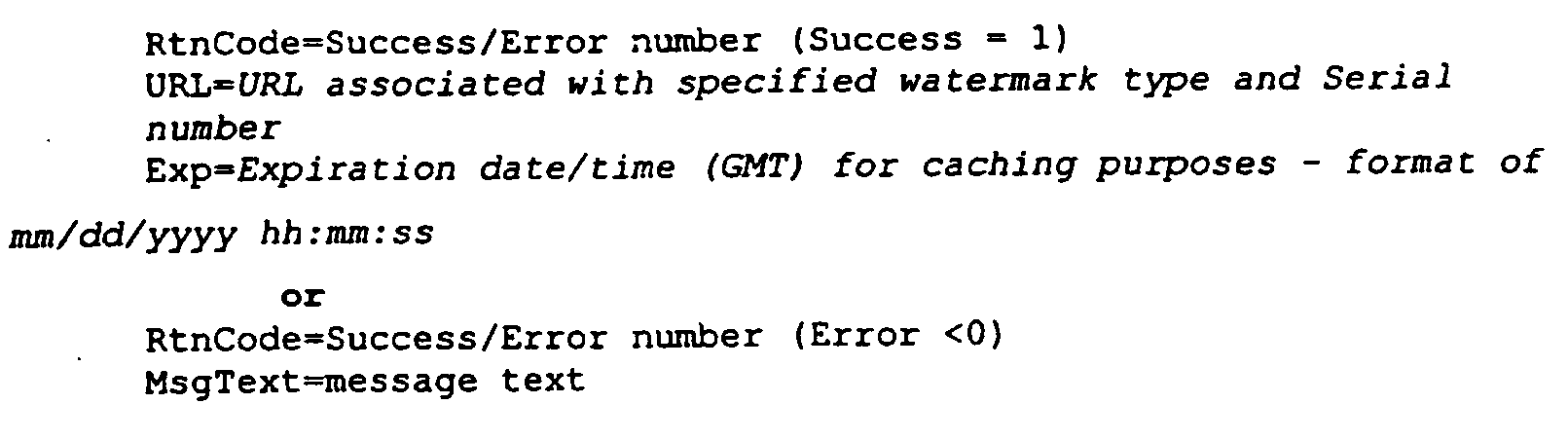
에러 이유:Reason for error:
- 1 종류 및 일련 번호는 양호하지만, 데이터베이스에서 URL이 그렇지 않다(1차 및 디폴트 URL이 모두 손실).
- 2 종류 및 일련 번호는 양호하지만, URL이 비활성 상태로 표시된다(1차도 디폴트도 비활성화 상태).-The two types and serial numbers are good, but the URL is marked as inactive (primary and default also inactive).
- 3 종류 및 일련 번호와 정합하는 데이터베이스내의 기록이 없다.There are no records in the database that match the 3 types and serial numbers.
- 4 요구 포맷 에러 - 불완전한 데이터.-4 Request format error-Incomplete data.
구성에 대한 요구Demand for Configuration
요구되는 입력Input required
헤더(XML 포맷)Header (XML Format)

데이터data
요구되는 정보 -Information Required-

예:Yes:

제품 핸들러로부터의 응답Response from product handler
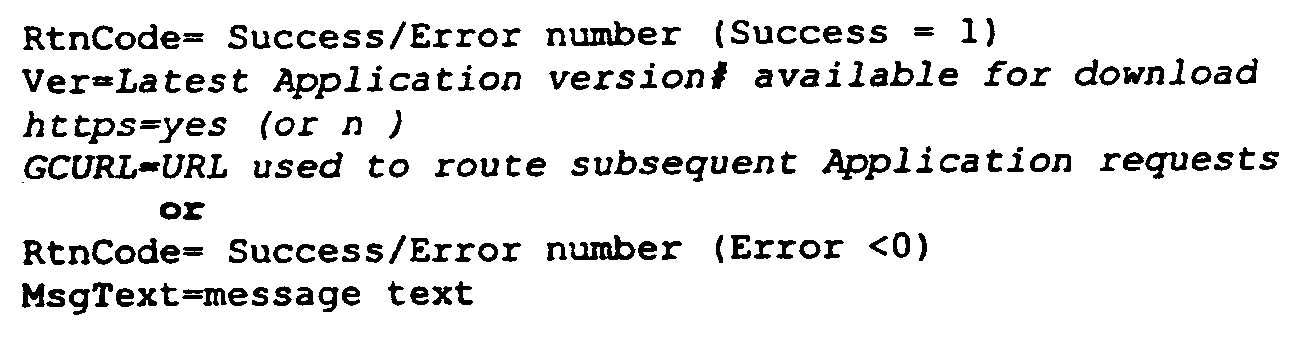
에러 이유: Reason for error:
- 5 미지의 운용 시스템.-5 unknown operating systems.
- 4 요구 포맷 에러 - 불완전한 데이터.-4 Request format error-Incomplete data.
연관된 URL에 대한 요구Request for Associated URL
요구되는 입력Input required
헤더(XML 포맷)Header (XML Format)

데이터data
요구되는 정보 -Information Required-

예:Yes:

제품 핸들러로부터의 응답Response from product handler

에러 이유:Reason for error:
- 8 종류 및 일련 번호는 양호하지만, 데이터베이스에서 연관된 워터마크 또는 URL이 그렇지 않다.8 types and serial numbers are good, but the associated watermark or URL in the database is not.
- 9 종류 및 일련 번호는 양호하지만, 연관된 모든 URL이 비활성 상태로 표시된다.-9 types and serial numbers are good, but all associated URLs are marked inactive.
- 3 종류 및 일련 번호와 정합하는 데이터베이스내의 기록이 없다.There are no records in the database that match the 3 types and serial numbers.
- 4 요구 포맷 에러 - 불완전한 데이터.-4 Request format error-Incomplete data.
트랜잭션 다운로드에 대한 요구Demand for transaction download
(국부적으로 캐시 처리하는 재전송을 생각하는데 필요하다. 로컬 재전송 당 한가지 요구.)(This is necessary to think of retransmissions that are cached locally. One request per local retransmission.)
요구되는 입력 Input required
헤더(XML 포맷)Header (XML Format)

데이터data
요구되는 정보 -Information Required-

선택적인 정보Optional information

예:Yes:

제품 핸들러로부터의 응답Response from product handler

에러 이유:Reason for error:
- 4 요구 포맷 에러 - 불완전한 데이터.-4 Request format error-Incomplete data.
가장 빠를 가능성이 있는 시스템 응답을 제공하기 위해서는 발신 디바이스(12)와 원격 시스템 사이의 데이터 교환이 가능한한 짧은 것이 - 바람직하게 단일 인터넷 데이터 패킷으로 운송될 수 있는 크기(즉, 약 536 비트 이하) - 바람직하다. 이러한 배열은 전송시 데이터 분할 및 수신시 데이터 재조립과 연관된 오버헤드(overhead)를 방지한다.In order to provide the fastest possible system response, the shortest possible data exchange between the originating
일반적으로 말하면, 단일 요구에 대한 시스템 서비스의 조합된 경과 시간은(즉, 애플리케이션(28c)에 의한 워터마크 인식, 라우터로의 패킷 전송, 라우터에 의한 복호화, 제품 핸들러에 의한 취급, 및 애플리케이션에 대한 응답의 복귀) 요구의 수신으로부터 그 요구에 응답하여 전송되는 제1 바이트까지 측정된 것이 3초 이하로 평균화되어야 한다. 전형적인 속도는 2초 이하이고, 많은 응답이 1초 이하로 제공된다.Generally speaking, the combined elapsed time of system services for a single request (i.e., watermark recognition by
바로 이어지는 논의는 상기를 많이 관찰하지만, 다른 우선순위(priority) 경우로부터 상세한 내용을 추가하여 관찰한다.The following discussion observes much of this but adds details from other priority cases.
MediaBridge 디지털 메시지는 2개의 코드로 구성되고, 이들은 모두 MediaBridge-개선 영상에 삽입된다. 매체 소유자 코드는 시스템 관리자(예를 들면, Digimarc)에 의해 지정되고, 영상에 MediaBridge 증진을 부가하기 위해 허가된 엔터티를 식별한다. 라우팅 코드는 매체 소유자(광고자, 발행자, 제작자 등)에 의해 지정되고, 의뢰인 애플리케이션이 MediaBridge 코드를 판독할 때 단말-이용자가 전해질 위치를 결정한다. 똑같은 코드로 삽입된 2개의 다른 광고는 단말-이용자를 똑같은 웹 페이지에 전할 수 있고, 다른 코드를 이용하는 다른 발행에서의 똑같은 광고는 다른 웹 페이지로 갈 수 있어, 어느 광고 또는 잡지가 매체 소유자의 웹 사이트에 단말-이용자를 데려가는데 가장 효과적인가를 추적하는데 이용될 수 있다.MediaBridge digital messages consist of two codes, all of which are embedded in a MediaBridge-enhanced image. The media owner code is designated by a system administrator (e.g., Digimarc) and identifies the entities authorized to add MediaBridge enhancements to the video. The routing code is specified by the media owner (advertiser, publisher, producer, etc.) and the end-user determines the location of the electrolyte when the client application reads the MediaBridge code. Two different advertisements inserted with the same code can direct end-users to the same web page, and the same advertisement from different publications using different codes can go to a different web page, so that either advertisement or magazine is the media owner's web. It can be used to track whether it is most effective at bringing the end-user to the site.
MediaBridge 시스템에는 3가지 주요 구성성분이 있다. 의뢰인 애플리케이션은 통상적으로 인터넷에서 영상 또는 객체로부터 추가 정보에 자동적으로 네비게이트하기 위해 소비자에 의해(MediaBridge 단말-이용자) 가정 및 사업용으로 이용된다. MediaBridge 라우터는 소정의 영상 또는 목적에 대한 적절한 인터넷 어드레스를 의뢰인 애플리케이션에 제공한다. 삽입 시스템은 프린트 이전에 MediaBridge 코드를 영상에 삽입하기 위해 매체 소유자에 의해 이용된다.There are three main components of the MediaBridge system. Client applications are typically used by consumers (MediaBridge end-users) for home and business purposes to automatically navigate to additional information from images or objects on the Internet. The MediaBridge Router provides the client application with the appropriate Internet address for the given image or purpose. The insertion system is used by the media owner to insert the MediaBridge code into the image prior to printing.
MediaBridge 의뢰인 애플리케이션MediaBridge Client Application
의뢰인 애플리케이션은 Logitech, 3Com, Creative Labs, 및 다른 것과 같은 한정된 디지털 카메라 제작자와의 OEM 관계로 배급될 수 있다. 이는 카메라 드라이버 및 카메라 제작자의 설치 CD로부터의 지지 프로그램과 함께 단말-이용자에 의해 설치된다.Client applications can be distributed in OEM relationships with limited digital camera manufacturers such as Logitech, 3Com, Creative Labs, and others. It is installed by the end-user with the camera driver and a support program from the camera manufacturer's installation CD.
MediaBridge 의뢰인 애플리케이션은 윈도우 95/98/NT 4.0 및 매킨토시 OS 8.6 운영 체제 하에서 한정된 비디오 카메라와 구성된 200MHz 이상의 Pentium 또는 PowerPC 컴퓨터에서 운행될 수 있다.The MediaBridge Client Application can run on a 200MHz or faster Pentium or PowerPC computer configured with a limited video camera under the Windows 95/98 / NT 4.0 and Macintosh OS 8.6 operating systems.
MediaBridge 의뢰인 애플리케이션은 먼저 인터넷 웹 사이트에서 추가 정보에 직접 브라우징되도록 MediaBridge-개선 영상을 이용하여 집중된다. 그러므로, 이는 다이얼업 모뎀 또는 영구적인 연결을 통해 인터넷에 연결을 요구한다. 그러나, 의뢰인 애플리케이션은 바람직하게 예를 들어, CD에서 로컬 데이터에 브라우징되고 다른 애플리케이션에 연결되는 것을 지지하는 확장가능한 설계를 갖는다.The MediaBridge Client Application is first concentrated using MediaBridge-enhanced video to be directly browsed for additional information on an Internet Web site. Therefore, it requires a connection to the Internet via a dial-up modem or permanent connection. However, the client application preferably has a scalable design that supports browsing to local data and connecting to other applications, for example on a CD.
MediaBridge 시스템은 비디오 카메라가 명확하게 초점이 맞은 고화질 영상을 나타낼 수 있는 어디에서든 이용될 수 있다. 이는 어두운 곳에서(약 40lux) 밝은 곳까지(3900lux) 변하는 조명 조건하에서 동작한다. 매우 어두운 빛에서는 보조 광원의 도움으로 작동되고, 밝은 곳에서는 화상 또는 객체가 광원으로부터 차폐되면 작동된다.The MediaBridge system can be used wherever a video camera can present a high quality image that is clearly in focus. It operates under varying lighting conditions from dark (about 40 lux) to bright (3900 lux). In very dark light it works with the aid of an auxiliary light source, in bright places it works when the image or object is shielded from the light source.
단말-이용자 의뢰인 애플리케이션의 동작Operation of the End-User Client Application
처음 의뢰인 애플리케이션이 운행될 때는 MediaBridge-인에이블 영상을 비디오 카메라를 통해 의뢰인 애플리케이션에 제공하는 최상의 기술을 알려주는 위자드(wizard)를 이용자에게 제공한다. 위자드는 각 카메라에 대해 전환되고, 샘플 영상이나 라이브 재생 영상을 이용할 수 있다.When the first client application is launched, it provides the user with a wizard that tells them the best technology to deliver MediaBridge-enabled video to the client application via a video camera. The wizard is switched for each camera and can use sample video or live playback video.
이용자에게 의뢰인 애플리케이션을 이용하는 최상의 방법을 알려주는 - 예를 들어, 카메라의 초점을 맞추는 것, 카메라의 초점 영역에서 부호화된 객체의 위치를 정하는 것, 복호화에 필요한 몇초 동안 객체를 정지시켜 유지하는 것, 허용가능한 조명 조건 등 - 하나 이상의 게임이 설치 디스크(예를 들면, CD)에 운송될 수 있다. 박스내에 삽입하는 카메라 박스는 MediaBridge 부호화될 수 있고, 카메라 공급자 또는 시스템 관리자에 의해 관리되는 대응 소개 페이지에 브라우저를 통해 연결될 수 있다. T-셔츠 또는 다른 상품은 랜덤하게 또는 MediaBridge 동작의 일부 특성에서 숙련성을 나타내면 웹 사이트를 통해 수여될 수 있다.Informing the user of the best way to use the client application-for example, focusing the camera, positioning the coded object in the camera's focus area, keeping the object still for a few seconds necessary for decoding, Allowable lighting conditions, etc.-One or more games may be shipped on an installation disc (eg, CD). The camera box inserted into the box can be MediaBridge encoded and connected via a browser to a corresponding introduction page managed by the camera supplier or system administrator. T-shirts or other merchandise can be awarded randomly or through a website if they demonstrate proficiency in some characteristics of MediaBridge operation.
설명되는 구성에서, MediaBridge 의뢰인 애플리케이션은 언제나 운행되고, 활성화 또는 비활성화된다. 활성화될 때, MediaBridge 비디오 카메라 윈도우는 언제나 다른 윈도우의 상단에 전체적으로 볼 수 있게 놓이고, 의뢰인 애플리케이션은 일정하게 MediaBridge-개선 영상에 대한 비디오를 점검하고 있다. MediaBridge-개선 영상이 발견될 때, 적절한 정보가 디스플레이되고 - 웹 페이지 만큼 자주 - 의뢰인 애플리케이션은 선택적으로 비활성화된다. 의뢰인 애플리케이션이 비활성화될 때, 이는 비디오 윈도우를 감추고, 카메라가 다른 애플리케이션에 이용가능하기 위해 놓고, 또한 메모리 또는 컴퓨터 리소스를 거의 이용하지 않는다.In the described configuration, the MediaBridge Client Application is always running, activated or deactivated. When activated, the MediaBridge video camera window is always placed on top of the other windows as a whole, and the client application is constantly checking the video for MediaBridge-enhanced images. When a MediaBridge-enhanced image is found, the appropriate information is displayed-as often as a web page-and the client application is selectively disabled. When the client application is deactivated, it hides the video window, places the camera to be available for other applications, and also uses little memory or computer resources.
한 실시에서, 의뢰인은 카메라를 일렬로 재이용가능한 디바이스로 다룬다. 즉, 의뢰인 애플리케이션이 활성화 상태이고 비디오를 점검하고 있을 때, 다른 애플리케이션은 비디오 카메라를 액세스할 수 없다. 유사하게, 의뢰인 애플리케이션은 또 다른 애플리케이션이 카메라를 이용하고 있을 때 비디오를 액세스할 수 없다.In one implementation, the client treats the camera as a line of reusable devices. That is, when a client application is active and checking video, no other application can access the video camera. Similarly, the client application cannot access the video when another application is using the camera.
MediaBridge 의뢰인 애플리케이션은 다음 기능을 포함할 수 있다:The MediaBridge Client Application may include the following features:
1) 브라우저/애플리케이션 시동. MediaBridge-개선 영상이 발견될 때, 의뢰인은 이용자의 웹 브라우저 또는 또 다른 애플리케이션을 시동한다. 인터넷 웹 사이트에 브라우징될 때, 의뢰인은 이용가능한 경우 사이트에 영상의 신원 및 단말-이용자의 우편 번호를 제공한다. 이 정보는 매체 소유자의 웹 사이트가 국부화된 웹 페이지를 이용자에게 디스플레이하기 위해 허용한다. 또 다른 애플리케이션을 시동할 때, 의뢰인은 영상 소유주 코드 및 라우팅 코드를 애플리케이션에 제공한다.1) Start browser / application. When a MediaBridge-enhanced image is found, the client launches the user's web browser or another application. When browsing to an Internet web site, the client provides the site with the identity of the image and the postal code of the end-user, if available. This information allows the media owner's web site to display localized web pages to the user. When starting up another application, the client provides the image owner code and routing code to the application.
2) 목적지 메뉴. 다수의 URL이 라우팅 코드에 지정되면, 의뢰인 애플리케이션은 단말-이용자가 직접 웹 페이지에 네비게이트하기 보다 디스플레이할 페이지를 선택하게 허용한다.2) Destination menu. If multiple URLs are specified in the routing code, the client application allows the end-user to select a page to display rather than navigate directly to the web page.
3) 브랜딩(branding). 웹 페이지를 디스플레이하기 위해 정보를 회복할 때, 의뢰인 애플리케이션은 미리 저장된 브랜드(예를 들면, Digimarc)로 로컬 웹 페이지를 디스플레이하고 원하는 정보가 회복되고 있음을 설명한다. 이 브랜딩 페이지는 이용자에게 어떠한 지연도 일으키지 않고 매체 소유주의 페이지와 대치된다. (브랜딩 페이지의 내용은 자동 소프트웨어 업데이트 동안 업데이트될 수 있다.)3) Branding. When recovering information to display a web page, the client application displays a local web page with a pre-stored brand (eg, Digimarc) and explains that the desired information is being recovered. This branding page is replaced with the media owner's page without causing any delay to the user. (The content of the branding page can be updated during an automatic software update.)
4) 탄력적인 활성화. 의뢰인 애플리케이션이 비활성화 상태일 때, 이용자는 다음에 의해 이를 활성화시킬 수 있다:4) elastic activation. When the client application is inactive, the user can activate it by:
a) 적절한 아이콘을 클릭한다.a) Click the appropriate icon.
b) 핫키(hot-key) 조합을 누른다.b) Press the hot-key combination.
c) 트래이(tray) 아이콘을 클릭한다(윈도우).c) Click on the tray icon (Windows).
d) 브라우저 툴바에서 버튼을 클릭한다.d) Click the button in the browser toolbar.
e) 최소화된 MediaBridge 의뢰인 비디오 카메라 윈도우를 복구한다. (윈도우).e) Restore the minimized MediaBridge Client video camera window. (window).
5) 상태 디스플레이. 활성화 상태일 때, 의뢰인 애플리케이션은 상태 디스플레이 패널을 통해 이용자에게 피드백을 제공하고, 이는 카메라로부터 본 장면에 이어서 비디오 카메라 윈도우에 디스플레이된다. 상태는 주위 조명 조건,(이용가능한 경우) 카메라 초점으로부터의 거리, 및 현재 상태(영상-연관 정보를 디스플레이하기 위해 준비하는, 또는 영상을 판독하기 위해 시도하는, 또는 MediaBridge-개선 영상이 카메라에 디스플레이되도록 대기하는)에 대한 피드백을 포함한다.5) Status display. When activated, the client application provides feedback to the user via the status display panel, which is displayed in the video camera window following the scene viewed from the camera. The status indicates the ambient lighting conditions, the distance from the camera focus (if available), and the current status (preparing to display image-related information, or attempting to read the image, or a MediaBridge-enhanced image displayed on the camera). Feedback).
6) 다중 카메라 지지. 설명되는 MediaBridge 의뢰인 애플리케이션은 한번에 하나의 카메라를 이용하지만, 설치된 MediaBridge-인에이블 카메라를 이용할 수 있다. 컴퓨터가 단 하나의 카메라만을 가지면, 카메라는 자동적으로 선택된다. 하나 이상의 카메라가 있으면, 이용자는 어느 카메라가 이용될 것인가를 선택할 수 있고 의뢰인이 운행하고 있는 동안 선택을 변화시킬 수 있다.6) Support multiple cameras. The MediaBridge Client application described uses one camera at a time, but can use an installed MediaBridge-enabled camera. If the computer has only one camera, the camera is automatically selected. If there is more than one camera, the user can select which camera will be used and change the selection while the client is running.
7) 자동 소프트웨어 업데이트. 이용자는 간단한 메뉴 선택을 만들어서 자동적으로 의뢰인 애플리케이션에 대한 업데이트를 설치할 수 있다. 의뢰인은 인터넷에 연결되어, 이용가능한 업데이트를 다운로드하고 설치한다. 부가하여, 의뢰인은 보다 새로운 프로토콜을 이용하는 MediaBridge-개선 영상을 발견하면(예를 들어, MediaBridge 데이터로 부호화된 버전 표시를 참고로) 업데이트를 점검할 것을 제안한다.7) Automatic software update. The user can automatically install updates to the client application by making a simple menu selection. The client is connected to the Internet to download and install available updates. In addition, the client proposes to check for updates when it finds a MediaBridge-enhanced image using a newer protocol (e.g., referring to the version indication encoded with MediaBridge data).
8) 이용자 옵션 구성. 의뢰인 애플리케이션에서 거의 모든 것이 이용자에 의해 구성될 수 있다.8) Configure consumer options. Almost everything in the client application can be configured by the user.
a) 컴퓨터가 시작할 때마다 의뢰인을 자동적으로 시작(디폴트).a) Automatically start the client each time the computer starts (default).
b) 핫키에 의한 활성화.b) Activation by hotkey.
c) 시스템 트래이에 활성화 아이콘을 디스플레이(윈도우윈도우터넷 웹 브라우저에 버튼을 부가(인터넷 익스플로러 4 이후 및 Netscape 4 이후).c) Display an activation icon in the system tray (add a button to the Windows Windows Web browser (after Internet Explorer 4 and after Netscape 4).
삭제delete
e) 다수의 카메라가 설치될 때 시동시 이용되는 최신 카메라의 선택.e) Selection of the latest camera used at startup when multiple cameras are installed.
f) 소프트웨어 업데이트를 주기적으로 점검하기 위해 상기.f) Remind you to periodically check for software updates.
g) 시동시 위자드를 운행(디폴트).g) Run the wizard at start up (default).
h) MediaBridge-개선 영상이 판독될 때 자동적으로 비활성화.h) Automatically deactivate when MediaBridge-enhanced image is read.
i) 특정한 주기 동안 카메라에 아무 것도 주어지지 않으면 자동적으로 비활성화.i) Automatically disable if nothing is given to the camera during the specified period.
j) MediaBridge-개선 영상을 판독하면 사운드 파일을 플레이하거나 소리를 낸다.j) Read MediaBridge-enhanced video to play or play a sound file.
k) RSACi 비율을 기초로 하는 사이트의 차단(blocking). 각 매체 소유주는 언어, 나체, 섹스, 및 폭력의 카타고리에 대한 RSACi 스케일을 이용하여 사이트의 자체 비율을 정하기 위해 기대된다. 라우터는 임의의 카테고리에 대한 RSACi 비율이 단말-이용자에게 허용되는 것을 넘으면 사이트로부터 단말-이용자를 차단시킨다. (라우터는 매체 소유주의 자체 비율에만 의존하여 실제로는 RSACi 코드에 대해 웹 페이지를 점검하지 못한다.) 이 옵션을 선택하면, 또한 웹 브라이저내에서 제한 내용에 대해 RSACi(http://www.rsac.org/ratingsv01.html)의 정보를 디스플레이하게 된다.k) Blocking of sites based on RSACi rates. Each media owner is expected to use the RSACi scale for categories of language, nudity, sex, and violence to determine their own proportions of the site. The router blocks the end-user from the site if the RSACi ratio for any category exceeds that allowed for the end-user. (Routers do not actually check web pages for RSACi code, relying solely on the media owner's own ratio.) If this option is selected, RSACi (http: //www.rsac. org / ratingsv01.html) will be displayed.
l) 기존의 다이얼업(모뎀) 연결을 통해 인터넷에 자동 연결.l) Automatic connection to the Internet through an existing dial-up (modem) connection.
m) 시동시 패스워드 보호. m) Password protection at start up.
n) 이용자 등록 정보. (이용자에게 모든 정보가 선택적이고, 제공되는 경우 특정한 항목이 제3 집단에 제공됨을 알린다.)n) User Registration Information. (Inform the user that all information is optional and that specific items will be provided to third parties, if provided.)
o) 이용자에게 제공하기 위해 요구되지 않는 단말-이용자 우편 번호는 자발적으로 단말-이용자에 의해 제공되는 경우 매체 소유주에 전송되는 통계 정보의 기본 부분으로 이용된다.o) A terminal-user postal code that is not required to provide to the user is used as the basic part of the statistical information sent to the media owner when voluntarily provided by the terminal-user.
9) 위자드. 이 위자드는 더 많은 정보에 대한 관문으로 MediaBridge를 이용하기 위한 최상의 기술 및 MediaBridge로의 최상의 결과를 구하기 위해 특정한 카메라를 셋업할 때 안내를 제공한다. 디폴트에 의해, 위자드는 의뢰인 애플리케이션이 시작될 때마다 운행된다. 이는 또한 새로운 카메라가 이용자에 의해 선택될 때 처음으로 운행된다.9) Wizard. This wizard is your gateway to more information and provides the best technology for using MediaBridge and guides you in setting up specific cameras for the best results with MediaBridge. By default, the wizard runs every time the client application starts. It also runs for the first time when a new camera is selected by the user.
10) 카메라 검증. 새로운 카메라가 MediaBridge 의뢰인 입력으로 선택될 때, 의뢰인은 카메라가 MediaBridge-인에이블되는 것을 확인한다. 그렇지 않으면, 이용자에게 카메라가 지지되지 않고 의뢰인 애플리케이션과 정확하게 작업하지 못할 수 있음이 경고된다.10) Camera Verification. When a new camera is selected as the MediaBridge Client input, the Client confirms that the camera is MediaBridge-enabled. Otherwise, the user is warned that the camera is not supported and may not work correctly with the client application.
11) 확장가능한 설계. MediaBridge 의뢰인은 통상적으로 브라우저 윈도우에 인터넷 또는 로컬 웹 페이지를 디스플레이함으로서 MediaBridge-개선 영상을 판독하고 원하는 정보에 연결하는 것을 취급한다. 그 기능성은 특정한 데이터의 취급을 위해 등록된 MediaBridge-인에이블 애플리케이션에 의해 확장될 수 있다. 예를 들어, MediaBridge-개선 명함이 주어지면, MediaBridge 의뢰인은 웹 사이트로부터 명함 정보를 다운로드하고 새로운 정보로 이용자의 접촉 목록을 업데이트하는 MediaBridge-인에이블 애플리케이션을 운행할 수 있다. 또 다른 예로는 오디오 파일이 페이지에 대해 플레이되게 하는 MediaBridge-개선 어린이 서적으로부터의 페이지가 있다.11) Scalable design. MediaBridge clients typically deal with reading MediaBridge-enhanced images and linking to the desired information by displaying Internet or local web pages in a browser window. Its functionality can be extended by a MediaBridge-enabled application registered for the handling of specific data. For example, given a MediaBridge-enhanced business card, a MediaBridge client can run a MediaBridge-enabled application that downloads business card information from a web site and updates the user's contact list with new information. Another example is a page from a MediaBridge-enhanced children's book that allows an audio file to be played for a page.
12) 삽입 지지. 영상이 그에 삽입되는 정확한 MediaBridge 코드를 가졌음을 확인하기 위해 의뢰인 애플리케이션이 매체 소유주에 의해 이용되고 있으면, 의뢰인은 매체 소유주의 명령, 라우팅 정보, 및 MediaBridge 영상이 판독될 때 MediaBridge 워터마크의 상대적인 강도를 디스플레이한다. 각 매체 소유주의 사생활을 보호하기 위해, 이 정보는 이용자가 매체 소유자에 대해 유효한 삽입 이용자명과 패스워드를 제공할 수 있는 경우에만 제공된다.12) Insertion support. If the client application is being used by the media owner to verify that the image has the correct MediaBridge code embedded in it, the client displays the media owner's instructions, routing information, and the relative strength of the MediaBridge watermark when the MediaBridge image is read. do. To protect the privacy of each media owner, this information is provided only if the user can provide a valid embedded username and password for the media owner.
MediaBridge 라우터MediaBridge Router
라우터는 기본적으로 단말-이용자에게 투명하다. 의뢰인 애플리케이션이 인터넷상의 정보에 연결된 MediaBridge-개선 영상을 검출할 때, 이는 디스플레이되는 웹 페이지의 인터넷 어드레스 정보를 구하기 위해 라우터와 통신한다.The router is basically transparent to the end-user. When the client application detects a MediaBridge-enhanced image connected to information on the Internet, it communicates with the router to obtain Internet address information of the displayed web page.
라우터는 또한 다음의 기능성을 포함한다:The router also includes the following functionality:
1) 라우팅 정보 유지. 라우터내에는 각 유일한 MediaBridge 코드를 하나 이상의 연관 인터넷 어드레스에 연결시키는 정보가 포함된다. 한 실시에서, 시스템 관리자(예를 들면, Digimarc)는 광고 소비자에 의해 공급되는 정보를 이용하여 라우팅 정보를 유지한다. 또 다른 실시에서, 매체 소유주는 라우터와의 안전한 인터넷 연결을 이용하여 그 자체로 정보를 업데이트한다.1) Maintain routing information. Within the router contains information that links each unique MediaBridge code to one or more associated Internet addresses. In one implementation, a system administrator (eg, Digimarc) maintains routing information using information supplied by the advertising consumer. In another implementation, the media owner updates itself by using a secure internet connection with the router.
2) 문제 처리. 라우팅 요구가 만족될 수 없으면, 라우터는 단말-이용자에 대한 충격을 최소화하는 방법으로 응답한다. 예를 들어, MediaBridge 코드가 공지되지 않으면, 의뢰인 애플리케이션에는 매체 소유주의 홈 페이지에 대한 URL이 제공된다. 부가하여, 에러가 발생되는 날, 라우터는 매체 소유주에게 이메일로 에러가 발생되었음을 통보한다.2) Problem Handling. If the routing request cannot be satisfied, the router responds in a way that minimizes the impact on the end-user. For example, if the MediaBridge code is not known, the client application is provided with a URL to the media owner's home page. In addition, the day the error occurs, the router notifies the media owner that the error has occurred by e-mail.
3) 내용 등급 비율. 매체 소유주가 영상 또는 사이트에 대해 RSACi 등급 비율 정보를 제공하였고, 단말-이용자가 그 사이트에 차단됨을 지정하는 RASCi 등급 비율로 지정되면, 라우터는 사이트가 부적절한 내용을 포함하여 매체 소유주 사이트에 연결되지 않을 나타내는 웹 페이지를 이용자에게 복귀시킨다.3) Content Rating Ratio. If the media owner has provided RSACi rating rate information for a video or site, and a RASCi rating rate is specified that specifies that the end-user is blocked at that site, the router will not be able to connect to the media owner site with inappropriate content. Return the web page to the user.
4) 유효성. 주기적으로(예를 들면, 매일), 라우터는 데이터베이스내의 모든 활성화 정보를 유효화시킨다. 에러가 발견되면, 매체 소유주에게 이메일로 통보된다. 에러가 하루로 고정되지 않으면, Digimarc에게 통보된다. 점검되는 조건은:4) Validity. Periodically (eg daily), the router validates all activation information in the database. If an error is found, the media owner is notified by email. If the error is not fixed to one day, Digimarc is notified. The conditions checked are:
a) 활성화 링크에서 손실 URL.a) Lost URL in Activation Link.
b) 존재하지 않는 페이지를 참고하는 URL.b) URL referencing a page that does not exist.
c) Digimarc에 의해 요구되는 수용가능한 다운로드 시간을 넘는 페이지.c) Pages beyond the acceptable download time required by Digimarc.
5) 트래킹. 라우터는 마케팅 정보를 개발하기 위해 의뢰인 애플리케이션 요구를 로그시킬 수 있다. 이러한 트래킹 로그는 다음을 포함할 수 있다:5) Tracking. The router may log client application requests to develop marketing information. Such tracking logs may include:
a) 요구 날짜와 시간.a) Request date and time.
b) 매체 소유주 및 영상.b) Media owners and video.
c) 제공되는 경우, 단말-이용자의 우편 코드.c) the end-user's postal code, if provided.
d) 요구를 발행하는 IP 어드레스. d) IP address that issues the request.
6) 보고. 트래킹 정보를 이용하여, 라우터는 Digimarc에 의해 이용되는 다음 보고를 제공한다:6) reporting. Using tracking information, the router provides the following reports used by Digimarc:
a) 특정한 데이터 범위에 대한 URL 요구의 수.a) Number of URL requests for a particular data range.
b) 특정한 데이터 범위에 대해 매체 소유주에 의한 URL 요구의 수.b) Number of URL requests by the media owner for a particular data range.
c) 특정한 데이터 범위에 대해 MediaBridge-개선 영상에 의한 URL 요구의 수.c) Number of URL requests by MediaBridge-enhanced video for a particular data range.
(트래킹 및 보고는 바람직하게 매체 소유주가 라우터로부터 트래픽 및 마케팅 보고 온라인을 구하기 위해 허용하게 구성된다.)(Tracking and reporting are preferably configured to allow the media owner to obtain traffic and marketing reports online from the router.)
MediaBridge 삽입 시스템MediaBridge Insertion System
삽입 시스템은 다음을 포함한다:The insertion system includes:
* MediaBridge 코드를 삽입하기 위한 포토샵-호환 임베더 플러그-인(Embedder Plug-in),* Photoshop-compatible embed plug-in for inserting MediaBridge code,
* MediaBridge-개선 디지털 영상을 확인하기 위한 포토샵-호환 판독기 플러그-인,* MediaBridge-Photoshop-compatible reader plug-in for checking improved digital images,
* MediaBridge-개선 증거 및 프레스 프린트를 확인하기 위한 의뢰인 애플리케이션, 및* Client application to verify MediaBridge-proof evidence and press print, and
* MediaBridge 코드를 구하고 URL을 MediaBridge 코드에 지정하기 위한 인터넷-기반의 라우터 유지 애플리케이션.* Internet-based router maintenance application for obtaining MediaBridge codes and assigning URLs to MediaBridge codes.
플러그-인들은 새로운 MediaBridge 라우팅 코드를 지정하고 인증만을 위해 인터넷으로의 연결을 요구한다. 라우터 유지 애플리케이션은 언제나 인터넷 연결을 요구한다.Plug-ins specify a new MediaBridge routing code and require a connection to the Internet for authentication only. Router maintenance applications always require an Internet connection.
라우터 유지 애플리케이션Router maintenance application
라우터 유지 애플리케이션의 주요 목적은 의뢰인 애플리케이션이 영상을 판독할 때 단말-이용자에게 적절한 웹 페이지가 주어지도록 MediaBridge 코드에 라우팅 정보를 지정하는 것이다.The main purpose of the router maintenance application is to specify routing information in the MediaBridge code so that the end-user is given the appropriate web page when the client application reads the image.
라우터 유지 애플리케이션은 다음의 기능성을 포함한다:Router maintenance applications include the following functionality:
1) 다중 위치. 단일 매체 소유주 계좌는 다른 위치의 다른 사람들에 의해 액세스될 수 있다. 이는 또한 예를 들어, 광고주 및 광고 에이전시와 같이 다른 조직의 사람에 의해서도 액세스될 수 있다.1) multiple locations. A single media owner account can be accessed by different people in different locations. It may also be accessed by people of other organizations, such as, for example, advertisers and advertising agencies.
2) 제한 액세스. 각 매체 소유주는 누가 라우터 정보를 액세스할 수 있는이를 제한하고, 누가 새로운 MediaBridge 코드를 생성할 수 있는이를 지정하고, 기존의 MediaBridge 코드를 이용하거나 라우팅 코드에 대해 정보를 변화시키는 기능을 갖는다. 매체 소유주는 임의의 시간에 액세스를 부가, 변화, 또는 취소시킬 수 있다.2) Restricted Access. Each media owner has the ability to restrict who can access router information, specify who can generate new MediaBridge codes, use existing MediaBridge codes, or change information about routing codes. The media owner can add, change, or revoke access at any time.
3) 안전한 액세스. 라우터로의 모든 인터넷 액세스는 안전한 연결을 통한다.3) Secure Access. All Internet access to the router is through a secure connection.
4) 라이팅 코드. 새로운 라우팅 코드의 지정, 기존 라우팅의 변화, 및 이전 라우팅 코드의 삭제 또는 재이용.4) Writing code. Assign new routing codes, change existing routing, and delete or reuse old routing codes.
5) 시간-기반의 라우팅. 각 라우팅 코드에는 다수의 URL이 지정될 수 있고, 이들 각각은 선택적으로 유효 날짜 및 라우팅에서 이용되어야 할 때를 결정하는 만기 날짜를 가질 수 있다. 만기된 URL은 3일 이후에 라우터에 의해 자동적으로 삭제된다.5) time-based routing. Each routing code may be assigned a number of URLs, each of which may optionally have a valid date and an expiration date that determines when it should be used in routing. Expired URLs are automatically deleted by the router after three days.
6) 다중 라우팅. 다중 URL이 한 라우팅 코드에 지정되면, 라우터는 단말-이용자가 웹 페이지에 직접 네비게이트하기 보다 디스플레이할 페이지를 선택하게 허용하는 브라우저-기반의 메뉴를 단말-이용자에게 복귀시킨다. 한 실시예에서는 단일 라우팅 코드가 4개까지의 비만기 URL을 가질 수 있다. 각 URL은 URL에 대한 브라우저 링크가 되는 단기 설명, 500개까지의 문자를 갖는 장기 설명, 및 메뉴에 디스플레이되는 아이콘에 대한 URL을 가질 수 있다. 아이콘은 300개 픽셀 폭 만큼 50개 픽셀 보다 더 클 수 없다.6) Multi Routing. If multiple URLs are assigned to one routing code, the router returns to the end-user a browser-based menu that allows the end-user to select a page to display rather than navigate directly to the web page. In one embodiment, a single routing code may have up to four unexpired URLs. Each URL may have a short description that is a browser link to the URL, a long description of up to 500 characters, and a URL for the icon displayed in the menu. An icon cannot be larger than 50 pixels by 300 pixels wide.
7) 로깅(logging). 라우팅 정보에 대한 모든 변화는 로그 처리되어 매체 소유자에 의해 관찰될 수 있다.7) Logging. All changes to the routing information can be logged and observed by the media owner.
플러그-인 개요Plug-In Overview
매체 소유자의 컴퓨터에서 처음으로 삽입이 행해지면, 임베더는 매체 소유주에 대한 계좌 번호, 매체 소유자에 의해 정의된 유효 이용자명 및 패스워드를 요구한다. 임베더는 인터넷을 통해 라우터에 연결되고, 이용자가 인증됨을 확인하여, 매체 소유자에 대한 정보를 다운로드한다. 그 매체 소유자에 대한 또 다른 삽입은 라우터에 연결되지 않고 실행될 수 있다. 그러나, 이용자가 삽입을 위한 라우팅 정보를 구하기 위해 라우터에 연결될 때마다, 라우터는 현재 유효한 이름 및 패스워드에 반하여 이용자명 및 패스워드를 확인한다. 앞서 이용된 이름 및 패스워드가 더 이상 유효하지 않으면, 이용자는 매체 소유자에 대한 삽입을 계속하기 위해 유효한 이름 및 패스워드를 제공하여야 한다.When the insertion is made for the first time on the media owner's computer, the embedder requires an account number for the media owner, an effective username and password defined by the media owner. The embedder connects to the router via the Internet, verifies that the user is authenticated, and downloads information about the media owner. Another insert into the media owner can be performed without being connected to the router. However, whenever a user is connected to a router to get routing information for insertion, the router checks the username and password against the currently valid name and password. If the previously used name and password are no longer valid, the user must provide a valid name and password to continue inserting to the media owner.
매체 소유자 계좌 번호는 임베더에 의해 유지되는 바와 같은 매체 소유자의 이름을 이용하여 미래 확인이 행해지므로, 초기 인증에만 필요하다. 광고 에이전시에서의 그래픽 설계자가 2개 이상의 소유주에 대한 프로젝트를 작업할 수 있으므로, 한명의 그래픽 설계자는 각 매체 소유주에 대해 다른 이용자명 및 패스워드를 가질 수 있다.The media owner account number is only needed for initial authentication, since future verification is done using the name of the media owner as maintained by the embedder. Since a graphic designer in an advertising agency can work on a project for more than one owner, one graphic designer can have a different username and password for each media owner.
판독기 플러그-인은 삽입 이후에 주로 영상의 확인을 위해 이용된다. 이는 이용자가 매체 소유자에 대해 유효한 이용자명 및 패스워드를 제공할 수 있는 경우에만 영상에 대한 정보를 제공하게 되는 추가 제한을 가지고 삽입 플러그-인과 똑같은 방식으로 액세스를 제한한다. 매체 소유주 정보가 현재 컴퓨터에서 이용가능하지 않으면, 판독기는 확인을 위해 라우터에 연결된다.Reader plug-ins are used primarily for identification of images after insertion. This restricts access in the same way as an embedding plug-in with the additional restriction that the user will only be able to provide information about the image if he can provide a valid username and password for the media owner. If the media owner information is not currently available on the computer, the reader is connected to the router for verification.
플러그-인들은 이 기능성을 공유한다:Plug-ins share this functionality:
1) 다중 매체 소유주. 이용자는 다중 매체 소유주에 대해 삽입 또는 판독을 실행할 수 있다. 이용자는 각 매체 소유주에 대해 유효한 이용자명 및 패스워드를 가져야 한다.1) Multimedia owner. The user can perform an insert or read on the multimedia owner. The user must have a valid username and password for each media owner.
2) 다중 이용자. 단일 컴퓨터는 여러 사람에 의해 이용될 수 있다. 이들이 똑같은 이용자명 및 패스워드를 이용하지 않으면, 이들은 정보를 공유하지 못한다.2) Multiuser. A single computer can be used by several people. If they do not use the same username and password, they do not share information.
3) 자동 소프트웨어 업데이트. 이용자는 단일 메뉴를 선택함으로서 플러그-인에 대한 업데이트를 자동적으로 설치할 수 있다. 플러그-인들은 인터넷에 연결되고, 이용가능한 업데이트를 다운로드하여 설치한다.3) Automatic software update. The user can automatically install updates to the plug-in by selecting a single menu. Plug-ins connect to the Internet and download and install available updates.
4) 안전한 액세스. 모든 인터넷 액세스는 안전한 연결을 통해 이루어진다.4) Secure Access. All internet access is through a secure connection.
임베더 플러그-인Embed plug-in
임베더 플러그-인은 다음의 기능성을 포함한다:The embedder plug-in includes the following functionality:
1. 라우팅 코드 지정. 이용자는 인터넷 연결을 통하여 라우터에 의해 제공되는 현존 코드의 리스트로부터 삽입될 라우팅 코드를 선택한다. 각 라우팅 코드는 유일한 라우팅 번호 및 설명에 의해 식별된다. 일단 라우터를 통해 선택되면, 라우팅 코드에 대한 정보는 이용자가 제거할 때까지 로컬 컴퓨터에 남아있다.1. Specify routing code. The user selects a routing code to be inserted from the list of existing codes provided by the router via an internet connection. Each routing code is identified by a unique routing number and description. Once selected through the router, the information about the routing code remains on the local computer until the user removes it.
2. 새로운 라우팅 코드. 인증되면, 이용자는 새로운 라우팅 코드를 생성하기 위해 임베더를 통해 라우터에 연결될 수 있다. 라우팅 코드는 추후 부가될 수 있는 URL 정보를 가지고, 또는 가지지 않고 생성될 수 있다.2. New routing code. Once authenticated, the user can connect to the router via the embedder to generate a new routing code. The routing code can be generated with or without URL information that can be added later.
3. 라우팅 코드 업데이트. 임베더가 라우터에 연결될 때마다, 이는 국부적으로 캐시 처리되는 라우팅 코드에 이루어진 업데이트를 다운로드한다.3. Update routing code. Each time the embedder is connected to the router, it downloads the updates made to the locally cached routing code.
4. 마스크(mask) 처리된 삽입. 이용자는 MediaBridge 코드가 마스크 처리된 영역에만 삽입되도록 영상 일부의 마스크를 없앨 수 있다. 한 실시예에서는 다른 마스크 영역에 다른 코드가 적용된다. 전형적으로, 이용자는 영상의 똑같은 부분에 다른 MediaBridge 코드를 삽입할 수 있다.4. Masked inserts. The user can remove a mask of a part of the image so that the MediaBridge code is inserted only in the masked area. In one embodiment, different codes are applied to different mask areas. Typically, the user can insert different MediaBridge codes in the same portion of the picture.
5. 변수 강도. 이용자는 전반적으로 MediaBridge 워터마크의 강도(그래서, 가시성)를 가벼운 것에서 매우 과중한 것으로 변화시킬 수 있고, 또한 영상의 다른 영역에서 강도를 국부적으로 변화시킬 수 있다(즉, 강도가 로컬 영상 특성에 적응된다).5. Variable strength. The user can generally change the intensity (and thus visibility) of the MediaBridge watermark from light to very heavy, and also locally change the intensity in other areas of the image (i.e. the intensity is adapted to the local image characteristics). ).
6. 로깅. 이용자가 영상에 삽입할 때마다, 임베더는 날짜, 시간, 삽입된 정보, 삽입 설정(예를 들면, 강도), 이용자명, 컴퓨터명, 및 입력 영상 파일의 명칭에 대한 로그를 기록한다. 로그는 각 이용자의 컴퓨터상의 텍스트 파일이다. 이는 임의의 텍스트 편집기에서 관찰될 수 있다.6. Logging. Each time the user inserts into an image, the embedder records a log of the date, time, inserted information, insertion settings (e.g., intensity), user name, computer name, and name of the input image file. The log is a text file on each user's computer. This can be observed in any text editor.
판독기 플러그-인Reader plug-in
판독기 플러그-인은 또한 다음의 기능성을 포함한다:Reader plug-ins also include the following functionality:
1) 판독. 스캐닝될 수 있는 디지털 영상을 판독하고, 이용자가 인증된 경우, 매체 소유주, 라우팅 정보, 및 MediaBridge 워터마크의 강도 측정치를 디스플레이한다.1) Reading. Read the digital image that can be scanned and display the media owner, routing information, and strength measurements of the MediaBridge watermark if the user is authenticated.
2) 마스크 처리된 판독. 이용자는 영상 일부의 마스크를 없애고, 그 부분으로부터만 MediaBridge 정보를 판독할 수 있다.2) Masked Reading. The user can remove the mask of a part of the image, and can read MediaBridge information only from that part.
파트 IIIPart III
발명적 조합Inventive Combination
앞서 상세히 설명된 발명적 특성에 부가하여, 우선권으로 주장되는 발명적 조합의 일부는 다음을 포함한다:In addition to the inventive features detailed above, some of the inventive combinations claimed as priorities include:
A1. 개인의 명함을 광학 센서에 제공하고, 광학 센서가 출력 데이터를 만드는 단계;A1. Providing a business card of the individual to the optical sensor, the optical sensor producing output data;
센서 출력 데이터로부터 스테가노그래피를 이용하여 부호화된 복수 비트의 데이터를 복호화하는 단계; 및Decoding a plurality of bits of encoded data using steganography from the sensor output data; And
상기 명함의 소유주에 연관된 데이터를 갖는 인터넷 어드레스에 링크를 설립하는데 상기 복수 비트의 데이터를 이용하는 단계를 포함하는 방법.Using the plurality of bits of data to establish a link to an internet address having data associated with the owner of the business card.
A2. 상기 인터넷 사이트로부터 개인의 특정한 활동을 상세히 설명하는 달력 데이터를 구하는 단계를 포함하는 청구항 A1의 방법.A2. The method of claim A1 comprising obtaining calendar data detailing the specific activity of the individual from the Internet site.
A3. 구해진 달력 데이터의 양이 인증 레벨에 의존하는 청구항 A2의 방법.A3. The method of claim A2 in which the amount of calendar data obtained depends on the authentication level.
A4. 인증 레벨이 개인의 명함에 부호화된 복수 비트의 데이터에서 반영되고, 개인은 수신자에게 상기 달력 데이터에 대한 다른 액세스 권리를 부여하기 위해 다른 수신자에 다르게 부호화된 카드를 배급할 수 있는 청구항 A3의 방법.A4. The method of claim A3 in which an authentication level is reflected in a plurality of bits of data encoded in an individual's business card, and the individual can distribute a differently encoded card to another recipient to give the recipient different access rights to the calendar data.
A5. 광학 센서가 명함으로부터 개인용 정보 관리자에 텍스트 정보를 입력하기 위해 또한 동작하는 명함 판독기인 청구항 A1의 방법.A5. The method of claim A1 wherein the optical sensor is also a business card reader that also operates to input text information from the business card to the personal information manager.
A6. 스테가노그래피를 이용하여 부호화된 복수 비트의 데이터로부터 구별된 인터넷 어드레스를 상기 개인용 정보 관리자에 저장하는 단계를 포함하는 청구항 A5의 방법.A6. The method of claim A5 comprising storing in the personal information manager an internet address distinguished from a plurality of bits of data encoded using steganography.
A7. 광학 센서가 디지털 카메라인 청구항 A1의 방법.A7. The method of claim A1 in which the optical sensor is a digital camera.
A8. 디지털 카메라가 컴퓨터 디스플레이 디바이스에 설치된 청구항 A7의 방법.A8. The method of claim A7 wherein the digital camera is installed in a computer display device.
A9. 디지털 카메라가 이용자의 머리에 설치되는 청구항 A7의 방법.A9. The method of claim A7 in which a digital camera is installed on the user's head.
A10. 제1 사이트에서 광학 센서에 프린트된 프로모션을 제공하고, 상기 광학 센서가 출력 데이터를 만드는 단계;A10. Providing a printed promotion to an optical sensor at a first site, the optical sensor producing output data;
센서 출력 데이터로부터 스테가노그래피를 이용하여 부호화된 복수 비트의 데이터를 복호화하는 단계;Decoding a plurality of bits of encoded data using steganography from the sensor output data;
상기 프린트된 프로모션에 의해 촉진된 회사, 제품, 또는 서비스에 연관된 인터넷 사이트로의 링크를 설립하는데 상기 데이터를 이용하는 단계; 및Using the data to establish a link to an internet site associated with a company, product, or service promoted by the printed promotion; And
상기 회사, 제품, 또는 서비스에 연관된 추가 정보를 인터넷 사이트에서 제1 사이트로 전송하는 단계를 포함하는 방법.Transmitting additional information associated with the company, product, or service from an internet site to a first site.
A11. 광학 센서에 프린트된 식별 뱃지를 제공하고, 광학 센서가 상기 뱃지면의 광학적 특성에 대응하는 출력 데이터를 만드는 단계;A11. Providing an identification badge printed on the optical sensor, the optical sensor producing output data corresponding to the optical characteristics of the badge;
센서 출력 데이터로부터 스테가노그래피를 이용하여 부호화된 복수 비트의 데이터를 복호화하는 단계;Decoding a plurality of bits of encoded data using steganography from the sensor output data;
유효한 액세스 카드에 대응하는가 여부를 결정하기 위해 복수 비트의 데이터를 점검하는 단계; 및Checking a plurality of bits of data to determine whether it corresponds to a valid access card; And
상기 점검 동작의 결과에 의존하여 락(lock)를 해제하는 단계를 포함하는 방법.Releasing a lock depending on a result of the checking operation.
B1. 광학 센서에 디지털적으로 부호화된 객체를 제공하고, 광학 센서는 출력 데이터를 만드는 단계;B1. Providing a digitally encoded object to the optical sensor, the optical sensor producing output data;
센서 출력 데이터로부터 복수 비트의 데이터를 복호화하는 단계; 및Decoding a plurality of bits of data from the sensor output data; And
상기 객체에 연관된 데이터를 갖는 인터넷 어드레스로의 링크를 이루는데 상기 복수 비트의 데이터를 이용하는 단계를 포함하는 방법.Using the plurality of bits of data to establish a link to an internet address having data associated with the object.
B2. 객체가 상기 복수 비트의 데이터로 스테가노그래피를 이용하여 부호화되는 청구항 B1의 방법.B2. The method of claim B1 in which an object is encoded using steganography with the plurality of bits of data.
B5. 냉장고; B5. Refrigerator;
냉장고와 연관되고, 센서 전면에 유지되는 객체에 대응하는 영상 데이터를 제공하기 위해 적응되는 광학 센서; 및An optical sensor associated with the refrigerator and adapted to provide image data corresponding to an object held in front of the sensor; And
영상 데이터를 처리하고 복수 비트의 이진 데이터를 추출하는 영상 프로세서를 포함하고,An image processor for processing image data and extracting a plurality of bits of binary data,
가게 목록을 컴파일하는데 유용한 장치.A useful device for compiling a list of shops.
B6. 컴퓨터를 동작시키는 방법에서, 컴퓨터가 레지스트리 데이터베이스를 갖는 운영 체제를 포함하고, 레지스트리 데이터베이스가 특정한 데이터 종류를 그에 특정하게 대응하는 특정 소프트웨어 프로그램과 연관시키고,B6. In a method of operating a computer, the computer includes an operating system having a registry database, the registry database associating a particular type of data with a particular software program corresponding thereto,
영상 데이터의 프레임을 제공하는 단계;Providing a frame of image data;
영상 데이터로부터 복수 비트의 식별자 데이터를 복호화하는 단계;Decoding a plurality of bits of identifier data from the image data;
상기 식별자 데이터에 대응하는 소프트웨어 프로그램을 식별하기 위해 레지스트리 데이터베이스와 상의하는 단계; 및Consulting with a registry database to identify a software program corresponding to the identifier data; And
식별된 소프트웨어 프로그램을 발동시키는 단계를 포함하는 방법.Launching the identified software program.
B7. 영상 데이터로부터 다수 필드의 데이터를 스테가노그래피를 이용하여 복호화하고, 상기 필드 중 하나가 식별자 데이터를 포함하는 단계; 및B7. Decoding data of multiple fields from the image data using steganography, wherein one of the fields includes identifier data; And
그에 의해 이용되도록 식별된 소프트웨어 프로그램에 또 다른 상기 필드의 데이터를 제공하는 단계를 포함하는 청구항 B6의 방법.The method of claim B6 comprising providing data of another said field to a software program identified for use by it.
B8. 복수 비트의 보조 데이터를 운반하기 위해 부호화된 객체에 응답하기 위한 시스템으로,B8. A system for responding to an encoded object for carrying a plurality of bits of auxiliary data.
시야에 대응하는 영상 데이터를 만들고, 시야가 시각적 클러터(clutter) 뿐만 아니라 객체를 포함하는 광학 포착 디바이스;An optical capture device that produces image data corresponding to a field of view, wherein the field of view includes objects as well as visual clutter;
영상 데이터에서 시각적 클러터로부터 객체를 식별하는 시각 단서-기반의 서브시스템, 및A visual cue-based subsystem for identifying objects from visual clutter in the image data, and
상기 서브 시스템에 의해 식별된 객체로부터 복수 비트의 보조 데이터를 추출하고, 추출된 보조 데이터를 응답 시스템에 적용하는 프로세서를 포함하는 시스템.And a processor for extracting a plurality of bits of auxiliary data from the object identified by the subsystem and applying the extracted auxiliary data to a response system.
B9. 시각 단서-기반의 서브시스템이 스펙트럼 속성을 참고로 시각적 클러터로부터 객체를 식별하는 청구항 B8의 시스템.B9. The system of claim B8 in which the visual cue-based subsystem identifies the object from the visual clutter with reference to spectral attributes.
B10. 객체가 역반사 멤버를 포함하고, 시스템이 역반사 멤버에 의해 반사되어 광학 포착 디바이스에 의해 검출되는 스펙트럼 문자의 조도 소스를 포함하는 청구항 B8의 시스템.B10. The system of claim B8 in which the object comprises a retroreflective member and the system comprises an illuminance source of spectral characters reflected by the retroreflective member and detected by the optical capture device.
B11. 시각 단서-기반의 서브시스템이 시간적 속성을 참고로 시각적 클러터로부터 객체를 식별하는 청구항 B8의 시스템.B11. The system of claim B8 in which the visual cue-based subsystem identifies the object from the visual clutter with reference to temporal attributes.
B14. 제1 위치로의 개인 엔트리를 인증하기 위해 주문된 객체를 만드는 방법으로,B14. By creating an ordered object to authenticate a personal entry to a first location,
그 개인에게 액세스 코드를 제공하는 단계;Providing an access code to the individual;
액세스 코드가 스테가노그래피를 이용하여 부호화된 프린트가능한 데이터를 발생하는 단계; 및The access code generating printable data encoded using steganography; And
상기 프린트가능한 데이터를 프린트하는데 제1 위치로부터 떨어진 제2 위치에 있는 프린터를 이용하는 단계를 포함하는 방법. Using the printer at a second location away from a first location to print the printable data.
B15. 액세스 코드가 네트워크화된 컴퓨터를 통해 개인에게 제공되고, 제1 위치가 극장인 청구항 B14의 방법.B15. The method of claim B14 wherein the access code is provided to the individual via a networked computer and the first location is a theater.
B16. 프린터 드라이버 소프트웨어로부터의 명령에 응답하는 프린터로, 프린터 드라이버 소프트웨어가 2가지 종류의 입력 데이터에 응답함으로서 특징지워지고, 상기 종류 중 하나는 텍스트 데이터를 포함하고, 상기 종류 중 다른 하나는 워터마크 데이터를 포함하고, 두 종류가 프린터 드라이버 소프트웨어로의 적용 이전에 함께 집적되기 보다는 프린터 드라이버 소프트웨어에 분리하여 적용되는 프린터.B16. A printer that responds to commands from printer driver software, characterized by the printer driver software responding to two kinds of input data, one of which includes text data and the other of which includes watermark data And the two types are applied separately to the printer driver software rather than integrated together prior to application to the printer driver software.
B17. 컴퓨터를 이용하여 프린트된 출력을 만드는 방법에서, 프린트된 출력이 텍스트를 포함하고, 컴퓨터가 소프트웨어를 포함하고, 소프트웨어가 이용자 제어에 응답하여 프린트 대화 상자를 제공하고, 프린트 대화 상태가 그래픽 이용자 인터페이스를 갖는 개선으로 이용자가 프린트 출력의 스테가노그래픽 부호화를 선택하기 위해 허용되는 방법.B17. In a method of creating a printed output using a computer, the printed output includes text, the computer includes software, the software provides a print dialog in response to user control, and the print dialog status provides a graphical user interface. Improvements that allow the user to select steganographic encoding of the print output.
B18. 잡지를 프린트하는 방법에서,B18. In how to print a magazine,
복수 비트 데이터를 스테가노그래피를 이용하여 부호화하기 위해 빈 페이지를 처리하는 단계;Processing a blank page to encode the multi-bit data using steganography;
이어서, 스테가노그래피를 이용하여 부호화된 프린트 잡지 페이지를 산출하기 위해 처리된 페이지에 텍스트 및/또는 영상을 프린트하는 단계; 및Then printing text and / or images on the processed page to produce a print magazine page encoded using steganography; And
상기 스테가노그래피를 이용하여 부호화된 프린트 잡지 페이지 중 적어도 하나를 다수의 잡지 각각으로 묶는 단계를 포함하는 방법.Grouping at least one of the printed magazine pages encoded using steganography into each of a plurality of magazines.
B19. 여행 프로모션 방법에서,B19. In the travel promotion method,
복수 비트의 데이터를 감추도록 여행 사진을 스테가노그래피를 이용하여 부호화하는 단계;Encoding the travel photograph using steganography to conceal a plurality of bits of data;
복수 비트의 데이터를 추출하기 위해 여행 사진을 처리하는 단계;Processing the travel photograph to extract a plurality of bits of data;
사진에 묘사된 위치를 방문하길 원하는 소비자에게 유용한 여행 정보를 제공하는 웹 사이트에 인터넷 웹 브라우저를 연결하기 위해 추출된 복수 비트의 데이터 중 적어도 일부를 이용하는 단계를 포함하는 방법.Using at least some of the extracted plurality of bits of data to connect an internet web browser to a web site that provides travel information useful to a consumer who wishes to visit the location depicted in the photograph.
B21. 시스템에 입력을 제공하는 제스처 방법에서,B21. In the gesture method of providing input to the system,
이용자 가까이에 객체를 유지하고, 광학적 스캔 디바이스의 시야내에 적어도 부분적으로 놓이도록 객체의 위치를 정하고, 또한 상기 객체를 수동적으로 이동시키는 단계;Maintaining the object close to the user, positioning the object to be at least partially within the field of view of the optical scanning device, and also manually moving the object;
스캔 디바이스로, 초당 여러번 영상 데이터의 프레임을 포착하는 단계;Capturing a frame of image data several times per second with a scanning device;
표시된 객체를 식별하기 위해 영상 데이터의 프레임을 처리하는 단계;Processing a frame of image data to identify the displayed object;
회전 상태, 스케일 상태, 차동 스케일 상태, 및 X-Y 오프셋으로 구성된 리스트로부터 선택된 적어도 하나의 매개변수에서 시간에 걸쳐 변화를 검출하기 위해 영상 데이터의 프레임에서 객체의 표시를 분석하는 단계; 및Analyzing a representation of an object in a frame of image data to detect a change over time in at least one parameter selected from a list consisting of rotational state, scale state, differential scale state, and X-Y offset; And
상기 검출된 변화에 따라 시스템의 일부 특성을 제어하는 단계를 포함하는 방법.Controlling some characteristic of the system in accordance with the detected change.
B22. 객체가 디지털적으로 부호화되고;B22. The object is digitally encoded;
그 방법이 객체로부터 복수 비트의 디지털 데이터를 복호화하는 단계를 포함하고; 또한The method includes decoding a plurality of bits of digital data from an object; Also
시스템에 상기 복호화된 디지털 데이터 중 적어도 일부에 응답하는 방법.Responsive to at least some of said decoded digital data in a system.
B23. 시스템이 그에 따라 시스템-이용자 상호작용의 복잡성 레벨을 설정함으로서 상기 복호화된 디지털 데이터 중 적어도 일부에 응답하는 청구항 B21의 방법.B23. The method of claim B21 in which a system responds to at least some of the decoded digital data by setting a level of complexity of system-user interaction accordingly.
B24. 회전 상태에서 시간에 걸쳐 변화를 검출하기 위해 영상 데이터의 프레임에서 객체의 표시를 분석하고, 상기 검출된 변화에 따라 시스템의 일부 특성을 제어하는 단계를 포함하는 청구항 B21의 방법.B24. The method of claim B21 comprising analyzing a representation of an object in a frame of image data to detect a change over time in a rotational state and controlling some characteristic of the system in accordance with the detected change.
B25. 스케일 상태에서 시간에 걸쳐 변화를 검출하기 위해 영상 데이터의 프레임에서 객체의 표시를 분석하고, 상기 검출된 변화에 따라 시스템의 일부 특성을 제어하는 단계를 포함하는 청구항 B21의 방법.B25. The method of claim B21 comprising analyzing a representation of an object in a frame of image data to detect a change over time in a scaled state and controlling some characteristic of the system in accordance with the detected change.
B26. 차동 스케일 상태에서 시간에 걸쳐 변화를 검출하기 위해 영상 데이터의 프레임에서 객체의 표시를 분석하고, 상기 검출된 변화에 따라 시스템의 일부 특성을 제어하는 단계를 포함하는 청구항 B21의 방법.B26. The method of claim B21 comprising analyzing a representation of an object in a frame of image data to detect a change over time in a differential scale state and controlling some characteristic of the system in accordance with the detected change.
B27. X-Y 오프셋에서 시간에 걸쳐 변화를 검출하기 위해 영상 데이터의 프레임에서 객체의 표시를 분석하고, 상기 검출된 변화에 따라 시스템의 일부 특성을 제어하는 단계를 포함하는 청구항 B21의 방법.B27. The method of claim B21 comprising analyzing a representation of an object in a frame of image data to detect a change over time at an X-Y offset, and controlling some characteristic of the system in accordance with the detected change.
B28. 상기 매개변수들 중 하나에서 시간에 걸쳐 제1 변화를 검출하고 이어서 상기 매개변수들 중 하나에서 시간에 걸쳐 제2 변화를 검출하기 위해 영상 데이터의 프레임에서 객체의 표시를 분석하고, 상기 검출된 변화에 따라 시스템의 일부 특성을 제어하는 단계를 포함하는 청구항 B21의 방법.B28. Analyze the representation of the object in a frame of image data to detect a first change over time in one of the parameters and then detect a second change over time in one of the parameters, wherein the detected change The method of claim B21 comprising controlling some characteristics of the system in accordance with the invention.
B29. 제1 및 제2 변화가 모두 똑같은 매개변수에 연관되는 청구항 B21의 방법.B29. The method of claim B21 in which the first and second changes are all related to the same parameter.
B30. 호출자와 수신자 사이에 음성 회로를 이루는 전화와 같은 기구를 동작시키는 방법에서, 표시를 갖는 기판을 광학 센서에 제공하고, 기판 중 적어도 일부를 포함하는 시야를 영상화하여 그에 대응하는 영상 데이터를 만들고, 영상 데이터로부터 복수 비트의 디지털 데이터를 스테가노그래피를 이용하여 복호화하고, 또한 상기 복수 비트의 디지털 데이터 중 적어도 일부에 따라 음성 회로를 설립하는 단계를 포함하는 방법.B30. In a method of operating an apparatus, such as a telephone, which constitutes a voice circuit between a caller and a receiver, a substrate having an indication is provided to an optical sensor, an image of at least part of the substrate is visualized to produce corresponding image data, and an image. Decoding the plurality of bits of digital data from the data using steganography and establishing a speech circuit in accordance with at least some of the plurality of bits of digital data.
B31. 표시가 수신자를 도시하는 사진 영상을 포함하는 청구항 B30의 방법.B31. The method of claim B30 in which the indication comprises a photographic image showing the recipient.
B32. 광학적 스캔 디바이스의 시야내에서 적어도 부분저으로 신원 객체의 위치를 정하고, 신원 객체가 운전 면허증, 정부 신원 문서, 은행 카드, 및 도장을 새긴 보석의 항목으로 구성된 목록에서 선택되는 단계;B32. Positioning the identity object at least partially within the field of view of the optical scanning device, wherein the identity object is selected from a list consisting of items of driver's licenses, government identity documents, bank cards, and stamped jewelry;
스캔 디바이스로, 영상 데이터의 프레임을 포착하는 단계;Capturing a frame of image data with a scanning device;
그로부터 복수 비트의 데이터를 스테가노그래피를 이용하여 복호화하기 위해 영상 데이터를 처리하는 단계; 및Processing image data therefrom to decode a plurality of bits of data using steganography; And
상기 스테가노그래피를 이용하여 복호화된 데이터 중 적어도 일부를 컴퓨터 시스템에 제공하는 단계를 포함하는 방법.Providing at least a portion of the data decoded using steganography to a computer system.
B33. 신원 객체에 의해 식별된 개인에 대응하는 이메일 카운트로부터 이메일 데이터를 구하는 단계를 더 포함하는 청구항 B32의 방법.B33. The method of claim B32, further comprising obtaining email data from an email count corresponding to the individual identified by the identity object.
B34. 공중 장소에서 이용하기 위한 이메일 데이터 단자로, 그 단자가 입력 및 출력을 포함하고, 출력이 이용자에게 이메일 데이터를 제공하고, 입력이 신원 객체에 대응하는 스캔 데이터를 발생하기 위한 광학적 스캔 디바이스를 포함하고, 신원 객체가 운전 면허증, 정부 신원 문서, 및 은행 카드로 구성된 목록에서 선택되는 이메일 데이터 단자.B34. An email data terminal for use in a public place, the terminal including input and output, the output providing an email data to a user, the input including an optical scanning device for generating scan data corresponding to an identity object; Email data terminal, wherein the identity object is selected from the list consisting of driver's license, government identity document, and bank card.
B35. 광학 센서 디바이스의 시야내에서 객체를 제공하고, 객체가 소매 제품 또는 소매 제품의 패키지로 구성된 목록에서 선택되는 단계;B35. Providing an object within the field of view of the optical sensor device, wherein the object is selected from a list consisting of a retail product or a package of retail products;
객체에 대응하는 광학 데이터를 수용하는 단계;Receiving optical data corresponding to the object;
광학 데이터로부터 복수 비트의 디지털 데이터를 복호화하는 단계;Decoding a plurality of bits of digital data from the optical data;
상기 복호화 데이터 중 적어도 일부를 원격 컴퓨터로 전송하는 단계; 및Transmitting at least some of the decrypted data to a remote computer; And
상기 복호화 데이터의 전송에 응답하여 상품이 수여되어야 하는가 여부를 원격 컴퓨터에서 결정하는 단계를 포함하는 프로모션 방법.Determining at the remote computer whether a prize should be awarded in response to the transmission of the decrypted data.
B36. 이용자의 기호에 따르도록 제1 컴퓨터의 데스크탑을 주문하는 방법에서,B36. In the method of ordering the desktop of the first computer to meet the preferences of the user,
제1 컴퓨터와 연관된 광학 센서에 신원 객체를 제공하는 단계;Providing an identity object to an optical sensor associated with the first computer;
복수 비트의 데이터를 복호화하기 위해 광학 센서로부터 주어지는 영상 데이터를 분석하는 단계; 및Analyzing image data given from an optical sensor to decode a plurality of bits of data; And
상기 복호화된 데이터에 따라 컴퓨터 데스크탑을 주문하는 단계를 포함하는 방법.Ordering a computer desktop according to the decrypted data.
B37. 상기 제1 컴퓨터에서 원격 컴퓨터에 통신할 때 상기 복호화 데이터 중 적어도 일부를 이용하고, 원격 컴퓨터가 이용자의 선호되는 데스크탑 배열과 연관되어 저장된 프로파일 데이터를 갖는 단계;B37. Using at least some of the decrypted data when communicating from the first computer to a remote computer, the remote computer having profile data stored in association with the user's preferred desktop arrangement;
원격 컴퓨터에서 제1 컴퓨터에 상기 프로파일 데이터를 전송하는 단계; 및Transmitting the profile data from a remote computer to a first computer; And
상기 프로파일 데이터에 따라 제1 컴퓨터에 데스트탑을 배열하는 단계를 더 포함하는 청구항 B36의 방법.The method of claim B36 further comprising arranging a desktop in a first computer in accordance with the profile data.
B38. 제1 공급자로부터 제품이나 서비스를 구매하는 단계;B38. Purchasing a product or service from a first supplier;
구매의 증거를 수신하는 단계;Receiving proof of purchase;
영상 데이터를 만들도록 광학적 스캔 디바이스에 증거를 제공하는 단계;Providing evidence to the optical scanning device to produce image data;
영상 데이터로부터 복수 비트의 데이터를 복호화하는 단계;Decoding a plurality of bits of data from the image data;
제1 공급자에 연관되지 않은 제2 공급자로부터 값을 유도하는데 상기 복호화된 복수 비트의 데이터를 이용하는 단계를 포함하는 방법.Using the decoded multi-bit data to derive a value from a second provider that is not associated with a first provider.
B39. 그 값이 제2 공급자로부터 무료 또는 할인 제품이나 서비스를 제공하는 것인 청구항 B38의 방법.B39. The method of claim B38 in which the value provides a free or discounted product or service from a second supplier.
B40. 광학적 스캔 디바이스에 여행 문서를 제공하고, 여행 문서가 부호화된 복수 비트의 데이터를 갖고, 광학적 스캔 디바이스가 그에 대응하는 영상 데이터를 제공하는 단계;B40. Providing a travel document to the optical scanning device, the travel document having a plurality of bits of encoded data, and the optical scanning device providing corresponding image data;
영상 데이터로부터 복수 비트의 데이터를 구별하는 단계; 및Distinguishing a plurality of bits of data from the image data; And
상기 복수 비트의 데이터를 기초로, 원격 컴퓨터에 링크를 설립하고, 여행 계획을 변경하는데 상기 컴퓨터를 이용하는 단계를 포함하는 방법.Based on the plurality of bits of data, establishing a link to a remote computer and using the computer to change a travel plan.
B41. 광학 센서에 명함을 제공하고, 광학 센서가 영상 데이터를 만들고, 명함이 개인에 대응하는 단계;B41. Providing a business card to the optical sensor, the optical sensor creating image data, and the business card corresponding to the individual;
영상 데이터로부터 복수 비트의 디지털 정보를 구별하는 단계;Distinguishing a plurality of bits of digital information from the image data;
원격 데이터 저장기에 액세스하는데 상기 구별된 디지털 정보를 이용하는 단계;Using the distinguished digital information to access a remote data store;
데이터 저장기로부터 개인에 대한 업데이트 접촉 정보를 구하는 단계; 및Obtaining update contact information for the individual from the data store; And
상기 업데이트 접촉 정보를 이용하여 개인과 통신을 이루는 단계를 포함하고,Communicating with an individual using the update contact information;
개인 활동이 다른 접촉 정보를 다른 시간에 적절하게 만드는 날짜 동안 원격 데이터 저장기에서의 접촉 정보가 업데이트되는 통신 방법.A method of communication in which contact information in a remote data store is updated during a date when personal activities make different contact information appropriate at different times.
B42. 복수 비트의 디지털 정보가 명함에 스테가노그래피를 이용하여 부호화하는 청구항 B41의 방법.B42. The method of claim B41 in which a plurality of bits of digital information are encoded on a business card using steganography.
B44. 제1 컴퓨터와 연관된 광학 센서의 시야내에 물리적 객체를 제공하고, 광학 센서가 영상 데이터를 제공하는 단계;B44. Providing a physical object within the field of view of the optical sensor associated with the first computer, the optical sensor providing image data;
상기 영상 데이터내에서 물리적 객체의 표시로부터 복수 비트의 디지털 데이터를 복호화하는 단계;Decoding a plurality of bits of digital data from a representation of a physical object in the image data;
제1 컴퓨터와 원격 컴퓨터 사이에 링크를 이루는데 상기 복수 비트의 디지털 데이터 중 제1 부분을 이용하는 단계;Using a first portion of the plurality of bits of digital data to establish a link between a first computer and a remote computer;
상기 복수 비트의 디지털 데이터 중 제2 부분을 원격 컴퓨터에 제공하는 단계; 및Providing a second portion of the plurality of bits of digital data to a remote computer; And
원격 컴퓨터로부터 상기 제1 컴퓨터에 정보를 제공하고, 상기 정보가 상기 물리적 객체에 대응하는 단계를 포함하는 방법. Providing information from the remote computer to the first computer, the information corresponding to the physical object.
B45. 다수의 서버 컴퓨터의 네트워크를 가로지르고 그에 의해 원격 컴퓨터를 식별하는데 상기 복수 비트의 디지털 데이터 중 제1 부분을 이용하는 단계를 포함하는 청구항 B44의 방법.B45. The method of claim B44 comprising using a first portion of the plurality of bits of digital data to traverse a network of multiple server computers and thereby identify a remote computer.
B46. 객체가 사람과 연관된 명함이고, 원격 컴퓨터로부터 제공된 정보가 상기 개인에 연관된 접촉 정보를 포함하는 청구항 B44의 방법.B46. The method of claim B44 in which the object is a business card associated with a person and the information provided from the remote computer includes contact information associated with the individual.
B47. 보조 데이터로 프린트 광고를 스테가노그래픽적으로 부호화하는 단계;B47. Steganographically encoding the print advertisement with auxiliary data;
상기 광고를 발행하는 단계;Issuing the advertisement;
광고주에게 상기 발행에 대한 요금을 청구하는 단계;Billing an advertiser for the publication;
광고주에게 개선된 가치를 제공하기 위해 스테가노그래픽 부호화가 이용될 수 있는 기술을 제공하는 단계; 및Providing a technique in which steganographic encoding can be used to provide improved value to an advertiser; And
상기 기술의 제공자와 상기 요금 일부를 공유하는 단계를 포함하는 방법.Sharing a portion of the fee with a provider of the technology.
B48. 사진에 복수 비트의 디지털 식별자를 스테가노그래피를 이용하여 삽입하는 단계;B48. Inserting a plurality of digital identifiers into the picture using steganography;
상기 식별자와 연관된 데이터베이스에 주석을 저장하는 단계;Storing the annotation in a database associated with the identifier;
광학 센서에 사진을 제공하고, 광학 센서가 영상 데이터를 제공하여 영상 데이터로부터 식별자를 복호화하는 단계;Providing a photo to the optical sensor, the optical sensor providing image data to decode an identifier from the image data;
데이터베이스에 저장된 주석을 액세스하는데 복호화된 식별자를 이용하는 단계; 및Using the decrypted identifier to access the annotation stored in the database; And
액세스된 주석을 제공하는 단계를 포함하는 방법.Providing the accessed annotation.
B49. 인터넷을 네비게이트하는 방법에서, B49. In how to navigate the internet,
컴퓨터를 이용하여 인터넷 어드레스에 연결되고, 상기 어드레스로부터 컴퓨터의 이용자에게 정보를 제공하는 단계;Connecting to an internet address using a computer and providing information from the address to a user of the computer;
컴퓨터와 연관된 광학 센서에 객체를 제공하고, 센서가 시야에 대응하는 영상 데이터를 만드는 단계;Providing an object to an optical sensor associated with the computer, the sensor creating image data corresponding to the field of view;
상기 시야내에서 객체를 물리적으로 조작하는 단계;Physically manipulating an object within the field of view;
영상 데이터로부터 객체의 조작을 구별하고 그에 대응하는 출력 데이터를 만드는 단계; 및Distinguishing the manipulation of the object from the image data and producing output data corresponding thereto; And
상기 출력 데이터에 따라 인터넷 어드레스를 변화시키고, 그에 의해 이용자에게 제공되는 정보를 변화시키는 단계를 포함하는 방법.Changing the internet address in accordance with the output data, thereby changing information provided to the user.
B50. 접착제에 의해 한 에지에서 서로 제거가능하게 결합된 수개의 시트(sheet)를 포함하고, 각 시트가 복수 비트의 디지털 데이터로 부호화되는 것을 특징으로 하는 노트 패드(note pad).B50. A note pad comprising several sheets removably joined to each other at one edge by an adhesive, wherein each sheet is encoded with a plurality of bits of digital data.
B51. 각 시트가 복수 비트의 디지털 데이터로 스테가노그래피를 이용하여 부호화되는 청구항 B50의 노트 패드.B51. The note pad of claim B50 in which each sheet is encoded using steganography with a plurality of bits of digital data.
B52. 각 시트가 패드내의 다른 시트와 똑같은 복수 비트의 디지털 데이터로 부호화되는 청구항 B50의 노트 패드.B52. The note pad of claim B50 in which each sheet is encoded with the same plurality of bits of digital data as the other sheets in the pad.
B53. 광학 센서에 객체를 제공하고, 광학 센서가 영상 데이터를 만들고, 객체가 복수 비트의 디지털 데이터로 스테가노그래피를 이용하여 부호화되는 단계;B53. Providing an object to the optical sensor, the optical sensor producing image data, and the object being encoded using steganography into a plurality of bits of digital data;
영상 데이터로부터 상기 디지털 데이터를 복호화하는 단계; 및Decoding the digital data from the image data; And
상기 디지털 데이터에 응답하여, 객체를 도시하는 상기 센서로부터 영상 데 이터를 저장하는 단계를 포함하는 방법.In response to the digital data, storing image data from the sensor showing an object.
B54. 객체가 종이 시트이고,B54. The object is a sheet of paper,
광학 센서로부터 수개 프레임의 영상 데이터를 포착하는 단계;Capturing several frames of image data from the optical sensor;
적절한 객체 표시를 갖는 상기 프레임 중 하나를 식별하는 단계;Identifying one of the frames having an appropriate object representation;
식별된 프레임에서 다른 영상 데이터로부터 시트에 대응하는 영상 데이터를 마스크 처리하는 단계;Masking image data corresponding to the sheet from other image data in the identified frame;
기하적인 속성을 변화시키도록 시트에 대응하는 영상 데이터를 처리하는 단계;Processing image data corresponding to the sheet to change the geometrical attributes;
그로부터 복호화된 상기 디지털 데이터 중 특정한 것에서 시트의 크기 및 칼라를 구별하는 단계; 및Distinguishing a size and a color of a sheet from a particular one of the digital data decoded therefrom; And
시트의 크기 및 칼라와 함께, 영상이 저장되었던 날짜 및 시간을 나타내는 데이터와 연관되어 시트에 대응하는 마스크 처리된 영상 데이터를 저장하는 단계를 포함하는 청구항 B53의 방법.The method of claim B53, comprising storing masked image data corresponding to the sheet in association with data indicating the date and time the image was stored, together with the size and color of the sheet.
B55. 광학 센서에 객체를 제공하고, 광학 센서가 영상 데이터를 만들고, 객체가 복수 비트의 디지털 데이터로 스테가노그래피를 이용하여 부호화된 단계;B55. Providing an object to the optical sensor, the optical sensor creating image data, and the object being encoded using steganography into a plurality of bits of digital data;
영상 데이터로부터 상기 디지털 데이터를 복호화하는 단계; 및Decoding the digital data from the image data; And
상기 디지털 데이터에 응답하여, 유사한 객체의 영상을 디스플레이하는 단계를 포함하는 방법.In response to the digital data, displaying an image of a similar object.
B56. 객체가 종이 시트이고, 앞서 저장되었던 시간 순서에 대응하는 디스플레이 순서로 먼저 저장된 다수의 종이 시트의 영상을 디스플레이하는 단계를 포함 하는 청구항 B55의 방법.B56. The method of claim B55 comprising the step of displaying an image of a plurality of paper sheets previously stored in a display order corresponding to a time sequence in which the object is a paper sheet.
B57. 컴퓨터 운용 시스템에서, 연속적인 프레임의 2차원 영상 데이터에 응답하여 그로부터 제스처 데이터를 추출하고, 제스처 데이터가 X-Y 위치 데이터, 회전 상태, 스케일 상태, 및 차동 스케일 상태로 구성된 목록에서 적어도 2개의 데이터를 포함하는 소프트웨어 모듈.B57. In a computer operating system, gesture data is extracted therefrom in response to two-dimensional image data of consecutive frames, the gesture data comprising at least two data in a list consisting of XY position data, rotational state, scale state, and differential scale state. Software module.
C1. 광학 센서에 명함을 제공하고, 광학 센서가 영상 데이터를 만들고, 명함이 개인에 대응하는 단계;C1. Providing a business card to the optical sensor, the optical sensor creating image data, and the business card corresponding to the individual;
영상 데이터로부터 복수 비트의 디지털 정보를 구별하는 단계;Distinguishing a plurality of bits of digital information from the image data;
원격 데이터 저장기에 액세스하는데 상기 구별된 디지털 정보를 이용하는 단계;Using the distinguished digital information to access a remote data store;
데이터 저장기로부터 개인에 대한 업데이트 접촉 정보를 구하는 단계; 및Obtaining update contact information for the individual from the data store; And
상기 업데이트 접촉 정보를 이용하여 개인과 통신을 이루는 단계를 포함하고,Communicating with an individual using the update contact information;
원격 데이터 저장기에서의 접촉 정보가 개인 활동이 다른 시간에 다른 접촉 정보를 적절하게 하는 날짜 동안 업데이트되는 통신 방법.A method of communication in which contact information in a remote data store is updated during a date when personal activities appropriate other contact information at different times.
C2. 복수 비트의 디지털 정보가 명함에서 스테가노그래피를 이용하여 부호화되는 청구항 C1의 방법.C2. The method of claim C1 in which a plurality of bits of digital information are encoded using steganography in a business card.
C3. 제1 컴퓨터와 연관된 광학 센서의 시야내에서 물리적 객체를 제공하고, 광학 센서가 영상 데이터를 제공하는 단계;C3. Providing a physical object within the field of view of the optical sensor associated with the first computer, the optical sensor providing image data;
상기 영상 데이터내에서 물리적 객체의 표시로부터 복수 비트의 디지털 데이터를 복호화하는 단계;Decoding a plurality of bits of digital data from a representation of a physical object in the image data;
제1 컴퓨터와 원격 컴퓨터 사이에 링크를 이루는데 상기 복수 비트의 디지털 데이터 중 제1 부분을 이용하는 단계;Using a first portion of the plurality of bits of digital data to establish a link between a first computer and a remote computer;
상기 복수 비트의 디지털 데이터 중 제2 부분을 원격 컴퓨터에 제공하는 단계; 및Providing a second portion of the plurality of bits of digital data to a remote computer; And
원격 컴퓨터로부터 제1 컴퓨터에 정보를 제공하고, 상기 정보가 상기 물리적 객체에 대응하는 단계를 포함하는 방법.Providing information from a remote computer to the first computer, the information corresponding to the physical object.
C4. 다수 서버 컴퓨터의 네트워크를 가로질러 그에 의해 원격 컴퓨터를 식별하는데 상기 복수 비트의 디지털 데이터 중 제1 부분을 이용하는 단계를 포함하는 청구항 C3의 방법.C4. The method of claim C3 comprising using a first portion of the plurality of bits of digital data to thereby identify a remote computer across a network of multiple server computers.
C5. 객체가 개인에 연관된 명함이고, 원격 컴퓨터로부터 제공되는 정보가 상기 개인에 연관된 접촉 정보를 포함하는 청구항 C3의 방법.C5. The method of claim C3 in which the object is a business card associated with an individual and the information provided from the remote computer includes contact information associated with the individual.
D1. 광학 센서에 디지털적으로 부호화된 객체를 제공하고, 광학 센서가 출력 데이터를 만드는 단계;D1. Providing a digitally encoded object to the optical sensor, the optical sensor producing output data;
센서 출력 데이터로부터 복수 비트의 데이터를 복호화하는 단계; 및Decoding a plurality of bits of data from the sensor output data; And
상기 객체에 연관된 데이터를 갖는 인터넷 어드레스에 링크를 이루는데 상기 복수 비트의 데이터를 이용하는 단계를 포함하는 방법.Using the plurality of bits of data to establish a link to an internet address having data associated with the object.
D2. 객체가 상기 복수 비트의 데이터로 스테가노그래피를 이용하여 부호화되는 청구항 D1의 방법.D2. The method of claim D1 in which an object is encoded using steganography with the plurality of bits of data.
E1. 복수 비트의 데이터를 감추도록 프린트 광고를 스테가노그래피를 이용하여 부호화하는 단계;E1. Encoding the print advertisement using steganography to hide the plurality of bits of data;
복수 비트의 데이터를 추출하기 위해 프린트 광고를 처리하는 단계;Processing a print advertisement to extract a plurality of bits of data;
프린트 광고에 의해 프로모션되는 제품이나 서비스에 연관된 소비자 정보를 제공하는 웹 사이트에 인터넷 웹 브라우저를 연결시키는데 추출된 복수 비트의 데이터 중 적어도 일부를 이용하는 단계를 포함하는 프로모션 방법.Using at least some of the extracted plurality of bits of data to connect an internet web browser to a web site providing consumer information associated with the product or service promoted by the print advertisement.
E2. 프린트 광고에 대한 소비자 응답을 결정하는 방법에서,E2. In how to determine consumer response to print ads,
제1 데이터로 제1 프린트 광고를 스테가노그래피를 이용하여 부호화하는 단계;Encoding steganography with the first data using the first print advertisement;
제2 데이터로 제2 프린트 광고를 스테가노그래피를 이용하여 부호화하는 단계;Encoding the second print advertisement using steganography with second data;
소비자가 광학 센서에 제1 및 제2 광고를 제공할 때 제1 및 제2 데이터를 복호화하는 단계; 및Decrypting the first and second data when the consumer provides the first and second advertisements to the optical sensor; And
광고에 대한 소비자 응답을 결정하기 위해 복호화된 제1 및 제2 데이터의 수를 각각 계산하는 단계를 포함하는 방법.Calculating the number of decrypted first and second data, respectively, to determine a consumer response to the advertisement.
E4. 여행 프로모션의 방법에서,E4. In the way of travel promotion,
복수 비트의 데이터를 감추도록 여행 사진을 스테가노그래피를 이용하여 부호화하는 단계;Encoding the travel photograph using steganography to conceal a plurality of bits of data;
복수 비트의 데이터를 추출하기 위해 여행 사진을 처리하는 단계; 및Processing the travel photograph to extract a plurality of bits of data; And
사진에 도시된 위치를 방문하기 원하는 소비자에게 유용한 여행 정보를 제공하는 웹 사이트에 인터넷 웹 브라우저를 연결하는데 추출된 복수 비트의 데이터 중 적어도 일부를 이용하는 단계를 포함하는 방법.Using at least some of the extracted plurality of bits of data to connect an internet web browser to a web site that provides travel information useful to a consumer who wants to visit the location shown in the photograph.
F1. X- 및 Y-위치 인코더와, X- 및 Y- 이동 데이터를 발생하여 이를 연관된 컴퓨터에 제공하기 위해 응답하는 회로를 갖는 마우스에서, 상기 마우스에 배치된 광학 센서, 및 그레이 스케일 광학적 영상 데이터를 제공하고 이를 연관된 컴퓨터에 제공하기 위해 응답하는 회로를 포함하고, 마우스가 위치 지정 디바이스 및 광학적 입력 디바이스로 모두 동작하는 마우스.F1. In a mouse having an X- and Y-position encoder and a circuit that generates and responds to generating and providing X- and Y-movement data to an associated computer, an optical sensor disposed in the mouse, and gray scale optical image data are provided. And circuitry responsive to provide it to an associated computer, wherein the mouse operates as both a positioning device and an optical input device.
F2. 그 위에 형성된 기판;F2. A substrate formed thereon;
센서 신호를 만드는 2차원 영상 센서;A two-dimensional image sensor producing a sensor signal;
상기 센서 신호에 응답하여 그에 대응하는 영상 데이터를 만들고 상기 영상 데이터를 상기 반도체의 영상 데이터 출력으로 제공하는 제1 회로; 및A first circuit configured to generate image data corresponding to the sensor signal and provide the image data to an image data output of the semiconductor; And
상기 센서 신호 또는 상기 영상 데이터에 응답하여 그로부터 복수 비트의 디지털 데이터를 스테가노그래피를 이용하여 복호화하고 이를 상기 반도체의 스테가노그래픽 디코더 출력에 제공하는 제2 회로를 포함하는 반도체.And a second circuit responsive to the sensor signal or the image data therefrom to decode a plurality of bits of digital data using steganography and provide it to a steganographic decoder output of the semiconductor.
F3. 인터넷 웹 브라이저를 포함하는 컴퓨터 시스템을 동작시키는 방법에서,F3. In a method of operating a computer system comprising an internet web browser,
센서를 갖는 주변 디바이스를 제공하는 단계;Providing a peripheral device having a sensor;
웹 브라우저를 제1 어드레스에 연결시키도록 제1 객체에 인접하게 주변 디바이스의 위치를 정하는 단계; 및Positioning a peripheral device adjacent to the first object to connect the web browser to the first address; And
웹 브라우저를 제2 어드레스에 연결시키도록 제2 객체에 인접하게 주변 디바이스의 위치를 정하는 단계를 포함하는 방법.Positioning the peripheral device adjacent the second object to connect the web browser to the second address.
G1. 컴퓨터 시스템을 위한 주변 디바이스에서,G1. In a peripheral device for a computer system,
이용자의 손바닥에 맞추어지고 매체위에 미끄러져 들어가도록 채택된 하우징(housing); A housing adapted to fit in the palm of the user and to slide over the media;
다수의 감지 소자를 갖고 영상 신호를 만드는 광학 센서;An optical sensor having a plurality of sensing elements to produce an image signal;
매체를 센서에 영상화시키는 렌즈;A lens for imaging the medium on the sensor;
센서로부터의 신호를 처리하고 이를 출력 데이터의 프레임으로 포맷화하기 위해 하우징내에 배치되고 센서에 연결된 회로; 및Circuitry disposed within the housing and coupled to the sensor for processing a signal from the sensor and formatting it into a frame of output data; And
주변 디바이스로부터 컴퓨터 시스템에 출력 데이터를 중계하는 전송 수단을 포함하는 주변 디바이스.Peripheral means for transmitting output data from the peripheral device to the computer system.
G2. 전송 수단이 케이블인 청구항 G1의 디바이스.G2. The device of claim G1 wherein the transmission means is a cable.
G3. 전송 수단이 무선 링크인 청구항 G1의 디바이스.G3. The device of claim G1 in which the transmission means is a wireless link.
G4. 회로가 센서에 의해 감지된 영상내에서 스테가노그래피를 이용하여 부호화된 복수 비트의 이진 데이터를 복호화하고, 전송 수단이 복호화된 데이터를 컴퓨터 시스템에 중계하는 청구항 G1의 디바이스.G4. The device of claim G1, wherein the circuit decodes the multi-bit binary data encoded using steganography in the image sensed by the sensor, and the transmission means relays the decoded data to the computer system.
G5. 판매자에 의한 판매를 위해 제공된 항목의 영상을 포함하는 프린트 카탈로그를 제공하고, 영상이 복수 비트의 이진 데이터로 스테가노그래피를 이용하여 부호화된 단계;G5. Providing a print catalog comprising an image of an item provided for sale by a seller, wherein the image is encoded using steganography with a plurality of bits of binary data;
영상을 광학적으로 감지하여 그에 대응하는 영상 데이터를 만드는 단계;Optically sensing the image to produce image data corresponding thereto;
영상 데이터로부터 스테가노그래피를 이용하여 부호화된 데이터를 복호화하는 단계; 및Decoding data encoded using steganography from the image data; And
상기 복호화된 데이터를 이용하여 판매자로부터 항목을 전자적으로 주문하고, 상기 주문은 먼저 저장된 소비자 프로파일 정보를 이용하는 단계를 포함하는 전자 거래 방법.Electronically ordering an item from a seller using the decrypted data, wherein the order first uses the stored consumer profile information.
G6. 소비자 프로파일 정보가 의복 크기 데이터를 포함하는 청구항 G5의 방법.G6. The method of claim G5 in which the consumer profile information includes garment size data.
G7. 원격 판매자 컴퓨터에 전송하기 위해 복호화된 데이터를 처리하고, 상기 처리가 소비자에 대응하는 보충 데이터로 복호화된 데이터를 보충하는 단계를 포함하는 단계;G7. Processing the decrypted data for transmission to a remote merchant computer, wherein the processing includes supplementing the decrypted data with supplemental data corresponding to the consumer;
처리된 데이터를 원격 판매자 컴퓨터에 전송하는 단계;Transmitting the processed data to a remote merchant computer;
전송된 처리 데이터에 응답하여, 원격 판매자 컴퓨터로부터 제1 주문 데이터를 수신하는 단계;In response to the transmitted processing data, receiving first order data from a remote merchant computer;
제1 주문 데이터를 소비자에 제공하는 단계;Providing first order data to a consumer;
제1 순서 데이터에 포함된 옵션 중에서 선택한 또 다른 입력을 이용자로부터 수신하는 단계; 및Receiving from the user another input selected from the options included in the first order data; And
상기 또 다른 입력을 원격 판매자 컴퓨터에 전송하는 단계를 더 포함하는 청구항 G6의 방법.The method of claim G6 further comprising sending the another input to a remote merchant computer.
G8. 보충 데이터가 소비자 프로파일 정보를 포함하는 청구항 G7의 방법.G8. The method of claim G7 in which the supplemental data includes consumer profile information.
G9. 보충 데이터가 소비자를 식별하는 데이터를 포함하는 청구항 G7의 방법.G9. The method of claim G7 in which the supplemental data includes data identifying the consumer.
G10. 뱃지;G10. badge;
뱃지상의 사진을 포함하고,Including a badge photo,
사진이 그에 숨겨진 복수 비트의 보조 데이터를 갖고, 상기 보조 데이터가 뱃지의 인증된 지참인에 대응하고;The picture has a plurality of bits of auxiliary data hidden therein, the auxiliary data corresponding to an authenticated bearer of the badge;
뱃지가 또 다른 지참인-식별 정보를 포함하고, 상기 또 다른 정보가 기계-검출가능한 액세스 제어 디바이스.The badge comprises another bearer-identifying information, the further information being machine-detectable.
G11. 또 다른 정보가 뱃지로 형성된 RF 근접 회로에 의해 부호화되는 청구항 G10의 디바이스.G11. The device of claim G10, wherein further information is encoded by an RF proximity circuit formed of a badge.
G12. 또 다른 정보가 뱃지상의 바 코드에서 부호화되는 청구항 G10의 디바이스.G12. The device of claim G10, wherein further information is encoded in the bar code on the badge.
G13. 또 다른 정보가 뱃지상의 자기 스트라이프(stripe)에서 부호화되는 청구항 G10의 디바이스.G13. The device of claim G10, wherein further information is encoded in a magnetic stripe on the badge.
G14. 안정된 가정을 액세스하는 방법에서,G14. In how to access a stable home,
센서 스테이션에 뱃지를 제공하는 단계;Providing a badge to the sensor station;
뱃지상의 사진에 대응하는 광학적 데이터를 발생하는 단계;Generating optical data corresponding to the photograph on the badge;
스테가노그래피를 이용하여 부호화된 복수 비트의 보조 데이터를 추출하기 위해 광학적 데이터를 처리하는 단계;Processing optical data to extract a plurality of bits of auxiliary data encoded using steganography;
사진에 부호화되지 않은 데이터로부터 뱃지의 ID를 기계-감지하는 단계; 및Machine-detecting the ID of the badge from data not encoded in the photograph; And
안정된 가정으로의 액세스가 인증되는가 여부를 결정하기 위해 사진에서 추출된 보조 데이터와 기계-감지된 ID 사이의 대응관계를 점검하는 단계를 포함하는 방법.Checking the correspondence between the auxiliary data extracted from the photograph and the machine-detected ID to determine whether access to a stable home is authenticated.
I1. 광학적 입력 디바이스;I1. Optical input device;
영상에 부호화된 디지털 데이터에 응답하는 의뢰인 애플리케이션; 및A client application responsive to digital data encoded in the image; And
상기 디지털 데이터 중 적어도 일부에 응답하는 라우터를 포함하는 영상-기반의 네비게이션 시스템.And a router responsive to at least some of said digital data.
I2. 이용자가 카메라-기반 인터넷 네비게이션 시스템의 동작과 익숙해지도록 카메라가 장착된 컴퓨터 시스템이 이용자와의 트레이닝 연습에 참여하게 하는 지시를 갖는 컴퓨터 저장 매체.I2. A computer storage medium having instructions for causing a computer system equipped with a camera to participate in training exercises with the user so that the user is familiar with the operation of the camera-based internet navigation system.
I3. 프린트된 영상을 갖는 기판을 포함하고, 영상이 부호화된 제1 및 제2 데이터를 갖고, 제1 데이터가 소유주 코드를 포함하고, 제2 데이터가 라우터 코드를 포함하고, 상기 디바이스가 카메라-장착 컴퓨터 시스템을 인터넷 어드레스에 연결하는데 유용한 인터넷 네비게이션 디바이스.I3. A substrate having a printed image, wherein the image has encoded first and second data, the first data comprises an owner code, the second data comprises a router code, and the device is a camera-mounted computer An internet navigation device useful for connecting a system to an internet address.
I4. 소유주 및 라우터 코드가 영상에서 스테가노그래피를 이용하여 부호화되는 청구항 13의 디바이스.I4. The device of claim 13, wherein the owner and router codes are encoded using steganography in the image.
I6. 이용자가 원격 컴퓨터에 링크되도록 허용하는 영상-기반의 네트워크 네비게이션 방법에서,I6. In an image-based network navigation method that allows a user to link to a remote computer,
프린트된 영상에서 부호화 데이터를 검출하는 단계;Detecting encoded data in the printed image;
상기 부호화 데이터에 따라 네트워크를 통해 원격 컴퓨터에 링크되는 단계; 및Linking to a remote computer via a network according to the encoded data; And
영상의 신원을 원격 컴퓨터에 제공하는 단계를 포함하는 영상-기반의 네트워크 네비게이션 방법.And providing the identity of the image to a remote computer.
I7. 원격 이용자와 통신하여 의뢰인 애플리케이션을 포함하는 인터넷 네비게이션 시스템에서,I7. In an internet navigation system comprising a client application in communication with a remote user,
의뢰인 애플리케이션으로부터 라우터에 제1 데이터를 제공하는 단계;Providing first data to the router from the client application;
라우터에서 의뢰인 애플리케이션에 다수의 데이터를 제공하는 단계;Providing a plurality of data to the client application at the router;
의뢰인 애플리케이션에서, 상기 다수의 데이터에 대응하는 메뉴를 제공하는 단계; 및At the client application, providing a menu corresponding to the plurality of data; And
상기 다수 데이터 중 하나에 대응하는 이용자 입력을 수용하는 단계를 포함하는 방법.Accepting user input corresponding to one of the plurality of data.
I8. 광학적 입력 디바이스로부터 제공된 영상 데이터에서 제1 데이터를 유도하는 단계를 포함하는 청구항 I7의 방법.I8. The method of claim I7 comprising deriving first data from image data provided from an optical input device.
I9. 수용된 이용자 입력에 대응하는 웹 페이지에 의뢰인 애플리케이션을 링크시키는 단계를 포함하는 청구항 I8의 방법.I9. The method of claim I8 comprising linking the client application to a web page corresponding to the accepted user input.
I10. 링크된 웹 페이지가 디스플레이되는 것을 대기하면서, 의뢰인 애플리케이션에 국부적으로 저장된 브랜드 디스플레이를 이용자에게 제공하는 단계를 포함하는 청구항 I9의 방법.I10. The method of claim I9 comprising waiting for the linked web page to be displayed, while providing the user with a branded display stored locally in the client application.
I11. 라우팅 코드를 수용하고 그에 대응하는 URL로 응답하는 라우터에서, 적어도 하나의 라우팅 코드가 다수의 URL에 대응하고, URL이 이용될 때를 설명하는 시간 정보를 각각 포함하는 것을 특징으로 하는 라우터.I11. In a router accepting a routing code and responding with a corresponding URL, each router comprising time information corresponding to the plurality of URLs and describing when the URL is used.
J2. 다수의 데이터 필드를 포함하는 데이터베이스 기록을 발생하는 단계;J2. Generating a database record comprising a plurality of data fields;
상기 데이터베이스 기록에 대응하는 파일을 발생하고, 상기 필드 중 적어도 특정 부분으로부터 데이터를 포함하는 단계;Generating a file corresponding to the database record and including data from at least a specific portion of the fields;
다수의 수신자 각각에 파일의 복사를 전자적으로 배급하는 단계;Electronically distributing a copy of the file to each of the plurality of recipients;
상기 수신자 중 하나가 데이터를 파일의 복사에 부가하거나 파일의 복사에서 데이터를 변화시키고, 그 파일을 데이터베이스에 전송하는 단계;One of the recipients appending data to the copy of the file or changing the data in the copy of the file and transferring the file to a database;
상기 변화된 파일에 따라 데이터베이스 기록을 업데이트하는 단계;Updating a database record according to the changed file;
업데이트된 데이터베이스 기록에 대응하는 새로운 파일을 발생하고 상기 파 일 중 적어도 특정한 부분으로부터 데이터를 포함하는 단계; 및Generating a new file corresponding to the updated database record and including data from at least a specific portion of the file; And
상기 다수의 수신자 각각에 새로운 파일의 복사를 전자적으로 배급하는 단계를 포함하는 데이터베이스 방법.Electronically distributing a copy of a new file to each of said plurality of recipients.
J3. 물리적 또는 디지털 객체로부터 대응하는 디지털 리소스에 링크되는 시스템에서,J3. In a system that is linked from a physical or digital object to a corresponding digital resource,
객체에 연관된 데이터를 수신하고, 신원 및 소유주를 포함하고, 또한 이를 데이터베이스에서 대응하는 응답에 연관된 데이터와 연관시키는 등록 수단;Registration means for receiving data associated with an object, including identity and owner, and associating it with data associated with a corresponding response in a database;
입력 객체로부터 데이터를 감지하고, 이를 처리하고, 또한 이를 라우팅 수단에 전하는 발신 디바이스 수단;Originating device means for sensing data from an input object, processing it, and passing it to routing means;
발신 디바이스 수단으로부터 처리된 데이터를 처리하고, 이로부터의 정보를 로그 처리하고, 상기 처리된 데이터 중 적어도 특정 부분을 제품 핸들러 수단에 전하는 라우팅 수단; 및Routing means for processing the processed data from the originating device means, logging the information therefrom, and conveying at least a specific portion of the processed data to a product handler means; And
라우팅 수단에 의해 제공된 정보에 따라 발신 디바이스 수단에 응답을 제공하는 제품 핸들러 수단을 포함하는 시스템.Product handler means for providing a response to the originating device means in accordance with the information provided by the routing means.
J4. 라우팅 수단이 데이터베이스에서 정보를 점검하는 수단을 포함하는 청구항 J3의 시스템.J4. The system of claim J3 in which the routing means comprises means for checking information in a database.
J5. 등록 수단이 캡슐화된 파일을 발생하는 수단 및 상기 파일을 소정의 집단에 배급하는 수단을 포함하는 청구항 J3의 시스템.J5. The system of claim J3 in which the registration means comprises means for generating an encapsulated file and means for distributing the file to a given population.
J13. 오디오 또는 비디오 데이터의 전송을 초기화하기 위해 원격 의뢰인 애플리케이션으로부터 전송된 워터마크 데이터에 응답하는 네트워크화된 컴퓨터 시스템.J13. A networked computer system responsive to watermark data sent from a remote client application to initiate transmission of audio or video data.
J14. 상기 원격 컴퓨터로의 오디오 또는 비디오 데이터의 전송을 초기화하기 위해 원격 컴퓨터에서 소프트웨어 프로그램으로부터 전송된 워터마크 데이터에 응답하는 청구항 J13의 네트워크화된 컴퓨터 시스템.J14. The networked computer system of claim J13 responsive to watermark data sent from a software program at a remote computer to initiate transmission of audio or video data to the remote computer.
J16. 상기 원격 컴퓨터로의 업데이트된 소프트웨어의 전송을 초기화하기 위해 원격 컴퓨터에서 소프트웨어 프로그램으로부터 전송된 워터마크 데이터에 응답하는 네트워크화된 컴퓨터 시스템.J16. Networked computer system responsive to watermark data sent from a software program at a remote computer to initiate transmission of updated software to the remote computer.
K1. CPU, 메모리, 선형 센서 어레이, 및 이동 인코더로 동작하고 공간을 두고 떨어져 있는 제1 및 제2 2D 센서 어레이를 포함하는 스캐너에서, CPU가 상기 2D 센서로부터 제공된 스캐너 이동 데이터에 따라 영상화된 객체로부터 선형 센서 어레이에 의해 수집된 원 스캔 데이터(raw scan data)를 최종 스캔 데이터로 처리하기 위해 동작하고, 스캐너가 객체에서 구해진 스캔 데이터로부터 기계-판독가능 식별자를 구별하게 하는 메모리내의 소프트웨어 지시를 포함하는 스캐너.K1. In a scanner comprising a CPU, a memory, a linear sensor array, and a spaced apart first and second 2D sensor array acting as a moving encoder, the CPU is linear from the imaged object according to the scanner movement data provided from the 2D sensor. A scanner comprising software instructions in memory operative to process the raw scan data collected by the sensor array into final scan data and causing the scanner to distinguish machine-readable identifiers from the scan data obtained from the object. .
K2. 무선 인터페이스와 디스플레이를 더 포함하고, 상기 소프트웨어 지시로 스캐너가 원격 서버에 무선 인터페이스에 의해 식별자를 중계하고, 상기 디스플레이에 표시되도록 무선 인터페이스를 통해 복귀된 정보를 처리하는 청구항 K1의 스캐너.K2. The scanner of claim K1 further comprising a wireless interface and a display, wherein the software instructions cause the scanner to relay an identifier by a wireless interface to a remote server and to process information returned via the wireless interface to be displayed on the display.
K3. 소프트웨어 지시로 CPU가 스캐너 이동을 감지하는 것에 부가할 목적으로 2D 센서 어레이로부터 데이터를 처리하는 청구항 K1의 스캐너.K3. The scanner of claim K1 in which the software instructions process data from a 2D sensor array for the purpose of adding to the CPU detecting the scanner movement.
K4. 상기 목적에는 선형 센서 어레이로부터의 데이터가 최종적으로 처리되기 이전에 워터마크 검출 처리를 시작하는 단계가 포함되는 청구항 K3의 스캐너. K4. The scanner of claim K3 in which the purpose includes starting a watermark detection process before the data from the linear sensor array is finally processed.
K5. 상기 목적에는 워터마크 측정 신호를 감지하기 시작하는 단계가 포함되는 청구항 K4의 스캐너.K5. The scanner of claim K4 in which the purpose comprises starting to detect a watermark measurement signal.
K6. 상기 목적에는 검출가능한 식별자 데이터를 비교적 포함하기 쉬운 선형 센서 어레이에 의해 선택된 데이터의 일부를 식별하는 단계가 포함되는 청구항 K3의 스캐너.K6. The scanner of claim K3 in which the purpose includes identifying a portion of data selected by a linear sensor array that is relatively prone to contain detectable identifier data.
K7. 상기 목적이 객체 표면 특성의 양을 정하는 것이고, 필터가 그에 따라 스캔 데이터에 인가될 수 있는 청구항 K3의 스캐너.K7. The scanner of claim K3 in which the purpose is to quantify object surface properties, and a filter can be applied accordingly to the scan data.
K8. 상기 목적이 스캐너의 다른 부분으로부터 객체에 대한 상대적인 거리를 평가하는 것인 청구항 K3의 스캐너.K8. The scanner of claim K3 in which the purpose is to assess the relative distance to the object from another portion of the scanner.
K9. 상기 목적이 스캔 데이터에서 미세 왜곡의 양을 정하여, 그에 대해 보상이 적용될 수 있는 것인 청구항 K3의 스캐너.K9. The scanner of claim K3 in which the purpose is to determine the amount of fine distortion in the scan data, so that a compensation can be applied thereto.
K10. 식별자가 디지털 워터마크로 스테가노그래피를 이용하여 부호화되는 청구항 K1의 스캐너.K10. The scanner of claim K1 in which the identifier is encoded using steganography as a digital watermark.
K11. 식별자가 바코드로 부호화되는 청구항 K1의 스캐너.K11. The scanner of claim K1 in which the identifier is encoded by a barcode.
K12. 선형 센서 어레이, CPU, 인터넷에 연결되기 위한 인터페이스, 및 디스플레이 화면과 이용자 제어를 포함하는 이용자 인터페이스를 포함하고, 스캐닝된 객체로부터 감지된 기계-판독가능 데이터를 인터넷에 전송하기 위해 적응되고, 인터넷으로부터 다시 수신된 HTML 정보를 이용자에 제공하는 스캐너.K12. A linear sensor array, a CPU, an interface for connecting to the Internet, and a user interface including a display screen and user control, adapted to transmit machine-readable data detected from the scanned object to the Internet, and from the Internet Scanner that provides the user with the HTML information received back.
L1. 객체에서 광학적으로 감지가능한 패턴을 변화시키는 단계를 포함하는 영상 워터마크 처리 기술에서, 객체가 평면이 아닌 표면을 갖고, 상기 표면에 적용된 워터마크가 상기 비평면성을 미리 보상하기 위해 미리 뒤틀어지는 영상 워터마크 처리 기술.L1. In an image watermark processing technique comprising changing an optically detectable pattern in an object, the image water has a non-planar surface and the watermark applied to the surface is prewarped to compensate for the nonplanarity in advance. Mark processing technology.
L2. 워터마크가 기하적으로 미리 뒤틀어지는 청구항 L1의 방법.L2. The method of claim L1 in which the watermark is geometrically prewarped.
L3. 객체가 원통형 표면을 갖는 청구항 L1의 방법.L3. The method of claim L1 in which the object has a cylindrical surface.
L4. 객체가 소비자 상품에 대한 컨테이너인 청구항 L3의 방법.L4. The method of claim L3 in which the object is a container for consumer goods.
L5. 객체가 음료수 캔인 청구항 L4의 방법.L5. The method of claim L4 in which the object is a beverage can.
L6. 워터마크가 변환 정의역에서 미리 뒤틀어지는 청구항 L1의 방법.L6. The method of claim L1 in which the watermark is prewarped in the transform domain.
L7. 워터마크가 물결(wavelet) 정의역에서 미리 뒤틀어지는 청구항 L6의 방법.L7. The method of claim L6 in which the watermark is prewarped in the wavelet domain.
L8. 워터마크가 DCT 정의역에서 미리 뒤틀어지는 청구항 L6의 방법.L8. The method of claim L6 in which the watermark is prewarped in the DCT domain.
L9. 워터마크가 곡률-유도된 명확한 기하형 왜곡을 고려하여 미리 뒤틀어진 청구항 L1의 방법.L9. The method of claim L1 in which the watermark has been warped in advance taking into account the curvature-derived clear geometric distortion.
L10. 상기 표면이 거리-유도된 명확한 기하형 왜곡을 고려하여 미리 뒤틀어진 청구항 L1의 방법.L10. The method of claim L1 in which the surface is prewarped in view of the distance-induced clear geometric distortion.
L11. 워터마크가 곡률-유도된 명확한 기하형 왜곡을 고려하여 미리 뒤틀어진 청구항 L10의 방법.L11. The method of claim L10 in which the watermark has been warped in advance taking into account the curvature-derived clear geometric distortion.
L12. 부호화된 워터마크를 복호화하기 위해 영상 데이터의 프레임을 분석하는 단계를 포함하는 워터마크 복호화 기술에서, 워터마크를 복호화하기 이전에 영상 데이터에 뒤틀어짐 방지 기능을 적용하는 단계를 포함하는 워터마크 복호화 기술.L12. A watermark decoding technique comprising analyzing a frame of image data to decode an encoded watermark, wherein the watermark decoding technique comprises applying a distortion prevention function to the image data before decoding the watermark. .
L13. 유효한 워터마크 데이터를 복호화하게 시도하기 위해 영상 데이터에 다른 뒤틀어짐 방지 기능을 연속하여 적용하는 단계를 포함하는 청구항 L12의 방법.L13. The method of claim L12 comprising successively applying another anti-twist function to the image data to attempt to decode the valid watermark data.
L14. 이용자에 의해 제공되는 정보를 기초로 적용하기 위해 하나 이상의 뒤틀어짐 방지 기능을 선택하는 단계를 포함하는 청구항 L12의 방법.L14. The method of claim L12 comprising selecting one or more warping features to apply based on information provided by the user.
L15. 특정한 객체 형상을 특별히 식별하지 않고, 객체가 속하는 객체의 일반 등급을 상기 정보가 식별하는 청구항 L14의 방법.L15. The method of claim L14 in which the information identifies a general class of object to which the object belongs, without specifically identifying a particular object shape.
결론conclusion
설명되는 실시예를 참고로 본 기술의 원리를 설명하였지만, 본 발명은 그에 제한되지 않는 것으로 인식되어야 한다.While the principles of the present technology have been described with reference to the described embodiments, it should be appreciated that the invention is not so limited.
예를 들어, 특정한 실시예는 인터넷-기반의 시스템을 참고로 설명되었지만, 똑같은 기술이 유사하게 다른 컴퓨터-기반의 시스템에 적용될 수 있다. 이들은 아메리카 온라인 및 Compuserve와 같은 비인터넷 기초의 서비스, 다이얼업 게시판 서비스 등을 포함한다. 유사하게, 인터넷-기반의 실시예에서, 웹 브라우저와 웹 페이지의 이용은 필수적이지 않다; 다른 디지털 네비게이션 디바이스 및 다른 온라인 데이터 저장소가 유사하게 액세스될 수 있다.For example, although certain embodiments have been described with reference to Internet-based systems, the same techniques may similarly be applied to other computer-based systems. These include non-Internet based services such as America Online and Compuserve, dialup bulletin board services, and the like. Similarly, in an internet-based embodiment, the use of a web browser and web page is not essential; Other digital navigation devices and other online data stores can be similarly accessed.
유사하게, 설명된 시스템의 상세한 내용이 특정하게 주어지지만, 기본적인 원리는 다양한 다른 형태로 이용될 수 있다.Similarly, although the details of the described system are specifically given, the basic principles may be used in a variety of other forms.
예를 들어, 한가지 다른 형태는 디지털 객체 식별자(Digital Object Identifier, DOI)로 물리적 객체를 스테가노그래피를 이용하여 부호화하는 것이다. 내셔널 리서치 이니시애이티브 및 디지털 객체 식별자 설립 센터(Center for National Research Initiatives and the Digital Object Identifier Foundation)(www.doi.org)은 디지털 객체가 배급되고, 추적되고, 또한 관리될 수 있는 하부구조를 설립할 때 확대된 작업을 실행한다. 이 똑같은 하부구조 및 기술 중 일부는 상기에 제공된 지시에 따라 적응되어, 새로운 기능성을 물리적 객체와 연관시킬 수 있다.For example, one other form is to steganographically encode a physical object into a Digital Object Identifier (DOI). The National Research Initiatives and the Digital Object Identifier Foundation (www.doi.org) establishes an infrastructure for distributing, tracking, and managing digital objects. Execute expanded work at the time of establishment. Some of these same infrastructures and techniques can be adapted in accordance with the instructions provided above to associate new functionality with physical objects.
또 다른 형태는 객체에 삽입된 데이터에 의해 원격 데이터 저장소를 참고하지 않고, 그 대신 객체에 직접 최종 데이터를 부호화하는 것이다. 예를 들어, 사진은 전화 번호로 문자화되어 부호화될 수 있다. 사진을 전화상의 광학 센서에 제공하면, 전화는 광학적 정보를 분석하여 전화 번호를 추출하고, 외부 데이터를 필요로 하지 않고 그 번호를 연결시킬 수 있다. 유사하게, 프린트된 사무실 문서(예를 들면, 스프레드시트)는 대응하는 전자 파일의 파일명 및 경로로 부호화되어, 간접적인 링크에 대한(예를 들면, UID를 컴퓨터 어드레스에 상관시키도록 원격 데이터베이스에 대한) 필요성을 제거한다. 개인 명함은 그 사람의 이메일이나 웹 어드레스를 직접 부호화할 수 있다. 상술된 실시예의 대부분은 연관된 데이터의 직접적인 부호화에 적절하다.Another form is to refer to the remote data store by the data inserted into the object, instead encoding the final data directly into the object. For example, a picture can be encoded into a phone number and encoded. By providing a photo to the optical sensor on the phone, the phone can analyze the optical information to extract the phone number and link the number without requiring external data. Similarly, the printed office document (e.g., spreadsheet) is encoded with the file name and path of the corresponding electronic file, so as to correlate the indirect link (e.g. to the remote database to correlate the UID to the computer address). ) Eliminate the need. Personal business cards can encode the person's email or web address directly. Most of the embodiments described above are suitable for the direct encoding of associated data.
상기에 주어진 명함의 예에서, 상세한 설명은 현존하는 광학적 문자 인식 기술에 보충이 될 수 있다. 즉, 광학 센서로부터의 영상 데이터는 비두프 디코더 및 OCR 시스템 모두에 적용될 수 있다. OCR 시스템에 의해 구별되는 텍스트 문자는 접촉 관리자 개인 데이터베이스로 직접 입력될 수 있다. 부호화된 객체의 위치를 정하고 시각적 왜곡(예를 들면, 스케일, 회전 등으로 인한 시각적 결함)을 취급하기 위해 비두프 시스템에서 이용되는 기술은 유리하게 OCR 검출시 이용되어, 카드의 주의깊은 배치 없이 OCR 정보의 추출을 허용한다.In the example of the business card given above, the detailed description can supplement the existing optical character recognition technology. That is, image data from the optical sensor can be applied to both Bedoop decoders and OCR systems. Text characters distinguished by the OCR system can be entered directly into the contact manager personal database. Techniques used in Bedoop systems to locate coded objects and to handle visual distortions (e.g., visual defects due to scale, rotation, etc.) are advantageously used for OCR detection, so that OCR without careful placement of the card Allow extraction of information.
상기 특정한 실시예는 잉크-젯 프린팅을 참고하지만, 다른 프린팅 기술, 예를 들면, 레이저/지어로그래픽(xerographic) 프린팅, 오프셋 프린팅 등으로도 유사한 이점이 얻어질 수 있다.Although this particular embodiment refers to ink-jet printing, similar advantages may be obtained with other printing techniques, such as laser / xerographic printing, offset printing, and the like.
상기 실시예에서, 비두프 복호화는 일반적으로 물리적 객체로부터 구해진 영상 데이터로부터 진행되었다. 그러나, 일부 컨텍스트에서는 예를 들어, 인터넷을 통해 전자적으로 제공된 영상 데이터를 비두프-복호화하는 것이 유리하다.In this embodiment, Bedoop decoding generally proceeds from image data obtained from a physical object. However, in some contexts it is advantageous to Bedoop-decode video data provided electronically, for example, via the Internet.
마찬가지로, 상기 실시예는 일반적으로 기대되는 지점에서 객체에 응시되는 비두프 영상 센서에 의존하였지만, 다른 방법의 실시예에서는 응시되기 보다는 탐색하는 센서가 이용될 수 있다(엘리베이터의 예와 연관되어 상술된 바와 같이).Similarly, although the embodiment has generally relied on Bedoop image sensors staring at an object at expected points, other embodiments may use a navigating sensor rather than staring (described above in connection with the example of an elevator). As).
유사하게, 설명된 실시예는 일반적으로 영상 데이터의 프레임을 반복적으로 포착하는 센서를 이용하였지만, 그러한 경우일 필요는 없다. 플랫베드(flatbed) 스캐너와 같은 단일 프레임 시스템 및 단일 프레임을 포착하기 위해 배열된 비디오 시스템이 - TWAIN 인터페이스를 가지고 또는 가지지 않고 - 다른 방법으로 이용될 수 있다.Similarly, the described embodiment generally used sensors that repeatedly capture frames of image data, but need not be the case. Single frame systems, such as flatbed scanners and video systems arranged to capture a single frame, may be used in other ways-with or without the TWAIN interface.
상기에 표시된 바와 같이, 바람직한 실시예에서는 디지털 데이터의 스테가노그래픽 부호화가 이용되지만, 미적인 것을 고려하는 경우, 가시적인 형태의 디지털 부호화가 - 바 코드와 같은 - 자연스럽게 이용될 수 있다.As indicated above, in the preferred embodiment steganographic encoding of digital data is used, but in view of aesthetics, a visible form of digital encoding-such as a bar code-can be used naturally.
특정한 실시예에서는 광학 수단 이외의 수단으로 운반되는 디지털 데이터가 이용될 수 있다. 상기 실시예에서와 같이 물리적 객체로부터의 데이터를 "떨어져(at-a-distance)" 판독하는 것이 허용되어 디지털 데이터를 복호화하기 위해 전자기 검출(예를 들면, 근접성-기반의 카드-액세스 시스템에서 이용되는 종류인)이 배열될 수 있다.In certain embodiments, digital data carried by means other than optical means may be used. As in the above embodiment, it is allowed to "at-a-distance" the reading of data from the physical object and use it in electromagnetic detection (e.g., in proximity-based card-access systems to decrypt digital data). Can be arranged).
비두프 영상 센서는 전형적으로 다수 프레임의 데이터를 수용하므로, 디지털 데이터의 추출은 하나 이상의 영상 프레임을 기초로 할 수 있다. 결과에서의 보다 큰 확신은 수개의 프레임을 걸쳐 복호화된 데이터를 누적시키는 것이다. 또한, 센서의 시야내에서의 물체 이동은 시스템이 다른 견지로부터 정보를 수용하기 위해 허용하여, 시스템 동작을 증진시킨다.Since Bedoop image sensors typically receive multiple frames of data, the extraction of digital data may be based on one or more image frames. A greater certainty in the results is to accumulate the decoded data over several frames. In addition, object movement within the field of view of the sensor allows the system to accept information from another perspective, thereby enhancing system operation.
바람직한 실시예는 2-D 영상 센서(예를 들면, CCD)를 이용하지만, 다른 방법으로 다른 광학적 감지 기술이 이용될 수 있다. 예를 들어, 수퍼마켓 레이저 스캐너는 바-코드 데이터를 판독할 수 있다. 이러한 시스템의 래스터(raster) 스캔은 2-D 데이터의 포착을 허용할 수 있다(비트-맵핑 형태로 또는 그레이-스케일로).The preferred embodiment uses a 2-D image sensor (eg CCD), but other optical sensing techniques can be used in other ways. For example, a supermarket laser scanner can read bar-code data. Raster scans of such systems may allow for the capture of 2-D data (in bit-mapped form or in gray-scale).
일부 실시예는 유리하게 객체의 텍스처-기반의 비두프 부호화를 이용할 수 있다. 비두프 텍스처는 압력 롤러, 화학적 또는 레이저 에칭 등을 포함하는 다양한 수단에 의해 실시될 수 있다.Some embodiments may advantageously use texture-based Bedoop encoding of an object. Bedoop textures can be implemented by a variety of means including pressure rollers, chemical or laser etching, and the like.
워터마크에 의해 트리거되는 응답은 시간에 걸쳐 변화될 수 있음을 주목하여야 한다. 이는 부호화된 객체의 이용 수명을 연장한다. 예를 들어, 1999 포드 익스플로러에 연관된 포드 URL을 지시하는 1999 포드 익스플로러에 대한 잡지 광고에서의 부호화 링크는 새로운 모델 신년 차량의 마케팅이 시작될 때 2000 모델 신년 버전에 대한 URL을 지시하기 위해 업데이트될 수 있다.It should be noted that the response triggered by the watermark may change over time. This extends the useful life of the encoded object. For example, an encoded link in a magazine advertisement for a 1999 Ford Explorer that points to a Ford URL associated with a 1999 Ford Explorer may be updated to point to a URL for a 2000 model New Year's version when marketing of a new model New Year's vehicle begins. .
물론, 다른 실시예에서는 문자 URL이 부호화될 수 있고, 브라우저 또는 다른 정보 기구를 그 어드레스에 연결시키는데 이용될 수 있다. 또한, 문자 URL은 부호화될 수 있지만, 반드시 이용될 필요는 없다. 대신에, 부호화된 URL은 데이터베이스를 통해 실제 URL(즉, 브라우저가 연결되거나, MediaBridge 객체에 대한 응답이 키(key) 처리되는 URL)에 맵핑될 수 있다. 이러한 실시예에서는 URL이 미래 날짜와 함께 객체에서 부호화된다. 객체를 "판독"할 때, 로컬(의뢰인) 컴퓨터는 연관된 날짜를 점검한다. 날짜가 지나지 않았으면, 문자 URL은 실제 URL로 이용된다. 날짜가 지났으면, 의뢰인 컴퓨터는 실제 URL(업데이트가 요구되거나 새로운 경우 똑같을 수 있는)을 구하기 위해 원격 데이터베이스(예를 들면, 라우터에 있는)에 대한 코드를 참고한다. 실제 URL은 이때 MediaBridge 객체에 대한 응답을 제공하는데 이용된다.Of course, in other embodiments the character URL may be encoded and used to link a browser or other information instrument to that address. In addition, the character URL can be encoded, but need not necessarily be used. Instead, the encoded URL can be mapped to a real URL (ie, a URL to which a browser is connected or a response to a MediaBridge object is keyed) through a database. In this embodiment, the URL is encoded in the object with a future date. When "reading" an object, the local (client) computer checks the associated date. If the date has not passed, the text URL is used as the actual URL. If the date has passed, the client computer consults the code for the remote database (eg on the router) to get the actual URL (which may be the same if an update is required or new). The actual URL is then used to provide a response to the MediaBridge object.
워터마크 부호화 및 복호화 시스템의 실시는 종래 기술에 숙련된 자에게 간단하므로, 여기서는 과도하게 논의되지 않는다. 종래에는 이러한 기술이 장기 메모리(예를 들면, 디스크, ROM 등)에 저장된 적절한 소프트웨어에 의해 실시되고, 연관된 CPU에서 실시되도록 임시 메모리(예를 들면, RAM)에 전송된다. 다른 실시에서는 기능성이 전용 하드웨어에 의해 또는 하드웨어와 소프트웨어의 조합에 의해 이루어질 수 있다. FPGA를 포함하여 재프로그램가능한 로직은 유리하게 특정한 실시에서 이용될 수 있다.Implementation of the watermark encoding and decoding system is simple for those skilled in the art, and is not overly discussed here. Such techniques are conventionally implemented by appropriate software stored in long-term memory (e.g. disks, ROMs, etc.) and transferred to temporary memory (e.g. RAM) to be implemented in the associated CPU. In other implementations, functionality may be accomplished by dedicated hardware or by a combination of hardware and software. Reprogrammable logic, including the FPGA, can advantageously be used in certain implementations.
상기 실시예는 일반적으로 디지털 부호화를 운반하는데 평면 객체를 이용하였지만, 그 경우가 반드시 이용될 필요는 없다. 다른 형상의 객체가 유사하게 이용될 수 있다. 일부 형상은 비교적 간단한 영상 처리 작업을 제공한다. 상기에 기술된 바와 같이, 음료수 캔 또는 다른 원통형 표면으로부터 영상화된 데이터는 기본적으로 그 캔으로부터의 프린팅을 "언랩(unwrap)"하기 위해 공지된 기하형 변환을 이용하여 재맵핑될 수 있다. 다른 기하형은 보다 복잡한 재맵핑을 제공할 수 있지만, 일반적으로 유사하게 종래 기술에 숙련된 자의 능력내에 있다(이러한 재맵핑은 격자선 등과 같은 특정 기준 표시를 데이터에서 부호화함으로서 용이해진다. 미지의 3D 형상 객체가 영상화되는 것은 통상적으로 스캐너에 의해 발생된 2D 영상 데이터에서 기준 표시의 명확한 뒤틀림으로부터 추론될 수 있다. 일단 뒤틀림이 특성화되면, 복호화를 위해 영상 데이터를 준비하기 위해 뒤틀림을 방지하는 것이 일반적으로 간단해진다.)The above embodiment generally used planar objects to carry digital encoding, but the case need not necessarily be used. Other shaped objects can be used similarly. Some shapes provide a relatively simple image processing task. As described above, imaged data from beverage cans or other cylindrical surfaces can be basically remapped using known geometric transformations to "unwrap" printing from the can. Other geometries can provide more complex remappings, but they are generally similarly within the skill of those skilled in the art (this remapping is facilitated by encoding certain reference marks, such as grid lines, in the data. Unknown 3D The imaging of the shape object can usually be inferred from the apparent distortion of the reference mark in the 2D image data generated by the scanner. Simpler)
한때 종이 문서가 전자 매체로 대치될 것이라는 예측이 일반적이었다. 지나고 보니, 전자 매체는 종이에 대해 열악한 대리자인 것으로 인식될 수 있다. 전자 매체는 정보를 결함없이 운반하지만, 경험적인 속성이 부족하다. 종이는 유지되고, 쌓여지고, 소유되고, 지워지고, 제공되고, 보호될 수 있다. 이는 전자 매체에서 부족한 물리적 지배에 대한 기회를 제공한다.At one time, it was common to predict that paper documents would be replaced by electronic media. In the past, electronic media can be perceived as poor agents for paper. Electronic media carry information flawlessly, but lack empirical attributes. Paper may be retained, stacked, owned, erased, provided, and protected. This provides an opportunity for lack of physical domination in electronic media.
상기의 논의로부터, 전자 매체로 종이를 대치하기 보다는 아마도 종이에 디지털 속성을 제공할 것으로 - 디지털 매체의 기술적 이점으로 종이의 물리적 경험을 혼합함으로서 - 볼 수 있다. 이러한 배열은 많은 새로운 기능성을 이용가능하게 만들고, "컴퓨터 입력 주변기기(computer input peripheral)" 보다는 친근한 종이 항목을 통해 액세스가능하게 만든다.From the discussion above, it can be seen that rather than replacing paper with electronic media, it will probably provide digital attributes to the paper-by blending the physical experience of the paper with the technical advantages of digital media. This arrangement makes many new functionality available and accessible through familiar paper items rather than "computer input peripherals."
본 명세서를 과도하게 연장시키지 않고 이해할 수 있는 설명을 제공하기 위해, 출원인은 상기에 식별된 특허, 출원, 및 발행물을 참고로 포함한다. In order to provide an understandable description without unduly extending the present specification, applicants refer to the patents, applications, and publications identified above by reference.
상술된 원리가 적용될 수 있는 많은 실시예를 고려하여, 상세한 실시예는 단지 설명된 것으로 인식되어야 하고, 본 발명의 범위를 제한하는 것으로 취해지지 말아야 한다. 그 보다, 다음 청구항 및 그와 동일한 것의 범위 및 의도내에 드는 이러한 모든 실시예는 본 발명으로 청구된다.In view of the many embodiments to which the principles described above can be applied, the detailed embodiments should be recognized as merely illustrative and should not be taken as limiting the scope of the invention. Rather, all such embodiments falling within the scope and spirit of the following claims and equivalents thereof are claimed in the present invention.
Claims (57)
Applications Claiming Priority (30)
| Application Number | Priority Date | Filing Date | Title |
|---|---|---|---|
| US09/314,648 US6681028B2 (en) | 1995-07-27 | 1999-05-19 | Paper-based control of computer systems |
| US09/314,648 | 1999-05-19 | ||
| US34310499A | 1999-06-29 | 1999-06-29 | |
| US14146899P | 1999-06-29 | 1999-06-29 | |
| US34310199A | 1999-06-29 | 1999-06-29 | |
| US09/342,689 US6311214B1 (en) | 1995-07-27 | 1999-06-29 | Linking of computers based on optical sensing of digital data |
| US09/343,101 | 1999-06-29 | ||
| US09/342,689 | 1999-06-29 | ||
| US09/343,104 | 1999-06-29 | ||
| US09/342,688 | 1999-06-29 | ||
| US09/342,688 US6650761B1 (en) | 1999-05-19 | 1999-06-29 | Watermarked business cards and methods |
| US60/141,468 | 1999-06-29 | ||
| US09/342,971 | 1999-06-29 | ||
| US09/342,971 US20030040957A1 (en) | 1995-07-27 | 1999-06-29 | Advertising employing watermarking |
| US15158699P | 1999-08-30 | 1999-08-30 | |
| US60/151,586 | 1999-08-30 | ||
| US15801599P | 1999-10-06 | 1999-10-06 | |
| US60/158,015 | 1999-10-06 | ||
| US16333299P | 1999-11-03 | 1999-11-03 | |
| US60/163,332 | 1999-11-03 | ||
| US16461999P | 1999-11-10 | 1999-11-10 | |
| US60/164,619 | 1999-11-10 | ||
| US09/531,076 US8180844B1 (en) | 2000-03-18 | 2000-03-18 | System for linking from objects to remote resources |
| US09/531,076 | 2000-03-18 | ||
| US09/543,125 | 2000-04-05 | ||
| US09/543,125 US7143949B1 (en) | 2000-04-05 | 2000-04-05 | Internet-linking scanner |
| US09/547,664 | 2000-04-12 | ||
| US09/547,664 US7206820B1 (en) | 2000-03-18 | 2000-04-12 | System for linking from object to remote resource |
| US55299800A | 2000-04-19 | 2000-04-19 | |
| US09/552,998 | 2000-04-19 |
Related Child Applications (1)
| Application Number | Title | Priority Date | Filing Date |
|---|---|---|---|
| KR1020097007254A Division KR100960232B1 (en) | 1999-05-19 | 2000-05-15 | Methods and systems for controlling computers or linking to Internet resources from physical and electronic objects |
Publications (2)
| Publication Number | Publication Date |
|---|---|
| KR20020003394A KR20020003394A (en) | 2002-01-12 |
| KR101145534B1 true KR101145534B1 (en) | 2012-06-01 |
Family
ID=27585504
Family Applications (1)
| Application Number | Title | Priority Date | Filing Date |
|---|---|---|---|
| KR1020017014758A Expired - Lifetime KR101145534B1 (en) | 1999-05-19 | 2000-05-15 | Methods and systems for controlling computers or linking to internet resources from physical and electronic objects |
Country Status (5)
| Country | Link |
|---|---|
| EP (2) | EP1185967A4 (en) |
| KR (1) | KR101145534B1 (en) |
| AU (3) | AU4851300A (en) |
| CA (1) | CA2373511C (en) |
| WO (1) | WO2000070585A1 (en) |
Families Citing this family (146)
| Publication number | Priority date | Publication date | Assignee | Title |
|---|---|---|---|---|
| US6985600B2 (en) | 1994-03-17 | 2006-01-10 | Digimarc Corporation | Printing media and methods employing digital watermarking |
| US6829368B2 (en) | 2000-01-26 | 2004-12-07 | Digimarc Corporation | Establishing and interacting with on-line media collections using identifiers in media signals |
| US6505160B1 (en) | 1995-07-27 | 2003-01-07 | Digimarc Corporation | Connected audio and other media objects |
| US7756892B2 (en) | 2000-05-02 | 2010-07-13 | Digimarc Corporation | Using embedded data with file sharing |
| AU2004202969B2 (en) * | 1999-06-30 | 2006-11-09 | Silverbrook Research Pty Ltd | A method for accessing travel services |
| US6587835B1 (en) | 2000-02-09 | 2003-07-01 | G. Victor Treyz | Shopping assistance with handheld computing device |
| EP2278497A3 (en) * | 2000-02-19 | 2013-06-26 | Digimarc Corporation | Watermark encoder and decoder enabled software and devices |
| US7043048B1 (en) | 2000-06-01 | 2006-05-09 | Digimarc Corporation | Capturing and encoding unique user attributes in media signals |
| EP1176377A1 (en) * | 2000-07-27 | 2002-01-30 | Whirlpool Corporation | Automatic system for generating shopping lists |
| WO2002056139A2 (en) | 2000-10-26 | 2002-07-18 | Digimarc Corporation | Method and system for internet access |
| US6965683B2 (en) | 2000-12-21 | 2005-11-15 | Digimarc Corporation | Routing networks for use with watermark systems |
| US7031875B2 (en) * | 2001-01-24 | 2006-04-18 | Geo Vector Corporation | Pointing systems for addressing objects |
| JP4719986B2 (en) * | 2001-02-07 | 2011-07-06 | 凸版印刷株式会社 | How to apply for a campaign |
| JP2002279131A (en) * | 2001-03-22 | 2002-09-27 | Dainippon Printing Co Ltd | Procedure system |
| AUPR439501A0 (en) * | 2001-04-12 | 2001-05-17 | Set for Study Pty Ltd. | System and method for preventing unauthorised copying of electronic document |
| KR20020079043A (en) * | 2001-04-12 | 2002-10-19 | 스팍스컴 주식회사 | Web site forwarding service system based on watermark and service method thereof |
| US7822969B2 (en) | 2001-04-16 | 2010-10-26 | Digimarc Corporation | Watermark systems and methods |
| US7046819B2 (en) | 2001-04-25 | 2006-05-16 | Digimarc Corporation | Encoded reference signal for digital watermarks |
| KR20030002188A (en) * | 2001-06-30 | 2003-01-08 | 주식회사 아이콘랩 | Method for sale and authentication of tickets through communication network |
| US8750480B2 (en) * | 2001-08-03 | 2014-06-10 | Nokia Corporation | Mobile browsing |
| US6724914B2 (en) | 2001-10-16 | 2004-04-20 | Digimarc Corporation | Progressive watermark decoding on a distributed computing platform |
| US7392392B2 (en) * | 2001-12-13 | 2008-06-24 | Digimarc Corporation | Forensic digital watermarking with variable orientation and protocols |
| US7748620B2 (en) | 2002-01-11 | 2010-07-06 | Hand Held Products, Inc. | Transaction terminal including imaging module |
| US7479946B2 (en) | 2002-01-11 | 2009-01-20 | Hand Held Products, Inc. | Ergonomically designed multifunctional transaction terminal |
| US7121470B2 (en) | 2002-01-11 | 2006-10-17 | Hand Held Products, Inc. | Transaction terminal having elongated finger recess |
| US7472825B2 (en) | 2002-01-11 | 2009-01-06 | Hand Held Products, Inc. | Transaction terminal |
| US7451917B2 (en) | 2002-01-11 | 2008-11-18 | Hand Held Products, Inc. | Transaction terminal comprising imaging module |
| JP2003330963A (en) * | 2002-03-01 | 2003-11-21 | Inventio Ag | Procedure, system, and computer program product for presenting multimedia contents in elevator facility |
| WO2003094046A2 (en) | 2002-04-29 | 2003-11-13 | Siemens Aktiengesellschaft | Directory service in an automation system |
| JP2003345959A (en) * | 2002-05-30 | 2003-12-05 | Ntt Data Corp | Information management device and information management system |
| JP4019363B2 (en) | 2002-07-18 | 2007-12-12 | 富士通株式会社 | Image data processing apparatus and method |
| JP2004086457A (en) * | 2002-08-26 | 2004-03-18 | Kyodo Printing Co Ltd | Content download method and method |
| US7778438B2 (en) | 2002-09-30 | 2010-08-17 | Myport Technologies, Inc. | Method for multi-media recognition, data conversion, creation of metatags, storage and search retrieval |
| US10721066B2 (en) | 2002-09-30 | 2020-07-21 | Myport Ip, Inc. | Method for voice assistant, location tagging, multi-media capture, transmission, speech to text conversion, photo/video image/object recognition, creation of searchable metatags/contextual tags, storage and search retrieval |
| US6996251B2 (en) | 2002-09-30 | 2006-02-07 | Myport Technologies, Inc. | Forensic communication apparatus and method |
| US8311890B2 (en) * | 2002-11-01 | 2012-11-13 | Google Inc. | Method and system for dynamic textual ad distribution via email |
| US10366373B1 (en) | 2002-12-09 | 2019-07-30 | Live Nation Entertainment, Incorporated | Apparatus for access control and processing |
| US9477820B2 (en) | 2003-12-09 | 2016-10-25 | Live Nation Entertainment, Inc. | Systems and methods for using unique device identifiers to enhance security |
| US9740988B1 (en) | 2002-12-09 | 2017-08-22 | Live Nation Entertainment, Inc. | System and method for using unique device indentifiers to enhance security |
| US8510138B2 (en) | 2009-03-06 | 2013-08-13 | Ticketmaster Llc | Networked barcode verification system |
| EP1589445A4 (en) * | 2003-01-17 | 2006-05-31 | Fujitsu Ltd | PURPOSE MOTIVATION ANALYSIS SUPPORT APPARATUS, METHOD AND PROGRAM THEREOF |
| CN1820511A (en) | 2003-07-11 | 2006-08-16 | 皇家飞利浦电子股份有限公司 | Method and device for generating and detecting a fingerprint functioning as a trigger marker in a multimedia signal |
| BRPI0413327B1 (en) * | 2003-09-05 | 2017-02-14 | Samsung Electronics Co Ltd | proactive user interface that includes rolling agent |
| US8990688B2 (en) | 2003-09-05 | 2015-03-24 | Samsung Electronics Co., Ltd. | Proactive user interface including evolving agent |
| US7725419B2 (en) | 2003-09-05 | 2010-05-25 | Samsung Electronics Co., Ltd | Proactive user interface including emotional agent |
| US7707039B2 (en) * | 2004-02-15 | 2010-04-27 | Exbiblio B.V. | Automatic modification of web pages |
| US8442331B2 (en) | 2004-02-15 | 2013-05-14 | Google Inc. | Capturing text from rendered documents using supplemental information |
| GB0402022D0 (en) | 2004-01-30 | 2004-03-03 | Hewlett Packard Development Co | Method of obtaining at least a portion ofa document |
| EP1569140A3 (en) * | 2004-01-30 | 2006-10-25 | Hewlett-Packard Development Company, L.P. | Apparatus, methods and software for associating electronic and physical documents |
| US10635723B2 (en) | 2004-02-15 | 2020-04-28 | Google Llc | Search engines and systems with handheld document data capture devices |
| US20060041484A1 (en) | 2004-04-01 | 2006-02-23 | King Martin T | Methods and systems for initiating application processes by data capture from rendered documents |
| US7812860B2 (en) | 2004-04-01 | 2010-10-12 | Exbiblio B.V. | Handheld device for capturing text from both a document printed on paper and a document displayed on a dynamic display device |
| EP1771784A4 (en) * | 2004-04-01 | 2009-05-06 | Exbiblio Bv | Triggering actions in response to optically or acoustically capturing keywords from a rendered document |
| EP1571590A1 (en) * | 2004-03-03 | 2005-09-07 | Swisscom Mobile AG | Order method for mobile telephone users |
| EP1571591B1 (en) * | 2004-03-03 | 2017-09-27 | Swisscom AG | Use of a RFID tag to access a hypertext page with a mobile device |
| EP1571562B1 (en) | 2004-03-03 | 2017-11-01 | Swisscom AG | Method for ordering a telecommunication service using an electronic address |
| EP1577824A1 (en) * | 2004-03-16 | 2005-09-21 | Swisscom Mobile AG | Method of supplying information about a product |
| WO2005091132A1 (en) * | 2004-03-18 | 2005-09-29 | Nec Corporation | Data processing device, data processing method, and data processing program |
| WO2008028674A2 (en) | 2006-09-08 | 2008-03-13 | Exbiblio B.V. | Optical scanners, such as hand-held optical scanners |
| US8793162B2 (en) | 2004-04-01 | 2014-07-29 | Google Inc. | Adding information or functionality to a rendered document via association with an electronic counterpart |
| US8146156B2 (en) | 2004-04-01 | 2012-03-27 | Google Inc. | Archive of text captures from rendered documents |
| US9143638B2 (en) | 2004-04-01 | 2015-09-22 | Google Inc. | Data capture from rendered documents using handheld device |
| US20060098900A1 (en) | 2004-09-27 | 2006-05-11 | King Martin T | Secure data gathering from rendered documents |
| US20080313172A1 (en) | 2004-12-03 | 2008-12-18 | King Martin T | Determining actions involving captured information and electronic content associated with rendered documents |
| US20070300142A1 (en) | 2005-04-01 | 2007-12-27 | King Martin T | Contextual dynamic advertising based upon captured rendered text |
| US8621349B2 (en) | 2004-04-01 | 2013-12-31 | Google Inc. | Publishing techniques for adding value to a rendered document |
| EP1759282A4 (en) * | 2004-04-01 | 2009-05-06 | Exbiblio Bv | Data capture from rendered documents using handheld device |
| US7990556B2 (en) | 2004-12-03 | 2011-08-02 | Google Inc. | Association of a portable scanner with input/output and storage devices |
| US9116890B2 (en) | 2004-04-01 | 2015-08-25 | Google Inc. | Triggering actions in response to optically or acoustically capturing keywords from a rendered document |
| US7894670B2 (en) | 2004-04-01 | 2011-02-22 | Exbiblio B.V. | Triggering actions in response to optically or acoustically capturing keywords from a rendered document |
| US20060081714A1 (en) | 2004-08-23 | 2006-04-20 | King Martin T | Portable scanning device |
| EP1741028A4 (en) * | 2004-04-12 | 2013-01-09 | Google Inc | Adding value to a rendered document |
| US8713418B2 (en) | 2004-04-12 | 2014-04-29 | Google Inc. | Adding value to a rendered document |
| US9460346B2 (en) | 2004-04-19 | 2016-10-04 | Google Inc. | Handheld device for capturing text from both a document printed on paper and a document displayed on a dynamic display device |
| US8874504B2 (en) | 2004-12-03 | 2014-10-28 | Google Inc. | Processing techniques for visual capture data from a rendered document |
| WO2005101192A2 (en) * | 2004-04-19 | 2005-10-27 | Exbiblio B.V. | Processing techniques for visual capture data from a rendered document |
| US8620083B2 (en) | 2004-12-03 | 2013-12-31 | Google Inc. | Method and system for character recognition |
| US8489624B2 (en) | 2004-05-17 | 2013-07-16 | Google, Inc. | Processing techniques for text capture from a rendered document |
| US7573594B2 (en) | 2004-05-28 | 2009-08-11 | Sharp Laboratories Of America, Inc. | Methods and systems for document reproduction management |
| US8346620B2 (en) | 2004-07-19 | 2013-01-01 | Google Inc. | Automatic modification of web pages |
| EP1782230A4 (en) * | 2004-07-19 | 2009-11-04 | Exbiblio Bv | Automatic modification of web pages |
| EP2315423B1 (en) | 2004-08-06 | 2017-11-01 | Digimarc Corporation | Fast signal detection and distributed computing in portable computing devices |
| WO2006026188A2 (en) | 2004-08-18 | 2006-03-09 | Exbiblio B.V. | A system and method of determining readership of data gathered in a published document |
| KR100621091B1 (en) | 2004-09-24 | 2006-09-19 | 삼성전자주식회사 | Dependency management device and method |
| EP1647918A1 (en) * | 2004-10-13 | 2006-04-19 | SkiData AG | Access control system |
| US10755313B2 (en) | 2004-12-27 | 2020-08-25 | Andrew Levi | System and method for distribution of targeted content between mobile communication devices |
| US10354280B2 (en) | 2004-12-27 | 2019-07-16 | Blue Calypso, Llc | System and method for distribution of targeted advertising between mobile communication devices |
| US9314697B2 (en) | 2013-07-26 | 2016-04-19 | Blue Calypso, Llc | System and method for advertising distribution through mobile social gaming |
| US7172114B2 (en) | 2004-12-30 | 2007-02-06 | Hand Held Products, Inc. | Tamperproof point of sale transaction terminal |
| WO2006112559A1 (en) * | 2005-03-25 | 2006-10-26 | Keun-Woo Lee | System and method for providing electronic catalogues |
| KR100726820B1 (en) * | 2005-04-08 | 2007-06-12 | 후지쯔 가부시끼가이샤 | Motive Analysis Supporting Device, Method and Program |
| US9762685B2 (en) | 2005-04-27 | 2017-09-12 | Live Nation Entertainment, Inc. | Location-based task execution for enhanced data access |
| US20140379390A1 (en) | 2013-06-20 | 2014-12-25 | Live Nation Entertainment, Inc. | Location-based presentations of ticket opportunities |
| US20070055439A1 (en) | 2005-04-27 | 2007-03-08 | Dennis Denker | Methods and systems for selectively providing a networked service |
| JP4620741B2 (en) | 2005-10-25 | 2011-01-26 | 富士通株式会社 | Print image generation program, recording medium thereof, and print image generation method |
| CN101523408B (en) | 2006-01-23 | 2013-11-20 | 数字标记公司 | A method of identifying objects |
| US8224018B2 (en) | 2006-01-23 | 2012-07-17 | Digimarc Corporation | Sensing data from physical objects |
| JP4670657B2 (en) | 2006-01-24 | 2011-04-13 | 富士ゼロックス株式会社 | Image processing apparatus, image processing method, and program |
| EP1982290B1 (en) | 2006-01-27 | 2013-10-23 | Spyder Lynk, LLC | Encoding and decoding data in an image |
| MX2008014302A (en) * | 2006-05-09 | 2008-12-09 | Ticketmaster | Apparatus for access control and processing. |
| US8194914B1 (en) | 2006-10-19 | 2012-06-05 | Spyder Lynk, Llc | Encoding and decoding data into an image using identifiable marks and encoded elements |
| US10348708B2 (en) | 2006-12-07 | 2019-07-09 | Live Nation Entertainment, Inc. | Short-range device interactions for facilitating partial uses of clustered access rights |
| AU2007329308B2 (en) | 2006-12-07 | 2012-02-16 | Ticketmaster L.L.C. | Methods and systems for access control using a networked turnstele |
| JP2007228628A (en) * | 2007-05-01 | 2007-09-06 | Fujitsu Ltd | Image data processing apparatus and method |
| JP2007312424A (en) * | 2007-07-30 | 2007-11-29 | Fujitsu Ltd | Image data processing apparatus and method |
| US11843594B2 (en) | 2007-09-04 | 2023-12-12 | Live Nation Entertainment, Inc. | Controlled token distribution to protect against malicious data and resource access |
| US9807096B2 (en) | 2014-12-18 | 2017-10-31 | Live Nation Entertainment, Inc. | Controlled token distribution to protect against malicious data and resource access |
| WO2009032931A2 (en) | 2007-09-04 | 2009-03-12 | Ticketmaster, Llc | Methods and systems for reservation and brokering of tickets or resources |
| JP5038191B2 (en) * | 2008-03-04 | 2012-10-03 | 有限会社共同設計企画 | Electronic component inspection method and apparatus used therefor |
| DE202010018601U1 (en) | 2009-02-18 | 2018-04-30 | Google LLC (n.d.Ges.d. Staates Delaware) | Automatically collecting information, such as gathering information using a document recognizing device |
| US8990235B2 (en) | 2009-03-12 | 2015-03-24 | Google Inc. | Automatically providing content associated with captured information, such as information captured in real-time |
| US8447066B2 (en) | 2009-03-12 | 2013-05-21 | Google Inc. | Performing actions based on capturing information from rendered documents, such as documents under copyright |
| WO2010108159A2 (en) * | 2009-03-20 | 2010-09-23 | Exbiblio B.V. | Associating rendered advertisements with digital content |
| US9081799B2 (en) | 2009-12-04 | 2015-07-14 | Google Inc. | Using gestalt information to identify locations in printed information |
| US9323784B2 (en) | 2009-12-09 | 2016-04-26 | Google Inc. | Image search using text-based elements within the contents of images |
| US20120046071A1 (en) * | 2010-08-20 | 2012-02-23 | Robert Craig Brandis | Smartphone-based user interfaces, such as for browsing print media |
| US9326116B2 (en) | 2010-08-24 | 2016-04-26 | Rhonda Enterprises, Llc | Systems and methods for suggesting a pause position within electronic text |
| FI125662B (en) * | 2011-01-31 | 2015-12-31 | Packagemedia Oy | A method, computer program, and apparatus for providing a service related to consumer packaging |
| EP2671172A1 (en) * | 2011-02-02 | 2013-12-11 | Trizero S.r.l. | Method and system for management of data in electronic format |
| US9916591B2 (en) | 2011-04-11 | 2018-03-13 | Diegane Dione | Systems and method for exchanging information bi-directionally |
| US20110290871A1 (en) | 2011-08-04 | 2011-12-01 | Best Buzz | Combined proprietary and universal mobile barcode reader |
| GB2496143A (en) * | 2011-11-01 | 2013-05-08 | Just Peel Ltd | Greeting method where a stored video message is accessed using a barcode |
| US8978094B2 (en) | 2012-02-03 | 2015-03-10 | Apple Inc. | Centralized operation management |
| US20130298001A1 (en) | 2012-05-04 | 2013-11-07 | Quad/Graphics, Inc. | Presenting actionable elements on a device relating to an object |
| US9099080B2 (en) | 2013-02-06 | 2015-08-04 | Muzak Llc | System for targeting location-based communications |
| US9059852B2 (en) | 2013-03-27 | 2015-06-16 | International Business Machines Corporation | Validating a user's identity utilizing information embedded in a image file |
| US9814985B2 (en) | 2013-07-26 | 2017-11-14 | Blue Calypso, Llc | System and method for advertising distribution through mobile social gaming |
| US10373431B2 (en) | 2013-07-26 | 2019-08-06 | Blue Calypso, Llc | System and method for advertising distribution through mobile social gaming |
| RU2608881C2 (en) | 2014-05-28 | 2017-01-25 | Общество С Ограниченной Ответственностью "Яндекс" | Method and system for controlling turbo mode |
| US9589124B2 (en) | 2014-05-29 | 2017-03-07 | Comcast Cable Communications, Llc | Steganographic access controls |
| CN111711731A (en) * | 2014-10-14 | 2020-09-25 | 虹光精密工业(苏州)有限公司 | Scanning machine |
| NL2014986B1 (en) | 2015-06-18 | 2017-01-23 | Filigrade B V | Waste separation method. |
| CN106408055B (en) * | 2016-11-04 | 2020-07-07 | 海信视像科技股份有限公司 | Anti-cross-over detection method and intelligent equipment |
| CN106653053B (en) * | 2017-01-10 | 2019-10-08 | 北京印刷学院 | A kind of audio encryption decryption method based on hologram image |
| CN108768580B (en) * | 2018-05-16 | 2019-08-20 | 中国地质大学(武汉) | A FM broadcast signal backscattering method and system for covert communication |
| US11538091B2 (en) * | 2018-12-28 | 2022-12-27 | Cloudblue Llc | Method of digital product onboarding and distribution using the cloud service brokerage infrastructure |
| CN109960407A (en) * | 2019-03-06 | 2019-07-02 | 中山安信通机器人制造有限公司 | A kind of method, computer installation and the computer readable storage medium of on-vehicle machines people active interaction |
| WO2020212771A1 (en) | 2019-04-16 | 2020-10-22 | Stegvision Corp. | Product authentication systems, methods, and devices |
| KR102862800B1 (en) * | 2019-05-20 | 2025-09-19 | 레졸브 엘티디. | Initiate a request in response to a trigger on the client |
| EP3883235A1 (en) | 2020-03-17 | 2021-09-22 | Aptiv Technologies Limited | Camera control modules and methods |
| TWI759955B (en) | 2020-11-10 | 2022-04-01 | 財團法人工業技術研究院 | Communication system and method thereof |
| CN113259633B (en) * | 2021-07-14 | 2021-11-09 | 南斗六星系统集成有限公司 | Vehicle-mounted video monitoring method and system for automatic driving vehicle |
| JP7759163B2 (en) | 2021-10-29 | 2025-10-23 | キヤノン株式会社 | Image processing device and image processing method |
| JP7759162B2 (en) | 2021-10-29 | 2025-10-23 | キヤノン株式会社 | Image processing device and image processing method |
| CN115557340B (en) * | 2022-09-22 | 2025-09-30 | 日立楼宇技术(广州)有限公司 | Edge control method, device, equipment and storage medium |
| WO2024105555A1 (en) * | 2022-11-16 | 2024-05-23 | Srinivas Kompella | A system and a method to explore content in a physical book |
Citations (1)
| Publication number | Priority date | Publication date | Assignee | Title |
|---|---|---|---|---|
| US5613004A (en) * | 1995-06-07 | 1997-03-18 | The Dice Company | Steganographic method and device |
Family Cites Families (13)
| Publication number | Priority date | Publication date | Assignee | Title |
|---|---|---|---|---|
| US5168147A (en) * | 1990-07-31 | 1992-12-01 | Xerox Corporation | Binary image processing for decoding self-clocking glyph shape codes |
| DE4126105A1 (en) * | 1991-08-07 | 1993-02-11 | Standard Elektrik Lorenz Ag | RADIO PHONE |
| US5278400A (en) * | 1991-08-19 | 1994-01-11 | Xerox Corp | Multiple threshold encoding of machine readable code |
| US5721788A (en) * | 1992-07-31 | 1998-02-24 | Corbis Corporation | Method and system for digital image signatures |
| US5862260A (en) * | 1993-11-18 | 1999-01-19 | Digimarc Corporation | Methods for surveying dissemination of proprietary empirical data |
| US5841886A (en) * | 1993-11-18 | 1998-11-24 | Digimarc Corporation | Security system for photographic identification |
| CA2218957C (en) * | 1995-05-08 | 2005-01-25 | Digimarc Corporation | Steganography systems |
| US5708717A (en) * | 1995-11-29 | 1998-01-13 | Alasia; Alfred | Digital anti-counterfeiting software method and apparatus |
| US5761686A (en) * | 1996-06-27 | 1998-06-02 | Xerox Corporation | Embedding encoded information in an iconic version of a text image |
| US5930767A (en) * | 1997-05-28 | 1999-07-27 | Motorola, Inc. | Transaction methods systems and devices |
| US5973692A (en) * | 1997-03-10 | 1999-10-26 | Knowlton; Kenneth Charles | System for the capture and indexing of graphical representations of files, information sources and the like |
| US5926550A (en) * | 1997-03-31 | 1999-07-20 | Intel Corporation | Peripheral device preventing post-scan modification |
| JP3586361B2 (en) * | 1997-07-23 | 2004-11-10 | 新キャタピラー三菱株式会社 | Security mobile phone system |
-
2000
- 2000-05-15 KR KR1020017014758A patent/KR101145534B1/en not_active Expired - Lifetime
- 2000-05-15 CA CA2373511A patent/CA2373511C/en not_active Expired - Lifetime
- 2000-05-15 EP EP00930749A patent/EP1185967A4/en not_active Withdrawn
- 2000-05-15 WO PCT/US2000/013333 patent/WO2000070585A1/en not_active Ceased
- 2000-05-15 AU AU48513/00A patent/AU4851300A/en not_active Abandoned
- 2000-05-18 EP EP00110633A patent/EP1054335A3/en not_active Withdrawn
-
2005
- 2005-09-02 AU AU2005205804A patent/AU2005205804A1/en not_active Abandoned
-
2009
- 2009-02-06 AU AU2009200468A patent/AU2009200468B9/en not_active Expired
Patent Citations (1)
| Publication number | Priority date | Publication date | Assignee | Title |
|---|---|---|---|---|
| US5613004A (en) * | 1995-06-07 | 1997-03-18 | The Dice Company | Steganographic method and device |
Non-Patent Citations (2)
| Title |
|---|
| Digital watermarks for audio signals, 출처: Proceedings of the third IEEE International conference on multimedia computing and systems, 공개일: 1996.01.) * |
| Techniques for data hiding, 출처: IBM SYSTEMS JOURNAL, Vol 35, 공개일: 1996 * |
Also Published As
| Publication number | Publication date |
|---|---|
| EP1054335A2 (en) | 2000-11-22 |
| KR20020003394A (en) | 2002-01-12 |
| AU2009200468B2 (en) | 2011-03-31 |
| CA2373511A1 (en) | 2000-11-23 |
| AU2009200468B9 (en) | 2011-08-11 |
| AU2005205804A1 (en) | 2005-09-29 |
| AU2009200468A1 (en) | 2009-02-26 |
| EP1185967A4 (en) | 2004-11-03 |
| CA2373511C (en) | 2014-07-08 |
| AU4851300A (en) | 2000-12-05 |
| WO2000070585A1 (en) | 2000-11-23 |
| EP1054335A3 (en) | 2003-12-17 |
| EP1185967A1 (en) | 2002-03-13 |
Similar Documents
| Publication | Publication Date | Title |
|---|---|---|
| KR101145534B1 (en) | Methods and systems for controlling computers or linking to internet resources from physical and electronic objects | |
| US7174031B2 (en) | Methods for using wireless phones having optical capabilities | |
| US7792325B2 (en) | Methods and devices employing content identifiers | |
| US7760905B2 (en) | Wireless mobile phone with content processing | |
| US8447067B2 (en) | Location-based arrangements employing mobile devices | |
| US7164413B2 (en) | Enhanced input peripheral | |
| US20100045816A1 (en) | User Feedback in Connection with Object Recognition | |
| KR101041515B1 (en) | Methods and systems for controlling computers or linking to Internet resources from physical and electronic objects | |
| US20040190750A1 (en) | Watermarked printed objects and methods | |
| US9630443B2 (en) | Printer driver separately applying watermark and information | |
| EP1923830A2 (en) | Methods and systems for controlling computers or linking to internet resources from physical and electronic objects | |
| HK1030283A (en) | Methods and systems for controlling computers or linking to internet resources from physical and electronic objects |
Legal Events
| Date | Code | Title | Description |
|---|---|---|---|
| PA0105 | International application |
Patent event date: 20011119 Patent event code: PA01051R01D Comment text: International Patent Application |
|
| PG1501 | Laying open of application | ||
| A201 | Request for examination | ||
| AMND | Amendment | ||
| PA0201 | Request for examination |
Patent event code: PA02012R01D Patent event date: 20050513 Comment text: Request for Examination of Application |
|
| G170 | Re-publication after modification of scope of protection [patent] | ||
| PG1701 | Publication of correction | ||
| E902 | Notification of reason for refusal | ||
| PE0902 | Notice of grounds for rejection |
Comment text: Notification of reason for refusal Patent event date: 20061027 Patent event code: PE09021S01D |
|
| AMND | Amendment | ||
| E601 | Decision to refuse application | ||
| PE0601 | Decision on rejection of patent |
Patent event date: 20070625 Comment text: Decision to Refuse Application Patent event code: PE06012S01D Patent event date: 20061027 Comment text: Notification of reason for refusal Patent event code: PE06011S01I |
|
| J201 | Request for trial against refusal decision | ||
| PJ0201 | Trial against decision of rejection |
Patent event date: 20070927 Comment text: Request for Trial against Decision on Refusal Patent event code: PJ02012R01D Patent event date: 20070625 Comment text: Decision to Refuse Application Patent event code: PJ02011S01I Appeal kind category: Appeal against decision to decline refusal Decision date: 20080908 Appeal identifier: 2007101010109 Request date: 20070927 |
|
| AMND | Amendment | ||
| B90T | Transfer of trial file for re-examination | ||
| PB0901 | Examination by re-examination before a trial |
Comment text: Amendment to Specification, etc. Patent event date: 20071026 Patent event code: PB09011R02I Comment text: Request for Trial against Decision on Refusal Patent event date: 20070927 Patent event code: PB09011R01I Comment text: Amendment to Specification, etc. Patent event date: 20070214 Patent event code: PB09011R02I Comment text: Amendment to Specification, etc. Patent event date: 20050513 Patent event code: PB09011R02I |
|
| E902 | Notification of reason for refusal | ||
| PE0902 | Notice of grounds for rejection |
Comment text: Notification of reason for refusal Patent event date: 20071129 Patent event code: PE09021S01D |
|
| AMND | Amendment | ||
| B601 | Maintenance of original decision after re-examination before a trial | ||
| PB0601 | Maintenance of original decision after re-examination before a trial | ||
| J301 | Trial decision |
Free format text: TRIAL DECISION FOR APPEAL AGAINST DECISION TO DECLINE REFUSAL REQUESTED 20070927 Effective date: 20080908 Free format text: TRIAL NUMBER: 2007101010109; TRIAL DECISION FOR APPEAL AGAINST DECISION TO DECLINE REFUSAL REQUESTED 20070927 Effective date: 20080908 |
|
| PJ1301 | Trial decision |
Patent event code: PJ13011S01D Patent event date: 20080908 Comment text: Trial Decision on Objection to Decision on Refusal Appeal kind category: Appeal against decision to decline refusal Request date: 20070927 Decision date: 20080908 Appeal identifier: 2007101010109 |
|
| PS0901 | Examination by remand of revocation | ||
| S901 | Examination by remand of revocation | ||
| E902 | Notification of reason for refusal | ||
| PE0902 | Notice of grounds for rejection |
Comment text: Notification of reason for refusal Patent event date: 20081008 Patent event code: PE09021S01D |
|
| A107 | Divisional application of patent | ||
| AMND | Amendment | ||
| PA0104 | Divisional application for international application |
Comment text: Divisional Application for International Patent Patent event code: PA01041R01D Patent event date: 20090408 |
|
| PS0601 | Decision to reject again after remand of revocation |
Patent event date: 20090831 Comment text: Decision to Refuse Application Patent event code: PS06013S01D Patent event date: 20081008 Comment text: Notification of reason for refusal Patent event code: PS06012S01I Patent event date: 20080910 Comment text: Notice of Trial Decision (Remand of Revocation) Patent event code: PS06011S01I Patent event date: 20071129 Comment text: Notification of reason for refusal Patent event code: PS06012S01I Patent event date: 20061027 Comment text: Notification of reason for refusal Patent event code: PS06012S01I |
|
| S601 | Decision to reject again after remand of revocation | ||
| J201 | Request for trial against refusal decision | ||
| PJ0201 | Trial against decision of rejection |
Patent event date: 20091201 Comment text: Request for Trial against Decision on Refusal Patent event code: PJ02012R01D Patent event date: 20090831 Comment text: Decision to Refuse Application Patent event code: PJ02011S01I Patent event date: 20070625 Comment text: Decision to Refuse Application Patent event code: PJ02011S01I Appeal kind category: Appeal against decision to decline refusal Decision date: 20120110 Appeal identifier: 2009101010942 Request date: 20091201 |
|
| AMND | Amendment | ||
| PB0901 | Examination by re-examination before a trial |
Comment text: Amendment to Specification, etc. Patent event date: 20091231 Patent event code: PB09011R02I Comment text: Request for Trial against Decision on Refusal Patent event date: 20091201 Patent event code: PB09011R01I Comment text: Amendment to Specification, etc. Patent event date: 20090408 Patent event code: PB09011R02I Comment text: Amendment to Specification, etc. Patent event date: 20080331 Patent event code: PB09011R02I Comment text: Transfer of Trial File for Re-examination before a Trial Patent event date: 20071101 Patent event code: PB09012E01I Comment text: Amendment to Specification, etc. Patent event date: 20071026 Patent event code: PB09011R02I Comment text: Request for Trial against Decision on Refusal Patent event date: 20070927 Patent event code: PB09011R01I Comment text: Amendment to Specification, etc. Patent event date: 20070214 Patent event code: PB09011R02I Comment text: Amendment to Specification, etc. Patent event date: 20050513 Patent event code: PB09011R02I |
|
| E902 | Notification of reason for refusal | ||
| PE0902 | Notice of grounds for rejection |
Comment text: Notification of reason for refusal Patent event date: 20100211 Patent event code: PE09021S01D |
|
| N231 | Notification of change of applicant | ||
| PN2301 | Change of applicant |
Patent event date: 20100920 Comment text: Notification of Change of Applicant Patent event code: PN23011R01D |
|
| B601 | Maintenance of original decision after re-examination before a trial | ||
| PB0601 | Maintenance of original decision after re-examination before a trial | ||
| N231 | Notification of change of applicant | ||
| PN2301 | Change of applicant |
Patent event date: 20101018 Comment text: Notification of Change of Applicant Patent event code: PN23011R01D |
|
| J301 | Trial decision |
Free format text: TRIAL DECISION FOR APPEAL AGAINST DECISION TO DECLINE REFUSAL REQUESTED 20091201 Effective date: 20120110 Free format text: TRIAL NUMBER: 2009101010942; TRIAL DECISION FOR APPEAL AGAINST DECISION TO DECLINE REFUSAL REQUESTED 20091201 Effective date: 20120110 |
|
| PJ1301 | Trial decision |
Patent event code: PJ13011S01D Patent event date: 20120110 Comment text: Trial Decision on Objection to Decision on Refusal Appeal kind category: Appeal against decision to decline refusal Request date: 20091201 Decision date: 20120110 Appeal identifier: 2009101010942 |
|
| PS0901 | Examination by remand of revocation |
Patent event code: PS09011S01I Patent event date: 20080910 Comment text: Notice of Trial Decision (Remand of Revocation) |
|
| S901 | Examination by remand of revocation | ||
| GRNO | Decision to grant (after opposition) | ||
| PS0701 | Decision of registration after remand of revocation |
Patent event date: 20120207 Patent event code: PS07012S01D Comment text: Decision to Grant Registration Patent event date: 20120111 Patent event code: PS07011S01I Comment text: Notice of Trial Decision (Remand of Revocation) Patent event date: 20080910 Patent event code: PS07011S01I Comment text: Notice of Trial Decision (Remand of Revocation) |
|
| GRNT | Written decision to grant | ||
| PR0701 | Registration of establishment |
Comment text: Registration of Establishment Patent event date: 20120504 Patent event code: PR07011E01D |
|
| PR1002 | Payment of registration fee |
Payment date: 20120504 End annual number: 3 Start annual number: 1 |
|
| PG1601 | Publication of registration | ||
| FPAY | Annual fee payment |
Payment date: 20150330 Year of fee payment: 4 |
|
| PR1001 | Payment of annual fee |
Payment date: 20150330 Start annual number: 4 End annual number: 4 |
|
| FPAY | Annual fee payment |
Payment date: 20160330 Year of fee payment: 5 |
|
| PR1001 | Payment of annual fee |
Payment date: 20160330 Start annual number: 5 End annual number: 5 |
|
| FPAY | Annual fee payment |
Payment date: 20170330 Year of fee payment: 6 |
|
| PR1001 | Payment of annual fee |
Payment date: 20170330 Start annual number: 6 End annual number: 6 |
|
| FPAY | Annual fee payment |
Payment date: 20180329 Year of fee payment: 7 |
|
| PR1001 | Payment of annual fee |
Payment date: 20180329 Start annual number: 7 End annual number: 7 |
|
| FPAY | Annual fee payment |
Payment date: 20190327 Year of fee payment: 8 |
|
| PR1001 | Payment of annual fee |
Payment date: 20190327 Start annual number: 8 End annual number: 8 |
|
| PR1001 | Payment of annual fee |
Payment date: 20200324 Start annual number: 9 End annual number: 9 |
|
| PC1801 | Expiration of term |
Termination date: 20201115 Termination category: Expiration of duration |