KR101084884B1 - Polished Nonwoven Composite Fabric - Google Patents
Polished Nonwoven Composite Fabric Download PDFInfo
- Publication number
- KR101084884B1 KR101084884B1 KR1020067012454A KR20067012454A KR101084884B1 KR 101084884 B1 KR101084884 B1 KR 101084884B1 KR 1020067012454 A KR1020067012454 A KR 1020067012454A KR 20067012454 A KR20067012454 A KR 20067012454A KR 101084884 B1 KR101084884 B1 KR 101084884B1
- Authority
- KR
- South Korea
- Prior art keywords
- fibers
- polishing
- pulp
- nonwoven
- roll
- Prior art date
- Legal status (The legal status is an assumption and is not a legal conclusion. Google has not performed a legal analysis and makes no representation as to the accuracy of the status listed.)
- Expired - Fee Related
Links
Images




Classifications
-
- D—TEXTILES; PAPER
- D04—BRAIDING; LACE-MAKING; KNITTING; TRIMMINGS; NON-WOVEN FABRICS
- D04H—MAKING TEXTILE FABRICS, e.g. FROM FIBRES OR FILAMENTARY MATERIAL; FABRICS MADE BY SUCH PROCESSES OR APPARATUS, e.g. FELTS, NON-WOVEN FABRICS; COTTON-WOOL; WADDING ; NON-WOVEN FABRICS FROM STAPLE FIBRES, FILAMENTS OR YARNS, BONDED WITH AT LEAST ONE WEB-LIKE MATERIAL DURING THEIR CONSOLIDATION
- D04H1/00—Non-woven fabrics formed wholly or mainly of staple fibres or like relatively short fibres
- D04H1/40—Non-woven fabrics formed wholly or mainly of staple fibres or like relatively short fibres from fleeces or layers composed of fibres without existing or potential cohesive properties
- D04H1/44—Non-woven fabrics formed wholly or mainly of staple fibres or like relatively short fibres from fleeces or layers composed of fibres without existing or potential cohesive properties the fleeces or layers being consolidated by mechanical means, e.g. by rolling
- D04H1/46—Non-woven fabrics formed wholly or mainly of staple fibres or like relatively short fibres from fleeces or layers composed of fibres without existing or potential cohesive properties the fleeces or layers being consolidated by mechanical means, e.g. by rolling by needling or like operations to cause entanglement of fibres
- D04H1/492—Non-woven fabrics formed wholly or mainly of staple fibres or like relatively short fibres from fleeces or layers composed of fibres without existing or potential cohesive properties the fleeces or layers being consolidated by mechanical means, e.g. by rolling by needling or like operations to cause entanglement of fibres by fluid jet
-
- D—TEXTILES; PAPER
- D06—TREATMENT OF TEXTILES OR THE LIKE; LAUNDERING; FLEXIBLE MATERIALS NOT OTHERWISE PROVIDED FOR
- D06C—FINISHING, DRESSING, TENTERING OR STRETCHING TEXTILE FABRICS
- D06C11/00—Teasing, napping or otherwise roughening or raising pile of textile fabrics
-
- B—PERFORMING OPERATIONS; TRANSPORTING
- B08—CLEANING
- B08B—CLEANING IN GENERAL; PREVENTION OF FOULING IN GENERAL
- B08B1/00—Cleaning by methods involving the use of tools
- B08B1/10—Cleaning by methods involving the use of tools characterised by the type of cleaning tool
- B08B1/14—Wipes; Absorbent members, e.g. swabs or sponges
- B08B1/143—Wipes
-
- D—TEXTILES; PAPER
- D04—BRAIDING; LACE-MAKING; KNITTING; TRIMMINGS; NON-WOVEN FABRICS
- D04H—MAKING TEXTILE FABRICS, e.g. FROM FIBRES OR FILAMENTARY MATERIAL; FABRICS MADE BY SUCH PROCESSES OR APPARATUS, e.g. FELTS, NON-WOVEN FABRICS; COTTON-WOOL; WADDING ; NON-WOVEN FABRICS FROM STAPLE FIBRES, FILAMENTS OR YARNS, BONDED WITH AT LEAST ONE WEB-LIKE MATERIAL DURING THEIR CONSOLIDATION
- D04H1/00—Non-woven fabrics formed wholly or mainly of staple fibres or like relatively short fibres
- D04H1/40—Non-woven fabrics formed wholly or mainly of staple fibres or like relatively short fibres from fleeces or layers composed of fibres without existing or potential cohesive properties
- D04H1/42—Non-woven fabrics formed wholly or mainly of staple fibres or like relatively short fibres from fleeces or layers composed of fibres without existing or potential cohesive properties characterised by the use of certain kinds of fibres insofar as this use has no preponderant influence on the consolidation of the fleece
- D04H1/4282—Addition polymers
- D04H1/4291—Olefin series
-
- D—TEXTILES; PAPER
- D04—BRAIDING; LACE-MAKING; KNITTING; TRIMMINGS; NON-WOVEN FABRICS
- D04H—MAKING TEXTILE FABRICS, e.g. FROM FIBRES OR FILAMENTARY MATERIAL; FABRICS MADE BY SUCH PROCESSES OR APPARATUS, e.g. FELTS, NON-WOVEN FABRICS; COTTON-WOOL; WADDING ; NON-WOVEN FABRICS FROM STAPLE FIBRES, FILAMENTS OR YARNS, BONDED WITH AT LEAST ONE WEB-LIKE MATERIAL DURING THEIR CONSOLIDATION
- D04H1/00—Non-woven fabrics formed wholly or mainly of staple fibres or like relatively short fibres
- D04H1/40—Non-woven fabrics formed wholly or mainly of staple fibres or like relatively short fibres from fleeces or layers composed of fibres without existing or potential cohesive properties
- D04H1/42—Non-woven fabrics formed wholly or mainly of staple fibres or like relatively short fibres from fleeces or layers composed of fibres without existing or potential cohesive properties characterised by the use of certain kinds of fibres insofar as this use has no preponderant influence on the consolidation of the fleece
- D04H1/4374—Non-woven fabrics formed wholly or mainly of staple fibres or like relatively short fibres from fleeces or layers composed of fibres without existing or potential cohesive properties characterised by the use of certain kinds of fibres insofar as this use has no preponderant influence on the consolidation of the fleece using different kinds of webs, e.g. by layering webs
-
- D—TEXTILES; PAPER
- D04—BRAIDING; LACE-MAKING; KNITTING; TRIMMINGS; NON-WOVEN FABRICS
- D04H—MAKING TEXTILE FABRICS, e.g. FROM FIBRES OR FILAMENTARY MATERIAL; FABRICS MADE BY SUCH PROCESSES OR APPARATUS, e.g. FELTS, NON-WOVEN FABRICS; COTTON-WOOL; WADDING ; NON-WOVEN FABRICS FROM STAPLE FIBRES, FILAMENTS OR YARNS, BONDED WITH AT LEAST ONE WEB-LIKE MATERIAL DURING THEIR CONSOLIDATION
- D04H1/00—Non-woven fabrics formed wholly or mainly of staple fibres or like relatively short fibres
- D04H1/40—Non-woven fabrics formed wholly or mainly of staple fibres or like relatively short fibres from fleeces or layers composed of fibres without existing or potential cohesive properties
- D04H1/44—Non-woven fabrics formed wholly or mainly of staple fibres or like relatively short fibres from fleeces or layers composed of fibres without existing or potential cohesive properties the fleeces or layers being consolidated by mechanical means, e.g. by rolling
- D04H1/46—Non-woven fabrics formed wholly or mainly of staple fibres or like relatively short fibres from fleeces or layers composed of fibres without existing or potential cohesive properties the fleeces or layers being consolidated by mechanical means, e.g. by rolling by needling or like operations to cause entanglement of fibres
- D04H1/498—Non-woven fabrics formed wholly or mainly of staple fibres or like relatively short fibres from fleeces or layers composed of fibres without existing or potential cohesive properties the fleeces or layers being consolidated by mechanical means, e.g. by rolling by needling or like operations to cause entanglement of fibres entanglement of layered webs
-
- D—TEXTILES; PAPER
- D04—BRAIDING; LACE-MAKING; KNITTING; TRIMMINGS; NON-WOVEN FABRICS
- D04H—MAKING TEXTILE FABRICS, e.g. FROM FIBRES OR FILAMENTARY MATERIAL; FABRICS MADE BY SUCH PROCESSES OR APPARATUS, e.g. FELTS, NON-WOVEN FABRICS; COTTON-WOOL; WADDING ; NON-WOVEN FABRICS FROM STAPLE FIBRES, FILAMENTS OR YARNS, BONDED WITH AT LEAST ONE WEB-LIKE MATERIAL DURING THEIR CONSOLIDATION
- D04H1/00—Non-woven fabrics formed wholly or mainly of staple fibres or like relatively short fibres
- D04H1/70—Non-woven fabrics formed wholly or mainly of staple fibres or like relatively short fibres characterised by the method of forming fleeces or layers, e.g. reorientation of fibres
- D04H1/72—Non-woven fabrics formed wholly or mainly of staple fibres or like relatively short fibres characterised by the method of forming fleeces or layers, e.g. reorientation of fibres the fibres being randomly arranged
- D04H1/732—Non-woven fabrics formed wholly or mainly of staple fibres or like relatively short fibres characterised by the method of forming fleeces or layers, e.g. reorientation of fibres the fibres being randomly arranged by fluid current, e.g. air-lay
-
- D—TEXTILES; PAPER
- D04—BRAIDING; LACE-MAKING; KNITTING; TRIMMINGS; NON-WOVEN FABRICS
- D04H—MAKING TEXTILE FABRICS, e.g. FROM FIBRES OR FILAMENTARY MATERIAL; FABRICS MADE BY SUCH PROCESSES OR APPARATUS, e.g. FELTS, NON-WOVEN FABRICS; COTTON-WOOL; WADDING ; NON-WOVEN FABRICS FROM STAPLE FIBRES, FILAMENTS OR YARNS, BONDED WITH AT LEAST ONE WEB-LIKE MATERIAL DURING THEIR CONSOLIDATION
- D04H3/00—Non-woven fabrics formed wholly or mainly of yarns or like filamentary material of substantial length
- D04H3/08—Non-woven fabrics formed wholly or mainly of yarns or like filamentary material of substantial length characterised by the method of strengthening or consolidating
- D04H3/14—Non-woven fabrics formed wholly or mainly of yarns or like filamentary material of substantial length characterised by the method of strengthening or consolidating with bonds between thermoplastic yarns or filaments produced by welding
-
- D—TEXTILES; PAPER
- D04—BRAIDING; LACE-MAKING; KNITTING; TRIMMINGS; NON-WOVEN FABRICS
- D04H—MAKING TEXTILE FABRICS, e.g. FROM FIBRES OR FILAMENTARY MATERIAL; FABRICS MADE BY SUCH PROCESSES OR APPARATUS, e.g. FELTS, NON-WOVEN FABRICS; COTTON-WOOL; WADDING ; NON-WOVEN FABRICS FROM STAPLE FIBRES, FILAMENTS OR YARNS, BONDED WITH AT LEAST ONE WEB-LIKE MATERIAL DURING THEIR CONSOLIDATION
- D04H5/00—Non woven fabrics formed of mixtures of relatively short fibres and yarns or like filamentary material of substantial length
- D04H5/02—Non woven fabrics formed of mixtures of relatively short fibres and yarns or like filamentary material of substantial length strengthened or consolidated by mechanical methods, e.g. needling
- D04H5/03—Non woven fabrics formed of mixtures of relatively short fibres and yarns or like filamentary material of substantial length strengthened or consolidated by mechanical methods, e.g. needling by fluid jet
-
- Y—GENERAL TAGGING OF NEW TECHNOLOGICAL DEVELOPMENTS; GENERAL TAGGING OF CROSS-SECTIONAL TECHNOLOGIES SPANNING OVER SEVERAL SECTIONS OF THE IPC; TECHNICAL SUBJECTS COVERED BY FORMER USPC CROSS-REFERENCE ART COLLECTIONS [XRACs] AND DIGESTS
- Y10—TECHNICAL SUBJECTS COVERED BY FORMER USPC
- Y10T—TECHNICAL SUBJECTS COVERED BY FORMER US CLASSIFICATION
- Y10T442/00—Fabric [woven, knitted, or nonwoven textile or cloth, etc.]
- Y10T442/60—Nonwoven fabric [i.e., nonwoven strand or fiber material]
- Y10T442/681—Spun-bonded nonwoven fabric
-
- Y—GENERAL TAGGING OF NEW TECHNOLOGICAL DEVELOPMENTS; GENERAL TAGGING OF CROSS-SECTIONAL TECHNOLOGIES SPANNING OVER SEVERAL SECTIONS OF THE IPC; TECHNICAL SUBJECTS COVERED BY FORMER USPC CROSS-REFERENCE ART COLLECTIONS [XRACs] AND DIGESTS
- Y10—TECHNICAL SUBJECTS COVERED BY FORMER USPC
- Y10T—TECHNICAL SUBJECTS COVERED BY FORMER US CLASSIFICATION
- Y10T442/00—Fabric [woven, knitted, or nonwoven textile or cloth, etc.]
- Y10T442/60—Nonwoven fabric [i.e., nonwoven strand or fiber material]
- Y10T442/689—Hydroentangled nonwoven fabric
-
- Y—GENERAL TAGGING OF NEW TECHNOLOGICAL DEVELOPMENTS; GENERAL TAGGING OF CROSS-SECTIONAL TECHNOLOGIES SPANNING OVER SEVERAL SECTIONS OF THE IPC; TECHNICAL SUBJECTS COVERED BY FORMER USPC CROSS-REFERENCE ART COLLECTIONS [XRACs] AND DIGESTS
- Y10—TECHNICAL SUBJECTS COVERED BY FORMER USPC
- Y10T—TECHNICAL SUBJECTS COVERED BY FORMER US CLASSIFICATION
- Y10T442/00—Fabric [woven, knitted, or nonwoven textile or cloth, etc.]
- Y10T442/60—Nonwoven fabric [i.e., nonwoven strand or fiber material]
- Y10T442/695—Including a wood containing layer
-
- Y—GENERAL TAGGING OF NEW TECHNOLOGICAL DEVELOPMENTS; GENERAL TAGGING OF CROSS-SECTIONAL TECHNOLOGIES SPANNING OVER SEVERAL SECTIONS OF THE IPC; TECHNICAL SUBJECTS COVERED BY FORMER USPC CROSS-REFERENCE ART COLLECTIONS [XRACs] AND DIGESTS
- Y10—TECHNICAL SUBJECTS COVERED BY FORMER USPC
- Y10T—TECHNICAL SUBJECTS COVERED BY FORMER US CLASSIFICATION
- Y10T442/00—Fabric [woven, knitted, or nonwoven textile or cloth, etc.]
- Y10T442/60—Nonwoven fabric [i.e., nonwoven strand or fiber material]
- Y10T442/697—Containing at least two chemically different strand or fiber materials
-
- Y—GENERAL TAGGING OF NEW TECHNOLOGICAL DEVELOPMENTS; GENERAL TAGGING OF CROSS-SECTIONAL TECHNOLOGIES SPANNING OVER SEVERAL SECTIONS OF THE IPC; TECHNICAL SUBJECTS COVERED BY FORMER USPC CROSS-REFERENCE ART COLLECTIONS [XRACs] AND DIGESTS
- Y10—TECHNICAL SUBJECTS COVERED BY FORMER USPC
- Y10T—TECHNICAL SUBJECTS COVERED BY FORMER US CLASSIFICATION
- Y10T442/00—Fabric [woven, knitted, or nonwoven textile or cloth, etc.]
- Y10T442/60—Nonwoven fabric [i.e., nonwoven strand or fiber material]
- Y10T442/697—Containing at least two chemically different strand or fiber materials
- Y10T442/698—Containing polymeric and natural strand or fiber materials
Landscapes
- Engineering & Computer Science (AREA)
- Textile Engineering (AREA)
- Mechanical Engineering (AREA)
- Nonwoven Fabrics (AREA)
- Cleaning Implements For Floors, Carpets, Furniture, Walls, And The Like (AREA)
- Treatment Of Fiber Materials (AREA)
- Laminated Bodies (AREA)
- Polishing Bodies And Polishing Tools (AREA)
Abstract
하나 이상의 연마된 (예, 사포질된) 표면을 함유하는 부직 복합 직물이 제공된다. 부직 복합 직물의 유연성 및 손감촉을 개선시키는 것에 추가로, 이러한 직물을 연마하는 것은 뛰어난 액체 취급 성질(예, 흡수 용량, 흡수 속도, 흡상 속도 등) 뿐만 아니라 개선된 벌크 및 모세관 장력을 부여할 수도 있다는 것을 알아내었다.Nonwoven composite fabrics are provided that contain one or more polished (eg, sanded) surfaces. In addition to improving the flexibility and hand feel of nonwoven composite fabrics, polishing such fabrics may impart improved bulk and capillary tension as well as excellent liquid handling properties (eg, absorption capacity, absorption rate, wicking rate, etc.). I found out.
부직 복합 직물, 연마된 표면. Nonwoven composite fabric, polished surface.
Description
극성 액체(예, 물 및 알콜) 및 비극성 액체(예, 오일)을 양쪽 모두 빠르게 흡수하기 위하여 가정용 및 산업용 와이퍼가 종종 사용된다. 와이퍼는 압력, 예를들어 비틀어 짜냄에 의해 액체를 제거하기 전까지 와이퍼 구조 내에 액체를 보유하기에 충분한 흡수 능력을 가져야 한다. 또한, 와이퍼는 사용 시에 종종 가해지는 인열, 신장 및 연마력을 견디기 위하여 양호한 물리적 강도 및 내마모성을 가져야 한다. 또한, 와이퍼는 부드러운 감촉을 가져야 한다.Household and industrial wipers are often used to quickly absorb both polar liquids (eg water and alcohols) and nonpolar liquids (eg oils). The wiper must have sufficient absorbent capacity to retain the liquid in the wiper structure until the liquid is removed by pressure, for example by twisting. In addition, the wiper must have good physical strength and wear resistance to withstand the tear, elongation and abrasive forces that are often applied in use. In addition, the wiper should have a soft feel.
과거에, 멜트블로운 부직 웹과 같은 부직포가 와이퍼로서 널리 사용되어 왔다. 멜트블로운 부직 웹은 액체를 흡수하고 보유하기 위해 적절한 섬유간 모세관 구조를 갖고 있다. 그러나, 멜트블로운 부직 웹은 때때로 매우 튼튼한 와이퍼로서 사용하기 위한 물리적 성질 요건, 예를들어 인열 강도 및 내마모성이 부족하다. 그 결과, 멜트블로운 부직 웹은 전형적으로 지지체 층, 예를들어 부직 웹에 적층되고, 이는 연마 또는 거친 표면 위에서 사용하기 위해 바람직하지 않을 수도 있다. 스펀본드 웹은 멜트블로운 부직 웹에 비해 더욱 두껍고 더욱 강한 섬유를 함유하고, 인열 강도 및 내마모성과 같은 양호한 물리적 성질을 제공할 수도 있다. 그러나, 스펀본드 웹은 때때로 와이퍼의 흡착 특징을 향상시키는 미세한 섬유간 모세관 구조가 부족하다. 또한, 스펀본드 웹은 종종 부직 웹 내에서 액체의 유동 또는 전 달을 막을 수도 있는 결합 지점을 함유한다.In the past, nonwovens such as meltblown nonwoven webs have been widely used as wipers. Meltblown nonwoven webs have a suitable interfiber capillary structure for absorbing and retaining liquids. However, meltblown nonwoven webs sometimes lack physical property requirements, such as tear strength and wear resistance, for use as very durable wipers. As a result, meltblown nonwoven webs are typically laminated to a support layer, for example a nonwoven web, which may be undesirable for use on abrasive or rough surfaces. Spunbond webs contain thicker and stronger fibers than meltblown nonwoven webs and may provide good physical properties such as tear strength and wear resistance. However, spunbond webs sometimes lack fine interfiber capillary structures that enhance the adsorption characteristics of the wiper. In addition, spunbond webs often contain bonding points that may prevent the flow or transfer of liquid within the nonwoven web.
이들 및 기타 문제점에 대한 반응으로, 펄프 섬유가 실질적으로 연속적인 필라멘트의 부직 층과 유체결합된(hydroentangle) 부직 복합 직물이 개발되었다. 이러한 직물의 다수가 양호한 수준의 강도를 갖지만, 종종 부적절한 유연성 및 손감촉을 나타내었다. 예를들어, 유체결합은 섬유들을 결합하기 위해 높은 물 부피 및 압력에 의존한다. 일련의 건조 캔을 통하여 잔류 수를 제거할 수도 있다. 그러나, 높은 수 압력 및 비교적 고온의 건조 캔은 필수적으로 섬유들을 딱딱한 구조로 압축하거나 조밀화한다. 따라서, 강도를 상당한 정도로 감소시키기 않으면서 부직 복합 직물을 연화시키기 위한 시도에서 여러 기술이 개발되었다. 한가지 이러한 기술은 미국 특허 6,103,061호 (Anderson 등)에 기재되어 있고, 이것은 모든 목적을 위해 여기에서 그 전체내용이 본원에 참고문헌으로 포함된다. 앤더슨 등의 특허는 크레이프화와 같은 기계적 연화 처리된 부직 복합 직물에 관한 것이다. 복합 재료를 연화시키기 위한 다른 시도는 화학 약품의 첨가, 캘린더가공 및 엠보싱가공을 포함하였다. 그러나, 이러한 개선에도 불구하고, 부직 복합 직물은 "천과 같은" 감촉을 제공하기에 필요한 유연성 및 손감촉의 수준이 여전히 부족하다.In response to these and other problems, nonwoven composite fabrics have been developed in which pulp fibers are hydroentangled with a nonwoven layer of substantially continuous filaments. Many of these fabrics have good levels of strength, but often exhibit inadequate flexibility and hand feel. For example, fluid bonding relies on high water volume and pressure to bond the fibers. The residual water can also be removed through a series of drying cans. However, high water pressures and relatively hot drying cans essentially compress or densify the fibers into a rigid structure. Thus, several techniques have been developed in attempts to soften nonwoven composite fabrics without significantly reducing the strength. One such technique is described in US Pat. No. 6,103,061 to Anderson et al., Which is hereby incorporated by reference in its entirety for all purposes. Anderson et al. Patent relates to mechanical softened nonwoven composite fabrics such as creping. Other attempts to soften the composite material have included the addition of chemicals, calendering and embossing. However, despite these improvements, nonwoven composite fabrics still lack the level of flexibility and hand feel needed to provide a "fabric-like" feel.
따라서, 강력하고 부드럽고, 넓은 종류의 와이퍼 응용에서 사용하기 위해 양호한 흡수 성질을 나타내는 직물이 여전히 요구되고 있다.Thus, there is still a need for fabrics that are strong, soft and exhibit good absorption properties for use in a wide variety of wiper applications.
발명의 요약Summary of the Invention
본 발명의 하나의 구현양태에 따르면, 열가소성 섬유를 함유하는 부직 웹을 제공하는 것을 포함하는 직물의 형성 방법이 개시되어 있다. 부직 웹을 스테이플 섬유와 결합하여 복합 재료를 형성한다. 복합 재료는 첫번째 표면 및 두번째 표면을 한정한다. 복합 재료의 첫번째 표면을 연마시킨다.According to one embodiment of the present invention, a method of forming a fabric is disclosed that includes providing a nonwoven web containing thermoplastic fibers. The nonwoven web is combined with staple fibers to form a composite material. The composite material defines a first surface and a second surface. The first surface of the composite material is polished.
본 발명의 다른 구현양태에 따르면, 열가소성 연속 섬유를 함유하는 부직 웹을 제공하는 것을 포함하는 직물의 형성 방법이 개시된다. 부직 웹을 수력에 의해 펄프 섬유와 결합하여 복합 재료를 형성한다. 펄프 섬유는 복합 재료의 약 50중량% 초과를 구성한다. 복합 재료는 첫번째 표면 및 두번째 표면을 한정한다. 복합 재료의 첫번째 표면을 연마시킨다.According to another embodiment of the present invention, a method of forming a woven fabric comprising providing a nonwoven web containing thermoplastic continuous fibers is disclosed. The nonwoven web is hydraulically joined to the pulp fibers to form a composite material. Pulp fibers comprise more than about 50% by weight of the composite material. The composite material defines a first surface and a second surface. The first surface of the composite material is polished.
본 발명의 추가의 다른 구현양태에 따르면, 열가소성 폴리올레핀 섬유를 함유하는 스펀본드 웹을 제공하는 것을 포함하는 직물의 형성 방법이 개시된다. 스펀본드 웹을 펄프 섬유와 수력에 의해 결합하여 복합 재료를 형성한다. 펄프 섬유는 복합 재료의 약 60중량% 내지 약 90중량%를 구성한다. 복합 재료는 첫번째 표면 및 두번째 표면을 한정한다. 복합 재료의 첫번째 표면을 사포질한다. According to yet another embodiment of the present invention, a method of forming a fabric is disclosed that includes providing a spunbond web containing thermoplastic polyolefin fibers. The spunbond web is hydraulically bonded with pulp fibers to form a composite material. Pulp fibers make up about 60% to about 90% by weight of the composite material. The composite material defines a first surface and a second surface. Sand the first surface of the composite material.
본 발명의 또 다른 구현양태에 따르면, 열가소성 폴리올레핀 직물을 함유하는 스펀본드 웹을 포함하는 복합 직물이 개시되어 있다. 스펀본드 웹을 펄프 섬유와 수력에 의해 결합한다. 펄프 섬유는 복합 직물의 약 50중량% 초과를 구성하고, 여기에서 복합 직물의 적어도 하나의 표면이 연마된다. 일부 구현양태에서, 연마된 표면은, 연마되지 않은 것을 제외하고는 동일한 복합 직물의 연마되지 않은 표면의 섬유에 비해 더욱 균일한 방향으로 배열된 섬유를 함유할 수도 있다. 또한, 연마된 표면은, 연마되지 않은 것을 제외하고는 동일한 복합 직물의 연마되지 않은 표면에 비해 다수의 노출된 섬유를 함유할 수도 있다.According to another embodiment of the present invention, a composite fabric is disclosed that includes a spunbond web containing a thermoplastic polyolefin fabric. The spunbond web is hydraulically bonded with pulp fibers. The pulp fibers comprise more than about 50% by weight of the composite fabric, where at least one surface of the composite fabric is polished. In some embodiments, the polished surface may contain fibers arranged in a more uniform direction compared to fibers of the unpolished surface of the same composite fabric except that it is not polished. In addition, the polished surface may contain a large number of exposed fibers compared to the unpolished surface of the same composite fabric except that it is not polished.
당업자에게 지시된, 본 발명의 최선의 구현양태를 포함한 가능한 전체 개시내용은, 첨부된 도면을 참조하여 이하 상세한 설명에서 더욱 구체적으로 설명될 것이다:The fullest possible disclosure, including the best embodiments of the invention, directed to those skilled in the art, will be described in more detail in the following detailed description with reference to the accompanying drawings:
도 1은 본 발명의 하나의 구현양태에 따른 수력에 의해 결합된 복합 직물을 형성하기 위한 방법의 개략도이다.1 is a schematic diagram of a method for forming a hydraulically bonded composite fabric according to one embodiment of the present invention.
도 2는 본 발명의 하나의 구현양태에 따른 복합 직물을 연마하기 위한 방법의 개략도이다.2 is a schematic diagram of a method for polishing a composite fabric according to one embodiment of the present invention.
도 3은 본 발명의 다른 구현양태에 따른 복합 직물을 연마하기 위한 방법의 개략도이다.3 is a schematic diagram of a method for polishing a composite fabric according to another embodiment of the present invention.
도 4는 본 발명의 다른 구현양태에 따른 복합 직물을 연마하기 위한 방법의 개략도이다. 4 is a schematic diagram of a method for polishing a composite fabric according to another embodiment of the present invention.
도 5는 본 발명의 다른 구현양태에 따른 복합 직물을 연마하기 위한 방법의 개략도이다.5 is a schematic diagram of a method for polishing a composite fabric according to another embodiment of the present invention.
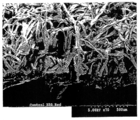
도 6은 실시예 1의 대조 와이팔(Wypall)(R) X80 레드 와이퍼 샘플의 펄프 측면의 SEM 사진이다.FIG. 6 is an SEM image of the pulp side of a control Wipal (R) X80 red wiper sample of Example 1. FIG.
도 7은 실시예 1의 대조 와이팔(R) X80 레드 와이퍼 샘플의 펄프 측면의 SEM 사진(45도 단면)이다.FIG. 7 is an SEM image (45 degree cross section) of the pulp side of the control wipal (R) X80 red wiper sample of Example 1. FIG.
도 8은 실시예 1의 대조 와이팔(R) X80 레드 와이퍼 샘플의 스펀본드 측면의 SEM 사진이다.FIG. 8 is an SEM image of the spunbond side of a control wipal (R) X80 red wiper sample of Example 1. FIG.
도 9는 간격이 0.014인치이고 선 속도가 17피트/분인 실시예 1의 연마된 와이팔(R) X80 레드 와이퍼 샘플(1회 통과)의 펄프 측면의 SEM 사진이다.FIG. 9 is an SEM image of the pulp side of the polished wipal (R) X80 red wiper sample (one pass) of Example 1 with a spacing of 0.014 inches and a line speed of 17 feet / minute.
도 10은 간격이 0.014인치이고 선 속도가 17피트/분인 실시예 1의 연마된 와이팔(R) X80 레드 와이퍼 샘플(2회 통과)의 스펀본드 측면의 SEM 사진이다. FIG. 10 is an SEM image of the spunbond side of the polished wipal (R) X80 red wiper sample (2 passes) of Example 1 with a spacing of 0.014 inches and a line speed of 17 feet / minute.
도 11은 실시예 2의 샘플 4의 SEM 사진(45도 단면)이다.FIG. 11 is an SEM photograph (45 degree cross section) of Sample 4 of Example 2. FIG.
본 명세서 및 도면에서 참조 번호의 반복 사용은 본 발명의 동일하거나 유사한 특징 또는 요소를 나타내는 것으로 해석된다.Repeat use of reference numerals in the present specification and drawings is to be construed as indicating the same or similar features or elements of the present invention.
대표적 구현양태의 상세한 설명Detailed Description of Representative Embodiments
이제, 본 발명의 다양한 구현양태를 상세히 언급할 것이고, 이것의 하나 이상의 실시예는 이하에 설명된다. 각각의 실시예는 본 발명을 제한하지 않고 단지 본 발명을 설명하기 위해 제공된다. 사실상, 본 발명의 범위 또는 범주에서 벗어나지 않으면서 본 발명에서 다양한 변형 및 변화를 행할 수 있다는 것이 당업자에게 분명할 것이다. 예를들어, 하나의 구현양태의 일부로서 예증되거나 설명된 특징들이 다른 구현양태에서 사용되어 또 다른 구현양태를 만들 수 있다. 즉, 본 발명은 첨부된 청구범위의 범위 내에 속하는 변형 및 변화와 이들의 균등물을 포함하는 것으로 해석된다.Reference will now be made in detail to various embodiments of the invention, one or more embodiments of which are described below. Each example is provided by way of explanation of the invention, not limitation of the invention. In fact, it will be apparent to those skilled in the art that various modifications and variations can be made in the present invention without departing from the scope or scope of the invention. For example, features illustrated or described as part of one embodiment can be used in another embodiment to make another embodiment. That is, the present invention is construed to include modifications and variations that fall within the scope of the appended claims and their equivalents.
정의Justice
여기에서 사용된 용어 "부직 웹"은 편직물에서와 같이 확인가능한 방식으로 가 아니라 각각의 섬유 또는 실이 서로 끼워진 구조를 가진 웹을 가리킨다. 부직 웹은 예를들어 멜트블로운 웹, 스펀본드 웹, 카디드 웹, 에어레이드 웹 등을 포함한다.The term "nonwoven web" as used herein refers to a web having a structure in which each fiber or thread is fitted together, rather than in a verifiable manner as in a knitted fabric. Nonwoven webs include, for example, meltblown webs, spunbond webs, carded webs, airlaid webs, and the like.
여기에서 사용된 용어 "스펀본드 웹"은 소 직경의 실질적으로 연속 섬유로부터 형성된 부직 웹을 가리킨다. 섬유는, 압출된 섬유의 직경을 가진 방사구의 다수의 미세하고 통상 원형의 모세관으로부터 용융된 열가소성 물질을 필라멘트로서 압출한 다음, 이것을 예를들어 끌어내는 인발 및(또는) 기타 공지된 스펀본드 메카니즘에 의해 직경을 급격히 감소시킴으로써 형성된다. 스펀본드 웹의 제조는 예를들어 미국 특허 4,340,563호 (Appel 등), 제3,692,618호(Dorschner 등), 3,802,817호 (Matsuki 등), 3,338,992호(Kinney), 3,341,394호(Kinney), 3,502,763호 (Hartman), 3,502,538호 (Levy), 3,542,615호 (Dobo 등) 및 5,382,400호 (Pike 등) (이들의 개시내용은 모든 목적을 위하여 그 전체 내용이 본원에 참고문헌으로 포함된다)에 기재되고 예증되어 있다. 스펀본드 섬유는 일반적으로 수집 표면 위에 침착될 때 점성이 아니다. 스펀본드 섬유는 약 40마이크론 미만의 직경을 갖고 약 5 내지 약 20마이크론이다.The term “spunbond web” as used herein refers to a nonwoven web formed from a substantially continuous fiber of small diameter. The fibers may be extruded from a plurality of fine, usually circular capillaries of spinneret with the diameter of the extruded fibers as filaments, and then drawn, for example, into a drawing and / or other known spunbond mechanism. Thereby rapidly decreasing the diameter. The manufacture of spunbond webs is described, for example, in U.S. Pat. , 3,502,538 (Levy), 3,542,615 (Dobo et al.) And 5,382,400 (Pike et al.), The disclosures of which are incorporated herein by reference in their entirety for all purposes. Spunbond fibers are generally not viscous when deposited onto a collecting surface. Spunbond fibers have a diameter of less than about 40 microns and are about 5 to about 20 microns.
여기에서 사용된 용어 "멜트블로운 웹"이란, 다수의 미세하고 통상 원형의 다이 모세관을 통하여, 용융된 섬유를 용융된 열가소성 물질의 섬유를 가늘게 하여 그들의 직경 (마이크로섬유 직경일 수도 있음)을 감소시키는 집적 고속 기체(예, 공기) 흐름 내로 압출시킨 섬유로부터 형성되어진 부직 웹을 가리킨다. 그 후에, 멜트블로운 섬유가 고속 기체 흐름에 의해 운반되고 수집 표면 상에 침착되어 랜덤 하게 분산된 멜트블로운 섬유 웹을 형성한다. 이러한 공정은 예를들어 미국 특허 3,849,241호 (Butin 등) (전체 내용이 모든 목적을 위해 본원에 참고문헌으로 포함된다)에 개시되어 있다. 일부 경우에, 멜트블로운 섬유는 연속 또는 불연속일 수도 있는 마이크로섬유일 수도 있고, 일반적으로 10마이크론 미만의 직경을 가지며, 일반적으로 수집 표면 상에 침착될 때 점성이다.The term "meltblown web" as used herein, through a number of fine, usually circular die capillaries, thins the melted fibers of the molten thermoplastic material to reduce their diameters (which may be microfiber diameters). Refers to a nonwoven web formed from fibers extruded into an integrated high velocity gas (eg, air) stream. Thereafter, the meltblown fibers are carried by the high velocity gas stream and are deposited on a collecting surface to form a randomly dispersed meltblown fibrous web. Such a process is disclosed, for example, in US Pat. No. 3,849,241 to Butin et al., The entire contents of which are incorporated herein by reference for all purposes. In some cases, the meltblown fibers may be microfibers, which may be continuous or discontinuous, and generally have a diameter of less than 10 microns and are generally viscous when deposited on a collecting surface.
여기에서 사용된 바와 같이 용어 "다성분 섬유" 또는 "콘쥬게이트 섬유"는 적어도 2개의 중합체 성분으로부터 형성되어진 섬유를 가리킨다. 이러한 섬유는 보통 별개의 압출기로부터 압출되지만 함께 방사되어 하나의 섬유를 형성한다. 다성분 섬유가 유사하거나 동일한 중합체 물질의 별개 성분들을 포함할 수도 있긴 하지만, 각각의 성분들의 중합체는 보통 서로 상이하다. 각각의 성분들은 전형적으로 섬유의 단면을 가로질러 실질적으로 일정하게 배치된 뚜렷한 지역에 배열되고, 섬유의 전체 길이를 따라 실질적으로 길게 뻗는다. 이러한 섬유의 배치는 예를들어 병렬식 배열, 파이 배열 또는 기타 다른 배열일 수도 있다. 이성분 섬유 및 이의 제조 방법은 미국 특허 5,108,820호(Kaneko 등), 4,795,668호(Kruege 등), 5,382,400호(Pike 등), 5,336,552호 (Strack 등) 및 6,200,669호 (Marmon 등)에 교시되어 있다(이들의 전체 개시내용이 모든 목적을 위해 본원에 참고문헌으로 포함된다). 섬유 및 이를 함유하는 개개의 성분들은 미국 특허 5,277,976호(Hogle 등), 5,162,074호 (Hills), 미국 특허 5,466,410호(Hills), 5,069,970호 (Largman 등), 및 5,057,368호 (Largman 등) (이들은 모든 목적을 위해 그 전체내용이 본원에 참고문헌으로 포함된다)에 기재된 것과 같은 다양한 불규칙 형태를 가질 수도 있 다.As used herein, the term “multicomponent fiber” or “conjugate fiber” refers to a fiber formed from at least two polymer components. These fibers are usually extruded from separate extruders but spun together to form one fiber. Although multicomponent fibers may comprise separate components of similar or identical polymeric materials, the polymers of the respective components are usually different from each other. Each of the components is typically arranged in distinct areas arranged substantially uniformly across the cross section of the fiber and extends substantially long along the entire length of the fiber. The arrangement of such fibers may be for example a parallel arrangement, a pi arrangement or any other arrangement. Bicomponent fibers and methods of making the same are taught in US Pat. The entire disclosure of is incorporated herein by reference for all purposes). Fibers and the individual components containing them are described in US Pat. Nos. 5,277,976 (Hogle et al.), 5,162,074 (Hills), US Pat. Nos. 5,466,410 (Hills), 5,069,970 (Largman et al.), And 5,057,368 (Largman et al.) For its entirety, which is incorporated herein by reference in its entirety.
여기에서 사용된 용어 "평균 섬유 길이"는 카자아니 섬유 분석장치 모델 번호 FS-100 (카자아니 오이 일렉트로닉스(Kajaani Oy Electronics), 핀랜드 카자아니로부터 입수가능함)을 사용하여 결정된 펄프 섬유의 중량 평균 길이를 가리킨다. 시험 절차에 따르면, 펄프 다발이나 파편이 존재하지 않도록 부드럽게 하는 액체로 펄프 샘플을 처리한다. 각각의 펄프 샘플을 열수에 붕해시키고 약 0.001% 용액으로 희석한다. 표준 카자아니 섬유 분석 시험 절차를 사용하여 시험할 때 각각의 시험 샘플을 희석 용액으로부터 약 50 내지 100ml 분량으로 배수시킨다. 중량 평균 섬유 길이를 하기 수학식으로 표현할 수도 있다:The term "average fiber length" as used herein refers to the weight average length of pulp fibers determined using the Kazaani fiber analyzer model number FS-100 (available from Kajaani Oy Electronics, Finland Kazaani). Point. According to the test procedure, pulp samples are treated with a liquid that softens the absence of pulp bundles or debris. Each pulp sample is disintegrated in hot water and diluted with about 0.001% solution. Each test sample is drained from the dilution solution in about 50-100 ml portions when tested using standard Kazaani fiber analysis test procedures. The weight average fiber length may be expressed by the following equation:

상기 식에서,Where
k = 최대 섬유 길이k = maximum fiber length
xi = 섬유 길이x i = fiber length
ni = 길이 xi를 가진 섬유의 수; 및n i = number of fibers of length x i ; And
n = 측정된 섬유의 총 수n = total number of fibers measured
여기에서 사용된 용어 "저-평균 섬유 길이 펄프"란 상당한 양의 단 섬유 및 비-섬유 입자를 함유하는 펄프를 가리킨다. 많은 부수적인 목재 섬유 펄프는 저 평균 섬유 길이 펄프로 간주될 수 있지만; 2차 목재 섬유 펄프의 품질은 재생 섬유 의 품질 및 이전의 공정 유형 및 양에 의존할 것이다. 저-평균 섬유 길이 펄프는 예를들어 카자아니 섬유 분석장치 모델 번호 FS-100 (카자아니 오이 일렉트로닉스, 핀랜드 카자아니)에 의해 결정된 약 1.2밀리미터 미만의 평균 섬유 길이를 가질 수도 있다. 예를들어, 저 평균 섬유 길이 펄프는 약 0.7 내지 약 1.2밀리미터 범위의 평균 섬유 길이를 가질 수도 있다.As used herein, the term "low-average fiber length pulp" refers to pulp that contains a significant amount of short and non-fiber particles. Many incident wood fiber pulp can be considered as low average fiber length pulp; The quality of the secondary wood fiber pulp will depend on the quality of the recycled fiber and the type and amount of the previous process. The low-average fiber length pulp may have an average fiber length of less than about 1.2 millimeters as determined, for example, by Kazaani fiber analyzer model number FS-100 (Kazania cucumber electronics, Finland Kazaani). For example, the low average fiber length pulp may have an average fiber length in the range of about 0.7 to about 1.2 millimeters.
여기에서 사용된 용어 "고-평균 섬유 길이 펄프"란 비교적 소량의 단 섬유 및 비-섬유 입자를 함유하는 펄프를 가리킨다. 고-평균 섬유 길이 펄프는 전형적으로 특정한 비-2차 (즉, 처녀)섬유로부터 형성된다. 선별되어진 2차 섬유 펄프는 고-평균 섬유 길이를 가질 수도 있다. 고-평균 섬유 길이 펄프는 전형적으로 광학 섬유 분석장치, 예를들어 카자아니 섬유 분석장치 모델번호 FS-100 (카자아니 오이 일렉트로닉스, 핀랜드 카자아니)에 의해 결정시에 약 1.5밀리미터 초과의 평균 섬유 길이를 갖는다. 예를들어, 고-평균 섬유 길이 펄프는 약 1.5 내지 약 6밀리미터의 평균 섬유 길이를 가질 수도 있다.The term "high-average fiber length pulp" as used herein refers to pulp containing relatively small amounts of short and non-fiber particles. High-average fiber length pulp is typically formed from certain non-secondary (ie virgin) fibers. The secondary fiber pulp that has been screened may have a high-average fiber length. High-average fiber length pulp typically has an average fiber length of greater than about 1.5 millimeters, as determined by an optical fiber analyzer, for example, Kazaani fiber analyzer model number FS-100 (Kazani cucumber electronics, Finland Kazaani). Have For example, the high-average fiber length pulp may have an average fiber length of about 1.5 to about 6 millimeters.
일반적으로, 본 발명은 연마되어진(예를들어 사포질된) 하나 이상의 표면을 함유한 부직 복합 직물에 관한 것이다. 부직 복합 직물의 유연성 및 손감촉을 개선시키는 것에 추가로, 뜻밖에도 이러한 직물을 연마시키는 것이 뛰어난 액체 취급 성질(예, 흡수 능력, 흡수 속도, 흡상 속도 등) 뿐만 아니라 개선된 벌크 및 모세관 장력을 부여할 수 있다는 것을 알아내었다.In general, the present invention relates to nonwoven composite fabrics that contain one or more surfaces that have been polished (eg, sanded). In addition to improving the flexibility and hand feel of nonwoven composite fabrics, unexpectedly, polishing these fabrics can impart improved bulk and capillary tension as well as excellent liquid handling properties (eg, absorption capacity, absorption rate, wicking rate, etc.). I found out that I could.
부직 복합 직물은 흡수성 스테이플 섬유 및 열가소성 섬유를 함유하고, 이것은 다양한 이유에서 유리하다. 예를들어, 부직 복합 직물의 열가소성 섬유는 강도, 내구성 및 오일 흡수 성질을 개선시킬 수도 있다. 유사하게, 흡수성 스테이플 섬유는 벌크, 손감촉 및 물 흡수 성질을 개선시킬 수 있다. 부직 복합 직물에서 사용된 열가소성 섬유 및 흡수성 스테이플 섬유의 상대 량은 원하는 성질에 따라 변할 수도 있다. 예를들어, 열가소성 섬유는 부직 복합 직물의 약 50중량% 미만을 구성할 수 있고, 일부 구현양태에서 부직 복합 직물의 약 10중량% 내지 약 40중량%를 구성할 수도 있다. 유사하게, 흡수성 스테이플 섬유는 부직 복합 직물의 약 50중량% 초과를 구성하고 일부 구현양태에서 부직 복합 직물의 약 60 중량% 내지 약 90중량%를 구성할 수도 있다.Nonwoven composite fabrics contain absorbent staple fibers and thermoplastic fibers, which are advantageous for a variety of reasons. For example, thermoplastic fibers of nonwoven composite fabrics may improve strength, durability, and oil absorption properties. Similarly, absorbent staple fibers can improve bulk, hand feel, and water absorption properties. The relative amounts of thermoplastic fibers and absorbent staple fibers used in nonwoven composite fabrics may vary depending on the desired properties. For example, the thermoplastic fibers may comprise less than about 50% by weight of the nonwoven composite fabric, and in some embodiments may comprise from about 10% to about 40% by weight of the nonwoven composite fabric. Similarly, the absorbent staple fibers may comprise more than about 50 weight percent of the nonwoven composite fabric and, in some embodiments, from about 60 weight percent to about 90 weight percent of the nonwoven composite fabric.
흡수성 스테이플 섬유는 각종 상이한 물질로부터 형성될 수도 있다. 예를들어, 하나의 구현양태에서, 흡수성 스테이플 섬유는 비-열가소성이고, 셀룰로스 섬유(예, 펄프, 열기계적 펄프, 합성 셀룰로스 섬유, 개질 셀룰로스 섬유 등) 뿐만 아니라 다른 유형의 비-열가소성 섬유(예, 합성 스테이플 섬유)를 함유한다. 적절한 셀룰로스 섬유 원료의 일부 예는 처녀 목재 섬유, 예를들어 열기계적, 표백 및 비표백 연질목재 및 경질목재 펄프를 포함한다. 예컨대 사무실 폐지, 신문, 갈색포장지, 종이판지 조각 등으로부터 얻어지는 2차 또는 재생 섬유를 사용할 수도 있다. 또한, 마닐라삼, 아마, 밀크위드, 목화, 개질목화, 목화 린터와 같은 식물성 섬유를 사용할 수도 있다. 또한, 예를들어 레이온 및 비스코스 레이온과 같은 합성 셀룰로스 섬유가 사용될 수도 있다. 개질된 셀룰로스 섬유가 또한 사용될 수도 있다. 예를들어 흡수성 스테이플 섬유는 탄소 사슬을 따라 히드록실기를 적절한 라디칼(예, 카르복실, 알킬, 아세테이트, 니트레이트 등)로 치환함으로써 형성된 셀룰로스 유도체로 구성될 수도 있다. 언급된 바와 같이, 비-셀룰로스 섬유는 흡수성 스테이플 섬유로서 사용될 수도 있다. 이러한 흡수성 스테이플 섬유의 예는 이에 한정되지 않지만 아세테이트 스테이플 섬유, 노멕스(Nomex)(R) 스테이플 섬유, 케블라(Kevalr)(R) 스테이플 섬유, 폴리비닐 알콜 스테이플 섬유, 리오셀 스테이플 섬유 등을 포함한다.Absorbent staple fibers may be formed from a variety of different materials. For example, in one embodiment, the absorbent staple fibers are non-thermoplastic, and include cellulose fibers (eg, pulp, thermomechanical pulp, synthetic cellulose fibers, modified cellulose fibers, etc.) as well as other types of non-thermoplastic fibers (eg Synthetic staple fibers). Some examples of suitable cellulose fiber raw materials include virgin wood fibers such as thermomechanical, bleached and unbleached softwood and hardwood pulp. For example, secondary or recycled fibers obtained from office waste paper, newspapers, brown wrapping paper, pieces of paperboard, or the like may be used. In addition, vegetable fibers such as manila hemp, flax, milkweed, cotton, modified cotton, and cotton linter may also be used. In addition, synthetic cellulose fibers such as, for example, rayon and viscose rayon may also be used. Modified cellulose fibers may also be used. For example, the absorbent staple fibers may be composed of cellulose derivatives formed by substituting hydroxyl groups with suitable radicals (eg, carboxyl, alkyl, acetate, nitrate, etc.) along the carbon chain. As mentioned, non-cellulose fibers may be used as absorbent staple fibers. Examples of such absorbent staple fibers include, but are not limited to, acetate staple fibers, Nomex (R) staple fibers, Kevalr (R) staple fibers, polyvinyl alcohol staple fibers, lyocell staple fibers, and the like. .
흡수성 스테이플 섬유로서 사용될 때, 펄프 섬유는 고-평균 섬유 길이, 저-평균 섬유 길이 또는 이들의 혼합물을 가질 수도 있다. 적절한 고-평균 길이 펄프 섬유의 일부 예는 이에 한정되지 않지만 북부 연질목재, 남부 연질목재, 미국삼나무, 연필향나무, 북아메리카산 솔송나무, 소나무(예, 남부 소나무), 가문비나무 (예, 검은 가문비나무), 이들의 조합 등을 포함한다. 고-평균 섬유 길이 목재 펄프의 예는 상표명 "롱랙(Longlac) 19"로 킴벌리-클라크 코포레이션으로부터 입수가능한 것이다. 적절한 저-평균 섬유 길이 펄프 섬유의 일부 예는 이에 한정되지 않지만 예컨대 신문, 재생이용된 판자 및 사무실 폐지와 같은 원료로부터 특정한 처녀 경질목재 펄프 및 2차(즉, 재생) 섬유 펄프를 포함할 수도 있다. 경질목재 섬유, 예컨대 유칼립투스, 단풍나무, 자작나무, 사시나무포플러 등을 저-평균 길이 펄프 섬유로서 사용할 수도 있다. 고-평균 섬유 길이 및 저-평균 섬유 길이 펄프의 혼합물을 사용할 수도 있다. 예를들어, 혼합물은 50중량% 이상의 저-평균 섬유 길이 펄프 및 50중량% 미만의 고-평균 섬유 길이 펄프를 함유할 수도 있다. 일례의 혼합물은 75중량% 저-평균 섬유 길이 펄프 및 약 25중량% 고-평균 섬유 길이 펄프를 함유한다.When used as absorbent staple fibers, the pulp fibers may have a high-average fiber length, a low-average fiber length, or a mixture thereof. Some examples of suitable high-average length pulp fibers include, but are not limited to, northern softwood, southern softwood, American cedar, cedar, North American pine, pine (such as southern pine), spruce (such as black spruce). ), Combinations thereof, and the like. An example of a high-average fiber length wood pulp is available from Kimberly-Clark Corporation under the trade name "Longlac 19". Some examples of suitable low-average fiber length pulp fibers may include, but are not limited to, certain virgin hardwood pulp and secondary (ie, recycled) fiber pulp from raw materials such as newspapers, recycled planks, and office waste paper, for example. . Hardwood fibers such as eucalyptus, maple, birch, aspen poplar and the like may also be used as low-average length pulp fibers. It is also possible to use mixtures of high-average fiber lengths and low-average fiber length pulp. For example, the mixture may contain at least 50% by weight low-average fiber length pulp and less than 50% by weight high-average fiber length pulp. An exemplary mixture contains 75 wt% low-average fiber length pulp and about 25 wt% high-average fiber length pulp.
언급된 바와 같이, 부직 복합 직물은 열가소성 섬유를 함유한다. 열가소성 섬유는 실질적으로 연속일 수도 있거나, 또는 약 0.1밀리미터 내지 약 25밀리미터의 평균 섬유 길이를 가진 스테이플 섬유일 수도 있고, 일부 구현양태에서 약 0.5밀리미터 내지 약 10밀리미터일 수도 있으며, 일부 구현양태에서 약 0.7밀리미터 내지 약 6밀리미터일 수도 있다. 섬유 길이에 무관하게, 열가소성 섬유는 이에 한정되지 않지만 폴리올레핀, 폴리아미드, 폴리에스테르, 폴리우레탄, 이들의 배합물 및 공중합체를 포함한 다양한 종류의 중합체로부터 형성될 수도 있다. 바람직하게는, 열가소성 섬유는 폴리올레핀, 더욱 더 바람직하게는 폴리프로필렌 및(또는) 폴리에틸렌을 함유한다. 적절한 중합체 조성물은 그 안에 배합된 열가소성 엘라스토머를 가질 수도 있을 뿐만 아니라 안료, 산화방지제, 유동 촉진제, 안정화제, 향료, 연마 입자, 충진제 등을 함유할 수 있다. 임의로, 다성분(예, 이성분) 열가소성 섬유가 사용된다. 예를들어, 다성분 섬유를 위해 적절한 배치는 병렬식 배치 및 시쓰-코어 배치를 포함하고, 적절한 시쓰-코어 배치는 편심 시쓰-코어 및 동심 시쓰-코어 배치를 포함한다. 일부 구현양태에서, 당업자에게 잘 알려진 바와 같이, 다성분 섬유를 형성하기 위해 사용되는 중합체는 상이한 결정화 및(또는) 고형화 성질을 형성하기 위해 충분히 상이한 융점을 갖는다. 다성분 섬유는 약 20중량% 내지 약 80중량%, 일부 구현양태에서 약 40중량% 내지 약 60중량%의 저 융점 중합체를 가질 수도 있다. 또한, 다성분 섬유는 약 80중량% 내지 약 20중량%, 일부 구현양태에서는 약 60중량% 내지 약 40중량%의 고 융점 중합체를 가질 수도 있다.As mentioned, the nonwoven composite fabric contains thermoplastic fibers. The thermoplastic fibers may be substantially continuous, or may be staple fibers having an average fiber length of about 0.1 millimeters to about 25 millimeters, in some embodiments may be about 0.5 millimeters to about 10 millimeters, and in some embodiments about 0.7 millimeters to about 6 millimeters. Regardless of fiber length, thermoplastic fibers may be formed from various types of polymers including, but not limited to, polyolefins, polyamides, polyesters, polyurethanes, combinations and copolymers thereof. Preferably, the thermoplastic fibers contain polyolefins, even more preferably polypropylene and / or polyethylene. Suitable polymer compositions may not only have thermoplastic elastomers blended therein, but may also contain pigments, antioxidants, flow promoters, stabilizers, flavorings, abrasive particles, fillers, and the like. Optionally, multicomponent (eg bicomponent) thermoplastic fibers are used. For example, suitable arrangements for multicomponent fibers include parallel placement and sheath-core placement, and suitable sheath-core placements include eccentric sheath-core and concentric sheath-core placement. In some embodiments, as is well known to those skilled in the art, the polymers used to form the multicomponent fibers have sufficiently different melting points to form different crystallization and / or solidification properties. The multicomponent fiber may have a low melting polymer of about 20% to about 80% by weight, in some embodiments from about 40% to about 60% by weight. In addition, the multicomponent fiber may have a high melting point polymer of about 80% to about 20% by weight, and in some embodiments, about 60% to about 40% by weight.
열가소성 섬유 및 흡수성 스테이플 섬유 이외에도, 부직 복합 직물은 다양한 기타 물질을 함유할 수도 있다. 예를들어, 강도 및 내마모성을 개선하기 위하여 소량의 습윤-강도 수지 및(또는) 수지 결합제를 이용할 수도 있다. 수소 결합 정도를 감소시키기 위하여 박리제를 사용할 수도 있다. 복합 층의 약 1중량% 내지 약 4중량%의 양으로 특정한 박리제를 첨가하면, 측정된 정적 및 동적 마찰 계수를 감소시킬 수도 있고 내마모성을 개선시킬 수도 있다. 예를들어 활성 목탄, 점토, 전분, 초흡수성 물질 등과 같은 다양한 기타 물질이 또한 사용될 수 있다.In addition to thermoplastic fibers and absorbent staple fibers, the nonwoven composite fabric may contain a variety of other materials. For example, small amounts of wet-strength resins and / or resin binders may be used to improve strength and wear resistance. Release agents may also be used to reduce the degree of hydrogen bonding. The addition of certain release agents in an amount from about 1% to about 4% by weight of the composite layer may reduce the measured static and dynamic coefficient of friction and may improve wear resistance. Various other materials may also be used, such as, for example, activated charcoal, clay, starch, superabsorbent materials and the like.
일부 구현양태에서, 예를들어, 당 기술분야에 공지된 다양한 결합 기술(예, 수력, 공기, 기계적 등)을 사용하여 열가소성 섬유를 흡수성 스테이플 섬유와 일체식으로 결합시킴으로써 부직 복합 직물이 형성된다. 예를들어, 하나의 구현양태에서, 열가소성 섬유로부터 형성된 부직 웹을 수력 결합을 사용하여 흡수성 스테이플 섬유와 일체적으로 결합시킨다. 전형적인 수력 결합 공정은 섬유 및(또는) 필라멘트를 결합시켜 고도로 결합된 강화 복합 구조를 형성하기 위하여 고압 수류를 사용한다. 수력 결합 부직 복합 재료는 예를들어 미국 특허 3,494,821호 (Evans); 4,144,370호(Bouolton); 5,284,703호 (Everhart 등); 및 6,315,864호 (Anderson 등) (이들의 전체 개시내용은 모든 목적을 위하여 본원에 참고문헌으로 포함된다)에 개시되어 있다.In some embodiments, a nonwoven composite fabric is formed by integrally combining thermoplastic fibers with absorbent staple fibers using, for example, various bonding techniques known in the art (eg, hydraulic, air, mechanical, etc.). For example, in one embodiment, the nonwoven web formed from the thermoplastic fibers is integrally bonded with the absorbent staple fibers using hydraulic bonding. Typical hydraulic bonding processes use high pressure water flow to bond fibers and / or filaments to form highly bonded reinforced composite structures. Hydraulically bonded nonwoven composites are described, for example, in US Pat. No. 3,494,821 (Evans); 4,144,370 to Bouolton; 5,284,703 to Everhart et al .; And 6,315,864 to Anderson et al., The entire disclosures of which are incorporated herein by reference for all purposes.
도 1을 참조하면, 예를들어 부직 웹 및 펄프 섬유로부터 부직 복합 직물을 형성하기 위해 적합한 수력 결합 공정의 하나의 구현양태가 도시되어 있다. 나타낸 바와 같이, 펄프 섬유를 함유하는 섬유 슬러리를 통상적인 제지 헤드박스(12)로 운반하고, 이곳에서 수로(14)를 통해 통상적인 성형 직물 또는 표면(16) 위에 침착시킨다. 펄프 섬유의 현탁액은 통상적인 제지 공정에서 전형적으로 사용되는 점조도를 가질 수도 있다. 예를들어, 현탁액은 물에 현탁된 약 0.01 내지 약 1.5중량%의 펄프 섬유를 함유할 수도 있다. 이어서, 펄프 섬유의 균일한 층(18)을 형성하기 위하여 펄프 섬유의 현탁액으로부터 물을 제거한다.Referring to FIG. 1, one embodiment of a suitable hydrobonding process is shown, for example, for forming a nonwoven composite fabric from nonwoven webs and pulp fibers. As shown, the fiber slurry containing pulp fibers is transported to a
부직 웹(20)이 회전 공급 롤(22)로부터 풀려서, 적층 롤러(28) 및 (30)에 의해 형성된 S-롤 배열(26)의 닙(24)을 통해 통과된다. 부직 웹(20)을 형성하기 위해 다양한 기술이 사용될 수도 있다. 예를들어, 하나의 구현양태에서, 통상적인 카아딩 공정, 예를들어 모 또는 면 카아딩 공정을 사용하여 부직 웹(20)을 형성하기 위해 스테이플 섬유가 사용된다. 그러나, 스테이플 섬유 웹을 형성하기 위하여 에어 레이드 또는 웨트 레이드 공정과 같은 다른 공정이 사용될 수도 있다. 또한, 스펀본드, 멜트블로잉 등과 같은 용융-방사 공정에 의해 형성되는 것과 같은 부직 웹(20)을 형성하기 위하여 실질적으로 연속적인 웹을 사용할 수도 있다. The
내구성, 강도, 손감촉, 미학 및(또는) 기타 성질을 개선하기 위하여 부직 웹(20)을 접착시킬 수도 있다. 예를들어, 부직 웹(20)을 열적, 초음파, 접착제 및(또는) 기계적 접착시킬 수도 있다. 일례로서, 다수의 작은 별개의 접착 지점을 가질 수 있도록 부직 웹(20)을 점 접착시킬 수도 있다. 일례의 점 접착 공정은 열 점 접착이고, 이는 일반적으로 제판(engraved) 패턴화 롤 및 두번째 접착 롤과 같은 가열된 롤 사이에 하나 이상의 층을 통과시키는 것을 포함한다. 제판된 롤은 웹이 전체 표면 위에서 접착되지 않도록 하는 방식으로 패턴화되고, 두번째 롤은 매끄럽거나 패턴화될 수도 있다. 그 결과, 기능적 이유 뿐만 아니라 미적 이유에서 제판된 롤을 위한 다양한 패턴이 개발되었다. 일례의 접착 패턴은 이에 한정되지 않지만 미국 특허 3,855,046호(Hansen 등), 5,620,779호 (Levy 등), 5,962,112호 (Haynes 등), 6,093,665호 (Sayovitz 등), 미국 의장 특허 428,267호 (Romano 등) 및 미국 의장 특허 390,708호 (Brown) (이들의 전체 내용은 모든 목적을 위해 본원에 참고문헌으로 포함된다)를 포함한다. 예를들어, 일부 구현양태에서, 부직 웹(20)을 약 30% (통상적인 광학 현미경 방법에 의해 측정됨)미만의 전체 접착 면적 및(또는) 약 100개 접착/평방인치 초과의 균일한 접착 밀도를 갖도록 임의로 접착시킬 수도 있다. 예를들어, 부직 웹은 약 2% 내지 약 30%의 전체 접착 면적 및(또는) 약 250개 내지 약 500개 핀 접착/평방인치의 접착 밀도를 가질 수도 있다. 이러한 전체 접착 면적 및(또는) 접착 밀도의 조합은, 일부 구현양태에서, 매끄러운 모루 롤과 충분히 접촉할 때 약 30% 미만의 전체 접착 표면적을 제공하도록 부직 웹(20)을 약 100개 초과의 핀 접착/평방인치를 가진 핀 접착 패턴과 접착시킴으로써 달성될 수도 있다. 일부 구현양태에서, 결합 패턴은 매끄러운 모루 롤과 접촉할 때 약 250개 내지 약 350개 핀 접착/평방인치의 핀 접착 밀도 및(또는) 약 10% 내지 약25%의 전체 접착 표면적을 가질 수도 있다.The
또한, 부직 웹(20)은 연속적인 이음매 또는 패턴에 의해 결합될 수도 있다. 추가의 예로서, 부직 웹(20)은 시트의 주변을 따라 또는 단순히 가장자리에 인접한 웹의 폭 또는 횡-방향(CD)을 가로질러 접착될 수도 있다. 다른 접착 기술, 예컨대 열 접착 및 라텍스 함침의 조합이 또한 사용될 수도 있다. 대안적으로 및(또는) 추가로, 예를들어 분무 또는 인쇄에 의하여 수지, 라텍스 또는 접착제를 부직 웹(20)에 적용할 수도 있고 건조시켜 원하는 접착을 제공할 수 있다. 또 다른 적절한 접착 기술은 미국 특허 5,284,703호 (Everhart 등), 6,103,061호 (Anderson 등) 및 미국 특허 6,197,404호 (Varona) (이들의 전체 개시내용은 모든 목적을 위해 본원에 참고문헌으로 포함된다)에 기재될 수도 있다.Also, the
도 1을 다시 참조하면, 부직 웹(20)을 통상적인 수력 결합 기계의 다공성 결합 표면(32) 위에 배치하고 여기에서 펄프 섬유 층(18)을 웹(20) 위에 놓는다. 필요하지 않지만, 부직 웹(20)과 수력 결합 다기관(34) 사이에 펄프 섬유 층(18)이 배치되는 것이 전형적으로 바람직하다. 펄프 섬유 층(18) 및 부직 웹(20)이 하나 이상의 수력 결합 다기관(34) 아래를 통과하고, 부직 웹(20)의 섬유와 펄프 섬유 층(18)을 결합시키기 위해 수류로 처리하고, 이들을 부직 웹(20)을 통해 보내어 부직 복합 직물(36)을 형성한다. 대안적으로, 웨트-레잉이 일어나는 동일한 다공성 스크린(예, 메쉬 직물) 위에 펄프 섬유 층(18)과 부직 웹(20)이 존재하는 동안에 수력 결합이 일어날 수도 있다. 본 발명은 또한 건조된 펄프 섬유 층(18)을 부직 웹(20) 위에 겹쳐 놓고, 건조된 시트를 규정된 점조도로 재수화한 다음, 재수화된 시트를 수력 결합시키는 것을 포함한다. 펄프 섬유 층(18)이 물로 고도 포화되는 동안에 수력 결합이 일어날 수도 있다. 예를들어, 펄프 섬유 층(18)은 수력 결합 전에 약 90중량% 이하의 물을 함유할 수도 있다. 대안적으로, 펄프 섬유 층(18)은 에어-레이드 또는 건식-레이드 층일 수도 있다.Referring again to FIG. 1, a
수력 결합은 예를들어 미국 특허 5,284,703호(Everhart 등) 및 3,485,706호 (Evans) (여기에서 모든 목적을 위해 그 전체내용이 본원에 참고문헌으로 포함된다)에 기재된 것과 같은 통상적인 수력 결합 장치를 사용하여 달성될 수 있다. 수력 결합은 예를들어 물과 같은 적절한 작업 유체에 의해 수행될 수 있다. 작업 유체는 유체를 일련의 홀 또는 구멍에 고르게 분포시키는 다기관을 통하여 유동된다. 이러한 홀 또는 구멍은 약 0.003 내지 약 0.015인치의 직경일 수도 있고 하나 이상의 열에서 다수의 구멍, 예를들어 각각의 열에서 인치당 30 내지 100개의 구멍을 갖도록 배열될 수도 있다. 예를들어, 노쓰캐롤라이나 샤롯트의 플레이스너 인코포레이티드(Fleissner, Inc.)에 의해 제조된, 0.007인치 직경 구멍, 인치당 30개 홀, 및 1열의 구멍을 함유하는 다기관이 사용될 수도 있다. 그러나, 다수의 기타 다기관 배열 및 조합이 사용될 수도 있음을 이해해야 한다. 예를들어, 단일 다기관이 사용될 수도 있거나 다수의 다기관이 연속적으로 배열될 수도 있다. 또한, 요구되지는 않지만, 수력 결합 동안에 전형적으로 사용되는 유체 압력은 약 1000 내지 약 3000psig, 일부 구현양태에서 약 1200 내지 약 1800psig의 범위이다. 예를들어, 상기 기재된 압력의 상한 범위에서 가공될 때, 부직 복합 직물(36)이 약 1000피트/분(fpm) 이하의 속도로 처리될 수도 있다.Hydraulic coupling uses, for example, conventional hydraulic coupling devices such as those described in US Pat. Nos. 5,284,703 (Everhart et al.) And 3,485,706 (Evans), the entire contents of which are incorporated herein by reference for all purposes. Can be achieved. Hydraulic coupling can be carried out with a suitable working fluid, for example water. The working fluid flows through a manifold that distributes the fluid evenly in a series of holes or holes. Such holes or holes may be between about 0.003 and about 0.015 inches in diameter and may be arranged to have multiple holes in one or more rows, such as 30 to 100 holes per inch in each row. For example, a manifold containing 0.007 inch diameter holes, 30 holes per inch, and a row of holes, manufactured by Fleissner, Inc. of Charlotte, North Carolina, may be used. However, it should be understood that many other manifold arrangements and combinations may be used. For example, a single manifold may be used or multiple manifolds may be arranged in series. In addition, although not required, the fluid pressure typically used during hydraulic coupling is in the range of about 1000 to about 3000 psig, in some embodiments from about 1200 to about 1800 psig. For example, when processed at the upper limits of the pressures described above, the nonwoven
유체는 펄프 섬유 층(18)과 부직 웹(20)에 충격을 가할 수도 있고, 이것은 약 40×40 내지 약 100×100의 메시 크기를 가진 단일 평면 메시와 같은 다공성 표면에 의해 지지된다. 다공성 표면은 약 50×50 내지 약 200× 200의 메시 크기를 가진 다중-겹 메쉬일 수도 있다. 다수의 수류 분출 처리 공정에서와 같이, 진공 슬롯(38)이 유체-니들링 다기관 아래에 또는 결합 다기관의 하류에 있는 다공성 결합 표면(32) 아래에 직접 위치할 수도 있고, 그 결과 과량의 물이 수력 결합 부직 복합 직물(36)로부터 회수된다.The fluid may impact the
어떠한 특정한 이론에도 국한되지 않지만, 부직 웹(20) 위에 놓인 펄프 섬유 층(18)에 직접 충격을 가하는 작업 유체의 원주형 분출이, 부직 웹(20)에 있는 섬유의 기질 또는 망상조직 안으로 그리고 이것을 통해 부분적으로 펄프 섬유를 보내는 역할을 하는 것으로 생각된다. 유체 분출 및 펄프 섬유 층(18)이 부직 웹(20)과 상호작용할 때, 층(18)의 펄프 섬유가 부직 웹(20)의 섬유와 결합하고 상호간에 결합한다. 일부 구현양태에서, 이러한 결합에 의하여, 하나의 표면이 다수의 열가소성 섬유를 가져서 더욱 매끄럽고 더욱 플라스틱과 같은 느낌을 제공하는 반면 다른 표면은 다수의 펄프 섬유를 가져서 더욱 부드럽고 더욱 안정한 느낌을 제공하는 "측면성(sidedness)"을 가진 재료가 얻어질 수도 있다. 다시말해서, 층(18)의 펄프 섬유가 부직 웹(20)의 기질을 통해 그 안으로 들어가기도 하지만, 다수의 펄프 섬유는 여전히 재료(36)의 표면에 또는 표면 근처에 유지될 것이다. 이러한 표면은 상당한 비율의 펄프 섬유를 함유할 수도 있는 반면, 다른 표면은 부직 웹(20)의 상당한 비율의 열가소성 섬유를 함유할 수도 있다.Without wishing to be bound by any particular theory, the columnar ejection of the working fluid that directly impacts the
유체 분출 처리 후에, 얻어지는 부직 복합 직물(36)을 건조 공정(예, 압축, 비-압축, 등)으로 보낼 수도 있다. 수력 니들링 벨트로부터 건조 공정에 재료를 전달하기 위하여 차동 속도 픽업 롤이 사용될 수도 있다. 대안적으로, 통상적인 진공-유형 픽업 및 전달 직물이 사용될 수도 있다. 원한다면, 부직 복합 직물(36)이 건조 공정으로 전달되기 전에 습윤-크레이프화될 수도 있다. 예를들어, 통상적인 관통-건조장치(42)를 사용하여 재료(36)의 비-압축 건조를 달성할 수도 있다. 관통-건조장치(42)는 구멍(46)을 통해 불어넣은 열풍을 수용하기 위한 외부 후드(48)와 함께 구멍(46)을 가진 외부 회전 실린더(44)일 수도 있다. 관통 건조장치 벨트(50)는 관통-건조장치 외부 실린더(40)의 윗부분 위로 부직 복합 직물(36)을 전달한다. 관통-건조장치(42)의 외부 실린더(44)에 있는 구멍(46)을 통해 강제로 들어온 가열된 공기가 부직 복합 직물(36)로부터 물을 제거한다. 관통-건조장치(42)에 의해 부직 복합 직물(36)을 통해 밀어넣어진 공기의 온도는 약 200℉ 내지 약 500℉의 범위일 수도 있다. 다른 유용한 관통-건조 방법 및 장치는 예를들어 미국 특허 2,666,369호(Niks) 및 3,821,068호(Shaw) (이들의 전체내용은 모든 목적을 위해 본원에 참고문헌으로 포함된다)에서 찾아볼 수도 있다. After the fluid jet treatment, the resulting nonwoven
수력 결합 부직 복합 직물에 추가로, 부직 복합 직물은 열가소성 섬유와 흡수성 스테이플 섬유의 배합물을 함유할 수도 있다. 예를들어, 부직 복합 직물은 "코폼" 재료일 수도 있고, 이것은 부직 웹의 형성 동안에 흡수성 스테이플 섬유가 부직 웹에 첨가되어지는 통로인 도랑 근처에 적어도 하나의 멜트블로운 다이 헤드가 배열되는 공정에 의해 제조될 수도 있다. 이러한 코폼 재료의 일부 예는 미국 특허 4,100,324호 (Anderson 등); 5,284,703호 (Everhart 등); 및 5,350,624호 (Georger 등)에 개시되어 있고 이들은 그 전체내용이 모든 목적을 위해 본원에 참고문헌으로 포함된다.In addition to the hydraulically bonded nonwoven composite fabric, the nonwoven composite fabric may contain a blend of thermoplastic fibers and absorbent staple fibers. For example, the nonwoven composite fabric may be a "coform" material, which is a process in which at least one meltblown die head is arranged near a ditch, the passage through which absorbent staple fibers are added to the nonwoven web during formation of the nonwoven web. It may also be prepared by. Some examples of such coform materials are described in US Pat. No. 4,100,324 to Anderson et al .; 5,284,703 to Everhart et al .; And 5,350,624 (Georger et al.), Which are hereby incorporated by reference in their entirety for all purposes.
복합 직물이 형성되는 방식에는 무관하게, 특정 성질을 향상시키기 위하여 복합 직물을 본 발명에 따라 연마 마무리 공정으로 처리할 수도 있다. 다양한 공지된 연마 마무리 공정은 일반적으로 이에 한정되지 않지만 사포질(sanding), 보풀화(napping) 등을 포함한 방법에 의해 수행될 수도 있다. 예를들어, 몇가지 적절한 사포질 공정이 미국 특허 6,269,525호 (Dischler 등); 6,260,247호 (Dischler 등); 6,112,381호 (Dischler 등); 5,662,515호(Evensen); 5,564,971호 (Evensen); 5,531,636호 (Bissen); 5,752,300호 (Dischler 등); 5,815,896호 (Dischler 등); 512,065호(Otto); 4,468,844호(Otto); 및 4,316,928호 (Otto) (이들의 전체내용이 모든 목적을 위해 본원에 참고문헌으로 포함된다)에 기재되어 있다. 본 발명에서 사용하기 위해 적절한 일부 사포질 장치의 예는 커틴-허버트 컴퍼니 인코포레이티드(Curtin-Hebert Co.Inc.) (뉴욕 글로버스빌)로부터 입수가능한 450시리즈, 620시리즈 및 710시리즈 마이크로연마기를 포함한다. Regardless of how the composite fabric is formed, the composite fabric may also be subjected to an abrasive finishing process in accordance with the present invention to enhance certain properties. Various known abrasive finishing processes may generally be performed by methods including, but not limited to, sanding, napping, and the like. For example, some suitable sanding processes are described in US Pat. No. 6,269,525 (Dischler et al.); 6,260,247 to Dischler et al .; 6,112,381 to Dischler et al .; 5,662,515 to Evensen; 5,564,971 to Evensen; 5,531,636 (Bissen); 5,752,300 (Dischler et al.); 5,815,896 to Dischler et al .; 512,065 (Otto); 4,468,844 (Otto); And 4,316,928 (Otto), the entire contents of which are incorporated herein by reference for all purposes. Examples of some sandpaper devices suitable for use in the present invention include 450 series, 620 series and 710 series micropolishing machines available from Curtin-Hebert Co. Inc. (Globusville, NY). do.
단지 예증을 위하여, 적절한 연마 시스템(100)의 한가지 구현양태를 도 2에 나타낸다. 나타낸 바와 같이, 연마 시스템(100)은 복합 직물(36)이 공급되어지는 2개의 핀치 롤(83)을 포함한다. 드라이브 롤(85)은 원하는 방향에서 핀치 롤(83)의 이동을 발동시킨다. 복합 직물(36)이 핀치 롤(83)을 통해 일단 통과되면, 연마 롤(80)과 압력 롤(82) 사이를 통과시킨다. 연마 롤(80)의 표면(81)의 적어도 일부를 사포 또는 사포질 천과 같은 연마 재료로 덮으면, 그 결과 압력 롤(82)이 복합 직물(36)의 표면(90)을 연마 롤(80)의 표면(81)에 맞대어 누를 때 연마가 일어난다. 일반적으로 말하자면, 연마 롤(80)은 시계반대방향 또는 시계방향으로 회전한다. 이러한 방식으로, 연마 롤(80)이 복합 직물(36)의 표면(90)에 대해 바람직한 연마 작용을 부여할 수도 있다. 연마 롤(80)은 연마를 최적화하기 위해 복합 직물(36)과 반대 방향으로 회전할 수도 있다. 즉, 연마 롤(80)은, 복합 직물(36)과의 접촉 지점에서 연마 표면(81)에 대한 접선 방향이 이동 직물(36)의 직선 방향에 반대가 되도록 회전할 수도 있다. 예증된 구현양태에서, 예를들어 롤 회전의 방향은 시계 방향이고 직물 이동 방향은 왼쪽에서 오른쪽이다.For illustrative purposes only, one embodiment of a
연마 시스템(80)은 원하는 수준의 연마 후에 복합 직물(36)의 표면(90)에 남아있는 파편을 제거하기 위해 진공 력을 사용하는 배기 시스템(88)을 포함할 수도 있다. 압력 롤(82)의 표면을 세정하기 위하여 브러시 롤(92)이 사용될 수도 있다. 일단 연마되면, 복합 직물(36)이 핀치 롤(87)을 거쳐 사포질 장치를 떠나고 핀치 롤은 드라이브 롤(89)에 의해 발동된다.The polishing
상기 기재된 바와 같이, 복합 직물(36)은 때때로 다수의 스테이플 섬유(예, 펄프 섬유)를 가진 하나의 표면을 가진 "측면성"을 가질 수도 있다. 하나의 구현양태에서, 연마되어지는 복합 직물(36)의 표면(90)이 다수의 스테이플 섬유를 함유할 수도 있다. 또한, 표면(90)은 부직 웹으로부터 다수의 열가소성 섬유를 함유할 수도 있다. 본 발명자들은 놀랍게도, 유연성 및 손감촉을 개선시키는 것과는 별개로, 하나 이상의 표면을 연마시키는 것이 직물의 다른 물리적 성질, 예컨대 벌크, 흡수 속도, 흡상 속도, 및 흡수 용량을 향상시킬 수도 있다는 것을 알아내었다. 어떠한 이론에 의해 한정되기를 원하지 않지만, 연마 표면은 이것이 접촉하는 표면 섬유를 빗질하거나, 보풀을 세우거나 및(또는) 보풀을 돋게 한다. 그 결과, 섬유이 기계적으로 재-배열되고 복합 재료의 기질로부터 다소 뽑아내진다. 이러한 보풀이 돋은 섬유는 예를들어 펄프 섬유 및(또는) 열가소성 섬유일 수도 있다. 이에 무관하게, 표면 위의 섬유들은 더욱 균일한 외관을 나타내고 직물의 손감촉을 향상시켜 더욱 "천과 같은"재료를 생성한다.As described above, the
연마되어지는 표면의 성질과 무관하게, 복합 직물(36)의 성질이 연마 공정에 의해 변형되는 정도는 다양한 상이한 요인, 예컨대 연마 물질의 크기, 힘 및 롤 접촉 빈도 등에 의존된다. 예를들어, 원하는 수준의 연마를 달성하기 위하여 연마 롤(80)을 덮기 위해 사용되는 연마 재료의 유형을 선택적으로 변형시킬 수도 있다. 예를들어, 연마 재료는 경질 연마 입자, 예컨대 다이아몬드, 탄화물, 붕화물, 금속 의 질화물 및(또는) 규소가 끼워진 기질로부터 형성될 수도 있다. 하나의 구현양태에서, 다이아몬드 연마 입자가 예컨대 미국 특허 4,608,128호(Farmer) (그 전체내용이 모든 목적을 위하여 본원에 참고문헌으로 포함된다)에 기재된 것과 같이 도금된 금속 기질(예, 니켈 또는 크롬) 내에 끼워넣어진다. 더 작은 입자 크기를 가진 연마 입자는 더욱 큰 입자 크기를 가진 것에 비해 더 적은 정도로 표면을 연마시키는 경향이 있다. 즉, 더욱 큰 입자 크기를 사용하는 것이 고 중량 직물을 위해 더욱 적절할 수도 있다. 그러나, 너무 큰 입자 크기를 가진 연마 입자들은 그의 물리적 특징을 파괴하는 정도까지 복합 직물(36)을 연마시킬 수도 있다. 이러한 관계들의 균형을 위하여, 연마 입자의 평균 입자 크기가 약 1 내지 약 1000마이크론, 일부 구현양태에서 약 20 내지 약 200마이크론, 일부 구현양태에서 약 30 내지 약 100마이크론의 범위일 수도 있다.Regardless of the nature of the surface to be polished, the extent to which the properties of the
유사하게, 연마 롤(80)과 접촉하는 더욱 큰 힘 및(또는) 접촉 빈도에 의해 결국 더 높은 수준의 연마가 일어날 수도 있다. 다양한 요인들이 롤 접촉의 힘 및 빈도에 영향을 미칠 수도 있다. 예를들어, 연마 롤(80)에 비해 복합 직물(36)의 선형 속도는 변할 수도 있고, 더욱 높은 선형 속도가 일반적으로 더 높은 수준의 연마에 상응한다. 대부분의 구현양태에서, 복합 직물(36)의 선형 속도는 약 100 내지 약 4000피트/분의 범위이고, 일부 구현양태에서 약 500 내지 약 3400피트/분, 일부 구현양태에서 약 1500 내지 약 3000피트/분일 수도 있다. 또한, 연마 롤(80)은 전형적으로 약 100 내지 약 8,000회전/분(rpm)의 속도로 회전하고, 일부 구현양태에서 약 500 내지 약 6000rpm, 일부 구현양태에서 약 1000 내지 약 4000rpm의 속도로 회전한다. 원한다면, 연마 공정을 개선시키기 위하여 복합 직물(36)과 연마 롤(80) 사이에 속도 차이가 존재한다. Similarly, higher levels of polishing and / or contact frequency in contact with the polishing
압력 롤(82)과 연마 롤(80) 간의 거리 ("간격")은 연마 수준에 영향을 미칠 수도 있고, 거리가 더 적으면 일반적으로 더 높은 수준의 연마가 얻어진다. 예를들어, 압력 롤(82)과 연마 롤(80) 간의 거리는 일부 구현양태에서 약 0.001 인치 내지 약 0.1 인치, 일부 구현양태에서 약 0.01 인치 내지 약 0.05 인치, 일부 구현양태에서 약 0.01 인치 내지 약 0.02인치의 범위일 수도 있다.The distance (“spacing”) between the
원하는 수준의 표면 연마를 달성하기 위하여 하나 이상의 상기 언급된 특징들을 선택적으로 변화시킬 수도 있다. 예를들어, 매우 큰 입자 크기를 가진 연마 입자들이 사용될 때, 복합 직물(36)의 물리적 특징을 파괴하지 않으면서 특정한 연마 수준을 달성하기 위하여 연마 롤(80)을 위해 비교적 낮은 회전 속도를 선택하는 것이 바람직할 수도 있다. 또한, 복합 직물(36)은 원하는 결과를 달성하기 위해 여러 연마 롤(80)을 접촉할 수도 있다. 특정한 효과를 달성하기 위하여 상이한 순서로 상이한 연마 롤(80)을 위해 상이한 입자 크기가 사용될 수도 있다. 예를들어, 이후의 연마 롤에서 더욱 작은 입자 크기(미세)로 더욱 쉽게 바꿀 수 있는 직물 표면을 만들기 위하여, 더욱 큰 입자 크기(조악)을 가진 연마 롤로 복합 직물(36)을 전처리하는 것이 바람직할 수도 있다. 또한, 복합 직물(36)의 여러 표면을 연마하기 위하여 다수의 연마 롤이 사용될 수도 있다. 예를들어, 하나의 구현양태에서, 표면(90)의 연마 전, 후 및(또는) 동시에 연마 롤 내에서 복합 직물(36)의 표면(91)이 연마될 수도 있다. One or more of the above mentioned features may be selectively changed to achieve the desired level of surface polishing. For example, when abrasive particles with very large particle sizes are used, a relatively low rotational speed may be selected for the polishing
본 발명은 연마 입자로 덮힌 롤에 제한되지 않지만, 직물의 표면을 연마하기 위한 다른 기술을 포함할 수도 있다는 것을 이해해야 한다. 예를들어, 원하는 수준의 연마를 부여하기 위하여 고정 막대가 사용될 수도 있다. 이러한 막대는 다양한 재료, 예컨대 스틸로 형성될 수도 있고 연마 표면을 갖도록 배열된다. 도 3 내지 도 5를 참조하면, 고정 막대를 사용한 복합 직물(136)을 연마하기 위한 방법의 다양한 구현양태가 도시되어 있다. 도 3에서, 예를들어 나타낸 방향으로 이동하는 복합 직물(136)의 표면(153)이 롤(160)로부터 풀리고 롤(162) 위에 감길 때 고정 막대(150)에 의해 연마된다. 고정 막대(150)는 본래 연마 표면을 가질 수도 있거나 또는 예컨대 연마 입자를 함유한 기판으로 막대(150)를 감싸는 것에 의해 연마 표면이 제공될 수도 있다. 도시되지 않았으나, 복합 직물이 고정 막대(150) 위를 지나갈 때, 다양한 장력 롤 등이 복합 직물(136)을 유도할 수 있다. 도 4 및 도 5는 복합 직물(136)을 연마하기 위하여 다수의 고정 막대(150)가 사용되는 유사한 구현양태를 나타낸다. 도 4에서, 복합 직물(136)의 표면(153)을 단일 고정 막대(150)로 연마하고, 3개의 다른 고정 막대(150)를 사용하여 표면(151)을 연마시킨다. 유사하게, 도 5에서, 복합 직물(136)의 각각의 표면(151) 및 (153)을 2개의 파쇄 막대를 사용하여 연마한다.It is to be understood that the present invention is not limited to rolls covered with abrasive particles, but may include other techniques for polishing the surface of the fabric. For example, fixing bars may be used to impart the desired level of polishing. Such rods may be formed of various materials, such as steel, and are arranged to have a polishing surface. 3-5, various implementations of a method for polishing
다른 구현양태에서, 균일한 간격의 와이어로 덮힌 롤과 표면을 접촉시킴으로써 복합 직물(36)에 보풀을 세울 수 있다. 와이어는 보통 미세하고 가요성인 와이어이다. 또한, 그들의 끝부분이 단지 약간만 돌출되도록 지지체 기판에 와이어를 끼워넣는 것이 유리할 수도 있다. 이러한 지지체 기판은 압축가능한 재료, 예컨대 발포체 고무, 연질 고무, 펠트 등으로부터 형성될 수도 있고 따라서 충격 동안에 압축된다. 압축 정도는 와이어 끝이 표면으로부터 돌출되는 정도를 결정하고 따라서 보풀을 세우는 와이어 끝이 복합 직물(36) 내로 침투되는 정도를 결정한다. 와이어의 존재 이외에도, 보풀화 롤은 도 2에 관해 상기 기재된 연마 롤(80)과 유사할 수도 있다. In other embodiments, the
복합 직물(36)을 연마시키기 전 또는 후에, 복합 직물(36)에 선택된 성질을 부여하기 위하여 다른 마무리 단계 및(또는) 후 처리 공정을 사용하는 것이 바람직할 수도 있다. 예를들어, 복합 직물(36)을 캘린더 롤에 의해 가볍게 가압하거나, 또는 신장성을 향상시키고/거나 균일한 외부 외관 및(또는) 특정한 촉감 성질을 제공하기 위해 달리 처리할 수도 있다. 대안적으로 또는 추가로, 접착제 또는 염료와 같은 다양한 화학 후-처리를 복합 직물(36)에 첨가할 수도 있다. 사용될 수도 있는 추가의 후-처리는 미국 특허 5,853,859호 (Levy 등)에 기재되어 있고, 이것의 전체 내용이 모든 목적을 위해 본원에 참고문헌으로 포함된다. 또한, 연마 공정 동안에 자유롭게 되는 섬유를 제거하기 위하여 복합 직물(36)의 연마된 표면을 진공처리할 수도 있다.Before or after polishing the
본 발명의 복합 직물이 와이퍼로서 특히 유용하다. 와이퍼는 약 20그램/평방미터("gsm") 내지 약 300gsm, 일부 구현양태에서 약 30gsm 내지 약 200gsm, 일부 구현양태에서 약 50gsm 내지 약 150gsm의 기본 중량을 가질 수도 있다. 낮은 기본 중량 제품은 가볍게 사용되는 와이퍼로서 사용하기에 적합한 반면, 높은 기본 중량 제품은 산업용 와이퍼로서 적합하다. 와이퍼는 각종 와이핑 작업을 위한 크기를 가질 수도 있다. 와이퍼는 약 8cm 내지 약 100cm, 일부 구현양태에서 약 10 내지 약 50cm, 일부 구현양태에서 약 20cm 내지 약 25cm의 폭을 가질 수도 있다. 또한, 와이퍼는 약 10cm 내지 약 200cm, 일부 구현양태에서 약 20cm 내지 약 100cm, 일부 구현양태에서 약 35cm 내지 약 45cm의 길이를 가질 수도 있다.The composite fabric of the present invention is particularly useful as a wiper. The wiper may have a basis weight of about 20 grams per square meter ("gsm") to about 300 gsm, in some embodiments from about 30 gsm to about 200 gsm, and in some embodiments from about 50 gsm to about 150 gsm. Low basis weight products are suitable for use as lightly used wipers, while high basis weight products are suitable as industrial wipers. The wiper may have a size for various wiping operations. The wiper may have a width of about 8 cm to about 100 cm, in some embodiments from about 10 to about 50 cm, and in some embodiments, from about 20 cm to about 25 cm. The wiper may also have a length of about 10 cm to about 200 cm, in some embodiments from about 20 cm to about 100 cm, and in some embodiments from about 35 cm to about 45 cm.
원한다면, 와이퍼를 물과 같은 액체, 무수 손 세정제 또는 기타 적절한 액체로 미리 습윤화할 수도 있다. 액체는 방부제, 난연제, 계면활성제, 에몰리언트, 보습제 등을 함유할 수도 있다. 하나의 구현양태에서, 미국 특허출원 공고 2003/0194932호 (Clark 등) (이들의 전체내용이 모든 목적을 위하여 본원에 참고문헌으로 포함된다)에 기재된 바와 같이 예를들어 와이퍼에 살균 제제를 적용할 수도 있다. 액체를 당 기술분야에 공지된 적절한 방법에 의해, 예컨대 분무, 침지, 포화, 함침, 블러시 코팅 등에 의해 적용할 수도 있다. 와이퍼에 첨가되는 액체의 양은 복합 직물의 성질, 와이퍼를 저장하기 위해 사용되는 용기의 종류, 액체의 성질, 및 와이퍼의 원하는 최종 용도에 의존하여 변할 수도 있다. 일반적으로, 각각의 와이퍼는 와이퍼의 건조 중량을 기준으로 하여 약 150 내지 약 600중량%, 일부 구현양태에서 약 300 내지 약 500중량%의 액체를 함유할 수도 있다.If desired, the wiper may be previously wetted with a liquid such as water, anhydrous hand cleaner or other suitable liquid. The liquid may contain preservatives, flame retardants, surfactants, emollients, humectants, and the like. In one embodiment, for example, as described in US Patent Application Publication 2003/0194932 to Clark et al., The entirety of which is incorporated herein by reference for all purposes, for example, a sterilizing agent may be applied to a wiper. It may be. The liquid may also be applied by any suitable method known in the art, such as by spraying, dipping, saturation, impregnation, blush coating, or the like. The amount of liquid added to the wiper may vary depending on the nature of the composite fabric, the type of container used to store the wiper, the nature of the liquid, and the desired end use of the wiper. In general, each wiper may contain from about 150 to about 600 weight percent, and in some embodiments, from about 300 to about 500 weight percent liquid, based on the dry weight of the wiper.
하나의 구현양태에서, 와이퍼가 연속적인 천공 롤로 제공될 수도 있다. 천공은 와이퍼가 더욱 쉽게 분리될 수 있도록 하는 약한 선을 제공한다. 예를들어, 하나의 구현양태에서, 6" 높이 롤은 v-자로 꺽인 12" 폭 와이퍼를 함유한다. 롤은 매 12인치 마다 천공되어 12"×12" 와이퍼를 형성한다. 다른 구현양태에서, 와이퍼가 각각의 와이퍼의 적층물로서 제공된다. 와이퍼는 다양한 형태, 재료 및(또는) 이에 한정되지 않지만 롤, 상자, 통, 가요성 포장 재료 등을 포함한 용기에 포장될 수도 있다. 예를들어, 하나의 구현양태에서, 와이퍼는 선택적으로 재밀봉가능한 용기(예, 원통형)에 한쪽 말단에 삽입된다. 적절한 용기의 일부 예는 딱딱한 통, 필름 파우치 등을 포함한다. 와이퍼를 보유하기 위해 적절한 용기의 한가지 특별한 예는, 용기의 윗부분 위에 재-밀봉가능한 밀폐식 뚜껑(예, 폴리프로필렌 제)으로 꼭 끼워진 경질 원통형 통(예, 폴리에틸렌 제)이다. 뚜껑은 초기에 마개 아래에 위치한 개구부를 덮는 경첩식 마개를 갖는다. 개구부는 밀봉된 용기의 내부로부터 와이퍼의 통로를 제공하고, 이에 의해 와이퍼를 잡고 각각의 롤에서 이음매를 잡아뗌으로써 각각의 와이퍼가 제거될 수도 있다. 뚜껑에 있는 개구부는, 용기로부터 제거될 때 각각의 와이퍼로부터 과량의 액체를 제거하기에 충분한 압력을 제공하기 위해 적절한 크기를 갖는다. In one embodiment, the wiper may be provided in a continuous punched roll. Perforation provides a weak line that allows the wiper to separate more easily. For example, in one embodiment, the 6 "tall rolls contain 12" wide wipers that are angled by v-letters. The roll is drilled every 12 inches to form a 12 "x 12" wiper. In other embodiments, wipers are provided as a stack of each wiper. The wiper may be packaged in a variety of shapes, materials and / or containers including, but not limited to rolls, boxes, bins, flexible packaging materials, and the like. For example, in one embodiment, the wiper is inserted at one end in a selectively resealable container (eg, a cylindrical). Some examples of suitable containers include hard cans, film pouches, and the like. One particular example of a container suitable for holding a wiper is a rigid cylindrical barrel (eg made of polyethylene) fitted over a top of the container with a resealable hermetic lid (eg made of polypropylene). The lid initially has a hinged closure that covers an opening located below the closure. The opening provides a passage of the wiper from the inside of the sealed container, whereby each wiper may be removed by holding the wiper and engaging the seam on each roll. The opening in the lid is of appropriate size to provide sufficient pressure to remove excess liquid from each wiper when removed from the container.
와이퍼를 전달하기 위한 다른 적절한 와이퍼 분배기, 용기 및 시스템은 미국 특허 5,785,179호 (Buczwinski 등); 5,964,351호 (Zander); 6,030,331호 (Zander); 6,158,614호 (Haynes 등); 6,269,969호 (Huang 등); 6,269,970호 (Huang 등); 및 6,273,359호 (Newman 등) (이들은 그 전체내용이 모든 목적을 위해 본원에 참고문헌으로 포함된다)에 기재되어 있다. Other suitable wiper dispensers, containers and systems for delivering wipers are described in US Pat. No. 5,785,179 (Buczwinski et al.); 5,964,351 to Zander; 6,030,331 to Zander; 6,158,614 to Haynes et al .; 6,269,969 to Huang et al .; 6,269,970 to Huang et al .; And 6,273,359 to Newman et al., Which are hereby incorporated by reference in their entirety for all purposes.
본 발명은 하기 실시예를 참조하면 더욱 잘 이해될 수 있다.The invention may be better understood with reference to the following examples.
시험 방법Test Methods
하기 시험 방법을 실시예에서 사용한다.The following test methods are used in the examples.
벌크: 직물의 벌크는 두께에 상응한다. 벌크는 TAPPI 시험 방법 T402 "종이, 판지, 펄프 핸드시트 및 관련 제품을 위한 표준 조건화 및 시험 대기" 또는 T411 om-89 "종이, 판지 및 조합된 판지의 두께(캘리퍼)" 적층된 시트에 대한 주 3에 따라 측정되었다. T411 om-89를 수행하기 위해 사용되는 마이크로미터는 57.2밀리미터의 모루 직경 및 2킬로파스칼의 모루 압력을 가진 엠베코 모델 200A 일렉트로닉 마이크로게이지(미국 오레곤주 뉴베리의 엠베코 인코포레이티드 제조)일 수도 있다. Bulk : The bulk of the fabric corresponds to its thickness. Bulk is intended for TAPPI test method T402 "Standard Conditioning and Test Standby for Paper, Cardboard, Pulp Handsheets and Related Products" or T411 om-89 "Thickness (Caliper) of Paper, Cardboard and Combined Cardboard" Laminated Sheets It was measured according to 3. The micrometer used to perform the T411 om-89 may be an Ambeco Model 200A Electronic Microgauge (manufactured by Amveco Inc., Newbury, Oregon, USA) with an anvil diameter of 57.2 millimeters and an anvil pressure of 2 kilopascals. have.
그랩 인장 강도: 그랩(Grab) 인장 시험은 단일 방향 응력을 가할 때 직물의 파단 강도의 측정이다. 이 시험은 당 기술분야에 공지되어 있고, 연방 시험 방법 표준 191A의 방법 5100의 규정에 따른다. 결과를 파단을 위한 파운드로 표현한다. 더욱 큰 수는 더욱 강한 직물을 나타낸다. 그랩 인장 시험은 2개의 클램프를 사용하고, 각각은 샘플과 접촉하는 표면을 가진 2개의 조(jaw)를 갖는다. 클램프는 3인치(76mm) 간격으로 떨어진 동일한 표면에, 일반적으로 수직으로 재료를 고정시키고, 규정된 연장 속도로 따로 이동한다. 1인치(25mm)×1인치의 조 표면 크기 및 300mm/분의 일정한 연장 속도와 함께 4인치(102mm)×6인치(152mm)의 샘플 크기를 사용하여 그랩 인장 강도의 값을 수득한다. 직물에서 인접한 섬유에 의해 제공되는 추가의 강도와 조합하여 고정된 폭에서 섬유의 효과적인 강도의 결과를 제공하기 위하여, 샘플은 클램프 조보다 더 넓다. 견본을 예를들어 신테크 2 시험장치 (미국 노쓰캐롤라이나 캐리의 신테크 코포레이션으로부터 입수가능함), 인스트론 모델 TM (미국 메사츄세츠주 캔톤의 인스트론 코포레이션으로부터 입수가능함), 또는 트윙-알버트 모델 인텔렉트 II (미국 펜실바니아주 필라델피아의 트윙-알버트 인스트루먼트 컴퍼니로부터 입수가능함)에 고정시킨다. 이것은 실제 사용에서 직물 응력 조건을 밀접하게 모방한다. 결과를 3개 견본의 평균으로 기록하고, 횡 방향(CD) 또는 기계 방향(MD)에서 견본과 함께 수행될 수도 있다. Grab Tensile Strength : The Grab Tensile Test is a measure of the breaking strength of a fabric when unidirectional stress is applied. This test is known in the art and follows the provisions of Method 5100 of Federal Test Method Standard 191A. Express the result in pounds for failure. Larger numbers indicate stronger fabrics. The grab tensile test uses two clamps, each with two jaws with surfaces in contact with the sample. The clamps hold the material, usually vertically, on the same surface spaced 3 inches (76 mm) apart and move separately at a defined extension rate. A grab tensile strength value is obtained using a sample size of 4 inches (102 mm) x 6 inches (152 mm) with a jaw surface size of 1 inch (25 mm) x 1 inch and a constant extension rate of 300 mm / min. The sample is wider than the clamp jaw to provide the result of the effective strength of the fiber at a fixed width in combination with the additional strength provided by adjacent fibers in the fabric. Samples are for example a
물 흡입 속도: 물의 흡입 속도는, 재료 표면 위에 남겨지는 것에 비하여, 샘플이 액체를 웹 안으로 완전히 흡입하는데 걸리는 시간(초)이다. 구체적으로, 0.5 cm3의 물을 피펫으로 재료 표면에 전달함으로써 ASTM No.2410에 따라 물의 흡입을 결정한다. 0.5cm3의 4개 물방울 (한면 당 2개 방울)을 각각의 재료 표면에 적용한다. 4개 물방울이 재료(z-방향) 내에 흡상되는 평균 시간을 기록한다. 초로 측정되는 더 낮은 흡수 시간은 더욱 빠른 흡입 속도를 나타낸다. 시험을 73.4℃±3.6℉ 및 50%±5% 상대 습도의 조건에서 시행한다. Water intake rate: The intake rate of water is the time (in seconds) that the sample takes to completely inhale the liquid into the web as compared to being left on the material surface. Specifically, suction of water is determined according to ASTM No. 2410 by delivering 0.5 cm 3 of water to the material surface with a pipette. Four droplets of 0.5 cm 3 (two drops per side) are applied to each material surface. The average time for the four water droplets to soak in the material (z-direction) is recorded. Lower absorption times, measured in seconds, indicate faster suction rates. The test is conducted at 73.4 ° C ± 3.6 ° F and 50% ± 5% relative humidity.
오일 흡입 속도: 오일의 흡임 속도는, 샘플이 규정된 양의 오일을 흡수하는데 걸리는 시간(초)이다. 각각의 4개 방울(한면 당 2개)에 대해 0.1cm3의 오일을 사용하는 것 이외에는, 모터 오일의 흡입을 상기 물에서와 동일한 방식으로 결정한다. Oil Suction Rate: The oil suction rate is the time (in seconds) that the sample takes to absorb a defined amount of oil. Except for using 0.1 cm 3 of oil for each of the four drops (two per side), the intake of motor oil is determined in the same manner as in the water.
흡수 용량: 흡수 용량은 주어진 기간 동안 재료가 액체(예, 물 또는 모터 오일)를 흡수하는 용량을 가리키며, 포화 시점에서 재료에 의해 유지되는 액체의 총량에 관련된다. 산업용 및 공공용 타월 및 와이핑 종이 위에서 흡수 용량을 연방 규정 번호 UU-T-595C 에 따라 측정한다. 특별하게, 액체의 흡수로부터 얻어지는 샘플 중량의 증가를 측정함으로써 흡수 용량을 결정하고, 하기 수학식에 의해 흡수된 액체의 중량을 샘플의 중량으로 나눈 것으로 표현한다 (퍼센트). Absorption Capacity : Absorption capacity refers to the capacity at which a material absorbs liquid (eg, water or motor oil) for a given period of time and relates to the total amount of liquid held by the material at the time of saturation. Absorbent capacity is measured according to Federal Regulation No. UU-T-595C on industrial and public towels and wiping paper. In particular, the absorption capacity is determined by measuring the increase in sample weight resulting from the absorption of the liquid and expressed by the weight of the liquid absorbed by the following formula divided by the weight of the sample (percent).
흡수 용량 = [(포화된 샘플 중량 - 샘플 중량)/샘플 중량] × 100Absorption Capacity = [(Saturated Sample Weight-Sample Weight) / Sample Weight] × 100
테이버 내마모성: 테이버(Taber) 내마모성은 조절된 회전식 문지름 작업에 의해 일어나는 직물의 파괴의 측면에서 내마모성을 측정한다. 내마모성을 여기에 달리 언급된 것을 제외하고는 방법 5306, 연방 시험 방법 표준 번호 191A에 따라 측정한다. 견본을 연마시키기 위하여 단지 하나의 휠이 사용된다. 연마 헤드 위에 고무 휠(No. H-18) 및 각각의 팔 위에 500그램 평형추를 가진 테이버 표준 연마장치의 견본 대에 12.7 × 12.7cm 견본을 고정한다. 내마모성을 결정하기 위한 기준으로서 파단 강도의 소실이 사용되지 않는다. 결과를 수득하고, 0.5cm 구멍이 직물 내에 생성되는 시점에서 파손이 일어나는 것으로 생각될 때 연마 파손 주기로 기록한다.Taber abrasion resistance: Taber abrasion resistance measures wear resistance in terms of breaking of the fabric caused by controlled rotary rubbing operations. Abrasion resistance is measured according to Method 5306, Federal Test Method Standard No. 191A, except as otherwise noted herein. Only one wheel is used to polish the specimen. A 12.7 x 12.7 cm specimen is secured to a specimen stand of a taper standard polishing machine with a rubber wheel (No. H-18) on the polishing head and a 500 gram counterweight on each arm. Loss of breaking strength is not used as a criterion for determining wear resistance. The results are obtained and recorded at the abrasive break cycle when breakage is thought to occur at the point when 0.5 cm holes are created in the fabric.
드레이프 강성도: "드레이프 강성도" 시험은 재료의 휘어짐 저항성을 측정한다. 휘어짐 길이는 그 자체 중량 하에서 재료가 휘어지는 방식에 의하여, 다시말해서 그 자체 중량 하에서 복합체의 캔틸레버 휘어짐의 원리를 사용함으로써 나타나는 재료 중량과 강성도 간의 상호작용의 측정이다. 일반적으로, 길이 디멘션에 평행한 방향에서 1분당 4.75인치(12cm/분)로 샘플이 미끌어지며, 따라서 수평한 표면의 가장자리로부터 그의 앞쪽 가장자리가 툭 튀어나왔다. 샘플의 끝을 대의 가장자리에 연결하는 선이 수평과 41.50도 각을 이루는 지점까지 샘플의 끝이 그 자체 중량 아래로 낮춰질 때 돌출 길이를 측정하였다. 돌출이 더욱 길수록 샘플이 휘어지는 속도가 더욱 느리다; 즉 더욱 큰 수는 더욱 딱딱한 복합체를 나타낸다. 이 방법은 ASTM 표준 시험 D1388의 규정에 따른다. 인치로 측정되는 드레이프 강성도는, 이것이 41.50도 경사에 이르를 때 견본의 돌출 길이의 1/2이다. 시험 샘플을 다음과 같이 제조하였다. 샘플을 1인치(2.54cm)폭×6인치(15.24cm) 길이로 측정되는 직사각형 조각으로 절단하였다. 각 샘플의 견본을 기계 방향 및 횡 방향에서 시험하였다. 시험을 수행하기 위하여 적절한 드레이프-플렉스 강성도 시험장치, 예컨대 FRL-캔틸레버 휘어짐 시험장치, 모델 79-10 (미국 뉴욕주 아미티빌에 위치한 테스팅 머쉰스 인코포레이티드)를 사용하였다.Drape Stiffness: The "drape stiffness" test measures the bending resistance of a material. The bending length is a measure of the interaction between material weight and stiffness which is manifested by the way the material bends under its own weight, ie by using the principle of cantilever bending of the composite under its own weight. In general, the sample slipped at 4.75 inches per minute (12 cm / min) in the direction parallel to the length dimension, so that its front edge popped out from the edge of the horizontal surface. The protruding length was measured when the tip of the sample lowered below its own weight to the point where the line connecting the tip of the sample to the edge of the stage is at an angle of 41.50 degrees horizontally. The longer the protrusion, the slower the rate at which the sample bends; Larger numbers indicate a harder complex. This method is in accordance with ASTM Standard Test D1388. Drape stiffness, measured in inches, is 1/2 of the protruding length of the specimen when it reaches a 41.50 degree slope. Test samples were prepared as follows. Samples were cut into rectangular pieces measuring 1 inch (2.54 cm) wide by 6 inches (15.24 cm) long. Samples of each sample were tested in the machine direction and in the transverse direction. An appropriate drape-flex stiffness tester, such as the FRL-cantilever flexure tester, Model 79-10 (Testing Machines Inc., Amityville, NY) was used to perform the test.
겔보 조면: 겔보(Gelbo) 조면 시험에 따라서 주어진 샘플을 위한 조면 양을 결정하였다. 겔보 조면 시험은, 연속적인 구부림 및 가연 이동시킬 때 직물로부터 방출된 입자의 상대적인 수를 결정한다. 이것은 INDA 시험 방법 160.1-92에 따라 수행된다. 샘플을 구부림 챔버에 위치시킨다. 샘플이 구부려질 때, 레이저 입자 계수기에서 계수하기 위해 공기를 1ft3/분으로 챔버로부터 회수한다. 입자 계수기는 입자의 크기를 결정하기 위해 채널을 사용하여 특정한 입자 크기 (예, 25마이크론)보다 더 적거나 더 큰 크기에 대해 크기별로 입자를 계수한다. 결과를 10회 연속 30-초 기간에 걸쳐 계수된 전체 입자 수로서, 10회 계수 기간의 한번에 달성되는 최대 농도로서 또는 10회 계수 기간의 평균으로서 기록할 수도 있다. 시험은 물질의 조면 발생 가능성을 나타낸다. Gelbo Roughness : The roughness amount for a given sample was determined according to the Gelbo roughness test. The gel roughening test determines the relative number of particles released from the fabric during subsequent bending and twist transfer. This is done according to INDA test method 160.1-92. The sample is placed in the bending chamber. When the sample is bent, air is withdrawn from the chamber at 1 ft 3 / min for counting in a laser particle counter. Particle counters use channels to determine particle size and count particles by size for sizes smaller or larger than a particular particle size (eg, 25 microns). The results may be recorded as the total number of particles counted over ten consecutive 30-second periods, as the maximum concentration achieved at one time in ten counting periods, or as an average of ten counting periods. The test indicates the possibility of roughening of the material.
실시예Example 1 One
킴벌리-클라크 코포레이션으로부터 통상적으로 입수가능한 와이팔(Wypall)(R) X80 레드 와이퍼 및 와이팔(R) X80 블루 스틸 와이퍼를 제공하였다. 실질적으로 미국 특허 5,284,703호 (Everhart 등)에 따라 부직 복합 재료로부터 와이퍼를 형성하였다. 구체적으로, 와이퍼는 125그램/m2 (gsm)의 기본 중량을 갖고, 북부 연질목재 크래프트 섬유로 수력 결합된 스펀본드 폴리프로필렌 웹(22.7gsm)으로부터 형성되었다.Wipal (R) X80 red wipers and Wipal (R) X80 blue steel wipers were commonly available from Kimberly-Clark Corporation. The wiper was formed from a nonwoven composite material substantially in accordance with US Pat. No. 5,284,703 (Everhart et al.). Specifically, the wipers were formed from 125 g / m 2 (gsm) having a basic weight, the hydraulic coupling to the northern softwood kraft fiber spunbond polypropylene web (22.7gsm) of.
도 2에 나타낸 장치와 실질적으로 유사한 커틴-허버트(Curtin-Hebert) 컴퍼니 인코포레이티드(미국 뉴욕주 글로버스빌)로부터 수득된 620시리즈 마이크로그라인더를 사용하여 다양한 조건하에서 와이퍼를 연마시켰다. 구체적으로, 각각의 와이퍼를 펄프 면 위에서 먼저 연마하고 다양한 성질에 대해 시험하였다 (1회 통과). 그 후에, 동일한 연마 조건을 사용하여 와이퍼의 스펀본드-면을 연마하였다 (2회 통과). 롤이 섬유로 충진되지 않고 홈이 롤 안으로 닳아지지 않도록 하기 위하여, 각각의 통과에서 연마 롤은 샘플의 횡-방향에서 0.25인치 진동하였다. The wiper was polished under various conditions using a 620 series microgrinder obtained from the Curtin-Hebert Company, Inc. (Globusville, NY), which is substantially similar to the apparatus shown in FIG. 2. Specifically, each wiper was first ground on the pulp side and tested for various properties (one pass). Thereafter, the spunbond-side of the wiper was polished (two passes) using the same polishing conditions. In order to ensure that the roll is not filled with fibers and the grooves do not wear into the roll, the abrasive roll vibrated 0.25 inches in the cross-direction of the sample in each pass.
각각의 통과를 위한 연마 조건을 하기 표 1에 나타낸다:Polishing conditions for each pass are shown in Table 1 below:
일단 연마한 후에, 와이퍼의 다양한 성질을 시험하였다. 본 발명에 따라 연마되지 않은 대조 샘플을 시험하였다. 표 2는 와이팔(R) X80 레드 와이퍼에 대해 수득된 결과를 기재하고, 표 3은 와이팔(R) X80 스틸 블루 와이퍼에 대해 수득된 값을 기재하였다.Once polished, the various properties of the wipers were tested. Control samples that were not polished according to the invention were tested. Table 2 lists the results obtained for the Wipal (R) X80 red wiper and Table 3 lists the values obtained for the Wipal (R) X80 steel blue wiper.
나타낸 바와 같이, 비-연마 대조 샘플에 비해 연마된 샘플의 다양한 성질이 개선되었다. 예를들어, 연마된 샘플은 대조 샘플에 비해 약 35 내지 67% 더 높은 모터 오일 용량을 가졌다. 연마된 샘플은 대조 샘플에 비해 약 20 내지 35% 더 높은 물 용량을 가졌다. 또한, 연마된 샘플은 일반적으로 대조 샘플보다 더 낮은 드레이프 강성도를 가졌다.As shown, the various properties of the polished sample were improved compared to the non-abrasive control sample. For example, the polished sample had about 35 to 67% higher motor oil capacity than the control sample. The polished sample had about 20 to 35% higher water capacity than the control sample. In addition, the polished sample generally had lower drape stiffness than the control sample.
비-연마 와이팔(R) 레드 와이퍼 대조 샘플의 SEM 사진을 도 6(펄프 면), 도 7(45도 각) 및 도 8(스펀본드 면)에 나타낸다. 대조 샘플은 함께 짜여지고 표면 위에 조밀화된 섬유를 나타낸다.SEM photographs of the non-abrasive wipal (R) red wiper control samples are shown in FIGS. 6 (pulp side), 7 (45 degree angle), and FIG. 8 (spunbond side). The control sample shows fibers woven together and densified on the surface.
0.014인치의 간격 및 17피트/분의 선 속도로 연마된 와이팔(R) 레드 와이퍼의 SEM 사진을 도 9(펄프 면, 1회 통과) 및 도 10(스펀본드 면, 2회 통과)에 나타낸다. 도 9는 대조 샘플에 비해 노출된 섬유의 표면 섬유 수를 나타낸다. 유사하게, 도 10은 동일한 방향으로 배열되고 균일한 크기의 섬유를 가진 연마된 샘플을 나타낸다. 섬유는 아래에 있는 스펀본드 웹의 노출된 열 결합 점의 더욱 큰 면적을 덮는다.Represents the distance, and 17 feet of 0.014 inches / a Y arm ground to minute line speed of (R) (passing through the pulp surface, once) 9 SEM images of Red wiper and 10 (spunbond side, passed through two times) . 9 shows the number of surface fibers of exposed fibers compared to the control sample. Similarly, FIG. 10 shows a polished sample with fibers of uniform size arranged in the same direction. The fibers cover a larger area of exposed thermal bond points of the underlying spunbond web.
실시예Example 2 2
킴벌리-클라크 코포레이션으로부터 통상적으로 입수가능한 와이팔(R) X80 블루 스틸 와이퍼를 제공하였다. 실질적으로 미국 특허 5,284,703호(Everhart 등)에 따라서 부직 복합 재료로부터 와이퍼를 형성하였다. 구체적으로, 와이퍼는 125그램/m2 (gsm)의 기본 중량을 갖고, 북부 연질목재 크래프트 섬유와 수력 결합된 스펀본드 폴리프로필렌 웹(22.7gsm)으로부터 형성되었다.A Wipal (R) X80 blue steel wiper was commercially available from Kimberly-Clark Corporation. The wiper was formed from a nonwoven composite material substantially in accordance with US Pat. No. 5,284,703 (Everhart et al.). Specifically, the wipers 125 g / m having a basis weight of 2 (gsm), northern softwood kraft fibers and was formed from a hydro-bonded spunbond polypropylene web (22.7gsm).
와이퍼를 도 2에 나타낸 사포질 장치와 실질적으로 유사한 620 시리즈 마이크로그라인더(미국 뉴욕주 글로버스빌의 커틴-허버트 컴퍼니 인코포레이티드로부터 수득됨)를 사용하여 다양한 조건하에서 연마하였다. 구체적으로, 각각의 샘플을 그의 펄프 면(1회 통과) 위에서 먼저 연마하고 다양한 성질에 대해 시험하였다. 그 후에, 샘플의 하나를 동일한 연마 조건을 사용하여 스펀본드 면 위에서 (2회 통과) 연마하였다. 롤이 섬유로 충진되지 않고 홈이 롤 안으로 닳아지지 않도록 하기 위하여, 각각의 통과에서 연마 롤이 샘플의 횡-방향에서 0.25인치 진동하였다. The wiper was polished under a variety of conditions using a 620 series microgrinder (obtained from Curtin-Herbert Company, Inc., Globusville, NY) that is substantially similar to the sanding device shown in FIG. 2. Specifically, each sample was first ground on its pulp side (one pass) and tested for various properties. Thereafter, one of the samples was polished (two passes) on the spunbond face using the same polishing conditions. In order to ensure that the roll is not filled with fibers and the grooves do not wear into the roll, the abrasive roll vibrated 0.25 inch in the cross-direction of the sample in each pass.
각각의 통과를 위한 연마 조건을 하기 표 4에 나타낸다:Polishing conditions for each pass are shown in Table 4 below:
연마 롤과 압력 롤 사이의 간격, 즉 거리는 0.014 내지 0.024인치로 변한다. 일단 연마시킨 후에, 와이퍼의 다양한 성질을 시험하였다. 실시예 1의 대조 와이팔(R) 스틸 샘플 (표 5에서 명명된 샘플 1)을 처리하고 샘플 2 내지 6과 비교하였다. 표 5는 와이팔(R) X80 스틸 블루 와이퍼에 대해 수득된 결과를 나타낸다. The spacing, ie, the distance between the polishing roll and the pressure roll varies from 0.014 to 0.024 inches. Once polished, the various properties of the wiper were tested. The control Wipal (R) steel sample of Example 1 (
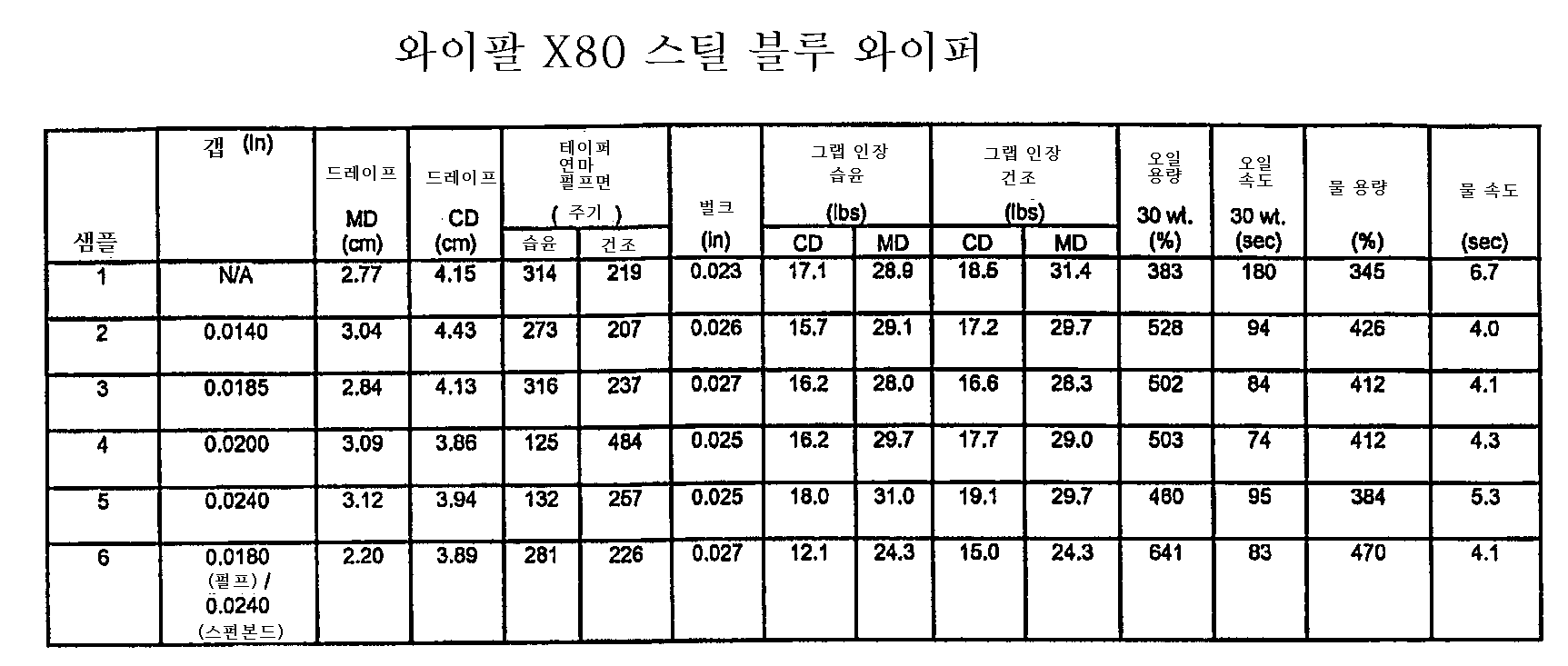
나타낸 바와 같이, 비-연마 대조 샘플에 비하여 연마된 샘플의 다양한 성질이 개선되었다. 또한, 나타낸 바와 같이, 일반적으로 간격 거리가 더욱 크면 그 결과 강도의 감소가 더욱 적다. 다른 한편, 더 작은 간격은 특정한 성질, 예컨대 액체 용량 및 흡입 속도에 더욱 큰 영향을 미친다. 도 11은 샘플 4(45도 각)의 SEM 사진이다. 도 11에 나타낸 연마된 샘플의 표면 섬유를 균일한 방향(사포질 방향)으로 배열하였다. As shown, the various properties of the polished sample were improved compared to the non-abrasive control sample. In addition, as shown, in general, larger interval distances result in fewer decreases in strength. Smaller spacing, on the other hand, has a greater impact on certain properties such as liquid volume and suction rate. 11 is an SEM photograph of Sample 4 (45 degree angle). The surface fibers of the polished sample shown in FIG. 11 were arranged in a uniform direction (sandpaper direction).
실시예Example 3 3
14개 와이퍼 샘플을 제공하였다. 샘플 1 내지 13은 1-겹 와이퍼인 반면, 샘플 14은 2-겹 와이퍼였다 (2겹을 함께 붙인다).Fourteen wiper samples were provided. Samples 1-13 were 1-ply wipers, while
1-겹 와이퍼는 와이팔(R) X80 레드 와이퍼이고, 이것은 킴벌리-클라크 코포레이션으로부터 통상적으로 입수가능하다. 와이팔(R) X80 레드 와이퍼는 미국 특허 5,284,703호(Everhart 등)에 따라 만들어진 부직 복합 재료이다. 구체적으로, 와이퍼는 125그램/m2 (gsm)의 기본 중량을 갖고, 북부 연질목재 크래프트 섬유와 수력 결합된 스펀본드 폴리프로필렌 웹(22.7gsm)으로부터 형성된다.The 1-ply wiper is a Wipal (R) X80 red wiper, which is commonly available from Kimberley-Clark Corporation. Wipal (R) X80 Red Wiper is a nonwoven composite made in accordance with US Pat. No. 5,284,703 (Everhart et al.). Specifically, the wipers have a basis weight of 125 g / m 2 (gsm), it is formed from a northern softwood kraft fibers and hydro-bonded spunbond polypropylene web (22.7gsm).
2-겹 와이퍼의 각각의 겹은 와이팔(R) X60 와이퍼이고, 이것은 킴벌리-클라크 코포레이션으로부터 통상적으로 입수가능하다. 와이팔(R) X60 와이퍼는 미국 특허 5,284,703호(Everhart 등)에 따라 만들어진 부직 복합 재료이다. 구체적으로, 와이퍼는 64그램/m2(gsm)의 기본 중량을 갖고, 북부 연질목재 크래프트 섬유와 수력 결합된 스펀본드 폴리프로필렌 웹(11.3gsm)으로부터 형성된다.Each ply of two-ply wipers is a wipal (R) X60 wiper, which is commonly available from Kimberley-Clark Corporation. Wipal (R) X60 wipers are nonwoven composites made according to US Pat. No. 5,284,703 (Everhart et al.). Specifically, the wipers have a basis weight of 64 g / m 2 (gsm), it is formed from a northern softwood kraft fibers and hydro-bonded spunbond polypropylene web (11.3gsm).
다양한 조건하에서 14개 와이퍼 샘플을 연마시켰다. 고정 파쇄기 막대(들)을 사용하여 샘플 1 내지 3을 연마하였다. 구체적으로, 샘플 1의 펄프 면을 도 3에 나타낸 방식으로 스틸 파쇄기 막대로 연마하였다. 구체적으로, 파쇄기 막대를 60의 그릿 크기(254마이크론의 평균 입자 크기)를 가진 사포로 감쌌다. 도 5에 나타낸 방식으로 샘플 2를 2개의 고정 스틸 파쇄기 막대로 연마하였다. 구체적으로, 샘플의 윗 표면(51) (스펀본드 면)과 접촉하는 파쇄기 막대를 60의 그릿 크기(254 마이크론의 평균 입자 크기)를 가진 사포로 감싸는 반면, 샘플의 아래 표면(153) (펄프 면)과 접촉하는 파쇄기 막대를 220의 그릿 크기(63마이크론의 평균 입자 크기)를 가진 사포로 감쌌다. 샘플 3을 도 4에 나타낸 방식으로 연마하였다. 구체적으로, 샘플의 윗 표면(151) (스펀본드 면)을 접촉시키는 파쇄기 막대를 60의 그릿 크기(254마이크론의 평균 입자 크기)를 가진 사포로 감싼 반면, 샘플의 아래 표면(153) (펄프 면)과 접촉하는 3개의 파쇄기 막대를 220의 그릿 크기(63마이크론의 평균 입자 크기)를 가진 사포로 감쌌다.Fourteen wiper samples were polished under various conditions. Samples 1-3 were polished using fixed crusher bar (s). Specifically, the pulp side of
ECC 카드 크로싱 인코포레이티드(Card Clothing, Inc.) (미국 사우스 캐롤라이나 심프슨빌)로부터 수득된 와이어 카딩 브러시 또는 레이스를 포함한 보풀화 롤을 사용하여 샘플 4 내지 6을 연마하였다. 구체적으로, 샘플 4 내지 5의 와이어 브러시는 0.0285인치의 핀 높이를 갖고, 핀은 3-겹, 1.5인치 폭 고무 벨트 위에 설치된다. 샘플 6의 와이어 브러시는 동일한 고무 벨트 위에 장착된 0.0410 인치의 약간 기울어진 핀 높이를 가졌다. 양쪽 브러시 세트는 6×3×11 형태를 가지며, "6"은 인치 당 가로줄의 수를 나타내고, "3"은 벨트 재료에 스테이플을 부착하기 위해 사용된 와이어 또는 스테이플 앵커의 수를 나타내고, "11"은 인치 당 와이어 또는 스테이플 반복의 수를 나타낸다.Samples 4 to 6 were polished using a fluffing roll including a wire carding brush or lace obtained from ECC Card Crossing Inc. (Simpsonville, SC, USA). Specifically, the wire brushes of Samples 4-5 have a pin height of 0.0285 inches, and the pins are installed on a three-ply, 1.5 inch wide rubber belt. The wire brush of Sample 6 had a slightly tilted pin height of 0.0410 inches mounted over the same rubber belt. Both brush sets have a 6 × 3 × 11 shape, “6” represents the number of horizontal lines per inch, “3” represents the number of wire or staple anchors used to attach staples to the belt material, and “11”. Indicates the number of wire or staple repeats per inch.
보풀화 롤을 별개의 전기-구동 풀림 스탠드 위에 장착하고, 풀림 및 동력 와인더 사이에서 장력하에 롤이 감기기 때문에 샘플의 표면에 맞대어 배치시켰다. 롤은 1분당 1800피트의 속도로 이동 샘플의 것과 반대 방향으로 회전하였다. 연마 동안에 생성된 먼지, 입자 등을 제거하기 위하여 샘플의 표면 근처에 빠른 통풍 진공을 배치하였다. The fluff roll was mounted on a separate electro-driven unwinding stand and placed against the surface of the sample because the roll was wound under tension between the unwind and the power winder. The roll was rotated in the opposite direction to that of the moving sample at a speed of 1800 feet per minute. A fast venting vacuum was placed near the surface of the sample to remove dust, particles and the like generated during polishing.
사포로 감싼 롤을 사용하여 샘플 7 내지 13을 연마하였다. 샘플 7 내지 8, 10, 12 및 14를 위하여, 단지 펄프 면이 연마되었다. 샘플 9, 11 및 13을 위하여, 양쪽 면이 연마되었다. 3인치의 외부 직경을 가진 표준 종이 코어로부터 사포 롤을 형성하였다. 롤을 10.5인치의 길이로 절단하고, 60의 그릿 크기(254마이크론의 평균 입자 크기)를 가진 사포로 감쌌다. 샘플 7 및 9 내지 14를 길이방향에서 감싸서 단일 이음매를 형성하였다. 샘플 8을 각각 0.5인치 떨어져있는 2-인치 조각으로 감쌌다. 롤을 별개의 전기-구동 풀림 스탠드 위에 설치하고, 롤이 풀림 및 동력 와인더 사이의 장력하에 감기기 때문에 샘플의 표면에 맞대어 배치시켰다. 롤은 1분당 1800피트의 속도로 이동 샘플의 방향과 반대 방향으로 회전하였다. 연마 동안에 발생된 먼지, 입자 등을 제거하기 위하여 샘플의 표면 근처에 빠른 통풍 진공을 배치하였다. Samples 7 to 13 were polished using a roll wrapped with sandpaper. For samples 7-8, 10, 12 and 14, only pulp faces were polished. For samples 9, 11 and 13 both sides were polished. Sandpaper rolls were formed from a standard paper core with an outer diameter of 3 inches. The roll was cut to a length of 10.5 inches and wrapped with sandpaper having a grit size of 60 (average particle size of 254 microns). Samples 7 and 9 to 14 were wrapped in the longitudinal direction to form a single seam. Sample 8 was wrapped in 2-inch pieces, each 0.5 inch apart. The roll was installed on a separate electro-driven release stand and placed against the surface of the sample as the roll was rolled under tension between the release and power winders. The roll was rotated in the opposite direction of the moving sample at a speed of 1800 feet per minute. A fast venting vacuum was placed near the surface of the sample to remove dust, particles and the like generated during polishing.
연마 조건을 표 6에 요약한다.Polishing conditions are summarized in Table 6.
샘플의 특정한 몇몇 성질들을 시험하고 연마되지 않은 대조 샘플과 비교하였다. 결과를 하기 표 7에 나타낸다. Several specific properties of the sample were tested and compared to the unpolished control sample. The results are shown in Table 7 below.
CD(cm)Drape
CD (cm)
MD(cm)Drape
MD (cm)
(인치)bulk
(inch)
contrast
Sample 3
Sample 11
Sample 13
Sample 4
나타낸 바와 같이, 본 발명에 따라 형성된 연마된 샘플은 뛰어난 물리적 성질을 달성하였다. 예를들어, 시험되어진 연마된 샘플의 각각은 대조 샘플에 비해 더욱 높은 오일 용량을 가졌다.As shown, the polished samples formed in accordance with the present invention achieved excellent physical properties. For example, each of the polished samples tested had a higher oil capacity compared to the control sample.
본 발명을 그의 특정한 구현양태를 참고하여 상세히 설명하였으나, 상기 내용을 이해할 때 당업자라면 본 발명에 대한 변화, 변형 및 균등물을 쉽게 고안할 수 있다는 것을 이해할 것이다. 따라서, 본 발명의 범위는 첨부된 청구의 범위 및 그의 균등범위로서 평가되어야 한다. Although the present invention has been described in detail with reference to specific embodiments thereof, those skilled in the art will understand that changes, modifications, and equivalents to the present invention can be readily devised when understanding the above. Accordingly, the scope of the invention should be assessed as that of the appended claims and their equivalents.
Claims (24)
Applications Claiming Priority (3)
| Application Number | Priority Date | Filing Date | Title |
|---|---|---|---|
| US10/744,608 | 2003-12-23 | ||
| US10/744,608 US7194789B2 (en) | 2003-12-23 | 2003-12-23 | Abraded nonwoven composite fabrics |
| PCT/US2004/019857 WO2005068701A1 (en) | 2003-12-23 | 2004-06-18 | Abraded nonwoven composite fabrics |
Publications (2)
| Publication Number | Publication Date |
|---|---|
| KR20060115902A KR20060115902A (en) | 2006-11-10 |
| KR101084884B1 true KR101084884B1 (en) | 2011-11-17 |
Family
ID=34678913
Family Applications (1)
| Application Number | Title | Priority Date | Filing Date |
|---|---|---|---|
| KR1020067012454A Expired - Fee Related KR101084884B1 (en) | 2003-12-23 | 2004-06-18 | Polished Nonwoven Composite Fabric |
Country Status (15)
| Country | Link |
|---|---|
| US (1) | US7194789B2 (en) |
| EP (1) | EP1699963B2 (en) |
| JP (1) | JP2007516364A (en) |
| KR (1) | KR101084884B1 (en) |
| CN (1) | CN1898429B (en) |
| AU (1) | AU2004313827B2 (en) |
| BR (1) | BRPI0418014B1 (en) |
| CA (1) | CA2547705A1 (en) |
| CR (1) | CR8413A (en) |
| DE (1) | DE602004022710D1 (en) |
| IL (1) | IL175547A0 (en) |
| MX (1) | MXPA06007185A (en) |
| RU (1) | RU2357031C2 (en) |
| WO (1) | WO2005068701A1 (en) |
| ZA (1) | ZA200604059B (en) |
Families Citing this family (29)
| Publication number | Priority date | Publication date | Assignee | Title |
|---|---|---|---|---|
| US20060199457A1 (en) * | 2005-03-01 | 2006-09-07 | Kimberly-Clark Worldwide, Inc. | Cloth-like biaxial stretch nonwoven |
| US7604668B2 (en) * | 2005-07-29 | 2009-10-20 | Gore Enterprise Holdings, Inc. | Composite self-cohered web materials |
| US7850810B2 (en) * | 2005-07-29 | 2010-12-14 | Gore Enterprise Holdings, Inc. | Method of making porous self-cohered web materials |
| US8048503B2 (en) | 2005-07-29 | 2011-11-01 | Gore Enterprise Holdings, Inc. | Highly porous self-cohered web materials |
| US7655584B2 (en) * | 2005-07-29 | 2010-02-02 | Gore Enterprise Holdings, Inc. | Highly porous self-cohered web materials |
| US20070027551A1 (en) * | 2005-07-29 | 2007-02-01 | Farnsworth Ted R | Composite self-cohered web materials |
| US20070155010A1 (en) * | 2005-07-29 | 2007-07-05 | Farnsworth Ted R | Highly porous self-cohered fibrous tissue engineering scaffold |
| ES2555148T3 (en) * | 2006-10-30 | 2015-12-29 | Suominen Corporation | Method for the manufacture of soft, resistant and bulky nonwovens and nonwovens thus obtained |
| MX2009005540A (en) * | 2006-11-29 | 2009-06-05 | Sca Hygiene Prod Ab | A hydroentangled nonwoven material. |
| US20090270824A1 (en) | 2008-04-28 | 2009-10-29 | Precision Fabrics Group, Inc. | Surgical towels with reduced lint particle generation |
| US8790770B2 (en) * | 2008-11-04 | 2014-07-29 | John C. Flannery | Cross-woven spunlace compacted towel with recoverable texture |
| US20100159775A1 (en) * | 2008-12-19 | 2010-06-24 | Chambers Jr Leon Eugene | Nonwoven Composite And Method For Making The Same |
| US20100159774A1 (en) * | 2008-12-19 | 2010-06-24 | Chambers Jr Leon Eugene | Nonwoven composite and method for making the same |
| US10465337B2 (en) * | 2009-02-27 | 2019-11-05 | Kuraray Co., Ltd. | Artificial leather, entangled web of filaments, and process for producing these |
| JP4982616B2 (en) * | 2010-09-30 | 2012-07-25 | 花王株式会社 | Nonwoven manufacturing method |
| KR101798140B1 (en) | 2010-09-30 | 2017-11-15 | 가오 가부시키가이샤 | Non-woven fabric and method for producing non-woven fabric |
| JP5843396B2 (en) * | 2011-06-23 | 2016-01-13 | 花王株式会社 | Nonwoven manufacturing method |
| US9181646B2 (en) * | 2012-07-12 | 2015-11-10 | Chen Feng | Method of manufacturing velvet plush and article thereof |
| DE102012109071A1 (en) * | 2012-09-26 | 2014-03-27 | Contitech Elastomer-Beschichtungen Gmbh | Grinding process for printing plates in flexo or high pressure area |
| US9394637B2 (en) | 2012-12-13 | 2016-07-19 | Jacob Holm & Sons Ag | Method for production of a hydroentangled airlaid web and products obtained therefrom |
| JP6402018B2 (en) * | 2014-12-15 | 2018-10-10 | 花王株式会社 | Nonwoven manufacturing method |
| GB2571897B (en) | 2017-01-31 | 2022-09-14 | Procter & Gamble | Shaped nonwoven |
| CN114134647B (en) | 2017-01-31 | 2022-11-25 | 宝洁公司 | Shaped nonwoven fabric |
| DE102017110358A1 (en) * | 2017-05-12 | 2018-11-15 | Maschinenfabrik Rieter Ag | Thread contacting component of a cheese producing textile machine |
| MY202169A (en) * | 2018-03-22 | 2024-04-13 | Dsg Technology Holdings Ltd | Disposable absorbent article and absorbent core composite or construction for incorporation therewith, components therefor or thereof, and systems, apparatus and methods of making the same |
| CN108716080B (en) * | 2018-06-28 | 2021-02-19 | 东华大学 | Preparation device and method of gradient structure fabric with water-repellent and sweat-wicking double-sided function |
| CN108796946B (en) * | 2018-06-28 | 2020-12-25 | 东华大学 | Preparation method and application of sectional tension type dense and loose gradient structure fabric |
| CN108796947B (en) * | 2018-06-28 | 2021-01-15 | 东华大学 | Method for preparing moisture-absorbing and moisture-permeable sweat-releasing fabric with gradient structure by positive hot rolling and negative loosening and application |
| JP2024004759A (en) * | 2022-06-29 | 2024-01-17 | 日本製紙クレシア株式会社 | Composite nonwoven fabric manufacturing method and composite nonwoven fabric manufacturing device |
Citations (4)
| Publication number | Priority date | Publication date | Assignee | Title |
|---|---|---|---|---|
| US3337388A (en) | 1964-08-07 | 1967-08-22 | Procter & Gamble | Selective napping of embossed paper toweling and article produced thereby |
| US5180471A (en) | 1991-01-09 | 1993-01-19 | Kimberly-Clark Corporation | Non-nesting multi-ply tissue and method for making same |
| US6269525B2 (en) | 1999-02-18 | 2001-08-07 | Milliken & Company | Face finished fabrics containing immobilized fibers |
| WO2003097933A1 (en) | 2002-05-10 | 2003-11-27 | The Procter & Gamble Company | Embossed tissue having loosened surface fibers and method for its production |
Family Cites Families (89)
| Publication number | Priority date | Publication date | Assignee | Title |
|---|---|---|---|---|
| US2666369A (en) * | 1952-05-29 | 1954-01-19 | Nicholas J Niks | Method of making soft papers adaptable to impregnation |
| US3338992A (en) * | 1959-12-15 | 1967-08-29 | Du Pont | Process for forming non-woven filamentary structures from fiber-forming synthetic organic polymers |
| US3502763A (en) * | 1962-02-03 | 1970-03-24 | Freudenberg Carl Kg | Process of producing non-woven fabric fleece |
| US3502538A (en) * | 1964-08-17 | 1970-03-24 | Du Pont | Bonded nonwoven sheets with a defined distribution of bond strengths |
| US3341394A (en) * | 1966-12-21 | 1967-09-12 | Du Pont | Sheets of randomly distributed continuous filaments |
| NL141179B (en) * | 1967-01-20 | 1974-02-15 | Whitlock Mfg Co | METHOD AND EQUIPMENT FOR THE PREPARATION OF UREA. |
| US3549398A (en) * | 1967-04-03 | 1970-12-22 | Fiber Industries Inc | Method for manufacturing water-vapor permeable,synthetic,suede-like,material |
| US3542615A (en) * | 1967-06-16 | 1970-11-24 | Monsanto Co | Process for producing a nylon non-woven fabric |
| US3485706A (en) * | 1968-01-18 | 1969-12-23 | Du Pont | Textile-like patterned nonwoven fabrics and their production |
| US3849241A (en) * | 1968-12-23 | 1974-11-19 | Exxon Research Engineering Co | Non-woven mats by melt blowing |
| US3592732A (en) * | 1969-06-27 | 1971-07-13 | Kimberly Clark Co | Method of improving tissue paper softness |
| US3615990A (en) * | 1969-07-23 | 1971-10-26 | Gen Tire & Rubber Co | Surface characteristics of composite fabrics |
| DE2048006B2 (en) * | 1969-10-01 | 1980-10-30 | Asahi Kasei Kogyo K.K., Osaka (Japan) | Method and device for producing a wide nonwoven web |
| DE1950669C3 (en) * | 1969-10-08 | 1982-05-13 | Metallgesellschaft Ag, 6000 Frankfurt | Process for the manufacture of nonwovens |
| CA948388A (en) * | 1970-02-27 | 1974-06-04 | Paul B. Hansen | Pattern bonded continuous filament web |
| US3956560A (en) * | 1972-01-28 | 1976-05-11 | The Fiberwoven Corporation | Smooth surfaced textile fabric |
| US3908057A (en) * | 1972-01-28 | 1975-09-23 | Fiberwoven Corp | Fabric with thin surface matrix and method for production thereof |
| US3936555A (en) * | 1972-01-28 | 1976-02-03 | The Fiberwoven Corporation | Filled textile fabric with a density gradient |
| US3821068A (en) * | 1972-10-17 | 1974-06-28 | Scott Paper Co | Soft,absorbent,fibrous,sheet material formed by avoiding mechanical compression of the fiber furnish until the sheet is at least 80% dry |
| US4165556A (en) * | 1974-02-08 | 1979-08-28 | Kanebo, Ltd. | Method for manufacturing suede-like artificial leathers |
| US4100324A (en) * | 1974-03-26 | 1978-07-11 | Kimberly-Clark Corporation | Nonwoven fabric and method of producing same |
| DE2539725C3 (en) * | 1974-09-13 | 1979-12-06 | Asahi Kasei Kogyo K.K., Osaka (Japan) | Suede-like artificial leather with a layer of pile on one surface and method for its production |
| GB1550955A (en) * | 1975-12-29 | 1979-08-22 | Johnson & Johnson | Textile fabric and method of manufacturing the same |
| GB1574041A (en) * | 1976-01-30 | 1980-09-03 | Asahi Chemical Ind | Composite fabric and method for producing the same |
| US4239720A (en) * | 1978-03-03 | 1980-12-16 | Akzona Incorporated | Fiber structures of split multicomponent fibers and process therefor |
| US4468844A (en) * | 1979-11-09 | 1984-09-04 | Milliken Research Corporation | Mechanical surface finishing process for textile fabric |
| US4512065A (en) * | 1979-11-09 | 1985-04-23 | Milliken Research Corporation | Mechanical surface finishing apparatus for textile fabric |
| US4316928A (en) * | 1979-11-09 | 1982-02-23 | Milliken Research Corporation | Mechanically surface finished textile material |
| US4340563A (en) * | 1980-05-05 | 1982-07-20 | Kimberly-Clark Corporation | Method for forming nonwoven webs |
| US4795668A (en) * | 1983-10-11 | 1989-01-03 | Minnesota Mining And Manufacturing Company | Bicomponent fibers and webs made therefrom |
| US4608128A (en) * | 1984-07-23 | 1986-08-26 | General Electric Company | Method for applying abrasive particles to a surface |
| US4735849A (en) * | 1985-08-26 | 1988-04-05 | Toray Industries, Inc. | Non-woven fabric |
| JPS6278281A (en) * | 1985-09-27 | 1987-04-10 | Toray Ind Inc | High-tenacity flexible leathery material and production thereof |
| US5162074A (en) * | 1987-10-02 | 1992-11-10 | Basf Corporation | Method of making plural component fibers |
| US4931355A (en) * | 1988-03-18 | 1990-06-05 | Radwanski Fred R | Nonwoven fibrous hydraulically entangled non-elastic coform material and method of formation thereof |
| US4879170A (en) * | 1988-03-18 | 1989-11-07 | Kimberly-Clark Corporation | Nonwoven fibrous hydraulically entangled elastic coform material and method of formation thereof |
| US5069970A (en) * | 1989-01-23 | 1991-12-03 | Allied-Signal Inc. | Fibers and filters containing said fibers |
| US5142750A (en) * | 1989-01-31 | 1992-09-01 | Johnson & Johnson Medical, Inc. | Absorbent wound dressing |
| JP2682130B2 (en) * | 1989-04-25 | 1997-11-26 | 三井石油化学工業株式会社 | Flexible long-fiber non-woven fabric |
| US5057368A (en) * | 1989-12-21 | 1991-10-15 | Allied-Signal | Filaments having trilobal or quadrilobal cross-sections |
| US5109630A (en) * | 1990-01-08 | 1992-05-05 | Milliken Research Corporation | Machine and method to enhance fabric |
| US5137600A (en) * | 1990-11-01 | 1992-08-11 | Kimberley-Clark Corporation | Hydraulically needled nonwoven pulp fiber web |
| CA2048905C (en) | 1990-12-21 | 1998-08-11 | Cherie H. Everhart | High pulp content nonwoven composite fabric |
| US5277976A (en) * | 1991-10-07 | 1994-01-11 | Minnesota Mining And Manufacturing Company | Oriented profile fibers |
| US5382400A (en) | 1992-08-21 | 1995-01-17 | Kimberly-Clark Corporation | Nonwoven multicomponent polymeric fabric and method for making same |
| US5336552A (en) | 1992-08-26 | 1994-08-09 | Kimberly-Clark Corporation | Nonwoven fabric made with multicomponent polymeric strands including a blend of polyolefin and ethylene alkyl acrylate copolymer |
| US5350624A (en) | 1992-10-05 | 1994-09-27 | Kimberly-Clark Corporation | Abrasion resistant fibrous nonwoven composite structure |
| US6093665A (en) | 1993-09-30 | 2000-07-25 | Kimberly-Clark Worldwide, Inc. | Pattern bonded nonwoven fabrics |
| US5564971A (en) | 1994-10-18 | 1996-10-15 | Evensen; Kenneth | Roller and belt assembly for sanding and buffing machines |
| US5662515A (en) | 1993-12-15 | 1997-09-02 | Evensen; Kenneth | Method and apparatus for abrading with a profiled soft roller |
| CA2123330C (en) | 1993-12-23 | 2004-08-31 | Ruth Lisa Levy | Ribbed clothlike nonwoven fabric and process for making same |
| US5413811A (en) | 1994-03-18 | 1995-05-09 | Kimberly-Clark Corporation | Chemical and mechanical softening process for nonwoven web |
| US5573841A (en) | 1994-04-04 | 1996-11-12 | Kimberly-Clark Corporation | Hydraulically entangled, autogenous-bonding, nonwoven composite fabric |
| EP0795916B1 (en) * | 1994-12-28 | 2010-02-24 | Asahi Kasei Kabushiki Kaisha | Wet type nonwoven fabric for cell separator, its production method and enclosed secondary cell |
| US5531636A (en) | 1995-05-18 | 1996-07-02 | Bissen; Eugene T. | Oscillating drum sander |
| US5704101A (en) | 1995-06-05 | 1998-01-06 | Kimberly-Clark Worldwide, Inc. | Creped and/or apertured webs and process for producing the same |
| US5591516A (en) * | 1995-06-07 | 1997-01-07 | Springs Industries, Inc. | Durable, pill-resistant polyester fabric and method for the preparation thereof |
| US6022818A (en) * | 1995-06-07 | 2000-02-08 | Kimberly-Clark Worldwide, Inc. | Hydroentangled nonwoven composites |
| US5853859A (en) | 1995-07-07 | 1998-12-29 | Kimberly-Clark Worldwide, Inc. | Room temperature latex printing |
| CN1140118A (en) * | 1995-07-07 | 1997-01-15 | 上海益民合成革厂 | Process for producing single-layer polishing cloth |
| EP0796940B1 (en) | 1995-10-06 | 2003-02-26 | Nippon Petrochemicals Co., Ltd. | Water jet intertwined nonwoven cloth and method of manufacturing the same |
| WO1997019213A1 (en) * | 1995-11-17 | 1997-05-29 | International Paper Company | Uniformity and product improvement in lyocell fabrics with hydraulic fluid treatment |
| US5964351A (en) | 1996-03-15 | 1999-10-12 | Kimberly-Clark Worldwide, Inc. | Stack of folded wet wipes having improved dispensability and a method of making the same |
| US5752300A (en) | 1996-10-29 | 1998-05-19 | Milliken Research Corporation | Method and apparatus to loosen and cut the wrapper fibers of spun yarns in woven fabric |
| USD390708S (en) * | 1996-10-31 | 1998-02-17 | Kimberly-Clark Worldwide, Inc. | Pattern for a bonded fabric |
| JP3680456B2 (en) | 1996-11-14 | 2005-08-10 | 日本製紙株式会社 | Composite sheet for wipes |
| US6200669B1 (en) | 1996-11-26 | 2001-03-13 | Kimberly-Clark Worldwide, Inc. | Entangled nonwoven fabrics and methods for forming the same |
| US5962112A (en) | 1996-12-19 | 1999-10-05 | Kimberly-Clark Worldwide, Inc. | Wipers comprising point unbonded webs |
| US5785179A (en) | 1997-06-04 | 1998-07-28 | Kimberly-Clark Worldwide, Inc. | Container for wet wipes having an improved closure mechanism |
| US6158614A (en) | 1997-07-30 | 2000-12-12 | Kimberly-Clark Worldwide, Inc. | Wet wipe dispenser with refill cartridge |
| US6103061A (en) | 1998-07-07 | 2000-08-15 | Kimberly-Clark Worldwide, Inc. | Soft, strong hydraulically entangled nonwoven composite material and method for making the same |
| US6315864B2 (en) | 1997-10-30 | 2001-11-13 | Kimberly-Clark Worldwide, Inc. | Cloth-like base sheet and method for making the same |
| US6197404B1 (en) | 1997-10-31 | 2001-03-06 | Kimberly-Clark Worldwide, Inc. | Creped nonwoven materials |
| CA2248727C (en) † | 1997-12-19 | 2007-08-14 | Kimberly-Clark Worldwide, Inc. | Mechanical softening of sheet material |
| US5815896A (en) | 1997-12-22 | 1998-10-06 | Milliken Research Corporation | Method and apparatus to provide improved and more efficient napping of fabrics made from spun yarns |
| GB9812692D0 (en) * | 1998-06-13 | 1998-08-12 | Lohmann Gmbh & Co Kg | Improvements in or relating to non-woven materials |
| US6260247B1 (en) | 1999-02-18 | 2001-07-17 | Milliken & Company | Face finishing of fabrics containing selectively immobilized fibers |
| US6273359B1 (en) | 1999-04-30 | 2001-08-14 | Kimberly-Clark Worldwide, Inc. | Dispensing system and method for premoistened wipes |
| JP4224890B2 (en) | 1999-05-07 | 2009-02-18 | 株式会社日本吸収体技術研究所 | Bulky processing method for nonwoven web and bulky nonwoven fabric obtained thereby |
| US6423393B1 (en) | 1999-08-20 | 2002-07-23 | Tietex International, Ltd. | Abraded stitchbonded fabric and process for making same |
| USD428267S (en) * | 1999-08-27 | 2000-07-18 | Kimberly-Clark Worldwide, Inc. | Repeating pattern for a bonded fabric |
| US6269969B1 (en) | 2000-05-05 | 2001-08-07 | Kimberly-Clark Worldwide, Inc. | Wet wipes container with improved closure |
| US6269970B1 (en) | 2000-05-05 | 2001-08-07 | Kimberly-Clark Worldwide, Inc. | Wet wipes container having a tear resistant lid |
| GB2378454B (en) | 2001-08-10 | 2003-10-08 | Sca Hygiene Prod Gmbh | Soft tissue paper web with teaseled and non-teaseled surface regions, method of and apparatus for making the same |
| US7838447B2 (en) | 2001-12-20 | 2010-11-23 | Kimberly-Clark Worldwide, Inc. | Antimicrobial pre-moistened wipers |
| US20030118776A1 (en) | 2001-12-20 | 2003-06-26 | Kimberly-Clark Worldwide, Inc. | Entangled fabrics |
| US6921569B2 (en) * | 2002-11-20 | 2005-07-26 | Outside The Box, Inc. | Soft, durable nonwoven napped fabric |
| US6958103B2 (en) | 2002-12-23 | 2005-10-25 | Kimberly-Clark Worldwide, Inc. | Entangled fabrics containing staple fibers |
| US20040121121A1 (en) | 2002-12-23 | 2004-06-24 | Kimberly -Clark Worldwide, Inc. | Entangled fabrics containing an apertured nonwoven web |
-
2003
- 2003-12-23 US US10/744,608 patent/US7194789B2/en not_active Expired - Lifetime
-
2004
- 2004-06-18 AU AU2004313827A patent/AU2004313827B2/en not_active Ceased
- 2004-06-18 CN CN2004800384063A patent/CN1898429B/en not_active Expired - Fee Related
- 2004-06-18 CA CA002547705A patent/CA2547705A1/en not_active Abandoned
- 2004-06-18 EP EP04776877A patent/EP1699963B2/en not_active Expired - Lifetime
- 2004-06-18 DE DE602004022710T patent/DE602004022710D1/en not_active Expired - Lifetime
- 2004-06-18 MX MXPA06007185A patent/MXPA06007185A/en active IP Right Grant
- 2004-06-18 WO PCT/US2004/019857 patent/WO2005068701A1/en not_active Ceased
- 2004-06-18 JP JP2006546947A patent/JP2007516364A/en not_active Abandoned
- 2004-06-18 RU RU2006122362A patent/RU2357031C2/en not_active IP Right Cessation
- 2004-06-18 KR KR1020067012454A patent/KR101084884B1/en not_active Expired - Fee Related
- 2004-06-18 BR BRPI0418014-3A patent/BRPI0418014B1/en not_active IP Right Cessation
- 2004-06-18 ZA ZA200604059A patent/ZA200604059B/en unknown
-
2006
- 2006-05-09 IL IL175547A patent/IL175547A0/en unknown
- 2006-05-22 CR CR8413A patent/CR8413A/en not_active Application Discontinuation
Patent Citations (4)
| Publication number | Priority date | Publication date | Assignee | Title |
|---|---|---|---|---|
| US3337388A (en) | 1964-08-07 | 1967-08-22 | Procter & Gamble | Selective napping of embossed paper toweling and article produced thereby |
| US5180471A (en) | 1991-01-09 | 1993-01-19 | Kimberly-Clark Corporation | Non-nesting multi-ply tissue and method for making same |
| US6269525B2 (en) | 1999-02-18 | 2001-08-07 | Milliken & Company | Face finished fabrics containing immobilized fibers |
| WO2003097933A1 (en) | 2002-05-10 | 2003-11-27 | The Procter & Gamble Company | Embossed tissue having loosened surface fibers and method for its production |
Also Published As
| Publication number | Publication date |
|---|---|
| WO2005068701A1 (en) | 2005-07-28 |
| ZA200604059B (en) | 2008-01-30 |
| BRPI0418014B1 (en) | 2015-01-20 |
| KR20060115902A (en) | 2006-11-10 |
| CR8413A (en) | 2006-11-07 |
| BRPI0418014A (en) | 2007-04-17 |
| AU2004313827B2 (en) | 2009-10-22 |
| DE602004022710D1 (en) | 2009-10-01 |
| IL175547A0 (en) | 2006-09-05 |
| US20050136777A1 (en) | 2005-06-23 |
| EP1699963B2 (en) | 2012-11-14 |
| CN1898429A (en) | 2007-01-17 |
| RU2006122362A (en) | 2008-01-27 |
| US7194789B2 (en) | 2007-03-27 |
| RU2357031C2 (en) | 2009-05-27 |
| CA2547705A1 (en) | 2005-07-28 |
| EP1699963B1 (en) | 2009-08-19 |
| MXPA06007185A (en) | 2006-08-23 |
| CN1898429B (en) | 2010-12-08 |
| JP2007516364A (en) | 2007-06-21 |
| EP1699963A1 (en) | 2006-09-13 |
| AU2004313827A1 (en) | 2005-07-28 |
Similar Documents
| Publication | Publication Date | Title |
|---|---|---|
| KR101084884B1 (en) | Polished Nonwoven Composite Fabric | |
| EP1706527B1 (en) | Soft and bulky composite fabrics | |
| KR101200203B1 (en) | Ultrasonically laminated multi-ply fabrics | |
| JP4521274B2 (en) | Multilayer nonwoven fabric | |
| CA2508787A1 (en) | Entangled fabrics containing staple fibers |
Legal Events
| Date | Code | Title | Description |
|---|---|---|---|
| PA0105 | International application |
St.27 status event code: A-0-1-A10-A15-nap-PA0105 |
|
| PG1501 | Laying open of application |
St.27 status event code: A-1-1-Q10-Q12-nap-PG1501 |
|
| R18-X000 | Changes to party contact information recorded |
St.27 status event code: A-3-3-R10-R18-oth-X000 |
|
| A201 | Request for examination | ||
| PA0201 | Request for examination |
St.27 status event code: A-1-2-D10-D11-exm-PA0201 |
|
| R18-X000 | Changes to party contact information recorded |
St.27 status event code: A-3-3-R10-R18-oth-X000 |
|
| R18-X000 | Changes to party contact information recorded |
St.27 status event code: A-3-3-R10-R18-oth-X000 |
|
| P11-X000 | Amendment of application requested |
St.27 status event code: A-2-2-P10-P11-nap-X000 |
|
| P13-X000 | Application amended |
St.27 status event code: A-2-2-P10-P13-nap-X000 |
|
| E902 | Notification of reason for refusal | ||
| PE0902 | Notice of grounds for rejection |
St.27 status event code: A-1-2-D10-D21-exm-PE0902 |
|
| P11-X000 | Amendment of application requested |
St.27 status event code: A-2-2-P10-P11-nap-X000 |
|
| P13-X000 | Application amended |
St.27 status event code: A-2-2-P10-P13-nap-X000 |
|
| E701 | Decision to grant or registration of patent right | ||
| PE0701 | Decision of registration |
St.27 status event code: A-1-2-D10-D22-exm-PE0701 |
|
| GRNT | Written decision to grant | ||
| PR0701 | Registration of establishment |
St.27 status event code: A-2-4-F10-F11-exm-PR0701 |
|
| PR1002 | Payment of registration fee |
St.27 status event code: A-2-2-U10-U12-oth-PR1002 Fee payment year number: 1 |
|
| PG1601 | Publication of registration |
St.27 status event code: A-4-4-Q10-Q13-nap-PG1601 |
|
| P22-X000 | Classification modified |
St.27 status event code: A-4-4-P10-P22-nap-X000 |
|
| FPAY | Annual fee payment |
Payment date: 20141027 Year of fee payment: 4 |
|
| PR1001 | Payment of annual fee |
St.27 status event code: A-4-4-U10-U11-oth-PR1001 Fee payment year number: 4 |
|
| FPAY | Annual fee payment |
Payment date: 20151026 Year of fee payment: 5 |
|
| PR1001 | Payment of annual fee |
St.27 status event code: A-4-4-U10-U11-oth-PR1001 Fee payment year number: 5 |
|
| FPAY | Annual fee payment |
Payment date: 20161025 Year of fee payment: 6 |
|
| PR1001 | Payment of annual fee |
St.27 status event code: A-4-4-U10-U11-oth-PR1001 Fee payment year number: 6 |
|
| FPAY | Annual fee payment |
Payment date: 20171024 Year of fee payment: 7 |
|
| PR1001 | Payment of annual fee |
St.27 status event code: A-4-4-U10-U11-oth-PR1001 Fee payment year number: 7 |
|
| R18-X000 | Changes to party contact information recorded |
St.27 status event code: A-5-5-R10-R18-oth-X000 |
|
| FPAY | Annual fee payment |
Payment date: 20181025 Year of fee payment: 8 |
|
| PR1001 | Payment of annual fee |
St.27 status event code: A-4-4-U10-U11-oth-PR1001 Fee payment year number: 8 |
|
| R18-X000 | Changes to party contact information recorded |
St.27 status event code: A-5-5-R10-R18-oth-X000 |
|
| FPAY | Annual fee payment |
Payment date: 20191030 Year of fee payment: 9 |
|
| PR1001 | Payment of annual fee |
St.27 status event code: A-4-4-U10-U11-oth-PR1001 Fee payment year number: 9 |
|
| PR1001 | Payment of annual fee |
St.27 status event code: A-4-4-U10-U11-oth-PR1001 Fee payment year number: 10 |
|
| PR1001 | Payment of annual fee |
St.27 status event code: A-4-4-U10-U11-oth-PR1001 Fee payment year number: 11 |
|
| PC1903 | Unpaid annual fee |
St.27 status event code: A-4-4-U10-U13-oth-PC1903 Not in force date: 20221112 Payment event data comment text: Termination Category : DEFAULT_OF_REGISTRATION_FEE |
|
| PC1903 | Unpaid annual fee |
St.27 status event code: N-4-6-H10-H13-oth-PC1903 Ip right cessation event data comment text: Termination Category : DEFAULT_OF_REGISTRATION_FEE Not in force date: 20221112 |