KR101082837B1 - Method and apparatus for reduction of noise - Google Patents
Method and apparatus for reduction of noiseInfo
- Publication number
- KR101082837B1 KR101082837B1 KR1020080131243A KR20080131243A KR101082837B1 KR 101082837 B1 KR101082837 B1 KR 101082837B1 KR 1020080131243 A KR1020080131243 A KR 1020080131243A KR 20080131243 A KR20080131243 A KR 20080131243A KR 101082837 B1 KR101082837 B1 KR 101082837B1
- Authority
- KR
- South Korea
- Prior art keywords
- noise
- speech signal
- gaussian mixture
- mixture model
- estimating
- Prior art date
- Legal status (The legal status is an assumption and is not a legal conclusion. Google has not performed a legal analysis and makes no representation as to the accuracy of the status listed.)
- Expired - Fee Related
Links
Images


Classifications
-
- G—PHYSICS
- G10—MUSICAL INSTRUMENTS; ACOUSTICS
- G10L—SPEECH ANALYSIS TECHNIQUES OR SPEECH SYNTHESIS; SPEECH RECOGNITION; SPEECH OR VOICE PROCESSING TECHNIQUES; SPEECH OR AUDIO CODING OR DECODING
- G10L21/00—Speech or voice signal processing techniques to produce another audible or non-audible signal, e.g. visual or tactile, in order to modify its quality or its intelligibility
- G10L21/02—Speech enhancement, e.g. noise reduction or echo cancellation
- G10L21/0208—Noise filtering
- G10L21/0216—Noise filtering characterised by the method used for estimating noise
-
- G—PHYSICS
- G10—MUSICAL INSTRUMENTS; ACOUSTICS
- G10L—SPEECH ANALYSIS TECHNIQUES OR SPEECH SYNTHESIS; SPEECH RECOGNITION; SPEECH OR VOICE PROCESSING TECHNIQUES; SPEECH OR AUDIO CODING OR DECODING
- G10L21/00—Speech or voice signal processing techniques to produce another audible or non-audible signal, e.g. visual or tactile, in order to modify its quality or its intelligibility
- G10L21/02—Speech enhancement, e.g. noise reduction or echo cancellation
- G10L21/0272—Voice signal separating
-
- G—PHYSICS
- G10—MUSICAL INSTRUMENTS; ACOUSTICS
- G10L—SPEECH ANALYSIS TECHNIQUES OR SPEECH SYNTHESIS; SPEECH RECOGNITION; SPEECH OR VOICE PROCESSING TECHNIQUES; SPEECH OR AUDIO CODING OR DECODING
- G10L25/00—Speech or voice analysis techniques not restricted to a single one of groups G10L15/00 - G10L21/00
- G10L25/78—Detection of presence or absence of voice signals
- G10L25/84—Detection of presence or absence of voice signals for discriminating voice from noise
Landscapes
- Engineering & Computer Science (AREA)
- Computational Linguistics (AREA)
- Signal Processing (AREA)
- Health & Medical Sciences (AREA)
- Audiology, Speech & Language Pathology (AREA)
- Human Computer Interaction (AREA)
- Physics & Mathematics (AREA)
- Acoustics & Sound (AREA)
- Multimedia (AREA)
- Quality & Reliability (AREA)
- Circuit For Audible Band Transducer (AREA)
Abstract
본 발명은 잡음 제거 장치 및 방법에 관한 것으로, 잡음 변화가 심한 환경과 여러 가지의 잡음이 혼재하는 환경에서 잡음 제거 효율을 향상하기 위해, 소프트 마스킹 기법 등과 같은 음성/잡음 분리기법을 통해 음성과 잡음의 분리 기능을 강화하고, 잡음 가우시안 혼합 모델이 입력 신호에 대한 잡음성분을 모델링하는데 한계가 있는 점을 보완하기 위해 잡음적응 기법을 사용함으로써, 깨끗한 음성을 보다 정확히 추정하여 음성 인식 성능을 높이는 이점이 있다.
음성인식, 동작잡음 제거, 잡음 적응, 모델 기반 방식
The present invention relates to an apparatus and a method for removing noise. In order to improve the noise removal efficiency in an environment in which noise fluctuations are mixed and various kinds of noise, voice and noise separation techniques such as a soft masking technique, etc. By using the noise adaptation technique to enhance the separation function of the noise and to compensate for the limitation that the noise Gaussian mixture model has to model the noise component of the input signal, it is possible to estimate the clear speech more accurately and improve the speech recognition performance. have.
Speech Recognition, Noise Reduction, Noise Adaptation, Model-Based Approach
Description
본 발명은 잡음 제거 장치 및 방법에 관한 것으로서, 더욱 상세하게는 잡음환경에서의 음성인식을 위해 잡음이 포함된 입력음성으로부터 동적 잡음이 제거된 깨끗한 음성을 추정하기 위한 방법 및 장치에 관한 것이다.The present invention relates to an apparatus and method for removing noise, and more particularly, to a method and apparatus for estimating clean speech from which dynamic noise has been removed from an input voice including noise for speech recognition in a noise environment.
본 발명은 지식경제부 및 정보통신연구진흥원의 IT성장동력기술개발 사업의 일환으로 수행한 연구로부터 도출된 것이다[과제관리번호 : 2006-S-036-03, 과제명 : 신성장동력산업용 대용량 대화형 분산 처리 음성인터페이스 기술개발].The present invention is derived from the research conducted as part of the IT growth engine technology development project of the Ministry of Knowledge Economy and the Ministry of Information and Telecommunication Research and Development. [Task management number: 2006-S-036-03, Task name: Large-capacity interactive distribution for the new growth engine industry] Development of processing voice interface technology].
주지하는 바와 같이, 음성인식 기술의 상용화를 위해 가장 큰 장애가 되는 문제는 잡음으로 인한 인식 성능 저하이다. 깨끗한 잡음 환경에서는 거의 완벽한 성능을 갖는 음성인식 시스템도 잡음이 존재하는 실제 환경에서는 인식 성능이 크게 저하되는 것을 흔하게 볼 수 있다.As is well known, the biggest obstacle for the commercialization of speech recognition technology is the degradation of recognition performance due to noise. It is not uncommon for speech recognition systems with near perfect performance in clean noise environments to noticeably degrade recognition performance in real environments with noise.
이러한 문제를 해결하기 위해 지금까지 여러 가지 접근방식이 제시되었는데, 대표적으로 신호처리 기반에서의 스펙트럼 향상(signal-processing based spectral enhancement) 기법과 통계모델 기반 모델적응(statistical-model-based model adaptation) 기법이 있다.To address this problem, various approaches have been proposed so far, typically, signal-processing based spectral enhancement and statistical-model-based model adaptation. There is this.
스펙트럼 향상 기법은 음성이 존재하지 않는 구간에서의 잡음 스펙트럼을 추정한 후 이 값을 잡음이 부가된 입력신호의 스펙트럼으로부터 차감하는 방식이며, 스펙트럼 차감(spectrum subtraction) 기법과 결정 지향(decision-directed) 기반의 워너(wiener) 필터(wiener filter with the decision directed) 기법이 가장 널리 많이 쓰이는 방식이다. 결정 지향 기반 워너 필터는 2 스테이지(stage)로 확장된 형태로 ETSI AFE(Advanced Front-End) 표준으로 채택되었고, 정적 잡음(stationary noise)을 제거하는 데에 매우 효과적이라 알려져 있다.The spectral enhancement technique estimates the noise spectrum in the absence of speech and subtracts this value from the spectrum of the noise-added input signal.The spectral subtraction and decision-directed methods The Wiener filter with the decision directed technique is the most widely used. Decision-oriented based Warner filters have been adopted as the ETSI Advanced Front-End (AFE) standard in a two-stage extended form and are known to be very effective in eliminating stationary noise.
통계모델 기반 모델적응 기법은 입력 잡음신호를 수정하는 대신 음향모델 (일반적으로 은닉 마르코브 모델(hidden markov model))을 잡음상황에 맞도록 변환하는 방식으로 대표적으로 PMC(Parallel Model Compensation) 기법이 있다. PMC는 깨끗한 음성과 잡음을 각각 다른 모델로 표현하고 이 두 모델을 결합하여 잡음이 섞인 음성을 모델링하는 방식으로 잡음 모델에 포함된 잡음 환경에 대해서는 다른 기법에 비해 좋은 성능을 보이고 있다.Statistical model-based model adaptation technique converts acoustic models (generally hidden markov models) to noise conditions instead of modifying the input noise signal. The typical model is PMC (Parallel Model Compensation). . The PMC expresses clean speech and noise in different models and combines the two models to model mixed speech. It shows better performance than other techniques in the noise environment included in the noise model.
전술한 바와 같이 종래 기술에 의하면 잡음이 존재하는 환경에서의 음성인식 성능 향상을 위해 여러 가지의 잡음 제거 기술이 제시되었으나 음성인식의 성능 저 하는 여전히 발생하며, 잡음 환경에서 동적 잡음의 제거 효율이 정적 잡음에 비해 미진하여 만족할만한 음성인식 성능을 보장하지 못하는 문제점이 있다. 예컨대, 워너 필터는 잡음 변화가 심한 환경과 여러 가지의 잡음이 혼재하는 환경에서 성능 향상이 제한되는 단점이 있다.As described above, according to the prior art, various noise reduction techniques have been proposed to improve speech recognition performance in the presence of noise, but performance degradation of speech recognition still occurs, and dynamic noise removal efficiency is static in a noise environment. There is a problem in that it does not guarantee satisfactory voice recognition performance because it is inferior to noise. For example, the warner filter has a disadvantage in that performance improvement is limited in an environment in which a noise change is severe and an environment in which various noises are mixed.
본 발명은 이와 같은 종래 기술의 문제점을 해결하기 위해 제안한 것으로서, 잡음 변화가 심한 환경과 여러 가지의 잡음이 혼재하는 환경에서 잡음 제거 효율을 향상시켜 깨끗한 음성을 보다 정확히 추정하여 음성 인식 성능을 높일 수 있는 잡음 제거 장치 및 방법을 제공한다.The present invention has been proposed to solve the problems of the prior art, and improves the noise removal efficiency in an environment in which the noise change is severe and in the mixed environment of various noises, thereby improving the speech recognition performance by more accurately estimating the clean voice. A noise canceling device and method are provided.
본 발명의 제 1 관점으로서 잡음 제거 장치는, 입력 음성신호에 포함된 잡음성분을 추정할 수 있는 잡음 추정부와, 추정한 상기 잡음성분으로부터 사후 확률값을 추정할 수 있는 사후 확률 추정부와, 추정한 상기 사후 확률값에 의거하여 잡음 가우시안 혼합 모델을 상기 입력 음성신호에 적응할 수 있는 잡음 파라미터 적응부와, 적응한 상기 잡음 가우시안 혼합 모델과 음성 가우시안 혼합 모델 및 상기 입력 음성신호를 입력으로 하여 잡음과 음성신호를 1차적으로 분리할 수 있는 음성/잡음 분리부와, 분리한 상기 음성신호에 남아있는 잔여 잡음성분을 제거할 수 있는 잡음 제거부를 포함한다.As a first aspect of the present invention, a noise canceling apparatus includes a noise estimator for estimating a noise component included in an input speech signal, a post probability estimator for estimating a posterior probability value from the estimated noise component, and an estimation; A noise parameter adaptation unit adapted to adapt the noise Gaussian mixture model to the input speech signal based on the posterior probability value, the noise Gaussian mixture model, the speech Gaussian mixture model, and the input speech signal as inputs A voice / noise separation unit capable of separating the signal primarily, and a noise removing unit capable of removing residual noise components remaining in the separated voice signal.
여기서, 상기 잡음 추정부는, IMCRA(Improved Minima Controlled Recursive Average) 방식을 사용하여 상기 잡음성분을 추정한다.Here, the noise estimator estimates the noise component using an Improved Minima Controlled Recursive Average (IMCRA) method.
상기 잡음 파라미터 적응부는, 상기 사후 확률 추정부에 의해 얻어진 상기 사후 확률값에 비례해서 상기 잡음 가우시안 혼합 모델의 각 가우시안 혼합의 가중치값을 조정한다.The noise parameter adaptor adjusts a weight value of each Gaussian mixture of the noise Gaussian mixture model in proportion to the posterior probability value obtained by the posterior probability estimator.
상기 음성/잡음 분리부는, 소프트 마스킹(soft masking) 기법을 사용하여 상기 잡음과 상기 음성신호를 분리한다.The voice / noise separator separates the noise and the voice signal using a soft masking technique.
상기 잡음 제거부는, 결정 지향 기반의 워너 필터를 이용하여 상기 잔여 잡음성분을 제거한다.The noise canceller removes the residual noise component by using a decision directed warner filter.
본 발명의 제 2 관점으로서 잡음 제거 방법은, 입력 음성신호에 포함된 잡음성분을 추정하는 단계와, 추정한 상기 잡음성분으로부터 사후 확률값을 추정하는 단계와, 추정한 상기 사후 확률값에 의거하여 잡음 가우시안 혼합 모델을 상기 입력 음성신호에 적응하는 단계와, 적응한 상기 잡음 가우시안 혼합 모델과 음성 가우시안 혼합 모델 및 상기 입력 음성신호를 입력으로 하여 잡음과 음성신호를 1차적으로 분리하는 단계와, 분리한 상기 음성신호에 남아있는 잔여 잡음성분을 제거하는 단계를 포함한다.According to a second aspect of the present invention, a noise removing method includes estimating a noise component included in an input speech signal, estimating a post-probability value from the estimated noise component, and based on the estimated post-probability value. Adapting a mixed model to the input speech signal, first separating the noise Gaussian mixed model and the speech Gaussian mixed model and the input speech signal as inputs, and separating the noise and the speech signal primarily; Removing residual noise components remaining in the voice signal.
여기서, 상기 잡음성분을 추정하는 단계는, IMCRA 방식을 사용하여 상기 잡음성분을 추정한다.In the estimating of the noise component, the noise component is estimated using an IMCRA method.
상기 입력 음성신호에 적응하는 단계는, 상기 사후 확률값을 추정하는 단계에 의해 얻어진 상기 사후 확률값에 비례해서 상기 잡음 가우시안 혼합 모델의 각 가우시안 혼합의 가중치값을 조정한다.The adapting to the input speech signal adjusts a weight value of each Gaussian mixture of the noise Gaussian mixture model in proportion to the posterior probability value obtained by estimating the posterior probability value.
상기 1차적으로 분리하는 단계는, 소프트 마스킹 기법을 사용하여 상기 잡음과 상기 음성신호를 분리한다.In the first step of separating, the noise and the voice signal are separated using a soft masking technique.
상기 잔여 잡음성분을 제거하는 단계는, 결정 지향 기반의 워너 필터를 이용하여 상기 잔여 잡음성분을 제거한다.The step of removing the residual noise component removes the residual noise component using a decision directed based Warner filter.
본 발명에 의하면 잡음 변화가 심한 환경과 여러 가지의 잡음이 혼재하는 환경에서 잡음 제거 효율을 향상하기 위해, 소프트 마스킹 기법 등과 같은 음성/잡음 분리기법을 통해 음성과 잡음의 분리 기능을 강화하고, 잡음 가우시안 혼합 모델이 입력 신호에 대한 잡음성분을 모델링하는데 한계가 있는 점을 보완하기 위해 잡음적응 기법을 사용함으로써, 깨끗한 음성을 보다 정확히 추정하여 음성 인식 성능을 높이는 효과가 있다.According to the present invention, in order to improve noise rejection in environments with high noise fluctuations and various noises, voice / noise separation techniques such as soft masking techniques are used to enhance the separation of voice and noise, and To compensate for the limitation of Gaussian mixture model in modeling the noise component of the input signal, the noise adaptation technique is used to improve the speech recognition performance by estimating the clean speech more accurately.
이하, 본 발명의 일부 실시예를 첨부된 도면들을 참조하여 상세히 설명한다. 아울러 본 발명을 설명함에 있어, 관련된 공지 구성 또는 기능에 대한 구체적인 설명이 본 발명의 요지를 흐릴 수 있다고 판단되는 경우에는 그 상세한 설명을 생략한다.Hereinafter, some embodiments of the present invention will be described in detail with reference to the accompanying drawings. In addition, in describing the present invention, when it is determined that the detailed description of the related known configuration or function may obscure the gist of the present invention, the detailed description thereof will be omitted.
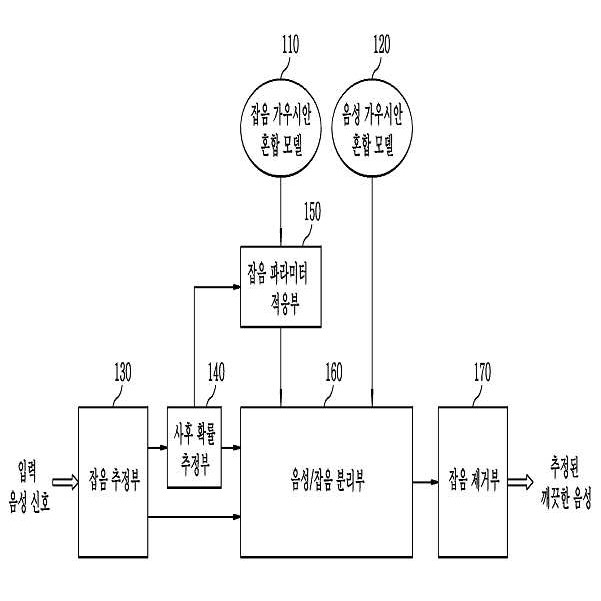
도 1은 본 발명의 실시예에 따른 잡음 제거 장치의 블록 구성도이다.1 is a block diagram of an apparatus for removing noise in accordance with an embodiment of the present invention.
이에 나타낸 바와 같이 본 발명의 잡음 제거 장치는, 입력 음성신호에 포함된 잡음성분을 추정할 수 있는 잡음 추정부(130)와, 추정한 잡음성분으로부터 사후 확률값을 추정할 수 있는 사후 확률 추정부(140)와, 추정한 사후 확률값에 의거하여 잡음 가우시안 혼합 모델(110)을 입력 음성신호에 적응할 수 있는 잡음 파라미터 적응부(150)와, 적응한 잡음 가우시안 혼합 모델(110)과 음성 가우시안 혼합 모델(120) 및 입력 음성신호를 입력으로 하여 잡음과 음성신호를 1차적으로 분리할 수 있는 음성/잡음 분리부(160)와, 분리한 음성신호에 남아있는 잔여 잡음성분을 제거할 수 있는 잡음 제거부(170) 등을 포함한다.As described above, the noise canceller of the present invention includes a
이와 같이 구성된 본 발명의 실시예에 따른 잡음 제거 장치에 의한 잡음 제거 과정을 도 1 및 도 2를 참조하여 설명하기로 한다.A noise removing process by the noise removing device according to the embodiment of the present invention configured as described above will be described with reference to FIGS. 1 and 2.
먼저, 잡음 추정부(130)는 잡음과 음성이 혼합된 입력 음성신호로부터 대략적인 잡음성분의 추정치를 얻어낸다(S205). 잡음추정을 위해서는 예컨대, IMCRA 등의 방식을 사용할 수 있다. 이렇게 추정된 잡음성분은 잡음 가우시안 혼합 모델(110)을 현재 잡음상태에 맞게 적응하는 데에 사용하게 된다.First, the
사후 확률(posterior probability) 추정부(140)는 잡음 추정부(130)로부터 추정된 잡음성분이 잡음 가우시안 혼합 모델(110)에서 갖는 사후 확률값을 얻어낸다(S207). 이는 아래의 수학식 1과 같이 표현할 수 있다.The

위에서 


잡음 가우시안 혼합 모델(110)은 음성인식 시스템이 사용되는 실제환경(가정환경, 자동차, 전시장 등)에서 수집한 잡음 데이터베이스를 이용해서 미리 훈련(S201)된 것으로서 해당 시스템이 사용되는 환경의 잡음을 모델링한다. 음성 가우시안 혼합 모델(120)은 잡음이 없는 환경에서 수집된 음성 데이터베이스로부터 훈련(S203)되어 잡음이 제거된 깨끗한 음성을 모델링한다. 잡음 가우시안 혼합 모델(110)과 음성 가우시안 혼합 모델(120)은 K개의 혼합으로 이루어진 가우시안 혼합 모델을 가정하면 아래의 수학식 2와 같이 기술할 수 있다.The noise

잡음 파라미터 적응부(150)는 사후 확률 추정부(140)에 의해 얻어진 사후 확률값에 비례해서 잡음 가우시안 혼합 모델(110)의 각 가우시안 혼합의 가중치값을 조정한다. 즉, 사후 확률값이 높은 가우시안은 현재 상태에서의 잡음성분을 더 잘 모델링한다고 가정하고, 해당 가우시안 혼합의 값을 사후 확률값에 비례하여 조정한다(S209).The
음성/잡음 분리부(160)는 음성 가우시안 혼합 모델(120)과 잡음 파라미터 적응부(150)에 의해 현재 잡음환경에 대해 적응된 잡음 가우시안 혼합 모델(110)과 입력 음성신호를 입력으로 하여 음성/잡음을 1차적으로 분리하는 기능을 수행한다. 예컨대, 소프트 마스킹 기법 등의 음성/잡음 분리 기법을 사용할 수 있다(S211).The voice /
음성/잡음 분리부(160)에서 음성으로 분리된 성분에는 잔여 잡음성분이 존재할 수 있기에 이를 제거하기 위해 잡음 제거부(170)는 1차적으로 분리한 음성신호에 남아있는 잔여 잡음성분을 제거하여 최종의 깨끗한 음성을 추정한다(S213). 잡음 제거부(170)는 예컨대, 결정 지향 기반의 워너 필터를 이용하여 음성이 존재하지 않는 구간에서의 잡음 스펙트럼을 추정한 후 이 값을 잡음이 부가된 입력신호의 스펙트럼으로부터 차감하는 스펙트럼 향상 기법을 이용할 수 있다.Since there may be residual noise components in the components separated by voice from the voice /
이렇게 추정된 깨끗한 음성은 실제 음성인식 시스템의 입력으로 사용된다.This estimated clean voice is used as input to the real voice recognition system.
본 발명에 의한 잡음 제거 방법은 컴퓨터 프로그램으로 작성 가능하다. 이 컴퓨터 프로그램을 구성하는 코드들 및 코드 세그먼트들은 당해 분야의 컴퓨터 프로그래머에 의하여 용이하게 추론될 수 있다. 또한, 해당 컴퓨터 프로그램은 컴퓨터가 읽을 수 있는 정보저장매체(computer readable media)에 저장되고, 컴퓨터에 의하여 읽혀지고 실행됨으로써 잡음 제거 방법을 구현한다. 정보저장매체는 자기 기록매체, 광 기록매체 및 캐리어 웨이브 매체를 포함한다.The noise reduction method according to the present invention can be created by a computer program. The code and code segments that make up this computer program can be easily deduced by a computer programmer in the field. In addition, the computer program is stored in a computer readable media, and read and executed by a computer to implement a noise canceling method. The information storage medium includes a magnetic recording medium, an optical recording medium and a carrier wave medium.
지금까지 본 발명에 대하여 그 일부 실시예들을 중심으로 살펴보았다. 본 발명이 속하는 기술 분야에서 통상의 지식을 가진 자는 본 발명이 본 발명의 본질적인 특성에서 벗어나지 않는 범위에서 변형된 형태로 구현될 수 있음을 이해할 수 있을 것이다. 그러므로 개시된 실시예들은 한정적인 관점이 아니라 설명적인 관점에서 고려되어야 한다. 본 발명의 범위는 전술한 설명이 아니라 특허청구범위에 나타나 있으며, 그와 동등한 범위 내에 있는 모든 차이점은 본 발명에 포함된 것으로 해석되어야 할 것이다.So far, the present invention has been described with reference to some embodiments thereof. Those skilled in the art will appreciate that the present invention can be implemented in a modified form without departing from the essential features of the present invention. Therefore, the disclosed embodiments should be considered in an illustrative rather than a restrictive sense. The scope of the present invention is shown in the claims rather than the foregoing description, and all differences within the scope will be construed as being included in the present invention.
도 1은 본 발명의 실시예에 따른 잡음 제거 장치의 블록 구성도이다.1 is a block diagram of an apparatus for removing noise in accordance with an embodiment of the present invention.
도 2는 본 발명의 실시예에 따른 잡음 제거 방법을 설명하기 위한 흐름도이다.2 is a flowchart illustrating a noise removing method according to an embodiment of the present invention.
<도면의 주요 부분에 대한 부호의 설명><Explanation of symbols for the main parts of the drawings>
110 : 잡음 가우시안 혼합 모델 120 : 음성 가우시안 혼합 모델110: noise Gaussian mixed model 120: voice Gaussian mixed model
130 : 잡음 추정부 140 : 사후 확률 추정부130: noise estimation unit 140: post probability estimation unit
150 : 잡음 파라미터 적응부 160 : 음성/잡음 분리부150: noise parameter adaptation unit 160: voice / noise separation unit
170 : 잡음 제거부170: noise canceling unit
Claims (10)
Priority Applications (1)
| Application Number | Priority Date | Filing Date | Title |
|---|---|---|---|
| KR1020080131243A KR101082837B1 (en) | 2008-12-22 | 2008-12-22 | Method and apparatus for reduction of noise |
Applications Claiming Priority (1)
| Application Number | Priority Date | Filing Date | Title |
|---|---|---|---|
| KR1020080131243A KR101082837B1 (en) | 2008-12-22 | 2008-12-22 | Method and apparatus for reduction of noise |
Publications (2)
| Publication Number | Publication Date |
|---|---|
| KR20100072751A KR20100072751A (en) | 2010-07-01 |
| KR101082837B1 true KR101082837B1 (en) | 2011-11-11 |
Family
ID=42635867
Family Applications (1)
| Application Number | Title | Priority Date | Filing Date |
|---|---|---|---|
| KR1020080131243A Expired - Fee Related KR101082837B1 (en) | 2008-12-22 | 2008-12-22 | Method and apparatus for reduction of noise |
Country Status (1)
| Country | Link |
|---|---|
| KR (1) | KR101082837B1 (en) |
Families Citing this family (3)
| Publication number | Priority date | Publication date | Assignee | Title |
|---|---|---|---|---|
| DE102017203469A1 (en) * | 2017-03-03 | 2018-09-06 | Robert Bosch Gmbh | A method and a device for noise removal of audio signals and a voice control of devices with this Störfreireiung |
| KR20190042928A (en) * | 2017-10-17 | 2019-04-25 | 서울대학교산학협력단 | Semiconductor device processing sound signal and microphone including the same |
| CN112002339B (en) * | 2020-07-22 | 2024-01-26 | 海尔优家智能科技(北京)有限公司 | Speech noise reduction method and device, computer-readable storage medium and electronic device |
-
2008
- 2008-12-22 KR KR1020080131243A patent/KR101082837B1/en not_active Expired - Fee Related
Non-Patent Citations (1)
| Title |
|---|
| 김형순, 김두희, ‘강인한 음성인식을 위한 SPLICE 기반 잡음 보상의 성능향상’,음성과학 제10권 3호, pp.263~277, 2003년9월* |
Also Published As
| Publication number | Publication date |
|---|---|
| KR20100072751A (en) | 2010-07-01 |
Similar Documents
| Publication | Publication Date | Title |
|---|---|---|
| Hashemi et al. | Adaptive noise variance estimation in BayesShrink | |
| KR101253102B1 (en) | Apparatus for filtering noise of model based distortion compensational type for voice recognition and method thereof | |
| EP1638084B1 (en) | Method and apparatus for multi-sensory speech enhancement | |
| JP5568530B2 (en) | Sound source separation device, method and program thereof | |
| KR100657948B1 (en) | Voice Enhancement Device and Method | |
| KR20090122251A (en) | Noise Variance Estimator for Speech Improvement | |
| US8296135B2 (en) | Noise cancellation system and method | |
| EP2877993A1 (en) | Method and device for reconstructing a target signal from a noisy input signal | |
| JP2836271B2 (en) | Noise removal device | |
| KR101224755B1 (en) | Multi-sensory speech enhancement using a speech-state model | |
| KR102033469B1 (en) | Adaptive noise canceller and method of cancelling noise | |
| KR101082837B1 (en) | Method and apparatus for reduction of noise | |
| WO2001031631A1 (en) | Mel-frequency domain based audible noise filter and method | |
| KR20110024969A (en) | Noise reduction device and method using statistical model in speech signal | |
| Lei et al. | Speech enhancement for nonstationary noises by wavelet packet transform and adaptive noise estimation | |
| Lu et al. | Joint uncertainty decoding for noise robust subspace Gaussian mixture models | |
| KR101096091B1 (en) | Voice Separator and Single Channel Voice Separation Method Using the Same | |
| KR20070078171A (en) | Noise Reduction Device and Its Method Using Adjustment of Suppression by Signal-to-Noise Ratio | |
| CN115691536B (en) | Audio noise reduction method, device and medium for industrial audio processing | |
| KR100413797B1 (en) | Speech signal compensation method and the apparatus thereof | |
| KR100848789B1 (en) | Post-processing method to eliminate crosstalk | |
| JP2005031258A (en) | Recognition model learning apparatus and method | |
| Chu et al. | A correlation-maximization denoising filter used as an enhancement frontend for noise robust bird call classification. | |
| Daniel et al. | Active noise cancellation using hybrid CNN-LSTM classification and genetic algorithm-based community detection extraction with LMS noise filtering process | |
| Islam et al. | Enhancement of noisy speech based on decision-directed Wiener approach in perceptual wavelet packet domain |
Legal Events
| Date | Code | Title | Description |
|---|---|---|---|
| PA0109 | Patent application |
St.27 status event code: A-0-1-A10-A12-nap-PA0109 |
|
| P11-X000 | Amendment of application requested |
St.27 status event code: A-2-2-P10-P11-nap-X000 |
|
| P13-X000 | Application amended |
St.27 status event code: A-2-2-P10-P13-nap-X000 |
|
| A201 | Request for examination | ||
| PA0201 | Request for examination |
St.27 status event code: A-1-2-D10-D11-exm-PA0201 |
|
| PN2301 | Change of applicant |
St.27 status event code: A-3-3-R10-R13-asn-PN2301 St.27 status event code: A-3-3-R10-R11-asn-PN2301 |
|
| PG1501 | Laying open of application |
St.27 status event code: A-1-1-Q10-Q12-nap-PG1501 |
|
| R17-X000 | Change to representative recorded |
St.27 status event code: A-3-3-R10-R17-oth-X000 |
|
| E902 | Notification of reason for refusal | ||
| PE0902 | Notice of grounds for rejection |
St.27 status event code: A-1-2-D10-D21-exm-PE0902 |
|
| E13-X000 | Pre-grant limitation requested |
St.27 status event code: A-2-3-E10-E13-lim-X000 |
|
| P11-X000 | Amendment of application requested |
St.27 status event code: A-2-2-P10-P11-nap-X000 |
|
| P13-X000 | Application amended |
St.27 status event code: A-2-2-P10-P13-nap-X000 |
|
| E701 | Decision to grant or registration of patent right | ||
| PE0701 | Decision of registration |
St.27 status event code: A-1-2-D10-D22-exm-PE0701 |
|
| GRNT | Written decision to grant | ||
| PR0701 | Registration of establishment |
St.27 status event code: A-2-4-F10-F11-exm-PR0701 |
|
| PR1002 | Payment of registration fee |
St.27 status event code: A-2-2-U10-U11-oth-PR1002 Fee payment year number: 1 |
|
| PG1601 | Publication of registration |
St.27 status event code: A-4-4-Q10-Q13-nap-PG1601 |
|
| P22-X000 | Classification modified |
St.27 status event code: A-4-4-P10-P22-nap-X000 |
|
| FPAY | Annual fee payment |
Payment date: 20141027 Year of fee payment: 4 |
|
| PR1001 | Payment of annual fee |
St.27 status event code: A-4-4-U10-U11-oth-PR1001 Fee payment year number: 4 |
|
| PN2301 | Change of applicant |
St.27 status event code: A-5-5-R10-R13-asn-PN2301 St.27 status event code: A-5-5-R10-R11-asn-PN2301 |
|
| PN2301 | Change of applicant |
St.27 status event code: A-5-5-R10-R11-asn-PN2301 |
|
| PN2301 | Change of applicant |
St.27 status event code: A-5-5-R10-R14-asn-PN2301 |
|
| FPAY | Annual fee payment |
Payment date: 20150821 Year of fee payment: 5 |
|
| PR1001 | Payment of annual fee |
St.27 status event code: A-4-4-U10-U11-oth-PR1001 Fee payment year number: 5 |
|
| P14-X000 | Amendment of ip right document requested |
St.27 status event code: A-5-5-P10-P14-nap-X000 |
|
| P16-X000 | Ip right document amended |
St.27 status event code: A-5-5-P10-P16-nap-X000 |
|
| Q16-X000 | A copy of ip right certificate issued |
St.27 status event code: A-4-4-Q10-Q16-nap-X000 |
|
| P22-X000 | Classification modified |
St.27 status event code: A-4-4-P10-P22-nap-X000 |
|
| FPAY | Annual fee payment |
Payment date: 20161027 Year of fee payment: 6 |
|
| PR1001 | Payment of annual fee |
St.27 status event code: A-4-4-U10-U11-oth-PR1001 Fee payment year number: 6 |
|
| FPAY | Annual fee payment |
Payment date: 20171102 Year of fee payment: 7 |
|
| PR1001 | Payment of annual fee |
St.27 status event code: A-4-4-U10-U11-oth-PR1001 Fee payment year number: 7 |
|
| P22-X000 | Classification modified |
St.27 status event code: A-4-4-P10-P22-nap-X000 |
|
| FPAY | Annual fee payment |
Payment date: 20181031 Year of fee payment: 8 |
|
| PR1001 | Payment of annual fee |
St.27 status event code: A-4-4-U10-U11-oth-PR1001 Fee payment year number: 8 |
|
| PR1001 | Payment of annual fee |
St.27 status event code: A-4-4-U10-U11-oth-PR1001 Fee payment year number: 9 |
|
| PC1903 | Unpaid annual fee |
St.27 status event code: A-4-4-U10-U13-oth-PC1903 Not in force date: 20201108 Payment event data comment text: Termination Category : DEFAULT_OF_REGISTRATION_FEE |
|
| PC1903 | Unpaid annual fee |
St.27 status event code: N-4-6-H10-H13-oth-PC1903 Ip right cessation event data comment text: Termination Category : DEFAULT_OF_REGISTRATION_FEE Not in force date: 20201108 |