KR100975720B1 - Method and system for performing channel allocation considering spatial division multiplexing in orthogonal frequency division multiplexing system having multiple transmit / receive antennas - Google Patents
Method and system for performing channel allocation considering spatial division multiplexing in orthogonal frequency division multiplexing system having multiple transmit / receive antennas Download PDFInfo
- Publication number
- KR100975720B1 KR100975720B1 KR1020030080351A KR20030080351A KR100975720B1 KR 100975720 B1 KR100975720 B1 KR 100975720B1 KR 1020030080351 A KR1020030080351 A KR 1020030080351A KR 20030080351 A KR20030080351 A KR 20030080351A KR 100975720 B1 KR100975720 B1 KR 100975720B1
- Authority
- KR
- South Korea
- Prior art keywords
- mobile terminals
- mobile
- mobile terminal
- communication capacity
- pilot
- Prior art date
- Legal status (The legal status is an assumption and is not a legal conclusion. Google has not performed a legal analysis and makes no representation as to the accuracy of the status listed.)
- Expired - Lifetime
Links
Images


Classifications
-
- H—ELECTRICITY
- H04—ELECTRIC COMMUNICATION TECHNIQUE
- H04B—TRANSMISSION
- H04B7/00—Radio transmission systems, i.e. using radiation field
- H04B7/24—Radio transmission systems, i.e. using radiation field for communication between two or more posts
- H04B7/26—Radio transmission systems, i.e. using radiation field for communication between two or more posts at least one of which is mobile
-
- H—ELECTRICITY
- H04—ELECTRIC COMMUNICATION TECHNIQUE
- H04L—TRANSMISSION OF DIGITAL INFORMATION, e.g. TELEGRAPHIC COMMUNICATION
- H04L1/00—Arrangements for detecting or preventing errors in the information received
- H04L1/02—Arrangements for detecting or preventing errors in the information received by diversity reception
- H04L1/06—Arrangements for detecting or preventing errors in the information received by diversity reception using space diversity
-
- H—ELECTRICITY
- H04—ELECTRIC COMMUNICATION TECHNIQUE
- H04L—TRANSMISSION OF DIGITAL INFORMATION, e.g. TELEGRAPHIC COMMUNICATION
- H04L27/00—Modulated-carrier systems
- H04L27/26—Systems using multi-frequency codes
- H04L27/2601—Multicarrier modulation systems
-
- H—ELECTRICITY
- H04—ELECTRIC COMMUNICATION TECHNIQUE
- H04L—TRANSMISSION OF DIGITAL INFORMATION, e.g. TELEGRAPHIC COMMUNICATION
- H04L5/00—Arrangements affording multiple use of the transmission path
- H04L5/02—Channels characterised by the type of signal
- H04L5/023—Multiplexing of multicarrier modulation signals, e.g. multi-user orthogonal frequency division multiple access [OFDMA]
Landscapes
- Engineering & Computer Science (AREA)
- Signal Processing (AREA)
- Computer Networks & Wireless Communication (AREA)
- Mobile Radio Communication Systems (AREA)
- Radio Transmission System (AREA)
Abstract
본 발명은 다수의 주파수 부채널들을 사용하여 데이터를 전송하는 직교 주파수 분할 다중 이동통신시스템에서, 다중 송신 안테나들을 구비하는 기지국이 다중 수신 안테나를 구비하는 이동 단말들에게 상기 다중 송신 안테나들로부터 다중 수신 안테나들로의 공간 채널을 할당하기 위해, 상기 다수의 주파수 부채널들 각각에 다수의 공간 채널들을 대응시키고, 상기 이동 단말들 중 최대 통신 용량을 갖는 이동단말을 선택하고, 상기 선택된 이동 단말에 상기 다수의 공간 채널들 중 하나를 할당하는 제1과정을 수행하고, 상기 이동 단말들이 순차적으로 모두 선택될 때까지 상기 제1과정을 반복 수행함으로써 상기 다수의 공간 채널들을 상기 이동 단말들에 할당하고, 상기 다수의 공간 채널들이 할당된 이동 단말들 중 하나를 최대 통신 용량을 갖는 다른 이동 단말로 대체하는 제2과정을 수행하고, 상기 이동 단말들 중에서 상기 대체된 이동 단말을 제외한 나머지 이동 단말들에 대하여 통신 용량이 증가하지 않을 때까지 상기 제2과정을 반복 수행한다. According to the present invention, in an orthogonal frequency division multiple mobile communication system for transmitting data using a plurality of frequency subchannels, a base station having multiple transmission antennas receives multiple receptions from the multiple transmission antennas to mobile terminals having multiple reception antennas. In order to allocate a spatial channel to antennas, a plurality of spatial channels are mapped to each of the plurality of frequency subchannels, a mobile terminal having a maximum communication capacity among the mobile terminals is selected, and the selected mobile terminal is assigned to the mobile station. Performing a first process of allocating one of a plurality of spatial channels, allocating the plurality of spatial channels to the mobile terminals by repeating the first process until all of the mobile terminals are sequentially selected, One of the mobile terminals to which the plurality of spatial channels are allocated has a maximum communication capacity Performs a second step of replacing the mobile terminal, and performing the second process repeated for the other mobile terminals except the mobile terminal is replaced in the mobile terminal until the communication capacity are not increased.
OFDM, MIMO, SDM, 부채널, 공간 채널 할당, 파일럿 행렬, 통신 용량 OFDM, MIMO, SDM, subchannels, spatial channel allocation, pilot matrix, communication capacity
Description
도 1은 본 발명에 따른 공간 분할 다중화방식의 이동통신시스템을 개략적으로 도시한 도면. 1 is a diagram schematically illustrating a mobile communication system of a spatial division multiplexing method according to the present invention.
도 2는 본 발명의 실시예에 따라 공간 분할 다중화를 고려하여 채널 할당 알고리즘을 수행하는 과정을 도시한 흐름도.2 is a flowchart illustrating a process of performing a channel allocation algorithm in consideration of spatial division multiplexing according to an embodiment of the present invention.
도 3에서는 본 발명에 따른 채널 할당 알고리즘에 따른 통신 용량을 도시한 도면.3 is a diagram illustrating a communication capacity according to a channel allocation algorithm according to the present invention.
도 4는 본 발명에 따른 채널 할당 알고리즘을 사용하는 경우의 비트 오류유을 나타낸 도면. 4 is a diagram showing a bit error type in the case of using a channel allocation algorithm according to the present invention.
도 5는 본 발명에 따라 파일럿 채널을 할당하는 과정을 도시한 도면.5 is a diagram illustrating a process of assigning a pilot channel according to the present invention.
도 6은 본 발명에 따라 시간 분할 다중을 고려하여 파일럿 신호를 할당하는 과정을 도시한 도면. 6 is a diagram illustrating a process of allocating pilot signals in consideration of time division multiplexing according to the present invention.
도 7은 본 발명에 따른 파일럿 채널 할당의 성능을 나타낸 도면.
7 illustrates the performance of pilot channel allocation in accordance with the present invention.
본 발명은 다중 송신 안테나를 구비하는 이동통신시스템에서, 하향링크 채널 추정을 위한 효과적인 파일럿 채널을 할당하는 방법 및 시스템을 제공함에 있다. The present invention provides a method and system for allocating an effective pilot channel for downlink channel estimation in a mobile communication system having multiple transmit antennas.
기존의 코드 분할 다중 접속(CDMA: Code Division Multiplexing Access) 및 시간 분할 다중 접속(TDMA: Time Division Multiplexing Access) 방식에 따른 이동통신시스템은 음성 서비스의 위주로 발전한 시스템으로 고품질의 멀티미디어 서비스를 요구하는 차세대 이동통신시스템에는 적합하지 않다. The mobile communication system based on the existing Code Division Multiplexing Access (CDMA) and Time Division Multiplexing (TDMA) methods is a system developed mainly for voice services, and is a next-generation mobile service requiring high-quality multimedia services. It is not suitable for communication systems.
이에 관련하여 상기 멀티미디어 서비스를 제공하기 위하여 한정된 주파수 자원을 효율적으로 사용하기 위한 기술이 요구되는 실정이며, 상기 차세대 이동통신 기술로 직교 주파수 분할다중(OFDM: Orthogonal Frequency Division Multiplexing, 이하 'OFDM'이라 칭함)방식의 이동통신시스템이 대두되고 있다. 그 이유는, 상기 OFDM 방식의 이동통신시스템은 부채널로 알려진 각각의 주파수(Sub-carrier frequencies: sub-carriers)를 통해 고속의 데이터 신호를 전송하는 병렬 구조를 가지고 있어 높은 데이터 전송률을 지원하기 때문이다. 또한, 상기 부채널들은 서로간에 간섭을 일으키지 않도록 서로간에 직교하며, 부반송파들의 스펙트럼들은 간격이 최소화되도록 상호 중첩되어 전송된다.In this regard, there is a need for a technique for efficiently using a limited frequency resource in order to provide the multimedia service. Orthogonal Frequency Division Multiplexing (OFDM) is referred to as the next generation mobile communication technology. ) Is a mobile communication system is emerging. The reason is that the OFDM-based mobile communication system has a parallel structure in which high-speed data signals are transmitted through sub-carrier frequencies (sub-carriers) known as subchannels, thereby supporting high data rates. to be. In addition, the subchannels are orthogonal to each other so as not to interfere with each other, and the spectrums of subcarriers are overlapped and transmitted to minimize the spacing.
또한, 상기 OFDM 방식의 이동통신시스템과는 별개로, 다중입력 다중출력(MIMO: Multi Input Multi Output, 이하 'MIMO' 라 칭함)방식의 이동통신시스템은 송신측이 다수의 안테나를 구비하여 서로 다른 데이터를 각각의 안테나에 할당하여 전송함으로 상기 데이터 전송의 속도를 보다 향상시키는 기술로 대두되고 있다. In addition, in addition to the OFDM mobile communication system, a multi-input multi-output (MIMO) type mobile communication system has a plurality of antennas at the transmitting side and is different from each other. By allocating data to each antenna and transmitting the data, a technology for further improving the speed of data transmission has emerged.
이와 관련하여 상기 OFDM 방식과 상기 MIMO 방식을 결합하는 이동통신시스템이 논의된 바, 상기 두 시스템을 통해 통신 품질은 물론 데이터 처리율이 향상을 기대하고 있다. 그러나, 종래에서 상기 MIMO 방식을 사용하는 OFDM 시스템은 하나의 부채널에 하나의 이동단말만 할당하는 것을 고려하였다. 즉, 종래의 OFDM 방식에 따른 이동통신시스템에서 하나의 부채널들(sub-carrier)을 각 이동 단말에 할당하고, 상기 이동 단말은 각각 단일 안테나만을 가지고 있기 때문에 상기 사용 가능한 MIMO 방식의 빔형성(beamforming)과 시공간 부호화(space-time coding)가 한정되는 단점을 가진다. 또한, 상기 빔형성과 시공간 부호화의 경우 일정 이상 안테나 수를 증가시키면 더 이상 시스템 성능 향상이 이루어지지 않는 포화 현상이 발생함에 따라 상기 이동 단말이 하나 이상의 안테나를 사용한다 하더라도, 전체 통신 용량이 제한되는 문제점이 있었다. In this regard, a mobile communication system combining the OFDM scheme and the MIMO scheme has been discussed. The two systems are expected to improve communication quality and data throughput. However, in the related art, the OFDM system using the MIMO scheme considers assigning only one mobile terminal to one subchannel. That is, in the conventional mobile communication system according to the OFDM scheme, one sub-channel is allocated to each mobile terminal, and since each mobile terminal has only a single antenna, the beamforming of the usable MIMO scheme is performed. Beamforming and space-time coding have the disadvantage of being limited. In addition, in the case of the beamforming and space-time encoding, if the number of antennas is increased by a certain amount or more, the saturation phenomenon that no longer improves the system performance occurs. There was a problem.
또한, 상기 MIMO 방식을 사용하는 OFDM 시스템에서는 상기 기지국의 안테나의 수가 이동단말의 안테나 수와 큰 차이를 가지지 않는 경우에만 최대의 통신 용량에 근접할 수 있다. 그러나, 실제 환경에서 이동 단말은 상기 기지국에 비하여 훨씬 적은 수의 안테나의 장착만이 가능하다. 따라서, 기지국은 다수의 안테나를 구비하는 반면에, 상기 이동단말은 최대 4개 이하의 안테나들을 구비하는 시스템을 고려하게 된다. In addition, in the OFDM system using the MIMO scheme, the maximum communication capacity may be approached only when the number of antennas of the base station does not have a large difference from the number of antennas of the mobile station. However, in a real environment, a mobile terminal can only mount a much smaller number of antennas than the base station. Therefore, the base station is provided with a plurality of antennas, whereas the mobile terminal considers a system having up to four antennas.
이렇게 상기 MIMO방식을 사용하는 OFDM 시스템은 하기와 같은 문제점을 가지게 된다. Thus, the OFDM system using the MIMO scheme has the following problems.
첫 번째로, 전체 시스템의 통신 용량은 기지국의 안테나 수와 상관없이 통신 중인 해당 이동단말들의 안테나의 수에 의해 제한되는 문제점이 있었다. 즉, 기지국의 안테나 수가 이동단말의 안테나의 수에 비해 훨씬 많은 현실을 고려하면, 본 시스템은 부적합하다는 문제점이 존재한다. First, there is a problem that the communication capacity of the entire system is limited by the number of antennas of corresponding mobile terminals in communication regardless of the number of antennas of the base station. That is, considering the reality that the number of antennas of the base station is much larger than the number of antennas of the mobile terminal, there is a problem that the present system is inadequate.
두 번째로, 하나의 부채널에 하나의 이동단말을 할당하여 통신 용량이 제한되는 문제점이 있었다. 즉, 이동단말의 안테나가 단일 안테나이기 때문에 하나의 부채널에 할당 가능한 이동단말의 통신 용량의 비효율적인 문제점이 존재한다.
Second, there is a problem that communication capacity is limited by assigning one mobile terminal to one subchannel. That is, since the antenna of the mobile terminal is a single antenna, there is a problem of inefficient communication capacity of the mobile terminal that can be allocated to one subchannel.
따라서 본 발명은 공간 분할 다중화방식을 고려하는 다중 송수신 안테나를 구비하는 직교 주파수 분할 다중 이동통신시스템에서 하나의 부채널에 다수의 이동단말들을 할당하는 방법 및 시스템을 제공한다. Accordingly, the present invention provides a method and system for allocating a plurality of mobile terminals to one subchannel in an orthogonal frequency division multiplexing mobile communication system having multiple transmit / receive antennas considering a spatial division multiplexing scheme.
또한 본 발명은 공간 분할 다중화방식을 고려한 MIMO방식의 OFDM 이동통신시스템에서 기지국이 순방향 링크의 채널 추정을 위한 효과적인 파일럿 채널 할당하는 방법및 시스템을 제공한다. In addition, the present invention provides a method and system for an efficient pilot channel allocation for channel estimation of a forward link in a MIMO OFDM mobile communication system considering a spatial division multiplexing scheme.
본 발명의 방법은, 다수의 주파수 부채널들을 사용하여 데이터를 전송하는 직교 주파수 분할 다중 이동통신시스템에서, 다중 송신 안테나들을 구비하는 기지국이 다중 수신 안테나를 구비하는 이동 단말들에게 상기 다중 송신 안테나들로부터 다중 수신 안테나들로의 공간 채널을 할당하는 방법에 있어서, 상기 다수의 주파수 부채널들 각각에 다수의 공간 채널들을 대응시키는 과정과, 상기 이동 단말들 중 최대 통신 용량을 갖는 이동단말을 선택하고, 상기 선택된 이동 단말에 상기 다수의 공간 채널들 중 하나를 할당하는 제1과정과, 상기 이동 단말들이 순차적으로 모두 선택될 때까지 상기 제1과정을 반복 수행함으로써 상기 다수의 공간 채널들을 상기 이동 단말들에 할당하는 과정과, 상기 다수의 공간 채널들이 할당된 이동 단말들 중 하나를 최대 통신 용량을 갖는 다른 이동 단말로 대체하는 제2과정과, 상기 이동 단말들 중에서 상기 대체된 이동 단말을 제외한 나머지 이동 단말들에 대하여 통신 용량이 증가하지 않을 때까지 상기 제2과정을 반복 수행하는 과정을 포함한다.According to the present invention, in an orthogonal frequency division multiple mobile communication system for transmitting data using a plurality of frequency subchannels, a base station having multiple transmit antennas is provided to the mobile terminals having multiple receive antennas. A method of allocating a spatial channel from the plurality of reception antennas to a plurality of reception subframes, the method comprising: assigning a plurality of spatial channels to each of the plurality of frequency subchannels, selecting a mobile terminal having a maximum communication capacity among the mobile terminals; And repeating the first process until allocating one of the plurality of spatial channels to the selected mobile terminal and sequentially selecting all of the mobile terminals. And one of the mobile terminals to which the plurality of spatial channels are allocated. A second process of replacing with another mobile terminal having a communication capacity and repeating the second process until the communication capacity does not increase for the remaining mobile terminals except the replaced mobile terminal among the mobile terminals; It includes.
본 발명의 다른 방법은, 


본 발명의 시스템은, 다수의 주파수 부채널들을 사용하여 데이터를 전송하는 직교 주파수 분할 다중 이동통신시스템에서, 다중 송신 안테나들로부터 다중 수신 안테나들로의 공간 채널을 할당하는 시스템에서 있어서, 상기 다중 송신 안테나들을 포함하는 기지국과, 상기 다중 수신 안테나를 포함하는 이동 단말들을 포함하며, 상기 기지국이 상기 다수의 주파수 부채널들 각각에 다수의 공간 채널들을 대응시키고, 상기 이동 단말들 중 최대 통신 용량을 갖는 이동 단말을 선택하고, 상기 선택된 이동 단말에 상기 다수의 공간 채널들 중 하나를 할당하는 제1과정을 수행하고, 상기 이동 단말들이 순차적으로 모두 선택될 때까지 상기 제1과정을 반복 수행함으로써 상기 다수의 공간 채널들을 상기 이동 단말들에 할당하고, 상기 다수의 공간 채널들이 할당된 이동 단말들 중 하나를 최대 통신 용량을 갖는 다른 이동 단말로 대체하는 제2과정을 수행하고, 상기 이동 단말들 중에서 상기 대체된 이동 단말을 제외한 나머지 이동 단말들에 대하여 통신 용량이 증가하지 않을 때까지 상기 제2과정을 반복 수행함을 특징으로 한다.
본 발명의 다른 시스템은, 직교 주파수 분할 다중 이동통신시스템에서 K개의 이동 단말들이 순방향 채널을 추정하도록 하기 위해 기지국이 상기 K개의 이동 단말들에게 파일럿 신호를 전송하는 시스템에 있어서, 


Another method of the present invention,
The system of the present invention is a system for allocating a spatial channel from multiple transmit antennas to multiple receive antennas in an orthogonal frequency division multiple mobile communication system for transmitting data using multiple frequency subchannels. A base station including antennas, and mobile terminals including the multiple receive antennas, the base station corresponding to each of the plurality of frequency subchannels, a plurality of spatial channels, and having a maximum communication capacity among the mobile terminals. Selecting the mobile terminal, performing a first process of allocating one of the plurality of spatial channels to the selected mobile terminal, and repeatedly performing the first process until all the mobile terminals are sequentially selected; Assign spatial channels of the mobile terminals, and the multiple spatial channels Performing a second process of replacing one of the mobile terminals with another mobile terminal having a maximum communication capacity, and the communication capacity does not increase with respect to the other mobile terminals except the replaced mobile terminal among the mobile terminals; It characterized in that to repeat the second process until.
Another system of the present invention is a system in which a base station transmits a pilot signal to the K mobile terminals to allow K mobile terminals to estimate a forward channel in an orthogonal frequency division multiplexing mobile communication system.
이하 첨부된 도면을 참조하여 본 발명의 바람직한 실시예에 대한 동작 원리 를 상세히 설명한다. 하기에서 본 발명을 설명함에 있어 관련된 공지 기능 또는 구성에 대한 구체적인 설명이 본 발명의 요지를 불필요하게 흐릴 수 있다고 판단되는 경우에는 그 상세한 설명을 생략할 것이다. 후술되는 용어들의 정의는 본 명세서 전반에 걸친 내용을 토대로 내려져야 할 것이다. Hereinafter, with reference to the accompanying drawings will be described in detail the operating principle of the preferred embodiment of the present invention. In the following description of the present invention, detailed descriptions of well-known functions or configurations will be omitted if it is determined that the detailed description of the present invention may unnecessarily obscure the subject matter of the present invention. Definitions of terms to be described below should be made based on the contents throughout the specification.
본 발명에서는 MIMO 방식을 사용하는 OFDM 시스템에서 상기 이동 단말들을 공간적으로 구분하는 공간 분할 다중화(SDM: Space Division Multiplexing, 이하 'SDM'이라 칭함)을 고려하여 제한된 통신 용량을 증가시키는 방안을 제안하고자 한다. The present invention proposes a method of increasing limited communication capacity in consideration of SDM (Spatial Division Multiplexing) (SDM) for spatially dividing the mobile terminals in an OFDM system using a MIMO scheme. .
이와 관련하여 본 발명에서는 제1실시예로, 상기 SDM방식을 이용하여 하나의 부채널에 다수의 이동단말들을 할당하여 하나의 부채널을 공유하는 이동단말들의 수에 비례하여 전체 시스템의 통신 용량을 증가시키는 방안을 제안하고자 한다. 즉, 상기 SDM 방식에 따라 하나의 기지국은 공간적으로 복수의 이동단말들을 구분하고, 동일한 주파수와 시간 대역을 상기 이동단말들이 공유하는 것이다. In this regard, in the first embodiment of the present invention, the communication capacity of the entire system is proportional to the number of mobile terminals sharing one subchannel by allocating a plurality of mobile terminals to one subchannel using the SDM scheme. I would like to suggest ways to increase it. That is, according to the SDM scheme, one base station spatially divides a plurality of mobile terminals, and the mobile stations share the same frequency and time band.
또한, 하기의 본 발명에서는 제2실시예로, 상기 MIMO방식을 이용하는 OFDM 이동통신시스템에서 기지국이 순방향 링크에서 채널 할당을 수행함에 있어서, 최적화된 알고리즘을 제안하고 상기 할당된 순방향 링크의 채널 추정을 위한 효과적인 파일럿 채널 할당을 제안하고자 한다.
In addition, according to the second embodiment of the present invention, in the OFDM mobile communication system using the MIMO scheme, in the base station performing channel allocation on the forward link, an optimized algorithm is proposed and channel estimation of the allocated forward link is performed. We propose an efficient pilot channel allocation for
제 1실시예First embodiment
도 1은 본 발명에 따른 SDM 방식의 이동통신시스템을 개략적으로 도시한 도면이다. 1 is a diagram schematically showing a mobile communication system of the SDM method according to the present invention.
상기 도 1을 참조하면, 상기 SDM 방식을 고려한 이동통신시스템에서 기지국(10)은 다중 송신 안테나(11, 12, ... ,19)를 사용하여 하나의 부채널에 여러 이동단말을 할당한다. 따라서, 상기 이동단말(20, 30, ... ,40)은 모두 동일한 주파수 대역 및 시간 대역을 공유하며, 공간측면에서 서로 다른 공간채널들을 사용하게 된다. 여기서, 상기 다중 송신 안테나로부터 다중 수신 안테나로의 경로를 공간 채널이라 칭한다. Referring to FIG. 1, in the mobile communication system considering the SDM scheme, the
상기 기지국(10)의 하나의 주파수 부채널을 공유하는 이동단말의 수를 


즉, 전체 무효화행렬 


여기서, 


즉, 상기 

이에 따라 상기 SDM방식에 따른 이동통신시스템은 동일한 부채널을 공유하는 다른 이동단말들을 고려하여 채널을 할당하여야 한다. 이는 하나의 부채널에 k명의 이동단말이 존재하는 경우, 상기 이동단말의 채널들이 상호간에 영향을 주어 SDM 방식에 따른 
그런데, 극단적으로 하나의 부채널에 매우 유사한 채널을 사용하는 두 이동 단말(20, 30)이 존재하는 경우, 상기 두 이동단말(20, 30)간의 간섭으로 작용하는 신호를 제어하는 것을 매우 힘들다. 또한, 상기 이동단말들(20, 30)간의 신호 간섭 제거를 수행하지 못하면, 이동통신시스템 전체의 통신 용량이 극도로 감소하게 된다. 따라서 각 기지국(10)은 상기 이동단말들(20, 30, ... , 40)의 채널 정보를 이용하여 하나의 부채널에 할당 가능한 이동단말의 조합을 결정하는 것이 필요하다. However, when there are two
즉, 기지국(10)은 하나의 부채널에 할당될 이동단말들의 조합(user set, 이하 '사용자 조합'과 혼용하여 사용하고자 한다.)를 결정함에 따라 상기 이동통신시스템의 전체 통신 용량을 극대화하고, 상기 이동단말 각각의 요구되는 데이터 전송 속도를 만족시키기 위해서는 전체 부채널에서의 모든 사용자의 채널 특성을 고려하여야 한다. That is, the
이러한 점을 고려한 한가지 방법은 상기 SDM 방식에 따라 상기 이동단말들의 채널 상관성(correlation)을 고려하여 채널을 할당하는 방법이다. 즉, 상기 이동단말(사용자)간 채널의 상관도를 계산하여 상기 상관도가 최소가 되도록 부채널에 이동단말들을 할당하는 것이다. 그러나 상기 채널 상관도에 따른 방법은 실제 각각의 사용자의 데이터 송신 속도를 고려하지 않은 값으로, 최적화된 알고리즘이라 할 수 없다. One method in consideration of this point is a method of allocating a channel in consideration of channel correlation of the mobile stations according to the SDM scheme. That is, by calculating the correlation between the channel between the mobile terminal (user) and assigning the mobile terminal to the sub-channel so that the correlation degree is the minimum. However, the method according to the channel correlation does not consider the data transmission speed of each user, and is not an optimized algorithm.
또 다른 방법은 상기 SDM 방식에 따라 각 사용자의 채널 특성 
전체 사용자수가 


이에 따라 최대의 통신 용량을 보이는 조합을 구하기 위해서는 모든 사용자 조합에 대하여 각 사용자의 SDM 방식에 따른 채널 

이때, 상기 전체 사용자의 수가 늘어남에 따라 고려해야하는 조합의 수는 지수적으로 증가하게 된다. 이에 따라 실제 구현에 따른 복잡도도 증가하게 된다. 따 라서 본 발명에서는 상기 사용자에 대한 모든 조합을 고려하되, 상기 통신 용량을 계산하는 최적 방법을 제안하고자 한다. At this time, as the total number of users increases, the number of combinations to be considered increases exponentially. This increases the complexity of the actual implementation. Accordingly, the present invention considers all combinations for the user, and proposes an optimal method for calculating the communication capacity.
도 2는 본 발명의 실시예에 따라 공간 분할 다중화를 고려하여 채널 할당 알고리즘을 수행하는 과정을 도시한 흐름도이다. 2 is a flowchart illustrating a process of performing a channel allocation algorithm in consideration of spatial division multiplexing according to an embodiment of the present invention.
상기 도 2를 참조하면, 최대 용량을 가지는 사용자 조합을 부채널에 할당하는 것으로, 공간 채널의 인덱스를 1에서부터 차례로 하나씩 증가시키며 각각의 공간채널에 최적화된 사용자 조합을 구한다. Referring to FIG. 2, by assigning a user combination having a maximum capacity to a subchannel, the user channel optimized for each spatial channel is obtained by increasing the spatial channel indexes one by one.
우선, 단계 110에서 공간 채널의 인덱스를 초기값 k=1로 설정하고, 상기 공간채널에 할당가능한 사용자 조합을 K={}로 설정한다. 단계 120에서 첫 번째 사용자 인덱스 l=1을 입력하고, 단계130으로 진행하여 상기 사용자 인덱스 l이 전체 사용자 

상기 단계 130에서 상기 사용자 l이 상기 공간 채널에 할당 가능한 마지막 사용자이면, 단계170으로 진행한다. 단계 170에서 기지국은 최대 통신 용량을 가지는 사용자를 선택하여 상기 공간 채널 k 에 할당한다. 여기서, 기지국은 이전의 단계 120 내지 단계 160의 과정을 통해 상기 전체 사용자 
단계 180에서 기지국은 상기 공간 채널 인덱스 k가 전체 공간 채널의 수 K보다 큰지를 확인한다. 이는 현재 공간 채널이 설정된 공간 채널의 마지막 공간 채널인지를 확인한 것으로, 상기 단계 180에서 상기 공간 채널 인덱스 k가 상기 전체 공간 채널의 수 K 보다 작거나 같으면, 단계 190으로 진행한다. 단계 190에서 상기 공간 채널의 인덱스를 하나 증가하여 단계 120에서 단계 160의 과정을 반복 수행한다. 즉, 상기 다음 공간 채널에 대하여 최적화된 통신 용량을 가지는 사용자들의 조합을 다시 구한다. In
반면에, 상기 단계180에서 상기 공간 채널의 인덱스가 k가 전체 공간 채널의 수 K보다 크면 할당 가능한 공간 채널에 최적화된 통신 용량을 가지는 사용자들을 모두 할당한 것으로 상기 채널 할당 과정을 완료한다.On the other hand, in
상기 전술한 바와 같이, 공간 채널이 하나만 있는 경우에 최대의 통신 용량을 보이는 사용자를 선택하고, 전체 MIMO 채널에서의 통신 용량을 비교한다. 첫 번째 사용자가 구해지면, 상기 공간 채널의 인덱스를 하나씩 늘리면서 이미 선택된 사용자와의 조합에서 모든 공간 채널의 전체 통신 용량을 최대로 하는 다른 사용자에게 해당 인덱스의공간 채널을 할당한다. 이와 같이 


이때, 각각의 부채널에 할당된 이동단말들은 해당 부채널의 전체 통신 용량을 만족하기 위하여 설정된 값으로, 각각의 이동단말의 통신 용량을 만족시키지 않을 수 있다. 이에 따라 상기 각각의 사용자의 통신 용량을 만족시키기 위하여 채널 재 할당이 요구된다. In this case, the mobile terminals allocated to each subchannel are values set to satisfy the total communication capacities of the corresponding subchannels and may not satisfy the communication capacities of the respective mobile terminals. Accordingly, channel reallocation is required to satisfy the communication capacity of each user.
상기 공간 채널들이 이미 할당되어 있는 사용자 조합{ k 1, k 2,… , kK }중 하나의 사용자를 최대 용량을 가지는 다른 사용자로 대체하면, 상기 다른 사용자에게 채널을 할당 할 수 있다. A user combination { k 1 , k 2 ,... , k K } If one user is replaced with another user having the maximum capacity, a channel can be allocated to the other user.
즉, 공간 채널들에 할당된 { k 1, k 2,… , kK } 사용자 조합중 하나의 사용자 

이러한 통신 용량의 최적화 절차를 보다 상세히 설명하면 하기와 같다. The optimization procedure of such communication capacity is described in more detail as follows.
모든 부채널을 고려하여 할당된 각각의 이동단말의 통신 용량 


따라서, 상기 


즉, 상기 
하기의 도 3에서는 본 발명에 따른 채널 할당 알고리즘에 따른 통신 용량을 도시한 도면이다. 3 is a diagram illustrating communication capacity according to a channel allocation algorithm according to the present invention.
상기 도 3을 참조하면, 기지국의 송신 안테나 수 Nt 가 10이고, 전체 이동단말들 각각의 수신 안테나수 Nr,k 은 모두 2로 동일하다고 가정한다. 이때, 공간 채널의 수 K=5이고, 전체 이동단말의 수 Ka =15 이다. 또한, 통신 용량은 기지국에서 상기 이동단말들의 채널 정보를 이용하지 않는 경우인 통신 용량인 


상기 도 3에서 최적화 사용자 조합(Optimal user set)은 모든 가능한 사용자 조합에 대하여 통신 용량의 합을 구하고, 상기 통신 용량의 합을 모두 비교하여 최대 통신 용량을 가지는 사용자 조합을 나타낸다. 즉, 상기 최적화 사용자 조합(Optimal user set)은 전체 사용자들을 모두 고려하여 통신 용량의 합을 구하고, 상기 통신 용량의 합중에서 최대의 통신 용량을 가지는 사용자 조합을 나타내는 것이다. 따라서, 상기 최적화된 사용자 조합을 구하기 위해서는 많은 계산이 요구된다. In FIG. 3, an optimal user set represents a user combination having a maximum communication capacity by obtaining a sum of communication capacities for all possible user combinations and comparing all the sums of the communication capacities. That is, the optimal user set obtains the sum of communication capacities in consideration of all the users, and represents a user combination having the maximum communication capacities among the sum of the communication capacities. Therefore, many calculations are required to obtain the optimized user combination.
반복1(Iteration1)은 상기 도 2의 알고리즘에 의해 사용자 조합을 설정하여 공간 채널을 할당한 것이다. 즉, 임의의 공간 채널에 사용자를 할당하고, 상기 사 용자를 제외한 나머지 사용자들 
반복 2(Iteration2)는 채널 재할당을 통해 사용자 조합을 설정하는 것이다. 상기 반복 2(Iteration2)는 상기 반복 1(Iteration1)에 비하여 보다 최적화된 통신용량을 가지게 된다. Iteration2 sets up user combinations through channel reallocation. The
반면에, 무작위 사용자 조합(Random user set)은 채널 할당 알고리즘을 사용하지 않고, 임의의 이동단말들을 하나의 부채널을 공유하는 SDM 사용자 조합으로 설정한 경우이다. 또한, 최저 사용자 조합(worst user set)은 가장 낮은 통신 용량을 가지는 이동단말의 조합을 상기 부채널의 공유 SDM로 할당한 경우이다.On the other hand, a random user set is a case where an arbitrary mobile terminal is set as an SDM user combination that shares one subchannel without using a channel allocation algorithm. In addition, a worst user set is a case where a combination of mobile terminals having the lowest communication capacity is allocated to the shared SDM of the subchannel.
상기 전술한 바와 같이, 상기 최적화된 사용자 조합과, 반복 1과, 반복 2를 비교한 결과, 본 발명에서 제안한 반복 1은 상기 최적화된 사용자 조합과 유사한 통신 용량을 나타내며, 계산량이 적은 장점을 가진다. 이와 관련하여 반복 2는 상기 반복 1에 비하여 통신 용량이 최적화되는 장점을 가진다. As described above, as a result of comparing the optimized user combination with the
도 4는 본 발명에 따른 채널 할당 알고리즘을 사용하는 경우의 비트 오류유을 나타낸다. 4 shows a bit error type in the case of using a channel allocation algorithm according to the present invention.
상기 도 4에서는, 이동단말 각각의 요구되는 통신 용량을 고려하여 사용자 조합을 설정 할때의 비트 오류율과, 상기 채널 할당 알고리즘을 사용하지 않고, 임 의의 이동단말들을 하나의 부채널을 공유하는 SDM 사용자 조합으로 설정한 경우의 비트 오류율을 나타낸다. In FIG. 4, an SDM user sharing a subchannel with a bit error rate when a user combination is set in consideration of the required communication capacity of each mobile station, and without using the channel allocation algorithm. The bit error rate when set in combination.
상기 도 4에서 보듯이, 본 발명에 따른 반복 2는 채널 재할당을 수행함으로, 무작위 사용자 조합에 비하여 비트 오류율(BER)이 향상됨을 확인할 수 있다.
As shown in FIG. 4, iterative 2 according to the present invention performs channel reallocation, and it can be seen that the bit error rate (BER) is improved compared to a random user combination.
제 2실시예 Second embodiment
SDM방식을 고려한 MIMO방식의 OFDM 이동통신시스템에서 하나의 부채널에 다수의 이동단말들을 할당하기 위해서는 우선적으로 상기 이동단말간에 상호 연관성을 없애야 한다, 그러나 실제 환경에서 기지국은 상기 이동단말들 각각의 채널 정보를 파악하지 못한 상태이므로, 상기 이동단말간에는 어느 정도의 채널 간섭 존재한다. 이에 따라 상기 이동단말간에 상호 채널 간섭으로 인해 상호 SDM방식에 따른 전체 시스템의 수신 신호의 성능은 저하되게 된다. In the MIMO OFDM mobile communication system considering the SDM scheme, in order to allocate a plurality of mobile terminals to one subchannel, it is necessary to first remove the correlation between the mobile terminals. Since information is not grasped, there is a certain amount of channel interference between the mobile terminals. Accordingly, the performance of the received signal of the entire system according to the mutual SDM scheme is degraded due to the mutual channel interference between the mobile terminals.
따라서, 기지국은 수신 신호의 성능 저하를 방지하기 위하여 동일한 부채널에 할당되는 이동단말들의 송신 전력을 동일하게 설정하여 할당한다. 이는 동일한 부채널에 할당되는 이동단말간에 송신 전력에 큰 차이가 존재하는 경우, 송신전력이 큰 이동단말의 신호가 상대적으로 송신 전력이 작은 이동단말에게 간섭으로 작용하여 전체 시스템의 성능 저하를 야기시키기 때문이다. 따라서, 상기 SDM 방식에 따라 동일한 부채널에 할당되는 각각의 이동단말의 송신전력은 모두 동일하여야 한다.Accordingly, the base station sets and allocates the same transmission power of mobile terminals allocated to the same subchannel in order to prevent performance degradation of the received signal. If there is a large difference in the transmission power between mobile terminals allocated to the same subchannel, the signal of the mobile terminal with a large transmission power may interfere with the mobile terminal with a relatively low transmission power, causing a decrease in the performance of the entire system. Because. Accordingly, the transmission power of each mobile station allocated to the same subchannel according to the SDM scheme should be the same.
이와 관련하여 하기에서는 본 발명의 제 2실시예에 따라 기지국이 순방향 링 크에서 채널 할당을 수행함에 있어서, 최적화된 알고리즘을 제안하고 상기 할당된 순방향 링크의 채널 추정을 위한 효과적인 파일럿 채널 할당을 제안하고자 한다. In this regard, the present invention proposes an optimized algorithm in the base station performing channel allocation in the forward link according to the second embodiment of the present invention, and proposes an effective pilot channel allocation for channel estimation of the allocated forward link. do.
상기 기지국에서 송신 안테나 수가 정해졌을 때, 통신 용량은 할당된 공간 채널과 잡음 전력의 함수로 정의된다. 이때, 기지국이 각각의 이동단말의 채널 정보를 모르는 경우, 

여기서, 


이때, 상기 이동단말이 
반면에, SDM 방식을 고려한 MIMO 방식의 OFDM 이동통신시스템에서 기지국은 파일럿을 이동단말에게 전송하여 이동단말 각각이 상향 링크 채널 특성 추정이 가능하도록 한다. 이는 기존의 파일럿 기반의 MIMO 채널 추정 알고리즘과 동일하다. 그러나, 앞에 언급한 바와 같이 하향 링크 채널을 상기 각각의 이동단말이 추정하도록 하기 위하여 기지국은 상기 SDM 사용자 조합간의 채널 간섭을 고려하여 파일럿을 할당하여야 한다. On the other hand, in the MIMO OFDM mobile communication system considering the SDM scheme, the base station transmits a pilot to the mobile terminal so that each of the mobile terminals can estimate uplink channel characteristics. This is the same as the existing pilot based MIMO channel estimation algorithm. However, as mentioned above, in order for each mobile station to estimate the downlink channel, the base station should allocate a pilot considering channel interference between the SDM user combinations.
상기 도 5는 본 발명에 따라 파일럿 채널을 할당하는 과정을 도시한 도면이다. 5 is a diagram illustrating a process of allocating a pilot channel according to the present invention.
상기 도 5를 참조하면, 기지국은 임의의 부채널을 통해 길이가 L 이고 


여기서 


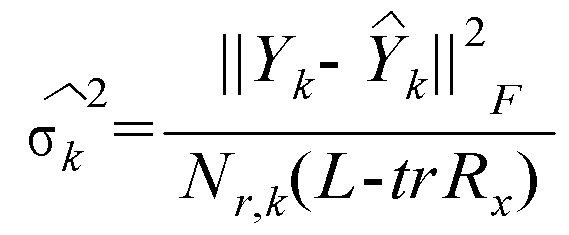
여기서 


즉, 상기 추정치를 통해 각 이동단말들이 기지국에 피드백을 하고, 기지국은 상기 피드백된 채널 추정치를 통해 보다 정확한 통신 용량을 얻을 수 있다. That is, each mobile station feeds back to the base station through the estimate, and the base station can obtain more accurate communication capacity through the fed back channel estimate.
반면에, 상기 기지국이 각각의 이동단말의 채널 정보를 알고 있으면, 상기 통신 용량은 하기의 <수학식 7>와 같다.On the other hand, if the base station knows the channel information of each mobile terminal, the communication capacity is expressed by
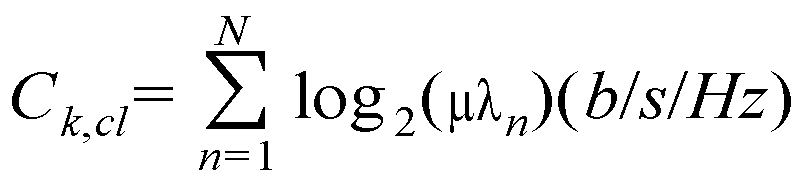
여기서, 상기 


여기서, 상기 이동단말간의 간섭신호의 영향은 시간에 따라 변화하게 되고, 만약 주파수 호핑(hopping) 이동단말이 있을 경우 매 심볼마다 간섭신호의 영향이 크게 변화할 수 있다. 따라서 이와 같이 간섭신호의 영향이 매우 빠르게 변화하는 환경에서는 이를 고려하여 여러 프레임에서의 잡음 및 간섭 전력을 평균하여 인접셀의 주파수 호핑 이동단말과 일정 주파수에 할당된 이동단말의 간섭을 구분하여야 한다.In this case, the influence of the interference signal between the mobile terminals is changed over time, and if there is a frequency hopping mobile terminal, the influence of the interference signal may vary greatly every symbol. Therefore, in the environment where the influence of the interference signal changes very rapidly, the interference and the power of the mobile station allocated to a certain frequency should be distinguished by averaging noise and interference power in several frames in consideration of this.
기지국은 하나의 부채널에 할당된 사용자 조합의 각각의 이동단말에 대해 원래의 채널 


기지국은 


상기 전술한 바와 같이 파일럿 설계는 하나의 부채널에 SDM된 이동단말들간 의 신호 간섭이 없다는 가정하에서 이루어진 것이다. 그러나, 실제 환경에서 기지국은 하향 링크 채널에 대한 불완전한 정보를 가지고 있으며, 이로 인하여 완벽한 신호 간섭 제거를 할 수 없다. 따라서 다른 이동단말로부터 간섭 신호가 발생하고, 상기 간섭 신호는 채널 추정에 영향을 주게 된다. As described above, the pilot design is performed under the assumption that there is no signal interference between mobile terminals SDM in one subchannel. However, in a real environment, the base station has incomplete information on the downlink channel, and thus, perfect signal interference can not be removed. Therefore, an interference signal is generated from another mobile terminal, and the interference signal affects channel estimation.
이러한 문제를 해소하기 위해 기지국은 하나의 부채널에 할당되는 SDM 이동단말간에 서로간의 상관도가 최소가 되는 파일럿 채널을 할당하도록 것이다.In order to solve this problem, the base station allocates a pilot channel having a minimum correlation between SDM mobile stations allocated to one subchannel.
이미 가정한 바와 같이, 각 이동단말의 수신 안테나의 수는 모두 동일하며 따라서, 


예를 들어, 공간 채널의 수 

반면에, 할당 가능한 파일럿 길이 


상기 도 5와 같이, 기지국은 하다마드(Hadamard) 행렬이나 이산 푸리에 변환(Discrete Fourier Transform, 'DFT'라 칭함) 행렬과 같은 직교 행렬중에서 크기가 


다시 설명하면, 기지국은 이동단말 1(X1)에는 (1, 2, 3, 4, 5, 6)행에 해당하는 파일럿을 할당하고, 이동단말 2(X2)에는 (3, 4, 5, 6, 7, 8)행에 해당하는 파일럿을 할당한다. 반면에, 이동단말 3(X3)에는 (5, 6, 7, 8, 1, 2)행에 해당하는 파일럿을 할당하고, 이동단말 4(X4)에는 (7, 8, 1, 2, 3, 4)행에 해당하는 파일럿을 할당한다. In other words, the base station allocates a pilot corresponding to (1, 2, 3, 4, 5, 6) to mobile terminal 1 (X1), and (3, 4, 5, 6) to mobile terminal 2 (X2). And pilots corresponding to
즉, 서로 인접한 이동단말에 대하여 서로 최소한의 간섭이 존재하도록 파일럿을 할당한다. That is, the pilot is allocated so that there is minimal interference with each other for the mobile terminals adjacent to each other.
이동단말 수가 많고 파일럿 길이가 짧은 경우, 이동단말들에 할당된 파일럿 신호들간에 상호 간섭 신호로 작용하게 된다. 따라서 상기 파일럿 채널을 할당하는 경우, 유니터리 시공간 부호 (Unitary Space-Time Code)를 이용하여 상호 상관성이 낮은 다수의 유니터리 행렬을 생성하고, 이들을 각 이동단말의 파일럿으로 할당하여 상기 이동단말간의 간섭을 제거한다. 상기 유니터리 시공간 부호화 행렬은 사용자 

이 경우 상호 신호 간섭을 제거할 수 있으나, 각 이동단말에 대하여 균일하게 신호 간섭을 줄인 것은 아니다. 또한. 채널 
이와 관련하여 하기의 도 6에서는 시간 분할 다중을 고려하여 파일럿 신호를 할당하는 과정을 도시한다. 각 이동단말의 상기 파일럿 신호는 상기 도 5에서 설명한 바와 같이 하나의 직교 행렬의 행들을 이동단말간에 간섭이 최소가 되도록 나누어 할당된 것이다. 6 illustrates a process of allocating pilot signals in consideration of time division multiplexing. As described in FIG. 5, the pilot signal of each mobile terminal is allocated by dividing rows of one orthogonal matrix such that interference between mobile terminals is minimized.
기지국은 T1 시간동안에는 이동단말 1(X1)에게 (1, 2, 3, 4, 5, 6)행의 파일럿을 할당하고, 이동단말 2(X2)에는 (3, 4, 5, 6, 7, 8)행에 해당하는 파일럿을 할당한다. 반면에, 이동단말 3(X3)에는 (5, 6, 7, 8, 1, 2)행에 해당하는 파일럿을 할당하고, 이동단말 4(X4)에는 (7, 8, 1, 2, 3, 4)행에 해당하는 파일럿을 할당한다. 또한, T2 시간동안에는 기지국은 T1 시간동안에는 이동단말 1(X1)에게 (3, 4, 5, 6, 7, 8)행에 해당하는 파일럿을 할당하고, 이동단말 2(X2)에는 (7, 8, 1, 2, 3, 4)행에 해당하는 파일럿을 할당한다. 또한, 이동단말 3(X3)에는 (1, 2, 3, 4, 5, 6)행에 해당하는 파일럿을 할당하고, 이동단말 4(X4)에는 (5, 6, 7, 8, 1, 2)행에 해당하는 파일럿을 할당한다.
The base station allocates pilots for (1, 2, 3, 4, 5, 6) to mobile terminal 1 (X1) during T1 time, and (3, 4, 5, 6, 7, to mobile terminal 2 (X2). 8) Allocate the pilot for row. On the other hand, a pilot corresponding to (5, 6, 7, 8, 1, 2) is allocated to mobile terminal 3 (X3), and (7, 8, 1, 2, 3, Allocate a pilot for row 4). In addition, during the time T2, the base station allocates a pilot corresponding to (3, 4, 5, 6, 7, 8) to mobile station 1 (X1) during the time T1, and (7, 8) to the mobile station 2 (X2). Allocates pilots corresponding to
또한, T3 시간동안에 기지국은 이동단말 1(X1)에게 (7, 8, 1, 2, 3, 4)행에 해당하는 파일럿을 할당하고, 이동단말 2(X2)에는 (5, 6, 7, 8, 1, 2)행에 해당하는 파일럿을 할당한다. 그리고, 이동단말 3(X3)에는 (3, 4, 5, 6, 7, 8)행에 해당하는 파일럿을 할당하고, 이동단말 4(X4)에는 (1, 2, 3, 4, 5, 6)행에 해당하는 파일럿을 할당한다. Further, during the time T3, the base station allocates a pilot corresponding to (7, 8, 1, 2, 3, 4) to mobile terminal 1 (X1), and (5, 6, 7, to mobile terminal 2 (X2). The pilots corresponding to
그러므로, 각각의 이동단말은 상기 T1 내지 T3 시간동안 구해진 채널 추정 값을 모두 더한 후 평균값을 취하여, 다른 이동단말간의 
도 7a 및 도 7b는 본 발명에 따른 파일럿 채널 할당의 성능을 나타낸 것이다. 즉, 전체 송신 전력 대 잡음 전력
도 7a는 상기 공간 채널의 수 K=2이고, 기지국의 송신 안테나 Nt =4이고, k 번째 사용자와 기지국같의 채널의 수가 Nr,k = 2인 경우를 나타낸다. 반면에, 상기 도 7b는 공간 채널의 수 K=4이고, 기지국과 송신 안테나 Nt = 12이고, Nr,k = 2 인 경우를 나타낸다. 7A shows the number of spatial channels K = 2, the transmit antenna Nt = 4 of the base station, The number of channels such as the k-th user and the base station is Nr, k = 2. On the other hand, FIG. 7B shows a case where the number of spatial channels K = 4, the base station and the transmitting antenna Nt = 12, and Nr, k = 2.
또한, 경우 1(Case 1)은 하나의 직교 행렬의 행들을 상기 이동단말들간에 간섭이 최소가 되도록 서로 구별하여 할당한 경우를 도시한다. 반면에, 경우 2(case 2)는 이동 단말간의 간섭을 고려하지 않고, 모든 사용자를 직교 행렬의 동일한 행 에 할당하여 동일한 파일럿 신호를 사용하는 경우를 도시한다. In addition, case 1 (Case 1) illustrates a case in which rows of one orthogonal matrix are allocated to each other so that interference between the mobile stations is minimized. On the other hand, case 2 (case 2) illustrates a case in which all users are assigned to the same row of an orthogonal matrix and use the same pilot signal without considering interference between mobile terminals.
상기 이동단말들간의 신호 간섭은 상향 링크 채널 정보 오류에 의하여 발생하다고 가정하며, 이때의 상향 링크 채널 정보 오류의 전력은 채널 전력의 0.05배의 크기를 가진다고 가정한다. 도시한 바와 같이 서로 다른 직교 행렬에 서로 다른 이동단말을 할당하여 파일럿 신호를 할당하는 경우 1(Case 1)이 경우 2(case 2)에 비해 보다 낮은 하향 채널 추정 에러를 가짐을 알 수 있다. It is assumed that signal interference between the mobile stations is caused by an uplink channel information error, and the power of the uplink channel information error at this time is assumed to have a magnitude of 0.05 times the channel power. As shown in FIG. 1, when a pilot signal is allocated by assigning different mobile terminals to different orthogonal matrices, 1 (Case 1) has a lower downlink channel estimation error than 2 (case 2).
한편 본 발명의 상세한 설명에서는 구체적인 실시예에 관해 설명하였으나, 본 발명의 범위에서 벗어나지 않는 한도 내에서 여러 가지 변형이 가능함은 물론이다. 그러므로 본 발명의 범위는 설명된 실시예에 국한되지 않으며, 후술되는 특허청구의 범위뿐만 아니라 이 특허청구의 범위와 균등한 것들에 의해 정해져야 한다.
Meanwhile, in the detailed description of the present invention, specific embodiments have been described, but various modifications are possible without departing from the scope of the present invention. Therefore, the scope of the present invention should not be limited to the described embodiments, but should be defined not only by the scope of the following claims, but also by those equivalent to the scope of the claims.
이상에서 상세히 설명한 바와 같이 동작하는 본 발명에 있어서, 개시되는 발명중 대표적인 것에 의하여 얻어지는 효과를 간단히 설명하면 다음과 같다.In the present invention operating as described in detail above, the effects obtained by the representative ones of the disclosed inventions will be briefly described as follows.
본 발명은, SDM 방식을 고려한 MIMO 방식의 OFDM 이동통신시스템에서 하나의 부채널에 임의의 사용자를 순차적으로 할당한 최적화된 통신 용량을 계산하여 최적의 사용자 조합을 할당한다. 따라서, 상기 사용자 조합을 구하기 위한 계산량이 축소되는 장점을 가진다. The present invention calculates an optimized communication capacity in which random users are sequentially allocated to one subchannel in the MIMO OFDM mobile communication system considering the SDM scheme, and allocates an optimal user combination. Therefore, the calculation amount for obtaining the user combination is reduced.
또한, 하나의 부채널에 하향 링크 채널을 추정하는 경우, 기지국이 파일럿의 길이에 해당하는 직교 행렬중 서로 다른 행을 각각의 이동단말에 할당하여 상기 SDM 방식에 따른 이동단말들간 간섭을 최소로 하는 장점을 가진다. In addition, when estimating a downlink channel in one subchannel, the base station allocates different rows of orthogonal matrices corresponding to the length of the pilot to each mobile station to minimize interference between mobile stations according to the SDM scheme. Has an advantage.
Claims (22)


Priority Applications (8)
| Application Number | Priority Date | Filing Date | Title |
|---|---|---|---|
| KR1020030080351A KR100975720B1 (en) | 2003-11-13 | 2003-11-13 | Method and system for performing channel allocation considering spatial division multiplexing in orthogonal frequency division multiplexing system having multiple transmit / receive antennas |
| CNB2004100758631A CN100441022C (en) | 2003-11-13 | 2004-11-15 | A Method for Allocating Channels Based on Space Division Multiplexing in Orthogonal Frequency Division Multiplexing System |
| DE602004032269T DE602004032269D1 (en) | 2003-11-13 | 2004-11-15 | Method for channel estimation with space multiplexing in a multi-antenna orthogonal frequency division multiplex system |
| EP04027101.7A EP1542419B1 (en) | 2003-11-13 | 2004-11-15 | Method for assigning channels based on spatial division multiplexing in an orthogonal frequency division multiplexing system with multiple antennas |
| EP06022259A EP1742405B1 (en) | 2003-11-13 | 2004-11-15 | Method for channel estimation with spatial division multiplexing in an orthogonal frequency division multiplexing system with multiple antennas |
| CN200710149688XA CN101127752B (en) | 2003-11-13 | 2004-11-15 | Method for allocating channels based on space division multiplexing in orthogonal frequency division multiplexing system |
| US10/988,876 US7319685B2 (en) | 2003-11-13 | 2004-11-15 | Method for assigning channels based on spatial division multiplexing in an orthogonal frequency division multiplexing system with multiple antennas |
| US11/945,141 US10447437B2 (en) | 2003-11-13 | 2007-11-26 | Method for assigning channels based on spatial division multiplexing in an orthogonal frequency division multiplexing system with multiple antennas |
Applications Claiming Priority (1)
| Application Number | Priority Date | Filing Date | Title |
|---|---|---|---|
| KR1020030080351A KR100975720B1 (en) | 2003-11-13 | 2003-11-13 | Method and system for performing channel allocation considering spatial division multiplexing in orthogonal frequency division multiplexing system having multiple transmit / receive antennas |
Publications (2)
| Publication Number | Publication Date |
|---|---|
| KR20050046303A KR20050046303A (en) | 2005-05-18 |
| KR100975720B1 true KR100975720B1 (en) | 2010-08-12 |
Family
ID=34511176
Family Applications (1)
| Application Number | Title | Priority Date | Filing Date |
|---|---|---|---|
| KR1020030080351A Expired - Lifetime KR100975720B1 (en) | 2003-11-13 | 2003-11-13 | Method and system for performing channel allocation considering spatial division multiplexing in orthogonal frequency division multiplexing system having multiple transmit / receive antennas |
Country Status (5)
| Country | Link |
|---|---|
| US (2) | US7319685B2 (en) |
| EP (2) | EP1542419B1 (en) |
| KR (1) | KR100975720B1 (en) |
| CN (2) | CN100441022C (en) |
| DE (1) | DE602004032269D1 (en) |
Families Citing this family (65)
| Publication number | Priority date | Publication date | Assignee | Title |
|---|---|---|---|---|
| US8098632B2 (en) * | 2005-01-21 | 2012-01-17 | Samsung Electronics Co., Ltd. | Apparatus and method for downlink scheduling in a SDMA-enabled OFDMA wireless network |
| USRE47633E1 (en) | 2005-06-22 | 2019-10-01 | Odyssey Wireless Inc. | Systems/methods of conducting a financial transaction using a smartphone |
| US8670493B2 (en) | 2005-06-22 | 2014-03-11 | Eices Research, Inc. | Systems and/or methods of increased privacy wireless communications |
| US8233554B2 (en) | 2010-03-29 | 2012-07-31 | Eices Research, Inc. | Increased capacity communications for OFDM-based wireless communications systems/methods/devices |
| KR100946924B1 (en) | 2005-06-24 | 2010-03-09 | 삼성전자주식회사 | User terminal selection method in zero forcing beamforming algorithm |
| US7848218B2 (en) | 2005-08-19 | 2010-12-07 | Electronics And Telecommunications Research Institute | Virtual multi-antenna method for OFDM system and OFDM-based cellular system |
| KR100779172B1 (en) * | 2005-08-19 | 2007-11-26 | 한국전자통신연구원 | Virtual Multiple Antenna Method in OPMM System / OPDM-Based Cellular System |
| EP1927196A1 (en) | 2005-09-22 | 2008-06-04 | Technische Universität Ilmenau | Method for selection of an optimized number of subscribers in mobile radio systems |
| US8064601B1 (en) | 2006-03-31 | 2011-11-22 | Meru Networks | Security in wireless communication systems |
| US9142873B1 (en) | 2005-12-05 | 2015-09-22 | Meru Networks | Wireless communication antennae for concurrent communication in an access point |
| US8160664B1 (en) | 2005-12-05 | 2012-04-17 | Meru Networks | Omni-directional antenna supporting simultaneous transmission and reception of multiple radios with narrow frequency separation |
| US9185618B1 (en) | 2005-12-05 | 2015-11-10 | Meru Networks | Seamless roaming in wireless networks |
| US8344953B1 (en) | 2008-05-13 | 2013-01-01 | Meru Networks | Omni-directional flexible antenna support panel |
| US9025581B2 (en) | 2005-12-05 | 2015-05-05 | Meru Networks | Hybrid virtual cell and virtual port wireless network architecture |
| US9215754B2 (en) | 2007-03-07 | 2015-12-15 | Menu Networks | Wi-Fi virtual port uplink medium access control |
| US9730125B2 (en) | 2005-12-05 | 2017-08-08 | Fortinet, Inc. | Aggregated beacons for per station control of multiple stations across multiple access points in a wireless communication network |
| US9794801B1 (en) | 2005-12-05 | 2017-10-17 | Fortinet, Inc. | Multicast and unicast messages in a virtual cell communication system |
| US9215745B1 (en) | 2005-12-09 | 2015-12-15 | Meru Networks | Network-based control of stations in a wireless communication network |
| US8472359B2 (en) * | 2009-12-09 | 2013-06-25 | Meru Networks | Seamless mobility in wireless networks |
| CN101026445B (en) * | 2006-02-21 | 2010-11-03 | 华为技术有限公司 | Uplink Resource Allocation Method and Device for Wireless Local Area Network Using Orthogonal Frequency Division Multiple Access |
| US7634016B2 (en) * | 2006-04-25 | 2009-12-15 | Microsoft Corporation | Variable OFDM subchannel coding and modulation |
| US7933344B2 (en) * | 2006-04-25 | 2011-04-26 | Mircosoft Corporation | OFDMA based on cognitive radio |
| US8189621B2 (en) | 2006-05-12 | 2012-05-29 | Microsoft Corporation | Stack signaling to application with lack of requested bandwidth |
| US7808908B1 (en) | 2006-09-20 | 2010-10-05 | Meru Networks | Wireless rate adaptation |
| US8885744B2 (en) * | 2006-11-10 | 2014-11-11 | Qualcomm Incorporated | Providing antenna diversity in a wireless communication system |
| US8144793B2 (en) | 2006-12-12 | 2012-03-27 | Microsoft Corporation | Cognitive multi-user OFDMA |
| CN101212288B (en) * | 2006-12-28 | 2010-12-08 | 中兴通讯股份有限公司 | A method for uplink multi-user space division multiplexing in OFDMA system |
| US7929623B2 (en) * | 2007-03-30 | 2011-04-19 | Microsoft Corporation | FEC in cognitive multi-user OFDMA |
| US7970085B2 (en) * | 2007-05-08 | 2011-06-28 | Microsoft Corporation | OFDM transmission and reception for non-OFDMA signals |
| KR101422014B1 (en) | 2007-05-10 | 2014-07-23 | 엘지전자 주식회사 | Long code generation method by basic code repetition method and control information transmission method using the same |
| US8522353B1 (en) | 2007-08-15 | 2013-08-27 | Meru Networks | Blocking IEEE 802.11 wireless access |
| US8799648B1 (en) | 2007-08-15 | 2014-08-05 | Meru Networks | Wireless network controller certification authority |
| US8081589B1 (en) | 2007-08-28 | 2011-12-20 | Meru Networks | Access points using power over ethernet |
| US8325671B2 (en) * | 2007-09-06 | 2012-12-04 | Qualcomm Incorporated | Methods and apparatus for improved utilization of air link resources in a wireless communications system including a multi-antenna element base station |
| US7894436B1 (en) | 2007-09-07 | 2011-02-22 | Meru Networks | Flow inspection |
| US8145136B1 (en) | 2007-09-25 | 2012-03-27 | Meru Networks | Wireless diagnostics |
| CN101420703B (en) * | 2007-10-22 | 2010-08-18 | 中兴通讯股份有限公司 | A Method for Realizing Space Division Multiple Access in TD-SCDMA Indoor Distribution System |
| US8374130B2 (en) | 2008-01-25 | 2013-02-12 | Microsoft Corporation | Orthogonal frequency division multiple access with carrier sense |
| US8284191B1 (en) | 2008-04-04 | 2012-10-09 | Meru Networks | Three-dimensional wireless virtual reality presentation |
| US8893252B1 (en) | 2008-04-16 | 2014-11-18 | Meru Networks | Wireless communication selective barrier |
| US8665910B2 (en) * | 2008-05-09 | 2014-03-04 | Nokia Siemens Networks Oy | Multi-cell channel estimation in 3G-LTE based virtual pilot sequences |
| US7756059B1 (en) | 2008-05-19 | 2010-07-13 | Meru Networks | Differential signal-to-noise ratio based rate adaptation |
| US8325753B1 (en) | 2008-06-10 | 2012-12-04 | Meru Networks | Selective suppression of 802.11 ACK frames |
| US8369794B1 (en) | 2008-06-18 | 2013-02-05 | Meru Networks | Adaptive carrier sensing and power control |
| WO2009153810A2 (en) * | 2008-06-18 | 2009-12-23 | Centre Of Excellence In Wireless Technology | Precoding for multiple transmission streams in multiple antenna systems |
| US9225575B2 (en) | 2008-06-18 | 2015-12-29 | Center Of Excellence In Wireless Technology | Precoding for single transmission streams in multiple antenna systems |
| US9374746B1 (en) * | 2008-07-07 | 2016-06-21 | Odyssey Wireless, Inc. | Systems/methods of spatial multiplexing |
| US8811267B2 (en) | 2008-08-13 | 2014-08-19 | Samsung Electronics Co., Ltd. | Communication system for supporting primary user and secondary user |
| US8165076B2 (en) * | 2008-09-10 | 2012-04-24 | Industrial Technology Research Institute | Resource allocation method for multi-users multiple input multiple output orthogonal frequency division multiplexing system and apparaus thereof |
| US8238834B1 (en) | 2008-09-11 | 2012-08-07 | Meru Networks | Diagnostic structure for wireless networks |
| US8599734B1 (en) | 2008-09-30 | 2013-12-03 | Meru Networks | TCP proxy acknowledgements |
| US8284726B2 (en) * | 2008-10-29 | 2012-10-09 | Pantech Co., Ltd. | Apparatus and method for allocating resource in a wireless communication system using OFDMA |
| CN101742662B (en) * | 2008-11-04 | 2012-06-27 | 鼎桥通信技术有限公司 | Method for space division of HSDPA in multi-channel system |
| US8855087B2 (en) * | 2008-12-18 | 2014-10-07 | Microsoft Corporation | Wireless access point supporting control by multiple applications |
| CN101834646B (en) * | 2009-03-11 | 2012-09-26 | 上海交通大学 | User selection method, user selection device and base station |
| CN102511131B (en) | 2009-12-10 | 2015-09-16 | Lg电子株式会社 | The method and apparatus of training signal is sent in wireless local area network (WLAN) system |
| US9197482B1 (en) | 2009-12-29 | 2015-11-24 | Meru Networks | Optimizing quality of service in wireless networks |
| CN102158292B (en) * | 2010-02-12 | 2016-01-20 | 中兴通讯股份有限公司 | Channel measurement pilot frequency sending method and base station |
| US9445432B2 (en) | 2010-06-25 | 2016-09-13 | Microsoft Technology Licensing, Llc | Fine-grained channel access in wireless networks |
| CN101917367B (en) * | 2010-09-06 | 2013-02-27 | 北京交通大学 | Method for inter-cell interference coordination of downlink control channel in LTE-Advanced heterogeneous network |
| EP2659693B1 (en) * | 2010-12-29 | 2019-02-20 | MediaTek Singapore Pte Ltd. | Methods for determining a loading of a wireless communications system and communication apparatuses utilizing the same |
| US8941539B1 (en) | 2011-02-23 | 2015-01-27 | Meru Networks | Dual-stack dual-band MIMO antenna |
| US9893773B2 (en) * | 2011-09-21 | 2018-02-13 | Provenance Asset Group Llc | System and method of wireless communication using large-scale antenna networks |
| CN102916735B (en) * | 2012-10-17 | 2016-06-08 | 东南大学 | Utilize the wireless communications method of large-scale antenna array |
| CN105610561B (en) * | 2016-01-29 | 2019-02-01 | 中国科学院计算技术研究所 | The distribution method of pilot frequency sequence in a kind of extensive multi-input multi-output system |
Citations (4)
| Publication number | Priority date | Publication date | Assignee | Title |
|---|---|---|---|---|
| EP1249980A2 (en) | 2001-04-09 | 2002-10-16 | Nippon Telegraph and Telephone Corporation | OFDM signal communication system, OFDM signal transmitting device and OFDM signal receiving device |
| US20030043928A1 (en) | 2001-02-01 | 2003-03-06 | Fuyun Ling | Coding scheme for a wireless communication system |
| US20030054828A1 (en) | 2001-07-26 | 2003-03-20 | Dent Paul W. | Communications system employing non-polluting pilot codes |
| WO2003058871A1 (en) * | 2002-01-08 | 2003-07-17 | Qualcomm Incorporated | Method and apparatus for a mimo-ofdm communication system |
Family Cites Families (18)
| Publication number | Priority date | Publication date | Assignee | Title |
|---|---|---|---|---|
| US6804264B1 (en) * | 1999-03-15 | 2004-10-12 | Lg Information & Communications, Ltd. | Pilot signals for synchronization and/or channel estimation |
| US6473467B1 (en) | 2000-03-22 | 2002-10-29 | Qualcomm Incorporated | Method and apparatus for measuring reporting channel state information in a high efficiency, high performance communications system |
| MXPA03005307A (en) | 2000-12-15 | 2004-12-02 | Adaptix Inc | Multi-carrier communications with group-based subcarrier allocation. |
| EP1374443B1 (en) * | 2001-04-05 | 2006-07-12 | Nortel Networks Limited | Transmitter for a wireless communications system using multiple codes and multiple antennas |
| US6611231B2 (en) * | 2001-04-27 | 2003-08-26 | Vivato, Inc. | Wireless packet switched communication systems and networks using adaptively steered antenna arrays |
| US7047016B2 (en) * | 2001-05-16 | 2006-05-16 | Qualcomm, Incorporated | Method and apparatus for allocating uplink resources in a multiple-input multiple-output (MIMO) communication system |
| US6662024B2 (en) * | 2001-05-16 | 2003-12-09 | Qualcomm Incorporated | Method and apparatus for allocating downlink resources in a multiple-input multiple-output (MIMO) communication system |
| US7103115B2 (en) * | 2001-05-21 | 2006-09-05 | At&T Corp. | Optimum training sequences for wireless systems |
| US7269224B2 (en) | 2001-09-17 | 2007-09-11 | Bae Systems Information And Electronic Systems Integration Inc. | Apparatus and methods for providing efficient space-time structures for preambles, pilots and data for multi-input, multi-output communications systems |
| US8204504B2 (en) * | 2001-10-26 | 2012-06-19 | Rockstar Bidco Llp | Wireless communications system and method |
| US6862271B2 (en) * | 2002-02-26 | 2005-03-01 | Qualcomm Incorporated | Multiple-input, multiple-output (MIMO) systems with multiple transmission modes |
| US7194237B2 (en) * | 2002-07-30 | 2007-03-20 | Ipr Licensing Inc. | System and method for multiple-input multiple-output (MIMO) radio communication |
| US7340017B1 (en) * | 2002-07-30 | 2008-03-04 | National Semiconductor Corporation | System and method for finger management in a rake receiver |
| US20040081131A1 (en) * | 2002-10-25 | 2004-04-29 | Walton Jay Rod | OFDM communication system with multiple OFDM symbol sizes |
| US7986742B2 (en) * | 2002-10-25 | 2011-07-26 | Qualcomm Incorporated | Pilots for MIMO communication system |
| US20040132494A1 (en) * | 2003-01-03 | 2004-07-08 | Olav Tirkkonen | Communication method |
| US7406335B2 (en) * | 2003-01-13 | 2008-07-29 | Lucent Technologies Inc. | Multiple antenna transmissions with deterministic phase differences |
| US7155177B2 (en) * | 2003-02-10 | 2006-12-26 | Qualcomm Incorporated | Weight prediction for closed-loop mode transmit diversity |
-
2003
- 2003-11-13 KR KR1020030080351A patent/KR100975720B1/en not_active Expired - Lifetime
-
2004
- 2004-11-15 CN CNB2004100758631A patent/CN100441022C/en not_active Expired - Lifetime
- 2004-11-15 DE DE602004032269T patent/DE602004032269D1/en not_active Expired - Lifetime
- 2004-11-15 CN CN200710149688XA patent/CN101127752B/en not_active Expired - Lifetime
- 2004-11-15 EP EP04027101.7A patent/EP1542419B1/en not_active Expired - Lifetime
- 2004-11-15 US US10/988,876 patent/US7319685B2/en not_active Expired - Lifetime
- 2004-11-15 EP EP06022259A patent/EP1742405B1/en not_active Expired - Lifetime
-
2007
- 2007-11-26 US US11/945,141 patent/US10447437B2/en active Active
Patent Citations (4)
| Publication number | Priority date | Publication date | Assignee | Title |
|---|---|---|---|---|
| US20030043928A1 (en) | 2001-02-01 | 2003-03-06 | Fuyun Ling | Coding scheme for a wireless communication system |
| EP1249980A2 (en) | 2001-04-09 | 2002-10-16 | Nippon Telegraph and Telephone Corporation | OFDM signal communication system, OFDM signal transmitting device and OFDM signal receiving device |
| US20030054828A1 (en) | 2001-07-26 | 2003-03-20 | Dent Paul W. | Communications system employing non-polluting pilot codes |
| WO2003058871A1 (en) * | 2002-01-08 | 2003-07-17 | Qualcomm Incorporated | Method and apparatus for a mimo-ofdm communication system |
Also Published As
| Publication number | Publication date |
|---|---|
| US10447437B2 (en) | 2019-10-15 |
| EP1542419A2 (en) | 2005-06-15 |
| US7319685B2 (en) | 2008-01-15 |
| EP1542419A3 (en) | 2005-08-10 |
| EP1542419B1 (en) | 2018-02-14 |
| KR20050046303A (en) | 2005-05-18 |
| DE602004032269D1 (en) | 2011-05-26 |
| EP1742405A1 (en) | 2007-01-10 |
| EP1742405B1 (en) | 2011-04-13 |
| US20080137764A1 (en) | 2008-06-12 |
| CN101127752A (en) | 2008-02-20 |
| CN101127752B (en) | 2011-06-08 |
| CN100441022C (en) | 2008-12-03 |
| CN1665332A (en) | 2005-09-07 |
| US20050130684A1 (en) | 2005-06-16 |
Similar Documents
| Publication | Publication Date | Title |
|---|---|---|
| KR100975720B1 (en) | Method and system for performing channel allocation considering spatial division multiplexing in orthogonal frequency division multiplexing system having multiple transmit / receive antennas | |
| EP1929691B1 (en) | Resource allocation method for MIMO-OFDM of multi-user access systems | |
| US8111709B2 (en) | MIMO wireless communication system | |
| CA2402152C (en) | Method and apparatus for transmitting pilot symbols on a plurality of subbands from a plurality of antennas | |
| KR100580840B1 (en) | Data communication method of a multiple input multiple output system | |
| KR100689454B1 (en) | Downlink Channel Scheduling Method, Apparatus and System in Orthogonal Frequency Division Multiple Access Wireless Communication System | |
| KR100532295B1 (en) | Wireless communication apparatus and method for multiple transmitting/receiving antenna system | |
| KR100713336B1 (en) | Signal Detection Order Determination Method in Mobile Communication System | |
| JP2006067572A (en) | Subchannel assignment method in wireless network | |
| US20090175363A1 (en) | Assignment of sub-channels to channels in a multi transmission-channel system | |
| JP4971173B2 (en) | Communications system | |
| US11018744B2 (en) | Block-diagonalization based beamforming | |
| KR100930998B1 (en) | Subcarrier Allocation Method and Resource Allocation Method for User Terminal in MIMO-OPEM System and MIO-OPEM System | |
| Shrivastava et al. | Joint scheduling and random beamforming with reduced feedback in multiuser mimo-ofdm | |
| Kukade et al. | Multiuser Scheduling In 3GPP LTE-A Uplink Non-Stand-Alone Cellular Network With Virtual MIMO | |
| JP5100776B2 (en) | Wireless communication device | |
| HK1103871B (en) | Apparatus for measuring and reporting channel state information |
Legal Events
| Date | Code | Title | Description |
|---|---|---|---|
| PA0109 | Patent application |
Patent event code: PA01091R01D Comment text: Patent Application Patent event date: 20031113 |
|
| PG1501 | Laying open of application | ||
| A201 | Request for examination | ||
| PA0201 | Request for examination |
Patent event code: PA02012R01D Patent event date: 20080812 Comment text: Request for Examination of Application Patent event code: PA02011R01I Patent event date: 20031113 Comment text: Patent Application |
|
| E902 | Notification of reason for refusal | ||
| PE0902 | Notice of grounds for rejection |
Comment text: Notification of reason for refusal Patent event date: 20100225 Patent event code: PE09021S01D |
|
| E701 | Decision to grant or registration of patent right | ||
| PE0701 | Decision of registration |
Patent event code: PE07011S01D Comment text: Decision to Grant Registration Patent event date: 20100727 |
|
| GRNT | Written decision to grant | ||
| PR0701 | Registration of establishment |
Comment text: Registration of Establishment Patent event date: 20100806 Patent event code: PR07011E01D |
|
| PR1002 | Payment of registration fee |
Payment date: 20100806 End annual number: 3 Start annual number: 1 |
|
| PG1601 | Publication of registration | ||
| FPAY | Annual fee payment |
Payment date: 20130730 Year of fee payment: 4 |
|
| PR1001 | Payment of annual fee |
Payment date: 20130730 Start annual number: 4 End annual number: 4 |
|
| FPAY | Annual fee payment |
Payment date: 20140730 Year of fee payment: 5 |
|
| PR1001 | Payment of annual fee |
Payment date: 20140730 Start annual number: 5 End annual number: 5 |
|
| FPAY | Annual fee payment |
Payment date: 20150730 Year of fee payment: 6 |
|
| PR1001 | Payment of annual fee |
Payment date: 20150730 Start annual number: 6 End annual number: 6 |
|
| FPAY | Annual fee payment |
Payment date: 20160728 Year of fee payment: 7 |
|
| PR1001 | Payment of annual fee |
Payment date: 20160728 Start annual number: 7 End annual number: 7 |
|
| FPAY | Annual fee payment |
Payment date: 20170728 Year of fee payment: 8 |
|
| PR1001 | Payment of annual fee |
Payment date: 20170728 Start annual number: 8 End annual number: 8 |
|
| FPAY | Annual fee payment |
Payment date: 20190730 Year of fee payment: 10 |
|
| PR1001 | Payment of annual fee |
Payment date: 20190730 Start annual number: 10 End annual number: 10 |
|
| PR1001 | Payment of annual fee |
Payment date: 20200730 Start annual number: 11 End annual number: 11 |
|
| PR1001 | Payment of annual fee |
Payment date: 20210729 Start annual number: 12 End annual number: 12 |
|
| PC1801 | Expiration of term |
Termination date: 20240513 Termination category: Expiration of duration |