KR100965037B1 - Method for manufacturing glass article of ultra high purity optical quality - Google Patents
Method for manufacturing glass article of ultra high purity optical quality Download PDFInfo
- Publication number
- KR100965037B1 KR100965037B1 KR1020077020528A KR20077020528A KR100965037B1 KR 100965037 B1 KR100965037 B1 KR 100965037B1 KR 1020077020528 A KR1020077020528 A KR 1020077020528A KR 20077020528 A KR20077020528 A KR 20077020528A KR 100965037 B1 KR100965037 B1 KR 100965037B1
- Authority
- KR
- South Korea
- Prior art keywords
- ppb
- less
- granules
- vessel
- silicon dioxide
- Prior art date
- Legal status (The legal status is an assumption and is not a legal conclusion. Google has not performed a legal analysis and makes no representation as to the accuracy of the status listed.)
- Expired - Fee Related
Links
Classifications
-
- C—CHEMISTRY; METALLURGY
- C03—GLASS; MINERAL OR SLAG WOOL
- C03B—MANUFACTURE, SHAPING, OR SUPPLEMENTARY PROCESSES
- C03B19/00—Other methods of shaping glass
- C03B19/06—Other methods of shaping glass by sintering, e.g. by cold isostatic pressing of powders and subsequent sintering, by hot pressing of powders, by sintering slurries or dispersions not undergoing a liquid phase reaction
-
- C—CHEMISTRY; METALLURGY
- C01—INORGANIC CHEMISTRY
- C01B—NON-METALLIC ELEMENTS; COMPOUNDS THEREOF; METALLOIDS OR COMPOUNDS THEREOF NOT COVERED BY SUBCLASS C01C
- C01B33/00—Silicon; Compounds thereof
- C01B33/113—Silicon oxides; Hydrates thereof
- C01B33/12—Silica; Hydrates thereof, e.g. lepidoic silicic acid
- C01B33/18—Preparation of finely divided silica neither in sol nor in gel form; After-treatment thereof
-
- C—CHEMISTRY; METALLURGY
- C03—GLASS; MINERAL OR SLAG WOOL
- C03B—MANUFACTURE, SHAPING, OR SUPPLEMENTARY PROCESSES
- C03B19/00—Other methods of shaping glass
- C03B19/06—Other methods of shaping glass by sintering, e.g. by cold isostatic pressing of powders and subsequent sintering, by hot pressing of powders, by sintering slurries or dispersions not undergoing a liquid phase reaction
- C03B19/066—Other methods of shaping glass by sintering, e.g. by cold isostatic pressing of powders and subsequent sintering, by hot pressing of powders, by sintering slurries or dispersions not undergoing a liquid phase reaction for the production of quartz or fused silica articles
-
- C—CHEMISTRY; METALLURGY
- C03—GLASS; MINERAL OR SLAG WOOL
- C03B—MANUFACTURE, SHAPING, OR SUPPLEMENTARY PROCESSES
- C03B32/00—Thermal after-treatment of glass products not provided for in groups C03B19/00, C03B25/00 - C03B31/00 or C03B37/00, e.g. crystallisation, eliminating gas inclusions or other impurities; Hot-pressing vitrified, non-porous, shaped glass products
-
- C—CHEMISTRY; METALLURGY
- C03—GLASS; MINERAL OR SLAG WOOL
- C03B—MANUFACTURE, SHAPING, OR SUPPLEMENTARY PROCESSES
- C03B32/00—Thermal after-treatment of glass products not provided for in groups C03B19/00, C03B25/00 - C03B31/00 or C03B37/00, e.g. crystallisation, eliminating gas inclusions or other impurities; Hot-pressing vitrified, non-porous, shaped glass products
- C03B32/005—Hot-pressing vitrified, non-porous, shaped glass products
Landscapes
- Chemical & Material Sciences (AREA)
- Engineering & Computer Science (AREA)
- Organic Chemistry (AREA)
- Materials Engineering (AREA)
- Dispersion Chemistry (AREA)
- Manufacturing & Machinery (AREA)
- Thermal Sciences (AREA)
- Physics & Mathematics (AREA)
- Inorganic Chemistry (AREA)
- Silicon Compounds (AREA)
- Compositions Of Oxide Ceramics (AREA)
- Glass Melting And Manufacturing (AREA)
- Chemical Vapour Deposition (AREA)
Abstract
본 발명은 1. 금속 산화물 또는 메탈로이드 산화물을 약 1 mm 미만의 평균 입자 크기를 갖는 과립으로 압축하고; 2. 임의로는 과립을 완전히 소결시켜 고순도의 인공 모래를 제조하고; 3. 과립상 인공 모래를 슬립 주형과 같은 기존의 기술로 주형하여 고밀도, 다공성, 미가공 몸체를 형성하고; 4. 임의로는 미가공 몸체를 건조 및 부분적 소결시키고; 5. 임의로는 미가공 몸체를 진공 하에서 완전히 소결시키고; 6. 임의로는 완전히 소결된 미가공 몸체를 고온 이소스태틱 가압하는 것을 포함하는 초고순도, 광학 품질의 유리 용품의 제조 방법을 개시하며, 여기서 금속 산화물 또는 메탈로이드 산화물은 30 내지 90 m2/g의 BET 표면적, 80 이하의 DBP 지수, 25000 nm2 미만의 평균 응집체 면적, 1000 nm 미만의 평균 응집체 둘레 (이 때 70 % 이상의 응집체가 1300 nm 미만의 둘레를 가짐)를 갖는 화열 이산화규소 분말이거나 또는 0.2 μg/g 미만의 금속 함량을 갖는 고순도의 화열적으로 제조된 이산화규소이다.The present invention is directed to 1. compressing a metal oxide or metaloid oxide into granules having an average particle size of less than about 1 mm; 2. optionally, completely sintering the granules to produce high purity artificial sand; 3. Molding granular artificial sand with existing techniques such as slip molds to form a dense, porous, raw body; 4. optionally drying and partially sintering the raw body; 5. optionally, the raw body is completely sintered under vacuum; 6. Disclosed is a method of making a high purity, optical quality glass article, optionally comprising hot isostatic pressing a fully sintered raw body, wherein the metal oxide or metalloid oxide has a BET of 30 to 90 m 2 / g. Pyrogenic silicon dioxide powder having a surface area of less than 80, a DBP index of less than 25000 nm 2, an average aggregate area of less than 2 000 nm, an average aggregate circumference of less than 1000 nm, wherein at least 70% of the aggregates have a circumference of less than 1300 nm or 0.2 μg High purity pyrogenically produced silicon dioxide with a metal content of less than / g.
고순도 유리 용품, 예비소결 조성물, 이산화규소 기재 과립, 화열 이산화규소High purity glass articles, presintering compositions, silicon dioxide based granules, pyrogenic silicon dioxide
Description
본 발명은 초고순도 광학적 품질의 유리 용품의 제조 방법에 관한 것이다.The present invention relates to a method of making a glass article of ultra high purity optical quality.
많은 연구자들이 졸-겔 기술을 광학적 품질의 유리 제품의 제조에 적용하려는 시도를 해왔다.Many researchers have attempted to apply sol-gel technology to the production of optical quality glass products.
예를 들어, 마쯔야마(Matsuyama) 등에 의한 영국 특허 출원 GB 2,041,913은, 알콕시화 규소의 용액을 형성하고, 겔이 되도록 하여 다공성 예비성형체를 제조하고, 건조된 후 그의 용융 온도 이하의 온도에서 소결되어 마더 로드(mother rod)를 제조하는 것인, 그로부터 광도파관 섬유를 제조할 수 있는 "마더 로드"를 제조하는 겔 주형법을 설명한다. 상기 출원은 산소 및 헬륨의 분위기가 700 ℃의 온도까지 사용되고, 염소 및 헬륨의 분위기가 700 ℃ 및 1000 ℃ 사이에서 사용되고, 헬륨만의 분위기가 1000 ℃ 이상에서 사용되는 3 단계 소결 방법을 설명한다. 이 출원에서 확인되는 바와 같이, 균열없이 겔을 건조시키는 것은 어렵고, 10 일의 긴 시간이 걸린다.For example, British Patent Application GB 2,041,913 by Matsuyama et al. Forms a solution of silicon alkoxylated, becomes a gel to prepare a porous preform, dried and sintered at a temperature below its melting temperature The gel molding method for producing a "mother rod" from which a rod of light can be made can be made, which is to manufacture a rod of mother. The application describes a three-step sintering method in which the atmosphere of oxygen and helium is used up to a temperature of 700 ° C., the atmosphere of chlorine and helium is used between 700 ° C. and 1000 ° C., and the atmosphere of helium only is used at 1000 ° C. or higher. As can be seen in this application, it is difficult to dry the gel without cracking and takes a long time of 10 days.
상기에 더하여, 졸-겔 주형 방법들은 또한 한센(Hansen) 등의 미국 특허 제3,535,890호, 숍(Shoup)의 미국 특허 제3,678,144호, 블라스직(Blaszyk) 등의 미국 특허 제4,112,032호, 비후니악(Bihuniak) 등의 미국 특허 제4,042,361호 및 제4,200,445호, 및 쉐러(Scherer)의 미국 특허 제4,574,063호, 유럽 특허 공보 제84,438호, 및 쉐러 등의 문헌 ["Glasses from Colloids", Journal of Non- Crystalline Solids, 63: 163-172 (1984)]에서 설명되어 있다.In addition to the above, the sol-gel molding methods are also described in US Pat. No. 3,535,890 to Hansen et al., US Pat. No. 3,678,144 to Shoup, US Pat. No. 4,112,032 to Blaszyk et al., Bihuniac. (Bihuniak et al., US Pat. Nos. 4,042,361 and 4,200,445, and Scherer, US Pat. No. 4,574,063, European Patent Publication No. 84,438, and Scherer et al., "Glasses from Colloids", Journal of Non- Crystalline Solids, 63: 163-172 (1984).
특히, 상기 한센 등의 특허는 콜로이드 실리카 입자의 수용액을 형성시키고, 건조시켜 겔을 제조하고, 제1 단계는 겔을 약 600 ℃로 진공에서 가열하는 것을 포함하고, 제2 단계는 겔을 염소 기체로 플러싱하여 결합수를 제거하는 것을 포함하며, 제3 단계는 진공 하에서 그의 온도를 1200 ℃로 증가시켜 겔을 소결시키는 것을 포함하는 3 단계 방법으로 겔을 소결시키는 방법에 관한 것이다. 상기 특허는 건조 과정 중 겔이 균열에 매우 민감하다는 것을 확인하며, 이러한 문제를 해결하기 위하여는 수 일 또는 수 주일에 걸친 건조 시간이 필요하다고 기재한다.In particular, the Hansen et al patent forms a gel by forming an aqueous solution of colloidal silica particles and drying to form a gel, the first step comprising heating the gel to about 600 ° C. in vacuo, and the second step being the gel of chlorine gas Removing the bound water by flushing with a third step, wherein the third step relates to a method of sintering a gel in a three step method comprising increasing the temperature thereof to 1200 ° C. under vacuum to sinter the gel. The patent confirms that the gel is very susceptible to cracking during the drying process and states that a drying time over several days or weeks is required to solve this problem.
상기 비후니악 등의 특허는 졸을 형성하고, 상기 졸을 건조시켜 단편을 형성하며, 1150 내지 1500 ℃에서 소성시켜 단편을 치밀화시키는 발연 실리카 및 다른 발연 금속 산화물의 치밀화 방법을 설명한다. 그 후, 치밀화된 물질은, 예를 들어 8 내지 10 미크론의 평균 입자 크기로 밀링되고, 주형 매체 내에 현탁되며, 슬립 주형되어 다공성 예비성형체를 형성하고, 가열되어 원하는 최종 제품을 제조할 수 있다.The patent of Bihuniak et al. Describes a process for densification of fumed silica and other fumed metal oxides that form sols, dry the sols to form fragments, and calcinate at 1150 to 1500 ° C. to densify the fragments. The densified material can then be milled, for example, to an average particle size of 8 to 10 microns, suspended in a mold medium, slip molded to form a porous preform, and heated to produce the desired final product.
상기 비후니악 등의 방법은 발연 실리카를 사용하기 때문에, 본 발명의 방법보다 수행하기가 더욱 힘들다. 예를 들어, 발연 실리카로부터 겔을 형성하는 것은 상대적으로 더 어렵고, 비후니악 등의 특허에서 확인된 바와 같이, 일단 형성되면, 발연 실리카로부터 얻은 겔은 원하는 만큼의 작은 입자가 아닌 큰 청크로 분해되는 경향이 있다. 또한, 그러한 제조는 염산의 생성을 수반하기 때문에 발연 실리카를 제조하기 위하여 대규모 공해 감소 기기를 필요로 한다.Since Bihuniak et al. Use fumed silica, it is more difficult to perform than the method of the present invention. For example, it is relatively harder to form a gel from fumed silica and, as confirmed by Bihuniak et al., Once formed, the gel obtained from fumed silica decomposes into large chunks rather than as small particles as desired. Tend to be. In addition, such production involves the production of hydrochloric acid and therefore requires large-scale pollution reduction equipment to produce fumed silica.
또한, 발연 실리카로부터 제조된 치밀화된 실리카 입자는 본 발명의 방법으로 제조된 치밀화된 실리카 입자보다 더 높은 불순물 수준을 갖게 된다. 이러한 높은 불순물 수준은 부분적으로는 미량의 방사성 물질을 비롯한 불순물들이 발연 공정 중 실리카 내에 도입되는 것에 기인한다. In addition, densified silica particles made from fumed silica will have higher impurity levels than densified silica particles produced by the process of the invention. These high impurity levels are partly due to the introduction of impurities, including trace amounts of radioactive material, into the silica during the fume process.
높은 불순물 수준은 또한 발연 실리카겔로부터 제조된 입자의 치밀화는 본 발명에 따라서 제조된 겔로부터 형성된 입자의 치밀화에 비하여 더 높은 온도를 요한다는 점, 즉 발연 실리카겔로부터 제조된 입자의 치밀화는 1150 ℃ 이하가 아닌 그 이상의 온도를 요한다는 점에 기인한다. 이러한 높은 온도는 일반적으로 치밀화를 수행하기 위하여 금속-함유 노(furnace)가 반드시 사용되어야 한다는 것을 의미한다. 이러한 노의 사용은 다시, 실리카 입자가 노출되고, 이에 따라 고온의 노의 벽에서 방출된 금속 이온을 더하게 되는 것을 의미한다. 순도 문제에 더하여, 치밀화를 달성하기 위하여 높은 온도를 발생시켜야 하는 필요성은 일반적으로 바람직하지 않다.High impurity levels also indicate that densification of particles made from fumed silica gel requires higher temperatures than densification of particles formed from gels prepared according to the present invention, i.e. densification of particles made from fumed silica gel is less than 1150 ° C. This is due to the fact that it requires more temperature. Such high temperatures generally mean that a metal-containing furnace must be used to effect densification. The use of such a furnace again means that the silica particles are exposed, thus adding up the metal ions released from the walls of the hot furnace. In addition to purity issues, the need to generate high temperatures to achieve densification is generally undesirable.
유리질 물질 내의 기체 기포를 압축하기 위하여 고온 이소스태틱 가압 ("히핑(hipping)") 및 다른 가압 기술을 사용하는 것은 많은 문헌에 설명되어 있다 (로드(Rhodes)의 미국 특허 제3,310,392호, 부시(Bush)의 미국 특허 제3,562,371호, 오카모토(Okamoto) 등의 미국 특허 제4,358,306호, 및 브루닝(Bruning) 등의 미국 특허 제4,414,014호 및 영국 특허 출원 제2,086,369호 참조). 특히 상기 부시의 특허는, 미가공 몸체(green body)를 형성하고, 진공에서 상기 몸체를 소결시킨 후, 소결 온도 이상의 온도에서 통합된 몸체에 이소스태틱 압력을 가하는 것을 개시한다.The use of high temperature isostatic pressurization ("hipping") and other pressurization techniques to compress gas bubbles in glassy materials has been described in many documents (Rhodes, US Pat. No. 3,310,392, Bush). US Patent No. 3,562,371, US Patent No. 4,358,306 to Okamoto et al., And US Patent No. 4,414,014 to Bruning et al. And UK Patent Application No. 2,086,369). In particular, the Bush patent discloses forming a green body, sintering the body in vacuum, and then applying isostatic pressure to the integrated body at a temperature above the sintering temperature.
상기 선행 기술의 기재의 관점에서, 본 발명의 목적은 광학적 품질의 고순도 유리 용품의 향상된 제조 방법을 제공하는 것이다. 특히, 본 발명의 목적은 다공성 실리카 몸체의 소결을 포함하지만, 이러한 유형의 선행 기술의 방법에서 나타난 균열, 수축 및 순도 문제를 나타내지 않는 이러한 용품의 제조 방법을 제공하는 것이다.In view of the foregoing prior art description, it is an object of the present invention to provide an improved method for producing optical purity high purity glass articles. In particular, it is an object of the present invention to provide a process for the manufacture of such articles which includes the sintering of the porous silica body, but which does not exhibit the cracking, shrinking and purity problems seen in this type of prior art process.
제품과 관련하여, 본 발명의 목적은 미가공 몸체를 제조하기 위하여 분말 가압, 압출, 슬립 주형 등과 같은 다양한 기존의 세라믹 형성 방법에 사용될 수 있는 초고순도 실리카 과립을 제공하는 것이다. 본 발명의 추가적인 목적은 선행 기술에 의해 제조된 유사한 용품에 비하여 더 높은 순도, 더 균일한 투과성, 및 더 작은 굴절률 변동, 즉, 더 양호한 균질성을 갖는 복잡한 형상의 유리 용품을 제조하는 것이다. 본 발명의 추가적인 목적은 고가의 기술에 의해 제조된 광도파관 섬유와 동일한 투과율 특성을 갖는 광도파관 섬유를 경제적으로 제조하는 것이다.In the context of products, it is an object of the present invention to provide ultra-high purity silica granules that can be used in a variety of existing ceramic forming methods such as powder press, extrusion, slip molds and the like to produce raw bodies. It is a further object of the present invention to produce complex shaped glass articles having higher purity, more uniform permeability, and smaller refractive index variations, i.e. better homogeneity, as compared to similar articles made by the prior art. It is a further object of the present invention to economically produce optical waveguide fibers having the same transmittance properties as optical waveguide fibers produced by expensive techniques.
본 발명의 대상은, The object of the present invention,
a) 금속 산화물 또는 메탈로이드 산화물을 약 1 mm 미만의 평균 입자 크기를 갖는 과립으로 압축하는 단계;a) compressing the metal oxide or metalloid oxide into granules having an average particle size of less than about 1 mm;
b) 임의적으로, 소결 후 과립의 밀도가 대략 그의 최대 이론적 밀도와 동일하게 되도록, 과립을 약 1,100 ℃ 미만의 온도에서 소결시키는 단계;b) optionally sintering the granules at a temperature of less than about 1,100 ° C. such that after sintering the density of the granules is approximately equal to its maximum theoretical density;
c) 단계 a) 및/또는 b)에 의한 과립 또는 혼합물 또는 과립의 혼합물로부터 일축, 저온 이소스태틱 및 고온 이소스태틱 분말 가압, 슬립 주형, 압출, 성형 및 사출 성형을 사용하여 미가공 몸체를 형성하는 단계;c) forming the raw body from the granules or mixtures or mixtures of granules according to steps a) and / or b) using uniaxial, low temperature isostatic and high temperature isostatic powder pressing, slip molding, extrusion, molding and injection molding ;
d) 임의로는, I) 용기의 온도를 임의로는 약 1,000 ℃ 이상, 예를 들어 1,150 ℃로 상승시키고, 임의로는 염소 기체를 용기에 도입하고/도입하거나 용기를 비활성 기체로 퍼징하고/퍼징하거나 용기를 진공이 되게 하여,d) optionally, I) raise the temperature of the vessel, optionally to at least about 1,000 ° C, for example 1,150 ° C, optionally introduce chlorine gas into the vessel and / or purge the vessel with inert gas and / or purge the vessel. Into a vacuum,
미가공 몸체를 용기 내에서 건조 및 부분적으로 소결시키는 단계;Drying and partially sintering the raw body in the container;
e) 임의로는, 용기를 헬륨으로 퍼징하거나 또는 바람직하게는 용기에 진공을 적용하면서, 약 1,200 ℃ 내지 약 1,720 ℃ 이상의 온도의 온도 범위 내에서 임의로는 미가공 몸체를 용기 내에서 완전히 소결시키는 단계; 및e) optionally completely sintering the raw body in the container, optionally within a temperature range of from about 1,200 ° C. to about 1,720 ° C., while purging the container with helium or preferably applying a vacuum to the container; And
f) 임의로는, 용기의 온도를 약 1150 ℃ 이상으로 증가시키고, 비활성 기체를 용기 내로 100 psig (= 6.895 bar) 이상, 바람직하게는 1,000 psig (= 68.95 bar) 이상 및 더욱 바람직하게는 15,000 psig (= 1,034.25 bar) 이상의 압력에서 도입하여, 용기 내에서 완전히 소결된 미가공 몸체를 고온 이소스태틱 가압하는 단계f) Optionally increase the temperature of the vessel to at least about 1150 ° C. and inert gas into the vessel at least 100 psig (= 6.895 bar), preferably at least 1,000 psig (= 68.95 bar) and more preferably 15,000 psig ( Hot isostatic pressurization of the fully sintered raw body in the vessel, introduced at a pressure above 1,034.25 bar)
를 포함하는 융합된 유리 용품의 제조 방법이다.Method for producing a fused glass article comprising a.
또한 사용되는 구체적 조건 및 최종 제품의 순도 요건에 따라서 특정 단계는 생략될 수 있다. 예를 들어, 최종 제품이 낮은 물 함량을 가질 필요가 없다면 단계 (d)의 염소 처리는 필요하지 않을 수 있다. 이러한 유형의 다른 변형이 본 발명의 바람직한 실시양태의 기재와 관련하여 이하에서 검토될 것이다.In addition, certain steps may be omitted depending on the specific conditions used and the purity requirements of the final product. For example, the chlorine treatment of step (d) may not be necessary if the final product does not need to have a low water content. Other variations of this type will be discussed below in connection with the description of preferred embodiments of the invention.
졸-겔 기술을 사용하는 선행 기술과 달리, 상기 방법은 초고순도, 광학적 품질의 유리 용품을 상업적으로 제조하기 위한 실용적인 절차를 제공한다. 이러한 기술의 성공은 많은 요인에 기인한다. 우선, 본 발명의 기술은 미가공 몸체를 형성하기 위하여 졸-겔 기술을 사용하지 않는다.Unlike the prior art using sol-gel technology, the method provides a practical procedure for commercially preparing ultra-high purity, optical quality glass articles. The success of this technology is due to many factors. First of all, the technique of the present invention does not use the sol-gel technique to form the raw body.
금속 산화물 또는 메탈로이드 산화물 과립을 사용하는 것에 더해, 본 발명의 방법은 또한 최종 제품까지 고순도 수준의 과립을 담지하며, 이와 동시에, 우수한 광학 성질을 갖는 최종 제품을 제조한다. 특히, 미가공 몸체의 건조 중 산소 및 염소 처리는 구체적으로 최종 제품 내의 물의 수준을 감소시킨다. 또한, 바람직한 진공 소결을 사용하는 것은 소결 중 발생하는 모든 기포 또는 유사한 결함이 본질적으로 빈 공극이 된다는 것을 의미한다. 이러한 빈 공간은 히핑 중 용이하게 닫힐 수 있다.In addition to using metal oxide or metalloid oxide granules, the process of the present invention also carries high purity levels of granules up to the final product, while at the same time producing a final product with good optical properties. In particular, oxygen and chlorine treatment during drying of the raw body specifically reduces the level of water in the final product. Also, using preferred vacuum sintering means that any bubbles or similar defects that occur during sintering become essentially voids. This empty space can be easily closed during hiping.
본 발명의 바람직한 대상에서 금속 산화물 또는 메탈로이드 산화물의 압축은 금속 산화물 또는 메탈로이드 산화물을 물에 분산시키고, 이를 분무 건조시키고 수득한 과립을 150 내지 1,100 ℃의 온도에서 1 내지 8 시간 동안 가열하여 수행할 수 있다.Compression of the metal oxide or metalloid oxide in a preferred subject of the invention is carried out by dispersing the metal oxide or metalloid oxide in water, spray drying it and heating the obtained granules at a temperature of 150 to 1,100 ° C. for 1 to 8 hours. can do.
본 발명의 바람직한 대상에서 금속 산화물 또는 메탈로이드 산화물은 실리카 과립일 수 있다, 즉 다음의 a) 또는 b)일 수 있다:In a preferred subject of the invention the metal oxide or metalloid oxide can be silica granules, ie a) or b) of:
a) 하기 성질을 갖는, 과립으로 압축된 화열적으로 제조된 이산화규소 a) pyrogenically prepared silicon dioxide compressed into granules having the following properties:
- 150 g/l 내지 800 g/l의 충전 밀도,A packing density of 150 g / l to 800 g / l,
- 10 내지 800 μm의 과립 입자 크기,Granule particle size from 10 to 800 μm,
- 10 내지 500 m2/g의 BET 표면적, 또는A BET surface area of from 10 to 500 m 2 / g, or
b) 하기 물리-화학 데이타를 갖는 과립으로 압축된 화열적으로 제조된 이산화규소:b) thermally produced silicon dioxide compressed into granules having the following physical-chemical data:
평균 입자 지름: 25 내지 120 μm, Average particle diameter: 25-120 μm,
BET 표면적: 40 내지 400 m2/g, BET surface area: 40 to 400 m 2 / g,
기공 부피: 0.5 내지 2.5 ml/g, Pore volume: 0.5-2.5 ml / g,
기공 분포: 지름 < 5 nm의 기공은 존재하지 않으며, 중간- 및 거대-기공 만이 존재, Pore distribution: no pores with diameter <5 nm, only meso- and macro-pores,
pH 값: 3.6 내지 8.5, pH value: 3.6 to 8.5,
충전 밀도: 220 내지 700 g/l.Packing density: 220-700 g / l.
압축 단계는 미국 특허 제5,776,240호에 따라서 수행될 수 있다.The compression step can be performed according to US Pat. No. 5,776,240.
본 발명의 바람직한 실시양태에서, 미국 특허 제5,776,240호에 공지된 방식에 따라서 과립화 또는 압축된 화열적으로 제조된 이산화규소가 예비소결 조성물의 제조에 사용될 수 있다.In a preferred embodiment of the present invention, pyrogenically produced silicon dioxide granulated or compacted according to the manner known in US Pat. No. 5,776,240 can be used for the preparation of the presintering composition.
압축 또는 과립화된 이산화규소는 10 내지 500 m2/g의 BET 표면적, 150 내지 800 g/l의 충전 밀도 및 10 내지 800 μm의 과립 입자 크기를 갖는 화열적으로 제조된 산화물일 수 있다.Compressed or granulated silicon dioxide can be a pyrogenically prepared oxide having a BET surface area of 10 to 500 m 2 / g, a packing density of 150 to 800 g / l and a granule particle size of 10 to 800 μm.
본 발명에서, 압축 및 비압축된 이산화규소의 혼합물이 또한 사용될 수 있다.In the present invention, mixtures of compressed and uncompressed silicon dioxide can also be used.
이하에서, "화열적으로 제조된 실리카", "화열적으로 제조된 이산화규소", "화열 실리카" 및 "화열 이산화규소"라는 표현은 화염이 수소 및 산소와 함께 공급되고 수증기가 임의로 공급되며 고온 화염 내에서 예를 들어, 메틸삼염화실란 또는 사염화규소와 같은 기체 규소 화합물을 전환시켜 제조되는 매우 미분된 나노스케일의 분말을 의미하는 것으로 이해된다.In the following, the expressions "thermally produced silica", "thermally produced silicon dioxide", "thermal silica" and "thermal silicon dioxide" refer to flames supplied with hydrogen and oxygen, water vapor optionally supplied, and high temperature. It is understood to mean a very finely divided nanoscale powder prepared by converting a gaseous silicon compound such as, for example, methyl trichloride or silicon tetrachloride in a flame.
이하에서, 용어 "과립"은 미국 특허 제5,776,240호에 기재된 압축 방법 또는 그와 유사한 방법으로 고도로 압축된 화열적으로 제조된 이산화규소 분말을 의미하는 것으로 이해된다.In the following, the term “granule” is understood to mean a pyrothermally produced silicon dioxide powder highly compressed by the compression method described in US Pat. No. 5,776,240 or a similar method.
c) 본 발명에 따른 방법에서, DE 196 01 415 Al에 따른 하류 압축 단계에 의하여 과립으로 압축된 150 g/l 내지 800 g/l, 바람직하게는 200 내지 500 g/l의 충전 밀도, 10 내지 800 μm의 과립 입자 크기 및 10 내지 500 m2/g, 바람직하게는 20 내지 130 m2/g의 BET 표면적을 갖는 미국 특허 제5,776,240호에 상응하는 화열적으로 제조된 이산화규소가 사용되거나, 또는 하기 물리-화학 데이타를 갖는 화열적으로 제조된 이산화규소에 기재한 미국 특허 제5,776,240호에 따른 과립이 사용된다:c) in the process according to the invention, a packing density of from 150 g / l to 800 g / l, preferably from 200 to 500 g / l, compressed from granules by a downstream compression step according to DE 196 01 415 Al, from 10 to Pyrogenically produced silicon dioxide corresponding to US Pat. No. 5,776,240 having a granule particle size of 800 μm and a BET surface area of from 10 to 500 m 2 / g, preferably from 20 to 130 m 2 / g is used, or Granules according to US Pat. No. 5,776,240 described in pyrogenically prepared silicon dioxide with the following physical-chemical data are used:
- 평균 입자 지름 25 내지 120 μm;Average particle diameter 25 to 120 μm;
- BET 표면적 40 내지 400 m2/g;BET surface area from 40 to 400 m 2 / g;
- 기공 부피 0.5 내지 2.5 ml/g;Pore volume from 0.5 to 2.5 ml / g;
- 기공 분포: 지름 < 5 nm의 기공은 존재하지 않으며, 중간- 및 거대-기공 만이 존재;Pore distribution: no pores with diameter <5 nm, only meso- and macro-pores;
- pH 값: 3.6 내지 8.5;pH value: 3.6 to 8.5;
- 충전 밀도: 220 내지 700 g/l. Packing density: 220-700 g / l.
본 발명에 따른 실시예에서 하기 예비소결 조성물이 사용될 수 있다:In the examples according to the invention the following presintering compositions can be used:
a) BET 표면적 90 m2/g 및 용적 밀도 35 g/l 및 충전 밀도 59 g/l를 갖는 화열적으로 제조된 이산화규소가 미국 특허 제5,776,240호에 따라서 과립으로 압축된다. 압축된 이산화규소는 BET 표면적 90 m2/g 및 충전 밀도 246 g/l를 갖는다.a) Thermally produced silicon dioxide having a BET surface area of 90 m 2 / g and a bulk density of 35 g / l and a packing density of 59 g / l is compacted into granules according to US Pat. No. 5,776,240. Compressed silicon dioxide has a BET surface area of 90 m 2 / g and a packing density of 246 g / l.
b) BET 표면적 50 m2/g 및 충전 밀도 130 g/l를 갖는 화열적으로 제조된 이산화규소를 미국 특허 제5,776,240호에 따라서 과립으로 압축한다. 압축된 이산화규소는 BET 표면적 50 m2/g 및 충전 밀도 365 g/l를 갖는다.b) A pyrogenically produced silicon dioxide having a BET surface area of 50 m 2 / g and a packing density of 130 g / l is compressed into granules according to US Pat. No. 5,776,240. Compressed silicon dioxide has a BET surface area of 50 m 2 / g and a packing density of 365 g / l.
c) BET 표면적 300 m2/g 및 용적 밀도 30 g/l 및 충전 밀도 50 g/l를 갖는 화열적으로 제조된 이산화규소를 미국 특허 제5,776,240호에 따라서 압축한다. 압축된 이산화규소는 BET 표면적 300 m2/g 및 충전 밀도 289 g/l를 갖는다.c) A pyrogenically produced silicon dioxide having a BET surface area of 300 m 2 / g and a bulk density of 30 g / l and a packing density of 50 g / l is compressed according to US Pat. No. 5,776,240. Compressed silicon dioxide has a BET surface area of 300 m 2 / g and a packing density of 289 g / l.
d) BET 표면적 200 m2/g 및 용적 밀도 35 g/l 및 충전 밀도 50 g/l를 갖는 화열적으로 제조된 이산화규소를 미국 특허 제5,776,240호에 따라서 압축한다. 압축된 이산화규소는 BET 표면적 200 m2/g 및 충전 밀도 219 g/l를 갖는다.d) Thermally produced silicon dioxide having a BET surface area of 200 m 2 / g and a bulk density of 35 g / l and a packing density of 50 g / l is compressed according to US Pat. No. 5,776,240. Compressed silicon dioxide has a BET surface area of 200 m 2 / g and a packing density of 219 g / l.
수소 및 산소와의 혼합물 내에서 반응되는 사염화규소로부터 시작되는 화열 이산화규소 제조의 주요 방법은 문헌 [Ullmanns Enzyklopadie der technischen Chemie, 4th edition, Vol. 21, pp. 464 et seq. (1982)]에 공지되어 있다. The main method for the production of pyrogenic silicon dioxide starting from silicon tetrachloride reacted in a mixture with hydrogen and oxygen is described in Ullmanns Enzyklopadie der technischen Chemie, 4th edition, Vol. 21, pp. 464 et seq. (1982).
본 발명에서 사용하기 위한 금속 산화물 또는 메탈로이드 산화물은 다음의 성질을 갖는 화열적으로 제조된 이산화규소 분말에 기재한 과립일 수 있다.The metal oxide or metalloid oxide for use in the present invention may be granules based on pyrogenically produced silicon dioxide powder having the following properties.
- 30 내지 90 m2/g의 BET 표면적, A BET surface area of from 30 to 90 m 2 / g,
- 80 이하의 DBP 지수 DBP index below 80
- 25000 nm2 미만의 평균 응집체 면적, An average aggregate area of less than 25000 nm 2 ,
- 1000 nm 미만의 평균 응집체 둘레, 이 때 70 % 이상의 응집체가 1300 nm 미만의 둘레를 가짐. 이러한 화열적으로 제조된 이산화규소는 WO 2004/054929에 개시되어 있다.An average aggregate circumference less than 1000 nm, with at least 70% aggregate having a circumference less than 1300 nm. Such pyrogenically produced silicon dioxide is disclosed in WO 2004/054929.
BET 표면적은 바람직하게는 35 및 75 m2/g 사이일 수 있다. 특히 바람직하게는 상기 값은 40 및 60 m2/g 사이일 수 있다. BET 표면적은 DIN 66131에 따라서 결정된다.The BET surface area may preferably be between 35 and 75 m 2 / g. Especially preferably said value may be between 40 and 60 m 2 / g. The BET surface area is determined according to DIN 66131.
DBP 지수는 바람직하게는 60 및 80 사이일 수 있다. DBP 흡수 중, 적정(titration)과 비교하여 정해진 양의 DBP가 첨가되는 동안 DBP 측정 기기 내의 회전 블레이드의 힘 또는 토크 (Nm)의 테이크업(take-up)이 측정된다. 본 발명에 따른 분말에 대하여 특정량의 DBP가 첨가된 때에 예리한 형태의 최대치가 발생하며, 이후 강하하게 된다.The DBP index may preferably be between 60 and 80. During DBP absorption, the take-up of the force or torque (Nm) of the rotating blades in the DBP measuring instrument is measured while a fixed amount of DBP is added compared to the titration. When a specific amount of DBP is added to the powder according to the invention, a sharp maximum occurs and then drops.
40 내지 60 m2/g의 BET 표면적 및 60 내지 80의 DBP 지수를 갖는 이산화규소 분말이 특히 바람직할 수 있다.Particular preference may be given to silicon dioxide powders having a BET surface area of 40 to 60 m 2 / g and a DBP index of 60 to 80.
또한, 본 발명에서 사용하기 위한 이산화규소 분말은 바람직하게는 20000 nm2 이하의 평균 응집체 면적을 가질 수 있다. 특히 바람직하게는, 평균 응집체 면적은 15000 및 20000 nm2 사이일 수 있다. 응집체 면적은, 예를 들어, TEM 이미지의 이미지 분석에 의하여 측정될 수 있다. 응집체는 서로 호생한 유사한 구조 및 크기의 1차 입자로 구성된 것으로 이해되며, 그의 표면적은 각 독립된 1차 입자의 합보다 작다. 1차 입자는 반응에서 초기에 형성되고, 반응이 더욱 진행됨에 따라 함께 성장하여 응집체를 형성할 수 있는 입자인 것으로 이해된다.In addition, the silicon dioxide powder for use in the present invention may preferably have an average aggregate area of 20000 nm 2 or less. Particularly preferably, the average aggregate area can be between 15000 and 20000 nm 2 . Aggregate area can be measured, for example, by image analysis of a TEM image. Aggregates are understood to consist of primary particles of similar structure and size that rejuvenate each other, the surface area of which is less than the sum of each independent primary particle. Primary particles are understood to be particles that are initially formed in the reaction and that can grow together to form aggregates as the reaction proceeds further.
40 내지 60 m2/g의 BET 표면적, 60 내지 80의 DBP 지수 및 15000 및 20000 nm2 사이의 평균 응집체 면적을 갖는 이산화규소 분말이 특히 바람직할 수 있다.Particular preference is given to silicon dioxide powders having a BET surface area of 40 to 60 m 2 / g, a DBP index of 60 to 80 and an average aggregate area between 15000 and 20000 nm 2 .
바람직한 실시양태에서, 본 발명에서 사용하기 위한 이산화규소 분말은 1000 nm 미만의 평균 응집체 둘레를 가질 수 있다. 특히 바람직하게는, 평균 응집체 둘레는 600 및 1000 nm 사이일 수 있다. 응집체 둘레는 또한 TEM 이미지의 이미지 분석에 의하여 측정될 수 있다.In a preferred embodiment, the silicon dioxide powder for use in the present invention may have an average aggregate perimeter of less than 1000 nm. Particularly preferably, the average aggregate circumference may be between 600 and 1000 nm. Aggregate perimeter can also be measured by image analysis of TEM images.
40 내지 60 m2/g의 BET 표면적, 60 내지 80의 DBP 지수, 15000 및 20000 nm2 사이의 평균 응집체 면적 및 600 및 1000 nm 사이의 평균 응집체 둘레를 갖는 이산화규소 분말이 특히 바람직할 수 있다.Particular preference may be given to silicon dioxide powder having a BET surface area of 40 to 60 m 2 / g, a DBP index of 60 to 80, an average aggregate area between 15000 and 20000 nm 2 and an average aggregate circumference between 600 and 1000 nm.
또한, 80 % 이상, 특히 바람직하게는 90 % 이상의 응집체가 1300 nm 미만의 둘레를 갖는 것이 바람직할 수 있다.It may also be desirable for at least 80%, particularly preferably at least 90%, of the aggregates to have a circumference of less than 1300 nm.
바람직한 실시양태에서, 본 발명에서 사용하기 위한 이산화규소 분말은 수성 분산액에서 90 중량% 이하의 충전도가 될 수 있다. 60 및 80 사이의 중량% 범위가 특히 바람직할 수 있다.In a preferred embodiment, the silicon dioxide powder for use in the present invention can be up to 90% by weight in aqueous dispersion. Particularly preferred is a weight percent range between 60 and 80.
수성 분산액에서 최대 충전도의 측정은 다른 첨가제를 첨가하지 않고 용해기를 사용하여 분말을 일부분씩 물에 혼입하여 수행할 수 있다. 최대 충전도는 교반력을 증가시켜도 더이상의 분말이 분산액으로 용해되지 않는 때, 즉 분말이 분산액의 표면 상에 건조 형태로 남아있는 때, 또는 분산액이 고체가 되기 시작하거나 또는 분산액이 덩어리를 형성하기 시작하는 때에 얻어진다. Determination of the maximum packing in an aqueous dispersion can be carried out by incorporating the powder partly into water using a dissolver without adding other additives. The maximum degree of filling is such that when no more powder is dissolved into the dispersion even when the stirring force is increased, i.e. when the powder remains in dry form on the surface of the dispersion, or the dispersion begins to become solid or the dispersion forms agglomerates. It is obtained at the beginning.
또한, 본 발명에서 사용하기 위한 이산화규소 분말은 23 ℃의 온도에서, 30 중량% 수성 분산액에 대하여 5 rpm의 전단 속도에서 100 mPas 미만의 점도를 가질 수 있다. 특히 바람직한 실시양태에서, 점도는 50 mPas 미만일 수 있다.In addition, the silicon dioxide powder for use in the present invention may have a viscosity of less than 100 mPas at a shear rate of 5 rpm for a 30% by weight aqueous dispersion at a temperature of 23 ° C. In a particularly preferred embodiment, the viscosity can be less than 50 mPas.
본 발명에서 사용하기 위한 이산화규소 분말의 pH는 4% 수성 분산액에서 측정한 경우 3.8 및 5 사이일 수 있다.The pH of the silicon dioxide powder for use in the present invention may be between 3.8 and 5 when measured in a 4% aqueous dispersion.
본 발명에서 사용하기 위한 이산화규소 분말의 제조 과정은, 증기 형태의 하나 이상의 규소 화합물, 유리-산소-함유 기체 및 가연성 기체가 공지된 구조의 버너에서 혼합되고, 이 기체 혼합물이 버너의 입구에서 점화되고, 버너의 화염관에서 연소되며, 수득한 고체를 기체 혼합물로부터 분리하고 임의로 정제하는 것을 특징으로 하며, 여기서 The process for the production of silicon dioxide powders for use in the present invention involves mixing one or more silicon compounds, free-oxygen-containing gases and combustible gases in vapor form in a burner of known structure, the gas mixture being ignited at the inlet of the burner. Characterized in that it is combusted in the flame tube of the burner and the solid obtained is separated from the gas mixture and optionally purified, wherein
- 유리-산소-함유 기체의 산소 함량은 람다 값이 1 이상이 되도록 조정되고, The oxygen content of the free-oxygen-containing gas is adjusted so that the lambda value is at least 1,
- 감마 값은 1.2 및 1.8 사이이고, A gamma value between 1.2 and 1.8,
- 처리량은 0.1 및 0.3 kg SiO2/m3 사이의 중심 기체 혼합물이고, Throughput is a central gas mixture between 0.1 and 0.3 kg SiO 2 / m 3 ,
- 버너의 입구 높이에서 화염관 내의 기체의 평균 정규 유속은 5 m/s 이상이다.The average normal flow rate of the gas in the flame tube at the inlet height of the burner is at least 5 m / s;
유리-산소-함유 기체의 산소 함량은 공기의 산소 함량에 상응할 수 있다. 즉, 이러한 경우 공기가 유리-산소-함유 기체로 사용된다. 그러나, 산소 함량은 또한 더 높은 값을 가질 수 있다. 바람직한 방식에서, 산소가 풍부한 공기는 40 부피%를 넘지 않는 산소 함량을 가져야 한다.The oxygen content of the free-oxygen-containing gas may correspond to the oxygen content of the air. That is, in this case air is used as the free-oxygen-containing gas. However, the oxygen content can also have higher values. In a preferred manner, the oxygen-rich air should have an oxygen content of no greater than 40% by volume.
람다는 화학양론적으로 요구되는 양의 산소에 대한 중심에 공급되는 산소의 비율을 나타낸다. 바람직한 실시양태에서, 람다는 1 < 람다 ≤ 1.2 이내의 범위에 놓인다.Lambda represents the ratio of oxygen supplied to the center relative to the stoichiometrically required amount of oxygen. In a preferred embodiment, the lambda lies in the range 1 <lambda <1.2.
감마는 화학양론적으로 요구되는 양의 수소에 대한 중심에 공급되는 수소의 비율을 나타낸다. 바람직한 실시양태에서, 감마는 1.6 < 감마 ≤ 1.8 이내의 범위에 놓인다.Gamma represents the proportion of hydrogen supplied to the center for the stoichiometrically required amount of hydrogen. In a preferred embodiment, the gamma lies in the range 1.6 <gamma <1.8.
기체의 정규 유속은 273 K 및 1 atm에서의 유속을 나타낸다.The normal flow rate of the gas represents a flow rate at 273 K and 1 atm.
공지된 구조의 버너는 동심원상의 관을 갖는 버너인 것으로 이해된다. 중심 기체는 내부 관, 중심을 통해 지나간다. 관의 말단, 버너의 입구에서 기체가 점화된다. 내부 관은 하나 이상의 다른 관, 슬리브로 둘러 쌓인다. 화염관으로 불리는 반응 용기는 버너의 입구 높이에서 시작된다. 이는 일반적으로 원뿔형 관이고, 물로 냉각되며, 임의로는 수소 또는 공기와 같은 다른 기체 (슬리브 기체)와 함께 공급될 수 있다.Burners of known construction are understood to be burners with concentric tubes. The central gas passes through the inner tube, the center. At the end of the tube, at the inlet of the burner, gas is ignited. The inner tube is surrounded by one or more other tubes, sleeves. The reaction vessel, called the flame tube, starts at the inlet level of the burner. It is generally a conical tube, cooled with water and can optionally be supplied with other gases (sleeve gas) such as hydrogen or air.
버너의 입구 높이에서 화염관 내의 5 m/s 이상의 기체의 평균 정규 유속은 반응 혼합물이 버너를 떠난 직후의 유속을 나타낸다. 유속은 증기 형태의 반응 생성물의 부피 흐름 및 화염관의 기하학적 형태에 의하여 결정된다.The average normal flow rate of the gas at least 5 m / s in the flame tube at the inlet height of the burner indicates the flow rate immediately after the reaction mixture leaves the burner. The flow rate is determined by the volumetric flow of the reaction product in vapor form and the geometry of the flame tube.
중심 기체는 버너로 공급되는 기체 및 증기, 즉, 유리-산소-함유 기체, 일반적으로 공기 또는 산소가 풍부한 공기, 가연성 기체, 일반적으로 수소, 메탄 또는 천연 가스, 및 증기 형태의 규소 화합물 또는 화합물들인 것으로 이해된다.The central gas may be a gas and vapor fed to the burner, ie a glass-oxygen-containing gas, generally air or oxygen-rich air, flammable gas, generally hydrogen, methane or natural gas, and silicon compounds or compounds in vapor form. It is understood that.
상기 방법의 본질적인 특징은 버너의 입구 높이에서 화염관 내의 기체의 평균 정규 유속이 5 m/s 이상인 것이다. 바람직한 실시양태에서, 버너의 입구 높이에서 화염관 내의 기체의 평균 정규 유속은 8 m/s 초과의 값이다.An essential feature of the method is that the average normal flow rate of the gas in the flame tube at the inlet height of the burner is at least 5 m / s. In a preferred embodiment, the average normalized flow rate of the gas in the flame tube at the inlet height of the burner is a value above 8 m / s.
버너의 입구에서 기체 혼합물 (공급원료)의 평균 배출 속도는 제한되지 않는다. 그러나, 버너의 입구에서 배출 속도가 30 m/s 이상인 경우가 이롭다는 것이 입증되었다.The average discharge rate of the gas mixture (feedstock) at the inlet of the burner is not limited. However, it has proved to be advantageous if the discharge velocity at the inlet of the burner is 30 m / s or more.
바람직한 실시양태에서, 추가적인 공기 (2차 공기)가 반응 용기 내로 도입될 수 있고, 이 때 반응 용기 내의 유속이 추가로 상승될 수 있다.In a preferred embodiment, additional air (secondary air) can be introduced into the reaction vessel, where the flow rate in the reaction vessel can be further raised.
바람직한 실시양태에서, 버너의 입구 높이에서 화염관 내의 기체의 평균 정규 유속은 8 내지 12 m/s일 수 있다.In a preferred embodiment, the average normalized flow rate of the gas in the flame tube at the inlet height of the burner can be 8 to 12 m / s.
상기 방법에서 사용되는 규소 화합물의 유형은 추가로 제한되지 않는다. 바람직하게는 사염화규소 및/또는 하나 이상의 유기염화규소 화합물이 사용될 수 있다.The type of silicon compound used in the method is not further limited. Preferably silicon tetrachloride and / or one or more organosilicon chloride compounds can be used.
상기 방법의 특히 바람직한 실시양태는 Particularly preferred embodiments of the method are
- 사염화규소가 사용되고, -Silicon tetrachloride is used,
- 람다 값은 1 < 람다 ≤ 1.2이고, Lambda value is 1 <lambda ≤ 1.2,
- 감마 값은 1.6 및 1.8 사이이고, A gamma value between 1.6 and 1.8,
- 처리량은 0.1 및 0.3 kg SiO2/m3 사이의 중심 기체 혼합물이고, Throughput is a central gas mixture between 0.1 and 0.3 kg SiO 2 / m 3 ,
- 또한 버너에 도입된 유리-산소-함유 기체의 양에 대하여, 공기의 양의 두 배 이상이 화염관으로 도입되고, -Also with respect to the amount of free-oxygen-containing gas introduced into the burner, at least twice the amount of air is introduced into the flame tube,
- 버너의 입구에서 공급원료의 기체의 유속이 40 내지 65 m/s (표준 조건에 대하여)이고,The flow rate of gas in the feedstock at the inlet of the burner is between 40 and 65 m / s (for standard conditions),
- 버너의 입구 높이에서 화염관 내의 기체의 평균 정규 유속이 8 및 12 m/s 사이인 것이다.The average normal flow rate of gas in the flame tube at the inlet height of the burner is between 8 and 12 m / s.
일반적으로 화열 산화물을 제조하는 동안, 물-냉각 반응 용기 (화염관) 및 그 후의 냉각 유닛 (냉각 스트레치) 내에서의 기체의 유속은 최대로 가능한 냉각력 (반응 생성물을 신속하게 냉각할 수 있는 능력)을 확보할 수 있는 방식으로 조정된다. 일반적으로, 기체의 유속이 감소함에 따라서 냉각력은 증가하게 된다. 하한은 단순히 기체 스트림과 함께 관을 통하여 생성물을 수송하기에 필요한 정도에 기초한다.In general, during the production of pyrogenic oxides, the flow rate of gas in the water-cooled reaction vessel (flame tube) and the subsequent cooling unit (cooling stretch) is determined by the maximum possible cooling force (the ability to rapidly cool the reaction product). ) Is adjusted in such a way as to ensure that In general, the cooling power increases as the gas flow rate decreases. The lower limit is simply based on the extent necessary to transport the product through the tube with the gas stream.
반응 용기 내의 기체의 유속이 상당히 증가하면 냉각력이 감소하지만, 이는 예상치 못한 성질을 갖는 분말을 만들게 된다는 것이 입증되었다. BET 표면적 및 DBP 흡수와 같은 물리적 특성은 선행 기술에 따른 분말과 비교하여 실질적으로 변하지 않는 반면, 분말은 훨씬 낮은 구조를 나타낸다.A significant increase in the flow rate of gas in the reaction vessel decreases the cooling power, but it has been demonstrated that this leads to powders with unexpected properties. Physical properties such as BET surface area and DBP absorption do not change substantially compared to powders according to the prior art, while powders exhibit much lower structures.
또한 본 발명에 따라 사용하기 위한 금속 산화물 또는 메탈로이드 산화물은 9 ppm 미만의 금속 함량을 특징으로 하는 화열적으로 제조된 이산화규소에 기재한 과립일 수 있다.The metal oxides or metalloid oxides for use according to the invention may also be granules based on pyrogenically produced silicon dioxide characterized by a metal content of less than 9 ppm.
바람직한 실시양태에서 본 발명에 따라 사용하기 위한 고순도의 화열적으로 제조된 이산화규소는 하기 금속 함량으로 특징될 수 있다:In a preferred embodiment the high purity pyrogenically produced silicon dioxide for use according to the invention can be characterized by the following metal content:
Li ppb ≤ 10Li ppb ≤ 10
Na ppb ≤ 80Na ppb ≤ 80
K ppb ≤ 80K ppb ≤ 80
Mg ppb ≤ 20Mg ppb ≤ 20
Ca ppb ≤ 300Ca ppb ≤ 300
Fe ppb ≤ 800Fe ppb ≤ 800
Cu ppb ≤ 10Cu ppb ≤ 10
Ni ppb ≤ 800Ni ppb ≤ 800
Cr ppb ≤ 250Cr ppb ≤ 250
Mn ppb ≤ 20Mn ppb ≤ 20
Ti ppb ≤ 200Ti ppb ≤ 200
Al ppb ≤ 600Al ppb ≤ 600
Zr ppb ≤ 80Zr ppb ≤ 80
V ppb ≤ 5V ppb ≤ 5
총 금속 함량은 3252 ppb (~ 3.2 ppm) 이하가 될 수 있다.The total metal content can be less than 3252 ppb (~ 3.2 ppm).
추가로 바람직한 본 발명의 한 실시양태에서, 고순도의 화열적으로 제조된 이산화규소는 하기 금속 함량으로 특징될 수 있다:In a further preferred embodiment of the invention, the high purity pyrogenically produced silicon dioxide can be characterized by the following metal content:
Li ppb ≤ 1Li ppb ≤ 1
Na ppb ≤ 50Na ppb ≤ 50
K ppb ≤ 50K ppb ≤ 50
Mg ppb ≤ 10Mg ppb ≤ 10
Ca ppb ≤ 90Ca ppb ≤ 90
Fe ppb ≤ 200Fe ppb ≤ 200
Cu ppb ≤ 3Cu ppb ≤ 3
Ni ppb ≤ 80Ni ppb ≤ 80
Cr ppb ≤ 40Cr ppb ≤ 40
Mn ppb ≤ 5Mn ppb ≤ 5
Ti ppb ≤ 150Ti ppb ≤ 150
Al ppb ≤ 350Al ppb ≤ 350
Zr ppb ≤ 3Zr ppb ≤ 3
V ppb ≤ 1V ppb ≤ 1
총 금속 함량은 1033 ppb (~ 1.03 ppm) 이하일 수 있다.The total metal content can be up to 1033 ppb (~ 1.03 ppm).
고순도의 화열적으로 제조된 이산화규소의 제조 방법은 사염화규소가 공지의 방법으로 화염 내에서 고온 가수분해에 의하여 반응하여 이산화규소를 수득하고, 여기서 30 ppb 미만의 금속 함량을 갖는 사염화규소를 사용한다는 특징을 갖는다.The process for producing high purity pyrogenically produced silicon dioxide is that silicon tetrachloride is reacted by high temperature hydrolysis in a flame in a known manner to obtain silicon dioxide, wherein silicon tetrachloride having a metal content of less than 30 ppb is used. Has characteristics.
본 발명의 바람직한 실시양태에서 사염화규소에 더하여 하기 금속 함량을 갖는 사염화규소가 사용될 수 있다:In a preferred embodiment of the invention silicon tetrachloride having the following metal content in addition to silicon tetrachloride can be used:
Al 1 ppb 미만 Al less than 1 ppb
B 3 ppb 미만Less than 3 ppb
Ca 5 ppb 미만Ca less than 5 ppb
Co 0.1 ppb 미만Co less than 0.1 ppb
Cr 0.2 ppb 미만Cr less than 0.2 ppb
Cu 0.1 ppb 미만 Cu less than 0.1 ppb
Fe 0.5 ppb 미만Fe less than 0.5 ppb
K 1 ppb 미만K less than 1 ppb
Mg 1 ppb 미만Mg less than 1 ppb
Mn 0.1 ppb 미만Mn less than 0.1 ppb
Mo 0.2 ppb 미만 Mo less than 0.2 ppb
Na 1 ppb 미만Na less than 1 ppb
Ni 0.2 ppb 미만Ni less than 0.2 ppb
Ti 0.5 ppb 미만Ti less than 0.5 ppb
Zn 1 ppb 미만Zn less than 1 ppb
Zr 0.5 ppb 미만Zr less than 0.5 ppb
이러한 낮은 금속 함량을 갖는 사염화규소는 DE 100 30 251 또는 DE 100 30 252에 따라서 제조될 수 있다.Silicon tetrachloride having such a low metal content can be prepared according to DE 100 30 251 or DE 100 30 252.
본 발명에 따른 이산화규소의 금속 함량은 ppm 범위 이내 및 (ppb 범위) 이하이다.The metal content of silicon dioxide according to the invention is within the ppm range and below (ppb range).
본 발명에 의해서, 다른 기술에 의해 제조된 유사한 제품에 비하여 동일하거나 더욱 양호한 광학 성질을 갖는, 광학 돔, 안테나 창, 가시유리, 항공우주 뷰포트, 렌즈, 프리즘, 거울 등과 같은 복잡한 형상의 최종 제품이 용이하게 제조될 수 있다는 것이 밝혀졌다. 특히, 상기 제품은 지금까지 시판되는 유사한 상업 제품에 비하여 더 높은 순도, 더 작은 굴절률 변동 (더 양호한 균질성), 및 자외선부터 적외선까지 더 균일한 투과성을 갖는다는 것이 밝혀졌다. 본 발명의 방법은 낮은 손실의 광도파관 섬유를 제조하기 위하여 사용될 수 있다. 본 발명에 따라서, 이러한 섬유의 제조 비용을 상당히 감소시킬 수 있다.According to the present invention, end products of complex shape such as optical domes, antenna windows, visible glass, aerospace viewports, lenses, prisms, mirrors, etc., having the same or better optical properties than similar products made by other techniques, It has been found that it can be easily produced. In particular, it has been found that the product has higher purity, smaller refractive index fluctuations (better homogeneity), and more uniform transmission from ultraviolet to infrared, compared to similar commercial products on the market. The method of the present invention can be used to produce low loss optical waveguide fibers. According to the invention, the manufacturing cost of such fibers can be significantly reduced.
과립의 임의의 소결은 약 1,100 ℃ 미만의 온도에서 수행된다. 이러한 낮은 소결 온도는 소결이 석영 반응기 내에서 수행될 수 있도록 한다. 이러한 반응기의 사용은, 금속 노와 반대로, 소결 절차 중 과립의 순도를 유지하는 것을 돕는다.Any sintering of the granules is carried out at temperatures below about 1,100 ° C. This low sintering temperature allows the sintering to be performed in a quartz reactor. The use of this reactor, in contrast to the metal furnace, helps to maintain the purity of the granules during the sintering procedure.
소결은 다양한 분위기에서 수행될 수 있다. 예를 들어, 헬륨, 헬륨/산소, 및 아르곤/산소 분위기가 사용될 수 있다. 일부 경우에 헬륨 분위기가 아르곤/산소 분위기보다 바람직하다는 것이 밝혀졌다. 소결은 또한 공기 내에서 수행될 수 있다.Sintering can be performed in a variety of atmospheres. For example, helium, helium / oxygen, and argon / oxygen atmospheres can be used. In some cases it has been found that helium atmosphere is preferred over argon / oxygen atmosphere. Sintering can also be carried out in air.
과립은 반도체 메모리 장치와 같은 민감한 전자 성분을 심기 위한 충전재로 사용될 수 있다. 선행 기술의 실리카 충전재와 비교하여, 상기 과립은 우라늄 및 토륨과 같은 방사성 물질을 더 적은 양 함유하므로, 최신 기술의 전자 성분의 공정을 방해할 수 있는 알파 입자를 덜 생성하게 된다.Granules can be used as filler for planting sensitive electronic components such as semiconductor memory devices. Compared to the silica fillers of the prior art, the granules contain less radioactive materials such as uranium and thorium, resulting in less alpha particles which can interfere with the processing of the state of the art electronic components.
본 발명에 따라서, 과립은 고밀도 미가공 몸체를 형성하는데 사용된다. 특히, 과립은 슬립 주형, 사출 성형, 압출 성형, 저온 이소가압 등과 같은 기존의 방법에 대한 시작물질로 사용된다. 본 발명 과립이 사용될 수 있는 이러한 방법 및 다른 방법들의 설명은 문헌 [Introduction to Ceramics, by W. D. Kingery, John Wiley and Sons, Inc., New York, 1960] 및 문헌 [Ceramic Processing Before Firing, G. Y. Onoda, Jr., and L. L. Hench, editors, John Wiley and Sons, Inc., New York, 1978] 등에서 찾을 수 있으며, 관계되는 부분은 본 명세서에 참고문헌으로 도입된다. According to the invention, the granules are used to form a high density raw body. In particular, granules are used as starting materials for conventional methods such as slip molding, injection molding, extrusion, low temperature isopressurization and the like. A description of these and other methods in which the inventive granules can be used is described in Introduction to Ceramics, by WD Kingery, John Wiley and Sons, Inc., New York, 1960 and Ceramic Processing Before Firing, GY Onoda, Jr. , and LL Hench, editors, John Wiley and Sons, Inc., New York, 1978, etc., the relevant parts of which are incorporated herein by reference.
특히 슬립 주형에 대하여, 이러한 기술의 설명은 미국 특허 제2,942,991호 및 화이트웨이(Whiteway) 등의 문헌 ["Slip Casting Magnesia," Ceramic Bulletin, 40: 432-435 (1961)]에서 찾을 수 있으며, 관계되는 부분은 본 명세서에 참고문헌으로 도입된다.Especially for slip molds, a description of this technique can be found in US Pat. No. 2,942,991 and Whiteway et al., "Slip Casting Magnesia," Ceramic Bulletin, 40: 432-435 (1961). The part of which is incorporated herein by reference.
이러한 슬러리는 과립, 실리카 매체 및 물이 첨가되는 우레탄-라이닝된 바이브라-밀을 사용하여 손쉽게 제조될 수 있다. 이러한 유형의 슬러리를 사용하여, 고밀도 미가공 몸체, 예를 들어, 20 % 정도의 다공도를 갖는 미가공 몸체가 용이하게 제조된다.Such slurries can be readily prepared using urethane-lined vibra-mills to which granules, silica medium and water are added. Using this type of slurry, a dense raw body, for example a raw body having a porosity of about 20%, is readily produced.
예를 들어, 사출, 압출 및 가압 기술과 같은 다양한 다른 주형법에 대하여, 일반적으로 슬러리 내에 결합제를 사용하는 것이 바람직하다. 그러한 결합제는 동일 계내에서 TEOS의 가수분해에 의하여 손쉽게 형성될 수 있다. 예로써, 본 발명의 과립의 슬러리는 파리(Paris) 금형의 석고와 달리 플라스틱 금형에서 132 ml의 슬러리에 5 ml의 산촉매 TEOS/물 혼합물 (1 몰의 TEOS 당 4 몰의 물)을 첨가하여 성공적으로 주형되었다. 성형 후, 2 내지 7 ml의 염기성 용액 (1.2 % 탄산 암모늄)을 슬러리에 첨가하였다. 염기성 용액이 pH를 이동시켜 TEOS가 약 2 내지 약 30 분의 시간 내에 겔화 되게 하여, 과립이 서로 결합하여 추가적인 가공에 적합한 강한 미가공 몸체를 형성하게 되었다. 다르게는, 스타우퍼 케미컬 캄파니(Stauffer Chemical Company)가 판매하는 실본드(SILBOND)®와 같은 상업적 결합제를 사용할 수 있다.For various other molding methods, such as, for example, injection, extrusion and press techniques, it is generally desirable to use a binder in the slurry. Such binders can be readily formed by hydrolysis of TEOS in situ. By way of example, the slurry of the granules of the present invention was successful by adding 5 ml of acid catalyst TEOS / water mixture (4 moles of water per mole of TEOS) to 132 ml of slurry in a plastic mold, unlike gypsum of a Paris mold. Was molded. After molding, 2-7 ml of basic solution (1.2% ammonium carbonate) was added to the slurry. The basic solution shifted the pH so that the TEOS gelled in a time of about 2 to about 30 minutes, so that the granules bound together to form a strong raw body suitable for further processing. Alternatively, commercial binders such as SILBOND® sold by Staffer Chemical Company may be used.
형성된 후에는, 미가공 몸체는 정제될 수 있고, 2-단계 공정에 의하여 통합될 수 있다. 제1 단계에서는 미가공 몸체가 건조되고 부분적으로 소결된다. 제2 단계에서는 미가공 몸체가 완전히 소결된다.Once formed, the raw body can be purified and integrated by a two-step process. In the first step, the raw body is dried and partially sintered. In the second stage, the raw body is completely sintered.
다른 것들 중 건조 및 부분적 소결 단계는 미가공 몸체로부터 완전한 소결 도중 최종 제품 내에 기포를 형성시킬 수 있는 물을 제거하는 역할을 한다. 오염을 최소화하기 위하여, 이 단계는 바람직하게는 석영 관 노 내에서 수행되며, 필요한 경우에는 다른 유형의 노가 사용될 수도 있다. 석영 관 노가 사용되는 경우, 사용되는 온도는 바람직하게는 약 1150 ℃ 이하로 유지된다.Among other things, the drying and partial sintering steps serve to remove water from the raw body that can form bubbles in the final product during complete sintering. In order to minimize contamination, this step is preferably carried out in a quartz tube furnace, and other types of furnaces may be used if necessary. If a quartz tube furnace is used, the temperature used is preferably maintained below about 1150 ° C.
건조 및 부분적 소결은 염소를 노에 도입하고/도입하거나 노에 진공을 적용하고/적용하거나 하나 이상의 비활성 기체, 예를 들어, 아르곤 및/또는 헬륨으로 노를 퍼징하면서, 노의 온도를 약 1000 ℃ 이상으로 상승시켜 달성된다. 염소 처리, 진공 스트리핑 및/또는 비활성 기체 퍼징은 미가공 몸체의 물 함량이 완전한 소결 도중 기포를 형성하게 될 기회를 감소시킨다. 물을 제거하는 것에 더하여, 염소 처리는 또한 미가공 몸체의 철, 구리 및 칼슘 수준을 감소시킨다는 것이 확인되었다. 미가공 몸체가 슬립 주형에 의하여 형성된 경우, 미가공 몸체가 파리 금형의 석고로부터 칼슘을 얻으려 하기 때문에, 칼슘을 스트리핑하는 염소 처리의 능력은 특히 중요하다.Drying and partial sintering may bring the temperature of the furnace to about 1000 ° C. while introducing chlorine into the furnace and / or applying a vacuum to the furnace and / or purging the furnace with one or more inert gases such as argon and / or helium. It is achieved by raising above. Chlorine treatment, vacuum stripping and / or inert gas purging reduce the chance that the water content of the raw body will bubble up during complete sintering. In addition to removing water, chlorine treatment has also been found to reduce iron, copper and calcium levels in the raw body. When the raw body is formed by a slip mold, the ability of the chlorine treatment to strip calcium is particularly important because the raw body tries to obtain calcium from the gypsum of the fly mold.
임의로는, 건조 및 부분적 소결 단계는 유기 물질의 함량을 감소시키기 위하여 미가공 몸체를 산소-함유 분위기에 가하는 것을 포함할 수 있다.Optionally, the drying and partial sintering steps may include adding the raw body to an oxygen-containing atmosphere to reduce the content of organic material.
미가공 몸체가 적은 수준의 유기 물질 오염을 포함하는 경우에는 산소 처리가 생략될 수 있다. 최종 제품이 비교적 높은 물 함량을 가질 수 있는 경우, 예를 들어, 적외선 영역에서의 최종 제품의 흡수 특성이 결정적이지 않은 경우에는 염소 처리가 생략될 수 있다. 염소 처리가 생략된 경우, 진공 스트리핑 또는 비활성 기체 퍼징이 수행되어야 한다. 필요한 경우에는, 진공 스트리핑 및 기체 퍼징이 순차적으로 사용될 수 있다. 염소 처리가 사용되는 경우, 진공 스트리핑 및 비활성 퍼징 중 하나 또는 전부가 생략될 수 있다.Oxygen treatment may be omitted if the raw body contains a low level of organic contamination. If the final product can have a relatively high water content, for example, the chlorine treatment can be omitted if the absorption properties of the final product in the infrared region are not critical. If chlorine treatment is omitted, vacuum stripping or inert gas purging must be performed. If necessary, vacuum stripping and gas purging may be used sequentially. If chlorine treatment is used, one or all of vacuum stripping and inert purging may be omitted.
미가공 몸체가 건조되고 임의로는 부분적으로 소결된 후, 약 1,200 ℃ 내지 약 1,720 ℃의 온도 범위에서 완전히 소결된다. 완전한 소결은 바람직하게는 진공, 예를 들어, 1x1O-5 torr에서 수행된다. 다르게는, 헬륨 퍼징이 사용될 수 있으나, 이는 소결 중 유리 내에 형성된 모든 기포가, 진공 소결 중 발생하는 것과 같이 비게 되지 않고 헬륨으로 채워지기 때문에 덜 바람직하다.The raw body is dried and optionally partially sintered and then completely sintered at a temperature range of about 1,200 ° C. to about 1,720 ° C. Complete sintering is preferably carried out in a vacuum, for example 1 × 10 −5 torr. Alternatively, helium purging may be used, but this is less desirable because all bubbles formed in the glass during sintering are filled with helium without becoming empty as occurs during vacuum sintering.
주형 과립의 완전한 소결은, 예를 들어, 텅스텐-몰리브덴 노 또는 헬륨-충전 흑연 노 내에서 수행될 수 있다. 오염을 최소화하기 위하여, 미가공 몸체는 바람직하게는 석영 직물 및 단사정계 불안정화 지르코니아 A 결정 상에 지지된다.Complete sintering of the mold granules can be carried out, for example, in a tungsten-molybdenum furnace or a helium-filled graphite furnace. In order to minimize contamination, the raw body is preferably supported on quartz fabric and monoclinic unstabilized zirconia A crystals.
일반적으로, 완전한 소결 및 소결 제품의 냉각은 약 3 시간 내에 완료될 수 있다. 그 후, 필요한 경우, 통합된 미가공 몸체의 표면이 불화수소산으로 세척될 수 있다. 또한, 소결 중 변형되었을 수 있는 미가공 몸체의 부분, 예를 들어, 석영 직물과 접촉하고 있는 부분은 연삭으로 제거될 수 있다.In general, complete sintering and cooling of the sintered product can be completed within about 3 hours. Then, if necessary, the surface of the integrated raw body can be washed with hydrofluoric acid. In addition, portions of the raw body that may have been deformed during sintering, for example portions in contact with the quartz fabric, can be removed by grinding.
특정 용도, 예를 들어, 광도파관 섬유를 위한 통합된 예비성형체의 제조를 위하여, 완전히 소결된 미가공 몸체는 추가적인 가공이 없이도 바로 사용할 수 있다. 그러나, 대부분의 경우에는 소결된 미가공 몸체를 히핑하여 소결 과정 중 몸체 내에 형성되었을 수 있는 모든 기포를 붕괴시키는 것이 바람직하다. For certain applications, for example, for the production of integrated preforms for optical waveguide fibers, a fully sintered raw body can be used directly without further processing. In most cases, however, it is desirable to sinter the raw sintered body to collapse any bubbles that may have formed in the body during the sintering process.
히핑은 아르곤, 헬륨, 또는 질소와 같은 비활성 기체를 용기 내로 100 내지 45,000 psi (6.895 내지 3,102.75 bar)의 범위 내의 압력에서 도입하면서, 용기를 통합된 미가공 몸체의 서냉점을 초과하며 약 1800 ℃ 미만인 온도로 가열하여, 히핑 노의 압력 용기 내에서 수행된다 (예를 들어, 미국 특허 제4,349,333호 참조). 실제로, 1150 내지 1740 ℃ 범위 내의 온도 및 1,000 내지 30,000 psig (68.95 내지 2,068.5 bar) 범위 내의 압력이 본 발명에 따라서 제조된 통합된 미가공 몸체 내의 기포 및 다른 공극을 붕괴시키는데 적합하다는 것이 밝혀졌다. 더 낮은 압력, 예를 들어, 100 내지 1000 psig (6.895 내지 68.95 bar) 범위 내의 압력이 또한 사용될 수 있다.Hiping introduces an inert gas such as argon, helium, or nitrogen into the vessel at a pressure within the range of 100 to 45,000 psi (6.895 to 3,102.75 bar), while the vessel is at a temperature above the slow cooling point of the integrated raw body and below about 1800 ° C. Heating is carried out in a pressure vessel of the bottoming furnace (see, eg, US Pat. No. 4,349,333). In fact, it has been found that temperatures in the range from 1150 to 1740 ° C. and pressures in the range from 1,000 to 30,000 psig (68.95 to 2,068.5 bar) are suitable for collapse of bubbles and other voids in the integrated raw body produced according to the invention. Lower pressures may also be used, for example pressures in the range of 100 to 1000 psig (6.895 to 68.95 bar).
히핑 중 통합된 미가공 몸체의 오염을 피하기 위하여, 히핑 노 내에 넣기 전에 몸체를 유리솜 및 강박(steel foil) 내에 감싸는 것이 바람직하다. 그러나 고순도 실리카 물질을 히핑하는 것에만 사용되었던 "깨끗한" 노의 경우에는 이러한 사전조치가 생략될 수 있다. In order to avoid contamination of the integrated raw body during hipping, it is desirable to wrap the body in glass wool and steel foil before placing it in the hip furnace. However, this precaution can be omitted in the case of a "clean" furnace that was only used for hipping high purity silica materials.
히핑이 완료된 후, 서냉, 연삭, 연마, 연신, 가압 등과 같은 다양한 기존의 유리 처리 절차가 완전히 소결 및 히핑된 미가공 몸체에 적용될 수 있다. 그 후 생성된 최종 제품은 소비자가 바로 사용할 수 있다. After the hiping is completed, various conventional glass processing procedures such as slow cooling, grinding, polishing, stretching, pressurization and the like can be applied to the fully sintered and hiped raw body. The resulting product is then ready for use by the consumer.
BET 표면적은 DIN 66131에 따라서 측정하였다.BET surface area was measured according to DIN 66131.
디부틸 프탈레이트 흡수는 레오코드(RHEOCORD) 90 기기 (제조사: Haake, Karlsruhe)로 측정하였다. 이를 위하여 0.001 g의 정밀도로 측정한 16 g의 이산화규소 분말을 혼합 용기에 넣고, 이를 뚜껑으로 밀봉하고 디부틸 프탈레이트를 뚜껑의 구멍을 통하여 0.0667 ml/s로 사전 설정된 첨가 속도로 첨가하였다. 혼합기는 125 rpm의 모터 속도로 작동하였다. 최대 토크에 도달한 후, 혼합기 및 DBP 첨가 는 자동으로 차단되었다. DBP 흡수는 다음과 같이 소모된 DBP의 양 및 중량 측정한 입자의 양으로부터 계산하였다:Dibutyl phthalate uptake was measured on a RHEOCORD 90 instrument (Haake, Karlsruhe). To this end 16 g of silicon dioxide powder, measured with a precision of 0.001 g, were placed in a mixing vessel, sealed with a lid and dibutyl phthalate was added at a preset addition rate of 0.0667 ml / s through the hole of the lid. The mixer was operated at a motor speed of 125 rpm. After reaching the maximum torque, the mixer and DBP addition were automatically shut off. DBP uptake was calculated from the amount of DBP consumed and the amount of gravimetric particles as follows:
DBP 지수 (g/l00 g) = (소모된 DBP (g) / 입자의 최초 중량 (g)) x 100.DBP index (g / l00 g) = (DBP (g) consumed / initial weight of particles (g)) x 100.
점도를 측정하기 위하여 표준 회전 방추가 구비된 복잡한 흐름 거동을 시험하기 위한 프로그램 가능한 레오미터가 사용될 수 있다. Programmable rheometers can be used to test complex flow behavior with standard rotary spindles to measure the viscosity.
전단 속도: 5 내지 100 rpmShear rate: 5 to 100 rpm
측정 온도: 실온 (23 ℃) Measurement temperature: room temperature (23 ℃)
분산액의 농도: 30 중량%Concentration of dispersion: 30% by weight
절차: 500 ml의 분산액을 600 ml 유리 비커에 넣고 상이한 전단 속도 하에서 실온에서 (측정 센서를 통하여 온도를 통계적으로 기록) 시험하였다.Procedure: 500 ml of dispersion were placed in a 600 ml glass beaker and tested at room temperature (statistically recorded temperature via a measuring sensor) under different shear rates.
압축 용적 밀도는 DIN ISO 787/XI K 5101/18에 기초하여 측정하였다 (체로 거르지 않음).Compression volume density was measured based on DIN ISO 787 / XI K 5101/18 (not sifted).
pH의 측정은 DIN ISO 787/IX, ASTM D 1280, JIS K 5101/24에 기초하였다.The measurement of pH was based on DIN ISO 787 / IX, ASTM D 1280, JIS K 5101/24.
이미지 분석은 TEM 기기 H 7500 (제조사: Hitachi) 및 CCD 카메라 메가뷰(MegaView) II (제조사: SIS)를 사용하여 수행하였다. 평가를 위한 이미지 확대는 3.2 nm의 픽셀 밀도에서 30000 : 1이었다. 평가된 입자의 수는 1000 이상이었다. 제조는 ASTM 3849-89를 따랐다. 검출을 위한 하한은 50 픽셀이다.Image analysis was performed using a TEM instrument H 7500 (manufactured by Hitachi) and a CCD camera MegaView II (manufactured by SIS). Image magnification for evaluation was 30000: 1 at a pixel density of 3.2 nm. The number of particles evaluated was at least 1000. The preparation followed ASTM 3849-89. The lower limit for detection is 50 pixels.
수성 분산액에서 최대 충전도의 측정: 200 g의 완전한 탈이온수를 처음에 1 l 용기 (지름 약 11 cm)에 넣었다. 지름 약 65 mm인 용해기 디스크를 갖는 모델명 디스퍼맷(Dispermat)® CA-40-C의 용해기 (제조사: VMA-Getzmann)를 분산 유닛으로 사용하였다.Determination of maximum filling in aqueous dispersion: 200 g of complete deionized water was initially placed in a 1 l vessel (approximately 11 cm in diameter). A dissolver (manufacturer: VMA-Getzmann) of the model name Dispermat® CA-40-C with a dissolver disc of about 65 mm in diameter was used as a dispersion unit.
처음에는 용해기를 약 650 rpm으로 작동시켰다. 분말을 약 5 g 씩 첨가하였다. 각 첨가 후에는 분말이 현탁액으로 완전히 혼입될 때까지 기다렸다. 그 후 다음 부분을 첨가하였다. 첨가된 양의 분말의 혼입이 약 10 초를 넘게 되면, 용해기 디스크의 속도를 1100 rpm으로 증가시켰다. 그 후 추가적인 단계적 첨가를 수행하였다. 첨가된 양의 분말의 혼입이 약 10 초를 넘게 되면, 용해기 디스크의 속도를 1700 rpm으로 증가시켰다.Initially the dissolver was operated at about 650 rpm. About 5 g of powder was added. After each addition, the powder was allowed to fully incorporate into the suspension. Then the next part was added. When incorporation of the added amount of powder exceeded about 10 seconds, the speed of the dissolver disk was increased to 1100 rpm. Then further stepwise addition was performed. When incorporation of the added amount of powder exceeded about 10 seconds, the speed of the dissolver disk was increased to 1700 rpm.
최대 충전도는 교반력을 증가시켜도 더이상의 분말이 분산액에 용해되지 않는 때, 즉 분말이 분산액의 표면 상에 건조 형태로 남아 있는 때, 또는 분산액이 고체가 되기 시작하거나 또는 분산액이 덩어리를 형성하기 시작하는 때에 얻어진다. The maximum degree of filling is such that when no more powder is dissolved in the dispersion even if the stirring force is increased, i.e. when the powder remains in dry form on the surface of the dispersion, or the dispersion begins to become solid or the dispersion forms agglomerates. It is obtained at the beginning.
첨가된 분말의 양은 차이 중량 측정 (바람직하게는 분말 원료의 차이 중량 측정)에 의하여 측정될 수 있다. 최대 충전도는 다음과 같이 계산된다The amount of powder added can be measured by differential weight measurement (preferably differential weight measurement of the powder raw material). Maximum filling degree is calculated as
최대 충전도 = 첨가된 분말의 양 [g] / (첨가된 분말의 양 [g] + 처음 도입된 물의 양 [g]) x 100 %Maximum filling = amount of powder added [g] / (amount of powder added [g] + amount of water introduced [g]) x 100%
실시예Example 1 ( One ( 비교예Comparative example ) :):
500 kg/h SiCl4를 약 90 ℃에서 기화시키고 공지된 구조의 버너의 중앙관으로 이동시켰다. 35 부피%의 산소 함량을 갖는 207 Nm3/h의 공기 및 145 Nm3/h의 수소를 또한 이 관 내로 도입하였다. 이 기체 혼합물을 물-냉각 버너의 화염관 내에 서 점화시키고 연소시켰다. 버너의 입구 높이에서 화염관 내의 기체의 평균 정규 유속은 0.7 m/s이었다. 반응 기체를 냉각한 후, 필터 및/또는 사이클론을 사용하여 화열 이산화규소 분말을 염산-함유 기체로부터 분리하였다. 화열 이산화규소 분말을 탈산성화 유닛에서 수증기 및 공기로 처리하였다.500 kg / h SiCl 4 were vaporized at about 90 ° C. and transferred to a central tube of a burner of known structure. 207 Nm 3 / h of air and 145 Nm 3 / h of hydrogen having an oxygen content of 35% by volume were also introduced into this tube. This gas mixture was ignited and burned in the flame tube of the water-cooled burner. The average normal flow rate of the gas in the flame tube at the inlet height of the burner was 0.7 m / s. After cooling the reaction gas, the pyrogenic silicon dioxide powder was separated from the hydrochloric acid-containing gas using a filter and / or a cyclone. The pyrogenic silicon dioxide powder was treated with water vapor and air in a deacidification unit.
실시예 2 내지 4 ( 비교예 )는 실시예 1과 같은 방법으로 수행하였다. 각 경우에 변경한 파라미터는 표 1에 기재하였다. Examples 2 to 4 ( Comparative Example ) were carried out in the same manner as in Example 1. The parameters changed in each case are shown in Table 1.
실시예 5 (본 발명의 실시예 ): Example 5 (Example of this invention):
400 kg/h SiCl4를 약 90 ℃에서 기화시키고 공지된 구조의 버너의 중앙관으로 이동시켰다. 30 부피%의 산소 함량을 갖는 303 Nm3/h의 공기 및 195 Nm3/h의 수소를 또한 이 관에 도입하였다. 이 기체 혼합물을 물-냉각 버너의 화염관에서 점화시키고 연소시켰다. 버너의 입구 높이에서 화염관 내의 기체의 평균 정규 유속은 10 m/s이었다. 반응 기체를 냉각한 후, 필터 및/또는 사이클론을 사용하여 화열 이산화규소 분말을 염산-함유 기체로부터 분리하였다. 화열 이산화규소 분말을 탈산성화 유닛에서 수증기 및 공기로 처리하였다.400 kg / h SiCl 4 were vaporized at about 90 ° C. and transferred to a central tube of a burner of known structure. 303 Nm 3 / h of air and 195 Nm 3 / h of hydrogen with an oxygen content of 30% by volume were also introduced into this tube. This gas mixture was ignited and burned in the flame tube of the water-cooled burner. The average normal flow rate of the gas in the flame tube at the inlet height of the burner was 10 m / s. After cooling the reaction gas, the pyrogenic silicon dioxide powder was separated from the hydrochloric acid-containing gas using a filter and / or a cyclone. The pyrogenic silicon dioxide powder was treated with water vapor and air in a deacidification unit.
실시예 6 내지 8은 실시예 1에 기재된 방법과 동일한 방법으로 수행하였다. 각 경우에 변경된 파라미터는 표 1에 기재하였다. Examples 6 to 8 were carried out in the same manner as described in Example 1. The parameters changed in each case are listed in Table 1.
분말 1 내지 8에 대한 분석 데이타는 표 2에 기재하였다.Analytical data for Powders 1-8 are listed in Table 2.
실시예 5 내지 8의 분말은 평균 응집체 면적, 평균 응집체 둘레 및 최대 및 최소 응집체 지름에 대하여 훨씬 낮은 값을 나타내며, 이에 따라 비교예 1 내지 4 의 분말보다 훨씬 작은 구조를 나타낸다.The powders of Examples 5 to 8 exhibit much lower values for average aggregate area, average aggregate circumference and maximum and minimum aggregate diameters, thus exhibiting much smaller structures than the powders of Comparative Examples 1-4.
분말은 수성 분산액 내에서 훨씬 낮은 점도 및 훨씬 높은 최대 충전도를 갖는다.The powder has a much lower viscosity and a much higher maximum fill in the aqueous dispersion.
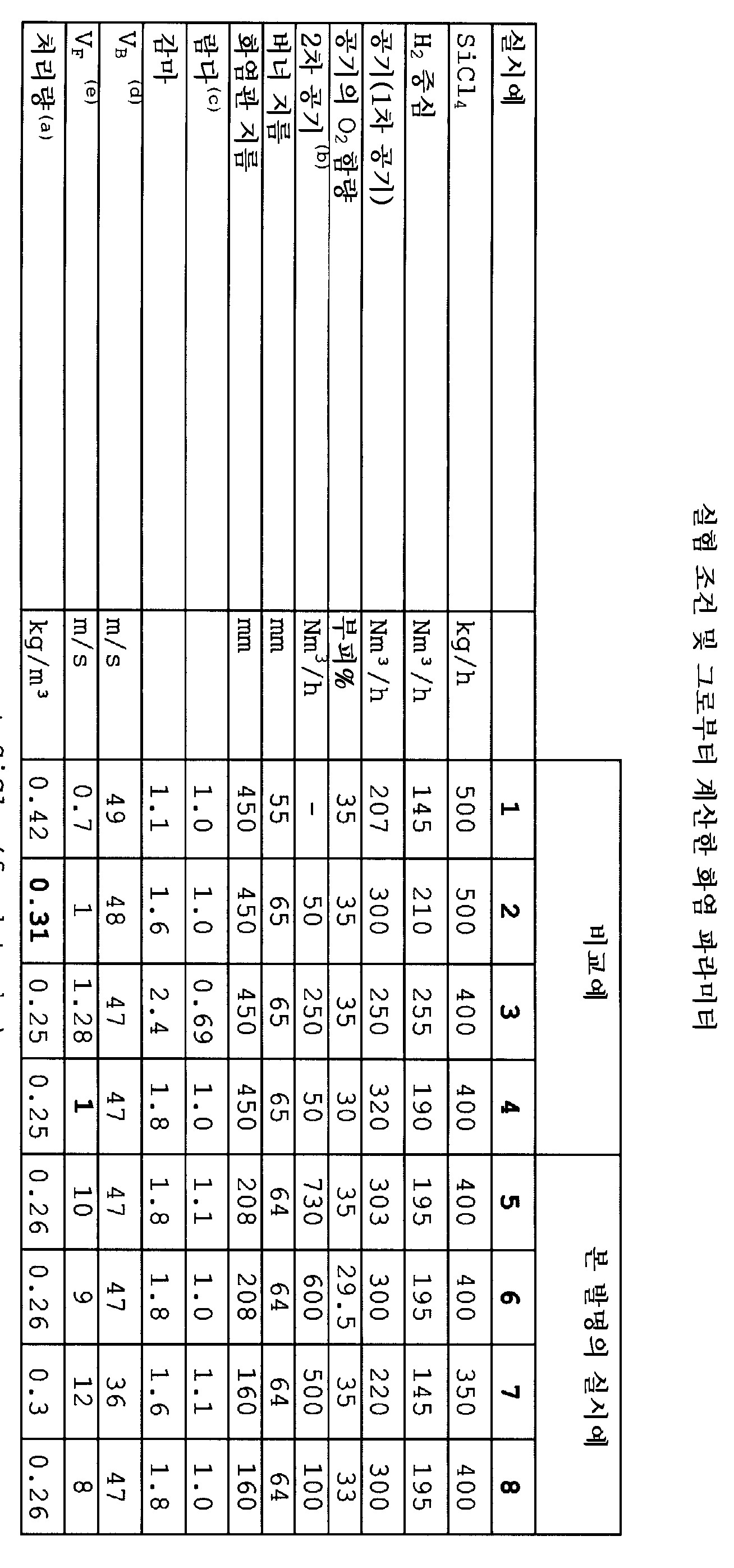
(a) kg SiO2/m3의 1차 공기 + 수소 + SiCl4 (공급원료) ;(a) primary air + kg hydrogen + SiCl 4 (feedstock) in kg SiO 2 / m 3 ;
(b) 21 부피% O2를 갖는 공기;(b) air with 21 vol% O 2 ;
(c) 1차 공기에 대하여;(c) for primary air;
(d) VB = 버너의 입구에서 배출 평균 속도 (정규화);(d) V B = average velocity of discharge at the inlet of the burner (normalized);
(e) VF = 버너의 입구 높이에서 반응 용기 내의 평균 유속 (정규화). (e) V F = average flow rate (normalization) in the reaction vessel at the inlet height of the burner.

(a) 5 rpm에서 30 중량% 분산액(a) 30 wt% dispersion at 5 rpm
(b) 측정되지 않음.(b) not measured.
실시예Example 9 ( 9 ( 비교예Comparative example ))
표 3에 따른 조성을 갖는 500 kg/h SiCl4를 대략 90 ℃에서 기화시키고 공지된 구조의 버너의 중앙관으로 이동시켰다. 35 부피% 산소 함량을 갖는 326 Nm3/h 공기 및 190 Nm3/h 수소를 추가적으로 이 관으로 도입하였다. 이 기체 혼합물을 물-냉각 버너의 화염관에서 점화시키고 연소시켰다. 베이킹-온(baking-on)을 방지하기 위하여 15 Nm3/h 수소를 추가적으로 중앙 노즐을 둘러싼 자켓 노즐에 도입하였다. 또한 표준 조성의 250 Nm3/h 공기를 추가적으로 화염관에 도입하였다. 반응 기체를 냉각한 후 화열 이산화규소 분말을 필터 및/또는 사이클론을 사용하여 염산-함유 기체로부터 분리하였다. 점착성 염산을 제거하기 위하여 탈산성화 유닛에서 화열 이산화규소 분말을 수증기 및 공기로 처리하였다. 금속 함량은 표 5에 나타내었다.500 kg / h SiCl 4 having a composition according to Table 3 was vaporized at approximately 90 ° C. and transferred to a central tube of a burner of known structure. 326 Nm 3 / h air and 190 Nm 3 / h hydrogen with 35% by volume oxygen content were additionally introduced into this tube. This gas mixture was ignited and burned in the flame tube of the water-cooled burner. 15 Nm 3 / h hydrogen was additionally introduced into the jacket nozzle surrounding the central nozzle to prevent baking-on. In addition 250 Nm 3 / h air of standard composition was additionally introduced into the flame tube. After cooling the reaction gas, the pyrogenic silicon dioxide powder was separated from the hydrochloric acid-containing gas using a filter and / or a cyclone. The pyrogenic silicon dioxide powder was treated with steam and air in a deacidification unit to remove sticky hydrochloric acid. Metal content is shown in Table 5.
실시예Example 10 (실시양태의 10 (of an embodiment 실시예Example ))
표 4에 따른 조성을 갖는 500 kg/h SiCl4를 대략 90 ℃에서 기화시키고 공지된 구조의 버너의 중앙관으로 이동시켰다. 35 부피% 산소 함량을 갖는 326 Nm3/h 공기 및 190 Nm3/h 수소를 추가적으로 이 관에 도입하였다. 이 기체 혼합물을 물-냉각 버너의 화염관에서 점화시키고 연소시켰다. 베이킹-온을 방지하기 위하여 15 Nm3/h 수소를 추가적으로 중앙 노즐을 둘러싼 자켓 노즐에 도입하였다. 또한 표준 조성의 250 Nm3/h 공기를 추가적으로 화염관으로 도입하였다. 반응 기체를 냉각한 후 화열 이산화규소 분말을 필터 및/또는 사이클론을 사용하여 염산-함유 기체로부터 분리하였다. 점착성 염산을 제거하기 위하여 탈산성화 유닛에서 화열 이산화규소 분말을 수증기 및 공기로 처리하였다.500 kg / h SiCl 4 having a composition according to Table 4 was vaporized at approximately 90 ° C. and transferred to a central tube of a burner of known structure. 326 Nm 3 / h air and 190 Nm 3 / h hydrogen with 35% by volume oxygen content were additionally introduced into this tube. This gas mixture was ignited and burned in the flame tube of the water-cooled burner. 15 Nm 3 / h hydrogen was additionally introduced into the jacket nozzle surrounding the central nozzle to prevent baking-on. In addition, 250 Nm 3 / h air of standard composition was additionally introduced into the flame tube. After cooling the reaction gas, the pyrogenic silicon dioxide powder was separated from the hydrochloric acid-containing gas using a filter and / or a cyclone. The pyrogenic silicon dioxide powder was treated with steam and air in a deacidification unit to remove sticky hydrochloric acid.
금속 함량은 표 5에 나타내었다.Metal content is shown in Table 5.


측정 방법How to measure
수득한 화열적으로 제조된 이산화규소를 그의 금속 함량에 대하여 분석하였다. 샘플들을 HF를 주로 포함한 산성 용액에 용해시켰다.The pyrogenically produced silicon dioxide obtained was analyzed for its metal content. Samples were dissolved in acidic solution containing mainly HF.
SiO2는 HF와 반응하여 SiF4 + H2O를 형성한다. SiF4를 완전히 증발시켜 산 내에는 측정할 금속만이 남도록 한다. 각 샘플들을 증류수로 희석하고 퍼킨 엘머 옵티마(Perkin Elmer Optima) 3000 DV 내에서 유도 결합 플라즈마-원자 발광 분광법(ICP-AES)으로 내부 표준에 대하여 분석하였다. 값의 비정밀성은 샘플 변동, 스펙트럼 간섭 및 측정 방법의 제한에 기인한 것이다. 큰 원소들은 ±5 %의 상대적 비정밀성을 갖고, 작은 원소들은 ±15 %의 상대적 비정밀성을 갖는다.SiO 2 reacts with HF to form SiF 4 + H 2 O. SiF 4 is completely evaporated so that only the metal to be measured remains in the acid. Each sample was diluted with distilled water and analyzed for internal standards by inductively coupled plasma-atomic emission spectroscopy (ICP-AES) in a Perkin Elmer Optima 3000 DV. The inaccuracy of the value is due to sample variation, spectral interference, and limitations of the measurement method. Large elements have a relative inaccuracy of ± 5% and small elements have a relative inaccuracy of ± 15%.
Claims (5)
Applications Claiming Priority (2)
| Application Number | Priority Date | Filing Date | Title |
|---|---|---|---|
| EP05005091.3 | 2005-03-09 | ||
| EP05005091A EP1700828A1 (en) | 2005-03-09 | 2005-03-09 | Method for producing ultra-high purity, optical quality, glass articles |
Publications (2)
| Publication Number | Publication Date |
|---|---|
| KR20070110334A KR20070110334A (en) | 2007-11-16 |
| KR100965037B1 true KR100965037B1 (en) | 2010-06-21 |
Family
ID=34934142
Family Applications (1)
| Application Number | Title | Priority Date | Filing Date |
|---|---|---|---|
| KR1020077020528A Expired - Fee Related KR100965037B1 (en) | 2005-03-09 | 2006-02-15 | Method for manufacturing glass article of ultra high purity optical quality |
Country Status (7)
| Country | Link |
|---|---|
| US (1) | US20080203625A1 (en) |
| EP (2) | EP1700828A1 (en) |
| JP (1) | JP2008532903A (en) |
| KR (1) | KR100965037B1 (en) |
| CN (1) | CN101137585A (en) |
| RU (1) | RU2382740C2 (en) |
| WO (1) | WO2006094878A1 (en) |
Cited By (1)
| Publication number | Priority date | Publication date | Assignee | Title |
|---|---|---|---|---|
| CN108892367A (en) * | 2018-07-20 | 2018-11-27 | 西南交通大学 | A kind of SiO2The isostatic cool pressing sintering knot preparation method of glass |
Families Citing this family (20)
| Publication number | Priority date | Publication date | Assignee | Title |
|---|---|---|---|---|
| JP5349910B2 (en) * | 2008-11-05 | 2013-11-20 | 株式会社ディスコ | Adsorption plate and production method of adsorption plate |
| JP2014055072A (en) * | 2012-09-11 | 2014-03-27 | Nippon Aerosil Co Ltd | Method for producing amorphous silicon oxide sintered product and amorphous silicon oxide sintered product produced by the same |
| US10053386B2 (en) | 2014-04-25 | 2018-08-21 | Corning Incorporated | Method for forming optical fiber and preforms |
| TWI728018B (en) * | 2015-12-18 | 2021-05-21 | 德商何瑞斯廓格拉斯公司 | Preparation of quartz glass bodies from silicon dioxide powder |
| JP2019502634A (en) * | 2015-12-18 | 2019-01-31 | ヘレウス クワルツグラス ゲーエムベーハー ウント コンパニー カーゲー | Steam treatment of silicon dioxide powder during the preparation of quartz glass |
| KR20180095614A (en) | 2015-12-18 | 2018-08-27 | 헤래우스 크바르츠글라스 게엠베하 & 컴파니 케이지 | Glass fibers and preforms made of quartz glass with low OH, Cl, and Al contents |
| TWI794149B (en) | 2015-12-18 | 2023-03-01 | 德商何瑞斯廓格拉斯公司 | Quartz glass grain, opaque formed body and process for preparing the same |
| JP6984897B2 (en) * | 2015-12-18 | 2021-12-22 | ヘレウス クワルツグラス ゲーエムベーハー ウント コンパニー カーゲー | Increased silicon content during quartz glass preparation |
| TWI812586B (en) | 2015-12-18 | 2023-08-21 | 德商何瑞斯廓格拉斯公司 | Quartz glass body, manufacturing process and application thereof, and process for controlling a dew point at an outlet of an oven |
| EP3390301A1 (en) * | 2015-12-18 | 2018-10-24 | Heraeus Quarzglas GmbH & Co. KG | Ammonia treatment of silica powder during the production of silica glass |
| KR20180094087A (en) | 2015-12-18 | 2018-08-22 | 헤래우스 크바르츠글라스 게엠베하 & 컴파니 케이지 | Preparation of Silica Glass Products from Silica Granules |
| EP3390296B1 (en) | 2015-12-18 | 2024-09-04 | Heraeus Quarzglas GmbH & Co. KG | Production of a quartz glass body in a multichamber furnace |
| TWI813534B (en) * | 2015-12-18 | 2023-09-01 | 德商何瑞斯廓格拉斯公司 | Preparation of quartz glass bodies with dew point monitoring in the melting oven |
| US11236002B2 (en) * | 2015-12-18 | 2022-02-01 | Heraeus Quarzglas Gmbh & Co. Kg | Preparation of an opaque quartz glass body |
| EP3390304B1 (en) | 2015-12-18 | 2023-09-13 | Heraeus Quarzglas GmbH & Co. KG | Spray granulation of silicon dioxide in the production of quartz glass |
| CN108698888A (en) | 2015-12-18 | 2018-10-23 | 贺利氏石英玻璃有限两合公司 | Production of carbon-doped silica particles as intermediate in the production of quartz glass |
| US11912604B2 (en) * | 2019-08-13 | 2024-02-27 | Sterlite Technologies Limited | Method for fabrication of glass preform |
| CN113429118B (en) * | 2021-06-17 | 2022-05-24 | 贵州航天电器股份有限公司 | Glass blank powder injection molding process |
| CN113831128B (en) * | 2021-09-30 | 2023-02-28 | 宁波江丰电子材料股份有限公司 | Processing method for graphite hot isostatic pressing |
| CN115178528B (en) * | 2022-07-18 | 2023-05-26 | 江苏省晶瑞石英工业开发研究院有限公司 | Impurity-removing acid-washing device for quartz stone purification and use method thereof |
Citations (3)
| Publication number | Priority date | Publication date | Assignee | Title |
|---|---|---|---|---|
| JPH08253309A (en) * | 1995-02-04 | 1996-10-01 | Degussa Ag | Granules based on silicon dioxide produced by high-pyrolysis method, production method thereof and catalyst carrier containing the same |
| JP2003137571A (en) | 2001-10-22 | 2003-05-14 | Degussa Ag | Method of manufacturing ultra high purity glass product of optical quality |
| JP2004161611A (en) | 1999-08-03 | 2004-06-10 | Degussa Ag | Dispersion liquid for producing sintered material |
Family Cites Families (24)
| Publication number | Priority date | Publication date | Assignee | Title |
|---|---|---|---|---|
| US2086369A (en) * | 1934-12-07 | 1937-07-06 | Joseph C Steiner | Burner |
| US2942991A (en) | 1955-10-28 | 1960-06-28 | Monsanto Chemicals | Slip-casting process |
| US3310392A (en) | 1962-03-19 | 1967-03-21 | Corning Glass Works | Electrical capacitor manufacture |
| US3535890A (en) | 1967-10-26 | 1970-10-27 | Corning Glass Works | Method of making fused silica |
| US3562371A (en) | 1968-10-16 | 1971-02-09 | Corning Glass Works | High temperature gas isostatic pressing of crystalline bodies having impermeable surfaces |
| US3678144A (en) | 1970-06-12 | 1972-07-18 | Corning Glass Works | Silicate bodies containing coprecipitated oxides |
| US4112032A (en) | 1976-04-21 | 1978-09-05 | Corning Glass Works | Silica-containing porous bodies of controlled pore size |
| US4042361A (en) | 1976-04-26 | 1977-08-16 | Corning Glass Works | Method of densifying metal oxides |
| US4200445A (en) | 1977-04-28 | 1980-04-29 | Corning Glass Works | Method of densifying metal oxides |
| JPS55100231A (en) | 1979-01-19 | 1980-07-31 | Hitachi Ltd | Production of optical fiber base material |
| JPS5767031A (en) | 1980-10-06 | 1982-04-23 | Shin Etsu Chem Co Ltd | Formation of quartz glass |
| DE3039749C2 (en) | 1980-10-22 | 1982-08-19 | Heraeus Quarzschmelze Gmbh, 6450 Hanau | Process for the production of bubble-free, glassy material |
| US4349333A (en) | 1981-02-09 | 1982-09-14 | Pressure Technology, Inc. | Hot isostatic press with rapid cooling |
| EP0084438B1 (en) | 1982-01-15 | 1987-03-18 | Corning Glass Works | Method of forming glass or ceramic article |
| US4574063A (en) | 1983-05-09 | 1986-03-04 | Corning Glass Works | Method of forming glass or ceramic article |
| US5063179A (en) * | 1990-03-02 | 1991-11-05 | Cabot Corporation | Process for making non-porous micron-sized high purity silica |
| EP0681559A4 (en) * | 1993-02-01 | 1996-06-05 | Tasman Pulp & Paper Co Ltd | Amorphous silica, its preparation and uses. |
| US5846506A (en) * | 1994-10-07 | 1998-12-08 | Degussa Aktiengesellschaft | Precipitated silicas |
| DE19601415A1 (en) | 1995-02-04 | 1996-08-08 | Degussa | Granules based on pyrogenic silicon dioxide, process for their production and their use |
| DE10030252A1 (en) | 2000-06-20 | 2002-01-03 | Degussa | Separation of metal chlorides from their suspensions in chlorosilanes |
| DE10030251A1 (en) | 2000-06-20 | 2002-01-03 | Degussa | Separation of metal chlorides from gaseous reaction mixtures from chlorosilane synthesis |
| US7069746B2 (en) * | 2001-10-22 | 2006-07-04 | Degussa Ag | Method for producing ultra-high purity, optical quality glass articles |
| DE10258858A1 (en) * | 2002-12-17 | 2004-08-05 | Degussa Ag | Fumed silica |
| DE10258857A1 (en) | 2002-12-17 | 2004-07-08 | Degussa Ag | Fumed silica and dispersion thereof |
-
2005
- 2005-03-09 EP EP05005091A patent/EP1700828A1/en not_active Withdrawn
-
2006
- 2006-02-15 WO PCT/EP2006/050971 patent/WO2006094878A1/en not_active Ceased
- 2006-02-15 CN CNA2006800073256A patent/CN101137585A/en active Pending
- 2006-02-15 KR KR1020077020528A patent/KR100965037B1/en not_active Expired - Fee Related
- 2006-02-15 EP EP06724848A patent/EP1856001A1/en not_active Withdrawn
- 2006-02-15 US US11/817,230 patent/US20080203625A1/en not_active Abandoned
- 2006-02-15 JP JP2008500152A patent/JP2008532903A/en active Pending
- 2006-02-15 RU RU2007136958/03A patent/RU2382740C2/en not_active IP Right Cessation
Patent Citations (3)
| Publication number | Priority date | Publication date | Assignee | Title |
|---|---|---|---|---|
| JPH08253309A (en) * | 1995-02-04 | 1996-10-01 | Degussa Ag | Granules based on silicon dioxide produced by high-pyrolysis method, production method thereof and catalyst carrier containing the same |
| JP2004161611A (en) | 1999-08-03 | 2004-06-10 | Degussa Ag | Dispersion liquid for producing sintered material |
| JP2003137571A (en) | 2001-10-22 | 2003-05-14 | Degussa Ag | Method of manufacturing ultra high purity glass product of optical quality |
Cited By (1)
| Publication number | Priority date | Publication date | Assignee | Title |
|---|---|---|---|---|
| CN108892367A (en) * | 2018-07-20 | 2018-11-27 | 西南交通大学 | A kind of SiO2The isostatic cool pressing sintering knot preparation method of glass |
Also Published As
| Publication number | Publication date |
|---|---|
| US20080203625A1 (en) | 2008-08-28 |
| EP1856001A1 (en) | 2007-11-21 |
| RU2382740C2 (en) | 2010-02-27 |
| RU2007136958A (en) | 2009-04-20 |
| KR20070110334A (en) | 2007-11-16 |
| WO2006094878A1 (en) | 2006-09-14 |
| EP1700828A1 (en) | 2006-09-13 |
| CN101137585A (en) | 2008-03-05 |
| JP2008532903A (en) | 2008-08-21 |
Similar Documents
| Publication | Publication Date | Title |
|---|---|---|
| KR100965037B1 (en) | Method for manufacturing glass article of ultra high purity optical quality | |
| KR950014100B1 (en) | Ultra high purity optical quality glass product manufacturing method | |
| EP1717202A1 (en) | Sintered silicon dioxide materials | |
| US20050272826A1 (en) | Dispersion of sintered materials | |
| US4961767A (en) | Method for producing ultra-high purity, optical quality, glass articles | |
| US10358373B2 (en) | Method for producing a pore-containing opaque quartz glass | |
| WO2008028797A1 (en) | Sol-gel process | |
| KR100704520B1 (en) | Manufacturing Method of Molten Glass Products | |
| CN108689592B (en) | Method for producing a rare earth metal-doped quartz glass component | |
| JP2002145633A (en) | Quartz glass precursor and method for producing the same | |
| US7069746B2 (en) | Method for producing ultra-high purity, optical quality glass articles | |
| JP2002137913A (en) | Silica gel and method for producing the same | |
| EP1700829A1 (en) | Process for the production of glass-monoliths by means of the sol-gel process | |
| JP4268489B2 (en) | Method for producing transparent quartz glass body |
Legal Events
| Date | Code | Title | Description |
|---|---|---|---|
| PA0105 | International application |
St.27 status event code: A-0-1-A10-A15-nap-PA0105 |
|
| A201 | Request for examination | ||
| PA0201 | Request for examination |
St.27 status event code: A-1-2-D10-D11-exm-PA0201 |
|
| PG1501 | Laying open of application |
St.27 status event code: A-1-1-Q10-Q12-nap-PG1501 |
|
| R18-X000 | Changes to party contact information recorded |
St.27 status event code: A-3-3-R10-R18-oth-X000 |
|
| R18-X000 | Changes to party contact information recorded |
St.27 status event code: A-3-3-R10-R18-oth-X000 |
|
| E902 | Notification of reason for refusal | ||
| PE0902 | Notice of grounds for rejection |
St.27 status event code: A-1-2-D10-D21-exm-PE0902 |
|
| P11-X000 | Amendment of application requested |
St.27 status event code: A-2-2-P10-P11-nap-X000 |
|
| P13-X000 | Application amended |
St.27 status event code: A-2-2-P10-P13-nap-X000 |
|
| E902 | Notification of reason for refusal | ||
| PE0902 | Notice of grounds for rejection |
St.27 status event code: A-1-2-D10-D21-exm-PE0902 |
|
| P11-X000 | Amendment of application requested |
St.27 status event code: A-2-2-P10-P11-nap-X000 |
|
| P13-X000 | Application amended |
St.27 status event code: A-2-2-P10-P13-nap-X000 |
|
| E902 | Notification of reason for refusal | ||
| PE0902 | Notice of grounds for rejection |
St.27 status event code: A-1-2-D10-D21-exm-PE0902 |
|
| E13-X000 | Pre-grant limitation requested |
St.27 status event code: A-2-3-E10-E13-lim-X000 |
|
| P11-X000 | Amendment of application requested |
St.27 status event code: A-2-2-P10-P11-nap-X000 |
|
| P13-X000 | Application amended |
St.27 status event code: A-2-2-P10-P13-nap-X000 |
|
| E701 | Decision to grant or registration of patent right | ||
| PE0701 | Decision of registration |
St.27 status event code: A-1-2-D10-D22-exm-PE0701 |
|
| GRNT | Written decision to grant | ||
| PR0701 | Registration of establishment |
St.27 status event code: A-2-4-F10-F11-exm-PR0701 |
|
| PR1002 | Payment of registration fee |
St.27 status event code: A-2-2-U10-U12-oth-PR1002 Fee payment year number: 1 |
|
| PG1601 | Publication of registration |
St.27 status event code: A-4-4-Q10-Q13-nap-PG1601 |
|
| LAPS | Lapse due to unpaid annual fee | ||
| PC1903 | Unpaid annual fee |
St.27 status event code: A-4-4-U10-U13-oth-PC1903 Not in force date: 20130612 Payment event data comment text: Termination Category : DEFAULT_OF_REGISTRATION_FEE |
|
| PC1903 | Unpaid annual fee |
St.27 status event code: N-4-6-H10-H13-oth-PC1903 Ip right cessation event data comment text: Termination Category : DEFAULT_OF_REGISTRATION_FEE Not in force date: 20130612 |
|
| PN2301 | Change of applicant |
St.27 status event code: A-5-5-R10-R13-asn-PN2301 St.27 status event code: A-5-5-R10-R11-asn-PN2301 |