KR100810696B1 - 3G-H.324M protocol and network analysis device - Google Patents
3G-H.324M protocol and network analysis device Download PDFInfo
- Publication number
- KR100810696B1 KR100810696B1 KR1020060040047A KR20060040047A KR100810696B1 KR 100810696 B1 KR100810696 B1 KR 100810696B1 KR 1020060040047 A KR1020060040047 A KR 1020060040047A KR 20060040047 A KR20060040047 A KR 20060040047A KR 100810696 B1 KR100810696 B1 KR 100810696B1
- Authority
- KR
- South Korea
- Prior art keywords
- protocol
- network
- data
- interface unit
- unit
- Prior art date
- Legal status (The legal status is an assumption and is not a legal conclusion. Google has not performed a legal analysis and makes no representation as to the accuracy of the status listed.)
- Expired - Fee Related
Links
Images




Classifications
-
- H—ELECTRICITY
- H04—ELECTRIC COMMUNICATION TECHNIQUE
- H04L—TRANSMISSION OF DIGITAL INFORMATION, e.g. TELEGRAPHIC COMMUNICATION
- H04L43/00—Arrangements for monitoring or testing data switching networks
- H04L43/50—Testing arrangements
-
- H—ELECTRICITY
- H04—ELECTRIC COMMUNICATION TECHNIQUE
- H04L—TRANSMISSION OF DIGITAL INFORMATION, e.g. TELEGRAPHIC COMMUNICATION
- H04L43/00—Arrangements for monitoring or testing data switching networks
- H04L43/06—Generation of reports
- H04L43/062—Generation of reports related to network traffic
-
- H—ELECTRICITY
- H04—ELECTRIC COMMUNICATION TECHNIQUE
- H04L—TRANSMISSION OF DIGITAL INFORMATION, e.g. TELEGRAPHIC COMMUNICATION
- H04L43/00—Arrangements for monitoring or testing data switching networks
- H04L43/18—Protocol analysers
Landscapes
- Engineering & Computer Science (AREA)
- Computer Networks & Wireless Communication (AREA)
- Signal Processing (AREA)
- Telephonic Communication Services (AREA)
Abstract
본 발명은 H.324 통신 프로토콜 기반의 제3세대(3G) 통신 서비스 인프라 및 통신 부가서비스에 필요한 계측장비에 관한 것으로서, 특히 WCDMA를 위한 3GPP 표준인 3G-H.324M을 이용하여 3G 멀티미디어 서비스 망의 프로토콜 분석 및 네트워크 분석을 통해 장비간 호환성 시험, 장애추적, 호 트래픽 모니터링을 수행할 수 있는 네트워크 모니터링 모드(Network Monitoring Mode) 및 터미널 모드(Terminal Mode)를 위한 호 생성(Call Generation)을 제공하는 3G-324M 프로토콜 및 네트워크 분석장치를 제공한다.The present invention relates to a third generation (3G) communication service infrastructure based on the H.324 communication protocol and the measurement equipment required for additional communication services, and in particular, a 3G multimedia service network using 3G-H.324M, a 3GPP standard for WCDMA. Providing call generation for network monitoring mode and terminal mode that can perform interoperability test, fault tracking, and call traffic monitoring through protocol analysis and network analysis Provides 3G-324M protocol and network analysis device.
본 발명은 H.245에 의한 대역 내 신호의 분석뿐만 아니라 호 추적 기능이 요구되는 H.324에 있어서 SS7에 의한 대역 외 신호를 분석하여 전화를 한 주체와 받는 사람이 누구인가를 알 수 있고 거기에 해당되는 장비와 네트워크를 분석하고자 하는 수요자의 요구에 부응하여, TDM Raw Binary Data를 분석의 시작으로 하는 상세한 분석을 수행하고, H.223의 역다중화 및 적응 계층의 CRC 체크에 대한 ITU-T 프로토콜 표준에 의한 알고리즘을 구현하며, H.223 Open flag 및 H.223 Header의 분석이 가능한 3G-H.324M 프로토콜 및 네트워크 분석장치를 제공한다.According to the present invention, in H.324 requiring call tracking as well as analysis of in-band signals by H.245, it is possible to know who is calling and who is calling by analyzing out-of-band signals by SS7. In response to the needs of consumers who want to analyze the equipment and network corresponding to the above, ITU-T performs detailed analysis starting with TDM Raw Binary Data, and demultiplexing and adaptation layer CRC check of H.223. It implements algorithm based on protocol standard and provides 3G-H.324M protocol and network analysis device that can analyze H.223 Open flag and H.223 Header.
네트워크 분석장치, H.324, H.324M, 3G-H.324M, H.223, H245, SS7 Network Analyzer, H.324, H.324M, 3G-H.324M, H.223, H245, SS7
Description
도 1은 본 발명에 적용되는 H.324 프로토콜 구조도,1 is a structural diagram of an H.324 protocol applied to the present invention;
도 2는 본 발명에 따른 3G-H.324M 프로토콜 및 네트워크 분석장치가 구현된 네트워크 구성도, 2 is a network diagram illustrating a 3G-H.324M protocol and a network analyzing apparatus according to the present invention;
도 3은 본 발명에 따른 3G-H.324M 프로토콜 및 네트워크 분석장치의 네트워크 모니터링 모드 및 터미널 모드가 적용된 네트워크 구성도, 3 is a diagram illustrating a network configuration of a network monitoring mode and a terminal mode of a 3G-H.324M protocol and a network analyzer according to the present invention;
도 4a는 본 발명에 따른 3G-H.324M 프로토콜 및 네트워크 분석장치의 구성 모듈들을 도시한 도면, Figure 4a is a view showing the configuration modules of the 3G-H.324M protocol and network analysis apparatus according to the present invention,
도 4b는 본 발명에 따른 3G-H.324M 프로토콜 및 네트워크 분석장치의 베어러 채널 처리를 위한 소프트웨어 구성도, 4b is a software configuration diagram for bearer channel processing of a 3G-H.324M protocol and a network analyzer according to the present invention;
도 4c는 본 발명에 따른 3G-H.324M 프로토콜 및 네트워크 분석장치의 SS7신호를 탭핑하기 위한 소프트웨어 구성도,Figure 4c is a software configuration for tapping the SS7 signal of the 3G-H.324M protocol and network analysis apparatus according to the present invention,
도 5a는 도 4a의 tdmTrace API 구성도,Figure 5a is a configuration diagram of the tdmTrace API of Figure 4a,
도 5b는 도 5a의 tdmTrace API의 RC API가 비트 스트림을 레코딩하는 과정을 도시한 도면,5B is a diagram illustrating a process of recording a bit stream by the RC API of the tdmTrace API of FIG. 5A;
도 6은 본 발명에 따른 3G-H.324M 프로토콜 및 네트워크 분석장치에서 tdmTrace와 OMF의 인터페이스를 수행하는 H.324를 나타낸 도면, FIG. 6 is a diagram illustrating H.324 performing an interface between tdmTrace and OMF in a 3G-H.324M protocol and a network analyzer according to the present invention; FIG.
도 7a는 도 6의 H.324 API의 H.223 API를 상세히 도시한 도면,FIG. 7A illustrates in detail the H.223 API of the H.324 API of FIG. 6; FIG.
도 7b는 도 7a의 H.223 Analysis API가 수행하는 역다중화 H.324 스트림의 분석과정을 나타낸 도면, FIG. 7B illustrates an analysis process of a demultiplexed H.324 stream performed by the H.223 Analysis API of FIG. 7A. FIG.
도 8은 도 6의 H.324 API의 H.245 API를 상세히 도시한 도면,8 is a view showing in detail the H.245 API of the H.324 API of FIG.
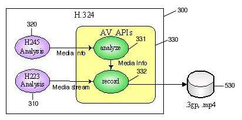
도 9a는 도 6의 H.324 API의 AV API를 상세히 도시한 도면,FIG. 9A illustrates an AV API of the H.324 API of FIG. 6 in detail; FIG.
도 9b는 도 9a의 AV API의 미디어 다중화 과정을 도시한 도면, 9B is a diagram illustrating a media multiplexing process of the AV API of FIG. 9A;
도 9c는 도 9a의 AV API의 스토리지 포맷을 도시한 도면,9c illustrates a storage format of the AV API of FIG. 9a;
도 10은 본 발명에 따른 3G-H.324M 프로토콜 및 네트워크 분석장치에서 H.245 API로 미디어에 대한 정보를 어떻게 받을 것인가에 대한 정의를 도식화한 도면,FIG. 10 is a diagram illustrating a definition of how to receive information about a media through H.245 API in the 3G-H.324M protocol and the network analyzer according to the present invention;
도 11은 본 발명에 따른 3G-H.324M 프로토콜 및 네트워크 분석장치에서 미디어를 어떻게 레코딩 할 것인가에 대한 정의를 도식화한 도면,11 is a diagram illustrating a definition of how to record media in a 3G-H.324M protocol and a network analyzer according to the present invention;
도 12는 본 발명에 따른 3G-H.324M 프로토콜 및 네트워크 분석장치가 제공하는 SS7 ISUP 메시지 모니터링을 설명하기 위한 도면, 12 is a view for explaining the SS7 ISUP message monitoring provided by the 3G-H.324M protocol and network analysis apparatus according to the present invention,
도 13은 본 발명에 따른 3G-H.324M 프로토콜 및 네트워크 분석장치의 H.324 게이트웨이의 구조를 나타낸 도면,FIG. 13 is a diagram showing the structure of an H.324 gateway of a 3G-H.324M protocol and a network analyzer according to the present invention; FIG.
도 14a 내지 도 14g는 도 7a의 H.223 API의 AL1, AL2, AL3의 PDU 포맷을 도시한 도면,14A to 14G illustrate PDU formats of AL1, AL2, and AL3 of the H.223 API of FIG. 7A;
도 15a 내지 도 15f는 도 7a의 H.223 Analysis API의 각 프레임 포맷을 나타 낸 도면. 15A to 15F illustrate each frame format of the H.223 Analysis API of FIG. 7A.
본 발명은 H.324 통신 프로토콜 기반의 제3세대(3G) 통신 서비스 인프라 및 통신 부가서비스에 필요한 계측장비에 관한 것으로서, 특히 WCDMA를 위한 3GPP 표준인 3G-H.324M을 이용하여 3G 멀티미디어 서비스 망의 프로토콜 분석 및 네트워크 분석을 통해 장비간 호환성 시험, 장애추적, 호 트래픽 모니터링을 수행할 수 있는 네트워크 모니터링 모드(Network Monitoring Mode) 및 터미널 모드(Terminal Mode)를 위한 호 생성(Call Generation)을 제공하는 3G-H.324M 프로토콜 및 네트워크 분석장치에 관한 것이다. The present invention relates to a third generation (3G) communication service infrastructure based on the H.324 communication protocol and the measurement equipment required for additional communication services, and in particular, a 3G multimedia service network using 3G-H.324M, a 3GPP standard for WCDMA. Providing call generation for network monitoring mode and terminal mode that can perform interoperability test, fault tracking, and call traffic monitoring through protocol analysis and
최근 3G(3rd Generation) 통신기술 및 시설이 글로벌 표준으로 자리잡게 됨에 따라 관련 계측장비의 수요가 급증하고 있다. 기간통신사업자를 비롯한 이동통신사업자들은 3G서비스를 시현하기 위한 망 구축사업 및 인프라구축에 대한 설비투자를 확대하고 있으며, 이에 따라 신규 통신 인프라 설비 및 부가 서비스 구축을 위한 계측장비의 수요와 함께 향후 각 방면에 걸쳐 지속적인 계측장비의 수요가 발생하게 된다. 더욱이 유럽을 비롯한 미국과 동남아 통신사업자의 향후 통신망 확충 및 개선을 고려해 볼 때 전세계적인 수요가 발생하게 된다. As 3G (3rd Generation) communication technology and facilities have become a global standard, the demand for related measuring equipment is rapidly increasing. Mobile telecommunications operators including key telecommunications operators are expanding facility investments in network construction and infrastructure construction to implement 3G services. There is a constant demand for instrumentation throughout. Moreover, global demand will arise when considering the future expansion and improvement of telecommunication networks of Europe, the US and Southeast Asia.
또한, 향후 3G 통신서비스와 DMB(Digital Multimedia Broadcasting), WiBro(Wireless Broadband Internet), HSDPA(High Speed Downlink Packet Access) 등 멀티미디어서비스의 통합에 따른 서비스 구현이 원활히 이루어질 수 있도록 단말기, 부가서비스 장비 및 코어망(Core Network)과의 서비스 연동에 필요한 계측장비의 개발이 시급한 실정이다.In addition, terminals, value-added equipment and cores can be implemented to smoothly implement 3G communication services, multimedia services such as DMB (Digital Multimedia Broadcasting), WiBro (Wireless Broadband Internet), and HSDPA (High Speed Downlink Packet Access). There is an urgent need to develop measurement equipment for service interworking with the core network.
현재 범세계적인 계측장비의 특징은 아날로그에서 디지털로, 단일모듈 계측기에서 다기능 복합모듈 계측기로, 기계(Mechanical)계측에서 품질(Quality)측정이 중요시되는 계측장비로 진화하는 추세에 있는 바, WCDMA(Wideband CDMA) 서비스를 위한 3GPP(3rd Generation Project Group) 표준인 3G-H.324M을 분석 및 계측하여 장비간 호환성 테스트 및 장애추적(troubleshooting), 호 트래픽 모니터링(call traffic monitoring)을 수행함으로써 네트워크에서 발생될 수 있는 각종 오류사항에 대한 원인 및 기타 문제를 파악할 수 있는 통합적이고 객관적인 계측장비가 요망된다.At present, the characteristics of the world-wide measuring equipment are evolving from analog to digital, from single module measuring instruments to multi-function multi-module measuring instruments, and to measuring equipment where quality measurement is important in mechanical measurement. Analyzes and measures 3G-H.324M, 3rd Generation Project Group (3GPP) standard for CDMA services, and performs compatibility tests, troubleshooting, and call traffic monitoring between devices. There is a need for an integrated and objective instrument that can identify the causes and other problems of various errors.
알려진 바와 같이, 3G-H.324M은 일반 전화망에서 음성, 동화상 및 데이터 통신 단말에 관한 ITU-T(International Telecommunications Union - Telecommunication standardization sector)의 권고로서, 최초의 권고는 1996년에 작성되었고 1998년의 개정으로 이동 무선망상에서의 통신도 고려되었다. PC용의 탁상형 회의 소프트웨어 등이 채용되고 있으며, 모뎀 제어(V.34), 멀티미디어 데이터의 다중 분리 방법(H.223), 시스템 제어(H.245)를 필수로 한다. 여기서 H.223은 파일 전송, 백판(white board) 등의 데이터 교환 공유를 위한 채널도 제공한다. 동화상 부호화 방식은 H.261, H.263이며 음성 부호화 방식은 G.711, G.723.1, G.782 등 이다. As is known, 3G-H.324M is the Recommendation of the International Telecommunications Union-Telecommunication standardization sector (ITU-T) on voice, moving picture and data communication terminals in a public telephone network. The revision also considered communications over mobile radio networks. Desktop conference software for a PC is employed, and modem control (V.34), multiple data separation method (H.223), and system control (H.245) are essential. H.223 also provides channels for sharing data exchanges, such as file transfers and white boards. The video coding methods are H.261 and H.263, and the voice coding methods are G.711, G.723.1, and G.782.
3G-H.324M은 GSTN(General Switched Telephony Network)에서의 멀티미디어 통신을 위한 ITU-T 프로토콜 표준인 H.324의 이동 네트워크에 있어서의 운영을 위한 확장인 H.324M의 적응을 정의하는 3GPP의 권고이다. 3G-H.324M is a Recommendation of 3GPP that defines the adaptation of H.324M, an extension for operation in H.324 mobile networks, the ITU-T protocol standard for multimedia communications in General Switched Telephony Networks (GSTNs). to be.
H.324, H.324M, 3G-H.324M을 기반으로 하거나 이로부터 유도된 프로토콜을 채용하는 장치 및 시스템들을 H.324형 장비라고 부르기로 한다. H.324형 장비는 교환국을 경유하여 다른 H.324형 장비에 연결될 수 있고, 멀티미디어 게이트웨이를 통해 H.324형이 아닌 장비에 연결될 수 있다. Devices and systems employing protocols based on or derived from H.324, H.324M, and 3G-H.324M are referred to as H.324-type equipment. H.324-type equipment may be connected to other H.324-type equipment via an exchange, and may be connected to non-H.324-type equipment through a multimedia gateway.
H.324형이 아닌 장비의 예로서, H.323은 비보증된(non-guaranteed) 대역폭의 패킷망에서의 멀티미디어 통신을 위한 ITU-T 프로토콜 표준이다. H.323형 장비는 H.323 프로토콜 기반의 또는 H.323 프로토콜로부터 유도된 프로토콜을 채용하는 장비다. As an example of equipment that is not H.324 type, H.323 is an ITU-T protocol standard for multimedia communication in packet networks with non-guaranteed bandwidth. An H.323-type device employs a protocol based on or derived from the H.323 protocol.
보편성을 유지하면서, "H.324"라는 용어는 H.324M 및 3G-H.324M을 포함하는 H.324형 장비를 가리키는 것으로서 사용할 것이다. 또한, 보편성을 유지하면서, "장비"라는 용어는 핸드셋과 같은 사용자측 장비 또는 스위치 또는 게이트웨이와 같은 네트워크측 장비의 어느 하나를 가리키는 것으로서 사용한다. In keeping with its universality, the term "H.324" will be used as referring to H.324-type equipment, including H.324M and 3G-H.324M. In addition, while maintaining universality, the term "equipment" is used as referring to either user-side equipment such as a handset or network-side equipment such as a switch or gateway.
H.324형 장비들 간에 호가 발생하면, 상기 호의 첫 번째 단계는 상기 장비들 간의 종단 대 종단 베어러(end-to-end bearer)를 설정한다. 이 단계는 호신호 전송(call signaling)이라고 불리고, 모뎀 및 GSTN가 사용되는 경우를 제외하면 H.324의 영역을 벗어난다. 상기 호의 두 번째 단계는 H.324 세션(Session)을 설정 하고, 장비가 이해하고 장비에 의해 지원되는 형식으로 음성, 영상, 및 데이터를 장비 간에 전송하는 수단을 제공한다. 이를 위해 H.324는 두개의 ITU-T 권고를 더 사용한다. When a call occurs between H.324 type devices, the first step of the call establishes an end-to-end bearer between the devices. This step is called call signaling and is outside the scope of H.324 except when modems and GSTNs are used. The second phase of the call provides a means of establishing an H.324 session and transmitting voice, video, and data between devices in a format understood by and supported by the device. To this end, H.324 uses two further ITU-T Recommendations.
사용되는 권고들 중 첫 번째는, H.223(Multiplexing protocol for low bit rate multimedia communication)이다. H.223은 디지털 음성, 영상 및 데이터(명령 및 제어)의 어떤 조합이라도 단일 통신링크를 통해 전송되도록 하는 프레임 지향적인 다중화 프로토콜을 특정한다. The first of the recommendations used is H.223 (Multiplexing Protocol for Low Bit Rate Multimedia Communication). H.223 specifies a frame-oriented multiplexing protocol that allows any combination of digital voice, video and data (command and control) to be transmitted over a single communication link.
H.223은, 오류가 발생한 경우 허용성(resilience)을 증가시키기 위한 H.223 권고의 부록 A, B, 및 C에 특정된 다수의 작동 모드를 갖는다. 이들은 이동레벨(Mobile Levels) 1, 2, 및 3으로도 알려져 있다. 이러한 부록 중 어느 것도 적용하지 않은 H.223은 또한 이동레벨0 (Base line)에서 작동하는 것으로 간주될 때가 있다. H.223 has a number of modes of operation specified in Annex A, B, and C of the H.223 Recommendations for increasing resilience in the event of an error. These are also known as
H.324는 회선 교환 링크를 통해 가상 채널을 제공하는 방식인 논리채널(Logical Channels)의 개념을 갖는다. 따라서, H.223의 역할은 상기 논리채널에 기입된 데이터 스트림(Data stream) 부분들을 MUX-PDU(Multiplexer Protocol Data Unit)으로 알려진 프레임들로 결합시키는 것이다. H.324 has the concept of Logical Channels, a way of providing virtual channels over circuit-switched links. Therefore, the role of H.223 is to combine the data stream portions written in the logical channel into frames known as MUX-PDUs (Multiplexer Protocol Data Units).
논리채널 0은 언제나 이용 가능하고, 명령(command) 및 제어(control)를 위해 사용된다. 데이터(음성, 영상, 명령, 및 제어, 그리고 다른 일반 데이터)는 SDU(Service Data Unit)라 불리는 비트열 스트림(Bit stream)을 통해 H.223 다중화기로/로부터 전달된다. 다중화되기 전에, 서로 다른 SDU들은 오류 검출, 열 번호 매기기(sequence numbering), 및 재전송 요청 등의 목적을 위해 추가 정보가 부가될 수 있는 적응 계층을 통과한다.
도 1은 H.324의 구조를 나타낸다. 도 1을 참조하여 H.324의 구조를 살펴보면, 물리계층(Physical Layer)(11), 다중화 계층(Multiplex Layer)(12), 적응 계층(Adaptation Layer)(13)을 포함하는 H.223과, 상위 계층으로 응용 계층(Application Layer)(14), H.245 콘트롤(H.245 Control)(15), LAPM(Link Access Procedure for Modem)(16), 데이터 프로토콜(Data Protocol)(17), 오디오 부호화기(Audio Coder)(18) 및 오디오 입출력(Audio I/O)(19), 비디오 부호화기(Video Coder)(20) 및 비디오 입출력(Video I/O)(21)를 포함하고 있다.1 shows the structure of H.324. Looking at the structure of H.324 with reference to Figure 1, H.223 including a physical layer (11), a multiplex layer (12), an adaptation layer (13), Application Layer (14), H.245 Control (15), Link Access Procedure for Modem (LAPM) (16), Data Protocol (17), Audio
여기서 물리 계층(11)은 OSI 통신 프로토콜의 7계층 중, 제1층에 위치하는 계층으로서, 통신 매체에 대해 전기적, 기계적인 인터페이스를 다루며, 접속 통신 및 접속 해제를 위한 과정을 포함한 데이터를 통신 매체와 조화할 수 있는 신호로 바꾼다. 다중화 계층(12)은 H.245 콘트롤(15)에 의해서 생성된 논리 채널(Logical Channel)의 다중화를 담당하며, 적응 계층(13)은 CRC를 통한 에러 검출 및 시퀀스 넘버링, 재전송을 담당한다.Here, the
응용 계층(14)은 H.223 기반의 영상전화 시스템 응용에 해당하며, H.245 콘트롤(15)은 시스템 제어를 수행하고, LAPM(16)은 D채널 연결로 접근 절차(LAPD)를 수정하고, 고위 데이터 링크제어 절차(HDLC)를 기준으로 한 오류 정정 프로토콜을 담당한다. 데이터 프로토콜(17)은 응용 계층(14)과의 데이터 처리를 담당한다. 오디오 부호화기(18)는 오디오 데이터의 부호화를 담당하며 오디오 입출력(19)과의 인터페이스가 이루어지고, 비디오 부호화기(20)는 비디오 데이터의 부호화를 담당하며 비디오 입출력(21)과의 인터페이스가 이루어진다.The
이러한 권고들 중 두 번째는, 통신을 개시할 때 또는 통신 중에 대역 내 교섭(in-band negotiation)을 위해 장비의 정보 메시지들을 사용하는 절차뿐만 아니라 장비 정보 메시지들의 구문(syntax) 및 의미(semantics)를 특정하는 H.245(Control protocol for multimedia communication)이다. 이러한 메시지들은 송수신 능력 및 선택사항(preference), 논리채널 신호 및 제어, 및 지시를 포함한다. H.245에 특정된 메시지들은 ITU-A 초록 구문 주석(Abstract Syntax Notation; ASN.1)에 표시되어 있고 요청(Request), 응답(Response), 명령(Command) 또는 지시(Indication) 타입으로 분류될 수 있다. The second of these recommendations is the syntax and semantics of equipment information messages as well as the procedure of using the equipment's information messages for in-band negotiation when initiating or during communication. It is H.245 (Control protocol for multimedia communication) that specifies. These messages include transmit and receive capabilities and preferences, logical channel signals and controls, and indications. Messages specified in H.245 are indicated in the ITU-A Abstract Syntax Notation (ASN.1) and may be classified as Request, Response, Command, or Indication type. Can be.
H.245 메시지들은 전송되기 전에 ASN.1 표준에 따라 복호화된다. 장비가 요청타입의 H.245 메시지를 송신할 때, 상기 메시지는 원격 장비가 응답 타입의 적절한 메시지를 송신할 것을 요청한다. 만약 응답(Acknowledgement, Ack)이 특정 시간 내에 수신되지 않으면, 송신터미널은 상기 요청을 재전송할 것이고, 만약 반복된 요청에 대해 어떤 응답도 수신되지 않으면 다른 적절한 행동을 취할 것이다. 요청의 재전송은 아주 여러 번 일어날 수 있다. 호 셋업(call setup)과 연관된 다수의 H.245 메시지들은 요청 타입이다.H.245 messages are decrypted according to the ASN.1 standard before being sent. When the device sends a H.245 message of the request type, the message requests the remote device to send an appropriate message of the response type. If an Acknowledgment (Ack) is not received within a certain time, the sending terminal will resend the request, and if no response is received for the repeated request, take other appropriate action. Retransmission of requests can occur many times. Many H.245 messages associated with call setup are of request type.
이에 따라, 대역 내 호 제어를 위한 H.245의 터미널 간 호환을 위하여 ASN.1 표준의 스트림 포맷에 맞추어 디코딩이 가능함으로써 모든 파라미터에 대한 분석이 가능한 계측장비가 요구된다.Accordingly, in order to be compatible with H.245 terminals for in-band call control, measurement equipment capable of analyzing all parameters is required because decoding can be performed according to the stream format of the ASN.1 standard.
또한, H.245는 적절한 동작을 위한 신뢰성있는 링크를 요구한다. 이를 제공하는 H.324의 부록 A에 특정된 기본적인 수단은, MSC-PDU(Multimedia System Control-PDU) 또는 H.245 PDU로 알려진 하나 또는 그 이상의 H.245 메시지가 송신에 앞서 SRP 명령 프레임(SRP Command Frames)으로 형성되는 SRP(Simple Retransmission Protocol) 또는 NSRP(Numbered Simple Retransmission Protocol)을 사용하는 것이고, 수신 장비는 SRP 명령 프레임의 정확한 수신을 알리는 SRP 응답 프레임(SRP Response Frame, 때때로 SRP 확인(SRP Ack)을 전송해야 한다. 마지막 메시지에 대한 SRP 확인이 수신될 때 까지, 더 이상의 H.245는 장비에 의해 전송되지 않는다.H.245 also requires a reliable link for proper operation. The basic means specified in Annex A of H.324 to provide this is that an SRP command frame (SRP) is sent before one or more H.245 messages, known as Multimedia System Control-PDUs (MSC-PDUs) or H.245 PDUs, are transmitted. It uses the Simple Retransmission Protocol (SRP) or Numbered Simple Retransmission Protocol (NSRP), which is formed of Command Frames, and the receiving device uses an SRP Response Frame (SRP Ack, sometimes SRP Ack) that informs the correct reception of an SRP command frame. No further H.245 is sent by the device until the SRP acknowledgment for the last message is received.
하나의 호가 H.324형 장비로부터 만들어질 때, H.324 호를 설정하기 위해 호 신호 전송이 초기화되는 시간과 H.324형 장비와 H.324형 또는 H.324형이 아닌 다른 장비들 간에 음성 및 영상의 교환이 개시되는 시간 사이의 간격이 늘어난다. When a call is made from an H.324 type equipment, the time at which call signaling is initiated to establish an H.324 call and between the H.324 type equipment and any other equipment other than H.324 or H.324 type. The interval between the times when the exchange of audio and video is started increases.
따라서, 대역 내 신호절차가 NSRP command sequence number에 해당되는 NSRP receive sequence number를 받아야만 다음 절차를 수행 할 수 있기 때문에 호 연결이 18 ~25초 걸리던 문제점을 해결하기 위하여 개발된 ITU-T의 Fast Call Setup 표준 등 표준화된 방법에 의하여 오류의 검출과 재전송을 분석함으로써 호환성을 높일 수 있는 계측장비가 요망된다. Therefore, ITU-T's Fast Call Setup was developed to solve the problem of 18 ~ 25 seconds of call connection because the in-band signaling procedure must receive NSRP receive sequence number corresponding to NSRP command sequence number. There is a demand for measuring equipment that can improve compatibility by analyzing errors and retransmissions by standardized methods such as standards.
상술한 바와 같이, H.245에 의한 대역 내 신호의 분석뿐만 아니라 호 추적 기능이 요구되는 H.324에 있어서 SS7에 의한 대역 외 신호를 분석하여 전화를 한 주체와 받는 사람이 누구인가를 알 수 있고 거기에 해당되는 장비와 네트워크를 분 석하고자 하는 수요자의 요구에 부응하여, TDM Raw Binary Data를 분석의 시작으로 하는 상세한 분석의 수행이 요구되며, H.223의 역다중화 및 적응 계층의 CRC 체크에 대한 ITU-T 프로토콜 표준에 의한 알고리즘 구현, H.223 Open flag 및 H.223 Header의 분석이 가능한 계측장치가 요망된다. As described above, in H.324 requiring call tracking as well as analysis of in-band signals by H.245, the out-of-band signal by SS7 can be analyzed to know who is calling and who is calling. In order to meet the demands of consumers who want to analyze the equipment and network corresponding thereto, detailed analysis is required, starting with the analysis of TDM raw binary data, and the CRC check of the demultiplexing and adaptation layer of H.223 is performed. The implementation of algorithms based on the ITU-T protocol standard for H.223 Open flag and H.223 Header analysis is required.
따라서 상기한 문제점을 해결하기 위한 본 발명의 목적은 H.324형 장비를 사용하는 코어망 및 서비스망에서 장애추적을 용이하게 수행할 수 있는 3G-H.324M 프로토콜 및 네트워크 분석장치를 제공하는데 있다.Accordingly, an object of the present invention to solve the above problems is to provide a 3G-H.324M protocol and network analysis device that can easily perform the failure tracking in the core network and service network using H.324-type equipment. .
또한, 본 발명의 다른 목적은 H.324형 장비로부터 인가되는 데이터 스트림을 스토리지에 저장함으로써 네트워크의 상태를 실시간으로 녹화할 수 있는 3G-H.324M 프로토콜 및 네트워크 분석장치를 제공하는데 있다.In addition, another object of the present invention is to provide a 3G-H.324M protocol and network analysis apparatus that can record the status of the network in real time by storing the data stream applied from the H.324-type equipment in the storage.
또한, 본 발명의 다른 목적은 H. 324형 장비의 실시간 모니터링을 수행하면서도 기존 장비의 서비스에 영향을 주지 않는 3G-H.324M 프로토콜 및 네트워크 분석장치를 제공하는데 있다.In addition, another object of the present invention is to provide a 3G-H.324M protocol and network analysis device that does not affect the service of the existing equipment while performing real-time monitoring of H.324-type equipment.
또한, 본 발명의 다른 목적은 H.324형 장비의 비트 스트림을 역다중화할 수 있는 3G-H.324M 프로토콜 및 네트워크 분석장치를 제공하는데 있다.Another object of the present invention is to provide a 3G-H.324M protocol and a network analyzer capable of demultiplexing bit streams of H.324 type equipment.
상기와 같은 목적을 달성하기 위한 본 발명은 H.324 통신 프로토콜 기반의 3G-H.324M 프로토콜 및 네트워크 분석장치에 있어서, 연결된 네트워크 회선으로부터 입력되는 시간분할다중화(TDM) 비트 스트림을 캡처하도록 상기 네트워크 회선의 ISUP메시지를 분석하는 SS7 인터페이스부와, 상기 SS7 인터페이스부로부터 분석된 정보를 인가받아 상기 네트워크 회선의 시간분할다중화 채널의 로우 비트 스트림을 레코딩하는 레코드제어인터페이스부와, 상기 레코드제어인터페이스부로부터 로우 비트 스트림을 인가받아 로그 데이터를 분석하고, 패킷으로 캡처하는 H.324M 인터페이스부와, 상기 H.324M 인터페이스부로부터 캡처된 패킷을 인가받아 상기 역다중화부로 전송하고, 상기 역다중화부의 응답 메시지를 수신하여 상기 H.324M 인터페이스부로 인가하는 전송 인터페이스부와, 상기 H.324M 인터페이스부로부터 상기 로우 비트 스트림의 로그 데이터를 인가받아 상기 데이터저장부에 저장하는 기록 인터페이스부를 포함하여 이루어지는 로우데이터(Raw Data)추적부; 상기 로우데이터추적부로부터 캡처된 비트 스트림을 역다중화하는 역다중화부; 상기 역다중화부로부터 인가되는 호 제어 프레임을 분석하도록 상기 역다중화부로부터 인가되는 비트 스트림을 수신하는 리딩 인터페이스부와, 상기 수신된 비트 스트림을 H.245 메시지 형태로 분석하여, 분석된 미디어 정보를 상기 데이터변환부로 인가하는 분석 인터페이스부와, 상기 분석 인터페이스부로부터 H.245 정보를 인가받아 로그파일 형태로 상기 데이터저장부에 저장하는 저장 인터페이스부를 포함하여 구성되는 제어메시지분석부; 상기 역다중화부로부터 인가되는 미디어 프레임을 상기 제어메시지분석부로부터 인가되는 미디어 정보에 따라 소정 파일형식으로 변환하는 데이터변환부; 및 상기 데이터변환부에서 인가되는 파일을 저장하는 데이터저장부;를 포함하여 구성됨을 특징으로 한다.In order to achieve the above object, the present invention provides an H.324 communication protocol-based 3G-H.324M protocol and a network analyzer, wherein the network is configured to capture a time division multiplexing (TDM) bit stream input from a connected network line. An SS7 interface unit for analyzing the ISUP message of the line, a record control interface unit for receiving the analyzed information from the SS7 interface unit, and recording a low bit stream of the time division multiplexing channel of the network line, from the record control interface unit The H.324M interface unit receives a low bit stream, analyzes log data, captures the packet into packets, receives the packet captured from the H.324M interface unit, and transmits the received packet to the demultiplexer, and sends a response message to the demultiplexer. Receive and transmit to the H.324M interface unit A raw data tracking unit including a face unit and a recording interface unit receiving log data of the low bit stream from the H.324M interface unit and storing the log data of the low bit stream; A demultiplexer for demultiplexing the bit stream captured from the raw data tracker; A reading interface unit for receiving a bit stream applied from the demultiplexing unit to analyze a call control frame applied from the demultiplexing unit, and analyzing the received bit stream in the form of an H.245 message to analyze the analyzed media information. A control message analysis unit configured to include an analysis interface unit applied to the data conversion unit, and a storage interface unit receiving H.245 information from the analysis interface unit and storing the H.245 information in a log file format; A data converter converting the media frame applied from the demultiplexer into a predetermined file format according to the media information applied from the control message analyzer; And a data storage unit for storing a file applied by the data conversion unit.
이하 본 발명의 바람직한 실시 예를 첨부한 도면을 참조하여 상세히 설명한다. 우선 각 도면의 구성 요소들에 참조부호를 부가함에 있어서, 동일한 구성 요소들에 한해서는 비록 다른 도면상에 표시되더라도 가능한 한 동일한 부호를 가지도록 하고 있음에 유의해야 한다. 그리고 본 발명의 요지를 불필요하게 흐릴 수 있다고 판단되는 공지 기능 및 구성에 대한 상세한 설명은 생략한다.Hereinafter, exemplary embodiments of the present invention will be described in detail with reference to the accompanying drawings. First of all, in adding reference numerals to the components of each drawing, it should be noted that the same components have the same reference numerals as much as possible even if they are displayed on different drawings. Detailed descriptions of well-known functions and configurations that are determined to unnecessarily obscure the subject matter of the present invention will be omitted.
본 발명에 따른 3G-H.324M 프로토콜 및 네트워크 분석장치는 H.324 프로토콜 분석기(Protocol analyzer)로서, E1 네트워크를 모니터링(Network monitoring)하는 기능과 터미널 모드(Terminal mode)를 위한 호 생성(Call Generator) 기능으로 크게 구분된다.3G-H.324M protocol and network analysis device according to the present invention is a H.324 protocol analyzer, a function to monitor the E1 network (Network monitoring) and call generation for the terminal mode (Terminal mode) (Call Generator) ) Are largely divided into functions.
도 2는 본 발명에 따른 3G-H.324M 프로토콜 및 네트워크 분석장치가 구현된 네트워크 구성도이고, 도 3은 본 발명에 따른 3G-H.324M 프로토콜 및 네트워크 분석장치의 네트워크 모니터링 모드 및 터미널 모드가 적용된 네트워크 구성도이다. 도시된 바와 같이 본 발명에 따른 3G-H.324M 프로토콜 및 네트워크 분석장치(100)는 2G/3G망(30)과 각종 프로토콜을 따르는 게이트웨이(40, Gateway) 간의 SS7(Signal System 7) 및 베어러 채널(Bearer Channels, H.324 circuit)을 분석하기 위해 터미널 모드(100··)에서 호를 발생시키고 네트워크 모니터링 모드(100·)에서 이를 모니터링 한다. 2 is a network configuration diagram of a 3G-H.324M protocol and a network analyzer according to the present invention, and FIG. 3 is a network monitoring mode and a terminal mode of the 3G-H.324M protocol and a network analyzer according to the present invention. Applied network diagram. As shown, the 3G-H.324M protocol and the
본 발명에 따른 3G-H.324M 프로토콜 및 네트워크 분석장치(100)는 W-MSC(WCDMA Mobile Switching Center, 미도시함)와 게이트웨이(40, H.324/H.323/SIP/RTSP) 간 및 W-MSC와 W-MSC 간을 모니터링하기 위해 탭퍼(Tapper)를 구비한다. 3G-H.324M protocol and
이하 도 4a 내지 도 9를 참조하여 본 발명에 따른 3G-H.324M 프로토콜 및 네트워크 분석장치의 네트워크 모니터링 모드를 수행하기 위한 구성 모듈들 및 그 운용을 상세히 설명한다. Hereinafter, configuration modules for performing the network monitoring mode of the 3G-H.324M protocol and the network analysis apparatus and its operation will be described in detail with reference to FIGS. 4A to 9.
본 발명에 따른 3G-H.324M 프로토콜 및 네트워크 분석장치의 각 구성 모듈들은 전 단으로부터 데이터를 인가받아 소정 작업을 수행하여 데이터를 가공하고, 이를 후 단으로 인가하는 프로세스 수단 또는 API(Application Protocol Interface) 수단을 말하는 것으로서, 이하 모듈, 프로세서, API는 모두 3G-H.324M 프로토콜 및 네트워크 분석장치의 구성 요소를 지칭한다.Each of the constituent modules of the 3G-H.324M protocol and the network analysis device according to the present invention receives data from the front end, performs a predetermined task, processes the data, and applies the data to the rear end. In the following description, modules, processors, and APIs refer to components of the 3G-H.324M protocol and a network analyzer.
도 4a는 본 발명에 따른 3G-H.324M 프로토콜 및 네트워크 분석장치의 구성 모듈들을 도시한 도면이고, 도 4b는 본 발명에 따른 3G-H.324M 프로토콜 및 네트워크 분석장치의 베어러 채널 처리를 위한 소프트웨어 구성도이며, 도 4c는 본 발명 에 따른 3G-H.324M 프로토콜 및 네트워크 분석장치의 SS7신호를 탭핑하기 위한 소프트웨어 구성도로서, 도시된 바와 같이 본 발명에 따른 3G-H.324M 프로토콜 및 네트워크 분석장치(100)는 tdmTrace(200), H.324(300) 및 스토리지(340)로 구성된다.FIG. 4A is a diagram illustrating configuration modules of a 3G-H.324M protocol and a network analyzer according to the present invention, and FIG. 4B is a software for bearer channel processing of the 3G-H.324M protocol and a network analyzer according to the present invention. Figure 4c is a software configuration for tapping the SS7 signal of the 3G-H.324M protocol and network analysis apparatus according to the present invention, 3G-H.324M protocol and network analysis according to the present invention as shown
상기 tdmTrace(200)는 E1트렁크(Trunk)의 TDM 비트 스트림(Time Division Multiplexing Bit stream)을 캡처(Capture)한다. 도 4b 및 도 4c를 참조하면, 본 발명에 따른 3G-H.324M 프로토콜 및 네트워크 분석장치(100)는 H.324 베어러 채널을 모니터링하기 위해 E1트렁킹 보드(Trunking board)가 사용된다. E1 트렁킹 보드는 CG보드(101)로서, NMS사의 제품을 사용한다. 또한, 3G-H.324M 프로토콜 및 네트워크 분석장치(100)는 상기 TDM Raw Data를 받기 위한 CG보드(101)와 SS7 신호의 처리를 위한 TX4000C보드(111)가 장착 된다.The
Solaris9를 사용하는 OS(102, Operating System)에 보드와 연동을 위해 NMS사의 Natural Access(103, 2005-1 sp1)가 설치된다. 이때, E1보드의 DSP에 올라가는 DSP파일은 E1트렁크로부터 오는 데이터로서, 드라이버(103, Driver)로 필터링(Filtering)을 하지 않고 바이패스(Bypass)해야만 한다. 따라서, tdmTrace(200)에서 바이패스된 데이터는 H.324 API(300)로 파이프(Pipe)를 통해 전달된다. NMS's Natural Access (103, 2005-1 sp1) is installed on the OS (102, Operating System) using Solaris9 to work with the board. At this time, the DSP file uploaded to the DSP of the E1 board is data coming from the E1 trunk and must be bypassed without filtering by the
H.324 API(300)는 H.223 API(310), H.245 API(320) 및 AV(Audio&Video) API(330)으로 구성되는 바, tdmTrace(200)는 E1트렁크(101)로부터 바이패스되는 TDM Raw Binary packets를 받아 H.223 API(310)에게 인가하며, H.223 API(310)는 이를 인가 받아 호제어(Call Control)를 위해 사용되는 H.245 API(320) 및 음성데이터(Audio data) 및 영상데이터(Video data)를 위해 사용되는 AV API(330)에 인가 한다. 최종결과는 WOMF(105)를 통해 인터넷 익스플로어(Internet explorer)로 디스플레이된다.The H.324
도 5a는 도 4a의 tdmTrace의 API 구성도로서, 도시된 바와 같이 tdmTrace(200)는 RC API(221), LC API(222), H.324M API(223) 및 PC API(231) 등 4개의 API로 구성된다. FIG. 5A is a schematic diagram of the tdmTrace API of FIG. 4A. As shown in FIG. 5A, the
상기 각각의 API들을 상세히 설명하면, RC(Record Controlling) API(221)는 NMS사의 Natural Access(104)의 API서비스를 사용한다. 이것은 정의된 TDM 채널의 Raw bit stream을 레코딩한다. SS7T(210)는 인가되는 해당 ISUP(ISDN User Party) 메시지를 분석한다. 이때, ISUP 메시지의 패킷길이는 5 이상 이어야 한다. SS7T(210)는 해당 패킷을 분석하여 IAM(Identity and Access Management, 식별/접근 관리) 정보를 얻는다. 또한 Calling party, Called party number를 얻는다. RC API(221)는 SS7T(210)가 상기 정보와 매핑되는 회선을 찾아 신호를 보냄으로써 레코딩을 시작한다. To describe each of the above API in detail, the Record Controlling (RC)
이때, RC API(221)는 SS7T(210)로부터 계속해서 ISUP/REL을 받으면 호가 끊긴 것이므로 해당 회선의 레코딩을 중지해야 한다. 한편, 필요 없는 정보 처리를 위해 H.223 API(310)은 Stuffing mode를 지원하므로, RC API(221)는 00 00 00 E1 4D ~ 00 00 E1 4D 범위의 비트 스트림을 캡처해야 한다. 도 5b에 RC API가 비트 스트림을 레코딩하는 과정을 도시하였다.At this time, if the
도 6은 본 발명에 따른 3G-H.324M 프로토콜 및 네트워크 분석장치(100)에서 tdmTrace와 OMF(Open Media Frame)의 인터페이스를 수행하는 H.324를 나타낸 도면 이고, 도 7a는 도 6의 H.324 API의 H.223 API를 상세히 도시한 도면이다.FIG. 6 is a diagram illustrating H.324 performing an interface between tdmTrace and Open Media Frame (OMF) in the 3G-H.324M protocol and the
H.223 API(310)는 도 7a에 도시된 바와 같이, 파이프라인을 통해 tdmTrace(200)로부터 데이터를 읽는 H.223 Reading APIs(311)와, H.324 스트림을 H.223(다중화 계층과 적응 계층), SRP, LAPM, CCSRL, H.245 스트림으로 역다중화 하는 H.223 Demux API(312)와, H.223 데이터, 레벨 및 다중화 계층과 적응 계층을 분석하는 H.223 Analysis API(313)와, H.223 헤더가 올바른지 CRC를 체크하는 H.223 Verify API(314) 및 스토리지(510)로 로그(Log) 파일을 저장하기 위해 H.223 데이터를 모으는 H.223 Write API(315)로 구성된다. 이때, 상기 H.223 Analysis API(313)는 적응 계층의 AL1, AL2, AL3를 분석하는 기능을 더 수행한다. H.223
도 6에 도시된 본 발명에 따른 3G-H.324M 프로토콜 및 네트워크 분석장치(100)의 이해를 돕기 위해 도 14a 내지 도 14g에 상기 H.223 API(310)의 AL1, AL2, AL3의 PDU(프로토콜 데이터 유닛) 포맷을 도시하였다. 다시 한번 도 1을 참조하여 이를 상세히 설명하면, 도시된 바와 같이 H.223 프로토콜은 Multiplex(MUX) Layer(12)와 Adaptation Layer(13, AL)로 구성된다. H.223 프로토콜은 상위 레이어(Higher-layers; control/audio/video) 사이에서 많은 스트림 정보를 교환하기 위해 사용된다.MUX Layer(12)는 하위의 Physical layer(11)의 서비스를 사용하는 AL(13)로부터 끝단까지 정보 스트림을 전달하는데 책임이 있다. In order to facilitate understanding of the 3G-H.324M protocol and the
AL(13)과 상위 레이어 사이의 정보전달 유닛은 AL-SDU이다. 이를 도 14a에 도시하였다. 도 14a에 도시된 바와 같이 AL(13)은 오류 검출(Error detection), 시퀀스 넘버(Sequence numbering), 재 전송(Retransmission)과 같은 목적을 위해 추 가적인 옥텟(Octets)들을 더함으로서 AL-SDU를 MUX layer(12)에 전달한다. 도시된 바와 같이, 시퀀스 넘버(Sequnce Number; SN) 필드는 Optional 8-bit SN으로서, 일련의 AL-PDU들을 위한 용량을 제공한다. AL-PDU 포맷의 AL-PDU 페이로드(Payload) 필드는 첫 번째 옥텟이 AL의 첫 번째 옥텟과 일치하는 완벽한 AL-SDU을 포함한다. CRC 필드는 8-bit CRC로서, 전체 AL-PDU를 넘는 오류검출 용량을 제공한다.The information transfer unit between the
적응 계층은 전송 정보의 종류에 따라 AL1, AL2 및 AL3의 3가지 타입을 갖는다. AL1은 주로 데이터 또는 제어 정보의 전송을 위해 사용된다. AL1은 오류 검출이나 정정 용량을 제공하지 않으므로 재전송 절차를 포함하여, 필요한 오류제어는 상위 레이어에 의해 제공되어야만 한다. AL2는 주로 디지털 음성(Digital audio)의 전송을 위해 설계되었다. AL2는 오류정정을 위해 8-bit CRC를 제공한다. The adaptation layer has three types, AL1, AL2, and AL3, depending on the type of transmission information. AL1 is mainly used for the transmission of data or control information. Since AL1 does not provide error detection or correction capacity, the necessary error control, including retransmission procedures, must be provided by higher layers. AL2 is primarily designed for the transmission of digital audio. AL2 provides an 8-bit CRC for error correction.
따라서, 본 발명에 따른 3G-H.324M 프로토콜 및 네트워크 분석장치(100)는 음성 데이터의 오류를 체크하기 위한 CRC 체크루틴을 구비한다. Accordingly, the 3G-H.324M protocol and
AL3은 주로 디지털 영상(Digital video)의 전송을 위해 설계되었다. AL3은 에러 검출을 위한 16-bit CRC를 포함하고 있다. 도 14b는 AL3의 포맷을 나타낸 도면이다. 제어필드는 페이포드 타입(PT) 필드를 구성하는데, 이는 AL-PDU 페이로드의 함수를 가리킨다. 도 14c에 시퀀스넘버(SN) 필드를 도시하였다. 도 14b의 CRC 필드는 16-bit CRC로서 전체 AL-SDU를 가로질러 에러정정용량을 제공한다. CRC 패턴을 만들기 위한 Polynomial generator g(x) = x16 + x12 + x5 + 1 이다.AL3 is primarily designed for the transmission of digital video. AL3 contains a 16-bit CRC for error detection. 14B is a diagram showing the format of AL3. The control field constitutes a Payford Type (PT) field, which indicates a function of the AL-PDU payload. A sequence number (SN) field is shown in FIG. 14C. The CRC field of FIG. 14B is a 16-bit CRC that provides error correction capacity across the entire AL-SDU. Polynomial generator g (x) = x16 + x12 + x5 + 1 to create a CRC pattern.
상술한 바와 같이, 본 발명에 따른 3G-H.324M 프로토콜 및 네트워크 분석장치(100)는 영상 데이터의 오류 체크를 위해 16-bit CRC 체크를 수행한다. As described above, the 3G-H.324M protocol and the
한편, H.223 Annex B는 이동통신을 위한 H.223 프로토콜로서, mobile H.223 extension의 level 2 프로토콜이다. 도 14d는 MUX-PDU 포맷을 나타낸 도면이고, 도 14e에 MUX-PDU 포맷의 헤더 필드를 나타내었다. 도 14e에 도시된 바와 같이, MC4 bit와 MPL8 bit는 MC와 MPL 필드의 MSB(Most Significant Bit)이고, P bit는 패리티(Parity) 비트 필드이다. MC(Multiplex Code) 필드는 4bit 필드이며, 정보 필드에 있는 각 옥텟이 어디에 속하는 지를 나타내는 필드로서, 제어정보는 0, 음성정보는 1, 영상정보는 2이다. MPL(Muliplex Payload Length ) 필드는 8bit의 필드로서, 정보 필드의 길이를 나타내며, P(Parity bits) 필드는 H.223 헤더 CRC 체크를 위한 필드이다. 이를 위한 Polynomial generator 는 
상술한 바와 같이, 본 발명에 따른 3G-324M 프로토콜 및 네트워크 분석장치는 H.223 헤더를 분석하고 CRC 패턴 생성 알고리즘에 따라 패리티 비트를 체크할 수 있다. 또한 MC필드를 가지고 H.245 함수로 분기 및 음성 및 영성 데이터를 만들기 위한 함수로 스트림을 전달한다.As described above, the 3G-324M protocol and the network analyzer according to the present invention may analyze the H.223 header and check the parity bit according to the CRC pattern generation algorithm. It also takes the MC field and passes the stream to the H.245 function to create branch and voice and spiritual data.
도 14f 및 도 14g는 Optional MUX-PDU 포맷과 그 헤더 필드를 나타낸 것이다. 도시된 바와 같이, H.223 Annex B는 Optional Header 필드를 가질 수 있으며, 이것은 Annex B의 3 옥텟 헤더 + 1 옥텟 헤더(H.223 Base line header)로 구성된다. 이에 따라, 본 발명에 따른 3G-H.324M 프로토콜 및 네트워크 분석장치(100)는 H.223 Optional 헤더를 분석할 수 있다. 14F and 14G illustrate an Optional MUX-PDU format and its header field. As shown, H.223 Annex B may have an Optional Header field, which is composed of Annex B's three octet header + one octet header (H.223 Base line header). Accordingly, the 3G-H.324M protocol and
도 7b에 도 7a의 H.223 Analysis API(313)가 수행하는 역다중화 H.324 스트 림의 분석과정을 나타내었다. 도시된 바와 같이, 만일 tdmTrace(200)로부터의 스트림이 제어채널이면 H.245 API(320)로 보내진다. 그밖에 다른 스트림은 AV(Audio&Video) API(330)로 보내진다. 분석 후 스트림은 H.223 Verify API(314) 및 H.223 Write API(315)를 통해 H.223 로그 파일로 저장하기 위해 정보를 스토리지(510)로 보내거나, H.223 버퍼(미도시함)에 유지한다. 표 1에 도 7b의 H.223 Analysis API(313)가 수행하는 역다중화 H.324 스트림의 분석과정에 대한 Primitive와 Remark를 정리하였다. FIG. 7B shows an analysis process of the demultiplexed H.324 stream performed by the H.223
또한, 도 15a 내지 도 15f에 도 7a의 H.223 Analysis API(313)의 각 프레임 포맷을 나타내었다. 도 15a는 SRP 명령 프레임의 포맷을 나타낸 도면이고, 도 15b는 NSRP 모드에서의 SRP 명령 프레임 포맷을 나타낸 도면으로서 도 15a에 도시한 SRP 명령 프레임의 정보 필드가 NSRP 모드에서 CCSRL 프레임에 의해 대체되어야 함을 나타낸 것이다.In addition, each frame format of the H.223
SRP 명령 프레임의 헤더 옥텟은 바이너리 1111 1001(249,oxF9)를 가지며. FCS 필드는 16-bit CRC를 포함한다.The header octet of the SRP instruction frame has binary 1111 1001 (249, oxF9). The FCS field contains a 16-bit CRC.
도 15c는 SRP 응답 프레임의 포맷을 나타낸 도면으로서, 각 SRP 응답 프레임은 SRP 모드에서는 바이너리 1111 1011(251,oxFB), NSRP 모드에서는 1111 0111(247,oxF7)이 헤더 옥텟을 구성한다.FIG. 15C illustrates a format of an SRP response frame. Each SRP response frame includes a header 1111 1011 (251, oxFB) in SRP mode and 1111 0111 (247, oxF7) in NSRP mode.
도 15d는 CCSRL-PDU의 포맷을 나타낸 도면으로서, CCSRL-SDU의 마지막 세그먼트를 가리키는 8-bit LS 필드로 구성되며, 바이너리 1111 1111로 설정된다.FIG. 15D illustrates the format of the CCSRL-PDU, and is composed of an 8-bit LS field indicating the last segment of the CCSRL-SDU, and is set to binary 1111 1111.
도 15e는 헤드 포맷을 나타낸 도면으로서, H.223 레벨은 레벨0(Base line), 레벨1(Annex A), 레벨2(Annex B) 및 레벨3(Annex C)로 구성된다. 상기 레벨0(H.223 Base line)의 플래그 비트 패턴은 0111 1110(ox7E)이고, 상기 레벨1(H.223 Annex A)의 플래그 비트 패턴은 1110 0001 및 0100 1101(0xE1 0x4D)로 16-bit의 더블 플래그를 가지며, 레벨2(H.223 Annex B)은 헤더 포맷이 3 옥텟이다. 도 15f는 Optional 헤더 포맷으로서, 만일 정보가 유효하지 않으면 스터핑 모드(Stuffing mode)가 사용된다. MPL 필드값은 00000000이고, MC 필드값은 0000이다.FIG. 15E shows the head format, where the H.223 level is composed of Level 0 (Base line), Level 1 (Annex A), Level 2 (Annex B), and Level 3 (Annex C). The flag bit pattern of the level 0 (H.223 Base line) is 0111 1110 (ox7E), and the flag bit pattern of the level 1 (H.223 Annex A) is 16-bit with 1110 0001 and 0100 1101 (0xE1 0x4D). Has a double flag, and level 2 (H.223 Annex B) has a header format of 3 octets. FIG. 15F is an optional header format, in which a stuffing mode is used if information is invalid. The MPL field value is 00000000 and the MC field value is 0000.
도 8은 도 6의 H.324 API의 H.245 API를 상세히 도시한 도면으로서, H.245 API(320)는 각종 메시지 형태로 ANS.1 API(325)에 의해 분석된다. 이때 ANS.1 API(325)는 3rd Party 컴파일러가 사용된다. FIG. 8 illustrates the H.245 API of the H.324 API of FIG. 6 in detail, in which the H.245
상기 H.245 API(320)의 메시지는 Master Slave Determiantion Message, Terminal Capability Message, Logical Channel signaling Message, Multiplex Table Signaling Message, Request MultiplesTable signaling Messages, Request Mode Message, Round Trip Delay Message, Maintenance Loop Message 등이 있다. The H.245
H.223 API(310)는 각 스트림의 헤더를 분석해 호 제어를 위한 것이면 H.245 API(320)가 처리하도록 한다. H.245 API(320)는 Reading(321), Analysis(322) 및 Recording(323) API의 3그룹으로 나뉜다. 즉, H.245 API(320)는 H.223 Analysis API(313)로부터 16진(Hexadecimal) 데이터를 받고(Reading), H.245 메시지 형태로 스트림을 분석하며(Analysis), 로그파일 형태로 H.245 정보를 레코딩한다(Recording).The H.223
도 9a는 도 6의 H.324 API의 AV API를 상세히 도시한 도면으로서, AV API(330)는 H.245 API(320)로부터 미디어 스트림에 관한 정보를 얻는다. 그리고 H.223(310)으로부터 AL-SDU를 받아 저장한다. 도시된 바와 같이, AV API(330)의 Analyze API(331)는 H.245 API(320)로부터 AL-PDU 타입, 미디어 타입, 얼마나 많은 옥텟이 제어필드를 위해 사용되는 가에 대한 정보를 받아 Record API(332)에게 전달한다. 이에 따라 Record API(332)는 AV API(330)에게 미디어 정보를 보낸 후, H.223(310)으로부터 미디어(Audio and/or Video)스트림을 받는다. 또한, AV API(330)는 미디어 스트림을 어떠한 스토리지 타입(*.3gp)으로 저장할 것인가에 대한 방법을 제시한다.FIG. 9A illustrates the AV API of the H.324 API of FIG. 6 in detail, where the
도 9b는 도 9a의 AV API의 미디어 다중화 과정을 도시한 도면이고, 도 9c는 도 9a의 AV API의 스토리지 포맷을 도시한 도면으로서, 도시된 바와 같이, H.324 API(300)에 있는 H.223 API(310)는 들어오는 헤더를 읽어 음성 및 영상 데이터인 스트림들을 AV API(330)가 처리하도록 한다. 따라서 AV API(330)는 음성 및 영상 데이터를 머지(Merge)하여 도 9c의 스토리지 포맷에 따라 3gp 파일로 만들어 확장자가 3gp인 파일로 저장한다.FIG. 9B is a diagram illustrating a media multiplexing process of the AV API of FIG. 9A, and FIG. 9C is a diagram of a storage format of the AV API of FIG. 9A, and as shown, H in the
도 10은 본 발명에 따른 3G-H.324M 프로토콜 및 네트워크 분석장치에서 H.245 API(320)로 미디어에 대한 정보를 어떻게 받을 것인가에 대한 정의를 도식화한 도면이다. FIG. 10 is a diagram illustrating a definition of how to receive information about a media through the H.245
도시된 바와 같이, H.223Capability는 전송 미디어에 대하여 오디오데이터 및 비디오 데이터를 각각 또는 함께 수용할 수 있다. VideoCapability는 어떤 비디오 코덱(Video Codec)이 사용되는 가를 결정하며(MPEG-4, H.263), AudioCapability는 어떤 오디오 코덱(Audio Codec)이 사용되는 가를 결정하고(AMR, G.723.1), LogicalChannelNumber는 오디오데이터나 비디오데이터를 보낼 채널넘버를 결정한다(오디오데이터-LCN1, 비디오데이터-LCN2). LogicalChannelParameter는 AL-PDU 포맷에 대한 파라미터를 기술한다. 즉, 오디오데이터에 대하여 시퀀스넘버가 있는 데이터와 없는 데이터를 구분하여 기술하며, 비디오데이터에 대하여 제어 옥텟이 없는 데이터와 제어 옥텟이 하나인 데이터 및 제어 옥텟이 둘인 데이터를 구분하여 기술한다.As shown, H.223Capability can accommodate audio data and video data respectively or together for the transmission media. VideoCapability determines which video codec is used (MPEG-4, H.263), AudioCapability determines which audio codec is used (AMR, G.723.1), and LogicalChannelNumber The channel number to which audio data or video data is sent is determined (audio data-LCN1, video data-LCN2). LogicalChannelParameter describes the parameters for the AL-PDU format. That is, the data with sequence number and the data without sequence are described separately for audio data, and the data without control octet, data with one control octet and data with two control octets are separately described.
도 11은 본 발명에 따른 3G-H.324M 프로토콜 및 네트워크 분석장치에서 미디어를 어떻게 레코딩 할 것인가에 대한 정의를 도식화한 도면으로서, 도면에 설명이 포함되어 있으므로 상세한 설명은 생략한다.FIG. 11 is a diagram illustrating a definition of how to record media in the 3G-H.324M protocol and the network analyzer according to the present invention. Since the description is included in the drawing, detailed description thereof will be omitted.
도 12는 본 발명에 따른 3G-H.324M 프로토콜 및 네트워크 분석장치가 제공하는 SS7 ISUP 메시지 모니터링을 설명하기 위한 도면으로서, 도시된 바와 같이 본 발명에 따른 3G-H.324M 프로토콜 및 네트워크 분석장치(100)는 NMS사의 TxBoard(111)를 사용하여 대역 외(Out-of-band) 신호를 탭핑한다. 본 발명에 따른 3G-H.324M 프로토콜 및 네트워크 분석장치(100)는 모니터링을 통해 SS7 네트워크 엘리먼트A(60)와 엘리먼트B(70) 간의 SS7 MTP3/ISUP 메시지를 분석한다. 3G-H.324M 프로토콜 및 네트워크 분석장치(100)는 먼저 MTP3(Message Transfer Part3)을 구별하고 패킷길이에 따라 MTP3상위의 ISUP 메시지의 패킷을 분석한다. 12 is a view for explaining the SS7 ISUP message monitoring provided by the 3G-H.324M protocol and network analysis apparatus according to the present invention, as shown in the 3G-H.324M protocol and network analysis apparatus ( 100) taps out-of-band
본 발명에 따른 3G-H.324M 프로토콜 및 네트워크 분석장치(100)는 MIN(Mobile Identification Number: Calling party number)를 알아내기 위해 ISUP 메시지 중 IAM을 분석한다. 또한 Called party number를 구한다. IAM은 해당 회선의 레코딩을 시작하는 시점으로 한다. 이어, SAM을 분석하여 IAM 메시지의 일부 MIN number와 더하여 최종 MIN number를 구한다. 그리고, REL,RLC를 분석하여 해당 회선의 패킷 레코딩을 중지한다. 이때, 대역 외의 SS7 신호와 베어러의 해당 회선의 동기화에 중점을 둔다The 3G-H.324M protocol and
MTP3에 대한 상세한 기술적 사항은 MTP3 ITU-T Q.701-707을 참조함으로써 이해될 수 있으므로 상세한 설명에서는 이를 생략한다. 또한, ISUP에서 패킷을 걸러내는 기술적 사항은 ITUT-T Q.761~765를 참조토록 하고 상세한 설명에서는 이를 생략한다.Detailed technical details of MTP3 may be understood by referring to MTP3 ITU-T Q.701-707, and thus detailed descriptions thereof will be omitted. In addition, the technical details of filtering packets in ISUP should be referred to ITUT-T Q.761 ~ 765 and omitted in the detailed description.
다음으로, 본 발명에 따른 3G-H.324M 프로토콜 및 네트워크 분석장치(100)의 터미널 모드에서 수행되는 CallGen기능을 도 3 및 도 13을 참조하여 상세히 설명한다. Next, the CallGen function performed in the terminal mode of the 3G-H.324M protocol and the
도 3은 본 발명에 따른 3G-H.324M 프로토콜 및 네트워크 분석장치의 네트워크 모니터링 모드 및 터미널 모드가 적용된 네트워크 구성도로서, 본 발명에 따른 3G-H.324M 프로토콜 및 네트워크 분석장치(100)의 CallGen(100··)은 가상 혹은 실제 3G네트워크를 통해 호를 발생시켜 장비의 성능을 시험하거나 효율을 측정하기 위해 사용된다. 도 3의 터미널 모드를 위한 CallGen(100··)은 H.324 게이트웨이의 구조를 나타낸 도 13에 도시된 바와 같이 H.324 게이트웨이 기능을 담당하는 API(121) 및 호를 발생시키고 방법을 제시하는 API(122)로 나눈다. 3 is a network diagram illustrating a network monitoring mode and a terminal mode of the 3G-H.324M protocol and the network analysis device according to the present invention, and the CallGen of the 3G-H.324M protocol and the
도 3 및 도 13에 도시된 바와 같이 H.324 게이트웨이(121)는 W-MSC(31)와 연동을 위해 표준 H.324 프로토콜을 준수한다. 대역 외 호 신호를 위해 NMS사의 TxBoard(111)와 스택을 활용하며, MTP3/ISUP을 기본으로 한다. 이때, ISUP의 모든 메시지는 인코딩 및 디코딩이 가능하다. 이와 호환성을 고려하여 H.324 TDM과의 인터페이스는 NMS사의 VideoAccess API(121)을 이용한다. 또한, 본 발명에 따른 3G-H.324M 프로토콜 및 네트워크 분석장치(100)는 ITU-T에서 정한 WNSRP를 기본으로 Fast Call setup지원하며, 표준화된 인터페이스를 위해 오디오 및 비디오데이터 RTP(Real-time Transport Protocol)를 통해 주고 받을 수 있게 한다. 이때 오디오는 AMR-NB,G.723.1를, 비디오는 H.263, MPEG4 코덱을 지원한다. As shown in FIGS. 3 and 13, the H.324
또한, 본 발명에 따른 3G-H.324M 프로토콜 및 네트워크 분석장치(100)는 H.324M Terminal Compatibility Enhancements기능을 가지며, 오디오 변환부호화(Tanscoding)를 지원하고, CallGen(100··)과의 인터페이스는 모듈방식으로 지원된다. CallGen(100··)은 SS7 ISUP 호를 발생 시키는 API(122)를 제공한다. 이 명령에 의해 게이트웨이는 ISUP 메시지를 인코딩하고 스택으로 내린다. 이때, 지속시간은 운영자가 선택할 수 있도록 한다. In addition, the 3G-H.324M protocol and
이에 따라, 본 발명에 따른 3G-H.324M 프로토콜 및 네트워크 분석장치(100)는 다양한 시나리오를 만드는 API(122)를 제공하며, 시나리오는 실시간으로 변경이 가능하다. 이에 따라, 모든 호에 대한 응답은 CallGen(100··)에서 정한 시나리오에 따른다. 또한, 네트워크 모니터링 모드(100·)에서와 마찬가지로 CallGen 모드(100··)에서도 저장된 3gp 파일을 재생하며, 저장된 3gp파일을 오디오데이터와 비디오데이터로 분리하고 관리할 수 있는 API(123)를 제공한다.Accordingly, the 3G-H.324M protocol and
상술한 바와 같이 본 발명에 따른 3G-H.324M 프로토콜 및 네트워크 분석장치(100)는 크게 네트워크 모니터링(Network Monitoring) 기능과 CallGen(Call Generator)기능을 구비함으로써, 네트워크 모니터링은 베어러(Bearer) E1 TDM 채널 기능으로서 CPU 사용율을 50%이하로 유지하면서 라인의 on/off를 실시간으로 모니터링하는 동시에 3개의 E1 완전분석 및 레코딩이 가능하며, 2 링크의 SS7 ISUP 모니터링을 수행할 수 있으며, CallGen은 베어러 E1, 4E1 및 H.324 최대 120포트(ports)가 동시에 가능하며, SS7 신호가 4 링크 지원된다.As described above, the 3G-H.324M protocol and the
본 발명에 따른 3G-H.324M 프로토콜 및 네트워크 분석장치는 상술한 다양한 기능을 제공함에 따라 통신 사업자(KT,KTF,SKT)의 망관리 사업부나 연구소에게 네트워크에서 발생될 수 여러 가지 오류에 대해 원인이나 기타 문제파악을 위한 객관적인 네트워크 계측장비를 제공한다. 뿐만 아니라, 본 발명에 따른 3G-H.324M 프로토콜 및 네트워크 분석장치는 각종 BMT를 참여 하는 업체 및 H.324 게이트웨이나 기타 어플리케이션을 개발하는 기업의 연구소에 프로토콜이 정상적으로 처리되는 것을 확인하기 위한 CallGen 및 프로토콜 분석기를 제공한다.The 3G-H.324M protocol and the network analysis device according to the present invention provide various functions as described above to cause various errors that may occur in the network to the network management division or research institute of the communication service provider (KT, KTF, SKT). Provides objective network instrumentation for troubleshooting and other problems. In addition, the 3G-H.324M protocol and network analysis device according to the present invention is CallGen and to confirm that the protocol is normally processed in the laboratory of companies participating in various BMT and companies developing H.324 gateway or other applications. Provide a protocol analyzer.
본 발명에 따른 3G-H.324M 프로토콜 및 네트워크 분석장치는 WCDMA, 즉 H.324 회선을 사용하는 코어망(대역 내 회선)이나 서비스망(대역 외 회선)에 장애추적 및 문제해결(Troubleshooting)을 위해 활용될 수 있으며, H.324 회선을 통해 들어오는 스트림을 스토리지에 저장함으로써 녹화 장비로도 활용할 수 있다.The 3G-H.324M protocol and the network analysis device according to the present invention provide trouble tracking and troubleshooting to a core network (in-band) or service network (out-of-band) using WCDMA, that is, an H.324 line. It can also be used as a recording device by storing streams coming in via H.324 circuitry in storage.
한편, 본 발명의 상세한 설명에서는 구체적인 실시 예를 들어 설명하였으나, 본 발명의 범위에서 벗어나지 않는 한도 내에서 여러 가지 변형이 가능함은 물론이다. 그러므로 본 발명의 범위는 설명된 실시 예에 국한되어 정해져서는 안되며 후술하는 특허청구의 범위뿐 아니라 이 특허청구의 범위와 균등한 것들에 의해 정해져야 한다.On the other hand, in the detailed description of the present invention has been described with reference to specific embodiments, various modifications are possible without departing from the scope of the invention. Therefore, the scope of the present invention should not be limited to the described embodiments, but should be defined not only by the scope of the following claims, but also by the equivalents of the claims.
상술한 바와 같이 본 발명은 H.324 회선을 사용하는 코어망이나 서비스망에 장애추적 및 문제해결을 위해 활용될 수 있으며, H.324 회선을 통해 들어오는 스트림을 스토리지에 저장함으로써 녹화 장비로도 활용할 수 있는 이점이 있다.As described above, the present invention can be utilized for fault tracking and troubleshooting in core or service networks using H.324 circuits, and can also be used as recording equipment by storing streams coming through H.324 circuits in storage. There is an advantage to this.
또한, 본 발명은 필요에 따라 계측하는 기존 장비와는 달리 회선의 실시간 모니터링을 위해 계속해서 장비를 설치해 놓아도 기존 서비스에는 전혀 문제가 없이 설계되어 있으므로 장애 해결이 용이한 장점이 있다.In addition, the present invention, unlike the existing equipment to measure as needed, even if the equipment is continuously installed for real-time monitoring of the line, there is an advantage that it is easy to troubleshoot because the existing service is designed without any problem.
그뿐만 아니라, 본 발명은 H.324 회선을 모니터링하는 기능을 제공함으로써 국산장비로서 외산장비를 대체할 수 있는 효과가 있다.In addition, the present invention has the effect of replacing the foreign equipment as domestic equipment by providing a function to monitor the H.324 line.
또한, 본 발명은 3G-H.324M 프로토콜에서 비트 스트림을 역다중화할 수 있는 원천 기술이 국내 기술로 확보됨으로써 향후 WCDMA 망의 확대에 따른 단말기의 확대와 서비스의 확대에 용이하게 대응하여 3G-H.324M 프로토콜 및 네트워크 분석장치를 발전시킬 수 있는 효과가 있다.In addition, the present invention is secured by the domestic technology that the original technology for demultiplexing the bit stream in the 3G-H.324M protocol can easily cope with the expansion of the terminal and service expansion in accordance with the expansion of the WCDMA network in the future 3G-H It has the effect of advancing the .324M protocol and network analyzer.
Claims (6)
Priority Applications (1)
| Application Number | Priority Date | Filing Date | Title |
|---|---|---|---|
| KR1020060040047A KR100810696B1 (en) | 2006-05-03 | 2006-05-03 | 3G-H.324M protocol and network analysis device |
Applications Claiming Priority (1)
| Application Number | Priority Date | Filing Date | Title |
|---|---|---|---|
| KR1020060040047A KR100810696B1 (en) | 2006-05-03 | 2006-05-03 | 3G-H.324M protocol and network analysis device |
Publications (2)
| Publication Number | Publication Date |
|---|---|
| KR20070107488A KR20070107488A (en) | 2007-11-07 |
| KR100810696B1 true KR100810696B1 (en) | 2008-03-07 |
Family
ID=39062829
Family Applications (1)
| Application Number | Title | Priority Date | Filing Date |
|---|---|---|---|
| KR1020060040047A Expired - Fee Related KR100810696B1 (en) | 2006-05-03 | 2006-05-03 | 3G-H.324M protocol and network analysis device |
Country Status (1)
| Country | Link |
|---|---|
| KR (1) | KR100810696B1 (en) |
Citations (1)
| Publication number | Priority date | Publication date | Assignee | Title |
|---|---|---|---|---|
| KR20000022381A (en) * | 1997-05-02 | 2000-04-25 | 에이치. 이보트슨 | Method and apparatus for processing data from multiple sources |
-
2006
- 2006-05-03 KR KR1020060040047A patent/KR100810696B1/en not_active Expired - Fee Related
Patent Citations (1)
| Publication number | Priority date | Publication date | Assignee | Title |
|---|---|---|---|---|
| KR20000022381A (en) * | 1997-05-02 | 2000-04-25 | 에이치. 이보트슨 | Method and apparatus for processing data from multiple sources |
Also Published As
| Publication number | Publication date |
|---|---|
| KR20070107488A (en) | 2007-11-07 |
Similar Documents
| Publication | Publication Date | Title |
|---|---|---|
| US6771594B1 (en) | Reliable/non-reliable transmission of voice using TCP/UDP based on network quality of service | |
| CN100366024C (en) | Systems and methods for processing packets | |
| US20020089973A1 (en) | System and method for integrating voice, video, and data | |
| US7266611B2 (en) | Method and system for improved transcoding of information through a telecommunication network | |
| US7873035B2 (en) | Method and apparatus for voice-over-IP call recording and analysis | |
| US20060203807A1 (en) | Method and apparatus for Voice-over-IP call recording | |
| US6980559B2 (en) | Network connection technique in VoIP network system | |
| US7675948B2 (en) | Performance analysis of a circuit switched mobile telecommunications network | |
| JP2007274692A (en) | Method and apparatus for communicating FAX data via the Internet | |
| US6343086B1 (en) | Global packet-switched computer network telephony server | |
| EP1819097B1 (en) | A system for monitoring video call | |
| BRPI0617968A2 (en) | protocol conversion method, protocol conversion device, and protocol conversion program | |
| KR100705568B1 (en) | Apparatus and Method for Processing S Eye Signaling in Integrated Voice / Data Exchange System | |
| CN101370220A (en) | A video media monitoring method and system thereof | |
| EP2186286B1 (en) | Improvements in or relating to monitoring in an internet protocol (ip) domain | |
| US8675853B1 (en) | System, method, and computer-readable medium for diagnosing a conference call | |
| US7616650B2 (en) | Video flow control and non-standard capability exchange for an H.320 call leg | |
| WO2001089261A1 (en) | A dsl access system negotiating a voice codec type to be used between two systems | |
| US20080240123A1 (en) | Method and system for communicating h.263 macroblock boundaries using h.221 bas for rfc2190-compliant fragmentation | |
| KR100810696B1 (en) | 3G-H.324M protocol and network analysis device | |
| US7035282B1 (en) | Wideband telephones, adapters, gateways, software and methods for wideband telephony over IP network | |
| EP2234363B1 (en) | A method and device for providing support for transmitting a media stream embedded in the control stream | |
| CN1988578A (en) | System and method for providing multimedia communication and household gateway | |
| US9602569B2 (en) | Management of a remote digital terminal | |
| KR100728750B1 (en) | Control Method of Internet Telephone Terminal Using Private Network |
Legal Events
| Date | Code | Title | Description |
|---|---|---|---|
| A201 | Request for examination | ||
| PA0109 | Patent application |
St.27 status event code: A-0-1-A10-A12-nap-PA0109 |
|
| PA0201 | Request for examination |
St.27 status event code: A-1-2-D10-D11-exm-PA0201 |
|
| R18-X000 | Changes to party contact information recorded |
St.27 status event code: A-3-3-R10-R18-oth-X000 |
|
| D13-X000 | Search requested |
St.27 status event code: A-1-2-D10-D13-srh-X000 |
|
| R17-X000 | Change to representative recorded |
St.27 status event code: A-3-3-R10-R17-oth-X000 |
|
| D14-X000 | Search report completed |
St.27 status event code: A-1-2-D10-D14-srh-X000 |
|
| E902 | Notification of reason for refusal | ||
| PE0902 | Notice of grounds for rejection |
St.27 status event code: A-1-2-D10-D21-exm-PE0902 |
|
| E13-X000 | Pre-grant limitation requested |
St.27 status event code: A-2-3-E10-E13-lim-X000 |
|
| P11-X000 | Amendment of application requested |
St.27 status event code: A-2-2-P10-P11-nap-X000 |
|
| P13-X000 | Application amended |
St.27 status event code: A-2-2-P10-P13-nap-X000 |
|
| E902 | Notification of reason for refusal | ||
| PE0902 | Notice of grounds for rejection |
St.27 status event code: A-1-2-D10-D21-exm-PE0902 |
|
| P11-X000 | Amendment of application requested |
St.27 status event code: A-2-2-P10-P11-nap-X000 |
|
| P13-X000 | Application amended |
St.27 status event code: A-2-2-P10-P13-nap-X000 |
|
| R17-X000 | Change to representative recorded |
St.27 status event code: A-3-3-R10-R17-oth-X000 |
|
| PG1501 | Laying open of application |
St.27 status event code: A-1-1-Q10-Q12-nap-PG1501 |
|
| E701 | Decision to grant or registration of patent right | ||
| PE0701 | Decision of registration |
St.27 status event code: A-1-2-D10-D22-exm-PE0701 |
|
| GRNT | Written decision to grant | ||
| PR0701 | Registration of establishment |
St.27 status event code: A-2-4-F10-F11-exm-PR0701 |
|
| PR1002 | Payment of registration fee |
St.27 status event code: A-2-2-U10-U11-oth-PR1002 Fee payment year number: 1 |
|
| PG1601 | Publication of registration |
St.27 status event code: A-4-4-Q10-Q13-nap-PG1601 |
|
| FPAY | Annual fee payment |
Payment date: 20110302 Year of fee payment: 4 |
|
| PR1001 | Payment of annual fee |
St.27 status event code: A-4-4-U10-U11-oth-PR1001 Fee payment year number: 4 |
|
| LAPS | Lapse due to unpaid annual fee | ||
| PC1903 | Unpaid annual fee |
St.27 status event code: A-4-4-U10-U13-oth-PC1903 Not in force date: 20120229 Payment event data comment text: Termination Category : DEFAULT_OF_REGISTRATION_FEE |
|
| PC1903 | Unpaid annual fee |
St.27 status event code: N-4-6-H10-H13-oth-PC1903 Ip right cessation event data comment text: Termination Category : DEFAULT_OF_REGISTRATION_FEE Not in force date: 20120229 |
|
| P22-X000 | Classification modified |
St.27 status event code: A-4-4-P10-P22-nap-X000 |
|
| P22-X000 | Classification modified |
St.27 status event code: A-4-4-P10-P22-nap-X000 |