KR100497896B1 - Flavone derivatives and medicines containing them - Google Patents
Flavone derivatives and medicines containing them Download PDFInfo
- Publication number
- KR100497896B1 KR100497896B1 KR1019970051291A KR19970051291A KR100497896B1 KR 100497896 B1 KR100497896 B1 KR 100497896B1 KR 1019970051291 A KR1019970051291 A KR 1019970051291A KR 19970051291 A KR19970051291 A KR 19970051291A KR 100497896 B1 KR100497896 B1 KR 100497896B1
- Authority
- KR
- South Korea
- Prior art keywords
- group
- quinoline
- hydrogen atom
- alkyl group
- atom
- Prior art date
- Legal status (The legal status is an assumption and is not a legal conclusion. Google has not performed a legal analysis and makes no representation as to the accuracy of the status listed.)
- Expired - Fee Related
Links
- 0 C*(C)N*(C)(C)C Chemical compound C*(C)N*(C)(C)C 0.000 description 4
- LTBIMHUSRMTBLC-UHFFFAOYSA-N BC(C(OC(c(cc1)ccc1OCc1nc(cccc2)c2cc1)=C1)=C(C2)C1=O)=CC2C(O)=O Chemical compound BC(C(OC(c(cc1)ccc1OCc1nc(cccc2)c2cc1)=C1)=C(C2)C1=O)=CC2C(O)=O LTBIMHUSRMTBLC-UHFFFAOYSA-N 0.000 description 1
- AXPUGKPYKPCQEE-UHFFFAOYSA-N CCOC(c(cc1)cc(C2=O)c1OC(C(C=C1Cl)=[O]=CC=C1Cl)=C2OCCCCl)=O Chemical compound CCOC(c(cc1)cc(C2=O)c1OC(C(C=C1Cl)=[O]=CC=C1Cl)=C2OCCCCl)=O AXPUGKPYKPCQEE-UHFFFAOYSA-N 0.000 description 1
- XGHGKIBALFUQPB-UHFFFAOYSA-N CCOC(c1cc(Br)cc2c1OC(c1cc(OCC3=Nc4ccccc4CC3)ccc1)=CC2=O)=O Chemical compound CCOC(c1cc(Br)cc2c1OC(c1cc(OCC3=Nc4ccccc4CC3)ccc1)=CC2=O)=O XGHGKIBALFUQPB-UHFFFAOYSA-N 0.000 description 1
- BIGFCXUZIGOUEN-UHFFFAOYSA-N CCOC(c1cc(C)cc(C2=O)c1OC(C1=CC=CCC1)=C2OCCCN1CCN(CC2=CC(C)C(C=CC=C3)C3=N2)CC1)=O Chemical compound CCOC(c1cc(C)cc(C2=O)c1OC(C1=CC=CCC1)=C2OCCCN1CCN(CC2=CC(C)C(C=CC=C3)C3=N2)CC1)=O BIGFCXUZIGOUEN-UHFFFAOYSA-N 0.000 description 1
- KQIDKKREMIRSFY-UHFFFAOYSA-N CCOC(c1cccc2c1OC(c(cc1)ccc1OCC1=CCC(C)C=C1)=CC2O)=O Chemical compound CCOC(c1cccc2c1OC(c(cc1)ccc1OCC1=CCC(C)C=C1)=CC2O)=O KQIDKKREMIRSFY-UHFFFAOYSA-N 0.000 description 1
- PRUHOOIZEWQTNJ-UHFFFAOYSA-N C[BrH]c(cc1C2=O)cc(C(O)=O)c1OC(c1ccccc1)=C2OCCCN1CCN(CC2N=C(C=CC=C3)C3=CC2)CC1 Chemical compound C[BrH]c(cc1C2=O)cc(C(O)=O)c1OC(c1ccccc1)=C2OCCCN1CCN(CC2N=C(C=CC=C3)C3=CC2)CC1 PRUHOOIZEWQTNJ-UHFFFAOYSA-N 0.000 description 1
- HQTYBBRCDTZCBZ-CSKARUKUSA-O NC(c(cc(cc12)Cl)c1OC(c1cc(/C=C/C(CC3)=Nc4c3cccc4)ccc1)=CC2=O)=[NH2+] Chemical compound NC(c(cc(cc12)Cl)c1OC(c1cc(/C=C/C(CC3)=Nc4c3cccc4)ccc1)=CC2=O)=[NH2+] HQTYBBRCDTZCBZ-CSKARUKUSA-O 0.000 description 1
Classifications
-
- C—CHEMISTRY; METALLURGY
- C07—ORGANIC CHEMISTRY
- C07D—HETEROCYCLIC COMPOUNDS
- C07D405/00—Heterocyclic compounds containing both one or more hetero rings having oxygen atoms as the only ring hetero atoms, and one or more rings having nitrogen as the only ring hetero atom
- C07D405/14—Heterocyclic compounds containing both one or more hetero rings having oxygen atoms as the only ring hetero atoms, and one or more rings having nitrogen as the only ring hetero atom containing three or more hetero rings
-
- A—HUMAN NECESSITIES
- A61—MEDICAL OR VETERINARY SCIENCE; HYGIENE
- A61P—SPECIFIC THERAPEUTIC ACTIVITY OF CHEMICAL COMPOUNDS OR MEDICINAL PREPARATIONS
- A61P1/00—Drugs for disorders of the alimentary tract or the digestive system
-
- A—HUMAN NECESSITIES
- A61—MEDICAL OR VETERINARY SCIENCE; HYGIENE
- A61P—SPECIFIC THERAPEUTIC ACTIVITY OF CHEMICAL COMPOUNDS OR MEDICINAL PREPARATIONS
- A61P11/00—Drugs for disorders of the respiratory system
-
- A—HUMAN NECESSITIES
- A61—MEDICAL OR VETERINARY SCIENCE; HYGIENE
- A61P—SPECIFIC THERAPEUTIC ACTIVITY OF CHEMICAL COMPOUNDS OR MEDICINAL PREPARATIONS
- A61P11/00—Drugs for disorders of the respiratory system
- A61P11/06—Antiasthmatics
-
- A—HUMAN NECESSITIES
- A61—MEDICAL OR VETERINARY SCIENCE; HYGIENE
- A61P—SPECIFIC THERAPEUTIC ACTIVITY OF CHEMICAL COMPOUNDS OR MEDICINAL PREPARATIONS
- A61P17/00—Drugs for dermatological disorders
-
- A—HUMAN NECESSITIES
- A61—MEDICAL OR VETERINARY SCIENCE; HYGIENE
- A61P—SPECIFIC THERAPEUTIC ACTIVITY OF CHEMICAL COMPOUNDS OR MEDICINAL PREPARATIONS
- A61P27/00—Drugs for disorders of the senses
- A61P27/02—Ophthalmic agents
-
- A—HUMAN NECESSITIES
- A61—MEDICAL OR VETERINARY SCIENCE; HYGIENE
- A61P—SPECIFIC THERAPEUTIC ACTIVITY OF CHEMICAL COMPOUNDS OR MEDICINAL PREPARATIONS
- A61P27/00—Drugs for disorders of the senses
- A61P27/02—Ophthalmic agents
- A61P27/14—Decongestants or antiallergics
-
- A—HUMAN NECESSITIES
- A61—MEDICAL OR VETERINARY SCIENCE; HYGIENE
- A61P—SPECIFIC THERAPEUTIC ACTIVITY OF CHEMICAL COMPOUNDS OR MEDICINAL PREPARATIONS
- A61P29/00—Non-central analgesic, antipyretic or antiinflammatory agents, e.g. antirheumatic agents; Non-steroidal antiinflammatory drugs [NSAID]
-
- A—HUMAN NECESSITIES
- A61—MEDICAL OR VETERINARY SCIENCE; HYGIENE
- A61P—SPECIFIC THERAPEUTIC ACTIVITY OF CHEMICAL COMPOUNDS OR MEDICINAL PREPARATIONS
- A61P37/00—Drugs for immunological or allergic disorders
- A61P37/08—Antiallergic agents
-
- A—HUMAN NECESSITIES
- A61—MEDICAL OR VETERINARY SCIENCE; HYGIENE
- A61P—SPECIFIC THERAPEUTIC ACTIVITY OF CHEMICAL COMPOUNDS OR MEDICINAL PREPARATIONS
- A61P43/00—Drugs for specific purposes, not provided for in groups A61P1/00-A61P41/00
-
- A—HUMAN NECESSITIES
- A61—MEDICAL OR VETERINARY SCIENCE; HYGIENE
- A61P—SPECIFIC THERAPEUTIC ACTIVITY OF CHEMICAL COMPOUNDS OR MEDICINAL PREPARATIONS
- A61P9/00—Drugs for disorders of the cardiovascular system
-
- A—HUMAN NECESSITIES
- A61—MEDICAL OR VETERINARY SCIENCE; HYGIENE
- A61P—SPECIFIC THERAPEUTIC ACTIVITY OF CHEMICAL COMPOUNDS OR MEDICINAL PREPARATIONS
- A61P9/00—Drugs for disorders of the cardiovascular system
- A61P9/10—Drugs for disorders of the cardiovascular system for treating ischaemic or atherosclerotic diseases, e.g. antianginal drugs, coronary vasodilators, drugs for myocardial infarction, retinopathy, cerebrovascula insufficiency, renal arteriosclerosis
-
- C—CHEMISTRY; METALLURGY
- C07—ORGANIC CHEMISTRY
- C07C—ACYCLIC OR CARBOCYCLIC COMPOUNDS
- C07C311/00—Amides of sulfonic acids, i.e. compounds having singly-bound oxygen atoms of sulfo groups replaced by nitrogen atoms, not being part of nitro or nitroso groups
- C07C311/30—Sulfonamides, the carbon skeleton of the acid part being further substituted by singly-bound nitrogen atoms, not being part of nitro or nitroso groups
-
- C—CHEMISTRY; METALLURGY
- C07—ORGANIC CHEMISTRY
- C07D—HETEROCYCLIC COMPOUNDS
- C07D311/00—Heterocyclic compounds containing six-membered rings having one oxygen atom as the only hetero atom, condensed with other rings
- C07D311/02—Heterocyclic compounds containing six-membered rings having one oxygen atom as the only hetero atom, condensed with other rings ortho- or peri-condensed with carbocyclic rings or ring systems
-
- C—CHEMISTRY; METALLURGY
- C07—ORGANIC CHEMISTRY
- C07D—HETEROCYCLIC COMPOUNDS
- C07D405/00—Heterocyclic compounds containing both one or more hetero rings having oxygen atoms as the only ring hetero atoms, and one or more rings having nitrogen as the only ring hetero atom
- C07D405/02—Heterocyclic compounds containing both one or more hetero rings having oxygen atoms as the only ring hetero atoms, and one or more rings having nitrogen as the only ring hetero atom containing two hetero rings
- C07D405/10—Heterocyclic compounds containing both one or more hetero rings having oxygen atoms as the only ring hetero atoms, and one or more rings having nitrogen as the only ring hetero atom containing two hetero rings linked by a carbon chain containing aromatic rings
-
- C—CHEMISTRY; METALLURGY
- C07—ORGANIC CHEMISTRY
- C07D—HETEROCYCLIC COMPOUNDS
- C07D405/00—Heterocyclic compounds containing both one or more hetero rings having oxygen atoms as the only ring hetero atoms, and one or more rings having nitrogen as the only ring hetero atom
- C07D405/02—Heterocyclic compounds containing both one or more hetero rings having oxygen atoms as the only ring hetero atoms, and one or more rings having nitrogen as the only ring hetero atom containing two hetero rings
- C07D405/12—Heterocyclic compounds containing both one or more hetero rings having oxygen atoms as the only ring hetero atoms, and one or more rings having nitrogen as the only ring hetero atom containing two hetero rings linked by a chain containing hetero atoms as chain links
-
- C—CHEMISTRY; METALLURGY
- C07—ORGANIC CHEMISTRY
- C07D—HETEROCYCLIC COMPOUNDS
- C07D417/00—Heterocyclic compounds containing two or more hetero rings, at least one ring having nitrogen and sulfur atoms as the only ring hetero atoms, not provided for by group C07D415/00
- C07D417/02—Heterocyclic compounds containing two or more hetero rings, at least one ring having nitrogen and sulfur atoms as the only ring hetero atoms, not provided for by group C07D415/00 containing two hetero rings
- C07D417/12—Heterocyclic compounds containing two or more hetero rings, at least one ring having nitrogen and sulfur atoms as the only ring hetero atoms, not provided for by group C07D415/00 containing two hetero rings linked by a chain containing hetero atoms as chain links
Landscapes
- Chemical & Material Sciences (AREA)
- Organic Chemistry (AREA)
- Health & Medical Sciences (AREA)
- Veterinary Medicine (AREA)
- Life Sciences & Earth Sciences (AREA)
- General Chemical & Material Sciences (AREA)
- Medicinal Chemistry (AREA)
- Nuclear Medicine, Radiotherapy & Molecular Imaging (AREA)
- Bioinformatics & Cheminformatics (AREA)
- Pharmacology & Pharmacy (AREA)
- Chemical Kinetics & Catalysis (AREA)
- Animal Behavior & Ethology (AREA)
- General Health & Medical Sciences (AREA)
- Public Health (AREA)
- Engineering & Computer Science (AREA)
- Pulmonology (AREA)
- Ophthalmology & Optometry (AREA)
- Cardiology (AREA)
- Heart & Thoracic Surgery (AREA)
- Vascular Medicine (AREA)
- Immunology (AREA)
- Pain & Pain Management (AREA)
- Rheumatology (AREA)
- Urology & Nephrology (AREA)
- Dermatology (AREA)
- Pharmaceuticals Containing Other Organic And Inorganic Compounds (AREA)
- Pyrane Compounds (AREA)
- Plural Heterocyclic Compounds (AREA)
Abstract
Description
본 발명은 의약으로서 유용한 플라본 유도체 및 그 염에 관한 것이다.The present invention relates to flavone derivatives and salts thereof useful as medicaments.
일군의 아라키돈산의 대사물질인 펩티도로이코트리엔 LTC4, LTD4 및 LTE4는 in vitro 및 in vivo에서 모두 기관지천식에 중요한 원인물질로 작용한다는 것이 알려져 있다(Henderson, W. R., Jr. Ann. Intern. Med., 121, 684-697, 1994). 로이코트리엔이 원인의 병적상태로는 기도수축, 점액과분비 및 폐부종 등이다. 이들은 결과로서 천식의 특징인 기도장해를 일으킨다. 흡입한 경우의 LTC4 또는 LTD4의 기도수축에 미치는 효과는 히스타민보다 1,000배에 달한다. LTE4는 다른 로이코트리엔보다 낮은 활성을 가지지만, LTE4에 의해 일어나는 기도수축은 다른 로이코트리엔에 비교하여 지속성이 있다(Larsen, J. S., Acosta, E. P. Ann. Pharmacother, 27, 898-903, 1993).Ico road is a peptidomimetic metabolites of arachidonic acid group of trees yen LTC 4, LTD 4 and LTE 4 is that it is known that an important causative agent in asthma both in vitro and in vivo (Henderson, WR, Jr. Ann. Intern. Med., 121, 684-697, 1994). Pathological conditions caused by leukotrienes include airway constriction, mucus hypersecretion and pulmonary edema. These result in airway obstruction, a hallmark of asthma. Inhalation is 1,000 times more effective than histamine on LTC 4 or LTD 4 . LTE 4 has lower activity than other leukotrienes, but airway contraction caused by LTE 4 is more persistent than other leukotrienes (Larsen, JS, Acosta, EP Ann. Pharmacother, 27, 898-903, 1993).
또한, 로이코트리엔은 천식뿐만 아니라 각종 알레르기 질환, 자가면역질환, 염증성질환, 뇌국소빈혈, 뇌출혈 등에도 관여한다고 알려져 있다.In addition, leukotrienes are known to be involved in various allergic diseases, autoimmune diseases, inflammatory diseases, cerebral ischemia, cerebral hemorrhage, as well as asthma.
로이코트리엔류의 생합성 경로 및 질병에서의 역할에 대한 연구와 함께, 이들을 억제할 목적으로 로이코트리엔의 합성저해제, cys-LT1수용체에 대한 길항제 및 로이코트리엔의 감소를 위한 제제 등의 개발이 활발하게 진행되어 왔다 (Metters, K. M. J. Lipid Mediators Cell Signalling, 12, 413-427, 1995). 최근의 임상적 발견에 따르면, 여러 형태의 천식에 대해서도 cys-LT1수용체 길항제가 매우 유효한 것을 나타내고 있다(Taylor, I. K. Thorax, 50, 1005-1010, 1995; Pauwels, R. A., Joos, G. F. J. C. Allergy 30, 615-622, 1995). 그러나, 로이코트리엔의 작용을 충분히 만족스러운 화합물은 아직까지 발견되지 않은 것이 현상이다.Along with the study of biosynthetic pathways and their role in diseases of leukotrienes, development of inhibitors of leukotrienes, antagonists to cys-LT 1 receptors and preparations for the reduction of leukotrienes, etc. This has been actively carried out (Metters, KMJ Lipid Mediators Cell Signaling, 12, 413-427, 1995). Recent clinical findings indicate that cys-LT 1 receptor antagonists are highly effective against several types of asthma (Taylor, IK Thorax, 50, 1005-1010, 1995; Pauwels, RA, Joos, GFJC Allergy 30, 615-622, 1995). However, it is a phenomenon that a compound sufficiently satisfactory for the action of leukotrien has not yet been found.
본 발명의 목적은 높은 저해활성을 갖는 신규한 cyc-LT1 수용체 길항제를 제공하는 것이다.An object of the present invention is to provide a novel cyc-LT 1 receptor antagonist with high inhibitory activity.
이러한 실정을 감안하여, 본 발명자들은 높은 저해활성을 갖는 신규한 cyc-LT1 수용체 길항제를 얻기 위하여 예의 연구한 결과, cyc-LT1 수용체 길항작용과 로이코트리엔의 작용을 강력하게 저해하여 알레르기 질환으로 대표되는 여러 질병의 예방 및 치료제로 유용한 하기 일반식 (1)로 표시되는 화합물을 발견하고, 본 발명을 완성하였다.In view of these circumstances, the present inventors have diligently studied to obtain a novel cyc-LT 1 receptor antagonist having high inhibitory activity. As a result, the present inventors strongly inhibited the cyc-LT 1 receptor antagonism and the action of leukotrienes to allergic diseases. The compound represented by following General formula (1) useful as a preventive and therapeutic agent of the various diseases represented by was found, and this invention was completed.
본 발명은 다음 일반식 (1)The present invention is represented by the following general formula (1)

[식중, A는 수소원자, 할로겐원자, 치환 또는 비치환된 페닐기, 치환 또는 비치환된 나프틸기, 또는 하기 일반식 (2)로 표시되는 기;[Wherein A is a hydrogen atom, a halogen atom, a substituted or unsubstituted phenyl group, a substituted or unsubstituted naphthyl group, or a group represented by the following general formula (2);

(식 (2)중, X는 수소원자 또는 할로겐원자를 나타내고, B는 -CH=CH-, -CH-N-, -N(R7)- (여기서, R7은 저급 알킬기 또는 저급 알콕시알킬기를 나타낸다), -O- 또는 -S-를 나타내고,(In formula (2), X represents a hydrogen atom or a halogen atom, B represents -CH = CH-, -CH-N-, -N (R 7 )-(wherein R 7 is a lower alkyl group or a lower alkoxyalkyl group. ), -O- or -S-,
W는 단일결합, -CH2O-, 또는 -CH=CH-를 나타내고,W represents a single bond, -CH 2 O-, or -CH = CH-,
R1, R2, R3, R4중 적어도 하나는 카르복실기, 시아노기, 치환 또는 비치환된 알킬옥시카르보닐기, 테트라졸릴기, 또는 -CONHR8 (여기서, R8은 수소원자, 저급 알킬기 또는 페닐설포닐기를 나타낸다)를 나타내고, 나머지는 같거나 서로 다르며, 각각 수소원자, 할로겐원자, 히드록시기, 저급 알킬기 또는 저급 알콕시기를 나타내고,At least one of R 1 , R 2 , R 3 , and R 4 is a carboxyl group, a cyano group, a substituted or unsubstituted alkyloxycarbonyl group, a tetrazolyl group, or -CONHR 8 , wherein R 8 is a hydrogen atom, a lower alkyl group or a phenyl Sulfonyl group), the remainder being the same or different, and each represents a hydrogen atom, a halogen atom, a hydroxy group, a lower alkyl group or a lower alkoxy group,
R5는 수소원자, 히드록시기, 치환 또는 비치환된 저급 알콕시기, -O(CH2)MNR9R10 (여기서, R9 및 R10은 같거나 서로 다르며, 각각 수소원자 또는 저급 알킬기 또는 인접하는 질소원자와 함께 프탈이미도기를 형성하고, m은 1-5의 정수를 나타낸다), 또는 하기 일반식 (3):R 5 is a hydrogen atom, a hydroxyl group, a substituted or unsubstituted lower alkoxy group, —O (CH 2 ) M NR 9 R 10 , wherein R 9 and R 10 are the same or different and each is hydrogen or lower alkyl or adjacent A phthalimido group is formed together with a nitrogen atom, and m represents an integer of 1-5), or the following general formula (3):

(식 (3)중, n은 1-5의 정수를 나타내고, l은 2-3의 정수를 나타내고, B 및 X는 상기와 같다)로 표시되는 기를 나타내고,In formula (3), n represents the integer of 1-5, l represents the integer of 2-3, B and X are the same as the above,
R6는 수소원자, 할로겐원자, 저급 알킬기 또는 저급 알콕시기를 나타낸다. 단 A가 수소원자 또는 할로겐원자일 경우, W는 단일결합이고, R5는 수소원자일 경우는 제외한다)]로 표시되는 플라본 유도체 또는 그 염을 제공한다.R 6 represents a hydrogen atom, a halogen atom, a lower alkyl group or a lower alkoxy group. Provided that when A is a hydrogen atom or a halogen atom, W is a single bond and R 5 is not a hydrogen atom).
플라본 유도체 및 그 염은 이하 화합물 (1)이라 한다.The flavone derivatives and salts thereof are hereinafter referred to as compound (1).
본 발명은 상기 화합물 (1)을 유효성분으로 하는 의약을 제공한다.The present invention provides a medicament containing the compound (1) as an active ingredient.
또한, 본 발명은 상기 화합물 (1) 및 약학적으로 허용 가능한 담체로 구성된 의약조성물을 제공한다.The present invention also provides a pharmaceutical composition comprising the compound (1) and a pharmaceutically acceptable carrier.
본 발명은 상기 화합물 (1)의 의약으로서의 용도를 제공한다.The present invention provides the use of the compound (1) as a medicine.
본 발명은 상기 화합물 (1)의 유효량을 투여하는 것으로 구성된 알레르기 질환의 치료방법을 제공한다.The present invention provides a method for treating an allergic disease consisting of administering an effective amount of the compound (1).
상기 화학식으로 표시되는 화합물 (1)중, 할로겐원자의 예로는 불소, 염소, 브롬 및 요오드원자 등이고, 저급 알킬기로서는 1-6의 탄소원자를 갖는 직쇄 또는 분지쇄 알킬기를 들 수 있다. 알킬기의 바람직한 예로는, 메틸, 에틸, n-프로필, 이소프로필, n-부틸, 이소부틸, t-부틸, 펜틸 및 n-헥실기 등을 들 수 있으며, 더욱 바람직하게는, 메틸, 에틸 및 t-부틸기 등을 들 수 있다. 저급 알콕시기로서는 1-6의 탄소원자를 갖는 직쇄 또는 분지쇄 알콕시기를 들 수 있으며, 예를 들면, 메톡시, 에톡시, 프로폭시, 부톡시기 등을 들 수 있으나, 특히 메톡시기가 바람직하다. 알콕시알킬기로서는 C1-6알콕시 C1-6알킬기를 들 수 있으며, 예를 들면, 메톡시메틸, 메톡시에틸, 메톡시프로필, 메톡시부틸, 에톡시메틸, 에톡시에틸, 에톡시프로필, 에톡시부틸, 프로폭시메틸, 프로폭시에틸, 프로폭시프로필, 프로폭시부틸기 등을 들 수 있으며, 특히 에톡시에틸기가 바람직하다. 알킬옥시카르보닐기로서는 C1-6 알킬옥시카르보닐기, 예를 들면, 메틸옥시카르보닐, 에틸옥시카르보닐, 프로필옥시카르보닐, 부틸옥시카르보닐기 등을 들 수 있으며, 특히 에틸옥시카르보닐기가 바람직하다.In the compound (1) represented by the above formula, examples of the halogen atom include fluorine, chlorine, bromine and iodine atom, and the lower alkyl group includes a straight or branched chain alkyl group having 1-6 carbon atoms. Preferred examples of the alkyl group include methyl, ethyl, n-propyl, isopropyl, n-butyl, isobutyl, t-butyl, pentyl and n-hexyl groups, and more preferably methyl, ethyl and t -Butyl group etc. are mentioned. As the lower alkoxy group, a straight or branched chain alkoxy group having 1 to 6 carbon atoms may be mentioned. For example, a methoxy, ethoxy, propoxy, butoxy group, etc. may be mentioned, but a methoxy group is particularly preferable. Examples of the alkoxyalkyl group include a C 1-6 alkoxy C 1-6 alkyl group, and examples thereof include methoxymethyl, methoxyethyl, methoxypropyl, methoxybutyl, ethoxymethyl, ethoxyethyl, ethoxypropyl, Ethoxybutyl, propoxymethyl, propoxyethyl, propoxypropyl, a propoxybutyl group, etc. are mentioned, Especially an ethoxyethyl group is preferable. Examples of the alkyloxycarbonyl group include a C 1-6 alkyloxycarbonyl group, for example, methyloxycarbonyl, ethyloxycarbonyl, propyloxycarbonyl, butyloxycarbonyl group and the like, and ethyloxycarbonyl group is particularly preferable.
상기식 중 A로 표시되는 치환 또는 비치환 페닐기 또는 치환 또는 비치환 나프틸기의 바람직한 예로는 하나 또는 그 이상의 할로겐원자, 저급 알킬기 또는 저급 알콕시기로 치환되어도 좋은 페닐기; 및 하나 또는 그 이상의 할로겐원자, 저급 알킬기 또는 저급 알콕시기로 치환되어도 좋은 나프틸기를 들 수 있으며, 더욱 바람직하기로는, 하나 또는 그 이상의 할로겐원자, C1-6알킬기 또는 C1-6알콕시기로 치환되어도 좋은 페닐기 및 하나 또는 그 이상의 할로겐원자, C1-6알킬기 또는 C1-6알콕시기로 치환되어도 좋은 나프틸기이다.Preferred examples of the substituted or unsubstituted phenyl group or substituted or unsubstituted naphthyl group represented by A in the formula include a phenyl group which may be substituted with one or more halogen atoms, lower alkyl groups or lower alkoxy groups; And naphthyl groups which may be substituted with one or more halogen atoms, lower alkyl groups or lower alkoxy groups, more preferably with one or more halogen atoms, C 1-6 alkyl groups or C 1-6 alkoxy groups. It is a good phenyl group and a naphthyl group which may be substituted by one or more halogen atoms, a C 1-6 alkyl group or a C 1-6 alkoxy group.
치환 또는 비치환 알킬옥시카르보닐기의 예로는, 알킬 부분이 하나 또는 그 이상의 할로겐원자, 저급 알콕시기, 치환 또는 비치환 페닐기 또는 프탈이미도기로 치환되어도 좋은 C1-6알킬옥시카르보닐기를 들 수 있으며, 더욱 바람직하게는 C1-6알킬옥시카르보닐기이다. 치환 또는 비치환 저급 알콕시기로는 하나 또는 그 이상의 아미노기, 알킬아미노기, 디알킬아미노기 또는 할로겐원자로 치환되어도 좋은 저급 알콕시기이다. 이들 중, 바람직하게는 하나 또는 그 이상의 아미노기, C1-6알킬아미노기, 디-C1-6알킬아미노기 또는 할로겐원자로 치환되어도 좋은 C1-6알콕시기이다.Examples of substituted or unsubstituted alkyloxycarbonyl groups include C 1-6 alkyloxycarbonyl groups in which the alkyl moiety may be substituted with one or more halogen atoms, lower alkoxy groups, substituted or unsubstituted phenyl groups or phthalimido groups, More preferably, it is a C 1-6 alkyloxycarbonyl group. The substituted or unsubstituted lower alkoxy group is a lower alkoxy group which may be substituted with one or more amino groups, alkylamino groups, dialkylamino groups or halogen atoms. Among these, C 1-6 alkoxy groups which may be substituted with one or more amino groups, C 1-6 alkylamino groups, di-C 1-6 alkylamino groups or halogen atoms are preferable.
R1, R2, R3 및 R4중 적어도 하나는 카르보닐기, 시아노기, 치환 또는 비치환 알킬옥시카르보닐기, 테트라졸릴기 또는 -CONHR8을 나타내고, 나머지는 같거나 서로 다르며 각각 수소원자, 할로겐원자, 히드록시기, 저급 알킬기 또는 저급 알콕시기를 나타낸다. 바람직하게는, R1, R2, R3 및 R4중 하나는 카르복시기, 시아노기, C1-6알킬옥시카르보닐기, 테트라졸릴기 또는 -CONHR8을 나타내고, 나머지는 같거나 서로 다르며 각각 수소원자, 할로겐원자, 히드록시기, 저급 알킬기 또는 저급 알콕시기이다.At least one of R 1 , R 2 , R 3 and R 4 represents a carbonyl group, a cyano group, a substituted or unsubstituted alkyloxycarbonyl group, a tetrazolyl group or -CONHR 8 , the remainder being the same or different and each being a hydrogen atom, a halogen atom , A hydroxyl group, a lower alkyl group or a lower alkoxy group. Preferably, one of R 1 , R 2 , R 3 and R 4 represents a carboxyl group, cyano group, C 1-6 alkyloxycarbonyl group, tetrazolyl group or -CONHR 8 , the others are the same or different and each is a hydrogen atom , A halogen atom, a hydroxy group, a lower alkyl group or a lower alkoxy group.
본 발명 화합물 (1)에서, 바람직한 것은 일반식 (1)중, A는 치환 또는 비치환 페닐기, 치환 또는 비치환 나프틸기, 또는 하기 일반식 (2)In the compound (1) of the present invention, preferably, in general formula (1), A is a substituted or unsubstituted phenyl group, a substituted or unsubstituted naphthyl group, or the following general formula (2)

(식중, X는 수소원자 또는 할로겐원자를 나타내고, B는 -CH=CH-, -CH-N-, -N(R7)- (여기서, R7은 저급 알킬기 또는 저급 알콕시알킬기를 나타낸다), -O- 또는 -S-를 나타낸다)를 나타내고,(Wherein X represents a hydrogen atom or a halogen atom, B represents -CH = CH-, -CH-N-, -N (R 7 )-(wherein R 7 represents a lower alkyl group or a lower alkoxyalkyl group), -O- or -S-.
W는 -CH2O-, 또는 -CH=CH-를 나타내고,W represents -CH 2 O- or -CH = CH-,
R1, R2, R3 및 R4중 적어도 하나는 카르복실기, 시아노기, 치환 또는 비치환된 알킬옥시카르보닐기, 테트라졸릴기, 또는 -CONHR8 (여기서, R8은 수소원자, 저급 알킬기 또는 페닐설포닐기를 나타낸다)를 나타내고, 나머지는 같거나 서로 다른 것으로 각각 수소원자, 할로겐원자, 히드록시기, 저급 알킬기 또는 저급 알콕시기를 나타내고,At least one of R 1 , R 2 , R 3 and R 4 is a carboxyl group, a cyano group, a substituted or unsubstituted alkyloxycarbonyl group, a tetrazolyl group, or —CONHR 8 , wherein R 8 is a hydrogen atom, a lower alkyl group or a phenyl Sulfonyl group), the remainder being the same or different, and represents a hydrogen atom, a halogen atom, a hydroxy group, a lower alkyl group or a lower alkoxy group, respectively.
R5는 수소원자, 히드록시기, 치환 또는 비치환된 저급 알콕시기, -O(CH2)mNR9R10 (여기서, R9 및 R10은 같거나 서로 다른 것으로, 각각 수소원자 또는 저급 알킬기 또는 인접하는 질소원자와 함께 프탈이미도기를 형성하고, m은 1-5의 정수를 나타낸다)]로 표시되는 기를 나타내거나, 또는 하기 일반식 (3)R 5 is a hydrogen atom, a hydroxyl group, a substituted or unsubstituted lower alkoxy group, —O (CH 2 ) m NR 9 R 10 , wherein R 9 and R 10 are the same or different and each is a hydrogen atom or a lower alkyl group or adjacent Phthalimido group is formed together with the nitrogen atom to be represented, m represents an integer of 1-5), or a group represented by the following general formula (3)

(식중, n은 1-5의 정수를 나타내고, l은 2-3의 정수를 나타내고, B 및 X는 상기와 같다)를 나타내고,(Wherein n represents an integer of 1-5, l represents an integer of 2-3, and B and X are the same as above),
R6는 수소원자, 할로겐원자, 저급 알킬기 또는 저급 알콕시기를 나타낸다)로 표시되는 기를 나타내는 화합물이다.R 6 represents a hydrogen atom, a halogen atom, a lower alkyl group or a lower alkoxy group).
본 발명 화합물 (1)에서, 또 다른 바람직한 것은, 일반식 (1)중, A는 수소원자 또는 할로겐원자를 나타내고,In the compound (1) of the present invention, still more preferably, in general formula (1), A represents a hydrogen atom or a halogen atom,
W는 단일결합을 나타내고,W represents a single bond,
R1, R2, R3 및 R4중 적어도 하나는 카르복시기, 시아노기, 치환 또는 비치환된 알킬옥시카르보닐기, 테트라졸릴기, 또는 -CONHR8 (여기서, R8은 수소원자, 저급 알킬기 또는 페닐설포닐기를 나타낸다)를 나타내고, 나머지는 같거나 서로 다르며, 각각 수소원자, 할로겐원자, 히드록시기, 저급 알킬기 또는 저급 알콕시기를 나타내고,At least one of R 1 , R 2 , R 3 and R 4 is a carboxyl group, a cyano group, a substituted or unsubstituted alkyloxycarbonyl group, a tetrazolyl group, or -CONHR 8 , wherein R 8 is a hydrogen atom, a lower alkyl group or a phenyl Sulfonyl group), the remainder being the same or different, and each represents a hydrogen atom, a halogen atom, a hydroxy group, a lower alkyl group or a lower alkoxy group,
R5는 히드록시기, 치환 또는 비치환된 저급 알콕시기, -O(CH2)mNR9R10 (여기서, R9 및 R10은 같거나 서로 다른 것으로, 각각 수소원자 또는 저급 알킬기 또는 인접하는 질소원자와 함께 프탈이미도기를 형성하고, m은 1-5의 정수를 나타낸다)로 표시되는 기를 나타내거나, 또는 하기 일반식 (3)으로 표시되는 기:R 5 is a hydroxy group, a substituted or unsubstituted lower alkoxy group, —O (CH 2 ) m NR 9 R 10 , wherein R 9 and R 10 are the same or different and each is a hydrogen atom or a lower alkyl group or an adjacent nitrogen A group represented by a phthalimido group together with the atom, m represents an integer of 1-5), or a group represented by the following general formula (3):

(식중, n은 1-5의 정수를 나타내고, l은 2-3의 정수를 나타내고, B 및 X는 상기와 같다)를 나타내고,(Wherein n represents an integer of 1-5, l represents an integer of 2-3, and B and X are the same as above),
R6는 수소원자, 할로겐원자, 저급 알킬기 또는 저급 알콕시기를 나타낸다)로 표시되는 화합물이다.R 6 represents a hydrogen atom, a halogen atom, a lower alkyl group or a lower alkoxy group).
본 발명 화합물 (1)에서, 더욱 바람직한 것은, 일반식 (1)중, A는 치환 또는 비치환 페닐기, 치환 또는 비치환 나프틸기 또는 하기 일반식 (2)로 표시되는 기:In the compound (1) of the present invention, more preferably, in general formula (1), A is a substituted or unsubstituted phenyl group, a substituted or unsubstituted naphthyl group, or a group represented by the following general formula (2):

(식중, X는 수소원자 또는 할로겐원자를 나타내고, B는 -CH=CH-, -CH-N-, -N(R7)- (여기서, R7은 저급 알킬기 또는 저급 알콕시알킬기를 나타내고), -O-, -S-를 나타낸다)를 나타내고,(Wherein X represents a hydrogen atom or a halogen atom, B represents -CH = CH-, -CH-N-, -N (R 7 )-(wherein R 7 represents a lower alkyl group or a lower alkoxyalkyl group), -O-, -S- are represented),
W는 -CH2O-, 또는 -CH=CH-를 나타내고,W represents -CH2O- or -CH = CH-,
R1, R2, R3 및 R4중 적어도 하나는 카르복시기, 시아노기, 치환 또는 비치환된 알킬옥시카르보닐기, 테트라졸릴기, 또는 -CONHR8 (여기서, R8은 수소원자, 저급 알킬기 또는 페닐설포닐기를 나타낸다)를 나타내고, 나머지는 같거나 서로 다른 것으로서, 각각 수소원자, 할로겐원자, 히드록시기, 저급 알킬기 또는 저급 알콕시기를 나타내고,At least one of R 1 , R 2 , R 3 and R 4 is a carboxyl group, a cyano group, a substituted or unsubstituted alkyloxycarbonyl group, a tetrazolyl group, or -CONHR 8 , wherein R 8 is a hydrogen atom, a lower alkyl group or a phenyl Sulfonyl group), the remainder being the same or different, and each represents a hydrogen atom, a halogen atom, a hydroxy group, a lower alkyl group or a lower alkoxy group,
R5는 수소원자, 히드록시기, 치환 또는 비치환된 저급 알콕시기, -O(CH2)MNR9R10 (여기서, R9 및 R10은 같거나 서로 다르며 각각 수소원자 또는 저급 알킬기 또는 인접 질소원자와 함께 프탈이미도기를 형성하고, m은 1-5의 정수를 나타낸다)를 나타내고,R 5 is a hydrogen atom, a hydroxy group, a substituted or unsubstituted lower alkoxy group, -O (CH 2 ) M NR 9 R 10 , wherein R 9 and R 10 are the same or different and each is a hydrogen atom or a lower alkyl group or adjacent nitrogen A phthalimido group is formed together with the atom, m represents an integer of 1-5), and
R6는 수소원자, 할로겐원자, 저급 알킬기 또는 저급 알콕시기를 나타낸다.R 6 represents a hydrogen atom, a halogen atom, a lower alkyl group or a lower alkoxy group.
본 발명 화합물 (1)의 염은 약학적으로 허용 가능한 것이면 특별히 제한은 없다. 예를 들면, 나트륨염, 칼륨염, 칼슘염, 마그네슘염, 망간염 및 알루미늄염 등의 금속염; 염산염, 브롬화수소산염, 요오드화수소산염, 황산 및 인산 등의 광산의 산부가염; 벤조산염, 메탄설폰산염, 에탄설폰산염, 벤젠설폰산염, p-톨루엔설폰산염, 옥살산염, 말레인산염, 푸말산염, 타르타르산염 및 시트르산염 등의 유기산의 산부가염 등을 들 수 있다.The salt of the compound (1) of the present invention is not particularly limited as long as it is a pharmaceutically acceptable salt. For example, metal salts, such as sodium salt, potassium salt, calcium salt, magnesium salt, manganese salt, and aluminum salt; Acid addition salts of mines such as hydrochloride, hydrobromide, hydroiodide, sulfuric acid and phosphoric acid; Acid addition salts of organic acids such as benzoate, methanesulfonate, ethanesulfonate, benzenesulfonate, p-toluenesulfonate, oxalate, maleate, fumarate, tartarate and citrate.
본 발명 화합물 (1)은 수화물로 대표되는 용매화물의 형태로도 존재한다. 이들 용매화물도 본 발명에 포함된다. 본 발명 화합물 (1)은 또한, 케토-에놀 호변이성체의 형태로도 존재할 수 있으나, 이들 호변이성체 역시 본 발명에 포함된다.Compound (1) of the present invention is also present in the form of solvates represented by hydrates. These solvates are also included in the present invention. The compound (1) of the present invention may also exist in the form of keto-enol tautomers, but these tautomers are also included in the present invention.
본 발명에 따른 화합물 (1)중, W가 -CH2O-인 화합물 (1a)는 예를 들면 하기 에 나타낸 방법에 의해 제조할 수 있다.In the compound (1) according to the present invention, the compound (1a) in which W is -CH 2 O- can be produced, for example, by the method shown below.

(식중, A, R1, R2, R3, R4, R5 및 R6는 상기와 같으며, Y는 염소원자, 브롬원자 또는 요오드원자를 나타낸다.)(Wherein A, R 1 , R 2 , R 3 , R 4 , R 5 and R 6 are as described above, and Y represents a chlorine atom, bromine atom or iodine atom.)
즉, 페놀화합물(4)와 할로메틸화합물을 예를 들면, 아세톤 또는 DMF (N,N-dimethylformamide) 등의 용매중, 탄산칼륨 등의 염기 존재하에서 반응시킴으로서 본 발명 화합물 (1a)를 얻을 수 있다.That is, the compound (1a) of the present invention can be obtained by reacting the phenol compound (4) and the halomethyl compound in a solvent such as acetone or DMF (N, N-dimethylformamide) in the presence of a base such as potassium carbonate. .
R5가 H인 일반식 (4)의 히드록시플라본 화합물 (4a)는 하기의 두가지 합성방법에 의해 제조할 수 있다.The hydroxyflavone compound (4a) of the general formula (4) wherein R 5 is H can be prepared by the following two synthetic methods.

(식중, Alkyl은 알킬기를 나타내고, Ar은 아릴기, Me는 메틸기, R5'는 전술한 R5중 수소원자 이외의 것을 나타내고, R1, R2, R3, R4, R6 및 Y는 상기와 같다.)(Wherein Alkyl represents an alkyl group, Ar represents an aryl group, Me represents a methyl group, R 5 ′ represents other than hydrogen atoms in R 5 described above, and R 1 , R 2 , R 3 , R 4 , R 6 and Y Is the same as above.)
합성방법 A에서는, 페놀성 OH를 예를 들면, 메틸기 또는 이소프로필기와 같은 알킬기로 보호되어 있는 알킬벤조에이트 유도체 (5)와 히드록시아세토페논 유도체 (6)을 예를 들면 수소화나트륨 같은 염기 존재하에서 반응시켜 히드록시칼콘 유도체 (7)을 얻고, 이를 시클로데히드로화하여 플라본 유도체 (8)로 전환할 수 있다. 이 플라본 유도체를 통상의 방법으로 탈보호하여 히드록시플라본 화합물 (4a)를 얻을 수 있다.In Synthesis Method A, an alkylbenzoate derivative (5) and a hydroxyacetophenone derivative (6) in which phenolic OH is protected with an alkyl group such as methyl group or isopropyl group, for example in the presence of a base such as sodium hydride, for example By reaction to obtain a hydroxychalcone derivative (7), which can be cyclodehydrogenated to convert to a flavone derivative (8). This flavone derivative can be deprotected by a conventional method to obtain hydroxyflavone compound (4a).
한편, 합성방법 B에서는, 페놀성 OH를 예를 들면, 벤질기와 같은 온화한 조건에서 제거될 수 있는 보호기로 보호된 벤즈알데히드 유도체 (9)와 히드록시아세토페논 유도체 (6)을 예를 들면, 에탄올, THF(tetrahydrofuran) 또는 물 같은 용매중, 예를 들면 수산화나트륨, 수산화칼륨과 같은 염기 존재하에서 반응시킴으로서 히드록시칼콘 유도체 (10)을 얻고, 이를 이산화 셀렌와 같은 산화제의 존재하에서 데히드로화하거나 또는 브롬 등을 사용하여 디할로겐화하고, 이어서 얻어진 디할로칼콘을 탈할로겐화수소함으로서 플라본 유도체(11: 본 발명화합물)로 전환할 수 있다. 이 플라본 유도체 (11)은 예를 들면, 메탄올중 암모늄 포르메이트 존재하, 팔라듐 촉매 등으로 접촉환원하여 히드록시플라본 유도체 (4a)로 변환할 수 있다.On the other hand, in the synthesis method B, benzaldehyde derivatives (9) and hydroxyacetophenone derivatives (6) protected with a protecting group which can remove phenolic OH under mild conditions such as benzyl groups, for example, ethanol, By reacting in a solvent such as THF (tetrahydrofuran) or water, for example in the presence of a base such as sodium hydroxide or potassium hydroxide, a hydroxychalcone derivative (10) is obtained, which is dehydrogenated in the presence of an oxidizing agent such as selenium or bromine or the like. It is possible to convert to a flavone derivative (11: compound of the present invention) by dihalogenation using and dehydrohalogenation of the obtained dihalocalon. This flavone derivative (11) can be converted into the hydroxyflavone derivative (4a) by catalytic reduction with a palladium catalyst or the like, for example, in the presence of ammonium formate in methanol.
본 발명 화합물 (1a)중, R5가 OH인 화합물 (1b)는 상기 히드록시칼콘 유도체 (10)를 염기존재하에서 과산화수소로 처리함으로서 얻을 수 있다. 또한, 화합물 예를 들면, 화합물(1b)를 DMF중, 탄산칼륨존재하에서 할로알킬프탈이미드로 알킬화한 후, 알킬 유도체를 히드라진으로 가수분해함으로서 R5'로 아미노알킬기를 가진 화합물로 변환할 수 있다. 이렇게 얻은 아민 화합물을 시아노수소화붕소나트륨 존재하에서 포름알데히드와 반응시킴으로서 R5'가 디메틸아미노알킬기인 화합물로 변환할 수 있다. 또한, 화합물 (1b)는 아세톤중, 탄산칼륨 존재하에서 Z-(CH2)n-Z (여기서, Z는 염소원자, 브롬원자 또는 요오드원자를 나타내고, n은 1-5를 나타낸다)와 반응시켜 할로알킬화한 후(이 때, R1 내지 R4중 하나 또는 그 이상이 카르복시기일 경우, 미리 예를 들면, 에탄올중, 산촉매에 의한 일반적인 에틸에스테르화를 행한다), 할로알킬화 유도체를 N-아르알킬피페라진(또는 호모피페라진)과 반응시킴으로서 본 발명 화합물인 R5'가 아르알킬피페라질알킬기 또는 아르알킬호모피페라질알킬기인 화합물로 변환할 수 있다.In the compound (1a) of the present invention, the compound (1b) in which R 5 is OH can be obtained by treating the hydroxychalcone derivative (10) with hydrogen peroxide in the presence of a base. Further, for example, compound (1b) may be alkylated with haloalkylphthalimide in DMF in the presence of potassium carbonate, and then converted to a compound having an aminoalkyl group with R 5 ' by hydrolyzing the alkyl derivative with hydrazine. have. The amine compound thus obtained can be converted into a compound in which R 5 ′ is a dimethylaminoalkyl group by reacting with formaldehyde in the presence of sodium cyanoborohydride. Further, compound (1b) is reacted with Z- (CH 2 ) n -Z (where Z represents a chlorine atom, bromine atom or iodine atom, and n represents 1-5) in acetone in the presence of potassium carbonate. After haloalkylation (at this time, if one or more of R 1 to R 4 is a carboxyl group, general ethyl esterification is carried out with an acid catalyst, for example, in ethanol), then the haloalkylated derivative is N-aralkyl. By reacting with a piperazine (or homopiperazine), the compound of the present invention can be converted into a compound wherein R 5 ' is an aralkyl piperazylalkyl group or an aralkyl homopiperazylalkyl group.
또한, 반응식 중 화합물 (5)는 통상의 방법, 예를 들면, 아세톤 또는 DMF중 탄산칼륨존재하에서 적당한 히드록시알킬벤조에이트와 알킬할라이드를 반응시킴으로서 얻을 수 있다. 또한, 화합물 (9)은 적당한 히드록시벤즈알데히드 유도체와 벤질 할라이드를 반응시켜 얻을 수 있다.In addition, compound (5) in the reaction scheme can be obtained by reacting an appropriate hydroxyalkylbenzoate with an alkyl halide in a conventional manner, for example, in the presence of potassium carbonate in acetone or DMF. Compound (9) can also be obtained by reacting a suitable hydroxybenzaldehyde derivative with benzyl halide.
화합물 (6)중, R1 내지 R4중 적어도 하나가 카르복시기 또는 시아노기를 갖는 것은 공지의 방법(Doria, C. et. al. Eur. J. Med. Chem.-Chem. Ther., 13, 33-39, 1978; Wurm, G. et al. Arch. Pharm. 310, 119-128, 1977)에 따라서, 즉, 아세틸 유도체인 화합물 (12)로부터 프리이스 전위(Fries rearrangement)에 의해 얻을 수 있다.Among the compounds (6), at least one of R 1 to R 4 has a carboxyl group or a cyano group is known in the art (Doria, C. et. Al. Eur. J. Med. Chem.-Chem. Ther., 13, 33-39, 1978; Wurm, G. et al. Arch. Pharm. 310, 119-128, 1977), i.e., by Fries rearrangement from compound (12), which is an acetyl derivative. .

(식중, R1, R2, R3 및 R4는 상기한 바와 같다.)(Wherein R 1 , R 2 , R 3 and R 4 are as defined above).
또한, 본 발명에 따른 화합물(1)중, W가 -C=C-이고, R5가 수소원자인 화합물 (1c)는 상기의 합성방법 B와 동일한 하기 방법으로 제조할 수 있다.Moreover, in the compound (1) which concerns on this invention, the compound (1c) whose W is -C = C- and R <5> is a hydrogen atom can be manufactured by the following method similar to said synthesis method B.


(식중, A, R1, R2, R3, R4, 및 R6는 상기와 같다.)(Wherein A, R 1 , R 2 , R 3 , R 4 , and R 6 are the same as above).
즉, 벤즈알데히드 유도체 (13)과 히드록시아세토페논 유도체 (6)를 클라이젠-슈미트 축합에 의해 히드록시칼콘 유도체 (14)를 얻고, 히드록시칼콘 유도체를 이산화셀렌으로 탈수소화함으로서 발명 화합물 (1c)를 얻는다. 벤즈알데히드 유도체 (13)는 벤젠디알데히드 (프탈알데히드 또는 그 이성체)와 메틸화된 방향족화합물을 크실렌 같은 용매중, 무수 아세트산과 함께 가열함으로서 얻을 수 있다.That is, the benzaldehyde derivative (13) and the hydroxyacetophenone derivative (6) are obtained by hydroxy chalcone condensation to obtain a hydroxychalcone derivative (14) and the dehydrogenation of the hydroxychalcone derivative with selenium dioxide (1c). Get Benzaldehyde derivative (13) can be obtained by heating benzenedialdehyde (phthalaldehyde or isomer thereof) and methylated aromatic compound together with acetic anhydride in a solvent such as xylene.
발명화합물 (1a), (1b), (1b'), (1c) 및 (11) 또는 화합물 (4), (6), (7), (8), (10), (12) 및 (14)중, R1 내지 R4중 적어도 하나가 알킬옥시카르보닐기 또는 테트라졸릴기를 함유하는 것은 상응하는 카르복실산 유도체 또는 니트릴 유도체로부터 통상의 방법에 의해 얻을 수 있다. 예를 들면, 카르복실산 유도체(R1 내지 R4중 적어도 하나가 카르복시기를 나타낸다)를 알코올중, 5% 황산과 함께 환류함으로서 상응하는 에스테르 화합물(R1 내지 R4중 적어도 하나가 알킬옥시카르보닐기를 나타낸다)를 얻을 수 있다. 또한, 니트릴 유도체(R1 내지 R4중 적어도 하나가 시아노기를 나타낸다)를 DMF중, 염화암모늄 존재하에서 나트륨 아지드와 반응시킴으로서 상응하는 테트라졸 유도체 (R1 내지 R4중 적어도 하나가 테트라졸릴기를 나타낸다)를 얻을 수 있다. 또한, 아미드 유도체 (R1 내지 R4중 적어도 하나가 CONHR8: R8은 상기와 같다)는 예를 들면, 카르복실산 유도체(R1 내지 R4중 적어도 하나가 카르복시기를 나타낸다)와 아미노 화합물을 예를 들면 디시클로헥실카르보디이미드와 같은 탈수축합제에서 축합시킴으로서 얻을 수 있다.Invention Compounds (1a), (1b), (1b '), (1c) and (11) or Compounds (4), (6), (7), (8), (10), (12) and (14) In which at least one of R 1 to R 4 contains an alkyloxycarbonyl group or tetrazolyl group can be obtained by a conventional method from the corresponding carboxylic acid derivative or nitrile derivative. For example, by refluxing a carboxylic acid derivative (at least one of R 1 to R 4 represents a carboxyl group) with 5% sulfuric acid in an alcohol, at least one of the corresponding ester compounds (R 1 to R 4 is an alkyloxycarbonyl group ) Can be obtained. Further, by reacting a nitrile derivative (at least one of R 1 to R 4 represents a cyano group) with sodium azide in the presence of ammonium chloride in DMF, at least one of the corresponding tetrazole derivatives (R 1 to R 4 is tetrazolyl Group). In addition, an amide derivative (at least one of R 1 to R 4 is CONHR 8 : R 8 is the same as above), for example, a carboxylic acid derivative (at least one of R 1 to R 4 represents a carboxyl group) and an amino compound. Can be obtained, for example, by condensation in a dehydrating condensing agent such as dicyclohexylcarbodiimide.
본 발명에 따른 화합물 (1)은 상기한 방법으로 얻을 수 있다. 또한, 필요에 따라 재결정 또는 칼럼 크로마토그래피 등의 종래의 정제방법으로 정제할 수 있다. 더욱이, 필요에 따라서 통상의 방법으로 상기 기술한 염으로 전환할 수 있다.Compound (1) according to the present invention can be obtained by the above-described method. Moreover, it can refine | purify by conventional purification methods, such as recrystallization or column chromatography, as needed. Furthermore, if necessary, it can be converted to the salts described above by conventional methods.
상기 방법으로 얻은 본 발명 화합물 (1) 또는 그 염은 우수한 cys-LT1 수용체 길항작용과 로이코트리엔 저해 작용을 가지며, 천식, 알레르기성 비염, 알레르기성 피부염, 알레르기성 결막염, 두드러기, 건선, 류마티즘, 염증성 결장염, 뇌허혈, 뇌졸증 등의 여러 가지 알레르기 질환 및 염증성 질환의 예방 또는 치료에 대한 의약으로서 유용하다.Compound (1) of the present invention or a salt thereof obtained by the above method has excellent cys-LT 1 receptor antagonism and leukotriene inhibitory action, asthma, allergic rhinitis, allergic dermatitis, allergic conjunctivitis, urticaria, psoriasis, rheumatism It is useful as a medicament for the prevention or treatment of various allergic diseases and inflammatory diseases such as inflammatory colitis, cerebral ischemia and stroke.
본 발명에 따른 의약은 상기 화합물 (1)을 유효성분으로 함유한다. 이의 투여형태는 특별한 제한은 없으나, 치료목적에 따라 적당히 선택할 수 있으며, 예를 들면, 경구투여, 주사제, 좌제, 연고제, 흡입제, 점안제, 비강제, 플래스터 등 어느 한 형태로도 할 수 있다. 이들 투여 형태는 이 분야에서 통상적으로 알려진 제제법에 의해 제조할 수 있다.The medicine according to the present invention contains the compound (1) as an active ingredient. The dosage form thereof is not particularly limited, but may be appropriately selected depending on the purpose of treatment, and may be, for example, oral administration, injection, suppository, ointment, inhalant, eye drop, nasal cavity, or plaster. These dosage forms can be prepared by methods of formulation commonly known in the art.
경구용 고형제를 제조할 때에는, 부형제 및 필요에 따라 결합제, 붕괴제, 활택제, 착색제, 교미제, 교후제 등을 본 발명 화합물 (1)에 첨가할 수 있다. 생성 혼합물을 통상의 방법으로 정제, 피복정제, 과립제, 산제, 캡슐제 등으로 제형화할 수 있다. 이들 부가물은 이 분야에서 통상적으로 사용하는 것으로, 유당, 자당, 염화나트륨, 포도당, 전분, 탄산칼슘, 카오린, 미결정 셀룰로오스 및 규산 등의 부형제; 물, 에탄올, 프로판올, 슈크로오즈 시럽, 포도당액, 전분액, 젤라틴 용액, 카르복시메틸셀룰로오스, 히드록시프로필셀룰로오스, 히드록시프로필스타치, 메틸셀룰로오스, 에틸셀룰로오스, 쉘락, 인산칼륨, 폴리비닐피롤리돈 등의 결합제; 건조 전분, 알긴산나트륨, 아가 분말, 탄산수소나트륨, 탄산칼슘, 라우릴 황산나트륨, 스테아린산노글리세롤, 젖산 등의 붕괴제; 정제 탈크, 스테아린산염, 붕산 분말, 폴리에틸렌 글리콜 등의 활택제; 자당, 귤피, 구연산, 타르타르산 등의 교미제 등을 포함한다.When preparing an oral solid agent, excipients and, if necessary, binders, disintegrating agents, lubricants, coloring agents, copulating agents, tackifiers and the like can be added to the compound (1) of the present invention. The resulting mixture can be formulated into tablets, coated tablets, granules, powders, capsules and the like in conventional manner. These adducts are conventionally used in this field, and include excipients such as lactose, sucrose, sodium chloride, glucose, starch, calcium carbonate, kaolin, microcrystalline cellulose and silicic acid; Water, ethanol, propanol, sucrose syrup, glucose solution, starch solution, gelatin solution, carboxymethyl cellulose, hydroxypropyl cellulose, hydroxypropyl starch, methyl cellulose, ethyl cellulose, shellac, potassium phosphate, polyvinylpyrroli Binders such as money; Disintegrating agents such as dried starch, sodium alginate, agar powder, sodium bicarbonate, calcium carbonate, sodium lauryl sulfate, noglycerol stearate, and lactic acid; Lubricants such as purified talc, stearate, boric acid powder and polyethylene glycol; Copulating agents such as sucrose, tangerine, citric acid and tartaric acid.
경구용 액제를 제조하기 위해서는, 교미제, 완충제, 안정제, 교후제 등을 본 발명 화합물 (1)에 첨가할 수 있다. 생성 혼합물을 통상의 방법으로 내복액, 시럽, 엘릭서제 등으로 제형화 할 수 있다. 이 경우, 교미제로는 상기한 것과 같다. 완충제으로는 구연산나트륨, 안정화제로는 트라가칸트, 아라비아고무 및 젤라틴 등이다.In order to prepare an oral liquid preparation, a copulation agent, a buffer, a stabilizer, a chemistry agent and the like can be added to the compound (1) of the present invention. The resulting mixture can be formulated in oral solutions, syrups, elixirs and the like by conventional methods. In this case, as a mating agent, it is as above-mentioned. Sodium citrate as a buffer, tragacanth, gum arabic and gelatin as stabilizers.
주사제를 제조하기 위해서는, pH 조절제, 완충제, 안정화제, 등장화제, 국소마취제 등을 본 발명 화합물 (1)에 첨가할 수 있다. 생성 혼합물을 통상의 방법으로 피하, 근육, 정맥주사제 등으로 제형화 할 수 있다. pH 조절제 및 완충제로는 구연산나트륨, 아세트산나트륨, 인산나트륨 등을 들 수 있고, 안정화제로는 피로아황산나트륨, EDTA, 티오글리콜산, 티오유산 등을 들 수 있고, 국소마취제로는 프로카인 염산염 및 리도카인 염산염 등을 들 수 있고, 등장화제로는 염화나트륨 및 포도당 등을 들 수 있다.In order to prepare an injection, a pH adjusting agent, a buffer, a stabilizer, an isotonic agent, a local anesthetic and the like can be added to the compound (1) of the present invention. The resulting mixture can be formulated subcutaneously, intramuscularly, intravenously, etc. in conventional manner. Examples of pH regulators and buffers include sodium citrate, sodium acetate and sodium phosphate. Stabilizers include sodium pyrosulfite, EDTA, thioglycolic acid, thiouic acid, and the like. Procaine hydrochloride and lidocaine Hydrochloride etc. are mentioned, As isotonic agent, sodium chloride, glucose, etc. are mentioned.
좌제를 제조하기 위해서는, 이 분야에서 통상적으로 알려진 제약용 담체 예를 들면, 폴리에틸렌 글리콜, 라노린, 카카오 버터 또는 지방산 글리세리드 등을 Tween(등록상표)과 같은 계면활성제와 함께 선택적으로 본 발명 화합물 (1)에 첨가할 수 있다. 생성 혼합물을 통상의 방법으로 좌제로 제형화 할 수 있다.To prepare suppositories, pharmaceutical carriers commonly known in the art, such as polyethylene glycol, lanolin, cacao butter or fatty acid glycerides, may optionally be used in combination with surfactants such as Tween® ) Can be added. The resulting mixture can be formulated into suppositories by conventional methods.
실시예:Example
하기 실시예에 의해 본 발명을 더 상세히 설명한다. 그러나, 본 발명이 이들 실시예에 의해 한정되는 것은 아니다.The invention is further illustrated by the following examples. However, the present invention is not limited by these examples.
제조예 1Preparation Example 1
5-브로모-3-카르복시-2-히드록시아세토페논의 합성Synthesis of 5-bromo-3-carboxy-2-hydroxyacetophenone
1) 5-브로모살리실산 (100 g, 0.46 mol)과 무수 아세트산 (105 ㎖)를 합하고, 여기에 농황산 0.5 ㎖를 가했다. 생성 혼합물을 수분간 고화하고, 이어서 물 1,000㎖에 현탁시키고, 여과하여 고형물을 수집하고, 수세했다. 이렇게 얻어진 백색 분말을 풍건하고, 에틸아세테이트 1,000 ㎖에 녹였다. 에틸아세테이트층을 포화 염화나트륨 수용액으로 세정하고, 무수 황산 마그네슘상에서 건조했다. 이어서 감압하 농축하여 2-아세톡시-5-브로모벤조산 105 g을 백색 결정으로 얻었다(수율: 89%).1) 5-Bromosalicylic acid (100 g, 0.46 mol) and acetic anhydride (105 mL) were combined, and 0.5 mL of concentrated sulfuric acid was added thereto. The resulting mixture was solidified for a few minutes, then suspended in 1,000 ml of water and filtered to collect the solid and washed with water. The white powder thus obtained was air dried and dissolved in 1,000 ml of ethyl acetate. The ethyl acetate layer was washed with saturated aqueous sodium chloride solution and dried over anhydrous magnesium sulfate. Then concentrated under reduced pressure to give 105 g of 2-acetoxy-5-bromobenzoic acid as white crystals (yield: 89%).
2) 2-아세톡시-5-브로모벤조산(105 g, 0.39 mol)과 염화알루미늄(159 g, 1.20 mol)을 합하고, 160℃에서 3시간 교반했다. 생성 혼합물을 실온에서 방냉하고, 생성 고형물을 모르타르로 분쇄하고 농염산 200 ㎖와 물 800 g의 혼합물에 가했다. 생성 슬러리상 혼합물을 에틸아세테이트로 추출하고, 에틸아세테이트층을 1N 염산 및 포화 염화나트륨 수용액으로 세정하고, 무수 황산나트륨상에서 건조한 후, 감압하 농축했다. 조 결정을 디클로로메탄으로 세정하여 부생물을 제거하고, 이어서 풍건하여 표제 화합물 36.4 g을 담갈색 분말로 얻었다(수율: 36%).2) 2-acetoxy-5-bromobenzoic acid (105 g, 0.39 mol) and aluminum chloride (159 g, 1.20 mol) were combined, and it stirred at 160 degreeC for 3 hours. The resulting mixture was allowed to cool at room temperature, the resulting solid was triturated with mortar and added to a mixture of 200 ml of concentrated hydrochloric acid and 800 g of water. The resulting slurry mixture was extracted with ethyl acetate, and the ethyl acetate layer was washed with 1N hydrochloric acid and saturated aqueous sodium chloride solution, dried over anhydrous sodium sulfate, and concentrated under reduced pressure. The crude crystals were washed with dichloromethane to remove byproducts and then air dried to afford 36.4 g of the title compound as a light brown powder (yield: 36%).
융점: 200.1℃Melting Point: 200.1 ℃
1H-NMR(DMSO-d6): δ 2.59(3H,s,CH3CO), 7.92(1H,d,J=2,7Hz, C4-H), 8.01(1H, d, J=2.7Hz, C6-H), 11.64(2H,br.s,OH 및 COOH). 1 H-NMR (DMSO-d 6 ): δ 2.59 (3H, s, CH 3 CO), 7.92 (1H, d, J = 2,7 Hz, C4-H), 8.01 (1H, d, J = 2.7 Hz , C6-H), 11.64 (2H, br.s, OH and COOH).
제조예 2Preparation Example 2
3-카르복시-5-클로로-2-히드록시아세토페논의 합성Synthesis of 3-carboxy-5-chloro-2-hydroxyacetophenone
제조예 1과 유사한 방법으로 2 방법으로 5-클로로살리실산으로부터 표제 화합물을 얻었다(수율: 45%).In the same manner as in Preparation Example 1, the title compound was obtained from 5-chlorosalicylic acid by the 2 method (yield: 45%).
융점: 173.7-175.8℃Melting Point: 173.7-175.8 ℃
1H-NMR(DMSO-d8): δ2.60(3H,s,CH3CO), 7.84(1H,d,J=2.7Hz,C6-H), 1 H-NMR (DMSO-d 8 ): δ 2.60 (3H, s, CH 3 CO), 7.84 (1H, d, J = 2.7 Hz, C 6 -H),
7.92(1H,d,J=2.7Hz,C4-H), 12.28(2H,br.s,OH 및 COOH). 7.92 (1H, d, J = 2.7 Hz, C4-H), 12.28 (2H, br.s, OH and COOH).
제조예 3Preparation Example 3
3-카르복시-5-플루오로-2-히드록시아세토페논의 합성Synthesis of 3-carboxy-5-fluoro-2-hydroxyacetophenone
제조예 1과 유사한 방법으로 2 방법으로 5-플루오로살리실산으로부터 표제 화합물을 얻었다(수율: 35%).The title compound was obtained from 5-fluorosalicylic acid in the same manner as in Preparation Example 1 (yield: 35%).
융점: 156.8-159.2℃Melting Point: 156.8-159.2 ℃
1H-NMR(DMSO-d8): δ2.61(3H,s,CH3CO), 7.66-7.79(2H,m,C3-H,C5-H), 1 H-NMR (DMSO-d 8 ): δ 2.61 (3H, s, CH 3 CO), 7.66-7.79 (2H, m, C3-H, C5-H),
11.88(2H,br.s,OH 및 COOH). 11.88 (2H, br.s, OH and COOH).
제조예 4Preparation Example 4
3-카르복시-2-히드록시-5-메틸아세토페논의 합성Synthesis of 3-carboxy-2-hydroxy-5-methylacetophenone
제조예 1과 유사한 방법으로 2 방법으로 5-클로로살리실산으로부터 표제 화합물을 얻었다(수율: 82%).The title compound was obtained from 5-chlorosalicylic acid by 2 methods in a similar manner to Preparation Example 1 (yield: 82%).
융점: 122.2-125.8℃Melting point: 122.2-125.8 ℃
1H-NMR(DMSO-d6): δ 2.32(3H,s,CH3), 2.67(3H,s,CH3CO), 1 H-NMR (DMSO-d 6 ): δ 2.32 (3H, s, CH 3 ), 2.67 (3H, s, CH 3 CO),
7.77(1H,d,J=2.3Hz,C3-H/C5-H),8.05(1H,d,J=2.3Hz,C3-H/C5-H), 7.77 (1H, d, J = 2.3 Hz, C3-H / C5-H), 8.05 (1H, d, J = 2.3 Hz, C3-H / C5-H),
9.25(1H,br.s,COOH), 13.45(1H,br.s,OH). 9.25 (1H, br.s, COOH), 13.45 (1H, br.s, OH).
제조예 5Preparation Example 5
3-카르복시-2-히드록시아세토페논의 합성Synthesis of 3-carboxy-2-hydroxyacetophenone
5-브로모-3-카르복시-2-히드록시아세토페논(10.0 g, 38.6 mol)을 에탄올 75 ㎖에 용해하고, 이어서 10% 팔라듐-탄소 1.0 g을 가했다. 생성 혼합물을 실온에서 15 기압하 2시간 접촉 수첨반응시켰다. 촉매를 제거한 후, 여액을 2N 수산화나트륨수용액으로 중화하고, 감압하 농축했다. 이렇게 하여 얻어진 담회색 고체를 1N 수산화나트륨 수용액에 용해하고, 여기에 3N 염산을 가했다. 생성되는 침전을 여과하여 모으고, 수세했다. 이어서 풍건하여 표제 화합물 6.8 g을 백색 고체로 얻었다(수율: 98%).5-Bromo-3-carboxy-2-hydroxyacetophenone (10.0 g, 38.6 mol) was dissolved in 75 mL of ethanol, and then 1.0 g of 10% palladium-carbon was added. The resulting mixture was subjected to contact hydrogenation at room temperature at 15 atmospheres for 2 hours. After the catalyst was removed, the filtrate was neutralized with 2N aqueous sodium hydroxide solution and concentrated under reduced pressure. The light gray solid thus obtained was dissolved in 1N aqueous sodium hydroxide solution, and 3N hydrochloric acid was added thereto. The resulting precipitate was collected by filtration and washed with water. It was then air dried to give 6.8 g of the title compound as a white solid (yield: 98%).
융점: 131.8-133.0℃Melting Point: 131.8-133.0 ℃
1H-NMR(DMSO-d8): δ 2.63(3H,s,CH3CO), 7.03(1H,t,J=7.8Hz,C5-H), 1 H-NMR (DMSO-d 8 ): δ 2.63 (3H, s, CH 3 CO), 7.03 (1H, t, J = 7.8 Hz, C5-H),
7.94(1H,dd,J=7.8Hz,1.8Hz,C4-H), 8.03(1H,dd,J=7.8Hz,1.8Hz,C6-H). 7.94 (1H, dd, J = 7.8 Hz, 1.8 Hz, C4-H), 8.03 (1H, dd, J = 7.8 Hz, 1.8 Hz, C6-H).
제조예 6Preparation Example 6
3-시아노-5-클로로-2-히드록시아세토페논의 합성Synthesis of 3-cyano-5-chloro-2-hydroxyacetophenone
1) 2-아미노-4-클로로페놀(50 g, 0.35 mol)을 2.5N 염산 500 ㎖에 용해하고, 여기에 물 50 ㎖중의 아질산나트륨 25.25 g (0.37 mol) 수용액을 0℃에서 냉각하면서 서서히 적가하였다. 30분 교반한 후, 반응 혼합물을 요드전분 반응에서 "양성"을 나타내는 것을 확인하고, 물 100 ㎖중의 요드화나트륨 70 g (0.42 mol) 수용액을 서서히 가했다. 반응 혼합물의 온도를 실온으로 상승하게 방치한 후, 반응 혼합물을 밤새 교반하고, 에틸아세테이트로 추출했다. 에틸아세테이트층을 농축하여 4-클로로-2-요도페놀 89.7 g을 자주색 결정으로 얻었다(수율: 99%).1) 2-amino-4-chlorophenol (50 g, 0.35 mol) is dissolved in 500 ml of 2.5N hydrochloric acid, and a 25.25 g (0.37 mol) aqueous solution of sodium nitrite in 50 ml of water is slowly added dropwise while cooling at 0 ° C. It was. After stirring for 30 minutes, the reaction mixture was found to show "positive" in the iodide reaction, and a 70 g (0.42 mol) aqueous solution of sodium iodide in 100 ml of water was slowly added. After the temperature of the reaction mixture was allowed to rise to room temperature, the reaction mixture was stirred overnight and extracted with ethyl acetate. The ethyl acetate layer was concentrated to give 89.7 g of 4-chloro-2-iodophenol as purple crystals (yield: 99%).
2) 4-클로로-2-요도페놀 (85 g, 0.33 mol)을 DMF 150 ㎖에 용해하고, 이어서 시안화동 32.5 g (0.36 mol)을 가했다. 생성 혼합물을 2 시간 환류하고, 감압하 농축했다. 잔사를 에틸아세테이트에 녹이고, 이렇게 제조된 용액을 수세했다. 불용 염을 제거한 후, 감압하 농축하여 5-클로로-2-히드록시벤조니트릴 40.4 g을 얻었다(수율: 80%). 이를 정제하지 않고, 그대로 다음 방법에서 사용하였다.2) 4-Chloro-2- iodophenol (85 g, 0.33 mol) was dissolved in 150 mL of DMF, and then 32.5 g (0.36 mol) of copper cyanide was added. The resulting mixture was refluxed for 2 hours and concentrated under reduced pressure. The residue was dissolved in ethyl acetate and the solution thus prepared was washed with water. After removing the insoluble salt, it was concentrated under reduced pressure to obtain 40.4 g of 5-chloro-2-hydroxybenzonitrile (yield: 80%). It was used as it was in the next method without purification.
3) 5-클로로-2-히드록시벤조니트릴 (39.25 g, 0.25 mol)과 무수 아세트산 (40 ㎖)를 합하고, 여기게 농황산 0.5 ㎖를 가했다. 반응 혼합물을 60℃에서 10분간 교반한 후, 물을 가했다. 에틸아세테이트로 추출한 후, 유기층을 1N 수산화나트륨 수용액 및 포화 염화나트륨 수용액으로 세정하고, 황산나트륨상에서 건조한 후, 감압하 농축하여 2-아세톡시-5-클로로벤조니트릴 45 g을 갈색 고체로 얻었다(수율: 92%). 이를 다음 방법에 즉시 사용하였다.3) 5-chloro-2-hydroxybenzonitrile (39.25 g, 0.25 mol) and acetic anhydride (40 mL) were combined, and 0.5 mL of concentrated sulfuric acid was added thereto. The reaction mixture was stirred at 60 ° C. for 10 minutes and then water was added. After extraction with ethyl acetate, the organic layer was washed with 1N aqueous sodium hydroxide solution and saturated aqueous sodium chloride solution, dried over sodium sulfate and concentrated under reduced pressure to give 45 g of 2-acetoxy-5-chlorobenzonitrile as a brown solid (yield: 92 %). It was used immediately in the next method.
4) 2-아세톡시-5-클로로벤조니트릴 (44 g, 0.23 mol)과 염화알루미늄 (99 g, 0.75 mol)을 합하고, 이어서 160℃에서 3시간 교반했다. 반응 혼합물을 방냉하여 실온으로 하고, 생성 고형 혼합물을 모르타르로 분쇄한 후, 어름이 들은 농염산 100 ㎖에 가했다. 생성 슬러리를 에틸아세테이트로 추출하고, 추출물을 1N 염산 및 포화 염화나트륨 수용액으로 세정하고, 무수 황산나트륨상에서 건조한 후, 감압하 농축했다. 결정 잔사속에 존재하는 미량의 부생물을 제거하기 위하여, 결정 잔사를 디클로로메탄으로 세정하여 표제 화합물 16.5 g을 갈색 고체로 얻었다(수율: 38%).4) 2-Acetoxy-5-chlorobenzonitrile (44 g, 0.23 mol) and aluminum chloride (99 g, 0.75 mol) were combined, and it stirred at 160 degreeC for 3 hours. The reaction mixture was allowed to cool to room temperature, and the resulting solid mixture was triturated with mortar, and then added to 100 ml of concentrated hydrochloric acid. The resulting slurry was extracted with ethyl acetate, and the extract was washed with 1N hydrochloric acid and saturated aqueous sodium chloride solution, dried over anhydrous sodium sulfate, and then concentrated under reduced pressure. To remove traces of by-products present in the crystal residue, the crystal residue was washed with dichloromethane to give 16.5 g of the title compound as a brown solid (yield: 38%).
융점: 137.9-139.8℃Melting Point: 137.9-139.8 ℃
1H-NMR(DMSO-d8): δ 2.72(3H,s,CH3CO), 8.21(1H,d,J=2.5Hz,C4-H/C6-H), 1 H-NMR (DMSO-d 8 ): δ 2.72 (3H, s, CH 3 CO), 8.21 (1H, d, J = 2.5 Hz, C4-H / C6-H),
8.32(1H,d,J=2.5Hz,C4-H/C6-H), 12.77(1H,br.s,ArOH). 8.32 (1H, d, J = 2.5 Hz, C4-H / C6-H), 12.77 (1H, br.s, ArOH).
제조예 7Preparation Example 7
메틸 3-이소프로폭시벤조에이트의 합성Synthesis of Methyl 3-isopropoxybenzoate
메틸 3-히드록시벤조에이트 (1 당량) 및 2-브로모프로판 (2 당량)을 DMF에 녹이고, 이어서 탄산칼륨 (2 당량)을 가하였다. 생성 혼합물을 100℃에서 24시간 교반하고, 이 혼합물에 물에 부었다. 에틸아세테이트로 추출한 후, 유기층을 1N 수산화나트륨 수용액 및 포화 염화나트륨 수용액으로 세정하고, 무수 황산나트륨상에서 건조한 후, 감압하 농축하여 표제 화합물을 얻었다(수율: 49%).Methyl 3-hydroxybenzoate (1 equiv) and 2-bromopropane (2 equiv) were dissolved in DMF followed by addition of potassium carbonate (2 equiv). The resulting mixture was stirred at 100 ° C. for 24 hours and poured into water. After extraction with ethyl acetate, the organic layer was washed with 1N aqueous sodium hydroxide solution and saturated aqueous sodium chloride solution, dried over anhydrous sodium sulfate, and then concentrated under reduced pressure to obtain the title compound (yield: 49%).
1H-NMR(CDCl3): δ 1.32(6H,d,J=6.0Hz,CH(CH 3)2), 3.88(3H,s,CO2CH3), 1 H-NMR (CDCl 3 ): δ 1.32 (6H, d, J = 6.0 Hz, CH (C H 3 ) 2 ), 3.88 (3H, s, CO 2 CH 3 ),
4.59(1H,h,J=6.0Hz,CH(CH3)2), 7.05(1H,dd,J=8.2Hz,2.6Hz,C4-H),4.59 (1H, h, J = 6.0 Hz, C H (CH 3 ) 2 ), 7.05 (1H, dd, J = 8.2 Hz, 2.6 Hz, C4-H),
7.30(1H,t,J=7.9Hz,C5-H), 7.52(1H,m,C2-H), 7.30 (1H, t, J = 7.9 Hz, C5-H), 7.52 (1H, m, C2-H),
7.57(1H,dd,J=7.6Hz,1.6Hz,C6-H). 7.57 (1H, doublet of doublets, J = 7.6 Hz, 1.6 Hz, C6-H).
제조예 8Preparation Example 8
에틸 4-이소프로폭시벤조에이트의 합성Synthesis of Ethyl 4-isopropoxybenzoate
제조예 7과 유사한 방법으로 에틸 4-히드록시벤조에이트로부터 표제 화합물을 얻었다(수율: 37%).The title compound was obtained from ethyl 4-hydroxybenzoate in a similar manner to Preparation Example 7 (yield: 37%).
1H-NMR(CDCl3): δ 1.33(6H,d,J=6.4Hz,CH(CH 3)2), 1 H-NMR (CDCl 3 ): δ 1.33 (6H, d, J = 6.4 Hz, CH (C H 3 ) 2 ),
1.35(3H,t,J=7.3Hz,CO2CH2 CH3), 4.32(2H,q,J=7.3Hz,CO2CH 2CH3),1.35 (3H, t, J = 7.3 Hz, CO 2 CH 2 C H 3 ), 4.32 (2H, q, J = 7.3 Hz, CO 2 C H 2 CH 3 ),
4.61(1H,h,J=6.4Hz,CH(CH3)2), 6.86(2H,dd,J=8.9Hz,C3-H,C5-H),4.61 (1H, h, J = 6.4 Hz, C H (CH 3 ) 2 ), 6.86 (2H, dd, J = 8.9 Hz, C3-H, C5-H),
7.95(2H,d,J=8.9Hz,C2-H,C6-H). 7.95 (2H, doublet, J = 8.9 Hz, C2-H, C6-H).
제조예 9Preparation Example 9
4-(2-퀴놀리닐메톡시)벤즈알데히드의 합성Synthesis of 4- (2-quinolinylmethoxy) benzaldehyde
2-클로로메틸퀴놀린 염산염 (6.42 g, 30 mmol), 4-히드록시벤즈알데히드(3.66 g, 30 mmol) 및 탄산칼륨 (9.12 g, 66 mmol)을 합하고, 여기에 DMF 50 ㎖를 가하였다. 생성 혼합물을 90℃에서 밤새 교반하였다. 감압하 용매를 제거하고, 잔사를 에틸아세테이트로 추출했다. 유기층을 1N 수산화나트륨 수용액 및 포화 염화나트륨 수용액으로 세정하고, 무수 황산나트륨상에서 건조한 후, 감압하 농축하여 표제 화합물 7.19 g을 얻었다(수율: 91%).2-chloromethylquinoline hydrochloride (6.42 g, 30 mmol), 4-hydroxybenzaldehyde (3.66 g, 30 mmol) and potassium carbonate (9.12 g, 66 mmol) were combined and 50 mL of DMF was added thereto. The resulting mixture was stirred at 90 ° C. overnight. The solvent was removed under reduced pressure, and the residue was extracted with ethyl acetate. The organic layer was washed with 1N aqueous sodium hydroxide solution and saturated aqueous sodium chloride solution, dried over anhydrous sodium sulfate, and then concentrated under reduced pressure to yield 7.19 g of the title compound (yield: 91%).
융점: 81.0-82.1℃Melting point: 81.0-82.1 ℃
1H-NMR(CDCl3): δ 5.41(2H,s,C9H6NCH 20), 7.10(2H,d,J=8.7Hz,C3-H,C5-H), 1 H-NMR (CDCl 3 ): δ 5.41 (2H, s, C 9 H 6 NC H 2 0), 7.10 (2H, d, J = 8.7 Hz, C3-H, C5-H),
7.47-7.51(1H,m,퀴놀린 C6-H), 7.58(1H,d,J=8.5Hz,퀴놀린 C3-H), 7.47-7.51 (1H, m, quinoline C6-H), 7.58 (1H, d, J = 8.5 Hz, quinoline C3-H),
7.67-7.71(1H,m,퀴놀린 C7-H), 7.74-7.79(1H,m,퀴놀린 C5-H), 7.67-7.71 (1H, m, quinoline C7-H), 7.74-7.79 (1H, m, quinoline C5-H),
7.79(2H,d,J=8.7Hz,C4-H,C6-H), 8.07(1H,d,J=8.3Hz,퀴놀린 C8-H), 7.79 (2H, d, J = 8.7 Hz, C4-H, C6-H), 8.07 (1 H, d, J = 8.3 Hz, quinoline C8-H),
8.15(1H,d,J=8.5Hz,퀴놀린 C4-H, 9.86(1H,s,CHO). 8.15 (1H, d, J = 8.5 Hz, quinoline C4-H, 9.86 (1H, s, CHO).
제조예 10Preparation Example 10
3-(2-퀴놀리닐메톡시)벤즈알데히드의 합성Synthesis of 3- (2-quinolinylmethoxy) benzaldehyde
제조예 9와 유사한 방법으로 3-히드록시벤즈알데히드로부터 표제 화합물을 얻었다(수율: 61%).The title compound was obtained from 3-hydroxybenzaldehyde in a similar manner to Preparation Example 9 (yield: 61%).
융점: 55.1-57.1℃Melting Point: 55.1-57.1 ℃
1H-NMR(CDCl3): δ 5.35(2H,s,C9H6NCH 2O), 7.20(1H,m,C4-H), 1 H-NMR (CDCl 3 ): δ 5.35 (2H, s, C 9 H 6 NC H 2 O), 7.20 (1H, m, C4-H),
7.36-7.47(3H,m,퀴놀린 C5-H,퀴놀린 C6-H,C5-H), 7.36-7.47 (3H, m, quinoline C5-H, quinoline C6-H, C5-H),
7.64-7.69(1H,m,퀴놀린 C7-H), 7.72-7.76(1H,m,C6-H), 7.64-7.69 (1H, m, quinoline C7-H), 7.72-7.76 (1H, m, C6-H),
8.01(1H,d,J=8.3Hz,퀴놀린 C8-H), 8.11(1H,d,J=8.5Hz,퀴놀린 C4-H), 8.01 (1H, d, J = 8.3 Hz, quinoline C8-H), 8.11 (1H, d, J = 8.5 Hz, quinoline C4-H),
9.87(1H,s,CHO) 9.87 (1 H, s, CHO)
제조예 11Preparation Example 11
4-[2-(2-퀴놀리닐)에테닐]벤즈알데히드의 합성Synthesis of 4- [2- (2-quinolinyl) ethenyl] benzaldehyde
1,4-벤젠디알데히드 (30 g, 0.22 mol), 2-메틸퀴놀린 (21 g, 0.15 mol) 및 무수 아세트산 (41.5 ㎖, 0.40 mol)을 크실렌 160 ㎖에 용해하고, 7시간 환류하였다. 이 혼합물을 방냉하여 실온으로 한 후, 40-60℃로 가온한 석유 에테르 200 ㎖에 가하였다. 생성 침전을 여과하고, 모액을 농축하여 얻어진 조 생성물을 에탄올로 2회 세정하여 표제 화합물 13.6 g을 얻었다(수율: 35%).1,4-benzenedialdehyde (30 g, 0.22 mol), 2-methylquinoline (21 g, 0.15 mol) and acetic anhydride (41.5 mL, 0.40 mol) were dissolved in 160 mL of xylene and refluxed for 7 hours. The mixture was allowed to cool to room temperature and then added to 200 ml of petroleum ether warmed to 40-60 ° C. The resulting precipitate was filtered and the mother liquor was concentrated to wash the crude product twice with ethanol to give 13.6 g of the title compound (yield: 35%).
융점: 111.9-113.0℃Melting point: 111.9-113.0 ℃
1H-NMR(CDCl3): δ 7.46-7.51(2H,m,Ar-H), 7.54-7.80(6H,m,Ar-H,올레핀-H), 1 H-NMR (CDCl 3 ): δ 7.46-7.51 (2H, m, Ar-H), 7.54-7.80 (6H, m, Ar-H, olefin-H),
7.87-7.91(2H,m,Ar-H), 8.08(1H,d,J=8.4Hz,Ar-H), 7.87-7.91 (2H, m, Ar-H), 8.08 (1H, d, J = 8.4 Hz, Ar-H),
8.14(1H.,d,J=8.6Hz,퀴놀린 C4-H), 10.00(1H,s,CHO). 8.14 (1H., D, J = 8.6 Hz, quinoline C4-H), 10.00 (1H, s, CHO).
제조예 12Preparation Example 12
3-[2-(2-퀴놀리닐)에테닐]벤조알데히드의 합성Synthesis of 3- [2- (2-quinolinyl) ethenyl] benzoaldehyde
1,3-벤젠디알데히드를 사용하여 제조예 11과 동일하게 반응시켰다. 반응 종료후, 반응 혼합물을 감압하 농축하고, 에틸아세테이트에 녹였다. 이렇게 얻어진 용액을 1N 수산화나트륨 수용액 및 포화 염화나트륨 수용액으로 세정한 후, 무수 황산나트륨상에서 건조하고, 감압하 농축하였다. 생성 갈색 유상물을 뜨거운 에탄올에 용해한 후, 냉각했다. 생성되는 제 1침전물(부생물)을 제거한 후, 모액을 농축했다. 농축액을 에탄올로 2회 재결정하여 표제 화합물 18.6 g을 정제된 형태로 얻었다 (수율: 48%).The reaction was carried out in the same manner as in Preparation Example 11 using 1,3-benzenedialdehyde. After the reaction was completed, the reaction mixture was concentrated under reduced pressure and dissolved in ethyl acetate. The solution thus obtained was washed with 1N aqueous sodium hydroxide solution and saturated aqueous sodium chloride solution, then dried over anhydrous sodium sulfate and concentrated under reduced pressure. The resulting brown oily substance was dissolved in hot ethanol and then cooled. The mother liquor was concentrated after removing the produced | generated 1st precipitate (by-product). The concentrate was recrystallized twice with ethanol to give 18.6 g of the title compound in purified form (yield: 48%).
융점: 78.6-80.8℃Melting Point: 78.6-80.8 ℃
1H-NMR(CDCl3): δ 7.42-7.89(9H,m,Ar-H, 올레핀-H), 8.08-8.16(3H,m,Ar-H), 1 H-NMR (CDCl 3 ): δ 7.42-7.89 (9H, m, Ar-H, olefin-H), 8.08-8.16 (3H, m, Ar-H),
10.04(1H,s,CHO). 10.04 (1H, s, CHO).
제조예 13Preparation Example 13
6-브로모-8-에톡시카르보닐-3'-히드록시플라본의 합성Synthesis of 6-bromo-8-ethoxycarbonyl-3'-hydroxyflavone
1) 수소화나트륨 (6 당량)을 디옥산에 현탁시키고, 여기에 메틸 3-이소프로폭시벤조에이트 (3 당량) 및 5-브로모-3-에톡시카르보닐-2-히드록시아세토페논 (1 당량)의 디옥산 용액을 서서히 적가하였다. 생성 혼합물을 7시간 환류한 후, 방냉하여 실온으로 하였다. 여기에 석유 에테르를 가했다. 생성 침전을 여과하여 모으고, 물에 녹였다. 수용액을 산성화하여 1-(5-브로모-3-에톡시카르보닐-2-히드록시페닐)-3-(3-이소프로폭시)페닐-1,3-프로판디온을 얻었다(수율: 50%). 정제하지 않고 다음 반응에 사용하였다.1) Sodium hydride (6 equivalents) is suspended in dioxane, to which methyl 3-isopropoxybenzoate (3 equivalents) and 5-bromo-3-ethoxycarbonyl-2-hydroxyacetophenone (1 Equivalents) of dioxane solution was slowly added dropwise. The resulting mixture was refluxed for 7 hours, then cooled to room temperature. To this was added petroleum ether. The resulting precipitate was collected by filtration and dissolved in water. The aqueous solution was acidified to give 1- (5-bromo-3-ethoxycarbonyl-2-hydroxyphenyl) -3- (3-isopropoxy) phenyl-1,3-propanedione (yield: 50% ). It was used for the next reaction without purification.
융점 : 65.9-66.3℃Melting Point: 65.9-66.3 ℃
2) 1-(5-브로모-3-에톡시카르보닐-2-히드록시페닐)-3-(3-이소프로폭시)페닐-1,3-프로판디온을 99% 포름산에 녹인 후, 1 내지 2 시간 환류하였다. 혼합물을 방냉하고, 빙수를 가했다. 생성 침전을 여과하여 모았다. 조 생성물을 에탄올로 재결정하여 6-브로모-8-에톡시카르보닐-3'-이소프로폭시플라본을 백색 결정으로 얻었다(수율: 80%)2) 1- (5-bromo-3-ethoxycarbonyl-2-hydroxyphenyl) -3- (3-isopropoxy) phenyl-1,3-propanedione in 99% formic acid, and then 1 To reflux for 2 h. The mixture was allowed to cool and ice water was added. The resulting precipitate was collected by filtration. The crude product was recrystallized from ethanol to give 6-bromo-8-ethoxycarbonyl-3'-isopropoxyflavone as white crystals (yield: 80%)
1H-NMR(CDCl3): δ 1.40(6H,d,J=6.0Hz,OCH(CH 3)2), 1 H-NMR (CDCl 3 ): δ 1.40 (6H, d, J = 6.0 Hz, OCH (C H 3 ) 2 ),
1.49(3H,t,J=7.1Hz,CO2CH2CH 3), 4.51(2H,q,J=7.1Hz,CO2CH 2CH3),1.49 (3H, t, J = 7.1 Hz, CO 2 CH 2 C H 3 ), 4.51 (2H, q, J = 7.1 Hz, CO 2 C H 2 CH 3 ),
4.68(1H,h,J=6.0Hz,OCH(CH3)2), 6.88(1H,s,C3-H),4.68 (1H, h, J = 6.0 Hz, OC H (CH 3 ) 2 ), 6.88 (1H, s, C3-H),
7.06-7.10(1H,m,C4'-H), 7.43(1H,t,J=8.0Hz,C5'-H), 7.06-7.10 (1H, m, C4'-H), 7.43 (1H, t, J = 8.0 Hz, C5'-H),
7.58-7.65(2H,m,C2'-H,C6'-H), 8.39(1H,d,J=2.6Hz,C5-H/C7-H), 7.58-7.65 (2H, m, C2'-H, C6'-H), 8.39 (1H, d, J = 2.6 Hz, C5-H / C7-H),
8.54(1H,d,J=2.6Hz,C5-H/C7-H). 8.54 (1H, doublet, J = 2.6 Hz, C5-H / C7-H).
3) 6-브로모-8-에톡시카르보닐-3'-이소프로폭시플라본을 3% 황산이 함유된 아세트산에서 0.5 내지 1 시간 환류하였다. 혼합물을 빙수에 붓고, 에틸아세테이트로 추출하였다. 유기층을 물 및 4% 탄산수소나트륨 수용액으로 세정하고, 무수 황산나트륨상에서 건조하였다. 이렇게 얻어진 조 결정을 에탄올로 재결정하여 표제화합물을 얻었다(수율: 80%).3) 6-Bromo-8-ethoxycarbonyl-3'-isopropoxyflavone was refluxed in acetic acid with 3% sulfuric acid for 0.5 to 1 hour. The mixture was poured into ice water and extracted with ethyl acetate. The organic layer was washed with water and 4% aqueous sodium hydrogen carbonate solution and dried over anhydrous sodium sulfate. The crude crystal thus obtained was recrystallized from ethanol to obtain the title compound (yield: 80%).
융점: 242.3-243.6℃Melting point: 242.3-243.6 ℃
1H-NMR(CDCl3): δ 1.47(3H,t,J=7.1Hz,CO2CH2CH 3), 1 H-NMR (CDCl 3 ): δ 1.47 (3H, t, J = 7.1 Hz, CO 2 CH 2 C H 3 ),
4.48(2H,q,J=7.1Hz,CO2CH 2CH3), 6.07(1H,br.s,OH), 7.01(1H,s,C3-H),4.48 (2H, q, J = 7.1 Hz, CO 2 C H 2 CH 3 ), 6.07 (1H, br.s, OH), 7.01 (1H, s, C3-H),
7.04-7.06(1H,m,C4'-H), 7.39(1H,t,J=8.0Hz,C5'-H), 7.04-7.06 (1H, m, C4'-H), 7.39 (1H, t, J = 8.0 Hz, C5'-H),
7.57-7.60(2H,m,C2'-H,C6'-H), 8.38(1H,d,J=2.6Hz,C5-H/C7-H), 7.57-7.60 (2H, m, C2'-H, C6'-H), 8.38 (1H, d, J = 2.6 Hz, C5-H / C7-H),
8.52(1H,d,J=2.6Hz,C5-H/C7-H). 8.52 (1H, doublet, J = 2.6 Hz, C5-H / C7-H).
제조예 14Preparation Example 14
3'-히드록시-9-에톡시카르보닐플라본의 합성Synthesis of 3'-hydroxy-9-ethoxycarbonylflavone
3'-벤질옥시-8-에톡시카르보닐플라본 (1 당량)을 메탄올에 용해한 후, 포름산 암모늄 (8 당량) 및 10 중량(wt/wt)% 팔라듐-탄소를 가하였다. 생성 혼합물을 환류하였다. 반응 종로후, 열여과하여 촉매를 제거하였다. 생성 결정을 여과하여 모으고, 수세한 후, DMF-에탄올로 재결정하여 표제화합물을 얻었다(수율: 51%).3'-benzyloxy-8-ethoxycarbonylflavone (1 equiv) was dissolved in methanol and then ammonium formate (8 equiv) and 10 weight (wt / wt)% palladium-carbon were added. The resulting mixture was refluxed. After the reaction, the catalyst was removed by thermal filtration. The resulting crystals were collected by filtration, washed with water and recrystallized with DMF-ethanol to obtain the title compound (yield: 51%).
융점: 224.5-225.5℃Melting Point: 224.5-225.5 ℃
1H-NMR(DMSO-d8): δ 1.40(3H,t,J=7.1Hz,CO2CH2CH 3), 1 H-NMR (DMSO-d 8 ): δ 1.40 (3H, t, J = 7.1 Hz, CO 2 CH 2 C H 3 ),
4.45(2H,q,J=7.1Hz,CO2CH 2CH3), 7.00-7.02(1H,m,C4,-H),4.45 (2H, q, J = 7.1 Hz, CO 2 C H 2 CH 3 ), 7.00-7.02 (1H, m, C4 , -H),
7.04(1H,s,C3-H), 7.34-7.42(1H,m,C6-H), 7.04 (1H, s, C3-H), 7.34-7.42 (1H, m, C6-H),
7.55-7.62(3H,m,C2,-H,C5,-H,C6,-H), 8.27-8.31(2H,m,C5-H,C7-H),7.55-7.62 (3H, m, C2 , -H, C5 , -H, C6 , -H), 8.27-8.31 (2H, m, C5-H, C7-H),
9.91(1H,br.s,Ar-OH). 9.91 (1H, br. S, Ar-OH).
제조예 15Preparation Example 15
4'-히드록시-8-에톡시카르보닐플라본의 합성Synthesis of 4'-hydroxy-8-ethoxycarbonylflavone
제조예 14와 유사한 방법으로 4'-벤질-8-에톡시카르보닐플라본으로부터 표제 화합물을 얻었다(수율: 62%)The title compound was obtained from 4'-benzyl-8-ethoxycarbonylflavone in a similar manner to Preparation Example 14 (yield: 62%)
융점: 250.3-251.2℃Melting Point: 250.3-251.2 ℃
1H-NMR(DMSO-d8): δ 1.40(3H,t,J=7.1Hz,CO2CH2CH 3), 1 H-NMR (DMSO-d 8 ): δ 1.40 (3H, t, J = 7.1 Hz, CO 2 CH 2 C H 3 ),
4.44(2H,q,J=7.1Hz,CO2CH 2CH3), 6.93(2H,d,J=8.8Hz,C3,-H,C5,-H),4.44 (2H, q, J = 7.1 Hz, CO 2 C H 2 CH 3 ), 6.93 (2H, d, J = 8.8 Hz, C3 , -H, C5 , -H),
6.94(1H,s,C3-H), 7.53(1H,t,J=7.7Hz,C6-H), 6.94 (1H, s, C3-H), 7.53 (1H, t, J = 7.7 Hz, C6-H),
8.03(2H,d,J=8.8Hz,C2,-H,C6,-H), 8.25(2H,d,J=8.0Hz,C5-H,C7-H).8.03 (2H, d, J = 8.8 Hz, C2 , -H, C6 , -H), 8.25 (2H, d, J = 8.0 Hz, C5-H, C7-H).
실시예 1Example 1
4'-벤질옥시-6-카르복시플라본의 합성Synthesis of 4'-benzyloxy-6-carboxyflavones
1) 등몰량의 4-(벤질옥시카르보닐)벤즈알데히드와 5-카르복시-2-히드록시아세토페논을 에탄올에 용해하고, 24% 수산화나트륨 수용액을 가했다. 반응 혼합물을 실온에서 1주일간 교반한 후, 빙수에 부었다. 생성 혼합물에 3N 염산을 가하여 산성으로 한 후, 생성 황색 침전을 여과하여 모으고, 풍건하였다. 이렇게 얻어진 조 결정을 에탄올-DMF로 재결정하여 4-벤질옥시-3'-카르복시-2'-히드록시칼콘을 얻었다(수율: 45%).1) Equimolar amounts of 4- (benzyloxycarbonyl) benzaldehyde and 5-carboxy-2-hydroxyacetophenone were dissolved in ethanol, and an aqueous 24% sodium hydroxide solution was added. The reaction mixture was stirred for 1 week at room temperature and then poured into ice water. 3N hydrochloric acid was added to the resulting mixture to make it acidic, and the resulting yellow precipitate was collected by filtration and air dried. The crude crystal thus obtained was recrystallized with ethanol-DMF to give 4-benzyloxy-3'-carboxy-2'-hydroxychalcone (yield: 45%).
융점: 173.8-174.9℃Melting Point: 173.8-174.9 ° C
1H-NMR(DMSO-d8): δ 5.16(2H,s,C6H5CH 2O), 7.02(1H,t,J=7.7Hz,C5-H), 1 H-NMR (DMSO-d 8 ): δ 5.16 (2H, s, C 6 H 5 C H 2 O), 7.02 (1H, t, J = 7.7 Hz, C5-H),
7.07(2H,d,J=8.7Hz,C6-H,C8-H), 7.29-7.47(5H,m,C6 H 5CH2O), 7.07 (2H, d, J = 8.7 Hz, C6-H, C8-H), 7.29-7.47 (5H, m, C 6 H 5 CH 2 O) ,
7.54(1H,d,J=15.8Hz,Ha), 7.64(1H,d,J=15.8Hz,Hb), 7.54 (1H, d, J = 15.8 Hz, Ha), 7.64 (1H, d, J = 15.8 Hz, Hb),
7.74(2H,d,J=8.7Hz,C5-H,C9-H), 7.92(1H,dd,J=7.7Hz,1.8Hz,C5-H/C7-H), 7.74 (2H, d, J = 8.7 Hz, C5-H, C9-H), 7.92 (1 H, dd, J = 7.7 Hz, 1.8 Hz, C5-H / C7-H),
8.00(1H,dd,J=7.7Hz,1.8Hz,C5-H/C7-H). 8.00 (1H, dd, J = 7.7 Hz, 1.8 Hz, C5-H / C7-H).
2) 4-벤질옥시-3'-카르복시-2'-히드록시칼콘 (1 당량) 및 이산화셀렌 (2.2 당량)을 디옥산에 가한 후, 8 시간 환류했다. 생성 혼합물을 열시 짧은 실리카겔 칼럼 크로마토그래피하여 다음 식으로 표시되는 표제 화합물을 얻었다(수율: 49%).2) 4-benzyloxy-3'-carboxy-2'-hydroxychalcone (1 equiv) and selenium dioxide (2.2 equiv) were added to dioxane and then refluxed for 8 hours. The resulting mixture was opened on short silica gel column chromatography to give the title compound represented by the following formula (yield: 49%).

융점: 251.8-253.9℃Melting point: 251.8-253.9 ℃
1H-NMR(DMSO-d8): δ 5.21(2H,s,C6H5CH 2O), 7.00(1H,s,C3-H), 1 H-NMR (DMSO-d 8 ): δ 5.21 (2H, s, C 6 H 5 C H 2 O), 7.00 (1H, s, C3-H),
7.18(2H,d,J=8.9Hz,C3,-H,C5,-H), 7.33-7.49(5H,m,C6 H 5CH2O),7.18 (2H, d, J = 8.9 Hz, C3 , -H, C5 , -H), 7.33-7.49 (5H, m, C 6 H 5 CH 2 O),
7.84(1H,d,J=8.7Hz,C8-H), 8.07(2H,d,J=8.9Hz,C2,-H,C6,-H),7.84 (1H, d, J = 8.7 Hz, C8-H), 8.07 (2H, d, J = 8.9 Hz, C2 , -H, C6 , -H),
8.27(1H,dd,J=8.7Hz,2,1Hz,C7-H), 8.55(1H,d,J=2.1Hz,C5-H), 8.27 (1H, dd, J = 8.7 Hz, 2,1 Hz, C7-H), 8.55 (1H, d, J = 2.1 Hz, C5-H),
13.20(1H,br.s,ArCOOH). 13.20 (1H, br. S, ArCOOH).
실시예 2Example 2
3'-벤질옥시-8-카르복시플라본의 합성Synthesis of 3'-benzyloxy-8-carboxyflavones
3-(벤질옥시카르보닐)벤즈알데히드 및 3-카르복시-2-히드록시아세토페논을 사용하여 실시예 1과 동일하게 하여 다음 식의 표제 화합물을 얻었다(수율: 50%).The title compound of the following formula was obtained in the same manner as in Example 1 using 3- (benzyloxycarbonyl) benzaldehyde and 3-carboxy-2-hydroxyacetophenone (yield: 50%).

융점: 244.8-246.8℃Melting point: 244.8-246.8 ℃
1H-NMR(DMSO-d8): δ 5.20(2H,s,C6H5CH 2O), 7.22(1H,s,C3-H), 1 H-NMR (DMSO-d 8 ): δ 5.20 (2H, s, C 6 H 5 C H 2 O), 7.22 (1H, s, C3-H),
7.24-7.26(1H,m,C4,-H), 7.44-7.61(7H,m,C6 H 5CH2O,C6-H,C5,-H),7.24-7.26 (1H, m, C4 , -H), 7.44-7.61 (7H, m, C 6 H 5 CH 2 O, C6-H, C5 , -H),
7.82(1H,d,J=7.8Hz,C6,-H), 7.95(1H,s,C2,-H),7.82 (1H, d, J = 7.8 Hz, C6 , -H), 7.95 (1H, s, C2 , -H),
8.26(1H,dd,J=7.8Hz,1.7Hz,C5-H/C7-H), 8.26 (1H, dd, J = 7.8 Hz, 1.7 Hz, C5-H / C7-H),
8.30(1H,dd,J=7.3Hz,1.7Hz,C5-H/C7-H). 8.30 (1H, dd, J = 7.3 Hz, 1.7 Hz, C5-H / C7-H).
실시예 3Example 3
4'-벤질옥시-8-카르복시플라본의 합성Synthesis of 4'-benzyloxy-8-carboxyflavones
4-(벤질옥시카르보닐)벤즈알데히드 및 3-카르복시-2-히드록시아세토페논을 사용하여 실시예 1과 동일하게 하여 다음 식의 표제 화합물을 얻었다(수율: 80%). In the same manner as in Example 1 using 4- (benzyloxycarbonyl) benzaldehyde and 3-carboxy-2-hydroxyacetophenone, the title compound of the following formula was obtained (yield: 80%).

융점: 203.2-209.1℃Melting Point: 203.2-209.1 ℃
1H-NMR(DMSO-d8): δ 5.22(2H,s,C6H3CH 2O),7.06(1H,s,C3-H), 1 H-NMR (DMSO-d 8 ): δ 5.22 (2H, s, C 6 H 3 C H 2 O), 7.06 (1H, s, C3-H),
7.19(2H,d,J=8.9Hz,C3,-H,C5,-H), 7.36-7.54(6H,m,C6 H 5CH2O,C6-H),7.19 (2H, d, J = 8.9 Hz, C3 , -H, C5 , -H), 7.36-7.54 (6H, m, C 6 H 5 CH 2 O, C6-H),
8.17(2H,d,J=8.9Hz,C2,-H,C6,-H), 8.21-8.27(2H,m,C5-H,C7-H),8.17 (2H, d, J = 8.9 Hz, C2 , -H, C6 , -H), 8.21-8.27 (2H, m, C5-H, C7-H),
13.50(1H,br.s,COOH). 13.50 (1H, br.s, COOH).
실시예 4Example 4
8-브로모-6-카르복시-4'-[(2-퀴놀리닐)메톡시]플라본의 합성Synthesis of 8-bromo-6-carboxy-4 '-[(2-quinolinyl) methoxy] flavone
1) 4-(2-퀴놀리닐메톡시)벤즈알데히드(10 mmol) 및 5-카르복시-2-히드록시아세토페논 (10 mmol)을 에탄올에 녹이고, 이어서 2% 수산화칼륨 수용액을 가하였다. 생성 혼합물을 실온에서 1 주일간 교반했다. 반응 생성물을 빙수에 붓고, 여기에 3N 염산 수용액을 가해 산성화했다. 생성 침전을 여과하여 모으고, 수세후, 에탄올-DMF로 재결정하여 5'-카르복시-2'-히드록시-4-(2-퀴놀리닐메톡시)칼콘 1.28 g을 황색 분말로 얻었다(수율: 30%).1) 4- (2-quinolinylmethoxy) benzaldehyde (10 mmol) and 5-carboxy-2-hydroxyacetophenone (10 mmol) were dissolved in ethanol, followed by addition of 2% aqueous potassium hydroxide solution. The resulting mixture was stirred for 1 week at room temperature. The reaction product was poured into ice-water, and 3N hydrochloric acid aqueous solution was added thereto and acidified. The resulting precipitate was collected by filtration, washed with water and recrystallized with ethanol-DMF to give 1.28 g of 5'-carboxy-2'-hydroxy-4- (2-quinolinylmethoxy) chalcone as a yellow powder (yield: 30% ).
융점: 242.7-246.7℃Melting Point: 242.7-246.7 ℃
1H-NMR(DMSO-d6): δ 5.47(2H,s,C9H6NCH 2O), 7.10(1H,d,J=8.7Hz,C3,-H), 1 H-NMR (DMSO-d 6 ): δ 5.47 (2H, s, C 9 H 6 NC H 2 O), 7.10 (1H, d, J = 8.7 Hz, C3 , -H),
7.16(2H,d,J=8.8Hz,C3-H,C5-H), 7.61-7.65(1H,m,퀴놀린 C6-H), 7.16 (2H, d, J = 8.8 Hz, C3-H, C5-H), 7.61-7.65 (1H, m, quinoline C6-H),
7.69(1H,d,J=8.5Hz,퀴놀린 C3-H), 7.77(1H,d,J=15.6Hz,Hα), 7.69 (1H, d, J = 8.5 Hz, quinoline C3-H), 7.77 (1H, d, J = 15.6 Hz, Hα),
7.77-7.82(1H,m,퀴놀린 C7-H), 7.81(1H,d,J=15.6Hz,Hβ) 7.77-7.82 (1H, m, quinoline C7-H), 7.81 (1H, d, J = 15.6 Hz, Hβ)
7.88(2H,d,J=8.8Hz,C2-H,C6-H), 8.00(1H,d,J=8.2Hz,퀴놀린 C5-H), 7.88 (2H, d, J = 8.8 Hz, C2-H, C6-H), 8.00 (1 H, d, J = 8.2 Hz, quinoline C5-H),
8.03-8.05(2H,m,C4-H,퀴놀린 C8-H), 8.43(1H,d,J=8.5Hz,퀴놀린 C4-H) 8.03-8.05 (2H, m, C4-H, quinoline C8-H), 8.43 (1H, d, J = 8.5 Hz, quinoline C4-H)
8.55(1H,d,J=2.1Hz,C6,-H).8.55 (1H, doublet, J = 2.1 Hz, C6 , -H).
2) 빙초산 10 ㎖중의 5'-카르복시-2'-히드록시-4-(2-퀴놀리닐메톡시)칼콘 (1 mmol) 용액에 브롬 0.06 ㎖를 서서해 적하하였다. 반응 생성물을 실온에서 3시간 교반하고, 생성 황색 침전을 모으고, 수세했다. 다음에 침전을 에탄올 8 ㎖ 및 6% 수산화칼륨의 혼합용매에 녹였다. 생성 용액을 다시 4 시간동안 교반하였다. 반응 혼합물을 산성화한 후, 생성 침전을 여과하여 모으고, DMF로 재결정하여 하기 식으로 표시되는 표제 화합물을 얻었다(수율: 25%).2) To the solution of 5'-carboxy-2'-hydroxy-4- (2-quinolinylmethoxy) chalcon (1 mmol) in 10 ml of glacial acetic acid, 0.06 ml of bromine was added dropwise. The reaction product was stirred at room temperature for 3 hours, the resulting yellow precipitate was collected and washed with water. The precipitate was then dissolved in a mixed solvent of 8 mL of ethanol and 6% potassium hydroxide. The resulting solution was stirred again for 4 hours. After acidification of the reaction mixture, the resulting precipitate was collected by filtration and recrystallized with DMF to give the title compound represented by the following formula (yield: 25%).

용점: >300℃ (분해)Melting Point:> 300 ℃ (decomposition)
1H-NMR(DMSO-d6): δ 5.50(2H,s,C9H6NCH 2O), 7.12(1H,s,C3-H), 1 H-NMR (DMSO-d 6 ): δ 5.50 (2H, s, C 9 H 6 NC H 2 O), 7.12 (1H, s, C3-H),
7.29(2H,d,J=8.9Hz,C3,-H,C5,-H), 7.59-7.63(1H,m,퀴놀린 C6-H),7.29 (2H, d, J = 8.9 Hz, C3 , -H, C5 , -H), 7.59-7.63 (1H, m, quinoline C6-H),
7.70(1H,d,J=8.5Hz,퀴놀린 C3-H), 7.76-7.80(1H, m,퀴놀린 C7-H), 7.70 (1H, d, J = 8.5 Hz, quinoline C3-H), 7.76-7.80 (1H, m, quinoline C7-H),
7.95-8.05(2H,m,퀴놀린 C5-H, 퀴놀린 C8-H), 7.95-8.05 (2H, m, quinoline C5-H, quinoline C8-H),
8.12(2H,d,J=8.9Hz,C2,-H,C6,-H), 8.44(1H,d,J=8.5Hz,퀴놀린 C4-H),8.12 (2H, d, J = 8.9 Hz, C2 , -H, C6 , -H), 8.44 (1 H, d, J = 8.5 Hz, quinoline C4-H),
8.46(1H,d,J=2.0Hz,C5-H/C7-H), 8.50(1H,d,J=2.0Hz,C5-H/C7-H), 8.46 (1H, d, J = 2.0 Hz, C5-H / C7-H), 8.50 (1H, d, J = 2.0 Hz, C5-H / C7-H),
13.59(1H,br.s,ArCOOH). 13.59 (1H, br. S, ArCOOH).
실시예 5Example 5
6-브로모-8-카르복시-4'-[(2-퀴놀릴)메톡시]플라본의 합성Synthesis of 6-bromo-8-carboxy-4 '-[(2-quinolyl) methoxy] flavone
4-(2-퀴놀리닐메톡시)벤즈알데히드 및 5-브로모-3-카르복시-2-히드록시아세토페논을 사용하여 실시예 4와 동일하게 하여 하기 식의 표제 화합물을 얻었다(수율: 38%).In the same manner as in Example 4 using 4- (2-quinolinylmethoxy) benzaldehyde and 5-bromo-3-carboxy-2-hydroxyacetophenone, the title compound of the following formula was obtained (yield: 38%) .

융점: 261.2-263.9℃Melting Point: 261.2-263.9 ℃
1H-NMR(DMSO-d8): δ 5.43(2H,s,C9H8NCH2O), 7.10(1H,s,C3-H), 1 H-NMR (DMSO-d 8 ): δ 5.43 (2H, s, C 9 H 8 NCH 2 O), 7.10 (1H, s, C3-H),
7.26(2H,d,J=8.9Hz,C3,-H,C5,-H), 7.60-7.66(1H,m,퀴놀린 C6-H),7.26 (2H, d, J = 8.9 Hz, C3 , -H, C5 , -H), 7.60-7.66 (1H, m, quinoline C6-H),
7.69(1H,d,J=8.5Hz,퀴놀린 C3-H), 7.75-7.79(1H,m,퀴놀린 C7-H), 7.69 (1H, d, J = 8.5 Hz, quinoline C3-H), 7.75-7.79 (1H, m, quinoline C7-H),
7.98-8.05(2H,m,퀴놀린 C5-H,퀴놀린 C8-H), 7.98-8.05 (2H, m, quinoline C5-H, quinoline C8-H),
8.17(2H,d,J=8.9Hz,C2,-H,C6,-H), 8.26(1H,d,J=1.8Hz,C5-H/C7-H),8.17 (2H, d, J = 8.9 Hz, C2 , -H, C6 , -H), 8.26 (1 H, d, J = 1.8 Hz, C5-H / C7-H),
8.28(1H,d,J=1.8Hz,C5-H/C7-H), 8.43(1H,d,J=8.5Hz,퀴놀린 C4-H). 8.28 (1H, d, J = 1.8 Hz, C5-H / C7-H), 8.43 (1H, d, J = 8.5 Hz, quinoline C4-H).
실시예 6Example 6
4'-벤질옥시-6-에톡시카르보닐플라본의 합성Synthesis of 4'-benzyloxy-6-ethoxycarbonylflavone
4'-벤질옥시-6-카르복시플라본 (1 당량)을 HMPA(헥사메틸포스포르아미드)에 녹이고, 수소화나트륨 (1.1 당량)을 가했다. 30분 후, 에틸아이오다이드 (2 당량)을 가하고, 생성 혼합물을 다시 실온에서 2시간 교반했다. 혼합물을 물에 붓고, 이어서 에틸아세테이트로 추출했다. 유기층을 물 및 포화 염화나트륨 수용액으로 세정하고, 무수 황산나트륨상에서 건조했다. 감압하 용매를 증류하여 하기 식으로 표시되는 표제 화합물을 얻었다(수율: 25%).4'-benzyloxy-6-carboxyflavone (1 equiv) was dissolved in HMPA (hexamethylphosphoramide) and sodium hydride (1.1 equiv) was added. After 30 minutes, ethyl iodide (2 equivalents) was added and the resulting mixture was stirred again at room temperature for 2 hours. The mixture was poured into water and then extracted with ethyl acetate. The organic layer was washed with water and saturated aqueous sodium chloride solution and dried over anhydrous sodium sulfate. The solvent was distilled off under reduced pressure to obtain the title compound represented by the following formula (yield: 25%).

용점: 184.3-186.2℃Melting point: 184.3-186.2 ℃
1H-NMR(CDCl3): δ 1.41(3H,t,J=7.1Hz,CO2CH2CH 3), 1 H-NMR (CDCl 3 ): δ 1.41 (3H, t, J = 7.1 Hz, CO 2 CH 2 C H 3 ),
4.40(2H,q,J=7.1Hz,CO2,CH 2CH3), 5.14(2H,s,C6H5CH 2O),4.40 (2H, q, J = 7.1 Hz, CO 2 , C H 2 CH 3 ), 5.14 (2H, s, C 6 H 5 C H 2 O),
6.75(1H,s,C3-H),7.08(2H,d,J=9.0Hz,C3,-H,C5,-H),6.75 (1H, s, C3-H), 7.08 (2H, d, J = 9.0 Hz, C3 , -H, C5 , -H),
7.35-7.42(5H,m,C6H5CH 2O),7.57(1H,d,J=8.7Hz,C8-H),7.35-7.42 (5H, m, C 6 H 5 C H 2 O), 7.57 (1H, d, J = 8.7 Hz, C8-H),
7.87(2H,d,J=9.0Hz,C2,-H,C6,-H), 8.33(1H,dd,J=8.7Hz,2.2Hz,C7-H),7.87 (2H, d, J = 9.0 Hz, C2 , -H, C6 , -H), 8.33 (1H, dd, J = 8.7 Hz, 2.2 Hz, C7-H),
8.88(1H,d,J=2.2Hz,C5-H). 8.88 (1H, doublet, J = 2.2 Hz, C5-H).
실시예 7Example 7
3'-벤질옥시-8-에톡시카르보닐플라본의 합성Synthesis of 3'-benzyloxy-8-ethoxycarbonylflavone
3'-벤질옥시-8-카르복시플라본을 사용하여 실시예 6와 동일하게 하여 하기 식의 표제 화합물을 얻었다(수율: 47%).In the same manner as in Example 6 using 3'-benzyloxy-8-carboxyflavone, the title compound of the following formula was obtained (yield: 47%).

용점: 121.0-122.1℃Melting point: 121.0-122.1 ℃
1H-NMR(CDCl3): δ 1.40(3H,t,J=7.1Hz,CO2CH2CH 3), 1 H-NMR (CDCl 3 ): δ 1.40 (3H, t, J = 7.1 Hz, CO 2 CH 2 C H 3 ),
4.43(2H,q,J=7.1Hz,CO2CH 2CH3), 5.12(2H,s,C6H5CH 2O),4.43 (2H, q, J = 7.1 Hz, CO 2 C H 2 CH 3 ), 5.12 (2H, s, C 6 H 5 C H 2 O),
6.81(1H,s,C3-H), 7.09(1H,dd,J=8.3Hz,2.5Hz,C4,-H),6.81 (1H, s, C3-H), 7.09 (1H, dd, J = 8.3Hz, 2.5Hz, C4 , -H),
7.27-7.44(7H,m,C5,-H,C8-H,C6H5CH 2O), 7.70-7.71(1H,br.s,C2,-H),7.27-7.44 (7H, m, C5 , -H, C8-H, C 6 H 5 C H 2 O), 7.70-7.71 (1H, br.s, C2 , -H),
8.26(1H,dd,J=7.6Hz,1.8Hz,C5-H/C7-H), 8.26 (1H, dd, J = 7.6 Hz, 1.8 Hz, C5-H / C7-H),
8.37(1H,dd,J=7.9Hz,1.8Hz,C5-H/C7-H). 8.37 (1H, doublet of doublets, J = 7.9 Hz, 1.8 Hz, C5-H / C7-H).
실시예 8Example 8
4'-벤질옥시-8-에톡시카르보닐플라본의 합성Synthesis of 4'-benzyloxy-8-ethoxycarbonylflavone
4'-벤질옥시-8-카르복시플라본을 사용하여 실시예 6와 동일하게 하여 하기 식의 표제 화합물을 얻었다(수율: 76%).In the same manner as in Example 6 using 4'-benzyloxy-8-carboxyflavone, the title compound of the following formula was obtained (yield: 76%).

용점: 145.1-147.1℃Melting point: 145.1-147.1 ° C
1H-NMR(CDCl3): δ 1.45(3H,t,J=7.1Hz,CO2CH2CH 3), 1 H-NMR (CDCl 3 ): δ 1.45 (3H, t, J = 7.1 Hz, CO 2 CH 2 C H 3 ),
4.48(2H,q,J=7.1Hz,CO2CH 2CH3), 5.13(2H,s,C6H5CH 2O),4.48 (2H, q, J = 7.1 Hz, CO 2 C H 2 CH 3 ), 5.13 (2H, s, C 6 H 5 C H 2 O),
6.79(1H,s,C3-H), 7.08(2H,d,J=9.0Hz,C3,-H,C5,-H),6.79 (1H, s, C3-H), 7.08 (2H, d, J = 9.0 Hz, C3 , -H, C5 , -H),
7.31-7.46(6H,m,C6 H 5CH2O,C6-H), 8.02(2H,d,J=9.0Hz,C2,-H,C6,-H),7.31-7.46 (6H, m, C 6 H 5 CH 2 O, C6-H), 8.02 (2H, d, J = 9.0 Hz, C2 , -H, C6 , -H),
8.27(1H,dd,J=7.6Hz,1.9Hz,C5-H/C7-H), 8.27 (1H, dd, J = 7.6 Hz, 1.9 Hz, C5-H / C7-H),
8.39(1H,dd,J=7.9Hz,1.9Hz,C5-H/C7-H). 8.39 (1H, doublet of doublets, J = 7.9 Hz, 1.9 Hz, C5-H / C7-H).
실시예 9Example 9
8-에톡시카르보닐-4'-[(2-퀴놀리닐)메톡시]플라본의 합성Synthesis of 8-ethoxycarbonyl-4 '-[(2-quinolinyl) methoxy] flavone
4'-히드록시-8-에톡시카르보닐플라본 (1 당량) 및 2-클로로메틸퀴놀린 (1.1 당량)을 DMA에 녹이고, 이어서 탄산칼륨(1.2 당량)을 가했다. 생성 혼합물을 100℃에서 교반하고, 반응 종료후, 물에 부었다. 수층을 에틸아세테이트에 추출하였다. 유기층을 물 및 포화 염화나트륨 수용액으로 세정하고, 무수 황산나트륨상에서 건조한 후, 감압하 농축했다. 잔사를 DMF-에탄올로 재결정하여 하기 식으로 표시되는 표제 화합물을 얻었다(수율: 64%).4'-hydroxy-8-ethoxycarbonylflavone (1 equiv) and 2-chloromethylquinoline (1.1 equiv) were dissolved in DMA followed by addition of potassium carbonate (1.2 equiv). The resulting mixture was stirred at 100 ° C., and after completion of the reaction, poured into water. The aqueous layer was extracted with ethyl acetate. The organic layer was washed with water and saturated aqueous sodium chloride solution, dried over anhydrous sodium sulfate, and then concentrated under reduced pressure. The residue was recrystallized from DMF-ethanol to give the title compound represented by the following formula (Yield: 64%).

용점: 165.1-166.3℃Melting point: 165.1-166.3 ℃
1H-NMR(CDCl3): δ 1.44(3H,t,J=7.1Hz,CO2CH2CH 3), 1 H-NMR (CDCl 3 ): δ 1.44 (3H, t, J = 7.1 Hz, CO 2 CH 2 C H 3 ),
4.47(2H,q,J=7.1Hz,CO2CH 2CH3), 5.46(2H,s,C9H6NCH 2O),4.47 (2H, q, J = 7.1 Hz, CO 2 C H 2 CH 3 ), 5.46 (2H, s, C 9 H 6 NC H 2 O),
6.77(1H,s,C3-H), 7.15(2H,d,J=9.0Hz,C3,-H,C5,-H),6.77 (1H, s, C3-H), 7.15 (2H, d, J = 9.0 Hz, C3 , -H, C5 , -H),
7.43(1H,t,J=7.7Hz,C6-H), 7.51-7.59(1H,m,퀴놀린 C6-H), 7.43 (1H, t, J = 7.7 Hz, C6-H), 7.51-7.59 (1H, m, quinoline C6-H),
7.64(1H,d,J=8.5Hz,퀴놀린 C3-H), 7.71-7.77(1H,m,퀴놀린 C7-H), 7.64 (1H, d, J = 8.5 Hz, quinoline C3-H), 7.71-7.77 (1H, m, quinoline C7-H),
7.78-7.84(1H,m,퀴놀린 C5-H), 8.02(2H,d,J=9.0Hz,C2,-H,C6,-H),7.78-7.84 (1H, m, quinoline C5-H), 8.02 (2H, d, J = 9.0 Hz, C2 , -H, C6 , -H),
8.07-8.11(1H,m,퀴놀린 C8-H), 8.20(1H,d,J=8.5Hz,퀴놀린 C4-H), 8.07-8.11 (1H, m, quinoline C8-H), 8.20 (1H, d, J = 8.5 Hz, quinoline C4-H),
8.27(1H,dd,J=7.6Hz,1.8Hz,C5-H/C7-H), 8.27 (1H, dd, J = 7.6 Hz, 1.8 Hz, C5-H / C7-H),
8.40(1H,dd,J=7.8Hz,1.8Hz,C5-H/C7-H). 8.40 (1H, doublet of doublets, J = 7.8 Hz, 1.8 Hz, C5-H / C7-H).
실시예 10Example 10
8-에톡시카르보닐-4'-[(2-나프틸)메톡시]플라본의 합성Synthesis of 8-ethoxycarbonyl-4 '-[(2-naphthyl) methoxy] flavone
4'-히드록시-8-에톡시카르보닐플라본 및 2-클로로메틸나프탈렌을 사용하여 실시예 9와 동일하게 하여 하기 식으로 표시되는 표제 화합물을 얻었다(수율: 41%).Using the 4'-hydroxy-8-ethoxycarbonylflavone and 2-chloromethylnaphthalene, the title compound represented by the following formula was obtained in the same manner as in Example 9 (yield: 41%).

융점 : 113.2-116.7℃Melting Point: 113.2-116.7 ℃
실시예 11Example 11
8-에톡시카르보닐-4'-[(2-퀴나졸릴)메톡시]플라본의 합성Synthesis of 8-ethoxycarbonyl-4 '-[(2-quinazolyl) methoxy] flavone
4'-히드록시-8-에톡시카르보닐플라본 및 2-클로로메틸퀴나졸린을 사용하여 실시예 9와 동일하게 하여 하기 식으로 표시되는 표제 화합물을 얻었다(수율: 65%). Using the 4'-hydroxy-8-ethoxycarbonylflavone and 2-chloromethylquinazoline in the same manner as in Example 9, the title compound represented by the following formula was obtained (yield: 65%).

용점: 226.3-226.8℃Melting Point: 226.3-226.8 ℃
1H-NMR(CDCl3): δ 1.44(3H,t,J=7.1Hz,CO2CH2CH 3), 1 H-NMR (CDCl 3 ): δ 1.44 (3H, t, J = 7.1 Hz, CO 2 CH 2 C H 3 ),
4.47(2H,q,J=7.1Hz,CO2CH 2CH3), 5.55(2H,s,C8H5N2-CH 2-O),4.47 (2H, q, J = 7.1 Hz, CO 2 C H 2 CH 3 ), 5.55 (2H, s, C 8 H 5 N 2 -C H 2 -O),
6.68(1H,s,C3-H), 7.20(2H,d,J=9.0Hz,C3,-H,C5,-H),6.68 (1H, s, C3-H), 7.20 (2H, d, J = 9.0 Hz, C3 , -H, C5 , -H),
7.42(1H,t,J=7.8Hz,C6-H), 7.69-7.73(1H,m,퀴놀린 C6-H), 7.42 (1H, t, J = 7.8 Hz, C6-H), 7.69-7.73 (1H, m, quinoline C6-H),
7.95-8.06(3H,m,퀴놀린 C5-H,퀴놀린 C7-H퀴놀린 C8-H), 7.95-8.06 (3H, m, quinoline C5-H, quinoline C7-H quinoline C8-H),
8.02(2H,d,J=9.0Hz,C2,-H,C6,-H),8.02 (2H, d, J = 9.0 Hz, C2 , -H, C6 , -H),
8.28(1H,dd,J=7.6Hz,1.8Hz,C5-H/C7-H), 8.28 (1H, dd, J = 7.6 Hz, 1.8 Hz, C5-H / C7-H),
8.39(1H,dd,J=7.9Hz,1.8Hz,C5-H/C7-H), 9.46(1H,s,퀴놀린 C4-H). 8.39 (1H, dd, J = 7.9 Hz, 1.8 Hz, C5-H / C7-H), 9.46 (1H, s, quinoline C4-H).
실시예 12Example 12
8-에톡시카르보닐-3'-[(2-퀴놀리닐)메톡시]플라본의 합성Synthesis of 8-ethoxycarbonyl-3 '-[(2-quinolinyl) methoxy] flavone
3'-히드록시-8-에톡시카르보닐플라본 및 2-클로로메틸퀴놀린을 사용하여 실시예 9와 동일하게 하여 하기 식으로 표시되는 표제 화합물을 얻었다(수율: 13%).Using the 3'-hydroxy-8-ethoxycarbonylflavone and 2-chloromethylquinoline in the same manner as in Example 9, the title compound represented by the following formula was obtained (yield: 13%).

용점: 161.4-162.5℃Melting point: 161.4-162.5 ℃
1H-NMR(CDCl3) : δ 1.40(3H,t,J=7.1Hz,CO2CH2CH 3), 1 H-NMR (CDCl 3 ): δ 1.40 (3H, t, J = 7.1 Hz, CO 2 CH 2 C H 3 ),
4.42(2H,q,J=7.1Hz,CO2CH 2CH3), 5.43(2H,s,C9H6N-CH 2-O),4.42 (2H, q, J = 7.1 Hz, CO 2 C H 2 CH 3 ), 5.43 (2H, s, C 9 H 6 NC H 2 -O),
6.82(1H,s,C3-H), 7.14-7.19(1H,m,C4,-H), 7.39-7.43(1H,m,C6-H),6.82 (1H, s, C3-H), 7.14-7.19 (1H, m, C4 , -H), 7.39-7.43 (1H, m, C6-H),
7.54-7.59(1H,m,퀴놀린 C6-H), 7.63(1H,d,J=8.5Hz,퀴놀린 C3-H), 7.54-7.59 (1H, m, quinoline C6-H), 7.63 (1H, d, J = 8.5 Hz, quinoline C3-H),
7.73-7.77(1H,m,퀴놀린 C7-H), 7.82-7.85(1H,m,퀴놀린 C5-H), 7.73-7.77 (1H, m, quinoline C7-H), 7.82-7.85 (1H, m, quinoline C5-H),
8.01-8.09(4H,m,퀴놀린 C8-H,C2,-H,C5,-H,C6,-H),8.01-8.09 (4H, m, quinoline C8-H, C2 , -H, C5 , -H, C6 , -H),
8.21(1H,d,J=8.5Hz,퀴놀린 C3-H), 8.30(1H,m,C5-H/C7-H), 8.21 (1H, d, J = 8.5 Hz, quinoline C3-H), 8.30 (1H, m, C5-H / C7-H),
8.41(1H,m,C5-H/C7-H). 8.41 (1H, m, C5-H / C7-H).
실시예 13Example 13
6-브로모-8-에톡시카르보닐-3'-[(2-퀴놀리닐)메톡시]플라본의 합성Synthesis of 6-bromo-8-ethoxycarbonyl-3 '-[(2-quinolinyl) methoxy] flavone
6-브로모-3'-히드록시-8-에톡시카르보닐플라본 및 2-클로로메틸퀴놀린을 사용하여 실시예 9와 동일하게 하여 하기 식으로 표시되는 표제 화합물을 얻었다(수율: 55%).Using 6-bromo-3'-hydroxy-8-ethoxycarbonylflavone and 2-chloromethylquinoline in the same manner as in Example 9, the title compound represented by the following formula was obtained (yield: 55%).
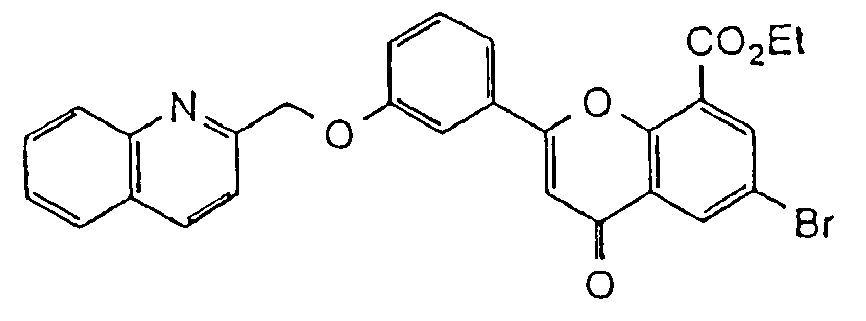
용점: 148.8-150.2℃Melting point: 148.8-150.2 ℃
1H-NMR(CDCl3): δ 1.39(3H,t,J=7.1Hz,CO2CH2CH 3), 1 H-NMR (CDCl 3 ): δ 1.39 (3H, t, J = 7.1 Hz, CO 2 CH 2 C H 3 ),
4.41(2H,q,J=7.1Hz,CO2CH 2CH3), 5.42(2H,s,C9H6NCH 2O),4.41 (2H, q, J = 7.1 Hz, CO 2 C H 2 CH 3 ), 5.42 (2H, s, C 9 H 6 NC H 2 O),
6.80(1H,s,C3-H), 7.12-7.16(1H,m,C4,-H), 7.37(1H,t,J=8.0Hz,C5,-H),6.80 (1H, s, C3-H), 7.12-7.16 (1H, m, C4 , -H), 7.37 (1H, t, J = 8.0 Hz, C5 , -H),
7.46-7.49(1H,m,퀴놀린 C6-H), 7.60(1H,d,J=8.6Hz,퀴놀린 C3-H), 7.46-7.49 (1H, m, quinoline C6-H), 7.60 (1H, d, J = 8.6 Hz, quinoline C3-H),
7.59-7.63(1H,m,퀴놀린 C7-H), 7.65-7.80(3H,m,퀴놀린 7.59-7.63 (1H, m, quinoline C7-H), 7.65-7.80 (3H, m, quinoline
C5-H,C2,-H,C6,-H), 8.04(1H,d,J=8.6Hz,퀴놀린 C8-H),C5-H, C2 , -H, C6 , -H), 8.04 (1H, d, J = 8.6 Hz, quinoline C8-H),
8.15(1H,d,J=8.5Hz,퀴놀린 C4-H), 8.31(1H,d,J=2.6Hz,C5-H/C7-H), 8.15 (1H, d, J = 8.5 Hz, quinoline C4-H), 8.31 (1H, d, J = 2.6 Hz, C5-H / C7-H),
8.45(1H,d,J=2.6Hz,C5-H/C7-H). 8.45 (1H, doublet, J = 2.6 Hz, C5-H / C7-H).
실시예 14Example 14
6-브로모-8-에톡시카르보닐-3'-[2-(7-클로로)퀴놀릴메톡시]플라본의 합성Synthesis of 6-bromo-8-ethoxycarbonyl-3 '-[2- (7-chloro) quinolylmethoxy] flavone
6-브로모-3'-히드록시-8-에톡시카르보닐플라본 및 7-클로로-2-(클로로메틸)퀴놀린을 사용하여 실시예 9와 동일하게 하여 하기 식으로 표시되는 표제 화합물을 얻었다(수율: 52%).6-Bromo-3'-hydroxy-8-ethoxycarbonylflavone and 7-chloro-2- (chloromethyl) quinoline were used in the same manner as in Example 9 to obtain the title compound represented by the following formula ( Yield: 52%).

용점: 181.6-182.1℃Melting point: 181.6-182.1 ℃
1H-NMR(CDCl3): δ 1.40(3H,t,J=7.1Hz,CO2CH2CH 3), 1 H-NMR (CDCl 3 ): δ 1.40 (3H, t, J = 7.1 Hz, CO 2 CH 2 C H 3 ),
4.40(2H,q,J=7.1Hz,CO2CH 2CH3), 5.39(2H,s,C9H5NCICH 2O),4.40 (2H, q, J = 7.1 Hz, CO 2 C H 2 CH 3 ), 5.39 (2H, s, C 9 H 5 NCIC H 2 O),
6.80(1H,s,C3-H),7.11-7.14(1H,m,C4,-H), 7.38(1H,t,J=8.0Hz,C5,-H),6.80 (1H, s, C3-H), 7.11-7.14 (1H, m, C4 , -H), 7.38 (1H, t, J = 8.0 Hz, C5 , -H),
7.42-7.47(1H,m,퀴놀린 C6-H), 7.42-7.47 (1H, m, quinoline C6-H),
7.60(2H,d,J=8.4Hz,퀴놀린 C3-H,퀴놀린 C5-H), 7.60 (2H, d, J = 8.4 Hz, quinoline C3-H, quinoline C5-H),
7.68-7.72(2H,m,C2,-H,C6,-H), 8.03(1H,s,퀴놀린 C8-H),7.68-7.72 (2H, m, C2 , -H, C6 , -H), 8.03 (1H, s, quinoline C8-H),
8.11(1H,d,J=8.5Hz,퀴놀린 C4-H), 8.31(1H,d,J=2.5Hz,C5-H/C7-H), 8.11 (1H, d, J = 8.5 Hz, quinoline C4-H), 8.31 (1H, d, J = 2.5 Hz, C5-H / C7-H),
8.45(1H,d,J=2.5Hz,C5-H/C7-H). 8.45 (1H, doublet, J = 2.5 Hz, C5-H / C7-H).
실시예 15Example 15
6-브로모-8-에톡시카르보닐-3'-[(2-퀴나졸릴)메톡시]플라본의 합성Synthesis of 6-bromo-8-ethoxycarbonyl-3 '-[(2-quinazolyl) methoxy] flavone
6-브로모-3'-히드록시-8-에톡시카르보닐플라본 및 2-클로로메틸퀴나졸린을 사용하여 실시예 9와 동일하게 하여 하기 식으로 표시되는 표제 화합물을 얻었다(수율: 47%).6-Bromo-3'-hydroxy-8-ethoxycarbonylflavone and 2-chloromethylquinazoline were used in the same manner as in Example 9 to obtain the title compound represented by the following formula (Yield: 47%) .

용점: 179.7-180.3℃Melting point: 179.7-180.3 ℃
1H-NMR(CDCl3): δ 1.39(3H,t,J=7.1Hz,CO2CH2CH 3), 1 H-NMR (CDCl 3 ): δ 1.39 (3H, t, J = 7.1 Hz, CO 2 CH 2 C H 3 ),
4.40(2H,q,J=7.1Hz,CO2CH 2CH3), 5.50(2H,s,C8H5N3CH 2O),4.40 (2H, q, J = 7.1 Hz, CO 2 C H 2 CH 3 ), 5.50 (2H, s, C 8 H 5 N 3 C H 2 O),
6.80(1H,s,C3-H), 7.17-7.21(1H,m,C4,-H), 7.38(1H,t,J=8.0Hz,C5,-H),6.80 (1H, s, C3-H), 7.17-7.21 (1H, m, C4 , -H), 7.38 (1H, t, J = 8.0 Hz, C5 , -H),
7.57-7.65(2H,m,C6,-H,퀴놀린 C6-H), 7.72-7.73(1H,m,C2,-H),7.57-7.65 (2H, m, C6 , -H, quinoline C6-H), 7.72-7.73 (1H, m, C2 , -H),
7.85-7.92(2H,m,퀴놀린 C5-H,퀴놀린 C7-H), 7.85-7.92 (2H, m, quinoline C5-H, quinoline C7-H),
8.02(1H,d,J=9.0Hz,퀴놀린 C8-H), 8.30(1H,d,J=2.6Hz,C5-H/C7-H), 8.02 (1H, d, J = 9.0 Hz, quinoline C8-H), 8.30 (1H, d, J = 2.6 Hz, C5-H / C7-H),
8.45(1H,d,J=2.6Hz,C5-H/C7-H), 9.40(1H,s,퀴놀린 C4-H). 8.45 (1H, d, J = 2.6 Hz, C5-H / C7-H), 9.40 (1H, s, quinoline C4-H).
실시예 16Example 16
6-브로모-8-에톡시카르보닐-3'-[2-나프닐메톡시]플라본의 합성Synthesis of 6-bromo-8-ethoxycarbonyl-3 '-[2-naphthylmethoxy] flavone
6-브로모-3'-히드록시-8-에톡시카르보닐플라본 및 2-클로로메틸나프탈렌을 사용하여 실시예 9와 동일하게 하여 하기 식으로 표시되는 표제 화합물을 얻었다(수율: 70%).Using the 6-bromo-3'-hydroxy-8-ethoxycarbonylflavone and 2-chloromethylnaphthalene in the same manner as in Example 9, the title compound represented by the following formula was obtained (yield: 70%).

용점: 211.4-212.8℃Melting point: 211.4-212.8 ℃
1H-NMR(CDCl3): δ 1.38(3H,t,J=7.1Hz,CO2CH2CH 3), 1 H-NMR (CDCl 3 ): δ 1.38 (3H, t, J = 7.1 Hz, CO 2 CH 2 C H 3 ),
4.41(2H,q,J=7.1Hz,CO2CH 2CH3), 5.42(2H,s,C18H7CH 2O),4.41 (2H, q, J = 7.1 Hz, CO 2 C H 2 CH 3 ), 5.42 (2H, s, C 18 H 7 C H 2 O),
6.80(1H,s,C3-H), 7.13-7.19(1H,m,C4,-H), 7.26-7.48(4H,m,Ar-H),6.80 (1H, s, C3-H), 7.13-7.19 (1H, m, C4 , -H), 7.26-7.48 (4H, m, Ar-H),
7.54-7.59(1H,m,Ar-H), 7.76-7.99(5H,m,Ar-H), 7.54-7.59 (1H, m, Ar-H), 7.76-7.99 (5H, m, Ar-H),
8.31(1H,d,J=2.6Hz,C5-H/C7-H), 8.45(1H,d,J=2.6Hz,C5-H/C7-/H). 8.31 (1H, d, J = 2.6 Hz, C5-H / C7-H), 8.45 (1H, d, J = 2.6 Hz, C5-H / C7- / H).
실시예 17Example 17
6-브로모-8-에톡시카르보닐-3'-[2-(1-메틸벤즈이미다졸릴)메톡시]플라본의 합성Synthesis of 6-bromo-8-ethoxycarbonyl-3 '-[2- (1-methylbenzimidazolyl) methoxy] flavone
6-브로모-3'-히드록시-8-에톡시카르보닐플라본 및 2-클로로-1-메틸벤즈이미다졸을 사용하여 실시예 9와 동일하게 하여 하기 식으로 표시되는 표제 화합물을 얻었다(수율: 65%).6-Bromo-3'-hydroxy-8-ethoxycarbonylflavone and 2-chloro-1-methylbenzimidazole were used in the same manner as in Example 9 to obtain the title compound represented by the following formula (Yield) : 65%).

용점: 209.3-210.2℃Melting point: 209.3-210.2 ℃
1H-NMR(CDCl3): δ 1.39(3H,t,J=7.1Hz,CO2CH2CH 3), 3.86(3H,s,NCH3), 1 H-NMR (CDCl 3 ): δ 1.39 (3H, t, J = 7.1 Hz, CO 2 CH 2 C H 3 ), 3.86 (3H, s, NCH 3 ),
4.41(2H,q,J=7.1Hz,CO2CH 2CH3), 5.42(2H,s,C8H7N2SCH 2O),4.41 (2H, q, J = 7.1 Hz, CO 2 C H 2 CH 3 ), 5.42 (2H, s, C 8 H 7 N 2 SC H 2 O),
6.82(1H,s,C3-H), 6.82 (1H, s, C3-H),
7.22-7.31(4H,m,벤즈이미다졸 C5-H,벤즈이미다졸 C6-H, 7.22-7.31 (4H, m, benzimidazole C5-H, benzimidazole C6-H,
벤즈이미다졸C7-H,C4,-H), 7.39(1H,t,J=8.0Hz,C5,-H),Benzimidazole C7-H, C4 , -H), 7.39 (1H, t, J = 8.0 Hz, C5 , -H),
7.60(1H,d,J=7.8Hz,C6,-H), 7.72-7.76(1H,m,벤즈이미다졸 C4-H,C2,-H),7.60 (1H, d, J = 7.8 Hz, C6 , -H), 7.72-7.76 (1H, m, benzimidazole C4-H, C2 , -H),
8.31(1H,d,J=2.6Hz,C5-H/C7-H), 8.46(1H,d,J=2.6Hz,C5-H/C7-H). 8.31 (1H, d, J = 2.6 Hz, C5-H / C7-H), 8.46 (1H, d, J = 2.6 Hz, C5-H / C7-H).
실시예 18Example 18
6-브로모-8-에톡시카르보닐-3'-[(2-벤조티아졸리닐)메톡시]플라본의 합성Synthesis of 6-bromo-8-ethoxycarbonyl-3 '-[(2-benzothiazolinyl) methoxy] flavone
6-브로모-3'-히드록시-8-에톡시카르보닐플라본 및 2-클로로메틸벤조티아졸을 사용하여 실시예 9와 동일하게 하여 하기 식으로 표시되는 표제 화합물을 얻었다(수율: 35%).6-Bromo-3'-hydroxy-8-ethoxycarbonylflavone and 2-chloromethylbenzothiazole were used in the same manner as in Example 9 to obtain the title compound represented by the following formula (Yield: 35% ).

용점: 166.1-167.5℃Melting point: 166.1-167.5 ℃
1H-NMR(CDCl3): δ 1.38(3H,t,J=7.1Hz,CO2CH2CH 3), 1 H-NMR (CDCl 3 ): δ 1.38 (3H, t, J = 7.1 Hz, CO 2 CH 2 C H 3 ),
4.41(2H,q,J=7.1Hz,CO2CH 2CH3), 5.42(2H,s,C7H4NSCH 2O),4.41 (2H, q, J = 7.1 Hz, CO 2 C H 2 CH 3 ), 5.42 (2H, s, C 7 H 4 NSC H 2 O),
6.80(1H,s,C3-H), 8.31(1H,d,J=2.6Hz,C5-H/C7-H), 6.80 (1H, s, C3-H), 8.31 (1H, d, J = 2.6 Hz, C5-H / C7-H),
8.45(1H,d,J=2.6Hz,C5-H/C7-H). 8.45 (1H, doublet, J = 2.6 Hz, C5-H / C7-H).
실시예 19Example 19
8-카르복시-4'-(2-퀴놀리닐메톡시)플라본의 합성Synthesis of 8-carboxy-4 '-(2-quinolinylmethoxy) flavone
8-에톡시카르보닐-4'-(2-퀴놀리닐메톡시)플라본을 메탄올:THF:5% 수산화리튬 수용액 (1:1:1 v/v)의 혼합 용매에 용해하고, 실온에서 2일간 교반했다. 반응 혼합물을 3N 염산으로 산성화했다. 생성 침전을 여과하여 모으고, 물 및 메탄올로 세정한 후, DMF로 재결정하여 하기 식의 표제 화합물을 얻었다(수율: 89%).8-ethoxycarbonyl-4 '-(2-quinolinylmethoxy) flavone is dissolved in a mixed solvent of methanol: THF: 5% aqueous lithium hydroxide solution (1: 1: 1 v / v), and at room temperature for 2 days. Stirred. The reaction mixture was acidified with 3N hydrochloric acid. The resulting precipitate was collected by filtration, washed with water and methanol and then recrystallized with DMF to give the title compound of the following formula (yield: 89%).

용점: 223.4-225.9℃Melting point: 223.4-225.9 ℃
1H-NMR(CDCl3): δ 5.50(2H,s,C8H5NCH 2O), 6.97(1H,s,C3-H), 1 H-NMR (CDCl 3 ): δ 5.50 (2H, s, C 8 H 5 NC H 2 O), 6.97 (1H, s, C3-H),
7.27(2H,d,J=8.7Hz,C3,-H,C5,-H), 7.52-7.56(1H,m,C6-H),7.27 (2H, d, J = 8.7 Hz, C3 , -H, C5 , -H), 7.52-7.56 (1H, m, C6-H),
7.60-7.64(1H,m,퀴놀린 C6-H), 7.69(1H,d,J=8.4Hz,퀴놀린 C3-H), 7.60-7.64 (1H, m, quinoline C6-H), 7.69 (1H, d, J = 8.4 Hz, quinoline C3-H),
7.77-7.81(1H,m,퀴놀린 C7-H), 7.98(1H,d,J=7.9Hz,퀴놀린 C5-H), 7.77-7.81 (1H, m, quinoline C7-H), 7.98 (1H, d, J = 7.9 Hz, quinoline C5-H),
8.03(1H,d,J=8.4Hz,퀴놀린 C8-H), 8.16(2H,d,J=8.7Hz,C2,-H,C6,-H),8.03 (1H, d, J = 8.4 Hz, quinoline C8-H), 8.16 (2H, d, J = 8.7 Hz, C2 , -H, C6 , -H),
8.23-8.25(2H,m,C5-H,C7-H), 8.41(1H,d,J=8.4Hz,퀴놀린 C4-H). 8.23-8.25 (2H, m, C5-H, C7-H), 8.41 (1H, d, J = 8.4 Hz, quinoline C4-H).
실시예 20Example 20
8-카르복시-4'-(2-나프틸메톡시)플라본의 합성Synthesis of 8-carboxy-4 '-(2-naphthylmethoxy) flavone
8-에톡시카르보닐-4'-(2-나프틸메톡시)플라본을 사용하여 실시예 19와 동일하게 하여 하기 식으로 표시되는 표제 화합물을 얻었다(수율: 43%).8-Ethoxycarbonyl-4 '-(2-naphthylmethoxy) flavone was used in the same manner as in Example 19 to obtain the title compound represented by the following formula (yield: 43%).

융점: 245.1-248.7℃Melting Point: 245.1-248.7 ℃
1H-NMR(DMSO-d6): δ 5.43(2H,s,C10H7CH 2O), 7.09(1H,s,C3-H), 1 H-NMR (DMSO-d 6 ): δ 5.43 (2H, s, C 10 H 7 C H 2 O), 7.09 (1H, s, C3-H),
7.28(2H,d,J=8.7Hz,C3,-H,C5,-H), 7.57-7.65(3H,m,C6-H,나프틸 H),7.28 (2H, d, J = 8.7 Hz, C3 , -H, C5 , -H), 7.57-7.65 (3H, m, C6-H, naphthyl H),
7.97-8.04(4H,m,나프틸 H), 8.20-8.25(4H,m,C5-H,C7-H,C2,-H,C6,-H),7.97-8.04 (4H, m, naphthyl H), 8.20-8.25 (4H, m, C5-H, C7-H, C2 , -H, C6 , -H),
13.59(1H,br.s,ArCO2H),13.59 (1H, br.s, ArCO 2 H),
실시예 21Example 21
8-카르복시-4'-(2-퀴나졸리닐메톡시)플라본의 합성Synthesis of 8-carboxy-4 '-(2-quinazolinylmethoxy) flavone
8-에톡시카르보닐-4'-(2-퀴날졸리닐메톡시)플라본을 사용하여 실시예 19와 동일하게 하여 하기 식으로 표시되는 표제 화합물을 얻었다(수율: 58%).In the same manner as in Example 19, using 8-ethoxycarbonyl-4 '-(2-quinalzolinylmethoxy) flavone to give the title compound represented by the following formula (yield: 58%).

융점: 264.8-266.0℃Melting Point: 264.8-266.0 ℃
1H-NMR(DMSO-d6): δ 5.59(2H,s,C8H5N2CH 2O), 7.07(1H,s,C3-H), 1 H-NMR (DMSO-d 6 ): δ 5.59 (2H, s, C 8 H 5 N 2 C H 2 O), 7.07 (1H, s, C3-H),
7.25(2H,d,J=8.8Hz,C3,-H,C5,-H), 7.56(1H,t,J=7.8Hz,C6-H),7.25 (2H, d, J = 8.8 Hz, C3 , -H, C5 , -H), 7.56 (1H, t, J = 7.8 Hz, C6-H),
7.80-7.84(1H,m,퀴놀린 C6-H), 7.80-7.84 (1H, m, quinoline C6-H),
8.17-8.19(2H,m,퀴놀린 C5-H,퀴놀린 C7-H), 8.17-8.19 (2H, m, quinoline C5-H, quinoline C7-H),
8.21-8.28(5H,m,C5-H,C7-H,C2,-H,C6,-H,퀴놀린 C8-H),8.21-8.28 (5H, m, C5-H, C7-H, C2 , -H, C6 , -H, quinoline C8-H),
9.69(1H,s,퀴놀린 C4-H), 13.51(1H,br.s,CO2H).9.69 (1H, s, quinoline C4-H), 13.51 (1H, br.s, CO 2 H).
실시예 22Example 22
8-카르복시-3'-(2-퀴놀리닐메톡시)플라본의 합성Synthesis of 8-carboxy-3 '-(2-quinolinylmethoxy) flavone
8-에톡시카르보닐-3'-(2-퀴놀리닐메톡시)플라본을 사용하여 실시예 19와 동일하게 하여 하기 식으로 표시되는 표제 화합물을 얻었다(수율: 40%).Using the 8-ethoxycarbonyl-3 '-(2-quinolinylmethoxy) flavone, the title compound represented by the following formula was obtained in the same manner as in Example 19 (yield: 40%).

융점: >300℃Melting Point:> 300 ℃
1H-NMR(DMSO-d6): δ 5.48(2H,s,C9H6NCH 2O), 7.23(1H,s,C3-H), 1 H-NMR (DMSO-d 6 ): δ 5.48 (2H, s, C 9 H 6 NC H 2 O), 7.23 (1H, s, C3-H),
7.31(1H,dd,J=8.2Hz,2.3Hz,C4,-H), 7.51(1H,t,J=8.0Hz,C5,-H),7.31 (1H, dd, J = 8.2Hz, 2.3Hz, C4 , -H), 7.51 (1H, t, J = 8.0Hz, C5 , -H),
7.58(1H,t,J=7.7Hz,C6-H), 7.61-7.65(1H,m,퀴놀린 C6-H), 7.58 (1H, t, J = 7.7 Hz, C6-H), 7.61-7.65 (1H, m, quinoline C6-H),
7.75(1H,d,J=8.5Hz,퀴놀린 C3-H), 7.78-7.81(1H,m,퀴놀린 C7-H), 7.75 (1H, d, J = 8.5 Hz, quinoline C3-H), 7.78-7.81 (1H, m, quinoline C7-H),
7.84-7.85(1H,m,C6,-H),7.84-7.85 (1H, m, C6 , -H),
8.00-8.05(3H,m,C2,-H,퀴놀린 C5-H,퀴놀린 C8-H),8.00-8.05 (3H, m, C2 , -H, quinoline C5-H, quinoline C8-H),
8.27(1H,dd,J=7.9Hz,1.8Hz,C5-H/C7-H), 8.27 (1H, dd, J = 7.9 Hz, 1.8 Hz, C5-H / C7-H),
8.30(1H,dd,J=7.6Hz,1.8Hz,C5-H/C7-H), 8.30 (1H, dd, J = 7.6 Hz, 1.8 Hz, C5-H / C7-H),
8.45(1H,d,J=8.5Hz,퀴놀린 C4-H), 8.45 (1H, d, J = 8.5 Hz, quinoline C4-H),
실시예 23Example 23
6-브로모-8-카르복시-3'-(2-퀴놀리닐메톡시)플라본의 합성Synthesis of 6-bromo-8-carboxy-3 '-(2-quinolinylmethoxy) flavone
6-브로모-8-에톡시카르보닐-3'-(2-퀴놀리닐메톡시)플라본을 사용하여 실시예 19와 동일하게 하여 하기 식으로 표시되는 표제 화합물을 얻었다(수율: ///%).6-Bromo-8-ethoxycarbonyl-3 '-(2-quinolinylmethoxy) flavone was used in the same manner as in Example 19 to obtain the title compound represented by the following formula (Yield: ///% ).

융점: 241.6-242.0℃Melting point: 241.6-242.0 ℃
1H-NMR(DMSO-d6): δ 5.47(2H,s,C9H6NCH 2O), 7.27(1H,s,C3-H), 1 H-NMR (DMSO-d 6 ): δ 5.47 (2H, s, C 9 H 6 NC H 2 O), 7.27 (1H, s, C3-H),
7.30-7.32(1H,m,C4'-H), 7.50(1H,t,J=8.0Hz,C5,-H),7.30-7.32 (1H, m, C4'-H), 7.50 (1H, t, J = 8.0 Hz, C5 , -H),
7.61-7.65(1H,m,퀴놀린 C6-H), 7.75(1H,d,J=8.5Hz,퀴놀린 C3-H), 7.61-7.65 (1H, m, quinoline C6-H), 7.75 (1H, d, J = 8.5 Hz, quinoline C3-H),
7.78-7.83(1H,m,퀴놀린 C7-H), 7.78-7.83 (1 H, m, quinoline C7-H),
7.99-8.05(3H,m,C2,-H,퀴놀린 C5-H,퀴놀린 C8-H),7.99-8.05 (3H, m, C2 , -H, quinoline C5-H, quinoline C8-H),
8.29(1H,br.s,C5-H/C7-H), 8.34(1H,br.s, C5-H/C7-H), 8.29 (1H, br.s, C5-H / C7-H), 8.34 (1H, br.s, C5-H / C7-H),
8.45(1H,d,J=8.5Hz,퀴놀린 C4-H), 8.45 (1H, d, J = 8.5 Hz, quinoline C4-H),
실시예 24Example 24
6-브로모-8-카르복시-3'-[2-클로로퀴놀리닐)메톡시]플라본의 합성Synthesis of 6-bromo-8-carboxy-3 '-[2-chloroquinolinyl) methoxy] flavone
6-브로모-8-에톡시카르보닐-3'-[2-(7-클로로퀴놀리닐)메톡시]플라본을 사용하여 실시예 19와 동일하게 하여 하기 식으로 표시되는 표제 화합물을 얻었다(수율: 68%).6-Bromo-8-ethoxycarbonyl-3 '-[2- (7-chloroquinolinyl) methoxy] flavone was used in the same manner as in Example 19 to obtain the title compound represented by the following formula ( Yield: 68%).
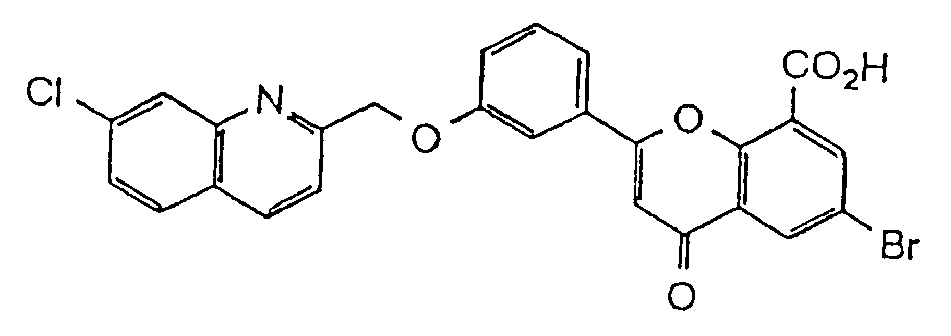
융점: 269.0-269.1℃Melting Point: 269.0-269.1 ℃
1H-NMR(DMSO-d6): δ 5.47(2H,s,C9H5NCICH 2O), 7.27(1H,s,C3-H), 1 H-NMR (DMSO-d 6 ): δ 5.47 (2H, s, C 9 H 5 NCIC H 2 O), 7.27 (1H, s, C3-H),
7.30(1H,dd,J=8.4Hz,2.0Hz,C4,-H), 7.51(1H,t,J=8.0Hz,C5,-H),7.30 (1H, dd, J = 8.4Hz, 2.0Hz, C4 , -H), 7.51 (1H, t, J = 8.0Hz, C5 , -H),
7.55(1H,dd,J=8.7Hz,1.7Hz,퀴놀린 C6-H), 7.55 (1H, doublet of doublets, J = 8.7 Hz, 1.7 Hz, quinoline C6-H),
7.76(1H,d,J=8.5Hz,퀴놀린 C3-H), 7.83(1H,d,J=7.7Hz,C6,-H),7.76 (1H, d, J = 8.5 Hz, quinoline C3-H), 7.83 (1H, d, J = 7.7 Hz, C6 , -H),
7.99(1H,s,C2,-H), 8.05-8.07(2H,m,퀴놀린 C5-H,퀴놀린 C8-H),7.99 (1H, s, C2 , -H), 8.05-8.07 (2H, m, quinoline C5-H, quinoline C8-H),
8.28(1H,d,J=2.4Hz,C5-H/C7-H), 8.33(1H,d,J=2.4Hz,C5-H/C7-H), 8.28 (1H, d, J = 2.4 Hz, C5-H / C7-H), 8.33 (1H, d, J = 2.4 Hz, C5-H / C7-H),
8.48(1H,d,J=8.5Hz,퀴놀린 C4-H). 8.48 (1H, doublet, J = 8.5 Hz, quinoline C4-H).
실시예 25Example 25
6-브로모-8-카르복시-3'-(2-퀴나졸리닐메톡시)플라본의 합성Synthesis of 6-bromo-8-carboxy-3 '-(2-quinazolinylmethoxy) flavone
6-브로모-8-에톡시카르보닐-3'-(2-퀴나졸리닐메톡시)플라본을 사용하여 실시예 19와 동일하게 하여 하기 식으로 표시되는 표제 화합물을 얻었다(수율: 41%).Using the 6-bromo-8-ethoxycarbonyl-3 '-(2-quinazolinylmethoxy) flavone in the same manner as in Example 19, the title compound represented by the following formula was obtained (yield: 41%).

융점: 245.7-245.9℃Melting point: 245.7-245.9 ℃
1H-NMR(DMSO-d6): δ 5.54(2H,s,C8H5N2CH 2O), 7.16(1H,s,C3-H), 1 H-NMR (DMSO-d 6 ): δ 5.54 (2H, s, C 8 H 5 N 2 C H 2 O), 7.16 (1H, s, C3-H),
7.28(1H,dd,J=8.0Hz,1.7Hz,C4,-H), 7.48(1H,t,J=8.0Hz,C5,-H),7.28 (1H, dd, J = 8.0Hz, 1.7Hz, C4 , -H), 7.48 (1H, t, J = 8.0Hz, C5 , -H),
7.76-7.79(2H,m,C6,-H,퀴놀린 C6-H), 7.93(1H,s,C2,-H),7.76-7.79 (2H, m, C6 , -H, quinoline C6-H), 7.93 (1H, s, C2 , -H),
8.02-8.04(2H,m,퀴놀린 C5-H,퀴놀린 C7-H), 8.02-8.04 (2H, m, quinoline C5-H, quinoline C7-H),
8.17(1H,d,J=8.0Hz,퀴놀린 C8-H), 8.29(1H,d,J=2.4Hz,C5-H/C7-H), 8.17 (1H, d, J = 8.0 Hz, quinoline C8-H), 8.29 (1H, d, J = 2.4 Hz, C5-H / C7-H),
8.31(1H,d,J=2.4Hz,C5-H/C7-H), 9.65(1H,s,퀴놀린 C4-H). 8.31 (1H, d, J = 2.4 Hz, C5-H / C7-H), 9.65 (1H, s, quinoline C4-H).
실시예 26Example 26
6-브로모-8-카르복시-3'-(2-나프틸메톡시)플라본의 합성Synthesis of 6-bromo-8-carboxy-3 '-(2-naphthylmethoxy) flavone
6-브로모-8-에톡시카르보닐-3'-(2-나프틸메톡시)플라본을 사용하여 실시예 19와 동일하게 하여 하기 식으로 표시되는 표제 화합물을 얻었다(수율: 70%).Using the 6-bromo-8-ethoxycarbonyl-3 '-(2-naphthylmethoxy) flavone, the title compound represented by the following formula was obtained in the same manner as in Example 19 (yield: 70%).

융점: 211.4-212.8℃Melting Point: 211.4-212.8 ℃
1H-NMR(DMSO-d6): δ 5.34(2H,s,C10H7-CH 2-O), 7.23(1H,s,C3-H), 1 H-NMR (DMSO-d 6 ): δ 5.34 (2H, s, C 10 H 7 -C H 2 -O), 7.23 (1H, s, C3-H),
7.24-7.28(1H,m,C4,-H), 7.45-7.70(4H,m,Ar-H),7.24-7.28 (1H, m, C4 , -H), 7.45-7.70 (4H, m, Ar-H),
8.05(1H,d,J=8.5Hz,퀴놀린 C4-H), 8.29(1H,d,J=1.8Hz,C5-H/C7-H), 8.05 (1H, d, J = 8.5 Hz, quinoline C4-H), 8.29 (1H, d, J = 1.8 Hz, C5-H / C7-H),
8.32(1H,d,J=1.8Hz,C5-H/C7-H). 8.32 (1H, doublet, J = 1.8 Hz, C5-H / C7-H).
실시예 27Example 27
6-브로모-8-카르복시-3'-(2-벤조티아졸릴메톡시)플라본의 합성Synthesis of 6-bromo-8-carboxy-3 '-(2-benzothiazolylmethoxy) flavone
6-브로모-8-에톡시카르보닐-3'-(2-벤조티아졸릴메톡시)플라본을 사용하여 실시예 19와 동일하게 하여 하기 식으로 표시되는 표제 화합물을 얻었다(수율: 52%).6-Bromo-8-ethoxycarbonyl-3 '-(2-benzothiazolylmethoxy) flavone was used in the same manner as in Example 19 to obtain the title compound represented by the following formula (Yield: 52%) .

융점: 250.2-251.4℃Melting Point: 250.2-251.4 ℃
1H-NMR(DMSO-d6): δ 5.70(2H,s,C7H4NSCH 2O), 7.22(1H,s,C3-H), 1 H-NMR (DMSO-d 6 ): δ 5.70 (2H, s, C 7 H 4 NSC H 2 O), 7.22 (1H, s, C3-H),
7.34-7.36(1H,m,C4,-H), 7.44-7.48(1H,m,C5-H),7.34-7.36 (1H, m, C4 , -H), 7.44-7.48 (1H, m, C5-H),
7.52-7.56(2H,m,벤조티아졸 C5-H,벤조티아졸 C6-H), 7.52-7.56 (2H, m, benzothiazole C5-H, benzothiazole C6-H),
7.84(1H,d,J=7.9Hz,C6-H), 7.98(1H,s,C2,-H),7.84 (1H, d, J = 7.9 Hz, C6-H), 7.98 (1H, s, C2 , -H),
8.00-8.04(1H,m,벤조티아졸 C4-H), 8.00-8.04 (1H, m, benzothiazole C4-H),
8.10-8.12(1H,m,벤조티아졸 C7-H), 8.31(1H,d,J=2.5Hz,C5-H/C7-H), 8.10-8.12 (1H, m, benzothiazole C7-H), 8.31 (1H, d, J = 2.5 Hz, C5-H / C7-H),
8.33(1H,d,J=2.5Hz,C5-H/C7-H). 8.33 (1H, doublet, J = 2.5 Hz, C5-H / C7-H).
실시예 28Example 28
6-브로모-8-카르복시-3'-[2-(1-메틸벤즈이미다졸릴)메톡시]플라본의 합성Synthesis of 6-bromo-8-carboxy-3 '-[2- (1-methylbenzimidazolyl) methoxy] flavone
6-브로모-8-에톡시카르보닐-3'-[2-(1-메틸벤즈이미다졸릴)메톡시]플라본을 사용하여 실시예 19와 동일하게 하여 하기 식으로 표시되는 표제 화합물을 얻었다(수율: 82%).Using the 6-bromo-8-ethoxycarbonyl-3 '-[2- (1-methylbenzimidazolyl) methoxy] flavone in the same manner as in Example 19, the title compound represented by the following formula was obtained. (Yield 82%).

융점: 287.4-288.5℃Melting Point: 287.4-288.5 ℃
1H-NMR(DMSO-d6): δ 4.01(3H,s,NCH3), 5.71(2H,s,C6H7NCH 2O), 1 H-NMR (DMSO-d 6 ): δ 4.01 (3H, s, NCH 3 ), 5.71 (2H, s, C 6 H 7 NC H 2 O),
7.23(1H,s,C3-H), 7.23 (1H, s, C3-H),
7.41-7.50(3H,m,C4,-H,벤즈이미다졸 C5-H,벤즈이미다졸 C6-H),7.41-7.50 (3H, m, C4 , -H, benzimidazole C5-H, benzimidazole C6-H),
7.56(1H,t,J=8.0Hz,C5,-H),7.56 (1H, t, J = 8.0 Hz, C5 , -H),
7.77-7.81(1H,m,벤즈이미다졸 C4-H, 벤즈이미다졸 C7-H), 7.77-7.81 (1H, m, benzimidazole C4-H, benzimidazole C7-H),
7.87(1H,d,J=7.7Hz,C6,-H), 8.00(1H,s,C2,-H),7.87 (1H, d, J = 7.7 Hz, C6 , -H), 8.00 (1H, s, C2 , -H),
8.31(1H,d,J=2.1Hz,C5-H/C7-H), 8.46(1H,d,J=2.1Hz,C5-H/C7-H). 8.31 (1H, d, J = 2.1 Hz, C5-H / C7-H), 8.46 (1H, d, J = 2.1 Hz, C5-H / C7-H).
실시예 29Example 29
8-카르복시-3-히드록시-4'-[(2-퀴놀리닐)메톡시]플라본의 합성Synthesis of 8-carboxy-3-hydroxy-4 '-[(2-quinolinyl) methoxy] flavone
1) 4-(2-퀴놀리닐)벤즈알데히드 (5 mmol)을 에탄올 50 ㎖에 용해하고, 25% 수산화칼륨 수용액 30 ㎖를 가했다. 생성 혼합물을 실온에서 1주일 교반한 후, 반응 혼합물을 빙수에 붓고, 3N 염산을 가해 산성화했다. 생성 침전을 여과하여 모으고, 물로 세정한 후, 풍건했다. DMF-에탄올로 재결정하여 3'-카르복시-2'-히드록시-4-(2-퀴놀리닐메톡시)칼콘을 얻었다(수율: 38%).1) 4- (2-quinolinyl) benzaldehyde (5 mmol) was dissolved in 50 ml of ethanol, and 30 ml of 25% aqueous potassium hydroxide solution was added. The resulting mixture was stirred for 1 week at room temperature, then the reaction mixture was poured into ice water and acidified by addition of 3N hydrochloric acid. The resulting precipitate was collected by filtration, washed with water, and air dried. Recrystallization with DMF-ethanol gave 3'-carboxy-2'-hydroxy-4- (2-quinolinylmethoxy) chalcone (yield: 38%).
융점: 232.9-235.3℃Melting Point: 232.9-235.3 ℃
1H-NMR(DMSO-d6): δ 5.44(2H,s,C9H6NCH 2O), 6.78(1H,t,C5,-H), 1 H-NMR (DMSO-d 6 ): δ 5.44 (2H, s, C 9 H 6 NC H 2 O), 6.78 (1H, t, C5 , -H),
7.14(2H,d,J=8.6Hz,C3-H,C5-H), 7.57(1H,d,J=15.8Hz,Hα), 7.14 (2H, d, J = 8.6 Hz, C3-H, C5-H), 7.57 (1H, d, J = 15.8 Hz, Hα),
7.60-7.64(1H,m,퀴놀린 C6-H), 7.60-7.64 (1H, m, quinoline C6-H),
7.67-7.81(5H,m,퀴놀린 C7-H,퀴놀린 C3-H,C2-H,C6-H,C4,-H/C6,-H),7.67-7.81 (5H, m, quinoline C7-H, quinoline C3-H, C2-H, C6-H, C4 , -H / C6 , -H),
7.73(1H,d,J=15.8Hz,Hβ), 7.93-7.95(1H,m,C4,-H/C6,-H),7.73 (1H, d, J = 15.8 Hz, Hβ), 7.93-7.95 (1H, m, C4 , -H / C6 , -H),
7.99(1H,d,J-8.2Hz,퀴놀린 C5-H), 8.03(1H,d,J=8.5Hz,퀴놀린 C8-H), 7.99 (1H, d, J-8.2 Hz, quinoline C5-H), 8.03 (1H, d, J = 8.5 Hz, quinoline C8-H),
8.42(1H,d,J=8.5Hz,퀴놀린 C4-H), 8.42 (1H, d, J = 8.5 Hz, quinoline C4-H),
2) 3'-카르복시-2'-히드록시-4-(2-퀴놀리닐메톡시)칼콘 (1.2 mmol)을 메탄올 35 ㎖에 용해하고, 16% 수산화나트륨 2 ㎖를 가했다. 생성 혼합물을 빙욕상에서 교반하면서, 15% 과산화수소 2.0 ㎖를 서서히 적하하였다. 생성 혼합물을 4℃에서 24시간 방치하였다. 반응 혼합물을 1N 염산으로 산성화하였다. 생성된 침전을 여과하여 모으고, DMF로 재결정하여 하기 식으로 표시되는 표제 화합물을 얻었다(수율: 49%).2) 3'-carboxy-2'-hydroxy-4- (2-quinolinylmethoxy) chalcone (1.2 mmol) was dissolved in 35 ml of methanol, and 2 ml of 16% sodium hydroxide was added. While stirring the resulting mixture on an ice bath, 2.0 ml of 15% hydrogen peroxide was slowly added dropwise. The resulting mixture was left at 4 ° C. for 24 hours. The reaction mixture was acidified with 1N hydrochloric acid. The resulting precipitate was collected by filtration and recrystallized with DMF to give the title compound represented by the following formula (Yield: 49%).

용점: 226.5-227.8℃Melting point: 226.5-227.8 ℃
1H-NMR(DMSO-d6): δ 5.47(2H,s,C3H5NCH 2O), 1 H-NMR (DMSO-d 6 ): δ 5.47 (2H, s, C 3 H 5 NC H 2 O),
7.24(2H,d,J=9.0Hz,C3,-H,C5,-H), 7.30(1H,t,J=7.6Hz,C6-H),7.24 (2H, d, J = 9.0 Hz, C3 , -H, C5 , -H), 7.30 (1H, t, J = 7.6 Hz, C6-H),
7.61-7.64(1H,m,퀴놀린 C6-H), 7.72(1H,d,J=8.5Hz,퀴놀린 C3-H), 7.61-7.64 (1H, m, quinoline C6-H), 7.72 (1H, d, J = 8.5 Hz, quinoline C3-H),
7.78-7.82(2H,m,퀴놀린 C7-H,C5-H/C7-H), 7.78-7.82 (2H, m, quinoline C7-H, C5-H / C7-H),
7.94(1H,dd,J=7.9Hz,1.6Hz,C5-H/C7-H), 7.94 (1H, dd, J = 7.9 Hz, 1.6 Hz, C5-H / C7-H),
8.01(1H,d,J=8.4Hz,퀴놀린 C5-H), 8.05(1H,d,J=8.5Hz,퀴놀린 C8-H), 8.01 (1H, d, J = 8.4 Hz, quinoline C5-H), 8.05 (1H, d, J = 8.5 Hz, quinoline C8-H),
8.44(1H,d,J=8.5Hz,퀴놀린 C4-H), 8.44(2H,d,J=9.0Hz,C2,-H,C,-H).8.44 (1H, d, J = 8.5 Hz, quinoline C4-H), 8.44 (2H, d, J = 9.0 Hz, C2 , -H, C , -H).
실시예 30Example 30
3-[2-(프탈이미도)에톡시]-8-[2-(프탈이미도)에톡시카르보닐]-4'-[(2-퀴놀리닐)메톡시]플라본의 합성Synthesis of 3- [2- (phthalimido) ethoxy] -8- [2- (phthalimido) ethoxycarbonyl] -4 '-[(2-quinolinyl) methoxy] flavone
8-카르복시-3-히드록시-4'-[(2-퀴놀리닐)메톡시]플라본 2.50 g (5.7 mmol), 2-브로모에틸-프칼이미드 3.18 g (12.5 mmol) al 탄산칼륨 1.73 g (12.5 mmol)의 혼합물에 DMF(20 ㎖)를 가하고, 70℃에서 밤새 교반했다. 반응 혼합물을 물에 부었다. 생성 침전을 여과하여 모으고, 에탄올로 재결정하여 하기 식의 표제 화합물을 얻었다(수율: 62%).2.50 g (5.7 mmol) of 8-carboxy-3-hydroxy-4 '-[(2-quinolinyl) methoxy] flavone, 3.18 g (12.5 mmol) al potassium carbonate 1.73 2-bromoethyl-fcalcimide DMF (20 mL) was added to a mixture of g (12.5 mmol) and stirred overnight at 70 ° C. The reaction mixture was poured into water. The resulting precipitate was collected by filtration and recrystallized with ethanol to give the title compound of the following formula (yield: 62%).
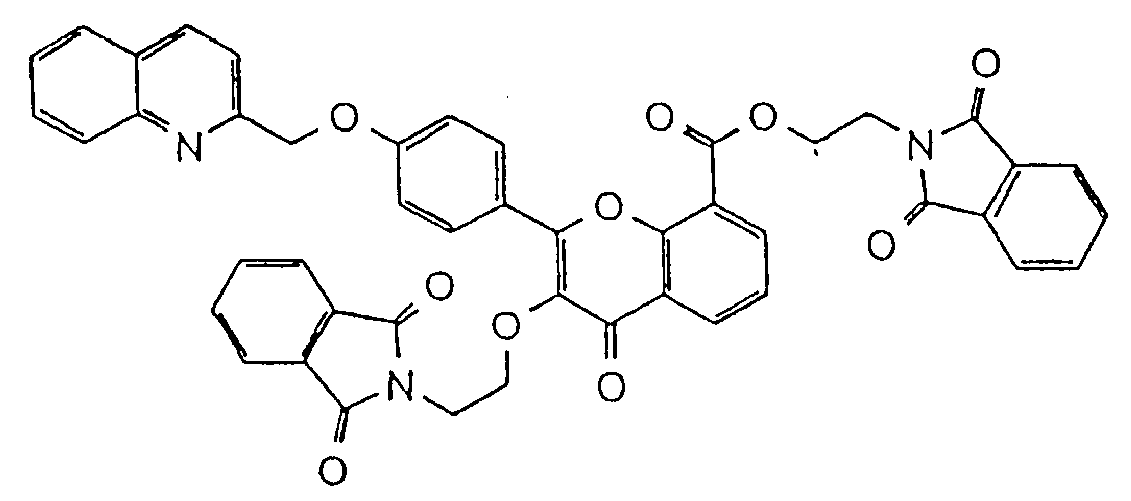
용점: 211.2-212.4℃ For point: 211.2-212.4 ℃
1H-NMR(CDCl3): δ 3.95-4.045(2H,m,NCH 2CH2O), 1 H-NMR (CDCl 3 ): δ 3.95-4.045 (2H, m, NC H 2 CH 2 O),
4.05-4.12(2H,m,NCH2CH 2O), 4.42-4.49(2H,m,NCH2CH 2O),4.05-4.12 (2H, m, NCH 2 C H 2 O), 4.42-4.49 (2H, m, NCH 2 C H 2 O),
4.56-4.62(2H,m,NCH2CH 2O),5.24(2H,s,C8H5NCH 2O),4.56-4.62 (2H, m, NCH 2 C H 2 O), 5.24 (2H, s, C 8 H 5 NC H 2 O),
6.74(2H,d,J=9.0Hz,C3,-H,C5,-H), 7.37(1H,t,J=7.8Hz,C6-H),6.74 (2H, d, J = 9.0 Hz, C3 , -H, C5 , -H), 7.37 (1H, t, J = 7.8 Hz, C6-H),
7.55-7.86(12H,m,프탈이미드의 8H,퀴놀린 C3-H,퀴놀린 C5-H,퀴놀린 7.55-7.86 (12H, m, 8H of phthalimide, quinoline C3-H, quinoline C5-H, quinoline
C6-H, 퀴놀린 C7-H), C6-H, quinoline C7-H),
8.04(2H,d,J=9.0Hz,C2,-H,C6,-H), 8.09-8.13(1H,m,퀴놀린 C8-H),8.04 (2H, d, J = 9.0 Hz, C2 , -H, C6 , -H), 8.09-8.13 (1H, m, quinoline C8-H),
8.20-8.26(2H,m,C5-H,C7-H), 8.35(1H,d,J=7.9Hz,퀴놀린 C4-H). 8.20-8.26 (2H, m, C5-H, C7-H), 8.35 (1H, d, J = 7.9 Hz, quinoline C4-H).
실시예 31Example 31
8-카르복시-3-(2-프탈이미도)에톡시-4'-[(2-퀴놀리닐)메톡시]플라본의 합성Synthesis of 8-carboxy-3- (2-phthalimido) ethoxy-4 '-[(2-quinolinyl) methoxy] flavone
3-[(2-프탈이미도)에톡시]-8-[(2-프탈이미도)에톡시카르보닐]-4'-[(2-퀴놀리닐)메톡시]플라본을 통상의 알카리 가수분해하여 하기 식의 표제 화합물을 얻었다(수율: 89%).3-[(2-phthalimido) ethoxy] -8-[(2-phthalimido) ethoxycarbonyl] -4 '-[(2-quinolinyl) methoxy] flavone is used as a common alkali Decomposition gave the title compound of the following formula (yield: 89%).

융점: 170.2-173.3℃Melting Point: 170.2-173.3 ℃
1H-NMR(DMSO-d6): δ 3.45-3.55(2H,m,NCH 2CH2O), 1 H-NMR (DMSO-d 6 ): δ 3.45-3.55 (2H, m, NC H 2 CH 2 O),
4.18-4.19(2H,m,NCH2CH 2O), 5.44(2H,s,C9H6NCH 2O),4.18-4.19 (2H, m, NCH 2 C H 2 O), 5.44 (2H, s, C 9 H 6 NC H 2 O),
7.20(2H,d,J=8.6Hz,C3,-H,C5,-H),7.20 (2H, d, J = 8.6 Hz, C3 , -H, C5 , -H),
7.48-7.55(3H,m,C6-H,프탈이미드 C5-H, 프탈이미드 C6-H), 7.48-7.55 (3H, m, C6-H, phthalimide C5-H, phthalimide C6-H),
7.61-7.65(1H,m,퀴놀린 6-H), 7.61-7.65 (1H, m, quinoline 6-H),
7.68-7.70(2H,m,프탈이미드 C4-H,프탈이미드 C7-H), 7.68-7.70 (2H, m, phthalimide C4-H, phthalimide C7-H),
7.80(1H,d,J=8.5Hz,퀴놀린 C3-H), 7.78-7.82(1H,m,퀴놀린 C7-H), 7.80 (1H, d, J = 8.5 Hz, quinoline C3-H), 7.78-7.82 (1H, m, quinoline C7-H),
7.99-8.05(2H,m,퀴놀린 C5-H,퀴놀린 C8-H), 7.99-8.05 (2H, m, quinoline C5-H, quinoline C8-H),
8.22-8.27(2H,m,C5-H,C7-H), 8.35(2H,J=8.6Hz,C2,-H,C6,-H),8.22-8.27 (2H, m, C5-H, C7-H), 8.35 (2H, J = 8.6 Hz, C2 , -H, C6 , -H),
8.43(1H,d,J=8.5Hz,퀴놀린 C4-H). 8.43 (1H, doublet, J = 8.5 Hz, quinoline C4-H).
실시예 32Example 32
8-카르복시-3-[2-(N,N-디메틸아미노)에톡시)-4'-[(2-퀴놀리닐)메톡시]플라본 염산염의 합성Synthesis of 8-carboxy-3- [2- (N, N-dimethylamino) ethoxy) -4 '-[(2-quinolinyl) methoxy] flavone hydrochloride
8-카르복시-3-(2-프탈이미도)에톡시-4'-[(2-퀴놀리닐)메톡시]플라본 (0.18 g, 0.29 mmol)을 에탄올 60 ㎖에 현탁한 후, 히드라진 10 ㎕를 가하였다. 생성 혼합물을 1 시간동안 환류하고, 생성 침전물을 여과하여 모았다. 조악한 아민 70 mg을 37% 포름알데히드 0.5 ㎖에 현탁하고, 여기에 시아노나트륨 붕화수소 10 mg을 가했다. 생성 혼합물을 실온에서 밤새 교반하였다. 반응 혼합물을 감압하 농축한 후, 잔사를 에탄올레 용해하고, 1N 염산 몇방울을 가하여 하기 식의 표제 화합물 35 mg을 얻었다(수율: 21%).8-carboxy-3- (2-phthalimido) ethoxy-4 '-[(2-quinolinyl) methoxy] flavone (0.18 g, 0.29 mmol) was suspended in 60 ml of ethanol and 10 µl of hydrazine. Was added. The resulting mixture was refluxed for 1 hour and the resulting precipitate was collected by filtration. 70 mg of crude amine was suspended in 0.5 ml of 37% formaldehyde, and 10 mg of cyanosodium hydrogen boride was added thereto. The resulting mixture was stirred at rt overnight. After the reaction mixture was concentrated under reduced pressure, the residue was dissolved in ethanol and several drops of 1N hydrochloric acid were added to obtain 35 mg of the title compound of the following formula (yield: 21%).

융점: <300℃Melting Point: <300 ℃
1H-NMR(DMSO-d6): δ 2.92(3H,s,NCH3), 2.96(3H,s,NCH3), 1 H-NMR (DMSO-d 6 ): δ 2.92 (3H, s, NCH 3 ), 2.96 (3H, s, NCH 3 ),
3.48-3.53(2H,m,NCH 2CH2O), 4.28-4.36(2H,m,NCH2CH 2O),3.48-3.53 (2H, m, NC H 2 CH 2 O), 4.28-4.36 (2H, m, NCH 2 C H 2 O),
5.36(2H,s,C9H6NCH 2O), 7.31(2H,d,J=9.0Hz,C3,-H,C5,-H),5.36 (2H, s, C 9 H 6 NC H 2 O), 7.31 (2H, d, J = 9.0 Hz, C3 , -H, C5 , -H),
7.57(1H,t,J=7.7Hz,C6-H), 7.68-7.75(1H,m,퀴놀린 C6-H), 7.57 (1H, t, J = 7.7 Hz, C6-H), 7.68-7.75 (1H, m, quinoline C6-H),
7.83-7.93(2H,m,퀴놀린 C3-H,퀴놀린 C7-H), 7.83-7.93 (2H, m, quinoline C3-H, quinoline C7-H),
8.16(2H,d,J=9.3Hz,퀴놀린 C8-H), 8.16 (2H, d, J = 9.3 Hz, quinoline C8-H),
8.28-8.35(5H,m,C5-H,C7-H,C2,-H,C6,-H,HCl),8.28-8.35 (5H, m, C5-H, C7-H, C2 , -H, C6 , -H, HCl),
8.66(1H,d,J=8.5Hz, 퀴놀린 C4-H), 10.99(1H,br.s,ArCO2H).8.66 (1H, d, J = 8.5 Hz, quinoline C4-H), 10.99 (1H, br.s, ArCO 2 H).
실시예 33Example 33
8-벤젠술포닐아미도카르보닐-6-브로모-4'-(2-퀴놀리닐메톡시)플라본의 합성Synthesis of 8-benzenesulfonylamidocarbonyl-6-bromo-4 '-(2-quinolinylmethoxy) flavone
6-브로모-8-카르복시-4'-[(2-퀴놀리닐)메톡시]플라본 (0.50 g, 1.0 mmol), 벤젠술폰아미드 (0.19 g, 1.2 mmol) 및 DMAP (0.15 g, 1.2 mmol)을 DMF 10 ㎖에 용해하고, 수용성 카르보디이미드 0.23 g (1.2 mmol)을 가했다. 생성 혼합물을 실온에서 밤새 교반하고, 반응 혼합물을 물에 부었다. 수층을 에틸아세테이트로 추출하였다. 유기층을 1N 염산 및 포화 염화나트륨 수용액으로 세정하고, 무수 황산나트륨상에서 건조한 후, 감압하 농축했다. 잔사를 DMF-EtOH로 재결정하여 하기 식의 표제 화합물 35 mg을 얻었다(수율: 16%).6-bromo-8-carboxy-4 '-[(2-quinolinyl) methoxy] flavone (0.50 g, 1.0 mmol), benzenesulfonamide (0.19 g, 1.2 mmol) and DMAP (0.15 g, 1.2 mmol ) Was dissolved in 10 ml of DMF, and 0.23 g (1.2 mmol) of water-soluble carbodiimide were added. The resulting mixture was stirred at rt overnight, and the reaction mixture was poured into water. The aqueous layer was extracted with ethyl acetate. The organic layer was washed with 1N hydrochloric acid and saturated aqueous sodium chloride solution, dried over anhydrous sodium sulfate, and then concentrated under reduced pressure. The residue was recrystallized from DMF-EtOH to give 35 mg of the title compound of the following formula (yield: 16%).

융점: 255.6-256.5℃Melting Point: 255.6-256.5 ℃
1H-NMR(DMSO-d6): δ 5.56(2H,s,C3H6NCH 2O), 7.06(1H,s,C3-H), 1 H-NMR (DMSO-d 6 ): δ 5.56 (2H, s, C 3 H 6 NC H 2 O), 7.06 (1H, s, C3-H),
7.18(2H,d,J=8.9Hz,C3,-H,C5,-H),7.18 (2H, d, J = 8.9 Hz, C3 , -H, C5 , -H),
7.62-7.69(4H,m,페닐 C3-H,페닐 C4-H,페닐 C5-H, 퀴놀린 C6-H), 7.62-7.69 (4H, m, phenyl C3-H, phenyl C4-H, phenyl C5-H, quinoline C6-H),
7.72(1H,d,J=8.6Hz, 퀴놀린 C3-H), 7.79-7.83(1H,m,퀴놀린 C7-H), 7.72 (1H, d, J = 8.6 Hz, quinoline C3-H), 7.79-7.83 (1H, m, quinoline C7-H),
7.87(2H,d,J=8.9Hz,C2,-H,C6,-H), 8.02(1H,d,J=8.1Hz,퀴놀린 C5-H),7.87 (2H, d, J = 8.9 Hz, C2 , -H, C6 , -H), 8.02 (1H, d, J = 8.1 Hz, quinoline C5-H),
8.05-8.07(3H,m,퀴놀린 C8-H,페닐 C2-H,페닐 C6-H), 8.05-8.07 (3H, m, quinoline C8-H, phenyl C2-H, phenyl C6-H),
8.13(H,d,J=2.4Hz,C5-H/C7-H), 8.21(1H,d,J=2.4Hz,C5-H/C7-H), 8.13 (H, d, J = 2.4 Hz, C5-H / C7-H), 8.21 (1H, d, J = 2.4 Hz, C5-H / C7-H),
8.46(1H,d,J=8.6Hz,퀴놀린 C4-H). 8.46 (1H, doublet, J = 8.6 Hz, quinoline C4-H).
실시예 34Example 34
6-카르복시-4'-[(2-퀴놀리닐)에테닐]플라본의 합성Synthesis of 6-carboxy-4 '-[(2-quinolinyl) ethenyl] flavone
1) 4-[2-(2-퀴놀리닐)에테닐]벤즈알데히드 (5 mmol) 및 5-카르복시-2-히드록시아세토페논 (5 mmol)을 에탄올 50 ㎖에 용해하고, 25% 수산화칼륨 30 ㎖를 가했다. 생성 혼합물을 실온에서 1주일간 교반한 후, 반응 혼합물을 물에 붓고, 여기에 3N 염산을 가해 산성으로 하였다. 생성 침전물을 여과하여 모으고, 수세한 후, 풍건하고, DMF-EtOH로 재결정하여 5'-카르복시-2'-히드록시-4-[(2-퀴놀리닐)메톡시]칼콘을 얻었다(수율: 26%).1) 4- [2- (2-quinolinyl) ethenyl] benzaldehyde (5 mmol) and 5-carboxy-2-hydroxyacetophenone (5 mmol) are dissolved in 50 ml of ethanol and 25% potassium hydroxide 30 Ml was added. After the resulting mixture was stirred at room temperature for 1 week, the reaction mixture was poured into water, and 3N hydrochloric acid was added thereto to make acidic. The resulting precipitate was collected by filtration, washed with water, air-dried and recrystallized from DMF-EtOH to give 5'-carboxy-2'-hydroxy-4-[(2-quinolinyl) methoxy] chalcone (yield: 26%).
융점: 257.7-260.0℃Melting Point: 257.7-260.0 ℃
1H-NMR(DMSO-d6): δ 7.11(1H,d,C3,-H), 7.56-7.64(2H,m,퀴놀린 C6-H,Hα), 1 H-NMR (DMSO-d 6 ): δ 7.11 (1H, d, C3 , -H), 7.56-7.64 (2H, m, quinoline C6-H, Hα),
7.75-7.79(1H,m,퀴놀린 C7-H), 7.75-7.79 (1H, m, quinoline C7-H),
7.80-7.84(3H,m,C3H5NCH=CHC8H4-,퀴놀린 C3-H),7.80-7.84 (3H, m, C 3 H 5 NC H = C H C 8 H 4- , quinoline C3-H),
7.89-8.99(6H,m,C2-H,C3-H,C5-H,C6-H,퀴놀린 C5-H, Hβ), 7.89-8.99 (6H, m, C2-H, C3-H, C5-H, C6-H, quinoline C5-H, Hβ),
8.06(1H,dd,J=8.6Hz,2.1Hz,C4,-H), 8.39(1H,d,J=8.6Hz,퀴놀린 C4-H),8.06 (1H, dd, J = 8.6 Hz, 2.1 Hz, C4 , -H), 8.39 (1H, d, J = 8.6 Hz, quinoline C4-H),
8.57(1H,d,J=2.1Hz,C6,-H), 12.61(1H,s,OH), 12.93(1H,br.s,COOH).8.57 (1H, d, J = 2.1 Hz, C6 , -H), 12.61 (1H, s, OH), 12.93 (1H, br.s, COOH).
2) 5'-카르복시-2'-히드록시-4-[2-(2-퀴놀리닐)에테닐]칼콘 (1 당량) 및 이산화세레늄 (2.2 당량)을 디옥산중 8시간 환류했다. 반응 혼합물을 방냉하여 실온으로 하였다. 생성 결정을 여과하여 모았다. 이렇게 얻어진 조 결정을 DMF로 재결정하여 하기 식의 표제 화합물을 얻었다(수율: 28%).2) 5'-carboxy-2'-hydroxy-4- [2- (2-quinolinyl) ethenyl] chalcone (1 equiv) and cerenium dioxide (2.2 equiv) were refluxed in dioxane for 8 hours. The reaction mixture was allowed to cool to room temperature. The resulting crystals were collected by filtration. The crude crystal thus obtained was recrystallized by DMF to give the title compound of the following formula (yield: 28%).

융점: >300℃Melting Point:> 300 ℃
1H-NMR(DMSO-d6): δ 7.10(1H,s,C3-H), 7.55-7.59(1H,m,퀴놀린 C6-H), 1 H-NMR (DMSO-d 6 ): δ 7.10 (1H, s, C3-H), 7.55-7.59 (1H, m, quinoline C6-H),
7.64(1H,d,J=16.4,Hz,C9H6NCH=CHC6H4-),7.64 (1H, d, J = 16.4, Hz, C 9 H 6 NCH = C H C 6 H 4- ),
7.74-7.78(1H,m,퀴놀린 C7-H), 7.86(1H,d,J=8.7Hz,C8-H), 7.74-7.78 (1H, m, quinoline C7-H), 7.86 (1H, d, J = 8.7 Hz, C8-H),
7.89(1H,d,J=8.5Hz,퀴놀린 C3-H), 7.89 (1H, doublet, J = 8.5 Hz, quinoline C3-H),
7.90(1H,d,J=16.4Hz,C9H6NCH=CHC6H4-),7.90 (1H, d, J = 16.4 Hz, C 9 H 6 NC H = C H C 6 H 4- ),
7.90-7.93(1H,m,퀴놀린 C5-H), 7.93(2H,d,J=8.6Hz,C3,-H,C5,-H),7.90-7.93 (1H, m, quinoline C5-H), 7.93 (2H, d, J = 8.6 Hz, C3 , -H, C5 , -H),
8.01(1H,d,J=8.5Hz,퀴놀린 C8-H), 8.17(2H,d,J=8.6Hz,C2,-H,C6,-H),8.01 (1H, d, J = 8.5 Hz, quinoline C8-H), 8.17 (2H, d, J = 8.6 Hz, C2 , -H, C6 , -H),
8.32(1H,dd,J=8.7Hz,2.1Hz,C7-H), 8.36(1H,d,J=8.5Hz,퀴놀린 C4-H, 8.32 (1H, dd, J = 8.7 Hz, 2.1 Hz, C7-H), 8.36 (1H, d, J = 8.5 Hz, quinoline C4-H,
8.60(1H,d,J=2.1Hz,C5-H). 8.60 (1H, doublet, J = 2.1 Hz, C5-H).
실시예 35Example 35
6-카르복시-3'-[2-(2-퀴놀리닐)에테닐]플라본의 합성Synthesis of 6-carboxy-3 '-[2- (2-quinolinyl) ethenyl] flavone
3-[2-(2-퀴놀리닐)에테닐]벤즈알데히드 및 5-카르복시-2-히드록시아세토페논을 사용하여 실시예 34와 동일한 방법으로 하기 식의 표제 화합물을 얻었다(수율: 5%).The title compound of the following formula was obtained in the same manner as in Example 34 using 3- [2- (2-quinolinyl) ethenyl] benzaldehyde and 5-carboxy-2-hydroxyacetophenone (yield: 5%) .

융점: 275-277℃Melting Point: 275-277 ℃
1H-NMR(DMSO-d6): δ 7.21(1H,s,C3-H), 7.56-7.60(1H,m,퀴놀린 C6-H), 1 H-NMR (DMSO-d 6 ): δ 7.21 (1H, s, C3-H), 7.56-7.60 (1H, m, quinoline C6-H),
7.64-7.68(1H,m,C5,-H), 7.67(1H,d,J=7.8Hz,C8-H),7.64-7.68 (1H, m, C5 , -H), 7.67 (1H, d, J = 7.8 Hz, C8-H),
7.70(1H,d,J=16.5Hz,올레핀-H), 7.75-7.79(1H,m,퀴놀린,C7-H), 7.70 (1H, d, J = 16.5 Hz, olefin-H), 7.75-7.79 (1H, m, quinoline, C7-H),
7.88(1H,d,J=8.3Hz,퀴놀린 C3-H), 7.88 (1H, doublet, J = 8.3 Hz, quinoline C3-H),
7.93-7.98(3H,m,C4,-H,C6,-H,올레핀-H),7.93-7.98 (3H, m, C4 , -H, C6 , -H, olefin-H),
8.02(1H,d,J=8.5Hz,퀴놀린 C5-H), 8.08(1H,d,J=7.7Hz,퀴놀린 C8-H), 8.02 (1H, d, J = 8.5 Hz, quinoline C5-H), 8.08 (1H, d, J = 7.7 Hz, quinoline C8-H),
8.33-8.35(1H,m,C7-H), 8.37(1H,d,J=8.7Hz,퀴놀린 C4-H), 8.33-8.35 (1H, m, C7-H), 8.37 (1H, d, J = 8.7 Hz, quinoline C4-H),
8.49(1H,br.s,C2,-H), 8.64(1H,br.s,C5-H).8.49 (1H, br.s, C2 , -H), 8.64 (1H, br.s, C5-H).
실시예 36Example 36
6-시아노-3'-[2-(2-퀴놀리닐)에테닐]플라본의 합성Synthesis of 6-cyano-3 '-[2- (2-quinolinyl) ethenyl] flavone
3-[2-(2-퀴놀리닐)에테닐]벤즈알데히드 및 5-시아노-2-히드록시아세토페논을 사용하여 실시예 35와 동일한 방법으로 하기 식의 표제 화합물을 얻었다(수율: 39%).The title compound of the following formula was obtained in the same manner as in Example 35 using 3- [2- (2-quinolinyl) ethenyl] benzaldehyde and 5-cyano-2-hydroxyacetophenone (yield: 39% ).

융점: 271.8-272.9℃Melting point: 271.8-272.9 ℃
1H-NMR(DMSO-d6): δ 7.24(1H,s,C3-H), 7.56-7.60(1H,m,퀴놀린 C6-H), 1 H-NMR (DMSO-d 6 ): δ 7.24 (1H, s, C3-H), 7.56-7.60 (1H, m, quinoline C6-H),
7.65(1H,t,J=7.8Hz,C5,-H), 7.68(1H,d,J=16.3Hz,올레핀-H),7.65 (1H, t, J = 7.8 Hz, C5 , -H), 7.68 (1H, d, J = 16.3 Hz, olefin-H),
7.75-7.79(1H,m,퀴놀린 C7-H), 7.87(1H,d,J=8.6Hz,퀴놀린 C3-H), 7.75-7.79 (1H, m, quinoline C7-H), 7.87 (1H, d, J = 8.6 Hz, quinoline C3-H),
7.92(1H,d,J=16.3Hz,올레핀-H), 7.94-7.96(2H,m,C4-H,C6-H), 7.92 (1H, d, J = 16.3 Hz, olefin-H), 7.94-7.96 (2H, m, C4-H, C6-H),
8.01(1H,d,J=8.3Hz,퀴놀린 C5-H), 8.03(1H,d,J=8.7Hz,C8-H), 8.01 (1H, d, J = 8.3 Hz, quinoline C5-H), 8.03 (1H, d, J = 8.7 Hz, C8-H),
8.06(1H,d,J=7.9Hz,퀴놀린 C8-H), 8.21(1H,dd,J=8.7Hz,1.9Hz,C7-H), 8.06 (1H, d, J = 7.9 Hz, quinoline C8-H), 8.21 (1H, dd, J = 8.7 Hz, 1.9 Hz, C7-H),
8.38(1H,d,J=8.6Hz,퀴놀린 C4-H), 8.38 (1H, doublet, J = 8.6 Hz, quinoline C4-H),
8.42(1H,d,J=1.9Hz,C5-H), 8.46(1H,s,C2,-H).8.42 (1H, d, J = 1.9 Hz, C5-H), 8.46 (1H, s, C2 , -H).
실시예 37Example 37
3'-[2-(2-퀴놀리닐)에테닐]-6-(5-테트라졸릴)플라본의 합성Synthesis of 3 '-[2- (2-quinolinyl) ethenyl] -6- (5-tetrazolyl) flavone
3-[2-(2-퀴놀리닐)에테닐]벤즈알데히드 및 2-히드록시-5-(5-테트라졸릴)아세토페논을 사용하여 실시예 34와 동일한 방법으로 하기 식의 표제 화합물을 얻었다(수율: 10%).The title compound of the following formula was obtained in the same manner as in Example 34 using 3- [2- (2-quinolinyl) ethenyl] benzaldehyde and 2-hydroxy-5- (5-tetrazolyl) acetophenone ( Yield: 10%).

융점: >300℃Melting Point:> 300 ℃
1H-NMR(DMSO-d6): δ 7.20(1H,s,C3-H), 1 H-NMR (DMSO-d 6 ): δ 7.20 (1H, s, C3-H),
7.66-7.71(2H,m,C5,-H,퀴놀린 C6-H), 7.80(1H,d,J=16.2Hz,올레핀-H),7.66-7.71 (2H, m, C5 , -H, quinoline C6-H), 7.80 (1H, d, J = 16.2 Hz, olefin-H),
7.86-7.90(1H,m,퀴놀린 C7-H), 7.96(1H,d,J=8.0Hz,퀴놀린 C3-H), 7.86-7.90 (1H, m, quinoline C7-H), 7.96 (1H, d, J = 8.0 Hz, quinoline C3-H),
8.05-8.18(6H,m,올레핀-H,C4,-H,C6,-H,C8-H, 퀴놀린 C5-H,8.05-8.18 (6H, m, olefin-H, C4 , -H, C6 , -H, C8-H, quinoline C5-H,
퀴놀린 C8-H), Quinoline C8-H),
8.48(1H,s,C2,-H), 8.48-8.51(1H,m,퀴놀린 C4-H),8.48 (1H, s, C2 , -H), 8.48-8.51 (1H, m, quinoline C4-H),
8.60(1H,d,J=8.0Hz,C7-H), 8.76(1H,s,C5-H). 8.60 (1H, d, J = 8.0 Hz, C7-H), 8.76 (1H, s, C5-H).
실시예 38Example 38
8-카르복시-4'-[2-(2-퀴놀리닐)에테닐]플라본의 합성Synthesis of 8-carboxy-4 '-[2- (2-quinolinyl) ethenyl] flavone
4-[2-(2-퀴놀리닐)에테닐]벤즈알데히드 및 3-카르복시-2-히드록시아세토페논을 사용하여 실시예 34와 동일한 방법으로 하기 식의 표제 화합물을 얻었다(수율: 44%).Using the 4- [2- (2-quinolinyl) ethenyl] benzaldehyde and 3-carboxy-2-hydroxyacetophenone, the title compound of the following formula was obtained in the same manner as in Example 34 (Yield: 44%) .

융점: 268.1-270.0℃Melting Point: 268.1-270.0 ℃
1H-NMR(DMSO-d6): δ 7.16(1H,s,C3-H), 1 H-NMR (DMSO-d 6 ): δ 7.16 (1H, s, C3-H),
7.57(2H,t,J=6Hz,C6-H,퀴놀린 C6-H), 7.65(1H,d,J=16.4Hz,올레핀-H) 7.57 (2H, t, J = 6 Hz, C6-H, quinoline C6-H), 7.65 (1 H, d, J = 16.4 Hz, olefin-H)
7.76(1H,ddd,J=8.3Hz,6.9Hz,1.3Hz,퀴놀린 C7-H), 7.76 (1H, double doublet of doublets, J = 8.3 Hz, 6.9 Hz, 1.3 Hz, quinoline C7-H),
7.88(1H,d,J=8,5Hz,퀴놀린 C3-H), 7.90(1H,d,J=16.4Hz,올레핀-H), 7.88 (1H, d, J = 8, 5 Hz, quinoline C3-H), 7.90 (1H, d, J = 16.4 Hz, olefin-H),
7.92-7.96(3H,m,C2,-H,C6,-H,퀴놀린 C5-H),7.92-7.96 (3H, m, C2 , -H, C6 , -H, quinoline C5-H),
8.01(1H,d,J=8.3Hz,퀴놀린 C8-H), 8.01 (1H, d, J = 8.3 Hz, quinoline C8-H),
8.25-8.29(4H,m,J=8.6Hz,C5-H,C7-H,C3,-H,C5,-H),8.25-8.29 (4H, m, J = 8.6 Hz, C5-H, C7-H, C3 , -H, C5 , -H),
8.36(1H,d,J=8.5Hz,퀴놀린 C4-H). 8.36 (1H, doublet, J = 8.5 Hz, quinoline C4-H).
실시예 39Example 39
8-카르복시-3'-[2-(2-퀴놀리닐)에테닐]플라본의 합성Synthesis of 8-carboxy-3 '-[2- (2-quinolinyl) ethenyl] flavone
3-[2-(2-퀴놀리닐)에테닐]벤즈알데히드 및 3-카르복시-2-히드록시아세토페논을 사용하여 실시예 34와 동일한 방법으로 하기 식의 표제 화합물을 얻었다(수율: 52%).The title compound of the following formula was obtained in the same manner as in Example 34 using 3- [2- (2-quinolinyl) ethenyl] benzaldehyde and 3-carboxy-2-hydroxyacetophenone (yield: 52%) .

융점: >300℃Melting Point:> 300 ℃
1H-NMR(DMSO-d6): δ 7.20(1H,s,C3-H), 7.59(1H,t,J=7.7Hz,C6-H), 1 H-NMR (DMSO-d 6 ): δ 7.20 (1H, s, C3-H), 7.59 (1H, t, J = 7.7 Hz, C6-H),
7.62-7.66(1H,m,퀴놀린 C6-H), 7.67(1H,t,J=7.7Hz,C5,-H),7.62-7.66 (1H, m, quinoline C6-H), 7.67 (1H, t, J = 7.7 Hz, C5 , -H),
7.70(1H,d,J=16.3Hz,C9H6NCH=CHC6H4-),7.70 (1H, d, J = 16.3 Hz, C 9 H 6 NCH = C H C 6 H 4- ),
7.81-7.86(1H,m,퀴놀린 C7-H), 7.95(1H,d,J-7.7Hz,C4,-H/C6,-H),7.81-7.86 (1H, m, quinoline C7-H), 7.95 (1H, d, J-7.7 Hz, C4 , -H / C6 , -H),
7.97-8.00(1H,m,C4,-H/C6,-H), 7.98(1H,d,J=8.6Hz,퀴놀린 C3-H),7.97-8.00 (1H, m, C4 , -H / C6 , -H), 7.98 (1H, d, J = 8.6 Hz, quinoline C3-H),
8.00(1H,d,J=16.3Hz,C9H6NCH=CHC6H4-),8.00 (1H, d, J = 16.3 Hz, C 9 H 6 NC H = CHC 6 H 4- ),
8.12(1H,d,J=8.5Hz,퀴놀린 C5-H), 8.17-8.20(1H,m 퀴놀린 C8-H), 8.12 (1H, d, J = 8.5 Hz, quinoline C5-H), 8.17-8.20 (1H, m quinoline C8-H),
8.29(1H,m,C5-H/C7-H), 8.31(1H,m,C5-H/C7-H), 8.29 (1H, m, C5-H / C7-H), 8.31 (1H, m, C5-H / C7-H),
8.50(1H,d,J=8.6Hz,퀴놀린 C4-H), 8.57-8.58(1H,br.s,C2,-H).8.50 (1H, d, J = 8.6 Hz, quinoline C4-H), 8.57-8.58 (1H, br.s, C2 , -H).
실시예 40Example 40
8-카르복시-6-플루오로-3'-[2-(2-퀴놀리닐)에테닐]플라본의 합성Synthesis of 8-carboxy-6-fluoro-3 '-[2- (2-quinolinyl) ethenyl] flavone
3-[2-(2-퀴놀리닐)에테닐]벤즈알데히드 및 3-카르복시-5-플루오로-2-히드록시아세토페논을 사용하여 실시예 34와 동일한 방법으로 하기 식의 표제 화합물을 얻었다(수율: 30%).In the same manner as in Example 34 using 3- [2- (2-quinolinyl) ethenyl] benzaldehyde and 3-carboxy-5-fluoro-2-hydroxyacetophenone to give the title compound of the following formula ( Yield: 30%).

융점: >300℃Melting Point:> 300 ℃
1H-NMR(DMSO-d6): δ 7.28(1H,s,C3-H), 7.56-7.59(1H,m,퀴놀린 C6-H), 1 H-NMR (DMSO-d 6 ): δ 7.28 (1H, s, C3-H), 7.56-7.59 (1H, m, quinoline C6-H),
7.64(1H,t,J=7.8Hz,C5,-H), 7.66(1H,d,J=16.4Hz,올레핀-H),7.64 (1H, t, J = 7.8 Hz, C5 , -H), 7.66 (1H, d, J = 16.4 Hz, olefin-H),
7.75-7.79(1H,m,퀴놀린 C7-H), 7.85(1H,d,J=8.5Hz,퀴놀린 C3-H), 7.75-7.79 (1H, m, quinoline C7-H), 7.85 (1H, d, J = 8.5 Hz, quinoline C3-H),
7.89(1H,d,J=16.4Hz,올레핀-H), 7.89 (1Hd, J = 16.4 Hz, olefin-H),
7.94-7.97(3H,m,C5-H/C7-H,C4,-H,퀴놀린 C5-H),7.94-7.97 (3H, m, C5-H / C7-H, C4 , -H, quinoline C5-H),
8.02(1H,d,J=8.4Hz,퀴놀린 C8-H), 8.02 (1H, d, J = 8.4 Hz, quinoline C8-H),
8.09(1H,dd,J=8.5Hz,3.2Hz,C5-H/C7-H), 8.16(1H,d,J=7.8Hz,C6,-H),8.09 (1H, dd, J = 8.5Hz, 3.2Hz, C5-H / C7-H), 8.16 (1H, d, J = 7.8Hz, C6 , -H),
8.37(1H,d,J=8.5Hz,퀴놀린 C4-H), 8.57(1H,br.s,C2,-H).8.37 (1H, d, J = 8.5 Hz, quinoline C4-H), 8.57 (1H, br.s, C2 , -H).
실시예 41Example 41
8-카르복시-6-클로로-3'-[2-(2-퀴놀리닐)에테닐]플라본의 합성Synthesis of 8-carboxy-6-chloro-3 '-[2- (2-quinolinyl) ethenyl] flavone
3-[2-(2-퀴놀리닐)에테닐]벤즈알데히드 및 3-카르복시-5-클로로-2-히드록시아세토페논을 사용하여 실시예 34와 동일한 방법으로 하기 식의 표제 화합물을 얻었다(수율: 8%).The title compound of the following formula was obtained in the same manner as in Example 34 using 3- [2- (2-quinolinyl) ethenyl] benzaldehyde and 3-carboxy-5-chloro-2-hydroxyacetophenone (yield) : 8%).

융점: >300℃Melting Point:> 300 ℃
1H-NMR(DMSO-d6): δ 7.35(1H,s,C3-H), 7.56-7.60(1H,m,퀴놀린 C6-H), 1 H-NMR (DMSO-d 6 ): δ 7.35 (1H, s, C3-H), 7.56-7.60 (1H, m, quinoline C6-H),
7.63(1H,t,J=7.8Hz,C5,-H), 7.67(1H,d,J=16.3Hz,C9H6NCH=CHC6H4-),7.63 (1H, t, J = 7.8 Hz, C5 , -H), 7.67 (1H, d, J = 16.3 Hz, C 9 H 6 NC H = CHC 6 H 4- ),
7.75-7.79(1H,m,퀴놀린 C7-H), 7.87(1H,d,J=8.5Hz,퀴놀린 C3-H), 7.75-7.79 (1H, m, quinoline C7-H), 7.87 (1H, d, J = 8.5 Hz, quinoline C3-H),
7.89(1H,d,J=16.3Hz,C9H6NCH=CHC6H4-),7.89 (1H, d, J = 16.3 Hz, C 9 H 6 NC H = CHC 6 H 4- ),
7.94-7.97(2H,m,C4,-H,퀴놀린 C5-H), 8.00(1H,d,J=8.3Hz,퀴놀린 C8-H),7.94-7.97 (2H, m, C4 , -H, quinoline C5-H), 8.00 (1H, d, J = 8.3 Hz, quinoline C8-H),
8.13(1H,d,J=2.7Hz,C5-H/C7-H), 8.17(1H,d,J=7.9Hz,C6,-H),8.13 (1H, d, J = 2.7 Hz, C5-H / C7-H), 8.17 (1H, d, J = 7.9 Hz, C6 , -H),
8.20(1H,d,J=2.7Hz,C5-H/C7-H), 8.37(1H,d,J=8.5Hz,퀴놀린 C4-H), 8.20 (1H, d, J = 2.7 Hz, C5-H / C7-H), 8.37 (1H, d, J = 8.5 Hz, quinoline C4-H),
8.61(1H,s,C2,-H).8.61 (1H, s, C2 , -H).
실시예 42Example 42
8-카르복시-6-브로모-3'-[2-(2-퀴놀리닐)에테닐]플라본의 합성Synthesis of 8-carboxy-6-bromo-3 '-[2- (2-quinolinyl) ethenyl] flavone
3-[2-(2-퀴놀리닐)에테닐]벤즈알데히드 및 3-카르복시-5-브로모-2-히드록시아세토페논을 사용하여 실시예 34와 동일한 방법으로 하기 식의 표제 화합물을 얻었다(수율: 56%).The title compound of the following formula was obtained in the same manner as in Example 34 using 3- [2- (2-quinolinyl) ethenyl] benzaldehyde and 3-carboxy-5-bromo-2-hydroxyacetophenone ( Yield 56%).

융점: >300℃Melting Point:> 300 ℃
1H-NMR(DMSO-d6): δ 7.31(1H,s,C3-H), 7.55-7.59(1H,m,퀴놀린 C6-H), 1 H-NMR (DMSO-d 6 ): δ 7.31 (1H, s, C3-H), 7.55-7.59 (1H, m, quinoline C6-H),
7.61-7.66(1H,m,C5,-H), 7.65(1H,d,J=16.9Hz,C9H6NCH=CHC6H4-),7.61-7.66 (1H, m, C5 , -H), 7.65 (1H, d, J = 16.9 Hz, C 9 H 6 NCH = C H C 6 H 4- ),
7.75-7.79(1H,m,퀴놀린 C7-H), 7.85(1H,d,J=8.6Hz,퀴놀린 C3-H), 7.75-7.79 (1H, m, quinoline C7-H), 7.85 (1H, d, J = 8.6 Hz, quinoline C3-H),
7.88(1H,d,J=16.0Hz,C9H6NCH=CHC6H4-),7.88 (1Hd, J = 16.0 Hz, C 9 H 6 NC H = CHC 6 H 4- ),
7.93-7.96(2H,m,C4-H,퀴놀린 C5,-H), 8.01(1H,d,J=8.6Hz,퀴놀린 C8-H),7.93-7.96 (2H, m, C4-H, quinoline C5 , -H), 8.01 (1H, d, J = 8.6 Hz, quinoline C8-H),
8.15(1H,d,J=7.8Hz,C6,-H), 8.31(1H,d,J=2.6Hz,C5-H/C7-H),8.15 (1H, d, J = 7.8 Hz, C6 , -H), 8.31 (1H, d, J = 2.6 Hz, C5-H / C7-H),
8.34(1H,d,J=2.6Hz,C5-H/C7-H), 8.37(1H,d,J=8.6Hz,퀴놀린 C4-H), 8.34 (1H, d, J = 2.6 Hz, C5-H / C7-H), 8.37 (1H, d, J = 8.6 Hz, quinoline C4-H),
8.57(1H,s,C2-H). 8.57 (1 H, s, C2-H).
실시예 43Example 43
8-카르복시-6-메틸-3'-[2-(2-퀴놀리닐)에테닐]플라본의 합성Synthesis of 8-carboxy-6-methyl-3 '-[2- (2-quinolinyl) ethenyl] flavone
3-[2-(2-퀴놀리닐)에테닐]벤즈알데히드 및 3-카르복시-5-메틸-2-히드록시아세토페논을 사용하여 실시예 34와 동일한 방법으로 하기 식의 표제 화합물을 얻었다(수율: 35%).The title compound of the following formula was obtained in the same manner as in Example 34 using 3- [2- (2-quinolinyl) ethenyl] benzaldehyde and 3-carboxy-5-methyl-2-hydroxyacetophenone (yield) : 35%).

융점: >300℃Melting Point:> 300 ℃
1H-NMR(DMSO-d6): δ 2.48(3H,s,CH3), 7.21(1H,s,C3-H), 1 H-NMR (DMSO-d 6 ): δ 2.48 (3H, s, CH 3 ), 7.21 (1H, s, C3-H),
7.55-7.59(1H,m,퀴놀린 C6-H), 7.63(1H,t,J=7.5Hz,C5,-H),7.55-7.59 (1H, m, quinoline C6-H), 7.63 (1H, t, J = 7.5 Hz, C5 , -H),
7.64(1H,d,J=15.6Hz,올레핀-H), 7.74-7.78(1H,m,퀴놀린 C7-H), 7.64 (1H, d, J = 15.6 Hz, olefin-H), 7.74-7.78 (1H, m, quinoline C7-H),
7.86(1H,d,J=8.5Hz,퀴놀린 C3-H), 7.89(1H,d,J=15.6Hz,올레핀-H), 7.86 (1H, d, J = 8.5 Hz, quinoline C3-H), 7.89 (1H, d, J = 15.6 Hz, olefin-H),
7.92-7.96(2H,m,C4,-H,퀴놀린 C5-H), 8.02(1H,d,J=8.4Hz,퀴놀린 C8-H),7.92-7.96 (2H, m, C4 , -H, quinoline C5-H), 8.02 (1H, d, J = 8.4 Hz, quinoline C8-H),
8.06(1H,d,J=2.2Hz,C5-H/C7-H), 8.12(1H,d,J=2.2HzC5,-H/C7-H),8.06 (1H, d, J = 2.2 Hz, C5-H / C7-H), 8.12 (1H, d, J = 2.2 Hz C5 , -H / C7-H),
8.15(1H,d,J=8.2Hz,C6,-H), 8.36(1H,d,J=8.5Hz,퀴놀린 C4-H),8.15 (1H, d, J = 8.2 Hz, C6 , -H), 8.36 (1H, d, J = 8.5 Hz, quinoline C4-H),
8.56(1H,s,C2,-H),8.56 (1H, s, C2 , -H),
실시예 44Example 44
6-클로로-8-시아노-3'-[2-(2-퀴놀리닐)에테닐]플라본의 합성Synthesis of 6-chloro-8-cyano-3 '-[2- (2-quinolinyl) ethenyl] flavone
3-[2-(2-퀴놀리닐)에테닐]벤즈알데히드 및 5-클로로-3-시아노-2-히드록시아세토페논을 사용하여 실시예 34와 동일한 방법으로 하기 식의 표제 화합물을 얻었다(수율: 53%).The title compound of the following formula was obtained in the same manner as in Example 34 using 3- [2- (2-quinolinyl) ethenyl] benzaldehyde and 5-chloro-3-cyano-2-hydroxyacetophenone ( Yield: 53%).

융점: 281.2-281.6℃Melting point: 281.2-281.6 ℃
1H-NMR(DMSO-d6): δ 7.37(1H,s,C3-H), 7.56-7.60(1H,m,퀴놀린 C6-H), 1 H-NMR (DMSO-d 6 ): δ 7.37 (1H, s, C3-H), 7.56-7.60 (1H, m, quinoline C6-H),
7.69(1H,d,J=16.5Hz,올레핀-H), 7.70-7.74(1H,m,C5,-H),7.69 (1H, d, J = 16.5 Hz, olefin-H), 7.70-7.74 (1H, m, C5 , -H),
7.75-7.79(1H,m,퀴놀린 C7-H), 7.85(1H,d,J=8.6Hz,퀴놀린 C3-H), 7.75-7.79 (1H, m, quinoline C7-H), 7.85 (1H, d, J = 8.6 Hz, quinoline C3-H),
7.90-8.07(5H,m,올레핀-H,C4,-H,C6,-H,퀴놀린 C5-H, 퀴놀린 C8-H),7.90-8.07 (5H, m, olefins-H, C4 , -H, C6 , -H, quinoline C5-H, quinoline C8-H),
8.27(2H,d,J=1.9Hz,C5-H/C7-H), 8.38(1H,d,J=8.5Hz,퀴놀린 C4-H), 8.27 (2H, d, J = 1.9 Hz, C5-H / C7-H), 8.38 (1H, d, J = 8.5 Hz, quinoline C4-H),
8.49(1H,s,C2,-H), 8.54(1H,d,J=1.9Hz,C5-H/C7-H),8.49 (1H, s, C2 , -H), 8.54 (1H, d, J = 1.9 Hz, C5-H / C7-H),
실시예 45Example 45
6-클로로-3'-[2-(2-퀴놀리닐)에테닐]-8-(5-테트라졸릴)플라본의 합성Synthesis of 6-chloro-3 '-[2- (2-quinolinyl) ethenyl] -8- (5-tetrazolyl) flavone
3-[2-(2-퀴놀리닐)에테닐]벤즈알데히드 및 5-클로로-2-히드록시-3-(5-테트라졸릴)아세토페논을 사용하여 실시예 34와 동일한 방법으로 하기 식의 표제 화합물을 얻었다(수율: 9%).Title of the following formula in the same manner as in Example 34 using 3- [2- (2-quinolinyl) ethenyl] benzaldehyde and 5-chloro-2-hydroxy-3- (5-tetrazolyl) acetophenone The compound was obtained (yield: 9%).

융점: >300℃Melting Point:> 300 ℃
1H-NMR(DMSO-d6): δ 7.37(1H,s,C3-H), 1 H-NMR (DMSO-d 6 ): δ 7.37 (1H, s, C3-H),
7.58-7.65(3H,m,올레핀-H,C5,-H,퀴놀린 C6-H),7.58-7.65 (3H, m, olefins-H, C5 , -H, quinoline C6-H),
7.76-7.80(1H,m,퀴놀린 C7-H), 7.87(1H,d,J=8.0Hz,퀴놀린 C3-H), 7.76-7.80 (1H, m, quinoline C7-H), 7.87 (1H, d, J = 8.0 Hz, quinoline C3-H),
7.92-8.05(5H,m,올레핀-H,C4,-H,C6,-H,퀴놀린 C5-H, 퀴놀린 C8-H),7.92-8.05 (5H, m, olefin-H, C4 , -H, C6 , -H, quinoline C5-H, quinoline C8-H),
8.25(1H,d,J=2.4Hz,C5-H), 8.41(1H,s,C2,-H), 8.44(1H,d,J=2.3Hz,C7-H),8.25 (1H, d, J = 2.4Hz, C5-H), 8.41 (1H, s, C2 , -H), 8.44 (1H, d, J = 2.3Hz, C7-H),
8.47(1H,d,J=8.5Hz,퀴놀린 C4-H), 9.54(1H,s,CN4H). 8.47 (1H, doublet, J = 8.5 Hz, quinoline C4-H), 9.54 (1H, s, CN4H).
실시예 46Example 46
6-카르복시-3-히드록시플라본의 합성Synthesis of 6-carboxy-3-hydroxyflavones
5'-카르복시-2'-히드록시칼콘 (30 mmol) 및 수산화나트륨 (5.2 g, 130 mmol)을 에탄올 200 ㎖에 용해하고, 여기에 30% 과산화수소 수용액 11.4 ㎖ (100 mmol)을 빙냉하에 가했다. 반응 혼합물을 0℃에서 2시간, 실온에서 16시간 교반했다. 이 반응 혼합물에 2N 염산을 가해 산성화했다. 생성된 침전물을 여과하여 모으고, 수세하고, 풍건한 후, THF-EtOH로 재결정하여 하기 식의 표제 화합물을 얻었다(수율: 83%).5'-carboxy-2'-hydroxychalcone (30 mmol) and sodium hydroxide (5.2 g, 130 mmol) were dissolved in 200 mL of ethanol, and 11.4 mL (100 mmol) of 30% aqueous hydrogen peroxide solution was added under ice-cooling. The reaction mixture was stirred at 0 ° C. for 2 hours and at room temperature for 16 hours. 2N hydrochloric acid was added to this reaction mixture for acidification. The resulting precipitate was collected by filtration, washed with water and air dried and then recrystallized with THF-EtOH to give the title compound of the following formula (yield: 83%).

융점: >250℃Melting Point:> 250 ℃
1H-NMR(DMSO-d6): δ 7.55(3H,m,C3,-H,C4,-H,C5'-H), 1 H-NMR (DMSO-d 6 ): δ 7.55 (3H, m, C3 , -H, C4 , -H, C5'-H),
7.85(1H,d,J=8.7Hz,C8-H), 8.22(2H,m,C2,-H,C6,-H),7.85 (1H, d, J = 8.7 Hz, C8-H), 8.22 (2H, m, C2 , -H, C6 , -H),
8.28(1H,dd,J=8.7Hz,C7-H), 8.65(1H,d,J=2.2Hz,C5-H), 8.28 (1H, dd, J = 8.7 Hz, C7-H), 8.65 (1H, d, J = 2.2 Hz, C5-H),
9.90(1H,br.s,OH), 13.26(1H,br.s,COOH). 9.90 (1H, br.s, OH), 13.26 (1H, br.s, COOH).
실시예 47Example 47
6-브로모-8-카르복시-3-히드록시플라본의 합성Synthesis of 6-bromo-8-carboxy-3-hydroxyflavone
5'-브로모-3'-카르복시-2'-히드록시칼콘을 사용하여 실시예 46과 동일한 방법으로 하기 식의 표제 화합물을 얻었다(수율: 56%).The title compound of the following formula was obtained in the same manner as in Example 46 using 5'-bromo-3'-carboxy-2'-hydroxychalcone (yield: 56%).

융점: >250℃Melting Point:> 250 ℃
1H-NMR(DMSO-d6): δ 7.54(3H,m,C3,-H,C4,-H,C5,-H), 1 H-NMR (DMSO-d 6 ): δ 7.54 (3H, m, C3 , -H, C4 , -H, C5 , -H),
8.35(4H,m,C5-H,C7-H,C6-H,C2-H), 10.10(1H,br.s,OH), 8.35 (4H, m, C5-H, C7-H, C6-H, C2-H), 10.10 (1H, br.s, OH),
13.86(1H,br.s,COOH). 13.86 (1H, br. S, COOH).
실시예 48Example 48
6-카르복시-3',4'-디클로로-3-히드록시플라본의 합성Synthesis of 6-carboxy-3 ', 4'-dichloro-3-hydroxyflavone
3'-카르복시-3,4-디클로로-2'-히드록시칼콘을 사용하여 실시예 46과 동일한 방법으로 하기 식의 표제 화합물을 얻었다(수율: 44%).The title compound of the following formula was obtained in the same manner as in Example 46 using 3'-carboxy-3,4-dichloro-2'-hydroxychalcone (yield: 44%).

융점: >250℃Melting Point:> 250 ℃
1H-NMR(DMSO-d6): δ 7.85(2H,m,C8-H,C5,-H), 8.05(1H,dd,J=8.2Hz,C6,-H), 1 H-NMR (DMSO-d 6 ): δ 7.85 (2H, m, C 8 -H, C 5 , -H), 8.05 (1H, dd, J = 8.2 Hz, C 6 , -H),
8.27(1H,d,J=2.4Hz,C2,-H), 8.40(1H,dd,J=2.2Hz,8.7Hz,C7-H),8.27 (1H, d, J = 2.4 Hz, C2 , -H), 8.40 (1H, dd, J = 2.2 Hz, 8.7 Hz, C7-H),
8.60(1H,d,J=2.2Hz,C5-H), 10.35(1H,br.s,OH),13.20(1H,br.s,COOH). 8.60 (1H, d, J = 2.2 Hz, C5-H), 10.35 (1H, br.s, OH), 13.20 (1H, br.s, COOH).
실시예 49Example 49
3-(3-클로로프로폭시)-6-에톡시카르보닐플라본의 합성Synthesis of 3- (3-chloropropoxy) -6-ethoxycarbonylflavone
1) 에탄올 200 ㎖중의 6-카르복시-3-히드록시플라본 (10 mol) 용액을 농황산 (1 ㎖)에 가하고, 24 시간 환류했다. 반응 혼합물을 방냉한 후, 불용물을 제거하고, 반응 혼합물을 실온에서 농축했다. 잔사를 클로로포름에 용해했다. 이렇게 하여 얻어진 용액을 포화 탄산수소나트륨 수용액 및 물로 세정하고, 감압하 농축했다. 상기에서 얻어진 6-에톡시카르보닐-3-히드록시플라본을 정제하지 않고, 다음 방법에 그대로 사용하였다.1) A solution of 6-carboxy-3-hydroxyflavone (10 mol) in 200 ml of ethanol was added to concentrated sulfuric acid (1 ml) and refluxed for 24 hours. After the reaction mixture was allowed to cool, insolubles were removed and the reaction mixture was concentrated at room temperature. The residue was dissolved in chloroform. The solution thus obtained was washed with saturated aqueous sodium hydrogen carbonate solution and water, and concentrated under reduced pressure. The 6-ethoxycarbonyl-3-hydroxyflavone obtained above was used as it is in the next method without purification.
2) 6-에톡시카르보닐-3-히드록시플라본 (3.2 mmol), 1-브로모-3-클로로프로판 (3.2 mmol) 및 탄산칼륨 (3.2 mmol)을 DMF 20 ㎖에 용해하고, 100℃에서 2 시간 교반했다. 반응 혼합물을 감압하 농축하고, 잔사에 클로로포름을 가하고, 불용물을 제거했다. 여액을 감압하 농축했다. 잔사를 실리카 겔 칼럼 크로마토그래피 (석유 에테르 : 에틸아세테이트 = 2:1)로 정제하여 하기 식의 표제 화합물을 무색 유상물로 얻었다(수율: 38%).2) 6-ethoxycarbonyl-3-hydroxyflavone (3.2 mmol), 1-bromo-3-chloropropane (3.2 mmol) and potassium carbonate (3.2 mmol) are dissolved in 20 ml of DMF and at 100 ° C It stirred for 2 hours. The reaction mixture was concentrated under reduced pressure, chloroform was added to the residue, and the insolubles were removed. The filtrate was concentrated under reduced pressure. The residue was purified by silica gel column chromatography (petroleum ether: ethyl acetate = 2: 1) to obtain the title compound of the following formula as a colorless oil (yield: 38%).

1H-NMR(DMSO-d6): δ 1.35(3H,t,J=7.1Hz, OCH2CH 3), 1 H-NMR (DMSO-d 6 ): δ 1.35 (3H, t, J = 7.1 Hz, OCH 2 C H 3 ),
2.05(2H,m, ClCH2CH 2CH2O), 3.65(2H,t.J=6.4Hz,ClCH 2CH2CH2O),2.05 (2H, m, ClCH 2 C H 2 CH 2 O), 3.65 (2H, tJ = 6.4 Hz, ClC H 2 CH 2 CH 2 O),
4.15(2H,t,J=5.9Hz, ClCH2CH2CH 2O), 4.35(2H,q,J=7.1Hz,OCH 2CH3),4.15 (2H, t, J = 5.9 Hz, ClCH 2 CH 2 C H 2 O), 4.35 (2H, q, J = 7.1 Hz, OC H 2 CH 3 ),
7.45(3H,m,C3'-H,C4'-H,C5'-H), 7.95(3H,m,C8-H,C2'-H,C6'-H), 7.45 (3H, m, C3'-H, C4'-H, C5'-H), 7.95 (3H, m, C8-H, C2'-H, C6'-H),
8.25(2H,dd,J=2.2Hz,8.7Hz,C7'-H), 8.80(1H,d,J=2.2Hz,C5-H). 8.25 (2H, dd, J = 2.2 Hz, 8.7 Hz, C7′-H), 8.80 (1H, d, J = 2.2 Hz, C5-H).
실시예 50Example 50
6-브로모-3-(3-클로로프로폭시)-8-에톡시카르보닐플라본의 합성Synthesis of 6-bromo-3- (3-chloropropoxy) -8-ethoxycarbonylflavone
6-브로모-8-카르복시-3-히드록시플라본을 사용하여 실시예 49의 방법과 동일하게 하여 하기 식의 표제 화합물을 무색 유상물로 얻었다(수율: 35%).In the same manner as in Example 49 using 6-bromo-8-carboxy-3-hydroxyflavone, the title compound of the following formula was obtained as a colorless oil (yield: 35%).

1H-NMR(DMSO-d6): δ 2.20(2H,m, ClCH2CH 2CH2O), 1 H-NMR (DMSO-d 6 ): δ 2.20 (2H, m, ClCH 2 C H 2 CH 2 O),
3.70(2H,t.J=6.1Hz,ClCH 2CH2CH2O),3.70 (2H, tJ = 6.1 Hz, ClC H 2 CH 2 CH 2 O),
4.25(2H,t,J=5.9Hz, ClCH2CH2CH 2O), 4.50(2H,q,J=7.1Hz,OCH 2CH3),4.25 (2H, t, J = 5.9 Hz, ClCH 2 CH 2 C H 2 O), 4.50 (2H, q, J = 7.1 Hz, OC H 2 CH 3 ),
7.58(3H,m,C3'-H,C4'-H,C5'-H), 8.25(2H,m,C2'-H,C6'-H), 7.58 (3H, m, C3'-H, C4'-H, C5'-H), 8.25 (2H, m, C2'-H, C6'-H),
8.40(1H,d,J=2.2Hz,C7-H), 8.56(1H,d,J=2.2Hz,C5-H). 8.40 (1H, d, J = 2.2 Hz, C7-H), 8.56 (1H, d, J = 2.2 Hz, C5-H).
실시예 51Example 51
3-(3-클로로프로폭시)-3',4'-디클로로-6-에톡시카르보닐플라본의 합성Synthesis of 3- (3-chloropropoxy) -3 ', 4'-dichloro-6-ethoxycarbonylflavone
6-카르복시-3,4-디클로로-3-히드록시플라본을 사용하여 실시예 49와 동일한 방법으로 하기 식의 표제 화합물을 담황색 유상물로 얻었다(수율: 45%).In the same manner as in Example 49, using 6-carboxy-3,4-dichloro-3-hydroxyflavone, the title compound of the following formula was obtained as a pale yellow oil (yield: 45%).

1H-NMR(CDCl3) : δ 1.42(3H,t,J=7.1Hz,OCH2CH 3), 1 H-NMR (CDCl 3 ): δ 1.42 (3H, t, J = 7.1 Hz, OCH 2 C H 3 ),
2.20(2H,m,ClCH2CH 2CH2O), 3.70(2H,t,J=6.1Hz,ClCH2CH 2CH2O),2.20 (2H, m, ClCH 2 C H 2 CH 2 O), 3.70 (2H, t, J = 6.1 Hz, ClCH 2 C H 2 CH 2 O),
4.25(2H,t,J-5.9Hz,ClCH2CH 2O), 4.45(2H,q,J=7.1Hz,OCH 2CH3),4.25 (2H, t, J-5.9 Hz, ClCH 2 C H 2 O), 4.45 (2H, q, J = 7.1 Hz, OC H 2 CH 3 ),
7.60(2H,m,C8-H,C5,-H), 8.00(1H,dd,J=2.4Hz,8.2Hz,C6,-H),7.60 (2H, m, C8-H, C5 , -H), 8.00 (1H, dd, J = 2.4 Hz, 8.2 Hz, C6 , -H),
8.15(1H,d,J=2.4Hz,C2,-H), 8.90(1H,d,J=2.2Hz,C5-H).8.15 (1H, d, J = 2.4 Hz, C2 , -H), 8.90 (1H, d, J = 2.2 Hz, C5-H).
실시예 52Example 52
6-에톡시카르보닐-3-[3-(4-(2-퀴놀리닐메틸)피페라진-1-일)프로폭시]플라본의 합성Synthesis of 6-ethoxycarbonyl-3- [3- (4- (2-quinolinylmethyl) piperazin-1-yl) propoxy] flavone
3-(3-클로로프로폭시)-6-에톡시카르보닐플라본 (1.2 mmol), 1-(2-퀴놀리닐메틸)피페라진 (0.32 g, 1.2 mmol), 탄산수소나트륨 (0.31 g, 2.9 mmol) 및 요드화나트륨 (0.43 g, 2.9 mmol)을 2-부탄온 25 ㎖에 용해하고, 이어서 밤새 환류했다. 반응 혼합물을 감압하 농축했다. 잔사에 클로로포름을 가하고, 불용물을 제거했다. 여액을 감압하 농축하였다. 잔사를 실리카 겔 칼럼 크로마토그래피 (에틸아세테이트:메탄올 = 5:1)로 정제하여 하기 식의 표제 화합물을 갈색 유상물로 얻었다(수율: 75%).3- (3-chloropropoxy) -6-ethoxycarbonylflavone (1.2 mmol), 1- (2-quinolinylmethyl) piperazine (0.32 g, 1.2 mmol), sodium hydrogencarbonate (0.31 g, 2.9 mmol) and sodium iodide (0.43 g, 2.9 mmol) were dissolved in 25 mL 2-butanone and then refluxed overnight. The reaction mixture was concentrated under reduced pressure. Chloroform was added to the residue, and insoluble matters were removed. The filtrate was concentrated under reduced pressure. The residue was purified by silica gel column chromatography (ethyl acetate: methanol = 5: 1) to give the title compound of the following formula as a brown oil (yield: 75%).

1H-NMR(CDCl3) : δ 1.35(3H,t,J=7.1Hz,OCH2CH 3), 1 H-NMR (CDCl 3 ): δ 1.35 (3H, t, J = 7.1 Hz, OCH 2 C H 3 ),
1.85(2H,m,NCH2CH 2CH2O), 2.50(10H,m,NCH 2CH2CH2O,피페라진),1.85 (2H, m, NCH 2 C H 2 CH 2 O), 2.50 (10H, m, NC H 2 CH 2 CH 2 O, piperazine),
3.78(2H,s,C9H5NCH 2N), 4.05(2H,t,J=5.9Hz,NCH2CH2CH 2O),3.78 (2H, s, C 9 H 5 NC H 2 N), 4.05 (2H, t, J = 5.9 Hz, NCH 2 CH 2 C H 2 O),
4.35(2H,q,J=7.1Hz,OCH 2CH3), 7.40-7.65(8H,m,Ar-H),4.35 (2H, q, J = 7.1 Hz, OC H 2 CH 3 ), 7.40-7.65 (8H, m, Ar-H),
8.00(4H,m,Ar-H), 8.25(1H,dd,J=2.2Hz,8.7Hz,C7-H), 8.00 (4H, m, Ar-H), 8.25 (1H, dd, J = 2.2Hz, 8.7Hz, C7-H),
8.88(1H,d,J=2.2Hz,C5-H), 8.88 (1H, d, J = 2.2 Hz, C5-H),
실시예 53Example 53
6-브로모-8-에톡시카르보닐-3-[3-(4-(2-퀴놀리닐메틸)피페라진-1-일)프로폭시]플라본의 합성Synthesis of 6-bromo-8-ethoxycarbonyl-3- [3- (4- (2-quinolinylmethyl) piperazin-1-yl) propoxy] flavone
6-브로모-3-(3-클로로프로폭시)-8-에톡시카르보닐플라본을 사용하여 실시예 52와 동일한 방법으로 하기 식의 표제 화합물을 갈색 유상물로 얻었다(수율: 65%).In the same manner as in Example 52, using 6-bromo-3- (3-chloropropoxy) -8-ethoxycarbonylflavone to give the title compound of the following formula as a brown oil (yield: 65%).

1H-NMR(CDCl3) : δ 1.37(3H,t,J=7.1Hz,OCH2CH 3), 1 H-NMR (CDCl 3 ): δ 1.37 (3H, t, J = 7.1 Hz, OCH 2 C H 3 ),
1.85(2H,m,NCH2CH 2CH2O), 2.01-2.57(10H,m,NCH 2CH2CH3O,피페라진),1.85 (2H, m, NCH 2 C H 2 CH 2 O), 2.01-2.57 (10H, m, NC H 2 CH 2 CH 3 O, piperazine),
3.75(2H,sC8H6NCH 2N), 4.06(2H,t,J=5.9Hz,NCH2CH2CH 2O),3.75 (2H, sC 8 H 6 NC H 2 N), 4.06 (2H, t, J = 5.9 Hz, NCH 2 CH 2 C H 2 O),
4.40(2H,q,H,J=7.1Hz,OCH 2CH3), 7.38-7.73(7H,m,Ar-H),4.40 (2H, q, H, J = 7.1 Hz, OC H 2 CH 3 ), 7.38-7.73 (7H, m, Ar-H),
8.01(2H,t,J=8.1Hz,Ar-H), 8.20(2H,m,C2,-H,C6,-H),8.01 (2H, t, J = 8.1 Hz, Ar-H), 8.20 (2H, m, C2 , -H, C6 , -H),
8.27(1H,dd,J=2.2Hz,8.7Hz,C7-H), 8.46(1H,d,J=2.2Hz,C5-H). 8.27 (1H, dd, J = 2.2 Hz, 8.7 Hz, C7-H), 8.46 (1H, d, J = 2.2 Hz, C5-H).
실시예 54Example 54
3',4'-디클로로-6-에톡시카르보닐-3-[3-(4-(2-퀴놀리닐메틸)피페라진-1-일)프로폭시]플라본의 합성Synthesis of 3 ', 4'-dichloro-6-ethoxycarbonyl-3- [3- (4- (2-quinolinylmethyl) piperazin-1-yl) propoxy] flavone
3-(3-클로로프로폭시)-3',4'-디클로로-6-에톡시카르보닐플라본을 사용하여 실시예 52와 동일한 방법으로 하기 식의 표제 화합물을 갈색 유상물로 얻었다 (수율: 72%).In the same manner as in Example 52, using 3- (3-chloropropoxy) -3 ', 4'-dichloro-6-ethoxycarbonylflavone, the title compound of the following formula was obtained as a brown oil (yield: 72 %).

1H-NMR(CDCl3) : δ 1.35(3H,t,J=7.1Hz,OCH2CH 3), 1 H-NMR (CDCl 3 ): δ 1.35 (3H, t, J = 7.1 Hz, OCH 2 C H 3 ),
1.95(2H,m,NCH2CH 2CH2O), 2.55(10H,m,NCH 2CH2CH2O,피페라진),1.95 (2H, m, NCH 2 C H 2 CH 2 O), 2.55 (10H, m, NC H 2 CH 2 CH 2 O, piperazine),
3.80(2H,s,C9H6NCH 2N), 4.10(2H,t,J=5.9Hz,NCH2CH2CH 2O),3.80 (2H, s, C 9 H 6 NC H 2 N), 4.10 (2H, t, J = 5.9 Hz, NCH 2 CH 2 C H 2 O),
4.35(2H,q,J=7.1Hz,OCH 2CH3), 7.45-7.65(6H,m,Ar-H),4.35 (2H, q, J = 7.1 Hz, OC H 2 CH 3 ), 7.45-7.65 (6H, m, Ar-H),
7.90-8.15(4H,m,Ar-H), 8.30(1H,dd,J=2.2Hz,7.8Hz,C7-H), 7.90-8.15 (4H, m, Ar-H), 8.30 (1H, dd, J = 2.2 Hz, 7.8 Hz, C7-H),
8.85(1H,d,J=2.2Hz,C5-H). 8.85 (1H, doublet, J = 2.2 Hz, C5-H).
실시예 55Example 55
3-카르복시-3-[3-(4-(2-퀴놀리닐메틸)피페라진-1-일)프로폭시]플라본의 합성Synthesis of 3-carboxy-3- [3- (4- (2-quinolinylmethyl) piperazin-1-yl) propoxy] flavone
6-에톡시카르보닐-3-[3-(4-(2-퀴놀리닐메틸)-피페라진-1-일)프로폭시]플라본 (0.8 mmol)을 에탄올 20 ㎖에 용해하고, 포화 탄산수소나트륨 수용액 2 ㎖를 가했다. 반응 혼합물을 2 시간동안 환류하고, 방냉했다. 잔사에 아세트산을 가해 중화한 후, 클로로포름으로 추출했다. 유기층을 감압하 농축한 후, 잔사를 EtOH-에테르로 재결정하여 하기 식의 표제 화합물을 얻었다 (수율: 74%).6-ethoxycarbonyl-3- [3- (4- (2-quinolinylmethyl) -piperazin-1-yl) propoxy] flavone (0.8 mmol) is dissolved in 20 ml of ethanol and saturated hydrogen carbonate 2 ml of aqueous sodium solution was added. The reaction mixture was refluxed for 2 hours and allowed to cool. Acetic acid was added to the residue and neutralized, followed by extraction with chloroform. The organic layer was concentrated under reduced pressure, and the residue was then recrystallized from EtOH-ether to give the title compound of the following formula (yield: 74%).

용점: 146-148℃Melting Point: 146-148 ℃
1H-NMR(CDCl3) : δ 2.08(2H,m,NCH2CH 2CH2O), 1 H-NMR (CDCl 3 ): δ 2.08 (2H, m, NCH 2 C H 2 CH 2 O),
2.90(10H,m,NCH 2CH2CH2O,피페라진), 3.85(2H,s,C9H6NCH 2N),2.90 (10H, m, NC H 2 CH 2 CH 2 O, piperazine), 3.85 (2H, s, C 9 H 6 NC H 2 N),
4.05(2H,t,J=5.9Hz,NCH2CH2CH 2O), 7.40-7.70(8H,m,Ar-H),4.05 (2H, t, J = 5.9 Hz, NCH 2 CH 2 C H 2 O), 7.40-7.70 (8H, m, Ar-H),
7.95-8.10(4H,m,Ar-H), 8.25(1H,dd,J=2.2Hz,8.7Hz,C7-H), 7.95-8.10 (4H, m, Ar-H), 8.25 (1H, dd, J = 2.2 Hz, 8.7 Hz, C7-H),
8.80(1H,d,J=2.2Hz,C5-H), 10.95(1H,br.s,COOH). 8.80 (1H, d, J = 2.2 Hz, C5-H), 10.95 (1H, br.s, COOH).
실시예 56Example 56
6-브로모-8-카르복시-3-[3-(4-(2-퀴놀리닐메틸)피페라진-1-일)프로폭시]플라본의 합성Synthesis of 6-bromo-8-carboxy-3- [3- (4- (2-quinolinylmethyl) piperazin-1-yl) propoxy] flavone
6-브로모-8-에톡시카르보닐-3-[3-{4-(2-퀴놀리닐메틸)피페라진-1-일}프로폭시]플라본을 사용하여 실시예 55와 동일한 방법으로 하기 식의 표제 화합물을 얻었다 (수율: 90%).In the same manner as in Example 55 using 6-bromo-8-ethoxycarbonyl-3- [3- {4- (2-quinolinylmethyl) piperazin-1-yl} propoxy] flavone The title compound of the formula was obtained (yield: 90%).

용점: 125-126℃Melting point: 125-126 ℃
1H-NMR(CDCl3) : δ 1.95(2H,m,NCH2CH 2CH2O), 1 H-NMR (CDCl 3 ): δ 1.95 (2H, m, NCH 2 C H 2 CH 2 O),
2.50-2.53(10H,m,NCH 2CH2CH2O,피페라진), 3.83(2H,s,C9H6NCH 2N),2.50-2.53 (10H, m, NC H 2 CH 2 CH 2 O, piperazine), 3.83 (2H, s, C 9 H 6 NC H 2 N),
4.08(2H,t,J=5.9Hz,NCH2CH2CH 2O), 7.43-7.75(7H,m,Ar-H),4.08 (2H, t, J = 5.9 Hz, NCH 2 CH 2 C H 2 O), 7.43-7.75 (7H, m, Ar-H),
7.95(2H,t,J=8.1Hz,Ar-H), 8.13(1H,d,J=2.2Hz,C7-H), 7.95 (2H, t, J = 8.1 Hz, Ar-H), 8.13 (1H, d, J = 2.2 Hz, C7-H),
8.16(2H,m,C2,-H,C6,-H), 8.35(1H,d,J=2.2Hz,C5-H),8.16 (2H, m, C2 , -H, C6 , -H), 8.35 (1H, d, J = 2.2 Hz, C5-H),
11.75(1H,br.s,COOH). 11.75 (1 H, broad s, COOH).
실시예 57Example 57
6-카르복시-3',4'-디클로로-3-[3-(4-(2-퀴놀리닐메틸)피페라진-1-일)프로폭시]플라본의 합성Synthesis of 6-carboxy-3 ', 4'-dichloro-3- [3- (4- (2-quinolinylmethyl) piperazin-1-yl) propoxy] flavone
3',4'-디클로로-6-에톡시카르보닐-3-[3-(4-(2-퀴놀리닐메틸)피페라진-1-일)프로폭시]플라본을 사용하여 실시예 55와 동일한 방법으로 하기 식의 표제 화합물을 얻었다 (수율: 82%).Same as Example 55 using 3 ', 4'-dichloro-6-ethoxycarbonyl-3- [3- (4- (2-quinolinylmethyl) piperazin-1-yl) propoxy] flavone The title compound of the following formula was obtained by the method (yield: 82%).

용점: 134-135℃Melting Point: 134-135 ℃
1H-NMR(CDCl3) : δ 1.98(2H,m,NCH2CH 2CH2O), 1 H-NMR (CDCl 3 ): δ 1.98 (2H, m, NCH 2 C H 2 CH 2 O),
3.05(10H,m,NCH 2CH2CH2O,피페라진),3.05 (10H, m, NC H 2 CH 2 CH 2 O, piperazine),
3.90(2H,s,J=5.9Hz,NCH2CH2CH2O), 7.55-7.75(6H,m,Ar-H),3.90 (2H, s, J = 5.9 Hz, NCH 2 CH 2 CH 2 O), 7.55-7.75 (6H, m, Ar-H),
8.00(4H,m,Ar-H), 8.30(1H,dd,J=2.2Hz,8.7Hz,C7-H),8.00 (4H, m, Ar-H), 8.30 (1H, dd, J = 2.2Hz, 8.7Hz, C7-H),
8.88(1H,d,J=2.2Hz,C5-H), 11.70(1H,br.s,COOH).8.88 (1H, doublet, J = 2.2 Hz, C5-H), 11.70 (1H, br.s, COOH).
시험예 1Test Example 1
항로이코트리엔 D4 작용 (in vitro 시험)Antiroycotriene D 4 action (in vitro test)
기니아 피그의 적출회장을 약 2 cm로 절취하고, 크렙스 완충액을 채운 20 ml의 용기에 현수하고, 로이코트리엔 D4에 의한 등장성 수축작용을 기록계로 기록하였다. 크랩스 완충액을 37℃로 보온하고, 혼합 개스 (95% O2 - 5% CO2)를 통기시켰다. 우선 로이코트리엔 D4를 기관 욕조내에 첨가하여 각각의 용량반응을 측정했다. 완충액으로 수회 세정후, 일정 농도의 시험화합물(실시예 번호로 표시한다. 이하, 동일하다)를 첨가하여 30분간 인큐베이트한 후, 로이코트리엔 D4의 용량 반응을 측정했다. 그 결과를 표 1에 나타낸다.The extraction site of the guinea pig was cut to about 2 cm, suspended in a 20 ml container filled with Krebs buffer, and the isotonic contraction effect by leukotriene D 4 was recorded by a recorder. Insulating the craps buffer to 37 ℃, and a mixed gas-venting was a (95% O 2 5% CO 2). First, leukotriene D 4 was added to the tracheal bath to measure the respective dose response. After washing several times with a buffer solution, a constant concentration of test compound (indicated by Example No. below) was added and incubated for 30 minutes, and then the dose response of leukotriene D 4 was measured. The results are shown in Table 1.

시험예 2Test Example 2
로이코트리엔 D4 수용체 결합 저해시험Leukotriene D 4 receptor binding inhibition test
0.2 nM(3H)로이코트리엔 D4, 기니아 피그 폐의 막 단백질 및 시험 화합물을 10 mM 피페라진 N,N-비스(2-에탄술포네이트) 완충액 (pH 7.5) 0.3 ml로 30분간 인큐베이트했다. 빙냉한 트리스염산/염화나트륨 완충액 (10mM/100mM, pH 7.5)를 첨가하여 반응을 정지하고, 즉시 왓트만CF/C 필터로 여과했다. 필터를 빙냉한 완충액 20 ml로 2회 세정하고, 잔사의 방사활성을 액체 신틸레이션 카운터로 측정했다. 시험 화합물을 가하지 않았을 때의 측정치와 각종 농도의 시험 화합물을 가하였을 때의 측정치로부터 시험화합물의 억제작용의 용량반응을 측정하고, 50%억제농도 (IC50)를 구하고, IC50으로부터 챙-프로소프(Cheng-Prusoff)식을 사용하여 해리정수(Kn)을 계산했다. 포화실험에서는 2μM의 로이코트리엔 D4의 비특이적 결합량 (Bmax)이 988fmol/mg 프로테인인 것이 판명되었다. 또한 [3H]로이코트리엔 D4의 해리정수(KD)는 2.16 x 10⁻¹⁰M이며, 힐 플롯트(Hill plot)로 해석하였 때의 기울기는 0.99이었다. 또, 표 2의 수치는 해리정수 KD(mol)로 나타냈다.Incubate membrane proteins and test compounds of 0.2 nM ( 3 H) leukotriene D 4 , guinea pig lungs with 0.3 ml of 10 mM piperazine N, N-bis (2-ethanesulfonate) buffer (pH 7.5) for 30 minutes. did. Ice-cooled tris hydrochloric acid / sodium chloride buffer (10 mM / 100 mM, pH 7.5) was added to stop the reaction and immediately filtered through Whatman CF / C filter. The filter was washed twice with 20 ml of ice-cold buffer, and the radioactivity of the residue was measured by a liquid scintillation counter. Obtaining the inhibition dose response measured, and 50% inhibitory concentration (IC 50) of action of the test compound from the measurement value at the time when the test compounds of the measurement and a variety of concentrations at the time did not use the test compound, visor from the IC 50 - Pro The dissociation constant (Kn) was calculated using the Cheng-Prusoff equation. In the saturation experiment, it was found that the nonspecific binding amount (B max ) of 2 μM of leukotriene D 4 was 988 fmol / mg protein. In addition, the dissociation constant (K D ) of [ 3 H] roycotriene D 4 was 2.16 × 10 −10 M and the slope when interpreted as a Hill plot was 0.99. The figures in Table 2 are expressed as a dissociation constant K D (mol).

표 1 및 표 2에 나타난 바와 같이, 본 발명의 플라본 유도체(1)은 우수한 cys-LT1, 수용체 길항작용 및 항로이코트리엔 작용을 갖는다.As shown in Table 1 and Table 2, the flavone derivative (1) of the present invention has excellent cys-LT 1 , receptor antagonism and antiroycotriene action.
본 발명의 플라본 유도체(1), 그의 염 및 그의 용매화물은 우수한 cys-LT1, 수용체 길항작용을 가지며, 천식, 알레르기성 비염, 알레르기성 피부염, 알레르기성 결막염, 두드러기, 건선, 류마티즘, 염증성 대장염, 뇌허혈, 뇌졸증 등의 치료 또는 예방용 의약으로서 유용하다.The flavone derivatives (1), salts thereof and solvates thereof of the present invention have excellent cys-LT 1 , receptor antagonism, asthma, allergic rhinitis, allergic dermatitis, allergic conjunctivitis, urticaria, psoriasis, rheumatism, inflammatory colitis It is useful as a medicament for the treatment or prevention of cerebral ischemia and stroke.
Claims (7)





Applications Claiming Priority (2)
| Application Number | Priority Date | Filing Date | Title |
|---|---|---|---|
| JP26437996A JP3957795B2 (en) | 1996-10-04 | 1996-10-04 | Flavone derivative and pharmaceutical containing the same |
| JP264379/1996 | 1996-10-04 |
Publications (2)
| Publication Number | Publication Date |
|---|---|
| KR19980032585A KR19980032585A (en) | 1998-07-25 |
| KR100497896B1 true KR100497896B1 (en) | 2005-12-12 |
Family
ID=17402342
Family Applications (1)
| Application Number | Title | Priority Date | Filing Date |
|---|---|---|---|
| KR1019970051291A Expired - Fee Related KR100497896B1 (en) | 1996-10-04 | 1997-10-04 | Flavone derivatives and medicines containing them |
Country Status (7)
| Country | Link |
|---|---|
| US (1) | US6136848A (en) |
| EP (1) | EP0834510B1 (en) |
| JP (1) | JP3957795B2 (en) |
| KR (1) | KR100497896B1 (en) |
| AT (1) | ATE289600T1 (en) |
| DE (1) | DE69732551T2 (en) |
| ES (1) | ES2238707T3 (en) |
Families Citing this family (7)
| Publication number | Priority date | Publication date | Assignee | Title |
|---|---|---|---|---|
| JP3895404B2 (en) * | 1996-05-17 | 2007-03-22 | 興和株式会社 | Chalcone derivative and pharmaceutical containing the same |
| FR2815033B1 (en) * | 2000-10-06 | 2003-09-05 | Negma Lab | 7-CARBOXY-FLAVONES DERIVATIVES, PORCEDIA FOR THEIR PREPARATION AND THERAPEUTIC APPLICATION |
| AU2006233256B2 (en) * | 2006-10-30 | 2012-01-19 | Armaron Bio Pty Ltd | Improved flavonols |
| TWI324062B (en) * | 2007-04-10 | 2010-05-01 | Univ Kaohsiung Medical | Composition for treating cancer cells and synthesis method thereof |
| KR100930467B1 (en) * | 2007-06-07 | 2009-12-08 | 동아제약주식회사 | 3 ', 4', 5-trimethoxy flavone derivative compound for promoting mucus secretion, preparation method thereof and pharmaceutical use |
| WO2009026176A2 (en) * | 2007-08-17 | 2009-02-26 | Herbalscience Group Llc | Antiinfective flavononol compounds and methods of use thereof |
| EP2470174A1 (en) * | 2009-08-27 | 2012-07-04 | Merck Patent GmbH | Use of faa and its derivatives in cosmetics and dermatology |
Citations (5)
| Publication number | Priority date | Publication date | Assignee | Title |
|---|---|---|---|---|
| US3993669A (en) * | 1974-06-05 | 1976-11-23 | Syntex (U.S.A.) Inc. | Mono- and disubstituted 1.4-benzopyrone-6-carboxylic acids and derivatives thereof |
| US4157334A (en) * | 1974-12-26 | 1979-06-05 | Carlo Erba S. P. A. | 6-Carboxy-flavone derivatives and process for their preparation |
| KR830002755A (en) * | 1980-04-09 | 1983-05-30 | 쿠르트 네셀보쉬, 한스 스튀클린 | Flavone derivatization and its preparation and pharmaceuticals |
| KR840006985A (en) * | 1982-05-09 | 1984-12-04 | 이또오 겐지 | N-substituted flavone-8-carboxamide derivatives and preparation method thereof |
| US4626431A (en) * | 1983-10-25 | 1986-12-02 | Burroughs Wellcome Co. | Storage of red blood cells |
Family Cites Families (4)
| Publication number | Priority date | Publication date | Assignee | Title |
|---|---|---|---|---|
| GB1479518A (en) * | 1973-12-27 | 1977-07-13 | Erba Carlo Spa | 5,6-benzo-ypsilon-pyrone derivatives |
| JPS59222486A (en) * | 1983-06-02 | 1984-12-14 | Hokuriku Seiyaku Co Ltd | Flavone-8-carboxylic acid derivative |
| US5474994A (en) * | 1992-05-26 | 1995-12-12 | Recordati S.A., Chemical And Pharmaceutical Company | Bicyclic heterocyclic derivatives having α1 -adrenergic and 5HT1A |
| EP0649410B1 (en) * | 1992-07-10 | 1997-05-02 | Laboratoires Glaxo Sa | Anilide derivatives |
-
1996
- 1996-10-04 JP JP26437996A patent/JP3957795B2/en not_active Expired - Fee Related
-
1997
- 1997-10-02 US US08/942,498 patent/US6136848A/en not_active Expired - Fee Related
- 1997-10-02 DE DE69732551T patent/DE69732551T2/en not_active Expired - Fee Related
- 1997-10-02 EP EP97117158A patent/EP0834510B1/en not_active Expired - Lifetime
- 1997-10-02 ES ES97117158T patent/ES2238707T3/en not_active Expired - Lifetime
- 1997-10-02 AT AT97117158T patent/ATE289600T1/en not_active IP Right Cessation
- 1997-10-04 KR KR1019970051291A patent/KR100497896B1/en not_active Expired - Fee Related
Patent Citations (5)
| Publication number | Priority date | Publication date | Assignee | Title |
|---|---|---|---|---|
| US3993669A (en) * | 1974-06-05 | 1976-11-23 | Syntex (U.S.A.) Inc. | Mono- and disubstituted 1.4-benzopyrone-6-carboxylic acids and derivatives thereof |
| US4157334A (en) * | 1974-12-26 | 1979-06-05 | Carlo Erba S. P. A. | 6-Carboxy-flavone derivatives and process for their preparation |
| KR830002755A (en) * | 1980-04-09 | 1983-05-30 | 쿠르트 네셀보쉬, 한스 스튀클린 | Flavone derivatization and its preparation and pharmaceuticals |
| KR840006985A (en) * | 1982-05-09 | 1984-12-04 | 이또오 겐지 | N-substituted flavone-8-carboxamide derivatives and preparation method thereof |
| US4626431A (en) * | 1983-10-25 | 1986-12-02 | Burroughs Wellcome Co. | Storage of red blood cells |
Non-Patent Citations (1)
| Title |
|---|
| J. Med. Chem. 1980, 23, P335-338, Table 2 * |
Also Published As
| Publication number | Publication date |
|---|---|
| EP0834510B1 (en) | 2005-02-23 |
| JPH10109982A (en) | 1998-04-28 |
| DE69732551D1 (en) | 2005-03-31 |
| EP0834510A3 (en) | 1998-04-29 |
| EP0834510A2 (en) | 1998-04-08 |
| JP3957795B2 (en) | 2007-08-15 |
| KR19980032585A (en) | 1998-07-25 |
| US6136848A (en) | 2000-10-24 |
| DE69732551T2 (en) | 2005-08-25 |
| ES2238707T3 (en) | 2005-09-01 |
| ATE289600T1 (en) | 2005-03-15 |
Similar Documents
| Publication | Publication Date | Title |
|---|---|---|
| JP3895404B2 (en) | Chalcone derivative and pharmaceutical containing the same | |
| US5559125A (en) | Hydroxyquinolone derivatives | |
| ES2416289T3 (en) | New 1,2-dihydroquinoline derivative having as substituents a lower alkyl group substituted with phenylcalcogen and a phenyl group introduced by an ester | |
| US6011033A (en) | Phenylene derivatives | |
| US6500846B1 (en) | CDK inhibitors having flavone structure | |
| US5041453A (en) | Quinolinyl-benzoheterobicyclic derivatives as antagonists of leukotriene D4 | |
| EP2480086A1 (en) | Novel dihydropyrimidin-2(1h)-one compounds as s-nitrosoglutathione reductase inhibitors | |
| NO860319L (en) | PROCEDURE FOR THE PREPARATION OF THERAPEUTICALLY ACTIVE 4H-1-BENZOPYRANE-4-ON DERIVATIVES AND THEIR SULFUL ANALOGS. | |
| JPH07149763A (en) | Novel benzothiophene and benzofuran derivatives | |
| KR100497896B1 (en) | Flavone derivatives and medicines containing them | |
| CA2621292A1 (en) | 1-2-dihydroquinoline derivative having glucocorticoid receptor binding actvity | |
| US5082849A (en) | Quinolinyl-benzopyran derivatives as antagonists of leukotriene D4 | |
| US4977162A (en) | Quinolinyl-chromone derivatives and use for treatment of hypersensitive ailments | |
| EP0905133B1 (en) | Tetrazole derivatives as LTD4 and H1 antagonists | |
| JPS6332069B2 (en) | ||
| IE871154L (en) | Quinoline-4-oxime derivatives | |
| US5932765A (en) | Nitromethyl ketones, process for preparing them and compositions containing them | |
| JP4057671B2 (en) | Phenylene derivatives | |
| KR100500400B1 (en) | Chalcone derivatives and drugs containing the same | |
| JPH0344063B2 (en) | ||
| CN118852135A (en) | N-acylsulfonamide compounds and preparation methods, pharmaceutical compositions and uses thereof | |
| JPH08208645A (en) | Quinoline derivative | |
| JPWO2001032621A1 (en) | Novel indole derivatives and medicines containing them as active ingredients |
Legal Events
| Date | Code | Title | Description |
|---|---|---|---|
| PA0109 | Patent application |
St.27 status event code: A-0-1-A10-A12-nap-PA0109 |
|
| R17-X000 | Change to representative recorded |
St.27 status event code: A-3-3-R10-R17-oth-X000 |
|
| PG1501 | Laying open of application |
St.27 status event code: A-1-1-Q10-Q12-nap-PG1501 |
|
| R18-X000 | Changes to party contact information recorded |
St.27 status event code: A-3-3-R10-R18-oth-X000 |
|
| A201 | Request for examination | ||
| P11-X000 | Amendment of application requested |
St.27 status event code: A-2-2-P10-P11-nap-X000 |
|
| P13-X000 | Application amended |
St.27 status event code: A-2-2-P10-P13-nap-X000 |
|
| PA0201 | Request for examination |
St.27 status event code: A-1-2-D10-D11-exm-PA0201 |
|
| D13-X000 | Search requested |
St.27 status event code: A-1-2-D10-D13-srh-X000 |
|
| D14-X000 | Search report completed |
St.27 status event code: A-1-2-D10-D14-srh-X000 |
|
| E902 | Notification of reason for refusal | ||
| PE0902 | Notice of grounds for rejection |
St.27 status event code: A-1-2-D10-D21-exm-PE0902 |
|
| T11-X000 | Administrative time limit extension requested |
St.27 status event code: U-3-3-T10-T11-oth-X000 |
|
| P11-X000 | Amendment of application requested |
St.27 status event code: A-2-2-P10-P11-nap-X000 |
|
| P13-X000 | Application amended |
St.27 status event code: A-2-2-P10-P13-nap-X000 |
|
| P11-X000 | Amendment of application requested |
St.27 status event code: A-2-2-P10-P11-nap-X000 |
|
| P13-X000 | Application amended |
St.27 status event code: A-2-2-P10-P13-nap-X000 |
|
| E701 | Decision to grant or registration of patent right | ||
| PE0701 | Decision of registration |
St.27 status event code: A-1-2-D10-D22-exm-PE0701 |
|
| GRNT | Written decision to grant | ||
| PR0701 | Registration of establishment |
St.27 status event code: A-2-4-F10-F11-exm-PR0701 |
|
| PR1002 | Payment of registration fee |
St.27 status event code: A-2-2-U10-U11-oth-PR1002 Fee payment year number: 1 |
|
| PG1601 | Publication of registration |
St.27 status event code: A-4-4-Q10-Q13-nap-PG1601 |
|
| FPAY | Annual fee payment |
Payment date: 20080529 Year of fee payment: 4 |
|
| PR1001 | Payment of annual fee |
St.27 status event code: A-4-4-U10-U11-oth-PR1001 Fee payment year number: 4 |
|
| LAPS | Lapse due to unpaid annual fee | ||
| PC1903 | Unpaid annual fee |
St.27 status event code: A-4-4-U10-U13-oth-PC1903 Not in force date: 20090621 Payment event data comment text: Termination Category : DEFAULT_OF_REGISTRATION_FEE |
|
| PC1903 | Unpaid annual fee |
St.27 status event code: N-4-6-H10-H13-oth-PC1903 Ip right cessation event data comment text: Termination Category : DEFAULT_OF_REGISTRATION_FEE Not in force date: 20090621 |
|
| P22-X000 | Classification modified |
St.27 status event code: A-4-4-P10-P22-nap-X000 |
|
| R18-X000 | Changes to party contact information recorded |
St.27 status event code: A-5-5-R10-R18-oth-X000 |