JPWO2012004883A1 - Magnetoresistive element and random access memory using the same - Google Patents
Magnetoresistive element and random access memory using the same Download PDFInfo
- Publication number
- JPWO2012004883A1 JPWO2012004883A1 JP2012523481A JP2012523481A JPWO2012004883A1 JP WO2012004883 A1 JPWO2012004883 A1 JP WO2012004883A1 JP 2012523481 A JP2012523481 A JP 2012523481A JP 2012523481 A JP2012523481 A JP 2012523481A JP WO2012004883 A1 JPWO2012004883 A1 JP WO2012004883A1
- Authority
- JP
- Japan
- Prior art keywords
- layer
- ferromagnetic layer
- ferromagnetic
- tunnel magnetoresistive
- magnetization
- Prior art date
- Legal status (The legal status is an assumption and is not a legal conclusion. Google has not performed a legal analysis and makes no representation as to the accuracy of the status listed.)
- Pending
Links
Images


Classifications
-
- H—ELECTRICITY
- H10—SEMICONDUCTOR DEVICES; ELECTRIC SOLID-STATE DEVICES NOT OTHERWISE PROVIDED FOR
- H10D—INORGANIC ELECTRIC SEMICONDUCTOR DEVICES
- H10D48/00—Individual devices not covered by groups H10D1/00 - H10D44/00
- H10D48/40—Devices controlled by magnetic fields
-
- G—PHYSICS
- G11—INFORMATION STORAGE
- G11C—STATIC STORES
- G11C11/00—Digital stores characterised by the use of particular electric or magnetic storage elements; Storage elements therefor
- G11C11/02—Digital stores characterised by the use of particular electric or magnetic storage elements; Storage elements therefor using magnetic elements
- G11C11/16—Digital stores characterised by the use of particular electric or magnetic storage elements; Storage elements therefor using magnetic elements using elements in which the storage effect is based on magnetic spin effect
- G11C11/165—Auxiliary circuits
- G11C11/1675—Writing or programming circuits or methods
-
- H—ELECTRICITY
- H10—SEMICONDUCTOR DEVICES; ELECTRIC SOLID-STATE DEVICES NOT OTHERWISE PROVIDED FOR
- H10B—ELECTRONIC MEMORY DEVICES
- H10B61/00—Magnetic memory devices, e.g. magnetoresistive RAM [MRAM] devices
- H10B61/20—Magnetic memory devices, e.g. magnetoresistive RAM [MRAM] devices comprising components having three or more electrodes, e.g. transistors
- H10B61/22—Magnetic memory devices, e.g. magnetoresistive RAM [MRAM] devices comprising components having three or more electrodes, e.g. transistors of the field-effect transistor [FET] type
-
- H—ELECTRICITY
- H10—SEMICONDUCTOR DEVICES; ELECTRIC SOLID-STATE DEVICES NOT OTHERWISE PROVIDED FOR
- H10N—ELECTRIC SOLID-STATE DEVICES NOT OTHERWISE PROVIDED FOR
- H10N50/00—Galvanomagnetic devices
- H10N50/10—Magnetoresistive devices
Landscapes
- Engineering & Computer Science (AREA)
- Computer Hardware Design (AREA)
- Mram Or Spin Memory Techniques (AREA)
- Hall/Mr Elements (AREA)
- Thin Magnetic Films (AREA)
Abstract
高いTMR比を維持しつつ低い書き込み電流密度を示す磁気抵抗効果素子を提供する。記録層に、第2の強磁性層/非磁性層/第1の強磁性層の積層構造を適用し、MgOバリア層と接する第2の強磁性層にはCoFeBなどのbcc結晶構造の材料を適用する。第1の強磁性層として垂直方向の異方性磁界Hk⊥が大きく、2πMs<Hk⊥<4πMsの関係を満たす材料を適用する。第1の強磁性層は、磁化容易軸は面内であるが垂直方向の反磁界の半分以上の高い垂直異方性磁界を有する。そのため、垂直方向の実効的反磁界を低減し、書き込み電流密度を低減できる。また、MgOバリア層にはbcc結晶構造の材料が接するため高いTMR比を維持できる。Provided is a magnetoresistive element that exhibits a low write current density while maintaining a high TMR ratio. A laminated structure of the second ferromagnetic layer / nonmagnetic layer / first ferromagnetic layer is applied to the recording layer, and a material having a bcc crystal structure such as CoFeB is used for the second ferromagnetic layer in contact with the MgO barrier layer. Apply. As the first ferromagnetic layer, a material having a large anisotropic magnetic field Hk 磁 界 in the vertical direction and satisfying a relationship of 2πMs <Hk⊥ <4πMs is applied. The first ferromagnetic layer has a high perpendicular anisotropy magnetic field that has an easy axis of magnetization in-plane but is more than half of the demagnetizing field in the vertical direction. Therefore, the effective demagnetizing field in the vertical direction can be reduced, and the write current density can be reduced. Further, since the MgO barrier layer is in contact with a material having a bcc crystal structure, a high TMR ratio can be maintained.
Description
本発明は、面内磁化材料を用いた磁気抵抗効果素子及びそれを用いたランダムアクセスメモリに関するものである。 The present invention relates to a magnetoresistive effect element using an in-plane magnetization material and a random access memory using the same.
近年、磁性体を用いたメモリとしてMRAM(Magnetic Random Access Memory)が開発されている。MRAMは、トンネル磁気抵抗(Tunneling Magnetoresistive:TMR)効果を利用するMTJ(Magnetic Tunneling Junction)を要素素子として用いる。MTJ素子は2枚の強磁性体層(記録層、固定層)で非磁性体層(絶縁層)を挟んだ構造を有し、片側の強磁性体層(記録層)の磁化方向を外部磁場によって反転できる。このように、MTJ素子では磁性体層の磁化方向を制御することによって、情報を記録する。電源を切っても磁性体の磁化方向は変化しないため、記録した情報が保持される不揮発動作を実現できる。MTJ素子の磁化方向を変化させて情報を書き換える方式には、外部から磁場を印加する方式の他、近年、MTJ素子に直接直流電流を流して磁化を反転させる、スピントランスファートルク磁化反転(スピン注入磁化反転)方式が見出されている。例えば、特許文献1には面内磁化材料を記録層として用い、スピン注入磁化反転を利用するMTJ素子及びそれを集積したメモリ(Spin-transfer torque Magnetic Random Access Memory:SPRAM、あるいはSTT−MRAMとも呼ばれる)が開示されている。 In recent years, MRAM (Magnetic Random Access Memory) has been developed as a memory using a magnetic material. The MRAM uses an MTJ (Magnetic Tunneling Junction) that utilizes a tunneling magnetoresistive (TMR) effect as an element element. An MTJ element has a structure in which a nonmagnetic layer (insulating layer) is sandwiched between two ferromagnetic layers (recording layer, fixed layer), and the magnetization direction of one ferromagnetic layer (recording layer) is set to an external magnetic field. Can be reversed. Thus, in the MTJ element, information is recorded by controlling the magnetization direction of the magnetic layer. Since the magnetization direction of the magnetic material does not change even when the power is turned off, a nonvolatile operation in which recorded information is retained can be realized. As a method of rewriting information by changing the magnetization direction of the MTJ element, in addition to a method of applying a magnetic field from the outside, in recent years, a direct current is directly applied to the MTJ element to reverse the magnetization, and spin transfer torque magnetization reversal (spin injection) (Magnetization reversal) method has been found. For example, Patent Document 1 uses an in-plane magnetization material as a recording layer and uses an MTJ element utilizing spin injection magnetization reversal and a memory in which the MTJ element is integrated (also referred to as SP-RAM or STT-MRAM). ) Is disclosed.
MTJ素子は記録層と固定層の磁化方向の違いにより、素子の抵抗が変わる。その抵抗変化比をTMR(Tunnel Magnetoresistance)比と呼び、メモリ応用では“0”と“1”の情報を誤り無く判読するために高いTMR比が望まれる。高いTMR比を得るためには、バリア層とその両側の高分極率磁性層の結晶配向制御が重要である。これまでの面内磁化TMR素子の研究から、NaCl構造をもつMgO(001)をバリア層として用い、その両側にbcc(001)結晶構造をもつCoFeB層やCoFe層を配置すると、高いTMR比が得られることが知られている。室温でCoFeBを形成すると、CoFeBはアモルファスで成長する。その上にMgOを形成すると、MgO(001)結晶が成長する。その上にさらにCoFeBを形成した後、アニール処理を行うと、MgO(001)結晶を核にしてCoFeB層はbcc(001)に結晶配向する。面内磁化TMR素子の場合、このような機構を利用してMgO(001)とCoFeBのbcc(001)配向を実現する。 In the MTJ element, the resistance of the element varies depending on the difference in magnetization direction between the recording layer and the fixed layer. The resistance change ratio is called a TMR (Tunnel Magnetoresistance) ratio, and in memory applications, a high TMR ratio is desired in order to read “0” and “1” information without error. In order to obtain a high TMR ratio, it is important to control the crystal orientation of the barrier layer and the high polarizability magnetic layers on both sides thereof. From the research of the in-plane magnetization TMR element so far, when MgO (001) having a NaCl structure is used as a barrier layer and a CoFeB layer or CoFe layer having a bcc (001) crystal structure is arranged on both sides thereof, a high TMR ratio is obtained. It is known to be obtained. When CoFeB is formed at room temperature, CoFeB grows amorphous. When MgO is formed thereon, MgO (001) crystal grows. When CoFeB is further formed thereon and then annealed, the CoFeB layer is oriented to bcc (001) with the MgO (001) crystal as a nucleus. In the case of an in-plane magnetization TMR element, the bcc (001) orientation of MgO (001) and CoFeB is realized using such a mechanism.
また、SPRAMでは、MTJ素子に接続したトランジスタによって電流を流し、MTJ素子の記録層の磁化を反転させる。メモリの高集積化に伴いトランジスタのゲート長が縮小すると、トランジスタが流せる電流量も低下する。したがって、SRPAMに適用するMTJ素子には、より低い書き込み電流密度Jc0が求められる。さらに、素子の微細化を進める際には、MTJ素子における磁気情報の熱的安定性が課題となる。MTJ素子の記録層の磁化方向を反転させるために必要な磁気エネルギーバリア(E)に対し、環境温度による熱エネルギー(kBT、ここでkBはボルツマン定数、Tは温度)が高くなる場合、外部磁場もしくは電流を印加しなくとも磁化の反転が起こる。サイズの縮小とともにMTJ素子の磁気エネルギーバリアが減少するため、素子の微細化に伴い熱安定性指数E/kBTは低下する。以上のようにSPRAMに適用するMTJ素子には、高いTMR比とE/kBT、及び低い書き込み電流密度が求められる。In SPRAM, a current is passed by a transistor connected to the MTJ element, and the magnetization of the recording layer of the MTJ element is reversed. When the gate length of a transistor is reduced as the memory becomes highly integrated, the amount of current that can flow through the transistor also decreases. Accordingly, a lower write current density J c0 is required for the MTJ element applied to SRPAM. Furthermore, when miniaturizing the element, thermal stability of magnetic information in the MTJ element becomes a problem. When the thermal energy (k B T, where k B is a Boltzmann constant and T is a temperature) due to the environmental temperature is higher than the magnetic energy barrier (E) necessary for reversing the magnetization direction of the recording layer of the MTJ element Inversion of magnetization occurs without applying an external magnetic field or current. Since the magnetic energy barrier of the MTJ element decreases as the size decreases, the thermal stability index E / k B T decreases with the miniaturization of the element. As described above, the MTJ element applied to the SPRAM is required to have a high TMR ratio, E / k B T, and a low write current density.
これまでに、高いE/kBTと低いJc0を両立する手段として、薄い非磁性層を2枚の強磁性層で挟んで積層する積層フェリ構造の記録層が有効であると知られている(例えば非特許文献1)。この構成では、積層した各磁性層に効率良くスピントルクがかかり、磁化反転に要する電流が単層に比べて低減する。そのため、単層記録層と比べて低い書込み電流密度Jc0を維持したまま記録層の体積を増大させ、高いE/kBTを得ることが可能となる。So far, as a means to achieve both high E / k B T and low J c0 , it is known that a recording layer having a laminated ferrimagnetic structure in which a thin nonmagnetic layer is sandwiched between two ferromagnetic layers is effective. (For example, Non-Patent Document 1). In this configuration, spin torque is efficiently applied to each laminated magnetic layer, and the current required for magnetization reversal is reduced as compared to a single layer. Therefore, it is possible to increase the volume of the recording layer while maintaining a low write current density J c0 compared to the single recording layer, and to obtain a high E / k B T.
面内磁化MTJ素子の書き込み電流密度Jc0は以下の式で表される。
ここで、eは電気素量、Msは記録層の飽和磁化、tは記録層の膜厚、αはギルバートのダンピング定数、hバーはプランク定数を2πでわった値、g(θ)はスピントランスファートルクの効率でθは記録層と固定層の磁化のなす角度、Pはスピン分極率、Hk//は記録層の面内方向の異方性磁界、Heffは垂直方向の実効的反磁界、Hdは記録層の垂直方向の反磁界、Hk⊥は記録層の垂直方向の異方性磁界である。Here, e is the elementary charge, M s is the saturation magnetization of the recording layer, t is the thickness of the recording layer, α is the Gilbert damping constant, h bar is the Planck constant divided by 2π, and g (θ) is The efficiency of the spin transfer torque, θ is the angle formed by the magnetization of the recording layer and the fixed layer, P is the spin polarizability, H k // is the anisotropic magnetic field in the in-plane direction of the recording layer, and H eff is the effective in the vertical direction. Demagnetizing field, H d is a demagnetizing field in the perpendicular direction of the recording layer, and H k⊥ is an anisotropic magnetic field in the perpendicular direction of the recording layer.
さらなるJc0の低減にむけては、式(1)、式(2)からわかるように、Ms及びHeffの低減が有効である。前者に関しては、例えば、記録層のCoFeBにCrやVなどを添加し、Msを低減する例が非特許文献2に示されている。また、後者のHeff低減に関しては、Co/Ni多層膜を記録層に用いる例が非特許文献3に示されている。また、特許文献2には、面内磁化記録層のキャップ層として、垂直磁化磁性層を積層する例が示されている。For further reduction of J c0 , it is effective to reduce M s and H eff as can be seen from the equations (1) and (2). Regarding the former, for example, Non-Patent Document 2 shows an example in which Cr or V is added to CoFeB of the recording layer to reduce M s . Regarding the latter H eff reduction, Non-Patent
しかし、記録層のCoFeBにCrやVを添加すると、TMR比が下がる問題がある。さらにMsはE/kBTにも影響するため、低いJc0と高いE/kBTの両立は困難である。また、記録層にCo/Ni多層膜を用いると、Jc0が低減する一方で、記録層がbcc(001)構造でないためTMR比が低い課題がある。また、面内磁化記録層のキャップ層として垂直磁化磁性層を積層すると、垂直磁化磁性層からの漏洩磁場によりHdを低減し、Heffを下げる効果が示されているが、面内磁化記録層に垂直方向の直流磁場を印加すると記録層の磁化が垂直方向に傾き、結果としてTMR比及びE/kBTの低下をもたらす可能性がある。However, when Cr or V is added to CoFeB of the recording layer, there is a problem that the TMR ratio decreases. Further M s is to affect the E / k B T, both of low J c0 high E / k B T is difficult. Further, when a Co / Ni multilayer film is used for the recording layer, J c0 is reduced, but there is a problem that the TMR ratio is low because the recording layer does not have a bcc (001) structure. In addition, when a perpendicular magnetic layer is laminated as a cap layer of the in-plane magnetization recording layer, the effect of reducing H d and lowering H eff due to the leakage magnetic field from the perpendicular magnetization magnetic layer is shown. When a perpendicular DC magnetic field is applied to the layer, the magnetization of the recording layer tilts in the vertical direction, which may result in a decrease in the TMR ratio and E / k B T.
本発明の目的は、上述した課題に鑑み、高いTMR比と熱安定性指数(E/kBT)を維持し、かつ書き込み電流密度Jc0が低い面内磁化MTJ素子を提供することにある。In view of the above-described problems, an object of the present invention is to provide an in-plane magnetization MTJ element that maintains a high TMR ratio and a thermal stability index (E / k B T) and has a low write current density J c0. .
本発明では、面内磁化MTJ素子の記録層を第2の強磁性層/非磁性層/第1の強磁性層からなる積層構造とし、バリア層に接する第2の強磁性層にはCoFeBなどbcc結晶構造の材料を用い、第1の強磁性層には垂直磁気異方性磁場Hk⊥の強い面内磁化材料を適用する。書込み電流密度Jc0について、垂直磁気異方性が全く無い場合(Hk⊥=0、Heff=4πMs)に対して充分な低減効果を得るためには、式(2)のHeffは4πMsの半分程度(Heff=2πMs)にまで低減させることが望ましい。すなわち、Hk⊥>2πMsが望ましい。ただし、Hk⊥が反磁場Hd=4πMsよりも大きいと磁化容易軸が垂直方向になるので、第1の磁性層を面内磁化材料として用いるためには、Hk⊥<4πMsである必要がある。したがって、Jc0低減に充分効果的な垂直磁気異方性があり、かつ面内磁化材料として用いるために、第1の強磁性層のHk⊥は、2πMs<Hk⊥<4πMsを満たすようにする。In the present invention, the recording layer of the in-plane magnetization MTJ element has a laminated structure composed of the second ferromagnetic layer / nonmagnetic layer / first ferromagnetic layer, and the second ferromagnetic layer in contact with the barrier layer includes CoFeB or the like. A material having a bcc crystal structure is used, and an in-plane magnetization material having a strong perpendicular magnetic anisotropy magnetic field H k⊥ is applied to the first ferromagnetic layer. For the write current density J c0, in order to obtain a sufficient effect of reducing if perpendicular magnetic anisotropy without any (H k⊥ = 0, H eff = 4πM s), H eff of formula (2) is It is desirable to reduce it to about half of 4πM s (H eff = 2πM s ). That is, H k⊥ > 2πM s is desirable. However, if H k ⊥ is larger than the demagnetizing field H d = 4πM s, the easy axis of magnetization becomes vertical, so that the first magnetic layer is used as an in-plane magnetization material with H k ⊥ <4π M s . There must be. Therefore, there is a perpendicular magnetic anisotropy that is sufficiently effective for reducing J c0 , and in order to use it as an in-plane magnetization material, H k 第 of the first ferromagnetic layer satisfies 2πM s <H k⊥ <4πM s . Try to meet.
本発明の記録層構成を適用することで、高いTMR比と熱安定性を維持したまま低い書込み電流密度を示す面内磁化MTJ素子が作製可能となる。 By applying the recording layer configuration of the present invention, an in-plane magnetization MTJ element that exhibits a low write current density while maintaining a high TMR ratio and thermal stability can be produced.
以下、本発明の実施形態を、図面を用いて詳細に説明する。 Hereinafter, embodiments of the present invention will be described in detail with reference to the drawings.
<実施例1>
図1に、実施例1におけるMTJ素子の断面模式図を示す。熱酸化膜が形成されたSi基板5の上に下部電極12、反強磁性層13、固定層22、バリア層10、記録層21、キャップ層14、上部電極11の順で薄膜を積層する。記録層21は第1の強磁性層41と第2の強磁性層42と第1の非磁性層31からなる積層フェリ構成であり、第1の強磁性層41の磁化61と第2の強磁性層42の磁化62は反平行で結合している(反強磁性結合)。同様に、固定層22は第3の強磁性層43と第4の強磁性層44と第2の非磁性層32からなる積層フェリ構成であり、第3の強磁性層43の磁化63と第4の強磁性層44の磁化64は反平行で結合している。バリア層10にはMgO(膜厚:1nm)を用いた。記録層21を構成する強磁性層のうち、バリア層10に接する第2の強磁性層42にはCoFeB(膜厚:2.4nm)を適用し、第1の非磁性層31(Ru、膜厚:0.8nm)上に形成する第1の強磁性層41は、m−D019型のCo75Pt25規則合金(膜厚:2nm)で構成した。また、固定層22を構成する第3の強磁性層43にはCoFeB(膜厚:2.5nm)、第4の強磁性層44にはCoFe(膜厚:3nm)、第2の非磁性層32にはRu(膜厚:0.8nm)を用いた。反強磁性層13にはMnIr(膜厚:8nm)を用いた。下部電極12は基板側からTa(5nm)/Ru(10nm)/Ta(5nm)/NiFe(3nm)の順で積層した積層膜で構成した。また、キャップ層14はTa(膜厚:5nm)/Ru(膜厚:10nm)の積層膜で構成した。<Example 1>
FIG. 1 is a schematic cross-sectional view of the MTJ element in Example 1. On the
上記の各層はArガスを用いたRFスパッタリング法を用いてSi基板5の上に形成した。積層膜を形成後、電子ビーム(EB)リソグラフィとイオンビームエッチングを用いて、上面の面積が100nm×200nmのピラー形状に加工した。その後、Cr(膜厚:5nm)/Au(膜厚:100nm)積層構造の上部電極11を形成した。なお、図示はしていないが、上部電極層11と下部電極層12にはそれぞれ、素子に電流を流すための配線が接続される。素子を作製後、300℃のアニールを行った。
Each of the above layers was formed on the
素子の動作について説明する。MTJ素子に電流70を流すと、その電流方向によって記録層21内の磁化61,62が反転する。その際、第2の強磁性層42の磁化62と、第1の強磁性層41の磁化61は互いに反平行結合を保つ。一方、固定層22内の磁化63,64は、反強磁性層13によって方向が固定されているため反転しない。バリア層10を挟んで対向する第2の強磁性層42の磁化62と、第3の強磁性層43の磁化63が平行配列のとき、素子は低抵抗状態となる。逆に、反平行配列のとき、素子は高抵抗状態となる。TMR比に影響するバリア層10の界面にある第2の強磁性層42と第3の強磁性層43は、CoFeBであるため100%以上の高いTMR比が得られた。
The operation of the element will be described. When a current 70 is passed through the MTJ element, the
第1の強磁性層41のCo75Pt25は、本来、垂直磁化を示す材料であるが、その垂直磁気異方性の強さは下地層の結晶構造と配向性に依存する。例えば、下地層に膜厚20nm程度のRuを用いると、107erg/cm3以上の高い垂直磁気異方性を示す。しかし、アモルファスやbcc構造の材料、あるいはRuであっても膜厚が薄い場合、充分な配向性が得られず、垂直磁気異方性が低下する。その結果、磁化は面内方向に倒れる。本実施例の場合、下地層のRuは0.8nmと薄いため、その上に形成する第1の強磁性層41のCo75Pt25は面内磁化膜となる。本実施例の構成では、第1の強磁性層41であるCo75Pt25の飽和磁化Msは1000emu/cm3、垂直方向の異方性磁界Hk⊥は10kOeであった。つまり、垂直方向の反磁界Hd(=4πMs=12.6kOe)>Hk⊥(10kOe)となり、磁化容易軸が面内方向の膜となる。Co 75 Pt 25 of the first
上述のように第1の強磁性層41は面内磁化膜であるが、高い垂直方向の異方性磁界(Hk⊥=10kOe)を有する。そのため、式(1)、式(2)に示した膜面垂直方向の実効的反磁界Heffが低減する。その結果、書き込み電流密度Jc0を低減できる。従来構成では第1の強磁性層41はCoFeBを用いていたが、その従来構成のMTJ素子と比べ、本実施例のMTJ素子ではJc0が約1/3に低減した。さらに、MgOバリア層10に接する第2の磁性層42は、従来と同様のCoFeBであるため、100%以上の高いTMR比を確認した。また、第1の強磁性層41のMs・t(Ms:飽和磁化、t:膜厚)は、従来のCoFeB層と同等であるため、熱安定性E/kBTは従来構成と同等の値を実現できる。As described above, the first
実施例1では、第1の強磁性体層41の材料としてCo75Pt25を用いたが、それ以外の垂直磁気異方性が強い材料を適用しても同様の効果が得られる。具体的な材料としては、Co,Fe,Niのいずれか、もしくはその中の1つ以上の元素と、Pt,Pdのうち1つ以上の元素を含む規則合金、Coを含み更にCr,Ta,Nb,V,W,Hf,Ti,Zr,Pt,Pd,Fe,Niの中から1つ以上の元素を含む合金、Co50Pt50,Fe50Pt50,Fe50Pd50などのL10型規則合金や、CoCrPt−SiO2,FePt−SiO2など粒状の磁性体が非磁性体の母相中に分散したグラニュラー構造の材料、もしくは、Fe,Co,Niのいずれかもしくは一つ以上を含む合金と、Ru,Pt,Rh,Pd,Crなどの非磁性金属を交互に積層した積層膜、あるいは、CoとNiを交互に積層した積層膜、もしくは、TbFeCo,GdFeCoなど、Gd,Dy,Tb等の希土類金属に遷移金属を含んだアモルファス合金を用いてもよい。In the first embodiment, Co 75 Pt 25 is used as the material of the first
これらの材料を適用する際には、4πMs>Hk⊥となるよう、形成条件によって膜の垂直磁気異方性を制御する。例えば、L10規則合金などは成膜温度の調整により垂直磁気異方性を制御できる。これらの規則合金は垂直磁化を発現するために結晶配向性が重要であり、それが不十分な場合、磁化容易軸は面内方向になる(Hk⊥<4πMs)。規則相を形成するために、一般的には500℃以上の形成温度を必要とする。よって、逆にそれより形成温度を下げることで4πMs>Hk⊥となるように垂直磁気異方性を低減できる。また、Co/PtやCo/Pd,CoFe/Pdなどの多層膜の場合、各層の膜厚と、積層周期を調整し垂直磁気異方性を制御できる。このような多層膜の場合、例えば、強磁性層の膜厚を増大すると垂直磁気異方性が低下し、面内磁化材料となることが知られている。垂直磁気異方性を有する面内磁化磁性層の一例として、[Co(1nm)/Pd(1.5nm)]×3周期などが望ましい構成である。このような材料を用いても実施例1と同様の効果が得られる。また、第1の強磁性体層41としてCoFeBを用いる場合には、面内磁化膜とするために、膜厚を1.5nm以上2nm以下とするのがよい。When these materials are applied, the perpendicular magnetic anisotropy of the film is controlled depending on the formation conditions so that 4πM s > H k な る . For example, the L1 0 ordered alloy can control the perpendicular magnetic anisotropy by adjusting the film formation temperature. In these ordered alloys, the crystal orientation is important in order to develop perpendicular magnetization, and when it is insufficient, the easy axis of magnetization is in the in-plane direction (H k ⊥ <4πM s ). In order to form a regular phase, generally a formation temperature of 500 ° C. or higher is required. Accordingly, the perpendicular magnetic anisotropy can be reduced so as to satisfy 4πM s > H k⊥ by lowering the formation temperature. In the case of a multilayer film such as Co / Pt, Co / Pd, or CoFe / Pd, the perpendicular magnetic anisotropy can be controlled by adjusting the thickness of each layer and the stacking cycle. In the case of such a multilayer film, for example, it is known that when the film thickness of the ferromagnetic layer is increased, the perpendicular magnetic anisotropy is lowered and an in-plane magnetization material is obtained. As an example of the in-plane magnetization magnetic layer having perpendicular magnetic anisotropy, [Co (1 nm) / Pd (1.5 nm)] × 3 periods is a desirable configuration. Even if such a material is used, the same effect as in the first embodiment can be obtained. When CoFeB is used as the first
また、実施例1では、第2の強磁性層にCoFeBを用いたが、bcc結晶構造をもつその他の材料、例えばCoFeやFeを用いても同様の効果が得られるのは言うまでもない。 In Example 1, CoFeB is used for the second ferromagnetic layer, but it goes without saying that the same effect can be obtained by using other materials having a bcc crystal structure, for example, CoFe or Fe.
<実施例2>
実施例2は、記録層を強磁性結合の積層フェロ構造とするMTJ素子を提案するものである。素子の断面模式図を図2に示す。第1の非磁性層31を除き、各層の材料及び膜厚は実施例1と同じである。<Example 2>
Example 2 proposes an MTJ element in which the recording layer has a ferromagnetically coupled laminated ferrostructure. A schematic cross-sectional view of the element is shown in FIG. Except for the first
実施例2では、第1の非磁性層31に、膜厚1.5nmのRuを用いた。積層フェロ構造における2つの強磁性層の結合方向は、間に挿入する非磁性層の膜厚に依存する。実施例2におけるRu膜厚(1.5nm)の場合、第1の強磁性層41と第2の強磁性層42の磁化61,62は平行方向に結合する(強磁性結合)。
In Example 2, Ru having a film thickness of 1.5 nm was used for the first
記録層21内の2つの磁性層41,42が平行方向に結合したまま磁化反転することを除き、MTJ素子の動作としては実施例1と同様である。また、書込み電流密度Jc0についても実施例1と同等の低減効果が確認された。さらに、MgOバリア層10に接する第2の磁性層42は、従来と同様CoFeBであるため、100%以上の高いTMR比を確認した。一方、熱安定性E/kBTに関しては、実施例1の素子に比べ約1.5倍向上する効果が確認された。これは、積層フェロ構成における磁気結合方向の影響である。実施例1では2つの磁性層が反強磁性結合しており、各層における面内の反磁界は静磁結合磁界によって遮蔽される(磁極が発生しにくい)。そのため形状磁気異方性が抑制され、磁性体のエネルギーが低下する。それに比べ、実施例2のように積層フェロ構成内の磁性層が強磁性結合する場合、形状磁気異方性の低減はない(反磁界の遮蔽効果はない)ため、磁性体のエネルギーが高く、熱安定性E/kBTは実施例1と比べ増大する。The operation of the MTJ element is the same as that of the first embodiment except that the two
<実施例3>
実施例3は、記録層の材料に薄いCoFeBを適用したMTJ素子を提案するものである。素子の断面模式図を図3に示す。記録層の材料と構成を除き、各層の材料及び膜厚は実施例1と同じである。<Example 3>
Example 3 proposes an MTJ element in which thin CoFeB is applied as a recording layer material. A schematic cross-sectional view of the element is shown in FIG. Except for the material and configuration of the recording layer, the material and film thickness of each layer are the same as those in Example 1.
実施例3では、記録層21を、第2の強磁性層42/第1の非磁性層31/第5の強磁性層45/第3の非磁性層33/第1の強磁性層41の積層構成で形成する。第1の強磁性層41、第2の強磁性層42、第5の強磁性層45の材料は膜厚1.5nmのCoFeBとし、第1の非磁性層31、第3の非磁性層33にはRuを適用した。一般に面内磁化MTJ素子では、膜厚が2nm以上のCoFeBを記録層に用いる。CoFeBは薄層にすると垂直磁気異方性が増大する特性がある。本実施例では、膜厚1.5nmのCoFeBで、飽和磁化Ms=1100emu/cm3、垂直方向の異方性磁界Hk⊥=8kOeを確認した。この膜厚のCoFeBを用いて、CoFeB(1.5)/Ru(0.8)/CoFeB(1.5)/Ru(0.8)/CoFeB(1.5)積層構造の記録層を構成した。このMTJ素子の構造により、書込み電流密度Jc0は、CoFeB(2)/Ru(0.8)/CoFeB(2)の記録層をもつMTJ素子と比べ約半分に低減した。また、TMR比については従来と同じ強磁性層CoFeBを用いるため、100%以上の値を確認した。また記録層を構成する強磁性体の体積を従来構成と同程度にしているため、E/kBTについても従来構成と同程度の値が得られた。In Example 3, the
本実施例では記録層のCoFeB同士を、Ruを介して反強磁性結合させ、隣り合うCoFeBの磁化を反平行配列させた。これを、実施例2のようにRu膜厚を調整し(例えば1.5nm)、いずれの磁化も同方向になるように強磁性結合させても、同様の効果が得られる。その場合、形状磁気異方性が低減しない(反磁界の遮蔽効果はない)ため、磁性体のエネルギーが高く、熱安定性E/kBTは実施例3の構成と比較してより増大する。In this embodiment, the CoFeBs in the recording layer are antiferromagnetically coupled via Ru, and the magnetizations of adjacent CoFeBs are arranged in antiparallel. Similar effects can be obtained by adjusting the Ru film thickness (for example, 1.5 nm) as in Example 2 and ferromagnetically coupling all the magnetizations in the same direction. In that case, since the shape magnetic anisotropy is not reduced (there is no demagnetizing field shielding effect), the energy of the magnetic material is high, and the thermal stability E / k B T is further increased as compared with the configuration of Example 3. .
<実施例4>
実施例4は、本発明によるMTJ素子を適用したランダムアクセスメモリを提案するものである。図4は、本発明による磁気メモリセルの構成例を示す断面模式図である。この磁気メモリセルは、実施例1〜3に示したMTJ素子110を搭載している。<Example 4>
The fourth embodiment proposes a random access memory to which the MTJ element according to the present invention is applied. FIG. 4 is a schematic cross-sectional view showing a configuration example of a magnetic memory cell according to the present invention. This magnetic memory cell is equipped with the
C−MOS111は、2つのn型半導体112,113と一つのp型半導体114からなる。n型半導体112にドレインとなる電極121が電気的に接続され、電極141及び電極147介してグラウンドに接続されている。n型半導体113には、ソースとなる電極122が電気的に接続されている。さらに123はゲート電極であり、このゲート電極123のON/OFFによりソース電極122とドレイン電極121の間の電流のON/OFFを制御する。ソース電極122に電極145、電極144、電極143、電極142、電極146が積層され、電極146を介してMTJ素子110の下部電極12が接続されている。
The C-
ビット線222はMTJ素子110の上部電極11に接続されている。本実施例の磁気メモリセルでは、MTJ素子110に流れる電流、すなわちスピントランスファートルクによりMTJ素子110の記録層の磁化方向を回転し磁気的情報を記録する。スピントランスファートルクは空間的な外部磁界ではなく主として、MTJ素子中を流れるスピン偏極した電流のスピンがトンネル磁気抵抗効果素子の強磁性記録層の磁気モーメントにトルクを与える原理である。したがってMTJ素子に外部から電流を供給する手段を備え、その手段を用いて電流を流すことによりスピントランスファートルク磁化反転は実現される。本実施例では、ビット線222と電極146の間に電流を流すことによりMTJ素子110中の記録層の磁化の方向を制御する。
The
図5は、上記磁気メモリセルを配置した磁気ランダムアクセスメモリの構成例を示す図である。ゲート電極123に接続されたワード線223、及びビット線222が磁気メモリセルに電気的に接続されている。実施例1〜3に記載のMTJ素子を備えた磁気メモリセルを配置することにより、磁気メモリは従来よりも低消電力で動作が可能であり、ギガビット級の高密度磁気メモリを実現可能である。
FIG. 5 is a diagram showing a configuration example of a magnetic random access memory in which the magnetic memory cells are arranged. A
本構成の場合の書込みは、まず、電流を流したいビット線222に接続された書き込みドライバにライトイネーブル信号を送って昇圧し、ビット線222に所定の電流を流す。電流の向きに応じ、書き込みドライバ230ないし書き込みドライバ231のいずれかをグランドに落として、電位差を調節して電流方向を制御する。次に所定時間経過後、ワード線223に接続された書き込みドライバ232にライトイネーブル信号を送り、書き込みドライバ232を昇圧して、書き込みたいMTJ素子に接続されたトランジスタをオンにする。これによりMTJ素子110に電流が流れ、スピントルク磁化反転が行われる。所定の時間、トランジスタをオンにしたのち、書込みドライバ232への信号を切断し、トランジスタをオフにする。読出しの際は、読出したいMTJ素子につながったビット線222のみを読出し電圧Vに昇圧し、選択トランジスタをオンにして電流を流し、読出しを行う。この構造は最も単純な1トランジスタ+1メモリセルの配置なので、単位セルの占める面積は2F×4F=8F2と高集積なものにすることができる。In writing in this configuration, first, a write enable signal is sent to the write driver connected to the
5…基板、10…バリア層、11…上部電極、12…下部電極、13…反強磁性層、14…キャップ層、21…記録層、22…固定層、31…第1の非磁性層、32…第2の非磁性層、33…第3の非磁性層、41…第1の強磁性層、42…第2の強磁性層、43…第3の強磁性層、44…第4の強磁性層、61,62,63,64,65…磁化、電流…70、110…MTJ素子、111…C−MOS、112,113…n型半導体、114…p型半導体、121…ソース電極、122…ドレイン電極、123…ゲート電極、141,142,143,144,145,146,147…電極、150…書き込み線、222…ビット線、223…ワード線、230,231,232…書き込みドライバ 5 ... Substrate, 10 ... Barrier layer, 11 ... Upper electrode, 12 ... Lower electrode, 13 ... Antiferromagnetic layer, 14 ... Cap layer, 21 ... Recording layer, 22 ... Fixed layer, 31 ... First nonmagnetic layer, 32 ... second nonmagnetic layer, 33 ... third nonmagnetic layer, 41 ... first ferromagnetic layer, 42 ... second ferromagnetic layer, 43 ... third ferromagnetic layer, 44 ... fourth Ferromagnetic layer, 61, 62, 63, 64, 65 ... magnetization, current ... 70, 110 ... MTJ element, 111 ... C-MOS, 112, 113 ... n-type semiconductor, 114 ... p-type semiconductor, 121 ... source electrode, 122 ... Drain electrode, 123 ... Gate electrode, 141, 142, 143, 144, 145, 146, 147 ... Electrode, 150 ... Write line, 222 ... Bit line, 223 ... Word line, 230, 231, 232 ... Write driver
Claims (12)
磁化の方向が一方向に固定された強磁性体薄膜からなる固定層と、
前記記録層と前記固定層の間に配置されたMgOのバリア層とを有し、
前記記録層は、第1の強磁性層と第2の強磁性層の間に非磁性層が配置された積層薄膜であり、
前記第2の強磁性層は前記バリア層に接して配置され、
前記第1の強磁性層は、飽和磁化をMs(emu/cm3)、垂直磁気異方性磁界をHk⊥(Oe)とするとき、2πMs<Hk⊥<4πMsの関係を満たす材料であることを特徴とするトンネル磁気抵抗効果素子。A recording layer made of a ferromagnetic thin film;
A fixed layer made of a ferromagnetic thin film in which the direction of magnetization is fixed in one direction;
A barrier layer of MgO disposed between the recording layer and the fixed layer;
The recording layer is a laminated thin film in which a nonmagnetic layer is disposed between a first ferromagnetic layer and a second ferromagnetic layer,
The second ferromagnetic layer is disposed in contact with the barrier layer;
When the saturation magnetization is M s (emu / cm 3 ) and the perpendicular magnetic anisotropy magnetic field is H k ⊥ (Oe), the first ferromagnetic layer has a relationship of 2πM s <H k ⊥ <4πM s . A tunnel magnetoresistive element characterized by being a material to be filled.
前記磁気メモリセルは、トンネル磁気抵抗効果素子と前記トンネル磁気抵抗効果素子に直列接続されたトランジスタを有し、
前記トンネル磁気抵抗効果素子の前記トランジスタに接続されていない側が第一の書込みドライバ回路に接続されたビット線に接続され、
前記トランジスタのゲート電極が第二の書込みドライバ回路に接続されたワード線に接続され、
前記トンネル磁気抵抗効果素子は、強磁性体薄膜からなる記録層と、磁化の方向が一方向に固定された強磁性体薄膜からなる固定層と、前記記録層と前記固定層の間に配置されたMgOのバリア層とを有し、前記記録層は第1の強磁性層と第2の強磁性層の間に非磁性層が配置された積層薄膜であり、前記第2の強磁性層は前記バリア層に接して配置され、前記第1の強磁性層は、飽和磁化をMs(emu/cm3)、垂直磁気異方性磁界をHk⊥(Oe)とするとき、2πMs<Hk⊥<4πMsの関係を満たす材料であり、
前記トランジスタを通して流れる電流により前記磁気メモリセルの前記記録層をスピントランスファートルクにより磁化反転させて情報の書き込みを行うことを特徴とするランダムアクセスメモリ。In a random access memory comprising a plurality of magnetic memory cells and means for selecting a desired magnetic memory cell from the plurality of magnetic memory cells,
The magnetic memory cell includes a tunnel magnetoresistive element and a transistor connected in series to the tunnel magnetoresistive element,
A side of the tunnel magnetoresistive element not connected to the transistor is connected to a bit line connected to a first write driver circuit;
A gate electrode of the transistor is connected to a word line connected to a second write driver circuit;
The tunnel magnetoresistive element is disposed between a recording layer made of a ferromagnetic thin film, a fixed layer made of a ferromagnetic thin film whose magnetization direction is fixed in one direction, and between the recording layer and the fixed layer. MgO barrier layer, and the recording layer is a laminated thin film in which a nonmagnetic layer is disposed between a first ferromagnetic layer and a second ferromagnetic layer, and the second ferromagnetic layer comprises: The first ferromagnetic layer is disposed in contact with the barrier layer, and the first ferromagnetic layer has a saturation magnetization of M s (emu / cm 3 ) and a perpendicular magnetic anisotropy magnetic field of H k ⊥ (Oe), and 2πM s < A material satisfying the relationship of H kを満たす <4πM s ,
A random access memory, wherein information is written by reversing the magnetization of the recording layer of the magnetic memory cell by a spin transfer torque by a current flowing through the transistor.
Applications Claiming Priority (1)
| Application Number | Priority Date | Filing Date | Title |
|---|---|---|---|
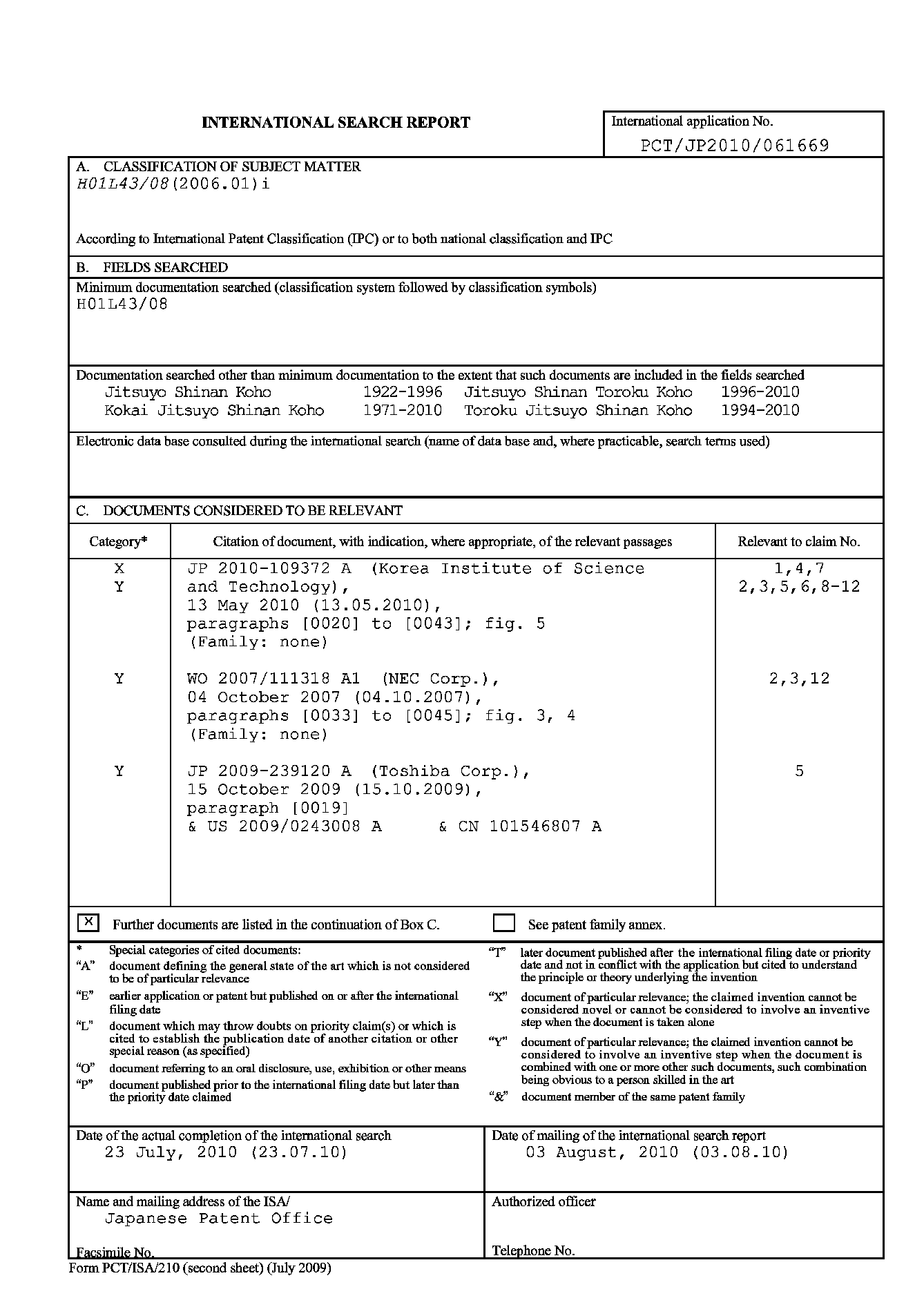
| PCT/JP2010/061669 WO2012004883A1 (en) | 2010-07-09 | 2010-07-09 | Magnetoresistive effect element and random access memory using same |
Publications (1)
| Publication Number | Publication Date |
|---|---|
| JPWO2012004883A1 true JPWO2012004883A1 (en) | 2013-09-02 |
Family
ID=45440882
Family Applications (1)
| Application Number | Title | Priority Date | Filing Date |
|---|---|---|---|
| JP2012523481A Pending JPWO2012004883A1 (en) | 2010-07-09 | 2010-07-09 | Magnetoresistive element and random access memory using the same |
Country Status (3)
| Country | Link |
|---|---|
| US (1) | US20130107616A1 (en) |
| JP (1) | JPWO2012004883A1 (en) |
| WO (1) | WO2012004883A1 (en) |
Families Citing this family (12)
| Publication number | Priority date | Publication date | Assignee | Title |
|---|---|---|---|---|
| JP5691604B2 (en) * | 2011-02-17 | 2015-04-01 | 富士通株式会社 | Magnetic tunnel junction device and magnetic random access memory |
| US9105572B2 (en) * | 2013-09-09 | 2015-08-11 | Hiroyuki Kanaya | Magnetic memory and manufacturing method thereof |
| WO2015062174A1 (en) * | 2013-11-01 | 2015-05-07 | 中国科学院物理研究所 | Nanometre magnetic multilayer film for temperature sensor and manufacturing method therefor |
| US9583696B2 (en) | 2014-03-12 | 2017-02-28 | Qualcomm Incorporated | Reference layer for perpendicular magnetic anisotropy magnetic tunnel junction |
| WO2015147882A1 (en) * | 2014-03-28 | 2015-10-01 | Intel Corporation | 6f2 non-volatile memory bitcell |
| JP2018056389A (en) * | 2016-09-29 | 2018-04-05 | Tdk株式会社 | Magnetoresistive effect element |
| CN111512456B (en) * | 2018-02-27 | 2023-09-22 | Tdk株式会社 | Ferromagnetic laminated films, spin current magnetized rotating elements, magnetoresistive effect elements and magnetic memories |
| WO2020090914A1 (en) | 2018-10-30 | 2020-05-07 | 田中貴金属工業株式会社 | In-plane magnetized film, in-plane magnetized film multilayer structure, hard bias layer, magnetoresistive element, and sputtering target |
| JP7529433B2 (en) | 2020-05-01 | 2024-08-06 | 田中貴金属工業株式会社 | In-plane magnetized film, in-plane magnetized film multilayer structure, hard bias layer, magnetoresistance effect element, and sputtering target |
| JPWO2023017714A1 (en) * | 2021-08-12 | 2023-02-16 | ||
| US12035634B2 (en) * | 2021-09-10 | 2024-07-09 | Western Digital Technologies, Inc. | Tunneling magnetoresistive (TMR) device with improved seed layer |
| US12040114B2 (en) | 2022-09-14 | 2024-07-16 | Western Digital Technologies, Inc. | Magnetoresistive device comprising a synthetic antiferromagnetic coupling layer of RuAl having a (001) texture |
Citations (6)
| Publication number | Priority date | Publication date | Assignee | Title |
|---|---|---|---|---|
| JP2007525847A (en) * | 2004-02-26 | 2007-09-06 | グランディス インコーポレイテッド | Spin transfer magnetic element with free layer with high perpendicular anisotropy and in-plane equilibrium magnetization |
| JP2007525839A (en) * | 2004-02-19 | 2007-09-06 | グランディス インコーポレイテッド | Spin transfer magnetic element with low saturation magnetization free layer |
| WO2007111318A1 (en) * | 2006-03-28 | 2007-10-04 | Nec Corporation | Magnetic random access memory and operation method thereof |
| JP2009059432A (en) * | 2007-08-31 | 2009-03-19 | Fujitsu Ltd | Perpendicular magnetic recording medium |
| JP2009158789A (en) * | 2007-12-27 | 2009-07-16 | Hitachi Global Storage Technologies Netherlands Bv | Current magnetic effect element and magnetic sensor |
| JP2010109372A (en) * | 2008-10-30 | 2010-05-13 | Korea Inst Of Science & Technology | Magnetic tunnel junction structure having double magnetic anisotropy free layer |
Family Cites Families (4)
| Publication number | Priority date | Publication date | Assignee | Title |
|---|---|---|---|---|
| JP4738395B2 (en) * | 2007-09-25 | 2011-08-03 | 株式会社東芝 | Magnetoresistive element and magnetic random access memory using the same |
| JP4599425B2 (en) * | 2008-03-27 | 2010-12-15 | 株式会社東芝 | Magnetoresistive element and magnetic memory |
| JP5320009B2 (en) * | 2008-10-06 | 2013-10-23 | 株式会社東芝 | Spin torque oscillator, magnetic recording head, magnetic head assembly, and magnetic recording apparatus |
| JP2013115400A (en) * | 2011-12-01 | 2013-06-10 | Sony Corp | Storage element, storage device |
-
2010
- 2010-07-09 US US13/808,967 patent/US20130107616A1/en not_active Abandoned
- 2010-07-09 WO PCT/JP2010/061669 patent/WO2012004883A1/en not_active Ceased
- 2010-07-09 JP JP2012523481A patent/JPWO2012004883A1/en active Pending
Patent Citations (6)
| Publication number | Priority date | Publication date | Assignee | Title |
|---|---|---|---|---|
| JP2007525839A (en) * | 2004-02-19 | 2007-09-06 | グランディス インコーポレイテッド | Spin transfer magnetic element with low saturation magnetization free layer |
| JP2007525847A (en) * | 2004-02-26 | 2007-09-06 | グランディス インコーポレイテッド | Spin transfer magnetic element with free layer with high perpendicular anisotropy and in-plane equilibrium magnetization |
| WO2007111318A1 (en) * | 2006-03-28 | 2007-10-04 | Nec Corporation | Magnetic random access memory and operation method thereof |
| JP2009059432A (en) * | 2007-08-31 | 2009-03-19 | Fujitsu Ltd | Perpendicular magnetic recording medium |
| JP2009158789A (en) * | 2007-12-27 | 2009-07-16 | Hitachi Global Storage Technologies Netherlands Bv | Current magnetic effect element and magnetic sensor |
| JP2010109372A (en) * | 2008-10-30 | 2010-05-13 | Korea Inst Of Science & Technology | Magnetic tunnel junction structure having double magnetic anisotropy free layer |
Also Published As
| Publication number | Publication date |
|---|---|
| US20130107616A1 (en) | 2013-05-02 |
| WO2012004883A1 (en) | 2012-01-12 |
Similar Documents
| Publication | Publication Date | Title |
|---|---|---|
| JP4903277B2 (en) | Magnetoresistive element, magnetic memory cell using the same, and random access memory | |
| CN103069564B (en) | Magnetoresistive element and magnetic random-access memory | |
| US11776726B2 (en) | Dipole-coupled spin-orbit torque structure | |
| US8072800B2 (en) | Magnetic element having perpendicular anisotropy with enhanced efficiency | |
| JP5867030B2 (en) | Memory element and memory device | |
| TWI530945B (en) | Memory elements and memory devices | |
| JPWO2012004883A1 (en) | Magnetoresistive element and random access memory using the same | |
| JP6244617B2 (en) | Storage element, storage device, magnetic head | |
| CN106887247B (en) | Information storage components and storage devices | |
| JP6194752B2 (en) | Storage element, storage device, magnetic head | |
| JP5987613B2 (en) | Storage element, storage device, magnetic head | |
| CN102610270B (en) | Memory element and storage arrangement | |
| JP2013115413A (en) | Storage element, storage device | |
| CN102769100A (en) | Storage element and storage device | |
| US20150255134A1 (en) | Storage cell, storage device, and magnetic head | |
| CN102403038B (en) | Memory element and memory device | |
| WO2013080436A1 (en) | Storage element, and storage device | |
| JP2013115399A (en) | Storage element, storage device | |
| TWI422083B (en) | Magnetic memory lattice and magnetic random access memory | |
| CN103137854A (en) | Memory element and memory apparatus | |
| CN102385923A (en) | Memory element and memory device | |
| JPWO2011027404A1 (en) | Magnetic memory | |
| JP2017212464A (en) | Storage element, storage device, magnetic head | |
| WO2013080437A1 (en) | Storage element, and storage device |
Legal Events
| Date | Code | Title | Description |
|---|---|---|---|
| A131 | Notification of reasons for refusal |
Free format text: JAPANESE INTERMEDIATE CODE: A131 Effective date: 20131001 |
|
| A02 | Decision of refusal |
Free format text: JAPANESE INTERMEDIATE CODE: A02 Effective date: 20140507 |