JPWO2011105382A1 - Resin substrate with hard coat layer - Google Patents
Resin substrate with hard coat layer Download PDFInfo
- Publication number
- JPWO2011105382A1 JPWO2011105382A1 JP2012501797A JP2012501797A JPWO2011105382A1 JP WO2011105382 A1 JPWO2011105382 A1 JP WO2011105382A1 JP 2012501797 A JP2012501797 A JP 2012501797A JP 2012501797 A JP2012501797 A JP 2012501797A JP WO2011105382 A1 JPWO2011105382 A1 JP WO2011105382A1
- Authority
- JP
- Japan
- Prior art keywords
- hard coat
- coat layer
- group
- resin substrate
- mass
- Prior art date
- Legal status (The legal status is an assumption and is not a legal conclusion. Google has not performed a legal analysis and makes no representation as to the accuracy of the status listed.)
- Withdrawn
Links
- 0 CC(C)(C)c(cc(CC(C)(C)*)cc1C(C)(C)C)c1O Chemical compound CC(C)(C)c(cc(CC(C)(C)*)cc1C(C)(C)C)c1O 0.000 description 2
Images

Classifications
-
- C—CHEMISTRY; METALLURGY
- C09—DYES; PAINTS; POLISHES; NATURAL RESINS; ADHESIVES; COMPOSITIONS NOT OTHERWISE PROVIDED FOR; APPLICATIONS OF MATERIALS NOT OTHERWISE PROVIDED FOR
- C09D—COATING COMPOSITIONS, e.g. PAINTS, VARNISHES OR LACQUERS; FILLING PASTES; CHEMICAL PAINT OR INK REMOVERS; INKS; CORRECTING FLUIDS; WOODSTAINS; PASTES OR SOLIDS FOR COLOURING OR PRINTING; USE OF MATERIALS THEREFOR
- C09D133/00—Coating compositions based on homopolymers or copolymers of compounds having one or more unsaturated aliphatic radicals, each having only one carbon-to-carbon double bond, and at least one being terminated by only one carboxyl radical, or of salts, anhydrides, esters, amides, imides, or nitriles thereof; Coating compositions based on derivatives of such polymers
- C09D133/04—Homopolymers or copolymers of esters
- C09D133/06—Homopolymers or copolymers of esters of esters containing only carbon, hydrogen and oxygen, the oxygen atom being present only as part of the carboxyl radical
- C09D133/08—Homopolymers or copolymers of acrylic acid esters
-
- C—CHEMISTRY; METALLURGY
- C08—ORGANIC MACROMOLECULAR COMPOUNDS; THEIR PREPARATION OR CHEMICAL WORKING-UP; COMPOSITIONS BASED THEREON
- C08J—WORKING-UP; GENERAL PROCESSES OF COMPOUNDING; AFTER-TREATMENT NOT COVERED BY SUBCLASSES C08B, C08C, C08F, C08G or C08H
- C08J7/00—Chemical treatment or coating of shaped articles made of macromolecular substances
- C08J7/04—Coating
- C08J7/042—Coating with two or more layers, where at least one layer of a composition contains a polymer binder
-
- C—CHEMISTRY; METALLURGY
- C08—ORGANIC MACROMOLECULAR COMPOUNDS; THEIR PREPARATION OR CHEMICAL WORKING-UP; COMPOSITIONS BASED THEREON
- C08J—WORKING-UP; GENERAL PROCESSES OF COMPOUNDING; AFTER-TREATMENT NOT COVERED BY SUBCLASSES C08B, C08C, C08F, C08G or C08H
- C08J7/00—Chemical treatment or coating of shaped articles made of macromolecular substances
- C08J7/04—Coating
- C08J7/043—Improving the adhesiveness of the coatings per se, e.g. forming primers
-
- C—CHEMISTRY; METALLURGY
- C08—ORGANIC MACROMOLECULAR COMPOUNDS; THEIR PREPARATION OR CHEMICAL WORKING-UP; COMPOSITIONS BASED THEREON
- C08J—WORKING-UP; GENERAL PROCESSES OF COMPOUNDING; AFTER-TREATMENT NOT COVERED BY SUBCLASSES C08B, C08C, C08F, C08G or C08H
- C08J7/00—Chemical treatment or coating of shaped articles made of macromolecular substances
- C08J7/04—Coating
- C08J7/046—Forming abrasion-resistant coatings; Forming surface-hardening coatings
-
- C—CHEMISTRY; METALLURGY
- C09—DYES; PAINTS; POLISHES; NATURAL RESINS; ADHESIVES; COMPOSITIONS NOT OTHERWISE PROVIDED FOR; APPLICATIONS OF MATERIALS NOT OTHERWISE PROVIDED FOR
- C09D—COATING COMPOSITIONS, e.g. PAINTS, VARNISHES OR LACQUERS; FILLING PASTES; CHEMICAL PAINT OR INK REMOVERS; INKS; CORRECTING FLUIDS; WOODSTAINS; PASTES OR SOLIDS FOR COLOURING OR PRINTING; USE OF MATERIALS THEREFOR
- C09D133/00—Coating compositions based on homopolymers or copolymers of compounds having one or more unsaturated aliphatic radicals, each having only one carbon-to-carbon double bond, and at least one being terminated by only one carboxyl radical, or of salts, anhydrides, esters, amides, imides, or nitriles thereof; Coating compositions based on derivatives of such polymers
- C09D133/04—Homopolymers or copolymers of esters
- C09D133/06—Homopolymers or copolymers of esters of esters containing only carbon, hydrogen and oxygen, the oxygen atom being present only as part of the carboxyl radical
- C09D133/10—Homopolymers or copolymers of methacrylic acid esters
-
- C—CHEMISTRY; METALLURGY
- C08—ORGANIC MACROMOLECULAR COMPOUNDS; THEIR PREPARATION OR CHEMICAL WORKING-UP; COMPOSITIONS BASED THEREON
- C08J—WORKING-UP; GENERAL PROCESSES OF COMPOUNDING; AFTER-TREATMENT NOT COVERED BY SUBCLASSES C08B, C08C, C08F, C08G or C08H
- C08J2369/00—Characterised by the use of polycarbonates; Derivatives of polycarbonates
-
- C—CHEMISTRY; METALLURGY
- C08—ORGANIC MACROMOLECULAR COMPOUNDS; THEIR PREPARATION OR CHEMICAL WORKING-UP; COMPOSITIONS BASED THEREON
- C08J—WORKING-UP; GENERAL PROCESSES OF COMPOUNDING; AFTER-TREATMENT NOT COVERED BY SUBCLASSES C08B, C08C, C08F, C08G or C08H
- C08J2433/00—Characterised by the use of homopolymers or copolymers of compounds having one or more unsaturated aliphatic radicals, each having only one carbon-to-carbon double bond, and only one being terminated by only one carboxyl radical, or of salts, anhydrides, esters, amides, imides, or nitriles thereof; Derivatives of such polymers
- C08J2433/04—Characterised by the use of homopolymers or copolymers of compounds having one or more unsaturated aliphatic radicals, each having only one carbon-to-carbon double bond, and only one being terminated by only one carboxyl radical, or of salts, anhydrides, esters, amides, imides, or nitriles thereof; Derivatives of such polymers esters
- C08J2433/06—Characterised by the use of homopolymers or copolymers of compounds having one or more unsaturated aliphatic radicals, each having only one carbon-to-carbon double bond, and only one being terminated by only one carboxyl radical, or of salts, anhydrides, esters, amides, imides, or nitriles thereof; Derivatives of such polymers esters of esters containing only carbon, hydrogen, and oxygen, the oxygen atom being present only as part of the carboxyl radical
-
- C—CHEMISTRY; METALLURGY
- C08—ORGANIC MACROMOLECULAR COMPOUNDS; THEIR PREPARATION OR CHEMICAL WORKING-UP; COMPOSITIONS BASED THEREON
- C08J—WORKING-UP; GENERAL PROCESSES OF COMPOUNDING; AFTER-TREATMENT NOT COVERED BY SUBCLASSES C08B, C08C, C08F, C08G or C08H
- C08J2483/00—Characterised by the use of macromolecular compounds obtained by reactions forming in the main chain of the macromolecule a linkage containing silicon with or without sulfur, nitrogen, oxygen, or carbon only; Derivatives of such polymers
- C08J2483/04—Polysiloxanes
-
- C—CHEMISTRY; METALLURGY
- C08—ORGANIC MACROMOLECULAR COMPOUNDS; THEIR PREPARATION OR CHEMICAL WORKING-UP; COMPOSITIONS BASED THEREON
- C08K—Use of inorganic or non-macromolecular organic substances as compounding ingredients
- C08K5/00—Use of organic ingredients
- C08K5/16—Nitrogen-containing compounds
- C08K5/34—Heterocyclic compounds having nitrogen in the ring
- C08K5/3412—Heterocyclic compounds having nitrogen in the ring having one nitrogen atom in the ring
- C08K5/3432—Six-membered rings
- C08K5/3435—Piperidines
-
- C—CHEMISTRY; METALLURGY
- C08—ORGANIC MACROMOLECULAR COMPOUNDS; THEIR PREPARATION OR CHEMICAL WORKING-UP; COMPOSITIONS BASED THEREON
- C08K—Use of inorganic or non-macromolecular organic substances as compounding ingredients
- C08K5/00—Use of organic ingredients
- C08K5/16—Nitrogen-containing compounds
- C08K5/34—Heterocyclic compounds having nitrogen in the ring
- C08K5/3467—Heterocyclic compounds having nitrogen in the ring having more than two nitrogen atoms in the ring
- C08K5/3477—Six-membered rings
- C08K5/3492—Triazines
-
- C—CHEMISTRY; METALLURGY
- C08—ORGANIC MACROMOLECULAR COMPOUNDS; THEIR PREPARATION OR CHEMICAL WORKING-UP; COMPOSITIONS BASED THEREON
- C08L—COMPOSITIONS OF MACROMOLECULAR COMPOUNDS
- C08L83/00—Compositions of macromolecular compounds obtained by reactions forming in the main chain of the macromolecule a linkage containing silicon with or without sulfur, nitrogen, oxygen or carbon only; Compositions of derivatives of such polymers
- C08L83/04—Polysiloxanes
-
- Y—GENERAL TAGGING OF NEW TECHNOLOGICAL DEVELOPMENTS; GENERAL TAGGING OF CROSS-SECTIONAL TECHNOLOGIES SPANNING OVER SEVERAL SECTIONS OF THE IPC; TECHNICAL SUBJECTS COVERED BY FORMER USPC CROSS-REFERENCE ART COLLECTIONS [XRACs] AND DIGESTS
- Y10—TECHNICAL SUBJECTS COVERED BY FORMER USPC
- Y10T—TECHNICAL SUBJECTS COVERED BY FORMER US CLASSIFICATION
- Y10T428/00—Stock material or miscellaneous articles
- Y10T428/26—Web or sheet containing structurally defined element or component, the element or component having a specified physical dimension
- Y10T428/263—Coating layer not in excess of 5 mils thick or equivalent
- Y10T428/264—Up to 3 mils
- Y10T428/265—1 mil or less
-
- Y—GENERAL TAGGING OF NEW TECHNOLOGICAL DEVELOPMENTS; GENERAL TAGGING OF CROSS-SECTIONAL TECHNOLOGIES SPANNING OVER SEVERAL SECTIONS OF THE IPC; TECHNICAL SUBJECTS COVERED BY FORMER USPC CROSS-REFERENCE ART COLLECTIONS [XRACs] AND DIGESTS
- Y10—TECHNICAL SUBJECTS COVERED BY FORMER USPC
- Y10T—TECHNICAL SUBJECTS COVERED BY FORMER US CLASSIFICATION
- Y10T428/00—Stock material or miscellaneous articles
- Y10T428/31504—Composite [nonstructural laminate]
- Y10T428/31507—Of polycarbonate
-
- Y—GENERAL TAGGING OF NEW TECHNOLOGICAL DEVELOPMENTS; GENERAL TAGGING OF CROSS-SECTIONAL TECHNOLOGIES SPANNING OVER SEVERAL SECTIONS OF THE IPC; TECHNICAL SUBJECTS COVERED BY FORMER USPC CROSS-REFERENCE ART COLLECTIONS [XRACs] AND DIGESTS
- Y10—TECHNICAL SUBJECTS COVERED BY FORMER USPC
- Y10T—TECHNICAL SUBJECTS COVERED BY FORMER US CLASSIFICATION
- Y10T428/00—Stock material or miscellaneous articles
- Y10T428/31504—Composite [nonstructural laminate]
- Y10T428/31652—Of asbestos
- Y10T428/31663—As siloxane, silicone or silane
Landscapes
- Chemical & Material Sciences (AREA)
- Organic Chemistry (AREA)
- Polymers & Plastics (AREA)
- Health & Medical Sciences (AREA)
- Chemical Kinetics & Catalysis (AREA)
- Medicinal Chemistry (AREA)
- Materials Engineering (AREA)
- Wood Science & Technology (AREA)
- Engineering & Computer Science (AREA)
- Life Sciences & Earth Sciences (AREA)
- Laminated Bodies (AREA)
- Coating Of Shaped Articles Made Of Macromolecular Substances (AREA)
- Compositions Of Macromolecular Compounds (AREA)
Abstract
シリコーン系ハードコート層がプライマー層を介して樹脂基板上に設けられたハードコート層を有する樹脂基板において、耐擦傷性に優れるとともに、耐候性にも優れるハードコート層を有する樹脂基板を提供する。樹脂基板の少なくとも一方の面上にアクリル系ポリマーを主成分として含有するプライマー層とオルガノポリシロキサンを含むハードコート剤組成物の硬化物からなるハードコート層とが順に積層されたハードコート層を有する樹脂基板であって、プライマー層が特定のアクリル酸アルキルエステルおよびメタクリル酸アルキルエステルから選ばれる少なくとも1種を主なモノマー単位とするアクリル系ポリマー(A)、トリアジン系紫外線吸収剤(B)、ヒンダードアミン系光安定剤(C)を含有するハードコート層を有する樹脂基板。Provided is a resin substrate having a hard coat layer in which a silicone hard coat layer has a hard coat layer provided on a resin substrate through a primer layer, and has a hard coat layer having excellent scratch resistance and weather resistance. A hard coat layer in which a primer layer containing an acrylic polymer as a main component and a hard coat layer made of a cured hard coat agent composition containing organopolysiloxane are sequentially laminated on at least one surface of a resin substrate An acrylic polymer (A), a triazine ultraviolet absorber (B), and a hindered amine, each of which is a resin substrate and whose primer layer is a main monomer unit of at least one selected from a specific alkyl alkyl ester and alkyl methacrylate ester A resin substrate having a hard coat layer containing a light stabilizer (C).
Description
本発明は、優れた耐候性を有するハードコート層を有する樹脂基板に関する。 The present invention relates to a resin substrate having a hard coat layer having excellent weather resistance.
近年、自動車等の車輌用の窓ガラスや家屋、ビル等の建物に取り付けられる建材用の窓ガラスとして、これまでの無機ガラス板に代わって透明樹脂板の需要が高まっている。特に、自動車等の車両では軽量化のために、窓材に透明樹脂板を用いることが提案されており、とりわけ芳香族ポリカーボネート系の透明樹脂板は、耐破壊性、透明性、軽量性、易加工性などに優れるため、有望な車両用窓材としてその使用が検討されている。しかしながら、このような透明樹脂板は、ガラス板の代わりに使用するには耐擦傷性や耐候性の点で問題があった。そこで、透明樹脂板の耐擦傷性および耐候性を向上させる目的で、種々のハードコート剤、特にシリコーン系ハードコート剤を用いて透明樹脂板の表面に被膜(ハードコート層)を形成してハードコート層を有する樹脂基板とすることが提案されている。また、シリコーン系ハードコート剤を用いて透明樹脂板上に被膜(ハードコート層)を形成させる際には、ハードコート層と透明樹脂板との密着性を向上させるために、プライマー層を用いることが提案されている。 In recent years, the demand for transparent resin plates in place of conventional inorganic glass plates has been increasing as window glass for vehicles such as automobiles and window glass for building materials attached to buildings such as houses and buildings. In particular, in vehicles such as automobiles, it has been proposed to use a transparent resin plate for the window material in order to reduce the weight. In particular, an aromatic polycarbonate-based transparent resin plate is resistant to breakage, transparency, lightness, and ease. Due to its excellent processability, its use as a promising vehicle window material is being studied. However, such a transparent resin plate has a problem in terms of scratch resistance and weather resistance when used instead of a glass plate. Therefore, in order to improve the scratch resistance and weather resistance of the transparent resin plate, various hard coat agents, particularly silicone hard coat agents, are used to form a hard film on the surface of the transparent resin plate (hard coat layer). It has been proposed to provide a resin substrate having a coat layer. In addition, when forming a film (hard coat layer) on a transparent resin plate using a silicone-based hard coat agent, a primer layer should be used to improve the adhesion between the hard coat layer and the transparent resin plate. Has been proposed.
このようなシリコーン系ハードコート層を有する樹脂基板においては、さらに要求される耐候性を十分に確保することを目的として、シリコーン系ハードコート剤に紫外線吸収剤を添加する提案がなされているが、耐候性を高めるために紫外線吸収剤の添加量を増加すると、ハードコート層が白化する、紫外線吸収剤がブリードアウトする等の問題があった。そこで、上記プライマー層、特に密着性の点で有利なアクリル系プライマー層に、上記耐候性を改善することを目的として紫外線吸収剤を添加することが提案されている。 In the resin substrate having such a silicone-based hard coat layer, a proposal has been made to add an ultraviolet absorber to the silicone-based hard coat agent for the purpose of sufficiently ensuring the required weather resistance. When the addition amount of the ultraviolet absorber is increased in order to improve the weather resistance, there are problems such as whitening of the hard coat layer and bleeding out of the ultraviolet absorber. Thus, it has been proposed to add an ultraviolet absorber to the primer layer, particularly an acrylic primer layer advantageous in terms of adhesion, for the purpose of improving the weather resistance.
このような提案の例として、特許文献1には、プライマー層として、質量平均分子量15万〜40万のアクリル樹脂と分子内の水酸基1個あたりの分子量が200〜1000の紫外線吸収剤を含む層を用いる技術が、特許文献2には、プライマー層として、アクリル樹脂、紫外線吸収剤、ヒンダードアミン系光安定剤、および、リン系またはラクトン系熱加工安定剤を含む層を用いる技術が記載されているが、実現された耐候性はサンシャインウエザーメーターで5000時間程度であり、近年、自動車や車両関係で要求されるようになった特に高い耐候性においては十分と言えるものではない。 As an example of such a proposal, Patent Document 1 discloses, as a primer layer, a layer containing an acrylic resin having a mass average molecular weight of 150,000 to 400,000 and an ultraviolet absorber having a molecular weight of 200 to 1000 per hydroxyl group in the molecule. Patent Document 2 describes a technique using a layer containing an acrylic resin, an ultraviolet absorber, a hindered amine light stabilizer, and a phosphorus-based or lactone-based thermal processing stabilizer as a primer layer. However, the realized weather resistance is about 5000 hours with a sunshine weather meter, and it cannot be said that the weather resistance, which has recently been required for automobiles and vehicles, is particularly high.
一方、ポリカーボネート樹脂基材上に紫外線吸収剤を含有する透明熱可塑性プラスチック被膜を形成させることでポリカーボネート樹脂基材の紫外線による変色を防止し耐候性を向上させる技術が提案されている。 On the other hand, a technique has been proposed in which a transparent thermoplastic film containing an ultraviolet absorber is formed on a polycarbonate resin substrate, thereby preventing discoloration of the polycarbonate resin substrate due to ultraviolet rays and improving weather resistance.
このような提案として、例えば、特許文献3には、ポリカーボネートを含む層上にビフェニル置換トリアジンを紫外線吸収剤として含むポリアルキル(メタ)アクリレート層が積層された多層製品の技術が記載されている。理想的な欠点のないポリカーボネート樹脂の光分解波長は287nmであるが、実際に使用されているポリカーボネート樹脂は、樹脂の製造過程あるいは成型過程の熱履歴などにより、若干劣化が進行しているため、287nm超にも吸収が存在している。そのため、高い耐候性を実現するためには、紫外線のなかでもUVBと呼ばれる波長280〜320nmの比較的短い波長の紫外線のカットだけではなく、UVAと呼ばれる波長320〜400nmの比較的長い波長の紫外線のカットも非常に重要となってくる。しかしながら、特許文献3に開示されている多層製品については、340nmの波長における紫外線吸収能は有するものの、UVA波長域全域にわたる紫外線カット能については十分とは言えない。また、上記紫外線吸収剤は、結晶性が高い化合物であるため、溶媒への溶解性が低い、多量に配合するとブリードアウトが発生するといった問題点があった。
As such a proposal, for example,
このため、各種窓材、特に車両用窓材として有望なポリカーボネート系樹脂等からなる透明樹脂基材に十分な耐候性を付与し、透明性や耐破壊性といったその優れた特性を長期にわたって維持できるハードコートの開発が求められていた。 For this reason, sufficient weather resistance is imparted to various window materials, in particular, a transparent resin base material made of polycarbonate-based resin, which is promising as a vehicle window material, and its excellent characteristics such as transparency and fracture resistance can be maintained over a long period of time. There was a need to develop a hard coat.
本発明は、上記の従来技術が有する問題を解消すべくなされたものであり、シリコーン系ハードコート層がプライマー層を介して樹脂基板上に設けられたハードコート層を有する樹脂基板において、耐擦傷性に優れるとともに、耐候性にも優れるハードコート層を有する樹脂基板を提供することを目的とする。 The present invention has been made to solve the above-described problems of the prior art, and in a resin substrate having a hard coat layer in which a silicone-based hard coat layer is provided on a resin substrate via a primer layer, the scratch resistance It aims at providing the resin substrate which has the hard-coat layer which is excellent in a weather resistance and is excellent also in a weather resistance.
本発明のハードコート層を有する樹脂基板は、樹脂基板の少なくとも一方の面上に、アクリル酸アルキルエステルおよびメタクリル酸アルキルエステルから選ばれる少なくとも1種を主なモノマー単位とするアクリル系ポリマー(A)を主成分として含有し、さらにトリアジン系紫外線吸収剤(B)と、ヒンダードアミン系光安定剤(C)とを含有するプライマー層と、オルガノポリシロキサンを含むハードコート剤組成物の硬化物からなるハードコート層とが順に積層されたハードコート層を有する樹脂基板であって、
前記アクリル系ポリマー(A)の酸価が1mgKOH/g以下、ガラス転移点が60℃〜150℃、かつ質量平均分子量が20万〜100万であり、
前記トリアジン系紫外線吸収剤(B)の波長領域350nm〜380nmの光に対する吸光係数が、平均値で、20g/(mg・cm)〜100g/(mg・cm)であり、
前記ヒンダードアミン系光安定剤(C)のアミン部位がアルキル基あるいはアルコキシ基でキャップされていることを特徴とする。The resin substrate having a hard coat layer of the present invention is an acrylic polymer (A) having at least one selected from an alkyl acrylate ester and an alkyl methacrylate ester as a main monomer unit on at least one surface of the resin substrate. As a main component, and further comprising a primer layer containing a triazine-based ultraviolet absorber (B) and a hindered amine light stabilizer (C), and a hard coating comprising a cured product of a hard coat agent composition containing an organopolysiloxane. A resin substrate having a hard coat layer laminated with a coat layer in order,
The acrylic polymer (A) has an acid value of 1 mgKOH / g or less, a glass transition point of 60 ° C. to 150 ° C., and a mass average molecular weight of 200,000 to 1,000,000.
The absorption coefficient for light in the wavelength region of 350 nm to 380 nm of the triazine-based ultraviolet absorber (B) is 20 g / (mg · cm) to 100 g / (mg · cm) on average.
The amine moiety of the hindered amine light stabilizer (C) is capped with an alkyl group or an alkoxy group.
ここで、本明細書においては、アクリル酸アルキルエステルおよびメタクリル酸アルキルエステルから選ばれるモノマーを「(メタ)アクリル酸アルキルエステル」と総称する。また同様に、「(メタ)アクリロイルオキシ基」等の「(メタ)アクリル……」なる表記は、「アクリル……」と「メタクリル……」の両方を意味する。 Here, in the present specification, monomers selected from alkyl acrylates and alkyl methacrylates are collectively referred to as “(meth) acrylic acid alkyl esters”. Similarly, the notation “(meth) acryl ……” such as “(meth) acryloyloxy group” means both “acryl ....” and “methacryl ...”.
本発明によれば、耐擦傷性に優れるとともに、耐候性にも優れるシリコーン系ハードコート層を有する樹脂基板が得られる。 ADVANTAGE OF THE INVENTION According to this invention, while being excellent in abrasion resistance, the resin substrate which has a silicone type hard-coat layer excellent also in a weather resistance is obtained.
本発明のハードコート層を有する樹脂基板の実施の形態について、以下に説明する。
本発明のハードコート層を有する樹脂基板は、以下に説明する樹脂基板の少なくとも一方の面上にアクリル系ポリマーを主成分として含有するプライマー層(以下、「アクリル系プライマー層」ということもある)とオルガノポリシロキサンを含むハードコート剤組成物の硬化物からなるハードコート層「以下、「シリコーン系ハードコート層」ということもある」とが順に積層されたハードコート層を有する樹脂基板である。Embodiments of the resin substrate having the hard coat layer of the present invention will be described below.
The resin substrate having the hard coat layer of the present invention has a primer layer containing an acrylic polymer as a main component on at least one surface of the resin substrate described below (hereinafter also referred to as “acrylic primer layer”). And a hard coat layer comprising a cured product of a hard coat agent composition containing organopolysiloxane, which is hereinafter referred to as “silicone hard coat layer”.
(1)樹脂基板
本発明に用いる樹脂基板の材料である樹脂としては、ポリカーボネート樹脂、ポリスチレン樹脂、芳香族ポリエステル樹脂、アクリル樹脂、ポリエステル樹脂、ポリアリレート樹脂、ハロゲン化ビスフェノールAとエチレングリコールとの重縮合物、アクリルウレタン樹脂、ハロゲン化アリール基含有アクリル樹脂等が挙げられる。(1) Resin Substrate The resin that is the material of the resin substrate used in the present invention includes polycarbonate resin, polystyrene resin, aromatic polyester resin, acrylic resin, polyester resin, polyarylate resin, and the weight of halogenated bisphenol A and ethylene glycol. Examples include condensates, acrylic urethane resins, and halogenated aryl group-containing acrylic resins.
これらのなかでも芳香族系ポリカーボネート樹脂等のポリカーボネート樹脂またはポリメチルメタクリレート系アクリル樹脂等のアクリル樹脂が好ましく、ポリカーボネート樹脂がより好ましい。さらに、ポリカーボネート樹脂のなかでも特にビスフェノールA系ポリカーボネート樹脂が好ましい。なお、樹脂基板は、上記のような熱可塑性樹脂を2種以上含んでもよいし、これらの樹脂を用いて、2層以上積層された積層基板であってもよい。また、樹脂基板の形状は、特に限定されず、平板であってもよいし、湾曲していてもよい。さらに、樹脂基板の色調は無色透明または着色透明であることが好ましい。 Among these, polycarbonate resins such as aromatic polycarbonate resins or acrylic resins such as polymethyl methacrylate acrylic resins are preferable, and polycarbonate resins are more preferable. Furthermore, bisphenol A-based polycarbonate resin is particularly preferable among polycarbonate resins. The resin substrate may contain two or more types of thermoplastic resins as described above, or may be a laminated substrate in which two or more layers are laminated using these resins. The shape of the resin substrate is not particularly limited, and may be a flat plate or curved. Furthermore, the color tone of the resin substrate is preferably colorless and transparent or colored and transparent.
(2)アクリル系プライマー層
本発明のハードコート層を有する樹脂基板が上記樹脂基板の少なくとも一方の面上に有するアクリル系プライマー層は、以下のアクリル系ポリマー(A)を主成分として含有し、さらにトリアジン系紫外線吸収剤(B)と、ヒンダードアミン系光安定剤(C)とを含有する。(2) Acrylic primer layer The acrylic primer layer that the resin substrate having the hard coat layer of the present invention has on at least one surface of the resin substrate contains the following acrylic polymer (A) as a main component, Furthermore, it contains a triazine-based ultraviolet absorber (B) and a hindered amine-based light stabilizer (C).
(2−1)アクリル系ポリマー(A)
本発明のハードコート層を有する樹脂基板においてアクリル系プライマー層が主成分として含むアクリル系ポリマー(A)は、アクリル酸アルキルエステルおよびメタクリル酸アルキルエステルから選ばれる少なくとも1種を主なモノマー単位とするアクリル系ポリマーであって、酸価が1mgKOH/g以下であり、ガラス転移点が60℃〜150℃であり、かつ質量平均分子量が20万〜100万のアクリル系ポリマーである。(2-1) Acrylic polymer (A)
In the resin substrate having the hard coat layer of the present invention, the acrylic polymer (A) contained in the acrylic primer layer as a main component has at least one selected from an alkyl acrylate ester and an alkyl methacrylate ester as a main monomer unit. An acrylic polymer having an acid value of 1 mgKOH / g or less, a glass transition point of 60 ° C. to 150 ° C., and a mass average molecular weight of 200,000 to 1,000,000.
上記本発明に用いるアクリル系ポリマー(A)の酸価は、1mgKOH/g以下であり、この酸価が、1mgKOH/gを越えると、シリコーン系ハードコート層とアクリル系プライマー層の界面で、アクリル系プライマーが劣化し、耐候試験後クラックが早期に発生する点で問題である。なお、アクリル系ポリマー(A)の酸価は好ましくは、0.8mgKOH/g以下であり、0mgKOH/gであることがより好ましい。ここで、酸価とは、試料1g中の樹脂酸などを中和するのに必要な水酸化カリウムのミリグラム数をいい、JIS K 0070の測定方法に準じて測定することができる値である。 The acid value of the acrylic polymer (A) used in the present invention is 1 mgKOH / g or less, and if this acid value exceeds 1 mgKOH / g, the acrylic polymer (A) has acrylic acid at the interface between the silicone hard coat layer and the acrylic primer layer. This is a problem in that the system primer deteriorates and cracks occur early after the weathering test. The acid value of the acrylic polymer (A) is preferably 0.8 mgKOH / g or less, and more preferably 0 mgKOH / g. Here, the acid value refers to the number of milligrams of potassium hydroxide required to neutralize resin acid or the like in 1 g of a sample, and is a value that can be measured according to the measurement method of JIS K 0070.
上記本発明に用いるアクリル系ポリマー(A)のガラス転移点(以下、必要に応じて「Tg」と表すこともある)は、60℃〜150℃である。ガラス転移点が、60℃未満であると、得られるプライマー層表面に肌荒れ等が起こり、また、150℃を越えると得られるプライマー層表面の平滑性が十分でなく、プライマー層上にシリコーン系ハードコート層を積層した後も、プライマー表面の不具合が見られ外観上問題である。なお、アクリル系ポリマー(A)のガラス転移点(Tg)は、好ましくは70℃〜120℃、より好ましくは90℃〜110℃である。 The glass transition point of the acrylic polymer (A) used in the present invention (hereinafter sometimes referred to as “Tg” as necessary) is 60 ° C. to 150 ° C. If the glass transition point is less than 60 ° C., the surface of the resulting primer layer will be rough, and if it exceeds 150 ° C., the resulting primer layer surface will not be sufficiently smooth, and the silicone hard Even after laminating the coat layer, defects on the surface of the primer are seen, which is a problem in appearance. The glass transition point (Tg) of the acrylic polymer (A) is preferably 70 ° C to 120 ° C, more preferably 90 ° C to 110 ° C.
本発明に用いるアクリル系ポリマー(A)は、酸価、ガラス転移点が上記範囲であり、かつ、質量平均分子量が20万〜100万のアクリル系ポリマーである。質量平均分子量が20万より小さいと得られるプライマー層に白濁等が生じ外観上問題である。また、質量平均分子量が100万より大きいと被膜形成時に用いる被膜組成物(溶液)の粘度が高くなり樹脂基板上への被膜組成物の塗工が困難となる。また、本発明に用いるアクリル系ポリマー(A)の質量平均分子量は、好ましくは40万〜100万であり、より好ましくは42万〜80万である。なお、質量平均分子量は、ゲルパーミエーションクロマトグラフィー法により、ポリスチレンを標準物質として測定した値をいう。以下、本明細書中に記載の質量平均分子量は、前記同様の測定方法により測定した値である。 The acrylic polymer (A) used in the present invention is an acrylic polymer having an acid value and a glass transition point in the above ranges, and a mass average molecular weight of 200,000 to 1,000,000. If the mass average molecular weight is less than 200,000, white turbidity occurs in the resulting primer layer, which is a problem in appearance. On the other hand, when the mass average molecular weight is larger than 1,000,000, the viscosity of the coating composition (solution) used at the time of coating formation becomes high, and it becomes difficult to apply the coating composition onto the resin substrate. Moreover, the mass average molecular weight of the acrylic polymer (A) used in the present invention is preferably 400,000 to 1,000,000, more preferably 420,000 to 800,000. In addition, a mass average molecular weight means the value measured by the gel permeation chromatography method, using polystyrene as a standard substance. Hereinafter, the mass average molecular weight described in the present specification is a value measured by the same measurement method as described above.
本発明において用いるアクリル系ポリマー(A)としては、各種(メタ)アクリル酸アルキルエステルから選ばれる1種または2種以上を主なモノマー単位として重合して得られるホモポリマーまたはコポリマーのうち上記特性を有するものが挙げられる。ここで、(メタ)アクリル酸アルキルエステルから選ばれる1種または2種以上をアクリル系ポリマーの「主なモノマー単位とする」とは、アクリル系ポリマーを構成する全モノマー単位に占める(メタ)アクリル酸アルキルエステルから選ばれる1種または2種以上の合計モノマー単位が、90〜100モル%であることをいうが、前記割合は好ましくは、95〜100モル%である。以下、本明細書において「主なモノマー単位とする」とは、前記同様の意味で用いられる。 The acrylic polymer (A) used in the present invention has the above characteristics among homopolymers or copolymers obtained by polymerizing one or more selected from various (meth) acrylic acid alkyl esters as main monomer units. The thing which has. Here, one or two or more types selected from (meth) acrylic acid alkyl esters are used as the “main monomer unit” of the acrylic polymer, and (meth) acrylic occupies all monomer units constituting the acrylic polymer. One or two or more total monomer units selected from acid alkyl esters are 90 to 100 mol%, and the ratio is preferably 95 to 100 mol%. Hereinafter, the term “main monomer unit” is used in the present specification with the same meaning as described above.
上記(メタ)アクリル酸アルキルエステルのアルキル基の炭素数は6以下が好ましく、4以下がより好ましい。(メタ)アクリル酸アルキルエステルとして、具体的には、(メタ)アクリル酸メチル、(メタ)アクリル酸エチル、(メタ)アクリル酸イソプロピル、(メタ)アクリル酸n−ブチル、(メタ)アクリル酸イソブチル、(メタ)アクリル酸tert−ブチル、(メタ)アクリル酸n−ヘキシルが挙げられる。アルキル基の炭素数が7以上の(メタ)アクリル酸アルキルエステルとしては、(メタ)アクリル酸2−エチルヘキシル、(メタ)アクリル酸イソノニル、(メタ)アクリル酸ラウリルが挙げられる。 The number of carbon atoms in the alkyl group of the (meth) acrylic acid alkyl ester is preferably 6 or less, and more preferably 4 or less. Specific examples of (meth) acrylic acid alkyl esters include methyl (meth) acrylate, ethyl (meth) acrylate, isopropyl (meth) acrylate, n-butyl (meth) acrylate, and isobutyl (meth) acrylate. , Tert-butyl (meth) acrylate, and n-hexyl (meth) acrylate. Examples of the (meth) acrylic acid alkyl ester having an alkyl group having 7 or more carbon atoms include 2-ethylhexyl (meth) acrylate, isononyl (meth) acrylate, and lauryl (meth) acrylate.
本発明に用いるアクリル系ポリマー(A)としては、アルキル基の炭素数が6以下の(メタ)アクリル酸アルキルエステルから選ばれる少なくとも1種を主なモノマー単位とするホモポリマーやそれらモノマー同士のコポリマーが好ましい。また、アルキル基の炭素数が6以下の(メタ)アクリル酸アルキルエステルの少なくとも1種とそれ以外の(メタ)アクリル酸エステルの少なくとも1種とのコポリマーも好ましい。前記それ以外の(メタ)アクリル酸エステルとしては、アルキル基の炭素数が7以上の(メタ)アクリル酸アルキルエステルや(メタ)アクリル酸シクロアルキルエステルが挙げられる。また、(メタ)アクリル酸アルキルエステルとともに、少量の官能基を有する(メタ)アクリル酸エステル(例えば、(メタ)アクリル酸ヒドロキシアルキルエステルなど)を共重合して得られるコポリマーも使用できる。(メタ)アクリル酸などの酸基を有するモノマーを共重合させると酸価の高いアクリル系ポリマーとなるおそれがあるが、前記酸価の範囲となる限り酸基を有するモノマーを少量共重合させたコポリマーを使用することもできる。 As the acrylic polymer (A) used in the present invention, a homopolymer having at least one selected from (meth) acrylic acid alkyl esters having an alkyl group having 6 or less carbon atoms as a main monomer unit or a copolymer of these monomers Is preferred. A copolymer of at least one (meth) acrylic acid alkyl ester having an alkyl group with 6 or less carbon atoms and at least one other (meth) acrylic acid ester is also preferred. Examples of the other (meth) acrylic acid esters include (meth) acrylic acid alkyl esters and (meth) acrylic acid cycloalkyl esters having an alkyl group having 7 or more carbon atoms. Moreover, the copolymer obtained by copolymerizing (meth) acrylic acid ester (For example, (meth) acrylic-acid hydroxyalkyl ester etc.) which has a small amount of functional groups with (meth) acrylic-acid alkylester can also be used. When a monomer having an acid group such as (meth) acrylic acid is copolymerized, an acrylic polymer having a high acid value may be formed. However, a small amount of the monomer having an acid group is copolymerized as long as the acid value is within the range. Copolymers can also be used.
上記(メタ)アクリル酸シクロアルキルエステルとしては、(メタ)アクリル酸シクロヘキシル、(メタ)アクリル酸4−メチルシクロヘキシル、(メタ)アクリル酸4−t−ブチルシクロヘキシル、(メタ)アクリル酸イソボルニル、(メタ)アクリル酸ジシクロペンタニル、(メタ)アクリル酸ジシクロペンテニルオキシエチルが挙げられる。 Examples of the (meth) acrylic acid cycloalkyl ester include cyclohexyl (meth) acrylate, 4-methylcyclohexyl (meth) acrylate, 4-t-butylcyclohexyl (meth) acrylate, isobornyl (meth) acrylate, (meth ) Dicyclopentanyl acrylate, dicyclopentenyloxyethyl (meth) acrylate.
これらのなかでも、本発明に用いるアクリル系ポリマー(A)としては、メタクリル酸アルキルエステルから選ばれる1種または2種以上を主なモノマー単位として重合して得られるポリマーが好ましい。さらに、メタクリル酸メチル(以下、必要に応じて「MMA」と表すこともある)、メタクリル酸n−ブチル、メタクリル酸tert−ブチル、メタクリル酸エチル、メタクリル酸イソブチル等から選ばれるアルキル基の炭素数が6以下のメタクリル酸アルキルエステルの1種または2種以上を主なモノマー単位として重合して得られるホモポリマーまたはコポリマーが好ましく、MMA、メタクリル酸tert−ブチル、メタクリル酸エチル等のホモポリマー、MMAと、メタクリル酸n−ブチル、メタクリル酸エチル、およびメタクリル酸イソブチルから選ばれる1種または2種以上とのコポリマーがより好ましい。 Among these, as the acrylic polymer (A) used in the present invention, a polymer obtained by polymerizing one or more selected from methacrylic acid alkyl ester as a main monomer unit is preferable. Further, the carbon number of an alkyl group selected from methyl methacrylate (hereinafter sometimes referred to as “MMA” as necessary), n-butyl methacrylate, tert-butyl methacrylate, ethyl methacrylate, isobutyl methacrylate, and the like. Is preferably a homopolymer or copolymer obtained by polymerizing one or more of alkyl methacrylates having a molecular weight of 6 or less as a main monomer unit, such as MMA, tert-butyl methacrylate, ethyl methacrylate, and the like, MMA And a copolymer of one or more selected from n-butyl methacrylate, ethyl methacrylate, and isobutyl methacrylate.
本発明においては、酸価、ガラス転移点および質量平均分子量がともに上記範囲にあるアクリル系ポリマーを、アクリル系ポリマー(A)として、単独で、または2種以上の混合物として用いることが可能である。 In the present invention, an acrylic polymer having an acid value, a glass transition point, and a mass average molecular weight within the above ranges can be used alone or as a mixture of two or more as the acrylic polymer (A). .
このような本発明に用いる酸価が1mgKOH/g以下、ガラス転移点が60℃〜150℃、かつ質量平均分子量が20万〜100万のアクリル系ポリマー(A)は、上記各種(メタ)アクリル酸アルキルエステルを原料モノマーとして、必要に応じて、全原料モノマー量に対して10モル%未満の上に例示したような(メタ)アクリル酸アルキルエステル以外のモノマー、分子量調節剤、重合開始剤、懸濁安定剤、乳化剤等とともに、通常(メタ)アクリル酸アルキルエステルを重合する方法、例えば、溶液重合法、塊状重合法、懸濁重合法、乳化重合法等の重合方法によって製造することができる。 The acrylic polymer (A) having an acid value of 1 mg KOH / g or less, a glass transition point of 60 ° C. to 150 ° C., and a mass average molecular weight of 200,000 to 1,000,000 used in the present invention is the above-mentioned various (meth) acrylic compounds. Using acid alkyl ester as a raw material monomer, if necessary, a monomer other than (meth) acrylic acid alkyl ester as exemplified above less than 10 mol% with respect to the total amount of raw material monomers, molecular weight regulator, polymerization initiator, It can be produced by a polymerization method such as a polymerization method such as a solution polymerization method, a bulk polymerization method, a suspension polymerization method, an emulsion polymerization method, etc., usually with a suspension stabilizer, an emulsifier, etc. .
なお、酸価、ガラス転移点および質量平均分子量がともに上記範囲にあるアクリル系ポリマーは、市販もされているので、このような市販品をアクリル系ポリマー(A)として用いることも可能である。市販品としては、例えば、下記表1に示されるアクリル系ポリマーを挙げることができる。なお、表中のアクリル系ポリマーの欄には原料モノマー名と原料組成におけるそのモノマーの占める割合をモル%で示した。 In addition, since the acrylic polymer in which an acid value, a glass transition point, and a mass average molecular weight are all in the above range is commercially available, such a commercial product can be used as the acrylic polymer (A). As a commercial item, the acrylic polymer shown by following Table 1 can be mentioned, for example. In the column of the acrylic polymer in the table, the raw material monomer name and the proportion of the monomer in the raw material composition are shown in mol%.
本発明のハードコート層を有する樹脂基板のアクリル系プライマー層は、酸価、ガラス転移点および質量平均分子量がともに上記範囲にあるアクリル系ポリマー(A)を主成分として含有し、さらに、後述のトリアジン系紫外線吸収剤(B)、ヒンダードアミン系光安定剤(C)、およびその他任意成分を含有するものである。このようなアクリル系プライマー層における酸価、ガラス転移点および質量平均分子量がともに上記範囲にあるアクリル系ポリマー(A)の含有量は、アクリル系プライマー層の構成成分全量に対して、50〜97質量%であることが好ましく、70〜95質量%であることがより好ましい。 The acrylic primer layer of the resin substrate having the hard coat layer of the present invention contains an acrylic polymer (A) having an acid value, a glass transition point, and a mass average molecular weight in the above ranges as main components, and further described below. It contains a triazine ultraviolet absorber (B), a hindered amine light stabilizer (C), and other optional components. The content of the acrylic polymer (A) in which the acid value, glass transition point, and mass average molecular weight in the acrylic primer layer are all in the above range is 50 to 97 with respect to the total amount of the constituent components of the acrylic primer layer. It is preferable that it is mass%, and it is more preferable that it is 70-95 mass%.
上記アクリル系ポリマー(A)の含有量が、アクリル系プライマー層の構成成分全量に対して、50質量%未満ではポリマー成分が少なすぎアクリル系プライマー層物性が低下することがあり、また、97質量%を越えるとアクリル系プライマー層の紫外線カット能が不足することがある。 If the content of the acrylic polymer (A) is less than 50% by mass relative to the total amount of the constituent components of the acrylic primer layer, the polymer component may be too small and the physical properties of the acrylic primer layer may decrease, and 97 mass If it exceeds 50%, the acrylic primer layer may have insufficient UV-cutting ability.
(2−2)トリアジン系紫外線吸収剤(B)
本発明のハードコート層を有する樹脂基板においてアクリル系プライマー層が含むトリアジン系紫外線吸収剤(B)は、波長領域350nm〜380nmの光に対する吸光係数が、平均値で、20g/(mg・cm)〜100g/(mg・cm)という吸光特性を有する。
本発明のハードコート層を有する樹脂基板においては、アクリル系プライマー層が上記吸光特性を有するトリアジン系紫外線吸収剤(B)を含有することで、紫外線遮蔽のうちでも耐候性の点で特に必要とされる、UVA(320〜400nm)領域の紫外線遮蔽を効率よく行うことが可能であり、結果として、優れた耐候性を有するハードコート層を有する樹脂基板を作製することができる。(2-2) Triazine UV absorber (B)
The triazine-based ultraviolet absorber (B) contained in the acrylic primer layer in the resin substrate having the hard coat layer of the present invention has an average extinction coefficient with respect to light in the wavelength region of 350 nm to 380 nm, 20 g / (mg · cm). It has an absorption characteristic of ˜100 g / (mg · cm).
In the resin substrate having the hard coat layer of the present invention, the acrylic primer layer contains the triazine-based ultraviolet absorber (B) having the above light-absorbing characteristics, so that it is particularly necessary in terms of weather resistance even among ultraviolet shielding. It is possible to efficiently perform UV shielding in the UVA (320 to 400 nm) region, and as a result, a resin substrate having a hard coat layer having excellent weather resistance can be produced.
ここで、本発明において、波長領域350〜380nmにおける吸光係数の平均値とは、前記波長領域において、1nm毎に求めた吸光係数の平均値をいう。なお、吸光係数εは、以下の関係式、数1から求められる値である。 Here, in the present invention, the average value of the extinction coefficient in the wavelength region of 350 to 380 nm refers to the average value of the extinction coefficient obtained every 1 nm in the wavelength region. The extinction coefficient ε is a value obtained from the following relational expression, Equation 1.
E=ε・c・d=log(Io/I) …[数1]
(E:吸光度、ε:吸光係数(g/(mg・cm))、c:吸光成分濃度(mg/g)、d:セルの厚さ(cm)、Io:入射光強度、I:透過後の光強度)E = ε · c · d = log (Io / I) (1)
(E: Absorbance, ε: Absorption coefficient (g / (mg · cm)), c: Absorbing component concentration (mg / g), d: Cell thickness (cm), Io: Incident light intensity, I: After transmission Light intensity)
本発明のハードコート層を有する樹脂基板においてアクリル系プライマー層が含有するトリアジン系紫外線吸収剤(B)は、トリアジン骨格を有する化合物からなる紫外線吸収剤のうちでも、350〜380nmという比較的長波長の紫外線領域において、吸光係数が、平均値で、20g/(mg・cm)〜100g/(mg・cm)の範囲で、紫外線を吸収することが可能な紫外線吸収剤である。この350〜380nmにおける吸光係数の平均値が、20g/(mg・cm)より小さいと、得られるアクリル系プライマー層が樹脂基板に十分な耐候性を付与することができなくなる。また、100g/(mg・cm)を越えると可視光領域にも吸収を有することになり、アクリル系プライマー層を着色してしまう。なお、上記トリアジン系紫外線吸収剤(B)の350〜380nmにおける吸光係数の平均値は、好ましくは20〜80g/(mg・cm)であり、より好ましくは、20〜50g/(mg・cm)である。 The triazine-based ultraviolet absorber (B) contained in the acrylic primer layer in the resin substrate having the hard coat layer of the present invention is a relatively long wavelength of 350 to 380 nm among ultraviolet absorbers composed of a compound having a triazine skeleton. In the ultraviolet region, an ultraviolet absorption agent capable of absorbing ultraviolet rays having an average extinction coefficient in the range of 20 g / (mg · cm) to 100 g / (mg · cm). When the average value of the extinction coefficient at 350 to 380 nm is smaller than 20 g / (mg · cm), the resulting acrylic primer layer cannot impart sufficient weather resistance to the resin substrate. On the other hand, if it exceeds 100 g / (mg · cm), it also has absorption in the visible light region, and the acrylic primer layer is colored. The average value of the absorption coefficient at 350 to 380 nm of the triazine-based ultraviolet absorber (B) is preferably 20 to 80 g / (mg · cm), and more preferably 20 to 50 g / (mg · cm). It is.
本発明に用いるトリアジン系紫外線吸収剤(B)としては、上記吸光特性を有するトリアジン系紫外線吸収剤であれば、特に制限なく用いることが可能である。例えば、基本構造(骨格)として、トリアジン骨格を有する化合物に、その骨格に結合する有機基の種類や数、位置等を、得られる化合物における吸光特性が本発明に適用可能な範囲となるように適宜調整して導入したトリアジン系紫外線吸収剤を、特に制限なく用いることが可能である。これらは、1種を単独で、2種以上を組合せて使用することができる。 As the triazine-based ultraviolet absorber (B) used in the present invention, any triazine-based ultraviolet absorber having the above light absorption characteristics can be used without particular limitation. For example, a compound having a triazine skeleton as a basic structure (skeleton), and the type, number, position, etc. of the organic group bonded to the skeleton so that the light absorption characteristics of the obtained compound are applicable to the present invention. A triazine-based ultraviolet absorber introduced after being appropriately adjusted can be used without particular limitation. These can be used alone or in combination of two or more.
本発明に用いるトリアジン系紫外線吸収剤(B)においては、上記吸光特性を満足するものであれば、分子量についても特に制限されない。ただし、溶解性や揮発性等の観点から、用いるトリアジン系紫外線吸収剤(B)の分子量は、質量平均分子量(Mw)で、400〜2000の範囲にあることが好ましく、500〜1500の範囲にあることがより好ましい。 In the triazine ultraviolet absorber (B) used in the present invention, the molecular weight is not particularly limited as long as it satisfies the above light absorption characteristics. However, from the viewpoint of solubility and volatility, the molecular weight of the triazine-based ultraviolet absorber (B) to be used is preferably a mass average molecular weight (Mw) in the range of 400 to 2000, and in the range of 500 to 1500. More preferably.
このような本発明に用いるトリアジン系紫外線吸収剤(B)の具体例を、構造式、吸光特性、質量平均分子量(Mw)、市販品の例とともに以下に示す。なお、吸光特性は、吸光係数ε(350−380)aveとして、波長領域350〜380nmにおける1nm毎に求めた吸光係数の平均値(単位:g/(mg・cm))を示すものである。以下、本明細書において、「吸光係数ε(350−380)ave」の用語は、全て前記同様の意味で用いられる。 Specific examples of the triazine-based ultraviolet absorber (B) used in the present invention are shown below together with structural formulas, light absorption characteristics, mass average molecular weight (Mw), and commercially available products. The light absorption characteristic indicates an average value (unit: g / (mg · cm)) of the light absorption coefficient obtained every 1 nm in the wavelength region 350 to 380 nm as the light absorption coefficient ε (350-380) ave. Hereinafter, in the present specification, the term “absorption coefficient ε (350-380) ave” is used in the same meaning as described above.
構造式が下式(B−1)に示される2−[4−(4,6−ビス−{2−ヒドロキシ−4−[1−(6−メチル−ヘプチルオキシカルボニル)−エトキシ]−フェニル}−[1,3,5]トリアジン−2−イル)−3−ヒドロキシ−フェノキシ]−プロピオン酸 6−メチル−ヘプチル エステル((2-[4-(4,6-Bis-{2-hydroxy-4-[1-(6-methyl-heptyloxycarbonyl)-ethoxy]-phenyl}-[1,3,5]triazin-2-yl)-3-hydroxy-phenoxy]-propionic acid 6-methyl-heptyl ester、吸光係数ε(350−380)ave:31.0、Mw:958.2、市販品としては、CGL777(商品名、チバ・ジャパン社製)等が挙げられる) 2- [4- (4,6-bis- {2-hydroxy-4- [1- (6-methyl-heptyloxycarbonyl) -ethoxy] -phenyl} whose structural formula is shown in the following formula (B-1) -[1,3,5] triazin-2-yl) -3-hydroxy-phenoxy] -propionic acid 6-methyl-heptyl ester ((2- [4- (4,6-Bis- {2-hydroxy-4 -[1- (6-methyl-heptyloxycarbonyl) -ethoxy] -phenyl}-[1,3,5] triazin-2-yl) -3-hydroxy-phenoxy] -propionic acid 6-methyl-heptyl ester, extinction coefficient (epsilon (350-380) ave: 31.0, Mw: 958.2, CGL777 (trade name, manufactured by Ciba Japan Co., Ltd.) and the like are listed as commercially available products)
構造式が下式(B−2)に示される、2,4−ビス[2−ヒドロキシ−4−ブトキシフェニル]−6−(2,4−ジブトキシフェニル)−1,3,5−トリアジン(吸光係数ε(350−380)ave:37.0、Mw:629.8、市販品として、TINUVIN 460(商品名、チバ・ジャパン社製)等が挙げられる) 2,4-bis [2-hydroxy-4-butoxyphenyl] -6- (2,4-dibutoxyphenyl) -1,3,5-triazine (Structural formula shown in the following formula (B-2)) Absorption coefficient ε (350-380) ave: 37.0, Mw: 629.8, commercially available products include TINUVIN 460 (trade name, manufactured by Ciba Japan Co., Ltd.)
なお、本発明のハードコート層を有する樹脂基板においては、これらのトリアジン系紫外線吸収剤(B)のうちでも、2−[4−(4,6−ビス−{2−ヒドロキシ−4−[1−(6−メチル−ヘプチルオキシカルボニル)−エトキシ]−フェニル}−[1,3,5]トリアジン−2−イル)−3−ヒドロキシ−フェノキシ]−プロピオン酸 6−メチル−ヘプチル エステル(市販品としては、CGL777等)が好ましく用いられる。 In the resin substrate having the hard coat layer of the present invention, among these triazine ultraviolet absorbers (B), 2- [4- (4,6-bis- {2-hydroxy-4- [1] -(6-Methyl-heptyloxycarbonyl) -ethoxy] -phenyl}-[1,3,5] triazin-2-yl) -3-hydroxy-phenoxy] -propionic acid 6-methyl-heptyl ester (as a commercial product) CGL777 etc. are preferably used.
本発明のハードコート層を有する樹脂基板に適用可能なトリアジン系紫外線吸収剤(B)の紫外線吸光特性を具体的に示す例として、本発明に不適なトリアジン系紫外線吸収剤と併せて次の3種類のトリアジン系紫外線吸収剤の各波長における吸光係数のグラフを図1に示す。図1には、本発明に適用可能なトリアジン系紫外線吸収剤(B)として、上記市販品のCGL777(2−[4−(4,6−ビス−{2−ヒドロキシ−4−[1−(6−メチル−ヘプチルオキシカルボニル)−エトキシ]−フェニル}−[1,3,5]トリアジン−2−イル)−3−ヒドロキシ−フェノキシ]−プロピオン酸 6−メチル−ヘプチル エステル)の吸光係数を測定した結果が示されている。 As an example specifically showing the ultraviolet light absorption characteristics of the triazine-based ultraviolet absorbent (B) applicable to the resin substrate having the hard coat layer of the present invention, the following 3 are used together with the triazine-based ultraviolet absorbent unsuitable for the present invention. A graph of the extinction coefficient at each wavelength of each type of triazine-based ultraviolet absorber is shown in FIG. In FIG. 1, as the triazine-based ultraviolet absorber (B) applicable to the present invention, CGL777 (2- [4- (4,6-bis- {2-hydroxy-4- [1- ( 6-methyl-heptyloxycarbonyl) -ethoxy] -phenyl}-[1,3,5] triazin-2-yl) -3-hydroxy-phenoxy] -propionic acid 6-methyl-heptyl ester) The results are shown.
さらに、図1に本発明のハードコート層を有する樹脂基板に不適なトリアジン系紫外線吸収剤の例として、上記特許文献3に記載のビフェニル置換トリアジン紫外線吸収剤に分類される、TINUVIN 479(商品名、チバ・ジャパン社製、2−[4−(4,6−ビス−ビフェニル−4−イル−[1,3,5]トリアジン−2−イル)−3−ヒドロキシ−フェノキシ]−プロピオン酸 6−メチル−ヘプチル エステル、吸光係数ε(350−380)ave:12.4、Mw:677.8、図1においては「TN479」と表示。)、および、後述の比較例で用いたトリアジン系紫外線吸収剤、TINUVIN 400(商品名、チバ・ジャパン社製、2−(4,6−ビス(2,4−ジメチルフェニル)−1,3,5−トリアジン−2−イル)−5−ヒドロキシフェニルとオキシランとの反応生成物、吸光係数ε(350−380)ave:4.5、Mw:647、図1においては「TN400」と表示。)の吸光係数のグラフを併せて示す。
Furthermore, as an example of a triazine-based ultraviolet absorber unsuitable for the resin substrate having the hard coat layer of the present invention in FIG. 1, TINUVIN 479 (trade name) classified into the biphenyl-substituted triazine ultraviolet absorber described in
本発明のハードコート層を有する樹脂基板のアクリル系プライマー層は、上記トリアジン系紫外線吸収剤(B)から選ばれる少なくとも1種を含有する。本発明のハードコート層を有する樹脂基板のアクリル系プライマー層における上記トリアジン系紫外線吸収剤(B)の含有量は、アクリル系プライマー層構成成分全量に対して1〜30質量%であることが好ましく、5〜25質量%であることがより好ましい。トリアジン系紫外線吸収剤(B)の含有量が、1質量%未満であると耐候性が不十分となる場合があり、30質量%を越えると、トリアジン系紫外線吸収剤(B)のブリードアウトなどが発生する場合がある。 The acrylic primer layer of the resin substrate having the hard coat layer of the present invention contains at least one selected from the above triazine-based ultraviolet absorber (B). The content of the triazine-based UV absorber (B) in the acrylic primer layer of the resin substrate having the hard coat layer of the present invention is preferably 1 to 30% by mass with respect to the total amount of the acrylic primer layer components. 5 to 25% by mass is more preferable. When the content of the triazine-based ultraviolet absorber (B) is less than 1% by mass, the weather resistance may be insufficient. When the content exceeds 30% by mass, the triazine-based ultraviolet absorber (B) bleeds out. May occur.
(2−3)ヒンダードアミン系光安定剤(C)
本発明のハードコート層を有する樹脂基板においてアクリル系プライマー層は、上記アクリル系ポリマー(A)およびトリアジン系紫外線吸収剤(B)に加えて、さらにアミン部位がアルキル基あるいはアルコキシ基でキャップされたヒンダードアミン系光安定剤(C)を含有する。(2-3) Hindered amine light stabilizer (C)
In the resin substrate having the hard coat layer of the present invention, the acrylic primer layer is capped with an alkyl group or an alkoxy group in addition to the acrylic polymer (A) and the triazine ultraviolet absorber (B). Contains a hindered amine light stabilizer (C).
ヒンダードアミン系光安定剤は、紫外線により引き起こされる光酸化の激しい高分子材料の部材表面において、ラジカル種を効率的に補足して、光安定性を付与する役割を果たす成分として公知の高分子材料添加剤である。本発明においては、アミン部位がアルキル基あるいはアルコキシ基でキャップされた塩基性の低いヒンダードアミン系光安定剤(C)を用いることで、アクリル系プライマー層の主成分であるアクリル系ポリマー(A)の光酸化による低分子量化を抑制し、さらに、トリアジン系紫外線吸収剤(B)の紫外線吸収による部分的な分解を効果的に抑制し、結果として、ハードコート層を有する樹脂基板に高い耐候性を付与するものである。
なお、本発明のハードコート層を有する樹脂基板のアクリル系プライマー層に、ヒンダードアミン系光安定剤としてアミン部位がアルキル基あるいはアルコキシ基でキャップされていない塩基性の高いものを用いると、加水分解が促進する可能性があり不適切である。The hindered amine light stabilizer is a polymer material added as a component that plays a role in efficiently capturing radical species and imparting light stability on the surface of a polymer material that is highly photooxidized caused by ultraviolet rays. It is an agent. In the present invention, by using a low basic hindered amine light stabilizer (C) whose amine moiety is capped with an alkyl group or an alkoxy group, the acrylic polymer (A) which is the main component of the acrylic primer layer is used. Suppressing low molecular weight due to photo-oxidation, and further effectively suppressing partial decomposition of triazine-based UV absorber (B) due to UV absorption, resulting in high weather resistance for the resin substrate having a hard coat layer. It is given.
In addition, when an acrylic primer layer of a resin substrate having a hard coat layer of the present invention is used as a hindered amine light stabilizer having a high basicity in which an amine moiety is not capped with an alkyl group or an alkoxy group, hydrolysis is caused. May be promoted and inappropriate.
このような本発明に用いるヒンダードアミン系光安定剤(C)として、具体的には、下記一般式(I)に示す置換ピペリジン骨格を有する化合物:2,2,6,6−テトラメチルピぺリジン骨格の1位がXに、4位がRに置換された化合物が挙げられる。 As such a hindered amine light stabilizer (C) used in the present invention, specifically, a compound having a substituted piperidine skeleton represented by the following general formula (I): 2,2,6,6-tetramethylpiperidine skeleton Examples include compounds in which the 1-position is substituted with X and the 4-position is substituted with R.
上記一般式(I)において、Xが表すアルキル基として、具体的には、炭素数1〜8の直鎖、分岐または環状のアルキル基が挙げられる。これらのなかでも、本発明においては、炭素数1〜3の直鎖アルキル基がより好ましく、メチル基、エチル基等が特に好ましい。また、上記一般式(I)において、Xが表すアルコキシ基として、具体的には、炭素数1〜12の直鎖、分岐または環状のアルコキシ基が挙げられる。これらのなかでも、本発明においては、炭素数1〜8の直鎖アルコキシ基または環状のアルコキシ基がより好ましく、メトキシ基、オクチルオキシ基、シクロヘキシオキシ基等が特に好ましい。 Specific examples of the alkyl group represented by X in the general formula (I) include linear, branched or cyclic alkyl groups having 1 to 8 carbon atoms. Among these, in this invention, a C1-C3 linear alkyl group is more preferable, and a methyl group, an ethyl group, etc. are especially preferable. Moreover, in the said general formula (I), as an alkoxy group which X represents, a C1-C12 linear, branched or cyclic alkoxy group is specifically mentioned. Among these, in the present invention, a linear alkoxy group having 1 to 8 carbon atoms or a cyclic alkoxy group is more preferable, and a methoxy group, an octyloxy group, a cyclohexyloxy group, and the like are particularly preferable.
上記一般式(I)において、Rは一価の有機基を表すが、具体的には、下記式(R−1)、(R−2)または(R−3)で表される基等が挙げられる。さらに、多価カルボン酸の少なくとも1つのカルボン酸とエステル結合した置換ピペリジン骨格を有する化合物、例えば、下記式(I−4)で示される化合物の一つの置換ピペリジン骨格を除く部分をRとして挙げることができる。
−Y1−R1−Y2−R2 …(R−1)In the general formula (I), R represents a monovalent organic group. Specifically, a group represented by the following formula (R-1), (R-2), or (R-3) Can be mentioned. Further, a compound having a substituted piperidine skeleton ester-bonded to at least one carboxylic acid of a polyvalent carboxylic acid, for example, a portion excluding one substituted piperidine skeleton of a compound represented by the following formula (I-4) is exemplified as R. Can do.
-Y 1 -R 1 -Y 2 -R 2 ... (R-1)
上記式(R−1)〜(R−3)中、Y1、Y2は、互いに独立して二価の連結基を示す。具体的には、−COO−、−NH−、−NHCO−等を示すが、好ましい連結基はY1、Y2ともに−COO−である。
X1は、上記一般式(I)中のXと同様である。
R2は、炭素数1〜20の直鎖、分岐または環状のアルキル基を表す。好ましくは、炭素数1〜3の直鎖アルキル基である。
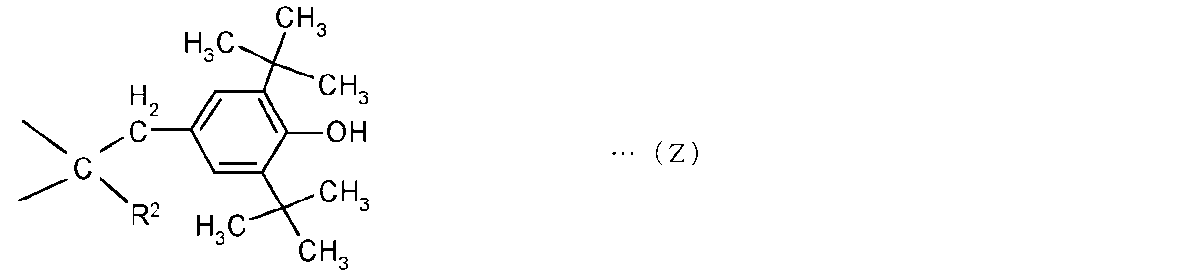
R1は、二重結合やエーテル性酸素原子を有してもよい直鎖、分岐状または途中に環状構造を有してもよい二価の炭化水素基を示す。具体的には、−(CH2)n−(nは、1〜20の整数を示し、1〜8が好ましい。)、>C=CH−Ph−OCH3(Phは、1,2−、1,3−または1,4−フェニレン基を示す。)、下記式(Z)で表される基(R2は、炭素数1〜6の直鎖アルキル基であり、好ましくはn−C4H9である。)、等が挙げられる。In the above formulas (R-1) to (R-3), Y 1 and Y 2 each independently represent a divalent linking group. Specifically, -COO-, -NH-, -NHCO- and the like are shown, but a preferred linking group is -COO- for both Y 1 and Y 2 .
X 1 is the same as X in the general formula (I).
R 2 represents a linear, branched or cyclic alkyl group having 1 to 20 carbon atoms. Preferably, it is a C1-C3 linear alkyl group.
R 1 represents a divalent hydrocarbon group that may have a double bond or an etheric oxygen atom, which may have a linear structure, a branched structure, or a cyclic structure in the middle. Specifically, — (CH 2 ) n — (n represents an integer of 1 to 20, preferably 1 to 8),> C═CH—Ph—OCH 3 (Ph is 1, 2-, 1,3- or 1,4-phenylene group), a group represented by the following formula (Z) (R 2 is a linear alkyl group having 1 to 6 carbon atoms, preferably n-C 4. is H 9.), it includes like.
さらに、上記組合せによるヒンダードアミン系光安定剤(C)の具体的な例を挙げると、下記一般式(I−1)(一般式(I)においてRが(R−1)である化合物)、(I−2)((一般式(I)においてRが(R−2)である化合物))、または(I−3)((一般式(I)においてRが(R−3)である化合物))で示される化合物を挙げることができる。 Furthermore, when the specific example of the hindered amine light stabilizer (C) by the said combination is given, the following general formula (I-1) (compound whose R is (R-1) in general formula (I)), ( I-2) ((compound in which R is (R-2) in general formula (I))) or (I-3) ((compound in which R is (R-3) in general formula (I))) ) Can be mentioned.
本発明に用いるヒンダードアミン系光安定剤(C)としては、下記一般式(I−4)に示す化合物を使用することもできる。 As the hindered amine light stabilizer (C) used in the present invention, a compound represented by the following general formula (I-4) can also be used.
これらのうちでも、本発明に用いるヒンダードアミン系光安定剤(C)としては、一般式(I−1)、(I−2)または(I−4)で示される化合物が好ましい。 Among these, the hindered amine light stabilizer (C) used in the present invention is preferably a compound represented by the general formula (I-1), (I-2) or (I-4).
本発明に用いるヒンダードアミン系光安定剤(C)において、分子量は特に制限されないが、溶解性や揮発性等の観点から、質量平均分子量(Mw)で、400以上の範囲にあることが好ましく、500〜1000の範囲にあることがより好ましい。 In the hindered amine light stabilizer (C) used in the present invention, the molecular weight is not particularly limited, but from the viewpoint of solubility and volatility, the mass average molecular weight (Mw) is preferably in the range of 400 or more, 500 More preferably in the range of ~ 1000.
このような上記一般式(I)で表されるヒンダードアミン系光安定剤(C)の具体例を、質量平均分子量(Mw)、市販品の例とともに以下に示す。
ビス−(1,2,2,6,6−ペンタメチル−4−ピペリジル)セバケート(Mw:508.8、市販品として、TINUVIN 765(商品名、チバ・ジャパン社製)等)、ビス−(1,2,2,6,6−ペンタメチル−4−ピペリジル)−2−(3,5−ジ−t−ブチル−4−ヒドロキシ−ベンジル)−2−n−ブチルマロネート(Mw:685.0、市販品として、TINUVIN 144(商品名、チバ・ジャパン社製)等)、デカン二酸ビス(2,2,6,6−テトラメチル−1−オクチルオキシ−4−ピペリジル)エステルと1,1−ジメチルエチルヒドロペルオキシドおよびオクタンの反応生成物(Mw:737.2、市販品として、TINUVIN 123(商品名、チバ・ジャパン社製)等)、ビス(1,2,2,6,6−ペンタメチル−4−ピペリジル)セバケートとメチル(1,2,2,6,6−ペンタメチル−4−ピペリジル)セバケートの混合物(市販品として、TINUVIN 292(商品名、チバ・ジャパン社製)等))、テトラキス(1,2,2,6,6−ペンタメチル−4−ピペリジル)−1,2,3,4−ブタンテトラカルボキシレート(Mw:847.2、市販品として、アデカスタブLA−52(商品名、ADEKA社製)等)、1,2,2,6,6−ペンタメチル−4−ピペリジル/トリデシル1,2,3,4−ブタンテトラカルボキシレート(Mw:約900、市販品として、アデカスタブLA−62(商品名、ADEKA社製)等)、1,2,3,4−ブタンテトラカルボン酸とβ,β,β’,β’−テトラメチル−3,9−ジエチル−{2,4,8,10−テトラオキサスピロ[5.5]ウンデカン}−α,α’−ジオールと1,2,2,6,6−ペンタメチル−4−ピペリジニオールとのエステル(市販品として、アデカスタブLA−63(商品名、ADEKA社製)等)を例示することができる。Specific examples of the hindered amine light stabilizer (C) represented by the above general formula (I) are shown below together with examples of mass average molecular weight (Mw) and commercially available products.
Bis- (1,2,2,6,6-pentamethyl-4-piperidyl) sebacate (Mw: 508.8, commercially available TINUVIN 765 (trade name, manufactured by Ciba Japan), etc.), bis- (1 , 2,2,6,6-pentamethyl-4-piperidyl) -2- (3,5-di-t-butyl-4-hydroxy-benzyl) -2-n-butyl malonate (Mw: 685.0, As commercial products, TINUVIN 144 (trade name, manufactured by Ciba Japan Co., Ltd.), decanedioic acid bis (2,2,6,6-tetramethyl-1-octyloxy-4-piperidyl) ester and 1,1- Reaction products of dimethylethyl hydroperoxide and octane (Mw: 737.2, commercially available products such as TINUVIN 123 (trade name, manufactured by Ciba Japan), etc.), bis (1, 2, 2, 6, 6- Ntamethyl-4-piperidyl) sebacate and methyl (1,2,2,6,6-pentamethyl-4-piperidyl) sebacate (commercially available products such as TINUVIN 292 (trade name, manufactured by Ciba Japan Co., Ltd.))) Tetrakis (1,2,2,6,6-pentamethyl-4-piperidyl) -1,2,3,4-butanetetracarboxylate (Mw: 847.2, commercially available ADK STAB LA-52 (trade name, ADEKA, etc.)), 1,2,2,6,6-pentamethyl-4-piperidyl /
これらのうちでも本発明に用いる上記ヒンダードアミン系光安定剤(C)として、好ましくは、以下の化合物が挙げられる。 Of these, the hindered amine light stabilizer (C) used in the present invention preferably includes the following compounds.
下記式(H−1)で示されるデカン二酸ビス(2,2,6,6−テトラメチル−1−オクチルオキシ−4−ピペリジル)エステルと1,1−ジメチルエチルヒドロペルオキシドおよびオクタンの反応生成物(市販品としては、TINUVIN 123等) Reaction reaction of decanedioic acid bis (2,2,6,6-tetramethyl-1-octyloxy-4-piperidyl) ester represented by the following formula (H-1) with 1,1-dimethylethyl hydroperoxide and octane Product (such as TINUVIN 123 as a commercial product)
下記式(H−21)で示されるビス(1,2,2,6,6−ペンタメチル−4−ピペリジニル)セバケートと下記式(H−22)で示されるメチル(1,2,2,6,6−ペンタメチル−4−ピペリジル)セバケートの混合物(市販品としては、TINUVIN 292(前者:後者の混合割合が質量比で、約75:25の混合物)等) Bis (1,2,2,6,6-pentamethyl-4-piperidinyl) sebacate represented by the following formula (H-21) and methyl (1,2,2,6, represented by the following formula (H-22) 6-pentamethyl-4-piperidyl) sebacate mixture (as a commercial product, TINUVIN 292 (the former: the mixture ratio of the latter is a mass ratio, a mixture of about 75:25), etc.)
下記式(H−3)で示される1,2,2,6,6−ペンタメチル−4−ピペリジル/トリデシル1,2,3,4−ブタンテトラカルボキシレート(市販品としては、アデカスタブLA−62等)
1,2,2,6,6-pentamethyl-4-piperidyl /
本発明のハードコート層を有する樹脂基板のアクリル系プライマー層は、上記ヒンダードアミン系光安定剤(C)から選ばれる少なくとも1種を含有する。本発明のハードコート層を有する樹脂基板のアクリル系プライマー層における上記ヒンダードアミン系光安定剤(C)の含有量は、アクリル系プライマー層構成成分全量に対して0.1〜5質量%であることが好ましく、0.1〜3質量%であることがより好ましい。ヒンダードアミン系光安定剤(C)の含有量が、0.1質量%未満であると、アクリル系ポリマー(A)やトリアジン系紫外線吸収剤(B)の分解抑制を十分に行うことができずに、耐候性が不十分となる場合があり、5質量%を越えると、ヒンダードアミン系光安定剤(C)のブリードアウトなどが発生する場合がある。 The acrylic primer layer of the resin substrate having the hard coat layer of the present invention contains at least one selected from the hindered amine light stabilizers (C). Content of the said hindered amine light stabilizer (C) in the acrylic primer layer of the resin substrate which has a hard-coat layer of this invention is 0.1-5 mass% with respect to the acrylic primer layer structural component whole quantity. Is preferable, and it is more preferable that it is 0.1-3 mass%. If the content of the hindered amine light stabilizer (C) is less than 0.1% by mass, the acrylic polymer (A) and the triazine ultraviolet absorber (B) cannot be sufficiently inhibited from being decomposed. The weather resistance may be insufficient, and if it exceeds 5% by mass, bleeding out of the hindered amine light stabilizer (C) may occur.
(2−4)アクリル系プライマー層の形成
本発明のハードコート層を有する樹脂基板は、上記樹脂基板の少なくとも一方の面に上記アクリル系ポリマー(A)を主成分とし、さらに上記トリアジン系紫外線吸収剤(B)および上記ヒンダードアミン系光安定剤(C)を含むアクリル系プライマー層が形成され、そのアクリル系プライマー層の表面上にさらに後述のシリコーン系ハードコート層が積層されてなる。(2-4) Formation of acrylic primer layer The resin substrate having the hard coat layer of the present invention has the acrylic polymer (A) as a main component on at least one surface of the resin substrate, and further absorbs the triazine ultraviolet ray. An acrylic primer layer containing the agent (B) and the hindered amine light stabilizer (C) is formed, and a silicone hard coat layer described later is further laminated on the surface of the acrylic primer layer.
上記樹脂基板上にアクリル系プライマー層を形成させるには、樹脂基板上にアクリル系ポリマーを主成分とするアクリル系プライマー層を形成させるための通常の被膜形成方法を適用すればよい。アクリル系ポリマーを主成分とするアクリル系プライマー層を樹脂基板上に形成させる具体的方法としては、アクリル系プライマー層構成成分を含有する塗膜組成物(以下「アクリル系プライマー組成物」という)を調製し、樹脂基板上に前記塗膜組成物からなる塗膜を形成させ、必要に応じて乾燥後、主成分であるアクリル系ポリマーを加熱硬化させる方法が挙げられる。 In order to form the acrylic primer layer on the resin substrate, a normal film forming method for forming an acrylic primer layer mainly composed of an acrylic polymer on the resin substrate may be applied. As a specific method for forming an acrylic primer layer mainly composed of an acrylic polymer on a resin substrate, a coating composition containing an acrylic primer layer component (hereinafter referred to as “acrylic primer composition”) is used. A method of preparing and forming a coating film made of the coating composition on a resin substrate and drying the acrylic polymer as a main component after drying as necessary is mentioned.
本発明のハードコート層を有する樹脂基板作成のためのアクリル系プライマー組成物は、上記アクリル系ポリマー(A)、トリアジン系紫外線吸収剤(B)、および、ヒンダードアミン系光安定剤(C)のそれぞれ所定量を含有するが、必要に応じてさらに任意成分を本発明の効果を損なわない範囲で含んでいてもよい。 The acrylic primer composition for producing a resin substrate having a hard coat layer according to the present invention includes the acrylic polymer (A), the triazine ultraviolet absorber (B), and the hindered amine light stabilizer (C). Although it contains a predetermined amount, it may further contain an optional component as long as it does not impair the effects of the present invention.
このような任意成分として、具体的には、塗工性向上の目的で用いられる、消泡剤や粘性調整剤等の添加剤、また、塗工性および得られる塗膜の平滑性を向上させる目的で用いられるレベリング剤等の添加剤が挙げられる。これらの添加剤の配合量は、各添加剤毎に、アクリル系プライマー組成物の不揮発成分(溶媒以外の固形分)全量に対して、0.1〜5質量%程度となる量が好ましい。 As such optional components, specifically, additives such as antifoaming agents and viscosity modifiers used for the purpose of improving coating properties, and also improve coating properties and smoothness of the resulting coating film. Additives such as leveling agents used for the purpose can be mentioned. The amount of these additives is preferably about 0.1 to 5% by mass with respect to the total amount of nonvolatile components (solid content other than the solvent) of the acrylic primer composition for each additive.
本発明に用いる上記アクリル系プライマー組成物は、上記各必須成分、任意成分の他に通常、溶媒を含有する。このようなアクリル系プライマー組成物が含有する溶媒は、上記アクリル系ポリマー(A)、トリアジン系紫外線吸収剤(B)、および、ヒンダードアミン系光安定剤(C)のそれぞれ所定量を安定に溶解することが可能であれば、特に限定されない。 The acrylic primer composition used in the present invention usually contains a solvent in addition to the above essential components and optional components. The solvent contained in such an acrylic primer composition stably dissolves a predetermined amount of each of the acrylic polymer (A), the triazine ultraviolet absorber (B), and the hindered amine light stabilizer (C). If possible, it is not particularly limited.
本発明において使用可能な溶媒として、具体的には、アセトン、メチルエチルケトン、メチルイソブチルケトン、シクロヘキサノン等のケトン類;テトラヒドロフラン、1,4−ジオキサン、1,2−ジメトキシエタン等のエーテル類;酢酸エチル、酢酸n−ブチル、酢酸メトキシエチル等のエステル類;メタノール、エタノール、1−プロパノール、2−プロパノール、1−ブタノール、2−ブタノール、2−メチル1−プロパノール、2−メトキシエタノール、4−メチル−2−ペンタノール、2−ブトキシエタノール、1−メトキシ−2−プロパノール、ジアセトンアルコール等のアルコール類;n−ヘキサン、n−ヘプタン、イソクタン、ベンゼン、トルエン、キシレン、ガソリン、軽油、灯油等の炭化水素類;アセトニトリル、ニトロメタン、水等が挙げられる。これらは単独で用いてもよいし、2種以上を併用してもよい。 Specific examples of solvents that can be used in the present invention include ketones such as acetone, methyl ethyl ketone, methyl isobutyl ketone, and cyclohexanone; ethers such as tetrahydrofuran, 1,4-dioxane, and 1,2-dimethoxyethane; ethyl acetate, Esters such as n-butyl acetate and methoxyethyl acetate; methanol, ethanol, 1-propanol, 2-propanol, 1-butanol, 2-butanol, 2-methyl 1-propanol, 2-methoxyethanol, 4-methyl-2 Alcohols such as pentanol, 2-butoxyethanol, 1-methoxy-2-propanol, diacetone alcohol; hydrocarbons such as n-hexane, n-heptane, isoctane, benzene, toluene, xylene, gasoline, light oil, kerosene Acetonitrile, D Rometan, water and the like. These may be used alone or in combination of two or more.
本発明において、上記溶媒は、好ましくは、酢酸n−ブチル、1−メトキシ−2−プロパノール、およびジアセトンアルコールから選ばれる少なくとも1種である。 In the present invention, the solvent is preferably at least one selected from n-butyl acetate, 1-methoxy-2-propanol, and diacetone alcohol.
また、用いる溶媒の量は、アクリル系ポリマーの量に対して、質量で1〜50倍量であることが好ましく、1〜20倍量が特に好ましい。なお、アクリル系プライマー組成物中の不揮発成分の含有量は、1〜50質量%であることが好ましく、3〜30質量%であることが特に好ましい。 Moreover, it is preferable that the quantity of the solvent to be used is 1-50 times by mass with respect to the quantity of an acryl-type polymer, and its 1-20 times quantity is especially preferable. In addition, it is preferable that content of the non-volatile component in an acrylic primer composition is 1-50 mass%, and it is especially preferable that it is 3-30 mass%.
上記アクリル系プライマー組成物は上記各成分を合わせて十分に混合し均一な組成物とした後、樹脂基板上に塗布される。塗布の方法としては、特に限定されないが、スプレーコート法、ディップコート法、フローコート法等が挙げられる。このようにして樹脂基板上にアクリル系プライマー組成物からなる塗膜を形成させ、必要に応じて乾燥、例えば20〜50℃、5分〜10時間等の条件において予備乾燥を行った後、加熱により溶媒を除去することでアクリル系プライマー層を形成することができる。加熱の条件は、特に限定されないが、50〜140℃で5分〜3時間であることが好ましい。 The acrylic primer composition is applied onto a resin substrate after the above components are mixed together and mixed well to obtain a uniform composition. Although it does not specifically limit as a coating method, Spray coating method, dip coating method, flow coating method etc. are mentioned. In this way, a coating film composed of the acrylic primer composition is formed on the resin substrate, and if necessary, dried, for example, pre-dried under conditions of 20 to 50 ° C., 5 minutes to 10 hours, etc., and then heated. The acrylic primer layer can be formed by removing the solvent. The heating conditions are not particularly limited, but are preferably 50 to 140 ° C. and 5 minutes to 3 hours.
このようして形成されるアクリル系プライマー層は、厚さが0.5μm以上10μm以下であることが好ましく、3μm以上8μm以下であることが特に好ましい。アクリル系プライマー層の厚さが0.5μm未満であると、耐候性が不足することがあり、10μmを超えると、樹脂基板の反りなどの不具合が発生することがある。 The acrylic primer layer thus formed has a thickness of preferably 0.5 μm or more and 10 μm or less, and particularly preferably 3 μm or more and 8 μm or less. When the thickness of the acrylic primer layer is less than 0.5 μm, the weather resistance may be insufficient, and when it exceeds 10 μm, problems such as warping of the resin substrate may occur.
(3)シリコーン系ハードコート層
本発明のハードコート層を有する樹脂基板は、上記樹脂基板の少なくとも一方の面に形成されたアクリル系プライマー層の表面上にさらに以下のオルガノポリシロキサンを含むハードコート剤組成物の硬化物からなるハードコート層(シリコーン系ハードコート層)が積層されてなる。なお、以下、オルガノポリシロキサンを含むハードコート剤組成物を「シリコーン系ハードコート剤組成物」という。
本発明に用いるシリコーン系ハードコート剤組成物は、必須成分としてオルガノポリシロキサンを含有し、さらに必要に応じて添加される任意成分を本発明の効果を損なわない範囲で含有する。以下、本発明に用いるシリコーン系ハードコート剤組成物が含有する各成分について説明する。(3) Silicone hard coat layer The resin substrate having the hard coat layer of the present invention further comprises the following organopolysiloxane on the surface of the acrylic primer layer formed on at least one surface of the resin substrate. A hard coat layer (silicone hard coat layer) made of a cured product of the agent composition is laminated. Hereinafter, a hard coat agent composition containing an organopolysiloxane is referred to as a “silicone hard coat agent composition”.
The silicone-based hard coat agent composition used in the present invention contains an organopolysiloxane as an essential component, and further contains an optional component added as necessary within a range not impairing the effects of the present invention. Hereafter, each component which the silicone type hard-coat agent composition used for this invention contains is demonstrated.
(3−1)オルガノポリシロキサン
本発明に用いるシリコーン系ハードコート剤組成物が含むオルガノポリシロキサンとしては、硬化性のオルガノポリシロキサンであれば、特に制限なく用いることができる。(3-1) Organopolysiloxane The organopolysiloxane contained in the silicone-based hard coat agent composition used in the present invention can be used without particular limitation as long as it is a curable organopolysiloxane.
オルガノポリシロキサンはM単位、D単位、T単位、Q単位と呼ばれる含ケイ素結合単位から構成される。この内、硬化性のオルガノポリシロキサンは主としてT単位またはQ単位から構成されるオリゴマー状のポリマーであり、T単位のみから構成されるポリマー、Q単位のみから構成されるポリマー、T単位とQ単位から構成されるポリマーがある。またそれらポリマーはさらに少量のM単位やD単位を含むこともある。 Organopolysiloxane is composed of silicon-containing bond units called M units, D units, T units, and Q units. Among these, curable organopolysiloxane is an oligomeric polymer mainly composed of T units or Q units, a polymer composed only of T units, a polymer composed only of Q units, T units and Q units. There is a polymer composed of These polymers may further contain a small amount of M units and D units.
硬化性のオルガノポリシロキサンにおいて、T単位は、1個のケイ素原子を有し、そのケイ素原子に結合した1個の水素原子または1価の有機基と、他のケイ素原子に結合した酸素原子(または他のケイ素原子に結合できる官能基)3個とを有する単位である。ケイ素原子に結合した1価の有機基はケイ素原子に結合する原子が炭素原子である1価の有機基である。他のケイ素原子に結合できる官能基は水酸基または加水分解により水酸基となる基(以下加水分解性基という)である。他のケイ素原子に結合した酸素原子と他のケイ素原子に結合できる官能基の合計は3個であり、他のケイ素原子に結合した酸素原子と他のケイ素原子に結合できる官能基の数の違いにより、T単位はT1、T2、T3と呼ばれる3種の単位に分類される。T1は他のケイ素原子に結合した酸素原子の数が1個、T2はその酸素原子の数が2個、T3はその酸素原子の数が3個である。本明細書等においては、他のケイ素原子に結合した酸素原子をO*で表し、他のケイ素原子に結合できる1価の官能基をZで表す。In the curable organopolysiloxane, the T unit has one silicon atom, one hydrogen atom or monovalent organic group bonded to the silicon atom, and an oxygen atom bonded to another silicon atom ( Or a unit having three functional groups capable of bonding to other silicon atoms). The monovalent organic group bonded to the silicon atom is a monovalent organic group in which the atom bonded to the silicon atom is a carbon atom. The functional group that can be bonded to another silicon atom is a hydroxyl group or a group that becomes a hydroxyl group by hydrolysis (hereinafter referred to as a hydrolyzable group). The total number of oxygen atoms bonded to other silicon atoms and functional groups that can bond to other silicon atoms is three, and the number of functional groups that can bond to oxygen atoms bonded to other silicon atoms and other silicon atoms is different. Thus, the T unit is classified into three types of units called T1, T2, and T3. T1 has one oxygen atom bonded to another silicon atom, T2 has two oxygen atoms, and T3 has three oxygen atoms. In this specification and the like, an oxygen atom bonded to another silicon atom is represented by O * , and a monovalent functional group that can be bonded to another silicon atom is represented by Z.
なお、他のケイ素原子に結合した酸素原子を表すO*は、2個のケイ素原子間を結合する酸素原子であり、Si−O−Siで表される結合中の酸素原子である。したがって、O*は、2つの含ケイ素結合単位のケイ素原子間に1個存在する。言い換えれば、O*は、2つの含ケイ素結合単位の2つのケイ素原子に共有される酸素原子を表す。後述含ケイ素結合単位の化学式において、1つのケイ素原子にO*が結合している様に表現するが、このO*は他の含ケイ素結合単位のケイ素原子と共有している酸素原子であり、2つの含ケイ素結合単位がSi−O*−O*−Siで表される結合で結合することを意味するものではない。Note that O * representing an oxygen atom bonded to another silicon atom is an oxygen atom bonded between two silicon atoms, and is an oxygen atom in a bond represented by Si-O-Si. Accordingly, one O * exists between the silicon atoms of two silicon-containing bond units. In other words, O * represents an oxygen atom shared by two silicon atoms of two silicon-containing bond units. In the chemical formula of the silicon-containing bond unit described later, it is expressed as O * is bonded to one silicon atom, but this O * is an oxygen atom shared with the silicon atom of another silicon-containing bond unit, It does not mean that two silicon-containing bond units are bonded by a bond represented by Si—O * —O * —Si.
前記M単位は上記有機基3個とO*1個を有する単位、D単位は上記有機基2個とO*2個(またはO*1個とZ基1個)を有する単位、Q単位は上記有機基0個とO*4個(またはO*1〜3個とZ基3〜1個の計4個)を有する単位である。それぞれの含ケイ素結合単位は、他のケイ素原子に結合した酸素原子(O*)を有しない(Z基のみを有する)化合物(以下モノマーともいう)から形成される。T単位を形成するモノマーを以下Tモノマーという。M単位、D単位、Q単位を形成するモノマーも同様にMモノマー、Dモノマー、Qモノマーという。The M unit is a unit having 3 organic groups and 1 O * , the D unit is a unit having 2 organic groups and 2 O * (or 1 O * and 1 Z group), and the Q unit is It is a unit having 0 organic groups and 4 O * (or 4 O * 1 to 3 and 3 to 3 Z groups). Each silicon-containing bond unit is formed from a compound (hereinafter also referred to as a monomer) that does not have an oxygen atom (O * ) bonded to another silicon atom (has only a Z group). The monomer forming the T unit is hereinafter referred to as T monomer. Monomers that form M units, D units, and Q units are also referred to as M monomers, D monomers, and Q monomers.
モノマーは、(R’−)aSi(−Z)4−aで表される。ただし、aは0〜3の整数、R’は水素原子または1価の有機基、Zは水酸基または他のケイ素原子に結合できる1価の官能基を表す。この化学式において、a=3の化合物がMモノマー、a=2の化合物がDモノマー、a=1の化合物がTモノマー、a=0の化合物がQモノマーである。モノマーにおいて、Z基は通常加水分解性基である。また、R’が2または3個存在する場合(aが2または3の場合)、複数のR’は異なっていてもよい。R’としては、後述の好ましいRと同じ範疇のものが好ましい。The monomer is represented by (R′—) a Si (—Z) 4-a . However, a represents an integer of 0 to 3, R ′ represents a hydrogen atom or a monovalent organic group, and Z represents a monovalent functional group that can be bonded to a hydroxyl group or another silicon atom. In this chemical formula, a compound with a = 3 is an M monomer, a compound with a = 2 is a D monomer, a compound with a = 1 is a T monomer, and a compound with a = 0 is a Q monomer. In the monomer, the Z group is usually a hydrolyzable group. Further, when 2 or 3 R ′ are present (when a is 2 or 3), the plurality of R ′ may be different. R ′ is preferably in the same category as R described later.
硬化性オルガノポリシロキサンは、モノマーのZ基の一部をO*に変換する反応により得られる。オルガノポリシロキサンが2種以上の含ケイ素結合単位を含むコポリマーの場合、通常、これらコポリマーはそれぞれ対応するモノマーの混合物から得られる。モノマーのZ基が加水分解性基の場合、Z基は加水分解反応により水酸基に変換され、次いで別々のケイ素原子に結合した2個の水酸基の間における脱水縮合反応により、2個のケイ素原子が酸素原子(O*)を介して結合する。硬化性オルガノポリシロキサン中には水酸基(または加水分解しなかったZ基)が残存し、硬化性オルガノポリシロキサンの硬化の際にこれら水酸基やZ基が上記と同様に反応して硬化する。硬化性オルガノポリシロキサンの硬化物は3次元的に架橋したポリマーであり、T単位やQ単位の多い硬化性オルガノポリシロキサンの硬化物は架橋密度の高い硬化物となる。硬化の際、硬化性オルガノポリシロキサンのZ基がO*に変換されるが、Z基(特に水酸基)の一部は残存し、水酸基を有する硬化物となると考えられる。硬化性オルガノポリシロキサンを高温で硬化させた場合は水酸基がほとんど残存しない硬化物となることもある。The curable organopolysiloxane is obtained by a reaction in which a part of the Z group of the monomer is converted to O * . When the organopolysiloxane is a copolymer comprising two or more silicon-containing bond units, these copolymers are usually obtained from a mixture of the corresponding monomers. When the Z group of the monomer is a hydrolyzable group, the Z group is converted into a hydroxyl group by a hydrolysis reaction, and then two silicon atoms are converted by a dehydration condensation reaction between two hydroxyl groups bonded to separate silicon atoms. Bonding through an oxygen atom (O * ). In the curable organopolysiloxane, hydroxyl groups (or Z groups that have not been hydrolyzed) remain, and when the curable organopolysiloxane is cured, these hydroxyl groups and Z groups react and cure as described above. The cured product of the curable organopolysiloxane is a three-dimensionally crosslinked polymer, and the cured product of the curable organopolysiloxane having many T units and Q units is a cured product having a high crosslinking density. At the time of curing, the Z group of the curable organopolysiloxane is converted to O * , but a part of the Z group (particularly hydroxyl group) remains and is considered to be a cured product having a hydroxyl group. When the curable organopolysiloxane is cured at a high temperature, it may be a cured product in which almost no hydroxyl groups remain.
モノマーのZ基が加水分解性基である場合、そのZ基としては、アルコキシ基、塩素原子、アシルオキシ基、イソシアネート基等が挙げられる。多くの場合、モノマーとしてはZ基がアルコキシ基のモノマーが使用される。アルコキシ基は塩素原子などと比較すると反応性の比較的低い加水分解性基であり、Z基がアルコキシ基であるモノマーを使用して得られる硬化性オルガノポリシロキサン中にはZ基として水酸基とともに未反応のアルコキシ基が存在することが多い。モノマーのZ基が反応性の比較的高い加水分解性基(例えば塩素原子)の場合、そのモノマーを使用して得られる硬化性オルガノポリシロキサン中のZ基はそのほとんどが水酸基となる。したがって、通常の硬化性オルガノポリシロキサンにおいては、それを構成する各単位におけるZ基は、水酸基からなるかまたは水酸基とアルコキシ基からなることが多い。 When the Z group of the monomer is a hydrolyzable group, examples of the Z group include an alkoxy group, a chlorine atom, an acyloxy group, and an isocyanate group. In many cases, a monomer in which the Z group is an alkoxy group is used as the monomer. The alkoxy group is a hydrolyzable group having a relatively low reactivity as compared with a chlorine atom and the like, and in the curable organopolysiloxane obtained by using a monomer in which the Z group is an alkoxy group, it is not present together with the hydroxyl group as a Z group. Often an alkoxy group of the reaction is present. When the Z group of the monomer is a hydrolyzable group having a relatively high reactivity (for example, a chlorine atom), most of the Z groups in the curable organopolysiloxane obtained using the monomer are hydroxyl groups. Therefore, in a normal curable organopolysiloxane, the Z group in each unit constituting it is often composed of a hydroxyl group or a hydroxyl group and an alkoxy group.
また、本発明においては、これら硬化性のオルガノポリシロキサンのうちでも、T単位を主な含ケイ素結合単位として構成される硬化性のオルガノポリシロキサンが好ましく用いられる。以下、特に言及しない限り、硬化性のオルガノポリシロキサンを単にオルガノポリシロキサンという。ここで、本明細書において、T単位を主な構成単位とするオルガノポリシロキサン(以下、必要に応じて「オルガノポリシロキサン(T)」という。)とは、M単位、D単位、T単位およびQ単位の合計数に対するT単位数の割合が50〜100%のオルガノポリシロキサンをいうが、本発明においてより好ましくは、該T単位数の割合が70〜100%のオルガノポリシロキサンを、特に好ましくは該T単位数の割合が90〜100%のオルガノポリシロキサンを用いるものである。また、T単位以外に少量含まれる他の単位としてはD単位とQ単位が好ましく、特にQ単位が好ましい。 In the present invention, among these curable organopolysiloxanes, curable organopolysiloxanes having T units as the main silicon-containing bond units are preferably used. Hereinafter, unless otherwise specified, curable organopolysiloxane is simply referred to as organopolysiloxane. Here, in the present specification, an organopolysiloxane having a T unit as a main constituent unit (hereinafter referred to as “organopolysiloxane (T)” as necessary) refers to an M unit, a D unit, a T unit, and The ratio of the number of T units to the total number of Q units refers to an organopolysiloxane having 50 to 100%. In the present invention, the ratio of the number of T units is more preferably 70 to 100%, particularly preferably an organopolysiloxane. Uses an organopolysiloxane having a T-unit ratio of 90 to 100%. Moreover, as other units contained in a small amount other than T units, D units and Q units are preferable, and Q units are particularly preferable.
すなわち、本発明においては、これら硬化性のオルガノポリシロキサンのうちでも、T単位とQ単位のみで構成され、その個数の割合がT:Q=70〜100:30〜0であるオルガノポリシロキサンが特に好ましく用いられる。
なお、オルガノポリシロキサンにおけるM単位、D単位、T単位、Q単位の数の割合は、29Si−NMRによるピーク面積比の値から計算できる。That is, in the present invention, among these curable organopolysiloxanes, organopolysiloxanes composed only of T units and Q units, and the ratio of the number thereof is T: Q = 70 to 100: 30 to 0. Particularly preferably used.
In addition, the ratio of the number of M units, D units, T units, and Q units in the organopolysiloxane can be calculated from the value of the peak area ratio by 29 Si-NMR.
本発明に用いるオルガノポリシロキサン(T)の質量平均分子量は、500〜10000であることが好ましく、500〜8000であることがより好ましい。オルガノポリシロキサンの質量平均分子量がこの範囲にあることで、硬化収縮による収縮応力による初期クラックが発生しにくい。 The mass average molecular weight of the organopolysiloxane (T) used in the present invention is preferably 500 to 10,000, and more preferably 500 to 8,000. When the mass average molecular weight of the organopolysiloxane is within this range, initial cracks due to shrinkage stress due to curing shrinkage are unlikely to occur.
オルガノポリシロキサン(T)は、R−Si(−OY)3で表されるTモノマーの少なくとも1種から製造されることが好ましい。この式において、Rは前記のRと同一であり、Yは炭素数1〜6のアルキル基を表す。Yは非置換のアルキル基以外に、アルコキシ置換アルキル基などの置換アルキル基であってもよい。1分子中の3個のYは異なっていてもよい。しかし、通常は3個のYは同一のアルキル基である。Yは、炭素数1〜4のアルキル基であることが好ましく、炭素数1または2であることがより好ましい。具体的なYとしては、メチル基、エチル基、n−プロピル基、n−ブチル基、t−ブチル基、2−メトキシエチル基などが挙げられる。The organopolysiloxane (T) is preferably produced from at least one T monomer represented by R—Si (—OY) 3 . In this formula, R is the same as R described above, and Y represents an alkyl group having 1 to 6 carbon atoms. Y may be a substituted alkyl group such as an alkoxy-substituted alkyl group in addition to an unsubstituted alkyl group. Three Y in one molecule may be different. However, usually three Y are the same alkyl group. Y is preferably an alkyl group having 1 to 4 carbon atoms, and more preferably 1 or 2 carbon atoms. Specific examples of Y include a methyl group, an ethyl group, an n-propyl group, an n-butyl group, a t-butyl group, and a 2-methoxyethyl group.
Rは水素原子または炭素数が1〜10の置換または非置換の1価の有機基である。有機基とは、前記のようにケイ素原子に結合する原子が炭素原子である有機基をいう。 R is a hydrogen atom or a substituted or unsubstituted monovalent organic group having 1 to 10 carbon atoms. The organic group means an organic group in which the atom bonded to the silicon atom is a carbon atom as described above.
非置換の1価の有機基としては、アルキル基、アルケニル基、アルキニル基、シクロアルキル基、アリール基、アルアルキル基などの炭化水素基が挙げられる。これら炭化水素基としては、炭素数1〜10のアルキル基、炭素数2〜10のアルケニル基やアルキニル基、炭素数5または6のシクロアルキル基、炭素数6〜10のアリール基、または炭素数7〜10のアルアルキル基が好ましい。具体的には、メチル基、エチル基、n−プロピル基、n−ブチル基、i−ブチル基、t−ブチル基、ヘキシル基、オクチル基、デシル基、ビニル基、アリル基、シクロヘキシル基、フェニル基、ベンジル基、フェネチル基等が挙げられる。 Examples of the unsubstituted monovalent organic group include hydrocarbon groups such as an alkyl group, an alkenyl group, an alkynyl group, a cycloalkyl group, an aryl group, and an aralkyl group. These hydrocarbon groups include alkyl groups having 1 to 10 carbon atoms, alkenyl groups and alkynyl groups having 2 to 10 carbon atoms, cycloalkyl groups having 5 or 6 carbon atoms, aryl groups having 6 to 10 carbon atoms, or carbon numbers. 7-10 aralkyl groups are preferred. Specifically, methyl group, ethyl group, n-propyl group, n-butyl group, i-butyl group, t-butyl group, hexyl group, octyl group, decyl group, vinyl group, allyl group, cyclohexyl group, phenyl Group, benzyl group, phenethyl group and the like.
置換の1価の有機基としては、シクロアルキル基、アリール基、アルアルキル基などの環の水素原子がアルキル基で置換された炭化水素基、前記炭化水素基の水素原子がハロゲン原子、官能基、官能基含有有機基などで置換された置換有機基などがある。官能基としては水酸基、メルカプト基、カルボキシル基、エポキシ基、アミノ基、シアノ基などが好ましい。ハロゲン原子置換有機基としては、クロロアルキル基、ポリフルオロアルキル基などの塩素原子またはフッ素原子を有するアルキル基が好ましい。官能基含有有機基としては、アルコキシ基、アシル基、アシルオキシ基、アルコキシカルボニル基、グリシジル基、エポキシシクロヘキシル基、アルキルアミノ基、ジアルキルアミノ基、アリールアミノ基、N−アミノアルキル置換アミノアルキル基などが好ましい。特に、塩素原子、メルカプト基、エポキシ基、アミノ基、アクリロイルオキシ基、メタクリロイルオキシ基、グリシジル基、アルキルアミノ基、N−アミノアルキル置換アミノアルキル基などが好ましい。官能基や官能基含有有機基などで置換された置換有機基を有するTモノマーはシランカップリング剤と呼ばれる範疇の化合物を含む。 Examples of the substituted monovalent organic group include a hydrocarbon group in which a ring hydrogen atom such as a cycloalkyl group, an aryl group, and an aralkyl group is substituted with an alkyl group, and the hydrogen atom of the hydrocarbon group is a halogen atom or a functional group And a substituted organic group substituted with a functional group-containing organic group. As the functional group, a hydroxyl group, mercapto group, carboxyl group, epoxy group, amino group, cyano group and the like are preferable. As the halogen atom-substituted organic group, an alkyl group having a chlorine atom or a fluorine atom such as a chloroalkyl group or a polyfluoroalkyl group is preferable. Examples of the functional group-containing organic group include an alkoxy group, an acyl group, an acyloxy group, an alkoxycarbonyl group, a glycidyl group, an epoxycyclohexyl group, an alkylamino group, a dialkylamino group, an arylamino group, and an N-aminoalkyl-substituted aminoalkyl group. preferable. In particular, chlorine atom, mercapto group, epoxy group, amino group, acryloyloxy group, methacryloyloxy group, glycidyl group, alkylamino group, N-aminoalkyl-substituted aminoalkyl group and the like are preferable. The T monomer having a substituted organic group substituted with a functional group or a functional group-containing organic group contains a category of compounds called silane coupling agents.
置換有機基の具体例としては、以下の有機基が挙げられる。3−クロロプロピル基、3,3,3−トリフルオロプロピル基、3−メルカプトプロピル基、p−メルカプトメチルフェニルエチル基、3−アクリロイルオキシプロピル基、3−メタクリロイルオキシプロピル基、3−グリシドキシプロピル基、2−(3,4−エポキシシクロヘキシル)エチル基、3−アミノプロピル基、N−フェニル−3−アミノプロピル基、N−(2−アミノエチル)−3−アミノプロピル基、2−シアノエチル基。 Specific examples of the substituted organic group include the following organic groups. 3-chloropropyl group, 3,3,3-trifluoropropyl group, 3-mercaptopropyl group, p-mercaptomethylphenylethyl group, 3-acryloyloxypropyl group, 3-methacryloyloxypropyl group, 3-glycidoxy Propyl group, 2- (3,4-epoxycyclohexyl) ethyl group, 3-aminopropyl group, N-phenyl-3-aminopropyl group, N- (2-aminoethyl) -3-aminopropyl group, 2-cyanoethyl Group.
上記Rとして特に好ましい1価有機基は、炭素数1〜4のアルキル基である。オルガノポリシロキサン(T)としては、炭素数1〜4のアルキル基を有するTモノマーの単独またはその2種以上を使用して得られるオルガノポリシロキサンが好ましい。また、オルガノポリシロキサン(T)として炭素数1〜4のアルキル基を有するTモノマーの1種以上と少量の他のTモノマーを使用して得られるオルガノポリシロキサンもまた好ましい。他のTモノマーの割合はTモノマー全量に対し30モル%以下、特に15モル%以下が好ましい。他のTモノマーとしては、シランカップリング剤と呼ばれる範疇の、官能基や官能基含有有機基などで置換された置換有機基を有するTモノマーが好ましい。 A particularly preferred monovalent organic group as R is an alkyl group having 1 to 4 carbon atoms. The organopolysiloxane (T) is preferably an organopolysiloxane obtained by using a T monomer having an alkyl group having 1 to 4 carbon atoms alone or two or more thereof. Moreover, the organopolysiloxane obtained by using 1 or more types of T monomer which has a C1-C4 alkyl group as organopolysiloxane (T), and a small amount of other T monomers is also preferable. The proportion of other T monomers is preferably 30 mol% or less, particularly preferably 15 mol% or less, based on the total amount of T monomers. As the other T monomer, a T monomer having a substituted organic group substituted with a functional group, a functional group-containing organic group, or the like in a category called a silane coupling agent is preferable.
炭素数1〜4のアルキル基を有するTモノマーの具体例としては、例えば、メチルトリメトキシシラン、メチルトリエトキシシラン、メチルトリプロポキシシラン、エチルトリメトキシシラン、エチルトリエトキシシランが挙げられる。特に、メチルトリメトキシシランまたはエチルトリメトキシシランが好ましい。置換有機基等を有するTモノマーの具体例としては、例えば、下記の化合物が挙げられる。 Specific examples of the T monomer having an alkyl group having 1 to 4 carbon atoms include, for example, methyltrimethoxysilane, methyltriethoxysilane, methyltripropoxysilane, ethyltrimethoxysilane, and ethyltriethoxysilane. In particular, methyltrimethoxysilane or ethyltrimethoxysilane is preferable. Specific examples of the T monomer having a substituted organic group and the like include the following compounds.
ビニルトリメトキシシラン、ビニルトリエトキシシラン、フェニルトリメトキシシラン、フェニルトリエトキシシラン、3−クロロプロピルトリメトキシシラン、3,3,3−トリフルオロプロピルトリメトキシシラン、3−メルカプトプロピルトリメトキシシラン、3−グリシドキシプロピルトリメトキシシラン、3−グリシドキシプロピルトリエトキシシラン、2−(3,4−エポキシシクロヘキシル)エチルトリメトキシシラン、2−(3,4−エポキシシクロヘキシル)エチルトリエトキシシラン、3−アクリロイルオキシプロピルトリメトキシシラン、3−メタクリロイルオキシプロピルトリメトキシシラン、3−アミノプロピルトリメトキシシラン、3−アミノプロピルトリエトキシシラン、N−(2−アミノエチル)−3−アミノプロピルトリメトキシシラン、3−シアノエチルトリメトキシシラン。 Vinyltrimethoxysilane, vinyltriethoxysilane, phenyltrimethoxysilane, phenyltriethoxysilane, 3-chloropropyltrimethoxysilane, 3,3,3-trifluoropropyltrimethoxysilane, 3-mercaptopropyltrimethoxysilane, 3 -Glycidoxypropyltrimethoxysilane, 3-glycidoxypropyltriethoxysilane, 2- (3,4-epoxycyclohexyl) ethyltrimethoxysilane, 2- (3,4-epoxycyclohexyl) ethyltriethoxysilane, 3 -Acryloyloxypropyltrimethoxysilane, 3-methacryloyloxypropyltrimethoxysilane, 3-aminopropyltrimethoxysilane, 3-aminopropyltriethoxysilane, N- (2-aminoethyl) -3-a Roh propyltrimethoxysilane, 3-cyano-ethyl trimethoxysilane.
R−Si(−OY)3で表されるTモノマー以外の(R’−)aSi(−Z)4−aで表されるTモノマー(a=3)としては、例えば、メチルトリクロロシラン、エチルトリクロロシラン、フェニルトリクロロシラン、3−グリシドキシプロピルトリクロロシラン、メチルトリアセトキシシラン、エチルトリアセトキシシランなどが挙げられる。The R-Si (-OY) other than T monomer represented by 3 (R'-) a Si (-Z ) T monomers represented by 4-a (a = 3) , for example, methyltrichlorosilane, Examples include ethyltrichlorosilane, phenyltrichlorosilane, 3-glycidoxypropyltrichlorosilane, methyltriacetoxysilane, and ethyltriacetoxysilane.
(R’−)aSi(−Z)4−aで表されるDモノマー(a=2)において、2個のR’は同一であっても、異なっていてもよい。同一の場合は、炭素数1〜4のアルキル基が好ましい。異なる場合は、一方のR’が炭素数1〜4のアルキル基であり、他方のR’が前記官能基や官能基含有有機基などで置換された置換有機基であることが好ましい。また、Z基としては、炭素数1〜4のアルコキシ基、アセトキシ基等が好ましい。Dモノマーとしては、例えば、下記の化合物が挙げられる。In the D monomer (a = 2) represented by (R'-) a Si (-Z) 4-a , two R's may be the same or different. In the case of being the same, an alkyl group having 1 to 4 carbon atoms is preferable. When they are different, it is preferable that one R ′ is an alkyl group having 1 to 4 carbon atoms, and the other R ′ is a substituted organic group substituted with the functional group or the functional group-containing organic group. Moreover, as a Z group, a C1-C4 alkoxy group, an acetoxy group, etc. are preferable. Examples of the D monomer include the following compounds.
ジメチルジメトキシシラン、ジメチルジエトキシシラン、ビニルメチルジメトキシシラン、ビニルメチルジエトキシシラン、フェニルメチルジメトキシシラン、フェニルメチルジアセトキシシラン、3−クロロプロピルメチルジメトキシシラン、3,3,3−トリフルオロプロピルメチルジメトキシシラン、3−メルカプトプロピルメチルジエトキシシラン、3−アクリロイルオキシプロピルメチルジメトキシシラン、3−メタクリロイルオキシプロピルメチルジメトキシシラン、3−アミノプロピルメチルジメトキシシラン、3−アミノプロピルメチルジエトキシシラン、N−(2−アミノエチル)−3−アミノプロピルメチルジメトキシシラン、3−シアノエチルメチルジメトキシシラン。 Dimethyldimethoxysilane, dimethyldiethoxysilane, vinylmethyldimethoxysilane, vinylmethyldiethoxysilane, phenylmethyldimethoxysilane, phenylmethyldiacetoxysilane, 3-chloropropylmethyldimethoxysilane, 3,3,3-trifluoropropylmethyldimethoxy Silane, 3-mercaptopropylmethyldiethoxysilane, 3-acryloyloxypropylmethyldimethoxysilane, 3-methacryloyloxypropylmethyldimethoxysilane, 3-aminopropylmethyldimethoxysilane, 3-aminopropylmethyldiethoxysilane, N- (2 -Aminoethyl) -3-aminopropylmethyldimethoxysilane, 3-cyanoethylmethyldimethoxysilane.
(R’−)aSi(−Z)4−aで表されるQモノマー(a=0)において、4個のZ基は異なっていてもよいが、通常は同一である。Z基としては、炭素数1〜4のアルコキシ基が好ましく、特にメトキシ基またはエトキシ基であることが好ましい。Qモノマーとしては、例えば、下記の化合物が挙げられる。In (R'-) a Si (-Z) Q monomer represented by 4-a (a = 0) , it may be different from four Z groups, but usually the same. The Z group is preferably an alkoxy group having 1 to 4 carbon atoms, and particularly preferably a methoxy group or an ethoxy group. Examples of the Q monomer include the following compounds.
テトラメトキシシラン、テトラエトキシシラン、テトラn−プロポキシシラン、テトラn−ブチルオキシシラン、テトラsec−ブチルオキシシラン、テトラt−ブチルオキシシラン。 Tetramethoxysilane, tetraethoxysilane, tetra-n-propoxysilane, tetra-n-butyloxysilane, tetra-sec-butyloxysilane, tetra-t-butyloxysilane.
本発明に用いるオルガノポリシロキサン(T)は、上記Tモノマー等を部分加水分解縮合させることによって得られる。通常、Tモノマー等と水とを溶媒中で加熱することによりこの反応を行う。反応系には触媒を存在させることが好ましい。モノマーの種類、水の量、加熱温度、触媒の種類や量、反応時間等の反応条件を調節して目的のオルガノポリシロキサンを製造することができる。また、場合によっては市販のオルガノポリシロキサンをそのまま目的のオルガノポリシロキサンとして使用することや、市販のオルガノポリシロキサンを使用して目的とするオルガノポリシロキサンを製造することも可能である。 The organopolysiloxane (T) used in the present invention is obtained by subjecting the above T monomer or the like to partial hydrolysis condensation. Usually, this reaction is performed by heating T monomer or the like and water in a solvent. A catalyst is preferably present in the reaction system. The desired organopolysiloxane can be produced by adjusting the reaction conditions such as the type of monomer, the amount of water, the heating temperature, the type and amount of catalyst, and the reaction time. In some cases, a commercially available organopolysiloxane can be used as it is as a target organopolysiloxane, or a target organopolysiloxane can be produced using a commercially available organopolysiloxane.
上記触媒としては、酸触媒が好ましい。酸触媒としては、塩酸、硫酸、硝酸、リン酸、亜硝酸、過塩素酸、スルファミン酸等の無機酸;ギ酸、酢酸、プロピオン酸、酪酸、シュウ酸、コハク酸、マレイン酸、乳酸、p−トルエンスルホン酸等の有機酸が挙げられる。特に、酢酸が好ましい。上記溶媒としては親水性の有機溶媒が好ましく、特にアルコール系溶媒が好ましい。アルコール系溶媒としては、メタノール、エタノール、1−プロパノール、2−プロパノール、1−ブタノール、2−ブタノール、2−メチル−1−プロパノール、2−エトキシエタノール、4−メチル−2−ペンタノール、2−ブトキシエタノール等が挙げられる。反応温度は、触媒が存在する場合室温で反応させることができる。通常は、20〜80℃の反応温度から目的に応じて適切な温度を採用する。 As the catalyst, an acid catalyst is preferable. Examples of the acid catalyst include inorganic acids such as hydrochloric acid, sulfuric acid, nitric acid, phosphoric acid, nitrous acid, perchloric acid, and sulfamic acid; formic acid, acetic acid, propionic acid, butyric acid, oxalic acid, succinic acid, maleic acid, lactic acid, p- An organic acid such as toluenesulfonic acid may be mentioned. In particular, acetic acid is preferred. The solvent is preferably a hydrophilic organic solvent, and particularly preferably an alcohol solvent. Examples of alcohol solvents include methanol, ethanol, 1-propanol, 2-propanol, 1-butanol, 2-butanol, 2-methyl-1-propanol, 2-ethoxyethanol, 4-methyl-2-pentanol, 2- Examples include butoxyethanol. The reaction temperature can be reacted at room temperature when a catalyst is present. Usually, an appropriate temperature is employed from the reaction temperature of 20 to 80 ° C. according to the purpose.
加水分解縮合反応は、Tモノマー(2個のケイ素原子を結合する酸素原子(O*)を有しない、−OXのみを3個有するT単位。以下、「T0」ということもある)からT1が生成し、T1からT2が生成し、T2からT3が生成する反応である。加水分解性基の1個以上が水酸基変換されたT0からT1が生成する縮合反応、2個の−OXの少なくとも一方が水酸基であるT1からT2が生成する縮合反応、−OXが水酸基であるT2からT3が生成する縮合反応、の反応速度はこの順に遅くなると考えられる。加水分解性基の加水分解反応を考慮しても、反応が進むにしたがって各単位の存在量のピークはT0からT3へ移動していくと考えられる。反応条件が比較的温和である場合には存在量のピークの移動は比較的整然と進行すると考えられる。一方、反応条件が比較的激しい場合には反応がランダムに進行し各単位の存在量の分布は平板なものになり、T2やT3の存在量に対しT0やT1の存在量が多くなりやすい。The hydrolysis condensation reaction is carried out by using T monomer from T monomer (T unit having no oxygen atom (O * ) for bonding two silicon atoms, three -OX only, hereinafter referred to as “T0”). This is a reaction in which T1 is generated from T1 and T2 is generated from T2. Condensation reaction in which at least one hydrolyzable group is converted to a hydroxyl group from T0 to T1, a condensation reaction in which at least one of two —OX is a hydroxyl group, T1 to T2 is generated, or T2 in which —OX is a hydroxyl group It is considered that the reaction rate of the condensation reaction in which T3 is generated from the reaction becomes slower in this order. Even considering the hydrolysis reaction of the hydrolyzable group, it is considered that the peak of the abundance of each unit moves from T0 to T3 as the reaction proceeds. When the reaction conditions are relatively mild, the movement of the abundance peak is considered to proceed relatively orderly. On the other hand, when the reaction conditions are relatively severe, the reaction proceeds at random, and the distribution of the abundance of each unit becomes flat, and the abundance of T0 and T1 tends to increase with respect to the abundance of T2 and T3.
上記縮合反応の反応性はRによって変化し、Rが異なると水酸基の反応性も変化する。通常Rが小さいほど(例えば、Rがアルキル基の場合、アルキル基の炭素数が少ないほど)、水酸基の反応性は高い。したがって、加水分解性基の反応性と水酸基の反応性の関係を考慮して、Tモノマーを選択することが好ましい。 The reactivity of the condensation reaction varies depending on R, and when R is different, the reactivity of the hydroxyl group also varies. Usually, the smaller R is (for example, when R is an alkyl group, the smaller the number of carbon atoms in the alkyl group), the higher the reactivity of the hydroxyl group. Accordingly, it is preferable to select the T monomer in consideration of the relationship between the reactivity of the hydrolyzable group and the reactivity of the hydroxyl group.
さらに、加水分解性基の水酸基への加水分解反応の速度は、加水分解性基の種類により変化し、縮合反応の速度との関係を考慮することが好ましい。例えば、T2のOX基がアルコキシ基である場合、その加水分解反応の速度が遅すぎると、OX基が水酸基であるT2が少なくなる。同様に、加水分解反応の速度が遅すぎるとOX基が水酸基であるT1が少なくなる。このため、オルガノポリシロキサン中のアルコキシ基に対する水酸基の存在量の比が高いものを得ることが困難となる。このため、OX基であるアルコキシ基は反応性の高いアルコキシ基、すなわち炭素数の低いアルコキシ基が好ましく、メトキシ基がもっとも好ましい。加水分解性基の反応性が充分高い場合、加水分解性基の割合の高いオルガノポリシロキサンから、縮合反応をあまり進めることなく、水酸基の割合の高いオルガノポリシロキサンを得ることができる。 Furthermore, the rate of hydrolysis reaction of a hydrolyzable group to a hydroxyl group varies depending on the type of hydrolyzable group, and it is preferable to consider the relationship with the rate of condensation reaction. For example, when the OX group of T2 is an alkoxy group, if the rate of the hydrolysis reaction is too slow, T2 in which the OX group is a hydroxyl group decreases. Similarly, when the rate of the hydrolysis reaction is too slow, T1 in which the OX group is a hydroxyl group decreases. For this reason, it becomes difficult to obtain a high ratio of the amount of hydroxyl groups to alkoxy groups in the organopolysiloxane. For this reason, the alkoxy group which is an OX group is preferably a highly reactive alkoxy group, that is, an alkoxy group having a low carbon number, and most preferably a methoxy group. When the reactivity of the hydrolyzable group is sufficiently high, an organopolysiloxane having a high proportion of hydroxyl groups can be obtained from an organopolysiloxane having a high proportion of hydrolyzable groups without much progress of the condensation reaction.
本発明に用いるシリコーン系ハードコート剤組成物は、上記硬化性のオルガノポリシロキサン、好ましくはオルガノポリシロキサン(T)を含有する。シリコーン系ハードコート剤組成物におけるオルガノポリシロキサンの含有量は、溶媒を除く組成物(以下、必要に応じて「不揮発成分」という)全量に対して、50〜100質量%であることが好ましく、60〜95質量%であることがより好ましい。 The silicone type hard coat agent composition used in the present invention contains the curable organopolysiloxane, preferably organopolysiloxane (T). The content of the organopolysiloxane in the silicone-based hard coat agent composition is preferably 50 to 100% by mass with respect to the total amount of the composition excluding the solvent (hereinafter referred to as “nonvolatile component” as necessary) More preferably, it is 60-95 mass%.
(3−2)任意成分
本発明に用いるシリコーン系ハードコート剤組成物には、上記オルガノポリシロキサンの他に、種々の添加剤が含まれていてもよい。たとえば、本発明のハードコート層を有する樹脂基板のシリコーン系ハードコート層の耐擦傷性をさらに向上させるためには、シリカ微粒子が含まれるシリコーン系ハードコート剤組成物が好ましい。このために、シリコーン系ハードコート剤組成物にコロイダルシリカを配合することが好ましい。なお、コロイダルシリカとは、シリカ微粒子が、水またはメタノール、エタノール、イソブタノール、プロピレングリコールモノメチルエーテル等の有機溶媒中に分散されたものをいう。(3-2) Optional component The silicone-based hard coat agent composition used in the present invention may contain various additives in addition to the organopolysiloxane. For example, in order to further improve the scratch resistance of the silicone-based hard coat layer of the resin substrate having the hard coat layer of the present invention, a silicone-based hard coat agent composition containing silica fine particles is preferable. For this reason, it is preferable to add colloidal silica to the silicone-based hard coat agent composition. Colloidal silica refers to silica fine particles dispersed in water or an organic solvent such as methanol, ethanol, isobutanol, or propylene glycol monomethyl ether.
また、シリカ微粒子は、上記オルガノポリシロキサンの製造過程で、原料のモノマーに配合することもできる。コロイダルシリカを含む反応系中でオルガノポリシロキサンを製造することにより、シリカ微粒子を含むオルガノポリシロキサンが得られる。例えば、コロイダルシリカにTモノマーと必要により水や酸触媒を添加し、コロイダルシリカの分散媒中で前記のようにオルガノポリシロキサンを製造することができる。このようにして得られたオルガノポリシロキサンを使用して、シリカ微粒子を含む本発明に用いるシリコーン系ハードコート剤組成物を製造することができる。 Silica fine particles can also be added to the raw material monomer in the process of producing the organopolysiloxane. By producing organopolysiloxane in a reaction system containing colloidal silica, an organopolysiloxane containing silica fine particles can be obtained. For example, a T monomer and, if necessary, water or an acid catalyst are added to colloidal silica, and the organopolysiloxane can be produced in the colloidal silica dispersion medium as described above. Using the organopolysiloxane thus obtained, a silicone-based hard coat agent composition used in the present invention containing silica fine particles can be produced.
本発明に係るシリコーン系ハードコート剤組成物に用いる上記シリカ微粒子は、平均粒径(BET法)が1〜100nmであることが好ましい。平均粒径が100nmを超えると、粒子が光を乱反射するため、得られるシリコーン系ハードコート層の曇価の値が大きくなり、光学品質上好ましくない場合がある。さらに、平均粒径は5〜40nmであることが特に好ましい。これは、シリコーン系ハードコート層に耐擦傷性を付与しつつ、かつシリコーン系ハードコート層の透明性を保持するためである。また、コロイダルシリカは水分散型および有機溶剤分散型のどちらも使用でき、水分散型を使用することが好ましい。さらには、酸性水溶液中で分散させたコロイダルシリカを用いることが特に好ましい。さらに、コロイダルシリカには、アルミナゾル、チタンゾル、セリアゾル等のシリカ微粒子以外の無機質微粒子を含有させることもできる。 The silica fine particles used in the silicone-based hard coat agent composition according to the present invention preferably have an average particle size (BET method) of 1 to 100 nm. When the average particle size exceeds 100 nm, the particles diffusely reflect light, and thus the value of the haze value of the resulting silicone-based hard coat layer increases, which may be undesirable in terms of optical quality. Furthermore, the average particle size is particularly preferably 5 to 40 nm. This is for imparting scratch resistance to the silicone hard coat layer and maintaining the transparency of the silicone hard coat layer. In addition, colloidal silica can be used in both a water dispersion type and an organic solvent dispersion type, and it is preferable to use a water dispersion type. Furthermore, it is particularly preferable to use colloidal silica dispersed in an acidic aqueous solution. Furthermore, the colloidal silica may contain inorganic fine particles other than silica fine particles such as alumina sol, titanium sol, and ceria sol.
本発明に用いるシリコーン系ハードコート剤組成物におけるシリカ微粒子の含有量としては、溶媒を除く組成物(不揮発成分)全量に対して、1〜50質量%となる量が好ましく、5〜40質量%となる量がより好ましい。本発明に用いるシリコーン系ハードコート剤組成物における不揮発成分中のシリカ微粒子の含有量が1質量%未満では、得られるシリコーン系ハードコート層において十分な耐擦傷性を確保できないことがあり、前記含有量が50質量%を越えると、不揮発成分中の、オルガノポリシロキサンの割合が低くなりすぎて、オルガノポリシロキサンの熱硬化によるシリコーン系ハードコート層の形成が困難になる、得られるシリコーン系ハードコート層にクラックが発生する、シリカ微粒子同士の凝集が起こってシリコーン系ハードコート層の透明性が低下するなどのおそれがある。 As content of the silica fine particle in the silicone type hard-coat agent composition used for this invention, the quantity used as 1-50 mass% is preferable with respect to the composition (nonvolatile component) whole quantity except a solvent, and 5-40 mass%. Is more preferred. When the content of the silica fine particles in the nonvolatile component in the silicone-based hard coat agent composition used in the present invention is less than 1% by mass, sufficient scratch resistance may not be ensured in the obtained silicone-based hard coat layer. When the amount exceeds 50% by mass, the proportion of the organopolysiloxane in the non-volatile component becomes too low, and it becomes difficult to form a silicone-based hardcoat layer by thermosetting the organopolysiloxane. There is a possibility that cracks are generated in the layer, the silica fine particles are aggregated, and the transparency of the silicone-based hard coat layer is lowered.
本発明に用いるシリコーン系ハードコート剤組成物はさらに、塗工性向上の目的で、消泡剤や粘性調整剤等の添加剤を含んでいてもよく、上記アクリル系プライマー層への密着性向上の目的で密着性付与剤等の添加剤を含んでいてもよく、また、塗工性および得られる塗膜の平滑性を向上させる目的でレベリング剤を添加剤として含んでいてもよい。これらの添加剤の配合量は、オルガノポリシロキサン100質量部に対して、各添加剤成分毎に0.01〜2質量部となる量が好ましい。また、本発明に用いるシリコーン系ハードコート剤組成物は、本発明の目的を損なわない範囲で、染料、顔料、フィラーなどを含んでいてもよい。 The silicone-based hard coat agent composition used in the present invention may further contain an additive such as an antifoaming agent or a viscosity modifier for the purpose of improving coatability, and improves adhesion to the acrylic primer layer. For this purpose, an additive such as an adhesion-imparting agent may be contained, and a leveling agent may be contained as an additive for the purpose of improving the coatability and the smoothness of the resulting coating film. The amount of these additives is preferably 0.01 to 2 parts by mass for each additive component with respect to 100 parts by mass of the organopolysiloxane. Moreover, the silicone type hard-coat agent composition used for this invention may contain dye, a pigment, a filler, etc. in the range which does not impair the objective of this invention.
本発明に用いるシリコーン系ハードコート剤組成物は、さらに硬化触媒を含有してもよい。硬化触媒としては、脂肪族カルボン酸(ギ酸、酢酸、プロピオン酸、酪酸、乳酸、酒石酸、コハク酸等)のリチウム塩、ナトリウム塩、カリウム塩等のアルカリ金属塩;ベンジルトリメチルアンモニウム塩、テトラメチルアンモニウム塩、テトラエチルアンモニウム塩等の四級アンモニウム塩;アルミニウム、チタン、セリウム等の金属アルコキシドやキレート;過塩素酸アンモニウム、塩化アンモニウム、硫酸アンモニウム、酢酸ナトリウム、イミダゾール類およびその塩、トリフルオロメチルスルホン酸アンモニウム、ビス(トルフルオルメチルスルホニル)ブロモメチルアンモニウム等が挙げられる。また、硬化触媒の配合量は、オルガノポリシロキサン100質量部に対して、好ましくは0.01〜10質量部であり、より好ましくは0.1〜5質量部である。硬化触媒の含有量が0.01質量部より少ないと十分な硬化速度が得られにくく、10質量部より多いとシリコーン系ハードコート剤組成物の保存安定性が低下したり、沈殿物を生じたりすることがある。 The silicone-based hard coat agent composition used in the present invention may further contain a curing catalyst. Curing catalysts include aliphatic carboxylic acids (formic acid, acetic acid, propionic acid, butyric acid, lactic acid, tartaric acid, succinic acid, etc.), alkali metal salts such as lithium salt, sodium salt, potassium salt; benzyltrimethylammonium salt, tetramethylammonium salt Quaternary ammonium salts such as salts and tetraethylammonium salts; metal alkoxides and chelates such as aluminum, titanium and cerium; ammonium perchlorate, ammonium chloride, ammonium sulfate, sodium acetate, imidazoles and their salts, ammonium trifluoromethylsulfonate, Bis (tolufluoromethylsulfonyl) bromomethylammonium and the like can be mentioned. Moreover, the compounding quantity of a curing catalyst becomes like this. Preferably it is 0.01-10 mass parts with respect to 100 mass parts of organopolysiloxane, More preferably, it is 0.1-5 mass parts. When the content of the curing catalyst is less than 0.01 parts by mass, it is difficult to obtain a sufficient curing rate, and when it is more than 10 parts by mass, the storage stability of the silicone-based hard coat agent composition is lowered or a precipitate is formed. There are things to do.
また、本発明に用いるシリコーン系ハードコート剤組成物は、樹脂基板の黄変を抑制するために、さらに紫外線吸収剤を含むことが好ましい。紫外線吸収剤としては、ベンゾフェノン系紫外線吸収剤、ベンゾトリアゾール系紫外線吸収剤、ベンゾイミダゾール系紫外線吸収剤、シアノアクリレート系紫外線吸収剤、サリシレート系紫外線吸収剤、ベンジリデンマロネート系紫外線吸収剤、トリアジン系紫外線吸収剤等が挙げられる。これらの紫外線吸収剤は、1種を使用してもよく2種以上を併用してもよい。また、シリコーン系ハードコート層からの上記紫外線吸収剤のブリードアウトを抑制するために、トリアルコキシシリル基を有する紫外線吸収剤を用いてもよい。トリアルコキシシリル基を有する紫外線吸収剤は、オルガノポリシロキサンの熱硬化によるシリコーン系ハードコート層形成の際に、加水分解反応により水酸基に変換され、次いで脱水縮合反応によりシリコーン系ハードコート層中に組み込まれ、紫外線吸収剤のシリコーン系ハードコート層からのブリードアウトを抑制することができるものである。このようなトリアルコキシシリル基として、具体的には、トリメトキシシリル基、トリエトキシシリル基等が挙げられる。シリコーン系ハードコート剤組成物中の紫外線吸収剤の含有量は、オルガノポリシロキサン100質量部に対して、0.1〜50質量部であることが好ましく、0.1〜30質量部であることが特に好ましい。 Moreover, it is preferable that the silicone type hard-coat agent composition used for this invention contains a ultraviolet absorber further in order to suppress the yellowing of a resin substrate. As UV absorbers, benzophenone UV absorbers, benzotriazole UV absorbers, benzimidazole UV absorbers, cyanoacrylate UV absorbers, salicylate UV absorbers, benzylidene malonate UV absorbers, triazine UV An absorbent etc. are mentioned. These ultraviolet absorbers may be used alone or in combination of two or more. Moreover, in order to suppress the bleeding out of the said ultraviolet absorber from a silicone type hard-coat layer, you may use the ultraviolet absorber which has a trialkoxy silyl group. UV absorbers with trialkoxysilyl groups are converted to hydroxyl groups by hydrolysis reaction when forming silicone hard coat layers by thermosetting organopolysiloxane, and then incorporated into silicone hard coat layers by dehydration condensation reaction Thus, bleeding out from the silicone-based hard coat layer of the ultraviolet absorber can be suppressed. Specific examples of such trialkoxysilyl groups include trimethoxysilyl groups and triethoxysilyl groups. The content of the ultraviolet absorber in the silicone-based hard coat agent composition is preferably 0.1 to 50 parts by mass, and 0.1 to 30 parts by mass with respect to 100 parts by mass of the organopolysiloxane. Is particularly preferred.
さらに、本発明においては、常温でのシリコーン系ハードコート剤組成物のゲル化を防止し、保存安定性を増すために、シリコーン系ハードコート剤組成物のpHを3.0〜6.0に調整することが好ましく、4.0〜5.5に調整することがより好ましい。pHが2.0以下あるいは7.0以上の条件下では、ケイ素原子に結合した水酸基が極めて不安定であるため保存に適さない。pH調整の手法としては、酸の添加、硬化触媒の含有量の調整等が挙げられる。酸としては、塩酸、硫酸、硝酸、リン酸、亜硝酸、過塩素酸、スルファミン酸等の無機酸;ギ酸、酢酸、プロピオン酸、酪酸、シュウ酸、コハク酸、マレイン酸、乳酸、p−トルエンスルホン酸等の有機酸が挙げられる。 Furthermore, in the present invention, in order to prevent gelation of the silicone-based hard coat agent composition at room temperature and increase the storage stability, the pH of the silicone-based hard coat agent composition is adjusted to 3.0 to 6.0. It is preferable to adjust, and it is more preferable to adjust to 4.0-5.5. Under conditions where the pH is 2.0 or lower or 7.0 or higher, the hydroxyl group bonded to the silicon atom is extremely unstable, and thus is not suitable for storage. Examples of the pH adjustment method include addition of an acid and adjustment of the content of the curing catalyst. Examples of acids include inorganic acids such as hydrochloric acid, sulfuric acid, nitric acid, phosphoric acid, nitrous acid, perchloric acid, sulfamic acid; formic acid, acetic acid, propionic acid, butyric acid, oxalic acid, succinic acid, maleic acid, lactic acid, p-toluene Examples include organic acids such as sulfonic acid.
本発明に用いるシリコーン系ハードコート剤組成物は、通常、必須成分であるオルガノポリシロキサン、および任意成分である種々の添加剤等が溶媒中に溶解、分散した形態で調製される。前記シリコーン系ハードコート剤組成物中の全不揮発成分が溶媒に安定に溶解、分散することが必要であり、そのために溶媒は、好ましくはシリコーン系ハードコート剤組成物全量に対して33〜97質量%、より好ましくは60〜95質量%のアルコールを含有する。また、本発明に用いるシリコーン系ハードコート剤組成物は、オルガノポリシロキサンが溶媒に安定に溶解、分散する範囲で溶媒に水を含んでいてもよい。 The silicone-based hard coat agent composition used in the present invention is usually prepared in a form in which an organopolysiloxane that is an essential component and various additives that are optional components are dissolved and dispersed in a solvent. It is necessary for all non-volatile components in the silicone-based hard coat agent composition to be stably dissolved and dispersed in a solvent. For this reason, the solvent is preferably 33 to 97 mass based on the total amount of the silicone-based hard coat agent composition. %, More preferably 60 to 95% by mass of alcohol. Moreover, the silicone type hard coat agent composition used in the present invention may contain water in the solvent as long as the organopolysiloxane is stably dissolved and dispersed in the solvent.
このような溶媒に用いるアルコールとしては、メタノール、エタノール、1−プロパノール、2−プロパノール、1−ブタノール、2−ブタノール、2−メチル−1−プロパノール、1−メトキシ−2−プロパノール、2−エトキシエタノール、4−メチル−2−ペンタノール、および2−ブトキシエタノール等が好ましく、これらのうちでも、オルガノポリシロキサンの溶解性が良好な点、塗工性が良好な点から、沸点が80〜160℃のアルコールが好ましい。具体的には、エタノール、1−プロパノール、2−プロパノール、1−ブタノール、2−ブタノール、2−メチル−1−プロパノール、1−メトキシ−2−プロパノール、2−エトキシエタノール、4−メチル−2−ペンタノール、または2−ブトキシエタノールが好ましい。 Examples of the alcohol used in such a solvent include methanol, ethanol, 1-propanol, 2-propanol, 1-butanol, 2-butanol, 2-methyl-1-propanol, 1-methoxy-2-propanol, and 2-ethoxyethanol. 4-methyl-2-pentanol, 2-butoxyethanol and the like are preferable. Among these, the boiling point is 80 to 160 ° C. from the viewpoint of good solubility of the organopolysiloxane and good coating properties. The alcohol is preferred. Specifically, ethanol, 1-propanol, 2-propanol, 1-butanol, 2-butanol, 2-methyl-1-propanol, 1-methoxy-2-propanol, 2-ethoxyethanol, 4-methyl-2- Pentanol or 2-butoxyethanol is preferred.
また、本発明に係るシリコーン系ハードコート剤組成物に用いる溶媒としては、オルガノポリシロキサンを製造する際に、原料モノマー、例えばアルキルトリアルコキシシランを加水分解することに伴って発生する低級アルコール等や、水分散型コロイダルシリカ中の水で加水分解反応に関与しない水分、有機溶媒分散系のコロイダルシリカを使用した場合にはその分散有機溶媒も含まれる。 In addition, as a solvent used in the silicone-based hard coat agent composition according to the present invention, a lower alcohol generated by hydrolyzing a raw material monomer such as an alkyltrialkoxysilane when an organopolysiloxane is produced, In addition, when water in water-dispersed colloidal silica does not participate in the hydrolysis reaction, and when colloidal silica in an organic solvent dispersion is used, the dispersed organic solvent is also included.
さらに、本発明に用いるシリコーン系ハードコート剤組成物においては、上記以外の溶媒として、水/アルコールと混和することができるアルコール以外の他の溶媒を併用してもよい。このような溶媒としては、アセトン、アセチルアセトン等のケトン類;酢酸エチル、酢酸イソブチル等のエステル類;プロピレングリコールモノメチルエーテル、ジプロピレングリコールモノメチルエーテル、ジイソプロピルエーテル等のエーテル類が挙げられる。 Furthermore, in the silicone type hard coat agent composition used in the present invention, as a solvent other than the above, a solvent other than alcohol that can be mixed with water / alcohol may be used in combination. Examples of such a solvent include ketones such as acetone and acetylacetone; esters such as ethyl acetate and isobutyl acetate; ethers such as propylene glycol monomethyl ether, dipropylene glycol monomethyl ether and diisopropyl ether.
本発明に係るシリコーン系ハードコート剤組成物において用いる溶媒の量は、シリコーン系ハードコート剤組成物中の全不揮発成分100質量部に対して、50〜3000質量部であることが好ましく、150〜2000質量部であることがより好ましい。 The amount of the solvent used in the silicone-based hard coat agent composition according to the present invention is preferably 50-3000 parts by mass with respect to 100 parts by mass of all nonvolatile components in the silicone-based hard coat agent composition, and 150- More preferably, it is 2000 parts by mass.
本発明に用いるシリコーン系ハードコート剤組成物は、上記説明した各種成分を通常の方法で、均一に混合することで得られる。 The silicone-based hard coat agent composition used in the present invention can be obtained by uniformly mixing the various components described above by ordinary methods.
(3−3)シリコーン系ハードコート層の形成
本発明のハードコート層を有する樹脂基板は、上記本発明のシリコーン系ハードコート剤組成物を、上記で得られたアクリル系プライマー層上に塗布して塗膜を形成し、前記塗膜中の硬化性化合物を硬化させてシリコーン系ハードコート層とすることにより製造することができる。(3-3) Formation of Silicone Hard Coat Layer The resin substrate having the hard coat layer of the present invention is obtained by applying the silicone hard coat agent composition of the present invention onto the acrylic primer layer obtained above. The coating film is formed, and the curable compound in the coating film is cured to form a silicone hard coat layer.
シリコーン系ハードコート剤組成物を塗布する方法としては、特に限定されないが、スプレーコート法、ディップコート法、フローコート法等の通常の塗工方法が挙げられる。塗工方法によってシリコーン系ハードコート剤組成物の粘度、固形分濃度等を適宜調整することが好ましい。 Although it does not specifically limit as a method of apply | coating a silicone type hard-coat agent composition, Normal coating methods, such as a spray coat method, a dip coat method, a flow coat method, are mentioned. It is preferable to appropriately adjust the viscosity, solid content concentration and the like of the silicone-based hard coat agent composition depending on the coating method.
アクリル系プライマー層上に塗布されたシリコーン系ハードコート剤組成物は、通常、常温〜樹脂基板・アクリル系プライマー層の熱変形温度未満の温度条件下で溶媒が乾燥、除去された後、加熱硬化される。溶媒の乾燥条件としては、例えば0〜60℃、10分〜10時間の条件が挙げられる。また、減圧度を調整しながら真空乾燥などを用いてもよい。熱硬化反応は、樹脂基板およびアクリル系プライマー層の耐熱性に問題がない範囲において高い温度で行う方がより早く硬化を完了させることができ好ましい。しかし、例えば、1価の有機基としてメチル基を有するオルガノポリシロキサンを用いた場合、加熱硬化時の温度が250℃以上では、熱分解によりメチル基が脱離するため、好ましくない。よって、硬化温度としては、50〜200℃が好ましく、80〜160℃が特に好ましく、100℃〜140℃がとりわけ好ましい。硬化時間は10分間〜4時間が好ましく、20分間〜3時間が特に好ましく、30分間〜2時間がとりわけ好ましい。 The silicone-based hard coat agent composition applied on the acrylic primer layer is usually cured by heating after the solvent is dried and removed under normal temperature to a temperature lower than the thermal deformation temperature of the resin substrate / acrylic primer layer. Is done. Examples of the solvent drying conditions include 0 to 60 ° C. and 10 minutes to 10 hours. Moreover, you may use vacuum drying etc., adjusting a pressure reduction degree. The thermosetting reaction is preferably performed at a high temperature within a range where there is no problem in the heat resistance of the resin substrate and the acrylic primer layer because the curing can be completed more quickly. However, for example, when an organopolysiloxane having a methyl group as a monovalent organic group is used, if the temperature during heat curing is 250 ° C. or higher, the methyl group is eliminated by thermal decomposition, which is not preferable. Accordingly, the curing temperature is preferably 50 to 200 ° C, particularly preferably 80 to 160 ° C, and particularly preferably 100 ° C to 140 ° C. The curing time is preferably 10 minutes to 4 hours, particularly preferably 20 minutes to 3 hours, and particularly preferably 30 minutes to 2 hours.
シリコーン系ハードコート剤組成物をアクリル系プライマー層の表面に塗布して形成される塗膜の厚さは(硬化前の厚さ)は、組成物における固形分濃度による。シリコーン系ハードコート剤組成物が硬化した後に形成される、シリコーン系ハードコート層の膜厚が所定の範囲内、好ましくは以下の範囲内になるように、固形分濃度を勘案する等して、適宜調整することが好ましい。 The thickness (thickness before curing) of the coating film formed by applying the silicone-based hard coat agent composition on the surface of the acrylic primer layer depends on the solid content concentration in the composition. Taking into account the solid content concentration so that the film thickness of the silicone hard coat layer formed after the silicone hard coat agent composition is cured is within a predetermined range, preferably within the following range, etc. It is preferable to adjust appropriately.
アクリル系プライマー層上に形成されるシリコーン系ハードコート層の膜厚は、硬化後の状態、すなわち本発明のハードコート層を有する樹脂基板の状態で、0.5μm以上10μm以下であることが好ましく、1μm以上10μm以下であることがさらに好ましく、2μm以上10μm以下であることが特に好ましい。 The film thickness of the silicone-based hard coat layer formed on the acrylic primer layer is preferably 0.5 μm or more and 10 μm or less in the state after curing, that is, the state of the resin substrate having the hard coat layer of the present invention. It is more preferably 1 μm or more and 10 μm or less, and particularly preferably 2 μm or more and 10 μm or less.
シリコーン系ハードコート層の膜厚が小さすぎると、十分な耐擦傷性を確保することは困難である。一方、シリコーン系ハードコート層の膜厚が大きすぎると、クラックや剥離が発生しやすくなるおそれがある。よって、十分な耐擦傷性を確保しつつ、クラックや剥離の発生を抑制するためには、シリコーン系ハードコート層の膜厚は、0.5μm以上10μm以下であることが好ましい。 If the thickness of the silicone-based hard coat layer is too small, it is difficult to ensure sufficient scratch resistance. On the other hand, if the film thickness of the silicone-based hard coat layer is too large, cracks and peeling may easily occur. Therefore, in order to suppress the occurrence of cracks and peeling while ensuring sufficient scratch resistance, the film thickness of the silicone-based hard coat layer is preferably 0.5 μm or more and 10 μm or less.
本発明のハードコート層を有する樹脂基板においては、さらなる耐擦傷性や膜強度向上のために、上記ハードコート層を有する樹脂基板のシリコーン系ハードコート層の上に、主成分がSiO2となるトップコート層を施してもよい。主成分がSiO2となるトップコート層の形成方法としては、上記シリコーン系ハードコート層上にポリ(パーヒドロ)シラザンを塗工し硬化する手法や、蒸着、スパッタなどの手法を適用することが好ましい。In the resin substrate having the hard coat layer of the present invention, the main component is SiO 2 on the silicone hard coat layer of the resin substrate having the hard coat layer in order to further improve scratch resistance and film strength. A top coat layer may be applied. As a method for forming a topcoat layer whose main component is SiO 2 , it is preferable to apply a technique of applying poly (perhydro) silazane on the silicone hard coat layer and curing, or a technique such as vapor deposition or sputtering. .
以下、実施例により本発明をさらに詳細に説明するが、本発明はこれらの実施例によってなんら限定されるものではない。なお、例1〜5が本発明による実施例であり、例6、例7が比較例である。
また、オルガノポリシロキサンの分析を以下に示す方法によって行った。
(1)オルガノポリシロキサン中のケイ素原子の結合状態の解析
ハードコート剤組成物におけるオルガノポリシロキサン中のケイ素原子の結合状態、具体的には、M単位、D単位、T単位、Q単位の存在の割合、およびT0〜T3の存在比を、核磁気共鳴分析装置(29Si−NMR:日本電子社製、ECP400)を用いて、29Si−NMRのピーク面積比からそれぞれ求めた。測定条件はポリテトラフルオロエチレン(PTFE)製10mmφ試料管使用、プローブ:T10、共鳴周波数79.42MHz、パルス幅10μsec、待ち時間20sec、積算回数1500回、緩和試薬:Cr(acac)3を0.1質量%、外部標準試料:テトラメチルシランである。また、各構造に由来する29Si−NMRの化学シフトは、以下のとおりである。EXAMPLES Hereinafter, although an Example demonstrates this invention further in detail, this invention is not limited at all by these Examples. Examples 1 to 5 are examples according to the present invention, and examples 6 and 7 are comparative examples.
The organopolysiloxane was analyzed by the following method.
(1) Analysis of bonding state of silicon atom in organopolysiloxane Bonding state of silicon atom in organopolysiloxane in hard coat agent composition, specifically, presence of M unit, D unit, T unit, Q unit And the abundance ratio of T0 to T3 were determined from the peak area ratio of 29 Si-NMR using a nuclear magnetic resonance analyzer ( 29 Si-NMR: manufactured by JEOL Ltd., ECP400). The measurement conditions were a polytetrafluoroethylene (PTFE) 10 mmφ sample tube, a probe: T10, a resonance frequency of 79.42 MHz, a pulse width of 10 μsec, a waiting time of 20 sec, an accumulation count of 1500 times, a relaxation reagent: Cr (acac) 3 of 0. 1% by mass, external standard sample: tetramethylsilane. The chemical shifts of 29 Si-NMR derived from each structure are as follows.
(M単位〜Q単位)
M単位:15〜5ppm、
D単位:−15〜−25ppm、
T単位:−35〜−75ppm、
Q単位:−90〜−130ppm。(M unit to Q unit)
M unit: 15 to 5 ppm,
D unit: -15 to -25 ppm,
T unit: −35 to −75 ppm,
Q unit: -90 to -130 ppm.
(T0〜T3)
T0:−40〜−41ppm、
T1:−49〜−50ppm、
T2:−57〜−59ppm、
T3:−66〜−70ppm。(T0-T3)
T0: -40 to -41 ppm,
T1: -49 to -50 ppm,
T2: −57 to −59 ppm,
T3: -66 to -70 ppm.
(2)数平均分子量Mn、質量平均分子量Mw、および分散度Mw/Mn
ゲルパーミエーションクロマトグラフィー(GPC、Waters社製のWaters2695、RI検出、カラム:Styragel ガードカラム+HR1+HR4+HR5E、溶離液:クロロホルム)によって求めた。(2) Number average molecular weight Mn, mass average molecular weight Mw, and dispersity Mw / Mn
It was determined by gel permeation chromatography (GPC, Waters 2695 manufactured by Waters, RI detection, column: Styragel guard column + HR1 + HR4 + HR5E, eluent: chloroform).
[1]オルガノポリシロキサンの合成およびオルガノポリシロキサン組成物溶液の調製
1Lのフラスコに、約15nmの平均粒子径をもつ水分散コロイダルシリカ(pH3.1、シリカ微粒子固形分35質量%)200gと酢酸0.2gを仕込み、メチルトリメトキシシラン138gを添加した。1時間撹拌した後、この組成物を25℃で4日間熟成してシリカ・メタノール−水分散液中で部分加水分解縮合を確実に形成させた。[1] Synthesis of organopolysiloxane and preparation of organopolysiloxane composition solution In a 1 L flask, 200 g of water-dispersed colloidal silica having an average particle diameter of about 15 nm (pH 3.1, solid content of silica fine particles 35% by mass) and acetic acid 0.2 g was charged and 138 g of methyltrimethoxysilane was added. After stirring for 1 hour, the composition was aged at 25 ° C. for 4 days to ensure partial hydrolysis condensation in a silica-methanol-water dispersion.
この組成物は不揮発成分が40質量%で、得られたオルガノポリシロキサン(以下、「PSi−1」という)はT単位を主とした結合構造(T単位の個数:M単位とD単位とQ単位のそれぞれの個数の総量=100:0)をもち、29Si−NMRの化学シフトから求めた各T単位の存在比は、T0:T1:T2:T3=ND:2:54:44であった。得られたオルガノポリシロキサンには、モノマー状のT0体[R−Si(OH)3](Rは1価有機基)がほぼ存在せず、原料のメチルトリメトキシシランはオリゴマー状のオルガノポリシロキサンにほぼ完全に転換されていることが確認された。得られたオルガノポリシロキサン(PSi−1)のMnは400、Mwは670、Mw/Mnは1.68であった。This composition has a non-volatile component of 40% by mass, and the obtained organopolysiloxane (hereinafter referred to as “PSi-1”) has a bond structure mainly composed of T units (number of T units: M units, D units, and Q units). The total amount of each unit number = 100: 0), and the abundance ratio of each T unit determined from 29 Si-NMR chemical shift was T0: T1: T2: T3 = ND: 2: 54: 44. It was. The obtained organopolysiloxane is almost free of monomeric T0 form [R-Si (OH) 3 ] (R is a monovalent organic group), and the raw material methyltrimethoxysilane is an oligomeric organopolysiloxane. It was confirmed that it was almost completely converted. Mn of the obtained organopolysiloxane (PSi-1) was 400, Mw was 670, and Mw / Mn was 1.68.
上記で得られたPSi−1溶液(シリカ微粒子含有)100質量部に、ベンゾフェノン系紫外線吸収剤の4質量部を加え、25℃で24時間以上熟成した。希釈溶媒として1−ブタノール、イソプロパノールを用いて、不揮発成分が25質量%(150℃、45分)、粘度が4.4mPa・sのシリコーン系ハードコート剤組成物(HC−1)を調製した。組成物のpHは5.0で安定化した。 To 100 parts by mass of the PSi-1 solution (containing silica fine particles) obtained above, 4 parts by mass of a benzophenone-based ultraviolet absorber was added and aged at 25 ° C. for 24 hours or more. Using 1-butanol and isopropanol as dilution solvents, a silicone-based hard coat agent composition (HC-1) having a nonvolatile component of 25% by mass (150 ° C., 45 minutes) and a viscosity of 4.4 mPa · s was prepared. The pH of the composition was stabilized at 5.0.
上記で得られたシリコーン系ハードコート剤組成物(HC−1)およびアクリル系プライマー層の構成成分として以下の表2〜表3に示す材料を用いて、以下の例1〜7においてハードコート層を有する樹脂基板サンプルを作製した。 The hard coat layer in Examples 1 to 7 below using the materials shown in Tables 2 to 3 below as constituents of the silicone-based hard coat agent composition (HC-1) and acrylic primer layer obtained above. The resin substrate sample which has this was produced.
<アクリル系プライマー層作製に用いた成分>
(1)アクリル系ポリマー(A)
アクリル系ポリマー(A)として、表2に示すAP−1を用いた。比較のために質量平均分子量が本発明の範囲外であるアクリル系ポリマーAP−2を用いた。<Ingredients used for acrylic primer layer preparation>
(1) Acrylic polymer (A)
AP-1 shown in Table 2 was used as the acrylic polymer (A). For comparison, an acrylic polymer AP-2 having a mass average molecular weight outside the scope of the present invention was used.
(2)トリアジン系紫外線吸収剤(B)
トリアジン系紫外線吸収剤(B)として、表3に示すUVA−1を用いた。比較のために吸光係数ε(350−380)aveが本発明の範囲外である下記式(B−3)で表されるトリアジン系紫外線吸収剤UVA−2を用いた。(2) Triazine UV absorber (B)
UVA-1 shown in Table 3 was used as the triazine-based ultraviolet absorber (B). For comparison, a triazine ultraviolet absorber UVA-2 represented by the following formula (B-3) having an extinction coefficient ε (350-380) ave outside the scope of the present invention was used.
(3)ヒンダードアミン系光安定剤(C)
ヒンダードアミン系光安定剤(C)として、以下の3種類を用いた。なお、HALS−1、HALS−2、HALS−3はヒンダードアミン系光安定剤(C)の略号である。HALS−1:TINUVIN 123(商品名、チバ・ジャパン社製)、上記構造式(H−1)で示される化合物。HALS−2:TINUVIN 292(商品名、チバ・ジャパン社製)、上記構造式(H−21)で示される化合物と(H−22)で示される化合物の混合物(混合質量比、(H−21):(H−22)=約75:25)。HALS−3:LA62(商品名、ADEKA社製)、上記構造式(H−3)で示される化合物。(3) Hindered amine light stabilizer (C)
The following three types were used as the hindered amine light stabilizer (C). HALS-1, HALS-2, and HALS-3 are abbreviations for the hindered amine light stabilizer (C). HALS-1: TINUVIN 123 (trade name, manufactured by Ciba Japan), a compound represented by the structural formula (H-1). HALS-2: TINUVIN 292 (trade name, manufactured by Ciba Japan Co., Ltd.), a mixture of the compound represented by the above structural formula (H-21) and the compound represented by (H-22) (mixing mass ratio, (H-21 ): (H-22) = about 75:25). HALS-3: LA62 (trade name, manufactured by ADEKA), a compound represented by the structural formula (H-3).
また、得られたハードコート層を有する樹脂基板サンプルについて実施した評価の方法について以下に説明する。
[膜厚]
下記例1〜7で得られたハードコート層を有する樹脂基板サンプルについて、アクリル系プライマー層およびシリコーン系ハードコート層の膜厚を干渉膜厚測定装置(スペクトラ・コープ社製、Solid Lambda Thickness)を用いて測定した。このとき、アクリル系プライマー層では屈折率n=1.56、シリコーン系ハードコート層では屈折率n=1.46の値を用いた。
[初期外観]
目視で、アクリル系プライマー層とシリコーン系ハードコート層を合わせた被覆層全体すなわちハードコート全体(以下「ハードコート全体」という)のクラック、剥離、白濁などを評価し、不具合がない場合を合格(○)とする。クラック、剥離、白濁等が確認されたものは不合格(×)として、結果の欄に不具合の内容を記載した。Moreover, the evaluation method implemented about the resin substrate sample which has the obtained hard-coat layer is demonstrated below.
[Film thickness]
About the resin substrate sample which has the hard-coat layer obtained in the following Examples 1-7, the film thickness of an acryl-type primer layer and a silicone-type hard-coat layer is measured using an interference film thickness measuring apparatus (Spectra Corp Corp., Solid Lambda Thickness). And measured. At this time, the refractive index n = 1.56 was used for the acrylic primer layer, and the refractive index n = 1.46 was used for the silicone hard coat layer.
[Initial appearance]
Visually evaluate the crack, peeling, cloudiness, etc. of the entire coating layer that combines the acrylic primer layer and the silicone hard coat layer, that is, the entire hard coat (hereinafter referred to as “the entire hard coat”). ○). Those in which cracks, peeling, cloudiness, etc. were confirmed were rejected (x), and the contents of the defect were described in the result column.
[初期耐擦傷性]
JIS K5600(5.9)に準拠し、テーバー磨耗試験機(東洋精機製作所社製、型式:ROTARY ABRASION TESTER)に磨耗輪 CALIBRASE(登録商標)CS−10F(TABER社製)を装着し、下記例1〜7で得られたハードコート層を有する樹脂基板サンプルについて、荷重500g下での500回転後のヘーズ(曇価)を測定し、試験後と試験前の曇価差ΔH500を耐擦傷性とした。ヘーズはJIS K7105(6.4)に準拠し、ヘーズメーター(スガ試験機社製、型式:HGM−2)にて測定した。判定基準として、ΔH500≦+10であれば合格とした。[Initial scratch resistance]
In accordance with JIS K5600 (5.9), wear wheel CALIBRASE (registered trademark) CS-10F (manufactured by TABER) is attached to a Taber abrasion tester (manufactured by Toyo Seiki Seisakusho, model: ROTARY ABRASION TESTER). About the resin substrate sample which has the hard-coat layer obtained by 1-7, the haze (cloudiness value) after 500 rotations under a load of 500 g is measured, and the cloudiness difference ΔH 500 after the test and before the test is determined as scratch resistance. It was. Haze was measured with a haze meter (manufactured by Suga Test Instruments Co., Ltd., model: HGM-2) according to JIS K7105 (6.4). As a criterion, if ΔH 500 ≦ + 10, the test was accepted.
[耐候試験の方法]
光源にメタルハライドランプを用いた促進耐候性試験機(ダイプラ・ウインテス社製、ダイプラ・メタルウェザー KU−R4)を用い、下記例1〜7で得られたハードコート層を有する樹脂基板サンプルに対し、光の照射、暗黒、結露の3条件を連続で負荷した。なお、前記照射の条件は、照度90mW/cm2、ブラックパネル温度63℃、相対湿度70%の条件下で4時間光を照射するものであり、前記結露の条件は、光を照射せずに相対湿度98%の条件下でブラックパネル温度を70℃から30℃に自然冷却させて4時間保持するものであり、前記暗黒の条件は光を照射せずにブラックパネル温度70℃、相対湿度90%の条件下で4時間保持するものである。[Method of weathering test]
For a resin substrate sample having a hard coat layer obtained in Examples 1 to 7 below using an accelerated weathering tester (die plastic / Wintes Co., Ltd., die plastic / metal weather KU-R4) using a metal halide lamp as a light source, Three conditions of light irradiation, darkness, and condensation were loaded continuously. The irradiation conditions are as follows: light irradiation for 4 hours under the conditions of an illuminance of 90 mW / cm 2 , a black panel temperature of 63 ° C., and a relative humidity of 70%. The condensation conditions are as follows. The black panel temperature is naturally cooled from 70 ° C. to 30 ° C. and maintained for 4 hours under the condition of 98% relative humidity. The dark condition is that the black panel temperature is 70 ° C. and the relative humidity is 90 ° without light irradiation. % For 4 hours.
前記の負荷を与えて1096時間経過後、目視によって外観の観察を行った。また、JIS K7105(6.4)に準拠し、ヘーズメーター(スガ試験機社製、型式:HGM−2)にて耐候試験の前後でヘーズ(曇価)を測定し、曇価差(ΔH=(試験後のヘーズ)−(試験前のヘーズ))を求めた。JIS K7105の方法に準拠して耐候試験後のYI値(YI1096)を求め、このYI1096と、耐候試験前のYI値(YI0)との差(ΔYI=YI1096−YI0)を算出した。The appearance was visually observed after 1096 hours after applying the load. Further, according to JIS K7105 (6.4), haze (cloudiness) was measured before and after the weather resistance test with a haze meter (manufactured by Suga Test Instruments Co., Ltd., model: HGM-2), and the difference in cloudiness (ΔH = (Haze after test)-(haze before test)) was determined. Based on the method of JIS K7105, the YI value after the weather resistance test (YI 1096 ) is obtained, and the difference (ΔYI = YI 1096 −YI 0 ) between this YI 1096 and the YI value (YI 0 ) before the weather resistance test is calculated. did.
外観:目視でハードコート全体のクラック、剥離、白濁などを評価し、不具合がない場合を合格(○)とする。クラック、剥離、白濁等が確認されたものは不合格(×)として、結果の欄に不具合の内容を記載した。
ΔH:5以下を合格とし、5より大きい場合を不合格とする(なお、ΔHによる評価においては、ΔHが5以下であれば、実用上十分な性能を有する。)。
ΔYI:5以下を合格とし、5より大きい場合を不合格とする(なお、ΔYIによる評価においては、ΔYIが5以下であれば、実用上十分な性能を有する。)。Appearance: Visually evaluate cracks, peeling, cloudiness, etc. of the entire hard coat, and pass (o) if there are no defects. Those in which cracks, peeling, cloudiness, etc. were confirmed were rejected (x), and the contents of the defect were described in the result column.
ΔH: 5 or less is accepted and a case where it is larger than 5 is rejected (in the evaluation by ΔH, if ΔH is 5 or less, it has practically sufficient performance).
ΔYI: 5 or less is accepted, and a case where it is greater than 5 is rejected (in the evaluation by ΔYI, if ΔYI is 5 or less, it has practically sufficient performance).
[総合判定]
総合判定は、上記基準で評価した初期外観、初期耐擦傷性(ΔH500)、耐候試験後の外観、ΔH、ΔYIが全て合格の場合を合格(○)とした。また、これらのいずれかで不合格と評価されたものは、総合判定を不合格(×)とした。[Comprehensive judgment]
Overall judgment, the initial appearance was evaluated by the above criteria, the initial scratch resistance ([Delta] H 500), and the appearance after weather resistance test, [Delta] H, passed when ΔYI is pass all (○). Moreover, what was evaluated as disqualified by any of these made the comprehensive judgment disqualified (x).
ここで、本発明で用いた耐候性試験は、上記メタルウェザーメーターで1000時間を超えるレベル(実際には1096時間で評価)を目標としている。上に説明した特許文献1、2で用いられているサンシャインウェザーメーターと本発明で用いたメタルウェザーメーターの促進倍率については、素材やウェザーメーターの条件に依存する面はあるが、技術文献(Polyfile、2004.4、66〜70ページ)に開示されているようにメタルウェザーメーターの方がサンシャインウェザーメーターに比較し10倍以上加速するといわれている。したがって、メタルウェザーメーター1000時間の耐候性は、特許文献1、2で用いられているサンシャインウェザーメーター5000時間を遙かにしのぐ耐候性と言える。 Here, the weather resistance test used in the present invention aims at a level exceeding 1000 hours (actually evaluated at 1096 hours) with the metal weather meter. Regarding the acceleration magnification of the sunshine weather meter used in Patent Documents 1 and 2 described above and the metal weather meter used in the present invention, although there are aspects depending on the conditions of the material and the weather meter, the technical document (Polyfile) 2004, pp. 66-70), it is said that the metal weather meter accelerates 10 times or more compared to the sunshine weather meter. Therefore, it can be said that the weather resistance of the metal weather meter for 1000 hours far exceeds 5000 hours of the sunshine weather meter used in Patent Documents 1 and 2.
[例1]
ポリマー溶液1(アクリル系ポリマー(AP−1)が5質量%、1−メトキシ−2−プロパノールが81質量%、ジアセトンアルコールが14質量%の割合で混合された溶液)(60g)、UVA−1(0.45g)、およびHALS−1(0.015g)を均一になるまで混合し、塗工液Pr−1を調製した。
ポリカーボネートシート(カーボグラス(登録商標)ポリッシュ クリヤー(商品名、旭硝子社製)、厚さ3mm)に、上記で得られた塗工液Pr−1を膜厚4〜6μmとなるようにディップ方式で塗工し、25℃で10分間の予備乾燥を行った後、120℃に設定したオーブンで30分間乾燥を行い、アクリル系プライマー層を形成させた。[Example 1]
Polymer solution 1 (5% by mass of acrylic polymer (AP-1), 81% by mass of 1-methoxy-2-propanol, and 14% by mass of diacetone alcohol) (60 g), UVA- 1 (0.45 g) and HALS-1 (0.015 g) were mixed until uniform to prepare a coating solution Pr-1.
In a polycarbonate sheet (Carboglass (registered trademark) polish clear (trade name, manufactured by Asahi Glass Co., Ltd.),
つぎに、上記表面にアクリル系プライマー層が形成されたポリカーボネートシートのアクリル系プライマー層上に、シリコーン系ハードコート剤組成物HC−1を膜厚3〜4μmとなるようにディップ方式でコーティングし、25℃で20分間乾燥後、120℃で1時間硬化させて、ポリカーボネートシートの両側にアクリル系プライマー層とシリコーン系ハードコート層が順に積層されたハードコート層を有する樹脂基板のサンプル1を作製した。 Next, on the acrylic primer layer of the polycarbonate sheet on which the acrylic primer layer is formed on the surface, the silicone hard coat agent composition HC-1 is coated by a dip method so as to have a film thickness of 3 to 4 μm. After drying at 25 ° C. for 20 minutes and curing at 120 ° C. for 1 hour, a resin substrate sample 1 having a hard coat layer in which an acrylic primer layer and a silicone hard coat layer were sequentially laminated on both sides of a polycarbonate sheet was produced. .
サンプル1について上記各評価を行ったところ、初期外観、耐擦傷性について不具合が無く(ΔH500が10以下)であり、耐候試験については、外観上の不具合が無く、ΔYI、およびΔHが5以下であったため合格と判定した。When each of the above evaluations was performed on Sample 1, the initial appearance and scratch resistance were not defective (ΔH 500 was 10 or less), and the weather resistance test was not defective in appearance, and ΔYI and ΔH were 5 or less. Therefore, it was determined to be acceptable.
[例2]
ポリマー溶液1(60g)、UVA−1(0.45g)、およびHALS−1(0.03g)を均一になるまで混合し、塗工液Pr−2を調製した。得られた塗工液Pr−2およびシリコーン系ハードコート剤組成物HC−1を用いて例1と同様にしてポリカーボネートシートの両側にアクリル系プライマー層とシリコーン系ハードコート層が順に積層されたハードコート層を有する樹脂基板のサンプル2を作製した。サンプル2について上記各評価を行ったところ、初期外観、耐擦傷性について不具合が無く(ΔH500が10以下)であり、耐候試験については、外観上の不具合が無く、ΔYI、およびΔHが5以下であったため合格と判定した。[Example 2]
Polymer solution 1 (60 g), UVA-1 (0.45 g), and HALS-1 (0.03 g) were mixed until uniform to prepare coating solution Pr-2. Using the obtained coating liquid Pr-2 and the silicone-based hard coat agent composition HC-1, in the same manner as in Example 1, a hard layer in which an acrylic primer layer and a silicone-based hard coat layer were sequentially laminated on both sides of a polycarbonate sheet Sample 2 of a resin substrate having a coating layer was produced. When each of the above evaluations was performed on sample 2, the initial appearance and scratch resistance were not defective (ΔH 500 was 10 or less), and the weather resistance test was free of defects in appearance, and ΔYI and ΔH were 5 or less. Therefore, it was determined to be acceptable.
[例3]
ポリマー溶液1(60g)、UVA−1(0.45g)、およびHALS−2(0.015g)を均一になるまで混合し、塗工液Pr−3を調製した。得られた塗工液Pr−3およびシリコーン系ハードコート剤組成物HC−1を用いて例1と同様にしてポリカーボネートシートの両側にアクリル系プライマー層とシリコーン系ハードコート層が順に積層されたハードコート層を有する樹脂基板のサンプル3を得た。サンプル3について上記各評価を行ったところ、初期外観、耐擦傷性について不具合が無く(ΔH500が10以下)であり、耐候試験については、外観上の不具合が無く、ΔYI、およびΔHが5以下であったため合格と判定した。[Example 3]
Polymer solution 1 (60 g), UVA-1 (0.45 g), and HALS-2 (0.015 g) were mixed until uniform to prepare coating solution Pr-3. Using the obtained coating liquid Pr-3 and the silicone-based hard coat agent composition HC-1, a hard paper in which an acrylic primer layer and a silicone-based hard coat layer were sequentially laminated on both sides of a polycarbonate sheet in the same manner as in Example 1. A
[例4]
ポリマー溶液1(60g)、UVA−1(0.45g)、およびHALS−2(0.03g)を均一になるまで混合し、塗工液Pr−4を調製した。得られた塗工液Pr−4およびシリコーン系ハードコート剤組成物HC−1を用いて例1と同様にしてポリカーボネートシートの両側にアクリル系プライマー層とシリコーン系ハードコート層が順に積層されたハードコート層を有する樹脂基板のサンプル4を得た。サンプル4について上記各評価を行ったところ、初期外観、耐擦傷性について不具合が無く(ΔH500が10以下)であり、耐候試験については、外観上の不具合が無く、ΔYI、およびΔHが5以下であったため合格と判定した。[Example 4]
Polymer solution 1 (60 g), UVA-1 (0.45 g), and HALS-2 (0.03 g) were mixed until uniform to prepare coating solution Pr-4. Using the obtained coating liquid Pr-4 and the silicone-based hard coat agent composition HC-1, a hard paper in which an acrylic primer layer and a silicone-based hard coat layer were sequentially laminated on both sides of a polycarbonate sheet in the same manner as in Example 1. A resin substrate sample 4 having a coating layer was obtained. When each of the above evaluations was performed on sample 4, the initial appearance and the scratch resistance were not defective (ΔH 500 was 10 or less), and the weather resistance test was not defective in appearance, and ΔYI and ΔH were 5 or less. Therefore, it was determined to be acceptable.
[例5]
ポリマー溶液1(60g)、UVA−1(0.45g)およびHALS−3(0.015g)を均一になるまで混合し、塗工液Pr−5を調製した。得られた塗工液Pr−5およびシリコーン系ハードコート剤組成物HC−1を用いて例1と同様にしてポリカーボネートシートの両側にアクリル系プライマー層とシリコーン系ハードコート層が順に積層されたハードコート層を有する樹脂基板のサンプル5を得た。サンプル5について上記各評価を行ったところ、初期外観、耐擦傷性について不具合が無く(ΔH500が10以下)であり、耐候試験については、外観上の不具合が無く、ΔYI、およびΔHが5以下であったため合格と判定した。[Example 5]
Polymer solution 1 (60 g), UVA-1 (0.45 g), and HALS-3 (0.015 g) were mixed until uniform to prepare coating solution Pr-5. Using the obtained coating liquid Pr-5 and the silicone-based hard coat agent composition HC-1, a hard paper in which an acrylic primer layer and a silicone-based hard coat layer were sequentially laminated on both sides of a polycarbonate sheet in the same manner as in Example 1. A sample 5 of a resin substrate having a coat layer was obtained. When each of the above evaluations was performed on Sample 5, the initial appearance and the scratch resistance were free (ΔH 500 was 10 or less), and the weather resistance test was free of any trouble in appearance, and ΔYI and ΔH were 5 or less. Therefore, it was determined to be acceptable.
[例6]
ポリマー溶液1(60g)、UVA−1(0.45g)を均一になるまで混合し、塗工液Pr−6を調製した。得られた塗工液Pr−6およびシリコーン系ハードコート剤組成物HC−1を用いて例1と同様にしてポリカーボネートシートの両側にアクリル系プライマー層とシリコーン系ハードコート層が順に積層されたハードコート層を有する樹脂基板のサンプル6を得た。サンプル6について上記各評価を行ったところ、初期外観、耐擦傷性について不具合が無く(ΔH500が10以下)であり、耐候試験については、ΔYI、およびΔHが5以下であったが外観上の不具合(クラック)が発生したため不合格と判定した。[Example 6]
Polymer solution 1 (60 g) and UVA-1 (0.45 g) were mixed until uniform to prepare coating solution Pr-6. Using the obtained coating liquid Pr-6 and the silicone-based hard coat agent composition HC-1, in the same manner as in Example 1, an acrylic primer layer and a silicone-based hard coat layer were sequentially laminated on both sides of a polycarbonate sheet. A sample 6 of a resin substrate having a coat layer was obtained. When each of the above evaluations was performed on sample 6, the initial appearance and scratch resistance were not inferior (ΔH 500 was 10 or less), and regarding the weather resistance test, ΔYI and ΔH were 5 or less. Since a defect (crack) occurred, it was judged as rejected.
[例7]
ポリマー溶液2(アクリル系ポリマー(AP−2)が15質量%、1−メトキシ−2−プロパノールが72質量%、ジアセトンアルコールが13質量%の割合で混合された溶液)(60g)、UVA−1(0.45g)、UVA−2(0.9g)、およびHALS−2(0.45g)を均一になるまで混合し、塗工液Pr−7を調製した。得られた塗工液Pr−7およびシリコーン系ハードコート剤組成物HC−1を用いて例1と同様にしてポリカーボネートシートの両側にアクリル系プライマー層とシリコーン系ハードコート層が順に積層されたハードコート層を有する樹脂基板のサンプル7を得た。サンプル7について上記各評価を行ったところ、初期外観、耐擦傷性について不具合が無く(ΔH500が10以下)であり、耐候試験については、ΔYI、およびΔHが5以下であったが外観上の不具合(クラック)が発生したため不合格と判定した。[Example 7]
Polymer solution 2 (acrylic polymer (AP-2) 15% by mass, 1-methoxy-2-propanol 72% by mass, diacetone alcohol 13% by mass) (60 g), UVA- 1 (0.45 g), UVA-2 (0.9 g), and HALS-2 (0.45 g) were mixed until uniform to prepare a coating solution Pr-7. Using the obtained coating liquid Pr-7 and the silicone-based hard coat agent composition HC-1, in the same manner as in Example 1, an acrylic primer layer and a silicone-based hard coat layer were sequentially laminated on both sides of a polycarbonate sheet. A resin substrate sample 7 having a coating layer was obtained. When each of the above evaluations was performed on sample 7, the initial appearance and scratch resistance were not defective (ΔH 500 was 10 or less), and in terms of the weather resistance test, ΔYI and ΔH were 5 or less. Since a defect (crack) occurred, it was judged as rejected.
上記例1〜7について、得られたハードコート層を有する樹脂基板サンプルのアクリル系プライマー層、シリコーン系ハードコート層を構成する成分、膜厚、アクリル系プライマー層におけるアクリル系ポリマー、トリアジン系紫外線吸収剤、およびヒンダードアミン系光安定剤等の配合量(質量%:塗工液中の全不揮発成分に対する含有量)、およびハードコート層を有する樹脂基板サンプルの耐擦傷性試験、耐候性試験等の評価結果を表4にまとめた。 About the said Examples 1-7, the acrylic primer layer of the resin substrate sample which has the obtained hard-coat layer, the component which comprises a silicone-type hard-coat layer, a film thickness, the acrylic polymer in an acrylic primer layer, a triazine type ultraviolet absorption Of blending agent, hindered amine light stabilizer, etc. (mass%: content with respect to all non-volatile components in the coating solution), and evaluation of scratch resistance test, weather resistance test, etc. of resin substrate sample having hard coat layer The results are summarized in Table 4.
この結果から、アクリル系プライマー層に用いるアクリル系ポリマー、トリアジン系紫外線吸収剤、ヒンダードアミン系光安定剤が本発明の範囲内である。すなわち実施例である、例1〜5のハードコート層を有する樹脂基板サンプルが、耐候性試験の総合判定で全て合格であるのに対し、比較例である、ヒンダードアミン系光安定剤が含まれていない例(例6)および、アクリル系ポリマーとして分子量が小さいアクリル系ポリマーを適用した例(例7)は、いずれも耐候性試験の結果においてハードコート全体(アクリル系プライマー層とシリコーン系ハードコート層を合わせた被覆層全体)にクラックが発生し判定が不合格であることが分かる。 From this result, the acrylic polymer, triazine ultraviolet absorber, and hindered amine light stabilizer used in the acrylic primer layer are within the scope of the present invention. That is, the resin substrate samples having the hard coat layers of Examples 1 to 5 which are examples are all passed in the comprehensive judgment of the weather resistance test, whereas the hindered amine light stabilizer which is a comparative example is included. None of the examples (Example 6) and the example of applying an acrylic polymer having a low molecular weight as the acrylic polymer (Example 7) were the results of the weather resistance test in the entire hard coat (acrylic primer layer and silicone hard coat layer). It can be seen that cracks occur in the entire coating layer) and the determination is unacceptable.
本発明のハードコート層を有する樹脂基板は、優れた耐擦傷性に加え高いレベルの耐候性を有することから、自動車や各種交通機関に取り付けられる車輌用の窓ガラス、家屋、ビル等の建物に取り付けられる建材用の窓ガラス、として使用できる。
なお、2010年2月23日に出願された日本特許出願2010−037430号の明細書、特許請求の範囲、図面及び要約書の全内容をここに引用し、本発明の明細書の開示として、取り入れるものである。Since the resin substrate having a hard coat layer of the present invention has a high level of weather resistance in addition to excellent scratch resistance, it is suitable for buildings such as window glass, houses and buildings for vehicles attached to automobiles and various transportation facilities. Can be used as window glass for building materials to be attached.
It should be noted that the entire contents of the specification, claims, drawings and abstract of Japanese Patent Application 2010-037430 filed on February 23, 2010 are cited here as disclosure of the specification of the present invention. Incorporated.
Claims (9)
前記アクリル系ポリマー(A)の酸価が1mgKOH/g以下、ガラス転移点が60℃〜150℃、かつ質量平均分子量が20万〜100万であり、
前記トリアジン系紫外線吸収剤(B)の波長領域350nm〜380nmの光に対する吸光係数が、平均値で、20g/(mg・cm)〜100g/(mg・cm)であり、
前記ヒンダードアミン系光安定剤(C)のアミン部位がアルキル基あるいはアルコキシ基でキャップされていることを特徴とするハードコート層を有する樹脂基板。Contains at least one surface of the resin substrate as a main component an acrylic polymer (A) having at least one selected from alkyl acrylate and alkyl methacrylate as a main monomer unit, and further absorbing triazine UV A hard coat layer in which a primer layer containing an agent (B), a hindered amine light stabilizer (C), and a hard coat layer made of a cured product of a hard coat agent composition containing an organopolysiloxane are sequentially laminated. A resin substrate having
The acrylic polymer (A) has an acid value of 1 mgKOH / g or less, a glass transition point of 60 ° C. to 150 ° C., and a mass average molecular weight of 200,000 to 1,000,000.
The absorption coefficient for light in the wavelength region of 350 nm to 380 nm of the triazine-based ultraviolet absorber (B) is 20 g / (mg · cm) to 100 g / (mg · cm) on average.
A resin substrate having a hard coat layer, wherein an amine moiety of the hindered amine light stabilizer (C) is capped with an alkyl group or an alkoxy group.
Applications Claiming Priority (3)
| Application Number | Priority Date | Filing Date | Title |
|---|---|---|---|
| JP2010037430 | 2010-02-23 | ||
| JP2010037430 | 2010-02-23 | ||
| PCT/JP2011/053867 WO2011105382A1 (en) | 2010-02-23 | 2011-02-22 | Resin substrate having hard coat layer formed thereon |
Publications (1)
| Publication Number | Publication Date |
|---|---|
| JPWO2011105382A1 true JPWO2011105382A1 (en) | 2013-06-20 |
Family
ID=44506788
Family Applications (1)
| Application Number | Title | Priority Date | Filing Date |
|---|---|---|---|
| JP2012501797A Withdrawn JPWO2011105382A1 (en) | 2010-02-23 | 2011-02-22 | Resin substrate with hard coat layer |
Country Status (4)
| Country | Link |
|---|---|
| US (1) | US20120308812A1 (en) |
| EP (1) | EP2540498A1 (en) |
| JP (1) | JPWO2011105382A1 (en) |
| WO (1) | WO2011105382A1 (en) |
Families Citing this family (6)
| Publication number | Priority date | Publication date | Assignee | Title |
|---|---|---|---|---|
| WO2014193072A1 (en) * | 2013-05-30 | 2014-12-04 | 주식회사 엘지화학 | Optical film with excellent ultraviolet cut-off function and polarizing plate including same |
| KR101742845B1 (en) | 2013-09-30 | 2017-06-01 | 주식회사 엘지화학 | Optical film exhibiting excellent blocking property for ultraviolet rays and polarizing plate comprising the same |
| KR101613785B1 (en) * | 2013-06-18 | 2016-04-19 | 주식회사 엘지화학 | Multilayer optical films, method of producing the same and polarizer comprising the same |
| JP6421760B2 (en) | 2013-10-25 | 2018-11-14 | Agc株式会社 | Method for producing resin substrate with hard coat film and resin substrate with hard coat film |
| WO2017002016A1 (en) * | 2015-07-01 | 2017-01-05 | Sabic Global Technologies B.V. | Plastic surfaces having enhanced hardness and methods of making the same |
| KR101746460B1 (en) * | 2015-11-20 | 2017-06-13 | 현대자동차주식회사 | The articles coated with coating composition of glazing polycarbonate |
Citations (4)
| Publication number | Priority date | Publication date | Assignee | Title |
|---|---|---|---|---|
| WO2004000551A1 (en) * | 2002-06-21 | 2003-12-31 | Teijin Chemicals, Ltd. | Acrylic resin composition, organosiloxane resin composition and laminates made by using them |
| JP2005059344A (en) * | 2003-08-11 | 2005-03-10 | Mitsubishi Rayon Co Ltd | Plastic molded product |
| JP2006289932A (en) * | 2004-12-09 | 2006-10-26 | Teijin Chem Ltd | Adhesive of transparent resin laminate having colored layer and metal frame |
| WO2007105741A1 (en) * | 2006-03-10 | 2007-09-20 | Teijin Chemicals Ltd. | Multilayer body |
Family Cites Families (4)
| Publication number | Priority date | Publication date | Assignee | Title |
|---|---|---|---|---|
| US5262464A (en) * | 1991-12-09 | 1993-11-16 | Basf Corporation | Waterborne primer for corrosion protection of air dry, waterborne metallic coatings |
| JP2005028795A (en) | 2003-07-08 | 2005-02-03 | Mitsubishi Rayon Co Ltd | Plastic molded product |
| DE102005017023A1 (en) | 2005-04-13 | 2006-10-19 | Bayer Materialscience Ag | UV-stabilized polycarbonate moldings |
| JP2010037430A (en) | 2008-08-05 | 2010-02-18 | Sanyo Chem Ind Ltd | Polyurethane-based curable composition |
-
2011
- 2011-02-22 JP JP2012501797A patent/JPWO2011105382A1/en not_active Withdrawn
- 2011-02-22 WO PCT/JP2011/053867 patent/WO2011105382A1/en not_active Ceased
- 2011-02-22 EP EP11747343A patent/EP2540498A1/en not_active Withdrawn
-
2012
- 2012-08-20 US US13/589,600 patent/US20120308812A1/en not_active Abandoned
Patent Citations (4)
| Publication number | Priority date | Publication date | Assignee | Title |
|---|---|---|---|---|
| WO2004000551A1 (en) * | 2002-06-21 | 2003-12-31 | Teijin Chemicals, Ltd. | Acrylic resin composition, organosiloxane resin composition and laminates made by using them |
| JP2005059344A (en) * | 2003-08-11 | 2005-03-10 | Mitsubishi Rayon Co Ltd | Plastic molded product |
| JP2006289932A (en) * | 2004-12-09 | 2006-10-26 | Teijin Chem Ltd | Adhesive of transparent resin laminate having colored layer and metal frame |
| WO2007105741A1 (en) * | 2006-03-10 | 2007-09-20 | Teijin Chemicals Ltd. | Multilayer body |
Also Published As
| Publication number | Publication date |
|---|---|
| WO2011105382A1 (en) | 2011-09-01 |
| US20120308812A1 (en) | 2012-12-06 |
| EP2540498A1 (en) | 2013-01-02 |
Similar Documents
| Publication | Publication Date | Title |
|---|---|---|
| JP5772598B2 (en) | Resin substrate with hard coat film and method for producing the same | |
| JP5821634B2 (en) | Hard coat agent composition and resin substrate having hard coat layer | |
| JP6421760B2 (en) | Method for producing resin substrate with hard coat film and resin substrate with hard coat film | |
| CN102695565B (en) | There is the manufacture method of the resin substrate of hard coat and there is the resin substrate of hard coat | |
| JP2008274177A (en) | Primer composition and coated article | |
| JP2005200546A (en) | Silicone resin composition and coated article using the same | |
| EP2666629A1 (en) | Resin substrate provided with hard-coat coating, and method for producing same | |
| EP1914259A1 (en) | Primer composition and coated article | |
| JP2001214122A (en) | Primer composition and coating method | |
| JPWO2012086659A1 (en) | Resin substrate with hard coat film and method for producing the same | |
| JPWO2011105382A1 (en) | Resin substrate with hard coat layer | |
| JPWO2012046784A1 (en) | Resin substrate with hard coat film and method for producing the same | |
| WO2012086656A1 (en) | Resin substrate having a hard coat film and production method of resin substrate with a hard coat film | |
| JP4092525B2 (en) | Coating agent composition, coating method and coated article | |
| JP2014171974A (en) | Method for producing resin board with hard coat film, and resin board with hard coat film | |
| JP4883275B2 (en) | Curable composition and coated article | |
| JP2016016338A (en) | Manufacturing method of resin substrate with hard coat layer | |
| JP5316394B2 (en) | Method for producing resin substrate having hard coat layer | |
| JP2014162087A (en) | Method for producing resin substrate with hard coat film, and the resin substrate with hard coat film | |
| JP5412932B2 (en) | Resin substrate with hard coat and method for producing resin substrate with hard coat |
Legal Events
| Date | Code | Title | Description |
|---|---|---|---|
| A621 | Written request for application examination |
Free format text: JAPANESE INTERMEDIATE CODE: A621 Effective date: 20130903 |
|
| A131 | Notification of reasons for refusal |
Free format text: JAPANESE INTERMEDIATE CODE: A131 Effective date: 20140805 |
|
| A761 | Written withdrawal of application |
Free format text: JAPANESE INTERMEDIATE CODE: A761 Effective date: 20140917 |