JP7705921B2 - Hydrocarbyl-modified methylaluminoxane cocatalysts for bis-phenylphenoxy metal-ligand complexes - Google Patents
Hydrocarbyl-modified methylaluminoxane cocatalysts for bis-phenylphenoxy metal-ligand complexes Download PDFInfo
- Publication number
- JP7705921B2 JP7705921B2 JP2023502989A JP2023502989A JP7705921B2 JP 7705921 B2 JP7705921 B2 JP 7705921B2 JP 2023502989 A JP2023502989 A JP 2023502989A JP 2023502989 A JP2023502989 A JP 2023502989A JP 7705921 B2 JP7705921 B2 JP 7705921B2
- Authority
- JP
- Japan
- Prior art keywords
- hydrocarbyl
- polymerization process
- formula
- modified methylaluminoxane
- alkyl
- Prior art date
- Legal status (The legal status is an assumption and is not a legal conclusion. Google has not performed a legal analysis and makes no representation as to the accuracy of the status listed.)
- Active
Links
Classifications
-
- C—CHEMISTRY; METALLURGY
- C08—ORGANIC MACROMOLECULAR COMPOUNDS; THEIR PREPARATION OR CHEMICAL WORKING-UP; COMPOSITIONS BASED THEREON
- C08F—MACROMOLECULAR COMPOUNDS OBTAINED BY REACTIONS ONLY INVOLVING CARBON-TO-CARBON UNSATURATED BONDS
- C08F210/00—Copolymers of unsaturated aliphatic hydrocarbons having only one carbon-to-carbon double bond
- C08F210/16—Copolymers of ethene with alpha-alkenes, e.g. EP rubbers
-
- C—CHEMISTRY; METALLURGY
- C08—ORGANIC MACROMOLECULAR COMPOUNDS; THEIR PREPARATION OR CHEMICAL WORKING-UP; COMPOSITIONS BASED THEREON
- C08F—MACROMOLECULAR COMPOUNDS OBTAINED BY REACTIONS ONLY INVOLVING CARBON-TO-CARBON UNSATURATED BONDS
- C08F4/00—Polymerisation catalysts
- C08F4/42—Metals; Metal hydrides; Metallo-organic compounds; Use thereof as catalyst precursors
- C08F4/44—Metals; Metal hydrides; Metallo-organic compounds; Use thereof as catalyst precursors selected from light metals, zinc, cadmium, mercury, copper, silver, gold, boron, gallium, indium, thallium, rare earths or actinides
- C08F4/60—Metals; Metal hydrides; Metallo-organic compounds; Use thereof as catalyst precursors selected from light metals, zinc, cadmium, mercury, copper, silver, gold, boron, gallium, indium, thallium, rare earths or actinides together with refractory metals, iron group metals, platinum group metals, manganese, rhenium technetium or compounds thereof
- C08F4/62—Refractory metals or compounds thereof
- C08F4/64—Titanium, zirconium, hafnium or compounds thereof
- C08F4/659—Component covered by group C08F4/64 containing a transition metal-carbon bond
- C08F4/65912—Component covered by group C08F4/64 containing a transition metal-carbon bond in combination with an organoaluminium compound
-
- C—CHEMISTRY; METALLURGY
- C08—ORGANIC MACROMOLECULAR COMPOUNDS; THEIR PREPARATION OR CHEMICAL WORKING-UP; COMPOSITIONS BASED THEREON
- C08F—MACROMOLECULAR COMPOUNDS OBTAINED BY REACTIONS ONLY INVOLVING CARBON-TO-CARBON UNSATURATED BONDS
- C08F4/00—Polymerisation catalysts
- C08F4/42—Metals; Metal hydrides; Metallo-organic compounds; Use thereof as catalyst precursors
- C08F4/44—Metals; Metal hydrides; Metallo-organic compounds; Use thereof as catalyst precursors selected from light metals, zinc, cadmium, mercury, copper, silver, gold, boron, gallium, indium, thallium, rare earths or actinides
- C08F4/60—Metals; Metal hydrides; Metallo-organic compounds; Use thereof as catalyst precursors selected from light metals, zinc, cadmium, mercury, copper, silver, gold, boron, gallium, indium, thallium, rare earths or actinides together with refractory metals, iron group metals, platinum group metals, manganese, rhenium technetium or compounds thereof
- C08F4/62—Refractory metals or compounds thereof
- C08F4/64—Titanium, zirconium, hafnium or compounds thereof
- C08F4/659—Component covered by group C08F4/64 containing a transition metal-carbon bond
-
- C—CHEMISTRY; METALLURGY
- C08—ORGANIC MACROMOLECULAR COMPOUNDS; THEIR PREPARATION OR CHEMICAL WORKING-UP; COMPOSITIONS BASED THEREON
- C08F—MACROMOLECULAR COMPOUNDS OBTAINED BY REACTIONS ONLY INVOLVING CARBON-TO-CARBON UNSATURATED BONDS
- C08F4/00—Polymerisation catalysts
- C08F4/42—Metals; Metal hydrides; Metallo-organic compounds; Use thereof as catalyst precursors
- C08F4/44—Metals; Metal hydrides; Metallo-organic compounds; Use thereof as catalyst precursors selected from light metals, zinc, cadmium, mercury, copper, silver, gold, boron, gallium, indium, thallium, rare earths or actinides
- C08F4/60—Metals; Metal hydrides; Metallo-organic compounds; Use thereof as catalyst precursors selected from light metals, zinc, cadmium, mercury, copper, silver, gold, boron, gallium, indium, thallium, rare earths or actinides together with refractory metals, iron group metals, platinum group metals, manganese, rhenium technetium or compounds thereof
- C08F4/62—Refractory metals or compounds thereof
- C08F4/64—Titanium, zirconium, hafnium or compounds thereof
- C08F4/659—Component covered by group C08F4/64 containing a transition metal-carbon bond
- C08F4/65908—Component covered by group C08F4/64 containing a transition metal-carbon bond in combination with an ionising compound other than alumoxane, e.g. (C6F5)4B-X+
Landscapes
- Chemical & Material Sciences (AREA)
- Health & Medical Sciences (AREA)
- Chemical Kinetics & Catalysis (AREA)
- Medicinal Chemistry (AREA)
- Polymers & Plastics (AREA)
- Organic Chemistry (AREA)
- Crystallography & Structural Chemistry (AREA)
- Engineering & Computer Science (AREA)
- Materials Engineering (AREA)
- Transition And Organic Metals Composition Catalysts For Addition Polymerization (AREA)
Description
(関連出願の相互参照)
本出願は、2020年7月17日に出願された米国特許仮出願第63/053,342号に対する優先権を主張し、その開示全体が参照により本明細書に組み込まれる。
CROSS-REFERENCE TO RELATED APPLICATIONS
This application claims priority to U.S. Provisional Patent Application No. 63/053,342, filed July 17, 2020, the entire disclosure of which is incorporated herein by reference.
(発明の分野)
本開示の実施形態は、概して、ビス-フェニルフェノキシ金属-配位子錯体を含む触媒系のためのヒドロカルビル修飾メチルアルミノキサン活性化剤に関する。
FIELD OF THEINVENTION
SUMMARY OF THE DISCLOSURE Embodiments of the present disclosure relate generally to hydrocarbyl-modified methylaluminoxane activators for catalyst systems that include bis-phenylphenoxy metal-ligand complexes.
不均一系オレフィン重合に関するチーグラー及びナッタの発見以来、世界のポリオレフィン生産は2015年に年間約1億5000万トンに達し、これは市場の需要の増加により上昇している。この成功は、助触媒技術における一連の重要な解明に部分的に基づく。発見された助触媒には、トリフェニルカルベニウム又はアンモニウムカチオンを含む、アルミノキサン、ボラン、及びホウ酸が含まれる。これらの助触媒は均一系単一サイトオレフィン重合プロ触媒を活性化し、ポリオレフィンは産業界でこれらの助触媒を使用して製造されている。 Since Ziegler and Natta's discovery of heterogeneous olefin polymerization, global polyolefin production has reached approximately 150 million tons per year in 2015, rising due to increasing market demand. This success is based in part on a series of important breakthroughs in cocatalyst technology. The cocatalysts discovered include aluminoxanes, boranes, and boric acids containing triphenylcarbenium or ammonium cations. These cocatalysts activate homogeneous single-site olefin polymerization procatalysts, and polyolefins are produced using these cocatalysts in industry.
α-オレフィン重合反応における触媒組成物の一部として、活性化剤は、α-オレフィンポリマーの生成及びα-オレフィンポリマーを含む最終ポリマー組成物にとって有益な特徴を有し得る。α-オレフィンポリマーの生成を増加させる活性化剤の特徴としては、プロ触媒の迅速な活性化、高い触媒効率、高温性能、一貫したポリマー組成、及び選択的な失活が挙げられるが、これらに限定されない。 As part of the catalyst composition in an α-olefin polymerization reaction, the activator can have beneficial characteristics for the production of α-olefin polymers and for the final polymer composition comprising the α-olefin polymer. Activator characteristics that increase the production of α-olefin polymers include, but are not limited to, rapid activation of the procatalyst, high catalyst efficiency, high temperature performance, consistent polymer composition, and selective deactivation.
特に、ホウ酸系助触媒は、オレフィン重合機構の基本的な理解に著しく寄与しており、触媒の構造及びプロセスを意図的に調整することにより、ポリオレフィンの微細構造を正確に制御する能力を向上させた。これにより、反応機構研究への関心が高まり、ポリオレフィンの微細構造及び性能を正確に制御する新規の均一系オレフィン重合触媒系の開発へとつながっている。しかしながら、活性化剤又は共触媒のカチオンがプロ触媒を活性化すると、活性化剤の対イオンがポリマー組成物中に残留する場合がある。結果として、ホウ酸アニオンが、ポリマー組成に影響を与える場合がある。具体的には、ホウ酸アニオンのサイズ及びホウ酸アニオンの電荷、ホウ酸アニオンと周囲の媒体との相互作用、並びにホウ酸アニオンと利用可能な対イオンとの解離エネルギーが、溶媒、ゲル、又はポリマー材料などの周囲の媒体を通じてイオンが拡散する能力に影響を与えるであろう。 In particular, borate-based cocatalysts have contributed significantly to the fundamental understanding of olefin polymerization mechanisms and improved the ability to precisely control polyolefin microstructure by deliberately tailoring catalyst structure and process. This has led to increased interest in mechanistic studies and the development of novel homogeneous olefin polymerization catalyst systems that precisely control polyolefin microstructure and performance. However, when an activator or cocatalyst cation activates a procatalyst, the activator counterion may remain in the polymer composition. As a result, the borate anion may affect the polymer composition. Specifically, the size of the borate anion and the charge of the borate anion, the interaction of the borate anion with the surrounding medium, and the dissociation energy of the borate anion with available counterions will affect the ability of the ion to diffuse through the surrounding medium, such as a solvent, gel, or polymeric material.
変性メチルアルミノキサン(modified methylaluminoxane、MMAO)は、アルミノキサン構造及びトリヒドロカルビルアルミニウム種の混合物として説明され得る。トリメチルアルミニウムのようなトリヒドロカルビルアルミニウム種は、オレフィン重合触媒の失活に寄与し得る重合プロセスにおける不純物を除去するためのスカベンジャーとして使用される。しかしながら、トリヒドロカルビルアルミニウム種は、いくつかの重合系において活性であり得ると考えられる。触媒阻害は、トリメチルアルミニウムが60℃でハフノセン触媒を用いるプロピレン単独重合において存在する場合に注目されている(Busico,V.et.al.Macromolecules 2009,42,1789-1791)。しかしながら、これらの観察は、MAO活性化対ホウ酸活性化の差をわかりにくくし、直接比較においてさえ、ある程度のトリメチルアルミニウムとなしとの間の差を捕捉する可能性があるだけである。更に、そのような観察が他の触媒系、エチレン重合、又はより高温度で行われる重合にまで及ぶことは明らかではない。にもかかわらず、可溶性MAOの選好は、MMAOの使用を必要とし、したがってトリヒドロカルビルアルミニウム種の存在を必要とする。 Modified methylaluminoxane (MMAO) can be described as a mixture of aluminoxane structures and trihydrocarbylaluminum species. Trihydrocarbylaluminum species, such as trimethylaluminum, are used as scavengers to remove impurities in polymerization processes that may contribute to deactivation of olefin polymerization catalysts. However, it is believed that trihydrocarbylaluminum species may be active in some polymerization systems. Catalyst inhibition has been noted when trimethylaluminum is present in propylene homopolymerizations using hafnocene catalysts at 60°C (Busico, V. et.al. Macromolecules 2009, 42, 1789-1791). However, these observations obscure the differences in MAO activation versus boric acid activation, and may only capture some degree of the difference between trimethylaluminum and none, even in a direct comparison. Furthermore, it is not clear that such observations extend to other catalyst systems, ethylene polymerizations, or polymerizations conducted at higher temperatures. Nevertheless, the preference for soluble MAO requires the use of MMAO and therefore the presence of a trihydrocarbylaluminum species.
変性メチルアルミノキサン(MMAO)は、ホウ酸系活性化剤の代わりに、いくつかのPEプロセスにおいて活性化剤として使用される。しかしながら、MMAOは、いくつかのビス-フェニルフェノキシプロ触媒などのいくつかの触媒の性能に悪影響を及ぼすことがわかっており、ポリマー樹脂の生成に悪影響を及ぼしている。重合プロセスに対する悪影響には、触媒活性の低下、生成されるポリマーの組成分布の拡大、及びペレットの取り扱いに対する悪影響が含まれる。 Modified methylaluminoxane (MMAO) is used as an activator in some PE processes in place of boric acid-based activators. However, MMAO has been found to adversely affect the performance of some catalysts, such as some bis-phenylphenoxypro catalysts, adversely affecting the production of polymer resins. Adverse effects on the polymerization process include reduced catalyst activity, a broadening of the compositional distribution of the polymer produced, and adverse effects on pellet handling.
触媒効率、反応性、及び良好な物理的特性を有するポリマーを生成する能力を維持しながら、触媒系を作る継続的なニーズが存在する。 There is a continuing need to create catalyst systems that maintain catalytic efficiency, reactivity, and the ability to produce polymers with good physical properties.
本開示の実施形態は、オレフィンモノマーを重合するプロセスを含む。1つ以上の実施形態では、本プロセスは、触媒系の存在下でエチレン及び任意選択的に1つ以上のオレフィンモノマーを反応させることを含む。触媒系は、ヒドロカルビル修飾メチルアルミノキサンと、金属-配位子錯体と、を含む。ヒドロカルビル修飾メチルアルミノキサン中のアルミニウムの総モルに基づいて、25モルパーセント未満のトリヒドロカルビルアルミニウム化合物AlRARBRCを有するヒドロカルビル修飾メチルアルミノキサンであって、式中、RA、RB、及びRCは独立して、(C1~C40)アルキルである、ヒドロカルビル修飾メチルアルミノキサン、並びに式(I)による1つ以上の金属-配位子錯体。
式(I)中、Mは、チタン、ジルコニウム、ハフニウム、イットリウム、又は+2、+3、若しくは+4の形式酸化数を有する周期表のランタニド系列の元素である。(X)nの下付き文字nは、1、2、又は3である。各Xは、不飽和(C2~C50)炭化水素、不飽和(C2~C50)ヘテロ炭化水素、飽和(C2~C50)ヘテロ炭化水素、(C1~C50)ヒドロカルビル、(C6~C50)アリール、(C6~C50)ヘテロアリール、シクロペンタジエニル、置換シクロペンタジエニル、(C4~C12)ジエン、ハロゲン、-N(RN)2、及び-N(RN)CORCから独立して選択される単座の配位子である。金属-配位子錯体は、全体的に電荷中性である。各Zは、-O-、-S-、-N(RN)-、又は-P(RP)-から独立的に選択される。Lは、(C1~C40)ヒドロカルビレン又は(C2~C40)ヘテロヒドロカルビレンである。
An embodiment of the present disclosure includes a process for polymerizing olefin monomers. In one or more embodiments, the process includes reacting ethylene and, optionally, one or more olefin monomers in the presence of a catalyst system. The catalyst system includes a hydrocarbyl-modified methylaluminoxane and a metal-ligand complex. The hydrocarbyl-modified methylaluminoxane has less than 25 mole percent of trihydrocarbylaluminum compounds, AlR A R B R C, based on the total moles of aluminum in the hydrocarbyl-modified methylaluminoxane, where R A , R B , and R C are independently (C 1 -C 40 ) alkyl, and one or more metal-ligand complexes according to formula (I).
In formula (I), M is titanium, zirconium, hafnium, yttrium, or an element of the lanthanide series of the periodic table having a formal oxidation number of +2, +3, or +4. The subscript n of (X) n is 1, 2, or 3. Each X is a monodentate ligand independently selected from unsaturated ( C2 - C50 ) hydrocarbons, unsaturated ( C2 - C50 ) heterohydrocarbons, saturated ( C2 - C50 ) heterohydrocarbons, ( C1 - C50 ) hydrocarbyls, ( C6 - C50 ) aryls, ( C6 - C50 ) heteroaryls, cyclopentadienyls, substituted cyclopentadienyls, ( C4 - C12 ) dienes, halogens, -N( RN ) 2 , and -N( RN )COR C. The metal-ligand complex is overall charge neutral. Each Z is independently selected from -O-, -S-, -N(R N )-, or -P(R P )-. L is (C 1 -C 40 )hydrocarbylene or (C 2 -C 40 )heterohydrocarbylene.
式(I)中、R2、R3、R4、R5、R6、R7、R8、R9、R10、R11、R12、R13、R14、及びR15は独立して、-H、(C1~C40)ヒドロカルビル、(C1~C40)ヘテロヒドロカルビル、-Si(RC)3、-Ge(RC)3、-P(RP)2、-N(RN)2-ORC、-SRC、-NO2、-CN、-CF3、RCS(O)-、RCS(O)2-、(RC)2C=N-、RCC(O)O-、RCOC(O)-、RCC(O)N(R)-、(RC)2NC(O)-、及びハロゲンから選択される。 In formula (I), R 2 , R 3 , R 4 , R 5 , R 6 , R 7 , R 8 , R 9 , R 10 , R 11 , R 12 , R 13 , R 14 and R 15 are independently -H, (C 1 -C 40 )hydrocarbyl, (C 1 -C 40 )heterohydrocarbyl, -Si(R C ) 3 , -Ge(R C ) 3 , -P(R P ) 2 , -N(R N ) 2 -OR C , -SR C , -NO 2 , -CN, -CF 3 , R C S(O)-, R C S(O) 2 -, (R C ) 2 C═N-, R C C(O)O-, R C OC(O)-, R C C(O)N(R)-, (R C ) 2 NC(O)-, and halogen.
式(I)中、R1及びR16は独立して、-H、(C1~C40)ヒドロカルビル、(C1~C40)ヘテロヒドロカルビル、-Si(RC)3、-Ge(RC)3、-P(RP)2、-N(RN)2、-ORC、-SRC、-NO2、~CN、~CF3、RCS(O)-、RCS(O)2-、-N=C(RC)2、RCC(O)O-、RCOC(O)-、RCC(O)N(R)-、(RC)2NC(O)-、ハロゲン、式(II)を有するラジカル、式(III)を有するラジカル、及び式(IV)を有するラジカルからなる群から選択される。
式(II)、(III)、及び(IV)中、R31~35、R41~48、及びR51~59の各々は独立して、-H、(C1~C40)ヒドロカルビル、(C1~C40)ヘテロヒドロカルビル、-Si(RC)3、-Ge(RC)3、-P(RP)2、-N(RN)2、-ORC、-SRC、-NO2、-CN、-CF3、RCS(O)-、RCS(O)2-、(RC)2C=N-、RCC(O)O-、RCOC(O)-、RCC(O)N(RN)-、(RC)2NC(O)-、又はハロゲンから選択される。
In formula (I), R 1 and R 16 are independently -H, (C 1 -C 40 )hydrocarbyl, (C 1 -C 40 )heterohydrocarbyl, -Si ( R C ) 3 , -Ge(R C ) 3 , -P(R P ) 2 , -N(R N ) 2 , -OR C , -SR C , -NO 2 , 〜CN, 〜CF 3 , R C S(O)-, R C S(O) 2 -, -N═C(R C ) 2 , R CC (O)O-, R C OC(O)-, R CC (O)N(R)-, (R C ) 2 It is selected from the group consisting of NC(O)-, a halogen, a radical having formula (II), a radical having formula (III), and a radical having formula (IV).
In formulae (II), (III), and (IV), R 31-35 , R 41-48 , and R 51-59 each independently represent -H, (C 1 -C 40 )hydrocarbyl, (C 1 -C 40 )heterohydrocarbyl, -Si ( R C ) 3 , -Ge(R C ) 3 , -P(R P ) 2 , -N( R N ) 2 , -OR C , -SR C , -NO 2 , -CN, -CF 3 , R C S(O)-, R C S(O) 2 -, (R C ) 2 C═N-, R C C(O)O-, R C OC(O)-, R C C(O)N(R N )-, (R C ) 2 It is selected from NC(O)-, or halogen.
式(I)、(II)、(III)、及び式(IV)中、各RC、RP、及びRNは独立して、(C1~C30)ヒドロカルビル、(C1~C30)ヘテロヒドロカルビル、又は-Hである。 In formulas (I), (II), (III), and (IV), each R C , R P , and R N is independently a (C 1 -C 30 )hydrocarbyl, a (C 1 -C 30 )heterohydrocarbyl, or —H.
ここで、触媒系の特定の実施形態を説明する。本開示の触媒系は、異なる形態で実施されてよく、本開示に記載される具体的な実施形態に限定されると解釈されるべきではないことを理解されたい。むしろ、実施形態は、本開示が、徹底的かつ完全であり、主題の範囲を当業者に完全に伝えるように提供される。 Specific embodiments of the catalyst system are now described. It is understood that the catalyst system of the present disclosure may be embodied in different forms and should not be construed as limited to the specific embodiments described in this disclosure. Rather, the embodiments are provided so that this disclosure will be thorough and complete, and will fully convey the scope of the subject matter to those skilled in the art.
一般的な略語を以下に列挙する。 Common abbreviations are listed below:
Me:メチル、Et:エチル、Ph:フェニル、Bn:ベンジル;i-Pr:iso-プロピル、t-Bu:tert-ブチル、t-Oct:tert-オクチル(2,4,4-トリメチルペンタン-2-イル)、Tf:スルホン酸トリフルオロメタン、THF:テトラヒドロフラン、Et2O:ジエチルエーテル、CH2Cl2:ジクロロメタン、CV:カラム体積(カラムクロマトグラフィーで使用される)、EtOAc:エチルアセテート、C6D6:重水素化ベンゼン又はベンゼン-d6、CDCl3:重水素化クロロホルム、Na2SO4:硫酸ナトリウム、MgSO4:硫酸マグネシウム、HCl:塩化水素、n-BuLi:n-ブチルリチウム、t-BuLi:tert-ブチルリチウム、MAO:メチルアルミノキサン、MMAO:変性メチルアルミノキサン、GC:ガスクロマトグラフィー、LC:液体クロマトグラフィー、NMR:核磁気共鳴、MS:質量分析;mmol:ミリモル、mL:ミリリットル、M:モル、min又はmins:分;h又はhrs:時間、d:日。 Me: methyl, Et: ethyl, Ph: phenyl, Bn: benzyl; i-Pr: iso-propyl, t-Bu: tert-butyl, t-Oct: tert-octyl (2,4,4-trimethylpentan-2-yl), Tf: trifluoromethane sulfonate, THF: tetrahydrofuran, Et 2 O: diethyl ether, CH 2 Cl 2 : dichloromethane, CV: column volume (used in column chromatography), EtOAc: ethyl acetate, C 6 D 6 : deuterated benzene or benzene-d6, CDCl 3 : deuterated chloroform, Na 2 SO 4 : sodium sulfate, MgSO 4 : magnesium sulfate, HCl: hydrogen chloride, n-BuLi: n-butyl lithium, t-BuLi: tert-butyl lithium, MAO: methylaluminoxane, MMAO: modified methylaluminoxane, GC: gas chromatography, LC: liquid chromatography, NMR: nuclear magnetic resonance, MS: mass spectrometry; mmol: millimole, mL: milliliter, M: mole, min or mins: minutes; h or hrs: hours, d: days.
「独立して選択される」という用語は、R1、R2、R3、R4、及びR5などのR基が、同一であっても異なっていてもよいこと(例えば、R1、R2、R3、R4、及びR5は全て、置換アルキルであってもよく、又はR1及びR2は、置換アルキルであってもよく、R3は、アリールであってもよい、など)を示すために本明細書で使用される。R基に関連する化学名は、化学名の化学構造に対応するものとして当該技術分野で認識されている化学構造を伝えることを意図している。したがって、化学名は、当業者に既知の構造的定義を補足及び例示することを意図しており、排除することを意図するものではない。 The term "independently selected" is used herein to indicate that R groups, such as R 1 , R 2 , R 3 , R 4 , and R 5 , can be the same or different (e.g., R 1 , R 2 , R 3 , R 4 , and R 5 can all be substituted alkyl, or R 1 and R 2 can be substituted alkyl and R 3 can be aryl, etc.). Chemical names associated with R groups are intended to convey chemical structures that are recognized in the art as corresponding to the chemical structure of the chemical name. Thus, chemical names are intended to supplement and illustrate, not preclude, structural definitions known to those of skill in the art.
「プロ触媒」という用語は、活性化剤と組み合わせた場合にオレフィン重合触媒活性を有する、遷移金属化合物を指す。「活性化剤」という用語は、プロ触媒を触媒的に活性な触媒に変換するようにプロ触媒と化学的に反応する化合物を指す。本明細書で使用される場合、「助触媒」及び「活性化剤」という用語は、互換的な用語である。 The term "procatalyst" refers to a transition metal compound that has olefin polymerization catalytic activity when combined with an activator. The term "activator" refers to a compound that chemically reacts with the procatalyst to convert it into a catalytically active catalyst. As used herein, the terms "cocatalyst" and "activator" are interchangeable terms.
特定の炭素原子含有化学基を説明するために使用するとき、「(Cx~Cy)」の形態を有する括弧付きの表現は、化学基の非置換形態がx個以上y個以下の炭素原子を有することを意味する。例えば、(C1~C50)アルキルは、その非置換形態で1~50個の炭素原子を有するアルキル基である。いくつかの実施形態及び一般構造において、ある特定の化学基は、RSなどの1つ以上の置換基によって置換され得る。括弧付きの「(Cx~Cy)」を使用して定義されるRSで置換された化学基は、任意の基RSの同一性に応じてy個を超える炭素原子を含有する場合もある。例えば、「正確に1個のRS基で置換された(C1~C50)アルキル(RSは、フェニル(-C6H5)である)」は、7~56個の炭素原子を含有し得る。したがって、一般に、括弧付きの「(Cx~Cy)」を使用して定義される化学基が1個以上の炭素原子を含有する置換基RSによって置換されるとき、化学基の炭素原子の最小及び最大合計数は、x及びyの両方に、全ての炭素原子を含有する置換基RS由来の炭素原子の合計数を加えることによって、決定される。 When used to describe certain carbon atom-containing chemical groups, parenthetical expressions having the form "(C x -C y )" mean that the unsubstituted form of the chemical group has at least x and at most y carbon atoms. For example, (C 1 -C 50 ) alkyl is an alkyl group having 1 to 50 carbon atoms in its unsubstituted form. In some embodiments and general structures, certain chemical groups may be substituted with one or more substituents such as R S. Chemical groups substituted with R S defined using parenthetical "(C x -C y )" may contain more than y carbon atoms depending on the identity of any group R S. For example, "(C 1 -C 50 ) alkyl substituted with exactly one R S group, where R S is phenyl (-C 6 H 5 )" may contain from 7 to 56 carbon atoms. Thus, in general, when a chemical group defined using brackets "( Cx - Cy )" is substituted with a substituent Rs containing one or more carbon atoms, the minimum and maximum total number of carbon atoms in the chemical group is determined by adding to both x and y the total number of carbon atoms from the substituent Rs containing all carbon atoms.
「置換」という用語は、対応する非置換化合物又は官能基の炭素原子に結合している少なくとも1つの水素原子(-H)が、置換基(例えば、RS)によって置き換えられることを意味する。「-H」という用語は、別の原子に共有結合している水素又は水素ラジカルを意味する。「水素」及び「-H」は交換可能であり、明記されていない限り、同一の意味を有する。 The term "substituted" means that at least one hydrogen atom (-H) bonded to a carbon atom of the corresponding unsubstituted compound or functional group is replaced with a substituent group (e.g., R S ). The term "-H" means a hydrogen or hydrogen radical that is covalently bonded to another atom. "Hydrogen" and "-H" are interchangeable and have the same meaning unless otherwise specified.
「(C1~C50)アルキル」という用語は、1~50個の炭素原子を含有する飽和直鎖又は分岐炭化水素ラジカルを意味し、「(C1~C30)アルキル」という用語は、1~30個の炭素原子の飽和直鎖又は分岐炭化水素ラジカルを意味する。各(C1~C50)アルキル及び(C1~C30)アルキルは、非置換であり得るか、又は1つ以上のRSで置換され得る。いくつかの例では、炭化水素ラジカル中の各水素原子は、例えばトリフルオロメチルなどのRSで置換され得る。非置換(C1~C50)アルキルの例は、非置換(C1~C20)アルキル、非置換(C1~C10)アルキル、非置換(C1~C5)アルキル、メチル、エチル、1-プロピル、2-プロピル、1-ブチル、2-ブチル、2-メチルプロピル、1,1-ジメチルエチル、1-ペンチル、1-ヘキシル、1-ヘプチル、1-ノニル、及び1-デシルである。置換(C1~C40)アルキルの例は、置換(C1~C20)アルキル、置換(C1~C10)アルキル、トリフルオロメチル、及び[C45]アルキルである。「[C45]アルキル」という用語は、ラジカルに最大45個の炭素原子が存在する(置換基を含む)ことを意味し、例えば、メチル、トリフルオロメチル、エチル、1-プロピル、1-メチルエチル、又は1,1-ジメチルエチルなどの(C1~C5)アルキルである1個のRSによって置換された、例えば(C27~C40)アルキルである。 The term "(C 1 -C 50 )alkyl" means a saturated linear or branched hydrocarbon radical containing 1 to 50 carbon atoms, and the term "(C 1 -C 30 )alkyl" means a saturated linear or branched hydrocarbon radical of 1 to 30 carbon atoms. Each (C 1 -C 50 )alkyl and (C 1 -C 30 )alkyl can be unsubstituted or substituted with one or more R S. In some examples, each hydrogen atom in the hydrocarbon radical can be substituted with R S , such as, for example, trifluoromethyl. Examples of unsubstituted (C 1 -C 50 ) alkyl are unsubstituted (C 1 -C 20 ) alkyl, unsubstituted (C 1 -C 10 ) alkyl, unsubstituted (C 1 -C 5 ) alkyl, methyl, ethyl, 1-propyl, 2-propyl, 1-butyl, 2-butyl, 2-methylpropyl, 1,1-dimethylethyl, 1-pentyl, 1-hexyl, 1-heptyl, 1-nonyl, and 1-decyl. Examples of substituted (C 1 -C 40 ) alkyl are substituted (C 1 -C 20 ) alkyl, substituted (C 1 -C 10 ) alkyl, trifluoromethyl, and [C 45 ] alkyl. The term "[C 45 ]alkyl" means that there are up to 45 carbon atoms in the radical (including the substituents), e.g., (C 27 -C 40 )alkyl substituted by one R S which is (C 1 -C 5 )alkyl, such as methyl, trifluoromethyl, ethyl, 1-propyl, 1- methylethyl , or 1,1 -dimethylethyl.
(C3~C50)アルケニルという用語は、3~50個の炭素原子、少なくとも1つの二重結合を含有し、かつ非置換であるか又は1つ以上のRSで置換されている、分岐又は非分岐の環状又は非環状一価炭化水素ラジカルを意味する。非置換(C3~C50)アルケニルの例:n-プロペニル、イソプロペニル、n-ブテニル、イソブテニル、オクテニル、デセニル、シクロペンテニル、シクロペンタジエニル、シクロヘキセニル、及びシクロヘキサジエニル。置換(C3~C50)アルケニルの例:(2-トリフルオロメチル)ペント-1-エニル、(3-メチル)ヘキス-1-エニル、(3-メチル)ヘキサ-1,4-ジエニル、及び(Z)-1-(6-メチルヘプト-3-エン-1-イル)シクロヘキス-1-エニル。 The term (C 3 -C 50 )alkenyl means a branched or unbranched, cyclic or acyclic monovalent hydrocarbon radical containing 3 to 50 carbon atoms, at least one double bond, and which is unsubstituted or substituted with one or more R s . Examples of unsubstituted (C 3 -C 50 )alkenyls are: n-propenyl, isopropenyl, n-butenyl, isobutenyl, octenyl, decenyl, cyclopentenyl, cyclopentadienyl, cyclohexenyl, and cyclohexadienyl. Examples of substituted (C 3 -C 50 )alkenyls are: (2-trifluoromethyl)pent-1-enyl, (3-methyl)hex-1-enyl, (3-methyl)hex-1,4-dienyl, and (Z)-1-(6-methylhept-3-en-1-yl)cyclohex-1-enyl.
「(C3~C50)シクロアルキル」という用語は、非置換であるか又は1個以上のRSによって置換された3~50個の炭素原子の飽和環式炭化水素ラジカルを意味する。他のシクロアルキル基(例えば(Cx~Cy)シクロアルキル)は、x~y個の炭素原子を有し、かつ非置換であるか、又は1つ以上のRSで置換されているものであるかのいずれかとして、同様の様式で定義される。非置換(C3~C40)シクロアルキルの例は、非置換(C3~C20)シクロアルキル、非置換(C3~C10)シクロアルキル、シクロプロピル、シクロブチル、シクロペンチル、シクロヘキシル、シクロヘプチル、シクロオクチル、シクロノニル、及びシクロデシルである。置換(C3~C40)シクロアルキルの例は、置換(C3~C20)シクロアルキル、置換(C3~C10)シクロアルキル、及び1-フルオロシクロヘキシルである。 The term "( C3 - C50 )cycloalkyl" means a saturated cyclic hydrocarbon radical of 3 to 50 carbon atoms that is unsubstituted or substituted by one or more Rs . Other cycloalkyl groups (e.g., ( Cx - Cy )cycloalkyl) are defined in a similar manner as having x to y carbon atoms and either unsubstituted or substituted by one or more Rs . Examples of unsubstituted ( C3 - C40 )cycloalkyl are unsubstituted ( C3 - C20 )cycloalkyl, unsubstituted ( C3 - C10 )cycloalkyl, cyclopropyl, cyclobutyl, cyclopentyl, cyclohexyl, cycloheptyl, cyclooctyl, cyclononyl, and cyclodecyl. Examples of substituted ( C3 - C40 )cycloalkyl are substituted ( C3 - C20 )cycloalkyl, substituted ( C3 - C10 )cycloalkyl, and 1-fluorocyclohexyl.
「ハロゲン原子」又は「ハロゲン」という用語は、フッ素原子(F)、塩素原子(Cl)、臭素原子(Br)、又はヨウ素原子(I)のラジカルを意味する。「ハライド」という用語は、ハロゲン原子のアニオン形態、フルオライド(F-)、クロライド(Cl-)、ブロマイド(Br-)、又はアイオダイド(I-)を意味する。 The term "halogen atom" or "halogen" refers to a radical of a fluorine atom (F), chlorine atom (Cl), bromine atom (Br), or iodine atom (I). The term "halide" refers to the anionic form of a halogen atom, fluoride (F - ), chloride (Cl - ), bromide (Br - ), or iodide (I - ).
「飽和」という用語は、炭素-炭素二重結合、炭素-炭素三重結合、及び(ヘテロ原子含有基において)炭素-窒素、炭素-リン、及び炭素-ケイ素二重結合を欠くことを意味する。飽和化学基が1つ以上の置換基RSによって置換されている場合、1つ以上の二重結合又は三重結合は、任意に、置換基RS中に存在し得る。「不飽和」という用語は、1個以上の炭素-炭素二重結合若しくは炭素-炭素三重結合、又は(ヘテロ原子含有基において)1個以上の炭素-窒素二重結合、炭素-リン二重結合、又は炭素-ケイ素二重結合を含有し、置換基RS(存在する場合)、又は芳香環若しくはヘテロ芳香環(存在する場合)中に存在し得る二重結合を含まないことを意味する。 The term "saturated" means lacking carbon-carbon double bonds, carbon-carbon triple bonds, and (in heteroatom-containing groups) carbon-nitrogen, carbon-phosphorus, and carbon-silicon double bonds. When a saturated chemical group is substituted by one or more substituents R S , one or more double or triple bonds may optionally be present in the substituent R S. The term "unsaturated" means containing one or more carbon-carbon double bonds or carbon-carbon triple bonds, or (in heteroatom-containing groups) one or more carbon-nitrogen double bonds, carbon-phosphorus double bonds, or carbon-silicon double bonds, but not including any double bonds that may be present in the substituent R S (if present), or in the aromatic or heteroaromatic rings (if present).
「ヒドロカルビル修飾メチルアルミノキサン」という用語は、ある量のトリヒドロカルビルアルミニウムを含むメチルアルミノキサン(MMAO)構造を指す。ヒドロカルビル修飾メチルアルミノキサンは、ヒドロカルビル修飾メチルアルミノキサンマトリックス及びトリヒドロカルビルアルミニウムの組み合わせを含む。ヒドロカルビル修飾メチルアルミノキサン中のアルミニウムの総モル量は、ヒドロカルビル修飾メチルアルミノキサンマトリックスからのアルミニウムのモル数及びトリヒドロカルビルアルミニウムからのアルミニウムのモル数からのアルミニウム寄与で構成される。ヒドロカルビル修飾メチルアルミノキサンは、ヒドロカルビル修飾メチルアルミノキサン中のアルミニウムの総モルに基づいて、2.5モルパーセント超のトリヒドロカルビルアルミニウムを含む。これらの追加のヒドロカルビル置換基は、その後のアルミノキサン構造に影響を及ぼし、アルミノキサンクラスターの分布クラスターの分布及びサイズの差をもたらす可能性がある(Bryliakov,K.P et.al.Macromol.Chem.Phys.2006,207,327-335)。追加のヒドロカルビル置換基はまた、米国特許第5777143号で実証されているように、ヘキサン、ヘプタン、メチルシクロヘキサン、及びISOPAR E(商標)などであるがこれらに限定されない炭化水素溶媒中でのアルミノキサンの溶解度を増加させることができる。変性メチルアルミノキサン組成物は、一般的に開示されており、米国特許第5066631号及び米国特許第5728855号に記載されているように調製され得、それらの両方が参照により本明細書に組み込まれる。 The term "hydrocarbyl-modified methylaluminoxane" refers to a methylaluminoxane (MMAO) structure that contains an amount of trihydrocarbylaluminum. The hydrocarbyl-modified methylaluminoxane contains a combination of a hydrocarbyl-modified methylaluminoxane matrix and a trihydrocarbylaluminum. The total molar amount of aluminum in the hydrocarbyl-modified methylaluminoxane is composed of the aluminum contributions from the moles of aluminum from the hydrocarbyl-modified methylaluminoxane matrix and the moles of aluminum from the trihydrocarbylaluminum. The hydrocarbyl-modified methylaluminoxane contains more than 2.5 mole percent trihydrocarbylaluminum, based on the total moles of aluminum in the hydrocarbyl-modified methylaluminoxane. These additional hydrocarbyl substituents can affect the subsequent aluminoxane structure, resulting in differences in the distribution and size of the aluminoxane clusters (Bryliakov, K.P et.al. Macromol. Chem. Phys. 2006, 207, 327-335). Additional hydrocarbyl substituents can also increase the solubility of the aluminoxane in hydrocarbon solvents such as, but not limited to, hexane, heptane, methylcyclohexane, and ISOPAR E™, as demonstrated in U.S. Pat. No. 5,777,143. Modified methylaluminoxane compositions are generally disclosed and may be prepared as described in U.S. Pat. Nos. 5,066,631 and 5,728,855, both of which are incorporated herein by reference.
本開示の実施形態は、オレフィンモノマーを重合するプロセスを含む。1つ以上の実施形態では、本プロセスは、触媒系の存在下でエチレン及び任意選択的に1つ以上のオレフィンモノマーを反応させることを含む。 Embodiments of the present disclosure include a process for polymerizing olefin monomers. In one or more embodiments, the process includes reacting ethylene and, optionally, one or more olefin monomers in the presence of a catalyst system.
いくつかの実施形態では、オレフィンモノマーは、(C3~C20)α-オレフィンである。他の実施形態では、オレフィンモノマーは、(C3~C20)α-オレフィンではない。様々な実施形態では、オレフィンモノマーは、環状オレフィンである。 In some embodiments, the olefin monomer is a (C 3 -C 20 ) α-olefin. In other embodiments, the olefin monomer is not a (C 3 -C 20 ) α-olefin. In various embodiments, the olefin monomer is a cyclic olefin.
1つ以上の実施形態では、触媒系は、ヒドロカルビル修飾メチルアルミノキサンと、金属-配位子錯体と、を含む。ヒドロカルビル修飾メチルアルミノキサン中のアルミニウムの総モルに基づいて、25モルパーセント未満のトリヒドロカルビルアルミニウムを有する、ヒドロカルビル修飾メチルアルミノキサン。トリヒドロカルビルアルミニウムは、AlRA1RB1RC1の式を有し、式中、RA1、RB1、及びRC1は独立して、(C1~C40)アルキルである。 In one or more embodiments, the catalyst system includes a hydrocarbyl-modified methylaluminoxane and a metal-ligand complex. The hydrocarbyl-modified methylaluminoxane has less than 25 mole percent trihydrocarbylaluminum, based on the total moles of aluminum in the hydrocarbyl-modified methylaluminoxane. The trihydrocarbylaluminum has the formula AlR A1 R B1 R C1 , where R A1 , R B1 , and R C1 are independently (C 1 -C 40 ) alkyl.
実施形態中、重合プロセスにおけるヒドロカルビル修飾メチルアルミノキサンは、ヒドロカルビル修飾メチルアルミノキサン中のアルミニウムの総モルに基づいて、20モルパーセント未満及び5モルパーセント超のトリヒドロカルビルアルミニウムを有する。いくつかの実施形態では、ヒドロカルビル修飾メチルアルミノキサンは、ヒドロカルビル修飾メチルアルミノキサン中のアルミニウムの総モルに基づいて、15モルパーセント未満のトリヒドロカルビルアルミニウムを有する。1つ以上の実施形態では、ヒドロカルビル修飾メチルアルミノキサンは、ヒドロカルビル修飾メチルアルミノキサン中のアルミニウムの総モルに基づいて、10モルパーセント未満のトリヒドロカルビルアルミニウムを有する。様々な実施形態では、ヒドロカルビル修飾メチルアルミノキサンは、変性メチルアルミノキサンである。 In embodiments, the hydrocarbyl-modified methylaluminoxane in the polymerization process has less than 20 mole percent and more than 5 mole percent trihydrocarbyl aluminum, based on the total moles of aluminum in the hydrocarbyl-modified methylaluminoxane. In some embodiments, the hydrocarbyl-modified methylaluminoxane has less than 15 mole percent trihydrocarbyl aluminum, based on the total moles of aluminum in the hydrocarbyl-modified methylaluminoxane. In one or more embodiments, the hydrocarbyl-modified methylaluminoxane has less than 10 mole percent trihydrocarbyl aluminum, based on the total moles of aluminum in the hydrocarbyl-modified methylaluminoxane. In various embodiments, the hydrocarbyl-modified methylaluminoxane is a modified methylaluminoxane.
いくつかの実施形態では、トリヒドロカルビルアルミニウムは、AlRA1RB1RC1の式を有し、式中、RA1、RB1、及びRC1は独立して、(C1~C10)アルキルである。1つ以上の実施形態では、RA1、RB1、及びRC1は独立して、メチル、エチル、プロピル、2-プロピル、ブチル、tert-ブチル、又はオクチルである。いくつかの実施形態では、RA1、RB1、及びRC1は、同じである。他の実施形態では、RA1、RB1、及びRC1のうちの少なくとも1つは、他のRA1、RB1、及びRC1と異なる。 In some embodiments, the trihydrocarbylaluminum has the formula AlR A1 R B1 R C1 , where R A1 , R B1 , and R C1 are independently (C 1 -C 10 )alkyl. In one or more embodiments, R A1 , R B1 , and R C1 are independently methyl, ethyl, propyl, 2-propyl, butyl, tert-butyl, or octyl. In some embodiments, R A1 , R B1 , and R C1 are the same. In other embodiments, at least one of R A1 , R B1 , and R C1 is different from the other R A1 , R B1 , and R C1 .
実施形態では、触媒系は、ヒドロカルビル修飾メチルアルミノキサンと、金属-配位子錯体と、を含む。いくつかの実施形態では、触媒系は、式(I)による1つ以上の金属-配位子錯体を含む。
式(I)中、Mは、チタン、ジルコニウム、ハフニウム、スカンジウム、イットリウム、又は+2、+3、若しくは+4の形式酸化数を有する周期表のランタニド系列の元素である。いくつかの実施形態では、Mは、Zr又はScである。
In embodiments, the catalyst system comprises a hydrocarbyl-modified methylaluminoxane and a metal-ligand complex. In some embodiments, the catalyst system comprises one or more metal-ligand complexes according to formula (I).
In formula (I), M is titanium, zirconium, hafnium, scandium, yttrium, or an element of the lanthanide series of the periodic table having a formal oxidation number of +2, +3, or +4. In some embodiments, M is Zr or Sc.
(X)nの下付き文字nは、1、2、又は3である。各Xは、不飽和(C2~C50)炭化水素、不飽和(C2~C50)ヘテロ炭化水素、飽和(C2~C50)ヘテロ炭化水素、(C1~C50)ヒドロカルビル、(C6~C50)アリール、(C6~C50)ヘテロアリール、シクロペンタジエニル、置換シクロペンタジエニル、(C4~C12)ジエン、ハロゲン、-N(RN)2、及び-N(RN)CORCから独立して選択される単座の配位子である。金属-配位子錯体は、全体的に電荷中性である。各Zは、-O-、-S-、-N(RN)-、又は-P(RP)-から独立的に選択される。Lは、(C1~C40)ヒドロカルビレン又は(C2~C40)ヘテロヒドロカルビレンである。 The subscript n in (X) n is 1, 2, or 3. Each X is a monodentate ligand independently selected from unsaturated ( C2 - C50 ) hydrocarbon, unsaturated ( C2 - C50 ) heterohydrocarbon, saturated ( C2 - C50 ) heterohydrocarbon, (C1- C50 ) hydrocarbyl, ( C6 - C50 ) aryl, ( C6 - C50 ) heteroaryl, cyclopentadienyl, substituted cyclopentadienyl, ( C4 - C12 ) diene, halogen, -N( RN ) 2 , and -N( RN )COR C. The metal-ligand complex is overall charge neutral. Each Z is independently selected from -O-, -S-, -N( RN )-, or -P( RP )-. L is a (C 1 -C 40 )hydrocarbylene or a (C 2 -C 40 )heterohydrocarbylene.
式(I)中、R2、R3、R4、R5、R6、R7、R8、R9、R10、R11、R12、R13、R14、及びR15は独立して、-H、(C1~C40)ヒドロカルビル、(C1~C40)ヘテロヒドロカルビル、-Si(RC)3、-Ge(RC)3、-P(RP)2、-N(RN)2、-ORC、-SRC、-NO2、-CN、-CF3、RCS(O)-、RCS(O)2-、(RC)2C=N-、RCC(O)O-、RCOC(O)-、RCC(O)N(R)-、(RC)2NC(O)-、及びハロゲンから選択される。 In formula (I), R 2 , R 3 , R 4 , R 5 , R 6 , R 7 , R 8 , R 9 , R 10 , R 11 , R 12 , R 13 , R 14 and R 15 are independently -H, (C 1 -C 40 )hydrocarbyl, (C 1 -C 40 )heterohydrocarbyl, -Si(R C ) 3 , -Ge(R C ) 3 , -P(R P ) 2 , -N(R N ) 2 , -OR C , -SR C , -NO 2 , -CN, -CF 3 , R C S(O)-, R C S(O) 2 -, (R C ) 2 C═N-, R C C(O)O-, R C OC(O)-, R C C(O)N(R)-, (R C ) 2 NC(O)-, and halogen.
式(I)中、R1及びR16は独立して、-H、(C1~C40)ヒドロカルビル、(C1~C40)ヘテロヒドロカルビル、-Si(RC)3、-Ge(RC)3、-P(RP)2、-N(RN)2、-ORC、-SRC、-NO2、-CN、-CF3、RCS(O)-、RCS(O)2-、-N=C(RC)2、RCC(O)O-、RCOC(O)-、RCC(O)N(R)-、(RC)2NC(O)-、ハロゲン、式(II)を有するラジカル、式(III)を有するラジカル、及び式(IV)を有するラジカルからなる群から選択される。
式(II)、式(III)、又は式(IV)を有するラジカルの一部として式(I)の金属-配位子錯体に存在する場合、式(I)の金属-配位子錯体の基R31~35、R41~48、及びR51~59は各々独立して、(C1~C40)ヒドロカルビル、(C1~C40)ヘテロヒドロカルビル、-Si(RC)3、-P(RP)2、-N(RN)2、-ORC、-SRC、-NO2、-CN、-CF3、RCS(O)-、RCS(O)2-、(RC)2C=N-、RCC(O)O-、RCOC(O)-、RCC(O)N(RN)-、(RN)2NC(O)-、ハロゲン、水素(-H)、又はそれらの組み合わせから選択される。独立して、各RC、RP、及びRNは、非置換(C1~C18)ヒドロカルビル、(C1~C30)ヘテロヒドロカルビル、又は-Hである。
In formula (I), R 1 and R 16 are independently -H, (C 1 -C 40 )hydrocarbyl, (C 1 -C 40 )heterohydrocarbyl, -Si ( R C ) 3 , -Ge(R C ) 3 , -P(R P ) 2 , -N(R N ) 2 , -OR C , -SR C , -NO 2 , -CN, -CF 3 , R C S(O)-, R C S(O) 2 -, -N═C(R C ) 2 , R CC (O)O-, R C OC(O)-, R CC (O)N(R)-, (R C ) 2 It is selected from the group consisting of NC(O)-, a halogen, a radical having formula (II), a radical having formula (III), and a radical having formula (IV).
When present in the metal-ligand complex of formula (I) as part of a radical having formula (II), formula (III) or formula (IV), the groups R 31-35 , R 41-48 and R 51-59 of the metal-ligand complex of formula (I) are each independently (C 1 -C 40 )hydrocarbyl, (C 1 -C 40 )heterohydrocarbyl, -Si(R C ) 3 , -P(R P ) 2 , -N(R N ) 2 , -OR C , -SR C , -NO 2 , -CN, -CF 3 , R C S(O)-, R C S(O) 2 -, (R C ) 2 C═N-, R CC (O)O-, R C OC(O)-, R CC (O)N(R N )—, (R N ) 2 NC(O)—, halogen, hydrogen (—H), or combinations thereof. Independently, each R C , R P , and R N is unsubstituted (C 1 -C 18 )hydrocarbyl, (C 1 -C 30 )heterohydrocarbyl, or —H.
式(I)、(II)、(III)、及び式(IV)中、各RC、RP、及びRNは独立して、(C1~C30)ヒドロカルビル、(C1~C30)ヘテロヒドロカルビル、又は-Hである。 In formulas (I), (II), (III), and (IV), each R C , R P , and R N is independently a (C 1 -C 30 )hydrocarbyl, a (C 1 -C 30 )heterohydrocarbyl, or —H.
1つ以上の実施形態では、式(I)の金属-配位子錯体は、プロ触媒である。 In one or more embodiments, the metal-ligand complex of formula (I) is a procatalyst.
いくつかの実施形態では、式(I)の金属-配位子錯体中の基R1及びR16は、互いに独立して選択される。例えば、R1は、式(II)、(III)、若しくは(IV)を有するラジカルから選択されてもよく、R16は、(C1~C40)ヒドロカルビルであり得るか、又はR1は、式(II)、(III)、若しくは(IV)を有するラジカルから選択されてもよく、R16は、式(II)、(III)、若しくは(IV)を有するラジカルから選択され得、R1のそれと同じか又は異なる。R1及びR16の両方は、式(II)を有するラジカルであり得、その場合、基R31-35は、R1及びR16において同じか又は異なる。他の実施例では、R1及びR16の両方は、式(III)を有するラジカルであり得、その場合、基R41-48は、R1及びR16において同じか若しくは異なるか、又はR1及びR16の両方は、式(IV)を有するラジカルであり得、その場合、基R51-59は、R1及びR16において同じか又は異なる。 In some embodiments, the groups R 1 and R 16 in the metal-ligand complex of formula (I) are selected independently of each other. For example, R 1 may be selected from a radical having formula (II), (III), or (IV) and R 16 may be a (C 1 -C 40 ) hydrocarbyl, or R 1 may be selected from a radical having formula (II), (III), or (IV) and R 16 may be selected from a radical having formula (II), (III), or (IV), the same or different from that of R 1. Both R 1 and R 16 may be radicals having formula (II), in which case the groups R 31-35 are the same or different in R 1 and R 16 . In other examples, both R 1 and R 16 can be radicals having formula (III) in which case groups R 41-48 are the same or different in R 1 and R 16 , or both R 1 and R 16 can be radicals having formula (IV) in which groups R 51-59 are the same or different in R 1 and R 16 .
いくつかの実施形態では、R1及びR16のうちの少なくとも1つは、式(II)を有するラジカルであり、ここで、R32及びR34はtert-ブチルである。1つ以上の実施形態では、R32及びR34は、(C1~C12)ヒドロカルビル又は-Si[(C1~C10)アルキル]3である。 In some embodiments, at least one of R 1 and R 16 is a radical having the formula (II) where R 32 and R 34 are tert-butyl. In one or more embodiments, R 32 and R 34 are (C 1 -C 12 )hydrocarbyl or -Si[(C 1 -C 10 )alkyl] 3 .
いくつかの実施形態では、R1又はR16のうちの少なくとも1つが、式(III)を有するラジカルであるとき、R43及びR46のうちの一方又は両方は、tert-ブチルであり、R41~42、R44~45、及びR47~48は、-Hである。他の実施形態では、R42及びR47のうちの一方又は両方は、tert-ブチルであり、R41、R43~46、及びR47~48は、-Hである。いくつかの実施形態ではR42及びR47の両方は、-Hである。様々な実施形態では、R42及びR47は、(C1~C20)ヒドロカルビル又は-Si[(C1~C10)アルキル]3である。他の実施形態では、R43及びR46は、(C1~C20)ヒドロカルビル又は-Si[(C1~C10)アルキル]3である。 In some embodiments, when at least one of R 1 or R 16 is a radical having the formula (III), one or both of R 43 and R 46 are tert-butyl and R 41-42 , R 44-45 , and R 47-48 are -H. In other embodiments, one or both of R 42 and R 47 are tert-butyl and R 41 , R 43-46 , and R 47-48 are -H. In some embodiments, both R 42 and R 47 are -H. In various embodiments, R 42 and R 47 are (C 1 -C 20 )hydrocarbyl or -Si[(C 1 -C 10 )alkyl] 3 . In other embodiments, R 43 and R 46 are (C 1 -C 20 )hydrocarbyl or -Si[(C 1 -C 10 )alkyl] 3 .
実施形態では、R1又はR16のうちの少なくとも1つが、式(IV)を有するラジカルであり、各R52、R53、R55、R57、及びR58は、-H、(C1~C20)ヒドロカルビル、-Si[(C1~C20)ヒドロカルビル]3、又は-Ge[(C1~C20)ヒドロカルビル]3である。いくつかの実施形態では、R52、R53、R55、R57、及びR58のうちの少なくとも1つが、(C3~C10)アルキル、-Si[(C3~C10)アルキル]3、又は-Ge[(C3~C10)アルキル]3である。1つ以上の実施形態では、R52、R53、R55、R57、及びR58のうちの少なくとも2つが、(C3~C10)アルキル、-Si[(C3~C10)アルキル]3、又は-Ge[(C3~C10)アルキル]3である。様々な実施形態では、R52、R53、R55、R57、及びR58のうちの少なくとも3つが、(C3~C10)アルキル、-Si[(C3~C10)アルキル]3、又は-Ge[(C3~C10)アルキル]3である。 In embodiments, at least one of R 1 or R 16 is a radical having formula (IV) and each of R 52 , R 53 , R 55 , R 57 , and R 58 is -H, (C 1 -C 20 )hydrocarbyl, -Si[(C 1 -C 20 )hydrocarbyl] 3 , or -Ge[(C 1 -C 20 )hydrocarbyl] 3. In some embodiments, at least one of R 52 , R 53 , R 55 , R 57 , and R 58 is (C 3 -C 10 )alkyl, -Si[(C 3 -C 10 )alkyl] 3 , or -Ge[(C 3 -C 10 )alkyl] 3 . In one or more embodiments, at least two of R 52 , R 53 , R 55 , R 57 , and R 58 are (C 3 -C 10 ) alkyl, -Si[(C 3 -C 10 ) alkyl] 3 , or -Ge[(C 3 -C 10 ) alkyl] 3. In various embodiments, at least three of R 52 , R 53 , R 55 , R 57 , and R 58 are (C 3 -C 10 ) alkyl, -Si[(C 3 -C 10 ) alkyl] 3 , or -Ge[(C 3 -C 10 ) alkyl] 3 .
いくつかの実施形態では、R1又はR16のうちの少なくとも1つが、式(IV)を有するラジカルであるとき、R52、R53、R55、R57、及びR58のうちの少なくとも2つは、(C1~C20)ヒドロカルビル又は-Si[(C1~C20)ヒドロカルビル]3である。 In some embodiments, when at least one of R 1 or R 16 is a radical having formula (IV), at least two of R 52 , R 53 , R 55 , R 57 , and R 58 are (C 1 -C 20 )hydrocarbyl or -Si[(C 1 -C 20 )hydrocarbyl] 3 .
(C3~C10)アルキルの例としては、1-プロピル、2-プロピル(イソ-プロピルとも呼ばれる)、1,1-ジメチルエチル(tert-ブチルとも呼ばれる)、シクロペンチル、シクロヘキシル、1-ブチル、ペンチル、3-メチルブチル、ヘキシル、4-メチルペンチル、ヘプチル、n-オクチル、tert-オクチル(2,4,4-トリメチルペンタン-2-イルとも呼ばれる)、ノニル、及びデシルが挙げられるが、これらに限定されない。 Examples of (C 3 -C 10 )alkyl include, but are not limited to, 1-propyl, 2-propyl (also known as iso-propyl), 1,1-dimethylethyl (also known as tert-butyl), cyclopentyl, cyclohexyl, 1-butyl, pentyl, 3-methylbutyl, hexyl, 4-methylpentyl, heptyl, n-octyl, tert-octyl (also known as 2,4,4-trimethylpentan-2-yl), nonyl, and decyl.
式(I)中、R2、R3、R4、R5、R6、R7、R8、R9、R10、R11、R12、R13、R14、及びR15は独立して、-H、(C1~C40)ヒドロカルビル、(C1~C40)ヘテロヒドロカルビル、-Si(RC)3、-Ge(RC)3、-P(RP)2、-N(RN)2、-ORC、-SRC、-NO2、-CN、-CF3、RCS(O)-、RCS(O)2-、(RC)2C=N-、RCC(O)O-、RCOC(O)-、RCC(O)N(R)-、(RC)2NC(O)-、及びハロゲンから選択される。 In formula (I), R 2 , R 3 , R 4 , R 5 , R 6 , R 7 , R 8 , R 9 , R 10 , R 11 , R 12 , R 13 , R 14 and R 15 are independently -H, (C 1 -C 40 )hydrocarbyl, (C 1 -C 40 )heterohydrocarbyl, -Si(R C ) 3 , -Ge(R C ) 3 , -P(R P ) 2 , -N(R N ) 2 , -OR C , -SR C , -NO 2 , -CN, -CF 3 , R C S(O)-, R C S(O) 2 -, (R C ) 2 C═N-, R C C(O)O-, R C OC(O)-, R C C(O)N(R)-, (R C ) 2 NC(O)-, and halogen.
1つ以上の実施形態では、R2、R4、R5、R12、R13、及びR15は、水素であり、各Zは、酸素である。 In one or more embodiments, R2 , R4 , R5 , R12 , R13 , and R15 are hydrogen and each Z is oxygen.
様々な実施形態では、R5、R6、R7、及びR8のうちの少なくとも1つが、ハロゲン原子であり、R9、R10、R11、及びR12のうちの少なくとも1つが、ハロゲン原子である。いくつかの実施形態では、R8及びR9は独立して、(C1~C4)アルキルである。 In various embodiments, at least one of R 5 , R 6 , R 7 , and R 8 is a halogen atom and at least one of R 9 , R 10 , R 11 , and R 12 is a halogen atom. In some embodiments, R 8 and R 9 are independently (C 1 -C 4 ) alkyl.
いくつかの実施形態では、R3及びR14は、(C1~C20)アルキルである。1つ以上の実施形態では、R3及びR14は、メチルであり、R6及びR11は、ハロゲンである。実施形態では、R6及びR11は、tert-ブチルである。他の実施形態では、R3及びR14は、tert-オクチル又はn-オクチルである。 In some embodiments, R 3 and R 14 are (C 1 -C 20 ) alkyl. In one or more embodiments, R 3 and R 14 are methyl and R 6 and R 11 are halogen. In embodiments, R 6 and R 11 are tert-butyl. In other embodiments, R 3 and R 14 are tert-octyl or n-octyl.
様々な実施形態では、R3及びR14は、(C1~C24)アルキルである。1つ以上の実施形態では、R3及びR14は、(C4~C24)アルキルである。いくつかの実施形態では、R3及びR14は、1-プロピル、2-プロピル(イソ-プロピルとも呼ばれる)、1,1-ジメチルエチル(tert-ブチルとも呼ばれる)、シクロペンチル、シクロヘキシル、1-ブチル、ペンチル、3-メチル-1-ブチル、ヘキシル、4-メチル-1-ペンチル、ヘプチル、n-オクチル、tert-オクチル(2,4,4-トリメチルペンタン-2-イルとも呼ばれる)、ノニル、及びデシルである。実施形態では、R3及びR14は、-ORCであり、RCは、(C1~C20)炭化水素であり、いくつかの実施形態では、RCは、メチル、エチル、1-プロピル、2-プロピル(イソ-プロピルとも呼ばれる)、又は1,1-ジメチルエチルである。 In various embodiments, R 3 and R 14 are (C 1 -C 24 ) alkyl. In one or more embodiments, R 3 and R 14 are (C 4 -C 24 ) alkyl. In some embodiments, R 3 and R 14 are 1-propyl, 2-propyl (also known as iso-propyl), 1,1-dimethylethyl (also known as tert-butyl), cyclopentyl, cyclohexyl, 1-butyl, pentyl, 3-methyl-1-butyl, hexyl, 4-methyl-1-pentyl, heptyl, n-octyl, tert-octyl (also known as 2,4,4-trimethylpentan-2-yl), nonyl, and decyl. In embodiments, R 3 and R 14 are —OR 3 C , where R 3 C is a (C 1 -C 20 )hydrocarbon, and in some embodiments, R 3 C is methyl, ethyl, 1-propyl, 2-propyl (also known as iso-propyl), or 1,1-dimethylethyl.
1つ以上の実施形態では、R8及びR9のうちの1つは、-Hではない。様々な実施形態では、R8及びR9のうちの少なくとも1つは、(C1~C24)アルキルである。いくつかの実施形態では、R8及びR9の両方は、(C1~C24)アルキルである。いくつかの実施形態では、R8及びR9は、メチルである。他の実施形態では、R8及びR9は、ハロゲンである。 In one or more embodiments, one of R 8 and R 9 is not -H. In various embodiments, at least one of R 8 and R 9 is (C 1 -C 24 ) alkyl. In some embodiments, both R 8 and R 9 are (C 1 -C 24 ) alkyl. In some embodiments, R 8 and R 9 are methyl. In other embodiments, R 8 and R 9 are halogen.
いくつかの実施形態では、R3及びR14は、メチルである。1つ以上の実施形態では、R3及びR14は、(C4~C24)アルキルである。いくつかの実施形態では、R3及びR14は、1-プロピル、2-プロピル(イソ-プロピルとも呼ばれる)、1,1-ジメチルエチル(tert-ブチルとも呼ばれる)、シクロペンチル、シクロヘキシル、1-ブチル、ペンチル、3-メチル-1-ブチル、ヘキシル、4-メチル-1-ペンチル、ヘプチル、n-オクチル、tert-オクチル(2,4,4-トリメチルペンタン-2-イルとも呼ばれる)、ノニル、及びデシルである。 In some embodiments, R 3 and R 14 are methyl. In one or more embodiments, R 3 and R 14 are (C 4 -C 24 )alkyl. In some embodiments, R 3 and R 14 are 1-propyl, 2 - propyl (also known as iso-propyl), 1,1-dimethylethyl (also known as tert-butyl), cyclopentyl, cyclohexyl, 1-butyl, pentyl, 3-methyl-1-butyl, hexyl, 4-methyl-1-pentyl, heptyl, n-octyl, tert-octyl (also known as 2,4,4-trimethylpentan-2-yl), nonyl, and decyl.
様々な実施形態では、式(I)の金属-配位子錯体において、R6及びR11は、ハロゲンである。いくつかの実施形態では、R6及びR11は、(C1~C24)アルキルである。様々な実施形態では、R6及びR11は独立して、メチル、エチル、1-プロピル、2-プロピル(イソ-プロピルとも呼ばれる)、1,1-ジメチルエチル(tert-ブチルとも呼ばれる)、シクロペンチル、シクロヘキシル、1-ブチル、n-ペンチル、3-メチルブチル、n-ヘキシル、4-メチルペンチル、n-ヘプチル、n-オクチル、tert-オクチル(2,4,4-トリメチルペンタン-2-イルとも呼ばれる)、ノニル、及びデシルから選択される。いくつかの実施形態では、R6及びR11は、tert-ブチルである。実施形態では、R6及びR11は、-ORCであり、RCは、(C1~C20)炭化水素であり、いくつかの実施形態では、RCは、メチル、エチル、1-プロピル、2-プロピル(イソ-プロピルとも呼ばれる)、又は1,1-ジメチルエチルである。他の実施形態では、R6及びR11は、-SiRC 3であり、式中、各RCは、独立して、(C1~C20)ヒドロカルビルであり、いくつかの実施形態において、RCは、メチル、エチル、1-プロピル、2-プロピル(イソ-プロピルとも呼ばれる)、又は1,1-ジメチルエチルである。 In various embodiments, in the metal-ligand complex of formula (I), R 6 and R 11 are halogen. In some embodiments, R 6 and R 11 are (C 1 -C 24 ) alkyl. In various embodiments, R 6 and R 11 are independently selected from methyl, ethyl, 1-propyl, 2-propyl (also known as iso-propyl), 1,1-dimethylethyl (also known as tert-butyl), cyclopentyl, cyclohexyl, 1-butyl, n-pentyl, 3-methylbutyl, n-hexyl, 4-methylpentyl, n-heptyl, n-octyl, tert-octyl (also known as 2,4,4-trimethylpentan-2-yl), nonyl, and decyl. In some embodiments, R 6 and R 11 are tert-butyl. In embodiments, R 6 and R 11 are -OR C , where R C is a (C 1 -C 20 )hydrocarbyl, and in some embodiments, R C is methyl, ethyl, 1-propyl, 2-propyl (also known as iso-propyl), or 1,1-dimethylethyl. In other embodiments, R 6 and R 11 are -SiR C3 , where each R C is independently a (C 1 -C 20 )hydrocarbyl, and in some embodiments, R C is methyl, ethyl, 1-propyl, 2-propyl (also known as iso-propyl), or 1,1-dimethylethyl.
いくつかの実施形態では、式(I)の金属-配位子錯体の化学基(例えば、X及びR1-59)のうちのいずれか又は全ては、非置換であり得る。他の実施形態では、式(I)の金属-配位子錯体の化学基X及びR1-59のうちのいずれも1つ又は2つ以上のRSで置換されていない場合も、それらのうちのいずれか又は全てが、1つ又は2つ以上のRSで置換されている場合もある。2つ又は3つ以上のRSが式(I)の金属-配位子錯体の同じ化学基に結合している場合、化学基の個々のRSは、同じ炭素原子若しくはヘテロ原子に、又は異なる炭素原子若しくはヘテロ原子に結合し得る。いくつかの実施形態では、化学基X及びR1-59のうちのいずれもRSで過置換されていない場合も、それらのうちのいずれか又は全てが、RSで過置換されている場合もある。RSで過置換されている化学基では、個々のRSは、全て同じであり得るか、又は独立して選択され得る。1つ以上の実施形態では、RSは、(C1~C20)ヒドロカルビル、(C1~C20)アルキル、(C1~C20)ヘテロヒドロカルビル、又は(C1~C20)ヘテロアルキルから選択される。 In some embodiments, any or all of the chemical groups (e.g., X and R 1-59 ) of the metal-ligand complex of formula (I) may be unsubstituted. In other embodiments, any or all of the chemical groups X and R 1-59 of the metal-ligand complex of formula (I) may be unsubstituted with one or more R S , or may be substituted with one or more R S . When two or more R S are attached to the same chemical group of the metal-ligand complex of formula (I), the individual R S of the chemical group may be attached to the same carbon atom or heteroatom or to different carbon atoms or heteroatoms. In some embodiments, any or all of the chemical groups X and R 1-59 may be unsubstituted with R S , or may be persubstituted with R S . In a chemical group that is persubstituted with R S , the individual R S may all be the same or may be independently selected. In one or more embodiments, R 1 S is selected from (C 1 -C 20 )hydrocarbyl, (C 1 -C 20 )alkyl, (C 1 -C 20 )heterohydrocarbyl, or (C 1 -C 20 )heteroalkyl.
式(I)中、Lは、(C1~C40)ヒドロカルビレン又は(C1~C40)ヘテロヒドロカルビレンであり、各Zは独立して、-O-、-S-、-N(RN)-、又は-P(RP)-から選択される。1つ以上の実施形態では、Lは、1~10個の原子を含む。 In formula (I), L is a (C 1 -C 40 )hydrocarbylene or a (C 1 -C 40 )heterohydrocarbylene and each Z is independently selected from -O-, -S-, -N(R N )-, or -P(R P )-. In one or more embodiments, L contains 1 to 10 atoms.
式(I)、(II)、(III)、及び式(IV)中、各RC、RP、及びRNは独立して、(C1~C30)ヒドロカルビル、(C1~C30)ヘテロヒドロカルビル、又は-Hである。 In formulas (I), (II), (III), and (IV), each R C , R P , and R N is independently a (C 1 -C 30 )hydrocarbyl, a (C 1 -C 30 )heterohydrocarbyl, or —H.
式(I)のいくつかの実施形態では、Lは、例えば、-CH2CH2CH2-、-CH(CH3)CH2C*H(CH3)、-CH(CH3)CH(CH3)C*H(CH3)、-CH2C(CH3)2CH2-、シクロペンタン-1,3-ジイル、又はシクロヘキサン-1,3-ジイルなどの(C3~C7)アルキル1,3-ジラジカルから選択され得る。いくつかの実施形態では、Lは、例えば、-CH2CH2CH2CH2-、-CH2C(CH3)2C(CH3)2CH2-、シクロヘキサン-1,2-ジイルジメチル、及びビシクロ[2.2.2]オクタン-2,3-ジイルジメチルなどの(C4~C10)アルキル1,4-ジラジカルから選択され得る。いくつかの実施形態では、Lは、(C5~C12)アルキル1,5-ジラジカル、例えば、-CH2CH2CH2CH2CH2-、及び1,3-ビス(メチレン)シクロヘキサンから選択され得る。いくつかの実施形態では、Lは、例えば、(C6~C14)アルキル1,6-ジラジカル、例えば、-CH2CH2CH2CH2CH2CH2-、又は1,2-ビス(エチレン)シクロヘキサンから選択され得る。 In some embodiments of formula (I), L can be selected from (C 3 -C 7 )alkyl 1,3-diradicals such as, for example, —CH 2 CH 2 CH 2 —, —CH(CH 3 )CH 2 C * H(CH 3 ), —CH (CH 3 )CH(CH 3 )C*H(CH 3 ), —CH 2 C(CH 3 ) 2 CH 2 —, cyclopentane-1,3-diyl, or cyclohexane-1,3-diyl. In some embodiments, L can be selected from (C 4 -C 10 ) alkyl 1,4-diradicals such as, for example, -CH 2 CH 2 CH 2 CH 2 -, -CH 2 C(CH 3 ) 2 C(CH 3 ) 2 CH 2 -, cyclohexane-1,2-diyldimethyl, and bicyclo[2.2.2]octane-2,3-diyldimethyl. In some embodiments, L can be selected from ( C 5 -C 12 ) alkyl 1,5 -diradicals such as, for example, -CH 2 CH 2 CH 2 CH 2 CH 2 -, and 1,3-bis(methylene)cyclohexane. In some embodiments, L can be selected from, for example, a (C 6 -C 14 ) alkyl 1,6-diradical, such as -CH 2 CH 2 CH 2 CH 2 CH 2 CH 2 -, or 1,2-bis(ethylene)cyclohexane.
1つ以上の実施形態では、Lは、(C2~C40)ヘテロヒドロカルビレンである。いくつかの実施形態では、Lは、-CH2Ge(RC)2CH2-であり、式中、各RCは、(C1~C30)ヒドロカルビルである。いくつかの実施形態では、Lは、-CH2Ge(CH3)2CH2-、-CH2Ge(エチル)2CH2-、-CH2Ge(2-プロピル)2CH2-、-CH2Ge(t-ブチル)2CH2-、-CH2Ge(シクロペンチル)2CH2-、又は-CH2Ge(シクロヘキシル)2CH2-である。 In one or more embodiments, L is a (C 2 -C 40 )heterohydrocarbylene. In some embodiments, L is —CH 2 Ge(R C ) 2 CH 2 —, where each R C is a (C 1 -C 30 )hydrocarbyl. In some embodiments, L is —CH 2 Ge(CH 3 ) 2 CH 2 —, —CH 2 Ge( ethyl ) 2 CH 2 —, —CH 2 Ge(2-propyl) 2 CH 2 —, —CH 2 Ge(t-butyl) 2 CH 2 —, —CH 2 Ge(cyclopentyl) 2 CH 2 —, or —CH 2 Ge(cyclohexyl ) 2 CH 2 — .
1つ以上の実施形態では、Lは、-CH2-、-CH2CH2-、-CH2(CH2)mCH2-、CH2(C(H)RC)mCH2-、及び-CH2(CRC)mCH2-(式中、下付き文字mは、1~3である)、~CH2Si(RC)2CH2-、-CH2Ge(RC)2CH2-、-CH(CH3)CH2CH*(CH3)、及び-CH2(フェン-1,2-ジ-イル)CH2-から選択され、L中の各RCは、(C1~C20)ヒドロカルビルである。 In one or more embodiments, L is selected from —CH 2 —, —CH 2 CH 2 —, —CH 2 (CH 2 ) m CH 2 —, CH 2 (C(H)R C ) m CH 2 —, and —CH 2 (CR C ) m CH 2 —, where subscript m is 1 to 3, ∼CH 2 Si(R C ) 2 CH 2 —, —CH 2 Ge(R C ) 2 CH 2 —, —CH(CH 3 )CH 2 CH * (CH 3 ), and —CH 2 (phen-1,2-di-yl)CH 2 —, where each R C in L is a (C 1 -C 20 )hydrocarbyl.
かかる(C1~C12)アルキルの例としては、メチル、エチル、1-プロピル、2-プロピル(イソ-プロピルとも呼ばれる)、1,1-ジメチルエチル、シクロペンチル、又はシクロヘキシル、ブチル、tert-ブチル、ペンチル、ヘキシル、ヘプチル、n-オクチル、tert-オクチル(2,4,4-トリメチルペント-2-イル)、ノニル、デシル、ウンデシル、及びドデシルが挙げられるが、これらに限定されない。 Examples of such (C 1 -C 12 )alkyls include, but are not limited to, methyl, ethyl, 1-propyl, 2-propyl (also called iso-propyl), 1,1-dimethylethyl, cyclopentyl or cyclohexyl, butyl, tert-butyl, pentyl, hexyl, heptyl, n-octyl, tert-octyl (2,4,4-trimethylpent-2-yl), nonyl, decyl, undecyl, and dodecyl.
いくつかの実施形態では、式(I)による金属-配位子錯体において、R8及びR9の両方は、メチルである。他の実施形態では、R8及びR9のうちの一方は、メチルであり、R8及びR9の他方は、-Hである。 In some embodiments, in the metal-ligand complex according to formula (I), both R 8 and R 9 are methyl. In other embodiments, one of R 8 and R 9 is methyl and the other of R 8 and R 9 is -H.
式(I)による金属-配位子錯体において、Xは、共有結合、又はイオン結合を通してMと結合する。いくつかの実施形態では、Xは、-1の正味の形式酸化数を有するモノアニオン性配位子であり得る。各モノアニオン性配位子は独立して、ヒドリド、(C1~C40)ヒドロカルビルカルバニオン、(C1~C40)ヘテロヒドロカルビルカルバニオン、ハロゲン化物、ニトレート、カーボネート、ホスフェート、スルフェート、HC(O)O-、HC(O)N(H)-、(C1~C40)ヒドロカルビルC(O)O-、(C1~C40)ヒドロカルビルC(O)N((C1~C20)ヒドロカルビル)-、(C1~C40)ヒドロカルビルC(O)N(H)-、RKRLB-、RKRLN-、RKO-、RKS-、RKRLP-、又はRMRKRLSi-であり得、式中、各RK、RL、及びRMは独立して、水素、(C1~C40)ヒドロカルビル、若しくは(C1~C40)ヘテロヒドロカルビルであるか、又はRK及びRLは一緒になって、(C2~C40)ヒドロカルビレン若しくは(C1~C20)ヘテロヒドロカルビレンを形成し、RMは、上で定義されているとおりである。 In the metal-ligand complex according to formula (I), X is bonded to M through a covalent or ionic bond. In some embodiments, X can be a monoanionic ligand having a net formal oxidation number of −1. Each monoanionic ligand is independently selected from hydride, (C 1 -C 40 )hydrocarbyl carbanion, (C 1 -C 40 )heterohydrocarbyl carbanion, halide, nitrate, carbonate, phosphate, sulfate, HC(O) O- , HC(O)N(H) - , (C 1 -C 40 )hydrocarbylC(O) O- , (C 1 -C 40 )hydrocarbylC(O)N((C 1 -C 20 )hydrocarbyl) - , (C 1 -C 40 )hydrocarbylC(O)N(H ) - , R KRL B- , R KRL LN- , R K O- , R K S- , R KRL L P- , or R M R K R L Si - , where each R K , R L , and R M is independently hydrogen, (C 1 -C 40 )hydrocarbyl, or (C 1 -C 40 )heterohydrocarbyl, or R K and R L together form a (C 2 -C 40 )hydrocarbylene or (C 1 -C 20 )heterohydrocarbylene, and R M is as defined above.
いくつかの実施形態では、Xは、ハロゲン、非置換(C1~C20)ヒドロカルビル、非置換(C1~C20)ヒドロカルビルC(O)O-、又はRKRLN-であり、式中、RK及びRLの各々は独立して、非置換(C1~C20)ヒドロカルビルである。いくつかの実施形態では、各単座配位子Xは、塩素原子、(C1~C10)ヒドロカルビル(例えば、(C1~C6)アルキル若しくはベンジル)、非置換(C1~C10)ヒドロカルビルC(O)O-、又はRKRLN-であり、式中、RK及びRLの各々は独立して、非置換(C1~C10)ヒドロカルビルである。 In some embodiments, X is a halogen, unsubstituted (C 1 -C 20 ) hydrocarbyl, unsubstituted (C 1 -C 20 ) hydrocarbyl C(O)O—, or R K R L N—, where each of R K and R L is independently unsubstituted (C 1 -C 20 ) hydrocarbyl. In some embodiments, each monodentate ligand X is a chlorine atom, a (C 1 -C 10 ) hydrocarbyl (e.g., (C 1 -C 6 ) alkyl or benzyl), unsubstituted (C 1 -C 10 ) hydrocarbyl C(O)O—, or R K R L N—, where each of R K and R L is independently unsubstituted (C 1 -C 10 ) hydrocarbyl.
更なる実施形態では、Xは、メチル、エチル、1-プロピル、2-プロピル、1-ブチル、2,2,-ジメチルプロピル、トリメチルシリルメチル、フェニル、ベンジル、又はクロロから選択される。Xは、メチル、エチル、1-プロピル、2-プロピル、1-ブチル、2,2,-ジメチルプロピル、トリメチルシリルメチル、フェニル、ベンジル、及びクロロのうちの異なるものであってよい。一実施形態では、nは、2であり、少なくとも2つのXは、独立して、モノアニオン性単座配位子である。特定の実施形態では、nは、2であり、2つのX基は一緒になって、二座配位子を形成する。更なる実施形態では、二座配位子は、2,2-ジメチル-2-シラプロパン-1,3-ジイル又は1,3-ブタジエンである。 In further embodiments, X is selected from methyl, ethyl, 1-propyl, 2-propyl, 1-butyl, 2,2-dimethylpropyl, trimethylsilylmethyl, phenyl, benzyl, or chloro. X can be different from methyl, ethyl, 1-propyl, 2-propyl, 1-butyl, 2,2-dimethylpropyl, trimethylsilylmethyl, phenyl, benzyl, and chloro. In one embodiment, n is 2 and at least two X are independently monoanionic monodentate ligands. In a particular embodiment, n is 2 and two X groups together form a bidentate ligand. In a further embodiment, the bidentate ligand is 2,2-dimethyl-2-silapropane-1,3-diyl or 1,3-butadiene.
1つ以上の実施形態では、各Xは独立して、-(CH2)SiRX 3であり、式中、各RXは独立して、(C1~C30)アルキル又は(C1~C30)ヘテロアルキルであり、少なくとも1つのRXは、(C1~C30)アルキルである。いくつかの実施形態では、RXのうちの1つが(C1~C30)ヘテロアルキルである場合、ヘテロ原子は、シリカ又は酸素原子である。いくつかの実施形態では、RXは、メチル、エチル、プロピル、2-プロピル、ブチル、1,1-ジメチルエチル(又は、tert-ブチル)、ペンチル、ヘキシル、ヘプチル、n-オクチル、tert-オクチル、又はノニルである。 In one or more embodiments, each X is independently -( CH2 ) SiRx3 , where each Rx is independently ( C1 - C30 )alkyl or ( C1 - C30 )heteroalkyl, and at least one Rx is (C1- C30 )alkyl. In some embodiments, when one of Rx is ( C1 - C30 )heteroalkyl, the heteroatom is a silica or oxygen atom. In some embodiments, Rx is methyl, ethyl , propyl , 2-propyl, butyl, 1,1-dimethylethyl (or tert-butyl), pentyl, hexyl, heptyl, n-octyl, tert-octyl, or nonyl.
1つ以上の実施形態では、Xは、-(CH2)Si(CH3)3、-(CH2)Si(CH3)2(CH2CH3)、-(CH2)Si(CH3)(CH2CH3)2、-(CH2)Si(CH2CH3)3、-(CH2)Si(CH3)2(n-ブチル)、-(CH2)Si(CH3)2(n-ヘキシル)、-(CH2)Si(CH3)(n-Oct)RX、-(CH2)Si(n-Oct)RX 2、-(CH2)Si(CH3)2(2-エチルヘキシル)、-(CH2)Si(CH3)2(ドデシル)、-CH2Si(CH3)2CH2Si(CH3)3(本明細書では、-CH2Si(CH3)2CH2TMSと称される)である。任意選択的に、いくつかの実施形態では、式(I)による金属-配位子錯体は、正確に2つのRXが共有結合しているか、又は正確に3つのRXが共有結合している。 In one or more embodiments, X is -( CH2 )Si(CH3) 3 , -( CH2 )Si( CH3 ) 2 ( CH2CH3 ), -( CH2 )Si( CH3 )( CH2CH3 )2, -( CH2 )Si( CH2CH3 ) 3 , -( CH2 )Si( CH3 ) 2 (n- butyl ), -( CH2 )Si( CH3 ) 2 (n- hexyl ), -( CH2 )Si( CH3 ) (n-Oct)Rx, -( CH2 )Si(n- Oct ) Rx2 , -( CH2 )Si( CH3 ) 2 (2-ethylhexyl) , -( CH2 ) Si( CH3 ) 2 (dodecyl), -CH 2 Si(CH 3 ) 2 CH 2 Si(CH 3 ) 3 (referred to herein as —CH 2 Si(CH 3 ) 2 CH 2 TMS). Optionally, in some embodiments, the metal-ligand complex according to formula (I) has exactly two R X covalently bonded or exactly three R X covalently bonded.
いくつかの実施形態では、Xは、-CH2Si(RC)3-Q(ORC)Q、-Si(RC)3-Q(ORC)Q、-OSi(RC)3-Q(ORC)Qであり、式中、下付き文字Qは、0、1、2、又は3であり、各RCは、独立して、置換又は非置換(C1~C30)ヒドロカルビル、又は置換又は非置換(C1~C30)ヘテロヒドロカルビルである。 In some embodiments, X is -CH2Si ( Rc ) 3-Q (ORc ) Q , -Si( Rc ) 3-Q ( ORc ) Q , -OSi( Rc ) 3-Q ( ORc ) Q , where the subscript Q is 0, 1, 2, or 3, and each Rc is independently a substituted or unsubstituted ( C1 - C30 ) hydrocarbyl, or a substituted or unsubstituted ( C1 - C30 ) heterohydrocarbyl.
共触媒成分
式(I)の金属-配位子錯体を含む触媒系は、オレフィン重合反応の金属系触媒を活性化するための当該技術分野で既知の任意の技術によって触媒的に活性化され得る。例えば、式(I)の金属-配位子錯体によるプロ触媒は、錯体を活性化共触媒と接触させるか、又は錯体を活性化共触媒と組み合わせることによって、触媒的に活性にされ得る。更に、式(I)による金属-配位子錯体としては、中性のプロ触媒型と、メチル、ベンジル又はフェニルなどのモノアニオン性配位子の損失に起因して正に帯電し得る触媒型との両方が挙げられる。本明細書で使用するのに好適な活性化共触媒としては、オリゴマーアルモキサン又はヒドロカルビル修飾メチルアルミノキサンが挙げられる。
Cocatalyst Component The catalyst system comprising the metal-ligand complex of formula (I) may be catalytically activated by any technique known in the art for activating metal-based catalysts for olefin polymerization reactions. For example, a procatalyst according to the metal-ligand complex of formula (I) may be made catalytically active by contacting the complex with an activating cocatalyst or combining the complex with an activating cocatalyst. Furthermore, the metal-ligand complex according to formula (I) includes both a neutral procatalyst form and a catalyst form that may become positively charged due to loss of a monoanionic ligand such as methyl, benzyl or phenyl. Suitable activating cocatalysts for use herein include oligomeric alumoxanes or hydrocarbyl-modified methylaluminoxanes.
実施形態では、触媒系は、ホウ酸塩活性化剤を含有しない。1つ以上の実施形態では、ホウ酸活性化剤は、テトラキス(ペンタフルオロフェニル)ホウ酸(1-)アニオン及び対カチオンである。いくつかの実施形態では、ホウ酸活性化剤は、ビス(水素化牛脂アルキル)メチルアンモニウムテトラキス(ペンタフルオロフェニル)ホウ酸である。 In embodiments, the catalyst system does not contain a borate activator. In one or more embodiments, the borate activator is tetrakis(pentafluorophenyl)borate(1-) anion and countercation. In some embodiments, the borate activator is bis(hydrogenated tallow alkyl)methylammonium tetrakis(pentafluorophenyl)borate.
ポリオレフィン
先行する段落に記載される触媒系は、オレフィン、主にエチレン及びプロピレンの重合に利用され、エチレン系ポリマー又はプロピレン系ポリマーを形成する。いくつかの実施形態では、重合スキーム中に単一タイプのオレフィン又はα-オレフィンのみが存在し、ホモポリマーを生成する。しかしながら、追加のα-オレフィンを重合手順に組み込んでもよい。追加のα-オレフィンコモノマーは、典型的には、20個以下の炭素原子を有する。例えば、α-オレフィンコモノマーは、3~10個の炭素原子、又は3~8個の炭素原子を有し得る。例示的なα-オレフィンコモノマーとしては、プロピレン、1-ブテン、1-ペンテン、1-ヘキセン、1-ヘプテン、1-オクテン、1-ノネン、1-デセン、及び4-メチル-1-ペンテンが挙げられるが、これらに限定されない。例えば、1つ以上のα-オレフィンコモノマーは、プロピレン、1-ブテン、1-ヘキセン、及び1-オクテンからなる群から、又は代替として、1-ヘキセン及び1-オクテンからなる群から選択され得る。
Polyolefins The catalyst system described in the preceding paragraph is utilized for the polymerization of olefins, primarily ethylene and propylene, to form ethylene-based or propylene-based polymers. In some embodiments, only a single type of olefin or α-olefin is present in the polymerization scheme, producing a homopolymer. However, additional α-olefins may be incorporated into the polymerization procedure. The additional α-olefin comonomer typically has 20 or fewer carbon atoms. For example, the α-olefin comonomer may have 3 to 10 carbon atoms, or 3 to 8 carbon atoms. Exemplary α-olefin comonomers include, but are not limited to, propylene, 1-butene, 1-pentene, 1-hexene, 1-heptene, 1-octene, 1-nonene, 1-decene, and 4-methyl-1-pentene. For example, the one or more α-olefin comonomers may be selected from the group consisting of propylene, 1-butene, 1-hexene, and 1-octene, or alternatively, from the group consisting of 1-hexene and 1-octene.
エチレン系ポリマー、例えば、エチレンのホモポリマー及び/又はインターポリマー(コポリマーを含む)、並びに任意選択的にα-オレフィンなどの1つ以上のコモノマーは、エチレンに由来するモノマー単位を少なくとも50モルパーセント(mol%)含み得る。「少なくとも50モルパーセント」に包含される全ての個々の値及び部分範囲は、別個の実施形態として本明細書に開示され、例えば、エチレン系ポリマー、エチレンのホモポリマー及び/又はインターポリマー(コポリマーを含む)、並びに任意選択的にα-オレフィンなどの1つ以上のコモノマーは、エチレン由来する少なくとも60モルパーセントのモノマー単位、エチレンに由来する少なくとも70モルパーセントのモノマー単位、エチレンに由来する少なくとも80モルパーセントのモノマー単位、又はエチレンに由来する50~100モルパーセントのモノマー単位、又はエチレンに由来する80~100モルパーセントのモノマー単位を含み得る。 An ethylene-based polymer, e.g., a homopolymer and/or interpolymer (including copolymer) of ethylene, and optionally one or more comonomers, such as an α-olefin, may comprise at least 50 mole percent (mol %) of monomer units derived from ethylene. All individual values and subranges encompassed by "at least 50 mole percent" are disclosed herein as separate embodiments, and for example, an ethylene-based polymer, a homopolymer and/or interpolymer (including copolymer) of ethylene, and optionally one or more comonomers, such as an α-olefin, may comprise at least 60 mole percent of monomer units derived from ethylene, at least 70 mole percent of monomer units derived from ethylene, at least 80 mole percent of monomer units derived from ethylene, or from 50 to 100 mole percent of monomer units derived from ethylene, or from 80 to 100 mole percent of monomer units derived from ethylene.
いくつかの実施形態では、エチレン系ポリマーは、エチレンに由来する少なくとも90モルパーセントの単位を含み得る。少なくとも90モルパーセントからの全ての個々の値及び部分範囲は本明細書に含まれ、別個の実施形態として本明細書に開示される。例えば、エチレン系ポリマーは、エチレンに由来する少なくとも93モルパーセントの単位、少なくとも96モルパーセントの単位、エチレンに由来する少なくとも97モルパーセントの単位、又は代替として、エチレンに由来する90~100モルパーセントの単位、エチレンに由来する90~99.5モルパーセントの単位、又はエチレンに由来する97~99.5モルパーセントの単位を含み得る。 In some embodiments, the ethylene-based polymer can include at least 90 mole percent units derived from ethylene. All individual values and subranges from at least 90 mole percent are included herein and disclosed herein as separate embodiments. For example, the ethylene-based polymer can include at least 93 mole percent units derived from ethylene, at least 96 mole percent units derived from ethylene, at least 97 mole percent units derived from ethylene, or alternatively, 90 to 100 mole percent units derived from ethylene, 90 to 99.5 mole percent units derived from ethylene, or 97 to 99.5 mole percent units derived from ethylene.
エチレン系ポリマーのいくつかの実施形態では、追加のα-オレフィンの量は、50%未満であり、他の実施形態では、少なくとも1モルパーセント(モル%)~25モル%を含み、更なる実施形態では、追加のα-オレフィンの量は、少なくとも5mol%~100mol%を含む。いくつかの実施形態では、追加のα-オレフィンは1-オクテンである。 In some embodiments of the ethylene-based polymer, the amount of the additional α-olefin is less than 50%, in other embodiments, the amount includes at least 1 mole percent (mol%) to 25 mol%, and in further embodiments, the amount of the additional α-olefin includes at least 5 mol% to 100 mol%. In some embodiments, the additional α-olefin is 1-octene.
任意の従来の重合プロセスを使用してエチレン系ポリマーを生成してもよい。そのような従来の重合プロセスとしては、例えば、ループ反応器、等温反応器、撹拌槽型反応器、バッチ反応器などの1つ以上の従来の反応器の並列、直列、又はそれらの任意の組み合わせを使用する、溶液重合プロセス、スラリー相重合プロセス、及びそれらの組み合わせが挙げられるが、それらに限定されない。 Any conventional polymerization process may be used to produce the ethylene-based polymer. Such conventional polymerization processes include, but are not limited to, solution polymerization processes, slurry phase polymerization processes, and combinations thereof, using, for example, one or more conventional reactors, such as loop reactors, isothermal reactors, stirred tank reactors, batch reactors, in parallel, in series, or any combination thereof.
一実施形態では、エチレン系ポリマーは、二重反応器系、例えば二重ループ反応器系において、溶液重合によって生成することができ、エチレン、及び任意選択的に1つ以上のα-オレフィンは、本明細書に記載の触媒系及び任意選択的に1つ以上の助触媒の存在下で重合される。別の実施形態では、エチレン系ポリマーは、二重反応器系、例えば二重ループ反応器系において、溶液重合によって生成することができ、エチレン、及び任意選択的に1つ以上のα-オレフィンは、本開示及び本明細書に記載の触媒系及び任意選択的に1つ以上の他の触媒の存在下で重合される。本明細書に記載の触媒系は、任意選択的に1つ以上の他の触媒と組み合わせて、第1の反応器又は第2の反応器において使用することができる。一実施形態では、エチレン系ポリマーは、二重反応器系、例えば二重ループ反応器系において、溶液重合によって生成することができ、エチレン、及び任意選択的に1つ以上のα-オレフィンは、本明細書に記載の触媒系の存在下で両方の反応器において重合される。 In one embodiment, the ethylene-based polymer can be produced by solution polymerization in a dual reactor system, e.g., a dual loop reactor system, where ethylene, and optionally one or more α-olefins, are polymerized in the presence of a catalyst system described herein and optionally one or more cocatalysts. In another embodiment, the ethylene-based polymer can be produced by solution polymerization in a dual reactor system, e.g., a dual loop reactor system, where ethylene, and optionally one or more α-olefins, are polymerized in the presence of a catalyst system described herein and optionally one or more other catalysts. The catalyst system described herein, optionally in combination with one or more other catalysts, can be used in the first reactor or the second reactor. In one embodiment, the ethylene-based polymer can be produced by solution polymerization in a dual reactor system, e.g., a dual loop reactor system, where ethylene, and optionally one or more α-olefins, are polymerized in both reactors in the presence of a catalyst system described herein.
別の実施形態では、エチレン系ポリマーは、単一反応器系、例えば、単一ループ反応器系において、溶液重合によって生成され得、ここで、エチレン、及び任意選択的に1つ以上のα-オレフィンは、本開示内に記載される触媒系、及び前の段落に記載される任意選択的に1つ以上の助触媒の存在下で重合される。 In another embodiment, the ethylene-based polymer can be produced by solution polymerization in a single reactor system, e.g., a single loop reactor system, where ethylene, and optionally one or more α-olefins, are polymerized in the presence of a catalyst system described within this disclosure, and optionally one or more cocatalysts described in the previous paragraph.
エチレン系ポリマーは、1つ以上の添加剤を更に含み得る。そのような添加剤としては、帯電防止剤、色増強剤、染料、潤滑剤、顔料、一次酸化防止剤、二次酸化防止剤、加工助剤、紫外線安定剤、及びそれらの組み合わせが挙げられるが、それらに限定されない。エチレン系ポリマーは、任意の量の添加剤を含み得る。エチレン系ポリマーは、エチレン系ポリマー及び1つ以上の添加剤の重量に基づいて、合計約0~約10重量パーセントのそのような添加剤を含み得る。エチレン系ポリマーは、充填剤を更に含んでもよく、その充填剤としては、有機又は無機充填剤を挙げることができるが、それらに限定されない。エチレン系ポリマーは、エチレン系ポリマーと全ての添加剤又は充填剤の合計重量に基づいて、例えば炭酸カルシウム、タルク、又はMg(OH)2などの約0~約20重量パーセントの充填剤を含み得る。エチレン系ポリマーは、1つ以上のポリマーと更に配合されてブレンドを形成し得る。 The ethylene-based polymer may further include one or more additives. Such additives include, but are not limited to, antistatic agents, color enhancers, dyes, lubricants, pigments, primary antioxidants, secondary antioxidants, processing aids, UV stabilizers, and combinations thereof. The ethylene-based polymer may include any amount of additives. The ethylene-based polymer may include from about 0 to about 10 weight percent of such additives, based on the weight of the ethylene-based polymer and the one or more additives. The ethylene-based polymer may further include a filler, which may include, but is not limited to, an organic or inorganic filler. The ethylene-based polymer may include from about 0 to about 20 weight percent of a filler, such as, for example, calcium carbonate, talc, or Mg(OH) 2 , based on the total weight of the ethylene-based polymer and all additives or fillers. The ethylene-based polymer may be further compounded with one or more polymers to form a blend.
いくつかの実施形態では、エチレン系ポリマーを生成するための重合プロセスは、エチレン及び少なくとも1つの追加のα-オレフィンを、本開示による触媒系の存在下で重合することを含み得る。式(I)の金属-配位子錯体を組み込むそのような触媒系から得られたポリマーは、ASTM D792(参照によりその全体が本明細書に組み込まれる)に従って、例えば、0.850g/cm3~0.970g/cm3、0.880g/cm3~0.920g/cm3、0.880g/cm3~0.910g/cm3、又は0.880g/cm3~0.900g/cm3、0.950g/cm3~0.965g/cm3の密度を有し得る。 In some embodiments, a polymerization process for producing an ethylene-based polymer may include polymerizing ethylene and at least one additional α-olefin in the presence of a catalyst system according to the present disclosure. Polymers obtained from such catalyst systems incorporating a metal-ligand complex of formula (I) may have a density, for example, of 0.850 g/cm 3 to 0.970 g/cm 3 , 0.880 g/cm 3 to 0.920 g/cm 3 , 0.880 g/cm 3 to 0.910 g/cm 3 , or 0.880 g/cm 3 to 0.900 g/cm 3 , 0.950 g/cm 3 to 0.965 g/cm 3 according to ASTM D792, which is incorporated herein by reference in its entirety.
別の実施形態では、本開示による触媒系から得られるポリマーは、5~15のメルトフロー比(I10/I2)を有し、メルトインデックスI2は、ASTM D1238(参照によりその全体が本明細書に組み込まれる)に従って、190℃及び2.16kgの負荷で測定され、メルトインデックスI10は、ASTM D1238に従って、190℃及び10kgの負荷で測定される。他の実施形態では、メルトフロー比(I10/I2)は5~10であり、また他の実施形態では、メルトフロー比は5~9である。 In another embodiment, the polymers obtained from the catalyst system according to the present disclosure have a melt flow ratio (I 10 /I 2 ) of 5 to 15, with melt index I 2 measured at 190° C. and 2.16 kg load according to ASTM D 1238, which is incorporated herein by reference in its entirety, and melt index I 10 measured at 190° C. and 10 kg load according to ASTM D 1238. In other embodiments, the melt flow ratio (I 10 /I 2 ) is from 5 to 10, and in other embodiments, the melt flow ratio is from 5 to 9.
いくつかの実施形態では、本開示による触媒系から得られるポリマーは、1~25の分子量分布(MWD)を有し、MWDは、Mw/Mnとして定義され、Mwは、重量平均分子量であり、Mnは、数平均分子量である。他の実施形態では、触媒系から得られるポリマーは、1~6のMWDを有する。別の実施形態は、1~3のMWDを含み、他の実施形態は、1.5~2.5のMWDを含む。 In some embodiments, the polymers resulting from the catalyst system according to the present disclosure have a molecular weight distribution (MWD) of 1 to 25, where MWD is defined as Mw / Mn , where Mw is the weight average molecular weight and Mn is the number average molecular weight. In other embodiments, the polymers resulting from the catalyst system have a MWD of 1 to 6. Another embodiment includes a MWD of 1 to 3, and another embodiment includes a MWD of 1.5 to 2.5.
本開示に記載される触媒系の実施形態は、ヒドロカルビル修飾メチルアルミノキサンを欠く触媒系と比較して高い効率を有する触媒系をもたらす。 Embodiments of the catalyst system described in this disclosure result in catalyst systems that have increased efficiency compared to catalyst systems lacking hydrocarbyl-modified methylaluminoxane.
本開示の1つ以上の特徴は、以下の実施例を考慮して例示される。 One or more features of the present disclosure are illustrated in consideration of the following examples.
連続プロセス反応器重合の手順:原料(エチレン、1-オクテン)及びプロセス溶媒(ExxonMobil CorporationからISOPAR Eという商標で市販されている狭い沸点範囲の高純度イソパラフィン溶媒)を、反応環境に導入する前にモレキュラーシーブで精製した。水素を、高純度グレードとして加圧シリンダー内に供給し、それ以上精製しない。反応器モノマー供給(エチレン)流を、反応圧力を超えるまで加圧する。溶媒及びコモノマー供給を、反応圧力を超えるまで加圧する。個々の触媒成分(金属配位子錯体及び共触媒)を、精製された溶媒を用いて指定の成分濃度に手動でバッチ希釈し、反応圧力を超えるまで加圧する。全ての反応供給流を、質量流量計を用いて測定し、コンピュータにより自動化された弁制御系によって独立して制御する。 Continuous process reactor polymerization procedure: Feedstocks (ethylene, 1-octene) and process solvents (high purity narrow boiling range isoparaffinic solvent commercially available from ExxonMobil Corporation under the trademark ISOPAR E) were purified with molecular sieves prior to introduction into the reaction environment. Hydrogen was supplied in a pressurized cylinder as a high purity grade with no further purification. The reactor monomer feed (ethylene) stream was pressurized to above the reaction pressure. The solvent and comonomer feeds were pressurized to above the reaction pressure. The individual catalyst components (metal-ligand complex and cocatalyst) were manually batch diluted with purified solvent to the specified component concentrations and pressurized to above the reaction pressure. All reaction feed streams were metered with mass flow meters and independently controlled by computer automated valve control systems.
連続溶液重合を、連続撹拌槽反応器(continuously stirred-tank reactor、CSTR)で実行する。反応器への溶媒、モノマー、コモノマー、及び水素を合わせた供給を、5℃~50℃に温度制御し、典型的には15~25℃である。成分の全てを、溶媒供給物とともに重合反応器に供給する。触媒は、エチレンの特定の変換率に達するように反応器に供給される。共触媒成分を、計算された指定のモル比又はppm比に基づいて別々に供給する。重合反応器からの流出物(溶媒、モノマー、コモノマー、水素、触媒成分、及びポリマーを含有する)が反応器を出て、水と接触する。加えて、酸化防止剤などの様々な添加剤をこの時点で添加することができる。次いで、流れを静的混合器に通して、混合物を均一に分散させる。 Continuous solution polymerization is carried out in a continuously stirred-tank reactor (CSTR). The combined solvent, monomer, comonomer, and hydrogen feed to the reactor is temperature controlled between 5°C and 50°C, typically 15-25°C. All of the components are fed to the polymerization reactor along with the solvent feed. Catalyst is fed to the reactor to reach a specific conversion of ethylene. Cocatalyst components are fed separately based on a calculated specified molar or ppm ratio. The effluent from the polymerization reactor (containing solvent, monomer, comonomer, hydrogen, catalyst components, and polymer) exits the reactor and is contacted with water. Additionally, various additives such as antioxidants can be added at this point. The stream is then passed through a static mixer to uniformly disperse the mixture.
添加剤の添加に続いて、流出物(溶媒、モノマー、コモノマー、水素、触媒成分、及び溶融ポリマーを含有する)は、他の低沸点成分からのポリマーの分離に備えて熱交換器を通過して流れの温度を上げる。次いで、全体にわたって圧力が大幅に低減された反応器圧力制御バルブに、流れを通す。そこから、流出物は、揮発分除去機器(devolatizer)及び真空押出機からなる2段階の分離システムに入り、そこで溶媒、並びに未反応の水素、モノマー、コモノマー、及び水をポリマーから除去する。押出機の出口では、形成された溶融ポリマーのストランドは、冷水浴を通過し、そこで固化する。次いで、ストランドチョッパを通してストランドを供給し、空気乾燥後、ポリマーをペレットに切断する。 Following the addition of additives, the effluent (containing solvent, monomer, comonomer, hydrogen, catalyst components, and molten polymer) passes through a heat exchanger to raise the temperature of the stream in preparation for separation of the polymer from other low boiling components. The stream is then passed through a reactor pressure control valve, where the pressure is greatly reduced throughout. From there, the effluent enters a two-stage separation system consisting of a devolatizer and a vacuum extruder, where the solvent, as well as unreacted hydrogen, monomer, comonomer, and water, are removed from the polymer. At the exit of the extruder, the strands of molten polymer that are formed pass through a cold water bath where they solidify. The strands are then fed through a strand chopper, which, after air drying, chops the polymer into pellets.
バッチ反応器重合のための手順。原料(エチレン、1-オクテン)及びプロセス溶媒(ISOPAR E)を、反応環境に導入する前にモレキュラーシーブで精製する。撹拌オートクレーブ反応器に、ISOPAR E及び1-オクテンを充填した。次いで、反応器をある温度に加熱し、エチレンを充填して所望のある圧力に到達させた。任意選択的に、水素も添加した。触媒系を、金属-配位子錯体及び任意選択的に1つ以上の添加剤を追加の溶媒と混合することによって、不活性雰囲気下でドライボックスにおいて調製した。次いで、触媒系を反応器中に注入した。重合中にエチレンを供給し、必要に応じて反応器を冷却することによって、反応器の圧力及び温度を一定に保った。10分後、エチレンの供給を止め、溶液を窒素パージした樹脂製ケトルに移した。ポリマーを真空オーブン中で徹底的に乾燥させ、重合実験の間に反応器を熱いISOPAR Eで徹底的にすすいだ。 Procedure for batch reactor polymerization. The feedstocks (ethylene, 1-octene) and process solvent (ISOPAR E) are purified with molecular sieves before being introduced into the reaction environment. A stirred autoclave reactor was charged with ISOPAR E and 1-octene. The reactor was then heated to a certain temperature and charged with ethylene to reach a certain desired pressure. Optionally, hydrogen was also added. The catalyst system was prepared in a dry box under an inert atmosphere by mixing the metal-ligand complex and optionally one or more additives with additional solvent. The catalyst system was then injected into the reactor. The reactor pressure and temperature were kept constant during the polymerization by feeding ethylene and cooling the reactor as needed. After 10 minutes, the ethylene feed was stopped and the solution was transferred to a nitrogen purged resin kettle. The polymer was thoroughly dried in a vacuum oven and the reactor was thoroughly rinsed with hot ISOPAR E between polymerization runs.
試験方法
本明細書に特に指示のない限り、本開示の態様の記載において以下の分析方法を使用する。
Test Methods Unless otherwise indicated herein, the following analytical methods are used in describing embodiments of the present disclosure.
メルトインデックス
ポリマー試料のメルトインデックスI2(又はI2)及びI10(又はI10)を、それぞれ、190℃並びに2.16kg及び10kgの負荷で、ASTM D-1238(方法B)に従って測定した。それらの値を、g/10分で報告する。
Melt Index The melt indexes I 2 (or I2) and I 10 (or I10) of the polymer samples were measured according to ASTM D-1238 (Method B) at 190° C. and loads of 2.16 kg and 10 kg, respectively. The values are reported in g/10 min.
密度
密度測定用の試料を、ASTM D4703に従って調製した。測定を、試料加圧の1時間以内に、ASTM D792、方法Bに従って行った。
Density Samples for density measurements were prepared according to ASTM D 4703. Measurements were performed according to ASTM D 792, Method B, within 1 hour of sample pressing.
ゲル浸透クロマトグラフィー(Gel Permeation Chromatography、GPC)
クロマトグラフィーシステムは、内部IR5赤外線検出器(IR5)を装備するPolymerChar GPC-IR(Valencia、Spain)の高温GPCクロマトグラフから成った。オートサンプラオーブンコンパートメントを摂氏160°に設定し、カラムコンパートメントを摂氏150°に設定した。カラムには、4本のAgilent「Mixed A」30cm 20ミクロン線形混床式カラム及び20umのプレカラムを使用した。使用したクロマトグラフィー溶媒は、1,2,4-トリクロロベンゼンであり、200ppmのブチル化ヒドロキシトルエン(butylated hydroxytoluene、BHT)を含有していた。溶媒源を、窒素スパージした。使用した注入体積は、200マイクロリットルであり、流量は、1.0ミリリットル/分であった。
Gel Permeation Chromatography (GPC)
The chromatography system consisted of a PolymerChar GPC-IR (Valencia, Spain) high temperature GPC chromatograph equipped with an internal IR5 infrared detector (IR5). The autosampler oven compartment was set at 160° Celsius and the column compartment was set at 150° Celsius. The columns used were four Agilent "Mixed A" 30 cm 20 micron linear mixed bed columns and a 20 um pre-column. The chromatography solvent used was 1,2,4-trichlorobenzene containing 200 ppm butylated hydroxytoluene (BHT). The solvent source was nitrogen sparged. The injection volume used was 200 microliters and the flow rate was 1.0 milliliters/min.
GPCカラムセットの較正を、580~8,400,000の範囲の分子量を有する21個の狭い分子量分布のポリスチレン標準物質を用いて行い、個々の分子量の間に少なくとも10倍の間隔を有する6つの「カクテル」混合物中に配置した。標準物質を、Agilent Technologiesから購入した。1,000,000以上の分子量については、50ミリリットルの溶媒中の0.025グラムで、1,000,000未満の分子量については、50ミリリットルの溶媒中の0.05グラムで、ポリスチレン標準物質を調製した。ポリスチレン標準物質を、穏やかに撹拌しながら摂氏80度で30分間溶解させた。ポリスチレン標準物質のピーク分子量を、式1を使用してポリエチレン分子量に変換した(Williams and Ward,J.Polym.Sci.,Polym.Let.,6,621(1968)に記載のとおり)。
Mポリエチレン=A×(Mポリスチレン)B (方程式1)
式中、Mは、分子量であり、Aは、0.4315の値を有し、Bは、1.0に等しい。
The GPC column set was calibrated with 21 narrow molecular weight distribution polystyrene standards with molecular weights ranging from 580 to 8,400,000 arranged in six "cocktail" mixtures with at least 10-fold spacing between individual molecular weights. Standards were purchased from Agilent Technologies. Polystyrene standards were prepared at 0.025 grams in 50 milliliters of solvent for molecular weights equal to or greater than 1,000,000, and 0.05 grams in 50 milliliters of solvent for molecular weights less than 1,000,000. The polystyrene standards were dissolved at 80 degrees Celsius for 30 minutes with gentle agitation. The peak molecular weights of the polystyrene standards were converted to polyethylene molecular weights using Equation 1 (as described in Williams and Ward, J. Polym. Sci., Polym. Let., 6, 621 (1968)).
Mpolyethylene = A x ( Mpolystyrene ) B (Equation 1)
where M is the molecular weight, A has a value of 0.4315, and B is equal to 1.0.
五次多項式を使用して、それぞれのポリエチレン等価較正点に当てはめた。Aに対してわずかな調整(約0.375~0.445)を行い、カラム分解能及びバンド拡張効果を、線状ホモポリマーポリエチレン標準物質が120,000Mwで得られるように補正した。 A fifth order polynomial was used to fit each polyethylene equivalent calibration point. A small adjustment to A (approximately 0.375 to 0.445) was made to correct for column resolution and band broadening effects such that a linear homopolymer polyethylene standard was obtained at 120,000 Mw.
GPCカラムセットの合計プレートカウントは、デカン(50ミリリットルのTCB中0.04gで調製され、穏やかに撹拌しながら20分間溶解した)を用いて実行した。プレートカウント(式2)及び対称性(式3)を、200マイクロリットル注入で以下の式に従って測定した。 Total plate counts of the GPC column set were performed using decane (prepared at 0.04 g in 50 milliliters of TCB and dissolved for 20 minutes with gentle stirring). Plate counts (Equation 2) and symmetry (Equation 3) were measured with a 200 microliter injection according to the following equations:
式中、RVは、ミリリットルでの保持体積であり、ピーク幅は、ミリリットルであり、ピーク最大値は、ピークの最大高さであり、1/2高さは、ピーク最大値の1/2の高さである。
where RV is the retention volume in milliliters, PeakWidth is in milliliters, PeakMax is the maximum height of the peak, and ½Height is ½ the height of the PeakMax.
式中、RVは保持体積(ミリリットル)であり、ピーク幅はミリリットルであり、ピーク最大値はピークの最大位置であり、1/10高さはピーク最大値の1/10の高さであり、後方ピークはピーク最大値よりも後の保持体積でのピークテールを指し、前方ピークはピーク最大値よりも早い保持体積でのピークフロントを指す。クロマトグラフィーシステムのプレートカウントは、18,000超になるべきであり、対称性は、0.98~1.22となるべきである。 Where RV is retention volume in milliliters, peak width is in milliliters, peak max is the maximum position of the peak, 1/10 height is 1/10 height of the peak max, rear peak refers to the peak tail at a retention volume later than the peak max, and front peak refers to the peak front at a retention volume earlier than the peak max. The plate count of the chromatography system should be greater than 18,000 and symmetry should be between 0.98 and 1.22.
試料を、PolymerChar「Instrument Control」ソフトウェアを用いて半自動様式で調製し、2mg/mLを試料の目標重量とし、PolymerChar高温オートサンプラを介して、予め窒素スパージされたセプタキャップ付きバイアルに溶媒(200ppmのBHTを含有)を添加した。試料を、「低速」振盪下で、摂氏160度で2時間溶解した。 Samples were prepared in a semi-automated fashion using PolymerChar "Instrument Control" software to target sample weight of 2 mg/mL and add solvent (containing 200 ppm BHT) via the PolymerChar high temperature autosampler to a pre-nitrogen sparged septa-capped vial. Samples were dissolved at 160 degrees Celsius under "slow" shaking for 2 hours.
Mn(GPC)、Mw(GPC)、及びMz(GPC)の計算は、PolymerChar GPCOne(商標)ソフトウェア、各等間隔のデータ回収点(i)におけるベースラインを差し引いたIRクロマトグラム、及び式1の点(i)における狭い標準物質較正曲線から得られるポリエチレン等価分子量を使用して、式4~6に従って、PolymerChar GPC-IRクロマトグラフの内部IR5検出器(測定チャネル)を使用した、GPC結果に基づいた。 Calculations of Mn (GPC) , Mw (GPC) , and Mz (GPC) were based on GPC results using PolymerChar GPCOne™ software, baseline-subtracted IR chromatograms at each equally spaced data collection point (i), and polyethylene equivalent molecular weights obtained from narrow standards calibration curves at point (i) of Equation 1, according to Equations 4-6, using the internal IR5 detector (measurement channel) of a PolymerChar GPC-IR chromatograph.
経時的な偏差を監視するために、PolymerChar GPC-IRシステムで制御されたマイクロポンプを介して、各試料に流量マーカー(デカン)を導入した。この流量マーカー(flowrate marker、FM)を用いて、試料中のそれぞれのデカンピーク(RV(FM試料))と、狭い標準物質較正(RV(FM較正済み))内のデカンピークのそれとを、RV整合させることによって、各試料のポンプ流量(流量(見かけ))を直線的に補正した。次いで、デカンマーカーピークの時間のいかなる変化も、実行の全体にわたって流量(流量(有効))における線形シフトに関連すると推測される。流量マーカーピークのRV測定の最高精度を促進するために、流量マーカー濃度クロマトグラムのピークを二次方程式に当てはめる最小二乗適合ルーチンが使用される。次いで、二次方程式の一次導関数を使用して、真のピーク位置を解く。流量マーカーのピークに基づいてシステムを較正した後、(狭い標準較正に対する)有効流量を、式7のとおり計算する。流量マーカーピークの処理を、PolymerChar GPCOne(商標)ソフトウェアを介して行った。許容可能な流量補正は、有効流量が見かけの流量の+/-0.5%以内になるはずであるようなものである。
流量(有効)=流量(見かけ)*(RV(FM較正済み)/RV(FM試料)) (方程式7)
To monitor deviations over time, a flow rate marker (decane) was introduced into each sample via a micropump controlled by a PolymerChar GPC-IR system. This flow rate marker (FM) was used to linearly correct the pump flow rate (Flow rate (apparent)) of each sample by RV matching the respective decane peak in the sample (RV(FM sample)) with that of the decane peak in the narrow standard calibration (RV(FM calibrated)). Any change in time of the decane marker peak is then assumed to be related to a linear shift in flow rate (Flow rate (effective)) throughout the run. To facilitate the highest accuracy of the RV measurement of the flow rate marker peak, a least squares fitting routine is used that fits the peaks of the flow rate marker concentration chromatogram to a quadratic equation. The first derivative of the quadratic equation is then used to solve for the true peak position. After calibrating the system based on the flow rate marker peak, the effective flow rate (relative to the narrow standard calibration) is calculated as follows: Processing of flow marker peaks was performed via PolymerChar GPCOne™ software. Acceptable flow correction is such that the effective flow rate should be within +/- 0.5% of the apparent flow rate.
Flow (effective) = Flow (apparent) * (RV (FM calibrated) / RV (FM sample)) (Equation 7)
ヒドロカルビル修飾メチルアルミノキサンの分析
実施例1は、溶液中のアルミニウム濃度を決定するための分析手順である。
Analysis of Hydrocarbyl-Modified Methylaluminoxanes Example 1 is an analytical procedure for determining the aluminum concentration in solution.
窒素雰囲気グローブボックス中で、式AlRA1RB1RC1を有するアルミニウム系分析物を、風袋を量った瓶に移し、試料の質量を記録した。試料をメチルシクロヘキサンで希釈し、次いでメタノールでクエンチした。混合物を回転させ、グローブボックスから試料を取り出す前に15分にわたって反応させた。H2SO4の添加によって試料を更に加水分解した。瓶に蓋をして5分間振盪した。アルミニウム濃度に応じて、瓶の定期的な通気が必要な場合がある。溶液を分液漏斗に移した。瓶を水で繰り返しすすぎ、このプロセスからの各すすぎ液(rinseate)を分液漏斗に添加した。有機層を廃棄し、残っている水溶液をメスフラスコに移した。分液漏斗を更に水ですすぎ、各すすぎ液をメスフラスコに添加した。フラスコを既知の体積に希釈し、十分に混合し、過剰なEDTAとの錯体形成、及びその後の指示薬としてキシレノールオレンジを用いたZnCl2による逆滴定によって分析した。 In a nitrogen atmosphere glove box, an aluminum-based analyte having the formula AlR A1 R B1 R C1 was transferred to a tared bottle and the sample mass was recorded. The sample was diluted with methylcyclohexane and then quenched with methanol. The mixture was swirled and allowed to react for 15 minutes before removing the sample from the glove box. The sample was further hydrolyzed by the addition of H 2 SO 4. The bottle was capped and shaken for 5 minutes. Periodic aeration of the bottle may be necessary depending on the aluminum concentration. The solution was transferred to a separatory funnel. The bottle was repeatedly rinsed with water, with each rinse from this process being added to the separatory funnel. The organic layer was discarded and the remaining aqueous solution was transferred to a volumetric flask. The separatory funnel was further rinsed with water, with each rinse being added to the volumetric flask. The flask was diluted to a known volume, mixed thoroughly, and analyzed by complexation with excess EDTA and subsequent back titration with ZnCl 2 using xylenol orange as an indicator.
ヒドロカルビル修飾メチルアルミノキサン中のAlRA1RB1RC1化合物の計算 Calculation of AlR A1 R B1 R C1 compounds in hydrocarbyl-modified methylaluminoxane
AlRA1RB1RC1化合物含量を、以前に記載された方法を使用して分析する(Macromol.Chem.Phys.1996,197,1537、WO2009029857A1、Analytical Chemistry 1968,40(14),2150-2153、及びOrganometallics 2013,32(11),3354-3362) The AlR A1 R B1 R C1 compound content is analyzed using methods previously described (Macromol. Chem. Phys. 1996, 197, 1537; WO2009029857A1; Analytical Chemistry 1968, 40(14), 2150-2153; and Organometallics 2013, 32(11), 3354-3362).
金属-錯体は、遷移金属源及び中性多官能配位子源を含む標準的な金属化及び配位子交換手順によって都合よく調製される。更に、錯体はまた、対応する遷移金属テトラアミド及びトリメチルアルミニウムなどのヒドロカルビル化剤から出発する、アミド除去及びヒドロカルビル化プロセスによって調製され得る。用いられる技術は、米国特許第6,320,005号、同第6,103,657号、国際特許出願公開第02/38628号、国際特許出願公開第03/40195号、米国特許出願公開第A-2004/0220050号に開示されているものと同じか、又は類似している。 The metal-complexes are conveniently prepared by standard metallation and ligand exchange procedures involving a transition metal source and a neutral polyfunctional ligand source. In addition, the complexes can also be prepared by an amide removal and hydrocarbylation process starting from the corresponding transition metal tetraamide and a hydrocarbylating agent such as trimethylaluminum. The techniques used are the same as or similar to those disclosed in U.S. Pat. Nos. 6,320,005, 6,103,657, WO 02/38628, WO 03/40195, and U.S. Pat. Appl. Pub. No. A-2004/0220050.
金属-配位子錯体1~12を合成するための合成手順は、以下の手順に見られ得、以前に開示されている場合、以下の刊行物、米国特許出願公開第2004/0010103(A1)号、国際特許出願公開第2007/136494(A2)号、国際特許出願公開第2012/027448(A1)号、国際特許出願公開第2016/003878(A1)号、国際特許出願公開第2016014749(A1)号、国際特許出願公開第2017/058981(A1)号、国際特許出願公開第2018/022975(A1)号に見られ得る。 Synthetic procedures for synthesizing metal-ligand complexes 1-12 can be found in the procedures below and, if previously disclosed, in the following publications: U.S. Patent Application Publication No. 2004/0010103 (A1), WO 2007/136494 (A2), WO 2012/027448 (A1), WO 2016/003878 (A1), WO 2016014749 (A1), WO 2017/058981 (A1), WO 2018/022975 (A1).
ビス-フェニルフェノキシ(BPP)錯体BPP-1~BPP-13は、式(I)による構造を有し、以下のとおりである。
BPP3の調製(国際特許出願公開第2018/022975(A1)号に開示された配位子) Preparation of BPP3 (ligand disclosed in International Patent Application Publication No. 2018/022975(A1))
6’,6’’’-(((ジイソプロピルシランジイル)ビス(メチレン))ビス(オキシ))ビス(3-(3,6-ジ-tert-ブチル-9H-カルバゾール-9-イル)-3’-フルオロ-5-(2,4,4-トリメチルペンタン-2-イル)-[1,1’-ビフェニル]-2-オール)ジメチル-ジルコニウム(BPP-3)の合成:ジエチルエーテル中のMeMgBr(3.00M、5.33mL、16.0mmol)を、トルエン(60mL)中のZrCl4(0.895g、3.84mmol)の-30℃の溶液に添加した。3分間撹拌した後、固体配位子(5.00g、3.77mmol)を少しずつ添加した。混合物を8時間撹拌し、次いで、溶媒を減圧下で一晩除去して、暗色の残渣を得た。ヘキサン/トルエン(10:1 70mL)を残渣に添加し、溶液を室温で数分間振盪し、次いで、この材料をフリット漏斗CELITEプラグに通した。フリットをヘキサン(2×15mL)で抽出した。合わせた抽出物を減圧下で濃縮乾固した。ペンタン(20mL)を黄褐色の固体に添加し、不均一系混合物を冷凍庫(-35℃)に18時間入れた。ピペットを使用して茶色のペンタン層を除去した。残っている材料を真空下で乾燥させ、BPP-3(4.50g、収率:83%)を白色の粉末として得た。 Synthesis of 6',6'''-(((diisopropylsilanediyl)bis(methylene))bis(oxy))bis(3-(3,6-di-tert-butyl-9H-carbazol-9-yl)-3'-fluoro-5-(2,4,4-trimethylpentan-2-yl)-[1,1'-biphenyl]-2-ol)dimethyl-zirconium (BPP-3): MeMgBr in diethyl ether (3.00 M, 5.33 mL, 16.0 mmol) was added to a -30°C solution of ZrCl4 (0.895 g, 3.84 mmol) in toluene (60 mL). After stirring for 3 min, solid ligand (5.00 g, 3.77 mmol) was added in portions. The mixture was stirred for 8 h and then the solvent was removed under reduced pressure overnight to give a dark residue. Hexanes/toluene (10:1 70 mL) was added to the residue and the solution was shaken at room temperature for several minutes, then the material was passed through a fritted funnel CELITE plug. The frit was extracted with hexanes (2×15 mL). The combined extracts were concentrated to dryness under reduced pressure. Pentane (20 mL) was added to the tan solid and the heterogeneous mixture was placed in a freezer (−35° C.) for 18 hours. The brown pentane layer was removed using a pipette. The remaining material was dried under vacuum to give BPP-3 (4.50 g, yield: 83%) as a white powder.
1H NMR(400 MHz,C6D6)δ 8.65-8.56(m,2H),8.40(dd,J=2.0,0.7 Hz,2H),7.66-7.55(m,8H),7.45(d,J=1.9 Hz,1H),7.43(d,J=1.9 Hz,1H),7.27(d,J=2.5 Hz,2H),7.10(d,J=3.2 Hz,1H),7.08(d,J=3.1 Hz,1H),6.80(ddd,J=9.0,7.4,3.2 Hz,2H),5.21(dd,J=9.1,4.7 Hz,2H),4.25(d,J=13.9 Hz,2H),3.23(d,J=14.0 Hz,2H),1.64-1.52(m,4H),1.48(s,18H),1.31(s,24H),1.27(s,6H),0.81(s,18H),0.55(t,J=7.3 Hz,12H),0.31(hept,J=7.5 Hz,2H),-0.84(s,6H);19F NMR(376 MHz,C6D6)δ-116.71。 1 H NMR (400 MHz, C 6 D 6 ) δ 8.65-8.56 (m, 2H), 8.40 (dd, J = 2.0, 0.7 Hz, 2H), 7.66-7.55 (m, 8H), 7.45 (d, J = 1.9 Hz, 1H), 7.43 (d, J = 1.9 Hz, 1H), 7.27 (d, J = 2.5 Hz, 2H), 7.10 (d, J = 3.2 Hz, 1H), 7.08 (d, J = 3.1 Hz, 1H), 6.80 (ddd, J=9.0, 7.4, 3.2 Hz, 2H), 5.21 (dd, J=9.1, 4.7 Hz, 2H), 4.25 (d, J=13.9 Hz, 2H), 3.23 (d, J = 14.0 Hz, 2H), 1.64-1.52 (m, 4H), 1.48 (s, 18H), 1.31 (s, 24H), 1.27 (s, 6H), 0.81 (s, 18H), 0.55 (t, J = 7.3 Hz, 12H), 0.31 (hept, J=7.5 Hz, 2H), -0.84 (s, 6H); 19 F NMR (376 MHz, C 6 D 6 ) δ -116.71.
BPP-9の合成: Synthesis of BPP-9:
オーブン乾燥した100mLのガラス瓶に、ZrCl4(798mg、3.43mmol)、トルエン(30mL)、及び撹拌棒を入れた。溶液を冷凍庫に入れ、-30℃に20分間冷却した。溶液を冷凍庫から取り出し、MeMgBr(4.35mL、13.1mmol、Et2O中3M)で処理し、15分間撹拌した。冷懸濁液に、BPP-9配位子(5.00g、3.26mmol)を固体として添加した。反応物を室温で3時間撹拌し、次いで、フリットプラスチック漏斗を通して濾過した。濾液を真空下で乾燥させた。得られた固体をヘキサンで洗浄し、真空下で乾燥させ、BPP-9をオフホワイト色の粉末(3.31g、62%)として得た。 An oven-dried 100 mL glass bottle was charged with ZrCl 4 (798 mg, 3.43 mmol), toluene (30 mL), and a stir bar. The solution was placed in a freezer and cooled to −30° C. for 20 min. The solution was removed from the freezer and treated with MeMgBr (4.35 mL, 13.1 mmol, 3 M in Et 2 O) and stirred for 15 min. To the cold suspension was added BPP-9 ligand (5.00 g, 3.26 mmol) as a solid. The reaction was stirred at room temperature for 3 h and then filtered through a fritted plastic funnel. The filtrate was dried under vacuum. The resulting solid was washed with hexane and dried under vacuum to give BPP-9 as an off-white powder (3.31 g, 62%).
1H NMR(400 MHz,ベンゼン-d6)δ 8.19(d,J=8.2 Hz,2H),8.03-7.96(m,4H),7.87(d,J=2.5 Hz,2H),7.81-7.76(m,2H),7.64(d,J=2.5 Hz,2H),7.56(d,J=1.7 Hz,2H),7.51(dd,J=8.2,1.7 Hz,2H),7.30(dd,J=8.3,1.7 Hz,2H),7.06-7.01(m,2H),3.57(dt,J=9.9,4.9 Hz,2H),3.42(dt,J=10.3,5.2 Hz,2H),1.79(d,J=14.5 Hz,2H),1.66(d,J=14.4 Hz,2H),1.60(s,18H),1.46(s,6H),1.42(s,6H),1.37-1.22(m,50H),0.94-0.91(m,24H),0.62-0.56(m,4H),0.11(s,6H),0.08(s,6H),-0.64(s,6H)。 1 H NMR (400 MHz, benzene-d 6 ) δ 8.19 (d, J = 8.2 Hz, 2H), 8.03-7.96 (m, 4H), 7.87 (d, J = 2.5 Hz, 2H), 7.81-7.76 (m, 2H), 7.64 (d, J = 2.5 Hz, 2H), 7.56 (d, J = 1.7 Hz, 2H), 7.51 (dd, J = 8.2, 1.7 Hz, 2H), 7.30 (dd, J = 8.3, 1.7 Hz, 2H), 7.06-7.01 (m, 2H), 3.57 (dt, J = 9.9, 4.9 Hz, 2H), 3.42 (dt, J = 10.3, 5.2 Hz, 2H), 1.79 (d, J = 14.5 Hz, 2H), 1.66 (d, J = 14.4 Hz, 2H), 1.60 (s, 18H), 1.46 (s, 6H), 1.42 (s, 6H), 1.37-1.22 (m, 50H), 0.94 -0.91 (m, 24H), 0.62-0.56 (m, 4H), 0.11 (s, 6H), 0.08 (s, 6H), -0.64 (s, 6H).
BPP-10の調製 Preparation of BPP-10
2-ブロモ-4-フルオロ-6-メチル-フェノールの合成:1リットルのガラス瓶を、アセトニトリル(400mL)、4-フルオロ-6-メチル-フェノール(50g、396.4mmol)、及びp-トルエンスルホン酸(一水和物)(75.6g、396mmol)で充填し、全てが溶液中にあることを確認した。溶液を氷で25分間、0℃に冷却した(沈殿物が形成された)。冷却した溶液を、(およそ5分間にわたって)N-ブロモスクシンイミド(70.55g、396.4mmol)でゆっくりと処理し、一晩撹拌しながら室温に到達させた。反応を19F NMR分光法及びGC/MSによって分析して、完全な変換を確認した。揮発性物質を真空下で除去し、得られた固体をジクロロメタン(600mL)で処理し、冷凍庫(0℃)で冷却し、シリカゲルの大きなプラグを通して濾過した。シリカゲルを冷CH2Cl2で数回洗浄した。揮発性物質を真空下で除去した(第1の画分収量:46g、56%)。1H NMR(400 MHz,クロロホルム-d)δ 7.05(ddd,J=7.7,3.0,0.7 Hz,1H),6.83(ddt,J=8.7,3.0,0.8 Hz,1H),5.35(s,1H),2.29(d,J=0.7 Hz,3H).19F NMR(376 MHz,クロロホルム-d)δ-122.84。 Synthesis of 2-bromo-4-fluoro-6-methyl-phenol: A 1 liter glass bottle was charged with acetonitrile (400 mL), 4-fluoro-6-methyl-phenol (50 g, 396.4 mmol), and p-toluenesulfonic acid (monohydrate) (75.6 g, 396 mmol), making sure everything was in solution. The solution was cooled to 0° C. in ice for 25 minutes (a precipitate formed). The cooled solution was treated slowly (over approximately 5 minutes) with N-bromosuccinimide (70.55 g, 396.4 mmol) and allowed to reach room temperature while stirring overnight. The reaction was analyzed by 19 F NMR spectroscopy and GC/MS to confirm complete conversion. The volatiles were removed under vacuum and the resulting solid was treated with dichloromethane (600 mL), cooled in a freezer (0° C.), and filtered through a large plug of silica gel. The silica gel was washed several times with cold CH 2 Cl 2 . The volatiles were removed under vacuum (1st fraction yield: 46 g, 56%). 1 H NMR (400 MHz, chloroform-d) δ 7.05 (ddd, J=7.7, 3.0, 0.7 Hz, 1H), 6.83 (ddt, J=8.7, 3.0, 0.8 Hz, 1H), 5.35 (s, 1H), 2.29 (d, J=0.7 Hz, 3H). 19 F NMR (376 MHz, chloroform-d) δ -122.84.
ビス((2-ブロモ-4-フルオロ-6-メチルフェノキシ)メチル)ジイソプロピルゲルマンの合成:グローブボックス中、磁気撹拌棒を備えた250mLのフラスコ内で、95% NaH(1.76g)(注意H2ガスが生成される)を、水素発生が停止するまで、N,N-ジメチルホルムアミド(dimethylformamide、DMF)(35mL)中の2-ブロモ-4-フルオロ-6-メチル-フェノール(15g、73.2mmol)の溶液にゆっくりと添加した。この混合物を、室温で30分間撹拌した。この時間の後、ジイソプロピルゲルミルジクロリド(6.29g、24.4mmol)を添加した。混合物を55℃に温め、この温度で18時間保持した。この反応物をグローブボックスから取り出し、飽和NH4Cl水溶液(20mL)及びH2O(8mL)でクエンチした。Et2O(30mL)を添加し、相を分液漏斗に移し、分離した。水相をEt2O(20mL)で更に抽出し、合わせた有機抽出物をブライン(10mL)で洗浄した。次いで有機層を乾燥させ(MgSO4)、濾過し、濃縮乾固させた。粗残渣をシリカゲル上にドライロードし、次いで、フラッシュカラムクロマトグラフィー(100mL/分、20分かけて10%に上昇する酢酸エチルを含む純粋なヘキサン)を使用して精製して、淡黄色の油を生成物として得た。全ての清浄な画分(いくつかの画分は、10%未満の出発フェノールを含有していた)を合わせ、最終生成物を真空下で一晩放置した(収量:9g、62%)。 Synthesis of bis((2-bromo-4-fluoro-6-methylphenoxy)methyl)diisopropylgermane: In a glovebox, in a 250 mL flask equipped with a magnetic stir bar, 95% NaH (1.76 g) (CAUTION H2 gas is generated) was slowly added to a solution of 2-bromo-4-fluoro-6-methyl-phenol (15 g, 73.2 mmol) in N,N-dimethylformamide (DMF) (35 mL) until hydrogen evolution ceased. The mixture was stirred at room temperature for 30 min. After this time, diisopropylgermyl dichloride (6.29 g, 24.4 mmol) was added. The mixture was warmed to 55° C. and held at this temperature for 18 h. The reaction was removed from the glovebox and quenched with saturated aqueous NH4Cl (20 mL) and H2O (8 mL). Et 2 O (30 mL) was added and the phases were transferred to a separatory funnel and separated. The aqueous phase was further extracted with Et 2 O (20 mL) and the combined organic extracts were washed with brine (10 mL). The organic layer was then dried (MgSO 4 ), filtered and concentrated to dryness. The crude residue was dry loaded onto silica gel and then purified using flash column chromatography (100 mL/min, pure hexanes with ethyl acetate rising to 10% over 20 min) to give a pale yellow oil as the product. All clean fractions (some fractions contained less than 10% starting phenol) were combined and the final product was left under vacuum overnight (yield: 9 g, 62%).
1H NMR(400 MHz,クロロホルム-d)δ 7.10(dd,J=7.7,3.0 Hz,2H),6.84(ddd,J=8.8,3.1,0.8 Hz,2H),4.14(s,4H),2.33(s,6H),1.74(hept,J=7.4 Hz,2H),1.35(d,J=7.4 Hz,12H);19F NMR(376 MHz,クロロホルム-d)δ-118.03。 1 H NMR (400 MHz, chloroform-d) δ 7.10 (dd, J=7.7, 3.0 Hz, 2H), 6.84 (ddd, J=8.8, 3.1, 0.8 Hz, 2H), 4.14 (s, 4H), 2.33 (s, 6H), 1.74 (hept, J=7.4 Hz, 2H), 1.35 (d, J=7.4 Hz, 12H); 19 F NMR (376 MHz, chloroform-d) δ -118.03.
BPP-10配位子の合成 Synthesis of BPP-10 ligand
撹拌棒を備えた500mLのガラス瓶を、2,7-ジ-tert-ブチル-9-(2-((テトラヒドロ-2H-ピラン-2-イル)オキシ)-3-(4,4,5,5-テトラメチル-1,3,2-ジオキサボロラン-2-イル)-5-(2,4,4-トリメチルペンタン-2-イル)フェニル)-9H-カルバゾール(国際特許出願公開第2014/105411(A1)号に開示されている)(29.0g、41.9mmol)、ビス((2-ブロモ-4-フルオロ-6-メチルフェノキシ)メチル)ジイソプロピルゲルマン(6.00g、8.65mmol、10%の2-ブロモ-4-フルオロ-2-メチル-フェノールを含有する)、及びTHF(80mL)で充填した。溶液を55℃に加熱し、撹拌しながら、クロロ[(トリ-tert-ブチルホスフィン)-2-(2-アミノビフェニル)]パラジウム(II)(tBu3P-PdG2)(199mg、0.346mmol、4mol%)で処理した。NaOH水溶液(17.3mL、51.9mmol、3M)を窒素で20分間パージし、次いでTHF溶液に添加した。反応物を55℃で一晩撹拌した。水相を分離し、廃棄し、残存する有機相をジエチルエーテルで希釈し、ブラインで2回洗浄した。溶液をシリカゲルの短いプラグに通した。濾液をロータリーエバポレーターで乾燥させ、THF/メタノール(40mL/40mL)に溶解し、HCl(2mL)で処理し、70℃で一晩撹拌した。溶液を真空下で乾燥させ、C18逆相カラムクロマトグラフィーによって精製して、BPP-10配位子をオフホワイト色の固体(収量:6.5g、54%)として得た。 A 500 mL glass bottle equipped with a stir bar was charged with 2,7-di-tert-butyl-9-(2-((tetrahydro-2H-pyran-2-yl)oxy)-3-(4,4,5,5-tetramethyl-1,3,2-dioxaborolan-2-yl)-5-(2,4,4-trimethylpentan-2-yl)phenyl)-9H-carbazole (disclosed in WO 2014/105411 A1) (29.0 g, 41.9 mmol), bis((2-bromo-4-fluoro-6-methylphenoxy)methyl)diisopropylgermane (6.00 g, 8.65 mmol, containing 10% 2-bromo-4-fluoro-2-methyl-phenol), and THF (80 mL). The solution was heated to 55° C. and treated with chloro[(tri-tert-butylphosphine)-2-(2-aminobiphenyl)]palladium(II) (tBu 3 P-PdG2) (199 mg, 0.346 mmol, 4 mol %) while stirring. Aqueous NaOH (17.3 mL, 51.9 mmol, 3 M) was purged with nitrogen for 20 minutes and then added to the THF solution. The reaction was stirred at 55° C. overnight. The aqueous phase was separated and discarded, and the remaining organic phase was diluted with diethyl ether and washed twice with brine. The solution was passed through a short plug of silica gel. The filtrate was rotary evaporated to dryness, dissolved in THF/methanol (40 mL/40 mL), treated with HCl (2 mL), and stirred at 70° C. overnight. The solution was dried under vacuum and purified by C18 reverse phase column chromatography to give the BPP-10 ligand as an off-white solid (Yield: 6.5 g, 54%).
1H NMR(400 MHz,クロロホルム-d)δ 8.01(d,J=8.2 Hz,4H),7.42(dd,J=25.5,2.4 Hz,4H),7.32(dd,J=8.2,1.6 Hz,4H),7.17(s,4H),6.87(ddd,J=16.4,8.8,3.0 Hz,4H),6.18(s,2H),3.79(s,4H),2.12(s,6H),1.71(s,6H),1.56(s,4H),1.38(s,12H),1.31(s,36H),0.83-0.73(m,30H);19F NMR(376 MHz,クロロホルム-d)δ-119.02。 1 H NMR (400 MHz, chloroform-d) δ 8.01 (d, J = 8.2 Hz, 4H), 7.42 (dd, J = 25.5, 2.4 Hz, 4H), 7.32 (dd, J = 8.2, 1.6 Hz, 4H), 7.17 (s, 4H), 6.87 (ddd, J=16.4, 8.8, 3.0 19 F NMR (376 MHz, chloroform-d) δ-119.02.
BPP10の合成: Synthesis of BPP10:
オーブン乾燥した100mLのガラス瓶に、ZrCl4(402mg、1.72mmol)、トルエン(83mL)、及び撹拌棒を入れた。溶液を冷凍庫に入れ、20分間-30℃に冷却した。溶液を冷凍庫から取り出し、MeMgBr(2.4mL、7.1mmol、Et2O中3M)で処理し、3分間撹拌した。冷懸濁液に、BPP-10配位子(2.3g、1.64mmol)を固体として添加し、残留粉末を冷トルエン(3mL)に溶解し、反応物に添加した。反応物を室温で一晩撹拌し、次いで、フリットプラスチック漏斗を通して濾過した。濾液を真空下で乾燥させ、トルエン(40mL)に再溶解し、CELITEのプラグを通して再び濾過し、真空下で再び乾燥させた。得られた固体をペンタン(約5mL)で洗浄し、真空下で乾燥させ、BPP-10をオフホワイト色の粉末(2.1g、84%)として得た。 An oven-dried 100 mL glass bottle was charged with ZrCl 4 (402 mg, 1.72 mmol), toluene (83 mL), and a stir bar. The solution was placed in a freezer and cooled to −30° C. for 20 min. The solution was removed from the freezer and treated with MeMgBr (2.4 mL, 7.1 mmol, 3 M in Et 2 O) and stirred for 3 min. To the cold suspension was added BPP-10 ligand (2.3 g, 1.64 mmol) as a solid and the residual powder was dissolved in cold toluene (3 mL) and added to the reaction. The reaction was stirred overnight at room temperature and then filtered through a fritted plastic funnel. The filtrate was dried under vacuum, redissolved in toluene (40 mL), filtered again through a plug of CELITE, and dried again under vacuum. The resulting solid was washed with pentane (approximately 5 mL) and dried under vacuum to give BPP-10 as an off-white powder (2.1 g, 84%).
1H NMR(400 MHz,ベンゼン-d6)δ 8.20(dd,J=8.2,0.5 Hz,2H),8.11(dd,J=8.2,0.6 Hz,2H),7.88-7.82(m,4H),7.77(d,J=2.6 Hz,2H),7.50(dd,J=8.3,1.7 Hz,2H),7.42-7.37(m,4H),6.99(dd,J=8.7,3.1 Hz,2H),6.20-6.10(m,2H),4.29(d,J=12.2 Hz,2H),3.90(d,J=12.2 Hz,2H),1.56(s,4H),1.53(s,18H),1.29(s,24H),1.27(s,6H),1.18(s,6H),1.04-0.94(m,2H),0.81(d,J=7.4 Hz,6H),0.80(s,18H),0.74(d,J=7.4 Hz,6H),-0.47(s,6H);19F NMR(376 MHz,ベンゼン-d6)δ-116.24。 1 H NMR (400 MHz, benzene-d 6 ) δ 8.20 (dd, J = 8.2, 0.5 Hz, 2H), 8.11 (dd, J = 8.2, 0.6 Hz, 2H), 7.88-7.82 (m, 4H), 7.77 (d, J = 2.6 Hz, 2H), 7.50 (dd, J = 8.3, 1.7 Hz, 2H), 7.42-7.37 (m, 4H), 6.99 (dd, J = 8.7, 3.1 Hz, 2H), 6.20-6.10 (m, 2H), 4.29 (d, J = 12.2 Hz, 2H), 3.90 (d, J=12.2 Hz, 2H), 1.56 (s, 4H), 1.53 (s, 18H), 1.29 (s, 24H), 1.27 (s, 6H), 1.18 (s, 6H), 1.04-0.94 (m, 2H), 0.81 (d, J=7.4 19 F NMR (376 MHz, benzene-d 6 ) δ-116.24.
BPP-12の合成
ビス((2-ブロモ-4-t-ブチルフェノキシ)メチル)ジイソプロピルシランの調製
Synthesis of BPP-12 Preparation of bis((2-bromo-4-t-butylphenoxy)methyl)diisopropylsilane
グローブボックス中、250mLの一口丸底フラスコ内で、ジイソプロピルジクロロシラン(3.703g、20mmol、1.0当量)を無水THF(120mL)に溶解した。フラスコにセプタムで蓋をし、密封し、グローブボックスから取り出し、ドライアイス-アセトン浴中で-78℃に冷却した。ブロモクロロメタン(3.9mL、60mmol、3.0当量)を添加した。シリンジポンプを使用して、3時間にわたって、ヘキサン中n-BuLiの溶液(18.4mL、46mmol、2.3当量)をフラスコの冷却壁に添加した。混合物を室温まで一晩(16時間)温め、飽和NH4Cl(30mL)を加えた。2つの層が分離された。水層をエーテル(2×50mL)で抽出した。合わせた有機層をMgSO4で乾燥させ、濾過し、減圧下で濃縮した。粗生成物を更に精製することなく次の工程に使用した。 In a glove box, diisopropyldichlorosilane (3.703 g, 20 mmol, 1.0 equiv) was dissolved in anhydrous THF (120 mL) in a 250 mL one-neck round-bottom flask. The flask was capped with a septum, sealed, removed from the glove box, and cooled to −78° C. in a dry ice-acetone bath. Bromochloromethane (3.9 mL, 60 mmol, 3.0 equiv) was added. Using a syringe pump, a solution of n-BuLi in hexanes (18.4 mL, 46 mmol, 2.3 equiv) was added to the cold wall of the flask over a period of 3 h. The mixture was allowed to warm to room temperature overnight (16 h) and saturated NH 4 Cl (30 mL) was added. The two layers were separated. The aqueous layer was extracted with ether (2×50 mL). The combined organic layers were dried over MgSO 4 , filtered, and concentrated under reduced pressure. The crude product was used in the next step without further purification.
グローブボックス中で、40mLバイアルを、ビス(クロロメチル)ジイソプロピルシラン(2.14g、10mmol、1.0当量)、4-t-ブチル-2-ブロモフェノール(6.21g、27mmol、2.7当量)、K-3PO4(7.46g、35mmol、3.5当量)、及びDMF(10mL)で充填した。反応混合物を80℃で一晩撹拌した。室温に冷却した後、反応混合物を、溶離液としてエーテル/ヘキサン(0/100→30/70)を使用するカラムクロマトグラフィーによって精製した。4.4gの無色の油を回収し、2つの工程後の全収率は73%であった。 In a glove box, a 40 mL vial was charged with bis(chloromethyl)diisopropylsilane (2.14 g, 10 mmol, 1.0 equiv.), 4-t-butyl-2-bromophenol (6.21 g, 27 mmol, 2.7 equiv. ), K-3PO4 ( 7.46 g, 35 mmol, 3.5 equiv.), and DMF (10 mL). The reaction mixture was stirred at 80° C. overnight. After cooling to room temperature, the reaction mixture was purified by column chromatography using ether/hexane (0/100→30/70) as the eluent. 4.4 g of colorless oil was recovered, with an overall yield of 73% after two steps.
1H NMR(400 MHz,CDCl3)δ 7.51(d,J=2.4 Hz,2H),7.26(dd,J=8.6,2.4 Hz,2H),6.98(d,J=8.6 Hz,2H),3.93(s,4H),1.45-1.33(m,2H),1.28(s,18H),1.20(d,J=7.3 Hz,12H)。 1H NMR (400 MHz, CDCl3 ) δ 7.51 (d, J=2.4 Hz, 2H), 7.26 (dd, J=8.6, 2.4 Hz, 2H), 6.98 (d, J=8.6 Hz, 2H), 3.93 (s, 4H), 1.45-1.33 (m, 2H), 1.28 (s, 18H), 1.20 (d, J = 7.3 Hz, 12H).
6’’,6’’’’-(((ジイソプロピルシランジイル)ビス(メチレン))ビス(オキシ))ビス(3,3’’,5-トリ-tert-ブチル-5’-メチル-[1,1’:3’,1’’-テルフェニル]-2’-オール)の調製 Preparation of 6'',6''''-(((diisopropylsilanediyl)bis(methylene))bis(oxy))bis(3,3'',5-tri-tert-butyl-5'-methyl-[1,1':3',1''-terphenyl]-2'-ol)
グローブボックス中で、撹拌棒を備えた40mLバイアルを、ビス((2-ブロモ-4-t-ブチルフェノキシ)メチル)ジイソプロピルシラン(1.20g、2.0mmol、1.0当量)、2-(3’,5’-ジ-tert-ブチル-5-メチル-2-((テトラヒドロ-2H-ピラン-2-イル)オキシ)-[1,1’-ビフェニル]-3-イル)-4,4,5,5-テトラメチル-1,3,2-ジオキサボロラン(2.54g、5.0mmol、2.5当量)、tBu3P Pd G2(0.031g、0.06mmol、0.03当量)、THF(3mL)、及びNaOH 4M溶液(3.0mL、12.0mmol、6.0当量)で充填した。バイアルを55℃で2時間、窒素下で加熱した。完了すると、上層の有機層をエーテルで抽出し、シリカゲルのショートプラグを通して濾過した。溶媒を減圧下で除去した。残渣をTHF(10mL)及びMeOH(10mL)に溶解した。次いで、濃HCl(0.5mL)を添加した。得られた混合物を75℃で2時間加熱し、室温に冷却した。溶媒を減圧下で除去した。残渣を、溶離液としてTHF/MeCN(0/100→100/0)を使用する逆相カラムクロマトグラフィーによって精製した。1.62gの白色の固体、収率78%を回収した。 In a glove box, a 40 mL vial equipped with a stir bar was charged with bis((2-bromo-4-t-butylphenoxy)methyl)diisopropylsilane (1.20 g, 2.0 mmol, 1.0 equiv.), 2-(3′,5′-di-tert-butyl-5-methyl-2-((tetrahydro-2H-pyran-2-yl)oxy)-[1,1′-biphenyl]-3-yl)-4,4,5,5-tetramethyl-1,3,2-dioxaborolane (2.54 g, 5.0 mmol, 2.5 equiv.), tBu 3 P Pd G2 (0.031 g, 0.06 mmol, 0.03 equiv.), THF (3 mL), and NaOH 4 M solution (3.0 mL, 12.0 mmol, 6.0 equiv.). The vial was heated at 55° C. for 2 h under nitrogen. Upon completion, the top organic layer was extracted with ether and filtered through a short plug of silica gel. The solvent was removed under reduced pressure. The residue was dissolved in THF (10 mL) and MeOH (10 mL). Concentrated HCl (0.5 mL) was then added. The resulting mixture was heated at 75° C. for 2 h and cooled to room temperature. The solvent was removed under reduced pressure. The residue was purified by reverse phase column chromatography using THF/MeCN (0/100→100/0) as eluent. 1.62 g of a white solid was recovered, 78% yield.
1H NMR(400 MHz,CDCl3)δ 7.39(t,J=1.8 Hz,2H),7.36(d,J=1.8 Hz,4H),7.29(d,J=2.5 Hz,2H),7.22(dd,J=8.6,2.6 Hz,2H),7.10(d,J=2.2 Hz,2H),6.94(d,J=2.3,2H),6.75(d,J=8.6 Hz,2H),5.37(s,2H),3.61(s,4H),2.32(d,J=0.9 Hz,6H),1.33(s,36H),1.29(s,18H),0.90-0.81(m,2H),0.73(d,J=7.1 Hz,12H)。 1H NMR (400 MHz, CDCl3 ) δ 7.39 (t, J = 1.8 Hz, 2H), 7.36 (d, J = 1.8 Hz, 4H), 7.29 (d, J = 2.5 Hz, 2H), 7.22 (dd, J = 8.6, 2.6 Hz, 2H), 7.10 (d, J = 2.2 Hz, 2H), 6.94 (d, J = 2.3, 2H), 6.75 (d, J = 8.6 Hz, 2H), 5.37 (s, 2H), 3.61 (s, 4H), 2.32 (d, J = 0.9 Hz, 6H), 1.33 (s, 36H), 1.29 (s, 18H), 0.90-0.81 (m, 2H), 0.73 (d, J = 7.1 Hz, 12H).
BPP-12の調製 Preparation of BPP-12
グローブボックス中で、撹拌棒付きのオーブン乾燥した40mLバイアルを、ZrCl4(47mg、0.2mmol、1.0当量)及び無水トルエン(6.0mL)で充填した。バイアルを冷凍庫で少なくとも30分間-30℃に冷却した。バイアルを冷凍庫から取り出した。MeMgBr(3M、0.29mL、0.86mmol、4.3当量)を撹拌懸濁液に添加した。2分後、6’’,6’’’’’-(((ジイソプロピルシランジイル)ビス(メチレン))ビス(オキシ))ビス(3,3’’,5-トリ-tert-ブチル-5’-メチル-[1,1’:3’,1’’-テルフェニル]-2’-オール)(206mg、0.2mmol、1.0当量)を固体として添加した。得られた混合物を室温で一晩撹拌した。溶媒を真空下で除去して、暗色の固体を得て、これをヘキサン(10mL)で洗浄し、次いでトルエン(12mL)で抽出した。濾過後、トルエン抽出物を真空下で乾燥させた。170mgの白色固体、収率74%を回収した。 In a glove box, an oven-dried 40 mL vial with a stir bar was charged with ZrCl 4 (47 mg, 0.2 mmol, 1.0 equiv.) and anhydrous toluene (6.0 mL). The vial was cooled to −30° C. in a freezer for at least 30 min. The vial was removed from the freezer. MeMgBr (3 M, 0.29 mL, 0.86 mmol, 4.3 equiv.) was added to the stirred suspension. After 2 min, 6″,6′″″-(((diisopropylsilanediyl)bis(methylene))bis(oxy))bis(3,3″,5-tri-tert-butyl-5′-methyl-[1,1′:3′,1″-terphenyl]-2′-ol) (206 mg, 0.2 mmol, 1.0 equiv.) was added as a solid. The resulting mixture was stirred at room temperature overnight. The solvent was removed under vacuum to give a dark solid, which was washed with hexane (10 mL) and then extracted with toluene (12 mL). After filtration, the toluene extract was dried under vacuum. 170 mg of a white solid was recovered, 74% yield.
1H NMR(400 MHz,C6D6)δ 8.20-7.67(m,4H),7.79(t,J=1.8 Hz,2H),7.56(d,J=2.5 Hz,2H),7.26(d,J=2.4,2H),7.21(d,J=2.4,2H),7.18(d,J=2.4,2H),5.67(d,J=8.6 Hz,2H),4.61(d,J=13.5 Hz,2H),3.46(d,J=13.5 Hz,2H),2.26(s,6H),1.47(s,36H),1.25(s,18H),0.52(dd,J=17.0,7.5 Hz,12H),0.30-0.18(m,2H),-0.05(s,6H)。 1H NMR (400 MHz, C 6 D 6 ) δ 8.20-7.67 (m, 4H), 7.79 (t, J = 1.8 Hz, 2H), 7.56 (d, J = 2.5 Hz, 2H), 7.26 (d, J = 2.4, 2H), 7.21 (d, J = 2.4, 2H), 7.18 (d, J = 2.4, 2H), 5.67 (d, J = 8.6 Hz, 2H), 4.61 (d, J = 13.5 Hz, 2H), 3.46 (d, J = 13.5 Hz, 2H), 2.26 (s, 6H), 1.47 (s, 36H), 1.25 (s, 18H), 0.52 (dd, J = 17.0, 7.5 Hz, 12H), 0.30-0.18 (m, 2H), -0.05 (s, 6H).
BPP-13の合成 Synthesis of BPP-13
窒素グローブボックスにおいて、オーブン乾燥したバイアルに、ScCl3(0.016g、0.106mmol)、THF(約50mL)、及び磁気撹拌棒を入れた。混合物を-30℃で冷却し、次いで、LiCH2TMS(ペンタン中1.0M、0.35mL、0.35mmol)を滴加し、次いで、混合物を室温で1.5時間撹拌した。この混合物に、THF(約10mL)中1当量の配位子式i(0.168g、0.106mmol)をゆっくりと添加し、反応混合物を室温で18時間撹拌した。次いで、溶媒を真空中で除去して、BPP-19を白色の固体(0.154g、83%)として得た。 In a nitrogen glovebox, an oven-dried vial was charged with ScCl 3 (0.016 g, 0.106 mmol), THF (approximately 50 mL), and a magnetic stir bar. The mixture was cooled to −30° C., then LiCH 2 TMS (1.0 M in pentane, 0.35 mL, 0.35 mmol) was added dropwise, and the mixture was then stirred at room temperature for 1.5 hours. To this mixture was slowly added 1 equivalent of ligand formula i (0.168 g, 0.106 mmol) in THF (approximately 10 mL), and the reaction mixture was stirred at room temperature for 18 hours. The solvent was then removed in vacuo to give BPP-19 as a white solid (0.154 g, 83%).
実施例2-金属-配位子錯体、並びに比較活性化剤、及びアルミニウムの総モル数に基づいて、25モル%未満の化合物AlRA1RB1RC1を有するヒドロカルビル修飾メチルアルミノキサンを用いた重合反応。 Example 2 - Polymerization reaction using metal-ligand complexes and comparative activators and hydrocarbyl-modified methylaluminoxanes having less than 25 mole % of the compound AlR A1 R B1 R C1 , based on the total moles of aluminum.
金属-配位子錯体2、4、及び11を、活性化剤としてMMAO-A2又はMMAO-比較2を使用してバッチ反応器中で試験し、データを表1~2に要約する。乾燥重量効率は、MMAO-比較2とは対照的に、触媒がMMAO-A2で活性化された場合により高い。 Metal-ligand complexes 2, 4, and 11 were tested in a batch reactor using MMAO-A2 or MMAO-Comp2 as the activator and the data are summarized in Tables 1-2. Dry weight efficiency is higher when the catalyst is activated with MMAO-A2 as opposed to MMAO-Comp2.
*MMAO-A1及びA2は、メチル:n-オクチル比が約6:1であるように、n-オクチル置換基で修飾されている。MMAO-Bは、メチル:n-オクチル比が約19:1であるように、n-オクチル置換基で修飾されている。MMAO~C中の全ての置換基がメチルである。
* MMAO-A1 and A2 are modified with n-octyl substituents such that the methyl:n-octyl ratio is about 6:1. MMAO-B is modified with n-octyl substituents such that the methyl:n-octyl ratio is about 19:1. All substituents in MMAO-C are methyl.
重合条件:150℃、1342gのISOPAR E、177gの1-オクテン、52gのエチレン、230psiの全圧、100の比のAl:触媒金属における全MMAO。[A]触媒効率(Eff.)は、106gポリマー/g触媒中金属として測定される。[B]AlRA1RB1RC1としてのアルミニウム種。 Polymerization conditions: 150° C., 1342 g ISOPAR E, 177 g 1-octene, 52 g ethylene, 230 psi total pressure, total MMAO at a ratio of Al:catalyst metal of 100. [A] Catalyst efficiency (Eff.) is measured as 10 6 g polymer/g metal in catalyst. [B] Aluminum species as AlR A1 R B1 R C1 .
重合条件:165℃、1345gのISOPAR E、175gの1-オクテン、50gのエチレン、237psiの全圧、100の比のAl:触媒金属における全MMAO。[A]触媒効率(Eff.)は、106gポリマー/g触媒中金属として測定される。[B]AlRA1RB1RC1としてのアルミニウム種。 Polymerization conditions: 165° C., 1345 g ISOPAR E, 175 g 1-octene, 50 g ethylene, 237 psi total pressure, total MMAO at a ratio of Al:catalyst metal of 100. [A] Catalyst efficiency (Eff.) is measured as 10 6 g polymer/g metal in catalyst. [B] Aluminum species as AlR A1 R B1 R C1 .
160℃の反応器温度、3.4kg/時間の供給流量のエチレン、3.3kg/時間の1-オクテン、21kg/時間のISOPAR Eでの重合、[A]%固形分は、反応器中のポリマーの濃度である。[B]H2(mol%)は、反応器に供給されたエチレンに対する水素のモル分率として定義される。[C]効率(Eff.)は、106gポリマー/g触媒成分中金属として測定される。エチレン転化率は、反応器に供給されたエチレンと反応器から出る量との間の差として測定され、百分率で表される。1反応器温度=153℃、2.5kg/時間のエチレン、3.3kg/時間の1-オクテン、21kg/時間のISOPAR E。2160℃の反応器温度、3.4kg/時間のエチレン、2.4kg/時間の1-オクテン、22kg/時間のISOPAR E。N/D=未決定。[D]AlRA1RB1RC1としてのアルミニウム種。N/A=これらの反応器条件下で定常状態反応を達成することができない。 Polymerization at 160° C. reactor temperature, ethylene feed flow rate of 3.4 kg/h, 1-octene 3.3 kg/h, ISOPAR E 21 kg/h. [A] % solids is the concentration of polymer in the reactor. [B] H 2 (mol %) is defined as the molar fraction of hydrogen relative to the ethylene fed to the reactor. [C] Efficiency (Eff.) is measured as metal in 10 6 g polymer/g catalyst component. Ethylene conversion is measured as the difference between the ethylene fed to the reactor and the amount leaving the reactor, expressed as a percentage. 1 Reactor temperature=153° C., ethylene 2.5 kg/h, 1-octene 3.3 kg/h, ISOPAR E 21 kg/h. 2 Reactor temperature 160° C., ethylene 3.4 kg/h, 1-octene 2.4 kg/h, ISOPAR E 22 kg/h. N/D=not determined. [D] Aluminum species as AlR A1 R B1 R C1 . N/A = Unable to achieve steady state reaction under these reactor conditions.
190℃の反応器温度、4.6kg/時間のエチレン、2.0kg/時間の1-オクテン、21kg/時間のISOPAR Eでの重合、[A]%固形分は、反応器中のポリマーの濃度である。[B]H2(mol%)は、反応器に供給されたエチレンに対する水素のモル分率として定義される。エチレン転化率は、反応器に供給されたエチレンと反応器から出る量との間の差として測定され、百分率で表される。[C]効率(Eff.)は、106gポリマー/g触媒中金属として測定される。[D]AlRA1RB1RC1としてのアルミニウム種 Polymerization at 190°C reactor temperature, 4.6 kg/hr ethylene, 2.0 kg/hr 1-octene, 21 kg/hr ISOPAR E. [A] % solids is the concentration of polymer in the reactor. [B] H2 (mol%) is defined as the mole fraction of hydrogen relative to the ethylene fed to the reactor. Ethylene conversion is measured as the difference between the ethylene fed to the reactor and the amount leaving the reactor, expressed as a percentage. [C] Efficiency (Eff.) is measured as 106 g polymer/g metal in catalyst. [D] Aluminum species as AlR A1 R B1 R C1
重合条件:190℃、1250gのISOPAR E、65gのオクテン、85gのエチレン、415psiの全圧、反応時間=10分。[A]効率(Eff)は、エチレン取り込み量に基づいて計算され、106gエチレン取り込み/g触媒中金属として表される。 Polymerization conditions: 190° C., 1250 g ISOPAR E, 65 g octene, 85 g ethylene, 415 psi total pressure, reaction time=10 min. [A] Efficiency (Eff) is calculated based on ethylene uptake and is expressed as 10 6 g ethylene uptake/g metal in catalyst.
装置規格
全ての溶媒及び試薬は、商業的供給源から入手し、別段の記載がない限り、受け取ったまま使用した。無水トルエン、ヘキサン、テトラヒドロフラン、及びジエチルエーテルを、活性アルミナ、及び場合によってはQ-5反応物質を通過させることによって精製する。窒素充填グローブボックス中で行った実験に使用した溶媒は、活性化4Åモレキュラーシーブ上での貯蔵によって更に乾燥させる。感湿反応用ガラス器具を、使用前に一晩オーブン内で乾燥させる。NMRスペクトルを、Varian 400-MR及びVNMRS-500分光計で記録する。LC-MS分析は、Waters 2424 ELS検出器、Waters 2998 PDA検出器、及びWaters 3100 ESI質量検出器と組み合わせたWaters e2695分離モジュールを使用して行う。LC-MS分離は、XBridge C18 3.5μm 2.1×50mmカラムで、5:95~100:0のアセトニトリル及び水の勾配(イオン化剤として0.1%のギ酸を含む)を使用して行う。HRMS分析は、エレクトロスプレーイオン化を備えたAgilent 6230 TOF質量分析計と組み合わせたZorbax Eclipse Plus C18 1.8μm 2.1×50mmカラムを備えたAgilent 1290 Infinity LCを使用して行う。1H NMRデータは、次のように報告する:化学シフト(多重度(br=幅広線、s=1重線、d=2重線、t=3重線、q=4重線、p=5重線、sex=6重線、sept=7重線、及びm=多重線)、積分値、及び帰属)。1H NMRデータの化学シフトは、基準として重水素化溶媒中の残留プロトンを使用して、内部テトラメチルシラン(TMS、δスケール)からの低磁場(ppm)として報告する。13C NMRデータは、1Hデカップリングを用いて決定し、化学シフトは、基準として重水素化溶媒中の残留炭素を使用して、テトラメチルシラン(TMS、δスケール)からの低磁場(ppm)として報告する。
Instrument Specifications All solvents and reagents were obtained from commercial sources and used as received unless otherwise stated. Anhydrous toluene, hexane, tetrahydrofuran, and diethyl ether are purified by passage through activated alumina and, in some cases, Q-5 reactants. Solvents used in experiments performed in a nitrogen-filled glove box are further dried by storage over activated 4 Å molecular sieves. Moisture-sensitive reaction glassware is dried overnight in an oven before use. NMR spectra are recorded on Varian 400-MR and VNMRS-500 spectrometers. LC-MS analysis is performed using a Waters e2695 separations module coupled with a Waters 2424 ELS detector, a Waters 2998 PDA detector, and a Waters 3100 ESI mass detector. LC-MS separation is performed on an XBridge C18 3.5 μm 2.1×50 mm column using a gradient of 5:95 to 100:0 acetonitrile and water (with 0.1% formic acid as the ionizing agent). HRMS analysis is performed using an Agilent 1290 Infinity LC equipped with a Zorbax Eclipse Plus C18 1.8 μm 2.1×50 mm column coupled to an Agilent 6230 TOF mass spectrometer equipped with electrospray ionization. 1 H NMR data are reported as follows: chemical shifts (multiplicities (br = broad line, s = singlet, d = doublet, t = triplet, q = quartet, p = quintet, sex = sextet, sept = septet, and m = multiplet), integrals, and assignments). Chemical shifts for 1 H NMR data are reported as ppm downfield from internal tetramethylsilane (TMS, δ scale) using residual protons in the deuterated solvent as reference. 13 C NMR data were determined using 1 H decoupling, and chemical shifts are reported as ppm downfield from tetramethylsilane (TMS, δ scale) using residual carbons in the deuterated solvent as reference.
Claims (18)
ヒドロカルビル修飾メチルアルミノキサンであって、前記ヒドロカルビル修飾メチルアルミノキサン中のアルミニウムの総モルに基づいて、25モルパーセント未満のトリヒドロカルビルアルミニウム化合物AlRA1RB1RC1を有し、式中、RA1、RB1、及びRC1は独立して、直鎖(C1~C40)アルキル、分岐鎖(C1~C40)アルキル、又は(C6~C40)アリールである、ヒドロカルビル修飾メチルアルミノキサンと、
式(I)による1つ以上の金属-配位子錯体であって、
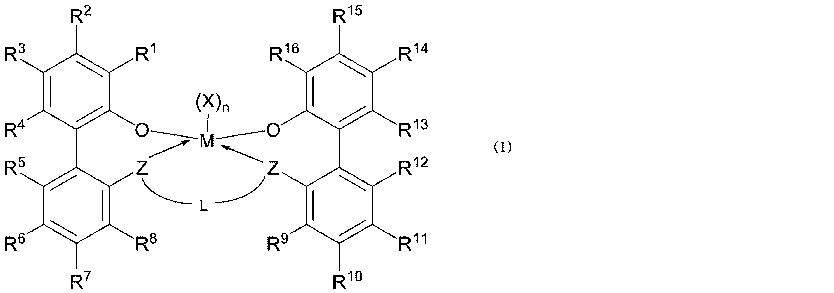
式中、
Mは、チタン、ジルコニウムおよびハフニウムであり、
nは、1、2、又は3であり、
各Xは、不飽和(C2~C50)炭化水素、不飽和(C2~C50)ヘテロ炭化水素、飽和(C2~C50)ヘテロ炭化水素、(C1~C50)ヒドロカルビル、(C6~C50)アリール、(C6~C50)ヘテロアリール、シクロペンタジエニル、置換シクロペンタジエニル、及び(C4~C12)ジエン、ハロゲンから独立して選択される単座の配位子であり、
その金属-配位子錯体が、全体的に電荷中性であり、
各Zは、-O-であり、
R1及びR16は独立して、-H、(C1~C40)ヒドロカルビル、(C1~C40)ヘテロヒドロカルビル、ハロゲン、式(II)を有するラジカル、式(III)を有するラジカル、及び式(IV)を有するラジカルからなる群から選択され、

式中、R31~35、R41~48、及びR51~59の各々は独立して、-H、(C1~C40)ヒドロカルビル、(C1~C40)ヘテロヒドロカルビル、-Si(RC)3、-Ge(RC)3、又はハロゲンから選択され、
R2、R3、R4、R5、R6、R7、R8、R9、R10、R11、R12、R13、R14、及びR15は独立して、-H,(C1~C40)ヒドロカルビル、(C1~C40)ヘテロヒドロカルビル、-Si(RC)3、及びハロゲンから選択され、
Lは、(C1~C40)ヒドロカルビレン又は(C2~C40)ヘテロヒドロカルビレンであり、
式(I)中の各RC、RP、及びRNは独立して、(C1~C30)ヒドロカルビル、(C1~C30)ヘテロヒドロカルビル、又は-Hである、1つ以上の金属-配位子錯体と、
を含み
前記触媒系が、ホウ酸活性化剤を含有しない、重合するプロセス。 1. A process for polymerizing olefin monomers, said process comprising reacting ethylene and optionally one or more olefin monomers in the presence of a catalyst system, said catalyst system comprising:
a hydrocarbyl-modified methylaluminoxane having less than 25 mole percent of trihydrocarbyl aluminum compounds AlR A1 R B1 R C1 , based on the total moles of aluminum in said hydrocarbyl-modified methylaluminoxane, where R A1 , R B1 , and R C1 are independently linear (C 1 -C 40 ) alkyl, branched (C 1 -C 40 ) alkyl, or (C 6 -C 40 ) aryl;
One or more metal-ligand complexes according to formula (I),
During the ceremony,
M is titanium, zirconium and hafnium ;
n is 1, 2, or 3;
each X is a monodentate ligand independently selected from unsaturated ( C2 - C50 ) hydrocarbon, unsaturated ( C2 - C50 ) heterohydrocarbon, saturated (C2-C50) heterohydrocarbon, ( C1 - C50 ) hydrocarbyl, ( C6 - C50 ) aryl, ( C6 - C50 ) heteroaryl, cyclopentadienyl, substituted cyclopentadienyl, and ( C4 - C12 ) diene, halogen;
the metal-ligand complex is globally charge neutral;
Each Z is -O- ;
R 1 and R 16 are independently selected from the group consisting of -H, (C 1 -C 40 )hydrocarbyl, (C 1 -C 40 )heterohydrocarbyl, halogen, a radical having formula (II), a radical having formula (III), and a radical having formula (IV);
wherein each of R 31-35 , R 41-48 , and R 51-59 is independently selected from -H, (C 1 -C 40 )hydrocarbyl, (C 1 -C 40 )heterohydrocarbyl, -Si(R C ) 3 , -Ge(R C ) 3 , or halogen;
R 2 , R 3 , R 4 , R 5 , R 6 , R 7 , R 8 , R 9 , R 10 , R 11 , R 12 , R 13 , R 14 , and R 15 are independently selected from -H, (C 1 -C 40 )hydrocarbyl, (C 1 -C 40 )heterohydrocarbyl, -Si(R C ) 3 , and halogen;
L is (C 1 -C 40 )hydrocarbylene or (C 2 -C 40 )heterohydrocarbylene;
one or more metal-ligand complexes, wherein each R C , R P , and R N in formula (I) is independently (C 1 -C 30 )hydrocarbyl, (C 1 -C 30 )heterohydrocarbyl, or -H ;
wherein the catalyst system does not contain a boric acid activator.
2. The polymerization process of claim 1, wherein the olefin monomer is a cyclic olefin.
Applications Claiming Priority (3)
| Application Number | Priority Date | Filing Date | Title |
|---|---|---|---|
| US202063053342P | 2020-07-17 | 2020-07-17 | |
| US63/053,342 | 2020-07-17 | ||
| PCT/US2021/016789 WO2022015368A1 (en) | 2020-07-17 | 2021-02-05 | Hydrocarbyl-modified methylaluminoxane cocatalysts for bis-phenylphenoxy metal-ligand complexes |
Publications (2)
| Publication Number | Publication Date |
|---|---|
| JP2023541768A JP2023541768A (en) | 2023-10-04 |
| JP7705921B2 true JP7705921B2 (en) | 2025-07-10 |
Family
ID=74853739
Family Applications (1)
| Application Number | Title | Priority Date | Filing Date |
|---|---|---|---|
| JP2023502989A Active JP7705921B2 (en) | 2020-07-17 | 2021-02-05 | Hydrocarbyl-modified methylaluminoxane cocatalysts for bis-phenylphenoxy metal-ligand complexes |
Country Status (7)
| Country | Link |
|---|---|
| US (1) | US20240010770A1 (en) |
| EP (1) | EP4182366A1 (en) |
| JP (1) | JP7705921B2 (en) |
| KR (1) | KR20230039698A (en) |
| CN (1) | CN116323686A (en) |
| BR (1) | BR112023000804A2 (en) |
| WO (1) | WO2022015368A1 (en) |
Families Citing this family (3)
| Publication number | Priority date | Publication date | Assignee | Title |
|---|---|---|---|---|
| CN119731219A (en) * | 2022-08-29 | 2025-03-28 | 陶氏环球技术有限责任公司 | Method for producing multimodal polyethylene using at least one group III or lanthanide-based biphenylphenoxy catalyst |
| WO2024074937A1 (en) * | 2022-10-07 | 2024-04-11 | Sabic Sk Nexlene Company Pte. Ltd. | Transition metal compound, catalyst composition containing the same, and method for preparing olefin polymer using the same |
| USD1107062S1 (en) * | 2023-10-11 | 2025-12-23 | Samsung Electronics Co., Ltd. | Display screen or portion thereof with graphical user interface |
Citations (7)
| Publication number | Priority date | Publication date | Assignee | Title |
|---|---|---|---|---|
| JP2000510888A (en) | 1996-05-10 | 2000-08-22 | アルベマール・コーポレーシヨン | Use of heat-treated alumoxanes in the preparation of supported catalysts |
| JP2004182963A (en) | 2002-04-08 | 2004-07-02 | Tosoh Finechem Corp | Method for producing olefin polymerization catalyst and modified methylaluminoxane for olefin polymerization catalyst |
| US20130144018A1 (en) | 2010-08-25 | 2013-06-06 | Dow Global Technologies Llc | Process for polymerizing a polymerizable olefin and catalyst therefor |
| JP2013534934A (en) | 2010-05-17 | 2013-09-09 | ダウ グローバル テクノロジーズ エルエルシー | Method for selectively polymerizing ethylene and catalyst therefor |
| JP2018080234A (en) | 2016-11-15 | 2018-05-24 | 国立大学法人広島大学 | Phenol-modified modified methylaluminoxane-containing composition |
| WO2019067274A1 (en) | 2017-09-29 | 2019-04-04 | Dow Global Technologies Llc | Bis-phenyl-phenoxy polyolefin catalysts having two methylenetrialkylsilicon ligands on the metal for improved solubility |
| JP2020512462A (en) | 2017-03-31 | 2020-04-23 | ダウ グローバル テクノロジーズ エルエルシー | Bis-biphenyl-phenoxy catalyst for olefin polymerization |
Family Cites Families (26)
| Publication number | Priority date | Publication date | Assignee | Title |
|---|---|---|---|---|
| US4960878A (en) * | 1988-12-02 | 1990-10-02 | Texas Alkyls, Inc. | Synthesis of methylaluminoxanes |
| US5041584A (en) * | 1988-12-02 | 1991-08-20 | Texas Alkyls, Inc. | Modified methylaluminoxane |
| US5066631A (en) | 1990-10-16 | 1991-11-19 | Ethyl Corporation | Hydrocarbon solutions of alkylaluminoxane compounds |
| US5728855A (en) | 1995-10-19 | 1998-03-17 | Akzo Nobel Nv | Modified polyalkylaluminoxane composition formed using reagent containing carbon-oxygen double bond |
| US5777143A (en) | 1995-12-22 | 1998-07-07 | Akzo Nobel Nv | Hydrocarbon soluble alkylaluminoxane compositions formed by use of non-hydrolytic means |
| US6103657A (en) | 1997-07-02 | 2000-08-15 | Union Carbide Chemicals & Plastics Technology Corporation | Catalyst for the production of olefin polymers |
| US6828397B2 (en) | 2000-11-07 | 2004-12-07 | Symyx Technologies, Inc. | Methods of copolymerizing ethylene and isobutylene and polymers made thereby |
| US6960635B2 (en) | 2001-11-06 | 2005-11-01 | Dow Global Technologies Inc. | Isotactic propylene copolymers, their preparation and use |
| US6869904B2 (en) | 2002-04-24 | 2005-03-22 | Symyx Technologies, Inc. | Bridged bi-aromatic ligands, catalysts, processes for polymerizing and polymers therefrom |
| US6953764B2 (en) | 2003-05-02 | 2005-10-11 | Dow Global Technologies Inc. | High activity olefin polymerization catalyst and process |
| WO2006020624A1 (en) * | 2004-08-09 | 2006-02-23 | Dow Global Technologies Inc. | Supported bis(hydroxyarylaryloxy) catalysts for manufacture of polymers |
| AR060642A1 (en) | 2006-05-17 | 2008-07-02 | Dow Global Technologies Inc | ETHYLENE / ALPHA-OLEFINE / DIENO AND POLYMER SOLUTION POLYMERIZATION PROCESS |
| CN101563374B (en) * | 2006-12-20 | 2012-09-05 | 埃克森美孚化学专利公司 | Phase separator and monomer recycle for supercritical polymerization process |
| KR101529340B1 (en) | 2007-08-29 | 2015-06-16 | 알베마를 코포레이션 | Aluminoxane catalyst activators derived from dialkylaluminum cation precursor agents, processes for making same, and use thereof in catalysts and polymerization of olefins |
| US20130059991A1 (en) * | 2010-02-12 | 2013-03-07 | Sumitomo Chemical Company, Limited | Catalyst for stereoselective olefin polymerization and method for manufacturing stereoselective polyolefin |
| CN104884484B (en) * | 2012-12-27 | 2018-09-14 | 陶氏环球技术有限责任公司 | Polymerization for generating polyvinyls |
| US9751998B2 (en) | 2012-12-27 | 2017-09-05 | Dow Global Technologies Llc | Catalyst systems for olefin polymerization |
| US10526431B2 (en) | 2014-06-30 | 2020-01-07 | Dow Global Technologies Llc | Catalyst systems for olefin polymerization |
| JP6805125B2 (en) | 2014-07-24 | 2020-12-23 | ダウ グローバル テクノロジーズ エルエルシー | Bis-biphenyl phenoxy catalyst for low molecular weight ethylene polymer polymerization |
| ES2785628T3 (en) * | 2015-06-30 | 2020-10-07 | Dow Global Technologies Llc | A polymerization process to produce ethylene-based polymers |
| EP3356431B1 (en) | 2015-09-30 | 2020-04-22 | Dow Global Technologies LLC | Procatalyst and polymerization process using the same |
| EP3491034A1 (en) | 2016-07-29 | 2019-06-05 | Dow Global Technologies, LLC | Silyl-bridged bis-biphenyl-phenoxy catalysts for olefin polymerization |
| BR112019006072B1 (en) * | 2016-09-29 | 2023-02-14 | Dow Global Technologies Llc | METHOD OF POLYMERIZATION OF AN OLEFIN USING A ZIEGLER-NATTA CATALYST AND AN UNSUPPORTED MOLECULAR CATALYST IN THE SAME REACTOR AT THE SAME TIME AND POLYMERIZATION METHOD |
| WO2019191068A1 (en) * | 2018-03-30 | 2019-10-03 | Dow Global Technologies Llc | Olefin polymerization activators |
| KR102836334B1 (en) * | 2018-08-30 | 2025-07-21 | 다우 글로벌 테크놀로지스 엘엘씨 | Bis-phenyl-phenoxy polyolefin procatalyst having two anthracenyl ligands |
| JP7463378B2 (en) * | 2018-12-28 | 2024-04-08 | ダウ グローバル テクノロジーズ エルエルシー | CURABLE COMPOSITION COMPRISING UNSATURATED POLYOLEFIN - Patent application |
-
2021
- 2021-02-05 US US18/005,750 patent/US20240010770A1/en active Pending
- 2021-02-05 WO PCT/US2021/016789 patent/WO2022015368A1/en not_active Ceased
- 2021-02-05 KR KR1020237005189A patent/KR20230039698A/en active Pending
- 2021-02-05 EP EP21709542.1A patent/EP4182366A1/en active Pending
- 2021-02-05 JP JP2023502989A patent/JP7705921B2/en active Active
- 2021-02-05 BR BR112023000804A patent/BR112023000804A2/en unknown
- 2021-02-05 CN CN202180060770.3A patent/CN116323686A/en active Pending
Patent Citations (9)
| Publication number | Priority date | Publication date | Assignee | Title |
|---|---|---|---|---|
| JP2000510888A (en) | 1996-05-10 | 2000-08-22 | アルベマール・コーポレーシヨン | Use of heat-treated alumoxanes in the preparation of supported catalysts |
| JP2004182963A (en) | 2002-04-08 | 2004-07-02 | Tosoh Finechem Corp | Method for producing olefin polymerization catalyst and modified methylaluminoxane for olefin polymerization catalyst |
| JP2013534934A (en) | 2010-05-17 | 2013-09-09 | ダウ グローバル テクノロジーズ エルエルシー | Method for selectively polymerizing ethylene and catalyst therefor |
| US20140163186A1 (en) | 2010-05-17 | 2014-06-12 | Dow Global Technologies Llc | Process for selectively polymerizing ethylene and catalyst therefor |
| US20130144018A1 (en) | 2010-08-25 | 2013-06-06 | Dow Global Technologies Llc | Process for polymerizing a polymerizable olefin and catalyst therefor |
| JP2018080234A (en) | 2016-11-15 | 2018-05-24 | 国立大学法人広島大学 | Phenol-modified modified methylaluminoxane-containing composition |
| JP2020512462A (en) | 2017-03-31 | 2020-04-23 | ダウ グローバル テクノロジーズ エルエルシー | Bis-biphenyl-phenoxy catalyst for olefin polymerization |
| WO2019067274A1 (en) | 2017-09-29 | 2019-04-04 | Dow Global Technologies Llc | Bis-phenyl-phenoxy polyolefin catalysts having two methylenetrialkylsilicon ligands on the metal for improved solubility |
| JP2020535263A (en) | 2017-09-29 | 2020-12-03 | ダウ グローバル テクノロジーズ エルエルシー | Bisphenylphenoxy polyolefin catalyst with two methylenetrialkylsilicon ligands on the metal to improve solubility |
Also Published As
| Publication number | Publication date |
|---|---|
| CN116323686A (en) | 2023-06-23 |
| JP2023541768A (en) | 2023-10-04 |
| WO2022015368A1 (en) | 2022-01-20 |
| WO2022015368A8 (en) | 2023-06-01 |
| EP4182366A1 (en) | 2023-05-24 |
| US20240010770A1 (en) | 2024-01-11 |
| KR20230039698A (en) | 2023-03-21 |
| BR112023000804A2 (en) | 2023-02-07 |
Similar Documents
| Publication | Publication Date | Title |
|---|---|---|
| EP3601387B1 (en) | Germanium-bridged bis-biphenyl-phenoxy catalysts for olefin polymerization | |
| CN110461890B (en) | Bis-biphenyl-phenoxy catalysts for olefin polymerization | |
| JP7705921B2 (en) | Hydrocarbyl-modified methylaluminoxane cocatalysts for bis-phenylphenoxy metal-ligand complexes | |
| JP7752676B2 (en) | Hydrocarbyl-modified methylaluminoxane cocatalysts for bis-phenylphenoxy metal-ligand complexes | |
| KR102729120B1 (en) | Highly soluble bis-borates as heteronuclear co-catalysts for olefin polymerization | |
| WO2024050367A1 (en) | Multimodal polymerization processes with multi-catalyst systems | |
| JP2023534663A (en) | Hydrocarbyl-modified methylaluminoxane cocatalysts for bis-phenylphenoxy metal-ligand complexes | |
| JP7726977B2 (en) | Hydrocarbyl-modified methylaluminoxane cocatalysts for constrained geometry procatalysts. | |
| JP2024506482A (en) | Hydrocarbyl-modified methylaluminoxane cocatalysts for bis-phenylphenoxy metal-ligand complexes | |
| US20250129191A1 (en) | Borate cocatalysts for polyolefin production | |
| CN117999292A (en) | Hydrocarbon-soluble borate cocatalysts for olefin polymerization |
Legal Events
| Date | Code | Title | Description |
|---|---|---|---|
| A521 | Request for written amendment filed |
Free format text: JAPANESE INTERMEDIATE CODE: A523 Effective date: 20230421 |
|
| A529 | Written submission of copy of amendment under article 34 pct |
Free format text: JAPANESE INTERMEDIATE CODE: A529 Effective date: 20230116 |
|
| RD03 | Notification of appointment of power of attorney |
Free format text: JAPANESE INTERMEDIATE CODE: A7423 Effective date: 20230428 |
|
| RD04 | Notification of resignation of power of attorney |
Free format text: JAPANESE INTERMEDIATE CODE: A7424 Effective date: 20230601 |
|
| A621 | Written request for application examination |
Free format text: JAPANESE INTERMEDIATE CODE: A621 Effective date: 20240123 |
|
| A977 | Report on retrieval |
Free format text: JAPANESE INTERMEDIATE CODE: A971007 Effective date: 20250127 |
|
| A131 | Notification of reasons for refusal |
Free format text: JAPANESE INTERMEDIATE CODE: A131 Effective date: 20250204 |
|
| A521 | Request for written amendment filed |
Free format text: JAPANESE INTERMEDIATE CODE: A523 Effective date: 20250502 |
|
| TRDD | Decision of grant or rejection written | ||
| A01 | Written decision to grant a patent or to grant a registration (utility model) |
Free format text: JAPANESE INTERMEDIATE CODE: A01 Effective date: 20250603 |
|
| A61 | First payment of annual fees (during grant procedure) |
Free format text: JAPANESE INTERMEDIATE CODE: A61 Effective date: 20250630 |
|
| R150 | Certificate of patent or registration of utility model |
Ref document number: 7705921 Country of ref document: JP Free format text: JAPANESE INTERMEDIATE CODE: R150 |