JP7696832B2 - Method for producing 225-actinium from 226-radium - Google Patents
Method for producing 225-actinium from 226-radium Download PDFInfo
- Publication number
- JP7696832B2 JP7696832B2 JP2021569159A JP2021569159A JP7696832B2 JP 7696832 B2 JP7696832 B2 JP 7696832B2 JP 2021569159 A JP2021569159 A JP 2021569159A JP 2021569159 A JP2021569159 A JP 2021569159A JP 7696832 B2 JP7696832 B2 JP 7696832B2
- Authority
- JP
- Japan
- Prior art keywords
- actinium
- eluent
- radium
- target solution
- adsorbent
- Prior art date
- Legal status (The legal status is an assumption and is not a legal conclusion. Google has not performed a legal analysis and makes no representation as to the accuracy of the status listed.)
- Active
Links
Images


Classifications
-
- G—PHYSICS
- G21—NUCLEAR PHYSICS; NUCLEAR ENGINEERING
- G21G—CONVERSION OF CHEMICAL ELEMENTS; RADIOACTIVE SOURCES
- G21G1/00—Arrangements for converting chemical elements by electromagnetic radiation, corpuscular radiation or particle bombardment, e.g. producing radioactive isotopes
- G21G1/001—Recovery of specific isotopes from irradiated targets
-
- G—PHYSICS
- G21—NUCLEAR PHYSICS; NUCLEAR ENGINEERING
- G21G—CONVERSION OF CHEMICAL ELEMENTS; RADIOACTIVE SOURCES
- G21G1/00—Arrangements for converting chemical elements by electromagnetic radiation, corpuscular radiation or particle bombardment, e.g. producing radioactive isotopes
- G21G1/04—Arrangements for converting chemical elements by electromagnetic radiation, corpuscular radiation or particle bombardment, e.g. producing radioactive isotopes outside nuclear reactors or particle accelerators
- G21G1/10—Arrangements for converting chemical elements by electromagnetic radiation, corpuscular radiation or particle bombardment, e.g. producing radioactive isotopes outside nuclear reactors or particle accelerators by bombardment with electrically charged particles
-
- G—PHYSICS
- G21—NUCLEAR PHYSICS; NUCLEAR ENGINEERING
- G21G—CONVERSION OF CHEMICAL ELEMENTS; RADIOACTIVE SOURCES
- G21G1/00—Arrangements for converting chemical elements by electromagnetic radiation, corpuscular radiation or particle bombardment, e.g. producing radioactive isotopes
- G21G1/04—Arrangements for converting chemical elements by electromagnetic radiation, corpuscular radiation or particle bombardment, e.g. producing radioactive isotopes outside nuclear reactors or particle accelerators
- G21G1/12—Arrangements for converting chemical elements by electromagnetic radiation, corpuscular radiation or particle bombardment, e.g. producing radioactive isotopes outside nuclear reactors or particle accelerators by electromagnetic irradiation, e.g. with gamma or X-rays
-
- G—PHYSICS
- G21—NUCLEAR PHYSICS; NUCLEAR ENGINEERING
- G21G—CONVERSION OF CHEMICAL ELEMENTS; RADIOACTIVE SOURCES
- G21G1/00—Arrangements for converting chemical elements by electromagnetic radiation, corpuscular radiation or particle bombardment, e.g. producing radioactive isotopes
- G21G1/001—Recovery of specific isotopes from irradiated targets
- G21G2001/0089—Actinium
Landscapes
- Chemical & Material Sciences (AREA)
- Chemical Kinetics & Catalysis (AREA)
- General Chemical & Material Sciences (AREA)
- Physics & Mathematics (AREA)
- Engineering & Computer Science (AREA)
- General Engineering & Computer Science (AREA)
- High Energy & Nuclear Physics (AREA)
- Extraction Or Liquid Replacement (AREA)
- Treatment Of Liquids With Adsorbents In General (AREA)
Description
本発明は、226ラジウムから225アクチニウムを生成するための方法であって、226ラジウムを含有する液体ターゲット溶液を準備し、この液体ターゲット溶液が照射装置内で照射されて、液体ターゲット溶液中に含有される226ラジウムから出発して液体ターゲット溶液中に225アクチニウムを生成する方法に関し、生成された225アクチニウムの少なくとも一部は、残留226ラジウムから分離されている。 The present invention relates to a method for producing 225- actinium from 226- radium, comprising providing a liquid target solution containing 226- radium, which liquid target solution is irradiated in an irradiation device to produce 225- actinium in the liquid target solution starting from the 226- radium contained therein, at least a portion of the produced 225- actinium being separated from the remaining 226- radium.
225アクチニウムは、癌治療に使用するための興味深い放射性核種である。225アクチニウムは、10日間の半減期を有するα放出放射性同位体である。それは、放射線免疫療法のための薬剤として使用することができる。α粒子放射体は、それらの高密度の電離放射線のために、単一の癌細胞及び微小転移物の致死的な照射のための有望な供給源である。α粒子は、軟組織におけるそれらの範囲がわずか数個の細胞直径に限定されているため、放射線免疫療法用途にとってかなり興味深い。 225 Actinium is an interesting radionuclide for use in cancer therapy. 225 Actinium is an alpha-emitting radioisotope with a half-life of 10 days. It can be used as an agent for radioimmunotherapy. Alpha particle emitters are promising sources for lethal irradiation of single cancer cells and micrometastases due to their high density of ionizing radiation. Alpha particles are of considerable interest for radioimmunotherapy applications because their range in soft tissues is limited to only a few cell diameters.
225アクチニウムを生成するためのいくつかの可能な方法があるが、要求を満たすのに必要な量で225アクチニウムを生成することを可能にする新しいより安全な生成方法が依然として必要とされている。 Although there are several possible methods for producing 225- actinium, there remains a need for new, safer production methods that allow for the production of 225- actinium in the quantities necessary to meet demand.
例えば、特許文献1に開示されているように、229トリウムの放射性崩壊によって225アクチニウムを生成することができる。これは、医療用途のための225Acを生成するための現在の主な方法である。この方法は、229Th/225Ra/225Ac発生器(Boll2005)を利用し、225Acは、229Thのアルファ崩壊及びその娘225Raからの放射性内部成長によって常に生成される。発生器は、放射化学的に純粋な225Ra及び225Acを6~8週間ごとに生成する。225Acの最大活性は、発生器内に存在する229Thの総量に制限される。229Thと225Ra/225Acとの間の化学的分離は、通常、イオン交換に基づく。現在、このような発生器は世界中に3つ存在する。ORNL(USA)は年間最大720mCiの225Acを供給している。同様の量がロシアのオブニンスクのInstitute of Physics and Power Engineeringから入手可能であると報告されており、カールスルーエのEuropean Commission directorate Gは、より少ない229Th供給源(年間最大350mCiの225Acを生成することができる)を維持している。しかしながら、問題は、225Acの需要が既存の発電機からの総生成速度よりも既に高いことである。他方、229Thは、希少同位体(233Uに由来する)であり、世界中で利用可能性が限られている。233U及び229Thの長い半減期のために、生成方法が調査されているにもかかわらず、229Thの在庫を有意に増加させることができる可能性はない(Jost2013)。 For example, as disclosed in US Pat. No. 5,399,636, 225 Actinium can be produced by radioactive decay of 229 Thorium. This is the current main method for producing 225 Ac for medical applications. This method utilizes a 229 Th/ 225 Ra/ 225 Ac generator (Boll 2005), where 225 Ac is constantly produced by alpha decay of 229 Th and radioactive ingrowth from its daughter 225 Ra. The generator produces radiochemically pure 225 Ra and 225 Ac every 6-8 weeks. The maximum activity of 225 Ac is limited to the total amount of 229 Th present in the generator. Chemical separation between 229 Th and 225 Ra/ 225 Ac is usually based on ion exchange. Currently, there are three such generators in the world. ORNL (USA) supplies up to 720 mCi of 225 Ac per year. Similar amounts are reportedly available from the Institute of Physics and Power Engineering in Obninsk, Russia, and the European Commission Directorate G in Karlsruhe maintains a smaller 229 Th source (capable of producing up to 350 mCi of 225 Ac per year). The problem, however, is that the demand for 225 Ac is already higher than the total production rate from existing generators. 229 Th, on the other hand, is a rare isotope (derived from 233 U) with limited availability worldwide. Due to the long half-lives of 233 U and 229 Th, it is unlikely that 229 Th stocks can be significantly increased, although production methods are being investigated (Jost 2013).
225アクチニウムを生成するための別の方法は、232トリウムターゲットのプロトン又は重水素照射による225Acの生成からなる。この方法は、加速器施設(Ermalaev2012、Weidner2012)内のサイクロトロン又は中~高エネルギーのプロトン(>80MeV)によって中エネルギーのプロトン又は重水素(24~50MeV)(Morgenstern2006)で照射される厚い232Th金属ターゲット(天然Th)の製造に基づいている。中程度のエネルギーのプロトン又は重水素では、225Acの生成は、232Th(p,4n)229Pa及び232Th(d,5n)229Paに基づき、その後、低収率の0.48%β+崩壊を伴い、同位体的に純粋な225Acになる。必要なプロトン及び重水素エネルギーは、今日の市販のサイクロトロンの範囲内であるが、興味深い生成速度を得るためには非常に高い電流が必要である。高エネルギープロトンの232Th(p,x)反応による225Acの直接生成は、225Acの生成のみに感度がなく、隣接する同位体が同等の高断面積で生成される。実際、Ciレベル225Acは、一週間の照射(Ermolaev2012、Griswold2016)で高エネルギープロトンによって生成することができるが、直接の治療的使用は、活性比227Ac/225Ac=0.2%(Griswold2016)で生成される長寿命(27年)アルファ放射体である227Ac(Ermolaev2012)の同時生成によって妨げられる可能性がある。照射されたトリウムターゲットからのアクチニウムの化学的分離は、照射後の錯体同位体混合物に起因して、かなり複雑であり、通常は一連のイオン交換カラムに基づいている。227Acからの225Acの分離及び精製は、必要に応じて同位体分離であり、通常の化学的方法を用いて達成することはできない。これは、照射(ISOLDE)中にライン上で実行することができる非常に複雑な質量分離を必要とする。必要なプロトン電流(>100uA)及び高プロトンエネルギー(90~200MeV)は、現在の市販のサイクロトロンを超えている。実際、必要な強度の中~高エネルギーを有するプロトンを生成することができる加速器設備は、世界中に限られた数しかない(Zhuikov2011)。ライン上で同位体分離を実行することができるものは、さらに少ない。 Another method for producing 225- actinium consists of the production of 225 Ac by proton or deuterium irradiation of 232 -thorium targets. This method is based on the production of thick 232 Th metal targets (natural Th) which are irradiated with medium energy protons or deuterium (24-50 MeV) (Morgenstern 2006) by cyclotrons or medium to high energy protons (>80 MeV) in accelerator facilities (Ermalaev 2012; Weidner 2012). With medium energy protons or deuterium, the production of 225 Ac is based on 232 Th(p,4n) 229 Pa and 232 Th(d,5n) 229 Pa, followed by a low yield of 0.48% β + decay to isotopically pure 225 Ac. The required proton and deuterium energies are within the range of today's commercial cyclotrons, but very high currents are required to obtain interesting production rates. Direct production of 225 Ac by the 232 Th(p,x) reaction of high-energy protons is not sensitive to the production of 225 Ac alone, as adjacent isotopes are produced with comparable high cross sections. Indeed, Ci-level 225 Ac can be produced by high-energy protons with a week of irradiation (Ermolaev 2012, Griswold 2016), but direct therapeutic use may be hindered by the simultaneous production of 227 Ac (Ermolaev 2012), a long-lived (27 years) alpha emitter produced with an activity ratio of 227 Ac/ 225 Ac = 0.2% (Griswold 2016). Chemical separation of actinium from irradiated thorium targets is rather complicated due to the complex isotope mixture after irradiation and is usually based on a series of ion exchange columns. Separation and purification of 225 Ac from 227 Ac, which is an isotope separation by necessity, cannot be achieved using normal chemical methods. This requires very complicated mass separation that can be performed on-line during irradiation (ISOLDE). The required proton currents (>100 uA) and high proton energies (90-200 MeV) exceed the current commercially available cyclotrons. In fact, there are only a limited number of accelerator facilities worldwide that can generate protons with medium to high energies of the required intensity (Zhuikov 2011). Even fewer can perform isotope separation on-line.
225アクチニウムを製造する別の方法は、例えば、特許文献2及び特許文献3に開示されており、226Raのプロトン又は重水素照射による225Acの生成からなる。この方法は、気密水冷ターゲットホルダに配置され、プロトン(Koch1999、Apostolidis2004)又は重水素(Abbas2004)で照射される226Raの薄い固体ターゲットの製造に基づいている。225Acの化学分離後、残留226Raは再処理され、新しいターゲットの生成のためにリサイクルされ、それによってラジウム照射サイクルを閉じる。照射方法は、mCiレベルの225Acが生成されるサイクロトロン照射試験でうまく証明された。226Ra(p,2n)225Ac反応について16.8MeVのプロトンで0.71mbの断面積を実証することができ、ターゲット溶解及び化学分離を通して、225Ac生成物が229Th/226Ra/225Ac発生器から生成された225Acと同じ高い放射化学的品質を有することがさらに実証された(Apostolidis2005)。 Another method for producing 225- actinium is disclosed, for example, in US Pat. No. 5,399,623 and US Pat. No. 5,499,633 and consists of the production of 225 Ac by proton or deuterium irradiation of 226 Ra. This method is based on the production of a thin solid target of 226 Ra, which is placed in a gas-tight water-cooled target holder and irradiated with protons (Koch 1999; Apostolidis 2004) or deuterium (Abbas 2004). After chemical separation of 225 Ac, the remaining 226 Ra is reprocessed and recycled for the production of new targets, thereby closing the radium irradiation cycle. The irradiation method has been successfully demonstrated in cyclotron irradiation tests, where mCi levels of 225 Ac were produced. A cross section of 0.71 mb with 16.8 MeV protons could be demonstrated for the 226 Ra(p,2n) 225 Ac reaction, and it was further demonstrated through target dissolution and chemical separation that the 225 Ac product has the same high radiochemical quality as 225 Ac produced from a 229 Th/ 226 Ra/ 225 Ac generator (Apostolidis 2005).
しかしながら、この方法のさらなる開発及び実証は、226Ra溶液の複雑な取り扱いのために停止した。226Raは、かなり長寿命のアルファ放射体であり、強く放射性であり、比較的少量で使用する場合でも遮蔽する必要がある。しかしながら、主な問題は、226Raのアルファ崩壊で直接生成される222Rn(ラドン)の存在である。実際、ラドンが終始、分離及び除去されない場合、226Raと222Rnは数週間後に同じ放射能レベルを有する放射平衡に達する。ラドン(222Rn)は、希ガスであるため含有が非常に困難であるので、深刻な問題を抱えている。したがって、大量の226Raを取り扱うには、ラジウム汚染及び/又はラドン放出を最小限に抑えるために、大きな通気流を有する高温セル及びグローブボックスなどの加圧下の遮蔽設備と、取扱アプローチを通した非常に慎重で十分な考慮が必要である。固体照射226Raターゲットの溶解、225Acの化学的精製及び226Raの再処理並びにターゲット生成はすべて、プロセス全体をラドン放出に対して敏感にする開放プロセスである。 However, further development and demonstration of this method was halted due to the complex handling of 226 Ra solutions. 226 Ra is a fairly long-lived alpha emitter, strongly radioactive, and needs to be shielded even when used in relatively small amounts. However, the main problem is the presence of 222 Rn (radon), which is produced directly in the alpha decay of 226 Ra. In fact, if radon is not separated and removed throughout, 226 Ra and 222 Rn reach a radioactive equilibrium with the same radioactivity levels after a few weeks. Radon ( 222 Rn) poses serious problems because it is a rare gas and therefore very difficult to contain. Therefore, handling large amounts of 226 Ra requires pressurized shielding facilities such as high temperature cells and glove boxes with large airflows, and very careful and careful consideration throughout the handling approach to minimize radium contamination and/or radon release. Melting of solid irradiated 226 Ra targets, chemical refining of 225 Ac and reprocessing of 226 Ra as well as target preparation are all open processes that make the entire process sensitive to radon emissions.
このようなプロセスでは、照射は通常、高温セル/グローブボックスの外側で行われるため、ターゲットの取り扱いが特に重要である。投入後のターゲットは、汚染がなく気密でなければならない。ターゲット及び薄いターゲットウィンドウの水冷は、ターゲットの故障を回避するために使用されるプロトン電流に対して最適化されなければならない。この方法の大きな利点は、プロトン照射によるPET同位体の生成を目的とした市販のサイクロトロンを使用できることである。それらは、適切な電流で、最適化されたプロトンエネルギーを送達することができる。しかしながら、上記の欠点のために、この興味深い225Acの生成方法のさらなる開発は中止された。 In such processes, the handling of the target is particularly important, since the irradiation is usually performed outside the hot cell/glove box. The target after loading must be free of contamination and gas-tight. The water cooling of the target and the thin target window must be optimized for the proton current used to avoid target failure. A major advantage of this method is that commercially available cyclotrons intended for the production of PET isotopes by proton irradiation can be used. They can deliver optimized proton energies at appropriate currents. However, due to the above mentioned drawbacks, further development of this interesting method for the production of 225 Ac was discontinued.
以前の生成方法と同じ欠点を有するが、225アクチニウムを生成するための別の方法は、例えば、特許文献4に開示されている。この方法は、中性子又は高強度ガンマ線照射による226Raの照射による225Acの生成からなる(これは、特許文献4において、変換材料の使用によってガンマ線に変換される電子ビームによって達成される)。これは、226Raの(γ、n)又は(n、2n)反応を利用して、225Acへと崩壊する225Raを生成する。光子反応(γ、n)は、電子加速器で制動放射として生成される強いガンマ線の場を利用するが、中性子は高速反応器で、又は加速器施設の破砕源によって生成される。226Raから225Acを生成するために、18MVリニアックの線形(医療)加速器を使用したが、断面積は実用には小さすぎた(Melville2007)。後の研究では、より大量の226Raのより強力な加速器照射が実現可能な方法であり得ると述べられた(Melville2009)。ラジウムの取り扱いに関して、この生成方法は、固体Raターゲットのプロトン照射と同じ欠点を抱えている。226Raターゲットは、実際に製造され、照射され、溶解され、アクチニウム生成物が分離され、ラジウムが新しいターゲット生成のために再処理されなければならない。非常に大きな(数十グラム以上の)226Raターゲットが必要とされる可能性が高いが、プロトン照射と比較して、熱除去の問題が少なく、ターゲットウィンドウを薄くする必要がないので、ターゲット技術及び照射はおそらく技術的に容易である。それにもかかわらず、光子又は中性子反応は、適切な生成レベルに達するために、原子炉、高強度線形加速器又はシンクロトロンなどの大型施設を必要とする。 Another method for producing 225 actinium, although it has the same drawbacks as the previous production method, is disclosed, for example, in US Pat. No. 5,399,663. This method consists in producing 225 Ac by irradiation of 226 Ra with neutrons or high-intensity gamma irradiation (this is achieved in US Pat. No. 5,399,663 by an electron beam that is converted to gamma rays by the use of a conversion material). It uses the (γ,n) or (n,2n) reaction of 226 Ra to produce 225 Ra, which decays to 225 Ac. The photon reaction (γ,n) uses a strong gamma ray field that is produced as bremsstrahlung in an electron accelerator, while neutrons are produced in fast reactors or by spallation sources at accelerator facilities. To produce 225 Ac from 226 Ra, a linear (medical) accelerator with an 18 MV linac was used, but the cross section was too small for practical use (Melville 2007). Later studies stated that more powerful accelerator irradiation of larger quantities of 226 Ra could be a feasible method (Melville 2009). With regard to the handling of radium, this production method suffers from the same drawbacks as proton irradiation of solid Ra targets. 226 Ra targets must actually be manufactured, irradiated, melted, the actinium products separated, and the radium reprocessed for new target production. Although very large (tens of grams or more) 226 Ra targets would likely be required, the target technology and irradiation are probably technically easier compared to proton irradiation, since there are fewer problems with heat removal and no need to thin the target window. Nevertheless, photon or neutron reactions require large facilities such as nuclear reactors, high-intensity linear accelerators or synchrotrons to reach adequate production levels.
要約すると、229Thからの崩壊生成物としての225Acの現在の生成方法は、治療的処置における将来の需要を満たすために容易に増加又は拡大することができない。アクチニウムは、(p,2n)反応によるラジウムの照射により、市販のサイクロトロンで生成することができる。しかしながら、226Raの取り扱いは、その娘ラドンのために非常に困難である。提案された技術は、固体ターゲットのサイクロトロン(プロトン又は重水素)又はシンクロトロン(ガンマ線)照射に基づいており、ターゲット製造、照射、ターゲット溶解、アクチニウム分離、及び最後に、サイクルを閉じるために新しい固体ターゲットへのRaの再処理を必要とする。荷電粒子(プロトン、重水素)の照射において、ターゲット及び薄いターゲットウィンドウの熱除去(冷却)は、粒子電流を制限し、それによって生成能力を制限する。ラドン放出は、このようなプロセスにおいて常に懸念されるであろう。(γ、n)反応では、ターゲットウィンドウは限定されないが、そのようなプロセスはおそらく大量から非常に大量の226Ra及び電子加速器設備を必要とする。232Thの高エネルギープロトン照射に基づく方法は、227Acを除去するための質量分離に基づく非常に複雑な同位体分離を必要とする可能性がある。 In summary, the current production methods of 225 Ac as a decay product from 229 Th cannot be easily increased or scaled up to meet future demands in therapeutic treatments. Actinium can be produced in commercial cyclotrons by irradiation of radium via the (p,2n) reaction. However, handling of 226 Ra is very difficult due to its daughter radon. The proposed technology is based on cyclotron (proton or deuterium) or synchrotron (gamma ray) irradiation of solid targets and requires target fabrication, irradiation, target melting, actinium separation, and finally, reprocessing of Ra into a new solid target to close the cycle. In the irradiation of charged particles (protons, deuterium), the heat removal (cooling) of the target and the thin target window limits the particle current and thereby the production capacity. Radon emission will always be a concern in such processes. In the (γ,n) reaction, the target window is not limited, but such processes would likely require large to very large quantities of 226 Ra and electron accelerator facilities. Methods based on high energy proton bombardment of 232 Th may require very complex isotope separation based on mass separation to remove 227 Ac.
本発明による方法では、226ラジウムの溶液を含む液体ターゲットを使用する。このような液体ターゲットの使用は、特許文献4に開示されている。この既知の方法では、226Raは、ガンマ線照射によって、14.8日間の半減期を有する225Raに変換され、その後に、225Acに変換される。226Raの225Raへの変換は、光子を生成する変換材料に電子を当てることによって達成される。226Raは、変換材料上にコーティングされるが、十分な生成物が生成されるまで、変換材料上を流れる溶液にリサイクルされてもよい。226Ra溶液は、石英バイアル内に収容され、照射されてもよい。 The method according to the invention uses a liquid target containing a solution of radium 226. The use of such a liquid target is disclosed in US Pat. No. 5,399,633. In this known method, 226 Ra is converted by gamma irradiation into 225 Ra, which has a half-life of 14.8 days, and then into 225 Ac. The conversion of 226 Ra to 225 Ra is achieved by bombarding a conversion material with electrons, which generates photons. The 226 Ra is coated on the conversion material, but may be recycled in a solution that flows over the conversion material until sufficient product is produced. The 226 Ra solution may be contained in a quartz vial and irradiated.
ターゲットとしての226Ra溶液の利点は、十分に大量の226Raが利用可能であり、固体ターゲットの生成及び溶解が必要ないことである。しかしながら、生成された225Acの分離及び精製は、放射性226Ra及びそれによって連続的に生成されるラドンの取り扱いに依然として問題をもたらす。特許文献4に開示されている方法では、液体ターゲットは、実際には226ラジウムクロリドの溶液によって形成される。この溶液は、約0.5~約1.5モルの濃度、例えば約1モルの濃度であってもよい。約10~約30日間、例えば約20日間照射した後、溶液は、226Raと、溶液中で生成した少量の225Ra及び225Acとを含む。生成した225Acを226Ra及び225Raから分離できるようにするために、照射した溶液を乾燥させ、乾燥した材料を0.03MのHNO3溶液に再溶解させなければならない。この溶液をイオン交換カラム、特にLN(登録商標)樹脂カラム(Eichrom Industries,Inc.,Darien,III.)に通す。226Ra及び225Raはカラムを通過し、225Acはカラム上に保持される。続いて、結合した225Acを0.35MのHNO3でカラムから溶離させる。 The advantage of a 226 Ra solution as a target is that 226 Ra is available in sufficiently large quantities and does not require the production and dissolution of a solid target. However, the separation and purification of the produced 225 Ac still poses problems in the handling of the radioactive 226 Ra and the radon that is continuously produced thereby. In the method disclosed in US Pat. No. 5,999,633, the liquid target is in fact formed by a solution of 226 radium chloride. This solution may have a concentration of about 0.5 to about 1.5 molar, for example a concentration of about 1 molar. After irradiation for about 10 to about 30 days, for example about 20 days, the solution contains 226 Ra and small amounts of 225 Ra and 225 Ac that have been produced in the solution. In order to be able to separate the produced 225 Ac from the 226 Ra and 225 Ra, the irradiated solution must be dried and the dried material redissolved in a 0.03 M HNO 3 solution. This solution is passed through an ion exchange column, specifically an LN® resin column (Eichrom Industries, Inc., Darien, Ill.). 226 Ra and 225 Ra pass through the column, while 225 Ac is retained on the column. The bound 225 Ac is then eluted from the column with 0.35 M HNO3 .
特許文献4には開示されていないが、226Ra及び225Raはターゲットとして再使用することができる。ターゲットは塩化物形態であるため、これらのラジウム同位体の再使用は、硝酸溶媒の蒸発と、液体ターゲットのラジウムクロリド(塩化ラジウム)溶液を得るために塩酸に得られた乾燥材料の再溶解とを必要とする。 Although not disclosed in the '693 patent, 226Ra and 225Ra can be reused as targets. Because the targets are in chloride form, reuse of these radium isotopes requires evaporation of the nitric acid solvent and redissolution of the resulting dried material in hydrochloric acid to obtain a liquid target solution of radium chloride.
上記で説明したように、このような方法の問題は、連続的に生成されるラドンガスが捕捉される密閉環境で行われなければならないことである。生成した225Acを抽出し、残っている226Raを含むターゲット溶液を再生するための照射ターゲット溶液の複雑な処理のために、ターゲット溶液は、照射ターゲットから225Acを抽出する前に、十分な225Acを含むまで照射されるべきである。特許文献4に開示されている方法では、液体ターゲットは、特に最大生成能力の80~90%が達成されるまで、より一層照射される。このように長い照射時間の欠点は、生成された後に、225Acが既に崩壊しているため、生成された225Acのかなりの部分がその生成中に失われることである。 As explained above, the problem with such a method is that it must be carried out in a closed environment where the continuously produced radon gas is trapped. Due to the complex processing of the irradiated target solution to extract the produced 225 Ac and regenerate the target solution containing the remaining 226 Ra, the target solution should be irradiated until it contains sufficient 225 Ac before extracting 225 Ac from the irradiated target. In the method disclosed in US Pat. No. 5,999,133, the liquid target is irradiated more and more, in particular until 80-90% of the maximum production capacity is reached. The disadvantage of such long irradiation times is that a significant part of the produced 225 Ac is lost during its production, since after its production, it has already decayed.
本発明の目的は、226Raを含む液体ターゲットを照射することによって226Acから225Acを生成する新しい方法であって、生成されたアクチニウムをラジウムから分離することを可能にするための乾燥及び再溶解工程と、分離されたラジウムから出発して液体ターゲットを再び生成するためのさらなる乾燥及び再溶解工程とを必要としない方法を提供することである。したがって、新しい方法は、ラジウムターゲットから生成されたアクチニウムを除去した後、ラジウムターゲットをより効率的かつ安全な方法でリサイクルすることを可能にするはずである。 The aim of the present invention is to provide a new method for producing 225 Ac from 226 Ac by irradiating a liquid target containing 226 Ra, which does not require a drying and remelting step to allow the actinium produced to be separated from the radium, and a further drying and remelting step to produce the liquid target again starting from the separated radium. The new method should therefore make it possible to recycle the radium target in a more efficient and safe way, after removing the actinium produced from it.
この目的のために、本発明による方法は、分離工程が、第1の抽出装置で実行される第1の抽出工程を含み、225アクチニウムの少なくとも一部が液体ターゲット溶液から抽出される一方で226ラジウムは液体ターゲット溶液中に維持され、また、本発明による方法は、225アクチニウムの一部が抽出された液体ターゲット溶液を照射装置内で再び照射して、液体ターゲット溶液内に含まれる226ラジウムから出発して液体ターゲット溶液中にさらに225アクチニウムを生成するさらなる工程を含むことを特徴とする。 For this purpose, the method according to the invention is characterized in that the separation step comprises a first extraction step carried out in a first extraction device, in which at least a part of the 225- actinium is extracted from the liquid target solution whilst the 226- radium is maintained in the liquid target solution, and also in that the method according to the invention comprises a further step of irradiating again in an irradiation device the liquid target solution from which a part of the 225- actinium has been extracted, in order to produce further 225- actinium in the liquid target solution starting from the 226 -radium contained therein.
本発明の方法では、照射装置内で液体ターゲット溶液を照射し、照射後に、同じターゲット溶液を第1の抽出装置に供給し、生成したアクチニウムは、液体ターゲット溶液自体から抽出される。したがって、照射されたターゲット溶液を乾燥させたり、再溶解させたりする必要はない。照射された液体ターゲット溶液からアクチニウムを抽出した後、液体ターゲット溶液はそのまま再度照射され、ターゲット溶液中にさらなるアクチニウムが生成される。ここでも、液体ターゲットを生成するために乾燥及び再溶解工程は必要とされない。したがって、サイクルは、ターゲット材料の乾燥及び再溶解を必要とせずに閉じられる。 In the method of the present invention, a liquid target solution is irradiated in an irradiation device, and after irradiation, the same target solution is fed to a first extraction device, where the produced actinium is extracted from the liquid target solution itself. Therefore, there is no need to dry or redissolve the irradiated target solution. After extracting the actinium from the irradiated liquid target solution, the liquid target solution is irradiated again as is, producing further actinium in the target solution. Again, no drying and redissolving steps are required to produce the liquid target. Thus, the cycle is closed without the need to dry and redissolve the target material.
連続的な照射及び抽出工程において液体ターゲット溶液がそのまま使用されることにより、乾燥及び再溶解工程が必要とされないので、生成プロセスを容易に自動化することができ、ラドンガスのいかなる漏出も容易に回避することができる。 Since the liquid target solution is used directly in the continuous irradiation and extraction steps, no drying and redissolution steps are required, so the production process can be easily automated and any leakage of radon gas can be easily avoided.
液体ターゲット溶液は、静的ターゲット内に含まれてもよい。次いで、第1の抽出装置内でこの静的ターゲットを空にし、アクチニウムが抽出された液体ターゲット溶液で静的ターゲットを再び充填するために、この静的ターゲットの何らかの操作が必要とされる。液体ターゲット溶液の第1の抽出装置への移送及びその逆の移送は自動化することができ、又はこの単一の工程は、高温セル又はグローブボックス内などの閉じた環境で容易に実行することができる。生成されたアクチニウムの抽出は、例えば、1日に1回又は数日ごと、例えば週に1回行うことができる。 The liquid target solution may be contained in a static target. Some manipulation of this static target is then required to empty it in the first extractor and to refill it with the liquid target solution from which the actinium has been extracted. The transfer of the liquid target solution to the first extractor and vice versa can be automated or this single step can be easily performed in a closed environment such as in a high temperature cell or a glove box. Extraction of the produced actinium can be performed, for example, once a day or every few days, for example once a week.
本発明による方法の第1の実施形態では、液体ターゲット溶液は、照射工程中に、照射装置及び熱交換器を通る第1の閉ループで循環される。 In a first embodiment of the method according to the invention, the liquid target solution is circulated in a first closed loop through the irradiation device and the heat exchanger during the irradiation process.
したがって、この実施形態では、ターゲットは静的ではなく動的ターゲットである。ターゲット溶液が閉ループで循環されるため、生成されたラドンガスをシステム/設備内に容易に閉じ込めることができる。この実施形態の利点は、循環する液体ターゲット溶液を容易に冷却して、照射装置内のターゲット溶液の温度を制御し、それによって照射装置、特にターゲット溶液を外部から分離するウィンドウを冷却することができることである。 Therefore, in this embodiment, the target is a dynamic target rather than a static one. As the target solution is circulated in a closed loop, the generated radon gas can be easily contained within the system/installation. An advantage of this embodiment is that the circulating liquid target solution can be easily cooled to control the temperature of the target solution within the irradiation device, thereby cooling the irradiation device, in particular the window that separates the target solution from the outside.
ラジウムターゲットにプロトンが照射されると、プロトンビームはそのエネルギーをターゲット溶液に蓄積し、照射中に温度及び圧力を上昇させる。熱除去の効率は重要であり、ターゲット及びターゲットウィンドウは、照射条件に耐えるように正確に設計されなければならない。例えば、液体ターゲット溶液中でサイクロトロンによっても生成されるPET放射性同位体又は他の放射性同位体と比較して225Acの半減期が比較的長いため、及び、水溶液中のRa塩の溶解度が限られているため、照射は不可避的に長くなければならない。適切な生成レベルに達するためには、できるだけ高いプロトン電流を印加して、ターゲットへの熱負荷を増加させる必要がある。しかしながら、閉鎖体積の液体ターゲットは、ターゲット液体の内圧及び温度の上昇のために熱負荷が制限される。熱負荷の増加は、内部還流、すなわちサーモサイフォン・デザインで設計された液体ターゲットにおいてある程度対処することができ、Ra溶液の照射についても意味がある可能性がある。しかし、226Raを取り扱う際の目標温度や目標圧力を高めることは、安全性の観点から疑問である。 When a radium target is irradiated with protons, the proton beam deposits its energy in the target solution, increasing the temperature and pressure during irradiation. The efficiency of heat removal is important, and the target and target window must be precisely designed to withstand the irradiation conditions. Due to the relatively long half-life of 225 Ac compared to, for example, PET or other radioisotopes that are also produced by cyclotrons in liquid target solutions, and due to the limited solubility of Ra salts in aqueous solutions, the irradiation must be unavoidably long. To reach a suitable production level, it is necessary to apply as high a proton current as possible to increase the heat load on the target. However, closed volume liquid targets are limited in heat load due to the increase in the internal pressure and temperature of the target liquid. The increase in heat load can be managed to some extent in liquid targets designed with internal reflux, i.e., thermosiphon design, and may also make sense for the irradiation of Ra solutions. However, increasing the target temperature and target pressure when handling 226 Ra is questionable from a safety point of view.
比較的高いプロトン電流、すなわち十分に高い生成レベルを可能にするために、ターゲットは、この第1の実施形態では水冷されることが好ましく、熱除去のかなりの部分はターゲット溶液自体の外部冷却によって処理される。この実施形態は、静的液体ターゲットと比較して著しく高い電流及び熱負荷を可能にする。再循環するターゲット液体は、ターゲット及びターゲットウィンドウ自体の効率的な内部冷却を提供し、それによってターゲットウィンドウの故障に対する安全性を高める。 To allow for relatively high proton currents, i.e. sufficiently high production levels, the target is preferably water-cooled in this first embodiment, with a significant portion of the heat removal being handled by external cooling of the target solution itself. This embodiment allows for significantly higher currents and heat loads compared to static liquid targets. The recirculating target liquid provides efficient internal cooling of the target and the target window itself, thereby increasing safety against target window failure.
再循環するターゲットは、18F(Clarke2004)の生成について調査されているが、これまでのところ慣例の用途は見出されていない。18Fの生成のために、ターゲットを再循環させる技術は、主に、使用される18O濃縮水の溶液体積がわずか数ミリリットルであるために、実際に複雑である。これは、非常に小型の再循環ループ設計を必要とするので、液体ターゲットを冷却するためにそのような再循環ループを使用することは明らかでない。しかしながら、本発明の方法では、極めて小型の再循環ループ設計の問題は、液体のポンプ輸送及び冷却のための標準的な技術を用いた循環ループ設計を可能にする、より大きいがより濃縮されていない量のターゲット溶液を使用することによって解決される。照射プロセスの効率の観点からターゲット溶液中のより高いラジウム濃度が好ましいが、水溶液中のラジウム塩の溶解度が限られているため、特に水溶液中に酸の形態の比較的多量のアニオンを既に含む場合、より低いラジウム濃度しか可能ではない。本発明の生成方法で使用される合計のターゲット溶液体積は、特に10mlより大きく、より具体的には20mlより大きく、さらにより具体的には30mlより大きく、さらに40mlより大きくすることができる。合計のターゲット溶液体積は、分離カラムのサイズも決定するため、大きすぎないことが好ましく、例えば250ml未満、好ましくは150ml未満である。ターゲット溶液中の226Ra濃度は、特に1M未満、より具体的には0.8M未満であるため、比較的少量のみの226Raが必要とされる。226Raは、226Ra塩、特に226Ra(NO3)2又は226RaCl2をターゲット溶液に溶解することによってターゲット溶液中で達成することができる。226Ra(NO3)2と比較して、226RaCl2では幾分高い濃度を達成することができるが、ターゲット溶液からアクチニウムを抽出できるようにするために、ターゲット溶液は、より多くの塩酸を含有する必要があり、226RaCl2塩の溶解度が低下する。したがって、226Ra(NO3)2も226RaCl2も、ターゲット溶液中により高いラジウム濃度を達成できない。しかしながら、達成され得る比較的低いラジウム濃度にもかかわらず、本発明による方法は、十分に高い生産性を得ることを可能にすることが分かった。 Recirculating targets have been investigated for the production of 18 F (Clarké 2004), but so far have not found routine application. For the production of 18 F, the technology of recirculating targets is indeed complicated, mainly because the solution volumes of 18 O-enriched water used are only a few milliliters. This requires a very compact recirculation loop design, so it is not obvious to use such a recirculation loop to cool a liquid target. However, in the method of the present invention, the problem of very compact recirculation loop design is solved by using a larger but less concentrated amount of target solution, which allows a circulation loop design using standard techniques for pumping and cooling liquids. Although a higher radium concentration in the target solution is preferred from the viewpoint of the efficiency of the irradiation process, only lower radium concentrations are possible due to the limited solubility of radium salts in aqueous solutions, especially when the aqueous solution already contains a relatively large amount of anion in the form of an acid. The total target solution volume used in the production method of the present invention can be in particular larger than 10 ml, more particularly larger than 20 ml, even more particularly larger than 30 ml, even larger than 40 ml. The total target solution volume is preferably not too large, for example less than 250 ml, preferably less than 150 ml, since it also determines the size of the separation column. The concentration of 226 Ra in the target solution is in particular less than 1 M, more particularly less than 0.8 M, so that only a relatively small amount of 226 Ra is required. 226 Ra can be achieved in the target solution by dissolving 226 Ra salts, in particular 226 Ra(NO 3 ) 2 or 226 RaCl 2 in the target solution. Although somewhat higher concentrations can be achieved with 226 RaCl 2 compared to 226 Ra(NO 3 ) 2 , in order to be able to extract actinium from the target solution, the target solution must contain more hydrochloric acid, which reduces the solubility of the 226 RaCl 2 salt. Thus, neither 226 Ra(NO 3 ) 2 nor 226 RaCl 2 can achieve higher radium concentrations in the target solution. However, it has been found that, despite the relatively low radium concentrations that can be achieved, the process according to the invention makes it possible to obtain sufficiently high productivities.
本発明による方法の第2の実施形態では、液体ターゲット溶液は、第1の抽出工程中に、第1の抽出装置を通る第2の閉ループで循環される。 In a second embodiment of the method according to the invention, the liquid target solution is circulated in a second closed loop through the first extraction device during the first extraction step.
この第2の実施形態においても、ターゲット溶液の再循環は、液体ポンプ輸送のための標準的な技術を用いた循環ループ設計で再び可能にされる。この場合、生成されたアクチニウムをターゲット溶液から抽出するためである。この実施形態の利点は、液体ターゲット溶液が第1の抽出装置を通る閉ループで循環されることにより、生成されたラドンガスをシステム/設備内に容易に再び閉じ込めることができることである。液体ターゲット溶液は、第1の抽出装置を通って複数回再循環されてもよい。このようにして、第1の抽出装置は、特に液体ターゲット溶液が容器内に収容され、この容器及び第1の抽出装置を通って再循環される場合に、アクチニウムを最大限に充填することができる。 In this second embodiment, recirculation of the target solution is again possible in a circulation loop design using standard techniques for liquid pumping, in this case to extract the generated actinium from the target solution. The advantage of this embodiment is that the liquid target solution is circulated in a closed loop through the first extractor, so that the generated radon gas can be easily trapped again in the system/installation. The liquid target solution may be recirculated through the first extractor multiple times. In this way, the first extractor can be maximally loaded with actinium, especially when the liquid target solution is contained in a container and recirculated through this container and the first extractor.
第1及び第2の実施形態の組み合わせに適用可能な本発明による方法の第3の実施形態では、液体ターゲット溶液は、照射工程中に、容器及び照射装置を通る第1の閉ループで循環され、第1の抽出工程中に、容器及び第1の抽出装置を通る第2の閉ループで循環される。 In a third embodiment of the method according to the invention, which is applicable to a combination of the first and second embodiments, the liquid target solution is circulated in a first closed loop through the container and the irradiation device during the irradiation step, and in a second closed loop through the container and the first extraction device during the first extraction step.
この実施形態の利点は、液体ターゲット溶液を照射装置から第1の抽出装置におよびその逆に移送する必要がなく、単に照射装置及び第1の抽出装置を通って循環させることができることである。これは2つの閉ループで起こるため、ラドンガスは逃げることができない。この実施形態のさらなる利点は、抽出工程中に照射工程を継続できることである。言い換えれば、ターゲット溶液から、生成したアクチニウムを除去することを可能にするために照射工程を中断する必要はない。したがって、生成されたアクチニウムは、より頻繁に、すなわちその生成後により迅速に除去することができ、その結果、崩壊によって失われるアクチニウムはより少なくなる。また、液体ターゲット溶液は、第1の抽出装置を通って2回以上再循環されてもよく、又は半連続的に、すなわち主に任意の溶離又はすすぎ工程のためにのみ中断されてもよい。このようにして、生成されたアクチニウムの最大量を、ターゲット溶液の比較的大きな再循環体積にもかかわらず、また、第1の抽出装置を出るターゲット溶液が第1の抽出装置に供給されているターゲット溶液と再び混合されるという事実にもかかわらず、ターゲット溶液から取り出すことができる。 The advantage of this embodiment is that the liquid target solution does not have to be transported from the irradiation device to the first extractor and vice versa, but can simply be circulated through the irradiation device and the first extractor. Since this happens in two closed loops, radon gas cannot escape. A further advantage of this embodiment is that the irradiation process can be continued during the extraction process. In other words, it is not necessary to interrupt the irradiation process to allow the generated actinium to be removed from the target solution. The generated actinium can therefore be removed more frequently, i.e. more quickly after its generation, so that less actinium is lost by decay. Also, the liquid target solution may be recirculated through the first extractor more than once, or semi-continuously, i.e. interrupted mainly only for any elution or rinsing steps. In this way, the maximum amount of generated actinium can be removed from the target solution, despite the relatively large recirculation volume of the target solution and despite the fact that the target solution leaving the first extractor is mixed again with the target solution being fed to the first extractor.
本発明による方法の第4の実施形態では、第1の抽出工程は、照射工程中に実行される。 In a fourth embodiment of the method according to the present invention, the first extraction step is carried out during the irradiation step.
この実施形態の利点は、生成されたアクチニウムの抽出を可能にするために照射プロセスを停止する必要がないため、照射装置を最適に使用できることである。 The advantage of this embodiment is that the irradiation device can be optimally used, since the irradiation process does not have to be stopped to allow extraction of the produced actinium.
本発明による方法の第5の実施形態では、液体ターゲット溶液は、225アクチニウムの少なくとも一部が液体ターゲット溶液から抽出される前に、16日間未満、好ましくは13日間未満、より好ましくは10日間未満、最も好ましくは7日間未満、照射される。 In a fifth embodiment of the method according to the invention, the liquid target solution is irradiated for less than 16 days, preferably less than 13 days, more preferably less than 10 days, and most preferably less than 7 days before at least a portion of the 225-actinium is extracted from the liquid target solution.
アクチニウムは、液体ターゲット溶液から容易に、すなわち乾燥及び再溶解工程なしに抽出することができるので、照射工程自体の間の生成されたアクチニウムの崩壊を低減するために十分に早く除去されることが好ましい。 Since actinium can be easily extracted from the liquid target solution, i.e. without drying and redissolution steps, it is preferably removed quickly enough to reduce the decay of the produced actinium during the irradiation process itself.
本発明による方法の第6の実施形態では、第1の抽出工程は、16日間未満、好ましくは13日間未満、より好ましくは10日間未満、最も好ましくは7日間未満の休止を挟んで行われる。 In a sixth embodiment of the method according to the invention, the first extraction step is carried out with a break of less than 16 days, preferably less than 13 days, more preferably less than 10 days, most preferably less than 7 days.
ここでも、アクチニウムは、液体ターゲット溶液から容易に、すなわち乾燥及び再溶解工程なしに抽出することができるので、照射工程自体の間の生成されたアクチニウムの崩壊を低減するために十分に早く除去されることが好ましい。 Here too, actinium can be easily extracted from the liquid target solution, i.e. without drying and redissolution steps, so it is preferable that it is removed quickly enough to reduce the decay of the produced actinium during the irradiation process itself.
本発明による方法の第7の実施形態では、液体ターゲット溶液は、照射工程中にプロトン又は重水素で照射される。 In a seventh embodiment of the method according to the invention, the liquid target solution is irradiated with protons or deuterium during the irradiation step.
プロトン又は重水素によって、226ラジウムから225アクチニウムを直接かつ効果的に生成することができる。重要な利点は、プロトン照射によるPET(陽電子放出断層撮影)同位体の製造を目的とした市販のサイクロトロンを使用できることである。それらは、225アクチニウムの生成に適した電流で最適なプロトンエネルギーを送達することができる。したがって、大きな設備は必要とされない。 225- actinium can be produced directly and efficiently from 226- radium by protons or deuterium. An important advantage is that commercially available cyclotrons intended for the production of PET (positron emission tomography) isotopes by proton irradiation can be used. They can deliver optimal proton energy at a current suitable for the production of 225- actinium. Therefore, no large equipment is required.
本発明による方法の第8の実施形態では、液体ターゲット溶液は、照射工程中にγ照射で照射され、226ラジウムの225ラジウムへの変換及び225ラジウムの225アクチニウムへの変換によって225アクチニウムが生成される。 In an eighth embodiment of the method according to the invention, the liquid target solution is irradiated with gamma radiation during an irradiation step, resulting in the production of 225-actinium by conversion of 226 - radium to 225- radium and of 225 -radium to 225 -actinium.
この実施形態の利点は、プロトン照射と比較して、熱除去の問題が少なく、ターゲットウィンドウを薄くする必要がないため、ターゲット技術及び照射が技術的に容易であり得ることである。 The advantage of this embodiment is that compared to proton irradiation, there are fewer heat removal issues and the target technology and irradiation may be technically easier since there is no need to thin the target window.
好ましくは、第1の抽出工程中、225ラジウムは、225アクチニウムが液体ターゲット溶液から抽出されるときに液体ターゲット溶液中に維持される。 Preferably, during the first extraction step, 225 Radium is maintained in the liquid target solution as 225 Actinium is extracted from the liquid target solution.
この好ましいことについての利点は、225ラジウムがリサイクルされるので、225アクチニウムが液体ターゲット溶液中でタイムラグなしに直ちに再び生成されることである。 The advantage of this preference is that since the 225 radium is recycled, the 225 actinium is immediately regenerated in the liquid target solution with no time lag.
本発明による方法の第9の実施形態では、液体ターゲット溶液は、226ラジウム塩及びその対応する酸の溶液を含み、溶液は、好ましくは226ラジウム硝酸塩及び硝酸を含む。 In a ninth embodiment of the method according to the invention, the liquid target solution comprises a solution of 226 radium salt and its corresponding acid, the solution preferably comprising 226 radium nitrate and nitric acid.
上記で説明したように、ラジウムクロリドは硝酸ラジウムよりも水への溶解度が高いが、通常、溶液中により多量の対応する酸、すなわちHClを必要とし、ラジウムクロリドの溶解度を低下させる。HClの必要な濃度は、例えば約5Mを含み得る。 As explained above, radium chloride is more soluble in water than radium nitrate, but typically requires a larger amount of the corresponding acid, i.e., HCl, in solution, reducing the solubility of radium chloride. The required concentration of HCl may include, for example, about 5M.
硝酸と組み合わせて硝酸ラジウムを使用する利点は、226Ra(又は生成された場合には225Raさえも)を抽出するのではなく、225アクチニウムを抽出することを可能にする異なる抽出クロマトグラフィ樹脂が存在することであり、抽出クロマトグラフィ樹脂には、比較的少量の硝酸含有量を有する溶液(硝酸ラジウムの溶解度に対する影響は比較的小さい)から225アクチニウムを抽出することを可能にし、より大きい硝酸含有量を有する硝酸溶液で溶離することができる抽出クロマトグラフィ樹脂(例えば、ジアルキルリン酸を含むLN樹脂)、及び、比較的大きい硝酸含有量を有する溶液から225アクチニウムを抽出することを可能にし、より小さい硝酸含有量を有する硝酸溶液で溶離することができる抽出クロマトグラフィ樹脂(例えば、DGA(ジグリコールアミド)(例えば、N,N,N’,N’-テトラ-n-オクチルジグリコールアミド又はN,N,N’,N’-テトラキス-2-エチルヘキシルジグリコールアミド)系樹脂、CMPO(すなわちオクチルフェニル-N,N-ジ-イソブチルカルバモイルホスフィンオキシド)ベースのTRU樹脂、又はジアミド(例えば、DMDOHEMA又はDMDBTDMA)ベースの樹脂)が含まれる。したがって、一連のこれらの異なる抽出クロマトグラフィ樹脂の使用は、液体ターゲット溶液から225アクチニウムを抽出し、第1の抽出クロマトグラフィ樹脂から225アクチニウムを溶離し、溶離剤から225アクチニウムをより純粋でより濃縮された形態で、第二の抽出クロマトグラフィ樹脂によって再び抽出することを可能にする。液体ターゲット溶液の硝酸含有量に応じて、一連の2つの抽出クロマトグラフィ樹脂を逆にすることができる。 The advantage of using radium nitrate in combination with nitric acid is that there are different extraction chromatography resins that allow to extract 225 -actinium rather than 226- Ra (or even 225- Ra if produced), including extraction chromatography resins that allow to extract 225-actinium from solutions with a relatively small nitric acid content (with a relatively small effect on the solubility of radium nitrate) and that can be eluted with nitric acid solutions with a larger nitric acid content (e.g. LN resins with dialkyl phosphoric acid) and extraction chromatography resins that allow to extract 225 -actinium from solutions with a relatively large nitric acid content (e.g. LN resins with dialkyl phosphoric acid). These include extraction chromatography resins that can be extracted with nitric acid solutions having a lower nitric acid content, such as DGA (diglycolamide) (e.g., N,N,N',N'-tetra-n-octyldiglycolamide or N,N,N',N'-tetrakis-2-ethylhexyldiglycolamide) based resins, CMPO (i.e., octylphenyl-N,N-di-isobutylcarbamoylphosphine oxide) based TRU resins, or diamide (e.g., DMDOHEMA or DMDBTDMA) based resins. Thus, the use of a series of these different extraction chromatography resins allows for the extraction of 225- actinium from a liquid target solution, elution of the 225- actinium from a first extraction chromatography resin, and re-extraction of the 225- actinium from the eluent in a purer, more concentrated form by a second extraction chromatography resin. Depending on the nitric acid content of the liquid target solution, the sequence of the two extraction chromatography resins can be reversed.
硝酸と組み合わせた硝酸ラジウムの使用のさらなる利点は、塩化物による腐食が硝酸塩媒体における腐食問題と比較してはるかに大きな問題であることである。より高い濃度の硝酸でさえも本質的に耐食性を有する多くの材料が存在する。塩酸に適した材料はほとんどない。この状況は、反応性ラジカルが生成される照射条件によってさらに複雑になる。これらの問題は、硝酸の使用によって解決することができる。 An additional advantage of the use of radium nitrate in combination with nitric acid is that corrosion by chlorides is a much greater problem compared to the corrosion problems in nitrate media. Many materials exist that are inherently resistant to corrosion even in higher concentrations of nitric acid. Very few materials are suitable for hydrochloric acid. The situation is further complicated by irradiation conditions where reactive radicals are produced. These problems can be solved by the use of nitric acid.
本発明による方法の第10の実施形態では、第1の抽出装置は、第1の抽出工程中に225アクチニウムが蓄積する第1の吸着剤を含み、本方法は、第1の溶離工程を含み、第1の溶離工程において、第1の吸着剤に蓄積された225アクチニウムの少なくとも一部が第1の溶離剤によって第1の吸着剤から溶離される。 In a tenth embodiment of the method according to the invention, the first extraction device comprises a first adsorbent in which 225- actinium accumulates during a first extraction step, and the method comprises a first elution step in which at least a portion of the 225- actinium accumulated in the first adsorbent is eluted from the first adsorbent by a first eluent.
この実施形態では、225アクチニウムは、第1の抽出工程中に第1の吸着剤上に蓄積するので、液体ターゲット溶液から容易に抽出することができる。第1の抽出装置は、好ましくは抽出クロマトグラフィ装置であり、第1の吸着剤は、好ましくは担体、好ましくは不活性担体、及び支持体上の固定相としての抽出剤を含む。 In this embodiment, 225- actinium accumulates on the first sorbent during the first extraction step and can therefore be easily extracted from the liquid target solution. The first extraction device is preferably an extraction chromatography device, and the first sorbent preferably comprises a support, preferably an inert support, and an extractant as the stationary phase on the support.
第10の実施形態に適用可能な、本発明による方法の第11の実施形態では、液体ターゲット溶液は、第1の抽出工程中に前記225アクチニウムが前記第1の吸着剤上に蓄積するように所定のpH値を有し、一方、第1の溶離剤は、第1の溶離工程中に225アクチニウムが第1の吸着剤から溶離するように、液体ターゲット溶液のpH値とは異なるpH値を有する。 In an eleventh embodiment of the method according to the invention, applicable to the tenth embodiment, the liquid target solution has a predetermined pH value such that said 225- actinium accumulates on said first adsorbent during a first extraction step, while the first eluent has a pH value different from the pH value of the liquid target solution such that 225- actinium elutes from the first adsorbent during a first elution step.
この実施形態の利点は、液体ターゲット溶液と第1の溶離剤の両方が、濃度のみ異なる同じ酸を含むことができ、その結果、第1の吸着剤に残っているターゲット溶液の酸は第1の溶離工程を妨害することができず、逆もまた同様であり、その結果、第1の吸着剤に残っている第1の溶離剤の酸は第1の抽出工程を妨害することができないことである。 The advantage of this embodiment is that both the liquid target solution and the first eluent can contain the same acid, differing only in concentration, so that any acid from the target solution remaining in the first adsorbent cannot interfere with the first elution step, and vice versa, so that any acid from the first eluent remaining in the first adsorbent cannot interfere with the first extraction step.
第11の実施形態に適用可能な、本発明による方法の第12の実施形態では、その方法は、第1の抽出工程と第1の溶離工程との間のすすぎ工程を含み、当該すすぎ工程では、第1の吸着剤上に225アクチニウムが残るように、第1の溶離剤のpH値とは異なるpH値を有するすすぎ溶液で第1の抽出装置をすすぎ、すすぎ溶液は、好ましくは液体ターゲット溶液のpH値とほぼ等しいpH値を有する。 In a twelfth embodiment of the method according to the invention, applicable to the eleventh embodiment, the method comprises a rinsing step between the first extraction step and the first elution step, in which the first extraction device is rinsed with a rinsing solution having a pH value different from the pH value of the first eluent so as to leave 225- actinium on the first adsorbent, the rinsing solution preferably having a pH value approximately equal to the pH value of the liquid target solution.
この実施形態の利点は、第1の抽出工程の終わりに第1の吸着剤に残っているラジウムを、アクチニウムが第1の吸着剤から溶離される前に洗い流すことができ、したがって、ラジウムが失われずにシステム/設備に残り、抽出されたアクチニウム中に不純物を形成することができないことである。ラジウムとは、本明細書では、任意のラジウム同位体、特に226ラジウムを意味し、場合により、照射工程中に生成される場合には225ラジウムも意味する。 The advantage of this embodiment is that the radium remaining in the first sorbent at the end of the first extraction step can be washed away before the actinium is eluted from the first sorbent, and therefore the radium is not lost and remains in the system/installation and cannot form an impurity in the extracted actinium. By radium is meant herein any radium isotope, in particular radium 226 , and possibly also radium 225 , if produced during the irradiation step.
好ましくは、すすぎ溶液は、好ましくは液体ターゲット溶液と混合されることなく、すすぎ工程中に液体ターゲット溶液を第1の抽出装置から押し出し、第1の溶離剤は、好ましくはすすぎ溶液と混合されることなく、第1の溶離工程中にすすぎ溶液を第1の抽出装置から押し出す。 Preferably, the rinse solution, preferably without being mixed with the liquid target solution, pushes the liquid target solution out of the first extractor during the rinsing step, and the first eluent, preferably without being mixed with the rinse solution, pushes the rinse solution out of the first extractor during the first elution step.
第12の実施形態に適用可能な本発明による方法の第13の実施形態では、すすぎ溶液は、すすぎ工程中に、ラジウム抽出装置を通る第3の閉ループで循環され、当該ラジウム抽出装置は、すすぎ溶液によって第1の吸着剤からすすぎ洗浄されたラジウムがすすぎ工程中に蓄積するラジウム吸着剤を備えており、本方法は、ラジウム溶離工程を含み、当該ラジウム溶離工程において、ラジウム吸着剤上に蓄積されたラジウムの少なくとも一部がラジウム溶離剤によってラジウム吸着剤から溶離され、ラジウム溶離剤は、ラジウム溶離工程中にラジウムがラジウム吸着剤から溶離するように、すすぎ溶液のpH値とは異なるpH値を特に有する。 In a thirteenth embodiment of the method according to the invention, applicable to the twelfth embodiment, the rinsing solution is circulated in a third closed loop through a radium extraction device during a rinsing step, the radium extraction device comprising a radium adsorbent in which the radium rinsed from the first adsorbent by the rinsing solution accumulates during the rinsing step, and the method comprises a radium elution step, in which at least a portion of the radium accumulated on the radium adsorbent is eluted from the radium adsorbent by a radium eluent, the radium eluent having in particular a pH value different from the pH value of the rinsing solution such that radium is eluted from the radium adsorbent during the radium elution step.
この実施形態の利点は、第1の抽出装置からすすぎ洗浄されたラジウムを回収できることである。ラジウムはラジウム溶離剤中にしばらく保存することができ、ラジウム溶液を、正しい酸性に再調整すること、濃縮すること、及び、ターゲット溶液へ戻すことによって回収することができる。少量のラジウムしか第1の抽出装置から洗い流されないので、この回収操作は時々行われるだけでよい。 The advantage of this embodiment is that the rinsed radium from the first extractor can be recovered. The radium can be stored for some time in the radium eluent and recovered by readjusting the radium solution to the correct acidity, concentrating it, and adding it back to the target solution. Since only a small amount of radium is washed out of the first extractor, this recovery operation only needs to be done occasionally.
したがって、第13の実施形態に適用可能な、本発明による方法の第14の実施形態では、226ラジウム吸着剤から226ラジウム溶離工程中に溶離される226ラジウムは、好ましくは保存され、続いて液体ターゲット溶液にリサイクルされる。 Thus, in a fourteenth embodiment of the method according to the invention, applicable to the thirteenth embodiment, the radium -226 eluted from the radium- 226 adsorbent during the radium- 226 elution step is preferably stored and subsequently recycled to the liquid target solution.
第12から第14の実施形態のいずれか1つに適用可能な、本発明による方法の第15の実施形態では、すすぎ溶液は、第1のラドンフィルタ、特に第1の活性炭フィルタを通って循環され、第1の抽出装置からラドンが除去される。 In a fifteenth embodiment of the method according to the invention, applicable to any one of the twelfth to fourteenth embodiments, the rinsing solution is circulated through a first radon filter, in particular a first activated carbon filter, to remove radon from the first extraction device.
第1の抽出装置で生成されたラドン、及び照射装置で生成され第1の抽出装置で収集されたラドンは、第1のラドンフィルタを通って第1の抽出装置をすすぐ場合に、第1のラドンフィルタによって第1の抽出装置から除去され得る。このフィルタは、例えば、ラドンが付着する活性炭フィルタである。このラドンはその後崩壊して210Pbを生成し、これはシステム/設備内に残る。システム/設備から210Pbを除去することを可能にするために、鉛抽出装置、例えばSr樹脂又はPb樹脂(Eichrome)を含む抽出クロマトグラフィカラムをシステム/設備内に設けることができ、Sr樹脂又はPb樹脂の両方ともPbを除去するのに非常に効率的である。 The radon generated in the first extractor and the radon generated in the irradiator and collected in the first extractor can be removed from the first extractor by a first radon filter, for example an activated carbon filter to which the radon adheres, which then decays to produce 210 Pb, which remains in the system/installation. To enable the removal of 210 Pb from the system/installation, a lead extractor can be provided in the system/installation, for example an extraction chromatography column containing Sr resin or Pb resin (Eichrome), both of which are very efficient in removing Pb.
第12から第15の実施形態のいずれか1つに適用可能な、本発明による方法の第16の実施形態では、すすぎ溶液は、ターゲット溶液と同じ酸、特に硝酸を含有する酸性溶液を含む。 In a sixteenth embodiment of the method according to the invention, applicable to any one of the twelfth to fifteenth embodiments, the rinsing solution comprises an acidic solution containing the same acid as the target solution, in particular nitric acid.
第10から第16の実施形態のいずれか1つに適用可能な、本発明による方法の第17の実施形態では、第1の溶離剤は、ターゲット溶液と同じ酸、特に硝酸を含有する第1の酸性溶液を含む。 In a seventeenth embodiment of the method according to the invention, applicable to any one of the tenth to sixteenth embodiments, the first eluent comprises a first acidic solution containing the same acid as the target solution, in particular nitric acid.
液体ターゲット溶液、すすぎ溶液及び第1の溶離剤溶液は好ましくは同じ酸を含むが、これらは混合されない、なぜなら、特に生成プロセスが比較的長時間行われる場合は生成プロセスの妨害をもたらすからである。したがって、第1の抽出装置に含まれるすすぎ溶液の体積は、好ましくは、第1の溶離剤が第2の抽出装置を通って再循環される前に、第1の溶離剤によってその再循環ループに押し戻される。 The liquid target solution, the rinse solution and the first eluent solution preferably contain the same acid, but they are not mixed, as this would result in interference with the production process, especially if the production process is carried out for a relatively long time. Therefore, the volume of rinse solution contained in the first extractor is preferably pushed back into its recirculation loop by the first eluent before the first eluent is recirculated through the second extractor.
第10から第17の実施形態のいずれか1つに適用可能な、本発明による方法の第18の実施形態では、第1の溶離剤は、第1の溶離工程中に、第2の抽出装置を通る第4の閉ループで循環され、当該第2の抽出装置は、第1の溶離剤によって第1の吸着剤から溶離された225アクチニウムが第1の溶離工程中に蓄積する第2の吸着剤を含み、本方法は、第2の溶離工程を含み、当該第2の溶離工程において、第2の吸着剤上に蓄積された225アクチニウムの少なくとも一部が第2の溶離剤によって第2の吸着剤から溶離され、第2の溶離剤は、第2の溶離工程中に225アクチニウムが第2の吸着剤から溶離されるように第1の溶離剤のpH値とは異なるpH値を特に有し、第2の溶離剤は好ましくはターゲット溶液と同じ酸、特に硝酸を含む第2の酸性溶液を含む。 In an eighteenth embodiment of the method according to the invention, applicable to any one of the tenth to seventeenth embodiments, the first eluent is circulated in a fourth closed loop through a second extraction device during a first elution step, said second extraction device comprising a second adsorbent on which the 225- actinium eluted from the first adsorbent by the first eluent accumulates during the first elution step, the method comprising a second elution step, in which at least a part of the 225- actinium accumulated on the second adsorbent is eluted from the second adsorbent by a second eluent, the second eluent in particular having a pH value different from the pH value of the first eluent such that the 225- actinium is eluted from the second adsorbent during the second elution step, the second eluent comprising a second acidic solution, preferably comprising the same acid as the target solution, in particular nitric acid.
したがって、第1の抽出装置から溶離したアクチニウムを、第2の抽出装置に容易に収集することができ、より濃縮された純粋な形態で再び第2の抽出装置から溶離させることができる。好ましくは、第2の溶離剤は、好ましくは第1の溶離剤と混合されることなく、第2の溶離工程中に第1の溶離剤を第2の抽出装置から押し出す。 Thus, the actinium eluted from the first extractor can be easily collected in the second extractor and eluted again from the second extractor in a more concentrated and pure form. Preferably, the second eluent pushes the first eluent out of the second extractor during the second elution step, preferably without being mixed with the first eluent.
第18の実施形態に適用可能な、本発明による方法の第19の実施形態では、第1の溶離剤は、第2のラドンフィルタ、特に第2の活性炭フィルタを通って、第1の抽出装置から第2の抽出装置に循環され、第1の溶離剤からラドンが抽出される。 In a 19th embodiment of the method according to the invention, applicable to the 18th embodiment, the first eluent is circulated from the first extractor to the second extractor through a second radon filter, in particular a second activated carbon filter, and radon is extracted from the first eluent.
第1の抽出装置で生成されたラドン、及び照射装置で生成され第1の抽出装置で収集されたラドンは、第1の抽出装置が溶離される場合、第2のラドンフィルタによって、第1の抽出装置から除去され得る。このフィルタもまた、例えば、ラドンが付着する活性炭フィルタである。このラドンはその後崩壊して210Pbを生成し、これはシステム/設備内に残る。システム/設備から210Pbを除去することを可能にするために、鉛抽出装置、例えばSr樹脂又はPb樹脂(Eichrome)を含む抽出クロマトグラフィカラムをシステム/設備内に設けることができ、Sr樹脂又はPb樹脂の両方ともPbを除去するのに非常に効率的である。 The radon generated in the first extractor and the radon generated in the irradiator and collected in the first extractor can be removed from the first extractor by a second radon filter, for example also an activated carbon filter to which the radon adheres. This radon then decays to produce 210 Pb, which remains in the system/installation. To be able to remove 210 Pb from the system/installation, a lead extractor can be provided in the system/installation, for example an extraction chromatography column containing Sr resin or Pb resin (Eichrome), both of which are very efficient in removing Pb.
第18又は第19の実施形態に適用可能な、本発明による方法の第20の実施形態では、第2の溶離剤は、第2の溶離工程中に、第3の抽出装置を通る第5の閉ループで循環され、当該第3の抽出装置は、第2の溶離剤によって第2の吸着剤から溶離された225アクチニウムが第2の溶離工程中に蓄積する第3の吸着剤を含み、本方法は、第3の溶離工程を含み、当該第3の溶離工程において、第3の吸着剤上に蓄積された225アクチニウムの少なくとも一部が第3の溶離剤によって第3の吸着剤から溶離され、第3の溶離剤は、第3の溶離工程中に225アクチニウムが第3の吸着剤から溶離されるように第2の溶離剤のpH値とは異なるpH値を特に有し、第3の溶離剤は第3の硝酸溶液を含む。 In a twentieth embodiment of the method according to the invention, applicable to the eighteenth or nineteenth embodiment, the second eluent is circulated in a fifth closed loop through a third extraction device during the second elution step, the third extraction device comprising a third adsorbent on which the 225- actinium eluted by the second eluent from the second adsorbent accumulates during the second elution step, the method comprising a third elution step, in which at least a part of the 225- actinium accumulated on the third adsorbent is eluted from the third adsorbent by a third eluent, the third eluent in particular having a pH value different from the pH value of the second eluent such that the 225- actinium is eluted from the third adsorbent during the third elution step, the third eluent comprising a third nitric acid solution.
したがって、第2の抽出装置から溶離したアクチニウムを、第3の抽出装置に容易に収集することができ、より濃縮された、及び/又は、純粋な形態で再び第3の抽出装置から溶離することができる。好ましくは、第3の溶離剤は、好ましくは第2と混合されることなく、第3の溶離工程中に第2の溶離剤を第3の抽出装置から押し出す。 Thus, the actinium eluted from the second extractor can be easily collected in the third extractor and can be eluted again from the third extractor in a more concentrated and/or pure form. Preferably, the third eluent pushes the second eluent out of the third extractor during the third elution step, preferably without being mixed with the second.
第20の実施形態に適用可能な、本発明による方法の第21の実施形態では、第2の溶離剤は、第2の抽出装置から、第3のラドンフィルタ、特に第3の活性炭フィルタを通って、第3の抽出装置に循環されて、第2の溶離剤からラドンが抽出される。 In a twenty-first embodiment of the method according to the invention, applicable to the twentieth embodiment, the second eluent is circulated from the second extraction device through a third radon filter, in particular a third activated carbon filter, to the third extraction device to extract radon from the second eluent.
第2の抽出装置に到着したラドンは、第2の抽出装置が溶離されると、第2のラドンフィルタによって第2の抽出装置から除去され得る。このフィルタもまた、例えば、ラドンが付着する活性炭フィルタである。このラドンはその後崩壊して210Pbを生成し、これはシステム/設備内に残る。システム/設備から210Pbを除去することを可能にするために、鉛抽出装置、例えばSr樹脂又はPb樹脂(Eichrome)を含む抽出クロマトグラフィカラムをシステム/設備内に設けることができ、Sr樹脂又はPb樹脂の両方ともPbを除去するのに非常に効率的である。 The radon arriving at the second extractor can be removed from the second extractor by a second radon filter, once it has been eluted. This filter is also, for example, an activated carbon filter to which the radon adheres. This radon then decays to produce 210 Pb, which remains in the system/installation. To enable the removal of 210 Pb from the system/installation, a lead extractor can be provided in the system/installation, for example an extraction chromatography column containing Sr-resin or Pb-resin (Eichrome), both of which are very efficient in removing Pb.
本発明のさらなる詳細及び利点は、本発明による生成方法に対するいくつかの例の以下の説明から明らかになるであろう。この説明は、例としてのみ与えられ、添付の特許請求の範囲に定義される本発明の範囲を限定することを意図しない。本明細書で使用される参照番号は、添付の図面を指す。 Further details and advantages of the invention will become apparent from the following description of some examples of production methods according to the invention. This description is given by way of example only and is not intended to limit the scope of the invention as defined in the appended claims. The reference numbers used in this specification refer to the attached drawings.
本発明の方法では、226Ra、より詳細には226ラジウム硝酸塩を含む液体ターゲット溶液が作製される。この溶液は、特に0.005~1.0Mの硝酸を含む。これは、鉛遮蔽された気密ボトルに収容されることが好ましい。 In the method of the present invention, a liquid target solution is prepared which contains 226 Ra, and more particularly 226 radium nitrate, in particular 0.005-1.0 M nitric acid, which is preferably contained in a lead-shielded airtight bottle.
図1に概略的に示す設備は、特に、低酸性オプションに従って225Acを生成することを意図しており、すなわち、液体ターゲット溶液は、例えば0.005~0.05MのHNO3を含む酸性度を有する。ターゲット溶液中のRa(NO3)2の濃度は、好ましくは可能な限り高く、0.4Mまで高くすることができる。 The installation shown diagrammatically in Figure 1 is intended in particular to produce 225 Ac according to the low acidity option, i.e. the liquid target solution has an acidity comprising for example 0.005-0.05 M HNO 3. The concentration of Ra(NO 3 ) 2 in the target solution is preferably as high as possible and can be up to 0.4 M.
設備は、液体ターゲット溶液を収容するように構成された容器1を備える。設備は、ターゲット溶液に、プロトン、重水素又はガンマ線を照射することができる窓を有する照射装置2も含む。ガンマ線照射は、シンクロトロン又はリニアックから得ることができ、又はUS2002/0094056に開示されているような変換材料によって得ることもできる。しかし、液体ターゲットは、プロトン(又は重水素)による照射が226Raから225Acを生成する最も効率的な方法であるため、プロトン(又は重水素)で照射されることが好ましい。プロトン照射は、サイクロトロン、例えば18Oから18FなどのPET放射性同位体を生成するために既に一般的に知られているサイクロトロンによって生成することができる。
The installation comprises a
液体ターゲットは静的ターゲットであってもよいが、より効率的な冷却を可能にするため、したがってターゲットのよりエネルギーの高い照射を可能にして生成能力を高めるために、液体ターゲットは、図1に示す実施形態のように再循環液体ターゲットであることが好ましい。この実施形態では、ターゲット溶液は、第1の閉ループ4内のポンプ3によって、容器1から照射装置2に、続いて熱交換器5にポンプ輸送され、容器1に戻される。ターゲットはまた、好ましくは、照射装置2自体内で冷却され、特に水冷される。溶液は、好ましくは15~20MeVの入射エネルギーを有するプロトンで照射されることが好ましい。照射中、ターゲット溶液中のプロトンを停止させることによって発生した熱は、ターゲット溶液自体によって完全に又は部分的に除去され、一次熱交換器5において外部と交換される。完全な照射ループは、腐食を回避し、漏れ防止性を確保するために、全ての濡らされる部品が、典型的にはハステロイ、インコネルなどの、高不活性で気密材料であるように構成される。セラミック又は金属とセラミックの組み合わせも同様に良好な選択であり得る。
The liquid target may be a static target, but to allow more efficient cooling and therefore more energetic irradiation of the target to increase production capacity, the liquid target is preferably a recirculating liquid target as in the embodiment shown in FIG. 1. In this embodiment, the target solution is pumped by a pump 3 in a first
照射中、225Acはターゲット溶液中に絶えずビルドアップされている。静的ターゲットを使用して、照射が終了すると、ターゲット溶液は気密ターゲット溶液ボトルに回収される。静的ターゲットは、空のボトルに自動的に充填されることが好ましい。再循環液体ターゲットは、照射プロセス中に再処理することができる。そこから、225Acの化学的分離及び精製は、抽出クロマトグラフィ又はイオン交換カラムを通って流れを再循環させることによって行われる。カラム上でアクチニウムを抽出し、一方、不純物を再循環させるように、条件が設定される。カラムのサイズ、流速、溶液の体積は、ターゲット溶液の初期体積に依存する。 During irradiation, 225 Ac is constantly built up in the target solution. With a static target, once irradiation is finished, the target solution is collected in an airtight target solution bottle. The static target is preferably automatically filled into the empty bottle. The recirculating liquid target can be reprocessed during the irradiation process. From there, chemical separation and purification of 225 Ac is performed by recirculating the flow through an extraction chromatography or ion exchange column. Conditions are set to extract the actinium on the column while recirculating the impurities. The size of the column, the flow rate and the volume of the solution depend on the initial volume of the target solution.
静的ターゲットの場合、ボトルに収容された照射されたターゲット溶液は、第1の抽出装置6に移送及び再循環され得る。この抽出装置6では、照射されたターゲット溶液から225Acが抽出され、一方、226Ra(及び、ターゲット溶液のガンマ線照射の場合には、225Raも)がターゲット溶液中に維持される。226Acが抽出されたターゲット溶液は、ボトルに再び回収され、照射対象の液体ターゲットに再び投入される。
In the case of a static target, the irradiated target solution contained in a bottle can be transferred and recycled to a
図1に示す設備では、225Acを液体ターゲット溶液から抽出し、225Acが抽出された液体ターゲット溶液を液体ターゲットに投入することは、はるかに少ない取り扱い工程を必要とし、特に自動的に実行することがはるかに容易である。図1に示す実施形態では、容器1に収容された照射ターゲット溶液は、第2の閉ループ7で第1の抽出装置6に実際に再循環される。これは、図1には示されていないポンプによって行われる。
In the installation shown in Fig. 1, the extraction of 225 Ac from the liquid target solution and the injection of the liquid target solution from which 225 Ac has been extracted into the liquid target require much fewer handling steps and are much easier to carry out, especially automatically. In the embodiment shown in Fig. 1, the irradiated target solution contained in the
第1の抽出装置は、第1の抽出工程中に225Acが蓄積する第1の吸着剤を含む。第1の抽出装置は、好ましくは、低酸性オプションでは、例えばLN-樹脂(Eichrome、HDEFIEP)ベースの第1の抽出クロマトグラフィカラムを含む。ターゲット溶液が、例えば0.005~0.05MのHNO3、例えば0.02MのHNO3を含む場合、アクチニウムがカラムに保持され、226Ra(存在する場合は225Ra)が再循環される。再循環体積は、ターゲット溶液からのAcの取り込みの効率を決定し、Acの破過が回避されるようにこの体積を制限することが重要である。 The first extractor comprises a first sorbent in which 225 Ac accumulates during the first extraction step. The first extractor preferably comprises a first extraction chromatography column, for example based on LN-resin (Eichrome, HDEFIEP) in the low acidity option. When the target solution comprises for example 0.005-0.05 M HNO 3 , for example 0.02 M HNO 3 , the actinium is retained in the column and 226 Ra ( and 225 Ra, if present) is recycled. The recycle volume determines the efficiency of Ac uptake from the target solution and it is important to limit this volume so that breakthrough of Ac is avoided.
ターゲット溶液からのRaの損失は好ましくは防止される。226Raから225Acを分離した後の最初のカラムに存在するターゲット溶液体積の大部分がターゲット溶液容器1に押し戻されることが重要である。
Loss of Ra from the target solution is preferably prevented. It is important that most of the target solution volume present in the first column after separation of 225 Ac from 226 Ra is pushed back into the
最初の分離後、すなわち液体ターゲット溶液がカラムを通ってポンプ輸送又は浸透された後、第1の抽出装置6内に残っているラジウムは、第1の抽出装置6のカラムをすすぎ溶液8ですすぐことによって回収される。このすすぎ溶液は、すすぎ工程中に225Acがカラム上に保持されるように、液体ターゲット溶液のpHと同様のpHを有する。すすぎ溶液は、第1の抽出装置6及びラジウム抽出装置10を通る、例えば強陽イオン交換カラム(例えば、DOWEX50W又はBiorad50Wなど)を通る第3の閉ループ9で循環される。ラジウム抽出装置10は、すすぎ溶液8によって第1の吸着剤からすすがれたラジウムがすすぎ工程中に蓄積するラジウム吸着剤を備える。
After the initial separation, i.e. after the liquid target solution has been pumped or permeated through the column, the radium remaining in the
第1の抽出装置6に蓄積されたあらゆるラドンを除去するために、すすぎ溶液8は、好ましくは、第1の抽出装置6からラドンガスを除去するための第1の活性炭フィルタ11を通って再循環される。活性炭フィルタ11は、粒状活性炭フィルタであってもよいが、粉末活性炭フィルタであることが好ましい。
To remove any radon that has accumulated in the
カラムのサイズが小さくなり、それによって溶離体積も減少するので、さらなる精製及び濃縮が、Ln樹脂、Sr樹脂、DGA樹脂又は分岐DGA樹脂(全てEichrome)ベースの抽出クロマトグラフィカラムによって行われる。酸性度の変化は、1つの抽出カラムから次の抽出カラムにアクチニウムを移動させ、その度に、純度を改善し、濃度因子を増加させる。プロセスの最後のカラムは、アクチニウム生成物がどの媒体でプロセスを離れるかを決定する。図1では、SCE(強陽イオン交換体)を使用し、対応する高酸性度を使用してアクチニウムを溶離する。代替案は、アクチニウムの溶離がより低い酸性度で行われる、DGA又はDGA-B(Eichrom)などの三価元素に選択的な抽出クロマトグラフィ樹脂であろう。 As the column size decreases and thus the elution volume, further purification and concentration is performed by extraction chromatography columns based on Ln, Sr, DGA or branched DGA resins (all Eichrome). The change in acidity transfers the actinium from one extraction column to the next, improving the purity and increasing the concentration factor each time. The last column in the process determines in which medium the actinium product leaves the process. In Figure 1, an SCE (strong cation exchanger) is used, with a corresponding high acidity used to elute the actinium. An alternative would be an extraction chromatography resin selective for trivalent elements, such as DGA or DGA-B (Eichrome), where the elution of actinium is performed at a lower acidity.
図1に示す実施形態では、ラジウム抽出装置10に蓄積されたラジウムは、より詳細には、すすぎ溶液のpH値又は酸性度とは異なるpH値又は酸性度を有するラジウム溶離剤12によってラジウム抽出装置10から溶離され、したがって、ラジウム溶離工程中にラジウムがラジウム吸着剤から溶離される。すすぎ溶液8は、例えば、0.02M硝酸溶液を含んでもよく、一方、ラジウム溶離剤12は、例えば、2M硝酸溶液を含んでもよい。回収されたラジウムを含むラジウム溶離剤12は、気密容器13に貯蔵される。この容器13には、ガス入口14及びガス出口15が設けられている。したがって、容器13中に含まれるラジウムの保管中に容器13内で生成されるラドンガスを除去するために、容器13を、少量の例えば窒素ガスでパージすることができる。少量のみが使用されるので、Rnは、小型の活性炭ガスフィルタ(図1及び図2には示されていない)によって捕捉及び管理することができる。回収されたRaは、必要に応じて、正しい酸性度に再調整され、濃縮され、ターゲット溶液に戻され得る。
In the embodiment shown in FIG. 1, the radium accumulated in the
第1の抽出装置6内の第1の吸着剤上に蓄積された225Acは、すすぎ工程後の第1の溶離工程において、第1の溶離剤16によって、第1の吸着剤から溶離される。この第1の溶離剤16は、第1の抽出装置6に収容された第1の吸着剤から第1の溶離工程中に225Acが溶離するように、液体ターゲット溶液のpH値とは異なるpH値を有する。第1の溶離剤16は、より低いpH、すなわちより高い酸性度を有し、例えば0.5MのHNO3を含有する第1の硝酸溶液を含み得る。このような溶離剤により、225AcをLn樹脂から除去することができる。
The 225 Ac accumulated on the first adsorbent in the
第1の溶離剤16は、第1の溶離工程中に、第1の抽出装置6及び第2の抽出装置18を通る第4の閉ループ17で循環され、第2の抽出装置18は、第1の溶離剤16によって第1の抽出装置6から溶離された225アクチニウムが第1の溶離工程中に蓄積する第2の吸着剤を含む。第2の抽出装置は、好ましくは、図1に示す低酸性度オプションにおいて、例えばDGA樹脂(Eichrome、TODGA)ベースである第2の抽出クロマトグラフィカラムを含む。第1の溶離剤16が例えば0.5MのHNO3を含む場合、アクチニウムはDGAカラムに保持され、不純物は再循環される。第2の抽出装置18のフリーカラム容積は、第2の抽出装置18上でアクチニウムを濃縮し、より少量の第2の溶離剤19で第2の抽出装置18から溶離できるように、第1の抽出装置6のフリーカラム容積よりも小さいことが好ましい。
The
設備の第4の閉ループ17に存在し得るラドンガスを除去するために、第1の溶離剤16は、第1の抽出装置6から、第2のラドンフィルタ20、特に第2の活性炭フィルタを通って、第2の抽出装置18に循環され、第1の溶離剤16からラドンが抽出される。第2の活性炭フィルタ20は、粒状活性炭フィルタであってもよいが、粉末活性炭フィルタであることが好ましい。
To remove radon gas that may be present in the fourth
225アクチニウムが第2の抽出装置18に収容された第2の吸着剤に蓄積されると、225アクチニウムは、第2の溶離工程において、第2の溶離剤19によって第2の吸着剤から溶離される。第2の溶離剤は、第2の抽出カラムに含まれる第2の吸着剤から第2の溶離工程中に225アクチニウムが溶離するように、第1の溶離剤8のpH値又は酸性度とは異なるpH値又は酸性度を有する。第2の溶離剤19は、ここでも好ましくは第2の硝酸溶液を含み、図1に示す低酸性オプションでは、例えば0.05MのHNO3を含む。このような第2の溶離剤により、225AcをDGA樹脂から除去することができる。
Once the 225- actinium has accumulated in the second adsorbent contained in the
第2の溶離剤19は、第2の溶離工程中に、第2の抽出装置18及び第3の抽出装置22を通る第5の閉ループ21で循環され、第3の抽出装置22は、第2の溶離剤19によって第2の抽出装置18から溶離された225アクチニウムが第2の溶離工程中に蓄積する第3の吸着剤を含む。第3の抽出装置22は、好ましくは、図1に示す低酸性度オプションにおいて、例えばここでも、Ln樹脂(Eichrome、HDEHEP)ベースである第3の抽出クロマトグラフィカラムを含む。第2の溶離剤19が例えば0.05MのHNO3を含む場合、アクチニウムはLnカラムに保持され、不純物は再循環される。さらなる濃縮が必要でない場合、第3の抽出装置22のフリーカラム容積は、第2の抽出装置18のフリーカラム容積に等しくてもよい。
The
設備の第5の閉ループ21に存在し得るラドンガスを除去するために、第2の溶離剤19は、第2の抽出装置18から、第3のラドンフィルタ23、特に第3の活性炭フィルタを通って、第3の抽出装置22に循環されて、第2の溶離剤19からラドンが抽出される。第3の活性炭フィルタ23は、粒状活性炭フィルタであってもよいが、粉末活性炭フィルタであることが好ましい。
To remove radon gas that may be present in the fifth
225アクチニウムが第3の抽出装置22に収容された第3の吸着剤に蓄積されると、225アクチニウムは、第3の溶離工程において、第3の溶離剤24によって第3の吸着剤から溶離される。第3の溶離剤24は、第3の抽出カラム22に含まれる第3の吸着剤から第3の溶離工程中に225アクチニウムが溶離するように、第2の溶離剤19のpH値又は酸性度とは異なるpH値又は酸性度を有する。第3の溶離剤24は、ここでも好ましくは第3の硝酸溶液を含み、図1に示す低酸性オプションで、例えば0.5MのHNO3を含む。このような第3の溶離剤により、225AcをLn樹脂から除去することができる。
Once the 225- actinium has accumulated in the third adsorbent contained in the
225Acのさらなる精製及びオプションでの濃縮は、図1の実施形態では、第3の溶離工程中に、第3の溶離剤24を、第3の抽出装置22及び第4の抽出装置26を通る第6の閉ループ25で循環させることによって得られ、第4の抽出装置26は、第3の溶離工程中に第3の溶離剤24によって第3の抽出装置から溶離した225アクチニウムが蓄積する第4の吸着剤を含む。第4の抽出装置26は、やはりDGA又はDGA-B(分岐)カラムを備えてもよく、このカラムでは、酸性度を0.1Mに下げて、最後の工程で225Acをカラムから除去することができる。しかし、第4の抽出装置26は、好ましくはSCE(強陽イオン交換体)を含む。第3の溶離剤24が例えば0.5MのHNO3を含む場合、アクチニウムはSCE26に保持され、不純物は再循環される。第4の抽出装置26のフリーカラム容積は、第2の抽出装置18のフリーカラム容積以下であってもよく、225Acをさらに濃縮できるように第2の抽出装置18のフリーカラム容積の約半分に等しくてもよい。
Further purification and optional concentration of 225 Ac is obtained in the embodiment of Figure 1 by circulating the
設備の第6の閉ループ25に存在し得るラドンガスを除去するために、第3の溶離剤24は、第3の抽出装置22から、第4のラドンフィルタ27、特に第4の活性炭フィルタを通って、第4の抽出装置26に循環されて、第3の溶離剤24からラドンが抽出される。第4の活性炭フィルタ27は、粒状活性炭フィルタであってもよいが、粉末活性炭フィルタであることが好ましい。
To remove any radon gas that may be present in the sixth
225アクチニウムが第4の抽出装置26に収容された第4の吸着剤に蓄積されると、225アクチニウムは、第4の溶離工程において、第4の溶離剤28によって第4の吸着剤から溶離される。
Once the 225- actinium has accumulated in the fourth adsorbent contained in the
第4の抽出装置26がDGA又はDGA-B樹脂を含む場合、第4の溶離剤28は、第4の抽出カラム26に含まれる第4の吸着剤から第4の溶離工程中に225アクチニウムが溶離されるように、第3の溶離剤24のpH値又は酸性度とは異なるpH値又は酸性度を有する。第4の溶離剤28は、ここでも好ましくは第4の硝酸溶液を含み、図1に示す低酸性オプションで、例えば0.1MのHNO3を含む。このような第4の溶離剤により、225AcをDGA又はDGA-B樹脂から除去することができる。
If the
第4の抽出装置26がSCEである場合、第4の溶離剤28は、SCEから225Acを溶離するのに十分に高いpH又は酸性度を有する。第4の溶離剤28は、この場合には高い酸性度を有し、例えば2MのHNO3を含む第4の硝酸溶液を含むことがここでも好ましい。
When the
得られた精製され濃縮された225Acは、第4の抽出装置の出口29を通して除去することができ、乾燥生成物を得るために続いて乾燥され得る。乾燥工程では、水だけでなく、第4の溶離剤に含まれる酸も蒸発により除去することができる。 The resulting purified and concentrated 225 Ac can be removed through the outlet 29 of the fourth extractor and subsequently dried to obtain a dry product. In the drying step, not only the water but also the acid contained in the fourth eluent can be removed by evaporation.
一例として、図1に示すような設備で使用される異なる抽出装置及び溶液は、以下の構成を有することができる。 As an example, the different extraction devices and solutions used in a system such as that shown in Figure 1 may have the following configurations:
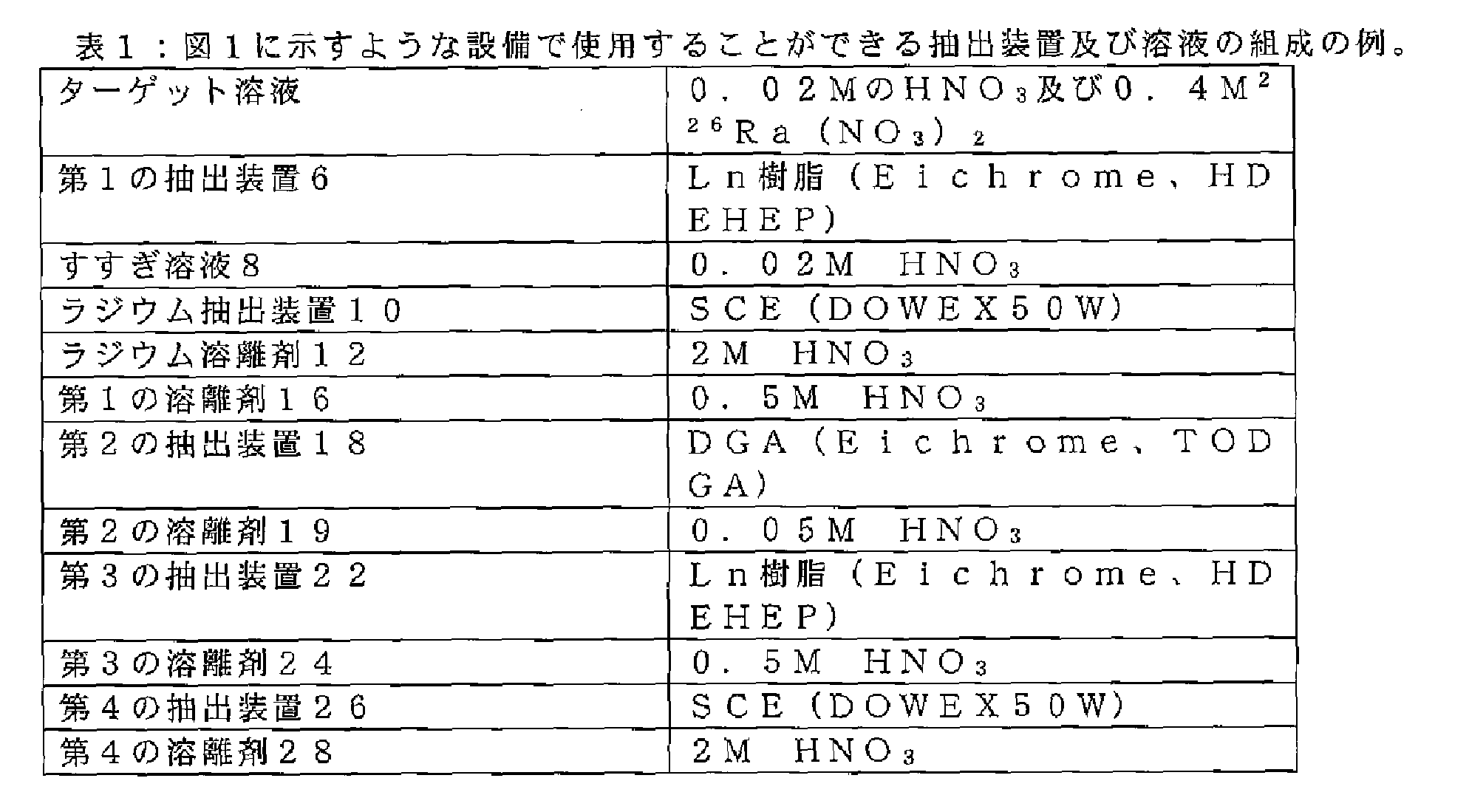
図2は、本発明による方法の代替実施形態を示しており、液体ターゲット溶液がより高い酸性度(より低いpH)を有する。この高酸性度オプションは、DGAカラムを用いた初期Ac/Ra分離に基づく。ここで、ターゲット溶液中の酸性度は、例えば0.1M~0.5Mの硝酸度であり、ターゲット溶液中の226Raの濃度は、より低い酸性度が硝酸塩の添加によって、例えば硝酸アンモニウムによって補償される場合、0.35Mまでであり得る。アクチニウムは、DGAカラムを通る再循環によって除去される。再循環体積は、Acを効率的に除去するのに十分高くあるべきであるが、Acの破過を回避するためにカラムの容積内であるべきである。低酸性度オプションの場合と同様に、強い陽イオン交換体は、最初のアクチニウム分離後にカラム上に残ったRaを管理する。酸性度及びLn樹脂カラム上の取り込みを低下させることによって、さらなる精製が行われる。ここで、酸性度は、Pbの共抽出を回避するように選択される(すなわち0.03M~0.075M)。この点から様々な選択肢が利用可能であるが、DGA又はDGA Bカラムを使用したその後の精製及び濃縮がおそらく好ましい方法である。 FIG. 2 shows an alternative embodiment of the method according to the invention, where the liquid target solution has a higher acidity (lower pH). This high acidity option is based on an initial Ac/Ra separation using a DGA column. Here, the acidity in the target solution is, for example, 0.1M to 0.5M nitric acid, and the concentration of 226 Ra in the target solution can be up to 0.35M if the lower acidity is compensated for by the addition of nitrates, for example by ammonium nitrate. Actinium is removed by recirculation through the DGA column. The recirculation volume should be high enough to efficiently remove Ac, but within the volume of the column to avoid Ac breakthrough. As in the low acidity option, a strong cation exchanger manages the Ra remaining on the column after the initial actinium separation. Further purification is performed by reducing the acidity and uptake on the Ln resin column. Here, the acidity is selected to avoid co-extraction of Pb (i.e. 0.03M to 0.075M). From this point onwards a variety of options are available, but subsequent purification and concentration using a DGA or DGA B column is probably the preferred method.
図1に示す設備に対応する図2に示す設備の部分は、同じ符号で示されている。図2に示す設備は、図1を参照して上述した設備と同じように機能するので、共通部分の機能の説明は繰り返さない。代わりに、図2に示すような高酸性度設備で使用される様々な抽出装置及び溶液の具体例を以下の表に示す。 Portions of the equipment shown in FIG. 2 that correspond to the equipment shown in FIG. 1 are designated with the same reference numerals. The equipment shown in FIG. 2 functions in the same manner as the equipment described above with reference to FIG. 1, and therefore a description of the functions of the common parts will not be repeated. Instead, the following table provides examples of various extraction devices and solutions that may be used in a high acidity equipment such as that shown in FIG. 2.

見て分かるように、濃縮及び精製された225Acは、第3の抽出装置22から既に除去されている。しかしながら、追加の抽出カラム、すなわち鉛抽出装置30が、第2の抽出装置18と第3の抽出装置22との間に第5の閉ループ21に設けられている。鉛抽出装置30の前には、第3のラドンフィルタ23があり、鉛抽出装置30の後には、追加のラドンフィルタ23’がある。
As can be seen, concentrated and purified 225 Ac has already been removed from the
鉛抽出装置30は、特に、Pbに対して非常に有効であり、設備/システムからPbを除去するために使用することができるSr樹脂を含む。Pbは、ラドンの崩壊によって生成される。ラドンはアルファ崩壊によって崩壊し、カラム材料に放射線損傷を発生させ、カラム分離性能に影響を及ぼす。したがって、カラムの寿命を延ばし、225Ac生成物のラドン汚染を回避するために、ラドンがプロセスの下流に移動するのを防ぐことが好ましい。ラドンは、ラドンフィルタによって、すなわち粉末活性炭(PAC)又は粒状活性炭(GAC)を含有する小カラムによって管理される。ラドンはPAC/GACカラムで吸収/強く遅延され、ガンマ放射体である210Pbに減衰する。210Pbは水相に溶離され、プロセス内に含まれる。PAC/GACカラムは複数回使用することができる。Sr樹脂カラムは、Pbに対して非常に有効であり、したがって、プロセスからPbを除去するために使用することができる。Sr樹脂カラムは、固定相として、オクタノールに溶解されたジシクロヘキサノ-18-クラウン-6誘導体を含む。
The
また、図1の低酸性度設備でも、鉛抽出装置(Sr樹脂カラム)を、特に第3の抽出装置22と第4の抽出装置26との間に容易に組み込むことができ、好ましくは、鉛抽出装置の前に第4のラドンフィルタ27があり、鉛抽出装置の後に追加のラドンフィルタがある。
Also, in the low acidity installation of FIG. 1, a lead extractor (Sr resin column) can be easily incorporated, particularly between the
本発明による方法は、硝酸ラジウムの限られた溶解度(これは、例えば、68Zn(p,n)68Ga反応によって68Gaを生成するために液体ターゲットに使用される硝酸亜鉛68の溶解度よりも10倍以上小さい。)の結果として、ターゲット溶液中の226Raの濃度が比較的低いにもかかわらず、商業的に興味深い生成率を達成することを可能にする。 The method according to the invention makes it possible to achieve commercially interesting production rates despite the relatively low concentration of 226Ra in the target solution as a result of the limited solubility of radium nitrate (which is more than 10 times smaller than the solubility of zinc nitrate 68 used in liquid targets to produce 68Ga by, for example, the 68Zn (p , n)68Ga reaction).
225Acの生成率を算出することができる。最大0.4Mの226Ra(NO3)2を含有する水溶液(Nucleonica)中のプロトンのエネルギー依存阻止能と共に226Ra(p,2n)反応のエネルギー依存断面積(IAEA ENDFデータベース)を使用して、液体ターゲットの小さな層の生成率を得、これを合計して225Acの全体的な形成を得る。使用したプロトン電流の関数として、週ごとの生成率を表1に示す。 The production rate of 225 Ac can be calculated. The energy-dependent cross section of the 226 Ra(p,2n) reaction (IAEA ENDF database) together with the energy-dependent stopping power of protons in aqueous solutions containing up to 0.4 M 226 Ra(NO 3 ) 2 (Nucleonica) is used to obtain the production rate of small layers of the liquid target, which are summed to obtain the overall formation of 225 Ac. The weekly production rates as a function of the proton current used are shown in Table 1.

経済的実現可能性については、225Acを用いた治療的処置が承認されると仮定すると、225Acの需要は大幅に増加する。提案された方法によって生成された225Acは、227Acの複雑な同位体分離が行われない限り、232Thターゲットのプロトン照射によって生成された225Acよりも高品質である。年間40週間の生成を想定して生成されたまま流通させる場合、生成された225Acは、25000回を超える処理をカバーすることができる。したがって、アクチニウム生成プロセスにおける経済的実現可能性が保証される可能性が最も高い。 Regarding economic feasibility, assuming that therapeutic treatments using 225 Ac are approved, the demand for 225 Ac will increase significantly. The 225 Ac produced by the proposed method is of higher quality than that produced by proton irradiation of 232 Th targets, unless complex isotope separation of 227 Ac is performed. If the 225 Ac is distributed as it is, assuming production for 40 weeks per year, the produced 225 Ac can cover more than 25,000 processes. Therefore, the economic feasibility of the actinium production process is most likely guaranteed.
References:
Boll,R.A.,Malkemus,D.,Mirzadeh,S.,Production of actinium-225 for alpha particle mediated radioimmunotherapy.Appl.Radiat.Isot.62,667-679(2005)
Jost,C.U.,Griswold,J.R.,Bruffey,S.H.,Mirzadeh,S.,Stracener,D.W.,Williams,C.L.,Measurement of cross sections for the 232Th(p,4n)229Pa reaction at low proton energies.AIP Conference Proceedings:International Conference on Application of Accelerators in Research and Industry.Vol.1525,pp.520-524.(2013)
Koch,L,Fuger,J,van Geel J.,Process for producing Actinium-225,EP0752709,1999
Apostolidis,C.,Molinet,R.,McGinley,J.,Abbas,K.,Moellenbeck,J.,Morgenstern,A.,Cyclotron production of Ac-225 for targeted alpha therapy,Appl.Radiat.Isot.,62,383-387(2005)
Abbas,K.,Apostolidis,C.,Janssens,W.,Stamm,H.,Nikula,T.,Carlos,R.,Method for produing Actinium 225,EP1455364,2004
Apostolidis,C.,Janssens,W.,Koch,L.,Mcginley,J.,Molinet,R.,Ougier,M.,Van Geel,J.,Moellenbeck,J.,Schweickert,H.,Method for producing Ac-225 by irradiation of Ra-226 with protons,EP062942,2004
Morgenstern,A.,Apostolidis,C.,Molinet,R.,Lutzenkirchen,K.,Method for producing actinium-225,US patent 20060072698,(2006)
Ermolaev,S.V.,Zhuikov,B.L.Kokhanyuk,V.M.,Matushko,V.L.,Kalmykov Stepan,N.,Aliev Ramiz,A.Tananaev Ivan,G.
Myasoedov,B.Production of actinium,thorium and radium isotopes from natural thorium irradiated with protons up to 141 MeV Radiochim.Acta,100,p.223(2012)
Weidner,J.W.,Mashnik,S.G.,John,K.D.,Hemez,F.,Ballard,B.,Bach,FI.,Birnbaum,E.R.,Bitteker,L.J.Couture,A.,Dry,D.,etal.Proton-induced cross sections relevant to production of 225Ac and 223Ra in natural thorium targets below 200 MeV,Appl.Radiat.Isot.,70,pp.2602-2607,(2012)
Griswold,J.R.,Medvedev,D.G.,Engle,J.W.,Copping,R.Fitzsimmons,J.M.,Radchenko,V.,Cooley,J.C.,Fassbender,M.E.,Denton,D.L.,Murphy,K.E.,Owens,A.C.,Birnbaum,E.R.,John,K.D.,Nortier,F.M.,Stracener,D.W.,Heilbronn,L.H.,Mausner,L.F.Mirzadeh,S.,Large Scale Accelerator Production of 225Ac:Effective Cross Sections for 78-192 MeV Protons Incident on 232Th targets,Applied Radiation and Isotopes,1 18,366-374,(2016)
Zhuikov,B.L.,Kalmykov,S.N.,S.V.Ermolaev,S.V.,Aliev,R.A.,Kokhanyuk,V.M.,Matushko,V.L.,Tananaev,I.G.,Myasoedov B.F.,Production of 225 c and 223Ra by irradiation of Th with accelerated protons,Radiochemistry,53,pp.73-80,(2011)
Koch,L,Fuger,J,van Geel J.,Process for producing Actinium-225 from radium-226,EP0752710,1999-1
Melville,G.Meriarty,H.,Metcalfe,P.,Knittel,T,Allen,B.J.Production of Ac-225 for cancer therapy by photon-induced transmutation of Ra-226,Applied Radiation and Isotopes,65,1014-1022,(2007)
Melville G.,Allen,B.J.,Cyclotron and linac production of Ac-225,Applied Radiation and Isotopes,67,549-555,(2009)
Clarke,J.C.,High-Powered Cyclotron Recirculating Target for Production of the 18F Radionuclide,PhD Thesis,North Carolina State University(2004)
References:
Boll, R. A. , Malkemus, D. , Mirzadeh, S. , Production of actinium-225 for alpha particle mediated radioimmunotherapy. Appl. Radiat. Isot. 62, 667-679 (2005)
Jost, C. U. , Griswold, J. R. , Bruffey, S. H. , Mirzadeh, S. , Stracener, D. W. , Williams, C. L. , Measurement of cross sections for the 232 Th(p, 4n) 229 Pa reaction at low proton energies. AIP Conference Proceedings: International Conference on Application of Accelerators in Research and Industry. Vol. 1525, pp. 520-524. (2013)
Koch, L., Fugher, J., van Geel J. , Process for producing Actinium-225, EP0752709, 1999
Apostolidis, C. , Molinet, R. , McGinley, J. , Abbas, K. , Moellenbeck, J. , Morgenstern, A. , Cyclotron production of Ac-225 for targeted alpha therapy, Appl. Radiat. Isot. , 62, 383-387 (2005)
Abbas, K. , Apostolidis, C. , Janssens, W. , Stamm, H. , Nikula, T. , Carlos, R. , Method for producing Actinium 225, EP1455364, 2004
Apostolidis, C. , Janssens, W. , Koch, L. , McGinley, J. , Molinet, R. , Ougier, M. , Van Geel, J. , Moellenbeck, J. , Schweickert, H. , Method for producing Ac-225 by irradiation of Ra-226 with protons, EP062942, 2004
Morgenstern, A. , Apostolidis, C. , Molinet, R. , Lutzenkirchen, K. , Method for producing actinium-225, US patent 20060072698, (2006)
Ermolaev, S. V. , Zhuikov, B. L. Kokhanyuk, V. M. , Matushko, V. L. , Kalmykov Stepan, N. , Aliev Ramiz, A. Tananaev Ivan, G.
Myasoedov, B. Production of actinium, thorium and radium isotopes from natural thorium irradiated with protons up to 141 MeV Radiochim. Acta, 100, p. 223 (2012)
Weidner, J. W. , Mashnik, S. G. , John, K. D. , Hemez, F. , Ballard, B. , Bach, FI. , Birnbaum, E. R. , Bitteker, L. J. Couture, A. , Dry, D. , etal. Proton-induced cross sections relative to production of 225 Ac and 223 Ra in natural thorium targets below 200 MeV, Appl. Radiat. Isot. , 70, pp. 2602-2607, (2012)
Griswold, J. R. , Medvedev, D. G. , Engle, J. W. , Copping, R. Fitzsimmons, J. M. , Radchenko, V. , Cooley, J. C. , Fassbender, M. E. , Denton, D. L. , Murphy, K. E. , Owens, A. C. , Birnbaum, E. R. , John, K. D. , Nortier, F. M. , Stracener, D. W. , Heilbronn, L. H. , Mausner, L. F. Mirzadeh, S. , Large Scale Accelerator Production of 225 Ac: Effective Cross Sections for 78-192 MeV Protons Incident on 232Th targets, Applied Radiation and Isotopes, 1 18, 366-374, (2016)
Zhuikov, B. L. , Kalmykov, S. N. ,S. V. Ermolaev, S. V. , Aliev, R. A. , Kokhanyuk, V. M. , Matushko, V. L. , Tananaev, I. G. , Myasoedov B. F. , Production of 225 c and 223 Ra by irradiation of Th with accelerated protons, Radiochemistry, 53, pp. 73-80, (2011)
Koch, L., Fugher, J., van Geel J. , Process for producing Actinium-225 from radium-226, EP0752710, 1999-1
Melville, G. Meriarty, H. , Metcalfe, P. , Knittel, T., Allen, B. J. Production of Ac-225 for cancer therapy by photon-induced transmission of Ra-226, Applied Radiation and Isotopes, 65, 1014-1022, (2007)
Melville G. , Allen, B. J. , Cyclotron and linac production of Ac-225, Applied Radiation and Isotopes, 67, 549-555, (2009)
Clarke, J. C. , High-Powered Cyclotron Recirculating Target for Production of the 18 F Radionuclide, PhD Thesis, North Carolina State University (2004)
Claims (13)
226ラジウムを含む液体ターゲット溶液を準備する工程と、
照射装置(2)内で前記液体ターゲット溶液を照射して、前記液体ターゲット溶液中に含まれる226ラジウムから出発して前記液体ターゲット溶液中に225アクチニウムを生成する工程であって、前記液体ターゲット溶液が、照射工程中に、前記照射装置(2)及び熱交換器(5)を通る第1の閉ループ(4)で循環される、工程と、
第1の抽出装置(6)内で行われる第1の抽出工程において、生成された225アクチニウムの少なくとも一部を残留226ラジウムから分離する工程と、
を含み、
前記225アクチニウムの少なくとも一部は、前記第1の抽出工程において、前記第1の抽出装置(6)内で、前記液体ターゲット溶液から抽出され、一方で、前記226ラジウムは前記液体ターゲット溶液中に維持され、
前記液体ターゲット溶液が、前記照射工程中に、容器(1)及び前記照射装置(2)を通る前記第1の閉ループ(4)で循環され、前記第1の抽出工程中に、前記容器(1)及び前記第1の抽出装置(6)を通る第2の閉ループ(7)で循環され、
前記第1の抽出装置(6)が、前記第1の抽出工程中に前記 225 アクチニウムが蓄積する第1の吸着剤を含み、前記方法が、第1の溶離工程を含み、前記第1の溶離工程において、前記第1の吸着剤上に蓄積された前記 225 アクチニウムの少なくとも一部が、第1の溶離剤(16)によって前記第1の吸着剤から溶離され、
前記第1の溶離剤(16)が、第1の溶離工程中、第2の抽出装置(18)を通る第4の閉ループ(17)で循環され、前記第2の抽出装置(18)は、前記第1の溶離剤によって前記第1の吸着剤から溶離された前記 225 アクチニウムが前記第1の溶離工程中に蓄積する第2の吸着剤を含み、前記方法が、第2の溶離工程を含み、前記第2の溶離工程において、前記第2の吸着剤上に蓄積された前記 225 アクチニウムの少なくとも一部が第2の溶離剤(19)によって前記第2の吸着剤から溶離され、前記第2の溶離剤(19)が、前記第2の溶離工程中に前記 225 アクチニウムが前記第2の吸着剤から溶離されるように前記第1の溶離剤のpH値とは異なるpH値を有しており、
前記方法は、
前記225アクチニウムの一部が抽出された前記液体ターゲット溶液を前記照射装置(2)内で再び照射して、前記液体ターゲット溶液内に含まれる前記226ラジウムから出発して前記液体ターゲット溶液中にさらに225アクチニウムを生成する工程をさらに含む、
ことを特徴とする方法。 A method for producing 225- actinium from 226- radium, comprising the steps of:
Providing a liquid target solution containing radium- 226 ;
- irradiating said liquid target solution in an irradiation device (2) to produce 225 actinium in said liquid target solution starting from 226 radium contained therein, said liquid target solution being circulated in a first closed loop (4) through said irradiation device (2) and a heat exchanger (5) during the irradiation step;
Separating at least a portion of the produced 225- actinium from the residual 226- radium in a first extraction step carried out in a first extraction device (6);
Including,
at least a portion of the 225- actinium is extracted from the liquid target solution in the first extraction device (6) in the first extraction step, while the 226- radium is maintained in the liquid target solution;
the liquid target solution is circulated in the first closed loop (4) through the vessel (1) and the irradiation device (2) during the irradiation step, and in a second closed loop (7) through the vessel (1) and the first extraction device (6) during the first extraction step,
the first extraction device (6) comprises a first adsorbent on which the 225- actinium accumulates during the first extraction step, the method comprises a first elution step in which at least a portion of the 225- actinium accumulated on the first adsorbent is eluted from the first adsorbent by a first eluent (16);
the first eluent (16) is circulated in a fourth closed loop (17) through a second extraction device (18) during a first elution step, the second extraction device (18) comprising a second adsorbent on which the 225- actinium eluted from the first adsorbent by the first eluent accumulates during the first elution step, the method comprising a second elution step, in which at least a portion of the 225- actinium accumulated on the second adsorbent is eluted from the second adsorbent by a second eluent (19), the second eluent (19) having a pH value different from the pH value of the first eluent such that the 225- actinium is eluted from the second adsorbent during the second elution step,
The method comprises:
The liquid target solution from which a portion of the 225- actinium has been extracted is irradiated again in the irradiation device (2) to produce further 225- actinium in the liquid target solution starting from the 226- radium contained in the liquid target solution.
A method comprising:
Applications Claiming Priority (3)
| Application Number | Priority Date | Filing Date | Title |
|---|---|---|---|
| EP19182228.7 | 2019-06-25 | ||
| EP19182228 | 2019-06-25 | ||
| PCT/EP2020/067376 WO2020260210A1 (en) | 2019-06-25 | 2020-06-22 | Method for producing 225actinium from 226radium |
Publications (2)
| Publication Number | Publication Date |
|---|---|
| JP2022538732A JP2022538732A (en) | 2022-09-06 |
| JP7696832B2 true JP7696832B2 (en) | 2025-06-23 |
Family
ID=67070598
Family Applications (1)
| Application Number | Title | Priority Date | Filing Date |
|---|---|---|---|
| JP2021569159A Active JP7696832B2 (en) | 2019-06-25 | 2020-06-22 | Method for producing 225-actinium from 226-radium |
Country Status (6)
| Country | Link |
|---|---|
| US (1) | US20220301735A1 (en) |
| EP (1) | EP3991184B1 (en) |
| JP (1) | JP7696832B2 (en) |
| CN (1) | CN113874960A (en) |
| CA (1) | CA3141155A1 (en) |
| WO (1) | WO2020260210A1 (en) |
Families Citing this family (13)
| Publication number | Priority date | Publication date | Assignee | Title |
|---|---|---|---|---|
| KR102211812B1 (en) * | 2019-07-23 | 2021-02-04 | 한국원자력의학원 | The method of producing actinium by liquified radium |
| KR102233112B1 (en) * | 2019-07-25 | 2021-03-29 | 한국원자력의학원 | The apparatus of producing nuclide using fluid target |
| EP3828899B1 (en) * | 2019-11-29 | 2022-01-05 | Ion Beam Applications | A method for producing ac-225 from ra-226 |
| JP7576509B2 (en) * | 2021-04-27 | 2024-10-31 | 株式会社日立ハイテク | Radionuclide production system and radionuclide production method |
| WO2023114602A1 (en) | 2021-12-15 | 2023-06-22 | ExxonMobil Technology and Engineering Company | Methods of using and converting recovered radium |
| EP4224489A1 (en) * | 2022-02-08 | 2023-08-09 | Sck.Cen | Liquid target system |
| EP4297044A1 (en) | 2022-06-23 | 2023-12-27 | Sck.Cen | Purification of target material for the production of radio-isotopes |
| CN115612868A (en) * | 2022-09-21 | 2023-01-17 | 北京健康启航科技有限公司 | Purification process for separating actinium 225 from thorium, actinium and radium |
| CN115869658B (en) * | 2022-12-29 | 2025-01-28 | 中国核动力研究设计院 | Separation system for preparing Ra-223, separation method, application and preparation method thereof |
| WO2025235826A2 (en) * | 2024-05-10 | 2025-11-13 | Fusion Energy Solutions, Inc. | Techniques for obtaining actinium-225 from radium-226 and related systems and methods |
| CN120183769A (en) * | 2025-03-18 | 2025-06-20 | 西安迈斯拓扑科技有限公司 | A separation and purification method for preparing lead-212 and actinium-225 by photonuclear reaction method |
| CN119997338B (en) * | 2025-04-17 | 2025-08-05 | 东华理工大学南昌校区 | A 226Ra isotope target for producing 225Ac and its application |
| CN120299771B (en) * | 2025-06-13 | 2025-08-29 | 东华理工大学南昌校区 | A closed-circulation 226Ra solution target system for producing 225Ac |
Citations (2)
| Publication number | Priority date | Publication date | Assignee | Title |
|---|---|---|---|---|
| US20020094056A1 (en) | 1999-11-30 | 2002-07-18 | Stanley Satz | Method of producing actinium-225 and daughters |
| JP2020183926A (en) | 2019-05-09 | 2020-11-12 | 株式会社日立製作所 | Radionuclide production equipment and radionuclide production method |
Family Cites Families (10)
| Publication number | Priority date | Publication date | Assignee | Title |
|---|---|---|---|---|
| NL8101793A (en) | 1981-04-13 | 1982-11-01 | Philips Nv | COUPLING DEVICE FOR TELESCOPIC SLIDING PARTS. |
| LU88637A1 (en) | 1995-07-03 | 1997-01-03 | Euratom | Process for the production of actinium-225 and bismuth-213 by irradiation of radium-226 with high-energy gamma quanta |
| LU88636A1 (en) | 1995-07-03 | 1997-01-03 | Euratom | Process for the production of Actinium-225 |
| US5809394A (en) | 1996-12-13 | 1998-09-15 | Battelle Memorial Institute | Methods of separating short half-life radionuclides from a mixture of radionuclides |
| DK0962942T3 (en) | 1998-06-02 | 2003-07-07 | Europ Economic Community | Process for the production of Ac-225 by irradiation of Ra-226 with protons |
| AU2003239509A1 (en) * | 2002-05-21 | 2003-12-12 | Duke University | Batch target and method for producing radionuclide |
| EP1455364A1 (en) | 2003-03-06 | 2004-09-08 | European Community | Method for producing actinium-225 |
| EP1610346A1 (en) | 2004-06-25 | 2005-12-28 | The European Community, represented by the European Commission | Method for producing actinium-225 |
| DE102006008023B4 (en) * | 2006-02-21 | 2008-05-29 | Actinium Pharmaceuticals, Inc. | Method of cleaning 225Ac from irradiated 226Ra targets |
| RU2373589C1 (en) * | 2008-09-23 | 2009-11-20 | Институт ядерных исследований РАН | Method of producing actinium-225 and radium isotopes and target for realising said method (versions) |
-
2020
- 2020-06-22 EP EP20733813.8A patent/EP3991184B1/en active Active
- 2020-06-22 CA CA3141155A patent/CA3141155A1/en active Pending
- 2020-06-22 JP JP2021569159A patent/JP7696832B2/en active Active
- 2020-06-22 CN CN202080038949.4A patent/CN113874960A/en active Pending
- 2020-06-22 US US17/612,602 patent/US20220301735A1/en not_active Abandoned
- 2020-06-22 WO PCT/EP2020/067376 patent/WO2020260210A1/en not_active Ceased
Patent Citations (2)
| Publication number | Priority date | Publication date | Assignee | Title |
|---|---|---|---|---|
| US20020094056A1 (en) | 1999-11-30 | 2002-07-18 | Stanley Satz | Method of producing actinium-225 and daughters |
| JP2020183926A (en) | 2019-05-09 | 2020-11-12 | 株式会社日立製作所 | Radionuclide production equipment and radionuclide production method |
Also Published As
| Publication number | Publication date |
|---|---|
| CA3141155A1 (en) | 2020-12-30 |
| JP2022538732A (en) | 2022-09-06 |
| EP3991184B1 (en) | 2024-01-03 |
| WO2020260210A1 (en) | 2020-12-30 |
| EP3991184C0 (en) | 2024-01-03 |
| CN113874960A (en) | 2021-12-31 |
| EP3991184A1 (en) | 2022-05-04 |
| US20220301735A1 (en) | 2022-09-22 |
Similar Documents
| Publication | Publication Date | Title |
|---|---|---|
| JP7696832B2 (en) | Method for producing 225-actinium from 226-radium | |
| Engle | The production of Ac-225 | |
| CN102893339B (en) | A device for the production of radioisotopes used in the medical field | |
| US9202600B2 (en) | Method for production of radioisotope preparations and their use in life science, research, medical application and industry | |
| EP2862181B1 (en) | Apparatus and methods for transmutation of elements | |
| JP6478558B2 (en) | Radiopharmaceutical manufacturing system, radiopharmaceutical manufacturing apparatus and radiopharmaceutical manufacturing method | |
| EP3968342B1 (en) | Apparatus for producing radionuclide and method for producing radionuclide | |
| US5802439A (en) | Method for the production of 99m Tc compositions from 99 Mo-containing materials | |
| US20150332799A1 (en) | Methods and apparatus for the production of isotopes | |
| Shusterman et al. | Aqueous harvesting of Zr 88 at a radioactive-ion-beam facility for cross-section measurements | |
| Grundler et al. | The metamorphosis of radionuclide production and development at Paul Scherrer Institute | |
| Guseva | Radioisotope generators of short-lived α-emitting radionuclides promising for use in nuclear medicine | |
| US5802438A (en) | Method for generating a crystalline 99 MoO3 product and the isolation 99m Tc compositions therefrom | |
| JP2014525038A (en) | Method for generating Tc-99m | |
| Radford et al. | Methods for the Production of Radionuclides for Medicine | |
| Vallabhajosula | Production of radionuclides | |
| KR102545315B1 (en) | Method and system for producing medical radioisotopes | |
| Shikata et al. | Production of 99 Mo and its application in nuclear medicine | |
| JP7398804B2 (en) | Method of producing actinium-225 | |
| WO2012039038A1 (en) | Method for production/extraction of tc-99m utilizing mo-99, and mo-99/tc-99m liquid generator | |
| JP7576509B2 (en) | Radionuclide production system and radionuclide production method | |
| CN121148772A (en) | A method and apparatus for simultaneously preparing multiple isotopes | |
| ARzUMANOV et al. | Radioisotope production at the isochronous cyclotron in Almaty | |
| Ineza | The Production of 103pd and 109Cd Using Proton Irradiated Tandem natAg/natAg Targets | |
| Qaim | Production of diagnostic and therapeutic radionuclides |
Legal Events
| Date | Code | Title | Description |
|---|---|---|---|
| A621 | Written request for application examination |
Free format text: JAPANESE INTERMEDIATE CODE: A621 Effective date: 20230608 |
|
| A977 | Report on retrieval |
Free format text: JAPANESE INTERMEDIATE CODE: A971007 Effective date: 20240424 |
|
| A131 | Notification of reasons for refusal |
Free format text: JAPANESE INTERMEDIATE CODE: A131 Effective date: 20240514 |
|
| A601 | Written request for extension of time |
Free format text: JAPANESE INTERMEDIATE CODE: A601 Effective date: 20240813 |
|
| A521 | Request for written amendment filed |
Free format text: JAPANESE INTERMEDIATE CODE: A523 Effective date: 20241017 |
|
| A131 | Notification of reasons for refusal |
Free format text: JAPANESE INTERMEDIATE CODE: A131 Effective date: 20241210 |
|
| A521 | Request for written amendment filed |
Free format text: JAPANESE INTERMEDIATE CODE: A523 Effective date: 20250226 |
|
| TRDD | Decision of grant or rejection written | ||
| A01 | Written decision to grant a patent or to grant a registration (utility model) |
Free format text: JAPANESE INTERMEDIATE CODE: A01 Effective date: 20250513 |
|
| A61 | First payment of annual fees (during grant procedure) |
Free format text: JAPANESE INTERMEDIATE CODE: A61 Effective date: 20250611 |
|
| R150 | Certificate of patent or registration of utility model |
Ref document number: 7696832 Country of ref document: JP Free format text: JAPANESE INTERMEDIATE CODE: R150 |