JP7678795B2 - Nucleoside prodrugs and related uses - Google Patents
Nucleoside prodrugs and related uses Download PDFInfo
- Publication number
- JP7678795B2 JP7678795B2 JP2022511257A JP2022511257A JP7678795B2 JP 7678795 B2 JP7678795 B2 JP 7678795B2 JP 2022511257 A JP2022511257 A JP 2022511257A JP 2022511257 A JP2022511257 A JP 2022511257A JP 7678795 B2 JP7678795 B2 JP 7678795B2
- Authority
- JP
- Japan
- Prior art keywords
- oxy
- methyl
- phosphonate
- amino
- purin
- Prior art date
- Legal status (The legal status is an assumption and is not a legal conclusion. Google has not performed a legal analysis and makes no representation as to the accuracy of the status listed.)
- Active
Links
Classifications
-
- C—CHEMISTRY; METALLURGY
- C07—ORGANIC CHEMISTRY
- C07F—ACYCLIC, CARBOCYCLIC OR HETEROCYCLIC COMPOUNDS CONTAINING ELEMENTS OTHER THAN CARBON, HYDROGEN, HALOGEN, OXYGEN, NITROGEN, SULFUR, SELENIUM OR TELLURIUM
- C07F9/00—Compounds containing elements of Groups 5 or 15 of the Periodic Table
- C07F9/02—Phosphorus compounds
- C07F9/547—Heterocyclic compounds, e.g. containing phosphorus as a ring hetero atom
- C07F9/645—Heterocyclic compounds, e.g. containing phosphorus as a ring hetero atom having two nitrogen atoms as the only ring hetero atoms
- C07F9/6509—Six-membered rings
- C07F9/6512—Six-membered rings having the nitrogen atoms in positions 1 and 3
- C07F9/65128—Six-membered rings having the nitrogen atoms in positions 1 and 3 condensed with carbocyclic rings or carbocyclic ring systems
-
- A—HUMAN NECESSITIES
- A61—MEDICAL OR VETERINARY SCIENCE; HYGIENE
- A61K—PREPARATIONS FOR MEDICAL, DENTAL OR TOILETRY PURPOSES
- A61K31/00—Medicinal preparations containing organic active ingredients
- A61K31/66—Phosphorus compounds
- A61K31/675—Phosphorus compounds having nitrogen as a ring hetero atom, e.g. pyridoxal phosphate
-
- A—HUMAN NECESSITIES
- A61—MEDICAL OR VETERINARY SCIENCE; HYGIENE
- A61P—SPECIFIC THERAPEUTIC ACTIVITY OF CHEMICAL COMPOUNDS OR MEDICINAL PREPARATIONS
- A61P31/00—Antiinfectives, i.e. antibiotics, antiseptics, chemotherapeutics
- A61P31/12—Antivirals
-
- A—HUMAN NECESSITIES
- A61—MEDICAL OR VETERINARY SCIENCE; HYGIENE
- A61P—SPECIFIC THERAPEUTIC ACTIVITY OF CHEMICAL COMPOUNDS OR MEDICINAL PREPARATIONS
- A61P35/00—Antineoplastic agents
-
- C—CHEMISTRY; METALLURGY
- C07—ORGANIC CHEMISTRY
- C07F—ACYCLIC, CARBOCYCLIC OR HETEROCYCLIC COMPOUNDS CONTAINING ELEMENTS OTHER THAN CARBON, HYDROGEN, HALOGEN, OXYGEN, NITROGEN, SULFUR, SELENIUM OR TELLURIUM
- C07F9/00—Compounds containing elements of Groups 5 or 15 of the Periodic Table
- C07F9/02—Phosphorus compounds
- C07F9/547—Heterocyclic compounds, e.g. containing phosphorus as a ring hetero atom
- C07F9/645—Heterocyclic compounds, e.g. containing phosphorus as a ring hetero atom having two nitrogen atoms as the only ring hetero atoms
- C07F9/6509—Six-membered rings
- C07F9/6512—Six-membered rings having the nitrogen atoms in positions 1 and 3
-
- C—CHEMISTRY; METALLURGY
- C07—ORGANIC CHEMISTRY
- C07F—ACYCLIC, CARBOCYCLIC OR HETEROCYCLIC COMPOUNDS CONTAINING ELEMENTS OTHER THAN CARBON, HYDROGEN, HALOGEN, OXYGEN, NITROGEN, SULFUR, SELENIUM OR TELLURIUM
- C07F9/00—Compounds containing elements of Groups 5 or 15 of the Periodic Table
- C07F9/02—Phosphorus compounds
- C07F9/547—Heterocyclic compounds, e.g. containing phosphorus as a ring hetero atom
- C07F9/6561—Heterocyclic compounds, e.g. containing phosphorus as a ring hetero atom containing systems of two or more relevant hetero rings condensed among themselves or condensed with a common carbocyclic ring or ring system, with or without other non-condensed hetero rings
- C07F9/65616—Heterocyclic compounds, e.g. containing phosphorus as a ring hetero atom containing systems of two or more relevant hetero rings condensed among themselves or condensed with a common carbocyclic ring or ring system, with or without other non-condensed hetero rings containing the ring system having three or more than three double bonds between ring members or between ring members and non-ring members, e.g. purine or analogs
-
- C—CHEMISTRY; METALLURGY
- C07—ORGANIC CHEMISTRY
- C07B—GENERAL METHODS OF ORGANIC CHEMISTRY; APPARATUS THEREFOR
- C07B2200/00—Indexing scheme relating to specific properties of organic compounds
- C07B2200/05—Isotopically modified compounds, e.g. labelled
Landscapes
- Chemical & Material Sciences (AREA)
- Health & Medical Sciences (AREA)
- Organic Chemistry (AREA)
- Life Sciences & Earth Sciences (AREA)
- General Health & Medical Sciences (AREA)
- Biochemistry (AREA)
- Molecular Biology (AREA)
- Animal Behavior & Ethology (AREA)
- Veterinary Medicine (AREA)
- Public Health (AREA)
- Pharmacology & Pharmacy (AREA)
- Medicinal Chemistry (AREA)
- General Chemical & Material Sciences (AREA)
- Nuclear Medicine, Radiotherapy & Molecular Imaging (AREA)
- Chemical Kinetics & Catalysis (AREA)
- Virology (AREA)
- Oncology (AREA)
- Communicable Diseases (AREA)
- Epidemiology (AREA)
- Pharmaceuticals Containing Other Organic And Inorganic Compounds (AREA)
- Medicinal Preparation (AREA)
- Saccharide Compounds (AREA)
Description
関連出願の相互参照
本願は、2019年8月22日提出の米国仮特許出願第62/890,452号及び2019年8月23日提出の米国仮特許出願第62/890,684号の優先権を主張する。これらの出願のそれぞれの全体が全ての目的に対して参照により本明細書によって組み込まれる。
CROSS-REFERENCE TO RELATED APPLICATIONS This application claims priority to U.S. Provisional Patent Application No. 62/890,452, filed August 22, 2019, and U.S. Provisional Patent Application No. 62/890,684, filed August 23, 2019. Each of these applications is hereby incorporated by reference in its entirety for all purposes.
技術分野
本開示は、ヌクレオシド及び非環式ヌクレオシドホスホナート及びその誘導体のプロドラッグ、製剤処方物及びそれに関する使用に関する。
TECHNICAL FIELD This disclosure relates to prodrugs of nucleosides and acyclic nucleoside phosphonates and derivatives thereof, pharmaceutical formulations and uses related thereto.
背景
多くの合成ヌクレオシド類似体が、様々なヒト疾患に対する治療的有用性についてFDAなどの規制機関により承認されている。これらの薬剤は、DNAへのウイルスRNAの逆転写に寄与するウイルスタンパク質であるHIV逆転写酵素(HIV-RT)の阻害剤として、ヒト免疫不全ウイルス/後天性免疫不全症候群(HIV/AIDS)に対して、広範囲の臨床応用を見出している。
2. Background Many synthetic nucleoside analogues have been approved by regulatory agencies such as the FDA for therapeutic utility for a variety of human diseases. These agents have found widespread clinical application against human immunodeficiency virus/acquired immune deficiency syndrome (HIV/AIDS) as inhibitors of HIV reverse transcriptase (HIV-RT), a viral protein responsible for the reverse transcription of viral RNA into DNA.
この一例はテノホビル(以下でTFVと示す)であり、これは、HIV、B型肝炎ウイルス(HBV)及び単純ヘルペスウイルス2型(HSV-2)を含むいくつかのウイルスに対して広範囲の活性を示す非環式ヌクレオシドホスホナートである。機構的に、TFVは、2つのキナーゼ介在性のホスホリル化事象を受けて活性TFVジホスファートを生成させるが、これは、ウイルスDNAポリメラーゼ活性を阻害し、ウイルス複製を抑止する。TFVなどのヌクレオシドホスホナートの鍵となる特性は、望ましくない酵素的及び化学的加水分解を防ぐ代謝的に安定なホスホン酸結合(-P-CH2)である。さらに、これらのヌクレオシドホスホナートはヌクレオシド一リン酸を模倣し、それにより、殆どのヌクレオシド類似体により必要とされる比較的緩慢な最初のリン酸化事象を迂回する。この最初のリン酸化事象を回避することによって、それらの活性代謝産物への容易な変換が可能になるものの、このホスホナート部分は、生理学的pHで、TFV及び他の非環式類似体に顕著な2価陰イオンの特徴を与える。これにより、その細胞膜を横切って拡散する能力が制限され、その結果、迅速な腎臓クリアランス、バイオアベイラビリティー低下、抗ウイルス活性及び腎毒性の低下が起こるが、これは、腎臓における、腎尿細管流出が介在するTFV蓄積の結果である。 One example of this is tenofovir (hereafter referred to as TFV), an acyclic nucleoside phosphonate that exhibits broad spectrum activity against several viruses, including HIV, hepatitis B virus (HBV) and herpes simplex virus type 2 (HSV-2). Mechanistically, TFV undergoes two kinase-mediated phosphorylation events to generate the active TFV diphosphate, which inhibits viral DNA polymerase activity and abrogates viral replication. A key property of nucleoside phosphonates such as TFV is the metabolically stable phosphonate linkage (-P-CH 2 ), which prevents undesired enzymatic and chemical hydrolysis. Furthermore, these nucleoside phosphonates mimic nucleoside monophosphates, thereby bypassing the relatively slow initial phosphorylation event required by most nucleoside analogues. Although avoiding this initial phosphorylation event allows for facile conversion to their active metabolites, the phosphonate moiety confers a pronounced dianionic character to TFV and other acyclic analogues at physiological pH, limiting their ability to diffuse across cell membranes and resulting in rapid renal clearance, reduced bioavailability, reduced antiviral activity and nephrotoxicity as a result of TFV accumulation in the kidney mediated by renal tubular outflow.
これらの特性を改善するために、TFVのプロドラッグ、即ちTFVジソプロキシルフマル酸塩(TDF)及びTFVアラフェナミドフマル酸塩(TAF)(以下で示す)は、二重の負電荷を遮蔽するように設計されている。臨床的に承認されているTDFは、TFVを放出するためにエステラーゼで活性化される切断機序に依存する、2個の炭酸イソプロピルオキシメチル官能基を備える。この2個の炭酸イソプロピルがTFVの経口バイオアベイラビリティーを上昇させるにもかかわらず、特に肝臓及び血漿において、エステラーゼのユビキタスな分布によって、TDFが顕著な加水分解を受けるようになる。この結果、TFVの全身的曝露が起こり、これが腎臓及び骨に蓄積し、長時間曝露後の、腎毒性、骨塩量欠乏(BMD)及び他の良くない副作用につながる。その一方、TAFは、エンドソーム及びリソソームに主に局在するセリンプロテアーゼであるカテプシンAにより細胞内で選択的に切断されるホスホロアミダート結合を備える。この選択的細胞内切断機序は、腎毒性及びBMDを引き起こす循環TFVを生じさせるTDFの乏しい血漿安定性を克服する。残念ながら、両TFVプロドラッグは、肝臓系で濃縮される傾向があり、それにより、他の組織においてHIV感染細胞に対するアベイラビリティーが制限される。イヌにおいて、例えば、TAFの単回経口用量の65%が肝臓により抽出され、カルボキシルエステラーゼ1による望ましくない切断ゆえにTFVジホスファートとして肝細胞で濃縮され、それによって肝毒性が促進される。さらに、17%が血漿TFVに変換され、これは骨及び腎臓ゼクエストレーション(sequestration)及び関連毒性が起こる寸前である。この望ましくない代謝のために、無傷で血漿への接近に至り、それによりHIV感染細胞侵入に有用となるものは18%のみであり、一方で82%が、抗レトロウイルス療法に対する患者のアドヒランスを損なう毒性の副作用へと追いやられる。 To improve these properties, TFV prodrugs, namely TFV disoproxil fumarate (TDF) and TFV alafenamide fumarate (TAF) (shown below), have been designed to shield the double negative charge. Clinically approved TDF contains two isopropyloxymethyl carbonate functional groups that rely on an esterase-activated cleavage mechanism to release TFV. Although the two isopropyl carbonates increase the oral bioavailability of TFV, the ubiquitous distribution of esterases, especially in the liver and plasma, renders TDF subject to significant hydrolysis. This results in systemic exposure of TFV, which accumulates in the kidney and bone, leading to nephrotoxicity, bone mineral deficiency (BMD), and other adverse side effects after prolonged exposure. TAF, on the other hand, contains a phosphoramidate bond that is selectively cleaved intracellularly by cathepsin A, a serine protease that is primarily localized in endosomes and lysosomes. This selective intracellular cleavage mechanism overcomes the poor plasma stability of TDF, which results in circulating TFV causing nephrotoxicity and BMD. Unfortunately, both TFV prodrugs tend to concentrate in the hepatic system, thereby limiting their availability to HIV-infected cells in other tissues. In dogs, for example, 65% of a single oral dose of TAF is extracted by the liver and concentrated in hepatocytes as TFV diphosphate due to undesired cleavage by carboxylesterase 1, thereby promoting hepatotoxicity. Furthermore, 17% is converted to plasma TFV, which is on the verge of bone and kidney sequestration and related toxicity. Due to this undesired metabolism, only 18% gains access to the plasma intact and is therefore useful for HIV-infected cell entry, while 82% is relegated to toxic side effects that impair patient adherence to antiretroviral therapy.
より最近のストラテジーは、経口吸収及びその後の肝臓及び血漿での安定性を向上させるために、非環式ヌクレオシドホスホナートをリゾリン脂質に見せかけることに焦点を当てている。原理的には、これは全身的曝露を増加させ、それにより、無傷で血漿に到達する経口投与されたプロドラッグの割合を上昇させるはずである。これらの脂質プロドラッグの一例は、ヘキサデシルオキシプロピル-9-R-[2-(ホスホノメトキシ)プロピル]-アデニン、CMX157(以下でも示す)、ヘキサデシルオキシプロピル脂質尾部を含有するTFVのプロドラッグである(Painter et al., Antimicrob. Agents Chemother. 51, 3505-3509, 2007)。しかし、CMX157は、小腸及び肝臓に局在するチトクロムP450(CYP)酵素によって脂質鎖上の末端メチル基で不要なω-酸化を受ける。この異化事象は、脂質鎖の末端でヒドロキシル基を導入することにより開始され、次いでこれがアルコール及びアルデヒドデヒドロゲナーゼによって連続的な酸化を受けて、対応するカルボン酸を生じさせる。得られたカルボン酸はその後、β-酸化を受け得、脂質鎖を1回で2個の炭素ずつ分解し、TFV及びいくつかの望まれない代謝産物を全身循環前に(pre-systemically)放出し、それにより、HIV感染細胞にとって利用可能な経口投与されたプロドラッグの割合が実質的に制限される。

84の臨床試験の2010メタ解析により報告されるように、最適ウイルス抑制をもたらす≧90%の平均アドヒアランス率を報告したのは、HIV患者のうち62%のみであった。患者が計画された投薬を逃した場合、耐性があり感染性があるウイルスが出現し得、持続的な有効性のためにより厳密なコンプライアンスを求める第二次又は第三次の治療選択肢が必要となることが多い。毒性の副作用に加えて、慢性抗レトロウイルス治療に対する患者アドヒアランスは、投与頻度が高いことによって顕著に妨げられる。完治のための治療法が存在しないことは、患者の生涯にわたる長期のウイルス抑制を確実にするために不確定のコンプライアンスを必要とするので、抗レトロウイルスの成功は、生涯にわたるアドヒアランスにより決まる。これは、患者アドヒアランスと、HIVウイルス量、薬物耐性の出現との、並びにAIDSへの進行との逆相関により裏付けられる。従って、現在求められている抗レトロウイルス投薬の頻度は、依然として重大な障壁となっている。最終的に、TDF及びTAF含有抗レトロウイルスが入手可能な2090万人のHIV/AIDS患者のうち多くが、アドヒアランスを脅かす臓器特異的な毒性及び頻繁な投与スケジュールに苦しみ、無理なく治療に手が届かない1580万人の患者は、一部分は費用のために入手できず、この費用は、標的患者集団を処置するために必要とされる薬物の量により著しく押し上げられる。従って、改善された治療が必要とされている。 As reported by a 2010 meta-analysis of 84 clinical trials, only 62% of HIV patients reported a mean adherence rate of ≥ 90%, resulting in optimal viral suppression. If patients miss scheduled doses, resistant and infectious viruses may emerge, often necessitating second- or third-line treatment options that require stricter compliance for sustained efficacy. In addition to toxic side effects, patient adherence to chronic antiretroviral therapy is significantly hindered by the frequency of dosing. Since the absence of a cure requires indefinite compliance to ensure long-term viral suppression throughout a patient's life, antiretroviral success depends on lifelong adherence. This is supported by the inverse correlations of patient adherence with HIV viral load, emergence of drug resistance, and progression to AIDS. Thus, the frequency of currently required antiretroviral dosing remains a significant barrier. Finally, of the 20.9 million HIV/AIDS patients for whom TDF- and TAF-containing antiretrovirals are available, many suffer from organ-specific toxicities and frequent dosing schedules that compromise adherence, and the 15.8 million patients for whom treatment is not reasonably affordable are unable to access it, in part due to cost, which is significantly driven by the amount of drug required to treat the target patient population. Thus, improved therapies are needed.
概要
代謝安定性及び経口バイオアベイラビリティーが改善した非環式ヌクレオシドプロドラッグが開示される。一般に、プロドラッグは、経口吸収及びその後の肝臓及び血漿における安定性を向上させ得る脂質様部分を含有する非環式ヌクレオシドホスホナートの誘導体である。好ましくは、脂質様部分は、酵素介在性のω-酸化、例えばチトクロムP450酵素により触媒されるω-酸化などに耐性があり得る。
SUMMARY Acyclic nucleoside prodrugs with improved metabolic stability and oral bioavailability are disclosed. In general, the prodrugs are derivatives of acyclic nucleoside phosphonates that contain a lipid-like moiety that may enhance oral absorption and subsequent stability in the liver and plasma. Preferably, the lipid-like moiety may be resistant to enzyme-mediated ω-oxidation, such as ω-oxidation catalyzed by cytochrome P450 enzymes.
いくつかの実施形態では、開示される化合物は、式I又は薬学的に許容可能なその塩の構造:

Lは、非環式ヌクレオシドホスホナートであり;
Wは、存在しないか又は飽和C1~C9アルキル鎖(即ち架橋C1~C9アルキレン)であり;
Xは存在しないか又は置換メチレン又はエチレン、-O-、-S-、-S(=O)-及び-S(O)2-から選択され;
Yは飽和C2~C20アルキル鎖(即ち架橋C2~C20アルキレン)であり;
Zは、水素、任意選択的に置換されているメチル又はエチル、任意選択的に置換されている不飽和C2~C3アルキル、任意選択的に置換されているカルボシクリル、任意選択的に置換されているヘテロシクリル、任意選択的に置換されているアリール、任意選択的に置換されているヘテロアリール、Si-置換されているシリル、S-置換されているチオール、O-置換されているヒドロキシル、エステル及び-SF5から選択され、
ここでXが-O-である場合、Zは、水素、メチル又はエチルではなく、
ここでW及びXの両方が存在しない場合、Zは、水素、メチル又はエチルではなく、
ここでWが存在しない場合、Xも存在しない)
を有する。
In some embodiments, the disclosed compounds have the structure of Formula I:
L is an acyclic nucleoside phosphonate;
W is absent or is a saturated C 1 -C 9 alkyl chain (i.e., a bridged C 1 -C 9 alkylene);
X is absent or selected from substituted methylene or ethylene, -O-, -S-, -S(=O)-, and -S(O) 2 -;
Y is a saturated C2 - C20 alkyl chain (i.e., a bridged C2 - C20 alkylene);
Z is selected from hydrogen, optionally substituted methyl or ethyl, optionally substituted unsaturated C2 - C3 alkyl, optionally substituted carbocyclyl, optionally substituted heterocyclyl, optionally substituted aryl, optionally substituted heteroaryl, Si-substituted silyl, S-substituted thiol, O-substituted hydroxyl, ester and -SF5 ;
where when X is -O-, Z is not hydrogen, methyl or ethyl,
wherein when both W and X are absent, Z is not hydrogen, methyl or ethyl;
If W does not exist, then X does not exist either.)
has.
いくつかの実施形態では、W及びXの両方が存在する。 In some embodiments, both W and X are present.
いくつかの実施形態では、Lは式V:

Uは、核酸塩基であり;
Vは、-O-RY又は-S-RZであり;
R1、R2、R3及びR4は、水素、重水素、ハロゲン、アジド、シアノ、イソシアノ、ニトラート、ニトロソオキシ、ニトロソ、ニトロ、ホルミル、カルボキシル、任意選択的に置換されているアルキル、任意選択的に置換されているヘテロアルキル、任意選択的に置換されているカルボシクリル、任意選択的に置換されているヘテロシクリル、任意選択的に置換されているアリール、任意選択的に置換されているヘテロアリール、アゾ、アシル、任意選択的にO-置換されているヒドロキシル、任意選択的にS-置換されているメルカプト、スルフィニル、スルホニル、スルホナート、任意選択的にN-置換されているアミノ、任意選択的にN-置換されているアミド、任意選択的にN-置換されているスルファモイル、任意選択的にSi-置換されているシリル、エステル、炭酸エステル、任意選択的に置換されているカルバマート、任意選択的にN-置換されているアミノオキシ及び任意選択的にN-及び/又はO-置換されているヒドロキシアミノから独立に選択され;
RY及びRZは、水素、任意選択的に置換されているアルキル、任意選択的に置換されているヘテロアルキル、任意選択的に置換されているカルボシクリル、任意選択的に置換されているヘテロカルボシクリル、任意選択的に置換されているアリール及び任意選択的に置換されているヘテロアリールから独立に選択される)
の構造を有する。
In some embodiments, L has formula V:
U is a nucleobase;
V is -O-R Y or -S-R Z ;
R 1 , R 2 , R 3 and R 4 are independently selected from hydrogen, deuterium, halogen, azide, cyano, isocyano, nitrate, nitrosoxy, nitroso, nitro, formyl, carboxyl, optionally substituted alkyl, optionally substituted heteroalkyl, optionally substituted carbocyclyl, optionally substituted heterocyclyl, optionally substituted aryl, optionally substituted heteroaryl, azo, acyl, optionally O-substituted hydroxyl, optionally S-substituted mercapto, sulfinyl, sulfonyl, sulfonate, optionally N-substituted amino, optionally N-substituted amido, optionally N-substituted sulfamoyl, optionally Si-substituted silyl, ester, carbonate, optionally substituted carbamate, optionally N-substituted aminooxy and optionally N- and/or O-substituted hydroxyamino;
R Y and R Z are independently selected from hydrogen, optionally substituted alkyl, optionally substituted heteroalkyl, optionally substituted carbocyclyl, optionally substituted heterocarbocyclyl, optionally substituted aryl, and optionally substituted heteroaryl.
It has the structure:
いくつかの実施形態では、Lは、式V’:

いくつかの実施形態では、Lは、次のもの:

いくつかの実施形態では、WはC1~C9アルキレンである。いくつかの実施形態では、Wは、直鎖状C1~C9アルキレン、例えばエチレン(-CH2CH2-)又はプロピレン(-CH2CH2CH2-)などである。 In some embodiments, W is a C 1 -C 9 alkylene. In some embodiments, W is a linear C 1 -C 9 alkylene, such as ethylene (-CH 2 CH 2 -) or propylene (-CH 2 CH 2 CH 2 -).
いくつかの実施形態では、Xは、置換されているメチレン又はエチレン、-O-、-S-、-S(=O)-及び-S(O)2-から選択される。いくつかの実施形態では、Xは、-CF2-、-O-又は-S-である。 In some embodiments, X is selected from substituted methylene or ethylene, -O-, -S-, -S(=O)-, and -S(O) 2 -. In some embodiments, X is -CF 2 -, -O-, or -S-.
いくつかの実施形態では、Yは直鎖状C2~C20アルキレンである。いくつかの実施形態では、Yは直鎖状C8~C20アルキレンである。 In some embodiments, Y is a linear C 2 -C 20 alkylene. In some embodiments, Y is a linear C 8 -C 20 alkylene.
いくつかの実施形態では、Zは、置換されているメチル又はエチル、任意選択的に置換されている不飽和C2~C3アルキル、任意選択的に置換されているカルボシクリル、任意選択的に置換されているヘテロシクリル、任意選択的に置換されているアリール、任意選択的に置換されているヘテロアリール、Si-置換されているシリル、S-置換されているチオール、O-置換されているヒドロキシル、エステル及び-SF5から選択される。 In some embodiments, Z is selected from substituted methyl or ethyl, optionally substituted unsaturated C2 - C3 alkyl, optionally substituted carbocyclyl, optionally substituted heterocyclyl, optionally substituted aryl, optionally substituted heteroaryl, Si-substituted silyl, S-substituted thiol, O-substituted hydroxyl, ester, and -SF5 .
いくつかの実施形態では、Zは、次のもの:-CD3、-CF3、-CD2CD3、-CF2CF3、-S-Ph、-O-Ph、-C≡CH、-C≡CCD3、-CH2FC≡C、-CHF2C≡C、-C≡CSi(CH3)3、-C≡CC(CH3)3、-C≡CCF3、-C≡CSF5、-Si(CH3)3、-C(CH3)3、-C(O)OCH3、-SF5、


いくつかの実施形態では、本化合物は、次の特性を有する:
Wは、-CH2CH2-又は-CH2CH2CH2-であり;
Xは、-CF2-、-O-又は-S-であり;
Yは、直鎖状C8~C20アルキレンであり;
Zは、置換メチル又はエチル、任意選択的に置換されている不飽和C2~C3アルキル、任意選択的に置換されているカルボシクリル、任意選択的に置換されているヘテロシクリル、任意選択的に置換されているアリール、任意選択的に置換されているヘテロアリール、Si-置換されているシリル、S-置換されているチオール、O-置換されているヒドロキシル、エステル及び-SF5からなる群から選択される。
In some embodiments, the compounds have the following properties:
W is -CH2CH2- or -CH2CH2CH2- ;
X is -CF 2 -, -O- or -S-;
Y is a linear C 8 -C 20 alkylene;
Z is selected from the group consisting of substituted methyl or ethyl, optionally substituted unsaturated C2 - C3 alkyl, optionally substituted carbocyclyl, optionally substituted heterocyclyl, optionally substituted aryl, optionally substituted heteroaryl, Si-substituted silyl, S-substituted thiol, O-substituted hydroxyl, ester and -SF5 .
代表的な化合物は、以下で示される発明を実施するための形態で記載される。 Representative compounds are described in the detailed description below.
いくつかの実施形態では、本化合物は、CMX157よりも高いヒト肝臓ミクロソーム(HLM)安定性(t1/2)を有する。例えば、本化合物は、45分、60分、90分又は120分よりも長いHLM t1/2を有し得る。 In some embodiments, the compounds have greater human liver microsome (HLM) stability (t 1/2 ) than CMX 157. For example, the compounds may have an HLM t 1/2 greater than 45 minutes, 60 minutes, 90 minutes, or 120 minutes.
開示される化合物の製剤処方物も開示される。一般に、本製剤処方物は、薬学的に許容可能な担体も含有する。いくつかの実施形態では、本製剤処方物は、錠剤、カプセル、丸剤、ゲル、クリーム、顆粒、溶液、懸濁液、エマルジョン又はナノ粒子処方物の形態である。いくつかの実施形態では、本製剤処方物は経口処方物である。 Pharmaceutical formulations of the disclosed compounds are also disclosed. Generally, the pharmaceutical formulations also contain a pharma- ceutically acceptable carrier. In some embodiments, the pharmaceutical formulations are in the form of tablets, capsules, pills, gels, creams, granules, solutions, suspensions, emulsions, or nanoparticle formulations. In some embodiments, the pharmaceutical formulations are oral formulations.
ウイルス感染又はウイルス関連の癌の処置を必要とする対象においてウイルス感染又はウイルス関連の癌を処置するための方法も開示される。一般に、本方法は、本明細書中で開示される化合物又はその製剤処方物の有効量を対象に投与することを含む。いくつかの実施形態では、化合物又は製剤処方は経口投与される。 Also disclosed are methods for treating a viral infection or a viral-associated cancer in a subject in need thereof. Generally, the methods include administering to the subject an effective amount of a compound disclosed herein or a pharmaceutical formulation thereof. In some embodiments, the compound or pharmaceutical formulation is administered orally.
いくつかの実施形態では、開示される化合物及びその製剤処方物は、ウイルス感染、例えばヒト免疫不全ウイルス(HIV)、肝炎ウイルス、ヘルペスウイルス、フラビウイルス、ポックスウイルス、パラミクソウイルス、インフルエンザ、コロナウイルス、天然痘ウイルス、ヒトパピローマウイルス(HPV)又はフィロウイルスにより引き起こされるものなどを処置するために使用される。 In some embodiments, the disclosed compounds and pharmaceutical formulations thereof are used to treat viral infections, such as those caused by human immunodeficiency virus (HIV), hepatitis virus, herpes virus, flavivirus, poxvirus, paramyxovirus, influenza, coronavirus, smallpox virus, human papilloma virus (HPV), or filovirus.
いくつかの実施形態では、本開示は、生成物が形成されるような条件下で1つ以上の出発物質を試薬と混合することを含む、本明細書中で開示される化合物を調製する方法にも関する。 In some embodiments, the disclosure also relates to a method of preparing a compound disclosed herein, comprising mixing one or more starting materials with a reagent under conditions such that a product is formed.
本開示の目的は、薬物特性が改善された治療剤を提供することである。 The objective of this disclosure is to provide a therapeutic agent with improved drug properties.
本開示の別の目的は、本明細書中で開示される治療剤の薬学的に許容可能な処方物を提供することである。 Another object of the present disclosure is to provide pharma- ceutically acceptable formulations of the therapeutic agents disclosed herein.
本開示のまた別の目的は、本明細書中で開示される治療剤を含む改善された抗ウイルス及び/又は抗癌治療及びそれらのその薬学的に許容可能な処方物を提供することである。 Yet another object of the present disclosure is to provide improved anti-viral and/or anti-cancer treatments comprising the therapeutic agents disclosed herein and their pharma- ceutically acceptable formulations thereof.
図面の簡単な説明
詳細な説明
本開示をより詳細に説明する前に、この開示が記載される特定の実施形態に限定されず、従って当然ではあるが変動し得ることを理解されたい。本開示の範囲は添付の特許請求の範囲によってのみ限定されるので、本明細書中で使用される語は、単に特定の実施形態を記載する目的のためであり、限定するものではないことも理解されたい。
DETAILED DESCRIPTION Before describing the present disclosure in more detail, it is to be understood that this disclosure is not limited to particular embodiments described, which may, of course, vary. It is also to be understood that the terms used herein are for the purpose of describing particular embodiments only, and are not intended to be limiting, since the scope of the present disclosure will be limited only by the appended claims.
別段の定めがない限り、本明細書中で使用される全ての技術及び科学用語は、この開示が属する技術分野の熟練者によって一般的に理解されるものと同じ意味を有する。本明細書中に記載のものと同様又は同等のあらゆる方法及び材料も本開示の実施又は試験で使用され得るが、好ましい方法及び材料をここで記載する。 Unless otherwise defined, all technical and scientific terms used herein have the same meaning as commonly understood by one of ordinary skill in the art to which this disclosure belongs. Although any methods and materials similar or equivalent to those described herein can also be used in the practice or testing of this disclosure, the preferred methods and materials are described here.
本願で引用される全ての刊行物及び特許は、それぞれの個々の刊行物又は特許が具体的に及び個々に参照により組み込まれることが示されるかのように参照により本明細書中に組み込まれ、刊行物が引用される関係で方法及び/又は材料を開示し、記載するために参照により本明細書中に組み込まれる。何れの刊行物の引用も、提出日前のその開示に対するものであり、本開示が、事前開示を理由としてこのような公開に先行する権利を与えられないことを認めるものであると解釈されるべきではない。さらに、提供される公開の日付は、独立に確認される必要があり得る実際の公開日とは異なり得る。 All publications and patents cited in this application are incorporated herein by reference as if each individual publication or patent was specifically and individually indicated to be incorporated by reference, and are incorporated herein by reference to disclose and describe the methods and/or materials in connection with which the publications are cited. The citation of any publication is for its disclosure prior to the filing date and should not be construed as an admission that the disclosure is not entitled to antedate such publication by reason of prior disclosure. Further, the dates of publication provided may be different from the actual publication dates which may need to be independently confirmed.
本開示を読めば当業者に明らかになるであろうように、本明細書中に記載され例示される個々の実施形態のそれぞれが、本開示の範囲又は精神から逸脱することなく、他のいくつかの実施形態の何れかの特性から容易に分離され得るか、又は他のいくつかの実施形態の何れかの特性と組み合わせられ得る、別々の構成成分及び特性を有する。引用される何れの方法も、引用される事象の順序又は理論的に可能な何らかの他の順序で行われ得る。 As will be apparent to one of ordinary skill in the art upon reading this disclosure, each of the individual embodiments described and illustrated herein has distinct components and properties that may be readily separated from or combined with the properties of any of the other embodiments without departing from the scope or spirit of the disclosure. Any recited method may be carried out in the order of events recited or in any other order that is logically possible.
本開示の実施形態は、別段示されない限り、医学、有機化学、生化学、分子生物学、薬理学などの技術を使用し、これらは当技術分野の技術の範囲内である。このような技術は、文献において完全に説明される。 Embodiments of the present disclosure employ, unless otherwise indicated, techniques of medicine, organic chemistry, biochemistry, molecular biology, pharmacology, and the like, which are within the skill of the art. Such techniques are fully explained in the literature.
本明細書中で報告される化学式が1個以上の不特定のキラル中心を含有する程度まで、式が、全ての安定な立体異性体、エナンチオマー及びジアステレオマーを包含することが意図される。全ての互変異生体形態を式が包含することも理解される。 To the extent that the chemical formulas reported herein contain one or more unspecified chiral centers, it is intended that the formulas encompass all stable stereoisomers, enantiomers, and diastereomers. It is also understood that the formulas encompass all tautomeric biological forms.
本開示の代表的な化合物が、テノホビルに基づくプロドラッグ及び9-[2-(ホスホノメトキシ)エチル]グアニン(PMEG)に基づくプロドラッグのアンモニウム塩を含むことも認められよう。例証されない他の塩、ヌクレオシド及び非環式ヌクレオシドは同等に利用可能であり、本開示の範囲内に含まれる。 It will also be appreciated that representative compounds of the present disclosure include ammonium salts of tenofovir-based prodrugs and 9-[2-(phosphonomethoxy)ethyl]guanine (PMEG)-based prodrugs. Other salts, nucleosides and acyclic nucleosides not exemplified are equally applicable and are within the scope of the present disclosure.
I.定義
本明細書中で使用される場合、単数形「a」、「an」及び「the」は、文脈から別段明らかに示されない限り、複数の参照を含むことに留意しなければならない。
I. Definitions It must be noted that as used herein, the singular forms "a,""an," and "the" include plural references unless the context clearly indicates otherwise.
「対象」は、あらゆる動物、好ましくはヒト患者、家畜又は家庭のペットを指す。 "Subject" refers to any animal, preferably a human patient, livestock or household pet.
本明細書中で使用される場合、「予防する」及び「予防すること」という用語は、再発、蔓延又は発症の予防を含む。本開示は完全な予防に限定されるものではないものとする。いくつかの実施形態では、発症が遅延させられるか又は疾患の重症度が軽減される。 As used herein, the terms "prevent" and "preventing" include prevention of recurrence, spread, or onset. It is not intended that the disclosure is limited to complete prevention. In some embodiments, onset is delayed or the severity of the disease is reduced.
本明細書中で使用される場合、「処置する」及び「処置すること」という用語は、対象(例えば患者)が治癒し、疾患が根絶されるケースに限定されない。むしろ、本開示の実施形態は、単に症状を軽減する及び/又は疾患進行を遅延させる処置も企図する。 As used herein, the terms "treat" and "treating" are not limited to cases in which a subject (e.g., a patient) is cured and the disease is eradicated. Rather, embodiments of the present disclosure also contemplate treatments that merely alleviate symptoms and/or slow disease progression.
本明細書中で使用される場合、「と組み合わせる」という用語は、さらなる処置とともに投与を説明するために使用される場合、薬剤が、さらなる処置の前に、さらなる処置と一緒に又はさらなる処置の後に、又はそれらの組み合わせで投与され得ることを意味する。 As used herein, the term "in combination with," when used to describe administration with an additional treatment, means that the agent may be administered before the additional treatment, together with the additional treatment, or after the additional treatment, or a combination thereof.
「連結基」は、2つの分子部分を一緒に架橋するために使用され得るあらゆる様々な分子配置を指す。例となる式は、-Rm-であり得、ここでRは、個々に及び独立に、各出現において、-CRmRm-、-CHRm-、-CH-、-C-、-CH2-、-C(OH)Rm、-C(OH)(OH)-、-C(OH)H、-C(Hal)Rm-、-C(Hal)(Hal)-、-C(Hal)H-、-C(N3)Rm-、-C(CN)Rm-、-C(CN)(CN)-、-C(CN)H-、-C(N3)(N3)-、-C(N3)H-、-O-、-S-、-N-、-NH-、-NRm-、-(C=O)-、-(C=NH)-、-(C=S)-、-(C=CH2)-から選択され、これは、R基の間で単結合、二重結合又は三重結合を個々に及び独立に含有し得る。RがRmを伴い分岐状である場合、これは、-CH3、-H、-CH=CH2、-CCH、-OH、-SH、-NH2、-N3、-CN又は-Halなどの基が末端にあり得るか、又は2個の分岐状Rが環状構造を形成し得る。特定の例において、合計のR又は「m」は、100又は50又は25又は10未満であり得ることが企図される。連結基の例としては、架橋アルキル基及びアルコキシアルキル基が挙げられる。連結基が、置換又は未置換(ホスホノメトキシ)エチルを含む置換又は未置換アルコキシホスホナートなどの非環式連結基であり得ることが企図される。 A "linking group" refers to any of a variety of molecular configurations that can be used to bridge two molecular moieties together. An example formula can be -Rm- , where R is, individually and independently, at each occurrence, -CRmRm- , -CHRm- , -CH-, -C-, -CH2- , -C(OH) Rm , -C(OH)(OH)-, -C(OH) H , -C(Hal) Rm- , -C(Hal)(Hal)-, -C(Hal)H-, -C( N3 ) Rm- , -C(CN) Rm- , -C(CN)(CN)-, -C(CN)H-, -C( N3 )( N3 )-, -C( N3 )H-, -O-, -S-, -N-, -NH-, -NRm and m is selected from -, -(C=O)-, -(C=NH)-, -(C=S)-, -(C=CH 2 )-, which may individually and independently contain single, double or triple bonds between the R groups. When R is branched with R m , it may be terminated with a group such as -CH 3 , -H, -CH=CH 2 , -CCH, -OH, -SH, -NH 2 , -N 3 , -CN or -Hal, or two branched R may form a cyclic structure. In certain instances, it is contemplated that the total R or "m" may be less than 100 or 50 or 25 or 10. Examples of linking groups include bridging alkyl groups and alkoxyalkyl groups. It is contemplated that the linking group may be an acyclic linking group, such as a substituted or unsubstituted alkoxyphosphonate, including a substituted or unsubstituted (phosphonomethoxy)ethyl.
本明細書中で使用される場合、「アルキル」は、1~25個の炭素原子を含有するものなどの、非環状、直鎖又は分岐鎖、不飽和又は飽和炭化水素を意味する。例えば、「C8~C18」は、8~18個の炭素原子を含有するアルキルを指す。同様に、「C6~C22」は、6~22個の炭素原子を含有するアルキルを指す。代表的な飽和直鎖アルキルは、メチル、エチル、n-プロピル、n-ブチル、n-ペンチル、n-ヘキシル、n-セプチル、n-オクチル、n-ノニルなどを含み;一方で飽和分岐状アルキルは、イソプロピル、sec-ブチル、イソブチル、tert-ブチル、イソペンチルなどを含む。不飽和アルキルは、隣接する炭素原子との間に少なくとも1個の二重又は三重結合を含有する(それぞれ「アルケニル」又は「アルキニル」と呼ばれる)。代表的な直鎖及び分岐状アルケニルとしては、エチレニル、プロピレニル、1-ブテニル、2-ブテニル、イソブチレニル、1-ペンテニル、2-ペンテニル、3-メチル-1-ブテニル、2-メチル-2-ブテニル、2,3-ジメチル-2-ブテニルなどが挙げられ;一方で代表的な直鎖及び分岐状アルキニルとしては、アセチレニル、プロピニル、1-ブチニル、2-ブチニル、1-ペンチニル、2-ペンチニル、3-メチル-1-ブチニルなどが挙げられる。 As used herein, "alkyl" means an acyclic, straight or branched chain, unsaturated or saturated hydrocarbon, such as one containing from 1 to 25 carbon atoms. For example, "C 8 -C 18 " refers to an alkyl containing from 8 to 18 carbon atoms. Similarly, "C 6 -C 22 " refers to an alkyl containing from 6 to 22 carbon atoms. Representative saturated straight chain alkyls include methyl, ethyl, n-propyl, n-butyl, n-pentyl, n-hexyl, n-septyl, n-octyl, n-nonyl, and the like; while saturated branched alkyls include isopropyl, sec-butyl, isobutyl, tert-butyl, isopentyl, and the like. Unsaturated alkyls contain at least one double or triple bond between adjacent carbon atoms (referred to as "alkenyl" or "alkynyl", respectively). Representative straight chain and branched alkenyls include ethylenyl, propylenyl, 1-butenyl, 2-butenyl, isobutylenyl, 1-pentenyl, 2-pentenyl, 3-methyl-1-butenyl, 2-methyl-2-butenyl, 2,3-dimethyl-2-butenyl, and the like; while representative straight chain and branched alkynyls include acetylenyl, propynyl, 1-butynyl, 2-butynyl, 1-pentynyl, 2-pentynyl, 3-methyl-1-butynyl, and the like.
本明細書中で使用される場合、「ヘテロアルキル」は、1個以上の炭素原子がO、N又はSなどのヘテロ原子で置き換えられるアルキル基を指す。アルキル基と同様に、ヘテロアルキル基は、直鎖状又は分岐状、飽和又は飽和であり得る。任意選択的に、窒素及び/又は硫黄ヘテロ原子は酸化され得、窒素ヘテロ原子は四級化され得る。適切なヘテロアルキル基は、1~25個の炭素原子及び1~4個のヘテロ原子を含有し得る。 As used herein, "heteroalkyl" refers to an alkyl group in which one or more carbon atoms are replaced with a heteroatom such as O, N, or S. Like alkyl groups, heteroalkyl groups can be linear or branched, saturated or unsaturated. Optionally, the nitrogen and/or sulfur heteroatoms can be oxidized and the nitrogen heteroatom can be quaternized. Suitable heteroalkyl groups can contain 1 to 25 carbon atoms and 1 to 4 heteroatoms.
非芳香族、単環式又は多環式アルキルは、本明細書中で「炭素環」又は「カルボシクリル」基と呼ぶ。代表的な飽和炭素環としては、シクロプロピル、シクロブチル、シクロペンチル、シクロへキシルなどが挙げられ;一方で代表的な不飽和炭素環としては、シクロペンテニル、シクロヘキセニルなどが挙げられる。多環式カルボシクリル基において、ペンダント形式で(即ち2個の環が単結合により連結される)、スピロ形式で(即ち2個の環が決定的な1個の共通原子を通じて連結される)、融合形式で(即ち2個の環が2個の隣接原子を共有する;言い換えると、2個の環が1個の共有結合を共有する)、架橋形式で(即ち2個の環が、少なくとも1個の原子を含有する架橋により2個の架橋される原子を分離する、3個以上の原子を共有する)又はそれらの組み合わせで環が一緒に連結され得る。カルボシクリル基の「員」数は、カルボシクリル基の環における炭素原子の総数を指す。 A non-aromatic, monocyclic or polycyclic alkyl is referred to herein as a "carbocycle" or "carbocyclyl" group. Representative saturated carbocycles include cyclopropyl, cyclobutyl, cyclopentyl, cyclohexyl, and the like; while representative unsaturated carbocycles include cyclopentenyl, cyclohexenyl, and the like. In polycyclic carbocyclyl groups, the rings may be linked together in a pendant fashion (i.e., two rings are linked by a single bond), a spiro fashion (i.e., two rings are linked through one crucial common atom), a fused fashion (i.e., two rings share two adjacent atoms; in other words, two rings share one covalent bond), a bridged fashion (i.e., two rings share three or more atoms, with a bridge containing at least one atom separating the two bridged atoms), or a combination thereof. The "member" number of a carbocyclyl group refers to the total number of carbon atoms in the rings of the carbocyclyl group.
「ヘテロ炭素環」又は「ヘテロカルボシクリル」基は、窒素、酸素及び硫黄から独立に選択される1~4個のヘテロ原子を含有する炭素環であり、ここで窒素及び/又は硫黄ヘテロ原子が任意選択的に酸化され得、窒素ヘテロ原子は任意選択的に四級化され得る。ヘテロ炭素環は、飽和又は不飽和(しかし芳香族ではない)、単環式又は多環式であり得る。代表的なヘテロ炭素環としては、モルホリニル、ピロリジノニル、ピロリジニル、ピペリジニル、ヒダントイニル、バレロラクタミル、オキシラニル、オキセタニル、テトラヒドロフラニル、テトラヒドロピラニル、テトラヒドロピリジニル、テトラヒドロピリミジニル、テトラヒドロチオフェニル、テトラヒドロチオピラニルなどが挙げられる。ヘテロカルボシクリル基の「員」数は、ヘテロカルボシクリル基の環における炭素原子及びヘテロ原子の総数を指す。 A "heterocarbocycle" or "heterocarbocyclyl" group is a carbon ring containing from 1 to 4 heteroatoms independently selected from nitrogen, oxygen, and sulfur, where the nitrogen and/or sulfur heteroatoms may be optionally oxidized and the nitrogen heteroatom may be optionally quaternized. Heterocarbocycles may be saturated or unsaturated (but not aromatic), monocyclic or polycyclic. Representative heterocarbocycles include morpholinyl, pyrrolidinonyl, pyrrolidinyl, piperidinyl, hydantoinyl, valerolactamyl, oxiranyl, oxetanyl, tetrahydrofuranyl, tetrahydropyranyl, tetrahydropyridinyl, tetrahydropyrimidinyl, tetrahydrothiophenyl, tetrahydrothiopyranyl, and the like. The "member" number of a heterocarbocyclyl group refers to the total number of carbon atoms and heteroatoms in the ring of the heterocarbocyclyl group.
「アリール」という用語は、芳香族同素環(即ち炭化水素)単環式、二環式又は三環式環を含有する基、好ましくは6~12員を有するもの、例えばフェニル、ナフチル及びビフェニルを指す。任意選択的に、アリール基はフェニルである。多環式アリール基において、環は、ペンダント形式で一緒に連結され得るか、又は融合され得る。アルキル基の「員」数は、アルキル基の環における炭素原子の総数を指す。 The term "aryl" refers to groups containing aromatic homocyclic (i.e., hydrocarbon) monocyclic, bicyclic, or tricyclic rings, preferably those having 6 to 12 members, such as phenyl, naphthyl, and biphenyl. Optionally, the aryl group is phenyl. In polycyclic aryl groups, the rings may be linked together in a pendant fashion or may be fused. The "member" number of an alkyl group refers to the total number of carbon atoms in the rings of the alkyl group.
本明細書中で使用される場合、「ヘテロアリール」又は「複素環式芳香族」は、単環式及び多環式環系の両方を含む、窒素、酸素及び硫黄から選択される1~4個のヘテロ原子を有し、少なくとも1個の炭素原子を含有する、芳香族ヘテロ炭素環を指す。多環式環系は、環の1つが芳香族である限り、1個以上の非芳香族環を含有し得るが、含有する必要はない。代表的なヘテロアリールは、フリル、ベンゾフラニル、チオフェニル、ベンゾチオフェニル、ピロリル、インドリル、イソインドリル、アザインドリル、ピリジル、キノリニル、イソキノリニル、オキサゾリル、イソオキサゾリル、ベンゾオキサゾリル、ピラゾリル、イミダゾリル、ベンゾイミダゾリル、チアゾリル、ベンゾチアゾリル、イソチアゾリル、ピリダジニル、ピリミジニル、ピラジニル、トリアジニル、シンノリニル、フタラジニル及びキナゾリニルである。「ヘテロアリール」という用語の使用は、1-メチルイミダゾール-5-イル置換基などのN-アルキル化誘導体を含むことが企図される。ヘテロアリール基の「員」数は、ヘテロアリール基の環における炭素原子及びヘテロ原子の総数を指す。 As used herein, "heteroaryl" or "heteroaromatic" refers to an aromatic heterocarbocycle having 1 to 4 heteroatoms selected from nitrogen, oxygen, and sulfur and containing at least one carbon atom, including both monocyclic and polycyclic ring systems. Polycyclic ring systems may, but need not, contain one or more non-aromatic rings, so long as one of the rings is aromatic. Representative heteroaryls are furyl, benzofuranyl, thiophenyl, benzothiophenyl, pyrrolyl, indolyl, isoindolyl, azaindolyl, pyridyl, quinolinyl, isoquinolinyl, oxazolyl, isoxazolyl, benzoxazolyl, pyrazolyl, imidazolyl, benzimidazolyl, thiazolyl, benzothiazolyl, isothiazolyl, pyridazinyl, pyrimidinyl, pyrazinyl, triazinyl, cinnolinyl, phthalazinyl, and quinazolinyl. Use of the term "heteroaryl" is intended to include N-alkylated derivatives such as the 1-methylimidazol-5-yl substituent. The "member" number of a heteroaryl group refers to the total number of carbon atoms and heteroatoms in the ring of the heteroaryl group.
本明細書中で使用される場合、「複素環」又は「ヘテロシクリル」は、窒素、酸素及び硫黄から選択される1~4個のヘテロ原子を有し、少なくとも1個の炭素原子を含有する単環式及び多環式環系を指す。単環式及び多環式環系は、芳香族、非芳香族又は芳香族及び非芳香族環の混合物であり得る。複素環としては、ヘテロ炭素環、ヘテロアリールなどが挙げられる。多環式ヘテロシクリル基において、ペンダント形式で(即ち2個の環が単結合により連結される)、スピロ形式で(即ち2個の環が決定的な1個の共通原子を通じて連結される)、融合形式で(即ち2個の環が2個の隣接原子を共有する;言い換えると、2個の環が1個の共有結合を共有する)、架橋形式で(即ち2個の環が、少なくとも1個の原子を含有する架橋により2個の架橋される原子を分離する、3個以上の原子を共有する)又はそれらの組み合わせで、環が一緒に連結され得る。ヘテロシクリル基の「員」数は、ヘテロシクリル基の環における炭素原子及びヘテロ原子の総数を指す。 As used herein, "heterocycle" or "heterocyclyl" refers to monocyclic and polycyclic ring systems having 1 to 4 heteroatoms selected from nitrogen, oxygen, and sulfur and containing at least one carbon atom. The monocyclic and polycyclic ring systems can be aromatic, non-aromatic, or mixtures of aromatic and non-aromatic rings. Heterocycles include heterocarbocycles, heteroaryls, and the like. In polycyclic heterocyclyl groups, the rings can be linked together in a pendant fashion (i.e., two rings are linked by a single bond), a spiro fashion (i.e., two rings are linked through one crucial common atom), a fused fashion (i.e., two rings share two adjacent atoms; in other words, two rings share one covalent bond), a bridged fashion (i.e., two rings share three or more atoms, with a bridge containing at least one atom separating the two bridged atoms), or a combination thereof. The "member" number of a heterocyclyl group refers to the total number of carbon atoms and heteroatoms in the rings of the heterocyclyl group.
「アルコキシ」又は「アルキルオキシ」は、酸素架橋を通じて連結される炭素原子の指定される数を有する、上で定められるようなアルキル基を指す。アルコキシの例としては、メトキシ、エトキシ、n-プロポキシ、i-プロポキシ、n-ブトキシ、s-ブトキシ、t-ブトキシ、n-ペントキシ及びs-ペントキシが挙げられるが限定されない。好ましいアルコキシ基は、メトキシ、エトキシ、n-プロポキシ、i-プロポキシ、n-ブトキシ、s-ブトキシ、t-ブトキシである。 "Alkoxy" or "alkyloxy" refers to an alkyl group as defined above with the designated number of carbon atoms connected through an oxygen bridge. Examples of alkoxy include, but are not limited to, methoxy, ethoxy, n-propoxy, i-propoxy, n-butoxy, s-butoxy, t-butoxy, n-pentoxy, and s-pentoxy. Preferred alkoxy groups are methoxy, ethoxy, n-propoxy, i-propoxy, n-butoxy, s-butoxy, and t-butoxy.
「アルコキシアルキル」は、アルキル架橋を通じて連結される指定される数の炭素原子を有する、上で定義されるようなアルコキシ基を指す(即ち-CH2-O-CH2CH3)。 "Alkoxyalkyl" refers to an alkoxy group as defined above with the indicated number of carbon atoms attached through an alkyl bridge (ie, --CH 2 --O--CH 2 CH 3 ).
「アルキルアミノ」は、アミノ架橋を通じて連結される指定される数の炭素原子を有する、上で定義されるようなアルキル基を指す。アルキルアミノの例はメチルアミノ(即ち-NH-CH3)である。 "Alkylamino" refers to an alkyl group as defined above with the indicated number of carbon atoms attached through an amino bridge. An example of an alkylamino is methylamino (ie, --NH--CH 3 ).
「アルキルチオ」は、硫黄架橋を通じて連結される指定される数の炭素原子を有する、上で定義されるようなアルキル基を指す。アルキルチオの例はメチルチオ(即ち-S-CH3)である。 "Alkylthio" refers to an alkyl group as defined above with the indicated number of carbon atoms attached through a sulfur bridge. An example of an alkylthio is methylthio (ie, --S--CH 3 ).
「アルカノイル」は、カルボニル架橋を通じて連結される指定される数の炭素原子を有する、上で定義されるようなアルキル基を指す(即ち-(C=O)アルキル)。 "Alkanoyl" refers to an alkyl group as defined above having the indicated number of carbon atoms connected through a carbonyl bridge (i.e., -(C=O)alkyl).
「シクロアルキル」及び「シクロアルケニル」という用語は、それぞれ、完全飽和及び部分的不飽和である3~15個の炭素原子の単環式、二環式又は三環式の同素環式環基を指す(しかし芳香族ではない)。 The terms "cycloalkyl" and "cycloalkenyl" refer to monocyclic, bicyclic, or tricyclic homocyclic ring groups of 3 to 15 carbon atoms that are fully saturated and partially unsaturated, respectively (but not aromatic).
「ハロゲン」又は「Hal」という用語は、フッ素、塩素、臭素及びヨウ素を指す。 The term "halogen" or "Hal" refers to fluorine, chlorine, bromine and iodine.
「置換されている」という用語は、少なくとも1個の水素原子が置換基で置き換えられている分子を指す。この分子は多重置換され得る。オキソ置換基(「=O」)の場合、2個の水素原子が置き換えられている。この文脈内の例となる置換基の例としては、ハロゲン、ヒドロキシ、アルキル、アルコキシ、ニトロ、シアノ、オキソ、カルボシクリル、カルボシクロアルキル、ヘテロカルボシクリル、ヘテロカルボシクロアルキル、アリール、アリールアルキル、ヘテロアリール、ヘテロアリールアルキル、-NRaRb、-NRaC(=O)Rb、-NRaC(=O)NRaRb、-NRaC(=O)ORb、-NRaSO2Rb、-C(=O)Ra、-C(=O)ORa、-C(=O)NRaRb、-OC(=O)NRaRb、-ORa、-SRa、-SORa、-S(=O)2Ra、-OS(=O)2Ra及び-S(=O)2ORaが挙げられ得る。この文脈におけるRa及びRbは、同じであってもよいし、又は異なっていてもよく、独立して、水素、ハロゲン ヒドロキシル、アルキル、アルコキシ、アルキル、アミノ、アルキルアミノ、ジアルキルアミノ、カルボシクリル、カルボシクロアルキル、ヘテロカルボシクリル、ヘテロカルボシクロアルキル、アリール、アリールアルキル、ヘテロアリール又はヘテロアリールアルキルであり得る。 The term "substituted" refers to a molecule in which at least one hydrogen atom has been replaced with a substituent. The molecule may be multiply substituted. In the case of an oxo substituent ("=O"), two hydrogen atoms have been replaced. Exemplary substituents within this context include halogen, hydroxy, alkyl, alkoxy, nitro, cyano, oxo, carbocyclyl, carbocycloalkyl, heterocarbocyclyl, heterocarbocycloalkyl, aryl, arylalkyl, heteroaryl, heteroarylalkyl, -NR a R b , -NR a C(═O)R b , -NR a C(═O)NR a R b , -NR a C (═O)OR b , -NR a SO 2 R b , -C(═O) R a , -C(═O)OR a , -C(═O)NR a R b , -OC(═O)NR a R b , -OR a , -SR a , -SOR a , -S(═O) 2 R a , -OS(═O) 2 R R a and R b in this context may be the same or different and may independently be hydrogen, halogen hydroxyl , alkyl, alkoxy, alkyl, amino, alkylamino, dialkylamino, carbocyclyl, carbocycloalkyl, heterocarbocyclyl, heterocarbocycloalkyl, aryl, arylalkyl, heteroaryl or heteroarylalkyl.
「任意選択的に置換されている」という用語は、本明細書中で使用される場合、置換が任意選択であり、従って指定の原子が未置換であることが可能であることを意味する。 The term "optionally substituted," as used herein, means that the substitution is optional, and thus the specified atom can be unsubstituted.
何れの置換も、置換される原子及び置換基の許可される価に従うこと及び置換の結果、安定な化合物、即ち、室温で、再配置、環状化、排除などにより自然に変換を受けない化合物が生じることが理解される。 It is understood that any substitutions are subject to the permissible valencies of the substituted atom and substituent and that the substitution results in a stable compound, i.e., a compound that does not undergo spontaneous transformation by rearrangement, cyclization, elimination, etc., at room temperature.
「ヌクレオシド」という用語は、置換されている非芳香族5員環、例えば核酸塩基又はその複素環誘導体により5位で置換されているテトラヒドロフラン-2-イル、を指す。5員環及び/又は核酸塩基は、さらに置換され得るか又は誘導体化され得る。修飾されたアデノシン又はグアノシンがあるヌクレオシドの例としては、ヒポキサンチン、キサンチン及び7-メチルグアニンが挙げられるが限定されない。修飾されたシチジン、チミジン又はウリジンがあるヌクレオシドの例としては、5,6-ジヒドロウラシル、5-メチルシトシン及び5-ヒドロキシメチルシトシンが挙げられる。 The term "nucleoside" refers to a substituted non-aromatic five-membered ring, such as tetrahydrofuran-2-yl, substituted at the 5-position with a nucleobase or heterocyclic derivative thereof. The five-membered ring and/or the nucleobase may be further substituted or derivatized. Examples of nucleosides with modified adenosines or guanosines include, but are not limited to, hypoxanthine, xanthine, and 7-methylguanine. Examples of nucleosides with modified cytidines, thymidines, or uridines include 5,6-dihydrouracil, 5-methylcytosine, and 5-hydroxymethylcytosine.
「非環式ヌクレオシドホスホナート」という用語は、置換又は未置換(ホスホノメトキシ)エチルを含む置換又は未置換アルコキシホスホナートなどの非環式連結基で置換されている核酸塩基又はその複素環誘導体を指す。例としては、テノホビル、シドフォビル、アデフォビル、(9-[2-(ホスホノメトキシ)エチル]グアニン)、9-(3-ヒドロキシ-2-ホスホニルメトキシプロピル)アデニン及び9-(2-ホスホニルメトキシエチル)-2,6-ジアミノプリンが挙げられる。 The term "acyclic nucleoside phosphonate" refers to a nucleobase or heterocyclic derivative thereof substituted with an acyclic linking group, such as a substituted or unsubstituted alkoxyphosphonate, including substituted or unsubstituted (phosphonomethoxy)ethyl. Examples include tenofovir, cidofovir, adefovir, (9-[2-(phosphonomethoxy)ethyl]guanine), 9-(3-hydroxy-2-phosphonylmethoxypropyl)adenine, and 9-(2-phosphonylmethoxyethyl)-2,6-diaminopurine.
「核酸塩基」は、窒素含有単環式又は二環式複素環のあらゆる変形物を指す。核酸塩基は一般的に、環に連結される少なくとも1個の任意選択的に置換されているアミノ基又は、環内のカルボニル/ヒドロキシル基、又は環に連結される任意選択的に置換されているアミドを有する。一般的には環において2~4個の窒素原子を有する。核酸塩基の例としては、アデニン、グアニン、シトシン、ウラシル、チミン、イノシン及び次の構造の複素環:

核酸塩基に関しては、この用語がイソ塩基(isobase)を包含することが企図される。企図されるイソ塩基(isobase)としては、2’-デオキシ-5-メチルイソシチジン(iC)及び2’-デオキシ-イソグアノシン(iG)が挙げられる。 With respect to nucleobases, it is intended that the term encompasses isobases. Contemplated isobases include 2'-deoxy-5-methylisocytidine (iC) and 2'-deoxy-isoguanosine (iG).
本明細書中で使用される場合、「誘導体」という用語は、特定される類似体の十分な機能特性を保持する構造的に同様の化合物を指す。誘導体は、1個以上の原子を欠いており、置換され、異なる水和/酸化状態の塩であるので、又はヒドロキシル基の付加、硫黄原子での酸素原子の置換又はヒドロキシル基でのアミノ基の置換、カルボニル基へのヒドロキシル基の酸化、ヒドロキシル基へのカルボニル基の還元及びアルキル基への炭素-炭素二重結合の還元又は炭素-炭素単結合の二重結合への酸化などであるが限定されない、分子内の1個以上の原子の切り替えがあるので、構造的に同様であり得る。任意選択的な誘導体は1個以上の同じ又は異なる置換基を有する。誘導体は、参照により本明細書に組み込まれる、March’s Advanced Organic Chemistry: Reactions, Mechanisms, and Structure, Wiley, 6th Edition (2007) Michael B. Smith又はDomino Reactions in Organic Synthesis, Wiley (2006) Lutz F. Tietzeで提供されるものなど、合成又は有機化学の教科書で与えられるあらゆる様々な合成方法又は適切な適応によって調製され得る。 As used herein, the term "derivative" refers to a structurally similar compound that retains full functional properties of the specified analog. Derivatives may be structurally similar because they are missing one or more atoms, are substituted, are salts of different hydration/oxidation states, or have one or more atoms switched in the molecule, such as, but not limited to, the addition of a hydroxyl group, the replacement of an oxygen atom with a sulfur atom, or the replacement of an amino group with a hydroxyl group, the oxidation of a hydroxyl group to a carbonyl group, the reduction of a carbonyl group to a hydroxyl group, and the reduction of a carbon-carbon double bond to an alkyl group, or the oxidation of a carbon-carbon single bond to a double bond. Optional derivatives have one or more of the same or different substituents. The derivatives can be prepared by any of a variety of synthetic methods or suitable adaptations given in synthetic or organic chemistry textbooks, such as those provided in March's Advanced Organic Chemistry: Reactions, Mechanisms, and Structure, Wiley, 6th Edition (2007) Michael B. Smith or Domino Reactions in Organic Synthesis, Wiley (2006) Lutz F. Tietze, which are incorporated herein by reference.
II.化合物
式Iの構造を有するヌクレオシドプロドラッグ又は薬学的に許容可能なその塩:

Lは、非環式ヌクレオシドホスホナートであり;
Wは、存在しないか又は飽和C1~C9アルキル鎖(即ち架橋C1~C9アルキレン)であり;
Xは、存在しないか又は置換されているメチレン又はエチレン、-O-、-S-、-S(=O)-及び-S(O)2-から選択され;
Yは、飽和C2~C20アルキル鎖(即ち架橋C2~C20アルキレン)であり;
Zは、水素、任意選択的に置換されているメチル又はエチル、任意選択的に置換されている不飽和C2~C3アルキル、任意選択的に置換されているカルボシクリル、任意選択的に置換されているヘテロシクリル、任意選択的に置換されているアリール、任意選択的に置換されているヘテロアリール、Si-置換されているシリル、S-置換されているチオール、O-置換されているヒドロキシル、エステル及び-SF5から選択される)
が開示される。
II. Compounds Nucleoside prodrugs having the structure of Formula I, or a pharma- ceutically acceptable salt thereof:
L is an acyclic nucleoside phosphonate;
W is absent or is a saturated C 1 -C 9 alkyl chain (i.e., a bridged C 1 -C 9 alkylene);
X is selected from absent or substituted methylene or ethylene, -O-, -S-, -S(=O)-, and -S(O) 2 -;
Y is a saturated C 2 -C 20 alkyl chain (i.e., a bridged C 2 -C 20 alkylene);
Z is selected from hydrogen, optionally substituted methyl or ethyl, optionally substituted unsaturated C2 - C3 alkyl, optionally substituted carbocyclyl, optionally substituted heterocyclyl, optionally substituted aryl, optionally substituted heteroaryl, Si-substituted silyl, S-substituted thiol, O-substituted hydroxyl, ester, and -SF5 .
is disclosed.
好ましくは、Xが-O-である場合、Zは、水素、メチル又はエチルではない。 Preferably, when X is -O-, Z is not hydrogen, methyl or ethyl.
好ましくは、W及びXの両方が存在しない場合、Zは、水素、メチル又はエチルではない。 Preferably, when both W and X are absent, Z is not hydrogen, methyl or ethyl.
好ましくは、Wが存在しない場合、Xも存在しない。 Preferably, if W is absent, then X is also absent.
いくつかの実施形態では、W及びXの両方が存在し、即ちL-O-W-X-Y-Zである。 In some embodiments, both W and X are present, i.e., L-O-W-X-Y-Z.
いくつかの実施形態では、W及びXの両方が存在せず、即ちL-O-Y-Zである。 In some embodiments, both W and X are absent, i.e., L-O-Y-Z.
いくつかの実施形態では、Wが存在し、Xが存在せず、即ち、L-O-W-Y-Zである。 In some embodiments, W is present and X is absent, i.e., L-O-W-Y-Z.
式Iに記載の置換されている基又は任意選択的に置換されている基は、重水素、ハロゲン、アジド、シアノ、イソシアノ、ニトラート、ニトロソオキシ、ニトロソ、ニトロ、ホルミル、カルボキシル、アルキル、ヘテロアルキル、カルボシクリル、ヘテロシクリル、アリール、ヘテロアリール、アゾ、アシル、ヒドロキシル、メルカプト、スルフィニル、スルホニル、スルホナート、スルファモイル、アミノ、アシルアミノ、アミド、シリル、エステル、炭酸エステル、カルバマート、アミノオキシ、ヒドロキシアミノ及び-SF5から独立に選択される1個以上の置換基を有し得、ここで各置換基は、1個以上のRA基によりさらに置換され得る。いくつかの実施形態では、同じ原子上の2個の置換基は、その原子と一緒に連結して、炭素環又は複素環などの環状部分を形成し得る。 Substituted or optionally substituted groups according to formula I can have one or more substituents independently selected from deuterium, halogen, azido, cyano, isocyano, nitrate, nitrosoxy, nitroso, nitro, formyl, carboxyl, alkyl, heteroalkyl, carbocyclyl, heterocyclyl, aryl, heteroaryl, azo, acyl, hydroxyl, mercapto, sulfinyl, sulfonyl, sulfonate, sulfamoyl, amino, acylamino, amido, silyl, ester, carbonate, carbamate, aminooxy, hydroxyamino, and -SF5 , where each substituent can be further substituted by one or more R A groups. In some embodiments, two substituents on the same atom can be joined together with that atom to form a cyclic moiety such as a carbocycle or heterocycle.
例えば、式I中のSi-置換されているシリルは、上記のものから独立に選択される1、2又は3個の置換基を有し得る。複数の置換基がある場合、置換基のうち2個はSi原子と一緒に連結して、複素環などの環状部分を形成し得る。いくつかの実施形態では、置換基は、アルキル、ヘテロアルキル、カルボシクリル、ヘテロシクリル、アリール及びヘテロアリールから独立に選択され得、ここで各置換基は、1個以上のRA基によりさらに置換され得る。いくつかの実施形態では、Si-置換されているシリルは、アルキル、ヘテロアルキル、カルボシクリル、ヘテロシクリル、アリール及びヘテロアリールから独立に選択される3個の置換基を有し、ここで各置換基は、1個以上のRA基によりさらに置換され得る。代表的なSi-置換されているシリル基としては、次のもの:

RAは、各出現において、ハロゲン、1個以上のハロゲンにより任意選択的に置換されているアルキル、1個以上のハロゲンにより任意選択的に置換されているヘテロアルキル、1個以上のハロゲンにより任意選択的に置換されているカルボシクリル、1個以上のハロゲンにより任意選択的に置換されているヘテロシクリル、1個以上のハロゲンにより任意選択的に置換されているアリール、1個以上のハロゲンにより任意選択的に置換されているヘテロアリール、-OH、-SH、-NH2、-N3、-OCN、-NCO、-ONO2、-CN、-NC、-ONO、-CONH2、-NO、-NO2、-ONH2、-SCN、-SNCS、-SF5、-CF3、-CH2CF3、-CH2Cl、-CHCl2、-CH2NH2、-NHCOH、-CHO、-COOH、-SO3H、-CH2SO2CH3、-PO3H2、-OPO3H2、-P(=O)(ORG1)(ORG2)、-OP(=O)(ORG1)(ORG2)、-BRG1(ORG2)、-B(ORG1)(ORG2)、-Si(RG1)(RG2)(RG3)又は-GRG1(ここで-Gは、-O-、-S-、-NRG2-、-C(=O)-、-S(=O)-、-SO2-、-C(=O)O-、-C(=O)NRG2-、-OC(=O)-、-NRG2C(=O)-、-OC(=O)O-、-OC(=O)NRG2-、-NRG2C(=O)O-、-NRG2C(=O)NRG3-、-C(=S)-、-C(=S)S-、-SC(=S)-、-SC(=S)S-、-C(=NRG2)-、-C(=NRG2)O-、-C(=NRG2)NRG3-、-OC(=NRG2)-、-NRG2C(=NRG3)-、-NRG2SO2-、-C(=NRG2)NRG3-、-OC(=NRG2)-、-NRG2C(=NRG3)-、-NRG2SO2-、-NRG2SO2NRG3-、-NRG2C(=S)-、-SC(=S)NRG2-、-NRG2C(=S)S-、-NRG2C(=S)NRG3-、-SC(=NRG2)-、-C(=S)NRG2-、-OC(=S)NRG2-、-NRG2C(=S)O-、-SC(=O)NRG2-、-NRG2C(=O)S-、-C(=O)S-、-SC(=O)-、-SC(=O)S-、-C(=S)O-、-OC(=S)-、-OC(=S)O-、-SO2NRG2-、-BRG2-又は-PRG2-である)から独立に選択され得、ここでRG1、RG2及びRG3の各出現は、独立に、水素原子、ハロゲン原子、1個以上のハロゲンにより任意選択的に置換されているアルキル基、1個以上のハロゲンにより任意選択的に置換されているヘテロアルキル基、1個以上のハロゲンにより任意選択的に置換されているカルボシクリル基、1個以上のハロゲンにより任意選択的に置換されているヘテロシクリル基、1個以上のハロゲンにより任意選択的に置換されているアリール基又は1個以上のハロゲンにより任意選択的に置換されているヘテロアリール基である。RAが-Si(RG1)(RG2)(RG3)である場合、RG1、RG2及びRG3からの2つの基がSi原子と一緒に連結して複素環などの環状部分を形成し得る。
For example, the Si-substituted silyl in formula I may have 1, 2, or 3 substituents independently selected from those listed above. When there are multiple substituents, two of the substituents may be linked together with the Si atom to form a cyclic moiety, such as a heterocycle. In some embodiments, the substituents may be independently selected from alkyl, heteroalkyl, carbocyclyl, heterocyclyl, aryl, and heteroaryl, where each substituent may be further substituted with one or more R A groups. In some embodiments, the Si-substituted silyl has three substituents independently selected from alkyl, heteroalkyl, carbocyclyl, heterocyclyl, aryl, and heteroaryl, where each substituent may be further substituted with one or more R A groups. Representative Si-substituted silyl groups include the following:
R A , at each occurrence, is selected from the group consisting of halogen, alkyl optionally substituted with one or more halogens, heteroalkyl optionally substituted with one or more halogens, carbocyclyl optionally substituted with one or more halogens, heterocyclyl optionally substituted with one or more halogens, aryl optionally substituted with one or more halogens, heteroaryl optionally substituted with one or more halogens, -OH, -SH, -NH 2 , -N 3 , -OCN, -NCO, -ONO 2 , -CN, -NC, -ONO, -CONH 2 , -NO, -NO 2 , -ONH 2 , -SCN, -SNCS, -SF 5 , -CF 3 , -CH 2 CF 3 , -CH 2 Cl, -CHCl 2 , -CH 2 NH 2 , -NHCOH, -CHO , -COOH, -SO 3 H, -CH 2 SO 2 CH 3 , -PO 3 H 2 , -OPO 3 H 2 , -P(=O)(OR G1 )(OR G2 ), -OP(=O)(OR G1 )(OR G2 ), -BR G1 (OR G2 ), -B(OR G1 )(OR G2 ), -Si(R G1 )(R G2 )(R G3 ) or -GR G1 (here, -G is -O-, -S-, -NR G2 -, -C(=O)-, -S(=O)-, -SO 2 -, -C(=O)O-, -C(=O)NR G2 -, -OC(=O)-, -NR G2 C(=O)-, -OC(=O)O-, -OC(=O)NR G2 -, -NR G2 C(=O)O-, -NR G2 C(=O)NR G3 -, -C(=S)-, -C(=S)S-, -SC(=S)-, -SC(=S)S-, -C(=NR G2 )-, -C(=NR G2 )O-, -C(=NR G2 )NR G3 -, -OC(=NR G2 )-, -NR G2 C(=NR G3 )-, -NR G2 SO 2 -, -C(=NR G2 )NR G3 -, -OC(=NR G2 )-,-NR G2 C(=NR G3 )-, -NR G2 SO 2 -, -NR G2 SO 2 NR G3 -, -NR G2 C(=S)-, -SC(=S)NR G2 -, -NR G2 C(=S)S-, -NR G2 C(=S)NR G3 -, -SC(=NR G2 )-, -C(=S)NR G2 -, -OC(=S)NR G2 -, -NR G2 C(=S)O-, -SC(=O)NR G2 -, -NR G2 C(=O)S-, -C(=O)S-, -SC(=O)-, -SC(=O)S-, -C(=S)O-, -OC(=S)-, -OC(=S)O-, -SO 2 NR G2 -, -BR G2 - or -PR G2 -, where each occurrence of R G1 , R G2 and R G3 is independently a hydrogen atom, a halogen atom, an alkyl group optionally substituted with one or more halogens, a heteroalkyl group optionally substituted with one or more halogens, a carbocyclyl group optionally substituted with one or more halogens, a heterocyclyl group optionally substituted with one or more halogens, an aryl group optionally substituted with one or more halogens or a heteroaryl group optionally substituted with one or more halogens. When R A is -Si(R G1 )(R G2 )(R G3 ), two groups from R G1 , R G2 and R G3 may be linked together with the Si atom to form a cyclic moiety such as a heterocycle.
いくつかの実施形態では、同じ原子上の2個のRAは、その原子と一緒に連結して、炭素環又は複素環などの環状部分を形成し得る。 In some embodiments, two R A on the same atom can be joined together with that atom to form a cyclic moiety, such as a carbocycle or heterocycle.
いくつかの実施形態では、式Iに記載の置換されている基又は任意選択的に置換されている基は、重水素、ハロゲン、ニトロ、シアノ、ヒドロキシル、トリフルオロメトキシ、トリフルオロメチル、アルキルシリル(トリメチルシリル、メチル(メチル)(エチル)シリル、トリエチルシリル、トリイソプロピルシリル、メチル(メチル)(tert-ブチル)シリル、メチル(メチル)(イソブチル)シリルなど)、ホルミル、カルボキシル、メルカプト、スルファモイル、アルキル(メチル、エチル、イソプロピル、tert-ブチルなど)、アルキルオキシ(メトキシ、エトキシなど)、アシル(アセチルなど)、アシルオキシ(アセトキシなど)、アミノ、アルキルアミノ(メチルアミノ、エチルアミノ、ジメチルアミノ、ジエチルアミノ、N-メチル-N-エチルアミノなど)、アシルアミノ(アセチルアミノ)、カルバモイル、N-アルキルカルバモイル(N-メチルカルバモイル、N-エチルカルバモイル、N,N-ジメチルカルバモイル、N,N-ジエチルカルバモイル、N-メチル-N-エチルカルバモイルなど)、アルキルチオ(メチルチオ、エチルチオなど)、アルキルスルフィニル(メチルスルフィニル、エチルスルフィニルなど)、アルキルスルホニル(メシル、エチルスルホニルなど)、アルキルオキシカルボニル(メトキシカルボニル、エトキシカルボニルなど)、N-アルキルスルファモイル(N-メチルスルファモイル、N-エチルスルファモイル、N,N-ジメチルスルファモイル、N,N-ジエチルスルファモイル、N-メチル-N-エチルスルファモイルなど)、アリールアルキル(ベンジルなど)、アリールカルボニル(ベンゾイルなど)、ヘテロアルキル、カルボシクリル、ヘテロシクリル、アリール、ヘテロアリール及び-SF5から独立に選択される1個以上の置換基を有し得る。 In some embodiments, the substituted or optionally substituted groups according to formula I are deuterium, halogen, nitro, cyano, hydroxyl, trifluoromethoxy, trifluoromethyl, alkylsilyl (such as trimethylsilyl, methyl(methyl)(ethyl)silyl, triethylsilyl, triisopropylsilyl, methyl(methyl)(tert-butyl)silyl, methyl(methyl)(isobutyl)silyl), formyl, carboxyl, mercapto, sulfamoyl, alkyl (such as methyl, ethyl, isopropyl, tert-butyl), alkyloxy (such as methoxy, ethoxy), acyl (such as acetyl), acyloxy (such as acetoxy), amino, alkylamino (such as methylamino, ethylamino, dimethylamino, diethylamino, N-methyl-N-ethylamino), acylamino (acetylamino), carbamoyl, , N-alkylcarbamoyl (N-methylcarbamoyl, N-ethylcarbamoyl, N,N-dimethylcarbamoyl, N,N-diethylcarbamoyl, N-methyl-N-ethylcarbamoyl, etc.), alkylthio (methylthio, ethylthio, etc.), alkylsulfinyl (methylsulfinyl, ethylsulfinyl, etc.), alkylsulfonyl (mesyl, ethylsulfonyl, etc.), alkyloxycarbonyl (methoxycarbonyl, ethoxycarbonyl, etc.), N-alkylsulfamoyl (N-methylsulfamoyl, N-ethylsulfamoyl, N,N-dimethylsulfamoyl, N,N-diethylsulfamoyl, N-methyl-N-ethylsulfamoyl, etc.), arylalkyl (benzyl, etc.), arylcarbonyl (benzoyl, etc.), heteroalkyl, carbocyclyl, heterocyclyl, aryl, heteroaryl, and -SF5 .
いくつかの実施形態では、式Iに記載の置換されている基又は任意選択的に置換されている基は、重水素、ハロゲン、ニトロ、シアノ、ヒドロキシル、トリフルオロメトキシ、トリフルオロメチル、トリメチルシリル、アミノ、ホルミル、カルボキシル、カルバモイル、メルカプト、スルファモイル、メチル、エチル、メトキシ、エトキシ、アセチル、アセトキシ、メチルアミノ、エチルアミノ、ジメチルアミノ、ジエチルアミノ、N-メチル-N-エチルアミノ、アセチルアミノ、N-メチルカルバモイル、N-エチルカルバモイル、N,N-ジメチルカルバモイル、N,N-ジエチルカルバモイル、N-メチル-N-エチルカルバモイル、メチルチオ、エチルチオ、メチルスルフィニル、エチルスルフィニル、メシル、エチルスルホニル、メトキシカルボニル、エトキシカルボニル、N-メチルスルファモイル、N-エチルスルファモイル、N,N-ジメチルスルファモイル、N,N-ジエチルスルファモイル、N-メチル-N-エチルスルファモイル、ベンジル、ベンゾイル、アルキル、カルボシクリル、アリール及びヘテロシクリルから独立に選択される1個以上の置換基を有し得る。 In some embodiments, the substituted or optionally substituted groups according to formula I are deuterium, halogen, nitro, cyano, hydroxyl, trifluoromethoxy, trifluoromethyl, trimethylsilyl, amino, formyl, carboxyl, carbamoyl, mercapto, sulfamoyl, methyl, ethyl, methoxy, ethoxy, acetyl, acetoxy, methylamino, ethylamino, dimethylamino, diethylamino, N-methyl-N-ethylamino, acetylamino, N-methylcarbamoyl, N-ethylcarbamoyl, N,N-diamino, N-methyl-N-ethyl ... It may have one or more substituents independently selected from methylcarbamoyl, N,N-diethylcarbamoyl, N-methyl-N-ethylcarbamoyl, methylthio, ethylthio, methylsulfinyl, ethylsulfinyl, mesyl, ethylsulfonyl, methoxycarbonyl, ethoxycarbonyl, N-methylsulfamoyl, N-ethylsulfamoyl, N,N-dimethylsulfamoyl, N,N-diethylsulfamoyl, N-methyl-N-ethylsulfamoyl, benzyl, benzoyl, alkyl, carbocyclyl, aryl, and heterocyclyl.
本明細書中で使用される場合、「アルキレン」は、2個の異なる炭素原子からの2個の水素原子の除去による、アルカン(即ち非環式飽和炭化水素)由来の2価官能基を指す。 As used herein, "alkylene" refers to a divalent functional group derived from an alkane (i.e., an acyclic saturated hydrocarbon) by the removal of two hydrogen atoms from two different carbon atoms.
本明細書中で使用される場合、「シリル」は、水素原子の除去による、シラン由来の1価ラジカル、即ち-SiH3を指す。 As used herein, "silyl" refers to the monovalent radical derived from silane by removal of a hydrogen atom, namely --SiH3 .
本明細書中で使用される場合、「チオール」は、1価ラジカル-SHを指す。 As used herein, "thiol" refers to the monovalent radical -SH.
本明細書中で使用される場合、「アシル」は、-C(=O)RB(式中、RBは、アルキル基、ヘテロアルキル基、カルボシクリル基、ヘテロシクリル基、アリール基又はヘテロアリール基である)を指す。上記のように、アシル基は、1個以上のRA基により任意選択的に置換され得る。 As used herein, "acyl" refers to -C(=O)R B where R B is an alkyl, heteroalkyl, carbocyclyl, heterocyclyl, aryl, or heteroaryl group. As noted above, the acyl group can be optionally substituted with one or more R A groups.
本明細書中で使用される場合、「スルホナート」は、-SO3 -を指す。 As used herein, "sulfonate" refers to --SO 3 -- .
本明細書中で使用される場合、「アミド」は、-C(=O)NRCRD(式中、RC及びRDは、水素、アルキル、ヘテロアルキル、カルボシクリル、ヘテロシクリル、アリール及びヘテロアリールから独立に選択される)を指す。RC及びRDの両方が水素である場合、アミド基はカルバモイルである。上記のように、アミド基は、1個以上のRA基により任意選択的に置換され得る。 As used herein, "amide" refers to -C(=O)NR C R D where R C and R D are independently selected from hydrogen, alkyl, heteroalkyl, carbocyclyl, heterocyclyl, aryl, and heteroaryl. When R C and R D are both hydrogen, the amido group is carbamoyl. As noted above, the amido group can be optionally substituted with one or more R A groups.
本明細書中で使用される場合、「スルファモイル」は、-S(=O)2NH2を指す。上記のように、スルファモイル基は、1個以上のRA基により任意選択的に置換され得る。 As used herein, "sulfamoyl" refers to -S(=O) 2 NH 2. As described above, the sulfamoyl group can be optionally substituted by one or more R A groups.
本明細書中で使用される場合、「エステル」は、-C(=O)ORE又は-OC(=O)RF(式中、RE及びRFは、アルキル、ヘテロアルキル、カルボシクリル、ヘテロシクリル、アリール及びヘテロアリールから独立に選択される)を指す。上記のように、エステル基は、1個以上のRA基により任意選択的に置換され得る。 As used herein, an "ester" refers to -C(=O)O R E or -OC(=O)R F , where R E and R F are independently selected from alkyl, heteroalkyl, carbocyclyl, heterocyclyl, aryl, and heteroaryl. As noted above, the ester group can be optionally substituted with one or more R A groups.
本明細書中で使用される場合、「炭酸エステル」は、-OC(=O)ORH(式中、RHは、アルキル基、ヘテロアルキル基、カルボシクリル基、ヘテロシクリル基、アリール基又はヘテロアリール基である)を指す。上記のように、炭酸エステル基は、1個以上のRA基により任意選択的に置換され得る。 As used herein, a "carbonate" refers to -OC(=O)OR H where R H is an alkyl, heteroalkyl, carbocyclyl, heterocyclyl, aryl, or heteroaryl group. As noted above, the carbonate group can be optionally substituted with one or more R A groups.
本明細書中で使用される場合、「カルバマート」は、-OC(=O)NRIRJ又は-NRK[(C=O)ORL](式中、RI、RJ、RK及びRLは、水素、アルキル、ヘテロアルキル、カルボシクリル、ヘテロシクリル、アリール及びヘテロアリールから独立に選択される)を指す。上記のように、カルバマート基は、1個以上のRA基により任意選択的に置換され得る。 As used herein, "carbamate" refers to -OC(=O)NR I R J or -NR K [(C=O)OR L ], where R I , R J , R K and R L are independently selected from hydrogen, alkyl, heteroalkyl, carbocyclyl, heterocyclyl, aryl and heteroaryl. As noted above, the carbamate group can be optionally substituted with one or more R A groups.
本明細書中で使用される場合、「アミノオキシ」は、-O-NH2を指す。上記のように、アミノオキシ基は、1個以上のRA基により任意選択的に置換され得る。 As used herein, "aminooxy" refers to --O--NH 2. As described above, the aminooxy group can be optionally substituted by one or more R A groups.
本明細書中で使用される場合、「ヒドロキシアミノ」は、-NH(OH)を指す。上記のように、ヒドロキシアミノ基は、1個以上のRA基により任意選択的に置換され得る。 As used herein, "hydroxyamino" refers to -NH(OH). As noted above, the hydroxyamino group may be optionally substituted with one or more R A groups.
本明細書中で使用される場合、「スルフィニル」は、-S(=O)RM(式中、RMは、アルキル基、ヘテロアルキル基、カルボシクリル基、ヘテロシクリル基、アリール基又はヘテロアリール基である)を指す。上記のように、スルフィニル基は、1個以上のRA基により任意選択的に置換され得る。 As used herein, "sulfinyl" refers to -S(=O)R M where R M is an alkyl, heteroalkyl, carbocyclyl, heterocyclyl, aryl, or heteroaryl group. As noted above, a sulfinyl group can be optionally substituted by one or more R A groups.
本明細書中で使用される場合、「スルホニル」は、-S(=O)2RN(式中、RNは、アルキル基、ヘテロアルキル基、カルボシクリル基、ヘテロシクリル基、アリール基又はヘテロアリール基である)を指す。上記のように、スルホニル基は、1個以上のRA基により任意選択的に置換され得る。 As used herein, "sulfonyl" refers to -S(=O) 2R N , where R N is an alkyl, heteroalkyl, carbocyclyl, heterocyclyl, aryl, or heteroaryl group. As noted above, a sulfonyl group can be optionally substituted by one or more R A groups.
本明細書中で使用される場合、「アシルアミノ」は、-NRO[C(=O)RP](式中、ROは、水素、アルキル基、ヘテロアルキル基、カルボシクリル基、ヘテロシクリル基、アリール基又はヘテロアリール基であり、RPは、アルキル基、ヘテロアルキル基、カルボシクリル基、ヘテロシクリル基、アリール基又はヘテロアリール基である)を指す。上記のように、アシルアミノ基は、1個以上のRA基により任意選択的に置換され得る。 As used herein, "acylamino" refers to -NR O [C(=O)R P ] where R O is hydrogen, an alkyl, heteroalkyl, carbocyclyl, heterocyclyl, aryl, or heteroaryl group, and R P is an alkyl, heteroalkyl, carbocyclyl, heterocyclyl, aryl, or heteroaryl group. As noted above, the acylamino group can be optionally substituted with one or more R A groups.
「薬学的に許容可能な塩」は、その酸性又は塩基性塩を生成させることによる元の化合物の修飾を指す。薬学的に許容可能な塩の例としては、アミンなどの塩基性残基の鉱酸又は有機酸塩並びにカルボン酸又はリン酸などの酸性残基のアルカリ若しくは有機塩が挙げられるが限定されない。塩基性残基を含有する元の化合物に対して、薬学的に許容可能な塩は、化合物を適切な量の無毒性無機又は有機酸で処理することによって調製され得;或いは、薬学的に許容可能な塩は、元の化合物の調製中にインシトゥで形成され得る。塩基性残基の代表的な塩としては、塩酸、臭化水素酸、硫酸、スルファミン酸、リン酸及び硝酸から選択される酸を伴う塩が挙げられ;適切な有機酸としては、酢酸、プロピオン酸、コハク酸、グリコール酸、ステアリン酸、乳酸、リンゴ酸、酒石酸、クエン酸、アスコルビン酸、パモ酸、マレイン酸、ヒドロキシマレイン酸、フェニル酢酸、グルタミン酸、安息香酸、サリチル酸、スルファニル酸、2-アセトキシ安息香酸、フマル酸、トルエンスルホン酸、ナフタレンスルホン酸、メタンスルホン酸、エタンジスルホン酸、シュウ酸及びイセチオン酸が挙げられる。酸性残基を含有する元の化合物に対して、薬学的に許容可能な塩は、無毒性塩基の適切な量で化合物を処理することによって調製され得;或いは、薬学的に許容可能な塩は、元の化合物の調製中にインシトゥで形成され得る。酸性残基の代表的な塩としては、水酸化アンモニウム、水酸化ナトリウム、水酸化カリウム、水酸化リチウム、水酸化カルシウム、水酸化マグネシウム、水酸化第一鉄、水酸化亜鉛、水酸化銅、水酸化アルミニウム、水酸化第二鉄、イソプロピルアミン、トリメチルアミン、ジエチルアミン、トリエチルアミン、トリプロピルアミン、エタノールアミン、2-ジメチルアミノエタノール、2-ジエチルアミノエタノール、リジン、アルギニン及びヒスチジンから選択される塩基を伴う塩が挙げられる。任意選択的に、薬学的に許容可能な塩は、水中、有機溶媒中、又はその混合物中で、それぞれ元の化合物の遊離酸又は塩基形態を化学量論的量以上の適切な塩基又は酸と反応させることによって調製され得る。適切な薬学的に許容可能な塩のリストは、Remington’s Pharmaceutical Sciences, 20th Ed., Lippincott Williams & Wilkins, Baltimore, MD, 2000, p.704;及びHandbook of Pharmaceutical Salts: Properties, Selection,and Use, Stahl and Wermuth,Eds., Wiley-VCH, Weinheim, 2002で見ることができる。 "Pharmaceutically acceptable salt" refers to the modification of a parent compound by making its acid or base salt. Examples of pharmaceutically acceptable salts include, but are not limited to, mineral or organic acid salts of basic residues such as amines, and alkali or organic salts of acidic residues such as carboxylic acids or phosphoric acids. For parent compounds containing a basic residue, pharmaceutically acceptable salts can be prepared by treating the compound with an appropriate amount of a non-toxic inorganic or organic acid; alternatively, pharmaceutically acceptable salts can be formed in situ during the preparation of the parent compound. Representative salts of basic residues include salts with acids selected from hydrochloric, hydrobromic, sulfuric, sulfamic, phosphoric, and nitric acids; suitable organic acids include acetic, propionic, succinic, glycolic, stearic, lactic, malic, tartaric, citric, ascorbic, pamoic, maleic, hydroxymaleic, phenylacetic, glutamic, benzoic, salicylic, sulfanilic, 2-acetoxybenzoic, fumaric, toluenesulfonic, naphthalenesulfonic, methanesulfonic, ethanedisulfonic, oxalic, and isethionic acids. For parent compounds containing acidic residues, pharma- ceutically acceptable salts can be prepared by treating the compound with an appropriate amount of a non-toxic base; alternatively, pharma- ceutically acceptable salts can be formed in situ during the preparation of the parent compound. Representative salts of acidic residues include salts with bases selected from ammonium hydroxide, sodium hydroxide, potassium hydroxide, lithium hydroxide, calcium hydroxide, magnesium hydroxide, ferrous hydroxide, zinc hydroxide, copper hydroxide, aluminum hydroxide, ferric hydroxide, isopropylamine, trimethylamine, diethylamine, triethylamine, tripropylamine, ethanolamine, 2-dimethylaminoethanol, 2-diethylaminoethanol, lysine, arginine, and histidine. Optionally, pharmaceutically acceptable salts can be prepared by reacting the free acid or base form of the parent compound, respectively, with a stoichiometric or greater amount of the appropriate base or acid in water, an organic solvent, or a mixture thereof. Lists of suitable pharma- ceutically acceptable salts can be found in Remington's Pharmaceutical Sciences, 20th Ed., Lippincott Williams & Wilkins, Baltimore, MD, 2000, p. 704; and Handbook of Pharmaceutical Salts: Properties, Selection, and Use, Stahl and Wermuth, Eds., Wiley-VCH, Weinheim, 2002.
いくつかの実施形態では、本明細書中で開示される化合物の薬学的に許容可能な塩は、水酸化アンモニウムとの塩、即ちアンモニウム塩である。 In some embodiments, the pharma- ceutically acceptable salts of the compounds disclosed herein are salts with ammonium hydroxide, i.e., ammonium salts.
開示される化合物は、立体異性体の混合物で存在し得る。いくつかの実施形態では、立体異性体の混合物における化合物は、60%、70%、80%、90%、95%、98%を超えるジアステレオマー又はエナンチオマー過剰率であり得る。いくつかの実施形態では、立体異性体の混合物における化合物は、90%を超えるジアステレオマー又はエナンチオマー過剰率であり得る。 The disclosed compounds may exist in a mixture of stereoisomers. In some embodiments, the compounds in the mixture of stereoisomers may be in greater than 60%, 70%, 80%, 90%, 95%, 98% diastereomeric or enantiomeric excess. In some embodiments, the compounds in the mixture of stereoisomers may be in greater than 90% diastereomeric or enantiomeric excess.
代表的な化合物を作製する方法が開示される。本方法は、多岐にわたる官能基及び化合物と適合し、従って開示される方法から多岐にわたる誘導体を得ることができる。例えば、テノホビル及びPMEGに対するホスホン酸モノエステル化のための一般的な方法を実施例において例示する。本化合物において組み込まれるための脂質様部分(即ち-W-X-Y-Z)の特性に依存して、本合成法は、トリエチルアミン(TEA)及びDMAPの存在下でのカップリング剤としてのDCC又はEDCの使用を含む。18~24時間にわたり高温(例えば90~105℃)下で反応が行われ得、水での不活性化の直後に生成物を精製し得る。本化合物の精製は、連続的な順相(DCM:MeOH:NH4Cl)及び逆相(H2O:MeOH)カラムクロマトグラフィーアプローチを使用して行われ得る。いくつかの実施形態では、非保護生成物を生成させるためにNH3/MeOH又はAcOH/MeOHの何れかにおける脱保護段階が行われ得る。 Methods for making representative compounds are disclosed. The methods are compatible with a wide variety of functional groups and compounds, and thus a wide variety of derivatives can be obtained from the disclosed methods. For example, a general method for phosphonate monoesterification to tenofovir and PMEG is illustrated in the examples. Depending on the identity of the lipid-like moiety (i.e., -W-X-Y-Z) to be incorporated in the compounds, the synthesis methods include the use of DCC or EDC as coupling agents in the presence of triethylamine (TEA) and DMAP. The reaction can be carried out at elevated temperatures (e.g., 90-105° C.) for 18-24 hours, and the product can be purified immediately after inactivation with water. Purification of the compounds can be carried out using successive normal phase (DCM:MeOH:NH 4 Cl) and reverse phase (H 2 O:MeOH) column chromatography approaches. In some embodiments, a deprotection step in either NH 3 /MeOH or AcOH/MeOH can be performed to generate the unprotected product.
A.構造特性
1.「L」部分
Lは、非環式ヌクレオシドホスホナートである。
A. Structural Features 1. The "L" Moiety L is an acyclic nucleoside phosphonate.
いくつかの実施形態では、Lは、非環式連結基で置換されている核酸塩基又はその複素環誘導体であり、ここで非環式連結基は、置換又は未置換アルコキシホスホナートである。いくつかの実施形態では、アルコキシホスホナートは、置換又は未置換(ホスホノメトキシ)エチル基である。 In some embodiments, L is a nucleobase or a heterocyclic derivative thereof substituted with an acyclic linking group, where the acyclic linking group is a substituted or unsubstituted alkoxyphosphonate. In some embodiments, the alkoxyphosphonate is a substituted or unsubstituted (phosphonomethoxy)ethyl group.
いくつかの実施形態では、Lは、式V:

Uは核酸塩基であり;
Vは-O-RY又は-S-RZであり;
R1、R2、R3及びR4は、水素、重水素、ハロゲン、アジド、シアノ、イソシアノ、ニトラート、ニトロソオキシ、ニトロソ、ニトロ、ホルミル、カルボキシル、任意選択的に置換されているアルキル、任意選択的に置換されているヘテロアルキル、任意選択的に置換されているカルボシクリル、任意選択的に置換されているヘテロシクリル、任意選択的に置換されているアリール、任意選択的に置換されているヘテロアリール、アゾ、アシル、任意選択的にO-置換されているヒドロキシル、任意選択的にS-置換されているメルカプト、スルフィニル、スルホニル、スルホナート、任意選択的にN-置換されているアミノ、任意選択的にN-置換されているアミド、任意選択的にN-置換されているスルファモイル、任意選択的にSi-置換されているシリル、エステル、炭酸エステル、任意選択的に置換されているカルバマート、任意選択的にN-置換されているアミノオキシ及び任意選択的にN-及び/又はO-置換されているヒドロキシルアミノから独立に選択され;
RY及びRZは、水素、任意選択的に置換されているアルキル、任意選択的に置換されているヘテロアルキル、任意選択的に置換されているカルボシクリル、任意選択的に置換されているヘテロカルボシクリル、任意選択的に置換されているアリール及び任意選択的に置換されているヘテロアリールから独立に選択される)
の構造を有する。
In some embodiments, L is of formula V:
U is a nucleobase;
V is -O-R Y or -S-R Z ;
R 1 , R 2 , R 3 and R 4 are independently selected from hydrogen, deuterium, halogen, azide, cyano, isocyano, nitrate, nitrosoxy, nitroso, nitro, formyl, carboxyl, optionally substituted alkyl, optionally substituted heteroalkyl, optionally substituted carbocyclyl, optionally substituted heterocyclyl, optionally substituted aryl, optionally substituted heteroaryl, azo, acyl, optionally O-substituted hydroxyl, optionally S-substituted mercapto, sulfinyl, sulfonyl, sulfonate, optionally N-substituted amino, optionally N-substituted amido, optionally N-substituted sulfamoyl, optionally Si-substituted silyl, ester, carbonate, optionally substituted carbamate, optionally N-substituted aminooxy and optionally N- and/or O-substituted hydroxylamino;
R Y and R Z are independently selected from hydrogen, optionally substituted alkyl, optionally substituted heteroalkyl, optionally substituted carbocyclyl, optionally substituted heterocarbocyclyl, optionally substituted aryl, and optionally substituted heteroaryl.
It has the structure:
式Vに記載の任意選択的に置換されている基は、重水素、ハロゲン、アジド、シアノ、イソシアノ、ニトラート、ニトロソオキシ、ニトロソ、ニトロ、ホルミル、カルボキシル、アルキル、ヘテロアルキル、カルボシクリル、ヘテロシクリル、アリール、ヘテロアリール、アゾ、アシル、ヒドロキシル、メルカプト、スルフィニル、スルホニル、スルホナート、スルファモイル、アミノ、アシルアミノ、アミド、シリル、エステル、炭酸エステル、カルバマート、アミノオキシ、ヒドロキシアミノ及び-SF5から独立に選択される1個以上の置換基を有し得、ここで各置換基は、上の式Iに記載のような1個以上のRA基によりさらに置換され得る。いくつかの実施形態では、同じ原子上の2個の置換基は、その原子と一緒に連結して、炭素環又は複素環などの環状部分を形成し得る。 The optionally substituted groups according to formula V may have one or more substituents independently selected from deuterium, halogen, azido, cyano, isocyano, nitrate, nitrosoxy, nitroso, nitro, formyl, carboxyl, alkyl, heteroalkyl, carbocyclyl, heterocyclyl, aryl, heteroaryl, azo, acyl, hydroxyl, mercapto, sulfinyl, sulfonyl, sulfonate, sulfamoyl, amino, acylamino, amido, silyl, ester, carbonate, carbamate, aminooxy, hydroxyamino, and -SF5, where each substituent may be further substituted by one or more R A groups as described above in formula I. In some embodiments, two substituents on the same atom may be joined together with that atom to form a cyclic moiety such as a carbocycle or heterocycle.
いくつかの実施形態では、Uは、アデニン、グアニン、シトシン、ウラシル、チミン、イノシン及び次の構造の複素環:

いくつかの実施形態では、Uはアデニンである。いくつかの実施形態では、Uはグアニンである。いくつかの実施形態では、Uはシトシンである。いくつかの実施形態では、Uは、

いくつかの実施形態では、Vは-O-RYである。いくつかの実施形態では、RYは水素である。いくつかの実施形態では、RYは任意選択的に置換されているアルキル、例えばベンジルなどである。いくつかの実施形態では、RYは任意選択的に置換されているアリール、例えばフェニル又はナフチルなどである。 In some embodiments, V is -O-R Y. In some embodiments, R Y is hydrogen. In some embodiments, R Y is optionally substituted alkyl, such as benzyl. In some embodiments, R Y is optionally substituted aryl, such as phenyl or naphthyl.
いくつかの実施形態では、Vは-S-RZである。いくつかの実施形態では、RZは水素である。いくつかの実施形態では、RZは任意選択的に置換されているアルキル、例えばベンジルなどである。いくつかの実施形態では、RZは任意選択的に置換されているアリール、例えばフェニル又はナフチルなどである。 In some embodiments, V is -S-R Z. In some embodiments, R Z is hydrogen. In some embodiments, R Z is optionally substituted alkyl, such as benzyl. In some embodiments, R Z is optionally substituted aryl, such as phenyl or naphthyl.
いくつかの実施形態では、R1、R2、R3及びR4は、水素、任意選択的に置換されているアルキル、任意選択的に置換されているヘテロアルキル、任意選択的に置換されているカルボシクリル、任意選択的に置換されているヘテロシクリル、任意選択的に置換されているアリール及び任意選択的に置換されているヘテロアリールから独立に選択される。 In some embodiments, R 1 , R 2 , R 3 and R 4 are independently selected from hydrogen, optionally substituted alkyl, optionally substituted heteroalkyl, optionally substituted carbocyclyl, optionally substituted heterocyclyl, optionally substituted aryl and optionally substituted heteroaryl.
いくつかの実施形態では、R1は水素である。 In some embodiments, R 1 is hydrogen.
いくつかの実施形態では、R2は水素である。 In some embodiments, R2 is hydrogen.
いくつかの実施形態では、R3は水素である。いくつかの実施形態では、R3は、任意選択的に置換されているアルキルである。いくつかの実施形態では、R3はメチル又はヒドロキシルメチルである。 In some embodiments, R3 is hydrogen. In some embodiments, R3 is optionally substituted alkyl. In some embodiments, R3 is methyl or hydroxylmethyl.
いくつかの実施形態では、R4は水素である。いくつかの実施形態では、R4は任意選択的に置換されているアルキルである。いくつかの実施形態では、R4はメチル又はヒドロキシルメチルである。 In some embodiments, R4 is hydrogen. In some embodiments, R4 is optionally substituted alkyl. In some embodiments, R4 is methyl or hydroxylmethyl.
いくつかの実施形態では、R1、R2、R3及びR4は水素である。 In some embodiments, R 1 , R 2 , R 3 and R 4 are hydrogen.
いくつかの実施形態では、R1及びR2は水素であり、R3及びR4のうち1つは水素であり、R3及びR4の他方は、任意選択的に置換されているアルキルである。いくつかの実施形態では、R1、R2及びR3は水素であり、R4は、メチル又はヒドロキシルメチルである。いくつかの実施形態では、R1、R2及びR4は水素であり、R3はメチル又はヒドロキシルメチルである。 In some embodiments, R1 and R2 are hydrogen, one of R3 and R4 is hydrogen, and the other of R3 and R4 is an optionally substituted alkyl. In some embodiments, R1 , R2 , and R3 are hydrogen, and R4 is methyl or hydroxylmethyl. In some embodiments, R1 , R2 , and R4 are hydrogen, and R3 is methyl or hydroxylmethyl.
いくつかの実施形態では、Lは、式V’の構造:

いくつかの実施形態では、Lは、以下:

いくつかの実施形態では、Lは、

いくつかの実施形態では、Lは、

いくつかの実施形態では、Lは、

他の代表的な非環式ヌクレオシドホスホナートは、Clercq, Biochemical Pharmacology, 2007, 73, 911-922で見ることができる。 Other representative acyclic nucleoside phosphonates can be found in Clercq, Biochemical Pharmacology, 2007, 73, 911-922.
2.「W」部分
Wは存在しないか又は飽和C1~C9アルキル鎖(即ちC1~C9アルキレン)である。いくつかの実施形態では、Wは存在しない。いくつかの実施形態では、Wは、飽和C1~C9アルキル鎖(即ちC1~C9アルキレン)である。いくつかの実施形態では、Wは、飽和、直鎖状C1~C9アルキル鎖(即ち直鎖状C1~C9アルキレン)、例えば、メチレン(-CH2-)、エチレン(-CH2CH2-)、プロピレン(-CH2CH2CH2-)、ブチレン(-CH2CH2CH2CH2-)、ペンチレン(-CH2CH2CH2CH2CH2-)、ヘキシレン(-CH2CH2CH2CH2CH2CH2-)、ヘプチレン(-CH2CH2CH2CH2CH2CH2CH2-)、オクチレン(-CH2CH2CH2CH2CH2CH2CH2CH2-)及びノニレン(-CH2CH2CH2CH2CH2CH2CH2CH2CH2-)などである。
2. The "W" Moiety W is absent or is a saturated C 1 -C 9 alkyl chain (i.e., C 1 -C 9 alkylene). In some embodiments, W is absent. In some embodiments, W is a saturated C 1 -C 9 alkyl chain (i.e., C 1 -C 9 alkylene). In some embodiments, W is a saturated, linear C 1 -C 9 alkyl chain (i.e., linear C 1 -C 9 alkylene), such as methylene (-CH 2 -), ethylene (-CH 2 CH 2 -), propylene (-CH 2 CH 2 CH 2 -), butylene (-CH 2 CH 2 CH 2 CH 2 - ), pentylene (-CH 2 CH 2 CH 2 CH 2 CH 2 -) , hexylene (-CH 2 CH 2 CH 2 CH 2 CH 2 CH 2 - ), heptylene (-CH 2 CH 2 CH 2 CH 2 CH 2 CH 2 CH 2 - ), octylene (-CH 2 CH 2 CH 2 CH 2 CH 2 CH 2 CH 2 CH 2 -), and nonylene (-CH 2CH2CH2CH2CH2CH2CH2CH2CH2CH2CH2CH2CH2- ) .
いくつかの実施形態では、Wは、エチレン(-CH2CH2-)、プロピレン(-CH2CH2CH2-)又はノニレン(-CH2CH2CH2CH2CH2CH2CH2CH2CH2-)である。いくつかの実施形態では、Wは、エチレン(-CH2CH2-)又はプロピレン(-CH2CH2CH2-)である。 In some embodiments, W is ethylene (-CH 2 CH 2 -), propylene (-CH 2 CH 2 CH 2 -), or nonylene (-CH 2 CH 2 CH 2 CH 2 CH 2 CH 2 CH 2 CH 2 CH 2 -). In some embodiments, W is ethylene (-CH 2 CH 2 -) or propylene (-CH 2 CH 2 CH 2 -).
3.「X」部分
Xは存在しないか又は置換されているメチレン又はエチレン、-O-、-S-、-S(=O)-及び-S(O)2-から選択される。
3. The "X" Moiety X is selected from absent or substituted methylene or ethylene, --O--, --S--, --S(.dbd.O)--, and --S(O) 2 --.
いくつかの実施形態では、Xは存在しない。いくつかの実施形態では、Xは、置換されているメチレン又はエチレン、-O-、-S-、-S(=O)-及び-S(O)2-から選択される。いくつかの実施形態では、置換されているメチレン又はエチレンは、1個以上のハロゲン置換基を含有する。いくつかの実施形態では、1個以上のハロゲン置換基はフッ素である。 In some embodiments, X is absent. In some embodiments, X is selected from substituted methylene or ethylene, -O-, -S-, -S(=O)-, and -S(O) 2 -. In some embodiments, the substituted methylene or ethylene contains one or more halogen substituents. In some embodiments, the one or more halogen substituents is fluorine.
いくつかの実施形態では、Xは、置換されているメチレン、例えば-CF2-などである。いくつかの実施形態では、Xは-O-である。いくつかの実施形態では、Xは-S-である。 In some embodiments, X is a substituted methylene such as, for example, --CF 2 --. In some embodiments, X is --O--. In some embodiments, X is --S--.
4.「Y」部分
Yは、飽和C2~C20アルキル鎖(即ちC2~C20アルキレン)である。いくつかの実施形態では、Yは、飽和、直鎖状C2~C20アルキル鎖(即ち直鎖状C2~C20アルキレン)、例えばエチレン(-CH2CH2-)、プロピレン(-CH2CH2CH2-)、ブチレン(-CH2CH2CH2CH2-)、ペンチレン(-CH2CH2CH2CH2CH2-)、ヘキシレン(-CH2CH2CH2CH2CH2CH2-)、ヘプチレン(-CH2CH2CH2CH2CH2CH2CH2-)、オクチレン(-CH2CH2CH2CH2CH2CH2CH2CH2-)、ノニレン[-(CH2)9-]、デシレン[-(CH2)10-]、ウンデシレン[-(CH2)11-]、ドデシレン[-(CH2)12-]、トリデシレン[-(CH2)13-]、テトラデシレン[-(CH2)14-]、ペンタデシレン[-(CH2)15-]、ヘキサデシレン[-(CH2)16-]、ヘプタデシレン[-(CH2)17-]、オクタデシレン[-(CH2)18-]、ノナデシレン[-(CH2)19-]及びイコシレン[-(CH2)20-]などである。
4. The "Y" Moiety Y is a saturated C 2 -C 20 alkyl chain (ie, C 2 -C 20 alkylene). In some embodiments, Y is a saturated, linear C 2 -C 20 alkyl chain (i.e., a linear C 2 -C 20 alkylene), such as ethylene (-CH 2 CH 2 -), propylene (-CH 2 CH 2 CH 2 -), butylene (-CH 2 CH 2 CH 2 CH 2 -), pentylene (-CH 2 CH 2 CH 2 CH 2 CH 2 -), hexylene (-CH 2 CH 2 CH 2 CH 2 CH 2 CH 2 -), heptylene (-CH 2 CH 2 CH 2 CH 2 CH 2 CH 2 CH 2 -), octylene (-CH 2 CH 2 CH 2 CH 2 CH 2 CH 2 CH 2 CH 2 -), nonylene [-(CH 2 ) 9 --], decylene [--(CH 2 ) 10 --], undecylene [--(CH 2 ) 11 --], dodecylene [--(CH 2 ) 12 --], tridecylene [--(CH 2 ) 13 --], tetradecylene [--(CH 2 ) 14 --], pentadecylene [--(CH 2 ) 15 --], hexadecylene [--(CH 2 ) 16 --], heptadecylene [--(CH 2 ) 17 --], octadecylene [--(CH 2 ) 18 --], nonadecylene [--(CH 2 ) 19 --] and icosylene [--(CH 2 ) 20 --].
いくつかの実施形態では、Yは、飽和、直鎖状C2~C7アルキル鎖(即ち直鎖状C2~C7アルキレン)である。いくつかの実施形態では、Yは、飽和、直鎖状C8~C20アルキル鎖(即ち直鎖状C8~C20アルキレン)である。 In some embodiments, Y is a saturated, linear C 2 -C 7 alkyl chain (i.e., linear C 2 -C 7 alkylene). In some embodiments, Y is a saturated, linear C 8 -C 20 alkyl chain (i.e., linear C 8 -C 20 alkylene).
5.「Z」部分
Zは、水素、任意選択的に置換されているメチル又はエチル、任意選択的に置換されている不飽和C2~C3アルキル、任意選択的に置換されているカルボシクリル、任意選択的に置換されているヘテロシクリル、任意選択的に置換されているアリール、任意選択的に置換されているヘテロアリール、Si-置換されているシリル、S-置換されているチオール、O-置換されているヒドロキシル、エステル及び-SF5から選択される。
5. The "Z" Moiety Z is selected from hydrogen, optionally substituted methyl or ethyl, optionally substituted unsaturated C2 - C3 alkyl, optionally substituted carbocyclyl, optionally substituted heterocyclyl, optionally substituted aryl, optionally substituted heteroaryl, Si-substituted silyl, S-substituted thiol, O-substituted hydroxyl, ester, and -SF5 .
Zの例としては、-CD3、-CF3、-CD2CD3、-CF2CF3、-S-Ph、-O-Ph、-C≡CH、-C≡CCD3、-CH2FC≡C、-CHF2C≡C、-C≡CSi(CH3)3、-C≡CC(CH3)3、-C≡CCF3、-C≡CSF5、-Si(CH3)3、-C(CH3)3、-C(O)OCH3、-SF5並びに次のもの:

いくつかの実施形態では、Zは、水素、メチル又はエチルである。いくつかの実施形態では、Zは水素である。 In some embodiments, Z is hydrogen, methyl, or ethyl. In some embodiments, Z is hydrogen.
いくつかの実施形態では、Zは、置換されているメチル又はエチル、任意選択的に置換されている不飽和C2~C3アルキル、任意選択的に置換されているカルボシクリル、任意選択的に置換されているヘテロシクリル、任意選択的に置換されているアリール、任意選択的に置換されているヘテロアリール、Si-置換されているシリル、S-置換されているチオール、O-置換されているヒドロキシル、エステル及び-SF5から選択される。 In some embodiments, Z is selected from substituted methyl or ethyl, optionally substituted unsaturated C2 - C3 alkyl, optionally substituted carbocyclyl, optionally substituted heterocyclyl, optionally substituted aryl, optionally substituted heteroaryl, Si-substituted silyl, S-substituted thiol, O-substituted hydroxyl, ester, and -SF5 .
いくつかの実施形態では、Zは、1個以上の置換基を有する、置換されているメチル又はエチルである。いくつかの実施形態では、1個以上の置換基は、重水素、ハロゲン及びアルキルから独立に選択される。いくつかの実施形態では、Zは、-CD3、-CF3、-C(CH3)3、-CD2CD3及び-CF2CF3から選択される。いくつかの実施形態では、Zは-CF3である。 In some embodiments, Z is a substituted methyl or ethyl having one or more substituents. In some embodiments, the one or more substituents are independently selected from deuterium, halogen, and alkyl. In some embodiments, Z is selected from -CD3 , -CF3 , -C( CH3 ) 3 , -CD2CD3 , and -CF2CF3 . In some embodiments, Z is -CF3 .
いくつかの実施形態では、Zは、1個以上の置換基を有し得る、任意選択的に置換されている不飽和C2~C3アルキルである。例えばZは、任意選択的に置換されているC2~C3アルキニル、例えば任意選択的に置換されているエチニル及び任意選択的に置換されているプロピニル(任意選択的に置換されている1-プロピニル及び任意選択的に置換されている2-プロピニルを含む)などであり得る。いくつかの実施形態では、1個以上の置換は、重水素、ハロゲン(フッ素など)、アルキル、ヘテロアルキル、カルボシクリル(シクロプロピル、シクロブチル、シクロペンチル及びシクロへキシルなど)、ヘテロシクリル、アリール(フェニルなど)、ヘテロアリール(ピリジニル及びチオフェニルなど)、シリル及び-SF5から独立に選択され、ここで各置換基は、上の式Iに記載のような1個以上のRA基によりさらに置換され得る。いくつかの実施形態では、Zは、-C≡CH、-C≡CCD3、-C≡CCH2F、-C≡CCHF2、-C≡CCF3、-C≡CSi(CH3)3、-C≡CC(CH3)3、-C≡CSF5並びに次のもの:

いくつかの実施形態では、Zは、任意選択的に置換されているカルボシクリル、任意選択的に置換されているヘテロシクリル、任意選択的に置換されているアリール又は任意選択的に置換されているヘテロアリールである。いくつかの実施形態では、置換基は、ハロゲン、アルキル、ヘテロアルキル、シリル及び-SF5から独立に選択され、ここで各置換基は、上の式Iに記載のような1個以上のRA基によりさらに置換され得る。Zの代表的な置換基としては、フッ素、トリフルオロメチル、エチニル、2-ペンタフルオロスルファニルエチニル、2-トリメチルシリルエチニル、2-(tert-ブチル)エチニル、tert-ブチル、トリメチルシリル及び-SF5が挙げられる。いくつかの実施形態では、Zは、任意選択的に置換されているカルボシクリル、例えば任意選択的に置換されているシクロプロピル、任意選択的に置換されているシクロブチル、任意選択的に置換されているシクロペンチル及び任意選択的に置換されているシクロへキシルなどである。いくつかの実施形態では、Zは任意選択的に置換されているヘテロシクリルである。いくつかの実施形態では、Zは、任意選択的に置換されているアリール、例えば任意選択的に置換されているフェニル(例えばフェニル、2-フルロフェニル、3-フルロフェニル、4-フルオロフェニル、2,4,6-トリフルロフェニル、2,3,4,5,6-ペンタフルロフェニル、4-(tert-ブチル)フェニル、4-(ペンタフルオロスルファニル)フェニル、4-(トリフルオロメチル)フェニル、4-エチニルフェニル、4-(2-ペンタフルオロスルファニルエチニル)フェニル、4-(2-トリメチルシリルエチニル)フェニル、4-(2-(tert-ブチル)エチニル)フェニルなどである。いくつかの実施形態では、Zは、任意選択的に置換されているヘテロアリール、例えば任意選択的に置換されているピリジニル及び任意選択的に置換されているチオフェニルなどである。いくつかの実施形態では、Zは、次のもの:

いくつかの実施形態では、Zは、1個以上の置換基を有するSi-置換されているシリルである。複数の置換基がある場合、置換基のうち2個は、Si原子と一緒に連結して複素環などの環状部分を形成し得る。いくつかの実施形態では、1個以上の置換基は、アルキル(メチル、エチル、プロピル、イソプロピル、tert-ブチル及びイソブチルなど)、ヘテロアルキル、カルボシクリル(シクロへキシル及びビシクロ[2.2.1]ヘプチルなど)、ヘテロシクリル、アリール(フェニルなど)及びヘテロアリールから独立に選択され、ここで各置換基は、上の式Iに記載のような1個以上のRA基によりさらに置換され得る。いくつかの実施形態では、Si-置換されているシリルは、アルキル、ヘテロアルキル、カルボシクリル、ヘテロシクリル、アリール及びヘテロアリールから独立に選択される3個の置換基を有し、ここで各置換基は、1個以上のRA基によりさらに置換され得る。いくつかの実施形態では、Zは、次のもの:

いくつかの実施形態では、Zは、1個の置換基を有するS-置換されているチオールである。いくつかの実施形態では、置換基は、上の式Iに記載のような1個以上のRA基によりさらに置換され得る、アルキル、ヘテロアルキル、カルボシクリル、ヘテロシクリル、アリール(フェニルなど)及びヘテロアリールから選択される。いくつかの実施形態では、置換基は、1個以上のRA基によりさらに置換され得るアリールである。いくつかの実施形態では、Zは-S-Phである。 In some embodiments, Z is an S-substituted thiol having one substituent. In some embodiments, the substituent is selected from alkyl, heteroalkyl, carbocyclyl, heterocyclyl, aryl (such as phenyl), and heteroaryl, which may be further substituted with one or more R A groups as described in formula I above. In some embodiments, the substituent is aryl, which may be further substituted with one or more R A groups. In some embodiments, Z is -S-Ph.
いくつかの実施形態では、Zは、1個の置換基を有するO-置換されているヒドロキシルである。いくつかの実施形態では、置換基は、上の式Iに記載のような1個以上のRA基によりさらに置換され得る、アルキル、ヘテロアルキル、カルボシクリル、ヘテロシクリル、アリール(フェニルなど)及びヘテロアリールから選択される。いくつかの実施形態では、置換基は、1個以上のRA基によりさらに置換され得るアリールである。いくつかの実施形態では、Zは-O-Phである。 In some embodiments, Z is O-substituted hydroxyl having one substituent. In some embodiments, the substituents are selected from alkyl, heteroalkyl, carbocyclyl, heterocyclyl, aryl (such as phenyl), and heteroaryl, which may be further substituted with one or more R A groups as described in formula I above. In some embodiments, the substituent is aryl, which may be further substituted with one or more R A groups. In some embodiments, Z is -O-Ph.
いくつかの実施形態では、Zはエステルである。いくつかの実施形態では、Zは-C(O)OCH3である。 In some embodiments, Z is an ester. In some embodiments, Z is -C(O) OCH3 .
いくつかの実施形態では、Zは-SF5である。 In some embodiments, Z is --SF5 .
B.代謝安定性及び薬学的特性
いくつかの実施形態では、本化合物は、CMX157よりも良好な安定性を有する。いくつかの実施形態では、本化合物は、酵素介在性ω-酸化、例えばチトクロムP450酵素(例えば、アイソフォーム3A4及び2D6)により触媒されるω-酸化に対して耐性があり得る。本化合物は、CMX157と比較して、チトクロムP450酵素によるω-酸化に対してより高い耐性を有し得る。
B. Metabolic Stability and Pharmaceutical Properties In some embodiments, the compounds have better stability than CMX157. In some embodiments, the compounds may be resistant to enzyme-mediated ω-oxidation, such as ω-oxidation catalyzed by cytochrome P450 enzymes (e.g., isoforms 3A4 and 2D6). The compounds may be more resistant to ω-oxidation by cytochrome P450 enzymes compared to CMX157.
いくつかの実施形態では、本化合物は、CMX157(t1/2=42分)よりも高いヒト肝臓ミクロソーム(HLM)安定性(t1/2)を有する。いくつかの実施形態では、本化合物は、45分よりも長い、好ましくは60分よりも長い、より好ましくは90分よりも長い、最も好ましくは120分よりも長いHLMt1/2を有する。HLMt1/2値は実施例38に記載の方法を使用して決定され得る。 In some embodiments, the compounds have a higher human liver microsome (HLM) stability (t 1/2 ) than CMX157 (t 1/2 =42 minutes). In some embodiments, the compounds have an HLMt 1/2 greater than 45 minutes, preferably greater than 60 minutes, more preferably greater than 90 minutes, and most preferably greater than 120 minutes. HLMt 1/2 values may be determined using the methods described in Example 38.
TFVの脂質由来プロドラッグなどの本明細書中に記載の脂質由来プロドラッグは、リンパ取り込みを標的とすることによって、肝臓において活性薬物(例えばTFV)に対する初回通過分解を回避し得る。腸細胞への接近を達成したら、これらのプロドラッグは、脂質結合タンパク質により小胞体(ER)に運搬され得る。ER膜に蓄積させられたら、カイロミクロンと呼ばれるトリグリセリドに富む及びリン脂質に富むリポタンパク質との会合が起こる。次に、小胞輸送を介して薬物会合カイロミクロンが間質に分泌される。密接した細胞間結合ゆえにカイロミクロンは門脈毛細管からサイズ排除され、その結果、より大きい細胞間ギャップがあるリンパ管へとより優先的に取り込まれるようになる。次に、薬物会合カイロミクロンが胸管に輸送され、これは心臓及び肺のちょうど上流で全身循環に注ぐ。従って、腸管の腸細胞におけるカイロミクロンとの会合により、脂溶性プロドラッグは、リンパ脈管系に効率的に近づくために生理学的脂質輸送機序を乗っ取る能力を有する。この機序は、TDF及びTAFを凌ぐ別個の長所がある本明細書中で開示されるTFV脂質由来プロドラッグを与える。まず第一に、初回通過の肝臓代謝を迂回することによって、肝臓及び血漿におけるTFVレベルが低下し、骨塩量欠乏、腎毒性及び肝毒性が軽減されるだけでなく、作用持続時間も延長される。さらに、腸管随伴及び腸リンパ系が身体のリンパ細胞の50~70%を受け入れるので、リンパにより送達されるTFVプロドラッグはHIV病原巣を直接標的とする。 The lipid-derived prodrugs described herein, such as lipid-derived prodrugs of TFV, can avoid first-pass degradation in the liver for active drugs (e.g., TFV) by targeting lymphatic uptake. Once access to enterocytes is achieved, these prodrugs can be transported to the endoplasmic reticulum (ER) by lipid-binding proteins. Once accumulated in the ER membrane, association with triglyceride-rich and phospholipid-rich lipoproteins called chylomicrons occurs. The drug-associated chylomicrons are then secreted into the interstitium via vesicular transport. Due to the tight cell-cell junctions, chylomicrons are size-excluded from portal capillaries, resulting in preferential uptake into lymphatic vessels with larger intercellular gaps. The drug-associated chylomicrons are then transported to the thoracic duct, which empties into the systemic circulation just upstream of the heart and lungs. Thus, by association with chylomicrons in enterocytes of the intestinal tract, the lipid-soluble prodrugs have the ability to hijack physiological lipid transport mechanisms to efficiently access the lymphatic vasculature. This mechanism provides the TFV lipid-derived prodrugs disclosed herein with distinct advantages over TDF and TAF. First, by bypassing first-pass hepatic metabolism, TFV levels in the liver and plasma are reduced, reducing bone mineral deficiency, nephrotoxicity, and hepatotoxicity, as well as prolonging duration of action. Furthermore, since the intestinal associated and intestinal lymphatic systems receive 50-70% of the body's lymphatic cells, lymph-delivered TFV prodrugs directly target HIV reservoirs.
いくつかの実施形態では、本明細書中で開示される脂質由来プロドラッグは、それらが重要な代謝部位を不活性化し得る官能基を含有するので、初回通過の肝臓代謝の特異的な機序に抵抗し得る。例えば、リンパ取り込みを標的とし、肝臓代謝に化学的に抵抗する本明細書中で開示されるTFVの脂質由来プロドラッグは、TDF-及びTAF-により誘導される臓器特異的な毒性を低下させ、薬物作用の持続時間を延長させ得、これらの両方によって、慢性的抗レトロウイルス投薬スケジュールに対する患者アドヒアランスが改善されることが期待される。HIV感染細胞への効率的なアクセス及び作用持続時間の延長により、これらのTFVプロドラッグは、世界中で全てのHIV/AIDS患者、特に発展途上国で治療への手頃なアクセスがない者、を処置するのに必要とされ薬物の量を劇的に減少させる潜在力を有する。 In some embodiments, the lipid-derived prodrugs disclosed herein may resist specific mechanisms of first-pass hepatic metabolism because they contain functional groups that can inactivate key metabolic sites. For example, lipid-derived prodrugs of TFV disclosed herein that target lymphatic uptake and chemically resist hepatic metabolism may reduce TDF- and TAF-induced organ-specific toxicity and extend the duration of drug action, both of which are expected to improve patient adherence to chronic antiretroviral dosing schedules. By providing efficient access to HIV-infected cells and extending the duration of action, these TFV prodrugs have the potential to dramatically reduce the amount of drug needed to treat all HIV/AIDS patients worldwide, especially those in developing countries who lack affordable access to treatment.
いくつかの実施形態では、脂質由来プロドラッグは、CYP介在性ω-酸化に耐性があり得る。いくつかの実施形態では、本脂質由来プロドラッグは、この酵素工程に耐性があるか又はこの工程を緩徐にし得る末端の官能基を含有する。例えば、本脂質由来プロドラッグは、本開示で例示されるような代謝的に反応性がより低い末端アルキンを含有し得る。末端アルキンを含有する本脂質由来プロドラッグは、それらの飽和カウンターパート(エタンC-H=101.1kcal/mol)と比較して遅い酵素性酸化をもたらし得るより大きいC-H結合解離エネルギー(アセチレンC-H=133.3kcal/mol)から恩恵を受け得る。末端アセチレン上にトリフルオロメチル又はペンタフルオロエチル基を導入することによって、ω-酸化を減弱させ得る。水素をフッ素で生物学的に等価に置き換えることにより、酸化的代謝の結果としての乏しい薬物動態学的性能に関係する問題が克服され得る。ペンタ重水素エチル及びトリ重水素メチル類似体は、速度論的同位体効果を介したω-酸化に抵抗し得る。末端でシリル化された脂質由来プロドラッグは、これらの化合物の末端が未置換アルカンカウンターパートと比較して立体的に密集し、電子的に不活性化されたものであり得るので、CYP介在性のω-酸化に抵抗し得る。末端でCF3置換されている脂質由来プロドラッグは、これらの化合物の末端が未置換アルカンカウンターパートと比較して電子的に不活性化されたものであり得るので、CYP介在性ω-酸化に抵抗し得る。末端でカルボシクリル-、ヘテロシクリル-、アリール-又はヘテロアリール置換されている脂質由来プロドラッグは、これらの化合物の末端が未置換アルカンカウンターパートと比較して立体的に密集し、電子的に不活性化されたものであり得るので、CYP介在性ω-酸化に抵抗し得る。 In some embodiments, the lipid-derived prodrugs may be resistant to CYP-mediated ω-oxidation. In some embodiments, the lipid-derived prodrugs contain terminal functional groups that may be resistant to or slow this enzymatic process. For example, the lipid-derived prodrugs may contain metabolically less reactive terminal alkynes as exemplified in this disclosure. The lipid-derived prodrugs containing terminal alkynes may benefit from a greater C-H bond dissociation energy (acetylene C-H=133.3 kcal/mol) that may result in slower enzymatic oxidation compared to their saturated counterparts (ethane C-H=101.1 kcal/mol). ω-oxidation may be attenuated by introducing a trifluoromethyl or pentafluoroethyl group onto the terminal acetylene. Bioisosteric replacement of hydrogen with fluorine may overcome issues related to poor pharmacokinetic performance as a result of oxidative metabolism. Penta-deuteroethyl and tri-deuteromethyl analogs may resist ω-oxidation via kinetic isotope effects. Terminally silylated lipid-derived prodrugs may be resistant to CYP-mediated ω-oxidation because the termini of these compounds may be sterically crowded and electronically inactive compared to their unsubstituted alkane counterparts. Terminally CF3 - substituted lipid-derived prodrugs may be resistant to CYP-mediated ω-oxidation because the termini of these compounds may be electronically inactive compared to their unsubstituted alkane counterparts. Terminally carbocyclyl-, heterocyclyl-, aryl- or heteroaryl-substituted lipid-derived prodrugs may be resistant to CYP-mediated ω-oxidation because the termini of these compounds may be sterically crowded and electronically inactive compared to their unsubstituted alkane counterparts.
一般に、本脂質由来プロドラッグの「L」部分は、治療効果を決定する。いくつかの実施形態では、L部分は、投与後に構造の残りの部分から分離され、活性薬物になり得る。脂質由来プロドラッグの「W-X-Y-Z」分画は、脂質由来プロドラッグのバイオアベイラビリティー(特に経口バイオアベイラビリティー)及び薬物動態を調整し得る。 In general, the "L" portion of the lipid-derived prodrug determines the therapeutic effect. In some embodiments, the L portion can separate from the remainder of the structure after administration to become the active drug. The "W-X-Y-Z" fraction of the lipid-derived prodrug can tune the bioavailability (particularly oral bioavailability) and pharmacokinetics of the lipid-derived prodrug.
C.代表的な構造
1.L-O-W-X-Y-Z
いくつかの実施形態では、W及びXの両方が存在し、即ちL-O-W-X-Y-Zである。
C. Representative structure 1. L-O-W-X-Y-Z
In some embodiments, both W and X are present, ie, LOWXYZ.
いくつかの実施形態では、本化合物は、次の特性を有する:
Lは、

Wは、-CH2CH2-又は-CH2CH2CH2-であり;
Xは、-CF2-、-O-又は-S-であり;
Yは、飽和、直鎖状C8~C20アルキル鎖(即ち直鎖状C8~C20アルキレン)であり;
Zは、置換されているメチル又はエチル、任意選択的に置換されている不飽和C2~C3アルキル、任意選択的に置換されているカルボシクリル、任意選択的に置換されているヘテロシクリル、任意選択的に置換されているアリール、任意選択的に置換されているヘテロアリール、Si-置換されているシリル、S-置換されているチオール、O-置換されているヒドロキシル、エステル及び-SF5から選択される。
In some embodiments, the compounds have the following properties:
L is,
W is -CH2CH2- or -CH2CH2CH2- ;
X is -CF 2 -, -O- or -S-;
Y is a saturated, linear C 8 -C 20 alkyl chain (i.e., linear C 8 -C 20 alkylene);
Z is selected from substituted methyl or ethyl, optionally substituted unsaturated C2 - C3 alkyl, optionally substituted carbocyclyl, optionally substituted heterocyclyl, optionally substituted aryl, optionally substituted heteroaryl, Si-substituted silyl, S-substituted thiol, O-substituted hydroxyl, ester and -SF5.
いくつかの実施形態では、本化合物は次の特性を有する:
Lは、

Wは、-CH2CH2-又は-CH2CH2CH2-であり;
Xは、-CF2-、-O-又は-S-であり;
Yは、飽和、直鎖状C8~C20アルキル鎖(即ち直鎖状C8~C20アルキレン)であり;
Zは、-CD3、-CF3、-CD2CD3、-CF2CF3、-S-Ph、-O-Ph、-C≡CH、-C≡CCD3、-CH2FC≡C、-CHF2C≡C、-C≡CSi(CH3)3、-C≡CC(CH3)3、-C≡CCF3、-C≡CSF5、-Si(CH3)3、-C(CH3)3、-C(O)OCH3、-SF5並びに次のもの:


L is,
W is -CH2CH2- or -CH2CH2CH2- ;
X is -CF 2 -, -O- or -S-;
Y is a saturated, linear C 8 -C 20 alkyl chain (i.e., linear C 8 -C 20 alkylene);
Z is -CD3, -CF3 , -CD2CD3 , -CF2CF3 , -S- Ph , -O-Ph, -C≡CH , -C≡CCD3 , -CH2FC≡C, -CHF2C≡C , -C≡CSi ( CH3) 3 , -C≡CC( CH3 )3 , -C≡CCF3 , -C≡CSF5, -Si( CH3 ) 3 , -C ( CH3 ) 3 , -C( O ) OCH3 , -SF5 as well as the following:
代表的な化合物としては、次の化合物及び薬学的に許容可能なその塩(例えばアンモニウム塩など):





























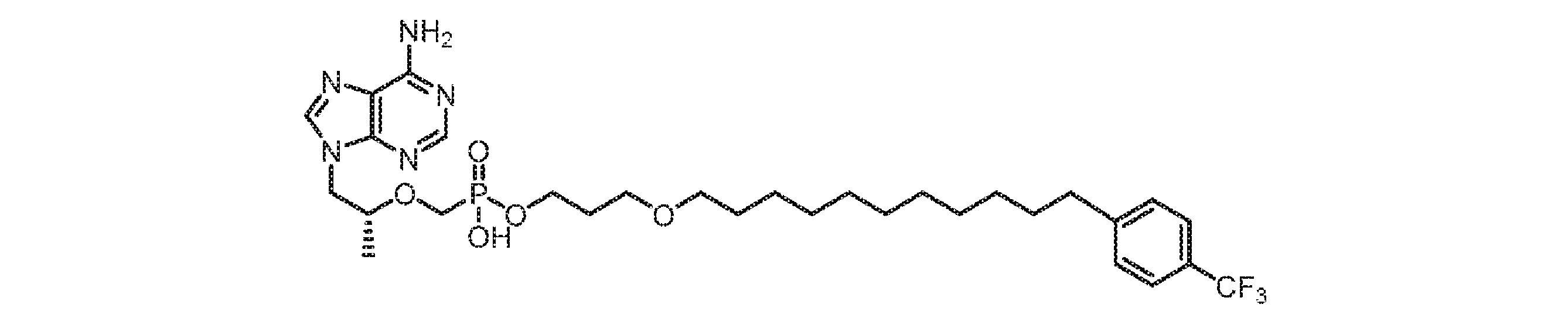








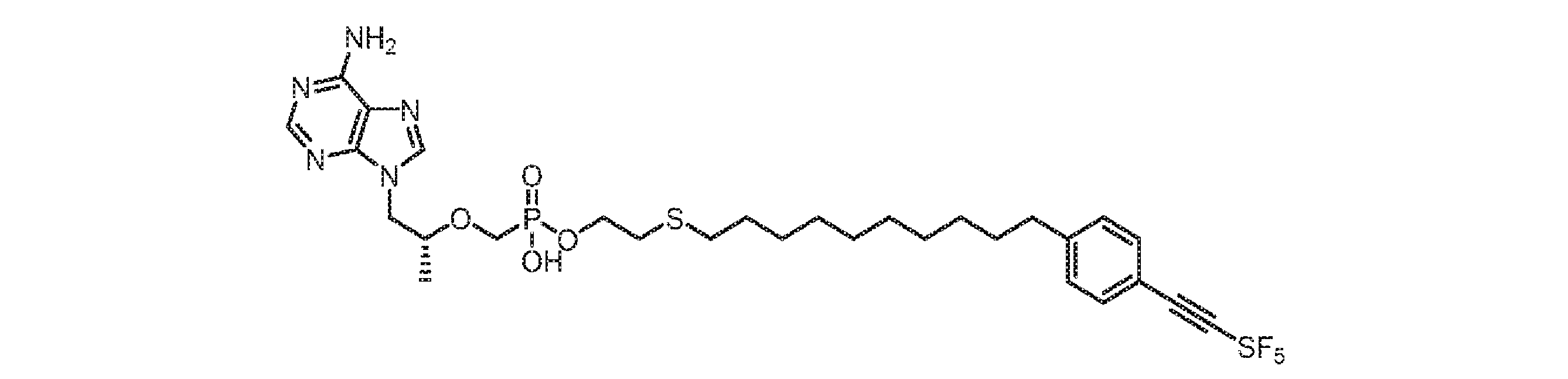


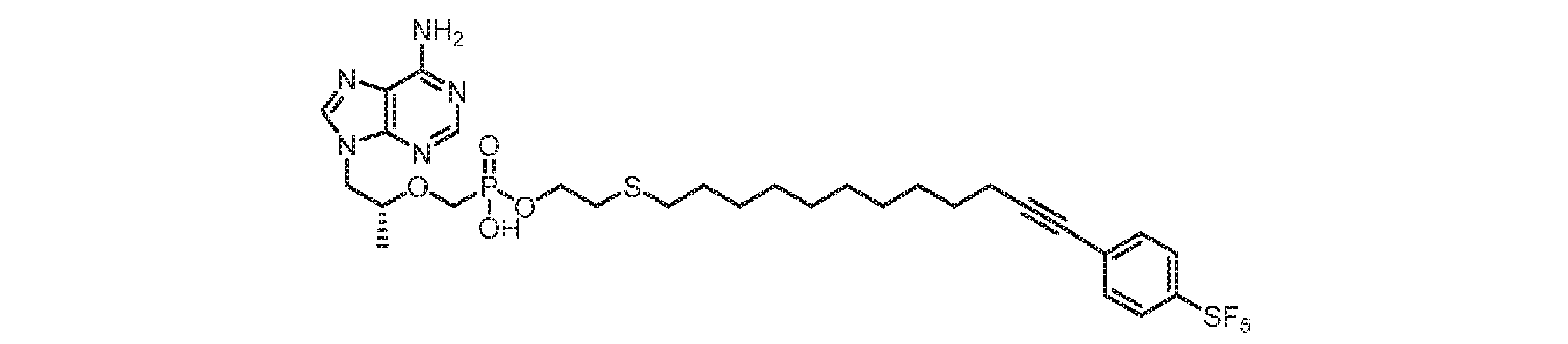










が挙げられるが限定されない。
Representative compounds include the following compounds and pharma- ceutically acceptable salts thereof, such as ammonium salts:
These include, but are not limited to:
他の代表的な化合物としては、次の化合物及び薬学的に許容可能なその塩(アンモニウム塩など):





が挙げられるが限定されない。
Other representative compounds include the following compounds and pharma- ceutically acceptable salts thereof, such as ammonium salts:
いくつかの実施形態では、本化合物は次の特性を有する:
Lは、

Wは、飽和、直鎖状C1~C9アルキル鎖(即ち直鎖状C1~C9アルキレン)であり;
Xは、-CF2-、-O-又は-S-であり;
Yは、飽和、直鎖状C2~C20アルキル鎖(即ち直鎖状C2~C20アルキレン)であり;
Zは、水素、メチル又はエチルである。
In some embodiments, the compounds have the following properties:
L is,
W is a saturated, linear C 1 -C 9 alkyl chain (i.e., linear C 1 -C 9 alkylene);
X is -CF 2 -, -O- or -S-;
Y is a saturated, linear C 2 -C 20 alkyl chain (i.e., linear C 2 -C 20 alkylene);
Z is hydrogen, methyl or ethyl.
いくつかの実施形態では、本化合物は、次の特性を有する:
Lは、

Wは、飽和、直鎖状C1~C9アルキル鎖(即ち直鎖状C1~C9アルキレン)であり;
Xは、-CF2-又は-S-であり;
Yは、飽和、直鎖状C2~C20アルキル鎖(即ち直鎖状C2~C20アルキレン)であり;
Zは、水素、メチル又はエチルである。
In some embodiments, the compounds have the following properties:
L is,
W is a saturated, linear C 1 -C 9 alkyl chain (i.e., linear C 1 -C 9 alkylene);
X is -CF 2 - or -S-;
Y is a saturated, linear C 2 -C 20 alkyl chain (i.e., linear C 2 -C 20 alkylene);
Z is hydrogen, methyl or ethyl.
代表的な化合物としては、次の化合物及び薬学的に許容可能なその塩(アンモニウム塩など):


2.L-O-Y-Z
いくつかの実施形態では、W及びXの両方が存在せず、即ちL-O-Y-Zである。
2. L-O-Y-Z
In some embodiments, both W and X are absent, ie, LOYZ.
いくつかの実施形態では、本化合物は次の特性を有する:
Lは、

Yは、飽和、直鎖状C8~C20アルキル鎖(即ち直鎖状C8~C20アルキレン)であり;
Zは、置換メチル又はエチル、任意選択的に置換されている不飽和C2~C3アルキル、任意選択的に置換されているカルボシクリル、任意選択的に置換されているヘテロシクリル、任意選択的に置換されているアリール、任意選択的に置換されているヘテロアリール、Si-置換されているシリル、S-置換されているチオール、O-置換されているヒドロキシル、エステル及び-SF5から選択される。
In some embodiments, the compounds have the following properties:
L is,
Y is a saturated, linear C 8 -C 20 alkyl chain (i.e., linear C 8 -C 20 alkylene);
Z is selected from substituted methyl or ethyl, optionally substituted unsaturated C2 - C3 alkyl, optionally substituted carbocyclyl, optionally substituted heterocyclyl, optionally substituted aryl, optionally substituted heteroaryl, Si-substituted silyl, S-substituted thiol, O-substituted hydroxyl, ester and -SF5 .
いくつかの実施形態では、本化合物は次の特性を有する:
Lは、

Yは、飽和、直鎖状C8~C20アルキル鎖(即ち直鎖状C8~C20アルキレン)であり;
Zは、-CD3、-CF3、-CD2CD3、-CF2CF3、-S-Ph、-O-Ph、-C≡CH、-C≡CCD3、-CH2FC≡C、-CHF2C≡C、-C≡CSi(CH3)3、-C≡CC(CH3)3、-C≡CCF3、-C≡CSF5、-Si(CH3)3、-C(CH3)3、-C(O)OCH3、-SF5並びに次のもの:


L is,
Y is a saturated, linear C 8 -C 20 alkyl chain (i.e., linear C 8 -C 20 alkylene);
Z is -CD3, -CF3 , -CD2CD3 , -CF2CF3 , -S- Ph , -O-Ph, -C≡CH , -C≡CCD3 , -CH2FC≡C, -CHF2C≡C , -C≡CSi ( CH3) 3 , -C≡CC( CH3 )3 , -C≡CCF3 , -C≡CSF5, -Si( CH3 ) 3 , -C ( CH3 ) 3 , -C( O ) OCH3 , -SF5 as well as the following:
代表的な化合物としては、次の化合物及び薬学的に許容可能なその塩(アンモニウム塩など):


III.さらなる化合物
本開示の実施形態によれば、以下の式で示される化合物又はその塩:

Lは、非環式ヌクレオシドホスホナート又はヌクレオシド若しくは核酸塩基にカップリングされる連結基であり;
Wは、飽和C1~C9アルキル鎖であるか又はその隣接原子の間の直接結合であり;
Xは、置換されているメチレン若しくはエチレン基又はヘテロ原子から選択されるか、又はその隣接原子間の直接結合であり;
Yは、飽和C9~C20アルキル鎖であり;
Zは、任意選択的に置換されているメチル又はエチル基、任意選択的に置換されている不飽和C2~C3アルキル又は任意選択的に置換されているヘテロ原子から選択されるか、又は存在せず;
任意選択的な置換基は、アルキル、重水素、ハロゲン、ニトロ、シアノ、ヒドロキシ、トリフルオロメトキシ、トリフルオロメチル、トリメチルシリル、アミノ、ホルミル、カルボキシ、カルバモイル、メルカプト、スルファモイル、メチル、エチル、メトキシ、エトキシ、アセチル、アセトキシ、メチルアミノ、エチルアミノ、ジメチルアミノ、ジエチルアミノ、N-メチル-N-エチルアミノ、アセチルアミノ、N-メチルカルバモイル、N-エチルカルバモイル、N,N-ジメチルカルバモイル、N,N-ジエチルカルバモイル、N-メチル-N-エチルカルバモイル、メチルチオ、エチルチオ、メチルスルフィニル、エチルスルフィニル、メシル、エチルスルホニル、メトキシカルボニル、エトキシカルボニル、N-メチルスルファモイル、N-エチルスルファモイル、N,N-ジメチルスルファモイル、N,N-ジエチルスルファモイル、N-メチル-N-エチルスルファモイル、ベンジル、ベンゾイル、カルボシクリル、アリール及びヘテロシクリルから選択され得る)
が提供される。
III. Additional Compounds According to an embodiment of the present disclosure, there is provided a compound having the following formula or a salt thereof:
L is an acyclic nucleoside phosphonate or a linking group that is coupled to a nucleoside or nucleobase;
W is a saturated C 1 -C 9 alkyl chain or a direct bond between adjacent atoms thereof;
X is selected from a substituted methylene or ethylene group, or a heteroatom, or a direct bond between adjacent atoms;
Y is a saturated C9 - C20 alkyl chain;
Z is selected from an optionally substituted methyl or ethyl group, an optionally substituted unsaturated C2 - C3 alkyl, or an optionally substituted heteroatom, or is absent;
Optional substituents include alkyl, deuterium, halogen, nitro, cyano, hydroxy, trifluoromethoxy, trifluoromethyl, trimethylsilyl, amino, formyl, carboxy, carbamoyl, mercapto, sulfamoyl, methyl, ethyl, methoxy, ethoxy, acetyl, acetoxy, methylamino, ethylamino, dimethylamino, diethylamino, N-methyl-N-ethylamino, acetylamino, N-methylcarbamoyl, N-ethylcarbamoyl, N,N-dimethylcarbamoyl, N,N-dimethylcarbamoyl, N,N-dimethylcarbamoyl, N,N-dimethylcarbamoyl, N,N-dimethylcarbamoyl, N,N-dimethylcarbamoyl, N,N-dimethylcarbamoyl, N,N-dimethylcarbamoyl, N,N-dimethylcarbamoyl, N,N-dimethylcarbamoyl, N,N-dimethylcarbamoyl, N,N-dimethylcarbamoyl, N,N-dimethylcarbamoyl, N,N-dimethylcarbamoyl, N,N-dimethylcarbamoyl, N,N-dimethylcarbamoyl, N,N-dimethylcarbamoyl, N,N-methyl ... (which may be selected from the group consisting of N-methylsulfamoyl, N-ethylsulfamoyl, N,N-diethylcarbamoyl, N-methyl-N-ethylcarbamoyl, methylthio, ethylthio, methylsulfinyl, ethylsulfinyl, mesyl, ethylsulfonyl, methoxycarbonyl, ethoxycarbonyl, N-methylsulfamoyl, N-ethylsulfamoyl, N,N-dimethylsulfamoyl, N,N-diethylsulfamoyl, N-methyl-N-ethylsulfamoyl, benzyl, benzoyl, carbocyclyl, aryl, and heterocyclyl).
is provided.
さらなる特性は、
Lが、非環式ヌクレオシドホスホナート、例えばテノホビル、シドフォビル、アデフォビル、(9-[2-(ホスホノメトキシ)エチル]グアニン)、9-(3-ヒドロキシ-2-ホスホニルメトキシプロピル)アデニン又は9-(2-ホスホニルメトキシエチル)-2,6-ジアミノプリンなどであること;
Wが、飽和C2、C3又はC9アルキル鎖であること;
XがCF2、O、Sを含む群から選択されること;
YがC13~C19アルキル鎖であること;及び
Zが、

を提供する。
Further properties include:
L is an acyclic nucleoside phosphonate, such as tenofovir, cidofovir, adefovir, (9-[2-(phosphonomethoxy)ethyl]guanine), 9-(3-hydroxy-2-phosphonylmethoxypropyl)adenine, or 9-(2-phosphonylmethoxyethyl)-2,6-diaminopurine;
W is a saturated C2 , C3 or C9 alkyl chain;
X is selected from the group including CF2 , O, S;
Y is a C 13 -C 19 alkyl chain; and Z is
本開示の別の実施形態によれば、次の式の化合物又はその塩

Lは、非環式ヌクレオシドホスホナート又はヌクレオシド若しくは核酸塩基にカップリングされる連結基であり;
Wは、C1~C9アルキル鎖であるか又はその隣接原子間の直接結合であり;
Xは、置換されているメチレン若しくはエチレン基及びヘテロ原子から選択されるか又はその隣接原子間の直接結合であり;
Yは、C9~C20アルキル鎖であり;
任意選択的な置換基は、重水素、ハロゲン、ニトロ、シアノ、ヒドロキシ、トリフルオロメトキシ、トリフルオロメチル、アミノ、ホルミル、カルボキシ、カルバモイル、メルカプト、スルファモイル、メチル、エチル、メトキシ、エトキシ、アセチル、アセトキシ、メチルアミノ、エチルアミノ、ジメチルアミノ、ジエチルアミノ、N-メチル-N-エチルアミノ、アセチルアミノ、N-メチルカルバモイル、N-エチルカルバモイル、N,N-ジメチルカルバモイル、N,N-ジエチルカルバモイル、N-メチル-N-エチルカルバモイル、メチルチオ、エチルチオ、メチルスルフィニル、エチルスルフィニル、メシル、エチルスルホニル、メトキシカルボニル、エトキシカルボニル、N-メチルスルファモイル、N-エチルスルファモイル、N,N-ジメチルスルファモイル、N,N-ジエチルスルファモイル、N-メチル-N-エチルスルファモイル、ベンジル、ベンゾイル、カルボシクリル、アリール及びヘテロシクリルから選択され得る)
が提供される。
According to another embodiment of the present disclosure, a compound of the formula:
L is an acyclic nucleoside phosphonate or a linking group that is coupled to a nucleoside or nucleobase;
W is a C 1 -C 9 alkyl chain or a direct bond between adjacent atoms thereof;
X is selected from a substituted methylene or ethylene group and a heteroatom or is a direct bond between adjacent atoms;
Y is a C9 - C20 alkyl chain;
The optional substituents may be selected from deuterium, halogen, nitro, cyano, hydroxy, trifluoromethoxy, trifluoromethyl, amino, formyl, carboxy, carbamoyl, mercapto, sulfamoyl, methyl, ethyl, methoxy, ethoxy, acetyl, acetoxy, methylamino, ethylamino, dimethylamino, diethylamino, N-methyl-N-ethylamino, acetylamino, N-methylcarbamoyl, N-ethylcarbamoyl, N,N-dimethylcarbamoyl, N,N-diethylcarbamoyl, N-methyl-N-ethylcarbamoyl, methylthio, ethylthio, methylsulfinyl, ethylsulfinyl, mesyl, ethylsulfonyl, methoxycarbonyl, ethoxycarbonyl, N-methylsulfamoyl, N-ethylsulfamoyl, N,N-dimethylsulfamoyl, N,N-diethylsulfamoyl, N-methyl-N-ethylsulfamoyl, benzyl, benzoyl, carbocyclyl, aryl, and heterocyclyl.
is provided.
本開示のまた別の実施形態によれば、次の式の化合物又はその塩

Lは、非環式ヌクレオシドホスホナート又はヌクレオシド若しくは核酸塩基にカップリングされる連結基であり;
Yは、C9~C20アルキル鎖であり;
Zは、置換メチル若しくはエチル基、任意選択的に置換されている不飽和C2~C3アルキル及び任意選択的に置換されているヘテロ原子から選択されるか又は存在せず;
任意選択的な置換基は、重水素、ハロゲン、ニトロ、シアノ、トリフルオロメトキシ、トリフルオロメチル、アミノ、カルバモイル、メルカプト、スルファモイル、メチル、エチル、アセチル、アセトキシ、メチルアミノ、エチルアミノ、ジメチルアミノ、ジエチルアミノ、N-メチル-N-エチルアミノ、アセチルアミノ、N-メチルカルバモイル、N-エチルカルバモイル、N,N-ジメチルカルバモイル、N,N-ジエチルカルバモイル、N-メチル-N-エチルカルバモイル、メチルスルフィニル、エチルスルフィニル、メシル、エチルスルホニル、N-メチルスルファモイル、N-エチルスルファモイル、N,N-ジメチルスルファモイル、N,N-ジエチルスルファモイル、N-メチル-N-エチルスルファモイル、ベンジル、ベンゾイル、カルボシクリル、アリール及びヘテロシクリルから選択され得る)
が提供される。
According to another embodiment of the present disclosure, a compound of the formula:
L is an acyclic nucleoside phosphonate or a linking group that is coupled to a nucleoside or nucleobase;
Y is a C9 - C20 alkyl chain;
Z is selected from a substituted methyl or ethyl group, an optionally substituted unsaturated C2 - C3 alkyl, and an optionally substituted heteroatom, or is absent;
The optional substituents may be selected from deuterium, halogen, nitro, cyano, trifluoromethoxy, trifluoromethyl, amino, carbamoyl, mercapto, sulfamoyl, methyl, ethyl, acetyl, acetoxy, methylamino, ethylamino, dimethylamino, diethylamino, N-methyl-N-ethylamino, acetylamino, N-methylcarbamoyl, N-ethylcarbamoyl, N,N-dimethylcarbamoyl, N,N-diethylcarbamoyl, N-methyl-N-ethylcarbamoyl, methylsulfinyl, ethylsulfinyl, mesyl, ethylsulfonyl, N-methylsulfamoyl, N-ethylsulfamoyl, N,N-dimethylsulfamoyl, N,N-diethylsulfamoyl, N-methyl-N-ethylsulfamoyl, benzyl, benzoyl, carbocyclyl, aryl, and heterocyclyl.
is provided.
特定の実施形態では、本開示は、本明細書中で開示される化合物の誘導体、例えば1個以上の同じ又は異なる置換基を含有するものを企図する。 In certain embodiments, the present disclosure contemplates derivatives of the compounds disclosed herein, e.g., those containing one or more of the same or different substituents.
IV.製剤処方物
本明細書中で開示される化合物を含有する製剤処方物が提供される。一般に、本製剤処方物は、薬学的に許容可能な担体も含有する。本製剤処方物は、錠剤、カプセル、丸剤、ゲル、顆粒、エアロゾル、溶液(水溶液、例えば生理食塩水又はリン酸緩衝食塩水など)、懸濁液、ナノ粒子処方物、エマルジョンなどの形態であり得る。
IV. Pharmaceutical formulations Pharmaceutical formulations containing the compounds disclosed herein are provided.Generally, the pharmaceutical formulations also contain a pharma-ceutically acceptable carrier.The pharmaceutical formulations can be in the form of tablets, capsules, pills, gels, granules, aerosols, solutions (aqueous solutions, such as saline or phosphate buffered saline), suspensions, nanoparticle formulations, emulsions, etc.
いくつかの実施形態では、本製剤処方物は経口処方物である。いくつかの実施形態では、本製剤処方物は局所処方物である。 In some embodiments, the pharmaceutical formulation is an oral formulation. In some embodiments, the pharmaceutical formulation is a topical formulation.
本明細書中で開示される製剤処方物は、一般に本明細書中に記載のような薬学的に許容可能な塩の形態であり得る。本開示の化合物が酸性基並びに塩基性基を含有する場合、本開示の化合物は内部塩も形成し得、このような化合物は、本開示の範囲内である。化合物が水素供与ヘテロ原子(例えばNH)を含有する場合、塩は、前記水素原子を塩基性基又はその分子内の原子に移すことにより形成される異性体を包含することが企図される。 The pharmaceutical formulations disclosed herein may generally be in the form of pharma- ceutically acceptable salts as described herein. When the compounds of the present disclosure contain acidic as well as basic groups, the compounds of the present disclosure may also form internal salts, and such compounds are within the scope of the present disclosure. When the compounds contain a hydrogen-donating heteroatom (e.g., NH), the salts are intended to include isomers formed by transferring said hydrogen atom to a basic group or atom within the molecule.
本化合物の薬学的に許容可能な塩としては、その酸付加塩及び塩基塩が挙げられる。適切な酸付加塩は、無毒性塩を形成する酸から形成される。例としては、酢酸塩、アジピン酸塩、アスパラギン酸塩、安息香酸塩、ベシル酸塩、重炭酸塩/炭酸塩、重硫酸塩/硫酸塩、ホウ酸塩、カンシル酸塩、クエン酸塩、シクラミン酸塩、エジシル酸塩、エシル酸塩、ギ酸塩、フマル酸塩、グルセプト酸塩、グルコン酸塩、グルクロン酸塩、ヘキサフルオロリン酸塩、ヒベンズ酸塩、塩酸塩/塩化物、臭化水素酸塩/臭化物、ヨウ化水素酸塩/ヨウ化物、イセチオン酸塩、乳酸塩、リンゴ酸塩、マレイン酸塩、マロン酸塩、メシル酸塩、メチル硫酸塩、ナフチル酸塩、2-ナプシル酸塩、ニコチン酸塩、硝酸塩、オロト酸塩、シュウ酸塩、パルミチン酸塩、パモ酸塩、リン酸塩/リン酸水素塩/リン酸二水素塩、ピログルタミン酸塩、糖酸塩、ステアリン酸塩、コハク酸塩、タンニン酸塩、酒石酸塩、トシル酸塩、トリフルオロ酢酸塩及びキシナホ酸塩が挙げられる。適切な塩基塩は、無毒性塩を形成する塩基から形成される。例としては、アンモニウム、アルミニウム、アルギニン、ベンザチン、カルシウム、コリン、ジエチルアミン、ジオラミン、グリシン、リジン、マグネシウム、メグルミン、オラミン、カリウム、ナトリウム、トロメタミン及び亜鉛塩が挙げられる。例えばヘミ硫酸塩及びヘミカルシウム塩など、酸及び塩基のヘミ塩も形成され得る。適切な塩の概説については、参照により本明細書中に組み込まれる、Stahl and Wermuthによる、Handbook of Pharmaceutical Salts:Properties, Selection, and Use(Wiley-VCH、2002)を参照。いくつかの実施形態では、本化合物の薬学的に許容可能な塩はアンモニウム塩である。 Pharmaceutically acceptable salts of the present compound include its acid addition and base salts. Suitable acid addition salts are formed from acids which form non-toxic salts. Examples include acetate, adipate, aspartate, benzoate, besylate, bicarbonate/carbonate, bisulfate/sulfate, borate, camsylate, citrate, cyclamate, edisylate, esylate, formate, fumarate, gluceptate, gluconate, glucuronate, hexafluorophosphate, hybenzate, hydrochloride/chloride, hydrobromide/bromide, hydroiodide/iodide, isethionate, lactate, malate, maleate, malonate, mesylate, methylsulfate, naphthylate, 2-napsylate, nicotinate, nitrate, orotate, oxalate, palmitate, pamoate, phosphate/hydrogenphosphate/dihydrogenphosphate, pyroglutamate, saccharate, stearate, succinate, tannate, tartrate, tosylate, trifluoroacetate and xinafoate. Suitable base salts are formed from bases which form non-toxic salts. Examples include ammonium, aluminum, arginine, benzathine, calcium, choline, diethylamine, diolamine, glycine, lysine, magnesium, meglumine, olamine, potassium, sodium, tromethamine and zinc salts. Hemi-salts of acids and bases can also be formed, such as hemisulfate and hemicalcium salts. For a review of suitable salts, see Handbook of Pharmaceutical Salts: Properties, Selection, and Use by Stahl and Wermuth (Wiley-VCH, 2002), which is incorporated herein by reference. In some embodiments, the pharma- ceutically acceptable salt of the compound is an ammonium salt.
一般的には本開示での使用のための製剤処方物は、本明細書中で開示される化合物の有効量と、適切な薬学的に許容可能な担体と、を含む。調製物は通常、1つ以上の薬学的に許容可能な担体と本開示による少なくとも1個の化合物を混合することを含む、それ自体公知の方式で調製され得、必要に応じて、必要とされる場合は無菌的な条件下で、他の薬学的に活性のある薬剤と組み合わせられる。Remington’s Pharmaceutical Sciencesの最新版など、標準的なハンドブックも参照のこと。 In general, pharmaceutical formulations for use in the present disclosure will contain an effective amount of a compound disclosed herein and a suitable pharma- ceutically acceptable carrier. The preparations can be prepared in a manner known per se, which usually involves mixing at least one compound according to the present disclosure with one or more pharma- ceutically acceptable carriers, optionally combined with other pharma- ceutically active agents, if required under sterile conditions. See also standard handbooks, such as the latest edition of Remington's Pharmaceutical Sciences.
一般に、薬学的な使用に対して、本化合物は、本明細書中で開示される少なくとも1つの化合物と、少なくとも1つの薬学的に許容可能な担体、希釈剤又はアジュバントと、任意選択的に1つ以上のさらなる薬学的活性薬剤と、を含有する医薬調製物として処方され得る。 Generally, for pharmaceutical use, the compounds may be formulated as pharmaceutical preparations containing at least one compound disclosed herein, at least one pharma- ceutically acceptable carrier, diluent or adjuvant, and, optionally, one or more additional pharma- ceutical active agents.
本開示の医薬調製物は、単位剤形において好ましく、例えば箱、ブリスター、バイアル、ボトル、サシェ、アンプル中又は何らかの他の適切な単回投与若しくは複数回投与ホルダー若しくは容器中で適切にパッケージ化され得(的確に表示され得る);製品情報及び/又は使用説明書を含有する1つ以上のリーフレットを任意選択的に伴う。一般に、このような単位投与量は、少なくとも1つの本開示の化合物の、1~1000mg、通常は5~500mg、例えば単位投与量あたり約10、25、50、100、200、300又は400mgを含有する。 The pharmaceutical preparations of the present disclosure are preferably in unit dosage form and may be suitably packaged (and appropriately labeled) in, for example, boxes, blisters, vials, bottles, sachets, ampoules, or any other suitable single-dose or multi-dose holders or containers; optionally accompanied by one or more leaflets containing product information and/or instructions for use. Generally, such unit dosages contain 1-1000 mg, typically 5-500 mg, e.g., about 10, 25, 50, 100, 200, 300 or 400 mg per unit dosage, of at least one compound of the present disclosure.
導入方式に依存して、本明細書中に記載の化合物は、様々な方法で処方され得る。1つ以上の化合物を含有する処方物は、様々な薬学的形態、例えば顆粒、錠剤、カプセル、坐薬、粉末、制御放出製剤、液剤(水溶液、例えば生理食塩水、緩衝食塩水など)、懸濁液、エマルジョン、クリーム、ゲル、軟膏、サルブ、ローション又はエアロゾルなど、で調製され得る。好ましくは、これらの処方物は、単純で好ましくは経口の、的確な投与量の投与に適切な固体剤形で使用される。経口投与のための固体剤形としては、錠剤、軟若しくは硬ゼラチン又は非ゼラチンカプセル及びカプレットが挙げられるが限定されない。しかし、溶液、シロップ、懸濁液、シェイク(shake)などの液体剤形でも利用され得る。別の実施形態では、本処方物は局所投与される。適切な局所処方物としては、ローション、軟膏、クリーム及びゲルが挙げられるが限定されない。好ましい実施形態では、局所処方物はゲルである。別の実施形態では、処方物は鼻腔内投与される。 Depending on the mode of introduction, the compounds described herein may be formulated in a variety of ways. Formulations containing one or more compounds may be prepared in a variety of pharmaceutical forms, such as granules, tablets, capsules, suppositories, powders, controlled release formulations, liquids (aqueous solutions, e.g., saline, buffered saline, etc.), suspensions, emulsions, creams, gels, ointments, salves, lotions, or aerosols. Preferably, these formulations are used in solid dosage forms suitable for simple, preferably oral, precise dosage administration. Solid dosage forms for oral administration include, but are not limited to, tablets, soft or hard gelatin or non-gelatin capsules and caplets. However, liquid dosage forms such as solutions, syrups, suspensions, shakes, etc. may also be utilized. In another embodiment, the formulations are administered topically. Suitable topical formulations include, but are not limited to, lotions, ointments, creams, and gels. In a preferred embodiment, the topical formulation is a gel. In another embodiment, the formulation is administered intranasally.
特定の実施形態では、本製剤処方物は、本明細書中で開示される化合物と、プロペラントと、を含む。特定の実施形態では、エアロゾル化プロペラントは、圧縮空気、エタノール、窒素、二酸化炭素、亜酸化窒素、ハイドロフルオロアルカン(HFA)、1,1,1,2,-テトラフルオロエタン、1,1,1,2,3,3,3-ヘプタフルオロプロパン又はそれらの組み合わせである。 In certain embodiments, the pharmaceutical formulation comprises a compound disclosed herein and a propellant. In certain embodiments, the aerosolized propellant is compressed air, ethanol, nitrogen, carbon dioxide, nitrous oxide, hydrofluoroalkane (HFA), 1,1,1,2,-tetrafluoroethane, 1,1,1,2,3,3,3-heptafluoropropane, or a combination thereof.
特定の実施形態では、本開示は、本明細書中の化合物を含む加圧型又は非加圧型容器を企図する。特定の実施形態では、この容器は、手動ポンプスプレー、吸入器、定量噴霧式吸入器、乾燥粉末吸入器、ネブライザー、振動型のメッシュ式ネブライザー、ジェット式ネブライザー又は超音波式ネブライザーである。 In certain embodiments, the present disclosure contemplates a pressurized or non-pressurized container comprising a compound herein. In certain embodiments, the container is a manual pump spray, an inhaler, a metered dose inhaler, a dry powder inhaler, a nebulizer, a vibrating mesh nebulizer, a jet nebulizer, or an ultrasonic nebulizer.
本明細書中に記載の化合物のうち1つ以上を含有する処方物は、安全で有効であると考えられる物質から構成される薬学的に許容可能な担体を使用して調製され得、望ましくない生物学的副作用又は望まれない相互作用を引き起こさずに個体に投与され得る。担体は、有効成分以外の製剤処方物中に存在する全ての構成成分である。一般に本明細書中で使用される場合、「担体」としては、希釈剤、結合剤、滑沢剤、崩壊剤、充填剤、pH調整剤、保存剤、抗酸化剤、溶解促進剤及びコーティング組成物が挙げられるが限定されない。 Formulations containing one or more of the compounds described herein may be prepared using a pharma- ceutically acceptable carrier composed of materials believed to be safe and effective, and may be administered to an individual without causing undesirable biological side effects or undesirable interactions. A carrier is any component present in a pharmaceutical formulation other than the active ingredient. As generally used herein, "carrier" includes, but is not limited to, diluents, binders, lubricants, disintegrants, fillers, pH adjusters, preservatives, antioxidants, solubility enhancers, and coating compositions.
担体は、賦形剤、可塑剤、顔料、着色剤、安定化剤及び流動促進剤を含み得る、コーティング組成物の全ての構成成分も含む。“Pharmaceutical dosage form tablets”, eds. Liberman et. al.(New York, Marcel Dekker, Inc., 1989)、“Remington - The science and practice of pharmacy”, 20th ed., Lippincott Williams & Wilkins, Baltimore, MD, 2000及び“Pharmaceutical dosage forms and drug delivery systems”, 6th Edition, Ansel et al.,(Media, PA:Williams and Wilkins, 1995)などの標準的な参考文献に記載のように、遅延放出、持続放出及び/又は拍動放出剤形が調製され得る。これらの参考文献は、錠剤及びカプセル、及び錠剤、カプセル及び顆粒の遅延放出剤形を調製するための担体、材料、装置及び工程に対する情報を提供する。 Carriers also include all components of the coating composition, which may include excipients, plasticizers, pigments, colorants, stabilizers, and glidants. Delayed release, sustained release, and/or pulsatile release dosage forms may be prepared as described in standard references such as "Pharmaceutical dosage form tablets", eds. Liberman et. al. (New York, Marcel Dekker, Inc., 1989), "Remington - The science and practice of pharmacy", 20th ed., Lippincott Williams & Wilkins, Baltimore, MD, 2000, and "Pharmaceutical dosage forms and drug delivery systems", 6th Edition, Ansel et al., (Media, PA: Williams and Wilkins, 1995). These references provide information on carriers, materials, equipment, and processes for preparing delayed release dosage forms of tablets and capsules, and tablets, capsules, and granules.
適切なコーティング材料の例としては、セルロースポリマー、例えばフタル酸酢酸セルロース、ヒドロキシプロピルセルロース、ヒドロキシプロピルメチルセルロース、ヒドロキシプロピルメチルセルロースフタル酸エステル及びヒドロキシプロピルメチルセルロースアセテートサクシネート;ポリ酢酸フタル酸ビニル、アクリル酸ポリマー及びコポリマー及び商品名EUDRAGIT(登録商標)(Roth Pharma, Westerstadt, Germany)で市販されているメタクリル樹脂、ゼイン、セラック及び多糖類が挙げられるが限定されない。 Examples of suitable coating materials include, but are not limited to, cellulose polymers such as cellulose acetate phthalate, hydroxypropyl cellulose, hydroxypropyl methylcellulose, hydroxypropyl methylcellulose phthalate and hydroxypropyl methylcellulose acetate succinate; polyvinyl acetate phthalate, acrylic acid polymers and copolymers and methacrylic resins commercially available under the trade name EUDRAGIT® (Roth Pharma, Westerstadt, Germany), zein, shellac and polysaccharides.
さらに、コーティング材料は、可塑剤、顔料、着色剤、流動促進剤、安定化剤、ポア形成剤及び界面活性剤などの従来の担体を含有し得る。 Additionally, the coating material may contain conventional carriers such as plasticizers, pigments, colorants, flow enhancers, stabilizers, pore formers and surfactants.
薬物含有錠剤、ビーズ、顆粒又は粒子中に存在する任意選択的な薬学的に許容可能な賦形剤としては、希釈剤、結合剤、滑沢剤、崩壊剤、着色剤、安定化剤及び界面活性剤が挙げられるが限定されない。「充填剤」とも呼ばれる希釈剤は、一般的には、錠剤の圧縮又はビーズ及び顆粒の形成のために実際的なサイズが提供されるように、固体剤形の嵩を増やすために必要とされる。適切な希釈剤としては、リン酸二カルシウム二水和物、硫酸カルシウム、ラクトース、スクロース、マンニトール、ソルビトール、セルロース、微結晶セルロース、カオリン、塩化ナトリウム、乾燥デンプン、加水分解デンプン、アルファ化デンプン、二酸化ケイ素、酸化チタン、ケイ酸マグネシウムアルミニウム及び粉砂糖が挙げられるが限定されない。 Optional pharma- ceutically acceptable excipients present in the drug-containing tablets, beads, granules, or particles include, but are not limited to, diluents, binders, lubricants, disintegrants, colorants, stabilizers, and surfactants. Diluents, also called "fillers," are generally required to increase the bulk of solid dosage forms so that a practical size is provided for tablet compression or bead and granule formation. Suitable diluents include, but are not limited to, dicalcium phosphate dihydrate, calcium sulfate, lactose, sucrose, mannitol, sorbitol, cellulose, microcrystalline cellulose, kaolin, sodium chloride, dry starch, hydrolyzed starch, pregelatinized starch, silicon dioxide, titanium oxide, magnesium aluminum silicate, and powdered sugar.
結合剤は、固体投与処方物に粘着性を付与するために使用され、従って、錠剤又はビーズ又は顆粒が剤形の形成後にインタクトなままであることを確実にする。適切な結合剤材料としては、デンプン、アルファ化デンプン、ゼラチン、糖(スクロース、グルコース、デキストロース、ラクトース及びソルビトールを含む)、ポリエチレングリコール、ワックス、天然及び合成ゴム、例えばアカシア、トラガカント、アルギン酸ナトリウムなど、ヒドロキシプロピルメチルセルロース、ヒドロキシプロピルセルロース、エチルセルロースを含むセルロース及びビーガム(veegum)及び合成ポリマー、例えばアクリル酸及びメタクリル酸コポリマー、メタクリル酸コポリマー、メチルメタクリル酸コポリマー、アミノアルキルメタクリル酸コポリマー、ポリアクリル酸/ポリメタクリル酸及びポリビニルピロリドンが挙げられるが限定されない。 Binders are used to impart cohesiveness to solid dosage formulations, thus ensuring that the tablets or beads or granules remain intact after formation of the dosage form. Suitable binder materials include, but are not limited to, starch, pregelatinized starch, gelatin, sugars (including sucrose, glucose, dextrose, lactose and sorbitol), polyethylene glycol, waxes, natural and synthetic gums such as acacia, tragacanth, sodium alginate, celluloses including hydroxypropyl methylcellulose, hydroxypropyl cellulose, ethylcellulose and veegum, and synthetic polymers such as acrylic and methacrylic acid copolymers, methacrylic acid copolymers, methyl methacrylic acid copolymers, aminoalkyl methacrylic acid copolymers, polyacrylic acid/polymethacrylic acid and polyvinylpyrrolidone.
滑沢剤は、錠剤の製造を容易にするために使用される。適切な滑沢剤の例としては、ステアリン酸マグネシウム、ステアリン酸カルシウム、ステアリン酸、ベヘン酸グリセロール、ポリエチレングリコール、タルク及び鉱物油が挙げられるが限定されない。 Lubricants are used to facilitate the manufacture of tablets. Examples of suitable lubricants include, but are not limited to, magnesium stearate, calcium stearate, stearic acid, glycerol behenate, polyethylene glycol, talc, and mineral oil.
崩壊剤は、投与後の剤形崩壊又は「分解」を促進するために使用され、一般には、デンプン、デンプングリコール酸ナトリウム、カルボキシメチルスターチナトリウム、カルボキシメチルセルロースナトリウム、ヒドロキシプロピルセルロース、アルファ化デンプン、粘土、セルロース、アルギニン、ゴム又は架橋ポリマー、例えば架橋PVP(GAF Chemical CorpからのPolyplasdone XL)が挙げられるが限定されない。 Disintegrants are used to facilitate the breakup or "disintegration" of the dosage form after administration and commonly include, but are not limited to, starch, sodium starch glycolate, sodium carboxymethyl starch, sodium carboxymethylcellulose, hydroxypropyl cellulose, pregelatinized starch, clay, cellulose, arginine, gums or cross-linked polymers such as cross-linked PVP (Polyplasdone XL from GAF Chemical Corp).
安定化剤は、例えば酸化反応を含む薬物分解反応を阻害するか又は遅らせるために使用される。 Stabilizers are used to inhibit or retard drug decomposition reactions, including, for example, oxidative reactions.
界面活性剤は、陰イオン性、陽イオン性、両性又は非イオン性界面活性剤であり得る。適切な陰イオン性界面活性剤としては、カルボン酸、スルホン酸及び硫酸イオンを含有するものが挙げられるが限定されない。陰イオン性界面活性剤の例としては、長鎖アルキルスルホン酸及びアルキルアリールスルホン酸ナトリウム、カリウム、アンモニウム、例えばドデシルベンゼンスルホン酸ナトリウム;ジアルキルスルホコハク酸ナトリウム、例えばドデシルベンゼンスルホン酸ナトリウム;ジアルキルスルホコハク酸ナトリウム、例えばビス-(2-エチルチオキシル)-スルホコハク酸ナトリウム;及びアルキル硫酸塩、例えばラウリル硫酸ナトリウムが挙げられる。陽イオン性界面活性剤としては、四級アンモニウム化合物、例えば塩化ベンザルコニウム、塩化ベンゼトニウム、臭化セトリモニウム、塩化ステアリルジメチルベンジルアンモニウム、ポリオキシエチレン及びココナツアミンが挙げられるが限定されない。非イオン性界面活性剤の例としては、モノステアリン酸エチレングリコール、ミリスチル酸プロピレングリコール、モノステアリン酸グリセリン、ステアリン酸グリセリル、ポリグリセリル-4-オレアート、ソルビタンアシラート(sorbitan acylate)、スクロースアシラート(sucrose acylate)、ラウリン酸PEG-150、モノラウリン酸PEG-400、モノラウリン酸ポリオキシエチレン、ポリソルベート、ポリオキシエチレンオクチルフェニルエーテル、PEG-1000セチルエーテル、ポリオキシエチレントリデシルエーテル、ポリプロピレングリコールブチルエーテル、ポロキサマー(登録商標)401、ステアロイルモノイソプロパノールアミド及びポリオキシエチレン水素化獣脂アミドが挙げられる。両性界面活性剤の例としては、ナトリウムN-ドデシル-β-アラニン、ナトリウムN-ラウリル-β-イミノジプロピオナート、ミリストアンフォアセタート、ラウリルベタイン及びラウリルスルホベタインが挙げられる。 The surfactant may be anionic, cationic, amphoteric or nonionic. Suitable anionic surfactants include, but are not limited to, those containing carboxylate, sulfonate and sulfate ions. Examples of anionic surfactants include sodium, potassium, ammonium long chain alkyl sulfonates and alkylaryl sulfonates, such as sodium dodecylbenzene sulfonate; sodium dialkyl sulfosuccinates, such as sodium dodecylbenzene sulfonate; sodium dialkyl sulfosuccinates, such as sodium bis-(2-ethylthioxyl)-sulfosuccinate; and alkyl sulfates, such as sodium lauryl sulfate. Cationic surfactants include, but are not limited to, quaternary ammonium compounds, such as benzalkonium chloride, benzethonium chloride, cetrimonium bromide, stearyl dimethylbenzyl ammonium chloride, polyoxyethylene and coconut amine. Examples of nonionic surfactants include ethylene glycol monostearate, propylene glycol myristate, glyceryl monostearate, glyceryl stearate, polyglyceryl-4-oleate, sorbitan acylate, sucrose acylate, PEG-150 laurate, PEG-400 monolaurate, polyoxyethylene monolaurate, polysorbate, polyoxyethylene octylphenyl ether, PEG-1000 cetyl ether, polyoxyethylene tridecyl ether, polypropylene glycol butyl ether, Poloxamer® 401, stearoyl monoisopropanolamide, and polyoxyethylene hydrogenated tallow amide. Examples of amphoteric surfactants include sodium N-dodecyl-β-alanine, sodium N-lauryl-β-iminodipropionate, myristamphoacetate, lauryl betaine, and lauryl sulfobetaine.
必要に応じて、錠剤、ビーズ、顆粒又は粒子は、少量の無毒性補助物質、例えば湿潤剤又は乳化剤、色素、pH緩衝剤又は保存剤も含有し得る。 If desired, the tablets, beads, granules or particles may also contain minor amounts of non-toxic auxiliary substances such as wetting or emulsifying agents, dyes, pH buffering agents, or preservatives.
担体及び/又は他の物質に対する化合物の濃度は、約0.5~約100wt%(重量パーセント)まで変動し得る。経口での使用の場合、本製剤処方物は一般に、約5~約100重量%の活性物質を含有する。他の使用の場合、製剤処方物は一般に、約0.5~約50wt.%の活性物質を有する。 The concentration of the compound relative to the carrier and/or other materials may vary from about 0.5 to about 100 wt. % (weight percent). For oral use, the pharmaceutical formulations generally contain from about 5 to about 100 wt. % active material. For other uses, the pharmaceutical formulations generally have from about 0.5 to about 50 wt. % active material.
本明細書中に記載の組成物は、調節放出又は制御放出のために処方され得る。制御放出剤形の例としては、持続放出剤形、遅延放出剤形、拍動放出剤形及びそれらの組み合わせが挙げられる。 The compositions described herein may be formulated for modified or controlled release. Examples of controlled release dosage forms include sustained release dosage forms, delayed release dosage forms, pulsatile release dosage forms, and combinations thereof.
持続放出処方物は一般に、拡散又は浸透圧系として、例えば“Remington - The science and practice of pharmacy”(20th ed., Lippincott Williams & Wilkins, Baltimore, MD, 2000)に記載のように調製される。拡散系は一般的に、2つのタイプの装置、リザーバ及びマトリクスからなり、当技術分野で周知であり、記載されている。マトリクス装置は一般に、ゆっくりと溶解するポリマー担体とともに薬物を圧縮して錠剤形態にすることによって調製される。マトリクス装置の調製で使用される物質の3つの主なタイプは不溶性のプラスチック、親水性ポリマー及び脂肪化合物である。プラスチック製マトリクスとしては、アクリル酸メチル-メタクリル酸メチル、ポリ塩化ビニル及びポリエチレンが挙げられるが限定されない。親水性ポリマーとしては、セルロース性ポリマー、例えばメチル及びエチルセルロース、ヒドロキシアルキルセルロース、例えばヒドロキシプロピル-セルロース、ヒドロキシプロピルメチルセルロース、カルボキシメチルセルロースナトリウムなど、及びCarbopol(登録商標)934、ポリエチレンオキシド及びそれらの混合物が挙げられるが限定されない。脂肪化合物としては、様々なワックス、例えばカルナウバロウ及びトリステアリン酸グリセリル及び水素化ヒマシ油又は水素化植物油を含むワックス型の物質又はそれらの混合物などが挙げられるが限定されない。 Sustained release formulations are generally prepared as diffusion or osmotic systems, for example, as described in "Remington - The science and practice of pharmacy" (20th ed., Lippincott Williams & Wilkins, Baltimore, MD, 2000). Diffusion systems generally consist of two types of devices, reservoirs and matrices, and are well known and described in the art. Matrix devices are generally prepared by compressing the drug with a slowly dissolving polymeric carrier into a tablet form. The three main types of materials used in the preparation of matrix devices are insoluble plastics, hydrophilic polymers, and fatty compounds. Plastic matrices include, but are not limited to, methyl acrylate-methyl methacrylate, polyvinyl chloride, and polyethylene. Hydrophilic polymers include, but are not limited to, cellulosic polymers, such as methyl and ethyl cellulose, hydroxyalkyl celluloses, such as hydroxypropyl-cellulose, hydroxypropylmethylcellulose, sodium carboxymethylcellulose, and Carbopol® 934, polyethylene oxide, and mixtures thereof. Fatty compounds include, but are not limited to, various waxes, such as carnauba wax and wax-type substances including glyceryl tristearate and hydrogenated castor oil or hydrogenated vegetable oil, or mixtures thereof.
特定の好ましい実施形態では、プラスチック材料は、アクリル酸及びメタクリル酸コポリマー、メタクリル酸メチル、メタクリル酸メチルコポリマー、メタクリル酸エトキシエチル、メタクリル酸シアノエチル、メタクリル酸アミノアルキルコポリマー、ポリ(アクリル酸)、ポリ(メタクリル酸)、メタクリル酸アルキルアミンコポリマーポリ(メタクリル酸メチル)、ポリ(メタクリル酸)(無水物)、ポリメタクリル酸、ポリアクリルアミド、ポリ(メタクリル酸無水物)及びメタクリル酸グリシジルコポリマーを含むが限定されない薬学的に許容可能なアクリルポリマーである。 In certain preferred embodiments, the plastic material is a pharma- ceutically acceptable acrylic polymer, including, but not limited to, acrylic and methacrylic acid copolymers, methyl methacrylate, methyl methacrylate copolymers, ethoxyethyl methacrylate, cyanoethyl methacrylate, aminoalkyl methacrylate copolymers, poly(acrylic acid), poly(methacrylic acid), alkylamine methacrylate copolymers poly(methyl methacrylate), poly(methacrylic acid) (anhydride), polymethacrylic acid, polyacrylamide, poly(methacrylic anhydride), and glycidyl methacrylate copolymers.
特定の好ましい実施形態では、アクリルポリマーは、1つ以上のメタクリル酸アンモニオコポリマーから構成される。メタクリル酸アンモニオコポリマーは当技術分野で周知であり、四級アンモニウム基が低含量であるアクリル酸及びメタクリル酸エステルの完全ポリマー化コポリマーとしてNF XVIIで記載される。 In certain preferred embodiments, the acrylic polymer is comprised of one or more ammonio methacrylate copolymers. Ammonio methacrylate copolymers are well known in the art and are described in NF XVII as fully polymerized copolymers of acrylic and methacrylic acid esters with a low content of quaternary ammonium groups.
好ましい一実施形態では、アクリルポリマーは、商品名Eudragit(登録商標)でRohm Pharmaから市販されるものなど、アクリル樹脂ラッカーである。さらなる好ましい実施形態では、アクリルポリマーは、それぞれ商品名Eudragit(登録商標)RL30D及びEudragit(登録商標)RS30DでRohm Pharmaから市販される2つのアクリル樹脂ラッカーの混合物を含む。Eudragit(登録商標)RL30D及びEudragit(登録商標)RS30Dは、四級アンモニウム基が低含量であるアクリル及びメタクリルエステルのコポリマーであり、残留する中性(メタ)アクリルエステルに対するアンモニウム基のモル比は、Eudragit(登録商標)RL30Dにおいて1:20、Eudragit(登録商標)RS30Dにおいて1:40である。平均分子量は約150,000である。Edragit(登録商標)S-100及びEudragit(登録商標)L-100も好ましい。コード表示RL(高透過性)及びRS(低透過性)は、これらの物質の透過特性を指す。Eudragit(登録商標)RL/RS混合物は水中及び消化液中で不溶性である。しかし、同じものを含むために形成される多粒子系(multiparticulate system)は、水性溶液及び消化液中で膨潤性であり、透過性である。 In a preferred embodiment, the acrylic polymer is an acrylic resin lacquer, such as that available from Rohm Pharma under the trade name Eudragit®. In a further preferred embodiment, the acrylic polymer comprises a mixture of two acrylic resin lacquers available from Rohm Pharma under the trade names Eudragit® RL30D and Eudragit® RS30D, respectively. Eudragit® RL30D and Eudragit® RS30D are copolymers of acrylic and methacrylic esters with a low content of quaternary ammonium groups, the molar ratio of ammonium groups to residual neutral (meth)acrylic esters being 1:20 in Eudragit® RL30D and 1:40 in Eudragit® RS30D. The average molecular weight is about 150,000. Edragit® S-100 and Eudragit® L-100 are also preferred. The code designations RL (high permeability) and RS (low permeability) refer to the permeability properties of these materials. Eudragit® RL/RS mixtures are insoluble in water and digestive fluids. However, multiparticulate systems formed to contain the same are swellable and permeable in aqueous solutions and digestive fluids.
Eudragit(登録商標)RL/RSなどの上記のポリマーは、所望の溶解プロファイルを有する持続放出処方物を最終的に得るために何らかの所望の比で一緒に混合され得る。所望の持続放出の多粒子系(multiparticulate system)は、例えば100%Eudragit(登録商標)RL、50%Eudragit(登録商標)RL及び50%Eudragit(登録商標)RS及び10%Eudragit(登録商標)RL及び90%Eudragit(登録商標)RSから得られ得る。当業者は、例えばEudragit(登録商標)Lなどの他のアクリルポリマーも使用され得ることを認識する。 The above polymers, such as Eudragit® RL/RS, can be mixed together in any desired ratio to ultimately obtain a sustained release formulation with a desired dissolution profile. A desired sustained release multiparticulate system can be obtained, for example, from 100% Eudragit® RL, 50% Eudragit® RL and 50% Eudragit® RS and 10% Eudragit® RL and 90% Eudragit® RS. Those skilled in the art will recognize that other acrylic polymers, such as Eudragit® L, can also be used.
或いは、持続放出処方物は、浸透圧系を使用して、又は剤形に半透性コーティングを適用することによって、調製され得る。後者の場合、所望の薬物放出プロファイルは、透過性が低いコーティング材料及び透過性が高いコーティング材料を適切な割合で組み合わせることによって達成され得る。 Alternatively, sustained release formulations can be prepared using osmotic systems or by applying a semipermeable coating to the dosage form. In the latter case, the desired drug release profile can be achieved by combining low and high permeability coating materials in appropriate proportions.
1単位又は複数単位を含む最終剤形において、上記の異なる薬物放出機序の装置を組み合わせ得る。複数単位の例としては、多層錠剤及び、錠剤、ビーズ又は顆粒を含有するカプセルなどが挙げられるが限定されない。コーティング又は圧縮工程を使用した持続放出コアの上部での即時放出層の適用又は持続及び即時放出ビーズを含有するカプセルなどの複数単位系において、の何れかにより、持続放出系に即時放出部分が添加され得る。 The above devices with different drug release mechanisms may be combined in a final dosage form containing one or multiple units. Examples of multiple units include, but are not limited to, multi-layer tablets and capsules containing tablets, beads or granules. An immediate release portion may be added to the sustained release system either by applying an immediate release layer on top of a sustained release core using a coating or compression process or in a multiple unit system such as a capsule containing sustained and immediate release beads.
親水性ポリマーを含有する持続放出錠剤は、直接圧縮、湿式造粒又は乾式造粒などの当業者にとって一般的に知られる技術により調製される。それらの処方物は通常、ポリマー、希釈剤、結合剤及び滑沢剤並びに活性医薬成分を組み込む。通常の希釈剤としては、デンプン、粉末化セルロース、特に結晶性及び微結晶セルロース、糖、例えばフルクトース、マンニトール及びスクロースなど、穀物の粒粉及び同様の可食粉末などの不活性粉末物質が挙げられる。典型的な希釈剤としては、例えば様々なタイプのデンプン、ラクトース、マンニトール、カオリン、リン酸又は硫酸カルシウム、無機塩、例えば塩化ナトリウム及び粉砂糖などが挙げられる。粉末化セルロース誘導体も有用である。典型的な錠剤結合剤としては、デンプン、ゼラチン及び糖、例えばラクトース、フルクトース及びグルコースなどの物質が挙げられる。アカシア、アルギン酸塩、メチルセルロース及びポリビニルピロリドンを含む天然及び合成ゴムも使用され得る。ポリエチレングリコール、親水性ポリマー、エチルセルロース及びワックスも結合剤として働き得る。滑沢剤は、錠剤及びポンチが金型中で固着することを防ぐために錠剤処方物において必要である。滑沢剤は、タルク、ステアリン酸マグネシウム及びカルシウム、ステアリン酸及び水素化植物油としてこのようなよく滑る固形物から選択される。 Extended release tablets containing hydrophilic polymers are prepared by techniques commonly known to those skilled in the art, such as direct compression, wet granulation, or dry granulation. Their formulations usually incorporate a polymer, a diluent, a binder, and a lubricant, as well as an active pharmaceutical ingredient. Common diluents include inert powdered substances such as starch, powdered cellulose, especially crystalline and microcrystalline cellulose, sugars such as fructose, mannitol, and sucrose, cereal grain flours, and similar edible powders. Typical diluents include, for example, various types of starch, lactose, mannitol, kaolin, calcium phosphate or sulfate, inorganic salts such as sodium chloride, and powdered sugar. Powdered cellulose derivatives are also useful. Typical tablet binders include substances such as starch, gelatin, and sugars such as lactose, fructose, and glucose. Natural and synthetic gums, including acacia, alginates, methylcellulose, and polyvinylpyrrolidone, may also be used. Polyethylene glycol, hydrophilic polymers, ethylcellulose, and waxes may also serve as binders. Lubricants are necessary in tablet formulations to prevent the tablet and punches from sticking in the die. Lubricants are selected from such slippery solids as talc, magnesium and calcium stearates, stearic acid and hydrogenated vegetable oils.
ワックス物質を含有する持続放出錠剤は一般に、直接ブレンド法、凝結法及び水性分散法など、当技術分野で公知の方法を使用して調製される。凝結法において、ワックス物質と薬物を混合し、噴霧凝結又は凝結の何れかを行い、篩にかけ、加工する。 Extended release tablets containing wax materials are generally prepared using methods known in the art, such as direct blending, congealing, and aqueous dispersion methods. In the congealing method, the wax material and drug are mixed, either spray congealed or congealed, sieved, and processed.
遅延放出処方物は、胃の酸性環境では不溶性であり、小腸の中性環境では可溶性であるポリマーフィルムで固体剤形をコーティングすることによって作製される。 Delayed release formulations are created by coating a solid dosage form with a polymer film that is insoluble in the acidic environment of the stomach and soluble in the neutral environment of the small intestine.
遅延放出投与量単位は、例えば、選択されるコーティング材料で薬物又は薬物含有組成物をコーティングすることによって調製され得る。薬物含有組成物は、例えば、カプセルへの組み込みのための錠剤、「コーティングコア」剤形における内部コアとしての使用のための錠剤又は錠剤若しくはカプセルの何れかへの組み込みのための複数の薬物含有ビーズ、粒子又は顆粒であり得る。好ましいコーティング材料としては、生体内分解性、徐々に加水分解可能な、徐々に水溶性になる、及び/又は酵素により分解可能な、ポリマーが挙げられ、従来の「腸溶性」ポリマーであり得る。腸溶性ポリマーは、当業者により認められるように、pHがより高い環境である下部消化管で可溶性になるか、又は剤形が消化管を通過するにつれてゆっくりと分解され、一方で、酵素により分解可能なポリマーは、下部消化管に存在する細菌性酵素により、特に結腸において分解される。遅延放出をもたらすための適切なコーティング材料としては、セルロース性ポリマー、例えばヒドロキシプロピルセルロース、ヒドロキシエチルセルロース、ヒドロキシルメチルセルロース、ヒドロキシプロピルメチルセルロース、ヒドロキシプロピルメチルセルロースアセテートサクシネート、ヒドロキシプロピルメチルセルロースフタル酸エステル、メチルセルロース、エチルセルロース、酢酸セルロース、フタル酸酢酸セルロース、トリメリト酸酢酸セルロース及びカルボキシメチルセルロースナトリウム;アクリル酸ポリマー及びコポリマー、好ましくはアクリル酸、メタクリル酸、アクリル酸メチル、アクリル酸エチル、メタクリル酸メチル及び/又はメタクリル酸エチル及び、Eudragit(登録商標)L30D-55及びL100-55(pH5.5以上で可溶性)、Eudragit(登録商標)L-100(pH6.0以上で可溶性)、Eudragit(登録商標)S(より高いエステル化度の結果としてpH7.0以上で可溶性)及びEudragits(登録商標)NE、RL及びRS(透過度及び拡張度が異なる、水不溶性のポリマー)を含む、商品名Eudragit(登録商標)(Rohm Pharma;Westerstadt, Germany)で市販される他のメタクリル樹脂から形成されるもの;ビニルポリマー及びコポリマー、例えばポリビニルピロリドン、酢酸ビニル、酢酸フタル酸ビニル、酢酸ビニルクロトン酸コポリマー及びエチレン-酢酸ビニルコポリマー;酵素分解性ポリマー、例えばアゾポリマー、ペクチン、キトサン、アミロース及びグアーガム;ゼイン及びセラックが挙げられるが限定されない。異なるコーティング材料の組み合わせも使用され得る。異なるポリマーを使用した多層コーティングも適用され得る。 The delayed release dosage units can be prepared, for example, by coating the drug or drug-containing composition with a selected coating material. The drug-containing composition can be, for example, a tablet for incorporation into a capsule, a tablet for use as an inner core in a "coated core" dosage form, or a plurality of drug-containing beads, particles, or granules for incorporation into either a tablet or a capsule. Preferred coating materials include biodegradable, gradually hydrolyzable, gradually water-soluble, and/or enzymatically degradable polymers, which can be conventional "enteric" polymers. Enteric polymers, as recognized by those skilled in the art, become soluble in the lower gastrointestinal tract, which is a higher pH environment, or are slowly degraded as the dosage form passes through the gastrointestinal tract, while enzymatically degradable polymers are degraded by bacterial enzymes present in the lower gastrointestinal tract, particularly in the colon. Suitable coating materials for effecting delayed release include cellulosic polymers such as hydroxypropyl cellulose, hydroxyethyl cellulose, hydroxylmethyl cellulose, hydroxypropyl methyl cellulose, hydroxypropyl methyl cellulose acetate succinate, hydroxypropyl methyl cellulose phthalate, methyl cellulose, ethyl cellulose, cellulose acetate, cellulose acetate phthalate, cellulose acetate trimellitate and sodium carboxymethyl cellulose; acrylic acid polymers and copolymers, preferably acrylic acid, methacrylic acid, methyl acrylate, ethyl acrylate, methyl methacrylate and/or ethyl methacrylate and those available under the trade names Eudragit® (Rohm), including Eudragit® L30D-55 and L100-55 (soluble at pH 5.5 and above), Eudragit® L-100 (soluble at pH 6.0 and above), Eudragit® S (soluble at pH 7.0 and above as a result of a higher degree of esterification) and Eudragits® NE, RL and RS (water-insoluble polymers with different permeability and extensibility). Examples of suitable coating materials include, but are not limited to, those made from other methacrylic resins available from Pharma; Westerstadt, Germany; vinyl polymers and copolymers such as polyvinylpyrrolidone, vinyl acetate, vinyl acetate phthalate, vinyl acetate crotonic acid copolymers and ethylene-vinyl acetate copolymers; enzymatically degradable polymers such as azopolymers, pectin, chitosan, amylose and guar gum; zein and shellac. Combinations of different coating materials may also be used. Multi-layer coatings using different polymers may also be applied.
特定のコーティング材料に対する好ましいコーティング重量は、異なる量の様々なコーティング材料とともに調製される錠剤、ビーズ及び顆粒に対する個々の放出プロファイルを評価することによって、当業者により容易に決定され得る。これは、所望の放出の特徴を生じさせる材料、方法及び適用の形態の組み合わせであり、これは臨床試験からのみ決定し得る。 The preferred coating weight for a particular coating material can be readily determined by one of skill in the art by evaluating the individual release profiles for tablets, beads, and granules prepared with different amounts of various coating materials. It is the combination of materials, methods, and modes of application that produces the desired release characteristics, which can only be determined from clinical trials.
コーティング組成物は、従来の添加物、例えば可塑剤、顔料、着色剤、安定化剤、流動促進剤などを含み得る。可塑剤は通常、コーティングの脆弱性を軽減するために存在し、一般にポリマーの乾燥重量に対して約10重量%~50重量%に相当する。典型的な可塑剤の例としては、ポリエチレングリコール、プロピレングリコール、トリアセチン、フタル酸ジメチル、フタル酸ジエチル、フタル酸ジブチル、セバシン酸ジブチル、クエン酸トリエチル、クエン酸トリブチル、アセチルクエン酸トリエチル、ヒマシ油及びアセチル化モノグリセリドが挙げられる。安定化剤は好ましくは、分散物中で粒子を安定化するために使用される。典型的な安定化剤は、ソルビタンエステル、ポリソルベート及びポリビニルピロリドンなどの非イオン性乳化剤である。流動促進剤は、フィルム形成及び乾燥中に粘着効果を低下させるために推奨され、一般にコーティング溶液中のポリマー重量のおよそ25重量%~100重量%に相当する。ある有効な流動促進剤はタルクである。ステアリン酸マグネシウム及びモノステアリン酸グリセロールなどの他の流動促進剤も使用し得る。二酸化チタンなどの顔料も使用され得る。少量の消泡剤、例えばシリコーン(例えばシメチコン)などもコーティング組成物に添加され得る。 The coating composition may include conventional additives such as plasticizers, pigments, colorants, stabilizers, flow promoters, etc. Plasticizers are usually present to reduce the brittleness of the coating and generally represent about 10% to 50% by weight based on the dry weight of the polymer. Typical examples of plasticizers include polyethylene glycol, propylene glycol, triacetin, dimethyl phthalate, diethyl phthalate, dibutyl phthalate, dibutyl sebacate, triethyl citrate, tributyl citrate, acetyl triethyl citrate, castor oil, and acetylated monoglycerides. Stabilizers are preferably used to stabilize the particles in the dispersion. Typical stabilizers are non-ionic emulsifiers such as sorbitan esters, polysorbates, and polyvinylpyrrolidone. Flow promoters are recommended to reduce the tackifying effect during film formation and drying and generally represent approximately 25% to 100% by weight of the polymer weight in the coating solution. One effective flow promoter is talc. Other glidants such as magnesium stearate and glycerol monostearate may also be used. Pigments such as titanium dioxide may also be used. Small amounts of antifoaming agents such as silicones (e.g., simethicone) may also be added to the coating composition.
本処方物は、1個以上の化合物の拍動送達を提供し得る。「拍動性」とは、間を置いて離した時間間隔で薬物用量の複数回が放出されることを意味する。一般に剤形の摂取時に、最初の用量の放出が実質的に即時的であり、即ち、最初の薬物放出「パルス」が摂取の約1時間以内に起こる。この最初のパルスの後に第1の時間間隔(ラグ時間)が続き、その間は剤形から薬物が殆ど又は全く放出されず、その後、次いで第2の用量が放出される。同様に、第2と第3の薬物放出パルスの間の第2のほぼ薬物放出がない間隔が設計され得る。ほぼ薬物放出を含まない時間間隔の持続時間は、剤形設計に依存して変動し、例えば1日2回投与プロファイル、1日3回投与プロファイルなどである。1日2回の投与プロファイルを提供する剤形の場合、ほぼ薬物放出がない間隔は、第1と第2の投与の間でおよそ3時間~14時間の持続時間を有する。1日3回の投与プロファイルを提供する剤形の場合、ほぼ薬物放出がない間隔は、3回の投与のそれぞれの間でおよそ2時間~8時間の持続時間を有する。 The formulation may provide pulsatile delivery of one or more compounds. By "pulsatile" it is meant that multiple doses of drug are released at spaced apart time intervals. Generally, upon ingestion of the dosage form, release of the first dose is substantially immediate, i.e., the first drug release "pulse" occurs within about one hour of ingestion. This first pulse is followed by a first time interval (lag time) during which little or no drug is released from the dosage form, after which a second dose is then released. Similarly, a second nearly drug-free interval between the second and third drug release pulses may be designed. The duration of the nearly drug-free time interval varies depending on the dosage form design, e.g., twice-daily dosing profile, three-times-daily dosing profile, etc. For dosage forms providing a twice-daily dosing profile, the nearly drug-free interval has a duration of approximately 3 to 14 hours between the first and second doses. For dosage forms providing a three-times-daily dosing profile, the nearly drug-free interval has a duration of approximately 2 to 8 hours between each of the three doses.
一実施形態では、少なくとも2回の薬物含有「投与量単位」を収容する閉鎖及び好ましくは密封カプセルである剤形で、拍動放出プロファイルが達成され、ここでカプセル内の各投与量単位は、異なる薬物放出プロファイルを提供する。遅延放出投与量単位の調節は、投与量単位上の制御放出ポリマーコーティングにより、又は制御放出ポリマーマトリクス中の活性薬剤の組み込みにより、遂行される。各投与量単位は、圧縮又は成形錠剤を含み得、ここでカプセル内の各錠剤は、異なる薬物放出プロファイルを提供する。1日2回の投与プロファイルを模倣する剤形の場合、第1の錠剤は、剤形の摂取後実質的にすぐに薬物を放出し、一方で、第2の錠剤は、剤形の摂取後およそ3時間~14時間未満で薬物を放出する。1日3回の投与プロファイルを模倣する剤形の場合、第1の錠剤は、剤形の摂取後実質的にすぐに薬物を放出し、第2の錠剤は、剤形の摂取後およそ3時間~10時間未満で薬物を放出し、第3の錠剤は剤形の摂取後少なくとも5時間~およそ18時間で薬物を放出する。剤形が3個を超える錠剤を含むことが可能である。剤形が一般に3個を超える錠剤を含まないであろう一方で、3個を超える錠剤を収容する剤形を利用し得る。 In one embodiment, a pulsatile release profile is achieved in a dosage form that is a closed and preferably sealed capsule containing at least two drug-containing "dosage units," where each dosage unit within the capsule provides a different drug release profile. The adjustment of the delayed release dosage units is accomplished by a controlled release polymer coating on the dosage unit or by incorporation of the active agent in a controlled release polymer matrix. Each dosage unit may comprise a compressed or molded tablet, where each tablet within the capsule provides a different drug release profile. For a dosage form that mimics a twice-daily dosing profile, the first tablet releases drug substantially immediately after ingestion of the dosage form, while the second tablet releases drug approximately 3 to less than 14 hours after ingestion of the dosage form. For a dosage form that mimics a thrice-daily dosing profile, the first tablet releases drug substantially immediately after ingestion of the dosage form, the second tablet releases drug approximately 3 to less than 10 hours after ingestion of the dosage form, and the third tablet releases drug at least 5 to approximately 18 hours after ingestion of the dosage form. It is possible for a dosage form to contain more than three tablets. While a dosage form will generally not contain more than three tablets, dosage forms that accommodate more than three tablets are available.
或いは、カプセル中の各投与量単位は、複数の薬物含有ビーズ、顆粒又は粒子を含み得る。当技術分野で公知であるように、薬物含有「ビーズ」は、薬物及び1つ以上の賦形剤又はポリマーで作製されるビーズを指す。薬物含有ビーズは、内部支持体、例えば薬物でコーティングされた不活性糖ビーズに薬物を適用することにより、又は薬物及び1つ以上の賦形剤の両方を含む「コア」を作製することにより、作製され得る。これもまた公知のように、薬物含有「顆粒」及び「粒子」は、1個以上のさらなる賦形剤又はポリマーを含んでもよいし又は含まなくてもよい薬物粒子を含む。薬物含有ビーズと対照的に、顆粒及び粒子は、不活性支持体を含有しない。顆粒は一般に、薬物粒子を含み、さらなる加工を必要とする。一般に、粒子は顆粒よりも小さく、さらに加工されない。ビーズ、顆粒及び粒子は即時放出を提供するために処方され得るものの、ビーズ及び顆粒は一般に遅延放出を提供するために使用される。 Alternatively, each dosage unit in the capsule may contain multiple drug-containing beads, granules, or particles. As is known in the art, drug-containing "beads" refer to beads made of drug and one or more excipients or polymers. Drug-containing beads may be made by applying the drug to an internal support, such as an inert sugar bead coated with the drug, or by making a "core" that contains both the drug and one or more excipients. As is also known, drug-containing "granules" and "particles" include drug particles that may or may not include one or more additional excipients or polymers. In contrast to drug-containing beads, granules and particles do not contain an inert support. Granules generally contain drug particles and require further processing. Generally, particles are smaller than granules and are not further processed. Although beads, granules, and particles can be formulated to provide immediate release, beads and granules are generally used to provide delayed release.
一実施形態では、本化合物は局所投与用に処方される。適切な局所剤形としては、ローション、クリーム、軟膏及びゲルが挙げられる。「ゲル」は、液体ビヒクル中で溶解又は懸濁される増粘剤又はポリマー性材料の作用により半固形にされる、液体ビヒクル中に、活性薬剤、即ち化合物、の分散物を含有する半固体系である。液体は、脂溶性成分、水性成分又はその両方を含み得る。一部のエマルジョンは、ゲルであり得るか、又はそうでなければゲル成分を含む。しかし、一部のゲルは、混ざらない成分の均質化されたブレンド物を含有しないので、エマルジョンではない。ローション、クリーム、軟膏及びゲルを調製するための方法は当技術分野で周知である。 In one embodiment, the compounds are formulated for topical administration. Suitable topical dosage forms include lotions, creams, ointments, and gels. A "gel" is a semi-solid system that contains a dispersion of an active agent, i.e., a compound, in a liquid vehicle that is made semi-solid by the action of a thickening agent or polymeric material that is dissolved or suspended in the liquid vehicle. The liquid may contain a fat-soluble component, an aqueous component, or both. Some emulsions may be gels or otherwise contain gel components. However, some gels are not emulsions because they do not contain a homogenized blend of immiscible components. Methods for preparing lotions, creams, ointments, and gels are well known in the art.
本製剤処方物は、本明細書中で記載のような1つ以上のさらなる薬学的に活性のある薬剤も含有し得る。 The pharmaceutical formulation may also contain one or more additional pharma- ceutical active agents as described herein.
V.使用方法
特定の実施形態では、本開示は、必要とする対象に本明細書中で開示される化合物又はその製剤処方物の有効量を投与することを含む、ウイルス感染又はウイルス関連の癌を処置又は予防する方法に関する。いくつかの実施形態では、本対象は、ウイルス感染又はウイルス関連の癌のリスクがある、その症状を呈する、それに罹患している、又はそれと診断されている。いくつかの実施形態では、本化合物又はその製剤処方物は経口投与される。例えば、本化合物又はその製剤処方物は、HIV感染を処置するために経口投与され得る。いくつかの実施形態では、本化合物又はその製剤処方物は局所投与される。例えば、本化合物又はその製剤処方物は、HPV感染又はHPV関連の癌を処置するために局所投与され得る。
V. Methods of Use In certain embodiments, the present disclosure relates to a method for treating or preventing a viral infection or a virus-associated cancer, comprising administering to a subject in need thereof an effective amount of a compound disclosed herein or a pharmaceutical formulation thereof. In some embodiments, the subject is at risk of, exhibits symptoms of, suffers from, or has been diagnosed with a viral infection or a virus-associated cancer. In some embodiments, the compound or a pharmaceutical formulation thereof is administered orally. For example, the compound or a pharmaceutical formulation thereof may be administered orally to treat HIV infection. In some embodiments, the compound or a pharmaceutical formulation thereof is administered topically. For example, the compound or a pharmaceutical formulation thereof may be administered topically to treat HPV infection or HPV-associated cancer.
いくつかの実施形態では、開示される化合物及びその製剤処方物は、ヒト免疫不全ウイルス(HIV)、肝炎ウイルス、ヘルペスウイルス、フラビウイルス、ポックスウイルス、パラミクソウイルス、インフルエンザ、コロナウイルス、天然痘ウイルス、ヒトパピローマウイルス(HPV)又はフィロウイルスなどにより引き起こされるものなどのウイルス感染を処置するために使用される。いくつかの実施形態では、開示される化合物及びその製剤処方物は、HIV感染を処置するために使用される。いくつかの実施形態では、開示される化合物及びその製剤処方物は、肝炎ウイルス(HBVなど)感染を処置するために使用される。いくつかの実施形態では、開示される化合物及びその製剤処方物は、HPV感染を処置するために使用される。いくつかの実施形態では、開示される化合物及びその製剤処方物は、天然痘ウイルス感染を処置するために使用される。 In some embodiments, the disclosed compounds and their pharmaceutical formulations are used to treat viral infections, such as those caused by human immunodeficiency virus (HIV), hepatitis virus, herpes virus, flavivirus, poxvirus, paramyxovirus, influenza, coronavirus, smallpox virus, human papilloma virus (HPV), or filovirus. In some embodiments, the disclosed compounds and their pharmaceutical formulations are used to treat HIV infections. In some embodiments, the disclosed compounds and their pharmaceutical formulations are used to treat hepatitis virus (such as HBV) infections. In some embodiments, the disclosed compounds and their pharmaceutical formulations are used to treat HPV infections. In some embodiments, the disclosed compounds and their pharmaceutical formulations are used to treat smallpox virus infections.
いくつかの実施形態では、対象は、サブタイプH1N1を含むA型インフルエンザウイルス、B型インフルエンザウイルス、C型インフルエンザウイルス、A群ロタウイルス、B群ロタウイルス、C群ロタウイルス、D群ロタウイルス、E群ロタウイルス、天然痘ウイルス、SARSコロナウイルス、SARS-CoV-2、呼吸器多核体ウイルス(RSV)、ヒトアデノウイルスの(HAdV-1~55)型、HPV16、18、31、33、35、39、45、51、52、56、58、59型、パルボウイルスB19、伝染性軟属腫ウイルス、JCウイルス(JCV)、BKウイルス、メルケル細胞ポリオーマウイルス、コクサッキーAウイルス、ノロウイルス、風疹ウイルス、リンパ性脈絡髄膜炎ウイルス(LCMV)、黄熱ウイルス、麻疹ウイルス、流行性耳下腺炎ウイルス、呼吸器多核体ウイルス、牛疫ウイルス、カリフォルニア脳炎ウイルス、ハンタウイルス、狂犬病ウイルス、エボラウイルス、マーブルグウイルス、単純ヘルペスウイルス-1型(HSV-1)、単純ヘルペスウイルス-2型(HSV-2)、水痘帯状疱疹ウイルス(VZV)、エプスタイン-バーウイルス(EBV)、サイトメガロウイルス(CMV)、ヘルペスリンパ球向性ウイルス、ロゼオロウイルス、カポジ肉腫関連ヘルペスウイルス(ヒトヘルペスウイルス8型又はHHV-8)、A型肝炎(HAV)、B型肝炎(HBV)、C型肝炎(HCV)、D型肝炎(HDV)、E型肝炎(HEV)、HIV、ヒトT-リンパ球向性ウイルスI型(HTLV-1)、フレンド脾限局巣形成ウイルス(SFFV)又は異種指向性MuLV関連ウイルス(XMRV)のリスクがあるか、その症状を示すか、又はそれと診断されている。 In some embodiments, the subject is infected with influenza A virus, including subtype H1N1, influenza B virus, influenza C virus, rotavirus A, rotavirus B, rotavirus C, rotavirus D, rotavirus E, smallpox virus, SARS coronavirus, SARS-CoV-2, respiratory syncytial virus (RSV), human adenovirus types (HAdV-1-55), HPV types 16, 18, 31, 33, 35, 39, 45, 51, 52, 56, 58, 59, parvovirus B19, molluscum contagiosum virus, JC virus (JCV), BK virus, Merkel cell polyomavirus, Coxsackie A virus, norovirus, rubella virus, lymphocytic choriomeningitis virus (LCMV), yellow fever virus, measles virus, mumps virus, respiratory syncytial virus, Viruses, Rinderpest virus, California encephalitis virus, Hantavirus, Rabies virus, Ebola virus, Marburg virus, Herpes simplex virus type 1 (HSV-1), Herpes simplex virus type 2 (HSV-2), Varicella zoster virus (VZV), Epstein-Barr virus (EBV), Cytomegalovirus (CMV), Herpes lymphotropic virus, Roseolovirus, Kaposi's sarcoma-associated virus Are at risk for, have symptoms of, or have been diagnosed with human herpesvirus (human herpesvirus type 8 or HHV-8), hepatitis A (HAV), hepatitis B (HBV), hepatitis C (HCV), hepatitis D (HDV), hepatitis E (HEV), HIV, human T-lymphotropic virus type I (HTLV-1), Friend spleen-limited focus-forming virus (SFFV), or xenotropic MuLV-related virus (XMRV).
特定の実施形態では、ウイルス感染は、アルファウイルス、フラビウイルス、コロナウイルス、オルトミクソウイルス科、パラミクソウイルス科、ポワッサンウイルス又はフィロウイルス科である。特定の実施形態では、ウイルス感染は、MERSコロナウイルス、東部ウマ脳炎ウイルス、西部ウマ脳炎ウイルス、ベネズエラウマ脳炎ウイルス、ロスリバーウイルス、ポワッサンウイルス及びチクングニアウイルスから選択される。 In certain embodiments, the viral infection is an alphavirus, a flavivirus, a coronavirus, an orthomyxoviridae, a paramyxoviridae, a powassan virus, or a filoviridae. In certain embodiments, the viral infection is selected from MERS coronavirus, eastern equine encephalitis virus, western equine encephalitis virus, Venezuelan equine encephalitis virus, Ross River virus, Powassan virus, and chikungunya virus.
いくつかの実施形態では、開示される化合物及びその製剤処方物は、ウイルス関連の癌、例えばHPV関連癌、HIV関連癌、EBV関連癌、HBV関連癌、HHV-8関連癌、HCV関連癌及びHTLV-1関連癌などを処置するために使用される。いくつかの実施形態では、ウイルス関連の癌は、HPV関連子宮頸癌、外陰部癌、膣癌、陰茎癌、肛門癌、口腔及び咽頭癌及び頭頸部癌を含むHPV関連の癌である。いくつかの実施形態では、HPV関連の癌はHPV関連の子宮頸癌である。 In some embodiments, the disclosed compounds and pharmaceutical formulations thereof are used to treat virus-associated cancers, such as HPV-associated cancers, HIV-associated cancers, EBV-associated cancers, HBV-associated cancers, HHV-8-associated cancers, HCV-associated cancers, and HTLV-1-associated cancers. In some embodiments, the virus-associated cancer is HPV-associated cancer, including HPV-associated cervical cancer, vulvar cancer, vaginal cancer, penile cancer, anal cancer, oral and pharyngeal cancer, and head and neck cancer. In some embodiments, the HPV-associated cancer is HPV-associated cervical cancer.
いくつかの実施形態では、本明細書中で開示される方法は、他の抗ウイルス剤、例えばアバカビル、アシクロビル、アシクロビル、アデフォビル、アマンタジン、アンプレナビル、アンプリゲン、アルビドール、アタザナビル、アトリプラ、ボセプレビル、シドフォビル、コンビビル、COMPLERA(登録商標)(エムトリシタビン、リルピビリン及びテノホビルジソプロキシルフマル酸塩の組み合わせ)、ダルナビル、デラビルジン、ジダノシン、ドコサノール、ドルテグラビル、エドクスジン、エファビレンツ、エムトリシタビン、エンフビルチド、エンテカビル、ファムシクロビル、フォミビルセン、フォサムプレナビル、フォスカルネット、フォスフォネット、ガンシクロビル、イバシタビン、イムノビル、イドクスウリジン、イミキモド、インジナビル、イノシン、インターフェロンIII型、インターフェロンII型、インターフェロンI型、ラミブジン、ロピナビル、ロビリド、マラビロク、モロキシジン、メチサゾン、ネルフィナビル、ネビラピン、ネクサビル、オセルタミビル、ペグインターフェロンアルファ-2a、ペンシクロビル、ペラミビル、プレコナリル、ポドフィロトキシン、ラルテグラビル、リバビリン、リマンタジン、リトナビル、ピラミジン、サキナビル、スタブジン、STRIBILD(登録商標)(エルビテグラビル、コビシスタット、エムトリシタビン及びテノホビルジソプロキシルの組み合わせ)、テノホビル、テノホビルジソプロキシル、テノホビルアラフェナミドフマル酸塩、チプラナビル、トリフルリジン、トリジビル、トロマンタジン、TRUVADA(登録商標)(エムトリシタビン及びテノホビルジソプロキシルフマル酸塩の組み合わせ)、バラシクロビル、バルガンシクロビル、ビクリビロク、ビダラビン、ビラミジン、ザルシタビン、ザナミビル又はジドブジン及びそれらの組み合わせと組み合わせて投与されることが企図される。 In some embodiments, the methods disclosed herein can be used in combination with other antiviral agents, such as abacavir, acyclovir, acyclovir, adefovir, amantadine, amprenavir, ampligen, arbidol, atazanavir, atripla, boceprevir, cidofovir, combivir, COMPLERA® (a combination of emtricitabine, rilpivirine and tenofovir disoproxil fumarate), darunavir, delavirdine, didanoside, , docosanol, dolutegravir, edoxudine, efavirenz, emtricitabine, enfuvirtide, entecavir, famciclovir, fomivirsen, fosamprenavir, foscarnet, fosfonet, ganciclovir, ibacitabine, immunovir, idoxuridine, imiquimod, indinavir, inosine, interferon type III, interferon type II, interferon type I, lamivudine, lopinavir, loviride, mamivudine Raviroc, moroxydine, methisazone, nelfinavir, nevirapine, nexavir, oseltamivir, peginterferon alfa-2a, penciclovir, peramivir, pleconaril, podophyllotoxin, raltegravir, ribavirin, rimantadine, ritonavir, pyramidine, saquinavir, stavudine, STRIBILD® (a combination of elvitegravir, cobicistat, emtricitabine and tenofovir disoproxil); It is contemplated that it may be administered in combination with tenofovir, tenofovir disoproxil, tenofovir alafenamide fumarate, tipranavir, trifluridine, trizivir, tromantadine, TRUVADA® (a combination of emtricitabine and tenofovir disoproxil fumarate), valacyclovir, valganciclovir, vicriviroc, vidarabine, viramidine, zalcitabine, zanamivir, or zidovudine, and combinations thereof.
特定の実施形態では、本開示は、本明細書中で開示される化合物及びその製剤処方物を使用したウイルス感染の処置又は予防を企図し、ウイルス感染は、HIV、B型肝炎ウイルス、HPV又は天然痘ウイルスである。 In certain embodiments, the present disclosure contemplates the treatment or prevention of a viral infection using the compounds disclosed herein and pharmaceutical formulations thereof, the viral infection being HIV, Hepatitis B virus, HPV, or smallpox virus.
本化合物及びその製剤処方物は、使用される具体的な調製物に主に依存して、経口、局所、眼、直腸、経皮、皮下、静脈内、筋肉内又は鼻腔内経路を含め、様々な経路により投与され得る。特定の実施形態では、本化合物及びその製剤処方物は、肺を通じた吸入により投与される。いくつかの実施形態では、本化合物及びその製剤処方物は経口投与される。いくつかの実施形態では、本化合物及びその製剤処方物は局所投与される。 The compounds and their pharmaceutical formulations may be administered by a variety of routes, including oral, topical, ocular, rectal, transdermal, subcutaneous, intravenous, intramuscular, or intranasal, depending primarily on the particular preparation used. In certain embodiments, the compounds and their pharmaceutical formulations are administered by inhalation through the lungs. In some embodiments, the compounds and their pharmaceutical formulations are administered orally. In some embodiments, the compounds and their pharmaceutical formulations are administered topically.
本化合物は一般に、適切な投与時に、その化合物が投与される対象において所望の治療的又は予防的効果を達成するのに十分である化合物の何らかの量を意味する「有効量」で投与される。通常、予防又は処置しようとする状態及び投与経路に依存して、このような有効量は通常、0.01~1000mg/キログラム患者体重/日、より頻繁には0.1~500mg、例えば1~250mg、例えば約5、10、20、50、100、150、200又は250mg/キログラム患者体重/日であり、これは、単回1日用量として、1回以上の1日投与に分けて、投与され得る。投与しようとする量、投与経路及びさらなる治療レジメンは、患者の年齢、性別及び全般的状態並びに処置しようとする疾患/症状の性質及び重症度などの要素に依存して、処置する臨床家により決定され得る。 The compounds are generally administered in an "effective amount," meaning any amount of compound that, upon proper administration, is sufficient to achieve a desired therapeutic or prophylactic effect in the subject to whom the compound is administered. Typically, depending on the condition to be prevented or treated and the route of administration, such an effective amount will typically be 0.01-1000 mg/kilogram patient body weight/day, more frequently 0.1-500 mg, e.g., 1-250 mg, e.g., about 5, 10, 20, 50, 100, 150, 200 or 250 mg/kilogram patient body weight/day, which may be administered as a single daily dose, divided into one or more daily administrations. The amount to be administered, the route of administration and further treatment regimen may be determined by the treating clinician, depending on factors such as the age, sex and general condition of the patient, and the nature and severity of the disease/symptom to be treated.
本明細書中に記載の化合物は、他の薬学的に活性である薬剤と併用して投与され得る。これらの化合物としては、鎮痛剤、抗炎症薬、解熱薬、抗うつ薬、抗てんかん薬、抗ヒスタミン、抗片頭痛薬、抗ムスカリン、抗不安薬、鎮静剤、睡眠薬、統合失調症治療薬、気管支拡張薬、抗喘息薬、心血管系薬、コルチコステロイド、ドーパミン系、電解質、胃腸薬、筋弛緩剤、栄養剤、ビタミン、副交感神経刺激薬、刺激物質、食欲低下薬及び抗ナルコレプシー薬が挙げられるが限定されない。「補助的投与」は、本明細書中で使用される場合、同じ剤形中で又は個別の剤形中で1つ以上の他の活性薬剤とともに本化合物が投与され得ることを意味する。 The compounds described herein may be administered in combination with other pharma- ceutically active agents. These compounds include, but are not limited to, analgesics, anti-inflammatory agents, antipyretics, antidepressants, antiepileptics, antihistamines, antimigraine, antimuscarinics, anxiolytics, sedatives, hypnotics, schizophrenia drugs, bronchodilators, antiasthmatics, cardiovascular drugs, corticosteroids, dopaminergic drugs, electrolytes, gastrointestinal drugs, muscle relaxants, nutrients, vitamins, parasympathomimetics, stimulants, anorectics, and antinarcoleptic drugs. "Adjunctive administration," as used herein, means that the compounds may be administered with one or more other active agents in the same dosage form or in separate dosage forms.
本化合物と併用投与され得る薬学的活性薬剤の具体例としては、アセクロフェナク、アセトアミノフェン、アトモキセチン、アルモトリプタン、アルプラゾラム、アマンタジン、アムシノニド、アミノシクロプロパン、アミトリプチリン、アムロジピン、アモキサピン、アンフェタミン、アリピプラゾール、アスピリン、アトモキセチン、アザセトロン、アザタジン、ベクロメタゾン、ベナクチジン、ベノキサプロフェン、ベルモプロフェン、ベタメタゾン、ビシファジン、ブロモクリプチン、ブデソニド、ブプレノルフィン、ブプロピオン、ブスピロン、ブトルファノール、ブトリプチリン、カフェイン、カルバマゼピン、カルビドパ、カリソプロドール、セレコキシブ、クロルジアゼポキシド、クロルプロマジン、コリンサリチル酸塩、シタロプラム、クロミプラミン、クロナゼパム、クロニジン、クロニタゼン、クロラゼプ酸、クロチアゼパム、クロキサゾラム、クロザピン、コデイン、コルチコステロン、コルチゾン、シクロベンザプリン、シプロヘプタジン、デメキシプチリン、デシプラミン、デスモルフィン、デキサメタゾン、デキサナビノール、デキストロアンフェタミン硫酸塩、デキストロモラミド、デキストロプロポキシフェン、デゾシン、ジアゼパム、ジベンゼピン、ジクロフェナクナトリウム、ジフルニサル、ジヒドロコデイン、ジヒドロエルゴタミン、ジヒドロモルフィン、ジメタクリン、ジバルプロエクス、ジザトリプタン、ドラセトロン、ドネペジル、ドチエピン、ドキセピン、デュロキセチン、エルゴタミン、エスシタロプラム、エスタゾラム、エトスクシミド、エトドラク、フェモキセチン、フェナム酸、フェノプロフェン、フェンタニル、フルジアゼパム、フルオキセチン、フルフェナジン、フルラゼパム、フルルビプロフェン、フルタゾラム、フルボキサミン、フロバトリプタン、ガバペンチン、ガランタミン、ゲピロン、ギンコ・ビルボア(ginko bilboa)、グラニセトロン、ハロペリドール、フペルジンA、ヒドロコドン、ヒドロコルチゾン、ヒドロモルホン、ヒドロキシジン、イブプロフェン、イミプラミン、インディプロン、インドメタシン、インドプロフェン、イプリンドール、イプサピロン、ケタンセリン、ケトプロフェン、ケトロラク、レソピトロン、レボドパ、リパーゼ、ロフェプラミン、ロラゼパム、ロキサピン、マプロチリン、マジンドール、メフェナム酸、メラトニン、メリトラセン、メマンチン、メペリジン、メプロバメート、メサラミン、メタプラミン、メタキサロン、メサドン、メサドン、メタンフェタミン、メトカルバモール、メチルドパ、メチルフェニデート、サリチル酸メチル、メチセルジド、メトクロプラミド、ミアンセリン、ミフェプリストン、ミルナシプラン、ミナプリン、ミルタザピン、モクロベミド、モダフィニル(抗ナルコレプシー)、モリンドン、モルヒネ、モルヒネ塩酸塩、ナブメトン、ナドロール、ナプロキセン、ナラトリプタン、ネファゾドン、ニューロンチン、ノミフェンシン、ノルトリプチリン、オランザピン、オルサラジン、オンダンセトロン、オピプラモール、オルフェナドリン、オキサフロザン、オキサプロジン、オキサゼパム、オキシトリプタン、オキシコドン、オキシモルフォン、パンクレリパーゼ、パレコキシブ、パロキセチン、ペモリン、ペンタゾシン、ペプシン、ペルフェナジン、フェナセチン、フェンジメトラジン、フェンメトラジン、フェニルブタゾン、フェニトイン、ホスファチジルセリン、ピモジド、ピルリンドール、ピロキシカム、ピゾチフェン、ピゾチリン、プラミペキソール、プレドニゾロン、プレドニゾン、プレガバリン、プロプラノロール、プロピゼピン、プロポキシフェン、プロトリプチリン、クアゼパム、キヌプラミン、レボキセチン、レセルピン、リスペリドン、リタンセリン、リバスチグミン、リザトリプタン、ロフェコキシブ、ロピニロール、ロチゴチン、サルサラート、セルトラリン、シブトラミン、シルデナフィル、スルファサラジン、スリンダク、スマトリプタン、タクリン、テマゼパム、テトラベナジン、チアジド、チオリダジン、チオチキセン、チアプリド、タジプリノン、チザニジン、トフェナシン、トルメチン、トロキサトン、トピラマート、トラマドール、トラゾドン、トリアゾラム、トリフルオペラジン、トリメトベンズアミド、トリミプラミン、トロピセトロン、バルデコキシブ、バルプロ酸、ベンラファキシン、ビロキサジン、ビタミンE、ジメルジン、ジプラシドン、ゾルミトリプタン、ゾルピデム、ゾピクロン及び異性体、塩、及びそれらの組み合わせが挙げられるが限定されない。 Specific examples of pharma- ceutically active agents that may be administered in combination with the compounds include aceclofenac, acetaminophen, atomoxetine, almotriptan, alprazolam, amantadine, amcinonide, aminocyclopropane, amitriptyline, amlodipine, amoxapine, amphetamine, aripiprazole, aspirin, atomoxetine, azasetron, azatadine, beclomethasone, benactyzine, benoxaprofen, bermoprofen, beta Methasone, bicifadine, bromocriptine, budesonide, buprenorphine, bupropion, buspirone, butorphanol, butriptyline, caffeine, carbamazepine, carbidopa, carisoprodol, celecoxib, chlordiazepoxide, chlorpromazine, choline salicylate, citalopram, clomipramine, clonazepam, clonidine, clonitazene, clorazepate, clotiazepam, cloxazolam, clozapine, codeine, co Luticosterone, Cortisone, Cyclobenzaprine, Cyproheptadine, Demexiptyline, Desipramine, Desmorphine, Dexamethasone, Dexanabinol, Dextroamphetamine sulfate, Dextromoramide, Dextropropoxyphene, Dezocine, Diazepam, Dibenzepin, Diclofenac sodium, Diflunisal, Dihydrocodeine, Dihydroergotamine, Dihydromorphine, Dimethacrine, Divalproex, Dizatrix putan, dolasetron, donepezil, dothiepin, doxepin, duloxetine, ergotamine, escitalopram, estazolam, ethosuximide, etodolac, femoxetine, fenamic acid, fenoprofen, fentanyl, fludiazepam, fluoxetine, fluphenazine, flurazepam, flurbiprofen, flutazolam, fluvoxamine, frovatriptan, gabapentin, galantamine, gepirone, ginkgo bilboa (ginko bilboa), granisetron, haloperidol, huperzine A, hydrocodone, hydrocortisone, hydromorphone, hydroxyzine, ibuprofen, imipramine, indiplon, indomethacin, indoprofen, iprindole, ipsapirone, ketanserin, ketoprofen, ketorolac, resopitron, levodopa, lipase, lofepramine, lorazepam, loxapine, maprotiline, mazindol, mefenamic acid, melatonin, melitracen, memantine, meperidine, meprobamate, mesalamine, metapramine, metaxalone, methadone, methamphetamine, methocarbamol, metha Tildopa, methylphenidate, methyl salicylate, methysergide, metoclopramide, mianserin, mifepristone, milnacipran, minaprine, mirtazapine, moclobemide, modafinil (anti-narcolepsy), molindone, morphine, morphine hydrochloride, nabumetone, nadolol, naproxen, naratriptan, nefazodone, neurontin, nomifensine, nortriptyline, olanzapine, olsalazine, ondansetron, opipramol, orphenadrine, oxaflozan, oxaprozin, oxazepam, oxytriptan, oxycodone, oxymorphone, pancrelipase, pareco xyb, paroxetine, pemoline, pentazocine, pepsin, perphenazine, phenacetin, phendimetrazine, phenmetrazine, phenylbutazone, phenytoin, phosphatidylserine, pimozide, pirlindole, piroxicam, pizotifen, pizotyline, pramipexole, prednisolone, prednisone, pregabalin, propranolol, propizepine, propoxyphene, protriptyline, quazepam, quinupramine, reboxetine, reserpine, risperidone, ritanserin, rivastigmine, rizatriptan, rofecoxib, ropinirole, rotigotine, salsalate, sertraline, These include, but are not limited to, butramine, sildenafil, sulfasalazine, sulindac, sumatriptan, tacrine, temazepam, tetrabenazine, thiazides, thioridazine, thiothixene, tiapride, taziprinone, tizanidine, tofenacin, tolmetin, toloxatone, topiramate, tramadol, trazodone, triazolam, trifluoperazine, trimethobenzamide, trimipramine, tropisetron, valdecoxib, valproic acid, venlafaxine, viloxazine, vitamin E, zimeldine, ziprasidone, zolmitriptan, zolpidem, zopiclone and isomers, salts, and combinations thereof.
即時放出、制御放出又はそれらの組み合わせに対して、さらなる薬学的に活性のある薬剤を、本明細書中で開示される化合物と一緒に又はこれと別個に、の何れかで、処方し得る。 Additional pharma- ceutically active agents may be formulated, either together with or separately from the compounds disclosed herein, for immediate release, controlled release, or a combination thereof.
実施例
次の非限定例を参照して、本開示をここでより詳細に説明する。実施例セクションで使用される特定のアッセイは、活性の指標を提供するために設計されることに注意すべきである。
EXAMPLES The present disclosure will now be described in more detail with reference to the following non-limiting examples. It should be noted that the particular assays used in the Examples section are designed to provide an indication of activity.
一般的化学合成及び特徴評価
シリカゲル封入カラム(SiliCycle Inc.又はRediSep(登録商標)Rf)とともにTeledyne ISCO CombiFlash Companionシステムを使用して、自動化フラッシュカラムクロマトグラフィーを行った。蛍光指示薬(F-254)を用いてアルミニウム支持シリカゲルプレート(厚さ:200μm)又はガラス支持(厚さ:240μm)シリカゲルプレート上で分析用薄層クロマトグラフィー(TLC, Sigma-Aldrichから市販)を行った。UV光(254nm)で及び/又はリンモリブデン酸(PMA)又はモリブデン酸アンモニウムセリウムで、TLCプレート上での化合物の可視化を遂行した。いくつかの場合において、PMA染色を用いてガラス支持シリカゲルプレート(厚さ:240μm)上で保持係数(Rf)を決定し、3回の操作の平均として計算した。Varian INOVA 600MHz分光光度計、Varian INOVA 500MHz分光光度計、Varian INOVA 400MHz分光光度計、Varian VNMR 400MHz分光光度計、Bruker AVIIIHD 600MHz分光光度計又はMercury 300MHz分光光度計の何れかを使用して、NMRスペクトル(1H、13C、19F及び31P)を得た。内部参照として残留溶媒ピーク(CDCl3:1H=7.26ppm、13C=77.16ppm;CD3OD:1H=3.31ppm、13C=49.0ppm)を使用して、重水素化クロロホルム(CDCl3)又は重水素化メタノール(CD3OD)中でNMR試料を調製した。或いは、19F NMRに対して外部参照としてトリフルオロ酢酸(19F=-76.55ppm)を使用し、一方で31P NMRに対する絶対参照として1H NMRにおける残留クロロホルムピークを使用した。いくつかの場合において、31P NMRに対して外部参照としてリン酸(31P=40.48ppm)を使用した。MestReNovaソフトウェアを使用して、全てのNMRスペクトルを処理した。ppmで報告される化学シフト(δ)、s(一重線)、d(二重線)、t(三重線)、q(四重線)、m(多重線)、br(ブロード)又はapp(アパレント(apparent))として示される多重性、Hz単位で報告されるカップリング定数(J)及び1個の原子(H、C、F又はP)に正規化される積分を含むためにNMRデータを報告する。高解像度質量分析(HRMS)は、Dr.Fred Strobelにより指揮されるEmory University Mass Spectrometry Centerが行った。分析的な逆相の、Agilent C18 XDB eclipseカラム(50mmx4.6mm、3.5μM)を通じて、HPLCグレードのMeOH及びH2O又はMeCN及びH2O(全て0.1%ギ酸を添加)の混合液で溶出して、6120 Quadrupole質量分析装置(ESI-API)を備えたAgilent 1200 HPLC上で液体クロマトグラフィー-質量分析(LC-MS)を行った。75:25 MeOH/H2O(0.1%ギ酸を添加)の溶液中でLC-MS試料を調製した。1H NMR及びLC-MSを使用して、最終化合物純度を評価した。中間体及び最終化合物の融点をRD-MPデジタル融点決定装置上で取った。
General Chemical Synthesis and Characterization Automated flash column chromatography was performed using a Teledyne ISCO CombiFlash Companion system with silica gel packed columns (SiliCycle Inc. or RediSep® Rf). Analytical thin layer chromatography (TLC, commercially available from Sigma-Aldrich) was performed on aluminum-supported silica gel plates (thickness: 200 μm) or glass-supported (thickness: 240 μm) silica gel plates using a fluorescent indicator (F-254). Visualization of compounds on the TLC plates was accomplished with UV light (254 nm) and/or with phosphomolybdic acid (PMA) or cerium ammonium molybdate. In some cases, retention factors (R f ) were determined on glass-supported silica gel plates (thickness: 240 μm) using PMA staining and calculated as the average of triplicate runs. NMR spectra (1H,13C,19F and 31P) were obtained using either a Varian INOVA 600MHz spectrophotometer, a Varian INOVA 500MHz spectrophotometer, a Varian INOVA 400MHz spectrophotometer, a Varian VNMR 400MHz spectrophotometer, a Bruker AVIIIHD 600MHz spectrophotometer or a Mercury 300MHz spectrophotometer. NMR samples were prepared in deuterated chloroform ( CDCl3 ) or deuterated methanol ( CD3OD ) using residual solvent peaks as internal references ( CDCl3 : 1H =7.26ppm, 13C =77.16ppm; CD3OD : 1H =3.31ppm, 13C =49.0ppm). Alternatively, trifluoroacetic acid ( 19 F=−76.55 ppm) was used as an external reference for 19 F NMR, while the residual chloroform peak in 1 H NMR was used as an absolute reference for 31 P NMR. In some cases, phosphoric acid ( 31 P=40.48 ppm) was used as an external reference for 31 P NMR. All NMR spectra were processed using MestReNova software. NMR data are reported to include chemical shifts (δ) reported in ppm, multiplicities indicated as s (singlet), d (doublet), t (triplet), q (quartet), m (multiplet), br (broad) or app (apparent), coupling constants (J) reported in Hz, and integrals normalized to one atom (H, C, F or P). High resolution mass spectrometry (HRMS) was performed by the Emory University Mass Spectrometry Center directed by Dr. Fred Strobel. Liquid chromatography-mass spectrometry (LC- MS ) was performed on an Agilent 1200 HPLC equipped with a 6120 Quadrupole mass spectrometer (ESI-API) through an analytical reversed-phase Agilent C18 XDB eclipse column (50 mm x 4.6 mm, 3.5 μM) eluted with mixtures of HPLC grade MeOH and H 2 O or MeCN and H 2 O (all with 0.1% formic acid). LC-MS samples were prepared in a solution of 75:25 MeOH/H 2 O (with 0.1% formic acid). 1 H NMR and LC-MS were used to assess final compound purity. Melting points of intermediates and final compounds were taken on a RD-MP digital melting point determination apparatus.
選択された実施例に対する合成手順を図1~12に記載する。 Synthetic procedures for selected examples are described in Figures 1-12.
実施例1.アンモニウムペンタデク-14-イン-1-イル(R)-(((1-(6-アミノ-9H-プリン-9-イル)プロパン-2-イル)オキシ)メチル)ホスホナートの合成
A.(ペンタデク-2-イン-1-イルオキシ)テトラヒドロ-2H-ピラン(EJM-8-003)の合成

オーブンで乾燥させ、火力乾燥させた、撹拌バーを備えた250mLフラスコに2-(2-プロピニルオキシ)テトラヒドロ-2H-ピラン(4.77g、34.0mmol、1.00eq)を添加し、40mL THF及びヘキサメチルホスホラミド(20.7mL、119mmol、3.50eq)で希釈し、-78℃に冷却し、Ar下で激しく撹拌した。17mL/hrの速度でのシリンジポンプを介したn-ブチルリチウム(ヘキサン中2.5M、15.0mL、34.0mmol、1.00eq)の滴下による添加後、Ar下で-78℃にて10分間、得られた反応混合物を激しく撹拌し、その後、-30℃に温め、さらに45分間撹拌した。17mL/hrの速度でのシリンジポンプを介した14mL THF中の1-ヨードドデカン(10.1g、34.0mmol、1.00eq)の溶液の滴下による添加後、得られた反応混合物を室温までゆっくりと温め、Ar下で一晩激しく撹拌した。翌朝、TLCにより、1つのスポットへのヨウ化アルキル及びアルキン出発物質の完全な変換が示された(PMAで染色)。塩化アンモニウム飽和溶液を滴下して反応を不活性化し、得られた水層をEtOAcで3回抽出した。合わせた有機層を無水硫酸ナトリウム上で乾燥させ、ろ過し、減圧下で蒸発させ、22.6gの黄色油状物質を得て、カラムクロマトグラフィーを介してこれを精製し、1:12 EtOAc対ヘキサンで溶出し、僅かに黄色の油状物質(8.40g、27.2mmol、80%収率)を得た。 2-(2-propynyloxy)tetrahydro-2H-pyran (4.77 g, 34.0 mmol, 1.00 eq) was added to an oven-dried, flame-dried, 250 mL flask equipped with a stir bar, diluted with 40 mL THF and hexamethylphosphoramide (20.7 mL, 119 mmol, 3.50 eq), cooled to -78°C, and vigorously stirred under Ar. After dropwise addition of n-butyllithium (2.5 M in hexanes, 15.0 mL, 34.0 mmol, 1.00 eq) via syringe pump at a rate of 17 mL/hr, the resulting reaction mixture was vigorously stirred at -78°C under Ar for 10 min, then warmed to -30°C and stirred for an additional 45 min. After dropwise addition of a solution of 1-iodododecane (10.1 g, 34.0 mmol, 1.00 eq) in 14 mL THF via a syringe pump at a rate of 17 mL/hr, the resulting reaction mixture was allowed to slowly warm to room temperature and stirred vigorously overnight under Ar. The next morning, TLC showed complete conversion of the alkyl iodide and alkyne starting materials to one spot (stained with PMA). The reaction was quenched by dropwise addition of saturated ammonium chloride solution and the resulting aqueous layer was extracted three times with EtOAc. The combined organic layers were dried over anhydrous sodium sulfate, filtered, and evaporated under reduced pressure to give 22.6 g of a yellow oil, which was purified via column chromatography eluting with 1:12 EtOAc to hexane to give a slightly yellow oil (8.40 g, 27.2 mmol, 80% yield).
B.ペンタデク-2-イン-1-オール(EJM-8-004)の合成

C.ペンタデク-14-イン-1-オール(EJM-8-005)の合成

D.アンモニウムペンタデク-14-イン-1-イル(R)-(((1-(6-アミノ-9H-プリン-9-イル)プロパン-2-イル)オキシ)メチル)ホスホナート(EJM-8-006)の合成

実施例2.アンモニウムペンタデシル-14,14,15,15,15-d5(R)-(((1-(6-アミノ-9H-プリン-9-イル)プロパン-2-イル)オキシ)メチル)ホスホナートの合成
A.14,14,15,15,15-ペンタジュウテリオペンタデカン-1-オール(EJM-8-033)の合成

15-ジュウテリオペンタデク-14-イン-1-オール(295mg、1.31mmol、1.00eq)を撹拌バーが入ったオーブン乾燥100mLフラスコに添加した。EtOAc(26.2mL)での希釈及び10%パラジウム炭素(20.9mg、0.020mmol、0.15eq)の添加後、得られた不均一な混合物をAr下で室温にて激しく撹拌した。ハウスバキューム(house vacuum)下で5分間、溶媒を脱気し、続いてArパージを行った。これらの2つの段階をさらに2回反復した。最後に、1回の最終サイクルに対して溶媒を脱気し、この時間、重水素ガスのバルーンでパージした。重水素ガス下で一晩、得られた反応混合物を室温で激しく撹拌した。朝、ハウスバキュームを使用して重水素ガスをフラスコから除去し、Arで3回置き換えた。不均一な混合物をセライトのプラグでろ過し、続いてこれをEtOAcで洗浄した。溶媒を減圧下で蒸発させ、白色固体を得た。カラムクロマトグラフィー(CombiFlash、24gカラム、35mL/min)を介して粗製物質を精製し、次の勾配で溶出して、白色固体(2段階にわたり、365mg、1.56mmol、78%収率)を得た:0~3分、ヘキサン中0%EtOAc;3~20分、ヘキサン中0~25%EtOAc;20~25分、ヘキサン中25%EtOAc;25~30分、ヘキサン中25~50%EtOAc。 15-Deuteriopentadec-14-yn-1-ol (295 mg, 1.31 mmol, 1.00 eq) was added to an oven-dried 100 mL flask containing a stir bar. After dilution with EtOAc (26.2 mL) and addition of 10% palladium on carbon (20.9 mg, 0.020 mmol, 0.15 eq), the resulting heterogeneous mixture was vigorously stirred at room temperature under Ar. The solvent was degassed under house vacuum for 5 min, followed by an Ar purge. These two steps were repeated two more times. Finally, the solvent was degassed for one final cycle, this time purged with a balloon of deuterium gas. The resulting reaction mixture was vigorously stirred at room temperature under deuterium gas overnight. In the morning, the deuterium gas was removed from the flask using house vacuum and replaced with Ar three times. The heterogeneous mixture was filtered through a plug of Celite, which was subsequently washed with EtOAc. The solvent was evaporated under reduced pressure to give a white solid. The crude material was purified via column chromatography (CombiFlash, 24 g column, 35 mL/min) and eluted with the following gradient to give a white solid (365 mg, 1.56 mmol, 78% yield over two steps): 0-3 min, 0% EtOAc in hexanes; 3-20 min, 0-25% EtOAc in hexanes; 20-25 min, 25% EtOAc in hexanes; 25-30 min, 25-50% EtOAc in hexanes.
B.アンモニウムペンタデシル-14,14,15,15,15-d5(R)-(((1-(6-アミノ-9H-プリン-9-イル)プロパン-2-イル)オキシ)メチル)ホスホナート(EJM-8-030)の合成

実施例3.アンモニウムヘキサデシル-16,16,16-d3(R)-(((1-(6-アミノ-9H-プリン-9-イル)プロパン-2-イル)オキシ)メチル)ホスホナートの合成
A.((ペンタデク-14-イン-1-イルオキシ)メチル)ベンゼン(NP-1-009)の合成

B.(((ヘキサデク-14-イン-1-イル-16,16,16-d3)オキシ)メチル)ベンゼン(EJM-8-028)の合成

オーブン乾燥させた3つ口フラスコに添加し、得られた溶液を-78℃に冷却し、Ar下で激しく撹拌した。1mL/hrの速度でのシリンジポンプを介したn-ブチルリチウム(ヘキサン中2.5M、0.320mL、0.670mmol、1.10eq)の滴下による添加後、得られた混合物を-78℃で1時間撹拌した。この時間後、冷水浴を10分間外し、次いでさらに10分間再び置いた。次に、トリジュウテリオ(ヨード)メタン(0.110mL、1.83mmol、3.00eq)を滴下により添加し、得られた反応混合物を30分間にわたり-78℃にてAr下で激しく撹拌し、その後、室温までゆっくりと温めた。室温で20分後、塩化アンモニウム飽和水溶液で反応を不活性化し、得られた水層をジエチルエーテルで3回抽出した。合わせた有機層を無水硫酸ナトリウム上で乾燥させ、ろ過し、減圧下で蒸発させ、黄色油状物質を得て、これを、さらにカラムクロマトグラフィー(CombiFlash、24g、35mL/min)を介して精製し、次の勾配で溶出して、透明な油状物質(174mg、0.525mmol、86%収率)を得た:0~3分、ヘキサン中0%EtOAc;3~13分、ヘキサン中0~5%EtOAc;13~23分、ヘキサン中5%EtOAc;23~30分、ヘキサン中5~10%EtOAc。
B. Synthesis of (((hexadec-14-yn-1-yl-16,16,16-d 3 )oxy)methyl)benzene (EJM-8-028)
C.ヘキサデカン-16,16,16-d3-1-オール(EJM-8-034)の合成

16,16,16-トリジュウテリオヘキサデコキシメチルベンゼン(173mg、0.520mmol)を撹拌バーが入った100mLフラスコに添加し、完全な溶解のためにEtOH(10.3mL)及び小さい体積のEtOAcで希釈し、得られた溶液をAr下で室温にて激しく撹拌した。20%水酸化パラジウム炭素(72.4mg、0.103mmol、0.200eq)の添加後、得られた不均一な混合物をAr下で室温にて激しく撹拌した。溶媒をハウスバキューム下で5分間脱気し、続いてArでパージした。これらの2つの段階をさらに2回反復した。最後に、1回の最後のサイクルに対して溶媒を脱気し、この時、水素ガスのバルーンでパージした。得られた反応混合物を水素ガス下で一晩、室温で激しく撹拌した。翌朝、TLCは、出発物質の1つの主要な生成物への完全な変換を示した。反応混合物をセライトのプラグ上でろ過し、それを続いてEtOAcで洗浄した。得られた溶液を減圧下で蒸発させ、150mgの白色固体を得た。カラムクロマトグラフィー(CombiFlash、12gカラム、25mL/min)を介して粗製物質を精製し、次の勾配で溶出して、白色固体(2つの段階にわたり122mg、0.497mmol、96%収率)を得た:0~3分、ヘキサン中0%EtOAc;3~20分、ヘキサン中0~25%EtOAc;20~30分、ヘキサン中25%EtOAc。 16,16,16-Trideuteriohexadecoxymethylbenzene (173 mg, 0.520 mmol) was added to a 100 mL flask containing a stir bar, diluted with EtOH (10.3 mL) and a small volume of EtOAc for complete dissolution, and the resulting solution was vigorously stirred at room temperature under Ar. After addition of 20% palladium hydroxide on carbon (72.4 mg, 0.103 mmol, 0.200 eq), the resulting heterogeneous mixture was vigorously stirred at room temperature under Ar. The solvent was degassed under house vacuum for 5 min and subsequently purged with Ar. These two steps were repeated two more times. Finally, the solvent was degassed for one final cycle, this time purged with a balloon of hydrogen gas. The resulting reaction mixture was vigorously stirred at room temperature under hydrogen gas overnight. The next morning, TLC showed complete conversion of the starting material to one major product. The reaction mixture was filtered over a plug of Celite, which was subsequently washed with EtOAc. The resulting solution was evaporated under reduced pressure to give 150 mg of a white solid. The crude material was purified via column chromatography (CombiFlash, 12 g column, 25 mL/min) and eluted with the following gradient to give a white solid (122 mg, 0.497 mmol, 96% yield over two steps): 0-3 min, 0% EtOAc in hexanes; 3-20 min, 0-25% EtOAc in hexanes; 20-30 min, 25% EtOAc in hexanes.
D.アンモニウムヘキサデシル-16,16,16-d3(R)-(((1-(6-アミノ-9H-プリン-9-イル)プロパン-2-イル)オキシ)メチル)ホスホナート(EJM-8-036)の合成

実施例4.アンモニウム4,4-ジフルオロイコシル(R)-(((1-(6-アミノ-9H-プリン-9-イル)プロパン-2-イル)オキシ)メチル)ホスホナートの合成
A.N-メトキシ-4-((4-メトキシベンジル)オキシ)-N-メチルブタンアミド(EJM-8-038)の合成

B.1-((4-メトキシベンジル)オキシ)イコス-5-イン-4-オン(EJM-8-056)の合成

C.1-(((4,4-ジフルオロイコス-5-イン-1-イル)オキシ)メチル)-4-メトキシ-ベンゼン(EJM-8-057)の合成

D.4,4-ジフルオロイコサン-1-オール(EJM-8-058)の合成

E.アンモニウム4,4-ジフルオロイコシル(R)-(((1-(6-アミノ-9H-プリン-9-イル)プロパン-2-イル)オキシ)メチル)ホスホナート(EJM-8-060)を合成するための目的

実施例5.アンモニウム3-(ヘキサデク-15-イン-1-イルオキシ)プロピル(R)-(((1-(6-アミノ-9H-プリン-9-イル)プロパン-2-イル)オキシ)メチル)ホスホナートの合成
A.2-(ヘキサデク-2-イン-1-イルオキシ)テトラヒドロ-2H-ピラン(MD-5-67)の合成

B.ヘキサデク-2-イン-1-オール(MD-5-68)の合成

C.ヘキサデク-15-イン-1-オール(MD-5-69)の合成

D.16-ブロモヘキサデク-1-イン(MD-5-70)の合成

E.3-(ヘキサデク-15-イン-1-イルオキシ)プロパン-1-オール(MD-5-71)の合成

F.アンモニウム3-(ヘキサデク-15-イン-1-イルオキシ)プロピル(R)-(((1-(6-アミノ-9H-プリン-9-イル)プロパン-2-イル)オキシ)メチル)ホスホナート(MD-5-72)の合成

実施例6.アンモニウムオクタデシル(R)-(((1-(6-アミノ-9H-プリン-9-イル)プロパン-2-イル)オキシ)メチル)ホスホナート(MD-1-105)の合成

実施例7.アンモニウムペンタデシル(R)-(((1-(6-アミノ-9H-プリン-9-イル)プロパン-2-イル)オキシ)メチル)ホスホナート(MD-1-106)の合成

実施例8.アンモニウム3-(ヘキサデシルチオ)プロピル(R)-(((1-(6-アミノ-9H-プリン-9-イル)プロパン-2-イル)オキシ)メチル)ホスホナートの合成
A.3-(デキサデシルチオ)プロパン-1-オール(MD-1-121)の合成

B.アンモニウム3-(ヘキサデシルチオ)プロピル(R)-(((1-(6-アミノ-9H-プリン-9-イル)プロパン-2-イル)オキシ)メチル)ホスホナート(MD-1-123)の合成

実施例9.アンモニウム9-(デシルチオ)ノニル(R)-(((1-(6-アミノ-9H-プリン-9-イル)プロパン-2-イル)オキシ)メチル)ホスホナートの合成
A.9-(デシルチオ)ノナン-1-オール(MD-1-120)の合成

B.アンモニウム9-(デシルチオ)ノニル(R)-(((1-(6-アミノ-9H-プリン-9-イル)プロパン-2-イル)オキシ)メチル)ホスホナート(MD-1-122)の合成

実施例10.アンモニウム3-((16-メトキシ-16-オキソヘキサデシル)チオ)プロピル(R)-(((1-(6-アミノ-9H-プリン-9-イル)プロパン-2-イル)オキシ)メチル)ホスホナートの合成
A.メチル16-((3-ヒドロキシプロピル)チオ)ヘキサデカノアート(MD-1-28)の合成

B.アンモニウム3-((16-メトキシ-16-オキソヘキサデシル)チオ)プロピル(R)-(((1-(6-アミノ-9H-プリン-9-イル)プロパン-2-イル)オキシ)メチル)ホスホナート(MD-1-124)の合成

実施例11.アンモニウム3-((11-(フェニルチオ)ウンデシル)チオ)プロピル(R)-(((1-(6-アミノ-9H-プリン-9-イル)プロパン-2-イル)オキシ)メチル)ホスホナートの合成
A.11-(フェニルチオ)ウンデカン-1-オール(MD-1-116)の合成

B.3-((11-(フェニルチオ)ウンデシル)チオ)プロパン-1-オール(MD-1-118)の合成

DMF(12mL)中の3-メルカプトプロパノール(612μL、7.08mmol、2.00eq)のAr脱気溶液に1,8-ジアザビシクロ(5.4.0)ウンデク-7-エン(1.06mL、7.08mmol、2.00eq)を添加し、溶液を室温で20分間撹拌した。DMF(5mL)中の11-(フェニルチオ)ウンデシルメタンスルホナートを滴下により添加し、反応混合物を1.5時間、60℃に加熱した。TLCにより完全な変換を確認した後、反応混合物をEtOAc(10xDMF体積)で希釈し、合わせた有機物をNH4Cl飽和水溶液(4x)及びブラインで洗浄し、Na2SO4で乾燥させ、濃縮し、薄黄色固体を得た。固体をカラムクロマトグラフィー(ヘキサン中0~40%EtOAc)によって精製し、生成物分画を回収し、濃縮し、冷ヘキサン(3x)で洗浄し、白色固体としてMD-1-118(2つの段階にわたり858mg、68%収率)を得た。 To an Ar-degassed solution of 3-mercaptopropanol (612 μL, 7.08 mmol, 2.00 eq) in DMF (12 mL) was added 1,8-diazabicyclo(5.4.0)undec-7-ene (1.06 mL, 7.08 mmol, 2.00 eq) and the solution was stirred at room temperature for 20 min. 11-(phenylthio)undecyl methanesulfonate in DMF (5 mL) was added dropwise and the reaction mixture was heated to 60° C. for 1.5 h. After TLC showed complete conversion, the reaction mixture was diluted with EtOAc (10×DMF volume) and the combined organics were washed with saturated aqueous NH 4 Cl (4×) and brine, dried over Na 2 SO 4 and concentrated to give a pale yellow solid. The solid was purified by column chromatography (0-40% EtOAc in hexanes) and the product fractions were collected, concentrated and washed with cold hexanes (3x) to afford MD-1-118 (858 mg, 68% yield over two steps) as a white solid.
C.アンモニウム3-((11-(フェニルチオ)ウンデシル)チオ)プロピル(R)-(((1-(6-アミノ-9H-プリン-9-イル)プロパン-2-イル)オキシ)メチル)ホスホナート(MD-1-119)の合成

実施例12.アンモニウム3-(ヘキサデク-15-イン-1-イルチオ)プロピル(R)-(((1-(6-アミノ-9H-プリン-9-イル)プロパン-2-イル)オキシ)メチル)ホスホナートの合成
A.トリメチル(16-((テトラヒドロ-2H-ピラン-2-イル)オキシ)ヘキサデク-1-イン-1-イル)シラン(MD-1-154)の合成

B.16-(トリメチルシリル)ヘキサデク-15-イン-1-オール(MD-1-158)の合成

C.3-((16-(トリメチルシリル)ヘキサデク-15-イン-1-イル)チオ)プロパン-1-オール(MD-1-162)の合成

無水DMF(30mL)中の3-メルカプトプロパノール(1.36mL、15.8mmol、2.00eq)のAr脱気溶液に1,8-ジアザビシクロ(5.4.0)ウンデク-7-エン(2.36mL、15.8mmol、2.00eq)を添加し、溶液を室温で20分間撹拌した。DMF(10mL)中の16-(トリメチルシリル)ヘキサデク-15-イン-1-イルメタンスルホナート(3.07g、7.89mmol、1.00eq)を滴下により添加し、反応混合物を2.5時間60℃に加熱した。TLCにより完全な変換を確認した後、反応混合物をEtOAc(10xDMF体積)で希釈した。有機層をNH4Cl飽和水溶液(4x)で洗浄し、Na2SO4で乾燥させ、濃縮し、黄色油状物質を得た。残渣をカラムクロマトグラフィー(ヘキサン中0~10%EtOAc)によって精製し、無色油状物質としてMD-1-162(2.67g、88%収率)を得た。 To an Ar-degassed solution of 3-mercaptopropanol (1.36 mL, 15.8 mmol, 2.00 eq) in anhydrous DMF (30 mL) was added 1,8-diazabicyclo(5.4.0)undec-7-ene (2.36 mL, 15.8 mmol, 2.00 eq) and the solution was stirred at room temperature for 20 min. 16-(trimethylsilyl)hexadec-15-yn-1-yl methanesulfonate (3.07 g, 7.89 mmol, 1.00 eq) in DMF (10 mL) was added dropwise and the reaction mixture was heated to 60° C. for 2.5 h. After TLC confirmed complete conversion, the reaction mixture was diluted with EtOAc (10×DMF volume). The organic layer was washed with saturated aqueous NH 4 Cl (4×), dried over Na 2 SO 4 and concentrated to give a yellow oil. The residue was purified by column chromatography (0-10% EtOAc in hexanes) to give MD-1-162 (2.67 g, 88% yield) as a colorless oil.
D.3-(ヘキサデク-15-イン-1-イルチオ)プロパン-1-オール(MD-1-165)の合成

E.アンモニウム3-(ヘキサデク-15-イン-1-イルチオ)プロピル(R)-(((1-(6-アミノ-9H-プリン-9-イル)プロパン-2-イル)オキシ)メチル)ホスホナート(MD-1-182)の合成

実施例13.アンモニウム3-((12-フェニルドデク-11-イン-1-イル)チオ)プロピル(R)-(((1-(6-アミノ-9H-プリン-9-イル)プロパン-2-イル)オキシ)メチル)ホスホナートの合成
A.2-((12-フェニルドデク-11-イン-1-イル)オキシ)テトラヒドロ-2H-ピラン(MD-1-168)の合成

B.12-フェニルドデク-11-イン-1-オール(MD-1-170)の合成

C.3-((12-フェニルドデク-11-イン-1-イル)チオ)プロパン-1-オール(MD-1-174)の合成

無水DMF(40mL)中の3-メルカプトプロパノール(1.69mL、19.5mmol、2.00eq)のAr脱気溶液に1,8-ジアザビシクロ(5.4.0)ウンデク-7-エン(2.92mL、19.5mmol、2.00eq)を添加し、溶液を室温で20分間撹拌した。DMF(10mL)中の12-フェニルドデク-11-イン-1-イルメタンスルホナート(3.29g、9.76mmol、1.00eq)を滴下により添加し、反応混合物を2時間、60℃に加熱した。TLCにより完全な変換を確認した後、反応混合物をEtOAc(10xDMF体積)で希釈した。有機層を水(4x)及びNH4Cl飽和水溶液で洗浄し、Na2SO4で乾燥させ、濃縮し、薄黄色油状物質を得た。残渣をカラムクロマトグラフィー(ヘキサン中0~10%EtOAc)によって精製し、白色結晶性固体としてMD-1-174(3.09g、95%収率)を得た。 To an Ar-degassed solution of 3-mercaptopropanol (1.69 mL, 19.5 mmol, 2.00 eq) in anhydrous DMF (40 mL) was added 1,8-diazabicyclo(5.4.0)undec-7-ene (2.92 mL, 19.5 mmol, 2.00 eq) and the solution was stirred at room temperature for 20 min. 12-Phenyldodec-11-yn-1-yl methanesulfonate (3.29 g, 9.76 mmol, 1.00 eq) in DMF (10 mL) was added dropwise and the reaction mixture was heated to 60° C. for 2 h. After TLC confirmed complete conversion, the reaction mixture was diluted with EtOAc (10×DMF volume). The organic layer was washed with water (4×) and saturated aqueous NH 4 Cl, dried over Na 2 SO 4 and concentrated to give a pale yellow oil. The residue was purified by column chromatography (0-10% EtOAc in hexanes) to give MD-1-174 (3.09 g, 95% yield) as a white crystalline solid.
D.アンモニウム3-((12-フェニルドデク-11-イン-1-イル)チオ)プロピル(R)-(((1-(6-アミノ-9H-プリン-9-イル)プロパン-2-イル)オキシ)メチル)ホスホナート(MD-1-183)の合成

実施例14.アンモニウム3-((12-フェニルドデシル)チオ)プロピル(R)-(((1-(6-アミノ-9H-プリン-9-イル)プロパン-2-イル)オキシ)メチル)ホスホナートの合成
A.12-フェニルドデカン-1-オール(MD-1-175)の合成

B.3-((12-フェニルドデシル)チオ)プロパン-1-オール(MD-1-181)の合成

無水DMF(30mL)中の3-メルカプトプロパノール(1.36mL、15.8mmol、2.00eq)のAr脱気溶液に1,8-ジアザビシクロ(5.4.0)ウンデク-7-エン(2.36mL、15.8mmol、2.00eq)を添加し、溶液を室温で20分間撹拌した。DMF(10mL)中の12-フェニルドデシルメタンスルホナート(2.69g、7.89mmol、1.00eq)を滴下により添加し、反応混合物を2.5時間60℃に加熱した。TLCにより完全な変換を確認した後、反応混合物をEtOAc(10xDMF体積)で希釈した。有機層を水(4x)及びNH4Cl飽和水溶液で洗浄し、Na2SO4で乾燥させ、濃縮し、薄黄色油状物質を得た。残渣をカラムクロマトグラフィー(ヘキサン中0~10%EtOAc)によって精製し、白色粉末としてMD-1-181(2.37g、89%収率)を得た。 To an Ar-degassed solution of 3-mercaptopropanol (1.36 mL, 15.8 mmol, 2.00 eq) in anhydrous DMF (30 mL) was added 1,8-diazabicyclo(5.4.0)undec-7-ene (2.36 mL, 15.8 mmol, 2.00 eq) and the solution was stirred at room temperature for 20 min. 12-Phenyldodecyl methanesulfonate (2.69 g, 7.89 mmol, 1.00 eq) in DMF (10 mL) was added dropwise and the reaction mixture was heated to 60° C. for 2.5 h. After TLC confirmed complete conversion, the reaction mixture was diluted with EtOAc (10×DMF volume). The organic layer was washed with water (4×) and saturated aqueous NH 4 Cl, dried over Na 2 SO 4 and concentrated to give a pale yellow oil. The residue was purified by column chromatography (0-10% EtOAc in hexanes) to give MD-1-181 (2.37 g, 89% yield) as a white powder.
C.アンモニウム3-((12-フェニルドデシル)チオ)プロピル(R)-(((1-(6-アミノ-9H-プリン-9-イル)プロパン-2-イル)オキシ)メチル)ホスホナート(MD-1-184)の合成

実施例15.アンモニウム3-(オクタデシルチオ)プロピル(R)-(((1-(6-アミノ-9H-プリン-9-イル)プロパン-2-イル)オキシ)メチル)ホスホナートの合成
A.3-(オクタデシルチオ)プロパン-1-オール(MD-1-177)の合成

B.アンモニウム3-(オクタデシルチオ)プロピル(R)-(((1-(6-アミノ-9H-プリン-9-イル)プロパン-2-イル)オキシ)メチル)ホスホナート(MD-1-185)の合成
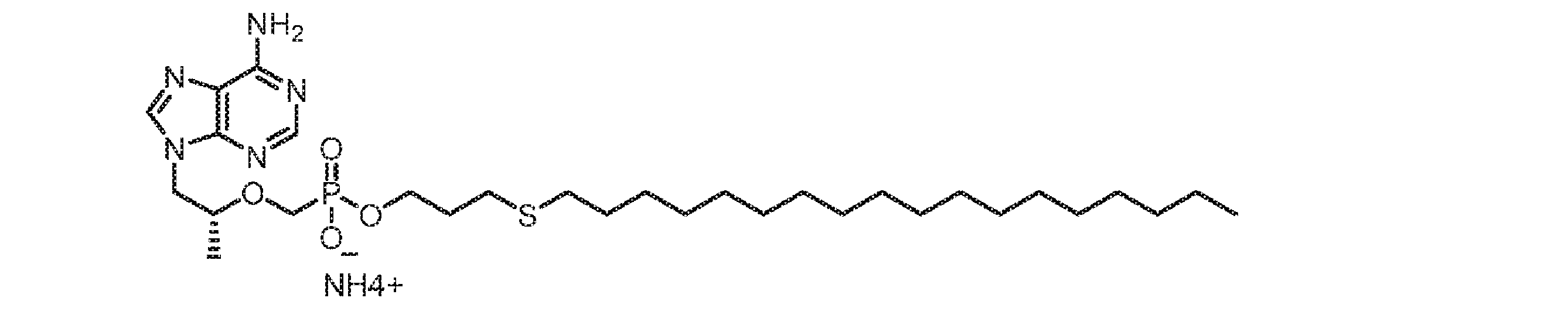
実施例16.アンモニウム3-(イコシルチオ)プロピル(R)-(((1-(6-アミノ-9H-プリン-9-イル)プロパン-2-イル)オキシ)メチル)ホスホナートの合成
A.3-(イコシルチオ)プロパン-1-オール(MD-1-179)の合成

B.アンモニウム3-(イコシルチオ)プロピル(R)-(((1-(6-アミノ-9H-プリン-9-イル)プロパン-2-イル)オキシ)メチル)ホスホナート(MD-1-186)の合成

実施例17.アンモニウム3-((14-(トリメチルシリル)テトラデク-13-イン-1-イル)チオ)プロピル(R)-(((1-(6-アミノ-9H-プリン-9-イル)プロパン-2-イル)オキシ)メチル)ホスホナートの合成
A.トリメチル(14-((テトラヒドロ-2H-ピラン-2-イル)オキシ)テトラデク-1-イン-1-イル)シラン(MD-1-155)の合成

B.14-(トリメチルシリル)テトラデク-13-イン-1-オール(MD-1-157)の合成

C.3-((14-(トリメチルシリル)テトラデク-13-イン-1-イル)チオ)プロパン-1-オール(MD-1-160)の合成

無水DMF(26mL)中の3-メルカプトプロパノール(1.24mL、14.4mmol、2.00eq)のAr脱気溶液に1,8-ジアザビシクロ(5.4.0)ウンデク-7-エン(2.15mL、14.4mmol、2.00eq)を添加し、溶液を室温で20分間撹拌した。DMF(10mL)中の14-(トリメチルシリル)テトラデク-13-イン-1-イルメタンスルホナート(2.60g、7.20mmol、1.00eq)を滴下により添加し、反応混合物を2.5時間60℃に加熱した。TLCにより完全な変換を確認した後、反応混合物をEtOAc(10xDMF体積)で希釈した。有機層をNH4Cl飽和水溶液(4x)で洗浄し、Na2SO4で乾燥させ、濃縮し、黄色油状物質を得た。残渣をカラムクロマトグラフィー(ヘキサン中0~10%EtOAc)によって精製し、無色油状物質としてMD-1-160(2.22g、86%収率)を得た。 To an Ar-degassed solution of 3-mercaptopropanol (1.24 mL, 14.4 mmol, 2.00 eq) in anhydrous DMF (26 mL) was added 1,8-diazabicyclo(5.4.0)undec-7-ene (2.15 mL, 14.4 mmol, 2.00 eq) and the solution was stirred at room temperature for 20 min. 14-(trimethylsilyl)tetradec-13-yn-1-yl methanesulfonate (2.60 g, 7.20 mmol, 1.00 eq) in DMF (10 mL) was added dropwise and the reaction mixture was heated to 60° C. for 2.5 h. After TLC confirmed complete conversion, the reaction mixture was diluted with EtOAc (10×DMF volume). The organic layer was washed with saturated aqueous NH 4 Cl (4×), dried over Na 2 SO 4 and concentrated to give a yellow oil. The residue was purified by column chromatography (0-10% EtOAc in hexanes) to give MD-1-160 (2.22 g, 86% yield) as a colorless oil.
D.アンモニウム3-((14-(トリメチルシリル)テトラデク-13-イン-1-イル)チオ)プロピル(R)-(((1-(6-アミノ-9H-プリン-9-イル)プロパン-2-イル)オキシ)メチル)ホスホナート(MD-1-187)の合成

実施例18.アンモニウム3-(ドデシルチオ)プロピル(R)-(((1-(6-アミノ-9H-プリン-9-イル)プロパン-2-イル)オキシ)メチル)ホスホナートの合成
A.3-(ドデシルチオ)プロパン-1-オール(MD-1-192)の合成

B.アンモニウム3-(ドデシルチオ)プロピル(R)-(((1-(6-アミノ-9H-プリン-9-イル)プロパン-2-イル)オキシ)メチル)ホスホナート(MD-1-217)の合成

実施例19.アンモニウム3-(テトラデシルチオ)プロピル(R)-(((1-(6-アミノ-9H-プリン-9-イル)プロパン-2-イル)オキシ)メチル)ホスホナートの合成
A.3-(テトラデシルチオ)プロパン-1-オール(MD-1-193)の合成

B.アンモニウム3-(テトラデシルチオ)プロピル(R)-(((1-(6-アミノ-9H-プリン-9-イル)プロパン-2-イル)オキシ)メチル)ホスホナート(MD-1-218)の合成
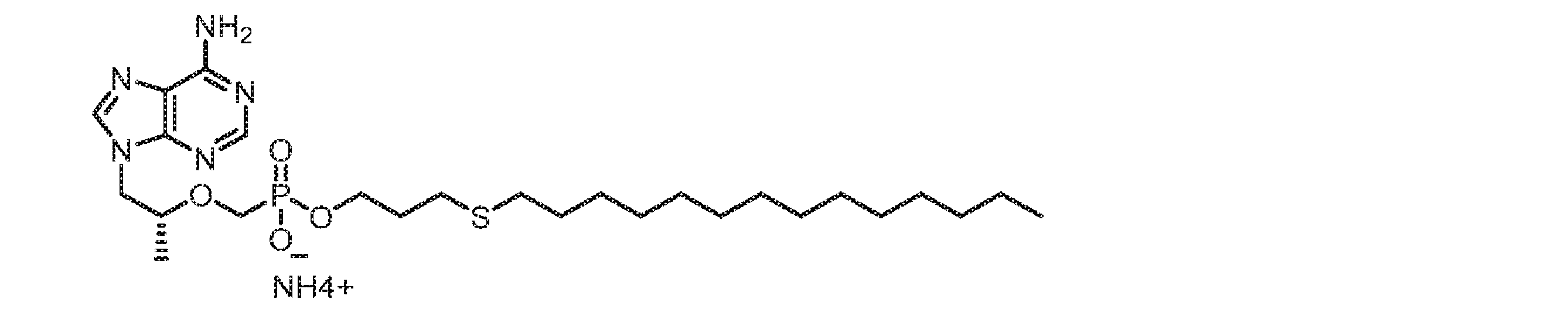
実施例20.アンモニウム6-(トリデシルチオ)ヘキシル(R)-(((1-(6-アミノ-9H-プリン-9-イル)プロパン-2-イル)オキシ)メチル)ホスホナートの合成
A.6-(トリデシルチオ)ヘキサン-1-オール(MD-1-194)の合成

B.アンモニウム6-(トリデシルチオ)ヘキシル(R)-(((1-(6-アミノ-9H-プリン-9-イル)プロパン-2-イル)オキシ)メチル)ホスホナート(MD-1-219)の合成

実施例21.アンモニウム12-(ヘプチルチオ)ドデシル(R)-(((1-(6-アミノ-9H-プリン-9-イル)プロパン-2-イル)オキシ)メチル)ホスホナート(MD-1-220)の合成
A.12-(ヘプチルチオ)ドデカン-1-オール(MD-1-195)の合成

B.アンモニウム12-(ヘプチルチオ)ドデシル(R)-(((1-(6-アミノ-9H-プリン-9-イル)プロパン-2-イル)オキシ)メチル)ホスホナート(MD-1-220)の合成

実施例22.アンモニウム15-(ブチルチオ)ペンタデシル(R)-(((1-(6-アミノ-9H-プリン-9-イル)プロパン-2-イル)オキシ)メチル)ホスホナートの合成
A.15-(ブチルチオ)ペンタデカン-1-オール(MD-1-198)の合成

B.アンモニウム15-(ブチルチオ)ペンタデシル(R)-(((1-(6-アミノ-9H-プリン-9-イル)プロパン-2-イル)オキシ)メチル)ホスホナート(MD-1-221)の合成

実施例23.アンモニウム2-(ヘプタデシルチオ)エチル(R)-(((1-(6-アミノ-9H-プリン-9-イル)プロパン-2-イル)オキシ)メチル)ホスホナートの合成
A.(ヘプタデシルチオ)エタン-1-オール(MD-1-212)の合成

B.アンモニウム2-(ヘプタデシルチオ)エチル(R)-(((1-(6-アミノ-9H-プリン-9-イル)プロパン-2-イル)オキシ)メチル)ホスホナート(MD-1-222)の合成

実施例24.アンモニウム3-((11-フェノキシウンデシル)チオ)プロピル(R)-(((1-(6-アミノ-9H-プリン-9-イル)プロパン-2-イル)オキシ)メチル)ホスホナートの合成
A.((11-ブロモウンデシル)オキシ)ベンゼン(MD-1-211)の合成

B.3-((11-フェノキシウンデシル)チオ)プロパン-1-オール(MD-1-213)の合成

C.アンモニウム3-((11-フェノキシウンデシル)チオ)プロピル(R)-(((1-(6-アミノ-9H-プリン-9-イル)プロパン-2-イル)オキシ)メチル)ホスホナート(MD-1-223)の合成
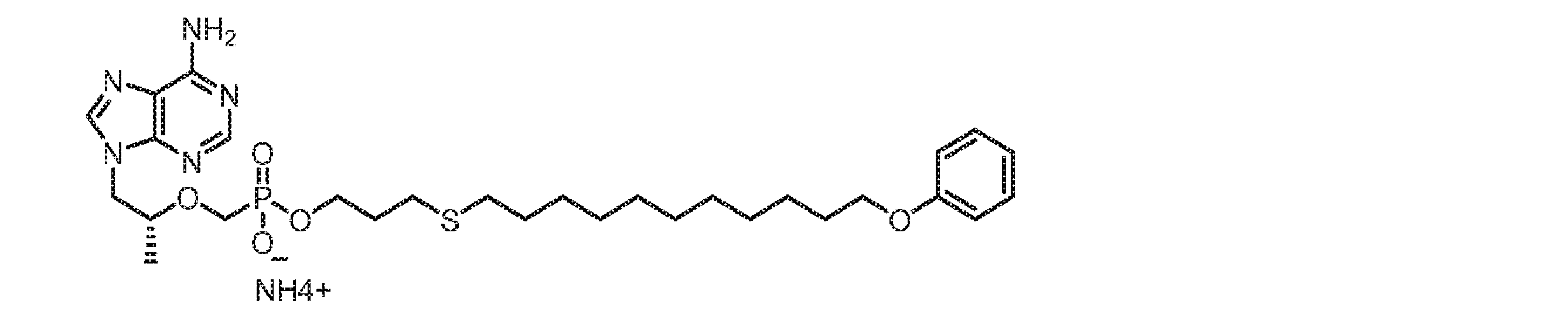
実施例25.アンモニウム[(1R)-2-(6-アミノプリン-9-イル)-1-メチル-エトキシ]メチル-(18-トリメチルシリルオクタデク-17-イノキシ)ホスフィナートの合成
A.2-オクタデク-2-イノキシテトラヒドロピラン(NP-PD-023)の合成

B.オクタデク-2-イン-1-オール(NP-PD-026)の合成

C.ククタデク(cctadec)-17-イン-1-オール(NP-PD-028)の合成

D.18-トリメチルシリルオクタデク-17-イン-1-オール(NP-PD-049)の合成

E.アンモニウム[(1R)-2-(6-アミノプリン-9-イル)-1-メチル-エトキシ]メチル-(18-トリメチルシリルオクタデク-17-イノキシ)ホスフィナート(NP-PD-042)の合成

実施例26.アンモニウム[(1R)-2-(6-アミノプリン-9-イル)-1-メチル-エトキシ]メチル-(18-トリメチルシリルオクタデコキシ)ホスフィナートの合成
A.18-トリメチルシリルオクタデカン-1-オール(NP-PD-050)の合成

B.アンモニウム[(1R)-2-(6-アミノプリン-9-イル)-1-メチル-エトキシ]メチル-(18-トリメチルシリルオクタデコキシ)ホスフィナート(NP-PD-051)の合成

実施例27.アンモニウム[(1R)-2-(6-アミノプリン-9-イル)-1-メチル-エトキシ]メチル-(20,20,20-トリフルオロイコス-18-イノキシ)ホスフィナートの合成
A.2-ノナデク-2-イノキシテトラヒドロピラン(NP-PD-092)の合成

B.ノナデク-2-イン-1-オール(NP-PD-094)の合成

C.ノナデク-18-イン-1-オール(NP-PD-095)の合成

D.1-メトキシ-4-(ノナデク-18-イノキシメチル)ベンゼン(NP-PD-096)の合成

D.1-メトキシ-4-(20,20,20-トリフルオロイコス-18-イノキシメチル)ベンゼン(NP-PD-098)の合成

E.20,20,20-トリフルオロイコス-18-イン-1-オール(NP-PD-101)の合成

F.アンモニウム[(1R)-2-(6-アミノプリン-9-イル)-1-メチル-エトキシ]メチル-(20,20,20-トリフルオロイコス-18-イノキシ)ホスフィナート(NP-PD-102)の合成

実施例28.アンモニウム[(1R)-2-(6-アミノプリン-9-イル)-1-メチル-エトキシ]メチル-(20,20,20-トリフルオロイコスオキシ)ホスフィナートの合成
A.20,20,20-トリフルオロイコサン-1-オール(NP-PD-106)の合成

B.アンモニウム[(1R)-2-(6-アミノプリン-9-イル)-1-メチル-エトキシ]メチル-(20,20,20-トリフルオロイコスオキシ)ホスフィナート(NP-PD-105)の合成

実施例29.アンモニウム3-((14-トリメチルシリル)テトラデク-13-イン-1-イル)プロピル(R)-(((1-(6-アミノ-9H-プリン-9-イル)プロパン-2-イル)オキシ)メチル)ホスホナートの合成
A.2-テトラデク-2-イノキシテトラヒドロピラン(NP-PD-121)の合成

B.テトラデク-2-イン-1-オール(NP-PD-122)の合成

C.テトラデク-13-イン-1-オール(NP-PD-123)の合成

D.2-(3-テトラデク-13-イノキシプロポキシ)テトラヒドロピラン(NP-PD-124)の合成

E.トリメチル-[14-(3-テトラヒドロピラン-2-イルオキシプロポキシ)テトラデク-1-インイル]シラン(NP-PD-127)の合成

F.3-(14-トリメチルシリルテトラデク-13-イノキシ)プロパン-1-オール(NP-PD-128)の合成

G.アンモニウム3-((14-トリメチルシリル)テトラデク-13-イン-1-イル)プロピル(R)-(((1-(6-アミノ-9H-プリン-9-イル)プロパン-2-イル)オキシ)メチル)ホスホナート(NP-PD-130)の合成

実施例30.アンモニウム[(1R)-2-(6-アミノプリン-9-イル)-1-メチル-エトキシ]メチル-[3-(16,16,16-トリフルオロヘキサデク-14-イノキシ)プロポキシ]ホスフィナートの合成
A.3-[(4-メトキシフェニル)メトキシ]プロパン-1-オール(NP-PD-143)の合成

B.1-(3-ブロモプロポキシメチル)-4-メトキシ-ベンゼン(NP-PD-144)の合成

C.1-メトキシ-4-(3-ペンタデク-14-イノキシプロポキシメチル)ベンゼン(NP-PD-145)の合成

D.1-メトキシ-4-[3-(16,16,16-トリフルオロヘキサデク-14-イノキシ)プロポキシメチル]ベンゼン(NP-PD-146)の合成

E.3-(16,16,16-トリフルオロヘキサデク-14-イノキシ)プロパン-1-オール(NP-PD-147)の合成

F.アンモニウム[(1R)-2-(6-アミノプリン-9-イル)-1-メチル-エトキシ]メチル-[3-(16,16,16-トリフルオロヘキサデク-14-イノキシ)プロポキシ]ホスフィナート(NP-PD-149)の合成

実施例31.アンモニウム[(1R)-2-(6-アミノプリン-9-イル)-1-メチル-エトキシ]メチル-[3-(16,16,16-トリフルオロヘキサデコキシ)プロポキシ]ホスフィナートの合成
A.3-(16,16,16-トリフルオロヘキサデコキシ)プロパン-1-オール(NP-PD-156)の合成

B.アンモニウム[(1R)-2-(6-アミノプリン-9-イル)-1-メチル-エトキシ]メチル-[3-(16,16,16-トリフルオロヘキサデコキシ)プロポキシ]ホスフィナート(NP-PD-158)の合成

実施例32.アンモニウム4-ペンタデコキシブトキシ-[[rac-(1R)-2-(6-アミノプリン-9-イル)-1-メチル-エトキシ]メチル]ホスフィナートの合成
A.4-ペンタデコキシブタン-1-オール(NP-PD-148)の合成

B.アンモニウム4-ペンタデコキシブトキシ-[[rac-(1R)-2-(6-アミノプリン-9-イル)-1-メチル-エトキシ]メチル]ホスフィナート(NP-PD-150)の合成

実施例33.アンモニウム[rac-(1R)-2-(6-アミノプリン-9-イル)-1-メチル-エトキシ]メチル-(5-テトラデコキシペントキシ)ホスフィナートの合成
A.5-テトラデコキシペンタン-1-オール(NP-PD-152)の合成

B.アンモニウム[rac-(1R)-2-(6-アミノプリン-9-イル)-1-メチル-エトキシ]メチル-(5-テトラデコキシペントキシ)ホスフィナート(NP-PD-154)の合成

実施例34.アンモニウム2-ヘプタデコキシエトキシ-[[rac-(1R)-2-(6-アミノプリン-9-イル)-1-メチル-エトキシ]メチル]ホスフィナートの合成
A.2-ヘプタデコキシエタノール(NP-PD-151)の合成

B.アンモニウム2-ヘプタデコキシエトキシ-[[rac-(1R)-2-(6-アミノプリン-9-イル)-1-メチル-エトキシ]メチル]ホスフィナート(NP-PD-157)の合成
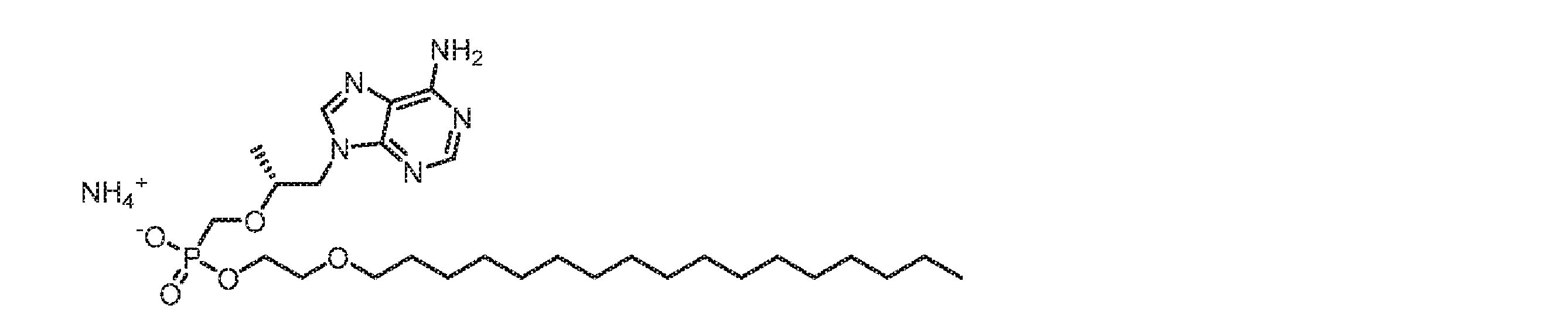
実施例35.アンモニウムオクタデク-17-イン-1-イル((((R)-1-(6-アミノ-9H-プリン-9-イル)プロパン-2-イル)オキシ)メチル)ホスホナートの合成
A.オクタデク-17-イン-1-オール(BI-1-019)の合成

DCM/MeOHの混合物中の2-オクタデク-17-イノキシテトラヒドロピラン(0.477g、1.36mmol、1.00eq)の撹拌溶液に、10滴のH2SO4水(1.8M)を添加した。反応混合物を室温で1時間撹拌した。この時間後、TLC(ヘキサン/EtOAc 4:1)は、出発物質の最小の変換を示した。従って、さらなる10滴のH2SO4水(1.8M)を添加し、反応混合物を室温でさらに5時間撹拌した。この時間後、TLCは、殆どの出発物質が消費されたことを示した。従って、反応を水で不活性化し、DCMで希釈した。得られた有機層をブラインで3回洗浄し、無水硫酸ナトリウム上で乾燥させ、ろ過し、減圧下で蒸発させた。シリカゲルカラムクロマトグラフィー(ヘキサン/EtOAc 0~13%EtOAc)を介して粗製物質を精製し、表題化合物(0.220g、0.826mmol、61%収率)を得た。 To a stirred solution of 2-octadec-17-ynoxytetrahydropyran (0.477 g, 1.36 mmol, 1.00 eq) in a mixture of DCM/MeOH was added 10 drops of H 2 SO 4 water (1.8 M). The reaction mixture was stirred at room temperature for 1 h. After this time, TLC (hexanes/EtOAc 4:1) showed minimal conversion of starting material. Therefore, an additional 10 drops of H 2 SO 4 water (1.8 M) were added and the reaction mixture was stirred at room temperature for an additional 5 h. After this time, TLC showed that most of the starting material had been consumed. Therefore, the reaction was quenched with water and diluted with DCM. The resulting organic layer was washed three times with brine, dried over anhydrous sodium sulfate, filtered and evaporated under reduced pressure. The crude material was purified via silica gel column chromatography (hexanes/EtOAc 0-13% EtOAc) to afford the title compound (0.220 g, 0.826 mmol, 61% yield).
B.アンモニウムオクタデク-17-イン-1-イル((((R)-1-(6-アミノ-9H-プリン-9-イル)プロパン-2-イル)オキシ)メチル)ホスホナート(BI-1-24)の合成

実施例36.アンモニウムイコス-19-イン-1-イル(R)-(((1-(6-アミノ-9H-プリン-9-イル)プロパン-2-イル)オキシ)メチル)ホスホナートの合成
A.2-(イコス-2-イン-1-イルオキシ)テトラヒドロ-2H-ピラン(MD-1-40)の合成

B.イコス-2-イン-1-オール(MD-1-128)の合成

C.イコス-19-イン-1-オール(MD-1-44)の合成

D.アンモニウムイコス-19-イン-1-イル(R)-(((1-(6-アミノ-9H-プリン-9-イル)プロパン-2-イル)オキシ)メチル)ホスホナート(BI-1-065)の合成

実施例37.アンモニウム3-(オクタデク-17-イン-1-イルチオ)プロピル(R)-(((1-(6-アミノ-9H-プリン-9-イル)プロパン-2-イル)オキシ)メチル)ホスホナートの合成
A.16-((3-ヒドロキシプロピル)チオ)ヘキサデカン酸(BI-1-048)の合成

B.16-((3-((テトラヒドロ-2H-ピラン-2-イル)オキシ)プロピル)チオ)ヘキサデカン-1-オール(BI-1-055)の合成

C.16-((3-((テトラヒドロ-2H-ピラン-2-イル)オキシ)プロピル)チオ)ヘキサデシルメタンスルホナート(BI-1-062)の合成

D.2-(3-(オクタデク-17-イン-1-イルチオ)プロポキシ)テトラヒドロ-2H-ピラン(BI-1-063)の合成

E.3-(オクタデク-17-イン-1-イルチオ)プロパン-1-オール(BI-1-064)の合成

F.アンモニウム3-(オクタデク-17-イン-1-イルチオ)プロピル(R)-(((1-(6-アミノ-9H-プリン-9-イル)プロパン-2-イル)オキシ)メチル)ホスホナート(BI-1-057)の合成

実施例38.テノホビルのプロドラッグのためのバイオ分析用アッセイ
A.方法
1.抗ウイルスアッセイ
HIV活性についてテノホビルのプロドラッグを評価した。これらのプロドラッグは全てテノホビル部分を含有するので、これらのプロドラッグ間で内因性HIV活性が同一であったことが予想された。形質膜透過性がこれらの脂溶性プロドラッグの活性化に対する制限因子ではないと仮定すると、CMX157(ヘキサデシルオキシプロピルテノホビル)(EC50=20.0nM)と比較したEC50値の変化は、ホスホリパーゼC(PLC)切断動態の変化を表すと解釈され得る。簡潔に述べると、ウイルス感染の指標として蛍ルシフェラーゼRNAを含有する、シュードウイルス粒子(J. Virol. 2009, 83, 9094-9101)を用いた、HIVシングルサイクル、複製不全アッセイ(AIDS 2010, 24, 1651-1655)をHEK293細胞において行った。この系でのルシフェラーゼタンパク質の発現はルシフェラーゼRNAからcDNAへのHIV RT介在性の逆転写に依存するので、ルシフェリン処理に応答した発光は、ウイルス感染レベルと直接相関し、これにより、IC50(50%逆転写を阻害するプロドラッグ濃度)として表されるHIV RT阻害剤活性の測定が円滑に進められる。抗ウイルス活性を測定するときに使用しようとする最大濃度を確立するために、シュードウイルスアッセイの前に、ミトコンドリア活性を監視することにより、HEK293細胞に対する細胞傷害性を評価した(Acta Pharmacol.Sin.2004, 25, 385-389)。
Example 38. Bioanalytical Assays for Tenofovir Prodrugs A. Method 1. Antiviral Assay Tenofovir prodrugs were evaluated for HIV activity. Since all of these prodrugs contain a tenofovir moiety, it was expected that the intrinsic HIV activity between these prodrugs would be the same. Assuming that plasma membrane permeability is not a limiting factor for the activation of these lipid-soluble prodrugs, the change in EC50 value compared to CMX157 (hexadecyloxypropyl tenofovir) ( EC50 = 20.0 nM) can be interpreted as representing a change in phospholipase C (PLC) cleavage kinetics. Briefly, an HIV single-cycle, replication-deficient assay (AIDS 2010, 24, 1651-1655) was performed in HEK293 cells using pseudovirions containing firefly luciferase RNA as an indicator of viral infection (J. Virol. 2009, 83, 9094-9101). Since expression of luciferase protein in this system depends on HIV RT-mediated reverse transcription of luciferase RNA into cDNA, luminescence in response to luciferin treatment directly correlates with the level of viral infection, facilitating the measurement of HIV RT inhibitor activity expressed as IC50 (prodrug concentration that inhibits 50% reverse transcription). To establish the maximum concentration to be used when measuring antiviral activity, prior to the pseudovirus assay, cytotoxicity against HEK293 cells was assessed by monitoring mitochondrial activity (Acta Pharmacol. Sin. 2004, 25, 385-389).
2.蛍光定量的なCYP450酵素阻害アッセイ
CYP450阻害アッセイは、ヒト組み換え体の個々のcDNA-発現CYPアイソフォーム3A4及び2D6並びに蛍光代謝産物を生成させる蛍光発生プローブを発現する昆虫細胞からのミクロソームを利用した。標準的な阻害剤を蛍光発生基質と同時に温置し、それらの阻害能(IC50)を決定した。CYP450タンパク質濃度及び温置時間に関するアッセイ条件を標準化し、各蛍光プローブ基質の酵素反応速度論パラメーターを推定し、阻害剤のIC50値を決定し、再現性を調べるために異なる日に検証した。
2. Fluorometric CYP450 Enzyme Inhibition Assay The CYP450 inhibition assay utilized microsomes from insect cells expressing human recombinant individual cDNA-expressed CYP isoforms 3A4 and 2D6 and fluorogenic probes generating fluorescent metabolites. Standard inhibitors were incubated simultaneously with fluorogenic substrates and their inhibitory potencies ( IC50 ) were determined. The assay conditions with respect to CYP450 protein concentration and incubation time were standardized, enzyme kinetic parameters for each fluorogenic probe substrate were estimated, and IC50 values of inhibitors were determined and tested on different days to check reproducibility.
100%DMSO又は100%MeOH中で試験化合物を調製し、最終反応において<0.2%の最終濃度を超えなかった。100mMリン酸ナトリウム緩衝液を調製し、pH7.4に調整した。個別のファルコンチューブにおいて、2x酵素/基質(E/S)溶液をリン酸緩衝液中で調製した。それぞれ、CYP2D6(CORNING(登録商標))及び7-アミド-4-メチルクマル酸(AMMC)の最終濃度は10nM及び4μMであり、CYP3A4(CORNING(登録商標))及び7-ベンジルオキシ-4-(トリフルオロメチル)クマリン(BFC)は20nM及び40μMであった。個別のファルコンチューブにおいて、2xNADPH再生システム(NRS)をリン酸緩衝液中で調製した。アッセイ中の各成分に対する最終濃度は次のとおりであった:
CYP2D6アッセイ:0.008mM NADPH、3.3mMグルコース6リン酸、0.4Uのグルコース6リン酸デヒドロゲナーゼ/mL
CYP3A4アッセイ:2.45mM NADPH、24.7mMグルコース6リン酸、1.25Uのグルコース6リン酸デヒドロゲナーゼ/mL
Test compounds were prepared in 100% DMSO or 100% MeOH and did not exceed a final concentration of <0.2% in the final reaction. 100 mM sodium phosphate buffer was prepared and adjusted to pH 7.4. In separate Falcon tubes, 2x enzyme/substrate (E/S) solutions were prepared in phosphate buffer. Final concentrations of CYP2D6 (CORNING®) and 7-amido-4-methylcoumaric acid (AMMC) were 10 nM and 4 μM, and CYP3A4 (CORNING®) and 7-benzyloxy-4-(trifluoromethyl)coumarin (BFC) were 20 nM and 40 μM, respectively. In separate Falcon tubes, 2x NADPH regenerating system (NRS) was prepared in phosphate buffer. Final concentrations for each component in the assay were as follows:
CYP2D6 assay: 0.008 mM NADPH, 3.3 mM glucose 6-phosphate, 0.4 U glucose 6-phosphate dehydrogenase/mL
CYP3A4 assay: 2.45 mM NADPH, 24.7 mM glucose 6-phosphate, 1.25 U glucose 6-phosphate dehydrogenase/mL
100μLの最終体積で96ウェルマイクロタイタープレート(黒色、CORNING(登録商標)COSTAR(登録商標))において両酵素アッセイを行った。最初のウェルにおける74μLのE/S及び全ての続くウェル(2~11)への50μLの添加によってプレートの準備を始めた。試験化合物(1μL)を最初のウェル中で溶解させ、第1列の最終体積を75μLにした。最初のウェルから25μLを取り出し、第10列まで第2及びその後のウェルでそれを希釈することによって、試験化合物の1:3連続希釈を行った。最終濃度は200μM~0.01μMの範囲となった。ウェル番号11は、阻害剤を含有せず、ウェル番号12は酵素を含有しなかった。両方ともバックグラウンド蛍光に対する対照として使用した。プレートを37℃で30分間温置した。温置後、各ウェルへの50μLの2xNRSの添加によって、反応を開始させた。 Both enzyme assays were performed in 96-well microtiter plates (black, CORNING® COSTAR®) in a final volume of 100 μL. Plate preparation was initiated by adding 74 μL of E/S in the first well and 50 μL to all subsequent wells (2-11). Test compound (1 μL) was dissolved in the first well, giving a final volume of 75 μL in the first row. A 1:3 serial dilution of test compound was performed by removing 25 μL from the first well and diluting it in the second and subsequent wells up to row 10. Final concentrations ranged from 200 μM to 0.01 μM. Well number 11 contained no inhibitor and well number 12 contained no enzyme. Both were used as controls for background fluorescence. Plates were incubated at 37° C. for 30 minutes. After incubation, the reaction was started by adding 50 μL of 2xNRS to each well.
マイクロプレートリーダー(BIOTEK(登録商標)Synergy Neo2)を使用して、すぐに(1分以内)蛍光を測定した。60分間にわたり5分毎にスキャンする速度論モードにおいて、Ex/Em=410/460nmでCYP2D6を監視し、Ex/Em=410/538nmでCYP3A4を監視した。データをエクスポートし、Graph Pad Prism 7を使用して分析した。試験物質非存在下(ウェル番号11、0%阻害)での反応及び「阻害剤カクテル」存在下(ウェル番号12、100%阻害)の反応成分の混合物の蛍光強度に対して蛍光読み取りを正規化した。4パラメーターロジスティック回帰モデルを使用して10点曲線上にデータをフィットさせた後、IC50値が導き出された。 Fluorescence was measured immediately (within 1 min) using a microplate reader (BIOTEK® Synergy Neo2). CYP2D6 was monitored at Ex/Em=410/460 nm and CYP3A4 at Ex/Em=410/538 nm in kinetic mode with scans every 5 min for 60 min. Data was exported and analyzed using Graph Pad Prism 7. Fluorescence readings were normalized to the fluorescence intensity of the reaction in the absence of test substance (well #11, 0% inhibition) and the mixture of reaction components in the presence of an "inhibitor cocktail" (well #12, 100% inhibition). IC50 values were derived after fitting the data onto a 10-point curve using a four-parameter logistic regression model.
3.代謝安定性アッセイ
Agilent G6460トリプル四重極質量分析(Agilent Technologies, USA)と組み合わせたAgilent 1260 Infinity II HPLCを使用して、LC-MS/MS分析を行った。データは全て、Agilent 6460 Quantitative Analysisデータ処理ソフトウェアを使用して得られた。
3. Metabolic stability assay
LC-MS/MS analysis was performed using an Agilent 1260 Infinity II HPLC coupled with an Agilent G6460 triple quadrupole mass spectrometer (Agilent Technologies, USA). All data were acquired using Agilent 6460 Quantitative Analysis data processing software.
0.5mL/minの流速で(いくつかの化合物に対して変更)メタノール-水-ギ酸又はアセトニトリル-水-ギ酸(0.1%)から構成される移動相で、Agilent Porshell 120 EC-C8カラム(2.1x50mm、2.7μm)又はAgilent Zorbax XDB C18カラム(2.1x50mm、3.5μm)の何れかにおいて、各化合物に対する逆相HPLC分離を達成した。各方法は、内部標準(ISTD)d5-7-エトキシクマリンの存在下で展開された。カラム温度を試料の殆どに対して40℃に維持し、そうでない場合は記載した。多重反応監視モード(MRM)を使用して、Agilent JetStreamエレクトロスプレー陽イオン化において検出を操作した。 Reversed-phase HPLC separation for each compound was achieved on either an Agilent Porshell 120 EC-C8 column (2.1 x 50 mm, 2.7 μm) or an Agilent Zorbax XDB C18 column (2.1 x 50 mm, 3.5 μm) with a mobile phase consisting of methanol-water-formic acid or acetonitrile-water-formic acid (0.1%) at a flow rate of 0.5 mL/min (varying for some compounds). Each method was developed in the presence of the internal standard (ISTD) d 5 -7-ethoxycoumarin. Column temperature was maintained at 40°C for most of the samples, unless otherwise noted. Detection was operated in an Agilent JetStream electrospray positive ionization using multiple reaction monitoring mode (MRM).
他のMS条件は次のとおりであった:ドウェルタイム(dwell time)100ms;ガス流10L/min;ネブライザー圧力45psi;デルタEMV200V;個々の化合物に対するフラグメンター電圧及び衝突エネルギーは変動する。 Other MS conditions were as follows: dwell time 100 ms; gas flow 10 L/min; nebulizer pressure 45 psi; delta EMV 200 V; fragmentor voltages and collision energies for individual compounds were varied.
10mM保存溶液を調製するために100%DMSO又は100%MeOH中で試験化合物を溶解させた。ベラパミル(Sigma Aldrich)は陽性対照として支援し、100%DMSO中で溶解させて、10mM保存溶液を調製した。試験及び対照化合物の10mM保存溶液をリン酸カリウム緩衝液(100mM、pH7.4)中で500μMへとさらに希釈し、有機溶媒含量が<0.2%となることを確実にした。ヒト肝臓ミクロソーム(HLM)は20mg/mLでXenotechから購入した。NADPH(Sigma Aldrich)10mM保存液を脱イオン水中で調製した。 Test compounds were dissolved in 100% DMSO or 100% MeOH to prepare 10 mM stock solutions. Verapamil (Sigma Aldrich) served as a positive control and was dissolved in 100% DMSO to prepare 10 mM stock solutions. 10 mM stock solutions of test and control compounds were further diluted to 500 μM in potassium phosphate buffer (100 mM, pH 7.4) to ensure organic solvent content of <0.2%. Human liver microsomes (HLM) were purchased from Xenotech at 20 mg/mL. A 10 mM stock solution of NADPH (Sigma Aldrich) was prepared in deionized water.
2つ組操作のために1.5mLエッペンドルフチューブ中で1100μLの最終体積でHLMアッセイを調製した。各反応は、リン酸緩衝液(928.4μL)、肝臓ミクロソーム(55μL)及び試験化合物を含有し、その結果、最終濃度は3μM(500μMが6.6μL)となった。10mM NADPHの110μLで反応を開始させた。0、15、30、60、120分(プロドラッグ化合物の場合)及び0、5、10、15、30分(ベラパミル、陽性対照化合物)の時間間隔でアリコート(100μL)を2つ組で取り出し、内部標準(ISTD:d5-7-エトキシクマリン4μM)を含有した100mLの冷100%メタノール中で不活性化した。遠心分離前に、分割したチューブのそれぞれをボルテックス処理して、化合物が溶液中にあることを確実にした。アリコートを12,000gで5分間遠心分離し、上清を取り出し、LC-MSバイアルに入れた。LC-MSを使用して各時間点を評価し、抽出されたイオンに基づいて、面積をISTDに関して積分した。550μLの最終体積で陽性対照を実施して、単回のランで各時間点を与えた。最長の時間点で単回のラン(150μL)で試験又は対照化合物とともにNADPHなし陰性対照を実施した。対照を処理し、試験化合物のように分析した。各時間点を2つ組で試験し、続いて合間にブランクを洗浄して持ち込みを回避し、カラムを平衡化した。 HLM assays were prepared in 1.5 mL Eppendorf tubes in a final volume of 1100 μL for duplicate runs. Each reaction contained phosphate buffer (928.4 μL), liver microsomes (55 μL) and test compound resulting in a final concentration of 3 μM (6.6 μL of 500 μM). Reactions were initiated with 110 μL of 10 mM NADPH. Aliquots (100 μL) were removed in duplicate at time intervals of 0, 15, 30, 60, 120 minutes (for prodrug compounds) and 0, 5, 10, 15, 30 minutes (verapamil, positive control compound) and inactivated in 100 mL of cold 100% methanol containing an internal standard (ISTD: d 5 -7-ethoxycoumarin 4 μM). Each of the split tubes was vortexed before centrifugation to ensure that the compound was in solution. Aliquots were centrifuged at 12,000 g for 5 min and the supernatant was removed and placed in LC-MS vials. Each time point was assessed using LC-MS and areas were integrated relative to the ISTD based on the extracted ions. A positive control was performed in a final volume of 550 μL to give each time point in a single run. A no NADPH negative control was performed along with the test or control compound in a single run (150 μL) at the longest time point. Controls were processed and analyzed as for the test compounds. Each time point was tested in duplicate followed by a blank wash in between to avoid carryover and to equilibrate the column.
B.結果
次の表は、本開示の代表的な化合物の生体分析的な結果を詳述する。
B. Results The following table details the bioanalytical results for representative compounds of the present disclosure.
実施例39.2-(2-アミノ-6-オキソ-1H-プリン-9-イル)エトキシメチル-[2-(18,18,18-トリフルオロオクタデコキシ)エトキシ]ホスフィン酸の合成
A.2-[(4-メトキシフェニル)メトキシ]エタノール(NP-PD-221)の合成

B.ヘプタデク-16-イニル4-メチルベンゼンスルホナート(NP-PD-215)の合成

C.1-(2-ヘプタデク-16-イノキシエトキシメチル)-4-メトキシ-ベンゼン(NP-PD-226)の合成

D.1-メトキシ-4-[2-(18,18,18-トリフルオロオクタデク-16-イノキシ)エトキシメチル]ベンゼン(NP-PD-230)の合成

E.2-(18,18,18-トリフルオロオクタデコキシ)エタノール(NP-PD-234)の合成

F.アンモニウム2-(2-アミノ-6-ブロモ-プリン-9-イル)エトキシメチル-[2-(18,18,18-トリフルオロオクタデコキシ)エトキシ]ホスフィナート(NP-PD-242)の合成

アルゴン雰囲気下で、撹拌バーが入ったオーブン乾燥25mLシュレンクチューブに2-(2-アミノ-6-ブロモ-プリン-9-イル)エトキシメチルホスホン酸(50mg、0.14mmol、1.0eq)、N,N’-ジシクロヘキシルカルボジイミド(59mg、0.28mmol、2.0eq)、2-(18,18,18-トリフルオロオクタデコキシ)エタノール(63mg、0.17mmol、1.2eq)及びNMP(1.0mL)を添加した。室温でこの得られた懸濁液4-ジメチルアミノピリジン(1.73mg、0.0100mmol、0.100eq)を添加した。全ての試薬の添加後、反応物を100℃に加熱し、この温度で一晩激しく撹拌させた。翌朝、TLCが生成物形成を示した。反応混合物を室温まで冷却し、その後、蒸留水で不活性化した。反応混合物を真空濃縮し、得られた粗製物質をシリカフラッシュカラムクロマトグラフィー(15分間にわたり、100%DCM~100%80:20:3 DCM:MeOH:NH4OH溶液)によって精製し、薄黄色固体としてNP-PD-242(52mg、0.072mmol、51%収率)を得た。1H NMR(400MHz,CD3OD)δ 8.20(s,1H),4.32(t,J=5.0Hz,2H),3.96-3.83(m,4H),3.65(d,J=8.8Hz,2H),3.45(t,J=4.9Hz,2H),3.36(t,J=6.6Hz,2H),2.20-2.04(m,2H),1.58-1.44(m,4H),1.43-1.21(m,27H).HRMS(ESI)m/z C28H47O5N5 79BrF3P[M-H]-に対する計算値、700.24558 実測値、700.24642. Under argon atmosphere, 2-(2-amino-6-bromo-purin-9-yl)ethoxymethylphosphonic acid (50 mg, 0.14 mmol, 1.0 eq), N,N'-dicyclohexylcarbodiimide (59 mg, 0.28 mmol, 2.0 eq), 2-(18,18,18-trifluorooctadecoxy)ethanol (63 mg, 0.17 mmol, 1.2 eq) and NMP (1.0 mL) were added to an oven-dried 25 mL Schlenk tube containing a stir bar. To this resulting suspension at room temperature was added 4-dimethylaminopyridine (1.73 mg, 0.0100 mmol, 0.100 eq). After addition of all the reagents, the reaction was heated to 100° C. and allowed to stir vigorously at this temperature overnight. The next morning, TLC indicated product formation. The reaction mixture was cooled to room temperature and then inactivated with distilled water. The reaction mixture was concentrated in vacuo and the resulting crude material was purified by silica flash column chromatography (100% DCM to 100% 80:20:3 DCM:MeOH:NH 4 OH solution over 15 min) to afford NP-PD-242 (52 mg, 0.072 mmol, 51% yield) as a pale yellow solid. 1H NMR (400MHz, CD3OD ) δ 8.20 (s, 1H), 4.32 (t, J=5.0Hz, 2H), 3.96-3.83 (m, 4H), 3.65 (d, J=8.8Hz, 2H), 3.45 (t, J=4. 9Hz, 2H), 3.36 (t, J=6.6Hz, 2H), 2.20-2.04 (m, 2H), 1.58-1.44 (m, 4H), 1.43-1.21 (m, 27H). HRMS (ESI) m/z calculated for C28H47O5N579BrF3P [ M - H] - , 700.24558 found , 700.24642 .
G.2-(2-アミノ-6-オキソ-1H-プリン-9-イル)エトキシメチル-[2-(18,18,18-トリフルオロオクタデコキシ)エトキシ]ホスフィン酸(NP-PD-243)の合成

実施例40.2-(2-アミノ-6-オキソ-1H-プリン-9-イル)エトキシメチル-[3-(16,16,16-トリフルオロヘキサデコキシ)プロポキシ]ホスフィン酸の合成
A.アンモニウム2-(2-アミノ-6-ブロモ-プリン-9-イル)エトキシメチル-[3-(16,16,16-トリフルオロヘキサデコキシ)プロポキシ]ホスフィナート(NP-PD-245)の合成

Ar雰囲気下で、撹拌バーが入ったオーブン乾燥25mLシュレンクチューブに、2-(2-アミノ-6-ブロモ-プリン-9-イル)エトキシメチルホスホン酸(100mg、0.280mmol、1.00eq)、N,N’-ジシクロヘキシルカルボジイミド(117mg、0.570mmol、2.00eq)、3-(16,16,16-トリフルオロヘキサデコキシ)プロパン-1-オール(121mg、0.340mmol、1.20eq)及びNMP(2.0mL)を添加した。この得られた懸濁液に室温で4-ジメチルアミノピリジン(3.5mg、0.030mmol、0.10eq)を添加した。全ての試薬を添加した後、反応物を100℃に加熱し、この温度で一晩、激しく撹拌させておいた。翌朝、TLCは生成物形成を示した。反応混合物を室温まで冷却し、その後、蒸留水で不活性化した。反応混合物を真空濃縮し、得られた粗製物質をシリカフラッシュカラムクロマトグラフィー(100%DCM~100%80:20:3 DCM:MeOH:NH4OH溶液)によって精製し、黄色固体としてNP-PD-245(122mg、0.173mmol、61%収率)を得た。1H NMR(600MHz,CD3OD)δ 8.19(s,1H),4.35-4.30(m,2H),3.91-3.83(m,4H),3.63(d,J=8.8Hz,2H),3.41(t,J=6.4Hz,2H),3.33(t,J=6.6Hz,2H),2.18-2.06(m,2H),1.78-1.72(m,2H),1.57-1.45(m,4H),1.41-1.23(m,22H).HRMS(ESI)m/z C27H45O5N5 79BrF3P[M-H]-に対する計算値、686.22993 実測値、686.23121. To an oven-dried 25 mL Schlenk tube containing a stir bar under Ar atmosphere was added 2-(2-amino-6-bromo-purin-9-yl)ethoxymethylphosphonic acid (100 mg, 0.280 mmol, 1.00 eq), N,N'-dicyclohexylcarbodiimide (117 mg, 0.570 mmol, 2.00 eq), 3-(16,16,16-trifluorohexadecoxy)propan-1-ol (121 mg, 0.340 mmol, 1.20 eq) and NMP (2.0 mL). To this resulting suspension was added 4-dimethylaminopyridine (3.5 mg, 0.030 mmol, 0.10 eq) at room temperature. After all reagents were added, the reaction was heated to 100°C and left to stir vigorously at this temperature overnight. The next morning, TLC indicated product formation. The reaction mixture was cooled to room temperature and then inactivated with distilled water. The reaction mixture was concentrated in vacuo and the resulting crude material was purified by silica flash column chromatography (100% DCM to 100% 80:20:3 DCM:MeOH:NH 4 OH solution) to afford NP-PD-245 (122 mg, 0.173 mmol, 61% yield) as a yellow solid. 1H NMR (600MHz, CD3OD ) δ 8.19 (s, 1H), 4.35-4.30 (m, 2H), 3.91-3.83 (m, 4H), 3.63 (d, J = 8.8Hz, 2H), 3.41 (t, J = 6.4Hz, 2H), 3 .33 (t, J=6.6Hz, 2H), 2.18-2.06 (m, 2H), 1.78-1.72 (m, 2H), 1.57-1.45 (m, 4H), 1.41-1.23 (m, 22H). HRMS (ESI) m/z calculated for C27H45O5N579BrF3P [ M - H] - , 686.22993 found , 686.23121 .
B.2-(2-アミノ-6-オキソ-1H-プリン-9-イル)エトキシメチル-[3-(16,16,16-トリフルオロヘキサデコキシ)プロポキシ]ホスフィン酸(NP-PD-246)の合成

Claims (24)
(式中、
Lは式Vの構造:
(式中、
Uは核酸塩基であり;
Vは-O-R Y 又は-S-R Z であり;
R 1 、R 2 、R 3 及びR 4 は、水素、重水素、ハロゲン、アジド、シアノ、イソシアノ、ニトラート、ニトロソオキシ、ニトロソ、ニトロ、ホルミル、カルボキシル、任意選択的に置換されているアルキル、任意選択的に置換されているヘテロアルキル、任意選択的に置換されているカルボシクリル、任意選択的に置換されているヘテロシクリル、任意選択的に置換されているアリール、任意選択的に置換されているヘテロアリール、アゾ、アシル、任意選択的にO-置換されているヒドロキシル、任意選択的にS-置換されているメルカプト、スルフィニル、スルホニル、スルホナート、任意選択的にN-置換されているアミノ、任意選択的にN-置換されているアミド、任意選択的にN-置換されているスルファモイル、任意選択的にSi-置換されているシリル、エステル、炭酸エステル、任意選択的に置換されているカルバマート、任意選択的にN-置換されているアミノオキシ及び任意選択的にN-及び/又はO-置換されているヒドロキシルアミノからなる群から独立に選択され;
R Y 及びR Z は、水素、任意選択的に置換されているアルキル、任意選択的に置換されているヘテロアルキル、任意選択的に置換されているカルボシクリル、任意選択的に置換されているヘテロカルボシクリル、任意選択的に置換されているアリール及び任意選択的に置換されているヘテロアリールからなる群から独立に選択される)
を有し;
Wは飽和C1~C9アルキル鎖(即ちC1~C9アルキレン)であり;
Xは置換されているメチレン又はエチレン、-O-、-S-、-S(=O)-及び-S(O)2-からなる群から選択され;
Yは、飽和C2~C20アルキル鎖(即ちC2~C20アルキレン)であり;
Zは、-C≡CCD 3 、-C≡CCH 2 F、-C≡CCHF 2 、-C≡CCF 3 、-C≡CC(CH 3 ) 3 、
(式中、 * はYへの連結点を示す)
Si-置換されているシリル、及び-SF5からなる群から選択される)。 A compound having the structure of Formula I, or a pharma- ceutically acceptable salt thereof:
(In the formula,
L is a structure of formula V:
(In the formula,
U is a nucleobase;
V is -O-R Y or -S-R Z ;
R 1 , R 2 , R 3 and R 4 are independently selected from the group consisting of hydrogen, deuterium, halogen, azide, cyano, isocyano, nitrate, nitrosoxy, nitroso, nitro, formyl, carboxyl, optionally substituted alkyl, optionally substituted heteroalkyl, optionally substituted carbocyclyl, optionally substituted heterocyclyl, optionally substituted aryl, optionally substituted heteroaryl, azo, acyl, optionally O-substituted hydroxyl, optionally S-substituted mercapto, sulfinyl, sulfonyl, sulfonate, optionally N-substituted amino, optionally N-substituted amido, optionally N-substituted sulfamoyl, optionally Si-substituted silyl, ester, carbonate, optionally substituted carbamate, optionally N-substituted aminooxy and optionally N- and/or O-substituted hydroxylamino;
R Y and R Z are independently selected from the group consisting of hydrogen, optionally substituted alkyl, optionally substituted heteroalkyl, optionally substituted carbocyclyl, optionally substituted heterocarbocyclyl, optionally substituted aryl, and optionally substituted heteroaryl.
having
W is a saturated C 1 -C 9 alkyl chain (i.e., C 1 -C 9 alkylene);
X is selected from the group consisting of substituted methylene or ethylene, -O-, -S-, -S(=O)-, and -S(O) 2 -;
Y is a saturated C 2 -C 20 alkyl chain (i.e., C 2 -C 20 alkylene);
Z is -C≡CCD3 , -C≡CCH2F , -C≡CCHF2 , -C≡CCF3 , -C≡CC( CH3 ) 3 ,
(wherein * indicates the point of attachment to Y)
Si-substituted silyl , and -SF5 ).
(式中、U、R3及びR4は、請求項1で定義されるものと同じものである)
を有する、請求項1に記載の化合物。 L is a structure of formula V':
(wherein U, R3 and R4 are as defined in claim 1 ).
2. The compound of claim 1 having the formula:
からなる群から選択される、請求項2に記載の化合物。 L,
3. The compound of claim 2 selected from the group consisting of:
である、請求項3に記載の化合物。 L,
4. The compound of claim 3 ,
である、請求項3に記載の化合物。 L,
4. The compound of claim 3 ,
(式中、 * はYへの連結点を示す)
からなる群から選択される、請求項1~10の何れか1項に記載の化合物。 Z,
(wherein * indicates the point of attachment to Y)
The compound according to any one of claims 1 to 10 , selected from the group consisting of:
(式中、*はYへの連結点を示す)
からなる群から選択される、請求項1~10の何れか1項に記載の化合物。 Z,
(wherein * indicates the point of attachment to Y)
The compound according to any one of claims 1 to 10 , selected from the group consisting of:
であり;
Wが、-CH2CH2-又は-CH2CH2CH2-であり;
Xが、-CF2-、-O-又は-S-であり;
Yが直鎖状C8~C20アルキレンである、請求項1に記載の化合物。 L
and
W is -CH 2 CH 2 - or -CH 2 CH 2 CH 2 -;
X is -CF 2 -, -O- or -S-;
The compound of claim 1 , wherein Y is a linear C 8 -C 20 alkylene.
4,4,20,20,20-ペンタフルオロイコス-18-イン-1-イル水素((((R)-1-(6-アミノ-9H-プリン-9-イル)プロパン-2-イル)オキシ)メチル)ホスホナート,
3-((14-(トリメチルシリル)テトラデク-13-イン-1-イル)チオ)プロピル水素((((R)-1-(6-アミノ-9H-プリン-9-イル)プロパン-2-イル)オキシ)メチル)ホスホナート,
3-((16,16,16-トリフルオロヘキサデク-14-イン-1-イル)チオ)プロピル水素((((R)-1-(6-アミノ-9H-プリン-9-イル)プロパン-2-イル)オキシ)メチル)ホスホナート,
3-((12-フェニルドデク-11-イン-1-イル)チオ)プロピル水素((((R)-1-(6-アミノ-9H-プリン-9-イル)プロパン-2-イル)オキシ)メチル)ホスホナート,
3-((12-(チオフェン-2-イル)ドデク-11-イン-1-イル)チオ)プロピル水素((((R)-1-(6-アミノ-9H-プリン-9-イル)プロパン-2-イル)オキシ)メチル)ホスホナート,
3-((13-(チオフェン-2-イル)トリデク-12-イン-1-イル)チオ)プロピル水素((((R)-1-(6-アミノ-9H-プリン-9-イル)プロパン-2-イル)オキシ)メチル)ホスホナート,
3-((12-(パーフルオロフェニル)ドデク-11-イン-1-イル)チオ)プロピル水素((((R)-1-(6-アミノ-9H-プリン-9-イル)プロパン-2-イル)オキシ)メチル)ホスホナート,
3-((12-(ピリジン-3-イル)ドデク-11-イン-1-イル)チオ)プロピル水素((((R)-1-(6-アミノ-9H-プリン-9-イル)プロパン-2-イル)オキシ)メチル)ホスホナート,
3-((12-シクロヘキシルドデク-11-イン-1-イル)チオ)プロピル水素((((R)-1-(6-アミノ-9H-プリン-9-イル)プロパン-2-イル)オキシ)メチル)ホスホナート,
3-((12-(4-フルオロフェニル)ドデク-11-イン-1-イル)チオ)プロピル水素((((R)-1-(6-アミノ-9H-プリン-9-イル)プロパン-2-イル)オキシ)メチル)ホスホナート,
3-((12-(3-フルオロフェニル)ドデク-11-イン-1-イル)チオ)プロピル水素((((R)-1-(6-アミノ-9H-プリン-9-イル)プロパン-2-イル)オキシ)メチル)ホスホナート,
3-((12-(2-フルオロフェニル)ドデク-11-イン-1-イル)チオ)プロピル水素((((R)-1-(6-アミノ-9H-プリン-9-イル)プロパン-2-イル)オキシ)メチル)ホスホナート,
3-((12-(2,4,6-トリフルオロフェニル)ドデク-11-イン-1-イル)チオ)プロピル水素((((R)-1-(6-アミノ-9H-プリン-9-イル)プロパン-2-イル)オキシ)メチル)ホスホナート,
3-((13-シクロペンチルトリデク-12-イン-1-イル)チオ)プロピル水素((((R)-1-(6-アミノ-9H-プリン-9-イル)プロパン-2-イル)オキシ)メチル)ホスホナート,
3-((14-シクロプロピルテトラデク-13-イン-1-イル)チオ)プロピル水素((((R)-1-(6-アミノ-9H-プリン-9-イル)プロパン-2-イル)オキシ)メチル)ホスホナート,
3-((10-(4-(tert-ブチル)フェニル)デク-9-イン-1-イル)チオ)プロピル水素((((R)-1-(6-アミノ-9H-プリン-9-イル)プロパン-2-イル)オキシ)メチル)ホスホナート,
3-((15,15-ジメチルヘキサデク-13-イン-1-イル)チオ)プロピル水素((((R)-1-(6-アミノ-9H-プリン-9-イル)プロパン-2-イル)オキシ)メチル)ホスホナート,
3-((13-シクロブチルトリデク-12-イン-1-イル)チオ)プロピル水素((((R)-1-(6-アミノ-9H-プリン-9-イル)プロパン-2-イル)オキシ)メチル)ホスホナート,
3-((13-(1-メチルシレタン-1-イル)トリデク-12-イン-1-イル)チオ)プロピル水素((((R)-1-(6-アミノ-9H-プリン-9-イル)プロパン-2-イル)オキシ)メチル)ホスホナート,
3-((13-(エチルジメチルシリル)トリデク-12-イン-1-イル)チオ)プロピル水素((((R)-1-(6-アミノ-9H-プリン-9-イル)プロパン-2-イル)オキシ)メチル)ホスホナート,
3-((13-(トリエチルシリル)トリデク-12-イン-1-イル)チオ)プロピル水素((((R)-1-(6-アミノ-9H-プリン-9-イル)プロパン-2-イル)オキシ)メチル)ホスホナート,
3-((13-(トリイソプロピルシリル)トリデク-12-イン-1-イル)チオ)プロピル水素((((R)-1-(6-アミノ-9H-プリン-9-イル)プロパン-2-イル)オキシ)メチル)ホスホナート,
3-((13-(tert-ブチルジメチルシリル)トリデク-12-イン-1-イル)チオ)プロピル水素((((R)-1-(6-アミノ-9H-プリン-9-イル)プロパン-2-イル)オキシ)メチル)ホスホナート,
3-((11-(ジメチル(フェニル)シリル)ウンデク-10-イン-1-イル)チオ)プロピル水素((((R)-1-(6-アミノ-9H-プリン-9-イル)プロパン-2-イル)オキシ)メチル)ホスホナート,
3-((11-(ジメチル(パーフルオロフェニル)シリル)ウンデク-10-イン-1-イル)チオ)プロピル水素((((R)-1-(6-アミノ-9H-プリン-9-イル)プロパン-2-イル)オキシ)メチル)ホスホナート,
3-((12-(ジメチル(3,3,3-トリフルオロプロピル)シリル)ドデク-11-イン-1-イル)チオ)プロピル水素((((R)-1-(6-アミノ-9H-プリン-9-イル)プロパン-2-イル)オキシ)メチル)ホスホナート,
3-((11-(シクロヘキシルジメチルシリル)ウンデク-10-イン-1-イル)チオ)プロピル水素((((R)-1-(6-アミノ-9H-プリン-9-イル)プロパン-2-イル)オキシ)メチル)ホスホナート,
3-((11-(ビシクロ[2.2.1]ヘプタン-2-イルジメチルシリル)ウンデク-10-イン-1-イル)チオ)プロピル水素((((R)-1-(6-アミノ-9H-プリン-9-イル)プロパン-2-イル)オキシ)メチル)ホスホナート,
3-((12-(イソブチルジメチルシリル)ドデク-11-イン-1-イル)チオ)プロピル水素((((R)-1-(6-アミノ-9H-プリン-9-イル)プロパン-2-イル)オキシ)メチル)ホスホナート,
3-((15-(ペンタフルオロ-λ6-スルファニル)ペンタデク-14-イン-1-イル)チオ)プロピル水素((((R)-1-(6-アミノ-9H-プリン-9-イル)プロパン-2-イル)オキシ)メチル)ホスホナート,
3-((11-(4-(ペンタフルオロ-λ6-スルファニル)フェニル)ウンデク-10-イン-1-イル)チオ)プロピル水素((((R)-1-(6-アミノ-9H-プリン-9-イル)プロパン-2-イル)オキシ)メチル)ホスホナート,
3-((11-(4-(トリフルオロメチル)フェニル)ウンデク-10-イン-1-イル)チオ)プロピル水素((((R)-1-(6-アミノ-9H-プリン-9-イル)プロパン-2-イル)オキシ)メチル)ホスホナート,
3-((10-(4-(トリメチルシリル)フェニル)デク-9-イン-1-イル)チオ)プロピル水素((((R)-1-(6-アミノ-9H-プリン-9-イル)プロパン-2-イル)オキシ)メチル)ホスホナート,
3-((15-(トリメチルシリル)ペンタデク-14-イン-1-イル)オキシ)プロピル水素((((R)-1-(6-アミノ-9H-プリン-9-イル)プロパン-2-イル)オキシ)メチル)ホスホナート,
3-((14-(トリメチルシリル)テトラデク-13-イン-1-イル)オキシ)プロピル水素((((R)-1-(6-アミノ-9H-プリン-9-イル)プロパン-2-イル)オキシ)メチル)ホスホナート,
3-((16,16,16-トリフルオロヘキサデク-14-イン-1-イル)オキシ)プロピル水素((((R)-1-(6-アミノ-9H-プリン-9-イル)プロパン-2-イル)オキシ)メチル)ホスホナート,
3-((12-フェニルドデク-11-イン-1-イル)オキシ)プロピル水素((((R)-1-(6-アミノ-9H-プリン-9-イル)プロパン-2-イル)オキシ)メチル)ホスホナート,
3-((12-(チオフェン-2-イル)ドデク-11-イン-1-イル)オキシ)プロピル水素((((R)-1-(6-アミノ-9H-プリン-9-イル)プロパン-2-イル)オキシ)メチル)ホスホナート,
3-((13-(チオフェン-2-イル)トリデク-12-イン-1-イル)オキシ)プロピル水素((((R)-1-(6-アミノ-9H-プリン-9-イル)プロパン-2-イル)オキシ)メチル)ホスホナート,
3-((12-(ピリジン-3-イル)ドデク-11-イン-1-イル)オキシ)プロピル水素((((R)-1-(6-アミノ-9H-プリン-9-イル)プロパン-2-イル)オキシ)メチル)ホスホナート,
3-((12-(パーフルオロフェニル)ドデク-11-イン-1-イル)オキシ)プロピル水素((((R)-1-(6-アミノ-9H-プリン-9-イル)プロパン-2-イル)オキシ)メチル)ホスホナート,
3-((12-(4-フルオロフェニル)ドデク-11-イン-1-イル)オキシ)プロピル水素((((R)-1-(6-アミノ-9H-プリン-9-イル)プロパン-2-イル)オキシ)メチル)ホスホナート,
3-((12-(3-フルオロフェニル)ドデク-11-イン-1-イル)オキシ)プロピル水素((((R)-1-(6-アミノ-9H-プリン-9-イル)プロパン-2-イル)オキシ)メチル)ホスホナート,
3-((12-(2-フルオロフェニル)ドデク-11-イン-1-イル)オキシ)プロピル水素((((R)-1-(6-アミノ-9H-プリン-9-イル)プロパン-2-イル)オキシ)メチル)ホスホナート,
3-((12-(2,4,6-トリフルオロフェニル)ドデク-11-イン-1-イル)オキシ)プロピル水素((((R)-1-(6-アミノ-9H-プリン-9-イル)プロパン-2-イル)オキシ)メチル)ホスホナート,
3-((10-(4-(tert-ブチル)フェニル)デク-9-イン-1-イル)オキシ)プロピル水素((((R)-1-(6-アミノ-9H-プリン-9-イル)プロパン-2-イル)オキシ)メチル)ホスホナート,
3-((15,15-ジメチルヘキサデク-13-イン-1-イル)オキシ)プロピル水素((((R)-1-(6-アミノ-9H-プリン-9-イル)プロパン-2-イル)オキシ)メチル)ホスホナート,
3-((14-シクロプロピルテトラデク-13-イン-1-イル)オキシ)プロピル水素((((R)-1-(6-アミノ-9H-プリン-9-イル)プロパン-2-イル)オキシ)メチル)ホスホナート,
3-((12-シクロヘキシルドデク-11-イン-1-イル)オキシ)プロピル水素((((R)-1-(6-アミノ-9H-プリン-9-イル)プロパン-2-イル)オキシ)メチル)ホスホナート,
3-((13-シクロペンチルトリデク-12-イン-1-イル)オキシ)プロピル水素((((R)-1-(6-アミノ-9H-プリン-9-イル)プロパン-2-イル)オキシ)メチル)ホスホナート,
3-((13-シクロブチルトリデク-12-イン-1-イル)オキシ)プロピル水素((((R)-1-(6-アミノ-9H-プリン-9-イル)プロパン-2-イル)オキシ)メチル)ホスホナート,
3-((13-(1-メチルシレタン-1-イル)トリデク-12-イン-1-イル)オキシ)プロピル水素((((R)-1-(6-アミノ-9H-プリン-9-イル)プロパン-2-イル)オキシ)メチル)ホスホナート,
3-((13-(エチルジメチルシリル)トリデク-12-イン-1-イル)オキシ)プロピル水素((((R)-1-(6-アミノ-9H-プリン-9-イル)プロパン-2-イル)オキシ)メチル)ホスホナート,
3-((13-(トリエチルシリル)トリデク-12-イン-1-イル)オキシ)プロピル水素((((R)-1-(6-アミノ-9H-プリン-9-イル)プロパン-2-イル)オキシ)メチル)ホスホナート,
3-((13-(トリイソプロピルシリル)トリデク-12-イン-1-イル)オキシ)プロピル水素((((R)-1-(6-アミノ-9H-プリン-9-イル)プロパン-2-イル)オキシ)メチル)ホスホナート,
3-((13-(tert-ブチルジメチルシリル)トリデク-12-イン-1-イル)オキシ)プロピル水素((((R)-1-(6-アミノ-9H-プリン-9-イル)プロパン-2-イル)オキシ)メチル)ホスホナート,
3-((11-(ジメチル(フェニル)シリル)ウンデク-10-イン-1-イル)オキシ)プロピル水素((((R)-1-(6-アミノ-9H-プリン-9-イル)プロパン-2-イル)オキシ)メチル)ホスホナート,
3-((11-(ジメチル(パーフルオロフェニル)シリル)ウンデク-10-イン-1-イル)オキシ)プロピル水素((((R)-1-(6-アミノ-9H-プリン-9-イル)プロパン-2-イル)オキシ)メチル)ホスホナート,
3-((12-(ジメチル(3,3,3-トリフルオロプロピル)シリル)ドデク-11-イン-1-イル)オキシ)プロピル水素((((R)-1-(6-アミノ-9H-プリン-9-イル)プロパン-2-イル)オキシ)メチル)ホスホナート,
3-((11-(シクロヘキシルジメチルシリル)ウンデク-10-イン-1-イル)オキシ)プロピル水素((((R)-1-(6-アミノ-9H-プリン-9-イル)プロパン-2-イル)オキシ)メチル)ホスホナート,
3-((11-(ビシクロ[2.2.1]ヘプタン-2-イルジメチルシリル)ウンデク-10-イン-1-イル)オキシ)プロピル水素((((R)-1-(6-アミノ-9H-プリン-9-イル)プロパン-2-イル)オキシ)メチル)ホスホナート,
3-((12-(イソブチルジメチルシリル)ドデク-11-イン-1-イル)オキシ)プロピル水素((((R)-1-(6-アミノ-9H-プリン-9-イル)プロパン-2-イル)オキシ)メチル)ホスホナート,
3-((15-(ペンタフルオロ-λ6-スルファニル)ペンタデク-14-イン-1-イル)オキシ)プロピル水素((((R)-1-(6-アミノ-9H-プリン-9-イル)プロパン-2-イル)オキシ)メチル)ホスホナート,
3-((11-(4-(ペンタフルオロ-λ6-スルファニル)フェニル)ウンデク-10-イン-1-イル)オキシ)プロピル水素((((R)-1-(6-アミノ-9H-プリン-9-イル)プロパン-2-イル)オキシ)メチル)ホスホナート,
3-((11-(4-(トリフルオロメチル)フェニル)ウンデク-10-イン-1-イル)オキシ)プロピル水素((((R)-1-(6-アミノ-9H-プリン-9-イル)プロパン-2-イル)オキシ)メチル)ホスホナート,
3-((10-(4-(トリメチルシリル)フェニル)デク-9-イン-1-イル)オキシ)プロピル水素((((R)-1-(6-アミノ-9H-プリン-9-イル)プロパン-2-イル)オキシ)メチル)ホスホナート,
2-((15-(トリメチルシリル)ペンタデク-14-イン-1-イル)チオ)エチル水素((((R)-1-(6-アミノ-9H-プリン-9-イル)プロパン-2-イル)オキシ)メチル)ホスホナート,
2-((16-(トリメチルシリル)ヘキサデク-15-イン-1-イル)チオ)エチル水素((((R)-1-(6-アミノ-9H-プリン-9-イル)プロパン-2-イル)オキシ)メチル)ホスホナート,
2-((17,17,17-トリフルオロヘプタデク-15-イン-1-イル)チオ)エチル水素((((R)-1-(6-アミノ-9H-プリン-9-イル)プロパン-2-イル)オキシ)メチル)ホスホナート,
2-((13-フェニルトリデク-12-イン-1-イル)チオ)エチル水素((((R)-1-(6-アミノ-9H-プリン-9-イル)プロパン-2-イル)オキシ)メチル)ホスホナート,
2-((13-(チオフェン-2-イル)トリデク-12-イン-1-イル)チオ)エチル水素((((R)-1-(6-アミノ-9H-プリン-9-イル)プロパン-2-イル)オキシ)メチル)ホスホナート,
2-((14-(チオフェン-2-イル)テトラデク-13-イン-1-イル)チオ)エチル水素((((R)-1-(6-アミノ-9H-プリン-9-イル)プロパン-2-イル)オキシ)メチル)ホスホナート,
2-((13-(パーフルオロフェニル)トリデク-12-イン-1-イル)チオ)エチル水素((((R)-1-(6-アミノ-9H-プリン-9-イル)プロパン-2-イル)オキシ)メチル)ホスホナート,
2-((13-(ピリジン-3-イル)トリデク-12-イン-1-イル)チオ)エチル水素((((R)-1-(6-アミノ-9H-プリン-9-イル)プロパン-2-イル)オキシ)メチル)ホスホナート,
2-((13-シクロヘキシルトリデク-12-イン-1-イル)チオ)エチル水素((((R)-1-(6-アミノ-9H-プリン-9-イル)プロパン-2-イル)オキシ)メチル)ホスホナート,
2-((13-(4-フルオロフェニル)トリデク-12-イン-1-イル)チオ)エチル水素((((R)-1-(6-アミノ-9H-プリン-9-イル)プロパン-2-イル)オキシ)メチル)ホスホナート,
2-((13-(3-フルオロフェニル)トリデク-12-イン-1-イル)チオ)エチル水素((((R)-1-(6-アミノ-9H-プリン-9-イル)プロパン-2-イル)オキシ)メチル)ホスホナート,
2-((13-(2-フルオロフェニル)トリデク-12-イン-1-イル)チオ)エチル水素((((R)-1-(6-アミノ-9H-プリン-9-イル)プロパン-2-イル)オキシ)メチル)ホスホナート,
2-((13-(2,4,6-トリフルオロフェニル)トリデク-12-イン-1-イル)チオ)エチル水素((((R)-1-(6-アミノ-9H-プリン-9-イル)プロパン-2-イル)オキシ)メチル)ホスホナート,
2-((14-シクロペンチルテトラデク-13-イン-1-イル)チオ)エチル水素((((R)-1-(6-アミノ-9H-プリン-9-イル)プロパン-2-イル)オキシ)メチル)ホスホナート,
2-((15-シクロプロピルペンタデク-14-イン-1-イル)チオ)エチル水素((((R)-1-(6-アミノ-9H-プリン-9-イル)プロパン-2-イル)オキシ)メチル)ホスホナート,
2-((11-(4-(tert-ブチル)フェニル)ウンデク-10-イン-1-イル)チオ)エチル水素((((R)-1-(6-アミノ-9H-プリン-9-イル)プロパン-2-イル)オキシ)メチル)ホスホナート,
2-((16,16-ジメチルヘプタデク-14-イン-1-イル)チオ)エチル水素((((R)-1-(6-アミノ-9H-プリン-9-イル)プロパン-2-イル)オキシ)メチル)ホスホナート,
2-((14-シクロブチルテトラデク-13-イン-1-イル)チオ)エチル水素((((R)-1-(6-アミノ-9H-プリン-9-イル)プロパン-2-イル)オキシ)メチル)ホスホナート,
2-((14-(1-メチルシレタン-1-イル)テトラデク-13-イン-1-イル)チオ)エチル水素((((R)-1-(6-アミノ-9H-プリン-9-イル)プロパン-2-イル)オキシ)メチル)ホスホナート,
2-((14-(エチルジメチルシリル)テトラデク-13-イン-1-イル)チオ)エチル水素((((R)-1-(6-アミノ-9H-プリン-9-イル)プロパン-2-イル)オキシ)メチル)ホスホナート,
2-((14-(トリエチルシリル)テトラデク-13-イン-1-イル)チオ)エチル水素((((R)-1-(6-アミノ-9H-プリン-9-イル)プロパン-2-イル)オキシ)メチル)ホスホナート,
2-((14-(トリイソプロピルシリル)テトラデク-13-イン-1-イル)チオ)エチル水素((((R)-1-(6-アミノ-9H-プリン-9-イル)プロパン-2-イル)オキシ)メチル)ホスホナート,
2-((14-(tert-ブチルジメチルシリル)テトラデク-13-イン-1-イル)チオ)エチル水素((((R)-1-(6-アミノ-9H-プリン-9-イル)プロパン-2-イル)オキシ)メチル)ホスホナート,
2-((12-(ジメチル(フェニル)シリル)ドデク-11-イン-1-イル)チオ)エチル水素((((R)-1-(6-アミノ-9H-プリン-9-イル)プロパン-2-イル)オキシ)メチル)ホスホナート,
2-((12-(ジメチル(パーフルオロフェニル)シリル)ドデク-11-イン-1-イル)チオ)エチル水素((((R)-1-(6-アミノ-9H-プリン-9-イル)プロパン-2-イル)オキシ)メチル)ホスホナート,
2-((13-(ジメチル(3,3,3-トリフルオロプロピル)シリル)トリデク-12-イン-1-イル)チオ)エチル水素((((R)-1-(6-アミノ-9H-プリン-9-イル)プロパン-2-イル)オキシ)メチル)ホスホナート,
2-((12-(シクロヘキシルジメチルシリル)ドデク-11-イン-1-イル)チオ)エチル水素((((R)-1-(6-アミノ-9H-プリン-9-イル)プロパン-2-イル)オキシ)メチル)ホスホナート,
2-((12-(ビシクロ[2.2.1]ヘプタン-2-イルジメチルシリル)ドデク-11-イン-1-イル)チオ)エチル水素((((R)-1-(6-アミノ-9H-プリン-9-イル)プロパン-2-イル)オキシ)メチル)ホスホナート,
2-((13-(イソブチルジメチルシリル)トリデク-12-イン-1-イル)チオ)エチル水素((((R)-1-(6-アミノ-9H-プリン-9-イル)プロパン-2-イル)オキシ)メチル)ホスホナート,
2-((16-(ペンタフルオロ-λ6-スルファニル)ヘキサデク-15-イン-1-イル)チオ)エチル水素((((R)-1-(6-アミノ-9H-プリン-9-イル)プロパン-2-イル)オキシ)メチル)ホスホナート,
2-((12-(4-(ペンタフルオロ-λ6-スルファニル)フェニル)ドデク-11-イン-1-イル)チオ)エチル水素((((R)-1-(6-アミノ-9H-プリン-9-イル)プロパン-2-イル)オキシ)メチル)ホスホナート,
2-((12-(4-(トリフルオロメチル)フェニル)ドデク-11-イン-1-イル)チオ)エチル水素((((R)-1-(6-アミノ-9H-プリン-9-イル)プロパン-2-イル)オキシ)メチル)ホスホナート,
2-((11-(4-(トリメチルシリル)フェニル)ウンデク-10-イン-1-イル)チオ)エチル水素((((R)-1-(6-アミノ-9H-プリン-9-イル)プロパン-2-イル)オキシ)メチル)ホスホナート,
2-((15-(トリメチルシリル)ペンタデク-14-イン-1-イル)オキシ)エチル水素((((R)-1-(6-アミノ-9H-プリン-9-イル)プロパン-2-イル)オキシ)メチル)ホスホナート,
2-((16-(トリメチルシリル)ヘキサデク-15-イン-1-イル)オキシ)エチル水素((((R)-1-(6-アミノ-9H-プリン-9-イル)プロパン-2-イル)オキシ)メチル)ホスホナート,
2-((17,17,17-トリフルオロヘプタデク-15-イン-1-イル)オキシ)エチル水素((((R)-1-(6-アミノ-9H-プリン-9-イル)プロパン-2-イル)オキシ)メチル)ホスホナート,
2-((13-フェニルトリデク-12-イン-1-イル)オキシ)エチル水素((((R)-1-(6-アミノ-9H-プリン-9-イル)プロパン-2-イル)オキシ)メチル)ホスホナート,
2-((13-(チオフェン-2-イル)トリデク-12-イン-1-イル)オキシ)エチル水素((((R)-1-(6-アミノ-9H-プリン-9-イル)プロパン-2-イル)オキシ)メチル)ホスホナート,
2-((14-(チオフェン-2-イル)テトラデク-13-イン-1-イル)オキシ)エチル水素((((R)-1-(6-アミノ-9H-プリン-9-イル)プロパン-2-イル)オキシ)メチル)ホスホナート,
2-((13-(パーフルオロフェニル)トリデク-12-イン-1-イル)オキシ)エチル水素((((R)-1-(6-アミノ-9H-プリン-9-イル)プロパン-2-イル)オキシ)メチル)ホスホナート,
2-((13-(ピリジン-3-イル)トリデク-12-イン-1-イル)オキシ)エチル水素((((R)-1-(6-アミノ-9H-プリン-9-イル)プロパン-2-イル)オキシ)メチル)ホスホナート,
2-((13-シクロヘキシルトリデク-12-イン-1-イル)オキシ)エチル水素((((R)-1-(6-アミノ-9H-プリン-9-イル)プロパン-2-イル)オキシ)メチル)ホスホナート,
2-((13-(4-フルオロフェニル)トリデク-12-イン-1-イル)オキシ)エチル水素((((R)-1-(6-アミノ-9H-プリン-9-イル)プロパン-2-イル)オキシ)メチル)ホスホナート,
2-((13-(3-フルオロフェニル)トリデク-12-イン-1-イル)オキシ)エチル水素((((R)-1-(6-アミノ-9H-プリン-9-イル)プロパン-2-イル)オキシ)メチル)ホスホナート,
2-((13-(2-フルオロフェニル)トリデク-12-イン-1-イル)オキシ)エチル水素((((R)-1-(6-アミノ-9H-プリン-9-イル)プロパン-2-イル)オキシ)メチル)ホスホナート,
2-((13-(2,4,6-トリフルオロフェニル)トリデク-12-イン-1-イル)オキシ)エチル水素((((R)-1-(6-アミノ-9H-プリン-9-イル)プロパン-2-イル)オキシ)メチル)ホスホナート,
2-((14-シクロペンチルテトラデク-13-イン-1-イル)オキシ)エチル水素((((R)-1-(6-アミノ-9H-プリン-9-イル)プロパン-2-イル)オキシ)メチル)ホスホナート,
2-((15-シクロプロピルペンタデク-14-イン-1-イル)オキシ)エチル水素((((R)-1-(6-アミノ-9H-プリン-9-イル)プロパン-2-イル)オキシ)メチル)ホスホナート,
2-((11-(4-(tert-ブチル)フェニル)ウンデク-10-イン-1-イル)オキシ)エチル水素((((R)-1-(6-アミノ-9H-プリン-9-イル)プロパン-2-イル)オキシ)メチル)ホスホナート,
2-((16,16-ジメチルヘプタデク-14-イン-1-イル)オキシ)エチル水素((((R)-1-(6-アミノ-9H-プリン-9-イル)プロパン-2-イル)オキシ)メチル)ホスホナート,
2-((14-シクロブチルテトラデク-13-イン-1-イル)オキシ)エチル水素((((R)-1-(6-アミノ-9H-プリン-9-イル)プロパン-2-イル)オキシ)メチル)ホスホナート,
2-((14-(1-メチルシレタン-1-イル)テトラデク-13-イン-1-イル)オキシ)エチル水素((((R)-1-(6-アミノ-9H-プリン-9-イル)プロパン-2-イル)オキシ)メチル)ホスホナート,
2-((14-(エチルジメチルシリル)テトラデク-13-イン-1-イル)オキシ)エチル水素((((R)-1-(6-アミノ-9H-プリン-9-イル)プロパン-2-イル)オキシ)メチル)ホスホナート,
2-((14-(トリエチルシリル)テトラデク-13-イン-1-イル)オキシ)エチル水素((((R)-1-(6-アミノ-9H-プリン-9-イル)プロパン-2-イル)オキシ)メチル)ホスホナート,
2-((14-(トリイソプロピルシリル)テトラデク-13-イン-1-イル)オキシ)エチル水素((((R)-1-(6-アミノ-9H-プリン-9-イル)プロパン-2-イル)オキシ)メチル)ホスホナート,
2-((14-(tert-ブチルジメチルシリル)テトラデク-13-イン-1-イル)オキシ)エチル水素((((R)-1-(6-アミノ-9H-プリン-9-イル)プロパン-2-イル)オキシ)メチル)ホスホナート,
2-((12-(ジメチル(フェニル)シリル)ドデク-11-イン-1-イル)オキシ)エチル水素((((R)-1-(6-アミノ-9H-プリン-9-イル)プロパン-2-イル)オキシ)メチル)ホスホナート,
2-((12-(ジメチル(パーフルオロフェニル)シリル)ドデク-11-イン-1-イル)オキシ)エチル水素((((R)-1-(6-アミノ-9H-プリン-9-イル)プロパン-2-イル)オキシ)メチル)ホスホナート,
2-((13-(ジメチル(3,3,3-トリフルオロプロピル)シリル)トリデク-12-イン-1-イル)オキシ)エチル水素((((R)-1-(6-アミノ-9H-プリン-9-イル)プロパン-2-イル)オキシ)メチル)ホスホナート,
2-((12-(シクロヘキシルジメチルシリル)ドデク-11-イン-1-イル)オキシ)エチル水素((((R)-1-(6-アミノ-9H-プリン-9-イル)プロパン-2-イル)オキシ)メチル)ホスホナート,
2-((12-(ビシクロ[2.2.1]ヘプタン-2-イルジメチルシリル)ドデク-11-イン-1-イル)オキシ)エチル水素((((R)-1-(6-アミノ-9H-プリン-9-イル)プロパン-2-イル)オキシ)メチル)ホスホナート,
2-((13-(イソブチルジメチルシリル)トリデク-12-イン-1-イル)オキシ)エチル水素((((R)-1-(6-アミノ-9H-プリン-9-イル)プロパン-2-イル)オキシ)メチル)ホスホナート,
2-((16-(ペンタフルオロ-λ6-スルファニル)ヘキサデク-15-イン-1-イル)オキシ)エチル水素((((R)-1-(6-アミノ-9H-プリン-9-イル)プロパン-2-イル)オキシ)メチル)ホスホナート,
2-((12-(4-(ペンタフルオロ-λ6-スルファニル)フェニル)ドデク-11-イン-1-イル)オキシ)エチル水素((((R)-1-(6-アミノ-9H-プリン-9-イル)プロパン-2-イル)オキシ)メチル)ホスホナート,
2-((12-(4-(トリフルオロメチル)フェニル)ドデク-11-イン-1-イル)オキシ)エチル水素((((R)-1-(6-アミノ-9H-プリン-9-イル)プロパン-2-イル)オキシ)メチル)ホスホナート,
2-((11-(4-(トリメチルシリル)フェニル)ウンデク-10-イン-1-イル)オキシ)エチル水素((((R)-1-(6-アミノ-9H-プリン-9-イル)プロパン-2-イル)オキシ)メチル)ホスホナート,
2-((15-(トリメチルシリル)ペンタデク-14-イン-1-イル)オキシ)エチル水素((2-(2-アミノ-6-オキソ-1,6-ジヒドロ-9H-プリン-9-イル)エトキシ)メチル)ホスホナート,
2-((15-(トリメチルシリル)ペンタデク-14-イン-1-イル)チオ)エチル水素((2-(2-アミノ-6-オキソ-1,6-ジヒドロ-9H-プリン-9-イル)エトキシ)メチル)ホスホナート,
2-((16-(トリメチルシリル)ヘキサデク-15-イン-1-イル)オキシ)エチル水素((2-(2-アミノ-6-オキソ-1,6-ジヒドロ-9H-プリン-9-イル)エトキシ)メチル)ホスホナート,
2-((16-(トリメチルシリル)ヘキサデク-15-イン-1-イル)チオ)エチル水素((2-(2-アミノ-6-オキソ-1,6-ジヒドロ-9H-プリン-9-イル)エトキシ)メチル)ホスホナート,
3-((14-(トリメチルシリル)テトラデク-13-イン-1-イル)チオ)プロピル水素((2-(2-アミノ-6-オキソ-1,6-ジヒドロ-9H-プリン-9-イル)エトキシ)メチル)ホスホナート,
3-((14-(トリメチルシリル)テトラデク-13-イン-1-イル)オキシ)プロピル水素((2-(2-アミノ-6-オキソ-1,6-ジヒドロ-9H-プリン-9-イル)エトキシ)メチル)ホスホナート,
4,4-ジフルオロ-18-(トリメチルシリル)オクタデシル水素((((R)-1-(6-アミノ-9H-プリン-9-イル)プロパン-2-イル)オキシ)メチル)ホスホナート,
3-((14-(トリメチルシリル)テトラデシル)チオ)プロピル水素((((R)-1-(6-アミノ-9H-プリン-9-イル)プロパン-2-イル)オキシ)メチル)ホスホナート,
3-((12-(パーフルオロフェニル)ドデシル)チオ)プロピル水素((((R)-1-(6-アミノ-9H-プリン-9-イル)プロパン-2-イル)オキシ)メチル)ホスホナート,
3-((12-(4-フルオロフェニル)ドデシル)チオ)プロピル水素((((R)-1-(6-アミノ-9H-プリン-9-イル)プロパン-2-イル)オキシ)メチル)ホスホナート,
3-((12-(3-フルオロフェニル)ドデシル)チオ)プロピル水素((((R)-1-(6-アミノ-9H-プリン-9-イル)プロパン-2-イル)オキシ)メチル)ホスホナート,
3-((12-(2-フルオロフェニル)ドデシル)チオ)プロピル水素((((R)-1-(6-アミノ-9H-プリン-9-イル)プロパン-2-イル)オキシ)メチル)ホスホナート,
3-((12-(2,4,6-トリフルオロフェニル)ドデシル)チオ)プロピル水素((((R)-1-(6-アミノ-9H-プリン-9-イル)プロパン-2-イル)オキシ)メチル)ホスホナート,
3-((10-(4-(tert-ブチル)フェニル)デシル)チオ)プロピル水素((((R)-1-(6-アミノ-9H-プリン-9-イル)プロパン-2-イル)オキシ)メチル)ホスホナート,
3-((13-(1-メチルシレタン-1-イル)トリデシル)チオ)プロピル水素((((R)-1-(6-アミノ-9H-プリン-9-イル)プロパン-2-イル)オキシ)メチル)ホスホナート,
3-((13-(エチルジメチルシリル)トリデシル)チオ)プロピル水素((((R)-1-(6-アミノ-9H-プリン-9-イル)プロパン-2-イル)オキシ)メチル)ホスホナート,
3-((13-(トリエチルシリル)トリデシル)チオ)プロピル水素((((R)-1-(6-アミノ-9H-プリン-9-イル)プロパン-2-イル)オキシ)メチル)ホスホナート,
3-((13-(トリイソプロピルシリル)トリデシル)チオ)プロピル水素((((R)-1-(6-アミノ-9H-プリン-9-イル)プロパン-2-イル)オキシ)メチル)ホスホナート,
3-((13-(tert-ブチルジメチルシリル)トリデシル)チオ)プロピル水素((((R)-1-(6-アミノ-9H-プリン-9-イル)プロパン-2-イル)オキシ)メチル)ホスホナート,
3-((11-(ジメチル(フェニル)シリル)ウンデシル)チオ)プロピル水素((((R)-1-(6-アミノ-9H-プリン-9-イル)プロパン-2-イル)オキシ)メチル)ホスホナート,
3-((11-(ジメチル(パーフルオロフェニル)シリル)ウンデシル)チオ)プロピル水素((((R)-1-(6-アミノ-9H-プリン-9-イル)プロパン-2-イル)オキシ)メチル)ホスホナート,
3-((12-(ジメチル(3,3,3-トリフルオロプロピル)シリル)ドデシル)チオ)プロピル水素((((R)-1-(6-アミノ-9H-プリン-9-イル)プロパン-2-イル)オキシ)メチル)ホスホナート,
3-((11-(シクロヘキシルジメチルシリル)ウンデシル)チオ)プロピル水素((((R)-1-(6-アミノ-9H-プリン-9-イル)プロパン-2-イル)オキシ)メチル)ホスホナート,
3-((11-(ビシクロ[2.2.1]ヘプタン-2-イルジメチルシリル)ウンデシル)チオ)プロピル水素((((R)-1-(6-アミノ-9H-プリン-9-イル)プロパン-2-イル)オキシ)メチル)ホスホナート,
3-((12-(イソブチルジメチルシリル)ドデシル)チオ)プロピル水素((((R)-1-(6-アミノ-9H-プリン-9-イル)プロパン-2-イル)オキシ)メチル)ホスホナート,
3-((15-(ペンタフルオロ-λ6-スルファニル)ペンタデシル)チオ)プロピル水素((((R)-1-(6-アミノ-9H-プリン-9-イル)プロパン-2-イル)オキシ)メチル)ホスホナート,
3-((9-(4-((ペンタフルオロ-λ6-スルファニル)エチニル)フェニル)ノニル)チオ)プロピル水素((((R)-1-(6-アミノ-9H-プリン-9-イル)プロパン-2-イル)オキシ)メチル)ホスホナート,
3-((11-(4-(ペンタフルオロ-λ6-スルファニル)フェニル)ウンデシル)チオ)プロピル水素((((R)-1-(6-アミノ-9H-プリン-9-イル)プロパン-2-イル)オキシ)メチル)ホスホナート,
3-((11-(4-(トリフルオロメチル)フェニル)ウンデシル)チオ)プロピル水素((((R)-1-(6-アミノ-9H-プリン-9-イル)プロパン-2-イル)オキシ)メチル)ホスホナート,
3-((10-(4-(トリメチルシリル)フェニル)デシル)チオ)プロピル水素((((R)-1-(6-アミノ-9H-プリン-9-イル)プロパン-2-イル)オキシ)メチル)ホスホナート,
3-((10-(4-エチニルフェニル)デシル)チオ)プロピル水素((((R)-1-(6-アミノ-9H-プリン-9-イル)プロパン-2-イル)オキシ)メチル)ホスホナート,
3-((8-(4-((トリメチルシリル)エチニル)フェニル)オクチル)チオ)プロピル水素((((R)-1-(6-アミノ-9H-プリン-9-イル)プロパン-2-イル)オキシ)メチル)ホスホナート,
3-((8-(4-(3,3-ジメチルブト-1-イン-1-イル)フェニル)オクチル)チオ)プロピル水素((((R)-1-(6-アミノ-9H-プリン-9-イル)プロパン-2-イル)オキシ)メチル)ホスホナート,
3-((12-シクロヘキシルドデシル)チオ)プロピル水素((((R)-1-(6-アミノ-9H-プリン-9-イル)プロパン-2-イル)オキシ)メチル)ホスホナート,
3-((14-(トリメチルシリル)テトラデシル)オキシ)プロピル水素((((R)-1-(6-アミノ-9H-プリン-9-イル)プロパン-2-イル)オキシ)メチル)ホスホナート,
3-((12-(パーフルオロフェニル)ドデシル)オキシ)プロピル水素((((R)-1-(6-アミノ-9H-プリン-9-イル)プロパン-2-イル)オキシ)メチル)ホスホナート,
3-((12-(4-フルオロフェニル)ドデシル)オキシ)プロピル水素((((R)-1-(6-アミノ-9H-プリン-9-イル)プロパン-2-イル)オキシ)メチル)ホスホナート,
3-((12-(3-フルオロフェニル)ドデシル)オキシ)プロピル水素((((R)-1-(6-アミノ-9H-プリン-9-イル)プロパン-2-イル)オキシ)メチル)ホスホナート,
3-((12-(2-フルオロフェニル)ドデシル)オキシ)プロピル水素((((R)-1-(6-アミノ-9H-プリン-9-イル)プロパン-2-イル)オキシ)メチル)ホスホナート,
3-((12-(2,4,6-トリフルオロフェニル)ドデシル)オキシ)プロピル水素((((R)-1-(6-アミノ-9H-プリン-9-イル)プロパン-2-イル)オキシ)メチル)ホスホナート,
3-((10-(4-(tert-ブチル)フェニル)デシル)オキシ)プロピル水素((((R)-1-(6-アミノ-9H-プリン-9-イル)プロパン-2-イル)オキシ)メチル)ホスホナート,
3-((13-(1-メチルシレタン-1-イル)トリデシル)オキシ)プロピル水素((((R)-1-(6-アミノ-9H-プリン-9-イル)プロパン-2-イル)オキシ)メチル)ホスホナート,
3-((13-(エチルジメチルシリル)トリデシル)オキシ)プロピル水素((((R)-1-(6-アミノ-9H-プリン-9-イル)プロパン-2-イル)オキシ)メチル)ホスホナート,
3-((13-(トリエチルシリル)トリデシル)オキシ)プロピル水素((((R)-1-(6-アミノ-9H-プリン-9-イル)プロパン-2-イル)オキシ)メチル)ホスホナート,
3-((13-(トリイソプロピルシリル)トリデシル)オキシ)プロピル水素((((R)-1-(6-アミノ-9H-プリン-9-イル)プロパン-2-イル)オキシ)メチル)ホスホナート,
3-((13-(tert-ブチルジメチルシリル)トリデシル)オキシ)プロピル水素((((R)-1-(6-アミノ-9H-プリン-9-イル)プロパン-2-イル)オキシ)メチル)ホスホナート,
3-((11-(ジメチル(フェニル)シリル)ウンデシル)オキシ)プロピル水素((((R)-1-(6-アミノ-9H-プリン-9-イル)プロパン-2-イル)オキシ)メチル)ホスホナート,
3-((11-(ジメチル(パーフルオロフェニル)シリル)ウンデシル)オキシ)プロピル水素((((R)-1-(6-アミノ-9H-プリン-9-イル)プロパン-2-イル)オキシ)メチル)ホスホナート,
3-((12-(ジメチル(3,3,3-トリフルオロプロピル)シリル)ドデシル)オキシ)プロピル水素((((R)-1-(6-アミノ-9H-プリン-9-イル)プロパン-2-イル)オキシ)メチル)ホスホナート,
3-((11-(シクロヘキシルジメチルシリル)ウンデシル)オキシ)プロピル水素((((R)-1-(6-アミノ-9H-プリン-9-イル)プロパン-2-イル)オキシ)メチル)ホスホナート,
3-((11-(ビシクロ[2.2.1]ヘプタン-2-イルジメチルシリル)ウンデシル)オキシ)プロピル水素((((R)-1-(6-アミノ-9H-プリン-9-イル)プロパン-2-イル)オキシ)メチル)ホスホナート,
3-((12-(イソブチルジメチルシリル)ドデシル)オキシ)プロピル水素((((R)-1-(6-アミノ-9H-プリン-9-イル)プロパン-2-イル)オキシ)メチル)ホスホナート,
3-((15-(ペンタフルオロ-λ6-スルファニル)ペンタデシル)オキシ)プロピル水素((((R)-1-(6-アミノ-9H-プリン-9-イル)プロパン-2-イル)オキシ)メチル)ホスホナート,
3-((9-(4-((ペンタフルオロ-λ6-スルファニル)エチニル)フェニル)ノニル)オキシ)プロピル水素((((R)-1-(6-アミノ-9H-プリン-9-イル)プロパン-2-イル)オキシ)メチル)ホスホナート,
3-((11-(4-(ペンタフルオロ-λ6-スルファニル)フェニル)ウンデシル)オキシ)プロピル水素((((R)-1-(6-アミノ-9H-プリン-9-イル)プロパン-2-イル)オキシ)メチル)ホスホナート,
3-((11-(4-(トリフルオロメチル)フェニル)ウンデシル)オキシ)プロピル水素((((R)-1-(6-アミノ-9H-プリン-9-イル)プロパン-2-イル)オキシ)メチル)ホスホナート,
3-((10-(4-(トリメチルシリル)フェニル)デシル)オキシ)プロピル水素((((R)-1-(6-アミノ-9H-プリン-9-イル)プロパン-2-イル)オキシ)メチル)ホスホナート,
3-((10-(4-エチニルフェニル)デシル)オキシ)プロピル水素((((R)-1-(6-アミノ-9H-プリン-9-イル)プロパン-2-イル)オキシ)メチル)ホスホナート,
3-((8-(4-((トリメチルシリル)エチニル)フェニル)オクチル)オキシ)プロピル水素((((R)-1-(6-アミノ-9H-プリン-9-イル)プロパン-2-イル)オキシ)メチル)ホスホナート,
3-((8-(4-(3,3-ジメチルブト-1-イン-1-イル)フェニル)オクチル)オキシ)プロピル水素((((R)-1-(6-アミノ-9H-プリン-9-イル)プロパン-2-イル)オキシ)メチル)ホスホナート,
3-((12-シクロヘキシルドデシル)オキシ)プロピル水素((((R)-1-(6-アミノ-9H-プリン-9-イル)プロパン-2-イル)オキシ)メチル)ホスホナート,
2-((15-(トリメチルシリル)ペンタデシル)チオ)エチル水素((((R)-1-(6-アミノ-9H-プリン-9-イル)プロパン-2-イル)オキシ)メチル)ホスホナート,
2-((13-(パーフルオロフェニル)トリデシル)チオ)エチル水素((((R)-1-(6-アミノ-9H-プリン-9-イル)プロパン-2-イル)オキシ)メチル)ホスホナート,
2-((13-(4-フルオロフェニル)トリデシル)チオ)エチル水素((((R)-1-(6-アミノ-9H-プリン-9-イル)プロパン-2-イル)オキシ)メチル)ホスホナート,
2-((13-(3-フルオロフェニル)トリデシル)チオ)エチル水素((((R)-1-(6-アミノ-9H-プリン-9-イル)プロパン-2-イル)オキシ)メチル)ホスホナート,
2-((13-(2-フルオロフェニル)トリデシル)チオ)エチル水素((((R)-1-(6-アミノ-9H-プリン-9-イル)プロパン-2-イル)オキシ)メチル)ホスホナート,
2-((13-(2,4,6-トリフルオロフェニル)トリデシル)チオ)エチル水素((((R)-1-(6-アミノ-9H-プリン-9-イル)プロパン-2-イル)オキシ)メチル)ホスホナート,
2-((11-(4-(tert-ブチル)フェニル)ウンデシル)チオ)エチル水素((((R)-1-(6-アミノ-9H-プリン-9-イル)プロパン-2-イル)オキシ)メチル)ホスホナート,
2-((14-(1-メチルシレタン-1-イル)テトラデシル)チオ)エチル水素((((R)-1-(6-アミノ-9H-プリン-9-イル)プロパン-2-イル)オキシ)メチル)ホスホナート,
2-((14-(エチルジメチルシリル)テトラデシル)チオ)エチル水素((((R)-1-(6-アミノ-9H-プリン-9-イル)プロパン-2-イル)オキシ)メチル)ホスホナート,
2-((14-(トリエチルシリル)テトラデシル)チオ)エチル水素((((R)-1-(6-アミノ-9H-プリン-9-イル)プロパン-2-イル)オキシ)メチル)ホスホナート,
2-((14-(トリイソプロピルシリル)テトラデシル)チオ)エチル水素((((R)-1-(6-アミノ-9H-プリン-9-イル)プロパン-2-イル)オキシ)メチル)ホスホナート,
2-((14-(tert-ブチルジメチルシリル)テトラデシル)チオ)エチル水素((((R)-1-(6-アミノ-9H-プリン-9-イル)プロパン-2-イル)オキシ)メチル)ホスホナート,
2-((12-(ジメチル(フェニル)シリル)ドデシル)チオ)エチル水素((((R)-1-(6-アミノ-9H-プリン-9-イル)プロパン-2-イル)オキシ)メチル)ホスホナート,
2-((12-(ジメチル(パーフルオロフェニル)シリル)ドデシル)チオ)エチル水素((((R)-1-(6-アミノ-9H-プリン-9-イル)プロパン-2-イル)オキシ)メチル)ホスホナート,
2-((13-(ジメチル(3,3,3-トリフルオロプロピル)シリル)トリデシル)チオ)エチル水素((((R)-1-(6-アミノ-9H-プリン-9-イル)プロパン-2-イル)オキシ)メチル)ホスホナート,
2-((12-(シクロヘキシルジメチルシリル)ドデシル)チオ)エチル水素((((R)-1-(6-アミノ-9H-プリン-9-イル)プロパン-2-イル)オキシ)メチル)ホスホナート,
2-((12-(ビシクロ[2.2.1]ヘプタン-2-イルジメチルシリル)ドデシル)チオ)エチル水素((((R)-1-(6-アミノ-9H-プリン-9-イル)プロパン-2-イル)オキシ)メチル)ホスホナート,
2-((13-(イソブチルジメチルシリル)トリデシル)チオ)エチル水素((((R)-1-(6-アミノ-9H-プリン-9-イル)プロパン-2-イル)オキシ)メチル)ホスホナート,
2-((16-(ペンタフルオロ-λ6-スルファニル)ヘキサデシル)チオ)エチル水素((((R)-1-(6-アミノ-9H-プリン-9-イル)プロパン-2-イル)オキシ)メチル)ホスホナート,
2-((10-(4-((ペンタフルオロ-λ6-スルファニル)エチニル)フェニル)デシル)チオ)エチル水素((((R)-1-(6-アミノ-9H-プリン-9-イル)プロパン-2-イル)オキシ)メチル)ホスホナート,
2-((12-(4-(ペンタフルオロ-λ6-スルファニル)フェニル)ドデシル)チオ)エチル水素((((R)-1-(6-アミノ-9H-プリン-9-イル)プロパン-2-イル)オキシ)メチル)ホスホナート,
2-((12-(4-(トリフルオロメチル)フェニル)ドデシル)チオ)エチル水素((((R)-1-(6-アミノ-9H-プリン-9-イル)プロパン-2-イル)オキシ)メチル)ホスホナート,
2-((11-(4-(トリメチルシリル)フェニル)ウンデシル)チオ)エチル水素((((R)-1-(6-アミノ-9H-プリン-9-イル)プロパン-2-イル)オキシ)メチル)ホスホナート,
2-((11-(4-エチニルフェニル)ウンデシル)チオ)エチル水素((((R)-1-(6-アミノ-9H-プリン-9-イル)プロパン-2-イル)オキシ)メチル)ホスホナート,
2-((9-(4-((トリメチルシリル)エチニル)フェニル)ノニル)チオ)エチル水素((((R)-1-(6-アミノ-9H-プリン-9-イル)プロパン-2-イル)オキシ)メチル)ホスホナート,
2-((9-(4-(3,3-ジメチルブト-1-イン-1-イル)フェニル)ノニル)チオ)エチル水素((((R)-1-(6-アミノ-9H-プリン-9-イル)プロパン-2-イル)オキシ)メチル)ホスホナート,
2-((13-シクロヘキシルトリデシル)チオ)エチル水素((((R)-1-(6-アミノ-9H-プリン-9-イル)プロパン-2-イル)オキシ)メチル)ホスホナート,
2-((15-(トリメチルシリル)ペンタデシル)オキシ)エチル水素((((R)-1-(6-アミノ-9H-プリン-9-イル)プロパン-2-イル)オキシ)メチル)ホスホナート,
2-((13-(パーフルオロフェニル)トリデシル)オキシ)エチル水素((((R)-1-(6-アミノ-9H-プリン-9-イル)プロパン-2-イル)オキシ)メチル)ホスホナート,
2-((13-(4-フルオロフェニル)トリデシル)オキシ)エチル水素((((R)-1-(6-アミノ-9H-プリン-9-イル)プロパン-2-イル)オキシ)メチル)ホスホナート,
2-((13-(3-フルオロフェニル)トリデシル)オキシ)エチル水素((((R)-1-(6-アミノ-9H-プリン-9-イル)プロパン-2-イル)オキシ)メチル)ホスホナート,
2-((13-(2-フルオロフェニル)トリデシル)オキシ)エチル水素((((R)-1-(6-アミノ-9H-プリン-9-イル)プロパン-2-イル)オキシ)メチル)ホスホナート,
2-((13-(2,4,6-トリフルオロフェニル)トリデシル)オキシ)エチル水素((((R)-1-(6-アミノ-9H-プリン-9-イル)プロパン-2-イル)オキシ)メチル)ホスホナート,
2-((11-(4-(tert-ブチル)フェニル)ウンデシル)オキシ)エチル水素((((R)-1-(6-アミノ-9H-プリン-9-イル)プロパン-2-イル)オキシ)メチル)ホスホナート,
2-((14-(1-メチルシレタン-1-イル)テトラデシル)オキシ)エチル水素((((R)-1-(6-アミノ-9H-プリン-9-イル)プロパン-2-イル)オキシ)メチル)ホスホナート,
2-((14-(エチルジメチルシリル)テトラデシル)オキシ)エチル水素((((R)-1-(6-アミノ-9H-プリン-9-イル)プロパン-2-イル)オキシ)メチル)ホスホナート,
2-((14-(トリエチルシリル)テトラデシル)オキシ)エチル水素((((R)-1-(6-アミノ-9H-プリン-9-イル)プロパン-2-イル)オキシ)メチル)ホスホナート,
2-((14-(トリイソプロピルシリル)テトラデシル)オキシ)エチル水素((((R)-1-(6-アミノ-9H-プリン-9-イル)プロパン-2-イル)オキシ)メチル)ホスホナート,
2-((14-(tert-ブチルジメチルシリル)テトラデシル)オキシ)エチル水素((((R)-1-(6-アミノ-9H-プリン-9-イル)プロパン-2-イル)オキシ)メチル)ホスホナート,
2-((12-(ジメチル(フェニル)シリル)ドデシル)オキシ)エチル水素((((R)-1-(6-アミノ-9H-プリン-9-イル)プロパン-2-イル)オキシ)メチル)ホスホナート,
2-((12-(ジメチル(パーフルオロフェニル)シリル)ドデシル)オキシ)エチル水素((((R)-1-(6-アミノ-9H-プリン-9-イル)プロパン-2-イル)オキシ)メチル)ホスホナート,
2-((13-(ジメチル(3,3,3-トリフルオロプロピル)シリル)トリデシル)オキシ)エチル水素((((R)-1-(6-アミノ-9H-プリン-9-イル)プロパン-2-イル)オキシ)メチル)ホスホナート,
2-((12-(シクロヘキシルジメチルシリル)ドデシル)オキシ)エチル水素((((R)-1-(6-アミノ-9H-プリン-9-イル)プロパン-2-イル)オキシ)メチル)ホスホナート,
2-((12-(ビシクロ[2.2.1]ヘプタン-2-イルジメチルシリル)ドデシル)オキシ)エチル水素((((R)-1-(6-アミノ-9H-プリン-9-イル)プロパン-2-イル)オキシ)メチル)ホスホナート,
2-((13-(イソブチルジメチルシリル)トリデシル)オキシ)エチル水素((((R)-1-(6-アミノ-9H-プリン-9-イル)プロパン-2-イル)オキシ)メチル)ホスホナート,
2-((16-(ペンタフルオロ-λ6-スルファニル)ヘキサデシル)オキシ)エチル水素((((R)-1-(6-アミノ-9H-プリン-9-イル)プロパン-2-イル)オキシ)メチル)ホスホナート,
2-((10-(4-((ペンタフルオロ-λ6-スルファニル)エチニル)フェニル)デシル)オキシ)エチル水素((((R)-1-(6-アミノ-9H-プリン-9-イル)プロパン-2-イル)オキシ)メチル)ホスホナート,
2-((12-(4-(ペンタフルオロ-λ6-スルファニル)フェニル)ドデシル)オキシ)エチル水素((((R)-1-(6-アミノ-9H-プリン-9-イル)プロパン-2-イル)オキシ)メチル)ホスホナート,
2-((12-(4-(トリフルオロメチル)フェニル)ドデシル)オキシ)エチル水素((((R)-1-(6-アミノ-9H-プリン-9-イル)プロパン-2-イル)オキシ)メチル)ホスホナート,
2-((11-(4-(トリメチルシリル)フェニル)ウンデシル)オキシ)エチル水素((((R)-1-(6-アミノ-9H-プリン-9-イル)プロパン-2-イル)オキシ)メチル)ホスホナート,
2-((11-(4-エチニルフェニル)ウンデシル)オキシ)エチル水素((((R)-1-(6-アミノ-9H-プリン-9-イル)プロパン-2-イル)オキシ)メチル)ホスホナート,
2-((9-(4-((トリメチルシリル)エチニル)フェニル)ノニル)オキシ)エチル水素((((R)-1-(6-アミノ-9H-プリン-9-イル)プロパン-2-イル)オキシ)メチル)ホスホナート,
2-((9-(4-(3,3-ジメチルブト-1-イン-1-イル)フェニル)ノニル)オキシ)エチル水素((((R)-1-(6-アミノ-9H-プリン-9-イル)プロパン-2-イル)オキシ)メチル)ホスホナート,
2-((13-シクロヘキシルトリデシル)オキシ)エチル水素((((R)-1-(6-アミノ-9H-プリン-9-イル)プロパン-2-イル)オキシ)メチル)ホスホナート,及び
薬学的に許容可能なその塩からなる群から選択される、請求項1に記載の化合物。 4,4-difluoro-18-(trimethylsilyl)octadec-17-yn-1-yl hydrogen ((((R)-1-(6-amino-9H-purin-9-yl)propan-2-yl)oxy)methyl)phosphonate,
4,4,20,20,20-pentafluoroicos-18-yn-1-yl hydrogen ((((R)-1-(6-amino-9H-purin-9-yl)propan-2-yl)oxy)methyl)phosphonate,
3-((14-(trimethylsilyl)tetradec-13-yn-1-yl)thio)propyl hydrogen ((((R)-1-(6-amino-9H-purin-9-yl)propan-2-yl)oxy)methyl)phosphonate,
3-((16,16,16-trifluorohexadec-14-yn-1-yl)thio)propyl hydrogen ((((R)-1-(6-amino-9H-purin-9-yl)propan-2-yl)oxy)methyl)phosphonate,
3-((12-phenyldodec-11-yn-1-yl)thio)propyl hydrogen ((((R)-1-(6-amino-9H-purin-9-yl)propan-2-yl)oxy)methyl)phosphonate,
3-((12-(thiophen-2-yl)dodec-11-yn-1-yl)thio)propyl hydrogen ((((R)-1-(6-amino-9H-purin-9-yl)propan-2-yl)oxy)methyl)phosphonate,
3-((13-(thiophen-2-yl)tridec-12-yn-1-yl)thio)propyl hydrogen ((((R)-1-(6-amino-9H-purin-9-yl)propan-2-yl)oxy)methyl)phosphonate,
3-((12-(perfluorophenyl)dodec-11-yn-1-yl)thio)propyl hydrogen ((((R)-1-(6-amino-9H-purin-9-yl)propan-2-yl)oxy)methyl)phosphonate,
3-((12-(pyridin-3-yl)dodec-11-yn-1-yl)thio)propyl hydrogen ((((R)-1-(6-amino-9H-purin-9-yl)propan-2-yl)oxy)methyl)phosphonate,
3-((12-cyclohexyldodec-11-yn-1-yl)thio)propyl hydrogen ((((R)-1-(6-amino-9H-purin-9-yl)propan-2-yl)oxy)methyl)phosphonate,
3-((12-(4-fluorophenyl)dodec-11-yn-1-yl)thio)propyl hydrogen ((((R)-1-(6-amino-9H-purin-9-yl)propan-2-yl)oxy)methyl)phosphonate,
3-((12-(3-fluorophenyl)dodec-11-yn-1-yl)thio)propyl hydrogen ((((R)-1-(6-amino-9H-purin-9-yl)propan-2-yl)oxy)methyl)phosphonate,
3-((12-(2-fluorophenyl)dodec-11-yn-1-yl)thio)propyl hydrogen ((((R)-1-(6-amino-9H-purin-9-yl)propan-2-yl)oxy)methyl)phosphonate,
3-((12-(2,4,6-trifluorophenyl)dodec-11-yn-1-yl)thio)propyl hydrogen ((((R)-1-(6-amino-9H-purin-9-yl)propan-2-yl)oxy)methyl)phosphonate,
3-((13-cyclopentyltridec-12-yn-1-yl)thio)propyl hydrogen ((((R)-1-(6-amino-9H-purin-9-yl)propan-2-yl)oxy)methyl)phosphonate,
3-((14-cyclopropyltetradec-13-yn-1-yl)thio)propyl hydrogen ((((R)-1-(6-amino-9H-purin-9-yl)propan-2-yl)oxy)methyl)phosphonate,
3-((10-(4-(tert-butyl)phenyl)dec-9-yn-1-yl)thio)propyl hydrogen ((((R)-1-(6-amino-9H-purin-9-yl)propan-2-yl)oxy)methyl)phosphonate,
3-((15,15-dimethylhexadec-13-yn-1-yl)thio)propyl hydrogen ((((R)-1-(6-amino-9H-purin-9-yl)propan-2-yl)oxy)methyl)phosphonate,
3-((13-cyclobutyltridec-12-yn-1-yl)thio)propyl hydrogen ((((R)-1-(6-amino-9H-purin-9-yl)propan-2-yl)oxy)methyl)phosphonate,
3-((13-(1-methylsiletan-1-yl)tridec-12-yn-1-yl)thio)propyl hydrogen ((((R)-1-(6-amino-9H-purin-9-yl)propan-2-yl)oxy)methyl)phosphonate,
3-((13-(ethyldimethylsilyl)tridec-12-yn-1-yl)thio)propyl hydrogen ((((R)-1-(6-amino-9H-purin-9-yl)propan-2-yl)oxy)methyl)phosphonate,
3-((13-(triethylsilyl)tridec-12-yn-1-yl)thio)propyl hydrogen ((((R)-1-(6-amino-9H-purin-9-yl)propan-2-yl)oxy)methyl)phosphonate,
3-((13-(triisopropylsilyl)tridec-12-yn-1-yl)thio)propyl hydrogen((((R)-1-(6-amino-9H-purin-9-yl)propan-2-yl)oxy)methyl)phosphonate,
3-((13-(tert-butyldimethylsilyl)tridec-12-yn-1-yl)thio)propyl hydrogen ((((R)-1-(6-amino-9H-purin-9-yl)propan-2-yl)oxy)methyl)phosphonate,
3-((11-(dimethyl(phenyl)silyl)undec-10-yn-1-yl)thio)propyl hydrogen ((((R)-1-(6-amino-9H-purin-9-yl)propan-2-yl)oxy)methyl)phosphonate,
3-((11-(dimethyl(perfluorophenyl)silyl)undec-10-yn-1-yl)thio)propyl hydrogen ((((R)-1-(6-amino-9H-purin-9-yl)propan-2-yl)oxy)methyl)phosphonate,
3-((12-(dimethyl(3,3,3-trifluoropropyl)silyl)dodec-11-yn-1-yl)thio)propyl hydrogen((((R)-1-(6-amino-9H-purin-9-yl)propan-2-yl)oxy)methyl)phosphonate,
3-((11-(cyclohexyldimethylsilyl)undec-10-yn-1-yl)thio)propyl hydrogen ((((R)-1-(6-amino-9H-purin-9-yl)propan-2-yl)oxy)methyl)phosphonate,
3-((11-(bicyclo[2.2.1]heptan-2-yldimethylsilyl)undec-10-yn-1-yl)thio)propyl hydrogen ((((R)-1-(6-amino-9H-purin-9-yl)propan-2-yl)oxy)methyl)phosphonate,
3-((12-(isobutyldimethylsilyl)dodec-11-yn-1-yl)thio)propyl hydrogen ((((R)-1-(6-amino-9H-purin-9-yl)propan-2-yl)oxy)methyl)phosphonate,
3-((15-(pentafluoro-lambda6-sulfanyl)pentadec-14-yn-1-yl)thio)propyl hydrogen ((((R)-1-(6-amino-9H-purin-9-yl)propan-2-yl)oxy)methyl)phosphonate,
3-((11-(4-(pentafluoro-lambda6-sulfanyl)phenyl)undec-10-yn-1-yl)thio)propyl hydrogen ((((R)-1-(6-amino-9H-purin-9-yl)propan-2-yl)oxy)methyl)phosphonate,
3-((11-(4-(trifluoromethyl)phenyl)undec-10-yn-1-yl)thio)propyl hydrogen ((((R)-1-(6-amino-9H-purin-9-yl)propan-2-yl)oxy)methyl)phosphonate,
3-((10-(4-(trimethylsilyl)phenyl)dec-9-yn-1-yl)thio)propyl hydrogen ((((R)-1-(6-amino-9H-purin-9-yl)propan-2-yl)oxy)methyl)phosphonate,
3-((15-(trimethylsilyl)pentadec-14-yn-1-yl)oxy)propyl hydrogen((((R)-1-(6-amino-9H-purin-9-yl)propan-2-yl)oxy)methyl)phosphonate,
3-((14-(trimethylsilyl)tetradec-13-yn-1-yl)oxy)propyl hydrogen ((((R)-1-(6-amino-9H-purin-9-yl)propan-2-yl)oxy)methyl)phosphonate,
3-((16,16,16-trifluorohexadec-14-yn-1-yl)oxy)propyl hydrogen((((R)-1-(6-amino-9H-purin-9-yl)propan-2-yl)oxy)methyl)phosphonate,
3-((12-phenyldodec-11-yn-1-yl)oxy)propyl hydrogen ((((R)-1-(6-amino-9H-purin-9-yl)propan-2-yl)oxy)methyl)phosphonate,
3-((12-(thiophen-2-yl)dodec-11-yn-1-yl)oxy)propyl hydrogen((((R)-1-(6-amino-9H-purin-9-yl)propan-2-yl)oxy)methyl)phosphonate,
3-((13-(thiophen-2-yl)tridec-12-yn-1-yl)oxy)propyl hydrogen((((R)-1-(6-amino-9H-purin-9-yl)propan-2-yl)oxy)methyl)phosphonate,
3-((12-(pyridin-3-yl)dodec-11-yn-1-yl)oxy)propyl hydrogen((((R)-1-(6-amino-9H-purin-9-yl)propan-2-yl)oxy)methyl)phosphonate,
3-((12-(perfluorophenyl)dodec-11-yn-1-yl)oxy)propyl hydrogen((((R)-1-(6-amino-9H-purin-9-yl)propan-2-yl)oxy)methyl)phosphonate,
3-((12-(4-fluorophenyl)dodec-11-yn-1-yl)oxy)propyl hydrogen((((R)-1-(6-amino-9H-purin-9-yl)propan-2-yl)oxy)methyl)phosphonate,
3-((12-(3-fluorophenyl)dodec-11-yn-1-yl)oxy)propyl hydrogen((((R)-1-(6-amino-9H-purin-9-yl)propan-2-yl)oxy)methyl)phosphonate,
3-((12-(2-fluorophenyl)dodec-11-yn-1-yl)oxy)propyl hydrogen((((R)-1-(6-amino-9H-purin-9-yl)propan-2-yl)oxy)methyl)phosphonate,
3-((12-(2,4,6-trifluorophenyl)dodec-11-yn-1-yl)oxy)propyl hydrogen((((R)-1-(6-amino-9H-purin-9-yl)propan-2-yl)oxy)methyl)phosphonate,
3-((10-(4-(tert-butyl)phenyl)dec-9-yn-1-yl)oxy)propyl hydrogen((((R)-1-(6-amino-9H-purin-9-yl)propan-2-yl)oxy)methyl)phosphonate,
3-((15,15-dimethylhexadec-13-yn-1-yl)oxy)propyl hydrogen((((R)-1-(6-amino-9H-purin-9-yl)propan-2-yl)oxy)methyl)phosphonate,
3-((14-cyclopropyltetradec-13-yn-1-yl)oxy)propyl hydrogen((((R)-1-(6-amino-9H-purin-9-yl)propan-2-yl)oxy)methyl)phosphonate,
3-((12-cyclohexyldodec-11-yn-1-yl)oxy)propyl hydrogen((((R)-1-(6-amino-9H-purin-9-yl)propan-2-yl)oxy)methyl)phosphonate,
3-((13-cyclopentyltridec-12-yn-1-yl)oxy)propyl hydrogen((((R)-1-(6-amino-9H-purin-9-yl)propan-2-yl)oxy)methyl)phosphonate,
3-((13-cyclobutyltridec-12-yn-1-yl)oxy)propyl hydrogen((((R)-1-(6-amino-9H-purin-9-yl)propan-2-yl)oxy)methyl)phosphonate,
3-((13-(1-methylsiletan-1-yl)tridec-12-yn-1-yl)oxy)propyl hydrogen((((R)-1-(6-amino-9H-purin-9-yl)propan-2-yl)oxy)methyl)phosphonate,
3-((13-(ethyldimethylsilyl)tridec-12-yn-1-yl)oxy)propyl hydrogen((((R)-1-(6-amino-9H-purin-9-yl)propan-2-yl)oxy)methyl)phosphonate,
3-((13-(triethylsilyl)tridec-12-yn-1-yl)oxy)propyl hydrogen((((R)-1-(6-amino-9H-purin-9-yl)propan-2-yl)oxy)methyl)phosphonate,
3-((13-(triisopropylsilyl)tridec-12-yn-1-yl)oxy)propyl hydrogen((((R)-1-(6-amino-9H-purin-9-yl)propan-2-yl)oxy)methyl)phosphonate,
3-((13-(tert-butyldimethylsilyl)tridec-12-yn-1-yl)oxy)propyl hydrogen((((R)-1-(6-amino-9H-purin-9-yl)propan-2-yl)oxy)methyl)phosphonate,
3-((11-(dimethyl(phenyl)silyl)undec-10-yn-1-yl)oxy)propyl hydrogen((((R)-1-(6-amino-9H-purin-9-yl)propan-2-yl)oxy)methyl)phosphonate,
3-((11-(dimethyl(perfluorophenyl)silyl)undec-10-yn-1-yl)oxy)propyl hydrogen((((R)-1-(6-amino-9H-purin-9-yl)propan-2-yl)oxy)methyl)phosphonate,
3-((12-(dimethyl(3,3,3-trifluoropropyl)silyl)dodec-11-yn-1-yl)oxy)propyl hydrogen((((R)-1-(6-amino-9H-purin-9-yl)propan-2-yl)oxy)methyl)phosphonate,
3-((11-(cyclohexyldimethylsilyl)undec-10-yn-1-yl)oxy)propyl hydrogen((((R)-1-(6-amino-9H-purin-9-yl)propan-2-yl)oxy)methyl)phosphonate,
3-((11-(bicyclo[2.2.1]heptan-2-yldimethylsilyl)undec-10-yn-1-yl)oxy)propyl hydrogen((((R)-1-(6-amino-9H-purin-9-yl)propan-2-yl)oxy)methyl)phosphonate,
3-((12-(isobutyldimethylsilyl)dodec-11-yn-1-yl)oxy)propyl hydrogen((((R)-1-(6-amino-9H-purin-9-yl)propan-2-yl)oxy)methyl)phosphonate,
3-((15-(pentafluoro-lambda6-sulfanyl)pentadec-14-yn-1-yl)oxy)propyl hydrogen((((R)-1-(6-amino-9H-purin-9-yl)propan-2-yl)oxy)methyl)phosphonate,
3-((11-(4-(pentafluoro-lambda6-sulfanyl)phenyl)undec-10-yn-1-yl)oxy)propyl hydrogen((((R)-1-(6-amino-9H-purin-9-yl)propan-2-yl)oxy)methyl)phosphonate,
3-((11-(4-(trifluoromethyl)phenyl)undec-10-yn-1-yl)oxy)propyl hydrogen((((R)-1-(6-amino-9H-purin-9-yl)propan-2-yl)oxy)methyl)phosphonate,
3-((10-(4-(trimethylsilyl)phenyl)dec-9-yn-1-yl)oxy)propyl hydrogen((((R)-1-(6-amino-9H-purin-9-yl)propan-2-yl)oxy)methyl)phosphonate,
2-((15-(trimethylsilyl)pentadec-14-yn-1-yl)thio)ethyl hydrogen ((((R)-1-(6-amino-9H-purin-9-yl)propan-2-yl)oxy)methyl)phosphonate,
2-((16-(trimethylsilyl)hexadec-15-yn-1-yl)thio)ethyl hydrogen ((((R)-1-(6-amino-9H-purin-9-yl)propan-2-yl)oxy)methyl)phosphonate,
2-((17,17,17-trifluoroheptadec-15-yn-1-yl)thio)ethyl hydrogen ((((R)-1-(6-amino-9H-purin-9-yl)propan-2-yl)oxy)methyl)phosphonate,
2-((13-phenyltridec-12-yn-1-yl)thio)ethyl hydrogen ((((R)-1-(6-amino-9H-purin-9-yl)propan-2-yl)oxy)methyl)phosphonate,
2-((13-(thiophen-2-yl)tridec-12-yn-1-yl)thio)ethyl hydrogen ((((R)-1-(6-amino-9H-purin-9-yl)propan-2-yl)oxy)methyl)phosphonate,
2-((14-(thiophen-2-yl)tetradec-13-yn-1-yl)thio)ethyl hydrogen ((((R)-1-(6-amino-9H-purin-9-yl)propan-2-yl)oxy)methyl)phosphonate,
2-((13-(perfluorophenyl)tridec-12-yn-1-yl)thio)ethyl hydrogen ((((R)-1-(6-amino-9H-purin-9-yl)propan-2-yl)oxy)methyl)phosphonate,
2-((13-(pyridin-3-yl)tridec-12-yn-1-yl)thio)ethyl hydrogen ((((R)-1-(6-amino-9H-purin-9-yl)propan-2-yl)oxy)methyl)phosphonate,
2-((13-cyclohexyltridec-12-yn-1-yl)thio)ethyl hydrogen ((((R)-1-(6-amino-9H-purin-9-yl)propan-2-yl)oxy)methyl)phosphonate,
2-((13-(4-fluorophenyl)tridec-12-yn-1-yl)thio)ethyl hydrogen ((((R)-1-(6-amino-9H-purin-9-yl)propan-2-yl)oxy)methyl)phosphonate,
2-((13-(3-fluorophenyl)tridec-12-yn-1-yl)thio)ethyl hydrogen ((((R)-1-(6-amino-9H-purin-9-yl)propan-2-yl)oxy)methyl)phosphonate,
2-((13-(2-fluorophenyl)tridec-12-yn-1-yl)thio)ethyl hydrogen ((((R)-1-(6-amino-9H-purin-9-yl)propan-2-yl)oxy)methyl)phosphonate,
2-((13-(2,4,6-trifluorophenyl)tridec-12-yn-1-yl)thio)ethyl hydrogen ((((R)-1-(6-amino-9H-purin-9-yl)propan-2-yl)oxy)methyl)phosphonate,
2-((14-cyclopentyltetradec-13-yn-1-yl)thio)ethyl hydrogen ((((R)-1-(6-amino-9H-purin-9-yl)propan-2-yl)oxy)methyl)phosphonate,
2-((15-cyclopropylpentadec-14-yn-1-yl)thio)ethyl hydrogen ((((R)-1-(6-amino-9H-purin-9-yl)propan-2-yl)oxy)methyl)phosphonate,
2-((11-(4-(tert-butyl)phenyl)undec-10-yn-1-yl)thio)ethyl hydrogen ((((R)-1-(6-amino-9H-purin-9-yl)propan-2-yl)oxy)methyl)phosphonate,
2-((16,16-dimethylheptadec-14-yn-1-yl)thio)ethyl hydrogen ((((R)-1-(6-amino-9H-purin-9-yl)propan-2-yl)oxy)methyl)phosphonate,
2-((14-cyclobutyltetradec-13-yn-1-yl)thio)ethyl hydrogen ((((R)-1-(6-amino-9H-purin-9-yl)propan-2-yl)oxy)methyl)phosphonate,
2-((14-(1-methylsiletan-1-yl)tetradec-13-yn-1-yl)thio)ethyl hydrogen ((((R)-1-(6-amino-9H-purin-9-yl)propan-2-yl)oxy)methyl)phosphonate,
2-((14-(ethyldimethylsilyl)tetradec-13-yn-1-yl)thio)ethyl hydrogen ((((R)-1-(6-amino-9H-purin-9-yl)propan-2-yl)oxy)methyl)phosphonate,
2-((14-(triethylsilyl)tetradec-13-yn-1-yl)thio)ethyl hydrogen ((((R)-1-(6-amino-9H-purin-9-yl)propan-2-yl)oxy)methyl)phosphonate,
2-((14-(triisopropylsilyl)tetradec-13-yn-1-yl)thio)ethyl hydrogen ((((R)-1-(6-amino-9H-purin-9-yl)propan-2-yl)oxy)methyl)phosphonate,
2-((14-(tert-butyldimethylsilyl)tetradec-13-yn-1-yl)thio)ethyl hydrogen ((((R)-1-(6-amino-9H-purin-9-yl)propan-2-yl)oxy)methyl)phosphonate,
2-((12-(dimethyl(phenyl)silyl)dodec-11-yn-1-yl)thio)ethyl hydrogen ((((R)-1-(6-amino-9H-purin-9-yl)propan-2-yl)oxy)methyl)phosphonate,
2-((12-(dimethyl(perfluorophenyl)silyl)dodec-11-yn-1-yl)thio)ethyl hydrogen ((((R)-1-(6-amino-9H-purin-9-yl)propan-2-yl)oxy)methyl)phosphonate,
2-((13-(dimethyl(3,3,3-trifluoropropyl)silyl)tridec-12-yn-1-yl)thio)ethyl hydrogen ((((R)-1-(6-amino-9H-purin-9-yl)propan-2-yl)oxy)methyl)phosphonate,
2-((12-(cyclohexyldimethylsilyl)dodec-11-yn-1-yl)thio)ethyl hydrogen ((((R)-1-(6-amino-9H-purin-9-yl)propan-2-yl)oxy)methyl)phosphonate,
2-((12-(bicyclo[2.2.1]heptan-2-yldimethylsilyl)dodec-11-yn-1-yl)thio)ethyl hydrogen ((((R)-1-(6-amino-9H-purin-9-yl)propan-2-yl)oxy)methyl)phosphonate,
2-((13-(isobutyldimethylsilyl)tridec-12-yn-1-yl)thio)ethyl hydrogen ((((R)-1-(6-amino-9H-purin-9-yl)propan-2-yl)oxy)methyl)phosphonate,
2-((16-(pentafluoro-lambda6-sulfanyl)hexadec-15-yn-1-yl)thio)ethyl hydrogen ((((R)-1-(6-amino-9H-purin-9-yl)propan-2-yl)oxy)methyl)phosphonate,
2-((12-(4-(pentafluoro-lambda6-sulfanyl)phenyl)dodec-11-yn-1-yl)thio)ethyl hydrogen ((((R)-1-(6-amino-9H-purin-9-yl)propan-2-yl)oxy)methyl)phosphonate,
2-((12-(4-(trifluoromethyl)phenyl)dodec-11-yn-1-yl)thio)ethyl hydrogen ((((R)-1-(6-amino-9H-purin-9-yl)propan-2-yl)oxy)methyl)phosphonate,
2-((11-(4-(trimethylsilyl)phenyl)undec-10-yn-1-yl)thio)ethyl hydrogen ((((R)-1-(6-amino-9H-purin-9-yl)propan-2-yl)oxy)methyl)phosphonate,
2-((15-(trimethylsilyl)pentadec-14-yn-1-yl)oxy)ethyl hydrogen ((((R)-1-(6-amino-9H-purin-9-yl)propan-2-yl)oxy)methyl)phosphonate,
2-((16-(trimethylsilyl)hexadec-15-yn-1-yl)oxy)ethyl hydrogen((((R)-1-(6-amino-9H-purin-9-yl)propan-2-yl)oxy)methyl)phosphonate,
2-((17,17,17-trifluoroheptadec-15-yn-1-yl)oxy)ethyl hydrogen((((R)-1-(6-amino-9H-purin-9-yl)propan-2-yl)oxy)methyl)phosphonate,
2-((13-phenyltridec-12-yn-1-yl)oxy)ethyl hydrogen ((((R)-1-(6-amino-9H-purin-9-yl)propan-2-yl)oxy)methyl)phosphonate,
2-((13-(thiophen-2-yl)tridec-12-yn-1-yl)oxy)ethyl hydrogen((((R)-1-(6-amino-9H-purin-9-yl)propan-2-yl)oxy)methyl)phosphonate,
2-((14-(thiophen-2-yl)tetradec-13-yn-1-yl)oxy)ethyl hydrogen((((R)-1-(6-amino-9H-purin-9-yl)propan-2-yl)oxy)methyl)phosphonate,
2-((13-(perfluorophenyl)tridec-12-yn-1-yl)oxy)ethyl hydrogen((((R)-1-(6-amino-9H-purin-9-yl)propan-2-yl)oxy)methyl)phosphonate,
2-((13-(pyridin-3-yl)tridec-12-yn-1-yl)oxy)ethyl hydrogen ((((R)-1-(6-amino-9H-purin-9-yl)propan-2-yl)oxy)methyl)phosphonate,
2-((13-cyclohexyltridec-12-yn-1-yl)oxy)ethyl hydrogen ((((R)-1-(6-amino-9H-purin-9-yl)propan-2-yl)oxy)methyl)phosphonate,
2-((13-(4-fluorophenyl)tridec-12-yn-1-yl)oxy)ethyl hydrogen((((R)-1-(6-amino-9H-purin-9-yl)propan-2-yl)oxy)methyl)phosphonate,
2-((13-(3-fluorophenyl)tridec-12-yn-1-yl)oxy)ethyl hydrogen((((R)-1-(6-amino-9H-purin-9-yl)propan-2-yl)oxy)methyl)phosphonate,
2-((13-(2-fluorophenyl)tridec-12-yn-1-yl)oxy)ethyl hydrogen((((R)-1-(6-amino-9H-purin-9-yl)propan-2-yl)oxy)methyl)phosphonate,
2-((13-(2,4,6-trifluorophenyl)tridec-12-yn-1-yl)oxy)ethyl hydrogen ((((R)-1-(6-amino-9H-purin-9-yl)propan-2-yl)oxy)methyl)phosphonate,
2-((14-cyclopentyltetradec-13-yn-1-yl)oxy)ethyl hydrogen((((R)-1-(6-amino-9H-purin-9-yl)propan-2-yl)oxy)methyl)phosphonate,
2-((15-cyclopropylpentadec-14-yn-1-yl)oxy)ethyl hydrogen((((R)-1-(6-amino-9H-purin-9-yl)propan-2-yl)oxy)methyl)phosphonate,
2-((11-(4-(tert-butyl)phenyl)undec-10-yn-1-yl)oxy)ethyl hydrogen((((R)-1-(6-amino-9H-purin-9-yl)propan-2-yl)oxy)methyl)phosphonate,
2-((16,16-dimethylheptadec-14-yn-1-yl)oxy)ethyl hydrogen((((R)-1-(6-amino-9H-purin-9-yl)propan-2-yl)oxy)methyl)phosphonate,
2-((14-cyclobutyltetradec-13-yn-1-yl)oxy)ethyl hydrogen((((R)-1-(6-amino-9H-purin-9-yl)propan-2-yl)oxy)methyl)phosphonate,
2-((14-(1-methylsiletan-1-yl)tetradec-13-yn-1-yl)oxy)ethyl hydrogen((((R)-1-(6-amino-9H-purin-9-yl)propan-2-yl)oxy)methyl)phosphonate,
2-((14-(ethyldimethylsilyl)tetradec-13-yn-1-yl)oxy)ethyl hydrogen((((R)-1-(6-amino-9H-purin-9-yl)propan-2-yl)oxy)methyl)phosphonate,
2-((14-(triethylsilyl)tetradec-13-yn-1-yl)oxy)ethyl hydrogen((((R)-1-(6-amino-9H-purin-9-yl)propan-2-yl)oxy)methyl)phosphonate,
2-((14-(triisopropylsilyl)tetradec-13-yn-1-yl)oxy)ethyl hydrogen((((R)-1-(6-amino-9H-purin-9-yl)propan-2-yl)oxy)methyl)phosphonate,
2-((14-(tert-butyldimethylsilyl)tetradec-13-yn-1-yl)oxy)ethyl hydrogen ((((R)-1-(6-amino-9H-purin-9-yl)propan-2-yl)oxy)methyl)phosphonate,
2-((12-(dimethyl(phenyl)silyl)dodec-11-yn-1-yl)oxy)ethyl hydrogen((((R)-1-(6-amino-9H-purin-9-yl)propan-2-yl)oxy)methyl)phosphonate,
2-((12-(dimethyl(perfluorophenyl)silyl)dodec-11-yn-1-yl)oxy)ethyl hydrogen((((R)-1-(6-amino-9H-purin-9-yl)propan-2-yl)oxy)methyl)phosphonate,
2-((13-(dimethyl(3,3,3-trifluoropropyl)silyl)tridec-12-yn-1-yl)oxy)ethyl hydrogen((((R)-1-(6-amino-9H-purin-9-yl)propan-2-yl)oxy)methyl)phosphonate,
2-((12-(cyclohexyldimethylsilyl)dodec-11-yn-1-yl)oxy)ethyl hydrogen((((R)-1-(6-amino-9H-purin-9-yl)propan-2-yl)oxy)methyl)phosphonate,
2-((12-(bicyclo[2.2.1]heptan-2-yldimethylsilyl)dodec-11-yn-1-yl)oxy)ethyl hydrogen((((R)-1-(6-amino-9H-purin-9-yl)propan-2-yl)oxy)methyl)phosphonate,
2-((13-(isobutyldimethylsilyl)tridec-12-yn-1-yl)oxy)ethyl hydrogen((((R)-1-(6-amino-9H-purin-9-yl)propan-2-yl)oxy)methyl)phosphonate,
2-((16-(pentafluoro-lambda6-sulfanyl)hexadec-15-yn-1-yl)oxy)ethyl hydrogen((((R)-1-(6-amino-9H-purin-9-yl)propan-2-yl)oxy)methyl)phosphonate,
2-((12-(4-(pentafluoro-lambda6-sulfanyl)phenyl)dodec-11-yn-1-yl)oxy)ethyl hydrogen((((R)-1-(6-amino-9H-purin-9-yl)propan-2-yl)oxy)methyl)phosphonate,
2-((12-(4-(trifluoromethyl)phenyl)dodec-11-yn-1-yl)oxy)ethyl hydrogen((((R)-1-(6-amino-9H-purin-9-yl)propan-2-yl)oxy)methyl)phosphonate,
2-((11-(4-(trimethylsilyl)phenyl)undec-10-yn-1-yl)oxy)ethyl hydrogen ((((R)-1-(6-amino-9H-purin-9-yl)propan-2-yl)oxy)methyl)phosphonate,
2-((15-(trimethylsilyl)pentadec-14-yn-1-yl)oxy)ethyl hydrogen((2-(2-amino-6-oxo-1,6-dihydro-9H-purin-9-yl)ethoxy)methyl)phosphonate,
2-((15-(trimethylsilyl)pentadec-14-yn-1-yl)thio)ethyl hydrogen ((2-(2-amino-6-oxo-1,6-dihydro-9H-purin-9-yl)ethoxy)methyl)phosphonate,
2-((16-(trimethylsilyl)hexadec-15-yn-1-yl)oxy)ethyl hydrogen((2-(2-amino-6-oxo-1,6-dihydro-9H-purin-9-yl)ethoxy)methyl)phosphonate,
2-((16-(trimethylsilyl)hexadec-15-yn-1-yl)thio)ethyl hydrogen ((2-(2-amino-6-oxo-1,6-dihydro-9H-purin-9-yl)ethoxy)methyl)phosphonate,
3-((14-(trimethylsilyl)tetradec-13-yn-1-yl)thio)propyl hydrogen ((2-(2-amino-6-oxo-1,6-dihydro-9H-purin-9-yl)ethoxy)methyl)phosphonate,
3-((14-(trimethylsilyl)tetradec-13-yn-1-yl)oxy)propyl hydrogen((2-(2-amino-6-oxo-1,6-dihydro-9H-purin-9-yl)ethoxy)methyl)phosphonate,
4,4-difluoro-18-(trimethylsilyl)octadecyl hydrogen ((((R)-1-(6-amino-9H-purin-9-yl)propan-2-yl)oxy)methyl)phosphonate,
3-((14-(trimethylsilyl)tetradecyl)thio)propyl hydrogen ((((R)-1-(6-amino-9H-purin-9-yl)propan-2-yl)oxy)methyl)phosphonate,
3-((12-(perfluorophenyl)dodecyl)thio)propyl hydrogen ((((R)-1-(6-amino-9H-purin-9-yl)propan-2-yl)oxy)methyl)phosphonate,
3-((12-(4-fluorophenyl)dodecyl)thio)propyl hydrogen ((((R)-1-(6-amino-9H-purin-9-yl)propan-2-yl)oxy)methyl)phosphonate,
3-((12-(3-fluorophenyl)dodecyl)thio)propyl hydrogen ((((R)-1-(6-amino-9H-purin-9-yl)propan-2-yl)oxy)methyl)phosphonate,
3-((12-(2-fluorophenyl)dodecyl)thio)propyl hydrogen ((((R)-1-(6-amino-9H-purin-9-yl)propan-2-yl)oxy)methyl)phosphonate,
3-((12-(2,4,6-trifluorophenyl)dodecyl)thio)propyl hydrogen ((((R)-1-(6-amino-9H-purin-9-yl)propan-2-yl)oxy)methyl)phosphonate,
3-((10-(4-(tert-butyl)phenyl)decyl)thio)propyl hydrogen ((((R)-1-(6-amino-9H-purin-9-yl)propan-2-yl)oxy)methyl)phosphonate,
3-((13-(1-methylsiletan-1-yl)tridecyl)thio)propyl hydrogen ((((R)-1-(6-amino-9H-purin-9-yl)propan-2-yl)oxy)methyl)phosphonate,
3-((13-(ethyldimethylsilyl)tridecyl)thio)propyl hydrogen ((((R)-1-(6-amino-9H-purin-9-yl)propan-2-yl)oxy)methyl)phosphonate,
3-((13-(triethylsilyl)tridecyl)thio)propyl hydrogen ((((R)-1-(6-amino-9H-purin-9-yl)propan-2-yl)oxy)methyl)phosphonate,
3-((13-(triisopropylsilyl)tridecyl)thio)propyl hydrogen((((R)-1-(6-amino-9H-purin-9-yl)propan-2-yl)oxy)methyl)phosphonate,
3-((13-(tert-butyldimethylsilyl)tridecyl)thio)propyl hydrogen ((((R)-1-(6-amino-9H-purin-9-yl)propan-2-yl)oxy)methyl)phosphonate,
3-((11-(dimethyl(phenyl)silyl)undecyl)thio)propyl hydrogen ((((R)-1-(6-amino-9H-purin-9-yl)propan-2-yl)oxy)methyl)phosphonate,
3-((11-(dimethyl(perfluorophenyl)silyl)undecyl)thio)propyl hydrogen ((((R)-1-(6-amino-9H-purin-9-yl)propan-2-yl)oxy)methyl)phosphonate,
3-((12-(dimethyl(3,3,3-trifluoropropyl)silyl)dodecyl)thio)propyl hydrogen ((((R)-1-(6-amino-9H-purin-9-yl)propan-2-yl)oxy)methyl)phosphonate,
3-((11-(cyclohexyldimethylsilyl)undecyl)thio)propyl hydrogen ((((R)-1-(6-amino-9H-purin-9-yl)propan-2-yl)oxy)methyl)phosphonate,
3-((11-(bicyclo[2.2.1]heptan-2-yldimethylsilyl)undecyl)thio)propyl hydrogen ((((R)-1-(6-amino-9H-purin-9-yl)propan-2-yl)oxy)methyl)phosphonate,
3-((12-(isobutyldimethylsilyl)dodecyl)thio)propyl hydrogen ((((R)-1-(6-amino-9H-purin-9-yl)propan-2-yl)oxy)methyl)phosphonate,
3-((15-(pentafluoro-lambda 6-sulfanyl)pentadecyl)thio)propyl hydrogen ((((R)-1-(6-amino-9H-purin-9-yl)propan-2-yl)oxy)methyl)phosphonate,
3-((9-(4-((pentafluoro-lambda6-sulfanyl)ethynyl)phenyl)nonyl)thio)propyl hydrogen ((((R)-1-(6-amino-9H-purin-9-yl)propan-2-yl)oxy)methyl)phosphonate,
3-((11-(4-(pentafluoro-lambda6-sulfanyl)phenyl)undecyl)thio)propyl hydrogen ((((R)-1-(6-amino-9H-purin-9-yl)propan-2-yl)oxy)methyl)phosphonate,
3-((11-(4-(trifluoromethyl)phenyl)undecyl)thio)propyl hydrogen ((((R)-1-(6-amino-9H-purin-9-yl)propan-2-yl)oxy)methyl)phosphonate,
3-((10-(4-(trimethylsilyl)phenyl)decyl)thio)propyl hydrogen ((((R)-1-(6-amino-9H-purin-9-yl)propan-2-yl)oxy)methyl)phosphonate,
3-((10-(4-ethynylphenyl)decyl)thio)propyl hydrogen ((((R)-1-(6-amino-9H-purin-9-yl)propan-2-yl)oxy)methyl)phosphonate,
3-((8-(4-((trimethylsilyl)ethynyl)phenyl)octyl)thio)propyl hydrogen ((((R)-1-(6-amino-9H-purin-9-yl)propan-2-yl)oxy)methyl)phosphonate,
3-((8-(4-(3,3-dimethylbut-1-yn-1-yl)phenyl)octyl)thio)propyl hydrogen ((((R)-1-(6-amino-9H-purin-9-yl)propan-2-yl)oxy)methyl)phosphonate,
3-((12-cyclohexyldodecyl)thio)propyl hydrogen ((((R)-1-(6-amino-9H-purin-9-yl)propan-2-yl)oxy)methyl)phosphonate,
3-((14-(trimethylsilyl)tetradecyl)oxy)propyl hydrogen ((((R)-1-(6-amino-9H-purin-9-yl)propan-2-yl)oxy)methyl)phosphonate,
3-((12-(perfluorophenyl)dodecyl)oxy)propyl hydrogen ((((R)-1-(6-amino-9H-purin-9-yl)propan-2-yl)oxy)methyl)phosphonate,
3-((12-(4-fluorophenyl)dodecyl)oxy)propyl hydrogen ((((R)-1-(6-amino-9H-purin-9-yl)propan-2-yl)oxy)methyl)phosphonate,
3-((12-(3-fluorophenyl)dodecyl)oxy)propyl hydrogen ((((R)-1-(6-amino-9H-purin-9-yl)propan-2-yl)oxy)methyl)phosphonate,
3-((12-(2-fluorophenyl)dodecyl)oxy)propyl hydrogen ((((R)-1-(6-amino-9H-purin-9-yl)propan-2-yl)oxy)methyl)phosphonate,
3-((12-(2,4,6-trifluorophenyl)dodecyl)oxy)propyl hydrogen ((((R)-1-(6-amino-9H-purin-9-yl)propan-2-yl)oxy)methyl)phosphonate,
3-((10-(4-(tert-butyl)phenyl)decyl)oxy)propyl hydrogen ((((R)-1-(6-amino-9H-purin-9-yl)propan-2-yl)oxy)methyl)phosphonate,
3-((13-(1-methylsiletan-1-yl)tridecyl)oxy)propyl hydrogen ((((R)-1-(6-amino-9H-purin-9-yl)propan-2-yl)oxy)methyl)phosphonate,
3-((13-(ethyldimethylsilyl)tridecyl)oxy)propyl hydrogen((((R)-1-(6-amino-9H-purin-9-yl)propan-2-yl)oxy)methyl)phosphonate,
3-((13-(triethylsilyl)tridecyl)oxy)propyl hydrogen((((R)-1-(6-amino-9H-purin-9-yl)propan-2-yl)oxy)methyl)phosphonate,
3-((13-(triisopropylsilyl)tridecyl)oxy)propyl hydrogen((((R)-1-(6-amino-9H-purin-9-yl)propan-2-yl)oxy)methyl)phosphonate,
3-((13-(tert-butyldimethylsilyl)tridecyl)oxy)propyl hydrogen((((R)-1-(6-amino-9H-purin-9-yl)propan-2-yl)oxy)methyl)phosphonate,
3-((11-(dimethyl(phenyl)silyl)undecyl)oxy)propyl hydrogen((((R)-1-(6-amino-9H-purin-9-yl)propan-2-yl)oxy)methyl)phosphonate,
3-((11-(dimethyl(perfluorophenyl)silyl)undecyl)oxy)propyl hydrogen((((R)-1-(6-amino-9H-purin-9-yl)propan-2-yl)oxy)methyl)phosphonate,
3-((12-(dimethyl(3,3,3-trifluoropropyl)silyl)dodecyl)oxy)propyl hydrogen((((R)-1-(6-amino-9H-purin-9-yl)propan-2-yl)oxy)methyl)phosphonate,
3-((11-(cyclohexyldimethylsilyl)undecyl)oxy)propyl hydrogen((((R)-1-(6-amino-9H-purin-9-yl)propan-2-yl)oxy)methyl)phosphonate,
3-((11-(bicyclo[2.2.1]heptan-2-yldimethylsilyl)undecyl)oxy)propyl hydrogen((((R)-1-(6-amino-9H-purin-9-yl)propan-2-yl)oxy)methyl)phosphonate,
3-((12-(isobutyldimethylsilyl)dodecyl)oxy)propyl hydrogen((((R)-1-(6-amino-9H-purin-9-yl)propan-2-yl)oxy)methyl)phosphonate,
3-((15-(pentafluoro-lambda6-sulfanyl)pentadecyl)oxy)propyl hydrogen((((R)-1-(6-amino-9H-purin-9-yl)propan-2-yl)oxy)methyl)phosphonate,
3-((9-(4-((pentafluoro-lambda6-sulfanyl)ethynyl)phenyl)nonyl)oxy)propyl hydrogen((((R)-1-(6-amino-9H-purin-9-yl)propan-2-yl)oxy)methyl)phosphonate,
3-((11-(4-(pentafluoro-lambda6-sulfanyl)phenyl)undecyl)oxy)propyl hydrogen((((R)-1-(6-amino-9H-purin-9-yl)propan-2-yl)oxy)methyl)phosphonate,
3-((11-(4-(trifluoromethyl)phenyl)undecyl)oxy)propyl hydrogen ((((R)-1-(6-amino-9H-purin-9-yl)propan-2-yl)oxy)methyl)phosphonate,
3-((10-(4-(trimethylsilyl)phenyl)decyl)oxy)propyl hydrogen ((((R)-1-(6-amino-9H-purin-9-yl)propan-2-yl)oxy)methyl)phosphonate,
3-((10-(4-ethynylphenyl)decyl)oxy)propyl hydrogen ((((R)-1-(6-amino-9H-purin-9-yl)propan-2-yl)oxy)methyl)phosphonate,
3-((8-(4-((trimethylsilyl)ethynyl)phenyl)octyl)oxy)propyl hydrogen((((R)-1-(6-amino-9H-purin-9-yl)propan-2-yl)oxy)methyl)phosphonate,
3-((8-(4-(3,3-dimethylbut-1-yn-1-yl)phenyl)octyl)oxy)propyl hydrogen((((R)-1-(6-amino-9H-purin-9-yl)propan-2-yl)oxy)methyl)phosphonate,
3-((12-cyclohexyldodecyl)oxy)propyl hydrogen ((((R)-1-(6-amino-9H-purin-9-yl)propan-2-yl)oxy)methyl)phosphonate,
2-((15-(trimethylsilyl)pentadecyl)thio)ethyl hydrogen ((((R)-1-(6-amino-9H-purin-9-yl)propan-2-yl)oxy)methyl)phosphonate,
2-((13-(perfluorophenyl)tridecyl)thio)ethyl hydrogen ((((R)-1-(6-amino-9H-purin-9-yl)propan-2-yl)oxy)methyl)phosphonate,
2-((13-(4-fluorophenyl)tridecyl)thio)ethyl hydrogen ((((R)-1-(6-amino-9H-purin-9-yl)propan-2-yl)oxy)methyl)phosphonate,
2-((13-(3-fluorophenyl)tridecyl)thio)ethyl hydrogen ((((R)-1-(6-amino-9H-purin-9-yl)propan-2-yl)oxy)methyl)phosphonate,
2-((13-(2-fluorophenyl)tridecyl)thio)ethyl hydrogen ((((R)-1-(6-amino-9H-purin-9-yl)propan-2-yl)oxy)methyl)phosphonate,
2-((13-(2,4,6-trifluorophenyl)tridecyl)thio)ethyl hydrogen ((((R)-1-(6-amino-9H-purin-9-yl)propan-2-yl)oxy)methyl)phosphonate,
2-((11-(4-(tert-butyl)phenyl)undecyl)thio)ethyl hydrogen ((((R)-1-(6-amino-9H-purin-9-yl)propan-2-yl)oxy)methyl)phosphonate,
2-((14-(1-methylsiletan-1-yl)tetradecyl)thio)ethyl hydrogen ((((R)-1-(6-amino-9H-purin-9-yl)propan-2-yl)oxy)methyl)phosphonate,
2-((14-(ethyldimethylsilyl)tetradecyl)thio)ethyl hydrogen ((((R)-1-(6-amino-9H-purin-9-yl)propan-2-yl)oxy)methyl)phosphonate,
2-((14-(triethylsilyl)tetradecyl)thio)ethyl hydrogen ((((R)-1-(6-amino-9H-purin-9-yl)propan-2-yl)oxy)methyl)phosphonate,
2-((14-(triisopropylsilyl)tetradecyl)thio)ethyl hydrogen ((((R)-1-(6-amino-9H-purin-9-yl)propan-2-yl)oxy)methyl)phosphonate,
2-((14-(tert-butyldimethylsilyl)tetradecyl)thio)ethyl hydrogen ((((R)-1-(6-amino-9H-purin-9-yl)propan-2-yl)oxy)methyl)phosphonate,
2-((12-(dimethyl(phenyl)silyl)dodecyl)thio)ethyl hydrogen ((((R)-1-(6-amino-9H-purin-9-yl)propan-2-yl)oxy)methyl)phosphonate,
2-((12-(dimethyl(perfluorophenyl)silyl)dodecyl)thio)ethyl hydrogen ((((R)-1-(6-amino-9H-purin-9-yl)propan-2-yl)oxy)methyl)phosphonate,
2-((13-(dimethyl(3,3,3-trifluoropropyl)silyl)tridecyl)thio)ethyl hydrogen ((((R)-1-(6-amino-9H-purin-9-yl)propan-2-yl)oxy)methyl)phosphonate,
2-((12-(cyclohexyldimethylsilyl)dodecyl)thio)ethyl hydrogen ((((R)-1-(6-amino-9H-purin-9-yl)propan-2-yl)oxy)methyl)phosphonate,
2-((12-(bicyclo[2.2.1]heptan-2-yldimethylsilyl)dodecyl)thio)ethyl hydrogen ((((R)-1-(6-amino-9H-purin-9-yl)propan-2-yl)oxy)methyl)phosphonate,
2-((13-(isobutyldimethylsilyl)tridecyl)thio)ethyl hydrogen ((((R)-1-(6-amino-9H-purin-9-yl)propan-2-yl)oxy)methyl)phosphonate,
2-((16-(pentafluoro-lambda6-sulfanyl)hexadecyl)thio)ethyl hydrogen ((((R)-1-(6-amino-9H-purin-9-yl)propan-2-yl)oxy)methyl)phosphonate,
2-((10-(4-((pentafluoro-lambda6-sulfanyl)ethynyl)phenyl)decyl)thio)ethyl hydrogen ((((R)-1-(6-amino-9H-purin-9-yl)propan-2-yl)oxy)methyl)phosphonate,
2-((12-(4-(pentafluoro-lambda6-sulfanyl)phenyl)dodecyl)thio)ethyl hydrogen ((((R)-1-(6-amino-9H-purin-9-yl)propan-2-yl)oxy)methyl)phosphonate,
2-((12-(4-(trifluoromethyl)phenyl)dodecyl)thio)ethyl hydrogen ((((R)-1-(6-amino-9H-purin-9-yl)propan-2-yl)oxy)methyl)phosphonate,
2-((11-(4-(trimethylsilyl)phenyl)undecyl)thio)ethyl hydrogen ((((R)-1-(6-amino-9H-purin-9-yl)propan-2-yl)oxy)methyl)phosphonate,
2-((11-(4-ethynylphenyl)undecyl)thio)ethyl hydrogen ((((R)-1-(6-amino-9H-purin-9-yl)propan-2-yl)oxy)methyl)phosphonate,
2-((9-(4-((trimethylsilyl)ethynyl)phenyl)nonyl)thio)ethyl hydrogen ((((R)-1-(6-amino-9H-purin-9-yl)propan-2-yl)oxy)methyl)phosphonate,
2-((9-(4-(3,3-dimethylbut-1-yn-1-yl)phenyl)nonyl)thio)ethyl hydrogen ((((R)-1-(6-amino-9H-purin-9-yl)propan-2-yl)oxy)methyl)phosphonate,
2-((13-cyclohexyltridecyl)thio)ethyl hydrogen ((((R)-1-(6-amino-9H-purin-9-yl)propan-2-yl)oxy)methyl)phosphonate,
2-((15-(trimethylsilyl)pentadecyl)oxy)ethyl hydrogen ((((R)-1-(6-amino-9H-purin-9-yl)propan-2-yl)oxy)methyl)phosphonate,
2-((13-(perfluorophenyl)tridecyl)oxy)ethyl hydrogen ((((R)-1-(6-amino-9H-purin-9-yl)propan-2-yl)oxy)methyl)phosphonate,
2-((13-(4-fluorophenyl)tridecyl)oxy)ethyl hydrogen ((((R)-1-(6-amino-9H-purin-9-yl)propan-2-yl)oxy)methyl)phosphonate,
2-((13-(3-fluorophenyl)tridecyl)oxy)ethyl hydrogen ((((R)-1-(6-amino-9H-purin-9-yl)propan-2-yl)oxy)methyl)phosphonate,
2-((13-(2-fluorophenyl)tridecyl)oxy)ethyl hydrogen ((((R)-1-(6-amino-9H-purin-9-yl)propan-2-yl)oxy)methyl)phosphonate,
2-((13-(2,4,6-trifluorophenyl)tridecyl)oxy)ethyl hydrogen ((((R)-1-(6-amino-9H-purin-9-yl)propan-2-yl)oxy)methyl)phosphonate,
2-((11-(4-(tert-butyl)phenyl)undecyl)oxy)ethyl hydrogen ((((R)-1-(6-amino-9H-purin-9-yl)propan-2-yl)oxy)methyl)phosphonate,
2-((14-(1-methylsiletan-1-yl)tetradecyl)oxy)ethyl hydrogen ((((R)-1-(6-amino-9H-purin-9-yl)propan-2-yl)oxy)methyl)phosphonate,
2-((14-(ethyldimethylsilyl)tetradecyl)oxy)ethyl hydrogen ((((R)-1-(6-amino-9H-purin-9-yl)propan-2-yl)oxy)methyl)phosphonate,
2-((14-(triethylsilyl)tetradecyl)oxy)ethyl hydrogen ((((R)-1-(6-amino-9H-purin-9-yl)propan-2-yl)oxy)methyl)phosphonate,
2-((14-(triisopropylsilyl)tetradecyl)oxy)ethyl hydrogen ((((R)-1-(6-amino-9H-purin-9-yl)propan-2-yl)oxy)methyl)phosphonate,
2-((14-(tert-butyldimethylsilyl)tetradecyl)oxy)ethyl hydrogen ((((R)-1-(6-amino-9H-purin-9-yl)propan-2-yl)oxy)methyl)phosphonate,
2-((12-(dimethyl(phenyl)silyl)dodecyl)oxy)ethyl hydrogen ((((R)-1-(6-amino-9H-purin-9-yl)propan-2-yl)oxy)methyl)phosphonate,
2-((12-(dimethyl(perfluorophenyl)silyl)dodecyl)oxy)ethyl hydrogen ((((R)-1-(6-amino-9H-purin-9-yl)propan-2-yl)oxy)methyl)phosphonate,
2-((13-(dimethyl(3,3,3-trifluoropropyl)silyl)tridecyl)oxy)ethyl hydrogen((((R)-1-(6-amino-9H-purin-9-yl)propan-2-yl)oxy)methyl)phosphonate,
2-((12-(cyclohexyldimethylsilyl)dodecyl)oxy)ethyl hydrogen ((((R)-1-(6-amino-9H-purin-9-yl)propan-2-yl)oxy)methyl)phosphonate,
2-((12-(bicyclo[2.2.1]heptan-2-yldimethylsilyl)dodecyl)oxy)ethyl hydrogen ((((R)-1-(6-amino-9H-purin-9-yl)propan-2-yl)oxy)methyl)phosphonate,
2-((13-(isobutyldimethylsilyl)tridecyl)oxy)ethyl hydrogen ((((R)-1-(6-amino-9H-purin-9-yl)propan-2-yl)oxy)methyl)phosphonate,
2-((16-(pentafluoro-lambda6-sulfanyl)hexadecyl)oxy)ethyl hydrogen((((R)-1-(6-amino-9H-purin-9-yl)propan-2-yl)oxy)methyl)phosphonate,
2-((10-(4-((pentafluoro-lambda6-sulfanyl)ethynyl)phenyl)decyl)oxy)ethyl hydrogen((((R)-1-(6-amino-9H-purin-9-yl)propan-2-yl)oxy)methyl)phosphonate,
2-((12-(4-(pentafluoro-lambda6-sulfanyl)phenyl)dodecyl)oxy)ethyl hydrogen((((R)-1-(6-amino-9H-purin-9-yl)propan-2-yl)oxy)methyl)phosphonate,
2-((12-(4-(trifluoromethyl)phenyl)dodecyl)oxy)ethyl hydrogen ((((R)-1-(6-amino-9H-purin-9-yl)propan-2-yl)oxy)methyl)phosphonate,
2-((11-(4-(trimethylsilyl)phenyl)undecyl)oxy)ethyl hydrogen ((((R)-1-(6-amino-9H-purin-9-yl)propan-2-yl)oxy)methyl)phosphonate,
2-((11-(4-ethynylphenyl)undecyl)oxy)ethyl hydrogen ((((R)-1-(6-amino-9H-purin-9-yl)propan-2-yl)oxy)methyl)phosphonate,
2-((9-(4-((trimethylsilyl)ethynyl)phenyl)nonyl)oxy)ethyl hydrogen ((((R)-1-(6-amino-9H-purin-9-yl)propan-2-yl)oxy)methyl)phosphonate,
2-((9-(4-(3,3-dimethylbut-1-yn-1-yl)phenyl)nonyl)oxy)ethyl hydrogen((((R)-1-(6-amino-9H-purin-9-yl)propan-2-yl)oxy)methyl)phosphonate,
2. The compound of claim 1, selected from the group consisting of 2-((13-cyclohexyltridecyl)oxy)ethyl hydrogen ((((R)-1-(6-amino-9H-purin-9-yl)propan-2-yl)oxy)methyl)phosphonate, and pharma- ceutically acceptable salts thereof.
3-((14-(トリメチルシリル)テトラデク-13-イン-1-イル)オキシ)プロピル水素((((R)-1-(6-アミノ-9H-プリン-9-イル)プロパン-2-イル)オキシ)メチル)ホスホナート,
2-((15-(トリメチルシリル)ペンタデク-14-イン-1-イル)チオ)エチル水素((((R)-1-(6-アミノ-9H-プリン-9-イル)プロパン-2-イル)オキシ)メチル)ホスホナート,
2-((16-(トリメチルシリル)ヘキサデク-15-イン-1-イル)チオ)エチル水素((((R)-1-(6-アミノ-9H-プリン-9-イル)プロパン-2-イル)オキシ)メチル)ホスホナート,
2-((15-(トリメチルシリル)ペンタデク-14-イン-1-イル)オキシ)エチル水素((((R)-1-(6-アミノ-9H-プリン-9-イル)プロパン-2-イル)オキシ)メチル)ホスホナート,
2-((16-(トリメチルシリル)ヘキサデク-15-イン-1-イル)オキシ)エチル水素((((R)-1-(6-アミノ-9H-プリン-9-イル)プロパン-2-イル)オキシ)メチル)ホスホナート,
2-((15-(トリメチルシリル)ペンタデク-14-イン-1-イル)オキシ)エチル水素((2-(2-アミノ-6-オキソ-1,6-ジヒドロ-9H-プリン-9-イル)エトキシ)メチル)ホスホナート,
2-((15-(トリメチルシリル)ペンタデク-14-イン-1-イル)チオ)エチル水素((2-(2-アミノ-6-オキソ-1,6-ジヒドロ-9H-プリン-9-イル)エトキシ)メチル)ホスホナート,
2-((16-(トリメチルシリル)ヘキサデク-15-イン-1-イル)オキシ)エチル水素((2-(2-アミノ-6-オキソ-1,6-ジヒドロ-9H-プリン-9-イル)エトキシ)メチル)ホスホナート,
2-((16-(トリメチルシリル)ヘキサデク-15-イン-1-イル)チオ)エチル水素((2-(2-アミノ-6-オキソ-1,6-ジヒドロ-9H-プリン-9-イル)エトキシ)メチル)ホスホナート,
3-((14-(トリメチルシリル)テトラデク-13-イン-1-イル)チオ)プロピル水素((2-(2-アミノ-6-オキソ-1,6-ジヒドロ-9H-プリン-9-イル)エトキシ)メチル)ホスホナート,
3-((14-(トリメチルシリル)テトラデク-13-イン-1-イル)オキシ)プロピル水素((2-(2-アミノ-6-オキソ-1,6-ジヒドロ-9H-プリン-9-イル)エトキシ)メチル)ホスホナート,及び
薬学的に許容可能なその塩からなる群から選択される、請求項15に記載の化合物。 3-((14-(trimethylsilyl)tetradec-13-yn-1-yl)thio)propyl hydrogen ((((R)-1-(6-amino-9H-purin-9-yl)propan-2-yl)oxy)methyl)phosphonate,
3-((14-(trimethylsilyl)tetradec-13-yn-1-yl)oxy)propyl hydrogen((((R)-1-(6-amino-9H-purin-9-yl)propan-2-yl)oxy)methyl)phosphonate,
2-((15-(trimethylsilyl)pentadec-14-yn-1-yl)thio)ethyl hydrogen ((((R)-1-(6-amino-9H-purin-9-yl)propan-2-yl)oxy)methyl)phosphonate,
2-((16-(trimethylsilyl)hexadec-15-yn-1-yl)thio)ethyl hydrogen ((((R)-1-(6-amino-9H-purin-9-yl)propan-2-yl)oxy)methyl)phosphonate,
2-((15-(trimethylsilyl)pentadec-14-yn-1-yl)oxy)ethyl hydrogen((((R)-1-(6-amino-9H-purin-9-yl)propan-2-yl)oxy)methyl)phosphonate,
2-((16-(trimethylsilyl)hexadec-15-yn-1-yl)oxy)ethyl hydrogen((((R)-1-(6-amino-9H-purin-9-yl)propan-2-yl)oxy)methyl)phosphonate,
2-((15-(trimethylsilyl)pentadec-14-yn-1-yl)oxy)ethyl hydrogen((2-(2-amino-6-oxo-1,6-dihydro-9H-purin-9-yl)ethoxy)methyl)phosphonate,
2-((15-(trimethylsilyl)pentadec-14-yn-1-yl)thio)ethyl hydrogen ((2-(2-amino-6-oxo-1,6-dihydro-9H-purin-9-yl)ethoxy)methyl)phosphonate,
2-((16-(trimethylsilyl)hexadec-15-yn-1-yl)oxy)ethyl hydrogen((2-(2-amino-6-oxo-1,6-dihydro-9H-purin-9-yl)ethoxy)methyl)phosphonate,
2-((16-(trimethylsilyl)hexadec-15-yn-1-yl)thio)ethyl hydrogen ((2-(2-amino-6-oxo-1,6-dihydro-9H-purin-9-yl)ethoxy)methyl)phosphonate,
3-((14-(trimethylsilyl)tetradec-13-yn-1-yl)thio)propyl hydrogen ((2-(2-amino-6-oxo-1,6-dihydro-9H-purin-9-yl)ethoxy)methyl)phosphonate,
16. The compound of claim 15, selected from the group consisting of 3-((14-(trimethylsilyl)tetradec-13-yn-1-yl)oxy)propyl hydrogen((2-(2-amino-6-oxo-1,6-dihydro-9H-purin-9-yl)ethoxy)methyl)phosphonate, and pharma- ceutically acceptable salts thereof.
Applications Claiming Priority (5)
| Application Number | Priority Date | Filing Date | Title |
|---|---|---|---|
| US201962890452P | 2019-08-22 | 2019-08-22 | |
| US62/890,452 | 2019-08-22 | ||
| US201962890684P | 2019-08-23 | 2019-08-23 | |
| US62/890,684 | 2019-08-23 | ||
| PCT/US2020/047631 WO2021035214A1 (en) | 2019-08-22 | 2020-08-24 | Nucleoside prodrugs and uses related thereto |
Publications (3)
| Publication Number | Publication Date |
|---|---|
| JP2022546310A JP2022546310A (en) | 2022-11-04 |
| JPWO2021035214A5 JPWO2021035214A5 (en) | 2023-08-30 |
| JP7678795B2 true JP7678795B2 (en) | 2025-05-16 |
Family
ID=74660748
Family Applications (1)
| Application Number | Title | Priority Date | Filing Date |
|---|---|---|---|
| JP2022511257A Active JP7678795B2 (en) | 2019-08-22 | 2020-08-24 | Nucleoside prodrugs and related uses |
Country Status (10)
| Country | Link |
|---|---|
| US (2) | US12049474B2 (en) |
| EP (1) | EP4017499A4 (en) |
| JP (1) | JP7678795B2 (en) |
| KR (1) | KR20220083673A (en) |
| CN (1) | CN114502172A (en) |
| AU (1) | AU2020334152A1 (en) |
| CA (1) | CA3152013A1 (en) |
| IL (1) | IL290739A (en) |
| WO (1) | WO2021035214A1 (en) |
| ZA (1) | ZA202203261B (en) |
Citations (6)
| Publication number | Priority date | Publication date | Assignee | Title |
|---|---|---|---|---|
| JP2009538829A (en) | 2006-05-03 | 2009-11-12 | キメリクス,インコーポレーテッド | Metabolically stable alkoxyalkyl esters of antiviral or antiproliferative phosphonates, nucleoside phosphonates and nucleoside phosphates |
| WO2014124430A1 (en) | 2013-02-11 | 2014-08-14 | Emory University | Nucleotide and nucleoside therapeutic compositions and uses related thereto |
| WO2016069630A1 (en) | 2014-10-27 | 2016-05-06 | Concert Pharmaceuticals, Inc. | Pyrimidine phosphonic acid esters bearing at least one deuterium atom |
| WO2017157137A1 (en) | 2016-03-17 | 2017-09-21 | 深圳市塔吉瑞生物医药有限公司 | New type acyclic nucleoside analogue and pharmaceutical composition thereof |
| WO2018144991A1 (en) | 2017-02-03 | 2018-08-09 | The Brigham And Women's Hospital, Inc. | Self-assembled gels formed with anti-retroviral drugs, prodrugs thereof, and pharmaceutical uses thereof |
| WO2019120084A1 (en) | 2017-12-21 | 2019-06-27 | 深圳市塔吉瑞生物医药有限公司 | Antiviral nucleoside reverse transcriptase inhibitor |
Family Cites Families (33)
| Publication number | Priority date | Publication date | Assignee | Title |
|---|---|---|---|---|
| GB2175588B (en) | 1985-04-15 | 1988-08-10 | Toyo Jozo Kk | Nucleoside-phospholipid conjugates |
| US6020482A (en) | 1992-05-25 | 2000-02-01 | Gosselin; Gilles | Phosphotriester type biologically active compounds |
| FR2692265B1 (en) | 1992-05-25 | 1996-11-08 | Centre Nat Rech Scient | BIOLOGICALLY ACTIVE COMPOUNDS OF THE PHOSPHOTRIESTER TYPE. |
| US5849905A (en) | 1994-11-23 | 1998-12-15 | Centre National De La Recherche Scientifique | Biologically active phosphotriester-type nucleosides and methods for preparing same |
| US5770725A (en) | 1992-05-25 | 1998-06-23 | Gosselin; Gilles | Phosphotriester type biologically active compounds |
| US5696277A (en) | 1994-11-15 | 1997-12-09 | Karl Y. Hostetler | Antiviral prodrugs |
| US7517858B1 (en) | 1995-06-07 | 2009-04-14 | The Regents Of The University Of California | Prodrugs of pharmaceuticals with improved bioavailability |
| US6686462B2 (en) | 1997-02-28 | 2004-02-03 | The Regents Of The University Of California | Antiviral compounds and methods of administration |
| HK1050627B (en) | 1999-12-03 | 2008-12-24 | The Regents Of The University Of California | Phosphonate compounds |
| AU8294101A (en) * | 2000-07-21 | 2002-02-05 | Gilead Sciences Inc | Prodrugs of phosphonate nucleotide analogues and methods for selecting and making same |
| US7429565B2 (en) | 2003-04-25 | 2008-09-30 | Gilead Sciences, Inc. | Antiviral phosphonate analogs |
| WO2005087788A2 (en) | 2004-03-04 | 2005-09-22 | The Regents Of The University Of California | Methods for preparation of nucleoside phosphonate esters |
| CN101189249B (en) | 2005-04-01 | 2013-04-17 | 加利福尼亚大学董事会 | Phosphono-pent-2-en-1-yl nucleosides and analogs |
| WO2006130217A2 (en) | 2005-04-01 | 2006-12-07 | The Regents Of The University Of California | Substituted phosphate esters of nucleoside phosphonates |
| JP2008538354A (en) | 2005-04-08 | 2008-10-23 | キメリクス,インコーポレイテッド | Compounds, compositions and methods for treating viral infections and other medical diseases |
| US7951789B2 (en) | 2006-12-28 | 2011-05-31 | Idenix Pharmaceuticals, Inc. | Compounds and pharmaceutical compositions for the treatment of viral infections |
| US20120164230A1 (en) | 2007-05-08 | 2012-06-28 | Rodney Feazell | Soluble Nanoparticles as Delivery Systems for Prodrugs |
| US20100298256A1 (en) | 2007-12-27 | 2010-11-25 | Steven Dong | Antiviral compounds |
| WO2010135520A1 (en) | 2009-05-20 | 2010-11-25 | Chimerix, Inc. | Compounds, compositions and methods for treating viral infection |
| WO2011011519A1 (en) | 2009-07-21 | 2011-01-27 | Chimerix, Inc. | Compounds, compositions and methods for treating ocular conditions |
| EP2462152A4 (en) | 2009-08-03 | 2013-02-13 | Chimerix Inc | COMPOSITION AND METHODS FOR TREATING VIRAL INFECTIONS AND TUMORS OF VIRAL ORIGIN |
| CN102939291B (en) | 2010-04-14 | 2016-09-07 | 加利福尼亚大学董事会 | Phosphonate ester for the toxicity with reduction for the treatment of of viral infections |
| CA2797601A1 (en) | 2010-04-26 | 2011-11-10 | Chimerix, Inc. | Methods of treating retroviral infections and related dosage regimes |
| JP2015536940A (en) | 2012-10-29 | 2015-12-24 | シプラ・リミテッド | Antiviral phosphonate analogs and methods for their production |
| SG10201800188SA (en) | 2013-03-15 | 2018-02-27 | Univ California | Acyclic nucleoside phosphonate diesters |
| SI3043803T1 (en) | 2013-09-11 | 2022-09-30 | Emory University | Nucleotide and nucleoside compositions and their use |
| EP3077403A4 (en) | 2013-12-05 | 2017-08-02 | Chimerix, Inc. | Branched chain acyclic nucleoside phosphonate esters and methods of synthesis and uses thereof |
| HRP20220651T1 (en) | 2014-09-15 | 2022-08-19 | The Regents Of The University Of California | Nucleotide analogs |
| WO2017024310A1 (en) | 2015-08-06 | 2017-02-09 | Chimerix, Inc. | Pyrrolopyrimidine nucleosides and analogs thereof useful as antiviral agents |
| WO2017048956A1 (en) | 2015-09-15 | 2017-03-23 | The Regents Of The University Of California | Nucleotide analogs |
| CN106565785B (en) * | 2016-11-09 | 2019-11-12 | 周雨恬 | One kind having the active nucleoside phosphoramidate class compound of Anti-HBV activity/HIV and its salt and purposes |
| WO2018113652A1 (en) * | 2016-12-23 | 2018-06-28 | 四川科伦博泰生物医药股份有限公司 | Nucleoside phosphate compound and preparation method and use thereof |
| US10688112B2 (en) | 2017-07-13 | 2020-06-23 | Emory University | Lipid disulfide prodrugs and uses related thereto |
-
2020
- 2020-08-24 AU AU2020334152A patent/AU2020334152A1/en active Pending
- 2020-08-24 WO PCT/US2020/047631 patent/WO2021035214A1/en not_active Ceased
- 2020-08-24 KR KR1020227009375A patent/KR20220083673A/en not_active Ceased
- 2020-08-24 CN CN202080068605.8A patent/CN114502172A/en active Pending
- 2020-08-24 EP EP20855810.6A patent/EP4017499A4/en active Pending
- 2020-08-24 US US17/637,365 patent/US12049474B2/en active Active
- 2020-08-24 JP JP2022511257A patent/JP7678795B2/en active Active
- 2020-08-24 CA CA3152013A patent/CA3152013A1/en active Pending
-
2022
- 2022-02-20 IL IL290739A patent/IL290739A/en unknown
- 2022-03-18 ZA ZA2022/03261A patent/ZA202203261B/en unknown
-
2024
- 2024-06-27 US US18/756,360 patent/US20240360163A1/en active Pending
Patent Citations (6)
| Publication number | Priority date | Publication date | Assignee | Title |
|---|---|---|---|---|
| JP2009538829A (en) | 2006-05-03 | 2009-11-12 | キメリクス,インコーポレーテッド | Metabolically stable alkoxyalkyl esters of antiviral or antiproliferative phosphonates, nucleoside phosphonates and nucleoside phosphates |
| WO2014124430A1 (en) | 2013-02-11 | 2014-08-14 | Emory University | Nucleotide and nucleoside therapeutic compositions and uses related thereto |
| WO2016069630A1 (en) | 2014-10-27 | 2016-05-06 | Concert Pharmaceuticals, Inc. | Pyrimidine phosphonic acid esters bearing at least one deuterium atom |
| WO2017157137A1 (en) | 2016-03-17 | 2017-09-21 | 深圳市塔吉瑞生物医药有限公司 | New type acyclic nucleoside analogue and pharmaceutical composition thereof |
| WO2018144991A1 (en) | 2017-02-03 | 2018-08-09 | The Brigham And Women's Hospital, Inc. | Self-assembled gels formed with anti-retroviral drugs, prodrugs thereof, and pharmaceutical uses thereof |
| WO2019120084A1 (en) | 2017-12-21 | 2019-06-27 | 深圳市塔吉瑞生物医药有限公司 | Antiviral nucleoside reverse transcriptase inhibitor |
Non-Patent Citations (5)
| Title |
|---|
| Giesler, K.E et al.,Next-Generation Reduction Sensitive Lipid Conjugates of Tenofovir: Antiviral Activity and Mechanism Release,Journal of Medicinal Chemistry,2016年,59(22),pp. 10244-10252 |
| Hockova, Dana et al.,"Abbreviated" NAD+ analogues containing a phosphonate function,Collection of Czechoslovak Chemical Communications,1996年,61(Spec.Issue),pp. S52-S54 |
| Keough, Dianne T. et al.,Inhibition of Hypoxanthine-Guanine Phosphoribosyltransferase by Acyclic Nucleoside Phosphonates: A New Class of Antimalarial Therapeutics,Journal of Medicinal Chemistry,2009年,52(14),pp. 4391-4399 |
| Reznikov, A. N. et al.,Synthesis of Adamantyl-Containing Cidofovir Analogs as Potential Antiviral Prodrugs with High Bioavailability Parameters,Russian Journal of General Chemistry,2015年,85(2),pp. 402-408 |
| Ruiz, Jacqueline et al.,Synthesis, metabolic stability and antiviral evaluation of various alkoxyalkyl esters of cidofovir and 9-(S)-[3-hydroxy-2-(phosphonomethoxy)propyl]adenine,Bioorganic & Medicinal Chemistry,2011年,19(9),pp. 2950-2958 |
Also Published As
| Publication number | Publication date |
|---|---|
| ZA202203261B (en) | 2025-07-30 |
| KR20220083673A (en) | 2022-06-20 |
| US20220298185A1 (en) | 2022-09-22 |
| US12049474B2 (en) | 2024-07-30 |
| JP2022546310A (en) | 2022-11-04 |
| CA3152013A1 (en) | 2021-02-25 |
| AU2020334152A1 (en) | 2022-03-24 |
| EP4017499A4 (en) | 2024-01-10 |
| CN114502172A (en) | 2022-05-13 |
| WO2021035214A1 (en) | 2021-02-25 |
| US20240360163A1 (en) | 2024-10-31 |
| IL290739A (en) | 2022-04-01 |
| EP4017499A1 (en) | 2022-06-29 |
Similar Documents
| Publication | Publication Date | Title |
|---|---|---|
| AU2023270335B2 (en) | N4-hydroxycytidine and derivatives and anti-viral uses related thereto | |
| JP7305205B2 (en) | N4-hydroxycytidine and derivatives and their associated antiviral uses | |
| JP7745892B2 (en) | N4-hydroxycytidine and derivatives and related antiviral uses | |
| JP7504517B2 (en) | Nucleoside derivatives and methods of use thereof | |
| US10874683B2 (en) | N4-hydroxycytidine and derivatives and anti-viral uses related thereto | |
| US12187704B2 (en) | Triazine derivatives and methods of use thereof | |
| US12383568B2 (en) | Lipid disulfide prodrugs and uses related thereto | |
| JP7678795B2 (en) | Nucleoside prodrugs and related uses | |
| WO2019046364A1 (en) | Inhibitors of rsv replication and applications thereof | |
| EP3787617A1 (en) | Inhibitors of rsv replication and applications thereof | |
| HK40062633B (en) | Pharmaceutical compositions comprising n4-hydroxycytidine derivatives for the treatment or prevention of influenza or coronavirus infections | |
| BR122021012627B1 (en) | PHARMACEUTICAL COMPOSITION | |
| BR112020010581B1 (en) | PHARMACEUTICAL COMPOSITION |
Legal Events
| Date | Code | Title | Description |
|---|---|---|---|
| A521 | Request for written amendment filed |
Free format text: JAPANESE INTERMEDIATE CODE: A523 Effective date: 20230822 |
|
| A621 | Written request for application examination |
Free format text: JAPANESE INTERMEDIATE CODE: A621 Effective date: 20230822 |
|
| A131 | Notification of reasons for refusal |
Free format text: JAPANESE INTERMEDIATE CODE: A131 Effective date: 20240726 |
|
| A977 | Report on retrieval |
Free format text: JAPANESE INTERMEDIATE CODE: A971007 Effective date: 20240731 |
|
| A601 | Written request for extension of time |
Free format text: JAPANESE INTERMEDIATE CODE: A601 Effective date: 20241017 |
|
| A521 | Request for written amendment filed |
Free format text: JAPANESE INTERMEDIATE CODE: A523 Effective date: 20250122 |
|
| TRDD | Decision of grant or rejection written | ||
| A01 | Written decision to grant a patent or to grant a registration (utility model) |
Free format text: JAPANESE INTERMEDIATE CODE: A01 Effective date: 20250410 |
|
| A61 | First payment of annual fees (during grant procedure) |
Free format text: JAPANESE INTERMEDIATE CODE: A61 Effective date: 20250502 |
|
| R150 | Certificate of patent or registration of utility model |
Ref document number: 7678795 Country of ref document: JP Free format text: JAPANESE INTERMEDIATE CODE: R150 |