JP7677640B2 - Composition of the Clostridium consortium and treatments for obesity, metabolic syndrome and irritable bowel disease - Google Patents
Composition of the Clostridium consortium and treatments for obesity, metabolic syndrome and irritable bowel disease Download PDFInfo
- Publication number
- JP7677640B2 JP7677640B2 JP2022502993A JP2022502993A JP7677640B2 JP 7677640 B2 JP7677640 B2 JP 7677640B2 JP 2022502993 A JP2022502993 A JP 2022502993A JP 2022502993 A JP2022502993 A JP 2022502993A JP 7677640 B2 JP7677640 B2 JP 7677640B2
- Authority
- JP
- Japan
- Prior art keywords
- clostridia
- value
- composition
- subject
- myd88
- Prior art date
- Legal status (The legal status is an assumption and is not a legal conclusion. Google has not performed a legal analysis and makes no representation as to the accuracy of the status listed.)
- Active
Links
Images






Classifications
-
- A—HUMAN NECESSITIES
- A61—MEDICAL OR VETERINARY SCIENCE; HYGIENE
- A61K—PREPARATIONS FOR MEDICAL, DENTAL OR TOILETRY PURPOSES
- A61K35/00—Medicinal preparations containing materials or reaction products thereof with undetermined constitution
- A61K35/66—Microorganisms or materials therefrom
- A61K35/74—Bacteria
- A61K35/741—Probiotics
- A61K35/742—Spore-forming bacteria, e.g. Bacillus coagulans, Bacillus subtilis, clostridium or Lactobacillus sporogenes
-
- A—HUMAN NECESSITIES
- A61—MEDICAL OR VETERINARY SCIENCE; HYGIENE
- A61K—PREPARATIONS FOR MEDICAL, DENTAL OR TOILETRY PURPOSES
- A61K45/00—Medicinal preparations containing active ingredients not provided for in groups A61K31/00 - A61K41/00
- A61K45/06—Mixtures of active ingredients without chemical characterisation, e.g. antiphlogistics and cardiaca
-
- A—HUMAN NECESSITIES
- A61—MEDICAL OR VETERINARY SCIENCE; HYGIENE
- A61P—SPECIFIC THERAPEUTIC ACTIVITY OF CHEMICAL COMPOUNDS OR MEDICINAL PREPARATIONS
- A61P1/00—Drugs for disorders of the alimentary tract or the digestive system
-
- A—HUMAN NECESSITIES
- A61—MEDICAL OR VETERINARY SCIENCE; HYGIENE
- A61P—SPECIFIC THERAPEUTIC ACTIVITY OF CHEMICAL COMPOUNDS OR MEDICINAL PREPARATIONS
- A61P29/00—Non-central analgesic, antipyretic or antiinflammatory agents, e.g. antirheumatic agents; Non-steroidal antiinflammatory drugs [NSAID]
-
- A—HUMAN NECESSITIES
- A61—MEDICAL OR VETERINARY SCIENCE; HYGIENE
- A61P—SPECIFIC THERAPEUTIC ACTIVITY OF CHEMICAL COMPOUNDS OR MEDICINAL PREPARATIONS
- A61P3/00—Drugs for disorders of the metabolism
- A61P3/04—Anorexiants; Antiobesity agents
-
- A—HUMAN NECESSITIES
- A61—MEDICAL OR VETERINARY SCIENCE; HYGIENE
- A61P—SPECIFIC THERAPEUTIC ACTIVITY OF CHEMICAL COMPOUNDS OR MEDICINAL PREPARATIONS
- A61P3/00—Drugs for disorders of the metabolism
- A61P3/06—Antihyperlipidemics
-
- A—HUMAN NECESSITIES
- A61—MEDICAL OR VETERINARY SCIENCE; HYGIENE
- A61P—SPECIFIC THERAPEUTIC ACTIVITY OF CHEMICAL COMPOUNDS OR MEDICINAL PREPARATIONS
- A61P3/00—Drugs for disorders of the metabolism
- A61P3/08—Drugs for disorders of the metabolism for glucose homeostasis
- A61P3/10—Drugs for disorders of the metabolism for glucose homeostasis for hyperglycaemia, e.g. antidiabetics
-
- A—HUMAN NECESSITIES
- A61—MEDICAL OR VETERINARY SCIENCE; HYGIENE
- A61P—SPECIFIC THERAPEUTIC ACTIVITY OF CHEMICAL COMPOUNDS OR MEDICINAL PREPARATIONS
- A61P9/00—Drugs for disorders of the cardiovascular system
- A61P9/12—Antihypertensives
-
- C—CHEMISTRY; METALLURGY
- C12—BIOCHEMISTRY; BEER; SPIRITS; WINE; VINEGAR; MICROBIOLOGY; ENZYMOLOGY; MUTATION OR GENETIC ENGINEERING
- C12N—MICROORGANISMS OR ENZYMES; COMPOSITIONS THEREOF; PROPAGATING, PRESERVING, OR MAINTAINING MICROORGANISMS; MUTATION OR GENETIC ENGINEERING; CULTURE MEDIA
- C12N1/00—Microorganisms, e.g. protozoa; Compositions thereof; Processes of propagating, maintaining or preserving microorganisms or compositions thereof; Processes of preparing or isolating a composition containing a microorganism; Culture media therefor
- C12N1/20—Bacteria; Culture media therefor
-
- A—HUMAN NECESSITIES
- A61—MEDICAL OR VETERINARY SCIENCE; HYGIENE
- A61K—PREPARATIONS FOR MEDICAL, DENTAL OR TOILETRY PURPOSES
- A61K35/00—Medicinal preparations containing materials or reaction products thereof with undetermined constitution
- A61K2035/11—Medicinal preparations comprising living procariotic cells
- A61K2035/115—Probiotics
-
- A—HUMAN NECESSITIES
- A61—MEDICAL OR VETERINARY SCIENCE; HYGIENE
- A61K—PREPARATIONS FOR MEDICAL, DENTAL OR TOILETRY PURPOSES
- A61K2300/00—Mixtures or combinations of active ingredients, wherein at least one active ingredient is fully defined in groups A61K31/00 - A61K41/00
-
- C—CHEMISTRY; METALLURGY
- C12—BIOCHEMISTRY; BEER; SPIRITS; WINE; VINEGAR; MICROBIOLOGY; ENZYMOLOGY; MUTATION OR GENETIC ENGINEERING
- C12R—INDEXING SCHEME ASSOCIATED WITH SUBCLASSES C12C - C12Q, RELATING TO MICROORGANISMS
- C12R2001/00—Microorganisms ; Processes using microorganisms
- C12R2001/01—Bacteria or Actinomycetales ; using bacteria or Actinomycetales
- C12R2001/145—Clostridium
Landscapes
- Health & Medical Sciences (AREA)
- Life Sciences & Earth Sciences (AREA)
- Chemical & Material Sciences (AREA)
- Medicinal Chemistry (AREA)
- General Health & Medical Sciences (AREA)
- Public Health (AREA)
- Animal Behavior & Ethology (AREA)
- Veterinary Medicine (AREA)
- Pharmacology & Pharmacy (AREA)
- Engineering & Computer Science (AREA)
- Organic Chemistry (AREA)
- Bioinformatics & Cheminformatics (AREA)
- Chemical Kinetics & Catalysis (AREA)
- Nuclear Medicine, Radiotherapy & Molecular Imaging (AREA)
- Diabetes (AREA)
- General Chemical & Material Sciences (AREA)
- Microbiology (AREA)
- Mycology (AREA)
- Hematology (AREA)
- Obesity (AREA)
- Zoology (AREA)
- Epidemiology (AREA)
- Molecular Biology (AREA)
- Endocrinology (AREA)
- Child & Adolescent Psychology (AREA)
- Biotechnology (AREA)
- Emergency Medicine (AREA)
- Wood Science & Technology (AREA)
- Genetics & Genomics (AREA)
- Tropical Medicine & Parasitology (AREA)
- Biomedical Technology (AREA)
- Virology (AREA)
- Biochemistry (AREA)
- General Engineering & Computer Science (AREA)
- Pain & Pain Management (AREA)
- Rheumatology (AREA)
- Cardiology (AREA)
- Heart & Thoracic Surgery (AREA)
- Medicines Containing Material From Animals Or Micro-Organisms (AREA)
- Coloring Foods And Improving Nutritive Qualities (AREA)
Description
関連出願の相互参照
本出願は、2019年7月17日に出願された米国仮出願62/875,194の出願日の利益を主張する。この先願出願の内容は、その全体が参照により、本明細書に組み込まれる。
CROSS-REFERENCE TO RELATED APPLICATIONS This application claims the benefit of the filing date of U.S. Provisional Application No. 62/875,194, filed July 17, 2019, the contents of which are incorporated herein by reference in their entirety.
配列表の参照
2020年7月16日に作成され、24,576バイトのサイズを有するテキストファイル名「21101_0401P1_SL.txt」として本明細書に提出された配列表は、米国特許規則第1.52条(e)(5)項に従って、参照することにより本明細書に組み込まれる。
REFERENCE TO SEQUENCE LISTING The Sequence Listing submitted herein under the text file name "21101_0401P1_SL.txt", created on July 16, 2020 and having a size of 24,576 bytes, is hereby incorporated by reference pursuant to 37 CFR § 1.52(e)(5).
微生物叢は、宿主の代謝及び肥満に影響を及ぼすが、疾患から防御する生物体は不明なままである。 The microbiota influences host metabolism and obesity, but the organisms that protect against disease remain unknown.
本明細書には、細菌のコンソーシアムが開示されている。本明細書には、Clostridium(クロストリジウム属)のコンソーシアムが開示されている。 Disclosed herein is a consortium of bacteria. Disclosed herein is a consortium of Clostridium.
本明細書には、Clostridia(クロストリジウム綱)のコンソーシアム由来の上清を含む組成物が開示されている。 Disclosed herein is a composition comprising a supernatant derived from a consortium of Clostridia.
本明細書には、Clostridiumのコンソーシアムを含む組成物が開示されている。 Disclosed herein is a composition comprising a Clostridium consortium.
本明細書には、Clostridia anaerovorax株、Clostridium XIVa、Clostridium IV、及びLachnospiraceae sppsを含む細菌のコンソーシアムであって、このコンソーシアムは、このコンソーシアムが投与されていない対象と比較して対象における腸上皮内の脂質吸収遺伝子の発現を抑制するコンソーシアムが開示される。 Disclosed herein is a bacterial consortium including a Clostridia anaerovorax strain, Clostridium XIVa, Clostridium IV, and Lachnospiraceae spps, which suppresses expression of lipid absorption genes in the intestinal epithelium of a subject compared to a subject not administered the consortium.
本明細書には、対象における微生物叢の相対量を変更する方法であって、本明細書に記載される任意の組成物の有効量を対象に投与して、これによってその対象における微生物叢の相対量を変更することを含む方法が開示される。 Disclosed herein is a method of altering the relative abundance of a microbiota in a subject, the method comprising administering to the subject an effective amount of any composition described herein, thereby altering the relative abundance of a microbiota in the subject.
本明細書には、肥満の対象を治療する方法が開示される。いくつかの態様では、この方法は、本明細書に開示される任意の組成物を対象に投与することであって、Clostridiaの相対量が、投与前の相対量と比較して対象において増大されることを含み得る。 Disclosed herein are methods of treating a subject with obesity. In some aspects, the methods can include administering any of the compositions disclosed herein to the subject, whereby the relative amount of Clostridia is increased in the subject compared to the relative amount prior to administration.
本明細書には、メタボリックシンドロームを有する対象を治療する方法が開示される。いくつかの態様では、この方法は、本明細書に開示される任意の組成物を対象に投与することであって、Clostridiaの相対量が、投与前の相対量と比較して対象において増大されることを含み得る。 Disclosed herein are methods of treating a subject having metabolic syndrome. In some aspects, the methods can include administering any of the compositions disclosed herein to the subject, whereby the relative amount of Clostridia is increased in the subject compared to the relative amount prior to administration.
本明細書には、過敏性腸症候群を有する対象を治療する方法が開示される。いくつかの態様では、この方法は、本明細書に開示される任意の組成物を対象に投与することであって、Clostridiaの相対量が、投与前の相対量と比較して対象において増大されることを含み得る。 Disclosed herein are methods of treating a subject having irritable bowel syndrome. In some aspects, the methods can include administering any of the compositions disclosed herein to the subject, whereby the relative amount of Clostridia is increased in the subject compared to the relative amount prior to administration.
本明細書には、対象の体重増加を軽減する方法が開示される。いくつかの態様では、この方法は、本明細書に開示される任意の組成物を対象に投与することであって、Clostridiaの相対量が、投与前の相対量と比較して対象において増大されることを含み得る。 Disclosed herein are methods for reducing weight gain in a subject. In some aspects, the methods can include administering any of the compositions disclosed herein to the subject, whereby the relative amount of Clostridia is increased in the subject compared to the relative amount prior to administration.
本明細書には、対象の小腸において脂肪吸収を阻害する方法が開示される。いくつかの態様では、この方法は、本明細書に開示される任意の組成物を対象に投与することであって、Clostridiaの相対量が、投与前の相対量と比較して対象において増大されることを含み得る。 Disclosed herein is a method of inhibiting fat absorption in the small intestine of a subject. In some aspects, the method can include administering any of the compositions disclosed herein to the subject, whereby the relative amount of Clostridia is increased in the subject compared to the relative amount prior to administration.
本明細書には、対象の肝臓においてCD36を下方制御する方法が開示される。いくつかの態様では、この方法は、本明細書に開示される任意の組成物を対象に投与することであって、Clostridiaの相対量が、投与前の相対量と比較して対象において増大されることを含み得る。 Disclosed herein are methods of downregulating CD36 in the liver of a subject. In some aspects, the methods can include administering any of the compositions disclosed herein to the subject, whereby the relative amount of Clostridia is increased in the subject compared to the relative amount prior to administration.
添付の図面は、本明細書に組み込まれてその一部を構成し、複数の態様を例示し、説明と合わせて本発明の原則を説明する役割を果たす。 The accompanying drawings, which are incorporated in and constitute a part of this specification, illustrate several aspects and, together with the description, serve to explain the principles of the invention.
本発明のさらなる利点は、一部は以下の説明において記載されることになり、一部は説明から明らかとなるか、または本発明を実施することにより学習され得る。本発明の利点は、特に添付の特許請求の範囲で指摘される要素及び組み合わせにより、理解及び達成されることになる。当然のことながら、上記の全般的な説明及び以下の詳細な説明は、両方とも、例示及び説明にすぎず、特許請求されるとおりの本発明を限定するものではない。 Additional advantages of the invention will be set forth in part in the description which follows and in part will be obvious from the description or may be learned by the practice of the invention. The advantages of the invention will be realized and attained by means of the elements and combinations particularly pointed out in the appended claims. It is to be understood that both the foregoing general description and the following detailed description are exemplary and explanatory only and are not restrictive of the invention as claimed.
本開示は、本明細書に含まれる以下の本発明の詳細な説明、図面及び実施例を参照することによってより容易に理解することができる。 The present disclosure can be more readily understood by reference to the following detailed description of the invention, drawings and examples contained herein.
本方法及び組成物を開示ならびに説明する前に、それらは、他に特定されない限り、特定の合成方法に限定されず、他に特定されない限り、特定の試薬にも限定されず、よって、当然のことながら、異なるものになってもよいことを理解されたい。本明細書で使用する用語は、特定の態様のみを説明するためのものであり、限定することを意図するものではないことも理解されたい。本明細書に記載のものと類似または同等の任意の方法及び材料を、本発明の実施または試験において使用することができるが、例示的な方法及び材料をここで記載する。 Before the present methods and compositions are disclosed and described, it is to be understood that they are not limited to particular synthetic methods, unless otherwise specified, and are not limited to particular reagents, unless otherwise specified, which may, of course, vary. It is also to be understood that the terminology used herein is for the purpose of describing particular embodiments only, and is not intended to be limiting. Although any methods and materials similar or equivalent to those described herein can be used in the practice or testing of the present invention, exemplary methods and materials are now described.
さらに、別段に明記しない限り、本明細書に記載のいずれの方法も、そのステップが特定の順序で実行されることを必要とすると解釈されることを決して意図するものではないことを理解されたい。したがって、方法の請求項がそのステップが従うべき順序を実際に記載していない場合、または該ステップが特定の順序に限定されるべきであることが請求項または説明に具体的に述べられていない場合、いかなる点でも順序が推測されることを決して意図しない。これは、ステップの配置または操作の流れに関する論理的な問題、文法構成または句読法から派生する明らかな意味、及び本明細書に記載の態様の数または種類を含めた、任意のあり得る非明示的な解釈の根拠に対して成り立つ。 Furthermore, unless expressly stated otherwise, it is to be understood that in no way is it intended that any method described herein be construed as requiring that its steps be performed in a particular order. Thus, where a method claim does not actually recite the order in which its steps are to be followed, or where the claim or description does not specifically state that the steps are to be limited to a particular order, no order is intended to be inferred in any respect. This holds true over any possible implicit basis for interpretation, including logical questions regarding the placement or operational flow of steps, obvious meanings derived from grammatical construction or punctuation, and the number or type of aspects described herein.
本明細書で言及されるすべての刊行物は、それらの刊行物が引用される方法及び/または材料を開示及び説明するために、参照により本明細書に組み込まれる。本明細書で考察される刊行物は、本出願の出願日前のそれらの開示に対してのみ提供される。明細書中、本発明を、先行発明を理由にそのような刊行物に先行する権利がないとする承認として解釈されるべきものはなにもない。さらに、本明細書に提供する公開日は、実際の公開日と異なる場合があり、個別の確認が必要な場合がある。 All publications mentioned herein are incorporated by reference to disclose and describe the methods and/or materials for which the publications are cited. The publications discussed herein are provided solely for their disclosure prior to the filing date of the present application. Nothing herein should be construed as an admission that the present invention is not entitled to antedate such publication by virtue of prior invention. Further, the publication dates provided herein may be different from the actual publication dates, which may require independent confirmation.
定義
本明細書及び添付の特許請求の範囲において使用される場合、単数形「a」、「an」及び「the」は、文脈上別途明確に示されない限り、複数の指示対象を含む。
DEFINITIONS As used in this specification and the appended claims, the singular forms "a,""an," and "the" include plural referents unless the context clearly dictates otherwise.
本明細書で使用される「または」という用語は、特定のリストの任意の1つのメンバーを意味するとともに、そのリストのメンバーの任意の組み合わせも含む。 As used herein, the term "or" means any one member of a particular list and also includes any combination of members of that list.
範囲は、本明細書では、「約」もしくは「およそ」1つの特定の値から、及び/または「約」もしくは「およそ」別の特定の値までのように表されてもよい。かかる範囲が表される場合、さらなる態様は、該1つの特定の値から、及び/または該他の特定の値までを含む。同様に、値が近似値として表される場合、先行詞「約」または「およそ」を使用することによって、該特定の値がさらなる態様を形成することが理解される。さらに、該範囲の各々の終末点は、他の終末点との関連において、及び他の終末点とは独立しての両方で重要であることが理解される。また、本明細書に開示される多くの値があること、及び各値もまた、該値自体に加えて、「約」その特定の値として本明細書に開示されることも理解される。例えば、値「10」が開示される場合、「約10」もまた開示される。また、2つの特定の単位間の各単位も開示されることが理解される。例えば、10及び15が開示される場合、11、12、13、及び14も開示される。 Ranges may be expressed herein as from "about" or "approximately" one particular value and/or to "about" or "approximately" another particular value. When such a range is expressed, a further aspect includes from the one particular value and/or to the other particular value. Similarly, when values are expressed as approximations, it is understood that by using the antecedent "about" or "approximately," the particular value forms a further aspect. It is further understood that the endpoints of each of the ranges are significant both in relation to the other endpoint and independently of the other endpoint. It is also understood that there are a number of values disclosed herein, and that each value is also herein disclosed as "about" that particular value in addition to the value itself. For example, if the value "10" is disclosed, then "about 10" is also disclosed. It is also understood that each unit between two particular units is disclosed. For example, if 10 and 15 are disclosed, then 11, 12, 13, and 14 are also disclosed.
本明細書で使用される、「任意の」または「任意に」という用語は、その後に記載される事象または状況が生じても生じなくてもよいこと、ならびにその記載が、当該事象または状況が生じる場合及びそれが生じない場合を含むことを意味する。 As used herein, the terms "optional" or "optionally" mean that the subsequently described event or circumstance may or may not occur, and that the description includes cases where the event or circumstance occurs and cases where it does not occur.
本明細書で使用される、「試料」という用語は、対象由来の組織または器官、細胞(対象内、対象から直接採取、または培養中で維持された細胞もしくは培養細胞株由来の細胞のいずれか)、細胞溶解物(もしくは溶解物画分)または細胞抽出物、あるいは、細胞または細胞物質(例えば、ポリペプチドもしくは核酸)由来の1つ以上分子を含む溶液を意味し、本明細書に記載のとおりにアッセイされる。試料はまた、細胞もしくは細胞成分を含む任意の体液または排出物(例えば、限定するものではないが、血液、尿、ふん便、唾液、涙液、胆汁、脳脊髄液)であってもよい。いくつかの態様では、試料は、脳、脊髄、脳脊髄液または血液から採取してもよい。 As used herein, the term "sample" refers to a tissue or organ from a subject, a cell (either within a subject, taken directly from a subject, or cells maintained in culture or from a cultured cell line), a cell lysate (or lysate fraction) or cell extract, or a solution containing one or more molecules from cells or cellular material (e.g., polypeptides or nucleic acids) and assayed as described herein. A sample may also be any bodily fluid or excretion that contains cells or cellular components (e.g., without limitation, blood, urine, feces, saliva, tears, bile, cerebrospinal fluid). In some embodiments, a sample may be taken from the brain, spinal cord, cerebrospinal fluid, or blood.
本明細書で使用する場合、「対象」という用語は、投与の標的、例えば、ヒトを指す。したがって、本開示の方法の対象は、脊椎動物、例えば、哺乳動物、魚類、鳥類、爬虫類、または両生類であり得る。「対象」という用語にはまた、飼育動物(例えば、ネコ、イヌなど)、家畜(例えば、ウシ、ウマ、ブタ、ヒツジ、ヤギなど)、及び実験動物(例えば、マウス、ウサギ、ラット、モルモット、ショウジョウバエなど)も含まれる。一態様では、対象は哺乳動物である。別の態様では、対象はヒトである。この用語は、特定の年齢または性別を示さない。したがって、雌雄にかかわらず、成年、幼年、青年、及び新生の対象、ならびに胎児が包含されることが意図される。 As used herein, the term "subject" refers to the target of administration, e.g., a human. Thus, the subject of the disclosed methods can be a vertebrate, e.g., a mammal, a fish, a bird, a reptile, or an amphibian. The term "subject" also includes domestic animals (e.g., cats, dogs, etc.), livestock (e.g., cows, horses, pigs, sheep, goats, etc.), and laboratory animals (e.g., mice, rabbits, rats, guinea pigs, fruit flies, etc.). In one aspect, the subject is a mammal. In another aspect, the subject is a human. The term does not denote a particular age or sex. Thus, it is intended to encompass adult, juvenile, adolescent, and newborn subjects, regardless of gender, as well as fetuses.
本明細書で使用する場合、「患者」という用語は、疾患または障害に罹患している対象を指す。「患者」という用語は、ヒト及び脊椎動物対象を含む。開示されている方法のいくつかの態様では、「患者」は、例えば、投与する工程の前などに多発性硬化症の治療が必要であると診断されている。本開示の方法のいくつかの態様では、「患者」は、例えば、投与するステップの前などにII型糖尿病、肥満または炎症性腸疾患の処置が必要であると診断されている。 As used herein, the term "patient" refers to a subject suffering from a disease or disorder. The term "patient" includes human and vertebrate subjects. In some aspects of the disclosed methods, the "patient" has been diagnosed as needing treatment for multiple sclerosis, e.g., prior to the administering step. In some aspects of the disclosed methods, the "patient" has been diagnosed as needing treatment for type II diabetes, obesity, or inflammatory bowel disease, e.g., prior to the administering step.
本明細書で使用されるとき、「正常」という用語はII型糖尿病、肥満もしくは炎症性腸疾患を有さないか、またはII型糖尿病、肥満もしくは炎症性腸疾患を発症する高い易罹患性を有さない個体、試料、または対象を指す。 As used herein, the term "normal" refers to an individual, sample, or subject that does not have type II diabetes, obesity, or inflammatory bowel disease, or does not have an increased susceptibility to developing type II diabetes, obesity, or inflammatory bowel disease.
本明細書で使用されるとき、「易罹患性」という用語は、対象が疾患と臨床的に診断される可能性を指す。例えば、II型糖尿病、肥満、または炎症性腸疾患に対する感受性が高いヒト対象とは、対象がII型糖尿病、肥満、または炎症性腸疾患と臨床的に診断される可能性が高いヒト対象を指し得る。 As used herein, the term "susceptibility" refers to the likelihood that a subject will be clinically diagnosed with a disease. For example, a human subject who is susceptible to type II diabetes, obesity, or inflammatory bowel disease may refer to a human subject in which the subject is more likely to be clinically diagnosed with type II diabetes, obesity, or inflammatory bowel disease.
本明細書で使用される、「含む」という用語は、「~からなる」及び「~から本質的になる」態様を含むことができる。 As used herein, the term "comprising" can include aspects such as "consisting of" and "consisting essentially of."
本明細書で使用される場合、「対照」とは、正常な対象由来の、またはII型糖尿病、肥満、もしくは炎症性腸疾患を有さない正常な対象由来の組織由来の試料である。 As used herein, a "control" is a sample from a normal subject or from tissue from a normal subject who does not have type II diabetes, obesity, or inflammatory bowel disease.
本明細書で使用される場合、「過剰発現」とは、正常な試料で検出される発現よりも多い発現を意味する。例えば、過剰発現される核酸は、正常より約1標準偏差、または正常より約2標準偏差、または正常レベルの発現より約3標準偏差上回って発現されてもよい。したがって、対照レベルの発現を約3標準偏差上回って発現される核酸は過剰発現される核酸である。 As used herein, "overexpression" means expression that is greater than expression detected in a normal sample. For example, an overexpressed nucleic acid may be expressed about one standard deviation above normal, or about two standard deviations above normal, or about three standard deviations above normal levels of expression. Thus, a nucleic acid that is expressed about three standard deviations above a control level of expression is an overexpressed nucleic acid.
本明細書で使用される場合、「治療する」とは、II型糖尿病、肥満、または炎症性腸疾患を有するヒトまたは他の哺乳動物(例えば、動物モデル)などの対象に本発明の化合物または分子を投与して、その疾患もしくは状態の影響の悪化を防止もしくは遅らせるか、またはその疾患の影響を部分的もしくは完全に逆転させることを意味する。 As used herein, "treat" means administering a compound or molecule of the present invention to a subject, such as a human or other mammal (e.g., an animal model) with type II diabetes, obesity, or inflammatory bowel disease to prevent or slow the worsening of the effects of the disease or condition, or to partially or completely reverse the effects of the disease.
本明細書で使用される場合、「予防する」とは、II型糖尿病、肥満、もしくは炎症性腸疾患を発症する易罹患性が高い対象、またはII型糖尿病、肥満、もしくは炎症性腸疾患を発症する可能性を最小限に抑えることを意味する。 As used herein, "prevent" means minimizing a subject's susceptibility to developing type II diabetes, obesity, or inflammatory bowel disease, or the likelihood of developing type II diabetes, obesity, or inflammatory bowel disease.
本明細書で使用される、用語「参照」、「参照発現」、「参照試料」、「参照値」、「対照」、「対照試料」などは、試料または1以上の微生物の発現レベルの文脈で用いられる場合、参照基準を指し、その際、該参照は、異なる組織(すなわち、同じ組織ではないが複数の組織)間で一定のレベルで発現され、実験条件によって影響を受けず、所定の病態(例えば、II型糖尿病、肥満、もしくは炎症性腸疾患に罹患していない)の試料におけるレベルを示す。該参照値は、所定の基準値でも所定の基準値の範囲でもよく、無病、または所定の型もしくは重症度の病気を表す。 As used herein, the terms "reference," "reference expression," "reference sample," "reference value," "control," "control sample," and the like, when used in the context of a sample or expression level of one or more microorganisms, refer to a reference standard, where the reference is expressed at a consistent level across different tissues (i.e., multiple tissues, but not the same tissue), is not affected by experimental conditions, and represents levels in samples with a given pathology (e.g., not suffering from type II diabetes, obesity, or inflammatory bowel disease). The reference value may be a predetermined reference value or a range of predetermined reference values, representing no disease, or a disease of a given type or severity.
組成物
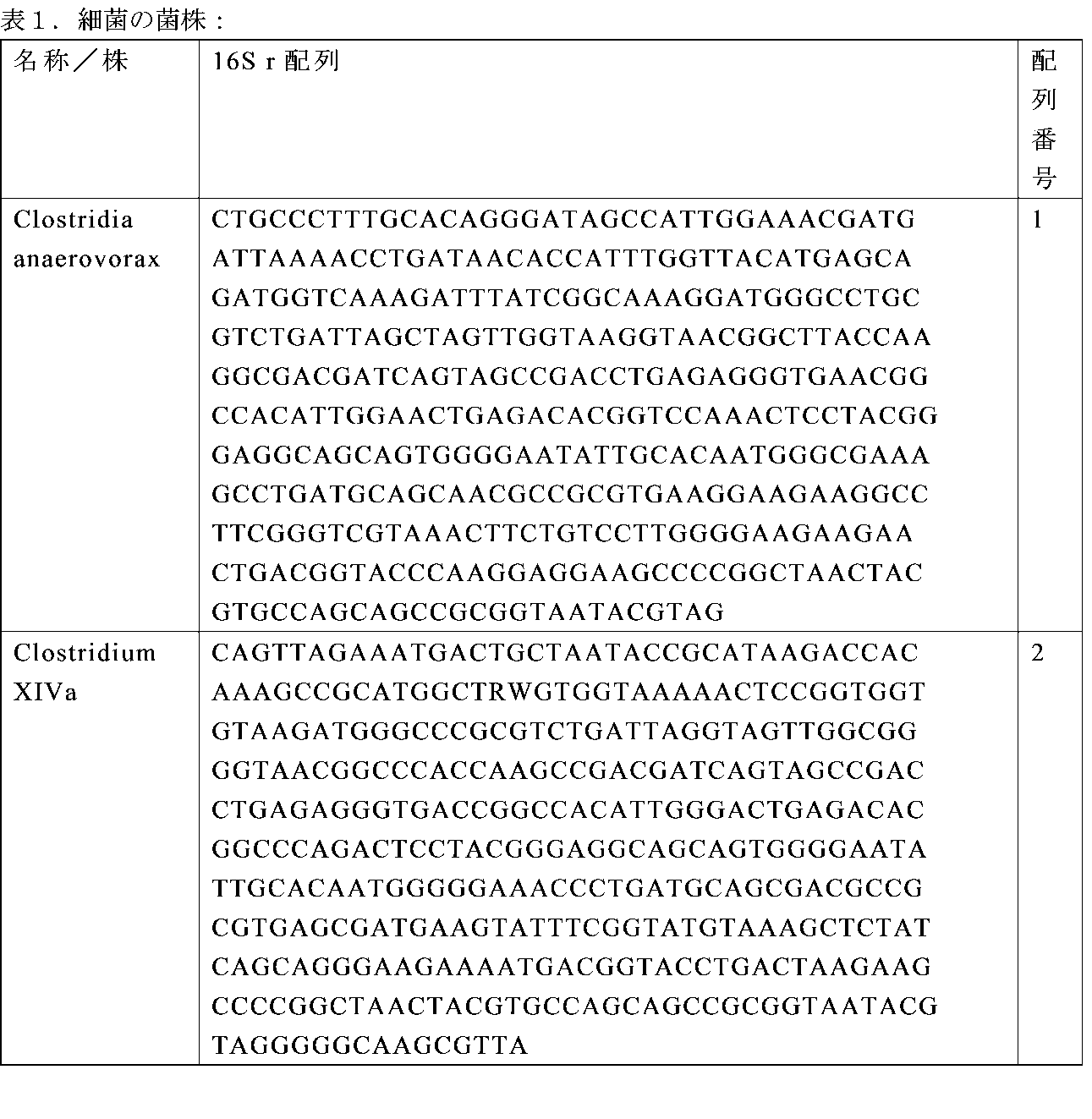
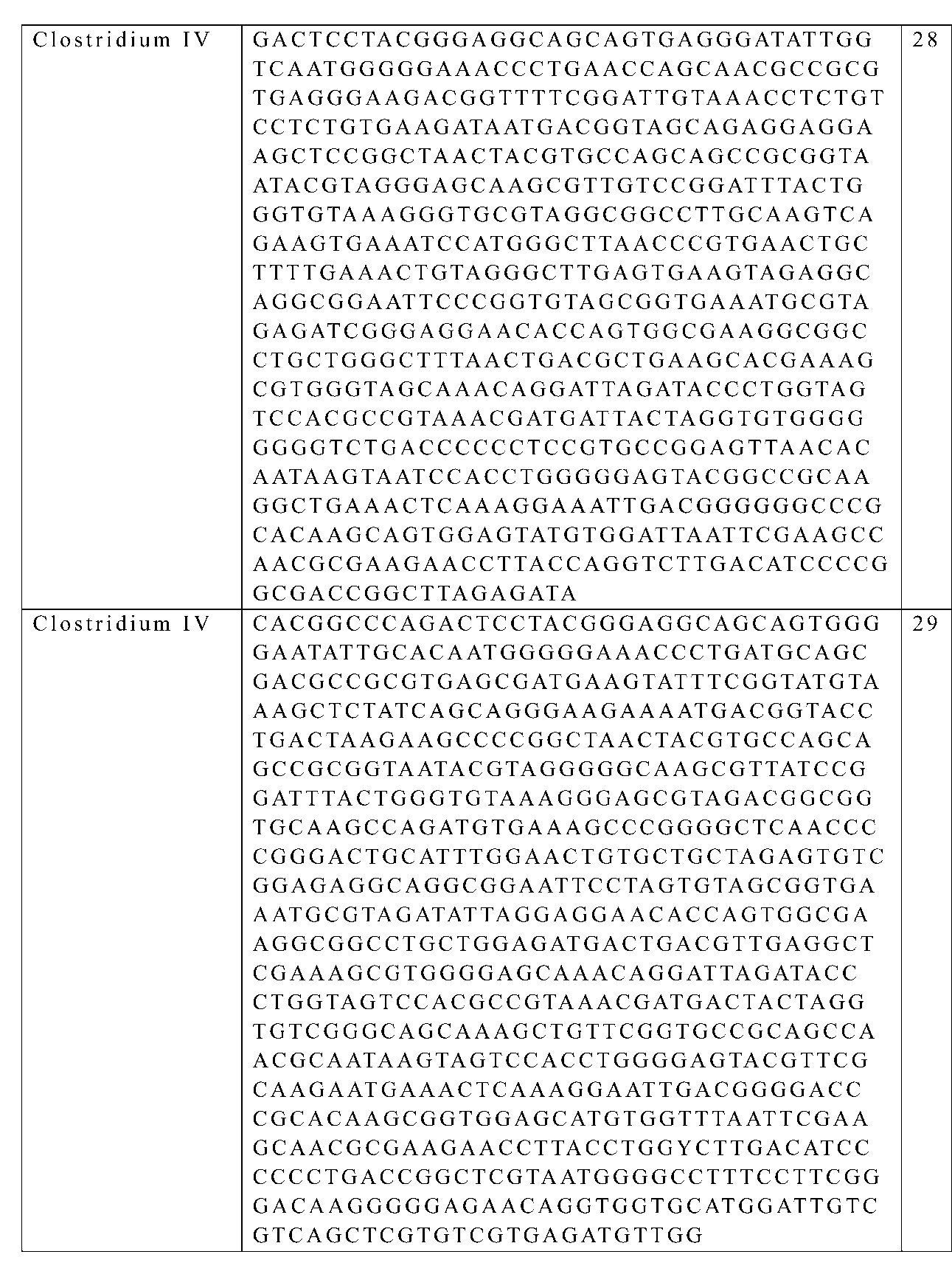
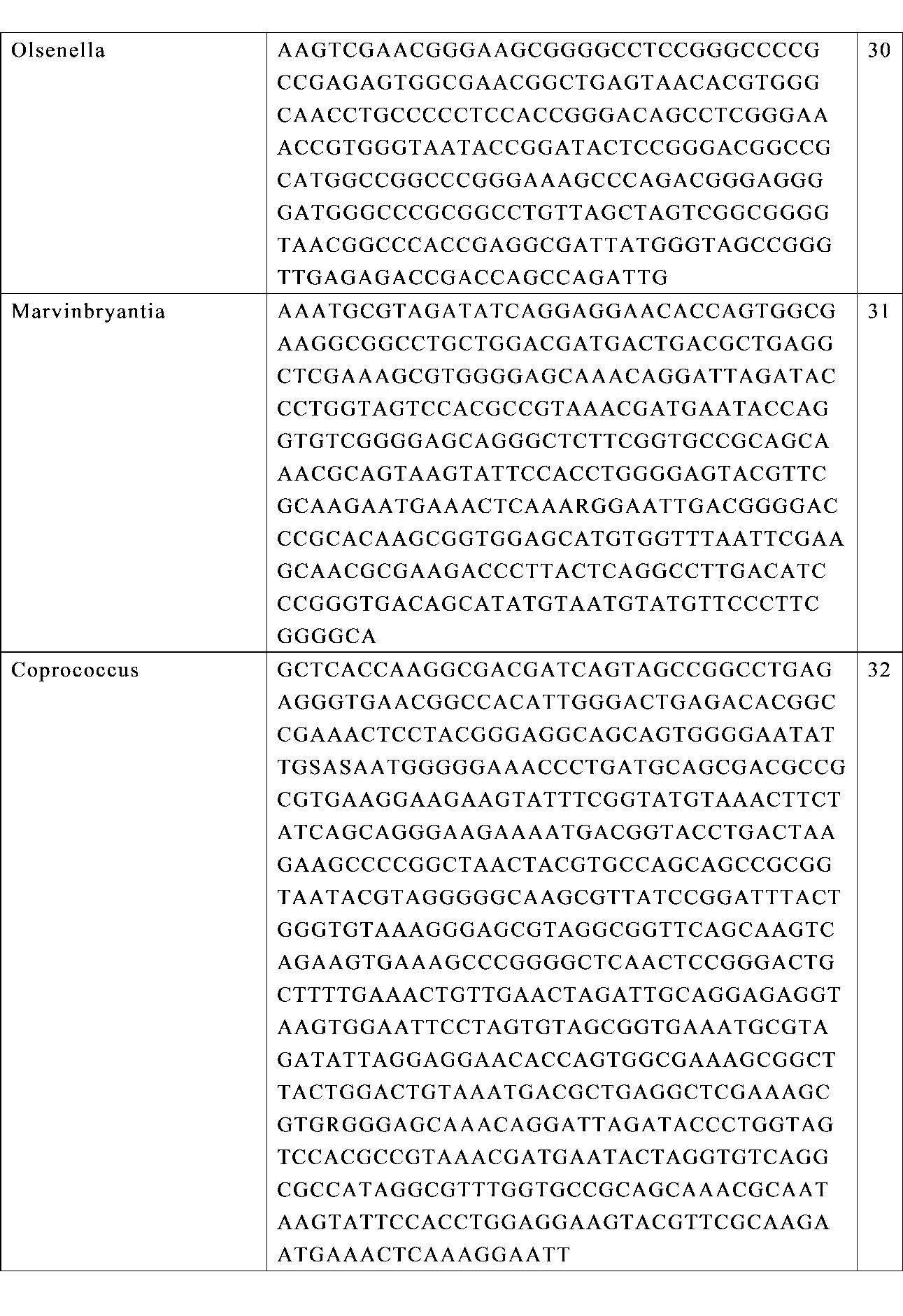
本開示は、細菌分離株及び群落を含む組成物及び使用方法に関する。具体的には、本開示は、本明細書、特に表1に開示されている細菌コンソーシアムからの1つ以上の微生物またはそれらの混合物を含む組成物に関する。好ましい実施形態では、組成物は、配列番号1、2、3、及び4を含む16S rDNA配列を有する細菌の2つ以上の株を含む。微生物は、配列番号1~4に対応し、少なくとも98%同一である16S リボソーム遺伝子配列を同定することによって特徴付けられ得る。
Compositions The present disclosure relates to compositions and methods of use, including bacterial isolates and communities. Specifically, the disclosure relates to compositions comprising one or more microorganisms or mixtures thereof from the bacterial consortia disclosed herein, particularly in Table 1. In a preferred embodiment, the composition comprises two or more strains of bacteria having 16S rDNA sequences including SEQ ID NOs: 1, 2, 3, and 4. The microorganisms may be characterized by identifying 16S ribosomal gene sequences that correspond to and are at least 98% identical to SEQ ID NOs: 1-4.
本明細書に開示されているのは、新たに同定された細菌である。配列番号1、2、3、及び4を含む16S rDNA配列を有する細菌は、Clostridium属に属することが見出された。いくつかの態様において、本明細書に記載される組成物は、細菌がClostridium sp.(クロストリジウム種)である少なくとも1つの細菌を含む。 Disclosed herein are newly identified bacteria. The bacteria having 16S rDNA sequences including SEQ ID NOs: 1, 2, 3, and 4 were found to belong to the genus Clostridium. In some embodiments, the compositions described herein include at least one bacterium, where the bacterium is a Clostridium sp.
Clostridia anaerovorax。本明細書には、細菌Clostridia anaerovoraxが開示される。本明細書で使用されるClostridia anaerovoraxとは、配列番号1に対して少なくとも少なくとも98%の配列同一性を共有する16S 核酸配列を有する細菌を指す。Clostridia anaerovoraxは、NRRLまたはATCCアクセッション番号_____を有する。Clostridia anaerovoraxは、CD4-Cre+マウス(WT)の小腸下部由来の糞便ペレット及び管腔内容物から分離された。 Clostridia anaerovorax. Disclosed herein is the bacterium Clostridia anaerovorax. As used herein, Clostridia anaerovorax refers to a bacterium having a 16S nucleic acid sequence that shares at least at least 98% sequence identity to SEQ ID NO:1. Clostridia anaerovorax has the NRRL or ATCC Accession No. ______. Clostridia anaerovorax was isolated from fecal pellets and luminal contents from the lower small intestine of CD4-Cre + mice (WT).
Clostridium XIVa。本明細書では、細菌、Clostridium XIVaが開示される。Clostridium XIVaとは、本明細書において用いる場合、配列番号2に対して少なくとも少なくとも98%の配列同一性を共有する16S 核酸配列を有する細菌を指す。Clostridium XIVaは、NRRLまたはATCC アクセッション番号_____を有する。Clostridium XIVaは、CD4-Cre+マウス(WT)の小腸下部由来の糞便ペレット及び管腔内容物から分離された。 Clostridium XIVa. Disclosed herein is the bacterium Clostridium XIVa. Clostridium XIVa, as used herein, refers to a bacterium having a 16S nucleic acid sequence that shares at least 98% sequence identity to SEQ ID NO:2. Clostridium XIVa has the NRRL or ATCC Accession No. ______. Clostridium XIVa was isolated from fecal pellets and luminal contents from the lower small intestine of CD4-Cre + mice (WT).
Clostridium IV。本明細書では、細菌、Clostridium IVが開示される。Clostridium IVとは、本明細書において用いる場合、配列番号3に対して少なくとも少なくとも98%の配列同一性を共有する16S 核酸配列を有する細菌を指す。Clostridium IVは、NRRLまたはATCC アクセッション番号_____を有する。Clostridium IVは、CD4-Cre+マウス(WT)の小腸下部由来の糞便ペレット及び管腔内容物から分離された。 Clostridium IV. Disclosed herein is the bacterium Clostridium IV. Clostridium IV, as used herein, refers to a bacterium having a 16S nucleic acid sequence that shares at least 98% sequence identity to SEQ ID NO:3. Clostridium IV has the NRRL or ATCC Accession No. ______. Clostridium IV was isolated from fecal pellets and luminal contents from the lower small intestine of CD4-Cre + mice (WT).
Lachnospiraceae spps。本明細書では、細菌、Lachnospiraceae sppsが開示される。Lachnospiraceae sppsとは、本明細書において用いる場合、配列番号4に対して少なくとも少なくとも98%の配列同一性を共有する16S 核酸配列を有する細菌を指す。Lachnospiraceae sppsは、NRRLまたはATCC アクセッション番号_____を有する。Lachnospiraceae sppsは、CD4-Cre+マウス(WT)の小腸下部由来の糞便ペレット及び管腔内容物から分離された。 Lachnospiraceae spps. Disclosed herein is the bacterium Lachnospiraceae spps. Lachnospiraceae spps, as used herein, refers to a bacterium having a 16S nucleic acid sequence that shares at least at least 98% sequence identity to SEQ ID NO:4. Lachnospiraceae spps has the NRRL or ATCC Accession No. ______. Lachnospiraceae spps was isolated from fecal pellets and luminal contents from the lower small intestine of CD4-Cre + mice (WT).
Clostridia Consortium.本開示は、細菌分離株及び群落を含む組成物及び使用方法に関する。本明細書には、Clostridiaコンソーシアム(2つ以上の異なる菌株の混合物)が開示される。具体的には、本開示は、本明細書、特に表1に開示されている細菌コンソーシアム由来の1つ以上の微生物またはそれらの混合物を含む組成物に関する。いくつかの態様では、この組成物は、表1に列挙される2つ以上の菌株を含む。この微生物は、配列番号1~4に相当し、それ対して少なくとも少なくとも98%同一である16Sリボソーム遺伝子配列を特定することによって、ならびに/またはそれぞれ、NRRLもしくはATCCアクセッション番号: ____、____、____、及び____を有する細菌に対する比較によって、特徴付けられ得る。いくつかの態様では、Clostridiaコンソーシアムは、配列番号1、2、3、及び4を含む16S rDNA配列を有する2つ以上の細菌株を含む。いくつかの態様では、Clostridiaコンソーシアムは、配列番号1、2、3、及び4を含む16S rDNA配列を有する3つ以上の細菌株を含む。いくつかの態様では、Clostridiaコンソーシアムは、それぞれ配列番号1、2、3、及び4を含む16S rDNA配列を有する4つの菌株を含む。 Clostridia Consortium. The present disclosure relates to compositions and methods of use comprising bacterial isolates and communities. Disclosed herein is a Clostridia consortium (a mixture of two or more different strains). Specifically, the disclosure relates to compositions comprising one or more microorganisms or mixtures thereof from the bacterial consortiums disclosed herein, particularly in Table 1. In some aspects, the composition comprises two or more strains listed in Table 1. The microorganisms may be characterized by identifying a 16S ribosomal gene sequence that corresponds to and is at least 98% identical to SEQ ID NOs: 1-4 and/or by comparison to bacteria having NRRL or ATCC Accession Nos: ______, ______, ______, and ______, respectively. In some aspects, the Clostridia consortium comprises two or more bacterial strains having 16S rDNA sequences comprising SEQ ID NOs: 1, 2, 3, and 4. In some aspects, the Clostridia consortium includes three or more bacterial strains having 16S rDNA sequences including SEQ ID NOs: 1, 2, 3, and 4. In some aspects, the Clostridia consortium includes four strains having 16S rDNA sequences including SEQ ID NOs: 1, 2, 3, and 4, respectively.
いくつかの態様では、Clostridiaコンソーシアムは、他の細菌株が存在しない場合に、配列番号1、2、3、及び4を含む16S rDNA配列を有する2つ以上の細菌株を含む。いくつかの態様では、Clostridiaコンソーシアムは、他の細菌株が存在しない場合に、配列番号1、2、3、及び4を含む16S rDNA配列を有する3つ以上の細菌株を含む。いくつかの態様では、Clostridiaコンソーシアムは、他の細菌株が存在しない場合に、それぞれ、配列番号1、2、3、及び4を含む16S rDNA配列を有する4つの細菌株を含む。 In some aspects, the Clostridia consortium includes two or more bacterial strains having 16S rDNA sequences that include SEQ ID NOs: 1, 2, 3, and 4 in the absence of other bacterial strains. In some aspects, the Clostridia consortium includes three or more bacterial strains having 16S rDNA sequences that include SEQ ID NOs: 1, 2, 3, and 4 in the absence of other bacterial strains. In some aspects, the Clostridia consortium includes four bacterial strains having 16S rDNA sequences that include SEQ ID NOs: 1, 2, 3, and 4, respectively, in the absence of other bacterial strains.
いくつかの態様では、Clostridiaコンソーシアムは、表1に列挙された最大4つの細菌株を含む。いくつかの態様では、Clostridiaコンソーシアムは、表1の2つ以上の細菌株を含む。いくつかの態様では、Clostridiaコンソーシアムは、Clostridia anaerovorax、Clostridium XIVa、Clostridium IV及びLachnospiraceae sppsを含む。いくつかの態様では、Clostridiaコンソーシアムは、Clostridia anaerovorax、Clostridium XIVa、Clostridium IV、Lachnospiraceae spps、及び表1の1つ以上の細菌株を含む。いくつかの態様では、このコンソーシアムの種々の細菌は、それらの16Sリボソーム遺伝子配列によって特定され得る。 In some aspects, the Clostridia consortium includes up to four bacterial strains listed in Table 1. In some aspects, the Clostridia consortium includes two or more bacterial strains in Table 1. In some aspects, the Clostridia consortium includes Clostridia anaerovorax, Clostridium XIVa, Clostridium IV, and Lachnospiraceae spps. In some aspects, the Clostridia consortium includes Clostridia anaerovorax, Clostridium XIVa, Clostridium IV, Lachnospiraceae spps, and one or more bacterial strains in Table 1. In some embodiments, the various bacteria in this consortium can be identified by their 16S ribosomal gene sequences.
いくつかの態様では、本明細書に開示されるClostridiaコンソーシアムは、配列番号1、2、3、及び4を含む16S rDNA配列を有する細菌の4つを超える菌株を含む、より複雑なClostridiaコンソーシアムを含む、複雑な微生物群落と同程度に対象にコロニー形成された場合、対象における脂肪症を軽減し得る。 In some aspects, the Clostridia consortium disclosed herein may reduce steatosis in a subject when colonized in the subject to the same extent as a complex microbial community, including a more complex Clostridia consortium that includes more than four strains of bacteria having 16S rDNA sequences including SEQ ID NOs: 1, 2, 3, and 4.
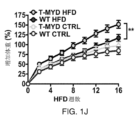
いくつかの態様では、本明細書に開示されるClostridiaコンソーシアムは、それぞれ、未処理のWTマウスまたはT-MyD88-/-マウスと比較した場合、高脂肪食を与えられたときに、WTマウスまたは肥満傾向のT-MyD88-/-マウスにおける体重増加及び脂肪蓄積を減少し得る。 In some aspects, the Clostridia consortium disclosed herein can reduce weight gain and fat accumulation in WT or obese-prone T-MyD88-/- mice when fed a high-fat diet when compared to untreated WT or T-MyD88-/- mice, respectively.
いくつかの態様では、本明細書に開示されるClostridiaコンソーシアムは、それぞれ、未処理のWTマウスまたはT-MyD88-/-マウスと比較した場合、高脂肪食を与えられたときに、WTマウスまたは肥満傾向のT-MyD88-/-マウスにおける、体脂肪率を下げ、及びVAT量を減少し得る。 In some aspects, the Clostridia consortium disclosed herein can reduce percent body fat and decrease VAT mass in WT or obese T-MyD88-/- mice when fed a high fat diet compared to untreated WT or T-MyD88-/- mice, respectively.
いくつかの態様では、本明細書に開示されるClostridiaコンソーシアムは、それぞれ、未処理のWTマウスまたはT-MyD88-/-マウスと比較した場合、高脂肪食を与えられたときに、WTマウスまたは肥満傾向のT-MyD88-/-マウスにおける血糖値を低下及びインスリン抵抗性を減少し得る。 In some aspects, the Clostridia consortium disclosed herein can reduce blood glucose levels and insulin resistance in WT or obese T-MyD88-/- mice when fed a high fat diet compared to untreated WT or T-MyD88-/- mice, respectively.
本明細書に開示されるのは、対象の脂肪症を軽減し、対象の体重増加及び/または脂肪蓄積を減らし、対象の体脂肪率を下げ、及び/または対象の内臓脂肪組織(VAT)量を減らし、血糖値を下げる、及び/または、対象のインスリン抵抗性を低下させ、対象の小腸での脂質吸収を阻害し、対象の肝臓でCD36を下方制御し、ならびに対象の腸上皮内での脂質吸収遺伝子の発現を抑制するためのClostridiaコンソーシアムである。いくつかの態様では、Clostridiaコンソーシアムは、表1に列挙された最大4つの細菌株を含む。いくつかの態様では、表1の任意の2つ以上の細菌株の組み合わせが、Clostridiaコンソーシアムにおいて使用され得る。いくつかの態様では、Clostridiaコンソーシアムは、Clostridia anaerovorax,Clostridium XIVa,Clostridium IV and Lachnospiraceae sppsを含む。いくつかの態様では、コンソーシアム内のさまざまな細菌は、それらの16Sリボソーム遺伝子配列によって同定され得る。


本明細書には、Clostridiaのコンソーシアム由来の上清を含む組成物が開示されている。本明細書にはまた、Clostridiumのコンソーシアムを含む組成物が開示されている。いくつかの態様では、Clostridiaコンソーシアムは、Clostridia anaerovorax、Clostridium XIVa、Clostridium IV及びLachnospiraceae sppsを含む。いくつかの態様では、Clostridiaコンソーシアムは、Clostridia anaerovorax、Clostridium XIVa、Clostridium IV及びLachnospiraceae sppsのうちの1つ以上を含む。いくつかの態様では、Clostridiaコンソーシアムは、Clostridia anaerovorax、Clostridium XIVa、Clostridium IV及びLachnospiraceae sppsのうちの2つ以上を含む。いくつかの態様では、Clostridiaコンソーシアムは、Clostridia anaerovorax、Clostridium XIVa、Clostridium IV及びLachnospiraceae sppsのうちの3つ以上を含む。いくつかの態様では、Clostridiaコンソーシアムは、Clostridia anaerovorax、Clostridium XIVa、Clostridium IV及びLachnospiraceae sppsからなる。いくつかの態様では、Clostridiaコンソーシアムは、Clostridia anaerovorax、Clostridium XIVa、Clostridium IV及びLachnospiraceae sppsのうちの1つ以上からなる。いくつかの態様では、Clostridiaコンソーシアムは、Clostridia anaerovorax、Clostridium XIVa、Clostridium IV及びLachnospiraceae sppsのうちの2つ以上からなる。いくつかの態様では、Clostridiaコンソーシアムは、Clostridia anaerovorax、Clostridium XIVa、Clostridium IV及びLachnospiraceae sppsのうちの3つ以上からなる。 Disclosed herein is a composition comprising a supernatant from a Clostridia consortium. Also disclosed herein is a composition comprising a Clostridium consortium. In some aspects, the Clostridia consortium comprises Clostridia anaerovorax, Clostridium XIVa, Clostridium IV, and Lachnospiraceae spps. In some aspects, the Clostridia consortium comprises one or more of Clostridia anaerovorax, Clostridium XIVa, Clostridium IV, and Lachnospiraceae spps. In some aspects, the Clostridia consortium comprises two or more of Clostridia anaerovorax, Clostridium XIVa, Clostridium IV, and Lachnospiraceae spps. In some aspects, the Clostridia consortium comprises three or more of Clostridia anaerovorax, Clostridium XIVa, Clostridium IV, and Lachnospiraceae spps. In some aspects, the Clostridia consortium consists of Clostridia anaerovorax, Clostridium XIVa, Clostridium IV, and Lachnospiraceae spps. In some aspects, the Clostridia consortium consists of one or more of Clostridia anaerovorax, Clostridium XIVa, Clostridium IV, and Lachnospiraceae spps. In some embodiments, the Clostridia consortium consists of two or more of Clostridia anaerovorax, Clostridium XIVa, Clostridium IV, and Lachnospiraceae spps. In some embodiments, the Clostridia consortium consists of three or more of Clostridia anaerovorax, Clostridium XIVa, Clostridium IV, and Lachnospiraceae spps.
いくつかの態様では、本明細書に記載される任意の組成物は、対象の腸上皮内の脂質吸収遺伝子の発現を抑制し得る。いくつかの態様では、本明細書に開示される任意の組成物は、1つ以上の脂質吸収及び/または合成遺伝子を抑制し得る。いくつかの態様では、脂質吸収遺伝子は、CD36、FasN、Dgat、Srepbf1、SLC27a1、及びSLC27a4であり得る。 In some aspects, any of the compositions described herein may inhibit expression of lipid absorption genes in the intestinal epithelium of a subject. In some aspects, any of the compositions disclosed herein may inhibit one or more lipid absorption and/or synthesis genes. In some aspects, the lipid absorption genes may be CD36, FasN, Dgat, Srepbf1, SLC27a1, and SLC27a4.
いくつかの態様では、本明細書に記載される任意の組成物は、対象の小腸の脂質吸収を阻害し得る。 In some embodiments, any of the compositions described herein may inhibit lipid absorption in the small intestine of a subject.
いくつかの態様では、本明細書に記載される任意の組成物は、対象の体重増加を軽減し得る。 In some aspects, any of the compositions described herein may reduce weight gain in a subject.
いくつかの態様では、本明細書に記載される任意の組成物は、対象の肝臓においてCD36を下方制御し得る。 In some aspects, any of the compositions described herein can downregulate CD36 in the liver of a subject.
また、本明細書には、2つ以上のClostridia anaerovorax株、Clostridium XIVa、Clostridium IV、及びLachnospiraceae sppsを含む細菌のコンソーシアムであって、このコンソーシアムは、このコンソーシアムが投与されていない対象と比較して対象における腸上皮内の脂質吸収遺伝子の発現を抑制するコンソーシアムも開示される。 Also disclosed herein is a bacterial consortium comprising two or more strains of Clostridia anaerovorax, Clostridium XIVa, Clostridium IV, and Lachnospiraceae spps, the consortium suppressing expression of lipid absorption genes in the intestinal epithelium of a subject compared to a subject not administered the consortium.
いくつかの態様において、本明細書に記載される組成物は、表1から選択される1つ以上のClostridia株をさらに含み得る。 In some embodiments, the compositions described herein may further comprise one or more Clostridia strains selected from Table 1.
いくつかの態様では、開示される組成物は、配列番号1~4の16Sリボソーム配列に対して少なくとも95、96、97、98、99またはそれ以上の同一性パーセントの相同性によって同定可能な少なくとも2つ以上の細菌微生物を含む。いくつかの態様では、16S配列の量は、約1.2kb、1.1kb、1.0kb、0.9kb、8kb、0.7kb、0.6kb、0.5kb、0.4kb、0.3kb、0.2kb、または0.1kb未満であり、かつ約50nt、0.1kb、2kb、0.3kb、0.4kb、0.5kb、0.6kb、0.7kb、0.8kb、0.9kb、1.0kb、または1.1kbを超える。いくつかの態様では、16Sリボソーム配列相同性の量は、約150nt~500ntの間、例えば、約250ntである。2つの核酸配列の同一性パーセントを決定するために、配列を最適な比較目的のために整列させる(例えば、第2の核酸配列との最適な整列のためにギャップを、第1の核酸配列の配列に導入してもよい)。次に、対応するヌクレオチド位置にあるヌクレオチドを比較する。第1の配列における位置が、第2の配列における対応する位置と同じヌクレオチドによって占有される場合には、その分子は、その位置にて同一である。2つの配列の間の同一性パーセントは、その配列によって共有される同一の位置の数の関数である(すなわち、同一性%=同一の位置の数/位置の総数×100)。 In some embodiments, the disclosed compositions include at least two or more bacterial microorganisms identifiable by at least 95, 96, 97, 98, 99 or more percent identity homology to the 16S ribosomal sequences of SEQ ID NOs: 1-4. In some embodiments, the amount of 16S sequence is less than about 1.2 kb, 1.1 kb, 1.0 kb, 0.9 kb, 8 kb, 0.7 kb, 0.6 kb, 0.5 kb, 0.4 kb, 0.3 kb, 0.2 kb, or 0.1 kb, and more than about 50 nt, 0.1 kb, 2 kb, 0.3 kb, 0.4 kb, 0.5 kb, 0.6 kb, 0.7 kb, 0.8 kb, 0.9 kb, 1.0 kb, or 1.1 kb. In some embodiments, the amount of 16S ribosomal sequence homology is between about 150 nt and 500 nt, e.g., about 250 nt. To determine the percent identity of two nucleic acid sequences, the sequences are aligned for optimal comparison purposes (e.g., gaps may be introduced into the sequence of the first nucleic acid sequence for optimal alignment with the second nucleic acid sequence). The nucleotides at corresponding nucleotide positions are then compared. If a position in the first sequence is occupied by the same nucleotide as the corresponding position in the second sequence, then the molecules are identical at that position. The percent identity between two sequences is a function of the number of identical positions shared by the sequences (i.e., % identity = number of identical positions/total number of positions x 100).
2つの配列間の相同性パーセントの決定は、数学的アルゴリズムを使用して達成され得る。2つの配列の比較に利用される数学的アルゴリズムの好ましい非限定的な例は、Karlin及びAltschul(1990) Proc.Nat’l Acad.Sci.USA 87:2264-2268のアルゴリズムであって、Karlin and Altschul(1993) Proc.Nat’l Acad.Sci.USA 90:5873-5877のように改変されたアルゴリズムである。かかるアルゴリズムは、Altschul,et al.(1990) J.Mol.Biol.215:403-410のNBLAST及びXBLASTプログラムに組み込まれる。BLASTヌクレオチド検索を、NBLASTプログラム、スコア=100、ワード長=12を用いて実施して、本開示の核酸分子に対して類似または相同なヌクレオチド配列を得てもよい。比較目的のためのギャップアライメントを得るために、Gapped BLASTを、Altschul et al.(1997)Nucleic Acids Res.25:3389-3402に記載のように利用してもよい。BLAST及びGapped BLASTプログラムを利用する場合、それぞれのプログラムのデフォルトパラメータ(例えば、XBLAST及びNBLAST)を使用してもよい。これらのアルゴリズムを、DNAをRNAと整列させるために使用してもよく、場合によっては、タンパク質を翻訳されたヌクレオチド配列と整列させるために使用してもよい。 Determining the percent homology between two sequences can be accomplished using a mathematical algorithm. A preferred, non-limiting example of a mathematical algorithm utilized for comparing two sequences is the algorithm of Karlin and Altschul (1990) Proc. Nat'l Acad. Sci. USA 87:2264-2268, as modified by Karlin and Altschul (1993) Proc. Nat'l Acad. Sci. USA 90:5873-5877. Such an algorithm is incorporated into the NBLAST and XBLAST programs of Altschul, et al. (1990) J. Mol. Biol. 215:403-410. BLAST nucleotide searches may be performed using the NBLAST program, score=100, wordlength=12, to obtain nucleotide sequences similar or homologous to the nucleic acid molecules of the present disclosure. To obtain gapped alignments for comparison purposes, Gapped BLAST may be utilized as described in Altschul et al. (1997) Nucleic Acids Res. 25:3389-3402. When utilizing BLAST and Gapped BLAST programs, the default parameters of the respective programs (e.g., XBLAST and NBLAST) may be used. These algorithms may be used to align DNA with RNA, and in some cases, proteins with translated nucleotide sequences.
いくつかの態様では、少なくとも2つ以上の微生物が本開示の組成物に含まれる。2つ以上の微生物が組成物を形成する場合、その微生物を共培養して、開示された組成物を生成し得ると考えられる。いくつかの態様では、開示された組成物は、2つ以上の株の個々の培養物を組み合わせることによって形成され得る。微生物は、当技術分野で公知の方法によって増殖され得る。例えば、微生物は、嫌気性または好気性の条件下で液体培地中で増殖され得る。微生物の増殖に使用される適切な液体培地としては、栄養ブロス及びトリプシンダイズ天(TSA)などのような当技術分野で公知の培地が挙げられる。いくつかの態様では、この組成物は、表1に列挙された菌株の全リストを含む。いくつかの態様では、組成物は、以下の菌株のうちの少なくとも2つ以上を含む:Clostridia anaerovorax、Clostridium XIVa、Clostridium IV、及びLachnospiraceae spps。 In some aspects, at least two or more microorganisms are included in the compositions of the present disclosure. When two or more microorganisms form a composition, it is contemplated that the microorganisms may be co-cultured to produce the disclosed compositions. In some aspects, the disclosed compositions may be formed by combining individual cultures of two or more strains. The microorganisms may be grown by methods known in the art. For example, the microorganisms may be grown in liquid media under anaerobic or aerobic conditions. Suitable liquid media used to grow the microorganisms include media known in the art such as nutrient broth and tryptic soy broth (TSA). In some aspects, the composition includes the entire list of strains listed in Table 1. In some aspects, the composition includes at least two or more of the following strains: Clostridia anaerovorax, Clostridium XIVa, Clostridium IV, and Lachnospiraceae spps.
いくつかの態様では、本明細書に開示される組成物は、少なくとも1×10⁻⁵細胞の各Clostridia株を含んでもよい。いくつかの態様では、本明細書に開示される組成物は、少なくとも1×10⁻⁶細胞の各Clostridia株を含んでもよい。いくつかの態様では、本明細書に開示される組成物は、少なくとも1×10⁻⁷細胞の各Clostridia株を含んでもよい。いくつかの態様では、本明細書に開示される組成物は、少なくとも1×10⁻⁸細胞の各Clostridia株を含んでもよい。いくつかの態様では、本明細書に開示される組成物は、少なくとも1×10⁻⁹細胞の各Clostridia株を含んでもよい。いくつかの態様では、本明細書に開示される組成物は、少なくとも1×10⁻¹⁰細胞の各Clostridia株を含んでもよい。いくつかの態様では、本明細書に開示される任意の組成物の単一投薬量は、1×10⁻⁵ ~1×10⁻¹⁰細胞の各Clostridia株を含んでもよい。いくつかの態様では、このコンソーシアムの細胞は活性である。 In some aspects, the compositions disclosed herein may comprise at least 1×10 −5 cells of each Clostridia strain. In some aspects, the compositions disclosed herein may comprise at least 1×10 −6 cells of each Clostridia strain. In some aspects, the compositions disclosed herein may comprise at least 1×10 −7 cells of each Clostridia strain. In some aspects, the compositions disclosed herein may comprise at least 1×10 −8 cells of each Clostridia strain. In some aspects, the compositions disclosed herein may comprise at least 1×10 −9 cells of each Clostridia strain. In some aspects, the compositions disclosed herein may comprise at least 1×10 −10 cells of each Clostridia strain. In some aspects, a single dosage of any composition disclosed herein may comprise between 1×10 −5 and 1×10 −10 cells of each Clostridia strain. In some embodiments, the cells of the consortium are active.
いくつかの態様では、本明細書に開示される組成物は、不均衡な微生物叢に関連する疾患または障害を有する対象の微生物叢を置き換え得る。いくつかの態様では、本明細書に開示される組成物は、対象の微生物叢を、機能不全の微生物叢に関連する疾患または障害で置き換え得る。いくつかの態様では、本明細書に開示される組成物は、対象の微生物叢を、機能的多様性が減少する微生物叢に関連する疾患または障害で置き換え得る。いくつかの態様では、不均衡な微生物叢(または機能不全の微生物叢もしくは機能的多様性が減少する微生物叢)とは、Desulfovibrioの増加及びクロストリジウム(Clostridia)の減少である場合がある。いくつかの態様では、不均衡な微生物叢(または機能不全の微生物叢もしくは機能的多様性が減少する微生物叢)とは、Desulfovibrioの無変化(または増加なし)及びクロストリジウム(Clostridia)の減少である場合がある。いくつかの態様では、不均衡な微生物叢(または機能不全の微生物叢もしくは機能的多様性が減少する微生物叢)とは、クロストリジウム(Clostridia)の減少である場合がある。いくつかの態様では、不均衡な微生物叢(または機能不全の微生物叢もしくは機能的多様性が減少する微生物叢)とは、クロストリジウム(Clostridia)の非存在または欠失である場合がある。 In some aspects, the compositions disclosed herein may replace the microbiota of a subject with a disease or disorder associated with an imbalanced microbiota. In some aspects, the compositions disclosed herein may replace the microbiota of a subject with a disease or disorder associated with a dysfunctional microbiota. In some aspects, the compositions disclosed herein may replace the microbiota of a subject with a disease or disorder associated with a microbiota with reduced functional diversity. In some aspects, an imbalanced microbiota (or a dysfunctional microbiota or a microbiota with reduced functional diversity) may be an increase in Desulfovibrio and a decrease in Clostridia. In some aspects, an imbalanced microbiota (or a dysfunctional microbiota or a microbiota with reduced functional diversity) may be no change (or no increase) in Desulfovibrio and a decrease in Clostridia. In some aspects, an imbalanced microbiota (or a dysfunctional microbiota or a microbiota with reduced functional diversity) can be a reduction in Clostridia. In some aspects, an imbalanced microbiota (or a dysfunctional microbiota or a microbiota with reduced functional diversity) can be an absence or absence of Clostridia.
いくつかの態様では、疾患または障害は、肥満、メタボリックシンドローム、インスリン欠乏、インスリン抵抗性関連障害、耐糖能異常、糖尿病、または炎症性腸疾患であり得る。いくつかの態様では、炎症性腸疾患は、クローン病であっても、または潰瘍性大腸炎であってもよい。いくつかの態様では、インスリン抵抗性関連障害は、糖尿病、高血圧、脂質異常症、または心血管疾患であってもよい。いくつかの態様では、糖尿病はI型糖尿病であってもよい。いくつかの態様では、糖尿病はII型糖尿病であってもよい。 In some aspects, the disease or disorder may be obesity, metabolic syndrome, insulin deficiency, insulin resistance-related disorder, impaired glucose tolerance, diabetes, or inflammatory bowel disease. In some aspects, the inflammatory bowel disease may be Crohn's disease or ulcerative colitis. In some aspects, the insulin resistance-related disorder may be diabetes, hypertension, dyslipidemia, or cardiovascular disease. In some aspects, the diabetes may be type I diabetes. In some aspects, the diabetes may be type II diabetes.
いくつかの態様では、本明細書に開示される組成物は、薬学的に許容される担体をさらに含んでもよい。いくつかの態様では、この組成物はまた、添加剤も含んでもよい。適切な添加剤としては、成長、微生物による特定の代謝産物の生成を支持し、pHを変化させ、標的代謝産物を濃縮し、殺虫効果を高め、及びそれらの組み合わせを支持し得る当技術分野で公知の物質が挙げられる。例示的な添加剤としては、炭素源、窒素源、リン源、無機塩、有機酸、増殖培地、ビタミン、ミネラル、酢酸、アミノ酸などが挙げられる。 In some aspects, the compositions disclosed herein may further comprise a pharma- ceutically acceptable carrier. In some aspects, the compositions may also comprise additives. Suitable additives include substances known in the art that may support growth, production of specific metabolites by the microorganism, alter pH, concentrate target metabolites, enhance pesticidal effects, and combinations thereof. Exemplary additives include carbon sources, nitrogen sources, phosphorus sources, inorganic salts, organic acids, growth media, vitamins, minerals, acetate, amino acids, and the like.
適切な炭素源の例としては、限定するものではないが、デンプン、ペプトン、酵母エキス、アミノ酸、糖、例えば、スクロース、グルコース、アラビノース、マンノース、グルコサミン、マルトース、サトウキビ、アルファルファ抽出物、糖蜜、ラムなど;有機酸、例えば、酢酸、フマル酸、アジピン酸、プロピオン酸、クエン酸、グルコン酸、リンゴ酸、ピルビン酸、マロン酸などの塩;エタノール、グリセロールなどのアルコール;オイルまたは油脂、例えば、ダイズ油、米ぬか油、オリーブ油、コーン油、及びゴマ油が挙げられる。添加される炭素源の量は、炭素源の種類によって異なり、通常、培地1リットルあたり1~100グラムである。組成物中の炭素源の重量分率は、組成物の総重量の約98%以下、約95%以下、約90%以下、約85%以下、約80%以下、約75%以下、約70%以下、約65%以下、約60%以下、約55%以下、約50%以下、約45%以下、約40%以下、約35%以下、約30%以下、約25%以下、約20%以下、約15%以下、約10%以下、約5%以下、約2%、または約1%以下であり得る。好ましくは、アルファルファは、約1~20%(w/v)の濃度で、主要な炭素源として培地に含まれる。より好ましくは、アルファルファは、約5~12%(w/v)の濃度である。 Examples of suitable carbon sources include, but are not limited to, starch, peptone, yeast extract, amino acids, sugars such as sucrose, glucose, arabinose, mannose, glucosamine, maltose, sugar cane, alfalfa extract, molasses, rum, etc.; organic acids such as salts of acetic acid, fumaric acid, adipic acid, propionic acid, citric acid, gluconic acid, malic acid, pyruvic acid, malonic acid, etc.; alcohols such as ethanol, glycerol, etc.; oils or fats such as soybean oil, rice bran oil, olive oil, corn oil, and sesame oil. The amount of carbon source added varies depending on the type of carbon source and is usually 1 to 100 grams per liter of medium. The weight fraction of the carbon source in the composition can be about 98% or less, about 95% or less, about 90% or less, about 85% or less, about 80% or less, about 75% or less, about 70% or less, about 65% or less, about 60% or less, about 55% or less, about 50% or less, about 45% or less, about 40% or less, about 35% or less, about 30% or less, about 25% or less, about 20% or less, about 15% or less, about 10% or less, about 5% or less, about 2%, or about 1% or less of the total weight of the composition. Preferably, alfalfa is included in the medium as the major carbon source at a concentration of about 1-20% (w/v). More preferably, alfalfa is at a concentration of about 5-12% (w/v).
適切な窒素源の例としては、限定するものではないが、アミノ酸、酵母抽出物、アルファルファ抽出物、トリプトン、牛肉抽出物、ペプトン、硝酸カリウム、硝酸アンモニウム、塩化アンモニウム、硫酸アンモニウム、リン酸アンモニウム、アンモニア、またはそれらの組み合わせが挙げられる。窒素源の量は、窒素源によって異なり、通常、培地1リットルあたり0.1~30グラムである。組成物中の窒素源の重量分率は、組成物の総重量の約98%以下、約95%以下、約90%以下、約85%以下、約80%以下、約75%以下、約70%以下、約65%以下、約60%以下、約55%以下、約50%以下、約45%以下、約40%以下、約35%以下、約30%以下、約25%以下、約20%以下、約15%以下、約10%以下、約5%以下、約2%、または約1%以下であり得る。 Examples of suitable nitrogen sources include, but are not limited to, amino acids, yeast extract, alfalfa extract, tryptone, beef extract, peptone, potassium nitrate, ammonium nitrate, ammonium chloride, ammonium sulfate, ammonium phosphate, ammonia, or combinations thereof. The amount of nitrogen source varies depending on the nitrogen source and is typically 0.1 to 30 grams per liter of medium. The weight fraction of the nitrogen source in the composition can be about 98% or less, about 95% or less, about 90% or less, about 85% or less, about 80% or less, about 75% or less, about 70% or less, about 65% or less, about 60% or less, about 55% or less, about 50% or less, about 45% or less, about 40% or less, about 35% or less, about 30% or less, about 25% or less, about 20% or less, about 15% or less, about 10% or less, about 5% or less, about 2%, or about 1% or less of the total weight of the composition.
適切な無機塩の例としては、限定するものではないが、リン酸二水素カリウム、リン酸水素二カリウム、リン酸水素二ナトリウム、硫酸マグネシウム、塩化マグネシウム、硫酸第二鉄、硫酸第一鉄、塩化第二鉄、塩化第一鉄、硫酸マンガン、塩化マンガン、硫酸亜鉛、塩化亜鉛、硫酸第二銅、塩化カルシウム、塩化ナトリウム、炭酸カルシウム、炭酸ナトリウム、及びそれらの組み合わせが挙げられる。組成物中の無機塩の重量分率は、組成物の総重量の約98%以下、約95%以下、約90%以下、約85%以下、約80%以下、約75%以下、約70%以下、約65%以下、約60%以下、約55%以下、約50%以下、約45%以下、約40%以下、約35%以下、約30%以下、約25%以下、約20%以下、約15%以下、約10%以下、約5%以下、約2%、または約1%以下であり得る。 Examples of suitable inorganic salts include, but are not limited to, potassium dihydrogen phosphate, dipotassium hydrogen phosphate, disodium hydrogen phosphate, magnesium sulfate, magnesium chloride, ferric sulfate, ferrous sulfate, ferric chloride, ferrous chloride, manganese sulfate, manganese chloride, zinc sulfate, zinc chloride, cupric sulfate, calcium chloride, sodium chloride, calcium carbonate, sodium carbonate, and combinations thereof. The weight fraction of the inorganic salt in the composition can be about 98% or less, about 95% or less, about 90% or less, about 85% or less, about 80% or less, about 75% or less, about 70% or less, about 65% or less, about 60% or less, about 55% or less, about 50% or less, about 45% or less, about 40% or less, about 35% or less, about 30% or less, about 25% or less, about 20% or less, about 15% or less, about 10% or less, about 5% or less, about 2%, or about 1% or less of the total weight of the composition.
いくつかの態様では、本開示の組成物は、酢酸またはカルボン酸をさらに含み得る。適切な酢酸としては、限定するものではないが、ホルミン酸、酢酸、プロピオン酸、ブタン酸、イソ酪酸、3-メチルブタン酸、酢酸メチル酢酸エチル、酢酸プロピル、酢酸ブチル、酢酸イソブチル、及び酢酸2-メチルブチルを含む、任意の当技術分野で公知のものが挙げられる。いくつかの態様では、酢酸は、酢を用いることによって含まれる。組成物中の酢酸の重量分率は、組成物の総重量の約98%以下、約95%以下、約90%以下、約85%以下、約80%以下、約75%以下、約70%以下、約65%以下、約60%以下、約55%以下、約50%以下、約45%以下、約40%以下、約35%以下、約30%以下、約25%以下、約20%以下、約15%以下、約10%以下、約5%以下、約2%、または約1%以下であり得る。 In some aspects, the compositions of the present disclosure may further include acetic acid or a carboxylic acid. Suitable acetic acids include any known in the art, including, but not limited to, formic acid, acetic acid, propionic acid, butanoic acid, isobutyric acid, 3-methylbutanoic acid, ethyl methyl acetate, propyl acetate, butyl acetate, isobutyl acetate, and 2-methylbutyl acetate. In some aspects, the acetic acid is included by using vinegar. The weight fraction of acetic acid in the composition may be about 98% or less, about 95% or less, about 90% or less, about 85% or less, about 80% or less, about 75% or less, about 70% or less, about 65% or less, about 60% or less, about 55% or less, about 50% or less, about 45% or less, about 40% or less, about 35% or less, about 30% or less, about 25% or less, about 20% or less, about 15% or less, about 10% or less, about 5% or less, about 2%, or about 1% or less of the total weight of the composition.
いくつかの態様では、本明細書に開示される組成物は、凍結されてもよい。本開示の組成物は、液体であっても、または乾燥形態であってもよい。いくつかの態様では、本明細書に開示される組成物は、固体であってもよい。いくつかの態様では、本明細書に開示される組成物は、液体であってもよい。いくつかの態様では、この組成物は、水性懸濁液の成分を含んでもよい。この水性懸濁液は、適用前に希釈される濃縮原液として提供されてもよいし、またはすぐに使用できる希釈溶液として提供されてもよい。また、組成物は、粉末、顆粒、粉塵、ペレットまたはコロイド状濃縮物であってもよい。このような乾燥形態は、湿潤するとすぐに溶解するように、または徐放性、持続放出性、もしくは他の時間依存的方式で溶解するように処方されてもよい。また、この組成物は、効果的であるために湿潤または溶解に依存しない乾燥形態であってもよい。 In some aspects, the compositions disclosed herein may be frozen. The compositions disclosed herein may be liquid or in a dry form. In some aspects, the compositions disclosed herein may be solid. In some aspects, the compositions disclosed herein may be liquid. In some aspects, the compositions may include components of an aqueous suspension. The aqueous suspension may be provided as a concentrated stock solution that is diluted before application, or as a ready-to-use dilute solution. The compositions may also be powders, granules, dusts, pellets, or colloidal concentrates. Such dry forms may be formulated to dissolve immediately upon wetting, or in a sustained, extended, or other time-dependent manner. The compositions may also be in a dry form that does not depend on wetting or dissolution to be effective.
いくつかの態様では、本開示の組成物は、少なくとも1つの任意の賦形剤を含み得る。適切な賦形剤の非限定的な例としては、抗酸化剤、添加剤、希釈剤、結合剤、充填剤、緩衝剤、ミネラル塩、pH調整剤、崩壊剤、分散剤、香味剤、栄養剤、膠質浸透圧剤、安定剤、防腐剤、嗜好性増強剤及び着色剤が挙げられる。組み合わせを形成するために利用される賦形剤の量及び種類は、科学の公知の原理に従って選択され得る。 In some aspects, the compositions of the present disclosure may include at least one optional excipient. Non-limiting examples of suitable excipients include antioxidants, additives, diluents, binders, fillers, buffers, mineral salts, pH adjusters, disintegrants, dispersants, flavorings, nutrients, oncotic agents, stabilizers, preservatives, palatability enhancers, and colorants. The amounts and types of excipients utilized to form the combination may be selected according to known principles of science.
いくつかの態様では、賦形剤は、少なくとも1つの希釈剤を含み得る。適切な希釈剤の非限定的な例としては、微結晶性セルロース(MCC)、セルロース誘導体、セルロース粉末、セルロースエステル(すなわち、酢酸塩及び酪酸塩混合エステル)、エチルセルロース、メチルセルロース、ヒドロキシプロピルセルロース、ヒドロキシプロピルメチルセルロース、ナトリウムカルボキシメチルセルロース、コーンスターチ、リン酸化コーンスターチ、アルファ化コーンスターチ、コメデンプン、ジャガイモデンプン、タピオカデンプン、デンプン-ラクトース、デンプン-炭酸カルシウム、デンプングリコール酸ナトリウム、グルコース、フルクトース、ラクトース、ラクトース一水和物、スクロース、キシロース、ラシトール、マンニトール、マリトール、ソルビトール、キシリトール、マルトデキストリン、及びトレハロースが挙げられる。 In some embodiments, the excipient may include at least one diluent. Non-limiting examples of suitable diluents include microcrystalline cellulose (MCC), cellulose derivatives, cellulose powder, cellulose esters (i.e., mixed acetate and butyrate esters), ethyl cellulose, methyl cellulose, hydroxypropyl cellulose, hydroxypropyl methyl cellulose, sodium carboxymethyl cellulose, corn starch, phosphorylated corn starch, pregelatinized corn starch, rice starch, potato starch, tapioca starch, starch-lactose, starch-calcium carbonate, sodium starch glycolate, glucose, fructose, lactose, lactose monohydrate, sucrose, xylose, lacitol, mannitol, malitol, sorbitol, xylitol, maltodextrin, and trehalose.
いくつかの態様では、この賦形剤は、結合剤を含み得る。好適な結合剤としては、限定するものではないが、デンプン、アルファ化デンプン、ゼラチン、ポリビニルピロリドン、セルロース、メチルセルロース、カルボキシメチルセルロースナトリウム、エチルセルロース、ポリアクリルアミド、ポリビニルオキソアゾリドン、ポリビニルアルコール、C12-C18 脂肪酸アルコール、ポリエチレングリコール、ポリオール、糖類、オリゴ糖類、ポリペプチド類、オリゴペプチド類、及びそれらの組み合わせが挙げられる。 In some embodiments, the excipient may include a binder. Suitable binders include, but are not limited to, starch, pregelatinized starch, gelatin, polyvinylpyrrolidone, cellulose, methylcellulose, sodium carboxymethylcellulose, ethylcellulose, polyacrylamide, polyvinyloxoazolidone, polyvinyl alcohol, C12-C18 fatty acid alcohols, polyethylene glycol, polyols, sugars, oligosaccharides, polypeptides, oligopeptides, and combinations thereof.
いくつかの態様では、賦形剤は、充填剤を含んでもよい。適切な充填剤としては、限定するものではないが、炭水化物、無機化合物、及びポリビニルピロリドンが挙げられる。非限定的な例として、充填剤は、二塩基性及び三塩基性の両方の硫酸カルシウム、デンプン、炭酸カルシウム、炭酸マグネシウム、微結晶性セルロース、二塩基性リン酸カルシウム、炭酸マグネシウム、酸化マグネシウム、ケイ酸カルシウム、タルク、化工デンプン、ラクトース、スクロース、マンニトール、またはソルビトールであってもよい。 In some embodiments, the excipient may include a filler. Suitable fillers include, but are not limited to, carbohydrates, inorganic compounds, and polyvinylpyrrolidone. As non-limiting examples, the filler may be calcium sulfate, both dibasic and tribasic, starch, calcium carbonate, magnesium carbonate, microcrystalline cellulose, dibasic calcium phosphate, magnesium carbonate, magnesium oxide, calcium silicate, talc, modified starch, lactose, sucrose, mannitol, or sorbitol.
いくつかの態様では、この賦形剤は、緩衝剤を含んでもよい。適切な緩衝剤の代表的な例としては、限定するものではないが、MOPS、HEPES、TAPS、ビシン(Bicine)、トリシン(Tricine)、TES、PIPES、MES、トリス緩衝液または緩衝生理食塩水(例えば、トリス緩衝生理食塩水またはリン酸緩衝生理食塩水)が挙げられる。 In some embodiments, the excipient may include a buffer. Representative examples of suitable buffers include, but are not limited to, MOPS, HEPES, TAPS, Bicine, Tricine, TES, PIPES, MES, Tris buffer or buffered saline (e.g., Tris buffered saline or phosphate buffered saline).
いくつかの態様では、賦形剤は、崩壊剤を含んでもよい。好適な崩壊剤としては限定するものではないが、デンプン、例えば、トウモロコシデンプン、ジャガイモデンプン、それらのアルファ化デンプン及び化工デンプン、甘味剤、クレー、例えば、ベントナイト、微晶質セルロース、アルギン酸塩、デンプングリコール酸ナトリウム、増粘剤、例えば、寒天、グアー、ローカストビーン、カラヤ、ペクチン、及びトラガカントが挙げられる。 In some embodiments, the excipient may include a disintegrant. Suitable disintegrants include, but are not limited to, starches such as corn starch, potato starch, pregelatinized and modified starches thereof, sweeteners, clays such as bentonite, microcrystalline cellulose, alginates, sodium starch glycolate, thickeners such as agar, guar, locust bean, karaya, pectin, and tragacanth.
いくつかの態様では、賦形剤は、分散増強剤を含んでもよい。適切な分散剤としては、限定するものではないが、デンプン、アルギン酸、ポリビニルピロリドン、グアーガム、カオリン、ベントナイト、精製木質セルロース、デンプングリコール酸ナトリウム、イソアモルファスケイ酸塩、及び微結晶性セルロースが挙げられる。 In some embodiments, the excipient may include a dispersion enhancer. Suitable dispersants include, but are not limited to, starch, alginic acid, polyvinylpyrrolidone, guar gum, kaolin, bentonite, refined wood cellulose, sodium starch glycolate, isoamorphous silicates, and microcrystalline cellulose.
いくつかの態様では、賦形剤は、潤滑剤を含んでもよい。適切な潤滑剤の非限定的な例としては、タルクまたはシリカなどの鉱物;及び脂肪、例えば、植物性ステアリン、ステアリン酸マグネシウム、またはステアリン酸が挙げられる。 In some embodiments, the excipient may include a lubricant. Non-limiting examples of suitable lubricants include minerals, such as talc or silica; and fats, such as vegetable stearin, magnesium stearate, or stearic acid.
組成物中の賦形剤(複数可)の重量分率は、組成物の総重量の約98%以下、約95%以下、約90%以下、約85%以下、約80%以下、約75%以下、約70%以下、約65%以下、約60%以下、約55%以下、約50%以下、約45%以下、約40%以下、約35%以下、約30%以下、約25%以下、約20%以下、約15%以下、約10%以下、約5%以下、約2%、または約1%以下であり得る。 The weight fraction of the excipient(s) in the composition may be about 98% or less, about 95% or less, about 90% or less, about 85% or less, about 80% or less, about 75% or less, about 70% or less, about 65% or less, about 60% or less, about 55% or less, about 50% or less, about 45% or less, about 40% or less, about 35% or less, about 30% or less, about 25% or less, about 20% or less, about 15% or less, about 10% or less, about 5% or less, about 2%, or about 1% or less of the total weight of the composition.
いくつかの態様では、本開示の組成物は、室温で安定である。 In some embodiments, the compositions of the present disclosure are stable at room temperature.
いくつかの態様では、コンソーシアムは、生きている微生物の生存能力を有意に損なうことなく、貯蔵及び輸送のために低温に保たれ得る。コンソーシアムまたはそれを含む組成物は、冷蔵しても、冷凍しても、または凍結乾燥してもよい。組成物は、32°F~44°Fの間で冷蔵してもよい。 In some aspects, the consortium can be kept at low temperatures for storage and transport without significantly impairing the viability of the live microorganisms. The consortium or compositions comprising it may be refrigerated, frozen, or lyophilized. The compositions may be refrigerated between 32°F and 44°F.
いくつかの態様では、コンソーシアムまたはそれを含む組成物は、凍結状態で貯蔵及び輸送され得る。生きている有益な微生物は、一旦、組成物が解凍されて周囲温度にされると、好ましくは曝気及び/または攪拌により、迅速に再活性化され得る。 In some embodiments, the consortium or compositions containing it may be stored and transported in a frozen state. The live beneficial microorganisms may be rapidly reactivated, preferably by aeration and/or agitation, once the composition is thawed and brought to ambient temperature.
いくつかの態様では、コンソーシアムは凍結乾燥されてもよい。コンソーシアムは最初に凍結される。次いで、水は真空下で修正物が除去される。このプロセスは、保管及び輸送のための組成物の重量をさらに減らす。同じものを含む組成物のコンソーシアムは、適用または投与の前に再構成及び再活性化され得る。 In some embodiments, the consortium may be lyophilized. The consortium is first frozen. The water is then removed under vacuum with modification. This process further reduces the weight of the composition for storage and shipping. The consortium of the composition containing the same may be reconstituted and reactivated prior to application or administration.
いくつかの態様では、濃縮されたコンソーシアム、またはそれを含む組成物は、適用または投与の前に水で希釈してもよい。希釈された組成物は、生存能力を失うことなく、長期間、例えば、30日まで保存され得る。生きている有益な微生物を実質的に好気性の状態に維持するために、本開示の希釈された組成物中の溶存酸素は、好ましくは、最適なレベルに保たれる。ゆっくりと曝気しながら、希釈した組成物に最適な量の酸素を供給することが好ましい。 In some aspects, the concentrated consortium, or a composition comprising the same, may be diluted with water prior to application or administration. The diluted composition may be stored for extended periods of time, for example up to 30 days, without loss of viability. To maintain live beneficial microorganisms in a substantially aerobic state, the dissolved oxygen in the diluted composition of the present disclosure is preferably kept at an optimal level. It is preferred to provide an optimal amount of oxygen to the diluted composition with slow aeration.
いくつかの態様では、本明細書に開示される任意の組成物を、粉末、顆粒、すぐに使用できる飲料、食品バー、押し出し形態、カプセル、ゲルカプセル、及び分散性錠剤からなる群より選択される形態で投与してもよい。 In some embodiments, any of the compositions disclosed herein may be administered in a form selected from the group consisting of a powder, a granule, a ready-to-use beverage, a food bar, an extruded form, a capsule, a gel capsule, and a dispersible tablet.
寄託情報。本明細書に開示されている細菌XXXの寄託は、American Type Culture Collection(ATCC)、10801 University Blvd.,Manassas,VA20110-2209で行われる。寄託日は______であり、寄託された細菌XXXのアクセッション番号はATCCアクセッション番号--------である。寄託に関する全ての制限が解除され、寄託は米国特許規則第1.801-1.809条の全ての要件を満たすことを目的としている。寄託物は、30年間、または最後の請求から5年間、または特許の有効期間のいずれか長い方の期間、寄託機関に保持され、その期間中に必要に応じて交換される。 Deposit Information. A deposit of the bacteria XXX disclosed herein has been made at the American Type Culture Collection (ATCC), 10801 University Blvd., Manassas, VA 20110-2209. The date of deposit is ____ and the accession number of the deposited bacteria XXX is ATCC Accession No. ---. All restrictions on the deposit have been released and the deposit is for purposes of satisfying all requirements of 37 CFR §1.801-1.809. The deposit will be held at the depository institution for a period of 30 years, or 5 years from the last claim, or for the life of the patent, whichever is longer, and will be replaced as necessary during such periods.
方法
本明細書には、対象における微生物叢の相対量を変化させる方法が開示される。いくつかの態様では、この方法は、本明細書に開示される任意の組成物の有効量を対象に投与し、それにより、その対象における微生物叢の相対的存在量を変化させるすることを含み得る。いくつかの態様では、この方法は、配列番号1、2、3、及び4を含む16S rDNA配列を有する細菌の2つ以上の株を含む組成物の有効用量を対象に投与し、それにより、その対象における微生物叢の相対量を変更することを含み得る。いくつかの態様では、Clostridia菌の相対量を増大し得る。いくつかの態様では、Clostridia菌の相対量を置き換え得る。いくつかの態様では、本明細書に開示される組成物は、不均衡な微生物叢(または機能不全の微生物叢もしくは機能的多様性が低下している微生物叢)に関連する疾患または障害を有する対象の微生物叢を置き換え得る。
Methods Disclosed herein are methods of altering the relative abundance of microbiota in a subject. In some aspects, the methods may include administering to a subject an effective amount of any composition disclosed herein, thereby altering the relative abundance of microbiota in the subject. In some aspects, the methods may include administering to a subject an effective dose of a composition comprising two or more strains of bacteria having 16S rDNA sequences comprising SEQ ID NOs: 1, 2, 3, and 4, thereby altering the relative abundance of microbiota in the subject. In some aspects, the relative abundance of Clostridia bacteria may be increased. In some aspects, the relative abundance of Clostridia bacteria may be replaced. In some aspects, the compositions disclosed herein may replace the microbiota in a subject with a disease or disorder associated with an imbalanced microbiota (or a dysfunctional microbiota or a microbiota with reduced functional diversity).
微生物叢を変更する方法はまた、対象からの試料中の1つ以上の微生物叢の相対的存在量を測定することを含み得る。本明細書で使用される場合、「相対量」という用語は、定義された場所または群落内の他の生物体と比較したある生物体の共通性または希少性を指す。例えば、相対量は、試料内の生物体の総存在量と比較して、特定の生物体の存在を一般的に測定することによって決定され得る。 Methods of altering the microbiota may also include measuring the relative abundance of one or more microbiota in a sample from a subject. As used herein, the term "relative abundance" refers to the commonality or rarity of an organism compared to other organisms in a defined location or community. For example, relative abundance may be determined by generally measuring the presence of a particular organism compared to the total abundance of the organism in a sample.
微生物叢の相対量は、直接的に測定してもよいし、または間接的に測定してもよい。直接測定には、培養ベースの方法が含まれ得る。間接的な測定としては、試料全体に関連して、生物体または生物体の群に特異的なリボソームRNA(rRNA)遺伝子配列などの同一性の分子指標の有病率を比較することが含まれ得る。例えば、盲腸試料から得られたrRNA遺伝子配列の総数におけるDesulfovibrio及びClostridiaに特異的なrRNAの比率を使用して、盲腸試料中のDesulfovibrio及びClostridiaの相対量を決定し得る。 The relative abundance of the microbiota may be measured directly or indirectly. Direct measurements may include culture-based methods. Indirect measurements may include comparing the prevalence of molecular indicators of identity, such as ribosomal RNA (rRNA) gene sequences specific to an organism or group of organisms, in relation to the entire sample. For example, the ratio of rRNA specific to Desulfovibrio and Clostridia in the total number of rRNA gene sequences obtained from a cecal sample may be used to determine the relative abundance of Desulfovibrio and Clostridia in the cecal sample.
本明細書で使用される場合、「微生物叢」という用語は、生物体の胃腸管内で見出され得る、または存在し得る(コロニーを形成する)1つ以上の細菌群落を指すために使用される。複数の微生物叢を指す場合、その微生物叢は同じタイプ(株)であってもよいし、分類群の混合物であってもよい。いくつかの態様では、本明細書に開示される方法及び組成物は、対象の胃腸管におけるClostridiumなどの属由来の微生物叢の相対量を変更する。微生物叢の相対量は、Clostridiumなどの属由来の微生物叢を含む医薬組成物、またはClostridiumなどの属由来の微生物叢の相対量を実質的に増大させるか、もしくはそのようなDesulfovibrionales由来の微生物叢の相対存在量を実質的に減少させる化合物を投与することによって変更され得る。 As used herein, the term "microbiota" is used to refer to one or more bacterial communities that may be found or present (colonizing) in the gastrointestinal tract of an organism. When referring to multiple microbiota, the microbiota may be of the same type (strain) or may be a mixture of taxa. In some aspects, the methods and compositions disclosed herein alter the relative amount of microbiota from a genus such as Clostridium in the gastrointestinal tract of a subject. The relative amount of microbiota may be altered by administering a pharmaceutical composition comprising a microbiota from a genus such as Clostridium, or a compound that substantially increases the relative amount of microbiota from a genus such as Clostridium, or substantially decreases the relative abundance of such Desulfovibrionales-derived microbiota.
いくつかの態様では、Clostridiaの相対量は、少なくとも約5%対象で増大され得る。いくつかの態様では、Clostridiaの相対量は、少なくとも約10%対象で増大され得る。いくつかの態様では、Clostridiaの相対量は、少なくとも約1%、2%、3%、4%、5%、6%、7%、8%、9%、または10%対象で増大され得る。いくつかの態様では、Clostridiaの少なくとも1つの種の相対量は、5%増大され得る。 In some embodiments, the relative amount of Clostridia may be increased in a subject by at least about 5%. In some embodiments, the relative amount of Clostridia may be increased in a subject by at least about 10%. In some embodiments, the relative amount of Clostridia may be increased in a subject by at least about 1%, 2%, 3%, 4%, 5%, 6%, 7%, 8%, 9%, or 10%. In some embodiments, the relative amount of at least one species of Clostridia may be increased by 5%.
いくつかの態様では、本明細書に開示される方法は、対象に第2の治療薬を投与することをさらに含み得る。いくつかの態様では、第2の治療剤は、1つ以上のバクテリオファージであってもよい。いくつかの態様では、1つ以上のバクテリオファージは、Desulfovibrioを特異的に標的にして殺滅し得る。いくつかの態様では、第2の治療剤は、肥満、II型糖尿病、及び/または炎症性腸疾患を治療するために投与され得る1つ以上の市販の治療剤であり得る。いくつかの態様では、第2の治療剤は、抗炎症剤であり得る。 In some aspects, the methods disclosed herein may further include administering a second therapeutic agent to the subject. In some aspects, the second therapeutic agent may be one or more bacteriophages. In some aspects, the one or more bacteriophages may specifically target and kill Desulfovibrio. In some aspects, the second therapeutic agent may be one or more commercially available therapeutic agents that may be administered to treat obesity, type II diabetes, and/or inflammatory bowel disease. In some aspects, the second therapeutic agent may be an anti-inflammatory agent.
本明細書には、肥満の対象を治療する方法が開示される。いくつかの態様では、この方法は、本明細書に開示される任意の組成物を対象に投与することであって、Clostridiaの相対量が、投与前の相対量と比較して対象において増大されることを含み得る。いくつかの態様では、この方法は、配列番号1、2、3、及び4を含む16S rDNA配列を有する細菌の2つ以上の株を含む組成物を対象に投与することを含み、ここでClostridiaの相対量が、投与前の相対量と比較して、その対象において増大される。 Disclosed herein are methods of treating a subject with obesity. In some aspects, the methods can include administering to the subject any of the compositions disclosed herein, wherein the relative amount of Clostridia is increased in the subject compared to the relative amount prior to administration. In some aspects, the methods include administering to the subject a composition comprising two or more strains of bacteria having 16S rDNA sequences comprising SEQ ID NOs: 1, 2, 3, and 4, wherein the relative amount of Clostridia is increased in the subject compared to the relative amount prior to administration.
本明細書に開示するのは、メタボリックシンドロームを有する対象を治療する方法である。いくつかの態様では、この方法は、本明細書に開示される任意の組成物を対象に投与することであって、Clostridiaの相対量が、投与前の相対量と比較して対象において増大されることを含み得る。いくつかの態様では、この方法は、配列番号1、2、3、及び4を含む16S rDNA配列を有する細菌の2つ以上の株を含む組成物を対象に投与することであって、ここでClostridiaの相対量が、投与前の相対量と比較して、その対象において増大されることを含み得る。 Disclosed herein are methods of treating a subject having metabolic syndrome. In some aspects, the methods can include administering to the subject any of the compositions disclosed herein, wherein the relative amount of Clostridia is increased in the subject compared to the relative amount prior to administration. In some aspects, the methods can include administering to the subject a composition comprising two or more strains of bacteria having 16S rDNA sequences including SEQ ID NOs: 1, 2, 3, and 4, wherein the relative amount of Clostridia is increased in the subject compared to the relative amount prior to administration.
本明細書には、過敏性腸症候群を有する対象を治療する方法が開示される。いくつかの態様では、この方法は、本明細書に開示される任意の組成物を対象に投与することであって、Clostridiaの相対量が、投与前の相対量と比較して対象において増大されることを含み得る。いくつかの態様では、この方法は、配列番号1、2、3、及び4を含む16S rDNA配列を有する細菌の2つ以上の株を含む組成物を対象に投与することであって、ここでClostridiaの相対量が、投与前の相対量と比較して、その対象において増大されることを含み得る。 Disclosed herein are methods of treating a subject having irritable bowel syndrome. In some aspects, the methods can include administering to the subject any of the compositions disclosed herein, wherein the relative amount of Clostridia is increased in the subject compared to the relative amount prior to administration. In some aspects, the methods can include administering to the subject a composition comprising two or more strains of bacteria having 16S rDNA sequences including SEQ ID NOs: 1, 2, 3, and 4, wherein the relative amount of Clostridia is increased in the subject compared to the relative amount prior to administration.
本明細書に開示するのは、対象の体重増加を軽減する方法である。いくつかの態様では、この方法は、本明細書に開示される任意の組成物を対象に投与することであって、Clostridiaの相対量が、投与前の相対量と比較して対象において増大されることを含み得る。いくつかの態様では、この方法は、配列番号1、2、3、及び4を含む16S rDNA配列を有する細菌の2つ以上の株を含む組成物を対象に投与することであって、ここでClostridiaの相対量が、投与前の相対量と比較して、その対象において増大されることを含み得る。 Disclosed herein are methods of reducing weight gain in a subject. In some aspects, the methods can include administering to the subject any of the compositions disclosed herein, wherein the relative amount of Clostridia is increased in the subject compared to the relative amount prior to administration. In some aspects, the methods can include administering to the subject a composition comprising two or more strains of bacteria having 16S rDNA sequences including SEQ ID NOs: 1, 2, 3, and 4, wherein the relative amount of Clostridia is increased in the subject compared to the relative amount prior to administration.
本明細書に開示するのは、対象の小腸において脂肪吸収を阻害する方法である。いくつかの態様では、この方法は、本明細書に開示される任意の組成物を対象に投与することであって、Clostridiaの相対量が、投与前の相対量と比較して対象において増大されることを含み得る。いくつかの態様では、この方法は、配列番号1、2、3、及び4を含む16S rDNA配列を有する細菌の2つ以上の株を含む組成物を対象に投与することであって、ここでClostridiaの相対量が、投与前の相対量と比較して、その対象において増大されることを含み得る。いくつかの態様では、本明細書に開示される組成物のいずれも、1つ以上の脂質吸収及び/または合成遺伝子を抑制し得る。いくつかの態様では、脂質吸収遺伝子は、CD36、FasN、Dgat、Srepbf1、SLC27a1、及びSLC27a4であり得る。 Disclosed herein are methods of inhibiting fat absorption in the small intestine of a subject. In some aspects, the methods can include administering to the subject any of the compositions disclosed herein, wherein the relative amount of Clostridia is increased in the subject compared to the relative amount prior to administration. In some aspects, the methods can include administering to the subject a composition comprising two or more strains of bacteria having 16S rDNA sequences including SEQ ID NOs: 1, 2, 3, and 4, wherein the relative amount of Clostridia is increased in the subject compared to the relative amount prior to administration. In some aspects, any of the compositions disclosed herein can inhibit one or more lipid absorption and/or synthesis genes. In some aspects, the lipid absorption genes can be CD36, FasN, Dgat, Srepbf1, SLC27a1, and SLC27a4.
本明細書には、対象の肝臓においてCD36を下方制御する方法が開示される。いくつかの態様では、この方法は、本明細書に開示される任意の組成物を対象に投与することであって、Clostridiaの相対量が、投与前の相対量と比較して対象において増大されることを含み得る。いくつかの態様では、この方法は、配列番号1、2、3、及び4を含む16S rDNA配列を有する細菌の2つ以上の株を含む組成物を対象に投与することであって、ここでClostridiaの相対量が、投与前の相対量と比較して、その対象において増大されることを含み得る。 Disclosed herein are methods of downregulating CD36 in the liver of a subject. In some aspects, the methods can include administering to the subject any of the compositions disclosed herein, wherein the relative amount of Clostridia is increased in the subject compared to the relative amount prior to administration. In some aspects, the methods can include administering to the subject a composition comprising two or more strains of bacteria having 16S rDNA sequences including SEQ ID NOs: 1, 2, 3, and 4, wherein the relative amount of Clostridia is increased in the subject compared to the relative amount prior to administration.
本明細書に開示するのは、対象の脂肪症を軽減する方法である。いくつかの態様では、この方法は、本明細書に開示される任意の組成物を対象に投与することであって、Clostridiaの相対量が、投与前の相対量と比較して対象において増大されることを含み得る。いくつかの態様では、この方法は、配列番号1、2、3、及び4を含む16S rDNA配列を有する細菌の2つ以上の株を含む組成物を対象に投与することであって、ここでClostridiaの相対量が、投与前の相対量と比較して、その対象において増大されることを含み得る。 Disclosed herein are methods of reducing steatosis in a subject. In some aspects, the methods can include administering to the subject any of the compositions disclosed herein, wherein the relative amount of Clostridia is increased in the subject compared to the relative amount prior to administration. In some aspects, the methods can include administering to the subject a composition comprising two or more strains of bacteria having 16S rDNA sequences including SEQ ID NOs: 1, 2, 3, and 4, wherein the relative amount of Clostridia is increased in the subject compared to the relative amount prior to administration.
本明細書に開示するのは、対象の体重増加を軽減する方法である。いくつかの態様では、この方法は、本明細書に開示される任意の組成物を対象に投与することであって、Clostridiaの相対量が、投与前の相対量と比較して対象において増大されることを含み得る。いくつかの態様では、この方法は、配列番号1、2、3、及び4を含む16S rDNA配列を有する細菌の2つ以上の株を含む組成物を対象に投与することであって、ここでClostridiaの相対量が、投与前の相対量と比較して、その対象において増大されることを含み得る。 Disclosed herein are methods of reducing weight gain in a subject. In some aspects, the methods can include administering to the subject any of the compositions disclosed herein, wherein the relative amount of Clostridia is increased in the subject compared to the relative amount prior to administration. In some aspects, the methods can include administering to the subject a composition comprising two or more strains of bacteria having 16S rDNA sequences including SEQ ID NOs: 1, 2, 3, and 4, wherein the relative amount of Clostridia is increased in the subject compared to the relative amount prior to administration.
本明細書に開示するのは、対象の脂肪蓄積を軽減する方法である。いくつかの態様では、この方法は、本明細書に開示される任意の組成物を対象に投与することであって、Clostridiaの相対量が、投与前の相対量と比較して対象において増大されることを含み得る。いくつかの態様では、この方法は、配列番号1、2、3、及び4を含む16S rDNA配列を有する細菌の2つ以上の株を含む組成物を対象に投与することであって、ここでClostridiaの相対量が、投与前の相対量と比較して、その対象において増大されることを含み得る。 Disclosed herein are methods of reducing fat accumulation in a subject. In some aspects, the methods can include administering to the subject any of the compositions disclosed herein, wherein the relative amount of Clostridia is increased in the subject compared to the relative amount prior to administration. In some aspects, the methods can include administering to the subject a composition comprising two or more strains of bacteria having 16S rDNA sequences including SEQ ID NOs: 1, 2, 3, and 4, wherein the relative amount of Clostridia is increased in the subject compared to the relative amount prior to administration.
本明細書では、対象において体脂肪率を低下させる、及び/または内臓脂肪組織(VAT)量を低減する方法が開示される。いくつかの態様では、この方法は、本明細書に開示される任意の組成物を対象に投与することであって、Clostridiaの相対量が、投与前の相対量と比較して対象において増大されることを含み得る。いくつかの態様では、この方法は、配列番号1、2、3、及び4を含む16S rDNA配列を有する細菌の2つ以上の株を含む組成物を対象に投与することであって、ここでClostridiaの相対量が、投与前の相対量と比較して、その対象において増大されることを含み得る。 Disclosed herein are methods of reducing body fat percentage and/or visceral adipose tissue (VAT) mass in a subject. In some aspects, the methods can include administering to the subject any of the compositions disclosed herein, wherein the relative amount of Clostridia is increased in the subject compared to the relative amount prior to administration. In some aspects, the methods can include administering to the subject a composition comprising two or more strains of bacteria having 16S rDNA sequences including SEQ ID NOs: 1, 2, 3, and 4, wherein the relative amount of Clostridia is increased in the subject compared to the relative amount prior to administration.
本明細書では、対象において血糖値を低下させる、及び/またはインスリン抵抗性を低下させる方法が開示される。いくつかの態様では、この方法は、本明細書に開示される任意の組成物を対象に投与することであって、Clostridiaの相対量が、投与前の相対量と比較して対象において増大されることを含み得る。いくつかの態様では、この方法は、配列番号1、2、3、及び4を含む16S rDNA配列を有する細菌の2つ以上の株を含む組成物を対象に投与することであって、ここでClostridiaの相対量が、投与前の相対量と比較して、その対象において増大されることを含み得る。 Disclosed herein are methods of reducing blood glucose levels and/or reducing insulin resistance in a subject. In some aspects, the methods can include administering to the subject any of the compositions disclosed herein, wherein the relative amount of Clostridia is increased in the subject compared to the relative amount prior to administration. In some aspects, the methods can include administering to the subject a composition comprising two or more strains of bacteria having 16S rDNA sequences including SEQ ID NOs: 1, 2, 3, and 4, wherein the relative amount of Clostridia is increased in the subject compared to the relative amount prior to administration.
いくつかの態様では、本明細書で開示される任意の方法において、対象は、治療が必要であると特定されている。いくつかの態様では、対象は、肥満、メタボリックシンドローム、インスリン欠乏、インスリン抵抗性関連障害、耐糖能異常、糖尿病、または炎症性腸疾患を有する。いくつかの態様では、炎症性腸疾患は、クローン病であっても、または潰瘍性大腸炎であってもよい。いくつかの態様では、インスリン抵抗性関連障害は、糖尿病、高血圧、脂質異常症、または心血管疾患であってもよい。いくつかの態様では、糖尿病はI型糖尿病であり得る。いくつかの態様では、糖尿病はII型糖尿病であり得る。 In some aspects, in any of the methods disclosed herein, the subject is identified as in need of treatment. In some aspects, the subject has obesity, metabolic syndrome, insulin deficiency, an insulin resistance related disorder, impaired glucose tolerance, diabetes, or inflammatory bowel disease. In some aspects, the inflammatory bowel disease can be Crohn's disease or ulcerative colitis. In some aspects, the insulin resistance related disorder can be diabetes, hypertension, dyslipidemia, or cardiovascular disease. In some aspects, the diabetes can be type I diabetes. In some aspects, the diabetes can be type II diabetes.
本明細書で使用される場合、「代謝障害」または「メタボリックシンドローム」という用語は、異常な体重増加、エネルギーの使用または消費、摂取栄養もしくは内因性の栄養素、エネルギー源、ホルモンもしくは体内の他のシグナル伝達分子に対する反応の変化、または炭水化物、脂質、タンパク質、核酸、もしくはそれらの組み合わせの代謝の変化によって引き起こされるか特徴付けられる障害、疾患及び状態を指す。代謝障害は、代謝経路の不足または過剰のいずれかに関連しており、核酸、タンパク質、脂質、及び/または炭水化物の代謝の不均衡をもたらす。代謝に影響を与える要因としては、限定するものではないが、内分泌(ホルモン)制御系(例えば、インスリン経路、GLP-1、PYYなどを含む腸内分泌ホルモン)、神経制御系(例えば、GLP-1または他の神経伝達物質または脳内の調節タンパク質)などが挙げられる。いくつかの非限定的な例は、肥満、II型糖尿病を含む糖尿病、インスリン欠乏症、インスリン抵抗性、インスリン抵抗性関連障害、耐糖能異常、症候群X、炎症性及び免疫障害、骨関節炎、脂質異常症、メタボリックシンドローム、非アルコール性脂肪肝、異常な脂質代謝、がん、神経変性障害、睡眠時無呼吸、高血圧、高コレステロール、アテローム発生性脂質異常症、高脂血症状態、例えば、アテローム性動脈硬化症、高コレステロール血症、及び哺乳類における他の冠状動脈疾患、ならびに他の代謝障害であり得る。 As used herein, the term "metabolic disorder" or "metabolic syndrome" refers to disorders, diseases, and conditions caused or characterized by abnormal weight gain, energy use or expenditure, altered responses to ingested or endogenous nutrients, energy sources, hormones or other signaling molecules in the body, or altered metabolism of carbohydrates, lipids, proteins, nucleic acids, or combinations thereof. Metabolic disorders are associated with either deficiencies or excesses in metabolic pathways, resulting in imbalances in the metabolism of nucleic acids, proteins, lipids, and/or carbohydrates. Factors that affect metabolism include, but are not limited to, endocrine (hormonal) control systems (e.g., insulin pathway, enteroendocrine hormones including GLP-1, PYY, etc.), neural control systems (e.g., GLP-1 or other neurotransmitters or regulatory proteins in the brain), and the like. Some non-limiting examples may be obesity, diabetes including type II diabetes, insulin deficiency, insulin resistance, insulin resistance related disorders, impaired glucose tolerance, syndrome X, inflammatory and immune disorders, osteoarthritis, dyslipidemia, metabolic syndrome, non-alcoholic fatty liver disease, abnormal lipid metabolism, cancer, neurodegenerative disorders, sleep apnea, hypertension, high cholesterol, atherogenic dyslipidemia, hyperlipidemic conditions such as atherosclerosis, hypercholesterolemia, and other coronary artery diseases in mammals, as well as other metabolic disorders.
挙げられる障害とはまた、発生するか、または一緒にクラスター化する状態であり、心臓病、脳卒中、糖尿病、及び肥満のリスクを高める。血圧の上昇、インスリンレベルの上昇、腰の周りの過剰な体脂肪、またはコレステロール値の異常など、これらの状態の1つだけが発生しても、上記の疾患のリスクが上昇し得る。組み合わせて、冠状動脈性心臓病、脳卒中、インスリン抵抗性症候群、及び糖尿病のリスクはさらに高くなる。 Listed disorders are also conditions that occur or cluster together and increase the risk of heart disease, stroke, diabetes, and obesity. The occurrence of just one of these conditions, such as elevated blood pressure, elevated insulin levels, excess body fat around the waist, or abnormal cholesterol levels, can increase the risk of the above diseases. In combination, the risk of coronary heart disease, stroke, insulin resistance syndrome, and diabetes is even higher.
いくつかの態様では、本明細書に開示される任意の組成物を投与するステップは、組成物を対象の少なくとも胃、小腸、または大腸に送達することを含み得る。いくつかの態様では、この組成物は、経口的に投与されてもよい。 In some aspects, administering any of the compositions disclosed herein may include delivering the composition to at least the stomach, small intestine, or large intestine of the subject. In some aspects, the composition may be administered orally.
いくつかの態様では、この対象は、ヒトであってもよい。 In some embodiments, the subject may be a human.
いくつかの態様では、このコンソーシアムの細胞は活性である。 In some embodiments, the cells of the consortium are active.
キット
いくつかの態様では、対象の脂肪症を軽減し、対象の体重増加及び/または脂肪蓄積を減らし、対象の体脂肪率を下げる、及び/または対象の内臓脂肪組織(VAT)量を減らし、血糖値を下げる、及び/または、対象のインスリン抵抗性を低下させ、対象の小腸での脂質吸収を阻害し、対象の肝臓でCD36を下方制御し、ならびに対象の腸上皮内での脂質吸収遺伝子の発現を抑制し得る1つ以上の細菌、菌株または微生物を備えるキットが開示される。
Kits In some aspects, kits are disclosed that comprise one or more bacteria, strains or microorganisms that can reduce adiposity in a subject, reduce weight gain and/or adiposity in a subject, lower percent body fat in a subject, and/or reduce visceral adipose tissue (VAT) mass in a subject, lower blood glucose levels, and/or reduce insulin resistance in a subject, inhibit lipid absorption in the small intestine of a subject, downregulate CD36 in the liver of a subject, and suppress expression of lipid absorption genes in the intestinal epithelium of a subject.
実施例1:微生物叢のT細胞媒介調節は、肥満を防ぐ。
要約:微生物叢は、宿主の代謝及び肥満に影響を及ぼすが、疾患から保護する生物は不明なままである。微生物叢の組成を調節する免疫経路を調査する研究中に、微生物叢によって引き起こされる加齢に伴うメタボリックシンドロームの発症が観察された。Desulfovibrioの増殖及びClostridiaの喪失は、このモデルの肥満に関連する重要な特徴であり、Clostridiaの交換は肥満を救済する。Clostridiaの喪失及びDesulfovibrioの増殖を防ぐために、T細胞依存性の事象が必要であった。Clostridiaの不適切なIgA標的化及びDesulfovibrioの増大は、有益なClostridiaのコロニー形成に拮抗した。転写及び代謝分析により、肥満宿主における脂質吸収の増強が明らかになった。Desulfovibrioでは違うが、Clostridiaによる無菌動物のコロニー形成は、脂質吸収を制御する遺伝子の発現を下方制御し、肥満症を軽減させた。さらに、Clostridiaの上清は、腸上皮内の脂質吸収遺伝子の発現を抑制した。Clostridiaの減少及びDesulfovibrioの増加は、メタボリックシンドローム及び肥満のヒトに見られる微生物叢の特徴であった。したがって、微生物叢の免疫制御は、脂質代謝を抑制して代謝欠陥を防ぐように機能する有益な微生物集団を維持しているように見える。
Example 1: T cell-mediated modulation of the microbiota prevents obesity.
Abstract: The microbiota influences host metabolism and obesity, but the organisms that protect against disease remain unclear. During studies investigating immune pathways that regulate the composition of the microbiota, the development of metabolic syndrome with age was observed, which is driven by the microbiota. Desulfovibrio proliferation and Clostridia loss are key features associated with obesity in this model, and replacement of Clostridia rescues obesity. T cell-dependent events were required to prevent Clostridia loss and Desulfovibrio proliferation. Inappropriate IgA targeting of Clostridia and expansion of Desulfovibrio antagonized beneficial Clostridia colonization. Transcriptional and metabolic analysis revealed enhanced lipid absorption in obese hosts. Colonization of germ-free animals with Clostridia, but not Desulfovibrio, down-regulated the expression of genes controlling lipid absorption and reduced obesity. Furthermore, Clostridia supernatant suppressed the expression of lipid absorption genes in the intestinal epithelium. Decreased Clostridia and increased Desulfovibrio were characteristic of the microbiota found in humans with metabolic syndrome and obesity. Thus, immune regulation of the microbiota appears to maintain a beneficial microbial population that functions to suppress lipid metabolism and prevent metabolic defects.
序論。過去1世紀にわたって、肥満及びメタボリックシンドロームは、世界的な大流行に発展した。現在、19億人以上が肥満であり、II型糖尿病、心血管疾患、及び肝疾患などの代謝機能障害を発症するリスクがある(D.Mozaffarian et al.,Circulation 131,e29-322(2015))。複数の研究で、代謝性疾患の免疫系調節の役割を強調している。これらの報告は、主に肥満時の炎症反応の役割に焦点を当てている。彼らは、体重増加中の脂肪組織内のマクロファージ浸潤の増大及び制御性T細胞の減少を報告した(M.F.Gregor,及びG.S.Hotamisligil,Annu Rev Immunol 29,415-445(2011);ならびにF.Emanuela et al.,Journal of nutrition and metabolism 2012,476380(2012))。しかし、多くのヒトでの研究によって、次善の免疫応答もメタボリックシンドローム及び肥満に関連していることが示唆されている。確かに、肥満の成人は、免疫化に対する免疫応答の不足、感染の発生率の増大、及び粘膜IgAレベルの低下を示し、これらの個人内で効果的な免疫を確立できないことを示唆している(A.Pallaro et al.,J Nutr Biochem 13,539(2002);A.Must et al.,JAMA 282,1523-1529(1999);D.C.Nieman et al.,J Am Diet Assoc 99,294-299(1999);D.N.McMurray,P.A.Beskitt,S.R.Newmark,Int J Obes 6,61-68(1982);J.Hirokawa et al.,Biochem Biophys Res Commun,235,94-98(1997);and S.Tanaka et al.,Int J Obes Relat Metab Disord 17,631-636(1993))。欠陥のある免疫反応が代謝性疾患に影響を与える機構は不明なままである。
Introduction. Over the past century, obesity and metabolic syndrome have developed into a global epidemic. Currently, over 1.9 billion people are obese and at risk of developing metabolic dysfunction such as type II diabetes, cardiovascular disease, and liver disease (D. Mozaffarian et al., Circulation 131, e29-322 (2015)). Several studies have highlighted the role of immune system regulation in metabolic disease. These reports have mainly focused on the role of inflammatory responses in obesity. They reported increased macrophage infiltration and a decrease in regulatory T cells in adipose tissue during weight gain (M.F. Gregor, and G.S. Hotamisligil, Annu Rev Immunol 29, 415-445 (2011); and F. Emanuela et al., Journal of nutrition and metabolism 2012, 476380 (2012)). However, a number of human studies suggest that suboptimal immune responses are also associated with metabolic syndrome and obesity. Indeed, obese adults exhibit deficient immune responses to immunization, increased incidence of infections, and reduced mucosal IgA levels, suggesting an inability to establish effective immunity in these individuals (A. Pallaro et al., J Nutr Biochem 13, 539 (2002); A. Must et al., JAMA 282, 1523-1529 (1999); D. C. Nieman et al., J Am Diet Assoc 99, 294-299 (1999); D. N. McMurray, P. A. Beskitt, S. R. Newmark,
微生物叢は哺乳類宿主内の代謝の重要な調節因子として浮上しており、肥満の個体の微生物叢の組成は、動物に移されたときに代謝障害を与えるのに十分である(P.J.Turnbaugh et al.,Nature 444,1027-1031(2006))。特に、微生物叢の遺伝子の豊富さの減少は、酪酸及びメタンの生成の減少を含む、代謝性疾患の間に報告されている。逆に、硫化水素及び粘液分解などの一部の微生物叢機能は、代謝性疾患のある個人で強化される(J.Qin et al.,Nature 490,55-60(2012))。最近、腸の免疫応答が微生物叢の組成を調節するのに重要であることが示された(J.L.Kubinak et al.,Cell Host Microbe 17,153-163(2015);及びS.Kawamoto et al.,Immunity 41,152-165(2014))。特にIgAは、特定の微生物の増殖を抑制し、微生物叢を多様化するように機能する。微生物のIgA結合の変化、または腸のIgAのわずかな減少でさえ、多様性に悪影響を与え得る(J.L.Kubinak et al.,Cell Host Microbe 17,153-163(2015);S.Kawamoto et al.,Immunity 41,152-165(2014);及びS.Wang et al.,Immunity 43,289-303(2015))。したがって、微生物叢の免疫制御の欠陥は、代謝性疾患の一因となり得る。 The microbiota has emerged as a key regulator of metabolism within the mammalian host, and the composition of the microbiota of obese individuals is sufficient to confer metabolic disorders when transferred to animals (P.J.Turnbaugh et al., Nature 444, 1027-1031 (2006)). In particular, a decrease in the abundance of microbiota genes has been reported during metabolic disease, including a decrease in butyrate and methane production. Conversely, some microbiota functions, such as hydrogen sulfide and mucus degradation, are enhanced in individuals with metabolic disease (J.Qin et al., Nature 490, 55-60 (2012)). Recently, it has been shown that the intestinal immune response is important in regulating the composition of the microbiota (J.L. Kubinak et al., Cell Host Microbe 17, 153-163 (2015); and S. Kawamoto et al., Immunity 41, 152-165 (2014)). In particular, IgA functions to suppress the growth of certain microorganisms and diversify the microbiota. Alterations in microbial IgA binding, or even a slight reduction in intestinal IgA, can negatively impact diversity (J.L.Kubinak et al., Cell Host Microbe 17, 153-163 (2015); S.Kawamoto et al., Immunity 41, 152-165 (2014); and S.Wang et al., Immunity 43, 289-303 (2015)). Thus, defects in immune regulation of the microbiota may contribute to metabolic disease.
結果。最近、微生物叢のT細胞依存性IgA標的化の適切な開発を指示する分子経路が特定された。先天性アダプター分子であるMyd88(T-Myd88-/-マウス)のT細胞特異的除去を有する動物は、腸内での濾胞性ヘルパーT(TFH)細胞の発達及びIgA産生に欠陥がある。これは、腸内微生物の調節不全のIgA標的化、及び遺伝子型間の微生物叢内の組成の違いに関連していた(J.L.Kubinak et al.,Cell Host Microbe 17,153-163(2015);及びS.Wang et al.,Immunity 43,289-303(2015))。これらの研究中、より古いT-Myd88-/-マウスは、野生型対照と比較して一貫して肥満であることが観察された(図1A)。標準的な固形飼料を与えられたにもかかわらず、T-Myd88-/-マウスは、加齢とともに体重増加と脂肪蓄積の有意な増大を示した(図1B及び図1Cならびに図7A及び図7B)。1歳までに、オスのT-Myd88-/-マウスの体重は60gまで増量し、NMR分析に基づいて50%の体脂肪組成を示した(図1D及び図1E)。 Results. Recently, molecular pathways directing the proper development of T cell-dependent IgA targeting of the microbiota have been identified. Animals with T cell-specific ablation of the innate adaptor molecule Myd88 (T-Myd88 −/− mice) have defects in follicular helper T (TFH) cell development and IgA production in the intestine. This was associated with dysregulated IgA targeting of gut microbes and compositional differences in the microbiota between genotypes (J.L. Kubinak et al., Cell Host Microbe 17, 153-163 (2015); and S. Wang et al., Immunity 43, 289-303 (2015)). During these studies, it was observed that older T-Myd88 −/− mice were consistently obese compared to wild-type controls (Figure 1A). Despite being fed a standard chow diet, T-Myd88 -/- mice showed a significant increase in body weight gain and adiposity with age (Fig. 1B-C and Fig. 7A-B). By 1 year of age, male T-Myd88 -/- mice had gained weight to 60 g and exhibited a 50% body fat composition based on NMR analysis (Fig. 1D-E).
T-Myd88-/-動物は、ヒトに見られる代謝性疾患の併存疾患の多くを発症した(F.X.Pi-Sunyer,Med Sci Sports Exerc 31,S602-608(1999))。標準食で飼育された1歳齢のT-Myd88-/-マウスは、そのWT(野性型)対応動物と同様のレベルまでグルコースを除去したが(図7C)、循環インスリンのレベルが高く、HOMA-IR指数が高くなった(図1F及び図1G)。さらに、追加のインスリンでチャレンジした場合、T-Myd88-/-マウスは、WT(野性型)動物と同様の動態でグルコースを除去できず、インスリン抵抗性の発症を示している(図1H)。食物摂取量は、WT(野性型)対照と比較して2か月齢のT-Myd88-/-マウスで減少したが、1歳齢の動物では同等であった(図7D及び図7E)。さらに、若いマウスではエネルギー消費量が減少したが、これらの変化は時間の経過とともに持続しなかった(図7D)。運動もWT(野性型)とT-Myd88-/-マウスとの間で両方の年齢で類似しており、熱産生の適度な増加が、WTコントロールと比較して高齢のT-MyD88-/-マウスで測定され、これらによって、他のモデルで見られるような体重増加の主な原因ではないことが示唆されている(図7F及び図7G)(M.Vijay-Kumar et al.,Science 328,228-231(2010))。T-Myd88-/-マウスも脂肪肝疾患を発症し、脂肪組織内に炎症性の表現型を示し、これは、冠状構造及び調節不全の脂肪細胞の大きさによって特徴付けられた(図1I)。標準的なマウスの固形飼料での肥満は、発症するのに数か月を要する。対照的に、動物に高脂肪食(HFD、45%脂肪)を与えた場合、T-Myd88-/-動物は、食餌療法開始後早ければ8週間でも、WTマウスよりも多くの体重及び内臓脂肪組織(VAT)の質量を蓄積した(図1J及び図8A及びB)。したがって、T-Myd88-/-動物は、メタボリックシンドローム及び肥満を発症する傾向があり、これは食餌の脂肪の摂取量の増加によって加速され得る。 T-Myd88 −/− animals developed many of the metabolic comorbidities seen in humans (F.X. Pi-Sunyer, Med Sci Sports Exerc 31, S602-608 (1999)). One-year-old T-Myd88 −/− mice fed a standard diet cleared glucose to levels similar to their WT counterparts (Figure 7C), but had higher levels of circulating insulin and a higher HOMA-IR index (Figures 1F and 1G). Furthermore, when challenged with additional insulin, T-Myd88 −/− mice failed to clear glucose with similar kinetics as WT animals, indicating the development of insulin resistance (Figure 1H). Food intake was reduced in 2-month-old T-Myd88 −/− mice compared to WT controls, but was comparable in 1-year-old animals (Figures 7D and 7E). Furthermore, although energy expenditure was reduced in young mice, these changes were not sustained over time (Figure 7D). Locomotion was also similar between WT and T-Myd88 -/- mice at both ages, and a modest increase in heat production was measured in older T-Myd88 -/- mice compared to WT controls, suggesting that this is not the primary cause of weight gain as seen in other models (Figures 7F and 7G) (M. Vijay-Kumar et al., Science 328, 228-231 (2010)). T-Myd88 -/- mice also developed fatty liver disease and displayed an inflammatory phenotype in adipose tissue, characterized by coronary architecture and dysregulated adipocyte size (Figure 1I). Obesity on standard mouse chow takes several months to develop. In contrast, when animals were fed a high-fat diet (HFD, 45% fat), T-Myd88 -/- animals accumulated more body weight and visceral adipose tissue (VAT) mass than WT mice as early as 8 weeks after initiation of dietary treatment (Fig. 1J and Fig. 8A and B). Thus, T-Myd88 -/- animals are prone to developing metabolic syndrome and obesity, which can be accelerated by increased dietary fat intake.
T-Myd88-/-微生物叢の組成は、若い動物のWTとは異なる(J.L.Kubinak et al.,Cell Host Microbe 17,153-163(2015))。微生物叢とは、代謝機能の公知の原因因子であり、ヒトの肥満の発症と関連している(S.Ussar et al.,Cell Metab 22,516-530(2015);及びE.Le Chatelier et la.,Nature 500,541-546(2013))。微生物叢がT-Myd88-/-マウスに見られるメタボリックシンドロームに関与しているか否かを最初に判断するために、WT及びT-Myd88-マウスにHFDを与えながら広域の抗生物質を与えた。WTマウスは、抗生物質の体重増加に差を示さなかった。対照的に、体重増加は、T-Myd88-/-動物の抗生物質治療によって完全に救済された(図2A及びB)。これには、体脂肪率とVAT量が、痩せた動物で観察された脂肪蓄積と同様のレベルまで低下することを伴った(図2C及び図2D)。
The composition of the T-Myd88 −/− microbiota differs from that of WT in young animals (J.L. Kubinak et al., Cell Host Microbe 17, 153-163 (2015)). The microbiota is a known causative factor of metabolic function and has been linked to the development of obesity in humans (S. Ussar et al.,
T-Myd88-/-マウスのメタボリックシンドロームに影響を与える微生物叢の特徴を特定するために、16S rRNA遺伝子配列決定を通常の固形飼料を与えられた老齢動物で実施し、肥満T-Myd88-/-マウスの微生物叢の分類学的組成及び多様性を評価した。老齢のWTマウス及びT-Myd88-/-マウスの回腸及び糞便の内容物には、有意に異なる群落があった(図3A及び図9A)。さらに、老齢マウスの糞便では種の豊富さがわずかに減少していた(図3B)。WTとT-Myd88-/-との間の微生物叢群落の主な相違を説明し得る生物体を特定するために、16S rRNAデータに対してランダムフォレスト分析を実施した。糞便微生物叢は、86%の精度で遺伝子型を正確に分類できたが、回腸微生物叢は、100%の精度で遺伝子型を予測した。精度に最も強い影響を与えた微生物叢のメンバーは、主に幅広い分類学クラスのClostridiaに属し、T-Myd88-/-マウスと比較してWTマウスに富んでいた(図3C及び図9B)。追加のランダムフォレストアプローチによって、糞便と回腸の微生物叢がそれぞれR2=0.5及びR2=0.76で総重量を予測し得、Clostridiaの多くのメンバーがこの予測に強く影響することが示された(図3D及び図9B)。WTマウスと比較して、T-Myd88-/-マウスは、Dorea、SMB53、未分類のペプトストレプトコッカス科(Peptostreptococcaceae)、及びクロストリジウム属(Clostridium)を含む複数のクロストリジウム綱(Clostridia)分類群の多様性及び全体的な存在量の大幅な減少を示した(図9C)。 To identify microbiota features that influence metabolic syndrome in T-Myd88 -/- mice, 16S rRNA gene sequencing was performed on old animals fed a normal chow diet to assess the taxonomic composition and diversity of the microbiota in obese T-Myd88 -/- mice. Ileum and fecal contents of old WT and T-Myd88 -/- mice harbored significantly different communities (Fig. 3A and Fig. 9A). Furthermore, species richness was slightly decreased in feces of old mice (Fig. 3B). To identify organisms that may explain the main differences in microbiota communities between WT and T-Myd88 -/- , random forest analysis was performed on the 16S rRNA data. Fecal microbiota could correctly classify genotypes with 86% accuracy, whereas ileum microbiota predicted genotypes with 100% accuracy. The microbiota members with the strongest impact on accuracy were predominantly from the broad taxonomic class Clostridia, which were enriched in WT mice compared to T-Myd88 -/- mice (Figures 3C and 9B). An additional random forest approach showed that fecal and ileal microbiota could predict total weight with R 2 =0.5 and R 2 =0.76, respectively, with many members of Clostridia strongly influencing this prediction (Figures 3D and 9B). Compared to WT mice, T-Myd88 -/- mice showed a significant reduction in the diversity and overall abundance of multiple Clostridia taxa, including Dorea, SMB53, unclassified Peptostreptococciaceae, and Clostridium (Figure 9C).
微生物の多様性の低下を含む微生物叢の組成のシフトは、その微生物叢の機能に悪影響を与える可能性があり、メタボリックシンドロームを含む多くの西洋の生活習慣病と相関している(M.Vijay-Kumar et al.,Science 328,228-231(2010);及びS.Ussar et al.,Cell Metab 22,516-530(2015))。さらに、遺伝子の豊富さが低い微生物叢を保有する個体は、肥満である可能性が高くなる(E.Le Chatelier et al.,Nature 500,541-546(2013))。糞便及び回腸の微生物叢トランスクリプトームでは、T-Myd88-/-動物内の多くの遺伝子ファミリーからの転写物の提示は一般的に減少した。16S rRNA遺伝子配列決定によって回腸内で同じ数の生物体が検出されたため、これによって、これらの部位の微生物叢が代謝機能を低下させたという仮説が支持される(図3E及び図10A)。2つの遺伝子型間の参照ゲノムに一意にマッピングされた全読み取りの割合が同等であることで、動物のトランスクリプトームの同じカバレッジを示唆している。ただし、T-Myd88-/-マウスの回腸及び糞便トランスクリプトームのクロストリジウム科(Clostridiaceae)参照ゲノムにマッピングされた読み取りの割合は、特に著しく減少した(図3F及び図10B及び図10C)。したがって、肥満動物に存在するClostridiaは、微生物叢への機能的寄与が低下している。さらに、肥満は、代謝性疾患を患うヒトで同様に報告されているとおり、Clostridia内の微生物の機能的多様性の喪失と関連している(J.Qin et al.,Nature 490,55-60(2012))。
Shifts in the composition of the microbiota, including reduced microbial diversity, can negatively impact the function of the microbiota and are correlated with many Western lifestyle-related diseases, including metabolic syndrome (M. Vijay-Kumar et al., Science 328, 228-231 (2010); and S. Ussar et al.,
重要なClostridia生物体の喪失が、病気の際にある役割を果たし得るので、微生物の移動が肥満を救済し得るか否かを判断するために、共同飼育実験を行った(図11A)。マウスは食糞性であるので、共同飼育によって、遺伝子型間の微生物の効率的かつ頻繁な移動が可能になり、微生物叢に対する既知の均質化効果を有する。WTまたはT-Myd88-/-動物は、同じ遺伝子型の動物と一緒に飼育されるか、離乳時に反対の遺伝子型の動物と共同飼育された。共同飼育の前に、T-Myd88-/-マウスは、明確な微生物叢の組成を有しており、1週間の共同飼育は、2つの群落の混合を引き起こした(図12A)。 Because loss of key Clostridia organisms may play a role during disease, a co-housing experiment was performed to determine whether microbial transfer could rescue obesity (Fig. 11A). Because mice are coprophagous, co-housing allows efficient and frequent transfer of microbes between genotypes, which has a known homogenizing effect on the microbiota. WT or T-Myd88 -/- animals were housed with animals of the same genotype or co-housed with animals of the opposite genotype at weaning. Before co-housing, T-Myd88 -/- mice had a distinct microbiota composition, and co-housing for 1 week caused mixing of the two communities (Fig. 12A).
1週間後、動物をHFDに配して、脂肪蓄積の兆候をモニターした。分離されたWTマウスと比較して、T-Myd88-/-マウス及びそれらと共同飼育された動物は、体重が有意に増加し、インスリン抵抗性を発症し、VAT及び総体脂肪が増大した(図4A及び図11B~図11E)。さらに、3か月後、共同飼育されたWT動物の微生物叢は、個別に飼育されたWTマウスとは有意に異なり、個別に飼育されたT-Myd88-/-の微生物叢との類似性が高くなった(図12B)。したがって、T-Myd88-/-動物で形成された微生物叢の移動可能な成分は、そうでなければ健康なWT動物において、メタボリックシンドロームを生じ得る。 After 1 week, animals were placed on a HFD and monitored for signs of adiposity. Compared to isolated WT mice, T-Myd88 -/- mice and their co-housed animals gained significantly more body weight, developed insulin resistance, and had increased VAT and total body fat (Figure 4A and Figures 11B-E). Furthermore, after 3 months, the microbiota of co-housed WT animals was significantly different from that of individually housed WT mice and more similar to that of individually housed T-Myd88 -/- (Figure 12B). Thus, transferable components of the microbiota formed in T-Myd88 -/- animals may produce metabolic syndrome in otherwise healthy WT animals.
共同飼育された動物の体重増加の相違が最初の3週間以内に検出されたので、初期と最終の両方の時点で検出可能な微生物組成の違いに焦点が当てられた。共同飼育の3か月後、Desulfovibrio、Lactobacillales、及びBifidobacterium pseudolongumは、共飼育されたWTマウス内により多く存在した(図4B及び図12C及びD)。しかし、Desulfovibrio属は、別々に飼育されたT-Myd88-/-動物及び共同飼育された動物で、わずか1週間の共同飼育後に有意に多くの量を示した(図12E)。Desulfovibrioは、ムチン内のジスルフィド結合分解の副産物として硫化水素を生成する粘液溶解性d-プロテオバクテリアである(G.R.Gibson,G.T.Macfarlane,J.H.Cummings,J Appl Bacteriol 65,103-111(1988);M.C.Pitcher,J.H.Cummings, Gut 39,1-4(1996);F.E.Rey et al.,Proc Natl Acad Sci U S A 110,13582-13587(2013);及びM.S.Desai et al.,Cell 167,1339-1353(2016))。炎症性腸疾患(IBD)との関連に加えて、Desulfovibrioのコロニー形成の増加及び硫化水素産生に関連する遺伝子が、II型糖尿病及び肥満の患者で検出される(J.Qin et al.,Nature 490,55-60(2012))。したがって、肥満マウスの群落の変化は、人間に見られるものの多くを模倣しており、Clostridiaの喪失及びDesulfovibrioの増加が、代謝性疾患に非常に関連していることを示唆している(J.Qin et al.,Nature 490,55-60(2012);J.Zierer et al.,Nat Genet 50,790-795(2018);and S.M.Harakeh et al.,Front Cell Infect Microbiol 6,95(2016))。
Since differences in weight gain in cohoused animals were detected within the first 3 weeks, we focused on differences in microbial composition detectable at both the early and final time points. After 3 months of cohoused, Desulfovibrio, Lactobacillales, and Bifidobacterium pseudolongum were more abundant in cohoused WT mice (Fig. 4B and Fig. S12C and D). However, the genus Desulfovibrio was significantly more abundant in separately housed T-Myd88 -/- and cohoused animals after only 1 week of cohoused (Fig. S12E). Desulfovibrio is a mucolytic d-proteobacterium that produces hydrogen sulfide as a by-product of disulfide bond degradation in mucins (G.R. Gibson, G.T. Macfarlane, J.H. Cummings, J Appl Bacteriol 65, 103-111 (1988); M.C. Pitcher, J.H. Cummings, Gut 39, 1-4 (1996); F.E. Rey et al., Proc Natl Acad Sci U S A 110, 13582-13587 (2013); and M.S. Desai et al., Cell 167, 1339-1353 (2016)). In addition to association with inflammatory bowel disease (IBD), genes associated with increased Desulfovibrio colonization and hydrogen sulfide production are detected in patients with type II diabetes and obesity (J. Qin et al., Nature 490, 55-60 (2012)). Thus, the community changes in obese mice mimic many of those seen in humans, suggesting that loss of Clostridia and increase in Desulfovibrio are highly relevant to metabolic disease (J. Qin et al., Nature 490, 55-60 (2012); J. Zierer et al.,
肥満につながるT-Myd88-/-動物とのWTマウスの共同飼育は、WT動物におけるClostridiaのメンバーのコロニー形成の減少とも関連している(図12F)。したがって、Desulfovibrioのコロニー形成がこれらの生物体の存在量を減少し得るか否かを試験した。 Cohousing WT mice with T-Myd88 −/− animals, which leads to obesity, is also associated with reduced colonization of members of Clostridia in WT animals ( FIG. 6F ). Therefore, we tested whether colonization with Desulfovibrio could reduce the abundance of these organisms.
特定病原体除去(SPF)マウスに、Desulfovibrio desulfuricans subsp.desulfuricans(マウスで同定されたDesulfovibrioと97%を超える16S rRNA遺伝子配列類似性を有する株である)を、1週間コロニー形成させた。結果は、WT SPF動物がClostridiales目Lachnospiraceae科及びDorea属に有意な減少があったことを示している(図4C及び図13A)。Desulfovibrioによるコロニー形成は、Bifidobacteriumの有意な増加があったため、全ての生物の全体的な減少をもたらさなかった(図4C)。群落へのこれらの変化は、Desulfovibrioのコロニー形成の間接的な影響であり得るので、Desulfovibrioが無菌系のClostridiaメンバーのコロニー形成に影響を与え得るか否かを試験した。 Specific pathogen-free (SPF) mice were colonized for 1 week with Desulfovibrio desulfuricans subsp. desulfuricans, a strain with >97% 16S rRNA gene sequence similarity to Desulfovibrio identified in mice. Results show that WT SPF animals had a significant reduction in Clostridiales, family Lachnospiraceae, and genus Dorea (Figures 4C and 13A). Colonization with Desulfovibrio did not result in an overall reduction in all organisms, as there was a significant increase in Bifidobacterium (Figure 4C). These changes to the community may be indirect effects of Desulfovibrio colonization, so we tested whether Desulfovibrio could affect colonization of Clostridia members in axenic systems.
クロロホルム処理した糞便スラリーでコロニー形成した無菌動物は、Clostridiaceae及びLachnospiraceaeについて濃縮された(図14)。次に、この群落を、D.desulfuricansの有無のもとで分析した。Desulfovibrioのコロニー形成は、遺伝子型及び体重の両方の予測精度に強く影響する属であるClostridiumの有意な減少をもたらす(図4D)。したがって、T-Myd88-/-マウス及びII型糖尿病のヒトに見られるように、Desulfovibrio種の拡大は、痩せに関連する微生物のコロニー形成に拮抗し得る。 Germ-free animals colonized with chloroform-treated fecal slurry were enriched for Clostridiaceae and Lachnospiraceae (FIG. 14). This community was then analyzed in the presence or absence of D. desulfuricans. Desulfovibrio colonization results in a significant reduction in Clostridium, a genus that strongly influences the predictive accuracy of both genotype and body weight (FIG. 4D). Thus, expansion of Desulfovibrio species may antagonize colonization of microbial species associated with leanness, as seen in T-Myd88 -/ - mice and humans with type II diabetes.
本発明者らは、これらの痩せ関連微生物を再導入することで、T-Myd88-/-マウス内の肥満を防ぐことができるか否かを特定しようとした。肥満になりやすいT-Myd88-/-動物を胞子形成細菌のカクテルで隔日で治療すると、体重増加及び脂肪蓄積が有意に減少した(図4E及びF)。3か月の終わりに、胞子形成微生物で処理されたT-Myd88-/-マウスは、未処理のT-Myd88-/-マウスと比較した場合、体脂肪率が低く、VAT量が減少した(図4F及び図4G)。したがって、Clostridiaの喪失は、T-Myd88-/-マウスの肥満及びメタボリックシンドロームと因果関係がある。 We sought to determine whether reintroduction of these leanness-associated microbes could prevent obesity in T-Myd88 −/− mice. Alternate-day treatment of obesity-prone T-Myd88 −/− animals with a cocktail of spore-forming bacteria significantly reduced weight gain and adiposity (Figure 4E and F). At the end of 3 months, T-Myd88 −/− mice treated with spore-forming microbes had lower body fat percentage and reduced VAT mass when compared to untreated T-Myd88 −/− mice (Figure 4F and G). Thus, loss of Clostridia is causally linked to obesity and metabolic syndrome in T-Myd88 −/ − mice.
腸の免疫不全の間に形成された微生物叢は、メタボリックシンドロームを引き起こすようである。動物を12週間共同飼育すると、WT(野性型)宿主に肥満が伝染したが、T-Myd88-/-からWT無菌レシピエントへの糞便移植では、肥満を移すには不十分であった(図15A)。さらに、SPFWTまたはT-Myd88-/-妊娠母獣のいずれかが無菌WT妊娠母獣と共同飼育された場合、離乳時に分離された、得られた、コロニー形成した子犬は、肥満の表現型を伝達しなかった(図15A)。したがって、T-Myd88-/-マウスの免疫欠陥が、肥満誘発性微生物叢の持続を可能にするために必要であるか否かを試験した。対照的に、微生物叢は完全にインタクトな免疫系の存在下で適切に制御された。内因性T細胞を欠くTcrb-’-マウスは、広域抗生物質処理により内因性微生物叢を枯渇させ、次いで、WTまたはT-Myd88-’-CD4+T細胞のいずれかの養子移入の前に、WT及びT-Myd88-/-微生物叢の1:1混合物でコロニー形成した(図15B)。微生物叢の形成がケージ内の他の動物の存在によって影響されないように、そして各微生物群落が独立して形成されるように、マウスを個別に収容されたケージに分けた。これらのマウスは最初に同じ微生物叢でコロニー形成されたという事実にもかかわらず、T-Myd88-/-CD4+T細胞を与えられたTcrb-’-マウスは、WT CD4+T細胞を与えられたTcrb-’-マウスと比較して有意に体重が増えた(図5A)。したがって、T細胞内のMyd88シグナル伝達の欠陥は、動物の代謝欠陥を促進する。細菌の10%が、Tcrb-’-マウス内でIgAによってコーティングされており、微生物叢をIgAで標的化するためのT細胞の重要性を示している(図3B)。しかし、T細胞移植の1週間後、WT(野性型)T細胞を与えられたマウスは、IgA結合微生物の3倍の増大を示した(図15C)。微生物叢に対するIgG1またはIgG3の応答は、発生に時間がかかったが、T細胞移植の8週間後に検出可能であった(図15D~図15F)。総IgAレベルは、この実験環境内の動物で類似していたが、微生物叢へのIgA及びIgG1の結合は、ノックアウトT細胞を投与された動物では欠陥があった(図5B及び図15E及び図15G)。T細胞非依存性の機構によって支配されていると考えられているIgG3による微生物叢の標的化は、T-Myd88-/-T細胞を投与されたTcrb-’-マウスでは欠陥がなかった(図15H)(M.A.Koch et al.,Cell 165,827-841(2016))。微生物叢の組成は、時間の経過とともに遺伝子型間でますます異なった(図5C)。さらに、肥満誘発性マウスからT細胞を投与された動物の群楽の変化は、T-Myd88-/-動物で観察された変化と類似している。確かに、両方の遺伝子型でDesulfovibrionaceaeとClostridiaceaeとの存在量の間に有意な負の相関があった。 The microbiota formed during intestinal immune deficiency appears to trigger metabolic syndrome. Co-housing of animals for 12 weeks transmitted obesity to WT hosts, but fecal transplantation from T-Myd88 −/− to WT germ-free recipients was insufficient to transfer obesity (FIG. 15A). Moreover, when either SPFWT or T-Myd88 −/− pregnant dams were co-housing with germ-free WT pregnant dams, the resulting colonized pups separated at weaning did not transmit the obese phenotype (FIG. 15A). We therefore tested whether the immune defect of T-Myd88 −/− mice was necessary to allow the persistence of the obesogenic microbiota. In contrast, the microbiota was appropriately regulated in the presence of a fully intact immune system. Tcrb − ′ − mice, which lack endogenous T cells, were depleted of endogenous microbiota by broad-spectrum antibiotic treatment and then colonized with a 1:1 mixture of WT and T-Myd88 −/− microbiota before adoptive transfer of either WT or T-Myd88 − ′ − CD4 + T cells (Figure 15B). Mice were separated into individually housed cages so that the formation of the microbiota was not influenced by the presence of other animals in the cage and so that each microbial community formed independently. Despite the fact that these mice were initially colonized with the same microbiota, Tcrb − ′ − mice that received T-Myd88 −/− CD4 + T cells gained significantly more weight compared to Tcrb − ′ − mice that received WT CD4 + T cells (Figure 5A). Thus, defects in Myd88 signaling in T cells promote metabolic defects in the animals. Ten percent of bacteria were coated with IgA in Tcrb - mice, indicating the importance of T cells for targeting the microbiota with IgA (Figure 3B). However, one week after T cell transfer, mice receiving WT (wild-type) T cells showed a three-fold increase in IgA-bound microbes (Figure S15C). IgG1 or IgG3 responses to the microbiota took longer to develop but were detectable 8 weeks after T cell transfer (Figures S15D-S15F). Although total IgA levels were similar in animals within this experimental setting, IgA and IgG1 binding to the microbiota was defective in animals receiving knockout T cells (Figures S5B and S15E-S15G). Targeting of the microbiota by IgG3, which is thought to be governed by a T cell-independent mechanism, was not defective in Tcrb -'- mice receiving T-Myd88 -/- T cells (Figure 15H) (M.A. Koch et al., Cell 165, 827-841 (2016)). The composition of the microbiota increasingly differed between genotypes over time (Figure 5C). Moreover, the changes in the community of animals receiving T cells from obesity-induced mice are similar to those observed in T-Myd88 -/- animals. Indeed, there was a significant negative correlation between the abundance of Desulfovibrionaceae and Clostridiaceae in both genotypes.
T-Myd88-/-T細胞を投与された動物は、同じ微生物叢混合物で開始したにもかかわらず、最終的には有意に少ないClostridiaceaeでコロニー形成された(図5D及び図5E)。3つの分類群は、属のレベルで、ClostridiaのOscillospira属を含むIgAによって示差的に標的されたが、ほとんどのClostridia属は、このレベルの分類学的な分離で大きく変動した(図16A)。IgA結合インデックスは、より細かいOTUレベル(97%の類似性)で評価され、T-Myd88-/- T細胞を投与された動物でIgAが特異的に標的とするClostridia分類OTUの富化が見られた(図5F)。Desulfovibrioを標的とするIgAの増加傾向が観察された(図16A及びB)。したがって、Clostridiaの減少及びその機能的寄与は、IgAによる不適切な標的化とDesulfovibrioの拡大の組み合わせから生じ得る。 Animals receiving T-Myd88 −/− T cells were ultimately colonized with significantly fewer Clostridiaceae, despite starting with the same microbiota mixture (Figures 5D and 5E). Three taxa were differentially targeted by IgA at the genus level, including the Clostridia genus Oscillospira, although most Clostridia genera varied widely at this level of taxonomic separation (Figure 16A). IgA binding index was assessed at a finer OTU level (97% similarity) and showed enrichment of Clostridia-classified OTUs specifically targeted by IgA in animals receiving T-Myd88 −/− T cells (Figure 5F). A trend toward increased IgA targeting Desulfovibrio was observed (Figures 16A and B). Thus, the decline of Clostridia and its functional contribution may result from a combination of inappropriate targeting by IgA and the expansion of Desulfovibrio.
抗体反応が代謝障害に影響を与えるという仮説を支持するために、肥満誘発性微生物叢を、抗生物質で処理したWTまたはRag1-’-動物に移入した。実際、肥満誘発性微生物叢のWTマウスへの移入は、表現型を付与しなかったが、抗体を欠くRag1-’-動物への移入は、WT微生物叢を投与された動物と比較して有意に大きな体重増加をもたらした(図5G及び図15I)。TFHは、胚中心のB細胞内で抗体クラススイッチ及び突然変異を指示するように機能するT細胞である。T-Myd88-/-マウスのT細胞発達障害は、TFH細胞内にあることが以前に確立されていた。 To support the hypothesis that antibody responses influence metabolic disorders, the obesogenic microbiota was transferred into WT or Rag1-'- animals treated with antibiotics. Indeed, transfer of the obesogenic microbiota into WT mice did not confer a phenotype, whereas transfer into Rag1 -'- animals lacking antibodies resulted in significantly greater weight gain compared to animals receiving the WT microbiota (Figures 5G and 15I). TFH are T cells that function to direct antibody class switching and mutation within germinal center B cells. It was previously established that the T cell developmental defects in T-Myd88 -/- mice are located within TFH cells.
TFH細胞に分化できないBcl6-’-T細胞を投与されたT-Myd88-/-動物は、WT T細胞を投与された動物と比較して有意に体重が多かった(図5H)(S.Crotty,Annu Rev Immunol 29,621-663(2011))。したがって、TFH細胞に発達する能力を持たないT細胞は、肥満の表現型を救うことができない。したがって、肥満を防ぐために微生物叢を調節するには、適切なTFH細胞機能が必要である。 T-Myd88 -/- animals receiving Bcl6 - ' - T cells that cannot differentiate into TFH cells were significantly heavier than animals receiving WT T cells (Figure 5H) (S. Crotty, Annu Rev Immunol 29, 621-663 (2011)). Thus, T cells that do not have the ability to develop into TFH cells cannot rescue the obese phenotype. Therefore, proper TFH cell function is required to regulate the microbiota to prevent obesity.
短鎖脂肪酸(SCFA)は、宿主の代謝に影響を与える、よく研究された微生物叢依存の機構である。ただし、SCFAの生成は、WT動物とT-Myd88-/-動物との間で相違はなかった(図17A)。脂肪組織内で軽度の炎症を誘発する腸透過性及び細菌産物の漏出の増大も提唱されている(F.E.Rey et al.,Proc Natl Acad Sci U S A 110,13582-13587(2013);及びP.D.Cani et al.,Diabetes,56,1761-1772(2007))。ただし、T-Myd88-/-動物の血清内の細菌リガンドの相違は検出されなかった。さらに、抗炎症性の5-ASAを注入した食事にT-Myd88-/-を配すると(H.Luck et al.,Cell Metab 21,527-542(2015))、体重増加を救うことができなかった(図17B)。肝臓のRNA-seq及び遺伝子セット濃縮分析(GSEA)により、動物に標準的なマウス飼料を与えたにもかかわらず、グリセロ脂質及びグリセロ脂質代謝を含む脂質代謝に関与する経路は、WT対照と比較して、T-Myd88-/-動物内で最も有意に濃縮された経路であることが明らかになった(図6A)。特に、Fasn、Dgat2、及びSrebpf1などの脂質合成に必要な遺伝子、ならびにSlc27a4及びCd36などの脂質吸収に関与する遺伝子の発現は、T-Myd88-/-動物の肝臓内で高度に上方制御された(図6B)。CD36は、T-Myd88-/-動物で上方制御されたが、抗生物質治療は、CD36発現を有意に下方制御した(図6C)。さらに、肥満のT-Myd88-/-動物のClostridia処置は、CD36の有意な下方制御を引き起こし、Clostridiaが脂質の取り込みを減少させるように機能することを示唆している(図6D)。確かに、ノトバイオートの動物は、無菌マウスと比較した場合、肝臓のCD36発現内で有意な減少を示したClostridiaコンソーシアムでコロニーを形成した(図6E)。したがって、T-Myd88-/-での脂質の取り込みは、微生物叢に依存した方式に見える。 Short chain fatty acids (SCFA) are a well-studied microbiota-dependent mechanism that influences host metabolism. However, production of SCFA did not differ between WT and T-Myd88 −/− animals ( FIG. 17A ). Increased intestinal permeability and leakage of bacterial products has also been proposed to induce low-grade inflammation in adipose tissue (F.E. Rey et al., Proc Natl Acad Sci U S A 110, 13582-13587 (2013); and P.D. Cani et al., Diabetes, 56, 1761-1772 (2007)). However, no differences in bacterial ligands were detected in the serum of T-Myd88 −/− animals. Furthermore, placing T-Myd88 -/- on a diet infused with anti-inflammatory 5-ASA (H. Luck et al., Cell Metab 21, 527-542 (2015)) failed to rescue weight gain (Figure 17B). Liver RNA-seq and gene set enrichment analysis (GSEA) revealed that pathways involved in lipid metabolism, including glycerolipids and glycerolipid metabolism, were the most significantly enriched pathways in T-Myd88 -/- animals compared to WT controls, despite the animals being fed a standard mouse chow (Figure 6A). In particular, expression of genes required for lipid synthesis, such as Fasn, Dgat2, and Srebpf1, as well as genes involved in lipid absorption, such as Slc27a4 and Cd36, were highly upregulated in the liver of T-Myd88 -/- animals (Figure 6B). CD36 was upregulated in T-Myd88 -/- animals, whereas antibiotic treatment significantly downregulated CD36 expression (Figure 6C). Furthermore, Clostridia treatment of obese T-Myd88 -/- animals caused a significant downregulation of CD36, suggesting that Clostridia function to reduce lipid uptake (Figure 6D). Indeed, gnotobiotic animals colonized with Clostridia consortia showed a significant reduction in hepatic CD36 expression when compared to germ-free mice (Figure 6E). Thus, lipid uptake in T-Myd88 -/- appears to be in a microbiota-dependent manner.
無菌動物にClostridiaを定着させると、小腸内のCD36及びFASNの両方が有意に下方制御され(図6F及び図6G)、Clostridiaが腸内の脂質吸収と代謝に影響を与えることが示唆される。さらに、培養Clostridiaコンソーシアムから収集された無細胞上清(CFS)は、培養腸上皮細胞(IEC)のCD36を有意に下方制御した(図6H)。対照的に、培養されたDesulfovibrio種から収集されたCFSは、IECでのCD36の発現を直接上昇させた(図6H)。さらに、Clostridiaコンソーシアムに単一関連する無菌動物は、Desulfovibrioに単一関連する動物または無菌動物と比較して、体脂肪率の有意な減少を示した(図6I)。特に、Clostridiaコンソーシアムのみでコロニー形成した無菌マウスにDesulfovibrioを添加すると、小腸での体脂肪率及びCD36発現が増大した(図6J及び図6K)。したがって、微生物叢は、腸上皮内の脂質代謝を直接調節し得る。 Colonization of germ-free animals with Clostridia significantly downregulated both CD36 and FASN in the small intestine (Fig. 6F and 6G), suggesting that Clostridia influences lipid absorption and metabolism in the intestine. Furthermore, cell-free supernatants (CFS) collected from cultured Clostridia consortia significantly downregulated CD36 in cultured intestinal epithelial cells (IEC) (Fig. 6H). In contrast, CFS collected from cultured Desulfovibrio species directly elevated CD36 expression in IEC (Fig. 6H). Furthermore, germ-free animals monoassociated with Clostridia consortia showed a significant reduction in body fat percentage compared to animals monoassociated with Desulfovibrio or germ-free animals (Fig. 6I). Notably, the addition of Desulfovibrio to germ-free mice colonized only with the Clostridia consortium increased the percentage of body fat and CD36 expression in the small intestine (Figures 6J and 6K). Thus, the microbiota may directly regulate lipid metabolism in the intestinal epithelium.
脂質吸収の増大をサポートするために、HFDを給餌されたT-Myd88-/-は、盲腸内のいくつかの長鎖脂肪酸(LCFA)の有意な減少、及びそれに伴う血清の増大があった(図6L及び図6M)。内腔脂質プロファイル及び16S配列決定の比較により、Desulfovibrio及びClostridiaのメンバーと、LCFA及び他の脂質の存在量との間の相反する相関関係が明らかになった。盲腸内容物内のLCFAの枯渇は、Desulfovibrioの存在と有意に相関していた。対照的に、SMB53及びDoreaを含むClostridiaの複数のメンバーは、LCFAの蓄積と関連しており(図17C)、微生物組成が脂質吸収を調節できるという仮説をさらに支持している。したがって、肥満及び2型糖尿病の個体に見られる特定のClostridia種の喪失は、腸の吸収及び脂肪の代謝の増大につながる場合があり、健康に対する適切な微生物叢組成の重要性を強調している。
In support of increased lipid absorption, T-Myd88 -/- mice fed a HFD had a significant reduction in several long-chain fatty acids (LCFA) in the cecum and a concomitant increase in serum (Figure 6L and 6M). Comparison of luminal lipid profiles and 16S sequencing revealed reciprocal correlations between members of Desulfovibrio and Clostridia and the abundance of LCFA and other lipids. Depletion of LCFA in cecal contents was significantly correlated with the presence of Desulfovibrio. In contrast, multiple members of Clostridia, including SMB53 and Dorea, were associated with LCFA accumulation (Figure 17C), further supporting the hypothesis that microbial composition can regulate lipid absorption. Thus, the loss of certain Clostridia species found in obese and
考察。微生物叢は、さまざまな自己免疫及び代謝状態に関係している。しかし、これらの疾患は必ずしも病原性生物の獲得に関連しているわけではなく、代わりに有益な種の喪失が原因因子であると提唱されている(I.Cho et al.,Nature 488,621-626(2012))。有益な細菌の喪失につながる機構としては、抗生物質の使用、衛生状態の向上、及び低繊維食が挙げられる(N.M.Koropatkin,E.A.Cameron,E.C.Martens,Nat Rev Microbiol 10,323-335(2012))。本明細書に記載の結果は、健康な微生物群落を維持するための別の機構が、腸内のこれらの集団の適切な免疫制御によるものであることを示している。T-Myd88-/-動物内に形成された微生物叢は、Desulfovibrioの拡大及びClostridiaの喪失など、II型糖尿病及び肥満の個体に見られる腸内毒素症を反映している(J.Qin et al.,Nature 490,55-60(2012))。包括的なヒトの研究は不足しているが、肥満及び2型糖尿病の個体は、粘膜IgAが低く、免疫化に対する反応が低下していることも報告されている。これは、これらの個体が腸内細菌叢に対して最適ではないが完全に欠乏しているわけではない免疫応答を有していることを示唆しており、これは食事の欠乏と相まって代謝性疾患につながる。これらのデータは、微生物叢のT細胞依存性標的化が健康な群落の維持に重要であることを示唆している。細菌のIgA結合は通常、その根絶につながると考えられているが、IgAは、特定の細菌の機能的遺伝子発現を調節し、特定の共生生物の粘膜結合を助けることさえできる(G.P.Donaldson et al.,Science 360,795-800(2018);T.C.Cullender et al.,Cell Host Microbe 14,571-581(2013);及びD.A.Peterson,Net al.,Cell Host Microbe 2,328-339(2007))/実際、この結果は、T-Myd88-/-動物では、IgAのレベルが低いにもかかわらず、Desulfovibrio及びいくつかのClostridia種がIgAコーティングの増大を示すことを示す。したがって、IgAによるClostridiaの不適切な標的化は、Clostridiaのコロニー形成を減少させるか、または代謝機能を変化させて肥満の発症に影響を与え得る。
Discussion: The microbiota has been implicated in a variety of autoimmune and metabolic conditions. However, these diseases are not necessarily related to the acquisition of pathogenic organisms, but instead the loss of beneficial species has been proposed to be a causative factor (I. Cho et al., Nature 488, 621-626 (2012)). Mechanisms leading to the loss of beneficial bacteria include antibiotic use, improved hygiene, and low-fiber diets (N.M. Koropatkin, E.A. Cameron, E.C. Martens,
さらに、いくつかのClostridiaは、IgAの標的になりにくい。興味深いことに、IgA欠損症の個体内の微生物叢の最近の評価では、いくつかのClostridiaによるコロニー形成の有意な減少が示された(J.Fadlallah et al.,Sci Transl Med 10,(2018))。したがって、IgAは、Bacteroides fragilisで示されているように、一部のClostridia種のコロニー形成を増強するようにも機能し得る(G.P.Donaldson et al.,Science 360,795-800(2018))。Desulfovibrioがこのモデル及びメタボリックシンドロームの個体で拡大する機構はまだ不明である。
In addition, some Clostridia are poor targets of IgA. Interestingly, a recent evaluation of the microbiota in individuals with IgA deficiency showed a significant reduction in colonization by some Clostridia (J. Fadlallah et al.,
ただし、本明細書で説明する結果は、この拡大が、特定のClostridiaのメンバーのコロニー形成に直接影響を与え得ることを示しているが、これがどのように発生するかは謎のままである。腸内微生物のIgA標的化が、無菌環境でのコロニー形成及び機能にどのように影響するかを理解することで、免疫系がこの微生物の関係にどのように影響するかについての洞察が得られる場合がある。Clostridiaのメンバーがいくつかの状況でますます認識されるようになると(24)、他の微生物によるコロニー形成及び免疫系が一緒になってClostridiaの機能にどのように影響するかを決定することが重要になる。 However, the results described herein indicate that this expansion can directly affect colonization of certain Clostridia members, although how this occurs remains enigmatic. Understanding how IgA targeting of gut microbes affects colonization and function in a germ-free environment may provide insight into how the immune system influences this microbial relationship. As members of Clostridia become increasingly recognized in several contexts (24), it will be important to determine how colonization by other microbes and the immune system work together to affect Clostridia function.
CD36は、腸内の脂質吸収の重要な調節因子であり、その欠乏は、HFD摂食時の肥満及びメタボリックシンドロームの発症に対する抵抗性をもたらす(M.Buttet et al.,PLoS One 11,e0145626(2016);and M.Buttet et al.,Biochimie 96,37-47(2014))。ヒト肝臓内でのCD36の発現増大は、脂肪肝疾患に関連している。さらに、腸内での発現がわずか2分の1に減少する、CD36の多型を有する個体は、代謝性疾患に耐性がある(L.Love-Gregory,N.A.Abumrad,Curr Opin Clin Nutr Metab Care 14,527-534(2011))。したがって、CD36の相対的な発現レベルは、哺乳類での脂質吸収及び恒常性にとって重要である。最近の研究では、微生物叢がCD36発現の増強を通じて、腸内の脂質の宿主吸収を上方制御し得ることが実証されている(Y.Wang et al.,Science 357,912-916(2017))。しかし、細菌も宿主の脂質吸収を抑制し得る可能性があることが判明した。 CD36 is a key regulator of lipid absorption in the intestine, and its deficiency confers resistance to the development of obesity and metabolic syndrome on a HFD (M. Buttet et al., PLoS One 11, e0145626 (2016); and M. Buttet et al., Biochimie 96, 37-47 (2014)). Increased expression of CD36 in the human liver is associated with fatty liver disease. Furthermore, individuals with a polymorphism of CD36 that reduces intestinal expression by only 2-fold are resistant to metabolic disease (L. Love-Gregory, N.A. Abumrad, Curr Opin Clin Nutr Metab Care 14, 527-534 (2011)). Thus, the relative expression level of CD36 is important for lipid absorption and homeostasis in mammals. Recent studies have demonstrated that the microbiota can upregulate host absorption of lipids in the intestine through enhancing CD36 expression (Y. Wang et al., Science 357, 912-916 (2017)). However, it has been found that bacteria may also suppress host lipid absorption.
したがって、腸内細菌は、脂質代謝を差別的に調節し得る。確かに、Desulfovibrioによって分泌された生成物は、CD36の発現を上方制御するが、Clostridiaによって生成された生成物は、CD36の発現を下方制御し得る。したがって、CD36の発現を抑えるように機能する生物体の喪失は、脂質の不適切な吸収につながる場合があり、脂質は時間の経過とともに蓄積し得、肥満及びメタボリックシンドロームにつながる。Desulfovibrio及びClostridiaなどの生物体の相互作用のさらなる特徴付け、ならびにCD36の発現に影響を与える分泌分子の同定は、将来の標的療法にとって情報提供する場合がある。 Thus, gut bacteria may differentially regulate lipid metabolism. Indeed, products secreted by Desulfovibrio upregulate CD36 expression, whereas products produced by Clostridia may downregulate CD36 expression. Thus, loss of organisms functioning to suppress CD36 expression may lead to inappropriate absorption of lipids, which may accumulate over time, leading to obesity and metabolic syndrome. Further characterization of the interactions of organisms such as Desulfovibrio and Clostridia, as well as identification of secreted molecules that affect CD36 expression, may inform future targeted therapies.
材料及び方法。マウス。C57Bl/6 Myd88LoxP/LoxPマウス(Jackson Laboratories)を、C57Bl/6 CD4-Cre動物(Taconic)と交配して、Myd88+/+;CD4-Cre+マウス(WT)及びMyd88LoxP/LoxP;CD4-Cre+(T-MyD88-/-)Myd88+/+動物を作成した。年齢を一致させた雄性マウスを使用して、標準的な食餌で免疫及び微生物叢の反応を含む自発的な体重の表現型を比較した。年齢を一致させた雄性及び雌性のマウスを使用して、高脂肪食餌(HFD)で免疫及び微生物叢の反応を含む体重の表現型を比較した。微生物叢のT細胞依存性の形成を測定するために、4週齢のTcrb-/-マウス(Jackson Laboratories)を使用した。Desulfovibrio desulfuricans依存性の微生物叢の形成を調査するために、6週齢のWT C57Bl/6マウス(Jackson Laboratories)または年齢を一致させたCD4-Cre+(WT)マウスを使用した。免疫不全マウスの体重増加に対する微生物叢の影響を測定するために、4週齢のRag1-/-マウス(Jackson Laboratories)を使用した。GFマウスを滅菌アイソレーターで維持し、糞便のプレーティング及びPCRによって、GFの状態を毎月確認した。この研究では、GF C57Bl/6動物を使用した。 Materials and Methods. Mice. C57Bl/6 Myd88 LoxP/LoxP mice (Jackson Laboratories) were crossed with C57Bl/6 CD4-Cre animals (Taconic) to generate Myd88 +/+ ; CD4-Cre + mice (WT) and Myd88 LoxP/LoxP ; CD4-Cre + (T-MyD88 -/- ) Myd88 +/+ animals. Age-matched male mice were used to compare spontaneous body weight phenotypes, including immune and microbiota responses, on a standard diet. Age-matched male and female mice were used to compare body weight phenotypes, including immune and microbiota responses, on a high fat diet (HFD). To measure T cell-dependent formation of the microbiota, 4-week-old Tcrb −/− mice (Jackson Laboratories) were used. To investigate Desulfovibrio desulfuricans-dependent formation of the microbiota, 6-week-old WT C57Bl/6 mice (Jackson Laboratories) or age-matched CD4-Cre + (WT) mice were used. To measure the effect of the microbiota on weight gain in immunodeficient mice, 4-week-old Rag1 −/− mice (Jackson Laboratories) were used. GF mice were maintained in sterile isolators and GF status was confirmed monthly by fecal plating and PCR. GF C57Bl/6 animals were used in this study.
胞子形成微生物によるマウスのコロニー形成。糞便ペレットを、WTマウスから採取し、3%クロロホルム(v/v)を含む還元PBSで、嫌気性チャンバー内で37℃で1時間インキュベートした。還元PBS及び3%クロロホルムを含む対照のチューブも嫌気性チャンバー内で37℃で1時間インキュベートした。インキュベーション後、チューブを穏やかに混合し、糞便物質を10秒間静置させた。上清を新しいチューブに移し、CO2をチューブに押し込むことによってクロロホルムを除去した。従来の条件での胞子形成(SF)実験では、SFコホート内のマウスに100μLの胞子形成糞便画分を強制経口投与し、CTRLコホート内のマウスに100μLのPBS対照を経口投与し、これはまた3日目ごとにクロロホルム除去した。無菌動物との胞子形成の関連性のために、強制経口投与用のアイソレーターにそれらを引き込む前に、強制経口投与材料を含むチューブを、無菌アイソレーターのポートで1時間滅菌した。次に、ブリーダーペアに100μLの胞子形成カクテルを強制経口投与した。彼らの子孫は、小腸と肝臓の分析のために8週齢で屠殺した。 Colonization of mice with sporulated microorganisms. Fecal pellets were collected from WT mice and incubated in reduced PBS with 3% chloroform (v/v) for 1 h at 37°C in an anaerobic chamber. Control tubes containing reduced PBS and 3% chloroform were also incubated in an anaerobic chamber for 1 h at 37°C. After incubation, the tubes were mixed gently and the fecal material was allowed to settle for 10 s. The supernatant was transferred to a new tube and the chloroform was removed by forcing CO2 into the tube. In the sporulation in conventional conditions (SF) experiment, mice in the SF cohort were gavaged with 100 μL of sporulated fecal fraction and mice in the CTRL cohort were orally administered 100 μL of PBS control, which was also chloroform-removed every third day. Due to the relevance of sporulation to germ-free animals, the tubes containing the gavage material were sterilized in the ports of the germ-free isolator for 1 h before drawing them into the isolator for gavage. Breeder pairs were then gavaged with 100 μL of sporulation cocktail. Their offspring were sacrificed at 8 weeks of age for small intestine and liver analysis.
T細胞のT-Myd88-/-マウスへの移入。T-Myd88-/-マウスは、T細胞移入の前日に500ラドで亜致死的に照射した。WT(CD4-cre+)及びBCL6KO(Bcl6LoxP/LoxPCD4-cre+)マウスの脾臓を使用し、CD4+T細胞分離キット(Miltenyi)を使用してT細胞を分離した。T-Myd88-/-に、WTまたはBcl6-/-MACSが豊富なT細胞のいずれかを5×106で回眼窩後方に注入し、5週間にわたって毎週体重を秤量した。 Transfer of T cells into T-Myd88 -/- mice. T-Myd88 -/- mice were sublethally irradiated with 500 rads the day before T cell transfer. Spleens from WT (CD4-cre + ) and BCL6KO (Bcl6 LoxP/LoxP CD4-cre + ) mice were used to isolate T cells using a CD4 + T cell isolation kit (Miltenyi). T-Myd88 -/- mice were injected retroorbitally with either WT or Bcl6 -/- MACS-enriched T cells at 5 x 10 6 and weighed weekly for 5 weeks.
食餌療法。SPF施設内に収容された動物には、照射された2920×(Envigo)の標準的な固形飼料を与えた。HFD実験中、対照として、マウスに45kcal%の脂肪DIOマウス飼料(Research Diets)という高脂肪食または10 kcal%の脂肪DIOマウス飼料(Research Diets)の食餌を対照として、与えた。マウスはまた、5-ASA炎症実験中に、1%の5-ASA(Envigo)を含む照射された標準2020固形飼料を含むカスタムの食餌、または5-ASA(Envigo)を欠く対照食餌を与えられた。 Dietary treatment. Animals housed in SPF facilities were fed irradiated 2920x (Envigo) standard chow. During HFD experiments, mice were fed a high fat diet of 45 kcal% fat DIO mouse chow (Research Diets) or a 10 kcal% fat DIO mouse chow (Research Diets) diet as a control. Mice were also fed a custom diet containing irradiated standard 2020 chow with 1% 5-ASA (Envigo) or a control diet lacking 5-ASA (Envigo) during 5-ASA inflammation experiments.
抗生物質治療。WT及びT-Myd88-/-マウスは、その飲料水内の0.5mg/mLのアンピシリン(Fisher Scientific)、ネオマイシン(Fisher Scientific)、エリスロマイシン(Fisher Scientific)、及びゲンタマイシン(GoldBio)で、HFD給餌中14週間、維持し、体重増加表現型に対する微生物叢の相対的な寄与を決定した。TCRb-/-及びRag1-/-マウスを、その飲料水内に含まれる0.5mg/mLのアンピシリン(Fisher Scientific)、ネオマイシン(Fisher Scientific)、エリスロマイシン(Fisher Scientific)、及びゲンタマイシン(GoldBio)に1週間配し、糞便移動によって再コロニー化される前の内因性微生物叢を減少させた。 Antibiotic treatment. WT and T-Myd88 −/− mice were maintained on a HFD diet with 0.5 mg/mL ampicillin (Fisher Scientific), neomycin (Fisher Scientific), erythromycin (Fisher Scientific), and gentamicin (GoldBio) in their drinking water for 14 weeks to determine the relative contribution of the microbiota to the weight gain phenotype. TCRb −/− and Rag1 −/− mice were placed on 0.5 mg/mL ampicillin (Fisher Scientific), neomycin (Fisher Scientific), erythromycin (Fisher Scientific), and gentamicin (GoldBio) in their drinking water for 1 week to reduce endogenous microbiota before recolonization by fecal excretion.
Tcrb-/-マウス内の微生物叢のT細胞形成。4匹のTcrb-/-マウスの3つの別々のケージを、飲料水中の抗生物質カクテルに1週間入れた。抗生物質は、さらなる治療の前に24時間除去した。WTドナー由来の1つの糞便ペレット及びT-Myd88-/-ドナーからの1つの糞便ペレットを、0.1%システインを含む還元PBS中で粉砕し、直ちにTcrb-/-マウスに経口投与した。この強制経口投与は、1週間の間1日おきに繰り返した。最後の強制経口投与の48時間後、マウスを個別に収容されたケージに入れ、5×106個のCD4+MACS-富化WTまたはT-Myd88-/-細胞を眼窩後方に注射した。これはD0と表示した。 T cell formation of the microbiota in Tcrb −/− mice. Three separate cages of four Tcrb −/− mice were placed on antibiotic cocktail in the drinking water for one week. Antibiotics were removed for 24 hours before further treatment. One fecal pellet from a WT donor and one from a T-Myd88 −/− donor were ground in reduced PBS with 0.1% cysteine and immediately administered orally to Tcrb −/− mice. This oral gavage was repeated every other day for one week. 48 hours after the last oral gavage, mice were placed in individually housed cages and 5 × 10 6 CD4 + MACS-enriched WT or T-Myd88 −/− cells were injected retroorbitally. This was designated D0.
ブドウ糖負荷試験。グルコースでチャレンジする前に、マウスを6時間絶食させた。空腹時血糖値は、Contour Glucose Meter(Bayer)及びContour Glucose Strips(Bayer)を使用して検出した。体重1グラムあたり1ミリグラムのグルコースを、時点ゼロで動物に腹腔内注射した。血糖値は、血糖計とストリップを使用して、5分、15分、30分、60分、及び120分の時点で測定された。 Glucose tolerance test. Mice were fasted for 6 hours before being challenged with glucose. Fasting blood glucose levels were detected using a Contour Glucose Meter (Bayer) and Contour Glucose Strips (Bayer). Animals were injected intraperitoneally with 1 milligram of glucose per gram of body weight at time zero. Blood glucose levels were measured at 5, 15, 30, 60, and 120 minutes using the glucometer and strips.
インスリンELISA。6時間絶食させたマウスから血清を採取し、マウスインスリンELISAキット(Crystal Chem)を用いてインスリンを測定した。血清試料は、製造業者の指示に従って重複して実行された。 Insulin ELISA. Serum was collected from 6-h fasted mice and insulin was measured using a mouse insulin ELISA kit (Crystal Chem). Serum samples were run in duplicate according to the manufacturer's instructions.
インスリン抵抗性試験。グルコースでチャレンジする前に、マウスを6時間絶食させた。空腹時血糖値は、Contour Glucose Meter(Bayer)及びContour Glucose Strips(Bayer)を使用して検出した。インスリン(体重1kgあたり0.75U)を、時点ゼロで動物に腹腔内注射した。血糖値は、血糖計及びストリップを使用して、5分、10分、15分、20分、25分、30分、40分、及び60分の時点で測定した。血糖値が30mg/dLに低下した場合は、25%ブドウ糖の150μL(i.p.)注射に続いて、動物を実験から除外した。 Insulin resistance test. Mice were fasted for 6 hours before glucose challenge. Fasting blood glucose levels were detected using a Contour Glucose Meter (Bayer) and Contour Glucose Strips (Bayer). Animals were injected intraperitoneally with insulin (0.75 U/kg body weight) at time zero. Blood glucose levels were measured at 5, 10, 15, 20, 25, 30, 40, and 60 minutes using the glucometer and strips. If blood glucose levels fell below 30 mg/dL, animals were removed from the experiment following injection of 150 μL (i.p.) of 25% glucose.
マウス腸上皮細胞(MODE-K細胞)を使用したインビトロ実験。マウス腸上皮細胞は、L-グルタミン及びピルビン酸ナトリウムを含むダルベッコ改変イーグル培地(DMEM)で維持した。DMEMには、10%FBS、1%(v/v)グルタミン、ペニシリン-ストレプトマイシン、及び1%HEPESを補充した。細菌が遺伝子発現を調節するか否かを決定するために、細胞のコンフルエントな単層を、(1:1)のペニシリン-ストレプトマイシンを含まないDMEM:CFS(培養ClostridiaコンソーシアムまたはDesulfovibrio種のいずれかから収集した)で4時間インキュベートした。次に培地を吸引し、細胞を後で分析するために600tL RiboZol(VWR)に入れた。 In vitro experiments using mouse intestinal epithelial cells (MODE-K cells). Mouse intestinal epithelial cells were maintained in Dulbecco's modified Eagle's medium (DMEM) containing L-glutamine and sodium pyruvate. DMEM was supplemented with 10% FBS, 1% (v/v) glutamine, penicillin-streptomycin, and 1% HEPES. To determine whether bacteria modulate gene expression, confluent monolayers of cells were incubated for 4 hours in (1:1) penicillin-streptomycin-free DMEM:CFS (collected from either cultured Clostridia consortium or Desulfovibrio species). The medium was then aspirated and cells were placed in 600tL RiboZol (VWR) for later analysis.
qPCR及びRNA-seqのための小腸、細胞培養及び肝臓組織からのRNA分離。長さ0.5cmの組織切片または1x10⁵個の細胞を、700tLのRiboZol(VWR)に-70℃で保存した。Direct-zol RNA MiniPrep Kit(Zymoresearch)を使用してRNAを単離した。qScript cDNA合成キット(Quanta Biosciences)を使用してcDNAを合成した。qPCRは、Light Cycler 480 SYBR Green I Master(Roche)を使用して実施した。qPCR実験は、Lightcycler LC480装置(Roche)で実施した。肝臓RNA配列では、Illumina TruSeq Stranded RNA Sample PrepとRiboZero処理(ヒト、マウス、ラットなど)を使用してQCに続いてRNAを調製し、Illumina HiSeq Sequencingを使用して分析した。 RNA isolation from small intestine, cell culture, and liver tissue for qPCR and RNA-seq. Tissue sections 0.5 cm long or 1x10⁵ cells were stored in 700tL RiboZol (VWR) at -70°C. RNA was isolated using Direct-zol RNA MiniPrep Kit (Zymoresearch). cDNA was synthesized using qScript cDNA synthesis kit (Quanta Biosciences). qPCR was performed using a LightCycler 480 SYBR Green I Master (Roche). qPCR experiments were performed on a Lightcycler LC480 instrument (Roche). For liver RNA-seq, RNA was prepared following QC using Illumina TruSeq Stranded RNA Sample Prep with RiboZero processing (human, mouse, rat, etc.) and analyzed using Illumina HiSeq Sequencing.
糞便免疫グロブリンの定量化。管腔IgAを定量するために、糞便ペレットを、1.5mLマイクロ遠心チューブに収集し、秤量した。管腔内容物を、糞便重量1ミリグラムあたり10tLの滅菌1X HBSSに再懸濁し、100×gで5分間回転させて、粗材料を除去した。次に、上清を新しい1.5mLマイクロ遠心チューブに入れ、8000×gで5分間回転させて、細菌をペレット化した。 Quantification of fecal immunoglobulins. To quantify luminal IgA, fecal pellets were collected in 1.5 mL microcentrifuge tubes and weighed. Luminal contents were resuspended in 10 tL of sterile 1X HBSS per milligram of fecal weight and spun at 100 x g for 5 minutes to remove coarse material. The supernatant was then placed in a new 1.5 mL microcentrifuge tube and spun at 8000 x g for 5 minutes to pellet bacteria.
次に、上清(IgAを含む)を新しい1.5 mLマイクロ遠心チューブに入れ、IgA固有のELISAキット(eBioscience、製造元の指示に従って実行)の試料(1/10及び1/100(v/v)希釈)として使用した。450nmで吸光度を読み取り、標準曲線を使用してIgAの濃度を計算した。濃度は糞便重量に対して正規化した。 The supernatant (containing IgA) was then placed into a new 1.5 mL microcentrifuge tube and used as a sample (1/10 and 1/100 (v/v) dilution) for an IgA-specific ELISA kit (eBioscience, performed according to manufacturer's instructions). The absorbance was read at 450 nm and the concentration of IgA was calculated using a standard curve. The concentration was normalized to fecal weight.
細菌ペレットを、500tLの滅菌PBSに再懸濁し、8000×gで5分間回転させて2回洗浄した。次に、洗浄した細菌ペレットを、糞便1mgあたり10tLの滅菌PBSに再懸濁した。各試料の5マイクロリットルを96ウェル丸底プレートにプレートした。細菌は、10%(v/v)FBSを含む100tLの滅菌HBSSで室温で15分間ブロックした。細胞を洗浄せずに、100tLの抗IgA(ebioscience clone mA-6E1 PE)、抗IgG1(Santacruz CruzFluor555)、または抗IgG3(Santacruz CruzFluor555)(10%(v/v)FBSを含む滅菌HBSSで1:500に希釈)を、ウェルに追加した。ウェルを4℃で30分間インキュベートした。プレートを2500×gで5分間回転させて2回洗浄した後、上清を除去し、細胞を滅菌HBSSに再懸濁した。最終洗浄後、細菌ウェルを、5tLの1×SYBRグリーン染色(Invitrogenカタログ番号S7563)を含む250tLのHBSSに再懸濁した。ウェルを4℃で20分間インキュベートした後、フローサイトメーターで直ちに数えた。Rag1-/-糞便ペレットを、ネガティブコントロールとして全ての実験に含んだ。 The bacterial pellet was resuspended in 500 tL of sterile PBS and washed twice by spinning at 8000×g for 5 min. The washed bacterial pellet was then resuspended in 10 tL of sterile PBS per mg of stool. Five microliters of each sample was plated in a 96-well round-bottom plate. Bacteria were blocked with 100 tL of sterile HBSS containing 10% (v/v) FBS for 15 min at room temperature. Without washing the cells, 100 tL of anti-IgA (ebioscience clone mA-6E1 PE), anti-IgG1 (Santacruz CruzFluor555), or anti-IgG3 (Santacruz CruzFluor555) (diluted 1:500 in sterile HBSS containing 10% (v/v) FBS) was added to the wells. Wells were incubated for 30 minutes at 4°C. Plates were washed twice by spinning at 2500xg for 5 minutes, after which the supernatant was removed and cells were resuspended in sterile HBSS. After the final wash, bacterial wells were resuspended in 250tL of HBSS containing 5tL of 1x SYBR Green stain (Invitrogen Cat# S7563). Wells were incubated for 20 minutes at 4°C and then immediately counted on a flow cytometer. Rag1-/- fecal pellets were included in all experiments as a negative control.
Desulfovibrio desulfuricans ATCC 27774及びDesulfovibrio piger ATCC 29098の増殖。細菌種Desulfovibrio desulfuricansは、ATCC(#27774)から購入した。細菌種Desulfovibrio pigerは、ATCC(#29098)から購入した。バイアルは嫌気性細菌のATCCの指示に従って取り扱って、開き、細胞は前述のDesulfovibrio培地で増殖させた(F.E.Rey et al.,Proc Natl Acad Sci U S A 110,13582-13587(2013))。培地は、NH4Cl(1g/L)(Fisher Chemical)、Na2SO4(2g/L)(Fisher Chemical)、Na2S2O3・5H2O(1g/L)(Sigma)、MgSO4・7H2O(1 g/L)(Fisher Chemical)、CaCl2・2H2O(0.1g/L)(Fisher Chemical)、KH2PO4(0.5g/L)(Fisher Bioreagents)、Yeast Extract(1g/L)(Amresco)、Resazurin(0.5mL/L)(Sigma)、システイン(0.6g/L)(Sigma),DTT(0.6g/L)(Sigma)、NaHCO3(1g/L)(Fisher Chemical)、ピルビン酸(3g/L)(Acros Organics)、マレイン酸(3g/L)(Acros Organics)、ATCC Trace Mineral Mix(10mL/L)、ATCC Vitamin Mix(10mL/L)で構成されており、pH7.2に調製した。細菌を、嫌気性チャンバー(Coy Labs)で48時間増殖させ、25%グリセロールを含む増殖培地に70℃で保存した。2.5×10⁸の細菌CFUを、マウスの飲料水250μLに1週間添加した。 Growth of Desulfovibrio desulfuricans ATCC 27774 and Desulfovibrio piger ATCC 29098. The bacterial species Desulfovibrio desulfuricans was purchased from ATCC (#27774). The bacterial species Desulfovibrio piger was purchased from ATCC (#29098). Vials were handled and opened according to the ATCC instructions for anaerobic bacteria, and cells were grown in Desulfovibrio medium as previously described (F.E. Rey et al., Proc Natl Acad Sci USA 110, 13582-13587 (2013)). The culture medium was NH4Cl (1 g/L) (Fisher Chemical), Na2SO4 (2 g/L) (Fisher Chemical), Na2S2O3.5H2O (1 g/L) (Sigma), MgSO4.7H2O (1 g/L) (Fisher Chemical), CaCl2・2H2O (0.1g/L) (Fisher Chemical), KH2PO4 (0.5g/L) (Fisher Bioreagents), Yeast Extract (1 g/L) (Amresco), Resazurin (0.5 mL/L) (Sigma), Cysteine (0.6 g/L) (Sigma), DTT (0.6 g/L) (Sigma), NaHCO3 (1 g/L) (Fisher Chemical), Pyruvic Acid (3 g/L) (Acros Organics), Maleic Acid (3 g/L) (Acros Organics), ATCC Trace Mineral Mix (10 mL/L), ATCC Vitamin Mix (10 mL/L) and adjusted to pH 7.2. Bacteria were grown in an anaerobic chamber (Coy Labs) for 48 hours and stored at 70°C in growth medium containing 25% glycerol. 2.5 x 10 8 bacterial CFU were added to 250 μL of drinking water for mice for 1 week.
糞便、回腸、及びIgAに結合した微生物DNAの分離及び16S配列決定。動物を屠殺し、それらの下部消化管全体(十二指腸から直腸まで)を取り出し、縦方向に切断した。小腸の下部10cm由来の1つの糞便ペレット及び管腔内容物を各動物から収集して、それぞれ糞便及び回腸の微生物群落を特徴付けた。糞便及び回腸の試料は、約250mgの0.15mmガーネットビーズ(MoBio、カタログ番号13122-500)を含む2mLのスクリューキャップチューブ内で-70℃で直ちに凍結した。Power Fecal DNA Isolation Kit(MoBio)を使用して、製造元の指示に従ってDNAを抽出した。T細胞移植実験からのIgA結合細菌及びIgA非結合細菌を、盲腸内容物から単離し、処理前に-70℃で凍結した。IgA結合細菌分離、16S rDNA増幅、配列決定、及び配列プロセシングは、ペアエンド300サイクルMiSeqリードを使用して行った(J.L.Kubinak et al.,Cell Host Microbe 17,153-163(2015))。IgAインデックスを算出した(A.L.Kau et al.,Sci Transl Med 7,276ra224(2015))。
Isolation and 16S sequencing of fecal, ileal, and IgA-bound microbial DNA. Animals were sacrificed and their entire lower digestive tract (duodenum to rectum) was removed and cut longitudinally. One fecal pellet and luminal contents from the lower 10 cm of the small intestine were collected from each animal to characterize the fecal and ileal microbial communities, respectively. Fecal and ileal samples were immediately frozen at −70°C in 2 mL screw-cap tubes containing approximately 250 mg of 0.15 mm garnet beads (MoBio, catalog no. 13122-500). DNA was extracted using the Power Fecal DNA Isolation Kit (MoBio) according to the manufacturer's instructions. IgA-bound and IgA-nonbinding bacteria from the T cell transfer experiments were isolated from cecal contents and frozen at −70°C before processing. IgA-binding bacterial isolation, 16S rDNA amplification, sequencing, and sequence processing were performed using paired-end 300-cycle MiSeq reads (J.L. Kubinak et al., Cell Host Microbe 17, 153-163 (2015)). IgA index was calculated (A.L. Kau et al.,
メタトランスクリプトミクス。糞便ペレットまたは内腔回腸内容物を、直接Trizolに入れ、RNA抽出まで-20℃で保存した。Direct-zol(Zymo Research、#R2052)を使用して試料からトータルRNAを抽出し、次いで、Ribo-Zero Gold rRNA(疫学)除去キット(Illumina、#MRZE724)を使用して、University of Utah high-throughput genomics core facilityによるIllumina配列決定のために調製した。Illuminaライブラリは、シングルエンド50サイクル配列決定を使用してHiSeq2500で多重化及び配列決定した。ヒト2(v 0.9.9)分析フレームワークは、その後の配列決定処理とデータ分析に使用した(S.Abubucker et al.,PLoS Comput Biol 8,e1002358(2012))。まず、Humann2に実装されたニードデータスクリプトを使用して、生の配列を品質トリミングし、Trimmomatic(A.M.Bolger,M.Lohse,B.Usadel,Bioinformatics 30,2114-2120(2014))を使用してフィルタリングし、次にフィルタリングしてホスト読み取りを、Mus musculusゲノム構築GRCm38に対して、bowtie2を使用して除去した(B.Langmead,S.L.Salzberg,Nat Methods 9,357-359(2012)。品質フィルタリングした読み取りには、遺伝子型間で有意差は観察されなかったが、試料全体にわたって、マウスゲノムにマッピングされた回腸試料からの読み取りが多いほど、細菌の転写産物のカバレッジが狭くなった。次に、これらの短い読み取りのマッピングを改善するために、品質フィルタリングした読み取りのマッピングは、UniRef90遺伝子のアノテーション付きのマウス分離細菌リファレンスゲノムのカスタムデータベースに制限された。このカスタムデータベースは、マウス腸内細菌コレクション(miBC)の一部として最近分離及び配列決定された53の生物体(I.Lagkouvardos et al.,Nat Microbiol 1,16131(2016))、及びhumman2のチョコフランデータベースに含まれる9つのリファレンスゲノム(16S配列決定で検出されたが、miBCコレクションにまだ含まれていない種を表す)で構成されていた。これらの9つのゲノムは以下:Bifidobacterium pseudolongum、Bifidobacterium animalis、Bifidobacterium longum、Bacteroides fragilis、Mucispirillum schaedleri、Lactobacillus reuteri、Clostridium perfringens、Desulfovibrio_desulfuricans、及びCandidatus Arthromitusであった。Uniref90アノテーションを使用してカスタムデータベースを作成するために、miBCゲノムのアミノ酸配列を、Diamondアライナを使用してUniref90データベースにアラインメントし(B.Buchfink,C.Xie,D.H.Huson,Nat Methods 12,59-60(2015))50%のクエリカバレッジ及び90%の同一性を必要とする。次に、これらのuniref90アノテーション付きmiBCアミノ酸配列を使用して、対応する各遺伝子のヌクレオチド配列にアノテーションを付け、すでにアノテーションが付けられている9つのゲノムと組み合わせて、マウス固有の細菌ゲノムを含むカスタムヌクレオチドマッピングリファレンスを作成した。Humann2を使用して、フィルタリングされた配列読み取りをカスタムリファレンスにマッピングするために、リード長が短いことに起因して、ヌクレオチドアラインメント(翻訳されたアラインメントなし)を使用した。次に、humann2から出力されたuniref90遺伝子ファミリーの1キロベースあたりの整列された読み取りのカウントを、100万あたりのカウント(試料内)に正規化するか、遺伝子オントロジー(Gene Ontology)(GO)タームに再グループ化してから、後続の分析のために正規化した。
Metatranscriptomics. Fecal pellets or luminal ileal contents were placed directly into Trizol and stored at -20°C until RNA extraction. Total RNA was extracted from samples using Direct-zol (Zymo Research, #R2052) and then prepared for Illumina sequencing by the University of Utah high-throughput genomics core facility using the Ribo-Zero Gold rRNA (Epidemiology) Depletion Kit (Illumina, #MRZE724). Illumina libraries were multiplexed and sequenced on a HiSeq2500 using single-end 50-cycle sequencing. The Humann2 (v 0.9.9) analysis framework was used for subsequent sequence processing and data analysis (S. Abubucker et al.,
代謝表現型。総体脂肪組成は、NMR Bruker Minispecで測定した。CLAMS代謝ケージを使用して間接熱量測定法を測定した。エネルギー消費量(EE)は、次の式を使用して計算した。発熱量(CV)=3.815+(1.232*RER)。EE=CV*VO2。 Metabolic phenotype. Total body fat composition was measured with an NMR Bruker Minispec. Indirect calorimetry was measured using CLAMS metabolic cages. Energy expenditure (EE) was calculated using the following formula: Calorific Value (CV) = 3.815 + (1.232 * RER). EE = CV * VO2.
肝臓及び脂肪組織の顕微鏡検査。肝臓及び脂肪組織をホルマリンで固定し、ワックスに包埋し、ヘマトキシリン及びエオシンで染色した。顕微鏡画像は、ThermofisherのEVOSコアXLイメージングシステムを使用して収集した。 Microscopic examination of liver and adipose tissue. Liver and adipose tissue were fixed in formalin, embedded in wax, and stained with hematoxylin and eosin. Microscopic images were collected using a Thermofisher EVOS Core XL imaging system.
血清及び盲腸内容物のメタボロミクス(SCFA測定値を除く)。試料の抽出及び準備。盲腸内容物は分析前に-70℃で保存した。内部標準(1試料あたり1tgのd4-コハク酸及び5tgの標識アミノ酸(13C、15N標識)混合物)を含む5ミリリットルの75%エタノール溶液を各試料に添加した。試料を激しくボルテックスした後、沸騰水中で10分間インキュベートした。冷却した試料を5,000×gで5分間スピンダウンした。上清を新しいチューブに移し、次いで、一晩スピードバキュームして乾燥させた。 Metabolomics of serum and cecal contents (except for SCFA measurements). Sample extraction and preparation. Cecal contents were stored at -70°C prior to analysis. Five milliliters of 75% ethanol solution containing internal standards (1 tg d4-succinic acid and 5 tg labeled amino acids ( 13C , 15N labeled) mixture per sample) was added to each sample. Samples were vortexed vigorously and then incubated in boiling water for 10 min. The cooled samples were spun down at 5,000 x g for 5 min. The supernatant was transferred to a new tube and then speed vacuum dried overnight.
GC-MS分析。GC-MS分析は、Agilent6890ガスクロマトグラフ及びGerstelMPS2オートサンプラーを備えたWaters GCT Premier質量分析計を使用して実行した。乾燥した試料を、ピリジン中の40mg/mLのO-メトキシアミン塩酸塩(MOX)40tLに懸濁し、30℃で1時間インキュベートした。オートサンプラバイアルに、この溶液25tLを追加した。40マイクロリットルの40tLのN-メチル-N-トリメチルシリルトリフルオロアセトアミド(MSTFA)を、オートサンプラーを介して自動的に添加し、37℃で60分間振とうしながらインキュベートした。インキュベーション後、オートサンプラーを介して3tLの脂肪酸メチルエステル標準(FAMES)溶液を添加し、次いで1μLの調製試料を、スプリットモードでガスクロマトグラフの入口に注入し、入口温度は250℃に保った。分析には10:1の分割比を使用した。ガスクロマトグラフの初期温度は95℃で1分間、続いて40℃/分の勾配で110℃まで、保持時間は2分であった。この後、2回目の5℃/分の勾配で250℃まで、350℃への3回目の勾配、次に3分の最終保持時間を続けた。クロマトグラフィー分離には、長さ5mのガードカラムを備えた30mのPhenomex ZB5-5 MSiカラムを使用した。ヘリウムを1mL/分のキャリアガスとして使用した。いくつかの代謝物が大量にあるので、試料を10倍希釈でもう一度分析した。 GC-MS analysis. GC-MS analysis was performed using a Waters GCT Premier mass spectrometer equipped with an Agilent 6890 gas chromatograph and a Gerstel MPS2 autosampler. The dried samples were suspended in 40 tL of 40 mg/mL O-methoxyamine hydrochloride (MOX) in pyridine and incubated at 30°C for 1 h. 25 tL of this solution was added to the autosampler vial. 40 microliters of N-methyl-N-trimethylsilyl trifluoroacetamide (MSTFA) were automatically added via the autosampler and incubated at 37°C for 60 min with shaking. After incubation, 3 tL of fatty acid methyl ester standard (FAMES) solution was added via the autosampler, and then 1 μL of the prepared sample was injected into the inlet of the gas chromatograph in split mode, with the inlet temperature kept at 250°C. A 10:1 split ratio was used for the analysis. The initial temperature of the gas chromatograph was 95°C for 1 min, followed by a 40°C/min gradient to 110°C with a hold time of 2 min. This was followed by a second 5°C/min gradient to 250°C, a third gradient to 350°C, then a final hold time of 3 min. A 30 m PhenoMex ZB5-5 MSi column with a 5 m long guard column was used for the chromatographic separation. Helium was used as the carrier gas at 1 mL/min. Due to the large amounts of some metabolites, the samples were analyzed again at a 10-fold dilution.
GC-MSデータの分析。MassLynx 4.1ソフトウェア(Waters)を使用してデータを収集した。代謝物を同定し、QuanLynxを使用してそれらのピーク面積を記録した。このデータはExcelスプレッドシート(Microsoft,Redmond WA)に転送した。代謝物の同一性は、純粋に購入した標準を使用して開発された社内の代謝物ライブラリと市販のNISTライブラリとの組み合わせを使用して確立された。GC-MSを使用して全ての代謝物が観察されるわけではない。これはいくつかの理由に起因した。例えば、一部の代謝物は非常に低濃度で存在していた。第二に、代謝物は、揮発するには大きすぎるか、カルニチンなどの第4級アミンであるか、または単に十分にイオン化しないせいで、GC-MSに適合しない場合がある。十分にイオン化しない代謝物としては、オキサロ酢酸、ヒスチジン、及びアルギニンが挙げられる。システインは、細胞の状態に応じて観察され、タンパク質とジスルフィド結合を形成することが多く、細胞内濃度が低い。 Analysis of GC-MS data. Data were collected using MassLynx 4.1 software (Waters). Metabolites were identified and their peak areas recorded using QuanLynx. The data was transferred to an Excel spreadsheet (Microsoft, Redmond WA). Metabolite identities were established using a combination of an in-house metabolite library developed purely using purchased standards and a commercially available NIST library. Not all metabolites were observed using GC-MS. This was due to several reasons. For example, some metabolites were present at very low concentrations. Secondly, metabolites may not be compatible with GC-MS because they are too large to volatilize, are quaternary amines such as carnitine, or simply do not ionize well. Metabolites that do not ionize well include oxaloacetate, histidine, and arginine. Cysteine is observed depending on the cellular condition, often forms disulfide bonds with proteins, and has low intracellular concentrations.
盲腸内容物の短鎖脂肪酸検出。試料の抽出及び準備。試料を冷凍庫から取り出し、RTで5分間解凍させた。これらの試料に、400tLのdd-H2O、10tLの5-スルホサリチル酸(1mg/tL)、及び2tLの内部標準(1Mピバル酸)を添加した。試料を30秒間ボルテックスし、氷上で30分間静置した。次いで、試料を2000×gで10分間4℃で遠心分離した。次に、上清を、10tLの濃HClを含むPTFEで裏打ちされたキャップを備えたガラスバイアルに移した。次に、3mLのエーテルを添加し、その試料を30秒間ボルテックスした後、1,200×gで10分間4℃で遠心分離した。次いで、上清を、PTFEで裏打ちされたキャップ付きの新しいガラスバイアルに移し、50tLのN-メチル-N-(tert-ブチルジメチルシリル)トリフルオロアセトアミド、tertブチルジメチルクロロシラン(MTBSTFA;Thermo Scientific)で誘導体化した。試料をボルテックスし、60℃の砂浴に30分間入れた。試料をRTまで冷却させ、穏やかな窒素流下で約250tLの容量まで部分的に蒸発させ、ガラス製GC-MSバイアルに移した。 Short-chain fatty acid detection in cecal contents. Sample extraction and preparation. Samples were removed from the freezer and allowed to thaw at RT for 5 min. To these samples, 400 tL dd-H2O, 10 tL 5-sulfosalicylic acid (1 mg/tL), and 2 tL of internal standard (1 M pivalic acid) were added. Samples were vortexed for 30 s and placed on ice for 30 min. Samples were then centrifuged at 2000 x g for 10 min at 4°C. The supernatant was then transferred to a glass vial with a PTFE-lined cap containing 10 tL concentrated HCl. 3 mL of ether was then added and the sample was vortexed for 30 s before being centrifuged at 1,200 x g for 10 min at 4°C. The supernatant was then transferred to a new glass vial with a PTFE-lined cap and derivatized with 50 tL of N-methyl-N-(tert-butyldimethylsilyl)trifluoroacetamide, tert-butyldimethylchlorosilane (MTBSTFA; Thermo Scientific). The sample was vortexed and placed in a 60°C sand bath for 30 min. The sample was allowed to cool to RT and partially evaporated under a gentle stream of nitrogen to a volume of approximately 250 tL and transferred to a glass GC-MS vial.
GC-MS分析。GC/MS分析は、Agilent 5793質量分析計に接続されたAgilent 6890ガスクロマトグラフ、及びDB-1カラムを装備したAgilent 7683(Santa Clara,CA,USA) オートインジェクター(15m×0.25mm内径×0.25μmの膜厚、J&W Scientific、Folsom、CA、USA)で行った。ヘリウムキャリアガスを、1.0mL/分の流量で使用した。1μLの試料を注入したスプリット比10:1を、250℃に保持された注入口に入れた。使用したGCオーブンの勾配は、40℃(1分間保持);5℃/分の勾配で70℃まで(3分間保持);20℃/分の勾配で160℃まで(0分保持);40℃/分の勾配で330℃まで(6分間保持)であった。データは、質量範囲44~200m/zのスキャンモードで取得し、標的は、酢酸の場合は、m/z 117.0、ブタン酸の場合は、m/z131.0、プロパン酸の場合はm/z145.0、及びピバル酸の場合はm/z159.0を使用して定量した。
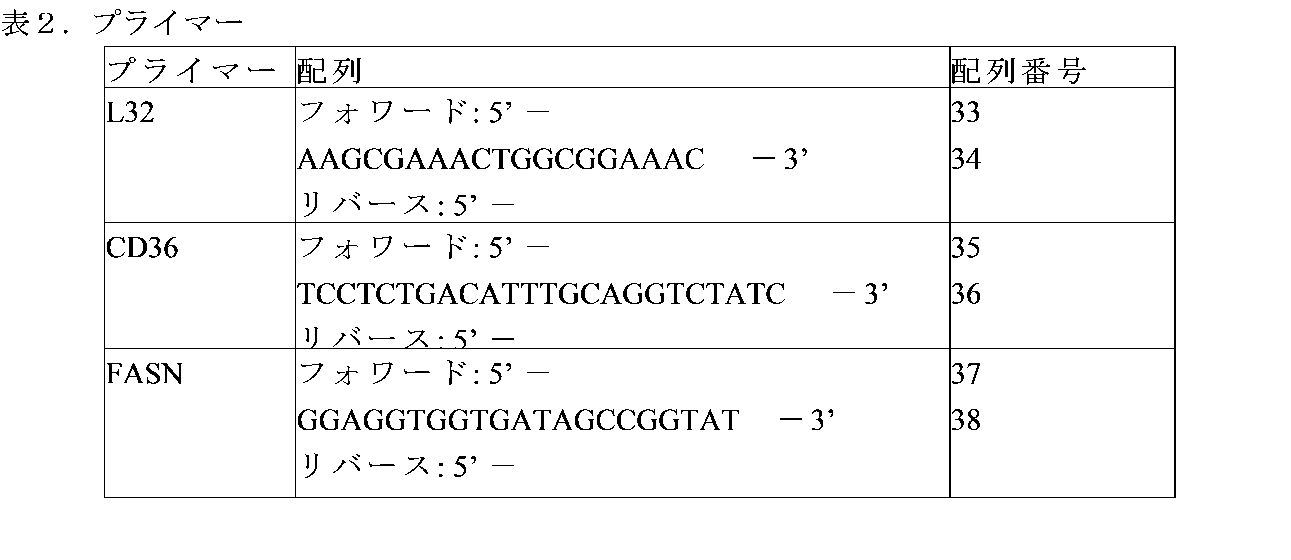
実施例2:4つのClostridia株が肥満、インスリン抵抗性、炎症性腸疾患を救済する。
4つのClostridiaメンバーの製剤は、マウスの脂肪症を軽減させる。肥満症の軽減に寄与する群落の特定のメンバーを絞り込むために、さまざまなインビトロ技術を採用している。これらの実験は、この群落の4つの特定のメンバーの組み合わせの試験につながった。Clostridia anaerovorax 、Lachnospiraceae spps、Clostridium XIVa、及びClostridium IVを含む洗練された4つのメンバー群落(本明細書では洗練されたClostridiaコンソーシアム-rCC-4とも呼ばれる)。これらの4系統を使用して、マウスにコロニーを形成し、脂肪の蓄積をより複雑なClostridiaコンソーシアム(図ではSFと呼ぶ)と比較した。興味深いことに、これらの4つの菌株は、複雑な微生物群落と同程度まで脂肪症(rCC-M)を減らすのに十分であった(図18)。
Example 2: Four Clostridia strains rescue obesity, insulin resistance, and inflammatory bowel disease.
A formulation of four Clostridia members reduces adiposity in mice. A variety of in vitro techniques have been employed to narrow down the specific members of the community that contribute to reducing adiposity. These experiments led to the testing of a combination of four specific members of this community. A refined four member community (also referred to herein as refined Clostridia consortium-rCC-4) containing Clostridia anaerovorax, Lachnospiraceae spps, Clostridium XIVa, and Clostridium IV. These four strains were used to colonize mice and compare fat accumulation to a more complex Clostridia consortium (referred to as SF in the diagram). Interestingly, these four strains were sufficient to reduce adiposity (rCC-M) to the same extent as the complex microbial community (Figure 18).
Clostridiaの置き換えが肥満、インスリン抵抗性、及び炎症性腸疾患を救済する。一連の実験を通じて、Clostridiaの有意な減少が、肥満誘発性動物で確認された。したがって、これらの痩せた関連微生物の再導入が肥満を防御し得るか否かを試験した。Clostridiaは、胞子形成菌として公知であるので、糞便をクロロホルムで処理してこれらの微生物を濃縮した。動物は、このモデルで体重増加を加速し、西洋化されたライフスタイルをよりよく模倣することが示されている、高脂肪食(HFD)に配した。肥満になりやすいT-Myd88-/-動物を、胞子形成細菌のカクテルで治療すると、体重増加及び脂肪蓄積が有意に減少した(図19A~図19B)。ちょうど3か月の終わりに、Clostridiaで処置したT-Myd88-/-マウスは、未処理のT-Myd88-/-と比較した場合、体脂肪率が低く、VAT量が減少していた(図19C)。Clostridia処置はまた、血糖値を低下させ、インスリン抵抗性を低下させる(図19D及び図19E)。重要なことに、Clostridia処理によるこれらの代謝パラメーターの改善は、HFDに配されたWT動物でも見られ(図19D及び図19E;WT)、ClostridiaによるMetSの改善がMetS及びTIIDのいくつかの異なるモデルに関連することを支持する。 Replacement of Clostridia rescues obesity, insulin resistance, and inflammatory bowel disease. Through a series of experiments, a significant reduction in Clostridia was confirmed in obesity-induced animals. Therefore, we tested whether reintroduction of these lean associated microbes could protect against obesity. Since Clostridia are known to be spore-forming bacteria, feces were treated with chloroform to enrich for these microbes. Animals were placed on a high-fat diet (HFD), which has been shown to accelerate weight gain in this model and better mimic a westernized lifestyle. Treating obesity-prone T-Myd88 -/- animals with a cocktail of spore-forming bacteria significantly reduced weight gain and adiposity (Figures 19A-B). At the end of just 3 months, Clostridia-treated T-Myd88 -/- mice had lower percent body fat and reduced VAT mass when compared to untreated T-Myd88-/- mice (Figure 19C). Clostridia treatment also reduced blood glucose levels and insulin resistance (Figures 19D and 19E). Importantly, improvements in these metabolic parameters by Clostridia treatment were also seen in WT animals placed on a HFD (Figures 19D and 19E; WT), supporting that amelioration of MetS by Clostridia is relevant to several different models of MetS and TIID.
IBDと糖尿病との間の関係は、物議を醸しているが、現在この関係を支持するいくつかの研究がある。IBDの12,601人の患者を対象とした横断研究では、糖尿病が3番目に多い併存疾患であった。デンマークの47,325人の患者からの別のより最近の横断研究は、糖尿病がIBD(UCとCDの両方)と有意に関連していることを示した。1200人のIBD患者の小児コホートでは、糖尿病の有病率もUC患者の方が対照よりも高かった。2019年にIBDの患者8070人及び健康な対照40,030人を使用した最近の研究では、ステロイドの使用を制御している場合でも、IBDの個体では糖尿病の発生率が有意に高いことが実証された。最後に、1977年から2014年にかけてIBDナシに対してIBDと診断された6,028,844人の個人の全国的な人口ベースのコホートによって、特に2003年から2014年の間にIBDのある個人の糖尿病の発生率の増大が明らかになった。血糖ホメオスタシスに加えて、IBDの個体は、脂質代謝に変化があると報告されており、代謝性疾患とIBDとの間の関連性を裏付けている。これらの疾患の両方に共通するのは、慢性炎症及び微生物叢の動揺であるが、これらの病気の間の関係の根底にある機構は不明である。 The relationship between IBD and diabetes is controversial, but there are currently several studies supporting this relationship. In a cross-sectional study of 12,601 patients with IBD, diabetes was the third most common comorbidity. Another more recent cross-sectional study from 47,325 patients in Denmark showed that diabetes was significantly associated with IBD (both UC and CD). In a pediatric cohort of 1200 IBD patients, the prevalence of diabetes was also higher in UC patients than in controls. A recent study in 2019 using 8070 patients with IBD and 40,030 healthy controls demonstrated a significantly higher incidence of diabetes in individuals with IBD, even when controlling for steroid use. Finally, a national population-based cohort of 6,028,844 individuals diagnosed with IBD versus no IBD from 1977 to 2014 revealed an increased incidence of diabetes in individuals with IBD, especially between 2003 and 2014. In addition to glycemic homeostasis, individuals with IBD have been reported to have alterations in lipid metabolism, supporting a link between metabolic disease and IBD. Common to both of these disorders is chronic inflammation and microbiota perturbation, although the mechanisms underlying the relationship between these diseases are unclear.
現在、健康な対照と比較して、糖尿病及びIBDを有する個体の微生物叢組成を分析した徹底的な研究があり、いくつかの類似点が明らかになっている。Clostridiales、Ruminococcaceae及びLachnospiraceaeのメンバーの特定の枯渇を伴う微生物叢の多様性の減少が、糖尿病、肥満、及びIBDの患者で報告されている。系統発生レベルでの微生物叢の組成は一般に個体間で異なるが、微生物叢の機能的能力は非常に安定している。したがって、メタゲノム研究は、微生物叢の疾患への寄与についてより多くの洞察を提供し得る。2型糖尿病とIBDの両方のメタゲノム研究により、Clostridiaのメンバーの減少と一致して短鎖脂肪酸(SCFA)の産生が減少していることが明らかになった。生物体の特定のサブセットの喪失に加えて、これらの障害の中で特定された同様の病原体がある。TIIDがある350以上の個体を調査し、微生物叢の組成を健康な個人の組成と比較した研究では、TIIDに関連する最も重要なシフトは、硫酸塩還元菌であるDesulfovibrioの富化であることが判明した。別の独立した研究では、TIIDも持っていた免疫力が低下した個体でのDesulfovibrioの異常増殖が確認された。IBDでは、多くの研究がDesulfovibrioの増大を指摘している。IBDの一般的な治療法であるメサラミンは、糞便中の硫化物を阻害するが、この薬物を服用していない患者では、硫化物のレベルが高くなる。メタゲノム研究は、IBD及びII型糖尿病の系統的研究を確認し、硫黄含有アミノ酸であるシステインの代謝に関与する遺伝子が、疾患のある個体では増大することを実証している。したがって、微生物叢の組成における同様のシフトは、IBD及び糖尿病の個体で確認されており、これらの共通点が、これらの疾患の発症の根底にあり得ることが示唆されている。
There are now intensive studies that have analyzed the microbiota composition of individuals with diabetes and IBD compared to healthy controls, revealing some similarities. A reduction in microbiota diversity with a specific depletion of members of Clostridiales, Ruminococcaceae, and Lachnospiraceae has been reported in patients with diabetes, obesity, and IBD. Although the composition of the microbiota at the phylogenetic level generally differs between individuals, the functional capacity of the microbiota is quite stable. Thus, metagenomic studies may provide more insight into the contribution of the microbiota to disease. Metagenomic studies of both
糖尿病とIBDとの間の関係に基づいて、これらの細菌がIBDのマウスモデルから救済されるか、または保護され得るか否かを試験した。デキストラン硫酸ナトリウム(DSS)大腸炎の慢性モデルを使用し、DSSを飲料水に5日間入れた後、通常の水を10日間続け、さらに2サイクル繰り返した。ClostridiaまたはPBSを、1日おきに経口強制投与し、組織学を実施した。確かに、Clostridiaで治療された動物は、結腸の長さの増大及び組織病理学的スコアの減少によって決定されるとおり、大腸炎の発症から有意に保護された(図19F、19G)。したがって、Clostridiaはメタボリックシンドローム(MetS)及びIBDの発症を防ぎ得る。 Based on the relationship between diabetes and IBD, we tested whether these bacteria could rescue or protect against a mouse model of IBD. A chronic model of dextran sulfate sodium (DSS) colitis was used, with DSS in the drinking water for 5 days, followed by regular water for 10 days, and repeated for two more cycles. Clostridia or PBS was orally gavaged every other day, and histology was performed. Indeed, Clostridia-treated animals were significantly protected from the development of colitis, as determined by increased colon length and reduced histopathological scores (Figures 19F, 19G). Thus, Clostridia may prevent the development of metabolic syndrome (MetS) and IBD.
Claims (15)
前記Clostridiaのコンソーシアムが、配列番号1を含む16S rDNA配列を有するClostridia anaerovorax、配列番号2を含む16S rDNA配列を有するClostridium XIVa、配列番号3を含む16S rDNA配列を有するClostridium IV及び配列番号4を含む16S rDNA配列を有するLachnospiraceae sppsを含む、前記組成物。 A composition comprising a supernatant from a consortium of Clostridia,
The composition, wherein the Clostridia consortium comprises Clostridia anaerovorax having a 16S rDNA sequence comprising SEQ ID NO:1, Clostridium XIVa having a 16S rDNA sequence comprising SEQ ID NO:2, Clostridium IV having a 16S rDNA sequence comprising SEQ ID NO:3, and Lachnospiraceae spps having a 16S rDNA sequence comprising SEQ ID NO:4 .
前記不均衡な微生物叢は、Desulfovibrioの増加、又は増加なし、及びClostridiaの減少である、
請求項1~7のいずれか1項に記載の組成物。 the composition is capable of replacing the microbiota in a subject having a disease or disorder associated with an imbalanced microbiota;
The imbalanced microbiota is an increase or absence of an increase in Desulfovibrio and a decrease in Clostridia.
The composition according to any one of claims 1 to 7 .
Applications Claiming Priority (3)
| Application Number | Priority Date | Filing Date | Title |
|---|---|---|---|
| US201962875194P | 2019-07-17 | 2019-07-17 | |
| US62/875,194 | 2019-07-17 | ||
| PCT/US2020/042578 WO2021011887A1 (en) | 2019-07-17 | 2020-07-17 | Clostridia consortia compositions and methods of treating obesity, metabolic syndrome and irritable bowel disease |
Publications (3)
| Publication Number | Publication Date |
|---|---|
| JP2022541528A JP2022541528A (en) | 2022-09-26 |
| JPWO2021011887A5 JPWO2021011887A5 (en) | 2023-07-25 |
| JP7677640B2 true JP7677640B2 (en) | 2025-05-15 |
Family
ID=74211183
Family Applications (1)
| Application Number | Title | Priority Date | Filing Date |
|---|---|---|---|
| JP2022502993A Active JP7677640B2 (en) | 2019-07-17 | 2020-07-17 | Composition of the Clostridium consortium and treatments for obesity, metabolic syndrome and irritable bowel disease |
Country Status (9)
| Country | Link |
|---|---|
| US (1) | US20220265734A1 (en) |
| EP (1) | EP3999029A4 (en) |
| JP (1) | JP7677640B2 (en) |
| KR (1) | KR20220063153A (en) |
| CN (1) | CN114258299A (en) |
| AU (1) | AU2020315459B2 (en) |
| CA (1) | CA3147739A1 (en) |
| IL (1) | IL289828A (en) |
| WO (1) | WO2021011887A1 (en) |
Families Citing this family (3)
| Publication number | Priority date | Publication date | Assignee | Title |
|---|---|---|---|---|
| CN114717219B (en) * | 2021-07-15 | 2023-05-26 | 青岛蔚蓝生物股份有限公司 | Lactobacillus reuteri preparation with antioxidant and cholesterol reducing functions |
| CN115125167A (en) * | 2022-06-15 | 2022-09-30 | 上海交通大学医学院附属瑞金医院 | Microbial combinations and uses thereof |
| WO2024059718A1 (en) * | 2022-09-15 | 2024-03-21 | University Of Utah Research Foundation | Bacterial strains from clostridia or bacilli and methods of treating obesity, metabolic syndrome, diabetes and inflammatory bowel disease |
Citations (6)
| Publication number | Priority date | Publication date | Assignee | Title |
|---|---|---|---|---|
| JP2014530229A (en) | 2011-10-11 | 2014-11-17 | エイキム・バイオセラピューティクス・エイビーAchim Biotherapeutics Ab | Composition comprising an anaerobically cultured human intestinal microbiota |
| JP2015500792A (en) | 2011-12-01 | 2015-01-08 | 国立大学法人 東京大学 | Human-derived bacteria that induce proliferation or accumulation of regulatory T cells |
| JP2016530239A (en) | 2013-07-09 | 2016-09-29 | ピュアテック ベンチャーズ、エルエルシー | Disease treatment composition comprising a combination of microbiota-derived bioactive molecules |
| WO2017159643A1 (en) | 2016-03-14 | 2017-09-21 | 物産フードサイエンス株式会社 | Agent for increasing intestinal butyric acid and proliferation agent for butyric acid-producing bacteria |
| JP2018511570A (en) | 2015-02-19 | 2018-04-26 | インヴェストメント エスエー ヌーシャテル | Therapeutic and prophylactic compositions produced by the microflora |
| JP2019517828A (en) | 2016-06-14 | 2019-06-27 | ヴェダンタ バイオサイエンシーズ インコーポレーテッドVedanta Biosciences, Inc. | Treatment of Clostridium difficile infection |
Family Cites Families (5)
| Publication number | Priority date | Publication date | Assignee | Title |
|---|---|---|---|---|
| US20060223153A1 (en) * | 2005-04-05 | 2006-10-05 | Luca Technologies, Llc | Generation of materials with enhanced hydrogen content from anaerobic microbial consortia |
| JP6479685B2 (en) * | 2013-02-04 | 2019-03-06 | セレス セラピューティクス インコーポレイテッド | Compositions and methods for the control of pathogenic bacterial growth |
| EP4066846A1 (en) * | 2015-11-03 | 2022-10-05 | The Brigham & Women's Hospital, Inc. | Therapeutic microbiota for the treatment and/or prevention of food allergy |
| MX2019003447A (en) * | 2016-09-27 | 2019-08-29 | Univ Texas | Methods for enhancing immune checkpoint blockade therapy by modulating the microbiome. |
| CA3058943C (en) * | 2017-04-03 | 2023-10-17 | Gusto Global, Llc | Rational design of microbial-based biotherapeutics |
-
2020
- 2020-07-17 EP EP20839660.6A patent/EP3999029A4/en active Pending
- 2020-07-17 CA CA3147739A patent/CA3147739A1/en active Pending
- 2020-07-17 AU AU2020315459A patent/AU2020315459B2/en active Active
- 2020-07-17 US US17/625,866 patent/US20220265734A1/en active Pending
- 2020-07-17 KR KR1020227004167A patent/KR20220063153A/en active Pending
- 2020-07-17 JP JP2022502993A patent/JP7677640B2/en active Active
- 2020-07-17 CN CN202080058280.5A patent/CN114258299A/en active Pending
- 2020-07-17 WO PCT/US2020/042578 patent/WO2021011887A1/en not_active Ceased
-
2022
- 2022-01-13 IL IL289828A patent/IL289828A/en unknown
Patent Citations (6)
| Publication number | Priority date | Publication date | Assignee | Title |
|---|---|---|---|---|
| JP2014530229A (en) | 2011-10-11 | 2014-11-17 | エイキム・バイオセラピューティクス・エイビーAchim Biotherapeutics Ab | Composition comprising an anaerobically cultured human intestinal microbiota |
| JP2015500792A (en) | 2011-12-01 | 2015-01-08 | 国立大学法人 東京大学 | Human-derived bacteria that induce proliferation or accumulation of regulatory T cells |
| JP2016530239A (en) | 2013-07-09 | 2016-09-29 | ピュアテック ベンチャーズ、エルエルシー | Disease treatment composition comprising a combination of microbiota-derived bioactive molecules |
| JP2018511570A (en) | 2015-02-19 | 2018-04-26 | インヴェストメント エスエー ヌーシャテル | Therapeutic and prophylactic compositions produced by the microflora |
| WO2017159643A1 (en) | 2016-03-14 | 2017-09-21 | 物産フードサイエンス株式会社 | Agent for increasing intestinal butyric acid and proliferation agent for butyric acid-producing bacteria |
| JP2019517828A (en) | 2016-06-14 | 2019-06-27 | ヴェダンタ バイオサイエンシーズ インコーポレーテッドVedanta Biosciences, Inc. | Treatment of Clostridium difficile infection |
Also Published As
| Publication number | Publication date |
|---|---|
| AU2020315459A1 (en) | 2022-02-17 |
| JP2022541528A (en) | 2022-09-26 |
| AU2020315459B2 (en) | 2026-01-08 |
| CA3147739A1 (en) | 2021-01-21 |
| CN114258299A (en) | 2022-03-29 |
| EP3999029A4 (en) | 2023-07-26 |
| EP3999029A1 (en) | 2022-05-25 |
| US20220265734A1 (en) | 2022-08-25 |
| KR20220063153A (en) | 2022-05-17 |
| IL289828A (en) | 2022-03-01 |
| WO2021011887A1 (en) | 2021-01-21 |
Similar Documents
| Publication | Publication Date | Title |
|---|---|---|
| Li et al. | Spatial heterogeneity of bacterial colonization across different gut segments following inter-species microbiota transplantation | |
| US20220133814A1 (en) | Faecalibacterium prausnitzii and desulfovibrio piger for use in the treatment or prevention of diabetes and bowel diseases | |
| Wang et al. | Oral and gut microbial dysbiosis and non-alcoholic fatty liver disease: the central role of Porphyromonas gingivalis | |
| US9603876B2 (en) | Compositions and methods for restoring gastrointestinal microbiota following antibiotic treatment | |
| JP2022033885A (en) | Designed bacterial composition | |
| CA2880309C (en) | Obesity animal model and methods for making and using thereof | |
| Hu et al. | Core-predominant gut fungus Kazachstania slooffiae promotes intestinal epithelial glycolysis via lysine desuccinylation in pigs | |
| JP7677640B2 (en) | Composition of the Clostridium consortium and treatments for obesity, metabolic syndrome and irritable bowel disease | |
| US20240226191A1 (en) | Compositions and methods for treating disease | |
| He et al. | Evaluation of cholesterol transformation abilities and probiotic properties of Bacteroides dorei YGMCC0564 | |
| Kini et al. | Upregulation of antimicrobial peptide expression in slc26a3-/-mice with colonic dysbiosis and barrier defect | |
| US20260027161A1 (en) | Bacterial strains for treating disease | |
| US20250268953A1 (en) | Compositions and methods for treating disease ii | |
| Deng et al. | Effects of orally administered Escherichia coli Nissle 1917 on growth performance and jejunal mucosal membrane integrity, morphology, immune parameters and antioxidant capacity in early weaned piglets | |
| Kubašová et al. | Application of canine-derived Enterococcus faecium DSM 32820 in dogs with acute idiopathic diarrhoea | |
| JPWO2011027875A1 (en) | Intestinal barrier function improver | |
| Heiss | Interactions between the human milk oligosaccharide 2’-fucosyllactose and Bifidobacterium species influence colonization in complex gut communities | |
| RU2797466C2 (en) | Faecalibacterium prausnitzii and desulfovibrio piger for use in the treatment or prevention of diabetes and intestinal diseases | |
| Isaiah | Clostridium hiranonis, a Bile Acid 7α-Dehydroxylating Bacterium in Dogs | |
| 시지연 | Associations of Human Vaginal and Oral Microbiota with Metabolic Syndrome |
Legal Events
| Date | Code | Title | Description |
|---|---|---|---|
| A521 | Request for written amendment filed |
Free format text: JAPANESE INTERMEDIATE CODE: A523 Effective date: 20230714 |
|
| A621 | Written request for application examination |
Free format text: JAPANESE INTERMEDIATE CODE: A621 Effective date: 20230714 |
|
| A977 | Report on retrieval |
Free format text: JAPANESE INTERMEDIATE CODE: A971007 Effective date: 20240619 |
|
| A131 | Notification of reasons for refusal |
Free format text: JAPANESE INTERMEDIATE CODE: A131 Effective date: 20240620 |
|
| A601 | Written request for extension of time |
Free format text: JAPANESE INTERMEDIATE CODE: A601 Effective date: 20240920 |
|
| A601 | Written request for extension of time |
Free format text: JAPANESE INTERMEDIATE CODE: A601 Effective date: 20241120 |
|
| A521 | Request for written amendment filed |
Free format text: JAPANESE INTERMEDIATE CODE: A523 Effective date: 20241219 |
|
| TRDD | Decision of grant or rejection written | ||
| A01 | Written decision to grant a patent or to grant a registration (utility model) |
Free format text: JAPANESE INTERMEDIATE CODE: A01 Effective date: 20250324 |
|
| A61 | First payment of annual fees (during grant procedure) |
Free format text: JAPANESE INTERMEDIATE CODE: A61 Effective date: 20250423 |
|
| R150 | Certificate of patent or registration of utility model |
Ref document number: 7677640 Country of ref document: JP Free format text: JAPANESE INTERMEDIATE CODE: R150 |