JP7675012B2 - Bifunctional anti-PD-1/SIRPA molecule - Google Patents
Bifunctional anti-PD-1/SIRPA molecule Download PDFInfo
- Publication number
- JP7675012B2 JP7675012B2 JP2021536199A JP2021536199A JP7675012B2 JP 7675012 B2 JP7675012 B2 JP 7675012B2 JP 2021536199 A JP2021536199 A JP 2021536199A JP 2021536199 A JP2021536199 A JP 2021536199A JP 7675012 B2 JP7675012 B2 JP 7675012B2
- Authority
- JP
- Japan
- Prior art keywords
- seq
- antibody
- inhibitors
- sirpa
- cells
- Prior art date
- Legal status (The legal status is an assumption and is not a legal conclusion. Google has not performed a legal analysis and makes no representation as to the accuracy of the status listed.)
- Active
Links
Images


Classifications
-
- C—CHEMISTRY; METALLURGY
- C07—ORGANIC CHEMISTRY
- C07K—PEPTIDES
- C07K16/00—Immunoglobulins [IGs], e.g. monoclonal or polyclonal antibodies
- C07K16/18—Immunoglobulins [IGs], e.g. monoclonal or polyclonal antibodies against material from animals or humans
- C07K16/28—Immunoglobulins [IGs], e.g. monoclonal or polyclonal antibodies against material from animals or humans against receptors, cell surface antigens or cell surface determinants
- C07K16/2803—Immunoglobulins [IGs], e.g. monoclonal or polyclonal antibodies against material from animals or humans against receptors, cell surface antigens or cell surface determinants against the immunoglobulin superfamily
- C07K16/2818—Immunoglobulins [IGs], e.g. monoclonal or polyclonal antibodies against material from animals or humans against receptors, cell surface antigens or cell surface determinants against the immunoglobulin superfamily against CD28 or CD152
-
- A—HUMAN NECESSITIES
- A61—MEDICAL OR VETERINARY SCIENCE; HYGIENE
- A61K—PREPARATIONS FOR MEDICAL, DENTAL OR TOILETRY PURPOSES
- A61K38/00—Medicinal preparations containing peptides
- A61K38/16—Peptides having more than 20 amino acids; Gastrins; Somatostatins; Melanotropins; Derivatives thereof
- A61K38/17—Peptides having more than 20 amino acids; Gastrins; Somatostatins; Melanotropins; Derivatives thereof from animals; from humans
- A61K38/177—Receptors; Cell surface antigens; Cell surface determinants
- A61K38/1774—Immunoglobulin superfamily (e.g. CD2, CD4, CD8, ICAM molecules, B7 molecules, Fc-receptors, MHC-molecules)
-
- A—HUMAN NECESSITIES
- A61—MEDICAL OR VETERINARY SCIENCE; HYGIENE
- A61K—PREPARATIONS FOR MEDICAL, DENTAL OR TOILETRY PURPOSES
- A61K39/00—Medicinal preparations containing antigens or antibodies
- A61K39/395—Antibodies; Immunoglobulins; Immune serum, e.g. antilymphocytic serum
- A61K39/39533—Antibodies; Immunoglobulins; Immune serum, e.g. antilymphocytic serum against materials from animals
- A61K39/3955—Antibodies; Immunoglobulins; Immune serum, e.g. antilymphocytic serum against materials from animals against proteinaceous materials, e.g. enzymes, hormones, lymphokines
-
- A—HUMAN NECESSITIES
- A61—MEDICAL OR VETERINARY SCIENCE; HYGIENE
- A61K—PREPARATIONS FOR MEDICAL, DENTAL OR TOILETRY PURPOSES
- A61K45/00—Medicinal preparations containing active ingredients not provided for in groups A61K31/00 - A61K41/00
- A61K45/06—Mixtures of active ingredients without chemical characterisation, e.g. antiphlogistics and cardiaca
-
- A—HUMAN NECESSITIES
- A61—MEDICAL OR VETERINARY SCIENCE; HYGIENE
- A61P—SPECIFIC THERAPEUTIC ACTIVITY OF CHEMICAL COMPOUNDS OR MEDICINAL PREPARATIONS
- A61P35/00—Antineoplastic agents
-
- C—CHEMISTRY; METALLURGY
- C07—ORGANIC CHEMISTRY
- C07K—PEPTIDES
- C07K14/00—Peptides having more than 20 amino acids; Gastrins; Somatostatins; Melanotropins; Derivatives thereof
- C07K14/435—Peptides having more than 20 amino acids; Gastrins; Somatostatins; Melanotropins; Derivatives thereof from animals; from humans
- C07K14/705—Receptors; Cell surface antigens; Cell surface determinants
- C07K14/70503—Immunoglobulin superfamily
-
- C—CHEMISTRY; METALLURGY
- C07—ORGANIC CHEMISTRY
- C07K—PEPTIDES
- C07K14/00—Peptides having more than 20 amino acids; Gastrins; Somatostatins; Melanotropins; Derivatives thereof
- C07K14/435—Peptides having more than 20 amino acids; Gastrins; Somatostatins; Melanotropins; Derivatives thereof from animals; from humans
- C07K14/705—Receptors; Cell surface antigens; Cell surface determinants
- C07K14/70596—Molecules with a "CD"-designation not provided for elsewhere
-
- A—HUMAN NECESSITIES
- A61—MEDICAL OR VETERINARY SCIENCE; HYGIENE
- A61K—PREPARATIONS FOR MEDICAL, DENTAL OR TOILETRY PURPOSES
- A61K39/00—Medicinal preparations containing antigens or antibodies
- A61K2039/505—Medicinal preparations containing antigens or antibodies comprising antibodies
-
- C—CHEMISTRY; METALLURGY
- C07—ORGANIC CHEMISTRY
- C07K—PEPTIDES
- C07K2317/00—Immunoglobulins specific features
- C07K2317/20—Immunoglobulins specific features characterized by taxonomic origin
- C07K2317/24—Immunoglobulins specific features characterized by taxonomic origin containing regions, domains or residues from different species, e.g. chimeric, humanized or veneered
-
- C—CHEMISTRY; METALLURGY
- C07—ORGANIC CHEMISTRY
- C07K—PEPTIDES
- C07K2317/00—Immunoglobulins specific features
- C07K2317/50—Immunoglobulins specific features characterized by immunoglobulin fragments
- C07K2317/56—Immunoglobulins specific features characterized by immunoglobulin fragments variable (Fv) region, i.e. VH and/or VL
- C07K2317/565—Complementarity determining region [CDR]
-
- C—CHEMISTRY; METALLURGY
- C07—ORGANIC CHEMISTRY
- C07K—PEPTIDES
- C07K2317/00—Immunoglobulins specific features
- C07K2317/70—Immunoglobulins specific features characterized by effect upon binding to a cell or to an antigen
- C07K2317/74—Inducing cell proliferation
-
- C—CHEMISTRY; METALLURGY
- C07—ORGANIC CHEMISTRY
- C07K—PEPTIDES
- C07K2317/00—Immunoglobulins specific features
- C07K2317/70—Immunoglobulins specific features characterized by effect upon binding to a cell or to an antigen
- C07K2317/75—Agonist effect on antigen
-
- C—CHEMISTRY; METALLURGY
- C07—ORGANIC CHEMISTRY
- C07K—PEPTIDES
- C07K2317/00—Immunoglobulins specific features
- C07K2317/70—Immunoglobulins specific features characterized by effect upon binding to a cell or to an antigen
- C07K2317/76—Antagonist effect on antigen, e.g. neutralization or inhibition of binding
-
- C—CHEMISTRY; METALLURGY
- C07—ORGANIC CHEMISTRY
- C07K—PEPTIDES
- C07K2317/00—Immunoglobulins specific features
- C07K2317/90—Immunoglobulins specific features characterized by (pharmaco)kinetic aspects or by stability of the immunoglobulin
- C07K2317/92—Affinity (KD), association rate (Ka), dissociation rate (Kd) or EC50 value
-
- C—CHEMISTRY; METALLURGY
- C07—ORGANIC CHEMISTRY
- C07K—PEPTIDES
- C07K2319/00—Fusion polypeptide
-
- C—CHEMISTRY; METALLURGY
- C07—ORGANIC CHEMISTRY
- C07K—PEPTIDES
- C07K2319/00—Fusion polypeptide
- C07K2319/01—Fusion polypeptide containing a localisation/targetting motif
- C07K2319/03—Fusion polypeptide containing a localisation/targetting motif containing a transmembrane segment
-
- C—CHEMISTRY; METALLURGY
- C07—ORGANIC CHEMISTRY
- C07K—PEPTIDES
- C07K2319/00—Fusion polypeptide
- C07K2319/30—Non-immunoglobulin-derived peptide or protein having an immunoglobulin constant or Fc region, or a fragment thereof, attached thereto
-
- Y—GENERAL TAGGING OF NEW TECHNOLOGICAL DEVELOPMENTS; GENERAL TAGGING OF CROSS-SECTIONAL TECHNOLOGIES SPANNING OVER SEVERAL SECTIONS OF THE IPC; TECHNICAL SUBJECTS COVERED BY FORMER USPC CROSS-REFERENCE ART COLLECTIONS [XRACs] AND DIGESTS
- Y02—TECHNOLOGIES OR APPLICATIONS FOR MITIGATION OR ADAPTATION AGAINST CLIMATE CHANGE
- Y02A—TECHNOLOGIES FOR ADAPTATION TO CLIMATE CHANGE
- Y02A50/00—TECHNOLOGIES FOR ADAPTATION TO CLIMATE CHANGE in human health protection, e.g. against extreme weather
- Y02A50/30—Against vector-borne diseases, e.g. mosquito-borne, fly-borne, tick-borne or waterborne diseases whose impact is exacerbated by climate change
Landscapes
- Health & Medical Sciences (AREA)
- Chemical & Material Sciences (AREA)
- Life Sciences & Earth Sciences (AREA)
- Immunology (AREA)
- Organic Chemistry (AREA)
- Medicinal Chemistry (AREA)
- General Health & Medical Sciences (AREA)
- Proteomics, Peptides & Aminoacids (AREA)
- Molecular Biology (AREA)
- Biochemistry (AREA)
- Biophysics (AREA)
- Genetics & Genomics (AREA)
- Pharmacology & Pharmacy (AREA)
- Veterinary Medicine (AREA)
- Public Health (AREA)
- Animal Behavior & Ethology (AREA)
- Zoology (AREA)
- Gastroenterology & Hepatology (AREA)
- Cell Biology (AREA)
- Toxicology (AREA)
- Epidemiology (AREA)
- General Chemical & Material Sciences (AREA)
- Chemical Kinetics & Catalysis (AREA)
- Nuclear Medicine, Radiotherapy & Molecular Imaging (AREA)
- Engineering & Computer Science (AREA)
- Bioinformatics & Cheminformatics (AREA)
- Mycology (AREA)
- Endocrinology (AREA)
- Microbiology (AREA)
- Peptides Or Proteins (AREA)
- Medicines Containing Antibodies Or Antigens For Use As Internal Diagnostic Agents (AREA)
- Micro-Organisms Or Cultivation Processes Thereof (AREA)
- Pharmaceuticals Containing Other Organic And Inorganic Compounds (AREA)
- Medicines Containing Material From Animals Or Micro-Organisms (AREA)
- Preparation Of Compounds By Using Micro-Organisms (AREA)
- Medicinal Preparation (AREA)
- Medicines That Contain Protein Lipid Enzymes And Other Medicines (AREA)
Description
本発明は、免疫療法の分野に関する。本発明は、SIRPaに連結されている抗PD1抗体又はその抗体断片を含む二機能性分子及びその使用を提供する。 The present invention relates to the field of immunotherapy. The present invention provides a bifunctional molecule comprising an anti-PD1 antibody or an antibody fragment thereof linked to SIRPa and uses thereof.
脱阻害のためにT細胞阻害チェックポイントを治療用抗体で標的とする手法は、鋭意研究されている分野である(総説は、Pardoll、Nat Rev Cancer.、2012年;12巻:253~264頁を参照)。適応免疫の免疫チェックポイントを標的にすることは、数多くのがんに対処する優れた治療有効性を、但し限られた割合の患者において、示す。自然骨髄細胞(マクロファージ、樹状細胞、MDSC、PMN)での免疫チェックポイントは、あまり研究されていないままであり、一方、これらの細胞は、多くの固形腫瘍において最も豊富な免疫細胞タイプを表し、しばしば、不十分な結果と関連する。自然(骨髄細胞により仲介される)及び適応(T細胞により仲介される)免疫応答の両方を標的とする免疫チェックポイント療法の併用は、前臨床モデルにおいて優れた効率を示したが、臨床試験段階のままである。 Targeting T cell inhibitory checkpoints with therapeutic antibodies for disinhibition is an area of intense research (for review, see Pardoll, Nat Rev Cancer. 2012;12:253-264). Targeting immune checkpoints of adaptive immunity shows excellent therapeutic efficacy against many cancers, but in a limited percentage of patients. Immune checkpoints in innate myeloid cells (macrophages, dendritic cells, MDSCs, PMNs) remain less studied, while these cells represent the most abundant immune cell type in many solid tumors and are often associated with poor outcomes. Combinations of immune checkpoint therapies targeting both innate (myeloid cell-mediated) and adaptive (T cell-mediated) immune responses have shown excellent efficiency in preclinical models but remain in clinical trials.
免疫細胞活性化は、共刺激シグナルと共阻害シグナルとのバランスを統合することにより制御される。T細胞受容体(TCR)媒介性T細胞活性化は、共刺激シグナル及び共阻害シグナルの両方によりモジュレートされる。抗原非依存性の第2のシグナルは、応答に対して特異性を付与する、抗原ペプチド-MHC複合体とTCRとの相互作用により提供される第1のシグナルを修飾する。T細胞共刺激及び共阻害経路は、幅広い免疫調節機能を有し、エフェクターT細胞、メモリーT細胞、及び調節性T細胞、並びにナイーブT細胞を制御する。こうした経路の療法的モジュレーションは、がんを治療するための効果的な新戦略へと橋渡しされつつある(総説は、Schildbergら、44巻(5号)、Immunity、2016年を参照)。免疫応答の調節に関する進行中の研究は、がん療法の開発の標的となり得る複数の免疫学的経路の同定に結び付いている。そうした分子は、本明細書では免疫チェックポイント共活性化因子又は共阻害因子と呼ばれる(総説は、Sharmaら、Cell、161巻(2号)、2015年及びPardoll、Nature Reviews Cancer、12巻(4号)、2012年を参照)。 Immune cell activation is controlled by integrating the balance of costimulatory and co-inhibitory signals. T cell receptor (TCR)-mediated T cell activation is modulated by both costimulatory and co-inhibitory signals. The antigen-independent second signal modifies the first signal provided by the interaction of the antigen peptide-MHC complex with the TCR, conferring specificity to the response. T cell costimulatory and co-inhibitory pathways have broad immunoregulatory functions, controlling effector, memory, and regulatory T cells as well as naive T cells. Therapeutic modulation of these pathways is translating into effective new strategies to treat cancer (for review, see Schildberg et al., Vol. 44(5), Immunity, 2016). Ongoing research into the regulation of immune responses has led to the identification of multiple immunological pathways that can be targeted for the development of cancer therapies. Such molecules are referred to herein as immune checkpoint coactivators or coinhibitors (for reviews, see Sharma et al., Cell, 161(2), 2015 and Pardoll, Nature Reviews Cancer, 12(4), 2012).
プログラム細胞死タンパク質1(PD-1、CD279としても知られている)は、免疫グロブリンスーパーファミリーに属する細胞表面タンパク質分子である。プログラム細胞死タンパク質1は、Tリンパ球及びBリンパ球並びにマクロファージ上に発現され、細胞の運命及び分化に役割を果たす。特に、免疫チェックポイントとして機能するPD-1は、T細胞の活性化を防げ、順に、自己免疫を低減し、自己寛容を促進することにより、免疫系を下方調節するのに重要な役割を果たす。PD-1に結合するとT細胞活性化を下方制御することが示されている、PD-1の2つのリガンドPD-L1及びPD-L2が同定されている(Freemanら(2000年)J Exp Med 192巻:1027~34頁;Latchmanら(2001年)Nat Immunol 2巻:261~8頁;Carterら(2002年)Eur J Immunol 32巻:634~43頁)。PD-1とそのリガンドとの相互作用は、腫瘍浸潤リンパ球の減少、T細胞受容体媒介性増殖の減少、及びがん性細胞による免疫回避をもたらす。特に、PD1ライゲーションは、T細胞に対するTCR刺激の下流におけるシグナルを低減してT細胞応答を阻害し、活性化及びサイトカイン産生の減少をもたらす。
Programmed cell death protein 1 (PD-1, also known as CD279) is a cell surface protein molecule that belongs to the immunoglobulin superfamily. Programmed
抗PD1及び抗PDL1阻害剤を使用して、それらの相互作用を破壊する両方の戦略は、がん療法での成功であった(Brahmerら、N Eng J Med、366(26)、2012;Powlesら、Nature、515(7528)、2014;Topalianら、N Eng J Med、366(26)、2012;Ansell、Curr Opin Hematol、22(4)、2015)。しかしながら、腫瘍微小環境内での免疫抑制性骨髄細胞及び低刺激性骨髄細胞の蓄積は、T細胞応答の効率、及び免疫療法、特に、PD-1/PD-L1のような免疫チェックポイントで標的となる免疫療法の有効性を制限する。例えば、臨床上の応答は、膵臓がん、非MSI結腸直腸がん、胃がん及び一部の乳がんサブタイプで低いか、見られない(Brahmerら、N Engl J Med. 2012年6月28日;366(26):2455-65、Fengら、Cancer Lett. 2017年10月28日;407:57~65、Borcherdingら、J Mol Biol. 2018年7月6日;430(14):2014~2029)。複数の機序が記載されており、(1)メモリーT細胞の形成障害、(2)T細胞浸潤障害、(3)腫瘍特異的T細胞の生成が不十分であること、(4)T細胞の機能が不適切であること、及び(5)調節性T細胞により誘導される免疫抑制性微小環境等の、PD-1/PD-L1チェックポイント療法に対する有効性及び抵抗性がこのように低いことを説明することができる。 Both strategies of disrupting their interaction, using anti-PD1 and anti-PDL1 inhibitors, have been successful in cancer therapy (Brahmer et al., N Eng J Med, 366(26), 2012; Powles et al., Nature, 515(7528), 2014; Topalian et al., N Eng J Med, 366(26), 2012; Ansell, Curr Opin Hematol, 22(4), 2015). However, the accumulation of immunosuppressive and hypostimulatory myeloid cells within the tumor microenvironment limits the efficiency of T cell responses and the efficacy of immunotherapies, especially those targeting immune checkpoints such as PD-1/PD-L1. For example, clinical responses are low or absent in pancreatic, non-MSI colorectal, gastric and some breast cancer subtypes (Brahmer et al., N Engl J Med. 2012 Jun 28;366(26):2455-65; Feng et al., Cancer Lett. 2017 Oct 28;407:57-65; Borcherding et al., J Mol Biol. 2018 Jul 6;430(14):2014-2029). Multiple mechanisms have been described that could explain this low efficacy and resistance to PD-1/PD-L1 checkpoint therapy, including (1) impaired formation of memory T cells, (2) impaired T cell infiltration, (3) insufficient generation of tumor-specific T cells, (4) inadequate T cell function, and (5) an immunosuppressive microenvironment induced by regulatory T cells.
これまでに、療法の大部分は、疲弊したT細胞をレスキューし、抗腫瘍応答を回復させるためのPD-1/PD-L1軸を標的化する物質を含む、がんを攻撃する適応免疫系を刺激することに焦点を当てている(Brahmerら、N Eng J Med、366(26)、2012;Topalianら、N Eng J Med、366(26)、2012;Wolchokら、N Engl J Med. 2013年7月11日;369(2):122~133)。しかしながら、マクロファージ及び他の骨髄免疫細胞も、がん免疫療法のエフェクターとしての有望である。CD47/シグナル調節性タンパク質アルファ(SIRPα)軸は、骨髄細胞活性化の重要な調節因子であり、骨髄特異的免疫チェックポイントとして広い役割を果たす。 To date, the majority of therapies have focused on stimulating the adaptive immune system to attack cancer, including agents targeting the PD-1/PD-L1 axis to rescue exhausted T cells and restore antitumor responses (Brahmer et al., N Eng J Med, 366(26), 2012; Topalian et al., N Eng J Med, 366(26), 2012; Wolchok et al., N Engl J Med. 2013 July 11;369(2):122-133). However, macrophages and other myeloid immune cells also show promise as effectors of cancer immunotherapy. The CD47/signal regulatory protein alpha (SIRPα) axis is a key regulator of myeloid cell activation and plays a broad role as a myeloid-specific immune checkpoint.
シグナル調節性タンパク質アルファ、又はSIRPa(SIRPα、CD172a若しくはSHPS-1とも称する)は、単球、組織マクロファージの大部分の亜集団、顆粒球、リンパ組織における樹状細胞のサブセット、一部の骨髄前駆細胞上で発現し、神経細胞で様々なレベルで発現し、これは、脳のシナプスに富んだ範囲での著しく高い発現を伴う。一部のがん細胞において過剰発現するが、また大部分の健常な細胞により低いレベルで広く発現する遍在性CD47との、骨髄細胞により発現されるSIRPaの相互作用は、骨髄機能の調節に関与する自然応答の別の重要な免疫チェックポイントである。CD47は、SIRPaと相互作用し、「私を食べないで(don’t EAT-ME)」というシグナルの食細胞マクロファージへの伝達をもたらし、標的細胞及び潜在的に腫瘍細胞を、影響を受けないままにする。CD47を標的化する物質を介したCD47/SIRPa経路の遮断は、マクロファージによる抗体依存性食作用を増強することにより、多様な範囲の前臨床モデルにおいて、枯渇している治療抗がん抗体と協力し、がん細胞の食作用をin vitroで刺激し、抗腫瘍免疫応答をin vivoで刺激することが記載されている。 Signal regulatory protein alpha, or SIRPa (also called SIRPα, CD172a or SHPS-1), is expressed on monocytes, most subpopulations of tissue macrophages, granulocytes, a subset of dendritic cells in lymphoid tissues, some myeloid progenitor cells, and at various levels in neural cells, with significantly higher expression in synapse-rich areas of the brain. Interaction of SIRPa expressed by myeloid cells with the ubiquitous CD47, which is overexpressed in some cancer cells but also widely expressed at lower levels by most healthy cells, is another important immune checkpoint of the innate response involved in regulating myeloid function. CD47 interacts with SIRPa, resulting in the transmission of a "don't EAT-ME" signal to phagocyte macrophages, leaving target cells and potentially tumor cells unaffected. Blockade of the CD47/SIRPa pathway via CD47-targeting agents has been described to synergize with depleting therapeutic anti-cancer antibodies in a diverse range of preclinical models by enhancing antibody-dependent phagocytosis by macrophages, stimulating phagocytosis of cancer cells in vitro and anti-tumor immune responses in vivo.
患者において抗PD1免疫療法の有効性を増大し、可能性のある抗PD-1抵抗性を克服するために、SIRPα/CD47も標的化する併用療法の開発は、良好なストラテジーであり得る。それ故、適応免疫応答、特に、T細胞免疫応答に有効な正の影響を伴って自然骨髄免疫細胞を標的化する、特にがんに対する安全な免疫療法のための新規かつ改良された物質の重大な要求が、当該技術分野において依然として存在する。本発明者らは、本明細書において開示される本発明と共に進む有意な工程を成した。非常に好ましく、予測できない効果が示され、詳細な説明の冒頭及び実施例において明確に説明される。 To increase the efficacy of anti-PD1 immunotherapy in patients and overcome possible anti-PD-1 resistance, the development of combination therapy also targeting SIRPα/CD47 may be a good strategy. Therefore, there remains a significant need in the art for new and improved agents for safe immunotherapy, especially against cancer, that target innate myeloid immune cells with effective positive influence on adaptive immune responses, especially T-cell immune responses. The inventors have made a significant step forward with the invention disclosed herein. Highly favorable and unexpected effects are shown and are clearly explained at the beginning of the detailed description and in the examples.
本発明者らは、数多くの療法適用、特にがんの治療に有望である、抗hPD-1抗体及びヒトSIRPαを含む二機能性分子を提供する。本発明は、PD-1に対して高い結合親和性を示し、そのリガンドPDL-1及びPD-L2と強力に競合する、ヒトPD-1を特異的に標的とする抗体の開発に基づく。驚くべきことに、SIRPaのN末端の、抗hPD-1抗体のFc領域のC末端への融合により、内在性SIRPaと同様の程度まで、CD47(SIRPaリガンド)に対するその高い親和性の保存が可能になる。FcドメインのSIRPaへの融合はまた、製品の半減期を増大させる。更に、本明細書において開示される二機能性抗PD1-SIRPa分子は、抗PD-1単独と比較して、T細胞の活性化(NFATにより仲介される活性化)を増強する。特に、抗PD1-SIRPa二機能性分子は、サイトカイン(例えば、IFNγ)分泌により反映される、ナイーブな、部分的に疲弊したサブセットの増殖及び活性化を誘導する。二機能性抗PD1-SIRPa分子は、驚くべき相乗効果を示す。このような抗hPD1-SIRPa二機能性分子は、関連する抵抗性機序を克服し、抗PD-1免疫療法の有効性を改善する能力を有する。 The present inventors provide a bifunctional molecule comprising an anti-hPD-1 antibody and human SIRPα, which is promising for numerous therapeutic applications, particularly the treatment of cancer. The invention is based on the development of an antibody specifically targeting human PD-1, which exhibits high binding affinity to PD-1 and strongly competes with its ligands PDL-1 and PD-L2. Surprisingly, fusion of the N-terminus of SIRPa to the C-terminus of the Fc region of the anti-hPD-1 antibody allows the preservation of its high affinity for CD47 (SIRPα ligand) to a similar extent as endogenous SIRPa. Fusion of the Fc domain to SIRPa also increases the half-life of the product. Furthermore, the bifunctional anti-PD1-SIRPα molecule disclosed herein enhances T cell activation (NFAT-mediated activation) compared to anti-PD-1 alone. In particular, the anti-PD1-SIRPa bifunctional molecule induces proliferation and activation of naive, partially exhausted subsets, reflected by cytokine (e.g., IFNγ) secretion. Bifunctional anti-PD1-SIRPa molecules show surprising synergistic effects. Such anti-hPD1-SIRPa bifunctional molecules have the potential to overcome relevant resistance mechanisms and improve the efficacy of anti-PD-1 immunotherapy.
第1の態様では、本発明は、
(a)
(i)HCDR1、HCDR2及びHCDR3を含む重鎖可変ドメイン(VH)、並びに
(ii)LCDR1、LCDR2及びLCDR3を含む軽鎖可変ドメイン(VL)
を含む抗ヒトPD-1抗体又はその抗原結合性断片、並びに
(b)ヒトSIRPa又はその断片若しくはバリアント
を含む二機能性分子に関し、
抗体又はその抗原結合性断片の重鎖及び/又は軽鎖のC末端は、SIRPa又はその断片若しくはバリアントのN末端に融合タンパク質として、好ましくは、ペプチドリンカーにより、共有結合で連結される。
In a first aspect, the present invention provides a method for producing a composition comprising the steps of:
(a)
(i) a heavy chain variable domain (VH) comprising HCDR1, HCDR2 and HCDR3; and
(ii) a light chain variable domain (VL) comprising LCDR1, LCDR2 and LCDR3
An anti-human PD-1 antibody or an antigen-binding fragment thereof comprising the compound
(b) a bifunctional molecule comprising human SIRPa or a fragment or variant thereof,
The C-terminus of the heavy and/or light chain of the antibody or antigen-binding fragment thereof is covalently linked to the N-terminus of SIRPa, or a fragment or variant thereof, as a fusion protein, preferably by a peptide linker.
特に、抗体は、キメラ、ヒト化又はヒト抗体である。 In particular, the antibody is a chimeric, humanized or human antibody.
好ましくは、SIRPa断片は、SIRPaの細胞外ドメインを含むか、又はからなる。なおより好ましくは、SIRPa断片は、その細胞内部分、任意選択で、その膜貫通ドメインを欠き、好ましくは、SIRPaは、配列番号51に記載されるアミノ酸配列又はその断片を含むか、又はからなる。 Preferably, the SIRPa fragment comprises or consists of the extracellular domain of SIRPa. Even more preferably, the SIRPa fragment lacks its intracellular portion and, optionally, its transmembrane domain, and preferably, SIRPa comprises or consists of the amino acid sequence set forth in SEQ ID NO:51 or a fragment thereof.
特定の態様では、本発明は、
(i)HCDR1、HCDR2、及びHCDR3を含む重鎖可変ドメイン(VH)、並びに
(ii)LCDR1、LCDR2、及びLCDR3を含む軽鎖可変ドメイン(VL)
を含むか又はからなる抗ヒトPD-1抗体又はその抗原結合性断片を含む二機能性分子であって、
- 重鎖CDR1(HCDR1)は、配列番号1のアミノ酸配列を含むか又はからなり、
- 重鎖CDR2(HCDR2)は、配列番号2のアミノ酸配列を含むか又はからなり、
- 重鎖CDR3(HCDR3)は、配列番号3のアミノ酸配列を含むか又はからなり、配列中、X1はD又はEであり、X2は、T、H、A、Y、N、E、及びSからなる群から、好ましくはH、A、Y、N、及びEからなる群において選択され、
-軽鎖CDR1(LCDR1)は、配列番号12のアミノ酸配列を含むか又はからなり、配列中、XはG又はTであり、
- 軽鎖CDR2(LCDR2)は、配列番号15のアミノ酸配列を含むか又はからなり、
- 軽鎖CDR3(LCDR3)は、配列番号16のアミノ酸配列を含むか又はからなる、
二機能性分子に関する。
In a particular aspect, the present invention provides a method for producing a method for treating a cancer cell comprising:
(i) a heavy chain variable domain (VH) comprising HCDR1, HCDR2, and HCDR3; and
(ii) a light chain variable domain (VL) comprising LCDR1, LCDR2, and LCDR3;
A bifunctional molecule comprising an anti-human PD-1 antibody or an antigen-binding fragment thereof, comprising or consisting of:
- the heavy chain CDR1 (HCDR1) comprises or consists of the amino acid sequence of SEQ ID NO: 1,
- the heavy chain CDR2 (HCDR2) comprises or consists of the amino acid sequence of SEQ ID NO: 2,
- the heavy chain CDR3 (HCDR3) comprises or consists of the amino acid sequence of SEQ ID NO: 3, in which X1 is D or E and X2 is selected from the group consisting of T, H, A, Y, N, E and S, preferably in the group consisting of H, A, Y, N and E;
the light chain CDR1 (LCDR1) comprises or consists of the amino acid sequence of SEQ ID NO: 12, in which X is G or T;
- the light chain CDR2 (LCDR2) comprises or consists of the amino acid sequence of SEQ ID NO: 15,
- the light chain CDR3 (LCDR3) comprises or consists of the amino acid sequence of SEQ ID NO: 16;
Concerning bifunctional molecules.
特に、抗ヒトPD-1抗体又はその抗原結合性断片は、(a)配列番号17のアミノ酸配列を含むか又はからなり、配列中、X1はD又はEであり、X2はT、H、A、Y、N、E、及びSからなる群から、好ましくはH、A、Y、N、及びEからなる群において選択されるVH;並びに(b)配列番号26のアミノ酸配列を含むか又はからなり、配列中XはG又はTであるVLを含むか又はからなる。 In particular, the anti-human PD-1 antibody or antigen-binding fragment thereof comprises: (a) a VH comprising or consisting of the amino acid sequence of SEQ ID NO:17, in which X1 is D or E and X2 is selected from the group consisting of T, H, A, Y, N, E, and S, preferably from the group consisting of H, A, Y, N, and E; and (b) a VL comprising or consisting of the amino acid sequence of SEQ ID NO:26, in which X is G or T.
特定の態様では、抗体又はその抗原結合性断片は、ヒトカッパ軽鎖定常ドメインに由来する軽鎖定常ドメイン、及びヒトIgG1、IgG2、IgG3、又はIgG4重鎖定常ドメイン、好ましくはIgG1又はIgG4重鎖定常ドメインに由来する重鎖定常ドメインを含む。 In certain embodiments, the antibody or antigen-binding fragment thereof comprises a light chain constant domain derived from a human kappa light chain constant domain and a heavy chain constant domain derived from a human IgG1, IgG2, IgG3, or IgG4 heavy chain constant domain, preferably an IgG1 or IgG4 heavy chain constant domain.
より具体的な態様では、抗体又はその抗原結合性断片は、ヒトカッパ軽鎖定常ドメインに由来する軽鎖定常ドメイン、及びヒトIgG1重鎖定常ドメインに由来する重鎖定常ドメインを含み、任意選択で、T250Q/M428L;M252Y/S254T/T256E+H433K/N434F;E233P/L234V/L235A/G236A+A327G/A330S/P331S;E333A;S239D/A330L/I332E;P257I/Q311;K326W/E333S;S239D/I332E/G236A;N297A;L234A/L235A;N297A+M252Y/S254T/T256E;並びにK322A及びK444Aからなる群から選択される、好ましくは、任意選択でM252Y/S254T/T256Eと組み合わせたN297A、及びL234A/L235Aからなる群から選択される置換又は置換の組合せを有する。 In a more specific embodiment, the antibody or antigen-binding fragment thereof comprises a light chain constant domain derived from a human kappa light chain constant domain and a heavy chain constant domain derived from a human IgG1 heavy chain constant domain, and optionally, T250Q/M428L;M252Y/S254T/T256E+H433K/N434F;E233P/L234V/L235A/G236A+A327G/A330S/P331S;E333A;S239D/A330L/I3 32E; P257I/Q311; K326W/E333S; S239D/I332E/G236A; N297A; L234A/L235A; N297A+M252Y/S254T/T256E; and K322A and K444A, preferably N297A, optionally in combination with M252Y/S254T/T256E, and L234A/L235A.
別のより具体的な態様では、抗体又はその抗原結合性断片は、ヒトカッパ軽鎖定常ドメインに由来する軽鎖定常ドメイン、及びヒトIgG4重鎖定常ドメインに由来する重鎖定常ドメインを含み、任意選択で、S228P;L234A/L235A、S228P+M252Y/S254T/T256E、及びK444Aからなる群から選択される置換又は置換の組合せを有する。 In another more specific aspect, the antibody or antigen-binding fragment thereof comprises a light chain constant domain derived from a human kappa light chain constant domain and a heavy chain constant domain derived from a human IgG4 heavy chain constant domain, optionally with a substitution or combination of substitutions selected from the group consisting of S228P;L234A/L235A, S228P+M252Y/S254T/T256E, and K444A.
特に、抗PD1抗体は、ペムブロリズマブ、ニボルマブ、ピディリズマブ、セミプリマブ、PDR001、並びにモノクローナル抗体5C4、17D8、2D3、4H1、4A11、7D3、及び5F4からなる群から選択される。 In particular, the anti-PD1 antibody is selected from the group consisting of pembrolizumab, nivolumab, pidilizumab, cemiplimab, PDR001, and monoclonal antibodies 5C4, 17D8, 2D3, 4H1, 4A11, 7D3, and 5F4.
別の態様では、本発明は、本明細書で開示の通りの二機能性分子をコードする単離された核酸配列若しくは単離された核酸分子の群、本明細書で開示の通りの核酸若しくは核酸分子の群を含むベクター、及び/又は本明細書で開示の通りの核酸若しくは核酸分子の群を含むベクターを含む宿主細胞に関する。 In another aspect, the present invention relates to an isolated nucleic acid sequence or a group of isolated nucleic acid molecules encoding a bifunctional molecule as disclosed herein, a vector comprising a nucleic acid or a group of nucleic acid molecules as disclosed herein, and/or a host cell comprising a vector comprising a nucleic acid or a group of nucleic acid molecules as disclosed herein.
別の態様では、本発明は、二機能性分子を産生するための方法であって、本明細書で開示の通りの宿主細胞を培養する工程、及び任意選択で二機能性分子を単離する工程を含む方法に関する。 In another aspect, the present invention relates to a method for producing a bifunctional molecule, the method comprising culturing a host cell as disclosed herein and optionally isolating the bifunctional molecule.
別の態様では、本発明は、本明細書で開示の通りの二機能性分子、核酸若しくは核酸分子の群、ベクター、又は宿主細胞、及び薬学的に許容される担体を含む医薬組成物に関する。 In another aspect, the present invention relates to a pharmaceutical composition comprising a bifunctional molecule, a nucleic acid or a group of nucleic acid molecules, a vector, or a host cell as disclosed herein, and a pharma- ceutically acceptable carrier.
任意選択で、医薬組成物は、好ましくは、以下のものからなる群において選択される追加の療法剤を更に含む:アルキル化剤、血管新生阻害剤、抗体、代謝拮抗剤、抗有糸分裂剤、抗増殖剤、抗ウイルス剤、オーロラキナーゼ阻害剤、アポトーシス促進剤(例えば、Bcl-2ファミリー阻害剤)、細胞死受容体経路の活性化因子、Bcr-Ablキナーゼ阻害剤、BiTE(二重特異的T細胞誘導(Bi-Specific T cell Engager))抗体、抗体薬物コンジュゲート、生物反応修飾因子、ブルトン型チロシンキナーゼ(BTK)阻害剤、サイクリン依存性キナーゼ阻害剤、細胞周期阻害剤、シクロオキシゲナーゼ-2阻害剤、DVD、白血病ウイルス腫瘍遺伝子ホモログ(ErbB2)受容体阻害剤、成長因子阻害剤、熱ショックタンパク質(HSP)-90阻害剤、ヒストンデアセチラーゼ(HDAC)阻害剤、ホルモン療法、免疫学的作用剤、アポトーシスタンパク質阻害剤(IAP)の阻害剤、インターカレート抗生物質(intercalating antibiotics)、キナーゼ阻害剤、キネシン阻害剤、Jak2阻害剤、ラパマイシン阻害剤の哺乳動物標的、マイクロRNA、マイトジェン活性化細胞外シグナル調節キナーゼ阻害剤、多価結合タンパク質、非ステロイド性抗炎症薬(NSAID)、ポリADP(アデノシン二リン酸)-リボースポリメラーゼ(PARP)阻害剤、白金化学療法剤、ポロ様キナーゼ(Plk)阻害剤、ホスホイノシチド-3キナーゼ(PI3K)阻害剤、プロテアソーム阻害剤、プリンアナログ、ピリミジンアナログ、受容体型チロシンキナーゼ阻害剤、レチノイド/デルトイド植物アルカロイド、低分子阻害性リボ核酸(siRNA)、トポイソメラーゼ阻害剤、ユビキチンリガーゼ阻害剤、低メチル化剤(hypomethylating agent)、チェックポイント阻害剤、及びペプチドワクチン等、腫瘍抗原に由来するエピトープ又はネオエピトープ、並びにこうした物質の1つ又は複数の組合せ。 Optionally, the pharmaceutical composition further comprises an additional therapeutic agent, preferably selected from the group consisting of: alkylating agents, angiogenesis inhibitors, antibodies, antimetabolites, antimitotic agents, antiproliferative agents, antiviral agents, Aurora kinase inhibitors, proapoptotic agents (e.g., Bcl-2 family inhibitors), activators of the death receptor pathway, Bcr-Abl kinase inhibitors, BiTE (Bi-Specific T cell Engager) antibodies, antibody drug conjugates, biological response modifiers, Bruton's tyrosine kinase (BTK) inhibitors, cyclin-dependent kinase inhibitors, cell cycle inhibitors, cyclooxygenase-2 inhibitors, DVDs, leukemia viral oncogene homolog (ErbB2) receptor inhibitors, growth factor inhibitors, heat shock protein (HSP)-90 inhibitors, histone deacetylase (HDAC) inhibitors, hormonal therapy, immunological agents, inhibitors of inhibitors of apoptosis proteins (IAPs), intercalating antibiotics, epitopes or neoepitopes derived from tumor antigens, such as antibiotics, kinase inhibitors, kinesin inhibitors, Jak2 inhibitors, mammalian target of rapamycin inhibitors, microRNAs, mitogen-activated extracellular signal-regulated kinase inhibitors, multivalent binding proteins, nonsteroidal anti-inflammatory drugs (NSAIDs), poly ADP (adenosine diphosphate)-ribose polymerase (PARP) inhibitors, platinum chemotherapeutic agents, polo-like kinase (Plk) inhibitors, phosphoinositide-3 kinase (PI3K) inhibitors, proteasome inhibitors, purine analogs, pyrimidine analogs, receptor tyrosine kinase inhibitors, retinoid/deltoid plant alkaloids, small inhibitory ribonucleic acids (siRNAs), topoisomerase inhibitors, ubiquitin ligase inhibitors, hypomethylating agents, checkpoint inhibitors, and peptide vaccines, as well as combinations of one or more of these agents.
特に、医薬組成物、二機能性分子、核酸若しくは核酸分子の群、ベクター、又は宿主細胞は、医薬として使用するためのものである。 In particular, the pharmaceutical composition, the bifunctional molecule, the nucleic acid or group of nucleic acid molecules, the vector, or the host cell are intended for use as a medicine.
最後に、本発明は、医薬として使用するための、本明細書で開示の通りの医薬組成物、二機能性分子、核酸若しくは核酸分子の群、ベクター、又は宿主細胞に関する。 Finally, the present invention relates to a pharmaceutical composition, a bifunctional molecule, a nucleic acid or a group of nucleic acid molecules, a vector, or a host cell as disclosed herein for use as a medicament.
特定の態様では、がん、好ましくは、PD-1及び/又はPD-L1の発現を伴う血液系腫瘍又は固形腫瘍、例えば、血液リンパ新生物、血管免疫芽球性T細胞リンパ腫、骨髄異形成症候群及び急性骨髄性白血病からなる群から選択されるがん、ウイルスにより誘導されるか又は免疫不全と関連するがん(例えば、カポジ肉腫(例えば、カポジ肉腫ヘルペスウイルスと関連する);子宮頸がん、肛門がん、陰茎がん及び外陰部扁平上皮細胞がん及び中咽頭がん(例えば、ヒトパピローマウイルスと関連する);びまん性大細胞型B細胞リンパ腫を含むB細胞非ホジキンリンパ腫(NHL)、バーキットリンパ腫、形質芽細胞リンパ腫、原発性中枢神経系リンパ腫、HHV-8原発性滲出性リンパ腫、古典的ホジキンリンパ腫、並びにリンパ増殖性疾患(例えば、エプスタイン・バーウイルス(EBV)及び/又はカポジ肉腫ヘルペスウイルスと関連する);肝細胞癌(例えば、B型及び/又はC型肝炎ウイルスと関連する);メルケル細胞癌(例えば、メルケル細胞ポリオーマウイルス(MPV)と関連する);並びにヒト免疫不全ウイルス感染(HIV)感染症と関連するがんからなる群から選択されるがん)、並びに転移性又は非転移性メラノーマ、悪性中皮腫、非小細胞肺がん、腎細胞癌、ホジキンリンパ腫、頭頸部がん、尿路上皮癌、結腸直腸がん、肝細胞癌、小細胞肺がん、転移性メルケル細胞癌、胃若しくは胃食道がん及び子宮頸がんからなる群から選択されるがんからなる群から選択されるがん;或いは感染性疾患、好ましくは、慢性感染性疾患、なおより好ましくは、慢性ウイルス感染症、好ましくは、HIV、肝炎ウイルス、ヘルペスウイルス、アデノウイルス、インフルエンザウイルス、フラビウイルス、エコーウイルス、ライノウイルス、コクサッキーウイルス、コロナウイルス、呼吸器合胞体ウイルス、ムンプスウイルス、ロタウイルス、麻疹ウイルス、風疹ウイルス、パルボウイルス、ワクシニアウイルス、HTLVウイルス、デングウイルス、パピローマウイルス、軟属腫ウイルス、ポリオウイルス、狂犬病ウイルス、JCウイルス及びアルボウイルス脳炎ウイルスからなる群から選択されるウイルスにより引き起こされる感染症の処置における使用のための本明細書において開示される医薬組成物、二機能性分子、核酸若しくは核酸分子の群、ベクター、又は宿主細胞。 In certain embodiments, the present invention is directed to a cancer, preferably a hematological or solid tumor with expression of PD-1 and/or PD-L1, such as a cancer selected from the group consisting of hematolymphoid neoplasms, angioimmunoblastic T-cell lymphoma, myelodysplastic syndromes, and acute myeloid leukemia, a cancer induced by a virus or associated with an immune deficiency, including, for example, Kaposi's sarcoma (e.g., associated with Kaposi's sarcoma herpesvirus); cervical cancer, anal cancer, penile cancer, and vulvar squamous cell carcinoma and oropharyngeal cancer (e.g., associated with human papillomavirus); diffuse large B-cell lymphoma. The cancer is selected from the group consisting of B-cell non-Hodgkin's lymphoma (NHL), Burkitt's lymphoma, plasmablastic lymphoma, primary central nervous system lymphoma, HHV-8 primary effusion lymphoma, classical Hodgkin's lymphoma, and lymphoproliferative disorders (e.g., associated with Epstein-Barr virus (EBV) and/or Kaposi's sarcoma herpesvirus); hepatocellular carcinoma (e.g., associated with hepatitis B and/or C virus); Merkel cell carcinoma (e.g., associated with Merkel cell polyomavirus (MPV)); and cancer associated with human immunodeficiency virus infection (HIV) infection. or a cancer selected from the group consisting of cancers selected from the group consisting of metastatic or non-metastatic melanoma, malignant mesothelioma, non-small cell lung cancer, renal cell carcinoma, Hodgkin's lymphoma, head and neck cancer, urothelial carcinoma, colorectal cancer, hepatocellular carcinoma, small cell lung cancer, metastatic Merkel cell carcinoma, gastric or gastroesophageal cancer and cervical cancer; or an infectious disease, preferably a chronic infectious disease, even more preferably a chronic viral infection, preferably HIV, hepatitis virus, herpes virus, adenovirus, influenza virus, flavivirus, echovirus, rhinovirus, A pharmaceutical composition, bifunctional molecule, nucleic acid or group of nucleic acid molecules, vector, or host cell disclosed herein for use in treating an infection caused by a virus selected from the group consisting of a virus, coxsackievirus, coronavirus, respiratory syncytial virus, mumps virus, rotavirus, measles virus, rubella virus, parvovirus, vaccinia virus, HTLV virus, dengue virus, papillomavirus, molluscum virus, poliovirus, rabies virus, JC virus, and arboviral encephalitis virus.
好ましくは、がんは、PD-1、PD-L1及び/又はPD-L2陽性がん、特に、PD-L1陽性がんである。 Preferably, the cancer is a PD-1, PD-L1 and/or PD-L2 positive cancer, in particular a PD-L1 positive cancer.
任意選択で、二機能性分子、医薬組成物、単離された核酸分子若しくは単離された核酸分子の群、ベクター、又は宿主細胞は、放射線療法、又は好ましくは以下のものからなる群において選択される追加の療法剤と組み合わせて使用するためのものである:アルキル化剤、血管新生阻害剤、抗体、代謝拮抗剤、有糸分裂阻害剤、抗増殖剤、抗ウイルス剤、オーロラキナーゼ阻害剤、アポトーシス促進剤(例えば、Bcl-2ファミリー阻害剤)、細胞死経路の活性化因子、Bcr-Ablキナーゼ阻害剤、BiTE(二重特異的T細胞誘導)抗体、抗体薬物コンジュゲート、生物反応修飾因子、ブルトン型チロシンキナーゼ(BTK)阻害剤、サイクリン依存性キナーゼ阻害剤、細胞周期阻害剤、シクロオキシゲナーゼ-2阻害剤、DVD、白血病ウイルス腫瘍遺伝子ホモログ(ErbB2)受容体阻害剤、成長因子阻害剤、熱ショックタンパク質(HSP)-90阻害剤、ヒストンデアセチラーゼ(HDAC)阻害剤、ホルモン療法、免疫学的作用剤、アポトーシスタンパク質阻害剤(IAP)の阻害剤、インターカレート抗生物質、キナーゼ阻害剤、キネシン阻害剤、Jak2阻害剤、ラパマイシン阻害剤の哺乳動物標的、マイクロRNA、マイトジェン活性化細胞外シグナル調節キナーゼ阻害剤、多価結合タンパク質、非ステロイド性抗炎症薬(NSAID)、ポリADP(アデノシン二リン酸)-リボースポリメラーゼ(PARP)阻害剤、白金化学療法剤、ポロ様キナーゼ(Plk)阻害剤、ホスホイノシチド-3キナーゼ(PI3K)阻害剤、プロテアソーム阻害剤、プリンアナログ、ピリミジンアナログ、受容体型チロシンキナーゼ阻害剤、レチノイド/デルトイド植物アルカロイド、低分子阻害性リボ核酸(siRNA)、トポイソメラーゼ阻害剤、ユビキチンリガーゼ阻害剤、低メチル化剤、チェックポイント阻害剤、及びペプチドワクチン等、腫瘍抗原に由来するエピトープ又はネオエピトープ、並びにこうした物質の1つ又は複数の組合せ。 Optionally, the bifunctional molecule, pharmaceutical composition, isolated nucleic acid molecule or group of isolated nucleic acid molecules, vector, or host cell is for use in combination with radiation therapy or an additional therapeutic agent, preferably selected from the group consisting of: alkylating agents, angiogenesis inhibitors, antibodies, antimetabolites, mitotic inhibitors, antiproliferative agents, antivirals, Aurora kinase inhibitors, proapoptotic agents (e.g., Bcl-2 family inhibitors), activators of cell death pathways, Bcr-Abl kinase inhibitors, BiTE (bispecific T cell engager) antibodies, antibody drug conjugates, biological response modifiers, Bruton's tyrosine kinase (BTK) inhibitors, cyclin-dependent kinase inhibitors, cell cycle inhibitors, cyclooxygenase-2 inhibitors, DVDs, leukemia viral oncogene homolog (ErbB2) receptor inhibitors, growth factor inhibitors, heat shock protein (HSP)-90 inhibitors, histone deacetylase (HDAC) inhibitors, hormonal therapy. epitopes or neoepitopes derived from tumor antigens, such as methods, immunological agents, inhibitors of inhibitors of apoptosis proteins (IAPs), intercalating antibiotics, kinase inhibitors, kinesin inhibitors, Jak2 inhibitors, mammalian target of rapamycin inhibitors, microRNAs, mitogen-activated extracellular signal-regulated kinase inhibitors, multivalent binding proteins, nonsteroidal anti-inflammatory drugs (NSAIDs), poly ADP (adenosine diphosphate)-ribose polymerase (PARP) inhibitors, platinum chemotherapeutic agents, polo-like kinase (Plk) inhibitors, phosphoinositide-3 kinase (PI3K) inhibitors, proteasome inhibitors, purine analogs, pyrimidine analogs, receptor tyrosine kinase inhibitors, retinoid/deltoid plant alkaloids, small inhibitory ribonucleic acids (siRNAs), topoisomerase inhibitors, ubiquitin ligase inhibitors, hypomethylating agents, checkpoint inhibitors, and peptide vaccines, as well as combinations of one or more of these agents.
一態様では、本明細書で開示の通りの医薬組成物、二機能性分子、核酸若しくは核酸分子の群、ベクター、又は宿主細胞は、T調節性細胞(T regulator cell)の抑制活性を阻害するために、Tエフェクター細胞を活性化するために、及び/又は未感作の部分的に疲弊したT細胞の増殖を刺激するために使用するためのものである。 In one aspect, the pharmaceutical composition, bifunctional molecule, nucleic acid or group of nucleic acid molecules, vector, or host cell as disclosed herein is for use in inhibiting the suppressive activity of T regulator cells, activating T effector cells, and/or stimulating the proliferation of naive, partially exhausted T cells.
緒言
本発明の抗体は、特異的な抗PD-1効果と、抗PD-1抗体に融合されたSIRPaの効果とを組み合わせたものであるため、二機能性である。実際、本発明は、抗PD-1抗体及びSIRPaを含む二機能性分子であって、タンパク質SIRPaは、抗PD-1抗体のポリペプチド鎖に、抗体の軽鎖若しくは重鎖のいずれか又は両方又はそれらの任意の断片に共有結合で連結されている、二機能性分子に関する。抗PD-1抗体又はその断片の鎖及びSIRPaは、融合タンパク質として調製される。この特定の態様では、SIRPaのN末端は、抗PD-1抗体又はその断片の鎖のC末端に、任意選択でペプチドリンカーを介して連結されている。
Introduction The antibodies of the present invention are bifunctional since they combine a specific anti-PD-1 effect with the effect of SIRPa fused to the anti-PD-1 antibody. Indeed, the present invention relates to a bifunctional molecule comprising an anti-PD-1 antibody and SIRPa, where the protein SIRPa is covalently linked to the polypeptide chain of the anti-PD-1 antibody, either to the light chain or to the heavy chain of the antibody, or to both, or to any fragment thereof. The chain of the anti-PD-1 antibody or its fragment and SIRPa are prepared as a fusion protein. In this particular embodiment, the N-terminus of SIRPa is linked to the C-terminus of the chain of the anti-PD-1 antibody or its fragment, optionally via a peptide linker.
まず、SIRPaが、抗SIRPa抗体の標的であることが先行技術で知られていることが、強調される。これらの抗体は、腫瘍細胞上のCD47と骨髄細胞、特に、マクロファージ上のSIRPaとの間の相互作用を遮断し、当該相互作用(いわゆる、異なる細胞間のトランス相互作用)は、マクロファージによる腫瘍細胞の食作用の阻害を誘導する。反対に、SIRPa及びT細胞上で発現したリガンド、特に、PD-1に対する抗体を含む本発明の二機能性タンパク質は、T細胞活性化機序に関与することは知られていない。 Firstly, it is emphasized that it is known in the prior art that SIRPa is a target of anti-SIRPa antibodies. These antibodies block the interaction between CD47 on tumor cells and SIRPa on myeloid cells, in particular macrophages, which interaction (so-called trans-interaction between different cells) induces inhibition of phagocytosis of tumor cells by macrophages. In contrast, the bifunctional protein of the invention comprising SIRPa and an antibody against a ligand expressed on T cells, in particular PD-1, is not known to be involved in T cell activation mechanisms.
明らかに本出願の実施例において詳細に説明され、示され、かつ図12において説明される通り、本発明者らは、
- T細胞上のPD-1:二機能性SIRPa-抗PD-1分子の抗PD1抗体部分;と
- CD47(腫瘍細胞上のCD47でないか、又は腫瘍細胞上のCD47だけでない):二機能性SIRPa-抗PD-1分子のSIRPa部分
の同じT細胞上の両方を標的化する強力な恩恵を予想外に有する二機能性SIRPa-抗PD-1分子を得た。同じT細胞に対するこの二重標的化は、NFAT経路の補足活性化により示される、従前には未知の相乗効果を導く。この能力は、次の理由のため特に興味深いものである。
As clearly described and shown in detail in the examples of the present application and illustrated in FIG.
- PD-1 on T cells: the anti-PD1 antibody portion of the bifunctional SIRPa-anti-PD-1 molecule; and
- CD47 (not CD47 on tumor cells or only CD47 on tumor cells): We have obtained a bifunctional SIRPa-anti-PD-1 molecule that unexpectedly has the powerful benefit of targeting both of the SIRPa portions of the bifunctional SIRPa-anti-PD-1 molecule on the same T cell. This dual targeting to the same T cell leads to a previously unknown synergistic effect, manifested by complementary activation of the NFAT pathway. This capability is particularly interesting for the following reasons:
当業者により知られる通り、腫瘍細胞は、T細胞の疲弊との関連でT細胞により十分に除去されない。抗PD-1治療化合物は、PD1-PDL1相互作用(T細胞上のPD1及び腫瘍細胞上のPDL1)の阻害効果の阻害を通じて、T細胞を活性化するために臨床上使用される。より正確には、T細胞疲弊は、がんを有するヒトにおいて観察される。例えば、Jiang、Y.、Li、Y.及びZhu、B(Cell Death Dis 6、e1792 (2015))に記載される通り、腫瘍微小環境における疲弊したT細胞は、過剰発現した阻害性受容体、減少したエフェクターサイトカイン産生及び細胞溶解性活性を示し、これが、がん排除の失敗を導く。疲弊したT細胞の回復は、がん処置の臨床ストラテジーを表す。腫瘍微小環境における大抵のT細胞は疲弊し、これが、がん免疫回避を導く。PD-1は、T細胞疲弊を調節する主要な阻害性受容体であり、高いPD-1発現を有するT細胞は、がんを除去する能力を失っている。抗-PD-1抗体は、疲弊したT細胞の「再」活性化を可能にするのにいつも十分効率的であるとは限らない。それ故、これは、現時点での重大な医療ニーズである。本発明者らは、本明細書において開示される二機能性抗PD1-SIRPa分子が、抗PD-1単独又はSIRPaと組合せた抗PD-1と比較して、T細胞、特に、疲弊したT細胞の活性化(NFATにより仲介される活性化、カルシウム放出)を増強することを示した。特に、抗PD1-SIRPa二機能性分子は、サイトカイン(例えば、IFNγ)分泌により反映される、ナイーブな、部分的に疲弊したT細胞サブセットの増殖及び活性化を誘導する。このような抗hPD1-SIRPa二機能性分子は、関連する抵抗性機序を克服し、抗PD-1免疫療法の有効性を改善する能力を有する。 As known by those skilled in the art, tumor cells are not sufficiently eliminated by T cells in the context of T cell exhaustion. Anti-PD-1 therapeutic compounds are used clinically to activate T cells through the inhibition of the inhibitory effect of PD1-PDL1 interaction (PD1 on T cells and PDL1 on tumor cells). More precisely, T cell exhaustion is observed in humans with cancer. As described, for example, in Jiang, Y., Li, Y. and Zhu, B (Cell Death Dis 6, e1792 (2015)), exhausted T cells in the tumor microenvironment exhibit overexpressed inhibitory receptors, reduced effector cytokine production and cytolytic activity, which leads to failure in cancer elimination. Restoration of exhausted T cells represents a clinical strategy for cancer treatment. Most T cells in the tumor microenvironment are exhausted, which leads to cancer immune evasion. PD-1 is the main inhibitory receptor regulating T cell exhaustion, and T cells with high PD-1 expression lose the ability to eliminate cancer. Anti-PD-1 antibodies are not always efficient enough to allow "re"activation of exhausted T cells. Therefore, this is a current critical medical need. The inventors have shown that the bifunctional anti-PD1-SIRPa molecules disclosed herein enhance activation (NFAT-mediated activation, calcium release) of T cells, particularly exhausted T cells, compared to anti-PD-1 alone or anti-PD-1 in combination with SIRPa. In particular, anti-PD1-SIRPa bifunctional molecules induce proliferation and activation of naive, partially exhausted T cell subsets, reflected by cytokine (e.g., IFNγ) secretion. Such anti-hPD1-SIRPa bifunctional molecules have the potential to overcome relevant resistance mechanisms and improve the efficacy of anti-PD-1 immunotherapy.
出願人はまた、i)PD1及びii)SIRPa受容体を発現する単一T細胞との二機能性抗PD1-SIRPa分子の相互作用が、T細胞活性化、特に、疲弊したT細胞に対する正の効果を伴って、NFAT経路(TCRシグナル伝達)の予想外の活性化を導き、これにより、T細胞の腫瘍細胞を除去する能力が有利になることを示す。 The applicant also shows that the interaction of a bifunctional anti-PD1-SIRPa molecule with a single T cell expressing i) PD1 and ii) SIRPa receptors leads to an unexpected activation of the NFAT pathway (TCR signaling) with a positive effect on T cell activation, in particular on exhausted T cells, thereby favoring the ability of T cells to eliminate tumor cells.
一方、BICKI分子のSIRPaは、SIRPa受容体(CD47)を標的化し、これにより、SIRPa単独のようにこの経路を活性化し、他方、BICKI分子の抗PD1部分は、PD-1を遮断することを意味する。二機能性分子は、同じ細胞上のCD47とPD-1の両方を標的にする。これは、抗PD1抗体とSIRPaの別々の組合せ(2つの別々の化合物としての抗PD1の投与及びSIRPaの投与)を使用した場合に観察されない、TCR(NFAT)シグナル伝達の相乗活性化をもたらす。例えば、同じ細胞上で作用することによるこの活性化は、PD-L1を標的とする二機能性分子によりもたらすことはできない。実際、PD-L1は、主に、腫瘍細胞上で発現され、T細胞のような免疫細胞上で発現されないことは、当該技術分野において公知である。 On the one hand, the SIRPa of the BICKI molecule targets the SIRPa receptor (CD47), which means that it activates this pathway like SIRPa alone, while the anti-PD1 part of the BICKI molecule blocks PD-1. The bifunctional molecule targets both CD47 and PD-1 on the same cell. This results in a synergistic activation of TCR (NFAT) signaling that is not observed when using separate combinations of anti-PD1 antibodies and SIRPa (administration of anti-PD1 and administration of SIRPa as two separate compounds). This activation by acting on the same cell, for example, cannot be achieved by a bifunctional molecule targeting PD-L1. Indeed, it is known in the art that PD-L1 is primarily expressed on tumor cells and not on immune cells such as T cells.
加えて、相乗効果は、本発明の特定のヒト化抗PD-1で観察されるが、参照の2つの他の抗PD-1、すなわち、ペムブロリズマブ及びニボルマブでも観察された。二機能性抗PD1-SIRPa分子の設計により、他のCD47+細胞より、少なくとも2倍、CD47+PD-1+疲弊したT細胞を標的化することが可能になる。二機能性抗PD1-SIRPa分子は、抗PD1作用を増強し、CD47上でのSIRPa結合が、「私を食べないで」という阻害食細胞シグナルを遮断するばかりでなく、驚くべきことに、CD47依存性T細胞共刺激を促進することを強く示唆する。最後に、二機能性抗PD1-SIRPa分子は、T細胞の腫瘍微小環境への遊走を増強し、これにより、腫瘍微小環境内におけるT細胞の欠如に起因した抗PD-1単独療法と関連する主要な抵抗機序の1つを解決する。 In addition, synergistic effects are observed with the specific humanized anti-PD-1 of the present invention, but also with two other anti-PD-1 of reference, namely pembrolizumab and nivolumab. The design of the bifunctional anti-PD1-SIRPa molecule allows targeting CD47+PD-1+ exhausted T cells at least twice as often as other CD47+ cells. The bifunctional anti-PD1-SIRPa molecule enhances anti-PD1 action, strongly suggesting that SIRPa binding on CD47 not only blocks the inhibitory phagocyte signal "don't eat me" but also, surprisingly, promotes CD47-dependent T cell costimulation. Finally, the bifunctional anti-PD1-SIRPa molecule enhances migration of T cells into the tumor microenvironment, thus resolving one of the major resistance mechanisms associated with anti-PD-1 monotherapy due to the lack of T cells within the tumor microenvironment.
本発明の二機能性分子は、特に、以下の利点の1つ又は幾つかを有する。
- それらは、ヒト化形態とキメラ形態の抗PD1抗体の間での相違なく、PD-1に結合するそれらの能力を保存する。
- それらは、CD47、SIRPaリガンドタンパク質に結合するそれらの能力を保存する。
- それらは、PD-1/PD-L1及び/又はPD-1/PD-L2相互作用と拮抗する。
- それらは、抗PD-1単独と比較して、T細胞の活性化(NFATにより仲介される活性化及びカルシウム流動刺激)を相乗的に増強する。
- それらは、ナイーブな、活性化及び疲弊したT細胞の増殖を刺激する相乗効果を示す。
- それらは、T細胞によるIFNgの分泌を刺激する相乗効果を示す。
- それらは、T細胞の遊走を増強する。
- それらは、良好かつ直線的な薬理動態特性を示す。
The bifunctional molecules of the present invention have, in particular, one or several of the following advantages:
- They conserve their ability to bind to PD-1, without differences between humanized and chimeric forms of anti-PD1 antibodies.
- They preserve their ability to bind to CD47, the SIRPa ligand protein.
- They antagonize the PD-1/PD-L1 and/or PD-1/PD-L2 interactions.
- They synergistically enhance T cell activation (NFAT-mediated activation and calcium mobilization stimulation) compared to anti-PD-1 alone.
- They exhibit synergistic effects in stimulating the proliferation of naive, activated and exhausted T cells.
- They exhibit a synergistic effect in stimulating the secretion of IFNg by T cells.
- They enhance T cell migration.
- They exhibit good and linear pharmacokinetic properties.
定義
本発明をより容易に理解するために、ある特定の用語を本明細書の下記で定義する。追加の定義は、詳細な説明全体にわたって示されている。
DEFINITIONS In order that the present invention may be more readily understood, certain terms are defined herein below. Additional definitions are set forth throughout the detailed description.
別様に定義されていない限り、本明細書で使用される全ての技術用語、表記法、及び他の科学用語は、本発明が関する当業者が一般的に理解する意味を有することが意図されている。一部の場合では、明瞭性のため及び/又は容易な参照のため、一般的に理解されている意味を有する用語も本明細書で定義されている。本明細書にそのような定義が含まれている場合でも、当技術分野で一般に理解されている意味と必ずしも異なることを表すとは解釈されるべきではない。本明細書で記載又は参照されている技法及び手順は、一般によく理解されており、当業者により従来の方法論を使用して広く使用されている。 Unless otherwise defined, all technical terms, notations, and other scientific terms used herein are intended to have the meaning commonly understood by one of ordinary skill in the art to which the present invention pertains. In some cases, for clarity and/or ease of reference, terms having commonly understood meanings are also defined herein. If such a definition is included herein, it should not be construed as necessarily representing a different meaning than commonly understood in the art. The techniques and procedures described or referenced herein are generally well understood and widely used by those skilled in the art using conventional methodology.
本明細書において使用される、用語「シグナル調節性タンパク質アルファ」、「SIRPα」及び「SIRPa」は、CD47についての哺乳類免疫グロブリン様細胞表面受容体である、膜貫通型糖タンパク質である受容体を指す。これは、具体的には、野生型哺乳類SIRPaに実質的なアミノ酸配列同一性を有し、かつ実質的に同等な生物学的活性、例えば、SIRPa受容体結合親和性の標準的バイオアッセイ又はアッセイにおいて実質的に同等な生物学的活性を有するSIRPaポリペプチド、又はその誘導体及びアナログを指す。例えば、SIRPaは、i)SIRPaポリペプチドの天然又は天然で生じる対立遺伝子バリアント、ii)SIRPaポリペプチドの生物学的に活性な断片、iii)SIRPaポリペプチドの生物学的に活性なポリペプチドアナログ、若しくはiv)SIRPaポリペプチドの生物学的に活性なバリアントのアミノ酸配列を有する組換え又は非組換えポリペプチドのアミノ酸配列を指す。SIRPaは、その膜貫通ドメイン及び/若しくは細胞質ドメインを含み得るか、又はそれを欠き得る。SIRPaは、好ましくは、その細胞外ドメインを含むか、又はからなる。この分子の別名は、「チロシン-プロテインホスファターゼ非受容体型基質1」及び「SHP基質1」、「CD172抗原様ファミリーメンバーA」、「p84」及び「マクロファージ融合受容体」である。好ましくは、用語「SIRPa」は、ヒトSIRPaを指す。例えば、ヒトSIRPaアミノ酸配列は、約504個のアミノ酸であり、Genbank受託番号NP_001035111.1、NP_001035112.1、NP_001317657.1、又はNP_542970.1を有する。好ましくは、ヒトSIRPaは、アイソフォーム1である。なおより好ましくは、SIRPaは、上述の配列の位置31~373のアミノ酸、すなわち、その細胞外ドメインから本質的になる。ヒトSIRPaは、UniProtKB - P78324において記載される。
As used herein, the terms "signal regulatory protein alpha", "SIRPα" and "SIRPa" refer to a receptor that is a transmembrane glycoprotein that is a mammalian immunoglobulin-like cell surface receptor for CD47. It specifically refers to SIRPa polypeptides, or derivatives and analogs thereof, that have substantial amino acid sequence identity to wild-type mammalian SIRPa and have substantially equivalent biological activity, e.g., substantially equivalent biological activity in a standard bioassay or assay of SIRPa receptor binding affinity. For example, SIRPa refers to the amino acid sequence of a recombinant or non-recombinant polypeptide having the amino acid sequence of i) a naturally occurring or naturally occurring allelic variant of a SIRPa polypeptide, ii) a biologically active fragment of a SIRPa polypeptide, iii) a biologically active polypeptide analog of a SIRPa polypeptide, or iv) a biologically active variant of a SIRPa polypeptide. SIRPa may include or lack its transmembrane and/or cytoplasmic domains. SIRPa preferably includes or consists of its extracellular domain. Other names for this molecule are "tyrosine-protein
本明細書で使用される場合、「プログラム死1」、「プログラム細胞死1」、「PD1」、「PD-1」、「PDCD1」、「PD-1抗原」、「ヒトPD-1」、「hPD-1」、及び「hPD-1」という用語は、同義的に使用され、CD279としても知られているプログラム死-1受容体を指し、ヒトPD-1のバリアント及びアイソフォーム、並びにPD-1と少なくとも1つの共通エピトープを有するアナログを含む。PD-1は、免疫応答及び末梢免疫寛容の閾値の重要な調節因子である。PD-1は、活性化T細胞、B細胞、単球、及び樹状細胞上に発現され、そのリガンドであるPD-L1及びPD-L2に結合する。ヒトPD-1は、PDCD1遺伝子によりコードされる。例として、ヒトPD-1のアミノ酸配列は、GenBank受入番号NP_005009に開示されている。PD1は、4つのスプライスバリアントがヒト末梢血単核細胞(PBMC)上に発現される。したがって、PD-1タンパク質としては、完全長PD-1、並びにPD-1Aex2、PD-1Aex3、PD-1Aex2,3、PD-1Aex2,3,4等の、PD-1の選択的スプライシングバリアントが挙げられる。別様の指定がない限り、こうした用語は、PBMCにより天然で発現されるか又はPD-1遺伝子をトランスフェクトした細胞により発現されるヒトPD-1の任意のバリアント及びアイソフォームを含む。
As used herein, the terms "programmed
本明細書で使用される場合、「抗体」という用語は、免疫グロブリン分子のタイプを記述し、その最も広い意味で使用される。特に、抗体としては、免疫グロブリン分子、及び免疫グロブリン分子の免疫学的に活性な断片、つまり抗原結合部位を含有する分子が挙げられる。免疫グロブリン分子は、任意のタイプ(例えば、IgG、IgE、IgM、IgD、IgA、及びIgY)、クラス(例えば、IgG1、IgG2、IgG3、IgG4、IgA1、及びIgA2)、又はサブクラスであってもよい。免疫グロブリンの異なるクラスに対応する重鎖定常ドメインは、それぞれ、アルファ、デルタ、イプシロン、ガンマ、及びミューと呼ばれる。別様に具体的に示されていない限り、「抗体」という用語は、インタクトな免疫グロブリン、並びに「抗体断片」又は「抗原結合性断片」(Fab、Fab'、F(ab')2、Fv等)、単鎖(scFv)、それらの変異体、抗体部分を含む分子、ダイアボディ、直鎖状抗体、単鎖抗体、及び抗体のグリコシル化バリアント、抗体のアミノ酸配列バリアントを含む、必要とされる特異性の抗原認識部位を含む免疫グロブリン分子の任意の他の修飾構成を含む。好ましくは、抗体という用語は、ヒト化抗体を指す。 As used herein, the term "antibody" describes a type of immunoglobulin molecule and is used in its broadest sense. In particular, antibodies include immunoglobulin molecules and immunologically active fragments of immunoglobulin molecules, i.e., molecules that contain an antigen-binding site. Immunoglobulin molecules may be of any type (e.g., IgG, IgE, IgM, IgD, IgA, and IgY), class (e.g., IgG1, IgG2, IgG3, IgG4, IgA1, and IgA2), or subclass. The heavy chain constant domains that correspond to the different classes of immunoglobulins are called alpha, delta, epsilon, gamma, and mu, respectively. Unless specifically indicated otherwise, the term "antibody" includes intact immunoglobulins and any other modified configurations of immunoglobulin molecules that contain an antigen recognition site of the required specificity, including "antibody fragments" or "antigen-binding fragments" (Fab, Fab', F(ab')2, Fv, etc.), single chains (scFv), variants thereof, molecules containing antibody portions, diabodies, linear antibodies, single chain antibodies, and glycosylation variants of antibodies, amino acid sequence variants of antibodies. Preferably, the term antibody refers to humanized antibodies.
本明細書で使用される場合、抗体の「抗原結合性断片」は、抗体の一部、つまり、おそらくはその天然形式において、PD-1に対して抗原結合能を呈する、本発明の抗体の構造の部分に対応する分子を意味する。特に、そのような断片は、対応する4本鎖抗体の抗原結合特異性と比較して、その抗原に対して同じ又は実質的に同じ抗原結合特異性を呈する。有利には、抗原結合性断片は、対応する4本鎖抗体と同様の結合親和性を有する。しかしながら、対応する4本鎖抗体と比べて低減された抗原結合親和性を有する抗原結合性断片も、本発明内に包含される。抗原結合能は、抗体と標的断片との間の親和性を測定することにより決定することができる。こうした抗原結合性断片も、抗体の「機能的断片」と称することができる。抗体の抗原結合性断片は、抗原、つまりPD1の細胞外ドメインの認識部位を包含し、それにより抗原認識特異性を規定するCDR(相補性決定領域)と称される超可変性ドメイン又はそれらの一部を含む断片である。 As used herein, an "antigen-binding fragment" of an antibody refers to a molecule that corresponds to a portion of an antibody, i.e., a portion of the structure of an antibody of the invention, which, presumably in its native form, exhibits antigen-binding ability for PD-1. In particular, such a fragment exhibits the same or substantially the same antigen-binding specificity for the antigen as compared to the antigen-binding specificity of the corresponding four-chain antibody. Advantageously, the antigen-binding fragment has a similar binding affinity as the corresponding four-chain antibody. However, antigen-binding fragments that have reduced antigen-binding affinity as compared to the corresponding four-chain antibody are also encompassed within the present invention. The antigen-binding ability can be determined by measuring the affinity between the antibody and the target fragment. Such antigen-binding fragments can also be referred to as "functional fragments" of an antibody. An antigen-binding fragment of an antibody is a fragment that includes the hypervariable domains, or parts thereof, called CDRs (complementarity determining regions), that encompass the recognition site of the antigen, i.e., the extracellular domain of PD1, thereby defining the antigen recognition specificity.
「Fab」断片は、軽鎖の定常ドメイン及び重鎖の第1の定常ドメイン(CH1)を含有する。Fab'断片は、重鎖CH1ドメインのカルボキシル末端に、抗体ヒンジ領域に由来する1つ又は複数のシステインを含む少数の残基が付加されていることが、Fab断片とは異なる。F(ab')断片は、F(ab')2ペプシン消化産物のヒンジシステインのジスルフィド結合を切断することにより産生される。抗体断片の追加の化学的カップリングは、当業者に公知である。Fab及びF(ab')2断片は、インタクト抗体のFc断片を欠如し、動物の循環中からより迅速に除去され、インタクト抗体よりも少ない非特異的組織結合を有する場合がある(例えば、Wahlら、1983年、J. Nucl. Med. 24巻:316頁を参照)。 "Fab" fragments contain the constant domain of the light chain and the first constant domain (CH1) of the heavy chain. Fab' fragments differ from Fab fragments by the addition of a few residues at the carboxyl terminus of the heavy chain CH1 domain, including one or more cysteines from the antibody hinge region. F(ab') fragments are produced by cleaving the disulfide bonds of the hinge cysteines of the F(ab')2 pepsin digestion product. Additional chemical couplings of antibody fragments are known to those of skill in the art. Fab and F(ab')2 fragments lack the Fc fragment of intact antibodies, are cleared more rapidly from the circulation of animals, and may have less nonspecific tissue binding than intact antibodies (see, e.g., Wahl et al., 1983, J. Nucl. Med. 24:316).
「Fv」断片は、完全な標的認識及び結合部位を含有する、抗体の最小断片である。この領域は、緊密な非共有結合で付随されている、1つの重鎖可変ドメイン及び1つの軽鎖可変ドメインの二量体(VH-VL二量体)からなる。各可変ドメインの3つのCDRが相互作用して、VH-VL二量体の表面に標的結合部位を画成するのは、この構成においてである。多くの場合、6つのCDRが、抗体に標的結合特異性を付与する。しかしながら、一部の場合では、単一の可変ドメイン(又は標的に特異的な3つのCDRのみを含むFvの半分)でさえ、結合部位全体よりも親和性は低いものの、標的を認識して結合する能力を有することができる。 An "Fv" fragment is the smallest fragment of an antibody that contains a complete target recognition and binding site. This region consists of a dimer of one heavy and one light chain variable domain in tight, non-covalent association (VH-VL dimer). It is in this configuration that the three CDRs of each variable domain interact to define a target binding site on the surface of the VH-VL dimer. In many cases, the six CDRs confer target binding specificity to the antibody. However, in some cases, even a single variable domain (or half of an Fv containing only three target-specific CDRs) can have the ability to recognize and bind a target, albeit with a lower affinity than the entire binding site.
「単鎖Fv」又は「scFv」抗体結合性断片は、抗体のVHドメイン及びVLドメインを含み、こうしたドメインは、単一のポリペプチド鎖に存在する。一般に、Fvポリペプチドは、VHドメインとVLドメインとの間にポリペプチドリンカーを更に含み、それにより、scFvは、標的結合のための所望の構造を形成することが可能になる。 A "single-chain Fv" or "scFv" antibody-binding fragment comprises the VH and VL domains of an antibody, wherein these domains are present in a single polypeptide chain. Generally, the Fv polypeptide further comprises a polypeptide linker between the VH and VL domains, which enables the scFv to form the desired structure for target binding.
「単一ドメイン抗体」は、PD-1に対して十分な親和性を呈する単一のVHドメイン又はVLドメインで構成されている。具体的な実施形態では、単一ドメイン抗体は、ラクダ化抗体である(例えば、Riechmann、1999年、Journal of Immunological Methods 231巻:25~38頁を参照)。 A "single domain antibody" is composed of a single VH or VL domain that exhibits sufficient affinity for PD-1. In a specific embodiment, a single domain antibody is a camelized antibody (see, e.g., Riechmann, 1999, Journal of Immunological Methods 231:25-38).
構造の観点では、抗体は、ジスルフィド結合により相互接続された重(H)鎖及び軽(L)鎖を有していてもよい。軽鎖には、ラムダ(λ)及びカッパ(κ)の2つのタイプがある。各重鎖及び軽鎖は、定常領域及び可変領域(又は「ドメイン」)を含有する。軽鎖可変領域及び重鎖可変領域は、「相補性決定領域」又は「CDR」とも呼ばれる、3つの超可変領域により隔てられている「フレームワーク」領域を含有する。フレームワーク領域及びCDRの範囲は画定されている(Kabatら、Sequences of Proteins of Immunological Interest, and U.S. Department of Health and Human Services, 1991年を参照。この文献は、参照により本明細書に組み込まれる)。好ましくは、CDRはカバット法により画定される。フレームワーク領域は、CDRが鎖間非共有結合相互作用により正しい配向性に位置決めされることを提供するスキャフォールドを形成するように作用する。CDRは、主に、抗原のエピトープに対する結合に関与する。各鎖のCDRは、典型的には、「相補性決定領域1」又は「CDR1」、「CDR2」、及び「CDR3」と呼ばれ、N末端から順番に番号が付けられている。本発明による抗体のVLドメイン及びVHドメインは、4つのフレームワーク領域又は「FR」を含んでいてもよく、これらは、当技術分野及び本明細書では、それぞれ「フレームワーク領域1」又は「FR1」、「FR2」、「FR3」、及び「FR4」と呼ばれる。こうしたフレームワーク領域及び相補性決定領域は、好ましくは、以下の順序:FR1-CDR1-FR2-CDR2-FR3-CDR3-FR4(アミノ末端からカルボキシ末端に)で作動可能に連結されている。「抗体フレームワーク」という用語は、本明細書で使用される場合、VL及び/又はVHのいずれかの可変ドメインの一部を指し、その可変ドメインの抗原結合性ループ(CDR)のスキャフォールドとしての役目を果たす。
In terms of structure, an antibody may have heavy (H) and light (L) chains interconnected by disulfide bonds. There are two types of light chains: lambda (λ) and kappa (κ). Each heavy and light chain contains a constant region and a variable region (or "domain"). The light and heavy chain variable regions contain a "framework" region separated by three hypervariable regions, also called "complementarity determining regions" or "CDRs". The extent of the framework region and the CDRs have been defined (see Kabat et al., Sequences of Proteins of Immunological Interest, and U.S. Department of Health and Human Services, 1991, which is incorporated herein by reference). Preferably, the CDRs are defined by the Kabat method. The framework regions act to form a scaffold that provides for the CDRs to be positioned in the correct orientation by interchain non-covalent interactions. The CDRs are primarily responsible for binding to an epitope of an antigen. The CDRs of each chain are typically referred to as "
「抗体重鎖」は、本明細書で使用される場合、抗体立体構造に存在する2つのタイプのポリペプチド鎖のうちのより大きい方を指す。抗体重鎖のCDRは、典型的には、「HCDR1」、「HCDR2」、及び「HCDR3」と呼ばれる。抗体重鎖のフレームワーク領域は、典型的には、「HFR1」、「HFR2」、「HFR3」、及び「HFR4」と呼ばれる。 "Antibody heavy chain," as used herein, refers to the larger of the two types of polypeptide chains present in an antibody conformation. The CDRs of an antibody heavy chain are typically referred to as "HCDR1," "HCDR2," and "HCDR3." The framework regions of an antibody heavy chain are typically referred to as "HFR1," "HFR2," "HFR3," and "HFR4."
「抗体軽鎖」は、本明細書で使用される場合、抗体立体構造に存在する2つのタイプのポリペプチド鎖のうちの小さい方を指す。κ軽鎖及びλ軽鎖は、2つの主要な抗体軽鎖アイソタイプを指す。抗体軽鎖のCDRは、典型的には、「LCDR1」、「LCDR2」、及び「LCDR3」と呼ばれる。抗体軽鎖のフレームワーク領域は、典型的には、「LFR1」、「LFR2」、「LFR3」、及び「LFR4」と呼ばれる。 "Antibody light chain", as used herein, refers to the smaller of the two types of polypeptide chains present in an antibody conformation. Kappa light chain and lambda light chain refer to the two major antibody light chain isotypes. The CDRs of an antibody light chain are typically referred to as "LCDR1", "LCDR2", and "LCDR3". The framework regions of an antibody light chain are typically referred to as "LFR1", "LFR2", "LFR3", and "LFR4".
標的分子に対する抗体の結合に関して、「結合する」又は「結合」という用語は、抗原を認識し、それと接触するペプチド、ポリペプチド、タンパク質、融合タンパク質、分子、及び抗体(抗体断片を含む)を指す。好ましくは、この用語は、抗原-抗体型の相互作用を指す。特定の抗原(例えば、PD-1)又は特定の抗原(例えば、PD-1)上にあるエピトープに関する、「特異的結合」、「特異的に結合する」、「に対して特異的な」、「に選択的に結合する」、及び「に対して選択的な」という用語は、抗体が、特異的な抗原を認識してそれと結合するが、試料内の他の分子を実質的に認識せず結合もしないことを意味する。例えば、PD-1又はPD-1エピトープと特異的に(又は優先的に)結合する抗体は、他のPD-1エピトープ又は非PD-1エピトープとの結合よりも、このPD-1エピトープに、例えば、より高い親和性で、結合力で、より容易に、及び/又はより長期間にわたって、結合する抗体である。好ましくは、「特異的結合」という用語は、10-7Mと等しいか又はそれよりも低い結合親和性を有する、抗体と抗原との接触を意味する。ある特定の態様では、抗体は、10-8M、10-9M、又は10-10Mと等しいか又はそれよりも低い親和性で結合する。 With respect to the binding of an antibody to a target molecule, the term "bind" or "binding" refers to peptides, polypeptides, proteins, fusion proteins, molecules, and antibodies (including antibody fragments) that recognize and contact an antigen. Preferably, the term refers to an antigen-antibody type of interaction. The terms "specific binding,""specificallybinds,""specificfor,""selectively binds to," and "selective for," with respect to a particular antigen (e.g., PD-1) or an epitope on a particular antigen (e.g., PD-1), mean that the antibody recognizes and binds to the specific antigen but does not substantially recognize or bind to other molecules in the sample. For example, an antibody that specifically (or preferentially) binds to PD-1 or a PD-1 epitope is an antibody that binds to the PD-1 epitope, e.g., with higher affinity, avidity, more readily, and/or for a longer period of time, than it binds to other PD-1 epitopes or non-PD-1 epitopes. Preferably, the term "specific binding" refers to contact between an antibody and an antigen with a binding affinity equal to or less than 10-7 M. In certain embodiments, the antibody binds with an affinity equal to or less than 10-8 M, 10-9 M, or 10-10 M.
本明細書で使用される場合、「PD-1抗体」、「抗PD-1抗体」、「PD-1 Ab」、「PD-1特異的抗体」、又は「抗PD-1 Ab」は、同義的に使用され、PD-1、特にヒトPD-1と特異的に結合する、本明細書に記載の通りの抗体を指す。一部の実施形態では、抗体は、PD-1の細胞外ドメインに結合する。特に、抗PD-1抗体は、PD-1抗原に結合することが可能な抗体であり、PD-1媒介性シグナル伝達経路を阻害し、それによりT細胞活性化等の免疫応答を増強する。 As used herein, "PD-1 antibody," "anti-PD-1 antibody," "PD-1 Ab," "PD-1 specific antibody," or "anti-PD-1 Ab" are used interchangeably and refer to an antibody, as described herein, that specifically binds to PD-1, particularly human PD-1. In some embodiments, the antibody binds to the extracellular domain of PD-1. In particular, an anti-PD-1 antibody is an antibody capable of binding to the PD-1 antigen and inhibiting the PD-1-mediated signaling pathway, thereby enhancing an immune response, such as T cell activation.
本明細書で使用される場合、「二機能性分子」、「二機能性化合物」、「二機能性タンパク質」、「Bicki」、「Bicki抗体」、「二機能性抗体」、及び「二機能性チェックポイント阻害剤分子」という用語は、同じ意味を有し、同義的に使用することができる。こうした用語は、その抗原に特異的な少なくとも1つの領域(例えば、抗体の可変領域に由来する)、及びポリペプチドである少なくとも第2の領域を有することにより1つの抗原を認識する抗体を指す。より具体的には、二機能性分子は、抗体又はその部分、好ましくはその抗原結合性断片と、別のポリペプチド又はそのポリペプチド断片との融合タンパク質である。 As used herein, the terms "bifunctional molecule", "bifunctional compound", "bifunctional protein", "Bicki", "Bicki antibody", "bifunctional antibody", and "bifunctional checkpoint inhibitor molecule" have the same meaning and can be used interchangeably. These terms refer to an antibody that recognizes one antigen by having at least one region specific for that antigen (e.g., from the variable region of the antibody) and at least a second region that is a polypeptide. More specifically, a bifunctional molecule is a fusion protein of an antibody or a portion thereof, preferably an antigen-binding fragment thereof, and another polypeptide or a polypeptide fragment thereof.
「キメラ抗体」という用語は、本明細書で使用される場合、重鎖及び/又は軽鎖の部分が1つの種に由来し、重鎖及び/又は軽鎖の残りが異なる種に由来する抗体又は抗原結合性断片を意味する。例示的な例では、キメラ抗体は、ヒトに由来する定常領域、及びマウス等の非ヒト種に由来する可変領域を含んでいてもよい。 The term "chimeric antibody" as used herein means an antibody or antigen-binding fragment in which a portion of the heavy and/or light chain is derived from one species and the remainder of the heavy and/or light chain is derived from a different species. In an illustrative example, a chimeric antibody may contain a constant region derived from a human and a variable region derived from a non-human species, such as a mouse.
「ヒト化抗体」という用語は、本明細書で使用される場合、マウス等の別の哺乳動物種の生殖系列に由来するCDR配列がヒトフレームワーク配列に移植されている抗体(例えば、非ヒト抗体に由来する最小配列を含有するキメラ抗体)を指すことが意図されている。また、「ヒト化抗体」、例えば非ヒト抗体は、ヒト化を受けた抗体を指す。ヒト化抗体は、一般に、1つ又は複数のCDRに由来する残基が、元の抗体の所望の特異性、親和性、及び容量を維持しつつ、非ヒト抗体(ドナー抗体)の少なくとも1つのCDRに由来する残基に置き換えられているヒト免疫グロブリン(レシピエント抗体)である。ドナー抗体は、所望の特異性、親和性、又は生物学的効果を有する、マウス抗体、ラット抗体、ウサギ抗体、ニワトリ抗体、又は非ヒト霊長類抗体等の、任意の好適な非ヒト抗体であってもよい。一部の場合では、レシピエント抗体の選択されたフレームワーク領域残基が、ドナー抗体に由来するフレームワーク領域残基に置き換えられている。或いは、ドナー抗体の選択されたフレームワーク領域残基が、ヒト抗体又はヒト化抗体に由来するフレームワーク領域残基に置き換えられている。ヒトフレームワーク配列内には、追加のフレームワーク領域修飾がなされていてもよい。したがって、ヒト化抗体は、レシピエント抗体又はドナー抗体のいずれにも見出されない残基を含む場合もある。そのようなアミノ酸修飾をなして、抗体機能を更に洗練し、及び/又はヒト化プロセスを増加させることができる。「アミノ酸変化」又は「アミノ酸修飾」とは、本明細書では、ポリペプチドのアミノ酸配列の変化を意味する。「アミノ酸修飾」としては、ポリペプチド配列における置換、挿入、及び/又は欠失が挙げられる。「アミノ酸置換」又は「置換」とは、本明細書では、親ポリペプチド配列の特定の位置にあるアミノ酸を別のアミノ酸と置き換えることを意味する。「アミノ酸挿入」又は「挿入」とは、親ポリペプチド配列の特定の位置にアミノ酸を付加すること意味する。「アミノ酸欠失」又は「欠失」とは、親ポリペプチド配列の特定の位置にあるアミノ酸を除去することを意味する。アミノ酸置換は、保存的であってもよい。保存的置換は、所与のアミノ酸残基を、類似の化学的特性(例えば、電荷、嵩高さ、及び/又は疎水性)を有する側鎖(「R基」)を有する別の残基に置き換えることである。本明細書で使用される場合、「アミノ酸位置」又は「アミノ酸位置番号」は、同義的に使用され、アミノ酸配列中の特定のアミノ酸の位置を指し、一般にアミノ酸の一文字コードで指定される。アミノ酸配列の最初のアミノ酸が(つまり、N末端から開始して)、1位であるとみなされるべきである。
The term "humanized antibody", as used herein, is intended to refer to an antibody in which CDR sequences derived from the germline of another mammalian species, such as a mouse, have been grafted onto human framework sequences (e.g., a chimeric antibody containing minimal sequences derived from a non-human antibody). Also, "humanized antibody", e.g., a non-human antibody, refers to an antibody that has undergone humanization. A humanized antibody is generally a human immunoglobulin (recipient antibody) in which residues from one or more CDRs have been replaced with residues from at least one CDR of a non-human antibody (donor antibody) while maintaining the desired specificity, affinity, and capacity of the original antibody. The donor antibody may be any suitable non-human antibody, such as a mouse antibody, rat antibody, rabbit antibody, chicken antibody, or non-human primate antibody, having the desired specificity, affinity, or biological effect. In some cases, selected framework region residues of the recipient antibody have been replaced with framework region residues from the donor antibody. Alternatively, selected framework region residues of the donor antibody have been replaced with framework region residues from a human antibody or a humanized antibody. Additional framework region modifications may be made within the human framework sequences. Thus, a humanized antibody may contain residues that are not found in either the recipient antibody or the donor antibody. Such amino acid modifications may be made to further refine antibody function and/or enhance the humanization process. An "amino acid change" or "amino acid modification" refers herein to a change in the amino acid sequence of a polypeptide. An "amino acid modification" includes a substitution, an insertion, and/or a deletion in a polypeptide sequence. An "amino acid substitution" or "substitution" refers herein to the replacement of an amino acid at a particular position in a parent polypeptide sequence with another amino acid. An "amino acid insertion" or "insertion" refers to the addition of an amino acid at a particular position in a parent polypeptide sequence. An "amino acid deletion" or "deletion" refers to the removal of an amino acid at a particular position in a parent polypeptide sequence. An amino acid substitution may be conservative. A conservative substitution is the replacement of a given amino acid residue with another residue having a side chain ("R group") with similar chemical properties (e.g., charge, bulk, and/or hydrophobicity). As used herein, "amino acid position" or "amino acid position number" are used interchangeably and refer to the position of a particular amino acid in an amino acid sequence, and are generally designated by the one-letter code for the amino acid. The first amino acid in an amino acid sequence (i.e., starting from the N-terminus) shall be considered to be
保存的置換は、所与のアミノ酸残基を、類似の化学的特性(例えば、電荷、バルク、及び/又は疎水性)を有する側鎖(「R基」)を有する別の残基に置き換えることである。一般に、保存的アミノ酸置換は、タンパク質の機能特性を実質的に変化させないだろう。保存的置換及び対応する規則は、技術水準で十分に記載されている。例えば、保存的置換は、以下の表に反映されているアミノ酸の群内の置換により規定することができる。 A conservative substitution is the replacement of a given amino acid residue with another residue having a side chain ("R group") with similar chemical properties (e.g., charge, bulk, and/or hydrophobicity). In general, conservative amino acid substitutions will not substantially change the functional properties of a protein. Conservative substitutions and the corresponding rules are well described in the state of the art. For example, conservative substitutions can be defined by substitutions within the group of amino acids reflected in the following table:
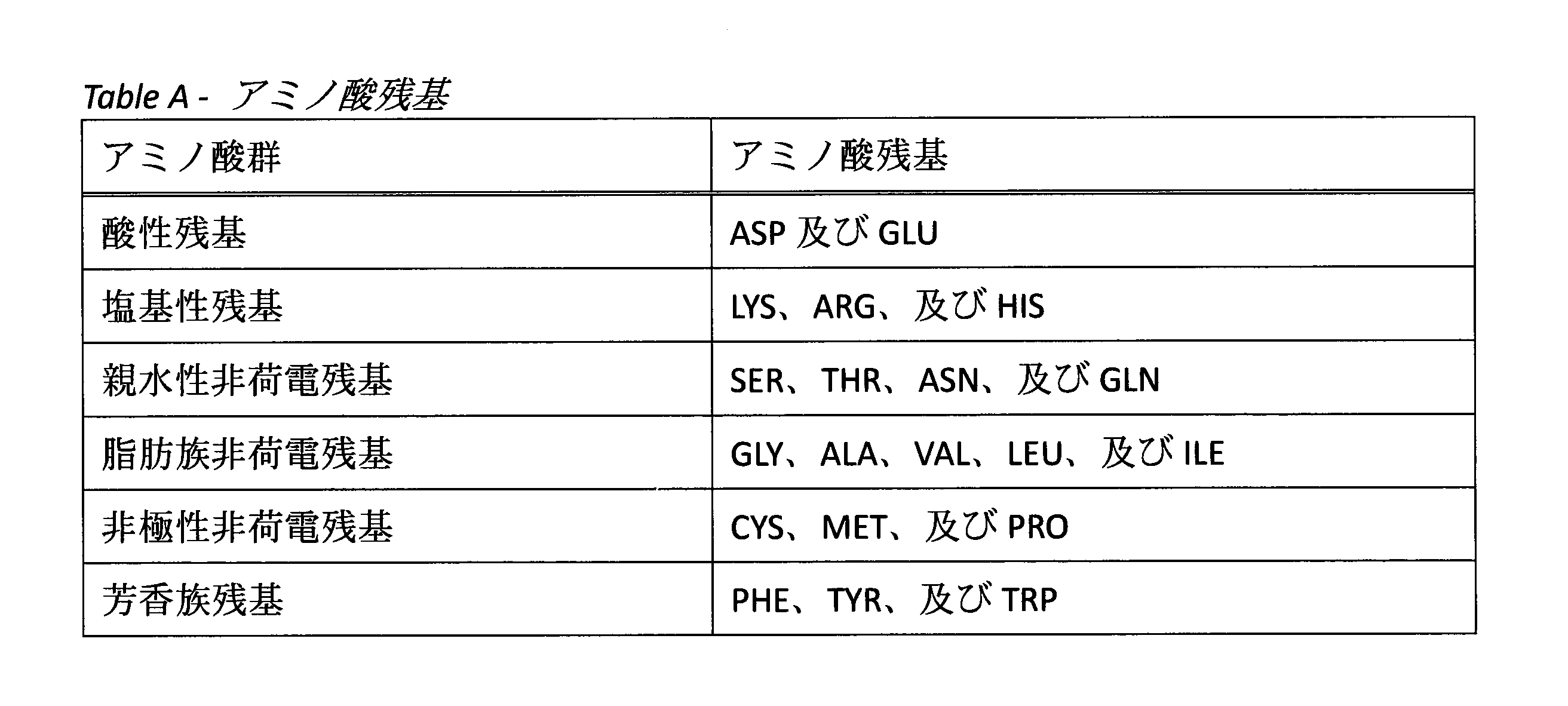

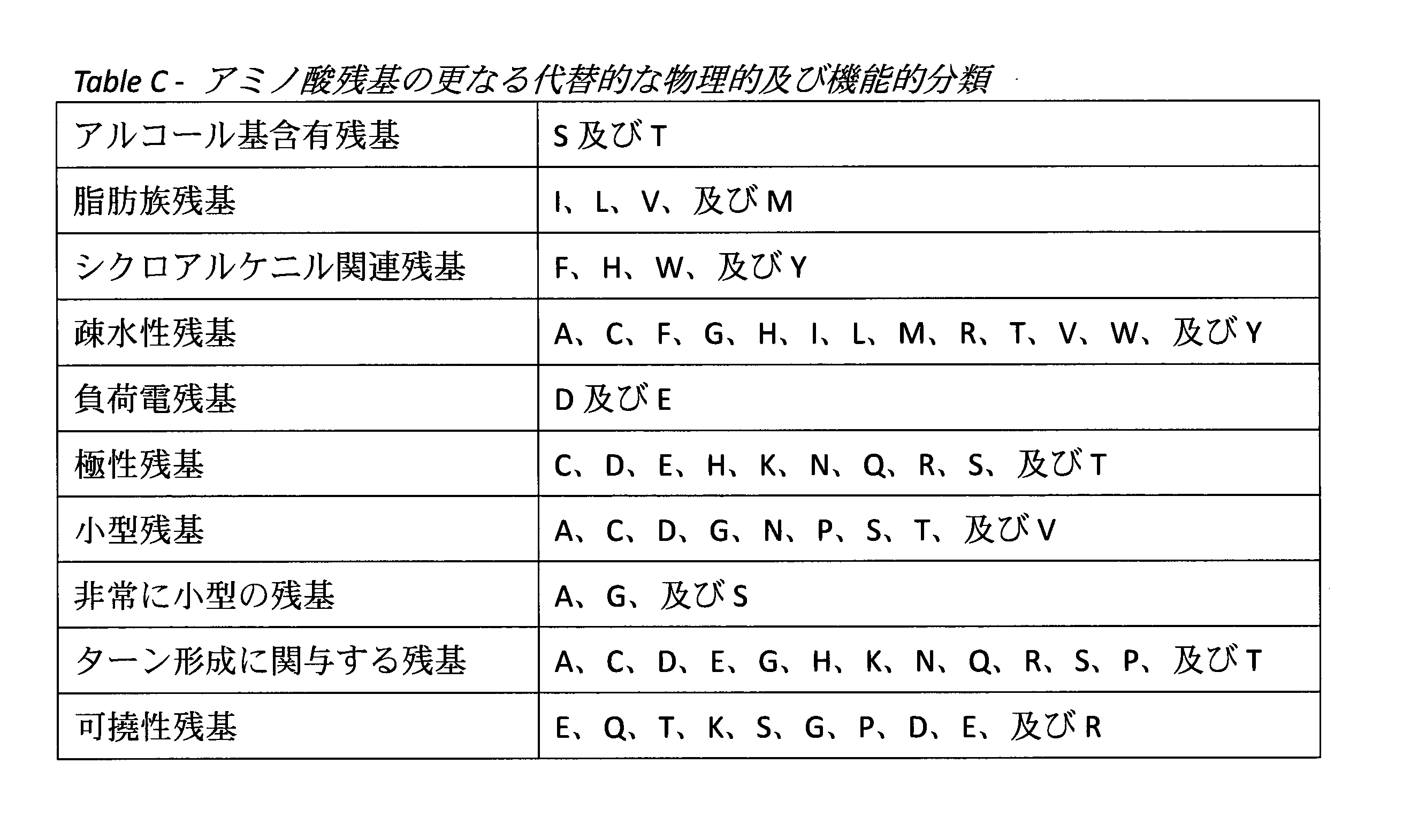
本明細書で使用される場合、「単離された抗体」は、その天然環境の成分から分離及び/又は回収された抗体である。単離された抗体は、抗体の天然環境の少なくとも1つの成分が存在しないため、組換え細胞内にあるin situでの抗体を含む。一部の実施形態では、抗体は、例えば、還元若しくは非還元条件下での電気泳動(例えば、SDS-PAGE、等電点電気泳動(IEF)、キャピラリー電気泳動)又はクロマトグラフィー(例えば、イオン交換又は逆相HPLC)により決定して、均質になるまで、及び/又は90%、95%、若しくは99%を超える純度まで精製される。 As used herein, an "isolated antibody" is an antibody that has been separated and/or recovered from a component of its natural environment. An isolated antibody includes an antibody in situ within a recombinant cell, since at least one component of the antibody's natural environment will not be present. In some embodiments, the antibody is purified to homogeneity and/or to greater than 90%, 95%, or 99% purity, for example, as determined by electrophoresis (e.g., SDS-PAGE, isoelectric focusing (IEF), capillary electrophoresis) or chromatography (e.g., ion exchange or reverse phase HPLC) under reducing or non-reducing conditions.
「から派生する(derive from)」及び「に由来する(derived from)」という用語は、本明細書で使用される場合、親化合物又は親タンパク質の構造に由来する構造を有し、その構造が本明細書に開示のものと十分に類似しており、当業者であれば、その類似性に基づき、特許請求されている化合物と同じ又は同様の特性、活性、及び有用性を呈することが予想されることになる化合物を指す。例えば、マウス抗体に由来するヒト化抗体は、マウス抗体と同様の特性を共有し、例えば、同じエピトープを認識し、抗体のヒト化に関与する及び/又は増加させる修飾残基を有する類似のVH及びVLを共有する抗体又は抗体断片を指す。 The terms "derive from" and "derived from," as used herein, refer to a compound having a structure derived from the structure of a parent compound or protein, and which structure is sufficiently similar to that disclosed herein that one of skill in the art would expect, based on that similarity, to exhibit the same or similar properties, activity, and utility as the claimed compound. For example, a humanized antibody derived from a murine antibody refers to an antibody or antibody fragment that shares similar properties as the murine antibody, e.g., recognizes the same epitope, and shares a similar VH and VL with modified residues that contribute to and/or enhance the humanization of the antibody.
「治療」という用語は、疾患又は疾患の症状の療法、防止、予防、及び緩徐等の、患者の健康状態を改善することを目的としたあらゆる行為を指す。この用語は、疾患の治癒的治療及び/又は予防的治療の両方を指す。治癒的治療は、疾患若しくは疾患の症状又はそれが直接若しくは間接に引き起こす苦難を軽減、好転、及び/又は消失、低減、及び/又は安定化する治癒又は治療をもたらす治療であると定義される。予防的治療は、疾患の防止をもたらす治療、並びに疾患の進行及び/若しくは発症又はその発生リスクを低減及び/又は遅延させる治療の両方を含む。ある特定の実施形態では、そのような用語は、疾患、障害、感染症、又はそれと関連する症状の好転又は根絶を指す。他の実施形態では、この用語は、がんの広がり又は悪化を最小限に抑えることを指す。本発明による治療は、必ずしも100%又は完全な治療を示唆するわけではない。むしろ、当業者が潜在的な利益又は療法効果を有すると認識する様々な度合いの治療が存在する。好ましくは、「治療」という用語は、1つ又は複数の活性物質を含む組成物を、例えばPD-1により媒介されるシグナル伝達経路と関連する障害/疾患を有する対象に適用又は投与することを指す。 The term "treatment" refers to any action aimed at improving the well-being of a patient, such as the cure, prevention, prophylaxis, and slowing of a disease or symptoms of a disease. The term refers to both curative and/or prophylactic treatment of a disease. Curative treatment is defined as treatment that results in a cure or treatment that alleviates, improves, and/or eliminates, reduces, and/or stabilizes a disease or symptoms of a disease or the suffering it causes directly or indirectly. Prophylactic treatment includes both treatment that results in the prevention of a disease, as well as treatment that reduces and/or delays the progression and/or onset of a disease or the risk of its occurrence. In certain embodiments, such terms refer to the improvement or eradication of a disease, disorder, infection, or symptoms associated therewith. In other embodiments, the term refers to minimizing the spread or worsening of a cancer. Treatment according to the present invention does not necessarily imply a 100% or complete cure. Rather, there are various degrees of treatment that one skilled in the art would recognize as having potential benefits or therapeutic effects. Preferably, the term "treatment" refers to the application or administration of a composition comprising one or more active substances to a subject having a disorder/disease associated with, for example, a PD-1-mediated signaling pathway.
本明細書で使用される場合、「障害」又は「疾患」という用語は、遺伝的若しくは発生上の誤謬、感染、毒、栄養不足若しくは偏り、毒性、又は好ましくない環境要因に起因して、身体の臓器、一部分、構造、又は系が正しく機能しないことを指す。好ましくは、こうした用語は、健康障害又は疾患、例えば、正常な身体的又は精神的機能を妨害する疾病を指す。より好ましくは、障害という用語は、がん等の、動物及び/又はヒトに影響を及ぼす免疫疾患及び/又は炎症性疾患を指す。 As used herein, the term "disorder" or "disease" refers to a malfunction of an organ, part, structure, or system of the body due to genetic or developmental error, infection, poison, nutritional deficiency or imbalance, toxicity, or unfavorable environmental factors. Preferably, such terms refer to a health impairment or disease, e.g., a disease that interferes with normal physical or mental functioning. More preferably, the term disorder refers to an immune disorder and/or inflammatory disease that affects animals and/or humans, such as cancer.
「免疫疾患」という用語は、本明細書で使用される場合、対象自体の細胞、組織、及び/又は臓器に対する対象の免疫学的反応により引き起こされる細胞、組織、及び/又は臓器傷害により特徴付けられる対象の状態を指す。「炎症性疾患」という用語は、炎症、例えば慢性炎症により特徴付けられる対象の状態を指す。自己免疫障害は、炎症と関連することも又は関連しないこともある。更に、炎症は、自己免疫障害により引き起こすことも又は引き起こされないこともある。 The term "immune disease," as used herein, refers to a condition in a subject characterized by cell, tissue, and/or organ injury caused by a subject's immunological response against the subject's own cells, tissues, and/or organs. The term "inflammatory disease" refers to a condition in a subject characterized by inflammation, e.g., chronic inflammation. Autoimmune disorders may or may not be associated with inflammation. Additionally, inflammation may or may not be caused by an autoimmune disorder.
「がん」という用語は、本明細書で使用される場合、異常細胞の急速で未制御の成長により特徴付けられる疾患であると定義される。がん細胞は、局所的に又は血流及びリンパ系を介して身体の他の部分へと広がる場合がある。 The term "cancer," as used herein, is defined as a disease characterized by the rapid and uncontrolled growth of abnormal cells. Cancer cells may spread locally or through the bloodstream and lymphatic system to other parts of the body.
本明細書で使用される場合、「PD-1と関連する又は関係する疾患」、「PD-1陽性がん」、又は「PD-1陽性感染性疾患」という用語は、PD-1発現に起因するか、又はPD-1発現の症状/特徴、つまりPD-1の発現若しくは活性の増加若しくは減少により引き起こされるか、増悪するか、若しくは別様に結び付けられる任意の状態を有するがん若しくは感染症(例えば、ウイルス及び/又は細菌により引き起こされる)を指すことが意図されている。 As used herein, the terms "disease associated with or related to PD-1," "PD-1 positive cancer," or "PD-1 positive infectious disease" are intended to refer to a cancer or infectious disease (e.g., caused by a virus and/or bacteria) that is caused by PD-1 expression or has symptoms/characteristics of PD-1 expression, i.e., any condition caused, exacerbated, or otherwise linked to increased or decreased expression or activity of PD-1.
本明細書で使用される場合、「対象」、「宿主」、「個人」、又は「患者」という用語は、成人及び子供を含むヒトを指す。 As used herein, the terms "subject," "host," "individual," or "patient" refer to humans, including adults and children.
「医薬組成物」は、本明細書で使用される場合、生理学的に好適な担体及び賦形剤等の任意選択の他の化学成分と共に本発明による二機能性分子を含むもの等、活性物質の1つ又は複数の調製物を指す。医薬組成物の目的は、生物への活性物質の投与を容易にすることである。本発明の組成物は、任意の従来の投与経路又は使用に好適な形態であってもよい。一実施形態では、「組成物」は、典型的には、活性物質、例えば化合物又は組成物と、薬学的に許容される担体を含む、アジュバント、希釈剤、結合剤、安定剤、緩衝液、塩、親油性溶媒、保存剤、又はアジュバント等の不活性(例えば、検出可能な物質又は標識)又は活性の天然に存在する又は天然に存在しない担体との組合せが意図される。「許容されるビヒクル」又は「許容される担体」は、本明細書で言及される場合、医薬組成物の製剤化に有用であることが当業者に公知である任意の公知の化合物又は化合物の組合せである。 "Pharmaceutical composition" as used herein refers to one or more preparations of an active agent, such as one that includes a bifunctional molecule according to the present invention together with optional other chemical components, such as physiologically suitable carriers and excipients. The purpose of a pharmaceutical composition is to facilitate administration of an active agent to an organism. The compositions of the present invention may be in a form suitable for any conventional route of administration or use. In one embodiment, a "composition" typically contemplates a combination of an active agent, e.g., a compound or composition, with an inert (e.g., detectable substance or label) or active naturally occurring or non-naturally occurring carrier, such as an adjuvant, diluent, binder, stabilizer, buffer, salt, lipophilic solvent, preservative, or adjuvant, including a pharma- ceutically acceptable carrier. An "acceptable vehicle" or "acceptable carrier" as referred to herein is any known compound or combination of compounds known to those skilled in the art to be useful in formulating a pharmaceutical composition.
「有効量」又は「治療有効量」は、本明細書で使用される場合、単独で、又は1つ若しくは複数の他の活性物質との組合せのいずれかで、対象に治療効果を付与するのに必要な活性物質の量、例えば、標的の疾患若しくは障害を治療するために、又は所望の効果を生み出すために必要とされる活性物質の量を指す。「有効量」は、物質、疾患及びその重症度、年齢、身体状態、大きさ、性別、及び体重を含む、治療しようとする対象の特徴、治療の期間、併用療法の性質(該当する場合)、特定の投与経路、並びに医療従事者の知識及び専門性の範囲内の類似要因に応じて様々であろう。こうした要因は、当業者に周知であり、単なる日常的実験作業で対処することができる。一般に、個々の成分又はそれらの組合せの最大用量、つまり、健全な医学的判断による最も高い安全な用量を使用することが好ましい。 "Effective amount" or "therapeutically effective amount", as used herein, refers to the amount of an active agent, either alone or in combination with one or more other active agents, required to confer a therapeutic effect on a subject, e.g., the amount of active agent required to treat a target disease or disorder or to produce a desired effect. An "effective amount" will vary depending on the agent, the disease and its severity, the characteristics of the subject to be treated, including age, physical condition, size, sex, and weight, the duration of treatment, the nature of the concomitant therapy (if applicable), the particular route of administration, and similar factors within the knowledge and expertise of the medical practitioner. Such factors are well known to those of skill in the art and can be addressed with no more than routine experimentation. In general, it is preferred to use the maximum dose of the individual components or combinations thereof, i.e., the highest safe dose according to sound medical judgment.
本明細書で使用される場合、「医薬」という用語は、障害又は疾患に対する治癒的又は防止的特性を有する任意の物質又は組成物を指す。 As used herein, the term "medicine" refers to any substance or composition that has curative or preventative properties for a disorder or disease.
「組み合わせて」という用語は、本明細書で使用される場合、1つよりも多くの療法(例えば、予防剤及び/又は療法剤)の使用を指す。「組み合わせて」という用語の使用は、療法(例えば、予防剤及び/又は療法剤)が疾患又は障害を有する対象に投与される順序を制限しない。 The term "in combination," as used herein, refers to the use of more than one therapies (e.g., prophylactic and/or therapeutic agents). The use of the term "in combination" does not restrict the order in which therapies (e.g., prophylactic and/or therapeutic agents) are administered to a subject with a disease or disorder.
「ポリヌクレオチド」、「核酸」、及び「核酸配列」という用語は、等価であり、任意の長さのヌクレオチドのポリマー形態、例えば、RNA又はDNA又はそれらのアナログを指す。本発明の核酸(例えば、核酸の成分又は部分)は、天然に存在してもよく、修飾されていてもよく、又は遺伝子操作されていてもよく、単離されていてもよく、及び/又は非天然であってもよい。遺伝子操作された核酸としては、組換え核酸及び合成核酸が挙げられる。「抗PD1抗体をコードする単離された核酸」は、単一のベクター又は別々のベクターにあるそのような核酸分子、及び宿主細胞の1つ又は複数の場所に存在するそのような酸性分子を含む、抗体の重鎖及び軽鎖(又はそれらの断片)をコードする1つ又は複数の核酸分子を指す。本明細書で使用される場合、「核酸構築物」、「プラスミド」、及び「ベクター」という用語は、等価であり、DNA又はRNA等のパッセンジャー核酸配列を宿主細胞内へと移行する役目を果たす核酸分子を指す。 The terms "polynucleotide", "nucleic acid", and "nucleic acid sequence" are equivalent and refer to a polymeric form of nucleotides of any length, e.g., RNA or DNA or analogs thereof. The nucleic acids of the invention (e.g., nucleic acid components or portions) may be naturally occurring, modified, or engineered, isolated, and/or non-naturally occurring. Engineered nucleic acids include recombinant and synthetic nucleic acids. An "isolated nucleic acid encoding an anti-PD1 antibody" refers to one or more nucleic acid molecules encoding the antibody heavy and light chains (or fragments thereof), including such nucleic acid molecules in a single vector or separate vectors, and such nucleic acid molecules present in one or more locations in a host cell. As used herein, the terms "nucleic acid construct", "plasmid", and "vector" are equivalent and refer to a nucleic acid molecule that serves to transfer a passenger nucleic acid sequence, such as DNA or RNA, into a host cell.
本明細書で使用される場合、「宿主細胞」という用語は、本発明の抗体構築物をコードするベクター、外因性核酸分子、及びポリヌクレオチドのレシピエント並びに/又は抗体構築物自体のレシピエントであり得るか又はレシピエントである任意の個々の細胞又は細胞培養物を含むことが意図されている。それぞれの物質の細胞への導入は、形質転換及びトランスフェクション等により実施することができる。また、「宿主細胞」という用語は、単一細胞の子孫又は潜在的な子孫を含むことが意図されている。宿主細胞としては、例えば、細菌細胞、微生物細胞、植物細胞、及び動物細胞が挙げられる。 As used herein, the term "host cell" is intended to include any individual cell or cell culture that can be or is a recipient of vectors, exogenous nucleic acid molecules, and polynucleotides encoding the antibody constructs of the present invention and/or the antibody construct itself. Introduction of the respective substances into the cell can be performed by transformation, transfection, and the like. The term "host cell" is also intended to include the progeny or potential progeny of a single cell. Host cells include, for example, bacterial cells, microbial cells, plant cells, and animal cells.
「免疫細胞」は、本明細書で使用される場合、例えば、骨髄で産生される造血幹細胞(HSC)に由来する白血球細胞(白血球)、リンパ球(T細胞、B細胞、ナチュラルキラー(NK)細胞、及びナチュラルキラーT細胞(NKT)、及び骨髄由来細胞(好中球、好酸球、好塩基球、単球、マクロファージ、樹状細胞)等の、自然免疫及び適応免疫に関与する細胞を指す。特に、免疫細胞は、B細胞、T細胞、特にCD4+ T細胞及びCD8+ T細胞、NK細胞、NKT細胞、APC細胞、樹状細胞、並びに単球を含む非網羅的リストにおいて選択することができる。「T細胞」としては、本明細書で使用される場合、例えば、CD4+ T細胞、CD8+ T細胞、Tヘルパー1型T細胞、Tヘルパー2型T細胞、Tヘルパー17型T細胞、及び阻害性T細胞が挙げられる。 "Immune cells", as used herein, refer to cells involved in innate and adaptive immunity, such as, for example, white blood cells (leukocytes) derived from hematopoietic stem cells (HSCs) produced in the bone marrow, lymphocytes (T cells, B cells, natural killer (NK) cells, and natural killer T cells (NKT), and bone marrow-derived cells (neutrophils, eosinophils, basophils, monocytes, macrophages, dendritic cells). In particular, immune cells can be selected in a non-exhaustive list including B cells, T cells, particularly CD4+ T cells and CD8+ T cells, NK cells, NKT cells, APC cells, dendritic cells, and monocytes. "T cells", as used herein, include, for example, CD4+ T cells, CD8+ T cells, T helper type 1 T cells, T helper type 2 T cells, T helper type 17 T cells, and inhibitory T cells.
本明細書で使用される場合、「Tエフェクター細胞」、「Teff」、又は「エフェクター細胞」という用語は、共刺激等の刺激に活性に応答する幾つかのT細胞型を含む免疫細胞の群を記述する。この用語は、特に、抗原を排除するように機能するT細胞を含む(例えば、他の細胞の活性化をモジュレートするサイトカインの産生により、又は細胞傷害活性により)。この用語は、特に、CD4+細胞、CD8+細胞、Treg細胞、細胞傷害性T細胞、及びヘルパーT細胞(Th1及びTh2)を含む。 As used herein, the term "T effector cells," "Teff," or "effector cells" describes a group of immune cells that includes several T cell types that actively respond to stimuli, such as costimulation. The term specifically includes T cells that function to eliminate antigens (e.g., by production of cytokines that modulate the activation of other cells or by cytotoxic activity). The term specifically includes CD4+ cells, CD8+ cells, Treg cells, cytotoxic T cells, and helper T cells (Th1 and Th2).
本明細書で使用される場合、「調節性T細胞」、「Treg細胞」、又は「Treg」という用語は、免疫系をモジュレートし、自己抗原に対する耐容性を維持し、自己免疫疾患を防止するT細胞の部分集団を指す。Tregは、免疫抑制性であり、一般にエフェクターT細胞の誘導及び増殖を抑制又は下方制御する。Tregは、バイオマーカーCD4、FOXP3、及びCD25を発現し、ナイーブCD4細胞と同じ系列に由来すると考えられている。 As used herein, the terms "regulatory T cells," "Treg cells," or "Treg" refer to a subpopulation of T cells that modulate the immune system, maintain tolerance to self-antigens, and prevent autoimmune disease. Tregs are immunosuppressive and generally suppress or downregulate the induction and proliferation of effector T cells. Tregs express the biomarkers CD4, FOXP3, and CD25, and are believed to be derived from the same lineage as naive CD4 cells.
「疲弊したT細胞」という用語は、機能不全(つまり「疲弊」)の状態にあるT細胞の集団を指す。T細胞疲弊は、機能の進行性喪失、転写プロファイルの変化、及び阻害性受容体の持続的発現により特徴付けられる。疲弊したT細胞は、サイトカイン産生能力、高い増殖能力、及び細胞傷害能力を喪失し、それにより最終的には自身の除去がもたらされる。疲弊したT細胞は、典型的には、CD62L及びCD127の発現がより低いこと併せて、より高いレベルのCD43、CD69、及び阻害性受容体を提示する。 The term "exhausted T cells" refers to a population of T cells that are in a state of dysfunction (i.e., "exhausted"). T cell exhaustion is characterized by a progressive loss of function, altered transcriptional profile, and persistent expression of inhibitory receptors. Exhausted T cells lose their ability to produce cytokines, proliferate highly, and cause cytotoxicity, which ultimately leads to their own elimination. Exhausted T cells typically display higher levels of CD43, CD69, and inhibitory receptors, along with lower expression of CD62L and CD127.
「免疫応答」という用語は、侵入病原体、病原体に感染した細胞若しくは組織、がん性細胞、又は自己免疫若しくは病理学的炎症の場合は正常なヒト細胞若しくは組織に対する選択的損傷、破壊、又はヒト身体からの排除をもたらす、例えば、リンパ球、抗原提示細胞、食細胞、顆粒球、及び上記の細胞又は肝臓により産生される可溶性巨大分子(抗体、サイトカイン、及び補体を含む)の作用を指す。 The term "immune response" refers to the actions of, for example, lymphocytes, antigen-presenting cells, phagocytes, granulocytes, and soluble macromolecules produced by the above cells or the liver, including antibodies, cytokines, and complement, that result in the selective damage, destruction, or elimination from the human body of invading pathogens, pathogen-infected cells or tissues, cancerous cells, or, in the case of autoimmunity or pathological inflammation, normal human cells or tissues.
「アンタゴニスト」という用語は、本明細書で使用される場合、別の物質の活性又は機能性を阻止又は低減する物質を指す。特に、この用語は、参照物質(例えば、PD-L1及び/又はPD-L2)としての細胞受容体(例えば、PD-1)に結合し、それがその通常の生物学的効果(例えば、免疫抑制性微小環境の生成)の全て又は一部を生み出すことを妨げる抗体を指す。本発明による抗体のアンタゴニスト活性は、競合ELISAにより評価することができる。 The term "antagonist" as used herein refers to a substance that blocks or reduces the activity or functionality of another substance. In particular, the term refers to an antibody that binds to a cellular receptor (e.g., PD-1) as a reference substance (e.g., PD-L1 and/or PD-L2) and prevents it from producing all or part of its normal biological effect (e.g., generation of an immunosuppressive microenvironment). The antagonist activity of an antibody according to the present invention can be assessed by competitive ELISA.
本明細書で使用される場合、「単離された」という用語は、記載されている物質(例えば、抗体、ポリペプチド、核酸等)が、自然界ではそれらと共に存在する他の物質から実質的に分離されているか、又はそれらと比べて濃縮されていることを示す。特に、「単離された」抗体は、その天然環境の成分から同定、分離、及び/又は回収されているものである。例えば、単離された抗体は、(1)ローリー法により決定して抗体の75質量%よりも高くまで、又は(2)還元若しくは非還元条件下のSDS-PAGEで均質になるまで精製されている。単離された抗体は、抗体の天然環境の少なくとも1つの成分が存在しないことになるため、組換え細胞内のin situでの抗体を含む。しかしながら、通常は、単離された抗体は、少なくとも1つの精製工程により調製されることになる。 As used herein, the term "isolated" indicates that the described material (e.g., antibody, polypeptide, nucleic acid, etc.) is substantially separated from or enriched relative to other materials with which it occurs in nature. In particular, an "isolated" antibody is one that has been identified, separated, and/or recovered from a component of its natural environment. For example, an isolated antibody is one that has been purified (1) to greater than 75% by weight of the antibody as determined by the Lowry method, or (2) to homogeneity by SDS-PAGE under reducing or non-reducing conditions. An isolated antibody includes an antibody in situ in a recombinant cell, since at least one component of the antibody's natural environment will not be present. Ordinarily, however, an isolated antibody will be prepared by at least one purification step.
「及び/又は」という用語は、本明細書で使用される場合、他方の有無に関わらず、2つの指定の特徴又は成分の各々の具体的な開示として解釈されるべきである。例えば、「A及び/又はB」は、各々があたかも個々に示されているような、(i)A、(ii)B、並びに(iii)A及びBの各々の具体的な開示として解釈されるべきである。 The term "and/or," as used herein, should be construed as a specific disclosure of each of the two specified features or components, without regard to the presence or absence of the other. For example, "A and/or B" should be construed as a specific disclosure of (i) A, (ii) B, and (iii) each of A and B, as if each were individually set forth.
「a」又は「an」という用語は、要素の1つ又は要素の1つよりも多くのいずれかが記載されていることが状況から明らかでない限り、それが修飾する要素の1つ又は複数を指すことができる(例えば、「試薬」は、1つ又は複数の試薬を意味することができる)。 The terms "a" or "an" can refer to one or more of the element that it modifies, unless it is clear from the context that either one of the elements or more than one of the elements is being described (e.g., "a reagent" can mean one or more reagents).
「約」という用語は、ありとあらゆる値(数値範囲の下限及び上限を含む)に関連して本明細書で使用される場合、最大で+/-10%(例えば、+/-0.5%、+/-1%、+/-1.5%、+/-2%、+/-2.5%、+/-3%、+/-3.5%、+/-4%、+/-4.5%、+/-5%、+/-5.5%、+/-6%、+/-6.5%、+/-7%、+/-7.5%、+/-8%、+/-8.5%、+/-9%、+/-9.5%)の許容可能な逸脱範囲を有するあらゆる値を意味する。値の文字列の先頭における「約」という用語の使用は、値の各々を修飾する(つまり、「約1、2、及び3」は、約1、約2、及び約3を指す)。更に、値のリストが本明細書に記載されている場合(例えば、約50%、60%、70%、80%、85%、又は86%)、リストは、その全ての中間値及び小数値(例えば、54%、85.4%)を含む。 The term "about" when used herein in connection with any and all values (including the lower and upper limits of a numerical range) means any value having an acceptable range of deviation of up to +/-10% (e.g., +/-0.5%, +/-1%, +/-1.5%, +/-2%, +/-2.5%, +/-3%, +/-3.5%, +/-4%, +/-4.5%, +/-5%, +/-5.5%, +/-6%, +/-6.5%, +/-7%, +/-7.5%, +/-8%, +/-8.5%, +/-9%, +/-9.5%). Use of the word "about" at the beginning of a value string modifies each of the values (i.e., "about 1, 2, and 3" refers to about 1, about 2, and about 3). Additionally, when a list of values is set forth herein (e.g., about 50%, 60%, 70%, 80%, 85%, or 86%), the list includes all intermediate and fractional values thereof (e.g., 54%, 85.4%).
抗PD-1抗体
本発明による二機能性分子は、抗hPD-1抗体又はその抗原結合性断片を含む第1の実体を含む。
Anti-PD-1 Antibodies Bifunctional molecules according to the present invention comprise a first entity which comprises an anti-hPD-1 antibody or an antigen-binding fragment thereof.
本明細書には、特に、ヒトPD-1に結合する抗体が提供されている。一部の態様では、抗体は、ヒトPD-1と、好ましくは、ヒトPD-1の細胞外ドメインと特異的に結合する。一部の態様では、抗体は、完全長ヒトPD-1、PD-1Aex2、PD-1Aex3、PD-1Aex2,3、及びPD-1Aex2,3,4の1つ又は複数と選択的に結合する。 Provided herein, among other things, are antibodies that bind to human PD-1. In some aspects, the antibodies specifically bind to human PD-1, preferably to the extracellular domain of human PD-1. In some aspects, the antibodies selectively bind to one or more of full-length human PD-1, PD-1Aex2, PD-1Aex3, PD-1Aex2,3, and PD-1Aex2,3,4.
一部の態様では、抗PD1抗体は、単離された抗体、特に非天然の単離された抗体である。そのような単離された抗PD1抗体は、少なくとも1つの精製工程により調製することができる。一部の実施形態では、単離された抗PD1抗体は、少なくとも80質量%、85質量%、90質量%、95質量%、又は99質量%まで精製される。一部の実施形態では、単離された抗PD1単離抗体は、少なくとも85質量%、90質量%、95質量%、98質量%、99質量%~100質量%の抗体を含む溶液であって、残りの質量は溶媒に溶解した他の溶質の質量を含む溶液として提供される。 In some aspects, the anti-PD1 antibody is an isolated antibody, particularly a non-naturally occurring isolated antibody. Such an isolated anti-PD1 antibody can be prepared by at least one purification step. In some embodiments, the isolated anti-PD1 antibody is purified to at least 80%, 85%, 90%, 95%, or 99% by weight. In some embodiments, the isolated anti-PD1 antibody is provided as a solution comprising at least 85%, 90%, 95%, 98%, 99% to 100% antibody by weight, with the remaining weight comprising other solutes dissolved in a solvent.
好ましくは、そのような抗体は、PD-1とそのリガンドの少なくとも1つ(例えば、PD-L1及び/又はPD-L2)との相互作用を阻止又は阻害する能力を有する。「結合を阻止する」又は「相互作用を阻止する」又は「相互作用を阻害する」能力は、本明細書で使用される場合、抗体又は抗原結合性断片が、2つの分子(例えば、PD-1及びそのリガンドPD-L1及び/又はPD-L2)間の結合相互作用を、任意の検出可能な程度に防止する能力を指す。 Preferably, such antibodies have the ability to block or inhibit the interaction of PD-1 with at least one of its ligands (e.g., PD-L1 and/or PD-L2). The ability to "block binding" or "block interaction" or "inhibit interaction", as used herein, refers to the ability of an antibody or antigen-binding fragment to prevent, to any detectable extent, the binding interaction between two molecules (e.g., PD-1 and its ligands PD-L1 and/or PD-L2).
好ましくは、抗PD1抗体又はその抗原結合性断片は、ヒトPD-L1及び/又はPD-L2のヒトPD-1に対する結合、より好ましくはヒトPD-L1及びPD-L2のヒトPD-1に対する結合のアンタゴニストである。 Preferably, the anti-PD1 antibody or antigen-binding fragment thereof is an antagonist of the binding of human PD-L1 and/or PD-L2 to human PD-1, more preferably of the binding of human PD-L1 and PD-L2 to human PD-1.
ある特定の実施形態では、抗hPD1抗体又は抗原結合性断片は、PD-1とそのリガンドの少なくとも1つ(例えば、PD-L1及び/又はPD-L2、好ましくはPD-L1及びPD-L2)との結合相互作用を少なくとも50%阻害する。ある特定の実施形態では、この阻害は、60%よりも大きくてもよく、70%よりも大きくてもよく、80%よりも大きくてもよく、又は90%よりも大きくてもよい。 In certain embodiments, the anti-hPD1 antibody or antigen-binding fragment inhibits the binding interaction of PD-1 with at least one of its ligands (e.g., PD-L1 and/or PD-L2, preferably PD-L1 and PD-L2) by at least 50%. In certain embodiments, this inhibition may be greater than 60%, greater than 70%, greater than 80%, or greater than 90%.
本発明による抗hPD1抗体は、免疫グロブリン、IgD、IgE、IgG、IgA、又はIgM(又はそのサブクラス)等の任意のクラスの免疫グロブリン、ヒトPD-1を標的とする非ヒト(例えば、マウス)免疫グロブリンに由来する最小配列を含有する免疫グロブリン鎖又はその断片(Fv、Fab、Fab'、F(ab')2、scFv、又は抗体の他の抗原結合性部分配列等)を含んでいてもよい。好ましくは、本発明による抗hPD-1抗体は、IgG1、IgG2、IgG3、又はIgG4に、好ましくはIgG4又はIgG1に由来する。 Anti-hPD1 antibodies according to the invention may comprise any class of immunoglobulin, such as IgD, IgE, IgG, IgA, or IgM (or subclasses thereof), an immunoglobulin chain or fragment thereof (such as an Fv, Fab, Fab', F(ab')2, scFv, or other antigen-binding subsequence of an antibody) that contains a minimal sequence derived from a non-human (e.g., murine) immunoglobulin that targets human PD-1. Preferably, anti-hPD-1 antibodies according to the invention are derived from IgG1, IgG2, IgG3, or IgG4, preferably IgG4 or IgG1.
一実施形態では、抗体の抗原結合性断片は、HCDR1、HCDR2、及びHCDR3を含む重鎖可変ドメインを含む重鎖、LDCR1、LDCR2、及びLDCR3を含む可変ドメインを含む軽鎖、並びに重鎖定常ドメインの断片を含む。したがって、重鎖定常ドメインの断片により、抗原結合性断片は、完全な重鎖定常ドメインの少なくとも部分を含むと理解されるべきである。例として、重鎖定常ドメインは、重鎖の少なくともCH1ドメイン、又は重鎖の少なくともCH1及びCH2ドメイン、又は重鎖の少なくともCH1、CH2、及びCH3ドメインを含んでいてもよく、又はからなっていてもよい。重鎖定常ドメインの断片は、重鎖のFcドメインの少なくとも部分を含むものであると定義することもできる。したがって、抗体の抗原結合性断片は、完全な抗体のFab部分、完全な抗体のF(ab')2部分、完全な抗体のFab'部分を包含する。また、重鎖定常ドメインは、例えば、本明細書に例示されている完全な重鎖定常ドメインを含んでいてもよく、又はからなっていてもよく、本明細書には、幾つかの完全な重鎖定常ドメインが記載されている。本発明の特定の実施形態では、及び抗体の抗原結合性断片が、完全な重鎖定常ドメインの部分を含むか若しくはからなる重鎖定常ドメインの断片を含む場合、重鎖定常ドメイン断片は、少なくとも10個のアミノ酸残基からなっていてもよく、又は10~300kのアミノ酸残基、特に210個のアミノ酸残基からなっていてもよい。
In one embodiment, an antigen-binding fragment of an antibody comprises a heavy chain comprising a heavy chain variable domain comprising HCDR1, HCDR2 and HCDR3, a light chain comprising a variable domain comprising LDCR1, LDCR2 and LDCR3, and a fragment of the heavy chain constant domain. Thus, by a fragment of the heavy chain constant domain, the antigen-binding fragment should be understood to comprise at least a portion of the complete heavy chain constant domain. By way of example, the heavy chain constant domain may comprise or consist of at least the
好ましくは、ヒトPD-1に対する抗体は、モノクローナル抗体である。「モノクローナル抗体」という用語は、本明細書で使用される場合、実質的に均質な抗体の集団から得られる抗体を指し、つまり、集団を構成する個々の抗体は同一であり、及び/又は同じエピトープに結合する。好ましくは、そのようなモノクローナル抗体(mAb)は、マウス、げっ歯動物、ウサギ、ヤギ、霊長類、非ヒト霊長類、又はヒト等の哺乳動物に由来する。そのようなモノクローナル抗体を調製するための技法は、例えば、Stitesら(編)BASIC AND CLINICAL IMMUNOLOGY(第四版)Lange Medical Publications社、ロスアラモス、米国カリフォルニア州、及びその中で引用されている参考文献;Harlow及びLane(1988年)ANTIBODIES: A LABORATORY MANUAL CSH Press社;Goding(1986年)MONOCLONAL ANTIBODIES: PRINCIPLES AND PRACTICE(第二版)Academic Press社、ニューヨーク市、米国ニューヨーク州に見出すことができる。 Preferably, the antibody against human PD-1 is a monoclonal antibody. The term "monoclonal antibody" as used herein refers to an antibody obtained from a population of substantially homogeneous antibodies, i.e., the individual antibodies constituting the population are identical and/or bind to the same epitope. Preferably, such monoclonal antibodies (mAbs) are derived from a mammal, such as a mouse, rodent, rabbit, goat, primate, non-human primate, or human. Techniques for preparing such monoclonal antibodies can be found, for example, in Stites et al. (eds.) BASIC AND CLINICAL IMMUNOLOGY (4th ed.), Lange Medical Publications, Los Alamos, CA, and references cited therein; Harlow and Lane (1988) ANTIBODIES: A LABORATORY MANUAL CSH Press; Goding (1986) MONOCLONAL ANTIBODIES: PRINCIPLES AND PRACTICE (2nd ed.), Academic Press, New York, NY, USA.
一実施形態では、抗PD1抗体は、ペムブロリズマブ(Keytruda社-MK-3475)、ニボルマブ(Opdivo社、MDX-1106、BMS-936558、ONO-4538)、ピディリズマブ(CT-011)、セミプリマブ(Libtayo社)PDR001、国際公開第2006/121168号において記載される、モノクローナル抗体5C4、17D8、2D3、4H1、4A11、7D3、及び5F4からなる群から選択することができる。 In one embodiment, the anti-PD1 antibody can be selected from the group consisting of pembrolizumab (Keytruda - MK-3475), nivolumab (Opdivo, MDX-1106, BMS-936558, ONO-4538), pidilizumab (CT-011), cemiplimab (Libtayo) PDR001, monoclonal antibodies 5C4, 17D8, 2D3, 4H1, 4A11, 7D3, and 5F4 described in WO 2006/121168.
一部の実施形態では、本明細書において提供される抗hPD1抗体は、単離された抗体である。 In some embodiments, the anti-hPD1 antibodies provided herein are isolated antibodies.
ある特定の実施形態では、本明細書で提供される抗hPD1抗体は、キメラ抗体である。一例では、キメラ抗体は、非ヒト可変領域(例えば、マウス、ラット、ハムスター、ウサギ、又はサル等の非ヒト霊長類に由来する可変領域)及びヒト定常領域を含む。更なる例では、キメラ抗体は、クラス又はサブクラスが親抗体のものから変化している「クラススイッチ」抗体である。キメラ抗体には、それらの抗原結合性断片が含まれる。 In certain embodiments, the anti-hPD1 antibodies provided herein are chimeric antibodies. In one example, a chimeric antibody comprises a non-human variable region (e.g., a variable region derived from a non-human primate such as a mouse, rat, hamster, rabbit, or monkey) and a human constant region. In a further example, a chimeric antibody is a "class-switched" antibody in which the class or subclass has been changed from that of the parent antibody. Chimeric antibodies include antigen-binding fragments thereof.
ある特定の実施形態では、抗hPD1抗体は、ヒト化抗体である。ヒト化抗体は、典型的には、CDR(又はそれらの部分)が非ヒト抗体に由来し、FR(又はそれらの部分)がヒト抗体配列又はヒト化抗体配列に由来する1つ又は複数の可変ドメインを含む。或いは、一部のFR残基は、抗体の特異性、親和性、及び/又はヒト化が回復又は向上するように置換されていてもよい。また、ヒト化抗体は、任意選択で、ヒト定常領域(Fc)又はヒト化定常領域(Fc)の少なくとも部分を含むだろう。抗体ヒト化の方法は、当技術分野で周知であり、例えば、以下の文献を参照されたい:Winter及びMilstein、Nature、1991年、349巻:293~299頁;Riechmannら、Nature、332巻、323頁(1988年);Verhoeyenら、Science、239巻、1534頁(1988年);Raderら、Proc. Nat. Acad. Sci. U.S.A.、1998年、95巻:8910~8915頁;Steinbergerら、J. Biol. Chem.、2000年、275巻:36073~36078頁;Queenら、Proc. Natl. Acad. Sci. U.S.A.、1989年、86巻:10029~10033頁;Almagro, J.C.及びFransson, J.、Front. Biosci. 13巻(2008年)1619~1633頁;Kashmiri, S.V.ら、Methods 36巻(2005年)25~34頁(SDR(a-CDR)移植が記載されている);Padlan, E.A.、Mol. Immunol. 28巻(1991年)489~498頁(「リサーフェシング」が記載されている);Dall'Acqua, W.F.ら、Methods 36巻(2005年)43~60頁(「FRシャッフリング」が記載されている);並びにOsbourn, J.ら、Methods 36巻(2005年)61~68頁、及びKlimka, A.ら、Br. J. Cancer 83巻(2000年)252~260頁(FRシャッフリングに対する「ガイドされた選択(guided selection)」手法が記載されている)、並びに米国特許第5,585,089号、第5,693,761号、第5,693,762号、第5,821,337号、第7,527,791号、第6,982,321号、及び第7,087,409号;及び第6,180,370号。好ましくは、ヒトPD-1に対するヒト化抗体は、モノクローナル抗体である。 In certain embodiments, the anti-hPD1 antibody is a humanized antibody. A humanized antibody typically comprises one or more variable domains in which the CDRs (or portions thereof) are derived from a non-human antibody and the FRs (or portions thereof) are derived from a human or humanized antibody sequence. Alternatively, some FR residues may be substituted to restore or improve antibody specificity, affinity, and/or humanization. A humanized antibody will also optionally comprise at least a portion of a human or humanized constant region (Fc). Methods for antibody humanization are well known in the art, see, e.g., Winter and Milstein, Nature, 1991, 349:293-299; Riechmann et al., Nature, 332, 323 (1988); Verhoeyen et al., Science, 239, 1534 (1988); Rader et al., Proc. Nat. Acad. Sci. U.S.A., 1998, 95:8910-8915; Steinberger et al., J. Biol. Chem., 2000, 275:36073-36078; Queen et al., Proc. Natl. Acad. Sci. U.S.A., 1989, 86:10029-10033; Almagro, J.C. and Fransson, J., Front. Biosci. 13 (2008) 1619-1633; Kashmiri, S.V. et al., Methods 36 (2005) 25-34 (SDR(a-CDR) grafting is described); Padlan, E.A., Mol. Immunol. 28 (1991) 489-498 ("Resurfacing" is described); Dall'Acqua, W.F. et al., Methods 36 (2005) 43-60 ("FR shuffling" is described); and Osbourn, J. et al., Methods 36 (2005) 61-68, and Klimka, A. et al., Br. J. Cancer. 83 (2000) pp. 252-260 (describing a "guided selection" approach to FR shuffling), as well as U.S. Pat. Nos. 5,585,089, 5,693,761, 5,693,762, 5,821,337, 7,527,791, 6,982,321, and 7,087,409; and 6,180,370. Preferably, the humanized antibody against human PD-1 is a monoclonal antibody.
特に、ヒト化抗体は、少なくとも80%又は少なくとも85%、より好ましくは少なくとも88%、更により好ましくは少なくとも90%のT20ヒト性スコア(T20 humanness score)、最も好ましくは、85%~95%、好ましくは88%~92%に含まれるT20ヒト性スコアを有するものである。 In particular, a humanized antibody has a T20 humanness score of at least 80% or at least 85%, more preferably at least 88%, even more preferably at least 90%, most preferably a T20 humanness score comprised between 85% and 95%, preferably between 88% and 92%.
「ヒト性」は、一般に、Gao S H、Huang K、Tu H、Adler A S.、BMC Biotechnology. 2013年:13巻:55頁に記載のような、モノクローナル抗体の可変領域のヒト性を定量化するためのT20スコアアナライザー(T20 score analyzer)を使用して測定される。T20ヒト性スコアは、Gaoら(BMC Biotechnol.、2013年、13巻、55頁)により最初に開示された、抗体ヒト化の分野で広く使用されているパラメーターである。T20ヒト性スコアは、通常、ヒト化抗体を規定するために特許出願で使用されている(例えば、国際公開第15161311号、国際公開第17127664号、国際公開第18136626号、国際公開第18190719号、国際公開第19060750号、又は国際公開第19170677号)。 "Humanity" is generally measured using the T20 score analyzer for quantifying the humanity of the variable regions of monoclonal antibodies as described in Gao S H, Huang K, Tu H, Adler A S., BMC Biotechnology. 2013:13:55. The T20 humanity score is a widely used parameter in the field of antibody humanization, first disclosed by Gao et al. (BMC Biotechnol., 2013, 13, 55). The T20 humanity score is commonly used in patent applications to define humanized antibodies (e.g., WO 15161311, WO 17127664, WO 18136626, WO 18190719, WO 19060750, or WO 19170677).
T20カットオフヒトデータベース(T20 Cutoff Human Database):http://abAnalyzer.lakepharma.comを使用して抗体配列のT20スコアを計算するためのWebベースのツールが提供されている。T20スコアの計算では、まず、入力であるVH、VK、又はVL可変領域タンパク質配列にカバット付番を割り当て、CDR残基を同定する。完全長配列又はフレームワークのみの配列(CDR残基が除去されている)を、blastpタンパク質-タンパク質BLASTアルゴリズムを使用して、それぞれの抗体データベース内の全ての配列と比較する。各ペアワイズ比較間の配列同一性を取り出し、データベース内の全ての配列を分析した後、配列を、入力配列に対する配列同一性に基づいて高いものから低いものへと並び替える。上位20個の一致配列の同一性パーセントを平均して、T20スコアを得る。 T20 Cutoff Human Database: A web-based tool is provided to calculate the T20 score of an antibody sequence using http://abAnalyzer.lakepharma.com. To calculate the T20 score, the input VH, VK, or VL variable region protein sequence is first assigned a Kabat numbering and the CDR residues are identified. The full-length sequence or framework-only sequence (with CDR residues removed) is compared to all sequences in the respective antibody database using the blastp protein-protein BLAST algorithm. After taking the sequence identity between each pairwise comparison and analyzing all sequences in the database, the sequences are sorted from high to low based on their sequence identity to the input sequence. The percent identity of the top 20 matching sequences is averaged to obtain the T20 score.
「全ヒトデータベース(All Human Databases)」の各鎖タイプ(VH、VK、VL)及び配列長(完全長又はフレームワークのみ)について、T20スコアアナライザーを使用して、各抗体配列をその対応するデータベースでスコア化した。入力配列自体を除外した後、上位20個の一致配列のT20スコア得た(配列1はそれ自体が常に入力抗体であるため、配列2~21の同一性パーセントを平均した)。各グループのT20スコアを、高いものから低いものへと並べ替えた。スコアの減少は、配列のほとんどでほぼ線形的だったが、抗体の下位約15%のT20スコアは急激に減少し始めた。したがって、配列の下位15パーセントを取り除き、残りの配列が、T20カットオフヒトデータベースを形成した。T20スコアカットオフは、新しいデータベース中の配列の最も低いT20スコアを示す。
Each antibody sequence was scored with its corresponding database, "All Human Databases," using the T20 score analyzer for each chain type (VH, VK, VL) and sequence length (full length or framework only). The T20 scores of the top 20 matching sequences were obtained after excluding the input sequence itself (
したがって、本発明による二機能性分子に含まれるヒト化抗PD1抗体は、少なくとも80%又は少なくとも85%、より好ましくは少なくとも88%、更により好ましくは少なくとも90%のT20ヒト性スコア、最も好ましくは85%~95%、好ましくは88%~92%に含まれるT20ヒト性スコアを有する。 Thus, the humanized anti-PD1 antibody contained in the bifunctional molecule according to the present invention has a T20 humanity score of at least 80% or at least 85%, more preferably at least 88%, even more preferably at least 90%, most preferably between 85% and 95%, preferably between 88% and 92%.
一実施形態では、抗PD1抗体は、以下のものからなる群から選択することができる:ペムブロリズマブ(キイトルーダランブロリズマブ、MK-3475としても知られている)、ニボルマブ(オプジーボ、MDX-1106、BMS-936558、ONO-4538)、ピジリズマブ(CT-011)、セミプリマブ(Libtayo)、カムレリズマブ、AUNP12、AMP-224、AGEN-2034、BGB-A317(チスレイズマブ)、PDR001(スパルタリズマブ)、MK-3477、SCH-900475、PF-06801591、JNJ-63723283、ゲノリムズマブ(CBT-501)、LZM-009、BCD-100、SHR-1201、BAT-1306、AK-103(HX-008)、MEDI- 0680(AMP-514としても知られている) MEDI0608、JS001(Si-Yang Liuら、J. Hematol. Oncol.10巻:136頁(2017年)を参照)、BI-754091、CBT-501、INCSHR1210(SHR-1210としても知られている)、TSR-042(ANB011としても知られている)、GLS-010(WBP3055としても知られている)、AM-0001(Armo)、STI-1110(国際公開第2014/194302号を参照)、AGEN2034(国際公開第2017/040790号を参照)、MGA012(国際公開第2017/19846号を参照)、又はIBI308(国際公開第2017/024465号、国際公開第2017/025016号、国際公開第2017/132825号、及び国際公開第2017/133540号を参照)、国際公開第2006/121168号に記載のモノクローナル抗体5C4、17D8、2D3、4H1、4A11、7D3、及び5F4。PD-1を標的とする二機能性又は二重特異性分子は、RG7769(Roche社)、XmAb20717(Xencor社)、MEDI5752(AstraZeneca社)、FS118(F-star社)、SL-279252(Takeda社)、及びXmAb23104(Xencor社)等も知られている。 In one embodiment, the anti-PD1 antibody can be selected from the group consisting of: pembrolizumab (also known as keytruda lambrolizumab, MK-3475), nivolumab (Opdivo, MDX-1106, BMS-936558, ONO-4538), pidilizumab (CT-011), cemiplimab (Libtayo), camrelizumab, AUNP12 , AMP-224, AGEN-2034, BGB-A317 (tisleizumab), PDR001 (spartalizumab), MK-3477, SCH-900475, PF-06801591, JNJ-63723283, genolimuzumab (CBT-501), LZM-009, BCD-100, SHR-1201, BAT-1306, AK-103 (HX-008), MEDI- 0680 (also known as AMP-514), MEDI0608, JS001 (Si-Yang Liu et al., J. Hematol. Oncol 10:136 (2017)), BI-754091, CBT-501, INCSHR1210 (also known as SHR-1210), TSR-042 (also known as ANB011), GLS-010 (also known as WBP3055), AM-0001 (Armo), STI-1110 (see International Publication No. WO 2014/194302), AGEN2034 (see International Publication No. WO 2014/194302), 7/040790), MGA012 (see WO 2017/19846), or IBI308 (see WO 2017/024465, WO 2017/025016, WO 2017/132825, and WO 2017/133540), monoclonal antibodies 5C4, 17D8, 2D3, 4H1, 4A11, 7D3, and 5F4 described in WO 2006/121168. Other known bifunctional or bispecific molecules that target PD-1 include RG7769 (Roche), XmAb20717 (Xencor), MEDI5752 (AstraZeneca), FS118 (F-star), SL-279252 (Takeda), and XmAb23104 (Xencor).
特定の実施形態では、抗PD1抗体は、ペムブロリズマブ(キイトルーダランブロリズマブ、MK-3475としても知られている)又はニボルマブ(オプジーボ、MDX-1106、BMS-936558、ONO-4538)であってもよい。 In certain embodiments, the anti-PD1 antibody may be pembrolizumab (also known as keytruda lambrolizumab, MK-3475) or nivolumab (Opdivo, MDX-1106, BMS-936558, ONO-4538).
ヒト化抗hPD1抗体の特定の例は、本明細書の下記にて、そのCDR、フレームワーク領域、並びにFc領域及びヒンジ領域が記載されている。 Specific examples of humanized anti-hPD1 antibodies are described herein below, including their CDRs, framework regions, and Fc and hinge regions.
CDR
「相補性決定領域」又は「CDR」は、当技術分野では、抗原特異性及び結合親和性を付与する、抗体可変領域内のアミノ酸の非隣接配列を指すものとして知られている。所与のCDRの正確なアミノ酸配列境界は、以下の文献に記載のものを含む、幾つかの周知の方式のいずれかを使用して容易に決定することができる:Kabatら、(Sequences of Proteins of Immunological Interest 第五版(1991年)「カバット」付番方式);Al-Lazikaniら、1997年、J. Mol. Biol、273巻:927~948頁(「Chothia」付番方式); MacCallumら、1996年、J. Mol. Biol. 262巻:732~745頁(「Contact」付番方式);Lefrancら、Dev. Comp. Immunol.、2003年、27巻:55~77頁(「IMGT」付番方式);並びにHonegge及びPluckthun、J. Mol. Biol、2001年、309巻:657~70頁(「AHo」付番方式)。別様の指定がない限り、本明細書にて特定のCDRを同定するために使用される付番方式は、カバット付番方式である。
CDR
"Complementarity determining region" or "CDR" is known in the art to refer to noncontiguous sequences of amino acids within antibody variable region that confer antigen specificity and binding affinity. The precise amino acid sequence boundaries of a given CDR can be readily determined using any of several well-known systems, including those described in Kabat et al. (Sequences of Proteins of Immunological Interest 5th ed. (1991) "Kabat" numbering system); Al-Lazikani et al., 1997, J. Mol. Biol. 273:927-948 ("Chothia" numbering system); MacCallum et al., 1996, J. Mol. Biol. 262:732-745 ("Contact" numbering system); Lefranc et al., Dev. Comp. Immunol., 2003, 27:55-77 ("IMGT" numbering system); and Honegge and Pluckthun, J. Mol. Biol. 2001, 309:657-70 ("AHo" numbering system). Unless otherwise specified, the numbering system used to identify particular CDRs herein is the Kabat numbering system.
一実施形態では、二機能性分子は、ヒト化抗hPD-1抗体又はその抗原結合性断片を含む。ヒト化抗体のCDR領域は、マウス抗体に由来してもよく、i)非常に高レベルのヒト化(85%を超える)及び安定性を有する安全なヒト化抗体を提供するように、並びにii)ヒトPD-1に対する結合親和性(KD)が10-7M未満、好ましくは10-8M未満となるように、アンタゴニスト活性(つまり、ヒトPD-L1のヒトPD-1に対する結合の阻害)を保存しつつ、抗体特性、より詳細にはCOS細胞及びHCO細胞等の哺乳動物細胞で産生する場合のより高い製造性及びより高い産生収率を増加させるように、最適化されていてもよい。 In one embodiment, the bifunctional molecule comprises a humanized anti-hPD-1 antibody or antigen-binding fragment thereof. The CDR regions of the humanized antibody may be derived from a murine antibody and may be optimized to i) provide a safe humanized antibody with a very high level of humanization (greater than 85 %) and stability, and ii) to increase the antibody properties, more particularly higher manufacturability and higher production yield when produced in mammalian cells, such as COS cells and HCO cells, while preserving antagonist activity (i.e., inhibition of human PD-L1 binding to human PD-1), with a binding affinity (KD) to human PD-1 of less than 10 −7 M, preferably less than 10 −8 M.
非常に特定の実施形態では、二機能性分子は、
(i)HCDR1、HCDR2、及びHCDR3を含む重鎖可変ドメイン、並びに
(ii)LCDR1、LCDR2、及びLCDR3を含む軽鎖可変ドメイン
を含む抗ヒトPD-1抗体又はその抗原結合性断片を含み、
- 重鎖CDR1(HCDR1)は、配列番号1のアミノ酸配列を含むか又はからなり、任意選択で、置換、付加、欠失、及びそれらの任意の組合せから選択される1つ、2つ、又は3つの修飾を有し、
- 重鎖CDR2(HCDR2)は、配列番号2のアミノ酸配列を含むか又はからなり、任意選択で、置換、付加、欠失、及びそれらの任意の組合せから選択される1つ、2つ、又は3つの修飾を有し、
- 重鎖CDR3(HCDR3)は、配列番号3のアミノ酸配列を含むか又はからなり、配列中、X1はD又はEであり、X2は、T、H、A、Y、N、E、及びSからなる群から、好ましくは、H、A、Y、N、Eからなる群において選択され、任意選択で、配列番号3の2、3、7、及び8位以外の任意の位置に、置換、付加、欠失、及びそれらの任意の組合せから選択される1つ、2つ、又は3つの修飾を有し、
- 軽鎖CDR1(LCDR1)は、配列番号12のアミノ酸配列を含むか又はからなり、配列中、XはG又はTであり、任意選択で、配列番号12の10、11、及び16位以外の任意の位置に、置換、付加、欠失、及びそれらの任意の組合せから選択される1つ、2つ、又は3つの修飾を有し、
- 軽鎖CDR2(LCDR2)は、配列番号15のアミノ酸配列を含むか又はからなり、任意選択で、置換、付加、欠失、及びそれらの任意の組合せから選択される1つ、2つ、又は3つの修飾を有し、
- 軽鎖CDR3(LCDR3)は、配列番号16のアミノ酸配列を含むか又はからなり、任意選択で、配列番号16の1、及び6位以外の任意の位置に、置換、付加、欠失、及びそれらの任意の組合せから選択される1つ、2つ、又は3つの修飾を有する。
In very particular embodiments, the bifunctional molecule is
(i) a heavy chain variable domain comprising HCDR1, HCDR2, and HCDR3; and
(ii) an anti-human PD-1 antibody or an antigen-binding fragment thereof, comprising a light chain variable domain comprising LCDR1, LCDR2, and LCDR3;
- the heavy chain CDR1 (HCDR1) comprises or consists of the amino acid sequence of SEQ ID NO: 1, optionally with one, two or three modifications selected from substitutions, additions, deletions, and any combination thereof;
- the heavy chain CDR2 (HCDR2) comprises or consists of the amino acid sequence of SEQ ID NO: 2, optionally with one, two or three modifications selected from substitutions, additions, deletions, and any combination thereof;
- the heavy chain CDR3 (HCDR3) comprises or consists of the amino acid sequence of SEQ ID NO: 3, in which X1 is D or E and X2 is selected from the group consisting of T, H, A, Y, N, E and S, preferably in the group consisting of H, A, Y, N, E, and optionally with 1, 2 or 3 modifications selected from substitutions, additions, deletions and any combination thereof at any position other than
- the light chain CDR1 (LCDR1) comprises or consists of the amino acid sequence of SEQ ID NO: 12, in which X is G or T and, optionally, with one, two or three modifications selected from substitutions, additions, deletions, and any combination thereof at any position other than
- the light chain CDR2 (LCDR2) comprises or consists of the amino acid sequence of SEQ ID NO: 15, optionally with one, two or three modifications selected from substitutions, additions, deletions, and any combination thereof;
- the light chain CDR3 (LCDR3) comprises or consists of the amino acid sequence of SEQ ID NO: 16, optionally with one, two or three modifications selected from substitutions, additions, deletions, and any combination thereof at any position other than
別の実施形態では、二機能性分子は、上で特定されたHCDR1、HCDR2、LCDR2及びLCDR3、配列番号3のアミノ酸配列を含むか、又はからなる重鎖CDR3(HCDR3)(いずれかのX1はDであり、X2は、T、H、A、Y、N、E、及びSからなる群から選択され、好ましくは、H、A、Y、N、Eからなる群において選択されるか、又はX1はEであり、X2は、T、H、A、Y、N、E及びSからなる群から選択され、好ましくは、H、A、Y、N、E及びSからなる群において選択され、任意選択で、配列番号3の2、3、7及び8位以外の任意の位置に、置換、付加、欠失及びその任意の組合せから選択される1、2又は3個の修飾を有する)及び配列番号12のアミノ酸配列を含むか、又はからなる軽鎖CDR1(LCDR1)(Xは、G又はTであり、任意選択で、配列番号12の5、6、10、11及び16位以外の任意の位置に、置換、付加、欠失及びその任意の組合せから選択される1、2又は3個の修飾を有する)を含むヒト化抗hPD-1抗体又はその抗原結合性断片を含む。
In another embodiment, the bifunctional molecule comprises a heavy chain CDR3 (HCDR3) comprising or consisting of the above identified HCDR1, HCDR2, LCDR2 and LCDR3, amino acid sequence of SEQ ID NO: 3 (wherein X1 is D and X2 is selected from the group consisting of T, H, A, Y, N, E and S, preferably selected in the group consisting of H, A, Y, N, E, or X1 is E and X2 is selected from the group consisting of T, H, A, Y, N, E and S, preferably selected in the group consisting of H, A, Y, N, E and S). and optionally having one, two or three modifications selected from substitutions, additions, deletions and any combination thereof at any position other than
別の実施形態では、二機能性分子は、上で特定されたHCDR1、HCDR2、LCDR2及びLCDR3、並びに
- 配列番号4、5、6、7、8、9、10又は11のアミノ酸配列を含むか、又はからなり、任意選択で、配列番号4、5、6、7、8、9、10又は11の2、3、7及び8位以外の任意の位置に、置換、付加、欠失及びその任意の組合せから選択される1、2又は3個の修飾を有する重鎖CDR3(HCDR3);並びに
- 配列番号13又は配列番号14のアミノ酸配列を含むか、又はからなり、任意選択で、配列番号13又は配列番号14の5、6、10、11及び16位以外の任意の位置に、置換、付加、欠失及びその任意の組合せから選択される1、2又は3個の修飾を有する軽鎖CDR1(LCDR1)
を含むヒト化抗hPD-1抗体又はその抗原結合性断片を含む。
In another embodiment, the bifunctional molecule comprises the HCDR1, HCDR2, LCDR2 and LCDR3 identified above, and
- a heavy chain CDR3 (HCDR3) comprising or consisting of the amino acid sequence of SEQ ID NO: 4, 5, 6, 7, 8, 9, 10 or 11, optionally with 1, 2 or 3 modifications selected from substitutions, additions, deletions and any combination thereof at any position other than
- a light chain CDR1 (LCDR1) comprising or consisting of the amino acid sequence of SEQ ID NO: 13 or SEQ ID NO: 14, optionally with one, two or three modifications selected from substitutions, additions, deletions and any combination thereof at any position other than
The present invention relates to a humanized anti-hPD-1 antibody or an antigen-binding fragment thereof comprising the antibody
別の実施形態では、二機能性分子は、上で特定されたHCDR1、HCDR2、LCDR2及びLCDR3、並びに
- 配列番号4のアミノ酸配列を含むか、又はからなり、任意選択で、配列番号4の2、3、7及び8位以外の任意の位置に、置換、付加、欠失及びその任意の組合せから選択される1、2又は3個の修飾を有する重鎖CDR3(HCDR3);及び配列番号13のアミノ酸配列を含むか、又はからなり、任意選択で、配列番号13の5、6、10、11及び16位以外の任意の位置に、置換、付加、欠失及びその任意の組合せから選択される1、2又は3個の修飾を有する軽鎖CDR1(LCDR1);又は
- 配列番号5のアミノ酸配列を含むか、又はからなり、任意選択で、配列番号5の2、3、7及び8位以外の任意の位置に、置換、付加、欠失及びその任意の組合せから選択される1、2又は3個の修飾を有する重鎖CDR3(HCDR3);及び配列番号13のアミノ酸配列を含むか、又はからなり、任意選択で、配列番号13の5、6、10、11及び16位以外の任意の位置に、置換、付加、欠失及びその任意の組合せから選択される1、2又は3個の修飾を有する軽鎖CDR1(LCDR1);又は
- 配列番号6のアミノ酸配列を含むか、又はからなり、任意選択で、配列番号6の2、3、7及び8位以外の任意の位置に、置換、付加、欠失及びその任意の組合せから選択される1、2又は3個の修飾を有する重鎖CDR3(HCDR3);及び配列番号13のアミノ酸配列を含むか、又はからなり、任意選択で、配列番号13の5、6、10、11及び16位以外の任意の位置に、置換、付加、欠失及びその任意の組合せから選択される1、2又は3個の修飾を有する軽鎖CDR1(LCDR1);又は
- 配列番号7のアミノ酸配列を含むか、又はからなり、任意選択で、配列番号7の2、3、7及び8位以外の任意の位置に、置換、付加、欠失及びその任意の組合せから選択される1、2又は3個の修飾を有する重鎖CDR3(HCDR3);及び配列番号13のアミノ酸配列を含むか、又はからなり、任意選択で、配列番号13の5、6、10、11及び16位以外の任意の位置に、置換、付加、欠失及びその任意の組合せから選択される1、2又は3個の修飾を有する軽鎖CDR1(LCDR1);又は
- 配列番号8のアミノ酸配列を含むか、又はからなり、任意選択で、配列番号8の2、3、7及び8位以外の任意の位置に、置換、付加、欠失及びその任意の組合せから選択される1、2又は3個の修飾を有する重鎖CDR3(HCDR3);及び配列番号13のアミノ酸配列を含むか、又はからなり、任意選択で、配列番号13の5、6、10、11及び16位以外の任意の位置に、置換、付加、欠失及びその任意の組合せから選択される1、2又は3個の修飾を有する軽鎖CDR1(LCDR1);又は
- 配列番号9のアミノ酸配列を含むか、又はからなり、任意選択で、配列番号9の2、3、7及び8位以外の任意の位置に、置換、付加、欠失及びその任意の組合せから選択される1、2又は3個の修飾を有する重鎖CDR3(HCDR3);及び配列番号13のアミノ酸配列を含むか、又はからなり、任意選択で、配列番号13の5、6、10、11及び16位以外の任意の位置に、置換、付加、欠失及びその任意の組合せから選択される1、2又は3個の修飾を有する軽鎖CDR1(LCDR1);又は
- 配列番号10のアミノ酸配列を含むか、又はからなり、任意選択で、配列番号10の2、3、7及び8位以外の任意の位置に、置換、付加、欠失及びその任意の組合せから選択される1、2又は3個の修飾を有する重鎖CDR3(HCDR3);及び配列番号13のアミノ酸配列を含むか、又はからなり、任意選択で、配列番号13の5、6、10、11及び16位以外の任意の位置に、置換、付加、欠失及びその任意の組合せから選択される1、2又は3個の修飾を有する軽鎖CDR1(LCDR1);又は
- 配列番号11のアミノ酸配列を含むか、又はからなり、任意選択で、配列番号11の2、3、7及び8位以外の任意の位置に、置換、付加、欠失及びその任意の組合せから選択される1、2又は3個の修飾を有する重鎖CDR3(HCDR3);及び配列番号13のアミノ酸配列を含むか、又はからなり、任意選択で、配列番号13の5、6、10、11及び16位以外の任意の位置に、置換、付加、欠失及びその任意の組合せから選択される1、2又は3個の修飾を有する軽鎖CDR1(LCDR1);又は
- 配列番号4のアミノ酸配列を含むか、又はからなり、任意選択で、配列番号4の2、3、7及び8位以外の任意の位置に、置換、付加、欠失及びその任意の組合せから選択される1、2又は3個の修飾を有する重鎖CDR3(HCDR3);及び配列番号14のアミノ酸配列を含むか、又はからなり、任意選択で、配列番号14の5、6、10、11及び16位以外の任意の位置に、置換、付加、欠失及びその任意の組合せから選択される1、2又は3個の修飾を有する軽鎖CDR1(LCDR1);又は
- 配列番号5のアミノ酸配列を含むか、又はからなり、任意選択で、配列番号5の2、3、7及び8位以外の任意の位置に、置換、付加、欠失及びその任意の組合せから選択される1、2又は3個の修飾を有する重鎖CDR3(HCDR3);及び配列番号14のアミノ酸配列を含むか、又はからなり、任意選択で、配列番号14の5、6、10、11及び16位以外の任意の位置に、置換、付加、欠失及びその任意の組合せから選択される1、2又は3個の修飾を有する軽鎖CDR1(LCDR1);又は
- 配列番号6のアミノ酸配列を含むか、又はからなり、任意選択で、配列番号6の2、3、7及び8位以外の任意の位置に、置換、付加、欠失及びその任意の組合せから選択される1、2又は3個の修飾を有する重鎖CDR3(HCDR3);及び配列番号14のアミノ酸配列を含むか、又はからなり、任意選択で、配列番号14の5、6、10、11及び16位以外の任意の位置に、置換、付加、欠失及びその任意の組合せから選択される1、2又は3個の修飾を有する軽鎖CDR1(LCDR1);又は
- 配列番号7のアミノ酸配列を含むか、又はからなり、任意選択で、配列番号7の2、3、7及び8位以外の任意の位置に、置換、付加、欠失及びその任意の組合せから選択される1、2又は3個の修飾を有する重鎖CDR3(HCDR3);及び配列番号14のアミノ酸配列を含むか、又はからなり、任意選択で、配列番号14の5、6、10、11及び16位以外の任意の位置に、置換、付加、欠失及びその任意の組合せから選択される1、2又は3個の修飾を有する軽鎖CDR1(LCDR1);又は
- 配列番号8のアミノ酸配列を含むか、又はからなり、任意選択で、配列番号8の2、3、7及び8位以外の任意の位置に、置換、付加、欠失及びその任意の組合せから選択される1、2又は3個の修飾を有する重鎖CDR3(HCDR3);及び配列番号14のアミノ酸配列を含むか、又はからなり、任意選択で、配列番号14の5、6、10、11及び16位以外の任意の位置に、置換、付加、欠失及びその任意の組合せから選択される1、2又は3個の修飾を有する軽鎖CDR1(LCDR1);又は
- 配列番号9のアミノ酸配列を含むか、又はからなり、任意選択で、配列番号9の2、3、7及び8位以外の任意の位置に、置換、付加、欠失及びその任意の組合せから選択される1、2又は3個の修飾を有する重鎖CDR3(HCDR3);及び配列番号14のアミノ酸配列を含むか、又はからなり、任意選択で、配列番号14の5、6、10、11及び16位以外の任意の位置に、置換、付加、欠失及びその任意の組合せから選択される1、2又は3個の修飾を有する軽鎖CDR1(LCDR1);又は
- 配列番号10のアミノ酸配列を含むか、又はからなり、任意選択で、配列番号10の2、3、7及び8位以外の任意の位置に、置換、付加、欠失及びその任意の組合せから選択される1、2又は3個の修飾を有する重鎖CDR3(HCDR3);及び配列番号14のアミノ酸配列を含むか、又はからなり、任意選択で、配列番号14の5、6、10、11及び16位以外の任意の位置に、置換、付加、欠失及びその任意の組合せから選択される1、2又は3個の修飾を有する軽鎖CDR1(LCDR1);又は
-配列番号11のアミノ酸配列を含むか、又はからなり、任意選択で、配列番号11の2、3、7及び8位以外の任意の位置に、置換、付加、欠失及びその任意の組合せから選択される1、2又は3個の修飾を有する重鎖CDR3(HCDR3);及び配列番号14のアミノ酸配列を含むか、又はからなり、任意選択で、配列番号14の5、6、10、11及び16位以外の任意の位置に、置換、付加、欠失及びその任意の組合せから選択される1、2又は3個の修飾を有する軽鎖CDR1(LCDR1)
を含む、ヒト化抗hPD-1抗体又はその抗原結合性断片を含む。
In another embodiment, the bifunctional molecule comprises the HCDR1, HCDR2, LCDR2 and LCDR3 identified above, and
- a heavy chain CDR3 (HCDR3) comprising or consisting of the amino acid sequence of SEQ ID NO: 4, optionally with one, two or three modifications selected from substitutions, additions, deletions and any combination thereof at any position other than
- a heavy chain CDR3 (HCDR3) comprising or consisting of the amino acid sequence of SEQ ID NO: 5, optionally with one, two or three modifications selected from substitutions, additions, deletions and any combination thereof at any position other than
- a heavy chain CDR3 (HCDR3) comprising or consisting of the amino acid sequence of SEQ ID NO: 6, optionally with one, two or three modifications selected from substitutions, additions, deletions and any combination thereof at any position other than
- a heavy chain CDR3 (HCDR3) comprising or consisting of the amino acid sequence of SEQ ID NO: 7, optionally with one, two or three modifications selected from substitutions, additions, deletions and any combination thereof at any position other than
- a heavy chain CDR3 (HCDR3) comprising or consisting of the amino acid sequence of SEQ ID NO: 8, optionally with one, two or three modifications selected from substitutions, additions, deletions and any combination thereof at any position other than
- a heavy chain CDR3 (HCDR3) comprising or consisting of the amino acid sequence of SEQ ID NO: 9, optionally with one, two or three modifications selected from substitutions, additions, deletions and any combination thereof at any position other than
- a heavy chain CDR3 (HCDR3) comprising or consisting of the amino acid sequence of SEQ ID NO: 10, optionally with one, two or three modifications selected from substitutions, additions, deletions and any combination thereof at any position other than
- a heavy chain CDR3 (HCDR3) comprising or consisting of the amino acid sequence of SEQ ID NO: 11, optionally with one, two or three modifications selected from substitutions, additions, deletions and any combination thereof at any position other than
- a heavy chain CDR3 (HCDR3) comprising or consisting of the amino acid sequence of SEQ ID NO: 4, optionally with one, two or three modifications selected from substitutions, additions, deletions and any combination thereof at any position other than
- a heavy chain CDR3 (HCDR3) comprising or consisting of the amino acid sequence of SEQ ID NO: 5, optionally with one, two or three modifications selected from substitutions, additions, deletions and any combination thereof at any position other than
- a heavy chain CDR3 (HCDR3) comprising or consisting of the amino acid sequence of SEQ ID NO: 6, optionally with one, two or three modifications selected from substitutions, additions, deletions and any combination thereof at any position other than
- a heavy chain CDR3 (HCDR3) comprising or consisting of the amino acid sequence of SEQ ID NO: 7, optionally with one, two or three modifications selected from substitutions, additions, deletions and any combination thereof at any position other than
- a heavy chain CDR3 (HCDR3) comprising or consisting of the amino acid sequence of SEQ ID NO: 8, optionally with one, two or three modifications selected from substitutions, additions, deletions and any combination thereof at any position other than
- a heavy chain CDR3 (HCDR3) comprising or consisting of the amino acid sequence of SEQ ID NO: 9, optionally with one, two or three modifications selected from substitutions, additions, deletions and any combination thereof at any position other than
- a heavy chain CDR3 (HCDR3) comprising or consisting of the amino acid sequence of SEQ ID NO: 10, optionally with one, two or three modifications selected from substitutions, additions, deletions and any combination thereof at any position other than
a heavy chain CDR3 (HCDR3) comprising or consisting of the amino acid sequence of SEQ ID NO: 11, optionally with one, two or three modifications selected from substitutions, additions, deletions and any combination thereof at any position other than
The present invention relates to a humanized anti-hPD-1 antibody or an antigen-binding fragment thereof, comprising:
特定の態様では、修飾は、置換、特に保存的置換である。 In certain embodiments, the modification is a substitution, particularly a conservative substitution.
一実施形態では、抗ヒトPD-1抗体又はその抗原結合性断片は、(i)配列番号1のCDR1、配列番号2のCDR2、及び配列番号3のCDR3を含み、配列中、X1はD又はEであり、X2は、T、H、A、Y、N、E、及びSからなる群から、好ましくは、H、A、Y、N、及びEからなる群において選択される重鎖、並びに(ii)配列中XはG又はTである配列番号12のCDR1、配列番号15のCDR2、及び配列番号16のCDR3を含む軽鎖を含む。 In one embodiment, the anti-human PD-1 antibody or antigen-binding fragment thereof comprises (i) a heavy chain comprising CDR1 of SEQ ID NO:1, CDR2 of SEQ ID NO:2, and CDR3 of SEQ ID NO:3, where X1 is D or E and X2 is selected from the group consisting of T, H, A, Y, N, E, and S, preferably from the group consisting of H, A, Y, N, and E, and (ii) a light chain comprising CDR1 of SEQ ID NO:12, CDR2 of SEQ ID NO:15, and CDR3 of SEQ ID NO:16, where X is G or T.
一実施形態では、抗ヒトPD-1抗体又はその抗原結合性断片は、(i)配列番号1のCDR1、配列番号2のCDR2、及び配列番号3のCDR3を含み、配列中、X1はDであり、X2は、T、H、A、Y、N、及びEからなる群から、好ましくは、H、A、Y、N、及びEからなる群において選択されるか、又はX1はEであり、X2は、T、H、A、Y、N、E、及びSからなる群から、好ましくは、H、A、Y、N、E、及びSからなる群において選択される重鎖、並びに(ii)配列中XはG又はTである配列番号12のCDR1、配列番号15のCDR2、及び配列番号16のCDR3を含む軽鎖を含む。 In one embodiment, the anti-human PD-1 antibody or antigen-binding fragment thereof comprises (i) a heavy chain comprising CDR1 of SEQ ID NO:1, CDR2 of SEQ ID NO:2, and CDR3 of SEQ ID NO:3, where X1 is D and X2 is selected from the group consisting of T, H, A, Y, N, and E, preferably from the group consisting of H, A, Y, N, and E, or X1 is E and X2 is selected from the group consisting of T, H, A, Y, N, E, and S, preferably from the group consisting of H, A, Y, N, E, and S, and (ii) a light chain comprising CDR1 of SEQ ID NO:12, CDR2 of SEQ ID NO:15, and CDR3 of SEQ ID NO:16, where X is G or T.
一実施形態では、抗ヒトPD-1抗体又はその抗原結合性断片は、(i)配列番号1のCDR1、配列番号2のCDR2、及び配列番号3のCDR3を含み、配列中、X1はDであり、X2は、T、H、A、Y、N、及びEからなる群から、好ましくは、H、A、Y、N、及びEからなる群において選択される重鎖、並びに(ii)配列中XはG又はTである配列番号12のCDR1、配列番号15のCDR2、及び配列番号16のCDR3を含む軽鎖を含む。 In one embodiment, the anti-human PD-1 antibody or antigen-binding fragment thereof comprises (i) a heavy chain comprising CDR1 of SEQ ID NO:1, CDR2 of SEQ ID NO:2, and CDR3 of SEQ ID NO:3, where X1 is D and X2 is selected from the group consisting of T, H, A, Y, N, and E, preferably from the group consisting of H, A, Y, N, and E, and (ii) a light chain comprising CDR1 of SEQ ID NO:12, CDR2 of SEQ ID NO:15, and CDR3 of SEQ ID NO:16, where X is G or T.
一実施形態では、抗ヒトPD-1抗体又はその抗原結合性断片は、(i)配列番号1のCDR1、配列番号2のCDR2、及び配列番号3のCDR3を含み、配列中、X1はEであり、X2は、T、H、A、Y、N、E、及びSからなる群から、好ましくは、H、A、Y、N、E、及びSからなる群において選択される重鎖、並びに(ii)配列中XはG又はTである配列番号12のCDR1、配列番号15のCDR2、及び配列番号16のCDR3を含む軽鎖を含む。 In one embodiment, the anti-human PD-1 antibody or antigen-binding fragment thereof comprises (i) a heavy chain comprising CDR1 of SEQ ID NO:1, CDR2 of SEQ ID NO:2, and CDR3 of SEQ ID NO:3, where X1 is E and X2 is selected from the group consisting of T, H, A, Y, N, E, and S, preferably from the group consisting of H, A, Y, N, E, and S, and (ii) a light chain comprising CDR1 of SEQ ID NO:12, CDR2 of SEQ ID NO:15, and CDR3 of SEQ ID NO:16, where X is G or T.
別の実施形態では、抗ヒトPD-1抗体又はその抗原結合性断片は、(i)配列番号1のCDR1、配列番号2のCDR2、及び配列番号4、5、6、7、8、9、10、又は11のCDR3を含む重鎖、並びに(ii)配列番号13又は配列番号14のCDR1、配列番号15のCDR2、及び配列番号16のCDR3を含む軽鎖を含むか又はから本質的になる。 In another embodiment, the anti-human PD-1 antibody or antigen-binding fragment thereof comprises or consists essentially of (i) a heavy chain comprising a CDR1 of SEQ ID NO:1, a CDR2 of SEQ ID NO:2, and a CDR3 of SEQ ID NO:4, 5, 6, 7, 8, 9, 10, or 11, and (ii) a light chain comprising a CDR1 of SEQ ID NO:13 or SEQ ID NO:14, a CDR2 of SEQ ID NO:15, and a CDR3 of SEQ ID NO:16.
別の実施形態では、抗ヒト-PD-1抗体又はその抗原結合性断片は、
(i)配列番号1のCDR1、配列番号2のCDR2及び配列番号4のCDR3を含む重鎖;並びに(ii)配列番号13のCDR1、配列番号15のCDR2及び配列番号16のCDR3を含む軽鎖;又は
(i)配列番号1のCDR1、配列番号2のCDR2及び配列番号5のCDR3を含む重鎖;並びに(ii)配列番号13のCDR1、配列番号15のCDR2及び配列番号16のCDR3を含む軽鎖;又は
(i)配列番号1のCDR1、配列番号2のCDR2及び配列番号6のCDR3を含む重鎖;並びに(ii)配列番号13のCDR1、配列番号15のCDR2及び配列番号16のCDR3を含む軽鎖;又は
(i)配列番号1のCDR1、配列番号2のCDR2及び配列番号7のCDR3を含む重鎖;並びに(ii)配列番号13のCDR1、配列番号15のCDR2及び配列番号16のCDR3を含む軽鎖;又は
(i)配列番号1のCDR1、配列番号2のCDR2及び配列番号8のCDR3を含む重鎖;並びに(ii)配列番号13のCDR1、配列番号15のCDR2及び配列番号16のCDR3を含む軽鎖;又は
(i)配列番号1のCDR1、配列番号2のCDR2及び配列番号9のCDR3を含む重鎖;並びに(ii)配列番号13のCDR1、配列番号15のCDR2及び配列番号16のCDR3を含む軽鎖;又は
(i)配列番号1のCDR1、配列番号2のCDR2及び配列番号10のCDR3を含む重鎖;並びに(ii)配列番号13のCDR1、配列番号15のCDR2及び配列番号16のCDR3を含む軽鎖;又は
(i)配列番号1のCDR1、配列番号2のCDR2及び配列番号11のCDR3を含む重鎖;並びに(ii)配列番号13のCDR1、配列番号15のCDR2及び配列番号16のCDR3を含む軽鎖;又は
(i)配列番号1のCDR1、配列番号2のCDR2及び配列番号4のCDR3を含む重鎖;並びに(ii)配列番号14のCDR1、配列番号15のCDR2及び配列番号16のCDR3を含む軽鎖;又は
(i)配列番号1のCDR1、配列番号2のCDR2及び配列番号5のCDR3を含む重鎖;並びに(ii)配列番号14のCDR1、配列番号15のCDR2及び配列番号16のCDR3を含む軽鎖;又は
(i)配列番号1のCDR1、配列番号2のCDR2及び配列番号6のCDR3を含む重鎖;並びに(ii)配列番号14のCDR1、配列番号15のCDR2及び配列番号16のCDR3を含む軽鎖;又は
(i)配列番号1のCDR1、配列番号2のCDR2及び配列番号7のCDR3を含む重鎖;並びに(ii)配列番号14のCDR1、配列番号15のCDR2及び配列番号16のCDR3を含む軽鎖;又は
(i)配列番号1のCDR1、配列番号2のCDR2及び配列番号8のCDR3を含む重鎖;並びに(ii)配列番号14のCDR1、配列番号15のCDR2及び配列番号16のCDR3を含む軽鎖;又は
(i)配列番号1のCDR1、配列番号2のCDR2及び配列番号9のCDR3を含む重鎖;並びに(ii)配列番号14のCDR1、配列番号15のCDR2及び配列番号16のCDR3を含む軽鎖;又は
(i)配列番号1のCDR1、配列番号2のCDR2及び配列番号10のCDR3を含む重鎖;並びに(ii)配列番号14のCDR1、配列番号15のCDR2及び配列番号16のCDR3を含む軽鎖;又は
(i)配列番号1のCDR1、配列番号2のCDR2及び配列番号11のCDR3を含む重鎖;並びに(ii)配列番号14のCDR1、配列番号15のCDR2及び配列番号16のCDR3を含む軽鎖
を含むか、又は本質的にからなる。
In another embodiment, the anti-human PD-1 antibody, or antigen-binding fragment thereof,
(i) a heavy chain comprising a CDR1 of SEQ ID NO: 1, a CDR2 of SEQ ID NO: 2, and a CDR3 of SEQ ID NO: 4; and (ii) a light chain comprising a CDR1 of SEQ ID NO: 13, a CDR2 of SEQ ID NO: 15, and a CDR3 of SEQ ID NO: 16; or
(i) a heavy chain comprising a CDR1 of SEQ ID NO: 1, a CDR2 of SEQ ID NO: 2, and a CDR3 of SEQ ID NO: 5; and (ii) a light chain comprising a CDR1 of SEQ ID NO: 13, a CDR2 of SEQ ID NO: 15, and a CDR3 of SEQ ID NO: 16; or
(i) a heavy chain comprising a CDR1 of SEQ ID NO: 1, a CDR2 of SEQ ID NO: 2, and a CDR3 of SEQ ID NO: 6; and (ii) a light chain comprising a CDR1 of SEQ ID NO: 13, a CDR2 of SEQ ID NO: 15, and a CDR3 of SEQ ID NO: 16; or
(i) a heavy chain comprising a CDR1 of SEQ ID NO: 1, a CDR2 of SEQ ID NO: 2, and a CDR3 of SEQ ID NO: 7; and (ii) a light chain comprising a CDR1 of SEQ ID NO: 13, a CDR2 of SEQ ID NO: 15, and a CDR3 of SEQ ID NO: 16; or
(i) a heavy chain comprising a CDR1 of SEQ ID NO: 1, a CDR2 of SEQ ID NO: 2, and a CDR3 of SEQ ID NO: 8; and (ii) a light chain comprising a CDR1 of SEQ ID NO: 13, a CDR2 of SEQ ID NO: 15, and a CDR3 of SEQ ID NO: 16; or
(i) a heavy chain comprising a CDR1 of SEQ ID NO: 1, a CDR2 of SEQ ID NO: 2, and a CDR3 of SEQ ID NO: 9; and (ii) a light chain comprising a CDR1 of SEQ ID NO: 13, a CDR2 of SEQ ID NO: 15, and a CDR3 of SEQ ID NO: 16; or
(i) a heavy chain comprising a CDR1 of SEQ ID NO: 1, a CDR2 of SEQ ID NO: 2, and a CDR3 of SEQ ID NO: 10; and (ii) a light chain comprising a CDR1 of SEQ ID NO: 13, a CDR2 of SEQ ID NO: 15, and a CDR3 of SEQ ID NO: 16; or
(i) a heavy chain comprising a CDR1 of SEQ ID NO: 1, a CDR2 of SEQ ID NO: 2, and a CDR3 of SEQ ID NO: 11; and (ii) a light chain comprising a CDR1 of SEQ ID NO: 13, a CDR2 of SEQ ID NO: 15, and a CDR3 of SEQ ID NO: 16; or
(i) a heavy chain comprising a CDR1 of SEQ ID NO: 1, a CDR2 of SEQ ID NO: 2, and a CDR3 of SEQ ID NO: 4; and (ii) a light chain comprising a CDR1 of SEQ ID NO: 14, a CDR2 of SEQ ID NO: 15, and a CDR3 of SEQ ID NO: 16; or
(i) a heavy chain comprising a CDR1 of SEQ ID NO: 1, a CDR2 of SEQ ID NO: 2, and a CDR3 of SEQ ID NO: 5; and (ii) a light chain comprising a CDR1 of SEQ ID NO: 14, a CDR2 of SEQ ID NO: 15, and a CDR3 of SEQ ID NO: 16; or
(i) a heavy chain comprising a CDR1 of SEQ ID NO: 1, a CDR2 of SEQ ID NO: 2, and a CDR3 of SEQ ID NO: 6; and (ii) a light chain comprising a CDR1 of SEQ ID NO: 14, a CDR2 of SEQ ID NO: 15, and a CDR3 of SEQ ID NO: 16; or
(i) a heavy chain comprising a CDR1 of SEQ ID NO: 1, a CDR2 of SEQ ID NO: 2, and a CDR3 of SEQ ID NO: 7; and (ii) a light chain comprising a CDR1 of SEQ ID NO: 14, a CDR2 of SEQ ID NO: 15, and a CDR3 of SEQ ID NO: 16; or
(i) a heavy chain comprising a CDR1 of SEQ ID NO: 1, a CDR2 of SEQ ID NO: 2, and a CDR3 of SEQ ID NO: 8; and (ii) a light chain comprising a CDR1 of SEQ ID NO: 14, a CDR2 of SEQ ID NO: 15, and a CDR3 of SEQ ID NO: 16; or
(i) a heavy chain comprising a CDR1 of SEQ ID NO: 1, a CDR2 of SEQ ID NO: 2, and a CDR3 of SEQ ID NO: 9; and (ii) a light chain comprising a CDR1 of SEQ ID NO: 14, a CDR2 of SEQ ID NO: 15, and a CDR3 of SEQ ID NO: 16; or
(i) a heavy chain comprising a CDR1 of SEQ ID NO: 1, a CDR2 of SEQ ID NO: 2, and a CDR3 of SEQ ID NO: 10; and (ii) a light chain comprising a CDR1 of SEQ ID NO: 14, a CDR2 of SEQ ID NO: 15, and a CDR3 of SEQ ID NO: 16; or
(i) a heavy chain comprising CDR1 of SEQ ID NO: 1, CDR2 of SEQ ID NO: 2 and CDR3 of SEQ ID NO: 11; and (ii) a light chain comprising CDR1 of SEQ ID NO: 14, CDR2 of SEQ ID NO: 15 and CDR3 of SEQ ID NO: 16.
フレームワーク
一実施形態では、本発明による抗PD1抗体又は抗原結合性断片は、フレームワーク領域、特に重鎖可変領域フレームワーク領域(HFR)HFR1、HFR2、HFR3、及びHFR4、並びに軽鎖可変領域フレームワーク領域(LFR)LFR1、LFR2、LFR3、及びLFR4を含む。
Framework In one embodiment, the anti-PD1 antibody or antigen-binding fragment according to the invention comprises framework regions, in particular the heavy chain variable region framework regions (HFR) HFR1, HFR2, HFR3, and HFR4, and the light chain variable region framework regions (LFR) LFR1, LFR2, LFR3, and LFR4.
好ましくは、本発明による抗PD1抗体又は抗原結合性断片は、ヒトフレームワーク領域又はヒト化フレームワーク領域を含む。「ヒトアクセプターフレームワーク」は、本明細書の目的では、下記で規定されている通りの、ヒト免疫グロブリンフレームワーク又はヒトコンセンサスフレームワークに由来する軽鎖可変ドメイン(VL)フレームワーク又は重鎖可変ドメイン(VH)フレームワークのアミノ酸配列を含むフレームワークである。ヒト免疫グロブリンフレームワーク又はヒトコンセンサスフレームワークに由来するヒトアクセプターフレームワークは、その同じアミノ酸配列を含んでいてもよく、又はアミノ酸配列変化を含有してもよい。一部の実施形態では、アミノ酸変化の数は、10個若しくはそれよりも少ないか、9個若しくはそれよりも少ないか、8個若しくはそれよりも少ないか、7個若しくはそれよりも少ないか、6個若しくはそれよりも少ないか、5個若しくはそれよりも少ないか、4個若しくはそれよりも少ないか、3個若しくはそれよりも少ないか、又は2個若しくはそれよりも少ない。一部の実施形態では、VLアクセプターヒトフレームワークは、VLヒト免疫グロブリンフレームワーク配列又はヒトコンセンサスフレームワーク配列と配列が同一である。「ヒトコンセンサスフレームワーク」は、ヒト免疫グロブリンVL又はVHフレームワーク配列の選択において最も一般的に生じるアミノ酸残基を表すフレームワークである。 Preferably, the anti-PD1 antibody or antigen-binding fragment according to the invention comprises a human framework region or a humanized framework region. A "human acceptor framework", for purposes of this specification, is a framework comprising the amino acid sequence of a light chain variable domain (VL) framework or a heavy chain variable domain (VH) framework derived from a human immunoglobulin framework or a human consensus framework, as defined below. A human acceptor framework derived from a human immunoglobulin framework or a human consensus framework may comprise the same amino acid sequence or may contain amino acid sequence changes. In some embodiments, the number of amino acid changes is 10 or fewer, 9 or fewer, 8 or fewer, 7 or fewer, 6 or fewer, 5 or fewer, 4 or fewer, 3 or fewer, or 2 or fewer. In some embodiments, the VL acceptor human framework is identical in sequence to the VL human immunoglobulin framework sequence or the human consensus framework sequence. A "human consensus framework" is a framework that represents the most commonly occurring amino acid residues in a selection of human immunoglobulin VL or VH framework sequences.
特に、抗PD1抗体又は抗原結合性断片は、それぞれ、配列番号41、42、43、及び44のアミノ酸配列を含む重鎖可変領域フレームワーク領域(HFR)HFR1、HFR2、HFR3、及びHFR4を含み、任意選択で、HFR3の、つまり配列番号43の27、29、及び32位以外の任意の位置に、置換、付加、欠失、及びそれらの任意の組合せから選択される1つ、2つ、又は3つの修飾を有する。好ましくは、抗PD1抗体又は抗原結合性断片は、配列番号41のHFR1、配列番号42のHFR2、配列番号43のHFR3、及び配列番号44のHFR4を含む。 In particular, the anti-PD1 antibody or antigen-binding fragment comprises heavy chain variable region framework regions (HFRs) HFR1, HFR2, HFR3, and HFR4 comprising the amino acid sequences of SEQ ID NOs: 41, 42, 43, and 44, respectively, and optionally has one, two, or three modifications selected from substitutions, additions, deletions, and any combination thereof in HFR3, i.e., at any positions other than positions 27, 29, and 32 of SEQ ID NO: 43. Preferably, the anti-PD1 antibody or antigen-binding fragment comprises HFR1 of SEQ ID NO: 41, HFR2 of SEQ ID NO: 42, HFR3 of SEQ ID NO: 43, and HFR4 of SEQ ID NO: 44.
或いは又はそれに加えて、抗PD1抗体又は抗原結合性断片は、それぞれ、配列番号45、46、47、及び48のアミノ酸配列を含む軽鎖可変領域フレームワーク領域(LFR)LFR1、LFR2、LFR3、及びLFR4を含み、任意選択で、置換、追加、削除、及びそれらの任意の組合せから選択される1つ、2つ、又は3つの修飾を有する。好ましくは、ヒト化抗PD1抗体又は抗原結合性断片は、配列番号45のLFR1、配列番号46のLFR2、配列番号47のLFR3、及び配列番号48のLFR4を含む。 Alternatively or additionally, the anti-PD1 antibody or antigen-binding fragment comprises light chain variable region framework regions (LFRs) LFR1, LFR2, LFR3, and LFR4 comprising the amino acid sequences of SEQ ID NOs: 45, 46, 47, and 48, respectively, and optionally has one, two, or three modifications selected from substitutions, additions, deletions, and any combination thereof. Preferably, the humanized anti-PD1 antibody or antigen-binding fragment comprises LFR1 of SEQ ID NO: 45, LFR2 of SEQ ID NO: 46, LFR3 of SEQ ID NO: 47, and LFR4 of SEQ ID NO: 48.
VH-VL
本発明による二機能性分子に含まれる抗hPD1抗体のVLドメイン及びVHドメインは、好ましくは、以下の順序:FR1-CDR1-FR2-CDR2-FR3-CDR3-FR4(アミノ末端からカルボキシ末端に)で作動可能に連結している、3つの相補性決定領域により隔てられている4つのフレームワーク領域を含んでいてもよい。
VH-VL
The VL and VH domains of an anti-hPD1 antibody comprised in a bifunctional molecule according to the invention may comprise four framework regions separated by three complementarity determining regions, preferably operably linked in the following order: FR1-CDR1-FR2-CDR2-FR3-CDR3-FR4 (from amino terminus to carboxy terminus).
第1の実施形態では、二機能性分子に含まれる抗ヒトPD-1ヒト化抗体又はその抗原結合性断片は、
(a)配列番号17のアミノ酸配列を含むか又はからなり、配列中、X1はD又はEであり、X2は、T、H、A、Y、N、E及びSからなる群から、好ましくは、H、A、Y、N、Eからなる群において選択され、任意選択で、配列番号17の7、16、17、20、33、38、43、46、62、63、65、69、73、76、78、80、84、85、88、93、95、96、97、98、100、101、105、106、及び112位以外の任意の位置に、置換、付加、欠失、及びそれらの任意の組合せから選択される1つ、2つ、又は3つの修飾を有する重鎖可変領域(VH);
(b)配列番号26のアミノ酸配列を含むか又はからなり、配列中、XはG又はTであり、任意選択で、配列番号26の3、4、7、14、17、18、28、29、33、34、39、42、44、50、81、88、94、97、99、及び105位以外の任意の位置に、置換、付加、欠失、及びそれらの任意の組合せから選択される1つ、2つ、又は3つの修飾を有する軽鎖可変領域(VL)
を含む。
In a first embodiment, the humanized anti-human PD-1 antibody or antigen-binding fragment thereof contained in the bifunctional molecule is
(a) a heavy chain variable region (VH) comprising or consisting of the amino acid sequence of SEQ ID NO: 17, in which Xi is D or E and X2 is selected from the group consisting of T, H, A, Y, N, E and S, preferably in the group consisting of H, A, Y, N, E, and optionally having one, two or three modifications selected from substitutions, additions, deletions, and any combination thereof at any position other than
(b) a light chain variable region (VL) comprising or consisting of the amino acid sequence of SEQ ID NO: 26, wherein X is G or T, and optionally having one, two or three modifications selected from substitutions, additions, deletions, and any combination thereof at any position other than positions 3, 4, 7, 14, 17, 18, 28, 29, 33, 34, 39, 42, 44, 50, 81, 88, 94, 97, 99, and 105 of SEQ ID NO: 26.
Includes.
第2の実施形態では、二機能性分子に含まれる抗ヒトPD-1ヒト化抗体又はその抗原結合性断片は、
(a)配列番号17のアミノ酸配列を含むか又はからなり、配列中、X1はDであり、X2は、T、H、A、Y、N、Eからなる群から、好ましくは、H、A、Y、N、Eからなる群において選択されるか、又はX1はEであり、X2は、T、H、A、Y、N、E、及びSからなる群から、好ましくは、H、A、Y、N、E、及びSからなる群において選択されるかのいずれかであり、任意選択で、配列番号17の7、16、17、20、33、38、43、46、62、63、65、69、73、76、78、80、84、85、88、93、95、96、97、98、100、101、105、106、及び112位以外の任意の位置に、置換、付加、欠失、及びそれらの任意の組合せから選択される1つ、2つ、又は3つの修飾を有する重鎖可変領域(VH);
(b)配列番号26のアミノ酸配列を含むか又はからなり、配列中、XはG又はTであり、任意選択で、配列番号26の3、4、7、14、17、18、28、29、33、34、39、42、44、50、81、88、94、97、99、及び105位以外の任意の位置に、置換、付加、欠失、及びそれらの任意の組合せから選択される1つ、2つ、又は3つの修飾を有する軽鎖可変領域(VL)
を含む。
In a second embodiment, the humanized anti-human PD-1 antibody or antigen-binding fragment thereof contained in the bifunctional molecule is
(a) comprising or consisting of the amino acid sequence of SEQ ID NO: 17, in which either X1 is D and X2 is selected from the group consisting of T, H, A, Y, N, E, preferably in the group consisting of H, A, Y, N, E, or X1 is E and X2 is selected from the group consisting of T, H, A, Y, N, E, and S, preferably in the group consisting of H, A, Y, N, E, and S; a heavy chain variable region (VH) optionally having one, two or three modifications selected from substitutions, additions, deletions, and any combination thereof at any position other than
(b) a light chain variable region (VL) comprising or consisting of the amino acid sequence of SEQ ID NO: 26, wherein X is G or T, and optionally having one, two or three modifications selected from substitutions, additions, deletions, and any combination thereof at any position other than positions 3, 4, 7, 14, 17, 18, 28, 29, 33, 34, 39, 42, 44, 50, 81, 88, 94, 97, 99, and 105 of SEQ ID NO: 26.
Includes.
第3の実施形態では、二機能性分子に含まれる抗ヒトPD-1ヒト化抗体又はその抗原結合性断片は、
(a)配列番号17のアミノ酸配列を含むか又はからなり、配列中、X1はEであり、X2は、T、H、A、Y、N、E、及びSからなる群から、好ましくは、H、A、Y、N、E、及びSからなる群において選択され、任意選択で、配列番号17の7、16、17、20、33、38、43、46、62、63、65、69、73、76、78、80、84、85、88、93、95、96、97、98、100、101、105、106、及び112位以外の任意の位置に、置換、付加、欠失、及びそれらの任意の組合せから選択される1つ、2つ、又は3つの修飾を有する重鎖可変領域(VH);
(b)配列番号26のアミノ酸配列を含むか又はからなり、配列中、XはG又はTであり、任意選択で、配列番号26の3、4、7、14、17、18、28、29、33、34、39、42、44、50、81、88、94、97、99、及び105位以外の任意の位置に、置換、付加、欠失、及びそれらの任意の組合せから選択される1つ、2つ、又は3つの修飾を有する軽鎖可変領域(VL)
を含む。
In a third embodiment, the humanized anti-human PD-1 antibody or antigen-binding fragment thereof contained in the bifunctional molecule is
(a) a heavy chain variable region (VH) comprising or consisting of the amino acid sequence of SEQ ID NO: 17, in which Xi is E and X2 is selected from the group consisting of T, H, A, Y, N, E and S, preferably in the group consisting of H, A, Y, N, E and S, and optionally having one, two or three modifications selected from substitutions, additions, deletions, and any combination thereof at any position other than
(b) a light chain variable region (VL) comprising or consisting of the amino acid sequence of SEQ ID NO: 26, wherein X is G or T, and optionally having one, two or three modifications selected from substitutions, additions, deletions, and any combination thereof at any position other than positions 3, 4, 7, 14, 17, 18, 28, 29, 33, 34, 39, 42, 44, 50, 81, 88, 94, 97, 99, and 105 of SEQ ID NO: 26.
Includes.
別の実施形態では、二機能性分子に含まれる抗ヒトPD-1ヒト化抗体又はその抗原結合性断片は、
(a)配列番号18、19、20、21、22、23、24、又は25のアミノ酸配列を含むか又はからなり、任意選択で、それぞれ、配列番号18、19、20、21、22、23、24、又は25の7、16、17、20、33、38、43、46、62、63、65、69、73、76、78、80、84、85、88、93、95、96、97、98、100、101、105、106、及び112位以外の任意の位置に、置換、付加、欠失、及びそれらの任意の組合せから選択される1つ、2つ、又は3つの修飾を有する重鎖可変領域(VH);
(b)配列番号27又は配列番号28のアミノ酸配列を含むか又はからなり、任意選択で、配列番号27又は配列番号28の3、4、7、14、17、18、28、29、33、34、39、42、44、50、81、88、94、97、99、及び105位以外の任意の位置に、置換、付加、欠失、及びそれらの任意の組合せから選択される1つ、2つ、又は3つの修飾を有する軽鎖可変領域(VL)
を含む。
In another embodiment, the humanized anti-human PD-1 antibody or antigen-binding fragment thereof comprised in the bifunctional molecule is
(a) a heavy chain variable region (VH) comprising or consisting of the amino acid sequence of SEQ ID NO: 18, 19, 20, 21, 22, 23, 24, or 25, optionally with one, two or three modifications selected from substitutions, additions, deletions, and any combination thereof at any position other than
(b) a light chain variable region (VL) comprising or consisting of the amino acid sequence of SEQ ID NO:27 or SEQ ID NO:28, optionally with one, two or three modifications selected from substitutions, additions, deletions, and any combination thereof at any position other than positions 3, 4, 7, 14, 17, 18, 28, 29, 33, 34, 39, 42, 44, 50, 81, 88, 94, 97, 99, and 105 of SEQ ID NO:27 or SEQ ID NO:28.
Includes.
別の実施形態では、二機能性分子に含まれる抗ヒトPD-1ヒト化抗体又はその抗原結合性断片は、
(a)配列番号18のアミノ酸配列を含むか若しくはからなり、任意選択で、配列番号18の7、16、17、20、33、38、43、46、62、63、65、69、73、76、78、80、84、85、88、93、95、96、97、98、100、101、105、106、及び112位以外の任意の位置に、置換、付加、欠失、及びそれらの任意の組合せから選択される1つ、2つ、若しくは3つの修飾を有する重鎖可変領域(VH)、並びに(b)配列番号27のアミノ酸配列を含むか若しくはからなり、任意選択で、配列番号27の3、4、7、14、17、18、28、29、33、34、39、42、44、50、81、88、94、97、99、及び105位以外の任意の位置に、置換、付加、欠失、及びそれらの任意の組合せから選択される1つ、2つ、若しくは3つの修飾を有する軽鎖可変領域(VL);又は
(a)配列番号19のアミノ酸配列を含むか若しくはからなり、任意選択で、配列番号19の7、16、17、20、33、38、43、46、62、63、65、69、73、76、78、80、84、85、88、93、95、96、97、98、100、101、105、106、及び112位以外の任意の位置に、置換、付加、欠失、及びそれらの任意の組合せから選択される1つ、2つ、若しくは3つの修飾を有する重鎖可変領域(VH)、並びに(b)配列番号27のアミノ酸配列を含むか若しくはからなり、任意選択で、配列番号27の3、4、7、14、17、18、28、29、33、34、39、42、44、50、81、88、94、97、99、及び105位以外の任意の位置に、置換、付加、欠失、及びそれらの任意の組合せから選択される1つ、2つ、若しくは3つの修飾を有する軽鎖可変領域(VL);又は
(a)配列番号20のアミノ酸配列を含むか若しくはからなり、任意選択で、配列番号20の7、16、17、20、33、38、43、46、62、63、65、69、73、76、78、80、84、85、88、93、95、96、97、98、100、101、105、106、及び112位以外の任意の位置に、置換、付加、欠失、及びそれらの任意の組合せから選択される1つ、2つ、若しくは3つの修飾を有する重鎖可変領域(VH)、並びに(b)配列番号27のアミノ酸配列を含むか若しくはからなり、任意選択で、配列番号27の3、4、7、14、17、18、28、29、33、34、39、42、44、50、81、88、94、97、99、及び105位以外の任意の位置に、置換、付加、欠失、及びそれらの任意の組合せから選択される1つ、2つ、若しくは3つの修飾を有する軽鎖可変領域(VL);又は
(a)配列番号21のアミノ酸配列を含むか若しくはからなり、任意選択で、配列番号21の7、16、17、20、33、38、43、46、62、63、65、69、73、76、78、80、84、85、88、93、95、96、97、98、100、101、105、106、及び112位以外の任意の位置に、置換、付加、欠失、及びそれらの任意の組合せから選択される1つ、2つ、若しくは3つの修飾を有する重鎖可変領域(VH)、並びに(b)配列番号27のアミノ酸配列を含むか若しくはからなり、任意選択で、配列番号27の3、4、7、14、17、18、28、29、33、34、39、42、44、50、81、88、94、97、99、及び105位以外の任意の位置に、置換、付加、欠失、及びそれらの任意の組合せから選択される1つ、2つ、若しくは3つの修飾を有する軽鎖可変領域(VL);又は
(a)配列番号22のアミノ酸配列を含むか若しくはからなり、任意選択で、配列番号22の7、16、17、20、33、38、43、46、62、63、65、69、73、76、78、80、84、85、88、93、95、96、97、98、100、101、105、106、及び112位以外の任意の位置に、置換、付加、欠失、及びそれらの任意の組合せから選択される1つ、2つ、若しくは3つの修飾を有する重鎖可変領域(VH)、並びに(b)配列番号27のアミノ酸配列を含むか若しくはからなり、任意選択で、配列番号27の3、4、7、14、17、18、28、29、33、34、39、42、44、50、81、88、94、97、99、及び105位以外の任意の位置に、置換、付加、欠失、及びそれらの任意の組合せから選択される1つ、2つ、若しくは3つの修飾を有する軽鎖可変領域(VL);又は
(a)配列番号23のアミノ酸配列を含むか若しくはからなり、任意選択で、配列番号23の7、16、17、20、33、38、43、46、62、63、65、69、73、76、78、80、84、85、88、93、95、96、97、98、100、101、105、106、及び112位以外の任意の位置に、置換、付加、欠失、及びそれらの任意の組合せから選択される1つ、2つ、若しくは3つの修飾を有する重鎖可変領域(VH)、並びに(b)配列番号27のアミノ酸配列を含むか若しくはからなり、任意選択で、配列番号27の3、4、7、14、17、18、28、29、33、34、39、42、44、50、81、88、94、97、99、及び105位以外の任意の位置に、置換、付加、欠失、及びそれらの任意の組合せから選択される1つ、2つ、若しくは3つの修飾を有する軽鎖可変領域(VL);又は
(a)配列番号24のアミノ酸配列を含むか若しくはからなり、任意選択で、配列番号24の7、16、17、20、33、38、43、46、62、63、65、69、73、76、78、80、84、85、88、93、95、96、97、98、100、101、105、106、及び112位以外の任意の位置に、置換、付加、欠失、及びそれらの任意の組合せから選択される1つ、2つ、若しくは3つの修飾を有する重鎖可変領域(VH)、並びに(b)配列番号27のアミノ酸配列を含むか若しくはからなり、任意選択で、配列番号27の3、4、7、14、17、18、28、29、33、34、39、42、44、50、81、88、94、97、99、及び105位以外の任意の位置に、置換、付加、欠失、及びそれらの任意の組合せから選択される1つ、2つ、若しくは3つの修飾を有する軽鎖可変領域(VL);又は
(a)配列番号25のアミノ酸配列を含むか若しくはからなり、任意選択で、配列番号25の7、16、17、20、33、38、43、46、62、63、65、69、73、76、78、80、84、85、88、93、95、96、97、98、100、101、105、106、及び112位以外の任意の位置に、置換、付加、欠失、及びそれらの任意の組合せから選択される1つ、2つ、若しくは3つの修飾を有する重鎖可変領域(VH)、並びに(b)配列番号27のアミノ酸配列を含むか若しくはからなり、任意選択で、配列番号27の3、4、7、14、17、18、28、29、33、34、39、42、44、50、81、88、94、97、99、及び105位以外の任意の位置に、置換、付加、欠失、及びそれらの任意の組合せから選択される1つ、2つ、若しくは3つの修飾を有する軽鎖可変領域(VL);又は
(a)配列番号18のアミノ酸配列を含むか若しくはからなり、任意選択で、配列番号18の7、16、17、20、33、38、43、46、62、63、65、69、73、76、78、80、84、85、88、93、95、96、97、98、100、101、105、106、及び112位以外の任意の位置に、置換、付加、欠失、及びそれらの任意の組合せから選択される1つ、2つ、若しくは3つの修飾を有する重鎖可変領域(VH)、並びに(b)配列番号28のアミノ酸配列を含むか若しくはからなり、任意選択で、配列番号28の3、4、7、14、17、18、28、29、33、34、39、42、44、50、81、88、94、97、99、及び105位以外の任意の位置に、置換、付加、欠失、及びそれらの任意の組合せから選択される1つ、2つ、若しくは3つの修飾を有する軽鎖可変領域(VL);又は
(a)配列番号19のアミノ酸配列を含むか若しくはからなり、任意選択で、配列番号19の7、16、17、20、33、38、43、46、62、63、65、69、73、76、78、80、84、85、88、93、95、96、97、98、100、101、105、106、及び112位以外の任意の位置に、置換、付加、欠失、及びそれらの任意の組合せから選択される1つ、2つ、若しくは3つの修飾を有する重鎖可変領域(VH)、並びに(b)配列番号28のアミノ酸配列を含むか若しくはからなり、任意選択で、配列番号28の3、4、7、14、17、18、28、29、33、34、39、42、44、50、81、88、94、97、99、及び105位以外の任意の位置に、置換、付加、欠失、及びそれらの任意の組合せから選択される1つ、2つ、若しくは3つの修飾を有する軽鎖可変領域(VL);又は
(a)配列番号20のアミノ酸配列を含むか若しくはからなり、任意選択で、配列番号20の7、16、17、20、33、38、43、46、62、63、65、69、73、76、78、80、84、85、88、93、95、96、97、98、100、101、105、106、及び112位以外の任意の位置に、置換、付加、欠失、及びそれらの任意の組合せから選択される1つ、2つ、若しくは3つの修飾を有する重鎖可変領域(VH)、並びに(b)配列番号28のアミノ酸配列を含むか若しくはからなり、任意選択で、配列番号28の3、4、7、14、17、18、28、29、33、34、39、42、44、50、81、88、94、97、99、及び105位以外の任意の位置に、置換、付加、欠失、及びそれらの任意の組合せから選択される1つ、2つ、若しくは3つの修飾を有する軽鎖可変領域(VL);又は
(a)配列番号21のアミノ酸配列を含むか若しくはからなり、任意選択で、配列番号21の7、16、17、20、33、38、43、46、62、63、65、69、73、76、78、80、84、85、88、93、95、96、97、98、100、101、105、106、及び112位以外の任意の位置に、置換、付加、欠失、及びそれらの任意の組合せから選択される1つ、2つ、若しくは3つの修飾を有する重鎖可変領域(VH)、並びに(b)配列番号28のアミノ酸配列を含むか若しくはからなり、任意選択で、配列番号28の3、4、7、14、17、18、28、29、33、34、39、42、44、50、81、88、94、97、99、及び105位以外の任意の位置に、置換、付加、欠失、及びそれらの任意の組合せから選択される1つ、2つ、若しくは3つの修飾を有する軽鎖可変領域(VL);又は
(a)配列番号22のアミノ酸配列を含むか若しくはからなり、任意選択で、配列番号22の7、16、17、20、33、38、43、46、62、63、65、69、73、76、78、80、84、85、88、93、95、96、97、98、100、101、105、106、及び112位以外の任意の位置に、置換、付加、欠失、及びそれらの任意の組合せから選択される1つ、2つ、若しくは3つの修飾を有する重鎖可変領域(VH)、並びに(b)配列番号28のアミノ酸配列を含むか若しくはからなり、任意選択で、配列番号28の3、4、7、14、17、18、28、29、33、34、39、42、44、50、81、88、94、97、99、及び105位以外の任意の位置に、置換、付加、欠失、及びそれらの任意の組合せから選択される1つ、2つ、若しくは3つの修飾を有する軽鎖可変領域(VL);又は
(a)配列番号23のアミノ酸配列を含むか若しくはからなり、任意選択で、配列番号23の7、16、17、20、33、38、43、46、62、63、65、69、73、76、78、80、84、85、88、93、95、96、97、98、100、101、105、106、及び112位以外の任意の位置に、置換、付加、欠失、及びそれらの任意の組合せから選択される1つ、2つ、若しくは3つの修飾を有する重鎖可変領域(VH)、並びに(b)配列番号28のアミノ酸配列を含むか若しくはからなり、任意選択で、配列番号28の3、4、7、14、17、18、28、29、33、34、39、42、44、50、81、88、94、97、99、及び105位以外の任意の位置に、置換、付加、欠失、及びそれらの任意の組合せから選択される1つ、2つ、若しくは3つの修飾を有する軽鎖可変領域(VL);又は
(a)配列番号24のアミノ酸配列を含むか若しくはからなり、任意選択で、配列番号24の7、16、17、20、33、38、43、46、62、63、65、69、73、76、78、80、84、85、88、93、95、96、97、98、100、101、105、106、及び112位以外の任意の位置に、置換、付加、欠失、及びそれらの任意の組合せから選択される1つ、2つ、若しくは3つの修飾を有する重鎖可変領域(VH)、並びに(b)配列番号28のアミノ酸配列を含むか若しくはからなり、任意選択で、配列番号28の3、4、7、14、17、18、28、29、33、34、39、42、44、50、81、88、94、97、99、及び105位以外の任意の位置に、置換、付加、欠失、及びそれらの任意の組合せから選択される1つ、2つ、若しくは3つの修飾を有する軽鎖可変領域(VL);又は
(a)配列番号25のアミノ酸配列を含むか若しくはからなり、任意選択で、配列番号25の7、16、17、20、33、38、43、46、62、63、65、69、73、76、78、80、84、85、88、93、95、96、97、98、100、101、105、106、及び112位以外の任意の位置に、置換、付加、欠失、及びそれらの任意の組合せから選択される1つ、2つ、若しくは3つの修飾を有する重鎖可変領域(VH)、並びに(b)配列番号28のアミノ酸配列を含むか若しくはからなり、任意選択で、配列番号28の3、4、7、14、17、18、28、29、33、34、39、42、44、50、81、88、94、97、99、及び105位以外の任意の位置に、置換、付加、欠失、及びそれらの任意の組合せから選択される1つ、2つ、若しくは3つの修飾を有する軽鎖可変領域(VL)
を含む。
In another embodiment, the humanized anti-human PD-1 antibody or antigen-binding fragment thereof comprised in the bifunctional molecule is
(a) comprising or consisting of the amino acid sequence of SEQ ID NO:18, optionally comprising one, two or three modifications selected from substitutions, additions, deletions, and any combination thereof at any position other than
(a) comprising or consisting of the amino acid sequence of SEQ ID NO:19, optionally comprising one, two or three modifications selected from substitutions, additions, deletions, and any combination thereof at any position other than
(a) comprising or consisting of the amino acid sequence of SEQ ID NO:20, optionally comprising one, two or three modifications selected from substitutions, additions, deletions, and any combination thereof at any position other than
(a) comprising or consisting of the amino acid sequence of SEQ ID NO:21, optionally comprising one, two or three modifications selected from substitutions, additions, deletions, and any combination thereof at any position other than
(a) comprising or consisting of the amino acid sequence of SEQ ID NO:22, optionally comprising one, two or three modifications selected from substitutions, additions, deletions, and any combination thereof at any position other than
(a) comprising or consisting of the amino acid sequence of SEQ ID NO:23, optionally comprising one, two or three modifications selected from substitutions, additions, deletions, and any combination thereof at any position other than
(a) comprising or consisting of the amino acid sequence of SEQ ID NO:24, optionally comprising one, two or three modifications selected from substitutions, additions, deletions, and any combination thereof at any position other than
(a) comprising or consisting of the amino acid sequence of SEQ ID NO:25, optionally comprising one, two or three modifications selected from substitutions, additions, deletions, and any combination thereof at any position other than
(a) comprising or consisting of the amino acid sequence of SEQ ID NO:18, optionally comprising one, two or three modifications selected from substitutions, additions, deletions, and any combination thereof at any position other than
(a) comprising or consisting of the amino acid sequence of SEQ ID NO:19, optionally comprising one, two or three modifications selected from substitutions, additions, deletions, and any combination thereof at any position other than
(a) comprising or consisting of the amino acid sequence of SEQ ID NO:20, optionally comprising one, two or three modifications selected from substitutions, additions, deletions, and any combination thereof at any position other than
(a) comprising or consisting of the amino acid sequence of SEQ ID NO:21, optionally comprising one, two or three modifications selected from substitutions, additions, deletions, and any combination thereof at any position other than
(a) comprising or consisting of the amino acid sequence of SEQ ID NO:22, optionally comprising one, two or three modifications selected from substitutions, additions, deletions, and any combination thereof at any position other than
(a) comprising or consisting of the amino acid sequence of SEQ ID NO:23, optionally comprising one, two or three modifications selected from substitutions, additions, deletions, and any combination thereof at any position other than
(a) comprising or consisting of the amino acid sequence of SEQ ID NO:24, optionally comprising one, two or three modifications selected from substitutions, additions, deletions, and any combination thereof at any position other than
(a) comprising or consisting of the amino acid sequence of SEQ ID NO:25, optionally comprising one, two or three modifications selected from substitutions, additions, deletions, and any combination thereof at any position other than
Includes.
特定の態様では、修飾は、置換、特に保存的置換である。 In certain embodiments, the modification is a substitution, particularly a conservative substitution.
CH-CL
一実施形態では、重鎖(CH)及び軽鎖(CL)は、本明細書の上記に記載の通りのVL配列及びVH配列を含む。
CH-CL
In one embodiment, the heavy chain (CH) and light chain (CL) comprise the VL and VH sequences as described herein above.
特定の実施形態では、二機能性分子に含まれる抗ヒトPD-1抗体又はその抗原結合性断片は、
(a)配列番号29、30、31、32、33、34、35、又は36からなる群から選択されるアミノ酸配列を含むか又はからなり、任意選択で、それぞれ、配列番号29、30、31、32、33、34、35、又は36の7、16、17、20、33、38、43、46、62、63、65、69、73、76、78、80、84、85、88、93、95、96、97、98、100、101、105、106、及び112位以外の任意の位置に、置換、付加、欠失、及びそれらの任意の組合せから選択される1つ、2つ、又は3つの修飾を有する重鎖、並びに
(b)配列番号37又は配列番号38のアミノ酸配列を含むか又はからなり、任意選択で、配列番号37又は配列番号38の3、4、7、14、17、18、28、29、33、34、39、42、44、50、81、88、94、97、99、及び105位以外の任意の位置に、置換、付加、欠失、及びそれらの任意の組合せから選択される1つ、2つ、又は3つの修飾を有する軽鎖
を含む。
In certain embodiments, the anti-human PD-1 antibody or antigen-binding fragment thereof comprised in the bifunctional molecule is
(a) a heavy chain comprising or consisting of an amino acid sequence selected from the group consisting of SEQ ID NO: 29, 30, 31, 32, 33, 34, 35, or 36, optionally with one, two or three modifications selected from substitutions, additions, deletions, and any combination thereof at any position other than
(b) a light chain comprising or consisting of the amino acid sequence of SEQ ID NO:37 or SEQ ID NO:38, optionally with one, two or three modifications selected from substitutions, additions, deletions, and any combination thereof at any position other than positions 3, 4, 7, 14, 17, 18, 28, 29, 33, 34, 39, 42, 44, 50, 81, 88, 94, 97, 99, and 105 of SEQ ID NO:37 or SEQ ID NO:38.
別の実施形態では、二機能性分子に含まれる抗ヒトPD-1ヒト化抗体又はその抗原結合性断片は、
(a)配列番号29からなる群から選択されるアミノ酸配列を含むか若しくはからなり、任意選択で、配列番号29の7、16、17、20、33、38、43、46、62、63、65、69、73、76、78、80、84、85、88、93、95、96、97、98、100、101、105、106、及び112位以外の任意の位置に、置換、付加、欠失、及びそれらの任意の組合せから選択される1つ、2つ、若しくは3つの修飾を有する重鎖、並びに(b)配列番号37のアミノ酸配列を含むか若しくはからなり、任意選択で、配列番号37の3、4、7、14、17、18、28、29、33、34、39、42、44、50、81、88、94、97、99、及び105位以外の任意の位置に、置換、付加、欠失、及びそれらの任意の組合せから選択される1つ、2つ、若しくは3つの修飾を有する軽鎖;又は
(a)配列番号30からなる群から選択されるアミノ酸配列を含むか若しくはからなり、任意選択で、配列番号30の7、16、17、20、33、38、43、46、62、63、65、69、73、76、78、80、84、85、88、93、95、96、97、98、100、101、105、106、及び112位以外の任意の位置に、置換、付加、欠失、及びそれらの任意の組合せから選択される1つ、2つ、若しくは3つの修飾を有する重鎖、並びに(b)配列番号37のアミノ酸配列を含むか若しくはからなり、任意選択で、配列番号37の3、4、7、14、17、18、28、29、33、34、39、42、44、50、81、88、94、97、99、及び105位以外の任意の位置に、置換、付加、欠失、及びそれらの任意の組合せから選択される1つ、2つ、若しくは3つの修飾を有する軽鎖;又は
(a)配列番号31からなる群から選択されるアミノ酸配列を含むか若しくはからなり、任意選択で、配列番号31の7、16、17、20、33、38、43、46、62、63、65、69、73、76、78、80、84、85、88、93、95、96、97、98、100、101、105、106、及び112位以外の任意の位置に、置換、付加、欠失、及びそれらの任意の組合せから選択される1つ、2つ、若しくは3つの修飾を有する重鎖、並びに(b)配列番号37のアミノ酸配列を含むか若しくはからなり、任意選択で、配列番号37の3、4、7、14、17、18、28、29、33、34、39、42、44、50、81、88、94、97、99、及び105位以外の任意の位置に、置換、付加、欠失、及びそれらの任意の組合せから選択される1つ、2つ、若しくは3つの修飾を有する軽鎖;又は
(a)配列番号32からなる群から選択されるアミノ酸配列を含むか若しくはからなり、任意選択で、配列番号32の7、16、17、20、33、38、43、46、62、63、65、69、73、76、78、80、84、85、88、93、95、96、97、98、100、101、105、106、及び112位以外の任意の位置に、置換、付加、欠失、及びそれらの任意の組合せから選択される1つ、2つ、若しくは3つの修飾を有する重鎖、並びに(b)配列番号37のアミノ酸配列を含むか若しくはからなり、任意選択で、配列番号37の3、4、7、14、17、18、28、29、33、34、39、42、44、50、81、88、94、97、99、及び105位以外の任意の位置に、置換、付加、欠失、及びそれらの任意の組合せから選択される1つ、2つ、若しくは3つの修飾を有する軽鎖;又は
(a)配列番号33からなる群から選択されるアミノ酸配列を含むか若しくはからなり、任意選択で、配列番号33の7、16、17、20、33、38、43、46、62、63、65、69、73、76、78、80、84、85、88、93、95、96、97、98、100、101、105、106、及び112位以外の任意の位置に、置換、付加、欠失、及びそれらの任意の組合せから選択される1つ、2つ、若しくは3つの修飾を有する重鎖、並びに(b)配列番号37のアミノ酸配列を含むか若しくはからなり、任意選択で、配列番号37の3、4、7、14、17、18、28、29、33、34、39、42、44、50、81、88、94、97、99、及び105位以外の任意の位置に、置換、付加、欠失、及びそれらの任意の組合せから選択される1つ、2つ、若しくは3つの修飾を有する軽鎖;又は
(a)配列番号34からなる群から選択されるアミノ酸配列を含むか若しくはからなり、任意選択で、配列番号34の7、16、17、20、33、38、43、46、62、63、65、69、73、76、78、80、84、85、88、93、95、96、97、98、100、101、105、106、及び112位以外の任意の位置に、置換、付加、欠失、及びそれらの任意の組合せから選択される1つ、2つ、若しくは3つの修飾を有する重鎖、並びに(b)配列番号37のアミノ酸配列を含むか若しくはからなり、任意選択で、配列番号37の3、4、7、14、17、18、28、29、33、34、39、42、44、50、81、88、94、97、99、及び105位以外の任意の位置に、置換、付加、欠失、及びそれらの任意の組合せから選択される1つ、2つ、若しくは3つの修飾を有する軽鎖;又は
(a)配列番号35からなる群から選択されるアミノ酸配列を含むか若しくはからなり、任意選択で、配列番号35の7、16、17、20、33、38、43、46、62、63、65、69、73、76、78、80、84、85、88、93、95、96、97、98、100、101、105、106、及び112位以外の任意の位置に、置換、付加、欠失、及びそれらの任意の組合せから選択される1つ、2つ、若しくは3つの修飾を有する重鎖、並びに(b)配列番号37のアミノ酸配列を含むか若しくはからなり、任意選択で、配列番号37の3、4、7、14、17、18、28、29、33、34、39、42、44、50、81、88、94、97、99、及び105位以外の任意の位置に、置換、付加、欠失、及びそれらの任意の組合せから選択される1つ、2つ、若しくは3つの修飾を有する軽鎖;又は
(a)配列番号36からなる群から選択されるアミノ酸配列を含むか若しくはからなり、任意選択で、配列番号36の7、16、17、20、33、38、43、46、62、63、65、69、73、76、78、80、84、85、88、93、95、96、97、98、100、101、105、106、及び112位以外の任意の位置に、置換、付加、欠失、及びそれらの任意の組合せから選択される1つ、2つ、若しくは3つの修飾を有する重鎖、並びに(b)配列番号37のアミノ酸配列を含むか若しくはからなり、任意選択で、配列番号37の3、4、7、14、17、18、28、29、33、34、39、42、44、50、81、88、94、97、99、及び105位以外の任意の位置に、置換、付加、欠失、及びそれらの任意の組合せから選択される1つ、2つ、若しくは3つの修飾を有する軽鎖;又は
(a)配列番号29からなる群から選択されるアミノ酸配列を含むか若しくはからなり、任意選択で、配列番号29の7、16、17、20、33、38、43、46、62、63、65、69、73、76、78、80、84、85、88、93、95、96、97、98、100、101、105、106、及び112位以外の任意の位置に、置換、付加、欠失、及びそれらの任意の組合せから選択される1つ、2つ、若しくは3つの修飾を有する重鎖、並びに(b)配列番号38のアミノ酸配列を含むか若しくはからなり、任意選択で、配列番号38の3、4、7、14、17、18、28、29、33、34、39、42、44、50、81、88、94、97、99、及び105位以外の任意の位置に、置換、付加、欠失、及びそれらの任意の組合せから選択される1つ、2つ、若しくは3つの修飾を有する軽鎖;又は
(a)配列番号30からなる群から選択されるアミノ酸配列を含むか若しくはからなり、任意選択で、配列番号30の7、16、17、20、33、38、43、46、62、63、65、69、73、76、78、80、84、85、88、93、95、96、97、98、100、101、105、106、及び112位以外の任意の位置に、置換、付加、欠失、及びそれらの任意の組合せから選択される1つ、2つ、若しくは3つの修飾を有する重鎖、並びに(b)配列番号38のアミノ酸配列を含むか若しくはからなり、任意選択で、配列番号38の3、4、7、14、17、18、28、29、33、34、39、42、44、50、81、88、94、97、99、及び105位以外の任意の位置に、置換、付加、欠失、及びそれらの任意の組合せから選択される1つ、2つ、若しくは3つの修飾を有する軽鎖;又は
(a)配列番号31からなる群から選択されるアミノ酸配列を含むか若しくはからなり、任意選択で、配列番号31の7、16、17、20、33、38、43、46、62、63、65、69、73、76、78、80、84、85、88、93、95、96、97、98、100、101、105、106、及び112位以外の任意の位置に、置換、付加、欠失、及びそれらの任意の組合せから選択される1つ、2つ、若しくは3つの修飾を有する重鎖、並びに(b)配列番号38のアミノ酸配列を含むか若しくはからなり、任意選択で、配列番号38の3、4、7、14、17、18、28、29、33、34、39、42、44、50、81、88、94、97、99、及び105位以外の任意の位置に、置換、付加、欠失、及びそれらの任意の組合せから選択される1つ、2つ、若しくは3つの修飾を有する軽鎖;又は
(a)配列番号32からなる群から選択されるアミノ酸配列を含むか若しくはからなり、任意選択で、配列番号32の7、16、17、20、33、38、43、46、62、63、65、69、73、76、78、80、84、85、88、93、95、96、97、98、100、101、105、106、及び112位以外の任意の位置に、置換、付加、欠失、及びそれらの任意の組合せから選択される1つ、2つ、若しくは3つの修飾を有する重鎖、並びに(b)配列番号38のアミノ酸配列を含むか若しくはからなり、任意選択で、配列番号38の3、4、7、14、17、18、28、29、33、34、39、42、44、50、81、88、94、97、99、及び105位以外の任意の位置に、置換、付加、欠失、及びそれらの任意の組合せから選択される1つ、2つ、若しくは3つの修飾を有する軽鎖;又は
(a)配列番号33からなる群から選択されるアミノ酸配列を含むか若しくはからなり、任意選択で、配列番号33の7、16、17、20、33、38、43、46、62、63、65、69、73、76、78、80、84、85、88、93、95、96、97、98、100、101、105、106、及び112位以外の任意の位置に、置換、付加、欠失、及びそれらの任意の組合せから選択される1つ、2つ、若しくは3つの修飾を有する重鎖、並びに(b)配列番号38のアミノ酸配列を含むか若しくはからなり、任意選択で、配列番号38の3、4、7、14、17、18、28、29、33、34、39、42、44、50、81、88、94、97、99、及び105位以外の任意の位置に、置換、付加、欠失、及びそれらの任意の組合せから選択される1つ、2つ、若しくは3つの修飾を有する軽鎖;又は
(a)配列番号34からなる群から選択されるアミノ酸配列を含むか若しくはからなり、任意選択で、配列番号34の7、16、17、20、33、38、43、46、62、63、65、69、73、76、78、80、84、85、88、93、95、96、97、98、100、101、105、106、及び112位以外の任意の位置に、置換、付加、欠失、及びそれらの任意の組合せから選択される1つ、2つ、若しくは3つの修飾を有する重鎖、並びに(b)配列番号38のアミノ酸配列を含むか若しくはからなり、任意選択で、配列番号38の3、4、7、14、17、18、28、29、33、34、39、42、44、50、81、88、94、97、99、及び105位以外の任意の位置に、置換、付加、欠失、及びそれらの任意の組合せから選択される1つ、2つ、若しくは3つの修飾を有する軽鎖;又は
(a)配列番号35からなる群から選択されるアミノ酸配列を含むか若しくはからなり、任意選択で、配列番号35の7、16、17、20、33、38、43、46、62、63、65、69、73、76、78、80、84、85、88、93、95、96、97、98、100、101、105、106、及び112位以外の任意の位置に、置換、付加、欠失、及びそれらの任意の組合せから選択される1つ、2つ、若しくは3つの修飾を有する重鎖、並びに(b)配列番号38のアミノ酸配列を含むか若しくはからなり、任意選択で、配列番号38の3、4、7、14、17、18、28、29、33、34、39、42、44、50、81、88、94、97、99、及び105位以外の任意の位置に、置換、付加、欠失、及びそれらの任意の組合せから選択される1つ、2つ、若しくは3つの修飾を有する軽鎖;又は
(a)配列番号36からなる群から選択されるアミノ酸配列を含むか若しくはからなり、任意選択で、配列番号36の7、16、17、20、33、38、43、46、62、63、65、69、73、76、78、80、84、85、88、93、95、96、97、98、100、101、105、106、及び112位以外の任意の位置に、置換、付加、欠失、及びそれらの任意の組合せから選択される1つ、2つ、若しくは3つの修飾を有する重鎖、並びに(b)配列番号38のアミノ酸配列を含むか若しくはからなり、任意選択で、配列番号38の3、4、7、14、17、18、28、29、33、34、39、42、44、50、81、88、94、97、99、及び105位以外の任意の位置に、置換、付加、欠失、及びそれらの任意の組合せから選択される1つ、2つ、若しくは3つの修飾を有する軽鎖
を含む。
In another embodiment, the humanized anti-human PD-1 antibody or antigen-binding fragment thereof comprised in the bifunctional molecule is
(a) comprising or consisting of an amino acid sequence selected from the group consisting of SEQ ID NO:29, optionally comprising one selected from a substitution, addition, deletion, and any combination thereof at any position other than
(a) comprising or consisting of an amino acid sequence selected from the group consisting of SEQ ID NO:30, optionally comprising one selected from a substitution, addition, deletion, and any combination thereof at any position other than
(a) comprising or consisting of an amino acid sequence selected from the group consisting of SEQ ID NO:31, optionally comprising one selected from a substitution, addition, deletion, and any combination thereof at any position other than
(a) comprising or consisting of an amino acid sequence selected from the group consisting of SEQ ID NO:32, optionally comprising one selected from a substitution, addition, deletion, and any combination thereof at any position other than
(a) comprising or consisting of an amino acid sequence selected from the group consisting of SEQ ID NO: 33, optionally comprising one selected from a substitution, addition, deletion, and any combination thereof at any position other than
(a) comprising or consisting of an amino acid sequence selected from the group consisting of SEQ ID NO:34, optionally comprising one selected from a substitution, addition, deletion, and any combination thereof at any position other than
(a) comprising or consisting of an amino acid sequence selected from the group consisting of SEQ ID NO: 35, optionally comprising one selected from a substitution, addition, deletion, and any combination thereof at any position other than
(a) comprising or consisting of an amino acid sequence selected from the group consisting of SEQ ID NO:36, optionally comprising one selected from a substitution, addition, deletion, and any combination thereof at any position other than
(a) comprising or consisting of an amino acid sequence selected from the group consisting of SEQ ID NO:29, optionally comprising one selected from a substitution, addition, deletion, and any combination thereof at any position other than
(a) comprising or consisting of an amino acid sequence selected from the group consisting of SEQ ID NO:30, optionally comprising one selected from a substitution, addition, deletion, and any combination thereof at any position other than
(a) comprising or consisting of an amino acid sequence selected from the group consisting of SEQ ID NO:31, optionally comprising one selected from a substitution, addition, deletion, and any combination thereof at any position other than
(a) comprising or consisting of an amino acid sequence selected from the group consisting of SEQ ID NO:32, optionally comprising one selected from a substitution, addition, deletion, and any combination thereof at any position other than
(a) comprising or consisting of an amino acid sequence selected from the group consisting of SEQ ID NO: 33, optionally comprising one selected from a substitution, addition, deletion, and any combination thereof at any position other than
(a) comprising or consisting of an amino acid sequence selected from the group consisting of SEQ ID NO:34, optionally comprising one selected from a substitution, addition, deletion, and any combination thereof at any position other than
(a) comprising or consisting of an amino acid sequence selected from the group consisting of SEQ ID NO: 35, optionally comprising one selected from a substitution, addition, deletion, and any combination thereof at any position other than
(a) comprising or consisting of an amino acid sequence selected from the group consisting of SEQ ID NO:36, optionally comprising one selected from a substitution, addition, deletion, and any combination thereof at any position other than
好ましくは、修飾は、置換、特に保存的置換である。 Preferably, the modification is a substitution, particularly a conservative substitution.
Fc及びヒンジ領域
治療用抗体を開発するための幾つかの研究は、Fc領域の遺伝子操作による抗体特性の最適化に結び付き、それらの必要とされる薬理学的活性にとってより良好に適した分子の生成を可能にした。抗体のFc領域は、その血清半減期、並びに補体依存性細胞傷害(CDC)、抗体依存性細胞性細胞傷害(ADCC)、及び抗体依存性細胞食作用(ADCP)等のエフェクター機能を媒介する。T250Q/M428L及びM252Y/S254T/T256E+H433K/N434F等の、CH2ドメインとCH3ドメインとの界面に位置する幾つかの変異は、FcRnに対する結合親和性及びin vivoでのIgG1の半減期を増加させることが示されている。しかしながら、FcRn結合の増加と半減期の向上との間には、常に直接的な関係性があるとは限らない。治療用抗体の有効性を向上させるための1つの手法は、その血清残留性を増加させることにより、より高い循環レベル、より少ない投与頻度、及び用量の低減を可能にすることである。抗体のエフェクター機能の低減又は増加のいずれかのために、Fc領域を遺伝子操作することが望ましい場合がある。細胞表面分子、特に免疫細胞上の分子を標的とする抗体の場合、エフェクター機能を無効にする必要がある。逆に、腫瘍学的使用を目的とした抗体の場合、エフェクター機能を増加させることにより、療法活性を向上させることができる。4つのヒトIgGアイソタイプは、異なる親和性で、活性化Fcγ受容体(FcγRI、FcγRIIa、FcγRIIIa)、阻害性FcγRIIb受容体、及び補体第1成分(C1q)と結合し、非常に異なるエフェクター機能をもたらす。IgGのFcγR又はC1qに対する結合は、ヒンジ領域及びCH2ドメインに位置する残基に依存する。CH2ドメインの2つの領域は、FcγR及びC1q結合にとって重要であり、IgG2及びIgG4では固有の配列を有する。
Fc and Hinge Regions Several efforts to develop therapeutic antibodies have led to the optimization of antibody properties by genetic engineering of the Fc region, allowing the generation of molecules better suited for their required pharmacological activity. The Fc region of an antibody mediates its serum half-life and effector functions such as complement-dependent cytotoxicity (CDC), antibody-dependent cellular cytotoxicity (ADCC), and antibody-dependent cellular phagocytosis (ADCP). Several mutations located at the interface between the CH2 and CH3 domains, such as T250Q/M428L and M252Y/S254T/T256E+H433K/N434F, have been shown to increase the binding affinity to FcRn and the half-life of IgG1 in vivo. However, there is not always a direct relationship between increased FcRn binding and improved half-life. One approach to improve the efficacy of therapeutic antibodies is to increase their serum persistence, allowing higher circulating levels, less frequent administration, and reduced doses. It may be desirable to engineer the Fc region to either reduce or increase the effector function of the antibody. For antibodies that target cell surface molecules, particularly those on immune cells, effector functions must be abolished. Conversely, for antibodies intended for oncological use, increasing effector functions can improve therapeutic activity. The four human IgG isotypes bind with different affinities to activating Fcγ receptors (FcγRI, FcγRIIa, FcγRIIIa), inhibitory FcγRIIb receptors, and the first component of complement (C1q), resulting in very different effector functions. Binding of IgG to FcγR or C1q depends on residues located in the hinge region and the CH2 domain. Two regions of the CH2 domain are important for FcγR and C1q binding and have unique sequences in IgG2 and IgG4.
本発明による抗体は、任意選択で、免疫グロブリン定常領域(Fc)の少なくとも部分、典型的には、哺乳動物免疫グロブリンの、更により好ましくは、ヒト免疫グロブリン又はヒト化免疫グロブリンの免疫グロブリン定常領域(Fc)の少なくとも部分を含む。好ましくは、Fc領域は、本明細書に記載の抗hPD-1抗体の一部である。本発明の二機能性分子に含まれる抗hPD1抗体又はその抗原結合性断片は、免疫グロブリンの定常領域、又は定常領域の断片、アナログ、バリアント、変異体、又は誘導体を含んでいてもよい。当業者であれば周知であるように、重鎖定常ドメインのIgGアイソタイプの選択は、特定の機能が必要か否かにとって、及び好適なin vivo半減期の必要性にとって、中心的な関心事である。例えば、がん細胞の選択的根絶のために設計された抗体には、典型的には、補体活性化及び抗体依存性細胞媒介性細胞傷害によるエフェクター媒介性細胞殺傷を可能にする活性アイソタイプが必要である。ヒトIgG1及びIgG3(より短い半減期)アイソタイプは両方とも、特にヒトIgG1アイソタイプ(野生型及びバリアント)は、こうした基準を満たす。特に、重鎖定常ドメインのIgGアイソタイプ(特に、ヒト野生型及びバリアントIgG1アイソタイプ)に応じて、本発明の抗hPD1抗体は、CDC、ADCC、及び/又はADCP機序により、PD-1を発現する細胞に対して細胞傷害性であってもよい。実際、断片結晶化可能な(Fc)領域は、様々なアクセサリー分子と相互作用して、抗体依存性細胞性細胞傷害(ADCC)、抗体依存性細胞食作用(ADCP)、及び補体依存性細胞傷害(CDC)等の間接的エフェクター機能を媒介する。 The antibody according to the invention optionally comprises at least a portion of an immunoglobulin constant region (Fc), typically of a mammalian immunoglobulin, even more preferably of a human immunoglobulin or a humanized immunoglobulin. Preferably, the Fc region is part of an anti-hPD-1 antibody as described herein. The anti-hPD1 antibody or antigen-binding fragment thereof included in the bifunctional molecule of the invention may comprise the constant region of an immunoglobulin, or a fragment, analog, variant, mutant, or derivative of the constant region. As will be known to those skilled in the art, the choice of the IgG isotype of the heavy chain constant domain is a central concern for whether a particular function is required and for the need for a suitable in vivo half-life. For example, antibodies designed for selective eradication of cancer cells typically require an active isotype that allows effector-mediated cell killing by complement activation and antibody-dependent cell-mediated cytotoxicity. Both human IgG1 and IgG3 (shorter half-life) isotypes, particularly the human IgG1 isotype (wild type and variants), meet these criteria. In particular, depending on the IgG isotype of the heavy chain constant domain (particularly human wild-type and variant IgG1 isotypes), the anti-hPD1 antibodies of the invention may be cytotoxic to cells expressing PD-1 by CDC, ADCC, and/or ADCP mechanisms. Indeed, the fragment crystallizable (Fc) region interacts with various accessory molecules to mediate indirect effector functions such as antibody-dependent cellular cytotoxicity (ADCC), antibody-dependent cellular phagocytosis (ADCP), and complement-dependent cytotoxicity (CDC).
好ましい実施形態では、定常領域は、ヒト免疫グロブリン重鎖、例えば、IgG1、IgG2、IgG3、IgG4、及び他のクラスに由来する。更なる態様では、ヒト定常領域は、IgG1、IgG2、IgG2、IgG3、及びIgG4からなる群から選択される。好ましくは、本発明による二機能性分子に含まれる抗hPD1抗体は、IgG1又はIgG4 Fc領域を含む。特定の態様では、ヒト化抗PD1抗体は、任意選択でT250Q/M428L;M252Y/S254T/T256E+H433K/N434F;E233P/L234V/L235A/G236A+A327G/A330S/P331S;E333A;S239D/A330L/I332E;P257I/Q311;K326W/E333S;S239D/I332E/G236A;N297A;L234A/L235A;N297A+M252Y/S254T/T256E;K322A及びK444Aからなる群から選択される、好ましくは、任意選択でM252Y/S254T/T256Eと組み合わせたN297A、及びL234A/L235Aからなる群から選択される置換又は置換の組合せを有するヒトIgG1 Fc領域を含む。 In a preferred embodiment, the constant region is derived from a human immunoglobulin heavy chain, e.g., IgG1, IgG2, IgG3, IgG4, and other classes. In a further aspect, the human constant region is selected from the group consisting of IgG1, IgG2, IgG2, IgG3, and IgG4. Preferably, the anti-hPD1 antibody comprised in the bifunctional molecule according to the invention comprises an IgG1 or IgG4 Fc region. In a particular aspect, the humanized anti-PD1 antibody is optionally T250Q/M428L;M252Y/S254T/T256E+H433K/N434F;E233P/L234V/L235A/G236A+A327G/A330S/P331S;E333A;S239D/A330L/I332E;P257I/Q311;K326W/E333S;S239D/I3 The human IgG1 Fc region has a substitution or combination of substitutions selected from the group consisting of 32E/G236A; N297A; L234A/L235A; N297A+M252Y/S254T/T256E; K322A and K444A, preferably N297A, optionally in combination with M252Y/S254T/T256E, and L234A/L235A.
より好ましくは、ヒト化抗hPD1抗体は、IgG4 Fc-領域を含み、任意選択で、S228P;L234A/L235A、S228P+M252Y/S254T/T256E及びK444Aからなる群から選択される置換又は置換の組合せを有する。更により好ましくは、抗hPD1抗体は、IgG4を安定させるS228Pを有するIgG4 Fc領域を含む。 More preferably, the humanized anti-hPD1 antibody comprises an IgG4 Fc-region, optionally with a substitution or combination of substitutions selected from the group consisting of S228P; L234A/L235A, S228P+M252Y/S254T/T256E and K444A. Even more preferably, the anti-hPD1 antibody comprises an IgG4 Fc-region with S228P, which stabilizes IgG4.
一実施形態では、抗PD1抗体は、短縮型Fc領域又は短縮型Fc領域の断片を含む。一実施形態では、定常領域は、CH2ドメインを含む。別の実施形態では、定常領域は、CH2ドメイン及びCH3ドメインを含むか、又はヒンジ-CH2-CH3を含む。或いは、定常領域は、ヒンジ領域、CH2ドメイン、及び/又はCH3ドメインの全て又は部分を含んでいてもよい。好ましくは、定常領域は、ヒトIgG4重鎖に由来するCH2ドメイン及び/又はCH3ドメインを含有する。 In one embodiment, the anti-PD1 antibody comprises a truncated Fc region or a fragment of a truncated Fc region. In one embodiment, the constant region comprises a CH2 domain. In another embodiment, the constant region comprises a CH2 domain and a CH3 domain, or comprises a hinge-CH2-CH3 domain. Alternatively, the constant region may comprise all or a portion of the hinge region, the CH2 domain, and/or the CH3 domain. Preferably, the constant region contains a CH2 domain and/or a CH3 domain derived from a human IgG4 heavy chain.
一部の実施形態では、定常領域は、ヒトIgG4重鎖に由来するCH2ドメイン及び/又はCH3ドメインを含有する。 In some embodiments, the constant region contains a CH2 domain and/or a CH3 domain derived from a human IgG4 heavy chain.
別の実施形態では、定常領域は、CH2ドメイン及びヒンジ領域の少なくとも部分を含む。ヒンジ領域は、免疫グロブリン重鎖、例えば、IgG1、IgG2、IgG3、IgG4、又は他のクラスに由来してもよい。好ましくは、ヒンジ領域は、変異の有無に関わらず、ヒトIgG1、IgG2、IgG3、IgG4、又は他の好適なクラスに由来する。より好ましくは、ヒンジ領域は、ヒトIgG1重鎖に由来する。一実施形態では、定常領域は、第1の抗体アイソタイプに由来するCH2ドメイン及び第2の抗体アイソタイプに由来するヒンジ領域を含む。特定の実施形態では、CH2ドメインは、ヒトIgG2又はIgG4重鎖に由来し、ヒンジ領域は、変更されたヒトIgG1重鎖に由来する。 In another embodiment, the constant region comprises a CH2 domain and at least a portion of a hinge region. The hinge region may be derived from an immunoglobulin heavy chain, e.g., IgG1, IgG2, IgG3, IgG4, or other class. Preferably, the hinge region is derived from human IgG1, IgG2, IgG3, IgG4, or other suitable class, with or without mutations. More preferably, the hinge region is derived from a human IgG1 heavy chain. In one embodiment, the constant region comprises a CH2 domain derived from a first antibody isotype and a hinge region derived from a second antibody isotype. In a particular embodiment, the CH2 domain is derived from a human IgG2 or IgG4 heavy chain and the hinge region is derived from a modified human IgG1 heavy chain.
一実施形態では、定常領域は、Fc受容体に対する親和性を低減するか又はFcエフェクター機能を低減する変異を含有する。例えば、定常領域は、IgG重鎖の定常領域内のグリコシル化部位を消失させる変異を含有してもよい。 In one embodiment, the constant region contains a mutation that reduces affinity for an Fc receptor or reduces an Fc effector function. For example, the constant region may contain a mutation that eliminates a glycosylation site in the constant region of an IgG heavy chain.
別の実施形態では、定常領域は、CH2ドメイン及びヒンジ領域の少なくとも部分を含む。ヒンジ領域は、免疫グロブリン重鎖、例えば、IgG1、IgG2、IgG3、IgG4、又は他のクラスに由来してもよい。好ましくは、ヒンジ領域は、ヒトIgG1、IgG2、IgG3、IgG4、又は他の好適なクラスに由来する。IgG1ヒンジ領域は3つのシステインを有し、そのうちの2つは、免疫グロブリンの2つの重鎖間のジスルフィド結合に関与している。こうした同じシステインは、Fc部分間の効率的で一貫したジスルフィド結合形成を可能にする。したがって、本発明の好ましいヒンジ領域は、IgG1、より好ましくはヒトIgG1に由来する。一部の実施形態では、ヒトIgG1ヒンジ領域内の第1のシステインは、別のアミノ酸、好ましくはセリンに変異されている。IgG2アイソタイプヒンジ領域は、組換え系での分泌中のオリゴマー化及び誤ったジスルフィド結合の可能性を促進する傾向のある4つのジスルフィド結合を有する。好適なヒンジ領域は、IgG2ヒンジに由来してもよく、最初の2つのシステインは各々、好ましくは別のアミノ酸に変異されている。IgG4のヒンジ領域は、鎖間ジスルフィド結合の形成が非効率的であることが知られている。しかしながら、本発明の好適なヒンジ領域は、IgG4ヒンジ領域に由来してもよく、好ましくは、重鎖由来部分間のジスルフィド結合の正しい形成を増強する変異を含有する(Angal Sら(1993年)Mol. Immunol.、30巻:105~8頁)。より好ましくは、ヒンジ領域は、ヒトIgG4重鎖に由来する。 In another embodiment, the constant region comprises at least a portion of the CH2 domain and the hinge region. The hinge region may be derived from an immunoglobulin heavy chain, e.g., IgG1, IgG2, IgG3, IgG4, or other class. Preferably, the hinge region is derived from human IgG1, IgG2, IgG3, IgG4, or other suitable class. The IgG1 hinge region has three cysteines, two of which are involved in disulfide bonds between the two heavy chains of the immunoglobulin. These same cysteines allow efficient and consistent disulfide bond formation between the Fc portions. Thus, a preferred hinge region of the present invention is derived from IgG1, more preferably human IgG1. In some embodiments, the first cysteine in the human IgG1 hinge region is mutated to another amino acid, preferably serine. The IgG2 isotype hinge region has four disulfide bonds that tend to promote oligomerization and the possibility of incorrect disulfide bonds during secretion in recombinant systems. A suitable hinge region may be derived from an IgG2 hinge, with each of the first two cysteines preferably mutated to another amino acid. The hinge region of IgG4 is known to be inefficient in forming interchain disulfide bonds. However, a suitable hinge region of the present invention may be derived from an IgG4 hinge region, preferably containing mutations that enhance correct formation of disulfide bonds between the heavy chain-derived moieties (Angal S et al. (1993) Mol. Immunol. 30:105-8). More preferably, the hinge region is derived from a human IgG4 heavy chain.
一実施形態では、定常領域は、第1の抗体アイソタイプに由来するCH2ドメイン及び第2の抗体アイソタイプに由来するヒンジ領域を含む。特定の実施形態では、CH2ドメインは、ヒトIgG4重鎖に由来し、ヒンジ領域は、変更されたヒトIgG1重鎖に由来する。 In one embodiment, the constant region comprises a CH2 domain derived from a first antibody isotype and a hinge region derived from a second antibody isotype. In a particular embodiment, the CH2 domain is derived from a human IgG4 heavy chain and the hinge region is derived from an altered human IgG1 heavy chain.
本発明によると、定常領域は、異なる抗体アイソタイプに由来するCH2ドメイン及び/又はCH3ドメイン並びにヒンジ領域、つまりハイブリッド定常領域を含有してもよい。例えば、一実施形態では、定常領域は、IgG2又はIgG4に由来するCH2ドメイン及び/又はCH3ドメインと、IgG1に由来する変異ヒンジ領域とを含有する。或いは、ハイブリッド定常領域には、別のIgGサブクラスに由来する変異ヒンジ領域が使用される。例えば、2つの重鎖間の効率的なジスルフィド結合を可能にするIgG4ヒンジの変異形態を使用してもよい。また、変異ヒンジは、最初の2つのシステインが各々別のアミノ酸に変異されているIgG2ヒンジに由来してもよい。そのようなハイブリッド定常領域のアセンブリは、米国特許出願公開第20030044423号に記載されており、その開示は、参照により本明細書に組み込まれる。 According to the present invention, the constant region may contain CH2 and/or CH3 domains and hinge regions from different antibody isotypes, i.e., hybrid constant regions. For example, in one embodiment, the constant region contains CH2 and/or CH3 domains from IgG2 or IgG4 and a mutated hinge region from IgG1. Alternatively, a mutated hinge region from another IgG subclass is used in the hybrid constant region. For example, a mutated form of the IgG4 hinge that allows efficient disulfide bonding between the two heavy chains may be used. The mutated hinge may also be derived from an IgG2 hinge in which the first two cysteines have been mutated to different amino acids. The assembly of such hybrid constant regions is described in US Patent Application Publication No. 20030044423, the disclosure of which is incorporated herein by reference.
一実施形態では、定常領域は、下記のTable D(表4)に記載されている変異の1つ又はそれらの任意の組合せを有するCH2及び/又はCH3を含有してもよい。 In one embodiment, the constant region may contain a CH2 and/or a CH3 having one or any combination of the mutations listed in Table D below.
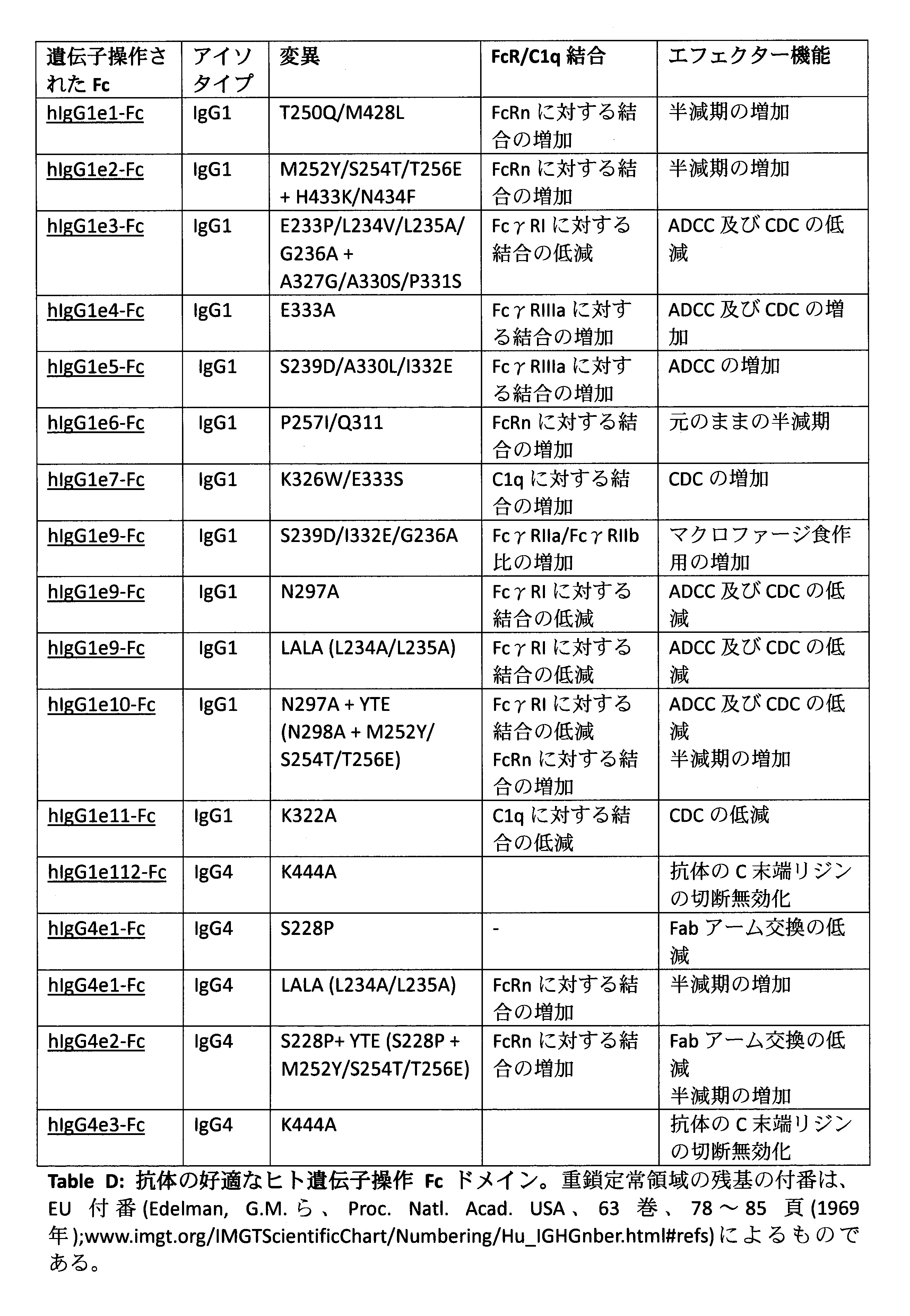
ある特定の実施形態では、本明細書で提供される抗体のFc領域にアミノ酸修飾を導入して、Fc領域バリアントを生成してもよい。ある特定の実施形態では、Fc領域バリアントは、全てではないが一部のエフェクター機能を有する。そのような抗体は、例えば、in vivoでの抗体の半減期は重要であるが、ある特定のエフェクター機能は不必要であるか又は有害である応用において有用であり得る。エフェクター機能の例としては、補体依存性細胞傷害(CDC)及び抗体介在性補体媒介性細胞傷害(ADCC)が挙げられる。エフェクター機能を変更する数多くの置換又は欠失が、当技術分野で公知である。 In certain embodiments, amino acid modifications may be introduced into the Fc region of an antibody provided herein to generate an Fc region variant. In certain embodiments, the Fc region variant retains some, but not all, effector functions. Such antibodies may be useful, for example, in applications where the half-life of the antibody in vivo is important, but certain effector functions are unnecessary or deleterious. Examples of effector functions include complement-dependent cytotoxicity (CDC) and antibody-mediated complement-mediated cytotoxicity (ADCC). Numerous substitutions or deletions that alter effector functions are known in the art.
一実施形態では、定常領域は、Fc受容体に対する親和性を低減するか又はFcエフェクター機能を低減する変異を含有する。例えば、定常領域は、IgG重鎖の定常領域内のグリコシル化部位を消失させる変異を含有してもよい。好ましくは、CH2ドメインは、CH2ドメイン内のグリコシル化部位を消失させる変異を含有する。 In one embodiment, the constant region contains a mutation that reduces affinity for an Fc receptor or reduces an Fc effector function. For example, the constant region may contain a mutation that eliminates a glycosylation site in the constant region of an IgG heavy chain. Preferably, the CH2 domain contains a mutation that eliminates a glycosylation site in the CH2 domain.
アミノ酸の変更は、Fc部分の結合に近く、非Fc部分は、Fc分子の血清半減期を劇的に増大することができる(PCT公開第01/58957号、その開示は、参照により本明細書に取り込まれる)。したがって、本発明のタンパク質又はポリペプチドの結合領域は、免疫グロブリン重鎖及びエリスロポエチンの天然で生じる配列と比べ、好ましくは、結合ポイントの約10個のアミノ酸以内にあるという変更を含有することができる。これらのアミノ酸変更は、疎水性の増大を引き起こすことができる。一実施形態では、定常領域は、C末端のリジン残基が置換されている、IgG配列に由来する。好ましくは、IgG配列のC末端のリジンを、アラニン又はロイシンのような非リジンアミノ酸で置換して、血清半減期を更に増大させる。 Amino acid changes close to the binding of the Fc portion and non-Fc portion can dramatically increase the serum half-life of the Fc molecule (PCT Publication No. 01/58957, the disclosure of which is incorporated herein by reference). Thus, the binding region of the protein or polypeptide of the invention can contain changes that are preferably within about 10 amino acids of the binding point compared to the naturally occurring sequences of immunoglobulin heavy chains and erythropoietin. These amino acid changes can cause increased hydrophobicity. In one embodiment, the constant region is derived from an IgG sequence in which the C-terminal lysine residue has been substituted. Preferably, the C-terminal lysine of the IgG sequence is substituted with a non-lysine amino acid such as alanine or leucine to further increase serum half-life.
ある特定の実施形態では、抗体を変更して、グリコシル化される程度まで、増大するか、減少するか、又は除去してもよい。 In certain embodiments, the antibody may be altered to increase, decrease, or eliminate the extent to which it is glycosylated.
一実施形態では、本発明による抗hPD1は、配列番号39若しくは52の重鎖定常ドメイン及び/又は配列番号40の軽鎖定常ドメイン、特に、配列番号39又は52の重鎖定常ドメイン及び配列番号40の軽鎖定常ドメインを有する。 In one embodiment, the anti-hPD1 according to the invention has a heavy chain constant domain of SEQ ID NO: 39 or 52 and/or a light chain constant domain of SEQ ID NO: 40, in particular a heavy chain constant domain of SEQ ID NO: 39 or 52 and a light chain constant domain of SEQ ID NO: 40.
別の実施形態では、本発明による抗hPD1は、配列番号52の重鎖定常ドメイン及び/又は配列番号40の軽鎖定常ドメイン、特に、配列番号52の重鎖定常ドメイン及び配列番号40の軽鎖定常ドメインを有する。 In another embodiment, the anti-hPD1 according to the invention has a heavy chain constant domain of SEQ ID NO: 52 and/or a light chain constant domain of SEQ ID NO: 40, in particular a heavy chain constant domain of SEQ ID NO: 52 and a light chain constant domain of SEQ ID NO: 40.
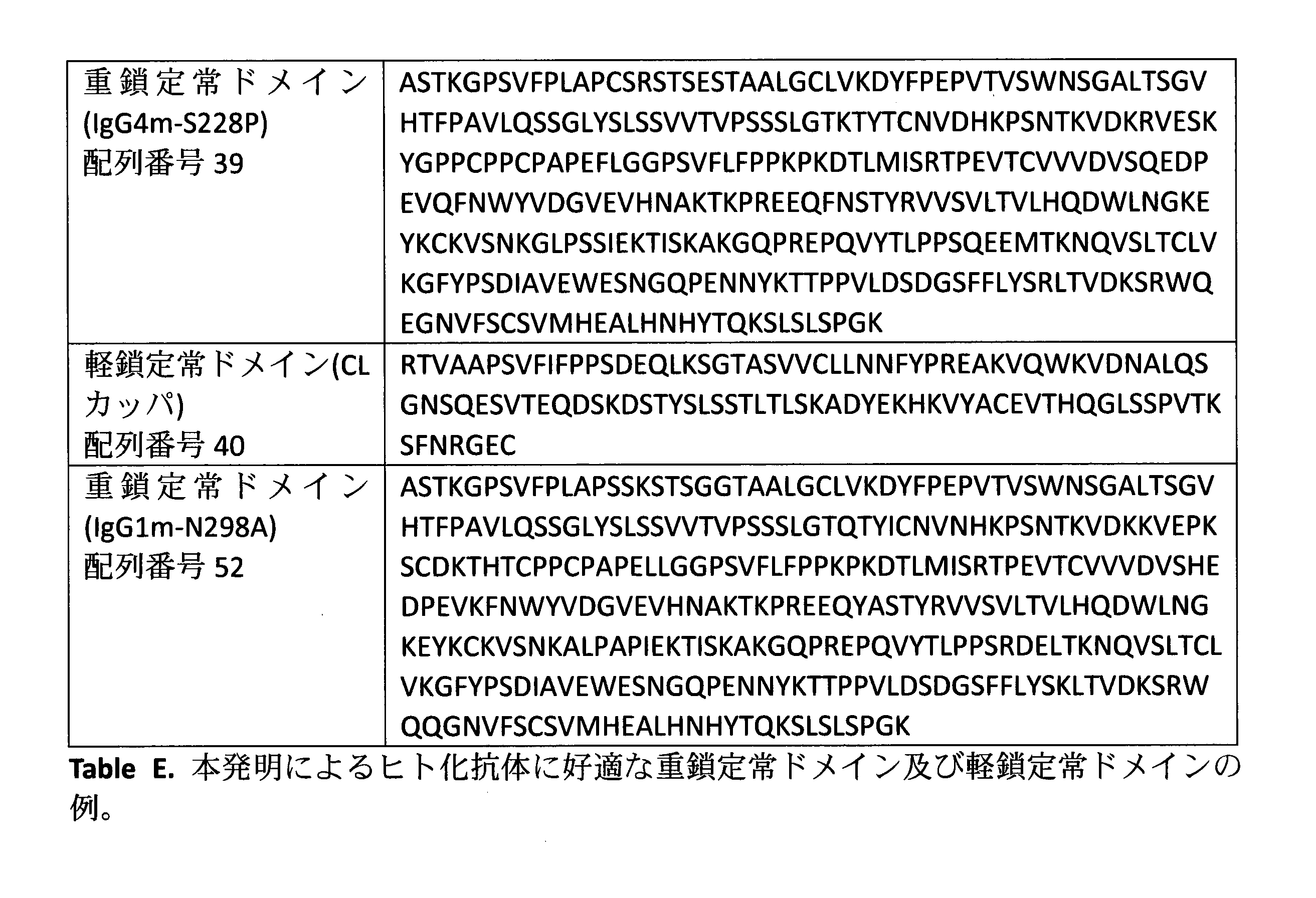
ヒトIgGの全てのサブクラスは、循環中で切断される抗体重鎖のC末端リジン残基(K444)を有する。血中でのこの切断は、SIRPaを放出することにより二機能性分子の生物活性を損なう可能性がある。この問題を回避するため、IgG1ドメイン又はIgG4ドメインのK444アミノ酸をアラニンで置換して、タンパク質分解切断を低減することができる。この変異は、抗体に広く使用される変異である。したがって、一実施形態では、抗PD1抗体は、K444Aからなる少なくとも1つの更なるアミノ酸置換を含む。 All subclasses of human IgG have a C-terminal lysine residue (K444) in the antibody heavy chain that is cleaved in the circulation. This cleavage in the blood can impair the biological activity of the bifunctional molecule by releasing SIRPa. To circumvent this problem, the K444 amino acid in the IgG1 or IgG4 domain can be substituted with alanine to reduce proteolytic cleavage. This mutation is a widely used mutation in antibodies. Thus, in one embodiment, the anti-PD1 antibody comprises at least one further amino acid substitution consisting of K444A.
一実施形態では、抗PD1抗体は、追加のジスルフィド結合を生成し、二機能性分子の可撓性を潜在的に制限するために、IgGのC末端ドメインに追加のシステイン残基を含む。 In one embodiment, the anti-PD1 antibody contains an additional cysteine residue in the C-terminal domain of IgG to generate an additional disulfide bond and potentially limit the flexibility of the bifunctional molecule.
ペプチドリンカー
本発明は、抗PD-1抗体又はその断片とSIRPaとの間にペプチドリンカーを含んでいてもよい二機能性分子を含む。ペプチドリンカーは、通常、その間がリンカーで接続されている2つのタンパク質要素が、それらの機能を発揮するのに、並びにα-ヘリックス及びβ-フォールドの形成が組換え二機能性分子の安定性に対して及ぼす影響を回避するのに十分な空間的自由度を有することを保証するのに十分な長さ及び可撓性を有する。
Peptide Linkers The present invention includes bifunctional molecules that may include a peptide linker between the anti-PD-1 antibody or fragment thereof and SIRPa. The peptide linker is usually of sufficient length and flexibility to ensure that the two protein elements between which it is connected have sufficient spatial freedom to perform their functions and to avoid the effects of α-helix and β-fold formation on the stability of the recombinant bifunctional molecule.
本開示の態様では、抗hPD1抗体は、好ましくは、ペプチドリンカーによりSIRPaに連結されている。言い換えれば、本発明は、鎖、例えば軽鎖又は重鎖又はそれらの断片、好ましくは重鎖又はその断片を有し、ペプチドリンカーを介してSIRPaに連結されている、本明細書に詳述されている通りの抗PD1抗体又はその抗原結合性断片を含む二機能性分子に関する。本明細書で使用される場合、「リンカー」という用語は、SIRPa及び抗PD-1免疫グロブリン配列部分を連結する少なくとも1つのアミノ酸の配列を指す。そのようなリンカーは、立体障害の防止に有用であり得る。リンカーは、通常、長さが3~44個のアミノ酸残基である。好ましくは、リンカーは、3~30個のアミノ酸残基を有する。一部の実施形態では、リンカーは、3、4、5、6、7、8、9、10、11、12、13、14、15、16、17、18、19、20、21、22、23、24、25、26、27、28、29、又は30個のアミノ酸残基を有する。 In an embodiment of the present disclosure, the anti-hPD1 antibody is preferably linked to SIRPa by a peptide linker. In other words, the present invention relates to a bifunctional molecule comprising an anti-PD1 antibody or an antigen-binding fragment thereof as detailed herein, having a chain, e.g., a light chain or a heavy chain or a fragment thereof, preferably a heavy chain or a fragment thereof, linked to SIRPa via a peptide linker. As used herein, the term "linker" refers to a sequence of at least one amino acid linking the SIRPa and the anti-PD-1 immunoglobulin sequence portion. Such a linker may be useful for preventing steric hindrance. The linker is usually 3-44 amino acid residues in length. Preferably, the linker has 3-30 amino acid residues. In some embodiments, the linker has 3, 4, 5, 6, 7, 8, 9, 10, 11, 12, 13, 14, 15, 16, 17, 18, 19, 20, 21, 22, 23, 24, 25, 26, 27, 28, 29, or 30 amino acid residues.
実施形態では、本発明は、上記で規定の通りの抗PD-1抗体又はその抗原結合性断片及びSIRPaを含む二機能性分子であって、抗体の鎖、例えば軽鎖又は重鎖、好ましくは重鎖、更により好ましくは重鎖又は軽鎖のC末端は、ペプチドリンカーにより、SIRPa、好ましくはSIRPaのN末端に連結されている、二機能性分子に関する。 In an embodiment, the present invention relates to a bifunctional molecule comprising an anti-PD-1 antibody or an antigen-binding fragment thereof as defined above and SIRPa, wherein a chain of the antibody, e.g. a light chain or a heavy chain, preferably a heavy chain, and even more preferably the C-terminus of the heavy chain or the light chain, is linked by a peptide linker to the SIRPa, preferably the N-terminus of SIRPa.
特定の態様では、本発明は、上記で規定の通りの抗hPD-1抗体又はその抗原結合性断片を含む二機能性分子であって、SIRPaは、好ましくはペプチドリンカーにより、上記抗体の重鎖のC末端(例えば、重鎖定常ドメインのC末端)に連結されている、二機能性分子に関する。 In a particular aspect, the present invention relates to a bifunctional molecule comprising an anti-hPD-1 antibody or an antigen-binding fragment thereof as defined above, wherein SIRPa is linked to the C-terminus of the heavy chain of said antibody (e.g. the C-terminus of the heavy chain constant domain), preferably by a peptide linker.
実施形態では、本発明は、上記で規定の通りの抗PD-1抗体又はその抗原結合性断片を含む二機能性分子であって、SIRPaは、好ましくはペプチドリンカーにより、上記抗体の軽鎖のC末端(例えば、軽鎖定常ドメインのC末端)に連結されている、二機能性分子に関する。 In an embodiment, the present invention relates to a bifunctional molecule comprising an anti-PD-1 antibody or an antigen-binding fragment thereof as defined above, wherein SIRPa is linked to the C-terminus of the light chain of said antibody (e.g. the C-terminus of the light chain constant domain), preferably by a peptide linker.
リンカー配列は、天然に存在する配列であってもよく又は天然に存在しない配列であってもよい。療法目的で使用される場合、リンカーは、好ましくは、二機能性分子が投与される対象において非免疫原性である。リンカー配列の1つの有用な群は、国際公開第96/34103号及び国際公開第94/04678号に記載の通りの、重鎖抗体のヒンジ領域に由来するリンカーである。他の例は、ポリアラニンリンカー配列である。リンカー配列の更に好ましい例は、(Gly4Ser)4、(Gly4Ser)3、(Gly4Ser)2、Gly4Ser、Gly3Ser、Gly3、Gly2ser、及び(Gly3Ser2)3、特に(Gly4Ser)3を含む、様々な長さのGly/Serリンカーである。 The linker sequence may be a naturally occurring or non-naturally occurring sequence. When used for therapeutic purposes, the linker is preferably non-immunogenic in the subject to which the bifunctional molecule is administered. One useful group of linker sequences are linkers derived from the hinge region of heavy chain antibodies, as described in WO 96/34103 and WO 94/04678. Another example is a polyalanine linker sequence. Further preferred examples of linker sequences are Gly/Ser linkers of various lengths, including (Gly4Ser) 4 , (Gly4Ser) 3 , (Gly4Ser) 2 , Gly4Ser, Gly3Ser, Gly3, Gly2ser, and (Gly3Ser2) 3 , especially (Gly4Ser) 3 .
一実施形態では、二機能性分子に含まれるリンカーは、(Gly4Ser)4、(Gly4Ser)3、(Gly4Ser)2、Gly4Ser、Gly3Ser、Gly3、Gly2ser、及び(Gly3Ser2)3からなる群において選択され、好ましくは、(Gly4Ser)3である。 In one embodiment, the linker comprised in the bifunctional molecule is selected from the group consisting of (Gly4Ser) 4 , (Gly4Ser) 3 , (Gly4Ser) 2 , Gly4Ser, Gly3Ser, Gly3, Gly2ser, and (Gly3Ser2) 3 , preferably (Gly4Ser) 3 .
実施形態では、本発明は、上記で規定の通りの抗PD-1抗体又はその断片を含む二機能性分子であって、抗体又はその断片は、好ましくは、(GGGGS)3、(GGGGS)4、(GGGGS)2、GGGGS、GGGS、GGG、GGS、及び(GGGS)3からなる群から選択されるリンカー配列により、更により好ましくは(GGGGS)3によりSIRPaに連結されている、二機能性分子に関する。 In an embodiment, the invention relates to a bifunctional molecule comprising an anti-PD-1 antibody or a fragment thereof as defined above, wherein the antibody or fragment thereof is linked to SIRPa by a linker sequence preferably selected from the group consisting of (GGGGS) 3 , (GGGGS) 4 , (GGGGS) 2 , GGGGS, GGGS, GGG, GGS, and (GGGS) 3 , and even more preferably by (GGGGS) 3 .
好ましくは、重鎖、好ましくは、抗PD-1抗体の重鎖のC末端は、可撓性(Gly4Ser)3リンカーを介してSIRPaのN末端と遺伝子的に融合されている。融合接合部では、抗体重鎖のC末端リジン残基をアラニンに変異させて、タンパク質分解切断を低減することができる。 Preferably, the C-terminus of the heavy chain, preferably the heavy chain of an anti-PD-1 antibody, is genetically fused to the N-terminus of SIRPa via a flexible (Gly4Ser) 3 linker. At the fusion junction, the C-terminal lysine residue of the antibody heavy chain can be mutated to alanine to reduce proteolytic cleavage.
好ましくは、抗PD-1抗体の重鎖、好ましくは軽鎖のC末端は、可撓性(Gly4Ser)3リンカーを介してSIRPaのN末端に遺伝子的に融合されている。融合接合部では、抗体軽鎖のC末端リジン残基をアラニンに変異させて、タンパク質分解切断を低減することができる。 Preferably, the C-terminus of the heavy chain, preferably the light chain, of the anti-PD-1 antibody is genetically fused to the N-terminus of SIRPa via a flexible (Gly4Ser) 3 linker. At the fusion junction, the C-terminal lysine residue of the antibody light chain can be mutated to alanine to reduce proteolytic cleavage.
SIRPa分子
本発明による二機能性分子は、SIRPa分子、その断片又はバリアントを含む追加又は第2の実体を含む。
SIRPa Molecules Bifunctional molecules according to the present invention comprise an additional or second entity which comprises a SIRPa molecule, a fragment or a variant thereof.
好ましくは、SIRPaタンパク質は、好ましくは、ヒトSIRPa又はその断片及びバリアントである。一実施形態では、二機能性分子は、約504個のアミノ酸の典型的な野生型SIRPaヒトタンパク質、好ましくは、野生型ヒトSIRPaタンパク質の細胞外ドメイン(例えば、野生型ヒトSIRPaの位置31~373のアミノ酸からなる)を含み、任意選択で、追加のN末端のメチオニン残基を有する(配列番号51)。好ましくは、SIRPaタンパク質は、配列番号51のタンパク質である。SIRPaは、好ましくは、その膜貫通ドメイン及び/又は細胞質ドメインを欠く。好ましくは、SIRPaタンパク質は、その細胞外ドメインからなり、さらにより好ましくは、野生型ヒトSIRPaの31~373個のアミノ酸から本質的になる。 Preferably, the SIRPa protein is preferably human SIRPa or fragments and variants thereof. In one embodiment, the bifunctional molecule comprises a typical wild-type SIRPa human protein of about 504 amino acids, preferably an extracellular domain of the wild-type human SIRPa protein (e.g. consisting of amino acids 31-373 of wild-type human SIRPa), optionally with an additional N-terminal methionine residue (SEQ ID NO: 51). Preferably, the SIRPa protein is the protein of SEQ ID NO: 51. SIRPa preferably lacks its transmembrane and/or cytoplasmic domains. Preferably, the SIRPa protein consists of its extracellular domain, and even more preferably consists essentially of amino acids 31-373 of wild-type human SIRPa.
SIRPaタンパク質の「バリアント」は、1つ又は複数のアミノ酸が変更されているアミノ酸配列であると定義される。バリアントは、「保存的」修飾又は「非保存的」修飾を有していてもよい。そのような修飾としては、アミノ酸の置換、欠失、及び/又は挿入を挙げることができる。生物学的特性(例えば、活性、結合能力、及び/又は構造)を損なうことなく、どの及び幾つのアミノ酸残基を置換、挿入、又は欠失させることができるかを決定する際の指針は、当技術分野で周知のコンピュータープログラム、例えば、分子モデリング用の又はアライメント作成用のソフトウエアを使用して見出すことができる。本発明内に含まれるバリアント型SIRPaタンパク質は、特に、野生型SIRPaと比較して実質的に等価な生物学的特性を保持するSIRPaタンパク質を含む。また、SIRPaのバリアントは、SIRPaの変更されたポリペプチド配列(例えば、酸化形態、還元形態、脱アミノ形態、又は短縮形態)を含む。特に、完全長SIRPaタンパク質と同等の生物学的特性を保持するSIRPaの短縮型又は断片は、本発明の範囲内に含まれる。一実施形態では、SIRPaは、その任意の生物学的活性断片である。SIRPaのバリアントとしては、より好ましくは、SNP、スプライシングバリアント等を含む、天然の遺伝子多型に起因する天然の対立遺伝子バリアントが挙げられる。 A "variant" of a SIRPa protein is defined as an amino acid sequence in which one or more amino acids have been altered. A variant may have a "conservative" or "non-conservative" modification. Such modifications may include amino acid substitutions, deletions, and/or insertions. Guidance for determining which and how many amino acid residues can be substituted, inserted, or deleted without impairing the biological properties (e.g., activity, binding ability, and/or structure) can be found using computer programs known in the art, such as software for molecular modeling or for generating alignments. Variant SIRPa proteins included within the present invention include, in particular, SIRPa proteins that retain substantially equivalent biological properties compared to wild-type SIRPa. Variants of SIRPa also include altered polypeptide sequences of SIRPa (e.g., oxidized, reduced, deaminated, or truncated forms). In particular, truncated forms or fragments of SIRPa that retain biological properties equivalent to the full-length SIRPa protein are included within the scope of the present invention. In one embodiment, SIRPa is any biologically active fragment thereof. More preferably, SIRPa variants include natural allelic variants resulting from natural genetic polymorphisms, including SNPs, splicing variants, etc.
大部分の一般的なヒトSIRPaバリアントは、SIRPa v1及びSIRPa v2(受託番号NP_542970(P78324)及びCAA71403)である。SIRPaファミリーは、これらの2つのサブセット;すなわち、SIRPa v1アイソフォームファミリー及びSIRPa v2アイソフォームファミリーに分けられ得る。これらのファミリーは、それぞれ、SIRPaアイソフォーム2(識別子:P78324-2)及びSIRPaアイソフォーム4(識別子:P78324-4)を含む。一実施形態では、SIRPaバリアントは、SIRPaアイソフォーム2(P78324-2)及びSIRPaアイソフォーム4(P78324-4)からなる群から選択される。 The most common human SIRPa variants are SIRPa v1 and SIRPa v2 (accession numbers NP_542970 (P78324) and CAA71403). The SIRPa family can be divided into two subsets of these; the SIRPa v1 isoform family and the SIRPa v2 isoform family. These families include SIRPa isoform 2 (identifier: P78324-2) and SIRPa isoform 4 (identifier: P78324-4), respectively. In one embodiment, the SIRPa variant is selected from the group consisting of SIRPa isoform 2 (P78324-2) and SIRPa isoform 4 (P78324-4).
バリアントSIRPaタンパク質はまた、野生型SIRPaと少なくとも約55%、60%、65%、70%、75%、80%、85%、90%、92%、95%、96%、97%、98%、99%、又はそれ以上の配列同一性を有するポリペプチドを含む。 Variant SIRPa proteins also include polypeptides having at least about 55%, 60%, 65%, 70%, 75%, 80%, 85%, 90%, 92%, 95%, 96%, 97%, 98%, 99% or more sequence identity to wild-type SIRPa.
一実施形態では、SIRPアルファのバリアントは、野生型SIRPaに対して典型的には55%の配列同一性を示す、SIRPガンマである。本明細書において使用される、用語「SIRPガンマ」、「SIRPg」及び「SIRPγ」は、互換的に使用される。例えば、ヒトSIRPgアミノ酸配列は、UniProtKB - Q9P1W8に記載される。 In one embodiment, the variant of SIRP alpha is SIRP gamma, which typically exhibits 55% sequence identity to wild-type SIRPa. As used herein, the terms "SIRP gamma," "SIRPg," and "SIRPγ" are used interchangeably. For example, the human SIRPg amino acid sequence is described in UniProtKB - Q9P1W8.
SIRPγは、類似の細胞外構造を有するが、対照的なタイプのシグナルを生じる異なる細胞質領域を有する。実際、SIRPアルファ及びSIRPガンマは、3つのIg様細胞外ドメイン: アミノ酸32~137(ドメインD1)によりコードされる、Ig様V型、位置148~247(ドメインD2)でのアミノ酸によりコードされる、Ig様C1型1、位置254~348(ドメインD3)でのアミノ酸によりコードされる、Ig様C1型2を含む。
SIRPγ has a similar extracellular structure but different cytoplasmic regions that produce contrasting types of signals. Indeed, SIRPα and SIRPγ contain three Ig-like extracellular domains: Ig-like type V, encoded by amino acids 32-137 (domain D1), Ig-like
次に、一実施形態では、SIRPaバリアントは、i)SIRPgのD1ドメイン、SIRPaのD2及びD3ドメイン、ii)SIRPgのD1及びD2ドメイン並びにSIRPaのD3ドメイン、iii)SIRPgのD1ドメイン、SIRPaのD2ドメイン及びSIRPgのD3ドメイン、iv)SIRPaのD1ドメイン、SIRPgのD2及びD3ドメイン、v)SIRPaのD1及びD2ドメイン並びにSIRPgのD3ドメイン又はvi)SIRPaのD1ドメイン、SIRPgのD2ドメイン及びSIRPaのD3ドメインを含む。 Next, in one embodiment, the SIRPa variant comprises i) the D1 domain of SIRPg, the D2 and D3 domains of SIRPa, ii) the D1 and D2 domains of SIRPg and the D3 domain of SIRPa, iii) the D1 domain of SIRPg, the D2 domain of SIRPa and the D3 domain of SIRPg, iv) the D1 domain of SIRPa, the D2 and D3 domains of SIRPg, v) the D1 and D2 domains of SIRPa and the D3 domain of SIRPg, or vi) the D1 domain of SIRPa, the D2 domain of SIRPg and the D3 domain of SIRPa.
本発明による好ましいSIRPaは、配列番号51、米国公開第20160319256号、国際公開第2013109752号又は国際公開第2016024021号に記載されるアミノ酸配列、並びにその天然のバリアント及びホモログを含むか、又はからなるヒトSIRPaポリペプチドである。 A preferred SIRPa according to the present invention is a human SIRPa polypeptide comprising or consisting of SEQ ID NO:51, the amino acid sequence set forth in U.S. Publication No. 20160319256, WO Publication No. 2013109752 or WO Publication No. 2016024021, and natural variants and homologs thereof.
一部の実施形態では、SIRP-αバリアント構築物は、疾患部位(例えば、非疾患部位より、腫瘍部位で)優先的な活性を有する。一部の実施形態では、SIRP-αバリアントは、ヒスチジン残基又は疾患部位でのSIRP-αバリアント構築物の選択的結合を可能にする他のアミノ酸でのアミノ酸の1個又は複数の置換を含有する。 In some embodiments, the SIRP-α variant construct has preferential activity at a disease site (e.g., at a tumor site over a non-diseased site). In some embodiments, the SIRP-α variant contains one or more substitutions of amino acids with histidine residues or other amino acids that allow for selective binding of the SIRP-α variant construct at the disease site.
特定の実施形態では、SIRPaは、SIRPaの細胞外ドメインの切断又は断片からなる、具体的には、CD47と相互作用する接触残基のセット内のアミノ酸の結合領域を含むか、又はからなる。 In certain embodiments, SIRPa consists of a truncation or fragment of the extracellular domain of SIRPa, specifically comprising or consisting of a binding region of amino acids within the set of contact residues that interact with CD47.
一実施形態では、SIRPaタンパク質の親和性は、in vitroアッセイを使用し、測定することができる。好ましくは、本発明によるSIRPaバリアントは、野生型ヒトSIRPaと比較して、少なくとも10%、20%、30%、40%、50%、60%のCD47への親和性、好ましくは、野生型SIRPaと比較して、少なくとも80%、90%、95%、さらにより好ましくは、99%のCD47への親和性を維持する。 In one embodiment, the affinity of the SIRPa protein can be measured using an in vitro assay. Preferably, the SIRPa variant according to the invention maintains at least 10%, 20%, 30%, 40%, 50%, 60% affinity to CD47 compared to wild-type human SIRPa, preferably at least 80%, 90%, 95%, and even more preferably 99% affinity to CD47 compared to wild-type SIRPa.
本発明はまた、例えば、国際公開第2013109752号に記載される野生型SIRPaタンパク質と比較して、CD47に対する増強された親和性を有するSIRPaタンパク質を含む二機能性分子を提供する。ある特定の実施形態では、SIRP-αバリアント構築物は、疾患細胞(例えば、腫瘍細胞)上のCD47に対してより高い結合親和性を有する。一部の実施形態では、SIRP-αバリアントは、酸性pH(例えば、約pH7未満)下及び/又は例えば、米国公開第20160319256号において記載される、生理的条件下より低酸素条件下で、CD47に対してより高い親和性で結合する。 The present invention also provides bifunctional molecules comprising SIRPa proteins having enhanced affinity for CD47, as compared to wild-type SIRPa proteins, e.g., as described in WO2013109752. In certain embodiments, the SIRP-α variant constructs have a higher binding affinity for CD47 on diseased cells (e.g., tumor cells). In some embodiments, the SIRP-α variants bind with higher affinity to CD47 under acidic pH (e.g., below about pH 7) and/or under hypoxic conditions than physiological conditions, e.g., as described in U.S. Publication No. 20160319256.
一態様では、本発明に使用されるSIRPaポリペプチドは、組換えSIRPaである。「組換え」という用語は、本明細書で使用される場合、ポリペプチドが、組換え発現系から、つまり宿主細胞(例えば、微生物又は昆虫又は植物又は哺乳動物)の培養から、又はSIRPaポリペプチドをコードする核酸分子を含有するように遺伝子操作されているトランスジェニック植物又は動物から得られるか又は由来することを意味する。好ましくは、組換えSIRPaは、ヒト組換えSIRPa(例えば、組換え発現系で産生されるヒトSIRPa)である。 In one aspect, the SIRPa polypeptide used in the present invention is a recombinant SIRPa. The term "recombinant" as used herein means that the polypeptide is obtained or derived from a recombinant expression system, i.e. from a culture of a host cell (e.g., a microorganism or insect or plant or mammal), or from a transgenic plant or animal that has been genetically engineered to contain a nucleic acid molecule encoding a SIRPa polypeptide. Preferably, the recombinant SIRPa is human recombinant SIRPa (e.g., human SIRPa produced in a recombinant expression system).
二機能性分子又は「Bicki」
本発明は、特に、本明細書の上記に開示の通りの、抗hPD1抗体又はその抗体断片及びSIRPaを含むか又はからなる二機能性分子を提供し、抗hPD1抗体又はその抗体断片は、好ましくは本明細書の上記に開示の通りのペプチドリンカーにより、特に融合タンパク質として、SIRPaに共有結合で連結されている。
Bifunctional molecules or "Bicki"
The present invention particularly provides a bifunctional molecule comprising or consisting of an anti-hPD1 antibody or antibody fragment thereof and SIRPa, as disclosed herein above, wherein the anti-hPD1 antibody or antibody fragment thereof is covalently linked to SIRPa, preferably by a peptide linker as disclosed herein above, in particular as a fusion protein.
特に、本発明による二機能性分子は、2つの実体:抗hPD1抗体又はその断片を含むか、又は本質的にからなる第1の実体;SIRPa、好ましくは、ヒトSIRPa、なおより好ましくは、ヒトSIRPaアイソフォーム1の細胞外ドメインを含むか、又は本質的にからなる第2の実体を含み、これら2つの実体は、任意選択で、ペプチドリンカーにより結合される。
In particular, the bifunctional molecule according to the invention comprises two entities: a first entity comprising or essentially consisting of an anti-hPD1 antibody or a fragment thereof; a second entity comprising or essentially consisting of the extracellular domain of SIRPa, preferably human SIRPa, even more preferably
特に、本発明による二機能性分子は、1つ、2つ、3つ、又は4つのSIRPa分子を含む。特に、二機能性分子は、抗PD-1抗体の軽鎖又は重鎖の1つのみに連結された1分子のみのSIRPaを含んでいてもよい。また、二機能性分子は、抗PD-1抗体の軽鎖又は重鎖のいずれかに連結された2つのSIRPa分子を含んでいてもよい。また、二機能性分子は、2つのSIRPa分子を含んでいてもよく、第1の分子は抗PD-1抗体の軽鎖に連結されており、第2の分子は抗PD-1抗体の重鎖に連結されている。また、二機能性分子は、3つのSIRPa分子を含んでいてもよく、それらの2つは、抗PD-1抗体の軽鎖又は重鎖のいずれかに連結されており、最後の1つは、抗PD-1抗体の他の鎖に連結されている。また、最後に、二機能性分子は、4つのSIRPa分子を含んでいてもよく、2つの分子は抗PD-1抗体の軽鎖に連結されており、2つの分子は抗PD-1抗体の重鎖に連結されている。したがって、二機能性分子は、本明細書に開示の通り、1~4つの免疫療法剤分子を含む。 In particular, the bifunctional molecule according to the invention comprises one, two, three or four SIRPa molecules. In particular, the bifunctional molecule may comprise only one SIRPa molecule linked to only one of the light or heavy chains of the anti-PD-1 antibody. The bifunctional molecule may also comprise two SIRPa molecules linked to either the light or heavy chain of the anti-PD-1 antibody. The bifunctional molecule may also comprise two SIRPa molecules, the first of which is linked to the light chain of the anti-PD-1 antibody and the second of which is linked to the heavy chain of the anti-PD-1 antibody. The bifunctional molecule may also comprise three SIRPa molecules, two of which are linked to either the light or heavy chain of the anti-PD-1 antibody and the last one is linked to the other chain of the anti-PD-1 antibody. And finally, the bifunctional molecule may contain four SIRPa molecules, two linked to the light chain of an anti-PD-1 antibody and two linked to the heavy chain of an anti-PD-1 antibody. Thus, the bifunctional molecule contains from one to four immunotherapeutic agent molecules as disclosed herein.
一実施形態では、軽鎖の1つのみが1つのSIRPa分子を含むか(例えば、二機能性分子は1つのSIRPa分子を含む)、重鎖の1つのみが1つのSIRPa分子を含むか(例えば、二機能性分子は1つのSIRPa分子を含む)、各軽鎖が1つのSIRPa分子を含むか(例えば、二機能性分子は2つのSIRPa分子を含む)、各重鎖が1つのSIRPa分子を含むか(例えば、二機能性分子は2つのSIRPa分子を含む)、軽鎖の1つのみ及び重鎖の1つのみが1つの免疫療法剤分子を含むか(例えば、二機能性分子は2つのSIRPa分子を含む)、各軽鎖が1つのSIRPa分子を含み、重鎖の1つのみが1つのSIRPa分子を含むか(例えば、二機能性分子は3つのSIRPa分子を含む)、各重鎖が1つのSIRPa分子を含み、軽鎖の1つのみが1つのSIRPa分子を含むか(例えば、二機能性分子は3つのSIRPa分子を含む)、又は軽鎖及び重鎖が両方とも1つのSIRPa分子を含む(例えば、二機能性分子は4つのSIRPa分子を含む)。 In one embodiment, only one of the light chains contains one SIRPa molecule (e.g., a bifunctional molecule contains one SIRPa molecule), only one of the heavy chains contains one SIRPa molecule (e.g., a bifunctional molecule contains one SIRPa molecule), each light chain contains one SIRPa molecule (e.g., a bifunctional molecule contains two SIRPa molecules), each heavy chain contains one SIRPa molecule (e.g., a bifunctional molecule contains two SIRPa molecules), or only one of the light chains and only one of the heavy chains are associated with one immunotherapy. Each light chain may contain one SIRPa molecule and only one of the heavy chains contains one SIRPa molecule (e.g., a bifunctional molecule contains two SIRPa molecules), each light chain may contain one SIRPa molecule and only one of the heavy chains contains one SIRPa molecule (e.g., a bifunctional molecule contains three SIRPa molecules), each heavy chain may contain one SIRPa molecule and only one of the light chains contains one SIRPa molecule (e.g., a bifunctional molecule contains three SIRPa molecules), or both the light and heavy chains contain one SIRPa molecule (e.g., a bifunctional molecule contains four SIRPa molecules).
一実施形態では、本発明による二機能性分子は、
(a)(i)重鎖、及び(ii)軽鎖を含む抗ヒトPD-1抗体又はその抗原結合性断片;並びに
(b)ヒトSIRPa又はその断片若しくはバリアント
を含むか、又はからなり、
抗体重鎖及び/若しくは軽鎖又はその断片は、SIRPaに融合タンパク質として、好ましくは、ペプチドリンカーにより、共有結合で連結される。
In one embodiment, a bifunctional molecule according to the invention comprises:
(a) an anti-human PD-1 antibody or antigen-binding fragment thereof comprising (i) a heavy chain, and (ii) a light chain; and
(b) comprising or consisting of human SIRPa or a fragment or variant thereof;
The antibody heavy and/or light chain or fragments thereof are covalently linked to SIRPa as a fusion protein, preferably by a peptide linker.
好ましくは、本発明による二機能性分子は、
(a)(i)重鎖及び(ii)軽鎖を含むヒト化抗ヒトPD-1抗体又はその抗原結合性断片、並びに
(b)ヒトSIRPa又はその断片若しくはバリアント
を含むか又はからなり、
抗体重鎖若しくは軽鎖又はそれらの断片は、ペプチドリンカーによりSIRPaに共有結合で連結されている。
Preferably, the bifunctional molecule according to the invention comprises:
(a) a humanized anti-human PD-1 antibody or an antigen-binding fragment thereof, comprising (i) a heavy chain and (ii) a light chain; and
(b) comprises or consists of human SIRPa or a fragment or variant thereof;
The antibody heavy or light chain, or a fragment thereof, is covalently linked to SIRPa by a peptide linker.
好ましくは、そのような二機能性分子は、SIRPaのN末端を、抗ヒトPD-1抗体の重鎖又は軽鎖又は両方のC末端に接続する少なくとも1つのペプチドリンカーを含み、ペプチドリンカーは、好ましくは、(GGGGS)3、(GGGGS)4、(GGGGS)2、GGGGS、GGGS、GGG、GGS、及び(GGGS)3からなる群から選択され、更により好ましくは(GGGGS)3である。 Preferably, such bifunctional molecules comprise at least one peptide linker connecting the N-terminus of SIRPa to the C-terminus of the heavy chain or light chain or both of the anti-human PD-1 antibody, the peptide linker preferably being selected from the group consisting of (GGGGS) 3 , (GGGGS) 4 , (GGGGS) 2 , GGGGS, GGGS, GGG, GGS, and (GGGS) 3 , and even more preferably being (GGGGS) 3 .
好ましくは、SIRPaのN末端は、少なくとも1つのペプチドリンカーを介して、抗ヒトPD-1抗体の重鎖又は軽鎖又は両方のC末端に接続されている。或いは、SIRPaのC末端は、少なくとも1つのペプチドリンカーを介して、抗ヒトPD-1抗体の重鎖又は軽鎖又は両方のN末端に接続されている。 Preferably, the N-terminus of SIRPa is connected to the C-terminus of the heavy chain or the light chain, or both, of the anti-human PD-1 antibody via at least one peptide linker. Alternatively, the C-terminus of SIRPa is connected to the N-terminus of the heavy chain or the light chain, or both, of the anti-human PD-1 antibody via at least one peptide linker.
一実施形態では、本発明による二機能性分子は、
(a)(i)重鎖及び(ii)軽鎖を含む抗ヒトPD-1抗体又はその抗原結合性断片、
(b)ヒトSIRPa又はその断片若しくはバリアント、並びに
(c)SIRPaのN末端を、抗ヒトPD-1抗体の重鎖又は軽鎖又は両方のC末端に接続するペプチドリンカーであって、好ましくは、(GGGGS)3、(GGGGS)4、(GGGGS)2、GGGGS、GGGS、GGG、GGS、及び(GGGS)3からなる群から選択され、更により好ましくは(GGGGS)3であるペプチドリンカー
を含むか又はからなる。
In one embodiment, a bifunctional molecule according to the invention comprises:
(a) an anti-human PD-1 antibody or an antigen-binding fragment thereof, comprising (i) a heavy chain and (ii) a light chain;
(b) human SIRPa or a fragment or variant thereof, and
(c) a peptide linker connecting the N-terminus of SIRPa to the C-terminus of the heavy chain or light chain or both of the anti-human PD-1 antibody, which preferably comprises or consists of a peptide linker selected from the group consisting of (GGGGS) 3 , (GGGGS) 4 , (GGGGS) 2 , GGGGS, GGGS, GGG, GGS, and (GGGS) 3 , and even more preferably (GGGGS) 3 .
より具体的には、抗ヒトPD-1又はその抗原結合性断片は、セクション「抗-PD-1」において以前に開示された任意の抗体であることができ、ヒトSIRPa、その断片又はバリアントは、セクション「SIRPa分子」において以前に開示された任意のSIPRaであることができる。 More specifically, the anti-human PD-1 or antigen-binding fragment thereof can be any antibody previously disclosed in the section "Anti-PD-1," and the human SIRPa, fragment thereof, or variant can be any SIRPa previously disclosed in the section "SIRPa molecules."
特定の実施形態では、本発明による二機能性分子は、
(a)
(i)HCDR1、HCDR2、及びHCDR3を含む重鎖可変ドメイン、並びに
(ii)LCDR1、LCDR2、及びLCDR3を含む軽鎖可変ドメイン
を含み、
- 重鎖CDR1(HCDR1)は、配列番号1のアミノ酸配列を含むか又はからなり、任意選択で、配列番号1の3位以外の任意の位置に、置換、付加、欠失、及びそれらの任意の組合せから選択される1つ、2つ、又は3つの修飾を有し、
- 重鎖CDR2(HCDR2)は、配列番号2のアミノ酸配列を含むか又はからなり、任意選択で、配列番号2の13、14、及び16位以外の任意の位置に、置換、付加、欠失、及びそれらの任意の組合せから選択される1つ、2つ、又は3つの修飾を有し、
- 重鎖CDR3(HCDR3)は、配列番号3のアミノ酸配列を含むか又はからなり、配列中、X1はD又はEのいずれかであり、X2は、T、H、A、Y、N、E、及びSからなる群から、好ましくは、H、A、Y、N、及びEからなる群において選択され、任意選択で、配列番号3の2、3、7、及び8位以外の任意の位置に、置換、付加、欠失、及びそれらの任意の組合せから選択される1つ、2つ、又は3つの修飾を有し、
- 軽鎖CDR1(LCDR1)は、配列番号12のアミノ酸配列を含むか又はからなり、配列中、XはG又はTであり、任意選択で、配列番号12の5、6、10、11、及び16位以外の任意の位置に、置換、付加、欠失、及びそれらの任意の組合せから選択される1つ、2つ、又は3つの修飾を有し、
- 軽鎖CDR2(LCDR2)は、配列番号15のアミノ酸配列を含むか又はからなり、任意選択で、置換、付加、欠失、及びそれらの任意の組合せから選択される1つ、2つ、又は3つの修飾を有し、
- 軽鎖CDR3(LCDR3)は、配列番号16のアミノ酸配列を含むか又はからなり、任意選択で、配列番号16の1,4、及び6位以外の任意の位置に、置換、付加、欠失、及びそれらの任意の組合せから選択される1つ、2つ、又は3つの修飾を有する、
抗ヒトPD-1抗体又はその抗原結合性断片;並びに
(b)配列番号51のヒトSIRPa又はその断片若しくはバリアント
を含むか又はからなり、
抗体重鎖及び/若しくは軽鎖又はそれらの断片は、融合タンパク質として、好ましくはペプチドリンカーによりSIRPaに共有結合で連結されている。
In certain embodiments, the bifunctional molecule according to the invention comprises:
(a)
(i) a heavy chain variable domain comprising HCDR1, HCDR2, and HCDR3; and
(ii) a light chain variable domain comprising LCDR1, LCDR2, and LCDR3;
- the heavy chain CDR1 (HCDR1) comprises or consists of the amino acid sequence of SEQ ID NO: 1, optionally with one, two or three modifications selected from substitutions, additions, deletions and any combination thereof at any position other than position 3 of SEQ ID NO: 1,
- the heavy chain CDR2 (HCDR2) comprises or consists of the amino acid sequence of SEQ ID NO: 2, optionally with one, two or three modifications selected from substitutions, additions, deletions and any combination thereof at any position other than positions 13, 14 and 16 of SEQ ID NO: 2,
- the heavy chain CDR3 (HCDR3) comprises or consists of the amino acid sequence of SEQ ID NO: 3, in which X1 is either D or E and X2 is selected from the group consisting of T, H, A, Y, N, E and S, preferably in the group consisting of H, A, Y, N and E, and optionally with one, two or three modifications selected from substitutions, additions, deletions and any combination thereof at any position other than
- the light chain CDR1 (LCDR1) comprises or consists of the amino acid sequence of SEQ ID NO: 12, in which X is G or T and, optionally, with one, two or three modifications selected from substitutions, additions, deletions, and any combination thereof at any position other than
- the light chain CDR2 (LCDR2) comprises or consists of the amino acid sequence of SEQ ID NO: 15, optionally with one, two or three modifications selected from substitutions, additions, deletions, and any combination thereof;
- the light chain CDR3 (LCDR3) comprises or consists of the amino acid sequence of SEQ ID NO: 16, optionally with one, two or three modifications selected from substitutions, additions, deletions and any combination thereof at any position other than
An anti-human PD-1 antibody or an antigen-binding fragment thereof; and
(b) comprising or consisting of human SIRPa of SEQ ID NO: 51 or a fragment or variant thereof;
The antibody heavy and/or light chains or fragments thereof are covalently linked to SIRPa as a fusion protein, preferably by a peptide linker.
好ましくは、ペプチドリンカーは、(GGGGS)3、(GGGGS)4、(GGGGS)2、GGGGS、GGGS、GGG、GGS、及び(GGGS)3からなる群から選択され、更により好ましくは(GGGGS)3である。 Preferably, the peptide linker is selected from the group consisting of (GGGGS) 3 , (GGGGS) 4 , (GGGGS) 2 , GGGGS, GGGS, GGG, GGS, and (GGGS) 3 , and even more preferably is (GGGGS) 3 .
別の実施形態では、本発明は、
(a)
(i)配列番号17のアミノ酸配列を含むか、又はからなる重鎖可変領域(VH)(X1は、D又はEであり、X2は、T、H、A、Y、N、E及びSからなる群から選択され、好ましくは、H、A、Y、N、Eからなる群において選択され、任意選択で、配列番号17の7、16、17、20、33、38、43、46、62、63、65、69、73、76、78、80、84、85、88、93、95、96、97、98、100、101、105、106及び112位以外の任意の位置に、置換、付加、欠失及びその任意の組合せから選択される1、2又は3個の修飾を有する);
(ii)配列番号26のアミノ酸配列を含むか、又はからなる軽鎖可変領域(VL)(Xは、G又はTであり、任意選択で、配列番号26の3、4、7、14、17、18、28、29、33、34、39、42、44、50、81、88、94、97、99及び105位以外の任意の位置に、置換、付加、欠失及びその任意の組合せから選択される1、2又は3個の修飾を有する)
を含むヒト化抗hPD1抗体、及び
(b)配列番号51のヒトSIRPa又はそのバリアント、
(c) 抗hPD1抗体の軽鎖及び/又は重鎖とヒトSIRPa又はそのバリアントの間の、(GGGGS)3、(GGGGS)4、(GGGGS)2、GGGGS、GGGS、GGG、GGS及び(GGGS)3からなる群から選択されるペプチドリンカー、なおより好ましくは、(GGGGS)3であるペプチドリンカー
を含むか、又はからなる二機能性分子に関する。
In another embodiment, the present invention provides
(a)
(i) a heavy chain variable region (VH) comprising or consisting of the amino acid sequence of SEQ ID NO: 17, wherein X1 is D or E and X2 is selected from the group consisting of T, H, A, Y, N, E and S, preferably selected in the group consisting of H, A, Y, N, E, and optionally having one, two or three modifications selected from substitutions, additions, deletions and any combination thereof at any position other than
(ii) a light chain variable region (VL) comprising or consisting of the amino acid sequence of SEQ ID NO: 26, wherein X is G or T, and optionally has one, two or three modifications selected from substitutions, additions, deletions, and any combination thereof at any position other than positions 3, 4, 7, 14, 17, 18, 28, 29, 33, 34, 39, 42, 44, 50, 81, 88, 94, 97, 99, and 105 of SEQ ID NO: 26.
A humanized anti-hPD1 antibody comprising
(b) human SIRPa of SEQ ID NO: 51 or a variant thereof;
(c) A bifunctional molecule comprising or consisting of a peptide linker selected from the group consisting of (GGGGS) 3 , (GGGGS) 4 , (GGGGS) 2 , GGGGS, GGGS, GGG, GGS and (GGGS) 3 , even more preferably (GGGGS) 3 , between the light chain and/or the heavy chain of the anti-hPD1 antibody and human SIRPa or a variant thereof.
好ましくは、SIRPaのN末端は、少なくとも1つのペプチドリンカーを介して、抗ヒトPD-1抗体の重鎖若しくは軽鎖、又は両方のC末端に結合される。或いは、SIRPaのC末端は、少なくとも1つのペプチドリンカーを介して、抗ヒトPD-1抗体の重鎖若しくは軽鎖、又は両方のN末端に結合される。 Preferably, the N-terminus of SIRPa is linked to the C-terminus of the heavy chain or the light chain, or both, of the anti-human PD-1 antibody via at least one peptide linker. Alternatively, the C-terminus of SIRPa is linked to the N-terminus of the heavy chain or the light chain, or both, of the anti-human PD-1 antibody via at least one peptide linker.
別の実施形態では、本発明は、
(a)
(i)配列番号17のアミノ酸配列を含むか、又はからなる重鎖可変領域(VH)(X1は、D又はEであり、X2は、T、H、A、Y、N、E及びSからなる群から選択され、好ましくは、H、A、Y、N、Eからなる群において選択され、任意選択で、配列番号17の7、16、17、20、33、38、43、46、62、63、65、69、73、76、78、80、84、85、88、93、95、96、97、98、100、101、105、106及び112位以外の任意の位置に、置換、付加、欠失及びその任意の組合せから選択される1、2又は3個の修飾を有する);
(ii)配列番号26のアミノ酸配列を含むか、又はからなる軽鎖可変領域(VL)(Xは、G又はTであり、任意選択で、配列番号26の3、4、7、14、17、18、28、29、33、34、39、42、44、50、81、88、94、97、99及び105位以外の任意の位置に、置換、付加、欠失及びその任意の組合せから選択される1、2又は3個の修飾を有する)
を含むヒト化抗hPD1抗体、及び
(b)配列番号51のヒトSIRPa又はそのバリアント、
(抗体又はその抗原結合性断片の重鎖及び/又は軽鎖のC末端は、好ましくは、(GGGGS)3ペプチドリンカーにより、SIRPaのN末端に共有結合で連結されて、融合タンパク質を形成する)
を含むか、又はからなる二機能性分子に関する。
In another embodiment, the present invention provides
(a)
(i) a heavy chain variable region (VH) comprising or consisting of the amino acid sequence of SEQ ID NO: 17, wherein X1 is D or E and X2 is selected from the group consisting of T, H, A, Y, N, E and S, preferably selected in the group consisting of H, A, Y, N, E, and optionally having one, two or three modifications selected from substitutions, additions, deletions and any combination thereof at any position other than
(ii) a light chain variable region (VL) comprising or consisting of the amino acid sequence of SEQ ID NO: 26, wherein X is G or T, and optionally has one, two or three modifications selected from substitutions, additions, deletions, and any combination thereof at any position other than positions 3, 4, 7, 14, 17, 18, 28, 29, 33, 34, 39, 42, 44, 50, 81, 88, 94, 97, 99, and 105 of SEQ ID NO: 26.
A humanized anti-hPD1 antibody comprising
(b) human SIRPa of SEQ ID NO: 51 or a variant thereof;
(The C-terminus of the heavy and/or light chain of the antibody or antigen-binding fragment thereof is covalently linked to the N-terminus of SIRPa, preferably by a (GGGGS) 3 peptide linker, to form a fusion protein.)
The present invention relates to a bifunctional molecule comprising or consisting of:
好ましい実施形態では、抗体又はその抗原結合性断片の重鎖のC末端は、SIRPaのN末端に共有結合で連結されて、融合タンパク質を形成する。好ましくは、抗体又はその抗原結合性断片の重鎖のみが、SIRPaに共有結合で連結される。 In a preferred embodiment, the C-terminus of the heavy chain of the antibody or antigen-binding fragment thereof is covalently linked to the N-terminus of SIRPa to form a fusion protein. Preferably, only the heavy chain of the antibody or antigen-binding fragment thereof is covalently linked to SIRPa.
特定の実施形態では、本発明は、
(a)
(i)配列番号17のアミノ酸配列を含むか、又はからなる重鎖可変領域(VH)(X1は、D又はEであり、X2は、T、H、A、Y、N、E及びSからなる群から選択され、好ましくは、H、A、Y、N、Eからなる群において選択され、任意選択で、配列番号17の7、16、17、20、33、38、43、46、62、63、65、69、73、76、78、80、84、85、88、93、95、96、97、98、100、101、105、106及び112位以外の任意の位置に、置換、付加、欠失及びその任意の組合せから選択される1、2又は3個の修飾を有する);
(ii)配列番号26のアミノ酸配列を含むか、又はからなる軽鎖可変領域(VL)(Xは、G又はTであり、任意選択で、配列番号26の3、4、7、14、17、18、28、29、33、34、39、42、44、50、81、88、94、97、99及び105位以外の任意の位置に、置換、付加、欠失及びその任意の組合せから選択される1、2又は3個の修飾を有する)
を含むヒト化抗hPD1抗体、及び
(b)配列番号51のヒトSIRPa又はそのバリアント
を含むか、又はからなる二機能性分子に関し、
抗体又はその抗原結合性断片の重鎖のC末端は、好ましくは、(GGGGS)3ペプチドリンカーにより、SIRPaのN末端に共有結合で連結されて、融合タンパク質を形成する。
In certain embodiments, the present invention provides a method for producing a pharmaceutical composition comprising:
(a)
(i) a heavy chain variable region (VH) comprising or consisting of the amino acid sequence of SEQ ID NO: 17, wherein X1 is D or E and X2 is selected from the group consisting of T, H, A, Y, N, E and S, preferably selected in the group consisting of H, A, Y, N, E, and optionally having one, two or three modifications selected from substitutions, additions, deletions and any combination thereof at any position other than
(ii) a light chain variable region (VL) comprising or consisting of the amino acid sequence of SEQ ID NO: 26, wherein X is G or T, and optionally has one, two or three modifications selected from substitutions, additions, deletions, and any combination thereof at any position other than positions 3, 4, 7, 14, 17, 18, 28, 29, 33, 34, 39, 42, 44, 50, 81, 88, 94, 97, 99, and 105 of SEQ ID NO: 26.
A humanized anti-hPD1 antibody comprising
(b) a bifunctional molecule comprising or consisting of human SIRPa of SEQ ID NO: 51 or a variant thereof,
The C-terminus of the heavy chain of the antibody or antigen-binding fragment thereof is covalently linked to the N-terminus of SIRPa, preferably by a (GGGGS) 3 peptide linker, to form the fusion protein.
別の実施形態では、本発明は、
(a)
(i)配列番号18、19、20、21、22、23、24、又は25のアミノ酸配列を含むか又はからなり、任意選択で、それぞれ、配列番号18、19、20、21、22、23、24、又は25の7、16、17、20、33、38、43、46、62、63、65、69、73、76、78、80、84、85、88、93、95、96、97、98、100、101、105、106、及び112位以外の任意の位置に、置換、付加、欠失、及びそれらの任意の組合せから選択される1つ、2つ、又は3つの修飾を有する重鎖可変領域(VH)、
(ii)配列番号27又は配列番号28のアミノ酸配列を含むか又はからなり、任意選択で、配列番号27又は配列番号28の3、4、7、14、17、18、28、29、33、34、39、42、44、50、81、88、94、97、99、及び105位以外の任意の位置に、置換、付加、欠失、及びそれらの任意の組合せから選択される1つ、2つ、又は3つの修飾を有する軽鎖可変領域(VL)
を含むヒト化抗hPD1抗体;並びに
(b)配列番号51のヒトSIRPa又はそのバリアント
を含むか又はからなる二機能性分子であって、
抗体又はその抗原結合性断片の重鎖及び/又は軽鎖のC末端は、好ましくは(GGGGS)3ペプチドリンカーによりSIRPaのN末端に共有結合で連結して、融合タンパク質を形成する、二機能性分子に関する。
In another embodiment, the present invention provides
(a)
(i) a heavy chain variable region (VH) comprising or consisting of the amino acid sequence of SEQ ID NO: 18, 19, 20, 21, 22, 23, 24, or 25, optionally with one, two or three modifications selected from substitutions, additions, deletions, and any combination thereof at any position other than
(ii) a light chain variable region (VL) comprising or consisting of the amino acid sequence of SEQ ID NO:27 or SEQ ID NO:28, optionally with one, two or three modifications selected from substitutions, additions, deletions, and any combination thereof at any position other than positions 3, 4, 7, 14, 17, 18, 28, 29, 33, 34, 39, 42, 44, 50, 81, 88, 94, 97, 99, and 105 of SEQ ID NO:27 or SEQ ID NO:28.
a humanized anti-hPD1 antibody comprising:
(b) a bifunctional molecule comprising or consisting of human SIRPa of SEQ ID NO: 51 or a variant thereof,
For bifunctional molecules, the C-terminus of the heavy and/or light chain of the antibody or antigen-binding fragment thereof is covalently linked to the N-terminus of SIRPa, preferably by a (GGGGS) 3 peptide linker, to form a fusion protein.
それらの特異的標的に対する二機能性分子の結合は、例えば、酵素結合免疫吸着アッセイ(ELISA)、ラジオイムノアッセイ(RIA)、FACS分析、バイオアッセイ(例えば、成長阻害)、又はウエスタンブロットアッセイにより確認することができる。こうしたアッセイの各々では、概して、目的の複合体に対して特異的な標識試薬(例えば、抗体)を使用することにより、特定の目的のタンパク質-抗体複合体の存在が検出される。例えば、抗hPD-1抗体/SIRPa複合体は、例えば、SIRPa又はSIRPaの受容体を認識し、特異的に結合する酵素連結抗体又は抗体断片を使用して検出することができる。 Binding of the bifunctional molecules to their specific targets can be confirmed, for example, by enzyme-linked immunosorbent assay (ELISA), radioimmunoassay (RIA), FACS analysis, bioassay (e.g., growth inhibition), or Western blot assay. Each of these assays generally detects the presence of a particular protein-antibody complex of interest by using a labeled reagent (e.g., an antibody) specific for the complex of interest. For example, anti-hPD-1 antibody/SIRPa complexes can be detected using, for example, an enzyme-linked antibody or antibody fragment that recognizes and specifically binds to SIRPa or the receptor for SIRPa.
一部の例では、本明細書に記載の二機能性分子は、PD-1シグナル伝達経路を、少なくとも20%、少なくとも40%、少なくとも50%、少なくとも75%、少なくとも90%、少なくとも100%、又は少なくとも2分の1、少なくとも5分の1、少なくとも10分の1、少なくとも20分の1、少なくとも50分の1、少なくとも100分の1、若しくは少なくとも1000分の1に抑制する。 In some examples, the bifunctional molecules described herein inhibit the PD-1 signaling pathway by at least 20%, at least 40%, at least 50%, at least 75%, at least 90%, at least 100%, or at least 2-fold, at least 5-fold, at least 10-fold, at least 20-fold, at least 50-fold, at least 100-fold, or at least 1000-fold.
好ましくは、そのような二機能性分子は、PD-1とそのリガンド(例えば、PD-L1及び/又はPD-L2)との相互作用を阻止又は阻害する能力を有する。ある特定の実施形態では、二機能性分子は、PD-1とそのリガンド(例えば、PD-L1及び/又はPD-L2)との結合相互作用を少なくとも50%阻害する。ある特定の実施形態では、この阻害は、60%よりも大きくてもよく、70%よりも大きくてもよく、80%よりも大きくてもよく、又は90%よりも大きくてもよい。 Preferably, such bifunctional molecules are capable of blocking or inhibiting the interaction of PD-1 with its ligands (e.g., PD-L1 and/or PD-L2). In certain embodiments, the bifunctional molecules inhibit the binding interaction of PD-1 with its ligands (e.g., PD-L1 and/or PD-L2) by at least 50%. In certain embodiments, this inhibition may be greater than 60%, greater than 70%, greater than 80%, or greater than 90%.
一部の例では、本明細書に記載の二機能性分子は、PD-1シグナル伝達経路を、少なくとも20%、少なくとも40%、少なくとも50%、少なくとも75%、少なくとも90%、少なくとも100%、又は少なくとも2分の1、少なくとも5分の1、少なくとも10分の1、少なくとも20分の1、少なくとも50分の1、少なくとも100分の1、若しくは少なくとも1000分の1に抑制するか、又は減少する。 In some examples, the bifunctional molecules described herein inhibit or reduce the PD-1 signaling pathway by at least 20%, at least 40%, at least 50%, at least 75%, at least 90%, at least 100%, or at least 2-fold, at least 5-fold, at least 10-fold, at least 20-fold, at least 50-fold, at least 100-fold, or at least 1000-fold.
一部の例では、本明細書に記載の二機能性分子は、IFNガンマ分泌を刺激する。 In some examples, the bifunctional molecules described herein stimulate IFN gamma secretion.
一部の例では、本明細書において記載される二機能性分子は、CD47発現細胞(例えば、腫瘍細胞)とSIRPa発現細胞(例えば、マクロファージのような抗原提示細胞(APC))の間での相互作用を遮断する。 In some examples, the bifunctional molecules described herein block interactions between CD47-expressing cells (e.g., tumor cells) and SIRPa-expressing cells (e.g., antigen-presenting cells (APCs) such as macrophages).
一部の例では、本明細書において記載される二機能性分子は、SIRPa/CD47シグナル伝達経路を、少なくとも10%、少なくとも20%、少なくとも40%、少なくとも50%、少なくとも75%、少なくとも90%、少なくとも100%、又は少なくとも2分の1、少なくとも5分の1、少なくとも10分の1、少なくとも20分の1、少なくとも50分の1、少なくとも100分の1、又は少なくとも1000分の1に抑制するか、又は減少する。 In some examples, the bifunctional molecules described herein inhibit or reduce the SIRPa/CD47 signaling pathway by at least 10%, at least 20%, at least 40%, at least 50%, at least 75%, at least 90%, at least 100%, or at least 2-fold, at least 5-fold, at least 10-fold, at least 20-fold, at least 50-fold, at least 100-fold, or at least 1000-fold.
別の例では、本明細書において記載される二機能性分子は、T細胞の活性化を増強し、T細胞によるIFNgの分泌を刺激し、及び/又はT細胞のような免疫細胞の増殖を刺激する。 In another example, the bifunctional molecules described herein enhance T cell activation, stimulate secretion of IFNg by T cells, and/or stimulate proliferation of immune cells such as T cells.
別の例では、本明細書に記載の二機能性分子は、サイトカイン分泌、並びに/又は未感作の部分的に疲弊したT細胞サブセットの増殖を誘導する。 In another example, the bifunctional molecules described herein induce cytokine secretion and/or proliferation of naive, partially exhausted T cell subsets.
二機能性分子の調製 - 二機能性分子コードする核酸分子、それらを含む組換え発現ベクター及び宿主細胞
本発明の二機能性分子を生成するため、本発明の抗hPD1抗体は、SIRPaに機能的に連結されている。
Preparation of bifunctional molecules - Nucleic acid molecules encoding bifunctional molecules, recombinant expression vectors and host cells containing them To generate the bifunctional molecules of the invention, an anti-hPD1 antibody of the invention is operably linked to SIRPa.
二機能性分子の両実体は、同じベクターにコードされ、融合タンパク質として産生される。したがって、本明細書に記載の二機能性分子のいずれかをコードする核酸、そうした核酸を含む発現ベクター又は組換えウイルス等のベクター、並びに核酸及び/又はベクターを含む宿主細胞も、本明細書に開示されている。 Both entities of the bifunctional molecule are encoded in the same vector and produced as a fusion protein. Thus, also disclosed herein are nucleic acids encoding any of the bifunctional molecules described herein, vectors such as expression vectors or recombinant viruses that contain such nucleic acids, and host cells that contain the nucleic acids and/or vectors.
哺乳動物細胞により安定形態で分泌される、本発明による二機能性融合タンパク質を産生するため、二機能性分子をコードする核酸配列を、哺乳動物細胞にトランスフェクトするために一般に使用される発現ベクターにサブクローニングする。抗体配列を含む分子を産生するための基本技法は、Coliganら(編)、Current protocols in immunology、10.19.1~10.19.11頁(Wiley Interscience社、1992年)(この文献の内容は参照により本明細書に組み込まれる)に、及び分子の産生に関連する論評が、対応する本文に散在している、W. H. Freeman and Company社の「Antibody engineering: a practical guide」(1992年)に記載されている。 To produce a bifunctional fusion protein according to the invention that is secreted in a stable form by mammalian cells, the nucleic acid sequence encoding the bifunctional molecule is subcloned into an expression vector commonly used to transfect mammalian cells. Basic techniques for producing molecules including antibody sequences are described in Coligan et al. (eds.), Current protocols in immunology, pp. 10.19.1-10.19.11 (Wiley Interscience, 1992), the contents of which are incorporated herein by reference, and in W. H. Freeman and Company's "Antibody engineering: a practical guide" (1992), with relevant reviews of molecular production interspersed throughout the corresponding text.
一般に、そのような方法は、
(1)適切な宿主細胞に、本発明の組換え二機能性分子をコードするポリヌクレオチド又はそのバリアント又は上記ポリヌクレオチドを含有するベクターをトランスフェクト又は形質転換する工程、
(2)宿主細胞を適切な培地で培養する工程、及び
(3)任意選択で、タンパク質を、培地又は宿主細胞から単離又は精製する工程
を含む。
In general, such methods include:
(1) transfecting or transforming a suitable host cell with a polynucleotide encoding a recombinant bifunctional molecule of the invention or a variant thereof or a vector containing said polynucleotide;
(2) culturing the host cell in a suitable medium; and
(3) Optionally, isolating or purifying the protein from the medium or the host cell.
本発明は、上記に開示の通りの二機能性分子をコードする核酸、本発明の核酸を含むベクター、好ましくは発現ベクター、本発明のベクターで又は組換え二機能性分子をコードする配列で直接的に形質転換された遺伝子操作宿主細胞、及び組換え技法により本発明のタンパク質を産生するための方法に更に関する。 The present invention further relates to nucleic acids encoding the bifunctional molecules as disclosed above, vectors, preferably expression vectors, comprising the nucleic acids of the invention, genetically engineered host cells transformed with the vectors of the invention or directly with sequences encoding the recombinant bifunctional molecules, and methods for producing the proteins of the invention by recombinant techniques.
核酸、ベクター、及び宿主細胞は、本明細書の下記でより詳細に記載されている。 The nucleic acids, vectors, and host cells are described in more detail herein below.
核酸配列
また、本発明は、上記で規定の通りの二機能性分子をコードする核酸分子、又は上記で規定の通りの二機能性分子をコードする核酸分子の群に関する。
Nucleic Acid Sequences The present invention also relates to a nucleic acid molecule which codes for a bifunctional molecule as defined above, or to a group of nucleic acid molecules which code for a bifunctional molecule as defined above.
抗体DNA配列は、例えば、免疫グロブリンを合成する細胞のRNAから増幅してもよく、クローニングした免疫グロブリンを用いたPCRを使用して合成してもよく、既知のシグナルペプチドアミノ酸配列をコードするオリゴヌクレオチドにより合成してもよい。好ましくは、ペプチドシグナルは、VH及び/若しくはCHについては配列番号49のアミノ酸配列を含むか若しくはからなり、並びに/又はVL及び/若しくはCLについては配列番号50のアミノ酸配列を含むか若しくはからなる。特に、ペプチドシグナルは、CH、VH、CL、及び/又はVLのN末端に存在する。 The antibody DNA sequence may, for example, be amplified from RNA of cells that synthesize immunoglobulins, or may be synthesized using PCR with cloned immunoglobulins, or may be synthesized by oligonucleotides encoding known signal peptide amino acid sequences. Preferably, the peptide signal comprises or consists of the amino acid sequence of SEQ ID NO: 49 for VH and/or CH, and/or the amino acid sequence of SEQ ID NO: 50 for VL and/or CL. In particular, the peptide signal is present at the N-terminus of CH, VH, CL, and/or VL.
そのような核酸は、抗体のVLを含むアミノ酸配列及び/又はVHを含むアミノ酸配列(例えば、抗体の軽鎖及び/又は重鎖)をコードすることができる。そのような核酸は、従来の手順を使用して容易に単離及び配列決定することができる。 Such nucleic acids can encode an amino acid sequence comprising the VL and/or an amino acid sequence comprising the VH of an antibody (e.g., the light and/or heavy chains of the antibody). Such nucleic acids can be readily isolated and sequenced using conventional procedures.
特に、上で定義された二機能性分子をコードする核酸分子は、
- 本明細書において開示される抗hPD-1抗体の重鎖可変ドメインをコードし、任意選択で、配列番号49のペプチドシグナルを有する、第1の核酸分子、及び
- 本明細書において開示される抗hPD-1抗体の軽鎖可変ドメインをコードし、任意選択で、配列番号50のペプチドシグナルを有する、第2の核酸分子、及び
- 第1の核酸若しくは第2の核酸又は両方に、任意選択でリンカーをコードする核酸を介して作動可能に結合された、SIRPa又はそのバリアント、好ましくは、ヒトSIRPa、さらにより好ましくは、ヒトSIRPaアイソフォーム1又はそのバリアントの細胞外ドメインをコードする第3の核酸
を含む。
In particular, a nucleic acid molecule encoding a bifunctional molecule as defined above is
- a first nucleic acid molecule encoding the heavy chain variable domain of an anti-hPD-1 antibody disclosed herein, optionally having a peptide signal of SEQ ID NO: 49; and
- a second nucleic acid molecule encoding the light chain variable domain of an anti-hPD-1 antibody disclosed herein, optionally having a peptide signal of SEQ ID NO: 50; and
- a third nucleic acid encoding the extracellular domain of SIRPa or a variant thereof, preferably human SIRPa, even more preferably
一実施形態では、上で定義された二機能性分子をコードする核酸分子は、
- 配列番号17の重鎖可変ドメインをコードする第1の核酸分子(X1は、D又はEであり、X2は、T、H、A、Y、N、E及びSからなる群から選択され、好ましくは、H、A、Y、N、及びEからなる群において選択され、任意選択で、配列番号49のペプチドシグナルを有する)
- 配列番号26の軽鎖可変ドメインをコードする第2の核酸分子(Xは、G又はTであり、任意選択で、配列番号50のペプチドシグナルを有する)、及び
- 第1の核酸若しくは第2の核酸又は両方に、任意選択でリンカーをコードする核酸を介して作動可能に結合される、配列番号51のヒトSIRPa又はそのバリアントをコードする第3の核酸
を含む。
In one embodiment, the nucleic acid molecule encoding the bifunctional molecule defined above comprises:
- a first nucleic acid molecule encoding a heavy chain variable domain of SEQ ID NO: 17, in which X1 is D or E and X2 is selected from the group consisting of T, H, A, Y, N, E and S, preferably selected in the group consisting of H, A, Y, N and E, and optionally having a peptide signal of SEQ ID NO: 49;
- a second nucleic acid molecule encoding a light chain variable domain of SEQ ID NO: 26, wherein X is G or T, and optionally has a peptide signal of SEQ ID NO: 50, and
- comprising a third nucleic acid encoding human SIRPa of SEQ ID NO: 51 or a variant thereof, operably linked to the first nucleic acid or the second nucleic acid or both, optionally via a nucleic acid encoding a linker.
好ましくは、上記に規定の通りの二機能性分子をコードする核酸分子は、
- 配列番号18、19、20、21、22、23、24、又は25に示されているアミノ酸配列の可変重鎖ドメインをコードし、任意選択で配列番号49のペプチドシグナルを有する第1の核酸分子、及び
- 配列番号27又は配列番号28に示されているアミノ酸配列の可変軽鎖ドメインをコードし、任意選択で配列番号50のペプチドシグナルを有する第2の核酸分子、及び
- 配列番号51のヒトSIRPa又はそのバリアントをコードし、任意選択でペプチドリンカーをコードする核酸を介して、第1の核酸若しくは第2の核酸のいずれか又は両方に作動可能に連結した第3の核酸
を含む。
Preferably, the nucleic acid molecule encoding the bifunctional molecule as defined above comprises:
- a first nucleic acid molecule encoding a variable heavy chain domain of the amino acid sequence shown in SEQ ID NO: 18, 19, 20, 21, 22, 23, 24 or 25, and optionally having a peptide signal of SEQ ID NO: 49, and
- a second nucleic acid molecule encoding a variable light chain domain of the amino acid sequence shown in SEQ ID NO: 27 or SEQ ID NO: 28, and optionally having a peptide signal of SEQ ID NO: 50, and
- a third nucleic acid encoding human SIRPa of SEQ ID NO: 51 or a variant thereof, operably linked to either the first nucleic acid or the second nucleic acid or both, optionally via a nucleic acid encoding a peptide linker.
非常に特定の実施形態では、可変重鎖ドメインをコードする核酸分子は、配列番号55に示されている配列を有し、及び/又は可変軽鎖ドメインをコードする核酸分子は、配列番号56に示されている配列を有する。 In very particular embodiments, the nucleic acid molecule encoding the variable heavy chain domain has the sequence shown in SEQ ID NO:55 and/or the nucleic acid molecule encoding the variable light chain domain has the sequence shown in SEQ ID NO:56.
「作動可能に連結した」とは、核酸が、可変重鎖又は軽鎖ドメイン、任意選択でペプチドリンカー、及びSIRPaを含むタンパク質融合体をコードすることを意図する。好ましくは、リンカーは、(GGGGS)3、(GGGGS)4、(GGGGS)2、GGGGS、GGGS、GGG、GGS、及び(GGGS)3からなる群から選択され、更により好ましくは(GGGGS)3である。 By "operably linked" it is intended that the nucleic acid encodes a protein fusion comprising a variable heavy or light chain domain, optionally a peptide linker, and SIRPa. Preferably, the linker is selected from the group consisting of (GGGGS) 3 , (GGGGS) 4 , (GGGGS) 2 , GGGGS, GGGS, GGG, GGS, and (GGGS) 3 , and even more preferably is (GGGGS) 3 .
一実施形態では、核酸分子は、単離された、特に非天然の核酸分子である。 In one embodiment, the nucleic acid molecule is an isolated, particularly a non-naturally occurring, nucleic acid molecule.
本発明による二機能性分子をコードする核酸分子又は核酸分子の群は、好ましくは、ベクター又はベクターの群に含まれる。 The nucleic acid molecule or group of nucleic acid molecules encoding the bifunctional molecule according to the present invention is preferably included in a vector or group of vectors.
ベクター
別の態様では、本発明は、上記で規定の通りの核酸分子又は核酸分子の群を含むベクターに関する。
Vectors In another aspect, the present invention relates to a vector comprising a nucleic acid molecule or a group of nucleic acid molecules as defined above.
本明細書で使用される場合、「ベクター」は、遺伝物質を細胞内へと移行させるためのビヒクルとして使用される核酸分子である。「ベクター」という用語は、プラスミド、ウイルス、コスミド、及び人工染色体を包含する。一般に、遺伝子操作されたベクターは、複製起点、マルチクローニングサイト、及び選択可能なマーカーを含む。ベクターはそれ自体が、概して、インサート(導入遺伝子)、及びベクターの「骨格」としての役目を果たすより大きな配列を含むヌクレオチド配列、一般的にはDNA配列である。現代的なベクターは、導入遺伝子インサート及び骨格の他の追加特徴:プロモーター、遺伝子マーカー、抗生物質耐性、レポーター遺伝子、標的指向性配列、タンパク質精製タグを包含してもよい。発現ベクター(発現構築物)と呼ばれるベクターは、特に、標的細胞において導入遺伝子を発現させるためのものであり、一般に、制御配列を有する。 As used herein, a "vector" is a nucleic acid molecule used as a vehicle for transferring genetic material into a cell. The term "vector" encompasses plasmids, viruses, cosmids, and artificial chromosomes. In general, genetically engineered vectors contain an origin of replication, a multiple cloning site, and a selectable marker. The vector itself is generally a nucleotide sequence, typically a DNA sequence, that contains an insert (transgene) and a larger sequence that serves as the "backbone" of the vector. Modern vectors may include additional features of the transgene insert and backbone: promoters, genetic markers, antibiotic resistance, reporter genes, targeting sequences, protein purification tags. Vectors called expression vectors (expression constructs) are specifically intended for expression of a transgene in a target cell and generally have regulatory sequences.
一実施形態では、重鎖コード配列及び軽鎖コード配列の両方、並びに/又は抗PD1抗体の定常領域が、1つの発現ベクターに含まれている。重鎖コード配列及び軽鎖コード配列は各々、好適なプロモーターに作動可能に連結していてもよく、重鎖及び/又は軽鎖は、本発明による免疫療法剤に作動可能に連結している。或いは、重鎖及び軽鎖の発現は両方とも、同じプロモーターにより駆動されてもよい。別の実施形態では、抗体の重鎖及び軽鎖は各々、個々のベクターにクローニングされており、重鎖及び軽鎖の一方又は両方、重鎖及び/又は軽鎖は、本発明による免疫療法剤に作動可能に連結している。後者の場合、重鎖及び軽鎖をコードする発現ベクターを、両鎖の発現のために1つの宿主細胞に同時トランスフェクトすることができ、両鎖はアセンブリして、in vivo又はin vitroのいずれでもインタクト抗体を形成することができる。或いは、重鎖及び軽鎖の各々を発現させるために、重鎖をコードする発現ベクター及び軽鎖をコードする発現ベクターを異なる宿主細胞に導入してもよく、次いで、それらを精製及びアセンブリして、in vitroでインタクト抗体を形成してもよい。 In one embodiment, both the heavy and light chain coding sequences and/or the constant region of the anti-PD1 antibody are contained in one expression vector. The heavy and light chain coding sequences may each be operably linked to a suitable promoter, and the heavy and/or light chains are operably linked to the immunotherapeutic agent according to the invention. Alternatively, the expression of both the heavy and light chains may be driven by the same promoter. In another embodiment, the heavy and light chains of the antibody are each cloned into individual vectors, and one or both of the heavy and light chains, the heavy and/or light chains are operably linked to the immunotherapeutic agent according to the invention. In the latter case, the expression vectors encoding the heavy and light chains may be co-transfected into one host cell for expression of both chains, and both chains may assemble to form an intact antibody, either in vivo or in vitro. Alternatively, the expression vector encoding the heavy chain and the expression vector encoding the light chain may be introduced into different host cells for expression of each of the heavy and light chains, which may then be purified and assembled to form an intact antibody in vitro.
当業者であれば、ヒト化抗PD-1抗体又はその抗体断片をコードする核酸分子をベクターにクローニングし、次いで宿主細胞へと形質転換することができる。したがって、本発明は、本発明の抗PD-1抗体又はその断片をコードする核酸分子を含む組換えベクターも提供する。1つの好ましい実施形態では、発現ベクターは、プロモーター、及び分泌シグナルペプチドをコードする核酸配列、及び任意選択で、スクリーニングのための少なくとも1つの薬物耐性遺伝子を更に含む。 A person skilled in the art can clone a nucleic acid molecule encoding a humanized anti-PD-1 antibody or an antibody fragment thereof into a vector and then transform it into a host cell. Thus, the present invention also provides a recombinant vector comprising a nucleic acid molecule encoding an anti-PD-1 antibody or a fragment thereof of the present invention. In a preferred embodiment, the expression vector further comprises a promoter and a nucleic acid sequence encoding a secretion signal peptide, and optionally at least one drug resistance gene for screening.
好適な発現ベクターは、典型的には、(1)細菌複製起点をコードする原核生物DNAエレメント並びに細菌宿主での発現ベクターの成長及び選択を提供するための抗生物質耐性マーカー;(2)プロモーター等の、転写開始を制御する真核生物DNAエレメント;(3)転写終結/ポリアデニル化配列等の、転写物のプロセシングを制御するDNAエレメントを含有する。 Suitable expression vectors typically contain (1) prokaryotic DNA elements encoding a bacterial origin of replication and an antibiotic resistance marker to provide for growth and selection of the expression vector in a bacterial host; (2) eukaryotic DNA elements that control transcription initiation, such as a promoter; and (3) DNA elements that control processing of the transcript, such as a transcription termination/polyadenylation sequence.
当業者に公知である方法を使用して、本明細書に記載の二機能性分子の核酸配列及び転写/翻訳のための適切な調節性成分を含有する発現ベクターを構築することができる。こうした方法としては、in vitro組換えDNA技法、DNA合成技法、in vivo組換え技法等が挙げられる。DNA配列は、発現ベクターにおいてmRNAの合成を指図するための適正なプロモーターに効率的に連結されている。発現ベクターは、翻訳を開始するためのリボソーム結合部位及び転写ターミネーター等を更に含んでいてもよい。 Methods known to those skilled in the art can be used to construct expression vectors containing the nucleic acid sequences of the bifunctional molecules described herein and appropriate regulatory elements for transcription/translation. These methods include in vitro recombinant DNA techniques, DNA synthesis techniques, in vivo recombination techniques, etc. The DNA sequence is effectively linked to an appropriate promoter in the expression vector to direct the synthesis of mRNA. The expression vector may further include a ribosome binding site and a transcription terminator to initiate translation, etc.
発現ベクターは、リン酸カルシウムトランスフェクション、リポソーム媒介性トランスフェクション、及びエレクトロポレーション等を含む様々な技法を使用して宿主細胞に導入することができる。好ましくは、発現ベクターが、安定形質転換体を産生するように宿主細胞ゲノムに安定的に組み込まれたトランスフェクト細胞を選択し、増殖させる。ベクターを真核細胞に導入するための技法及び優勢選択マーカーを使用して安定形質転換体を選択するための技法は、Sambrook、Ausubel、Bebbington、「Expression of Antibody Genes in Nonlymphoid Mammalian Cells」 in 2 METHODS: A companion to methods in enzymology 136巻(1991年)、及びMurray(編)、Gene transfer and expression protocols (Humana Press社1991年)に記載されている。好適なクローニングベクターは、Sambrookら(編)、MOLECULAR CLONING: A LABORATORY MANUAL、第二版(Cold Spring Harbor Press社1989年)(以降は「Sambrook」);Ausubelら(編)、CURRENT PROTOCOLS IN MOLECULAR BIOLOGY(Wiley Interscience社1987年)(以降は「Ausubel」);及びBrown(編)、MOLECULAR BIOLOGY LABFAX(Academic Press社1991年)に記載されている。 Expression vectors can be introduced into host cells using a variety of techniques, including calcium phosphate transfection, liposome-mediated transfection, and electroporation. Preferably, transfected cells in which the expression vector has stably integrated into the host cell genome to produce stable transformants are selected and propagated. Techniques for introducing vectors into eukaryotic cells and for selecting stable transformants using dominant selection markers are described in Sambrook, Ausubel, and Bebbington, "Expression of Antibody Genes in Nonlymphoid Mammalian Cells," in 2 METHODS: A companion to methods in enzymology, Vol. 136 (1991), and Murray (ed.), Gene transfer and expression protocols (Humana Press, 1991). Suitable cloning vectors are described in Sambrook et al. (eds.), MOLECULAR CLONING: A LABORATORY MANUAL, 2nd Edition (Cold Spring Harbor Press, 1989) (hereafter "Sambrook"); Ausubel et al. (eds.), CURRENT PROTOCOLS IN MOLECULAR BIOLOGY (Wiley Interscience, 1987) (hereafter "Ausubel"); and Brown (eds.), MOLECULAR BIOLOGY LABFAX (Academic Press, 1991).
宿主細胞
別の態様では、本発明は、例えば、二機能性分子を産生する目的のための、上記で規定の通りのベクター又は核酸分子又は核酸分子の群を含む宿主細胞に関する。
Host Cells In another aspect, the present invention relates to a host cell comprising a vector or a nucleic acid molecule or a group of nucleic acid molecules as defined above, for example for the purpose of producing a bifunctional molecule.
本明細書で使用される場合、「宿主細胞」という用語は、本発明の抗体構築物をコードするベクター、外因性核酸分子、及びポリヌクレオチドのレシピエント;並びに/又は抗体構築物若しくは二機能性分子自体のレシピエントであり得るか又はレシピエントである任意の個々の細胞又は細胞培養物を含むことが意図される。それぞれの物質の細胞への導入は、形質転換及びトランスフェクション等により実施することができる。また、「宿主細胞」という用語は、単一細胞の子孫又は潜在的な子孫を含むことが意図されている。好適な宿主細胞としては、原核細胞又は真核細胞が挙げられ、これらに限定されないが、細菌、酵母細胞、真菌細胞、植物細胞、並びに昆虫細胞及び哺乳動物細胞、例えばマウス、ラット、ウサギ、マカク、又はヒト等の動物細胞も挙げられる。 As used herein, the term "host cell" is intended to include any individual cell or cell culture that can be or is a recipient of vectors, exogenous nucleic acid molecules, and polynucleotides encoding the antibody constructs of the present invention; and/or the antibody construct or bifunctional molecule itself. Introduction of the respective substances into the cell can be performed by transformation, transfection, and the like. The term "host cell" is also intended to include the progeny or potential progeny of a single cell. Suitable host cells include prokaryotic or eukaryotic cells, including, but not limited to, bacteria, yeast cells, fungal cells, plant cells, and animal cells such as insect cells and mammalian cells, e.g., mouse, rat, rabbit, macaque, or human.
一実施形態では、宿主細胞は、(1)抗体のVLを含むアミノ酸配列及び/若しくは抗体のVHを含むアミノ酸配列及び/若しくは抗体の定常領域をコードする核酸を含むベクター、又は(2)抗体のVLを含むアミノ酸配列をコードする核酸を含む第1のベクター及び抗体のVHを含むアミノ酸配列をコードする核酸を含む第2のベクターを含む(例えば、形質転換されている)。 In one embodiment, the host cell contains (e.g., is transformed with) (1) a vector containing a nucleic acid encoding an amino acid sequence including an antibody VL and/or an amino acid sequence including an antibody VH and/or an antibody constant region, or (2) a first vector containing a nucleic acid encoding an amino acid sequence including an antibody VL and a second vector containing a nucleic acid encoding an amino acid sequence including an antibody VH.
別の実施形態では、宿主細胞は、二機能性分子の実体を両方とも含むベクターを含む(例えば、形質転換されている)。好ましくは、宿主細胞は、SIRPa又はそのバリアントをコードする第3の核酸に作動可能に連結した、本明細書で開示の通りの抗hPD-1抗体の可変重鎖ドメインをコードする第1の核酸分子及び本明細書で開示の通りの抗hPD-1抗体の可変軽鎖ドメインをコードする第2の核酸分子を含むベクターを含む(例えば、形質転換されている)。 In another embodiment, the host cell comprises (e.g., is transformed with) a vector that comprises both entities of the bifunctional molecule. Preferably, the host cell comprises (e.g., is transformed with) a vector that comprises a first nucleic acid molecule encoding a variable heavy chain domain of an anti-hPD-1 antibody as disclosed herein and a second nucleic acid molecule encoding a variable light chain domain of an anti-hPD-1 antibody as disclosed herein operably linked to a third nucleic acid encoding SIRPa or a variant thereof.
また、ヒト化抗PD1抗体を産生するための方法が本明細書で提供される。本方法は、抗体の発現に好適な条件下で、上記で提供されている通りの抗体をコードする核酸を含む宿主細胞を培養する工程、及び任意選択で宿主細胞(又は宿主細胞培養培地)から抗体を回収する工程を含む。特に、ヒト化抗PD1抗体の組換え生産の場合、例えば、上記に記載の通りの抗体をコードする核酸を単離し、宿主細胞での更なるクローニング及び/又は発現のために1つ又は複数のベクターに挿入する。 Also provided herein is a method for producing a humanized anti-PD1 antibody. The method comprises culturing a host cell comprising nucleic acid encoding the antibody as provided above under conditions suitable for expression of the antibody, and optionally recovering the antibody from the host cell (or host cell culture medium). In particular, in the case of recombinant production of a humanized anti-PD1 antibody, e.g., nucleic acid encoding the antibody as described above is isolated and inserted into one or more vectors for further cloning and/or expression in a host cell.
本発明の二機能性分子は、好ましくは、哺乳動物細胞、植物細胞、昆虫細胞、又は酵母細胞等の真核細胞にて発現される。哺乳動物細胞は、グリコシル化等の好適な翻訳後修飾を提供するため、特に好ましい真核生物宿主である。好ましくは、そのような好適な真核生物宿主細胞は、ピキア・パストリス(Pichia pastoris)、サッカロミセス・セレビシエ(Saccharomyces cerevisiae)、シゾサッカロミセス・ポンベ(Schizosaccharomyces pombe)等の真菌;ミチムナ・セパラテ(Mythimna separate)等の昆虫細胞;タバコ等の植物細胞;並びにBHK細胞、293細胞、CHO細胞、NSO細胞、及びCOS細胞等の哺乳動物細胞であってもよい。有用な哺乳動物宿主細胞株の他の例は、SV40遺伝子を有するCV-1由来細胞(CV-1 in Origin with SV40 genes cell)(COS細胞)、SV40により形質転換されたサル腎臓CV1株(COS-7);ヒト胎児腎臓株(例えば、Graham, F.L.ら、J. Gen Virol.、36巻(1977年)59~74頁に記載の通りの293又は293細胞);ベビーハムスター腎臓細胞(BHK);マウスセルトリ細胞(例えば、Mather, J.P.、Biol. Reprod.、23巻(1980年)243~252頁に記載の通りのTM4細胞);ヒト上皮腎臓細胞(HEK細胞);サル腎臓細胞(CV1);アフリカミドリザル腎臓細胞(VERO-76);ヒト子宮頚癌細胞(HELA);イヌ腎臓細胞(MDCK;バッファローラット肝細胞(BRL3A);ヒト肺細胞(W138);ヒト肝細胞(HepG2);マウス乳腺腫瘍(MMT060562);例えば、Mather, J.P.ら、Annals N.Y. Acad. Sci.、383巻(1982年)44~68頁に記載の通りのTRI細胞;MRC5細胞;及びFS4細胞である。他の有用な哺乳動物宿主細胞株としては、DHFR" CHO細胞(Urlaub, G.ら、Proc. Natl. Acad. Sci. USA、77巻(1980年)4216~4220頁)を含むチャイニーズハムスター卵巣(CHO)細胞;並びにY0、NSO、及びSp2/0等のミエローマ細胞株が挙げられる。抗体産生に好適なある特定の哺乳動物宿主細胞株の総説は、例えば、Yazaki, P.及びWu, A.M.、Methods in Molecular Biology、248巻、Lo, B.K.C.(編)、Humana Press社、トトワ、米国ニュージャージー州(2004年)、255~268頁を参照されたい。例えば、懸濁中での成長に適した哺乳動物細胞株が有用であり得る。 The bifunctional molecules of the invention are preferably expressed in eukaryotic cells, such as mammalian cells, plant cells, insect cells, or yeast cells. Mammalian cells are particularly preferred eukaryotic hosts, as they provide suitable post-translational modifications, such as glycosylation. Preferably, such suitable eukaryotic host cells may be fungi, such as Pichia pastoris, Saccharomyces cerevisiae, Schizosaccharomyces pombe; insect cells, such as Mythimna separate; plant cells, such as tobacco; and mammalian cells, such as BHK cells, 293 cells, CHO cells, NSO cells, and COS cells. Other examples of useful mammalian host cell lines are CV-1 in Origin with SV40 genes cell (COS cells), monkey kidney CV1 line transformed with SV40 (COS-7); human embryonic kidney lines (e.g., 293 or 293 cells as described in Graham, F.L. et al., J. Gen Virol., 36 (1977) 59-74); baby hamster kidney cells (BHK); mouse Sertoli cells (e.g., Mather, J.P., Biol. Reprod. 23 (1980) 243-252); human epithelial kidney cells (HEK cells); monkey kidney cells (CV1); African green monkey kidney cells (VERO-76); human cervical carcinoma cells (HELA); dog kidney cells (MDCK; buffalo rat hepatocytes (BRL3A); human lung cells (W138); human hepatocytes (HepG2); mouse mammary tumor (MMT060562); TRI cells, e.g., as described in Mather, J.P. et al., Annals N.Y. Acad. Sci. 383 (1982) 44-68; MRC5 cells; and FS4 cells. Other useful mammalian host cell lines include DHFR" CHO cells (Urlaub, G. et al., Proc. Natl. Acad. Sci. USA 77 (1980) 4216-4220); and myeloma cell lines such as Y0, NSO, and Sp2/0. For a review of certain mammalian host cell lines suitable for antibody production, see, e.g., Yazaki, P. and Wu, A.M., Methods in Molecular Biology, vol. 248, Lo, B.K.C. (ed.), Humana Press, Totowa, NJ (2004), pp. 255-268. For example, mammalian cell lines suitable for growth in suspension may be useful.
特に、本発明の宿主細胞は、CHO細胞、COS細胞、NSO細胞、及びHEK細胞からなる群から選択される。 In particular, the host cell of the present invention is selected from the group consisting of CHO cells, COS cells, NSO cells, and HEK cells.
哺乳動物宿主の場合、発現ベクターの転写及び翻訳調節シグナルは、アデノウイルス、ウシパピローマウイル、又はサルウイルス等のウイルス源に由来してもよく、調節シグナルは、高レベルの発現を示す特定の遺伝子に関連付けられている。また、好適な転写及び翻訳調節配列は、アクチン遺伝子、コラーゲン遺伝子、ミオシン遺伝子、及びメタロチオネイン遺伝子等の哺乳動物遺伝子から得ることができる。 For mammalian hosts, the transcriptional and translational regulatory signals of the expression vector may be derived from viral sources such as adenovirus, bovine papilloma virus, or simian virus, with the regulatory signals associated with particular genes exhibiting high levels of expression. Suitable transcriptional and translational regulatory sequences may also be obtained from mammalian genes such as actin, collagen, myosin, and metallothionein genes.
本発明による二機能性分子を産生する安定形質転換体は、様々な方法を使用して同定することができる。分子産生細胞を同定した後、宿主細胞を、それらの成長及び二機能性分子の発現に好適な条件下(例えば、温度、培地)で培養する。次いで、二機能性分子を、当技術分野で公知の任意の方法により単離及び/又は精製する。こうした方法としては、これらに限定されないが、従来の再生処理、タンパク質沈殿剤による処理(塩沈殿等)、遠心分離、浸透による細胞溶解、超音波処理、超遠心分離、分子ふるいクロマトグラフィー又はゲルクロマトグラフィー、吸着クロマトグラフィー、イオン交換クロマトグラフィー、HPLC、任意の他の液体クロマトグラフィー、及びそれらの組合せが挙げられる。例えばColiganよる記載の通り、二機能性分子単離技法としては、特に、プロテインAセファロースによる親和性クロマトグラフィー、サイズ排除クロマトグラフィー、及びイオン交換クロマトグラフィーを挙げることができる。本発明の二機能性分子の単離には、好ましくは、プロテインAが使用される。 Stable transformants producing the bifunctional molecules according to the invention can be identified using various methods. After the molecule-producing cells are identified, the host cells are cultured under conditions (e.g., temperature, medium) suitable for their growth and expression of the bifunctional molecules. The bifunctional molecules are then isolated and/or purified by any method known in the art. Such methods include, but are not limited to, conventional renaturation, treatment with protein precipitants (such as salt precipitation), centrifugation, cell lysis by osmosis, sonication, ultracentrifugation, molecular sieve or gel chromatography, adsorption chromatography, ion exchange chromatography, HPLC, any other liquid chromatography, and combinations thereof. Bifunctional molecule isolation techniques can include, inter alia, affinity chromatography with Protein A Sepharose, size exclusion chromatography, and ion exchange chromatography, as described, for example, by Coligan. Protein A is preferably used for the isolation of the bifunctional molecules of the invention.
医薬組成物及びその投与方法
また、本発明は、本明細書に記載の二機能性分子、本明細書の上記で開示の通りの核酸分子、核酸分子の群、ベクター、及び/又は宿主細胞のいずれかを、好ましくは活性成分又は化合物として含む医薬組成物に関する。製剤は、滅菌することができ、所望の場合は、二機能性分子、本発明の核酸、ベクター、及び/又は宿主細胞と有害な相互作用をしない薬学的に許容される担体及び賦形剤等の助剤と混合することができる。任意選択で、医薬組成物は、下記に詳述されている通りの追加の療法剤を更に含んでいてもよい。
Pharmaceutical Compositions and Methods of Administration Thereof The present invention also relates to pharmaceutical compositions comprising, preferably as active ingredient or compound, any of the bifunctional molecules described herein, nucleic acid molecules, groups of nucleic acid molecules, vectors, and/or host cells as disclosed herein above. The formulations can be sterile and, if desired, mixed with auxiliary agents such as pharma- ceutical acceptable carriers and excipients that do not adversely interact with the bifunctional molecules, nucleic acids, vectors, and/or host cells of the invention. Optionally, the pharmaceutical compositions may further comprise additional therapeutic agents as detailed below.
好ましくは、本発明の医薬組成物は、本明細書の下記に記載の通りの1つ又は複数の薬学的に又は生理学的に許容される担体、希釈剤、賦形剤、塩、及び抗酸化剤と組み合わせて、本明細書に記載の通りの二機能性分子、本明細書の上記に記載の通りの核酸分子、核酸分子の群、ベクター、及び/又は宿主細胞を含んでいてもよい。望ましくは、本発明による二機能性分子の所望の免疫強化効果に悪影響を及ぼさない薬学的に許容される形態が使用される。投与を容易にするために、本明細書に記載の通りの二機能性分子を、in vivo投与用の医薬組成物へと製作することができる。そのような組成物を製作するための手段は、当技術分野に記載されている(例えば、Remington: The Science and Practice of Pharmacy、Lippincott Williams & Wilkins社、第21版(2005年)を参照)。 Preferably, the pharmaceutical compositions of the invention may comprise a bifunctional molecule as described herein, a nucleic acid molecule, a group of nucleic acid molecules, a vector, and/or a host cell as described herein above, in combination with one or more pharma- ceutically or physiologically acceptable carriers, diluents, excipients, salts, and antioxidants as described herein below. Desirably, a pharma- ceutically acceptable form is used that does not adversely affect the desired immune enhancing effect of the bifunctional molecule according to the invention. For ease of administration, the bifunctional molecules as described herein can be formulated into pharmaceutical compositions for in vivo administration. Means for formulating such compositions are described in the art (see, for example, Remington: The Science and Practice of Pharmacy, Lippincott Williams & Wilkins, Inc., 21st Edition (2005)).
特に、本発明による医薬組成物は、局所投与、経腸投与、経口投与、非経口投与、鼻腔内投与、静脈内投与、筋肉内投与、皮下投与、又は眼内投与等を含む、任意の従来の投与経路用に製剤化することができる。好ましくは、本発明による医薬組成物は、経腸投与経路又は非経口投与経路用に製剤化される。非経口投与用の組成物及び製剤は、緩衝剤、希釈剤、並びにこれらに限定されないが、浸透促進剤、カーダー化合物(carder compound)、及び他の薬学的に許容される担体又は賦形剤等の他の好適な添加剤も含有し得る滅菌水性溶液を含んでいてもよい。 In particular, the pharmaceutical compositions according to the present invention can be formulated for any conventional route of administration, including topical, enteral, oral, parenteral, intranasal, intravenous, intramuscular, subcutaneous, or intraocular administration. Preferably, the pharmaceutical compositions according to the present invention are formulated for enteral or parenteral routes of administration. Compositions and formulations for parenteral administration may include sterile aqueous solutions that may also contain buffers, diluents, and other suitable additives, such as, but not limited to, penetration enhancers, carder compounds, and other pharma- ceutically acceptable carriers or excipients.
医薬組成物は、所望の純度を有する物質を、任意選択の薬学的に許容される担体、賦形剤、又は安定剤(Remington's Pharmaceutical Sciences、第16版、Osol, A.編(1980年))と混合することにより、凍結乾燥製剤又は水性溶液の形態に調製することができる。許容される担体、賦形剤、又は安定剤は、使用される投与量及び濃度においてレシピエントに無毒性であり、以下のものが挙げられる:リン酸塩、クエン酸塩、及び他の有機酸等の緩衝剤;アスコルビン酸及びメチオニンを含む抗酸化剤;保存剤(オクタデシルジメチルベンジルアンモニウムクロリド;塩化ヘキサメトニウム;塩化ベンザルコニウム、塩化ベンゼトニウム;フェノール、ブチル、若しくはベンジルアルコール;メチル若しくはプロピルパラベン等のアルキルパラベン;カテコール;レゾルシノール;シクロヘキサノール;3-ペンタノール;及びm-クレゾール等);低分子量(約10残基未満)ポリペプチド;血清アルブミン、ゼラチン、若しくは免疫グロブリン等のタンパク質;ポリビニルピロリドン等の親水性ポリマー;グリシン、グルタミン、アスパラギン、ヒスチジン、アルギニン、若しくはリジン等のアミノ酸;グルコース、マンノース、若しくはデキストリンを含む、単糖、二糖、及び他の炭水化物;EDTA等のキレート剤;スクロース、マンニトール、トレハロース、若しくはソルビトール等の糖;ナトリウム等の塩形成対イオン;金属錯体(例えば、Zn-タンパク質複合体);並びに/又はTWEEN(商標)、PLURONICS(商標)、若しくはポリエチレングリコール(PEG)等の非イオン性界面活性剤。 Pharmaceutical compositions can be prepared in the form of lyophilized formulations or aqueous solutions by mixing the material of the desired purity with optional pharma- ceutically acceptable carriers, excipients, or stabilizers (Remington's Pharmaceutical Sciences, 16th ed., Osol, A., ed. (1980)). Acceptable carriers, excipients, or stabilizers are non-toxic to recipients at the dosages and concentrations used and include: buffers such as phosphates, citrates, and other organic acids; antioxidants including ascorbic acid and methionine; preservatives (such as octadecyldimethylbenzylammonium chloride; hexamethonium chloride; benzalkonium chloride, benzethonium chloride; phenol, butyl, or benzyl alcohol; alkyl parabens such as methyl or propyl paraben; catechol; resorcinol; cyclohexanol; 3-pentanol; and m-cresol); low molecular weight (less than about 10 residues) polypeptides; proteins such as serum albumin, gelatin, or immunoglobulins; hydrophilic polymers such as polyvinylpyrrolidone; amino acids such as glycine, glutamine, asparagine, histidine, arginine, or lysine; monosaccharides, disaccharides, and other carbohydrates, including glucose, mannose, or dextrins; chelating agents such as EDTA; sugars such as sucrose, mannitol, trehalose, or sorbitol; salt-forming counterions such as sodium; metal complexes (e.g., Zn-protein complexes); and/or non-ionic surfactants such as TWEEN™, PLURONICS™, or polyethylene glycol (PEG).
固形の薬学的に許容されるビヒクルは、香味料、潤滑剤、可溶化剤、懸濁剤、色素、フィラー、流動促進剤、圧縮助剤、不活性結合剤、甘味料、保存剤、色素、コーティング、又は錠剤崩壊剤としても作用し得る1つ又は複数の物質を含んでいてもよい。好適な固形ビヒクルとしては、例えば、リン酸カルシウム、ステアリン酸マグネシウム、タルク、糖、ラクトース、デキストリン、デンプン、ゼラチン、セルロース、ポリビニルピロリジン、低融点ワックス、及びイオン交換樹脂が挙げられる。薬学的に許容される担体としては、無菌注射用溶液又は分散体の即時調製用の無菌水性溶液又は分散体及び無菌粉末が挙げられる。任意の従来の媒体又は物質が活性化合物と適合しない場合を除いて、本発明の医薬組成物におけるそれらの使用が企図される。 Solid pharma- ceutically acceptable vehicles may contain one or more substances that may also act as flavoring agents, lubricants, solubilizers, suspending agents, dyes, fillers, glidants, compression aids, inert binders, sweeteners, preservatives, dyes, coatings, or tablet disintegrating agents. Suitable solid vehicles include, for example, calcium phosphate, magnesium stearate, talc, sugars, lactose, dextrin, starch, gelatin, cellulose, polyvinylpyrrolidine, low melting waxes, and ion exchange resins. Pharmaceutically acceptable carriers include sterile aqueous solutions or dispersions and sterile powders for the extemporaneous preparation of sterile injectable solutions or dispersions. Except insofar as any conventional media or substance is incompatible with the active compound, its use in the pharmaceutical compositions of the present invention is contemplated.
本発明による二機能性分子は、水、有機溶媒、エタノール、及びポリオール(例えば、グリセロール、プロピレングリコール、及び液体ポリエチレングリコール)等の薬学的に許容される液体ビヒクル、薬学的に許容される油若しくは脂肪又は両方の混合物、並びにそれらの好適な混合物に溶解又は懸濁することができる。液体ビヒクルは、可溶化剤、乳化剤、緩衝剤、保存剤、甘味料、香味剤、懸濁剤、湿潤剤、増粘剤、着色剤、粘度調節剤、安定剤、又は浸透圧調節剤等の他の好適な医薬添加物を含有することができる。経口及び経腸投与用の液体ビヒクルの好適な例としては、水(上記のような添加剤、例えばセルロース誘導体、好ましくはカルボキシメチルセルロースナトリウム溶液を部分的に含有する)、アルコール(一価アルコール及び多価アルコール、例えばグリコールを含む)及びそれらの誘導体、並びに油(例えば、分留ココナッツ油及びピーナッツ油)が挙げられる。非経口投与の場合、ビヒクルは、オレイン酸エチル及びミリスチン酸イソプロピル等の油性エステルであってもよい。滅菌液体ビヒクルは、経腸投与用の滅菌液体形態組成物に有用である。加圧組成物用の液体ビヒクルは、ハロゲン化炭化水素又は他の薬学的に許容される噴射剤であってもよい。 The bifunctional molecules according to the invention can be dissolved or suspended in pharma- ceutically acceptable liquid vehicles such as water, organic solvents, ethanol, and polyols (e.g., glycerol, propylene glycol, and liquid polyethylene glycol), pharma-ceutically acceptable oils or fats, or mixtures of both, and suitable mixtures thereof. The liquid vehicles can contain other suitable pharmaceutical additives such as solubilizers, emulsifiers, buffers, preservatives, sweeteners, flavorings, suspending agents, humectants, thickeners, colorants, viscosity regulators, stabilizers, or osmolality regulators. Suitable examples of liquid vehicles for oral and enteral administration include water (partially containing additives as described above, e.g., cellulose derivatives, preferably sodium carboxymethylcellulose solution), alcohols (including monohydric and polyhydric alcohols, e.g., glycols) and their derivatives, and oils (e.g., fractionated coconut oil and peanut oil). For parenteral administration, the vehicle may be an oily ester such as ethyl oleate and isopropyl myristate. Sterile liquid vehicles are useful in sterile liquid form compositions for enteral administration. The liquid vehicle for pressurized compositions may be a halogenated hydrocarbon or other pharma- ceutically acceptable propellant.
本発明の医薬組成物は、1つ又は複数の薬学的に許容される塩を更に含んでいてもよい。「薬学的に許容される塩」は、親化合物の所望の生物学的活性を保持し、望ましくない毒物学的効果を与えない塩を指す。そのような塩の例としては、酸付加塩及び塩基付加塩が挙げられる。酸付加塩としては、塩酸、硝酸、リン酸、硫酸、臭化水素酸、ヨウ化水素酸、及び亜リン酸等の非毒性無機酸に由来するもの、並びに脂肪族モノ及びジカルボン酸、フェニル置換アルカン酸、ヒドロキシアルカン酸、芳香族酸、脂肪族及び芳香族スルホン酸等の非毒性有機酸に由来するものが挙げられる。塩基付加塩としては、ナトリウム、カリウム、マグネシウム、及びカルシウム等のアルカリ金属又はアルカリ土類金属に由来するもの、並びにN,N'-ジベンジルエチレンジアミン、N-メチルグルカミン、クロロプロカイン、コリン、ジエタノールアミン、エチレンジアミン、及びプロカイン等の非毒性有機アミンに由来するものが挙げられる。 The pharmaceutical compositions of the present invention may further comprise one or more pharma- ceutically acceptable salts. A "pharma-ceutically acceptable salt" refers to a salt that retains the desired biological activity of the parent compound and does not impart undesired toxicological effects. Examples of such salts include acid addition salts and base addition salts. Acid addition salts include those derived from non-toxic inorganic acids, such as hydrochloric acid, nitric acid, phosphoric acid, sulfuric acid, hydrobromic acid, hydroiodic acid, and phosphorous acid, and those derived from non-toxic organic acids, such as aliphatic mono- and dicarboxylic acids, phenyl-substituted alkanoic acids, hydroxyalkanoic acids, aromatic acids, aliphatic and aromatic sulfonic acids. Base addition salts include those derived from alkali or alkaline earth metals, such as sodium, potassium, magnesium, and calcium, and those derived from non-toxic organic amines, such as N,N'-dibenzylethylenediamine, N-methylglucamine, chloroprocaine, choline, diethanolamine, ethylenediamine, and procaine.
また、本発明の医薬組成物は、薬学的に許容される抗酸化剤を含んでいてもよい。薬学的に許容される抗酸化剤の例としては、アスコルビン酸、塩酸システイン、重硫酸ナトリウム、メタ重亜硫酸ナトリウム、及び亜硫酸ナトリウム等の水溶性抗酸化剤;パルミチン酸アスコルビル、ブチル化ヒドロキシアニソール(BHA)、ブチル化ヒドロキシトルエン(BHT)、レシチン、没食子酸プロピル、及びアルファ-トコフェロール等の油溶性抗酸化剤;並びにクエン酸、エチレンジアミン四酢酸(EDTA)、ソルビトール、酒石酸、及びリン酸等の金属キレート剤が挙げられる。 The pharmaceutical composition of the present invention may also contain a pharma- ceutically acceptable antioxidant. Examples of pharma-ceutically acceptable antioxidants include water-soluble antioxidants such as ascorbic acid, cysteine hydrochloride, sodium bisulfate, sodium metabisulfite, and sodium sulfite; oil-soluble antioxidants such as ascorbyl palmitate, butylated hydroxyanisole (BHA), butylated hydroxytoluene (BHT), lecithin, propyl gallate, and alpha-tocopherol; and metal chelators such as citric acid, ethylenediaminetetraacetic acid (EDTA), sorbitol, tartaric acid, and phosphoric acid.
送達を容易にするために、二機能性分子又はそのコード核酸のいずれかを、シャペロン剤とコンジュゲートしてもよい。シャペロン剤は、タンパク質(例えば、ヒト血清アルブミン、低密度リポタンパク質、又はグロブリン)、炭水化物(例えば、デキストラン、プルラン、キチン、キトサン、イヌリン、シクロデキストリン、又はヒアルロン酸)、又は脂質等の天然に存在する物質であってもよい。また、シャペロン剤は、合成ポリマー、例えば合成ポリアミノ酸等の、組換え又は合成分子であってもよい。ポリアミノ酸の例としては、ポリリジン(PLL)、ポリLアスパラギン酸、ポリL-グルタミン酸、スチレン-無水マレイン酸コポリマー、ポリ(L-ラクチド-co-グリコリエド)コポリマー(poly(L-lactide-co-glycolied)copolymer)、ジビニルエーテル-無水マレイン酸コポリマー、N-(2-ヒドロキシプロピル)メタクリルアミドコポリマー(HMPA)、ポリエチレングリコール(PEG)、ポリビニルアルコール(PVA)、ポリウレタン、ポリ(2-エチルアクリル酸)、N-イソプロピルアクリルアミドポリマー、及びポリホスファジンが挙げられる。一例では、シャペロン剤は、ミセル、リポソーム、ナノ粒子、又はミクロスフェアである。そのようなミセル、リポソーム、ナノ粒子、又はミクロスフェアを調製するための方法は、当技術分野で周知である。例えば、米国特許第5,108,921号;第5,354,844号;第5,416,016号;及び第5,527,5285号を参照されたい。 To facilitate delivery, either the bifunctional molecule or its encoding nucleic acid may be conjugated to a chaperone agent. The chaperone agent may be a naturally occurring substance such as a protein (e.g., human serum albumin, low density lipoprotein, or globulin), a carbohydrate (e.g., dextran, pullulan, chitin, chitosan, inulin, cyclodextrin, or hyaluronic acid), or a lipid. The chaperone agent may also be a recombinant or synthetic molecule, such as a synthetic polymer, e.g., a synthetic polyamino acid. Examples of polyamino acids include polylysine (PLL), poly-L-aspartic acid, poly-L-glutamic acid, styrene-maleic anhydride copolymer, poly(L-lactide-co-glycolied) copolymer, divinyl ether-maleic anhydride copolymer, N-(2-hydroxypropyl) methacrylamide copolymer (HMPA), polyethylene glycol (PEG), polyvinyl alcohol (PVA), polyurethane, poly(2-ethylacrylic acid), N-isopropylacrylamide polymer, and polyphosphazine. In one example, the chaperone agent is a micelle, liposome, nanoparticle, or microsphere. Methods for preparing such micelles, liposomes, nanoparticles, or microspheres are well known in the art. See, for example, U.S. Patent Nos. 5,108,921; 5,354,844; 5,416,016; and 5,527,5285.
医薬組成物は、典型的には、製造及び保管の条件下で無菌及び安定でなければならない。医薬組成物は、溶液、マイクロエマルジョン、リポソーム、又は高薬物濃度に好適な及び/若しくは注射に好適な他の規則正しい構造として製剤化することができる。適正な流動性は、例えば、レシチン等のコーティングを使用することにより、分散体の場合は、必要とされる粒径を維持することにより、及び界面活性剤を使用することにより維持することができる。 Pharmaceutical compositions typically must be sterile and stable under the conditions of manufacture and storage. They can be formulated as solutions, microemulsions, liposomes, or other ordered structures suitable for high drug concentration and/or suitable for injection. Proper fluidity can be maintained, for example, by the use of a coating such as lecithin, by maintaining the required particle size in the case of dispersions, and by the use of surfactants.
一実施形態では、医薬組成物は、植物油、ジメチルアクタミド(dimethylactamide)、ジメチホルムアミド(dimethyformamide)、乳酸エチル、炭酸エチル、ミリスチン酸イソプロピル、エタノール、及びポリオール(グリセロール、プロピレングリコール、及び液体ポリエチレングリコール等)等の種々の担体を含有していてもよい注射用組成物である。静脈内注射の場合、水溶性抗体を点滴法で投与することができ、抗体及び生理学的に許容される賦形剤を含有する製剤が注入される。生理学的に許容される賦形剤としては、例えば、5%デキストロース、0.9%生理食塩水、リンゲル液、又は他の好適な賦形剤を挙げることができる。筋肉内製剤、例えば、抗体の好適な可溶性塩形態の無菌製剤は、注射用水、0.9%生理食塩水、又は5%グルコース溶液等の薬学的賦形剤に溶解し、投与することができる。 In one embodiment, the pharmaceutical composition is an injectable composition that may contain various carriers, such as vegetable oils, dimethylactamide, dimethyformamide, ethyl lactate, ethyl carbonate, isopropyl myristate, ethanol, and polyols (such as glycerol, propylene glycol, and liquid polyethylene glycol). For intravenous injection, the water-soluble antibody may be administered by drip infusion, where a formulation containing the antibody and a physiologically acceptable excipient is injected. The physiologically acceptable excipient may include, for example, 5% dextrose, 0.9% saline, Ringer's solution, or other suitable excipient. For intramuscular formulations, for example, a sterile formulation of a suitable soluble salt form of the antibody, may be dissolved and administered in a pharmaceutical excipient, such as water for injection, 0.9% saline, or 5% glucose solution.
滅菌注射用溶液は、上記に列挙されている成分の1つ又は組合せを有する適切な溶媒に必要量の活性化合物を組み込み、続いて必要に応じて滅菌精密濾過を行うことにより調製することができる。一般に、分散体は、基本分散媒及び上記に列挙されているものからの必要な他の成分を含有する無菌ビヒクルに、活性化合物を組み込むことにより調製される。無菌注射用溶液を調製するための無菌粉末の場合、好ましい調製方法は、以前に滅菌濾過された溶液から有効成分+任意の追加の所望の成分の粉末が得られる真空乾燥及びフリーズドライ(凍結乾燥)である。注射用組成物の長期吸収は、吸収を遅延させる物質、例えば、モノステアリン酸塩及びゼラチンを組成物に含めることによりもたらすことができる。 Sterile injectable solutions can be prepared by incorporating the active compound in the required amount in an appropriate solvent with one or a combination of ingredients listed above, followed by sterile microfiltration as required. In general, dispersions are prepared by incorporating the active compound in a sterile vehicle containing a basic dispersion medium and the required other ingredients from those listed above. In the case of sterile powders for preparing sterile injectable solutions, the preferred preparation methods are vacuum drying and freeze-drying (lyophilization) which yield a powder of the active ingredient plus any additional desired ingredients from a previously sterile-filtered solution. Prolonged absorption of injectable compositions can be achieved by including in the composition an agent which delays absorption, for example, monostearate salts and gelatin.
微生物存在の防止は、滅菌手順、並びに種々の抗細菌剤及び抗真菌剤、例えばクロロブタノール、フェノール、及びソルビン酸等の含有の両方により保証することができる。また、糖及び塩化ナトリウム等の等張剤を組成物に含めることが望ましい場合がある。加えて、注射用薬学的形態の長期吸収は、モノステアリン酸アルミニウム及びゼラチン等の、吸収を遅延させる物質の含有によりもたらすことができる。 Prevention of the presence of microorganisms can be ensured both by sterilization procedures and by the inclusion of various antibacterial and antifungal agents, for example, chlorobutanol, phenol, and sorbic acid. It may also be desirable to include isotonic agents, such as sugars and sodium chloride, in the compositions. In addition, prolonged absorption of the injectable pharmaceutical form can be brought about by the inclusion of agents which delay absorption, such as aluminum monostearate and gelatin.
当業者であれば、本発明の製剤はヒト血液と等張性であってもよく、つまり、本発明の製剤はヒト血液と本質的に同じ浸透圧を有することを理解するだろう。そのような等張性製剤は、一般に、約250mOSm~約350mOSmの浸透圧を有する。等張性は、例えば、蒸気圧型又は氷点降下型(ice-freezing type)浸透圧計により測定することができる。製剤の張性は、張性調整剤を使用して調整される。「張性調整剤」は、製剤の等張性を提供するために製剤に添加することができる薬学的に許容される不活性物質である。本発明に好適な張性調整剤としては、これらに限定されないが、サッカライド、塩、及びアミノ酸が挙げられる。 One of ordinary skill in the art will appreciate that the formulations of the present invention may be isotonic with human blood, i.e., the formulations of the present invention have essentially the same osmolality as human blood. Such isotonic formulations generally have an osmolality of about 250 mOSm to about 350 mOSm. Isotonicity can be measured, for example, by a vapor pressure or ice-freezing type osmometer. The tonicity of the formulation is adjusted using a tonicity adjuster. A "tonicity adjuster" is a pharma- ceutically acceptable inert substance that can be added to the formulation to provide isotonicity to the formulation. Tonicity adjusters suitable for the present invention include, but are not limited to, saccharides, salts, and amino acids.
本発明による医薬組成物は、投与の実質的直後に、又は投与後の任意の所定の時点若しくは期間に、有効成分(例えば、本発明の二機能性分子)を放出するように製剤化してもよい。一部の態様では、医薬組成物には、組成物の送達が、治療しようとする部位の感作の前に及び感作を引き起こすのに十分な時間で生じるように、時限放出送達系、遅延放出送達系、及び持続放出送達系を使用することができる。当技術分野で公知の手段を使用して、標的組織又は臓器に到達するまで組成物の放出及び吸収を防止又は最小化するか、又は組成物の時限放出を保証することができる。そのような系は、組成物の反復投与を回避することができ、それにより対象及び医師の利便性を高める。 The pharmaceutical compositions according to the invention may be formulated to release the active ingredient (e.g., the bifunctional molecule of the invention) substantially immediately after administration or at any predetermined time or period after administration. In some aspects, the pharmaceutical compositions may use timed, delayed, and sustained release delivery systems such that delivery of the composition occurs prior to and in sufficient time to cause sensitization of the site to be treated. Means known in the art may be used to prevent or minimize release and absorption of the composition until it reaches the target tissue or organ, or to ensure a timed release of the composition. Such systems may avoid repeated administration of the composition, thereby increasing convenience for the subject and the physician.
担体物質と組み合わせて単一剤形を生成することができる活性成分の量は、治療される対象、及び特定の投与様式に応じて様々であろう。担体物質と組み合わせて単一剤形を生成することができる活性成分の量は、一般に、療法効果を生み出す組成物の量であろう。 The amount of active ingredient that can be combined with a carrier material to produce a single dosage form will vary depending on the subject being treated and the particular mode of administration. The amount of active ingredient that can be combined with a carrier material to produce a single dosage form will generally be that amount of the composition that produces a therapeutic effect.
対象、レジメン、及び投与
本発明は、医薬として使用するための、又は疾患の治療に使用するための、又は対象に投与するための、又は医薬として使用するための、本明細書で開示の通りの二機能性分子;それをコードする核酸若しくはベクター、宿主細胞、又は医薬組成物、核酸、ベクター、又は宿主細胞に関する。処置の例は、セクション「方法及び使用」下で、本明細書において以下でより具体的に記載される。また、本発明は、対象の疾患を治療するための医薬の製造における、本発明の医薬組成物、核酸、ベクター、若しくは宿主細胞、又は抗PD1抗体若しくはその抗体断片及びSIRPaを含む二機能性分子の使用に関する。最後に、本発明は、対象の疾患又は障害を治療するための方法であって、治療有効量の医薬組成物又は抗PD1抗体若しくはその抗体断片及びSIRPaを含む二機能性分子を対象に投与する工程を含む方法に関する。治療の例は、本明細書の下記の「方法及び使用」のセクションでより詳細に説明されている。
Subjects, Regimen, and Administration The present invention relates to a bifunctional molecule as disclosed herein; a nucleic acid or vector encoding same, a host cell, or a pharmaceutical composition, a nucleic acid, a vector, or a host cell, for use as a medicament, or for use in the treatment of a disease, or for administration to a subject, or for use as a medicament. Examples of treatments are described in more detail herein below under the section "Methods and Uses". The present invention also relates to the use of a pharmaceutical composition, a nucleic acid, a vector, or a host cell of the present invention, or a bifunctional molecule comprising an anti-PD1 antibody or an antibody fragment thereof and SIRPa, in the manufacture of a medicament for treating a disease in a subject. Finally, the present invention relates to a method for treating a disease or disorder in a subject, comprising administering to the subject a therapeutically effective amount of a pharmaceutical composition or a bifunctional molecule comprising an anti-PD1 antibody or an antibody fragment thereof and SIRPa. Examples of treatments are described in more detail herein below in the section "Methods and Uses".
治療する対象は、ヒト、特に出生前段階のヒト、新生児、子供、乳児、青年、又は成人、特に、少なくとも30歳、40歳の成人、好ましくは少なくとも50歳の成人、更により好ましくは少なくとも60歳の成人、更にいっそう好ましくは少なくとも70歳の成人であってもよい。 The subject to be treated may be a human, in particular a human in the prenatal stage, a newborn, a child, an infant, an adolescent, or an adult, in particular an adult at least 30, 40 years of age, preferably an adult at least 50 years of age, even more preferably an adult at least 60 years of age, even more preferably an adult at least 70 years of age.
特に、対象は、PD-1/PDL-1経路が関与し得る疾患、特に、PD-1のリガンドの少なくとも1つ(例えば、PDL-1及び/又はPDL-2)又はPD-1が発現される、特に過剰発現される疾患に罹患している。好ましくは、対象は、がん、更により好ましくはPD1、PD-L1、及び/若しくはPD-L2陽性がん、又はPD-1陽性がんに罹患している。疾患及びがんの例は、本明細書の下記の「方法及び使用」のセクションでより詳細に説明されている。 In particular, the subject suffers from a disease in which the PD-1/PDL-1 pathway may be implicated, in particular a disease in which at least one of the ligands of PD-1 (e.g., PDL-1 and/or PDL-2) or PD-1 is expressed, in particular overexpressed. Preferably, the subject suffers from cancer, even more preferably a PD1-, PD-L1-, and/or PD-L2-positive cancer, or a PD-1-positive cancer. Examples of diseases and cancers are described in more detail herein below in the "Methods and Uses" section.
特定の実施形態では、対象は、抗PD1抗体若しくはその抗体断片及びSIRPaを含む本発明による二機能性分子又は本発明による医薬組成物の投与前に、少なくとも1つの治療、好ましくは幾つかの治療方針をすでに受けている。 In a particular embodiment, the subject has already received at least one treatment, preferably several courses of treatment, prior to administration of the bifunctional molecule according to the present invention comprising an anti-PD1 antibody or an antibody fragment thereof and SIRPa or the pharmaceutical composition according to the present invention.
医学分野の当業者に公知である従来法を使用して、治療しようとする疾患のタイプ又は疾患の部位に応じて、本明細書で開示の通りの二機能性分子又は医薬組成物を対象に投与することができる。本組成物は、従来の経路で投与することができ、例えば、経口的に、非経口的に、経腸的に、吸入スプレーで、局所的に、経直腸的に、経鼻的に、頬側に、経膣的に、又は移植リザバーを介して投与することができる。「非経口的」という用語は、本明細書で使用される場合、皮下、皮内、静脈内、筋肉内、関節内、動脈内、滑膜内、腫瘍内、胸骨内、髄腔内、病変内、及び頭蓋内の注射又は注入技法を含む。非経口的に投与される場合、本発明による医薬組成物は、好ましくは静脈内投与経路により投与される。経腸的に投与される場合、本発明による医薬組成物は、好ましくは経口投与経路により投与される。本組成物は、局所的に投与することもできる。 Conventional methods known to those skilled in the art of medicine can be used to administer the bifunctional molecules or pharmaceutical compositions as disclosed herein to a subject depending on the type of disease or site of disease to be treated. The compositions can be administered by conventional routes, for example, orally, parenterally, enterally, by inhalation spray, topically, rectally, nasally, bucally, vaginally, or via an implanted reservoir. The term "parenteral" as used herein includes subcutaneous, intradermal, intravenous, intramuscular, intraarticular, intraarterial, intrasynovial, intratumoral, intrasternal, intrathecal, intralesional, and intracranial injection or infusion techniques. When administered parenterally, the pharmaceutical compositions according to the present invention are preferably administered by the intravenous route of administration. When administered enterally, the pharmaceutical compositions according to the present invention are preferably administered by the oral route of administration. The compositions can also be administered topically.
医薬組成物の形態、本発明による医薬組成物又は二機能性分子の投与経路及び投与用量は、当業者であれば、感染症のタイプ及び重症度、患者、特に患者の年齢、体重、性別、及び全身健康状態に応じて調整することができる。本発明の組成物は、局所的治療が所望であるか又は全身的治療が所望であるかに応じて、幾つかの様式で投与することができる。 The form of the pharmaceutical composition, the route of administration and the dosage of the pharmaceutical composition or the bifunctional molecule according to the invention can be adjusted by the skilled artisan depending on the type and severity of the infection, the age, weight, sex and general health of the patient. The composition of the invention can be administered in several ways depending on whether a local or systemic treatment is desired.
好ましくは、本発明による二機能性分子での又は医薬組成物での治療は、定期的に、好ましくは毎日、毎週、又は毎月、より好ましくは毎日~1、2、3、又は4週間毎で投与される。特定の実施形態では、治療は、1日数回、好ましくは1日2回又は3回投与される。 Preferably, treatment with a bifunctional molecule or with a pharmaceutical composition according to the invention is administered periodically, preferably daily, weekly or monthly, more preferably daily to every 1, 2, 3 or 4 weeks. In certain embodiments, treatment is administered several times a day, preferably two or three times a day.
本発明による二機能性分子での又は医薬組成物での治療期間は、好ましくは1日~20週間、より好ましくは1日~10週間、更により好ましくは1日~4週間、更にいっそう好ましくは1日~2週間に含まれる。或いは、治療は、疾患が存続する限り継続させてもよい。 The duration of treatment with the bifunctional molecule or with the pharmaceutical composition according to the invention is preferably comprised between 1 day and 20 weeks, more preferably between 1 day and 10 weeks, even more preferably between 1 day and 4 weeks, even more preferably between 1 day and 2 weeks. Alternatively, the treatment may be continued for as long as the disease persists.
本明細書に開示の二機能性分子は、約1ng/kg体重~約30mg/kg体重、1μg/kg~約20mg/kg、10μg/kg~約10mg/kg、又は100μg/kg~5mg/kgの有効用量範囲で、任意選択で1、2、3、又は4週間毎に、好ましくは非経口投与又は経口投与により、特に静脈内投与又は皮下投与により提供することができる。 The bifunctional molecules disclosed herein can be provided at an effective dose range of about 1 ng/kg body weight to about 30 mg/kg body weight, 1 μg/kg to about 20 mg/kg, 10 μg/kg to about 10 mg/kg, or 100 μg/kg to 5 mg/kg, optionally every 1, 2, 3, or 4 weeks, preferably by parenteral or oral administration, particularly by intravenous or subcutaneous administration.
典型的には、本明細書において開示される二機能性分子は、有効な用量範囲約1mg/体重1kg~約20mg/体重1kg、有利には、2~10mg/kg、特に、抗体安全投与に適当であり、臨床のニーズと非常に合致する、3、4、5、6、7mg/kgで提供されてもよい。 Typically, the bifunctional molecules disclosed herein may be provided in an effective dose range of about 1 mg/kg body weight to about 20 mg/kg body weight, advantageously 2-10 mg/kg, and particularly 3, 4, 5, 6, 7 mg/kg, which are suitable for safe administration of antibodies and are highly consistent with clinical needs.
特に、本発明による二機能性分子は、治療用量未満の用量で投与してもよい。「治療用量未満の用量」という用語は、本明細書で使用される場合、疾患を治療するために一般的に使用される有効単剤療法投与量レベルを下回る用量、又は抗hPD1抗体による有効単剤療法に現在のところ典型的には使用されていない用量を指す。 In particular, the bifunctional molecules according to the invention may be administered at sub-therapeutic doses. The term "sub-therapeutic dose" as used herein refers to a dose below effective monotherapy dosage levels typically used to treat a disease or a dose not currently typically used for effective monotherapy with anti-hPD1 antibodies.
方法及び使用
疾患の処置における使用
本発明の二機能性分子、核酸、ベクター、宿主細胞、組成物及び方法は、多数のインビトロ(in vitro)及びインビボ(in vivo)での有用性並びに適用を有する。例えば、本明細書において記載される二機能性分子、核酸、ベクター、宿主細胞及び/又は医薬組成物は、療法剤、診断剤及び医薬研究として使用することができる。特に、本明細書において提供される二機能性分子、核酸分子、核酸分子の群、ベクター、宿主細胞又は医薬組成物のいずれかが、治療方法において、及び/又は治療目的のため使用されてもよい。特に、本明細書において提供される二機能性分子、核酸、ベクター又は医薬組成物は、任意の疾患又は状態、好ましくは、がん、自己免疫疾患、及び感染症又はT細胞機能障害等の免疫不全と関連する他の疾患等のPD-1に関与する任意の疾患又は状態の処置に有用であり得る。なおより好ましくは、本発明は、それを必要とする対象におけるがん、感染性疾患及び慢性ウイルス感染症からなる群から選択される疾患及び/又は障害の処置の方法であって、当該対象に、有効量の上で定義された二機能性分子又は医薬組成物を投与する工程を含む方法に関する。このような疾患の例は、本明細書において以下でより具体的に記載される。
Methods and Uses Use in Treating Diseases The bifunctional molecules, nucleic acids, vectors, host cells, compositions and methods of the invention have numerous in vitro and in vivo utilities and applications. For example, the bifunctional molecules, nucleic acids, vectors, host cells and/or pharmaceutical compositions described herein can be used as therapeutic agents, diagnostic agents and pharmaceutical research. In particular, any of the bifunctional molecules, nucleic acid molecules, groups of nucleic acid molecules, vectors, host cells or pharmaceutical compositions provided herein may be used in methods of treatment and/or for therapeutic purposes. In particular, the bifunctional molecules, nucleic acids, vectors or pharmaceutical compositions provided herein may be useful in the treatment of any disease or condition, preferably any disease or condition involving PD-1, such as cancer, autoimmune diseases and other diseases associated with immune deficiencies such as infectious diseases or T-cell dysfunction. Even more preferably, the present invention relates to a method of treatment of a disease and/or disorder selected from the group consisting of cancer, infectious diseases and chronic viral infections in a subject in need thereof, comprising administering to said subject an effective amount of a bifunctional molecule or pharmaceutical composition as defined above. Examples of such diseases are described more specifically herein below.
特に、本発明による二機能性分子は、PD-1/PD-L1/PD-L2経路とSIRPa経路の両方を標的にするので、「二機能性チェックポイント阻害剤」と呼ばれる。 In particular, the bifunctional molecules of the present invention target both the PD-1/PD-L1/PD-L2 pathway and the SIRPa pathway and are therefore referred to as "bifunctional checkpoint inhibitors."
本発明は、特に、PD-L1及び/若しくはPD-L2のPD-1への結合の阻害により、並びに/又はCD47のSIRPaへの結合の阻害により予防されるか、又は処置され得る、病理、疾患及び/又は障害の処置において使用するための、二機能性分子、核酸、核酸の群若しくはそれをコードするベクター、又はそれを含む医薬組成物に関する。 The present invention particularly relates to a bifunctional molecule, a nucleic acid, a group of nucleic acids or a vector encoding same, or a pharmaceutical composition comprising same, for use in the treatment of pathologies, diseases and/or disorders that can be prevented or treated by inhibition of binding of PD-L1 and/or PD-L2 to PD-1 and/or by inhibition of binding of CD47 to SIRPa.
したがって、疾患、特に、PD-1及び/又はPD-1/PD-L1及び/又はPD-1/PD-L2シグナル伝達経路と関連する疾患を処置する方法であって、処置を必要とする対象に、有効量の本明細書において記載される二機能性分子又は医薬組成物のいずれかを投与する工程を含む方法が、本明細書において開示される。患者の生理学的データ(例えば、年齢、大きさ、及び体重)並びに投与経路も、治療有効量が患者に投与されるように、適当な投薬量を決定するために考慮されなければならない。 Thus, disclosed herein is a method for treating a disease, in particular a disease associated with the PD-1 and/or PD-1/PD-L1 and/or PD-1/PD-L2 signaling pathway, comprising administering to a subject in need of treatment an effective amount of any of the bifunctional molecules or pharmaceutical compositions described herein. The physiological data of the patient (e.g., age, size, and weight) and the route of administration must also be taken into account to determine the appropriate dosage, so that a therapeutically effective amount is administered to the patient.
更に、又は或いは、疾患、特に、SIRPa/CD47経路と関連する疾患を処置する方法であって、処置を必要とする対象に、有効量の本明細書において記載される二機能性分子又は医薬組成物のいずれかを投与する工程を含む方法が、本明細書において開示される。 Additionally or alternatively, disclosed herein is a method of treating a disease, particularly a disease associated with the SIRPa/CD47 pathway, comprising administering to a subject in need of treatment an effective amount of any of the bifunctional molecules or pharmaceutical compositions described herein.
別の態様では、本明細書において開示される二機能性分子は、免疫を増強するために、好ましくは、障害及び/又は疾患を処置するために、対象に、例えば、インビボで投与することができる。したがって、一態様では、本発明は、対象における免疫応答を修正する方法であって、対象における免疫応答が修正されるように、対象に、本発明の二機能性分子、核酸、ベクター又は医薬組成物を投与する工程を含む方法を提供する。好ましくは、免疫応答は、増強されるか、増大されるか、刺激されるか又は上方調節される。二機能性分子又は医薬組成物を使用して、処置を必要とする対象におけるT細胞活性化のような免疫応答を増強することができる。免疫応答の増強は、PD-L1及び/若しくはPD-L2のPD-1への並びに/又はCD47のSIRPaへの結合の阻害をもたらし、これにより、免疫抑制環境を低減し、ヒトT細胞の増殖及び/若しくは活性化並びに/又はヒトPBMCによるIFNγ分泌を刺激することができる。 In another aspect, the bifunctional molecules disclosed herein can be administered to a subject, e.g., in vivo, to enhance immunity, preferably to treat a disorder and/or disease. Thus, in one aspect, the invention provides a method of modifying an immune response in a subject, comprising administering to the subject a bifunctional molecule, nucleic acid, vector or pharmaceutical composition of the invention, such that the immune response in the subject is modified. Preferably, the immune response is enhanced, augmented, stimulated or upregulated. The bifunctional molecule or pharmaceutical composition can be used to enhance an immune response, such as T cell activation, in a subject in need of treatment. Enhancement of the immune response can result in inhibition of binding of PD-L1 and/or PD-L2 to PD-1 and/or CD47 to SIRPa, thereby reducing the immunosuppressive environment and stimulating proliferation and/or activation of human T cells and/or IFNγ secretion by human PBMCs.
本発明は、特に、対象における免疫応答を増強する方法であって、対象における免疫応答が増強されるように、対象に、治療有効量の本明細書において記載される二機能性分子、核酸、ベクター又はそれを含む医薬組成物を投与する工程を含む方法を提供する。 The present invention particularly provides a method for enhancing an immune response in a subject, the method comprising the step of administering to the subject a therapeutically effective amount of a bifunctional molecule, nucleic acid, vector or pharmaceutical composition comprising the same described herein, such that the immune response in the subject is enhanced.
一部の実施形態では、本明細書において記載される二機能性分子の量は、PD-1シグナル伝達を抑制するのに(例えば、対照と比較して少なくとも20%、30%、50%、80%、100%、200%、400%、又は500%、PD-1シグナル伝達を低減するのに)有効である。他の実施形態では、本明細書において記載される二機能性分子の量は、免疫応答(例えば、対照と比較して少なくとも20%、30%、50%、80%、100%、200%、400%、又は500%)を活性化するのに有効である。 In some embodiments, the amount of a bifunctional molecule described herein is effective to inhibit PD-1 signaling (e.g., to reduce PD-1 signaling by at least 20%, 30%, 50%, 80%, 100%, 200%, 400%, or 500% compared to a control). In other embodiments, the amount of a bifunctional molecule described herein is effective to activate an immune response (e.g., by at least 20%, 30%, 50%, 80%, 100%, 200%, 400%, or 500% compared to a control).
一部の実施形態では、本明細書において記載される二機能性分子の量は、ヒトPD-L1及び/又はPD-L2のヒトPD-1への結合の阻害に有効であり、例えば、対照と比較して少なくとも20%、30%、50%、80%、100%、200%、400%、又は500%結合を阻害する。 In some embodiments, the amount of a bifunctional molecule described herein is effective to inhibit binding of human PD-L1 and/or PD-L2 to human PD-1, e.g., inhibiting binding by at least 20%, 30%, 50%, 80%, 100%, 200%, 400%, or 500% compared to a control.
一部の実施形態では、本明細書において記載される二機能性分子の量は、ヒトPD-L1及び/又はPD-L2のヒトPD-1への結合のアンタゴニスト活性を有するのに十分であり、例えば、対照と比較して少なくとも20%、30%、50%、80%、100%、200%、400%、又は500%結合を阻害する。 In some embodiments, the amount of a bifunctional molecule described herein is sufficient to have antagonist activity of human PD-L1 and/or PD-L2 binding to human PD-1, e.g., inhibiting binding by at least 20%, 30%, 50%, 80%, 100%, 200%, 400%, or 500% compared to a control.
一部の実施形態では、本明細書において記載される二機能性分子の量は、SIRPa/CD47シグナル伝達の抑制(例えば、SIRPa/CD47シグナル伝達を、対照と比較して少なくとも20%、30%、50%、80%、100%、200%、400%、又は500%低減する)において有効である。他の実施形態では、本明細書において記載される二機能性分子の量は、免疫応答の活性化(例えば、対照と比較して少なくとも20%、30%、50%、80%、100%、200%、400%、又は500%)において有効である。 In some embodiments, the amounts of bifunctional molecules described herein are effective in suppressing SIRPa/CD47 signaling (e.g., reducing SIRPa/CD47 signaling by at least 20%, 30%, 50%, 80%, 100%, 200%, 400%, or 500% compared to a control). In other embodiments, the amounts of bifunctional molecules described herein are effective in activating an immune response (e.g., by at least 20%, 30%, 50%, 80%, 100%, 200%, 400%, or 500% compared to a control).
一部の実施形態では、本明細書において記載される二機能性分子の量は、腫瘍細胞により発現されるCD47の、APCにより発現されるヒトSIRPaへの結合の阻害、例えば、対照条件(すなわち、本発明の二機能性分子を含まない)と比較して少なくとも20%、30%、50%、80%、100%、200%、400%、又は500%の結合の阻害において有効である。 In some embodiments, the amount of bifunctional molecule described herein is effective in inhibiting binding of CD47 expressed by tumor cells to human SIRPa expressed by APCs, e.g., inhibiting binding by at least 20%, 30%, 50%, 80%, 100%, 200%, 400%, or 500% compared to control conditions (i.e., not including a bifunctional molecule of the invention).
一部の実施形態では、本明細書において記載される二機能性分子の量は、CD47の結合について競合活性、特に、マクロファージのようなSIRPaを発現するヒト免疫細胞との競合、例えば、CD47とSIRPa陽性細胞の間の結合の、対照条件(すなわち、本発明の二機能性分子を含まない)と比較して少なくとも20%、30%、50%、80%、100%、200%、400%、又は500%の阻害を有するのに十分である。 In some embodiments, the amount of bifunctional molecule described herein is sufficient to have at least 20%, 30%, 50%, 80%, 100%, 200%, 400%, or 500% inhibition of competitive activity for binding of CD47, particularly with human immune cells expressing SIRPa, such as macrophages, e.g., binding between CD47 and SIRPa positive cells, as compared to control conditions (i.e., without the bifunctional molecule of the invention).
本発明はまた、対象における障害及び/若しくは疾患の処置において使用するための、並びに/又は医薬若しくはワクチンとして使用するための、本明細書において記載される二機能性分子;核酸若しくはそれをコードするベクター、又はそれを含む医薬組成物に関する。本発明は、対象における疾患及び/又は障害を処置するための医薬の製造における、本明細書において記載される二機能性分子;核酸若しくはそれをコードするベクター、又はそれを含む医薬組成物の使用に関する。最後に、それは、対象における疾患又は障害を処置する方法であって、治療有効量の、本発明による医薬組成物又は二機能性分子を対象に投与する工程を含む方法に関する。 The present invention also relates to a bifunctional molecule as described herein; a nucleic acid or a vector encoding same, or a pharmaceutical composition comprising same, for use in the treatment of a disorder and/or disease in a subject and/or for use as a medicament or vaccine. The present invention relates to the use of a bifunctional molecule as described herein; a nucleic acid or a vector encoding same, or a pharmaceutical composition comprising same, in the manufacture of a medicament for treating a disease and/or disorder in a subject. Finally, it relates to a method of treating a disease or disorder in a subject, comprising administering to the subject a therapeutically effective amount of a pharmaceutical composition or a bifunctional molecule according to the present invention.
疾患及び/又は障害を有する患者を処置する方法であって、(a)処置を必要とする患者を同定する工程;及び(b)患者に、治療有効量の本明細書において記載される二機能性分子、核酸、ベクター又は医薬組成物のいずれかを投与する工程を含む方法が、本明細書において開示される。 Disclosed herein is a method of treating a patient having a disease and/or disorder, the method comprising: (a) identifying a patient in need of treatment; and (b) administering to the patient a therapeutically effective amount of any of the bifunctional molecules, nucleic acids, vectors, or pharmaceutical compositions described herein.
処置を必要とする対象は、PD-1により仲介されるシグナル伝達経路と関連する疾患を有する、リスクのある、又は疑われるヒトであってもよい。このような患者は、慣習的な検診により同定することができる。例えば、処置に適当な対象は、このような対象が、PD-1、PD-L1及び/又はPD-L2陽性細胞を有するかどうかを調べることにより、同定することができる。好ましくは、「PD-L1陽性腫瘍細胞」又は「PD-L2陽性腫瘍細胞」により、PD-L1又はPD-L2は、それぞれ、腫瘍細胞の少なくとも10%、好ましくは、腫瘍細胞の少なくとも20、30、40又は50%で発現する、腫瘍細胞の集団を指すことが意図される。 A subject in need of treatment may be a human who has, is at risk for, or is suspected of having a disease associated with a signaling pathway mediated by PD-1. Such patients can be identified by routine medical examination. For example, subjects suitable for treatment can be identified by determining whether such subjects have PD-1, PD-L1 and/or PD-L2 positive cells. Preferably, by "PD-L1 positive tumor cells" or "PD-L2 positive tumor cells", it is intended to refer to a population of tumor cells in which PD-L1 or PD-L2, respectively, is expressed on at least 10% of the tumor cells, preferably at least 20, 30, 40 or 50% of the tumor cells.
一実施形態では、処置を必要とする対象は、疾患、好ましくは、PD-1、PDL1及び/又はPDL2陽性疾患、なおより好ましくは、PD-1及び/又はPD-1の少なくとも1つのリガンドが過剰発現している疾患を有する、有することが疑われるか、又はリスクがある患者である。このような対象における、本発明による二機能性分子又は医薬組成物の投与のおかげでのPD-1/PD-L1及び/又はPD-1/PD-L2相互作用の崩壊は、対象の免疫応答を増強し得る。一部の実施形態では、本明細書において記載されるヒト化抗PD-1抗体又は医薬組成物のいずれかは、PD-1陽性細胞を処置するため使用することができる。 In one embodiment, the subject in need of treatment is a patient having, suspected of having, or at risk of having a disease, preferably a PD-1, PDL1 and/or PDL2 positive disease, even more preferably a disease in which PD-1 and/or at least one ligand of PD-1 is overexpressed. Disruption of PD-1/PD-L1 and/or PD-1/PD-L2 interactions in such a subject by virtue of administration of a bifunctional molecule or pharmaceutical composition according to the present invention may enhance the immune response of the subject. In some embodiments, any of the humanized anti-PD-1 antibodies or pharmaceutical compositions described herein can be used to treat PD-1 positive cells.
- がん
抗体によるPD-1の遮断が、患者におけるがん細胞への免疫応答を増強することができることが、当該技術分野で知られている。したがって、一態様では、本発明は、個体に、疲弊したT細胞を活性化する能力がある、好ましくは、PD1/PD-L1及び/又はPD1/PD-L2相互作用を破壊するか、又は阻害する能力がある、好ましくは、対象における天然で生じるCD47/SIRPa相互作用を少なくとも部分的に防ぐか、破壊するか、又は阻害する能力がある、有効量の二機能性分子又は医薬組成物を投与することを含む、がんを有する対象の処置において使用するための二機能性分子又は医薬組成物を提供する。
- Cancer It is known in the art that blockade of PD-1 with an antibody can enhance the immune response to cancer cells in a patient. Thus, in one aspect, the invention provides a bifunctional molecule or pharmaceutical composition for use in treating a subject with cancer, comprising administering to an individual an effective amount of a bifunctional molecule or pharmaceutical composition capable of activating exhausted T cells, preferably capable of disrupting or inhibiting PD1/PD-L1 and/or PD1/PD-L2 interaction, preferably capable of at least partially preventing, disrupting or inhibiting naturally occurring CD47/SIRPa interaction in the subject.
一実施形態では、処置を必要とする対象は、疾患、好ましくは、PD-1陽性がん、なおより好ましくは、PD-1が、発現するか、又は過剰発現するがんを有する、有することが疑われる、又はリスクのある患者である。一部の実施形態では、本明細書において記載される抗PD-1抗体又は医薬組成物のいずれかは、PD-1陽性腫瘍細胞を処置するために使用することができる。例えば、処置に適した患者は、このような患者が、PD-1陽性腫瘍細胞を有するかどうかを調べることにより、同定することができる。 In one embodiment, the subject in need of treatment is a patient having, suspected of having, or at risk of having a disease, preferably a PD-1 positive cancer, and even more preferably a cancer in which PD-1 is expressed or overexpressed. In some embodiments, any of the anti-PD-1 antibodies or pharmaceutical compositions described herein can be used to treat PD-1 positive tumor cells. For example, patients suitable for treatment can be identified by determining whether such patients have PD-1 positive tumor cells.
別の実施形態では、対象は、がん発症、好ましくは、PD-L1及び/又はPD-L2陽性がんを有する、有することが疑われる、又はリスクのある患者である。一部の実施形態では、本明細書において記載される二機能性分子又は医薬組成物のいずれかは、PD-L1及び/又はPD-L2陽性腫瘍を処置するため使用することができる。例えば、処置に適したヒト患者は、このような患者が、PD-L1及び/又はPD-L2陽性がん細胞を有するかどうかを調べることにより、同定することができる。 In another embodiment, the subject is a patient having, suspected of having, or at risk for developing cancer, preferably a PD-L1 and/or PD-L2 positive cancer. In some embodiments, any of the bifunctional molecules or pharmaceutical compositions described herein can be used to treat PD-L1 and/or PD-L2 positive tumors. For example, human patients suitable for treatment can be identified by determining whether such patients have PD-L1 and/or PD-L2 positive cancer cells.
別の実施形態では、対象は、がん発症、好ましくは、CD47陽性がんを有するか、有することが疑われるか、又はリスクのある患者である。一部の実施形態では、本明細書において記載される二機能性分子又は医薬組成物のいずれかは、CD47陽性腫瘍を処置するために使用することができる。例えば、処置に適当なヒト患者は、このような患者が、CD47陽性がん細胞を有するかどうかを調べることにより、同定することができる。 In another embodiment, the subject is a patient who has, is suspected of having, or is at risk for developing cancer, preferably a CD47-positive cancer. In some embodiments, any of the bifunctional molecules or pharmaceutical compositions described herein can be used to treat CD47-positive tumors. For example, human patients suitable for treatment can be identified by determining whether such patients have CD47-positive cancer cells.
更なる態様では、がん、好ましくは、PD-1、CD47、PD-L1及び/又はPD-L2陽性がん、なおより好ましくは、PD-1、CD47、PD-L1及び/又はPD-L2が、過剰発現しているがんを処置するのに使用するための二機能性分子又は医薬組成物が、提供される。 In a further aspect, a bifunctional molecule or pharmaceutical composition is provided for use in treating cancer, preferably a PD-1, CD47, PD-L1 and/or PD-L2 positive cancer, even more preferably a cancer in which PD-1, CD47, PD-L1 and/or PD-L2 is overexpressed.
別の実施形態では、本発明は、がんを処置するための、例えば、対象における腫瘍細胞、好ましくは、PD-1、CD47、PD-L1、PD-L2陽性腫瘍細胞の成長を阻害するための医薬の製造における本明細書において開示される二機能性分子又は医薬組成物の使用を提供する。 In another embodiment, the present invention provides the use of a bifunctional molecule or pharmaceutical composition disclosed herein in the manufacture of a medicament for treating cancer, e.g., for inhibiting the growth of tumor cells, preferably PD-1, CD47, PD-L1, PD-L2 positive tumor cells, in a subject.
本開示の態様では、処置されるべきがんは、疲弊したT細胞と関連する。 In an embodiment of the present disclosure, the cancer to be treated is associated with exhausted T cells.
したがって、一実施形態では、本発明は、対象におけるがんを処置する、例えば、腫瘍細胞の成長を阻害する方法であって、対象に、治療有効量の本発明による二機能性分子又は医薬組成物を投与する工程を含む方法を提供する。特に、本発明は、がん性細胞の成長が阻害されるように、二機能性分子を使用した対象の処置に関する。 Thus, in one embodiment, the present invention provides a method of treating cancer in a subject, e.g., inhibiting the growth of tumor cells, comprising administering to the subject a therapeutically effective amount of a bifunctional molecule or pharmaceutical composition according to the present invention. In particular, the present invention relates to treating a subject with a bifunctional molecule such that the growth of cancerous cells is inhibited.
本明細書において提供される二機能性分子で処置され得る任意の適当な癌がんは、造血系の癌がん又は固形がんであり得る。このようながんは、癌腫、子宮頸部がん、結腸直腸がん、食道がん、胃がん、胃腸がん、頭頸部がん、腎臓がん、肝臓がん、肺がん、リンパ腫、グリオーマ、中皮腫、メラノーマ、胃がん、尿道がん、環境で誘導されたがん及び当該がんの任意の組合せを含む。本発明はまた、転移性がん、特に、PD-L1を発現する転移性がんの処置に有用である(Iwaiら、(2005年)、Int. Immunol.17:133~144)。加えて、本発明は、難治性又は再発性悪性腫瘍を誘導する。 Any suitable cancer that can be treated with the bifunctional molecules provided herein can be a hematopoietic cancer or a solid cancer. Such cancers include carcinoma, cervical cancer, colorectal cancer, esophageal cancer, gastric cancer, gastrointestinal cancer, head and neck cancer, renal cancer, liver cancer, lung cancer, lymphoma, glioma, mesothelioma, melanoma, gastric cancer, urethral cancer, environmentally induced cancer, and any combination of such cancers. The present invention is also useful for treating metastatic cancers, particularly metastatic cancers that express PD-L1 (Iwai et al., (2005), Int. Immunol. 17:133-144). In addition, the present invention induces refractory or recurrent malignancies.
特定の態様では、がんは、高発現のPD-1及び/又はPD-L1を有する血液系腫瘍又は固形腫瘍である。このようながんは、血液リンパ系新生物、血管免疫芽球性T細胞リンパ腫、骨髄異形成症候群、急性骨髄性白血病からなる群から選択することができる。 In certain embodiments, the cancer is a hematological or solid tumor with high expression of PD-1 and/or PD-L1. Such cancer may be selected from the group consisting of hematological and lymphoid neoplasms, angioimmunoblastic T-cell lymphoma, myelodysplastic syndrome, and acute myeloid leukemia.
特定の態様では、がんは、ウイルスにより誘導されるがん、又は免疫不全と関連するがんである。このようながんは、カポジ肉腫(例えば、カポジ肉腫ヘルペスウイルスと関連する);子宮頸部、肛門、陰茎及び外陰部の扁平上皮細胞がん及び中咽頭がん(例えば、ヒトパピローマウイルスと関連する);びまん性大細胞型B細胞リンパ腫を含むB細胞非ホジキンリンパ腫(NHL)、バーキットリンパ腫、形質芽球性リンパ腫、原発性中枢神経系リンパ腫、HHV-8原発性滲出性リンパ腫、古典型ホジキンリンパ腫、及びリンパ増殖性障害(例えば、エプスタイン・バーウイルス(EBV)及び/又はカポジ肉腫ヘルペスウイルスと関連する);肝細胞癌(例えば、肝炎B及び/又はCウイルスと関連する);メルケル細胞がん(例えば、メルケル細胞ポリオーマウイルス(MPV)と関連する);並びにヒト免疫不全ウイルス感染症(HIV)感染症と関連するがんからなる群から選択することができる。 In certain aspects, the cancer is a virally induced cancer or a cancer associated with immune deficiency. Such cancers may be selected from the group consisting of Kaposi's sarcoma (e.g., associated with Kaposi's sarcoma herpesvirus); squamous cell carcinoma of the cervix, anus, penis and vulva and oropharyngeal carcinoma (e.g., associated with human papillomavirus); B-cell non-Hodgkin's lymphoma (NHL), including diffuse large B-cell lymphoma, Burkitt's lymphoma, plasmablastic lymphoma, primary central nervous system lymphoma, HHV-8 primary effusion lymphoma, classical Hodgkin's lymphoma, and lymphoproliferative disorders (e.g., associated with Epstein-Barr virus (EBV) and/or Kaposi's sarcoma herpesvirus); hepatocellular carcinoma (e.g., associated with hepatitis B and/or C virus); Merkel cell carcinoma (e.g., associated with Merkel cell polyomavirus (MPV)); and cancers associated with human immunodeficiency virus infection (HIV) infection.
好ましくは、処置されるべき、又は予防されるべきがんは、転移性又は非転移性メラノーマ、悪性中皮腫、非小細胞肺がん、腎細胞癌、ホジキンリンパ腫、頭頸部がん、尿路上皮癌、結腸直腸がん、肝細胞癌、小細胞肺がん 転移性メルケル細胞癌、胃又は胃食道がん及び子宮頸がんからなる群から選択される。 Preferably, the cancer to be treated or prevented is selected from the group consisting of metastatic or non-metastatic melanoma, malignant mesothelioma, non-small cell lung cancer, renal cell carcinoma, Hodgkin's lymphoma, head and neck cancer, urothelial carcinoma, colorectal cancer, hepatocellular carcinoma, small cell lung cancer metastatic Merkel cell carcinoma, gastric or gastroesophageal cancer and cervical cancer.
処置に好ましいがんは、典型的には、免疫療法に応答性のがんを含む。或いは、処置に好ましいがんは、免疫療法に応答性でないがんである。 Preferred cancers for treatment typically include cancers that are responsive to immunotherapy. Alternatively, preferred cancers for treatment are cancers that are not responsive to immunotherapy.
例示の目的、かつ理論により結び付けられることを望まないが、がん細胞死を導く抗がん抗体又は抗がん免疫複合体又は他の現在の抗がん療法での処置は、PD-1により仲介される免疫応答を増強する。したがって、高増殖性疾患(例えば、がん腫瘍)の処置は、宿主による抗腫瘍免疫応答を増強し得る、同時若しくは連続して、抗がん処置と組み合わされた二機能性分子、又はその任意の組合せを含み得る。好ましくは、二機能性分子は、本明細書の下記の他の免疫原性剤、標準的ながん処置、又は他の抗体と組み合わせて使用されて得る。 By way of example, and without wishing to be bound by theory, treatment with anti-cancer antibodies or anti-cancer immunoconjugates or other current anti-cancer therapies that lead to cancer cell death enhances the immune response mediated by PD-1. Thus, treatment of hyperproliferative diseases (e.g., cancer tumors) may include bifunctional molecules combined with anti-cancer treatments, or any combination thereof, either simultaneously or sequentially, that may enhance the anti-tumor immune response by the host. Preferably, the bifunctional molecules may be used in combination with other immunogenic agents, standard cancer treatments, or other antibodies as described herein below.
- 感染性疾患
本発明の二機能性分子、核酸、核酸の群、ベクター、宿主細胞又は医薬組成物を使用して、特定の毒素又は病原体に曝露された患者を処置する。したがって、本発明の態様は、好ましくは、対象が、感染性疾患について処置されるように、対象に、本発明による二機能性分子、又はそれを含む医薬組成物を投与する工程を含む対象における感染性疾患を処置する方法を提供する。
- Infectious Diseases The bifunctional molecules, nucleic acids, groups of nucleic acids, vectors, host cells or pharmaceutical compositions of the invention are used to treat patients exposed to a particular toxin or pathogen.Thus, an aspect of the invention preferably provides a method of treating an infectious disease in a subject comprising administering to the subject a bifunctional molecule according to the invention, or a pharmaceutical composition comprising same, such that the subject is treated for the infectious disease.
任意の適当な感染症は、本明細書において提供される二機能性分子、核酸、核酸の群、ベクター、宿主細胞又は医薬組成物で処置されてもよい。 Any suitable infectious disease may be treated with the bifunctional molecules, nucleic acids, groups of nucleic acids, vectors, host cells or pharmaceutical compositions provided herein.
本発明の方法により処置可能な感染症を引き起こす病原性ウイルスの一部の例は、HIV、肝炎(A、B、又はC)、ヘルペスウイルス(例えば、VZV、HSV-1、HAV-6、HSV-II、及びCMV、エプスタイン・バーウイルス)、アデノウイルス、インフルエンザウイルス、フラビウイルス、エコーウイルス、ライノウイルス、コクサッキーウイルス、コロナウイルス、RSウイルス、ムンプスウイルス、ロタウイルス、麻疹ウイルス、風疹ウイルス、パルボウイルス、ワクシニアウイルス、HTLVウイルス、デングウイルス、パピローマウイルス、軟属腫ウイルス、ポリオウイルス、狂犬病ウイルス、JCウイルス及びアルボウイルス脳炎ウイルスを含む。 Some examples of pathogenic viruses that cause infections treatable by the methods of the present invention include HIV, hepatitis (A, B, or C), herpes viruses (e.g., VZV, HSV-1, HAV-6, HSV-II, and CMV, Epstein-Barr virus), adenovirus, influenza virus, flavivirus, echovirus, rhinovirus, coxsackievirus, coronavirus, respiratory syncytial virus, mumps virus, rotavirus, measles virus, rubella virus, parvovirus, vaccinia virus, HTLV virus, dengue virus, papilloma virus, molluscum virus, poliovirus, rabies virus, JC virus, and arboviral encephalitis virus.
特に、本発明の二機能性分子又は医薬組成物を使用して、慢性ウイルス感染症を有する患者を処置し、このような感染症は、レトロウイルス、アネロウイルス、サーコウイルス、ヘルペスウイルス、水痘帯状疱疹ウイルス(VZV)、サイトメガロウイルス(CMV)、エプスタイン・バーウイルス(EBV)、ポリオーマウイルスBK、ポリオーマウイルス、アデノ随伴ウイルス(AAV)、単純ヘルペス1型(HSV-1)、アデノウイルス、単純ヘルペス2型(HSV-2)、カポジ肉腫ヘルペスウイルス(KSHV)、B型肝炎ウイルス(HBV)、GBウイルスC、パピローマウイルス、C型肝炎ウイルス(HCV)、ヒト免疫不全ウイルス(HIV)、肝炎Dウイルス(HDV)、ヒトT細胞白血病ウイルス1型(HTLV1)、異種指向性マウス白血病ウイルス関連ウイルス(XMLV)、風疹ウイルス、風疹、パルボウイルスB19、麻疹ウイルス、コクサッキーウイルスからなる群から選択されるウイルスにより引き起こされる。 In particular, the bifunctional molecules or pharmaceutical compositions of the present invention are used to treat patients with chronic viral infections, such as retroviruses, anelloviruses, circoviruses, herpes viruses, varicella zoster virus (VZV), cytomegalovirus (CMV), Epstein-Barr virus (EBV), polyomavirus BK, polyomavirus, adeno-associated virus (AAV), herpes simplex type 1 (HSV-1), adenovirus, herpes simplex type 2 (HSV -2), Kaposi's sarcoma herpesvirus (KSHV), hepatitis B virus (HBV), GB virus C, papillomavirus, hepatitis C virus (HCV), human immunodeficiency virus (HIV), hepatitis D virus (HDV), human T-cell leukemia virus type 1 (HTLV1), xenotropic murine leukemia virus-related virus (XMLV), rubella virus, rubella, parvovirus B19, measles virus, and coxsackievirus.
本発明の方法により処置可能な感染症を引き起こす病原性細菌の幾つかの例は、クラミジア、リケッチア性細菌、マイコバクテリア、ブドウ球菌、連鎖球菌、肺炎球菌、髄膜炎菌及び淋菌、クレブシエラ、プロテウス、セラチア、シュードモナス、レジオネラ、ジフテリア、サルモネラ、バチルス、コレラ、テタヌス、ボツリヌス、炭疽菌、ペスト、レプトスピラ、及びライム疾患の細菌を含む。 Some examples of pathogenic bacteria causing infections treatable by the methods of the present invention include chlamydia, rickettsial bacteria, mycobacteria, staphylococci, streptococci, pneumococci, meningococci and gonococci, klebsiella, proteus, serratia, pseudomonas, legionella, diphtheria, salmonella, bacillus, cholera, tetanus, botulinum, anthrax, plague, leptospira, and lyme disease bacteria.
本発明の方法により処置可能な感染症を引き起こす病原性真菌の幾つかの例は、カンジダ(Candida)(アルビカンス(albicans)、クルセイ(krusei)、グラブラータ(glabrata)、トロピカリス(tropicalis)等)、クリプトコッカス・ネオフォルマンス(Cryptococcus neoformans)、アスペルギルス(Aspergillus)(フミガーツス(fumigatus)、ニガー(niger)等)、ケカビ属(ムコール(mucor)、アブシディア(absidia)、リゾプス(rhizophus))、スポロスリックス・シェンキー(Sporothrix schenkii)、ブラストミセス・デルマチチジス(Blastomyces dermatitidis)、パラコクシジオイデス・ブラジリエンシス(Paracoccidioides brasiliensis)、コクシジオイデス・イミチス(Coccidioides immitis)並びにヒストプラズマ・カプスラーツム(Histoplasma capsulatum)を含む。 Some examples of pathogenic fungi causing infections treatable by the methods of the present invention are Candida (e.g., albicans, krusei, glabrata, tropicalis), Cryptococcus neoformans, Aspergillus (e.g., fumigatus, niger), Mucor (e.g., mucor, absidia, rhizophus), Sporothrix schenkii, Blastomyces dermatitidis, Paracoccidioides brasiliensis, Coccidioides immitis, and the like. immitis and Histoplasma capsulatum.
本発明の方法により処置可能な感染症を引き起こす病原性寄生虫の幾つかの例は、エントアメーバ・ヒストリチカ(Entamoeba histolytica)、大腸バランチジウム(Bal抗dium coli)、ネグレリア・フォーレリ(Naegleriafowleri)、アカントアメーバ(Acanthamoeba)種、ランブル鞭毛虫(Giardia lambia)、クリプトスポリジウム(Cryptosporidium)種、ニューモシスチス・カリニ(Pneumocystis carinii)、プラスモディウム・ビバックス(Plasmodium vivax)、バベシア・ミクロチ(Babesia microti)、トリパノソーマ・ブルセイ(Trypanosoma brucei)、トリパノソーマ・クルージ(Trypanosoma cruzi)、ドノバンリーシュマニア(Leishmania donovani)、トキソプラズマ・ゴンディ(Toxoplasma gondi)、及びブラジル鉤虫(Nippostrongylus brasiliensis)を含む。 Some examples of pathogenic parasites causing infections treatable by the methods of the present invention are Entamoeba histolytica, Balantidium coli, Naegleria fowleri, Acanthamoeba spp., Giardia lambia, Cryptosporidium spp., Pneumocystis carinii, Plasmodium vivax, Babesia microti, Trypanosoma brucei, Trypanosoma cruzi, Leishmania donovani, Toxoplasma gondii, and the like. gondi) and Brazilian hookworm (Nippostrongylus brasiliensis).
上記の方法の全てにおいて、二機能性分子は、サイトカイン処置(例えば、インターフェロン、GM-CSF、G-CSF、IL-2)のような他の形態の免疫療法、又は腫瘍抗原の提示の増強をもたらす、任意の療法と組み合わすことができる。 In all of the above methods, the bifunctional molecules can be combined with other forms of immunotherapy, such as cytokine treatment (e.g., interferon, GM-CSF, G-CSF, IL-2), or any therapy that results in enhanced presentation of tumor antigens.
併用療法
特に、本発明の二機能性分子は、臨床開発中又はすでに市場にある作用剤を用いた、免疫回避機序を克服するための幾つかの他の可能性のある戦略と組合せることができる(Antoniaら、Immuno-oncology combinations: a review of clinical experience and future prospects. Clin. Cancer Res. Off. J. Am. Assoc. Cancer Res. 20、6258~6268、2014のTable 1(表17)参照)。本発明による二機能性分子とのこのような組合せは、
1-適応免疫の阻害を逆転させること(T細胞チェックポイント経路を遮断すること);
2-適応免疫をスイッチングすること(アゴニスト分子、特に、抗体を使用してT細胞共刺激受容体シグナル伝達を促進すること)、
3-自然免疫細胞の機能を改善すること;
4-例えば、ワクチンベースの戦略を通じて、免疫系を活性化すること(免疫-細胞エフェクター機能を増強すること)、
に明白に有用であり得る。
Combination Therapy In particular, the bifunctional molecules of the invention can be combined with several other potential strategies to overcome immune evasion mechanisms using agents in clinical development or already on the market (see Table 1 in Antonia et al., Immuno-oncology combinations: a review of clinical experience and future prospects. Clin. Cancer Res. Off. J. Am. Assoc. Cancer Res. 20, 6258-6268, 2014). Such combinations with the bifunctional molecules according to the invention include:
1-Reversing inhibition of adaptive immunity (blocking T cell checkpoint pathways);
2- Switching adaptive immunity (promoting T cell costimulatory receptor signaling using agonist molecules, particularly antibodies);
3- Improving the function of innate immune cells;
4- Activating the immune system (boosting immune-cell effector functions), for example through vaccine-based strategies;
This can be clearly useful.
したがって、本明細書において記載される二機能性分子又はそれを含む医薬組成物のいずれか及び適当な第2の物質を用いた、本明細書において記載されるPD-1シグナル伝達及び/又はSIRPaシグナル伝達と関連する疾患のいずれかのための併用療法も、本明細書において提供される。態様では、二機能性分子及び第2の物質は、上で記載された医薬組成物に存在することができる。或いは、本明細書において使用される、用語「組合せ療法」又は「併用療法」は、連続する様式でのこれらの2つの物質(例えば、本明細書において記載される二機能性分子及び追加又は第2の適当な療法剤)の投与を包含し、すなわち、各療法剤は、異なる時間に投与され、並びにこれらの療法剤、又は物質の少なくとも2つの投与が、実質的に同時の様式である。各物質の連続する又は実質的に同時の投与は、任意の適当な経路により影響され得る。物質は、同じ経路により、又は異なる経路により投与することができる。例えば、第1の物質(例えば、二機能性分子)は、経口投与することができ、追加の療法剤(例えば、抗がん剤、抗感染症剤;又は免疫モジュレーター)は、静脈内投与することができる。或いは、選択された組合せの物質は、静脈注射により投与されてもよく、一方、組合せの他の物質は、経口投与されてもよい。 Thus, also provided herein is a combination therapy for any of the diseases associated with PD-1 signaling and/or SIRPa signaling described herein, using any of the bifunctional molecules described herein or pharmaceutical compositions comprising the same and a suitable second agent. In an embodiment, the bifunctional molecule and the second agent can be present in a pharmaceutical composition described above. Alternatively, as used herein, the term "combination therapy" or "combination therapy" encompasses administration of these two agents (e.g., a bifunctional molecule described herein and an additional or second suitable therapeutic agent) in a sequential manner, i.e., each therapeutic agent is administered at a different time, and administration of at least two of these therapeutic agents, or agents, is in a substantially simultaneous manner. The sequential or substantially simultaneous administration of each agent can be effected by any suitable route. The agents can be administered by the same route or by different routes. For example, the first agent (e.g., the bifunctional molecule) can be administered orally, and the additional therapeutic agent (e.g., an anti-cancer agent, an anti-infective agent; or an immune modulator) can be administered intravenously. Alternatively, selected combination substances may be administered intravenously while other substances of the combination may be administered orally.
別の態様では、本発明は、治療手段、特に、組合せ製品手段に関し、これは、有効成分として、上で定義された二機能性分子及び追加の療法剤を含み、当該有効成分は、別々、連続又は併用療法、特に、併用又は連続使用のため製剤化される。 In another aspect, the present invention relates to a therapeutic means, in particular a combination product means, which comprises as active ingredients a bifunctional molecule as defined above and an additional therapeutic agent, the active ingredients being formulated for separate, sequential or combined therapy, in particular for combined or sequential use.
本明細書において使用される、用語「連続する」は、別段特定されない限り、通常の並び又は順序により特徴付けられ、例えば、投薬計画が、二機能性分子及び第2の物質の投与を含む場合、連続する投薬計画は、本発明の二機能性分子の投与を、第2の物質の投与の前、同時、実質的に同時、又は後に含み得るが、両方の物質は、通常の並び又は順序で投与される。用語「別々の」は、別段特定されない限り、一方が他方と離れて維持されることを意味する。用語「同時に」は、別段特定されない限り、同時に生じるか、又はなされることを意味し、すなわち、本発明の物質は、同じ時間に投与される。用語「実質的に同時に」は、物質が、互いに数分以内(例えば、互いに15分以内)に投与されることを意味し、合同投与並びに連続する投与を包含することを意図するが、投与が連続する場合、それは、短い期間(例えば、医師が、2つの化合物を別々に投与するのにかかる時間)だけ時間が離れている。 As used herein, the term "sequential" is characterized by a normal sequence or order unless otherwise specified; for example, if a dosing regimen includes administration of a bifunctional molecule and a second agent, the sequential dosing regimen may include administration of the bifunctional molecule of the invention before, simultaneously, substantially simultaneously, or after administration of the second agent, but both agents are administered in the normal sequence or order. The term "separate" means that one is kept separate from the other, unless otherwise specified. The term "concurrently" means that, unless otherwise specified, occurs or takes place at the same time, i.e., the agents of the invention are administered at the same time. The term "substantially simultaneously" means that the agents are administered within minutes of each other (e.g., within 15 minutes of each other) and is intended to include conjoint administration as well as sequential administration, but where administration is sequential, it is separated in time by a short period of time (e.g., the time it takes a physician to administer the two compounds separately).
本明細書において記載される任意の組合せは、本明細書において記載される障害又は疾患を処置するための任意の並びで使用され得ることは、考慮されるべきである。本明細書において記載される組合せは、標的の疾患の進行を阻害する又は予防するという有効性、組合せの別の物質の副作用を鎮めるという有効性、又は標的の疾患と関連する症状を鎮めるという有効性を含むが、これらに限定されない、多数の因子に基づき選択されてもよい。例えば、本明細書において記載される併用療法は、組合せの各個々のメンバーと関連する副作用のいずれかを低減してもよい。 It should be considered that any of the combinations described herein may be used in any sequence to treat a disorder or disease described herein. The combinations described herein may be selected based on a number of factors, including, but not limited to, efficacy in inhibiting or preventing progression of the target disease, efficacy in ameliorating a side effect of another agent of the combination, or efficacy in ameliorating a symptom associated with the target disease. For example, the combination therapy described herein may reduce any of the side effects associated with each individual member of the combination.
本発明はまた、対象における疾患を処置する方法であって、当該対象に、治療有効量の本明細書において記載される二機能性分子又は医薬組成物及び治療有効量の追加又は第2の療法剤を投与する工程を含む方法に関する。 The present invention also relates to a method of treating a disease in a subject, comprising administering to the subject a therapeutically effective amount of a bifunctional molecule or pharmaceutical composition described herein and a therapeutically effective amount of an additional or second therapeutic agent.
本明細書において記載される二機能性分子又は医薬組成物が、追加の療法剤と同時に使用されるとき、第2の物質の二機能性分子若しくは医薬組成物のいずれかの半治療投薬量、又は両方の半治療投薬量は、対象、好ましくは、PD-1及び/又はSIRPaにより仲介される細胞シグナル伝達と関連する疾患又は障害を有する対象、又は発症するリスクがある対象の処置において使用することができる。 When the bifunctional molecules or pharmaceutical compositions described herein are used concomitantly with an additional therapeutic agent, a sub-therapeutic dosage of either the bifunctional molecule or pharmaceutical composition of the second agent, or a sub-therapeutic dosage of both, can be used in treating a subject, preferably a subject having, or at risk of developing, a disease or disorder associated with cell signaling mediated by PD-1 and/or SIRPa.
追加又は第2の療法剤の具体例は、国際公開第2018/053106号、36~43頁において提供される。 Specific examples of additional or second therapeutic agents are provided in WO 2018/053106, pages 36-43.
態様では、追加又は第2の療法剤は、アルキル化剤、血管新生阻害剤、抗体、代謝拮抗剤、有糸分裂阻害剤、抗増殖剤、抗ウイルス剤、オーロラキナーゼ阻害剤、アポトーシス促進剤(例えば、Bcl-2ファミリー阻害剤)、細胞死受容体経路の活性化因子、Bcr-Ablキナーゼ阻害剤、BiTE(二重特異的T細胞誘導)抗体、抗体薬物コンジュゲート、生物反応修飾因子、ブルトン型チロシンキナーゼ(BTK)阻害剤、サイクリン依存性キナーゼ阻害剤、細胞周期阻害剤、シクロオキシゲナーゼ-2阻害剤、DVD、白血病ウイルス腫瘍遺伝子ホモログ(ErbB2)受容体阻害剤、成長因子阻害剤、熱ショックタンパク質(HSP)-90阻害剤、ヒストンデアセチラーゼ(HDAC)阻害剤、ホルモン療法、免疫学的作用剤、アポトーシスタンパク質阻害剤(IAP)の阻害剤、インターカレート抗生物質、キナーゼ阻害剤、キネシン阻害剤、Jak2阻害剤、ラパマイシン阻害剤の哺乳動物標的、マイクロRNA、マイトジェン活性化細胞外シグナル調節キナーゼ阻害剤、多価結合タンパク質、非ステロイド性抗炎症薬(NSAID)、ポリADP(アデノシン二リン酸)-リボースポリメラーゼ(PARP)阻害剤、白金化学療法剤、ポロ様キナーゼ(Plk)阻害剤、ホスホイノシチド-3キナーゼ(PI3K)阻害剤、プロテアソーム阻害剤、プリンアナログ、ピリミジンアナログ、受容体チロシンキナーゼ阻害剤、レチノイド/デルトイド植物アルカロイド、低分子阻害性リボ核酸(siRNA)、トポイソメラーゼ阻害剤、ユビキチンリガーゼ阻害剤、低メチル化剤、チェックポイント阻害剤、ペプチドワクチン等、腫瘍抗原に由来するエピトープ又はネオエピトープ、並びにこうした物質の1つ又は複数の組合せを含む、非包括的リストにおいて選択することができる。 In embodiments, the additional or second therapeutic agent is an alkylating agent, angiogenesis inhibitor, antibody, antimetabolite, mitotic inhibitor, antiproliferative agent, antiviral agent, Aurora kinase inhibitor, proapoptotic agent (e.g., Bcl-2 family inhibitor), death receptor pathway activator, Bcr-Abl kinase inhibitor, BiTE (bispecific T cell engager) antibody, antibody drug conjugate, biological response modifier, Bruton's tyrosine kinase (BTK) inhibitor, cyclin-dependent kinase inhibitor, cell cycle inhibitor, cyclooxygenase-2 inhibitor, DVD, leukemia viral oncogene homolog (ErbB2) receptor inhibitor, growth factor inhibitor, heat shock protein (HSP)-90 inhibitor, histone deacetylase (HDAC) inhibitor, hormone therapy, immunological agent, inhibitor of inhibitor of apoptosis protein (IAP), intercalating antibiotic, kinase inhibitor, kinesin inhibitors, Jak2 inhibitors, mammalian target of rapamycin inhibitors, microRNAs, mitogen-activated extracellular signal-regulated kinase inhibitors, multivalent binding proteins, nonsteroidal anti-inflammatory drugs (NSAIDs), poly ADP (adenosine diphosphate)-ribose polymerase (PARP) inhibitors, platinum chemotherapeutic agents, polo-like kinase (Plk) inhibitors, phosphoinositide-3 kinase (PI3K) inhibitors, proteasome inhibitors, purine analogs, pyrimidine analogs, receptor tyrosine kinase inhibitors, retinoid/deltoid plant alkaloids, small inhibitory ribonucleic acids (siRNAs), topoisomerase inhibitors, ubiquitin ligase inhibitors, hypomethylating agents, checkpoint inhibitors, peptide vaccines, etc., epitopes or neoepitopes derived from tumor antigens, as well as combinations of one or more of these substances.
例えば、追加の療法剤は、化学療法、放射線療法、標的化療法、抗血管新生薬、低メチル化剤、がんワクチン、腫瘍抗原に由来するエピトープ又はネオエピトープ、骨髄チェックポイント阻害剤、他の免疫療法、及びHDAC阻害剤からなる群において選択することができる。 For example, the additional therapeutic agent may be selected from the group consisting of chemotherapy, radiation therapy, targeted therapy, antiangiogenic agents, hypomethylating agents, cancer vaccines, epitopes or neoepitopes derived from tumor antigens, myeloid checkpoint inhibitors, other immunotherapies, and HDAC inhibitors.
好ましい実施形態では、第2の療法剤は、化学療法剤、放射線療法剤、免疫療法剤、細胞療法剤(例えば、CAR-T細胞)、抗生物質及びプロバイオティクスからなる群から選択される。当該免疫療法剤は、腫瘍抗原を標的とする抗体、特に、抗Her2、抗EGFR、抗CD20、抗CD19、抗CD52からなる群から選択される腫瘍抗原を標的とする抗体であり得る。 In a preferred embodiment, the second therapeutic agent is selected from the group consisting of chemotherapy agents, radiotherapy agents, immunotherapy agents, cell therapy agents (e.g., CAR-T cells), antibiotics, and probiotics. The immunotherapy agent may be an antibody targeting a tumor antigen, in particular an antibody targeting a tumor antigen selected from the group consisting of anti-Her2, anti-EGFR, anti-CD20, anti-CD19, and anti-CD52.
実施形態では、本発明は、上で定義された併用療法に関し、第2の療法剤は、特に、治療ワクチン、免疫チェックポイント遮断剤又は活性化因子、特に、適応免疫細胞(T及びBリンパ球)並びに抗体薬物コンジュゲートの治療ワクチン、免疫チェックポイント遮断剤又は活性化因子からなる群から選択される。好ましくは、本発明による抗hPD-1抗体若しくはその断片のいずれか又は医薬組成物との同時使用のための適当な物質は、共刺激受容体(例えば、OX40、CD40、ICOS、CD27、HVEM若しくはGITR)に結合する抗体、免疫原性細胞死を誘導する物質(例えば、化学療法剤、放射線療法剤、抗血管新生剤、若しくは標的化は療法のための物質)、チェックポイント分子(例えば、CTLA4、LAG3、TIM3、B7H3、B7H4、BTLA、若しくはTIGIT)を阻害する物質、がんワクチン、免疫抑制性酵素(例えば、IDO1若しくはiNOS)を修飾する物質、Treg細胞を標的化する物質、養子細胞療法のための物質、又は骨髄細胞を調節する物質を含む。 In an embodiment, the present invention relates to a combination therapy as defined above, wherein the second therapeutic agent is selected from the group consisting of therapeutic vaccines, immune checkpoint blockers or activators, in particular of adaptive immune cells (T and B lymphocytes) and antibody drug conjugates. Preferably, suitable substances for co-use with any of the anti-hPD-1 antibodies or fragments thereof or pharmaceutical compositions according to the invention include antibodies that bind to co-stimulatory receptors (e.g. OX40, CD40, ICOS, CD27, HVEM or GITR), substances that induce immunogenic cell death (e.g. chemotherapeutic agents, radiotherapeutic agents, antiangiogenic agents or substances for targeted therapy), substances that inhibit checkpoint molecules (e.g. CTLA4, LAG3, TIM3, B7H3, B7H4, BTLA or TIGIT), cancer vaccines, substances that modify immunosuppressive enzymes (e.g. IDO1 or iNOS), substances that target Treg cells, substances for adoptive cell therapy or substances that modulate bone marrow cells.
実施形態では、本発明は、上で定義された併用療法に関し、第2の療法剤は、抗CTLA4、抗CD2、抗CD28、抗CD40、抗HVEM、抗BTLA、抗CD160、抗TIGIT、抗TIM-1/3、抗LAG-3、抗2B4、及び抗OX40、抗CD40アゴニスト、CD40-L、TLRアゴニスト、抗ICOS、ICOS-L並びにB-細胞受容体アゴニストからなる群から選択される適応免疫細胞(T及びBリンパ球)の免疫チェックポイント遮断剤又は活性化因子である。 In an embodiment, the invention relates to a combination therapy as defined above, wherein the second therapeutic agent is an immune checkpoint blocker or activator of adaptive immune cells (T and B lymphocytes) selected from the group consisting of anti-CTLA4, anti-CD2, anti-CD28, anti-CD40, anti-HVEM, anti-BTLA, anti-CD160, anti-TIGIT, anti-TIM-1/3, anti-LAG-3, anti-2B4, and anti-OX40, anti-CD40 agonists, CD40-L, TLR agonists, anti-ICOS, ICOS-L and B-cell receptor agonists.
一実施形態では、第2の療法剤は、腫瘍抗原を標的とする抗体、特に、抗Her2、抗EGFR、抗CD20、抗CD19、抗CD52からなる群から選択される腫瘍抗原を標的とする抗体である。 In one embodiment, the second therapeutic agent is an antibody that targets a tumor antigen, in particular an antibody that targets a tumor antigen selected from the group consisting of anti-Her2, anti-EGFR, anti-CD20, anti-CD19, and anti-CD52.
組合せ療法はまた、外科手術、化学療法(例えば、ドセタキセル若しくはデカルバジンのような)、放射線療法、免疫療法(例えば、CD40、CTLA-4を標的とする抗体のような)、遺伝子標的化及び調整、並びに/又は免疫-モジュレーター、血管新生阻害剤及びその任意の組合せのような他の物質との二機能性分子の投与の組合せに依拠し得る。 Combination therapy may also rely on a combination of surgery, chemotherapy (such as docetaxel or decarbazine), radiation therapy, immunotherapy (such as antibodies targeting CD40, CTLA-4), gene targeting and modulation, and/or administration of the bifunctional molecule with other agents such as immune-modulators, angiogenesis inhibitors, and any combination thereof.
キット
本明細書において記載される二機能性分子又は組成物のいずれかは、本発明により提供されるキットに含まれてもよい。本開示は、特に、免疫応答の増強及び/或いはD-1シグナル伝達、SIRPa/CD47シグナル伝達と関連する疾患(例えば、がん及び/又は感染症)の処置において使用するためのキットを提供する。
Any of the bifunctional molecules or compositions described herein may be included in a kit provided by the present invention. The present disclosure provides kits for use in, inter alia, enhancing immune responses and/or treating diseases associated with D-1 signaling, SIRPa/CD47 signaling (e.g., cancer and/or infectious diseases).
本発明の文脈において、用語「キット」は、容器、レシピエント又はその逆にパッケージされた2つ以上の成分(そのうち1つが、本発明の二機能性分子、核酸分子、ベクター又は細胞に対応する)を意味する。キットは、1回単位として市販することができる、ある特定の目標を達成するのに十分である製品及び/又は用具のセットとして本明細書において記載することができる。 In the context of the present invention, the term "kit" refers to two or more components (one of which corresponds to a bifunctional molecule, nucleic acid molecule, vector or cell of the present invention) packaged in a container, recipient or vice versa. A kit may be described herein as a set of products and/or equipment sufficient to accomplish a particular goal that can be marketed as a single unit.
具体的には、本発明によるキットは、
- 上で定義された二機能性分子、
- SIRPa又はそのバリアントに結合した抗hPD1抗体若しくはその抗原結合性断片、
- 当該二機能性分子をコードする核酸分子若しくは核酸分子の群、
- 当該核酸分子若しくは核酸分子の群を含むベクター、及び/又は
- 当該ベクター若しくは核酸分子若しくは核酸分子の群を含む細胞
を含んでもよい。
Specifically, the kit according to the present invention comprises:
- a bifunctional molecule as defined above,
- an anti-hPD1 antibody or an antigen-binding fragment thereof bound to SIRPa or a variant thereof;
- a nucleic acid molecule or a group of nucleic acid molecules encoding said bifunctional molecule,
- a vector comprising said nucleic acid molecule or group of nucleic acid molecules, and/or
- may include a cell containing said vector or nucleic acid molecule or group of nucleic acid molecules.
したがって、キットは、適当な容器手段において、本発明の医薬組成物、及び/又は二機能性分子、及び/又は宿主細胞、及び/又は本発明の核酸分子をコードするベクター及び/又は本発明の核酸分子若しくは関連する試薬を含んでもよい。一部の実施形態では、試料を個体から採取する手段及び/又は試料をアッセイする手段が、提供されてもよい。ある特定の実施形態では、キットは、細胞、バッファー、細胞培地、ベクター、プライマー、制限酵素、塩等を含む。キットはまた、無菌の医薬的に許容されるバッファー及び/又は他の希釈剤を含んでもよい。 Thus, the kit may comprise, in suitable container means, a pharmaceutical composition of the invention, and/or a bifunctional molecule, and/or a host cell, and/or a vector encoding a nucleic acid molecule of the invention, and/or a nucleic acid molecule of the invention or related reagents. In some embodiments, means for obtaining a sample from an individual and/or means for assaying the sample may be provided. In certain embodiments, the kit comprises cells, buffers, cell culture media, vectors, primers, restriction enzymes, salts, etc. The kit may also comprise sterile pharmaeutically acceptable buffers and/or other diluents.
容器は、単位用量、バルクパッケージ(例えば、複数用量のパッケージ)又は半単位用量であってもよい。実施形態では、本発明は、1回投与用量単位について上で定義されたキットに関する。本発明のキットはまた、乾燥させた/凍結乾燥させた二機能性分子を含む第1のレシピエント及び水性製剤を含む第2のレシピエントを含んでもよい。本発明のある特定の実施形態では、単一チャンバー及び複数チャンバーの予め充填されたシリンジ(例えば、液体シリンジ及びリオシリンジ)を含有するキットが提供される。 The containers may be unit dose, bulk packages (e.g., multi-dose packages) or semi-unit doses. In an embodiment, the invention relates to a kit as defined above for a single-administration dose unit. The kits of the invention may also include a first recipient comprising the dried/lyophilized bifunctional molecule and a second recipient comprising the aqueous formulation. In certain embodiments of the invention, kits are provided that contain single-chamber and multi-chamber pre-filled syringes (e.g., liquid syringes and lyosyringes).
本発明のキットは、適当なパッケージ中にある。適当なパッケージは、バイアル、ボトル、ジャー、適応性のあるパッケージ(例えば、密封したマイラ又はプラスチックバック)等を含むが、これらに限定されない。吸入器、鼻の投与装置(例えば、噴霧器)のような特定の装置又はミニポンプのような注入装置と組み合わせて使用するためのパッケージも意図される。キットは、無菌のアクセスポートを有してもよい(例えば、容器は、静脈内溶液バック又は皮下注射針により貫通可能なストッパーを有するバイアルであってもよい)。容器はまた、無菌のアクセスポートを有してもよい(例えば、容器は、静脈内溶液バック又は皮下注射針により貫通可能なストッパーを有するバイアルであってもよい)。組成物中の少なくとも1つの活性な物質は、SIRPa又はそのバリアントに結合した抗hPD1抗体を含む、本明細書において記載される二機能性分子である。 The kits of the invention are in suitable packaging. Suitable packaging includes, but is not limited to, vials, bottles, jars, adaptable packaging (e.g., sealed Mylar or plastic bags), and the like. Packages for use in combination with specific devices such as inhalers, nasal administration devices (e.g., sprayers), or infusion devices such as mini-pumps are also contemplated. The kits may have a sterile access port (e.g., the container may be an intravenous solution bag or a vial having a stopper pierceable by a hypodermic needle). The container may also have a sterile access port (e.g., the container may be an intravenous solution bag or a vial having a stopper pierceable by a hypodermic needle). At least one active agent in the composition is a bifunctional molecule described herein, comprising an anti-hPD1 antibody bound to SIRPa or a variant thereof.
本発明によるキットに含まれる組成物はまた、シリンジと適合可能な組成物に製剤化されてもよい。この場合において、容器手段自体は、シリンジ、ピペット、及び/又は他のこのような器具であってもよく、その容器から、製剤は、身体の感染範囲に適用されてもよく、並びに/又はキットの他の成分に適用され、及び/若しくは混合されてもよい。或いは、キットの成分は、乾燥させた粉末として提供されてもよい。試薬及び/又は成分が、乾燥粉末として提供されるとき、溶解性組成物は、適当な溶媒の添加により復元することができる。溶媒はまた、別の容器手段において提供されてもよく、投与に適当であり得ることは、予想される。 The compositions included in the kits according to the present invention may also be formulated into syringe-compatible compositions. In this case, the container means itself may be a syringe, pipette, and/or other such device from which the formulation may be applied to an infected area of the body and/or applied and/or mixed with other components of the kit. Alternatively, the components of the kit may be provided as a dry powder. When reagents and/or components are provided as a dry powder, the soluble composition can be reconstituted by the addition of a suitable solvent. It is envisaged that the solvent may also be provided in another container means and suitable for administration.
一部の実施形態では、キットは、がん若しくは感染性疾患のための追加の物質を更に含み、追加の物質は、本発明のキットの二機能性分子、若しくは他の成分と組合されてもよく、又はキットにおいて別々に提供されてもよい。特に、本明細書において記載されるキットは、本明細書において上で記載された「併用療法」において記載されたもののような1つ又は複数の追加の療法剤を含んでもよい。キットは、個体のための特定のがんに合わせられ、本明細書において上で記載された個体のためのそれぞれの第2のがん療法を含んでもよい。 In some embodiments, the kit further comprises an additional agent for cancer or infectious disease, which may be combined with the bifunctional molecule, or other components, of the kit of the invention, or may be provided separately in the kit. In particular, the kits described herein may comprise one or more additional therapeutic agents, such as those described in "combination therapy" herein above. The kit may be tailored to a particular cancer for an individual and may comprise a respective second cancer therapy for the individual, as described herein above.
本明細書において記載される二機能性分子又は医薬組成物の使用に関する指示書は、一般的に、投薬量、投与スケジュール、意図される処置の投与経路、二機能性分子を再構成するための手段及び/又は本発明の二機能性分子を希釈するための手段に関する情報を含む。本発明のキットにおいて提供される指示書は、典型的には、ラベル又は添付文書(例えば、リーフレット又は指示マニュアルの形態でキットに含まれるペーパーシート)上に書かれた指示書である。一部の実施形態では、キットは、本明細書において記載される方法のいずれかに従い使用するための指示書を含むことができる。含まれる指示書は、免疫応答を増強するため及び/又は本明細書において記載される疾患を処置するための二機能性分子を含む医薬組成物の投与の説明を含むことができる。キットは、その個体が、PD-1シグナル伝達と関連する疾患、例えば、本明細書において記載されるものを有するかどうかの同定に基づき、処置に適当な個体の選択の説明を更に含んでもよい。 Instructions for use of the bifunctional molecules or pharmaceutical compositions described herein generally include information regarding dosages, administration schedules, routes of administration for the intended treatment, means for reconstituting the bifunctional molecules and/or means for diluting the bifunctional molecules of the invention. Instructions provided in kits of the invention are typically written instructions on a label or package insert (e.g., a paper sheet included in the kit in the form of a leaflet or instruction manual). In some embodiments, the kits can include instructions for use according to any of the methods described herein. The included instructions can include instructions for administration of a pharmaceutical composition comprising the bifunctional molecules to enhance an immune response and/or to treat a disease described herein. The kits may further include instructions for selection of an individual suitable for treatment based on identification of whether the individual has a disease associated with PD-1 signaling, such as those described herein.
以下の図及び実施例は、当業者に、本発明を作製する方法及び使用する方法の完全な開示並びに説明をもたらすために記載され、本発明者らが、彼らの発明であるとみなす範囲を制限することは意図されず、以下の実験が、全てであるか、又は唯一の行われた実験であることを表すことは意図されない。本発明は、その特定の実施形態に照らして記載される一方、様々な変更がなされてもよく、均等物が、本発明の真の意図及び範囲から逸脱することなく置き換えられ得ることは、当業者により理解されるべきである。加えて、特定の状況、物質、対象の組成物、方法、方法の工程又は複数の工程を、本発明の目的、意図及び範囲に適合するような多くの変更が、なされてもよい。このような変更の全てが、本明細書に添付される請求の範囲内にあることが意図される。 The following figures and examples are provided to provide those of skill in the art with a complete disclosure and description of how to make and use the invention and are not intended to limit the scope of what the inventors regard as their invention, nor are they intended to represent that the following experiments are all or the only experiments performed. While the invention has been described in terms of specific embodiments thereof, it should be understood by those of skill in the art that various modifications may be made and equivalents may be substituted without departing from the true spirit and scope of the invention. In addition, many modifications may be made to adapt a particular situation, material, subject composition, method, method step or steps to the objective, spirit and scope of the present invention. All such modifications are intended to be within the scope of the claims appended hereto.
二機能性分子(Bicki)
二機能性分子は、抗PD-1抗体及びヒトSIRPaを含み、タンパク質は、抗PD-1抗体のポリペプチド鎖に、抗体の軽鎖(抗PD1VL-SIRPa抗体)又は重鎖(抗PD1VH-SIRPa抗体)のいずれかに共有結合で連結される。
Bifunctional molecules (Bicki)
The bifunctional molecule comprises an anti-PD-1 antibody and human SIRPa, where the protein is covalently linked to the polypeptide chain of the anti-PD-1 antibody to either the light chain (anti-PD1VL-SIRPa antibody) or the heavy chain (anti-PD1VH-SIRPa antibody) of the antibody.
(実施例1:PD1への結合に対する二機能性分子抗PD1-SIRPaの効果及びPD1-PDL1相互作用に対するそのアンタゴニスト能)
PD1組換え分子へのBicki分子の結合能を評価し、PD1-PDL1相互作用に対するBicki分子の阻害有効性を、ELISAにより行った。結果を、図1及び図2に示す。SIRPaが抗体の重鎖又は軽鎖に融合する、Bicki抗PD1-Sirpa分子は、PD1への結合を変更しない。Bicki抗PD1-Sirpa分子は、依然として、抗PD1抗体単独と比較して、PD1-PDL1相互作用を阻害する能力がある。抗体の重鎖又は軽鎖に融合したBicki分子間で、有意差を観察しなかった。
Example 1: Effect of the bifunctional molecule anti-PD1-SIRPa on binding to PD1 and its antagonistic potential on PD1-PDL1 interaction
The binding ability of Bicki molecules to PD1 recombinant molecules was evaluated, and the inhibitory efficacy of Bicki molecules against PD1-PDL1 interaction was performed by ELISA. The results are shown in Figures 1 and 2. Bicki anti-PD1-Sirpa molecules, in which SIRPa is fused to the heavy or light chain of an antibody, do not change the binding to PD1. Bicki anti-PD1-Sirpa molecules are still capable of inhibiting PD1-PDL1 interaction compared to anti-PD1 antibody alone. No significant difference was observed between Bicki molecules fused to the heavy or light chain of an antibody.
これらのデータを、抗PD-1単独又は二機能性分子を捕捉するためのセンサーチップ上の抗ヒトFc抗体である、表面プラズモン共鳴実験(ビアコアアッセイ)により確認した。次に、異なる濃度のPD-1組換えタンパク質(6,25~100nM)を加えて、親和性を測定した。抗PD-1単独は、抗PD1-Sirpa二機能性分子(3,83nM)と比較して、KD3,46nMで、PD-1への類似する高い親和性を示す。 These data were confirmed by surface plasmon resonance experiments (Biacore assays) where anti-PD-1 alone or anti-human Fc antibody on a sensor chip to capture the bifunctional molecule. Different concentrations of PD-1 recombinant protein (6.25-100 nM) were then added and the affinity was measured. Anti-PD-1 alone shows a similar high affinity to PD-1 with a KD of 3.46 nM compared to the anti-PD1-Sirpa bifunctional molecule (3.83 nM).
(実施例2:Bicki抗PD1-Sirpa分子のCD47への結合)
CD47(SIRPaリガンド)へのBicki抗PD1-Sirpa分子の結合能を、ELISAにより評価した。図3に示す結果は、Bicki抗PD1-Sirpa分子が、SIRPaリガンド、すなわち、CD47へのそれらの結合能を保存したことを示す。驚くべきことに、Bicki抗PD1VL-Sirpa分子と比較して、より高い有効性を、Bicki抗PD1VH-Sirpa分子について観察した。
Example 2: Binding of Bicki anti-PD1-Sirpa molecules to CD47
The binding ability of Bicki anti-PD1-Sirpa molecules to CD47 (SIRPa ligand) was evaluated by ELISA. The results shown in Figure 3 show that Bicki anti-PD1-Sirpa molecules preserved their binding ability to SIRPa ligand, namely CD47. Surprisingly, a higher efficacy was observed for Bicki anti-PD1VH-Sirpa molecules compared to Bicki anti-PD1VL-Sirpa molecules.
(実施例3:受容体CD47とPD1の両方を発現するT細胞上での分子BiCKI SIRPaの結合)
同じ細胞上でのCD47とPD-1タンパク質の両方への結合によるT細胞を標的化するBiCKI SIRPaの能力を、評価した。CD47受容体のみを発現するジャーカット細胞又はPD-1及びCD47タンパク質を共発現するジャーカット細胞を、BiCKI SIRPa分子又はSIRPa-Fc分子とインキュベートした。結合を、抗ヒトIgG Fc-PEで明らかにした。分子は、CD47のみを発現する細胞と比較して、CD47+PD-1+を発現する細胞に2倍高い有効性で結合するので、図4により、同じT細胞上で作用するBiCKI SIRPaの機序を確認する。これらの実験は、二機能性Bicki SIRPa分子が、他のCD47+細胞よりCD47+PD-1+疲弊したT細胞を優先的に標的にするように設計されていることを示す。
Example 3: Binding of the molecule BiCKI SIRPa on T cells expressing both the receptors CD47 and PD1
The ability of BiCKI SIRPa to target T cells by binding to both CD47 and PD-1 proteins on the same cells was evaluated. Jurkat cells expressing only the CD47 receptor or Jurkat cells co-expressing PD-1 and CD47 proteins were incubated with BiCKI SIRPa or SIRPa-Fc molecules. Binding was revealed with anti-human IgG Fc-PE. Figure 4 confirms the mechanism of BiCKI SIRPa acting on the same T cells, as the molecule binds with 2-fold higher efficacy to cells expressing CD47+PD-1+ compared to cells expressing CD47 only. These experiments show that the bifunctional Bicki SIRPa molecule is designed to preferentially target CD47+PD-1+ exhausted T cells over other CD47+ cells.
(実施例4:PBMC及びT細胞増殖及び活性化に対するBicki抗PD1-Sirpa分子のin vitro及び生体外(ex vovo)での有効性)
T細胞活性化を測定するためのin vitroバイオアッセイを行い、Bicki抗PD1-Sirpa分子を抗PD-1単独と比較した。まず、PD1及びCD47の発現を、バイオアッセイで使用したT細胞株でのFACSにより測定した。図5Aは、細胞表面でのPD1とCD47分子の両方の良好な発現を示す。予想外に、図5Bにおいて、本発明者らは、Bicki抗PD1-Sirpa分子(EC50=0.6nM)は、抗PD1抗体単独(EC50=5nM)より良好なNFAT TCRにより仲介される活性化を誘導することを観察した(図5B)。驚くべき様式で、本発明者らはまた、Bicki SIRPaが、組合せ抗PD-1+アイソタイプSIRPaと比較して、NFATシグナル伝達の活性化においてより効率的であることを観察し、これは、Bicki分子における抗PD-1のSIRPaへの融合が、T細胞を活性化する相乗効果を達成することを示している。CD47遮断抗体(クローンB6H12)の使用が、BiCKI SIRPaの相乗効果を完全に損なったので、この効果は、CD47により仲介されるシグナル伝達の活性化を必要とする(図5B)。PD-1受容体を標的化することにより、Bicki分子の抗PD-1ドメインにより、SIRPaの架橋結合、及び続くT細胞上のCD47分子のクラスター形成を可能にする。CD47により仲介されるシグナル伝達は、抗PD-1効果を増強し、これが、より良好なT細胞活性化をもたらす。図5Dに示す通り、同様の相乗効果を、IgG1 N298A又はIgG4 S228Pアイソタイプで構築したBicki SIRPa分子で観察した。
Example 4: In vitro and ex vovo efficacy of Bicki anti-PD1-Sirpa molecules on PBMC and T cell proliferation and activation
An in vitro bioassay was performed to measure T cell activation, comparing Bicki anti-PD1-Sirpa molecule with anti-PD-1 alone. First, the expression of PD1 and CD47 was measured by FACS on the T cell line used in the bioassay. Figure 5A shows good expression of both PD1 and CD47 molecules on the cell surface. Unexpectedly, in Figure 5B, we observed that Bicki anti-PD1-Sirpa molecule (EC50=0.6nM) induces better NFAT TCR-mediated activation than anti-PD1 antibody alone (EC50=5nM) (Figure 5B). In a surprising manner, we also observed that Bicki SIRPa is more efficient in activating NFAT signaling compared to the combination anti-PD-1+isotype SIRPa, indicating that the fusion of anti-PD-1 to SIRPa in Bicki molecule achieves a synergistic effect of activating T cells. This effect requires activation of CD47-mediated signaling, since the use of a CD47 blocking antibody (clone B6H12) completely abolished the synergistic effect of BiCKI SIRPa (Figure 5B). By targeting the PD-1 receptor, the anti-PD-1 domain of the Bicki molecule allows cross-linking of SIRPa and subsequent clustering of CD47 molecules on T cells. CD47-mediated signaling enhances the anti-PD-1 effect, which results in better T cell activation. As shown in Figure 5D, a similar synergistic effect was observed with Bicki SIRPa molecules constructed with IgG1 N298A or IgG4 S228P isotypes.
本発明者らは、他の抗PD-1骨格(ペムブロリズマブ又はニボルマブ)でBicki SIRPa分子を構築した。図5Eは、これらのBicki分子が、抗PD-1単独と比較して同様の相乗効果を有することを示し、これは、本発明が、他の抗PD-1骨格に適し得ることを示唆している。バイオアッセイを、重鎖上で別の1型タンパク質に融合したBicki抗PD1でも行った。図5の部分Fは、NFAT活性化に対して、対照抗PD1とBicki抗PD1VH-I型タンパク質の間でほぼ差がないことを示し、これは、観察した増強効果が、Bicki SIRPa分子に特異的であり、任意のBicki分子に適用可能でないことを示している。
The inventors constructed Bicki SIRPa molecules with other anti-PD-1 scaffolds (pembrolizumab or nivolumab). Figure 5E shows that these Bicki molecules have similar synergistic effects compared to anti-PD-1 alone, suggesting that the present invention may be suitable for other anti-PD-1 scaffolds. Bioassays were also performed with Bicki anti-PD1 fused to another
別のバイオアッセイでは、本発明者らは、T細胞エフェクター機能の活性化の別の必須のメディエーターである、T細胞におけるカルシウムシグナルを刺激するBicki SIRPa分子の有効性を評価した。図6A及び図6Bは、Bicki SIRPa分子が、CD28刺激と同様の程度まで、aCD3刺激により誘導されるカルシウムシグナルを増強することを示す。興味深いことに、Bicki SIRPa分子単独は、効果を有さず(図6A)、これは、Bicki SIRPa分子が、共刺激シグナルとして作用し、TCR誘導T細胞の活性化をただ促進することを示唆している。 In another bioassay, we evaluated the effectiveness of Bicki SIRPa molecules to stimulate calcium signals in T cells, another essential mediator of activation of T cell effector functions. Figures 6A and 6B show that Bicki SIRPa molecules enhance calcium signals induced by aCD3 stimulation to a similar extent as CD28 stimulation. Interestingly, Bicki SIRPa molecules alone had no effect (Figure 6A), suggesting that Bicki SIRPa molecules act as a costimulatory signal and simply promote TCR-induced T cell activation.
まとめると、これらの結果は、抗PD1抗体に融合したSirpaとの二機能性分子は、抗PD1効果を増強することを示し、CD47上でのSIRPa結合は、「私を食べないで」という阻害性食細胞シグナルを遮断するばかりでなく、CD47依存性T細胞共刺激を促進することを強く示唆する。生体外アッセイを、ヒトPBMC及びT細胞上で行い、増殖及び活性化に対するBicki抗PD1-Sirpa分子の有効性を研究した。結果を、図7及び図8で示す。これらの結果は、Bicki抗PD1-Sirpa分子が、IFNg分泌により反映される通り、ヒトPBMC増殖及び活性化を増大し、一方、抗PD1単独、又は別個の組換えヒトSIRPaタンパク質との抗PD1の組合せを使用した場合には増大は生じないことを、明確かつ驚くべきことに示し、これにより、Bicki分子への抗PD1上でのSIRPaの融合の相乗作用が、T細胞増殖及び活性化を増大することを確認する。ヒトT細胞での結果により、Bicki抗PD1-Sirpa分子が、抗PD1単独より良好に、T細胞増殖を増強し、T細胞を活性化することを確認した。特に、Bicki抗PD1-Sirpa分子により誘導されるIFNg分泌の量(様々な臨床試験において抗PD1有効性を推定すると観察された重要な決定因子)は、抗PD1単独(<500pg/ml)と比較して、非常に高い(>10000pg/ml)。 Taken together, these results show that bifunctional molecules with Sirpa fused to anti-PD1 antibodies enhance anti-PD1 effects and strongly suggest that SIRPa binding on CD47 not only blocks the inhibitory phagocyte signal "don't eat me" but also promotes CD47-dependent T cell costimulation. In vitro assays were performed on human PBMCs and T cells to study the efficacy of the Bicki anti-PD1-Sirpa molecule on proliferation and activation. The results are shown in Figures 7 and 8. These results clearly and surprisingly show that the Bicki anti-PD1-Sirpa molecule increases human PBMC proliferation and activation as reflected by IFNg secretion, whereas no enhancement occurs when anti-PD1 alone or in combination with a separate recombinant human SIRPa protein is used, thereby confirming the synergistic effect of fusion of SIRPa on anti-PD1 to the Bicki molecule to increase T cell proliferation and activation. Results in human T cells confirmed that the Bicki anti-PD1-Sirpa molecule enhanced T cell proliferation and activated T cells better than anti-PD1 alone. In particular, the amount of IFNg secretion induced by the Bicki anti-PD1-Sirpa molecule (a key determinant observed to predict anti-PD1 efficacy in various clinical trials) was significantly higher (>10,000 pg/ml) compared to anti-PD1 alone (<500 pg/ml).
図9は、慢性抗原刺激後に疲弊したヒトT細胞の増殖を刺激する強力な相乗効果を確認する。実際、SIRPa組換えタンパク質又は抗PD-1単独は、アイソタイプ対照と比較して、T細胞増殖を誘導せず、一方、驚くべきことに、Bicki抗PD1-Sirpa分子は、疲弊したT細胞の増殖を強く刺激する。この差は、2つの別個の分子を使用する併用療法に対する二機能性抗体の利点を強調する。本発明のBicki抗PD1-Sirpa分子は、分子をPD1+細胞クラスター形成SIRPa分子に結合させ、これにより、T細胞へのCD47シグナル伝達及びT細胞の増殖を刺激する。 Figure 9 confirms the strong synergistic effect of stimulating the proliferation of exhausted human T cells after chronic antigen stimulation. Indeed, SIRPa recombinant protein or anti-PD-1 alone do not induce T cell proliferation compared to isotype control, whereas, surprisingly, the Bicki anti-PD1-Sirpa molecule strongly stimulates the proliferation of exhausted T cells. This difference highlights the advantage of bifunctional antibodies over combination therapy using two separate molecules. The Bicki anti-PD1-Sirpa molecule of the present invention binds the molecule to PD1+ cell clustering SIRPa molecules, thereby stimulating CD47 signaling to T cells and T cell proliferation.
(実施例5:Bicki抗PD1-Sirpa分子は腫瘍へのT細胞遊走を増強する)
T細胞の遊走を、3D腫瘍スフェロイドベースのアッセイを使用し、調べた。A549腫瘍細胞を線維芽細胞及び単球と共培養することにより、腫瘍スフェロイドを生成して、固形腫瘍微小環境の複雑性を模倣した。ヒトT細胞を、ウェルに加え、腫瘍スフェロイドへのT細胞遊走を、免疫蛍光法及び共焦点顕微鏡解析により評価した。図10は、BiCKI SIRPa分子での処理が、アイソタイプ対照処理と比較して、腫瘍内におけるT細胞/腫瘍細胞の数を増強することを示す。腫瘍微小環境内におけるT細胞の欠如は、抗PD-1単独療法と関連する主要な抵抗性機序の1つである。これらのデータは、BiCKi SIRPa分子は、腫瘍微小環境へのT細胞の遊走を増強することにより、この抵抗性を克服することができることを示唆する。
Example 5: Bicki anti-PD1-Sirpa molecule enhances T cell migration to tumors
T cell migration was investigated using a 3D tumor spheroid-based assay. Tumor spheroids were generated by co-culturing A549 tumor cells with fibroblasts and monocytes to mimic the complexity of the solid tumor microenvironment. Human T cells were added to the wells, and T cell migration into the tumor spheroids was assessed by immunofluorescence and confocal microscopy analysis. Figure 10 shows that treatment with BiCKI SIRPa molecules enhances the number of T cells/tumor cells in the tumor compared to isotype control treatment. The lack of T cells in the tumor microenvironment is one of the major resistance mechanisms associated with anti-PD-1 monotherapy. These data suggest that BiCKi SIRPa molecules can overcome this resistance by enhancing T cell migration into the tumor microenvironment.
(実施例6:Bicki抗PD1 SIRPa分子in vivoの薬理動態特性)
Bicki分子の薬理動態を解析するために、BalbcRJ(メス6~9週)を、1回用量のBiCKi SIRPa分子で眼窩内処置した。血漿中のBicki分子濃度を、固定化抗ヒト軽鎖抗体(クローンNaM76-5F3)を使用し、ELISAにより評価し、抗PD-1抗体を含有する希釈した血清を加えた。検出を、ペルオキシダーゼ標識ロバ抗ヒトIgG(Jackson Immunoresearch社;USA;照会709-035-149)で行い、従来の方法により明らかにした。
Example 6: Pharmacokinetic properties of Bicki anti-PD1 SIRPa molecules in vivo
To analyze the pharmacokinetics of Bicki molecules, BalbcRJ mice (female, 6-9 weeks old) were treated intraorbitally with a single dose of BiCKi SIRPa molecules. Bicki molecule concentrations in plasma were assessed by ELISA using immobilized anti-human light chain antibody (clone NaM76-5F3) and diluted serum containing anti-PD-1 antibodies. Detection was performed with peroxidase-labeled donkey anti-human IgG (Jackson Immunoresearch; USA; ref. 709-035-149) and revealed by conventional methods.
このアッセイにおいて、2つの異なるBicki SIRPa分子を試験し、比較した:(1) IgG1 N298Aアイソタイプ及びFcとSIRPaドメインの間のGGGGSリンカーを有するBiCKI SIRPa分子、(2) IgG4 S228P及びGGGGSGGGGSGGGGSリンカーを有するBiCKI SIRPa分子。両方の分子について直線的な薬物動態特性を、同様の吸収フェーズで観察する(図11)。Cmax約200nMを、注射の15分後に両方の構築物について得た。しかしながら、驚くべきことに、GGGS及びIgG1アイソタイプを有するbiCKI SIRPa分子は、IgG4骨格及び長いリンカーで構築したBiCKI SIRPa分子と比較して、より低い排除/分布フェーズを示した。これらのデータは、Bicki SIRPa構築物のための短いリンカーと共にIgG1 N298Aを使用することにより、in vivoでの薬物曝露を延長し、続いて、薬物の治療有効性を増強し得ることを示唆する。 In this assay, two different Bicki SIRPa molecules were tested and compared: (1) BiCKI SIRPa molecule with IgG1 N298A isotype and GGGGS linker between Fc and SIRPa domains, (2) BiCKI SIRPa molecule with IgG4 S228P and GGGSGGGGSGGGGGS linker. Linear pharmacokinetic profile is observed for both molecules with similar absorption phase (Figure 11). Cmax of about 200 nM was obtained for both constructs 15 min after injection. Surprisingly, however, biCKI SIRPa molecule with GGGS and IgG1 isotype showed a lower elimination/distribution phase compared to BiCKI SIRPa molecule constructed with IgG4 backbone and long linker. These data suggest that the use of IgG1 N298A with a short linker for Bicki SIRPa constructs may prolong drug exposure in vivo and subsequently enhance the therapeutic efficacy of the drug.
材料及び方法
PD1結合ELISA及び架橋ELISAアッセイ
PD-1結合ELISAアッセイのため、組換えhPD1(Sino Biologicals社、Beijing、China;照会10377-H08H)を、プラスチック上、炭酸塩バッファー(pH9.2)中0.5μg/mlで固定化し、精製した抗体を加えて、結合を測定した。インキュベート及び洗浄後、ペルオキシダーゼ-標識ロバ抗ヒトIgG(Jackson Immunoresearch社;USA;照会709-035-149)を加え、従来方法により明らかにした。
Materials and Methods
PD1 binding ELISA and bridging ELISA assays
For PD-1 binding ELISA assay, recombinant hPD1 (Sino Biologicals, Beijing, China; ref. 10377-H08H) was immobilized on plastic at 0.5 μg/ml in carbonate buffer (pH 9.2) and purified antibody was added to measure binding. After incubation and washing, peroxidase-labeled donkey anti-human IgG (Jackson Immunoresearch; USA; ref. 709-035-149) was added and revealed by conventional methods.
架橋ELISAアッセイのため、同様の方法を使用した。組換えhPD1を固定化し、精製した二機能性抗体を、連続希釈で加えた。インキュベート及び洗浄後、次に、CD47fc組換えタンパク質(Sino Biologicals社、照会12283-H02H)を、1μg/mLで加えた。検出を、抗CD47特異的マウス抗体(クローンB6H12)及びペルオキシダーゼ標識ロバ抗マウスIgG抗体(照会715-036-151)を使用し、行った。顕色を、従来の方法を使用し、行った。 For the bridging ELISA assay, a similar method was used. Recombinant hPD1 was immobilized and purified bifunctional antibodies were added in serial dilutions. After incubation and washing, CD47fc recombinant protein (Sino Biologicals, ref. 12283-H02H) was then added at 1 μg/mL. Detection was performed using anti-CD47 specific mouse antibody (clone B6H12) and peroxidase-labeled donkey anti-mouse IgG antibody (ref. 715-036-151). Revelation was performed using conventional methods.
ELISAアンタゴニスト:PDL1とヒト化抗PD1の間での競合
競合ELISAアッセイを、PD-1:PD-L1阻害剤スクリーニングELISAアッセイペア(AcroBiosystem社;USA;照会EP-101)により行った。このアッセイにおいて、組換えhPDL1を、プラスチック上、PBS pH7.4バッファー中の2μg/mlで固定化した。精製した抗体(異なる濃度で)を、0.66μg/ml終(固定濃度)のビオチン化ヒトPD1(AcroBiosystems社;USA;照会EP-101)と混合して、競合結合を2時間37℃で測定した。インキュベート及び洗浄後、ペルオキシダーゼ標識ストレプトアビジン(Vector laboratoring社;USA;照会SA-5004)を加えて、ビオチン-CD47Fc結合を検出し、従来の方法により明らかにした。
ELISA antagonist: competition between PDL1 and humanized anti-PD1 Competitive ELISA assays were performed with the PD-1:PD-L1 inhibitor screening ELISA assay pair (AcroBiosystem; USA; ref. EP-101). In this assay, recombinant hPDL1 was immobilized on plastic at 2 μg/ml in PBS pH 7.4 buffer. Purified antibodies (at different concentrations) were mixed with biotinylated human PD1 (AcroBiosystem; USA; ref. EP-101) at 0.66 μg/ml final (fixed concentration) and competitive binding was measured for 2 h at 37°C. After incubation and washing, peroxidase-labeled streptavidin (Vector laboratoring; USA; ref. SA-5004) was added to detect biotin-CD47Fc binding and revealed by conventional methods.
IFNガンマ分泌及びT細胞増殖アッセイ
健常ドナーから単離した末梢血単核細胞又は精製したT細胞を、実験のため使用した。
IFN-gamma Secretion and T-Cell Proliferation Assays Peripheral blood mononuclear cells or purified T cells isolated from healthy donors were used for the experiments.
ナイーブPBMCを使用した実験のため、PBMCを、抗CD3+/-CD28(クローンOKT3及びCD28.2、3μg/mL)でコーティングしたプレート上で、アイソタイプ対照(B12G4M)、抗PD-1、抗PD-1+rSIRPa(Sino Biologicals社、照会11612-H08H)、BiCKI抗PD-1 VH SIRPa又はBiCKI抗PD-1 VH SIRPaとインキュベートした。2日目に回収した上清中のIFNgを、ELISAにより定量した(ヒトIFNg ELISAセット、BD Bioscience社、USA、照会555142)。6日目に、H3チミジン取り込みにより、増殖を評価した。T細胞を、抗CD3(クローンOKT3、3μg/mL、抗CD28(クローンCD28.2、3μg/mL)を含むか、又は含まない)で刺激した。 For experiments with naive PBMCs, PBMCs were incubated with isotype control (B12G4M), anti-PD-1, anti-PD-1+rSIRPa (Sino Biologicals, ref. 11612-H08H), BiCKI anti-PD-1 VH SIRPa or BiCKI anti-PD-1 VH SIRPa on plates coated with anti-CD3+/-CD28 (clone OKT3 and CD28.2, 3 μg/mL). IFNg was quantified by ELISA in supernatants collected on day 2 (human IFNg ELISA set, BD Bioscience, USA, ref. 555142). Proliferation was assessed on day 6 by H3 thymidine incorporation. T cells were stimulated with anti-CD3 (clone OKT3, 3 μg/mL) with or without anti-CD28 (clone CD28.2, 3 μg/mL).
活性化したT細胞を使用した実験のため、T細胞を、抗CD3/CD28でコーティングしたプレート(それぞれ、3μg/mL)上でまず刺激した。刺激の24時間後、T細胞を回収し、計数し、抗CD3(クローンOKT3、2μg/mL)+組換えヒトPD-L1(Sinobiological社、照会10084-H02H、5μg/mL)上、アイソタイプ対照、抗PD-1又はBiCKI VH SIRPa及びBiCKI VL SIRPa(10μg/mL)の存在下で再刺激した。6日目に、増殖を、H3チミジン取り込みにより定量し、上清を回収して、IFNg分泌を定量した。 For experiments using activated T cells, T cells were first stimulated on anti-CD3/CD28 coated plates (3 μg/mL each). 24 hours after stimulation, T cells were harvested, counted and restimulated on anti-CD3 (clone OKT3, 2 μg/mL) + recombinant human PD-L1 (Sinobiological, ref. 10084-H02H, 5 μg/mL) in the presence of isotype control, anti-PD-1 or BiCKI VH SIRPa and BiCKI VL SIRPa (10 μg/mL). On day 6, proliferation was quantified by H3 thymidine incorporation and supernatants were harvested to quantify IFNg secretion.
慢性的に刺激したPBMCを使用した実験のため、ヒトPBMCを、CD3 CD28でコーティングしたプレート(3μg/mL OKT3及び3μg/mL CD28.2抗体)上で、3日毎に繰り返し刺激した。3回目の刺激後、T細胞を、アイソタイプ対照又は抗PD-1、組換えSIRPaタンパク質若しくはBiCKI抗PD-1 VH SIRPa(5μg/mL)とインキュベートした。H3取り込みアッセイを、5日目に行って、T細胞増殖を決定した。 For experiments using chronically stimulated PBMCs, human PBMCs were repeatedly stimulated every 3 days on CD3 CD28-coated plates (3 μg/mL OKT3 and 3 μg/mL CD28.2 antibody). After the third stimulation, T cells were incubated with isotype control or anti-PD-1, recombinant SIRPa protein or BiCKI anti-PD-1 VH SIRPa (5 μg/mL). H3 uptake assays were performed on day 5 to determine T cell proliferation.
Promega細胞ベースのバイオアッセイを使用したT細胞活性化アッセイ
T細胞活性化を回復させる抗PD-1抗体の能力を、Promega PD-1/PD-L1キット(照会J1250)を使用し、試験した。2つの細胞株、(1)エフェクターT細胞(PD-1、NFATにより誘導するルシフェラーゼを安定的に発現するジャーカット)及び(2)活性化標的細胞(抗原に独立した様式でコグネートTCRを刺激するよう設計したPDL1及び表面タンパク質を安定的に発現するCHO K1細胞)を使用した。細胞を共培養する場合、PD-L1/PD-1相互作用は、TCRが仲介する活性化を阻害し、これにより、NFAT活性化及びルシフェラーゼ活性を遮断する。抗PD-1抗体の添加は、PD-1が仲介する阻害性シグナルを遮断し、これが、NFAT活性化及びルシフェラーゼ合成及び生物発光シグナルの放出をもたらす。実験を、製造元の推奨に従い行った。PD-1抗体の連続希釈液を試験した。PD-L1+標的細胞の共培養の4時間後、PD-1エフェクター細胞及び抗PD-1抗体、BioGlo(商標)ルシフェリン基質を、ウェルに加え、プレートを、Tecan(商標)ルミノメーターを使用し、読み取った。
T cell activation assay using Promega cell-based bioassays
The ability of anti-PD-1 antibodies to restore T cell activation was tested using the Promega PD-1/PD-L1 kit (reference J1250). Two cell lines were used: (1) effector T cells (Jurkat cells stably expressing PD-1, NFAT-inducible luciferase) and (2) activated target cells (CHO K1 cells stably expressing PDL1 and a surface protein designed to stimulate the cognate TCR in an antigen-independent manner). When cells are co-cultured, PD-L1/PD-1 interaction inhibits TCR-mediated activation, thereby blocking NFAT activation and luciferase activity. Addition of anti-PD-1 antibodies blocks the PD-1-mediated inhibitory signal, which leads to NFAT activation and luciferase synthesis and release of a bioluminescent signal. The experiment was performed according to the manufacturer's recommendations. Serial dilutions of PD-1 antibodies were tested. After 4 hours of co-culture of PD-L1+ target cells, PD-1 effector cells and anti-PD-1 antibodies, BioGlo™ luciferin substrate was added to the wells and plates were read using a Tecan™ luminometer.
カルシウム流動アッセイ
CD47+PD1+ジャーカット細胞を、Furaレッド(Thermofisher社、F3021番、5μM)で、30分間、37℃、HBSS培地中で染色し、次に、HEPES(10mM)、BSA 1%及びCaCl2(1mM)を添加したHBSS培地で2回洗浄し、同じ培地で再懸濁した。蛍光バックグラウンドを設定するためLSR FACs上で1分間の取得後、Bicki抗PD1-SIRPa抗体単独(45nM 10μg/mL)又はCD3抗体(クローンOKT3、10×10μg/mL)と混合した物を、細胞に加えた。比BV711/PercP5.5MFIを、取得の秒毎に計算し、刺激前(平均20秒)のMFIに対応する1に基準を合わせた。AUC(曲線下面積)を計算し、グラフパッドソフトウエアを使用し、各刺激について報告した。
Calcium mobilization assay
CD47+PD1+ Jurkat cells were stained with Fura Red (Thermofisher, #F3021, 5 μM) for 30 min at 37°C in HBSS medium, then washed twice with HBSS medium supplemented with HEPES (10 mM),
in vivoでのbiCKI Sirpaの薬理動態
薬理動態を解析するために、BalbcRJ(メス6~9週)に、1回用量の分子で眼窩内処置した。血漿中の薬物濃度を、固定化抗ヒト軽鎖抗体(クローンNaM76-5F3)を使用したELISAにより決定した。検出を、ペルオキシダーゼ標識ロバ抗ヒトIgG(Jackson Immunoresearch社;USA;照会709-035-149)で行い、従来の方法により明らかにした。
Pharmacokinetics of the biCKI Sirpa in vivo To analyze the pharmacokinetics, BalbcRJ (female 6-9 weeks) were treated intraorbitally with a single dose of the molecule. Drug concentrations in plasma were determined by ELISA using immobilized anti-human light chain antibody (clone NaM76-5F3). Detection was performed with peroxidase-labeled donkey anti-human IgG (Jackson Immunoresearch; USA; ref. 709-035-149) and revealed by conventional methods.
3Dスフェロイド遊走アッセイ
3D細胞培養を、96ウェルU底低接着プレート(6055330 Perkin Elmer社)において確立し、A549、MRC-5及び新鮮単球について、それぞれ、5000、1500及び10000細胞/ウェルで播種した。スフェロイドを形成し、完全RPMI中のGM-CSF(10ng/ml)とインキュベートした。細胞を、アイソタイプ(IgG4)又はBICKI-Sirpα(50nM)で3日間処理した。3日目に、250000個のT細胞/ウェルを、スフェロイドに加えた。72時間の共培養後、スフェロイドを、15分間、PFA 4%中、室温で固定し、PBS中で3回洗浄し、染色まで、4℃、PBS-FBS-EDTAバッファー中で維持した。次に、スフェロイドを、PBS-0,5%トリトン中で透過処理し、1時間の、PBS-0,1%トリトン-1%BSA中、RTでの飽和工程後、スフェロイドを、1次ウサギ抗ヒトCD3(A045229-2;6μg/ml、ON 4℃で染色)とインキュベートし、次に、2時間、RTで、2次ロバ抗ウサギA488抗体(10μg/ml)及びDAPI(10μg/ml)とインキュベートした。A1RSi共焦点顕微鏡(Nikon社)を、蛍光検出のため使用し、共焦点z切片画像を、morpholibJ、LoG及び3D-suite plug-inを使用し、FIJIソフトウエアを介して解析した。
3D spheroid migration assay
3D cell cultures were established in 96-well U-bottom low attachment plates (6055330 Perkin Elmer) and seeded at 5000, 1500 and 10000 cells/well for A549, MRC-5 and fresh monocytes, respectively. Spheroids were formed and incubated with GM-CSF (10 ng/ml) in complete RPMI. Cells were treated with isotype (IgG4) or BICKI-Sirpα (50 nM) for 3 days. On day 3, 250000 T cells/well were added to the spheroids. After 72 h of co-culture, spheroids were fixed in PFA 4% for 15 min at room temperature, washed 3 times in PBS and kept in PBS-FBS-EDTA buffer at 4°C until staining. Spheroids were then permeabilized in PBS-0.5% Triton and after a 1 h saturation step in PBS-0.1% Triton-1% BSA at RT, spheroids were incubated with primary rabbit anti-human CD3 (A045229-2; 6 μg/ml, stained ON 4° C.) and then with secondary donkey anti-rabbit A488 antibody (10 μg/ml) and DAPI (10 μg/ml) for 2 h at RT. An A1RSi confocal microscope (Nikon) was used for fluorescence detection and confocal z-section images were analyzed via FIJI software using morpholibJ, LoG and 3D-suite plug-ins.
抗体及び二機能性分子
以下の抗体及び二機能性分子を、本明細書において開示する異なる実験において使用した:ペムブロリズマブ(Keytrudra、Merck社)、ニボルマブ(Opdivo、Bristol-Myers Squibb社)、及び配列番号19、22又は24において定義する重鎖可変ドメイン及び配列番号28において定義する軽鎖可変ドメインを含む抗PD1ヒト化抗体又は配列番号53において定義する重鎖及び配列番号54において定義する軽鎖を含む抗PD1キメラ抗体を含む本明細書において開示する二機能性分子。
Antibodies and Bifunctional Molecules The following antibodies and bifunctional molecules were used in the different experiments disclosed herein: pembrolizumab (Keytrudra, Merck), nivolumab (Opdivo, Bristol-Myers Squibb), and bifunctional molecules disclosed herein comprising an anti-PD1 humanized antibody comprising a heavy chain variable domain as defined in SEQ ID NO: 19, 22 or 24 and a light chain variable domain as defined in SEQ ID NO: 28 or an anti-PD1 chimeric antibody comprising a heavy chain as defined in SEQ ID NO: 53 and a light chain as defined in SEQ ID NO: 54.
Claims (22)
を含むか又はからなる抗ヒトPD-1抗体又はその抗原結合性断片、並びに
(b)ヒトSIRPa又はその断片若しくはバリアントであって、前記バリアント又は断片は、SIRPaの細胞外ドメインを含み、野生型ヒトSIRPaと比較して少なくとも10%のCD47への結合親和性を維持する、ヒトSIRPa又はその断片若しくはバリアント
を含む二機能性分子であって、
前記抗体又はその抗原結合性断片の重鎖及び/又は軽鎖のC末端は、前記SIRPa又はその断片若しくはバリアントのN末端に、融合タンパク質として、共有結合で連結される、二機能性分子。 (a) a heavy chain variable domain (VH) comprising or consisting of the amino acid sequence of SEQ ID NO: 17, wherein X1 is D or E and X2 is selected from the group consisting of T, H, A, Y, N, E, and S; and (b) a light chain variable domain (VL) comprising or consisting of the amino acid sequence of SEQ ID NO: 26, wherein X is G or T,
An anti-human PD-1 antibody or an antigen-binding fragment thereof comprising or consisting of:
(b) a bifunctional molecule comprising human SIRPa or a fragment or variant thereof, wherein the variant or fragment comprises the extracellular domain of SIRPa and maintains at least 10% of the binding affinity to CD47 compared to wild-type human SIRPa;
A bifunctional molecule, wherein the C-terminus of the heavy and/or light chain of the antibody or antigen-binding fragment thereof is covalently linked to the N-terminus of the SIRPa or fragment or variant thereof as a fusion protein.
- T250Q、M428L;
- M252Y、S254T、T256E、H433K、N434F;
- E233P、L234V、L235A、G236A、A327G、A330S、P331S;
- E333A;
- S239D、A330L、I332E;
- P257I、Q311;
- K326W、E333S;
- S239D、I332E、G236A;
- N297A;
- L234A、L235A;
- N297A、M252Y、S254T、T256E;及び
- K322A及びK444A
を有するヒトIgG1重鎖定常ドメインに由来する重鎖定常ドメインを含む、請求項1から6のいずれか一項に記載の二機能性分子。 The antibody or antigen-binding fragment thereof comprises a light chain constant domain derived from a human kappa light chain constant domain, and a substitution or combination of substitutions selected from the group consisting of:
- T250Q, M428L;
- M252Y, S254T, T256E, H433K, N434F;
- E233P, L234V, L235A, G236A, A327G, A330S, P331S;
- E333A;
- S239D, A330L, I332E;
- P257I, Q311;
- K326W, E333S;
- S239D, I332E, G236A;
- N297A;
- L234A, L235A;
- N297A, M252Y, S254T, T256E; and
- K322A and K444A
7. The bifunctional molecule of claim 1 , comprising a heavy chain constant domain derived from a human IgG1 heavy chain constant domain having the formula:
- S228P;
- L234A、L235A;
- S228P、M252Y、S254T、T256E;及び
- K444A
を有するヒトIgG4重鎖定常ドメインに由来する重鎖定常ドメインを含む、請求項1から6のいずれか一項に記載の二機能性分子。 The antibody or antigen-binding fragment thereof comprises a light chain constant domain derived from a human kappa light chain constant domain, and a substitution or combination of substitutions selected from the group consisting of:
- S228P;
- L234A, L235A;
- S228P, M252Y, S254T, T256E; and
- K444A
7. The bifunctional molecule of claim 1 , comprising a heavy chain constant domain derived from a human IgG4 heavy chain constant domain having the formula:
Applications Claiming Priority (3)
| Application Number | Priority Date | Filing Date | Title |
|---|---|---|---|
| EP18306810 | 2018-12-21 | ||
| EP18306810.5 | 2018-12-21 | ||
| PCT/EP2019/085785 WO2020127373A1 (en) | 2018-12-21 | 2019-12-17 | Bifunctional anti-pd-1/sirpa molecule |
Publications (2)
| Publication Number | Publication Date |
|---|---|
| JP2022514698A JP2022514698A (en) | 2022-02-14 |
| JP7675012B2 true JP7675012B2 (en) | 2025-05-12 |
Family
ID=65628505
Family Applications (1)
| Application Number | Title | Priority Date | Filing Date |
|---|---|---|---|
| JP2021536199A Active JP7675012B2 (en) | 2018-12-21 | 2019-12-17 | Bifunctional anti-PD-1/SIRPA molecule |
Country Status (15)
| Country | Link |
|---|---|
| US (1) | US20220056135A1 (en) |
| EP (1) | EP3898676A1 (en) |
| JP (1) | JP7675012B2 (en) |
| KR (1) | KR20210107062A (en) |
| CN (1) | CN113574067A (en) |
| AU (1) | AU2019409805A1 (en) |
| BR (1) | BR112021012040A2 (en) |
| CA (1) | CA3122914A1 (en) |
| CL (1) | CL2021001627A1 (en) |
| EA (1) | EA202191763A1 (en) |
| IL (1) | IL283992A (en) |
| MX (1) | MX2021007274A (en) |
| PH (1) | PH12021551425A1 (en) |
| SG (1) | SG11202106251UA (en) |
| WO (1) | WO2020127373A1 (en) |
Families Citing this family (13)
| Publication number | Priority date | Publication date | Assignee | Title |
|---|---|---|---|---|
| KR20240039236A (en) | 2016-12-09 | 2024-03-26 | 알렉터 엘엘씨 | Anti-sirp-alpha antibodies and methods of use thereof |
| KR102577036B1 (en) | 2017-01-25 | 2023-09-08 | 오제 이뮈노테라프틱스 | Methods for preparing stable emulsions for peptide delivery |
| MX2020011828A (en) | 2018-05-25 | 2021-02-09 | Alector Llc | SIGNAL REGULATORY ALPHA PROTEIN ANTIBODIES (SIRPA) AND METHODS OF USE THEREOF. |
| KR102371173B1 (en) | 2018-12-21 | 2022-03-04 | 오제 이뮈노테라프틱스 | Humanized Anti-Human-PD-1 Antibody |
| WO2020127369A1 (en) * | 2018-12-21 | 2020-06-25 | Ose Immunotherapeutics | Bifunctional molecule directed against human pd-1 |
| US20240182572A1 (en) | 2021-04-09 | 2024-06-06 | Ose Immunotherapeutics | Scaffold for bifunctional molecules comprising pd-1 or cd28 and sirp binding domains |
| JP7805983B2 (en) | 2022-03-22 | 2026-01-26 | アッヴィ・インコーポレイテッド | Pyrimidines for degrading Bruton's tyrosine kinase |
| CN114805592A (en) * | 2022-05-13 | 2022-07-29 | 南京吉盛澳玛生物医药有限公司 | Design, preparation and application of trispecific antibody |
| WO2024028386A1 (en) * | 2022-08-02 | 2024-02-08 | Ose Immunotherapeutics | Multifunctional molecule directed against cd28 |
| CN115386550A (en) * | 2022-10-26 | 2022-11-25 | 成都诺医德医学检验实验室有限公司 | A method to assess the effectiveness of immune cells against cancer |
| CN118591566A (en) * | 2022-11-07 | 2024-09-03 | 北京伟德杰生物科技有限公司 | Bifunctional fusion protein and its application |
| CN115814091B (en) * | 2022-12-19 | 2024-08-09 | 中山大学 | Use of CD43 inhibitor in preparation of anti-colorectal tumor drugs |
| WO2025077741A1 (en) * | 2023-10-10 | 2025-04-17 | 长春金赛药业有限责任公司 | Anti-pd-1 monoclonal antibody and use thereof |
Citations (2)
| Publication number | Priority date | Publication date | Assignee | Title |
|---|---|---|---|---|
| WO2018176132A1 (en) | 2017-03-28 | 2018-10-04 | Trillium Therapeutics Inc. | Cd47 blockade therapy |
| WO2019109357A1 (en) | 2017-12-08 | 2019-06-13 | 杭州翰思生物医药有限公司 | Anti-pd-1/cd47 bispecific antibody and application thereof |
Family Cites Families (34)
| Publication number | Priority date | Publication date | Assignee | Title |
|---|---|---|---|---|
| US6548640B1 (en) | 1986-03-27 | 2003-04-15 | Btg International Limited | Altered antibodies |
| US5530101A (en) | 1988-12-28 | 1996-06-25 | Protein Design Labs, Inc. | Humanized immunoglobulins |
| US5354844A (en) | 1989-03-16 | 1994-10-11 | Boehringer Ingelheim International Gmbh | Protein-polycation conjugates |
| US5108921A (en) | 1989-04-03 | 1992-04-28 | Purdue Research Foundation | Method for enhanced transmembrane transport of exogenous molecules |
| JP4124480B2 (en) | 1991-06-14 | 2008-07-23 | ジェネンテック・インコーポレーテッド | Immunoglobulin variants |
| ATE420178T1 (en) | 1992-08-21 | 2009-01-15 | Univ Bruxelles | IMMUNOGLOBULINS WITHOUT LIGHT CHAIN |
| US5275285A (en) | 1992-12-30 | 1994-01-04 | Clegg Industries | Business card holder with sound generating microchip |
| EP0739981A1 (en) | 1995-04-25 | 1996-10-30 | Vrije Universiteit Brussel | Variable fragments of immunoglobulins - use for therapeutic or veterinary purposes |
| WO1999029888A1 (en) | 1997-12-05 | 1999-06-17 | The Scripps Research Institute | Humanization of murine antibody |
| DE60122286T2 (en) | 2000-02-11 | 2007-08-02 | Merck Patent Gmbh | INCREASING THE CIRCULATORY HALF-TIME OF ANTIBODY-BASED FUSION PROTEINS |
| BR0207854A (en) | 2001-03-07 | 2004-08-24 | Merck Patent Gmbh | Expression technology for proteins containing a hybrid isotype antibody moiety |
| MXPA06011199A (en) | 2004-03-31 | 2007-04-16 | Genentech Inc | Humanized anti-tgf-beta antibodies. |
| PL2161336T5 (en) | 2005-05-09 | 2017-10-31 | Ono Pharmaceutical Co | Human monoclonal antibodies to programmed death 1(PD-1) and methods for treating cancer using anti-PD-1 antibodies alone or in combination with other immunotherapeutics |
| HUE050875T2 (en) | 2012-01-17 | 2021-01-28 | Univ Leland Stanford Junior | High affinity SIRP-alpha reagents |
| CA2913977C (en) | 2013-05-31 | 2022-11-29 | Sorrento Therapeutics, Inc. | Antigen binding proteins that bind pd-1 |
| EP3131581B1 (en) | 2014-04-18 | 2020-09-23 | The Research Foundation of the State University of New York | Humanized anti-tf-antigen antibodies |
| CN106535914B (en) | 2014-08-08 | 2021-08-27 | Alx 肿瘤生物技术公司 | SIRP-alpha variant constructs and uses thereof |
| LT3180363T (en) * | 2014-08-15 | 2019-11-25 | Merck Patent Gmbh | Sirp-alpha immunoglobulin fusion proteins |
| SG10201906059VA (en) | 2015-07-30 | 2019-08-27 | Macrogenics Inc | Pd-1-binding molecules and methods of use thereof |
| WO2017024465A1 (en) | 2015-08-10 | 2017-02-16 | Innovent Biologics (Suzhou) Co., Ltd. | Pd-1 antibodies |
| WO2017040790A1 (en) | 2015-09-01 | 2017-03-09 | Agenus Inc. | Anti-pd-1 antibodies and methods of use thereof |
| CN108848669B (en) | 2016-01-20 | 2022-06-07 | 斯克利普斯研究所 | ROR1 antibody compositions and related methods |
| US20170210803A1 (en) * | 2016-01-21 | 2017-07-27 | The Board Of Trustees Of The Leland Stanford Junior University | Treatment of cancer with combinations of immunoregulatory agents |
| CN111491362B (en) | 2016-02-02 | 2023-10-24 | 华为技术有限公司 | Methods, user equipment and base stations for determining transmit power |
| WO2017132827A1 (en) | 2016-02-02 | 2017-08-10 | Innovent Biologics (Suzhou) Co., Ltd. | Pd-1 antibodies |
| CN109071664B (en) * | 2016-04-14 | 2023-02-21 | Ose免疫疗法 | Novel anti-SIRPa antibodies and therapeutic uses thereof |
| CN107459578B (en) * | 2016-05-31 | 2021-11-26 | 泰州迈博太科药业有限公司 | Difunctional fusion protein targeting CD47 and PD-L1 |
| MX2019002946A (en) | 2016-09-14 | 2019-09-26 | Abbvie Biotherapeutics Inc | Anti-pd-1(cd279) antibodies. |
| KR102697723B1 (en) | 2017-01-18 | 2024-08-21 | 비스테라, 인크. | Antibody molecule-drug conjugates and uses thereof |
| CN108623689B (en) * | 2017-03-15 | 2020-10-16 | 宜明昂科生物医药技术(上海)有限公司 | Novel recombinant bifunctional fusion protein, preparation method and application thereof |
| SG11201908813QA (en) | 2017-04-13 | 2019-10-30 | Aduro Biotech Holdings Europe B V | Anti-sirp alpha antibodies |
| CN111372590A (en) | 2017-09-23 | 2020-07-03 | 纪念斯隆-凯特林癌症中心 | A33 antibody compositions and methods of using the same in radioimmunotherapy |
| US20210024632A1 (en) | 2018-03-05 | 2021-01-28 | Etablissement Francais Du Sang | Recombinant single chain immunoglobulins |
| WO2020127369A1 (en) * | 2018-12-21 | 2020-06-25 | Ose Immunotherapeutics | Bifunctional molecule directed against human pd-1 |
-
2019
- 2019-12-17 JP JP2021536199A patent/JP7675012B2/en active Active
- 2019-12-17 PH PH1/2021/551425A patent/PH12021551425A1/en unknown
- 2019-12-17 US US17/414,971 patent/US20220056135A1/en active Pending
- 2019-12-17 CA CA3122914A patent/CA3122914A1/en active Pending
- 2019-12-17 MX MX2021007274A patent/MX2021007274A/en unknown
- 2019-12-17 SG SG11202106251UA patent/SG11202106251UA/en unknown
- 2019-12-17 BR BR112021012040A patent/BR112021012040A2/en not_active IP Right Cessation
- 2019-12-17 EA EA202191763A patent/EA202191763A1/en unknown
- 2019-12-17 WO PCT/EP2019/085785 patent/WO2020127373A1/en not_active Ceased
- 2019-12-17 CN CN201980092872.6A patent/CN113574067A/en active Pending
- 2019-12-17 EP EP19818166.1A patent/EP3898676A1/en active Pending
- 2019-12-17 AU AU2019409805A patent/AU2019409805A1/en active Pending
- 2019-12-17 KR KR1020217022853A patent/KR20210107062A/en active Pending
-
2021
- 2021-06-14 IL IL283992A patent/IL283992A/en unknown
- 2021-06-17 CL CL2021001627A patent/CL2021001627A1/en unknown
Patent Citations (2)
| Publication number | Priority date | Publication date | Assignee | Title |
|---|---|---|---|---|
| WO2018176132A1 (en) | 2017-03-28 | 2018-10-04 | Trillium Therapeutics Inc. | Cd47 blockade therapy |
| WO2019109357A1 (en) | 2017-12-08 | 2019-06-13 | 杭州翰思生物医药有限公司 | Anti-pd-1/cd47 bispecific antibody and application thereof |
Non-Patent Citations (1)
| Title |
|---|
| Cancer Science,2018年,Vol.109, pp.2349-2357 |
Also Published As
| Publication number | Publication date |
|---|---|
| US20220056135A1 (en) | 2022-02-24 |
| CN113574067A (en) | 2021-10-29 |
| JP2022514698A (en) | 2022-02-14 |
| EP3898676A1 (en) | 2021-10-27 |
| IL283992A (en) | 2021-07-29 |
| PH12021551425A1 (en) | 2022-05-02 |
| BR112021012040A2 (en) | 2021-11-03 |
| SG11202106251UA (en) | 2021-07-29 |
| CL2021001627A1 (en) | 2022-01-07 |
| WO2020127373A1 (en) | 2020-06-25 |
| KR20210107062A (en) | 2021-08-31 |
| EA202191763A1 (en) | 2022-03-10 |
| CA3122914A1 (en) | 2020-06-25 |
| AU2019409805A1 (en) | 2021-07-22 |
| MX2021007274A (en) | 2021-07-15 |
Similar Documents
| Publication | Publication Date | Title |
|---|---|---|
| JP7675012B2 (en) | Bifunctional anti-PD-1/SIRPA molecule | |
| JP7797198B2 (en) | Bifunctional molecules against human PD-1 | |
| JP7404423B2 (en) | Humanized anti-human PD-1 antibody | |
| JP7807234B2 (en) | Bifunctional anti-PD-1/IL-7 molecule | |
| JP2025525886A (en) | Multifunctional molecules against CD28 | |
| US20240182572A1 (en) | Scaffold for bifunctional molecules comprising pd-1 or cd28 and sirp binding domains | |
| AU2019407814B2 (en) | Bifunctional anti-PD-1/IL-7 molecule |
Legal Events
| Date | Code | Title | Description |
|---|---|---|---|
| A621 | Written request for application examination |
Free format text: JAPANESE INTERMEDIATE CODE: A621 Effective date: 20221205 |
|
| A977 | Report on retrieval |
Free format text: JAPANESE INTERMEDIATE CODE: A971007 Effective date: 20231124 |
|
| A131 | Notification of reasons for refusal |
Free format text: JAPANESE INTERMEDIATE CODE: A131 Effective date: 20231204 |
|
| A601 | Written request for extension of time |
Free format text: JAPANESE INTERMEDIATE CODE: A601 Effective date: 20240215 |
|
| A521 | Request for written amendment filed |
Free format text: JAPANESE INTERMEDIATE CODE: A523 Effective date: 20240604 |
|
| A02 | Decision of refusal |
Free format text: JAPANESE INTERMEDIATE CODE: A02 Effective date: 20240909 |
|
| A521 | Request for written amendment filed |
Free format text: JAPANESE INTERMEDIATE CODE: A523 Effective date: 20250109 |
|
| A131 | Notification of reasons for refusal |
Free format text: JAPANESE INTERMEDIATE CODE: A131 Effective date: 20250225 |
|
| A521 | Request for written amendment filed |
Free format text: JAPANESE INTERMEDIATE CODE: A523 Effective date: 20250326 |
|
| TRDD | Decision of grant or rejection written | ||
| A01 | Written decision to grant a patent or to grant a registration (utility model) |
Free format text: JAPANESE INTERMEDIATE CODE: A01 Effective date: 20250401 |
|
| A61 | First payment of annual fees (during grant procedure) |
Free format text: JAPANESE INTERMEDIATE CODE: A61 Effective date: 20250425 |
|
| R150 | Certificate of patent or registration of utility model |
Ref document number: 7675012 Country of ref document: JP Free format text: JAPANESE INTERMEDIATE CODE: R150 |