JP7673311B2 - Anti-VEGF protein composition and method for producing same - Google Patents
Anti-VEGF protein composition and method for producing same Download PDFInfo
- Publication number
- JP7673311B2 JP7673311B2 JP2024147213A JP2024147213A JP7673311B2 JP 7673311 B2 JP7673311 B2 JP 7673311B2 JP 2024147213 A JP2024147213 A JP 2024147213A JP 2024147213 A JP2024147213 A JP 2024147213A JP 7673311 B2 JP7673311 B2 JP 7673311B2
- Authority
- JP
- Japan
- Prior art keywords
- seq
- aflibercept
- protein
- vegf
- chromatography
- Prior art date
- Legal status (The legal status is an assumption and is not a legal conclusion. Google has not performed a legal analysis and makes no representation as to the accuracy of the status listed.)
- Active
Links
Images


Classifications
-
- A—HUMAN NECESSITIES
- A61—MEDICAL OR VETERINARY SCIENCE; HYGIENE
- A61K—PREPARATIONS FOR MEDICAL, DENTAL OR TOILETRY PURPOSES
- A61K38/00—Medicinal preparations containing peptides
- A61K38/16—Peptides having more than 20 amino acids; Gastrins; Somatostatins; Melanotropins; Derivatives thereof
- A61K38/17—Peptides having more than 20 amino acids; Gastrins; Somatostatins; Melanotropins; Derivatives thereof from animals; from humans
- A61K38/177—Receptors; Cell surface antigens; Cell surface determinants
- A61K38/179—Receptors; Cell surface antigens; Cell surface determinants for growth factors; for growth regulators
-
- A—HUMAN NECESSITIES
- A61—MEDICAL OR VETERINARY SCIENCE; HYGIENE
- A61K—PREPARATIONS FOR MEDICAL, DENTAL OR TOILETRY PURPOSES
- A61K38/00—Medicinal preparations containing peptides
- A61K38/16—Peptides having more than 20 amino acids; Gastrins; Somatostatins; Melanotropins; Derivatives thereof
- A61K38/17—Peptides having more than 20 amino acids; Gastrins; Somatostatins; Melanotropins; Derivatives thereof from animals; from humans
- A61K38/18—Growth factors; Growth regulators
- A61K38/1858—Platelet-derived growth factor [PDGF]
- A61K38/1866—Vascular endothelial growth factor [VEGF]
-
- A—HUMAN NECESSITIES
- A61—MEDICAL OR VETERINARY SCIENCE; HYGIENE
- A61P—SPECIFIC THERAPEUTIC ACTIVITY OF CHEMICAL COMPOUNDS OR MEDICINAL PREPARATIONS
- A61P17/00—Drugs for dermatological disorders
- A61P17/06—Antipsoriatics
-
- A—HUMAN NECESSITIES
- A61—MEDICAL OR VETERINARY SCIENCE; HYGIENE
- A61P—SPECIFIC THERAPEUTIC ACTIVITY OF CHEMICAL COMPOUNDS OR MEDICINAL PREPARATIONS
- A61P19/00—Drugs for skeletal disorders
- A61P19/02—Drugs for skeletal disorders for joint disorders, e.g. arthritis, arthrosis
-
- A—HUMAN NECESSITIES
- A61—MEDICAL OR VETERINARY SCIENCE; HYGIENE
- A61P—SPECIFIC THERAPEUTIC ACTIVITY OF CHEMICAL COMPOUNDS OR MEDICINAL PREPARATIONS
- A61P27/00—Drugs for disorders of the senses
- A61P27/02—Ophthalmic agents
-
- A—HUMAN NECESSITIES
- A61—MEDICAL OR VETERINARY SCIENCE; HYGIENE
- A61P—SPECIFIC THERAPEUTIC ACTIVITY OF CHEMICAL COMPOUNDS OR MEDICINAL PREPARATIONS
- A61P35/00—Antineoplastic agents
-
- C—CHEMISTRY; METALLURGY
- C07—ORGANIC CHEMISTRY
- C07K—PEPTIDES
- C07K1/00—General methods for the preparation of peptides, i.e. processes for the organic chemical preparation of peptides or proteins of any length
- C07K1/06—General methods for the preparation of peptides, i.e. processes for the organic chemical preparation of peptides or proteins of any length using protecting groups or activating agents
-
- C—CHEMISTRY; METALLURGY
- C07—ORGANIC CHEMISTRY
- C07K—PEPTIDES
- C07K1/00—General methods for the preparation of peptides, i.e. processes for the organic chemical preparation of peptides or proteins of any length
- C07K1/107—General methods for the preparation of peptides, i.e. processes for the organic chemical preparation of peptides or proteins of any length by chemical modification of precursor peptides
- C07K1/113—General methods for the preparation of peptides, i.e. processes for the organic chemical preparation of peptides or proteins of any length by chemical modification of precursor peptides without change of the primary structure
-
- C—CHEMISTRY; METALLURGY
- C07—ORGANIC CHEMISTRY
- C07K—PEPTIDES
- C07K1/00—General methods for the preparation of peptides, i.e. processes for the organic chemical preparation of peptides or proteins of any length
- C07K1/14—Extraction; Separation; Purification
- C07K1/16—Extraction; Separation; Purification by chromatography
-
- C—CHEMISTRY; METALLURGY
- C07—ORGANIC CHEMISTRY
- C07K—PEPTIDES
- C07K1/00—General methods for the preparation of peptides, i.e. processes for the organic chemical preparation of peptides or proteins of any length
- C07K1/14—Extraction; Separation; Purification
- C07K1/16—Extraction; Separation; Purification by chromatography
- C07K1/165—Extraction; Separation; Purification by chromatography mixed-mode chromatography
-
- C—CHEMISTRY; METALLURGY
- C07—ORGANIC CHEMISTRY
- C07K—PEPTIDES
- C07K1/00—General methods for the preparation of peptides, i.e. processes for the organic chemical preparation of peptides or proteins of any length
- C07K1/14—Extraction; Separation; Purification
- C07K1/16—Extraction; Separation; Purification by chromatography
- C07K1/18—Ion-exchange chromatography
-
- C—CHEMISTRY; METALLURGY
- C07—ORGANIC CHEMISTRY
- C07K—PEPTIDES
- C07K1/00—General methods for the preparation of peptides, i.e. processes for the organic chemical preparation of peptides or proteins of any length
- C07K1/14—Extraction; Separation; Purification
- C07K1/16—Extraction; Separation; Purification by chromatography
- C07K1/20—Partition-, reverse-phase or hydrophobic interaction chromatography
-
- C—CHEMISTRY; METALLURGY
- C07—ORGANIC CHEMISTRY
- C07K—PEPTIDES
- C07K1/00—General methods for the preparation of peptides, i.e. processes for the organic chemical preparation of peptides or proteins of any length
- C07K1/14—Extraction; Separation; Purification
- C07K1/16—Extraction; Separation; Purification by chromatography
- C07K1/22—Affinity chromatography or related techniques based upon selective absorption processes
-
- C—CHEMISTRY; METALLURGY
- C07—ORGANIC CHEMISTRY
- C07K—PEPTIDES
- C07K1/00—General methods for the preparation of peptides, i.e. processes for the organic chemical preparation of peptides or proteins of any length
- C07K1/14—Extraction; Separation; Purification
- C07K1/36—Extraction; Separation; Purification by a combination of two or more processes of different types
-
- C—CHEMISTRY; METALLURGY
- C07—ORGANIC CHEMISTRY
- C07K—PEPTIDES
- C07K14/00—Peptides having more than 20 amino acids; Gastrins; Somatostatins; Melanotropins; Derivatives thereof
- C07K14/435—Peptides having more than 20 amino acids; Gastrins; Somatostatins; Melanotropins; Derivatives thereof from animals; from humans
- C07K14/705—Receptors; Cell surface antigens; Cell surface determinants
- C07K14/71—Receptors; Cell surface antigens; Cell surface determinants for growth factors; for growth regulators
-
- C—CHEMISTRY; METALLURGY
- C07—ORGANIC CHEMISTRY
- C07K—PEPTIDES
- C07K16/00—Immunoglobulins [IGs], e.g. monoclonal or polyclonal antibodies
- C07K16/18—Immunoglobulins [IGs], e.g. monoclonal or polyclonal antibodies against material from animals or humans
- C07K16/22—Immunoglobulins [IGs], e.g. monoclonal or polyclonal antibodies against material from animals or humans against growth factors ; against growth regulators
-
- C—CHEMISTRY; METALLURGY
- C07—ORGANIC CHEMISTRY
- C07K—PEPTIDES
- C07K16/00—Immunoglobulins [IGs], e.g. monoclonal or polyclonal antibodies
- C07K16/18—Immunoglobulins [IGs], e.g. monoclonal or polyclonal antibodies against material from animals or humans
- C07K16/28—Immunoglobulins [IGs], e.g. monoclonal or polyclonal antibodies against material from animals or humans against receptors, cell surface antigens or cell surface determinants
-
- C—CHEMISTRY; METALLURGY
- C07—ORGANIC CHEMISTRY
- C07K—PEPTIDES
- C07K16/00—Immunoglobulins [IGs], e.g. monoclonal or polyclonal antibodies
- C07K16/18—Immunoglobulins [IGs], e.g. monoclonal or polyclonal antibodies against material from animals or humans
- C07K16/28—Immunoglobulins [IGs], e.g. monoclonal or polyclonal antibodies against material from animals or humans against receptors, cell surface antigens or cell surface determinants
- C07K16/2803—Immunoglobulins [IGs], e.g. monoclonal or polyclonal antibodies against material from animals or humans against receptors, cell surface antigens or cell surface determinants against the immunoglobulin superfamily
- C07K16/283—Immunoglobulins [IGs], e.g. monoclonal or polyclonal antibodies against material from animals or humans against receptors, cell surface antigens or cell surface determinants against the immunoglobulin superfamily against Fc-receptors, e.g. CD16, CD32, CD64
-
- C—CHEMISTRY; METALLURGY
- C12—BIOCHEMISTRY; BEER; SPIRITS; WINE; VINEGAR; MICROBIOLOGY; ENZYMOLOGY; MUTATION OR GENETIC ENGINEERING
- C12N—MICROORGANISMS OR ENZYMES; COMPOSITIONS THEREOF; PROPAGATING, PRESERVING, OR MAINTAINING MICROORGANISMS; MUTATION OR GENETIC ENGINEERING; CULTURE MEDIA
- C12N15/00—Mutation or genetic engineering; DNA or RNA concerning genetic engineering, vectors, e.g. plasmids, or their isolation, preparation or purification; Use of hosts therefor
- C12N15/09—Recombinant DNA-technology
- C12N15/63—Introduction of foreign genetic material using vectors; Vectors; Use of hosts therefor; Regulation of expression
- C12N15/66—General methods for inserting a gene into a vector to form a recombinant vector using cleavage and ligation; Use of non-functional linkers or adaptors, e.g. linkers containing the sequence for a restriction endonuclease
-
- C—CHEMISTRY; METALLURGY
- C12—BIOCHEMISTRY; BEER; SPIRITS; WINE; VINEGAR; MICROBIOLOGY; ENZYMOLOGY; MUTATION OR GENETIC ENGINEERING
- C12N—MICROORGANISMS OR ENZYMES; COMPOSITIONS THEREOF; PROPAGATING, PRESERVING, OR MAINTAINING MICROORGANISMS; MUTATION OR GENETIC ENGINEERING; CULTURE MEDIA
- C12N15/00—Mutation or genetic engineering; DNA or RNA concerning genetic engineering, vectors, e.g. plasmids, or their isolation, preparation or purification; Use of hosts therefor
- C12N15/09—Recombinant DNA-technology
- C12N15/63—Introduction of foreign genetic material using vectors; Vectors; Use of hosts therefor; Regulation of expression
- C12N15/79—Vectors or expression systems specially adapted for eukaryotic hosts
- C12N15/85—Vectors or expression systems specially adapted for eukaryotic hosts for animal cells
-
- C—CHEMISTRY; METALLURGY
- C12—BIOCHEMISTRY; BEER; SPIRITS; WINE; VINEGAR; MICROBIOLOGY; ENZYMOLOGY; MUTATION OR GENETIC ENGINEERING
- C12N—MICROORGANISMS OR ENZYMES; COMPOSITIONS THEREOF; PROPAGATING, PRESERVING, OR MAINTAINING MICROORGANISMS; MUTATION OR GENETIC ENGINEERING; CULTURE MEDIA
- C12N5/00—Undifferentiated human, animal or plant cells, e.g. cell lines; Tissues; Cultivation or maintenance thereof; Culture media therefor
- C12N5/0018—Culture media for cell or tissue culture
-
- C—CHEMISTRY; METALLURGY
- C12—BIOCHEMISTRY; BEER; SPIRITS; WINE; VINEGAR; MICROBIOLOGY; ENZYMOLOGY; MUTATION OR GENETIC ENGINEERING
- C12N—MICROORGANISMS OR ENZYMES; COMPOSITIONS THEREOF; PROPAGATING, PRESERVING, OR MAINTAINING MICROORGANISMS; MUTATION OR GENETIC ENGINEERING; CULTURE MEDIA
- C12N5/00—Undifferentiated human, animal or plant cells, e.g. cell lines; Tissues; Cultivation or maintenance thereof; Culture media therefor
- C12N5/0018—Culture media for cell or tissue culture
- C12N5/0031—Serum-free culture media
-
- C—CHEMISTRY; METALLURGY
- C12—BIOCHEMISTRY; BEER; SPIRITS; WINE; VINEGAR; MICROBIOLOGY; ENZYMOLOGY; MUTATION OR GENETIC ENGINEERING
- C12P—FERMENTATION OR ENZYME-USING PROCESSES TO SYNTHESISE A DESIRED CHEMICAL COMPOUND OR COMPOSITION OR TO SEPARATE OPTICAL ISOMERS FROM A RACEMIC MIXTURE
- C12P21/00—Preparation of peptides or proteins
- C12P21/02—Preparation of peptides or proteins having a known sequence of two or more amino acids, e.g. glutathione
-
- C—CHEMISTRY; METALLURGY
- C12—BIOCHEMISTRY; BEER; SPIRITS; WINE; VINEGAR; MICROBIOLOGY; ENZYMOLOGY; MUTATION OR GENETIC ENGINEERING
- C12P—FERMENTATION OR ENZYME-USING PROCESSES TO SYNTHESISE A DESIRED CHEMICAL COMPOUND OR COMPOSITION OR TO SEPARATE OPTICAL ISOMERS FROM A RACEMIC MIXTURE
- C12P21/00—Preparation of peptides or proteins
- C12P21/06—Preparation of peptides or proteins produced by the hydrolysis of a peptide bond, e.g. hydrolysate products
-
- C—CHEMISTRY; METALLURGY
- C12—BIOCHEMISTRY; BEER; SPIRITS; WINE; VINEGAR; MICROBIOLOGY; ENZYMOLOGY; MUTATION OR GENETIC ENGINEERING
- C12Y—ENZYMES
- C12Y304/00—Hydrolases acting on peptide bonds, i.e. peptidases (3.4)
- C12Y304/21—Serine endopeptidases (3.4.21)
- C12Y304/21004—Trypsin (3.4.21.4)
-
- G—PHYSICS
- G01—MEASURING; TESTING
- G01N—INVESTIGATING OR ANALYSING MATERIALS BY DETERMINING THEIR CHEMICAL OR PHYSICAL PROPERTIES
- G01N30/00—Investigating or analysing materials by separation into components using adsorption, absorption or similar phenomena or using ion-exchange, e.g. chromatography or field flow fractionation
- G01N30/02—Column chromatography
- G01N30/80—Fraction collectors
-
- C—CHEMISTRY; METALLURGY
- C07—ORGANIC CHEMISTRY
- C07K—PEPTIDES
- C07K2317/00—Immunoglobulins specific features
- C07K2317/60—Immunoglobulins specific features characterized by non-natural combinations of immunoglobulin fragments
- C07K2317/62—Immunoglobulins specific features characterized by non-natural combinations of immunoglobulin fragments comprising only variable region components
- C07K2317/622—Single chain antibody (scFv)
-
- C—CHEMISTRY; METALLURGY
- C07—ORGANIC CHEMISTRY
- C07K—PEPTIDES
- C07K2319/00—Fusion polypeptide
- C07K2319/30—Non-immunoglobulin-derived peptide or protein having an immunoglobulin constant or Fc region, or a fragment thereof, attached thereto
-
- C—CHEMISTRY; METALLURGY
- C07—ORGANIC CHEMISTRY
- C07K—PEPTIDES
- C07K2319/00—Fusion polypeptide
- C07K2319/33—Fusion polypeptide fusions for targeting to specific cell types, e.g. tissue specific targeting, targeting of a bacterial subspecies
-
- C—CHEMISTRY; METALLURGY
- C12—BIOCHEMISTRY; BEER; SPIRITS; WINE; VINEGAR; MICROBIOLOGY; ENZYMOLOGY; MUTATION OR GENETIC ENGINEERING
- C12N—MICROORGANISMS OR ENZYMES; COMPOSITIONS THEREOF; PROPAGATING, PRESERVING, OR MAINTAINING MICROORGANISMS; MUTATION OR GENETIC ENGINEERING; CULTURE MEDIA
- C12N2500/00—Specific components of cell culture medium
- C12N2500/05—Inorganic components
- C12N2500/10—Metals; Metal chelators
- C12N2500/20—Transition metals
-
- C—CHEMISTRY; METALLURGY
- C12—BIOCHEMISTRY; BEER; SPIRITS; WINE; VINEGAR; MICROBIOLOGY; ENZYMOLOGY; MUTATION OR GENETIC ENGINEERING
- C12N—MICROORGANISMS OR ENZYMES; COMPOSITIONS THEREOF; PROPAGATING, PRESERVING, OR MAINTAINING MICROORGANISMS; MUTATION OR GENETIC ENGINEERING; CULTURE MEDIA
- C12N2500/00—Specific components of cell culture medium
- C12N2500/30—Organic components
- C12N2500/32—Amino acids
-
- C—CHEMISTRY; METALLURGY
- C12—BIOCHEMISTRY; BEER; SPIRITS; WINE; VINEGAR; MICROBIOLOGY; ENZYMOLOGY; MUTATION OR GENETIC ENGINEERING
- C12N—MICROORGANISMS OR ENZYMES; COMPOSITIONS THEREOF; PROPAGATING, PRESERVING, OR MAINTAINING MICROORGANISMS; MUTATION OR GENETIC ENGINEERING; CULTURE MEDIA
- C12N2510/00—Genetically modified cells
- C12N2510/02—Cells for production
-
- C—CHEMISTRY; METALLURGY
- C12—BIOCHEMISTRY; BEER; SPIRITS; WINE; VINEGAR; MICROBIOLOGY; ENZYMOLOGY; MUTATION OR GENETIC ENGINEERING
- C12N—MICROORGANISMS OR ENZYMES; COMPOSITIONS THEREOF; PROPAGATING, PRESERVING, OR MAINTAINING MICROORGANISMS; MUTATION OR GENETIC ENGINEERING; CULTURE MEDIA
- C12N2529/00—Culture process characterised by the use of electromagnetic stimulation
- C12N2529/10—Stimulation by light
-
- C—CHEMISTRY; METALLURGY
- C12—BIOCHEMISTRY; BEER; SPIRITS; WINE; VINEGAR; MICROBIOLOGY; ENZYMOLOGY; MUTATION OR GENETIC ENGINEERING
- C12N—MICROORGANISMS OR ENZYMES; COMPOSITIONS THEREOF; PROPAGATING, PRESERVING, OR MAINTAINING MICROORGANISMS; MUTATION OR GENETIC ENGINEERING; CULTURE MEDIA
- C12N2800/00—Nucleic acids vectors
- C12N2800/10—Plasmid DNA
-
- G—PHYSICS
- G01—MEASURING; TESTING
- G01N—INVESTIGATING OR ANALYSING MATERIALS BY DETERMINING THEIR CHEMICAL OR PHYSICAL PROPERTIES
- G01N30/00—Investigating or analysing materials by separation into components using adsorption, absorption or similar phenomena or using ion-exchange, e.g. chromatography or field flow fractionation
- G01N30/02—Column chromatography
- G01N2030/022—Column chromatography characterised by the kind of separation mechanism
- G01N2030/027—Liquid chromatography
Landscapes
- Health & Medical Sciences (AREA)
- Chemical & Material Sciences (AREA)
- Life Sciences & Earth Sciences (AREA)
- Organic Chemistry (AREA)
- Genetics & Genomics (AREA)
- Engineering & Computer Science (AREA)
- General Health & Medical Sciences (AREA)
- Biochemistry (AREA)
- Zoology (AREA)
- Bioinformatics & Cheminformatics (AREA)
- Medicinal Chemistry (AREA)
- Molecular Biology (AREA)
- Wood Science & Technology (AREA)
- Biotechnology (AREA)
- Proteomics, Peptides & Aminoacids (AREA)
- Biophysics (AREA)
- Biomedical Technology (AREA)
- Immunology (AREA)
- General Engineering & Computer Science (AREA)
- Analytical Chemistry (AREA)
- Microbiology (AREA)
- Chemical Kinetics & Catalysis (AREA)
- General Chemical & Material Sciences (AREA)
- Cell Biology (AREA)
- Animal Behavior & Ethology (AREA)
- Veterinary Medicine (AREA)
- Public Health (AREA)
- Pharmacology & Pharmacy (AREA)
- Gastroenterology & Hepatology (AREA)
- Nuclear Medicine, Radiotherapy & Molecular Imaging (AREA)
- Physics & Mathematics (AREA)
- Toxicology (AREA)
- Epidemiology (AREA)
- Plant Pathology (AREA)
- Vascular Medicine (AREA)
- General Physics & Mathematics (AREA)
- Pathology (AREA)
- Dermatology (AREA)
- Ophthalmology & Optometry (AREA)
- Orthopedic Medicine & Surgery (AREA)
Description
配列表
本出願は、ASCII形式で電子的に提出された配列表を含有し、その全体が参照として本明細書に組み入れられる。当該ASCIIコピーは2020年8月13日に作成され、070816-02401_SL.txtと明記され、サイズは134,386バイトである。
SEQUENCE LISTING This application contains a Sequence Listing that has been submitted electronically in ASCII format and is incorporated herein by reference in its entirety. The ASCII copy was created on August 13, 2020, is designated 070816-02401_SL.txt, and is 134,386 bytes in size.
関連出願の相互参照
本出願は、2020年8月13日に出願された米国仮特許出願番号第63/065,012号に対する優先権及びその恩典を主張するものであり、その内容は全体が本明細書に参照として組み入れられる。
CROSS-REFERENCE TO RELATED APPLICATIONS This application claims priority to and the benefit of U.S. Provisional Patent Application No. 63/065,012, filed August 13, 2020, the contents of which are incorporated by reference in their entirety.
分野
本発明は概して、抗VEGF組成物及びその製造方法に関する。
FIELD The present invention relates generally to anti-VEGF compositions and methods for making same.
背景
タンパク質をベースとするバイオ医薬組成物は、眼科疾患、がん、自己免疫疾患、感染症、並びに他の疾患及び障害の治療薬である、研究目的の重要な製品として台頭してきた。バイオ医薬品は、製薬産業の急速に成長している製品区分の1つである。
2. Background Protein-based biopharmaceutical compositions have emerged as important research products for the treatment of ophthalmic diseases, cancer, autoimmune diseases, infectious diseases, and other diseases and disorders. Biopharmaceuticals are one of the rapidly growing product segments of the pharmaceutical industry.
血管内皮細胞に対し選択性を有する細胞由来の二量体マイトジェンのクラスは、血管内皮細胞増殖因子(VEGF)と同定され、かつこの名称で呼ばれている。 A class of cell-derived dimeric mitogens with selectivity for vascular endothelial cells has been identified and named vascular endothelial growth factors (VEGFs).
持続的な血管新生は、乾癬、関節リウマチ、血管腫、血管線維腫、糖尿病性網膜症、及び血管新生緑内障などの特定疾患を引き起こしたり、悪化させたりする可能性がある。VEGF活性の阻害薬は、こうした疾患、並びに他のVEGF誘発性病理学的血管新生及び血管透過性状態、例えば腫瘍血管形成の治療薬として有用である。アンジオポエチン及び血管内皮増殖因子(VEGF)ファミリーのメンバーは、血管内皮細胞に対して主に特異性があると考えられている唯一の成長因子である。 Continuing angiogenesis can cause or exacerbate certain diseases, such as psoriasis, rheumatoid arthritis, hemangiomas, angiofibromas, diabetic retinopathy, and neovascular glaucoma. Inhibitors of VEGF activity are useful as therapeutic agents for these diseases, as well as other VEGF-induced pathological angiogenic and vascular permeability conditions, such as tumor angiogenesis. The angiopoietins and members of the vascular endothelial growth factor (VEGF) family are the only growth factors believed to be primarily specific for vascular endothelial cells.
いくつかの眼障害は、病理学的血管新生に関連する。例えば、加齢黄斑変性(AMD)の発症は、脈絡膜新生血管(CNV)と呼ばれるプロセスに関連する。CNVからの漏出により、黄斑浮腫、及び視力喪失の原因となる黄斑下の分泌液の集合を引き起こす。糖尿病性黄斑浮腫(DME)は、血管新生成分を有する別の眼障害である。DMEは糖尿病患者における中程度の視力喪失の最も広く認められている原因であり、網膜の血管に悪影響を与える疾患である糖尿病性網膜症の一般的な合併症である。臨床的に重要なDMEは、鮮明な直視に関係している網膜の感光部分である黄斑の中心へ分泌液が漏出する時に発生する。黄斑中に分泌液が存在することで、重症の視力喪失又は失明を引き起こす可能性がある。 Several eye disorders are associated with pathological angiogenesis. For example, the development of age-related macular degeneration (AMD) is associated with a process called choroidal neovascularization (CNV). Leakage from CNV leads to macular edema and collection of fluid under the macula that causes vision loss. Diabetic macular edema (DME) is another eye disorder with an angiogenic component. DME is the most widely recognized cause of moderate vision loss in diabetic patients and is a common complication of diabetic retinopathy, a disease that adversely affects the blood vessels of the retina. Clinically significant DME occurs when fluid leaks into the center of the macula, the light-sensitive part of the retina that is responsible for sharp, direct vision. The presence of fluid in the macula can cause severe vision loss or blindness.
例えばVEGFトラップのEylea(アフリベルセプト)といった様々なVEGF阻害薬は、こうした眼障害を処置するために承認されている。 Various VEGF inhibitors, such as the VEGF trap Eylea (aflibercept), have been approved to treat these eye disorders.
概要
本発明は、融合タンパク質である、VEGFトラップタンパク質であるアフリベルセプトを含む、抗VEGFタンパク質に関する。本発明はまた、新規の抗VEGFタンパク質、アフリベルセプトMiniTrap又はVEGF MiniTrap(特に明記しない限り、MiniTrapと総称される)に関する。本明細書では、関心対象のタンパク質を産生する効率的かつ効果的な手段を提供する製造様式を含む、これらの抗VEGFタンパク質を作製する方法を開示する。一態様においては、本発明は抗VEGFタンパク質を産生する合成培地(CDM)の使用を目的に行われる。特定の態様においては、関心対象のCDMは使用時、タンパク質試料を産生するCDMであり、この試料は黄褐色であり、酸化種を含み得る。更に本出願では、アフリベルセプト及びVEGF MiniTrapのタンパク質バリアントは、付随する製造方法と共に開示される。
Overview The present invention relates to anti-VEGF proteins, including aflibercept, a VEGF trap protein, which is a fusion protein. The present invention also relates to a novel anti-VEGF protein, aflibercept MiniTrap or VEGF MiniTrap (collectively referred to as MiniTrap unless otherwise specified). Disclosed herein are methods for making these anti-VEGF proteins, including manufacturing modes that provide an efficient and effective means of producing the protein of interest. In one aspect, the present invention is directed to the use of synthetic medium (CDM) to produce anti-VEGF proteins. In a particular aspect, the CDM of interest is a CDM that, when used, produces a protein sample, which is tan and may contain oxidized species. Further disclosed in this application are protein variants of aflibercept and VEGF MiniTrap, along with associated manufacturing methods.
アフリベルセプトの製造
本開示は、細胞培地を使用するアフリベルセプトの製造を説明する。一実施形態において、細胞培養培地は合成培地(「CDM」)である。CDMは、これがタンパク質を含まず動物由来成分を使用しない合成製剤であり、培地の組成物に関して確実性が存在することから、多くの場合使用される。別の実施形態において、細胞培養培地はダイズ加水分解培地である。
The present disclosure describes the manufacture of aflibercept using cell culture medium.In one embodiment, the cell culture medium is synthetic medium ("CDM").CDM is often used because it is a synthetic formulation that does not contain protein and does not use animal-derived components, and there is certainty regarding the composition of the medium.In another embodiment, the cell culture medium is soybean hydrolysis medium.
一実施形態において、組換えタンパク質を産生する方法は、(a)関心対象の組換えタンパク質を発現させるために遺伝子改変された宿主細胞を提供する工程、(b)この細胞が関心対象の組換えタンパク質を発現する好適な条件の下で、宿主細胞をCDM中で培養する工程、及び(c)この細胞によって産生された関心対象の組換えタンパク質の調製物を回収する工程、を含む。一態様においては、関心対象の組換えタンパク質は抗VEGFタンパク質である。特定の態様においては、抗VEGFタンパク質は、アフリベルセプト及び組換えMiniTrap(その例は、米国特許第7,279,159号に開示される)、アフリベルセプトscFv及び他の抗VEGFタンパク質からなる群から選択される。好ましい態様において、関心対象の組換えタンパク質はアフリベルセプトである。 In one embodiment, a method for producing a recombinant protein includes (a) providing a host cell genetically modified to express a recombinant protein of interest, (b) culturing the host cell in CDM under suitable conditions in which the cell expresses the recombinant protein of interest, and (c) recovering a preparation of the recombinant protein of interest produced by the cell. In one aspect, the recombinant protein of interest is an anti-VEGF protein. In a particular aspect, the anti-VEGF protein is selected from the group consisting of aflibercept and recombinant MiniTrap (examples of which are disclosed in U.S. Pat. No. 7,279,159), aflibercept scFv, and other anti-VEGF proteins. In a preferred aspect, the recombinant protein of interest is aflibercept.
本実施形態の一態様においては、アフリベルセプトは好適な宿主細胞内で発現される。こうした宿主細胞の非限定的な例としては、CHO、CHO K1、EESYR(登録商標)、NICE(登録商標)、NS0、Sp2/0、胎児腎細胞、及びBHKが挙げられるがこれらに限定されない。 In one aspect of this embodiment, aflibercept is expressed in a suitable host cell. Non-limiting examples of such host cells include, but are not limited to, CHO, CHO K1, EESYR®, NICE®, NS0, Sp2/0, fetal kidney cells, and BHK.
好適なCDMとしては、ダルベッコ改変イーグル(DME)培地、ハム栄養混合物、Excell培地、及びIS CHO-CD培地が挙げられる。当業者に公知である他のCDMはまた、本発明の範囲内で企図されている。特定の態様においては、好適なCDMはCDM1B(Regeneron)又はExcell Advanced Medium(SAFC)である。 Suitable CDMs include Dulbecco's Modified Eagle's (DME) medium, Ham's Nutrient Mixture, Excell Medium, and IS CHO-CD medium. Other CDMs known to those of skill in the art are also contemplated within the scope of the present invention. In certain embodiments, a suitable CDM is CDM1B (Regeneron) or Excell Advanced Medium (SAFC).
一実施形態において、アフリベルセプトを含むCDM培養物からの清澄化された回収試料は、捕捉クロマトグラフィー手順に供される。一態様においては、捕捉工程は、例えばプロテインAを使用するアフィニティークロマトグラフィー手順である。更なる態様において、アフィニティー手順の溶出液は特定の色を呈する。例えばこの溶出液は黄褐色を呈し得る。以下でより詳細に説明するように、色は(i)定性的な外観検査を行う欧州の色標準「BY」、又は(ii)BYシステムよりも定量的である比色アッセイ(CIE L*、a*、b*(又はCIELAB)を使用して評価することができる。ただしいずれの場合においても、複数の試料間での色評価は、意味ある調査であることを保証するために、タンパク質濃度に対して正規化されなければならない。例えば、以下の実施例9を参照すると、プロテインAの溶出液は、およそ2.52の「b*」値を有し、これはおよそBY5のBY値に対応する(プロテインA溶出液において、5g/Lタンパク質濃度にて測定した場合)。プロテインA溶出液の色を別の試料と比較する場合には、続いてその比較は同じタンパク質濃度で行われなければならない。CIELAB色空間におけるb*値は試料の呈色を表すために使用され、青色(-)から黄色(+)までカバーしている。別の試料と比較して試料のb*値がより高くなることは、他の試料と比較して試料中の黄褐色の呈色がより濃くなることを示す。 In one embodiment, the clarified harvest sample from the CDM culture containing aflibercept is subjected to a capture chromatography procedure. In one aspect, the capture step is an affinity chromatography procedure, for example using protein A. In a further aspect, the eluate of the affinity procedure exhibits a particular color. For example, the eluate may exhibit a tan color. As explained in more detail below, color can be assessed using (i) the European color standard "BY", which is a qualitative visual inspection, or (ii) a colorimetric assay (CIE L * , a * , b * (or CIELAB) which is more quantitative than the BY system. In either case, however, color assessment across samples must be normalized to protein concentration to ensure a meaningful investigation. For example, with reference to Example 9 below, Protein A eluate has a "b * " value of approximately 2.52, which corresponds to a BY value of approximately BY5 (measured in Protein A eluate at 5 g/L protein concentration). If the color of Protein A eluate is to be compared to another sample, then the comparison should be made at the same protein concentration. The b * value in the CIELAB color space is used to describe the color of a sample and ranges from blue (-) to yellow (+). A higher b* value of a sample compared to another sample indicates a darker yellow-brown color in the sample compared to the other sample.
一実施形態において、アフリベルセプトは、CDMを使用してアフリベルセプトを発現するために遺伝子改変された宿主細胞から産生される。一態様においては、アフリベルセプトの別の種又はバリアントもまた産生される。これらのバリアントには、オキソバリアントとして総称される、1つ以上の酸化アミノ酸残基を含む、アフリベルセプトアイソフォームが含まれる。アフリベルセプト及びそのオキソバリアントを含む、CDMを使用して製造された清澄化された回収試料は、捕捉クロマトグラフィー手順に供され得る。一態様においては、捕捉工程は、例えばプロテインAカラムを使用するアフィニティークロマトグラフィー手順である。黄褐色を示し得る又は示すことがない、アフィニティー溶出液から抽出された試料を、例えば液体クロマトグラフィー-質量分析法(LC-MS)を使用して分析する場合、アフリベルセプトの1つ以上の酸化バリアントを検出することができる。ヒスチジン及び/又はトリプトファン残基を含むがこれらに限定されない変性アフリベルセプトの特定のアミノ酸残基は、酸化されることが示されている。一態様においては、バリアントは1つ以上のメチオニン残基及び他の残基の酸化を含むことができる。以下を参照されたい。 In one embodiment, aflibercept is produced from a host cell genetically modified to express aflibercept using CDM. In one aspect, other species or variants of aflibercept are also produced. These variants include aflibercept isoforms that contain one or more oxidized amino acid residues, collectively referred to as oxovariants. The clarified harvest sample produced using CDM, containing aflibercept and its oxovariants, can be subjected to a capture chromatography procedure. In one aspect, the capture step is an affinity chromatography procedure using, for example, a Protein A column. When a sample extracted from the affinity eluate, which may or may not exhibit a tan color, is analyzed using, for example, liquid chromatography-mass spectrometry (LC-MS), one or more oxidized variants of aflibercept can be detected. Certain amino acid residues of modified aflibercept have been shown to be oxidized, including, but not limited to, histidine and/or tryptophan residues. In one aspect, the variants can include oxidation of one or more methionine residues and other residues. See below.
別の態様において、バリアントは、N-ホルミルキヌレニンを形成する、1つ以上のトリプトファン残基の酸化を含むことができる。更なる態様において、バリアントは、モノ-ヒドロキシルトリプトファンを形成する、1つ以上のトリプトファン残基の酸化を含むことができる。特定の態様においては、タンパク質バリアントは、ジ-ヒドロキシルトリプトファンを形成する、1つ以上のトリプトファン残基の酸化を含むことができる。特定の態様においては、タンパク質バリアントは、トリ-ヒドロキシルトリプトファンを形成する、1つ以上のトリプトファン残基の酸化を含むことができる。 In another embodiment, the variant can include oxidation of one or more tryptophan residues to form N-formylkynurenine. In a further embodiment, the variant can include oxidation of one or more tryptophan residues to form mono-hydroxyl tryptophan. In a particular embodiment, the protein variant can include oxidation of one or more tryptophan residues to form di-hydroxyl tryptophan. In a particular embodiment, the protein variant can include oxidation of one or more tryptophan residues to form tri-hydroxyl tryptophan.
別の態様において、バリアントは、以下からなる群から選択される、1つ以上の修飾を含むことができる:例えば1つ以上のアスパラギンの脱アミド化;1つ以上のアスパラギン酸のイソアスパルタート及び/又はAsnへの変換;1つ以上のメチオニンの酸化;1つ以上のトリプトファンのN-ホルミルキヌレニンへの酸化;1つ以上のトリプトファンのモノ-ヒドロキシルトリプトファンへの酸化;1つ以上のトリプトファンのジ-ヒドロキシルトリプトファンへの酸化;1つ以上のトリプトファンのトリ-ヒドロキシルトリプトファンへの酸化;1つ以上のアルギニンのArg3-デオキシグルコソン化;C末端グリシンの除去;及び1つ以上のグリコシル化されていないグリコサイトの存在。 In another aspect, the variant can include one or more modifications selected from the group consisting of: deamidation of one or more asparagines; conversion of one or more aspartates to isoaspartate and/or Asn; oxidation of one or more methionines; oxidation of one or more tryptophans to N-formylkynurenine; oxidation of one or more tryptophans to mono-hydroxyltryptophan; oxidation of one or more tryptophans to di-hydroxyltryptophan; oxidation of one or more tryptophans to tri-hydroxyltryptophan; Arg3-deoxyglucosonation of one or more arginines; removal of a C-terminal glycine; and the presence of one or more unglycosylated glycosites.
別の実施形態において、本発明はアフリベルセプトの製造方法に関する。一態様においては、アフリベルセプト及びそのバリアントを含む、清澄化された回収試料は、プロテインAアフィニティークロマトグラフィーといった捕捉工程に供される。アフィニティー工程に続き、アフィニティー溶出液は、イオン交換クロマトグラフィーに供することができる。イオン交換クロマトグラフィーは、陽イオン交換クロマトグラフィー又は陰イオン交換クロマトグラフィーのいずれかであり得る。以下で更に述べられる混合モード又はマルチモーダルクロマトグラフィー、及び他のクロマトグラフィー手順が、本実施形態の範囲内にあることもまた企図されている。特定の態様においては、イオン交換クロマトグラフィーは陰イオン交換クロマトグラフィー(AEX)である。AEXを使用するための好適な条件は、約8.3~約8.6のpHであるトリス塩酸塩を含むがこれに限定されない。例えば約8.3~約8.6のpHであるトリス塩酸塩を使用して平衡化した後、試料をAEXカラムに負荷する。カラムの負荷後、カラムを例えば平衡化バッファを使用し、1回又は複数回洗浄することができる。特定の態様において、大部分のオキソバリアントがAEXカラムの固定相に保持され、カラムをストリップした際に得ることができる一方で、大量のオキソバリアントが存在しないアフリベルセプトを含む画分はフロースルー画分中で収集され得るように、使用する条件が、アフリベルセプト及びその酸化バリアントの差動的なクロマトグラフィー挙動を促進させることができる。以下実施例2及び図11を参照されたい。図11及び実施例2を参照すると、オキソバリアントに関する変化は、異なる製造工程間で観察され得る。例えば、この変化は「トリプトファン酸化レベル(%)」セクション(特異的には「W138(+16)」カラム)にてデータにより例示され得る。ここで、オキソバリアント(特異的にはオキソ-トリプトファン)は、AEXクロマトグラフィー(AEX分離2)後、負荷試料中の約0.131%からフロースルー試料中では約0.070%になったことが観察可能であり、これは、AEXを使用したアフリベルセプトのオキソバリアント中で減少があったことを示す。 In another embodiment, the present invention relates to a method for producing aflibercept. In one aspect, the clarified harvest sample containing aflibercept and its variants is subjected to a capture step, such as protein A affinity chromatography. Following the affinity step, the affinity eluate can be subjected to ion exchange chromatography. The ion exchange chromatography can be either cation exchange chromatography or anion exchange chromatography. Mixed mode or multimodal chromatography, as further described below, and other chromatographic procedures are also contemplated to be within the scope of the present embodiments. In a particular aspect, the ion exchange chromatography is anion exchange chromatography (AEX). Suitable conditions for using AEX include, but are not limited to, Tris-HCl at a pH of about 8.3 to about 8.6. After equilibration, for example, using Tris-HCl at a pH of about 8.3 to about 8.6, the sample is loaded onto the AEX column. After loading the column, the column can be washed one or more times, for example, using an equilibration buffer. In certain embodiments, the conditions used can promote differential chromatographic behavior of aflibercept and its oxidized variants, such that the majority of the oxo variants are retained on the stationary phase of the AEX column and can be obtained upon stripping the column, while fractions containing aflibercept without significant amounts of oxo variants can be collected in the flow-through fraction. See Example 2 and FIG. 11 below. With reference to FIG. 11 and Example 2, changes in oxo variants can be observed between different manufacturing processes. For example, this change can be illustrated by the data in the "Tryptophan Oxidation Level (%)" section (specifically the "W138 (+16)" column). Here, it can be observed that the oxo variant (specifically oxo-tryptophan) went from about 0.131% in the load sample to about 0.070% in the flow-through sample after AEX chromatography (AEX separation 2), indicating that there was a decrease in the oxo variant of aflibercept using AEX.
色を軽減又は最小化するため、イオン交換が使用され得る。本実施形態の一態様においては、清澄化された回収試料は、例えばプロテインAアフィニティークロマトグラフィーを使用する捕捉クロマトグラフィーに供される。アフィニティーカラムは溶出され、それに割り当てられた特定のBY及び/又はb*値を有する第1色を有する。続いて、このプロテインA溶出液は、陰イオン交換クロマトグラフィー(AEX)などのイオン交換クロマトグラフィーに供される。イオン交換カラムを洗浄し、フロースルーを収集し、それに割り当てられた特定のBY及び/又はb*値を有する第2色を有する。特定の態様において、第1色の色値(「BY」又は「b*」のいずれか)は第2色とは異なる。更なる態様において、プロテインA溶出液の第1色は、それぞれBY及び/又はb*値により反映されるように、AEXフロースルーの第2色と比較した場合、より黄褐色を有する。典型的には、プロテインA溶出液の第1色と比較したときには、AEX後の第2色の黄褐色は減少している。例えば、陰イオン交換の使用により、AEX後、b*値は約3.06(第1色)から約0.96(第2色)へと、プロテインA溶出液試料において観察される黄褐色は減少した。以下の実施例2、表2~3を参照されたい。 Ion exchange may be used to reduce or minimize color. In one aspect of this embodiment, the clarified recovery sample is subjected to capture chromatography, for example using Protein A affinity chromatography. The affinity column is eluted and has a first color with a specific BY and/or b * value assigned to it. This Protein A eluate is then subjected to ion exchange chromatography, such as anion exchange chromatography (AEX). The ion exchange column is washed and the flow-through is collected and has a second color with a specific BY and/or b * value assigned to it. In certain aspects, the color value (either "BY" or "b * ") of the first color is different from the second color. In further aspects, the first color of the Protein A eluate has a more tan color when compared to the second color of the AEX flow-through, as reflected by the BY and/or b * values, respectively. Typically, the second color after AEX has a reduced tan color when compared to the first color of the Protein A eluate. For example, the use of anion exchange reduced the tan color observed in Protein A eluate samples after AEX, with b * values from about 3.06 (first color) to about 0.96 (second color), see Example 2, Tables 2-3 below.
本実施形態の一態様において、AEXカラム用の平衡化バッファ及び洗浄バッファの両方のpHは、約8.30~約8.60であり得る。別の態様において、AEXカラム用の平衡化バッファ及び洗浄バッファの両方の伝導度は、約1.50~約3.00mS/cmであり得る。 In one aspect of this embodiment, the pH of both the equilibration buffer and the wash buffer for the AEX column can be from about 8.30 to about 8.60. In another aspect, the conductivity of both the equilibration buffer and the wash buffer for the AEX column can be from about 1.50 to about 3.00 mS/cm.
本実施形態の一態様において、平衡化バッファ及び洗浄バッファは約50mMのトリス塩酸であり得る。一態様においては、ストリップバッファは、2Mの塩化ナトリウム又は1Nの水酸化ナトリウム、又はその両方を含む(表2-2を参照されたい)。 In one aspect of this embodiment, the equilibration buffer and wash buffer can be about 50 mM Tris-HCl. In one aspect, the strip buffer contains 2 M sodium chloride or 1 N sodium hydroxide, or both (see Table 2-2).
本実施形態は、特定の順序ではない、1つ以上の工程の追加、例えば疎水性相互作用クロマトグラフィー(HIC)、アフィニティークロマトグラフィー、マルチモーダルクロマトグラフィー、ウイルス不活化(例えば低pHを使用)、ウイルスろ過、及び/又は限外ろ過/透析ろ過、並びに他の周知のクロマトグラフィー工程を含むことができる。 This embodiment may include, in no particular order, one or more additional steps, such as hydrophobic interaction chromatography (HIC), affinity chromatography, multimodal chromatography, viral inactivation (e.g., using low pH), viral filtration, and/or ultrafiltration/diafiltration, and other well-known chromatography steps.
一実施形態において、抗VEGFタンパク質は、以下のように1つ以上のアスパラギンにてグリコシル化される:G0-GlcNAcグリコシル化、G1-GlcNAcグリコシル化、G1S-GlcNAcグリコシル化、G0グリコシル化、G1グリコシル化、G1Sグリコシル化、G2グリコシル化、G2Sグリコシル化、G2S2グリコシル化、G0Fグリコシル化、G2F2Sグリコシル化、G2F2S2グリコシル化、G1Fグリコシル化、G1FSグリコシル化、G2Fグリコシル化、G2FSグリコシル化、G2FS2グリコシル化、G3FSグリコシル化、G3FS3グリコシル化、G0-2GlcNAcグリコシル化、Man4グリコシル化、Man4_A1G1グリコシル化、Man4_A1G1S1グリコシル化、Man5グリコシル化、Man5_A1G1グリコシル化、Man5_A1G1S1グリコシル化、Man6グリコシル化、Man6_G0+リン酸グリコシル化、Man6+リン酸グリコシル化、及び/又はMan7グリコシル化。一態様において、抗VEGFタンパク質はアフリベルセプト、抗VEGF抗体又はVEGF MiniTrapであり得る。 In one embodiment, the anti-VEGF protein is glycosylated at one or more asparagines as follows: G0-GlcNAc glycosylation, G1-GlcNAc glycosylation, G1S-GlcNAc glycosylation, G0 glycosylation, G1 glycosylation, G1S glycosylation, G2 glycosylation, G2S glycosylation, G2S2 glycosylation, G0F glycosylation, G2F2S glycosylation, G2F2S2 glycosylation, G1F glycosylation, G1FS glycosylation, G2F glycosylation, G2FS glycosylation, G2FS2 glycosylation, G3FS glycosylation, G3FS3 glycosylation, G0-2GlcNAc glycosylation, Man4 glycosylation, Man4_A1G1 glycosylation, Man4_A1G1S1 glycosylation, Man5 glycosylation, Man5_A1G1 glycosylation, Man5_A1G1S1 glycosylation, Man6 glycosylation, Man6_G0+phosphate glycosylation, Man6+phosphate glycosylation, and/or Man7 glycosylation. In one embodiment, the anti-VEGF protein can be aflibercept, an anti-VEGF antibody, or a VEGF MiniTrap.
一態様において、抗VEGFタンパク質の組成物のグリコシル化プロファイルは、以下である:約40%~約50%の総フコシル化グリカン、約30%~約55%の総シアリル化グリカン、約6%~約15%のマンノース-5、及び約60%~約79%のガラクトシル化グリカン(実施例6を参照されたい)。一態様において、抗VEGFタンパク質は約32.4%のアスパラギン123残基、及び/又は約27.1%のアスパラギン196残基にてMan5グリコシル化を有する。 In one embodiment, the glycosylation profile of the anti-VEGF protein composition is: about 40% to about 50% total fucosylated glycans, about 30% to about 55% total sialylated glycans, about 6% to about 15% mannose-5, and about 60% to about 79% galactosylated glycans (see Example 6). In one embodiment, the anti-VEGF protein has Man5 glycosylation at about 32.4% asparagine 123 residues and/or about 27.1% asparagine 196 residues.
一実施形態において、このプロセスは薬学的に許容される賦形剤を使用して原薬を製剤化することを更に含み得る。本実施形態の一態様において、薬学的に許容される賦形剤は、以下:水、緩衝剤、糖、塩、界面活性剤、アミノ酸、ポリオール、キレート剤、乳化剤、及び保存剤から選択され得る。当業者に周知の他の賦形剤は、本実施形態の範囲内である。 In one embodiment, the process may further include formulating the drug substance using a pharma- ceutically acceptable excipient. In one aspect of this embodiment, the pharma- ceutically acceptable excipient may be selected from the following: water, buffers, sugars, salts, surfactants, amino acids, polyols, chelating agents, emulsifiers, and preservatives. Other excipients known to those of skill in the art are within the scope of this embodiment.
本実施形態の一態様において、製剤はヒト対象への投与に好適であり得る。特に、投与は、硝子体内注射により影響を受ける可能性がある。一態様において、この製剤は約40~約200mg/mLの関心対象のタンパク質を有し得る。 In one aspect of this embodiment, the formulation may be suitable for administration to a human subject. In particular, administration may be effected by intravitreal injection. In one aspect, the formulation may have about 40 to about 200 mg/mL of the protein of interest.
製剤は、加齢黄斑変性症(例えば湿性又は乾性)、黄斑浮腫、網膜静脈閉塞症後の黄斑浮腫、網膜静脈閉塞症(RVO)、網膜中心静脈閉塞症(CRVO)、網膜静脈分枝閉塞症(BRVO)、糖尿病性黄斑浮腫(DME)、脈絡膜新生血管(CNV)、虹彩新生血管、血管新生緑内障、緑内障の術後線維症、増殖性硝子体網膜症(PVR)、視神経円板血管新生、角膜血管新生、網膜血管新生、硝子体血管新生、パンヌス、翼状片、血管性網膜症、糖尿病性黄斑浮腫に罹っている対象における糖尿病性網膜症、又は糖尿病性網膜症(例えば、非増殖性糖尿病性網膜症(例えば、約47又は53の糖尿病性網膜症の重症度スコア(DRSS)レベルによって特徴付けられる)又は増殖性糖尿病性網膜症(例えばDMEに罹患していない対象における)を含み得る血管新生性眼障害を、処置又は予防する方法として使用され得る。 The formulation is intended to treat age-related macular degeneration (e.g., wet or dry), macular edema, macular edema following retinal vein occlusion, retinal vein occlusion (RVO), central retinal vein occlusion (CRVO), branch retinal vein occlusion (BRVO), diabetic macular edema (DME), choroidal neovascularization (CNV), iris neovascularization, neovascular glaucoma, postoperative fibrosis in glaucoma, proliferative vitreoretinopathy (PVR), optic disc neovascularization, corneal neovascularization, retinal neovascularization, vitreous neovascularization, It may be used as a method of treating or preventing neovascular eye disorders, which may include diabetic retinopathy in subjects with pannus, pterygium, vascular retinopathy, diabetic macular edema, or diabetic retinopathy (e.g., non-proliferative diabetic retinopathy (e.g., characterized by a Diabetic Retinopathy Severity Score (DRSS) level of about 47 or 53) or proliferative diabetic retinopathy (e.g., in subjects not afflicted with DME).
VEGF MiniTrapの製造
本開示は、アフリベルセプトの改変バージョンの製造を説明し、このFc部分は、取り除かれるか又は存在しておらず、アフリベルセプトMiniTrap又はVEGF MiniTrapと称される。このMiniTrapは、合成培地(CDM)又はダイズ加水分解培地を含む細胞培養培地にて産生され得る。
Production of VEGF MiniTrap This disclosure describes the production of a modified version of aflibercept, in which the Fc portion has been removed or is absent, termed aflibercept MiniTrap or VEGF MiniTrap. This MiniTrap can be produced in cell culture medium, including synthetic medium (CDM) or soy hydrolyzed medium.
一実施形態において、MiniTrapはCDMを使用して産生される。MiniTrap製造の一態様において、全長アフリベルセプトは、好適な宿主を使用し及び好適な条件の下で産生され、更に処理され、それによりFc部分が酵素的に除去され、結果MiniTrapが得られる。代替的には、MiniTrapをコードした遺伝子(例えば、そのFc部分が存在しないアフリベルセプトをコードしたヌクレオチド配列)は、好適な宿主細胞を使用し、好適な条件の下で産生され得る。 In one embodiment, MiniTrap is produced using CDM. In one aspect of MiniTrap production, full-length aflibercept is produced using a suitable host and under suitable conditions, and further processed to enzymatically remove the Fc portion, resulting in MiniTrap. Alternatively, a gene encoding MiniTrap (e.g., a nucleotide sequence encoding aflibercept absent its Fc portion) can be produced using a suitable host cell and under suitable conditions.
一実施形態において、MiniTrapの製造方法は、全長アフリベルセプト融合タンパク質の産生、これに続くFc領域の切断を含む。一態様において、この方法は、いわゆる全長アフリベルセプト融合タンパク質(その全体の教示が本明細書に参照として組み入れられる米国特許第7,279,159号を参照されたい)といった組換えタンパク質を産生することに関与し、これは(a)全長アフリベルセプトを発現させるために遺伝子改変された宿主細胞を提供する工程、(b)細胞が全長アフリベルセプトを発現する好適な条件の下で、宿主細胞をCDM中で培養する工程、(c)この細胞によって産生された全長アフリベルセプトの調製物を回収する工程、及び(d)全長アフリベルセプトを、融合タンパク質のFc部分の除去に特異的な酵素的切断に供する工程、を含む。別の態様において、アフリベルセプトをコードしたヌクレオチド配列からそのFc部分を差し引いたものは、当業者に周知の好適な条件の下で、好適な宿主細胞から発現される(米国特許第7,279,159号を参照されたい)。 In one embodiment, the method for producing MiniTrap involves the production of a full-length aflibercept fusion protein followed by cleavage of the Fc region. In one aspect, the method involves producing a recombinant protein, such as a so-called full-length aflibercept fusion protein (see U.S. Pat. No. 7,279,159, the entire teachings of which are incorporated herein by reference), which includes (a) providing a host cell genetically modified to express full-length aflibercept, (b) culturing the host cell in CDM under suitable conditions in which the cell expresses full-length aflibercept, (c) recovering a preparation of full-length aflibercept produced by the cell, and (d) subjecting the full-length aflibercept to an enzymatic cleavage specific for removal of the Fc portion of the fusion protein. In another aspect, the nucleotide sequence encoding aflibercept minus its Fc portion is expressed from a suitable host cell under suitable conditions known to those skilled in the art (see U.S. Pat. No. 7,279,159).
本実施形態の一態様においては、アフリベルセプトは好適な宿主細胞内で発現される。こうした宿主細胞の非限定的な例としては、CHO、CHO K1、EESYR(登録商標)、NICE(登録商標)、NS0、Sp2/0、胎児腎細胞、及びBHKが挙げられるがこれらに限定されない。 In one aspect of this embodiment, aflibercept is expressed in a suitable host cell. Non-limiting examples of such host cells include, but are not limited to, CHO, CHO K1, EESYR®, NICE®, NS0, Sp2/0, fetal kidney cells, and BHK.
好適なCDMとしては、ダルベッコ改変イーグル(DME)培地、ハム栄養混合物、EX-CELL培地(SAFC)、及びIS CHO-CD培地(Irvine)が挙げられる。当業者に公知である他のCDMはまた、本発明の範囲内で企図されている。特定の態様においては、好適なCDMは、CDM1B(Regeneron)又はExcell培地(SAFC)である。 Suitable CDMs include Dulbecco's Modified Eagle's (DME) medium, Ham's Nutrient Mixture, EX-CELL Medium (SAFC), and IS CHO-CD Medium (Irvine). Other CDMs known to those of skill in the art are also contemplated within the scope of the present invention. In certain embodiments, a suitable CDM is CDM1B (Regeneron) or Excell Medium (SAFC).
一態様において、MiniTrapの製造中、関心対象のタンパク質(すなわち、アフリベルセプト融合タンパク質及び/又はMiniTrap)及びそのバリアント(オキソバリアントを含む)を含む試料は、特定の色特性、すなわち黄褐色を呈し得る。例えば、アフィニティークロマトグラフィー工程からの溶出液試料は、BY及び/又はb*システムを使用して測定された特定の黄褐色を呈することができる(以下、実施例2及び9を参照されたい)。「試料」向けの例示的な供給源としては、例えばプロテインAといったアフィニティークロマトグラフィーを含む;この試料はイオン交換クロマトグラフィー手順のフロースルー画分から得ることができる;また、この試料はイオン交換カラムのストリップから得ることができる。当業者に周知である製造プロセス中に、試料を分析可能である他の供給源が存在する。上述のように、及び以下に更に詳細に説明するように、色は、(i)定性的な外観検査を行う欧州の色標準「BY」、又は(ii)BYシステムよりも定量的である比色アッセイ(CIELAB)を使用して、評価することができる。ただしいずれの場合においても、複数の試料間での色評価は、試料間で意味ある調査であることを保証するために、例えばタンパク質濃度を使用し、正規化されなければならない。 In one aspect, during the manufacturing of MiniTrap, samples containing the protein of interest (i.e., aflibercept fusion protein and/or MiniTrap) and its variants (including oxo variants) may exhibit a particular color characteristic, i.e., a tan color. For example, eluate samples from an affinity chromatography step may exhibit a particular tan color measured using the BY and/or b * system (see Examples 2 and 9 below). Exemplary sources for the "sample" include affinity chromatography, e.g., protein A; the sample may be obtained from the flow-through fraction of an ion exchange chromatography procedure; and the sample may be obtained from a strip of an ion exchange column. There are other sources that allow the sample to be analyzed during the manufacturing process that are well known to those skilled in the art. As mentioned above and described in more detail below, color can be evaluated using (i) the European color standard "BY", which performs a qualitative visual inspection, or (ii) a colorimetric assay (CIELAB), which is more quantitative than the BY system. In either case, however, color assessments across multiple samples must be normalized, for example using protein concentration, to ensure meaningful inter-sample findings.
本実施形態の一態様において、全長アフリベルセプト融合タンパク質は、例えばプロテアーゼ又は酵素的に活性であるそれらのバリアントを使用したタンパク質分解性消化を使用してVEGF MiniTrapを生み出すために、酵素処理(「切断動作」)に供され得る。本実施形態の一態様において、プロテアーゼは、化膿性連鎖球菌(Streptococcus pyogenes)(IdeS)の免疫グロブリン分解酵素であり得る。別の態様において、プロテアーゼは、トロンビントリプシン、エンドプロテイナーゼArg-C、エンドプロテイナーゼAsp-N、エンドプロテイナーゼGlu-C、外膜プロテアーゼT(OmpT)、IdeS、キモトリプシン、ペプシン、サーモリシン、パパイン、プロナーゼ、又は黒麹菌(Aspergillus Saitoi)由来のプロテアーゼであり得る。一態様において、プロテアーゼはシステインプロテアーゼであり得る。本実施形態の特定の態様において、プロテアーゼはIdeSであり得る。別の態様において、プロテアーゼはIdeSのバリアントであり得る。IdeSのバリアントの非限定的な例を以下にて説明する。このバリアントは、配列番号2、配列番号3、配列番号4、配列番号5、配列番号6、配列番号7、配列番号8、配列番号9、配列番号10、配列番号11、配列番号12、配列番号13、配列番号14、配列番号15、及び配列番号16からなる群に記載されるようなアミノ酸配列を有するポリペプチドを含む。一態様において、プロテアーゼはアガロース又は別の好適なマトリックス上に固定され得る。 In one aspect of this embodiment, the full-length aflibercept fusion protein may be subjected to enzymatic treatment ("cleavage operation") to generate the VEGF MiniTrap, for example using proteolytic digestion with a protease or an enzymatically active variant thereof. In one aspect of this embodiment, the protease may be the immunoglobulin degrading enzyme of Streptococcus pyogenes (IdeS). In another aspect, the protease may be thrombin trypsin, endoproteinase Arg-C, endoproteinase Asp-N, endoproteinase Glu-C, outer membrane protease T (OmpT), IdeS, chymotrypsin, pepsin, thermolysin, papain, pronase, or a protease from Aspergillus Saitoi. In one aspect, the protease may be a cysteine protease. In a particular aspect of this embodiment, the protease may be IdeS. In another aspect, the protease may be a variant of IdeS. Non-limiting examples of variants of IdeS are described below. The variants include polypeptides having an amino acid sequence as set forth in the group consisting of SEQ ID NO:2, SEQ ID NO:3, SEQ ID NO:4, SEQ ID NO:5, SEQ ID NO:6, SEQ ID NO:7, SEQ ID NO:8, SEQ ID NO:9, SEQ ID NO:10, SEQ ID NO:11, SEQ ID NO:12, SEQ ID NO:13, SEQ ID NO:14, SEQ ID NO:15, and SEQ ID NO:16. In one aspect, the protease may be immobilized on agarose or another suitable matrix.
一態様において、関心対象のタンパク質(そのバリアントも伴う)は、CDMを使用して産生される。特定の態様において、関心対象のタンパク質は、アフリベルセプト又はMiniTrapを含む。バリアントは、1つ以上の酸化アミノ酸残基、総称してオキソバリアントを含む。酸化残基の例としては、1つ以上のヒスチジン及び/又はトリプトファン残基を含むがこれらに限定されず、LC-MSを使用する他の酸化残基もまた検出され、これは酸化メチオニンなど以下で説明される。AEXなど、続くクロマトグラフィーを使用し、所与の試料中の関心対象のタンパク質からこれらのオキソバリアントを単離することができ、これは本明細書にて説明される。 In one embodiment, the protein of interest (along with its variants) is produced using CDM. In a particular embodiment, the protein of interest comprises aflibercept or MiniTrap. The variants comprise one or more oxidized amino acid residues, collectively oxovariants. Examples of oxidized residues include, but are not limited to, one or more histidine and/or tryptophan residues, and other oxidized residues using LC-MS can also be detected, such as oxidized methionine, as described below. Subsequent chromatography, such as AEX, can be used to isolate these oxovariants from the protein of interest in a given sample, as described herein.
一態様において、バリアントはN-ホルミルキヌレニンを形成する、1つ以上のトリプトファン残基の酸化を含むことができる。更なる態様において、バリアントは、モノ-ヒドロキシルトリプトファンを形成する、1つ以上のトリプトファン残基の酸化を含むことができる。特定の態様においては、タンパク質バリアントは、ジ-ヒドロキシルトリプトファンを形成する、1つ以上のトリプトファン残基の酸化を含むことができる。特定の態様においては、タンパク質バリアントは、トリ-ヒドロキシルトリプトファンを形成する、1つ以上のトリプトファン残基の酸化を含むことができる。 In one embodiment, the variant can include oxidation of one or more tryptophan residues to form N-formylkynurenine. In a further embodiment, the variant can include oxidation of one or more tryptophan residues to form mono-hydroxyltryptophan. In a particular embodiment, the protein variant can include oxidation of one or more tryptophan residues to form di-hydroxyltryptophan. In a particular embodiment, the protein variant can include oxidation of one or more tryptophan residues to form tri-hydroxyltryptophan.
別の態様において、オキソバリアントは、以下からなる群から選択される、1つ以上の修飾を含むことができる:1つ以上のアスパラギン残基の脱アミド化;1つ以上のアスパラギン酸のイソアスパルタート及び/又はAsnへの変換;1つ以上のメチオニン残基の酸化;1つ以上のトリプトファン残基を酸化することによるN-ホルミルキヌレニンの形成;1つ以上のトリプトファン残基を酸化することによるモノ-ヒドロキシルトリプトファンの形成;1つ以上のトリプトファン残基を酸化することによるジ-ヒドロキシルトリプトファンの形成;1つ以上のトリプトファン残基を酸化することによるトリ-ヒドロキシルトリプトファンの形成;1つ以上のアルギニン残基のArg3-デオキシグルコソン化;C末端グリシンの除去;及び1つ以上のグリコシル化されていないグリコサイトの存在。 In another embodiment, the oxo variant can include one or more modifications selected from the group consisting of: deamidation of one or more asparagine residues; conversion of one or more aspartates to isoaspartate and/or Asn; oxidation of one or more methionine residues; oxidation of one or more tryptophan residues to form N-formylkynurenine; oxidation of one or more tryptophan residues to form mono-hydroxyltryptophan; oxidation of one or more tryptophan residues to form di-hydroxyltryptophan; oxidation of one or more tryptophan residues to form tri-hydroxyltryptophan; Arg3-deoxyglucosonation of one or more arginine residues; removal of the C-terminal glycine; and the presence of one or more unglycosylated glycosites.
一実施形態において、MiniTrapタンパク質の製造方法は、(a)第1クロマトグラフィープラットフォーム上にて全長アフリベルセプト融合タンパク質を捕捉する工程、及び(b)アフリベルセプトを切断し、それによりMiniTrapタンパク質、すなわちそのFcドメインが存在しないアフリベルセプトを形成する工程、を含む。一態様において、第1クロマトグラフィー支持体は、アフィニティークロマトグラフィー媒体、イオン交換クロマトグラフィー媒体、又は疎水性相互作用クロマトグラフィー媒体を含む。特定の態様において、第1クロマトグラフィープラットフォームは、プロテインAといったアフィニティークロマトグラフィープラットフォームを含む。更なる態様において、捕捉工程(a)のタンパク質は、切断工程(b)の前に第1クロマトグラフィープラットフォームから溶出される。加えて更なる態様において、第2捕捉工程が切断工程(b)の後に続く。特定の態様において、この第2捕捉工程は、プロテインAアフィニティークロマトグラフィーなどのアフィニティークロマトグラフィーにより促進され得る。この第2捕捉工程のフロースルー(MiniTrapを含む)は、第1色、例えば黄褐色を有し、特定のBY及び/又はb*値を有すると測定される。例えば、以下の実施例9を参照されたい。加えて、この第2捕捉フロースルーのLC-MS分析は、MiniTrapの1つ以上の残基が酸化されているオキソバリアントの存在を実証する(以下、実施例9を参照されたい)。 In one embodiment, the method for producing MiniTrap protein includes (a) capturing full-length aflibercept fusion protein on a first chromatographic platform, and (b) cleaving aflibercept to form MiniTrap protein, i.e., aflibercept without its Fc domain. In one aspect, the first chromatographic support comprises an affinity chromatography medium, an ion exchange chromatography medium, or a hydrophobic interaction chromatography medium. In a particular aspect, the first chromatographic platform comprises an affinity chromatography platform, such as Protein A. In a further aspect, the protein of capture step (a) is eluted from the first chromatographic platform before cleavage step (b). In yet a further aspect, a second capture step follows cleavage step (b). In a particular aspect, this second capture step can be facilitated by affinity chromatography, such as Protein A affinity chromatography. The flow-through of this second capture step (including MiniTrap) has a first color, such as tan color, and is measured to have a particular BY and/or b * value. See, for example, Example 9 below. Additionally, LC-MS analysis of this second capture flow-through demonstrates the presence of oxo variants in which one or more residues of the MiniTrap are oxidized (see, for example, Example 9 below).
更なる態様において、第2捕捉フロースルーは、AEXなどのイオン交換クロマトグラフィーに供され得る。このAEXカラムは好適なバッファを使用して洗浄され、本質的にMiniTrapを含むAEXフロースルー画分が収集され得る。このAEXフロースルー画分は、特定のBY及び/又はb*値を有する黄褐色である第2色を有し得る。更なる態様において、第1色(第2捕捉工程からのフロースルー)及び第2色(イオン交換手順のフロースルー)は、BY及び/又はb*システムのいずれかにより測定されるような異なる色を有する。一態様において、第2色は、AEX後にBY及び/又はb*値のいずれかを使用して第1色と比較するときには、黄褐色の減少を実証する。 In a further embodiment, the second capture flow-through may be subjected to ion exchange chromatography, such as AEX. The AEX column may be washed using a suitable buffer, and the AEX flow-through fraction, essentially comprising MiniTrap, may be collected. The AEX flow-through fraction may have a second color that is a tan color with a particular BY and/or b * value. In a further embodiment, the first color (flow-through from the second capture step) and the second color (flow-through of the ion exchange procedure) have different colors as measured by either the BY and/or b * system. In one embodiment, the second color demonstrates a reduction in tan color when compared to the first color using either the BY and/or b * value after AEX.
別の実施形態において、工程(b)の切断動作は、クロマトグラフィーのカラムを使用して実施され得、この切断動作は例えば酵素活性であり、カラムマトリックスに付着又は固定化されている。工程(b)にて使用されるカラムは、既に言及され、かつ以下にてより完全に説明されるプロテアーゼのうち1つ以上を含み得る。 In another embodiment, the cleavage action of step (b) may be carried out using a chromatographic column, where the cleavage action is, for example, an enzymatic activity, attached or immobilized to a column matrix. The column used in step (b) may contain one or more of the proteases already mentioned and described more fully below.
一実施形態において、イオン交換クロマトグラフィー手順は、陰イオン交換(AEX)クロマトグラフィー媒体を含み得る。別の態様において、イオン交換クロマトグラフィー媒体は、陽イオン交換(CEX)クロマトグラフィー媒体を含み得る。AEXを使用するための好適な条件は、約8.3~約8.6のpHであるトリス塩酸塩を含むがこれに限定されない。例えば約8.3~約8.6のpHであるトリス塩酸塩を使用して平衡化した後、試料をAEXカラムに負荷する。カラムの負荷後、カラムを例えば平衡化バッファを使用し、1回又は複数回洗浄することができる。特定の態様において、オキソバリアントがAEXカラムに実質的に保持され、カラムをストリップした際に収集され得る一方で、MiniTrapがフロースルー画分中に実質的に存在するように、使用する条件は、AEXを用いてMiniTrap及びそのオキソバリアントの差動的なクロマトグラフィー挙動を促進させることができる(以下の実施例9を参照されたい)。 In one embodiment, the ion exchange chromatography procedure may include an anion exchange (AEX) chromatography medium. In another aspect, the ion exchange chromatography medium may include a cation exchange (CEX) chromatography medium. Suitable conditions for using AEX include, but are not limited to, Tris-HCl at a pH of about 8.3 to about 8.6. After equilibration, for example, using Tris-HCl at a pH of about 8.3 to about 8.6, the sample is loaded onto the AEX column. After loading the column, the column may be washed one or more times, for example, with the equilibration buffer. In certain aspects, the conditions used may promote differential chromatographic behavior of MiniTrap and its oxo variants with AEX, such that the oxo variants are substantially retained on the AEX column and may be collected upon stripping the column, while the MiniTrap is substantially present in the flow-through fraction (see Example 9 below).
一例において、製造の異なる段階からの試料を、色及びオキソバリアントの存在について分析した。実施例9を参照すると、アフィニティーフロースループール(第2プロテインAアフィニティー工程からのフロースルー)は、約1.58の第1b*値を有した(表9-3を参照されたい)。この第2アフィニティーフロースルーをAEXに供した。AEXフロースルーは、約0.50の第2b*値を有し、これは、AEXの使用後、黄褐色が著しく減少したことを示している。AEXカラムのストリップによりストリップ試料を得、約6.10の第3b*値が観察され、これはこのストリップ試料が、負荷又はフロースルーのいずれかと比較したときに、より黄褐色を有することを示していた。 In one example, samples from different stages of production were analyzed for color and the presence of oxo variants. Referring to Example 9, the affinity flow-through pool (flow-through from the second Protein A affinity step) had a 1st b * value of about 1.58 (see Table 9-3). This 2nd affinity flow-through was subjected to AEX. The AEX flow-through had a 2nd b * value of about 0.50, indicating that the tan color was significantly reduced after the use of AEX. A strip sample was obtained by stripping the AEX column and a 3rd b * value of about 6.10 was observed, indicating that the strip sample had more of a tan color when compared to either the load or the flow-through.
再び実施例9を参照すると、オキソバリアント分析もまた実施された。分析される試料はアフィニティーフロースループール(第2プロテインAアフィニティー溶出液)、AEXフロースルー、及びAEXストリップであった。表9-5及び表9-6を参照すると、オキソバリアントに関する変化は、異なる製造工程間で観察され得る。例えば、この変化は「トリプトファン酸化レベル(%)」セクション(特異的には「W58(+16)」カラム)にてデータにより例示され得る。ここで、オキソバリアント(特異的にはオキソ-トリプトファン)は、AEXクロマトグラフィー後、負荷試料中の約0.055%からフロースルー試料中では約0.038%になったことが観察可能であり、これは、AEX後のオキソバリアント中で減少があったことを示す。AEXストリップを分析し、オキソトリプトファン種の割合は約0.089%であることが見出された。このストリップ値を、負荷量(及びフロースルー)と比較すると、このオキソバリアントの大部分がAEXカラム上に保持されていることが明らかであった。 Referring again to Example 9, oxo variant analysis was also performed. The samples analyzed were the affinity flow-through pool (second Protein A affinity eluate), the AEX flow-through, and the AEX strip. Referring to Tables 9-5 and 9-6, changes in oxo variants can be observed between different manufacturing runs. For example, this change can be illustrated by the data in the "Tryptophan Oxidation Level (%)" section (specifically the "W58 (+16)" column). Here, it can be observed that the oxo variant (specifically oxo-tryptophan) went from about 0.055% in the load sample to about 0.038% in the flow-through sample after AEX chromatography, indicating that there was a decrease in oxo variants after AEX. The AEX strip was analyzed and the percentage of oxotryptophan species was found to be about 0.089%. Comparing this strip value with the load (and flow-through) it was clear that the majority of this oxo variant was retained on the AEX column.
本実施形態は、特定の順序ではない、1つ以上の工程の追加、例えば疎水性相互作用クロマトグラフィー、アフィニティークロマトグラフィー、マルチモーダルクロマトグラフィー、ウイルス不活化(例えば低pHを使用)、ウイルスろ過、及び/又は限外ろ過/透析ろ過を含むことができる。 This embodiment may include one or more additional steps, in no particular order, such as hydrophobic interaction chromatography, affinity chromatography, multimodal chromatography, viral inactivation (e.g., using low pH), viral filtration, and/or ultrafiltration/diafiltration.
本発明の一実施形態は、樹脂を含むクロマトグラフィーカラムの再生方法に関する。本実施形態の一態様において、樹脂は固定化された加水分解剤を有する。本実施形態の更なる別の態様において、樹脂は固定化されたプロテアーゼ酵素を含む。本実施形態の更なる別の態様において、樹脂はFabRICATOR(登録商標)樹脂又は樹脂の変異体である。本実施形態の一態様において、樹脂を含むカラムの再生方法により、樹脂の反応効率が向上する。 One embodiment of the present invention relates to a method for regenerating a chromatography column containing a resin. In one aspect of this embodiment, the resin has an immobilized hydrolyzing agent. In yet another aspect of this embodiment, the resin includes an immobilized protease enzyme. In yet another aspect of this embodiment, the resin is a FabRICATOR® resin or a variant of the resin. In one aspect of this embodiment, the method for regenerating a column containing a resin improves the reaction efficiency of the resin.
本実施形態の一態様において、樹脂を含むカラムの再生方法は、酢酸とカラム樹脂をインキュベートすることを含む。一態様において、使用される酢酸の濃度は約0.1M~約2Mである。一態様においては、酢酸の濃度は約0.5Mである。一態様において、樹脂は少なくとも約10分間インキュベートされる。別の態様において、樹脂は少なくとも約30分間インキュベートされる。本実施形態の更に別の態様において、樹脂は少なくとも約50分間インキュベートされる。本実施形態の更に別の態様において、樹脂は少なくとも約100分間インキュベートされる。本実施形態の更に別の態様において、樹脂は少なくとも約200分間インキュベートされる。本実施形態の更に別の態様において、樹脂は少なくとも約300分間インキュベートされる。 In one aspect of this embodiment, the method of regenerating a column containing a resin includes incubating the column resin with acetic acid. In one aspect, the concentration of acetic acid used is about 0.1 M to about 2 M. In one aspect, the concentration of acetic acid is about 0.5 M. In one aspect, the resin is incubated for at least about 10 minutes. In another aspect, the resin is incubated for at least about 30 minutes. In yet another aspect of this embodiment, the resin is incubated for at least about 50 minutes. In yet another aspect of this embodiment, the resin is incubated for at least about 100 minutes. In yet another aspect of this embodiment, the resin is incubated for at least about 200 minutes. In yet another aspect of this embodiment, the resin is incubated for at least about 300 minutes.
任意選択で、カラム樹脂は塩酸グアニジン(Gu-HCl)で更にインキュベートされる。一態様において、酢酸を含まないGu-HClを使用してカラム樹脂を再生する。使用されるGu-HClの濃度は約1N~約10Nである。別の態様において、Gu-HClの濃度は約6Nである。更なる態様において、カラム樹脂は、再生剤(酢酸、Gu-HCl)と少なくとも約10分間インキュベートされ得る。更に別の態様において、樹脂は少なくとも約30分間インキュベートされる。更に別の態様において、樹脂は少なくとも約50分間インキュベートされる。更に別の態様において、当該樹脂は少なくとも約100分間インキュベートされる。 Optionally, the column resin is further incubated with guanidine hydrochloride (Gu-HCl). In one embodiment, acetic acid-free Gu-HCl is used to regenerate the column resin. The concentration of Gu-HCl used is about 1N to about 10N. In another embodiment, the concentration of Gu-HCl is about 6N. In a further embodiment, the column resin may be incubated with the regenerant (acetic acid, Gu-HCl) for at least about 10 minutes. In yet another embodiment, the resin is incubated for at least about 30 minutes. In yet another embodiment, the resin is incubated for at least about 50 minutes. In yet another embodiment, the resin is incubated for at least about 100 minutes.
一実施形態において、樹脂を含むカラムはエタノール中で保管される。一態様において、カラムはエタノール中に保管され、このエタノールの割合は約5%v/v~約20%v/vである。特定の態様において、カラムは20%v/vエタノールを使用して保管される。 In one embodiment, the column containing the resin is stored in ethanol. In one aspect, the column is stored in ethanol, the percentage of ethanol being about 5% v/v to about 20% v/v. In a particular aspect, the column is stored using 20% v/v ethanol.
一実施形態において、このプロセスは、薬学的に許容される賦形剤を使用して、VEGF MiniTrapを製剤化することを更に含み得る。一態様において、薬学的に許容される賦形剤は、以下:水、緩衝剤、糖、塩、界面活性剤、アミノ酸、ポリオール、キレート剤、乳化剤、及び保存剤から選択され得る。当業者に周知の他の賦形剤は、本実施形態の範囲内である。 In one embodiment, the process may further include formulating the VEGF MiniTrap using a pharma- ceutically acceptable excipient. In one aspect, the pharma-ceutically acceptable excipient may be selected from the following: water, buffers, sugars, salts, surfactants, amino acids, polyols, chelating agents, emulsifiers, and preservatives. Other excipients known to those of skill in the art are within the scope of this embodiment.
本発明の製剤は、ヒト対象への投与に好適である。本実施形態の一態様において、投与は、硝子体内注射により行うことができる。一態様において、この製剤は、約40~約200mg/mLの関心対象のタンパク質を有し得る。特定の態様において、関心対象のタンパク質は、アフリベルセプト又はアフリベルセプトMiniTrapのいずれかである。 The formulations of the present invention are suitable for administration to human subjects. In one aspect of this embodiment, administration can be by intravitreal injection. In one aspect, the formulation can have about 40 to about 200 mg/mL of the protein of interest. In a particular aspect, the protein of interest is either aflibercept or aflibercept MiniTrap.
製剤は、加齢黄斑変性症(例えば湿性又は乾性)、黄斑浮腫、網膜静脈閉塞症後の黄斑浮腫、網膜静脈閉塞症(RVO)、網膜中心静脈閉塞症(CRVO)、網膜静脈分枝閉塞症(BRVO)、糖尿病性黄斑浮腫(DME)、脈絡膜新生血管(CNV)、虹彩新生血管、血管新生緑内障、緑内障の術後線維症、増殖性硝子体網膜症(PVR)、視神経円板血管新生、角膜血管新生、網膜血管新生、硝子体血管新生、パンヌス、翼状片、血管性網膜症、糖尿病性黄斑浮腫に罹っている対象における糖尿病性網膜症、又は糖尿病性網膜症(例えば、非増殖性糖尿病性網膜症(例えば、約47又は53の糖尿病性網膜症の重症度スコア(DRSS)レベルによって特徴付けられる)又は増殖性糖尿病性網膜症(例えばDMEに罹患していない対象における)を含み得る血管新生性眼障害を処置又は予防する方法で使用され得る。 The formulation is intended to treat age-related macular degeneration (e.g., wet or dry), macular edema, macular edema following retinal vein occlusion, retinal vein occlusion (RVO), central retinal vein occlusion (CRVO), branch retinal vein occlusion (BRVO), diabetic macular edema (DME), choroidal neovascularization (CNV), iris neovascularization, neovascular glaucoma, postoperative fibrosis in glaucoma, proliferative vitreoretinopathy (PVR), optic disc neovascularization, corneal neovascularization, retinal neovascularization, vitreous neovascularization. , pannus, pterygium, vascular retinopathy, diabetic retinopathy in subjects with diabetic macular edema, or diabetic retinopathy (e.g., non-proliferative diabetic retinopathy (e.g., characterized by a Diabetic Retinopathy Severity Score (DRSS) level of about 47 or 53) or proliferative diabetic retinopathy (e.g., in subjects not afflicted with DME).
IdeSのバリアント
本開示は、VEGF MiniTrapを産生するための、IdeS(FabRICATOR)(配列番号1)又はIdeSバリアントである他のポリペプチド(配列番号2~16)の使用を説明する。IdeS(配列番号1)は、87位、130位、182位、及び/又は274位におけるアスパラギン残基を含む(以下の配列番号1では太字かつイタリック体にて「N*」と示される)。これらの位置のアスパラギンは、アスパラギン以外のアミノ酸に変異され、IdeSバリアントを形成することができる(変異した(1つ以上の)アミノ酸は、イタリック体かつ下線で強調された(1つ以上の)アミノ酸として示されている):
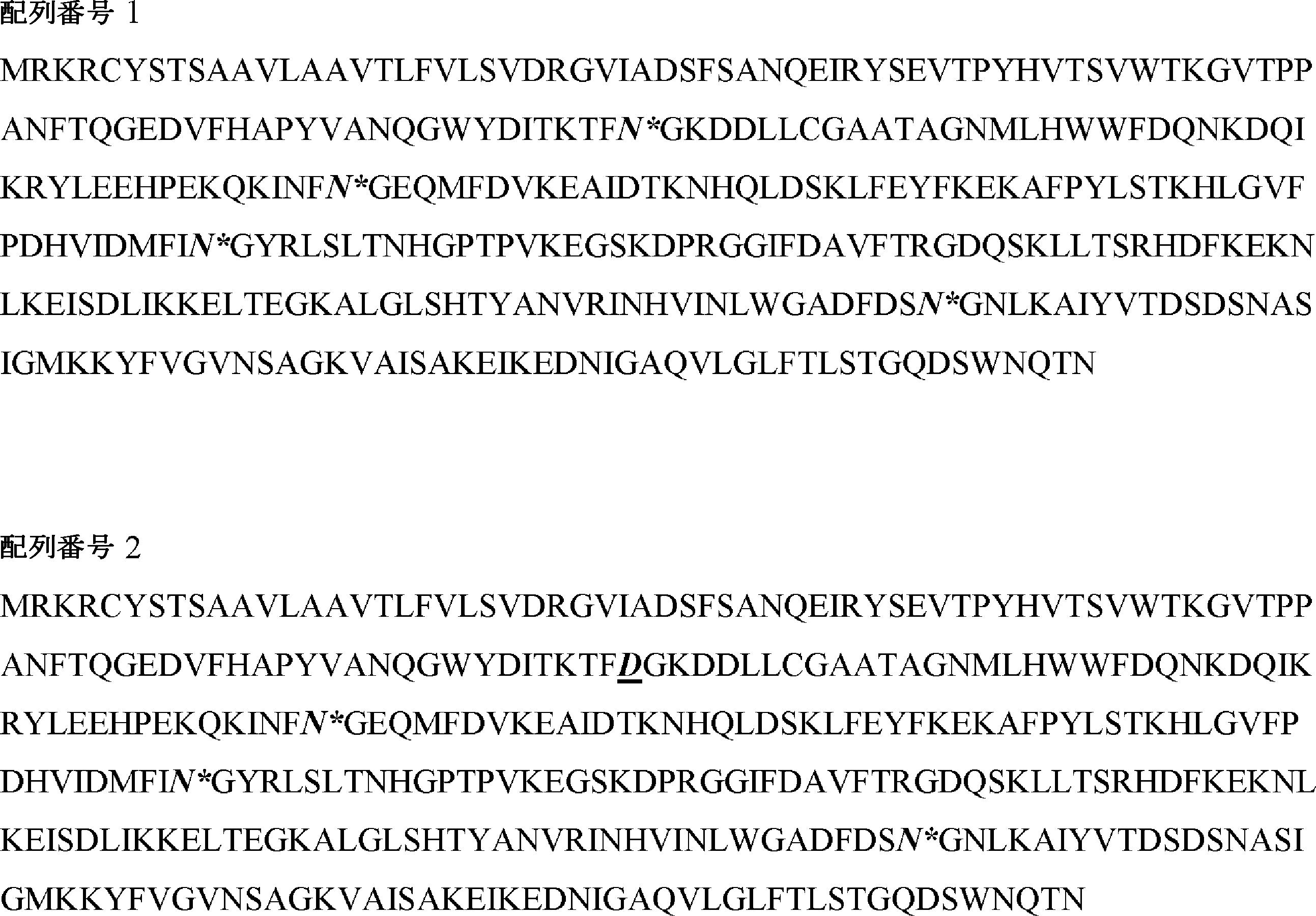
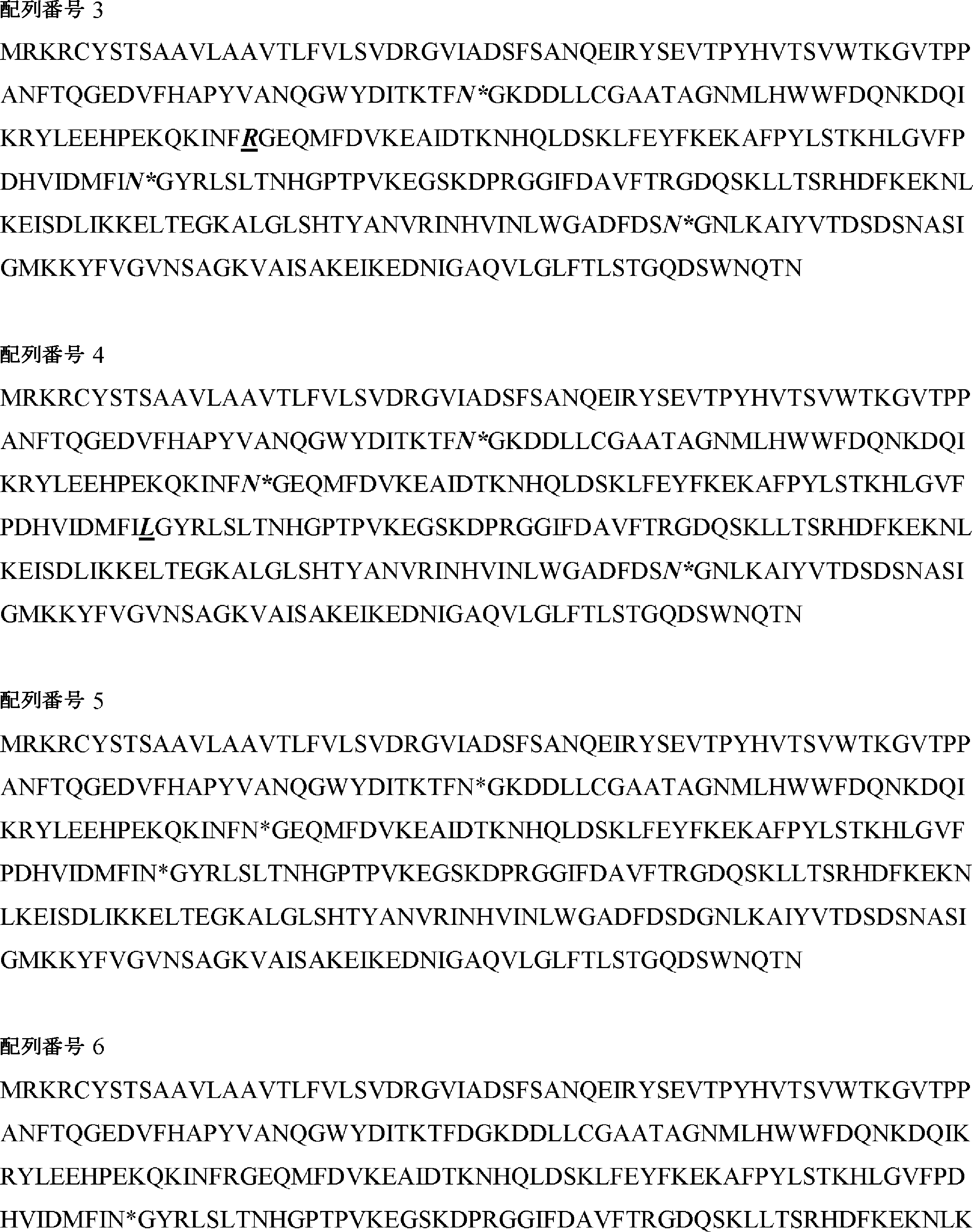

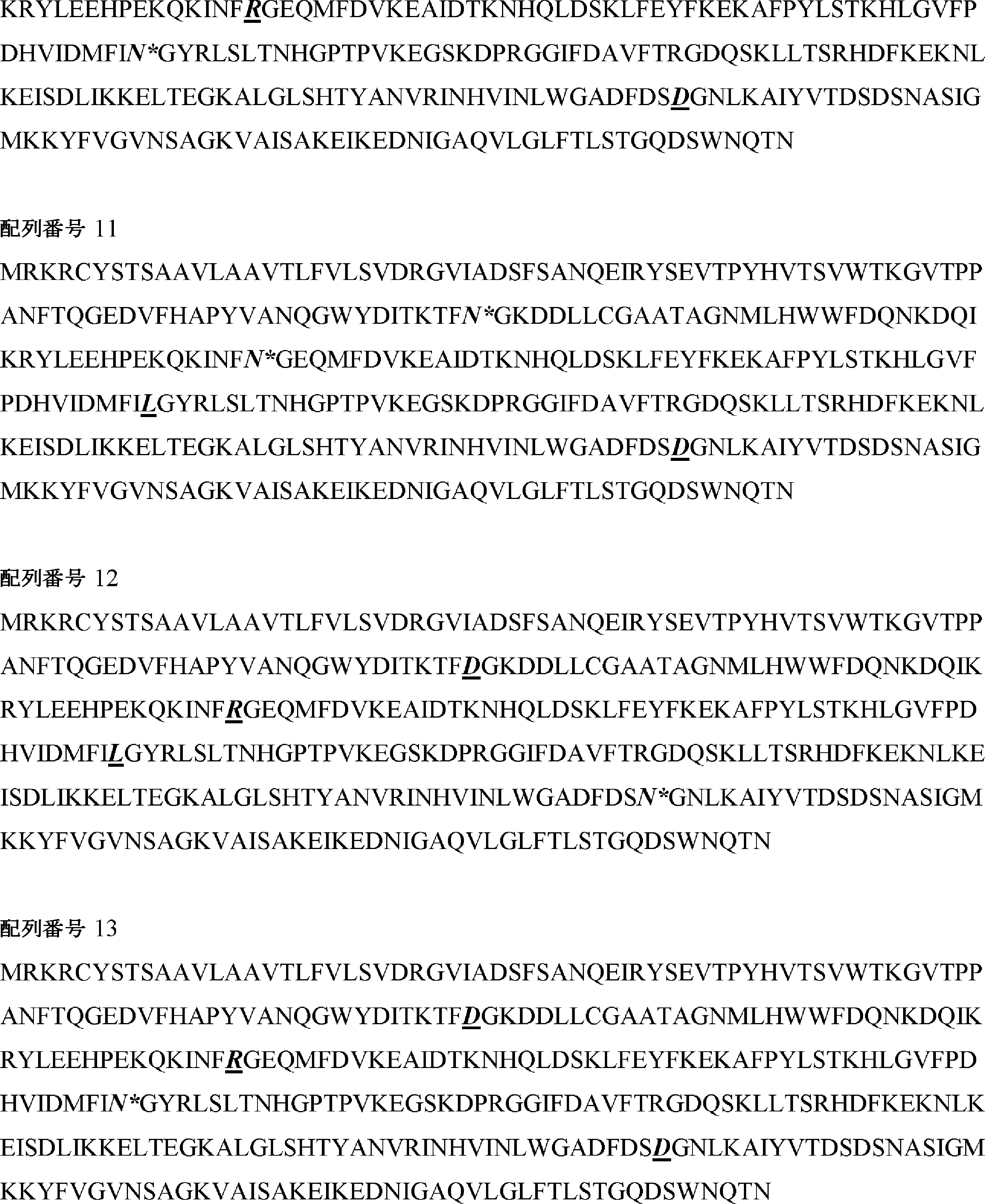

一実施形態において、ポリペプチドは、配列番号2、配列番号3、配列番号4、配列番号5、配列番号6、配列番号7、配列番号8、配列番号9、配列番号10、配列番号11、配列番号12、配列番号13、配列番号14、配列番号15及び配列番号16からなる群に記載されるような単離されたアミノ酸配列の全長にわたり、少なくとも70%の配列同一性を含む単離されたアミノ酸配列を有する。一態様において、単離されたアミノ酸配列は、単離されたアミノ酸配列の全長にわたり少なくとも約80%の配列同一性を有する。別の態様において、単離されたアミノ酸配列は、単離されたアミノ酸配列の全長にわたり少なくとも約90%の配列同一性を有する。別の態様において、単離されたアミノ酸配列は、単離されたアミノ酸配列の全長にわたり約100%の配列同一性を有する。一態様において、ポリペプチドは、標的タンパク質を断片へと切断することが可能であり得る。特定の態様において、標的タンパク質はIgGである。別の態様において、標的タンパク質は融合タンパク質である。更に別の態様において、断片はFab断片及び/又はFc断片を含み得る。 In one embodiment, the polypeptide has an isolated amino acid sequence that comprises at least 70% sequence identity over the entire length of the isolated amino acid sequence as set forth in the group consisting of SEQ ID NO:2, SEQ ID NO:3, SEQ ID NO:4, SEQ ID NO:5, SEQ ID NO:6, SEQ ID NO:7, SEQ ID NO:8, SEQ ID NO:9, SEQ ID NO:10, SEQ ID NO:11, SEQ ID NO:12, SEQ ID NO:13, SEQ ID NO:14, SEQ ID NO:15, and SEQ ID NO:16. In one aspect, the isolated amino acid sequence has at least about 80% sequence identity over the entire length of the isolated amino acid sequence. In another aspect, the isolated amino acid sequence has at least about 90% sequence identity over the entire length of the isolated amino acid sequence. In another aspect, the isolated amino acid sequence has about 100% sequence identity over the entire length of the isolated amino acid sequence. In one aspect, the polypeptide may be capable of cleaving the target protein into fragments. In a particular aspect, the target protein is an IgG. In another aspect, the target protein is a fusion protein. In yet another aspect, the fragments may comprise a Fab fragment and/or an Fc fragment.
配列番号1、配列番号2、配列番号3、配列番号4、配列番号5、配列番号6、配列番号7、配列番号8、配列番号9、配列番号10、配列番号11、配列番号12、配列番号13、配列番号14、配列番号15及び配列番号16。 SEQ ID NO:1, SEQ ID NO:2, SEQ ID NO:3, SEQ ID NO:4, SEQ ID NO:5, SEQ ID NO:6, SEQ ID NO:7, SEQ ID NO:8, SEQ ID NO:9, SEQ ID NO:10, SEQ ID NO:11, SEQ ID NO:12, SEQ ID NO:13, SEQ ID NO:14, SEQ ID NO:15 and SEQ ID NO:16.
本開示はまた、配列番号2、配列番号3、配列番号4、配列番号5、配列番号6、配列番号7、配列番号8、配列番号9、配列番号10、配列番号11、配列番号12、配列番号13、配列番号14、配列番号15及び配列番号16からなる群に記載されるような単離されたアミノ酸配列の全長にわたり、少なくとも70%の配列同一性を含む単離されたアミノ酸配列を有するポリペプチドをコードする、単離された核酸分子を含む。一態様において、単離されたアミノ酸配列は、単離されたアミノ酸配列の全長にわたり少なくとも約80%の配列同一性を有する。別の態様において、単離されたアミノ酸配列は、単離されたアミノ酸配列の全長にわたり少なくとも約90%の配列同一性を有する。別の態様において、単離されたアミノ酸配列は、単離されたアミノ酸配列の全長にわたり約100%の配列同一性を有する。一態様において、ポリペプチドは、標的タンパク質を断片へと切断することが可能であり得る。特定の態様において、標的タンパク質はIgGである。別の特定の態様において、標的タンパク質は融合タンパク質である。更に別の特定の態様において、断片はFab断片及び/又はFc断片を含み得る。 The present disclosure also includes an isolated nucleic acid molecule encoding a polypeptide having an isolated amino acid sequence that comprises at least 70% sequence identity over the entire length of the isolated amino acid sequence as set forth in the group consisting of SEQ ID NO:2, SEQ ID NO:3, SEQ ID NO:4, SEQ ID NO:5, SEQ ID NO:6, SEQ ID NO:7, SEQ ID NO:8, SEQ ID NO:9, SEQ ID NO:10, SEQ ID NO:11, SEQ ID NO:12, SEQ ID NO:13, SEQ ID NO:14, SEQ ID NO:15, and SEQ ID NO:16. In one embodiment, the isolated amino acid sequence has at least about 80% sequence identity over the entire length of the isolated amino acid sequence. In another embodiment, the isolated amino acid sequence has at least about 90% sequence identity over the entire length of the isolated amino acid sequence. In another embodiment, the isolated amino acid sequence has about 100% sequence identity over the entire length of the isolated amino acid sequence. In one embodiment, the polypeptide may be capable of cleaving a target protein into fragments. In a particular embodiment, the target protein is an IgG. In another particular embodiment, the target protein is a fusion protein. In yet another particular embodiment, the fragment may comprise a Fab fragment and/or an Fc fragment.
本開示はまた、配列番号2、配列番号3、配列番号4、配列番号5、配列番号6、配列番号7、配列番号8、配列番号9、配列番号10、配列番号11、配列番号12、配列番号13、配列番号14、配列番号15及び配列番号16からなる群に記載されるような単離されたアミノ酸配列の全長にわたり、少なくとも70%の配列同一性を含む単離されたアミノ酸配列を有するポリペプチドをコードする核酸を含むベクターを含む。一態様において、核酸分子は宿主細胞内でその発現を指示することが可能である発現制御配列に作動可能に連結される。一態様において、ベクターはプラスミドである。一態様において、単離されたアミノ酸配列は、単離されたアミノ酸配列の全長にわたり少なくとも約80%の配列同一性を有する。別の態様において、単離されたアミノ酸配列は、単離されたアミノ酸配列の全長にわたり少なくとも約90%の配列同一性を有する。別の態様において、単離されたアミノ酸配列は、単離されたアミノ酸配列の全長にわたり約100%の配列同一性を有する。一態様において、ポリペプチドは、標的タンパク質を断片へと切断することが可能であり得る。特定の態様において、標的タンパク質はIgGである。別の態様において、標的タンパク質は融合タンパク質である。更に別の態様において、断片はFab断片及び/又はFc断片を含み得る。 The present disclosure also includes a vector comprising a nucleic acid encoding a polypeptide having an isolated amino acid sequence comprising at least 70% sequence identity over the entire length of the isolated amino acid sequence as set forth in the group consisting of SEQ ID NO:2, SEQ ID NO:3, SEQ ID NO:4, SEQ ID NO:5, SEQ ID NO:6, SEQ ID NO:7, SEQ ID NO:8, SEQ ID NO:9, SEQ ID NO:10, SEQ ID NO:11, SEQ ID NO:12, SEQ ID NO:13, SEQ ID NO:14, SEQ ID NO:15, and SEQ ID NO:16. In one embodiment, the nucleic acid molecule is operably linked to an expression control sequence capable of directing its expression in a host cell. In one embodiment, the vector is a plasmid. In one embodiment, the isolated amino acid sequence has at least about 80% sequence identity over the entire length of the isolated amino acid sequence. In another embodiment, the isolated amino acid sequence has at least about 90% sequence identity over the entire length of the isolated amino acid sequence. In another embodiment, the isolated amino acid sequence has about 100% sequence identity over the entire length of the isolated amino acid sequence. In one embodiment, the polypeptide may be capable of cleaving the target protein into fragments. In a particular embodiment, the target protein is an IgG. In another embodiment, the target protein is a fusion protein. In yet another embodiment, the fragment may include a Fab fragment and/or an Fc fragment.
一実施形態において、単離されたアミノ酸は、アスパラギン以外のアミノ酸に変異した87位、130位、182位及び/又は274位のアスパラギン残基を有する、配列番号1により定義される親アミノ酸配列を含み得る。一態様において、変異は親アミノ酸配列と比較すると、アルカリpH値での化学的安定性の増加をもたらし得る。別の態様において、変異は親アミノ酸配列と比較すると、アルカリpH値での化学的安定性の50%の増加をもたらし得る。一態様において、アミノ酸はアスパラギン酸、ロイシン、及びアルギニンから選択され得る。特定の態様において、87位のアスパラギン残基はアスパラギン酸残基に変異される。別の態様において、130位のアスパラギン残基はアルギニン残基に変異される。更なる別の態様において、182位のアスパラギン残基はロイシン残基に変異される。更なる別の態様において、274位のアスパラギン残基はアスパラギン酸残基に変異される。更なる別の態様において、87位及び130位のアスパラギン残基は変異される。更なる別の態様において、87位及び182位のアスパラギン残基は変異される。更なる別の態様において、87位及び274位のアスパラギン残基は変異される。更なる別の態様において、130位及び182位のアスパラギン残基は変異される。更なる別の態様において、130位及び274位のアスパラギン残基は変異される。更なる別の態様において、182位及び274位のアスパラギン残基は変異される。更なる別の態様において、87位、130位及び182位のアスパラギン残基は変異される。更なる別の態様において、87、182位及び274位のアスパラギン残基は変異される。更なる別の態様において、130位、182位及び274位のアスパラギン残基は変異される。更なる別の態様において、87位、130位、182位及び274位のアスパラギン残基は変異される。 In one embodiment, the isolated amino acid may comprise a parent amino acid sequence as defined by SEQ ID NO:1 with the asparagine residues at positions 87, 130, 182, and/or 274 mutated to an amino acid other than asparagine. In one aspect, the mutations may result in increased chemical stability at alkaline pH values as compared to the parent amino acid sequence. In another aspect, the mutations may result in a 50% increase in chemical stability at alkaline pH values as compared to the parent amino acid sequence. In one aspect, the amino acid may be selected from aspartic acid, leucine, and arginine. In a particular aspect, the asparagine residue at position 87 is mutated to an aspartic acid residue. In another aspect, the asparagine residue at position 130 is mutated to an arginine residue. In yet another aspect, the asparagine residue at position 182 is mutated to a leucine residue. In yet another aspect, the asparagine residue at position 274 is mutated to an aspartic acid residue. In yet another aspect, the asparagine residues at positions 87 and 130 are mutated. In yet another embodiment, the asparagine residues at positions 87 and 182 are mutated. In yet another embodiment, the asparagine residues at positions 87 and 274 are mutated. In yet another embodiment, the asparagine residues at positions 130 and 182 are mutated. In yet another embodiment, the asparagine residues at positions 130 and 274 are mutated. In yet another embodiment, the asparagine residues at positions 182 and 274 are mutated. In yet another embodiment, the asparagine residues at positions 87, 130 and 182 are mutated. In yet another embodiment, the asparagine residues at positions 87, 182 and 274 are mutated. In yet another embodiment, the asparagine residues at positions 130, 182 and 274 are mutated. In yet another embodiment, the asparagine residues at positions 87, 130, 182 and 274 are mutated.
関連する実施形態において、本開示は、アスパラギン以外のアミノ酸へと変異した87位、130位、182位及び/又は274位でのアスパラギン残基を有する、配列番号1により定義される親アミノ酸配列を含む単離されたアミノ酸配列を有するポリペプチドをコードする、単離された核酸分子を含む。上記を参照されたい。変異は親アミノ酸配列と比較すると、アルカリpH値での化学的安定性の増加をもたらし得る。 In a related embodiment, the disclosure includes an isolated nucleic acid molecule encoding a polypeptide having an isolated amino acid sequence comprising a parent amino acid sequence defined by SEQ ID NO:1, with asparagine residues at positions 87, 130, 182, and/or 274 mutated to amino acids other than asparagine. See supra. The mutations may result in increased chemical stability at alkaline pH values compared to the parent amino acid sequence.
更に関連する実施形態において、本開示はベクターを含む。このベクターは、アスパラギン以外のアミノ酸へと変異した87位、130位、182位及び/又は274位でのアスパラギン残基を有する、配列番号1により定義される親アミノ酸配列を含む単離されたアミノ酸配列を有するポリペプチドをコードする核酸分子を含む。上記を参照されたい。変異は親アミノ酸配列と比較すると、アルカリpH値での化学的安定性の増加をもたらし得る。一態様において、核酸分子は宿主細胞内でその発現を指示することが可能である発現制御配列に作動可能に連結される。一態様において、ベクターはプラスミドであり得る。 In a further related embodiment, the disclosure includes a vector. The vector includes a nucleic acid molecule encoding a polypeptide having an isolated amino acid sequence that includes a parent amino acid sequence defined by SEQ ID NO:1, with asparagine residues at positions 87, 130, 182, and/or 274 mutated to an amino acid other than asparagine. See supra. The mutations can result in increased chemical stability at alkaline pH values compared to the parent amino acid sequence. In one aspect, the nucleic acid molecule is operably linked to an expression control sequence capable of directing its expression in a host cell. In one aspect, the vector can be a plasmid.
アフィニティーベースの産生
本開示はまた、アフィニティークロマトグラフィーを使用して抗VEGFタンパク質を産生する間、宿主細胞タンパク質並びに望ましくない他のタンパク質及び核酸を減少させる方法を提供する。
Affinity-Based Production The present disclosure also provides a method for reducing host cell proteins and other undesirable proteins and nucleic acids during production of anti-VEGF proteins using affinity chromatography.
一実施形態において、組換えタンパク質を産生する方法は、(a)関心対象の組換えタンパク質を発現させるために遺伝子改変された宿主細胞を提供する工程、(b)この細胞が関心対象の組換えタンパク質を発現する好適な条件下で、宿主細胞を培養する工程、及び(c)この細胞によって産生された関心対象の組換えタンパク質の調製物を回収する工程、を含む。一態様においては、関心対象の組換えタンパク質は抗VEGFタンパク質である。特定の態様においては、抗VEGFタンパク質は、アフリベルセプト、MiniTrap、組換えMiniTrap(その例は、米国特許第7,279,159号に開示される)、scFv及び他の抗VEGFタンパク質からなる群から選択される。 In one embodiment, a method for producing a recombinant protein includes (a) providing a host cell genetically modified to express a recombinant protein of interest, (b) culturing the host cell under suitable conditions in which the cell expresses the recombinant protein of interest, and (c) recovering a preparation of the recombinant protein of interest produced by the cell. In one aspect, the recombinant protein of interest is an anti-VEGF protein. In a particular aspect, the anti-VEGF protein is selected from the group consisting of aflibercept, MiniTrap, recombinant MiniTrap (examples of which are disclosed in U.S. Pat. No. 7,279,159), scFv, and other anti-VEGF proteins.
本実施形態の一態様においては、関心対象の組換えタンパク質は好適な宿主細胞内で発現される。好適な宿主細胞の非限定的な例としては、CHO、CHOK1、EESYR(登録商標)、NICE(登録商標)、NS0、Sp2/0、胎児腎細胞及びBHKが挙げられるがこれらに限定されない。 In one aspect of this embodiment, the recombinant protein of interest is expressed in a suitable host cell. Non-limiting examples of suitable host cells include, but are not limited to, CHO, CHOK1, EESYR®, NICE®, NS0, Sp2/0, fetal kidney cells, and BHK.
本実施形態の一態様において、関心対象の組換えタンパク質はCDM中で培養される。好適なCDMとしては、ダルベッコ改変イーグル(DME)培地、ハム栄養混合物、Excell培地、及びIS CHO-CD培地、及びCDM1Bが挙げられる。当業者に公知である他のCDMはまた、本発明の範囲内であることが企図されている。 In one aspect of this embodiment, the recombinant protein of interest is cultured in CDM. Suitable CDMs include Dulbecco's Modified Eagle's (DME) Medium, Ham's Nutrient Mixture, Excell Medium, and IS CHO-CD Medium, and CDM1B. Other CDMs known to those of skill in the art are also contemplated to be within the scope of the present invention.
産生調製物は、関心対象の組換えタンパク質に加えて1つ以上の宿主細胞タンパク質を含む、少なくとも1種類の夾雑物を含み得る。少なくとも1種の夾雑物は、細胞基質、細胞培養、又は下流プロセスに由来し得る。 The production preparation may contain at least one contaminant, including one or more host cell proteins in addition to the recombinant protein of interest. The at least one contaminant may be derived from the cell substrate, the cell culture, or a downstream process.
一実施形態において、本発明は、アフィニティークロマトグラフィーを使用して生物学的試料から抗VEGFタンパク質を製造する方法に関する。特定の態様において、本明細書に開示される方法は、少なくとも部分的には、抗VEGFタンパク質の培養物産生プロセス中に形成される1つ以上の宿主細胞タンパク質及び核酸(例えばDNA)から、抗VEGFタンパク質を分離するために使用され得る。 In one embodiment, the present invention relates to a method for producing an anti-VEGF protein from a biological sample using affinity chromatography. In certain aspects, the methods disclosed herein can be used to separate the anti-VEGF protein, at least in part, from one or more host cell proteins and nucleic acids (e.g., DNA) formed during the culture production process of the anti-VEGF protein.
一態様において、この方法は、抗VEGFタンパク質を含む生物学的試料を、付随する夾雑物と共に、好適な条件の下でアフィニティークロマトグラフィーに供する工程を含み得る。特定の態様において、アフィニティークロマトグラフィーは抗VEGFタンパク質に選択的又は特異的に結合(「捕捉」)可能である材料を含み得る。そのようなクロマトグラフィー材料の非限定的な例としては、プロテインA、プロテインG、例えば抗VEGFタンパク質に結合可能なタンパク質を含むクロマトグラフィー材料、及びFc結合タンパク質を含むクロマトグラフィー材料が挙げられる。特定の態様において、抗VEGFタンパク質に結合可能であるか又はこれと相互作用可能であるタンパク質は、抗体、融合タンパク質、又はそれらの断片であり得る。抗VEGFタンパク質に選択的又は特異的に結合可能であるこうした材料の非限定的な例は、実施例7にて説明される。 In one embodiment, the method may include subjecting a biological sample containing the anti-VEGF protein, together with associated contaminants, to affinity chromatography under suitable conditions. In certain embodiments, the affinity chromatography may include a material capable of selectively or specifically binding ("capturing") the anti-VEGF protein. Non-limiting examples of such chromatographic materials include chromatographic materials comprising proteins such as protein A, protein G, e.g., capable of binding to the anti-VEGF protein, and chromatographic materials comprising Fc binding proteins. In certain embodiments, the protein capable of binding to or interacting with the anti-VEGF protein may be an antibody, a fusion protein, or a fragment thereof. Non-limiting examples of such materials capable of selectively or specifically binding to the anti-VEGF protein are described in Example 7.
本実施形態の一態様において、この方法は、抗VEGFタンパク質及び1つ以上の宿主細胞タンパク質/夾雑物を含む生物学的試料を、好適な条件の下でアフィニティークロマトグラフィーに供する工程を含むことができ、このアフィニティークロマトグラフィーの固定相は、抗VEGFタンパク質に選択的又は特異的に結合可能であるタンパク質を含む。特定の態様において、タンパク質は抗体、融合タンパク質、scFv又は抗体断片であり得る。特定の態様において、タンパク質はVEGF165、VEGF121、例えばウサギといった他の種由来のVEGFフォームであり得る。例えば、表7-1及び表7-10に例示されるように、抗VEGFタンパク質に選択的又は特異的に結合可能であるか又はこれと相互作用可能であるタンパク質としてVEGF165を使用することで、MT5(抗VEGFタンパク質)、アフリベルセプト及び抗VEGF scFv断片の首尾よい生成につながった。別の特定の態様において、タンパク質は配列番号73~80に示されるアミノ酸配列を有するタンパク質のうち1つ以上であり得る。表7-1はまた、抗VEGFタンパク質(MT5)に選択的又は特異的に結合可能なタンパク質として、配列番号73~80に示されるアミノ酸配列を有するタンパク質を使用するMT5の首尾よい生成も開示する。 In one aspect of this embodiment, the method may include subjecting a biological sample containing an anti-VEGF protein and one or more host cell proteins/contaminants to affinity chromatography under suitable conditions, the stationary phase of the affinity chromatography comprising a protein capable of selectively or specifically binding to the anti-VEGF protein. In a particular aspect, the protein may be an antibody, a fusion protein, a scFv, or an antibody fragment. In a particular aspect, the protein may be VEGF 165 , VEGF 121 , or a VEGF form from another species, e.g., rabbit. For example, as illustrated in Tables 7-1 and 7-10, the use of VEGF 165 as a protein capable of selectively or specifically binding to or interacting with the anti-VEGF protein has led to the successful production of MT5 (an anti-VEGF protein), aflibercept, and an anti-VEGF scFv fragment. In another particular aspect, the protein may be one or more of the proteins having the amino acid sequences set forth in SEQ ID NOs: 73-80. Table 7-1 also discloses the successful production of anti-VEGF protein (MT5) using proteins having the amino acid sequences shown in SEQ ID NOs:73-80 as proteins capable of selectively or specifically binding to MT5.
本実施形態の一態様において、この方法は、抗VEGFタンパク質及び1つ以上の宿主細胞タンパク質/夾雑物を含む生物学的試料を、好適な条件の下でアフィニティークロマトグラフィーに供する工程を含むことができ、このアフィニティークロマトグラフィーの固定相は、抗VEGFタンパク質に選択的又は特異的に結合可能であるか又はこれと相互作用可能であるタンパク質を含み、この抗VEGFタンパク質は、アフリベルセプト、VEGF MiniTrap、又は抗VEGF抗体から選択され得る。特定の態様において、VEGF MiniTrapはVEGF受容体成分から更に得ることができ、これは宿主細胞中のVEGF MiniTrapの組換え発現により形成され得る。この方法を実施することで、試料中の1つ以上の宿主細胞タンパク質の量を減少させることができる。例えば、図35A及び図35Bは、5種類の異なるアフィニティークロマトグラフィーカラムを使用した際、MT5(抗VEGFタンパク質)を含む試料中のすべての宿主細胞タンパク質で著しい減少を示している。この5種類の異なるアフィニティークロマトグラフィーカラムは、MT5に選択的又は特異的に結合可能である異なるタンパク質として、(i)VEGF165(配列番号72)、(ii)mAb1(配列番号73は重鎖であり、配列番号74は軽鎖である、マウスの抗-VEGFR1 mAbヒトIgG1)、(iii)mAb2(配列番号75は重鎖であり、配列番号76は軽鎖である、マウスの抗-VEGFR1 mAbヒトIgG1)、(iv)mAb3(配列番号77は重鎖であり、配列番号78は軽鎖である、マウスの抗-VEGFR1 mAbマウスIgG1)、及び(v)mAb4(配列番号79は重鎖であり、配列番号80は軽鎖である、マウスの抗-VEGFR1 mAbマウスIgG1)を含む。図35A及び図35Bに見られるように、アフィニティーベースの製造プロセスのそれぞれからの溶出液はそれぞれ、7000ppm超から約25ppmまで及び約55ppmまで、宿主細胞タンパク質を減少させた。 In one aspect of this embodiment, the method can include subjecting a biological sample containing an anti-VEGF protein and one or more host cell proteins/contaminants to affinity chromatography under suitable conditions, the stationary phase of the affinity chromatography comprising a protein capable of selectively or specifically binding to or interacting with the anti-VEGF protein, which can be selected from aflibercept, VEGF MiniTrap, or an anti-VEGF antibody. In a particular aspect, the VEGF MiniTrap can further be derived from a VEGF receptor component, which can be formed by recombinant expression of the VEGF MiniTrap in a host cell. The method can be performed to reduce the amount of one or more host cell proteins in a sample. For example, Figures 35A and 35B show a significant reduction in all host cell proteins in a sample containing MT5 (anti-VEGF protein) when using five different affinity chromatography columns. The five different affinity chromatography columns include different proteins capable of selectively or specifically binding to MT5: (i) VEGF 165 (SEQ ID NO:72); (ii) mAb1 (mouse anti-VEGFR1 mAb human IgG1, where SEQ ID NO:73 is the heavy chain and SEQ ID NO:74 is the light chain); (iii) mAb2 (mouse anti-VEGFR1 mAb human IgG1, where SEQ ID NO:75 is the heavy chain and SEQ ID NO:76 is the light chain); (iv) mAb3 (mouse anti-VEGFR1 mAb mouse IgG1, where SEQ ID NO:77 is the heavy chain and SEQ ID NO:78 is the light chain); and (v) mAb4 (mouse anti-VEGFR1 mAb mouse IgG1, where SEQ ID NO:79 is the heavy chain and SEQ ID NO:80 is the light chain). As can be seen in Figures 35A and 35B, the eluates from each of the affinity-based manufacturing processes reduced host cell protein from over 7000 ppm to about 25 ppm and about 55 ppm, respectively.
アフィニティークロマトグラフィーを使用するための好適な条件としては、平衡化バッファを使用する、アフィニティークロマトグラフィーカラムの平衡化が挙げられるがこれに限定されない。例えば約8.3~約8.6のpHであるトリス塩酸塩を使用して平衡化した後、生物学的試料をアフィニティークロマトグラフィーカラムに負荷する。カラムの負荷後、カラムを例えばダルベッコのリン酸緩衝生理食塩水(DPBS)などの平衡化バッファを使用し、1回又は複数回洗浄することができる。異なるバッファを使用する洗浄を含む他の洗浄は、カラムを溶出する前に使用され得る。カラムの溶出は、バッファの種類及びpH及び伝導度により影響を受ける可能性があり、当業者に周知の他の溶出条件を適用することができる。例えば約2.0~約3.0のpHであるグリシンといった1種以上の溶出バッファを使用して溶出した後、溶出画分は、例えばpH7.5の1Mトリスといった中和バッファの添加により中和され得る。 Suitable conditions for using affinity chromatography include, but are not limited to, equilibration of the affinity chromatography column using an equilibration buffer. After equilibration using, for example, Tris hydrochloride at a pH of about 8.3 to about 8.6, the biological sample is loaded onto the affinity chromatography column. After loading the column, the column can be washed one or more times using an equilibration buffer, for example, Dulbecco's Phosphate Buffered Saline (DPBS). Other washes, including washes using different buffers, can be used before eluting the column. Elution of the column can be affected by the type and pH and conductivity of the buffer, and other elution conditions known to those skilled in the art can be applied. After elution using one or more elution buffers, for example, glycine at a pH of about 2.0 to about 3.0, the eluted fraction can be neutralized by the addition of a neutralizing buffer, for example, 1 M Tris at pH 7.5.
本実施形態の一態様において、洗浄バッファ及び平衡化バッファの両方のpHは、約7.0~約8.6であり得る。本実施形態の一態様において、洗浄バッファはDPBSであり得る。一態様において、溶出バッファは約2.5のpHを有する100mMのグリシンバッファを含み得る。別の態様において、溶出バッファは約2.0~約3.0のpHを有するバッファであり得る。一態様において、中和バッファは約7.5のpHを有する1Mトリスを含み得る。 In one aspect of this embodiment, the pH of both the wash buffer and the equilibration buffer can be from about 7.0 to about 8.6. In one aspect of this embodiment, the wash buffer can be DPBS. In one aspect, the elution buffer can comprise a 100 mM glycine buffer having a pH of about 2.5. In another aspect, the elution buffer can be a buffer having a pH of about 2.0 to about 3.0. In one aspect, the neutralization buffer can comprise 1 M Tris having a pH of about 7.5.
本実施形態の一態様において、本方法は洗浄バッファでカラムを洗浄する工程を更に含み得る。本実施形態の一態様において、本方法は、溶出画分を得るために溶出バッファでカラムを溶出する工程を更に含み得る。特定の態様において、溶出画分中の宿主細胞タンパク質の量は、生物学的試料中の宿主細胞タンパク質の量と比較して、例えば約70%、約80%、約90%、約95%、約98%、又は約99%だけ著しく減少する。 In one aspect of this embodiment, the method may further comprise washing the column with a wash buffer. In one aspect of this embodiment, the method may further comprise eluting the column with an elution buffer to obtain an elution fraction. In certain aspects, the amount of host cell protein in the elution fraction is significantly reduced, e.g., by about 70%, about 80%, about 90%, about 95%, about 98%, or about 99%, compared to the amount of host cell protein in the biological sample.
本実施形態は、特定の順序ではない、1つ以上の工程の追加を含むことができ、例えば疎水性相互作用クロマトグラフィー、アフィニティーベースのクロマトグラフィー、マルチモーダルクロマトグラフィー、ウイルス不活化(例えば低pHを使用)、ウイルスろ過、及び/又は限外ろ過/透析ろ過を含むことができる。 This embodiment may include the addition of one or more steps, in no particular order, such as hydrophobic interaction chromatography, affinity-based chromatography, multimodal chromatography, viral inactivation (e.g., using low pH), viral filtration, and/or ultrafiltration/diafiltration.
一態様において、抗VEGFタンパク質の組成物のグリコシル化特性は、以下である:約40%~約50%の総フコシル化グリカン、約30%~約55%の総シアリル化グリカン、約6%~約15%のマンノース-5、及び約60%~約79%のガラクトシル化グリカン。 In one embodiment, the glycosylation profile of the anti-VEGF protein composition is as follows: about 40% to about 50% total fucosylated glycans, about 30% to about 55% total sialylated glycans, about 6% to about 15% mannose-5, and about 60% to about 79% galactosylated glycans.
本実施形態の一態様において、抗VEGFタンパク質は約32.4%のアスパラギン123残基、及び/又は約27.1%のアスパラギン196残基にてMan5グリコシル化を有する。特定の実施形態において、抗VEGFタンパク質は、アフリベルセプト、抗VEGF抗体、又はVEGF MiniTrapであり得る。 In one aspect of this embodiment, the anti-VEGF protein has Man5 glycosylation at about 32.4% of asparagine 123 residues and/or about 27.1% of asparagine 196 residues. In certain embodiments, the anti-VEGF protein can be aflibercept, an anti-VEGF antibody, or a VEGF MiniTrap.
一実施形態において、この方法は薬学的に許容される賦形剤を使用して原薬を製剤化する工程を更に含み得る。一態様において、薬学的に許容される賦形剤は、以下:水、緩衝剤、糖、塩、界面活性剤、アミノ酸、ポリオール、キレート剤、乳化剤及び保存剤から選択され得る。当業者に周知の他の賦形剤は、本実施形態の範囲内である。 In one embodiment, the method may further comprise formulating the drug substance using a pharma- ceutically acceptable excipient. In one aspect, the pharma-ceutically acceptable excipient may be selected from the following: water, buffers, sugars, salts, surfactants, amino acids, polyols, chelating agents, emulsifiers, and preservatives. Other excipients known to those of skill in the art are within the scope of this embodiment.
本実施形態の一態様において、製剤はヒト対象への投与に好適であり得る。本実施形態の一態様において、投与は、硝子体内注射により行うことができる。一態様において、この製剤は約40~約200mg/mLの関心対象のタンパク質を有し得る。特定の態様において、関心対象のタンパク質は、アフリベルセプト、抗VEGF抗体、又はVEGF MiniTrapであり得る。 In one aspect of this embodiment, the formulation may be suitable for administration to a human subject. In one aspect of this embodiment, administration may be by intravitreal injection. In one aspect, the formulation may have about 40 to about 200 mg/mL of the protein of interest. In particular aspects, the protein of interest may be aflibercept, an anti-VEGF antibody, or a VEGF MiniTrap.
製剤は、加齢黄斑変性症(例えば湿性又は乾性)、黄斑浮腫、網膜静脈閉塞症後の黄斑浮腫、網膜静脈閉塞症(RVO)、網膜中心静脈閉塞症(CRVO)、網膜静脈分枝閉塞症(BRVO)、糖尿病性黄斑浮腫(DME)、脈絡膜新生血管(CNV)、虹彩新生血管、血管新生緑内障、緑内障の術後線維症、増殖性硝子体網膜症(PVR)、視神経円板血管新生、角膜血管新生、網膜血管新生、硝子体血管新生、パンヌス、翼状片、血管性網膜症、糖尿病性黄斑浮腫に罹っている対象における糖尿病性網膜症、又は糖尿病性網膜症(例えば、非増殖性糖尿病性網膜症(例えば、約47又は53の糖尿病性網膜症の重症度スコア(DRSS)レベルによって特徴付けられる)又は増殖性糖尿病性網膜症(例えばDMEに罹患していない対象における)を含み得る血管新生性眼障害を処置又は予防する方法で使用され得る。 The formulation is intended to treat age-related macular degeneration (e.g., wet or dry), macular edema, macular edema following retinal vein occlusion, retinal vein occlusion (RVO), central retinal vein occlusion (CRVO), branch retinal vein occlusion (BRVO), diabetic macular edema (DME), choroidal neovascularization (CNV), iris neovascularization, neovascular glaucoma, postoperative fibrosis in glaucoma, proliferative vitreoretinopathy (PVR), optic disc neovascularization, corneal neovascularization, retinal neovascularization, vitreous neovascularization. , pannus, pterygium, vascular retinopathy, diabetic retinopathy in subjects with diabetic macular edema, or diabetic retinopathy (e.g., non-proliferative diabetic retinopathy (e.g., characterized by a Diabetic Retinopathy Severity Score (DRSS) level of about 47 or 53) or proliferative diabetic retinopathy (e.g., in subjects not afflicted with DME).
オキソ種の合成
本発明の一実施形態は、光を使用して酸化タンパク質種を合成する1つ以上の方法に関する。本実施形態の一態様において、関心対象のタンパク質は抗VEGFタンパク質である。特定の態様において、抗VEGFタンパク質はアフリベルセプトである。別の態様において、抗VEGFタンパク質は組換えVEGF MiniTrapを含むVEGF MiniTrapである。本実施形態の更なる別の態様において、抗VEGFタンパク質は一本鎖可変断片(scFv)である。
Synthesis of oxo species One embodiment of the present invention relates to one or more methods of synthesizing oxidized protein species using light. In one aspect of this embodiment, the protein of interest is an anti-VEGF protein. In a particular aspect, the anti-VEGF protein is aflibercept. In another aspect, the anti-VEGF protein is a VEGF MiniTrap, including recombinant VEGF MiniTrap. In yet another aspect of this embodiment, the anti-VEGF protein is a single chain variable fragment (scFv).
本実施形態の一態様において、試料は例えば、最小限のオキソバリアントを有するか又はオキソバリアントを有さないアフリベルセプト融合タンパク質といった、関心対象のタンパク質を含む。試料に光ストレスをかけ、アフリベルセプトの酸化種を合成する。特定の態様において、試料は冷白色光を使用することにより光ストレスをかけられる。別の特定の態様において、試料は紫外線を使用することにより光ストレスをかけられる。 In one aspect of this embodiment, the sample includes a protein of interest, e.g., an aflibercept fusion protein with minimal or no oxo variants. The sample is photostressed to synthesize oxidized species of aflibercept. In a particular aspect, the sample is photostressed by using cool white light. In another particular aspect, the sample is photostressed by using ultraviolet light.
本実施形態の特定の態様において、アフリベルセプト又は別の抗VEGFタンパク質を含む試料は、約30時間~約300時間冷白色光に曝露され、修飾オリゴペプチドの約1.5~約50倍の増加を生じる。これらのペプチドは、酵素的に消化され、かつ分析され、
DKTH*TC*PPC*PAPELLG(配列番号17)、EIGLLTC*EATVNGH*LYK(配列番号18)、QTNTIIDVVLSPSH*GIELSVGEK(配列番号19)、TELNVGIDFNWEYPSSKH*QHK(配列番号20)、TNYLTH*R(配列番号21)、SDTGRPFVEMYSEIPEIIH*MTEGR(配列番号22)、VH*EKDK(配列番号23)、SDTGRPFVEM*YSEIPEIIHMTEGR(配列番号64)、SDTGRPFVEMYSEIPEIIHM*TEGR(配列番号65)、TQSGSEM*K(配列番号66)、SDQGLYTC*AASSGLM*TK(配列番号67)、IIW*DSR(配列番号28)、RIIW*DSR(配列番号115)、IIW*DSRK(配列番号114)、TELNVGIDFNW*EYPSSK(配列番号29)、GFIISNATY*K(配列番号69)、KF*PLDTLIPDGK(配列番号70)F*LSTLTIDGVTR(配列番号32)
からなる群から1つ以上を含み、この場合、H*はヒスチジンであり2-オキソ-ヒスチジンに酸化され、C*はシステインでありカルボキシメチル化され、M*は酸化メチオニンであり、W*は酸化トリプトファンであり、Y*は酸化チロシンであり、F*は酸化フェニルアラニンである。消化は、ここまでに言及されたプロテアーゼにより、例えばトリプシンにより実施され得る。オリゴペプチドは質量分析法を使用して分析され得る。
In a particular aspect of this embodiment, a sample containing aflibercept or another anti-VEGF protein is exposed to cool white light for about 30 hours to about 300 hours, resulting in about a 1.5 to about 50 fold increase in modified oligopeptides. These peptides are enzymatically digested and analyzed,
DKTH * TC * PPC * PAPELLG (SEQ ID NO: 17), EIGLLTC * EATVNGH * LYK (SEQ ID NO: 18), QTNTIIDVVLSPSH * GIELSVGEK (SEQ ID NO: 19), TELNVGIDFNWEYPSSKH * QHK (SEQ ID NO: 20), TNYLTH * R (SEQ ID NO: 21), SDTGRPFVEMYSEIPEIIH * MTEGR (SEQ ID NO: 22), VH * EKDK (SEQ ID NO: 23), SDTGRPFVEM * YSEIPEIIHMTEGR (SEQ ID NO: 64), SDTGRPFVEMYSEIPEIIHM * TEGR (SEQ ID NO: 65), TQSGSEM * K (SEQ ID NO: 66), SDQGLYTC * AASSGLM * TK (SEQ ID NO: 67), IIW * DSR (SEQ ID NO: 28), RIIW * DSR (SEQ ID NO: 115), IIW * DSRK (SEQ ID NO: 114), TELNVGIDFNW * EYPSSK (SEQ ID NO: 29), GFIISNATY * K (SEQ ID NO: 69), KF * PLDTLIPDGK (SEQ ID NO: 70) F * LSTLTIDGVTR (SEQ ID NO: 32)
where H * is histidine and is oxidized to 2-oxo-histidine, C * is cysteine and is carboxymethylated, M * is oxidized methionine, W * is oxidized tryptophan, Y * is oxidized tyrosine and F * is oxidized phenylalanine. Digestion can be carried out with the proteases mentioned hereinbefore, for example with trypsin. The oligopeptides can be analyzed using mass spectrometry.
本実施形態の特定の態様において、アフリベルセプト又は別の抗VEGFタンパク質を含む試料は、約4時間~約40時間紫外線に曝露され、修飾オリゴペプチド産物(消化を行った際に取得)の約1.5~約25倍の増加を生じ、この場合、試料は、
DKTH*TC*PPC*PAPELLG(配列番号17)、EIGLLTC*EATVNGH*LYK(配列番号18)、QTNTIIDVVLSPSH*GIELSVGEK(配列番号19)、TELNVGIDFNWEYPSSKH*QHK(配列番号20)、TNYLTH*R(配列番号21)、SDTGRPFVEMYSEIPEIIH*MTEGR(配列番号22)、VH*EKDK(配列番号23)、SDTGRPFVEM*YSEIPEIIHMTEGR(配列番号64)、SDTGRPFVEMYSEIPEIIHM*TEGR(配列番号65)、TQSGSEM*K(配列番号66)、SDQGLYTC*AASSGLM*TK(配列番号67)、IIW*DSR(配列番号28)、RIIW*DSR(配列番号115)、IIW*DSRK(配列番号114)、TELNVGIDFNW*EYPSSK(配列番号29)、GFIISNATY*K(配列番号69)、KF*PLDTLIPDGK(配列番号70)F*LSTLTIDGVTR(配列番号32)
からなる群から選択される1つ以上の修飾オリゴペプチドを含み、この場合、H*はヒスチジンであり2-オキソ-ヒスチジンに酸化され、C*はシステインでありカルボキシメチル化され、M*は酸化メチオニンであり、W*は酸化トリプトファンであり、Y*は酸化チロシンであり、F*は酸化フェニルアラニンである。消化は、ここまでに言及されたプロテアーゼにより、例えばトリプシンにより実施され得る。オリゴペプチドは質量分析法を使用して分析され得る。
In a particular aspect of this embodiment, a sample containing aflibercept or another anti-VEGF protein is exposed to ultraviolet light for about 4 hours to about 40 hours, resulting in about a 1.5 to about 25 fold increase in modified oligopeptide products (obtained upon digestion), wherein the sample is
DKTH * TC * PPC * PAPELLG (SEQ ID NO: 17), EIGLLTC * EATVNGH * LYK (SEQ ID NO: 18), QTNTIIDVVLSPSH * GIELSVGEK (SEQ ID NO: 19), TELNVGIDFNWEYPSSKH * QHK (SEQ ID NO: 20), TNYLTH * R (SEQ ID NO: 21), SDTGRPFVEMYSEIPEIIH * MTEGR (SEQ ID NO: 22), VH * EKDK (SEQ ID NO: 23), SDTGRPFVEM * YSEIPEIIHMTEGR (SEQ ID NO: 64), SDTGRPFVEMYSEIPEIIHM * TEGR (SEQ ID NO: 65), TQSGSEM * K (SEQ ID NO: 66), SDQGLYTC * AASSGLM * TK (SEQ ID NO: 67), IIW * DSR (SEQ ID NO: 28), RIIW * DSR (SEQ ID NO: 115), IIW * DSRK (SEQ ID NO: 114), TELNVGIDFNW * EYPSSK (SEQ ID NO: 29), GFIISNATY * K (SEQ ID NO: 69), KF * PLDTLIPDGK (SEQ ID NO: 70) F * LSTLTIDGVTR (SEQ ID NO: 32)
where H * is histidine and is oxidized to 2-oxo-histidine, C * is cysteine and is carboxymethylated, M * is oxidized methionine, W * is oxidized tryptophan, Y * is oxidized tyrosine, and F * is oxidized phenylalanine. Digestion may be performed with a protease as mentioned hereinbefore, for example with trypsin. The oligopeptides may be analyzed using mass spectrometry.
黄褐色を最小化する方法
本開示は、CDM中に産生されるアフリベルセプト、MiniTrap又はその同等物の産生中、黄褐色の呈色を低減させる方法を提供する。
Methods for Minimizing Tan-Brown Color The present disclosure provides methods for reducing tan-brown coloration during production of aflibercept, MiniTrap, or equivalents produced in CDM.
一実施形態において、この方法は、好適な条件の下で、関心対象の組換えタンパク質を発現する宿主細胞をCDM中で培養する工程、続いて関心対象の組換えタンパク質を含む調製物を回収する工程を含む。一態様において、関心対象の組換えタンパク質は抗VEGFタンパク質である。特定の態様においては、抗VEGFタンパク質は、アフリベルセプト、MiniTrap、組換えMiniTrap(その全体が参照として本明細書に組み入れられる米国特許第7,279,159号に、その例が開示される)、scFv、及び他の抗VEGFタンパク質からなる群から選択される。一態様において、この方法は関心対象の組換えタンパク質の調製物を産生し、この調製物の色はEuropean BY法又はCIELAB法(b*)を使用して特徴付けられる。加えて、オキソバリアントの存在は例えばLC-MSを使用して分析され得る。 In one embodiment, the method comprises culturing a host cell expressing a recombinant protein of interest in CDM under suitable conditions, followed by recovering a preparation comprising the recombinant protein of interest. In one aspect, the recombinant protein of interest is an anti-VEGF protein. In a particular aspect, the anti-VEGF protein is selected from the group consisting of aflibercept, MiniTrap, recombinant MiniTrap (examples of which are disclosed in U.S. Pat. No. 7,279,159, which is incorporated herein by reference in its entirety), scFv, and other anti-VEGF proteins. In one aspect, the method produces a preparation of the recombinant protein of interest, the color of which is characterized using the European BY method or the CIELAB method (b * ). Additionally, the presence of oxo variants can be analyzed, for example, using LC-MS.
本実施形態の一態様において、軽減条件には、例えば塩及び前駆体を含む、アミノ酸、金属又は抗酸化剤といった1つ以上の培地成分の累積濃度を増加又は減少させることを含む。これは色並びにアフリベルセプト及びVEGF MiniTrapのタンパク質バリアントにおける低減に対応している。アミノ酸の非限定的な例としては、アラニン、アルギニン、アスパラギン、アスパラギン酸、システイン、グルタミン、グルタミン酸、グリシン、ヒスチジン、イソロイシン、ロイシン、リジン、メチオニン、フェニルアラニン、プロリン、セリン、スレオニン、トリプトファン、チロシン及びバリンが挙げられる。特定の態様において、システインの低下は、調製物の黄褐色を低下させる上で効果的であり得る。システイン濃度はまた、オキソバリアントにも影響を与える可能性がある。 In one aspect of this embodiment, the mitigating conditions include increasing or decreasing the cumulative concentration of one or more media components, such as amino acids, metals, or antioxidants, including salts and precursors, which corresponds to a reduction in color and protein variants of aflibercept and VEGF MiniTrap. Non-limiting examples of amino acids include alanine, arginine, asparagine, aspartic acid, cysteine, glutamine, glutamic acid, glycine, histidine, isoleucine, leucine, lysine, methionine, phenylalanine, proline, serine, threonine, tryptophan, tyrosine, and valine. In certain aspects, a reduction in cysteine can be effective in reducing the tan color of the preparation. Cysteine concentration can also affect oxo variants.
一実施形態において、この方法は、好適な条件の下でアフリベルセプトといった関心対象の組換えタンパク質を発現する宿主細胞をCDM中で培養する工程、細胞により産生された関心対象のタンパク質の調製物を回収する工程を含み、好適な条件は、CDM中のシステインの累積濃度を約10mM以下にまで低下させることにより部分的に得られる。好適な培地の例としては、CDM1B、Excell又はその同等物が挙げられるが、これらに限定されない。本明細書にて使用される場合、用語「累積量」は、CDMを形成する細胞培養の過程を通じてバイオリアクタに加えられる特定成分の総量を指し、これは培養の開始時(0日目のCDM)で加えられた量及び順次加えられた成分の量を含む。成分の累積量を計算するときには、バイオリアクタでの産生前(すなわち、0日目のCDM前)にシードトレイン培養又は種菌に加えられる成分の量もまた含まれる。累積量は、培養中の経時的な成分の損失(例えば、代謝又は化学分解による)により影響を受けることはない。したがって、例えば、成分が異なる時期に2つの培養物に加えられる場合(例えば、ある培養物においてはそのすべての成分が最初に加えられ、別の培養物においては、成分が経時的に加えられる場合)、成分について同じ累積量を有する2つの培養物であったとしても、異なる絶対レベルを有する場合がある。累積量はまた、培養中に経時的に成分をその場で合成させることで(例えば、代謝又は化学的変換による)影響を受けることはない。したがって、例えば成分が、生物変換プロセスの途中、2つの培養物のうち一方の中でその場で合成される場合には、所与の成分の同じ累積量を有する2つの培養物であったとしても異なる絶対レベルを有する場合がある。累積量は、例えば成分のグラム又はモルといった単位で表され得る。 In one embodiment, the method includes culturing host cells expressing a recombinant protein of interest, such as aflibercept, in CDM under suitable conditions, and recovering a preparation of the protein of interest produced by the cells, the suitable conditions being obtained in part by reducing the cumulative concentration of cysteine in the CDM to about 10 mM or less. Examples of suitable media include, but are not limited to, CDM1B, Excell, or equivalents. As used herein, the term "cumulative amount" refers to the total amount of a particular component added to a bioreactor throughout the course of cell culture to form a CDM, including the amount added at the beginning of the culture (CDM on day 0) and the amount of the component added sequentially. When calculating the cumulative amount of a component, the amount of the component added to the seed train culture or inoculum prior to production in the bioreactor (i.e., prior to CDM on day 0) is also included. The cumulative amount is not affected by loss of the component over time during the culture (e.g., due to metabolic or chemical degradation). Thus, for example, two cultures with the same cumulative amount of a component may have different absolute levels if the component is added to two cultures at different times (e.g., in one culture, all of the components are added at the beginning and in another culture, the component is added over time). The cumulative amount is also not affected by synthesizing the component in situ (e.g., by metabolic or chemical conversion) over time during the culture. Thus, two cultures with the same cumulative amount of a given component may have different absolute levels if, for example, the component is synthesized in situ in one of the two cultures during the bioconversion process. The cumulative amount may be expressed in units such as grams or moles of the component.
本明細書にて使用される場合、用語「累積濃度」は、培養物中で使用される任意の種菌由来の開始体積への追加を含む、製造バッチの開始時のバイオリアクタ内の液体の体積で割った、成分の累積量を指す。例えば、バイオリアクタが製造バッチの開始時に2リットルの細胞培養培地を含有し、1グラムの成分Xが、0日目、1日目、2日目、及び3日目に加えられる場合には、3日目以降の累積濃度は2g/Lである(すなわち、4グラムを2リットルで割る)。仮に4日目に、成分Xを含有しない1リットルの追加の液体をバイオリアクタに加えても、累積濃度は2g/Lのままである。仮に5日目に、いくらかの量の液体がバイオリアクタから失われる(例えば蒸発による)としても、累積濃度は2g/Lのままである。累積濃度は例えば、グラム/リットル、又はモル/リットルといった単位で表され得る。
As used herein, the term "cumulative concentration" refers to the cumulative amount of a component divided by the volume of liquid in the bioreactor at the beginning of a production batch, including additions to the starting volume from any inoculum used in the culture. For example, if a bioreactor contains 2 liters of cell culture medium at the beginning of a production batch and 1 gram of component X is added on
本実施形態の一態様において、この方法は、好適な条件の下で、関心対象の組換えタンパク質を発現する宿主細胞をCDM中で培養する工程、細胞により産生されたタンパク質の調製物を回収する工程を含み、好適な条件は、約1:50~約1:30の累積総アミノ酸濃度に対する、約1:10~1:29の累積システイン濃度の比率を低下させることにより得られる。 In one aspect of this embodiment, the method includes culturing host cells expressing a recombinant protein of interest in CDM under suitable conditions, recovering a preparation of the protein produced by the cells, the suitable conditions being obtained by reducing the ratio of cumulative cysteine concentration to cumulative total amino acid concentration of about 1:10 to 1:29.
一実施形態において、この方法は、(i)好適な条件の下で、例えばアフリベルセプトなどの関心対象の組換えタンパク質を発現する宿主細胞をCDM中で培養する工程、(ii)細胞により産生された関心対象の組換えタンパク質の調製物を回収する工程を含み、好適な条件は、CDM中の鉄の累積濃度を約55.0μM未満にまで低下させることにより得られる。本実施形態の一態様において、この方法により得られた調製物は、CDM中の鉄の累積濃度が約55.0μM超までの方法によって得られた調製物よりも黄褐色が低減していることを示す。 In one embodiment, the method includes (i) culturing host cells expressing a recombinant protein of interest, e.g., aflibercept, in CDM under suitable conditions, and (ii) recovering a preparation of the recombinant protein of interest produced by the cells, the suitable conditions being obtained by reducing the cumulative concentration of iron in the CDM to less than about 55.0 μM. In one aspect of this embodiment, the preparation obtained by this method exhibits a reduced tan color compared to preparations obtained by methods up to a cumulative concentration of iron in the CDM of greater than about 55.0 μM.
一実施形態において、この方法は、好適な条件の下で、アフリベルセプトなどの関心対象の組換えタンパク質を発現する宿主細胞をCDM中で培養する工程を含む。この方法は、細胞によって産生された関心対象の組換えタンパク質の調製物を回収する工程を更に含み、好適な条件は、CDM中の銅の累積濃度を約0.8μM以下にまで低下させることにより得られる。本実施形態の一態様において、この方法により得られた調製物は、CDM中の銅の累積濃度が約0.8μM超までの方法によって得られた調製物よりも黄褐色が低減していることを示す。 In one embodiment, the method includes culturing host cells expressing a recombinant protein of interest, such as aflibercept, in CDM under suitable conditions. The method further includes recovering a preparation of the recombinant protein of interest produced by the cells, the suitable conditions being obtained by reducing the cumulative concentration of copper in the CDM to about 0.8 μM or less. In one aspect of this embodiment, the preparation obtained by this method exhibits a reduced tan color compared to preparations obtained by methods in which the cumulative concentration of copper in the CDM is greater than about 0.8 μM.
一実施形態において、この方法は、好適な条件の下で、例えばアフリベルセプトなどの関心対象の組換えタンパク質を発現する宿主細胞をCDM中で培養する工程、細胞により産生された関心対象の組換えタンパク質の調製物を回収する工程を含み、好適な条件は、CDM中のニッケルの累積濃度を約0.40μM以下にまで低下させることにより得られる。本実施形態の一態様において、この方法により得られた調製物は、CDM中のニッケルの累積濃度が約0.40μM超までの方法によって得られた調製物よりも黄褐色が低減していることを示す。 In one embodiment, the method includes culturing host cells expressing a recombinant protein of interest, e.g., aflibercept, in CDM under suitable conditions, and recovering a preparation of the recombinant protein of interest produced by the cells, the suitable conditions being obtained by reducing the cumulative concentration of nickel in the CDM to about 0.40 μM or less. In one aspect of this embodiment, the preparation obtained by this method exhibits a reduced tan color compared to preparations obtained by methods in which the cumulative concentration of nickel in the CDM is greater than about 0.40 μM.
一実施形態において、この方法は、好適な条件の下で、アフリベルセプトなどの関心対象の組換えタンパク質を発現する宿主細胞をCDM中で培養する工程を含む。この方法は、細胞により産生された関心対象の組換えタンパク質の調製物を回収する工程を更に含み、好適な条件は、CDM中の亜鉛の累積濃度を約56μM以下にまで低下させることにより得られる。本実施形態の一態様において、この方法により得られた調製物は、CDM中の亜鉛の累積濃度が約56μM超までの方法によって得られた調製物よりも黄褐色が低減していることを示す。 In one embodiment, the method includes culturing host cells expressing a recombinant protein of interest, such as aflibercept, in CDM under suitable conditions. The method further includes recovering a preparation of the recombinant protein of interest produced by the cells, the suitable conditions being obtained by reducing the cumulative concentration of zinc in the CDM to about 56 μM or less. In one aspect of this embodiment, the preparation obtained by this method exhibits a reduced tan color compared to preparations obtained by methods in which the cumulative concentration of zinc in the CDM is greater than about 56 μM.
一実施形態において、この方法は、好適な条件の下で、アフリベルセプトなどの関心対象の組換えタンパク質を発現する宿主細胞をCDM中で培養する工程を含む。この方法は、細胞により産生された関心対象の組換えタンパク質の調製物を回収する工程を更に含み、好適な条件は、単一の抗酸化剤については約0.001mM~約10mMの累積濃度でCDM中に抗酸化剤が存在することで得られ、複数の抗酸化剤が当該CDM中に加えられる場合には、約30mM以下の累積濃度で存在することで得られる。本実施形態の一態様において、この方法により得られた調製物は、およそ約0.01mM未満又は約100mM超の累積濃度でCDM中に抗酸化剤が存在しない方法により得られた調製物よりも黄褐色が低減していることを示す。抗酸化剤の非限定的な例としては、タウリン、ヒポタウリン、グリシン、チオクト酸、グルタチオン、塩化コリン、ヒドロコルチゾン、ビタミンC、ビタミンE、キレート剤、カタラーゼ、S-カルボキシメチル-L-システイン、及びこれらの組合せであり得る。キレート剤の非限定的な例としては、アウリントリカルボン酸(ATA)、デフェロキサミン(DFO)、EDTA及びクエン酸を含む。 In one embodiment, the method includes culturing host cells expressing a recombinant protein of interest, such as aflibercept, in the CDM under suitable conditions. The method further includes recovering a preparation of the recombinant protein of interest produced by the cells, the suitable conditions being obtained by the presence of an antioxidant in the CDM at a cumulative concentration of about 0.001 mM to about 10 mM for a single antioxidant, and at a cumulative concentration of about 30 mM or less when multiple antioxidants are added to the CDM. In one aspect of this embodiment, the preparation obtained by this method exhibits a reduced tan color compared to a preparation obtained by a method in which no antioxidant is present in the CDM at a cumulative concentration of less than about 0.01 mM or greater than about 100 mM. Non-limiting examples of antioxidants can be taurine, hypotaurine, glycine, thioctic acid, glutathione, choline chloride, hydrocortisone, vitamin C, vitamin E, chelating agents, catalase, S-carboxymethyl-L-cysteine, and combinations thereof. Non-limiting examples of chelating agents include aurintricarboxylic acid (ATA), deferoxamine (DFO), EDTA, and citric acid.
一実施形態において、この方法は、好適な条件の下で、アフリベルセプトなどの関心対象の組換えタンパク質を発現する宿主細胞をCDM中で培養する工程を含む。この方法は、細胞により産生された関心対象の組換えタンパク質の調製物を回収する工程を更に含み、好適な条件は、約55μM未満である当該CDM中の鉄の累積濃度、約0.8μM以下である当該CDM中の銅の累積濃度、約0.40μM以下である当該CDM中のニッケルの累積濃度、約56μM以下である当該CDM中の亜鉛の累積濃度、10mM未満である当該CDM中のシステインの累積濃度、及び/又は単一の抗酸化剤に対する約0.001mM~約10mMの濃度である、当該CDM中の抗酸化剤、及び複数の抗酸化剤が当該CDMに加えられる場合、約30mM以下である累積濃度を有するCDMを含む。 In one embodiment, the method includes culturing host cells expressing a recombinant protein of interest, such as aflibercept, in a CDM under suitable conditions. The method further includes recovering a preparation of the recombinant protein of interest produced by the cells, the suitable conditions including a CDM having a cumulative concentration of iron in the CDM less than about 55 μM, a cumulative concentration of copper in the CDM less than about 0.8 μM, a cumulative concentration of nickel in the CDM less than about 0.40 μM, a cumulative concentration of zinc in the CDM less than about 56 μM, a cumulative concentration of cysteine in the CDM less than 10 mM, and/or an antioxidant in the CDM at a concentration of about 0.001 mM to about 10 mM for a single antioxidant, and a cumulative concentration of about 30 mM or less if multiple antioxidants are added to the CDM.
本実施形態の一態様において、好適な条件を使用することで得られた調製物は、アフリベルセプト及びVEGF MiniTrapのタンパク質バリアントの望ましい量(アフリベルセプト及びVEGF MiniTrapのタンパク質バリアントの「目標値」と称される)まで、アフリベルセプト及びVEGF MiniTrapのタンパク質バリアントの減少をもたらす。本実施形態の更なる態様において、好適な条件を使用することで得られた調製物は、アフリベルセプト及びVEGF MiniTrapのバリアントを含むタンパク質の調製物を5g/L又は10g/Lの濃度に正規化するときには、所望のb*値又はBY値(それぞれ「目標b*値」、「目標BY値」と称される)まで調製物の色の低減をもたらす。本実施形態の更なる態様において、目標b*値(又は目標BY値)及び/又はバリアントの目標値は、力価が増加するか又は著しく減少しない場合には調製物において得ることが可能である。 In one aspect of this embodiment, the preparation obtained by using suitable conditions results in a reduction of the aflibercept and VEGF MiniTrap protein variants to the desired amount of aflibercept and VEGF MiniTrap protein variants (referred to as the "target value" of the aflibercept and VEGF MiniTrap protein variants). In a further aspect of this embodiment, the preparation obtained by using suitable conditions results in a reduction in the color of the preparation to the desired b * value or BY value (referred to as the "target b * value" and "target BY value", respectively) when the preparation of the protein containing the aflibercept and VEGF MiniTrap variants is normalized to a concentration of 5 g/L or 10 g/L. In a further aspect of this embodiment, the target b * value (or target BY value) and/or target value of the variants can be obtained in the preparation if the potency is increased or not significantly decreased.
[本発明1001]
合成培地(CDM)中で培養されかつアフリベルセプトを発現する細胞の清澄化された回収物から、アフリベルセプトMiniTrapを生成する方法であって、
(a)前記清澄化された回収物からのアフリベルセプトと、第1捕捉クロマトグラフィーを結合させる工程と、
(b)工程(a)の前記アフリベルセプトを溶出し、Fcドメインを取り除くために前記アフリベルセプトを酵素的切断に供し、それによりMiniTrapを形成する工程と、
(c)(b)を第2捕捉クロマトグラフィーに供する工程であって、前記第2捕捉クロマトグラフィー工程を1回以上の洗浄に供し、第1フロースルー画分がMiniTrapを含み、第1色を有する、工程と、
(d)工程(c)の前記第1フロースルー画分を陰イオン交換クロマトグラフィー(AEX)に供する工程と、
(e)工程(d)の前記AEXカラムを洗浄する工程であって、前記MiniTrapが第2フロースルー画分中に収集され、第2色を有し、前記第1色は前記第2色よりも濃い黄褐色である、工程と
を含む、方法。
[本発明1002]
前記第1捕捉クロマトグラフィー及び前記第2捕捉クロマトグラフィーの両方がプロテインA樹脂を含む、本発明1001の方法。
[本発明1003]
タンパク質濃度が5.0g/Lに標準化される場合、前記第1色が、約1.5~約15.0の範囲でb*値を有する、本発明1001の方法。
[本発明1004]
タンパク質濃度が5.0g/Lに標準化される場合、前記第2色が、約0.5~約5.0の範囲でb*値を有する、本発明1001の方法。
[本発明1005]
前記細胞が、CHO、NS0、Sp2/0、胎児腎細胞、及びBHKからなる群から選択される、本発明1001の方法。
[本発明1006]
前記清澄化された回収物が1つ以上のアフリベルセプトバリアントを含み、前記バリアントが少なくとも1種の酸化アミノ酸残基を有する、本発明1001の方法。
[本発明1007]
前記酸化アミノ酸残基が、メチオニン、トリプトファン、ヒスチジン、フェニルアラニン、チロシン、及びこれらの組合せからなる群から選択される、本発明1006の方法。
[本発明1008]
前記酸化アミノ酸残基がヒスチジンである、本発明1007の方法。
[本発明1009]
前記酸化アミノ酸残基がトリプトファンである、本発明1007の方法。
[本発明1010]
前記アフリベルセプトバリアントが、配列番号17、配列番号18、配列番号19、配列番号20、配列番号21、配列番号22、配列番号23、配列番号62、配列番号63、配列番号64、配列番号65、配列番号66、配列番号67、配列番号68、配列番号69、配列番号70、配列番号71、及びこれらの組合せからなる群に記載されるアミノ酸配列を有するポリペプチド上のアミノ酸残基から選択される、本発明1006の方法。
[本発明1011]
前記AEXカラムが、ジエチルアミノエチル(DEAE)、第四級アミノエチル(QAE)、及び第四級アミン(Q)基を含む陰イオン交換置換基を含む、本発明1001の方法。
[本発明1012]
前記清澄化された回収物の後に、アフリベルセプトを、陽イオン交換クロマトグラフィー、疎水性相互作用クロマトグラフィー、サイズ排除クロマトグラフィー、及びこれらの組合せからなる群から選択される1つ以上の更なるクロマトグラフィー工程に供する工程を更に含む、本発明1001の方法。
[本発明1013]
合成培地(CDM)中で培養される細胞の清澄化された回収物からアフリベルセプトMiniTrapを生成する方法であって、
(a)前記清澄化された回収物からのアフリベルセプトと、第1捕捉クロマトグラフィーを結合させる工程と、
(b)工程(a)の前記アフリベルセプトを溶出し、Fcドメインを取り除くために前記アフリベルセプトを酵素的切断に供し、それによりMiniTrapを形成する工程と、
(c)(b)を第2捕捉クロマトグラフィーに供し、前記第2捕捉クロマトグラフィー工程を1回以上の洗浄に供し、第1フロースルー画分はMiniTrapを含み、前記MiniTrapは1種以上の酸性種を有する、工程と、
(d)工程(c)の前記第1フロースルー画分を陰イオン交換クロマトグラフィー(AEX)に供する工程と、
(e)工程(d)の前記AEXカラムを洗浄し、第2フロースルー画分中に収集する工程と
を含み、
前記溶出液及びAEXフロースルー画分中のタンパク質の濃度が標準化される場合、工程(b)の前記アフィニティー溶出液中のMiniTrapの酸性種のパーセントが、前記AEXの第2フロースルー画分中のMiniTrapの酸性種のパーセントよりも大きく、
MiniTrapの前記酸性種が、アフリベルセプトの強陽イオン交換クロマトグラフィー(CEX)のクロマトグラムにおけるメインピークよりも早く溶出するピークに対応し、
20mMの2-(N-モルフォリノ)エタンスルホン酸(MES)(pH5.7)の第1移動相、及び40mMのリン酸ナトリウム、100mMの塩化ナトリウム(pH9.0)の第2移動相(移動相B)を使用して、クロマトグラムが生成され、
クロマトグラムが、280nmでの検出を使用して生成される、
方法。
[本発明1014]
前記第1捕捉クロマトグラフィー及び前記第2捕捉クロマトグラフィーの両方がプロテインA樹脂を含む、本発明1013の方法。
[本発明1015]
前記AEXフロースルー画分がMiniTrapの20%未満の総酸性種を含む、本発明1013の方法。
[本発明1016]
MiniTrapの前記酸性種が、メチオニン、トリプトファン、ヒスチジン、フェニルアラニン、チロシン、及びこれらの組合せからなる群から選択される少なくとも1種の酸化アミノ酸残基を含む、本発明1013の方法。
[本発明1017]
前記AEXカラム用の前記平衡化バッファ及び前記洗浄バッファの両方のpHが、約8.30~約8.60である、本発明1013の方法。
[本発明1018]
前記AEXカラム用の前記平衡化バッファ及び前記洗浄バッファの両方の伝導度が、約1.50~約3.0mS/cmであり得る、本発明1013の方法。
[本発明1019]
アフリベルセプトから前記Fcドメインを取り除いてMiniTrapを生成するための酵素的切断が、プロテアーゼ又は酵素的に活性であるそれらのバリアントを利用するタンパク質分解性消化を使用する、本発明1013の方法。
[本発明1020]
前記プロテアーゼが、化膿性連鎖球菌(Streptococcus pyogenes)の免疫グロブリン分解酵素(IdeS)である、本発明1019の方法。
[本発明1021]
前記清澄化された回収物からのアフリベルセプトを結合した後に、アフリベルセプトを、陽イオン交換クロマトグラフィー(CEX)、疎水性相互作用クロマトグラフィー、サイズ排除クロマトグラフィー、及びこれらの組合せからなる群から選択される1つ以上の更なるクロマトグラフィー工程に供する工程を更に含む、本発明1013の方法。
[本発明1022]
合成培地(CDM)中で培養される細胞の清澄化された回収物からMiniTrapを生成する方法であって、
(a)前記清澄化された回収物からのアフリベルセプトと、プロテインA樹脂を結合させる工程と、
(b)工程(a)の前記アフリベルセプトを溶出し、Fcドメインを取り除くために前記アフリベルセプトを酵素的切断に供し、それによりMiniTrapを形成する工程と、
(c)(b)を第2捕捉クロマトグラフィーに供する工程であって、前記第2捕捉クロマトグラフィー工程を1回以上の洗浄に供し、第1フロースルー画分はMiniTrapを含み、前記MiniTrapは、MiniTrapの1種以上の酸化種を有する、工程と、
(d)工程(c)の前記第1フロースルー画分を陰イオン交換クロマトグラフィー(AEX)に供する工程と、
(e)第2フロースルー画分を得るために、工程(d)の前記AEXカラムを洗浄する工程と
を含み、
前記溶出液及びフロースルー画分中のタンパク質の濃度を標準化する場合、工程(b)の前記アフィニティー溶出液中のMiniTrapの酸化種のパーセントが、前記AEXの第2フロースルー画分中の酸化種のパーセントよりも大きく、
前記アフィニティー溶出液及び前記フロースルー画分を消化に供し、続いて逆相超高速クロマトグラフィー(UPLC)、280nm、320nm、及び350nmの波長での検出、水中0.1%のギ酸の第1移動相及びアセトニトリル中0.1%のギ酸の第2移動相を使用する質量分析を使用する分析により、MiniTrapの前記酸化種が測定される、
方法。
[本発明1023]
前記酸化アミノ酸残基が、メチオニン、トリプトファン、ヒスチジン、フェニルアラニン、チロシン、及びこれらの組合せからなる群から選択される、本発明1022の方法。
[本発明1024]
前記酸化アミノ酸残基が、配列番号17、配列番号18、配列番号19、配列番号20、配列番号21、配列番号22、配列番号23、配列番号64、配列番号65、配列番号66、配列番号67、配列番号69、配列番号70、配列番号71、及びこれらの組合せからなる群に記載されるアミノ酸配列を有するポリペプチド上のアミノ酸残基から選択される、本発明1022の方法。
[本発明1025]
合成培地(CDM)中で培養される細胞の清澄化された回収物からアフリベルセプトMiniTrapを生成する方法であって、
(a)前記清澄化された回収物からのアフリベルセプトと、第1捕捉クロマトグラフィーを結合させる工程であって、前記第1捕捉クロマトグラフィーがプロテインA樹脂である、工程と、
(b)工程(a)の前記アフリベルセプトを溶出し、Fcドメインを取り除くために前記アフリベルセプトを酵素的切断に供し、それによりMiniTrapを形成する工程と、
(c)(b)を第2捕捉クロマトグラフィーに供する工程であって、前記第2捕捉クロマトグラフィー工程を1回以上の洗浄に供し、第1フロースルー画分がMiniTrapを含み、タンパク質濃度が5.0g/Lに標準化される場合、前記フロースルー画分が0.5超のb*値を有する、工程と、
(d)工程(c)の前記第1フロースルー画分を陰イオン交換クロマトグラフィー(AEX)に供する工程と、
(e)工程(d)の前記AEXカラムを洗浄する工程であって、前記MiniTrapが第2フロースルー画分中に収集され、b*値を有し、タンパク質濃度が5.0g/Lに標準化される場合、前記b*値が(c)におけるb*値よりも低い、工程と
を含む、方法。
[本発明1026]
前記AEXカラム用の前記平衡化バッファ及び前記洗浄バッファの両方のpHが、約7.0~約8.6であり得る、本発明1025の方法。
[本発明1027]
アフリベルセプトから前記Fcドメインを取り除いてMiniTrapを生成するための前記酵素的切断が、化膿性連鎖球菌の免疫グロブリン分解酵素(IdeS)を使用する、本発明1025の方法。
[本発明1028]
前記IdeSが、配列番号2、配列番号3、配列番号4、配列番号5、配列番号6、配列番号7、配列番号8、配列番号9、配列番号10、配列番号11、配列番号12、配列番号13、配列番号14、配列番号15、配列番号16、及びこれらの組合せからなる群に記載されるアミノ酸配列を有するポリペプチドを含む、本発明1027の方法。
[本発明1029]
前記清澄化された回収物が1種以上のアフリベルセプトバリアントを含み、前記バリアントが、メチオニン、トリプトファン、ヒスチジン、フェニルアラニン、チロシン、及びこれらの組合せからなる群から選択される少なくとも1種の酸化アミノ酸残基を有する、本発明1025の方法。
[本発明1030]
前記清澄化された回収物からのアフリベルセプトを結合した後に、アフリベルセプトを、陽イオン交換クロマトグラフィー、疎水性相互作用クロマトグラフィー、サイズ排除クロマトグラフィー、及びこれらの組合せからなる群から選択される1つ以上の更なるクロマトグラフィー工程に供する工程を更に含む、本発明1025の方法。
本発明のこれらの態様及び他の態様は、以下の説明及び添付の図面と合わせて考えると、よりよく認識され、かつよりよく理解されるであろう。以下の説明は、様々な実施形態及びそれらの多数の特定の詳細部分を示すが、例示として与えられており限定するものではない。本発明の範囲内で、多くの置換、修正、追加、又は再配置を行うことができる。
[The present invention 1001]
1. A method for producing aflibercept MiniTrap from a clarified harvest of cells cultured in a synthetic medium (CDM) and expressing aflibercept, comprising:
(a) binding aflibercept from the clarified harvest to a first capture chromatography;
(b) eluting the aflibercept of step (a) and subjecting it to enzymatic cleavage to remove the Fc domain, thereby forming a MiniTrap;
(c) subjecting (b) to a second capture chromatography, said second capture chromatography step being subjected to one or more washes, wherein a first flow-through fraction comprises MiniTrap and has a first color;
(d) subjecting the first flow-through fraction of step (c) to anion exchange chromatography (AEX);
(e) washing the AEX column of step (d), wherein the MiniTraps are collected in a second flow-through fraction and have a second color, the first color being a darker tan color than the second color.
[The present invention 1002]
The method of any one of
[The present invention 1003]
The method of claim 1001, wherein said first color has a b * value in the range of about 1.5 to about 15.0 when the protein concentration is normalized to 5.0 g/L.
[The present invention 1004]
The method of claim 1001, wherein said second color has a b * value in the range of about 0.5 to about 5.0 when the protein concentration is normalized to 5.0 g/L.
[The present invention 1005]
The method of claim 1001, wherein said cells are selected from the group consisting of CHO, NSO, Sp2/0, fetal kidney cells, and BHK.
[The present invention 1006]
1001. The method of claim 1001, wherein said clarified harvest comprises one or more aflibercept variants, said variants having at least one oxidized amino acid residue.
[The present invention 1007]
The method of claim 1006, wherein said oxidized amino acid residue is selected from the group consisting of methionine, tryptophan, histidine, phenylalanine, tyrosine, and combinations thereof.
[The present invention 1008]
The method of claim 1007, wherein said oxidized amino acid residue is histidine.
[The present invention 1009]
The method of claim 1007, wherein said oxidized amino acid residue is tryptophan.
[The present invention 1010]
The method of the present invention 1006, wherein said aflibercept variant is selected from amino acid residues on a polypeptide having an amino acid sequence set forth in the group consisting of SEQ ID NO:17, SEQ ID NO:18, SEQ ID NO:19, SEQ ID NO:20, SEQ ID NO:21, SEQ ID NO:22, SEQ ID NO:23, SEQ ID NO:62, SEQ ID NO:63, SEQ ID NO:64, SEQ ID NO:65, SEQ ID NO:66, SEQ ID NO:67, SEQ ID NO:68, SEQ ID NO:69, SEQ ID NO:70, SEQ ID NO:71, and combinations thereof.
[The present invention 1011]
1001. The method of claim 1001, wherein said AEX column comprises anion exchange substituents comprising diethylaminoethyl (DEAE), quaternary aminoethyl (QAE), and quaternary amine (Q) groups.
[The present invention 1012]
The method of claim 1001, further comprising subjecting the aflibercept to one or more additional chromatography steps selected from the group consisting of cation exchange chromatography, hydrophobic interaction chromatography, size exclusion chromatography, and combinations thereof after the clarified harvest.
[The present invention 1013]
1. A method for producing Aflibercept MiniTrap from a clarified harvest of cells cultured in a defined medium (CDM), comprising:
(a) binding aflibercept from the clarified harvest to a first capture chromatography;
(b) eluting the aflibercept of step (a) and subjecting it to enzymatic cleavage to remove the Fc domain, thereby forming a MiniTrap;
(c) subjecting (b) to a second capture chromatography, said second capture chromatography step being subjected to one or more washes, said first flow-through fraction comprising MiniTraps, said MiniTraps having one or more acidic species;
(d) subjecting the first flow-through fraction of step (c) to anion exchange chromatography (AEX);
(e) washing the AEX column of step (d) and collecting in a second flow-through fraction;
when the concentrations of proteins in the eluate and the AEX flow-through fraction are normalized, the percentage of MiniTrap acidic species in the affinity eluate of step (b) is greater than the percentage of MiniTrap acidic species in the second AEX flow-through fraction;
The acidic species in MiniTrap corresponds to a peak eluting earlier than the main peak in the chromatogram of strong cation exchange chromatography (CEX) of aflibercept;
Chromatograms were generated using a first mobile phase of 20 mM 2-(N-morpholino)ethanesulfonic acid (MES), pH 5.7, and a second mobile phase (mobile phase B) of 40 mM sodium phosphate, 100 mM sodium chloride, pH 9.0;
Chromatograms are generated using detection at 280 nm.
method.
[The present invention 1014]
The method of any one of
[The present invention 1015]
The method of claim 1013, wherein said AEX flow-through fraction contains less than 20% of the total acidic species of the MiniTrap.
[The present invention 1016]
The method of claim 1013, wherein said acidic species of MiniTrap comprises at least one oxidized amino acid residue selected from the group consisting of methionine, tryptophan, histidine, phenylalanine, tyrosine, and combinations thereof.
[The present invention 1017]
The method of claim 1013, wherein the pH of both the equilibration buffer and the wash buffer for the AEX column is from about 8.30 to about 8.60.
[The present invention 1018]
The method of claim 1013, wherein the conductivity of both the equilibration buffer and the wash buffer for the AEX column can be from about 1.50 to about 3.0 mS/cm.
[The present invention 1019]
The method of claim 1013, wherein the enzymatic cleavage to remove the Fc domain from aflibercept to generate MiniTrap employs proteolytic digestion utilizing a protease or an enzymatically active variant thereof.
[The present invention 1020]
The method of claim 1019, wherein the protease is Streptococcus pyogenes immunoglobulin degrading enzyme (IdeS).
[The present invention 1021]
The method of the present invention further comprises, after binding aflibercept from the clarified harvest, subjecting the aflibercept to one or more additional chromatography steps selected from the group consisting of cation exchange chromatography (CEX), hydrophobic interaction chromatography, size exclusion chromatography, and combinations thereof.
[The present invention 1022]
1. A method for producing MiniTrap from a clarified harvest of cells cultured in a synthetic medium (CDM), comprising:
(a) binding aflibercept from the clarified harvest to a Protein A resin;
(b) eluting the aflibercept of step (a) and subjecting it to enzymatic cleavage to remove the Fc domain, thereby forming a MiniTrap;
(c) subjecting (b) to a second capture chromatography, said second capture chromatography step being subjected to one or more washes, and a first flow-through fraction comprising MiniTraps, said MiniTraps having one or more oxidized species of MiniTraps;
(d) subjecting the first flow-through fraction of step (c) to anion exchange chromatography (AEX);
(e) washing the AEX column of step (d) to obtain a second flow-through fraction;
when the concentrations of proteins in the eluate and flow-through fractions are normalized, the percentage of MiniTrap oxidized species in the affinity eluate of step (b) is greater than the percentage of oxidized species in the second AEX flow-through fraction;
The affinity eluate and the flow-through fraction are subjected to digestion followed by analysis using reversed-phase ultra-performance chromatography (UPLC), detection at wavelengths of 280 nm, 320 nm and 350 nm, mass spectrometry using a first mobile phase of 0.1% formic acid in water and a second mobile phase of 0.1% formic acid in acetonitrile, to measure the oxidized species of MiniTrap.
method.
[The present invention 1023]
The method of claim 1022, wherein the oxidized amino acid residue is selected from the group consisting of methionine, tryptophan, histidine, phenylalanine, tyrosine, and combinations thereof.
[The present invention 1024]
The method of claim 1022, wherein the oxidized amino acid residue is selected from amino acid residues on a polypeptide having an amino acid sequence set forth in the group consisting of SEQ ID NO:17, SEQ ID NO:18, SEQ ID NO:19, SEQ ID NO:20, SEQ ID NO:21, SEQ ID NO:22, SEQ ID NO:23, SEQ ID NO:64, SEQ ID NO:65, SEQ ID NO:66, SEQ ID NO:67, SEQ ID NO:69, SEQ ID NO:70, SEQ ID NO:71, and combinations thereof.
[The present invention 1025]
1. A method for producing Aflibercept MiniTrap from a clarified harvest of cells cultured in a defined medium (CDM), comprising:
(a) binding aflibercept from the clarified harvest to a first capture chromatography resin, the first capture chromatography resin being a Protein A resin;
(b) eluting the aflibercept of step (a) and subjecting it to enzymatic cleavage to remove the Fc domain, thereby forming a MiniTrap;
(c) subjecting (b) to a second capture chromatography, said second capture chromatography step being subjected to one or more washes, said flow-through fraction having a b * value of greater than 0.5 when the first flow-through fraction contains MiniTrap and is normalized to a protein concentration of 5.0 g/L;
(d) subjecting the first flow-through fraction of step (c) to anion exchange chromatography (AEX);
(e) washing the AEX column of step (d), wherein the MiniTraps are collected in a second flow-through fraction and have a b * value that is lower than the b * value in (c) when normalized to a protein concentration of 5.0 g/L.
[The present invention 1026]
The method of claim 1025, wherein the pH of both the equilibration buffer and the wash buffer for the AEX column can be from about 7.0 to about 8.6.
[The present invention 1027]
The method of claim 1025, wherein the enzymatic cleavage to remove the Fc domain from aflibercept to generate MiniTrap uses Streptococcus pyogenes immunoglobulin degrading enzyme (IdeS).
[The present invention 1028]
The method of the present invention 1027, wherein said IdeS comprises a polypeptide having an amino acid sequence set forth in the group consisting of SEQ ID NO:2, SEQ ID NO:3, SEQ ID NO:4, SEQ ID NO:5, SEQ ID NO:6, SEQ ID NO:7, SEQ ID NO:8, SEQ ID NO:9, SEQ ID NO:10, SEQ ID NO:11, SEQ ID NO:12, SEQ ID NO:13, SEQ ID NO:14, SEQ ID NO:15, SEQ ID NO:16, and combinations thereof.
[The present invention 1029]
The method of claim 1025, wherein the clarified harvest comprises one or more aflibercept variants, said variants having at least one oxidized amino acid residue selected from the group consisting of methionine, tryptophan, histidine, phenylalanine, tyrosine, and combinations thereof.
[The present invention 1030]
The method of claim 1025, further comprising the step of subjecting the aflibercept from the clarified harvest to one or more additional chromatography steps selected from the group consisting of cation exchange chromatography, hydrophobic interaction chromatography, size exclusion chromatography, and combinations thereof after binding the aflibercept from the clarified harvest.
These and other aspects of the invention will be better appreciated and understood when considered in conjunction with the following description and the accompanying drawings. The following description, while setting forth various embodiments and numerous specific details thereof, is given by way of illustration and not limitation. Many substitutions, modifications, additions, or rearrangements may be made within the scope of the invention.
詳細な説明
既存の血管系からの新しい血管の増殖である血管新生は、適切な胎児性血管発生及び出生後の血管発生にとって重要である、高度な組織化プロセスである。異常血管新生又は病理学的血管新生は、がん及び複数の網膜疾患の特徴である。この場合、血管内皮増殖因子(VEGF)といった血管新生促進因子の上方制御により、内皮増殖の増加、血管形態の変化、及び血管透過性の増加が引き起こされる。様々な眼疾患の患者の硝子体液及び網膜血管では、高レベルのVEGFが見出されている。VEGF活性を遮断することもまた、DME、湿性AMD、CNV、網膜静脈閉塞症n及び異常血管新生が病因の根底にある他の眼疾患を処置する最適な治療となる。
DETAILED DESCRIPTION Angiogenesis, the growth of new blood vessels from pre-existing vasculature, is a highly organized process that is important for proper embryonic and postnatal vascular development. Abnormal or pathological angiogenesis is a hallmark of cancer and several retinal diseases. In this case, upregulation of pro-angiogenic factors such as vascular endothelial growth factor (VEGF) leads to increased endothelial proliferation, changes in vascular morphology, and increased vascular permeability. High levels of VEGF have been found in the vitreous humor and retinal vessels of patients with various ocular diseases. Blocking VEGF activity is also the treatment of choice for treating DME, wet AMD, CNV, retinal vein occlusion, and other ocular diseases whose etiology is based on abnormal angiogenesis.
本明細書にて使用される場合、アフリベルセプトは、ヒトIgG1の(Fc)とのインライン融合体(inline fusion)として発現されるヒトVEGFR1の第2Igドメイン及びヒトVEGFR2の第3Igドメインを含む、すべてのヒトアミノ酸配列を含むこうした抗VEGFタンパク質の1つである。アフリベルセプトは、すべての形態のVEGF-A(VEGF)と結合するが、更にはPlGF及びVEGF-Bとも結合する。いくつかの他のホモ二量体であるVEGF MiniTrapは、アフリベルセプトから酵素的切断された産物、又は宿主細胞株から直接組換え発現されたものとして、生成される。こうしたVEGF MiniTrapの一例を図1に示す。この図では、末端リジンが示されており(k)、一部の培養プロセスはこの末端リジンを除去するが、一方で他の培養プロセスでは除去を行わない。図1は、末端リジンが残存するプロセスを例示している。一般には、アフリベルセプトは末端リジンが存在する場合及び末端リジンを含まない場合の両方を包含する。 As used herein, aflibercept is one such anti-VEGF protein that contains an all-human amino acid sequence, including the second Ig domain of human VEGFR1 and the third Ig domain of human VEGFR2 expressed as an inline fusion with human IgG1 (Fc). Aflibercept binds all forms of VEGF-A (VEGF), but also PlGF and VEGF-B. Several other homodimeric VEGF MiniTraps are produced as enzymatic cleavage products from aflibercept or recombinantly expressed directly from host cell lines. An example of such a VEGF MiniTrap is shown in FIG. 1. In this figure, the terminal lysine is shown (k), and some culture processes remove this terminal lysine, while others do not. FIG. 1 illustrates a process in which the terminal lysine remains. In general, aflibercept includes both those with and without terminal lysine.
本明細書にて示される場合、本発明は、CDMを使用する、抗VEGFタンパク質の産生(実施例1)を部分的に開示する。特定のCDMを使用して産生されたアフリベルセプトを含む溶液の分析は、強い黄褐色といったある特定の色特性を示した。溶液の色の強度は使用されるCDMに応じて異なった。調査されたCDMのすべてが、溶液を5g/Lの濃度に正規化した後に明確な黄褐色を有する試料を生成したわけではなかった。 As presented herein, the present invention discloses, in part, the production of anti-VEGF proteins using CDMs (Example 1). Analysis of solutions containing aflibercept produced using specific CDMs showed certain color characteristics, such as an intense tan color. The color intensity of the solutions varied depending on the CDM used. Not all of the CDMs investigated produced samples with a distinct tan color after normalizing the solutions to a concentration of 5 g/L.
注射可能な治療薬溶液において、黄褐色といった色は、望ましくない特徴であり得る。これは、薬物製品が、特定の治療にとっての所定の精製レベル及び品質レベルを充足しているかどうかを判定するために使用される重要なパラメータであり得る。バイオ医薬品の製造経路に伴って観察される黄褐色といった色は、そのバイオ医薬品の化学修飾、製剤賦形剤の分解生成物、又はバイオ医薬品と製剤賦形剤の反応により形成される分解生成物により生じ得る。ただし、こうした情報は色変化の原因を理解するために役立ち得る。これはまた、こうした色変化を促進させる修飾を防ぐため、短期保管条件及び長期保管条件の設計を支援することができる。 In an injectable therapeutic drug solution, a color such as tan can be an undesirable characteristic. It can be an important parameter used to determine whether a drug product meets the required purification and quality levels for a particular treatment. Colors such as tan observed along the manufacturing pathway of a biopharmaceutical can result from chemical modifications of the biopharmaceutical, degradation products of the formulation excipients, or degradation products formed by the reaction of the biopharmaceutical with the formulation excipients. However, such information can help understand the cause of the color change. It can also assist in the design of short-term and long-term storage conditions to prevent modifications that promote such color changes.
本発明者らは、抗VEGFタンパク質溶液の生成中にAEXを使用することが、黄褐色への呈色を最小化させることを観察した。加えて、本発明者らは、アフリベルセプト又はMiniTrapなどの修飾アフリベルセプトといった組換えタンパク質を産生するために使用される細胞培養物を改変することにより黄褐色への呈色が減少され得ることを発見した。 The inventors have observed that the use of AEX during the production of anti-VEGF protein solutions minimizes tan coloration. In addition, the inventors have discovered that tan coloration can be reduced by modifying the cell culture used to produce recombinant proteins such as aflibercept or modified aflibercept such as MiniTrap.
本発明は、抗VEGFタンパク質及びCDMを使用するそれらの産生を包含する。加えて、本発明は、タンパク質産生のため上流プロセス技術及び下流プロセス技術を同定及び最適化することに基づいている。 The present invention encompasses anti-VEGF proteins and their production using CDM. In addition, the present invention is based on identifying and optimizing upstream and downstream process technologies for protein production.
本明細書にて示される場合、以下に記載される実施例のいくつかは、抗VEGFタンパク質の産生(実施例1)、抗VEGFタンパク質の酸化種の産生(実施例4)、培養培地を最適化することによる抗VEGFタンパク質の酸化種を減少させる方法(実施例5)、及び製造方法を最適化することによる抗VEGFタンパク質の酸化種を減少させる方法(実施例2)を説明する。 As provided herein, some of the examples set forth below describe the production of anti-VEGF proteins (Example 1), the production of oxidized species of anti-VEGF proteins (Example 4), a method of reducing oxidized species of anti-VEGF proteins by optimizing the culture medium (Example 5), and a method of reducing oxidized species of anti-VEGF proteins by optimizing the manufacturing process (Example 2).
近年のいくつかの特許出願及び取得済み特許は、様々なアフリベルセプト種及びそれらを製造する方法の説明を意図しているが、本明細書に説明される抗VEGF組成物及びそれらの製造方法を説明又は提案しているものは存在しない。例えば、Coherus Biosciences Inc.の米国特許出願第16/566,847号、Sam Chun Dang Pharm.Co.,Ltd.の米国特許第10,646,546号、Formycon AGの米国特許第10,576,128号、Amgen Inc.の国際出願番号PCT/US2020/015659号、及びMomenta Pharmaceuticals,Incの米国特許第8,956,830号、同第9,217,168号、同第9,487,810号、同第9,663,810号、同第9,926,583号、及び同第10,144,944号を参照されたい。 Although several recent patent applications and issued patents purport to describe various aflibercept species and methods for making them, none describe or suggest the anti-VEGF compositions described herein and methods for making them. See, for example, U.S. Patent Application Serial No. 16/566,847 to Coherus Biosciences Inc., U.S. Patent No. 10,646,546 to Sam Chun Dang Pharm. Co., Ltd., U.S. Patent No. 10,576,128 to Formycon AG, U.S. Patent No. 10,576,128 to Amgen Inc., and U.S. Patent No. 10,576,128 to Amgen Inc. See International Application No. PCT/US2020/015659 to Momenta Pharmaceuticals, Inc., and U.S. Patent Nos. 8,956,830, 9,217,168, 9,487,810, 9,663,810, 9,926,583, and 10,144,944 to Momenta Pharmaceuticals, Inc.
I.選択された用語の説明
特に説明されない限り、本明細書で使用されるすべての技術用語及び科学用語は、本発明が属する技術分野の当業者によって一般に理解されるのと同じ意味を有する。当業者に公知の本明細書に説明される方法及び材料と類似するか又は同等の方法及び材料は、本明細書に説明される特定の実施形態の実施に使用することができる。言及されたすべての刊行物は、その全体が参照として本明細書に組み入れられる。
I. Explanation of Selected Terms Unless otherwise explained, all technical and scientific terms used herein have the same meaning as commonly understood by one of ordinary skill in the art to which this invention belongs. Methods and materials similar or equivalent to those described herein that are known to those skilled in the art can be used in the practice of the specific embodiments described herein. All publications mentioned are incorporated herein by reference in their entirety.
「1つの(a)」という用語は「少なくとも1つ」を意味すると理解されるべきであり、「約」及び「およそ」という用語は、当業者によって理解されるように標準的な変動を許容すると理解されるべきであり、範囲が提供される場合、終点が含まれる。 The term "a" should be understood to mean "at least one," and the terms "about" and "approximately" should be understood to allow for standard variations as understood by one of ordinary skill in the art, and when ranges are provided, the endpoints are included.
本明細書にて使用される場合、「血管新生性眼障害」という用語は、血管の成長若しくは増殖又は血管漏出によって引き起こされる、又はそれに関連する眼の任意の疾患を意味する。 As used herein, the term "neovascular eye disorder" means any disease of the eye caused by or associated with the growth or proliferation of blood vessels or vascular leakage.
本明細書にて使用される場合、「合成培地(chemically defined medium)」又は「合成培地(chemically defined media)」(両方とも「CDM」と略記される)という用語は、すべての成分の同定及び濃度が定義されている合成増殖培地を指す。合成培地は、微生物、酵母、動物又は植物抽出物、動物血清又は血漿を含有しないが、個別の植物又は動物由来成分(例えばタンパク質、ポリペプチドなど)は加えられてもよい。合成培地は、リン酸塩、硫酸塩、及び増殖を支援するために必要とされる同等物といった無機塩を含有してもよい。炭素源は定義され、通常は、グルコース、ラクトース、ガラクトース、及びそれらの同等物といった糖、又はグリセロール、乳酸塩、酢酸塩、及びそれらの同等物といった他の化合物である。ある特定の合成培地はまた、バッファとしてリン酸塩を使用する一方、例えば炭酸水素ナトリウム、HEPES、クエン酸、トリエタノールアミン、及びそれらの同等物といった他のバッファを使用してもよい。市販の合成培地の例としては、様々なダルベッコ改変イーグル(DME)培地(Sigma-Aldrich Co;SAFC Biosciences,Inc.)、ハムの栄養混合物(Sigma-Aldrich Co;SAFC Biosciences,Inc.)、様々なEX-CELL培地(Sigma-Aldrich Co;SAFC Biosciences,Inc.)、様々なIS CHO-CD培地(FUJIFILM Irvine Scientific)、これらの組合せ、及びこれらの同等物が挙げられるが、これらに限定されない。合成培地を調製する方法は当技術分野において、例えば、米国特許第6,171,825号及び同第6,936,441号、国際公開第2007/077217号、及び米国特許出願公開第2008/0009040号及び同第2007/0212770号にて公知であり、その全体の教示が参照として本明細書に組み入れられる。 As used herein, the term "chemically defined medium" or "chemically defined media" (both abbreviated as "CDM") refers to a synthetic growth medium in which the identity and concentration of all components are defined. Synthetic media do not contain microorganisms, yeast, animal or plant extracts, animal serum or plasma, although individual plant or animal derived components (e.g., proteins, polypeptides, etc.) may be added. Synthetic media may contain inorganic salts such as phosphates, sulfates, and equivalents required to support growth. The carbon source is defined and is usually a sugar such as glucose, lactose, galactose, and equivalents, or other compounds such as glycerol, lactate, acetate, and equivalents. Certain synthetic media also use phosphate as a buffer, while other buffers such as sodium bicarbonate, HEPES, citric acid, triethanolamine, and equivalents may be used. Examples of commercially available synthetic media include, but are not limited to, various Dulbecco's Modified Eagle's (DME) media (Sigma-Aldrich Co; SAFC Biosciences, Inc.), Ham's Nutrient Mix (Sigma-Aldrich Co; SAFC Biosciences, Inc.), various EX-CELL media (Sigma-Aldrich Co; SAFC Biosciences, Inc.), various IS CHO-CD media (FUJIFILM Irvine Scientific), combinations thereof, and equivalents thereof. Methods for preparing synthetic media are known in the art, for example, U.S. Pat. Nos. 6,171,825 and 6,936,441, WO 2007/077217, and U.S. Patent Application Publication Nos. 2008/0009040 and 2007/0212770, the entire teachings of which are incorporated herein by reference.
本明細書にて使用される場合、用語「累積量」は、CDMを形成する細胞培養の過程を通じてバイオリアクタに加えられる特定成分の総量を指し、これは培養の開始時(0日目のCDM)で加えられた量及び順次加えられた成分の量を含む。成分の累積量を計算するときには、バイオリアクタでの産生前(すなわち、0日目のCDM前)にシードトレイン培養又は種菌に加えられる成分の量もまた含まれる。累積量は、培養中の経時的な成分の損失(例えば、代謝又は化学分解による)により影響を受けることはない。したがって、例えば、成分が異なる時期に2つの培養物に加えられる場合(例えば、ある培養物においてはそのすべての成分が最初に加えられ、別の培養物においては、成分が経時的に加えられる場合)、成分について同じ累積量を有する2つの培養物であったとしても、異なる絶対レベルを有する場合がある。累積量はまた、培養中に経時的に成分をその場で合成させることで(例えば、代謝又は化学的変換による)影響を受けることはない。したがって、例えば成分が、生物変換プロセスの途中、2つの培養物のうち一方の中でその場で合成される場合には、所与の成分の同じ累積量を有する2つの培養物であったとしても異なる絶対レベルを有する場合がある。累積量は、例えば成分のグラム又はモルといった単位で表すことができる。 As used herein, the term "cumulative amount" refers to the total amount of a particular component added to a bioreactor throughout the course of cell culture to form a CDM, including the amount added at the beginning of the culture (CDM on day 0) and the amount of the component added sequentially. When calculating the cumulative amount of a component, the amount of the component added to the seed train culture or inoculum prior to production in the bioreactor (i.e., prior to CDM on day 0) is also included. The cumulative amount is not affected by loss of the component over time during the culture (e.g., by metabolic or chemical degradation). Thus, for example, if a component is added to two cultures at different times (e.g., in one culture all of the component is added at the beginning and in another culture the component is added over time), even two cultures with the same cumulative amount for the component may have different absolute levels. The cumulative amount is also not affected by in situ synthesis of the component over time during the culture (e.g., by metabolic or chemical conversion). Thus, for example, two cultures with the same cumulative amount of a given component may have different absolute levels if the component is synthesized in situ in one of the two cultures during the bioconversion process. The cumulative amount may be expressed, for example, in units of grams or moles of the component.
本明細書にて使用される場合、用語「累積濃度」は、培養物中で使用される任意の種菌由来の開始体積への追加を含む、製造バッチの開始時にバイオリアクタ内の液体の体積で割った成分の累積量を指す。例えば、バイオリアクタが製造バッチの開始時に2リットルの細胞培養培地を含有し、1グラムの成分Xが、0日目、1日目、2日目、及び3日目に加えられる場合には、3日目以降の累積濃度は2g/Lである(すなわち、4グラムを2リットルで割る)。仮に4日目に、成分Xを含有しない1リットルの追加の液体をバイオリアクタに加えても、累積濃度は2g/Lのままである。仮に5日目に、いくらかの量の液体がバイオリアクタから失われる(例えば蒸発による)としても、累積濃度は2g/Lのままである。累積濃度は例えば、グラム/リットル、又はモル/リットルといった単位で表され得る。
As used herein, the term "cumulative concentration" refers to the cumulative amount of a component divided by the volume of liquid in the bioreactor at the beginning of a production batch, including additions to the starting volume from any inoculum used in the culture. For example, if a bioreactor contains 2 liters of cell culture medium at the beginning of a production batch and 1 gram of component X is added on
本明細書にて使用される場合、用語「製剤」は、1種以上の薬学的に許容されるビヒクルと共に製剤化される関心対象のタンパク質を指す。一態様において、関心対象のタンパク質はアフリベルセプト及び/又はMiniTrapである。いくつかの例示的な実施形態において、製剤中の関心対象のタンパク質の量は、約0.01mg/mL~約600mg/mLの範囲であり得る。いくつかの特定の実施形態において、製剤中の関心対象のタンパク質の量は、約0.01mg/mL、約0.02mg/mL、約0.03mg/mL、約0.04mg/mL、約0.05mg/mL、約0.06mg/mL、約0.07mg/mL、約0.08mg/mL、約0.09mg/mL、約0.1mg/mL、約0.2mg/mL、約0.3mg/mL、約0.4mg/mL、約0.5mg/mL、約0.6mg/mL、約0.7mg/mL、約0.8mg/mL、約0.9mg/mL、約1mg/mL、約2mg/mL、約3mg/mL、約4mg/mL、約5mg/mL、約6mg/mL、約7mg/mL、約8mg/mL、約9mg/mL、約10mg/mL、約15mg/mL、約20mg/mL、約25mg/mL、約30mg/mL、約35mg/mL、約40mg/mL、約45mg/mL、約50mg/mL、約55mg/mL、約60mg/mL、約65mg/mL、約70mg/mL、約5mg/mL、約80mg/mL、約85mg/mL、約90mg/mL、約100mg/mL、約110mg/mL、約120mg/mL、約130mg/mL、約140mg/mL、約150mg/mL、約160mg/mL、約170mg/mL、約180mg/mL、約190mg/mL、約200mg/mL、約225mg/mL、約250mg/mL、約275mg/mL、約300mg/mL、約325mg/mL、約350mg/mL、約375mg/mL、約400mg/mL、約425mg/mL、約450mg/mL、約475mg/mL、約500mg/mL、約525mg/mL、約550mg/mL、約575mg/mL、又は約600mg/mLであり得る。いくつかの例示的な実施形態において、組成物のpHは約5.0超であり得る。例示的な一実施形態において、pHは約5.0超、約5.5超、約6超、約6.5超、約7超、約7.5超、約8超、又は約8.5超であり得る。 As used herein, the term "formulation" refers to a protein of interest formulated with one or more pharma- ceutically acceptable vehicles. In one aspect, the protein of interest is aflibercept and/or MiniTrap. In some exemplary embodiments, the amount of the protein of interest in the formulation may range from about 0.01 mg/mL to about 600 mg/mL. In some specific embodiments, the amount of the protein of interest in the formulation may range from about 0.01 mg/mL, about 0.02 mg/mL, about 0.03 mg/mL, about 0.04 mg/mL, about 0.05 mg/mL, about 0.06 mg/mL, about 0.07 mg/mL, about 0.08 mg/mL, about 0.09 mg/mL, about 0.1 mg/mL, about 0.2 mg/mL, about 0.3 mg/mL, about 0.4 mg/mL, about 0.5 mg/mL, about 0.6 mg/mL, about 0.7 mg/mL, about 0.8 mg/mL, about 0.9 mg/mL, about 0.1 mg/mL, about 0.2 mg/mL, about 0.3 mg/mL, about 0.4 mg/mL, about 0.5 ...8 mg/mL, about 0.9 mg/mL, about 0.9 mg/mL, about 0.9 mg/mL, about 0.8 mg/mL, about 0.9 mg/mL, about 0.9 mg/mL, about 0.9 mg/mL, about 0.9 mg/mL, about 0.9 mg/ mL, about 0.6 mg/mL, about 0.7 mg/mL, about 0.8 mg/mL, about 0.9 mg/mL, about 1 mg/mL, about 2 mg/mL, about 3 mg/mL, about 4 mg/mL, about 5 mg/mL, about 6 mg/mL , about 7 mg/mL, about 8 mg/mL, about 9 mg/mL, about 10 mg/mL, about 15 mg/mL, about 20 mg/mL, about 25 mg/mL, about 30 mg/mL, about 35 mg/mL, about 40 mg/mL, about 45 mg/mL, about 50 mg/mL, about 55 mg/mL, about 60 mg/mL, about 65 mg/mL, about 70 mg/mL, about 5 mg/mL, about 80 mg/mL, about 85 mg/mL, about 90 mg/mL, about 100 mg/mL, about 110 mg/mL, about 120 mg/mL, about 130 mg/mL, about 140 mg/mL, about 150 mg/mL, about 160 mg/mL, about 170 mg/mL, about 180 mg/mL, about 190 m g/mL, about 200 mg/mL, about 225 mg/mL, about 250 mg/mL, about 275 mg/mL, about 300 mg/mL, about 325 mg/mL, about 350 mg/mL, about 375 mg/mL, about 400 mg/mL, about 425 mg/mL, about 450 mg/mL, about 475 mg/mL, about 500 mg/mL, about 525 mg/mL, about 550 mg/mL, about 575 mg/mL, or about 600 mg/mL. In some exemplary embodiments, the pH of the composition may be greater than about 5.0. In an exemplary embodiment, the pH may be greater than about 5.0, greater than about 5.5, greater than about 6, greater than about 6.5, greater than about 7, greater than about 7.5, greater than about 8, or greater than about 8.5.
本明細書にて使用される場合、用語「データベース」は、バイオインフォマティクスツールを指し、これは、(1つ以上の)データベース中、すべてのあり得る配列に対して解釈されていないMS-MSスペクトルを検索する可能性を提供するものである。このようなツールの非限定的な例としては、Mascot(http://www.matrixscience.com)、Spectrum Mill(http://www.chem.agilent.com)、PLGS(http://www.waters.com)、PEAKS(http://www.bioinformaticssolutions.com)、Proteinpilot(http://download.appliedbiosystems.com//proteinpilot)、Phenyx(http://www.phenyx-ms.com)、Sorcerer(http://www.sagenresearch.com)、OMSSA(http://www.pubchem.ncbi.nlm.nih.gov/omssa/)、X!Tandem(http://www.thegpm.org/TANDEM/)、ProteinProspector(http://www.http://prospector.ucsf.edu/prospector/mshome.htm)、Byonic(https://www.proteinmetrics.com/products/byonic)、又はSequest(http://fields.scripps.edu/sequest)がある。 As used herein, the term "database" refers to a bioinformatics tool that provides the possibility to search uninterpreted MS-MS spectra against all possible sequences in (one or more) databases. Non-limiting examples of such tools include Mascot (http://www.matrixscience.com), Spectrum Mill (http://www.chem.agilent.com), PLGS (http://www.waters.com), PEAKS (http://www.bioinformaticssolutions.com), Proteinpilot (http://download.appliedbiosy). stems.com//proteinpilot), Phenyx (http://www.phenyx-ms.com), Sorcerer (http://www.sagenresearch.com), OMSSA (http://www.pubchem.ncbi.nlm.nih.gov/omssa/), X! Tandem (http://www.thegpm.org/TANDEM/), ProteinProspector (http://www.http://prospector.ucsf.edu/prospector/mshom e. htm), Byonic (https://www.proteinmetrics.com/products/byonic), or Sequest (http://fields.scripps.edu/sequest).
本明細書にて使用される場合、用語「限外ろ過」又は「UF」は、水を半透膜に強制的に通すために静水圧を使用する、逆浸透と類似の膜ろ過プロセスを含み得る。限外ろ過は、Leos J.Zeman&Andrew L.Zydney,Microfiltration and ultrafiltration:principles and applications(1996)に詳細に説明されており、その全体の教示が本明細書に組み入れられる。0.1μmより小さい細孔径を有するフィルタを限外ろ過に使用することができる。こうした小さい細孔径を有するフィルタを使用することにより、タンパク質をフィルタの後ろに保持させつつ、フィルタを通して試料バッファを浸透させることで試料の体積を減少させることができる。 As used herein, the term "ultrafiltration" or "UF" may include a membrane filtration process similar to reverse osmosis, which uses hydrostatic pressure to force water through a semipermeable membrane. Ultrafiltration is described in detail in Leos J. Zeman & Andrew L. Zydney, Microfiltration and ultrafiltration: principles and applications (1996), the entire teachings of which are incorporated herein. Filters with pore sizes smaller than 0.1 μm can be used for ultrafiltration. Using filters with such small pore sizes allows the sample volume to be reduced by permeating the sample buffer through the filter while retaining proteins behind the filter.
本明細書にて使用される場合、「透析ろ過」又は「DF」は、塩、糖、及び非水性溶媒を除去及び交換し、結合種から分離させ、低分子量材料を除去し、並びに/又はイオン環境及び/若しくはpH環境の迅速な変化を引き起こすために、限外フィルタを使用する方法を含み得る。微小溶質は、限外ろ過速度とほぼ同等の速度で限外ろ過されている溶液に溶媒を加えることで最も効率的に除去される。こうすることで、微小種は一定量で溶液から洗浄される。本発明のある特定の例示的な実施形態において、透析ろ過工程を使用し、例えばクロマトグラフィー若しくは他の製造工程の前に本発明に関連して使用される様々なバッファを交換し、不純物をタンパク質調製物から除去することができる。本明細書にて使用される場合、用語「下流プロセス技術」は、タンパク質を産生する上流プロセス技術後に使用される1つ以上の技法を指す。下流プロセス技術には、例えばプロテインAアフィニティークロマトグラフィーと、VEGF受容体(VEGF R)などその同族と相互作用可能であるVEGFなどの明確に定義された分子を有する固相を使用するアフィニティークロマトグラフィーとを含む、アフィニティークロマトグラフィー;陰イオン交換クロマトグラフィー又は陽イオンクロマトグラフィーなどのイオン交換クロマトグラフィー;疎水性相互作用クロマトグラフィー;又は置換クロマトグラフィーを使用する、例えばタンパク質産物の生成を含む。 As used herein, "diafiltration" or "DF" may include methods that use ultrafilters to remove and exchange salts, sugars, and non-aqueous solvents, separate from bound species, remove low molecular weight materials, and/or cause rapid changes in the ionic and/or pH environment. Small solutes are most efficiently removed by adding solvent to the solution being ultrafiltered at a rate approximately equal to the ultrafiltration rate. In this way, the small species are washed out of the solution in a constant volume. In certain exemplary embodiments of the invention, a diafiltration process can be used to exchange various buffers used in connection with the invention, for example, prior to chromatography or other manufacturing steps, and to remove impurities from protein preparations. As used herein, the term "downstream process technology" refers to one or more techniques used after an upstream process technology to produce a protein. Downstream processing techniques include, for example, purification of protein products using affinity chromatography, including, for example, Protein A affinity chromatography and affinity chromatography using a solid phase with a well-defined molecule such as VEGF that can interact with its cognate, such as the VEGF receptor (VEGF R); ion exchange chromatography, such as anion exchange chromatography or cation exchange chromatography; hydrophobic interaction chromatography; or displacement chromatography.
語句「組換え宿主細胞」(又は単純に「宿主細胞」)は、関心対象のタンパク質をコードする組換え発現ベクターが導入される細胞を含む。こうした用語は、特定の対象の細胞だけでなく、こうした細胞の子孫もまた指すことを意図していることを理解されたい。ある特定の改変は、変異又は環境の影響のいずれかが原因で世代を継ぐ際に発生する可能性があることから、こうした子孫は実際のところは親細胞と同一ではない可能性があるが、これは本明細書にて使用される場合、用語「宿主細胞」の範囲内に依然として含まれる。一実施形態において、宿主細胞は生命の各界のいずれかから選択される原核細胞及び真核細胞を含む。一態様において、真核細胞は原生生物細胞、真菌細胞、植物細胞及び動物細胞を含む。更なる態様において、宿主細胞は植物細胞及び/又は動物細胞といった真核細胞を含む。細胞は哺乳動物細胞、魚類細胞、昆虫細胞、両生類細胞又は鳥類細胞であり得る。特定の態様において、宿主細胞は哺乳動物細胞である。培養での増殖に好適な様々な哺乳動物細胞株は、American Type Culture Collection(Manassas,Va.)及び他の寄託機関、並びに商業的な供給業者から入手可能である。本発明のプロセスにて使用され得る細胞としては、MK2.7細胞;PER-C6細胞;例えばCHO-K1(ATCC CCL-61)、DG44(Chasin et al.,1986,Som.CellMolec.Genet.,12:555-556;Kolkekar et al.,1997,Biochemistry,36:10901-10909;及び国際公開第01/92337号A2)、ジヒドロ葉酸還元酵素ネガティブCHO細胞(CHO/-DHFR、Urlaub and Chasin,1980,Proc.Natl.Acad.Sci.USA,77:4216)、及びdp12.CHO細胞(米国特許第5,721,121号)などのチャイニーズハムスター卵巣細胞(CHO);サル腎細胞(CV1、ATCC CCL-70);SV40(COS細胞、COS-7、ATCC CRL-1651)により形質転換されるサル腎臓CV1細胞;HEK293細胞、及びSp2/0細胞、5L8ハイブリドーマ細胞、Daudi細胞、EL4細胞、HeLa細胞、HL-60細胞、K562細胞、Jurkat細胞、THP-1細胞、Sp2/0細胞、初代上皮細胞(例えば、ケラチノサイト、子宮頸部上皮細胞、気管支上皮細胞、気管上皮細胞、腎臓上皮細胞及び網膜上皮細胞)、並びに樹立細胞株及びそれらの株細胞(例えば、ヒト胎児腎細胞(例えば、293細胞、又は懸濁培養で増殖するようにサブクローニングされた293細胞、Graham et al.,1977,J.Gen.Virol.,36:59);ベビーハムスター腎臓細胞(BHK、ATCC CCL-10);マウスセルトリ細胞(TM4、Mather、1980、Biol.Reprod.,23:243-251);ヒト子宮頸がん細胞(HELA、ATCC CCL-2);イヌ腎細胞(MDCK、ATCC CCL-34);ヒト肺細胞(W138、ATCC CCL-75);ヒト肝臓がん細胞(HEP-G2、HB8065);マウス乳がん細胞(MMT 060562、ATCC CCL-51);バッファローラット肝細胞(BRL3A、ATCC CRL-1442);TRI細胞(Mather,1982,Annals NY Acad.Sci.,383:44-68);MCR5細胞;FS4細胞;PER-C6網膜細胞、MDBK(NBL-1)細胞、911細胞、CRFK細胞、MDCK細胞、BeWo細胞、Chang細胞、Detroit562細胞、HeLa229細胞、HeLa S3細胞、Hep-2細胞、KB細胞、LS180細胞、LS174T細胞、NCI-H-548細胞、RPMI2650細胞、SW-13細胞、T24細胞、WI-28VA13、2RA細胞、WISH細胞、BS-C-I細胞、LLC-MK2細胞、クローンM-3細胞、1-10細胞、RAG細胞、TCMK-1細胞、Y-1細胞、LLC-PK1細胞、PK(15)細胞、GH1細胞、GH3細胞、L2細胞、LLC-RC256細胞、MH1C1細胞、XC細胞、MDOK細胞、VSW細胞、及びTH-I、B1細胞、又はそれらの誘導体)、任意の組織又は器官からの線維芽細胞(心臓、肝臓、腎臓、結腸、腸、食道、胃、神経組織(脳、脊髄)、肺、血管組織(動脈、静脈、毛細血管)、リンパ組織(リンパ腺、咽頭扁桃、扁桃腺、骨髄及び血液)、脾臓及び線維芽細胞及び線維芽細胞様細胞株(例えば、TRG-2細胞、IMR-33細胞、Don細胞、GHK-21細胞、シトルリン血症細胞、Dempsey細胞、Detroit551細胞、Detroit510細胞、Detroit525細胞、Detroit529細胞、Detroit532細胞、Detroit539細胞、Detroit548細胞、Detroit573細胞、HEL299細胞、IMR-90細胞、MRC-5細胞、WI-38細胞、WI-26細胞、MiCl1細胞、CV-1細胞、COS-1細胞、COS-3細胞、COS-7細胞、アフリカミドリザル腎細胞(VERO-76、ATCC CRL-1587;VERO、ATCC CCL-81);DBS-FrhL-2細胞、BALB/3T3細胞、F9細胞、SV-T2細胞、M-MSV-BALB/3T3細胞、K-BALB細胞、BLO-11細胞、NOR-10細胞、C3H/IOTI/2細胞、HSDM1C3細胞、KLN205細胞、McCoy細胞、マウスL細胞、株2071(マウスL)細胞、L-M株(マウスL)細胞、L-MTK(マウスL)細胞、NCTCクローン2472及び2555、SCC-PSA1細胞、Swiss/3T3細胞、インドキョン(Indian muntac)細胞、SIRC細胞、CII細胞、及びJensen細胞、若しくはそれらの誘導体)細胞株を含むがこれらに限定されない)又は当業者に公知の任意の他の細胞タイプが含まれるが、これらに限定されない。 The phrase "recombinant host cell" (or simply "host cell") includes a cell into which a recombinant expression vector encoding a protein of interest is introduced. It is to be understood that such terms are intended to refer not only to the particular subject cell, but also to the progeny of such a cell. Such progeny may not actually be identical to the parent cell, since certain modifications may occur over successive generations, either due to mutations or environmental influences, but are still included within the scope of the term "host cell" as used herein. In one embodiment, the host cell includes prokaryotic and eukaryotic cells selected from any of the kingdoms of life. In one aspect, the eukaryotic cells include protist cells, fungal cells, plant cells, and animal cells. In further aspects, the host cell includes eukaryotic cells, such as plant cells and/or animal cells. The cells may be mammalian cells, fish cells, insect cells, amphibian cells, or avian cells. In certain aspects, the host cell is a mammalian cell. A variety of mammalian cell lines suitable for growth in culture are available from the American Type Culture Collection (Manassas, Va.) and other depositories, as well as from commercial suppliers. Cells that may be used in the process of the invention include MK2.7 cells; PER-C6 cells; e.g., CHO-K1 (ATCC CCL-61), DG44 (Chasin et al., 1986, Som. Cell Molec. Genet., 12:555-556; Kolkekar et al., 1997, Biochemistry, 36:10901-10909; and WO 01/92337 A2), dihydrofolate reductase negative CHO cells (CHO/-DHFR, Urlaub and Chasin, 1980, Proc. Natl. Acad. Sci. USA, 77:4216), and dp12. Chinese hamster ovary cells (CHO), such as CHO cells (U.S. Pat. No. 5,721,121); monkey kidney cells (CV1, ATCC CCL-70); monkey kidney CV1 cells transformed with SV40 (COS cells, COS-7, ATCC CRL-1651); HEK293 cells, and Sp2/0 cells, 5L8 hybridoma cells, Daudi cells, EL4 cells, HeLa cells, HL-60 cells, K562 cells, Jurkat cells, THP-1 cells, Sp2/0 cells, primary epithelial cells (e.g., keratinocytes, cervical epithelial cells, bronchial epithelial cells, tracheal epithelial cells, renal epithelial cells, and retinal epithelial cells), and established cell lines and cell lines thereof (e.g., human fetal kidney cells (e.g., 293 cells, or 293 cells subcloned to grow in suspension culture, Graham et al., J. Med. Soc. 1999, 14:131-135, 2002)). al., 1977, J. Gen. Virol., 36:59); baby hamster kidney cells (BHK, ATCC CCL-10); mouse Sertoli cells (TM4, Mather, 1980, Biol. Reprod., 23:243-251); human cervical cancer cells (HELA, ATCC CCL-2); dog kidney cells (MDCK, ATCC CCL-34); human lung cells (W138, ATCC CCL-75); human liver cancer cells (HEP-G2, HB8065); mouse breast cancer cells (MMT 060562, ATCC CCL-51); buffalo rat liver cells (BRL3A, ATCC CRL-1442); TRI cells (Mather, 1982, Annals NY Acad. Sci., 383:44-68); MCR5 cells; FS4 cells; PER-C6 retinal cells, MDBK (NBL-1) cells, 911 cells, CRFK cells, MDCK cells, BeWo cells, Chang cells, Detroit562 cells, HeLa229 cells, HeLa S3 cells, Hep-2 cells, KB cells, LS180 cells, LS174T cells, NCI-H-548 cells, RPMI2650 cells, SW-13 cells, T24 cells, WI-28VA13, 2RA cells, WISH cells, BS-CI cells, LLC-MK 2 cells, clone M-3 cells, 1-10 cells, RAG cells, TCMK-1 cells, Y-1 cells, LLC-PK 1 cells, PK(15) cells, GH 1 cells, GH 3 cells, L2 cells, LLC-RC256 cells, MH 1 C 1 cells, XC cells, MDOK cells, VSW cells, and TH-I, B1 cells, or derivatives thereof, fibroblasts from any tissue or organ (heart, liver, kidney, colon, intestine, esophagus, stomach, nervous tissue (brain, spinal cord), lung, vascular tissue (arteries, veins, capillaries), lymphatic tissue (lymph glands, pharyngeal tonsils, tonsils, bone marrow and blood), spleen, and fibroblasts and fibroblast-like cell lines (e.g., TRG-2 cells, IMR-33 cells, D on cells, GHK-21 cells, citrullinemia cells, Dempsey cells, Detroit551 cells, Detroit510 cells, Detroit525 cells, Detroit529 cells, Detroit t532 cells, Detroit539 cells, Detroit548 cells, Detroit573 cells, HEL299 cells, IMR-90 cells, MRC-5 cells, WI-38 cells, WI-26 cells, MiCl 1 cell, CV-1 cell, COS-1 cell, COS-3 cell, COS-7 cell, African green monkey kidney cell (VERO-76, ATCC CRL-1587; VERO, ATCC CCL-81); DBS-FrhL-2 cells, BALB/3T3 cells, F9 cells, SV-T2 cells, M-MSV-BALB/3T3 cells, K-BALB cells, BLO-11 cells, NOR-10 cells, C 3 H/IOTI/2 cells, HSDM 1 C Examples of cell types that can be used include, but are not limited to, mouse L cells, line 2071 (mouse L) cells, L-M line (mouse L) cells, L-MTK (mouse L) cells, NCTC clones 2472 and 2555, SCC-PSA1 cells, Swiss/3T3 cells, Indian muntac cells, SIRC cells, C II cells, and Jensen cells, or derivatives thereof) cell lines) or any other cell type known to one of skill in the art.
本明細書にて使用される場合、用語「宿主細胞タンパク質」(HCP)は、宿主細胞に由来するタンパク質を含み、所望の関心対象のタンパク質とは無関係であり得る。宿主細胞タンパク質は、製造プロセスに由来し得るプロセスに関連する不純物であり得、これは、細胞基質由来、細胞培養由来、及び下流由来の3つの主要なカテゴリを含み得る。細胞基質由来の不純物としては、宿主器官及び核酸(宿主細胞のゲノム、ベクター、又は全DNA)由来のタンパク質が挙げられるがこれらに限定されない。細胞培養由来の不純物としては、誘導物質、抗菌薬、血清及び他の培地成分が挙げられるがこれらに限定されない。下流由来の不純物としては、酵素、化学処理試薬、及び生物学的処理試薬(例えば、臭化シアン、グアニジン、酸化剤及び還元剤)、無機塩(例えば、重金属、ヒ素、非金属イオン)、溶媒、担体、リガンド(例えば、モノクローナル抗体)、及び他の浸出可能な物質が挙げられるがこれらに限定されない。 As used herein, the term "host cell proteins" (HCPs) includes proteins derived from host cells and may be unrelated to the desired protein of interest. Host cell proteins may be process-related impurities that may originate from the manufacturing process, which may include three major categories: cell matrix derived, cell culture derived, and downstream derived. Cell matrix derived impurities include, but are not limited to, proteins derived from the host organism and nucleic acids (host cell genome, vector, or total DNA). Cell culture derived impurities include, but are not limited to, inducers, antimicrobials, serum, and other media components. Downstream derived impurities include, but are not limited to, enzymes, chemical and biological process reagents (e.g., cyanogen bromide, guanidine, oxidizing and reducing agents), inorganic salts (e.g., heavy metals, arsenic, non-metallic ions), solvents, carriers, ligands (e.g., monoclonal antibodies), and other leachable materials.
いくつかの例示的な実施形態において、宿主細胞タンパク質は、約4.5~約9.0の範囲でpIを有し得る。例示的な実施形態において、pIは、約4.5、約5.0、約5.5、約5.6、約5.7、約5.8、約5.9、約6.0、約6.1、約6.2、約6.3、約6.4、約6.5、約6.6、約6.7、約6.8、約6.9、約7.0、約7.1、約7.2、約7.3、約7.4、約7.5、約7.6、約7.7、約7.8、約7.9、約8.0、約8.1、約8.2、約8.3、約8.4、約8.5、約8.6、約8.7、約8.8、約8.9、又は約9.0であり得る。 In some exemplary embodiments, the host cell protein may have a pI in the range of about 4.5 to about 9.0. In exemplary embodiments, the pI may be about 4.5, about 5.0, about 5.5, about 5.6, about 5.7, about 5.8, about 5.9, about 6.0, about 6.1, about 6.2, about 6.3, about 6.4, about 6.5, about 6.6, about 6.7, about 6.8, about 6.9, about 7.0, about 7.1, about 7.2, about 7.3, about 7.4, about 7.5, about 7.6, about 7.7, about 7.8, about 7.9, about 8.0, about 8.1, about 8.2, about 8.3, about 8.4, about 8.5, about 8.6, about 8.7, about 8.8, about 8.9, or about 9.0.
本明細書にて使用される場合、用語「加水分解剤」は、タンパク質の消化を実施可能である多数の異なる薬剤のいずれか1つ又はその組合せを指す。酵素消化を実施可能である加水分解剤の非限定的な例としては、黒麹菌由来のプロテアーゼ、エラスターゼ、スブチリシン、プロテアーゼXIII、ペプシン、トリプシン、Tryp-N、キモトリプシン、アスペルギロペプシンI、LysNプロテアーゼ(Lys-N)、LysCエンドプロテイナーゼ(Lys-C)、エンドプロテイナーゼAsp-N(Asp-N)、エンドプロテイナーゼArg-C(Arg-C)、エンドプロテイナーゼGlu-C(Glu-C)又は外膜タンパク質T(OmpT)、化膿性連鎖球菌の免疫グロブリン分解酵素(IdeS)、サーモリシン、パパイン、プロナーゼ、V8プロテアーゼ、又は生物学的に活性である断片、又はそれらの相同体、又はこれらの組合せが挙げられる。非酵素的消化を実行することができる加水分解剤の非限定的な例としては、高温、マイクロ波、超音波、高圧、赤外線、溶媒(非限定的な例はエタノール及びアセトニトリル)、固定化酵素消化(IMER)、磁性粒子固定化酵素、及びオンチップ固定化酵素の使用が挙げられる。タンパク質消化に利用可能な技術を述べている近年の総説としては、Switzar et al.,「Protein Digestion:An Overview of the Available Techniques and Recent Developments」(Linda Switzar,Martin Giera&Wilfried M.A.Niessen,Protein Digestion:An Overview of the Available Techniques and Recent Developments,12 Journal of Proteome Research 1067-1077(2013)、その全体の教示が本明細書に組み入れられる)を参照されたい。加水分解剤の1つ又は組合せは、配列特異的な方法でタンパク質又はポリペプチドのペプチド結合を切断し、より短いペプチドの予測可能な収集物を生成することができる。タンパク質に対する加水分解剤の比率及び消化に必要とされる時間は、タンパク質の最適な消化を得るために適切に選択され得る。基質に対する酵素の比率が不適切に高い場合、それに対応して消化速度が速くなり、質量分析計でペプチドを分析する時間が十分な確保されず、配列網羅性が損なわれる可能性がある。一方で、E/S比が低いことで消化に長い時間が必要となり、これによりデータ取得時間が長くなる。酵素と基質の比は、約1:0.5~約1:200の範囲であり得る。本明細書にて使用される場合、用語「消化」は、タンパク質の1つ以上のペプチド結合の加水分解を指す。適切な加水分解剤を使用して生物学的試料中のタンパク質の消化を実行するいくつかのアプローチが存在し、これは例えば、酵素消化又は非酵素的消化である。試料中のタンパク質の消化にとって広範に受け入れられている方法の1つは、プロテアーゼの使用に関与している。多くのプロテアーゼが利用可能であり、それらのそれぞれは特異性、効率及び最適な消化条件といった点で独自の特性を有している。プロテアーゼは、エンドペプチダーゼ及びエキソペプチダーゼの両方を指し、ペプチド内部の非末端又は末端アミノ酸で切断するというプロテアーゼの能力に基づいて分類される。代替的には、プロテアーゼはまた、触媒作用の機構に基づいて分類されるように、アスパラギン酸プロテアーゼ、グルタミンプロテアーゼ、及びメタロプロテアーゼ、システインプロテアーゼ、セリンプロテアーゼ、及びスレオニンプロテアーゼといった6種類の異なるクラスを指す。用語「プロテアーゼ」及び「ペプチダーゼ」は、ペプチド結合を加水分解する酵素を指すために互換的に使用される。 As used herein, the term "hydrolyzing agent" refers to any one or combination of a number of different agents capable of effecting protein digestion. Non-limiting examples of hydrolyzing agents capable of effecting enzymatic digestion include protease from Aspergillus niger, elastase, subtilisin, protease XIII, pepsin, trypsin, Tryp-N, chymotrypsin, aspergillopepsin I, LysN protease (Lys-N), LysC endoproteinase (Lys-C), endoproteinase Asp-N (Asp-N), endoproteinase Arg-C (Arg-C), endoproteinase Glu-C (Glu-C) or outer membrane protein T (OmpT), immunoglobulin degrading enzyme (IdeS) from Streptococcus pyogenes, thermolysin, papain, pronase, V8 protease, or biologically active fragments or homologs thereof, or combinations thereof. Non-limiting examples of hydrolysis agents that can perform non-enzymatic digestion include the use of high temperature, microwave, ultrasound, high pressure, infrared, solvents (non-limiting examples include ethanol and acetonitrile), immobilized enzyme digestion (IMER), magnetic particle immobilized enzymes, and on-chip immobilized enzymes. A recent review describing the techniques available for protein digestion is Switzer et al. See Linda Switzer, Martin Giera & Wilfried M.A. Niessen, Protein Digest: An Overview of the Available Techniques and Recent Developments, 12 Journal of Proteome Research 1067-1077 (2013), the entire teachings of which are incorporated herein. One or a combination of hydrolyzing agents can cleave the peptide bonds of a protein or polypeptide in a sequence-specific manner to generate a predictable collection of shorter peptides. The ratio of hydrolyzing agent to protein and the time required for digestion can be appropriately selected to obtain optimal digestion of the protein. An inappropriately high ratio of enzyme to substrate can result in a correspondingly high digestion rate, which may not allow enough time for the mass spectrometer to analyze the peptides, compromising sequence coverage. On the other hand, a low E/S ratio requires a long digestion time, which increases data acquisition time. The ratio of enzyme to substrate can range from about 1:0.5 to about 1:200. As used herein, the term "digestion" refers to the hydrolysis of one or more peptide bonds of a protein. There are several approaches to perform the digestion of proteins in a biological sample using an appropriate hydrolyzing agent, for example, enzymatic or non-enzymatic digestion. One widely accepted method for the digestion of proteins in a sample involves the use of proteases. Many proteases are available, each of which has its own characteristics in terms of specificity, efficiency, and optimal digestion conditions. Proteases refer to both endopeptidases and exopeptidases and are classified based on their ability to cleave at non-terminal or terminal amino acids within peptides. Alternatively, proteases are also classified based on their mechanism of catalysis and refer to six different classes: aspartic proteases, glutamine proteases, and metalloproteases, cysteine proteases, serine proteases, and threonine proteases. The terms "protease" and "peptidase" are used interchangeably to refer to enzymes that hydrolyze peptide bonds.
用語「に伴い」は、抗ANG2といった別の薬剤と共に、本発明の抗VEGF組成物といった成分を、同時送達用の単一組成物へと製剤化、又は2つ以上の組成物(例えば、各成分を含むキット)へと別々に製剤化することができることを示している。互いに伴って投与される成分は、他の成分を投与するとき以外の異なる時間に、対象へ投与することができる。例えば、各投与は所与の期間にわたり間隔をあけて非同時に(例えば、別々に又は順次)与えられ得る。互いに伴って投与される別個の成分はまた、同じ投与セッション中、本質的には同時に(例えば、正確に同じ時間で、又は非臨床的に有意な期間により分けられて)投与され得る。更には、互いに伴って投与される別個の成分は、同じ経路又は異なる経路により対象へ投与され得、例えば、アフリベルセプトの組成物は抗ANG2といった別の薬剤と共に投与され、このアフリベルセプトの組成物は約15%未満のそのバリアントを含む。 The term "in association with" indicates that components, such as the anti-VEGF composition of the present invention, can be formulated into a single composition for simultaneous delivery, or can be formulated separately into two or more compositions (e.g., a kit containing each component) with another agent, such as anti-ANG2. Components administered in association with each other can be administered to a subject at different times other than when the other components are administered. For example, each administration can be given non-concurrently (e.g., separately or sequentially) spaced apart over a given period of time. Separate components administered in association with each other can also be administered essentially simultaneously (e.g., at exactly the same time or separated by a non-clinically significant period of time) during the same administration session. Furthermore, separate components administered in association with each other can be administered to a subject by the same route or by different routes, for example, an aflibercept composition administered in association with another agent, such as anti-ANG2, and the aflibercept composition contains less than about 15% of its variants.
本明細書にて使用される場合、用語「液体クロマトグラフィー」は、流体により運搬される生物学的/化学的混合物を、静止流体相又は固相を通って(又はその中へ)流れながら、成分を差次的に分配した結果としての成分へと分離可能であるプロセスを指す。液体クロマトグラフィーの非限定的な例としては、逆相液体クロマトグラフィー、イオン交換クロマトグラフィー、サイズ排除クロマトグラフィー、アフィニティークロマトグラフィー、混合モードクロマトグラフィー、疎水性クロマトグラフィー、又は混合モードクロマトグラフィーが挙げられる。 As used herein, the term "liquid chromatography" refers to a process by which a fluid-borne biological/chemical mixture can be separated into components as a result of differential partitioning of the components as they flow through (or into) a stationary fluid or solid phase. Non-limiting examples of liquid chromatography include reversed-phase liquid chromatography, ion exchange chromatography, size exclusion chromatography, affinity chromatography, mixed-mode chromatography, hydrophobic chromatography, or mixed-mode chromatography.
本明細書にて使用される場合、「アフィニティークロマトグラフィー」は、2つの物質を、クロマトグラフィー材料へのそれらの親和性に基づき分離する任意の方法を含む分離を含み得る。これは、好適なアフィニティークロマトグラフィーの媒体を含むカラムに物質を供することを含み得る。このようなクロマトグラフィー媒体の非限定的な例としては、プロテインA樹脂、プロテインG樹脂、それに対する結合分子(例えば抗体)を産生した抗原を含むアフィニティー支持体、関心対象のタンパク質に結合可能なタンパク質、及びFc結合タンパク質を含むアフィニティー支持体が挙げられるが、これらに限定されない。一態様において、アフィニティーカラムは、試料の負荷前に好適なバッファで平衡化され得る。好適なバッファの一例は、トリス/NaClバッファ(pHはおよそ7.0~8.0)であり得る。当業者は過度の負担なく、好適なバッファを開発することができる。この平衡化の後、試料をカラムに負荷することができる。カラムの負荷後、カラムを例えば平衡化バッファを使用し、1回又は複数回洗浄することができる。異なるバッファを使用する洗浄を含む他の洗浄を、カラムを溶出する前に使用することができる。次いで、適切な溶出バッファを使用してアフィニティーカラムを溶出させることができる。好適な溶出バッファの一例は、酢酸/NaClバッファ(pHはおよそ2.0~3.5)であり得る。更に、当業者は過度の負担なく適切な溶出バッファを開発することができる。溶出液は、紫外線を含む当業者に周知の技術を使用してモニタリングされ、例えば、280nmでの吸光度が、関心対象の試料が芳香環(例えば、トリプトファンなどの芳香族アミノ酸を有するタンパク質)を含む場合には特に使用可能である。 As used herein, "affinity chromatography" may include separations that include any method of separating two substances based on their affinity to a chromatographic material. This may include subjecting the substance to a column that includes a suitable affinity chromatography medium. Non-limiting examples of such chromatographic media include, but are not limited to, Protein A resin, Protein G resin, affinity supports that include an antigen for which a binding molecule (e.g., an antibody) has been generated, a protein capable of binding to a protein of interest, and affinity supports that include an Fc binding protein. In one embodiment, the affinity column may be equilibrated with a suitable buffer prior to loading of the sample. One example of a suitable buffer may be a Tris/NaCl buffer (pH approximately 7.0-8.0). Those skilled in the art may develop suitable buffers without undue burden. After this equilibration, the sample may be loaded onto the column. After loading of the column, the column may be washed one or more times, for example with the equilibration buffer. Other washes, including washes with different buffers, may be used prior to eluting the column. The affinity column may then be eluted using an appropriate elution buffer. An example of a suitable elution buffer can be an acetic acid/NaCl buffer (pH approximately 2.0-3.5). Moreover, one skilled in the art can develop a suitable elution buffer without undue burden. The eluate can be monitored using techniques well known to those skilled in the art, including ultraviolet light, e.g., absorbance at 280 nm, which can be used especially when the sample of interest contains aromatic rings (e.g., proteins with aromatic amino acids such as tryptophan).
本明細書にて使用される場合、「イオン交換クロマトグラフィー」は、2つの物質を、関心対象の分子上及び/又はクロマトグラフィー材料上のいずれかで、関心対象の分子及び/又はクロマトグラフィー材料の特定領域上にまとめて又は局所的に、それらのそれぞれのイオン電荷における差異に基づいて分離する任意の方法を含む分離を指し得る。したがって、これは陽イオン交換材料又は陰イオン交換材料のいずれかを使用可能である。イオン交換クロマトグラフィーは、関心対象の分子の局所電荷とクロマトグラフィー材料の局所電荷との間の差異に基づき、分子を分離する。イオン交換クロマトグラフィーのパックドカラム又はイオン交換膜デバイスは、結合-溶出モード、フロースルーモード、又はハイブリッドモードで操作され得る。平衡化バッファ又は別のバッファを用いてカラム又は膜デバイスを洗浄した後、イオン交換マトリックスの荷電部位に対して溶質と競合する溶出バッファのイオン強度(すなわち伝導度)を増加させることにより、生成物の回収を行うことができる。pHを変化させ、それにより溶質の電荷を変えることは、溶質の溶出を達成する別の方法であり得る。伝導度又はpHにおける変化は、段階的(グラジエント溶出)又は段階的(ステップ溶出)であってもよい。クロマトグラフィー用の陰イオン支持体又は陽イオン支持体を形成するために、陰イオン置換基又は陽イオン置換基をマトリックスへと結合させてもよい。陰イオン交換置換基の非限定的な例としては、ジエチルアミノエチル(DEAE)、第四級アミノエチル(QAE)、及び第四級アミン(Q)基が挙げられる。陽イオン置換基は、カルボキシメチル(CM)、スルホエチル(SE)、スルホプロピル(SP)、リン酸塩(P)、及びスルホン酸塩(S)を含む。セルロースイオン交換媒体又は支持体は、DE23(商標)、DE32(商標)、DE52(商標)、CM-23(商標)、CM-32(商標)、及びCM-52(商標)を含むことができ、これらはWhatman Ltd.Maidstone,Kent,U.K.から入手可能である。SEPHADEX(登録商標)ベースのイオン交換体及びSEPHADEX(登録商標)架橋イオン交換体もまた公知である。例えば、DEAE-SEPHADEX(登録商標)、QAE-SEPHADEX(登録商標)、CM-SEPHADEX(登録商標)、及びSP-SEPHADEX(登録商標)、及びDEAE-SEPHAROSE(登録商標)、Q-SEPHAROSE(登録商標)、CM-SEPHAROSE(登録商標)、S-SEPHAROSE(登録商標)、及びSEPHAROSE(登録商標)Fast Flow、及びCapto(商標)Sはすべて、GE Healthcareから入手可能である。更には、TOYOPEARL(商標)DEAE-650S又はM、及びTOYOPEARL(商標)CM-650S又はMといった、DEAE及びCM誘導体化(derivitized)エチレングリコール-メタクリラートコポリマーの両方は、Toso Haas Co.(Philadelphia,Pa.)から、Nuvia S及びUNOSphere(商標)Sは、BioRad,(Hercules,Calif.)から、Eshmuno(登録商標)SはEMD Millipore(MA)から入手可能である。 As used herein, "ion exchange chromatography" may refer to any method of separation that separates two substances based on the difference in their respective ionic charges, either collectively or locally on a molecule of interest and/or on a chromatographic material, on a specific region of the molecule of interest and/or on a chromatographic material. Thus, it can use either a cation or an anion exchange material. Ion exchange chromatography separates molecules based on the difference between the local charge of the molecule of interest and the local charge of the chromatographic material. Packed columns or ion exchange membrane devices for ion exchange chromatography can be operated in bind-elute mode, flow-through mode, or hybrid mode. After washing the column or membrane device with an equilibration buffer or another buffer, product recovery can be achieved by increasing the ionic strength (i.e., conductivity) of the elution buffer that competes with the solute for the charged sites of the ion exchange matrix. Changing the pH, thereby altering the charge of the solute, can be another way to achieve elution of the solute. The change in conductivity or pH can be gradual (gradient elution) or stepwise (step elution). Anionic or cationic substituents may be attached to the matrix to form anionic or cationic supports for chromatography. Non-limiting examples of anionic exchange substituents include diethylaminoethyl (DEAE), quaternary aminoethyl (QAE), and quaternary amine (Q) groups. Cationic substituents include carboxymethyl (CM), sulfoethyl (SE), sulfopropyl (SP), phosphate (P), and sulfonate (S). Cellulosic ion exchange media or supports can include DE23™, DE32™, DE52™, CM-23™, CM-32™, and CM-52™, available from Whatman Ltd. Maidstone, Kent, U.K. SEPHADEX®-based ion exchangers and SEPHADEX® crosslinked ion exchangers are also known. For example, DEAE-SEPHADEX®, QAE-SEPHADEX®, CM-SEPHADEX®, and SP-SEPHADEX®, and DEAE-SEPHAROSE®, Q-SEPHAROSE®, CM-SEPHAROSE®, S-SEPHAROSE®, and SEPHAROSE® Fast Flow, and Capto™ S are all available from GE Healthcare. Additionally, both DEAE and CM derivatized ethylene glycol-methacrylate copolymers, such as TOYOPEARL™ DEAE-650S or M, and TOYOPEARL™ CM-650S or M, are available from Toso Haas Co. (Philadelphia, Pa.), Nuvia S and UNOSphere™ S from BioRad, (Hercules, Calif.), and Eshmuno® S from EMD Millipore (MA).
本明細書にて使用される場合、用語「疎水性相互作用クロマトグラフィー樹脂」は、フェニル、オクチル、ブチル、又はその同等物で共有結合的に修飾され得る固相を含むことができる。疎水性相互作用クロマトグラフィーは、疎水性といった特性を使用し、分子を互いに分離させることができる。このタイプのクロマトグラフィーでは、フェニル、オクチル、ヘキシル、又はブチルといった疎水基がカラムの固定相を形成することができる。タンパク質、ペプチド、及びその同等物といった分子は、その表面上に1種以上の疎水性領域を有するか又は疎水性ポケットを有するHIC(疎水性相互作用クロマトグラフィー)カラムを通過し、HICの固定相を構成する疎水基と相互作用することができる。HIC樹脂又は支持体の例としては、Phenyl sepharose FF、Capto Phenyl(GE Healthcare,Uppsala,Sweden)、Phenyl 650-M(Tosoh Bioscience,Tokyo,Japan)及びSartobind Phenyl(Sartorius corporation,New York,USA)が挙げられる。 As used herein, the term "hydrophobic interaction chromatography resin" can include a solid phase that can be covalently modified with phenyl, octyl, butyl, or equivalents. Hydrophobic interaction chromatography can use properties such as hydrophobicity to separate molecules from one another. In this type of chromatography, hydrophobic groups such as phenyl, octyl, hexyl, or butyl can form the stationary phase of the column. Molecules such as proteins, peptides, and the like can pass through a HIC (hydrophobic interaction chromatography) column that has one or more hydrophobic regions or hydrophobic pockets on its surface and interact with the hydrophobic groups that make up the stationary phase of the HIC. Examples of HIC resins or supports include Phenyl Sepharose FF, Capto Phenyl (GE Healthcare, Uppsala, Sweden), Phenyl 650-M (Tosoh Bioscience, Tokyo, Japan), and Sartobind Phenyl (Sartorius Corporation, New York, USA).
本明細書にて使用される場合、用語「混合モードのクロマトグラフィー」又は「マルチモーダルクロマトグラフィー」(両方とも「MMC」)には、複数の相互作用モード又は機構を通じて溶質が固定相と相互作用するクロマトグラフィー方法が含まれる。MMCは、従来の逆相(RP)クロマトグラフィー、イオン交換(IEX)クロマトグラフィー、及び順相(NP)クロマトグラフィーの代替ツール又は補完ツールとして使用され得る。疎水性相互作用、親水性相互作用、及びイオン性相互作用のそれぞれが支配的な相互作用モードである、RP、NP、及びIEXクロマトグラフィーとは異なり、混合モードのクロマトグラフィーは、これらの相互作用モードのうち2つ以上の組合せを使用することができる。混合モードのクロマトグラフィー媒体は、単一モードのクロマトグラフィーが再現できない、独自の選択性を提供することができる。混合モードのクロマトグラフィーはまた、アフィニティーベースの方法と比較すると、潜在的なコスト削減、カラム寿命の長期化、及び操作の柔軟性も提供することができる。いくつかの例示的な実施形態において、混合モードのクロマトグラフィー媒体は、時にベースマトリックスと表示され、直接又はスペーサを介して有機支持体又は無機支持体に結合される、混合モードの配位子から構成され得る。支持体は、本質的には球形粒子といった粒子、モノリス、フィルタ、膜、表面、キャピラリーなどの形態であってもよい。いくつかの例示的な実施形態において、支持体は、架橋された炭水化物材料といった天然ポリマーから調製され得る。例えばこれは、アガロース、agPV、セルロース、デキストラン、キトサン、コンニャク、カラギーナン、ゲラン、アルギナートなどである。高い吸着能力を得るには、支持体は多孔質であり得、次いで配位子は外面及び細孔表面に結合される。このような天然ポリマー支持体は、標準的な方法、例えば逆懸濁ゲル化(S Hjerten:Biochim Biophys Acta 79(2),393-398(1964)、その全体の教示が本明細書に組み入れられる)に従い調製され得る。代替的には、支持体は架橋された合成ポリマーなどの合成ポリマー、例えば、スチレン又はスチレン誘導体、ジビニルベンゼン、アクリルアミド、アクリル酸エステル、メタクリル酸エステル、ビニルエステル、ビニルアミド、及びそれらの同等物から調製され得る。このような合成ポリマーは、標準的な方法、例えば「Styrene based polymer supports developed by suspension polymerization」(R Arshady:Chimica e L’Industria 70(9),70-75(1988)、その全体の教示が本明細書に組み入れられる)に従い調製され得る。多孔質天然又は合成ポリマー支持体はまた、GE Healthcare(Uppsala,Sweden)といった製造元からも入手可能である。 As used herein, the term "mixed-mode chromatography" or "multimodal chromatography" (both "MMC") includes chromatographic methods in which solutes interact with a stationary phase through multiple interaction modes or mechanisms. MMC can be used as an alternative or complementary tool to traditional reversed-phase (RP), ion-exchange (IEX), and normal-phase (NP) chromatography. Unlike RP, NP, and IEX chromatography, in which hydrophobic, hydrophilic, and ionic interactions, respectively, are the dominant interaction modes, mixed-mode chromatography can use a combination of two or more of these interaction modes. Mixed-mode chromatographic media can offer unique selectivity that single-mode chromatography cannot reproduce. Mixed-mode chromatography can also offer potential cost savings, extended column life, and operational flexibility when compared to affinity-based methods. In some exemplary embodiments, mixed-mode chromatographic media can be composed of mixed-mode ligands, sometimes referred to as base matrices, that are attached directly or via spacers to organic or inorganic supports. The support may be in the form of a particle, such as an essentially spherical particle, a monolith, a filter, a membrane, a surface, a capillary, etc. In some exemplary embodiments, the support may be prepared from a natural polymer, such as a cross-linked carbohydrate material, such as agarose, agPV, cellulose, dextran, chitosan, konjac, carrageenan, gellan, alginate, etc. To obtain high adsorption capacity, the support may be porous and the ligand is then attached to the exterior and pore surfaces. Such natural polymer supports may be prepared according to standard methods, such as inverse suspension gelation (S Hjerten: Biochim Biophys Acta 79(2), 393-398 (1964), the entire teachings of which are incorporated herein). Alternatively, the support may be prepared from a synthetic polymer, such as a cross-linked synthetic polymer, for example, styrene or styrene derivatives, divinylbenzene, acrylamide, acrylic acid esters, methacrylic acid esters, vinyl esters, vinyl amides, and the like. Such synthetic polymers can be prepared according to standard methods, for example, "Styrene based polymer supports developed by suspension polymerization" (R Arshady: Chimica e L'Industria 70(9), 70-75 (1988), the entire teachings of which are incorporated herein). Porous natural or synthetic polymer supports are also available from manufacturers such as GE Healthcare (Uppsala, Sweden).
本明細書にて使用される場合、用語「質量分析計」は、特異的な分子種を同定しかつそれらの正確な質量を測定することができる装置を含む。この用語は、その中でポリペプチド又はペプチドを特徴付けられ得る任意の分子検出器を含むことを意味する。質量分析計には3つの主要部分である、イオン源、質量分析器、及び検出器が含まれ得る。イオン源の役割は、気相のイオンを作り出すことである。分析物の原子、分子、又はクラスタを気相へと移行させ、同時に(エレクトロスプレーイオン化法にて)又は分離プロセスを通じてのいずれかでイオン化させることができる。イオン源の選択は用途に応じて異なる。いくつかの例示的な実施形態において、質量分析計はタンデム質量分析計であり得る。本明細書にて使用される場合、用語「タンデム質量分析法」は、質量選択及び質量分離といった複数の段階を使用することにより試料分子上の構造情報を得る技術を含む。必要条件としては、試料分子を気相へと移行させこれをイオン化することで、最初の質量選択工程後に予測可能かつ制御可能な方法でフラグメントを形成することである。多段階MS/MS又はMSnは、最初にプリカーサイオン(MS2)を選択及び分離し、これをフラグメンテーションして第1フラグメントイオン(MS3)を分離し、これをフラグメンテーションして第2フラグメント(MS4)を分離するなどによって、重要な情報を得ることができるか又はフラグメントイオン信号が検出可能である限り、実施される。タンデムMSは、多くの種類の分析器を組み合わせて首尾よく実施される。特定のアプリケーション向けにどの分析器を組み合わせるかは、多くの異なる要因、例えば感度、選択性、及び速さだけでなく、サイズ、コスト、及び有効性などにもよって、決定される。タンデムMS法の主要な2つのカテゴリは、空間的タンデム及び時間的タンデムであるが、時間的タンデム分析器を空間的に連結させた、又は空間的タンデム分析器と連結させたハイブリッドもまた存在する。空間的タンデム質量分析計は、イオン源、プリカーサイオン活性化装置、及び少なくとも2つの非トラップ型質量分析器を備える。特定のm/zによる分離機能は、機器の1セクションにてイオンを選択して中間領域でこれを解離させ、生成イオンを次いでm/zによる分離及びデータ取得のために別の分析器に送るように設計され得る。時間的タンデムでは、イオン源で生成された質量分析計イオンは、同じ物理装置内に閉じ込められ、単離され、フラグメンテーションされ、かつm/zで分離され得る。質量分析計により同定されたペプチドは、無処置のタンパク質及びそれらの翻訳後修飾の代用の代表物として使用され得る。これらは、実験的及び理論的MS/MSデータ(後者は、タンパク質配列データベース中の可能性があるペプチドから生成される)を相関させることによりタンパク質特性評価のために使用され得る。特性評価としては、タンパク質断片のアミノ酸のシークエンシング、タンパク質シークエンシングの決定、タンパク質のde novoシークエンシングの決定、翻訳後修飾の位置決定、又は翻訳後修飾の同定、又は比較分析、又はこれらの組合せが挙げられるが、これらに限定されない。 As used herein, the term "mass spectrometer" includes devices that can identify specific molecular species and measure their exact mass. The term is meant to include any molecular detector in which a polypeptide or peptide can be characterized. A mass spectrometer can include three main parts: an ion source, a mass analyzer, and a detector. The role of the ion source is to create gas-phase ions. Analyte atoms, molecules, or clusters can be transferred to the gas phase and ionized either simultaneously (in electrospray ionization) or through a separation process. The choice of ion source depends on the application. In some exemplary embodiments, the mass spectrometer can be a tandem mass spectrometer. As used herein, the term "tandem mass spectrometry" includes techniques that obtain structural information on sample molecules by using multiple steps such as mass selection and mass separation. The prerequisite is that the sample molecules are transferred to the gas phase and ionized to form fragments in a predictable and controllable manner after the initial mass selection step. Multi-stage MS/MS or MS n is performed by first selecting and isolating a precursor ion (MS 2 ), fragmenting it to isolate a first fragment ion (MS 3 ), fragmenting it to isolate a second fragment (MS 4 ), and so on, as long as significant information can be obtained or the fragment ion signal is detectable. Tandem MS is successfully performed by combining many types of analyzers. The choice of which analyzer to combine for a particular application is determined by many different factors, such as sensitivity, selectivity, and speed, but also size, cost, and availability. The two main categories of tandem MS methods are spatial tandem and temporal tandem, but there are also hybrids that spatially couple a temporal tandem analyzer or couple it with a spatial tandem analyzer. A spatial tandem mass spectrometer comprises an ion source, a precursor ion activation device, and at least two non-trapping mass analyzers. A separation function by specific m/z can be designed to select ions in one section of the instrument and dissociate them in an intermediate region, and then send the product ions to another analyzer for separation by m/z and data acquisition. In temporal tandem, mass spectrometer ions generated in the ion source can be trapped, isolated, fragmented, and separated by m/z in the same physical device. Peptides identified by mass spectrometry can be used as surrogate representatives of intact proteins and their post-translational modifications. These can be used for protein characterization by correlating experimental and theoretical MS/MS data, the latter generated from potential peptides in a protein sequence database. Characterization includes, but is not limited to, amino acid sequencing of protein fragments, protein sequence determination, de novo protein sequence determination, post-translational modification location, or post-translational modification identification, or comparative analysis, or a combination thereof.
本明細書にて使用される場合、「Mini-Trap」又は「MiniTrap」又は「MiniTrap結合分子」は、VEGF分子に結合可能である。このようなMiniTrapとしては、(i)キメラポリペプチド、及び(ii)非共有結合的に、例えば1つ以上のジスルフィド架橋により結合される2つ以上のポリペプチドを含む多量体(例えば二量体)分子が挙げられ得る。MiniTrapは、化学修飾、酵素活性、又は組換え製造により産生され得る。 As used herein, a "Mini-Trap" or "MiniTrap" or "MiniTrap binding molecule" is capable of binding to a VEGF molecule. Such MiniTraps can include (i) chimeric polypeptides and (ii) multimeric (e.g., dimeric) molecules comprising two or more polypeptides non-covalently linked, e.g., by one or more disulfide bridges. MiniTraps can be produced by chemical modification, enzymatic activity, or recombinant production.
本明細書にて使用される場合、「VEGF MiniTrap」又は「VEGF MiniTrap結合分子」は、VEGFに結合する分子又は分子の複合体であり得、これはVEGF受容体であるIg様ドメイン(又はそれらのバリアント)(例えば、VEGFR1 Igドメイン2及び/又はVEGFR2 Igドメイン3及び/4)及び改変された多量体化成分(MC)の1つ以上のセットを有するか、又はこの改変された多量体化成分を含まず、このMCは改変された免疫グロブリンFcである。この改変は、VEGF trap(例えばアフリベルセプト又はコンベルセプト)のタンパク質分解性消化の結果、又は短縮されたMC配列を有する得られたポリペプチド鎖の直接発現の結果であり得る。(図1に示される分子構造を参照されたい。)図1は、化膿性連鎖球菌IdeSでアフリベルセプトをタンパク質分解した産物である、VEGF MiniTrap分子を示している。ホモ二量体分子は、2つの平行なジスルフィド結合により接続されるIgヒンジドメイン断片を有するものとして示されている。VEGFR1ドメイン、VEGFR2ドメイン、及びヒンジドメイン断片(MC)を示している。IdeS切断が生じるアフリベルセプト中の点は、「//」で示されている。アフリベルセプトから切断されたFc断片もまた示されている。二量体化されていないこうした単一のキメラポリペプチドはまた、これがVEGF結合活性を有する場合にはVEGF MiniTrapであり得る。用語「VEGF MiniTrap」は、1つ以上のVEGF受容体Igドメイン(又はそれらのバリアント)の第1のセットを含む単一のポリペプチドを含み、MCを欠いているが、1つ以上のVEGF受容体Igドメイン(又はそれらのバリアント)の1つ以上の更なるセットに対するリンカー(例えばペプチドリンカー)と融合される。本発明のVEGF MiniTrap中のVEGF結合ドメインは、同一であってもよく、又は別のものとは異なっていてもよい(その全体の教示が本明細書に組み入れられる、国際公開第2005/00895号を参照されたい)。
As used herein, a "VEGF MiniTrap" or "VEGF MiniTrap binding molecule" can be a molecule or complex of molecules that binds to VEGF, which has one or more sets of VEGF receptor Ig-like domains (or variants thereof) (e.g.,
例えば、本発明の一実施形態において、未修飾免疫グロブリンFcドメインは、アミノ酸配列又はそれらのアミノ酸1~226を含む:

VEGFの阻害としては、例えばVEGF(例えば、VEGF110、VEGF121、及び/又はVEGF165)結合に対するVEGF受容体と競合することによる、例えばVEGF受容体に結合するVEGFの拮抗作用が挙げられる。こうした阻害により、例えば、細胞表面上のIL18Rα及び/又はIL18Rβ細胞内ドメインに融合するVEGFR細胞外ドメインを有しかつNFkB-ルシフェラーゼ-IRES-eGFPレポーター遺伝子、例えば本明細書に記載されるような細胞株HEK293/D9/Flt-IL18Rα/Flt-IL18Rβを有するキメラVEGF受容体(例えば、それらのホモ二量体)を発現している細胞株(例えばHEK293)においてルシフェラーゼ発現が阻害されるなど、VEGFRのVEGFによる活性化が阻害され得る。 Inhibition of VEGF includes antagonism of VEGF binding to a VEGF receptor, for example, by competing with the VEGF receptor for VEGF (e.g., VEGF 110 , VEGF 121 , and/or VEGF 165 ) binding. Such inhibition can inhibit VEGF activation of VEGFR, such as inhibiting luciferase expression in a cell line (e.g., HEK293) expressing a chimeric VEGF receptor (e.g., a homodimer thereof) having a VEGFR extracellular domain fused to an IL18Rα and/or IL18Rβ intracellular domain on the cell surface and an NFkB-luciferase-IRES-eGFP reporter gene, such as the cell line HEK293/D9/Flt-IL18Rα/Flt-IL18Rβ as described herein.
本発明のVEGF MiniTrapのVEGF受容体Igドメイン成分は、
(i)1つ以上のVEGFR1(Flt1)の免疫グロブリン様(Ig)ドメイン2(R1D2)、
(ii)1つ以上のVEGFR2(Flk1又はKDR)のIgドメイン3(Flk1D3)(R2D3)、
(iii)1つ以上のVEGFR2(Flt1又はKDR)のIgドメイン4(Flk1D4)(R2D4)、及び/又は
(iv)1つ以上のVEGFR3(Flt4)のIgドメイン3(FltD3又はR3D3)
を含むことができる。
The VEGF receptor Ig domain component of the VEGF MiniTrap of the present invention is
(i) one or more immunoglobulin-like (Ig) domains 2 (R1D2) of VEGFR1 (Flt1);
(ii) one or
(iii) one or more Ig domains 4 (Flk1D4) (R2D4) of VEGFR2 (Flt1 or KDR), and/or (iv) one or more Ig domains 3 (FltD3 or R3D3) of VEGFR3 (Flt4).
may include.
VEGF受容体の免疫グロブリン様ドメインは、本明細書ではVEGFR「Ig」ドメインと称され得る。例えば、R1D2(VEGFR1(d2)と本明細書では称され得る))、R2D3(VEGFR2(d3)と本明細書では称され得る))、R2D4(VEGFR2(d4)と本明細書では称され得る))及びR3D3(VEGFR3(d3)と本明細書では称され得る))といった本明細書にて参照されるVEGFR Igドメインは、完全な野生型Igドメインだけでなく、例えばVEGF MiniTrapへ組み入れられるときには機能VEGF結合ドメインを形成する能力を保持する、野生型ドメインの機能特性を実質的に保持するそれらのバリアントも包含するように意図されている。野生型ドメインと同様の機能特性を実質的に保持する上記Igドメインの多数のバリアントを得ることができることは、当業者には容易に明らかであるであろう。 The immunoglobulin-like domains of the VEGF receptors may be referred to herein as VEGFR "Ig" domains. The VEGFR Ig domains referred to herein, for example R1D2 (which may be referred to herein as VEGFR1(d2)), R2D3 (which may be referred to herein as VEGFR2(d3)), R2D4 (which may be referred to herein as VEGFR2(d4)), and R3D3 (which may be referred to herein as VEGFR3(d3)), are intended to encompass not only complete wild-type Ig domains, but also variants thereof that substantially retain the functional properties of the wild-type domains, e.g., retain the ability to form a functional VEGF binding domain when incorporated into a VEGF MiniTrap. It will be readily apparent to one of skill in the art that numerous variants of the above Ig domains may be obtained that substantially retain the same functional properties as the wild-type domains.
本発明は、以下のドメイン構造を含むVEGF MiniTrapポリペプチドを提供する:
・((R1D2)-(R2D3))a-リンカー-((R1D2)-(R2D3))b;
・((R1D2)-(R2D3)-(R2D4))c-リンカー-((R1D2)-(R2D3)-(R2D4))d;
・((R1D2)-(R2D3))e-(MC)g;
・((R1D2)-(R2D3)-(R2D4))f-(MC)g;
式中、
- R1D2は、VEGF受容体1(VEGFR1)Igドメイン2(D2)であり;
- R2D3は、VEGFR2 Igドメイン3であり;
- R2D4は、VEGFR2 Igドメイン4であり;
- MCは多量体化成分(例えばIgG1に由来する、例えばIgGヒンジドメイン又はそれらの断片)であり;
- リンカーは、約5、6、7、8、9、10、11、12、13、14、15、又は16アミノ酸を含むペプチドであり、例えば(GGGS)g(配列番号104)であり;
並びに、
独立して、
a=1、2、3、4、5、6、7、8、9、10、11、12、13、14、又は15;
b=1、2、3、4、5、6、7、8、9、10、11、12、13、14、又は15;
c=1、2、3、4、5、6、7、8、9、10、11、12、13、14、又は15;
d=1、2、3、4、5、6、7、8、9、10、11、12、13、14、又は15;
e=1、2、3、4、5、6、7、8、9、10、11、12、13、14、又は15;
f=1、2、3、4、5、6、7、8、9、10、11、12、13、14、又は15;及び
g=1、2、3、4、5、6、7、8、9、10、11、12、13、14、又は15。
The present invention provides a VEGF MiniTrap polypeptide comprising the following domain structure:
((R1D2)-(R2D3)) a -linker-((R1D2)-(R2D3)) b ;
-((R1D2)-(R2D3)-(R2D4)) c -linker-((R1D2)-(R2D3)-(R2D4)) d ;
・((R1D2)-(R2D3)) e -(MC) g ;
・((R1D2)-(R2D3)-(R2D4)) f -(MC) g ;
In the formula,
- R1D2 is the VEGF receptor 1 (VEGFR1) Ig domain 2 (D2);
- R2D3 is
- R2D4 is
- MC is a multimerizing component (e.g. derived from IgG1, e.g. an IgG hinge domain or a fragment thereof);
the linker is a peptide containing about 5, 6, 7, 8, 9, 10, 11, 12, 13, 14, 15, or 16 amino acids, such as (GGGS) g (SEQ ID NO: 104);
and,
Independently,
a=1, 2, 3, 4, 5, 6, 7, 8, 9, 10, 11, 12, 13, 14, or 15;
b=1, 2, 3, 4, 5, 6, 7, 8, 9, 10, 11, 12, 13, 14, or 15;
c=1, 2, 3, 4, 5, 6, 7, 8, 9, 10, 11, 12, 13, 14, or 15;
d=1, 2, 3, 4, 5, 6, 7, 8, 9, 10, 11, 12, 13, 14, or 15;
e=1, 2, 3, 4, 5, 6, 7, 8, 9, 10, 11, 12, 13, 14, or 15;
f=1, 2, 3, 4, 5, 6, 7, 8, 9, 10, 11, 12, 13, 14, or 15; and g=1, 2, 3, 4, 5, 6, 7, 8, 9, 10, 11, 12, 13, 14, or 15.
本発明の一実施形態において、R1D2は、アミノ酸配列:

本発明の一実施形態において、R1D2は、アミノ酸配列:

本発明の一実施形態において、R2D3は、アミノ酸配列:

本発明の一実施形態において、R2D4は、アミノ酸配列:

本発明の一実施形態において、R2D4は、アミノ酸配列:

本発明の一実施形態において、VEGF MiniTrapにて使用するための多量体化成分(MC)はペプチドであり、例えば別の多量体化成分に結合可能である改変されたFc免疫グロブリン(例えば、IgG1由来)である。一態様において、MCは免疫グロブリンヒンジ領域を含む、改変されたFc免疫グロブリンである。例えば、本発明の一実施形態において、MCは別のMC中のシステインを有する1つ以上のシステイン架橋を形成可能である、1つ以上(例えば、1、2、3、4、5又は6)のシステインを含むペプチドであり、例えば、DKTHTCPPC(配列番号39)、DKTHTCPPCPPC(配列番号40)、DKTHTCPPCPPCPPC(配列番号41)、DKTHTC(PPC)h(式中、hは1、2、3、4、又は5)(配列番号105)、DKTHTCPPCPAPELLG(配列番号60)、DKTHTCPLCPAPELLG(配列番号.:43)、DKTHTC(配列番号44)、又はDKTHTCPLCPAP(配列番号45)である。 In one embodiment of the invention, the multimerization component (MC) for use in the VEGF MiniTrap is a peptide, such as a modified Fc immunoglobulin (e.g., derived from IgG1) that is capable of binding to another multimerization component. In one aspect, the MC is a modified Fc immunoglobulin that includes an immunoglobulin hinge region. For example, in one embodiment of the invention, the MC is a peptide containing one or more (e.g., 1, 2, 3, 4, 5 or 6) cysteines capable of forming one or more cysteine bridges with cysteines in another MC, such as DKTHTCPPC (SEQ ID NO:39), DKTHTCPPCPPC (SEQ ID NO:40), DKTHTCPPCPPPCPPC (SEQ ID NO:41), DKTHTC(PPC) h (where h is 1, 2, 3, 4 or 5) (SEQ ID NO:105), DKTHTCPPCPAPELLG (SEQ ID NO:60), DKTHTCPPLCPAPELLG (SEQ ID NO:43), DKTHTC (SEQ ID NO:44), or DKTHTCPPLCPAP (SEQ ID NO:45).
本発明はまた、以下のドメイン構造を含むVEGF MiniTrapポリペプチドも提供する:
(i)(R1D2)a-(R2D3)b-(MC)c;又は
(ii)(R1D2)a-(R2D3)b-(R2D4)c-(MC)d;
これらは、例えば各ポリペプチドのMC間で結合することにより、当該第2のポリペプチドとホモ二量体化することができる。
この場合、
(i)当該R1D2ドメイン同士が整列して、
(ii)当該R2D3ドメイン同士が整列して、及び/又は
(iii)当該R2D4ドメイン同士が整列して、
二量体VEGF結合ドメインを形成する。
The present invention also provides a VEGF MiniTrap polypeptide comprising the following domain structure:
(i) (R1D2) a - (R2D3) b - (MC) c ; or (ii) (R1D2) a - (R2D3) b - (R2D4) c - (MC) d ;
They can homodimerize with the second polypeptide, for example by binding between the MC of each polypeptide.
in this case,
(i) the R1D2 domains are aligned with each other;
(ii) the R2D3 domains are aligned, and/or (iii) the R2D4 domains are aligned,
It forms a dimeric VEGF binding domain.
本発明の一実施形態において、VEGF MiniTrapポリペプチドは、アミノ酸配列:
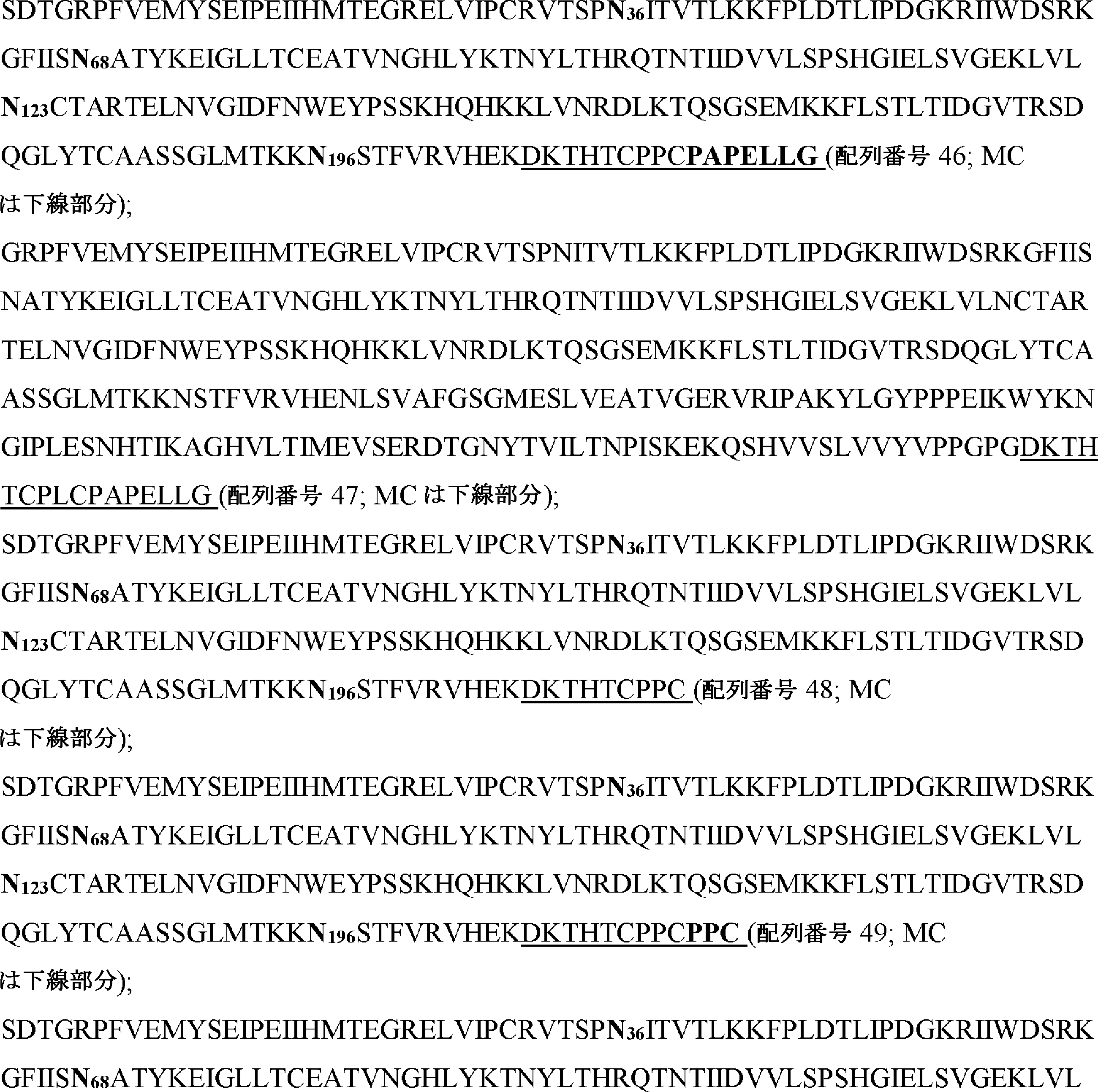

本発明の一実施形態において、本発明の単量体VEGF MiniTrapのVEGFR1 Ig様ドメイン2は、N36及び/若しくはN68にN-結合グリコシル化;及び/若しくはC30とC79の間の鎖内ジスルフィド架橋を有し;並びに/又は本発明の単量体VEGF MiniTrapのVEGFR2 Ig様ドメイン3は、N123及び/若しくはN196にN-結合グリコシル化;及び/若しくはC124とC185の間の鎖内ジスルフィド架橋を有する。
In one embodiment of the present invention, the VEGFR1 Ig-
本発明の一実施形態において、VEGF MiniTrapは構造:
・(R1D2)1-(R2D3)1-(G4S)3-(R1D2)1-(R2D3)1(「(G4S)3」:配列番号107として開示される);
・(R1D2)1-(R2D3)1-(G4S)6-(R1D2)1-(R2D3)1(「(G4S)6」:配列番号108として開示される);
・(R1D2)1-(R2D3)1-(G4S)9-(R1D2)1-(R2D3)1(「(G4S)9」:配列番号109として開示される);又は
・(R1D2)1-(R2D3)1-(G4S)12-(R1D2)1-(R2D3)1(「(G4S)12」:配列番号110として開示される)
を含む。G4Sは、-Gly-Gly-Gly-Gly-Ser-(配列番号111)である。
In one embodiment of the invention, the VEGF MiniTrap has the structure:
(R1D2) 1 -(R2D3) 1 -(G 4 S) 3 -(R1D2) 1 -(R2D3) 1 ("(G 4 S) 3 ": disclosed as SEQ ID NO: 107);
(R1D2) 1 -(R2D3) 1 -(G 4 S) 6 -(R1D2) 1 -(R2D3) 1 ("(G 4 S) 6 ": disclosed as SEQ ID NO: 108);
(R1D2) 1 -(R2D3) 1 -(G 4 S) 9 -(R1D2) 1 -(R2D3) 1 ("(G 4 S) 9 ": disclosed as SEQ ID NO: 109); or (R1D2) 1 -(R2D3) 1 -(G 4 S) 12 -(R1D2) 1 -(R2D3) 1 ("(G 4 S) 12 ": disclosed as SEQ ID NO: 110).
G 4 S is -Gly-Gly-Gly-Gly-Ser- (SEQ ID NO:111).
本発明の一実施形態において、VEGF MiniTrapはアミノ酸配列:


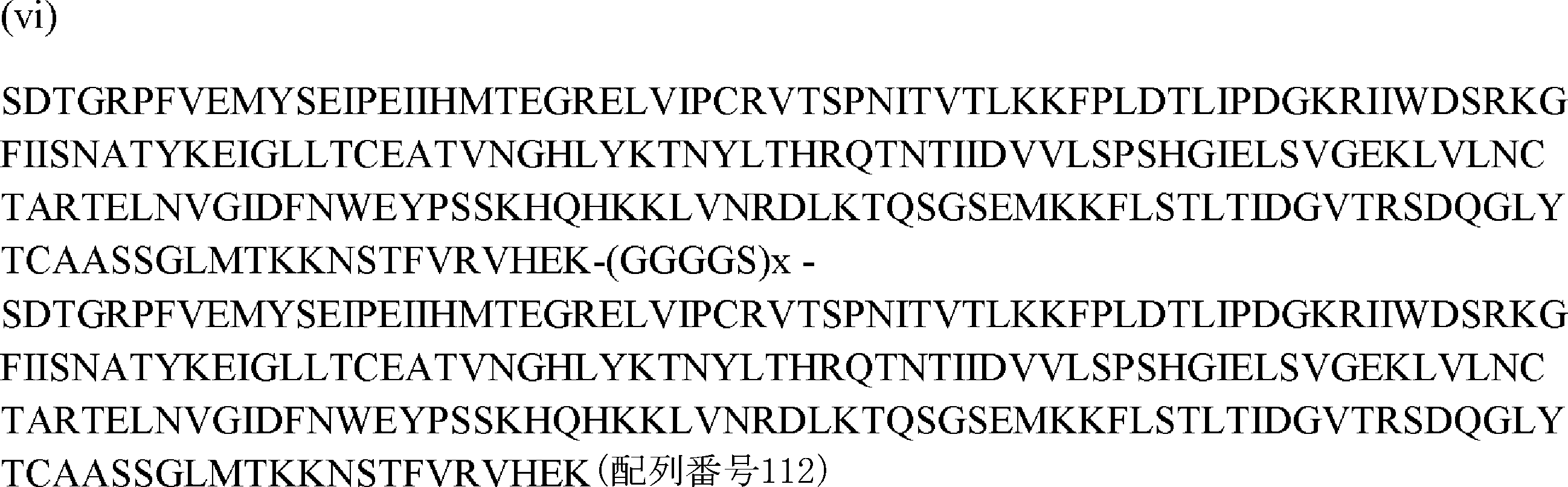
本発明のある特定の実施形態において、本発明のVEGF MiniTrapは、VEGF MiniTrapポリペプチドのアミノ酸残基の任意の有意な修飾(例えばN末端及び/又はC末端での、例えばPEG化又はヨードアセトアミド化といった指向性の化学修飾)を欠いている。 In certain embodiments of the invention, the VEGF MiniTrap of the invention lacks any significant modification of the amino acid residues of the VEGF MiniTrap polypeptide (e.g., directed chemical modification, such as PEGylation or iodoacetamidation, at the N-terminus and/or C-terminus).
本発明の一実施形態において、ポリペプチドは二次構造を含み、この場合、単一のキメラポリペプチド(例えば、(R1D2)a-(R2D3)b-リンカー-(R1D2)c-(R2D3)d;又は(R1D2)a-(R2D3)b-(R2D4)c-リンカー-(R1D2)d-(R2D3)e-(R2D4)f)又は別個のキメラポリペプチド(例えばホモ二量体)中の同様のVEGFR Igドメインは、VEGF結合ドメインを形成するために整列する。例えばこの場合、
(i)当該R1D2ドメイン同士が整列して、
(ii)当該R2D3ドメイン同士が整列して、及び/又は
(iii)当該R2D4ドメイン同士が整列して、
VEGF結合ドメインを形成する。図2は、そのようなドメイン配置を示す一本鎖VEGF MiniTrapを示す。VEGFR1、VEGFR2、及びリンカードメインが示される。示されるリンカーは(G4S)6(配列番号108)である。本発明は、(G4S)3(配列番号107);(G4S)9(配列番号109);又は(G4S)12(配列番号110)リンカーを有する一本鎖VEGF MiniTrapを含む。
In one embodiment of the invention, the polypeptide comprises a secondary structure, where similar VEGFR Ig domains in a single chimeric polypeptide (e.g., (R1D2) a- (R2D3) b -linker-(R1D2) c- (R2D3) d ; or (R1D2) a- (R2D3) b- (R2D4) c -linker-(R1D2) d- (R2D3) e- (R2D4) f ) or in separate chimeric polypeptides (e.g., homodimers) align to form a VEGF binding domain. For example, in this case:
(i) the R1D2 domains are aligned with each other;
(ii) the R2D3 domains are aligned, and/or (iii) the R2D4 domains are aligned,
The VEGFR1, VEGFR2, and linker domains are shown. The linker shown is ( G4S ) 6 (SEQ ID NO:108). The invention includes single-chain VEGF MiniTraps having (G4S) 3 (SEQ ID NO:107); ( G4S ) 9 (SEQ ID NO:109); or ( G4S ) 12 (SEQ ID NO:110) linkers.
加えて、本発明はまた、VEGFポリペプチド又はその断片又はその融合物と複合体を形成する、本明細書にて述べられるVEGF MiniTrapを含む複合体も提供する。本発明の一実施形態において、VEGF(例えば、VEGF165)はホモ二量体化され、及び/又はVEGF MiniTrapは2:2複合体(2VEGF:2MiniTrap)でホモ二量体化され、及び/又はVEGF MiniTrapは1:1複合体でホモ二量体化される。複合体としては、ホモ二量体化されたVEGF MiniTrapポリペプチドに結合されるホモ二量体化VEGF分子が挙げられる。本発明の一実施形態において、複合体はインビトロである(例えば、固体基質に固定化)、又は対象の身体内に存在する。本発明はまた、VEGF MiniTrapで複合体を形成したVEGF二量体(例えば、VEGF165)の複合体の組成物も含む。 In addition, the present invention also provides a complex comprising a VEGF MiniTrap as described herein complexed with a VEGF polypeptide or a fragment or fusion thereof. In one embodiment of the present invention, VEGF (e.g., VEGF 165 ) is homodimerized and/or VEGF MiniTrap is homodimerized in a 2:2 complex (2VEGF:2MiniTrap) and/or VEGF MiniTrap is homodimerized in a 1:1 complex. The complex includes a homodimerized VEGF molecule bound to a homodimerized VEGF MiniTrap polypeptide. In one embodiment of the present invention, the complex is in vitro (e.g., immobilized on a solid substrate) or present in the body of a subject. The present invention also includes compositions of complexes of VEGF dimers (e.g., VEGF 165 ) complexed with VEGF MiniTrap.
本明細書にて使用される場合、用語「タンパク質」又は「関心対象のタンパク質」としては、共有結合されたアミド結合を有する、任意のアミノ酸ポリマーが挙げられ得る。関心対象のタンパク質の例としては、アフリベルセプト及びMiniTrapが挙げられるがこれらに限定されない。タンパク質は、当技術分野にて一般には「ポリペプチド」として公知である1種以上のアミノ酸ポリマー鎖を含む。「ポリペプチド」は、アミノ酸残基から構成されるポリマー、関連する天然に存在する構造バリアント、及びペプチド結合を介して結合される天然に存在しないそれらの合成アナログ、関連する天然に存在する構造バリアント、及び天然に存在しないそれらの合成アナログを指す。「合成ペプチド又はポリペプチド」は、天然に存在しないペプチド又はポリペプチドを指す。合成ペプチド又はポリペプチドは、例えば自動ポリペプチドシンセサイザーを使用して合成され得る。様々な固相ペプチド合成法が当業者に知られている。タンパク質は1種又は複数種のポリペプチドを含み、単一の機能性生体分子を形成することができる。別の例示的な態様では、タンパク質には抗体断片、ナノボディ、組換え抗体キメラ、サイトカイン、ケモカイン、ペプチドホルモン、及びそれらの同等物が含まれ得る。関心対象のタンパク質には、バイオ治療タンパク質、研究又は治療に使用される組換えタンパク質、トラップタンパク質及び他のキメラ受容体Fc融合タンパク質、キメラタンパク質、抗体、モノクローナル抗体、ポリクローナル抗体、ヒト抗体、及び二重特異性抗体のいずれかが含まれ得る。特定の態様において、関心対象のタンパク質は抗VEGF融合タンパク質(例えば、アフリベルセプト又はMiniTrap)である。タンパク質は、例えば昆虫バキュロウイルス(bacculovirus)系、酵母系(例えば、ピキア種(Pichia sp.))、哺乳動物系(例えば、CHO細胞及びCHO-K1細胞などのCHO誘導体)といった組換え細胞ベースの産生システムを使用して産生され得る。バイオ治療タンパク質及びそれらの産生について述べた近年の総説としては、Ghaderi et al.,「Production platforms for biotherapeutic glycoproteins.Occurrence,impact,and challenges of non-human sialylation」(Darius Ghaderi et al.,Production platforms for biotherapeutic glycoproteins.Occurrence,impact,and challenges of non-human sialylation,28 BIOTECHNOLOGY AND GENETIC ENGINEERING REVIEWS 147-176(2012)、その全体の教示が本明細書に組み入れられる)を参照されたい。いくつかの例示的な実施形態において、タンパク質は修飾物、付加物、及び他の共有結合された部分を含む。こうした修飾、付加物、及び部分としては例えば、アビジン、ストレプトアビジン、ビオチン、グリカン(例えば、N-アセチルガラクトサミン、ガラクトース、ノイラミン酸、N-アセチルグルコサミン、フコース、マンノース、及び他の単糖類)、PEG、ポリヒスチジン、FLAGタグ、マルトース結合タンパク質(MBP)、キチン結合タンパク質(CBP)、グルタチオン-S-トランスフェラーゼ(GST)myc-エピトープ、蛍光標識、及び他の色素、及びそれらの同等物が挙げられる。タンパク質は、組成及び溶解度に基づいて分類可能であり、したがって、タンパク質としては、球状タンパク質及び繊維状タンパク質といった単純タンパク質、核タンパク質、糖タンパク質、ムコタンパク質、色素タンパク質、リンタンパク質、金属タンパク質、及びリポタンパク質といった複合タンパク質、並びに一次誘導タンパク質及び二次誘導タンパク質といった誘導タンパク質が挙げられる。 As used herein, the term "protein" or "protein of interest" may include any amino acid polymer having covalently linked amide bonds. Examples of proteins of interest include, but are not limited to, aflibercept and MiniTrap. A protein includes one or more amino acid polymer chains, commonly known in the art as "polypeptides." A "polypeptide" refers to a polymer composed of amino acid residues, related naturally occurring structural variants, and non-naturally occurring synthetic analogs thereof linked via peptide bonds, related naturally occurring structural variants, and non-naturally occurring synthetic analogs thereof. A "synthetic peptide or polypeptide" refers to a peptide or polypeptide that does not occur in nature. A synthetic peptide or polypeptide may be synthesized, for example, using an automated polypeptide synthesizer. A variety of solid-phase peptide synthesis methods are known to those skilled in the art. A protein may include one or more polypeptides to form a single functional biomolecule. In another exemplary aspect, a protein may include an antibody fragment, a nanobody, a recombinant antibody chimera, a cytokine, a chemokine, a peptide hormone, and the like. Proteins of interest may include biotherapeutic proteins, recombinant proteins used in research or therapy, trap proteins and other chimeric receptor Fc fusion proteins, chimeric proteins, antibodies, monoclonal antibodies, polyclonal antibodies, human antibodies, and bispecific antibodies. In a particular embodiment, the protein of interest is an anti-VEGF fusion protein (e.g., aflibercept or MiniTrap). Proteins may be produced using recombinant cell-based production systems, such as insect bacculovirus systems, yeast systems (e.g., Pichia sp.), mammalian systems (e.g., CHO cells and CHO derivatives such as CHO-K1 cells). Recent reviews describing biotherapeutic proteins and their production include Ghaderi et al., J. Immunol. 1999, 143:1311-1323, 19 ... , “Production platforms for biotherapeutic glycoproteins. Occurrence, impact, and challenges of non-human sialylation” (Darius Ghaderi et al., Production platforms for biotherapeutic glycoproteins. Occurrence, impact, and challenges of non-human sialylation, 28 BIOTECHNOLOGY AND GENETIC ENGINEERING REVIEWS 147-176 (2012), the entire teachings of which are incorporated herein. In some exemplary embodiments, the proteins include modifications, adducts, and other covalently attached moieties, including, for example, avidin, streptavidin, biotin, glycans (e.g., N-acetylgalactosamine, galactose, neuraminic acid, N-acetylglucosamine, fucose, mannose, and other monosaccharides), PEG, polyhistidine, FLAG tags, maltose binding protein (MBP), chitin binding protein (CBP), glutathione-S-transferase (GST) myc-epitope, fluorescent labels, and other dyes, and the like. Proteins can be classified based on their composition and solubility, and thus include simple proteins, such as globular and fibrous proteins; complex proteins, such as nucleoproteins, glycoproteins, mucoproteins, chromoproteins, phosphoproteins, metalloproteins, and lipoproteins; and derived proteins, such as primary derived proteins and secondary derived proteins.
いくつかの例示的な実施形態において、関心対象のタンパク質は組換えタンパク質、抗体、二重特異性抗体、多重特異性抗体、抗体断片、モノクローナル抗体、融合タンパク質、scFv、及びこれらの組合せであり得る。 In some exemplary embodiments, the protein of interest may be a recombinant protein, an antibody, a bispecific antibody, a multispecific antibody, an antibody fragment, a monoclonal antibody, a fusion protein, an scFv, and combinations thereof.
本明細書にて使用される場合、用語「組換えタンパク質」は、好適な宿主細胞へと組み入れられる組換え発現ベクターにて運ばれる遺伝子の転写及び翻訳の結果として産生されるタンパク質を指す。特定の例示的な実施形態において、組換えタンパク質は融合タンパク質であり得る。特定の態様において、組換えタンパク質は抗VEGF融合タンパク質(例えば、アフリベルセプト又はMiniTrap)である。特定の例示的な実施形態において、組換えタンパク質は、例えばキメラ抗体、ヒト化抗体、又は完全ヒト抗体といった抗体であり得る。特定の例示的な実施形態において、組換えタンパク質は、IgG、IgM、IgA1、IgA2、IgD、又はIgEからなる群から選択されるアイソタイプの抗体であり得る。特定の例示的な実施形態において、抗体分子は全長抗体(例えばIgG1)、又は代替的には抗体は断片(例えば、Fc断片又はFab断片)であり得る。 As used herein, the term "recombinant protein" refers to a protein produced as a result of transcription and translation of a gene carried in a recombinant expression vector that is incorporated into a suitable host cell. In certain exemplary embodiments, the recombinant protein may be a fusion protein. In certain aspects, the recombinant protein is an anti-VEGF fusion protein (e.g., aflibercept or MiniTrap). In certain exemplary embodiments, the recombinant protein may be an antibody, such as a chimeric antibody, a humanized antibody, or a fully human antibody. In certain exemplary embodiments, the recombinant protein may be an antibody of an isotype selected from the group consisting of IgG, IgM, IgA1, IgA2, IgD, or IgE. In certain exemplary embodiments, the antibody molecule may be a full-length antibody (e.g., IgG1), or alternatively, the antibody may be a fragment (e.g., an Fc fragment or a Fab fragment).
本明細書にて使用される場合、用語「抗体」は、4つのポリペプチド鎖(ジスルフィド結合により相互接続される2つの重(H)鎖及び2つの軽(L)鎖)を含む免疫グロブリン分子、並びにそれらの多量体(例えばIgM)を含む。各重鎖は、重鎖可変領域(本明細書ではHCVR又はVHと略される)及び重鎖定常領域を含む。重鎖定常領域は、CH1、CH2、及びCH3といった3つのドメインを含む。各軽鎖は、軽鎖可変領域(本明細書ではLCVR又はVLと略される)及び軽鎖定常領域を含む。軽鎖定常領域は1つのドメイン(CL1)を含む。VH領域及びVL領域は、相補性決定領域(CDR)と呼ばれる超可変領域へと更に細分され、フレームワーク領域(FR)と呼ばれるより保存されている領域に点在している。各VH及びVLは、3つのCDR及び4つのFRから構成され、アミノ末端からカルボキシル末端までFR1、CDR1、FR2、CDR2、FR3、CDR3、及びFR4の順で配列される。本発明の異なる実施形態において、抗big-ET-1抗体のFR(又はその抗原結合部分)は、ヒト生殖系列配列と同一であり得、又は自然に若しくは人工的に改変され得る。アミノ酸コンセンサス配列は、2つ以上のCDRのサイドバイサイド分析に基づいて定義され得る。本明細書にて使用される場合、用語「抗体」はまた、完全抗体分子の抗原結合断片も含む。本明細書にて使用される場合、抗体の用語「抗原結合部分」、抗体の「抗原結合断片」、及びそれらの同等物は、抗原に特異的に結合して複合体を形成する、任意の天然に存在するポリペプチド又は糖タンパク質、酵素的に得ることができるポリペプチド又は糖タンパク質、合成ポリペプチド又は糖タンパク質、あるいは遺伝子的に改変されたポリペプチド又は糖タンパク質を含む。抗体の抗原結合断片は、例えばタンパク質分解性消化又は可変ドメイン及び任意で定常ドメインをコードするDNAの操作及び発現に関与する組換え遺伝子改変技術といった、任意の好適な標準技術を使用し、完全抗体分子から誘導され得る。このようなDNAは公知であり、及び/又は例えば製造元、DNAライブラリ(例えば、ファージ-抗体ライブラリを含む)から容易に入手可能であり、又は合成することができる。DNAは、例えば、1つ以上の可変ドメイン及び/若しくは定常ドメインを好適な構成へと配置させるため、又はコドンを導入し、システイン残基を生成し、アミノ酸を修飾、添加、若しくは欠失させるために、化学的に又は分子生物学的技術を使用することで、配列決定及び操作され得る。 As used herein, the term "antibody" includes immunoglobulin molecules comprising four polypeptide chains (two heavy (H) chains and two light (L) chains interconnected by disulfide bonds), as well as multimers thereof (e.g., IgM). Each heavy chain comprises a heavy chain variable region (abbreviated herein as HCVR or VH) and a heavy chain constant region. The heavy chain constant region comprises three domains: CH1, CH2, and CH3. Each light chain comprises a light chain variable region (abbreviated herein as LCVR or VL) and a light chain constant region. The light chain constant region comprises one domain (CL1). The VH and VL regions are further subdivided into hypervariable regions called complementarity determining regions (CDRs), interspersed with more conserved regions called framework regions (FRs). Each VH and VL is composed of three CDRs and four FRs, arranged from the amino terminus to the carboxyl terminus in the following order: FR1, CDR1, FR2, CDR2, FR3, CDR3, and FR4. In different embodiments of the present invention, the FRs (or antigen-binding portions thereof) of the anti-big-ET-1 antibody may be identical to the human germline sequences or may be naturally or artificially modified. An amino acid consensus sequence may be defined based on a side-by-side analysis of two or more CDRs. As used herein, the term "antibody" also includes antigen-binding fragments of complete antibody molecules. As used herein, the terms "antigen-binding portion" of an antibody, "antigen-binding fragment" of an antibody, and the like, include any naturally occurring, enzymatically obtainable, synthetic, or genetically modified polypeptide or glycoprotein that specifically binds to an antigen to form a complex. Antigen-binding fragments of antibodies can be derived from intact antibody molecules using any suitable standard techniques, such as, for example, proteolytic digestion or recombinant genetic engineering techniques involving the manipulation and expression of DNA encoding the variable and, optionally, constant domains. Such DNA is known and/or readily available, for example, from manufacturers, DNA libraries (including, for example, phage-antibody libraries), or can be synthesized. The DNA can be sequenced and manipulated, for example, chemically or using molecular biology techniques to arrange one or more variable and/or constant domains into a suitable configuration, or to introduce codons, generate cysteine residues, modify, add, or delete amino acids.
本明細書にて使用される場合、「抗体断片」としては、例えば抗体の抗原結合領域又は可変領域といった無処置抗体の一部が挙げられる。抗体断片の例としては、Fab断片、Fab’断片、F(ab’)2断片、scFv断片、Fv断片、dsFv二重特異性抗体、dAb断片、Fd’断片、Fd断片、及び単離された相補性決定領域(CDR)領域、並びにトリアボディ、テトラボディ、線形抗体、一本鎖抗体分子、及び抗体断片から形成された多重特異性抗体が挙げられるが、これらに限定されない。Fv断片は、免疫グロブリン重鎖及び軽鎖の可変領域の組合せであり、scFvタンパク質は、免疫グロブリン軽鎖可変領域及び重鎖可変領域がペプチドリンカーにより接続されている組換え一本鎖ポリペプチド分子である。いくつかの例示的な実施形態において、抗体断片は、親抗体が結合するのと同じ抗原に結合する断片である親抗体の十分なアミノ酸配列を含み、いくつかの例示的な実施形態において、断片は親抗体と同等の親和性で抗原に結合し、抗原への結合について親抗体と競合する。抗体断片は、任意の手段により産生され得る。例えば、抗体断片は無処置抗体の断片化により酵素的若しくは化学的に産生され得、及び/又は部分的な抗体配列をコードする遺伝子から組換え産生され得る。代替的に又は加えて、抗体断片は全体的に又は部分的に合成によって産生され得る。抗体断片は、任意で一本鎖抗体断片を含み得る。代替的に又は加えて、抗体断片は、例えばジスルフィド結合により共に結合されている複数の鎖を含み得る。抗体断片は、任意で複数分子の複合体を含み得る。機能的抗体断片は典型的には少なくとも約50アミノ酸、より典型的には少なくとも約200アミノ酸を含む。 As used herein, an "antibody fragment" includes a portion of an intact antibody, such as an antigen-binding or variable region of an antibody. Examples of antibody fragments include, but are not limited to, Fab fragments, Fab' fragments, F(ab')2 fragments, scFv fragments, Fv fragments, dsFv diabodies, dAb fragments, Fd' fragments, Fd fragments, and isolated complementarity determining region (CDR) regions, as well as triabodies, tetrabodies, linear antibodies, single-chain antibody molecules, and multispecific antibodies formed from antibody fragments. An Fv fragment is a combination of variable regions of an immunoglobulin heavy and light chains, and an scFv protein is a recombinant single-chain polypeptide molecule in which an immunoglobulin light chain variable region and a heavy chain variable region are connected by a peptide linker. In some exemplary embodiments, an antibody fragment contains sufficient amino acid sequence of a parent antibody that the fragment binds to the same antigen as the parent antibody, and in some exemplary embodiments, the fragment binds to the antigen with an affinity comparable to that of the parent antibody and competes with the parent antibody for binding to the antigen. Antibody fragments may be produced by any means. For example, antibody fragments may be produced enzymatically or chemically by fragmentation of an intact antibody and/or recombinantly from a gene encoding a partial antibody sequence. Alternatively or additionally, antibody fragments may be produced synthetically in whole or in part. Antibody fragments may optionally include single chain antibody fragments. Alternatively or additionally, antibody fragments may include multiple chains linked together, for example, by disulfide bonds. Antibody fragments may optionally include multi-molecular complexes. Functional antibody fragments typically include at least about 50 amino acids, more typically at least about 200 amino acids.
用語「二重特異性抗体」は、2つ以上のエピトープを選択的に結合可能である抗体を含む。二重特異性抗体は一般には、2つの異なる分子(例えば複数の抗原)又は同じ分子(例えば同じ抗原)のいずれかの上で、異なるエピトープに特異的に結合する各重鎖を有する2つの異なる重鎖を含む。二重特異性抗体が2つの異なるエピトープ(第1エピトープ及び第2エピトープ)に選択的に結合可能である場合、第1エピトープの第1重鎖の親和性は、一般には、第2エピトープの第1重鎖の親和性よりも少なくとも1~2桁又は1~3桁又は1~4桁低くなることがあり、またこの逆もあり得る。二重特異性抗体により認識されるエピトープは、同じ標的又は異なる標的(例えば、同じタンパク質又は異なるタンパク質)上であり得る。二重特異性抗体は例えば、同じ抗原の異なるエピトープを認識する重鎖を組み合わせることにより作製され得る。例えば、同じ抗原の異なるエピトープを認識する重鎖可変配列をコードする核酸配列は、異なる重鎖定常領域をコードする核酸配列に融合され得、こうした配列は、免疫グロブリン軽鎖を発現する細胞内で発現され得る。 The term "bispecific antibody" includes antibodies capable of selectively binding two or more epitopes. Bispecific antibodies generally comprise two different heavy chains with each heavy chain specifically binding to a different epitope, either on two different molecules (e.g., multiple antigens) or on the same molecule (e.g., the same antigen). When a bispecific antibody is capable of selectively binding to two different epitopes (a first epitope and a second epitope), the affinity of the first heavy chain for the first epitope can generally be at least 1-2 or 1-3 or 1-4 orders of magnitude lower than the affinity of the first heavy chain for the second epitope, or vice versa. The epitopes recognized by a bispecific antibody can be on the same target or different targets (e.g., the same protein or different proteins). Bispecific antibodies can be made, for example, by combining heavy chains that recognize different epitopes of the same antigen. For example, nucleic acid sequences encoding heavy chain variable sequences that recognize different epitopes of the same antigen can be fused to nucleic acid sequences encoding different heavy chain constant regions, and such sequences can be expressed in cells that express immunoglobulin light chains.
典型的な二重特異性抗体は、3つの重鎖CDRをそれぞれ有する2つの重鎖、続いてCH1ドメイン、ヒンジ、CH2ドメイン及びCH3ドメイン、どれもが抗原結合特異性をもたらさないがそれぞれの重鎖と結合可能である免疫グロブリン軽鎖、又は各重鎖と結合可能でありかつ重鎖抗原結合領域により結合された1つ以上のエピトープに結合可能である免疫グロブリン軽鎖、又は各重鎖と結合可能でありかつ1つ若しくは両方のエピトープに1つ若しくは両方の重鎖の結合が可能であり得る免疫グロブリン軽鎖を有する。BsAbは、2つの主要クラスへと分けることができ、これらはFc領域(IgG様)を有するものと、Fc領域を欠いているものであり、後者は通常、IgG及びFcを含むIgG様二重特異的分子よりも小さいものである。IgG様bsAbは例えば、トリオマブ、ノブ・イントゥ・ホール(knobs into holes)IgG(kih IgG)、クロスマブ、orth-Fab IgG、デュアル可変ドメインIg(DVD-Ig)、トゥー・イン・ワン又はデュアルアクションFab(DAF)、IgG一本鎖Fv(IgG-scFv)、又はκλ-ボディといった異なるフォーマットを有し得るがこれらに限定されない。非IgG様の異なるフォーマットとしては、タンデムscFv、ダイアボディフォーマット、一本鎖ダイアボディ、タンデムダイアボディ(TandAb)、デュアルアフィニティー再標的分子(DART)、DART-Fc、ナノボディ、又はドック・アンド・ロック(DNL)法(Gaowei Fan,Zujian Wang&Mingju Hao,Bispecific antibodies and their applications,8 JOURNAL OF HEMATOLOGY&ONCOLOGY 130;Dafne Muller&Roland E.Kontermann,Bispecific Antibodies,HANDBOOK OF THERAPEUTIC ANTIBODIES 265-310(2014)、その全体の教示が本明細書に組み入れられる)により産生された抗体が挙げられる。bsAbを産生する方法は、2つの異なるハイブリドーマ細胞株の体細胞融合物に基づくクアドローマ技術、化学的架橋リンカーを含む化学的コンジュゲーション、組換えDNA技術を利用する遺伝子的アプローチに限定されない。bsAbの例としては、以下:2010年6月25日に提出された米国特許番号第12/823838号、2012年6月5日に提出された米国特許番号第13/488628号、2013年9月19日に提出された米国特許番号第14/031075号、2015年7月24日に提出された米国特許番号第14/808171号、2017年9月22日に提出された米国特許番号第15/713574号、2017年9月22日に提出された米国特許番号第15/713569号、2016年12月21日に提出された米国特許番号第15/386453号、2016年12月21日に提出された米国特許番号第15/386443号、2016年7月29年に提出された米国特許番号第15/22343号、及び2017年11月15日に提出された米国特許番号15814095号といった特許出願に開示されるものが挙げられ、これらは参照として本明細書に組み入れられる。低レベルのホモ二量体不純物は、二重特異性抗体を製造する間の複数の工程に存在し得る。ホモ二量体不純物の存在量が低く、通常の液体クロマトグラフィー法を使用して実行されるときには、これらの不純物は主要種と共溶出されることから、このようなホモ二量体不純物の検出は、インタクト質量分析を使用して実施されるときには困難なものとなる可能性がある。 A typical bispecific antibody has two heavy chains, each with three heavy chain CDRs, followed by a CH1 domain, a hinge, a CH2 domain, and a CH3 domain, an immunoglobulin light chain that does not provide any antigen-binding specificity but is capable of binding to each heavy chain, or an immunoglobulin light chain that is capable of binding to each heavy chain and is capable of binding to one or more epitopes bound by the heavy chain antigen-binding region, or an immunoglobulin light chain that is capable of binding to each heavy chain and may be capable of binding one or both heavy chains to one or both epitopes. BsAbs can be divided into two major classes, those with an Fc region (IgG-like) and those that lack an Fc region, the latter being usually smaller than IgG and IgG-like bispecific molecules that contain Fc. The IgG-like bsAb can have different formats such as, but not limited to, triomab, knobs into holes IgG (kih IgG), crossmab, orth-Fab IgG, dual variable domain Ig (DVD-Ig), two-in-one or dual action Fab (DAF), IgG single chain Fv (IgG-scFv), or κλ-body. Different non-IgG-like formats include tandem scFv, diabody formats, single chain diabodies, tandem diabodies (TandAb), dual affinity retargeting molecules (DART), DART-Fc, nanobodies, or dock-and-lock (DNL) methods (Gaowei Fan, Zujian Wang & Mingju Hao, Bispecific antibodies and their applications, 8 JOURNAL OF HEMATOLOGY & ONCOLOGY 130; Dafne Muller & Roland E. Kontermann, Bispecific Antibodies, HANDBOOK OF THERAPEUTIC ANTIBODIES 265-310 (2014), the entire teachings of which are incorporated herein. Methods for producing bsAbs include, but are not limited to, quadroma technology based on somatic cell fusion of two different hybridoma cell lines, chemical conjugation involving chemical cross-linkers, genetic approaches utilizing recombinant DNA technology. Examples of bsAbs include the following: U.S. Patent No. 12/823,838, filed June 25, 2010; U.S. Patent No. 13/488,628, filed June 5, 2012; U.S. Patent No. 14/031,075, filed September 19, 2013; U.S. Patent No. 14/808,171, filed July 24, 2015; U.S. Patent No. 15/713,574, filed September 22, 2017; No. 15/713569, U.S. Patent No. 15/386453, filed December 21, 2016, U.S. Patent No. 15/386443, filed December 21, 2016, U.S. Patent No. 15/22343, filed July 29, 2016, and U.S. Patent No. 15814095, filed November 15, 2017, which are incorporated herein by reference. Low levels of homodimeric impurities may be present at multiple steps during the manufacture of bispecific antibodies. Detection of such homodimeric impurities may be challenging when performed using intact mass spectrometry, as the abundance of homodimeric impurities is low and these impurities co-elute with the major species when performed using conventional liquid chromatography methods.
本明細書にて使用される場合、「多重特異性抗体」は、少なくとも2つの異なる抗原に対する結合特異性を有する抗体を指す。このような分子は通常、2つの抗原にのみ結合する(すなわち、二重特異性抗体、bsAb)が、三重特異性抗体及びKIH三重特異性といった追加の特異性を有する抗体はまた、本明細書に開示されるシステム及び方法により処理され得る。 As used herein, a "multispecific antibody" refers to an antibody that has binding specificities for at least two different antigens. Such molecules typically bind only two antigens (i.e., bispecific antibodies, bsAbs), but antibodies with additional specificities, such as trispecific antibodies and KIH trispecifics, can also be processed by the systems and methods disclosed herein.
本明細書にて使用される場合、用語「モノクローナル抗体」はハイブリドーマ技術により産生された抗体に限定されない。モノクローナル抗体は、当技術分野にて入手可能であり公知である任意の手段により、任意の真核細胞クローン、原核細胞クローン、又はファージクローンを含む単一クローンから誘導され得る。本開示に有用なモノクローナル抗体は、ハイブリドーマ技術、組換え技術、及びファージディスプレイ技術、又はこれらの組合せの使用を含む、当技術分野にて公知の様々な技術を使用して調製され得る。 As used herein, the term "monoclonal antibody" is not limited to antibodies produced by hybridoma technology. Monoclonal antibodies may be derived from a single clone, including any eukaryotic, prokaryotic, or phage clone, by any means available and known in the art. Monoclonal antibodies useful in the present disclosure may be prepared using a variety of techniques known in the art, including the use of hybridoma, recombinant, and phage display technologies, or a combination thereof.
いくつかの例示的な実施形態において、関心対象のタンパク質は約4.5~約9.0の範囲でpIを有し得る。例示的な特定の一実施形態において、pIは、約4.5、約5.0、約5.5、約5.6、約5.7、約5.8、約5.9、約6.0、約6.1、約6.2、約6.3、約6.4、約6.5、約6.6、約6.7、約6.8、約6.9、約7.0、約7.1、約7.2、約7.3、約7.4、約7.5、約7.6、約7.7、約7.8、約7.9、約8.0、約8.1、約8.2、約8.3、約8.4、約8.5、約8.6、約8.7、約8.8、約8.9、又は約9.0であり得る。いくつかの例示的な実施形態において、組成物中の関心対象のタンパク質の種類は2種以上であり得る。 In some exemplary embodiments, the protein of interest may have a pI in the range of about 4.5 to about 9.0. In a particular exemplary embodiment, the pI may be about 4.5, about 5.0, about 5.5, about 5.6, about 5.7, about 5.8, about 5.9, about 6.0, about 6.1, about 6.2, about 6.3, about 6.4, about 6.5, about 6.6, about 6.7, about 6.8, about 6.9, about 7.0, about 7.1, about 7.2, about 7.3, about 7.4, about 7.5, about 7.6, about 7.7, about 7.8, about 7.9, about 8.0, about 8.1, about 8.2, about 8.3, about 8.4, about 8.5, about 8.6, about 8.7, about 8.8, about 8.9, or about 9.0. In some exemplary embodiments, the protein of interest in the composition may be more than one type.
いくつかの例示的な実施形態において、関心対象のタンパク質は哺乳動物細胞から産生され得る。哺乳動物細胞はヒト起源であり得、又は非ヒト起源は、初代上皮細胞(例えば、ケラチノサイト、頸部上皮細胞、気管支上皮細胞、気管上皮細胞、腎臓上皮細胞及び網膜上皮細胞)、樹立された細胞系統及びそれらの株(例えば、293胎児腎細胞、BHK細胞、HeLa子宮頸部上皮細胞及びPER-C6網膜細胞、MDBK(NBL-1)細胞、911細胞、CRFK細胞、MDCK細胞、CHO細胞、BeWo細胞、Chang細胞、Detroit562細胞、HeLa229細胞、HeLaS3細胞、Hep-2細胞、KB細胞、LSI80細胞、LS174T細胞、NCI-H-548細胞、RPMI2650細胞、SW-13細胞、T24細胞、WI-28 VA13、2RA細胞、WISH細胞、BS-C-I細胞、LLC-MK2細胞、クローンM-3細胞、1-10細胞、RAG細胞、TCMK-1細胞、Y-l細胞、LLC-PKi細胞、PK(15)細胞、GHi細胞、GH3細胞、L2細胞、LLC-RC256細胞、MHiCi細胞、XC細胞、MDOK細胞、VSW細胞、及びTH-I、B1細胞、BSC-1細胞、RAf細胞、RK-細胞、PK-15細胞又はそれらの誘導体)、任意の組織又は器官からの線維芽細胞(心臓、肝臓、腎臓、結腸、腸、食道、胃、神経組織(脳、脊髄)、肺、血管組織(動脈、静脈、毛細血管)、リンパ組織(リンパ腺、咽頭扁桃、扁桃腺、骨髄及び血液)、脾臓及び線維芽細胞及び線維芽細胞様細胞株(例えば、CHO細胞、TRG-2細胞、IMR-33細胞、Don細胞、GHK-21細胞、シトルリン血症細胞、Dempsey細胞、Detroit551細胞、Detroit510細胞、Detroit525細胞、Detroit529細胞、Detroit532細胞、Detroit539細胞、Detroit548細胞、Detroit573細胞、HEL299細胞、IMR-90細胞、MRC-5細胞、WI-38細胞、WI-26細胞、Midi細胞、CHO細胞、CV-1細胞、COS-1細胞、COS-3細胞、COS-7細胞、Vero細胞、DBS-FrhL-2細胞、BALB/3T3細胞、F9細胞、SV-T2細胞、M-MSV-BALB/3T3細胞、K-BALB細胞、BLO-11細胞、NOR-10細胞、C3H/IOTI/2細胞、HSDMiC3細胞、KLN205細胞、McCoy細胞、マウスL細胞、株2071(マウスL)細胞、L-M株(マウスL)細胞、L-MTK’(マウスL)細胞、NCTCクローン2472及び2555、SCC-PSA1細胞、Swiss/3T3細胞、インドキョン(Indian muntac)細胞、SIRC細胞、Cn細胞、及びJensen細胞、Sp2/0、NS0、NS1細胞若しくはそれらの誘導体)を含むがこれらに限定されない)を含み得る。
In some exemplary embodiments, the protein of interest may be produced from mammalian cells. The mammalian cells may be of human origin or of non-human origin, such as primary epithelial cells (e.g., keratinocytes, cervical epithelial cells, bronchial epithelial cells, tracheal epithelial cells, renal epithelial cells and retinal epithelial cells), established cell lines and their strains (e.g., 293 fetal kidney cells, BHK cells, HeLa cervical epithelial cells and PER-C6 retinal cells, MDBK (NBL-1) cells, 911 cells, CRFK cells, MDCK cells, CHO cells, BeWo cells, Chang cells, Detroit 562 cells, HeLa 229 cells, HeLa S3 cells, Hep-2 cells, KB cells,
本明細書にて使用される場合、用語「タンパク質アルキル化剤」は、タンパク質中の特定の遊離アミノ酸残基をアルキル化するために使用される薬剤を指す。タンパク質アルキル化剤の非限定的な例としては、ヨードアセトアミド(IOA)、クロロアセトアミド(CAA)、アクリルアミド(AA)、N-エチルマレイミド(NEM)、メチルメタンチオスルホナート(MMTS)、及び4-ビニルピリジン又はこれらの組合せである。 As used herein, the term "protein alkylating agent" refers to an agent used to alkylate specific free amino acid residues in a protein. Non-limiting examples of protein alkylating agents are iodoacetamide (IOA), chloroacetamide (CAA), acrylamide (AA), N-ethylmaleimide (NEM), methyl methanethiosulfonate (MMTS), and 4-vinylpyridine or combinations thereof.
本明細書にて使用される場合、「タンパク質変性」は、分子の3次元形状をその天然状態から変化させるプロセスを指し得る。タンパク質の変性は、タンパク質変性剤を使用して実行され得る。タンパク質変性剤の非限定的な例としては、熱、高pH又は低pH、DTTなどの還元剤(以下を参照されたい)又はカオトロピック剤への曝露が挙げられる。いくつかのカオトロピック剤はタンパク質変性剤として使用され得る。カオトロピック溶質は、水素結合、ファンデルワールス力、及び疎水作用などの非共有結合力により媒介される分子内相互作用に干渉することで、系のエントロピーを増加させる。カオトロピック剤の非限定的な例としては、ブタノール、エタノール、塩化グアニジニウム、過塩素酸リチウム、酢酸リチウム、塩化マグネシウム、フェノール、プロパノール、ドデシル硫酸ナトリウム、チオ尿素、N-ラウロイルサルコシン、尿素、及びそれらの塩が挙げられる。 As used herein, "protein denaturation" may refer to a process that changes the three-dimensional shape of a molecule from its native state. Denaturation of a protein may be performed using a protein denaturant. Non-limiting examples of protein denaturants include heat, high or low pH, reducing agents such as DTT (see below) or exposure to chaotropic agents. Several chaotropic agents may be used as protein denaturants. Chaotropic solutes increase the entropy of a system by interfering with intramolecular interactions mediated by non-covalent forces such as hydrogen bonding, van der Waals forces, and hydrophobic effects. Non-limiting examples of chaotropic agents include butanol, ethanol, guanidinium chloride, lithium perchlorate, lithium acetate, magnesium chloride, phenol, propanol, sodium dodecyl sulfate, thiourea, N-lauroyl sarcosine, urea, and salts thereof.
本明細書にて使用される場合、用語「タンパク質還元剤」は、タンパク質中のジスルフィド架橋を還元するために使用される薬剤を指す。タンパク質を還元するために使用されるタンパク質還元剤の非限定的な例としては、ジチオトレイトール(DTT)、β-メルカプトエタノール、エルマン試薬、ヒドロキシルアミン塩酸塩、シアノ水素化ホウ素ナトリウム、トリス(2-カルボキシエチル)ホスフィン塩酸塩(TCEP-HCl)、又はこれらの組合せである。 As used herein, the term "protein reducing agent" refers to an agent used to reduce disulfide bridges in proteins. Non-limiting examples of protein reducing agents used to reduce proteins include dithiothreitol (DTT), β-mercaptoethanol, Ellman's reagent, hydroxylamine hydrochloride, sodium cyanoborohydride, tris(2-carboxyethyl)phosphine hydrochloride (TCEP-HCl), or combinations thereof.
本明細書にて使用される場合、ポリペプチドの用語「バリアント」(例えば、VEGFR Igドメインのバリアント)は、関心対象のタンパク質の参照アミノ酸配列又は天然アミノ酸配列と少なくとも約70~99.9%(例えば、70、71、72、74、75、76、77、78、79、80、81、82、83、84、85、86、87、88、89、90、91、92、93、94、95、96、97、98、99、99.5、99.9%)同一又は類似するアミノ酸配列を含むポリペプチドを指す。配列比較は、例えばBLASTアルゴリズムにより実施され得、この場合、このアルゴリズムのパラメータは、それぞれの参照配列の全長にわたるそれぞれの配列間で、最大の一致をもたらすように選択される(例えば、しきい値:10、ワードサイズ3、クエリ幅:0での最大一致、BLOSUM62マトリックス、ギャップコスト:存在11、伸長1、条件付き構成スコアマトリックスの調整を想定する)。ポリペプチドのバリアント(例えば、VEGFR Igドメインのバリアント)はまた、例えば、ミスセンス置換(例えば、保存的置換)、ナンセンス変異、欠失又は挿入といった、1つ以上(例えば、1、2、3、4、5、6、7、8、9、又は10)の変異を除いた参照アミノ酸配列を含むポリペプチドも指す。以下の参照は、配列分析に多くの場合使用されるBLASTアルゴリズムに関するものである:BLAST ALGORITHMS:Altschul et al.(2005)FEBS J.272(20):5101-5109;Altschul,S.F.,et al.,(1990)J.Mol.Biol.215:403-410;Gish,W.,et al.,(1993)Nature Genet.3:266-272;Madden,T.L.,et al.,(1996)Meth.EnzyMol.266:131-141;Altschul,S.F.,et al.,(1997)Nucleic Acids Res.25:3389-3402;Zhang,J.,et al.,(1997)Genome Res.7:649-656;Wootton,J.C.,et al.,(1993)Comput.Chem.17:149-163;Hancock,J.M.et al.,(1994)Comput.Appl.Biosci.10:67-70;ALIGNMENT SCORING SYSTEMS:Dayhoff,M.O.,et al.,「A model of evolutionary change in proteins.」Atlas of Protein Sequence and Structure中,(1978)vol.5,suppl.3.M.O.Dayhoff(ed.),pp.345-352,Natl.Biomed.Res.Found.,Washington,D.C.;Schwartz,R.M.,et al.,「Matrices for detecting distant relationships」 Atlas of Protein Sequence and Structure中,(1978)vol.5,suppl.3.M.O.Dayhoff(ed.),pp.353-358,Natl.Biomed.Res.Found.,Washington,D.C.;Altschul,S.F.,(1991)J.Mol.Biol.219:555-565;States,D.J.,et al.,(1991)Methods3:66-70;Henikoff,S.,et al.,(1992)Proc.Natl.Acad.Sci.USA89:10915-10919;Altschul,S.F.,et al.,(1993)J.Mol.Evol.36:290-300;ALIGNMENT STATISTICS:Karlin,S.,et al.,(1990)Proc.Natl.Acad.Sci.USA87:2264-2268;Karlin,S.,et al.,(1993)Proc.Natl.Acad.Sci.USA90:5873-5877;Dembo,A.,et al.,(1994)Ann.Prob.22:2022-2039;andAltschul,S.F.「Evaluating the statistical significance of multiple distinct local alignments.」Theoretical and Computational Methods in Genome Research(S.Suhai,ed.)中,(1997)pp.1-14,Plenum,N.Y.;これらの全体の教示は本明細書に組み入れられる。
As used herein, the term "variant" of a polypeptide (e.g., a variant of a VEGFR Ig domain) refers to a polypeptide that comprises an amino acid sequence that is at least about 70-99.9% (e.g., 70, 71, 72, 74, 75, 76, 77, 78, 79, 80, 81, 82, 83, 84, 85, 86, 87, 88, 89, 90, 91, 92, 93, 94, 95, 96, 97, 98, 99, 99.5, 99.9%) identical or similar to a reference or naturally occurring amino acid sequence of a protein of interest. Sequence comparison can be performed, for example, by the BLAST algorithm, where the parameters of the algorithm are selected to provide the greatest match between the respective sequences over the entire length of the respective reference sequences (e.g., assuming threshold: 10,
いくつかのバリアントは、ポリペプチドがそれらのリボソーム合成(同時翻訳修飾)中又はそれらのリボソーム合成(翻訳後修飾「PTM」)後のいずれかにて受ける共有結合修飾であり得る。PTMは一般には、特異的な酵素又は酵素経路により導入される。多くは、タンパク質バックボーン内の特定の特徴的なタンパク質配列(例えば、シグネチャー配列)の部位にて生じる。数百ものPTMが記録されており、これらの修飾はタンパク質の構造又は機能のいくつかの態様に一定して影響を及ぼす(Walsh,G.「Proteins」(2014)第2版,Wiley and Sons,Ltd.から発行,ISBN:9780470669853、その全体の教示が本明細書に組み入れられる)。特定の例示的な実施形態において、タンパク質組成物は、関心対象のタンパク質の2タイプ以上のタンパク質バリアントを含み得る。 Some variants may be covalent modifications that polypeptides undergo either during their ribosomal synthesis (co-translational modification) or after their ribosomal synthesis (post-translational modification, "PTM"). PTMs are generally introduced by specific enzymes or enzymatic pathways. Many occur at the site of a particular characteristic protein sequence (e.g., signature sequence) within the protein backbone. Hundreds of PTMs have been documented, and these modifications consistently affect some aspect of the protein's structure or function (Walsh, G. "Proteins" (2014) 2nd Edition, published by Wiley and Sons, Ltd., ISBN: 9780470669853, the entire teachings of which are incorporated herein). In certain exemplary embodiments, the protein composition may include two or more types of protein variants of a protein of interest.
アフリベルセプトの場合におけるタンパク質バリアント(及びアフリベルセプトの構造特性、例えば、アフリベルセプトの1つ以上の重鎖領域又は軽鎖領域を共有するタンパク質)としては、例えば、ヒスチジン、システイン、メチオニン、トリプトファン、フェニルアラニン及び/又はチロシン残基で生じる1種以上のアミノ酸残基の酸化から生じ得る酸化バリアント、アスパラギン残基及び/又はデオキシグルコソン化アルギニン残基での脱アミド化から生じ得る脱アミド化バリアントを含み得るが、これらに限定されない。 Protein variants in the case of aflibercept (and proteins sharing structural characteristics of aflibercept, e.g., one or more heavy or light chain regions of aflibercept) can include, but are not limited to, oxidation variants that can result from oxidation of one or more amino acid residues, e.g., at histidine, cysteine, methionine, tryptophan, phenylalanine, and/or tyrosine residues, deamidation variants that can result from deamidation at asparagine residues and/or deoxyglucosylated arginine residues.
アフリベルセプト(及びアフリベルセプトの構造特性、例えば、アフリベルセプトの1つ以上の重鎖領域又は軽鎖領域を共有するタンパク質)に関して、酸化バリアントは、His86、His110、His145、His209、His95、His19及び/若しくはHis203(又はアフリベルセプトのある特定の構造特性を共有するタンパク質上の同等の残基位置)でのヒスチジン残基の酸化;Trp58及び/若しくはTrp138(又はアフリベルセプトのある特定の構造特性を共有するタンパク質上の同等の残基位置)でのトリプトファン残基の酸化;Tyr64(又はアフリベルセプトのある特定の構造特性を共有するタンパク質上の同等の位置)でのチロシン残基の酸化;Phe44及び/若しくはPhe166(又はアフリベルセプトのある特定の構造特性を共有するタンパク質上の同等の残基位置)でのフェニルアラニン残基の酸化;並びに/又はMet10、Met20、Met163及び/若しくはMet192(又はアフリベルセプトのある特定の構造特性を共有するタンパク質上の同等の残基位置)でのメチオニン残基での酸化を含み得る。 With respect to aflibercept (and proteins that share structural characteristics of aflibercept, e.g., one or more heavy or light chain regions of aflibercept), oxidation variants include oxidation of histidine residues at His86, His110, His145, His209, His95, His19 and/or His203 (or equivalent residue positions on proteins that share certain structural characteristics of aflibercept); Trp58 and/or Trp138 (or equivalent residue positions on proteins that share certain structural characteristics of aflibercept). oxidation of tryptophan residues at Tyr64 (or equivalent residue positions on proteins that share certain structural characteristics of aflibercept); oxidation of tyrosine residues at Tyr64 (or equivalent residue positions on proteins that share certain structural characteristics of aflibercept); oxidation of phenylalanine residues at Phe44 and/or Phe166 (or equivalent residue positions on proteins that share certain structural characteristics of aflibercept); and/or oxidation of methionine residues at Met10, Met20, Met163 and/or Met192 (or equivalent residue positions on proteins that share certain structural characteristics of aflibercept).
アフリベルセプト(及びアフリベルセプトの構造特性、例えば、アフリベルセプトの1つ以上の重鎖領域又は軽鎖領域を共有するタンパク質)に関して、脱アミド化バリアントは、Asn84及び/又はAsn99(又はアフリベルセプトのある特定の構造特性を共有するタンパク質上の同等の残基位置)でのアスパラギン残基の脱アミド化を含み得る。 With respect to aflibercept (and proteins that share structural characteristics of aflibercept, e.g., one or more heavy or light chain regions of aflibercept), the deamidated variants can include deamidation of asparagine residues at Asn84 and/or Asn99 (or equivalent residue positions on proteins that share certain structural characteristics of aflibercept).
アフリベルセプト(及びアフリベルセプトの構造特性、例えば、アフリベルセプトの1つ以上の重鎖領域又は軽鎖領域を共有するタンパク質)に関して、デオキシグルコソン化バリアントは、Arg5(又はアフリベルセプトのある特定の構造特性を共有するタンパク質上の同等の残基位置)でのアルギニン残基の3-デオキシグルコソン化を含み得る。 With respect to aflibercept (and proteins that share structural characteristics of aflibercept, e.g., one or more heavy or light chain regions of aflibercept), the deoxyglucosionated variant can include 3-deoxyglucosionation of an arginine residue at Arg5 (or an equivalent residue position on a protein that shares certain structural characteristics of aflibercept).
タンパク質バリアントは、酸性種及び塩基性種の両方を含み得る。酸性種は、典型的には、CEXからはメインピークより早く溶出する又はAEXからはメインピークより遅く溶出するバリアントであり、一方で塩基性種は、CEXからはメインピークより遅く溶出する又はAEXからはメインピークより早く溶出するバリアントである。 Protein variants can include both acidic and basic species. Acidic species are typically variants that elute earlier than the main peak from CEX or later than the main peak from AEX, while basic species are variants that elute later than the main peak from CEX or earlier than the main peak from AEX.
本明細書にて使用される場合、用語「酸性種」、「AS」、「酸性領域」、「及びAR」は、全体的な酸性電荷により特徴付けられるタンパク質のバリアントを指す。例えば、組換えタンパク質の調製においてこうした酸性種は、例えばWCX-10 HPLC(弱陽イオン交換クロマトグラフィー)といったイオン交換、又はIEF(等電点電気泳動)といった様々な方法により検出され得る。抗体の酸性種としては、バリアント、構造バリアント、及び/又は断片化バリアントが挙げられてもよい。例示的なバリアントとしては、脱アミド化バリアント、脱フコシル化バリアント、酸化バリアント、メチルグリオキサル(MGO)バリアント、糖化バリアント、及びクエン酸バリアントが挙げられ得るがこれらに限定されない。例示的な構造バリアントとしては、グリコシル化バリアント及びアセトン化バリアントが挙げられるがこれらに限定されない。例示的な断片化バリアントとしては、Fc断片及びFab断片、Fabを欠損している断片、重鎖可変ドメインを欠損している断片を含むがこれらに限定されない、ペプチド鎖の解離、酵素的及び/又は化学的修飾による標的分子からの任意の改変タンパク質種;C末端切断型バリアント;軽鎖中のN末端Aspを切除したバリアント;及び軽鎖のN末端切断を有するバリアントが挙げられる。他の酸性種バリアントとしては、不対ジスルフィド、宿主細胞タンパク質、及び宿主の核酸、クロマトグラフィー材料、及び培地成分を含むバリアントが挙げられる。一般に、酸性種はCEX中にメインピークよりも早く溶出し、又はAEX分析中にメインピークよりも遅く溶出する(図16及び図17を参照されたい)。 As used herein, the terms "acidic species," "AS," "acidic region," and "AR" refer to variants of a protein characterized by an overall acidic charge. For example, in recombinant protein preparations, such acidic species may be detected by a variety of methods, such as ion exchange, e.g., WCX-10 HPLC (weak cation exchange chromatography), or IEF (isoelectric focusing). Acidic species of antibodies may include variants, structural variants, and/or fragmentation variants. Exemplary variants may include, but are not limited to, deamidated variants, defucosylated variants, oxidized variants, methylglyoxal (MGO) variants, glycated variants, and citrated variants. Exemplary structural variants include, but are not limited to, glycosylated variants and acetonated variants. Exemplary fragmentation variants include any modified protein species from the target molecule by dissociation of peptide chains, enzymatic and/or chemical modification, including but not limited to Fc and Fab fragments, fragments lacking Fab, fragments lacking heavy chain variable domains; C-terminal truncated variants; variants with N-terminal Asp in the light chain removed; and variants with N-terminal truncation of the light chain. Other acidic species variants include variants containing unpaired disulfides, host cell proteins and host nucleic acids, chromatographic materials, and media components. In general, acidic species elute earlier than the main peak during CEX or later than the main peak during AEX analysis (see Figures 16 and 17).
特定の実施形態において、タンパク質組成物は、2タイプ以上の酸性種バリアントを含み得る。例えば、限定するものではないが、総酸性種はピークが出現しているクロマトグラフィーの保持時間に基づき分類され得る。総酸性種が分類され得る別の例は、バリアントのタイプ(バリアント、構造バリアント、又は断片化バリアント)に基づき得る。 In certain embodiments, a protein composition may include more than one type of acidic species variant. For example, but not by way of limitation, the total acidic species may be classified based on the chromatographic retention time at which the peaks appear. Another example in which the total acidic species may be classified may be based on the type of variant (variant, structural variant, or fragmentation variant).
用語「酸性種」又は「AS」は、プロセス関連不純物を指すわけではない。本明細書にて使用される場合、用語「プロセス関連不純物」は、タンパク質を含む組成物中に存在するが、それ自体タンパク質由来ではない不純物を指す。プロセス関連不純物としては、宿主細胞タンパク質(HCP)、宿主細胞の核酸、クロマトグラフィー材料、及び培地成分が挙げられるがこれらに限定されない。 The term "acidic species" or "AS" does not refer to process-related impurities. As used herein, the term "process-related impurities" refers to impurities that are present in a composition containing a protein, but that are not themselves derived from the protein. Process-related impurities include, but are not limited to, host cell proteins (HCPs), host cell nucleic acids, chromatography materials, and media components.
例示的な一実施形態において、関心対象のタンパク質と比較した抗VEGF組成物中の酸性種の量は、最大で約20%、15%、14%、13%、12%、11%、10%、9%、8%、7%、6%、5%、4.5%、4%、3.5%、3%、2.5%、2%、1.9%、1.8%、1.7%、1.6%、1.5%、1.4%、1.3%、1.2%、1.1%、1%、0.9%、0.8%、0.7%、0.6%、0.5%、0.4%、0.3%、0.2%、0.1%又は0.0%であり得、上記のうち1つ以上の範囲内である。抗VEGF組成物の例は、以下のセクションIIIにて述べられる。一態様において、抗VEGF組成物は、アフリベルセプト、組換えMiniTrap(その例は、米国特許第7,279,159号に開示される)、scFv及び他の抗VEGFタンパク質からなる群から選択される抗VEGFタンパク質を含み得る。好ましい態様において、関心対象の組換えタンパク質はアフリベルセプトである。 In an exemplary embodiment, the amount of acidic species in the anti-VEGF composition relative to the protein of interest may be up to about 20%, 15%, 14%, 13%, 12%, 11%, 10%, 9%, 8%, 7%, 6%, 5%, 4.5%, 4%, 3.5%, 3%, 2.5%, 2%, 1.9%, 1.8%, 1.7%, 1.6%, 1.5%, 1.4%, 1.3%, 1.2%, 1.1%, 1%, 0.9%, 0.8%, 0.7%, 0.6%, 0.5%, 0.4%, 0.3%, 0.2%, 0.1%, or 0.0%, within one or more of the above ranges. Exemplary anti-VEGF compositions are described in Section III below. In one embodiment, the anti-VEGF composition may comprise an anti-VEGF protein selected from the group consisting of aflibercept, recombinant MiniTrap (examples of which are disclosed in U.S. Pat. No. 7,279,159), scFv, and other anti-VEGF proteins. In a preferred embodiment, the recombinant protein of interest is aflibercept.
酸性種又は塩基性種に関係している化学分解経路の中で、タンパク質及びペプチド中に生じる2つの最も一般的に観察される共有結合修飾は、脱アミノ化及び酸化である。メチオニン、システイン、ヒスチジン、トリプトファン、及びチロシンは、Met及びCysはそれらの硫黄原子を理由として、His、Trip、及びTyrはそれらの芳香環を理由として、酸化に対して最も感受性が高いアミノ酸である。 Among the chemical degradation pathways involving acidic or basic species, the two most commonly observed covalent modifications occurring in proteins and peptides are deamination and oxidation. Methionine, cysteine, histidine, tryptophan, and tyrosine are the amino acids most susceptible to oxidation, Met and Cys because of their sulfur atoms, and His, Trip, and Tyr because of their aromatic rings.
本明細書にて使用される場合、用語「酸化種」、「OS」又は「酸化バリアント」は、酸化により形成されたタンパク質のバリアントを指す。こうした酸性種はまた、例えばWCX-10 HPLC(弱陽イオン交換クロマトグラフィー)といったイオン交換、又はIEF(等電点電気泳動)といった様々な方法により検出され得る。酸化バリアントは、ヒスチジン、システイン、メチオニン、トリプトファン、フェニルアラニン及び/又はチロシン残基で生じる酸化からもたらされ得る。特に、アフリベルセプト(及びアフリベルセプトの構造特性、例えば、アフリベルセプトの1つ以上の重鎖領域又は軽鎖領域を共有するタンパク質)に関して、酸化バリアントは、His86、His110、His145、His209、His95、His19及び/若しくはHis203(又はアフリベルセプトのある特定の構造特性を共有するタンパク質上の同等の残基位置)でのヒスチジン残基の酸化;Trp58及び/若しくはTrp138(又はアフリベルセプトのある特定の構造特性を共有するタンパク質上の同等の残基位置)でのトリプトファン残基の酸化;Tyr64(又はアフリベルセプトのある特定の構造特性を共有するタンパク質上の同等の位置)でのチロシン残基の酸化;Phe44及び/若しくはPhe166(又はアフリベルセプトのある特定の構造特性を共有するタンパク質上の同等の残基位置)でのフェニルアラニン残基の酸化;並びに/又はMet10、Met20、Met163及び/若しくはMet192(又はアフリベルセプトのある特定の構造特性を共有するタンパク質上の同等の残基位置)でのメチオニン残基での酸化を含み得る。 As used herein, the term "oxidized species," "OS," or "oxidized variants" refers to variants of proteins formed by oxidation. Such acidic species can also be detected by various methods, such as ion exchange, e.g., WCX-10 HPLC (weak cation exchange chromatography), or IEF (isoelectric focusing). Oxidized variants can result from oxidation occurring at histidine, cysteine, methionine, tryptophan, phenylalanine, and/or tyrosine residues. In particular, with respect to aflibercept (and proteins that share structural characteristics of aflibercept, e.g., one or more heavy or light chain regions of aflibercept), oxidation variants include those that include oxidation of histidine residues at His86, His110, His145, His209, His95, His19 and/or His203 (or equivalent residue positions on proteins that share certain structural characteristics of aflibercept); oxidation of Trp58 and/or Trp138 (or equivalent residue positions on proteins that share certain structural characteristics of aflibercept); ), oxidation of a tyrosine residue at Tyr64 (or an equivalent residue position on a protein that shares certain structural characteristics of aflibercept); oxidation of a phenylalanine residue at Phe44 and/or Phe166 (or an equivalent residue position on a protein that shares certain structural characteristics of aflibercept); and/or oxidation of a methionine residue at Met10, Met20, Met163 and/or Met192 (or an equivalent residue position on a protein that shares certain structural characteristics of aflibercept).
例示的な一実施形態において、関心対象のタンパク質と比較した抗VEGF組成物中の酸化種の量は、最大で約15%、14%、13%、12%、11%、10%、9%、8%、7%、6%、5%、4.5%、4%、3.5%、3%、2.5%、2%、1.9%、1.8%、1.7%、1.6%、1.5%、1.4%、1.3%、1.2%、1.1%、1%、0.9%、0.8%、0.7%、0.6%、0.5%、0.4%、0.3%、0.2%、0.1%又は0.0%であり得、上記のうち1つ以上の範囲内である。抗VEGF組成物の例は、以下のセクションIIIにて述べられる。一態様において、抗VEGF組成物は、アフリベルセプト、組換えMiniTrap(その例は、米国特許第7,279,159号に開示される)、scFv及び他の抗VEGFタンパク質からなる群から選択される抗VEGFタンパク質を含み得る。好ましい態様において、関心対象の組換えタンパク質はアフリベルセプト又はMiniTrapである。 In an exemplary embodiment, the amount of oxidized species in the anti-VEGF composition relative to the protein of interest may be up to about 15%, 14%, 13%, 12%, 11%, 10%, 9%, 8%, 7%, 6%, 5%, 4.5%, 4%, 3.5%, 3%, 2.5%, 2%, 1.9%, 1.8%, 1.7%, 1.6%, 1.5%, 1.4%, 1.3%, 1.2%, 1.1%, 1%, 0.9%, 0.8%, 0.7%, 0.6%, 0.5%, 0.4%, 0.3%, 0.2%, 0.1%, or 0.0%, within one or more of the above ranges. Exemplary anti-VEGF compositions are described below in Section III. In one embodiment, the anti-VEGF composition may comprise an anti-VEGF protein selected from the group consisting of aflibercept, recombinant MiniTrap (examples of which are disclosed in U.S. Pat. No. 7,279,159), scFv, and other anti-VEGF proteins. In a preferred embodiment, the recombinant protein of interest is aflibercept or MiniTrap.
システイン残基は自発的酸化を受け、分子内又は分子間ジスルフィド結合のいずれか、又はスルフェン酸といった単分子の副生成物を形成することができる。 Cysteine residues can undergo spontaneous oxidation to form either intra- or intermolecular disulfide bonds or monomolecular by-products such as sulfenic acids.
ヒスチジン残基はまた、追加のヒドロキシル種を順次生成可能である、それらのイミダゾール環による反応を介した酸化に対し、高い感受性を有する(Li,S,C Schoneich,and RT.Borchardt.1995.Chemical Instability of Protein Pharmaceuticals:Mechanisms of Oxidation and Strategies for Stabilization.Biotechnol.Bioeng.48:490-500,その全体の教示は本明細書に組み入れられる)。ヒスチジン酸化のための提案された機構は、図2及び図3に強調される。詳細な機構的研究は、Anal.Chem.2014,86,4940-4948及びJ.Pharm.Biomed.Anal.21(2000)1093-1097にて利用可能であり、その全体の教示が本明細書に組み入れられる。 Histidine residues are also highly susceptible to oxidation via reaction with their imidazole ring, which can in turn generate additional hydroxyl species (Li, S, C Schoneich, and R. T. Borchardt. 1995. Chemical Instability of Protein Pharmaceuticals: Mechanisms of Oxidation and Strategies for Stabilization. Biotechnol. Bioeng. 48:490-500, the entire teachings of which are incorporated herein). The proposed mechanism for histidine oxidation is highlighted in Figures 2 and 3. A detailed mechanistic study is described in Anal. Chem. 2014, 86, 4940-4948 and J. Pharm. Biomed. Anal. 21 (2000) 1093-1097, the entire teachings of which are incorporated herein.
メチオニンの酸化は、メチオニンスルホキシドの形成を引き起こし得る(Li,S,C Schoneich,and RT.Borchardt.1995.Chemical Instability of Protein Pharmaceuticals:Mechanisms of Oxidation and Strategies for Stabilization.Biotechnol.Bioeng.48:490-500)。メチオニン残基の可能である様々な酸化機構は、文献中で述べられている(Brot,N.,Weissbach,H.1982.The biochemistry of methionine sulfoxide residues in proteins.Trends Biochem.Sci.7:137-139、その全体の教示が本明細書に組み入れられる)。 Oxidation of methionine can lead to the formation of methionine sulfoxide (Li, S, C Schoneich, and RT. Borchardt. 1995. Chemical Instability of Protein Pharmaceuticals: Mechanisms of Oxidation and Strategies for Stabilization. Biotechnol. Bioeng. 48:490-500). Various possible oxidation mechanisms of methionine residues have been described in the literature (Brot, N., Weissbach, H. 1982. The biochemistry of methionine sulfoxide residues in proteins. Trends Biochem. Sci. 7:137-139, the entire teachings of which are incorporated herein).
トリプトファンの酸化は、生成物の複雑な混合物をもたらし得る。一次生成物は、一酸化、二酸化及び/又は三酸化生成物を伴うN-ホルミルキヌレニン及びキヌレニンであり得る(図4)。酸化Trp修飾を有するペプチドは、一般には、キヌレニン(KYN)、ヒドロキシトリプトファン(WOX1)、及びN-ホルミルキヌレニン/ジヒドロキシトリプトファン(NFK/WOX2、「二重酸化Trp」とも称される)、トリヒドロキシトリプトファン(WOX3、「三重酸化Trp」とも称される)、及び例えばヒドロキシキヌレニン(KYNOX1、+20Da)といったこれらの組合せの形成に対応して、4Da、16Da、32Da、及び48Daの質量増加を呈する。ヒドロキシトリプトファン(WOX1)の酸化(Mass spectrometric identification of oxidative modifications of tryptophan residues in proteins:chemical artifact or post-translational modification? J.Am.Soc.Mass Spectrom.2010 Jul;21(7):1114-1117、その全体の教示が本明細書に組み入れられる)。メチオニン及びヒスチジン酸化ではなく、トリプトファン酸化がタンパク質産物における色変化を産生することが見出された(Characterization of the Degradation Products of a Color-Changed Monoclonal Antibody:Tryptophan-Derived Chromophores.dx.doi.org/10.1021/ac404218t|Anal.Chem.2014,86,6850-6857)。トリプトファン同様、チロシン酸化は最初に3,4-ジヒドロキシフェニルアラニン(DOPA)及びジチロシンを産生する(Li,S,C Schoneich,and RT.Borchardt.1995.Chemical Instability of Protein Pharmaceuticals:Mechanisms of Oxidation and Strategies for Stabilization.Biotechnol.Bioeng.48:490-500)。 The oxidation of tryptophan can result in a complex mixture of products. The primary products can be N-formylkynurenine and kynurenine, with mono-, di- and/or tri-oxidation products (FIG. 4). Peptides with oxidized Trp modifications generally exhibit mass increases of 4 Da, 16 Da, 32 Da and 48 Da, corresponding to the formation of kynurenine (KYN), hydroxytryptophan (W OX1 ), and N-formylkynurenine/dihydroxytryptophan (NFK/W OX2 , also referred to as “doubly oxidized Trp”), trihydroxytryptophan (W OX3 , also referred to as “triply oxidized Trp”), and combinations thereof, such as hydroxykynurenine (KYN OX1 , +20 Da). Oxidation of hydroxytryptophan (W OX1 ) (Mass spectrometric identification of oxidative modifications of tryptophan residues in proteins: chemical artifact or post-translational modification? J. Am. Soc. Mass Spectrom. 2010 Jul;21(7):1114-1117, the entire teachings of which are incorporated herein). It was found that tryptophan oxidation, but not methionine and histidine oxidation, produced a color change in the protein product (Characterization of the Degradation Products of a Color-Changed Monoclonal Antibody: Tryptophan-Derived Chromophores.dx.doi.org/10.1021/ac404218t | Anal. Chem. 2014, 86, 6850-6857). Like tryptophan, tyrosine oxidation initially produces 3,4-dihydroxyphenylalanine (DOPA) and dityrosine (Li, S, C Schoneich, and RT. Borchardt. 1995. Chemical Instability of Protein Pharmaceuticals: Mechanisms of Oxidation and Strategies for Stabilization. Biotechnol. Bioeng. 48:490-500).
本明細書にて使用される場合、用語「塩基性種」、「塩基性領域」及び「BR」は、例えば、それらの抗体又は抗原結合部分といったタンパク質のバリアントを指し、これらは、タンパク質中に存在する一次電荷バリアント種と比較すると、全体的な塩基性電荷により特徴付けられる。例えば、組換えタンパク質の調製においてこうした塩基性種は、例えばWCX-10 HPLC(弱陽イオン交換クロマトグラフィー)といったイオン交換、又はIEF(等電点電気泳動)といった様々な方法により検出され得る。例示的なバリアントとしては、リジンバリアント、アスパラギン酸の異性化、アスパラギンでのスクシンイミド形成、メチオニン酸化、アミド化、不完全なジスルフィド結合形成、セリンからアルギニンの変異、グリコシル化、断片化及び凝集が挙げられるがこれらに限定されない。一般に、塩基性種はCEX中にメインピークよりも遅く溶出し、又はAEX分析中にメインピークよりも早く溶出する。(Chromatographic analysis of the acidic and basic species of recombinant monoclonal antibodies,MAbs.2012 Sep 1;4(5):578-585.doi:10.4161/mabs.21328,その全体の教示が本明細書に組み入れられる。)
As used herein, the terms "basic species," "basic region," and "BR" refer to variants of proteins, such as antibodies or antigen-binding portions thereof, that are characterized by an overall basic charge when compared to the primary charge variant species present in the protein. For example, in recombinant protein preparations, such basic species can be detected by a variety of methods, such as ion exchange, e.g., WCX-10 HPLC (weak cation exchange chromatography), or IEF (isoelectric focusing). Exemplary variants include, but are not limited to, lysine variants, isomerization of aspartic acid, succinimide formation at asparagine, methionine oxidation, amidation, incomplete disulfide bond formation, serine to arginine mutations, glycosylation, fragmentation, and aggregation. In general, basic species elute later than the main peak during CEX or earlier than the main peak during AEX analysis. (Chromatographic analysis of the acidic and basic species of recombinant monoclonal antibodies, MAbs. 2012
特定の実施形態において、タンパク質組成物は、2タイプ以上の塩基性種バリアントを含み得る。例えば、限定するものではないが、総塩基性種はピークが出現しているクロマトグラフィーの保持時間に基づき分離され得る。総塩基性種が分離され得る別の例は、バリアントのタイプ(バリアント、構造バリアント、又は断片化バリアント)に基づき得る。 In certain embodiments, the protein composition may include more than one type of basic species variant. For example, but not by way of limitation, the total basic species may be separated based on the chromatographic retention time at which the peaks appear. Another example in which the total basic species may be separated may be based on the type of variant (variant, structural variant, or fragmentation variant).
酸性種について述べたように、用語「塩基性種」は、プロセス関連不純物を含まず、塩基性種は生成物調製の結果(本明細書では「調製由来塩基性種」と称される)、又は保管の結果(本明細書では「保管由来塩基性種」と称される)であり得る。 As stated for acidic species, the term "basic species" does not include process-related impurities, and basic species may be the result of product preparation (referred to herein as "preparation-derived basic species") or as a result of storage (referred to herein as "storage-derived basic species").
例示的な一実施形態において、関心対象のタンパク質と比較した抗VEGF組成物中の塩基性種の量は、最大で約15%、14%、13%、12%、11%、10%、9%、8%、7%、6%、5%、4.5%、4%、3.5%、3%、2.5%、2%、1.9%、1.8%、1.7%、1.6%、1.5%、1.4%、1.3%、1.2%、1.1%、1%、0.9%、0.8%、0.7%、0.6%、0.5%、0.4%、0.3%、0.2%、0.1%又は0.0%であり得、上記のうち1つ以上の範囲内である。抗VEGF組成物の例は、以下のセクションIIIにて述べられる。一態様において、抗VEGF組成物は、アフリベルセプト、組換えMiniTrap(その例は、米国特許第7,279,159号に開示される)、scFv及び他の抗VEGFタンパク質からなる群から選択される抗VEGFタンパク質を含み得る。好ましい態様において、関心対象の組換えタンパク質はアフリベルセプトである。 In an exemplary embodiment, the amount of basic species in the anti-VEGF composition relative to the protein of interest may be up to about 15%, 14%, 13%, 12%, 11%, 10%, 9%, 8%, 7%, 6%, 5%, 4.5%, 4%, 3.5%, 3%, 2.5%, 2%, 1.9%, 1.8%, 1.7%, 1.6%, 1.5%, 1.4%, 1.3%, 1.2%, 1.1%, 1%, 0.9%, 0.8%, 0.7%, 0.6%, 0.5%, 0.4%, 0.3%, 0.2%, 0.1%, or 0.0%, within one or more of the above ranges. Exemplary anti-VEGF compositions are described below in Section III. In one embodiment, the anti-VEGF composition may comprise an anti-VEGF protein selected from the group consisting of aflibercept, recombinant MiniTrap (examples of which are disclosed in U.S. Pat. No. 7,279,159), scFv, and other anti-VEGF proteins. In a preferred embodiment, the recombinant protein of interest is aflibercept.
本明細書にて使用される場合、「試料マトリックス」又は「生物学的試料」は、細胞培養流体(CCF)、回収された細胞培養流体(HCCF)といったバイオプロセスの任意の工程、下流処理における任意の工程(最終的に製剤化された製品を含む原薬(DS)又は薬物製品(DP))から得ることができる。いくつかの他の特定の例示的な実施形態において、生物学的試料は、清澄、クロマトグラフィー生成、ウイルス不活化、又はろ過といった下流プロセスの任意工程から選択され得る。いくつかの特定の例示的な実施形態において、薬物製品は、クリニック、輸送、保管又は取り扱いにおいて製造された薬物製品から選択され得る。 As used herein, a "sample matrix" or "biological sample" can be obtained from any step of a bioprocess such as cell culture fluid (CCF), harvested cell culture fluid (HCCF), any step in downstream processing (Drug Substance (DS) or Drug Product (DP) including the final formulated product). In some other specific exemplary embodiments, the biological sample can be selected from any step of downstream processing such as clarification, chromatographic purification, viral inactivation, or filtration. In some specific exemplary embodiments, the drug product can be selected from a drug product manufactured in the clinic, transported, stored, or handled.
本明細書にて使用される場合、用語「対象」は、哺乳動物(例えば、ラット、マウス、ネコ、イヌ、ウシ、ヒツジ、ウマ、ヤギ、ウサギ)、好ましくはがん又は血管新生性眼障害の予防及び/又は処置の必要があるヒトを指す。対象は、がん若しくは血管新生性眼障害を有し得る、又はがん若しくは血管新生性眼障害を発症する素因を有し得る。 As used herein, the term "subject" refers to a mammal (e.g., rat, mouse, cat, dog, cow, sheep, horse, goat, rabbit), preferably a human in need of prevention and/or treatment of cancer or angiogenic eye disorders. The subject may have cancer or angiogenic eye disorders or may be predisposed to developing cancer or angiogenic eye disorders.
タンパク質の製剤化に関して、本明細書にて使用される場合、用語「安定した」は、本明細書にて定義される例示的条件の下で保管した後、化学的構造又は生物学的機能を許容できる程度に保持することができる、製剤中の関心対象のタンパク質を指す。製剤は、規定の時間にわたって保管した後、中に含有される関心対象のタンパク質が100%の化学的構造又は生物学的機能を維持していない場合であったとしても、安定した状態であり得る。特定の状況下にて、規定の時間にわたる保管後の約90%、約95%、約96%、約97%、約98%、又は約99%のタンパク質構造又は機能の維持は、「安定している」と見なされ得る。 As used herein with respect to protein formulations, the term "stable" refers to a protein of interest in a formulation that is capable of acceptingly retaining chemical structure or biological function after storage under exemplary conditions defined herein. A formulation may be stable even if the protein of interest contained therein does not maintain 100% chemical structure or biological function after storage for a specified time. Under certain circumstances, retention of about 90%, about 95%, about 96%, about 97%, about 98%, or about 99% protein structure or function after storage for a specified time may be considered "stable."
用語「処置する」又は「処置」は、例えば、任意の臨床的に測定可能な程度で、望ましくない疾患又は障害(例えば、血管新生性眼障害又はがん)を、こうした疾患又は障害の1つ以上の症状又は徴候の退行、安定化、又は除去を引き起こすことによって(例えば、血管新生性眼障害に関しては、糖尿病性網膜症の重症度スコア(DRSS)の低減又はこの維持を生じさせることによって、視覚を改善若しくは維持し(例えば、ETDRS視力検査の文字についての増加により測定されるような、例えば最善に補正された視力に関して)、視野を増大させるか若しくはこれを維持し、及び/又は中心網膜の厚みを減少させるか若しくはこれを維持することによって、がんに関しては、対象内のがん細胞の増殖、生存時間、及び/又は転移を停止又は退行させることによって)、好転、安定化、又は除去する治療処置を指す。典型的には、治療的測定は、疾患又は障害を抱える対象に、治療有効量のVEGF MiniTrapを、1回以上の用量で投与することである。 The term "treat" or "treatment" refers to a therapeutic procedure that reverses, stabilizes, or eliminates, for example, to any clinically measurable extent, an undesirable disease or disorder (e.g., an angiogenic eye disorder or cancer) by causing regression, stabilization, or elimination of one or more symptoms or signs of such disease or disorder (e.g., for an angiogenic eye disorder, by causing a reduction or maintenance of the Diabetic Retinopathy Severity Score (DRSS), improving or maintaining vision (e.g., in terms of best corrected visual acuity, e.g., as measured by an increase in letters on the ETDRS visual acuity test), increasing or maintaining the visual field, and/or reducing or maintaining central retinal thickness, and for cancer, by halting or regressing the proliferation, survival time, and/or metastasis of cancer cells in the subject). Typically, a therapeutic measure is the administration of a therapeutically effective amount of VEGF MiniTrap in one or more doses to a subject with a disease or disorder.
本明細書にて使用される場合、タンパク質調製の文脈における用語「上流プロセス技術」は、関心対象のタンパク質の細胞培養中、又はこの後に、細胞からタンパク質を産生及び収集することに関与する動作を指す。本明細書にて使用される場合、用語「細胞培養」は、関心対象の組換えタンパク質を産生可能な宿主細胞の集団を生成及び維持するための方法、並びに関心対象のタンパク質の産生及び収集を最適化するための方法及び技術を指す。例えば、発現ベクターが適切な宿主細胞へ組み入れられると、宿主細胞は、関連するヌクレオチドをコードする配列の発現並びに所望の組換えタンパク質の収集及び産生に好適な条件の下で、維持され得る。 As used herein, the term "upstream process technologies" in the context of protein preparation refers to the operations involved in producing and harvesting proteins from cells during or after cell culture of a protein of interest. As used herein, the term "cell culture" refers to methods and techniques for generating and maintaining a population of host cells capable of producing a recombinant protein of interest, as well as optimizing the production and harvest of the protein of interest. For example, once an expression vector has been introduced into a suitable host cell, the host cell can be maintained under conditions suitable for expression of the relevant nucleotide coding sequence and harvesting and producing the desired recombinant protein.
本発明の細胞培養技術を使用するときには、関心対象のタンパク質は、細胞内部、細胞膜周辺腔で産生され得るか、又は培地に直接分泌される。関心対象のタンパク質が細胞内部で産生される実施形態において、宿主細胞又は溶解細胞のいずれかである粒状の細片(例えば均質化により生じる)は、遠心分離又は限外ろ過を含むがこれらに限定されない様々な手段により取り除かれ得る。関心対象のタンパク質が培地に分泌される場合、こうした発現系からの上清は、例えば、Amicon(商標)Millipore Pellicon(商標)限外ろ過ユニットを用いて、市販のタンパク質濃度フィルタを使用して、最初に濃縮することができる。一態様において、関心対象のタンパク質は遠心分離に続いて深層ろ過、次いでアフィニティー捕捉クロマトグラフィーにより回収され得る。 When using the cell culture techniques of the present invention, the protein of interest may be produced intracellularly, in the periplasmic space, or directly secreted into the medium. In embodiments in which the protein of interest is produced intracellularly, particulate debris, either host cells or lysed cells (e.g., resulting from homogenization), may be removed by a variety of means, including, but not limited to, centrifugation or ultrafiltration. If the protein of interest is secreted into the medium, the supernatant from such an expression system may be first concentrated using a commercially available protein concentration filter, for example, using an Amicon™ Millipore Pellicon™ ultrafiltration unit. In one aspect, the protein of interest may be recovered by centrifugation followed by depth filtration and then affinity capture chromatography.
本明細書にて使用される場合、「VEGFアンタゴニスト」は、VEGFに結合するか又はこれに相互作用する任意のタンパク質又はペプチドである。典型的には、こうした結合又は相互作用は、VEGFがその受容体(VEGFR1及びVEGFR2)に結合することを阻害し、及び/又はVEGFの生物学的シグナル伝達及びその活性を阻害する。VEGFアンタゴニストとしては、VEGFと天然VEGF受容体との相互作用に干渉する分子が挙げられ、例えば、VEGF又はVEGF受容体に結合する分子、及びVEGFとVEGF受容体との相互作用を防止又は他の方法で妨害する分子である。特定の例示的なVEGFアンタゴニストとしては、抗VEGF抗体(例えば、ラニビズマブ[LUCENTIS(登録商標)]、抗VEGF受容体抗体(例えば、抗VEGFR1抗体、抗VEGFR2抗体、及びそれらの同等物)、並びに、例えばアフリベルセプト、ジブ-アフリベルセプト、及び配列番号60を有するアミノ酸を有するタンパク質など、VEGF受容体ベースのキメラ分子又はVEGF阻害融合タンパク質(「VEGF-Trap」又は「VEGF MiniTrap」と本明細書では呼ばれる)が挙げられる。VEGF-Trapの別の例は、ALT-L9、M710、FYB203、及びCHS-2020である。VEGF-Trapの追加例は、米国特許第7,070,959号、同第7,306,799号、同第7,374,757号、同第7,374,758号、同第7,531,173号、同第7,608,261号、同第5,952,199号、同第6,100,071号、同第6,383,486号、同第6,897,294号&同第7,771,721号に見出すことができ、その全体が参照として特異的に本明細書に特に組み入れられる。 As used herein, a "VEGF antagonist" is any protein or peptide that binds to or interacts with VEGF. Typically, such binding or interaction inhibits VEGF from binding to its receptors (VEGFR1 and VEGFR2) and/or inhibits VEGF biological signaling and its activity. VEGF antagonists include molecules that interfere with the interaction of VEGF with native VEGF receptors, such as molecules that bind to VEGF or VEGF receptors, and molecules that prevent or otherwise interfere with the interaction of VEGF with VEGF receptors. Certain exemplary VEGF antagonists include anti-VEGF antibodies (e.g., ranibizumab [LUCENTIS®]), anti-VEGF receptor antibodies (e.g., anti-VEGFR1 antibodies, anti-VEGFR2 antibodies, and the like), as well as VEGF receptor-based chimeric molecules or VEGF inhibitory fusion proteins ("VEGF-Trap" or "VEGF-Trap"), such as, for example, aflibercept, dib-aflibercept, and a protein having an amino acid sequence having SEQ ID NO:60. Other examples of VEGF-Traps include ALT-L9, M710, FYB203, and CHS-2020. Additional examples of VEGF-Traps can be found in U.S. Patent Nos. 7,070,959, 7,306,799, 7,374,757, 7,374,758, 7,531,173, 7,608,261, 5,952,199, 6,100,071, 6,383,486, 6,897,294, and 7,771,721, which are specifically incorporated herein by reference in their entirety.
VEGF受容体ベースのキメラ分子としては、VEGFR1(Flt1とも呼ばれる)及び/又はVEGFR2(Flk1又はKDRとも呼ばれる)といったVEGF受容体の2種以上の免疫グロブリン(Ig)様ドメインを含む、キメラポリペプチドが挙げられ、これはまた、多量体ドメイン(例えば、2種以上のキメラポリペプチドの多量体化[例えば、二量体化]を促進させるFcドメイン)も含むこともできる。例示的なVEGF受容体ベースのキメラ分子は、VEGFR1R2-FcΔC1(a)と称される分子(アフリベルセプトとしても公知であり、商品名EYLEA(登録商標)の下で販売される)である。特定の例示的な実施形態において、アフリベルセプトは

本明細書にて使用される場合、「ウイルスろ過」は、Asahi Kasei Pharma製のPlanova 20N(商標)、Planova 50N又はBioEx、EMD Millipore製のViresolve(商標)フィルタ、Sartorius製のViroSart CPV、Pall Corporation製のUltipor DV20又はUltipor DV50(商標)を含むがこれらに限定されない好適なフィルタを使用するろ過が挙げられ得る。所望のろ過性能を得るための好適なフィルタを選択することは、当業者には明らかであろう。 As used herein, "virus filtration" may include filtration using a suitable filter, including, but not limited to, Planova 20N™, Planova 50N or BioEx from Asahi Kasei Pharma, Viresolve™ filters from EMD Millipore, ViroSart CPV from Sartorius, Ultipor DV20 or Ultipor DV50™ from Pall Corporation. It will be apparent to one of skill in the art to select a suitable filter to obtain the desired filtration performance.
II.色判定
本明細書にて使用される場合、組換えタンパク質、特に抗VEGFタンパク質の産生中に観察される色は、様々な方法により測定され得る。非限定的な例としては、ヨウ素色数、ハーゼン色数、ガードナー色数、ロビボンド色数、セーボルト色数、鉱油色数、欧州薬局方色数、米国薬局方色数、CIE L*、a*、b*(又はCIELAB)、クレット色数、Hess-Ives色数、黄色度、ADMI色数、並びにASBC及びEBC醸造所色数の使用が挙げられる。こうしたスケールにおける詳細は、LangeによるアプリケーションレポートNo.3.9eに見出すことができ、その全体の教示は本明細書に組み入れられる。
II. Color Determination As used herein, the color observed during the production of recombinant proteins, particularly anti-VEGF proteins, can be measured by a variety of methods. Non-limiting examples include the use of Iodine, Hazen, Gardner, Lovibond, Saybolt, Mineral Oil, European Pharmacopoeia, United States Pharmacopoeia, CIE L * , a * , b * (or CIELAB), Klett, Hess-Ives, Yellowness, ADMI, and ASBC and EBC Breweries Color. Details on such scales can be found in Application Report No. 3.9e by Lange, the entire teachings of which are incorporated herein.
欧州薬局方(Ph Eur)の基準に基づく視覚的なカラーマッチング(欧州の色標準、European Pharmacopoeia.Chapter 2.2.2.Degree of coloration of liquids.8th ed.EPを参照されたい。この全体の教示は本明細書に組み入れられる)は、欧州薬局方(EP 2.2.2.Degree of Coloration of Liquids 2)に説明されるように、色参照液の調製を含み得、すなわち、赤(塩化コバルト(II))、黄色(塩化鉄(III))、及び青色(硫酸銅(II))といった3つの親溶液及び1%の塩酸、黄色(Y)、緑黄色(GY)、黄褐色(BY)、褐色(B)、及び赤色(R)色相の5色の参照液が調製される。これらの5種類の参照液を順番に用いて、全部で37色の参照液を調製する(Y1~Y7、GY1~GY7、BY1~BY7、B1~B9、及びR1~R7)。各参照液は、例えば明度、色相、及び彩度によって、CIE-Lab色空間において明確に定義される。7つの黄褐色標準(BY標準)のうち、BY1は最も暗い標準であり、BY7は最も明るい暗色である。BY色標準の試料と所与の試料とのマッチングは、典型的には拡散状態の日光の下で実施される。欧州の黄褐色標準の組成を以下の表1に説明する。 Visual color matching based on the European Pharmacopoeia (Ph Eur) criteria (European color standards, see European Pharmacopoeia. Chapter 2.2.2. Degree of coloration of liquids. 8 th ed. EP, the entire teachings of which are incorporated herein) may involve the preparation of color reference solutions as described in the European Pharmacopoeia (EP 2.2.2. Degree of Coloration of Liquids 2), i.e., three parent solutions of red (cobalt(II) chloride), yellow (iron(III) chloride), and blue (copper(II) sulfate) and 1% hydrochloric acid, five reference solutions of yellow (Y), green-yellow (GY), tan (BY), brown (B), and red (R) hues are prepared. These five reference solutions are used in turn to prepare a total of 37 color reference solutions (Y1-Y7, GY1-GY7, BY1-BY7, B1-B9, and R1-R7). Each reference solution is clearly defined in the CIE-Lab color space, for example by lightness, hue, and chroma. Of the seven tan standards (BY standards), BY1 is the darkest standard and BY7 is the lightest dark color. Matching of a sample of the BY color standard with a given sample is typically performed under diffuse sunlight. The composition of the European tan standards is described in Table 1 below.
(表1)欧州の黄褐色標準の組成
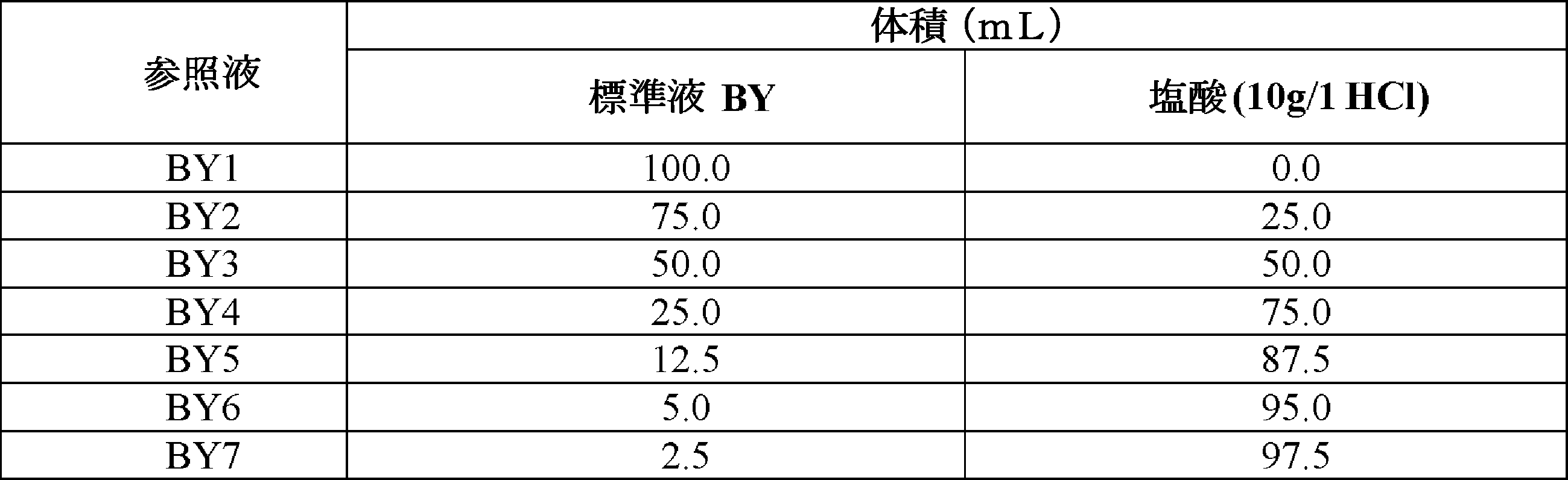
液体の色の検査は、試験液と色標準液とを比較することにより実施される。色標準液の組成は、試験液の色の色相及び強度に応じて選択される。典型的には、内径及びすべての点で可能な限りほぼ一致している無色透明な中性ガラスの平底の試験管(例えば、約12mm、15mm、16mm、又は25mmの径の試験管)で、比較が実施される。例えば、比較は2~10mLの試験液と色標準液との比較であり得る。液体の深さは例えば、約15mm、25mm、40mm又は50mmであり得る。試験液に割り当てる色が、標準色よりも更に濃くなってはならない。色比較は典型的には、白色の背景に対し、拡散光(例えば日光)で実行される。色は試験管の縦軸又は横軸を下ることで比較され得る。 The examination of the color of a liquid is performed by comparing the test liquid with a color standard solution. The composition of the color standard solution is selected according to the hue and intensity of the color of the test liquid. The comparison is typically performed in a colorless, transparent, neutral glass, flat-bottomed test tube (e.g., test tubes with a diameter of about 12 mm, 15 mm, 16 mm, or 25 mm) that is as close as possible to the inside diameter and in all respects. For example, the comparison can be between 2 and 10 mL of the test liquid and the color standard solution. The depth of the liquid can be, for example, about 15 mm, 25 mm, 40 mm, or 50 mm. The color assigned to the test liquid should not be any darker than the standard color. The color comparison is typically performed against a white background and in diffuse light (e.g., sunlight). The colors can be compared down the vertical or horizontal axis of the test tube.
EP色測定とは対照的に、米国薬局方医薬品各条1061、Color-Instrumental MeasurementはCIE L*、a*、b*(又はCIELAB)色測定の使用を参照し、正確かつ客観的に色を定量化している。合計で20色の参照液(文字A~Tにより順次同定される)は、米国薬局方により定義される。測定された試料の色は、色参照液と自動的に相関される。これは、試料に最も近い色参照液(すなわち、試料の色に対して最も小さい色差ΔE*を有する参照液)が表示されることを意味する。ΔL*値、Δa*値及びΔb*値は、試料のL*値、a*値、b*値と、表示される米国薬局方溶液のL*値、a*値、b*値との定量的な差を示す。CIE L*、a*、b*座標系では、L*は色の明度を0~100のスケール(最も暗いものを0、最も明るいものを100とする)で表し、a*は色の赤色及び緑色を表し(a*の正の値は赤色を表すが、一方でa*の負の値は緑色を表す)、b*は試料の黄色又は青色を表す(b*の正の値は黄色を表すが、b*の負の値は青色を表す)。標準又は評価時の最初の試料からの色差は、それぞれの色成分であるΔL*、Δa*及びΔb*における変化により表され得る。複合変化、又は色差は、式:

(表2)CIE L*、a*、b*色空間における欧州の黄褐色標準の特性評価
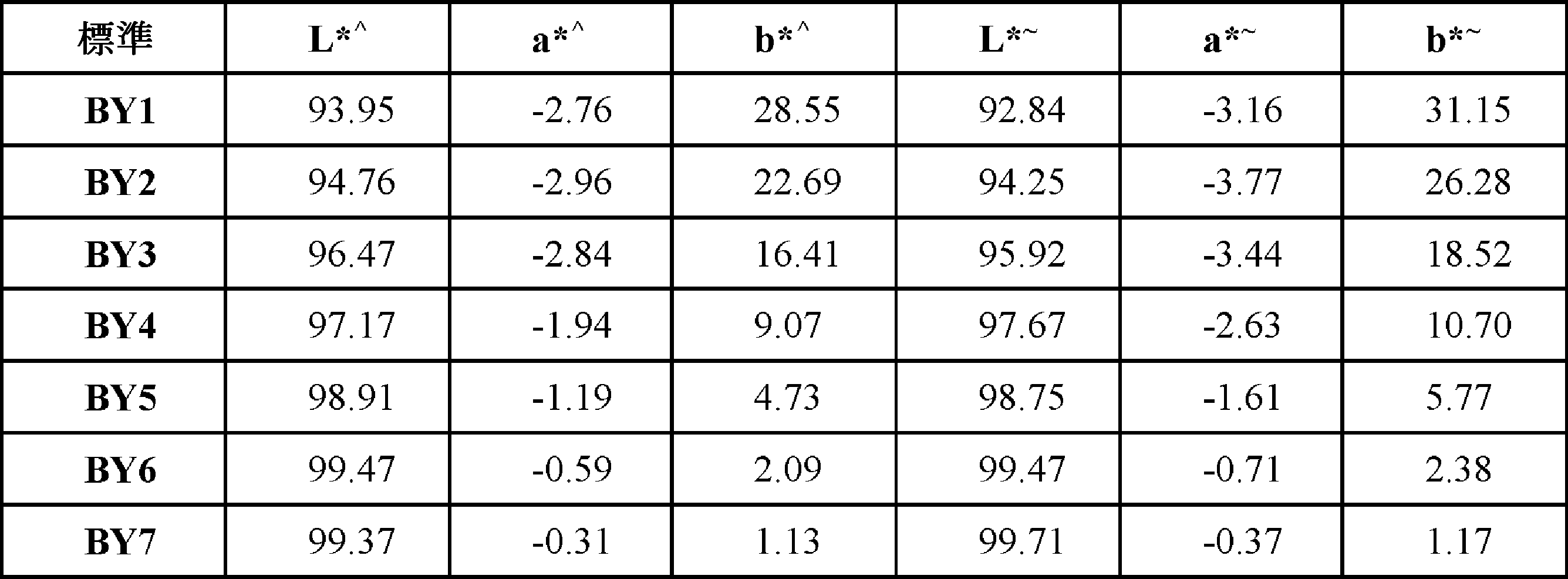
~各BY色標準に関して、本明細書ではL*値及びb*値を実験的に測定。
Table 2. Characterization of European tan standards in the CIE L * , a * , b * color space
~ For each BY color standard, the L * and b * values are experimentally measured herein.
色彩アッセイの高スループットスクリーニングを可能とするためには、分光測色アッセイ法(CIELAB)は、BY色標準よりも好適で定量的な測定である。代用のアッセイは、実施例セクションに説明されるように更に最適化された。 To allow for high throughput screening of color assays, a spectrophotometric assay (CIELAB) is a more suitable and quantitative measurement than the BY color standard. The alternative assay was further optimized as described in the Examples section.
色について評価されたいずれの試料についても、試験試料のタンパク質濃度は、比較のため、例えば5g/L、10g/L及びその同等物といった試料中のタンパク質濃度に対して標準化されなければならない。 For any samples evaluated for color, the protein concentration of the test sample must be standardized to the protein concentration in the sample for comparison, e.g., 5 g/L, 10 g/L, and equivalents.
III.抗VEGF組成物
VEGFシグナル伝達経路を制御するタンパク質のVEGFファミリーの少なくとも5つのメンバーが存在する。すなわち、VEGF-A、VEGF-B、VEGF-C、VEGF-D、及び胎盤増殖因子(PlGF)である。抗VEGF組成物は、VEGFアンタゴニストを含むことができ、これは、タンパク質のVEGFファミリーの1つ以上のメンバーと特異的に相互作用し、例えば、分裂促進性活性、血管新生活性、及び/又は血管透過性活性といった1つ以上のその生物学的活性を阻害する。
III. Anti-VEGF Compositions There are at least five members of the VEGF family of proteins that control the VEGF signaling pathway: VEGF-A, VEGF-B, VEGF-C, VEGF-D, and placental growth factor (PlGF). Anti-VEGF compositions can include VEGF antagonists, which specifically interact with one or more members of the VEGF family of proteins and inhibit one or more of their biological activities, e.g., mitogenic activity, angiogenic activity, and/or vascular permeability activity.
一実施形態において、抗VEGFタンパク質を産生する方法は、(a)抗VEGFタンパク質を発現するよう遺伝子改変された宿主細胞を提供する工程、(b)細胞が抗VEGFタンパク質を発現するのに好適な条件の下で、CDM中の宿主細胞を培養する工程、及び(c)細胞により産生された抗VEGFタンパク質の調製物を回収する工程、を含む。一態様において、抗VEGFタンパク質はアフリベルセプト、組換えMiniTrap(その例は、米国特許第7,279,159号に開示される)、scFv及び他の抗VEGFタンパク質からなる群から選択される。好ましい態様において、関心対象の組換えタンパク質はアフリベルセプトである。 In one embodiment, a method for producing an anti-VEGF protein includes the steps of (a) providing a host cell genetically modified to express an anti-VEGF protein, (b) culturing the host cell in CDM under conditions suitable for the cell to express the anti-VEGF protein, and (c) recovering a preparation of the anti-VEGF protein produced by the cell. In one aspect, the anti-VEGF protein is selected from the group consisting of aflibercept, recombinant MiniTrap (examples of which are disclosed in U.S. Pat. No. 7,279,159), scFv, and other anti-VEGF proteins. In a preferred aspect, the recombinant protein of interest is aflibercept.
本発明者らは、ある特定のCDM中で抗VEGFタンパク質(例えばアフリベルセプト)を製造することで、明確な色を呈する生物学的試料を生成したことを発見した。明確な色特性は、異なる製造工程中、更には抗VEGFタンパク質を含む最終製剤中にて観察された。実施例9で観察されるように、VEGF MiniTrapの産生については、CDM中で細胞を培養することで、強い黄褐色を有する抗VEGFタンパク質(例えばアフリベルセプト)を産生した。回収後のアフィニティー捕捉工程はまた、黄褐色といった特定の色を呈する溶出液も産生した。AEXを使用しての更なる製造工程も黄褐色を呈したが、この強さは低減されていた。 The inventors have discovered that manufacturing anti-VEGF proteins (e.g., aflibercept) in a particular CDM produced biological samples with distinct colors. Distinct color characteristics were observed during different manufacturing steps and also in the final formulation containing the anti-VEGF protein. As observed in Example 9, for the production of VEGF MiniTrap, culturing cells in CDM produced anti-VEGF proteins (e.g., aflibercept) with a strong tan color. The affinity capture step after harvesting also produced an eluate with a specific color, such as tan. Further manufacturing steps using AEX also produced a tan color, but the intensity was reduced.
以下に詳細に説明するように、色は(i)定性的な外観検査を行う欧州の色標準「BY」、又は(ii)BYシステムよりも定量的である、比色アッセイであるCIELABを使用して評価され得る。ただしいずれの場合においても、複数の試料間での色評価は、意味ある調査/比較であることを保証するためにタンパク質濃度に対して正規化された。例えば実施例9、特に表9-2を参照すると、プロテインAの溶出液は、およそ2.52の「b*」値を有すし、これはおよそのBY値であるBY5に対応する(プロテインA溶出液において、5g/Lタンパク質濃度にて測定した場合)。プロテインA溶出液の色を別の試料と比較する場合には、続いてその比較は同じタンパク質濃度を用いて行われなければならない。したがって、プロテインA溶出液と、およそ0.74のb*値を有するAEXプールとを比較すると(プロテインA溶出液中、5g/Lのタンパク質濃度にて測定される場合)、この生成方法は、AEXクロマトグラフィー後のAEXプールに対する、プロテインA溶出液からの試料の黄褐色については実質的な低減が認められる。 As described in more detail below, color may be assessed using (i) the European color standard "BY", which is a qualitative visual test, or (ii) CIELAB, a colorimetric assay that is more quantitative than the BY system. In either case, however, color assessments across samples were normalized to protein concentration to ensure meaningful investigations/comparisons. For example, referring to Example 9, and particularly Table 9-2, the Protein A eluate has a "b * " value of approximately 2.52, which corresponds to an approximate BY value of BY5 (measured at 5 g/L protein concentration in the Protein A eluate). If the color of the Protein A eluate is to be compared to another sample, then the comparison should be made using the same protein concentration. Thus, comparing the Protein A eluate to the AEX pool, which has a b * value of approximately 0.74 (measured at 5 g/L protein concentration in the Protein A eluate), this production method shows a substantial reduction in the tan color of samples from the Protein A eluate versus the AEX pool after AEX chromatography.
本発明の組成物は、本明細書にて述べられる黄褐色により特徴付けられ得、例えば、欧州の黄褐色標準(BY2~BY3、BY3~BY4、BY4~BY5、又はBY5~BY6)と同等の暗さ/強さであり、17~23、10~17、5~10、3~5、又は1~3のb*値を有し、この組成物は、約5g/Lの抗VEGFタンパク質又は約10g/Lの抗VEGFタンパク質を含み、この組成物は、清澄化された回収物からの試料、又は清澄化された回収物のプロテインA溶出液として得られる。 The compositions of the invention may be characterized by a tan color as described herein, e.g., a darkness/intensity equivalent to a European tan standard (BY2-BY3, BY3-BY4, BY4-BY5, or BY5-BY6), a b * value of 17-23, 10-17, 5-10, 3-5, or 1-3, the composition comprising about 5 g/L of anti-VEGF protein or about 10 g/L of anti-VEGF protein, the composition being obtained as a sample from a clarified harvest or as a Protein A eluate of a clarified harvest.
一実施形態において、CDMを使用して生成された本発明の組成物は、明確な黄褐色を有する生物学的試料を生成し、この試料は、
(i)欧州の色標準BY2と同程度の黄褐色;
(ii)欧州の色標準BY3と同程度の黄褐色;
(iii)欧州の色標準BY4と同程度の黄褐色;
(iv)欧州の色標準BY5と同程度の黄褐色;
(v)欧州の色標準でBY2~BY3の間;
(vi)欧州の色標準でBY3~BY4の間;
(vii)欧州の色標準でBY4~BY5の間
で認識される標準色特性評価により特徴付けられ得る。この組成物は約5g/L又は約10g/Lの抗VEGFタンパク質を含み、この組成物は清澄化された回収物であるプロテインA溶出液からの試料として得られる。
In one embodiment, the compositions of the invention produced using CDM produce biological samples having a distinct tan color, the samples having:
(i) a tan colour similar to the European colour standard BY2;
(ii) a tan color similar to the European color standard BY3;
(iii) a tan color similar to the European color standard BY4;
(iv) a tan color similar to the European color standard BY5;
(v) European colour standard between BY2 and BY3;
(vi) European colour standard between BY3 and BY4;
(vii) may be characterized by a standard color characterization recognized by the European Color Standards between BY4 and BY5, the composition comprising about 5 g/L or about 10 g/L of anti-VEGF protein, the composition being obtained as a sample from a clarified harvest Protein A eluate.
別の実施形態において、CDMを使用して生成された本発明の組成物は、異なる黄褐色を有する生物学的試料を生成し、この組成物は、CIELABスケール:
(i)約22~23のb*値と同程度の黄褐色;
(ii)約16~17のb*値と同程度の黄褐色;
(iii)9~10のb*値と同程度の黄褐色;
(iv)4~5のb*値と同程度の黄褐色;
(v)2~3のb*値と同程度の黄褐色;
(vi)17~23の間のb*値;
(vii)10~17の間のb*値;
(viii)5~10の間のb*値;
(ix)3~5の間のb*値;又は
(x)1~3の間のb*値
で認識される標準色特性評価により特徴付けられ得る。この組成物は約5g/L又は約10g/Lの抗VEGFタンパク質を含み、この組成物は清澄化された回収物であるプロテインA溶出液からの試料として得られる。
In another embodiment, the compositions of the invention produced using CDM produce biological samples having different tan colors, the compositions being categorized according to the CIELAB scale:
(i) a tan color with a b * value of about 22-23;
(ii) a tan color with a b * value of about 16-17;
(iii) a tan color equivalent to a b * value of 9 to 10;
(iv) tan color equivalent to a b * value of 4 to 5;
(v) tan color equivalent to a b * value of 2 to 3;
(vi) a b * value between 17 and 23;
(vii) a b * value between 10 and 17;
(viii) a b * value between 5 and 10;
(ix) a b * value between 3 and 5; or (x) a standard color characterization recognized at a b * value between 1 and 3. The composition comprises about 5 g/L or about 10 g/L of anti-VEGF protein, the composition being obtained as a sample from a clarified harvest Protein A eluate.
一実施形態において、CDMを使用して生成された本発明の組成物は、抗VEGFタンパク質の他の種又はバリアントを含み得る。これらのバリアントには、オキソバリアントとして総称される、1つ以上の酸化アミノ酸残基を含む、抗VEGFタンパク質アイソフォームが含まれる。抗VEGFタンパク質及びそのオキソバリアントを含むこうした組成物の酵素消化は、以下:
約0.004~0.013%の2-オキソ-ヒスチジンを含む、EIGLLTC*EATVNGH*LYK(配列番号18)、
約0.006~0.028%の2-オキソ-ヒスチジンを含む、QTNTIIDVVLSPSH*GIELSVGEK(配列番号19)、
約0.049~0.085%の2-オキソ-ヒスチジンを含む、TELNVGIDFNWEYPSSKH*QHK(配列番号20)、
約0.057~0.092%の2-オキソ-ヒスチジンを含む、DKTH*TC*PPC*PAPELLG(配列番号17)、
約0.008~0.022%の2-オキソ-ヒスチジンを含む、TNYLTH*R(配列番号21)、及び/又は
約0.185~0.298%の二酸化トリプトファンを含む、IIWDSR(配列番号56)、
又は
約0.008%の2-オキソ-ヒスチジンを含む、EIGLLTC*EATVNGH*LYK(配列番号18)、
約0.02%の2-オキソ-ヒスチジンを含む、QTNTIIDVVLSPSH*GIELSVGEK(配列番号19)、
約0.06%の2-オキソ-ヒスチジンを含む、TELNVGIDFNWEYPSSKH*QHK(配列番号20)、
約0.07%の2-オキソ-ヒスチジンを含む、DKTH*TC*PPC*PAPELLG(配列番号17)、
約0.01%の2-オキソ-ヒスチジンを含む、TNYLTH*R(配列番号21)、及び/又は
約0.23%のジ-オキソトリプトファンを含む、IIWDSR(配列番号56)
のうち1つ以上を含むことができ、H*は2-オキソ-ヒスチジンへと酸化され得るヒスチジンであり、C*はカルボキシメチル化され得るシステインである。特定の実施形態において、抗VEGFタンパク質はアフリベルセプトである。別の実施形態において、抗VEGFタンパク質はVEGF MiniTrapである。
In one embodiment, compositions of the invention produced using CDM may contain other species or variants of anti-VEGF proteins. These variants include anti-VEGF protein isoforms that contain one or more oxidized amino acid residues, collectively referred to as oxovariants. Enzymatic digestion of such compositions containing anti-VEGF proteins and their oxovariants can be performed as follows:
EIGLLTC * EATVNGH * LYK (SEQ ID NO: 18), containing about 0.004-0.013% 2-oxo-histidine;
QTNTIIDVVLSPSH * GIELSVGEK (SEQ ID NO: 19), which contains about 0.006-0.028% 2-oxo-histidine;
TELNVGIDFNWEYPSSKH * QHK (SEQ ID NO:20), containing about 0.049-0.085% 2-oxo-histidine;
DKTH * TC * PPC * PAPELLG (SEQ ID NO: 17), containing about 0.057-0.092% 2-oxo-histidine;
TNYLTH * R (SEQ ID NO: 21), which contains about 0.008-0.022% 2-oxo-histidine, and/or IIWDSR (SEQ ID NO: 56), which contains about 0.185-0.298% tryptophan dioxide;
or EIGLLTC * EATVNGH * LYK (SEQ ID NO: 18), containing about 0.008% 2-oxo-histidine;
QTNTIIDVVLSPSH * GIELSVGEK (SEQ ID NO: 19), containing about 0.02% 2-oxo-histidine;
TELNVGIDFNWEYPSSKH * QHK (SEQ ID NO:20), containing about 0.06% 2-oxo-histidine;
DKTH * TC * PPC * PAPELLG (SEQ ID NO: 17), containing about 0.07% 2-oxo-histidine;
TNYLTH * R (SEQ ID NO:21), which contains about 0.01% 2-oxo-histidine, and/or IIWDSR (SEQ ID NO:56), which contains about 0.23% di-oxotryptophan.
where H * is a histidine which may be oxidized to 2-oxo-histidine and C * is a cysteine which may be carboxymethylated. In certain embodiments, the anti-VEGF protein is aflibercept. In another embodiment, the anti-VEGF protein is VEGF MiniTrap.
本発明の例示的な一実施形態において、本発明の組成物は抗VEGFタンパク質を含み、抗VEGFタンパク質の約1%以下、約0.1%以下、又は約0.1~1%、約0.2~1%、約0.3~1%、約0.4~1%、約0.5~1%、約0.6~1%、約0.7~1%、約0.8~1%、又は約0.9~1%のヒスチジン残基は2-オキソ-ヒスチジンである。そのような組成物において、様々な量の2-オキソ-ヒスチジン残基及び非酸化ヒスチジン残基をそれぞれ有する抗VEGFタンパク質バリアントの不均一な集団が存在し得る。したがって、組成物中の2-オキソ-ヒスチジン抗VEGFタンパク質の割合は、抗VEGF分子中の部位特異的な2-オキソ-ヒスチジンを、抗VEGFタンパク質(酸化したものに加えて非酸化状態のもの)の分子中の合計の部位特異的ヒスチジンで割り、100をかけたものを指す。組成物中の2-オキソ-ヒスチジンのレベルを定量化する1つの方法は、プロテアーゼ(例えば、Lys-C及び/又はトリプシン)でポリペプチドを消化し、例えば質量分析法(ms)により、得られたペプチド中の2-オキソ-ヒスチジンの量を分析することである。 In an exemplary embodiment of the invention, a composition of the invention comprises an anti-VEGF protein, wherein about 1% or less, about 0.1% or less, or about 0.1-1%, about 0.2-1%, about 0.3-1%, about 0.4-1%, about 0.5-1%, about 0.6-1%, about 0.7-1%, about 0.8-1%, or about 0.9-1% of the histidine residues of the anti-VEGF protein are 2-oxo-histidine. In such compositions, there may be a heterogeneous population of anti-VEGF protein variants having varying amounts of 2-oxo-histidine residues and non-oxidized histidine residues, respectively. Thus, the percentage of 2-oxo-histidine anti-VEGF protein in a composition refers to the site-specific 2-oxo-histidine in the anti-VEGF molecule divided by the total site-specific histidine in the anti-VEGF protein (oxidized plus non-oxidized) molecule, multiplied by 100. One method of quantifying the level of 2-oxo-histidine in a composition is to digest the polypeptide with a protease (e.g., Lys-C and/or trypsin) and analyze the amount of 2-oxo-histidine in the resulting peptides, for example by mass spectrometry (ms).
抗VEGFタンパク質の消化前に、システインのスルフヒドリル基は、ヨードアセトアミド(IAM)による反応により遮断され、以下の化学的構造:

約0.004~0.013%の2-オキソ-ヒスチジンを含む、EIGLLTC*EATVNGH*LYK(配列番号18)、
約0.006~0.028%の2-オキソ-ヒスチジンを含む、QTNTIIDVVLSPSH*GIELSVGEK(配列番号19)、
約0.049~0.085%の2-オキソ-ヒスチジンを含む、TELNVGIDFNWEYPSSKH*QHK(配列番号20)、
約0.057~0.092%の2-オキソ-ヒスチジンを含む、DKTH*TC*PPC*PAPELLG(配列番号17)、
約0.008~0.022%の2-オキソ-ヒスチジンを含む、TNYLTH*R(配列番号21)、及び/又は
約0.185~0.298%の二酸化トリプトファンを含む、IIWDSR(配列番号56)、
又は
約0.008%の2-オキソ-ヒスチジンを含む、EIGLLTC*EATVNGH*LYK(配列番号18)、
約0.02%の2-オキソ-ヒスチジンを含む、QTNTIIDVVLSPSH*GIELSVGEK(配列番号19)、
約0.06%の2-オキソ-ヒスチジンを含む、TELNVGIDFNWEYPSSKH*QHK(配列番号20)、
約0.07%の2-オキソ-ヒスチジンを含む、DKTH*TC*PPC*PAPELLG(配列番号17)、
約0.01%の2-オキソ-ヒスチジンを含む、TNYLTH*R(配列番号21)、及び/又は
約0.23%のジ-オキソトリプトファンを含む、IIWDSR(配列番号56)
を含み、ここでH*は2-オキソ-ヒスチジンであり、C*はカルボキシメチル化システインである。本発明の一実施形態において、ペプチドはPNGase Fで脱グリコシル化される。
Prior to digestion of the anti-VEGF protein, the sulfhydryl groups of the cysteines were blocked by reaction with iodoacetamide (IAM), resulting in the following chemical structure:
EIGLLTC * EATVNGH * LYK (SEQ ID NO: 18), containing about 0.004-0.013% 2-oxo-histidine;
QTNTIIDVVLSPSH * GIELSVGEK (SEQ ID NO: 19), which contains about 0.006-0.028% 2-oxo-histidine;
TELNVGIDFNWEYPSSKH * QHK (SEQ ID NO:20), containing about 0.049-0.085% 2-oxo-histidine;
DKTH * TC * PPC * PAPELLG (SEQ ID NO: 17), containing about 0.057-0.092% 2-oxo-histidine;
TNYLTH * R (SEQ ID NO: 21), which contains about 0.008-0.022% 2-oxo-histidine, and/or IIWDSR (SEQ ID NO: 56), which contains about 0.185-0.298% tryptophan dioxide;
or EIGLLTC * EATVNGH * LYK (SEQ ID NO: 18), containing about 0.008% 2-oxo-histidine;
QTNTIIDVVLSPSH * GIELSVGEK (SEQ ID NO: 19), containing about 0.02% 2-oxo-histidine;
TELNVGIDFNWEYPSSKH * QHK (SEQ ID NO:20), containing about 0.06% 2-oxo-histidine;
DKTH * TC * PPC * PAPELLG (SEQ ID NO: 17), containing about 0.07% 2-oxo-histidine;
TNYLTH * R (SEQ ID NO:21), which contains about 0.01% 2-oxo-histidine, and/or IIWDSR (SEQ ID NO:56), which contains about 0.23% di-oxotryptophan.
where H * is 2-oxo-histidine and C * is carboxymethylated cysteine. In one embodiment of the invention, the peptide is deglycosylated with PNGase F.
本発明は、抗VEGFタンパク質を含む組成物を含み、この抗VEGFタンパク質のすべてのヒスチジンのうち、約0.1%~10%は2-オキソ-ヒスチジンに改変される。更には、組成物の色は、例えば、欧州の黄褐色標準(BY2~BY3、BY3~BY4、BY4~BY5、又はBY5~BY6)と同等の暗さ/強さであり、代替的には約17~23、10~17、5~10、3~5、又は1~3のCIEのL*、a*、b*を使用することを特徴とするb*値を有し、この組成物は、約5g/L又は約10g/Lの抗VEGFタンパク質を含む。この組成物は、清澄化された回収物、又は清澄化された回収物のプロテインA溶出液に由来する試料のいずれかとして得られる。このような組成物は、回収材料が捕捉クロマトグラフィー手順に供されるときには清澄化された回収物から得ることができる。一態様において、捕捉工程は例えば、プロテインAアフィニティーカラムを使用するアフィニティークロマトグラフィー手順である。アフィニティー試料が液体クロマトグラフィー-質量分析法(LC-MS)を使用して分析されるときには、1つ以上のバリアントが検出され得る。 The present invention includes compositions comprising an anti-VEGF protein, wherein about 0.1%-10% of all histidines of the anti-VEGF protein are modified to 2-oxo-histidine. Furthermore, the color of the composition is, for example, of a darkness/intensity equivalent to a European tan standard (BY2-BY3, BY3-BY4, BY4-BY5, or BY5-BY6), alternatively having a b * value characterized using CIE L * , a * , b * of about 17-23, 10-17, 5-10, 3-5, or 1-3, wherein the composition comprises about 5 g/L or about 10 g/L of anti-VEGF protein. The composition is obtained either as a clarified harvest or as a sample derived from a Protein A eluate of the clarified harvest. Such compositions can be obtained from the clarified harvest when the harvest material is subjected to a capture chromatography procedure. In one embodiment, the capture step is an affinity chromatography procedure, for example using a Protein A affinity column. When the affinity sample is analyzed using liquid chromatography-mass spectrometry (LC-MS), one or more variants can be detected.
本発明は、抗VEGFタンパク質を含む組成物を含み、この抗VEGFタンパク質のすべてのトリプトファンのうち、約0.1%~10%はキヌレニンに改変される。更には、組成物の色は、欧州の黄褐色標準(BY2~BY3、BY3~BY4、BY4~BY5、若しくはBY5~BY6)と同等の暗さ/強さであり、並びに/又は約17~23、10~17、5~10、3~5、若しくは1~3のCIEのL*、a*、b*により特徴付けられるように、b*値を有し、この組成物は、約5g/Lの抗VEGFタンパク質又は約10g/Lの抗VEGFタンパク質を含む。この組成物は、清澄化された回収物、又は清澄化された回収物のプロテインA溶出液に由来する試料として得られる。このような組成物は、捕捉クロマトグラフィー手順に供されるときには清澄化された回収物から得ることができる。この捕捉工程は例えば、プロテインAアフィニティーカラムを使用するアフィニティークロマトグラフィー手順である。アフィニティー試料が液体クロマトグラフィー-質量分析法(LC-MS)を使用して分析されるときには、1つ以上のこれらのバリアントが検出され得る。 The present invention includes a composition comprising an anti-VEGF protein, wherein about 0.1%-10% of all tryptophans of the anti-VEGF protein are modified to kynurenine. Furthermore, the color of the composition is of a darkness/intensity equivalent to the European tan standard (BY2-BY3, BY3-BY4, BY4-BY5, or BY5-BY6) and/or has a b * value, as characterized by CIE L * , a * , b * , of about 17-23, 10-17, 5-10, 3-5, or 1-3, wherein the composition comprises about 5 g/L of anti-VEGF protein or about 10 g/L of anti-VEGF protein. The composition is obtained as a sample from the clarified harvest or a Protein A eluate of the clarified harvest. Such a composition can be obtained from the clarified harvest when subjected to a capture chromatography procedure. The capture step is, for example, an affinity chromatography procedure using a Protein A affinity column. When the affinity sample is analyzed using liquid chromatography-mass spectrometry (LC-MS), one or more of these variants can be detected.
本発明は、抗VEGFタンパク質を含む組成物を含み、この抗VEGFタンパク質のすべてのトリプトファンのうち、約0.1%~10%はモノ-ヒドロキシルトリプトファンに改変される。更には、組成物の色は、欧州の黄褐色標準(BY2~BY3、BY3~BY4、BY4~BY5、若しくはBY5~BY6)と同等の暗さ/強さであり、並びに/又は約17~23、10~17、5~10、3~5、若しくは1~3のCIEのL*、a*、b*により特徴付けられるb*値を有し、この組成物は、約5g/Lの抗VEGFタンパク質又は約10g/Lの抗VEGFタンパク質を含む。この組成物は、清澄化された回収物、又は清澄化された回収物のプロテインA溶出液に由来する試料として得られる。このような組成物は、捕捉クロマトグラフィー手順に供されるときには清澄化された回収物から得ることができる。この捕捉工程は例えば、プロテインAアフィニティーカラムを使用するアフィニティークロマトグラフィー手順である。アフィニティー工程から抽出された試料が液体クロマトグラフィー-質量分析法(LC-MS)を使用して分析されるときには、1つ以上のこれらのバリアントが検出され得る。 The present invention includes a composition comprising an anti-VEGF protein, wherein about 0.1% to 10% of the total tryptophans of the anti-VEGF protein are modified to mono-hydroxyl tryptophan. Furthermore, the color of the composition is of a darkness/intensity equivalent to the European tan standard (BY2-BY3, BY3-BY4, BY4-BY5, or BY5-BY6) and/or has a b * value characterized by CIE L * , a * , b * of about 17-23, 10-17, 5-10, 3-5, or 1-3, wherein the composition comprises about 5 g/L of anti-VEGF protein or about 10 g/L of anti-VEGF protein. The composition is obtained as a sample from the clarified harvest or a Protein A eluate of the clarified harvest. Such a composition can be obtained from the clarified harvest when subjected to a capture chromatography procedure. The capture step is, for example, an affinity chromatography procedure using a Protein A affinity column. When samples extracted from the affinity step are analyzed using liquid chromatography-mass spectrometry (LC-MS), one or more of these variants can be detected.
本発明は、抗VEGFタンパク質を含む組成物を含み、この抗VEGFタンパク質のすべてのトリプトファンのうち、約0.1%~10%はジ-ヒドロキシルトリプトファンに改変される。更には、この色は、欧州の黄褐色標準(BY2~BY3、BY3~BY4、BY4~BY5、若しくはBY5~BY6)と同等の暗さ/強さであり、並びに/又は約17~23、10~17、5~10、3~5、若しくは1~3のCIEのL*、a*、b*を使用することを特徴とするb*値を有し、この組成物は、約5g/Lの抗VEGFタンパク質又は約10g/Lの抗VEGFタンパク質を含む。この組成物は、清澄化された回収物、又は清澄化された回収物のプロテインA溶出液に由来する試料として得られる。そのような組成物は、捕捉クロマトグラフィー手順に供される抗VEGFタンパク質及びそのオキソバリアントを含むCDMを使用して作製された、清澄化された回収物から得ることができる。この捕捉工程は例えば、プロテインAアフィニティーカラムを使用するアフィニティークロマトグラフィー手順である。アフィニティー工程から抽出された試料が液体クロマトグラフィー-質量分析法(LC-MS)を使用して分析されるときには、1つ以上のこれらのバリアントが検出され得る。 The present invention includes a composition comprising an anti-VEGF protein, wherein about 0.1%-10% of the total tryptophans of the anti-VEGF protein are modified to di-hydroxyltryptophan. Furthermore, the color is of a darkness/intensity equivalent to the European tan standard (BY2-BY3, BY3-BY4, BY4-BY5, or BY5-BY6) and/or has a b * value characterized using CIE L * , a * , b * of about 17-23, 10-17, 5-10, 3-5, or 1-3, wherein the composition comprises about 5 g/L of anti-VEGF protein or about 10 g/L of anti-VEGF protein. The composition is obtained as a sample from a clarified harvest or a Protein A eluate of a clarified harvest. Such a composition can be obtained from a clarified harvest made using a CDM comprising anti-VEGF protein and its oxo variants subjected to a capture chromatography procedure. This capture step is, for example, an affinity chromatography procedure using a Protein A affinity column. When the sample extracted from the affinity step is analyzed using liquid chromatography-mass spectrometry (LC-MS), one or more of these variants can be detected.
本発明は、抗VEGFタンパク質を含む組成物を含み、この抗VEGFタンパク質のすべてのトリプトファンのうち、約0.1%~10%はトリ-ヒドロキシルトリプトファンに改変される。更には、組成物の色は、欧州の黄褐色標準(BY2~BY3、BY3~BY4、BY4~BY5、若しくはBY5~BY6)と同等の暗さ/強さであり、並びに/又は約17~23、10~17、5~10、3~5、若しくは1~3のCIEのL*、a*、b*により特徴付けられるb*値を有し、この組成物は、約5g/Lの抗VEGFタンパク質又は約10g/Lの抗VEGFタンパク質を含む。この組成物は、清澄化された回収物、又は清澄化された回収物のプロテインA溶出液に由来する試料として得られる。このような組成物は、捕捉クロマトグラフィーを使用して得ることができる。この捕捉工程は例えば、プロテインAアフィニティーカラムを使用するアフィニティークロマトグラフィー手順である。アフィニティーから抽出された試料が液体クロマトグラフィー-質量分析法(LC-MS)を使用して分析されるときには、1つ以上のこれらのバリアントが検出され得る。 The present invention includes compositions comprising anti-VEGF protein, wherein about 0.1%-10% of the total tryptophans of the anti-VEGF protein are modified to tri-hydroxyl tryptophan. Furthermore, the color of the composition is of a darkness/intensity equivalent to the European tan standard (BY2-BY3, BY3-BY4, BY4-BY5, or BY5-BY6) and/or has a b * value characterized by CIE L * , a * , b * of about 17-23, 10-17, 5-10, 3-5, or 1-3, wherein the composition comprises about 5 g/L of anti-VEGF protein or about 10 g/L of anti-VEGF protein. The composition is obtained as a sample from the clarified harvest or a Protein A eluate of the clarified harvest. Such compositions can be obtained using capture chromatography. The capture step is, for example, an affinity chromatography procedure using a Protein A affinity column. When an affinity extracted sample is analyzed using liquid chromatography-mass spectrometry (LC-MS), one or more of these variants can be detected.
一実施形態において、本発明の組成物は、抗VEGFタンパクを含むことができ、この場合、抗VEGFタンパク質は、以下のような1つ以上の残基の修飾を含み得る:1つ以上のアスパラギンが脱アミド化される;1つ以上のアスパラギン酸がイソアスパルタート及び/又はAsnに変換される;1つ以上のメチオニンが酸化される;1つ以上のトリプトファンがN-ホルミルキヌレニンに変換される;1つ以上のトリプトファンがモノ-ヒドロキシルトリプトファンである;1つ以上のトリプトファンがジ-ヒドロキシルトリプトファンである;1つ以上のトリプトファンがトリ-ヒドロキシルトリプトファンである;1つ以上のアルギニンがArg3-デオキシグルコソンに変換される;C末端グリシンが存在しない;並びに/又は1つ以上の非グリコシル化グリコサイトが存在する。 In one embodiment, the compositions of the invention can include an anti-VEGF protein, where the anti-VEGF protein can include modifications of one or more residues, such as: one or more asparagines are deamidated; one or more aspartates are converted to isoaspartate and/or Asn; one or more methionines are oxidized; one or more tryptophans are converted to N-formylkynurenines; one or more tryptophans are mono-hydroxyltryptophans; one or more tryptophans are di-hydroxyltryptophans; one or more tryptophans are tri-hydroxyltryptophans; one or more arginines are converted to Arg3-deoxyglucosone; there is no C-terminal glycine; and/or there are one or more non-glycosylated glycosites.
そのような組成物は、例えば、捕捉クロマトグラフィー手順に供される抗VEGFタンパク質及びそのバリアントを含むCDMを使用して作製された、清澄化された回収物から得ることができる。この捕捉工程は例えば、プロテインAカラムを使用するアフィニティークロマトグラフィー手順である。アフィニティー工程から抽出された試料が、例えば液体クロマトグラフィー-質量分析法(LC-MS)を使用して分析されるときには、1つ以上のこれらのバリアントが検出され得る。 Such compositions can be obtained, for example, from a clarified harvest made using a CDM containing anti-VEGF protein and its variants that is subjected to a capture chromatography procedure. The capture step is, for example, an affinity chromatography procedure using a Protein A column. When the sample extracted from the affinity step is analyzed, for example, using liquid chromatography-mass spectrometry (LC-MS), one or more of these variants can be detected.
例示的な一実施形態において、本発明の組成物は、以下:His86、His110、His145、His209、His95、His19、及び/若しくはHis203(又はアフリベルセプトのある特定の構造特性を共有するタンパク質上の同等の残基位置)、Trp58及び/若しくはTrp138(又はアフリベルセプトのある特定の構造特性を共有するタンパク質上の同等の残基位置)、Tyr64(又はアフリベルセプトのある特定の構造特性を共有するタンパク質上の同等の位置)、Phe44及び/若しくはPhe166(又はアフリベルセプトのある特定の構造特性を共有するタンパク質上の同等の残基位置)、並びに/又はMet10、Met20、Met163及び/若しくはMet192(又はアフリベルセプトのある特定の構造特性を共有するタンパク質上の同等の残基位置)のうち1つ以上で酸化され得るアフリベルセプトの構造特性を共有する抗VEGFタンパク質を含み得る。そのような組成物は、捕捉クロマトグラフィー手順に供されるアフリベルセプト及びそのオキソバリアントを含むCDMを使用して作製された、清澄化された回収物から得ることができる。この捕捉工程は例えば、プロテインAカラムを使用するアフィニティークロマトグラフィー手順であり得る。アフィニティー工程から抽出された試料が、例えば液体クロマトグラフィー-質量分析法(LC-MS)を使用して分析されるときには、1つ以上のこれらのバリアントが検出され得る。 In an exemplary embodiment, the compositions of the invention may include anti-VEGF proteins that share structural characteristics of aflibercept that may be oxidized at one or more of the following: His86, His110, His145, His209, His95, His19, and/or His203 (or equivalent residue positions on proteins that share certain structural characteristics of aflibercept), Trp58 and/or Trp138 (or equivalent residue positions on proteins that share certain structural characteristics of aflibercept), Tyr64 (or equivalent residue positions on proteins that share certain structural characteristics of aflibercept), Phe44 and/or Phe166 (or equivalent residue positions on proteins that share certain structural characteristics of aflibercept), and/or Met10, Met20, Met163, and/or Met192 (or equivalent residue positions on proteins that share certain structural characteristics of aflibercept). Such compositions can be obtained from clarified harvests made using CDM containing aflibercept and its oxo variants that are subjected to a capture chromatography procedure. This capture step can be, for example, an affinity chromatography procedure using a Protein A column. When samples extracted from the affinity step are analyzed, for example, using liquid chromatography-mass spectrometry (LC-MS), one or more of these variants can be detected.
一実施形態において、本発明の組成物は、配列番号46のアミノ酸配列を有するVEGF MiniTrapを含むことができる、これは、His86、His110、His145、His209、His95、His19、及び/又はHis203;Trp58及び/又はTrp138;Tyr64;Phe44及び/又はPhe166;及び/又はMet10、Met20、Met163、及び/又はMet192で酸化され得る。そのような組成物は、捕捉クロマトグラフィー手順に供されるVEGF MiniTrap及びそのオキソバリアントを含むCDMを使用して作製された、清澄化された回収物から得ることができる。捕捉工程は、例えばプロテインAカラムを使用するアフィニティークロマトグラフィー手順であり、液体クロマトグラフィー-質量分析法(LC-MS)を使用して分析されるときには、1つ以上のこれらのバリアントが検出され得る。 In one embodiment, the composition of the invention can comprise a VEGF MiniTrap having the amino acid sequence of SEQ ID NO: 46, which can be oxidized at His86, His110, His145, His209, His95, His19, and/or His203; Trp58 and/or Trp138; Tyr64; Phe44 and/or Phe166; and/or Met10, Met20, Met163, and/or Met192. Such a composition can be obtained from a clarified harvest made using a CDM containing VEGF MiniTrap and its oxo variants that is subjected to a capture chromatography procedure. The capture step is, for example, an affinity chromatography procedure using a Protein A column, and when analyzed using liquid chromatography-mass spectrometry (LC-MS), one or more of these variants can be detected.
いくつかの例示的な実施形態において、本発明の組成物は、抗VEGFタンパク質及びそのバリアント(オキソバリアントを含む)を含むことができ、この組成物中のタンパク質バリアントの量は、最大で約20%、19%、18%、17%、16%、15%、14%、13%、12%、11%、10%、9%、8%、7%、6%、5%、4.5%、4%、3.5%、3%、2.5%、2%、1.9%、1.8%、1.7%、1.6%、1.5%、1.4%、1.3%、1.2%、1.1%、1%、0.9%、0.8%、0.7%、0.6%、0.5%、0.4%、0.3%、0.2%、0.1%又は0.0%であり得、上記のうち1つ以上の範囲内である。そのような組成物は、捕捉クロマトグラフィー手順に供される抗VEGFタンパク質及びそのバリアントを含むCDMを使用して作製された、清澄化された回収物から得ることができる。捕捉工程は、例えばプロテインAカラムを使用するアフィニティークロマトグラフィー手順であり、液体クロマトグラフィー-質量分析法(LC-MS)を使用して分析されるときには、1つ以上のこれらのバリアントが検出され得る。一態様において、こうした組成物の色は、例えば、欧州の黄褐色標準(BY2~BY3、BY3~BY4、BY4~BY5、若しくはBY5~BY6)と同等の暗さ/強さであり、及び/又は約17~23、10~17、5~10、3~5、若しくは1~3のCIEのL*、a*、b*により特徴付けられるb*値を有し、この組成物は、約5g/L又は約10g/Lの抗VEGFタンパク質を含む。 In some exemplary embodiments, compositions of the invention can include anti-VEGF proteins and variants thereof (including oxo variants), where the amount of protein variant in the composition can be up to about 20%, 19%, 18%, 17%, 16%, 15%, 14%, 13%, 12%, 11%, 10%, 9%, 8%, 7%, 6%, 5%, 4.5%, 4%, 3.5%, 3%, 2.5%, 2%, 1.9%, 1.8%, 1.7%, 1.6%, 1.5%, 1.4%, 1.3%, 1.2%, 1.1%, 1%, 0.9%, 0.8%, 0.7%, 0.6%, 0.5%, 0.4%, 0.3%, 0.2%, 0.1%, or 0.0%, and within one or more of the above ranges. Such compositions can be obtained from clarified harvests made using CDMs containing anti-VEGF proteins and variants thereof that are subjected to a capture chromatography procedure, e.g., an affinity chromatography procedure using a Protein A column, and one or more of these variants can be detected when analyzed using liquid chromatography-mass spectrometry (LC-MS). In one aspect, the color of such compositions is, e.g., of the same darkness/intensity as the European tan standard (BY2-BY3, BY3-BY4, BY4-BY5, or BY5-BY6) and/or has a b* value characterized by CIE L * , a * , b * of about 17-23, 10-17, 5-10, 3-5 , or 1-3, and the composition comprises about 5 g/L or about 10 g/L of anti-VEGF protein.
他の例示的な実施形態において、本発明の組成物は抗VEGFタンパク質及びそのバリアントを含み、この組成物中のタンパク質バリアントの量は、約0%~約20%であり得、例えば約0%~約20%、約0.05%~約20%、約0.1%~約20%、約0.2%~約20%、約0.3%~約20%、約0.4%~約20%、約0.5%~約20%、約0.6%~約20%、約0.7%~約20%、約0.8%~約20%、約0.9%~約20%、約1%~約20%、約1.5%~約20%、約2%~約20%、約3%~約20%、約4%~約20%、約5%~約20%、約6%~約20%、約7%~約20%、約8%~約20%、約9%~約20%、約10%~約20%、約0%~約10%、約0.05%~約10%、約0.1%~約10%、約0.2%~約10%、約0.3%~約10%、約0.4%~約10%、約0.5%~約10%、約0.6%~約10%、約0.7%~約10%、約0.8%~約10%、約0.9%~約10%、約1%~約10%、約1.5%~約10%、約2%~約10%、約3%~約10%、約4%~約10%、約5%~約10%、約6%~約10%、約7%~約10%、約8%~約10%、約9%~約10%、約0%~約7.5%、約0.05%~約7.5%、約0.1%~約7.5%、約0.2%~約7.5%、約0.3%~約7.5%、約0.4%~約7.5%、約0.5%~約7.5%、約0.6%~約7.5%、約0.7%~約7.5%、約0.8%~約7.5%、約0.9%~約7.5%、約1%~約7.5%、約1.5%~約7.5%、約2%~約7.5%、約3%~約7.5%、約4%~約7.5%、約5%~約7.5%、約6%~約7.5%、約7%~約7.5%、約0%~約5%、約0.05%~約5%、約0.1%~約5%、約0.2%~約5%、約0.3%~約5%、約0.4%~約5%、約0.5%~約5%、約0.6%~約5%、約0.7%~約5%、約0.8%~約5%、約0.9%~約5%、約1%~約5%、約1.5%~約5%、約2%~約5%、約3%~約5%、約4%~約5%であり得、上記のうち1つ以上の範囲内である。このような組成物は、回収試料上で捕捉クロマトグラフィーを実施して得ることができる。この捕捉工程は例えば、プロテインAカラムを使用するアフィニティークロマトグラフィー手順である。試料が液体クロマトグラフィー-質量分析法(LC-MS)を使用して分析されるときには、1つ以上のこれらのバリアントが検出され得る。一態様において、こうした組成物の色は、例えば、欧州の黄褐色標準(BY2~BY3、BY3~BY4、BY4~BY5、若しくはBY5~BY6)と同等の暗さ/強さであり、及び/又は約17~23、10~17、5~10、3~5、若しくは1~3のCIEのL*、a*、b*により特徴付けられるb*値を有し、この組成物は、約5g/L又は約10g/Lの抗VEGFタンパク質を含む。 In other exemplary embodiments, the compositions of the invention comprise anti-VEGF proteins and variants thereof, and the amount of protein variant in the composition may be from about 0% to about 20%, for example, from about 0% to about 20%, from about 0.05% to about 20%, from about 0.1% to about 20%, from about 0.2% to about 20%, from about 0.3% to about 20%, from about 0.4% to about 20%, from about 0.5% to about 20%, from about 0.6% to about 20%, from about 0.7% to about 20%, from about 0.8% to about 20%, from about 0.9% to about 20%, from about 1% to about 20%, from about 1.5% to about 20%, from about 20 ... % to about 20%, about 3% to about 20%, about 4% to about 20%, about 5% to about 20%, about 6% to about 20%, about 7% to about 20%, about 8% to about 20%, about 9% to about 20%, about 10% to about 20%, about 0% to about 10%, about 0.05% to about 10%, about 0.1% to about 10%, about 0.2% to about 10%, about 0.3% to about 10%, about 0.4% to about 10%, about 0.5% to about 10%, about 0.6% to about 10%, about 0.7% to about 10%, about 0.8% to about 10%, about 0.9% to about 10%, about 1% to about 10%, about 1.5% to about 10%, about 2% to about 1 0%, about 3% to about 10%, about 4% to about 10%, about 5% to about 10%, about 6% to about 10%, about 7% to about 10%, about 8% to about 10%, about 9% to about 10%, about 0% to about 7.5%, about 0.05% to about 7.5%, about 0.1% to about 7.5%, about 0.2% to about 7.5%, about 0.3% to about 7.5%, about 0.4% to about 7.5%, about 0.5% to about 7.5%, about 0.6% to about 7.5%, about 0.7% to about 7.5%, about 0.8% to about 7.5%, about 0.9% to about 7.5%, about 1% to about 7.5%, about 1.5% to about 7.5%, about 2% to about 7.5%, about 3% to about 7.5%, about 4% to about 7.5%, about 5% to about 7.5%, about 6% to about 7.5%, about 7% to about 7.5%, about 8% to about 7.5%, about 9% to about 10%, about 0% to about 7.5%, about 0.05% to about 7.5%, about 0.1% to about 7.5%, about 0.2% to about 7.5%, about 0.3% to about 7.5%, about 0.4% to about 7.5%, about 0.5% to about 7.5%, about 0.6% to about 7.5%, about 0.7% to about 7.5%, about 0.8% to about 7.5%, about 0.9% to about 7.5%, about 1% to about 7.5%, about 1.5% to about 7.5%, about 2% to about 7.5%, about 3% to about 7 5%, about 3% to about 7.5%, about 4% to about 7.5%, about 5% to about 7.5%, about 6% to about 7.5%, about 7% to about 7.5%, about 0% to about 5%, about 0.05% to about 5%, about 0.1% to about 5%, about 0.2% to about 5%, about 0.3% to about 5%, about 0.4% to about 5%, about 0.5% to about 5%, about 0.6% to about 5%, about 0.7% to about 5%, about 0.8% to about 5%, about 0.9% to about 5%, about 1% to about 5%, about 1.5% to about 5%, about 2% to about 5%, about 3% to about 5%, about 4% to about 5%, or within one or more of the above ranges. Such compositions can be obtained by performing capture chromatography on the collected sample. The capture step is, for example, an affinity chromatography procedure using a Protein A column. One or more of these variants may be detected when a sample is analyzed using liquid chromatography-mass spectrometry (LC-MS). In one aspect, the color of such a composition is, for example, of a darkness/intensity equivalent to the European tan standard (BY2-BY3, BY3-BY4, BY4-BY5, or BY5-BY6) and/or has a b * value characterized by CIE L * , a * , b * of about 17-23, 10-17, 5-10, 3-5, or 1-3, and the composition comprises about 5 g/L or about 10 g/L of an anti-VEGF protein.
一実施形態において、本発明の組成物は、その酸性種を含む抗VEGFタンパク質を含むことができ、この組成物中の酸性種の量は、約20%、19%、18%、17%、16%、15%、14%、13%、12%、11%、10%、9%、8%、7%、6%、5%、4.5%、4%、3.5%、3%、2.5%、2%、1.9%、1.8%、1.7%、1.6%、1.5%、1.4%、1.3%、1.2%、1.1%、1%、0.9%、0.8%、0.7%、0.6%、0.5%、0.4%、0.3%、0.2%、0.1%又は0.0%であり得、上記のうち1つ以上の範囲内である。上記で述べられるように、こうした酸性種は、例えばWCX(WCX-10 HPLC、弱陽イオン交換クロマトグラフィー)といったイオン交換、又はIEF(等電点電気泳動)といった様々な方法により検出され得る。一般に、酸性種はCEX中にメインピークよりも早く溶出し、又はAEX分析中にメインピークよりも遅く溶出する(図16及び図17を参照されたい)。酸性種を含む組成物は、回収物又はイオン交換クロマトグラフィーを使用したアフィニティー生成された材料といった生物学的材料から得ることができる。 In one embodiment, a composition of the invention can include an anti-VEGF protein including its acidic species, and the amount of acidic species in the composition can be about 20%, 19%, 18%, 17%, 16%, 15%, 14%, 13%, 12%, 11%, 10%, 9%, 8%, 7%, 6%, 5%, 4.5%, 4%, 3.5%, 3%, 2.5%, 2%, 1.9%, 1.8%, 1.7%, 1.6%, 1.5%, 1.4%, 1.3%, 1.2%, 1.1%, 1%, 0.9%, 0.8%, 0.7%, 0.6%, 0.5%, 0.4%, 0.3%, 0.2%, 0.1%, or 0.0%, or within any one or more of the above ranges. As mentioned above, such acidic species can be detected by various methods, such as ion exchange, e.g., WCX (WCX-10 HPLC, weak cation exchange chromatography), or IEF (isoelectric focusing). In general, acidic species elute earlier than the main peak during CEX or later than the main peak during AEX analysis (see Figures 16 and 17). Compositions containing acidic species can be obtained from biological materials, such as harvested or affinity purified materials using ion exchange chromatography.
一態様において、こうした組成物の色は、例えば、欧州の黄褐色標準(BY2~BY3、BY3~BY4、BY4~BY5、若しくはBY5~BY6)と同等の暗さ/強さであり、及び/又は約17~23、10~17、5~10、3~5、若しくは1~3のCIEのL*、a*、b*により特徴付けられるb*値を有し、この組成物は、約5g/L又は約10g/Lを含む。一例としては、図16及び図17を参照すると、画分F1及びF2は、酸性種の大部分を含む酸性画分を表す。図17におけるMT1のピーク1及びピーク2は酸性種を含み、画分F1及びF2は、酸性画分の大部分を含む。このような酸性種(F1及びF2)を含む画分はまた、他の画分と比較すると黄褐色を示した(図18B及び図18C)。
In one aspect, the color of such compositions is, for example, of a darkness/intensity comparable to the European tan standards (BY2-BY3, BY3-BY4, BY4-BY5, or BY5-BY6) and/or has a b * value characterized by CIE L * , a * , b * of about 17-23, 10-17, 5-10, 3-5, or 1-3, and the compositions contain about 5 g/L or about 10 g/L. As an example, with reference to Figures 16 and 17, fractions F1 and F2 represent acidic fractions that contain the majority of acidic species.
別の実施形態において、本発明の組成物はその酸性種を含む抗VEGFタンパク質を含み、この組成物中の酸性種の量は、約0%~約20%であり得、例えば約0%~約20%、約0.05%~約20%、約0.1%~約20%、約0.2%~約20%、約0.3%~約20%、約0.4%~約20%、約0.5%~約20%、約0.6%~約20%、約0.7%~約20%、約0.8%~約20%、約0.9%~約20%、約1%~約20%、約1.5%~約20%、約2%~約20%、約3%~約20%、約4%~約20%、約5%~約20%、約6%~約20%、約7%~約20%、約8%~約20%、約9%~約20%、約10%~約20%、約0%~約10%、約0.05%~約10%、約0.1%~約10%、約0.2%~約10%、約0.3%~約10%、約0.4%~約10%、約0.5%~約10%、約0.6%~約10%、約0.7%~約10%、約0.8%~約10%、約0.9%~約10%、約1%~約10%、約1.5%~約10%、約2%~約10%、約3%~約10%、約4%~約10%、約5%~約10%、約6%~約10%、約7%~約10%、約8%~約10%、約9%~約10%、約0%~約7.5%、約0.05%~約7.5%、約0.1%~約7.5%、約0.2%~約7.5%、約0.3%~約7.5%、約0.4%~約7.5%、約0.5%~約7.5%、約0.6%~約7.5%、約0.7%~約7.5%、約0.8%~約7.5%、約0.9%~約7.5%、約1%~約7.5%、約1.5%~約7.5%、約2%~約7.5%、約3%~約7.5%、約4%~約7.5%、約5%~約7.5%、約6%~約7.5%、約7%~約7.5%、約0%~約5%、約0.05%~約5%、約0.1%~約5%、約0.2%~約5%、約0.3%~約5%、約0.4%~約5%、約0.5%~約5%、約0.6%~約5%、約0.7%~約5%、約0.8%~約5%、約0.9%~約5%、約1%~約5%、約1.5%~約5%、約2%~約5%、約3%~約5%、約4%~約5%であり得、上記のうち1つ以上の範囲内である。上で述べられるように、こうした酸性種は、例えばWCX(WCX-10 HPLC、弱陽イオン交換クロマトグラフィー)といったイオン交換、又はIEF(等電点電気泳動)といった様々な方法により検出され得る。典型的には、酸性種はCEX中にメインピークよりも早く溶出し、又はAEX分析中にメインピークよりも遅く溶出する(図16及び図17を参照されたい)。 In another embodiment, the compositions of the invention comprise an anti-VEGF protein including its acidic species, and the amount of acidic species in the composition can be from about 0% to about 20%, e.g., from about 0% to about 20%, from about 0.05% to about 20%, from about 0.1% to about 20%, from about 0.2% to about 20%, from about 0.3% to about 20%, from about 0.4% to about 20%, from about 0.5% to about 20%, from about 0.6% to about 20%, from about 0.7% to about 20%, from about 0.8% to about 20%, from about 0.9% to about 20%, from about 1% to about 20%, from about 1.5% to about 20%, from about 2% to about 20%, from about 3 ... % to about 20%, about 4% to about 20%, about 5% to about 20%, about 6% to about 20%, about 7% to about 20%, about 8% to about 20%, about 9% to about 20%, about 10% to about 20%, about 0% to about 10%, about 0.05% to about 10%, about 0.1% to about 10%, about 0.2% to about 10%, about 0.3% to about 10%, about 0.4% to about 10%, about 0.5% to about 10%, about 0.6% to about 10%, about 0.7% to about 10%, about 0.8% to about 10%, about 0.9% to about 10%, about 1% to about 10%, about 1.5% to about 10%, about 2% to about 10%, about 3% up to about 10%, about 4% to about 10%, about 5% to about 10%, about 6% to about 10%, about 7% to about 10%, about 8% to about 10%, about 9% to about 10%, about 0% to about 7.5%, about 0.05% to about 7.5%, about 0.1% to about 7.5%, about 0.2% to about 7.5%, about 0.3% to about 7.5%, about 0.4% to about 7.5%, about 0.5% to about 7.5%, about 0.6% to about 7.5%, about 0.7% to about 7.5%, about 0.8% to about 7.5%, about 0.9% to about 7.5%, about 1% to about 7.5%, about 1.5% to about 7.5%, about 2% to about 7.5% , about 3% to about 7.5%, about 4% to about 7.5%, about 5% to about 7.5%, about 6% to about 7.5%, about 7% to about 7.5%, about 0% to about 5%, about 0.05% to about 5%, about 0.1% to about 5%, about 0.2% to about 5%, about 0.3% to about 5%, about 0.4% to about 5%, about 0.5% to about 5%, about 0.6% to about 5%, about 0.7% to about 5%, about 0.8% to about 5%, about 0.9% to about 5%, about 1% to about 5%, about 1.5% to about 5%, about 2% to about 5%, about 3% to about 5%, about 4% to about 5%, and within one or more of the above ranges. As mentioned above, these acidic species can be detected by various methods, such as ion exchange, e.g., WCX (WCX-10 HPLC, weak cation exchange chromatography), or IEF (isoelectric focusing). Typically, acidic species elute earlier than the main peak during CEX or later than the main peak during AEX analysis (see Figures 16 and 17).
陽イオン交換カラムを使用することで、関心対象のメインピーク前に溶出しているすべてのピークを酸性領域として合計し、関心対象のタンパク質後に溶出しているすべてのピークを塩基性領域として合計した。例示的な実施形態において、酸性種は2つ以上の酸性領域として溶出することができ、ピークの特定の保持時間及び使用されるイオン交換カラムに基づき、AR1、AR2、AR3などと番号付けされ得る。 By using a cation exchange column, all peaks eluting before the main peak of interest were summed as an acidic region, and all peaks eluting after the protein of interest were summed as a basic region. In an exemplary embodiment, an acidic species can elute as two or more acidic regions, which can be numbered AR1, AR2, AR3, etc., based on the particular retention time of the peak and the ion exchange column used.
一実施形態において、組成物は酸性種を含む抗VEGFタンパク質を含むことができ、AR1は、20%、15%、14%、13%、12%、11%、10%、9%、8%、7%、6%、5%、4.5%、4%、3.5%、3%、2.5%、2%、1.9%、1.8%、1.7%、1.6%、1.5%、1.4%、1.3%、1.2%、1.1%、1%、0.9%、0.8%、0.7%、0.6%、0.5%、0.4%、0.3%、0.2%、0.1%又は0.0%であり、上記のうち1つ以上の範囲内である。一態様において、組成物はその酸性種を含む抗VEGFタンパク質を含むことができ、AR1は、約0.0%~約10%、約0.0%~約5%、約0.0%~約4%、約0.0%~約3%、約0.0%~約2%、約3%~約5%、約5%~約8%、又は約8%~約10%、又は約10%~約15%であり、上記のうち1つ以上の範囲内である。上で述べられるように、こうした酸性領域は、例えばWCX(WCX-10 HPLC、弱陽イオン交換クロマトグラフィー)といったイオン交換、又はIEF(等電点電気泳動)といった様々な方法により検出され得る。一般に、酸性種はCEX中にメインピークよりも早く溶出し、又はAEX分析中にメインピークよりも遅く溶出する(図16及び図17を参照されたい)。 In one embodiment, the composition can include an anti-VEGF protein that includes an acidic species, and AR1 is 20%, 15%, 14%, 13%, 12%, 11%, 10%, 9%, 8%, 7%, 6%, 5%, 4.5%, 4%, 3.5%, 3%, 2.5%, 2%, 1.9%, 1.8%, 1.7%, 1.6%, 1.5%, 1.4%, 1.3%, 1.2%, 1.1%, 1%, 0.9%, 0.8%, 0.7%, 0.6%, 0.5%, 0.4%, 0.3%, 0.2%, 0.1%, or 0.0%, or within any one or more of the above ranges. In one aspect, the composition can include an anti-VEGF protein including its acidic species, where AR1 is about 0.0% to about 10%, about 0.0% to about 5%, about 0.0% to about 4%, about 0.0% to about 3%, about 0.0% to about 2%, about 3% to about 5%, about 5% to about 8%, or about 8% to about 10%, or about 10% to about 15%, within one or more of the above ranges. As mentioned above, such acidic regions can be detected by various methods, such as ion exchange, e.g., WCX (WCX-10 HPLC, weak cation exchange chromatography), or IEF (isoelectric focusing). In general, acidic species elute earlier than the main peak during CEX or later than the main peak during AEX analysis (see Figures 16 and 17).
別の実施形態において、組成物は酸性種を含む抗VEGFタンパク質を含むことができ、AR2は、20%、15%、14%、13%、12%、11%、10%、9%、8%、7%、6%、5%、4.5%、4%、3.5%、3%、2.5%、2%、1.9%、1.8%、1.7%、1.6%、1.5%、1.4%、1.3%、1.2%、1.1%、1%、0.9%、0.8%、0.7%、0.6%、0.5%、0.4%、0.3%、0.2%、0.1%又は0.0%であり、上記のうち1つ以上の範囲内である。一態様において、組成物は酸性種を含む抗VEGFタンパク質を含むことができ、AR2は、約0.0%~約10%、約0.0%~約5%、約0.0%~約4%、約0.0%~約3%、約0.0%~約2%、約3%~約5%、約5%~約8%、又は約8%~約10%、又は約10%~約15%であり、上記のうち1つ以上の範囲内である。 In another embodiment, the composition can include an anti-VEGF protein that includes an acidic species, and AR2 is 20%, 15%, 14%, 13%, 12%, 11%, 10%, 9%, 8%, 7%, 6%, 5%, 4.5%, 4%, 3.5%, 3%, 2.5%, 2%, 1.9%, 1.8%, 1.7%, 1.6%, 1.5%, 1.4%, 1.3%, 1.2%, 1.1%, 1%, 0.9%, 0.8%, 0.7%, 0.6%, 0.5%, 0.4%, 0.3%, 0.2%, 0.1%, or 0.0%, or within any one or more of the above ranges. In one aspect, the composition can include an anti-VEGF protein that includes an acidic species, and AR2 is about 0.0% to about 10%, about 0.0% to about 5%, about 0.0% to about 4%, about 0.0% to about 3%, about 0.0% to about 2%, about 3% to about 5%, about 5% to about 8%, or about 8% to about 10%, or about 10% to about 15%, including any one or more of the above ranges.
一実施形態において、組成物は、その塩基性種を含む抗VEGFタンパク質を含むことができ、この組成物中の塩基性種の量は、最大で約20%、19%、18%、17%、16%、15%、14%、13%、12%、11%、10%、9%、8%、7%、6%、5%、4.5%、4%、3.5%、3%、2.5%、2%、1.9%、1.8%、1.7%、1.6%、1.5%、1.4%、1.3%、1.2%、1.1%、1%、0.9%、0.8%、0.7%、0.6%、0.5%、0.4%、0.3%、0.2%、0.1%又は0.0%であり得、上記のうち1つ以上の範囲内である。一態様において、組成物は抗VEGFタンパク質及びその塩基性種を含むことができ、抗VEGFタンパク質と比較してこの組成物中の塩基性種の量は、約0%~約20%であり得、例えば0%~約20%、約0.05%~約20%、約0.1%~約20%、約0.2%~約20%、約0.3%~約20%、約0.4%~約20%、約0.5%~約20%、約0.6%~約20%、約0.7%~約20%、約0.8%~約20%、約0.9%~約20%、約1%~約20%、約1.5%~約20%、約2%~約20%、約3%~約20%、約4%~約20%、約5%~約20%、約6%~約20%、約7%~約20%、約8%~約20%、約9%~約20%、約10%~約20%、約0%~約10%、約0.05%~約10%、約0.1%~約10%、約0.2%~約10%、約0.3%~約10%、約0.4%~約10%、約0.5%~約10%、約0.6%~約10%、約0.7%~約10%、約0.8%~約10%、約0.9%~約10%、約1%~約10%、約1.5%~約10%、約2%~約10%、約3%~約10%、約4%~約10%、約5%~約10%、約6%~約10%、約7%~約10%、約8%~約10%、約9%~約10%、約0%~約7.5%、約0.05%~約7.5%、約0.1%~約7.5%、約0.2%~約7.5%、約0.3%~約7.5%、約0.4%~約7.5%、約0.5%~約7.5%、約0.6%~約7.5%、約0.7%~約7.5%、約0.8%~約7.5%、約0.9%~約7.5%、約1%~約7.5%、約1.5%~約7.5%、約2%~約7.5%、約3%~約7.5%、約4%~約7.5%、約5%~約7.5%、約6%~約7.5%、約7%~約7.5%、約0%~約5%、約0.05%~約5%、約0.1%~約5%、約0.2%~約5%、約0.3%~約5%、約0.4%~約5%、約0.5%~約5%、約0.6%~約5%、約0.7%~約5%、約0.8%~約5%、約0.9%~約5%、約1%~約5%、約1.5%~約5%、約2%~約5%、約3%~約5%、約4%~約5%であり得、上記のうち1つ以上の範囲内である。 In one embodiment, a composition can include an anti-VEGF protein including a basic species thereof, and the amount of basic species in the composition can be up to about 20%, 19%, 18%, 17%, 16%, 15%, 14%, 13%, 12%, 11%, 10%, 9%, 8%, 7%, 6%, 5%, 4.5%, 4%, 3.5%, 3%, 2.5%, 2%, 1.9%, 1.8%, 1.7%, 1.6%, 1.5%, 1.4%, 1.3%, 1.2%, 1.1%, 1%, 0.9%, 0.8%, 0.7%, 0.6%, 0.5%, 0.4%, 0.3%, 0.2%, 0.1%, or 0.0%, and within one or more of the above ranges. In one aspect, a composition can include an anti-VEGF protein and a basic species thereof, and the amount of the basic species in the composition relative to the anti-VEGF protein can be from about 0% to about 20%, for example, 0% to about 20%, about 0.05% to about 20%, about 0.1% to about 20%, about 0.2% to about 20%, about 0.3% to about 20%, about 0.4% to about 20%, about 0.5% to about 20%, about 0.6% to about 20%, about 0.7% to about 20%, about 0.8% to about 20%, about 0.9% to about 20%, about 1% to about 20%, about 1.5% to about 20%, about 2% to about 20%, about 3% to about 20%, about 4% to about 20%, about 5% to about 20%, about 6% to about 20%, about 7% to about 20%, about 8% to about 20%, about 9% to about 20%, about 10% to about 20%, about 0% to about 10%, about 0.05% to about 10%, about 0.1% to about 10%, about 0.2% to about 10%, about 0.3% to about 10%, about 0.4% to about 10%, about 0.5% to about 10%, about 0.6% to about 10%, about 0.7% to about 10%, about 0.8% to about 10%, about 0.9% to about 10%, about 1% to about 10%, about 1.5% to about 10%, about 2% to about 10%, about 3% to about 10%, about 4% to about 10%, about 5% to about 10%, about 6% to about 10%, about 7% to about 10%, about 8% to about 10%, about 9% to about 10%, about 0% to about 7.5%, about 0.05% to about 7.5%, about 0.1% to about 7.5%, about 0.2% to about 7.5%, about 0.3% to about 7.5%, about 0.4% to about 7.5%, about 0.5% to about 7.5%, about 0.6% to about 7.5%, about 0.7% to about 7.5%, about 0.8% to about 7.5%, about 0.9% to about 7.5%, about 1% to about 7.5%, about 1.5% to about 7.5%, about 2% to about 7.5%, about 3% to about 7.5%, about 4% to about 7.5%, about 5% to about 7.5%, about 6% to about 7.5%, about 7% to about 7.5%, about 8% to about 10%, about 9% to about 10%, about 0% to about 7.5%, about 0.05% to about 7.5%, about 0.1% to about 7.5%, about 0.2% to about 7.5%, about 0.3% to about 7.5%, about 0.4% to about 7.5%, about 0.5% to about 7.5%, about 0.6% to about 7.5%, about 0.7% to about 7.5%, about 0.8% to about 7.5%, about 0.9% to about 7.5%, about 1% to about 7.5%, about 1.5% to about 7.5%, about 2% to about 7.5%, about 3% to about 7 .5%, about 3% to about 7.5%, about 4% to about 7.5%, about 5% to about 7.5%, about 6% to about 7.5%, about 7% to about 7.5%, about 0% to about 5%, about 0.05% to about 5%, about 0.1% to about 5%, about 0.2% to about 5%, about 0.3% to about 5%, about 0.4% to about 5%, about 0.5% to about 5%, about 0.6% to about 5%, about 0.7% to about 5%, about 0.8% to about 5%, about 0.9% to about 5%, about 1% to about 5%, about 1.5% to about 5%, about 2% to about 5%, about 3% to about 5%, about 4% to about 5%, and may be within one or more of the above ranges.
塩基性種は、2つ以上の塩基性領域として溶出することができ、ピークの特定の保持時間及び使用されるイオン交換に基づき、BR1、BR2、BR3などと番号付けされ得る。 Basic species can elute as two or more basic regions, which can be numbered BR1, BR2, BR3, etc., based on the particular retention time of the peak and the ion exchange used.
一実施形態において、組成物は塩基性種を含む抗VEGFタンパク質を含むことができ、BR1は、15%、14%、13%、12%、11%、10%、9%、8%、7%、6%、5%、4.5%、4%、3.5%、3%、2.5%、2%、1.9%、1.8%、1.7%、1.6%、1.5%、1.4%、1.3%、1.2%、1.1%、1%、0.9%、0.8%、0.7%、0.6%、0.5%、0.4%、0.3%、0.2%、0.1%又は0.0%であり、上記のうち1つ以上の範囲内である。一態様において、組成物は抗VEGFタンパク質及びその塩基性種を含むことができ、BR1は、約0.0%~約10%、約0.0%~約5%、約0.0%~約4%、約0.0%~約3%、約0.0%~約2%、約3%~約5%、約5%~約8%、又は約8%~約10%、又は約10%~約15%であり、上記のうち1つ以上の範囲内である。 In one embodiment, the composition can include an anti-VEGF protein comprising a basic species, wherein BR1 is 15%, 14%, 13%, 12%, 11%, 10%, 9%, 8%, 7%, 6%, 5%, 4.5%, 4%, 3.5%, 3%, 2.5%, 2%, 1.9%, 1.8%, 1.7%, 1.6%, 1.5%, 1.4%, 1.3%, 1.2%, 1.1%, 1%, 0.9%, 0.8%, 0.7%, 0.6%, 0.5%, 0.4%, 0.3%, 0.2%, 0.1% or 0.0%, or within any one or more of the above ranges. In one embodiment, the composition can include an anti-VEGF protein and a basic species thereof, and BR1 is about 0.0% to about 10%, about 0.0% to about 5%, about 0.0% to about 4%, about 0.0% to about 3%, about 0.0% to about 2%, about 3% to about 5%, about 5% to about 8%, or about 8% to about 10%, or about 10% to about 15%, within one or more of the above ranges.
別の実施形態において、組成物は抗VEGFタンパク質及びその塩基性種を含むことができ、BR2は、15%、14%、13%、12%、11%、10%、9%、8%、7%、6%、5%、4.5%、4%、3.5%、3%、2.5%、2%、1.9%、1.8%、1.7%、1.6%、1.5%、1.4%、1.3%、1.2%、1.1%、1%、0.9%、0.8%、0.7%、0.6%、0.5%、0.4%、0.3%、0.2%、0.1%又は0.0%であり、上記のうち1つ以上の範囲内である。一態様において、組成物は抗VEGFタンパク質及び抗VEGFタンパク質のその塩基性種を含むことができ、BR2は、約0.0%~約10%、約0.0%~約5%、約0.0%~約4%、約0.0%~約3%、約0.0%~約2%、約3%~約5%、約5%~約8%、又は約8%~約10%、又は約10%~約15%であり、上記のうち1つ以上の範囲内である。 In another embodiment, the composition can include an anti-VEGF protein and a basic species thereof, wherein BR2 is 15%, 14%, 13%, 12%, 11%, 10%, 9%, 8%, 7%, 6%, 5%, 4.5%, 4%, 3.5%, 3%, 2.5%, 2%, 1.9%, 1.8%, 1.7%, 1.6%, 1.5%, 1.4%, 1.3%, 1.2%, 1.1%, 1%, 0.9%, 0.8%, 0.7%, 0.6%, 0.5%, 0.4%, 0.3%, 0.2%, 0.1% or 0.0%, or within any one or more of the above ranges. In one embodiment, the composition can include an anti-VEGF protein and a basic species of the anti-VEGF protein, and BR2 is about 0.0% to about 10%, about 0.0% to about 5%, about 0.0% to about 4%, about 0.0% to about 3%, about 0.0% to about 2%, about 3% to about 5%, about 5% to about 8%, or about 8% to about 10%, or about 10% to about 15%, within one or more of the above ranges.
別の実施形態において、組成物は抗VEGFタンパク質及びその塩基性種を含むことができ、BR3は、15%、14%、13%、12%、11%、10%、9%、8%、7%、6%、5%、4.5%、4%、3.5%、3%、2.5%、2%、1.9%、1.8%、1.7%、1.6%、1.5%、1.4%、1.3%、1.2%、1.1%、1%、0.9%、0.8%、0.7%、0.6%、0.5%、0.4%、0.3%、0.2%、0.1%又は0.0%であり、上記のうち1つ以上の範囲内である。一態様において、組成物は抗VEGFタンパク質及び抗VEGFタンパク質のその塩基性種を含むことができ、BR3は、約0.0%~約10%、約0.0%~約5%、約0.0%~約4%、約0.0%~約3%、約0.0%~約2%、約3%~約5%、約5%~約8%、又は約8%~約10%、又は約10%~約15%であり、上記のうち1つ以上の範囲内である。 In another embodiment, the composition can include an anti-VEGF protein and a basic species thereof, and BR3 is 15%, 14%, 13%, 12%, 11%, 10%, 9%, 8%, 7%, 6%, 5%, 4.5%, 4%, 3.5%, 3%, 2.5%, 2%, 1.9%, 1.8%, 1.7%, 1.6%, 1.5%, 1.4%, 1.3%, 1.2%, 1.1%, 1%, 0.9%, 0.8%, 0.7%, 0.6%, 0.5%, 0.4%, 0.3%, 0.2%, 0.1% or 0.0%, or within any one or more of the above ranges. In one embodiment, the composition can include an anti-VEGF protein and a basic species of the anti-VEGF protein, and BR3 is about 0.0% to about 10%, about 0.0% to about 5%, about 0.0% to about 4%, about 0.0% to about 3%, about 0.0% to about 2%, about 3% to about 5%, about 5% to about 8%, or about 8% to about 10%, or about 10% to about 15%, within one or more of the above ranges.
アフリベルセプトの光誘起酸化
CDMを使用して生成された抗VEGFタンパク質組成物の異なる色特性又はそのバリアントの発見に加え、本発明者らはまた、光に曝露することで、実験室にてこうした組成物を人工的に生成することができることも発見した。
Light-Induced Oxidation of Aflibercept In addition to discovering the distinct color characteristics of anti-VEGF protein compositions or variants thereof produced using CDM, the inventors have also discovered that such compositions can be artificially produced in the laboratory by exposure to light.
酸化を含む、改変された抗VEGF組成物のバリアントは、抗VEGFタンパク質を冷白色光白色又は紫外線に曝露することで生成され得る。一態様において、抗VEGF組成物は、試料と比較すると1種以上の修飾オリゴペプチドにおいて約1.5~約50倍の増加を含み、このオリゴペプチドは、
DKTH*TC*PPC*PAPELLG(配列番号17)、EIGLLTC*EATVNGH*LYK(配列番号18)、QTNTIIDVVLSPSH*GIELSVGEK(配列番号19)、TELNVGIDFNWEYPSSKH*QHK(配列番号20)、TNYLTH*R(配列番号21)、SDTGRPFVEMYSEIPEIIH*MTEGR(配列番号22)、VH*EKDK(配列番号23)、SDTGRPFVEM*YSEIPEIIHMTEGR(配列番号64)、SDTGRPFVEMYSEIPEIIHM*TEGR(配列番号65)、TQSGSEM*K(配列番号66)、SDQGLYTC*AASSGLM*TK(配列番号67)、IIW*DSR(配列番号28)、RIIW*DSR(配列番号115)、IIW*DSRK(配列番号114)、TELNVGIDFNW*EYPSSK(配列番号29)、GFIISNATY*K(配列番号69)、KF*PLDTLIPDGK(配列番号70)F*LSTLTIDGVTR(配列番号32)
からなる群から選択され、ここで、H*はヒスチジンであり2-オキソ-ヒスチジンに酸化され、C*はシステインでありカルボキシメチル化され、M*は酸化メチオニンであり、W*は酸化トリプトファンであり、Y*は酸化チロシンであり、F*は酸化フェニルアラニンである。更なる態様において、抗VEGF組成物は、例えば約30時間といった一定期間にわたり、抗VEGF組成物を冷白色光に曝露することにより1種以上の修飾オリゴペプチドにおいて約1.5~約10倍の増加を含むことができる。別の態様において、抗VEGF組成物は、約75時間にわたり、試料を冷白色光に曝露することにより1種以上の修飾オリゴペプチドにおいて約1.5~約10倍の増加を含むことができる。更に別の態様において、抗VEGF組成物は、約100時間にわたり、試料を冷白色光に曝露することにより、前に説明される1種以上のオリゴペプチドにおいて約1.5~約20倍の増加を含むことができる。更に別の態様において、抗VEGF組成物は、約150時間にわたり、試料を冷白色光に曝露することにより、前に説明される1種以上のオリゴペプチドにおいて約1.5~約20倍の増加を含むことができる。更に別の態様において、抗VEGF組成物は、約300時間にわたり、試料を冷白色光に曝露することにより、1種以上のオリゴペプチドにおいて約1.5~約50倍の増加を含むことができる(以下実施例4を参照されたい)。
Modified anti-VEGF composition variants, including oxidation, can be generated by exposing the anti-VEGF protein to cool white light or ultraviolet light. In one embodiment, the anti-VEGF composition comprises about a 1.5 to about 50 fold increase in one or more modified oligopeptides compared to the sample, the oligopeptides comprising:
DKTH * TC * PPC * PAPELLG (SEQ ID NO: 17), EIGLLTC * EATVNGH * LYK (SEQ ID NO: 18), QTNTIIDVVLSPSH * GIELSVGEK (SEQ ID NO: 19), TELNVGIDFNWEYPSSKH * QHK (SEQ ID NO: 20), TNYLTH * R (SEQ ID NO: 21), SDTGRPFVEMYSEIPEIIH * MTEGR (SEQ ID NO: 22), VH * EKDK (SEQ ID NO: 23), SDTGRPFVEM * YSEIPEIIHMTEGR (SEQ ID NO: 64), SDTGRPFVEMYSEIPEIIHM * TEGR (SEQ ID NO: 65), TQSGSEM * K (SEQ ID NO: 66), SDQGLYTC * AASSGLM * TK (SEQ ID NO: 67), IIW * DSR (SEQ ID NO: 28), RIIW * DSR (SEQ ID NO: 115), IIW * DSRK (SEQ ID NO: 114), TELNVGIDFNW * EYPSSK (SEQ ID NO: 29), GFIISNATY * K (SEQ ID NO: 69), KF * PLDTLIPDGK (SEQ ID NO: 70) F * LSTLTIDGVTR (SEQ ID NO: 32)
wherein H * is histidine and is oxidized to 2-oxo-histidine, C * is cysteine and is carboxymethylated, M * is oxidized methionine, W * is oxidized tryptophan, Y * is oxidized tyrosine, and F * is oxidized phenylalanine. In a further embodiment, the anti-VEGF composition can include about a 1.5 to about 10 fold increase in one or more modified oligopeptides by exposing the anti-VEGF composition to cool white light for a period of time, for example, about 30 hours. In another embodiment, the anti-VEGF composition can include about a 1.5 to about 10 fold increase in one or more modified oligopeptides by exposing the sample to cool white light for about 75 hours. In yet another embodiment, the anti-VEGF composition can include about a 1.5 to about 20 fold increase in one or more of the oligopeptides described above by exposing the sample to cool white light for about 100 hours. In yet another embodiment, the anti-VEGF composition can include about a 1.5 to about a 20 fold increase in one or more of the oligopeptides described above by exposing the sample to cool white light for about 150 hours. In yet another embodiment, the anti-VEGF composition can include about a 1.5 to about a 50 fold increase in one or more of the oligopeptides by exposing the sample to cool white light for about 300 hours (see Example 4 below).
抗VEGF組成物は、約4時間にわたり、抗VEGF組成物の試料を紫外線に曝露することにより、上で説明されるように、1種以上のオリゴペプチドにおいて約1.5~約3倍の増加を含むことができる。別の態様において、抗VEGF組成物は、約10時間にわたり、試料を紫外線に曝露することにより1種以上のオリゴペプチドにおいて約1.5~約10倍の増加を含むことができる。更に別の態様において、抗VEGF組成物は、約16時間にわたり、試料を紫外線に曝露することにより、説明される1種以上のオリゴペプチドにおいて約1.5~約10倍の増加を含むことができる。更に別の態様において、抗VEGF組成物は、約20時間にわたり、試料を紫外線に曝露することにより1種以上のオリゴペプチドにおいて約1.5~約25倍の増加を含むことができる。更に別の態様において、抗VEGF組成物は、約40時間にわたり、試料マトリックスを紫外線に曝露することにより1種以上のオリゴペプチドにおいて約1.5~約25倍の増加を含むことができる。実施例4を参照されたい。 The anti-VEGF composition can include about a 1.5 to about a 3-fold increase in one or more oligopeptides as described above by exposing a sample of the anti-VEGF composition to UV light for about 4 hours. In another embodiment, the anti-VEGF composition can include about a 1.5 to about a 10-fold increase in one or more oligopeptides by exposing the sample to UV light for about 10 hours. In yet another embodiment, the anti-VEGF composition can include about a 1.5 to about a 10-fold increase in one or more oligopeptides described by exposing the sample to UV light for about 16 hours. In yet another embodiment, the anti-VEGF composition can include about a 1.5 to about a 25-fold increase in one or more oligopeptides by exposing the sample to UV light for about 20 hours. In yet another embodiment, the anti-VEGF composition can include about a 1.5 to about a 25-fold increase in one or more oligopeptides by exposing the sample matrix to UV light for about 40 hours. See Example 4.
糖質多様性-CDMを使用して生成された抗VEGFタンパク質
本発明の組成物は抗VEGFタンパク質を含み、CDM中に生成された抗VEGFタンパク質は様々な糖質多様性を有する。抗VEGFタンパク質の異なるグリコシル化プロファイルは、本発明の範囲内である。
Carbohydrate diversity - anti-VEGF proteins produced using CDM The compositions of the invention include anti-VEGF proteins, and the anti-VEGF proteins produced in CDM have various carbohydrate diversity. Different glycosylation profiles of the anti-VEGF proteins are within the scope of the invention.
本発明のいくつかの例示的な実施形態において、この組成物は、以下のような1つ以上のアスパラギンにてグリコシル化された抗VEGFタンパク質を含むことができる:G0-GlcNAcグリコシル化、G1-GlcNAcグリコシル化、G1S-GlcNAcグリコシル化、G0グリコシル化、G1グリコシル化、G1Sグリコシル化、G2グリコシル化、G2Sグリコシル化、G2S2グリコシル化、G0Fグリコシル化、G2F2Sグリコシル化、G2F2S2グリコシル化、G1Fグリコシル化、G1FSグリコシル化、G2Fグリコシル化、G2FSグリコシル化、G2FS2グリコシル化、G3FSグリコシル化、G3FS3グリコシル化、G0-2GlcNAcグリコシル化、Man4グリコシル化、Man4_A1G1グリコシル化、Man4_A1G1S1グリコシル化、Man5グリコシル化、Man5_A1G1グリコシル化、Man5_A1G1S1グリコシル化、Man6グリコシル化、Man6_G0+リン酸グリコシル化、Man6+リン酸グリコシル化、及び/又はMan7グリコシル化。一態様において、関心対象のタンパク質は、アフリベルセプト、抗VEGF抗体、又はVEGF MiniTrapであり得る。 In some exemplary embodiments of the invention, the composition can include an anti-VEGF protein glycosylated at one or more asparagines, such as: G0-GlcNAc glycosylation, G1-GlcNAc glycosylation, G1S-GlcNAc glycosylation, G0 glycosylation, G1 glycosylation, G1S glycosylation, G2 glycosylation, G2S glycosylation, G2S2 glycosylation, G0F glycosylation, G2F2S glycosylation, G2F2S2 glycosylation, G1F glycosylation, G1 FS glycosylation, G2F glycosylation, G2FS glycosylation, G2FS2 glycosylation, G3FS glycosylation, G3FS3 glycosylation, G0-2GlcNAc glycosylation, Man4 glycosylation, Man4_A1G1 glycosylation, Man4_A1G1S1 glycosylation, Man5 glycosylation, Man5_A1G1 glycosylation, Man5_A1G1S1 glycosylation, Man6 glycosylation, Man6_G0+phosphate glycosylation, Man6+phosphate glycosylation, and/or Man7 glycosylation. In one embodiment, the protein of interest can be aflibercept, an anti-VEGF antibody, or a VEGF MiniTrap.
一実施形態において、この組成物は、以下のようなグリコシル化特性を有し得る:約40%~約50%の総フコシル化グリカン、約30%~約50%の総シアリル化グリカン、約6%~約15%のマンノース-5、及び約60%~約79%のガラクトシル化グリカン。(実施例6)。 In one embodiment, the composition may have the following glycosylation profile: about 40% to about 50% total fucosylated glycans, about 30% to about 50% total sialylated glycans, about 6% to about 15% mannose-5, and about 60% to about 79% galactosylated glycans. (Example 6).
一実施形態において、組成物は、抗VEGFタンパク質を含むことができ、関心対象のタンパク質は、アスパラギン123残基の約32.4%、及び/又はアスパラギン196残基の約27.1%で、Man5グリコシル化を有する。一態様において、関心対象のタンパク質は、アフリベルセプト、抗VEGF抗体、又はVEGF MiniTrapであり得る。 In one embodiment, the composition can include an anti-VEGF protein, where the protein of interest has Man5 glycosylation at about 32.4% of the asparagine 123 residue and/or about 27.1% of the asparagine 196 residue. In one aspect, the protein of interest can be aflibercept, an anti-VEGF antibody, or a VEGF MiniTrap.
別の実施形態において、この組成物は、約40%、約41%、約42%、約43%、約44%、約45%、約46%、約47%、約48%、約49%、又は約50%の総フコシル化グリカンを有し得る。 In another embodiment, the composition may have about 40%, about 41%, about 42%, about 43%, about 44%, about 45%, about 46%, about 47%, about 48%, about 49%, or about 50% total fucosylated glycans.
更なる別の実施形態において、この組成物は、約30%、約31%、約32%、約33%、約34%、約35%、約36%、約37%、約38%、約39%、約40%、約41%、約42%、約43%、約44%、約45%、約46%、約47%、約48%、約49%、又は約50%の総シアリル化グリカンを有し得る。 In yet another embodiment, the composition may have about 30%, about 31%, about 32%, about 33%, about 34%, about 35%, about 36%, about 37%, about 38%, about 39%, about 40%, about 41%, about 42%, about 43%, about 44%, about 45%, about 46%, about 47%, about 48%, about 49%, or about 50% total sialylated glycans.
一実施形態において、組成物は、約6%、約7%、約8%、約8%、約10%、約11%、約12%、約13%、約14%、又は約15%のマンノース-5を含み得る。 In one embodiment, the composition may contain about 6%, about 7%, about 8%, about 8%, about 10%, about 11%, about 12%, about 13%, about 14%, or about 15% mannose-5.
別の実施形態において、この組成物は、約60%、約61%、約62%、約63%、約64%、約65%、約66%、約67%、約68%、約69%、約70%、約71%、約72%、約73%、約74%、約75%、約76%、約77%、約78%、又は約79%の総ガラクトシル化グリカンを有し得る。 In another embodiment, the composition may have about 60%, about 61%, about 62%, about 63%, about 64%, about 65%, about 66%, about 67%, about 68%, about 69%, about 70%, about 71%, about 72%, about 73%, about 74%, about 75%, about 76%, about 77%, about 78%, or about 79% total galactosylated glycans.
一実施形態において、抗VEGFタンパク質は、約1%、1.2%、1.5%、2%、2.2%、2.5%、3%、3.2%、3.5%、4%、4.2%、4.5%、5%、10%、15%、20%、25%、30%、35%、40%、45%、50%、55%、60%、65%、70%、75%、80%、85%、90%、95%、又は99%だけ減少したレベルのフコシル化グリカンを有し得る。ダイズ加水分解物を使用して産生された抗VEGFタンパク質中のフコシル化グリカンのレベルと比較して、例えば1~10%、1~15%、1~20%、1~25%、1~30%、1~35%、1~40%、1~41%、1~42%、1~43%、1~44%、1~45%、1~46%、1~47%、1~48%、1~49%、1~50%、2~10%、2~15%、2~20%、2~25%、2~30%、2~35%、2~40%、2~41%、2~42%、2~43%、2~44%、2~45%、2~46%、2~47%、2~48%、2~49%、2~50%、3~10%、3~15%、3~20%、3~25%、3~30%、3~35%、3~40%、3~41%、3~42%、3~43%、3~44%、3~45%、3~46%、3~47%、3~48%、3~49%、3~50%、4~10%、4~15%、4~20%、4~25%、4~30%、4~35%、4~40%、4~41%、4~42%、4~43%、4~44%、4~45%、4~46%、4~47%、4~48%、4~49%、4~50%、又は1~99%といった、上記の値のうち1つ以上の範囲内である。 In one embodiment, the anti-VEGF protein may have levels of fucosylated glycans reduced by about 1%, 1.2%, 1.5%, 2%, 2.2%, 2.5%, 3%, 3.2%, 3.5%, 4%, 4.2%, 4.5%, 5%, 10%, 15%, 20%, 25%, 30%, 35%, 40%, 45%, 50%, 55%, 60%, 65%, 70%, 75%, 80%, 85%, 90%, 95%, or 99%. As compared to the levels of fucosylated glycans in anti-VEGF proteins produced using soy hydrolysates, e.g., 1-10%, 1-15%, 1-20%, 1-25%, 1-30%, 1-35%, 1-40%, 1-41%, 1-42%, 1-43%, 1-44%, 1-45%, 1-46%, 1-47%, 1-48%, 1-49%, 1-50%, 2-10%, 2-15%, 2-20%, 2-25%, 2-30%, 2-35%, 2-40%, 2-41%, 2-42%, 2-43%, 2-44%, 2-45%, 2-46%, 2-47%, 2-48%, 2-50%, Within one or more of the above values, such as up to 49%, 2-50%, 3-10%, 3-15%, 3-20%, 3-25%, 3-30%, 3-35%, 3-40%, 3-41%, 3-42%, 3-43%, 3-44%, 3-45%, 3-46%, 3-47%, 3-48%, 3-49%, 3-50%, 4-10%, 4-15%, 4-20%, 4-25%, 4-30%, 4-35%, 4-40%, 4-41%, 4-42%, 4-43%, 4-44%, 4-45%, 4-46%, 4-47%, 4-48%, 4-49%, 4-50%, or 1-99%.
一実施形態において、抗VEGFタンパク質は、約1%、1.2%、1.5%、2%、2.2%、2.5%、3%、3.2%、3.5%、4%、4.2%、4.5%、5%、10%、15%、20%、25%、30%、35%、40%、45%、50%、55%、60%、65%、70%、75%、80%、85%、90%、95%、又は99%だけ減少したレベルのシアリル化グリカンを有し得る。ダイズ加水分解物を使用して産生された抗VEGFタンパク質中のシアリル化グリカンのレベルと比較して、例えば1~10%、1~15%、1~20%、1~25%、1~30%、1~35%、1~40%、1~41%、1~42%、1~43%、1~44%、1~45%、1~46%、1~47%、1~48%、1~49%、1~50%、2~10%、2~15%、2~20%、2~25%、2~30%、2~35%、2~40%、2~41%、2~42%、2~43%、2~44%、2~45%、2~46%、2~47%、2~48%、2~49%、2~50%、3~10%、3~15%、3~20%、3~25%、3~30%、3~35%、3~40%、3~41%、3~42%、3~43%、3~44%、3~45%、3~46%、3~47%、3~48%、3~49%、3~50%、4~10%、4~15%、4~20%、4~25%、4~30%、4~35%、4~40%、4~41%、4~42%、4~43%、4~44%、4~45%、4~46%、4~47%、4~48%、4~49%、4~50%、又は1~99%といった、上記の値のうち1つ以上の範囲内である。 In one embodiment, the anti-VEGF protein may have a level of sialylated glycans that is reduced by about 1%, 1.2%, 1.5%, 2%, 2.2%, 2.5%, 3%, 3.2%, 3.5%, 4%, 4.2%, 4.5%, 5%, 10%, 15%, 20%, 25%, 30%, 35%, 40%, 45%, 50%, 55%, 60%, 65%, 70%, 75%, 80%, 85%, 90%, 95%, or 99%. As compared to the levels of sialylated glycans in anti-VEGF proteins produced using soy hydrolysates, e.g., 1-10%, 1-15%, 1-20%, 1-25%, 1-30%, 1-35%, 1-40%, 1-41%, 1-42%, 1-43%, 1-44%, 1-45%, 1-46%, 1-47%, 1-48%, 1-49%, 1-50%, 2-10%, 2-15%, 2-20%, 2-25%, 2-30%, 2-35%, 2-40%, 2-41%, 2-42%, 2-43%, 2-44%, 2-45%, 2-46%, 2-47%, 2-48%, 2-50%, Within one or more of the above values, such as up to 49%, 2-50%, 3-10%, 3-15%, 3-20%, 3-25%, 3-30%, 3-35%, 3-40%, 3-41%, 3-42%, 3-43%, 3-44%, 3-45%, 3-46%, 3-47%, 3-48%, 3-49%, 3-50%, 4-10%, 4-15%, 4-20%, 4-25%, 4-30%, 4-35%, 4-40%, 4-41%, 4-42%, 4-43%, 4-44%, 4-45%, 4-46%, 4-47%, 4-48%, 4-49%, 4-50%, or 1-99%.
別の実施形態において、抗VEGFタンパク質は、約1%、1.2%、1.5%、2%、2.2%、2.5%、3%、3.2%、3.5%、4%、4.2%、4.5%、5%、10%、15%、20%、25%、30%、35%、40%、45%、50%、55%、60%、65%、70%、75%、80%、85%、90%、95%、又は99%だけ減少したレベルのガラクトシル化グリカンを有し得る。ダイズ加水分解物を使用して産生された抗VEGFタンパク質中のガラクトシル化グリカンのレベルと比較して、例えば1~10%、1~15%、1~20%、1~25%、1~30%、1~35%、1~40%、1~41%、1~42%、1~43%、1~44%、1~45%、1~46%、1~47%、1~48%、1~49%、1~50%、2~10%、2~15%、2~20%、2~25%、2~30%、2~35%、2~40%、2~41%、2~42%、2~43%、2~44%、2~45%、2~46%、2~47%、2~48%、2~49%、2~50%、3~10%、3~15%、3~20%、3~25%、3~30%、3~35%、3~40%、3~41%、3~42%、3~43%、3~44%、3~45%、3~46%、3~47%、3~48%、3~49%、3~50%、4~10%、4~15%、4~20%、4~25%、4~30%、4~35%、4~40%、4~41%、4~42%、4~43%、4~44%、4~45%、4~46%、4~47%、4~48%、4~49%、4~50%、又は1~99%といった、上記の値のうち1つ以上の範囲内である。 In another embodiment, the anti-VEGF protein may have levels of galactosylated glycans reduced by about 1%, 1.2%, 1.5%, 2%, 2.2%, 2.5%, 3%, 3.2%, 3.5%, 4%, 4.2%, 4.5%, 5%, 10%, 15%, 20%, 25%, 30%, 35%, 40%, 45%, 50%, 55%, 60%, 65%, 70%, 75%, 80%, 85%, 90%, 95%, or 99%. As compared to the levels of galactosylated glycans in anti-VEGF proteins produced using soy hydrolysates, e.g., 1-10%, 1-15%, 1-20%, 1-25%, 1-30%, 1-35%, 1-40%, 1-41%, 1-42%, 1-43%, 1-44%, 1-45%, 1-46%, 1-47%, 1-48%, 1-49%, 1-50%, 2-10%, 2-15%, 2-20%, 2-25%, 2-30%, 2-35%, 2-40%, 2-41%, 2-42%, 2-43%, 2-44%, 2-45%, 2-46%, 2-47%, 2-48%, Within one or more of the above values, such as 2-49%, 2-50%, 3-10%, 3-15%, 3-20%, 3-25%, 3-30%, 3-35%, 3-40%, 3-41%, 3-42%, 3-43%, 3-44%, 3-45%, 3-46%, 3-47%, 3-48%, 3-49%, 3-50%, 4-10%, 4-15%, 4-20%, 4-25%, 4-30%, 4-35%, 4-40%, 4-41%, 4-42%, 4-43%, 4-44%, 4-45%, 4-46%, 4-47%, 4-48%, 4-49%, 4-50%, or 1-99%.
一実施形態において、抗VEGFタンパク質は、約1%、1.2%、1.5%、2%、2.2%、2.5%、3%、3.2%、3.5%、4%、4.2%、4.5%、5%、10%、15%、20%、25%、30%、35%、40%、45%、50%、55%、60%、65%、70%、75%、80%、85%、90%、95%、又は99%だけ増加したレベルのマンノシル化グリカンを有し得る。ダイズ加水分解物を使用して産生された抗VEGFタンパク質中のマンノシル化グリカンのレベルと比較して、例えば1~10%、1~15%、1~20%、1~25%、1~30%、1~35%、1~40%、1~41%、1~42%、1~43%、1~44%、1~45%、1~46%、1~47%、1~48%、1~49%、1~50%、2~10%、2~15%、2~20%、2~25%、2~30%、2~35%、2~40%、2~41%、2~42%、2~43%、2~44%、2~45%、2~46%、2~47%、2~48%、2~49%、2~50%、3~10%、3~15%、3~20%、3~25%、3~30%、3~35%、3~40%、3~41%、3~42%、3~43%、3~44%、3~45%、3~46%、3~47%、3~48%、3~49%、3~50%、4~10%、4~15%、4~20%、4~25%、4~30%、4~35%、4~40%、4~41%、4~42%、4~43%、4~44%、4~45%、4~46%、4~47%、4~48%、4~49%、4~50%、又は1~99%といった、上記の値のうち1つ以上の範囲内である。 In one embodiment, the anti-VEGF protein may have an increased level of mannosylated glycans by about 1%, 1.2%, 1.5%, 2%, 2.2%, 2.5%, 3%, 3.2%, 3.5%, 4%, 4.2%, 4.5%, 5%, 10%, 15%, 20%, 25%, 30%, 35%, 40%, 45%, 50%, 55%, 60%, 65%, 70%, 75%, 80%, 85%, 90%, 95%, or 99%. As compared to the levels of mannosylated glycans in anti-VEGF proteins produced using soy hydrolysates, e.g., 1-10%, 1-15%, 1-20%, 1-25%, 1-30%, 1-35%, 1-40%, 1-41%, 1-42%, 1-43%, 1-44%, 1-45%, 1-46%, 1-47%, 1-48%, 1-49%, 1-50%, 2-10%, 2-15%, 2-20%, 2-25%, 2-30%, 2-35%, 2-40%, 2-41%, 2-42%, 2-43%, 2-44%, 2-45%, 2-46%, 2-47%, 2-48%, 2-50%, Within one or more of the above values, such as up to 49%, 2-50%, 3-10%, 3-15%, 3-20%, 3-25%, 3-30%, 3-35%, 3-40%, 3-41%, 3-42%, 3-43%, 3-44%, 3-45%, 3-46%, 3-47%, 3-48%, 3-49%, 3-50%, 4-10%, 4-15%, 4-20%, 4-25%, 4-30%, 4-35%, 4-40%, 4-41%, 4-42%, 4-43%, 4-44%, 4-45%, 4-46%, 4-47%, 4-48%, 4-49%, 4-50%, or 1-99%.
このセクションで説明される組成物は、以下のセクションIV及びVのそれぞれにおいて説明される、複数の上流パラメータ及び下流パラメータにより生成され得る。 The compositions described in this section can be produced by multiple upstream and downstream parameters, which are described in Sections IV and V, respectively, below.
IV.上流プロセス技術を使用した組成物の調製
バイオ医薬品の場合、頑強で柔軟性のある上流プロセスの実装が望ましい。効率的な上流プロセスは、関心対象のタンパク質の望ましい産生及びスケールアップにつながり得る。本発明者らは、抗VEGFタンパク質を含む本発明の組成物は、CDMの培地成分の変更など、上流でのタンパク質産生中の条件を調整することで生成され得る。上流プロセスの各工程は、製造されるタンパク質の品質、純度及び量に影響を与え得る。
IV. Preparation of Compositions Using Upstream Process Technology For biopharmaceuticals, it is desirable to implement a robust and flexible upstream process. An efficient upstream process can lead to desirable production and scale-up of the protein of interest. The inventors have found that the compositions of the present invention, including anti-VEGF proteins, can be produced by adjusting conditions during upstream protein production, such as changing the medium components of CDM. Each step of the upstream process can affect the quality, purity and quantity of the protein produced.
本開示は、CDMを使用して産生されたアフリベルセプト及び/又はMiniTrapの特定のバリアントの存在を証明する。これらのバリアントは、1つ以上の酸化アミノ酸残基を含むアイソフォームを含む。酸化残基の例としては、1つ以上のヒスチジン残基、トリプトファン残基、メチオニン残基、フェニルアラニン残基、又はチロシン残基を含むがこれらに限定されない。改変CDMを使用することにより生成された組成物は、アフリベルセプト及び/又はMiniTrapのタンパク質バリアントの所望の目標値を伴った、抗VEGFタンパク質の調製物を産生することができる。上で言及したように、CDMを使用して産生された断片と関連する黄褐色もまた存在し得る。(上で言及したように、本発明者らにより検査されたCDMのすべてが明確な変色を示したわけではない。) The present disclosure demonstrates the presence of certain variants of aflibercept and/or MiniTrap produced using CDM. These variants include isoforms that contain one or more oxidized amino acid residues. Examples of oxidized residues include, but are not limited to, one or more histidine, tryptophan, methionine, phenylalanine, or tyrosine residues. Compositions produced using modified CDM can produce preparations of anti-VEGF proteins with desired target levels of aflibercept and/or MiniTrap protein variants. As noted above, there may also be a tan color associated with fragments produced using CDM. (As noted above, not all of the CDMs tested by the inventors showed clear discoloration.)
本発明は、細胞が関心対象の組換えタンパク質を発現する好適な条件の下で改変CDM中の宿主細胞を培養することと、続いて細胞により産生された関心対象の組換えタンパク質の調製物を回収することと、を含む。こうした改変CDMは、上のセクションIIIにて説明された組成物を生成するために使用され得る。(なお、CDMは、アフリベルセプトが発現されるときには黄褐色である培地であることに注意されたい。) The invention involves culturing host cells in modified CDM under suitable conditions in which the cells express a recombinant protein of interest, and then recovering a preparation of the recombinant protein of interest produced by the cells. Such modified CDM can be used to produce the compositions described in Section III above. (Note that CDM is a medium that is tan when aflibercept is expressed.)
一実施形態において、この方法は、好適な条件の下で、アフリベルセプトなどの関心対象の組換えタンパク質を発現する宿主細胞をCDM中で培養する工程を含む。この方法は、細胞により産生された関心対象の組換えタンパク質の調製物を回収する工程を更に含み、好適な条件は、以下を有するCDMを含む:約55μM未満である当該CDM中の鉄の累積濃度、約0.8μM以下である当該CDM中の銅の累積濃度、約0.40μM以下である当該CDM中のニッケルの累積濃度、約56μM以下である当該CDM中の亜鉛の累積濃度、約10mM未満である当該CDM中のシステインの累積濃度、及び/又は単一の抗酸化剤に対して約0.001mM~約10mMの濃度である当該CDM中の抗酸化剤、及び複数の抗酸化剤が当該CDMに加えられる場合、約30mM以下である累積濃度。 In one embodiment, the method includes culturing a host cell expressing a recombinant protein of interest, such as aflibercept, in a CDM under suitable conditions. The method further includes recovering a preparation of the recombinant protein of interest produced by the cells, the suitable conditions including a CDM having a cumulative concentration of iron in the CDM less than about 55 μM, a cumulative concentration of copper in the CDM less than about 0.8 μM, a cumulative concentration of nickel in the CDM less than about 0.40 μM, a cumulative concentration of zinc in the CDM less than about 56 μM, a cumulative concentration of cysteine in the CDM less than about 10 mM, and/or an antioxidant in the CDM at a concentration of about 0.001 mM to about 10 mM for a single antioxidant, and a cumulative concentration of about 30 mM or less if multiple antioxidants are added to the CDM.
本実施形態の一態様において、好適な条件を使用することで得られた調製物は、アフリベルセプト及びVEGF MiniTrapのタンパク質バリアントの望ましい量(アフリベルセプト及びVEGF MiniTrapのタンパク質バリアントの「目標値」と称される)まで、アフリベルセプト及びVEGF MiniTrapのタンパク質バリアントの減少をもたらす。本実施形態の更なる態様において、好適な条件を使用することで得られた調製物は、アフリベルセプト及びVEGF MiniTrapのバリアントを含むタンパク質の調製物を5g/L、10g/L又はそれ以上の濃度に正規化するときには、所望のBY値(「目標BY値」と称される)まで調製物の色の低減をもたらす。 In one aspect of this embodiment, the preparation obtained by using the suitable conditions results in a reduction of the aflibercept and VEGF MiniTrap protein variants to a desired amount of the aflibercept and VEGF MiniTrap protein variants (referred to as the "target value" of the aflibercept and VEGF MiniTrap protein variants). In a further aspect of this embodiment, the preparation obtained by using the suitable conditions results in a reduction in the color of the preparation to a desired BY value (referred to as the "target BY value") when the protein preparation containing the aflibercept and VEGF MiniTrap variants is normalized to a concentration of 5 g/L, 10 g/L or more.
本実施形態の更なる態様において、目標BY値及び/又はバリアントの目標値は、力価が増加するか又は著しく減少しない場合には調製物において得ることが可能である(例5を参照されたい)。 In a further aspect of this embodiment, the target BY value and/or target value of the variant can be obtained in a preparation if the titer is increased or not significantly decreased (see Example 5).
いくつかの実施形態において、改変CDMを使用することにより生成される組成物は、所望の目標のBY値を伴う抗VEGFタンパク質の調製物を生成することができる。この調製物の色は、以下:
(i)欧州の色標準BY2と同程度の黄褐色;
(ii)欧州の色標準BY3と同程度の黄褐色;
(iii)欧州の色標準BY4と同程度の黄褐色;
(iv)欧州の色標準BY5と同程度の黄褐色;
(v)欧州の色標準でBY2~BY3の間;
(vi)欧州の色標準でBY3~BY4の間;
(vii)欧州の色標準でBY4~BY5の間
のように特徴付けられ、この組成物は約5g/L又は約10g/Lの抗VEGFタンパク質を含み、この組成物の試料は清澄化された回収物であるプロテインA溶出液からの試料として得ることができる。以下の実施例9、表9-3で確認されるように、5g/Lのアフリベルセプトを含むプロテインA溶出液は、黄褐色を呈し、これは1.77のb*値を有すると測定される。AEX後の下流で生成されたとき、こうした試料は、0.50のb*値を有した。これは、試料の黄褐色を低下させるAEXの有用性を実証している(表9-3)。
In some embodiments, the compositions produced by using the modified CDM can produce preparations of anti-VEGF proteins with desired target BY values. The colors of the preparations are as follows:
(i) a tan colour similar to the European colour standard BY2;
(ii) a tan color similar to the European color standard BY3;
(iii) a tan color similar to the European color standard BY4;
(iv) a tan color similar to the European color standard BY5;
(v) European colour standard between BY2 and BY3;
(vi) European colour standard between BY3 and BY4;
(vii) characterized as being between BY4-BY5 on the European color standard, the composition contains about 5 g/L or about 10 g/L of anti-VEGF protein, and a sample of the composition can be obtained as a sample from the clarified harvest Protein A eluate. As seen in Example 9, Table 9-3 below, a Protein A eluate containing 5 g/L aflibercept exhibits a tan color, which is measured to have a b * value of 1.77. When produced downstream after AEX, such a sample had a b * value of 0.50, demonstrating the utility of AEX in reducing the tan color of the sample (Table 9-3).
改変CDMを使用することにより生成される組成物は、抗VEGFタンパク質の調製物を生成することができ、この調製物の色は、CIELABスケール:
(i)約22~23のb*値と同程度の黄褐色;
(ii)約16~17のb*値と同程度の黄褐色;
(iii)9~10のb*値と同程度の黄褐色;
(iv)4~5のb*値と同程度の黄褐色;
(v)2~3のb*値と同程度の黄褐色;
(vi)17~23のb*値;
(vii)10~17のb*値;
(viii)5~10のb*値;
(ix)3~5のb*値;又は
(x)1~3のb*値
での認められた標準色特性評価により特徴付けられ、この場合、この組成物は約5g/L又は約10g/Lの抗VEGFタンパク質を含み、この組成物は清澄化された回収物であるプロテインA溶出液からの試料として得られる。実施例9、表9-3を参照されたい。
The composition produced by using the modified CDM can produce a preparation of anti-VEGF protein, the color of which corresponds to the CIELAB scale:
(i) a tan color with a b * value of about 22-23;
(ii) a tan color with a b * value of about 16-17;
(iii) a tan color equivalent to a b * value of 9 to 10;
(iv) tan color equivalent to a b * value of 4 to 5;
(v) tan color equivalent to a b * value of 2 to 3;
(vi) a b * value of 17 to 23;
(vii) a b * value of 10 to 17;
(viii) a b * value of 5 to 10;
(ix) a b * value of 3 to 5; or (x) characterized by a recognized standard color characterization with a b * value of 1 to 3, wherein the composition comprises about 5 g/L or about 10 g/L of anti-VEGF protein, and the composition is obtained as a sample from a clarified harvest Protein A eluate. See Example 9, Table 9-3.
改変CDMを形成するために細胞培養物に加えられる成分に関して、用語「累積量」は、CDMを形成する細胞培養の過程を通じてバイオリアクタに加えられる特定成分の総量を指し、これは培養の開始時(0日目のCDM)で加えられた量及び順次加えられた成分の量を含む。成分の累積量を計算するときには、バイオリアクタでの産生前(すなわち、0日目のCDM前)にシードトレイン培養又は種菌に加えられる成分の量もまた含まれる。累積量は、培養中の経時的な成分の損失(例えば、代謝又は化学分解による)により影響を受けることはない。したがって、例えば、成分が異なる時期に2つの培養物に加えられる場合(例えば、ある培養物においてはそのすべての成分が最初に加えられ、別の培養物においては、成分が経時的に加えられる場合)、成分について同じ累積量を有する2つの培養物であったとしても、異なる絶対レベルを有する場合がある。累積量はまた、培養中に経時的に成分をその場で合成させることで(例えば、代謝又は化学的変換による)影響を受けることはない。したがって、例えば成分が、生物変換プロセスの途中、2つの培養物のうち一方の中でその場で合成される場合には、所与の成分の同じ累積量を有する2つの培養物であったとしても異なる絶対レベルを有する場合がある。累積量は、例えば成分のグラム又はモルといった単位で表すことができる。用語「累積濃度」は、培養物中で使用される任意の種菌由来の開始体積への追加を含む、製造バッチの開始時にバイオリアクタ内の液体の体積で割った成分の累積量を指す。例えば、バイオリアクタが製造バッチの開始時に2リットルの細胞培養培地を含有し、1グラムの成分Xが、0日目、1日目、2日目、及び3日目に加えられる場合には、3日目以降の累積濃度は2g/Lである(すなわち、4グラムを2リットルで割る)。仮に4日目に、成分Xを含有しない1リットルの追加の液体をバイオリアクタに加えても、累積濃度は2g/Lのままである。仮に5日目に、いくらかの量の液体がバイオリアクタから失われる(例えば蒸発による)としても、累積濃度は2g/Lのままである。累積濃度は例えば、グラム/リットル、又はモル/リットルといった単位で表され得る。
With respect to a component added to a cell culture to form a modified CDM, the term "cumulative amount" refers to the total amount of a particular component added to the bioreactor throughout the course of the cell culture to form the CDM, including the amount added at the beginning of the culture (CDM on day 0) and the amount of the component added sequentially. When calculating the cumulative amount of a component, the amount of the component added to the seed train culture or inoculum prior to production in the bioreactor (i.e., prior to CDM on day 0) is also included. The cumulative amount is not affected by loss of the component over time during the culture (e.g., by metabolic or chemical degradation). Thus, for example, if a component is added to two cultures at different times (e.g., in one culture all of the components are added at the beginning and in another culture the components are added over time), even if the two cultures have the same cumulative amount for the component, they may have different absolute levels. The cumulative amount is also not affected by in situ synthesis of the component over time during the culture (e.g., by metabolic or chemical conversion). Thus, for example, two cultures with the same cumulative amount of a given component may have different absolute levels if the component is synthesized in situ in one of the two cultures during the bioconversion process. The cumulative amount may be expressed in units such as grams or moles of the component. The term "cumulative concentration" refers to the cumulative amount of the component divided by the volume of liquid in the bioreactor at the start of the production batch, including additions to the starting volume from any inoculum used in the culture. For example, if a bioreactor contains 2 liters of cell culture medium at the start of a production batch and 1 gram of component X is added on
A.アミノ酸:
いくつかの実施形態において、改変CDMは、CDM中のアミノ酸の累積濃度を減少又は増加させることにより得ることができる。こうしたアミノ酸の非限定的な例としては、アラニン、アルギニン、アスパラギン、アスパラギン酸、システイン、グルタミン、グルタミン酸、グリシン、ヒスチジン、イソロイシン、ロイシン、リジン、メチオニン、フェニルアラニン、プロリン、セリン、スレオニン、トリプトファン、チロシン及びバリン(又はこれらの塩)が挙げられる。改変CDMにおけるこれらのアミノ酸の累積量における増加又は減少は、出発CDMと比較すると、約1%、5%、10%、15%、20%、25%、30%、35%、40%、45%、50%、55%、60%、65%、70%、75%、80%、85%、90%、95%、100%であることができ、上記のうち1つ以上の範囲内である。代替的には、改変CDM中の1種以上のアミノ酸の累積量の増加又は減少は、未改変CDMと比較すると、約5~約20%、約10~約30%、約30%~約40%、約30%~約50%、約40%~約60%、約60%~約70%、約70%~約80%、約80%~約90%、又は約90%~約100%であることができ、上記のうち1つ以上の範囲内である(図25~27及び実施例5を参照されたい)。
A. Amino acids:
In some embodiments, the modified CDM can be obtained by decreasing or increasing the cumulative concentration of amino acids in the CDM. Non-limiting examples of such amino acids include alanine, arginine, asparagine, aspartic acid, cysteine, glutamine, glutamic acid, glycine, histidine, isoleucine, leucine, lysine, methionine, phenylalanine, proline, serine, threonine, tryptophan, tyrosine, and valine (or salts thereof). The increase or decrease in the cumulative amount of these amino acids in the modified CDM compared to the starting CDM can be about 1%, 5%, 10%, 15%, 20%, 25%, 30%, 35%, 40%, 45%, 50%, 55%, 60%, 65%, 70%, 75%, 80%, 85%, 90%, 95%, 100%, or within one or more of the above ranges. Alternatively, the increase or decrease in the cumulative amount of one or more amino acids in the modified CDM compared to the unmodified CDM can be from about 5 to about 20%, from about 10 to about 30%, from about 30% to about 40%, from about 30% to about 50%, from about 40% to about 60%, from about 60% to about 70%, from about 70% to about 80%, from about 80% to about 90%, or from about 90% to about 100%, within one or more of the above ranges (see Figures 25-27 and Example 5).
いくつかの実施形態において、改変CDMは、CDM中のシステインの累積濃度を減少させることにより得ることができる。改変CDMを形成するため、CDM中のシステインの量における減少は、未改変CDMと比較すると、約1%、5%、10%、15%、20%、25%、30%、35%、40%、45%、50%、55%、60%、65%、70%、75%、80%、85%、90%、95%、100%であることができ、上記のうち1つ以上の範囲内である。代替的には、改変CDM中のシステインの累積量の減少は、CDMと比較すると、約5~約20%、約10~約30%、約30%~約40%、約30%~約50%、約40%~約60%、約60%~約70%、約70%~約80%、約80%~約90%、又は約90%~約100%であることができ、上記のうち1つ以上の範囲内である。一態様において、改変CDM中の累積システインの量は、約1mM未満、約2mM未満、約3mM未満、約4mM未満、約5mM未満、約6mM未満、約7mM未満、約8mM未満、約9mM未満、又は約10mM未満である(図25~27及び実施例5を参照されたい)。 In some embodiments, the modified CDM can be obtained by reducing the cumulative concentration of cysteine in the CDM. To form the modified CDM, the reduction in the amount of cysteine in the CDM can be about 1%, 5%, 10%, 15%, 20%, 25%, 30%, 35%, 40%, 45%, 50%, 55%, 60%, 65%, 70%, 75%, 80%, 85%, 90%, 95%, 100%, or within one or more of the above ranges, as compared to unmodified CDM. Alternatively, the reduction in the cumulative amount of cysteine in the modified CDM compared to CDM can be about 5 to about 20%, about 10 to about 30%, about 30% to about 40%, about 30% to about 50%, about 40% to about 60%, about 60% to about 70%, about 70% to about 80%, about 80% to about 90%, or about 90% to about 100%, within one or more of the above ranges. In one aspect, the amount of cumulative cysteine in the modified CDM is less than about 1 mM, less than about 2 mM, less than about 3 mM, less than about 4 mM, less than about 5 mM, less than about 6 mM, less than about 7 mM, less than about 8 mM, less than about 9 mM, or less than about 10 mM (see Figures 25-27 and Example 5).
いくつかの実施形態において、改変CDMは、CDM中の累積システインの少なくともある特定の割合をシスチンで置換することにより得ることができる。置換は、未改変CDMと比較すると、約1%、5%、10%、15%、20%、25%、30%、35%、40%、45%、50%、55%、60%、65%、70%、75%、80%、85%、90%、95%、100%であることができ、上記のうち1つ以上の範囲内である。代替的には、置換は、未改変CDMと比較すると、約5%~約20%、約10%~約30%、約30%~約40%、約30%~約50%、約40%~約60%、約60%~約70%、約70%~約80%、約80%~約90%、又は約90%~約100%であることができ、上記のうち1つ以上の範囲内である(図25~27及び実施例5を参照されたい)。 In some embodiments, modified CDM can be obtained by substituting at least a certain percentage of the cumulative cysteines in CDM with cystine. The substitution can be about 1%, 5%, 10%, 15%, 20%, 25%, 30%, 35%, 40%, 45%, 50%, 55%, 60%, 65%, 70%, 75%, 80%, 85%, 90%, 95%, 100%, or within one or more of the above ranges, as compared to unmodified CDM. Alternatively, the substitution can be from about 5% to about 20%, from about 10% to about 30%, from about 30% to about 40%, from about 30% to about 50%, from about 40% to about 60%, from about 60% to about 70%, from about 70% to about 80%, from about 80% to about 90%, or from about 90% to about 100%, within one or more of the above ranges, as compared to unmodified CDM (see Figures 25-27 and Example 5).
いくつかの実施形態において、改変CDMは、CDM中の累積システインの少なくともある特定の割合を硫酸システインで置換することにより得ることができる。置換は、未改変CDMと比較すると、約1%、5%、10%、15%、20%、25%、30%、35%、40%、45%、50%、55%、60%、65%、70%、75%、80%、85%、90%、95%、100%であることができ、上記のうち1つ以上の範囲内である。代替的には、置換は、未改変CDMと比較すると、約5~約20%、約10~約30%、約30%~約40%、約30%~約50%、約40%~約60%、約60%~約70%、約70%~約80%、約80%~約90%、又は約90%~約100%であることができ、上記のうち1つ以上の範囲内である。 In some embodiments, the modified CDM can be obtained by substituting at least a certain percentage of the cumulative cysteines in the CDM with cysteine sulfate. The substitution can be about 1%, 5%, 10%, 15%, 20%, 25%, 30%, 35%, 40%, 45%, 50%, 55%, 60%, 65%, 70%, 75%, 80%, 85%, 90%, 95%, 100%, or within one or more of the above ranges, as compared to unmodified CDM. Alternatively, the substitution can be from about 5 to about 20%, from about 10 to about 30%, from about 30% to about 40%, from about 30% to about 50%, from about 40% to about 60%, from about 60% to about 70%, from about 70% to about 80%, from about 80% to about 90%, or from about 90% to about 100%, within one or more of the above ranges, relative to unmodified CDM.
B.金属:
いくつかの実施形態において、改変CDMは、CDM中の金属の累積濃度を減少又は増加させることにより得ることができる。金属の非限定的な例としては、鉄、銅、マンガン、モリブデン、亜鉛、ニッケル、カルシウム、カリウム及びナトリウムが挙げられる。改変CDMにおける1種以上の金属の量における増加又は減少は、未改変CDMと比較すると、約1%、5%、10%、15%、20%、25%、30%、35%、40%、45%、50%、55%、60%、65%、70%、75%、80%、85%、90%、95%、100%であることができ、上記のうち1つ以上の範囲内である。代替的には、改変CDM中の1種以上の金属の累積量の増加又は減少は、未改変CDMと比較すると、約5~約20%、約10~約30%、約30%~約40%、約30%~約50%、約40%~約60%、約60%~約70%、約70%~約80%、約80%~約90%、又は約90%~約100%であることができ、上記のうち1つ以上の範囲内である(図25~27及び実施例5を参照されたい)。
B. Metals:
In some embodiments, the modified CDM can be obtained by decreasing or increasing the cumulative concentration of metals in the CDM. Non-limiting examples of metals include iron, copper, manganese, molybdenum, zinc, nickel, calcium, potassium, and sodium. The increase or decrease in the amount of one or more metals in the modified CDM compared to the unmodified CDM can be about 1%, 5%, 10%, 15%, 20%, 25%, 30%, 35%, 40%, 45%, 50%, 55%, 60%, 65%, 70%, 75%, 80%, 85%, 90%, 95%, 100%, or within one or more of the above ranges. Alternatively, the increase or decrease in the cumulative amount of one or more metals in the modified CDM compared to the unmodified CDM can be from about 5 to about 20%, from about 10 to about 30%, from about 30% to about 40%, from about 30% to about 50%, from about 40% to about 60%, from about 60% to about 70%, from about 70% to about 80%, from about 80% to about 90%, or from about 90% to about 100%, within one or more of the above ranges (see Figures 25-27 and Example 5).
C.抗酸化剤:
いくつかの実施形態において、改変CDMは1種以上の抗酸化剤を含む。抗酸化剤の非限定的な例としては、タウリン、ヒポタウリン、グリシン、チオクト酸、グルタチオン、塩化コリン、ヒドロコルチゾン、ビタミンC、ビタミンE、及びこれらの組合せであり得る(図28A~E及び実施例5を参照されたい)。
C. Antioxidants:
In some embodiments, the modified CDM comprises one or more antioxidants, non-limiting examples of which can be taurine, hypotaurine, glycine, thioctic acid, glutathione, choline chloride, hydrocortisone, vitamin C, vitamin E, and combinations thereof (see Figures 28A-E and Example 5).
いくつかの実施形態において、改変CDMは、約0.01mM~約20mMのタウリン、すなわち、0.01mM~約1mM、約0.01mM~約5mM、約0.01mM~約10mM、0.1mM~約1mM、約0.1mM~約5mM、約0.1mM~約10mM、約1mM~約5mM、約1mM~約10mMを含み、及び上記のうち1つ以上の範囲内である。 In some embodiments, the modified CDM comprises about 0.01 mM to about 20 mM taurine, i.e., 0.01 mM to about 1 mM, about 0.01 mM to about 5 mM, about 0.01 mM to about 10 mM, 0.1 mM to about 1 mM, about 0.1 mM to about 5 mM, about 0.1 mM to about 10 mM, about 1 mM to about 5 mM, about 1 mM to about 10 mM, and within one or more of the above ranges.
いくつかの実施形態において、改変CDMは、約0.01mM~約20mMのヒポタウリン、すなわち、0.01mM~約1mM、約0.01mM~約5mM、約0.01mM~約10mM、0.1mM~約1mM、約0.1mM~約5mM、約0.1mM~約10mM、約1mM~約5mM、約1mM~約10mMを含み、及び上記のうち1つ以上の範囲内である。 In some embodiments, the modified CDM comprises about 0.01 mM to about 20 mM hypotaurine, i.e., 0.01 mM to about 1 mM, about 0.01 mM to about 5 mM, about 0.01 mM to about 10 mM, 0.1 mM to about 1 mM, about 0.1 mM to about 5 mM, about 0.1 mM to about 10 mM, about 1 mM to about 5 mM, about 1 mM to about 10 mM, and within one or more of the above ranges.
いくつかの実施形態において、改変CDMは、約0.01mM~約20mMのグリシン、すなわち、0.01mM~約1mM、約0.01mM~約5mM、約0.01mM~約10mM、0.1mM~約1mM、約0.1mM~約5mM、約0.1mM~約10mM、約1mM~約5mM、約1mM~約10mMを含み、及び上記のうち1つ以上の範囲内である。 In some embodiments, the modified CDM comprises about 0.01 mM to about 20 mM glycine, i.e., 0.01 mM to about 1 mM, about 0.01 mM to about 5 mM, about 0.01 mM to about 10 mM, 0.1 mM to about 1 mM, about 0.1 mM to about 5 mM, about 0.1 mM to about 10 mM, about 1 mM to about 5 mM, about 1 mM to about 10 mM, and within one or more of the above ranges.
いくつかの実施形態において、改変CDMは、約0.01μM~約5μMのチオクト酸、すなわち、約0.01μM~約0.1μM、約0.1μM~約1μM、約1μM~約2.5μM、約1μM~約3μM、約1μM~約5μMを含み、及び上記のうち1つ以上の範囲内である。 In some embodiments, the modified CDM comprises about 0.01 μM to about 5 μM thioctic acid, i.e., about 0.01 μM to about 0.1 μM, about 0.1 μM to about 1 μM, about 1 μM to about 2.5 μM, about 1 μM to about 3 μM, about 1 μM to about 5 μM, and within one or more of the above ranges.
いくつかの実施形態において、改変CDMは、約0.01M~約5mMのグルタチオン、すなわち、0.01mM~約1mM、0.1mM~約1mM、約0.1mM~約5mM、約1mM~約5mMを含み、及び上記のうち1つ以上の範囲内である。 In some embodiments, the modified CDM contains about 0.01 M to about 5 mM glutathione, i.e., 0.01 mM to about 1 mM, 0.1 mM to about 1 mM, about 0.1 mM to about 5 mM, about 1 mM to about 5 mM, and within one or more of the above ranges.
いくつかの実施形態において、改変CDMは、約0.01μM~約5μMのヒドロコルチゾン、すなわち、約0.01μM~約0.1μM、約0.1μM~約1μM、約1μM~約2.5μM、約1μM~約3μM、約1μM~約5μMを含み、及び上記のうち1つ以上の範囲内である。 In some embodiments, the modified CDM comprises about 0.01 μM to about 5 μM hydrocortisone, i.e., about 0.01 μM to about 0.1 μM, about 0.1 μM to about 1 μM, about 1 μM to about 2.5 μM, about 1 μM to about 3 μM, about 1 μM to about 5 μM, and within one or more of the above ranges.
いくつかの実施形態において、改変CDMは、約1μM~約50μMのビタミンC、すなわち、約1μM~約5μM、約5μM~約20μM、約10μM~約30μM、約5μM~約30μM、約20μM~約50μM、約25μM~約50μMを含み、及び上記のうち1つ以上の範囲内である。 In some embodiments, the modified CDM contains about 1 μM to about 50 μM vitamin C, i.e., about 1 μM to about 5 μM, about 5 μM to about 20 μM, about 10 μM to about 30 μM, about 5 μM to about 30 μM, about 20 μM to about 50 μM, about 25 μM to about 50 μM, and within one or more of the above ranges.
D.グリコシル化を調整するための培地に対する変更:
本開示はまた、CDM中のある特定の成分の累積濃度を変更することにより、抗VEGFタンパク質のグリコシル化を調整する方法も含む。CDMに加えられる成分の累積量に基づき、フコシル化の合計%、ガラクトシル化の合計%、シアリル化の合計%及びマンノース-5を変更することができる。
D. Modifications to media to modulate glycosylation:
The present disclosure also includes methods for modulating the glycosylation of anti-VEGF proteins by altering the cumulative concentration of certain components in the CDM. Based on the cumulative amount of components added to the CDM, the total % fucosylation, the total % galactosylation, the total % sialylation, and mannose-5 can be altered.
例示的な実施形態において、抗VEGFタンパク質のグリコシル化を調整する方法は、ウリジンを含むCDMを追加することを含み得る。抗VEGFタンパク質は、約40%~約55%の総フコシル化グリカン、約30%~約50%の総シアリル化グリカン、約2%~約15%のマンノース-5、及び約60%~約79%のガラクトシル化グリカンを有し得る(以下の実施例6を参照されたい)。 In an exemplary embodiment, a method of adjusting glycosylation of an anti-VEGF protein can include adding a CDM containing uridine. The anti-VEGF protein can have about 40% to about 55% total fucosylated glycans, about 30% to about 50% total sialylated glycans, about 2% to about 15% mannose-5, and about 60% to about 79% galactosylated glycans (see Example 6 below).
いくつかの実施形態において、抗VEGFタンパク質のグリコシル化を調整する方法は、マンガンをCDMに追加することを含み得る。一態様において、CDMは追加前にはマンガンを欠いている。抗VEGFタンパク質は、約40%~約50%の総フコシル化グリカン、約30%~約55%の総シアリル化グリカン、約2%~約15%のマンノース-5、及び約60%~約79%のガラクトシル化グリカンを有し得る(以下の実施例6を参照されたい)。 In some embodiments, the method of modulating glycosylation of an anti-VEGF protein can include adding manganese to the CDM. In one aspect, the CDM lacks manganese prior to addition. The anti-VEGF protein can have about 40% to about 50% total fucosylated glycans, about 30% to about 55% total sialylated glycans, about 2% to about 15% mannose-5, and about 60% to about 79% galactosylated glycans (see Example 6 below).
いくつかの実施形態において、抗VEGFタンパク質のグリコシル化を調整する方法は、ガラクトースをCDMに追加することを含み得る。一態様において、CDMは追加前にはガラクトースを欠いている。抗VEGFタンパク質は、約40%~約50%の総フコシル化グリカン、約30%~約55%の総シアリル化グリカン、約2%~約15%のマンノース-5、及び約60%~約79%のガラクトシル化グリカンを有し得る(実施例6)。 In some embodiments, the method of adjusting the glycosylation of an anti-VEGF protein can include adding galactose to the CDM. In one aspect, the CDM lacks galactose prior to addition. The anti-VEGF protein can have about 40% to about 50% total fucosylated glycans, about 30% to about 55% total sialylated glycans, about 2% to about 15% mannose-5, and about 60% to about 79% galactosylated glycans (Example 6).
いくつかの実施形態において、抗VEGFタンパク質のグリコシル化を調整する方法は、デキサメタゾンをCDMに追加することを含み得る。一態様において、CDMは追加前にはデキサメタゾンを欠いている。抗VEGFタンパク質は、約40%~約50%の総フコシル化グリカン、約30%~約55%の総シアリル化グリカン、約2%~約15%のマンノース-5、及び約60%~約79%のガラクトシル化グリカンを有し得る(以下の実施例6を参照されたい)。 In some embodiments, the method of modulating glycosylation of an anti-VEGF protein can include adding dexamethasone to the CDM. In one aspect, the CDM is devoid of dexamethasone prior to addition. The anti-VEGF protein can have about 40% to about 50% total fucosylated glycans, about 30% to about 55% total sialylated glycans, about 2% to about 15% mannose-5, and about 60% to about 79% galactosylated glycans (see Example 6 below).
いくつかの実施形態において、抗VEGFタンパク質のグリコシル化を調整する方法は、ウリジン、マンガン、ガラクトース、及びデキサメタゾンのうち1つ以上をCDMに追加することを含み得る。一態様において、CDMは追加前には、ウリジン、マンガン、ガラクトース及びデキサメタゾンのうち1つ以上を欠いている。抗VEGFタンパク質は、約40%~約50%の総フコシル化グリカン、約30%~約55%の総シアリル化グリカン、約2%~約15%のマンノース-5、及び約60%~約79%のガラクトシル化グリカンを有し得る(実施例6)。 In some embodiments, the method of adjusting glycosylation of an anti-VEGF protein may include adding one or more of uridine, manganese, galactose, and dexamethasone to the CDM. In one aspect, the CDM lacks one or more of uridine, manganese, galactose, and dexamethasone prior to addition. The anti-VEGF protein may have about 40% to about 50% total fucosylated glycans, about 30% to about 55% total sialylated glycans, about 2% to about 15% mannose-5, and about 60% to about 79% galactosylated glycans (Example 6).
V.下流プロセス技術を使用した組成物の調製
本発明の抗VEGFタンパク質を含む組成物は、下流タンパク質産生中の条件を調整することにより産生され得る。本発明者らは、下流手順を最適化させることで、抗VEGFタンパク質の特定のバリアントが最小化し、かつこれが変色することを発見した。下流プロセスの最適化により、オキソバリアントが減少し、かつ色特性が最適化された組成物を生成することができる。
V. Preparation of Compositions Using Downstream Process Technology Compositions containing the anti-VEGF proteins of the present invention can be produced by adjusting conditions during downstream protein production. The inventors have discovered that optimizing downstream procedures can minimize and alter the color of certain variants of anti-VEGF proteins. Optimization of downstream processes can produce compositions with reduced oxo variants and optimized color properties.
下流プロセス技術は、単独で、又は上記セクションIVに説明される上流プロセス技術と組み合わせて使用されてもよい。 The downstream process techniques may be used alone or in combination with the upstream process techniques described in Section IV above.
A.陰イオン交換クロマトグラフィー:
いくつかの実施形態において、本発明の組成物は、CDM中の宿主細胞で抗VEGFタンパク質を発現させることを含むプロセスに関与し得、この場合、抗VEGFタンパク質は宿主細胞から培地へと分泌され、清澄化された回収物が得られる。この回収物は、以下:(a)回収物から得られた生物学的試料を、陰イオン交換クロマトグラフィー(AEX)に負荷する工程、(b)好適な洗浄バッファでAEXカラムを洗浄する工程、(c)(1つ以上の)フロースルー画分を収集する工程、任意で(d)好適なストリップバッファでカラムを洗浄する工程、及び(e)ストリップされた画分を収集する工程に供される。
A. Anion Exchange Chromatography:
In some embodiments, the compositions of the invention may be involved in a process comprising expressing an anti-VEGF protein in a host cell in CDM, where the anti-VEGF protein is secreted from the host cell into the medium, and obtaining a clarified harvest, which is subjected to the following steps: (a) loading a biological sample obtained from the harvest onto an anion exchange chromatography (AEX), (b) washing the AEX column with a suitable wash buffer, (c) collecting the flow-through fraction(s), optionally (d) washing the column with a suitable strip buffer, and (e) collecting the stripped fraction.
フロースルー画分は、陰イオン交換クロマトグラフィーカラムのストリップ画分中のオキソバリアントと比較すると、約1%、5%、10%、15%、20%、25%、30%、35%、40%、45%、50%、55%、60%、65%、70%、75%、80%、85%、90%、95%の抗VEGFタンパク質試料である抗VEGFタンパク質のオキソバリアントを含み得る。例えば、表9-5及び表9-6を参照すると、フロースルー画分は、抗VEGFタンパク質の酸化バリアントを含む。この場合、いくつかのヒスチジン及びトリプトファン残基は、ストリップ画分中の酸化バリアントと比較すると、約1%、5%、10%、15%、20%、25%、30%、35%、40%、45%、50%、55%、60%、65%、70%、75%、80%、85%、90%、95%(及び上記のうち1つ以上の範囲内で)酸化される。 The flow-through fraction may contain about 1%, 5%, 10%, 15%, 20%, 25%, 30%, 35%, 40%, 45%, 50%, 55%, 60%, 65%, 70%, 75%, 80%, 85%, 90%, 95% of the oxo variants of the anti-VEGF protein sample, as compared to the oxo variants in the strip fraction of the anion exchange chromatography column. For example, referring to Tables 9-5 and 9-6, the flow-through fraction contains oxidized variants of the anti-VEGF protein. In this case, some histidine and tryptophan residues are oxidized by approximately 1%, 5%, 10%, 15%, 20%, 25%, 30%, 35%, 40%, 45%, 50%, 55%, 60%, 65%, 70%, 75%, 80%, 85%, 90%, 95% (and within one or more of the above ranges) compared to the oxidized variants in the stripped fraction.
AEXカラム用の平衡化バッファ及び洗浄バッファの両方のpHは、約8.20~約8.60であり得る。別の態様において、AEXカラム用の平衡化バッファ及び洗浄バッファの両方の伝導度は、約1.50~約3.0mS/cmであり得る。一態様において、平衡化バッファ及び洗浄バッファは約50mMのトリス塩酸であり得る。一態様においては、ストリップバッファは2Mの塩化ナトリウム又は1N水酸化ナトリウム、又はその両方を含む(表2-2を参照されたい)。実施例2は、平衡化バッファ及び洗浄バッファの濃度及び伝導度の最適化を更に例示している。 The pH of both the equilibration buffer and the wash buffer for the AEX column can be about 8.20 to about 8.60. In another embodiment, the conductivity of both the equilibration buffer and the wash buffer for the AEX column can be about 1.50 to about 3.0 mS/cm. In one embodiment, the equilibration buffer and the wash buffer can be about 50 mM Tris-HCl. In one embodiment, the strip buffer contains 2 M sodium chloride or 1 N sodium hydroxide, or both (see Table 2-2). Example 2 further illustrates optimization of the concentration and conductivity of the equilibration buffer and the wash buffer.
タンパク質バリアントは、以下のような1つ以上の残基の修飾を含み得る:1つ以上のアスパラギンが脱アミド化される;1つ以上のアスパラギン酸がイソアスパルタート及び/又はAsnに変換される;1つ以上のメチオニンが酸化される;1つ以上のトリプトファンがN-ホルミルキヌレニンに変換される;1つ以上のトリプトファンがモノ-ヒドロキシルトリプトファンである;1つ以上のトリプトファンがジ-ヒドロキシルトリプトファンである;1つ以上のトリプトファンがトリ-ヒドロキシルトリプトファンである;1つ以上のアルギニンがArg3-デオキシグルコソンに変換される;C末端グリシンが存在しない;並びに/又は1つ以上の非グリコシル化グリコサイトが存在する。 Protein variants may include modifications of one or more residues such as: one or more asparagines are deamidated; one or more aspartates are converted to isoaspartate and/or Asn; one or more methionines are oxidized; one or more tryptophans are converted to N-formylkynurenine; one or more tryptophans are mono-hydroxyltryptophan; one or more tryptophans are di-hydroxyltryptophan; one or more tryptophans are tri-hydroxyltryptophan; one or more arginines are converted to Arg3-deoxyglucosone; the C-terminal glycine is absent; and/or one or more non-glycosylated glycosites are present.
関心対象のタンパク質は、アフリベルセプト、抗VEGF抗体、又はVEGF MiniTrapであり得る。タンパク質バリアントは、以下のうち1つ以上によって形成され得る:(i)His86、His110、His145、His209、His95、His19、及び/若しくはHis203(又はアフリベルセプトのある特定の構造特性を共有するタンパク質上の同等の残基位置)から選択されるヒスチジン残基からのヒスチジンの酸化、(ii)Trp58及び/若しくはTrp138(又はアフリベルセプトのある特定の構造特性を共有するタンパク質上の同等の残基位置)でのトリプトファン残基から選択されるトリプトファン残基の酸化、(iii)Tyr64(又はアフリベルセプトのある特定の構造特性を共有するタンパク質上の同等の位置)でのチロシン残基の酸化、(iv)Phe44及び/若しくはPhe166(又はアフリベルセプトのある特定の構造特性を共有するタンパク質上の同等の残基位置)から選択されるフェニルアラニン残基の酸化、並びに/又は(v)Met10、Met20、Met163、及び/若しくはMet192(又はアフリベルセプトのある特定の構造特性を共有するタンパク質上の同等の残基位置)から選択されるメチオニン残基の酸化。 The protein of interest may be aflibercept, an anti-VEGF antibody, or a VEGF MiniTrap. Protein variants may be formed by one or more of the following: (i) oxidation of histidine from histidine residues selected from His86, His110, His145, His209, His95, His19, and/or His203 (or equivalent residue positions on proteins sharing certain structural characteristics of aflibercept); (ii) oxidation of tryptophan residues selected from tryptophan residues at Trp58 and/or Trp138 (or equivalent residue positions on proteins sharing certain structural characteristics of aflibercept). (iii) oxidation of a tyrosine residue at Tyr64 (or an equivalent position on a protein that shares certain structural characteristics of aflibercept); (iv) oxidation of a phenylalanine residue selected from Phe44 and/or Phe166 (or an equivalent residue position on a protein that shares certain structural characteristics of aflibercept); and/or (v) oxidation of a methionine residue selected from Met10, Met20, Met163, and/or Met192 (or an equivalent residue position on a protein that shares certain structural characteristics of aflibercept).
フロースルー画分は以下のうち1つ以上を含み得る:
(a)2-オキソ-ヒスチジンに酸化されているヒスチジン残基の割合であって、それらの色特性は以下:
(i)欧州の色標準BY2と同程度の黄褐色;
(ii)欧州の色標準BY3と同程度の黄褐色;
(iii)欧州の色標準BY4と同程度の黄褐色;
(iv)欧州の色標準BY5と同程度の黄褐色;
(v)欧州の色標準でBY2~BY3の間;
(vi)欧州の色標準でBY3~BY4の間;
(vii)欧州の色標準でBY4~BY5の間
であり、この組成物は約5g/L又は約10g/Lの抗VEGFタンパク質を含み、この組成物はフロースルー画分からの試料として得られる。
(b)2-オキソ-ヒスチジンに酸化されているヒスチジン残基の割合。更には、これらの色は、BY2、BY3、BY4、BY5、BY6、BY7の色に近く、又はBY2よりも暗くなく/強くもなく、BY3よりも暗くなく、BY4よりも暗くなく、BY5よりも暗くなく、BY6よりも暗くなく、BY7よりも暗くなく、又はBY2~BY3の間であり、BY2~BY4の間であり、BY3~BY4の間であり、又はBY3~BY5の間である、黄褐色を有することで特徴付けられる。
(c)2-オキソ-ヒスチジンに酸化されているヒスチジン残基の割合であり、それらの色は以下:
(i)約22~23のb*値と同程度の黄褐色;
(ii)約16~17のb*値と同程度の黄褐色;
(iii)9~10のb*値と同程度の黄褐色;
(iv)4~5のb*値と同程度の黄褐色;
(v)2~3のb*値と同程度の黄褐色;
(vi)17~23のb*値;
(vii)10~17のb*値;
(viii)5~10のb*値;
(ix)3~5のb*値;又は
(x)1~3のb*値
のようなCIEのL*、a*、b*色空間における色により特徴付けられ、この場合、この組成物は、約5g/L又は約10g/Lの抗VEGFタンパク質を含み、この組成物は、フロースルー画分からの試料として得られる。
(d)組成物中、約1%以下、約0.1%以下、又は約0.1~1%、約0.2~1%、約0.3~1%、約0.4~1%、約0.5~1%、約0.6~1%、約0.7~1%、約0.8~1%、又は約0.9~1%のヒスチジン残基は2-オキソ-ヒスチジンに酸化される。割合の計算はセクションIIに説明される。
The flow-through fraction may contain one or more of the following:
(a) The percentage of histidine residues that are oxidized to 2-oxo-histidine, the color properties of which are as follows:
(i) a tan colour similar to the European colour standard BY2;
(ii) a tan color similar to the European color standard BY3;
(iii) a tan color similar to the European color standard BY4;
(iv) a tan color similar to the European color standard BY5;
(v) European colour standard between BY2 and BY3;
(vi) European colour standard between BY3 and BY4;
(vii) the European colour standard is between BY4 and BY5, the composition comprises about 5 g/L or about 10 g/L of anti-VEGF protein, and the composition is obtained as a sample from the flow-through fraction.
(b) the percentage of histidine residues that are oxidized to 2-oxo-histidine, further characterized by having a tan color that is close to the color of BY2, BY3, BY4, BY5, BY6, BY7, or not darker/stronger than BY2, not darker than BY3, not darker than BY4, not darker than BY5, not darker than BY6, not darker than BY7, or between BY2 and BY3, between BY2 and BY4, between BY3 and BY4, or between BY3 and BY5.
(c) The percentage of histidine residues that are oxidized to 2-oxo-histidine, and their colors are as follows:
(i) a tan color with a b * value of about 22-23;
(ii) a tan color with a b * value of about 16-17;
(iii) a tan color equivalent to a b * value of 9 to 10;
(iv) tan color equivalent to a b * value of 4 to 5;
(v) tan color equivalent to a b * value of 2 to 3;
(vi) a b * value of 17 to 23;
(vii) a b * value of 10 to 17;
(viii) a b * value of 5 to 10;
(ix) a b * value from 3 to 5; or (x) a color in the CIE L * , a * , b * color space, such as a b * value from 1 to 3, wherein the composition comprises about 5 g/L or about 10 g/L of anti-VEGF protein, and the composition is obtained as a sample from the flow-through fraction.
(d) about 1% or less, about 0.1% or less, or about 0.1-1%, about 0.2-1%, about 0.3-1%, about 0.4-1%, about 0.5-1%, about 0.6-1%, about 0.7-1%, about 0.8-1%, or about 0.9-1% of the histidine residues in the composition are oxidized to 2-oxo-histidine. Calculation of percentages is explained in Section II.
B.アフィニティークロマトグラフィー:
いくつかの実施形態において、本発明の組成物は、宿主細胞で抗VEGFタンパク質を発現させることを含むプロセスを使用して生成され得、この場合、抗VEGFタンパク質は宿主細胞から培地へと分泌され、清澄化された回収物が得られる。この回収物は、以下を含む工程に供される:(a)清澄化された回収物から得られた生物学的試料を、アフィニティークロマトグラフィーカラムに負荷する工程であって、アフィニティークロマトグラフィーが抗VEGFタンパク質に選択的又は特異的に結合可能なタンパク質を含む、工程、(b)好適な溶出バッファでアフィニティークロマトグラフィーカラムを洗浄する工程、及び(c)(1つ以上の)溶出画分を収集する工程。例えば、表7-1及び表7-7~7-10に例示されるように、抗VEGFタンパク質に選択的又は特異的に結合可能であるタンパク質としてVEGF165を使用し、かつ上記方法に従い、溶出画分を収集することで、MT5(抗VEGFタンパク質)、アフリベルセプト及び抗VEGF scFv断片の首尾よい生成につながった。表7-1はまた、MT5に選択的又は特異的に結合可能である異なるタンパク質として、(i)mAb1(配列番号73は重鎖であり、配列番号74は軽鎖である、マウスの抗-VEGFR1 mAbヒトIgG1)、(ii)mAb2(配列番号75は重鎖であり、配列番号76は軽鎖である、マウスの抗VEGFR1 mAbヒトIgG1)、(iii)mAb3(配列番号77は重鎖であり、配列番号78は軽鎖である、マウスの抗-VEGFR1 mAbマウスIgG1)、及び(iv)mAb4(配列番号79は重鎖であり、配列番号80は軽鎖である、マウスの抗-VEGFR1 mAbマウスIgG1)、を使用するMT5の首尾よい生成を開示する。
B. Affinity Chromatography:
In some embodiments, the compositions of the present invention can be produced using a process that includes expressing an anti-VEGF protein in a host cell, where the anti-VEGF protein is secreted from the host cell into the medium, and a clarified harvest is obtained. The harvest is subjected to the steps that include: (a) loading the biological sample obtained from the clarified harvest onto an affinity chromatography column, where the affinity chromatography contains a protein capable of selectively or specifically binding to the anti-VEGF protein; (b) washing the affinity chromatography column with a suitable elution buffer; and (c) collecting the elution fraction(s). For example, as illustrated in Table 7-1 and Tables 7-7 to 7-10, using VEGF 165 as a protein capable of selectively or specifically binding to the anti-VEGF protein and collecting the elution fraction according to the above method led to the successful production of MT5 (anti-VEGF protein), aflibercept, and anti-VEGF scFv fragments. Table 7-1 also discloses the successful generation of MT5 using (i) mAb1 (mouse anti-VEGFR1 mAb human IgG1, where SEQ ID NO:73 is the heavy chain and SEQ ID NO:74 is the light chain), (ii) mAb2 (mouse anti-VEGFR1 mAb human IgG1, where SEQ ID NO:75 is the heavy chain and SEQ ID NO:76 is the light chain), (iii) mAb3 (mouse anti-VEGFR1 mAb mouse IgG1, where SEQ ID NO:77 is the heavy chain and SEQ ID NO:78 is the light chain), and (iv) mAb4 (mouse anti-VEGFR1 mAb mouse IgG1, where SEQ ID NO:79 is the heavy chain and SEQ ID NO:80 is the light chain), as different proteins capable of selectively or specifically binding to MT5.
上の工程(a)に関して、アフィニティーカラムへと負荷される生物学的試料は、イオン交換クロマトグラフィー(陰イオン又は陽イオンのいずれか)を含むがこれに限定されないアフィニティー前に、清澄化された回収物を生成に供することが可能である試料に由来し得る。当業者に周知である他のクロマトグラフィー手順もまた、アフィニティー工程の使用前に利用することができる。重要な点としては、抗VEGFタンパク質を含む生物学的試料は、アフィニティークロマトグラフィーに供することができるという点である。 With regard to step (a) above, the biological sample loaded onto the affinity column may be derived from a sample that can be subjected to clarified harvest prior to affinity, including but not limited to ion exchange chromatography (either anionic or cationic). Other chromatographic procedures well known to those skilled in the art can also be utilized prior to use of the affinity step. The important point is that the biological sample containing the anti-VEGF protein can be subjected to affinity chromatography.
いくつかの実施形態において、本発明の組成物は、宿主細胞でVEGF MiniTrapタンパク質を発現させることを含むプロセスを使用して生成され得、この場合、VEGF MiniTrapは宿主細胞から培地へと分泌され、培地は清澄化された回収物を形成するために更に処理され得る。この回収物は、VEGF MiniTrapを含む生物学的試料を生産する、公知のクロマトグラフィー手順により更に処理され得る。この生物学的試料は、以下を含む工程を使用することで更に処理され得る:(a)生物学的試料を、アフィニティークロマトグラフィーカラムに負荷する工程であって、アフィニティークロマトグラフィーが、VEGF MiniTrapタンパク質と選択的若しくは特異的に結合可能又は相互作用可能なタンパク質を含む、工程、(b)好適な溶出バッファでアフィニティークロマトグラフィーカラムを洗浄する工程、及び(c)1つ以上の溶出画分を収集する工程。再び表7-1を参照すると、MT5と選択的又は特異的に結合可能又は相互作用可能である異なるタンパク質として、(i)VEGF165、(ii)mAb1(配列番号73は重鎖であり、配列番号74は軽鎖である、マウスの抗-VEGFR1 mAbヒトIgG1)、(iii)mAb2(配列番号75は重鎖であり、配列番号76は軽鎖である、マウスの抗VEGFR1 mAb ヒトIgG1)、(iv)mAb3(配列番号77は重鎖であり、配列番号78は軽鎖である、マウスの抗-VEGFR1 mAbマウスIgG1)、及び(v)mAb4(配列番号79は重鎖であり、配列番号80は軽鎖である、マウスの抗-VEGFR1 mAbマウスIgG1)、を使用するMT5(VEGF MiniTrap)の首尾よい生成をこの表にて開示する。 In some embodiments, the compositions of the invention can be produced using a process comprising expressing VEGF MiniTrap protein in a host cell, where VEGF MiniTrap is secreted from the host cell into the medium, which can be further processed to form a clarified harvest. This harvest can be further processed by known chromatographic procedures to produce a biological sample containing VEGF MiniTrap. This biological sample can be further processed using a process comprising: (a) loading the biological sample onto an affinity chromatography column, where the affinity chromatography contains a protein capable of selectively or specifically binding or interacting with VEGF MiniTrap protein, (b) washing the affinity chromatography column with a suitable elution buffer, and (c) collecting one or more elution fractions. Referring again to Table 7-1, this table discloses the successful generation of MT5 (VEGF MiniTrap) using different proteins capable of selectively or specifically binding or interacting with MT5: (i) VEGF 165 , (ii) mAb1 (mouse anti-VEGFR1 mAb human IgG1, where SEQ ID NO:73 is the heavy chain and SEQ ID NO:74 is the light chain), (iii) mAb2 (mouse anti-VEGFR1 mAb human IgG1, where SEQ ID NO:75 is the heavy chain and SEQ ID NO:76 is the light chain), (iv) mAb3 (mouse anti-VEGFR1 mAb mouse IgG1, where SEQ ID NO:77 is the heavy chain and SEQ ID NO:78 is the light chain), and (v) mAb4 (mouse anti-VEGFR1 mAb mouse IgG1, where SEQ ID NO:79 is the heavy chain and SEQ ID NO:80 is the light chain).
一実施形態において、アフィニティークロマトグラフィーはまた、他のMiniTrapタンパク質を単離するために使用され得る。アフリベルセプトの切断後、切断されたアフリベルセプトを含む試料は、切断アフリベルセプトに特異的な結合剤を使用してアフィニティークロマトグラフィーに供され得る。一態様において、結合剤は抗体又はその一部であり得る。 In one embodiment, affinity chromatography can also be used to isolate other MiniTrap proteins. After cleavage of aflibercept, the sample containing the cleaved aflibercept can be subjected to affinity chromatography using a binding agent specific for the cleaved aflibercept. In one aspect, the binding agent can be an antibody or a portion thereof.
アフリベルセプトの切断は、VEGF MiniTrapを生成するために、例えばIdeSプロテアーゼ(FabRICATOR)又はそのバリアントを用いてアフリベルセプトのタンパク質分解性消化を使用して促進され得る。IdeSプロテアーゼ又はそのバリアントを用いたアフリベルセプトの切断により、Fc断片及びVEGF MiniTrapを含む生成物の混合物が生成され得る。VEGF MiniTrapは、本明細書にて説明される生成方針のうち1つ以上を使用することで更に処理される。 Cleavage of aflibercept can be facilitated using proteolytic digestion of aflibercept, for example with IdeS protease (FabRICATOR) or a variant thereof, to generate VEGF MiniTrap. Cleavage of aflibercept with IdeS protease or a variant thereof can generate a mixture of products including Fc fragments and VEGF MiniTrap. The VEGF MiniTrap can be further processed using one or more of the production strategies described herein.
いくつかの例示的な実施形態において、例えばアフリベルセプト又はMiniTrapといった、抗VEGFタンパク質と選択的又は特異的に結合可能(「結合剤」)又は相互作用可能であるタンパク質は、ヒト又はマウスに起源を持ち得る。 In some exemplary embodiments, the protein capable of selectively or specifically binding ("binding agent") or interacting with an anti-VEGF protein, e.g., aflibercept or MiniTrap, may be of human or murine origin.
アフィニティー生成プロセスは、生物学的試料に負荷する前に平衡化バッファを使用してアフィニティーカラムを平衡化することを更に含み得る。例示的な平衡化バッファは、20mMのリン酸ナトリウム(pH6~8、特にpH7.2)、10mMのリン酸ナトリウム、500mMのNaCl(pH6~8、特にpH7.2)、50mMのトリス(pH7~8)、DPBS(pH7.4)であり得る。 The affinity generation process may further include equilibrating the affinity column using an equilibration buffer prior to loading with the biological sample. Exemplary equilibration buffers may be 20 mM sodium phosphate (pH 6-8, particularly pH 7.2), 10 mM sodium phosphate, 500 mM NaCl (pH 6-8, particularly pH 7.2), 50 mM Tris (pH 7-8), DPBS (pH 7.4).
生物学的試料は、DPBSといった好適なバッファを使用して負荷され得る。 The biological sample can be loaded using a suitable buffer, such as DPBS.
このアフィニティー生成プロセスは、1種以上の洗浄バッファでアフィニティーカラムを洗浄することを更に含み得る。カラムは1回又は複数回洗浄され得る。更には、洗浄物はまた、洗浄画分としても収集され得る。両方の洗浄バッファのpHは、約7.0~約8.60であり得る。一態様において、洗浄バッファはDPBSであり得る。別の態様において、洗浄バッファは、20mMのリン酸ナトリウム(pH6~8、特にpH7.2)、10mMのリン酸ナトリウム、500mMのNaCl(pH6~8、特にpH7.2)、50mMのトリス(pH7~8)、又はDPBS(pH7.4)であり得る。 The affinity generation process may further include washing the affinity column with one or more wash buffers. The column may be washed one or more times. Additionally, the wash may also be collected as a wash fraction. The pH of both wash buffers may be about 7.0 to about 8.60. In one embodiment, the wash buffer may be DPBS. In another embodiment, the wash buffer may be 20 mM sodium phosphate (pH 6-8, particularly pH 7.2), 10 mM sodium phosphate, 500 mM NaCl (pH 6-8, particularly pH 7.2), 50 mM Tris (pH 7-8), or DPBS (pH 7.4).
このアフィニティープロセスは、1種以上の好適な溶出バッファでアフィニティーカラムを洗浄すること、及び溶出画分を収集することを更に含み得る。カラムは1回又は複数回洗浄され得る。このような好適な溶出バッファの非限定的な例としては、酢酸アンモニウム(約2.0~約3.0のpH)、酢酸(約2.0~約3.2のpH)、グリシン-HCl(約2.0~約3.0のpH)、クエン酸ナトリウム(約2.0~約3.0のpH)、クエン酸(約2.0~約3.0のpH)、イソチオシアン酸カリウム(約2.0~約3.0のpH)、又はこれらの組合せが挙げられる。 The affinity process may further include washing the affinity column with one or more suitable elution buffers and collecting the eluted fractions. The column may be washed one or more times. Non-limiting examples of such suitable elution buffers include ammonium acetate (pH about 2.0 to about 3.0), acetic acid (pH about 2.0 to about 3.2), glycine-HCl (pH about 2.0 to about 3.0), sodium citrate (pH about 2.0 to about 3.0), citric acid (pH about 2.0 to about 3.0), potassium isothiocyanate (pH about 2.0 to about 3.0), or combinations thereof.
いくつかの態様において、溶出画分は中和バッファを使用して中和され得る。このような中和バッファの一例としては、トリス~トリス-HCl(約7.0~約9.0のpH)である。 In some embodiments, the elution fraction may be neutralized using a neutralization buffer. One example of such a neutralization buffer is Tris-Tris-HCl (pH of about 7.0 to about 9.0).
C.IdeS変異体
アフリベルセプトといったFc融合タンパク質の切断に使用されるIdeSプロテアーゼは、塩基性pH条件の下で酵素活性を急速に損失し、これはVEGF MiniTrapの製造中、その使用を制限する可能性がある。したがってバリアントは、例えばNaOHといった強塩基の存在下で、塩基性pHで更に安定であるように開発されてきた。そのような塩基性条件は、0.05NのNaOHで1時間、又は0.1NのNaOHで0.5時間であり得る。
C. IdeS variants IdeS protease, used to cleave Fc-fusion proteins such as aflibercept, loses enzyme activity rapidly under basic pH conditions, which may limit its use during the manufacture of VEGF MiniTrap. Therefore, variants have been developed to be more stable at basic pH, for example in the presence of strong bases such as NaOH. Such basic conditions can be 0.05N NaOH for 1 hour, or 0.1N NaOH for 0.5 hours.
いくつかの実施形態において、IdeS変異体は、配列番号2、配列番号3、配列番号4、配列番号5、配列番号6、配列番号7、配列番号8、配列番号9、配列番号10、配列番号11、配列番号12、配列番号13、配列番号14、配列番号15及び配列番号16からなる群に記載されるアミノ酸配列に対してその全長にわたり、少なくとも約70%の配列同一性を含むアミノ酸配列を有し得る。いくつかの態様において、アミノ酸配列は、上記にて直接言及されるアミノ酸配列に対してその全長にわたり、約75%、80%、85%、90%、95%又は約100%の配列同一性を有する。 In some embodiments, the IdeS variant may have an amino acid sequence that comprises at least about 70% sequence identity over its entire length to the amino acid sequence set forth in the group consisting of SEQ ID NO:2, SEQ ID NO:3, SEQ ID NO:4, SEQ ID NO:5, SEQ ID NO:6, SEQ ID NO:7, SEQ ID NO:8, SEQ ID NO:9, SEQ ID NO:10, SEQ ID NO:11, SEQ ID NO:12, SEQ ID NO:13, SEQ ID NO:14, SEQ ID NO:15, and SEQ ID NO:16. In some aspects, the amino acid sequence has about 75%, 80%, 85%, 90%, 95% or about 100% sequence identity over its entire length to the amino acid sequence directly mentioned above.
いくつかの実施形態において、IdeS変異体は、配列番号2、配列番号3、配列番号4、配列番号5、配列番号6、配列番号7、配列番号8、配列番号9、配列番号10、配列番号11、配列番号12、配列番号13、配列番号14、配列番号15及び配列番号16からなる群に記載されるようなアミノ酸配列に対してその全長にわたり、少なくとも70%の配列同一性を含むアミノ酸配列を有するポリペプチドをコードする、単離された核酸分子を有し得る。いくつかの態様において、アミノ酸配列は、上記にて直接言及されるアミノ酸配列に対してその全長にわたり、約75%、80%、85%、90%、95%又は約100%の配列同一性を有する。 In some embodiments, the IdeS variant may comprise an isolated nucleic acid molecule encoding a polypeptide having an amino acid sequence that comprises at least 70% sequence identity over its entire length to the amino acid sequence as set forth in the group consisting of SEQ ID NO:2, SEQ ID NO:3, SEQ ID NO:4, SEQ ID NO:5, SEQ ID NO:6, SEQ ID NO:7, SEQ ID NO:8, SEQ ID NO:9, SEQ ID NO:10, SEQ ID NO:11, SEQ ID NO:12, SEQ ID NO:13, SEQ ID NO:14, SEQ ID NO:15, and SEQ ID NO:16. In some aspects, the amino acid sequence has about 75%, 80%, 85%, 90%, 95% or about 100% sequence identity over its entire length to the amino acid sequence directly referred to above.
いくつかの実施形態において、ポリペプチドは、配列番号2、配列番号3、配列番号4、配列番号5、配列番号6、配列番号7、配列番号8、配列番号9、配列番号10、配列番号11、配列番号12、配列番号13、配列番号14、配列番号15及び配列番号16からなる群に記載されるアミノ酸配列に対してその全長にわたり、少なくとも70%の配列同一性を含むアミノ酸配列を有し、同定されたペプチド用にコードする核酸を含む好適なベクターを有する宿主細胞によって発現され得る。一態様において、核酸分子は宿主細胞内でその発現を指示することが可能である発現制御配列に作動可能に連結される。一態様において、ベクターはプラスミドである。いくつかの態様において、アミノ酸配列は、上記にて直接言及されるアミノ酸配列に対してその全長にわたり、約75%、80%、85%、90%、95%又は約100%の配列同一性を有する。いくつかの態様において、単離された核酸分子はポリペプチドをコードするために使用され得る。 In some embodiments, the polypeptide has an amino acid sequence that comprises at least 70% sequence identity over its entire length to the amino acid sequence set forth in the group consisting of SEQ ID NO:2, SEQ ID NO:3, SEQ ID NO:4, SEQ ID NO:5, SEQ ID NO:6, SEQ ID NO:7, SEQ ID NO:8, SEQ ID NO:9, SEQ ID NO:10, SEQ ID NO:11, SEQ ID NO:12, SEQ ID NO:13, SEQ ID NO:14, SEQ ID NO:15, and SEQ ID NO:16, and can be expressed by a host cell having a suitable vector that comprises a nucleic acid encoding for the identified peptide. In one aspect, the nucleic acid molecule is operably linked to an expression control sequence that is capable of directing its expression in the host cell. In one aspect, the vector is a plasmid. In some aspects, the amino acid sequence has about 75%, 80%, 85%, 90%, 95% or about 100% sequence identity over its entire length to the amino acid sequence directly mentioned above. In some aspects, the isolated nucleic acid molecule can be used to encode the polypeptide.
いくつかの実施形態において、IdeS変異体は、アスパラギン以外のアミノ酸に変異した87位、130位、182位及び/又は274位のアスパラギン残基を有する、配列番号1(IdeS)により定義される親アミノ酸配列を含むアミノ酸配列を有し得る。一態様において、変異は親アミノ酸配列と比較すると、アルカリpH値での化学的安定性の増加をもたらし得る。別の態様において、変異は親アミノ酸配列と比較すると、アルカリpH値での化学的安定性の50%の増加をもたらし得る。一態様において、アミノ酸はアスパラギン酸、ロイシン、及びアルギニンから選択され得る。特定の態様において、87位のアスパラギン残基はアスパラギン酸残基に変異される。別の特定の態様において、130位のアスパラギン残基はアルギニン残基に変異される。更に別の特定の態様において、182位のアスパラギン残基はロイシン残基に変異される。更に別の特定の態様において、274位のアスパラギン残基はアスパラギン酸残基に変異される。更に別の特定の態様において、87位及び130位のアスパラギン残基は変異される。更に別の特定の態様において、87位及び182位のアスパラギン残基は変異される。更に別の特定の態様において、87位及び274位のアスパラギン残基は変異される。更に別の特定の態様において、130位及び182位のアスパラギン残基は変異される。更に別の特定の態様において、130位及び274位のアスパラギン残基は変異される。更に別の特定の態様において、182位及び274位のアスパラギン残基は変異される。更に別の特定の態様において、87位、130位及び182位のアスパラギン残基は変異される。更に別の特定の態様において、87位、182位及び274位のアスパラギン残基は変異される。更に別の特定の態様において、130位、182位及び274位のアスパラギン残基は変異される。更に別の特定の態様において、87位、130位、182位及び274位のアスパラギン残基は変異される。いくつかの態様において、アミノ酸配列は、上にて説明されるアミノ酸配列に対してその全長にわたり、約75%、80%、85%、90%、95%又は約100%の配列同一性を有する。いくつかの態様において、単離された核酸分子はポリペプチドをコードするために使用され得る。 In some embodiments, the IdeS variant may have an amino acid sequence that includes the parent amino acid sequence defined by SEQ ID NO:1 (IdeS), with the asparagine residues at positions 87, 130, 182, and/or 274 mutated to amino acids other than asparagine. In one aspect, the mutations may result in increased chemical stability at alkaline pH values compared to the parent amino acid sequence. In another aspect, the mutations may result in a 50% increase in chemical stability at alkaline pH values compared to the parent amino acid sequence. In one aspect, the amino acids may be selected from aspartic acid, leucine, and arginine. In a particular aspect, the asparagine residue at position 87 is mutated to an aspartic acid residue. In another particular aspect, the asparagine residue at position 130 is mutated to an arginine residue. In yet another particular aspect, the asparagine residue at position 182 is mutated to a leucine residue. In yet another particular aspect, the asparagine residue at position 274 is mutated to an aspartic acid residue. In yet another particular aspect, the asparagine residues at positions 87 and 130 are mutated. In yet another particular embodiment, the asparagine residues at positions 87 and 182 are mutated. In yet another particular embodiment, the asparagine residues at positions 87 and 274 are mutated. In yet another particular embodiment, the asparagine residues at positions 130 and 182 are mutated. In yet another particular embodiment, the asparagine residues at positions 130 and 274 are mutated. In yet another particular embodiment, the asparagine residues at positions 182 and 274 are mutated. In yet another particular embodiment, the asparagine residues at positions 87, 130 and 182 are mutated. In yet another particular embodiment, the asparagine residues at positions 87, 182 and 274 are mutated. In yet another particular embodiment, the asparagine residues at positions 130, 182 and 274 are mutated. In yet another particular embodiment, the asparagine residues at positions 87, 130, 182 and 274 are mutated. In some embodiments, the amino acid sequence has about 75%, 80%, 85%, 90%, 95% or about 100% sequence identity over its entire length to the amino acid sequence described above. In some embodiments, the isolated nucleic acid molecule can be used to encode a polypeptide.
標準的な分子生物学的技術に精通している当業者は、過度の負担なく、本発明のIdeS変異体を調製及び使用可能である。標準的な技術は、組換えDNA、オリゴヌクレオチド合成、組織培養、及び形質転換(例えば、電気穿孔法、リポフェクション)のために使用され得る。例えば、上記のSambrook et al.,Molecular Cloning:A Laboratory Manualを参照されたく、これは任意の目的のため、本明細書に参照として組み入れられる。酵素反応及び生成技術は、製造業者の仕様に従い、又は本明細書に説明されるように実施され得る。 Those skilled in the art, familiar with standard molecular biology techniques, can prepare and use the IdeS variants of the invention without undue burden. Standard techniques can be used for recombinant DNA, oligonucleotide synthesis, tissue culture, and transformation (e.g., electroporation, lipofection). See, e.g., Sambrook et al., Molecular Cloning: A Laboratory Manual, supra, which is incorporated herein by reference for any purpose. Enzymatic reactions and purification techniques can be performed according to manufacturer's specifications or as described herein.
VI.一般的なタンパク質産生
アフィニティークロマトグラフィー、イオン交換クロマトグラフィー、混合モードのクロマトグラフィー、サイズ排除クロマトグラフィー、及び疎水性相互作用クロマトグラフィーを含むがこれらに限定されず、単独で又は組み合わせられる、様々な異なる生成技術は本発明の範囲内にあることが想定される。これらのクロマトグラフィー工程は、それらの電荷、疎水性度、又はサイズ、又はこれらの組合せに基づき、分離の特定の形式に応じて、生物学的試料であるタンパク質の混合物を分離する。異なる複数のクロマトグラフィー樹脂は、上記に示唆された技術のそれぞれについて利用可能であり、これにより関与する特定のタンパク質に対する生成スキームを正確に作ることができる。各分離方法により、タンパク質が異なる速度でカラムを通過することで、それらがカラムを更に通過するたびに増加する物理分離又は分離媒体への選択的な付着が実現する。次いでタンパク質は、(i)適切な溶出バッファを使用して差次的に溶出され、及び/又は(ii)使用されるカラムから、任意選択で適切な平衡化バッファでカラムを洗浄することにより得られるフロースルー画分から収集される。場合によっては、不純物が優先的にカラムに付着し、関心対象のタンパク質がそれほど吸着しない、すなわち関心対象のタンパク質が特定のカラムの固相に吸着せず、したがってカラムを通過する場合、関心対象のタンパク質は、不純物(HCP、タンパク質バリアントなどの)から分離される。場合によっては、不純物がカラムに吸着できず、したがってカラムを通過する場合、この不純物は、関心対象のタンパク質から分離される。
VI. General Protein Production A variety of different purification techniques, alone or in combination, are contemplated within the scope of the present invention, including but not limited to affinity chromatography, ion exchange chromatography, mixed mode chromatography, size exclusion chromatography, and hydrophobic interaction chromatography. These chromatography steps separate the mixture of proteins that are the biological sample based on their charge, hydrophobicity, or size, or a combination thereof, depending on the specific type of separation. Different chromatography resins are available for each of the techniques suggested above, allowing the purification scheme to be precisely tailored for the specific protein involved. Each separation method allows the proteins to pass through the column at different rates, resulting in a physical separation or selective attachment to the separation medium that increases with each further pass through the column. The proteins are then (i) differentially eluted using an appropriate elution buffer and/or (ii) collected from the flow-through fractions obtained from the column used, optionally by washing the column with an appropriate equilibration buffer. In some cases, if an impurity preferentially adheres to the column and the protein of interest does not adsorb to a great extent, i.e., if the protein of interest does not adsorb to the solid phase of a particular column and thus passes through the column, the protein of interest is separated from the impurities (such as HCPs, protein variants, etc.). In some cases, if an impurity cannot adsorb to the column and thus passes through the column, the impurity is separated from the protein of interest.
組換えタンパク質が上で説明される上流の生成方法を使用して産生された後、及び/又は当技術分野では通常の代替の生成方法により、生成プロセスが、分離工程にて開始されてもよい。例えば融合タンパク質といった関心対象のタンパク質を含む清澄化された溶液又は混合物が得られると、プロセス関連不純物(例えば、細胞から産生された他のタンパク質(HCPといったもの)、及び酸性バリアント又は塩基性バリアントといった生成物関連物質)からの関心対象のタンパク質の分離が実施される。アフィニティークロマトグラフィー、イオン交換クロマトグラフィー(例えば、CEX、AEX)、混合モード(MM)クロマトグラフィー、及び/又は疎水性相互作用クロマトグラフィーを含む、1種以上の異なる生成技術の組合せが使用され得る。こうした生成工程は、例えば電荷、疎水性度、及び/又は見かけ上のサイズを基に生物学的試料内の成分の混合物を分離する。多数のクロマトグラフィー樹脂は、本明細書にて言及されたそれぞれのクロマトグラフィー技術のために市販されており、これにより関与する特定のタンパク質に対する生成スキームを正確に作ることができる。それぞれの分離方法により、タンパク質は、異なる速度でカラムを通過し、カラムを更に通過するたびに増加する物理的分離を実現するか、又は分離樹脂(若しくは媒体)に選択的に吸着するかのいずれかが可能となる。次いで、タンパク質を差次的に収集することができる。場合によっては、他の成分がカラム樹脂に特異的に吸着しつつ、関心対象のタンパク質は吸着しない場合、関心対象のタンパク質は、生物学的試料の成分から分離される。 After a recombinant protein has been produced using the upstream production methods described above, and/or by alternative production methods common in the art, the production process may begin with a separation step. Once a clarified solution or mixture containing the protein of interest, e.g., a fusion protein, is obtained, separation of the protein of interest from process-related impurities (e.g., other proteins produced from the cell (such as HCPs) and product-related substances such as acidic or basic variants) is performed. A combination of one or more different purification techniques may be used, including affinity chromatography, ion exchange chromatography (e.g., CEX, AEX), mixed mode (MM) chromatography, and/or hydrophobic interaction chromatography. Such purification steps separate mixtures of components within a biological sample based on, for example, charge, hydrophobicity, and/or apparent size. Numerous chromatography resins are commercially available for each of the chromatography techniques mentioned herein, allowing the production scheme to be precisely tailored for the particular protein involved. Each separation method allows the proteins to either pass through the column at different rates, achieving increasing physical separation with each additional pass through the column, or to selectively adsorb to the separation resin (or medium). The proteins can then be differentially collected. In some cases, the protein of interest is separated from components of the biological sample when other components specifically adsorb to the column resin while the protein of interest does not.
A.一次回収及びウイルス不活化
特定の実施形態において、本明細書に開示される生成方法の初期工程は、生物学的試料からの関心対象のタンパク質の清澄及び一次回収に関与している。一次回収は、宿主細胞及び付随する細胞細片から関心対象のタンパク質を分離する1回以上の遠心分離工程を含む。試料の遠心分離は、例えば限定するものではないが、7,000xgからおよそ12,750xgで実施され得る。大規模な生成という観点では、こうした遠心分離は、例えば得られる上清中、150NTUの混濁度レベルを実現するように設定された流速で生産ラインにて実施される。こうした上清は次いで、更なる処理のために収集され、又は試料の更なる清澄のために1つ以上のデプスフィルタに通してライン中にろ過され得る。
A. Primary Recovery and Viral Inactivation In certain embodiments, the initial steps of the production methods disclosed herein involve the clarification and primary recovery of the protein of interest from the biological sample. Primary recovery involves one or more centrifugation steps to separate the protein of interest from the host cells and associated cellular debris. Centrifugation of the sample can be performed, for example, but not limited to, at 7,000 x g to approximately 12,750 x g. In the context of large-scale production, such centrifugation is performed in the production line, for example, at a flow rate set to achieve a turbidity level of 150 NTU in the resulting supernatant. Such supernatant can then be collected for further processing or filtered in line through one or more depth filters for further clarification of the sample.
特定の実施形態において、一次回収は試料を清澄化する1回以上の深層ろ過工程の使用を含み、それにより関心対象のタンパク質の処理を支援することができる。他の実施形態において、一次回収は遠心分離後に1回以上の深層ろ過工程の使用を含むことができる。本発明の観点で使用され得るデプスフィルタの非限定的な例としては、Millistak+X0HC、F0HC、D0HC、A1HC、B1HCデプスフィルタ(EMD Millipore)、3M(商標)モデル30/60ZA、60/90 ZA、VR05、VR07、Delipidデプスフィルタ(3M Corp.)が挙げられる。Sartoriusの0.45/0.2μm Sartopore(商標)二重層といった0.2μmのフィルタ又はMilliporeのExpress SHR又はSHCフィルタカートリッジは、典型的にはデプスフィルタに追従する。当業者に周知である他のフィルタもまた使用され得る。
In certain embodiments, the primary recovery can include the use of one or more depth filtration steps to clarify the sample, thereby aiding in the processing of the protein of interest. In other embodiments, the primary recovery can include the use of one or more depth filtration steps after centrifugation. Non-limiting examples of depth filters that can be used in the context of the present invention include Millistak+X0HC, F0HC, D0HC, A1HC, B1HC depth filters (EMD Millipore),
特定の実施形態において、一次回収プロセスはまた、生物学的試料に存在し得るウイルスを減少又は不活化させるためのポイントであり得る。ウイルス減少/不活化の様々な方法のうちいずれか1つ以上は、熱不活化(低温殺菌法)、pH不活化、バッファ/界面活性剤処理、紫外線及びγ線照射、及びβ-プロピオラクトン又は例えば米国特許第4,534,972号(その全体の教示が本明細書に参照として組み入れられる)にて説明される銅フェナントロリンといった特定の化学的不活化剤の添加を含む、生成の一次回収段階中に使用され得る。本発明のある特定の例示的な実施形態において、試料は一次回収段階で界面活性剤によるウイルス不活化に曝される。他の実施形態において、試料は一次回収段階中に低pHによる不活化に曝されてもよい。 In certain embodiments, the primary recovery process may also be a point for reducing or inactivating viruses that may be present in the biological sample. Any one or more of a variety of methods of viral reduction/inactivation may be used during the primary recovery stage of production, including heat inactivation (pasteurization), pH inactivation, buffer/detergent treatment, ultraviolet and gamma irradiation, and addition of certain chemical inactivating agents such as β-propiolactone or copper phenanthroline, for example, as described in U.S. Pat. No. 4,534,972, the entire teachings of which are incorporated herein by reference. In certain exemplary embodiments of the invention, the sample is exposed to detergent virus inactivation during the primary recovery stage. In other embodiments, the sample may be exposed to low pH inactivation during the primary recovery stage.
ウイルス減少/不活化が使用されるそれらの実施形態において、生物学的試料は必要に応じ、更なる生成工程のために調整され得る。例えば、低pHのウイルス不活化後、試料のpHは、生成プロセスを継続する前に、約4.5~約8.5といったより中性のpHに典型的には調整される。加えて、混合物は所望の伝導度を得るため、注射用水(WFI)で希釈されてもよい。 In those embodiments in which viral reduction/inactivation is used, the biological sample may be adjusted as necessary for further purification steps. For example, after low pH viral inactivation, the pH of the sample is typically adjusted to a more neutral pH, such as about 4.5 to about 8.5, before continuing the purification process. Additionally, the mixture may be diluted with water for injection (WFI) to obtain the desired conductivity.
B.アフィニティークロマトグラフィー
特定の例示的な実施形態において、関心対象のタンパク質の生成のため、生物学的試料をアフィニティークロマトグラフィーに供することが有利な場合がある。クロマトグラフィー材料は、関心対象のタンパク質と選択的又は特異的に結合可能又は相互作用可能である。そのようなクロマトグラフィー材料の非限定的な例としては、プロテインA、プロテインGが挙げられる。また、例えば関心対象のタンパク質に結合可能又は相互作用可能であるタンパク質又はその部分を含むクロマトグラフィー材料もまた挙げられる。一態様において、関心対象のタンパク質は、アフリベルセプト、MiniTrap、又はこれらに関連するタンパク質などの抗VEGFタンパク質である。
B. Affinity Chromatography In certain exemplary embodiments, it may be advantageous to subject biological samples to affinity chromatography for the production of proteins of interest. Chromatographic materials can selectively or specifically bind or interact with proteins of interest. Non-limiting examples of such chromatographic materials include Protein A, Protein G. Also included are chromatographic materials that include proteins or portions thereof that can bind or interact with proteins of interest, for example. In one aspect, the protein of interest is an anti-VEGF protein, such as aflibercept, MiniTrap, or proteins related thereto.
アフィニティークロマトグラフィーは、生物学的試料を好適なプロテインA樹脂を含むカラムに供することを伴う。本明細書にて使用される場合、「プロテインA」とは、その天然源から回収されたプロテインA、合成により産生されたプロテインA(例えば、ペプチド合成による又は組換え技術による)、CH2/CH3領域を有するタンパク質に結合する能力を保持するそれらのバリアントを包含する。特定の態様において、プロテインA樹脂は、領域を有するであろう分子のFc部分と特異的に相互作用することにより、アフィニティーベースの産生及び様々な抗体アイソタイプの単離にとって有用である。 Affinity chromatography involves subjecting a biological sample to a column containing a suitable Protein A resin. As used herein, "Protein A" encompasses Protein A recovered from its natural sources, synthetically produced Protein A (e.g., by peptide synthesis or by recombinant techniques), and variants thereof that retain the ability to bind to proteins having a CH2 / CH3 region. In certain embodiments, Protein A resin is useful for affinity-based generation and isolation of various antibody isotypes by specifically interacting with the Fc portion of molecules that may possess the region.
タンパク質A樹脂について複数の製造元がある。好適な樹脂の1つは、GE Healthcare製のMabSelect(商標)である。好適な樹脂としては、GE Healthcare製のMabSelect SuRe(商標)、MabSelect SuRe LX、MabSelect、MabSelect SuRe pcc、MabSelect Xtra、rProtein A Sepharose;EMD Millipore製のProSep HC、ProSep Ultra及びProSep Ultra Plus;Life Technologies製のMapCaptureが挙げられるがこれらに限定されない。MabSelect(商標)で充填された好適なカラムの非限定的な例は、径約1.0cm×長さ約21.6cmのカラム(17mLの床体積)である。好適なカラムは、MabSelect(商標)SuReなどの樹脂又は類似の樹脂を含んでもよい。プロテインAは、Repligen、Pharmacia及びFermatechから市販され得る。 There are several manufacturers of Protein A resins. One suitable resin is MabSelect™ from GE Healthcare. Suitable resins include, but are not limited to, MabSelect SuRe™, MabSelect SuRe LX, MabSelect, MabSelect SuRe pcc, MabSelect Xtra, rProtein A Sepharose from GE Healthcare; ProSep HC, ProSep Ultra, and ProSep Ultra Plus from EMD Millipore; and MapCapture from Life Technologies. A non-limiting example of a suitable column packed with MabSelect™ is a column about 1.0 cm diameter by about 21.6 cm length (17 mL bed volume). A suitable column may contain a resin such as MabSelect™ SuRe or a similar resin. Protein A may be commercially available from Repligen, Pharmacia, and Fermatech.
アフィニティーカラムは試料の負荷前に好適なバッファで平衡化され得る。カラムの負荷後、好適な洗浄バッファを使用し、カラムを1回又は複数回洗浄することができる。カラムは次いで、例えばグリシン-HCL、酢酸、又はクエン酸といった適切な溶出バッファを使用して溶出され得る。溶出液は、UV検出器などの当業者に周知の技術を使用してモニタリングされ得る。関心対象の溶出画分を収集し、次いで更なる処理のために調製され得る。 The affinity column may be equilibrated with a suitable buffer prior to loading of the sample. After loading of the column, the column may be washed one or more times using a suitable wash buffer. The column may then be eluted using an appropriate elution buffer, for example, glycine-HCL, acetic acid, or citric acid. The eluate may be monitored using techniques well known to those of skill in the art, such as a UV detector. The eluted fraction of interest may be collected and then prepared for further processing.
一態様において、溶出液は例えば、界面活性剤又は低pHのいずれかによりウイルス不活化に供されてもよい。所望のウイルス不活化結果を得るため、好適な界面活性剤濃度又は好適なpH(及び時間)が選択され得る。ウイルス不活化後、溶出液はその後の生成工程のため、通常はpH及び/又は伝導度が調整される。 In one embodiment, the eluate may be subjected to viral inactivation, for example, by either a detergent or low pH. A suitable detergent concentration or a suitable pH (and time) may be selected to obtain the desired viral inactivation result. After viral inactivation, the eluate is typically pH and/or conductivity adjusted for further purification steps.
混濁及び/又は様々な不純物を関心対象のタンパク質から取り除くため、追加のクロマトグラフィーのポリッシュ工程前に、溶出液は、デプスフィルタを通してろ過に供され得る。好適なデプスフィルタの例としては、Millistak+XOHC、FOHC、DOHC、AIHC、X0SP及びBIHCポッドフィルタ(EMD Millipore)又はZeta Plus 30ZA/60ZA、60ZA/90ZA、Delipid、VR07及びVR05フィルタ(3M)が挙げられるがこれらに限定されない。Emphaze AEX Hybrid Purifierマルチメカニズムフィルタはまた、溶出液を清澄化するために使用されてもよい。所望の不純物の除去及び深層ろ過工程からの生成物回収を得るため、特定のpH及び伝導度に調整するために溶出液プールが必要となり得る。 To remove turbidity and/or various impurities from the protein of interest, the eluate may be subjected to filtration through a depth filter prior to an additional chromatographic polishing step. Examples of suitable depth filters include, but are not limited to, Millistak+XOHC, FOHC, DOHC, AIHC, X0SP and BIHC pod filters (EMD Millipore) or Zeta Plus 30ZA/60ZA, 60ZA/90ZA, Delipid, VR07 and VR05 filters (3M). Emphaze AEX Hybrid Purifier multi-mechanism filters may also be used to clarify the eluate. The eluate pool may need to be adjusted to a specific pH and conductivity to obtain the desired impurity removal and product recovery from the depth filtration step.
C.陰イオン交換クロマトグラフィー
ある特定の実施形態において、関心対象のタンパク質は、生物学的試料を少なくとも1つの陰イオン交換分離工程に供することにより生成される。あるシナリオにおいて、陰イオン交換工程は、アフィニティークロマトグラフィー(例えば、プロテインAアフィニティー)手順後に生じ得る。それ以外のシナリオにおいて、陰イオン交換工程はアフィニティークロマトグラフィー工程前に生じ得る。更に他のプロトコルにおいて、陰イオン交換はアフィニティークロマトグラフィー工程前と工程後の両方で生じ得る。一態様において、関心対象のタンパク質は、アフリベルセプト又はMiniTrapのいずれかである。
C. Anion exchange chromatography In certain embodiments, the protein of interest is generated by subjecting biological sample to at least one anion exchange separation step.In some scenarios, the anion exchange step can occur after affinity chromatography (e.g., Protein A affinity) procedure.In other scenarios, the anion exchange step can occur before affinity chromatography step.In still other protocols, the anion exchange can occur both before and after affinity chromatography step.In one aspect, the protein of interest is either aflibercept or MiniTrap.
陽イオン交換材料に対し、陰イオン交換材料の使用は、部分的には関心対象のタンパク質の局所電荷をベースとしている。陰イオン交換クロマトグラフィーは、アフィニティークロマトグラフィー、サイズ排除クロマトグラフィー、疎水性相互作用クロマトグラフィー、及び当業者に公知である他のモードのクロマトグラフィーといった他のクロマトグラフィー手順と組み合わせて使用され得る。 The use of anion exchange materials, as opposed to cation exchange materials, is based in part on the local charge of the protein of interest. Anion exchange chromatography can be used in combination with other chromatographic procedures such as affinity chromatography, size exclusion chromatography, hydrophobic interaction chromatography, and other modes of chromatography known to those skilled in the art.
分離を実施する際には、初期タンパク質組成物(生物学的試料)は、例えばバッチ生成技術又はクロマトグラフィー技術の使用といった様々な技術のうちいずれかを使用することで、陰イオン交換材料と接触させた状態で配置され得る。 When performing a separation, the initial protein composition (biological sample) can be placed in contact with the anion exchange material using any of a variety of techniques, such as using batch production techniques or chromatographic techniques.
バッチ生成という観点では、陰イオン交換材料は所望の出発バッファ中で調製され、又はこれと平衡化される。調製すると、陰イオン交換材料のスラリーが得られる。生物学的試料をスラリーと接触させ、陰イオン交換材料へのタンパク質吸着を可能にする。AEX材料に結合しない酸性種を含む溶液は、スラリーを静置させ、上清を取り除くことにより、スラリーから分離される。スラリーは、1回以上の洗浄工程及び/又は溶出工程に供され得る。 In terms of batch production, the anion exchange material is prepared in or equilibrated with a desired starting buffer. Once prepared, a slurry of the anion exchange material is obtained. The biological sample is contacted with the slurry to allow protein adsorption to the anion exchange material. The solution containing the acidic species that do not bind to the AEX material is separated from the slurry by allowing the slurry to settle and removing the supernatant. The slurry may be subjected to one or more washing and/or elution steps.
クロマトグラフィー分離という観点では、クロマトグラフィーのカラムは、クロマトグラフィー支持体材料(樹脂又は固相)を収容するために使用される。関心対象のタンパク質を含む試料は、特定のクロマトグラフィーのカラムに負荷される。次いで、カラムは好適な洗浄バッファを使用して1回以上の洗浄工程に供され得る。樹脂上へと吸着されていない試料の成分は、カラムを通って流れる可能性がある。樹脂に吸着される成分は、適切な溶出バッファを使用して差次的に溶出され得る。 In the context of chromatographic separation, a chromatographic column is used to house a chromatographic support material (resin or solid phase). A sample containing the protein of interest is loaded onto the particular chromatographic column. The column may then be subjected to one or more washing steps using a suitable wash buffer. Components of the sample that are not adsorbed onto the resin may flow through the column. Components that are adsorbed to the resin may be differentially eluted using an appropriate elution buffer.
負荷条件に類似する条件を使用して、又は代替的には、ステップワイズ方式又は直線グラジエント方式にて、洗浄液のpHを減少させる及び/又はイオン強度/伝導度を増加させることにより、洗浄工程は典型的に、AEXクロマトグラフィーにて実施される。一態様において、負荷バッファ及び洗浄バッファの両方に使用される塩水溶液は、関心対象のタンパク質の等電点(pI)であるpH又はこれに近いpHを有する。典型的には、pHは関心対象のタンパク質のpIよりも約0~2単位高い又は低いが、これは0~0.5単位高い又は低い範囲内であってもよい。これはまた、関心対象のタンパク質のpIに存在してもよい。 Wash steps are typically performed in AEX chromatography using conditions similar to the loading conditions, or alternatively, by decreasing the pH and/or increasing the ionic strength/conductivity of the wash solution in a stepwise or linear gradient manner. In one embodiment, the aqueous salt solutions used for both the loading and wash buffers have a pH that is at or near the isoelectric point (pI) of the protein of interest. Typically, the pH is about 0-2 units higher or lower than the pI of the protein of interest, but it may be within a range of 0-0.5 units higher or lower. It may also be at the pI of the protein of interest.
陰イオン作用物質は、酢酸塩、塩化物、ギ酸塩及びこれらの組合せからなる群から選択されてよい。陽イオン作用物質は、トリス、アルギニン、ナトリウム及びこれらの組合せからなる群から選択されてよい。特定の例において、バッファ溶液はトリス/ギ酸塩バッファである。バッファは、ピリジン、ピペラジン、L-ヒスチジン、ビス-トリス、ビス-トリスプロパン、イミダゾール、N-エチルモルホリン、TEA(トリエタノールアミン)、トリス、モルホリン、N-メチルジエタノールアミン、AMPD(2-アミノ-2-メチル-1,3-プロパンジオール)、ジエタノールアミン、エタノールアミン、AMP(2-アミノ-2-メチル-1-プロパオール(propaol))、ピペラジン、1,3-ジアミノプロパン及びピペリジンからなる群から選択されてもよい。 The anionic agent may be selected from the group consisting of acetate, chloride, formate, and combinations thereof. The cationic agent may be selected from the group consisting of Tris, arginine, sodium, and combinations thereof. In a particular example, the buffer solution is a Tris/formate buffer. The buffer may be selected from the group consisting of pyridine, piperazine, L-histidine, bis-tris, bis-tris propane, imidazole, N-ethylmorpholine, TEA (triethanolamine), Tris, morpholine, N-methyldiethanolamine, AMPD (2-amino-2-methyl-1,3-propanediol), diethanolamine, ethanolamine, AMP (2-amino-2-methyl-1-propaol), piperazine, 1,3-diaminopropane, and piperidine.
充填された陰イオン交換クロマトグラフィーカラム、陰イオン交換膜デバイス、陰イオン交換モノリス型デバイス、又はデプスフィルタ媒体は、結合-溶出モード、フロースルーモード、又はハイブリッドモードのいずれかで操作され得、この場合、タンパク質は、クロマトグラフィー材料への結合を呈し、更には負荷バッファと同様又は実質的に類似のバッファを使用してこうした材料から洗浄され得る。 Packed anion exchange chromatography columns, anion exchange membrane devices, anion exchange monolithic devices, or depth filter media can be operated in either bind-elute mode, flow-through mode, or hybrid mode, where proteins exhibit binding to the chromatographic material and can be washed from such material using a buffer similar or substantially similar to the loading buffer.
結合-溶出モードにおいて、特定のタンパク質は、樹脂ベースのマトリックスに吸着する条件下で、カラム又は膜デバイスは適切なイオン強度及びpHを有するバッファを用いて最初に条件づけされる。例えば、フィードの負荷中、関心対象のタンパク質は静電気引力作用により樹脂に吸着され得る。平衡化バッファ又は異なるpH及び/若しくは伝導度を有する別のバッファを用いてカラム又は膜デバイスを洗浄した後、陰イオン交換マトリックスの荷電部位に対して溶質と競合する溶出バッファのイオン強度(すなわち伝導度)を増加させることにより、生成物の回収を達成する。pHを変化させ、それにより溶質の電荷を変えることは、溶質の溶出を達成する別の方法である。伝導度又はpHにおける変化は、段階的(グラジエント溶出)又はステップワイズ(ステップ溶出)であってもよい。 In bind-elute mode, the column or membrane device is first conditioned with a buffer of appropriate ionic strength and pH under conditions where a particular protein will adsorb to the resin-based matrix. For example, during loading of the feed, the protein of interest may be adsorbed to the resin by electrostatic attraction. After washing the column or membrane device with an equilibration buffer or another buffer with a different pH and/or conductivity, product recovery is achieved by increasing the ionic strength (i.e., conductivity) of the elution buffer, which competes with the solute for the charged sites of the anion exchange matrix. Changing the pH, and thereby altering the charge of the solute, is another way to achieve elution of the solute. The change in conductivity or pH may be gradual (gradient elution) or step-wise (step elution).
フロースルーモードにおいて、関心対象のタンパク質は樹脂又は膜に結合しないが、一方で酸性種は、カラム上に保持されるか、又は関心対象のタンパク質と比較して異なる溶出プロファイルを有するかのいずれかとなるように、カラム又は膜デバイスは、選択されたpH及び伝導度にて操作される。この方針の観点では、酸性種は好適な条件下でクロマトグラフィー材料と相互作用又は結合し、一方で、関心対象のタンパク質と、関心対象のタンパク質の特定の凝集体及び/又は断片とは、カラムを通過する。 In flow-through mode, the column or membrane device is operated at a selected pH and conductivity such that the protein of interest does not bind to the resin or membrane, while the acidic species are either retained on the column or have a different elution profile compared to the protein of interest. In view of this strategy, the acidic species interact or bind to the chromatographic material under suitable conditions, while the protein of interest and certain aggregates and/or fragments of the protein of interest pass through the column.
陰イオン交換樹脂の非限定的な例としては、ジエチルアミノエチル(DEAE)、第四級アミノエチル(QAE)、及び第四級アミン(Q)基が挙げられる。追加の非限定的な例としては、架橋ポリ[スチレン-ジビニルベンゼン]からなる骨格を有する強固なポリマービーズであるPoros 50PI及びPoros 50HQ;高流動性アガロースビーズであるCapto Q Impres及びCapto DEAE;ポリマーベースのビーズであるToyopearl QAE-550、Toyopearl DEAE-650及びToyopearl GigaCap Q-650;触手状イオン交換体を有する合成ポリマー樹脂であるFractogel(登録商標)EMD TMAE Hicap;第一級アミンの配位子を有する耐塩性クロマトグラフィー膜であるSartobind STIC(登録商標)PA nano;強陰イオン交換クロマトグラフィー膜であるSartobind Q nano;無機ろ過助剤、純化セルロース、及びイオン交換樹脂から構築されたゼータプラスデプスフィルタであるCUNO BioCap;無機ろ過助剤、セルロース、及び混合セルロースエステルから構築された深層ろ過媒体であるXOHCが挙げられる。 Non-limiting examples of anion exchange resins include diethylaminoethyl (DEAE), quaternary aminoethyl (QAE), and quaternary amine (Q) groups. Additional non-limiting examples include Poros 50PI and Poros 50HQ, which are robust polymer beads with a backbone made of cross-linked poly[styrene-divinylbenzene]; Capto Q Impres and Capto DEAE, which are high flow agarose beads; Toyopearl QAE-550, Toyopearl DEAE-650, and Toyopearl GigaCap Q-650, which are polymer-based beads; Fractogel® EMD TMAE Hicap, which is a synthetic polymer resin with tentacle-like ion exchangers; Sartobind STIC® PA nano, which is a salt-tolerant chromatography membrane with primary amine ligands; Sartobind Q, which is a strong anion exchange chromatography membrane. nano; CUNO BioCap, a ZetaPlus depth filter constructed from inorganic filter aids, purified cellulose, and ion exchange resin; and XOHC, a depth filtration medium constructed from inorganic filter aids, cellulose, and mixed cellulose esters.
特定の実施形態において、試料のタンパク質負荷量は、約50g/L~約500g/L、又は約75g/L~約350g/L、又は約200g/L~約300g/Lであるカラムへの総タンパク質負荷量に調整され得る。他の実施形態において、負荷タンパク質混合物のタンパク質濃度は、約0.5g/L~約50g/L、約1g/L~約20g/L、又は約3g/L~約10g/Lである、カラムに負荷された材料のタンパク質濃度に調整される。更に他の実施形態において、負荷タンパク質混合物のタンパク質濃度は、約37g/Lのカラムに対する材料のタンパク質濃度(protein centration)に調整される。 In certain embodiments, the protein load of the sample may be adjusted to a total protein load on the column that is about 50 g/L to about 500 g/L, or about 75 g/L to about 350 g/L, or about 200 g/L to about 300 g/L. In other embodiments, the protein concentration of the load protein mixture is adjusted to a protein concentration of the material loaded on the column that is about 0.5 g/L to about 50 g/L, about 1 g/L to about 20 g/L, or about 3 g/L to about 10 g/L. In yet other embodiments, the protein concentration of the load protein mixture is adjusted to a protein concentration of the material on the column of about 37 g/L.
ポリエチレングリコール(PEG)、界面活性剤、アミノ酸、糖類、カオトロピック剤といった添加剤は、より良好な分離、回収、及び/又は生成物の品質を達成するよう分離の性能を向上させるために加えられ得る。 Additives such as polyethylene glycol (PEG), surfactants, amino acids, sugars, and chaotropic agents may be added to improve separation performance to achieve better separation, recovery, and/or product quality.
アフリベルセプト及び/又はVEGF MiniTrapに関連するものを含む特定の実施形態において、本発明の方法を使用して、少なくとも10%のタンパク質バリアントを選択的に取り除き、大幅に減少させ、又は本質的に取り除くことができ、それによってタンパク質バリアントが減少したタンパク質組成物が生成される。 In certain embodiments, including those related to aflibercept and/or VEGF MiniTrap, the methods of the invention can be used to selectively remove, significantly reduce, or essentially remove at least 10% of the protein variants, thereby producing a protein composition having reduced protein variants.
タンパク質バリアントは、以下のような1つ以上の残基の修飾を含み得る:1つ以上のアスパラギンが脱アミド化される;1つ以上のアスパラギン酸がアスパルタート-グリシン及び/又はAsn-Glyに変換される;1つ以上のメチオニンが酸化される;1つ以上のトリプトファンがN-ホルミルキヌレニンに変換される;1つ以上のトリプトファンがモノ-ヒドロキシルトリプトファンである;1つ以上のトリプトファンがジ-ヒドロキシルトリプトファンである;1つ以上のトリプトファンがトリ-ヒドロキシルトリプトファンである;1つ以上のアルギニンがArg3-デオキシグルコソンに変換される;C末端グリシンが存在しない;並びに/又は1つ以上の非グリコシル化グリコサイトが存在する。AEXの使用は、当該アフィニティー溶出液中の抗VEGFバリアントの酸化種及び酸性種を減少させることも観察された。アフィニティー溶出液と比較すると、AEXの使用後、フロースルー画分は、抗VEGFバリアントの酸化種及び/又は酸性種中、少なくとも約20%、19%、18%、17%、16%、15%、14%、13%、12%、11%、10%、9%、8%、7%、6%又は5%の減少を示し得る。 The protein variants may include modifications of one or more residues such as: one or more asparagines are deamidated; one or more aspartates are converted to aspartate-glycine and/or Asn-Gly; one or more methionines are oxidized; one or more tryptophans are converted to N-formylkynurenine; one or more tryptophans are mono-hydroxyltryptophan; one or more tryptophans are di-hydroxyltryptophan; one or more tryptophans are tri-hydroxyltryptophan; one or more arginines are converted to Arg3-deoxyglucosone; the C-terminal glycine is absent; and/or one or more non-glycosylated glycosites are present. The use of AEX was also observed to reduce oxidized and acidic species of anti-VEGF variants in the affinity eluate. Compared to the affinity eluate, after use of AEX, the flow-through fraction may exhibit at least about a 20%, 19%, 18%, 17%, 16%, 15%, 14%, 13%, 12%, 11%, 10%, 9%, 8%, 7%, 6% or 5% reduction in oxidized and/or acidic species of the anti-VEGF variant.
アフリベルセプト及び/又はVEGF MiniTrapのタンパク質バリアントとしては、
(i)His86、His110、His145、His209、His95、His19、及び/若しくはHis203から選択されるヒスチジン残基からの酸化ヒスチジン、(ii)Trp58及び/又はTrp138のトリプトファン残基から選択される酸化トリプトファン残基、(iii)Tyr64の酸化チロシン残基、(iv)Phe44及び/又はPhe166から選択される酸化フェニルアラニン残基、並びに/又は(v)Met10、Met20、Met163、及び/又はMet192から選択される酸化メチオニン残基
のうち、1つ以上が挙げられ得る。
Protein variants of aflibercept and/or VEGF MiniTrap include:
These may include one or more of: (i) an oxidized histidine from a histidine residue selected from His86, His110, His145, His209, His95, His19, and/or His203; (ii) an oxidized tryptophan residue selected from a tryptophan residue at Trp58 and/or Trp138; (iii) an oxidized tyrosine residue at Tyr64; (iv) an oxidized phenylalanine residue selected from Phe44 and/or Phe166; and/or (v) an oxidized methionine residue selected from Met10, Met20, Met163, and/or Met192.
D.陽イオン交換クロマトグラフィー
本発明の組成物は、関心対象のタンパク質を含む生物学的試料を少なくとも1回の陽イオン交換(CEX)工程に供することにより生成され得る。特定の例示的な実施形態において、CEX工程はAEX工程に追加され、AEX工程前又は工程後のいずれかで実施される。一態様において、関心対象のタンパク質は、アフリベルセプト、MiniTrap、又はこれらに関連する分子のいずれかである。
D. Cation Exchange Chromatography The composition of the present invention can be produced by subjecting a biological sample containing a protein of interest to at least one cation exchange (CEX) step.In certain exemplary embodiments, the CEX step is in addition to the AEX step, and is performed either before or after the AEX step.In one aspect, the protein of interest is aflibercept, MiniTrap, or any of the molecules related thereto.
上記にて述べられる陰イオン交換材料といった陰イオン交換材料に対する陽イオン交換材料の使用は、部分的には、所与の溶液及び所望の分離条件にて関心対象のタンパク質の局所電荷に基づいている。陰イオン交換工程の使用前の陽イオン交換工程の使用、又は陽イオン交換工程の使用前の陰イオン交換工程の使用は、本発明の範囲内である。更には、他のクロマトグラフィー手順と組み合わせた陽イオン交換工程のみの使用も、本発明の範囲内である。 The use of a cation exchange material versus an anion exchange material, such as those described above, is based in part on the local charge of the protein of interest in a given solution and desired separation conditions. The use of a cation exchange step before the use of an anion exchange step, or the use of an anion exchange step before the use of a cation exchange step, is within the scope of the present invention. Additionally, the use of only a cation exchange step in combination with other chromatographic procedures is also within the scope of the present invention.
陽イオン交換を実施する際には、関心対象のタンパク質を含む試料は、AEXについて上にて説明されるように、例えばバッチ生成技術又はクロマトグラフィー技術といった様々な技術のうちいずれかを使用することで、陽イオン交換材料と接触され得る。 In performing cation exchange, a sample containing the protein of interest can be contacted with the cation exchange material using any of a variety of techniques, such as batch production techniques or chromatographic techniques, as described above for AEX.
塩水溶液は、関心対象のタンパク質の等電点(pI)よりも低いpHを有する負荷バッファ及び洗浄バッファの両方として使用されてもよい。一態様において、pHはタンパク質のpIよりも約0~5単位低い。別の態様において、pHはタンパク質のpIよりも1~2単位低い範囲内にある。更に別の態様において、pHはタンパク質のpIよりも1~1.5単位低い範囲内にある。 Aqueous salt solutions may be used as both loading and washing buffers with a pH lower than the isoelectric point (pI) of the protein of interest. In one embodiment, the pH is about 0-5 units lower than the pI of the protein. In another embodiment, the pH is within the range of 1-2 units lower than the pI of the protein. In yet another embodiment, the pH is within the range of 1-1.5 units lower than the pI of the protein.
特定の実施形態において、塩水溶液中の陰イオン作用物質の濃度は、約3.5~約10.5、又は約4~約10、又は約4.5~約9.5、又は約5~約9、又は約5.5~約8.5、又は約6~約8、又は約6.5~約7.5のpHを達成するように増加又は減少される。一態様において、陰イオン作用物質の濃度は、5、又は5.5、又は6、又は6.5、又は6.8、又は7.5のpHを達成するように、塩水溶液中で増加又は減少される。CEX法で使用するのに好適なバッファ系としては、ギ酸トリス、酢酸トリス、硫酸アンモニウム、塩化ナトリウム、又は硫酸ナトリウムが挙げられるがこれらに限定されない。 In certain embodiments, the concentration of the anionic agent in the aqueous salt solution is increased or decreased to achieve a pH of about 3.5 to about 10.5, or about 4 to about 10, or about 4.5 to about 9.5, or about 5 to about 9, or about 5.5 to about 8.5, or about 6 to about 8, or about 6.5 to about 7.5. In one aspect, the concentration of the anionic agent is increased or decreased in the aqueous salt solution to achieve a pH of 5, or 5.5, or 6, or 6.5, or 6.8, or 7.5. Suitable buffer systems for use in the CEX method include, but are not limited to, Tris formate, Tris acetate, ammonium sulfate, sodium chloride, or sodium sulfate.
特定の実施形態において、塩水溶液の伝導度及びpHは、陽イオン作用物質の濃度を増加又は減少させることにより調整される。一態様において、陽イオン作用物質は、約20mM~約500mM、約50mMから約350mM、約100mM~約300mM、又は100mM~約200mMの範囲である濃度に維持される。陽イオン作用物質の非限定的な例としては、ナトリウム、トリス、トリエチルアミン、アンモニウム、アルギニン、及びこれらの組合せからなる群から選択される。 In certain embodiments, the conductivity and pH of the salt solution are adjusted by increasing or decreasing the concentration of the cationic agent. In one aspect, the cationic agent is maintained at a concentration ranging from about 20 mM to about 500 mM, from about 50 mM to about 350 mM, from about 100 mM to about 300 mM, or from 100 mM to about 200 mM. Non-limiting examples of cationic agents are selected from the group consisting of sodium, tris, triethylamine, ammonium, arginine, and combinations thereof.
充填された陽イオン交換クロマトグラフィーカラム又は陰イオン交換膜デバイスは、結合-溶出モード、フロースルーモード、又はハイブリッドモードのいずれかで操作され得、この場合、生成物はクロマトグラフィー材料への結合又はこれとの相互作用を呈し、更には負荷バッファと同様又は実質的に類似のバッファを使用して、こうした材料から洗浄され得る(これらのモードの詳細は上にて概説されている)。 Packed cation exchange chromatography columns or anion exchange membrane devices may be operated in either bind-elute mode, flow-through mode, or hybrid mode, where the product exhibits binding to or interaction with the chromatographic material and may be washed from such material using a buffer similar or substantially similar to the loading buffer (details of these modes are outlined above).
陽イオン置換基は、カルボキシメチル(CM)、スルホエチル(SE)、スルホプロピル(SP)、リン酸塩(P)、及びスルホン酸塩(S)を含む。追加の陽イオン材料としては、高流動性アガロースビーズであるCapto SP ImpRes;官能化ヒドロゲルでコーティング及び浸透されたセラミックビーズであり、250~400μeq/mLのイオン基であるCM Hyper D grade F;50~100μeq/mLのイオン交換容量を有する親水性ポリビニルエーテルのベースマトリックスであるEshmuno S;55~75με/mLであり、高度に架橋されたマクロ多孔質親水性ポリマーマトリックスから構成される疎水性陽イオン交換媒体であるNuvia C Prime;90~150με/mLのイオン基を有するUNOsphereベースマトリックスを有するNuvia S;架橋ポリ[スチレン-ジビニルベンゼン]からなる骨格を有する強固なポリマービーズであるPoros HS;架橋ポリ[スチレン-ジビニルベンゼン]からなる骨格を有する強固なポリマービーズであるPoros XS;0.225meq/mLのイオン交換容量を有するポリマーベースのビーズであるToyo Pearl Giga Cap CM 650M;ポリマーベースのビーズであるToyo Pearl Giga Cap S 650M;ポリマーベースのビーズであるToyo Pearl MX TRPが挙げられるが、これらに限定されない。CEXクロマトグラフィーは、本明細書に説明されるように、MM樹脂と共に使用され得ることに留意されたい。 Cationic substituents include carboxymethyl (CM), sulfoethyl (SE), sulfopropyl (SP), phosphate (P), and sulfonate (S). Additional cationic materials include Capto SP ImpRes, high fluidity agarose beads; CM Hyper D grade F, ceramic beads coated and infiltrated with functionalized hydrogel, with 250-400 μeq/mL ionic groups; Eshmuno S, a hydrophilic polyvinylether based matrix with 50-100 μeq/mL ion exchange capacity; Nuvia C Prime, a hydrophobic cation exchange medium composed of a highly crosslinked macroporous hydrophilic polymer matrix with 55-75 με/mL; Nuvia S, with a UNOsphere based matrix with 90-150 με/mL ionic groups; Poros HS, rigid polymer beads with a backbone made of crosslinked poly[styrene-divinylbenzene]; Poros, rigid polymer beads with a backbone made of crosslinked poly[styrene-divinylbenzene]. Examples of suitable MM resins include, but are not limited to, Toyo Pearl Giga Cap CM 650M, a polymer-based bead with an ion exchange capacity of 0.225 meq/mL; Toyo Pearl Giga Cap S 650M, a polymer-based bead; and Toyo Pearl MX TRP, a polymer-based bead. Note that CEX chromatography can be used with MM resins as described herein.
関心対象のタンパク質を含む試料のタンパク質負荷量は、約5g/L~約150g/L、又は約10g/L~約100g/L、約20g/L~約80g/L、約30g/L~約50g/L、又は約40g/L~約50g/Lの、カラムに対する総タンパク質負荷量に調整される。特定の実施形態において、負荷タンパク質混合物のタンパク質濃度は、約0.5g/L~約50g/L、又は約1g/L~約20g/Lであるカラムへと負荷された材料のタンパク質濃度に調整される。 The protein load of the sample containing the protein of interest is adjusted to a total protein load on the column of about 5 g/L to about 150 g/L, or about 10 g/L to about 100 g/L, about 20 g/L to about 80 g/L, about 30 g/L to about 50 g/L, or about 40 g/L to about 50 g/L. In certain embodiments, the protein concentration of the load protein mixture is adjusted to a protein concentration of the material loaded onto the column that is about 0.5 g/L to about 50 g/L, or about 1 g/L to about 20 g/L.
ポリエチレングリコール、界面活性剤、アミノ酸、糖類、カオトロピック剤といった添加剤は、より良好な分離、回収、及び/又は生成物の品質を達成するよう分離の性能を向上させるために加えられ得る。 Additives such as polyethylene glycol, surfactants, amino acids, sugars, and chaotropic agents may be added to improve separation performance to achieve better separation, recovery, and/or product quality.
特定の実施形態において、アフリベルセプト又は抗VEGF抗体又はVEGF MiniTrapに関連するものを含む、本発明の方法は、試料中のオキソバリアントのすべてを選択的に取り除くか、有意に低減するか、又は本質的に取り除くために使用され得、この場合、関心対象のタンパク質はCEX手順のフロースルー中に本質的には存在するが、一方でオキソバリアントはカラム媒体により実質的に捕捉される。 In certain embodiments, the methods of the invention, including those involving aflibercept or anti-VEGF antibodies or VEGF MiniTrap, can be used to selectively remove, significantly reduce, or essentially remove all of the oxo variants in a sample, where the protein of interest is essentially present in the flow-through of the CEX procedure, while the oxo variants are substantially captured by the column media.
E.混合モードのクロマトグラフィー
混合モード(「MM」)クロマトグラフィーはまた、本発明の組成物を調製するために使用されてもよい。本明細書にて「マルチモーダルクロマトグラフィー」とも称されるMMクロマトグラフィーは、試料からの分析物又は関心対象のタンパク質と少なくとも2つの異なる相互作用をもたらすことが可能である配位子を含む支持体を利用する、クロマトグラフィー方針である。これらの部位のうち一方が、配位子と関心対象のタンパク質との間に誘引性の電荷-電荷相互作用をもたらし、もう一方は電子受容体-供与体相互作用及び/又は疎水性相互作用及び/又は親水性相互作用をもたらす。電子供与体-受容体相互作用としては、水素結合、π-π、陽イオン-π、電荷移動、双極子-双極子、誘起双極子などの相互作用が挙げられる。
E. Mixed-Mode Chromatography Mixed-mode ("MM") chromatography may also be used to prepare the compositions of the present invention. MM chromatography, also referred to herein as "multimodal chromatography," is a chromatographic strategy that utilizes a support that includes a ligand capable of providing at least two different interactions with an analyte from a sample or protein of interest. One of these sites provides an attractive charge-charge interaction between the ligand and the protein of interest, while the other provides an electron acceptor-donor interaction and/or a hydrophobic interaction and/or a hydrophilic interaction. Electron donor-acceptor interactions include hydrogen bonding, π-π, cation-π, charge transfer, dipole-dipole, induced dipole, and the like interactions.
混合モード分離に使用されるカラム樹脂は、Capto Adhereであり得る。Capto Adhereは、マルチモーダル機能を有する強陰イオン交換体である。この強陰イオン交換体のベースマトリックスは、例えばイオン性相互作用、水素結合、及び疎水性相互作用といった相互作用に対して異なる機能性を呈する配位子(N-ベンジル-N-メチルエタノールアミン)を有する高架橋アガロースである。特定の態様において、混合モード分離に使用される樹脂は、PPA-HyperCelとHEA-HyperCelから選択される。PPA-HyperCel及びHEA-HyperCelのベースマトリックスは、高多孔質の架橋セルロースである。それらの配位子は、それぞれフェニルプロピルアミン及びヘキシルアミンである。フェニルプロピルアミン及びヘキシルアミンは、タンパク質分離のため、異なる選択性及び疎水性の選択肢を提供する。追加の混合モードのクロマトグラフィー支持体としては、Nuvia C Prime、Toyo Pearl MX Trp 650M、及びEshmuno(登録商標)HCXが挙げられるがこれらに限定されない。特定の態様において、混合モードのクロマトグラフィー樹脂は、時にベースマトリックスと表示され、直接又はスペーサを介して有機支持体又は無機支持体に結合される配位子から構成され得る。支持体は、本質的には球形粒子といった粒子、モノリス、フィルタ、膜、表面、キャピラリー、及びそれらの同等物といった形態であってもよい。特定の態様において、支持体は、架橋された炭水化物材料、例えば、アガロース、寒天、セルロース、デキストラン、キトサン、コンニャク、カラギーナン、ゲラン、アルギナート、及びそれらの同等物などの天然ポリマーから調製され得る。高い吸着能力を得るには、支持体は多孔質であり得、次いで配位子は外面及び細孔表面に結合される。このような天然ポリマー支持体は、標準的な方法、例えば逆懸濁ゲル化(S Hjerten:Biochim Biophys Acta 79(2),393-398(1964)、その全体の教示が本明細書に参照として組み入れられる)に従い調製され得る。代替的には、支持体は、架橋された合成ポリマー、例えば、スチレン又はスチレン誘導体、ジビニルベンゼン、アクリルアミド、アクリル酸エステル、メタクリル酸エステル、ビニルエステル、ビニルアミド、及びそれらの同等物などの合成ポリマーから調製され得る。このような合成ポリマーは、標準的な方法に従い調製され得る。「Styrene based polymer supports developed by suspension polymerization」(R Arshady:Chimica e L’Industria 70(9),70-75(1988)、その全体の教示が本明細書に参照として組み入れられる)を参照されたい。多孔質天然又は合成ポリマー支持体はまた、GE Healthcare(Uppsala,Sweden)といった製造元からも入手可能である。 The column resin used for the mixed-mode separation can be Capto Adhere. Capto Adhere is a strong anion exchanger with multimodal functionality. The base matrix of this strong anion exchanger is highly cross-linked agarose with ligands (N-benzyl-N-methylethanolamine) that exhibit different functionalities for interactions, e.g., ionic interactions, hydrogen bonding, and hydrophobic interactions. In a particular embodiment, the resin used for the mixed-mode separation is selected from PPA-HyperCel and HEA-HyperCel. The base matrix of PPA-HyperCel and HEA-HyperCel is highly porous cross-linked cellulose. Their ligands are phenylpropylamine and hexylamine, respectively. Phenylpropylamine and hexylamine offer different selectivity and hydrophobicity options for protein separation. Additional mixed-mode chromatography supports include, but are not limited to, Nuvia C Prime, Toyo Pearl MX Trp 650M, and Eshmuno® HCX. In certain embodiments, mixed-mode chromatography resins, sometimes referred to as base matrices, can be composed of ligands bound directly or via spacers to organic or inorganic supports. The supports can be in the form of particles, such as essentially spherical particles, monoliths, filters, membranes, surfaces, capillaries, and the like. In certain embodiments, the supports can be prepared from cross-linked carbohydrate materials, such as natural polymers, such as agarose, agar, cellulose, dextran, chitosan, konjac, carrageenan, gellan, alginate, and the like. To obtain high adsorption capacity, the support can be porous, and then the ligands are bound to the exterior and pore surfaces. Such natural polymer supports may be prepared according to standard methods, for example inverse suspension gelation (S Hjerten: Biochim Biophys Acta 79(2), 393-398 (1964), the entire teachings of which are incorporated herein by reference). Alternatively, the supports may be prepared from crosslinked synthetic polymers, such as styrene or styrene derivatives, divinylbenzene, acrylamide, acrylic esters, methacrylic esters, vinyl esters, vinyl amides, and the like. Such synthetic polymers may be prepared according to standard methods. See "Styrene based polymer supports developed by suspension polymerization" (R Arshady: Chimica e L'Industria 70(9), 70-75 (1988), the entire teachings of which are incorporated herein by reference). Porous natural or synthetic polymer supports are also available from manufacturers such as GE Healthcare (Uppsala, Sweden).
関心対象のタンパク質を含む生物学的試料混合物のタンパク質負荷量は、約25g/L~約750g/L、又は約75g/L~約500g/L、又は約100g/L~約300g/Lの、カラムに対する総タンパク質負荷量に調整され得る。特定の例示的な実施形態において、負荷タンパク質混合物のタンパク質濃度は、約1g/L~約50g/L、又は約9g/L~約25g/Lである、カラムに負荷された材料のタンパク質濃度に調整される。 The protein load of the biological sample mixture containing the protein of interest may be adjusted to a total protein load on the column of about 25 g/L to about 750 g/L, or about 75 g/L to about 500 g/L, or about 100 g/L to about 300 g/L. In certain exemplary embodiments, the protein concentration of the load protein mixture is adjusted to a protein concentration of the material loaded onto the column that is about 1 g/L to about 50 g/L, or about 9 g/L to about 25 g/L.
ポリエチレングリコール、界面活性剤、アミノ酸、糖類、カオトロピック剤といった添加剤は、より良好な分離、回収、及び/又は生成物の品質を達成するよう分離の性能を向上させるために加えられ得る。 Additives such as polyethylene glycol, surfactants, amino acids, sugars, and chaotropic agents may be added to improve separation performance to achieve better separation, recovery, and/or product quality.
アフリベルセプト及び/又はMiniTrapに関連するものを含む特定の実施形態において、本発明の方法は、オキソバリアントを含む、すべてのPTMを選択的に取り除くか、有意に減少させるか、又は本質的に取り除くために使用され得る。 In certain embodiments, including those involving aflibercept and/or MiniTrap, the methods of the invention can be used to selectively remove, significantly reduce, or essentially remove all PTMs, including oxo variants.
本発明の組成物の製造方法はまた、連続クロマトグラフィーモードで実施可能である。このモードでは、少なくとも2つのカラムが使用される(「第1」カラム及び「第2」カラムと称される)。特定の実施形態において、この連続クロマトグラフィーモードは、例えばオキソバリアントといったPTMを含む溶出画分及び/又はストリップ画分が第2カラム(希釈の有無にかかわらず)へと順次又は同時に負荷され得るように、実施可能である。 The method of making the compositions of the present invention can also be performed in a continuous chromatography mode, in which at least two columns are used (referred to as the "first" and "second" columns). In certain embodiments, this continuous chromatography mode can be performed such that the elution fractions and/or strip fractions containing PTMs, e.g., oxo variants, can be loaded sequentially or simultaneously onto the second column (with or without dilution).
一実施形態において、連続モード向けの媒体の選択は、疎水性ペンダント官能基及び陰イオン交換官能基を有する多くのクロマトグラフィー樹脂、モノリス型媒体、膜吸着媒体又は深層ろ過媒体のうち1つであり得る。 In one embodiment, the media choice for continuous mode can be one of many chromatography resins, monolithic media, membrane adsorption media, or depth filtration media with hydrophobic pendant functional groups and anion exchange functional groups.
F.疎水性相互作用クロマトグラフィー
本発明の組成物はまた、疎水性相互作用クロマトグラフィー(HIC)を使用して調製されてもよい。
F. Hydrophobic Interaction Chromatography The compositions of the present invention may also be prepared using hydrophobic interaction chromatography (HIC).
分離を実施する際には、生物学的試料は、例えばバッチ生成技術を使用して、又はカラム若しくは膜クロマトグラフィーを使用して、HIC材料と接触される。HIC処理の前に、樹脂又は膜への所望のタンパク質結合/相互作用を得るため、塩バッファの濃度を調整することが望ましい場合がある。 In performing the separation, the biological sample is contacted with the HIC material, for example, using batch production techniques or using column or membrane chromatography. Prior to the HIC process, it may be desirable to adjust the concentration of the salt buffer to obtain the desired protein binding/interaction to the resin or membrane.
イオン交換クロマトグラフィーは選択的分離のために関心対象のタンパク質の局所電荷に依存する一方で、疎水性相互作用クロマトグラフィーは、選択的分離を達成するためにタンパク質の疎水特性を利用する。タンパク質上又はタンパク質内の疎水基は、クロマトグラフィー樹脂又は膜の疎水基と相互作用する。典型的には、好適な条件の下では、タンパク質(又はタンパク質の一部)の疎水性が高くなればなるほど、カラム又は膜とより強く相互作用する。したがって、好適な条件の下では、HICは、試料中の関心対象のタンパク質からの、プロセス関連不純物(例えばHCP)及び生成物関連物質(例えば凝集体又は断片)の分離を促進させるために使用され得る。 While ion exchange chromatography relies on the local charge of the protein of interest for selective separation, hydrophobic interaction chromatography exploits the hydrophobic properties of the protein to achieve selective separation. Hydrophobic groups on or within the protein interact with hydrophobic groups of the chromatography resin or membrane. Typically, under suitable conditions, the more hydrophobic a protein (or portion of a protein) is, the more strongly it interacts with the column or membrane. Thus, under suitable conditions, HIC can be used to facilitate separation of process-related impurities (e.g., HCPs) and product-related materials (e.g., aggregates or fragments) from the protein of interest in a sample.
イオン交換クロマトグラフィー同様、HICカラム又はHIC膜デバイスはまた、溶出モード、フロースルーモード、又はハイブリッドモードで操作され得、この場合、生成物はクロマトグラフィー材料との結合又は相互作用を呈し、更には負荷バッファと同様又は実質的に類似のバッファを使用し、こうした材料から洗浄され得る。(これらのモードの詳細は、AEX処理に関連して上で概説されている。)疎水性相互作用は高いイオン強度では最も強いことから、この形態の分離は、イオン交換クロマトグラフィーに関連して典型的には使用される工程といった塩溶出工程後に好都合に使用される。代替的には、塩はHICを使用する前に試料に加えられ得る。HICカラムへのタンパク質の吸着は、高い塩濃度により有利に機能するが、実際の濃度は、関心対象のタンパク質の性質、塩の種類、及び選択される特定のHIC配位子に応じて、広範囲にわたって変化する可能性がある。様々なイオンは、疎水性相互作用(塩析作用)を促進させるか、水の構造を破壊して(カオトロピック効果)疎水性相互作用を弱めるかに応じ、いわゆる疎溶媒性系列(soluphobic)に配置され得る。陽イオンは、Ba2+;Ca2+;Mg2+;Li+;Cs+;Na+;K+;Rb+;NH4+など塩析作用を増加させるといった点で順位付けられる。一方陰イオンは、PO4 3-;SO4 2-;CH3CO3 -;CI-;Br-;NO3 -;ClO4 -;I-;SCN-などカオトロピック効果を増加させるといった点で順位付けられる。 Similar to ion exchange chromatography, HIC columns or HIC membrane devices can also be operated in elution, flow-through, or hybrid modes, where the product exhibits binding or interaction with the chromatographic material and can be washed from such material using a buffer similar or substantially similar to the loading buffer. (Details of these modes are outlined above in connection with AEX processing.) Because hydrophobic interactions are strongest at high ionic strength, this form of separation is conveniently used after a salt elution step, such as the step typically used in connection with ion exchange chromatography. Alternatively, salt can be added to the sample before using HIC. Protein adsorption to HIC columns is favored by high salt concentrations, but the actual concentration can vary over a wide range depending on the nature of the protein of interest, the type of salt, and the particular HIC ligand selected. Various ions can be arranged in so-called soluphobic series, depending on whether they promote hydrophobic interactions (salting out) or weaken hydrophobic interactions by disrupting the structure of water (chaotropic effect). Cations are ranked according to the degree of increasing salting out action, such as Ba 2+ , Ca 2+ , Mg 2+ , Li + , Cs + , Na + , K + , Rb + , NH4 + , etc. Anions are ranked according to the degree of increasing chaotropic effect, such as PO 4 3- , SO 4 2- , CH 3 CO 3 - , CI - , Br - , NO 3 - , ClO 4 - , I - , SCN - , etc.
一般的に、Na+、K+又はNH4+の硫酸塩は、HICを使用する配位子-タンパク質相互作用を効果的に促進させる。以下の関係性:(NH4)2SO4>Na2SO4>NaCl>NH4C1>NaBr>NaSCNにより与えられるように、相互作用の強度に影響を与える塩が製剤化されてもよい。一般的には、約0.75M~約2Mの硫酸アンモニウム、又は約1M~約4MのNaClの塩濃度が有用である。 Generally, sulfate salts of Na + , K + , or NH4 + effectively promote ligand-protein interactions using HIC. Salts may be formulated to affect the strength of the interaction as given by the following relationship: ( NH4 ) 2SO4 > Na2SO4 > NaCl > NH4C1 >NaBr>NaSCN. Generally, salt concentrations of about 0.75M to about 2M ammonium sulfate, or about 1M to about 4M NaCl, are useful.
HIC媒体は通常、疎水性配位子(例えば、アルキル基又はアリール基)が結合されるベースマトリックス(例えば架橋アガロース又は合成コポリマー材料)を含む。好適なHIC媒体は、フェニル基で官能化されたアガロース樹脂又は膜を含む(例えば、GE Healthcare製のPhenyl Sepharose(商標)又はSartorius製のPhenyl Membrane)。多くのHIC樹脂が市販されている。例としては、Capto Phenyl、低置換又は高置換を伴うPhenyl Sepharose(商標)6 Fast Flow、Phenyl Sepharose(商標)High Performance、Octyl Sepharose(商標)High Performance(GE Healthcare);Fractogel(商標)EMD Propyl又はFractogel(商標)EMD Phenyl(E.Merck,Germany);Macro-Prep(商標)メチルカラム又はMacro-Prep(商標)t-ブチルカラム(Bio-Rad,California);WP HI-Propyl(C3)(商標)(J.T.Baker,New Jersey);及びToyopearl(商標)エーテル、フェニル又はブチル(TosoHaas,PA);ToyoScreen PPG;ToyoScreenフェニル;ToyoScreenブチル;ToyoScreenヘキシル;GE HiScreen及びButyl FF HiScreenオクチルFFが挙げられるがこれらに限定されない。
HIC media typically include a base matrix (e.g., cross-linked agarose or synthetic copolymer materials) to which hydrophobic ligands (e.g., alkyl or aryl groups) are attached. Suitable HIC media include agarose resins or membranes functionalized with phenyl groups (e.g., Phenyl Sepharose™ from GE Healthcare or Phenyl Membrane from Sartorius). Many HIC resins are commercially available. Examples include Capto Phenyl,
関心対象のタンパク質を含む試料のタンパク質負荷量は、約50g/L~約1000g/L、約5g/L~約150g/L、約10g/L~約100g/L、約20g/L~約80g/L、約30g/L~約50g/L、又は約40g/L~約50g/Lの、カラムに対する総タンパク質負荷量に調整される。特定の実施形態において、負荷タンパク質混合物のタンパク質濃度は、約0.5g/L~約50g/L、又は約1g/L~約20g/Lである、カラムへと負荷された材料のタンパク質濃度に調整される。 The protein load of the sample containing the protein of interest is adjusted to a total protein load on the column of about 50 g/L to about 1000 g/L, about 5 g/L to about 150 g/L, about 10 g/L to about 100 g/L, about 20 g/L to about 80 g/L, about 30 g/L to about 50 g/L, or about 40 g/L to about 50 g/L. In certain embodiments, the protein concentration of the load protein mixture is adjusted to a protein concentration of the material loaded onto the column that is about 0.5 g/L to about 50 g/L, or about 1 g/L to about 20 g/L.
任意の特定の生成プロセスのために選択されるpHは、タンパク質の安定性及び活性と両立することから、特定のpH条件はそれぞれの用途に特異的であり得る。ただし、pH5.0~8.5では特定のpH値がHIC分離の最終選択性及び解像度にほぼ有意性を有さないことを理由として、こうした条件は有利に機能し得る。pHの上昇は疎水性相互作用を弱め、8.5より高いか又は5.0未満のpHではタンパク質の保持をより大きく変化させる。更には、イオン強度の変更、有機溶媒の存在、温度及びpH(正味表面電荷が存在しないときには特に等電点pIにおけるもの)は、タンパク質の構造及び溶解度に影響を与え、結果としてHIC媒体におけるものといった、他の疎水性表面との相互作用にも影響を与え得る。したがって特定の実施形態において、本発明はプロセス関連不純物及び/又は生成物関連物質における所望の減少を達成するため、前述のもののうち1つ以上を調整する生成方針を取り入れている。 The pH selected for any particular production process is compatible with protein stability and activity, so that the particular pH conditions may be specific to each application. However, such conditions may work advantageously between pH 5.0 and 8.5, because certain pH values have little significance in the final selectivity and resolution of the HIC separation. Increasing the pH weakens hydrophobic interactions, leading to greater changes in protein retention at pHs above 8.5 or below 5.0. Furthermore, changes in ionic strength, the presence of organic solvents, temperature and pH (particularly at the isoelectric point pI when there is no net surface charge) may affect protein structure and solubility, and therefore interactions with other hydrophobic surfaces, such as those in the HIC media. Thus, in certain embodiments, the invention incorporates a production strategy that adjusts one or more of the above to achieve a desired reduction in process-related impurities and/or product-related substances.
特定の実施形態において、オンラインモード、アットラインモード、又はインラインモードで関心対象のタンパク質及び不純物をモニタリングするために、UV、NIR、FTIR、蛍光、ラマンといった分光法を使用することができ、次いでこれは、HIC吸着性溶出液から収集された、プールされた材料中の凝集体のレベルを制御するために使用され得る。特定の実施形態において、オンライン、アットライン、又はインラインでのモニタリング方法は、クロマトグラフィー工程の溶出液ライン上で、又は収集容器中でのいずれかで使用することができ、これにより所望の生成物の品質/回収が達成可能となる。特定の実施形態において、UVシグナルは、適切な生成物の品質/回収を達成するための代用として使用され得、このUVシグナルは、通常のプロセスの変動に対処し、目標生成物の品質を達成可能とするため、積分法、微分法、移動平均などの処理技術を含むがこれに限定されずに適切に処理され得る。特定の実施形態において、こうした測定は、負荷/洗浄のイオン濃度/伝導度がフィードバックにより制御され、その結果、生成物の品質の制御を促進させることができるよう、インライン希釈法と組み合わせることができる。 In certain embodiments, spectroscopic methods such as UV, NIR, FTIR, fluorescence, Raman, etc., can be used to monitor proteins of interest and impurities in online, at-line, or in-line modes, which can then be used to control the level of aggregates in the pooled material collected from the HIC sorbent eluate. In certain embodiments, online, at-line, or in-line monitoring methods can be used either on the eluate line of the chromatography step or in the collection vessel, so that the desired product quality/recovery can be achieved. In certain embodiments, the UV signal can be used as a proxy to achieve the appropriate product quality/recovery, which can be appropriately processed, including but not limited to, processing techniques such as integral, differential, moving average, etc., to address normal process variations and enable the target product quality to be achieved. In certain embodiments, such measurements can be combined with in-line dilution methods so that the ion concentration/conductivity of the load/wash can be controlled by feedback, thereby facilitating control of the product quality.
G.サイズ排除クロマトグラフィー
サイズ排除クロマトグラフィー又はゲルろ過は、分子サイズの関数として成分の分離に依存する。分離は、流体中に存在する時間と比較して、物質が多孔質固定相中で費やす時間量に依存する。分子が細孔内に存在する確率は、分子及び細孔のサイズに依存する。加えて、物質が細孔内へと浸透する能力は、小さな巨大分子についてはより高い巨大分子の拡散移動度により決定される。非常に大きい巨大分子は、固定相の細孔に全く浸透しないことがある。また、非常に小さな巨大分子では、浸透する確率は1に近い。大きな分子サイズの成分は、より迅速に固定相を過ぎ去って移動するが、小さい分子サイズの成分は、固定相の細孔を通る経路がより長くなるため、固定相内により長く保持される。
G. Size Exclusion Chromatography Size exclusion chromatography, or gel filtration, relies on the separation of components as a function of molecular size. Separation depends on the amount of time a substance spends in the porous stationary phase compared to the time it resides in the fluid. The probability that a molecule will reside in the pores depends on the size of the molecule and the pores. In addition, the ability of a substance to penetrate into the pores is determined by the diffusion mobility of the macromolecules, which is higher for small macromolecules. Very large macromolecules may not penetrate the pores of the stationary phase at all. Also, for very small macromolecules, the probability of penetration is close to 1. Large molecular size components move past the stationary phase more quickly, while small molecular size components are retained longer in the stationary phase due to their longer path through the pores of the stationary phase.
クロマトグラフィー材料は、サイズ排除材料を含むことができ、この場合サイズ排除材料は樹脂又は膜である。サイズ排除に使用されるマトリックスは、好ましくは、例えば架橋アガロース及び/又は粒状ビーズ形態のデキストランといった架橋された多糖類の複合体であり得る不活性ゲル媒体である。架橋度は、膨潤したゲルビーズ中に存在する細孔のサイズを決定する。特定のサイズを超える分子はゲルビーズに侵入しないため、これによりクロマトグラフィーの床を最速で移動する。サイズ及び形状に応じた様々な程度でゲルビーズに侵入する、例えば界面活性剤、タンパク質、DNA及びその同等物といった小分子は、床を通過するのが遅延する。したがって、分子サイズが小さくなるほど、概して分子は溶出される。 The chromatographic material may include a size-exclusion material, where the size-exclusion material is a resin or a membrane. The matrix used for size-exclusion is preferably an inert gel medium, which may be a cross-linked polysaccharide complex, e.g., cross-linked agarose and/or dextran in the form of granular beads. The degree of cross-linking determines the size of the pores present in the swollen gel beads. Molecules above a certain size will not enter the gel beads, and thus will move fastest through the chromatographic bed. Small molecules, e.g., detergents, proteins, DNA and the like, which enter the gel beads to varying degrees depending on their size and shape, will be delayed in passing through the bed. Thus, the smaller the molecular size, the more likely the molecule is to be eluted.
ウイルスのサイズ排除クロマトグラフィーに適切な多孔質クロマトグラフィー樹脂は、異なる物理的特性を有するデキストロース、アガロース、ポリアクリルアミド、又はシリカから作製されてもよい。ポリマーの組合せもまた使用され得る。最も一般的に使用されるのは、Amersham Biosciencesから商品名「SEPHADEX」で入手可能であるものである。異なる構成の材料を由来とする他のサイズ排除支持体は、例えばToyopearl 55F(ポリメタクリラート、Tosoh Bioscience製、Montgomery Pa.)及びBio-Gel P-30 Fine(BioRad Laboratories,Hercules,CA)も適切である。 Suitable porous chromatography resins for size-exclusion chromatography of viruses may be made from dextrose, agarose, polyacrylamide, or silica, which have different physical properties. Combinations of polymers may also be used. The most commonly used is that available from Amersham Biosciences under the trade name "SEPHADEX". Other size-exclusion supports derived from materials of different composition are also suitable, such as Toyopearl 55F (polymethacrylate, Tosoh Bioscience, Montgomery Pa.) and Bio-Gel P-30 Fine (BioRad Laboratories, Hercules, Calif.).
関心対象のタンパク質を含む試料のタンパク質負荷量は、約50g/L~約1000g/L、約5g/L~約150g/L、約10g/L~約100g/L、約20g/L~約80g/L、約30g/L~約50g/L、又は約40g/L~約50g/Lの、カラムに対する総タンパク質負荷量に調整され得る。特定の実施形態において、負荷タンパク質混合物のタンパク質濃度は、約0.5g/L~約50g/L、又は約1g/L~約20g/Lである、カラムへと負荷された材料のタンパク質濃度に調整される。 The protein load of the sample containing the protein of interest may be adjusted to a total protein load on the column of about 50 g/L to about 1000 g/L, about 5 g/L to about 150 g/L, about 10 g/L to about 100 g/L, about 20 g/L to about 80 g/L, about 30 g/L to about 50 g/L, or about 40 g/L to about 50 g/L. In certain embodiments, the protein concentration of the load protein mixture is adjusted to a protein concentration of the material loaded onto the column that is about 0.5 g/L to about 50 g/L, or about 1 g/L to about 20 g/L.
H.ウイルスろ過
ウイルスろ過は生成プロセス中のウイルス減少を目的とした工程である。この工程は、通常クロマトグラフィーのポリッシュ後に実施される。ウイルス減少は、Asahi Kasei Pharma製のPlanova 20N(商標)、Planova 50N、又はBioEx、EMD Millipore製のViresolve(商標)フィルタ、Sartorius製のViroSart CPV、Pall Corporation製のUltipor DV20又はUltipor DV50(商標)を含むがこれらに限定されない好適なフィルタの使用により達成され得る。所望のろ過性能を得るための好適なフィルタを選択することは、当業者には明らかであろう。
H. Virus Filtration Virus filtration is a step aimed at virus reduction during the production process. This step is usually performed after chromatographic polishing. Virus reduction can be achieved by using suitable filters, including but not limited to Planova 20N™, Planova 50N, or BioEx from Asahi Kasei Pharma, Viresolve™ filters from EMD Millipore, ViroSart CPV from Sartorius, Ultipor DV20 or Ultipor DV50™ from Pall Corporation. It will be clear to one skilled in the art to select a suitable filter to obtain the desired filtration performance.
I.限外ろ過/透析ろ過
本発明の特定の実施形態は、関心対象のタンパク質を更に濃縮及び製剤化するために限外ろ過及び透析ろ過を利用する。限外ろ過は、Microfiltration and Ultrafiltration:Principles and Applications,L.Zeman and A.Zydney(Marcel Dekker,Inc.,New York,N.Y.,1996);及び:Ultrafiltration Handbook,Munir Cheryan(Technomic Publishing,1986;ISBN No.87762-456-9)中に詳細が説明されており、それらの全体の教示が本明細書に参照として組み入れられる。ろ過プロセスの1つには、「Pharmaceutical Process Filtration Catalogue」と題されるMilliporeカタログの177~202頁(Bedford,Mass.,1995/96)(その全体の教示が本明細書に参照として組み入れられる)に説明されるようなタンジェンシャルフローろ過である。限外ろ過は、0.1μmより小さい細孔径を有するフィルタを使用したろ過を意味すると一般には考えられる。こうした小さい細孔径を有するフィルタを使用することにより、タンパク質を膜表面の上に保持させつつ、フィルタの膜細孔を通して試料バッファを浸透させることで試料の体積を減少させることができる。
I. Ultrafiltration/Diafiltration Certain embodiments of the present invention utilize ultrafiltration and diafiltration to further concentrate and formulate the protein of interest. Ultrafiltration is described in detail in Microfiltration and Ultrafiltration: Principles and Applications, L. Zeman and A. Zydney (Marcel Dekker, Inc., New York, N.Y., 1996); and: Ultrafiltration Handbook, Munir Cheryan (Technomic Publishing, 1986; ISBN No. 87762-456-9), the entire teachings of which are incorporated herein by reference. One filtration process is tangential flow filtration as described in the Millipore catalog entitled "Pharmaceutical Process Filtration Catalogue", pages 177-202 (Bedford, Mass., 1995/96), the entire teachings of which are incorporated herein by reference. Ultrafiltration is generally considered to mean filtration using filters with pore sizes smaller than 0.1 μm. Filters with such small pore sizes can be used to reduce the volume of the sample by allowing the sample buffer to permeate through the membrane pores of the filter while retaining proteins on the membrane surface.
当業者は、UF/DF操作に適切な膜フィルタデバイスを選択することができる。本発明に好適な膜カセットの例としては、EMD Millipore製の10kD、30kD、又は50kD膜を有するPellicon2カセット又はPellicon3カセット;GE Healthcare製のKvick 10kD、30kD、又は50kD膜カセット;及びPall Corporation製のCentramate又はCentrasette 10kD、30kD、又は50kDカセットが挙げられるが、これらに限定されない。
Those skilled in the art can select an appropriate membrane filter device for UF/DF operations. Examples of membrane cassettes suitable for the present invention include, but are not limited to,
J.例示的な生成方針
一次回収は、生成バイオリアクタの回収物からの細胞及び細胞細片(HCPを含む)を取り除くためにpH低下、遠心分離、及びろ過を順次利用することで進められる。本発明は、一次回収から、関心対象のタンパク質を含む生物学的試料を、(特に順序は問わないが)AEX、CEX、SEC、HIC及び/又はMMを含む、1種以上の生成工程に供することに関する。本発明の特定の態様は、更なる処理工程を含む。追加的な処理手順の例としては、エタノール沈殿、等電点電気泳動、逆相HPLC、シリカでのクロマトグラフィー、ヘパリンSepharose(商標)でのクロマトグラフィー、更なる陰イオン交換クロマトグラフィー、及び/又は更なる陽イオン交換クロマトグラフィー、クロマトフォーカシング、SDS-PAGE、硫酸アンモニウム沈殿、ヒドロキシアパタイトクロマトグラフィー、ゲル電気泳動、透析、及びアフィニティークロマトグラフィー(例えば、捕捉試薬としてプロテインA又はプロテインG、抗体、特異的基質、リガンド又は抗原を使用する)が挙げられる。特定の態様では、カラム温度(及び他のパラメータ)は、分離効率及び/又は任意の特定の生成工程の収率を向上させるために独立して変更され得る。
J. Exemplary Production Strategies Primary recovery proceeds by sequentially utilizing pH reduction, centrifugation, and filtration to remove cells and cell debris (including HCPs) from the production bioreactor harvest. From the primary recovery, the invention relates to subjecting the biological sample containing the protein of interest to one or more purification steps including (in any order) AEX, CEX, SEC, HIC, and/or MM. Certain aspects of the invention include additional processing steps. Examples of additional processing procedures include ethanol precipitation, isoelectric focusing, reversed-phase HPLC, chromatography on silica, chromatography on heparin Sepharose™, further anion exchange chromatography, and/or further cation exchange chromatography, chromatofocusing, SDS-PAGE, ammonium sulfate precipitation, hydroxyapatite chromatography, gel electrophoresis, dialysis, and affinity chromatography (e.g., using Protein A or Protein G, antibodies, specific substrates, ligands, or antigens as capture reagents). In certain aspects, the column temperature (and other parameters) may be independently varied to improve the separation efficiency and/or yield of any particular production step.
特定の実施形態において、未結合フロースルー画分及び洗浄画分は更に分画され、目標生成物の純度をもたらす画分の組合せがプールされ得る。 In certain embodiments, the unbound flow-through and wash fractions can be further fractionated and the combination of fractions that results in the purity of the target product can be pooled.
カラム負荷工程及び洗浄工程は、特定の目標生成物の品質及び収率を達成するように、カラム流出液又は収集プールのいずれか又はこの両方の中で、生成物関連の不純物/物質のレベルを、インライン、アットライン、又はオフライン測定することによって、制御することができる。特定の実施形態において、負荷濃度は、分離効率及び/又は収率を向上させるために必要な分配を達成するため、バッファ又は他の溶液を用いてインライン又はバッチ又は連続希釈により動的に制御され得る。 Column loading and washing steps can be controlled by in-line, at-line, or off-line measurement of product-related impurity/substance levels in either the column effluent or collection pool, or both, to achieve a particular target product quality and yield. In certain embodiments, the loading concentration can be dynamically controlled in-line or by batch or continuous dilution with buffers or other solutions to achieve the required distribution to improve separation efficiency and/or yield.
そのような生成手順の例を図5~8に示す。 Examples of such generation procedures are shown in Figures 5 to 8.
図5は、アフリベルセプトの産生に使用される例示的な一実施形態を表す。図5を参照すると、この方法は、(a)CDM中で培養された宿主細胞においてアフリベルセプトを発現させる工程、(b)アフィニティー捕捉樹脂を含み得る第1クロマトグラフィー支持体を使用して、アフリベルセプトを捕捉する工程、及び(c)少なくともアフリベルセプトの一部と、陰イオン交換クロマトグラフィーを含み得る第2クロマトグラフィー支持体とを接触させる工程、を含む。工程(c)は、AEXカラムを洗浄すること、及びアフリベルセプトを含む試料の(1つ以上の)フロースルー画分を収集することを更に含み得る。任意選択で、工程(c)は、第2クロマトグラフィー支持体をストリップし、ストリップされた画分を収集することを含み得る。工程は、上記に言及された方法論と併せてルーチンの方法論により実行され得る。当業者は、AEXよりも又はAEXに加えて、CEXの利用を選択する可能性があることを理解するだろう。特に順序は問わないが、追加のクロマトグラフィー工程は、HIC及びSECを含むがこれらに限定されない工程として利用されてもよい。 5 depicts an exemplary embodiment used for the production of aflibercept. Referring to FIG. 5, the method includes (a) expressing aflibercept in a host cell cultured in CDM, (b) capturing aflibercept using a first chromatographic support, which may include an affinity capture resin, and (c) contacting at least a portion of the aflibercept with a second chromatographic support, which may include anion exchange chromatography. Step (c) may further include washing the AEX column and collecting the flow-through fraction(s) of the sample containing aflibercept. Optionally, step (c) may include stripping the second chromatographic support and collecting the stripped fraction. The steps may be performed by routine methodologies in conjunction with the methodologies mentioned above. Those skilled in the art will understand that one may choose to utilize CEX rather than or in addition to AEX. Additional chromatographic steps, in any order, may be utilized, including but not limited to HIC and SEC.
図5の例示的な実施形態に加え、他の追加の例示的な実施形態は、(d)工程(c)の当該アフリベルセプトの少なくとも一部と、第3クロマトグラフィー支持体とを接触させる工程を含み得る。一態様において、プロトコルは、(e)工程(d)のアフリベルセプトの少なくとも一部を、第4クロマトグラフィー支持体と接触させる工程を含み得る。本実施形態の一態様において、プロトコルは任意選択で、工程(c)のアフリベルセプトを含む試料を、5.5未満のpHに供する工程を含み得る。一態様において、本方法は工程(a)の前に清澄工程を含む。 In addition to the exemplary embodiment of FIG. 5, other additional exemplary embodiments may include (d) contacting at least a portion of the aflibercept of step (c) with a third chromatographic support. In one aspect, the protocol may include (e) contacting at least a portion of the aflibercept of step (d) with a fourth chromatographic support. In one aspect of this embodiment, the protocol may optionally include subjecting the sample containing aflibercept of step (c) to a pH of less than 5.5. In one aspect, the method includes a clarification step prior to step (a).
図6は、VEGF MiniTrapの産生に使用される例示的な一実施形態を表す。この方法は、(a)CDM中で培養された宿主細胞においてアフリベルセプトを発現させる工程、(b)アフィニティークロマトグラフィー樹脂を含み得る第1クロマトグラフィー支持体を使用して、アフリベルセプトを捕捉する工程、(c)アフリベルセプトを切断し、それによりFcドメインを取り除き、VEGF MiniTrapを含む試料を形成する工程、(d)工程(c)の試料と、アフィニティークロマトグラフィーであり得る第2クロマトグラフィー支持体とを、接触させる工程、及び(e)工程(d)のフロースルーと、陰イオン交換クロマトグラフィーを含み得る第3クロマトグラフィー支持体とを、接触させる工程、を含む。工程(d)は、(1つ以上の)フロースルー画分の収集を含み、この場合、Fcドメインが存在しないことにより、MiniTrapがとどまる一方で、アフリベルセプト又はFcドメインを有する任意の他のタンパク質は、工程(d)のアフィニティーカラムと本質的に相互作用する必要がある。任意選択で、工程(d)は、第3クロマトグラフィー支持体をストリップし、ストリップされた画分を収集することを含み得る。工程は、上記に概説された方法論と併せてルーチンの方法論により実行され得る。特に順序は問わないが、追加のクロマトグラフィー工程は、HIC及びSECなどを含み得るがこれらに限定されない。 6 depicts an exemplary embodiment used to produce VEGF MiniTrap. The method includes: (a) expressing aflibercept in a host cell cultured in CDM; (b) capturing aflibercept using a first chromatographic support, which may include an affinity chromatography resin; (c) cleaving aflibercept, thereby removing the Fc domain, to form a sample containing VEGF MiniTrap; (d) contacting the sample of step (c) with a second chromatographic support, which may be affinity chromatography; and (e) contacting the flow-through of step (d) with a third chromatographic support, which may include anion exchange chromatography. Step (d) includes collecting the flow-through fraction(s), where the absence of the Fc domain allows the MiniTrap to remain, while aflibercept or any other protein with an Fc domain must essentially interact with the affinity column of step (d). Optionally, step (d) may include stripping the third chromatographic support and collecting the stripped fraction. The steps may be performed by routine methodologies in conjunction with the methodologies outlined above. In no particular order, additional chromatographic steps may include, but are not limited to, HIC and SEC.
図7は、アフリベルセプトの産生のための例示的な一実施形態を表す。この方法は、(a)CDM中で培養された宿主細胞においてアフリベルセプトを発現させる工程、(b)陽イオン交換クロマトグラフィーを含み得る第1クロマトグラフィー支持体を使用して、アフリベルセプトを捕捉する工程、及び(c)工程(b)のフロースルーを、陰イオン交換クロマトグラフィーを含み得る第2クロマトグラフィー支持体と、接触させる工程、を含む。任意選択で、工程(c)は、第2クロマトグラフィー支持体をストリップし、ストリップされた画分を収集することを含み得る。工程は、上記に示唆されたプロトコルと併せてルーチンの方法論により実行され得る。特に順序は問わないが、他のクロマトグラフィー手順が利用されてもよく、これはHIC及びSECを含むがこれらに限定されない。 7 depicts an exemplary embodiment for the production of aflibercept. The method includes (a) expressing aflibercept in a host cell cultured in CDM, (b) capturing aflibercept using a first chromatographic support, which may include cation exchange chromatography, and (c) contacting the flow-through of step (b) with a second chromatographic support, which may include anion exchange chromatography. Optionally, step (c) may include stripping the second chromatographic support and collecting the stripped fraction. The steps may be performed by routine methodology in conjunction with the protocols suggested above. Other chromatographic procedures, in any order, may be utilized, including but not limited to HIC and SEC.
図8は、VEGF MiniTrapを産生するための例示的な一実施形態を表す。この方法は、(a)CDM中で培養された宿主細胞においてアフリベルセプトを発現させる工程、(b)イオン交換クロマトグラフィーを含み得る第1クロマトグラフィー支持体を使用して、アフリベルセプトを捕捉する工程、(c)アフリベルセプトを含む工程(b)のフロースルー画分を、アフィニティークロマトグラフィーに供して、アフリベルセプトを含む溶出液を溶出する工程、(d)工程(c)のアフリベルセプトを切断動作に供し、そうすることでFcドメインを切断して、結果VEGF MiniTrapを形成する工程、を含む。一態様において、工程(b)のイオン交換はAEXを含む。代替的には、工程(b)はCEXを含んでもよい。特に順序は問わないが、追加のクロマトグラフィー工程は、HIC及び/又はSECの追加といった、工程(d)後の更なるイオン交換クロマトグラフィー工程などを含んでもよい。 8 depicts an exemplary embodiment for producing a VEGF MiniTrap. The method includes (a) expressing aflibercept in a host cell cultured in CDM; (b) capturing aflibercept using a first chromatographic support, which may include ion exchange chromatography; (c) subjecting the flow-through fraction of step (b) containing aflibercept to affinity chromatography to elute an eluate containing aflibercept; and (d) subjecting the aflibercept of step (c) to a cleavage operation, thereby cleaving the Fc domain and resulting in the formation of a VEGF MiniTrap. In one aspect, the ion exchange of step (b) includes AEX. Alternatively, step (b) may include CEX. Additional chromatographic steps, in any order, may include further ion exchange chromatographic steps after step (d), such as the addition of HIC and/or SEC.
VII.組成物を含む医薬製剤
本発明はまた、抗VEGF組成物を含む製剤(上にて説明される)を開示する。抗VEGFタンパク質に好適な製剤としては、米国特許第7,608,261号、米国特許第7,807,164号、米国特許第8,092,803号、米国特許第8,481,046号、米国特許第8,802,107号、米国特許第9,340,594号、米国特許第9,914,763号、米国特許第9,580,489号、米国特許第10,400,025号、米国特許第8,110,546号、米国特許第8,404,638号、米国特許第8,710,004号、米国特許第8,921,316号、米国特許第9,416,167号、米国特許第9,511,140号、米国特許第9,636,400号及び米国特許第10,406,226号(その全体が本明細書に参照としてすべて組み入れられる)に説明される製剤が挙げられるが、これらに限定されない。
VII. Pharmaceutical Formulations Containing the Compositions The present invention also discloses formulations containing the anti-VEGF compositions (described above). Suitable formulations for anti-VEGF proteins include, but are not limited to, those described in U.S. Pat. Nos. 7,608,261, 7,807,164, 8,092,803, 8,481,046, 8,802,107, 9,340,594, 9,914,763, 9,580,489, 10,400,025, 8,110,546, 8,404,638, 8,710,004, 8,921,316, 9,416,167, 9,511,140, 9,636,400, and 10,406,226, all of which are incorporated by reference in their entireties.
上流プロセス技術(上記のセクションIVに説明される)、下流プロセス技術(上記のセクションVに説明される)は、製剤を製造するために、単独で又は互いに組み合わせて使用されてもよい。 Upstream processing techniques (described in Section IV above) and downstream processing techniques (described in Section V above) may be used alone or in combination with each other to produce the formulation.
本発明は、1種以上の成分/賦形剤を伴う抗VEGF組成物を含む製剤、並びにそれらを使用する方法、及びこうした組成物を作製する方法を開示する。本発明の一実施形態において、本発明の医薬製剤は、およそ5.5、5.6、5.7、5.8、5.9、6.0、6.1、又は6.2のpHを有する。 The present invention discloses formulations comprising anti-VEGF compositions with one or more ingredients/excipients, as well as methods of using them and methods of making such compositions. In one embodiment of the present invention, the pharmaceutical formulations of the present invention have a pH of approximately 5.5, 5.6, 5.7, 5.8, 5.9, 6.0, 6.1, or 6.2.
抗VEGF組成物のための医薬製剤を調製するため、抗VEGF組成物は薬学的に許容される担体又は賦形剤と混合される。例えば、Remington’s Pharmaceutical Sciences and U.S.Pharmacopeia:National Formulary,Mack Publishing Company,Easton,Pa.(1984);Hardman,et al.(2001)Goodman and Gilman’s The Pharmacological Basis of Therapeutics,McGraw-Hill,New York,N.Y.;Gennaro(2000)Remington:The Science and Practice of Pharmacy,Lippincott,Williams,and Wilkins,New York,N.Y.;Avis,et al.(eds.)(1993)Pharmaceutical Dosage Forms:Parenteral Medications,Marcel Dekker,NY;Lieberman,et al.(eds.)(1990)Pharmaceutical Dosage Forms:Tablets,Marcel Dekker,NY;Lieberman,et al.(eds.)(1990),Pharmaceutical Dosage Forms:Disperse Systems,Marcel Dekker,N.Y.;Weiner and Kotkoskie(2000)Excipient Toxicity and Safety,Marcel Dekker,Inc.,New York,N.Y.を参照されたい(これらの全体の教示は本明細書に参照として組み入れられる)。本発明の一実施形態において、医薬製剤は無菌である。 To prepare a pharmaceutical formulation for the anti-VEGF composition, the anti-VEGF composition is mixed with a pharma- ceutically acceptable carrier or excipient. See, e.g., Remington's Pharmaceutical Sciences and U.S. Pharmacopeia: National Formulary, Mack Publishing Company, Easton, Pa. (1984); Hardman, et al. (2001) Goodman and Gilman's The Pharmacological Basis of Therapeutics, McGraw-Hill, New York, N.Y. ; Gennaro (2000) Remington: The Science and Practice of Pharmacy, Lippincott, Williams, and Wilkins, New York, N.; Y. ; Avis, et al. (eds.) (1993) Pharmaceutical Dosage Forms: Parental Medications, Marcel Dekker, NY; Lieberman, et al. (eds.) (1990) Pharmaceutical Dosage Forms: Tablets, Marcel Dekker, NY; Lieberman, et al. (eds.) (1990), Pharmaceutical Dosage Forms: Disperse Systems, Marcel Dekker, NY; Weiner and Kotkoskie (2000) Excipient Toxicity and Safety, Marcel Dekker, Inc., New York, NY, the entire teachings of which are incorporated herein by reference. In one embodiment of the present invention, the pharmaceutical formulation is sterile.
本発明の医薬製剤としては、抗VEGF組成物と、例えば水、緩衝剤、保存剤、及び/又は界面活性剤を含む薬学的に許容される担体とを含む。 The pharmaceutical formulation of the present invention includes an anti-VEGF composition and a pharma- ceutical acceptable carrier, including, for example, water, a buffer, a preservative, and/or a surfactant.
本発明は、本明細書に記載される抗VEGF組成物のいずれかと、薬学的に許容される担体とを含む医薬製剤を提供する。例えば、ポリペプチドの濃度は、約40mg/mL、約60mg/mL、約80mg/mL、90mg/mL、約100mg/mL、約110mg/mL、約120mg/mL、約130mg/mL、約140mg/mL、約150mg/mL、約200mg/mL又は約250mg/mLである。 The present invention provides pharmaceutical formulations comprising any of the anti-VEGF compositions described herein and a pharma- ceutically acceptable carrier. For example, the concentration of the polypeptide is about 40 mg/mL, about 60 mg/mL, about 80 mg/mL, 90 mg/mL, about 100 mg/mL, about 110 mg/mL, about 120 mg/mL, about 130 mg/mL, about 140 mg/mL, about 150 mg/mL, about 200 mg/mL, or about 250 mg/mL.
本発明の範囲は、抗VEGFタンパク質及び薬学的に許容される担体を含む、例えば凍結乾燥など乾燥させた組成物を含み、この組成物は、実質的に(約85%~約99%以上)水を欠いている。 The scope of the invention includes a dried, e.g., lyophilized, composition comprising an anti-VEGF protein and a pharma- ceutically acceptable carrier, which composition is substantially devoid of water (about 85% to about 99% or more).
一実施形態において、本明細書に開示される抗VEGF組成物と共に対象に投与される更なる治療薬は、Physicians’ Desk Reference 2003(Thomson Healthcare;57th edition(Nov.1,2002)、その全体の教示が本明細書に参照として組み入れられる)に従い対象に投与される。 In one embodiment, the additional therapeutic agent administered to the subject along with the anti-VEGF composition disclosed herein is administered to the subject in accordance with the Physicians' Desk Reference 2003 (Thomson Healthcare; 57th edition (Nov. 1, 2002), the entire teachings of which are incorporated herein by reference).
本発明は、本明細書に説明される抗VEGF組成物又は薬学的に許容される担体を含む医薬製剤のいずれかを含む、容器(例えばキャップ、又はクロマトグラフィーカラム、中空の太い針、又はシリンジのシリンダを備えた、プラスチック製バイアル及びガラス製バイアル)を提供する。本発明はまた、本明細書に記載される抗VEGF組成物又は製剤を含む、例えばシリンジ、事前充填シリンジ、又は自動注射器といった注射デバイスを提供する。一態様において、容器は、自然光又はそれ以外の光を遮断するため、着色されている(例えば茶色)。 The invention provides containers (e.g., plastic and glass vials with caps, or chromatography columns, hollow thick needles, or syringe barrels) containing any of the anti-VEGF compositions described herein or pharmaceutical formulations comprising a pharma- ceutically acceptable carrier. The invention also provides injection devices, e.g., syringes, pre-filled syringes, or auto-injectors, containing the anti-VEGF compositions or formulations described herein. In one aspect, the containers are colored (e.g., brown) to block natural or other light.
本発明は、1種以上の更なる治療薬を伴う抗VEGF組成物を含む組合せを含む。抗VEGF組成物及び更なる治療薬は、単一の組成物にて又は別個の組成物にて存在し得る。例えば、治療薬はAng-2阻害薬(例えば、ネスバクマブ)、Tie-2受容体活性化因子、抗PDGF抗体又はその抗原結合断片、抗PDGF受容体又はPDGF受容体β抗体又はそれらの抗原結合断片、及び/又は追加のVEGFアンタゴニスト(例えばアフリベルセプト、コンベルセプト、ベバシズマブ、ラニビズマブ)、例えばペガプタニブ(例えばペガプタニブナトリウム)といった抗VEGFアプタマー、例えばブロルシズマブといった一本鎖(例えば、VL-VH)抗VEGF抗体、例えばアビシパル ペゴルDARPinといった抗VEGF DARPin、例えばANG2に結合する、RG7716といった二重特異性抗VEGF抗体、又はFc融合タンパク質として発現される、細胞外ドメイン1~3を含むヒト血管内皮増殖因子受容体-3(VEGFR-3)の可溶型である。 The present invention includes combinations comprising an anti-VEGF composition with one or more additional therapeutic agents. The anti-VEGF composition and the additional therapeutic agent may be present in a single composition or in separate compositions. For example, the therapeutic agent is an Ang-2 inhibitor (e.g., nesbacumab), a Tie-2 receptor activator, an anti-PDGF antibody or antigen-binding fragment thereof, an anti-PDGF receptor or PDGF receptor β antibody or antigen-binding fragment thereof, and/or an additional VEGF antagonist (e.g., aflibercept, conbercept, bevacizumab, ranibizumab), an anti-VEGF aptamer, e.g., pegaptanib (e.g., pegaptanib sodium), a single chain (e.g., VL-VH) anti-VEGF antibody, e.g., brolucizumab, an anti-VEGF DARPin, e.g., abicipar pegol DARPin, a bispecific anti-VEGF antibody, e.g., RG7716, that binds to ANG2, or a soluble form of human vascular endothelial growth factor receptor-3 (VEGFR-3) containing extracellular domains 1-3 expressed as an Fc fusion protein.
VIII.処置方法
本発明は、対象において、本明細書に開示される治療有効量の組成物を投与することを含む(上記セクションIII)、がん(例えば、その増殖及び/又は転移は、例えばVEGF介在血管新生など、VEGFが少なくとも部分的に介在する)又は血管新生性眼障害を処置又は予防する方法を提供する。
VIII. Methods of Treatment The present invention provides methods of treating or preventing cancer (e.g., the growth and/or metastasis of which is at least partially mediated by VEGF, e.g., VEGF-mediated angiogenesis) or an angiogenic eye disorder in a subject comprising administering a therapeutically effective amount of a composition disclosed herein (section III above).
上流プロセス技術(上記セクションIV)、下流プロセス技術(上記セクションV及びVI)は、眼科学的疾患及び腫瘍学的疾患を含む様々な障害を処置又は予防するために使用され得る、セクションIIIに説明される組成物及び/又はセクションVIIに説明される製剤を製造するため、単独で又は互いに組み合わせて使用され得る。 The upstream process technologies (Section IV above), downstream process technologies (Sections V and VI above) can be used alone or in combination with each other to produce the compositions described in Section III and/or the formulations described in Section VII, which can be used to treat or prevent a variety of disorders, including ophthalmological and oncological disorders.
本発明はまた、本明細書に記載される(セクションIII及びセクションVII)組成物を対象(例えば、ヒト)に投与するための方法も提供し、この方法は、例えば約50μL、約70μL、又は約100μLといった約100μL以下で、約0.5mg、約2mg、約4mg、約6mg、約8mg、約10mg、約12mg、約14mg、約16mg、約18mg、又は約20mgの関心対象のタンパク質(例えば、アフリベルセプト又はMiniTrap)と、任意選択で更なる治療薬とを有する組成物を、例えば硝子体内注射などの眼球内注射により、対象の身体へと導入する工程を含む。 The present invention also provides a method for administering a composition described herein (Sections III and VII) to a subject (e.g., a human), comprising introducing into the body of the subject, e.g., by intraocular injection, e.g., intravitreal injection, a composition having about 0.5 mg, about 2 mg, about 4 mg, about 6 mg, about 8 mg, about 10 mg, about 12 mg, about 14 mg, about 16 mg, about 18 mg, or about 20 mg of a protein of interest (e.g., aflibercept or MiniTrap) and, optionally, an additional therapeutic agent, in about 100 μL or less, e.g., about 50 μL, about 70 μL, or about 100 μL.
本発明は、必要がある対象において、例えばVEGF介在血管新生といったその増殖及び/又は転移が少なくとも部分的にVEGFによって介在されるがん、又は血管新生性眼障害を処置するための方法を提供する。この方法は、治療有効量の本明細書に記載される組成物(上記セクションIII及びセクションVII)、例えば約100μL以下で、2mg、4mg、6mg、8mg、又は10mgの関心対象のタンパク質と、任意選択で更なる治療薬とを、対象に投与することを含む。本発明の一実施形態において、投与は硝子体内注射により行われる。本明細書の方法を使用して処置可能又は予防可能である血管新生性眼障害の非限定的な例としては、以下が挙げられる:
・加齢黄斑変性症(例えば、湿性又は乾性)、
・黄斑浮腫、
・網膜静脈閉塞症後の黄斑浮腫、
・網膜静脈閉塞症(RVO)、
・網膜中心静脈閉塞症(CRVO)、
・網膜静脈分枝閉塞症(BRVO)、
・糖尿病性黄斑浮腫(DME)、
・脈絡膜新生血管(CNV)、
・虹彩新生血管、
・血管新生緑内障、
・緑内障の術後線維症、
・増殖性硝子体網膜症(PVR)、
・視神経円板血管新生、
・角膜血管新生、
・網膜血管新生、
・硝子体血管新生、
・パンヌス、
・翼状片、
・血管性網膜症、
・糖尿病性黄斑浮腫に罹っている対象における糖尿病性網膜症;及び
・糖尿病性網膜症(例えば、非増殖性糖尿病性網膜症(例えば、約47若しくは53の糖尿病性網膜症重症度スケール(DRESS)レベル)によって特徴付けられる)又は増殖性糖尿病性網膜症(例えば、DMEに罹患していない対象))。
The present invention provides a method for treating a cancer, the growth and/or metastasis of which is at least partially mediated by VEGF, e.g., VEGF-mediated angiogenesis, or an angiogenic eye disorder in a subject in need thereof. The method comprises administering to the subject a therapeutically effective amount of a composition described herein (Section III and Section VII above), e.g., 2 mg, 4 mg, 6 mg, 8 mg, or 10 mg of a protein of interest, and optionally an additional therapeutic agent, in about 100 μL or less. In one embodiment of the invention, administration is by intravitreal injection. Non-limiting examples of angiogenic eye disorders treatable or preventable using the methods herein include:
Age-related macular degeneration (e.g., wet or dry),
Macular edema,
-Macular edema after retinal vein occlusion,
Retinal vein occlusion (RVO),
- Central retinal vein occlusion (CRVO),
Branch retinal vein occlusion (BRVO),
・Diabetic macular edema (DME),
・Choroidal neovascularization (CNV),
- Iris neovascularization,
Neovascular glaucoma,
- Postoperative fibrosis in glaucoma,
- Proliferative vitreoretinopathy (PVR),
Optic disc neovascularization,
- Corneal neovascularization,
- retinal neovascularization,
- Vitreous neovascularization,
Pannus,
Pterygium,
Vascular retinopathy,
- diabetic retinopathy in subjects with diabetic macular edema; and - diabetic retinopathy (e.g., non-proliferative diabetic retinopathy (e.g., characterized by a Diabetic Retinopathy Severity Scale (DRESS) level of about 47 or 53)) or proliferative diabetic retinopathy (e.g., in subjects not afflicted with DME)).
こうした組成物又は製剤(セクションIII及びセクションVII)の投与の方法は、熟練した医師により変更及び決定することができる。投与経路としては、非経口、経口(non-parenteral)、経口(oral)、直腸、経粘膜、腸管、非経口;筋肉内、皮下、皮内、髄内、髄液内、直接脳室内、静脈内、腹腔内、鼻腔内、眼内、吸入、送気、局所、皮膚、眼内、硝子体内、経皮、又は動脈内が挙げられる。 The method of administration of such compositions or formulations (Sections III and VII) can be varied and determined by a skilled physician. Routes of administration include parenteral, non-parenteral, oral, rectal, transmucosal, intestinal, parenteral; intramuscular, subcutaneous, intradermal, intramedullary, intracerebrospinal fluid, direct intraventricular, intravenous, intraperitoneal, intranasal, intraocular, inhalation, insufflation, topical, dermal, intraocular, intravitreal, transdermal, or intra-arterial.
本明細書の一実施形態において、本発明の医薬製剤(本発明の組成物又は製剤を含む)の硝子体内注射は、製剤を含むシリンジ及び針(例えば、30ゲージの注射針)で眼を刺す工程、及び製剤(例えば、約100マイクロリットル以下、約40、50、55、56、57、57.1、58、60又は70マイクロリットル)を、例えば約2、4、6、8.0、8.1、8.2、8.3、8.4、8.5、8.6、8.7、8.8、又は8.9、10又は20mgの関心対象のタンパク質を本明細書に記載される治療有効量で送達するための十分な量で、眼の硝子体へと注射する工程を含む。任意選択で、方法は、局所麻酔薬(例えば、プロパラカイン、リドカイン、又はテトラカイン)、抗菌薬(例えば、フルオロキノロン)、消毒薬(例えば、ポビドンヨード)、及び/又は瞳孔拡張剤を、注射される眼に投与する工程を含む。一態様において、注射される眼の周辺の無菌野は注射前に設置される。硝子体内注射後、対象は眼圧、炎症、及び/又は血圧の上昇についてモニタリングされる。 In one embodiment herein, intravitreal injection of the pharmaceutical formulations of the invention (including compositions or formulations of the invention) includes piercing the eye with a syringe and needle (e.g., a 30 gauge needle) containing the formulation, and injecting the formulation (e.g., about 100 microliters or less, about 40, 50, 55, 56, 57, 57.1, 58, 60, or 70 microliters) into the vitreous of the eye in an amount sufficient to deliver, for example, about 2, 4, 6, 8.0, 8.1, 8.2, 8.3, 8.4, 8.5, 8.6, 8.7, 8.8, or 8.9, 10, or 20 mg of the protein of interest in a therapeutically effective amount as described herein. Optionally, the method includes administering a local anesthetic (e.g., proparacaine, lidocaine, or tetracaine), an antibacterial agent (e.g., a fluoroquinolone), an antiseptic (e.g., povidone-iodine), and/or a pupil dilator to the eye being injected. In one embodiment, a sterile field is established around the eye to be injected prior to injection. After intravitreal injection, the subject is monitored for intraocular pressure, inflammation, and/or elevated blood pressure.
血管新生性眼障害に対する関心対象のタンパク質の有効量又は治療有効量は、任意の臨床的に測定可能な程度(例えば、血管新生性眼障害に関しては、糖尿病性網膜症の重症度スコア(DRSS)の低減又はこの維持を生じさせること、視覚の改善又はこの維持(例えば、ETDRSの文字についての増加により測定されるような、例えば最善に補正された視力に関して)、視野の増加若しくはこの維持、及び/又は中心網膜の厚みの減少若しくはこの維持、及びがんに関しては、対象内のがん細胞の増殖、生存率、及び/又は転移の停止又は退行)、例えば、こうしたがん又は血管新生性眼障害の1つ以上の症状又は徴候の退行、安定化、又は除去を引き起こすのに十分な、関心対象のタンパク質の量を指す。 An effective amount or therapeutically effective amount of a protein of interest for an angiogenic eye disorder refers to an amount of the protein of interest sufficient to cause any clinically measurable effect (e.g., for an angiogenic eye disorder, causing a reduction or maintenance of the Diabetic Retinopathy Severity Score (DRSS), improving or maintaining vision (e.g., for best corrected visual acuity, e.g., as measured by an increase in ETDRS letters), increasing or maintaining the visual field, and/or reducing or maintaining central retinal thickness, and for cancer, arresting or regressing the proliferation, viability, and/or metastasis of cancer cells in a subject), e.g., regression, stabilization, or elimination of one or more symptoms or signs of such cancer or angiogenic eye disorder.
本発明の一実施形態において、血管新生性眼障害を処置又は予防するための、アフリベルセプトといった関心対象のタンパク質の有効量又は治療有効量は、例えば約100μL以下で、約0.5mg、約2mg、約3mg、約4mg、約5mg、約6mg、約7mg、約7.25mg、約7.7mg、約7.9mg、約8.0mg、約8.1mg、約8.2mg、約8.3mg、約8.4mg、約8.5mg、約8.6mg、約8.7mg、約8.8mg、約8.9mg、約9mg、約10mg、約11mg、約12mg、約13mg、約14mg、約15mg、約16mg、約17mg、約18mg、約19mg又は20mgである。この量は、投与される対象の年齢及び体型、標的疾患、条件、及び投与の経路などに応じて変更されてもよい。特定の例示的な実施形態において、初期投与後、初期投与とおおよそ同じ、又はそれより少ない、又はそれより多くなり得る量で、関心対象のタンパク質の二次投与、又はその後の複数回の投与があってもよく、この場合、その後の投与は、少なくとも1日~3日、少なくとも1週間、少なくとも2週間、少なくとも3週間、少なくとも4週間、少なくとも5週間、少なくとも6週間、少なくとも7週間、少なくとも8週間、少なくとも9週間、少なくとも10週間、少なくとも12週間、又は少なくとも14週間、間隔をあけられる。 In one embodiment of the present invention, an effective or therapeutically effective amount of a protein of interest, such as aflibercept, for treating or preventing angiogenic eye disorders is, for example, about 0.5 mg, about 2 mg, about 3 mg, about 4 mg, about 5 mg, about 6 mg, about 7 mg, about 7.25 mg, about 7.7 mg, about 7.9 mg, about 8.0 mg, about 8.1 mg, about 8.2 mg, about 8.3 mg, about 8.4 mg, about 8.5 mg, about 8.6 mg, about 8.7 mg, about 8.8 mg, about 8.9 mg, about 9 mg, about 10 mg, about 11 mg, about 12 mg, about 13 mg, about 14 mg, about 15 mg, about 16 mg, about 17 mg, about 18 mg, about 19 mg, or about 20 mg in about 100 μL or less. This amount may vary depending on the age and body type of the subject to be administered, the target disease, condition, and the route of administration, etc. In certain exemplary embodiments, the initial administration may be followed by a second administration, or multiple subsequent administrations, of the protein of interest in an amount that may be about the same as the initial administration, or less than the initial administration, or more than the initial administration, where the subsequent administrations are spaced apart by at least 1 to 3 days, at least 1 week, at least 2 weeks, at least 3 weeks, at least 4 weeks, at least 5 weeks, at least 6 weeks, at least 7 weeks, at least 8 weeks, at least 9 weeks, at least 10 weeks, at least 12 weeks, or at least 14 weeks.
投与量の値は、緩和すべき状態の種類及び重症度により変更され得ることに留意されたい。任意の特定の対象について、特定の投与レジメンは、個々の必要性、及び組成物の投与を管理又は監督する者の専門的判断に従って、経時的に調整されるべきであり、本明細書に記載の投与量範囲は例示的なものにすぎず、特許請求される組成物の範囲又は実施を限定することを意図するものではないことを更に理解されたい。 It should be noted that dosage values may vary depending on the type and severity of the condition to be alleviated. It should be further understood that for any particular subject, specific dosage regimens should be adjusted over time according to the individual need and the professional judgment of the person administering or supervising the administration of the compositions, and that dosage ranges set forth herein are exemplary only and are not intended to limit the scope or practice of the claimed compositions.
IX.タンパク質バリアントのアッセイ方法
本明細書に説明される技術を使用して生成されたクロマトグラフィー試料中のタンパク質バリアントのレベルは、以下の実施例に説明されるように分析され得る。ある特定の実施形態において、cIEF法は、フッ化炭素コーティングされたキャピラリーカートリッジ(100μm×5cm)を備えるiCE3分析器(ProteinSimple)を使用して利用される。両性電解質溶液は、0.35%のメチルセルロース(MC)、4%のPharmalyte3-10担体両性電解質、4%のPharmalyte5-8担体両性電解質、10mMのL-アルギニンHCl、24%のホルムアミドの混合物からなり、精製水中、5.12及び9.77のpIマーカからなる。アノード液は、0.10%のメチルセルロース中80mMのリン酸であり、カソード液は、0.10%のメチルセルロース中100mMの水酸化ナトリウムであった。試料を、精製水を用いて10mg/mLに希釈した。試料を両性電解質溶液と混合し、次いで1分間1500Vの電位を導入し、次いで7分間3000Vの電位を導入して電気泳動にかけた。電気泳動にかけたバリアントの画像は、キャピラリーを通して280nmの紫外線を通過させ、電荷結合デバイスのデジタルカメラレンズに入れることによって得た。次いで、この画像を分析し、様々な電荷バリアントの分布を決定した。当業者は、所望の結果を達成しつつ、正確なパラメータを変更させることができる。
IX. Methods for Assaying Protein Variants Levels of protein variants in chromatographic samples generated using the techniques described herein may be analyzed as described in the Examples below. In certain embodiments, a cIEF method is utilized using an iCE3 analyzer (ProteinSimple) equipped with a fluorocarbon coated capillary cartridge (100 μm×5 cm). The ampholyte solution consisted of a mixture of 0.35% methylcellulose (MC), 4% Pharmalyte 3-10 carrier ampholyte, 4% Pharmalyte 5-8 carrier ampholyte, 10 mM L-arginine HCl, 24% formamide, and pI markers of 5.12 and 9.77 in purified water. The anolyte was 80 mM phosphoric acid in 0.10% methylcellulose and the catholyte was 100 mM sodium hydroxide in 0.10% methylcellulose. The sample was diluted to 10 mg/mL with purified water. The sample was mixed with an ampholyte solution and then electrophoresed by introducing a potential of 1500 V for 1 minute, followed by a potential of 3000 V for 7 minutes. Images of the electrophoresed variants were obtained by passing 280 nm ultraviolet light through the capillary and into the digital camera lens of the charge-coupled device. The images were then analyzed to determine the distribution of the various charge variants. Those skilled in the art can vary the exact parameters while still achieving the desired results.
特許、特許出願、公開特許出願、受託番号、技術論文、及び学術論文を含む様々な刊行物が、本明細書全体を通して引用される。これらのそれぞれの引用された参考文献は、その全体が参照により組み入れられる。 Various publications, including patents, patent applications, published patent applications, accession numbers, technical papers, and journal articles, are cited throughout this specification. Each of these cited references is incorporated by reference in its entirety.
本発明は、以下の実施例を参照することによってより完全に理解されるであろう。しかしながら、それらは本発明の範囲を限定するものとして解釈されるべきではない。 The present invention will be more fully understood by reference to the following examples, which should not, however, be construed as limiting the scope of the invention.
実施例で述べられるMiniTrap(MT)1~6は以下の通りである:
MT1:CDM1を使用して産生されたアフリベルセプトの切断により得られるVEGF MiniTrap。
MT2:CDM2を使用して産生されたアフリベルセプトの切断により得られるVEGF MiniTrap。
MT3:CDM3を使用して産生されたアフリベルセプトの切断により得られるVEGF MiniTrap。
MT4:ダイズ加水分解物を使用して産生されたアフリベルセプトの切断により得られるVEGF MiniTrap。
MT5:組換えVEGF MiniTrap(二量体)。
MT6:組換えVEGF MiniTrap(scFv)。
MT1、MT5及びMT6の特性評価は、以下の実施例8にて説明される。
MiniTrap (MT) 1-6 mentioned in the examples are as follows:
MT1: VEGF MiniTrap obtained by cleavage of aflibercept produced using CDM1.
MT2: VEGF MiniTrap obtained by cleavage of aflibercept produced using CDM2.
MT3: VEGF MiniTrap obtained by cleavage of aflibercept produced using CDM3.
MT4: VEGF MiniTrap obtained by cleavage of aflibercept produced using soy hydrolysate.
MT5: recombinant VEGF MiniTrap (dimer).
MT6: recombinant VEGF MiniTrap (scFv).
The characterization of MT1, MT5 and MT6 is described in Example 8 below.
試料の色評価
b*値を測定する分光光度アッセイ方法(CIELAB)は、色評価を実施するのに好適であることが分かった。
Colour assessment of samples A spectrophotometric assay method (CIELAB) measuring b * values was found to be suitable for carrying out the colour assessment.
可視光線スペクトラム(380~780nm)にわたって1mLのタンパク質試料の吸光度を定量化し、一連の行列演算を使用して吸光度曲線をCIELAB色空間へと変換した。機器は、1時間におよそ6個の試料を処理可能である。アッセイの高スループットフォーマットは、CLARIOstar plate reader(BMG Labtech)を使用した。0.3mLの試料を必要とする96ウェルプレートを使用し、最大96個の試料を分析できる。 The absorbance of 1 mL protein samples was quantified across the visible light spectrum (380-780 nm) and the absorbance curves were converted to CIELAB color space using a series of matrix operations. The instrument can process approximately 6 samples per hour. The high throughput format of the assay used a CLARIOstar plate reader (BMG Labtech). Up to 96 samples can be analyzed using 96-well plates requiring 0.3 mL of sample.
BY標準をb*値に変換するため、BY参照標準(BY1~BY7)を、高スループットアッセイフォーマットを使用して定量化した。 To convert the BY standards to b * values, the BY reference standards (BY1-BY7) were quantified using a high-throughput assay format.
上に述べられるBY標準に従い、溶液を調製した。それぞれの標準についてのb*値は図9に示される通りである。この方法は、以下の表3に示す通り、試料の必要量がより少なく、実行時間がより短い、より速いアッセイを提供する。この方法を使用して評価したすべての試料について、試験試料のタンパク質濃度を5g/L又は10g/Lのいずれかに標準化した。 Solutions were prepared according to the BY standard described above. The b * values for each standard are shown in Figure 9. This method provides a faster assay with lower sample requirements and shorter run times, as shown in Table 3 below. For all samples evaluated using this method, the protein concentration of the test samples was standardized to either 5 g/L or 10 g/L.
(表3)

[実施例1]合成培地を使用したタンパク質の産生
1.1 細胞供給源及び回収
本研究ではアフリベルセプト産生細胞株を利用した。合成培地(CDM)を使用してアフリベルセプト産生細胞株を培養し、回収した。
Example 1: Protein production using synthetic medium 1.1 Cell source and harvest Aflibercept-producing cell lines were utilized in this study. Aflibercept-producing cell lines were cultured and harvested using synthetic medium (CDM).
1.2 アフリベルセプトのタンパク質分解性切断
MT1を生成するため、固定化したIdeS酵素(Genovis(Cambridge,MA)から得たFabRICATOR(登録商標))を有するカラムを使用した。細胞培養回収物から得たアフリベルセプト(1.0mLの切断バッファ中、20mg)をカラムに加え、18℃で30分間インキュベートした。30分後、切断バッファ(1.0mL)でカラムを洗浄した。消化混合物と洗浄溶液を合わせた。分析用プロテインAアフィニティーカラム(Applied Biosystems(商標)、POROS(商標)20μMプロテインAカートリッジ、2.1×30mm、0.1mL(カタログ番号2-1001-00)に混合物を負荷し、ここから溶出させた。POROS(商標)20μMプロテインAカートリッジ、2.1×30mm、0.1mL(カタログ番号2-1001-00)向けのApplied Biosystems(商標)のプロトコルに従い、処理を行った。カラム高さは20±1.0cmであり、保持時間は15分間であった。また、平衡化/洗浄は40mMのトリス、54mMの酢酸塩(pH7.0±0.1)を使用して実施された。
1.2 Proteolytic cleavage of aflibercept To generate MT1, a column with immobilized IdeS enzyme (FabRICATOR® obtained from Genovis, Cambridge, Mass.) was used. Aflibercept (20 mg in 1.0 mL cleavage buffer) obtained from cell culture harvest was added to the column and incubated at 18° C. for 30 min. After 30 min, the column was washed with cleavage buffer (1.0 mL). The digestion mixture and the washing solution were combined. The mixture was loaded onto and eluted from an analytical Protein A affinity column (Applied Biosystems™,
[実施例2]色を最小化させるための陰イオン交換クロマトグラフィー(AEX)
(A)色形成を減少するためにAEXを利用した
CDM1を使用して発現されたアフリベルセプトの産生中の呈色を取り除くため、AEXクロマトグラフィーを実施した。
Example 2: Anion Exchange Chromatography (AEX) to Minimize Color
(A) AEX was utilized to reduce color formation. To eliminate color formation during production of aflibercept expressed using CDM1, AEX chromatography was performed.
2.1 デザイン
表2-2に説明されるようなAEXプロトコルを用い、表2-1に詳述されるように、この調査のために5回のAEX分離を実施した。AKTA Avantベンチトップ型液体クロマトグラフィーコントローラに、15.7mLのQ Sepharose Fast Flowカラム(床高さ19.5cm、内径1.0cm)及び14.1mLのPOROS 50 HQカラム(床高さ18.0cm、内径1.0cm)を統合した。
2.1 Design Five AEX separations were performed for this study as detailed in Table 2-1 using the AEX protocol as described in Table 2-2. An AKTA Avant benchtop liquid chromatography controller was integrated with a 15.7 mL Q Sepharose Fast Flow column (bed height 19.5 cm, internal diameter 1.0 cm) and a 14.1
2Mのトリス塩基又は2Mの酢酸を使用し、AEX負荷のpHを目標±0.05pH単位に調整した。5Mの塩化ナトリウム及び脱イオン水を使用し、AEX負荷の伝導度を目標±0.1mS/cmに調整した。高分子量(HMW)、色及び収率について、すべてのプール試料を分析した。 The pH of the AEX load was adjusted to a target of ±0.05 pH units using 2M Tris base or 2M acetic acid. The conductivity of the AEX load was adjusted to a target of ±0.1 mS/cm using 5M sodium chloride and deionized water. All pooled samples were analyzed for high molecular weight (HMW), color, and yield.
(表2-1)AEX色低減のための研究デザインの概要
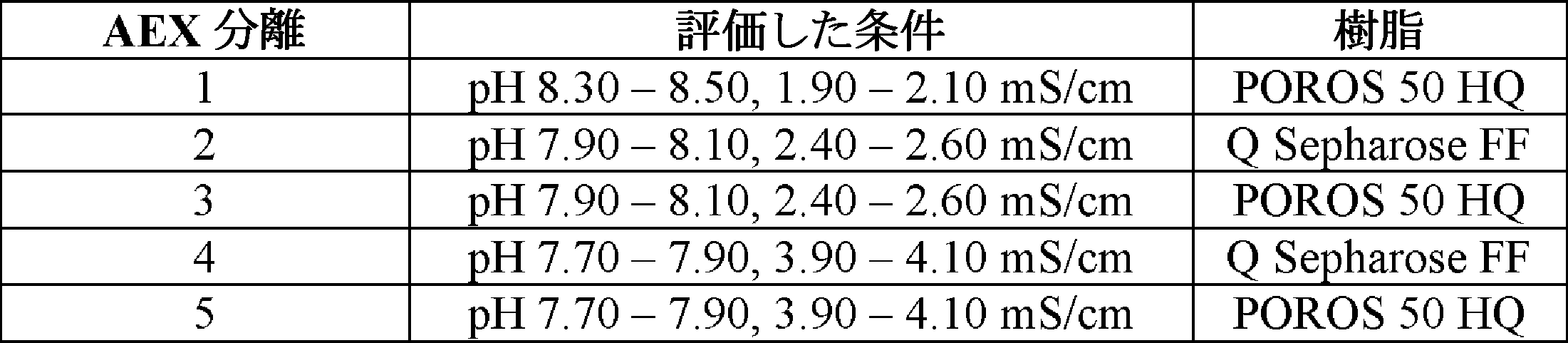
(表2-2)色低減のためのAEXプロトコル
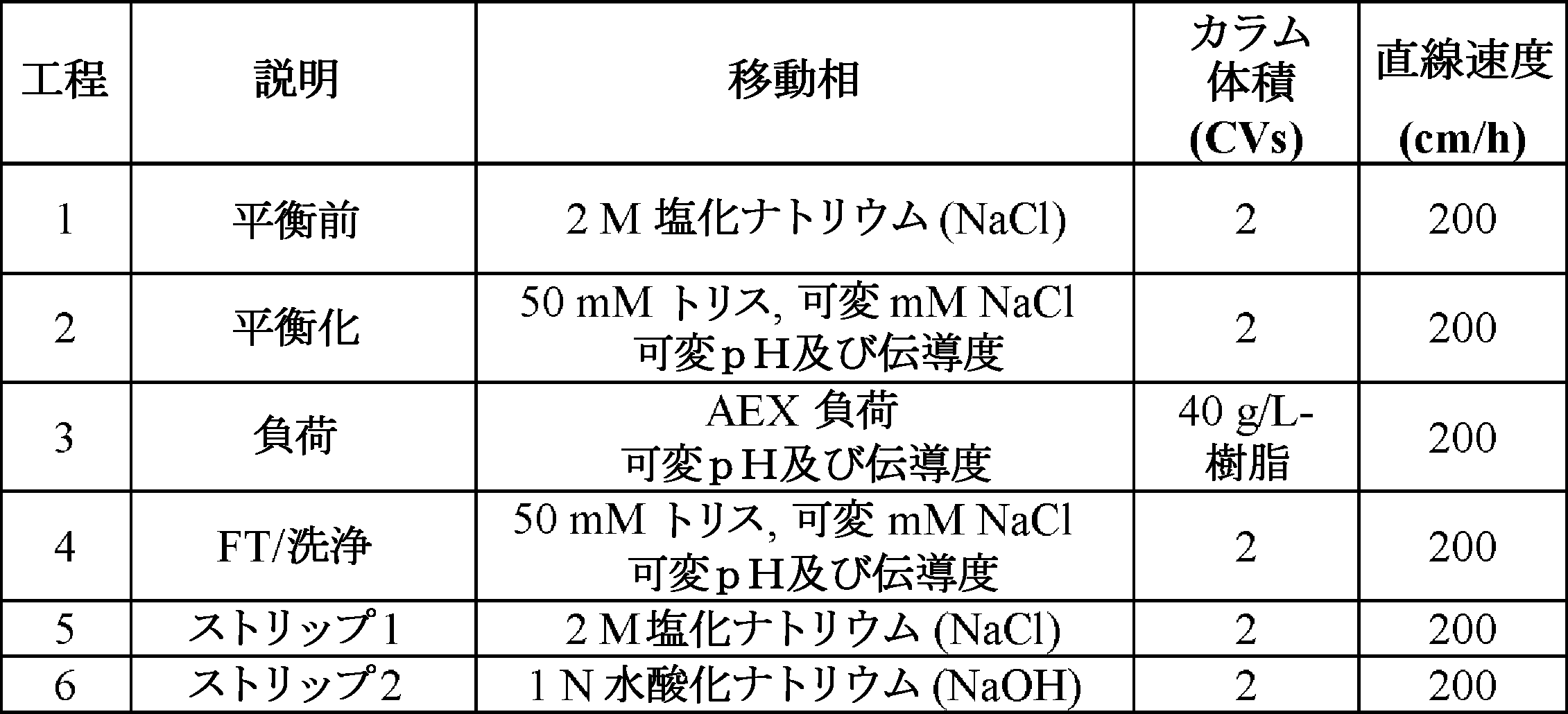
2.2 結果
産生へのAEX分離の利用は、色の著しい低減を呈した(表2-3)。例えば、表2-3で確認されるように、AEX分離1におけるフロースルー(FT)及び洗浄液(pH8.30~8.50、1.90~2.10mS/cm)中で観察される色は、3.06のb*値を有するAEXの負荷(「AEX負荷」)の色と比較して、1.05のb*値を有した。b*値における増加は、試料の黄褐色の強度を反映する。
2.2 Results The use of AEX separation for production exhibited a significant reduction in color (Table 2-3). For example, as seen in Table 2-3, the color observed in the flow-through (FT) and wash (pH 8.30-8.50, 1.90-2.10 mS/cm) in
樹脂(Q Sepharose FF又はPOROS 50 HQ)並びにpH及び伝導度設定点(pH8.40及び2.00mS/cm、pH8.00及び2.50mS/cm、又はpH7.80及び4.00mS/cm)の色低減に対する影響を評価するために、5回のAEX分離を実施した。POROS 50 HQに関して、設定点をより低いpH及びより高い伝導度に変更すると、収率(64.4、81.9、及び91.4%)及びプールHMWレベル(1.02、1.29、及び1.83%)は増加した。設定点をより低いpH及びより高い伝導度に変更すると、色(b*値)も増加した(1.05、1.33、及び1.55)。より高いpHレベル及びより低い伝導度は、POROS 50 HQについてのAEX分離を通して、最大の色低減をもたらした。
Five AEX separations were performed to evaluate the effect of resin (Q Sepharose FF or
Q Sepharose Fast Flowに関して、設定点をより低いpH及びより高い伝導度に変更すると、収率(49.5%及び77.7%)及びプールHMWレベル(0.59%及び1.25%)は増加した。設定点をより低いpH及びより高い伝導度に変更すると、色(b*値)も増加した(0.96、及び1.35)。 For Q Sepharose Fast Flow, yields (49.5% and 77.7%) and pool HMW levels (0.59% and 1.25%) increased when the set point was changed to lower pH and higher conductivity. Color (b * value) also increased (0.96 and 1.35) when the set point was changed to lower pH and higher conductivity.
AEXの使用は黄褐色を低減させる。表2-3を参照されたい。加えて、Q Sepharose Fast FlowはPOROS 50 HQよりも、両方の樹脂について評価した2つの設定点については、色を低減させると判定された。pH8.00及び2.50mS/cmの設定点において、POROS 50 HQプールは1.33のb*値を有し、一方でQ Sepharose Fast Flowプールは0.96のb*値を有した。同様に、pH7.80及び4.00mS/cmの設定点において、POROS 50 HQプールは1.55のb*値を有し、一方でQ Sepharose Fast Flowプールは1.35のb*値を有した(表2-3)。
The use of AEX reduces the tan color. See Table 2-3. Additionally, Q Sepharose Fast Flow was determined to reduce color more than
(表2-3)AEX色低減調査の実験結果の概要

色測定のため、画分を10g/Lのタンパク質濃度に調整した。 For color measurements, fractions were adjusted to a protein concentration of 10 g/L.
2.3 結論
AEXの使用は黄褐色を低減させることが分かった。表2-3を参照されたい。表2-3を参照すると、AEX負荷は3.06のb*値を有するが、AEXクロマトグラフィーに供すると(AEX分離1~5)、b*値が減少し、これは黄褐色の減少を示している。この場合もまた、b*値が減少するにつれて呈色が低減し、b*値が増加するにつれて、所与の試料における黄褐色の増加を反映している。
2.3 Conclusions The use of AEX was found to reduce the tan color. See Table 2-3. Referring to Table 2-3, the AEX load has a b * value of 3.06, but when subjected to AEX chromatography (AEX separations 1-5), the b * value decreases indicating a reduction in the tan color. Again, as the b * value decreases, the coloration decreases and as the b * value increases, it reflects an increase in the tan color in a given sample.
2つのAEX樹脂(POROS 50 HQ及びQ Sepharose Fast Flow)及び3つの設定点(pH8.40及び2.00mS/cm、pH8.00及び2.50mS/cm、及びpH7.80及び4.00mS/cm)を使用し、色低減を評価した。両方の樹脂について、より高いpH及びより低い伝導度の設定点について、色低減はより大きかった。加えて、Q Sepharose Fast FlowはPOROS 50 HQよりも、両方の樹脂について評価した2つの設定点(pH8.00及び2.50mS/cm、及びpH7.80及び4.00mS/cm)においては、より色低減をもたらした。しかし、5回すべてのAEX分離法は、AEX用の負荷溶液(「AEX負荷」)と比較すると著しい色低減をもたらし、CDMを使用して発現されたアフリベルセプト産生のプロセスにおけるAEX生成の重要性を実証した。(10g/Lの濃度での)AEX負荷の初期b*値は、約0.5~約30の範囲であり、より具体的には約1.0~約25.0、及び更により具体的には約2.0~約20.0の範囲であり得る。AEXの使用後、(10g/Lの濃度での)フロースルーのb*値は、0.5~約10.0の範囲であり、より具体的には約0.5~約7.0、及び更により具体的には約0.5~約5.0の範囲であり得る。
Color reduction was evaluated using two AEX resins (
2.4 ペプチドマッピング
試料調製。翻訳後修飾(PTM)を同定及び定量化するため、上記実験(表2-3)のAEX負荷及びフロースルーから得られた還元及びアルキル化アフリベルセプト試料のトリプシンマッピング(Tryptic mapping)を実施した。各試料のアリコート(負荷及びフロースルー)を、8.0Mの尿素、0.1Mのトリス-HCl(pH7.5)を使用して変性し、DTTで還元し、次いでヨードアセトアミドでアルキル化した。変性、還元及びアルキル化された試料を、最初に組換えLys-C(rLys-C)を用い、37℃で30分間、1:100(w/w)の酵素対基質比にて消化し、最終尿素濃度が1.8Mとなるように0.1Mのトリス-HCl(pH7.5)で希釈して、続いてトリプシンを用い、37℃で2時間、1:20(w/w)の酵素対物質比にて消化し、次いでPNGaseFを用いて、37℃で1時間、1:5(w/w)の酵素基質比で脱グリコシル化した。ギ酸(FA)を用いてpHを2.0未満とすることにより、消化を停止した。
2.4 Peptide Mapping Sample Preparation. Tryptic mapping of reduced and alkylated aflibercept samples obtained from the AEX load and flow-through from the above experiments (Tables 2-3) was performed to identify and quantify post-translational modifications (PTMs). Aliquots of each sample (load and flow-through) were denatured using 8.0 M urea, 0.1 M Tris-HCl (pH 7.5), reduced with DTT, and then alkylated with iodoacetamide. The denatured, reduced and alkylated samples were first digested with recombinant Lys-C (rLys-C) at 37° C. for 30 min at an enzyme to substrate ratio of 1:100 (w/w), diluted with 0.1 M Tris-HCl (pH 7.5) to a final urea concentration of 1.8 M, followed by digestion with trypsin at an enzyme to substrate ratio of 1:20 (w/w) for 2 h at 37° C., and then deglycosylated with PNGase F at an enzyme to substrate ratio of 1:5 (w/w) for 1 h at 37° C. Digestion was stopped by adjusting the pH to less than 2.0 with formic acid (FA).
LC-MS分析。各試料から得られたrLys-C/トリプシンペプチドの20μgのアリコートを分離し、Waters ACQUITY UPLC CSH C18カラム(130Å、1.7μm、2.1×150mm)を使用して逆相超高速液体クロマトグラフィー(UPLC)、続いてオンラインPDA検出(280nm、320nm及び350nmの波長にて)及び質量分析により分析した。移動相Aは水中0.1%FAであり、移動相Bはアセトニトリル中0.1%FAであった。試料注入後、0.1%のBにて5分間保持してグラジエントを開始し、続いて、最適なペプチド分離のため、75分間かけて35%までBを直線状に増加させた。MS/MS実験のペプチドフラグメンテーションに利用される高エネルギー衝突解離(HCD)を備えたThermo Scientific Q Exactiveハイブリッド四重極Orbitrap質量分析計を使用し、MS及びMS/MS実験を実施した。ペプチド同一性の割り当ては、実験的に決定されたフルMSスペクトラム中の所与のペプチドの正確な質量、及び対応するHCD MS/MSスペクトラム中のbフラグメントイオン及びyフラグメントイオンに基づいていた。負荷及びフロースルーからのペプチドの抽出イオンクロマトグラムを生成した(図10を参照されたい)。図10の抽出イオンクロマトグラムで確認されるように、AEX分離1~5(表2-3にて同定される)からの「AEX負荷」及び「AEX FT/洗浄液」において同定されたペプチド断片を示す。ペプチドマッピング分析から図10で同定されるこれらのいくつかのペプチドの相対的な存在量を図11に示す。 LC-MS analysis. A 20 μg aliquot of rLys-C/tryptic peptides from each sample was separated and analyzed by reversed-phase ultra-performance liquid chromatography (UPLC) using a Waters ACQUITY UPLC CSH C18 column (130 Å, 1.7 μm, 2.1 × 150 mm) followed by online PDA detection (at wavelengths of 280 nm, 320 nm and 350 nm) and mass spectrometry. Mobile phase A was 0.1% FA in water and mobile phase B was 0.1% FA in acetonitrile. After sample injection, the gradient was started with a 5 min hold at 0.1% B followed by a linear increase in B to 35% over 75 min for optimal peptide separation. MS and MS/MS experiments were performed using a Thermo Scientific Q Exactive Hybrid Quadrupole Orbitrap mass spectrometer equipped with high-energy collisional dissociation (HCD) utilized for peptide fragmentation in MS/MS experiments. Peptide identity assignment was based on the experimentally determined accurate mass of a given peptide in the full MS spectrum and the b and y fragment ions in the corresponding HCD MS/MS spectrum. Extracted ion chromatograms of peptides from the load and flow-through were generated (see FIG. 10). As confirmed in the extracted ion chromatograms in FIG. 10, peptide fragments identified in the "AEX Load" and "AEX FT/Wash" from AEX Separations 1-5 (identified in Tables 2-3) are shown. The relative abundance of some of these peptides identified in FIG. 10 from peptide mapping analysis is shown in FIG. 11.
図11を参照すると、この図は、分析される様々なペプチド断片及びそれらの相対的な酸化レベルを示している。特に、3列目は、単離及び分析されたペプチド断片のアミノ酸残基(「ペプチド配列」)を示している。各ペプチド配列は、下線が引かれたアミノ酸残基を有する。下線が引かれたアミノ酸残基は、ペプチド配列中の酸化されたアミノ酸を示す。酸化アミノ酸は、ヒスチジン(H)酸化又はトリプトファン(W)酸化のいずれかに対応する。この図ではまた、それぞれのペプチド配列の行の右側に向かって、酸化種の存在量を示している。行中のこの陰影は、それぞれの列の見出しに示される異なるAEX分離を使用した、特定の試料中の酸化残基の相対的な量の差を示している。例えば、図11の2つ目のペプチド(EIGLLTCEATVNGHLYK(配列番号18))を参照して、水平方向に沿って読み取ると、特定の試料(「アフリベルセプトAEX負荷」)中のこのペプチドの酸化された相対的総集団は、およそ0.013%酸化されている。同じ行にわたって進むと、陰影がシフトしており、これは酸化種の相対的な存在量における変化を示している。例えば、この同じペプチド配列を使用すると、AEX分離についての酸化種の相対的な存在量は、異なるAEX分離プロトコルに従った場合、0.006%~0.010%である。したがって、AEXクロマトグラフィーは酸化種の存在量を減少させると理解することができる。 11, this figure shows the various peptide fragments analyzed and their relative oxidation levels. In particular, the third column shows the amino acid residues of the peptide fragments that were isolated and analyzed ("peptide sequences"). Each peptide sequence has an underlined amino acid residue. The underlined amino acid residue indicates the oxidized amino acid in the peptide sequence. The oxidized amino acid corresponds to either histidine (H) oxidation or tryptophan (W) oxidation. The figure also shows the abundance of the oxidized species toward the right of each peptide sequence row. This shading in the row indicates the difference in the relative amount of oxidized residues in a particular sample using the different AEX separations shown in the respective column headings. For example, looking at the second peptide in FIG. 11 (EIGLLTCEATVNGHLYK (SEQ ID NO: 18)), reading along the horizontal direction, the relative total oxidized population of this peptide in a particular sample ("aflibercept AEX loading") is approximately 0.013% oxidized. Going across the same row, the shading shifts, indicating a change in the relative abundance of the oxidized species. For example, using this same peptide sequence, the relative abundance of the oxidized species for the AEX separation is 0.006% to 0.010% when following different AEX separation protocols. Thus, it can be seen that AEX chromatography reduces the abundance of the oxidized species.
(B)MiniTrap産生における色形成を低減させるためにAEXを使用した
CDM1を使用して発現された全長アフリベルセプトの切断実施時に得られるMT1の産生中に生じる呈色を取り除くため、AEXクロマトグラフィーを実施した。
(B) AEX was used to reduce color formation in MiniTrap production. AEX chromatography was performed to remove coloration that occurs during the production of MT1, which is obtained when cleavage is performed on full-length aflibercept expressed using CDM1.
2.5 デザイン
表2-4にて説明されるように、本調査のために4回のAEX分離を実施した。MT1(「MT1ろ過プール」)のろ過試料から、AEX負荷を得た。この実験のため、AKTA Avantベンチトップ型液体クロマトグラフィーコントローラに、15.7mLのCapto Qカラム(床高さ20.0cm、内径1.0cm)、14.1mLのPOROS 50 HQカラム(床高さ18.0cm、内径1.0cm)、及び16.5mLのQ Sepharose FFカラム(床高さ21.0cm、内径1.0cm)を統合した。
2.5 Design Four AEX separations were performed for this study, as described in Tables 2-4. The AEX load was obtained from the filtrate sample of MT1 ("MT1 filtrate pool"). For this experiment, an AKTA Avant benchtop liquid chromatography controller was integrated with a 15.7 mL Capto Q column (bed height 20.0 cm, inner diameter 1.0 cm), a 14.1
2Mのトリス塩基又は2Mの酢酸を使用し、AEX負荷のpHを目標±0.05pH単位に調整した。5Mの塩化ナトリウム及び脱イオン水を使用し、AEX負荷の伝導度を目標±0.1mS/cmに調整した。HMW、色及び収率について、すべてのプール試料を分析した。 The pH of the AEX load was adjusted to a target of ±0.05 pH units using 2M Tris base or 2M acetic acid. The conductivity of the AEX load was adjusted to a target of ±0.1 mS/cm using 5M sodium chloride and deionized water. All pooled samples were analyzed for HMW, color, and yield.
(表2-4)AEX色低減調査のための研究デザインの概要

(表2-5)色低減調査のために使用されるフロースルーAEXプロトコル
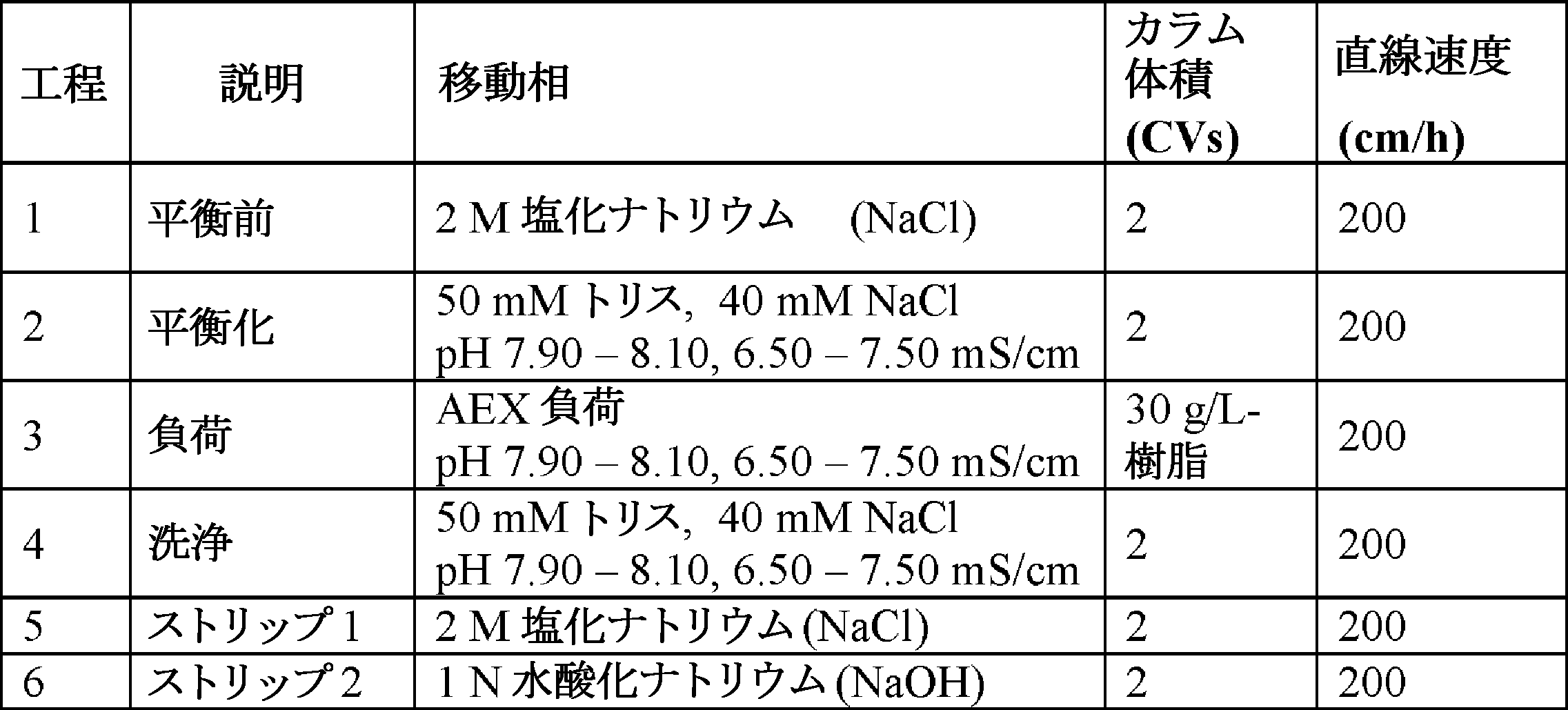
(表2-6)色低減調査のために使用される結合及び溶出AEXプロトコル
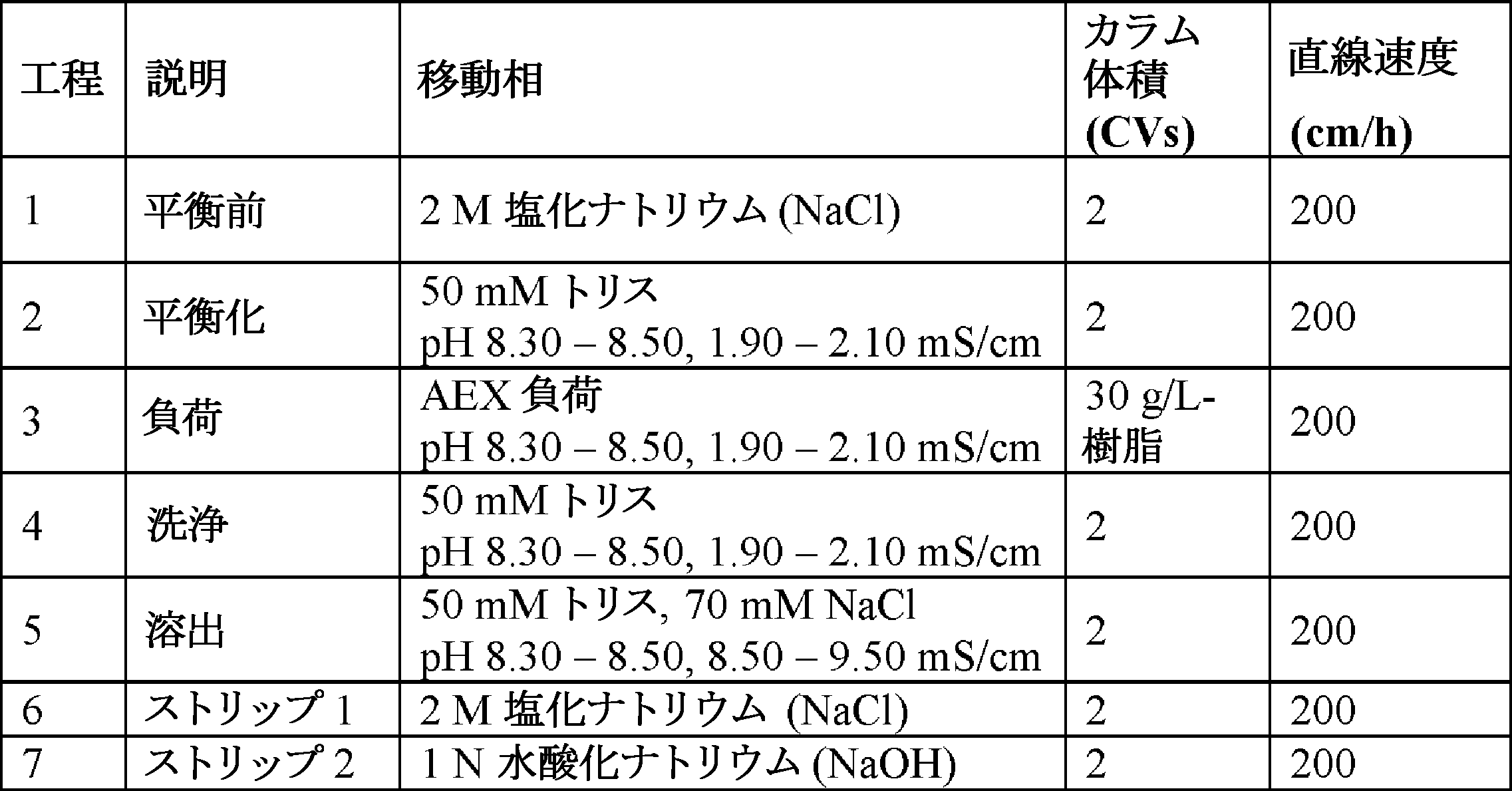
2.6 結果
4回のAEX分離はすべて、AEX分離1~4のフロースルー及び洗浄液の呈色に関して確認されるように、色の低減をもたらした(表2-7)。最初の3回のAEX分離を結合及び溶出モードにて評価したが(表2-6)、生成物の大部分は負荷ブロック及び洗浄液ブロックに存在していたことが観察された(62%~94%)。
2.6 Results All four AEX separations resulted in a reduction in color as seen for the coloration of the flow-through and washes for AEX separations 1-4 (Table 2-7). The first three AEX separations were evaluated in bind and elute mode (Table 2-6), and it was observed that the majority of the product was present in the load and wash blocks (62%-94%).
最初の3回の分離では、Capto Q、POROS 50 HQ及びQ Sepharose FF樹脂について、pH8.4及び2.0mS/cmの設定点を評価した。3回の分離はすべて、良好な収率(80%超)であった。POROS 50 HQ AEXプールは、AEXプール中では最も弱い黄色であり(b*値2.09)、Q Sepharose FF AEXプール(b*値2.22)、及びCapto Q AEXプール(b*値2.55)が続いた。
For the first three separations, Capto Q,
(表2-7)AEX色低減調査の実験結果の概要
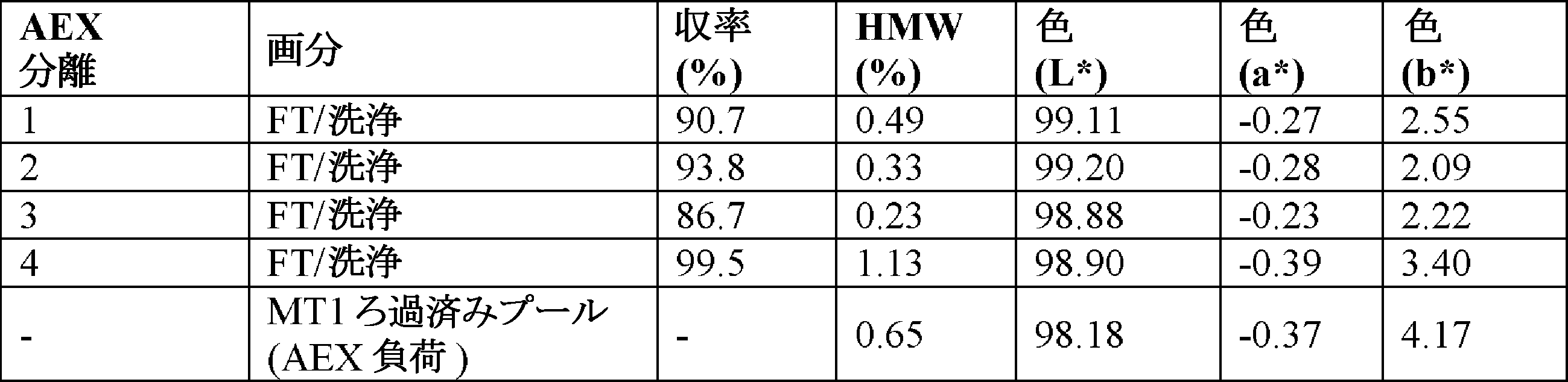
色測定のため、画分を5g/Lのタンパク質濃度に調整した。 Fractions were adjusted to a protein concentration of 5 g/L for color measurements.
2.7 結論
アフリベルセプトについて確認されるように(上のセクション2.3を参照されたい)、AEXの使用により、MiniTrap産生に関して黄褐色が低減すること(表2-7)が分かった。表2-7を参照すると、AEX負荷は4.17のb*値を有するが、AEXクロマトグラフィーに供すると(AEX分離1~4)、b*値が減少し、これは黄褐色における減少を示している。この場合もまた、b*値が減少するにつれて呈色も低減する。(5g/Lの濃度での)AEX負荷の初期b*値は、約0.5~約25の範囲であり、より具体的には約1.0~約20.0、及び更により具体的には約1.5~約15.0の範囲であり得る。AEXの使用後、(5g/Lの濃度での)フロースルーのb*値は、0.5~約10.0の範囲であり、より具体的には約0.5~約7.0、及び更により具体的には約0.5~約5.0の範囲であり得る。
2.7 Conclusions As observed for aflibercept (see section 2.3 above), the use of AEX was found to reduce the tan color for MiniTrap production (Table 2-7). Referring to Table 2-7, the AEX load has a b * value of 4.17, but when subjected to AEX chromatography (AEX separations 1-4), the b * value decreases, indicating a reduction in the tan color. Again, as the b * value decreases, so does the coloration. The initial b * value of the AEX load (at a concentration of 5 g/L) may range from about 0.5 to about 25, more specifically from about 1.0 to about 20.0, and even more specifically from about 1.5 to about 15.0. After use of AEX, the b * value of the flow-through (at a concentration of 5 g/L) may range from 0.5 to about 10.0, more specifically from about 0.5 to about 7.0, and even more specifically from about 0.5 to about 5.0.
[実施例3]酸化ペプチド調査
3.1 ペプチドマッピング
試料調製。翻訳後修飾を同定及び定量化するため、還元及びアルキル化MiniTrap(MT1)及びMT4(ダイズ加水分解細胞培養を使用して産生された異なる全長アフリベルセプトを使用し、MT1と類似するMiniTrap)試料のトリプシンマッピングを実施した。各試料のアリコートは、0.1Mのトリス-HCl(pH7.5)中8.0Mの尿素を使用して変性させ、DTTで還元し、次いでヨードアセトアミドでアルキル化した。変性させ、還元し、かつアルキル化した原薬を、最初に組換えLys-C(rLys-C)を用い、37℃で30分間、1:100(w/w)の酵素対基質比にて消化し、最終尿素濃度が1.8Mとなるように0.1Mのトリス-HCl(pH7.5)で希釈して、続いてトリプシンを用い、37℃で2時間、1:20(w/w)の酵素対物質比にて消化し、次いでPNGaseFを用いて、37℃で1時間、1:5(w/w)の酵素基質比で脱グリコシル化した。ギ酸(FA)を用いてpHを2.0未満とすることにより、消化を停止した。
Example 3: Oxidized peptide survey 3.1 Peptide mapping Sample preparation: Tryptic mapping of reduced and alkylated MiniTrap (MT1) and MT4 (a MiniTrap similar to MT1, using a different full-length aflibercept produced using soybean hydrolyzed cell culture) samples was performed to identify and quantify post-translational modifications. Aliquots of each sample were denatured using 8.0 M urea in 0.1 M Tris-HCl (pH 7.5), reduced with DTT, and then alkylated with iodoacetamide. The denatured, reduced and alkylated drug substance was first digested with recombinant Lys-C (rLys-C) at 37° C. for 30 min at an enzyme to substrate ratio of 1:100 (w/w), diluted with 0.1 M Tris-HCl (pH 7.5) to a final urea concentration of 1.8 M, followed by digestion with trypsin at an enzyme to substrate ratio of 1:20 (w/w) for 2 h at 37° C., and then deglycosylated with PNGase F at an enzyme to substrate ratio of 1:5 (w/w) for 1 h at 37° C. Digestion was stopped by adjusting the pH to less than 2.0 with formic acid (FA).
LC-MS分析。各試料から得られたrLys-C/トリプシンペプチドの20μgのアリコートを分離し、Waters ACQUITY UPLC CSH C18カラム(130Å、1.7μm、2.1×150mm)を使用して逆相超高速液体クロマトグラフィー(UPLC)、続いてオンラインPDA検出(280nm、320nm及び350nmの波長にて)及び質量分析により分析した。移動相Aは水中0.1%FAであり、移動相Bはアセトニトリル中0.1%FAであった。試料注入後、0.1%のBで5分間保持してグラジエントを開始し、続いて最適なペプチド分離のため、75分間かけて35%までBを直線状に増加させた。MS/MS実験のペプチドフラグメンテーションに利用される高エネルギー衝突解離(HCD)を備えたThermo Scientific Q Exactiveハイブリッド四重極Orbitrap質量分析計にて、MS及びMS/MS実験を実施した。ペプチド同一性の割り当ては、実験的に決定されたフルMSスペクトラム中の所与のペプチドの正確な質量、及び対応するHCD MS/MSスペクトラム中のbフラグメントイオン及びyフラグメントイオンに基づいた。MT1試料中の(1つ以上の)酸化アミノ酸残基の部位特異的割合を計算するために積分されたピーク領域を用い、酸化ペプチド及び対応する天然ペプチドの抽出イオンクロマトグラムを生成した。 LC-MS analysis. A 20 μg aliquot of rLys-C/tryptic peptides from each sample was separated and analyzed by reversed-phase ultra-performance liquid chromatography (UPLC) using a Waters ACQUITY UPLC CSH C18 column (130 Å, 1.7 μm, 2.1 × 150 mm) followed by online PDA detection (at wavelengths of 280 nm, 320 nm and 350 nm) and mass spectrometry. Mobile phase A was 0.1% FA in water and mobile phase B was 0.1% FA in acetonitrile. After sample injection, the gradient was started with a 5 min hold at 0.1% B followed by a linear increase in B to 35% over 75 min for optimal peptide separation. MS and MS/MS experiments were performed on a Thermo Scientific Q Exactive Hybrid Quadrupole Orbitrap mass spectrometer with high-energy collisional dissociation (HCD) utilized for peptide fragmentation in the MS/MS experiments. Peptide identity assignment was based on the experimentally determined accurate mass of a given peptide in the full MS spectrum and the b- and y-fragment ions in the corresponding HCD MS/MS spectrum. Extracted ion chromatograms of the oxidized and corresponding native peptides were generated using integrated peak areas to calculate the site-specific percentage of oxidized amino acid residue(s) in the MT1 samples.
350nmでの吸光度の増加に関連するペプチド断片
MT1及びMT4に関するトリプシンペプチドマップを比較した際に、MT1におけるPTMを観察した(図12Aは20.0~75分に溶出されたペプチドの吸光度を示している)。様々なUVピークを有するペプチドが強調されている。クロマトグラムの拡大図を図12Bに示し、これは16~30分に溶出したペプチドの吸光度を示している。MT1とMT4との間のUV吸光度で著しく対照的であるペプチドは、TNYLTH*R(配列番号21)、IIW(+4)DSR(配列番号28)及びIIIW(+132)DSR(配列番号124)であった(*又は下線は残基の酸化を表す)。更に、クロマトグラムの拡大図を図12Cに示し、これは30~75分に溶出したペプチドの吸光度を示している。MT1とMT4との間のUV吸光度で著しく対照的であるペプチドは、DKTH*TC*PPC*PAPELLG(配列番号17)、TELNVGIDFNWEYPSSKH*QHK(配列番号20)、EIGLLTCEATVNGH*LYK(配列番号18)及びQTNTIIDVVLSPSH*GIELSVGEK(配列番号19)であった(*は残基の酸化を表す)。ペプチドマッピングにより、VEGF MiniTrap間で存在量において有意に異なるペプチドの同一性が明らかとなった。ペプチドマッピング分析から同定されたペプチドの相対的な存在量を表3-1に示す。MT1(CDM中で産生)中の2-オキソ-ヒスチジンの量は、MT4(ダイズ加水分解物中で産生)より高かった。これは、アフリベルセプトを発現するために使用された培地が、酸化ヒスチジン又は酸化トリプトファンを有するペプチドの相対的な存在量に有意な影響を有し得ることを示唆している。例えば、ペプチドQTNTIIDVVLSPSH*GIELSVGEK(配列番号19)に関しては、MT1(CDM中で産生)中のペプチドの相対的な存在量のパーセントは、MT4(ダイズ加水分解物中で産生;MT1と比較すると約15分の1)中のペプチドの相対的な存在量のパーセントと比較して0.015パーセントであった。
Peptide fragments associated with increased absorbance at 350 nm PTMs in MT1 were observed when comparing tryptic peptide maps for MT1 and MT4 (Figure 12A shows the absorbance of peptides eluted from 20.0 to 75 min). Peptides with different UV peaks are highlighted. A zoomed-in chromatogram is shown in Figure 12B, which shows the absorbance of peptides eluted from 16 to 30 min. Peptides with striking contrast in UV absorbance between MT1 and MT4 were TNYLTH * R (SEQ ID NO:21), IIW(+4)DSR (SEQ ID NO:28) and IIIW(+132)DSR (SEQ ID NO:124) ( * or underline represents oxidation of residue). A further zoomed-in chromatogram is shown in Figure 12C, which shows the absorbance of peptides eluted from 30 to 75 min. Peptides with striking contrast in UV absorbance between MT1 and MT4 were DKTH * TC * PPC * PAPELLG (SEQ ID NO:17), TELNVGIDFNWEYPSSKH * QHK (SEQ ID NO:20), EIGLLTCEATVNGH * LYK (SEQ ID NO:18) and QTNTIIDVVLSPSH * GIELSVGEK (SEQ ID NO:19) ( * denotes oxidation of residue). Peptide mapping revealed the identity of peptides that differed significantly in abundance among the VEGF MiniTraps. The relative abundance of peptides identified from peptide mapping analysis is shown in Table 3-1. The amount of 2-oxo-histidine in MT1 (produced in CDM) was higher than MT4 (produced in soy hydrolysate). This suggests that the medium used to express aflibercept may have a significant effect on the relative abundance of peptides with oxidized histidine or tryptophan. For example, for peptide QTNTIIDVVLSPSH * GIELSVGEK (SEQ ID NO: 19), the percentage of relative abundance of the peptide in MT1 (produced in CDM) was 0.015 percent compared to the percentage of relative abundance of the peptide in MT4 (produced in soy hydrolysate; approximately 15-fold lower than MT1).
(表3-1)
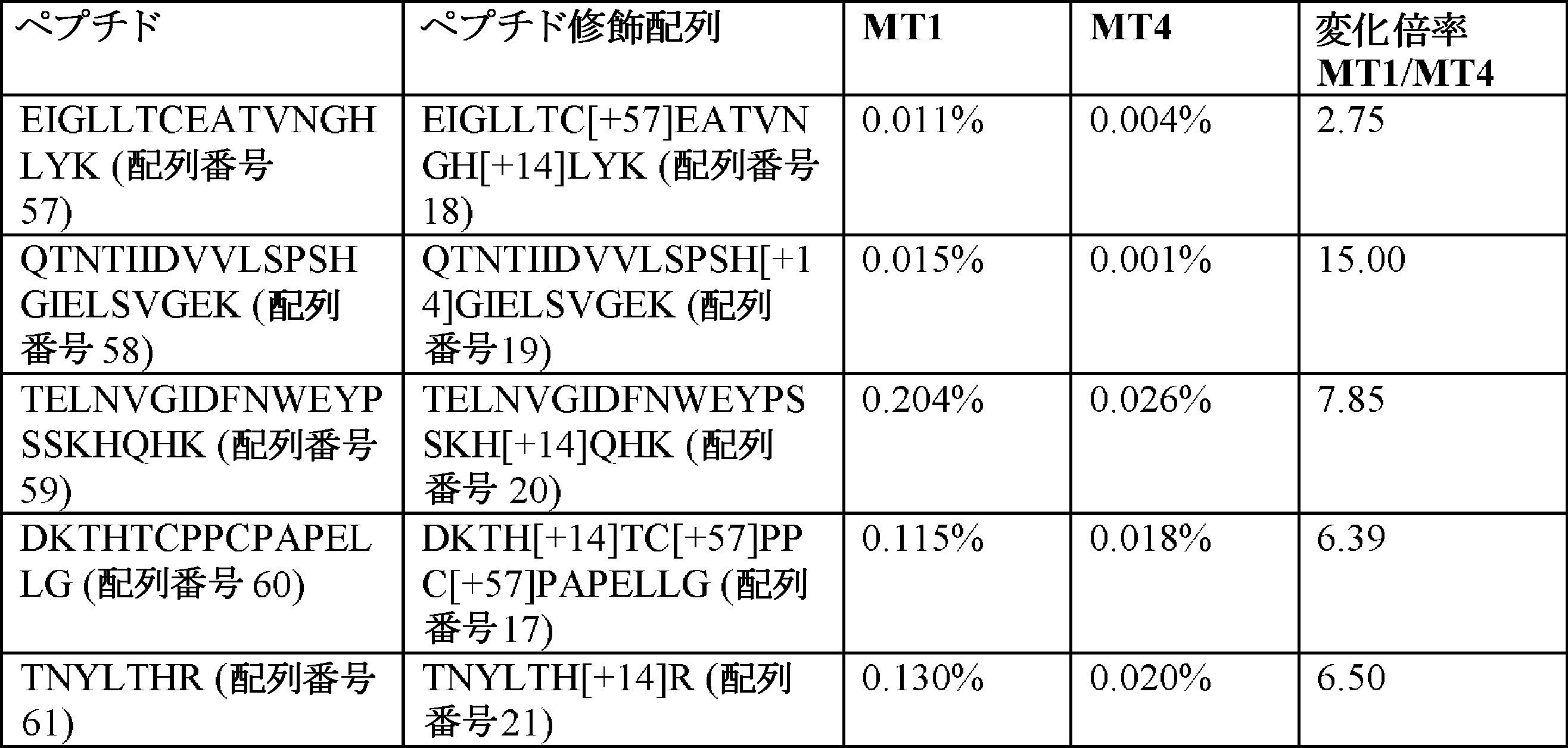
色及び2-オキソ-ヒスチジンの定量。質量分析法により測定されるように、プロテアーゼ消化により生成されたオリゴペプチド中の2-オキソ-ヒスチジンの割合も示す(表3-2)(値は、未修飾ペプチドに対して正規化した)。表3-2(I)は、AEXフロースルー:MT1 ロット1、MT1 ロット2のAEXフロースルー、MT1 ロット3のAEXフロースルーに関して観察された酸化ヒスチジン/トリプトファンのパーセントを示す。表3-2(II)は、MT1 ロット3に対するCEX分離の実施時に得られた酸性画分1、酸性画分2、及び主要画分に関して観察された酸化ヒスチジン/トリプトファンのパーセントを示す。この表から、酸性バリアントは酸化種から構成されていることが明らかである。表3-2(I)から、ペプチド/タンパク質を含む2-オキソ-ヒスチジン及びトリプトファン二酸化の%は、AEXストリップと比較すると、AEXフロースルー中では減少している。AEXカラムをストリップすることで、こうした修飾ペプチドの割合が高くなることが明らかである。例えば、修飾ペプチドである、AEXフロースルー(MT1 ロット1)中の「EIGLLTC[+57]EATVNGH[+14]LYK(配列番号18)」は0.013%であり、「AEXストリップ」中では0.080%であった。これはまた、AEXカラムが修飾ペプチドを捕捉し、そうすることでAEXフロースルー中の修飾ペプチドの割合を減少させていることも実証している。
Color and quantification of 2-oxo-histidine. The percentage of 2-oxo-histidine in the oligopeptides generated by protease digestion as measured by mass spectrometry is also shown (Table 3-2) (values normalized to the unmodified peptide). Table 3-2 (I) shows the percentage of oxidized histidine/tryptophan observed for the AEX flow-through: AEX flow-through of
(表3-2(I))2-オキソ-ヒスチジン/トリプトファンの割合
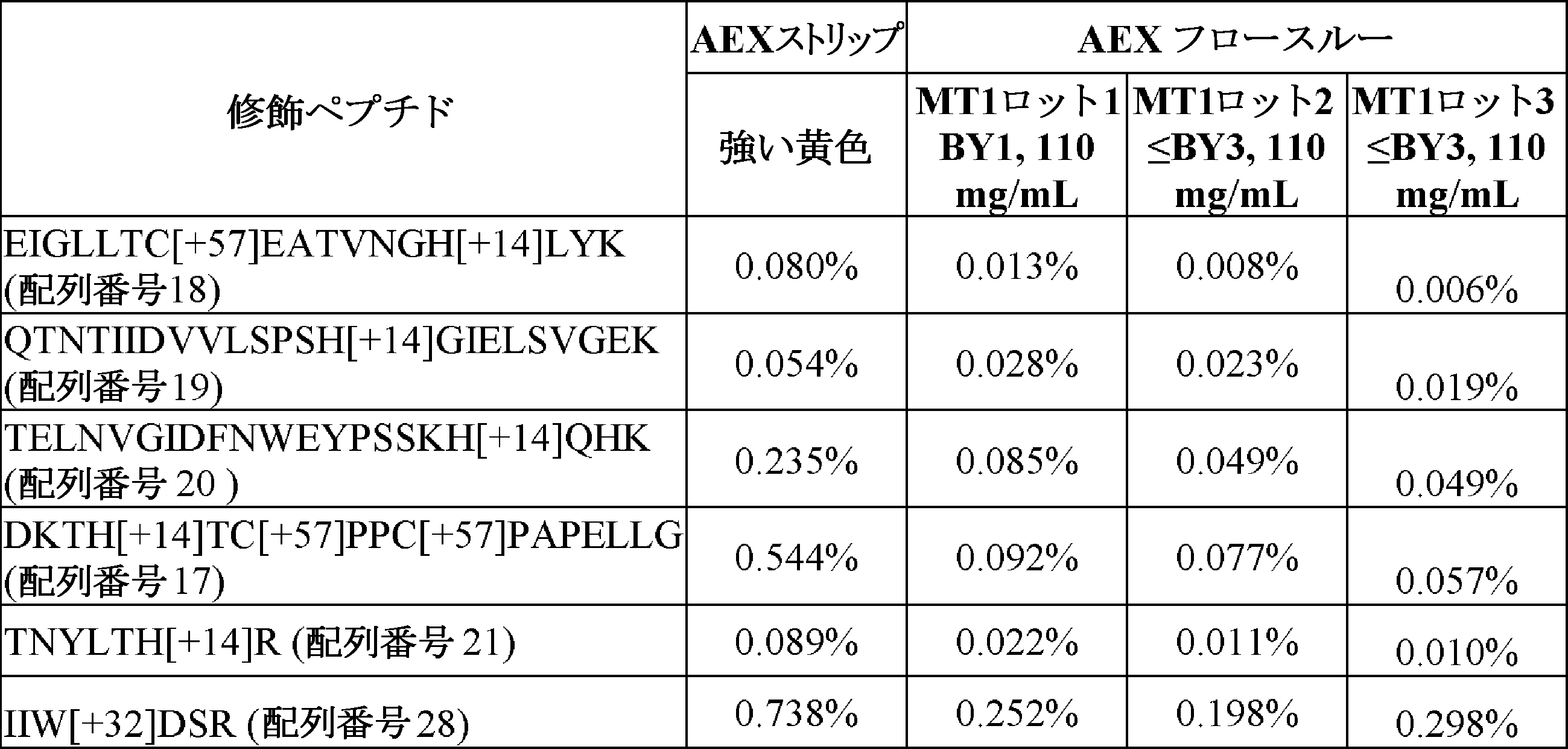
(表3-2(II))2-オキソ-ヒスチジン/トリプトファンの割合
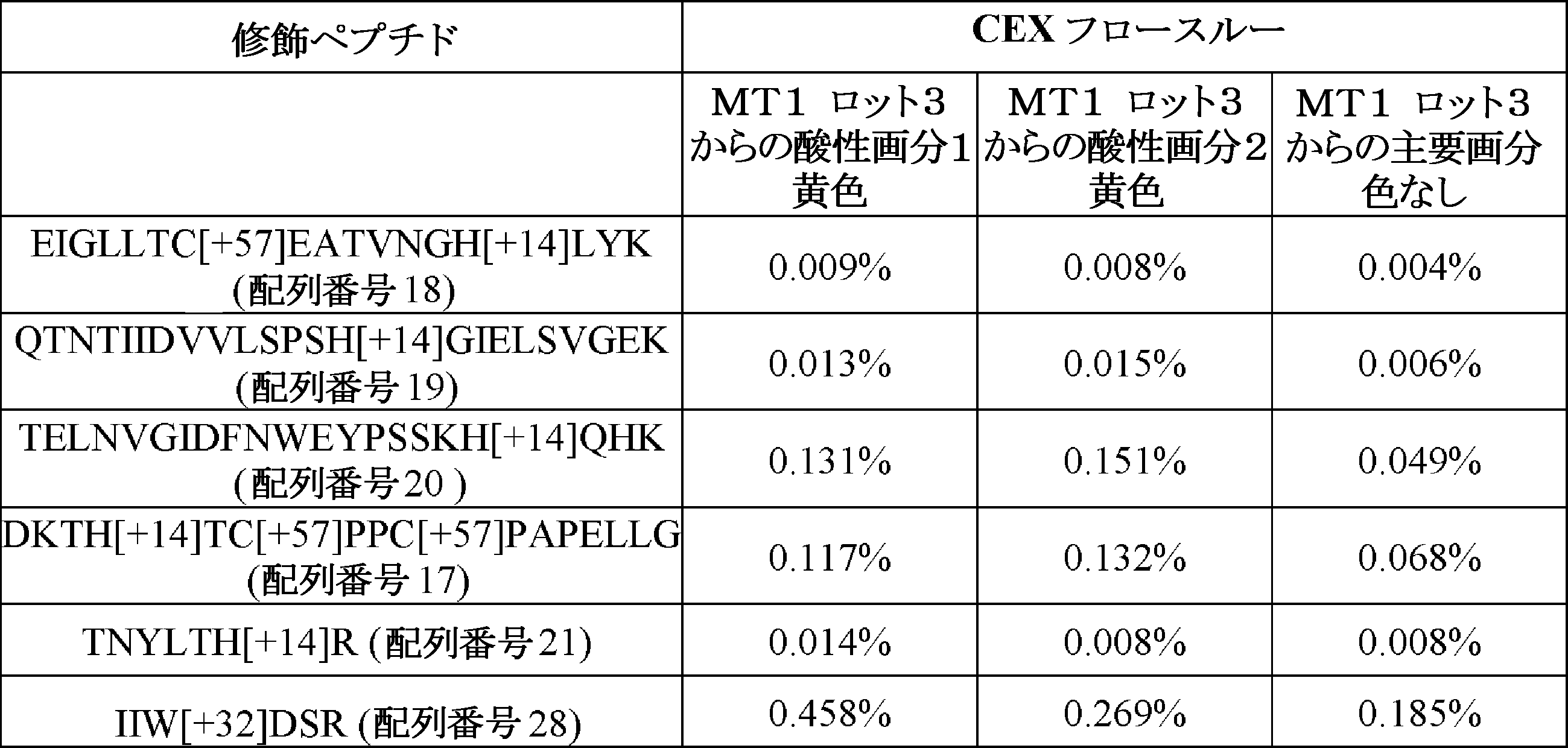
表3-2(II)において、[+57]は、ヨードアセトアミドによるシステインのアルキル化がシステインのカルボキシメチルアミン部分を追加することを表す。これは未修飾システインと比べて約+57の正味の質量増加である。

表3-2(II)において、[+14]は、ヒスチジンから2-オキソ-ヒスチジンへの変化を表しており、1個の酸素原子が炭素2に加えられるが、2個の水素原子が失われる(1つは炭素2から、もう1つは窒素3から失われる)。これは未修飾ヒスチジンよりも約+14の正味の質量増加である。

表3-2(II)において、[+32]は、N-ホルミルキヌレニンの形成の原因となるトリプトファン二酸化を表す。これは未修飾トリプトファンよりも約+32の正味の質量増加である(図4)。 In Table 3-2 (II), [+32] represents tryptophan dioxide leading to the formation of N-formylkynurenine, which is a net mass increase of about +32 over unmodified tryptophan (Figure 4).
AEXクロマトグラフィーにより処理された、プロテアーゼ消化されたFabRICATOR切断型アフリベルセプトからのオリゴペプチド(MT4)中の2-オキソ-ヒスチジン(及びトリプトファン二酸化)の割合を評価するため、第2の実験セットを実施した(図13及び以下の表3-3)。プロテアーゼ消化されたFabRICATOR切断型アフリベルセプトからのオリゴペプチド(MT4)に対する、AEXストリップ中の2-オキソ-ヒスチジン及びトリプトファン二酸化のパーセントは、AEXフロースルー中の2-オキソ-ヒスチジン及びトリプトファン二酸化のパーセントよりも有意に高かった(以下の表3-3中の「MT1」を参照)。 A second set of experiments was performed to evaluate the percentage of 2-oxo-histidine (and tryptophan dioxide) in the oligopeptide (MT4) from protease-digested Fab RICATOR-truncated aflibercept processed by AEX chromatography (Figure 13 and Table 3-3 below). The percentage of 2-oxo-histidine and tryptophan dioxide in the AEX strip for the oligopeptide (MT4) from protease-digested Fab RICATOR-truncated aflibercept was significantly higher than the percentage of 2-oxo-histidine and tryptophan dioxide in the AEX flow-through (see "MT1" in Table 3-3 below).
(表3-3)2-オキソ-ヒスチジンの割合

AEXストリップ中の2-オキソ-ヒスチジン及びトリプトファン二酸化のパーセントは、MT1産生中の、AEXフロースルー中の2-オキソ-ヒスチジン及びトリプトファン二酸化のパーセントよりも有意に高かった(上の表3-3中の「MT1」を参照)。表3-2と比較すると、表3-3は、AEXカラムのストリップは、AEXフロースルー中の2-オキソ-ヒスチジン及びトリプトファン二酸化のパーセントと比較して、2-オキソ-ヒスチジン及びトリプトファン二酸化のパーセントが有意に高い試料を生成するという類似した結果を示す。これは、2-オキソ-ヒスチジン及びトリプトファン二酸化種が分離中にはAEXカラムに結合されており、AEXカラムのストリップ時に取り除かれることを示唆している。このことは、図14で確認される抽出イオンクロマトグラムで更に明らかである。 The percentage of 2-oxo-histidine and tryptophan dioxide in the AEX strip was significantly higher than the percentage of 2-oxo-histidine and tryptophan dioxide in the AEX flow-through during MT1 production (see "MT1" in Table 3-3 above). In comparison to Table 3-2, Table 3-3 shows similar results in that the strip of the AEX column produces a sample with a significantly higher percentage of 2-oxo-histidine and tryptophan dioxide compared to the percentage of 2-oxo-histidine and tryptophan dioxide in the AEX flow-through. This suggests that the 2-oxo-histidine and tryptophan dioxide species are bound to the AEX column during the separation and are removed upon stripping of the AEX column. This is further evident in the extracted ion chromatogram seen in FIG. 14.
強陽イオン交換クロマトグラム(CEX)
抗VEGFタンパク質を含む試料中に存在する酸性種及び他のバリアントを同定するため、一連の実験を実施した。
Strong cation exchange chromatogram (CEX)
A series of experiments were performed to identify acidic species and other variants present in samples containing anti-VEGF proteins.
MonoS(10/100)GLカラム(GE Life Sciences,Marlborough,MA)を使用して、強陽イオン交換クロマトグラフィーを実施した。試料分離について、使用した移動相は20mMの2-(N-モルフォリノ)エタンスルホン酸(MES)(pH5.7、移動相A)及び40mMのリン酸ナトリウム、100mMの塩化ナトリウム(pH9.0、移動相B)であった。280nmで検出されるMT1の電荷バリアントを溶出するため、非直線pHグラジエントを使用した。メインピークよりも早い相対保持時間で溶出するピークは、酸性種として本明細書では呼ばれる。 Strong cation exchange chromatography was performed using a MonoS (10/100) GL column (GE Life Sciences, Marlborough, MA). For sample separation, the mobile phases used were 20 mM 2-(N-morpholino)ethanesulfonic acid (MES) (pH 5.7, mobile phase A) and 40 mM sodium phosphate, 100 mM sodium chloride (pH 9.0, mobile phase B). A non-linear pH gradient was used to elute the charge variants of MT1 detected at 280 nm. Peaks eluting at an earlier relative retention time than the main peak are referred to herein as acidic species.
いかなる濃縮も行う前の、MT1 ロット2(BY3以下)からの試料を、図15に示されるような方法を使用してCEXに供した。MT1のバリアントの複雑さを減少させるために、脱シアリル化を試料に適用した。その後、移動相として1倍のDPBS(pH7.2±0.2)を使用し、分取SEC処理(Superdex 200プレップグレード XK26/100)を行った。脱シアリル化MiniTrap(dsMT1)を含む分取SECカラムから得られた画分を合わせ、MT1の電荷バリアントを濃縮するために、塩-pHのデュアルグラジエントを使用し、強陽イオン交換(SCX)クロマトグラフィーに更に供した。この手順により、合計7個の画分が得られた(F1~F7、MCは対照方法を表す。図16及び図17)。
Samples from MT1 Lot 2 (BY3 and below) before any enrichment were subjected to CEX using the method as shown in Figure 15. Desialylation was applied to the samples to reduce the complexity of MT1 variants. This was followed by preparative SEC processing (
CEXを実施した際に、酸性種はメインピークよりも早く溶出し、塩基性種はメインピーク後に溶出する。図17で観察されるように、ピーク3~5はメインピークである。ピーク1及びピーク2はMT1の主要種(ピーク3~5)の溶出前に溶出し、したがって酸性種を含む。ピーク6はMT1の主要種(ピーク3~5)の溶出後に溶出し、したがって塩基性種を含む。表3-4は、MCにおけるピークの相対的な存在量を示す(図16にて示される)。例えば、表3-4の2つ目の行(MCと標識される)は、MC中の酸性種のすべての相対量が約19.8%(すなわちピーク1+ピーク2)であることを示す。表3-4はまた、各個別の画分に関するピークの相対的な存在量を示す。異なる画分中に重複する種が存在するが(図16及び図17に反映される)、画分F1及びF2の大部分は酸性種である(すなわち、ピーク1及びピーク2)。例えば、画分F1は63.7%のピーク1及び19.2%のピーク2から構成される(合計で82.9%の酸性種)。画分F2は9.6%のピーク1及び75.9%のピーク2から構成される(合計で85.5%の酸性種)。画分F3~F5の大部分は、MT1の主要種である(ピーク3~5)。最後に、画分F6~F7の大部分は塩基性種(ピーク6)であるが、これは主要種の一部を含む(例えばピーク4及びピーク5)。
When CEX was performed, acidic species eluted earlier than the main peak and basic species eluted after the main peak. As observed in FIG. 17, peaks 3-5 are the main peaks.
(酸性種を含む)画分F1及びF2は、(主要種又は「MT1」を含む)画分F3~F5と比較すると、強い黄褐色を有することもまた観察された。13mg/mL以上の濃度にて色に関してすべての画分を検査した。本実施例から明らかであるように、試料中の酸性種の存在は、黄褐色の出現に符合し、黄褐色の除去(又は最小化)は、MT1からの酸性種の除去(又は最小化)により達成され得る。 Fractions F1 and F2 (containing acidic species) were also observed to have a strong tan color when compared to fractions F3-F5 (containing the major species or "MT1"). All fractions were tested for color at concentrations of 13 mg/mL and above. As is evident from this example, the presence of acidic species in the sample is consistent with the appearance of a tan color, and elimination (or minimization) of the tan color can be achieved by removal (or minimization) of the acidic species from MT1.
(表3-4)分析CEXに基づくピークの相対的な存在量

MT1 ロット2及び画分F1~F7の3Dクロマトグラムを図18A~Hに示す。MT1 ロット2は有意なスペクトル特性を何ら呈さなかった(図18A)。画分1及び画分2(酸性種を含む)は320~360nmの間でスペクトル特性を呈した(図18B中の円を参照されたい)。この特性は、画分2と比較して画分1においてより顕著であった(図18B及び図18C)。また、画分3及び画分4~7においては、この特性は存在せず(主要種、MT1)(図18D及び18H)、黄褐色を呈さなかった。
3D chromatograms of
したがって、上において観察されるように、CEXは酸性種/酸性画分(画分1及び画分2)の同定をもたらし、これは主要種/画分(画分3~6)と比較して強い黄褐色を示す。この結果はまた、明確なスペクトル特性が画分F1~F2の3Dクロマトグラム中には存在し、画分F3~F7には存在しない、という形で観察された。
Thus, as observed above, CEX resulted in the identification of acidic species/fractions (
画像キャピラリー等電点電気泳動(icIEF)の電気泳動図
icIEFにより、画分F1~7及びMC(CEX後のMT1-ロット2由来)中のバリアントの分布を更に評価した(図19)。
Imaging Capillary Isoelectric Focusing (icIEF) Electropherograms The distribution of variants in fractions F1-7 and MC (from MT1-
フルオロカーボンでコーティングしたキャピラリーカートリッジ(100μm×5cm)を備えるiCE3分析器(ProteinSimple)を使用し、icIEFにより、画分F1~7及びMC(CEX後のMT1-ロット2由来)中のバリアントの分布を更に評価した。両性電解質溶液は、0.35%のメチルセルロース(MC)、0.75%のPharmalyte3-10担体両性電解質、4.2%のPharmalyte 8-10.5担体両性電解質、及び精製水中、0.2%の7.40のpIマーカ、及び0.15%の9.77のpIマーカからなった。アノード液は0.10%のメチルセルロース中80mMのリン酸であり、カソード液は0.10%のメチルセルロース中100mMの水酸化ナトリウムであった。試料を精製水中に希釈し、1:200の酵素対基質比(MT1 1ミリグラムあたりのシアリダーゼAの単位)でシアリダーゼAを各希釈試料に加えた。続いておよそ16時間にわたり周囲温度でこれをインキュベートした。シアリダーゼA処理した試料を両性電解質溶液と混合し、次いで1分間1500Vの電位を導入し、次いで7分間3000Vの電位を導入して電気泳動にかけた。電気泳動にかけたMT1バリアントの画像は、280nmの紫外線をキャピラリーを通して電荷結合デバイスのデジタルカメラレンズに入れることで得た。次いで、この画像を分析し、様々な電荷バリアントの分布を決定した(図19)。図19を参照すると、画分F1及びF2(又は酸性画分)は、MC及び画分F3~F7(主要種、MT1)について明確に観察されるようなMT1に関するピークが存在しないことを示した。したがって、iclEF電気泳動図は、検討中のタンパク質(この場合はMT1)の異なる電荷バリアントの分布を検知及び判定可能であると考えられた。したがって、CEX分析を実施している酸性画分は、(a)2-オキソ-ヒスチジン又はジオキソ-トリプトファンのパーセントの相対的な存在量の増加(表3-2(II))、(b)黄褐色の増加(データ図示せず)、及び(c)画分1及び画分2の3Dクロマトグラム上にて確認されるスペクトル特性の存在(図18B及び図18C)を示した。
The distribution of variants in fractions F1-7 and MC (from MT1-
[実施例4]光誘起研究
この実施例では、タンパク質試料を様々な量の冷白色(CW)蛍光灯又は紫外線A(UVA)光に曝露することにより、例えばMT1といったVEGF MiniTrap(MT)の光誘起を実施した。光に曝露した試料の色及び酸化アミノ酸含有量を判定した。上で説明したように、曝露後にLCMS分析を実施した。MTを冷白色光又はUVA光に曝露することで、例えばヒスチジンといった酸化アミノ酸残基の増加が生じた(表4-1、表4-2及び表4-3)。
Example 4: Light induction studies In this example, light induction of VEGF MiniTrap (MT), e.g., MT1, was performed by exposing protein samples to various amounts of cool white (CW) fluorescent light or ultraviolet A (UVA) light. The color and oxidized amino acid content of light-exposed samples were determined. LCMS analysis was performed after exposure as described above. Exposure of MT to cool white or UVA light resulted in an increase in oxidized amino acid residues, e.g., histidine (Table 4-1, Table 4-2, and Table 4-3).
(表4-1)光誘起研究デザイン

表4-2は、冷白色光及び紫外線に曝露されたMT試料の呈色における増加を示す。例えば、試料に対するb値(t=0)は9.58であった。この試料を240万ルクス*時間で冷白色光に曝露すると、b値は22.14に増加した。b値におけるこの増加は、240万ルクス*時間でMTを冷白色光に曝露することにより、この試料の黄褐色が試料(t=0)と比較して増加することを示している。同様に、MT試料(t=0)を400W*時間/m2で紫外線に曝露すると、b値は9.58から10.72へと増加する。b値におけるこの増加は、MT試料を400W*時間/m2で紫外線に曝露することにより、試料(t=0)と比較して、この試料の黄褐色の増加が生じたことを示している。 Table 4-2 shows the increase in coloration of the MT sample exposed to cool white light and UV light. For example, the b-value for the sample (t=0) was 9.58. When the sample was exposed to cool white light at 2.4 million lux * hrs, the b-value increased to 22.14. This increase in b-value indicates that exposing the MT to cool white light at 2.4 million lux * hrs increased the tan color of the sample compared to the sample (t=0). Similarly, when the MT sample (t=0) was exposed to UV light at 400 W * hr/ m2 , the b-value increased from 9.58 to 10.72. This increase in b-value indicates that exposing the MT sample to UV light at 400 W * hr/ m2 caused an increase in the tan color of the sample compared to the sample (t=0).
(表4-2)冷白色光及び紫外線に曝露された試料の色
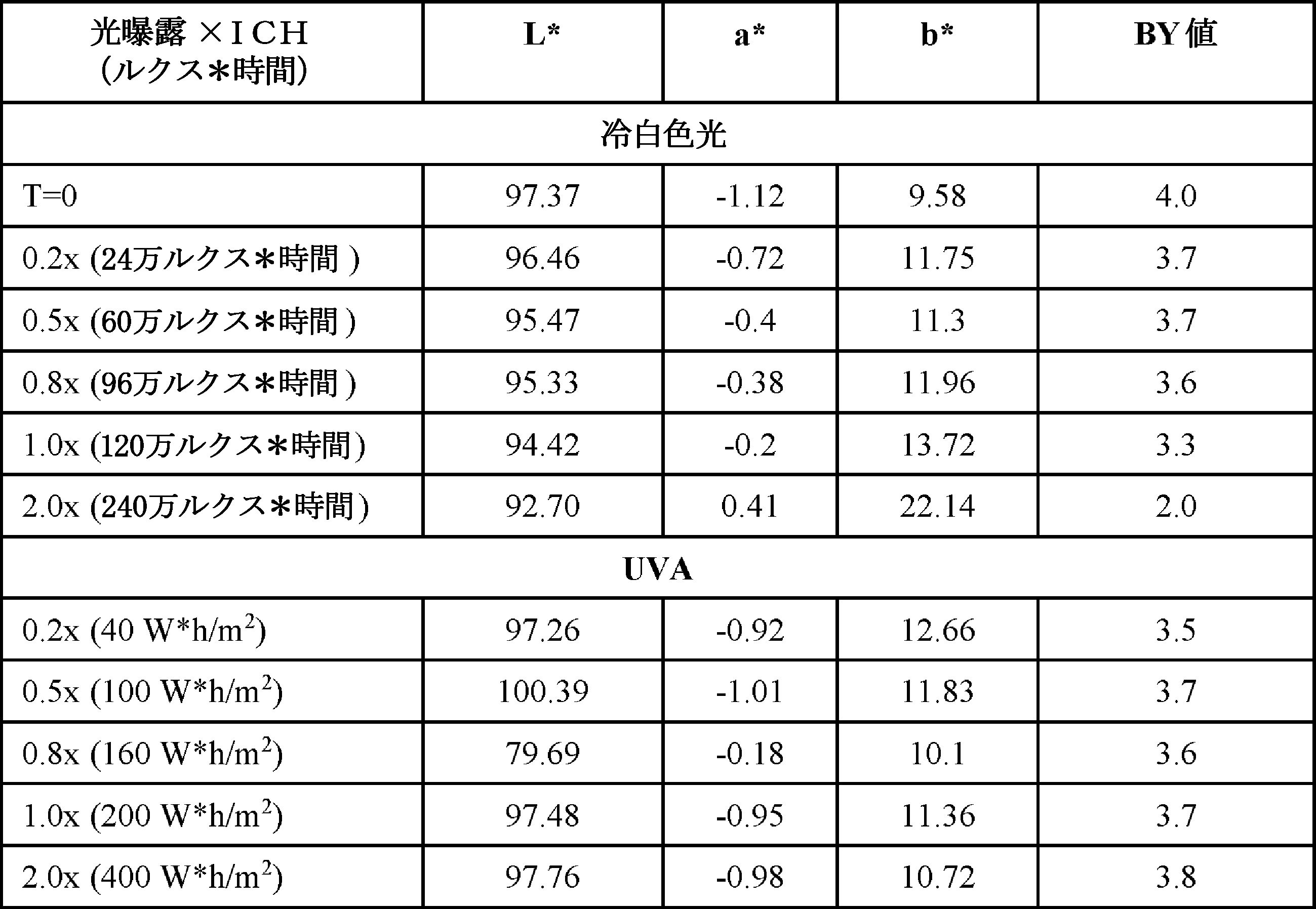
(表4-3(I))紫外線ストレスMiniTrap由来のペプチド中の2-オキソ-ヒスチジンレベル

(表4-3(II))冷白色光ストレスMiniTrap由来のペプチド中の2-オキソ-ヒスチジンレベル
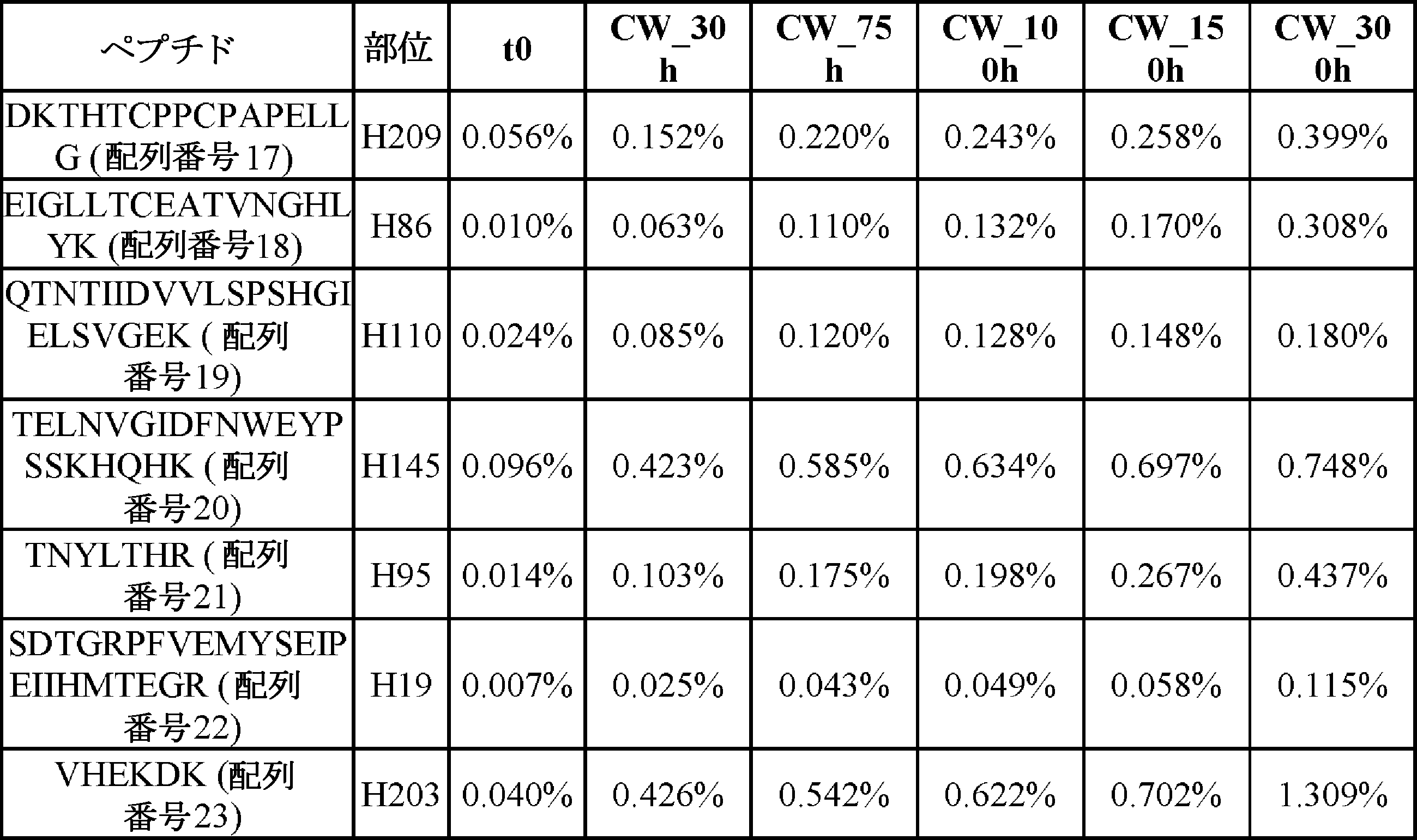
冷白色光又はUVA光へのアフリベルセプトMTの曝露は、酸化ヒスチジン(2-オキソ-ヒスチジン)の出現に符合した(表4-3)。表4-3を参照すると、オキソ-ヒスチジンを有するペプチド「SDTGRPFVEMYSEIPEIIHMTEGR(配列番号22)」は、MT試料(t=0)中に0.007%であり、一方でその存在量は、40時間紫外線に曝露した場合には0.324%に増加し(表4-3(I))、300時間冷白色光に曝露した場合には1.309%に増加した(表4-3(II))。 Exposure of aflibercept MT to cool white light or UVA light was consistent with the appearance of oxidized histidine (2-oxo-histidine) (Table 4-3). Referring to Table 4-3, the peptide "SDTGRPFVEMYSEIPEIIHMTEGR (SEQ ID NO: 22)" containing oxo-histidine was 0.007% in the MT sample (t=0), while its abundance increased to 0.324% when exposed to UV light for 40 hours (Table 4-3(I)) and to 1.309% when exposed to cool white light for 300 hours (Table 4-3(II)).
13.98Da種(図2に示される)及び15.99Da種(図3に示される)といった2-オキソ-ヒスチジンの2つの種を観察した。13.98Da種は光ストレスMiniTrap試料で優勢であった。15.99Da種は、銅金属触媒プロセスの生成物であることが知られている(Schoneich,J.Pharm.Biomed Anal.21:1093-1097(2000))。更には、13.98Da種は光駆動プロセスの生成物である(Liu et al.,Anal.Chem.86(10:4940-4948(2014)))。 Two species of 2-oxo-histidine were observed: a 13.98 Da species (shown in FIG. 2) and a 15.99 Da species (shown in FIG. 3). The 13.98 Da species was predominant in the light-stressed MiniTrap samples. The 15.99 Da species is known to be the product of a copper metal-catalyzed process ( Schoneich, J. Pharm. Biomed Anal. 21:1093-1097 (2000) ). Moreover, the 13.98 Da species is the product of a light-driven process (Liu et al., Anal. Chem. 86(10:4940-4948 (2014)).
冷白色光及びUVA光に曝露される試料中の酸化ヒスチジンの存在量が増加するのと同様に、冷白色光又はUVA光へのMTの曝露もまた、他のPTMの形成を誘導した(表4-4及び表4-5)。 Exposure of MT to cool white light or UVA light also induced the formation of other PTMs, as did the increased abundance of oxidized histidine in samples exposed to cool white light and UVA light (Tables 4-4 and 4-5).
(表4-4(I))紫外線ストレスMiniTrap由来のペプチド中の他のPTM

(表4-4(II))冷白色光ストレスMiniTrap由来のペプチド中の他のPTM
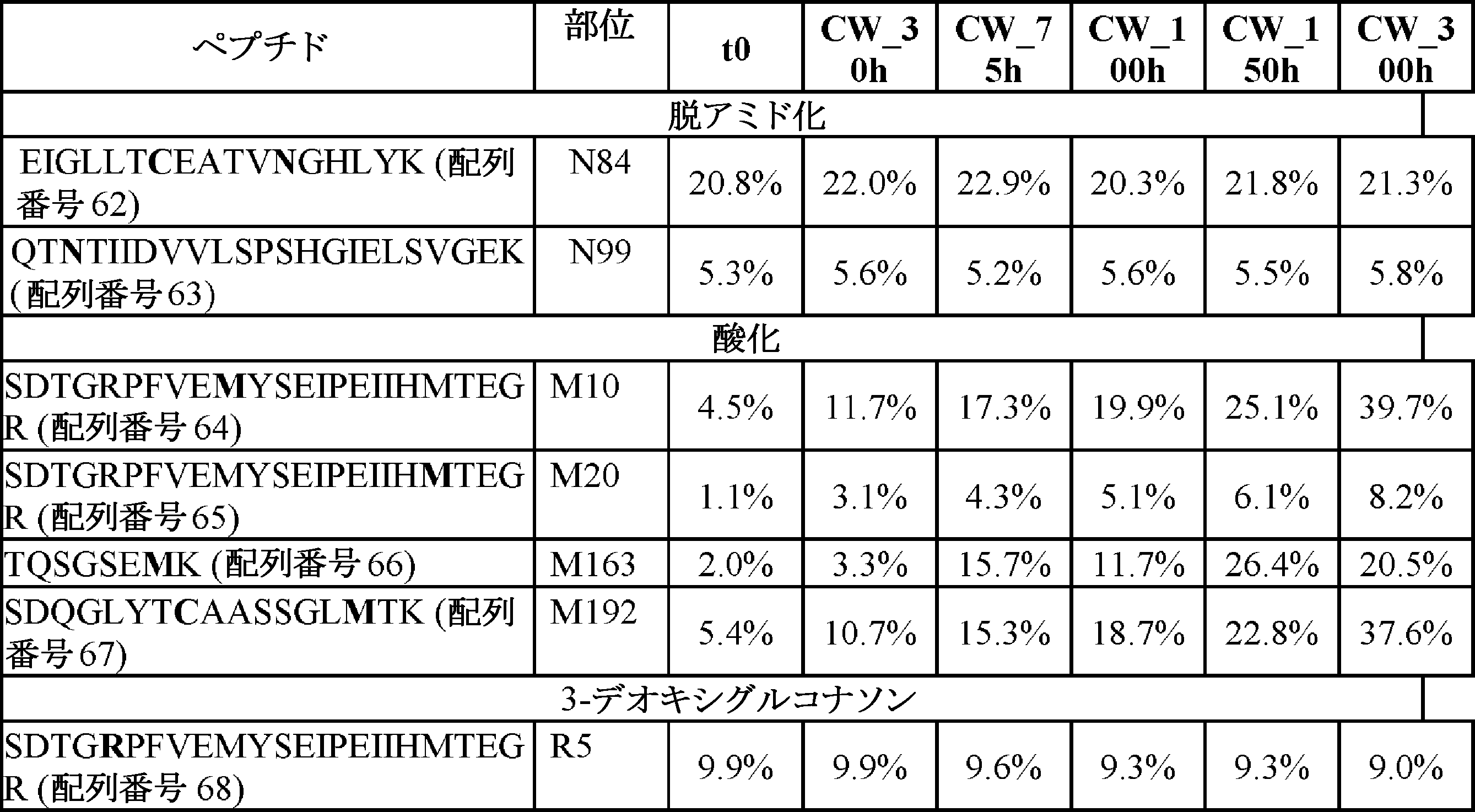
(表4-5(I))紫外線ストレスMiniTrap由来のペプチド中のトリプトファン/チロシン/フェニルアラニンの酸化レベル
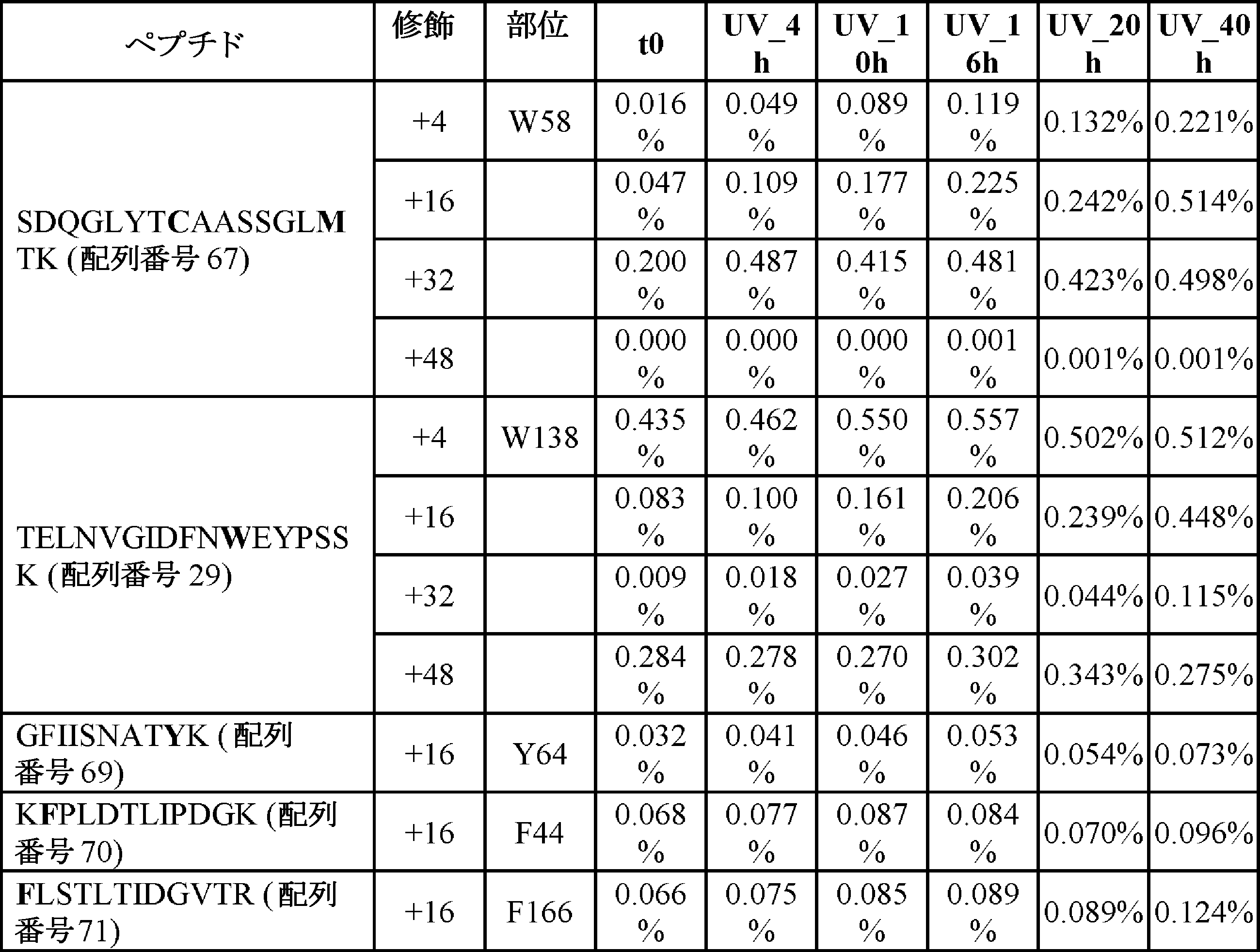
(表4-5(II))冷白色光ストレスMiniTrap由来のペプチド中のトリプトファン/チロシン/フェニルアラニンの酸化レベル
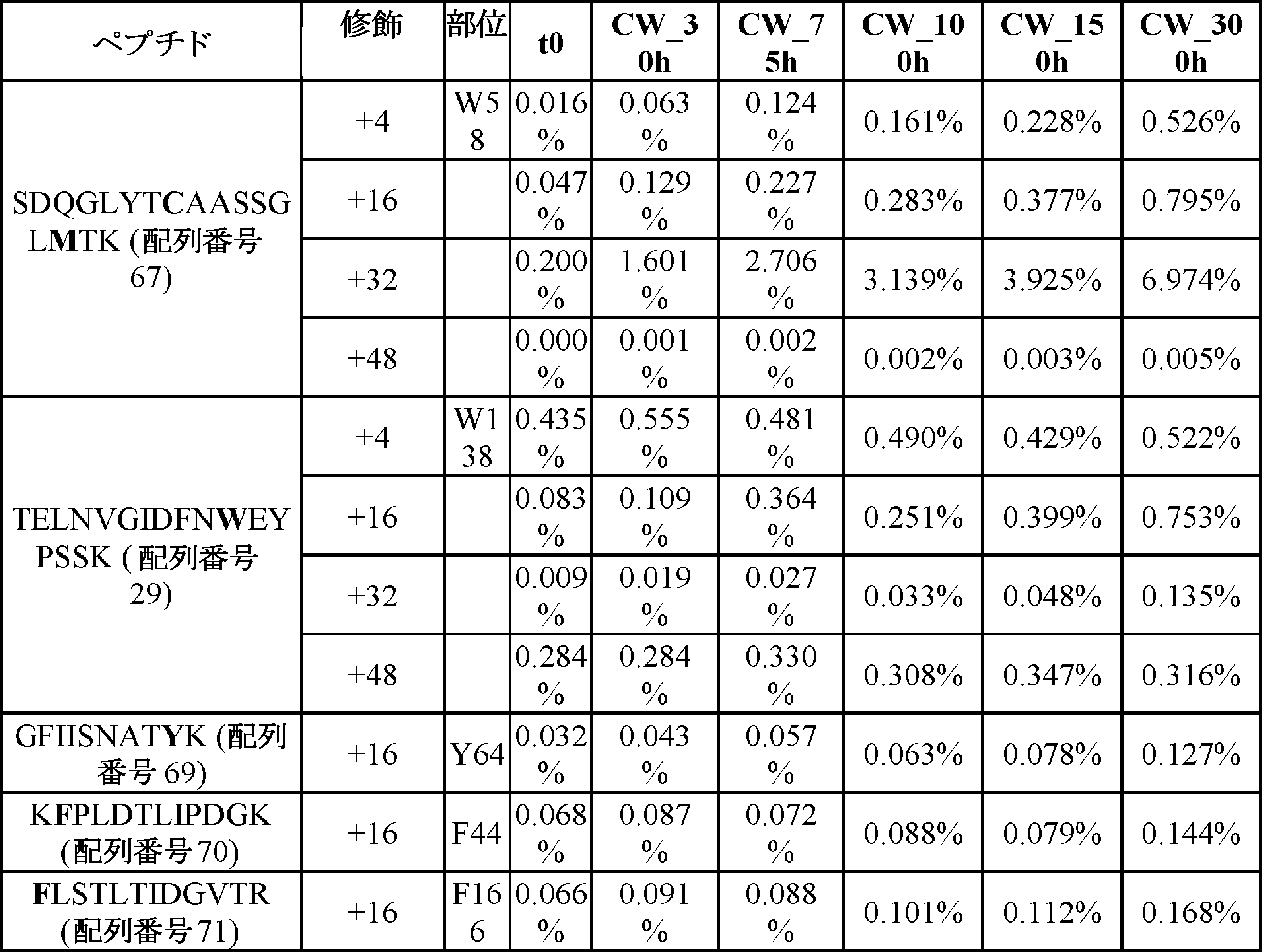
このように、冷白色光又はUVA光へのMTの曝露は、酸化残基(例えばヒスチジン/トリプトファン(オキソ-トリプトファン)など)の出現に符合した。オキソ-トリプトファンの4つの種である、+4Da、+16Da、+32Da及び+48Daを観察した。+4Da種はキヌレニンの形成により説明される(図4)が、一方で16Da、+32Da及び+48Daはトリプトファン残基の一酸化物、二酸化物及び三酸化物である。図20に示すように、MT試料のトリプシン消化物のペプチドマッピングを320nmでモニタリングした。酸化残基を含むペプチドの相対的な存在を、図20にて比較することができる。例えば、ペプチドIIW(+4)DSRK(配列番号114)に関して、t=0でのMT試料、及び40時間UVAに曝露されたMT1試料、及び300時間CWLに曝露されたMT試料について、その存在における有意差を確認することができた。 Thus, exposure of MT to cool white light or UVA light was consistent with the appearance of oxidized residues, such as histidine/tryptophan (oxo-tryptophan). Four species of oxo-tryptophan were observed: +4 Da, +16 Da, +32 Da and +48 Da. The +4 Da species is explained by the formation of kynurenine (Figure 4), while the 16 Da, +32 Da and +48 Da are the monoxide, dioxide and trioxide of the tryptophan residue. Peptide mapping of tryptic digests of MT samples was monitored at 320 nm, as shown in Figure 20. The relative abundance of peptides containing oxidized residues can be compared in Figure 20. For example, for peptide IIW(+4)DSRK (SEQ ID NO: 114), significant differences in its presence could be confirmed for MT samples at t=0, MT1 samples exposed to UVA for 40 hours, and MT samples exposed to CWL for 300 hours.
HMW/低分子量(LMW)種の存在に関して、冷白色光又はUVA光へのMTの曝露もまた評価した(表4-6)。 Exposure of MT to cool white light or UVA light was also evaluated for the presence of HMW/low molecular weight (LMW) species (Tables 4-6).
(表4-6)拡張したUVA及びCWLストレス後にHMW/LMWが生成された

各試料についてHMW/LMW種に関する呈色を追跡調査するため、上で示されるように、すべてのストレス試料(CWL及びUVA)について、フルスペクトルPDA検出(SEC-PDA)を伴う分析用サイズ排除クロマトグラフィーを実施した。CWLストレスMTのSEC-PDA分析は、LMW種を除くすべてのサイズバリアントに関して、約350nmでの吸光度における有意な増加を明らかにする(図21)。一方UVAストレスMTに対するSEC-PDAは、約350nmでの吸光度において増加がないことを明らかにする(図22)。CWL処理ストレス試料とは異なり、UVA処理ストレス試料は、有意に定量化可能な黄褐色を少しも生成しなかった。 To follow up on the color development for HMW/LMW species for each sample, analytical size exclusion chromatography with full spectrum PDA detection (SEC-PDA) was performed for all stressed samples (CWL and UVA) as shown above. SEC-PDA analysis of CWL-stressed MT reveals a significant increase in absorbance at about 350 nm for all size variants except for the LMW species (Figure 21), whereas SEC-PDA for UVA-stressed MT reveals no increase in absorbance at about 350 nm (Figure 22). Unlike the CWL-treated stressed samples, the UVA-treated stressed samples did not produce any significant quantifiable tan color.
UVA及びCWLによりストレスが加えられた試料について320nm及び280nmでの吸光度比を調査したのち、同様の結果を得た。生の強度又は総ピーク領域のいずれかにより分析されるA320/A280比は、CWLストレス試料における黄色強度の増加に符合した(図23)。一方、A320/A280比は、UVA曝露ストレス試料における黄色強度の増加に符合しなかった(図24)。これは、UVAストレスに供されたMT1試料は、CWLストレス後に観察される同様の黄褐色を生じなかったという以前の観察を実証している。 Similar results were obtained after examining the absorbance ratios at 320 nm and 280 nm for UVA and CWL stressed samples. The A320/A280 ratios analyzed by either raw intensity or total peak area were consistent with an increase in yellow intensity in the CWL stressed samples (Figure 23). On the other hand, the A320/A280 ratios did not match the increase in yellow intensity in the UVA exposed stressed samples (Figure 24). This substantiates previous observations that MT1 samples subjected to UVA stress did not develop the same yellow-brown color observed after CWL stress.
[実施例5]呈色を低減する上流の方法
5.1 合成培地のインキュベーション調査
アフリベルセプトを含む新鮮な合成培地(CDM)へと加えられた様々な成分の、呈色に関する効果を調査した。
Example 5 Upstream Methods to Reduce Coloration 5.1 Synthetic Medium Incubation Study The effect on coloration of various components added to fresh synthetic medium (CDM) containing aflibercept was investigated.
1本以上の、10mLのワーキングボリューム(新鮮なCDM1)を有する50mLの空気抜きキャップ付き振盪管を7日間インキュベートし、0日目及び7日目に試料を採取した。アフリベルセプト試料(5mMのリン酸ナトリウム、5mMのクエン酸ナトリウム、及び100mMの塩化ナトリウムを含むpH6.2の緩衝水溶液中の、アフリベルセプト組換えタンパク質)を、6g/Lの濃度で振盪管へと加えた。
One or more 50 mL shake tubes with air vent caps and a working volume of 10 mL (fresh CDM1) were incubated for 7 days and samples were taken on
累積濃度に到達させるために加えた成分:
・システイン:16.6mM
・鉄:0.23mM
・銅:0.0071mM
・亜鉛:0.54mM
Ingredients added to reach cumulative concentrations:
Cysteine: 16.6 mM
Iron: 0.23 mM
・Copper: 0.0071mM
Zinc: 0.54 mM
加えられた各成分の、b*値(CIEのL*、a*、b*色空間)に対する見積もり効果は図25Aに記載されており、予測されたb*値に対する実際のb*値のプロットは図25Bに記載される。システインの添加により、最も大幅な黄褐色の増加を生じた。鉄及び亜鉛もまた色を生成した。葉酸及びBビタミン群(チアミン、ナイアシンアミド、D-パントテン酸、D-ビオチン、及びピリドキシン)は黄褐色を増加させた。リボフラビン及びビタミンB12は統計学的には色に影響しなかった。 The estimated effect of each added ingredient on the b * value (CIE L * , a * , b * color space) is shown in Figure 25A, and a plot of the actual b * values versus the predicted b * values is shown in Figure 25B. The addition of cysteine produced the greatest increase in tan color. Iron and zinc also produced color. Folic acid and the B vitamins (thiamine, niacinamide, D-pantothenic acid, D-biotin, and pyridoxine) increased the tan color. Riboflavin and vitamin B12 did not statistically affect color.
5.2 システイン及び金属の減少による、b*値に対する効果
アフリベルセプト産生細胞株の種培養から、バイオリアクタ(例えば、2L)に播種した。35.5℃の温度、7.1±0.25のpH、22ccmのエアスパージ設定点で、播種した培養物を増殖させた。必要に応じて、グルコース、消泡剤及び基礎培地をバイオリアクタに補充した。アフリベルセプトが発現される時の、システイン濃度及び金属濃度の低下による、色に対する効果をCDM1で評価した。
0日目の培地=CDM1、1.48mMのシステインを含む
・栄養フィード:
-2日目=合成フィード(CDF)+1.3~2.1mMのシステイン
-4日目=CDF+1.6~1.7mMのシステイン
-6日目=CDF+1.6~1.7mMのシステイン
-8日目=CDF+1.6~1.7mMのシステイン
5.2 Effect of Cysteine and Metal Reduction on b * Value Bioreactors (e.g., 2 L) were inoculated from a seed culture of the aflibercept producing cell line. The inoculated culture was grown at a temperature of 35.5° C., a pH of 7.1±0.25, and an air sparge set point of 22 ccm. Glucose, antifoam, and basal medium were supplemented to the bioreactor as required. The effect of reducing cysteine and metal concentrations on color as aflibercept was expressed was evaluated in CDM1.
Day -8 = CDF + 1.6-1.7 mM cysteine
バイオリアクタの条件は以下の通りであった:
・システインを、培養物1Lあたり約6~7ミリモルの累積濃度、培養物1Lあたり8~9ミリモルの累積濃度、又は培養物1Lあたり10~11ミリモルの累積濃度で加えた。
・1倍レベルでのCDM1中の金属(CDM1レベルの0.5倍、1倍、又は1.5倍)は以下に列挙する(濃度は種菌追加前のものである):
- Fe=培養物1リットルあたり68~83マイクロモル
- Zn=培養物1リットルあたり6~7マイクロモル
- Cu=培養物1リットルあたり0.1~0.2マイクロモル
- Ni=培養物1リットルあたり0.5~1マイクロモル
The bioreactor conditions were as follows:
Cysteine was added to a cumulative concentration of about 6-7 mMoles per L of culture, a cumulative concentration of 8-9 mMoles per L of culture, or a cumulative concentration of 10-11 mMoles per L of culture.
Metals in CDM1 at 1x level (0.5x, 1x, or 1.5x CDM1 levels) are listed below (concentrations are prior to inoculum addition):
- Fe = 68-83 micromoles per liter of culture
- Zn = 6-7 micromoles per liter of culture
Cu = 0.1-0.2 micromoles per liter of culture
- Ni = 0.5-1 micromoles per liter of culture
6~7ミリモル/Lまで累積システインレベルを減少させると、力価には有意な影響はないが黄褐色は低減した。培地中の金属濃度を0.5倍に減少させると、力価の有意な上昇を伴って色が低減した。力価、VCC(生存細胞濃度)、生存率、アンモニア又は浸透圧に対しては最小限の影響であった(図26A~Eを参照されたい)。b*値及び力価に対する、金属含有量及びシステインの予測見積もり効果を図27に記載する。 Reducing cumulative cysteine levels to 6-7 mmol/L reduced the tan color without a significant effect on titer. Reducing metal concentration in the medium 0.5-fold reduced the color with a significant increase in titer. There was minimal effect on titer, VCC (viable cell concentration), viability, ammonia or osmolality (see Figures 26A-E). The predicted estimated effect of metal content and cysteine on b* values and titer is set forth in Figure 27.
5.3 b*値に対する抗酸化剤の影響の評価
アフリベルセプトを含む使用済みCDMへと加えられる抗酸化剤であるタウリン、ヒポタウリン、チオクト酸、グルタチオン、グリシン及びビタミンCの、色に対する効果を評価した。1本以上の、10mLのワーキングボリューム(CDM1)を有する50mLの空気抜きキャップ付き振盪管を7日間インキュベートし、0日目及び7日目に試料を採取した。
5.3 Evaluation of the Impact of Antioxidants on b * Values The effect on color of the antioxidants taurine, hypotaurine, thioctic acid, glutathione, glycine and vitamin C added to spent CDM containing aflibercept was evaluated. One or more 50 mL shake tubes with air vent caps and a 10 mL working volume (CDM1) were incubated for 7 days and samples were taken at
使用済みCDM1への成分添加のための条件は以下の通りである:
・アフリベルセプト試料(5mMのリン酸ナトリウム、5mMのクエン酸ナトリウム、及び100mMの塩化ナトリウムを含むpH6.2の緩衝水溶液中の、アフリベルセプト組換えタンパク質)は、6g/Lの濃度で振盪管へと加えた。
・抗酸化剤は以下の濃度にて使用済みCDM1に加えた:
- タウリン=培養物中10mM
- ヒポタウリン=培養物中10mM
- グリシン=培養物中10mM
- チオクト酸=培養物中0.0024mM
- 還元型グルタチオン=培養物中2mM
- ヒドロコルチゾン=培養物中0.0014mM
- ビタミンC(アスコルビン酸)=培養物中0.028mM
The conditions for adding components to the spent CDM1 are as follows:
Aflibercept samples (aflibercept recombinant protein in an aqueous buffer solution containing 5 mM sodium phosphate, 5 mM sodium citrate, and 100 mM sodium chloride at pH 6.2) were added to the shaker tube at a concentration of 6 g/L.
Antioxidants were added to the spent CDM1 at the following concentrations:
- Taurine = 10 mM in culture
- Hypotaurine = 10 mM in culture
- Glycine = 10 mM in culture
Thioctic acid = 0.0024 mM in culture
- Reduced glutathione = 2 mM in culture
- Hydrocortisone = 0.0014 mM in culture
- Vitamin C (ascorbic acid) = 0.028 mM in culture
複数の抗酸化剤は、使用済み培地における色形成を減少させた(ヒポタウリン、タウリン及びグリシンの組み合わせ;チオクト酸;並びにビタミンC)。グルタチオンはb*値を増加させた。 Several antioxidants reduced color formation in the spent medium (hypotaurine, a combination of taurine and glycine; thioctic acid; and vitamin C). Glutathione increased the b * value.
(表5-1)MiniTrapの色形成に対する、抗酸化剤の効果の概要

b*値(CIEのL*、a*、b*色空間)に対する、様々な抗酸化剤の予測効果の概要は、図28(A~C)に記載されている。 A summary of the predicted effect of various antioxidants on b * values (CIE L * , a * , b * color space) is provided in Figure 28 (A-C).
アフリベルセプトを含む使用済みCDMへと加えた抗酸化剤の更なる追加の、色に対する効果を評価した。1本以上の、10mLのワーキングボリューム(CDM1)を有する50mLの空気抜きキャップ付き振盪管を7日間インキュベートし、0日目及び7日目に試料を採取した。
The effect on color of additional antioxidants added to spent CDM containing aflibercept was evaluated. One or more 50 mL shake tubes with vented caps and a 10 mL working volume (CDM1) were incubated for 7 days and samples were taken on
使用済みCDM1への成分添加のための条件は以下の通りである:
・アフリベルセプト試料(5mMのリン酸ナトリウム、5mMのクエン酸ナトリウム、及び100mMの塩化ナトリウムを含むpH6.2の緩衝水溶液中の、アフリベルセプト組換えタンパク質)は、6g/Lの濃度で振盪管へと加えた。
・2つのDOE実験を実施した:
・(i)抗酸化剤は以下の濃度にて使用済みCDM1に加えた:
- タウリン=培養物中10mM
- ヒポタウリン=培養物中10mM
- グリシン=培養物中10mM
- チオクト酸=培養物中0.0024mM
- ビタミンC(アスコルビン酸)=培養物中0.028mM
・(ii)抗酸化剤は以下の累積濃度に達成するように加えた:
- ATA=2.5μM~5μM
- デフェロキサミンメシル酸塩(DFO)=5μM~10μM
- カタラーゼ=101.5mg/L
- S-カルボキシメチル-L-システイン=10mM
The conditions for adding components to the spent CDM1 are as follows:
Aflibercept samples (aflibercept recombinant protein in an aqueous buffer solution containing 5 mM sodium phosphate, 5 mM sodium citrate, and 100 mM sodium chloride at pH 6.2) were added to the shaker tube at a concentration of 6 g/L.
Two DOE experiments were carried out:
(i) Antioxidants were added to the spent CDM1 at the following concentrations:
- Taurine = 10 mM in culture
- Hypotaurine = 10 mM in culture
- Glycine = 10 mM in culture
Thioctic acid = 0.0024 mM in culture
- Vitamin C (ascorbic acid) = 0.028 mM in culture
(ii) Antioxidants were added to achieve the following cumulative concentrations:
- ATA=2.5μM~5μM
- Deferoxamine mesylate (DFO) = 5 μM to 10 μM
- Catalase = 101.5 mg/L
- S-carboxymethyl-L-cysteine = 10 mM
ヒポタウリンは使用済み培地における色形成を減少させることが分かった(図28D)。DFOもまた、使用済み培地における色形成を有意に減少させた(図28D)。他の抗酸化剤は色形成に統計学的な影響を有さなかった。 Hypotaurine was found to reduce color formation in the spent medium (Figure 28D). DFO also significantly reduced color formation in the spent medium (Figure 28D). Other antioxidants had no statistically significant effect on color formation.
(表5-2)MiniTrapの色形成に対する、抗酸化剤の効果の概要
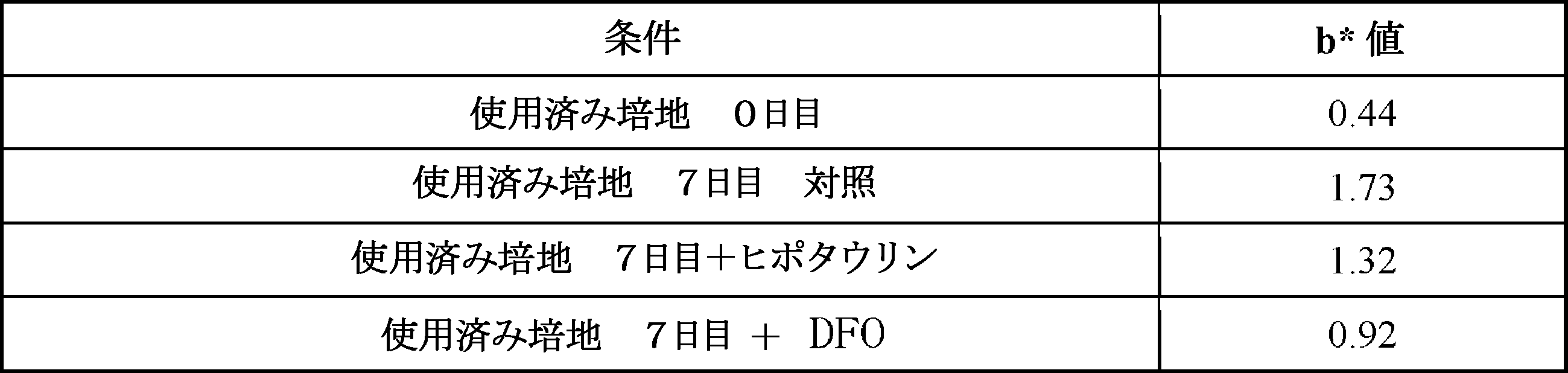
振盪フラスコ抗酸化剤調査
細胞培養物における色形成を減少させるそれらの能力に関して、タウリン、ヒポタウリン、グリシン、チオクト酸及びビタミンCを個別及び組合せで評価した(表5-3)。
Shake Flask Antioxidant Study Taurine, hypotaurine, glycine, thioctic acid and vitamin C were evaluated individually and in combination for their ability to reduce color formation in cell cultures (Table 5-3).
アフリベルセプト産生細胞株の種培養から、250mLの振盪フラスコに播種した。5%のCO2で制御されたインキュベータで35.5℃にて、播種した細胞を増殖させた。必要に応じて、グルコース及び基礎培地を振盪フラスコに補充した。上に説明されるプロセスを使用した。この場合、金属はCDM1中で0.5倍の濃度で存在し、システインを6~7mMの累積濃度で加えた。 250 mL shake flasks were inoculated from a seed culture of the aflibercept producing cell line. The inoculated cells were grown at 35.5°C in a 5% CO2 controlled incubator. Glucose and basal medium were supplemented to the shake flasks as needed. The process described above was used. In this case, metals were present at 0.5x concentration in CDM1 and cysteine was added at a cumulative concentration of 6-7 mM.
(表5-3)
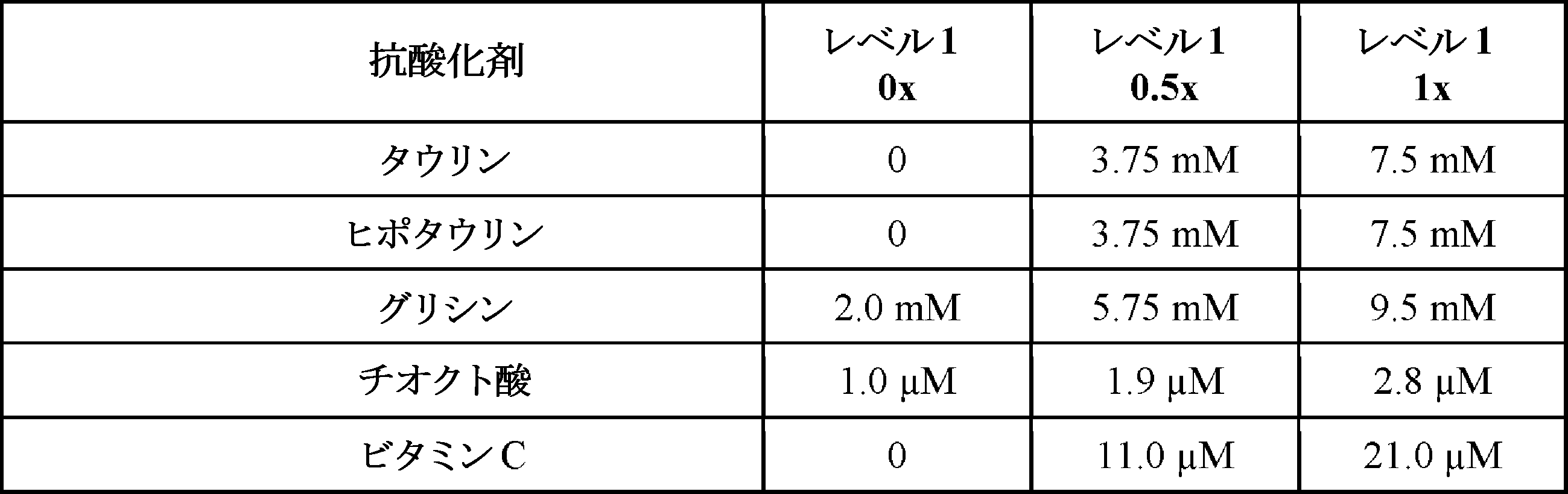
図28Eは、b*値(CIEのL*、a*、b*色空間)及び最終力価に対する、表5-3の抗酸化剤の予測効果を示す。タウリン、ヒポタウリン、グリシンは、力価に負の影響を与えることなくb*値を減少させた。 Figure 28E shows the predicted effect of the antioxidants in Table 5-3 on b * values (CIE L * , a * , b * color space) and final potency. Taurine, hypotaurine, and glycine reduced the b * value without negatively affecting potency.
[実施例6]CDMを使用するアフリベルセプト産生のためのグリコシル化及び生存率研究
アフリベルセプト産生細胞株の種培養から、バイオリアクタ(例えば、2L)に播種した。35.5℃の温度、7.1±0.25のpH、22ccmのエアスパージ設定点で、播種した培養物を増殖させた。必要に応じて、グルコース、消泡剤及び基礎培地をバイオリアクタに補充した。CDM1を使用してアフリベルセプトタンパク質の産生を実施した(独自仕様)。CDM1(独自仕様)、CDM2(商業的に入手)、及びCDM3(商業的に入手)を使用して、アフリベルセプト融合タンパク質を発現する宿主細胞株の産生を実施した。追加の培地成分を含まないCDM1、CDM2及びCDM3を使用し、一連の実験を実施した。ガラクトシル化プロファイルを変更するため、マンガン(塩化マンガン四水和物、Sigma、3.2mg/L)、ガラクトース(Sigma、8g/L)、及びウリジン(Sigma、6g/L)をフィードに加えたCDM1~3を使用し、もう一つの一連の実験を実施した。最後に、ガラクトシル化プロファイルを変更するためにマンガン(塩化マンガン四水和物、Sigma、3.2mg/L)、ガラクトース(Sigma、8g/L)、及びウリジン(Sigma、6g/L)をフィードに加え、組成物のシアリル化プロファイルを変更するためにデキサメタゾン(Sigma、12mg/L)をフィードに加えたCDM1~3を使用し、一連の実験を実施した。遠心分離、次いで0.45μmのろ過により、それぞれのCDMを使用した清澄化された回収物を調製した。
Example 6 Glycosylation and viability studies for aflibercept production using CDM A bioreactor (e.g., 2L) was inoculated from a seed culture of an aflibercept producing cell line. The inoculated culture was grown at a temperature of 35.5°C, a pH of 7.1±0.25, and an air sparge set point of 22 ccm. Glucose, antifoam, and basal medium were supplemented to the bioreactor as required. Aflibercept protein production was performed using CDM1 (proprietary). Production of host cell lines expressing aflibercept fusion proteins was performed using CDM1 (proprietary), CDM2 (commercially obtained), and CDM3 (commercially obtained). A series of experiments was performed using CDM1, CDM2, and CDM3 without additional medium components. Another series of experiments was performed using CDMs 1-3 in which manganese (manganese chloride tetrahydrate, Sigma, 3.2 mg/L), galactose (Sigma, 8 g/L), and uridine (Sigma, 6 g/L) were added to the feed to alter the galactosylation profile. Finally, a series of experiments was performed using CDMs 1-3 in which manganese (manganese chloride tetrahydrate, Sigma, 3.2 mg/L), galactose (Sigma, 8 g/L), and uridine (Sigma, 6 g/L) were added to the feed to alter the galactosylation profile, and dexamethasone (Sigma, 12 mg/L) was added to the feed to alter the sialylation profile of the composition. Clarified harvests using each CDM were prepared by centrifugation followed by 0.45 μm filtration.
N-グリカン分析の前に、プロテインAにより試料を処理した。 Samples were treated with protein A prior to N-glycan analysis.
力価測定
これらの実施例を通して、特段明記しない限り、低pH及び段階溶出グラジエントで作動し280nmで検出するAgilent(Santa Clara,CA)1200シリーズ HPLC又はその同等物を用いて、アフリベルセプト力価を毎日測定した。参照標準の検量線に対し、濃度を割り当てた。
Throughout these examples, aflibercept potency was measured daily using an Agilent (Santa Clara, Calif.) 1200 series HPLC or equivalent operated at low pH and a step elution gradient with detection at 280 nm unless otherwise stated. Concentrations were assigned against a calibration curve of reference standards.
生存細胞密度(VCD)及び細胞生存率値
これらの実施例を通して、特段明記しない限り、Nova BioProfile Flex自動細胞計測器(Nova Biomedical,Waltham,MA)によるトリパンブルー排除法により、生存細胞密度(VCD)及び細胞生存率値を測定した。Nova BioProfile Flex(Nova Biomedical,Waltham,MA)を用いて、グルコース、乳酸塩、オフラインpH、溶存酸素(DO)、pCO2測定、及び浸透圧を測定した。
Viable Cell Density (VCD) and Cell Viability Values Throughout these examples, unless otherwise stated, viable cell density (VCD) and cell viability values were measured by trypan blue exclusion on a Nova BioProfile Flex automated cell counter (Nova Biomedical, Waltham, MA). Glucose, lactate, offline pH, dissolved oxygen (DO), pCO2 measurements, and osmolality were measured using the Nova BioProfile Flex (Nova Biomedical, Waltham, MA).
N-グリカンオリゴ糖プロファイリング
GlycoWorks Rapid Deglycosylation及びGlycoWorks RapiFluor-MSラベルキット(Waters部品番号186008939及び186008091のそれぞれ)を使用し、Waters GlycoWorksプロトコルに従い、N-グリカン分析のために、CDM1~3回収物からのおよそ15μgのプロテインA処理試料を調製した。50.5℃で5分間、PNGase-Fで試料を処理し、続いて25℃で5分間冷却することでアフリベルセプトタンパク質からN-グリカンを取り除いた。室温で5分間反応させることで、RapiFluor-MS蛍光色素により、放出されたグリカンを標識した。アセトニトリルを反応混合物に加えることでタンパク質を沈殿させ、2,204×gで10分間の遠心分離によりウェルの底にペレット化した。標識グリカンを含む上清を収集し、ポストカラム蛍光検出を伴う親水性相互作用液体クロマトグラフィー(Waters BEHアミドカラム)を使用してUPLCで分析した。カラムに結合させた後、標識グリカンを分離し、アセトニトリル及び50mMの水性ギ酸アンモニウム(pH4.4)から構成される二成分移動相グラジエントを使用して溶出させた。265nmの励起波長及び425nmの発光波長を用い、蛍光検出器を使用して標識グリカンを検出した。得られたクロマトグラムにおけるN-グリカンピークの相対的領域割合を使用し、(1)コアフコース残基を含有するN-グリカン(総フコシル化、表6-1)、(2)少なくとも1つのシアル酸残基を含有するN-グリカン(総シアリル化、表6-2)、(3)マンノース-5として同定されるN-グリカン(マンノース-5、表6-3)、(4)少なくとも1つのガラクトース残基を含有するN-グリカン(総ガラクトシル化、表6-4)、及び(5)公知の同一性のN-グリカン(同定された全ピーク、表6-5)の合計割合として、N-グリカン分布を報告した。
N-Glycan Oligosaccharide Profiling Approximately 15 μg of Protein A treated samples from CDM1-3 harvests were prepared for N-glycan analysis using GlycoWorks Rapid Deglycosylation and GlycoWorks RapiFluor-MS labeling kits (Waters part numbers 186008939 and 186008091, respectively) following the Waters GlycoWorks protocol. N-glycans were removed from the aflibercept protein by treating the samples with PNGase-F at 50.5° C. for 5 min, followed by cooling at 25° C. for 5 min. Released glycans were labeled with RapiFluor-MS fluorescent dye by reaction at room temperature for 5 min. Proteins were precipitated by adding acetonitrile to the reaction mixture and pelleted to the bottom of the well by centrifugation at 2,204×g for 10 min. The supernatant containing the labeled glycans was collected and analyzed by UPLC using hydrophilic interaction liquid chromatography (Waters BEH amide column) with post-column fluorescence detection. After binding to the column, the labeled glycans were separated and eluted using a binary mobile phase gradient consisting of acetonitrile and 50 mM aqueous ammonium formate (pH 4.4). The labeled glycans were detected using a fluorescence detector with an excitation wavelength of 265 nm and an emission wavelength of 425 nm. The relative area percentages of N-glycan peaks in the resulting chromatograms were used to report the N-glycan distribution as the combined percentage of: (1) N-glycans containing a core fucose residue (total fucosylation, Table 6-1); (2) N-glycans containing at least one sialic acid residue (total sialylation, Table 6-2); (3) N-glycans identified as mannose-5 (mannose-5, Table 6-3); (4) N-glycans containing at least one galactose residue (total galactosylation, Table 6-4); and (5) N-glycans of known identity (total peaks identified, Table 6-5).
結果
追加成分有り又は無しでのCDM1~3に関しての、生存細胞数(VCC)、生存率、及び回収物力価の結果を図29~31に示す。
Results Viable cell count (VCC), viability, and harvest titer results for CDM1-3 with and without additional components are shown in Figures 29-31.
9個の培養物中、ウリジン、マンガン、及びガラクトースを含むCDM1培養物は、12日目に最も高い力価を示した(5.5g/L)。追加成分を含まないCDM1もまた、他の7つの培養物と比較すると、12日目に高い力価を示した(約4.25g/L)(図29)。
Among the nine cultures, the CDM1 culture containing uridine, manganese, and galactose showed the highest titer (5.5 g/L) on
細胞生存率結果は、過程6日目まで様々な条件にわたり類似していた。過程7日目の後、追加の培地成分有り又は無しでのCDM2及びCDM3培養物は、約90%超の生存率を示した(図30)。
Cell viability results were similar across the various conditions until
ウリジン、マンガン及びガラクトースを有するCDM1培養物は、6日目頃に最大のVCCを示した(図31)。 CDM1 cultures with uridine, manganese and galactose showed maximum VCC around day 6 (Figure 31).
培養物及び栄養補助剤の影響は、N-グリカンの全体分布において有意な影響を有した(表6-1~6-5)。ダイズ加水分解物を使用して作製されたプロテインA処理したアフリベルセプト(2つの試料を評価した)を使用し、グリカンレベルを比較した。同定された総ピークを表6-5に列挙する。 The influence of culture and nutritional supplements had a significant effect on the overall distribution of N-glycans (Tables 6-1 to 6-5). Glycan levels were compared using Protein A-treated aflibercept made with soy hydrolysate (two samples were evaluated). Total peaks identified are listed in Table 6-5.
(表6-1)総フコシル化(%)

(表6-2)総シアリル化(%)

(表6-3)マンノース-5(%)
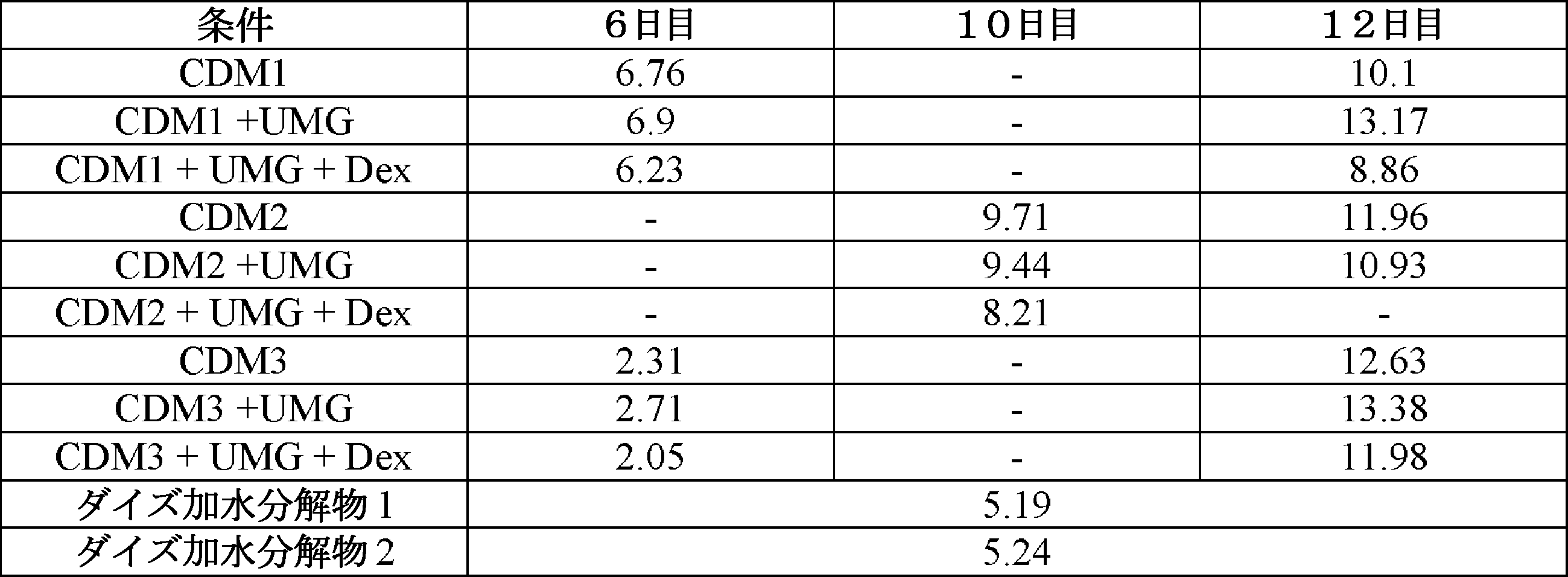
(表6-4)総ガラクトシル化(%)
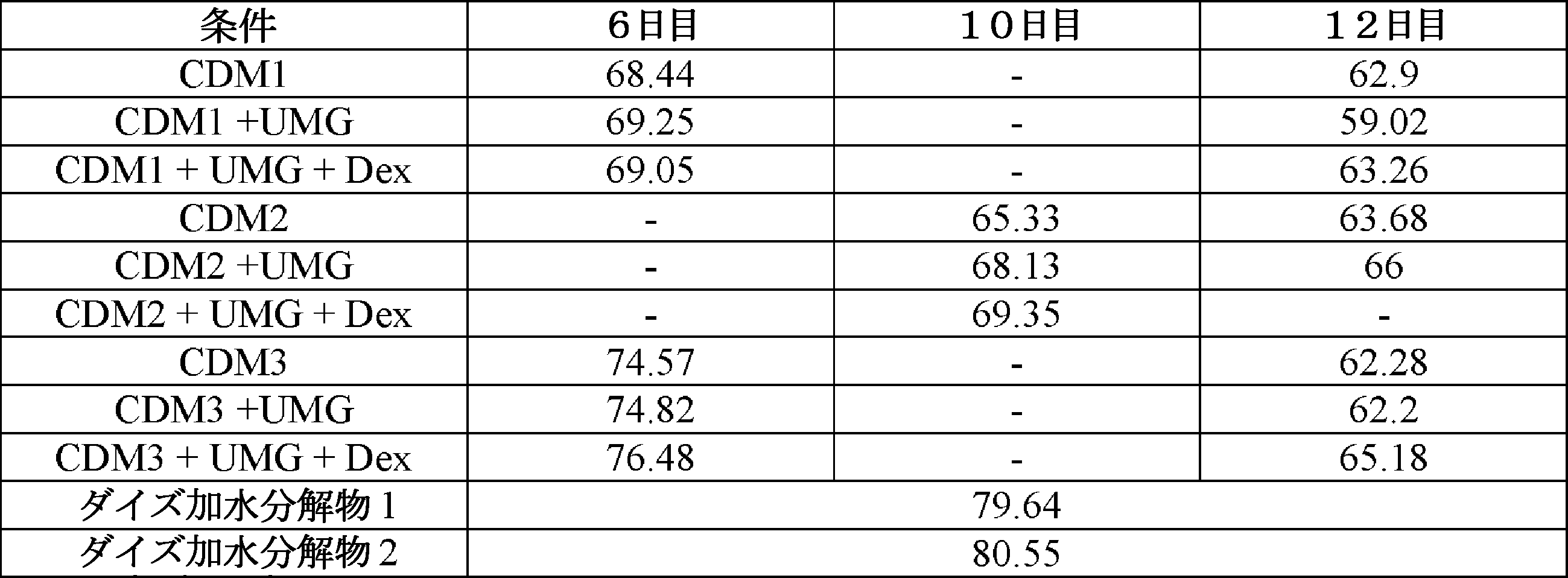
(表6-5)同定された総ピーク(%)
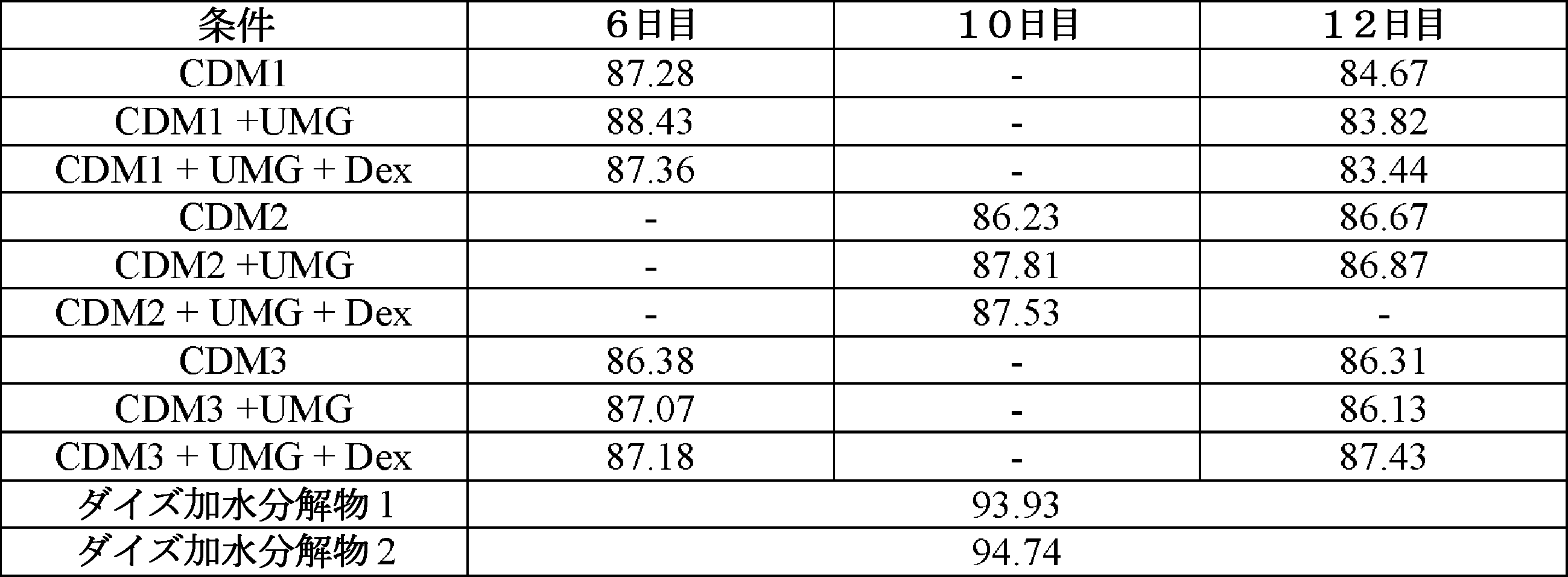
様々なCDMの培養物のうち、12日目に観察された総フコシル化、総シアリル化、総ガラクトシル化及びマンノース-5は、それぞれ、42.61%~46.26%、30.84%~39.14%、59.02~66%及び8.86%~13.38%であった。グリコシル化のこれらの値は、ダイズ加水分解物を使用して観察されたグリコシル化値と異なる。
Among the various CDM cultures, the total fucosylation, total sialylation, total galactosylation and mannose-5 observed on
最後に、ウリジン、マンガン、及びガラクトースを添加したCDM1、CDM2、及びCDM3中のアフリベルセプトを発現する細胞から得られた清澄化された回収物について、色測定を実施した。バイオリアクタ調査工程に関する操作パラメータは、当業者に公知であるだろう。 Finally, color measurements were performed on clarified harvests obtained from cells expressing aflibercept in CDM1, CDM2, and CDM3 supplemented with uridine, manganese, and galactose. The operating parameters for the bioreactor investigation process will be known to those skilled in the art.
[実施例7]抗VEGFタンパク質のアフィニティー生成
7.1 VEGF MiniTrapの発現
組換えVEGF MiniTrapのコーディング領域(例えば、MT5、配列番号46)をシグナル配列に機能的に結合し、哺乳動物発現ベクターにクローニングして、チャイニーズハムスター卵巣(CHO-K1)細胞へと形質移入し、12日間にわたり400μg/mLのハイグロマイシンを用いて選択した後、安定的に形質移入されたプールを単離した。タンパク質不含合成培地にて増殖した、安定したCHO細胞プールを使用し、調査のためにタンパク質を産生した。組換えポリペプチドを細胞から増殖培地へと分泌させた。
Example 7: Affinity generation of anti-VEGF proteins 7.1 Expression of VEGF MiniTrap The coding region of recombinant VEGF MiniTrap (e.g., MT5, SEQ ID NO: 46) was operably linked to a signal sequence, cloned into a mammalian expression vector, transfected into Chinese Hamster Ovary (CHO-K1) cells, and stably transfected pools were isolated after selection with 400 μg/mL hygromycin for 12 days. Stable CHO cell pools grown in protein-free synthetic medium were used to produce protein for investigation. The recombinant polypeptide was secreted from the cells into the growth medium.
VEGF MiniTrapの構成ドメインの配列
・ヒト Flt1(アクセッション番号 NP_001153392.1)
・ヒト Flk1(アクセッション番号 NP_002244.1)
・ヒト Fc(IGHG1、アクセッション番号 P01857-1)
Sequence of the constituent domain of VEGF MiniTrap Human Flt1 (Accession number NP_001153392.1)
- Human Flk1 (Accession number NP_002244.1)
Human Fc (IGHG1, Accession No. P01857-1)
このプロセスから(MT5)を有する組換えVEGF MiniTrapを得て、更にこれを処理した。 From this process, recombinant VEGF MiniTrap with (MT5) was obtained, which was further processed.
7.2 アフィニティークロマトグラフィーカラムの調製
VEGF MiniTrap(MT5)に結合可能である5つの異なるタンパク質を評価した。使用されるタンパク質は、VEGF165(配列番号72)、mAb1(配列番号73が重鎖であり、配列番号74が軽鎖である、マウス抗VEGFR1 mAb ヒトIgG1)、mAb2(配列番号75が重鎖であり、配列番号76が軽鎖である、マウス抗VEGFR1 mAb ヒトIgG1)、mAb3(配列番号77が重鎖であり、配列番号78が軽鎖である、マウス抗VEGFR1 mAbマウス IgG1)、及びmAb4(配列番号79が重鎖であり、配列番号80が軽鎖である、マウス抗VEGFR1 mAb マウスIgG1)、を含む。
7.2 Preparation of Affinity Chromatography Column Five different proteins capable of binding to VEGF MiniTrap (MT5) were evaluated. The proteins used included VEGF 165 (SEQ ID NO:72), mAb1 (mouse anti-VEGFR1 mAb human IgG1, with SEQ ID NO:73 as the heavy chain and SEQ ID NO:74 as the light chain), mAb2 (mouse anti-VEGFR1 mAb human IgG1, with SEQ ID NO:75 as the heavy chain and SEQ ID NO:76 as the light chain), mAb3 (mouse anti-VEGFR1 mAb mouse IgG1, with SEQ ID NO:77 as the heavy chain and SEQ ID NO:78 as the light chain), and mAb4 (mouse anti-VEGFR1 mAb mouse IgG1, with SEQ ID NO:79 as the heavy chain and SEQ ID NO:80 as the light chain).
1mL/分を超えない流速にて、6カラム体積(CV)の1mM氷冷塩酸でカラムを洗浄することにより、カラムを活性化した。各タンパク質10mgを3つのHiTrap NHS-活性化 HPアフィニティーカラム(1mL、GE Healthcare、カタログ番号17-0716-01)に負荷した。カップリングが起こることができるよう、室温で30分間このカラムを閉鎖した。18カラム体積の0.5M酢酸ナトリウム、0.5M NaCl(pH4.0)でカラムを洗浄し、18カラム体積の0.5Mトリス-HCl、0.5M NaCl(pH8.3)でオープンサイトをブロックした(洗浄を以下の順で実施した:6カラム体積の0.5Mトリス-HCl、0.5M NaCl(pH8.3);6カラム体積の0.5M酢酸ナトリウム(酢酸ナトリウム:JT Baker、カタログ番号3470-01)、0.5M NaCl(pH4.0);6カラム体積の0.5Mトリス(pH8.3);室温で30分間カラムをインキュベート;6カラム体積の0.5M酢酸ナトリウムバッファ、0.5MのNaCl(pH4.0);6カラム体積の0.5Mトリス-HCl、0.5 NaCl(pH8.3);及び6カラム体積の0.5M酢酸ナトリウムバッファ、0.5M NaCl(pH4.0))。カラムをpH7.5のDPBS中に保管した。評価した5つのカラムは、カラム1(VEGF165を含む)、カラム2(mAb1を含む)、カラム3(mAb2を含む)、カラム4(mAb3を含む)及びカラム5(mAb4を含む)と称される。 The columns were activated by washing them with 6 column volumes (CV) of 1 mM ice-cold hydrochloric acid at a flow rate not exceeding 1 mL/min. 10 mg of each protein was loaded onto three HiTrap NHS-activated HP affinity columns (1 mL, GE Healthcare, Cat. No. 17-0716-01). The columns were closed at room temperature for 30 min to allow coupling to occur. The column was washed with 18 column volumes of 0.5 M sodium acetate, 0.5 M NaCl, pH 4.0, and the open sites were blocked with 18 column volumes of 0.5 M Tris-HCl, 0.5 M NaCl, pH 8.3 (washing was performed in the following order: 6 column volumes of 0.5 M Tris-HCl, 0.5 M NaCl, pH 8.3; 6 column volumes of 0.5 M sodium acetate (Sodium acetate: JT Baker, Cat. No. 3470-01), 0.5 M NaCl, pH 4.0; 6 column volumes of 0.5 M Tris, pH 8.3; incubate the column for 30 minutes at room temperature; 6 column volumes of 0.5 M sodium acetate buffer, 0.5 M NaCl, pH 4.0; 6 column volumes of 0.5 M Tris-HCl, 0.5 NaCl, pH 8.3; and 6 column volumes of 0.5 M sodium acetate buffer, 0.5 M). NaCl (pH 4.0). The columns were stored in DPBS, pH 7.5. The five columns evaluated are designated column 1 (containing VEGF 165 ), column 2 (containing mAb1), column 3 (containing mAb2), column 4 (containing mAb3) and column 5 (containing mAb4).
7.3 アフィニティークロマトグラフィーを使用するMiniTrapの産生
試料調製。MiniTrapのための2つの異なる生成プロセスを実施した。1つの場合において、それぞれのアフィニティーカラムを使用し、MiniTrap試料を有する材料を生成した。この場合、親材料(MiniTrap)を1倍のDPBSバッファで20mg/mLに希釈し、これをカラムに加え、室温で30分間含めた。アフィニティーカラムを使用し、MiniTrapを約7000ppmのHCPで単離した。
7.3 Production of MiniTrap using affinity chromatography Sample preparation. Two different production processes for MiniTrap were performed. In one case, the respective affinity column was used to produce material with MiniTrap sample. In this case, the parent material (MiniTrap) was diluted to 20 mg/mL with 1x DPBS buffer and added to the column and allowed to sit for 30 minutes at room temperature. Using the affinity column, MiniTrap was isolated at approximately 7000 ppm HCP.
代替的には、0.4mg/mLのタンパク質を上清中に含む回収された培養物上清を使用し、異なるアフィニティーカラム(1~5)に負荷した。更なる希釈は行わなかった。次いで9CVの1倍のDPBSバッファでアフィニティーカラムを洗浄し、次いでIgG溶出バッファ(pH2.8)でタンパク質を溶出した(Thermo、カタログ番号21009)。 Alternatively, the harvested culture supernatant containing 0.4 mg/mL protein in the supernatant was used and loaded onto different affinity columns (1-5). No further dilution was performed. The affinity columns were then washed with 9 CV of 1x DPBS buffer and the protein was then eluted with IgG elution buffer (pH 2.8) (Thermo, Cat. No. 21009).
次いで、上で説明されるように得られたMiniTrap材料を、0.45μmのフィルタに通してろ過するか、又は上のセクション7.2に説明されるように調製されたカラムへ負荷する前に、遠心分離にかけた。およそ0.4mg/mLのタンパク質を含む25mLの負荷溶液をそれぞれのカラムに負荷し、20分間インキュベートした。平衡化のための溶出前に、9CVのDPBS(Invitrogen、カタログ番号14190-144)で各カラムを洗浄した。洗浄画分中のMT5の量を表7-1に示す。洗浄後、pH2.8の6CV(市販の溶出バッファ(Thermo、カタログ番号21009))、100mMのグリシンバッファ(pH2.5)を使用して溶出し、1Mのトリス(pH7.5)(Invitrogen、カタログ番号15567-027)を加えることにより画分を素早く中和した。溶出画分中のMiniTrapの量もまた表7-1に示す。 The resulting MiniTrap material was then either filtered through a 0.45 μm filter as described above or centrifuged before loading onto columns prepared as described in section 7.2 above. 25 mL of loading solution containing approximately 0.4 mg/mL protein was loaded onto each column and incubated for 20 minutes. Each column was washed with 9 CV of DPBS (Invitrogen, Cat. No. 14190-144) before elution for equilibration. The amount of MT5 in the wash fractions is shown in Table 7-1. After washing, elution was performed using 6 CV of pH 2.8 (commercial elution buffer (Thermo, Cat. No. 21009)), 100 mM glycine buffer (pH 2.5), and fractions were quickly neutralized by adding 1 M Tris (pH 7.5) (Invitrogen, Cat. No. 15567-027). The amount of MiniTrap in the elution fractions is also shown in Table 7-1.
5つすべてのアフィニティーカラムから、MiniTrap(MT5)を首尾よく生成した。VEGF165を有するカラムからの収率は、mAb1カラム及びmAb2カラムと比較すると高かった。ヒト化抗VEGFR1 mAbを含むmAb3及びmAb4もまた、mAb1及びmAb2と類似の収率で、MT5の首尾よい生成を示した。表7-1では、100%の結合効率、及びアフィニティー捕捉タンパク質対MT5のモル比1:1に基づき、予測収率を計算した。 MiniTrap (MT5) was successfully produced from all five affinity columns. The yield from the column with VEGF 165 was higher compared to the mAb1 and mAb2 columns. mAb3 and mAb4, which contain humanized anti-VEGFR1 mAbs, also showed successful production of MT5 with yields similar to mAb1 and mAb2. In Table 7-1, the expected yields were calculated based on 100% binding efficiency and a 1:1 molar ratio of affinity capture protein to MT5.
(表7-1)

7.4 カラム安定性調査
セクション7.3に述べられる方法に従い、カラム1及びカラム2を使用して複数回の運転を実行した(カラム1については表7-2及びカラム2については表7-3)。
7.4 Column Stability Studies Multiple runs were performed using
(表7-2)

(表7-3)

カラムを約5週間にわたり、4℃で保管した。各産生から同様の量のMT5を溶出した。これは良好なカラム安定性を実証している。 The columns were stored at 4°C for approximately 5 weeks. Similar amounts of MT5 were eluted from each production, demonstrating good column stability.
7.5 生成されたVEGF MiniTrapの安定性調査
3つのカラム(カラム1、カラム2、及びカラム3)からの溶出画分のSDS-PAGE分析を行った。非還元型及び還元型SDS-PAGE試料バッファ中で試料を調製し、1倍のMES(カタログ番号NP0322、Invitrogen,Carlsbad,CA)を使用し、4~12%勾配のNuPage bis-トリスゲルで運転を実行した。
7.5 Stability Study of the Produced VEGF MiniTrap SDS-PAGE analysis of the elution fractions from the three columns (
(1)分子量標準物質、(2)負荷溶液、(3)カラム1からのカラム洗浄液、(4)カラム2からの溶出画分、(5)カラム1からの溶出画分、(6)カラム3からの溶出画分、(7)pH2.8で1分間保管したMT5、(8)pH2.8で30分間保管したMT5、及び(9)分子量標準物質、をウェルに負荷した(図33及び図34)。分析は、3つのアフィニティーカラムすべて(カラム1~3)からの溶出画分から得られた画分が同様のサイズプロファイルを示し、アフィニティーカラムの使用がMiniTrapを不安定化させなかったことを実証した。
(1) Molecular weight standards, (2) loading solution, (3) column wash from
7.6 宿主細胞タンパク質レベルの計算
CHO HCP ELISAキット、3G(F550)(Cygus Technologies)を使用し、宿主細胞タンパク質の濃度の標準曲線を得た(図32及び表7-4)。図32に示される標準曲線及び表7-4に列挙した曲線式を使用し、負荷溶液及び溶出画分中のHCPの量を計算した。
7.6 Calculation of host cell protein levels A standard curve of host cell protein concentration was obtained using a CHO HCP ELISA kit, 3G (F550) (Cygus Technologies) (Figure 32 and Table 7-4). The amount of HCP in the loading solution and elution fractions was calculated using the standard curve shown in Figure 32 and the curve equation listed in Table 7-4.
(表7-4)

標準曲線を使用して総HCPを計算した。図35Aに宿主細胞タンパク質の総量についてのチャートを示す。図35Bもまた、カラム1、2、4及び5からの洗浄液及び溶出画分と比較した、負荷中の宿主細胞タンパク質の総量を示す。カラムを使用して複数回の運転を実行した。図35B中の(#)は、画分を評価した運転を表す。
Total HCP was calculated using the standard curve. Figure 35A shows a chart of the total host cell protein. Figure 35B also shows the total host cell protein in the load compared to the wash and elution fractions from
MiniTrapに結合可能なタンパク質を使用するアフィニティー捕捉の使用は、約7000ppmから約25~50ppmへとHCPが効率的に減少したことを示した。収率について観察されるように、VEGF165を有するカラムは、mAb1カラム及びmAb2カラムによって示されるものよりも、HCPからのMiniTrapのより高い純度を示した。 The use of affinity capture using proteins capable of binding to MiniTrap demonstrated efficient reduction of HCP from approximately 7000 ppm to approximately 25-50 ppm. As observed for yield, the column with VEGF 165 demonstrated higher purity of MiniTrap from HCP than that exhibited by the mAb1 and mAb2 columns.
7.7 アフィニティー生成前後のVEGF MiniTrapのSECプロファイル
3つのカラム(カラム1~3)からの溶出画分のSECプロファイルを、負荷溶液中のMiniTrapのSECプロファイルと比較した。図36及び表7-5にて確認されるように、アフィニティー生成前後のMT5のSECプロファイルは非常に類似していた。
7.7 SEC Profiles of VEGF MiniTrap Before and After Affinity Generation The SEC profiles of the eluted fractions from the three columns (columns 1-3) were compared with the SEC profile of the MiniTrap in the loading solution. As seen in Figure 36 and Table 7-5, the SEC profiles of MT5 before and after affinity generation were very similar.
(表7-5)
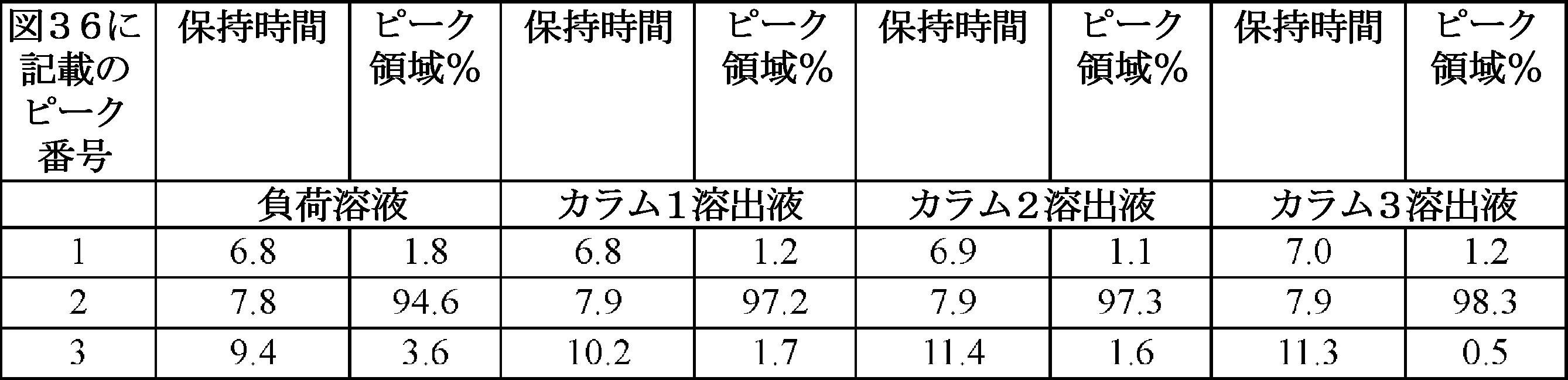
7.8 VEGF MiniTrapの、カラム前及び後の試料の mAb1、mAb2 、及び VEGF165 への結合の動態
Biacore T200機器を使用して、動態調査を実施した。
7.8 Kinetics of VEGF MiniTrap Binding to mAb1, mAb2, and VEGF 165 of Pre- and Post-Column Samples Kinetic studies were performed using a Biacore T200 instrument.
Biacore T200機器を使用するリアルタイム表面プラズモン共鳴バイオセンサを使用し、カラム1及びカラム2からの溶出液及び負荷溶液中のMiniTrapに結合するVEGF165について、平衡解離定数(KD値)を測定した。25℃で、10mMのHEPES、150mMのNaCl、3mMのEDTA、及び0.05%のv/vの界面活性剤であるTween-20、pH7.4(HBS-ET)ランニングバッファを使用して、すべての結合調査を実施した。MT5を捕捉するため、mAb1を用いてBiacoreセンサ表面をアミンカップリングにより最初に誘導した(derivitized)。結合調査の略画表示を図37に示す。
A real-time surface plasmon resonance biosensor using a Biacore T200 instrument was used to measure the equilibrium dissociation constants ( K values) for VEGF165 binding to MiniTrap in the eluates and loading solutions from
簡潔には、カラムからの溶出液及び負荷溶液をHBS-EP(Biacore)バッファ中に希釈し、約70RUの捕捉レベルにて固定化したタンパク質マトリックス全体に注入した。次いで、VEGF165を50μL/分の流速で注入した。未処理の参照表面上へ等価濃度の分析物を同時注入し、バルク屈折率バックグラウンドを減算するためにブランクセンサグラムとして機能させた。10mMグリシンを25μL/分で5分間2回注入することで、サイクルとサイクルの間にセンサチップ表面を再生させた。次いで、動態速度パラメータを決定するため、BIA評価4.0.1ソフトウェアを使用して、得られた実験用結合センサグラムを評価した。各試料のデータセットを1:1のラングミュアモデルに適合させた。これらの調査のため、最大分析結合能力(RU)及びRmax特性の適合度を局所的に選択しつつ、グローバルフィット分析プロトコルの下で結合及び解離データを分析した。この場合、ソフトウェアは単一の解離定数(kd)、会合定数(ka)、及び親和定数(Kd)を計算した。平衡解離定数はKD=kd/kaである。0.03~2nMの範囲の異なるVEGF165濃度を使用することにより、オンレートの動態、オフレートの動態、及び全体の親和性を決定した(表7-6)。動態速度定数から解離半減期(t1/2)を計算した:t1/2=ln(2)/60*Kd。25℃でのアフィニティークロマトグラフィー生成の前後に得られたVEGF165に対するMT5の結合動態パラメータを表7-6に示す。 Briefly, the eluate from the column and the loading solution were diluted in HBS-EP (Biacore) buffer and injected over the immobilized protein matrix at a capture level of approximately 70 RU. VEGF 165 was then injected at a flow rate of 50 μL/min. Equivalent concentrations of analyte were co-injected onto an untreated reference surface to serve as blank sensorgrams to subtract bulk refractive index background. The sensor chip surface was regenerated between cycles by two injections of 10 mM glycine at 25 μL/min for 5 min. The resulting experimental binding sensorgrams were then evaluated using BIAevaluation 4.0.1 software to determine kinetic rate parameters. The data sets for each sample were fitted to a 1:1 Langmuir model. For these studies, the binding and dissociation data were analyzed under a global fit analysis protocol, with local selection of the maximum analytical binding capacity (RU) and Rmax characteristic fit. In this case, the software calculated a single dissociation constant (kd), association constant (ka), and affinity constant (Kd). The equilibrium dissociation constant is K D =kd/ka. By using different VEGF 165 concentrations ranging from 0.03 to 2 nM, the on-rate kinetics, off-rate kinetics, and overall affinity were determined (Table 7-6). The dissociation half-life (t1/2) was calculated from the kinetic rate constants: t1 /2 =ln(2)/60 * Kd. The binding kinetic parameters of MT5 to VEGF 165 obtained before and after affinity chromatography purification at 25° C. are shown in Table 7-6.
アフィニティークロマトグラフィー工程の(1つ以上の)効果を評価するために負荷溶液と比較した、アフィニティークロマトグラフィーにより産生されたMT5の親和性(KD)、オンレート(ka、M-1s-1)及びオフレート(kd)は、異なる試料からのMT5が、動態において変化しないことを示した。VEGF MiniTrap構築物のSPRセンサグラムを図38に示す。 The affinity (KD), on-rate (ka, M-1s-1) and off-rate (kd) of MT5 produced by affinity chromatography compared to the challenge solution to assess the effect(s) of the affinity chromatography step(s) showed that MT5 from different samples did not vary in kinetics. SPR sensorgrams of the VEGF MiniTrap constructs are shown in Figure 38.
(表7-6)

7.9 複数の生成サイクル
7.3に示されるように、カラム1(hVEGF165)及びカラム2(mAb1)を使用して、工程7.1により得られるような回収物のクロマトグラフィー生成を実施した。カラムを、複数のクロマトグラフィーサイクルに使用した。カラムの収率は、追加の運転により有意に変化することはなかった。これは、カラムが結合能力を保持していたことを示唆している(表7-7)。
7.9 Multiple purification cycles Chromatographic purification of the harvest as obtained by step 7.1 was performed using column 1 (hVEGF 165 ) and column 2 (mAb1) as shown in 7.3. The columns were used for multiple chromatography cycles. The column yield did not change significantly with the additional runs, suggesting that the columns retained their binding capacity (Table 7-7).
(表7-7)

7.4に説明される方法を使用して、カラム1及びカラム2に関する負荷溶液、洗浄画分及び溶出画分のHCP計算を得た(図39)。計算された総HCPは、カラムの繰り返しの使用が、MiniTrapに結合するカラムの能力を低減しないことを示した。
Using the method described in 7.4, HCP calculations were obtained for the load solution, wash fractions, and elution fractions for
7.10 アフィニティークロマトグラフィーカラムの最適化
カラム1(VEGF165)及びカラム2(mAb1)を使用して、セクション7.1にて得られるような回収物質のクロマトグラフィー生成を実施した。最適化調査のため、10mgの代わりに14mg又は45mgのVEGF165又は抗VEGF R1 mAbを2つのHiTrap NHS活性化HPアフィニティーカラム(1mL、GE Healthcare)に負荷し、カラムを閉鎖して室温で30分間カップリングさせた。上の7.2及び7.3に述べられるように、カラム調製及びMiniTrapを含む回収物の生成を実行した。洗浄画分及び溶出画分中のMT5の量を表7-8に示す。10mgと比較した、14mg又は45mgのアフィニティーカラム(VEGF165又は抗VEGF R1 mAb(mAb1))結合量は、両方のカラムからのMiniTrapの収率の増加を示す。したがって、タンパク質対カラム比を最適化することにより、又はpH、インキュベーション時間、インキュベーション温度等を変更することによって結合効率を増加させることにより、概説した方法を使用したカラム収率を向上させることができる。
7.10 Optimization of affinity chromatography columns Chromatographic purification of the harvested material as obtained in section 7.1 was performed using column 1 (VEGF 165 ) and column 2 (mAb1). For optimization studies, 14 mg or 45 mg of VEGF165 or anti-VEGF R1 mAb instead of 10 mg was loaded onto two HiTrap NHS-activated HP affinity columns (1 mL, GE Healthcare), the columns were closed and coupling was allowed for 30 min at room temperature. Column preparation and purification of the harvested material with MiniTrap were performed as described in 7.2 and 7.3 above. The amount of MT5 in the wash and elution fractions is shown in Table 7-8. Affinity column (VEGF 165 or anti-VEGF R1 mAb (mAb1)) binding capacity of 14 mg or 45 mg compared to 10 mg shows an increase in MiniTrap yield from both columns. Thus, column yields using the outlined method can be improved by optimizing protein to column ratios or by increasing binding efficiency by altering pH, incubation time, incubation temperature, etc.
(表7-8)

7.11 アフィニティークロマトグラフィーを伴うCEXの使用
上のセクション7.3にて述べたように、カラム1を使用してMT5発現からの細胞培養物試料を生成した。得られた溶出液を陽イオン交換クロマトグラフィー(CEX)カラム(HiTrap Capto S、1mL)に供した。カラムの操作条件を表7-9に示す。
7.11 Use of CEX with
(表7-9)

元々の/出発細胞培養物試料、アフィニティークロマトグラフィーのカラム1の溶出液、及びCEX溶出液における総HCPは、それぞれ、約230,000ng/mL、約9,000ng/mL、及び約850ng/mLであった。上に言及したように、Cygnus CHO HCP ELISAキット 3Gを使用し、HCP量を定量化決定した。
Total HCP in the original/starting cell culture sample,
7.12 他の抗VEGFタンパク質を生成するためのアフィニティークロマトグラフィーの使用
他の抗VEGFタンパク質を生成する能力を調査するため、カラム1を評価した。この調査のため、アフリベルセプト及びVEGF結合能力を有するscFv断片を使用した。セクション7.3に述べられるように、生成プロセスを実施した。表7-10は、カラム1が、他の抗VEGFタンパク質の結合及び溶出に成功したことを実証している。
7.12 Use of Affinity Chromatography to Purify Other
(表7-10)

[実施例8]VEGF MiniTrap構築物の質量分析法に基づく特性評価
材料。実施例1にて説明されるように、アフリベルセプトからVEGF MiniTrap(MT1)を生成した。実施例7にて説明されるように、VEGF MiniTrap5(MT5)を生成した。組換えVEGF MiniTrapのコーディング領域(MT5)をシグナル配列に機能的に結合し、哺乳動物の発現ベクターにクローニングして、チャイニーズハムスター卵巣(CHO-K1)細胞へと形質移入し、12日間にわたり400μg/mLのハイグロマイシンを用いて選択した後、安定的に形質移入されたプールを単離するといった方法によりVEGF MiniTrap(MT6)を生成した。分析用のタンパク質を生成するため、CDM中で増殖させた安定したCHO細胞プールを使用した。
Example 8 Mass Spectrometry-Based Characterization of VEGF MiniTrap Constructs Materials. VEGF MiniTrap (MT1) was generated from aflibercept as described in Example 1. VEGF MiniTrap5 (MT5) was generated as described in Example 7. VEGF MiniTrap (MT6) was generated by functionally linking the recombinant VEGF MiniTrap coding region (MT5) to a signal sequence, cloning into a mammalian expression vector, transfecting into Chinese Hamster Ovary (CHO-K1) cells, selecting with 400 μg/mL hygromycin for 12 days, and isolating a stable transfected pool. Stable CHO cell pools grown in CDM were used to generate protein for analysis.
8.1 糖タンパク質の脱グリコシル化
MT1、MT2及びMT3の清澄化された回収物からの試料を、1%(w/v)のRG界面活性剤(RapiGest SF、Waters,Milford,MA)及び50mMのHEPES(pH7.9)の28.8μLの溶液に入れ、0.52mg/mLの濃度に希釈又は再構成した。これらの溶液を約95℃で2分間にわたり加熱し、50℃まで冷却させて、1.2μLのPNGase F溶液(GlycoWorks Rapid PNGase F、Waters,Milford,MA)と混合した。50℃で5分間、試料をインキュベートすることにより脱グリコシル化を完了させた。
8.1 Deglycosylation of Glycoproteins Samples from the clarified harvests of MT1, MT2 and MT3 were diluted or reconstituted in 28.8 μL of 1% (w/v) RG detergent (RapiGest SF, Waters, Milford, MA) and 50 mM HEPES (pH 7.9) to a concentration of 0.52 mg/mL. These solutions were heated to approximately 95° C. for 2 min, cooled to 50° C. and mixed with 1.2 μL of PNGase F solution (GlycoWorks Rapid PNGase F, Waters, Milford, MA). Deglycosylation was completed by incubating the samples at 50° C. for 5 min.
8.2 HILIC-蛍光-ESI-MS(MS/MS)分析
蛍光と質量分析検出とを組み合わせたHILIC分離により、MT1を分析した。MT2及びMT3をHILICのみを使用して分析した。フォトダイオードアレイ及び蛍光(FLR)検出器を搭載し、Waters Synapt G2-S質量分析計(MS条件)をインターフェース接続したWaters 2D Acquity UPLCを使用してクロマトグラフィーを実施した。Waters UPLCグリカンBEHアミドカラム(150×2.1mm、1.7μm)を用いて、親水性相互作用クロマトグラフィー(HILIC)モードの分離を使用した。カラム温度を60℃に設定し、オートサンプラー温度を5℃に設定した。注入量は50μLであった。フォトダイオードアレイスキャン範囲は190~700nmであった。FLRを、RapiFluor標識グリカンについては励起265nm、発光425nm、糖ペプチド中に存在するチロシンについては励起274nm、及び発光303nmに設定した。初期流速は0.4mL/分であり、移動相Aは100mMのギ酸アンモニウム(pH4.4)からなり、移動相Bはアセトニトリルであった。
8.2 HILIC-Fluorescence-ESI-MS (MS/MS) Analysis MT1 was analyzed by HILIC separation combining fluorescence and mass spectrometry detection. MT2 and MT3 were analyzed using HILIC only. Chromatography was performed using a Waters 2D Acquity UPLC equipped with a photodiode array and fluorescence (FLR) detector and interfaced to a Waters Synapt G2-S mass spectrometer (MS conditions). Hydrophilic interaction chromatography (HILIC) mode of separation was used with a Waters UPLC Glycan BEH Amide column (150 x 2.1 mm, 1.7 μm). The column temperature was set at 60 °C and the autosampler temperature was set at 5 °C. The injection volume was 50 μL. The photodiode array scan range was 190-700 nm. The FLR was set to excitation 265 nm, emission 425 nm for RapiFluor-labeled glycans, excitation 274 nm, and emission 303 nm for tyrosines present in the glycopeptides. The initial flow rate was 0.4 mL/min, mobile phase A consisted of 100 mM ammonium formate (pH 4.4), and mobile phase B was acetonitrile.
8.3 MS条件
Waters Synapt G2-S質量分析計を使用し、液体クロマトグラフィー/質量分析(LC/MS)実験を実施した。スキャン範囲は、正イオンモード分析及び負イオンモード分析について、質量対電荷比100~2400であった。スキャン時間は1秒であり、glu-フィブリノペプチドBを校正物(「ロックマス」)として一定に注入(2μL/分)した。120℃のソース温度、500℃の脱溶媒和温度でキャピラリー電圧を2.5kVに設定した。窒素ネブライザガスフローを700L/時間に設定した。
8.3 MS Conditions Liquid chromatography/mass spectrometry (LC/MS) experiments were performed using a Waters Synapt G2-S mass spectrometer. The scan range was mass-to-charge ratio 100-2400 for positive and negative ion mode analysis. The scan time was 1 second with a constant infusion (2 μL/min) of glu-fibrinopeptide B as the calibrant ("lock mass"). The capillary voltage was set at 2.5 kV with a source temperature of 120° C. and a desolvation temperature of 500° C. The nitrogen nebulizer gas flow was set at 700 L/h.
8.4 ネイティブSEC-MS
すべてのオンラインSEC-MS分析のため、ACQUITY UPLC I クラスシステム(Waters、Milford,MA)を、Q Exactive HFハイブリッド四重極Orbitrap質量分析計(Thermo Scientific、Bremen,Germany)に連結した。ACQUITY UPLC Protein BEH SECカラム(200Å、1.7μm、4.6×300mm)を30℃に設定し、タンパク質分離のためにこれを使用した。移動相はpH6.8である100mMの酢酸アンモニウムであった。各分離は0.3mL/分の流速で30分間行い、注入量を40μgに設定した。オンラインSEC-ナノ-ESI-MSデータ取得のため、以下のMSパラメータを使用した。各取得は、試料注入直後に開始して25分であった。3kVのスプレー電圧、200℃のキャピラリー温度、及び70S-レンズのRFレベルであるポジティブモードにて、脱グリコシル化された試料をイオン化した。インソースCIDを75eVに設定した。2000~8000のm/zの質量範囲を有する15Kの分解能にて、フルMSスキャンを得た。フルMSスキャンのため、100msの最大注入時間、3e6の自動ゲインコントロール目標値、10マイクロスキャンを使用した。
8.4 Native SEC-MS
For all online SEC-MS analyses, an ACQUITY UPLC I class system (Waters, Milford, MA) was coupled to a Q Exactive HF hybrid quadrupole Orbitrap mass spectrometer (Thermo Scientific, Bremen, Germany). An ACQUITY UPLC Protein BEH SEC column (200 Å, 1.7 μm, 4.6×300 mm) was set at 30° C. and used for protein separation. The mobile phase was 100 mM ammonium acetate, pH 6.8. Each separation was performed for 30 min at a flow rate of 0.3 mL/min and the injection volume was set to 40 μg. For online SEC-nano-ESI-MS data acquisition, the following MS parameters were used: Each acquisition was 25 min, starting immediately after sample injection. Deglycosylated samples were ionized in positive mode with a spray voltage of 3 kV, a capillary temperature of 200° C., and an RF level of 70 S-lens. In-source CID was set at 75 eV. Full MS scans were acquired at a resolution of 15 K with a mass range of m/z from 2000 to 8000. A maximum injection time of 100 ms, an automatic gain control target of 3e6, and 10 microscans were used for the full MS scan.
8.5 ペプチドマッピング
ペプチドマッピングのための試料調製。5mmol/Lの最終濃度まで500mmol/Lのジチオトレイトール(DTT)を加え、続いて4℃で60分間インキュベートすることにより還元を達成した。10mmol/Lの最終濃度まで500mmol/Lのヨードアセトアミド(IAM)を加え、4℃で60分間、暗所でインキュベートすることによりアルキル化を実施した。Zeba(商標)Spin 7K MWCOサイズ排除脱塩カラム(P/N89882)(Thermo Scientific、Waltham,MA)を製造業者の指示に従って使用し、変性バッファを消化バッファ(0.1mol/Lのトリス中、1mol/Lの尿素、pH7.8)と交換した。(バッファ交換後、紫外可視分光法により測定されるVEGF MiniTrapタンパク質濃度に基づき)1:18(酵素:試料)の質量比で組換えブタトリプシン(Sigmaから購入、カタログ番号03708985001)を加えた。VEGF MiniTrapタンパク質の濃度を0.5μg/μLに調整し、室温で4時間のインキュベーション中に消化を進行させた。消化が完了したときに、LC-MSグレードの水中0.1%ギ酸を1:1の体積比で加えた。分析まで、-80℃で消化物を保管した。
8.5 Peptide Mapping Sample preparation for peptide mapping. Reduction was achieved by adding 500 mmol/L dithiothreitol (DTT) to a final concentration of 5 mmol/L, followed by incubation at 4° C. for 60 minutes. Alkylation was performed by adding 500 mmol/L iodoacetamide (IAM) to a final concentration of 10 mmol/L, followed by incubation at 4° C. for 60 minutes in the dark. The denaturation buffer was exchanged for digestion buffer (1 mol/L urea in 0.1 mol/L Tris, pH 7.8) using a Zeba™ Spin 7K MWCO size-exclusion desalting column (P/N 89882) (Thermo Scientific, Waltham, MA) according to the manufacturer's instructions. Recombinant porcine trypsin (purchased from Sigma, catalog number 03708985001) was added at a mass ratio of 1:18 (enzyme:sample) (based on VEGF MiniTrap protein concentration measured by UV-Vis spectroscopy after buffer exchange). The concentration of VEGF MiniTrap protein was adjusted to 0.5 μg/μL and digestion was allowed to proceed during a 4-hour incubation at room temperature. When digestion was complete, 0.1% formic acid in LC-MS grade water was added at a volume ratio of 1:1. Digests were stored at -80°C until analysis.
トリプシン消化物のLC-MS/MS分析。40℃に設定したサーモスタットカラムオーブンで囲まれたC18カラムに、オートサンプラーを用いて1つ以上の2.5μg(10μL)のペプチド消化物を負荷した。注入を待つ間、試料を7℃に維持した。98%の移動相A(水中、0.1体積%であるギ酸の画分)及び2%の移動相B(アセトニトリル中、0.1体積%であるギ酸の画分)で、0.200mL/分で一定に設定した流速で、クロマトグラフィー方法を開始した。10分間洗浄した後、45%の移動相Bを含む最終組成物に到達するように、移動相Bの含量が1分あたり0.39%の速度で増加する勾配で110分にわたりペプチドを溶出させた。次の試料を注入する前に、97%の移動相Bでカラムを15分間洗浄し、次いで98%の移動相Aで25分間、平衡化させた。運転の最初の1.5分間及び最後の5分間の溶出液は廃棄した。214nmでのUV吸収、続いてLTQ Orbitrap Elite又はDiscovery XLでの質量分析法により、クロマトグラフィーカラムから溶出したペプチドを分析した。3つのタンデムMS(MS/MS)分析及び1つのMSのみの分析のそれぞれを含む、PS8670及びRM8671試料に関する反復ペプチドマッピングデータを収集した。データ依存モードにてペプチド同定するため、MS/MS分析を実施した。このモードでは、実験のうち1つのサイクルは、1回の300m/z~2000m/zのフルMSスキャン、続いてサイクルを開始させるMSスキャンにおいて、500の最小のしきい値カウントにて検出された1番目に強いイオンから5番目に強いイオンで実施される5回の連続したMS/MS事象からなる。マイクロスキャン=3で、順次質量分析(MSn)AGCターゲットを1E4に設定した。MS/MSフラグメントを分析するため、通常スキャン速度のセントロイドモードにて、イオントラップを使用した。1E6のフルスキャンAGCターゲット及びマイクロスキャン=1で、高分解FTMS分析器(R=30,000)を使用し、プロファイルモードにてフルMSスキャンを収集した。2Daの分離幅を使用し、MS/MSのためにイオンを選択し、次いで35の正規化CIDエネルギー、0.25の活性化Q及び10m秒の活性化時間を使用する、ヘリウムガスによる衝突誘起解離(CID)によりフラグメント化した。デフォルトの電荷状態をz=2に設定した。プリカーサイオンが30秒以内に2回事象を引き起こす場合には、データ依存する質量を排除リストに45秒間配置した。排除質量幅を±1Daに設定した。割り当てられていない電荷状態には電荷状態を拒否させることが可能であった。拒否質量リストは、122.08m/z、185.94m/z、355.00m/z、371.00m/z、391.00m/z、413.30m/z、803.10m/z、1222.10m/z、1322.10m/z、1422.10m/z、1522.10m/z、1622.10m/z、1722.10m/z、1822.10m/z、及び1922.10m/zで一般的な夾雑物を含んだ。TIC非還元型ペプチドマップ及び還元型ペプチドマップを生成するため、MSのみの分析を実施した。 LC-MS/MS analysis of tryptic digests. One or more 2.5 μg (10 μL) of peptide digests were loaded using an autosampler onto a C18 column surrounded by a thermostatic column oven set at 40° C. Samples were kept at 7° C. while waiting for injection. The chromatographic method was started with 98% mobile phase A (fraction of 0.1% by volume of formic acid in water) and 2% mobile phase B (fraction of 0.1% by volume of formic acid in acetonitrile) with a flow rate set constant at 0.200 mL/min. After a 10 min wash, peptides were eluted over 110 min with a gradient in which the content of mobile phase B increased at a rate of 0.39% per min to reach a final composition containing 45% mobile phase B. Before the injection of the next sample, the column was washed with 97% mobile phase B for 15 min and then equilibrated with 98% mobile phase A for 25 min. The eluate from the first 1.5 minutes and the last 5 minutes of the run was discarded. Peptides eluted from the chromatographic column were analyzed by UV absorption at 214 nm followed by mass spectrometry on an LTQ Orbitrap Elite or Discovery XL. Repetitive peptide mapping data was collected for PS8670 and RM8671 samples, including three tandem MS (MS/MS) analyses and one MS-only analysis each. MS/MS analyses were performed for peptide identification in data-dependent mode, where one cycle of the experiment consisted of one full MS scan from 300 m/z to 2000 m/z, followed by five consecutive MS/MS events performed on the first through fifth most intense ions detected in the MS scan that initiated the cycle, with a minimum threshold count of 500. The sequential mass analysis (MS n ) AGC target was set to 1E4 with microscans=3. To analyze MS/MS fragments, the ion trap was used in centroid mode with normal scan speed. Full MS scans were collected in profile mode using a high-resolution FTMS analyzer (R=30,000) with a full-scan AGC target of 1E6 and microscan=1. Ions were selected for MS/MS using an isolation width of 2 Da and then fragmented by collision-induced dissociation (CID) with helium gas using a normalized CID energy of 35, an activation Q of 0.25 and an activation time of 10 ms. The default charge state was set to z=2. If a precursor ion triggered two events within 30 s, data-dependent masses were placed in the exclusion list for 45 s. The exclusion mass width was set to ±1 Da. Charge states could be rejected for unassigned charge states. The rejected mass list included common contaminants at 122.08 m/z, 185.94 m/z, 355.00 m/z, 371.00 m/z, 391.00 m/z, 413.30 m/z, 803.10 m/z, 1222.10 m/z, 1322.10 m/z, 1422.10 m/z, 1522.10 m/z, 1622.10 m/z, 1722.10 m/z, 1822.10 m/z, and 1922.10 m/z. MS-only analysis was performed to generate TIC non-reduced and reduced peptide maps.
8.6 結果
VEGF MiniTrap構築物の構造。VEGF MiniTrap MT1、MT5及びMT6の構造を図40、図41、図43及び図44に示す。
8.6 Results Structure of VEGF MiniTrap Constructs The structures of VEGF MiniTrap MT1, MT5 and MT6 are shown in Figures 40, 41, 43 and 44.
SEC-MSを使用する最初の質量分析により、脱グリコシル化後の無処置のタンパク質レベルでの3つの分子すべての同一性が確認された(図42)。ネイティブSEC-MS分析の総イオンクロマトグラム(TIC)は、およそ12~13分間で無処置のVEGF MiniTrap分子を検出するということを実証した。TICの低分子量(LMW)領域の拡大は、3つすべてのタンパク質試料におけるLMW不純物の存在を示した。 Initial mass spectrometry analysis using SEC-MS confirmed the identity of all three molecules at the intact protein level after deglycosylation (Figure 42). Total ion chromatograms (TIC) of the native SEC-MS analysis demonstrated detection of intact VEGF MiniTrap molecules at approximately 12-13 minutes. Expansion of the low molecular weight (LMW) region of the TIC indicated the presence of LMW impurities in all three protein samples.
VEGF MiniTrapのデコンボリューションされたマススペクトルはそれらの同一性を更に確認し、二量体であるMT1及びMT5(図43)及び一本鎖タンパク質であるMT6(図44)を含む試料中に存在する主要なPTMを解明のためのデータを提供した。 Deconvoluted mass spectra of the VEGF MiniTraps further confirmed their identity and provided data to elucidate the major PTMs present in the samples, including the dimers MT1 and MT5 (Figure 43) and the single-chain protein MT6 (Figure 44).
MT1試料の分析。3つの異なるLMW不純物であるLMW1、LMW2、及びLMW3を試験するため、MT1を含む試料のSEC-MS分析のTICから同定されたLMW種を抽出した(図45A及び図45B)。LMW1種はアフリベルセプトの切断種を含んだ。LMW2種は、MiniTrapを生成するために実施されたアフリベルセプトの切断からの試料中に存在するFc不純物を含んだ。LMW3種はMT1(二量体)分子から切断された可能性のある単量体を含んだ。 Analysis of MT1 samples. To test for three different LMW impurities, LMW1, LMW2, and LMW3, LMW species identified from the TIC of the SEC-MS analysis of a sample containing MT1 were extracted (Figures 45A and 45B). LMW1 species contained cleavage species of aflibercept. LMW2 species contained Fc impurities present in the sample from the cleavage of aflibercept performed to generate MiniTrap. LMW3 species contained monomers that may have been cleaved from the MT1 (dimeric) molecule.
MT1試料は、アフリベルセプトを切断してMiniTrapタンパク質を形成するために使用されたFabRICATOR酵素の存在を示さなかった。当該酵素が存在する場合には、これは約11.5分及び12.5分にて検出される。MT1試料のSEC-MS分析中、こうしたピークは検出されなかった(図46)。 The MT1 sample did not show the presence of the FabRICATOR enzyme used to cleave aflibercept to form the MiniTrap protein. If present, the enzyme is detected at approximately 11.5 and 12.5 minutes. No such peaks were detected during SEC-MS analysis of the MT1 sample (Figure 46).
MT5試料の分析。2つの異なるLMW不純物であるLMW1及びLMW2の存在を試験するため、MT5を含む試料のSEC-MS分析のTICから同定されたLMW種を抽出した(図47)。 Analysis of MT5 samples. Identified LMW species were extracted from the TIC of the SEC-MS analysis of samples containing MT5 to test for the presence of two different LMW impurities, LMW1 and LMW2 (Figure 47).
MT6試料の分析。3つの異なるLMW不純物であるLMW1、LMW2及びLMW3の存在を試験するため、MT1を含む試料のSEC-MS分析のTICから同定されたLMW種を抽出した(図48)。LMW2種はMT6の断片を含み、切断は、G4Sリンカー(配列番号111)を有するVEGF MiniTrapの断片を生成した。LMW5種はMT6の断片を含み、切断はG4Sリンカー(配列番号111)の直前又は直後に起こった。 Analysis of MT6 samples. Identified LMW species were extracted from the TIC of the SEC-MS analysis of a sample containing MT1 to test for the presence of three different LMW impurities, LMW1, LMW2, and LMW3 (Figure 48). The LMW2 species contained a fragment of MT6, where cleavage generated a fragment of VEGF MiniTrap with a G4S linker (SEQ ID NO:111). The LMW5 species contained a fragment of MT6, where cleavage occurred just before or just after the G4S linker (SEQ ID NO:111).
その質量、及びWaters及びthe National Institute for Bioprocessing Research and Training(Dublin,Ireland)が先駆けとなって開発したグルコース単位値を使用したHILICクロマトグラフィー方法における溶出順により、MT6試料中のグリカンを同定した(図49A及び図49B)。 Glycans in the MT6 sample were identified by their mass and elution order in a HILIC chromatography method using glucose unit values pioneered by Waters and the National Institute for Bioprocessing Research and Training (Dublin, Ireland) (Figures 49A and 49B).
遊離チオールの定量化。VEGF MiniTrap構築物のシステイン残基は、(1つ以上の)分子内及び分子間ジスルフィド結合の形成に関与している可能性がある。又はこれらは遊離チオールとして存在している場合がある。ペプチド及びタンパク質中のスルフィド結合の存在により、タンパク質に立体構造の剛性を与えると示されてきた。様々な試薬及び分離技術によりチオールを検出することができる。非常に低いレベルの遊離チオールについての3つのVEGF MiniTrap構築物の分析を表8-1に示す。 Quantification of free thiols. Cysteine residues in VEGF MiniTrap constructs may be involved in the formation of intra- and intermolecular disulfide bonds (one or more), or they may be present as free thiols. The presence of sulfide bonds in peptides and proteins has been shown to confer conformational rigidity to proteins. Thiols can be detected by a variety of reagents and separation techniques. Analysis of three VEGF MiniTrap constructs for very low levels of free thiols is shown in Table 8-1.
(表8-1)

トリスルフィドの定量化。VEGF MiniTrap構築物のシステイン残基における遊離チオールと同様に、トリスルフィド結合はタンパク質の構造に影響し得る。非常に低いレベルの遊離チオールを用いた条件の下で、3つのVEGF MiniTrap構築物の分析を表8-2に示す。 Quantification of trisulfides. Similar to free thiols at cysteine residues in VEGF MiniTrap constructs, trisulfide bonds can affect protein structure. Analysis of three VEGF MiniTrap constructs under conditions with very low levels of free thiols is shown in Table 8-2.
(表8-2)

ヒンジ領域における鎖内ジスルフィド。ヒンジ領域内の不対合形成されたジスルフィド結合は、VEGF MiniTrap構築物の構造、機能及び安定性に影響を有し得る。VEGF MiniTrap構築物のヒンジ領域における非常に低い鎖内ジスルフィド結合又はその欠如についての3つのVEGF MiniTrap構築物の分析[THTC*PPC*PAPELLG、C*は鎖内スルフィド結合が形成され得る場所を示す](配列番号83)を、表8-3に示す。 Intrachain disulfides in the hinge region. Mismatched disulfide bonds in the hinge region may have an effect on the structure, function and stability of the VEGF MiniTrap constructs. Analysis of three VEGF MiniTrap constructs [THTC * PPC * PAPELLG, where C * indicates where an intrachain disulfide bond may form] (SEQ ID NO: 83) for very low or absent intrachain disulfide bonds in the hinge region of the VEGF MiniTrap constructs is shown in Table 8-3.
(表8-3)

交差ジスルフィド結合及び平行ジスルフィド結合異性体の定量化。ヒンジ領域内の平行ジスルフィド結合により結合された二量体であるMT1及びMT5について、ヒンジ領域内のジスルフィド結合が交差し得る異性体が存在している可能性がある(図50)。 Quantification of cross-disulfide bond and parallel disulfide bond isomers. For MT1 and MT5, which are dimers linked by parallel disulfide bonds in the hinge region, isomers may exist in which the disulfide bonds in the hinge region may cross (Figure 50).
平行対交差ジスルフィド結合のタイプの定量化は、FabRICATOR消化分子であるMT1と比較するとMT2組換え発現タンパク質はFcヒンジ領域内にわずかに高いレベルの交差ジスルフィド架橋を有することを示した(表8-4)。 Quantification of parallel versus cross-disulfide bond types showed that the MT2 recombinantly expressed protein had slightly higher levels of cross-disulfide bridges within the Fc hinge region compared to the FabRICATOR digested molecule, MT1 (Table 8-4).
(表8-4)

翻訳後修飾(PTM) Post-translational modifications (PTMs)
(表8-5)
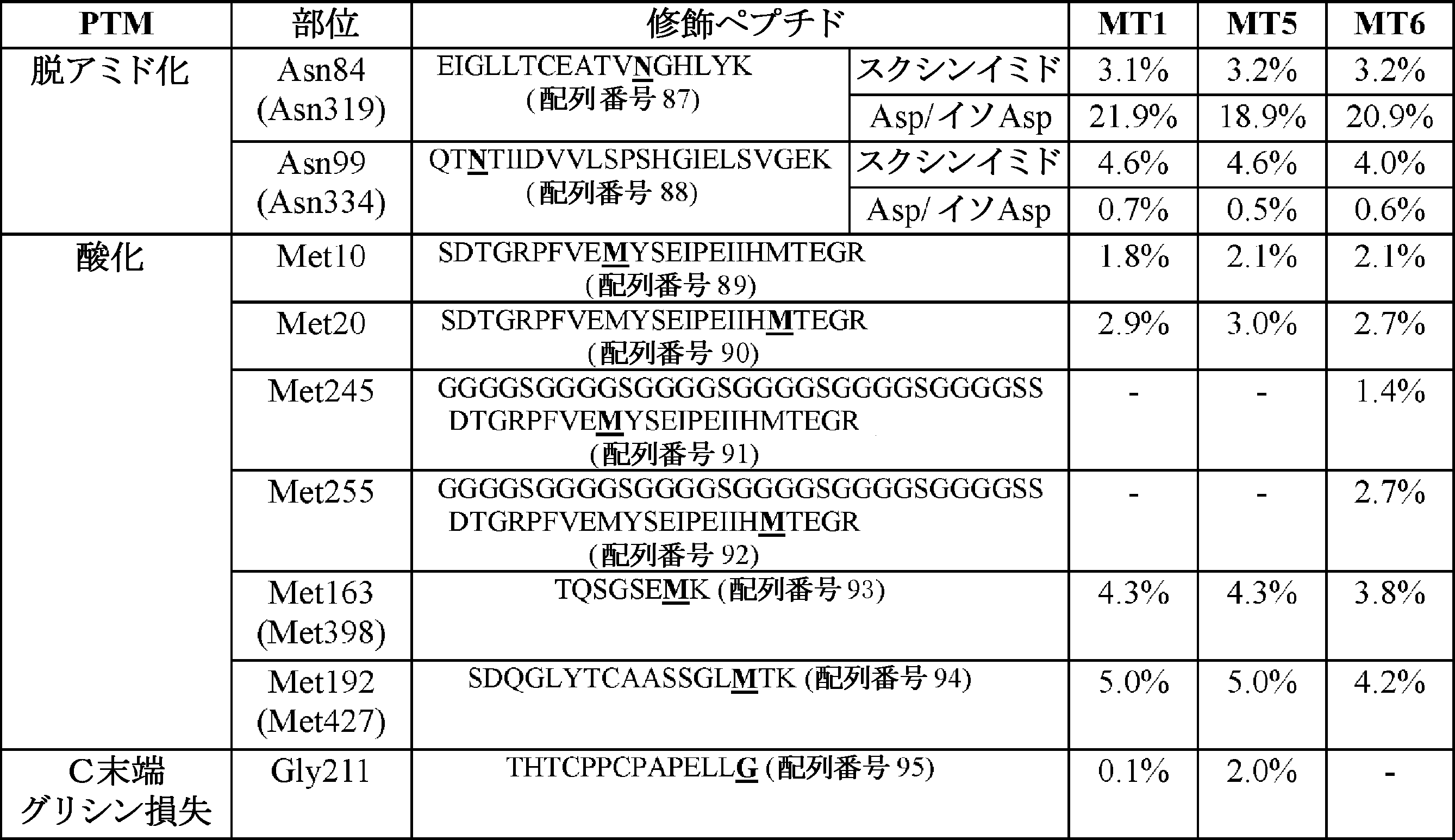
3つすべてのVEGF MiniTrap構築物中のPTMの評価は、同等のレベルのPTMを示した(表8-5)。Asn84で観察された脱アミド化は、スクシンイミドを形成する場合には約3.1~3.2%の範囲であり、アスパラギン酸/イソアスパラギン酸を形成する場合には18.9~21.9%であった。3つすべてのVEGF MiniTrap構築物について、約0.7~6.8%の範囲にて、複数のメチオニン残基(例えばMet10、Met20m、Met163及びMet192)の酸化を観察した。MT1及びMT5とは対照的にリンカーを含むMT6は、リンカー上のメチオニン残基の追加的な酸化を示した(例えば、Met245及びMet255)。MT1及びMT5中の約0.1%及び2.0%のC末端グリシン(Gly211)は、グリシンの損失を示した。これはC末端グリシンを欠いているMT6については観察されなかった。 Evaluation of PTMs in all three VEGF MiniTrap constructs showed comparable levels of PTMs (Table 8-5). Deamidation observed at Asn84 ranged from about 3.1-3.2% to form succinimide and 18.9-21.9% to form aspartic acid/isoaspartic acid. Oxidation of multiple methionine residues (e.g. Met10, Met20m, Met163, and Met192) was observed for all three VEGF MiniTrap constructs, ranging from about 0.7-6.8%. In contrast to MT1 and MT5, MT6, which contains a linker, showed additional oxidation of methionine residues on the linker (e.g. Met245 and Met255). Approximately 0.1% and 2.0% of the C-terminal glycine (Gly211) in MT1 and MT5 showed loss of glycine. This was not observed for MT6, which lacks the C-terminal glycine.
高度な糖化最終産物の修飾は、リジン及びアルギニン糖化に関連した。VEGF MiniTrap構築物の糖化はその構造及び機能を改変することが可能であり、これは抗VEGF活性を損なわせることにつながる。 Advanced glycation end product modifications were associated with lysine and arginine glycation. Glycosylation of the VEGF MiniTrap construct can alter its structure and function, which leads to impaired anti-VEGF activity.
(表8-6)

3つすべてのVEGF MiniTrap構築物中の修飾の評価は、同等のレベルを示した(表8-6)。 Evaluation of modifications in all three VEGF MiniTrap constructs showed comparable levels (Table 8-6).
修飾部位。セクション8.5(表8-7)に例示される還元ペプチドマッピングを使用して、セクション8.4に従い無処置の質量分析により明らかにされるように、VEGF MiniTrap構築物上の修飾部位を確認及び定量化した。ペプチド配列TNYLTHR(配列番号21)の部位T90N91の**は、切断後にアスパラギンがアスパラギン酸に変換されたことを表し、一方で、ペプチド配列QTNTIIDVVLSPSHGIELSVGEK(配列番号19)の部位N99T100に関し、*は、トリプシンによる高レベルの非特異的な切断を表す。これら2つの切断部位は、MT1及びMT5の評価中にLMW種不純物を形成することが分かった。M245Y246での切断は、固有のリンカーを有するMT3でのみ見られ、MT3調製中のLMW2種不純物の原因であった。 Modification sites. Reduced peptide mapping as illustrated in Section 8.5 (Table 8-7) was used to confirm and quantify the modification sites on the VEGF MiniTrap constructs as revealed by intact mass spectrometry according to Section 8.4. ** at site T90N91 of peptide sequence TNYLTHR (SEQ ID NO:21) represents asparagine converted to aspartic acid after cleavage, while * for site N99T100 of peptide sequence QTNTIIDVVLSPSHGIELSVGEK (SEQ ID NO:19) represents high levels of non-specific cleavage by trypsin. These two cleavage sites were found to form LMW species impurities during evaluation of MT1 and MT5. Cleavage at M245Y246 was only seen in MT3 with the unique linker and was responsible for the LMW2 species impurity during MT3 preparation.
(表8-7)
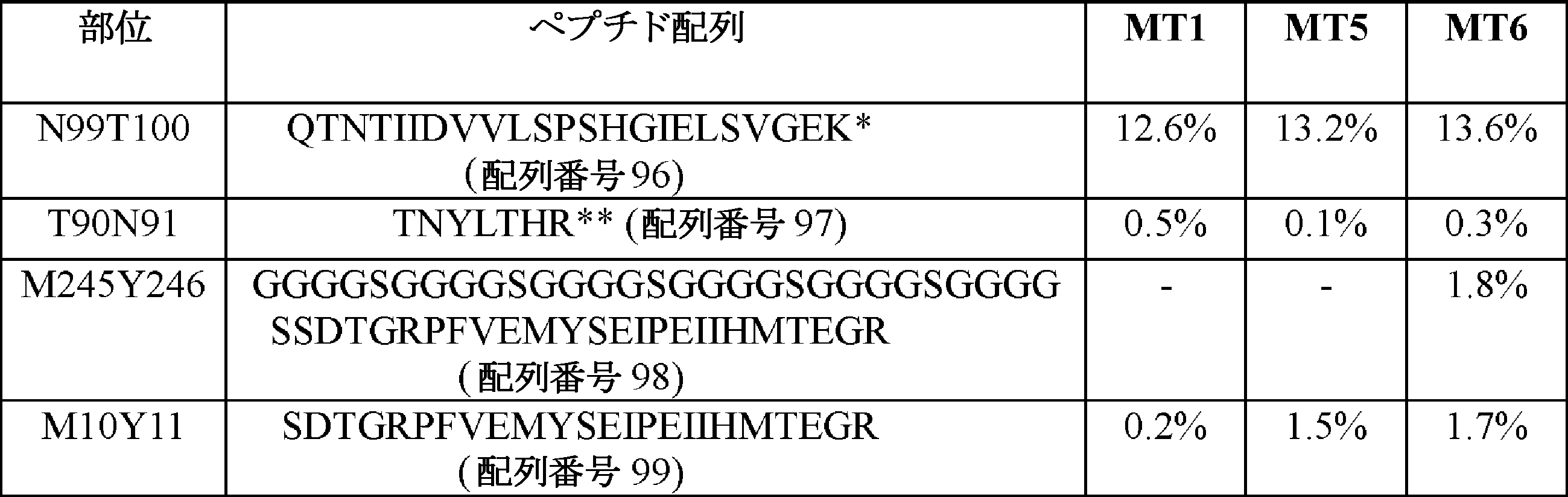
グリコサイト占有率の定量化。N-グリコシル化は一般的なPTMである。N-グリカンの巨大不均一性(グリコシル化部位占有率)及び微小不均一性(部位特異的グリカン構造)を含む、部位特異的N-グリコシル化を特徴付けることは、糖タンパク質の生合成及び機能の理解にとって重要である。グリコシル化の程度は、タンパク質がどの程度発現されているかに応じて変化し得る。N36でのグリコシル化のレベルは、3つすべてのVEGF MiniTrapに関して類似していた(表8-8及び図51)。同様に、N68でのグリコシル化のレベルもまた、3つすべてのVEGF MiniTrapに関して類似していた(表8-8及び図52)。N123でのグリコシル化のレベルもまた、3つすべてのVEGF MiniTrapに関して類似していた(表8-8及び図53)が、MT1調製物についてはマンノース-5が上昇していることが分かった。VEGF MiniTrap構築物に関しては、Asn196でのグリコシル化は、MT1と比較すると、MT5及びMT6については低かった(表8-8及び図54)。加えて、マンノース-5もまた、MT4及びMT6調製物よりもMT1調製物について上昇した。 Quantification of glycosite occupancy. N-glycosylation is a common PTM. Characterizing site-specific N-glycosylation, including N-glycan macroheterogeneity (glycosylation site occupancy) and microheterogeneity (site-specific glycan structures), is important for understanding glycoprotein biosynthesis and function. The extent of glycosylation can vary depending on how well the protein is expressed. The level of glycosylation at N36 was similar for all three VEGF MiniTraps (Table 8-8 and Figure 51). Similarly, the level of glycosylation at N68 was also similar for all three VEGF MiniTraps (Table 8-8 and Figure 52). The level of glycosylation at N123 was also similar for all three VEGF MiniTraps (Table 8-8 and Figure 53), although mannose-5 was found to be elevated for the MT1 preparation. For the VEGF MiniTrap constructs, glycosylation at Asn196 was lower for MT5 and MT6 compared to MT1 (Table 8-8 and Figure 54). In addition, mannose-5 was also elevated for MT1 preparations over MT4 and MT6 preparations.
(表8-8)

N-グリカンの分析。N36でのグリコシル化を表8-9に示す。G2F、G2FS、G2FS2は、3つすべてのVEGF MiniTrapで見られる主要なN-グリカンであった。表8-10に示されるN68でのグリコシル化に関しては、G2F及びG2FSは、3つすべてのVEGF MiniTrapで見られる主要なN-グリカンであった。N123でのグリコシル化については表8-11に示され、G2F及びG2Sは、3つすべてのVEGF MiniTrapで見られる主要なN-グリカンであり、マンノース-5は、MT5及びMT6と比較するとMT1中で高レベルで検出された。表8-12に示されるN196でのグリコシル化については、G2、G2S、G2S2は、3つすべてのVEGF MiniTrapで見られる主要なN-グリカンであり、マンノース-5は、MT5及びMT6と比較するとMT1中で高レベルで検出された。 N-glycan analysis. Glycosylation at N36 is shown in Table 8-9. G2F, G2FS, and G2FS2 were the major N-glycans found in all three VEGF MiniTraps. For glycosylation at N68 shown in Table 8-10, G2F and G2FS were the major N-glycans found in all three VEGF MiniTraps. For glycosylation at N123 shown in Table 8-11, G2F and G2S were the major N-glycans found in all three VEGF MiniTraps, and mannose-5 was detected at higher levels in MT1 compared to MT5 and MT6. For glycosylation at N196 shown in Tables 8-12, G2, G2S, and G2S2 were the predominant N-glycans found in all three VEGF MiniTraps, and mannose-5 was detected at higher levels in MT1 compared to MT5 and MT6.
(表8-9)
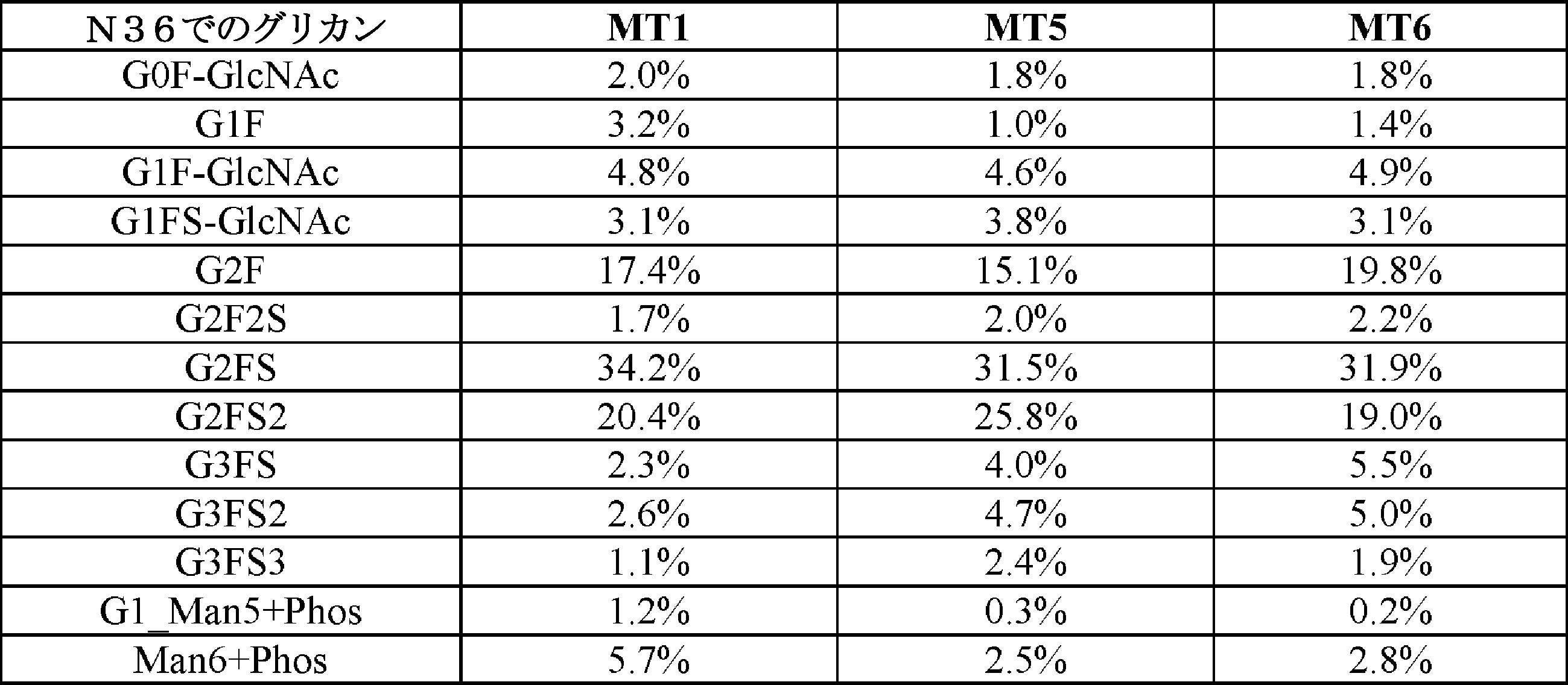
(表8-10)
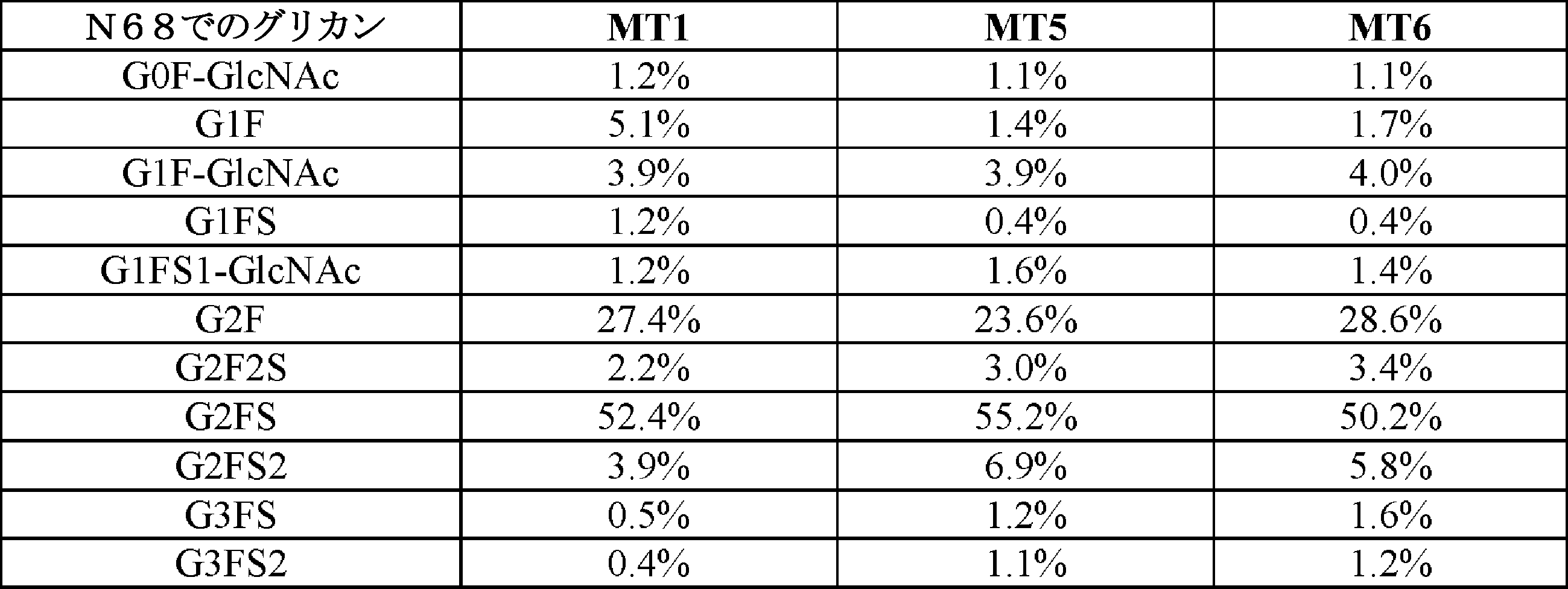
(表8-11)
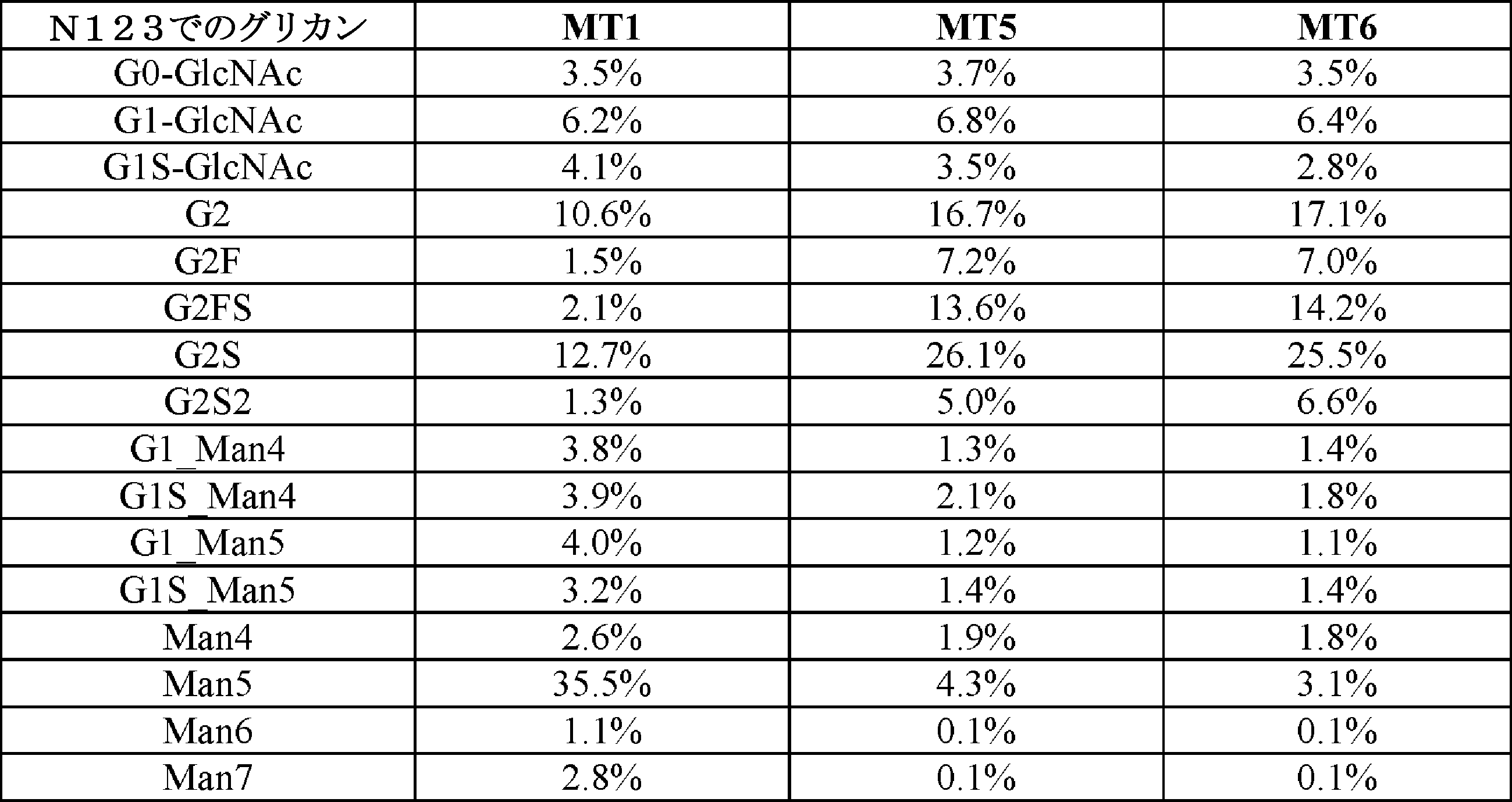
(表8-12)
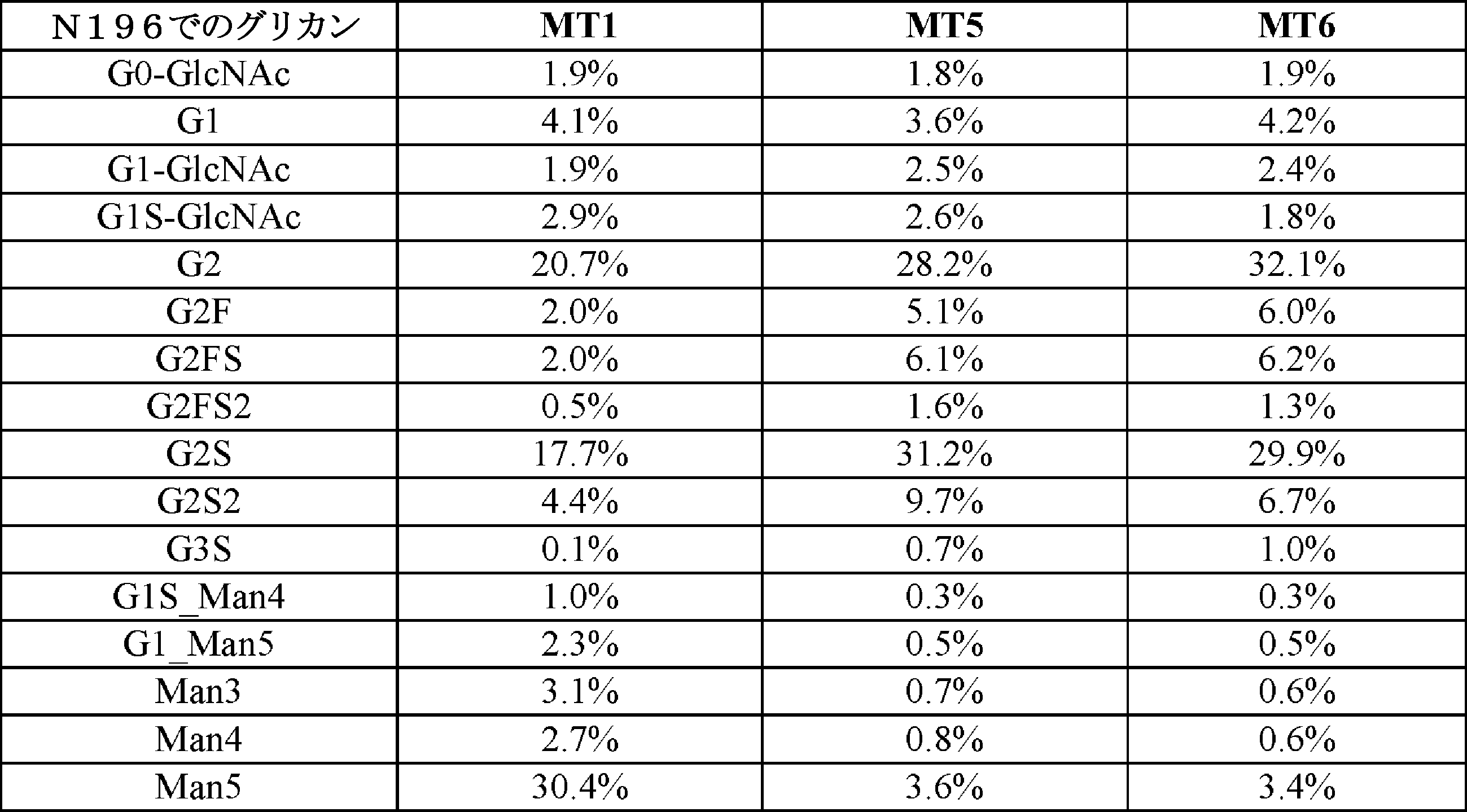
MT3のリンカーでのO-グリカン。MT3におけるO-グリカンを調査するため、MT3のGSリンカーを評価した。O-キシロシル化は、MT3のGSリンカー

(表8-13)

HILIC-FLR-MS分析。セクション8.2に説明されているように、すべてのVEGF MiniTrapに関して、HILIC-FLR-MS分析を実施した。この分析は、MT5及びMT6のN-結合グリカンが、類似しているが、MT1に関して得られたものとは異なっていたことを示した(図55は、フルスケール及び並べて表示したクロマトグラムを示し、図56はフルスケール及びオーバーレイ表示のクロマトグラムを示し、図57はフルスケールで並べて表示され、正規化したクロマトグラムを示す)。 HILIC-FLR-MS analysis. HILIC-FLR-MS analysis was performed on all VEGF MiniTraps as described in section 8.2. This analysis showed that the N-linked glycans of MT5 and MT6 were similar but distinct from those obtained for MT1 (Figure 55 shows full-scale and side-by-side chromatograms, Figure 56 shows full-scale and overlaid chromatograms, and Figure 57 shows full-scale side-by-side and normalized chromatograms).
最後に、3つすべてのVEGF MiniTrapタンパク質についてのグリコシル化%及び詳細なグリカン同定及び定量化は、表8-14及び図58A~Cにそれぞれ列挙されている。すべてのグリカン分析で観察されるように、MT5及びMT6のグリコシル化プロファイル及びマンノースレベルは類似しているが、MT1とは異なっている。 Finally, the % glycosylation and detailed glycan identification and quantification for all three VEGF MiniTrap proteins are listed in Tables 8-14 and Figures 58A-C, respectively. As observed in all glycan analyses, the glycosylation profiles and mannose levels of MT5 and MT6 are similar but distinct from MT1.
(表8-14)

[実施例9]上流培地及びフィードプロセスの最適化を使用した生成及び色定量化
(A)最適化されていないCDM(対照バイオリアクタ)
実施例5に説明されるMiniTrapの製造を利用した。
Example 9. Production and color quantification using optimization of the upstream medium and feed process. (A) Non-optimized CDM (control bioreactor)
The MiniTrap preparation described in Example 5 was used.
調査工程に関する操作パラメータは、当業者に公知の通りである。 The operating parameters for the investigation process are known to those skilled in the art.
0日目の培地=CDM1、これは以下の栄養素、抗酸化剤及び金属を含んでいた。
・8~9mMの累積濃度にてシステインを加えた。
・出発培地中の金属は、1倍濃度にて以下に列挙される(濃度は種菌の追加前のものである):
- Fe=培養物1リットルあたり68~83マイクロモル
- Zn=培養物1リットルあたり6~7マイクロモル
- Cu=培養物1リットルあたり0.1~0.2マイクロモル
- Ni=培養物1リットルあたり0.5~1マイクロモル
- Cysteine was added at a cumulative concentration of 8-9 mM.
Metals in the starting medium are listed below at 1x concentration (concentrations are before the addition of the inoculum):
- Fe = 68-83 micromoles per liter of culture
- Zn = 6-7 micromoles per liter of culture
Cu = 0.1-0.2 micromoles per liter of culture
- Ni = 0.5-1 micromoles per liter of culture
MT1を回収する際に、図59に示される生成手順に従った。クロマトグラフィーの操作パラメータは当業者に公知である。アフィニティー捕捉の操作パラメータ(図59の工程3)、アフィニティーフロースルー(図59の工程5)、AEX(図59の工程8)、及びHIC(図59の工程9)を表9-1に概説する。実施例1.2に概説される手順を使用して、アフィニティー捕捉及びろ過工程後のアフリベルセプトのタンパク質分解性切断を実行した。
In recovering MT1, the purification procedure shown in Figure 59 was followed. The chromatographic operating parameters are known to those skilled in the art. The operating parameters for affinity capture (
(表9-1)

表9-2は、様々なクロマトグラフィー工程を実施する際に得られたプールの色定量化を示す。5g/Lのタンパク質濃度を有するプールからの試料を使用し、色定量化を行った。 Table 9-2 shows the color quantification of the pool obtained when performing the various chromatographic steps. Color quantification was performed using a sample from a pool with a protein concentration of 5 g/L.
アフィニティー捕捉プールは、アフィニティー捕捉工程を実施する際に収集された溶出液を指す(図59の工程3)。酵素プールは、酵素的切断工程を実施する際に収集されたフロースルーを指す(図59の工程4)。アフィニティーフロースループールは、アフィニティーフロースルー工程を実施する際に収集されたフロースルーを指す(図59の工程5)。アフィニティーフロースルー溶出液は、アフィニティーフロースルー工程を実施する際に収集された溶出液を指す(図59の工程5)。AEXプール及びAEXストリップは、陰イオン交換クロマトグラフィー工程を実施する際に得られたフロースルー画分及びストリップされた画分を指す(図59の工程8)。HICプールは、疎水性相互作用クロマトグラフィー工程を実施する際に収集されたフロースルーを指す(図59の工程9)。
Affinity capture pool refers to the eluate collected when performing the affinity capture step (
表9-2で確認される各工程は、色の低減を示す(プールのb*値における低減から観察される)。例えば、アフィニティーフロースルークロマトグラフィーを実施する際に、フロースルー画分は2.16のb*値を有する(アフィニティー捕捉工程から収集されたフロースルーに対する、2.52のb*値から低減している)。b*値における2.16から0.74への低減で観察されるように、AEX分離後のフロースルー及び洗浄液は色を更に低減させる。予想される通り、AEXカラムをストリップすることで、b*値(8.10対0.74)から確認されるように、AEX分離後のフロースルー及び洗浄液からの呈色よりも大幅に濃い黄褐色を有する試料をもたらした。最後に、HIC工程は色の更なる低減をもたらした(5g/Lのタンパク質濃度に関して、b*値は、28.5g/Lのタンパク質濃度でHICプールについて得られたb*値から正規化され得る)。 Each step identified in Table 9-2 shows a reduction in color (as observed from the reduction in the b * value of the pool). For example, when affinity flow-through chromatography is performed, the flow-through fraction has a b * value of 2.16 (reduced from a b * value of 2.52 for the flow-through collected from the affinity capture step). The flow-through and wash after the AEX separation further reduces the color, as observed by the reduction in b * value from 2.16 to 0.74. As expected, stripping the AEX column resulted in a sample with a significantly darker tan color than the color from the flow-through and wash after the AEX separation, as confirmed by the b* value (8.10 vs. 0.74). Finally, the HIC step resulted in a further reduction in color (for a protein concentration of 5 g/L, the b * value can be normalized from the b * value obtained for the HIC pool at a protein concentration of 28.5 g/L).
(表9-2)様々な生成工程での試料の色定量化

(B)最適化CDM(低システイン、低金属、及び抗酸化剤を増加したバイオリアクタ)
以下のプロトコルを使用し、システイン濃度の低下、金属濃度の低下、及び抗酸化剤の増加の、呈色に対する効果を評価した:
(B) Optimized CDM (low cysteine, low metal, and antioxidant-enhanced bioreactor)
The effect of decreasing cysteine concentration, decreasing metal concentration, and increasing antioxidants on color development was evaluated using the following protocol:
0日目の培地=CDM1
- 5~6mMの累積濃度にてシステインを加えた
・以下の累積濃度に到達するようにCDM1に抗酸化剤を加えた(濃度は種菌追加の前のものである):
- タウリン=培養物中10mM
- グリシン=培養物中10mM
- チオクト酸=培養物中0.0024mM
- ビタミンC(アスコルビン酸)=培養物中0.028mM
・出発培地中の金属を1倍レベルで以下に列挙する。
- Fe=培養物1リットルあたり68~83マイクロモル
- Zn=培養物1リットルあたり6~7マイクロモル
- Cu=培養物1リットルあたり0.1~0.2マイクロモル
- Ni=培養物1リットルあたり0.5~1マイクロモル
- 含まれるすべての金属の低減は、培地に関して、上に記載されたものの0.25倍濃度を使用
- Cysteine was added at a cumulative concentration of 5-6 mM. Antioxidants were added to CDM1 to reach the following cumulative concentrations (concentrations are before inoculum addition):
- Taurine = 10 mM in culture
- Glycine = 10 mM in culture
Thioctic acid = 0.0024 mM in culture
- Vitamin C (ascorbic acid) = 0.028 mM in culture
Metals in the starting medium are listed below at 1x level.
- Fe = 68-83 micromoles per liter of culture
- Zn = 6-7 micromoles per liter of culture
Cu = 0.1-0.2 micromoles per liter of culture
- Ni = 0.5-1 micromoles per liter of culture
- Reduction of all metals contained in the medium using 0.25 times the concentrations listed above
MT1試料を回収する際、図59に示される生成手順に従った。クロマトグラフィーの操作パラメータは当業者に公知である。アフィニティー捕捉、アフィニティーフロースルー、及びHICの操作パラメータを表9-1に概説する。実施例1.2に概説される手順を使用し、アフィニティー捕捉及びろ過工程後のアフリベルセプトのタンパク質分解性切断を実行した。 In harvesting the MT1 sample, the purification procedure shown in FIG. 59 was followed. Chromatographic operating parameters are known to those skilled in the art. The operating parameters for affinity capture, affinity flow-through, and HIC are outlined in Table 9-1. Proteolytic cleavage of aflibercept after affinity capture and filtration steps was carried out using the procedure outlined in Example 1.2.
表9-3は、様々なクロマトグラフィー工程を実施する際に得られたプールの色定量化を示す。5g/Lのタンパク質濃度を有するプールからの試料を使用し、色定量化を行った。表9-3で確認される工程は、表9-2における工程について確認されるのと類似の生成をもたらした。 Table 9-3 shows the color quantification of the pools obtained when performing various chromatographic steps. Color quantification was performed using a sample from a pool having a protein concentration of 5 g/L. The steps identified in Table 9-3 resulted in similar yields as those identified for the steps in Table 9-2.
(表9-3)MiniTrapの様々な生成工程での試料の色定量化
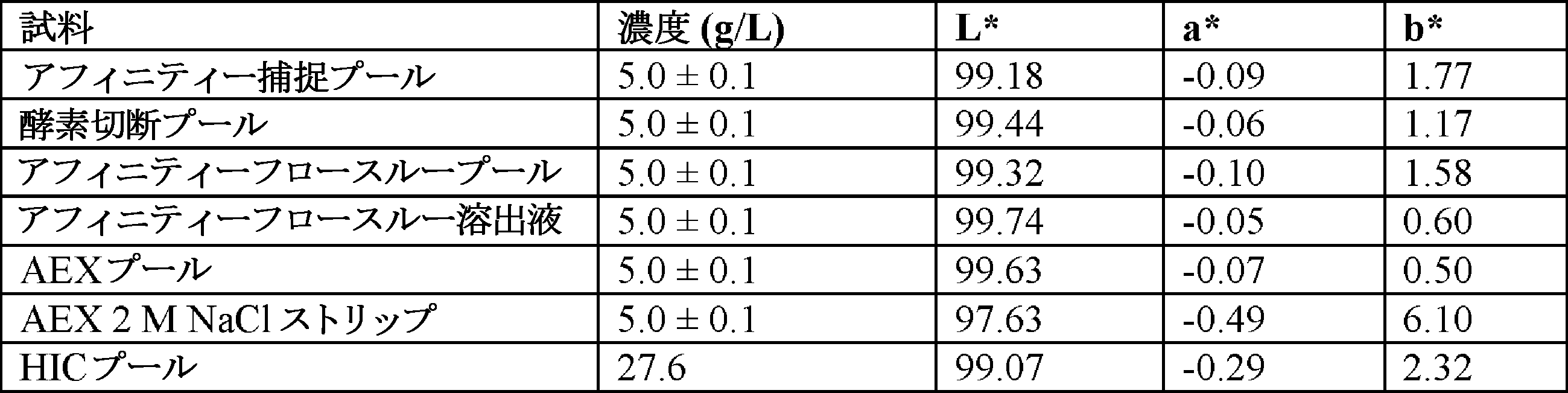
表9-2及び表9-3と比較すると、「低システイン、低金属、及び抗酸化剤を増加したバイオリアクタの条件」は、「対照バイオリアクタの条件」(2.52のb*値)と比較して、アフィニティー捕捉プール(1.77のb*値)について色が弱かった。 Comparing Tables 9-2 and 9-3, the "low cysteine, low metal, and increased antioxidant bioreactor condition" had less color for the affinity capture pool (b * value of 1.77) compared to the "control bioreactor condition" (b * value of 2.52).
160g/Lの濃度を有するMT試料は、表9-2及び表9-3に列挙される工程を使用してMTを形成する場合には、「低システイン、低金属、及び抗酸化剤を増加したバイオリアクタの条件」については13.45のb*値、「対照バイオリアクタの条件」については17.45のb*値を有すると予測される。上流培地及びフィードを最適化することにより、色に関して23%の低減が得られる。同様に、110g/Lの濃度を有するMT試料は、表9-2及び表9-3に列挙される工程を使用してMTを形成する場合には、「低システイン、低金属、及び抗酸化剤を増加したバイオリアクタの条件」については9.25のb*値、「対照バイオリアクタの条件」については12のb*値を有すると予測される。 A MT sample having a concentration of 160 g/L is predicted to have a b* value of 13.45 for the "low cysteine, low metals, and increased antioxidants bioreactor conditions" and a b * value of 17.45 for the "control bioreactor conditions" when the MT is formed using the steps listed in Tables 9-2 and 9-3. A 23% reduction in color is obtained by optimizing the upstream medium and feed. Similarly, a MT sample having a concentration of 110 g/L is predicted to have a b * value of 9.25 for the "low cysteine, low metals, and increased antioxidants bioreactor conditions" and a b * value of 12 for the "control bioreactor conditions" when the MT is formed using the steps listed in Tables 9-2 and 9-3.
各生成ユニット操作が色低減にどれくらい寄与しているかを理解するため、各生成プロセス中間体のb*値を、アフィニティー捕捉プールの色に対する割合として、計算した(表9-4)。 To understand how much each production unit operation contributed to the color reduction, the b * value of each production process intermediate was calculated as a percentage of the color of the affinity capture pool (Table 9-4).
(表9-4)
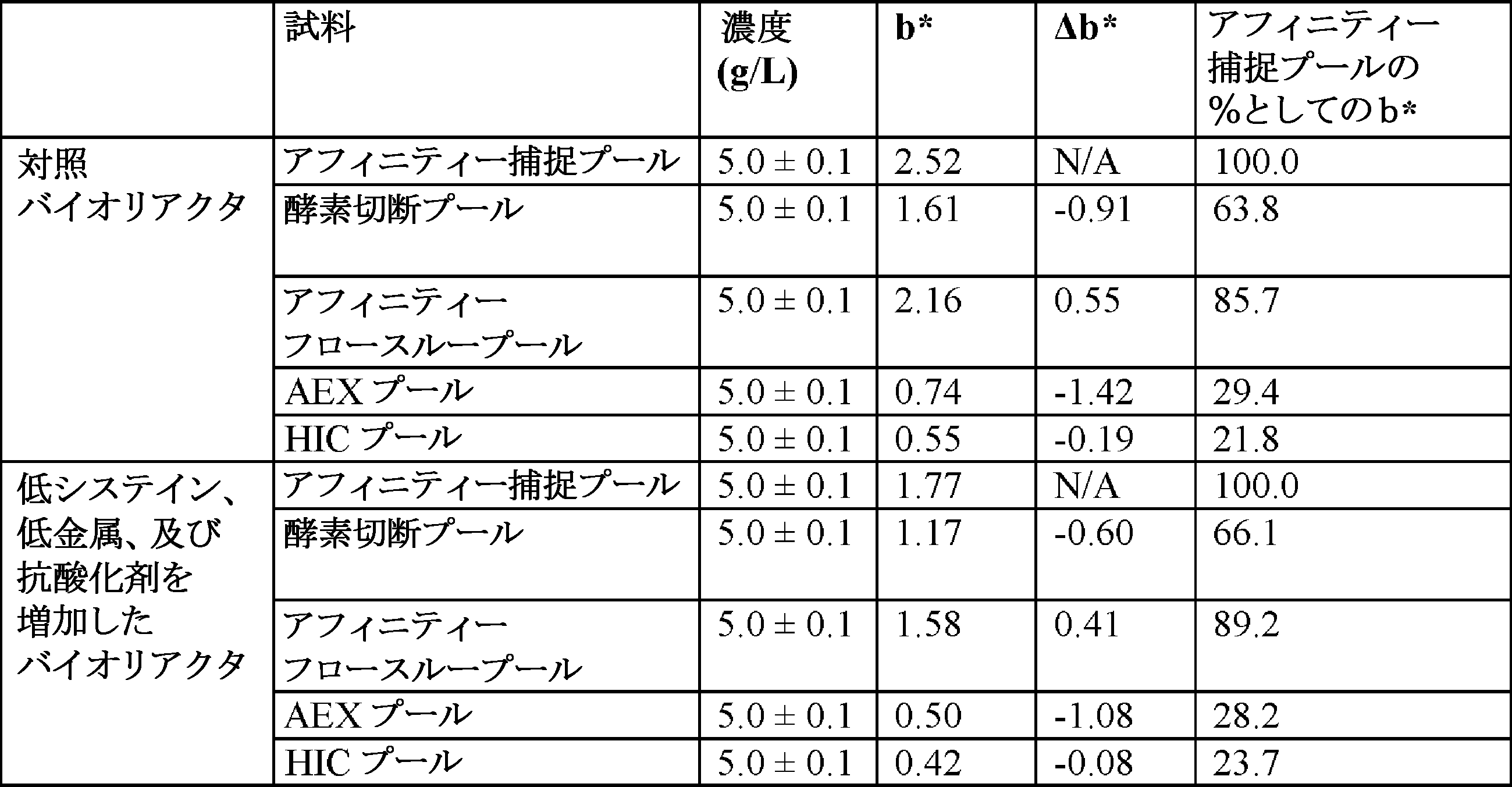
AEXユニット操作は、最も大きな色低減をもたらす(b*に関して1.08~1.42の変化)。一方、HICユニット操作は追加のいくらの色低減をもたらす(b*に関して0.08~0.19の変化)。評価したユニット操作は全体的に、アフィニティー捕捉プールに存在する色の76.3%~78.2%を取り除いた。 The AEX unit operation provided the greatest color reduction (a change in b * of 1.08 to 1.42), while the HIC unit operation provided some additional color reduction (a change in b * of 0.08 to 0.19). Overall, the unit operations evaluated removed 76.3% to 78.2% of the color present in the affinity capture pool.
プロテアーゼ消化により生成されたオリゴペプチド中の2-オキソ-ヒスチジンの割合及びオキソ-トリプトファンの割合について、表9-5及び表9-6にそれぞれ示されるように質量分析により測定することで、「対照バイオリアクタの条件」及び「低システイン、低金属、及び抗酸化剤を増加したバイオリアクタの条件」に関する様々な生成プロセス中間体の色もまた調査した。実施例3に述べられるように、ペプチドマッピングを実施した。 The color of various production process intermediates for the "control bioreactor conditions" and "low cysteine, low metal, and increased antioxidant bioreactor conditions" was also investigated by measuring the percentage of 2-oxo-histidine and oxo-tryptophan in the oligopeptides produced by protease digestion by mass spectrometry as shown in Tables 9-5 and 9-6, respectively. Peptide mapping was performed as described in Example 3.
表9-5を参照すると、異なる生成工程中のプールにおけるヒスチジン酸化レベルを比較した場合、形成されたMTに関するヒスチジン酸化レベルの割合の相対的な存在量は、生成プロセスが進行するにつれてプール中で減少することが明らかである。例えば、「対照バイオリアクタの条件」中のH209については、ヒスチジン酸化レベルのパーセントは酵素的切断プールについては0.062であり、これはAEXフロースルーについては0.029に減少し、HICプールについては更に0.020に減少した。同様に、「低システイン、低金属、及び抗酸化剤を増加したバイオリアクタの条件」中のH209については、ヒスチジン酸化レベルのパーセントは酵素的切断プールについては0.039であり、これはAEXフロースルーについては0.023に減少し、HICプールについては更に0.016に減少した。したがって、生成方法により、MT中のヒスチジン酸化レベルの割合に減少がもたらされた。呈色が低減するにつれ、試料中の一部の酸化残基の存在もまた低減した。ヒスチジン酸化と同様に、「対照バイオリアクタの条件」及び「低システイン、低金属、及び抗酸化剤を増加したバイオリアクタの条件」の両方について、異なる生成工程におけるプールに関するトリプトファン酸化レベルもまた追跡調査した(表9-6)。 With reference to Table 9-5, when comparing the histidine oxidation levels in the pools during the different production steps, it is clear that the relative abundance of the percentage of histidine oxidation levels for the MT formed decreases in the pools as the production process progresses. For example, for H209 in the "control bioreactor conditions", the percentage of histidine oxidation level was 0.062 for the enzymatic cleavage pool, which decreased to 0.029 for the AEX flow-through and further decreased to 0.020 for the HIC pool. Similarly, for H209 in the "low cysteine, low metal, and increased antioxidant bioreactor conditions", the percentage of histidine oxidation level was 0.039 for the enzymatic cleavage pool, which decreased to 0.023 for the AEX flow-through and further decreased to 0.016 for the HIC pool. Thus, the production method resulted in a decrease in the percentage of histidine oxidation levels in the MT. As the coloration decreased, the presence of some oxidized residues in the sample also decreased. Similar to histidine oxidation, tryptophan oxidation levels were also tracked for pools in different production steps in both "control bioreactor conditions" and "low cysteine, low metal, and increased antioxidant bioreactor conditions" (Table 9-6).
(表9-5)
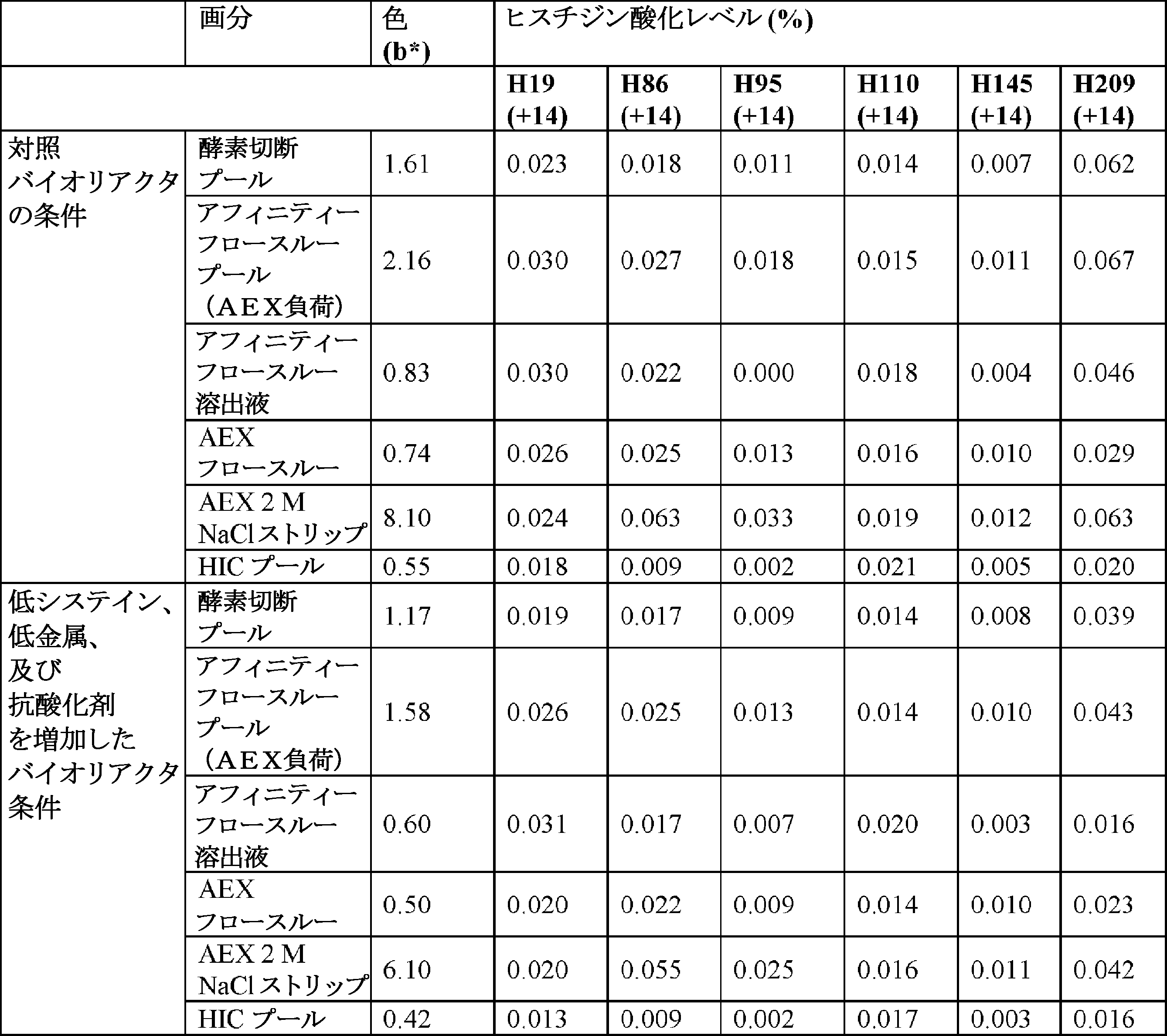
(表9-6)
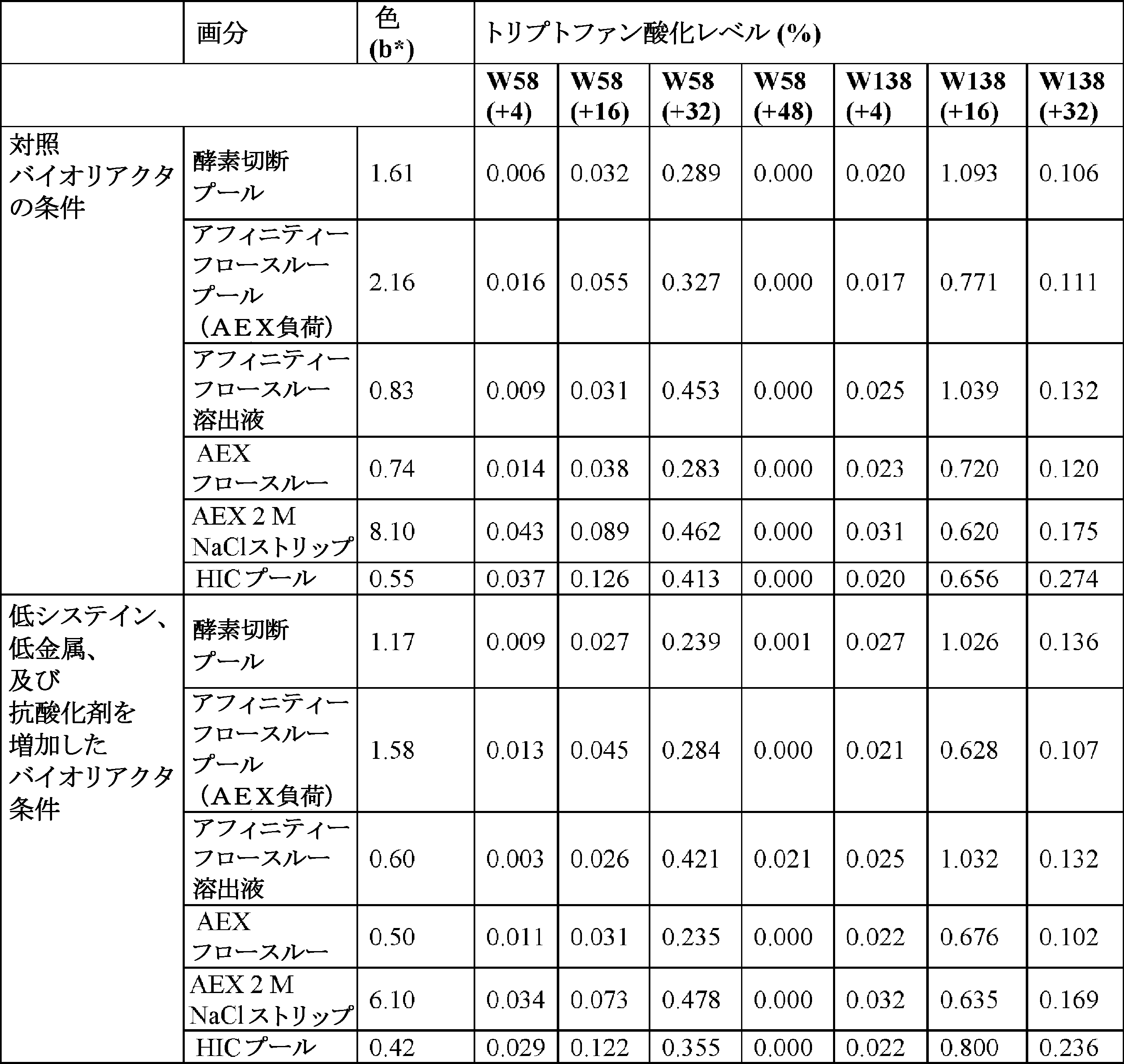
配列情報
SEQUENCE LISTING
<110> REGENERON PHARMACEUTICALS, INC.
<120> ANTI-VEGF PROTEIN COMPOSITIONS AND METHODS FOR PRODUCING THE SAME
<150> US 62/944,635
<151> 2019-12-06
<150> US 63/065,012
<151> 2020-08-13
<160> 124
<170> PatentIn version 3.5
<210> 1
<211> 339
<212> PRT
<213> Artificial Sequence
<220>
<223> Description of Artificial Sequence: Synthetic
polypeptide
<400> 1
Met Arg Lys Arg Cys Tyr Ser Thr Ser Ala Ala Val Leu Ala Ala Val
1 5 10 15
Thr Leu Phe Val Leu Ser Val Asp Arg Gly Val Ile Ala Asp Ser Phe
20 25 30
Ser Ala Asn Gln Glu Ile Arg Tyr Ser Glu Val Thr Pro Tyr His Val
35 40 45
Thr Ser Val Trp Thr Lys Gly Val Thr Pro Pro Ala Asn Phe Thr Gln
50 55 60
Gly Glu Asp Val Phe His Ala Pro Tyr Val Ala Asn Gln Gly Trp Tyr
65 70 75 80
Asp Ile Thr Lys Thr Phe Asn Gly Lys Asp Asp Leu Leu Cys Gly Ala
85 90 95
Ala Thr Ala Gly Asn Met Leu His Trp Trp Phe Asp Gln Asn Lys Asp
100 105 110
Gln Ile Lys Arg Tyr Leu Glu Glu His Pro Glu Lys Gln Lys Ile Asn
115 120 125
Phe Asn Gly Glu Gln Met Phe Asp Val Lys Glu Ala Ile Asp Thr Lys
130 135 140
Asn His Gln Leu Asp Ser Lys Leu Phe Glu Tyr Phe Lys Glu Lys Ala
145 150 155 160
Phe Pro Tyr Leu Ser Thr Lys His Leu Gly Val Phe Pro Asp His Val
165 170 175
Ile Asp Met Phe Ile Asn Gly Tyr Arg Leu Ser Leu Thr Asn His Gly
180 185 190
Pro Thr Pro Val Lys Glu Gly Ser Lys Asp Pro Arg Gly Gly Ile Phe
195 200 205
Asp Ala Val Phe Thr Arg Gly Asp Gln Ser Lys Leu Leu Thr Ser Arg
210 215 220
His Asp Phe Lys Glu Lys Asn Leu Lys Glu Ile Ser Asp Leu Ile Lys
225 230 235 240
Lys Glu Leu Thr Glu Gly Lys Ala Leu Gly Leu Ser His Thr Tyr Ala
245 250 255
Asn Val Arg Ile Asn His Val Ile Asn Leu Trp Gly Ala Asp Phe Asp
260 265 270
Ser Asn Gly Asn Leu Lys Ala Ile Tyr Val Thr Asp Ser Asp Ser Asn
275 280 285
Ala Ser Ile Gly Met Lys Lys Tyr Phe Val Gly Val Asn Ser Ala Gly
290 295 300
Lys Val Ala Ile Ser Ala Lys Glu Ile Lys Glu Asp Asn Ile Gly Ala
305 310 315 320
Gln Val Leu Gly Leu Phe Thr Leu Ser Thr Gly Gln Asp Ser Trp Asn
325 330 335
Gln Thr Asn
<210> 2
<211> 339
<212> PRT
<213> Artificial Sequence
<220>
<223> Description of Artificial Sequence: Synthetic
polypeptide
<400> 2
Met Arg Lys Arg Cys Tyr Ser Thr Ser Ala Ala Val Leu Ala Ala Val
1 5 10 15
Thr Leu Phe Val Leu Ser Val Asp Arg Gly Val Ile Ala Asp Ser Phe
20 25 30
Ser Ala Asn Gln Glu Ile Arg Tyr Ser Glu Val Thr Pro Tyr His Val
35 40 45
Thr Ser Val Trp Thr Lys Gly Val Thr Pro Pro Ala Asn Phe Thr Gln
50 55 60
Gly Glu Asp Val Phe His Ala Pro Tyr Val Ala Asn Gln Gly Trp Tyr
65 70 75 80
Asp Ile Thr Lys Thr Phe Asp Gly Lys Asp Asp Leu Leu Cys Gly Ala
85 90 95
Ala Thr Ala Gly Asn Met Leu His Trp Trp Phe Asp Gln Asn Lys Asp
100 105 110
Gln Ile Lys Arg Tyr Leu Glu Glu His Pro Glu Lys Gln Lys Ile Asn
115 120 125
Phe Asn Gly Glu Gln Met Phe Asp Val Lys Glu Ala Ile Asp Thr Lys
130 135 140
Asn His Gln Leu Asp Ser Lys Leu Phe Glu Tyr Phe Lys Glu Lys Ala
145 150 155 160
Phe Pro Tyr Leu Ser Thr Lys His Leu Gly Val Phe Pro Asp His Val
165 170 175
Ile Asp Met Phe Ile Asn Gly Tyr Arg Leu Ser Leu Thr Asn His Gly
180 185 190
Pro Thr Pro Val Lys Glu Gly Ser Lys Asp Pro Arg Gly Gly Ile Phe
195 200 205
Asp Ala Val Phe Thr Arg Gly Asp Gln Ser Lys Leu Leu Thr Ser Arg
210 215 220
His Asp Phe Lys Glu Lys Asn Leu Lys Glu Ile Ser Asp Leu Ile Lys
225 230 235 240
Lys Glu Leu Thr Glu Gly Lys Ala Leu Gly Leu Ser His Thr Tyr Ala
245 250 255
Asn Val Arg Ile Asn His Val Ile Asn Leu Trp Gly Ala Asp Phe Asp
260 265 270
Ser Asn Gly Asn Leu Lys Ala Ile Tyr Val Thr Asp Ser Asp Ser Asn
275 280 285
Ala Ser Ile Gly Met Lys Lys Tyr Phe Val Gly Val Asn Ser Ala Gly
290 295 300
Lys Val Ala Ile Ser Ala Lys Glu Ile Lys Glu Asp Asn Ile Gly Ala
305 310 315 320
Gln Val Leu Gly Leu Phe Thr Leu Ser Thr Gly Gln Asp Ser Trp Asn
325 330 335
Gln Thr Asn
<210> 3
<211> 339
<212> PRT
<213> Artificial Sequence
<220>
<223> Description of Artificial Sequence: Synthetic
polypeptide
<400> 3
Met Arg Lys Arg Cys Tyr Ser Thr Ser Ala Ala Val Leu Ala Ala Val
1 5 10 15
Thr Leu Phe Val Leu Ser Val Asp Arg Gly Val Ile Ala Asp Ser Phe
20 25 30
Ser Ala Asn Gln Glu Ile Arg Tyr Ser Glu Val Thr Pro Tyr His Val
35 40 45
Thr Ser Val Trp Thr Lys Gly Val Thr Pro Pro Ala Asn Phe Thr Gln
50 55 60
Gly Glu Asp Val Phe His Ala Pro Tyr Val Ala Asn Gln Gly Trp Tyr
65 70 75 80
Asp Ile Thr Lys Thr Phe Asn Gly Lys Asp Asp Leu Leu Cys Gly Ala
85 90 95
Ala Thr Ala Gly Asn Met Leu His Trp Trp Phe Asp Gln Asn Lys Asp
100 105 110
Gln Ile Lys Arg Tyr Leu Glu Glu His Pro Glu Lys Gln Lys Ile Asn
115 120 125
Phe Arg Gly Glu Gln Met Phe Asp Val Lys Glu Ala Ile Asp Thr Lys
130 135 140
Asn His Gln Leu Asp Ser Lys Leu Phe Glu Tyr Phe Lys Glu Lys Ala
145 150 155 160
Phe Pro Tyr Leu Ser Thr Lys His Leu Gly Val Phe Pro Asp His Val
165 170 175
Ile Asp Met Phe Ile Asn Gly Tyr Arg Leu Ser Leu Thr Asn His Gly
180 185 190
Pro Thr Pro Val Lys Glu Gly Ser Lys Asp Pro Arg Gly Gly Ile Phe
195 200 205
Asp Ala Val Phe Thr Arg Gly Asp Gln Ser Lys Leu Leu Thr Ser Arg
210 215 220
His Asp Phe Lys Glu Lys Asn Leu Lys Glu Ile Ser Asp Leu Ile Lys
225 230 235 240
Lys Glu Leu Thr Glu Gly Lys Ala Leu Gly Leu Ser His Thr Tyr Ala
245 250 255
Asn Val Arg Ile Asn His Val Ile Asn Leu Trp Gly Ala Asp Phe Asp
260 265 270
Ser Asn Gly Asn Leu Lys Ala Ile Tyr Val Thr Asp Ser Asp Ser Asn
275 280 285
Ala Ser Ile Gly Met Lys Lys Tyr Phe Val Gly Val Asn Ser Ala Gly
290 295 300
Lys Val Ala Ile Ser Ala Lys Glu Ile Lys Glu Asp Asn Ile Gly Ala
305 310 315 320
Gln Val Leu Gly Leu Phe Thr Leu Ser Thr Gly Gln Asp Ser Trp Asn
325 330 335
Gln Thr Asn
<210> 4
<211> 339
<212> PRT
<213> Artificial Sequence
<220>
<223> Description of Artificial Sequence: Synthetic
polypeptide
<400> 4
Met Arg Lys Arg Cys Tyr Ser Thr Ser Ala Ala Val Leu Ala Ala Val
1 5 10 15
Thr Leu Phe Val Leu Ser Val Asp Arg Gly Val Ile Ala Asp Ser Phe
20 25 30
Ser Ala Asn Gln Glu Ile Arg Tyr Ser Glu Val Thr Pro Tyr His Val
35 40 45
Thr Ser Val Trp Thr Lys Gly Val Thr Pro Pro Ala Asn Phe Thr Gln
50 55 60
Gly Glu Asp Val Phe His Ala Pro Tyr Val Ala Asn Gln Gly Trp Tyr
65 70 75 80
Asp Ile Thr Lys Thr Phe Asn Gly Lys Asp Asp Leu Leu Cys Gly Ala
85 90 95
Ala Thr Ala Gly Asn Met Leu His Trp Trp Phe Asp Gln Asn Lys Asp
100 105 110
Gln Ile Lys Arg Tyr Leu Glu Glu His Pro Glu Lys Gln Lys Ile Asn
115 120 125
Phe Asn Gly Glu Gln Met Phe Asp Val Lys Glu Ala Ile Asp Thr Lys
130 135 140
Asn His Gln Leu Asp Ser Lys Leu Phe Glu Tyr Phe Lys Glu Lys Ala
145 150 155 160
Phe Pro Tyr Leu Ser Thr Lys His Leu Gly Val Phe Pro Asp His Val
165 170 175
Ile Asp Met Phe Ile Leu Gly Tyr Arg Leu Ser Leu Thr Asn His Gly
180 185 190
Pro Thr Pro Val Lys Glu Gly Ser Lys Asp Pro Arg Gly Gly Ile Phe
195 200 205
Asp Ala Val Phe Thr Arg Gly Asp Gln Ser Lys Leu Leu Thr Ser Arg
210 215 220
His Asp Phe Lys Glu Lys Asn Leu Lys Glu Ile Ser Asp Leu Ile Lys
225 230 235 240
Lys Glu Leu Thr Glu Gly Lys Ala Leu Gly Leu Ser His Thr Tyr Ala
245 250 255
Asn Val Arg Ile Asn His Val Ile Asn Leu Trp Gly Ala Asp Phe Asp
260 265 270
Ser Asn Gly Asn Leu Lys Ala Ile Tyr Val Thr Asp Ser Asp Ser Asn
275 280 285
Ala Ser Ile Gly Met Lys Lys Tyr Phe Val Gly Val Asn Ser Ala Gly
290 295 300
Lys Val Ala Ile Ser Ala Lys Glu Ile Lys Glu Asp Asn Ile Gly Ala
305 310 315 320
Gln Val Leu Gly Leu Phe Thr Leu Ser Thr Gly Gln Asp Ser Trp Asn
325 330 335
Gln Thr Asn
<210> 5
<211> 339
<212> PRT
<213> Artificial Sequence
<220>
<223> Description of Artificial Sequence: Synthetic
polypeptide
<400> 5
Met Arg Lys Arg Cys Tyr Ser Thr Ser Ala Ala Val Leu Ala Ala Val
1 5 10 15
Thr Leu Phe Val Leu Ser Val Asp Arg Gly Val Ile Ala Asp Ser Phe
20 25 30
Ser Ala Asn Gln Glu Ile Arg Tyr Ser Glu Val Thr Pro Tyr His Val
35 40 45
Thr Ser Val Trp Thr Lys Gly Val Thr Pro Pro Ala Asn Phe Thr Gln
50 55 60
Gly Glu Asp Val Phe His Ala Pro Tyr Val Ala Asn Gln Gly Trp Tyr
65 70 75 80
Asp Ile Thr Lys Thr Phe Asn Gly Lys Asp Asp Leu Leu Cys Gly Ala
85 90 95
Ala Thr Ala Gly Asn Met Leu His Trp Trp Phe Asp Gln Asn Lys Asp
100 105 110
Gln Ile Lys Arg Tyr Leu Glu Glu His Pro Glu Lys Gln Lys Ile Asn
115 120 125
Phe Asn Gly Glu Gln Met Phe Asp Val Lys Glu Ala Ile Asp Thr Lys
130 135 140
Asn His Gln Leu Asp Ser Lys Leu Phe Glu Tyr Phe Lys Glu Lys Ala
145 150 155 160
Phe Pro Tyr Leu Ser Thr Lys His Leu Gly Val Phe Pro Asp His Val
165 170 175
Ile Asp Met Phe Ile Asn Gly Tyr Arg Leu Ser Leu Thr Asn His Gly
180 185 190
Pro Thr Pro Val Lys Glu Gly Ser Lys Asp Pro Arg Gly Gly Ile Phe
195 200 205
Asp Ala Val Phe Thr Arg Gly Asp Gln Ser Lys Leu Leu Thr Ser Arg
210 215 220
His Asp Phe Lys Glu Lys Asn Leu Lys Glu Ile Ser Asp Leu Ile Lys
225 230 235 240
Lys Glu Leu Thr Glu Gly Lys Ala Leu Gly Leu Ser His Thr Tyr Ala
245 250 255
Asn Val Arg Ile Asn His Val Ile Asn Leu Trp Gly Ala Asp Phe Asp
260 265 270
Ser Asp Gly Asn Leu Lys Ala Ile Tyr Val Thr Asp Ser Asp Ser Asn
275 280 285
Ala Ser Ile Gly Met Lys Lys Tyr Phe Val Gly Val Asn Ser Ala Gly
290 295 300
Lys Val Ala Ile Ser Ala Lys Glu Ile Lys Glu Asp Asn Ile Gly Ala
305 310 315 320
Gln Val Leu Gly Leu Phe Thr Leu Ser Thr Gly Gln Asp Ser Trp Asn
325 330 335
Gln Thr Asn
<210> 6
<211> 339
<212> PRT
<213> Artificial Sequence
<220>
<223> Description of Artificial Sequence: Synthetic
polypeptide
<400> 6
Met Arg Lys Arg Cys Tyr Ser Thr Ser Ala Ala Val Leu Ala Ala Val
1 5 10 15
Thr Leu Phe Val Leu Ser Val Asp Arg Gly Val Ile Ala Asp Ser Phe
20 25 30
Ser Ala Asn Gln Glu Ile Arg Tyr Ser Glu Val Thr Pro Tyr His Val
35 40 45
Thr Ser Val Trp Thr Lys Gly Val Thr Pro Pro Ala Asn Phe Thr Gln
50 55 60
Gly Glu Asp Val Phe His Ala Pro Tyr Val Ala Asn Gln Gly Trp Tyr
65 70 75 80
Asp Ile Thr Lys Thr Phe Asp Gly Lys Asp Asp Leu Leu Cys Gly Ala
85 90 95
Ala Thr Ala Gly Asn Met Leu His Trp Trp Phe Asp Gln Asn Lys Asp
100 105 110
Gln Ile Lys Arg Tyr Leu Glu Glu His Pro Glu Lys Gln Lys Ile Asn
115 120 125
Phe Arg Gly Glu Gln Met Phe Asp Val Lys Glu Ala Ile Asp Thr Lys
130 135 140
Asn His Gln Leu Asp Ser Lys Leu Phe Glu Tyr Phe Lys Glu Lys Ala
145 150 155 160
Phe Pro Tyr Leu Ser Thr Lys His Leu Gly Val Phe Pro Asp His Val
165 170 175
Ile Asp Met Phe Ile Asn Gly Tyr Arg Leu Ser Leu Thr Asn His Gly
180 185 190
Pro Thr Pro Val Lys Glu Gly Ser Lys Asp Pro Arg Gly Gly Ile Phe
195 200 205
Asp Ala Val Phe Thr Arg Gly Asp Gln Ser Lys Leu Leu Thr Ser Arg
210 215 220
His Asp Phe Lys Glu Lys Asn Leu Lys Glu Ile Ser Asp Leu Ile Lys
225 230 235 240
Lys Glu Leu Thr Glu Gly Lys Ala Leu Gly Leu Ser His Thr Tyr Ala
245 250 255
Asn Val Arg Ile Asn His Val Ile Asn Leu Trp Gly Ala Asp Phe Asp
260 265 270
Ser Asn Gly Asn Leu Lys Ala Ile Tyr Val Thr Asp Ser Asp Ser Asn
275 280 285
Ala Ser Ile Gly Met Lys Lys Tyr Phe Val Gly Val Asn Ser Ala Gly
290 295 300
Lys Val Ala Ile Ser Ala Lys Glu Ile Lys Glu Asp Asn Ile Gly Ala
305 310 315 320
Gln Val Leu Gly Leu Phe Thr Leu Ser Thr Gly Gln Asp Ser Trp Asn
325 330 335
Gln Thr Asn
<210> 7
<211> 339
<212> PRT
<213> Artificial Sequence
<220>
<223> Description of Artificial Sequence: Synthetic
polypeptide
<400> 7
Met Arg Lys Arg Cys Tyr Ser Thr Ser Ala Ala Val Leu Ala Ala Val
1 5 10 15
Thr Leu Phe Val Leu Ser Val Asp Arg Gly Val Ile Ala Asp Ser Phe
20 25 30
Ser Ala Asn Gln Glu Ile Arg Tyr Ser Glu Val Thr Pro Tyr His Val
35 40 45
Thr Ser Val Trp Thr Lys Gly Val Thr Pro Pro Ala Asn Phe Thr Gln
50 55 60
Gly Glu Asp Val Phe His Ala Pro Tyr Val Ala Asn Gln Gly Trp Tyr
65 70 75 80
Asp Ile Thr Lys Thr Phe Asp Gly Lys Asp Asp Leu Leu Cys Gly Ala
85 90 95
Ala Thr Ala Gly Asn Met Leu His Trp Trp Phe Asp Gln Asn Lys Asp
100 105 110
Gln Ile Lys Arg Tyr Leu Glu Glu His Pro Glu Lys Gln Lys Ile Asn
115 120 125
Phe Asn Gly Glu Gln Met Phe Asp Val Lys Glu Ala Ile Asp Thr Lys
130 135 140
Asn His Gln Leu Asp Ser Lys Leu Phe Glu Tyr Phe Lys Glu Lys Ala
145 150 155 160
Phe Pro Tyr Leu Ser Thr Lys His Leu Gly Val Phe Pro Asp His Val
165 170 175
Ile Asp Met Phe Ile Leu Gly Tyr Arg Leu Ser Leu Thr Asn His Gly
180 185 190
Pro Thr Pro Val Lys Glu Gly Ser Lys Asp Pro Arg Gly Gly Ile Phe
195 200 205
Asp Ala Val Phe Thr Arg Gly Asp Gln Ser Lys Leu Leu Thr Ser Arg
210 215 220
His Asp Phe Lys Glu Lys Asn Leu Lys Glu Ile Ser Asp Leu Ile Lys
225 230 235 240
Lys Glu Leu Thr Glu Gly Lys Ala Leu Gly Leu Ser His Thr Tyr Ala
245 250 255
Asn Val Arg Ile Asn His Val Ile Asn Leu Trp Gly Ala Asp Phe Asp
260 265 270
Ser Asn Gly Asn Leu Lys Ala Ile Tyr Val Thr Asp Ser Asp Ser Asn
275 280 285
Ala Ser Ile Gly Met Lys Lys Tyr Phe Val Gly Val Asn Ser Ala Gly
290 295 300
Lys Val Ala Ile Ser Ala Lys Glu Ile Lys Glu Asp Asn Ile Gly Ala
305 310 315 320
Gln Val Leu Gly Leu Phe Thr Leu Ser Thr Gly Gln Asp Ser Trp Asn
325 330 335
Gln Thr Asn
<210> 8
<211> 339
<212> PRT
<213> Artificial Sequence
<220>
<223> Description of Artificial Sequence: Synthetic
polypeptide
<400> 8
Met Arg Lys Arg Cys Tyr Ser Thr Ser Ala Ala Val Leu Ala Ala Val
1 5 10 15
Thr Leu Phe Val Leu Ser Val Asp Arg Gly Val Ile Ala Asp Ser Phe
20 25 30
Ser Ala Asn Gln Glu Ile Arg Tyr Ser Glu Val Thr Pro Tyr His Val
35 40 45
Thr Ser Val Trp Thr Lys Gly Val Thr Pro Pro Ala Asn Phe Thr Gln
50 55 60
Gly Glu Asp Val Phe His Ala Pro Tyr Val Ala Asn Gln Gly Trp Tyr
65 70 75 80
Asp Ile Thr Lys Thr Phe Asp Gly Lys Asp Asp Leu Leu Cys Gly Ala
85 90 95
Ala Thr Ala Gly Asn Met Leu His Trp Trp Phe Asp Gln Asn Lys Asp
100 105 110
Gln Ile Lys Arg Tyr Leu Glu Glu His Pro Glu Lys Gln Lys Ile Asn
115 120 125
Phe Asn Gly Glu Gln Met Phe Asp Val Lys Glu Ala Ile Asp Thr Lys
130 135 140
Asn His Gln Leu Asp Ser Lys Leu Phe Glu Tyr Phe Lys Glu Lys Ala
145 150 155 160
Phe Pro Tyr Leu Ser Thr Lys His Leu Gly Val Phe Pro Asp His Val
165 170 175
Ile Asp Met Phe Ile Asn Gly Tyr Arg Leu Ser Leu Thr Asn His Gly
180 185 190
Pro Thr Pro Val Lys Glu Gly Ser Lys Asp Pro Arg Gly Gly Ile Phe
195 200 205
Asp Ala Val Phe Thr Arg Gly Asp Gln Ser Lys Leu Leu Thr Ser Arg
210 215 220
His Asp Phe Lys Glu Lys Asn Leu Lys Glu Ile Ser Asp Leu Ile Lys
225 230 235 240
Lys Glu Leu Thr Glu Gly Lys Ala Leu Gly Leu Ser His Thr Tyr Ala
245 250 255
Asn Val Arg Ile Asn His Val Ile Asn Leu Trp Gly Ala Asp Phe Asp
260 265 270
Ser Asp Gly Asn Leu Lys Ala Ile Tyr Val Thr Asp Ser Asp Ser Asn
275 280 285
Ala Ser Ile Gly Met Lys Lys Tyr Phe Val Gly Val Asn Ser Ala Gly
290 295 300
Lys Val Ala Ile Ser Ala Lys Glu Ile Lys Glu Asp Asn Ile Gly Ala
305 310 315 320
Gln Val Leu Gly Leu Phe Thr Leu Ser Thr Gly Gln Asp Ser Trp Asn
325 330 335
Gln Thr Asn
<210> 9
<211> 339
<212> PRT
<213> Artificial Sequence
<220>
<223> Description of Artificial Sequence: Synthetic
polypeptide
<400> 9
Met Arg Lys Arg Cys Tyr Ser Thr Ser Ala Ala Val Leu Ala Ala Val
1 5 10 15
Thr Leu Phe Val Leu Ser Val Asp Arg Gly Val Ile Ala Asp Ser Phe
20 25 30
Ser Ala Asn Gln Glu Ile Arg Tyr Ser Glu Val Thr Pro Tyr His Val
35 40 45
Thr Ser Val Trp Thr Lys Gly Val Thr Pro Pro Ala Asn Phe Thr Gln
50 55 60
Gly Glu Asp Val Phe His Ala Pro Tyr Val Ala Asn Gln Gly Trp Tyr
65 70 75 80
Asp Ile Thr Lys Thr Phe Asn Gly Lys Asp Asp Leu Leu Cys Gly Ala
85 90 95
Ala Thr Ala Gly Asn Met Leu His Trp Trp Phe Asp Gln Asn Lys Asp
100 105 110
Gln Ile Lys Arg Tyr Leu Glu Glu His Pro Glu Lys Gln Lys Ile Asn
115 120 125
Phe Arg Gly Glu Gln Met Phe Asp Val Lys Glu Ala Ile Asp Thr Lys
130 135 140
Asn His Gln Leu Asp Ser Lys Leu Phe Glu Tyr Phe Lys Glu Lys Ala
145 150 155 160
Phe Pro Tyr Leu Ser Thr Lys His Leu Gly Val Phe Pro Asp His Val
165 170 175
Ile Asp Met Phe Ile Leu Gly Tyr Arg Leu Ser Leu Thr Asn His Gly
180 185 190
Pro Thr Pro Val Lys Glu Gly Ser Lys Asp Pro Arg Gly Gly Ile Phe
195 200 205
Asp Ala Val Phe Thr Arg Gly Asp Gln Ser Lys Leu Leu Thr Ser Arg
210 215 220
His Asp Phe Lys Glu Lys Asn Leu Lys Glu Ile Ser Asp Leu Ile Lys
225 230 235 240
Lys Glu Leu Thr Glu Gly Lys Ala Leu Gly Leu Ser His Thr Tyr Ala
245 250 255
Asn Val Arg Ile Asn His Val Ile Asn Leu Trp Gly Ala Asp Phe Asp
260 265 270
Ser Asn Gly Asn Leu Lys Ala Ile Tyr Val Thr Asp Ser Asp Ser Asn
275 280 285
Ala Ser Ile Gly Met Lys Lys Tyr Phe Val Gly Val Asn Ser Ala Gly
290 295 300
Lys Val Ala Ile Ser Ala Lys Glu Ile Lys Glu Asp Asn Ile Gly Ala
305 310 315 320
Gln Val Leu Gly Leu Phe Thr Leu Ser Thr Gly Gln Asp Ser Trp Asn
325 330 335
Gln Thr Asn
<210> 10
<211> 339
<212> PRT
<213> Artificial Sequence
<220>
<223> Description of Artificial Sequence: Synthetic
polypeptide
<400> 10
Met Arg Lys Arg Cys Tyr Ser Thr Ser Ala Ala Val Leu Ala Ala Val
1 5 10 15
Thr Leu Phe Val Leu Ser Val Asp Arg Gly Val Ile Ala Asp Ser Phe
20 25 30
Ser Ala Asn Gln Glu Ile Arg Tyr Ser Glu Val Thr Pro Tyr His Val
35 40 45
Thr Ser Val Trp Thr Lys Gly Val Thr Pro Pro Ala Asn Phe Thr Gln
50 55 60
Gly Glu Asp Val Phe His Ala Pro Tyr Val Ala Asn Gln Gly Trp Tyr
65 70 75 80
Asp Ile Thr Lys Thr Phe Asn Gly Lys Asp Asp Leu Leu Cys Gly Ala
85 90 95
Ala Thr Ala Gly Asn Met Leu His Trp Trp Phe Asp Gln Asn Lys Asp
100 105 110
Gln Ile Lys Arg Tyr Leu Glu Glu His Pro Glu Lys Gln Lys Ile Asn
115 120 125
Phe Arg Gly Glu Gln Met Phe Asp Val Lys Glu Ala Ile Asp Thr Lys
130 135 140
Asn His Gln Leu Asp Ser Lys Leu Phe Glu Tyr Phe Lys Glu Lys Ala
145 150 155 160
Phe Pro Tyr Leu Ser Thr Lys His Leu Gly Val Phe Pro Asp His Val
165 170 175
Ile Asp Met Phe Ile Asn Gly Tyr Arg Leu Ser Leu Thr Asn His Gly
180 185 190
Pro Thr Pro Val Lys Glu Gly Ser Lys Asp Pro Arg Gly Gly Ile Phe
195 200 205
Asp Ala Val Phe Thr Arg Gly Asp Gln Ser Lys Leu Leu Thr Ser Arg
210 215 220
His Asp Phe Lys Glu Lys Asn Leu Lys Glu Ile Ser Asp Leu Ile Lys
225 230 235 240
Lys Glu Leu Thr Glu Gly Lys Ala Leu Gly Leu Ser His Thr Tyr Ala
245 250 255
Asn Val Arg Ile Asn His Val Ile Asn Leu Trp Gly Ala Asp Phe Asp
260 265 270
Ser Asp Gly Asn Leu Lys Ala Ile Tyr Val Thr Asp Ser Asp Ser Asn
275 280 285
Ala Ser Ile Gly Met Lys Lys Tyr Phe Val Gly Val Asn Ser Ala Gly
290 295 300
Lys Val Ala Ile Ser Ala Lys Glu Ile Lys Glu Asp Asn Ile Gly Ala
305 310 315 320
Gln Val Leu Gly Leu Phe Thr Leu Ser Thr Gly Gln Asp Ser Trp Asn
325 330 335
Gln Thr Asn
<210> 11
<211> 339
<212> PRT
<213> Artificial Sequence
<220>
<223> Description of Artificial Sequence: Synthetic
polypeptide
<400> 11
Met Arg Lys Arg Cys Tyr Ser Thr Ser Ala Ala Val Leu Ala Ala Val
1 5 10 15
Thr Leu Phe Val Leu Ser Val Asp Arg Gly Val Ile Ala Asp Ser Phe
20 25 30
Ser Ala Asn Gln Glu Ile Arg Tyr Ser Glu Val Thr Pro Tyr His Val
35 40 45
Thr Ser Val Trp Thr Lys Gly Val Thr Pro Pro Ala Asn Phe Thr Gln
50 55 60
Gly Glu Asp Val Phe His Ala Pro Tyr Val Ala Asn Gln Gly Trp Tyr
65 70 75 80
Asp Ile Thr Lys Thr Phe Asn Gly Lys Asp Asp Leu Leu Cys Gly Ala
85 90 95
Ala Thr Ala Gly Asn Met Leu His Trp Trp Phe Asp Gln Asn Lys Asp
100 105 110
Gln Ile Lys Arg Tyr Leu Glu Glu His Pro Glu Lys Gln Lys Ile Asn
115 120 125
Phe Asn Gly Glu Gln Met Phe Asp Val Lys Glu Ala Ile Asp Thr Lys
130 135 140
Asn His Gln Leu Asp Ser Lys Leu Phe Glu Tyr Phe Lys Glu Lys Ala
145 150 155 160
Phe Pro Tyr Leu Ser Thr Lys His Leu Gly Val Phe Pro Asp His Val
165 170 175
Ile Asp Met Phe Ile Leu Gly Tyr Arg Leu Ser Leu Thr Asn His Gly
180 185 190
Pro Thr Pro Val Lys Glu Gly Ser Lys Asp Pro Arg Gly Gly Ile Phe
195 200 205
Asp Ala Val Phe Thr Arg Gly Asp Gln Ser Lys Leu Leu Thr Ser Arg
210 215 220
His Asp Phe Lys Glu Lys Asn Leu Lys Glu Ile Ser Asp Leu Ile Lys
225 230 235 240
Lys Glu Leu Thr Glu Gly Lys Ala Leu Gly Leu Ser His Thr Tyr Ala
245 250 255
Asn Val Arg Ile Asn His Val Ile Asn Leu Trp Gly Ala Asp Phe Asp
260 265 270
Ser Asp Gly Asn Leu Lys Ala Ile Tyr Val Thr Asp Ser Asp Ser Asn
275 280 285
Ala Ser Ile Gly Met Lys Lys Tyr Phe Val Gly Val Asn Ser Ala Gly
290 295 300
Lys Val Ala Ile Ser Ala Lys Glu Ile Lys Glu Asp Asn Ile Gly Ala
305 310 315 320
Gln Val Leu Gly Leu Phe Thr Leu Ser Thr Gly Gln Asp Ser Trp Asn
325 330 335
Gln Thr Asn
<210> 12
<211> 339
<212> PRT
<213> Artificial Sequence
<220>
<223> Description of Artificial Sequence: Synthetic
polypeptide
<400> 12
Met Arg Lys Arg Cys Tyr Ser Thr Ser Ala Ala Val Leu Ala Ala Val
1 5 10 15
Thr Leu Phe Val Leu Ser Val Asp Arg Gly Val Ile Ala Asp Ser Phe
20 25 30
Ser Ala Asn Gln Glu Ile Arg Tyr Ser Glu Val Thr Pro Tyr His Val
35 40 45
Thr Ser Val Trp Thr Lys Gly Val Thr Pro Pro Ala Asn Phe Thr Gln
50 55 60
Gly Glu Asp Val Phe His Ala Pro Tyr Val Ala Asn Gln Gly Trp Tyr
65 70 75 80
Asp Ile Thr Lys Thr Phe Asp Gly Lys Asp Asp Leu Leu Cys Gly Ala
85 90 95
Ala Thr Ala Gly Asn Met Leu His Trp Trp Phe Asp Gln Asn Lys Asp
100 105 110
Gln Ile Lys Arg Tyr Leu Glu Glu His Pro Glu Lys Gln Lys Ile Asn
115 120 125
Phe Arg Gly Glu Gln Met Phe Asp Val Lys Glu Ala Ile Asp Thr Lys
130 135 140
Asn His Gln Leu Asp Ser Lys Leu Phe Glu Tyr Phe Lys Glu Lys Ala
145 150 155 160
Phe Pro Tyr Leu Ser Thr Lys His Leu Gly Val Phe Pro Asp His Val
165 170 175
Ile Asp Met Phe Ile Leu Gly Tyr Arg Leu Ser Leu Thr Asn His Gly
180 185 190
Pro Thr Pro Val Lys Glu Gly Ser Lys Asp Pro Arg Gly Gly Ile Phe
195 200 205
Asp Ala Val Phe Thr Arg Gly Asp Gln Ser Lys Leu Leu Thr Ser Arg
210 215 220
His Asp Phe Lys Glu Lys Asn Leu Lys Glu Ile Ser Asp Leu Ile Lys
225 230 235 240
Lys Glu Leu Thr Glu Gly Lys Ala Leu Gly Leu Ser His Thr Tyr Ala
245 250 255
Asn Val Arg Ile Asn His Val Ile Asn Leu Trp Gly Ala Asp Phe Asp
260 265 270
Ser Asn Gly Asn Leu Lys Ala Ile Tyr Val Thr Asp Ser Asp Ser Asn
275 280 285
Ala Ser Ile Gly Met Lys Lys Tyr Phe Val Gly Val Asn Ser Ala Gly
290 295 300
Lys Val Ala Ile Ser Ala Lys Glu Ile Lys Glu Asp Asn Ile Gly Ala
305 310 315 320
Gln Val Leu Gly Leu Phe Thr Leu Ser Thr Gly Gln Asp Ser Trp Asn
325 330 335
Gln Thr Asn
<210> 13
<211> 339
<212> PRT
<213> Artificial Sequence
<220>
<223> Description of Artificial Sequence: Synthetic
polypeptide
<400> 13
Met Arg Lys Arg Cys Tyr Ser Thr Ser Ala Ala Val Leu Ala Ala Val
1 5 10 15
Thr Leu Phe Val Leu Ser Val Asp Arg Gly Val Ile Ala Asp Ser Phe
20 25 30
Ser Ala Asn Gln Glu Ile Arg Tyr Ser Glu Val Thr Pro Tyr His Val
35 40 45
Thr Ser Val Trp Thr Lys Gly Val Thr Pro Pro Ala Asn Phe Thr Gln
50 55 60
Gly Glu Asp Val Phe His Ala Pro Tyr Val Ala Asn Gln Gly Trp Tyr
65 70 75 80
Asp Ile Thr Lys Thr Phe Asp Gly Lys Asp Asp Leu Leu Cys Gly Ala
85 90 95
Ala Thr Ala Gly Asn Met Leu His Trp Trp Phe Asp Gln Asn Lys Asp
100 105 110
Gln Ile Lys Arg Tyr Leu Glu Glu His Pro Glu Lys Gln Lys Ile Asn
115 120 125
Phe Arg Gly Glu Gln Met Phe Asp Val Lys Glu Ala Ile Asp Thr Lys
130 135 140
Asn His Gln Leu Asp Ser Lys Leu Phe Glu Tyr Phe Lys Glu Lys Ala
145 150 155 160
Phe Pro Tyr Leu Ser Thr Lys His Leu Gly Val Phe Pro Asp His Val
165 170 175
Ile Asp Met Phe Ile Asn Gly Tyr Arg Leu Ser Leu Thr Asn His Gly
180 185 190
Pro Thr Pro Val Lys Glu Gly Ser Lys Asp Pro Arg Gly Gly Ile Phe
195 200 205
Asp Ala Val Phe Thr Arg Gly Asp Gln Ser Lys Leu Leu Thr Ser Arg
210 215 220
His Asp Phe Lys Glu Lys Asn Leu Lys Glu Ile Ser Asp Leu Ile Lys
225 230 235 240
Lys Glu Leu Thr Glu Gly Lys Ala Leu Gly Leu Ser His Thr Tyr Ala
245 250 255
Asn Val Arg Ile Asn His Val Ile Asn Leu Trp Gly Ala Asp Phe Asp
260 265 270
Ser Asp Gly Asn Leu Lys Ala Ile Tyr Val Thr Asp Ser Asp Ser Asn
275 280 285
Ala Ser Ile Gly Met Lys Lys Tyr Phe Val Gly Val Asn Ser Ala Gly
290 295 300
Lys Val Ala Ile Ser Ala Lys Glu Ile Lys Glu Asp Asn Ile Gly Ala
305 310 315 320
Gln Val Leu Gly Leu Phe Thr Leu Ser Thr Gly Gln Asp Ser Trp Asn
325 330 335
Gln Thr Asn
<210> 14
<211> 339
<212> PRT
<213> Artificial Sequence
<220>
<223> Description of Artificial Sequence: Synthetic
polypeptide
<400> 14
Met Arg Lys Arg Cys Tyr Ser Thr Ser Ala Ala Val Leu Ala Ala Val
1 5 10 15
Thr Leu Phe Val Leu Ser Val Asp Arg Gly Val Ile Ala Asp Ser Phe
20 25 30
Ser Ala Asn Gln Glu Ile Arg Tyr Ser Glu Val Thr Pro Tyr His Val
35 40 45
Thr Ser Val Trp Thr Lys Gly Val Thr Pro Pro Ala Asn Phe Thr Gln
50 55 60
Gly Glu Asp Val Phe His Ala Pro Tyr Val Ala Asn Gln Gly Trp Tyr
65 70 75 80
Asp Ile Thr Lys Thr Phe Asp Gly Lys Asp Asp Leu Leu Cys Gly Ala
85 90 95
Ala Thr Ala Gly Asn Met Leu His Trp Trp Phe Asp Gln Asn Lys Asp
100 105 110
Gln Ile Lys Arg Tyr Leu Glu Glu His Pro Glu Lys Gln Lys Ile Asn
115 120 125
Phe Asn Gly Glu Gln Met Phe Asp Val Lys Glu Ala Ile Asp Thr Lys
130 135 140
Asn His Gln Leu Asp Ser Lys Leu Phe Glu Tyr Phe Lys Glu Lys Ala
145 150 155 160
Phe Pro Tyr Leu Ser Thr Lys His Leu Gly Val Phe Pro Asp His Val
165 170 175
Ile Asp Met Phe Ile Leu Gly Tyr Arg Leu Ser Leu Thr Asn His Gly
180 185 190
Pro Thr Pro Val Lys Glu Gly Ser Lys Asp Pro Arg Gly Gly Ile Phe
195 200 205
Asp Ala Val Phe Thr Arg Gly Asp Gln Ser Lys Leu Leu Thr Ser Arg
210 215 220
His Asp Phe Lys Glu Lys Asn Leu Lys Glu Ile Ser Asp Leu Ile Lys
225 230 235 240
Lys Glu Leu Thr Glu Gly Lys Ala Leu Gly Leu Ser His Thr Tyr Ala
245 250 255
Asn Val Arg Ile Asn His Val Ile Asn Leu Trp Gly Ala Asp Phe Asp
260 265 270
Ser Asp Gly Asn Leu Lys Ala Ile Tyr Val Thr Asp Ser Asp Ser Asn
275 280 285
Ala Ser Ile Gly Met Lys Lys Tyr Phe Val Gly Val Asn Ser Ala Gly
290 295 300
Lys Val Ala Ile Ser Ala Lys Glu Ile Lys Glu Asp Asn Ile Gly Ala
305 310 315 320
Gln Val Leu Gly Leu Phe Thr Leu Ser Thr Gly Gln Asp Ser Trp Asn
325 330 335
Gln Thr Asn
<210> 15
<211> 339
<212> PRT
<213> Artificial Sequence
<220>
<223> Description of Artificial Sequence: Synthetic
polypeptide
<400> 15
Met Arg Lys Arg Cys Tyr Ser Thr Ser Ala Ala Val Leu Ala Ala Val
1 5 10 15
Thr Leu Phe Val Leu Ser Val Asp Arg Gly Val Ile Ala Asp Ser Phe
20 25 30
Ser Ala Asn Gln Glu Ile Arg Tyr Ser Glu Val Thr Pro Tyr His Val
35 40 45
Thr Ser Val Trp Thr Lys Gly Val Thr Pro Pro Ala Asn Phe Thr Gln
50 55 60
Gly Glu Asp Val Phe His Ala Pro Tyr Val Ala Asn Gln Gly Trp Tyr
65 70 75 80
Asp Ile Thr Lys Thr Phe Asn Gly Lys Asp Asp Leu Leu Cys Gly Ala
85 90 95
Ala Thr Ala Gly Asn Met Leu His Trp Trp Phe Asp Gln Asn Lys Asp
100 105 110
Gln Ile Lys Arg Tyr Leu Glu Glu His Pro Glu Lys Gln Lys Ile Asn
115 120 125
Phe Arg Gly Glu Gln Met Phe Asp Val Lys Glu Ala Ile Asp Thr Lys
130 135 140
Asn His Gln Leu Asp Ser Lys Leu Phe Glu Tyr Phe Lys Glu Lys Ala
145 150 155 160
Phe Pro Tyr Leu Ser Thr Lys His Leu Gly Val Phe Pro Asp His Val
165 170 175
Ile Asp Met Phe Ile Leu Gly Tyr Arg Leu Ser Leu Thr Asn His Gly
180 185 190
Pro Thr Pro Val Lys Glu Gly Ser Lys Asp Pro Arg Gly Gly Ile Phe
195 200 205
Asp Ala Val Phe Thr Arg Gly Asp Gln Ser Lys Leu Leu Thr Ser Arg
210 215 220
His Asp Phe Lys Glu Lys Asn Leu Lys Glu Ile Ser Asp Leu Ile Lys
225 230 235 240
Lys Glu Leu Thr Glu Gly Lys Ala Leu Gly Leu Ser His Thr Tyr Ala
245 250 255
Asn Val Arg Ile Asn His Val Ile Asn Leu Trp Gly Ala Asp Phe Asp
260 265 270
Ser Asp Gly Asn Leu Lys Ala Ile Tyr Val Thr Asp Ser Asp Ser Asn
275 280 285
Ala Ser Ile Gly Met Lys Lys Tyr Phe Val Gly Val Asn Ser Ala Gly
290 295 300
Lys Val Ala Ile Ser Ala Lys Glu Ile Lys Glu Asp Asn Ile Gly Ala
305 310 315 320
Gln Val Leu Gly Leu Phe Thr Leu Ser Thr Gly Gln Asp Ser Trp Asn
325 330 335
Gln Thr Asn
<210> 16
<211> 339
<212> PRT
<213> Artificial Sequence
<220>
<223> Description of Artificial Sequence: Synthetic
polypeptide
<400> 16
Met Arg Lys Arg Cys Tyr Ser Thr Ser Ala Ala Val Leu Ala Ala Val
1 5 10 15
Thr Leu Phe Val Leu Ser Val Asp Arg Gly Val Ile Ala Asp Ser Phe
20 25 30
Ser Ala Asn Gln Glu Ile Arg Tyr Ser Glu Val Thr Pro Tyr His Val
35 40 45
Thr Ser Val Trp Thr Lys Gly Val Thr Pro Pro Ala Asn Phe Thr Gln
50 55 60
Gly Glu Asp Val Phe His Ala Pro Tyr Val Ala Asn Gln Gly Trp Tyr
65 70 75 80
Asp Ile Thr Lys Thr Phe Asp Gly Lys Asp Asp Leu Leu Cys Gly Ala
85 90 95
Ala Thr Ala Gly Asn Met Leu His Trp Trp Phe Asp Gln Asn Lys Asp
100 105 110
Gln Ile Lys Arg Tyr Leu Glu Glu His Pro Glu Lys Gln Lys Ile Asn
115 120 125
Phe Arg Gly Glu Gln Met Phe Asp Val Lys Glu Ala Ile Asp Thr Lys
130 135 140
Asn His Gln Leu Asp Ser Lys Leu Phe Glu Tyr Phe Lys Glu Lys Ala
145 150 155 160
Phe Pro Tyr Leu Ser Thr Lys His Leu Gly Val Phe Pro Asp His Val
165 170 175
Ile Asp Met Phe Ile Leu Gly Tyr Arg Leu Ser Leu Thr Asn His Gly
180 185 190
Pro Thr Pro Val Lys Glu Gly Ser Lys Asp Pro Arg Gly Gly Ile Phe
195 200 205
Asp Ala Val Phe Thr Arg Gly Asp Gln Ser Lys Leu Leu Thr Ser Arg
210 215 220
His Asp Phe Lys Glu Lys Asn Leu Lys Glu Ile Ser Asp Leu Ile Lys
225 230 235 240
Lys Glu Leu Thr Glu Gly Lys Ala Leu Gly Leu Ser His Thr Tyr Ala
245 250 255
Asn Val Arg Ile Asn His Val Ile Asn Leu Trp Gly Ala Asp Phe Asp
260 265 270
Ser Asp Gly Asn Leu Lys Ala Ile Tyr Val Thr Asp Ser Asp Ser Asn
275 280 285
Ala Ser Ile Gly Met Lys Lys Tyr Phe Val Gly Val Asn Ser Ala Gly
290 295 300
Lys Val Ala Ile Ser Ala Lys Glu Ile Lys Glu Asp Asn Ile Gly Ala
305 310 315 320
Gln Val Leu Gly Leu Phe Thr Leu Ser Thr Gly Gln Asp Ser Trp Asn
325 330 335
Gln Thr Asn
<210> 17
<211> 16
<212> PRT
<213> Artificial Sequence
<220>
<223> Description of Artificial Sequence: Synthetic
peptide
<220>
<221> MISC_FEATURE
<222> (4)..(4)
<223> May be oxidized
<220>
<221> MISC_FEATURE
<222> (6)..(6)
<223> May be carboxymethylated
<220>
<221> MISC_FEATURE
<222> (9)..(9)
<223> May be carboxymethylated
<400> 17
Asp Lys Thr His Thr Cys Pro Pro Cys Pro Ala Pro Glu Leu Leu Gly
1 5 10 15
<210> 18
<211> 17
<212> PRT
<213> Artificial Sequence
<220>
<223> Description of Artificial Sequence: Synthetic
peptide
<220>
<221> MISC_FEATURE
<222> (7)..(7)
<223> May be carboxymethylated
<220>
<221> MISC_FEATURE
<222> (14)..(14)
<223> May be oxidized
<400> 18
Glu Ile Gly Leu Leu Thr Cys Glu Ala Thr Val Asn Gly His Leu Tyr
1 5 10 15
Lys
<210> 19
<211> 23
<212> PRT
<213> Artificial Sequence
<220>
<223> Description of Artificial Sequence: Synthetic
peptide
<220>
<221> MISC_FEATURE
<222> (14)..(14)
<223> May be oxidized
<400> 19
Gln Thr Asn Thr Ile Ile Asp Val Val Leu Ser Pro Ser His Gly Ile
1 5 10 15
Glu Leu Ser Val Gly Glu Lys
20
<210> 20
<211> 21
<212> PRT
<213> Artificial Sequence
<220>
<223> Description of Artificial Sequence: Synthetic
peptide
<220>
<221> MISC_FEATURE
<222> (18)..(18)
<223> May be oxidized
<400> 20
Thr Glu Leu Asn Val Gly Ile Asp Phe Asn Trp Glu Tyr Pro Ser Ser
1 5 10 15
Lys His Gln His Lys
20
<210> 21
<211> 7
<212> PRT
<213> Artificial Sequence
<220>
<223> Description of Artificial Sequence: Synthetic
peptide
<220>
<221> MISC_FEATURE
<222> (6)..(6)
<223> May be oxidized
<400> 21
Thr Asn Tyr Leu Thr His Arg
1 5
<210> 22
<211> 24
<212> PRT
<213> Artificial Sequence
<220>
<223> Description of Artificial Sequence: Synthetic
peptide
<220>
<221> MISC_FEATURE
<222> (19)..(19)
<223> May be oxidized
<400> 22
Ser Asp Thr Gly Arg Pro Phe Val Glu Met Tyr Ser Glu Ile Pro Glu
1 5 10 15
Ile Ile His Met Thr Glu Gly Arg
20
<210> 23
<211> 6
<212> PRT
<213> Artificial Sequence
<220>
<223> Description of Artificial Sequence: Synthetic
peptide
<220>
<221> MISC_FEATURE
<222> (2)..(2)
<223> May be oxidized
<400> 23
Val His Glu Lys Asp Lys
1 5
<210> 24
<211> 24
<212> PRT
<213> Artificial Sequence
<220>
<223> Description of Artificial Sequence: Synthetic
peptide
<220>
<221> MISC_FEATURE
<222> (10)..(10)
<223> May be oxidized
<400> 24
Ser Asp Thr Gly Arg Pro Phe Val Glu Met Tyr Ser Glu Ile Pro Glu
1 5 10 15
Ile Ile His Met Thr Glu Gly Arg
20
<210> 25
<211> 24
<212> PRT
<213> Artificial Sequence
<220>
<223> Description of Artificial Sequence: Synthetic
peptide
<220>
<221> MISC_FEATURE
<222> (20)..(20)
<223> May be oxidized
<400> 25
Ser Asp Thr Gly Arg Pro Phe Val Glu Met Tyr Ser Glu Ile Pro Glu
1 5 10 15
Ile Ile His Met Thr Glu Gly Arg
20
<210> 26
<211> 8
<212> PRT
<213> Artificial Sequence
<220>
<223> Description of Artificial Sequence: Synthetic
peptide
<220>
<221> MISC_FEATURE
<222> (7)..(7)
<223> May be oxidized
<400> 26
Thr Gln Ser Gly Ser Glu Met Lys
1 5
<210> 27
<211> 17
<212> PRT
<213> Artificial Sequence
<220>
<223> Description of Artificial Sequence: Synthetic
peptide
<220>
<221> MISC_FEATURE
<222> (8)..(8)
<223> May be carboxymethylated
<400> 27
Ser Asp Gln Gly Leu Tyr Thr Cys Ala Ala Ser Ser Gly Leu Met Thr
1 5 10 15
Lys
<210> 28
<211> 6
<212> PRT
<213> Artificial Sequence
<220>
<223> Description of Artificial Sequence: Synthetic
peptide
<220>
<221> MISC_FEATURE
<222> (3)..(3)
<223> May be oxidized
<400> 28
Ile Ile Trp Asp Ser Arg
1 5
<210> 29
<211> 17
<212> PRT
<213> Artificial Sequence
<220>
<223> Description of Artificial Sequence: Synthetic
peptide
<220>
<221> MISC_FEATURE
<222> (11)..(11)
<223> May be oxidized
<400> 29
Thr Glu Leu Asn Val Gly Ile Asp Phe Asn Trp Glu Tyr Pro Ser Ser
1 5 10 15
Lys
<210> 30
<211> 10
<212> PRT
<213> Artificial Sequence
<220>
<223> Description of Artificial Sequence: Synthetic
peptide
<220>
<221> MISC_FEATURE
<222> (9)..(9)
<223> May be oxidized
<400> 30
Gly Phe Ile Ile Ser Asn Ala Thr Tyr Lys
1 5 10
<210> 31
<211> 12
<212> PRT
<213> Artificial Sequence
<220>
<223> Description of Artificial Sequence: Synthetic
peptide
<220>
<221> MISC_FEATURE
<222> (2)..(2)
<223> May be oxidized
<400> 31
Lys Phe Pro Leu Asp Thr Leu Ile Pro Asp Gly Lys
1 5 10
<210> 32
<211> 12
<212> PRT
<213> Artificial Sequence
<220>
<223> Description of Artificial Sequence: Synthetic
peptide
<220>
<221> MISC_FEATURE
<222> (1)..(1)
<223> May be oxidized
<400> 32
Phe Leu Ser Thr Leu Thr Ile Asp Gly Val Thr Arg
1 5 10
<210> 33
<211> 227
<212> PRT
<213> Artificial Sequence
<220>
<223> Description of Artificial Sequence: Synthetic
polypeptide
<220>
<221> MOD_RES
<222> (8)..(8)
<223> Leu or Pro
<220>
<221> MOD_RES
<222> (173)..(173)
<223> Ala or Thr
<400> 33
Asp Lys Thr His Thr Cys Pro Xaa Cys Pro Ala Pro Glu Leu Leu Gly
1 5 10 15
Gly Pro Ser Val Phe Leu Phe Pro Pro Lys Pro Lys Asp Thr Leu Met
20 25 30
Ile Ser Arg Thr Pro Glu Val Thr Cys Val Val Val Asp Val Ser His
35 40 45
Glu Asp Pro Glu Val Lys Phe Asn Trp Tyr Val Asp Gly Val Glu Val
50 55 60
His Asn Ala Lys Thr Lys Pro Arg Glu Glu Gln Tyr Asn Ser Thr Tyr
65 70 75 80
Arg Val Val Ser Val Leu Thr Val Leu His Gln Asp Trp Leu Asn Gly
85 90 95
Lys Glu Tyr Lys Cys Lys Val Ser Asn Lys Ala Leu Pro Ala Pro Ile
100 105 110
Glu Lys Thr Ile Ser Lys Ala Lys Gly Gln Pro Arg Glu Pro Gln Val
115 120 125
Tyr Thr Leu Pro Pro Ser Arg Asp Glu Leu Thr Lys Asn Gln Val Ser
130 135 140
Leu Thr Cys Leu Val Lys Gly Phe Tyr Pro Ser Asp Ile Ala Val Glu
145 150 155 160
Trp Glu Ser Asn Gly Gln Pro Glu Asn Asn Tyr Lys Xaa Thr Pro Pro
165 170 175
Val Leu Asp Ser Asp Gly Ser Phe Phe Leu Tyr Ser Lys Leu Thr Val
180 185 190
Asp Lys Ser Arg Trp Gln Gln Gly Asn Val Phe Ser Cys Ser Val Met
195 200 205
His Glu Ala Leu His Asn His Tyr Thr Gln Lys Ser Leu Ser Leu Ser
210 215 220
Pro Gly Lys
225
<210> 34
<211> 103
<212> PRT
<213> Artificial Sequence
<220>
<223> Description of Artificial Sequence: Synthetic
polypeptide
<400> 34
Ser Asp Thr Gly Arg Pro Phe Val Glu Met Tyr Ser Glu Ile Pro Glu
1 5 10 15
Ile Ile His Met Thr Glu Gly Arg Glu Leu Val Ile Pro Cys Arg Val
20 25 30
Thr Ser Pro Asn Ile Thr Val Thr Leu Lys Lys Phe Pro Leu Asp Thr
35 40 45
Leu Ile Pro Asp Gly Lys Arg Ile Ile Trp Asp Ser Arg Lys Gly Phe
50 55 60
Ile Ile Ser Asn Ala Thr Tyr Lys Glu Ile Gly Leu Leu Thr Cys Glu
65 70 75 80
Ala Thr Val Asn Gly His Leu Tyr Lys Thr Asn Tyr Leu Thr His Arg
85 90 95
Gln Thr Asn Thr Ile Ile Asp
100
<210> 35
<211> 93
<212> PRT
<213> Artificial Sequence
<220>
<223> Description of Artificial Sequence: Synthetic
polypeptide
<400> 35
Pro Phe Val Glu Met Tyr Ser Glu Ile Pro Glu Ile Ile His Met Thr
1 5 10 15
Glu Gly Arg Glu Leu Val Ile Pro Cys Arg Val Thr Ser Pro Asn Ile
20 25 30
Thr Val Thr Leu Lys Lys Phe Pro Leu Asp Thr Leu Ile Pro Asp Gly
35 40 45
Lys Arg Ile Ile Trp Asp Ser Arg Lys Gly Phe Ile Ile Ser Asn Ala
50 55 60
Thr Tyr Lys Glu Ile Gly Leu Leu Thr Cys Glu Ala Thr Val Asn Gly
65 70 75 80
His Leu Tyr Lys Thr Asn Tyr Leu Thr His Arg Gln Thr
85 90
<210> 36
<211> 102
<212> PRT
<213> Artificial Sequence
<220>
<223> Description of Artificial Sequence: Synthetic
polypeptide
<400> 36
Val Val Leu Ser Pro Ser His Gly Ile Glu Leu Ser Val Gly Glu Lys
1 5 10 15
Leu Val Leu Asn Cys Thr Ala Arg Thr Glu Leu Asn Val Gly Ile Asp
20 25 30
Phe Asn Trp Glu Tyr Pro Ser Ser Lys His Gln His Lys Lys Leu Val
35 40 45
Asn Arg Asp Leu Lys Thr Gln Ser Gly Ser Glu Met Lys Lys Phe Leu
50 55 60
Ser Thr Leu Thr Ile Asp Gly Val Thr Arg Ser Asp Gln Gly Leu Tyr
65 70 75 80
Thr Cys Ala Ala Ser Ser Gly Leu Met Thr Lys Lys Asn Ser Thr Phe
85 90 95
Val Arg Val His Glu Lys
100
<210> 37
<211> 97
<212> PRT
<213> Artificial Sequence
<220>
<223> Description of Artificial Sequence: Synthetic
polypeptide
<400> 37
Pro Phe Val Ala Phe Gly Ser Gly Met Glu Ser Leu Val Glu Ala Thr
1 5 10 15
Val Gly Glu Arg Val Arg Ile Pro Ala Lys Tyr Leu Gly Tyr Pro Pro
20 25 30
Pro Glu Ile Lys Trp Tyr Lys Asn Gly Ile Pro Leu Glu Ser Asn His
35 40 45
Thr Ile Lys Ala Gly His Val Leu Thr Ile Met Glu Val Ser Glu Arg
50 55 60
Asp Thr Gly Asn Tyr Thr Val Ile Leu Thr Asn Pro Ile Ser Lys Glu
65 70 75 80
Lys Gln Ser His Val Val Ser Leu Val Val Tyr Val Pro Pro Gly Pro
85 90 95
Gly
<210> 38
<211> 92
<212> PRT
<213> Artificial Sequence
<220>
<223> Description of Artificial Sequence: Synthetic
polypeptide
<400> 38
Phe Val Ala Phe Gly Ser Gly Met Glu Ser Leu Val Glu Ala Thr Val
1 5 10 15
Gly Glu Arg Val Arg Ile Pro Ala Lys Tyr Leu Gly Tyr Pro Pro Pro
20 25 30
Glu Ile Lys Trp Tyr Lys Asn Gly Ile Pro Leu Glu Ser Asn His Thr
35 40 45
Ile Lys Ala Gly His Val Leu Thr Ile Met Glu Val Ser Glu Arg Asp
50 55 60
Thr Gly Asn Tyr Thr Val Ile Leu Thr Asn Pro Ile Lys Ser Glu Lys
65 70 75 80
Gln Ser His Val Val Ser Leu Val Val Tyr Val Pro
85 90
<210> 39
<211> 9
<212> PRT
<213> Artificial Sequence
<220>
<223> Description of Artificial Sequence: Synthetic
peptide
<400> 39
Asp Lys Thr His Thr Cys Pro Pro Cys
1 5
<210> 40
<211> 12
<212> PRT
<213> Artificial Sequence
<220>
<223> Description of Artificial Sequence: Synthetic
peptide
<400> 40
Asp Lys Thr His Thr Cys Pro Pro Cys Pro Pro Cys
1 5 10
<210> 41
<211> 15
<212> PRT
<213> Artificial Sequence
<220>
<223> Description of Artificial Sequence: Synthetic
peptide
<400> 41
Asp Lys Thr His Thr Cys Pro Pro Cys Pro Pro Cys Pro Pro Cys
1 5 10 15
<210> 42
<211> 16
<212> PRT
<213> Artificial Sequence
<220>
<223> Description of Artificial Sequence: Synthetic
peptide
<400> 42
Asp Lys Thr His Thr Cys Pro Pro Cys Pro Ala Pro Glu Leu Leu Gly
1 5 10 15
<210> 43
<211> 16
<212> PRT
<213> Artificial Sequence
<220>
<223> Description of Artificial Sequence: Synthetic
peptide
<400> 43
Asp Lys Thr His Thr Cys Pro Leu Cys Pro Ala Pro Glu Leu Leu Gly
1 5 10 15
<210> 44
<211> 6
<212> PRT
<213> Artificial Sequence
<220>
<223> Description of Artificial Sequence: Synthetic
peptide
<400> 44
Asp Lys Thr His Thr Cys
1 5
<210> 45
<211> 12
<212> PRT
<213> Artificial Sequence
<220>
<223> Description of Artificial Sequence: Synthetic
peptide
<400> 45
Asp Lys Thr His Thr Cys Pro Leu Cys Pro Ala Pro
1 5 10
<210> 46
<211> 221
<212> PRT
<213> Artificial Sequence
<220>
<223> Description of Artificial Sequence: Synthetic
polypeptide
<400> 46
Ser Asp Thr Gly Arg Pro Phe Val Glu Met Tyr Ser Glu Ile Pro Glu
1 5 10 15
Ile Ile His Met Thr Glu Gly Arg Glu Leu Val Ile Pro Cys Arg Val
20 25 30
Thr Ser Pro Asn Ile Thr Val Thr Leu Lys Lys Phe Pro Leu Asp Thr
35 40 45
Leu Ile Pro Asp Gly Lys Arg Ile Ile Trp Asp Ser Arg Lys Gly Phe
50 55 60
Ile Ile Ser Asn Ala Thr Tyr Lys Glu Ile Gly Leu Leu Thr Cys Glu
65 70 75 80
Ala Thr Val Asn Gly His Leu Tyr Lys Thr Asn Tyr Leu Thr His Arg
85 90 95
Gln Thr Asn Thr Ile Ile Asp Val Val Leu Ser Pro Ser His Gly Ile
100 105 110
Glu Leu Ser Val Gly Glu Lys Leu Val Leu Asn Cys Thr Ala Arg Thr
115 120 125
Glu Leu Asn Val Gly Ile Asp Phe Asn Trp Glu Tyr Pro Ser Ser Lys
130 135 140
His Gln His Lys Lys Leu Val Asn Arg Asp Leu Lys Thr Gln Ser Gly
145 150 155 160
Ser Glu Met Lys Lys Phe Leu Ser Thr Leu Thr Ile Asp Gly Val Thr
165 170 175
Arg Ser Asp Gln Gly Leu Tyr Thr Cys Ala Ala Ser Ser Gly Leu Met
180 185 190
Thr Lys Lys Asn Ser Thr Phe Val Arg Val His Glu Lys Asp Lys Thr
195 200 205
His Thr Cys Pro Pro Cys Pro Ala Pro Glu Leu Leu Gly
210 215 220
<210> 47
<211> 315
<212> PRT
<213> Artificial Sequence
<220>
<223> Description of Artificial Sequence: Synthetic
polypeptide
<400> 47
Gly Arg Pro Phe Val Glu Met Tyr Ser Glu Ile Pro Glu Ile Ile His
1 5 10 15
Met Thr Glu Gly Arg Glu Leu Val Ile Pro Cys Arg Val Thr Ser Pro
20 25 30
Asn Ile Thr Val Thr Leu Lys Lys Phe Pro Leu Asp Thr Leu Ile Pro
35 40 45
Asp Gly Lys Arg Ile Ile Trp Asp Ser Arg Lys Gly Phe Ile Ile Ser
50 55 60
Asn Ala Thr Tyr Lys Glu Ile Gly Leu Leu Thr Cys Glu Ala Thr Val
65 70 75 80
Asn Gly His Leu Tyr Lys Thr Asn Tyr Leu Thr His Arg Gln Thr Asn
85 90 95
Thr Ile Ile Asp Val Val Leu Ser Pro Ser His Gly Ile Glu Leu Ser
100 105 110
Val Gly Glu Lys Leu Val Leu Asn Cys Thr Ala Arg Thr Glu Leu Asn
115 120 125
Val Gly Ile Asp Phe Asn Trp Glu Tyr Pro Ser Ser Lys His Gln His
130 135 140
Lys Lys Leu Val Asn Arg Asp Leu Lys Thr Gln Ser Gly Ser Glu Met
145 150 155 160
Lys Lys Phe Leu Ser Thr Leu Thr Ile Asp Gly Val Thr Arg Ser Asp
165 170 175
Gln Gly Leu Tyr Thr Cys Ala Ala Ser Ser Gly Leu Met Thr Lys Lys
180 185 190
Asn Ser Thr Phe Val Arg Val His Glu Asn Leu Ser Val Ala Phe Gly
195 200 205
Ser Gly Met Glu Ser Leu Val Glu Ala Thr Val Gly Glu Arg Val Arg
210 215 220
Ile Pro Ala Lys Tyr Leu Gly Tyr Pro Pro Pro Glu Ile Lys Trp Tyr
225 230 235 240
Lys Asn Gly Ile Pro Leu Glu Ser Asn His Thr Ile Lys Ala Gly His
245 250 255
Val Leu Thr Ile Met Glu Val Ser Glu Arg Asp Thr Gly Asn Tyr Thr
260 265 270
Val Ile Leu Thr Asn Pro Ile Ser Lys Glu Lys Gln Ser His Val Val
275 280 285
Ser Leu Val Val Tyr Val Pro Pro Gly Pro Gly Asp Lys Thr His Thr
290 295 300
Cys Pro Leu Cys Pro Ala Pro Glu Leu Leu Gly
305 310 315
<210> 48
<211> 214
<212> PRT
<213> Artificial Sequence
<220>
<223> Description of Artificial Sequence: Synthetic
polypeptide
<400> 48
Ser Asp Thr Gly Arg Pro Phe Val Glu Met Tyr Ser Glu Ile Pro Glu
1 5 10 15
Ile Ile His Met Thr Glu Gly Arg Glu Leu Val Ile Pro Cys Arg Val
20 25 30
Thr Ser Pro Asn Ile Thr Val Thr Leu Lys Lys Phe Pro Leu Asp Thr
35 40 45
Leu Ile Pro Asp Gly Lys Arg Ile Ile Trp Asp Ser Arg Lys Gly Phe
50 55 60
Ile Ile Ser Asn Ala Thr Tyr Lys Glu Ile Gly Leu Leu Thr Cys Glu
65 70 75 80
Ala Thr Val Asn Gly His Leu Tyr Lys Thr Asn Tyr Leu Thr His Arg
85 90 95
Gln Thr Asn Thr Ile Ile Asp Val Val Leu Ser Pro Ser His Gly Ile
100 105 110
Glu Leu Ser Val Gly Glu Lys Leu Val Leu Asn Cys Thr Ala Arg Thr
115 120 125
Glu Leu Asn Val Gly Ile Asp Phe Asn Trp Glu Tyr Pro Ser Ser Lys
130 135 140
His Gln His Lys Lys Leu Val Asn Arg Asp Leu Lys Thr Gln Ser Gly
145 150 155 160
Ser Glu Met Lys Lys Phe Leu Ser Thr Leu Thr Ile Asp Gly Val Thr
165 170 175
Arg Ser Asp Gln Gly Leu Tyr Thr Cys Ala Ala Ser Ser Gly Leu Met
180 185 190
Thr Lys Lys Asn Ser Thr Phe Val Arg Val His Glu Lys Asp Lys Thr
195 200 205
His Thr Cys Pro Pro Cys
210
<210> 49
<211> 217
<212> PRT
<213> Artificial Sequence
<220>
<223> Description of Artificial Sequence: Synthetic
polypeptide
<400> 49
Ser Asp Thr Gly Arg Pro Phe Val Glu Met Tyr Ser Glu Ile Pro Glu
1 5 10 15
Ile Ile His Met Thr Glu Gly Arg Glu Leu Val Ile Pro Cys Arg Val
20 25 30
Thr Ser Pro Asn Ile Thr Val Thr Leu Lys Lys Phe Pro Leu Asp Thr
35 40 45
Leu Ile Pro Asp Gly Lys Arg Ile Ile Trp Asp Ser Arg Lys Gly Phe
50 55 60
Ile Ile Ser Asn Ala Thr Tyr Lys Glu Ile Gly Leu Leu Thr Cys Glu
65 70 75 80
Ala Thr Val Asn Gly His Leu Tyr Lys Thr Asn Tyr Leu Thr His Arg
85 90 95
Gln Thr Asn Thr Ile Ile Asp Val Val Leu Ser Pro Ser His Gly Ile
100 105 110
Glu Leu Ser Val Gly Glu Lys Leu Val Leu Asn Cys Thr Ala Arg Thr
115 120 125
Glu Leu Asn Val Gly Ile Asp Phe Asn Trp Glu Tyr Pro Ser Ser Lys
130 135 140
His Gln His Lys Lys Leu Val Asn Arg Asp Leu Lys Thr Gln Ser Gly
145 150 155 160
Ser Glu Met Lys Lys Phe Leu Ser Thr Leu Thr Ile Asp Gly Val Thr
165 170 175
Arg Ser Asp Gln Gly Leu Tyr Thr Cys Ala Ala Ser Ser Gly Leu Met
180 185 190
Thr Lys Lys Asn Ser Thr Phe Val Arg Val His Glu Lys Asp Lys Thr
195 200 205
His Thr Cys Pro Pro Cys Pro Pro Cys
210 215
<210> 50
<211> 220
<212> PRT
<213> Artificial Sequence
<220>
<223> Description of Artificial Sequence: Synthetic
polypeptide
<400> 50
Ser Asp Thr Gly Arg Pro Phe Val Glu Met Tyr Ser Glu Ile Pro Glu
1 5 10 15
Ile Ile His Met Thr Glu Gly Arg Glu Leu Val Ile Pro Cys Arg Val
20 25 30
Thr Ser Pro Asn Ile Thr Val Thr Leu Lys Lys Phe Pro Leu Asp Thr
35 40 45
Leu Ile Pro Asp Gly Lys Arg Ile Ile Trp Asp Ser Arg Lys Gly Phe
50 55 60
Ile Ile Ser Asn Ala Thr Tyr Lys Glu Ile Gly Leu Leu Thr Cys Glu
65 70 75 80
Ala Thr Val Asn Gly His Leu Tyr Lys Thr Asn Tyr Leu Thr His Arg
85 90 95
Gln Thr Asn Thr Ile Ile Asp Val Val Leu Ser Pro Ser His Gly Ile
100 105 110
Glu Leu Ser Val Gly Glu Lys Leu Val Leu Asn Cys Thr Ala Arg Thr
115 120 125
Glu Leu Asn Val Gly Ile Asp Phe Asn Trp Glu Tyr Pro Ser Ser Lys
130 135 140
His Gln His Lys Lys Leu Val Asn Arg Asp Leu Lys Thr Gln Ser Gly
145 150 155 160
Ser Glu Met Lys Lys Phe Leu Ser Thr Leu Thr Ile Asp Gly Val Thr
165 170 175
Arg Ser Asp Gln Gly Leu Tyr Thr Cys Ala Ala Ser Ser Gly Leu Met
180 185 190
Thr Lys Lys Asn Ser Thr Phe Val Arg Val His Glu Lys Asp Lys Thr
195 200 205
His Thr Cys Pro Pro Cys Pro Pro Cys Pro Pro Cys
210 215 220
<210> 51
<211> 440
<212> PRT
<213> Artificial Sequence
<220>
<223> Description of Artificial Sequence: Synthetic
polypeptide
<400> 51
Ser Asp Thr Gly Arg Pro Phe Val Glu Met Tyr Ser Glu Ile Pro Glu
1 5 10 15
Ile Ile His Met Thr Glu Gly Arg Glu Leu Val Ile Pro Cys Arg Val
20 25 30
Thr Ser Pro Asn Ile Thr Val Thr Leu Lys Lys Phe Pro Leu Asp Thr
35 40 45
Leu Ile Pro Asp Gly Lys Arg Ile Ile Trp Asp Ser Arg Lys Gly Phe
50 55 60
Ile Ile Ser Asn Ala Thr Tyr Lys Glu Ile Gly Leu Leu Thr Cys Glu
65 70 75 80
Ala Thr Val Asn Gly His Leu Tyr Lys Thr Asn Tyr Leu Thr His Arg
85 90 95
Gln Thr Asn Thr Ile Ile Asp Val Val Leu Ser Pro Ser His Gly Ile
100 105 110
Glu Leu Ser Val Gly Glu Lys Leu Val Leu Asn Cys Thr Ala Arg Thr
115 120 125
Glu Leu Asn Val Gly Ile Asp Phe Asn Trp Glu Tyr Pro Ser Ser Lys
130 135 140
His Gln His Lys Lys Leu Val Asn Arg Asp Leu Lys Thr Gln Ser Gly
145 150 155 160
Ser Glu Met Lys Lys Phe Leu Ser Thr Leu Thr Ile Asp Gly Val Thr
165 170 175
Arg Ser Asp Gln Gly Leu Tyr Thr Cys Ala Ala Ser Ser Gly Leu Met
180 185 190
Thr Lys Lys Asn Ser Thr Phe Val Arg Val His Glu Lys Gly Gly Gly
195 200 205
Gly Ser Gly Gly Gly Gly Ser Gly Gly Gly Gly Ser Gly Gly Gly Gly
210 215 220
Ser Gly Gly Gly Gly Ser Gly Gly Gly Gly Ser Ser Asp Thr Gly Arg
225 230 235 240
Pro Phe Val Glu Met Tyr Ser Glu Ile Pro Glu Ile Ile His Met Thr
245 250 255
Glu Gly Arg Glu Leu Val Ile Pro Cys Arg Val Thr Ser Pro Asn Ile
260 265 270
Thr Val Thr Leu Lys Lys Phe Pro Leu Asp Thr Leu Ile Pro Asp Gly
275 280 285
Lys Arg Ile Ile Trp Asp Ser Arg Lys Gly Phe Ile Ile Ser Asn Ala
290 295 300
Thr Tyr Lys Glu Ile Gly Leu Leu Thr Cys Glu Ala Thr Val Asn Gly
305 310 315 320
His Leu Tyr Lys Thr Asn Tyr Leu Thr His Arg Gln Thr Asn Thr Ile
325 330 335
Ile Asp Val Val Leu Ser Pro Ser His Gly Ile Glu Leu Ser Val Gly
340 345 350
Glu Lys Leu Val Leu Asn Cys Thr Ala Arg Thr Glu Leu Asn Val Gly
355 360 365
Ile Asp Phe Asn Trp Glu Tyr Pro Ser Ser Lys His Gln His Lys Lys
370 375 380
Leu Val Asn Arg Asp Leu Lys Thr Gln Ser Gly Ser Glu Met Lys Lys
385 390 395 400
Phe Leu Ser Thr Leu Thr Ile Asp Gly Val Thr Arg Ser Asp Gln Gly
405 410 415
Leu Tyr Thr Cys Ala Ala Ser Ser Gly Leu Met Thr Lys Lys Asn Ser
420 425 430
Thr Phe Val Arg Val His Glu Lys
435 440
<210> 52
<211> 425
<212> PRT
<213> Artificial Sequence
<220>
<223> Description of Artificial Sequence: Synthetic
polypeptide
<400> 52
Ser Asp Thr Gly Arg Pro Phe Val Glu Met Tyr Ser Glu Ile Pro Glu
1 5 10 15
Ile Ile His Met Thr Glu Gly Arg Glu Leu Val Ile Pro Cys Arg Val
20 25 30
Thr Ser Pro Asn Ile Thr Val Thr Leu Lys Lys Phe Pro Leu Asp Thr
35 40 45
Leu Ile Pro Asp Gly Lys Arg Ile Ile Trp Asp Ser Arg Lys Gly Phe
50 55 60
Ile Ile Ser Asn Ala Thr Tyr Lys Glu Ile Gly Leu Leu Thr Cys Glu
65 70 75 80
Ala Thr Val Asn Gly His Leu Tyr Lys Thr Asn Tyr Leu Thr His Arg
85 90 95
Gln Thr Asn Thr Ile Ile Asp Val Val Leu Ser Pro Ser His Gly Ile
100 105 110
Glu Leu Ser Val Gly Glu Lys Leu Val Leu Asn Cys Thr Ala Arg Thr
115 120 125
Glu Leu Asn Val Gly Ile Asp Phe Asn Trp Glu Tyr Pro Ser Ser Lys
130 135 140
His Gln His Lys Lys Leu Val Asn Arg Asp Leu Lys Thr Gln Ser Gly
145 150 155 160
Ser Glu Met Lys Lys Phe Leu Ser Thr Leu Thr Ile Asp Gly Val Thr
165 170 175
Arg Ser Asp Gln Gly Leu Tyr Thr Cys Ala Ala Ser Ser Gly Leu Met
180 185 190
Thr Lys Lys Asn Ser Thr Phe Val Arg Val His Glu Lys Gly Gly Gly
195 200 205
Gly Ser Gly Gly Gly Gly Ser Gly Gly Gly Gly Ser Ser Asp Thr Gly
210 215 220
Arg Pro Phe Val Glu Met Tyr Ser Glu Ile Pro Glu Ile Ile His Met
225 230 235 240
Thr Glu Gly Arg Glu Leu Val Ile Pro Cys Arg Val Thr Ser Pro Asn
245 250 255
Ile Thr Val Thr Leu Lys Lys Phe Pro Leu Asp Thr Leu Ile Pro Asp
260 265 270
Gly Lys Arg Ile Ile Trp Asp Ser Arg Lys Gly Phe Ile Ile Ser Asn
275 280 285
Ala Thr Tyr Lys Glu Ile Gly Leu Leu Thr Cys Glu Ala Thr Val Asn
290 295 300
Gly His Leu Tyr Lys Thr Asn Tyr Leu Thr His Arg Gln Thr Asn Thr
305 310 315 320
Ile Ile Asp Val Val Leu Ser Pro Ser His Gly Ile Glu Leu Ser Val
325 330 335
Gly Glu Lys Leu Val Leu Asn Cys Thr Ala Arg Thr Glu Leu Asn Val
340 345 350
Gly Ile Asp Phe Asn Trp Glu Tyr Pro Ser Ser Lys His Gln His Lys
355 360 365
Lys Leu Val Asn Arg Asp Leu Lys Thr Gln Ser Gly Ser Glu Met Lys
370 375 380
Lys Phe Leu Ser Thr Leu Thr Ile Asp Gly Val Thr Arg Ser Asp Gln
385 390 395 400
Gly Leu Tyr Thr Cys Ala Ala Ser Ser Gly Leu Met Thr Lys Lys Asn
405 410 415
Ser Thr Phe Val Arg Val His Glu Lys
420 425
<210> 53
<211> 455
<212> PRT
<213> Artificial Sequence
<220>
<223> Description of Artificial Sequence: Synthetic
polypeptide
<400> 53
Ser Asp Thr Gly Arg Pro Phe Val Glu Met Tyr Ser Glu Ile Pro Glu
1 5 10 15
Ile Ile His Met Thr Glu Gly Arg Glu Leu Val Ile Pro Cys Arg Val
20 25 30
Thr Ser Pro Asn Ile Thr Val Thr Leu Lys Lys Phe Pro Leu Asp Thr
35 40 45
Leu Ile Pro Asp Gly Lys Arg Ile Ile Trp Asp Ser Arg Lys Gly Phe
50 55 60
Ile Ile Ser Asn Ala Thr Tyr Lys Glu Ile Gly Leu Leu Thr Cys Glu
65 70 75 80
Ala Thr Val Asn Gly His Leu Tyr Lys Thr Asn Tyr Leu Thr His Arg
85 90 95
Gln Thr Asn Thr Ile Ile Asp Val Val Leu Ser Pro Ser His Gly Ile
100 105 110
Glu Leu Ser Val Gly Glu Lys Leu Val Leu Asn Cys Thr Ala Arg Thr
115 120 125
Glu Leu Asn Val Gly Ile Asp Phe Asn Trp Glu Tyr Pro Ser Ser Lys
130 135 140
His Gln His Lys Lys Leu Val Asn Arg Asp Leu Lys Thr Gln Ser Gly
145 150 155 160
Ser Glu Met Lys Lys Phe Leu Ser Thr Leu Thr Ile Asp Gly Val Thr
165 170 175
Arg Ser Asp Gln Gly Leu Tyr Thr Cys Ala Ala Ser Ser Gly Leu Met
180 185 190
Thr Lys Lys Asn Ser Thr Phe Val Arg Val His Glu Lys Gly Gly Gly
195 200 205
Gly Ser Gly Gly Gly Gly Ser Gly Gly Gly Gly Ser Gly Gly Gly Gly
210 215 220
Ser Gly Gly Gly Gly Ser Gly Gly Gly Gly Ser Gly Gly Gly Gly Ser
225 230 235 240
Gly Gly Gly Gly Ser Gly Gly Gly Gly Ser Ser Asp Thr Gly Arg Pro
245 250 255
Phe Val Glu Met Tyr Ser Glu Ile Pro Glu Ile Ile His Met Thr Glu
260 265 270
Gly Arg Glu Leu Val Ile Pro Cys Arg Val Thr Ser Pro Asn Ile Thr
275 280 285
Val Thr Leu Lys Lys Phe Pro Leu Asp Thr Leu Ile Pro Asp Gly Lys
290 295 300
Arg Ile Ile Trp Asp Ser Arg Lys Gly Phe Ile Ile Ser Asn Ala Thr
305 310 315 320
Tyr Lys Glu Ile Gly Leu Leu Thr Cys Glu Ala Thr Val Asn Gly His
325 330 335
Leu Tyr Lys Thr Asn Tyr Leu Thr His Arg Gln Thr Asn Thr Ile Ile
340 345 350
Asp Val Val Leu Ser Pro Ser His Gly Ile Glu Leu Ser Val Gly Glu
355 360 365
Lys Leu Val Leu Asn Cys Thr Ala Arg Thr Glu Leu Asn Val Gly Ile
370 375 380
Asp Phe Asn Trp Glu Tyr Pro Ser Ser Lys His Gln His Lys Lys Leu
385 390 395 400
Val Asn Arg Asp Leu Lys Thr Gln Ser Gly Ser Glu Met Lys Lys Phe
405 410 415
Leu Ser Thr Leu Thr Ile Asp Gly Val Thr Arg Ser Asp Gln Gly Leu
420 425 430
Tyr Thr Cys Ala Ala Ser Ser Gly Leu Met Thr Lys Lys Asn Ser Thr
435 440 445
Phe Val Arg Val His Glu Lys
450 455
<210> 54
<211> 470
<212> PRT
<213> Artificial Sequence
<220>
<223> Description of Artificial Sequence: Synthetic
polypeptide
<400> 54
Ser Asp Thr Gly Arg Pro Phe Val Glu Met Tyr Ser Glu Ile Pro Glu
1 5 10 15
Ile Ile His Met Thr Glu Gly Arg Glu Leu Val Ile Pro Cys Arg Val
20 25 30
Thr Ser Pro Asn Ile Thr Val Thr Leu Lys Lys Phe Pro Leu Asp Thr
35 40 45
Leu Ile Pro Asp Gly Lys Arg Ile Ile Trp Asp Ser Arg Lys Gly Phe
50 55 60
Ile Ile Ser Asn Ala Thr Tyr Lys Glu Ile Gly Leu Leu Thr Cys Glu
65 70 75 80
Ala Thr Val Asn Gly His Leu Tyr Lys Thr Asn Tyr Leu Thr His Arg
85 90 95
Gln Thr Asn Thr Ile Ile Asp Val Val Leu Ser Pro Ser His Gly Ile
100 105 110
Glu Leu Ser Val Gly Glu Lys Leu Val Leu Asn Cys Thr Ala Arg Thr
115 120 125
Glu Leu Asn Val Gly Ile Asp Phe Asn Trp Glu Tyr Pro Ser Ser Lys
130 135 140
His Gln His Lys Lys Leu Val Asn Arg Asp Leu Lys Thr Gln Ser Gly
145 150 155 160
Ser Glu Met Lys Lys Phe Leu Ser Thr Leu Thr Ile Asp Gly Val Thr
165 170 175
Arg Ser Asp Gln Gly Leu Tyr Thr Cys Ala Ala Ser Ser Gly Leu Met
180 185 190
Thr Lys Lys Asn Ser Thr Phe Val Arg Val His Glu Lys Gly Gly Gly
195 200 205
Gly Ser Gly Gly Gly Gly Ser Gly Gly Gly Gly Ser Gly Gly Gly Gly
210 215 220
Ser Gly Gly Gly Gly Ser Gly Gly Gly Gly Ser Gly Gly Gly Gly Ser
225 230 235 240
Gly Gly Gly Gly Ser Gly Gly Gly Gly Ser Gly Gly Gly Gly Ser Gly
245 250 255
Gly Gly Gly Ser Gly Gly Gly Gly Ser Ser Asp Thr Gly Arg Pro Phe
260 265 270
Val Glu Met Tyr Ser Glu Ile Pro Glu Ile Ile His Met Thr Glu Gly
275 280 285
Arg Glu Leu Val Ile Pro Cys Arg Val Thr Ser Pro Asn Ile Thr Val
290 295 300
Thr Leu Lys Lys Phe Pro Leu Asp Thr Leu Ile Pro Asp Gly Lys Arg
305 310 315 320
Ile Ile Trp Asp Ser Arg Lys Gly Phe Ile Ile Ser Asn Ala Thr Tyr
325 330 335
Lys Glu Ile Gly Leu Leu Thr Cys Glu Ala Thr Val Asn Gly His Leu
340 345 350
Tyr Lys Thr Asn Tyr Leu Thr His Arg Gln Thr Asn Thr Ile Ile Asp
355 360 365
Val Val Leu Ser Pro Ser His Gly Ile Glu Leu Ser Val Gly Glu Lys
370 375 380
Leu Val Leu Asn Cys Thr Ala Arg Thr Glu Leu Asn Val Gly Ile Asp
385 390 395 400
Phe Asn Trp Glu Tyr Pro Ser Ser Lys His Gln His Lys Lys Leu Val
405 410 415
Asn Arg Asp Leu Lys Thr Gln Ser Gly Ser Glu Met Lys Lys Phe Leu
420 425 430
Ser Thr Leu Thr Ile Asp Gly Val Thr Arg Ser Asp Gln Gly Leu Tyr
435 440 445
Thr Cys Ala Ala Ser Ser Gly Leu Met Thr Lys Lys Asn Ser Thr Phe
450 455 460
Val Arg Val His Glu Lys
465 470
<210> 55
<211> 432
<212> PRT
<213> Artificial Sequence
<220>
<223> Description of Artificial Sequence: Synthetic
polypeptide
<400> 55
Ser Asp Thr Gly Arg Pro Phe Val Glu Met Tyr Ser Glu Ile Pro Glu
1 5 10 15
Ile Ile His Met Thr Glu Gly Arg Glu Leu Val Ile Pro Cys Arg Val
20 25 30
Thr Ser Pro Asn Ile Thr Val Thr Leu Lys Lys Phe Pro Leu Asp Thr
35 40 45
Leu Ile Pro Asp Gly Lys Arg Ile Ile Trp Asp Ser Arg Lys Gly Phe
50 55 60
Ile Ile Ser Asn Ala Thr Tyr Lys Glu Ile Gly Leu Leu Thr Cys Glu
65 70 75 80
Ala Thr Val Asn Gly His Leu Tyr Lys Thr Asn Tyr Leu Thr His Arg
85 90 95
Gln Thr Asn Thr Ile Ile Asp Val Val Leu Ser Pro Ser His Gly Ile
100 105 110
Glu Leu Ser Val Gly Glu Lys Leu Val Leu Asn Cys Thr Ala Arg Thr
115 120 125
Glu Leu Asn Val Gly Ile Asp Phe Asn Trp Glu Tyr Pro Ser Ser Lys
130 135 140
His Gln His Lys Lys Leu Val Asn Arg Asp Leu Lys Thr Gln Ser Gly
145 150 155 160
Ser Glu Met Lys Lys Phe Leu Ser Thr Leu Thr Ile Asp Gly Val Thr
165 170 175
Arg Ser Asp Gln Gly Leu Tyr Thr Cys Ala Ala Ser Ser Gly Leu Met
180 185 190
Thr Lys Lys Asn Ser Thr Phe Val Arg Val His Glu Lys Asp Lys Thr
195 200 205
His Thr Cys Pro Pro Cys Pro Ala Pro Glu Leu Leu Gly Gly Pro Ser
210 215 220
Val Phe Leu Phe Pro Pro Lys Pro Lys Asp Thr Leu Met Ile Ser Arg
225 230 235 240
Thr Pro Glu Val Thr Cys Val Val Val Asp Val Ser His Glu Asp Pro
245 250 255
Glu Val Lys Phe Asn Trp Tyr Val Asp Gly Val Glu Val His Asn Ala
260 265 270
Lys Thr Lys Pro Arg Glu Glu Gln Tyr Asn Ser Thr Tyr Arg Val Val
275 280 285
Ser Val Leu Thr Val Leu His Gln Asp Trp Leu Asn Gly Lys Glu Tyr
290 295 300
Lys Cys Lys Val Ser Asn Lys Ala Leu Pro Ala Pro Ile Glu Lys Thr
305 310 315 320
Ile Ser Lys Ala Lys Gly Gln Pro Arg Glu Pro Gln Val Tyr Thr Leu
325 330 335
Pro Pro Ser Arg Asp Glu Leu Thr Lys Asn Gln Val Ser Leu Thr Cys
340 345 350
Leu Val Lys Gly Phe Tyr Pro Ser Asp Ile Ala Val Glu Trp Glu Ser
355 360 365
Asn Gly Gln Pro Glu Asn Asn Tyr Lys Thr Thr Pro Pro Val Leu Asp
370 375 380
Ser Asp Gly Ser Phe Phe Leu Tyr Ser Lys Leu Thr Val Asp Lys Ser
385 390 395 400
Arg Trp Gln Gln Gly Asn Val Phe Ser Cys Ser Val Met His Glu Ala
405 410 415
Leu His Asn His Tyr Thr Gln Lys Ser Leu Ser Leu Ser Pro Gly Lys
420 425 430
<210> 56
<211> 6
<212> PRT
<213> Artificial Sequence
<220>
<223> Description of Artificial Sequence: Synthetic
peptide
<400> 56
Ile Ile Trp Asp Ser Arg
1 5
<210> 57
<211> 17
<212> PRT
<213> Artificial Sequence
<220>
<223> Description of Artificial Sequence: Synthetic
peptide
<400> 57
Glu Ile Gly Leu Leu Thr Cys Glu Ala Thr Val Asn Gly His Leu Tyr
1 5 10 15
Lys
<210> 58
<211> 23
<212> PRT
<213> Artificial Sequence
<220>
<223> Description of Artificial Sequence: Synthetic
peptide
<400> 58
Gln Thr Asn Thr Ile Ile Asp Val Val Leu Ser Pro Ser His Gly Ile
1 5 10 15
Glu Leu Ser Val Gly Glu Lys
20
<210> 59
<211> 21
<212> PRT
<213> Artificial Sequence
<220>
<223> Description of Artificial Sequence: Synthetic
peptide
<400> 59
Thr Glu Leu Asn Val Gly Ile Asp Phe Asn Trp Glu Tyr Pro Ser Ser
1 5 10 15
Lys His Gln His Lys
20
<210> 60
<211> 16
<212> PRT
<213> Artificial Sequence
<220>
<223> Description of Artificial Sequence: Synthetic
peptide
<400> 60
Asp Lys Thr His Thr Cys Pro Pro Cys Pro Ala Pro Glu Leu Leu Gly
1 5 10 15
<210> 61
<211> 7
<212> PRT
<213> Artificial Sequence
<220>
<223> Description of Artificial Sequence: Synthetic
peptide
<400> 61
Thr Asn Tyr Leu Thr His Arg
1 5
<210> 62
<211> 17
<212> PRT
<213> Artificial Sequence
<220>
<223> Description of Artificial Sequence: Synthetic
peptide
<220>
<221> MISC_FEATURE
<222> (7)..(7)
<223> May be carboxymethylated
<400> 62
Glu Ile Gly Leu Leu Thr Cys Glu Ala Thr Val Asn Gly His Leu Tyr
1 5 10 15
Lys
<210> 63
<211> 23
<212> PRT
<213> Artificial Sequence
<220>
<223> Description of Artificial Sequence: Synthetic
peptide
<400> 63
Gln Thr Asn Thr Ile Ile Asp Val Val Leu Ser Pro Ser His Gly Ile
1 5 10 15
Glu Leu Ser Val Gly Glu Lys
20
<210> 64
<211> 24
<212> PRT
<213> Artificial Sequence
<220>
<223> Description of Artificial Sequence: Synthetic
peptide
<220>
<221> MISC_FEATURE
<222> (10)..(10)
<223> May be oxidized
<400> 64
Ser Asp Thr Gly Arg Pro Phe Val Glu Met Tyr Ser Glu Ile Pro Glu
1 5 10 15
Ile Ile His Met Thr Glu Gly Arg
20
<210> 65
<211> 24
<212> PRT
<213> Artificial Sequence
<220>
<223> Description of Artificial Sequence: Synthetic
peptide
<220>
<221> MISC_FEATURE
<222> (20)..(20)
<223> May be oxidized
<400> 65
Ser Asp Thr Gly Arg Pro Phe Val Glu Met Tyr Ser Glu Ile Pro Glu
1 5 10 15
Ile Ile His Met Thr Glu Gly Arg
20
<210> 66
<211> 8
<212> PRT
<213> Artificial Sequence
<220>
<223> Description of Artificial Sequence: Synthetic
peptide
<220>
<221> MISC_FEATURE
<222> (7)..(7)
<223> May be oxidized
<400> 66
Thr Gln Ser Gly Ser Glu Met Lys
1 5
<210> 67
<211> 17
<212> PRT
<213> Artificial Sequence
<220>
<223> Description of Artificial Sequence: Synthetic
peptide
<220>
<221> MISC_FEATURE
<222> (8)..(8)
<223> May be carboxymethylated
<220>
<221> MISC_FEATURE
<222> (15)..(15)
<223> May be oxidized
<400> 67
Ser Asp Gln Gly Leu Tyr Thr Cys Ala Ala Ser Ser Gly Leu Met Thr
1 5 10 15
Lys
<210> 68
<211> 24
<212> PRT
<213> Artificial Sequence
<220>
<223> Description of Artificial Sequence: Synthetic
peptide
<400> 68
Ser Asp Thr Gly Arg Pro Phe Val Glu Met Tyr Ser Glu Ile Pro Glu
1 5 10 15
Ile Ile His Met Thr Glu Gly Arg
20
<210> 69
<211> 10
<212> PRT
<213> Artificial Sequence
<220>
<223> Description of Artificial Sequence: Synthetic
peptide
<220>
<221> MISC_FEATURE
<222> (9)..(9)
<223> May be oxidized
<400> 69
Gly Phe Ile Ile Ser Asn Ala Thr Tyr Lys
1 5 10
<210> 70
<211> 12
<212> PRT
<213> Artificial Sequence
<220>
<223> Description of Artificial Sequence: Synthetic
peptide
<220>
<221> MISC_FEATURE
<222> (2)..(2)
<223> May be oxidized
<400> 70
Lys Phe Pro Leu Asp Thr Leu Ile Pro Asp Gly Lys
1 5 10
<210> 71
<211> 12
<212> PRT
<213> Artificial Sequence
<220>
<223> Description of Artificial Sequence: Synthetic
peptide
<220>
<221> MISC_FEATURE
<222> (1)..(1)
<223> May be oxidized
<400> 71
Phe Leu Ser Thr Leu Thr Ile Asp Gly Val Thr Arg
1 5 10
<210> 72
<211> 165
<212> PRT
<213> Artificial Sequence
<220>
<223> Description of Artificial Sequence: Synthetic
polypeptide
<400> 72
Ala Pro Met Ala Glu Gly Gly Gly Gln Asn His His Glu Val Val Lys
1 5 10 15
Phe Met Asp Val Tyr Gln Arg Ser Tyr Cys His Pro Ile Glu Thr Leu
20 25 30
Val Asp Ile Phe Gln Glu Tyr Pro Asp Glu Ile Glu Tyr Ile Phe Lys
35 40 45
Pro Ser Cys Val Pro Leu Met Arg Cys Gly Gly Cys Cys Asn Asp Glu
50 55 60
Gly Leu Glu Cys Val Pro Thr Glu Glu Ser Asn Ile Thr Met Gln Ile
65 70 75 80
Met Arg Ile Lys Pro His Gln Gly Gln His Ile Gly Glu Met Ser Phe
85 90 95
Leu Gln His Asn Lys Cys Glu Cys Arg Pro Lys Lys Asp Arg Ala Arg
100 105 110
Gln Glu Asn Pro Cys Gly Pro Cys Ser Glu Arg Arg Lys His Leu Phe
115 120 125
Val Gln Asp Pro Gln Thr Cys Lys Cys Ser Cys Lys Asn Thr Asp Ser
130 135 140
Arg Cys Lys Ala Arg Gln Leu Glu Leu Asn Glu Arg Thr Cys Arg Cys
145 150 155 160
Asp Lys Pro Arg Arg
165
<210> 73
<211> 451
<212> PRT
<213> Artificial Sequence
<220>
<223> Description of Artificial Sequence: Synthetic
polypeptide
<400> 73
Glu Val Gln Leu Val Glu Ser Gly Gly Asp Leu Val Lys Pro Gly Gly
1 5 10 15
Ser Leu Lys Leu Ser Cys Ala Ala Ser Gly Phe Thr Phe Ser Ser Ser
20 25 30
Gly Met Ser Trp Val Arg Gln Thr Pro Asp Lys Arg Leu Glu Trp Val
35 40 45
Ala Thr Ile Thr Ser Gly Gly Ser Tyr Thr Tyr Tyr Pro Asp Ser Val
50 55 60
Lys Gly Arg Phe Thr Ile Ser Arg Asp Asn Ala Lys Asn Thr Leu Tyr
65 70 75 80
Leu Gln Met Ser Ser Leu Lys Ser Glu Asp Thr Ala Met Phe Tyr Cys
85 90 95
Ala Arg Leu Gly Asn Tyr Gly Gly Tyr Tyr Ala Met Asp Tyr Trp Gly
100 105 110
Gln Gly Thr Ser Val Thr Val Ser Ser Ala Ser Thr Lys Gly Pro Ser
115 120 125
Val Phe Pro Leu Ala Pro Ser Ser Lys Ser Thr Ser Gly Gly Thr Ala
130 135 140
Ala Leu Gly Cys Leu Val Lys Asp Tyr Phe Pro Glu Pro Val Thr Val
145 150 155 160
Ser Trp Asn Ser Gly Ala Leu Thr Ser Gly Val His Thr Phe Pro Ala
165 170 175
Val Leu Gln Ser Ser Gly Leu Tyr Ser Leu Ser Ser Val Val Thr Val
180 185 190
Pro Ser Ser Ser Leu Gly Thr Gln Thr Tyr Ile Cys Asn Val Asn His
195 200 205
Lys Pro Ser Asn Thr Lys Val Asp Lys Lys Val Glu Pro Lys Ser Cys
210 215 220
Asp Lys Thr His Thr Cys Pro Pro Cys Pro Ala Pro Glu Leu Leu Gly
225 230 235 240
Gly Pro Ser Val Phe Leu Phe Pro Pro Lys Pro Lys Asp Thr Leu Met
245 250 255
Ile Ser Arg Thr Pro Glu Val Thr Cys Val Val Val Asp Val Ser His
260 265 270
Glu Asp Pro Glu Val Lys Phe Asn Trp Tyr Val Asp Gly Val Glu Val
275 280 285
His Asn Ala Lys Thr Lys Pro Arg Glu Glu Gln Tyr Asn Ser Thr Tyr
290 295 300
Arg Val Val Ser Val Leu Thr Val Leu His Gln Asp Trp Leu Asn Gly
305 310 315 320
Lys Glu Tyr Lys Cys Lys Val Ser Asn Lys Ala Leu Pro Ala Pro Ile
325 330 335
Glu Lys Thr Ile Ser Lys Ala Lys Gly Gln Pro Arg Glu Pro Gln Val
340 345 350
Tyr Thr Leu Pro Pro Ser Arg Asp Glu Leu Thr Lys Asn Gln Val Ser
355 360 365
Leu Thr Cys Leu Val Lys Gly Phe Tyr Pro Ser Asp Ile Ala Val Glu
370 375 380
Trp Glu Ser Asn Gly Gln Pro Glu Asn Asn Tyr Lys Thr Thr Pro Pro
385 390 395 400
Val Leu Asp Ser Asp Gly Ser Phe Phe Leu Tyr Ser Lys Leu Thr Val
405 410 415
Asp Lys Ser Arg Trp Gln Gln Gly Asn Val Phe Ser Cys Ser Val Met
420 425 430
His Glu Ala Leu His Asn His Tyr Thr Gln Lys Ser Leu Ser Leu Ser
435 440 445
Pro Gly Lys
450
<210> 74
<211> 213
<212> PRT
<213> Artificial Sequence
<220>
<223> Description of Artificial Sequence: Synthetic
polypeptide
<400> 74
Asp Ile Gln Met Thr Gln Ser Pro Ser Ser Leu Ser Ala Ser Leu Gly
1 5 10 15
Gly Lys Val Thr Ile Thr Cys Thr Thr Ser Gln Asp Ser Asn Asn Tyr
20 25 30
Ile Ala Trp Tyr Gln His Lys Pro Gly Lys Gly Pro Arg Leu Leu Ile
35 40 45
His Tyr Ala Ser Thr Leu Gln Pro Gly Ile Pro Ser Arg Phe Ser Gly
50 55 60
Ser Gly Ser Gly Arg Asp Tyr Ser Phe Ser Ile Ser Asn Leu Glu Pro
65 70 75 80
Glu Asp Ile Ala Thr Tyr Phe Cys Leu Gln Tyr Asp Tyr Leu Trp Thr
85 90 95
Phe Gly Gly Gly Thr Lys Leu Glu Leu Lys Arg Thr Val Ala Ala Pro
100 105 110
Ser Val Phe Ile Phe Pro Pro Ser Asp Glu Gln Leu Lys Ser Gly Thr
115 120 125
Ala Ser Val Val Cys Leu Leu Asn Asn Phe Tyr Pro Arg Glu Ala Lys
130 135 140
Val Gln Trp Lys Val Asp Asn Ala Leu Gln Ser Gly Asn Ser Gln Glu
145 150 155 160
Ser Val Thr Glu Gln Asp Ser Lys Asp Ser Thr Tyr Ser Leu Ser Ser
165 170 175
Thr Leu Thr Leu Ser Lys Ala Asp Tyr Glu Lys His Lys Val Tyr Ala
180 185 190
Cys Glu Val Thr His Gln Gly Leu Ser Ser Pro Val Thr Lys Ser Phe
195 200 205
Asn Arg Gly Glu Cys
210
<210> 75
<211> 451
<212> PRT
<213> Artificial Sequence
<220>
<223> Description of Artificial Sequence: Synthetic
polypeptide
<400> 75
Glu Val Gln Leu Val Glu Ser Gly Gly Asp Leu Val Lys Pro Gly Gly
1 5 10 15
Ser Leu Lys Leu Ser Cys Ala Ala Ser Gly Phe Thr Phe Ser Asp Ser
20 25 30
Gly Met Ser Trp Val Arg Gln Thr Pro Asp Lys Arg Leu Glu Trp Val
35 40 45
Ala Thr Ile Ser Ser Gly Gly Gly Tyr Thr Tyr Tyr Ser Asp Ser Val
50 55 60
Glu Gly Arg Phe Thr Ile Ser Arg Asp Asn Ala Asn Asn Thr Leu Phe
65 70 75 80
Leu Gln Met Ser Ser Leu Lys Ser Glu Asp Thr Ala Met Phe Tyr Cys
85 90 95
Ala Arg Leu Gly Asn Tyr Gly Gly Tyr Tyr Gly Met Asp Tyr Trp Gly
100 105 110
Gln Gly Thr Ser Val Thr Val Ser Ser Ala Ser Thr Lys Gly Pro Ser
115 120 125
Val Phe Pro Leu Ala Pro Ser Ser Lys Ser Thr Ser Gly Gly Thr Ala
130 135 140
Ala Leu Gly Cys Leu Val Lys Asp Tyr Phe Pro Glu Pro Val Thr Val
145 150 155 160
Ser Trp Asn Ser Gly Ala Leu Thr Ser Gly Val His Thr Phe Pro Ala
165 170 175
Val Leu Gln Ser Ser Gly Leu Tyr Ser Leu Ser Ser Val Val Thr Val
180 185 190
Pro Ser Ser Ser Leu Gly Thr Gln Thr Tyr Ile Cys Asn Val Asn His
195 200 205
Lys Pro Ser Asn Thr Lys Val Asp Lys Lys Val Glu Pro Lys Ser Cys
210 215 220
Asp Lys Thr His Thr Cys Pro Pro Cys Pro Ala Pro Glu Leu Leu Gly
225 230 235 240
Gly Pro Ser Val Phe Leu Phe Pro Pro Lys Pro Lys Asp Thr Leu Met
245 250 255
Ile Ser Arg Thr Pro Glu Val Thr Cys Val Val Val Asp Val Ser His
260 265 270
Glu Asp Pro Glu Val Lys Phe Asn Trp Tyr Val Asp Gly Val Glu Val
275 280 285
His Asn Ala Lys Thr Lys Pro Arg Glu Glu Gln Tyr Asn Ser Thr Tyr
290 295 300
Arg Val Val Ser Val Leu Thr Val Leu His Gln Asp Trp Leu Asn Gly
305 310 315 320
Lys Glu Tyr Lys Cys Lys Val Ser Asn Lys Ala Leu Pro Ala Pro Ile
325 330 335
Glu Lys Thr Ile Ser Lys Ala Lys Gly Gln Pro Arg Glu Pro Gln Val
340 345 350
Tyr Thr Leu Pro Pro Ser Arg Asp Glu Leu Thr Lys Asn Gln Val Ser
355 360 365
Leu Thr Cys Leu Val Lys Gly Phe Tyr Pro Ser Asp Ile Ala Val Glu
370 375 380
Trp Glu Ser Asn Gly Gln Pro Glu Asn Asn Tyr Lys Thr Thr Pro Pro
385 390 395 400
Val Leu Asp Ser Asp Gly Ser Phe Phe Leu Tyr Ser Lys Leu Thr Val
405 410 415
Asp Lys Ser Arg Trp Gln Gln Gly Asn Val Phe Ser Cys Ser Val Met
420 425 430
His Glu Ala Leu His Asn His Tyr Thr Gln Lys Ser Leu Ser Leu Ser
435 440 445
Pro Gly Lys
450
<210> 76
<211> 213
<212> PRT
<213> Artificial Sequence
<220>
<223> Description of Artificial Sequence: Synthetic
polypeptide
<400> 76
Asp Ile Gln Met Thr Gln Ser Pro Ser Ser Leu Ser Ala Ser Leu Gly
1 5 10 15
Gly Lys Val Thr Ile Thr Cys Lys Thr Ser Gln Asp Ser Asn Lys Tyr
20 25 30
Ile Ala Trp Tyr Gln His Lys Pro Gly Lys Gly Pro Arg Leu Leu Ile
35 40 45
His Tyr Thr Ser Thr Leu Gln Pro Gly Ile Pro Ser Arg Phe Ser Gly
50 55 60
Ser Gly Ser Gly Arg Asp Tyr Ser Phe Ser Ile Ser Asn Leu Glu Pro
65 70 75 80
Glu Asp Ile Ala Thr Tyr Tyr Cys Leu Gln Tyr Asp Asn Leu Trp Thr
85 90 95
Phe Gly Gly Gly Thr Lys Leu Glu Ile Lys Arg Thr Val Ala Ala Pro
100 105 110
Ser Val Phe Ile Phe Pro Pro Ser Asp Glu Gln Leu Lys Ser Gly Thr
115 120 125
Ala Ser Val Val Cys Leu Leu Asn Asn Phe Tyr Pro Arg Glu Ala Lys
130 135 140
Val Gln Trp Lys Val Asp Asn Ala Leu Gln Ser Gly Asn Ser Gln Glu
145 150 155 160
Ser Val Thr Glu Gln Asp Ser Lys Asp Ser Thr Tyr Ser Leu Ser Ser
165 170 175
Thr Leu Thr Leu Ser Lys Ala Asp Tyr Glu Lys His Lys Val Tyr Ala
180 185 190
Cys Glu Val Thr His Gln Gly Leu Ser Ser Pro Val Thr Lys Ser Phe
195 200 205
Asn Arg Gly Glu Cys
210
<210> 77
<211> 445
<212> PRT
<213> Artificial Sequence
<220>
<223> Description of Artificial Sequence: Synthetic
polypeptide
<400> 77
Glu Val Gln Leu Val Glu Ser Gly Gly Asp Leu Val Lys Pro Gly Gly
1 5 10 15
Ser Leu Lys Leu Ser Cys Ala Ala Ser Gly Phe Thr Phe Ser Ser Ser
20 25 30
Gly Met Ser Trp Val Arg Gln Thr Pro Asp Lys Arg Leu Glu Trp Val
35 40 45
Ala Thr Ile Thr Ser Gly Gly Ser Tyr Thr Tyr Tyr Pro Asp Ser Val
50 55 60
Lys Gly Arg Phe Thr Ile Ser Arg Asp Asn Ala Lys Asn Thr Leu Tyr
65 70 75 80
Leu Gln Met Ser Ser Leu Lys Ser Glu Asp Thr Ala Met Phe Tyr Cys
85 90 95
Ala Arg Leu Gly Asn Tyr Gly Gly Tyr Tyr Ala Met Asp Tyr Trp Gly
100 105 110
Gln Gly Thr Ser Val Thr Val Ser Ser Ala Lys Thr Thr Pro Pro Ser
115 120 125
Val Tyr Pro Leu Ala Pro Gly Ser Ala Ala Gln Thr Asn Ser Met Val
130 135 140
Thr Leu Gly Cys Leu Val Lys Gly Tyr Phe Pro Glu Pro Val Thr Val
145 150 155 160
Thr Trp Asn Ser Gly Ser Leu Ser Ser Gly Val His Thr Phe Pro Ala
165 170 175
Val Leu Gln Ser Asp Leu Tyr Thr Leu Ser Ser Ser Val Thr Val Pro
180 185 190
Ser Ser Thr Trp Pro Ser Glu Thr Val Thr Cys Asn Val Ala His Pro
195 200 205
Ala Ser Ser Thr Lys Val Asp Lys Lys Ile Val Pro Arg Asp Cys Gly
210 215 220
Cys Lys Pro Cys Ile Cys Thr Val Pro Glu Val Ser Ser Val Phe Ile
225 230 235 240
Phe Pro Pro Lys Pro Lys Asp Val Leu Thr Ile Thr Leu Thr Pro Lys
245 250 255
Val Thr Cys Val Val Val Asp Ile Ser Lys Asp Asp Pro Glu Val Gln
260 265 270
Phe Ser Trp Phe Val Asp Asp Val Glu Val His Thr Ala Gln Thr Gln
275 280 285
Pro Arg Glu Glu Gln Phe Asn Ser Thr Phe Arg Ser Val Ser Glu Leu
290 295 300
Pro Ile Met His Gln Asp Trp Leu Asn Gly Lys Glu Phe Lys Cys Arg
305 310 315 320
Val Asn Ser Ala Ala Phe Pro Ala Pro Ile Glu Lys Thr Ile Ser Lys
325 330 335
Thr Lys Gly Arg Pro Lys Ala Pro Gln Val Tyr Thr Ile Pro Pro Pro
340 345 350
Lys Glu Gln Met Ala Lys Asp Lys Val Ser Leu Thr Cys Met Ile Thr
355 360 365
Asp Phe Phe Pro Glu Asp Ile Thr Val Glu Trp Gln Trp Asn Gly Gln
370 375 380
Pro Ala Glu Asn Tyr Lys Asn Thr Gln Pro Ile Met Asp Thr Asp Gly
385 390 395 400
Ser Tyr Phe Val Tyr Ser Lys Leu Asn Val Gln Lys Ser Asn Trp Glu
405 410 415
Ala Gly Asn Thr Phe Thr Cys Ser Val Leu His Glu Gly Leu His Asn
420 425 430
His His Thr Glu Lys Ser Leu Ser His Ser Pro Gly Lys
435 440 445
<210> 78
<211> 213
<212> PRT
<213> Artificial Sequence
<220>
<223> Description of Artificial Sequence: Synthetic
polypeptide
<400> 78
Asp Ile Gln Met Thr Gln Ser Pro Ser Ser Leu Ser Ala Ser Leu Gly
1 5 10 15
Gly Lys Val Thr Ile Thr Cys Thr Thr Ser Gln Asp Ser Asn Asn Tyr
20 25 30
Ile Ala Trp Tyr Gln His Lys Pro Gly Lys Gly Pro Arg Leu Leu Ile
35 40 45
His Tyr Ala Ser Thr Leu Gln Pro Gly Ile Pro Ser Arg Phe Ser Gly
50 55 60
Ser Gly Ser Gly Arg Asp Tyr Ser Phe Ser Ile Ser Asn Leu Glu Pro
65 70 75 80
Glu Asp Ile Ala Thr Tyr Phe Cys Leu Gln Tyr Asp Tyr Leu Trp Thr
85 90 95
Phe Gly Gly Gly Thr Lys Leu Glu Leu Lys Arg Ala Asp Ala Ala Pro
100 105 110
Thr Val Ser Ile Phe Pro Pro Ser Ser Glu Gln Leu Thr Ser Gly Gly
115 120 125
Ala Ser Val Val Cys Phe Leu Asn Asn Phe Tyr Pro Lys Asp Ile Asn
130 135 140
Val Lys Trp Lys Ile Asp Gly Ser Glu Arg Gln Asn Gly Val Leu Asn
145 150 155 160
Ser Trp Thr Asp Gln Asp Ser Lys Asp Ser Thr Tyr Ser Met Ser Ser
165 170 175
Thr Leu Thr Leu Thr Lys Asp Glu Tyr Glu Arg His Asn Ser Tyr Thr
180 185 190
Cys Glu Ala Thr His Lys Thr Ser Thr Ser Pro Ile Val Lys Ser Phe
195 200 205
Asn Arg Gly Glu Cys
210
<210> 79
<211> 445
<212> PRT
<213> Artificial Sequence
<220>
<223> Description of Artificial Sequence: Synthetic
polypeptide
<400> 79
Glu Val Gln Leu Val Glu Ser Gly Gly Asp Leu Val Lys Pro Gly Gly
1 5 10 15
Ser Leu Lys Leu Ser Cys Ala Ala Ser Gly Phe Thr Phe Ser Asp Ser
20 25 30
Gly Met Ser Trp Val Arg Gln Thr Pro Asp Lys Arg Leu Glu Trp Val
35 40 45
Ala Thr Ile Ser Ser Gly Gly Gly Tyr Thr Tyr Tyr Ser Asp Ser Val
50 55 60
Glu Gly Arg Phe Thr Ile Ser Arg Asp Asn Ala Asn Asn Thr Leu Phe
65 70 75 80
Leu Gln Met Ser Ser Leu Lys Ser Glu Asp Thr Ala Met Phe Tyr Cys
85 90 95
Ala Arg Leu Gly Asn Tyr Gly Gly Tyr Tyr Gly Met Asp Tyr Trp Gly
100 105 110
Gln Gly Thr Ser Val Thr Val Ser Ser Ala Lys Thr Thr Pro Pro Ser
115 120 125
Val Tyr Pro Leu Ala Pro Gly Ser Ala Ala Gln Thr Asn Ser Met Val
130 135 140
Thr Leu Gly Cys Leu Val Lys Gly Tyr Phe Pro Glu Pro Val Thr Val
145 150 155 160
Thr Trp Asn Ser Gly Ser Leu Ser Ser Gly Val His Thr Phe Pro Ala
165 170 175
Val Leu Gln Ser Asp Leu Tyr Thr Leu Ser Ser Ser Val Thr Val Pro
180 185 190
Ser Ser Thr Trp Pro Ser Glu Thr Val Thr Cys Asn Val Ala His Pro
195 200 205
Ala Ser Ser Thr Lys Val Asp Lys Lys Ile Val Pro Arg Asp Cys Gly
210 215 220
Cys Lys Pro Cys Ile Cys Thr Val Pro Glu Val Ser Ser Val Phe Ile
225 230 235 240
Phe Pro Pro Lys Pro Lys Asp Val Leu Thr Ile Thr Leu Thr Pro Lys
245 250 255
Val Thr Cys Val Val Val Asp Ile Ser Lys Asp Asp Pro Glu Val Gln
260 265 270
Phe Ser Trp Phe Val Asp Asp Val Glu Val His Thr Ala Gln Thr Gln
275 280 285
Pro Arg Glu Glu Gln Phe Asn Ser Thr Phe Arg Ser Val Ser Glu Leu
290 295 300
Pro Ile Met His Gln Asp Trp Leu Asn Gly Lys Glu Phe Lys Cys Arg
305 310 315 320
Val Asn Ser Ala Ala Phe Pro Ala Pro Ile Glu Lys Thr Ile Ser Lys
325 330 335
Thr Lys Gly Arg Pro Lys Ala Pro Gln Val Tyr Thr Ile Pro Pro Pro
340 345 350
Lys Glu Gln Met Ala Lys Asp Lys Val Ser Leu Thr Cys Met Ile Thr
355 360 365
Asp Phe Phe Pro Glu Asp Ile Thr Val Glu Trp Gln Trp Asn Gly Gln
370 375 380
Pro Ala Glu Asn Tyr Lys Asn Thr Gln Pro Ile Met Asp Thr Asp Gly
385 390 395 400
Ser Tyr Phe Val Tyr Ser Lys Leu Asn Val Gln Lys Ser Asn Trp Glu
405 410 415
Ala Gly Asn Thr Phe Thr Cys Ser Val Leu His Glu Gly Leu His Asn
420 425 430
His His Thr Glu Lys Ser Leu Ser His Ser Pro Gly Lys
435 440 445
<210> 80
<211> 200
<212> PRT
<213> Artificial Sequence
<220>
<223> Description of Artificial Sequence: Synthetic
polypeptide
<400> 80
Asp Ile Gln Met Thr Gln Ser Pro Ser Ser Leu Ser Ala Ser Leu Gly
1 5 10 15
Gly Lys Val Thr Ile Thr Cys Lys Thr Ser Gln Asp Ser Asn Lys Tyr
20 25 30
Ile Ala Trp Tyr Gln His Lys Pro Gly Lys Gly Pro Arg Leu Leu Ile
35 40 45
His Tyr Thr Ser Thr Leu Gln Pro Gly Ile Pro Ser Arg Phe Ser Gly
50 55 60
Ser Gly Ser Gly Arg Asp Tyr Ser Phe Ser Ile Ser Asn Leu Glu Pro
65 70 75 80
Glu Asp Ile Ala Thr Tyr Tyr Cys Leu Gln Tyr Asp Asn Leu Trp Thr
85 90 95
Phe Gly Gly Gly Thr Lys Leu Glu Ile Lys Arg Ala Asp Ala Ala Pro
100 105 110
Thr Val Ser Ile Phe Pro Pro Ser Ser Glu Gln Leu Thr Ser Gly Gly
115 120 125
Ala Ser Val Val Cys Phe Leu Asn Asn Phe Tyr Pro Lys Asp Ile Asn
130 135 140
Val Lys Trp Lys Ile Asp Gly Ser Glu Arg Gln Asn Gly Val Leu Asn
145 150 155 160
Ser Trp Thr Asp Gln Asp Ser Lys Asp Ser Thr Tyr Ser Met Ser Ser
165 170 175
Thr Leu Thr Leu Thr Lys Asp Glu Tyr Glu Arg His Asn Ser Tyr Thr
180 185 190
Cys Glu Ala Thr His Lys Thr Ser
195 200
<210> 81
<211> 7
<212> PRT
<213> Artificial Sequence
<220>
<223> Description of Artificial Sequence: Synthetic
peptide
<400> 81
Glu Leu Val Ile Pro Cys Arg
1 5
<210> 82
<211> 8
<212> PRT
<213> Artificial Sequence
<220>
<223> Description of Artificial Sequence: Synthetic
peptide
<400> 82
Leu Val Leu Asn Cys Thr Ala Arg
1 5
<210> 83
<211> 14
<212> PRT
<213> Artificial Sequence
<220>
<223> Description of Artificial Sequence: Synthetic
peptide
<220>
<221> MISC_FEATURE
<222> (2)..(2)
<223> May be oxidized
<400> 83
Thr His Thr Cys Pro Pro Cys Pro Ala Pro Glu Leu Leu Gly
1 5 10
<210> 84
<211> 24
<212> PRT
<213> Artificial Sequence
<220>
<223> Description of Artificial Sequence: Synthetic
peptide
<400> 84
Glu Leu Val Ile Pro Cys Arg Glu Ile Gly Leu Leu Thr Cys Glu Ala
1 5 10 15
Thr Val Asn Gly His Leu Tyr Lys
20
<210> 85
<211> 26
<212> PRT
<213> Artificial Sequence
<220>
<223> Description of Artificial Sequence: Synthetic
peptide
<220>
<221> MISC_FEATURE
<222> (26)..(26)
<223> May or may not be present
<400> 85
Leu Val Leu Asn Cys Thr Ala Arg Ser Asp Gln Gly Leu Tyr Thr Cys
1 5 10 15
Ala Ala Ser Ser Gly Leu Met Thr Lys Lys
20 25
<210> 86
<211> 28
<212> PRT
<213> Artificial Sequence
<220>
<223> Description of Artificial Sequence: Synthetic
peptide
<220>
<221> MISC_FEATURE
<222> (28)..(28)
<223> May or may not be present
<400> 86
Thr His Thr Cys Pro Pro Cys Pro Ala Pro Glu Leu Leu Gly Thr His
1 5 10 15
Thr Cys Pro Pro Cys Pro Ala Pro Glu Leu Leu Gly
20 25
<210> 87
<211> 17
<212> PRT
<213> Artificial Sequence
<220>
<223> Description of Artificial Sequence: Synthetic
peptide
<400> 87
Glu Ile Gly Leu Leu Thr Cys Glu Ala Thr Val Asn Gly His Leu Tyr
1 5 10 15
Lys
<210> 88
<211> 23
<212> PRT
<213> Artificial Sequence
<220>
<223> Description of Artificial Sequence: Synthetic
peptide
<400> 88
Gln Thr Asn Thr Ile Ile Asp Val Val Leu Ser Pro Ser His Gly Ile
1 5 10 15
Glu Leu Ser Val Gly Glu Lys
20
<210> 89
<211> 24
<212> PRT
<213> Artificial Sequence
<220>
<223> Description of Artificial Sequence: Synthetic
peptide
<220>
<221> MISC_FEATURE
<222> (10)..(10)
<223> May be oxidized
<400> 89
Ser Asp Thr Gly Arg Pro Phe Val Glu Met Tyr Ser Glu Ile Pro Glu
1 5 10 15
Ile Ile His Met Thr Glu Gly Arg
20
<210> 90
<211> 24
<212> PRT
<213> Artificial Sequence
<220>
<223> Description of Artificial Sequence: Synthetic
peptide
<220>
<221> MISC_FEATURE
<222> (20)..(20)
<223> May be oxidized
<400> 90
Ser Asp Thr Gly Arg Pro Phe Val Glu Met Tyr Ser Glu Ile Pro Glu
1 5 10 15
Ile Ile His Met Thr Glu Gly Arg
20
<210> 91
<211> 54
<212> PRT
<213> Artificial Sequence
<220>
<223> Description of Artificial Sequence: Synthetic
polypeptide
<220>
<221> MISC_FEATURE
<222> (40)..(40)
<223> May be oxidized
<400> 91
Gly Gly Gly Gly Ser Gly Gly Gly Gly Ser Gly Gly Gly Gly Ser Gly
1 5 10 15
Gly Gly Gly Ser Gly Gly Gly Gly Ser Gly Gly Gly Gly Ser Ser Asp
20 25 30
Thr Gly Arg Pro Phe Val Glu Met Tyr Ser Glu Ile Pro Glu Ile Ile
35 40 45
His Met Thr Glu Gly Arg
50
<210> 92
<211> 54
<212> PRT
<213> Artificial Sequence
<220>
<223> Description of Artificial Sequence: Synthetic
polypeptide
<220>
<221> MISC_FEATURE
<222> (50)..(50)
<223> May be oxidized
<400> 92
Gly Gly Gly Gly Ser Gly Gly Gly Gly Ser Gly Gly Gly Gly Ser Gly
1 5 10 15
Gly Gly Gly Ser Gly Gly Gly Gly Ser Gly Gly Gly Gly Ser Ser Asp
20 25 30
Thr Gly Arg Pro Phe Val Glu Met Tyr Ser Glu Ile Pro Glu Ile Ile
35 40 45
His Met Thr Glu Gly Arg
50
<210> 93
<211> 8
<212> PRT
<213> Artificial Sequence
<220>
<223> Description of Artificial Sequence: Synthetic
peptide
<220>
<221> MISC_FEATURE
<222> (7)..(7)
<223> May be oxidized
<400> 93
Thr Gln Ser Gly Ser Glu Met Lys
1 5
<210> 94
<211> 17
<212> PRT
<213> Artificial Sequence
<220>
<223> Description of Artificial Sequence: Synthetic
peptide
<220>
<221> MISC_FEATURE
<222> (15)..(15)
<223> May be oxidized
<400> 94
Ser Asp Gln Gly Leu Tyr Thr Cys Ala Ala Ser Ser Gly Leu Met Thr
1 5 10 15
Lys
<210> 95
<211> 14
<212> PRT
<213> Artificial Sequence
<220>
<223> Description of Artificial Sequence: Synthetic
peptide
<400> 95
Thr His Thr Cys Pro Pro Cys Pro Ala Pro Glu Leu Leu Gly
1 5 10
<210> 96
<211> 23
<212> PRT
<213> Artificial Sequence
<220>
<223> Description of Artificial Sequence: Synthetic
peptide
<400> 96
Gln Thr Asn Thr Ile Ile Asp Val Val Leu Ser Pro Ser His Gly Ile
1 5 10 15
Glu Leu Ser Val Gly Glu Lys
20
<210> 97
<211> 7
<212> PRT
<213> Artificial Sequence
<220>
<223> Description of Artificial Sequence: Synthetic
peptide
<220>
<223> See specification as filed for detailed description of
substitutions and preferred embodiments
<400> 97
Thr Asn Tyr Leu Thr His Arg
1 5
<210> 98
<211> 54
<212> PRT
<213> Artificial Sequence
<220>
<223> Description of Artificial Sequence: Synthetic
polypeptide
<400> 98
Gly Gly Gly Gly Ser Gly Gly Gly Gly Ser Gly Gly Gly Gly Ser Gly
1 5 10 15
Gly Gly Gly Ser Gly Gly Gly Gly Ser Gly Gly Gly Gly Ser Ser Asp
20 25 30
Thr Gly Arg Pro Phe Val Glu Met Tyr Ser Glu Ile Pro Glu Ile Ile
35 40 45
His Met Thr Glu Gly Arg
50
<210> 99
<211> 24
<212> PRT
<213> Artificial Sequence
<220>
<223> Description of Artificial Sequence: Synthetic
peptide
<400> 99
Ser Asp Thr Gly Arg Pro Phe Val Glu Met Tyr Ser Glu Ile Pro Glu
1 5 10 15
Ile Ile His Met Thr Glu Gly Arg
20
<210> 100
<211> 12
<212> PRT
<213> Artificial Sequence
<220>
<223> Description of Artificial Sequence: Synthetic
peptide
<220>
<221> MISC_FEATURE
<222> (1)..(1)
<223> May or may not be present
<400> 100
Arg Val Thr Ser Pro Asn Ile Thr Val Thr Leu Lys
1 5 10
<210> 101
<211> 11
<212> PRT
<213> Artificial Sequence
<220>
<223> Description of Artificial Sequence: Synthetic
peptide
<220>
<221> MISC_FEATURE
<222> (1)..(1)
<223> May or may not be present
<400> 101
Lys Gly Phe Ile Ile Ser Asn Ala Thr Tyr Lys
1 5 10
<210> 102
<211> 9
<212> PRT
<213> Artificial Sequence
<220>
<223> Description of Artificial Sequence: Synthetic
peptide
<220>
<221> MISC_FEATURE
<222> (1)..(1)
<223> May or may not be present
<400> 102
Lys Leu Val Leu Asn Cys Thr Ala Arg
1 5
<210> 103
<211> 7
<212> PRT
<213> Artificial Sequence
<220>
<223> Description of Artificial Sequence: Synthetic
peptide
<220>
<221> MISC_FEATURE
<222> (1)..(1)
<223> May or may not be present
<400> 103
Lys Asn Ser Thr Phe Val Arg
1 5
<210> 104
<211> 60
<212> PRT
<213> Artificial Sequence
<220>
<223> Description of Artificial Sequence: Synthetic
polypeptide
<220>
<221> MISC_FEATURE
<222> (1)..(60)
<223> This sequence may encompass 1-15 'Gly Gly Gly Ser'
repeating units
<400> 104
Gly Gly Gly Ser Gly Gly Gly Ser Gly Gly Gly Ser Gly Gly Gly Ser
1 5 10 15
Gly Gly Gly Ser Gly Gly Gly Ser Gly Gly Gly Ser Gly Gly Gly Ser
20 25 30
Gly Gly Gly Ser Gly Gly Gly Ser Gly Gly Gly Ser Gly Gly Gly Ser
35 40 45
Gly Gly Gly Ser Gly Gly Gly Ser Gly Gly Gly Ser
50 55 60
<210> 105
<211> 21
<212> PRT
<213> Artificial Sequence
<220>
<223> Description of Artificial Sequence: Synthetic
peptide
<220>
<221> MISC_FEATURE
<222> (7)..(21)
<223> This region may encompass 1-5 'Pro Pro Cys'
repeating units
<400> 105
Asp Lys Thr His Thr Cys Pro Pro Cys Pro Pro Cys Pro Pro Cys Pro
1 5 10 15
Pro Cys Pro Pro Cys
20
<210> 106
<211> 226
<212> PRT
<213> Artificial Sequence
<220>
<223> Description of Artificial Sequence: Synthetic
polypeptide
<220>
<221> MISC_FEATURE
<222> (212)..(226)
<223> This region may encompass 1-5 'Pro Pro Cys'
repeating units
<400> 106
Ser Asp Thr Gly Arg Pro Phe Val Glu Met Tyr Ser Glu Ile Pro Glu
1 5 10 15
Ile Ile His Met Thr Glu Gly Arg Glu Leu Val Ile Pro Cys Arg Val
20 25 30
Thr Ser Pro Asn Ile Thr Val Thr Leu Lys Lys Phe Pro Leu Asp Thr
35 40 45
Leu Ile Pro Asp Gly Lys Arg Ile Ile Trp Asp Ser Arg Lys Gly Phe
50 55 60
Ile Ile Ser Asn Ala Thr Tyr Lys Glu Ile Gly Leu Leu Thr Cys Glu
65 70 75 80
Ala Thr Val Asn Gly His Leu Tyr Lys Thr Asn Tyr Leu Thr His Arg
85 90 95
Gln Thr Asn Thr Ile Ile Asp Val Val Leu Ser Pro Ser His Gly Ile
100 105 110
Glu Leu Ser Val Gly Glu Lys Leu Val Leu Asn Cys Thr Ala Arg Thr
115 120 125
Glu Leu Asn Val Gly Ile Asp Phe Asn Trp Glu Tyr Pro Ser Ser Lys
130 135 140
His Gln His Lys Lys Leu Val Asn Arg Asp Leu Lys Thr Gln Ser Gly
145 150 155 160
Ser Glu Met Lys Lys Phe Leu Ser Thr Leu Thr Ile Asp Gly Val Thr
165 170 175
Arg Ser Asp Gln Gly Leu Tyr Thr Cys Ala Ala Ser Ser Gly Leu Met
180 185 190
Thr Lys Lys Asn Ser Thr Phe Val Arg Val His Glu Lys Asp Lys Thr
195 200 205
His Thr Cys Pro Pro Cys Pro Pro Cys Pro Pro Cys Pro Pro Cys Pro
210 215 220
Pro Cys
225
<210> 107
<211> 15
<212> PRT
<213> Artificial Sequence
<220>
<223> Description of Artificial Sequence: Synthetic
peptide
<400> 107
Gly Gly Gly Gly Ser Gly Gly Gly Gly Ser Gly Gly Gly Gly Ser
1 5 10 15
<210> 108
<211> 30
<212> PRT
<213> Artificial Sequence
<220>
<223> Description of Artificial Sequence: Synthetic
polypeptide
<400> 108
Gly Gly Gly Gly Ser Gly Gly Gly Gly Ser Gly Gly Gly Gly Ser Gly
1 5 10 15
Gly Gly Gly Ser Gly Gly Gly Gly Ser Gly Gly Gly Gly Ser
20 25 30
<210> 109
<211> 45
<212> PRT
<213> Artificial Sequence
<220>
<223> Description of Artificial Sequence: Synthetic
polypeptide
<400> 109
Gly Gly Gly Gly Ser Gly Gly Gly Gly Ser Gly Gly Gly Gly Ser Gly
1 5 10 15
Gly Gly Gly Ser Gly Gly Gly Gly Ser Gly Gly Gly Gly Ser Gly Gly
20 25 30
Gly Gly Ser Gly Gly Gly Gly Ser Gly Gly Gly Gly Ser
35 40 45
<210> 110
<211> 60
<212> PRT
<213> Artificial Sequence
<220>
<223> Description of Artificial Sequence: Synthetic
polypeptide
<400> 110
Gly Gly Gly Gly Ser Gly Gly Gly Gly Ser Gly Gly Gly Gly Ser Gly
1 5 10 15
Gly Gly Gly Ser Gly Gly Gly Gly Ser Gly Gly Gly Gly Ser Gly Gly
20 25 30
Gly Gly Ser Gly Gly Gly Gly Ser Gly Gly Gly Gly Ser Gly Gly Gly
35 40 45
Gly Ser Gly Gly Gly Gly Ser Gly Gly Gly Gly Ser
50 55 60
<210> 111
<211> 5
<212> PRT
<213> Artificial Sequence
<220>
<223> Description of Artificial Sequence: Synthetic
peptide
<400> 111
Gly Gly Gly Gly Ser
1 5
<210> 112
<211> 485
<212> PRT
<213> Artificial Sequence
<220>
<223> Description of Artificial Sequence: Synthetic
polypeptide
<220>
<221> MISC_FEATURE
<222> (206)..(280)
<223> This region may encompass 1-15 'Gly Gly Gly Gly Ser'
repeating units
<400> 112
Ser Asp Thr Gly Arg Pro Phe Val Glu Met Tyr Ser Glu Ile Pro Glu
1 5 10 15
Ile Ile His Met Thr Glu Gly Arg Glu Leu Val Ile Pro Cys Arg Val
20 25 30
Thr Ser Pro Asn Ile Thr Val Thr Leu Lys Lys Phe Pro Leu Asp Thr
35 40 45
Leu Ile Pro Asp Gly Lys Arg Ile Ile Trp Asp Ser Arg Lys Gly Phe
50 55 60
Ile Ile Ser Asn Ala Thr Tyr Lys Glu Ile Gly Leu Leu Thr Cys Glu
65 70 75 80
Ala Thr Val Asn Gly His Leu Tyr Lys Thr Asn Tyr Leu Thr His Arg
85 90 95
Gln Thr Asn Thr Ile Ile Asp Val Val Leu Ser Pro Ser His Gly Ile
100 105 110
Glu Leu Ser Val Gly Glu Lys Leu Val Leu Asn Cys Thr Ala Arg Thr
115 120 125
Glu Leu Asn Val Gly Ile Asp Phe Asn Trp Glu Tyr Pro Ser Ser Lys
130 135 140
His Gln His Lys Lys Leu Val Asn Arg Asp Leu Lys Thr Gln Ser Gly
145 150 155 160
Ser Glu Met Lys Lys Phe Leu Ser Thr Leu Thr Ile Asp Gly Val Thr
165 170 175
Arg Ser Asp Gln Gly Leu Tyr Thr Cys Ala Ala Ser Ser Gly Leu Met
180 185 190
Thr Lys Lys Asn Ser Thr Phe Val Arg Val His Glu Lys Gly Gly Gly
195 200 205
Gly Ser Gly Gly Gly Gly Ser Gly Gly Gly Gly Ser Gly Gly Gly Gly
210 215 220
Ser Gly Gly Gly Gly Ser Gly Gly Gly Gly Ser Gly Gly Gly Gly Ser
225 230 235 240
Gly Gly Gly Gly Ser Gly Gly Gly Gly Ser Gly Gly Gly Gly Ser Gly
245 250 255
Gly Gly Gly Ser Gly Gly Gly Gly Ser Gly Gly Gly Gly Ser Gly Gly
260 265 270
Gly Gly Ser Gly Gly Gly Gly Ser Ser Asp Thr Gly Arg Pro Phe Val
275 280 285
Glu Met Tyr Ser Glu Ile Pro Glu Ile Ile His Met Thr Glu Gly Arg
290 295 300
Glu Leu Val Ile Pro Cys Arg Val Thr Ser Pro Asn Ile Thr Val Thr
305 310 315 320
Leu Lys Lys Phe Pro Leu Asp Thr Leu Ile Pro Asp Gly Lys Arg Ile
325 330 335
Ile Trp Asp Ser Arg Lys Gly Phe Ile Ile Ser Asn Ala Thr Tyr Lys
340 345 350
Glu Ile Gly Leu Leu Thr Cys Glu Ala Thr Val Asn Gly His Leu Tyr
355 360 365
Lys Thr Asn Tyr Leu Thr His Arg Gln Thr Asn Thr Ile Ile Asp Val
370 375 380
Val Leu Ser Pro Ser His Gly Ile Glu Leu Ser Val Gly Glu Lys Leu
385 390 395 400
Val Leu Asn Cys Thr Ala Arg Thr Glu Leu Asn Val Gly Ile Asp Phe
405 410 415
Asn Trp Glu Tyr Pro Ser Ser Lys His Gln His Lys Lys Leu Val Asn
420 425 430
Arg Asp Leu Lys Thr Gln Ser Gly Ser Glu Met Lys Lys Phe Leu Ser
435 440 445
Thr Leu Thr Ile Asp Gly Val Thr Arg Ser Asp Gln Gly Leu Tyr Thr
450 455 460
Cys Ala Ala Ser Ser Gly Leu Met Thr Lys Lys Asn Ser Thr Phe Val
465 470 475 480
Arg Val His Glu Lys
485
<210> 113
<211> 211
<212> PRT
<213> Artificial Sequence
<220>
<223> Description of Artificial Sequence: Synthetic
polypeptide
<400> 113
Gly Pro Ser Val Phe Leu Phe Pro Pro Lys Pro Lys Asp Thr Leu Met
1 5 10 15
Ile Ser Arg Thr Pro Glu Val Thr Cys Val Val Val Asp Val Ser His
20 25 30
Glu Asp Pro Glu Val Lys Phe Asn Trp Tyr Val Asp Gly Val Glu Val
35 40 45
His Asn Ala Lys Thr Lys Pro Arg Glu Glu Gln Tyr Asn Ser Thr Tyr
50 55 60
Arg Val Val Ser Val Leu Thr Val Leu His Gln Asp Trp Leu Asn Gly
65 70 75 80
Lys Glu Tyr Lys Cys Lys Val Ser Asn Lys Ala Leu Pro Ala Pro Ile
85 90 95
Glu Lys Thr Ile Ser Lys Ala Lys Gly Gln Pro Arg Glu Pro Gln Val
100 105 110
Tyr Thr Leu Pro Pro Ser Arg Asp Glu Leu Thr Lys Asn Gln Val Ser
115 120 125
Leu Thr Cys Leu Val Lys Gly Phe Tyr Pro Ser Asp Ile Ala Val Glu
130 135 140
Trp Glu Ser Asn Gly Gln Pro Glu Asn Asn Tyr Lys Thr Thr Pro Pro
145 150 155 160
Val Leu Asp Ser Asp Gly Ser Phe Phe Leu Tyr Ser Lys Leu Thr Val
165 170 175
Asp Lys Ser Arg Trp Gln Gln Gly Asn Val Phe Ser Cys Ser Val Met
180 185 190
His Glu Ala Leu His Asn His Tyr Thr Gln Lys Ser Leu Ser Leu Ser
195 200 205
Pro Gly Lys
210
<210> 114
<211> 7
<212> PRT
<213> Artificial Sequence
<220>
<223> Description of Artificial Sequence: Synthetic
peptide
<220>
<221> MISC_FEATURE
<222> (3)..(3)
<223> May be oxidized
<400> 114
Ile Ile Trp Asp Ser Arg Lys
1 5
<210> 115
<211> 7
<212> PRT
<213> Artificial Sequence
<220>
<223> Description of Artificial Sequence: Synthetic
peptide
<220>
<221> MISC_FEATURE
<222> (4)..(4)
<223> May be oxidized
<400> 115
Arg Ile Ile Trp Asp Ser Arg
1 5
<210> 116
<211> 12
<212> PRT
<213> Artificial Sequence
<220>
<223> Description of Artificial Sequence: Synthetic
peptide
<400> 116
Gly Pro Ser Val Phe Leu Phe Pro Pro Lys Pro Lys
1 5 10
<210> 117
<211> 16
<212> PRT
<213> Artificial Sequence
<220>
<223> Description of Artificial Sequence: Synthetic
peptide
<220>
<221> MISC_FEATURE
<222> (9)..(9)
<223> May be oxidized
<400> 117
Val Val Ser Val Leu Thr Val Leu His Gln Asp Trp Leu Asn Gly Lys
1 5 10 15
<210> 118
<211> 26
<212> PRT
<213> Artificial Sequence
<220>
<223> Description of Artificial Sequence: Synthetic
peptide
<220>
<221> MISC_FEATURE
<222> (2)..(2)
<223> May be oxidized
<220>
<221> MISC_FEATURE
<222> (4)..(4)
<223> May be carboxymethylated
<220>
<221> MISC_FEATURE
<222> (7)..(7)
<223> May be carboxymethylated
<400> 118
Thr His Thr Cys Pro Pro Cys Pro Ala Pro Glu Leu Leu Gly Gly Pro
1 5 10 15
Ser Val Phe Leu Phe Pro Pro Lys Pro Lys
20 25
<210> 119
<211> 16
<212> PRT
<213> Artificial Sequence
<220>
<223> Description of Artificial Sequence: Synthetic
peptide
<220>
<221> MISC_FEATURE
<222> (9)..(9)
<223> May be oxidized
<400> 119
Val Val Ser Val Leu Thr Val Leu His Gln Asp Trp Leu Asn Gly Lys
1 5 10 15
<210> 120
<211> 10
<212> PRT
<213> Artificial Sequence
<220>
<223> Description of Artificial Sequence: Synthetic
peptide
<400> 120
Ser Asp Thr Gly Arg Pro Phe Val Glu Met
1 5 10
<210> 121
<211> 11
<212> PRT
<213> Artificial Sequence
<220>
<223> Description of Artificial Sequence: Synthetic
peptide
<400> 121
Val Thr Ser Pro Asn Ile Thr Val Thr Leu Lys
1 5 10
<210> 122
<211> 6
<212> PRT
<213> Artificial Sequence
<220>
<223> Description of Artificial Sequence: Synthetic
peptide
<400> 122
Asn Ser Thr Phe Val Arg
1 5
<210> 123
<211> 14
<212> PRT
<213> Artificial Sequence
<220>
<223> Description of Artificial Sequence: Synthetic
peptide
<220>
<221> MISC_FEATURE
<222> (14)..(14)
<223> May or may not be present
<400> 123
Thr His Thr Cys Pro Pro Cys Pro Ala Pro Glu Leu Leu Gly
1 5 10
<210> 124
<211> 7
<212> PRT
<213> Artificial Sequence
<220>
<223> Description of Artificial Sequence: Synthetic
peptide
<220>
<221> MISC_FEATURE
<222> (4)..(4)
<223> May be oxidized
<400> 124
Ile Ile Ile Trp Asp Ser Arg
1 5
Sequence information
SEQUENCE LISTING
<110> REGENERON PHARMACEUTICALS, INC.
<120> ANTI-VEGF PROTEIN COMPOSITIONS AND METHODS FOR PRODUCING THE SAME
<150> US 62/944,635
<151> 2019-12-06
<150> US 63/065,012
<151> 2020-08-13
<160> 124
<170> PatentIn version 3.5
<210> 1
<211> 339
<212> PRT
<213> Artificial Sequence
<220>
<223> Description of Artificial Sequence: Synthetic
Polyp
<400> 1
Met Arg Lys Arg Cys Tyr Ser Thr Ser Ala Ala Val Leu Ala Ala Val
1 5 10 15
Thr Leu Phe Val Leu Ser Val Asp Arg Gly Val Ile Ala Asp Ser Phe
20 25 30
Ser Ala Asn Gln Glu Ile Arg Tyr Ser Glu Val Thr Pro Tyr His Val
35 40 45
Thr Ser Val Trp Thr Lys Gly Val Thr Pro Pro Ala Asn Phe Thr Gln
50 55 60
Gly Glu Asp Val Phe His Ala Pro Tyr Val Ala Asn Gln Gly Trp Tyr
65 70 75 80
Asp Ile Thr Lys Thr Phe Asn Gly Lys Asp Asp Leu Leu Cys Gly Ala
85 90 95
Ala Thr Ala Gly Asn Met Leu His Trp Trp Phe Asp Gln Asn Lys Asp
100 105 110
Gln Ile Lys Arg Tyr Leu Glu Glu His Pro Glu Lys Gln Lys Ile Asn
115 120 125
Phe Asn Gly Glu Gln Met Phe Asp Val Lys Glu Ala Ile Asp Thr Lys
130 135 140
Asn His Gln Leu Asp Ser Lys Leu Phe Glu Tyr Phe Lys Glu Lys Ala
145 150 155 160
Phe Pro Tyr Leu Ser Thr Lys His Leu Gly Val Phe Pro Asp His Val
165 170 175
Ile Asp Met Phe Ile Asn Gly Tyr Arg Leu Ser Leu Thr Asn His Gly
180 185 190
Pro Thr Pro Val Lys Glu Gly Ser Lys Asp Pro Arg Gly Gly Ile Phe
195 200 205
Asp Ala Val Phe Thr Arg Gly Asp Gln Ser Lys Leu Leu Thr Ser Arg
210 215 220
His Asp Phe Lys Glu Lys Asn Leu Lys Glu Ile Ser Asp Leu Ile Lys
225 230 235 240
Lys Glu Leu Thr Glu Gly Lys Ala Leu Gly Leu Ser His Thr Tyr Ala
245 250 255
Asn Val Arg Ile Asn His Val Ile Asn Leu Trp Gly Ala Asp Phe Asp
260 265 270
Ser Asn Gly Asn Leu Lys Ala Ile Tyr Val Thr Asp Ser Asp Ser Asn
275 280 285
Ala Ser Ile Gly Met Lys Lys Tyr Phe Val Gly Val Asn Ser Ala Gly
290 295 300
Lys Val Ala Ile Ser Ala Lys Glu Ile Lys Glu Asp Asn Ile Gly Ala
305 310 315 320
Gln Val Leu Gly Leu Phe Thr Leu Ser Thr Gly Gln Asp Ser Trp Asn
325 330 335
GlnThrAsn
<210> 2
<211> 339
<212> PRT
<213> Artificial Sequence
<220>
<223> Description of Artificial Sequence: Synthetic
Polyp
<400> 2
Met Arg Lys Arg Cys Tyr Ser Thr Ser Ala Ala Val Leu Ala Ala Val
1 5 10 15
Thr Leu Phe Val Leu Ser Val Asp Arg Gly Val Ile Ala Asp Ser Phe
20 25 30
Ser Ala Asn Gln Glu Ile Arg Tyr Ser Glu Val Thr Pro Tyr His Val
35 40 45
Thr Ser Val Trp Thr Lys Gly Val Thr Pro Pro Ala Asn Phe Thr Gln
50 55 60
Gly Glu Asp Val Phe His Ala Pro Tyr Val Ala Asn Gln Gly Trp Tyr
65 70 75 80
Asp Ile Thr Lys Thr Phe Asp Gly Lys Asp Asp Leu Leu Cys Gly Ala
85 90 95
Ala Thr Ala Gly Asn Met Leu His Trp Trp Phe Asp Gln Asn Lys Asp
100 105 110
Gln Ile Lys Arg Tyr Leu Glu Glu His Pro Glu Lys Gln Lys Ile Asn
115 120 125
Phe Asn Gly Glu Gln Met Phe Asp Val Lys Glu Ala Ile Asp Thr Lys
130 135 140
Asn His Gln Leu Asp Ser Lys Leu Phe Glu Tyr Phe Lys Glu Lys Ala
145 150 155 160
Phe Pro Tyr Leu Ser Thr Lys His Leu Gly Val Phe Pro Asp His Val
165 170 175
Ile Asp Met Phe Ile Asn Gly Tyr Arg Leu Ser Leu Thr Asn His Gly
180 185 190
Pro Thr Pro Val Lys Glu Gly Ser Lys Asp Pro Arg Gly Gly Ile Phe
195 200 205
Asp Ala Val Phe Thr Arg Gly Asp Gln Ser Lys Leu Leu Thr Ser Arg
210 215 220
His Asp Phe Lys Glu Lys Asn Leu Lys Glu Ile Ser Asp Leu Ile Lys
225 230 235 240
Lys Glu Leu Thr Glu Gly Lys Ala Leu Gly Leu Ser His Thr Tyr Ala
245 250 255
Asn Val Arg Ile Asn His Val Ile Asn Leu Trp Gly Ala Asp Phe Asp
260 265 270
Ser Asn Gly Asn Leu Lys Ala Ile Tyr Val Thr Asp Ser Asp Ser Asn
275 280 285
Ala Ser Ile Gly Met Lys Lys Tyr Phe Val Gly Val Asn Ser Ala Gly
290 295 300
Lys Val Ala Ile Ser Ala Lys Glu Ile Lys Glu Asp Asn Ile Gly Ala
305 310 315 320
Gln Val Leu Gly Leu Phe Thr Leu Ser Thr Gly Gln Asp Ser Trp Asn
325 330 335
GlnThrAsn
<210> 3
<211> 339
<212> PRT
<213> Artificial Sequence
<220>
<223> Description of Artificial Sequence: Synthetic
Polyp
<400> 3
Met Arg Lys Arg Cys Tyr Ser Thr Ser Ala Ala Val Leu Ala Ala Val
1 5 10 15
Thr Leu Phe Val Leu Ser Val Asp Arg Gly Val Ile Ala Asp Ser Phe
20 25 30
Ser Ala Asn Gln Glu Ile Arg Tyr Ser Glu Val Thr Pro Tyr His Val
35 40 45
Thr Ser Val Trp Thr Lys Gly Val Thr Pro Pro Ala Asn Phe Thr Gln
50 55 60
Gly Glu Asp Val Phe His Ala Pro Tyr Val Ala Asn Gln Gly Trp Tyr
65 70 75 80
Asp Ile Thr Lys Thr Phe Asn Gly Lys Asp Asp Leu Leu Cys Gly Ala
85 90 95
Ala Thr Ala Gly Asn Met Leu His Trp Trp Phe Asp Gln Asn Lys Asp
100 105 110
Gln Ile Lys Arg Tyr Leu Glu Glu His Pro Glu Lys Gln Lys Ile Asn
115 120 125
Phe Arg Gly Glu Gln Met Phe Asp Val Lys Glu Ala Ile Asp Thr Lys
130 135 140
Asn His Gln Leu Asp Ser Lys Leu Phe Glu Tyr Phe Lys Glu Lys Ala
145 150 155 160
Phe Pro Tyr Leu Ser Thr Lys His Leu Gly Val Phe Pro Asp His Val
165 170 175
Ile Asp Met Phe Ile Asn Gly Tyr Arg Leu Ser Leu Thr Asn His Gly
180 185 190
Pro Thr Pro Val Lys Glu Gly Ser Lys Asp Pro Arg Gly Gly Ile Phe
195 200 205
Asp Ala Val Phe Thr Arg Gly Asp Gln Ser Lys Leu Leu Thr Ser Arg
210 215 220
His Asp Phe Lys Glu Lys Asn Leu Lys Glu Ile Ser Asp Leu Ile Lys
225 230 235 240
Lys Glu Leu Thr Glu Gly Lys Ala Leu Gly Leu Ser His Thr Tyr Ala
245 250 255
Asn Val Arg Ile Asn His Val Ile Asn Leu Trp Gly Ala Asp Phe Asp
260 265 270
Ser Asn Gly Asn Leu Lys Ala Ile Tyr Val Thr Asp Ser Asp Ser Asn
275 280 285
Ala Ser Ile Gly Met Lys Lys Tyr Phe Val Gly Val Asn Ser Ala Gly
290 295 300
Lys Val Ala Ile Ser Ala Lys Glu Ile Lys Glu Asp Asn Ile Gly Ala
305 310 315 320
Gln Val Leu Gly Leu Phe Thr Leu Ser Thr Gly Gln Asp Ser Trp Asn
325 330 335
GlnThrAsn
<210> 4
<211> 339
<212> PRT
<213> Artificial Sequence
<220>
<223> Description of Artificial Sequence: Synthetic
Polyp
<400> 4
Met Arg Lys Arg Cys Tyr Ser Thr Ser Ala Ala Val Leu Ala Ala Val
1 5 10 15
Thr Leu Phe Val Leu Ser Val Asp Arg Gly Val Ile Ala Asp Ser Phe
20 25 30
Ser Ala Asn Gln Glu Ile Arg Tyr Ser Glu Val Thr Pro Tyr His Val
35 40 45
Thr Ser Val Trp Thr Lys Gly Val Thr Pro Pro Ala Asn Phe Thr Gln
50 55 60
Gly Glu Asp Val Phe His Ala Pro Tyr Val Ala Asn Gln Gly Trp Tyr
65 70 75 80
Asp Ile Thr Lys Thr Phe Asn Gly Lys Asp Asp Leu Leu Cys Gly Ala
85 90 95
Ala Thr Ala Gly Asn Met Leu His Trp Trp Phe Asp Gln Asn Lys Asp
100 105 110
Gln Ile Lys Arg Tyr Leu Glu Glu His Pro Glu Lys Gln Lys Ile Asn
115 120 125
Phe Asn Gly Glu Gln Met Phe Asp Val Lys Glu Ala Ile Asp Thr Lys
130 135 140
Asn His Gln Leu Asp Ser Lys Leu Phe Glu Tyr Phe Lys Glu Lys Ala
145 150 155 160
Phe Pro Tyr Leu Ser Thr Lys His Leu Gly Val Phe Pro Asp His Val
165 170 175
Ile Asp Met Phe Ile Leu Gly Tyr Arg Leu Ser Leu Thr Asn His Gly
180 185 190
Pro Thr Pro Val Lys Glu Gly Ser Lys Asp Pro Arg Gly Gly Ile Phe
195 200 205
Asp Ala Val Phe Thr Arg Gly Asp Gln Ser Lys Leu Leu Thr Ser Arg
210 215 220
His Asp Phe Lys Glu Lys Asn Leu Lys Glu Ile Ser Asp Leu Ile Lys
225 230 235 240
Lys Glu Leu Thr Glu Gly Lys Ala Leu Gly Leu Ser His Thr Tyr Ala
245 250 255
Asn Val Arg Ile Asn His Val Ile Asn Leu Trp Gly Ala Asp Phe Asp
260 265 270
Ser Asn Gly Asn Leu Lys Ala Ile Tyr Val Thr Asp Ser Asp Ser Asn
275 280 285
Ala Ser Ile Gly Met Lys Lys Tyr Phe Val Gly Val Asn Ser Ala Gly
290 295 300
Lys Val Ala Ile Ser Ala Lys Glu Ile Lys Glu Asp Asn Ile Gly Ala
305 310 315 320
Gln Val Leu Gly Leu Phe Thr Leu Ser Thr Gly Gln Asp Ser Trp Asn
325 330 335
GlnThrAsn
<210> 5
<211> 339
<212> PRT
<213> Artificial Sequence
<220>
<223> Description of Artificial Sequence: Synthetic
Polyp
<400> 5
Met Arg Lys Arg Cys Tyr Ser Thr Ser Ala Ala Val Leu Ala Ala Val
1 5 10 15
Thr Leu Phe Val Leu Ser Val Asp Arg Gly Val Ile Ala Asp Ser Phe
20 25 30
Ser Ala Asn Gln Glu Ile Arg Tyr Ser Glu Val Thr Pro Tyr His Val
35 40 45
Thr Ser Val Trp Thr Lys Gly Val Thr Pro Pro Ala Asn Phe Thr Gln
50 55 60
Gly Glu Asp Val Phe His Ala Pro Tyr Val Ala Asn Gln Gly Trp Tyr
65 70 75 80
Asp Ile Thr Lys Thr Phe Asn Gly Lys Asp Asp Leu Leu Cys Gly Ala
85 90 95
Ala Thr Ala Gly Asn Met Leu His Trp Trp Phe Asp Gln Asn Lys Asp
100 105 110
Gln Ile Lys Arg Tyr Leu Glu Glu His Pro Glu Lys Gln Lys Ile Asn
115 120 125
Phe Asn Gly Glu Gln Met Phe Asp Val Lys Glu Ala Ile Asp Thr Lys
130 135 140
Asn His Gln Leu Asp Ser Lys Leu Phe Glu Tyr Phe Lys Glu Lys Ala
145 150 155 160
Phe Pro Tyr Leu Ser Thr Lys His Leu Gly Val Phe Pro Asp His Val
165 170 175
Ile Asp Met Phe Ile Asn Gly Tyr Arg Leu Ser Leu Thr Asn His Gly
180 185 190
Pro Thr Pro Val Lys Glu Gly Ser Lys Asp Pro Arg Gly Gly Ile Phe
195 200 205
Asp Ala Val Phe Thr Arg Gly Asp Gln Ser Lys Leu Leu Thr Ser Arg
210 215 220
His Asp Phe Lys Glu Lys Asn Leu Lys Glu Ile Ser Asp Leu Ile Lys
225 230 235 240
Lys Glu Leu Thr Glu Gly Lys Ala Leu Gly Leu Ser His Thr Tyr Ala
245 250 255
Asn Val Arg Ile Asn His Val Ile Asn Leu Trp Gly Ala Asp Phe Asp
260 265 270
Ser Asp Gly Asn Leu Lys Ala Ile Tyr Val Thr Asp Ser Asp Ser Asn
275 280 285
Ala Ser Ile Gly Met Lys Lys Tyr Phe Val Gly Val Asn Ser Ala Gly
290 295 300
Lys Val Ala Ile Ser Ala Lys Glu Ile Lys Glu Asp Asn Ile Gly Ala
305 310 315 320
Gln Val Leu Gly Leu Phe Thr Leu Ser Thr Gly Gln Asp Ser Trp Asn
325 330 335
GlnThrAsn
<210> 6
<211> 339
<212> PRT
<213> Artificial Sequence
<220>
<223> Description of Artificial Sequence: Synthetic
Polyp
<400> 6
Met Arg Lys Arg Cys Tyr Ser Thr Ser Ala Ala Val Leu Ala Ala Val
1 5 10 15
Thr Leu Phe Val Leu Ser Val Asp Arg Gly Val Ile Ala Asp Ser Phe
20 25 30
Ser Ala Asn Gln Glu Ile Arg Tyr Ser Glu Val Thr Pro Tyr His Val
35 40 45
Thr Ser Val Trp Thr Lys Gly Val Thr Pro Pro Ala Asn Phe Thr Gln
50 55 60
Gly Glu Asp Val Phe His Ala Pro Tyr Val Ala Asn Gln Gly Trp Tyr
65 70 75 80
Asp Ile Thr Lys Thr Phe Asp Gly Lys Asp Asp Leu Leu Cys Gly Ala
85 90 95
Ala Thr Ala Gly Asn Met Leu His Trp Trp Phe Asp Gln Asn Lys Asp
100 105 110
Gln Ile Lys Arg Tyr Leu Glu Glu His Pro Glu Lys Gln Lys Ile Asn
115 120 125
Phe Arg Gly Glu Gln Met Phe Asp Val Lys Glu Ala Ile Asp Thr Lys
130 135 140
Asn His Gln Leu Asp Ser Lys Leu Phe Glu Tyr Phe Lys Glu Lys Ala
145 150 155 160
Phe Pro Tyr Leu Ser Thr Lys His Leu Gly Val Phe Pro Asp His Val
165 170 175
Ile Asp Met Phe Ile Asn Gly Tyr Arg Leu Ser Leu Thr Asn His Gly
180 185 190
Pro Thr Pro Val Lys Glu Gly Ser Lys Asp Pro Arg Gly Gly Ile Phe
195 200 205
Asp Ala Val Phe Thr Arg Gly Asp Gln Ser Lys Leu Leu Thr Ser Arg
210 215 220
His Asp Phe Lys Glu Lys Asn Leu Lys Glu Ile Ser Asp Leu Ile Lys
225 230 235 240
Lys Glu Leu Thr Glu Gly Lys Ala Leu Gly Leu Ser His Thr Tyr Ala
245 250 255
Asn Val Arg Ile Asn His Val Ile Asn Leu Trp Gly Ala Asp Phe Asp
260 265 270
Ser Asn Gly Asn Leu Lys Ala Ile Tyr Val Thr Asp Ser Asp Ser Asn
275 280 285
Ala Ser Ile Gly Met Lys Lys Tyr Phe Val Gly Val Asn Ser Ala Gly
290 295 300
Lys Val Ala Ile Ser Ala Lys Glu Ile Lys Glu Asp Asn Ile Gly Ala
305 310 315 320
Gln Val Leu Gly Leu Phe Thr Leu Ser Thr Gly Gln Asp Ser Trp Asn
325 330 335
GlnThrAsn
<210> 7
<211> 339
<212> PRT
<213> Artificial Sequence
<220>
<223> Description of Artificial Sequence: Synthetic
Polyp
<400> 7
Met Arg Lys Arg Cys Tyr Ser Thr Ser Ala Ala Val Leu Ala Ala Val
1 5 10 15
Thr Leu Phe Val Leu Ser Val Asp Arg Gly Val Ile Ala Asp Ser Phe
20 25 30
Ser Ala Asn Gln Glu Ile Arg Tyr Ser Glu Val Thr Pro Tyr His Val
35 40 45
Thr Ser Val Trp Thr Lys Gly Val Thr Pro Pro Ala Asn Phe Thr Gln
50 55 60
Gly Glu Asp Val Phe His Ala Pro Tyr Val Ala Asn Gln Gly Trp Tyr
65 70 75 80
Asp Ile Thr Lys Thr Phe Asp Gly Lys Asp Asp Leu Leu Cys Gly Ala
85 90 95
Ala Thr Ala Gly Asn Met Leu His Trp Trp Phe Asp Gln Asn Lys Asp
100 105 110
Gln Ile Lys Arg Tyr Leu Glu Glu His Pro Glu Lys Gln Lys Ile Asn
115 120 125
Phe Asn Gly Glu Gln Met Phe Asp Val Lys Glu Ala Ile Asp Thr Lys
130 135 140
Asn His Gln Leu Asp Ser Lys Leu Phe Glu Tyr Phe Lys Glu Lys Ala
145 150 155 160
Phe Pro Tyr Leu Ser Thr Lys His Leu Gly Val Phe Pro Asp His Val
165 170 175
Ile Asp Met Phe Ile Leu Gly Tyr Arg Leu Ser Leu Thr Asn His Gly
180 185 190
Pro Thr Pro Val Lys Glu Gly Ser Lys Asp Pro Arg Gly Gly Ile Phe
195 200 205
Asp Ala Val Phe Thr Arg Gly Asp Gln Ser Lys Leu Leu Thr Ser Arg
210 215 220
His Asp Phe Lys Glu Lys Asn Leu Lys Glu Ile Ser Asp Leu Ile Lys
225 230 235 240
Lys Glu Leu Thr Glu Gly Lys Ala Leu Gly Leu Ser His Thr Tyr Ala
245 250 255
Asn Val Arg Ile Asn His Val Ile Asn Leu Trp Gly Ala Asp Phe Asp
260 265 270
Ser Asn Gly Asn Leu Lys Ala Ile Tyr Val Thr Asp Ser Asp Ser Asn
275 280 285
Ala Ser Ile Gly Met Lys Lys Tyr Phe Val Gly Val Asn Ser Ala Gly
290 295 300
Lys Val Ala Ile Ser Ala Lys Glu Ile Lys Glu Asp Asn Ile Gly Ala
305 310 315 320
Gln Val Leu Gly Leu Phe Thr Leu Ser Thr Gly Gln Asp Ser Trp Asn
325 330 335
GlnThrAsn
<210> 8
<211> 339
<212> PRT
<213> Artificial Sequence
<220>
<223> Description of Artificial Sequence: Synthetic
Polyp
<400> 8
Met Arg Lys Arg Cys Tyr Ser Thr Ser Ala Ala Val Leu Ala Ala Val
1 5 10 15
Thr Leu Phe Val Leu Ser Val Asp Arg Gly Val Ile Ala Asp Ser Phe
20 25 30
Ser Ala Asn Gln Glu Ile Arg Tyr Ser Glu Val Thr Pro Tyr His Val
35 40 45
Thr Ser Val Trp Thr Lys Gly Val Thr Pro Pro Ala Asn Phe Thr Gln
50 55 60
Gly Glu Asp Val Phe His Ala Pro Tyr Val Ala Asn Gln Gly Trp Tyr
65 70 75 80
Asp Ile Thr Lys Thr Phe Asp Gly Lys Asp Asp Leu Leu Cys Gly Ala
85 90 95
Ala Thr Ala Gly Asn Met Leu His Trp Trp Phe Asp Gln Asn Lys Asp
100 105 110
Gln Ile Lys Arg Tyr Leu Glu Glu His Pro Glu Lys Gln Lys Ile Asn
115 120 125
Phe Asn Gly Glu Gln Met Phe Asp Val Lys Glu Ala Ile Asp Thr Lys
130 135 140
Asn His Gln Leu Asp Ser Lys Leu Phe Glu Tyr Phe Lys Glu Lys Ala
145 150 155 160
Phe Pro Tyr Leu Ser Thr Lys His Leu Gly Val Phe Pro Asp His Val
165 170 175
Ile Asp Met Phe Ile Asn Gly Tyr Arg Leu Ser Leu Thr Asn His Gly
180 185 190
Pro Thr Pro Val Lys Glu Gly Ser Lys Asp Pro Arg Gly Gly Ile Phe
195 200 205
Asp Ala Val Phe Thr Arg Gly Asp Gln Ser Lys Leu Leu Thr Ser Arg
210 215 220
His Asp Phe Lys Glu Lys Asn Leu Lys Glu Ile Ser Asp Leu Ile Lys
225 230 235 240
Lys Glu Leu Thr Glu Gly Lys Ala Leu Gly Leu Ser His Thr Tyr Ala
245 250 255
Asn Val Arg Ile Asn His Val Ile Asn Leu Trp Gly Ala Asp Phe Asp
260 265 270
Ser Asp Gly Asn Leu Lys Ala Ile Tyr Val Thr Asp Ser Asp Ser Asn
275 280 285
Ala Ser Ile Gly Met Lys Lys Tyr Phe Val Gly Val Asn Ser Ala Gly
290 295 300
Lys Val Ala Ile Ser Ala Lys Glu Ile Lys Glu Asp Asn Ile Gly Ala
305 310 315 320
Gln Val Leu Gly Leu Phe Thr Leu Ser Thr Gly Gln Asp Ser Trp Asn
325 330 335
GlnThrAsn
<210> 9
<211> 339
<212> PRT
<213> Artificial Sequence
<220>
<223> Description of Artificial Sequence: Synthetic
Polyp
<400> 9
Met Arg Lys Arg Cys Tyr Ser Thr Ser Ala Ala Val Leu Ala Ala Val
1 5 10 15
Thr Leu Phe Val Leu Ser Val Asp Arg Gly Val Ile Ala Asp Ser Phe
20 25 30
Ser Ala Asn Gln Glu Ile Arg Tyr Ser Glu Val Thr Pro Tyr His Val
35 40 45
Thr Ser Val Trp Thr Lys Gly Val Thr Pro Pro Ala Asn Phe Thr Gln
50 55 60
Gly Glu Asp Val Phe His Ala Pro Tyr Val Ala Asn Gln Gly Trp Tyr
65 70 75 80
Asp Ile Thr Lys Thr Phe Asn Gly Lys Asp Asp Leu Leu Cys Gly Ala
85 90 95
Ala Thr Ala Gly Asn Met Leu His Trp Trp Phe Asp Gln Asn Lys Asp
100 105 110
Gln Ile Lys Arg Tyr Leu Glu Glu His Pro Glu Lys Gln Lys Ile Asn
115 120 125
Phe Arg Gly Glu Gln Met Phe Asp Val Lys Glu Ala Ile Asp Thr Lys
130 135 140
Asn His Gln Leu Asp Ser Lys Leu Phe Glu Tyr Phe Lys Glu Lys Ala
145 150 155 160
Phe Pro Tyr Leu Ser Thr Lys His Leu Gly Val Phe Pro Asp His Val
165 170 175
Ile Asp Met Phe Ile Leu Gly Tyr Arg Leu Ser Leu Thr Asn His Gly
180 185 190
Pro Thr Pro Val Lys Glu Gly Ser Lys Asp Pro Arg Gly Gly Ile Phe
195 200 205
Asp Ala Val Phe Thr Arg Gly Asp Gln Ser Lys Leu Leu Thr Ser Arg
210 215 220
His Asp Phe Lys Glu Lys Asn Leu Lys Glu Ile Ser Asp Leu Ile Lys
225 230 235 240
Lys Glu Leu Thr Glu Gly Lys Ala Leu Gly Leu Ser His Thr Tyr Ala
245 250 255
Asn Val Arg Ile Asn His Val Ile Asn Leu Trp Gly Ala Asp Phe Asp
260 265 270
Ser Asn Gly Asn Leu Lys Ala Ile Tyr Val Thr Asp Ser Asp Ser Asn
275 280 285
Ala Ser Ile Gly Met Lys Lys Tyr Phe Val Gly Val Asn Ser Ala Gly
290 295 300
Lys Val Ala Ile Ser Ala Lys Glu Ile Lys Glu Asp Asn Ile Gly Ala
305 310 315 320
Gln Val Leu Gly Leu Phe Thr Leu Ser Thr Gly Gln Asp Ser Trp Asn
325 330 335
GlnThrAsn
<210> 10
<211> 339
<212> PRT
<213> Artificial Sequence
<220>
<223> Description of Artificial Sequence: Synthetic
Polyp
<400> 10
Met Arg Lys Arg Cys Tyr Ser Thr Ser Ala Ala Val Leu Ala Ala Val
1 5 10 15
Thr Leu Phe Val Leu Ser Val Asp Arg Gly Val Ile Ala Asp Ser Phe
20 25 30
Ser Ala Asn Gln Glu Ile Arg Tyr Ser Glu Val Thr Pro Tyr His Val
35 40 45
Thr Ser Val Trp Thr Lys Gly Val Thr Pro Pro Ala Asn Phe Thr Gln
50 55 60
Gly Glu Asp Val Phe His Ala Pro Tyr Val Ala Asn Gln Gly Trp Tyr
65 70 75 80
Asp Ile Thr Lys Thr Phe Asn Gly Lys Asp Asp Leu Leu Cys Gly Ala
85 90 95
Ala Thr Ala Gly Asn Met Leu His Trp Trp Phe Asp Gln Asn Lys Asp
100 105 110
Gln Ile Lys Arg Tyr Leu Glu Glu His Pro Glu Lys Gln Lys Ile Asn
115 120 125
Phe Arg Gly Glu Gln Met Phe Asp Val Lys Glu Ala Ile Asp Thr Lys
130 135 140
Asn His Gln Leu Asp Ser Lys Leu Phe Glu Tyr Phe Lys Glu Lys Ala
145 150 155 160
Phe Pro Tyr Leu Ser Thr Lys His Leu Gly Val Phe Pro Asp His Val
165 170 175
Ile Asp Met Phe Ile Asn Gly Tyr Arg Leu Ser Leu Thr Asn His Gly
180 185 190
Pro Thr Pro Val Lys Glu Gly Ser Lys Asp Pro Arg Gly Gly Ile Phe
195 200 205
Asp Ala Val Phe Thr Arg Gly Asp Gln Ser Lys Leu Leu Thr Ser Arg
210 215 220
His Asp Phe Lys Glu Lys Asn Leu Lys Glu Ile Ser Asp Leu Ile Lys
225 230 235 240
Lys Glu Leu Thr Glu Gly Lys Ala Leu Gly Leu Ser His Thr Tyr Ala
245 250 255
Asn Val Arg Ile Asn His Val Ile Asn Leu Trp Gly Ala Asp Phe Asp
260 265 270
Ser Asp Gly Asn Leu Lys Ala Ile Tyr Val Thr Asp Ser Asp Ser Asn
275 280 285
Ala Ser Ile Gly Met Lys Lys Tyr Phe Val Gly Val Asn Ser Ala Gly
290 295 300
Lys Val Ala Ile Ser Ala Lys Glu Ile Lys Glu Asp Asn Ile Gly Ala
305 310 315 320
Gln Val Leu Gly Leu Phe Thr Leu Ser Thr Gly Gln Asp Ser Trp Asn
325 330 335
GlnThrAsn
<210> 11
<211> 339
<212> PRT
<213> Artificial Sequence
<220>
<223> Description of Artificial Sequence: Synthetic
Polyp
<400> 11
Met Arg Lys Arg Cys Tyr Ser Thr Ser Ala Ala Val Leu Ala Ala Val
1 5 10 15
Thr Leu Phe Val Leu Ser Val Asp Arg Gly Val Ile Ala Asp Ser Phe
20 25 30
Ser Ala Asn Gln Glu Ile Arg Tyr Ser Glu Val Thr Pro Tyr His Val
35 40 45
Thr Ser Val Trp Thr Lys Gly Val Thr Pro Pro Ala Asn Phe Thr Gln
50 55 60
Gly Glu Asp Val Phe His Ala Pro Tyr Val Ala Asn Gln Gly Trp Tyr
65 70 75 80
Asp Ile Thr Lys Thr Phe Asn Gly Lys Asp Asp Leu Leu Cys Gly Ala
85 90 95
Ala Thr Ala Gly Asn Met Leu His Trp Trp Phe Asp Gln Asn Lys Asp
100 105 110
Gln Ile Lys Arg Tyr Leu Glu Glu His Pro Glu Lys Gln Lys Ile Asn
115 120 125
Phe Asn Gly Glu Gln Met Phe Asp Val Lys Glu Ala Ile Asp Thr Lys
130 135 140
Asn His Gln Leu Asp Ser Lys Leu Phe Glu Tyr Phe Lys Glu Lys Ala
145 150 155 160
Phe Pro Tyr Leu Ser Thr Lys His Leu Gly Val Phe Pro Asp His Val
165 170 175
Ile Asp Met Phe Ile Leu Gly Tyr Arg Leu Ser Leu Thr Asn His Gly
180 185 190
Pro Thr Pro Val Lys Glu Gly Ser Lys Asp Pro Arg Gly Gly Ile Phe
195 200 205
Asp Ala Val Phe Thr Arg Gly Asp Gln Ser Lys Leu Leu Thr Ser Arg
210 215 220
His Asp Phe Lys Glu Lys Asn Leu Lys Glu Ile Ser Asp Leu Ile Lys
225 230 235 240
Lys Glu Leu Thr Glu Gly Lys Ala Leu Gly Leu Ser His Thr Tyr Ala
245 250 255
Asn Val Arg Ile Asn His Val Ile Asn Leu Trp Gly Ala Asp Phe Asp
260 265 270
Ser Asp Gly Asn Leu Lys Ala Ile Tyr Val Thr Asp Ser Asp Ser Asn
275 280 285
Ala Ser Ile Gly Met Lys Lys Tyr Phe Val Gly Val Asn Ser Ala Gly
290 295 300
Lys Val Ala Ile Ser Ala Lys Glu Ile Lys Glu Asp Asn Ile Gly Ala
305 310 315 320
Gln Val Leu Gly Leu Phe Thr Leu Ser Thr Gly Gln Asp Ser Trp Asn
325 330 335
GlnThrAsn
<210> 12
<211> 339
<212> PRT
<213> Artificial Sequence
<220>
<223> Description of Artificial Sequence: Synthetic
Polyp
<400> 12
Met Arg Lys Arg Cys Tyr Ser Thr Ser Ala Ala Val Leu Ala Ala Val
1 5 10 15
Thr Leu Phe Val Leu Ser Val Asp Arg Gly Val Ile Ala Asp Ser Phe
20 25 30
Ser Ala Asn Gln Glu Ile Arg Tyr Ser Glu Val Thr Pro Tyr His Val
35 40 45
Thr Ser Val Trp Thr Lys Gly Val Thr Pro Pro Ala Asn Phe Thr Gln
50 55 60
Gly Glu Asp Val Phe His Ala Pro Tyr Val Ala Asn Gln Gly Trp Tyr
65 70 75 80
Asp Ile Thr Lys Thr Phe Asp Gly Lys Asp Asp Leu Leu Cys Gly Ala
85 90 95
Ala Thr Ala Gly Asn Met Leu His Trp Trp Phe Asp Gln Asn Lys Asp
100 105 110
Gln Ile Lys Arg Tyr Leu Glu Glu His Pro Glu Lys Gln Lys Ile Asn
115 120 125
Phe Arg Gly Glu Gln Met Phe Asp Val Lys Glu Ala Ile Asp Thr Lys
130 135 140
Asn His Gln Leu Asp Ser Lys Leu Phe Glu Tyr Phe Lys Glu Lys Ala
145 150 155 160
Phe Pro Tyr Leu Ser Thr Lys His Leu Gly Val Phe Pro Asp His Val
165 170 175
Ile Asp Met Phe Ile Leu Gly Tyr Arg Leu Ser Leu Thr Asn His Gly
180 185 190
Pro Thr Pro Val Lys Glu Gly Ser Lys Asp Pro Arg Gly Gly Ile Phe
195 200 205
Asp Ala Val Phe Thr Arg Gly Asp Gln Ser Lys Leu Leu Thr Ser Arg
210 215 220
His Asp Phe Lys Glu Lys Asn Leu Lys Glu Ile Ser Asp Leu Ile Lys
225 230 235 240
Lys Glu Leu Thr Glu Gly Lys Ala Leu Gly Leu Ser His Thr Tyr Ala
245 250 255
Asn Val Arg Ile Asn His Val Ile Asn Leu Trp Gly Ala Asp Phe Asp
260 265 270
Ser Asn Gly Asn Leu Lys Ala Ile Tyr Val Thr Asp Ser Asp Ser Asn
275 280 285
Ala Ser Ile Gly Met Lys Lys Tyr Phe Val Gly Val Asn Ser Ala Gly
290 295 300
Lys Val Ala Ile Ser Ala Lys Glu Ile Lys Glu Asp Asn Ile Gly Ala
305 310 315 320
Gln Val Leu Gly Leu Phe Thr Leu Ser Thr Gly Gln Asp Ser Trp Asn
325 330 335
GlnThrAsn
<210> 13
<211> 339
<212> PRT
<213> Artificial Sequence
<220>
<223> Description of Artificial Sequence: Synthetic
Polyp
<400> 13
Met Arg Lys Arg Cys Tyr Ser Thr Ser Ala Ala Val Leu Ala Ala Val
1 5 10 15
Thr Leu Phe Val Leu Ser Val Asp Arg Gly Val Ile Ala Asp Ser Phe
20 25 30
Ser Ala Asn Gln Glu Ile Arg Tyr Ser Glu Val Thr Pro Tyr His Val
35 40 45
Thr Ser Val Trp Thr Lys Gly Val Thr Pro Pro Ala Asn Phe Thr Gln
50 55 60
Gly Glu Asp Val Phe His Ala Pro Tyr Val Ala Asn Gln Gly Trp Tyr
65 70 75 80
Asp Ile Thr Lys Thr Phe Asp Gly Lys Asp Asp Leu Leu Cys Gly Ala
85 90 95
Ala Thr Ala Gly Asn Met Leu His Trp Trp Phe Asp Gln Asn Lys Asp
100 105 110
Gln Ile Lys Arg Tyr Leu Glu Glu His Pro Glu Lys Gln Lys Ile Asn
115 120 125
Phe Arg Gly Glu Gln Met Phe Asp Val Lys Glu Ala Ile Asp Thr Lys
130 135 140
Asn His Gln Leu Asp Ser Lys Leu Phe Glu Tyr Phe Lys Glu Lys Ala
145 150 155 160
Phe Pro Tyr Leu Ser Thr Lys His Leu Gly Val Phe Pro Asp His Val
165 170 175
Ile Asp Met Phe Ile Asn Gly Tyr Arg Leu Ser Leu Thr Asn His Gly
180 185 190
Pro Thr Pro Val Lys Glu Gly Ser Lys Asp Pro Arg Gly Gly Ile Phe
195 200 205
Asp Ala Val Phe Thr Arg Gly Asp Gln Ser Lys Leu Leu Thr Ser Arg
210 215 220
His Asp Phe Lys Glu Lys Asn Leu Lys Glu Ile Ser Asp Leu Ile Lys
225 230 235 240
Lys Glu Leu Thr Glu Gly Lys Ala Leu Gly Leu Ser His Thr Tyr Ala
245 250 255
Asn Val Arg Ile Asn His Val Ile Asn Leu Trp Gly Ala Asp Phe Asp
260 265 270
Ser Asp Gly Asn Leu Lys Ala Ile Tyr Val Thr Asp Ser Asp Ser Asn
275 280 285
Ala Ser Ile Gly Met Lys Lys Tyr Phe Val Gly Val Asn Ser Ala Gly
290 295 300
Lys Val Ala Ile Ser Ala Lys Glu Ile Lys Glu Asp Asn Ile Gly Ala
305 310 315 320
Gln Val Leu Gly Leu Phe Thr Leu Ser Thr Gly Gln Asp Ser Trp Asn
325 330 335
GlnThrAsn
<210> 14
<211> 339
<212> PRT
<213> Artificial Sequence
<220>
<223> Description of Artificial Sequence: Synthetic
Polyp
<400> 14
Met Arg Lys Arg Cys Tyr Ser Thr Ser Ala Ala Val Leu Ala Ala Val
1 5 10 15
Thr Leu Phe Val Leu Ser Val Asp Arg Gly Val Ile Ala Asp Ser Phe
20 25 30
Ser Ala Asn Gln Glu Ile Arg Tyr Ser Glu Val Thr Pro Tyr His Val
35 40 45
Thr Ser Val Trp Thr Lys Gly Val Thr Pro Pro Ala Asn Phe Thr Gln
50 55 60
Gly Glu Asp Val Phe His Ala Pro Tyr Val Ala Asn Gln Gly Trp Tyr
65 70 75 80
Asp Ile Thr Lys Thr Phe Asp Gly Lys Asp Asp Leu Leu Cys Gly Ala
85 90 95
Ala Thr Ala Gly Asn Met Leu His Trp Trp Phe Asp Gln Asn Lys Asp
100 105 110
Gln Ile Lys Arg Tyr Leu Glu Glu His Pro Glu Lys Gln Lys Ile Asn
115 120 125
Phe Asn Gly Glu Gln Met Phe Asp Val Lys Glu Ala Ile Asp Thr Lys
130 135 140
Asn His Gln Leu Asp Ser Lys Leu Phe Glu Tyr Phe Lys Glu Lys Ala
145 150 155 160
Phe Pro Tyr Leu Ser Thr Lys His Leu Gly Val Phe Pro Asp His Val
165 170 175
Ile Asp Met Phe Ile Leu Gly Tyr Arg Leu Ser Leu Thr Asn His Gly
180 185 190
Pro Thr Pro Val Lys Glu Gly Ser Lys Asp Pro Arg Gly Gly Ile Phe
195 200 205
Asp Ala Val Phe Thr Arg Gly Asp Gln Ser Lys Leu Leu Thr Ser Arg
210 215 220
His Asp Phe Lys Glu Lys Asn Leu Lys Glu Ile Ser Asp Leu Ile Lys
225 230 235 240
Lys Glu Leu Thr Glu Gly Lys Ala Leu Gly Leu Ser His Thr Tyr Ala
245 250 255
Asn Val Arg Ile Asn His Val Ile Asn Leu Trp Gly Ala Asp Phe Asp
260 265 270
Ser Asp Gly Asn Leu Lys Ala Ile Tyr Val Thr Asp Ser Asp Ser Asn
275 280 285
Ala Ser Ile Gly Met Lys Lys Tyr Phe Val Gly Val Asn Ser Ala Gly
290 295 300
Lys Val Ala Ile Ser Ala Lys Glu Ile Lys Glu Asp Asn Ile Gly Ala
305 310 315 320
Gln Val Leu Gly Leu Phe Thr Leu Ser Thr Gly Gln Asp Ser Trp Asn
325 330 335
GlnThrAsn
<210> 15
<211> 339
<212> PRT
<213> Artificial Sequence
<220>
<223> Description of Artificial Sequence: Synthetic
Polyp
<400> 15
Met Arg Lys Arg Cys Tyr Ser Thr Ser Ala Ala Val Leu Ala Ala Val
1 5 10 15
Thr Leu Phe Val Leu Ser Val Asp Arg Gly Val Ile Ala Asp Ser Phe
20 25 30
Ser Ala Asn Gln Glu Ile Arg Tyr Ser Glu Val Thr Pro Tyr His Val
35 40 45
Thr Ser Val Trp Thr Lys Gly Val Thr Pro Pro Ala Asn Phe Thr Gln
50 55 60
Gly Glu Asp Val Phe His Ala Pro Tyr Val Ala Asn Gln Gly Trp Tyr
65 70 75 80
Asp Ile Thr Lys Thr Phe Asn Gly Lys Asp Asp Leu Leu Cys Gly Ala
85 90 95
Ala Thr Ala Gly Asn Met Leu His Trp Trp Phe Asp Gln Asn Lys Asp
100 105 110
Gln Ile Lys Arg Tyr Leu Glu Glu His Pro Glu Lys Gln Lys Ile Asn
115 120 125
Phe Arg Gly Glu Gln Met Phe Asp Val Lys Glu Ala Ile Asp Thr Lys
130 135 140
Asn His Gln Leu Asp Ser Lys Leu Phe Glu Tyr Phe Lys Glu Lys Ala
145 150 155 160
Phe Pro Tyr Leu Ser Thr Lys His Leu Gly Val Phe Pro Asp His Val
165 170 175
Ile Asp Met Phe Ile Leu Gly Tyr Arg Leu Ser Leu Thr Asn His Gly
180 185 190
Pro Thr Pro Val Lys Glu Gly Ser Lys Asp Pro Arg Gly Gly Ile Phe
195 200 205
Asp Ala Val Phe Thr Arg Gly Asp Gln Ser Lys Leu Leu Thr Ser Arg
210 215 220
His Asp Phe Lys Glu Lys Asn Leu Lys Glu Ile Ser Asp Leu Ile Lys
225 230 235 240
Lys Glu Leu Thr Glu Gly Lys Ala Leu Gly Leu Ser His Thr Tyr Ala
245 250 255
Asn Val Arg Ile Asn His Val Ile Asn Leu Trp Gly Ala Asp Phe Asp
260 265 270
Ser Asp Gly Asn Leu Lys Ala Ile Tyr Val Thr Asp Ser Asp Ser Asn
275 280 285
Ala Ser Ile Gly Met Lys Lys Tyr Phe Val Gly Val Asn Ser Ala Gly
290 295 300
Lys Val Ala Ile Ser Ala Lys Glu Ile Lys Glu Asp Asn Ile Gly Ala
305 310 315 320
Gln Val Leu Gly Leu Phe Thr Leu Ser Thr Gly Gln Asp Ser Trp Asn
325 330 335
GlnThrAsn
<210> 16
<211> 339
<212> PRT
<213> Artificial Sequence
<220>
<223> Description of Artificial Sequence: Synthetic
Polyp
<400> 16
Met Arg Lys Arg Cys Tyr Ser Thr Ser Ala Ala Val Leu Ala Ala Val
1 5 10 15
Thr Leu Phe Val Leu Ser Val Asp Arg Gly Val Ile Ala Asp Ser Phe
20 25 30
Ser Ala Asn Gln Glu Ile Arg Tyr Ser Glu Val Thr Pro Tyr His Val
35 40 45
Thr Ser Val Trp Thr Lys Gly Val Thr Pro Pro Ala Asn Phe Thr Gln
50 55 60
Gly Glu Asp Val Phe His Ala Pro Tyr Val Ala Asn Gln Gly Trp Tyr
65 70 75 80
Asp Ile Thr Lys Thr Phe Asp Gly Lys Asp Asp Leu Leu Cys Gly Ala
85 90 95
Ala Thr Ala Gly Asn Met Leu His Trp Trp Phe Asp Gln Asn Lys Asp
100 105 110
Gln Ile Lys Arg Tyr Leu Glu Glu His Pro Glu Lys Gln Lys Ile Asn
115 120 125
Phe Arg Gly Glu Gln Met Phe Asp Val Lys Glu Ala Ile Asp Thr Lys
130 135 140
Asn His Gln Leu Asp Ser Lys Leu Phe Glu Tyr Phe Lys Glu Lys Ala
145 150 155 160
Phe Pro Tyr Leu Ser Thr Lys His Leu Gly Val Phe Pro Asp His Val
165 170 175
Ile Asp Met Phe Ile Leu Gly Tyr Arg Leu Ser Leu Thr Asn His Gly
180 185 190
Pro Thr Pro Val Lys Glu Gly Ser Lys Asp Pro Arg Gly Gly Ile Phe
195 200 205
Asp Ala Val Phe Thr Arg Gly Asp Gln Ser Lys Leu Leu Thr Ser Arg
210 215 220
His Asp Phe Lys Glu Lys Asn Leu Lys Glu Ile Ser Asp Leu Ile Lys
225 230 235 240
Lys Glu Leu Thr Glu Gly Lys Ala Leu Gly Leu Ser His Thr Tyr Ala
245 250 255
Asn Val Arg Ile Asn His Val Ile Asn Leu Trp Gly Ala Asp Phe Asp
260 265 270
Ser Asp Gly Asn Leu Lys Ala Ile Tyr Val Thr Asp Ser Asp Ser Asn
275 280 285
Ala Ser Ile Gly Met Lys Lys Tyr Phe Val Gly Val Asn Ser Ala Gly
290 295 300
Lys Val Ala Ile Ser Ala Lys Glu Ile Lys Glu Asp Asn Ile Gly Ala
305 310 315 320
Gln Val Leu Gly Leu Phe Thr Leu Ser Thr Gly Gln Asp Ser Trp Asn
325 330 335
GlnThrAsn
<210> 17
<211> 16
<212> PRT
<213> Artificial Sequence
<220>
<223> Description of Artificial Sequence: Synthetic
peptide
<220>
<221> MISC_FEATURE
<222> (4)..(4)
<223> May be oxidized
<220>
<221> MISC_FEATURE
<222> (6)..(6)
<223> May be carboxymethylated
<220>
<221> MISC_FEATURE
<222> (9)..(9)
<223> May be carboxymethylated
<400> 17
Asp Lys Thr His Thr Cys Pro Pro Cys Pro Ala Pro Glu Leu Leu Gly
1 5 10 15
<210> 18
<211> 17
<212> PRT
<213> Artificial Sequence
<220>
<223> Description of Artificial Sequence: Synthetic
peptide
<220>
<221> MISC_FEATURE
<222> (7)..(7)
<223> May be carboxymethylated
<220>
<221> MISC_FEATURE
<222> (14)..(14)
<223> May be oxidized
<400> 18
Glu Ile Gly Leu Leu Thr Cys Glu Ala Thr Val Asn Gly His Leu Tyr
1 5 10 15
Lys
<210> 19
<211> 23
<212> PRT
<213> Artificial Sequence
<220>
<223> Description of Artificial Sequence: Synthetic
peptide
<220>
<221> MISC_FEATURE
<222> (14)..(14)
<223> May be oxidized
<400> 19
Gln Thr Asn Thr Ile Ile Asp Val Val Leu Ser Pro Ser His Gly Ile
1 5 10 15
Glu Leu Ser Val Gly Glu Lys
20
<210> 20
<211> 21
<212> PRT
<213> Artificial Sequence
<220>
<223> Description of Artificial Sequence: Synthetic
peptide
<220>
<221> MISC_FEATURE
<222> (18)..(18)
<223> May be oxidized
<400> 20
Thr Glu Leu Asn Val Gly Ile Asp Phe Asn Trp Glu Tyr Pro Ser Ser
1 5 10 15
Lys His Gln His Lys
20
<210> 21
<211> 7
<212> PRT
<213> Artificial Sequence
<220>
<223> Description of Artificial Sequence: Synthetic
peptide
<220>
<221> MISC_FEATURE
<222> (6)..(6)
<223> May be oxidized
<400> 21
Thr Asn Tyr Leu Thr His Arg
1 5
<210> 22
<211> 24
<212> PRT
<213> Artificial Sequence
<220>
<223> Description of Artificial Sequence: Synthetic
peptide
<220>
<221> MISC_FEATURE
<222> (19)..(19)
<223> May be oxidized
<400> 22
Ser Asp Thr Gly Arg Pro Phe Val Glu Met Tyr Ser Glu Ile Pro Glu
1 5 10 15
Ile Ile His Met Thr Glu Gly Arg
20
<210> 23
<211> 6
<212> PRT
<213> Artificial Sequence
<220>
<223> Description of Artificial Sequence: Synthetic
peptide
<220>
<221> MISC_FEATURE
<222> (2)..(2)
<223> May be oxidized
<400> 23
Val His Glu Lys Asp Lys
1 5
<210> 24
<211> 24
<212> PRT
<213> Artificial Sequence
<220>
<223> Description of Artificial Sequence: Synthetic
peptide
<220>
<221> MISC_FEATURE
<222> (10)..(10)
<223> May be oxidized
<400> 24
Ser Asp Thr Gly Arg Pro Phe Val Glu Met Tyr Ser Glu Ile Pro Glu
1 5 10 15
Ile Ile His Met Thr Glu Gly Arg
20
<210> 25
<211> 24
<212> PRT
<213> Artificial Sequence
<220>
<223> Description of Artificial Sequence: Synthetic
peptide
<220>
<221> MISC_FEATURE
<222> (20)..(20)
<223> May be oxidized
<400> 25
Ser Asp Thr Gly Arg Pro Phe Val Glu Met Tyr Ser Glu Ile Pro Glu
1 5 10 15
Ile Ile His Met Thr Glu Gly Arg
20
<210> 26
<211> 8
<212> PRT
<213> Artificial Sequence
<220>
<223> Description of Artificial Sequence: Synthetic
peptide
<220>
<221> MISC_FEATURE
<222> (7)..(7)
<223> May be oxidized
<400> 26
Thr Gln Ser Gly Ser Glu Met Lys
1 5
<210> 27
<211> 17
<212> PRT
<213> Artificial Sequence
<220>
<223> Description of Artificial Sequence: Synthetic
peptide
<220>
<221> MISC_FEATURE
<222> (8)..(8)
<223> May be carboxymethylated
<400> 27
Ser Asp Gln Gly Leu Tyr Thr Cys Ala Ala Ser Ser Gly Leu Met Thr
1 5 10 15
Lys
<210> 28
<211> 6
<212> PRT
<213> Artificial Sequence
<220>
<223> Description of Artificial Sequence: Synthetic
peptide
<220>
<221> MISC_FEATURE
<222> (3)..(3)
<223> May be oxidized
<400> 28
Ile Ile Trp Asp Ser Arg
1 5
<210> 29
<211> 17
<212> PRT
<213> Artificial Sequence
<220>
<223> Description of Artificial Sequence: Synthetic
peptide
<220>
<221> MISC_FEATURE
<222> (11)..(11)
<223> May be oxidized
<400> 29
Thr Glu Leu Asn Val Gly Ile Asp Phe Asn Trp Glu Tyr Pro Ser Ser
1 5 10 15
Lys
<210> 30
<211> 10
<212> PRT
<213> Artificial Sequence
<220>
<223> Description of Artificial Sequence: Synthetic
peptide
<220>
<221> MISC_FEATURE
<222> (9)..(9)
<223> May be oxidized
<400> 30
Gly Phe Ile Ile Ser Asn Ala Thr Tyr Lys
1 5 10
<210> 31
<211> 12
<212> PRT
<213> Artificial Sequence
<220>
<223> Description of Artificial Sequence: Synthetic
peptide
<220>
<221> MISC_FEATURE
<222> (2)..(2)
<223> May be oxidized
<400> 31
Lys Phe Pro Leu Asp Thr Leu Ile Pro Asp Gly Lys
1 5 10
<210> 32
<211> 12
<212> PRT
<213> Artificial Sequence
<220>
<223> Description of Artificial Sequence: Synthetic
peptide
<220>
<221> MISC_FEATURE
<222> (1)..(1)
<223> May be oxidized
<400> 32
Phe Leu Ser Thr Leu Thr Ile Asp Gly Val Thr Arg
1 5 10
<210> 33
<211> 227
<212> PRT
<213> Artificial Sequence
<220>
<223> Description of Artificial Sequence: Synthetic
Polyp
<220>
<221> MOD_RES
<222> (8)..(8)
<223> Leu or Pro
<220>
<221> MOD_RES
<222> (173)..(173)
<223> Ala or Thr
<400> 33
Asp Lys Thr His Thr Cys Pro Xaa Cys Pro Ala Pro Glu Leu Leu Gly
1 5 10 15
Gly Pro Ser Val Phe Leu Phe Pro Pro Lys Pro Lys Asp Thr Leu Met
20 25 30
Ile Ser Arg Thr Pro Glu Val Thr Cys Val Val Val Asp Val Ser His
35 40 45
Glu Asp Pro Glu Val Lys Phe Asn Trp Tyr Val Asp Gly Val Glu Val
50 55 60
His Asn Ala Lys Thr Lys Pro Arg Glu Glu Gln Tyr Asn Ser Thr Tyr
65 70 75 80
Arg Val Val Ser Val Leu Thr Val Leu His Gln Asp Trp Leu Asn Gly
85 90 95
Lys Glu Tyr Lys Cys Lys Val Ser Asn Lys Ala Leu Pro Ala Pro Ile
100 105 110
Glu Lys Thr Ile Ser Lys Ala Lys Gly Gln Pro Arg Glu Pro Gln Val
115 120 125
Tyr Thr Leu Pro Pro Ser Arg Asp Glu Leu Thr Lys Asn Gln Val Ser
130 135 140
Leu Thr Cys Leu Val Lys Gly Phe Tyr Pro Ser Asp Ile Ala Val Glu
145 150 155 160
Trp Glu Ser Asn Gly Gln Pro Glu Asn Asn Tyr Lys Xaa Thr Pro Pro
165 170 175
Val Leu Asp Ser Asp Gly Ser Phe Phe Leu Tyr Ser Lys Leu Thr Val
180 185 190
Asp Lys Ser Arg Trp Gln Gln Gly Asn Val Phe Ser Cys Ser Val Met
195 200 205
His Glu Ala Leu His Asn His Tyr Thr Gln Lys Ser Leu Ser Leu Ser
210 215 220
Pro Gly Lys
225
<210> 34
<211> 103
<212> PRT
<213> Artificial Sequence
<220>
<223> Description of Artificial Sequence: Synthetic
Polyp
<400> 34
Ser Asp Thr Gly Arg Pro Phe Val Glu Met Tyr Ser Glu Ile Pro Glu
1 5 10 15
Ile Ile His Met Thr Glu Gly Arg Glu Leu Val Ile Pro Cys Arg Val
20 25 30
Thr Ser Pro Asn Ile Thr Val Thr Leu Lys Lys Phe Pro Leu Asp Thr
35 40 45
Leu Ile Pro Asp Gly Lys Arg Ile Ile Trp Asp Ser Arg Lys Gly Phe
50 55 60
Ile Ile Ser Asn Ala Thr Tyr Lys Glu Ile Gly Leu Leu Thr Cys Glu
65 70 75 80
Ala Thr Val Asn Gly His Leu Tyr Lys Thr Asn Tyr Leu Thr His Arg
85 90 95
Gln Thr Asn Thr Ile Ile Asp
100
<210> 35
<211> 93
<212> PRT
<213> Artificial Sequence
<220>
<223> Description of Artificial Sequence: Synthetic
Polyp
<400> 35
Pro Phe Val Glu Met Tyr Ser Glu Ile Pro Glu Ile Ile His Met Thr
1 5 10 15
Glu Gly Arg Glu Leu Val Ile Pro Cys Arg Val Thr Ser Pro Asn Ile
20 25 30
Thr Val Thr Leu Lys Lys Phe Pro Leu Asp Thr Leu Ile Pro Asp Gly
35 40 45
Lys Arg Ile Ile Trp Asp Ser Arg Lys Gly Phe Ile Ile Ser Asn Ala
50 55 60
Thr Tyr Lys Glu Ile Gly Leu Leu Thr Cys Glu Ala Thr Val Asn Gly
65 70 75 80
His Leu Tyr Lys Thr Asn Tyr Leu Thr His Arg Gln Thr
85 90
<210> 36
<211> 102
<212> PRT
<213> Artificial Sequence
<220>
<223> Description of Artificial Sequence: Synthetic
Polyp
<400> 36
Val Val Leu Ser Pro Ser His Gly Ile Glu Leu Ser Val Gly Glu Lys
1 5 10 15
Leu Val Leu Asn Cys Thr Ala Arg Thr Glu Leu Asn Val Gly Ile Asp
20 25 30
Phe Asn Trp Glu Tyr Pro Ser Ser Lys His Gln His Lys Lys Leu Val
35 40 45
Asn Arg Asp Leu Lys Thr Gln Ser Gly Ser Glu Met Lys Lys Phe Leu
50 55 60
Ser Thr Leu Thr Ile Asp Gly Val Thr Arg Ser Asp Gln Gly Leu Tyr
65 70 75 80
Thr Cys Ala Ala Ser Ser Gly Leu Met Thr Lys Lys Asn Ser Thr Phe
85 90 95
Val Arg Val His Glu Lys
100
<210> 37
<211> 97
<212> PRT
<213> Artificial Sequence
<220>
<223> Description of Artificial Sequence: Synthetic
Polyp
<400> 37
Pro Phe Val Ala Phe Gly Ser Gly Met Glu Ser Leu Val Glu Ala Thr
1 5 10 15
Val Gly Glu Arg Val Arg Ile Pro Ala Lys Tyr Leu Gly Tyr Pro Pro
20 25 30
Pro Glu Ile Lys Trp Tyr Lys Asn Gly Ile Pro Leu Glu Ser Asn His
35 40 45
Thr Ile Lys Ala Gly His Val Leu Thr Ile Met Glu Val Ser Glu Arg
50 55 60
Asp Thr Gly Asn Tyr Thr Val Ile Leu Thr Asn Pro Ile Ser Lys Glu
65 70 75 80
Lys Gln Ser His Val Val Ser Leu Val Val Tyr Val Pro Pro Gly Pro
85 90 95
Gly
<210> 38
<211> 92
<212> PRT
<213> Artificial Sequence
<220>
<223> Description of Artificial Sequence: Synthetic
Polyp
<400> 38
Phe Val Ala Phe Gly Ser Gly Met Glu Ser Leu Val Glu Ala Thr Val
1 5 10 15
Gly Glu Arg Val Arg Ile Pro Ala Lys Tyr Leu Gly Tyr Pro Pro Pro
20 25 30
Glu Ile Lys Trp Tyr Lys Asn Gly Ile Pro Leu Glu Ser Asn His Thr
35 40 45
Ile Lys Ala Gly His Val Leu Thr Ile Met Glu Val Ser Glu Arg Asp
50 55 60
Thr Gly Asn Tyr Thr Val Ile Leu Thr Asn Pro Ile Lys Ser Glu Lys
65 70 75 80
Gln Ser His Val Val Ser Leu Val Val Tyr Val Pro
85 90
<210> 39
<211> 9
<212> PRT
<213> Artificial Sequence
<220>
<223> Description of Artificial Sequence: Synthetic
peptide
<400> 39
Asp Lys Thr His Thr Cys Pro Pro Cys
1 5
<210> 40
<211> 12
<212> PRT
<213> Artificial Sequence
<220>
<223> Description of Artificial Sequence: Synthetic
peptide
<400> 40
Asp Lys Thr His Thr Cys Pro Pro Cys Pro Pro Cys
1 5 10
<210> 41
<211> 15
<212> PRT
<213> Artificial Sequence
<220>
<223> Description of Artificial Sequence: Synthetic
peptide
<400> 41
Asp Lys Thr His Thr Cys Pro Pro Cys Pro Pro Cys Pro Pro Cys
1 5 10 15
<210> 42
<211> 16
<212> PRT
<213> Artificial Sequence
<220>
<223> Description of Artificial Sequence: Synthetic
peptide
<400> 42
Asp Lys Thr His Thr Cys Pro Pro Cys Pro Ala Pro Glu Leu Leu Gly
1 5 10 15
<210> 43
<211> 16
<212> PRT
<213> Artificial Sequence
<220>
<223> Description of Artificial Sequence: Synthetic
peptide
<400> 43
Asp Lys Thr His Thr Cys Pro Leu Cys Pro Ala Pro Glu Leu Leu Gly
1 5 10 15
<210> 44
<211> 6
<212> PRT
<213> Artificial Sequence
<220>
<223> Description of Artificial Sequence: Synthetic
peptide
<400> 44
Asp Lys Thr His Thr Cys
1 5
<210> 45
<211> 12
<212> PRT
<213> Artificial Sequence
<220>
<223> Description of Artificial Sequence: Synthetic
peptide
<400> 45
Asp Lys Thr His Thr Cys Pro Leu Cys Pro Ala Pro
1 5 10
<210> 46
<211> 221
<212> PRT
<213> Artificial Sequence
<220>
<223> Description of Artificial Sequence: Synthetic
Polyp
<400> 46
Ser Asp Thr Gly Arg Pro Phe Val Glu Met Tyr Ser Glu Ile Pro Glu
1 5 10 15
Ile Ile His Met Thr Glu Gly Arg Glu Leu Val Ile Pro Cys Arg Val
20 25 30
Thr Ser Pro Asn Ile Thr Val Thr Leu Lys Lys Phe Pro Leu Asp Thr
35 40 45
Leu Ile Pro Asp Gly Lys Arg Ile Ile Trp Asp Ser Arg Lys Gly Phe
50 55 60
Ile Ile Ser Asn Ala Thr Tyr Lys Glu Ile Gly Leu Leu Thr Cys Glu
65 70 75 80
Ala Thr Val Asn Gly His Leu Tyr Lys Thr Asn Tyr Leu Thr His Arg
85 90 95
Gln Thr Asn Thr Ile Ile Asp Val Val Leu Ser Pro Ser His Gly Ile
100 105 110
Glu Leu Ser Val Gly Glu Lys Leu Val Leu Asn Cys Thr Ala Arg Thr
115 120 125
Glu Leu Asn Val Gly Ile Asp Phe Asn Trp Glu Tyr Pro Ser Ser Lys
130 135 140
His Gln His Lys Lys Leu Val Asn Arg Asp Leu Lys Thr Gln Ser Gly
145 150 155 160
Ser Glu Met Lys Lys Phe Leu Ser Thr Leu Thr Ile Asp Gly Val Thr
165 170 175
Arg Ser Asp Gln Gly Leu Tyr Thr Cys Ala Ala Ser Ser Gly Leu Met
180 185 190
Thr Lys Lys Asn Ser Thr Phe Val Arg Val His Glu Lys Asp Lys Thr
195 200 205
His Thr Cys Pro Pro Cys Pro Ala Pro Glu Leu Leu Gly
210 215 220
<210> 47
<211> 315
<212> PRT
<213> Artificial Sequence
<220>
<223> Description of Artificial Sequence: Synthetic
Polyp
<400> 47
Gly Arg Pro Phe Val Glu Met Tyr Ser Glu Ile Pro Glu Ile Ile His
1 5 10 15
Met Thr Glu Gly Arg Glu Leu Val Ile Pro Cys Arg Val Thr Ser Pro
20 25 30
Asn Ile Thr Val Thr Leu Lys Lys Phe Pro Leu Asp Thr Leu Ile Pro
35 40 45
Asp Gly Lys Arg Ile Ile Trp Asp Ser Arg Lys Gly Phe Ile Ile Ser
50 55 60
Asn Ala Thr Tyr Lys Glu Ile Gly Leu Leu Thr Cys Glu Ala Thr Val
65 70 75 80
Asn Gly His Leu Tyr Lys Thr Asn Tyr Leu Thr His Arg Gln Thr Asn
85 90 95
Thr Ile Ile Asp Val Val Leu Ser Pro Ser His Gly Ile Glu Leu Ser
100 105 110
Val Gly Glu Lys Leu Val Leu Asn Cys Thr Ala Arg Thr Glu Leu Asn
115 120 125
Val Gly Ile Asp Phe Asn Trp Glu Tyr Pro Ser Ser Lys His Gln His
130 135 140
Lys Lys Leu Val Asn Arg Asp Leu Lys Thr Gln Ser Gly Ser Glu Met
145 150 155 160
Lys Lys Phe Leu Ser Thr Leu Thr Ile Asp Gly Val Thr Arg Ser Asp
165 170 175
Gln Gly Leu Tyr Thr Cys Ala Ala Ser Ser Gly Leu Met Thr Lys Lys
180 185 190
Asn Ser Thr Phe Val Arg Val His Glu Asn Leu Ser Val Ala Phe Gly
195 200 205
Ser Gly Met Glu Ser Leu Val Glu Ala Thr Val Gly Glu Arg Val Arg
210 215 220
Ile Pro Ala Lys Tyr Leu Gly Tyr Pro Pro Pro Glu Ile Lys Trp Tyr
225 230 235 240
Lys Asn Gly Ile Pro Leu Glu Ser Asn His Thr Ile Lys Ala Gly His
245 250 255
Val Leu Thr Ile Met Glu Val Ser Glu Arg Asp Thr Gly Asn Tyr Thr
260 265 270
Val Ile Leu Thr Asn Pro Ile Ser Lys Glu Lys Gln Ser His Val Val
275 280 285
Ser Leu Val Val Tyr Val Pro Pro Gly Pro Gly Asp Lys Thr His Thr
290 295 300
Cys Pro Leu Cys Pro Ala Pro Glu Leu Leu Gly
305 310 315
<210> 48
<211> 214
<212> PRT
<213> Artificial Sequence
<220>
<223> Description of Artificial Sequence: Synthetic
Polyp
<400> 48
Ser Asp Thr Gly Arg Pro Phe Val Glu Met Tyr Ser Glu Ile Pro Glu
1 5 10 15
Ile Ile His Met Thr Glu Gly Arg Glu Leu Val Ile Pro Cys Arg Val
20 25 30
Thr Ser Pro Asn Ile Thr Val Thr Leu Lys Lys Phe Pro Leu Asp Thr
35 40 45
Leu Ile Pro Asp Gly Lys Arg Ile Ile Trp Asp Ser Arg Lys Gly Phe
50 55 60
Ile Ile Ser Asn Ala Thr Tyr Lys Glu Ile Gly Leu Leu Thr Cys Glu
65 70 75 80
Ala Thr Val Asn Gly His Leu Tyr Lys Thr Asn Tyr Leu Thr His Arg
85 90 95
Gln Thr Asn Thr Ile Ile Asp Val Val Leu Ser Pro Ser His Gly Ile
100 105 110
Glu Leu Ser Val Gly Glu Lys Leu Val Leu Asn Cys Thr Ala Arg Thr
115 120 125
Glu Leu Asn Val Gly Ile Asp Phe Asn Trp Glu Tyr Pro Ser Ser Lys
130 135 140
His Gln His Lys Lys Leu Val Asn Arg Asp Leu Lys Thr Gln Ser Gly
145 150 155 160
Ser Glu Met Lys Lys Phe Leu Ser Thr Leu Thr Ile Asp Gly Val Thr
165 170 175
Arg Ser Asp Gln Gly Leu Tyr Thr Cys Ala Ala Ser Ser Gly Leu Met
180 185 190
Thr Lys Lys Asn Ser Thr Phe Val Arg Val His Glu Lys Asp Lys Thr
195 200 205
His Thr Cys Pro Pro Cys
210
<210> 49
<211> 217
<212> PRT
<213> Artificial Sequence
<220>
<223> Description of Artificial Sequence: Synthetic
Polyp
<400> 49
Ser Asp Thr Gly Arg Pro Phe Val Glu Met Tyr Ser Glu Ile Pro Glu
1 5 10 15
Ile Ile His Met Thr Glu Gly Arg Glu Leu Val Ile Pro Cys Arg Val
20 25 30
Thr Ser Pro Asn Ile Thr Val Thr Leu Lys Lys Phe Pro Leu Asp Thr
35 40 45
Leu Ile Pro Asp Gly Lys Arg Ile Ile Trp Asp Ser Arg Lys Gly Phe
50 55 60
Ile Ile Ser Asn Ala Thr Tyr Lys Glu Ile Gly Leu Leu Thr Cys Glu
65 70 75 80
Ala Thr Val Asn Gly His Leu Tyr Lys Thr Asn Tyr Leu Thr His Arg
85 90 95
Gln Thr Asn Thr Ile Ile Asp Val Val Leu Ser Pro Ser His Gly Ile
100 105 110
Glu Leu Ser Val Gly Glu Lys Leu Val Leu Asn Cys Thr Ala Arg Thr
115 120 125
Glu Leu Asn Val Gly Ile Asp Phe Asn Trp Glu Tyr Pro Ser Ser Lys
130 135 140
His Gln His Lys Lys Leu Val Asn Arg Asp Leu Lys Thr Gln Ser Gly
145 150 155 160
Ser Glu Met Lys Lys Phe Leu Ser Thr Leu Thr Ile Asp Gly Val Thr
165 170 175
Arg Ser Asp Gln Gly Leu Tyr Thr Cys Ala Ala Ser Ser Gly Leu Met
180 185 190
Thr Lys Lys Asn Ser Thr Phe Val Arg Val His Glu Lys Asp Lys Thr
195 200 205
His Thr Cys Pro Pro Cys Pro Pro Cys
210 215
<210> 50
<211> 220
<212> PRT
<213> Artificial Sequence
<220>
<223> Description of Artificial Sequence: Synthetic
Polyp
<400> 50
Ser Asp Thr Gly Arg Pro Phe Val Glu Met Tyr Ser Glu Ile Pro Glu
1 5 10 15
Ile Ile His Met Thr Glu Gly Arg Glu Leu Val Ile Pro Cys Arg Val
20 25 30
Thr Ser Pro Asn Ile Thr Val Thr Leu Lys Lys Phe Pro Leu Asp Thr
35 40 45
Leu Ile Pro Asp Gly Lys Arg Ile Ile Trp Asp Ser Arg Lys Gly Phe
50 55 60
Ile Ile Ser Asn Ala Thr Tyr Lys Glu Ile Gly Leu Leu Thr Cys Glu
65 70 75 80
Ala Thr Val Asn Gly His Leu Tyr Lys Thr Asn Tyr Leu Thr His Arg
85 90 95
Gln Thr Asn Thr Ile Ile Asp Val Val Leu Ser Pro Ser His Gly Ile
100 105 110
Glu Leu Ser Val Gly Glu Lys Leu Val Leu Asn Cys Thr Ala Arg Thr
115 120 125
Glu Leu Asn Val Gly Ile Asp Phe Asn Trp Glu Tyr Pro Ser Ser Lys
130 135 140
His Gln His Lys Lys Leu Val Asn Arg Asp Leu Lys Thr Gln Ser Gly
145 150 155 160
Ser Glu Met Lys Lys Phe Leu Ser Thr Leu Thr Ile Asp Gly Val Thr
165 170 175
Arg Ser Asp Gln Gly Leu Tyr Thr Cys Ala Ala Ser Ser Gly Leu Met
180 185 190
Thr Lys Lys Asn Ser Thr Phe Val Arg Val His Glu Lys Asp Lys Thr
195 200 205
His Thr Cys Pro Pro Cys Pro Pro Cys Pro Pro Cys
210 215 220
<210> 51
<211> 440
<212> PRT
<213> Artificial Sequence
<220>
<223> Description of Artificial Sequence: Synthetic
Polyp
<400> 51
Ser Asp Thr Gly Arg Pro Phe Val Glu Met Tyr Ser Glu Ile Pro Glu
1 5 10 15
Ile Ile His Met Thr Glu Gly Arg Glu Leu Val Ile Pro Cys Arg Val
20 25 30
Thr Ser Pro Asn Ile Thr Val Thr Leu Lys Lys Phe Pro Leu Asp Thr
35 40 45
Leu Ile Pro Asp Gly Lys Arg Ile Ile Trp Asp Ser Arg Lys Gly Phe
50 55 60
Ile Ile Ser Asn Ala Thr Tyr Lys Glu Ile Gly Leu Leu Thr Cys Glu
65 70 75 80
Ala Thr Val Asn Gly His Leu Tyr Lys Thr Asn Tyr Leu Thr His Arg
85 90 95
Gln Thr Asn Thr Ile Ile Asp Val Val Leu Ser Pro Ser His Gly Ile
100 105 110
Glu Leu Ser Val Gly Glu Lys Leu Val Leu Asn Cys Thr Ala Arg Thr
115 120 125
Glu Leu Asn Val Gly Ile Asp Phe Asn Trp Glu Tyr Pro Ser Ser Lys
130 135 140
His Gln His Lys Lys Leu Val Asn Arg Asp Leu Lys Thr Gln Ser Gly
145 150 155 160
Ser Glu Met Lys Lys Phe Leu Ser Thr Leu Thr Ile Asp Gly Val Thr
165 170 175
Arg Ser Asp Gln Gly Leu Tyr Thr Cys Ala Ala Ser Ser Gly Leu Met
180 185 190
Thr Lys Lys Asn Ser Thr Phe Val Arg Val His Glu Lys Gly Gly Gly
195 200 205
Gly Ser Gly Gly Gly Gly Ser Gly Gly Gly Gly Ser Gly Gly Gly Gly
210 215 220
Ser Gly Gly Gly Gly Ser Gly Gly Gly Gly Ser Ser Asp Thr Gly Arg
225 230 235 240
Pro Phe Val Glu Met Tyr Ser Glu Ile Pro Glu Ile Ile His Met Thr
245 250 255
Glu Gly Arg Glu Leu Val Ile Pro Cys Arg Val Thr Ser Pro Asn Ile
260 265 270
Thr Val Thr Leu Lys Lys Phe Pro Leu Asp Thr Leu Ile Pro Asp Gly
275 280 285
Lys Arg Ile Ile Trp Asp Ser Arg Lys Gly Phe Ile Ile Ser Asn Ala
290 295 300
Thr Tyr Lys Glu Ile Gly Leu Leu Thr Cys Glu Ala Thr Val Asn Gly
305 310 315 320
His Leu Tyr Lys Thr Asn Tyr Leu Thr His Arg Gln Thr Asn Thr Ile
325 330 335
Ile Asp Val Val Leu Ser Pro Ser His Gly Ile Glu Leu Ser Val Gly
340 345 350
Glu Lys Leu Val Leu Asn Cys Thr Ala Arg Thr Glu Leu Asn Val Gly
355 360 365
Ile Asp Phe Asn Trp Glu Tyr Pro Ser Ser Lys His Gln His Lys Lys
370 375 380
Leu Val Asn Arg Asp Leu Lys Thr Gln Ser Gly Ser Glu Met Lys Lys
385 390 395 400
Phe Leu Ser Thr Leu Thr Ile Asp Gly Val Thr Arg Ser Asp Gln Gly
405 410 415
Leu Tyr Thr Cys Ala Ala Ser Ser Gly Leu Met Thr Lys Lys Asn Ser
420 425 430
Thr Phe Val Arg Val His Glu Lys
435 440
<210> 52
<211> 425
<212> PRT
<213> Artificial Sequence
<220>
<223> Description of Artificial Sequence: Synthetic
Polyp
<400> 52
Ser Asp Thr Gly Arg Pro Phe Val Glu Met Tyr Ser Glu Ile Pro Glu
1 5 10 15
Ile Ile His Met Thr Glu Gly Arg Glu Leu Val Ile Pro Cys Arg Val
20 25 30
Thr Ser Pro Asn Ile Thr Val Thr Leu Lys Lys Phe Pro Leu Asp Thr
35 40 45
Leu Ile Pro Asp Gly Lys Arg Ile Ile Trp Asp Ser Arg Lys Gly Phe
50 55 60
Ile Ile Ser Asn Ala Thr Tyr Lys Glu Ile Gly Leu Leu Thr Cys Glu
65 70 75 80
Ala Thr Val Asn Gly His Leu Tyr Lys Thr Asn Tyr Leu Thr His Arg
85 90 95
Gln Thr Asn Thr Ile Ile Asp Val Val Leu Ser Pro Ser His Gly Ile
100 105 110
Glu Leu Ser Val Gly Glu Lys Leu Val Leu Asn Cys Thr Ala Arg Thr
115 120 125
Glu Leu Asn Val Gly Ile Asp Phe Asn Trp Glu Tyr Pro Ser Ser Lys
130 135 140
His Gln His Lys Lys Leu Val Asn Arg Asp Leu Lys Thr Gln Ser Gly
145 150 155 160
Ser Glu Met Lys Lys Phe Leu Ser Thr Leu Thr Ile Asp Gly Val Thr
165 170 175
Arg Ser Asp Gln Gly Leu Tyr Thr Cys Ala Ala Ser Ser Gly Leu Met
180 185 190
Thr Lys Lys Asn Ser Thr Phe Val Arg Val His Glu Lys Gly Gly Gly
195 200 205
Gly Ser Gly Gly Gly Gly Ser Gly Gly Gly Gly Ser Ser Asp Thr Gly
210 215 220
Arg Pro Phe Val Glu Met Tyr Ser Glu Ile Pro Glu Ile Ile His Met
225 230 235 240
Thr Glu Gly Arg Glu Leu Val Ile Pro Cys Arg Val Thr Ser Pro Asn
245 250 255
Ile Thr Val Thr Leu Lys Lys Phe Pro Leu Asp Thr Leu Ile Pro Asp
260 265 270
Gly Lys Arg Ile Ile Trp Asp Ser Arg Lys Gly Phe Ile Ile Ser Asn
275 280 285
Ala Thr Tyr Lys Glu Ile Gly Leu Leu Thr Cys Glu Ala Thr Val Asn
290 295 300
Gly His Leu Tyr Lys Thr Asn Tyr Leu Thr His Arg Gln Thr Asn Thr
305 310 315 320
Ile Ile Asp Val Val Leu Ser Pro Ser His Gly Ile Glu Leu Ser Val
325 330 335
Gly Glu Lys Leu Val Leu Asn Cys Thr Ala Arg Thr Glu Leu Asn Val
340 345 350
Gly Ile Asp Phe Asn Trp Glu Tyr Pro Ser Ser Lys His Gln His Lys
355 360 365
Lys Leu Val Asn Arg Asp Leu Lys Thr Gln Ser Gly Ser Glu Met Lys
370 375 380
Lys Phe Leu Ser Thr Leu Thr Ile Asp Gly Val Thr Arg Ser Asp Gln
385 390 395 400
Gly Leu Tyr Thr Cys Ala Ala Ser Ser Gly Leu Met Thr Lys Lys Asn
405 410 415
Ser Thr Phe Val Arg Val His Glu Lys
420 425
<210> 53
<211> 455
<212> PRT
<213> Artificial Sequence
<220>
<223> Description of Artificial Sequence: Synthetic
Polyp
<400> 53
Ser Asp Thr Gly Arg Pro Phe Val Glu Met Tyr Ser Glu Ile Pro Glu
1 5 10 15
Ile Ile His Met Thr Glu Gly Arg Glu Leu Val Ile Pro Cys Arg Val
20 25 30
Thr Ser Pro Asn Ile Thr Val Thr Leu Lys Lys Phe Pro Leu Asp Thr
35 40 45
Leu Ile Pro Asp Gly Lys Arg Ile Ile Trp Asp Ser Arg Lys Gly Phe
50 55 60
Ile Ile Ser Asn Ala Thr Tyr Lys Glu Ile Gly Leu Leu Thr Cys Glu
65 70 75 80
Ala Thr Val Asn Gly His Leu Tyr Lys Thr Asn Tyr Leu Thr His Arg
85 90 95
Gln Thr Asn Thr Ile Ile Asp Val Val Leu Ser Pro Ser His Gly Ile
100 105 110
Glu Leu Ser Val Gly Glu Lys Leu Val Leu Asn Cys Thr Ala Arg Thr
115 120 125
Glu Leu Asn Val Gly Ile Asp Phe Asn Trp Glu Tyr Pro Ser Ser Lys
130 135 140
His Gln His Lys Lys Leu Val Asn Arg Asp Leu Lys Thr Gln Ser Gly
145 150 155 160
Ser Glu Met Lys Lys Phe Leu Ser Thr Leu Thr Ile Asp Gly Val Thr
165 170 175
Arg Ser Asp Gln Gly Leu Tyr Thr Cys Ala Ala Ser Ser Gly Leu Met
180 185 190
Thr Lys Lys Asn Ser Thr Phe Val Arg Val His Glu Lys Gly Gly Gly
195 200 205
Gly Ser Gly Gly Gly Gly Ser Gly Gly Gly Gly Ser Gly Gly Gly Gly
210 215 220
Ser Gly Gly Gly Gly Ser Gly Gly Gly Gly Ser Gly Gly Gly Gly Ser
225 230 235 240
Gly Gly Gly Gly Ser Gly Gly Gly Gly Ser Ser Asp Thr Gly Arg Pro
245 250 255
Phe Val Glu Met Tyr Ser Glu Ile Pro Glu Ile Ile His Met Thr Glu
260 265 270
Gly Arg Glu Leu Val Ile Pro Cys Arg Val Thr Ser Pro Asn Ile Thr
275 280 285
Val Thr Leu Lys Lys Phe Pro Leu Asp Thr Leu Ile Pro Asp Gly Lys
290 295 300
Arg Ile Ile Trp Asp Ser Arg Lys Gly Phe Ile Ile Ser Asn Ala Thr
305 310 315 320
Tyr Lys Glu Ile Gly Leu Leu Thr Cys Glu Ala Thr Val Asn Gly His
325 330 335
Leu Tyr Lys Thr Asn Tyr Leu Thr His Arg Gln Thr Asn Thr Ile Ile
340 345 350
Asp Val Val Leu Ser Pro Ser His Gly Ile Glu Leu Ser Val Gly Glu
355 360 365
Lys Leu Val Leu Asn Cys Thr Ala Arg Thr Glu Leu Asn Val Gly Ile
370 375 380
Asp Phe Asn Trp Glu Tyr Pro Ser Ser Lys His Gln His Lys Lys Leu
385 390 395 400
Val Asn Arg Asp Leu Lys Thr Gln Ser Gly Ser Glu Met Lys Lys Phe
405 410 415
Leu Ser Thr Leu Thr Ile Asp Gly Val Thr Arg Ser Asp Gln Gly Leu
420 425 430
Tyr Thr Cys Ala Ala Ser Ser Gly Leu Met Thr Lys Lys Asn Ser Thr
435 440 445
Phe Val Arg Val His Glu Lys
450 455
<210> 54
<211> 470
<212> PRT
<213> Artificial Sequence
<220>
<223> Description of Artificial Sequence: Synthetic
Polyp
<400> 54
Ser Asp Thr Gly Arg Pro Phe Val Glu Met Tyr Ser Glu Ile Pro Glu
1 5 10 15
Ile Ile His Met Thr Glu Gly Arg Glu Leu Val Ile Pro Cys Arg Val
20 25 30
Thr Ser Pro Asn Ile Thr Val Thr Leu Lys Lys Phe Pro Leu Asp Thr
35 40 45
Leu Ile Pro Asp Gly Lys Arg Ile Ile Trp Asp Ser Arg Lys Gly Phe
50 55 60
Ile Ile Ser Asn Ala Thr Tyr Lys Glu Ile Gly Leu Leu Thr Cys Glu
65 70 75 80
Ala Thr Val Asn Gly His Leu Tyr Lys Thr Asn Tyr Leu Thr His Arg
85 90 95
Gln Thr Asn Thr Ile Ile Asp Val Val Leu Ser Pro Ser His Gly Ile
100 105 110
Glu Leu Ser Val Gly Glu Lys Leu Val Leu Asn Cys Thr Ala Arg Thr
115 120 125
Glu Leu Asn Val Gly Ile Asp Phe Asn Trp Glu Tyr Pro Ser Ser Lys
130 135 140
His Gln His Lys Lys Leu Val Asn Arg Asp Leu Lys Thr Gln Ser Gly
145 150 155 160
Ser Glu Met Lys Lys Phe Leu Ser Thr Leu Thr Ile Asp Gly Val Thr
165 170 175
Arg Ser Asp Gln Gly Leu Tyr Thr Cys Ala Ala Ser Ser Gly Leu Met
180 185 190
Thr Lys Lys Asn Ser Thr Phe Val Arg Val His Glu Lys Gly Gly Gly
195 200 205
Gly Ser Gly Gly Gly Gly Ser Gly Gly Gly Gly Ser Gly Gly Gly Gly
210 215 220
Ser Gly Gly Gly Gly Ser Gly Gly Gly Gly Ser Gly Gly Gly Gly Ser
225 230 235 240
Gly Gly Gly Gly Ser Gly Gly Gly Gly Ser Gly Gly Gly Gly Ser Gly
245 250 255
Gly Gly Gly Ser Gly Gly Gly Gly Ser Ser Asp Thr Gly Arg Pro Phe
260 265 270
Val Glu Met Tyr Ser Glu Ile Pro Glu Ile Ile His Met Thr Glu Gly
275 280 285
Arg Glu Leu Val Ile Pro Cys Arg Val Thr Ser Pro Asn Ile Thr Val
290 295 300
Thr Leu Lys Lys Phe Pro Leu Asp Thr Leu Ile Pro Asp Gly Lys Arg
305 310 315 320
Ile Ile Trp Asp Ser Arg Lys Gly Phe Ile Ile Ser Asn Ala Thr Tyr
325 330 335
Lys Glu Ile Gly Leu Leu Thr Cys Glu Ala Thr Val Asn Gly His Leu
340 345 350
Tyr Lys Thr Asn Tyr Leu Thr His Arg Gln Thr Asn Thr Ile Ile Asp
355 360 365
Val Val Leu Ser Pro Ser His Gly Ile Glu Leu Ser Val Gly Glu Lys
370 375 380
Leu Val Leu Asn Cys Thr Ala Arg Thr Glu Leu Asn Val Gly Ile Asp
385 390 395 400
Phe Asn Trp Glu Tyr Pro Ser Ser Lys His Gln His Lys Lys Leu Val
405 410 415
Asn Arg Asp Leu Lys Thr Gln Ser Gly Ser Glu Met Lys Lys Phe Leu
420 425 430
Ser Thr Leu Thr Ile Asp Gly Val Thr Arg Ser Asp Gln Gly Leu Tyr
435 440 445
Thr Cys Ala Ala Ser Ser Gly Leu Met Thr Lys Lys Asn Ser Thr Phe
450 455 460
Val Arg Val His Glu Lys
465 470
<210> 55
<211> 432
<212> PRT
<213> Artificial Sequence
<220>
<223> Description of Artificial Sequence: Synthetic
Polyp
<400> 55
Ser Asp Thr Gly Arg Pro Phe Val Glu Met Tyr Ser Glu Ile Pro Glu
1 5 10 15
Ile Ile His Met Thr Glu Gly Arg Glu Leu Val Ile Pro Cys Arg Val
20 25 30
Thr Ser Pro Asn Ile Thr Val Thr Leu Lys Lys Phe Pro Leu Asp Thr
35 40 45
Leu Ile Pro Asp Gly Lys Arg Ile Ile Trp Asp Ser Arg Lys Gly Phe
50 55 60
Ile Ile Ser Asn Ala Thr Tyr Lys Glu Ile Gly Leu Leu Thr Cys Glu
65 70 75 80
Ala Thr Val Asn Gly His Leu Tyr Lys Thr Asn Tyr Leu Thr His Arg
85 90 95
Gln Thr Asn Thr Ile Ile Asp Val Val Leu Ser Pro Ser His Gly Ile
100 105 110
Glu Leu Ser Val Gly Glu Lys Leu Val Leu Asn Cys Thr Ala Arg Thr
115 120 125
Glu Leu Asn Val Gly Ile Asp Phe Asn Trp Glu Tyr Pro Ser Ser Lys
130 135 140
His Gln His Lys Lys Leu Val Asn Arg Asp Leu Lys Thr Gln Ser Gly
145 150 155 160
Ser Glu Met Lys Lys Phe Leu Ser Thr Leu Thr Ile Asp Gly Val Thr
165 170 175
Arg Ser Asp Gln Gly Leu Tyr Thr Cys Ala Ala Ser Ser Gly Leu Met
180 185 190
Thr Lys Lys Asn Ser Thr Phe Val Arg Val His Glu Lys Asp Lys Thr
195 200 205
His Thr Cys Pro Pro Cys Pro Ala Pro Glu Leu Leu Gly Gly Pro Ser
210 215 220
Val Phe Leu Phe Pro Pro Lys Pro Lys Asp Thr Leu Met Ile Ser Arg
225 230 235 240
Thr Pro Glu Val Thr Cys Val Val Val Asp Val Ser His Glu Asp Pro
245 250 255
Glu Val Lys Phe Asn Trp Tyr Val Asp Gly Val Glu Val His Asn Ala
260 265 270
Lys Thr Lys Pro Arg Glu Glu Gln Tyr Asn Ser Thr Tyr Arg Val Val
275 280 285
Ser Val Leu Thr Val Leu His Gln Asp Trp Leu Asn Gly Lys Glu Tyr
290 295 300
Lys Cys Lys Val Ser Asn Lys Ala Leu Pro Ala Pro Ile Glu Lys Thr
305 310 315 320
Ile Ser Lys Ala Lys Gly Gln Pro Arg Glu Pro Gln Val Tyr Thr Leu
325 330 335
Pro Pro Ser Arg Asp Glu Leu Thr Lys Asn Gln Val Ser Leu Thr Cys
340 345 350
Leu Val Lys Gly Phe Tyr Pro Ser Asp Ile Ala Val Glu Trp Glu Ser
355 360 365
Asn Gly Gln Pro Glu Asn Asn Tyr Lys Thr Thr Pro Pro Val Leu Asp
370 375 380
Ser Asp Gly Ser Phe Phe Leu Tyr Ser Lys Leu Thr Val Asp Lys Ser
385 390 395 400
Arg Trp Gln Gln Gly Asn Val Phe Ser Cys Ser Val Met His Glu Ala
405 410 415
Leu His Asn His Tyr Thr Gln Lys Ser Leu Ser Leu Ser Pro Gly Lys
420 425 430
<210> 56
<211> 6
<212> PRT
<213> Artificial Sequence
<220>
<223> Description of Artificial Sequence: Synthetic
peptide
<400> 56
Ile Ile Trp Asp Ser Arg
1 5
<210> 57
<211> 17
<212> PRT
<213> Artificial Sequence
<220>
<223> Description of Artificial Sequence: Synthetic
peptide
<400> 57
Glu Ile Gly Leu Leu Thr Cys Glu Ala Thr Val Asn Gly His Leu Tyr
1 5 10 15
Lys
<210> 58
<211> 23
<212> PRT
<213> Artificial Sequence
<220>
<223> Description of Artificial Sequence: Synthetic
peptide
<400> 58
Gln Thr Asn Thr Ile Ile Asp Val Val Leu Ser Pro Ser His Gly Ile
1 5 10 15
Glu Leu Ser Val Gly Glu Lys
20
<210> 59
<211> 21
<212> PRT
<213> Artificial Sequence
<220>
<223> Description of Artificial Sequence: Synthetic
peptide
<400> 59
Thr Glu Leu Asn Val Gly Ile Asp Phe Asn Trp Glu Tyr Pro Ser Ser
1 5 10 15
Lys His Gln His Lys
20
<210> 60
<211> 16
<212> PRT
<213> Artificial Sequence
<220>
<223> Description of Artificial Sequence: Synthetic
peptide
<400> 60
Asp Lys Thr His Thr Cys Pro Pro Cys Pro Ala Pro Glu Leu Leu Gly
1 5 10 15
<210> 61
<211> 7
<212> PRT
<213> Artificial Sequence
<220>
<223> Description of Artificial Sequence: Synthetic
peptide
<400> 61
Thr Asn Tyr Leu Thr His Arg
1 5
<210> 62
<211> 17
<212> PRT
<213> Artificial Sequence
<220>
<223> Description of Artificial Sequence: Synthetic
peptide
<220>
<221> MISC_FEATURE
<222> (7)..(7)
<223> May be carboxymethylated
<400> 62
Glu Ile Gly Leu Leu Thr Cys Glu Ala Thr Val Asn Gly His Leu Tyr
1 5 10 15
Lys
<210> 63
<211> 23
<212> PRT
<213> Artificial Sequence
<220>
<223> Description of Artificial Sequence: Synthetic
peptide
<400> 63
Gln Thr Asn Thr Ile Ile Asp Val Val Leu Ser Pro Ser His Gly Ile
1 5 10 15
Glu Leu Ser Val Gly Glu Lys
20
<210> 64
<211> 24
<212> PRT
<213> Artificial Sequence
<220>
<223> Description of Artificial Sequence: Synthetic
peptide
<220>
<221> MISC_FEATURE
<222> (10)..(10)
<223> May be oxidized
<400> 64
Ser Asp Thr Gly Arg Pro Phe Val Glu Met Tyr Ser Glu Ile Pro Glu
1 5 10 15
Ile Ile His Met Thr Glu Gly Arg
20
<210> 65
<211> 24
<212> PRT
<213> Artificial Sequence
<220>
<223> Description of Artificial Sequence: Synthetic
peptide
<220>
<221> MISC_FEATURE
<222> (20)..(20)
<223> May be oxidized
<400> 65
Ser Asp Thr Gly Arg Pro Phe Val Glu Met Tyr Ser Glu Ile Pro Glu
1 5 10 15
Ile Ile His Met Thr Glu Gly Arg
20
<210> 66
<211> 8
<212> PRT
<213> Artificial Sequence
<220>
<223> Description of Artificial Sequence: Synthetic
peptide
<220>
<221> MISC_FEATURE
<222> (7)..(7)
<223> May be oxidized
<400> 66
Thr Gln Ser Gly Ser Glu Met Lys
1 5
<210> 67
<211> 17
<212> PRT
<213> Artificial Sequence
<220>
<223> Description of Artificial Sequence: Synthetic
peptide
<220>
<221> MISC_FEATURE
<222> (8)..(8)
<223> May be carboxymethylated
<220>
<221> MISC_FEATURE
<222> (15)..(15)
<223> May be oxidized
<400> 67
Ser Asp Gln Gly Leu Tyr Thr Cys Ala Ala Ser Ser Gly Leu Met Thr
1 5 10 15
Lys
<210> 68
<211> 24
<212> PRT
<213> Artificial Sequence
<220>
<223> Description of Artificial Sequence: Synthetic
peptide
<400> 68
Ser Asp Thr Gly Arg Pro Phe Val Glu Met Tyr Ser Glu Ile Pro Glu
1 5 10 15
Ile Ile His Met Thr Glu Gly Arg
20
<210> 69
<211> 10
<212> PRT
<213> Artificial Sequence
<220>
<223> Description of Artificial Sequence: Synthetic
peptide
<220>
<221> MISC_FEATURE
<222> (9)..(9)
<223> May be oxidized
<400> 69
Gly Phe Ile Ile Ser Asn Ala Thr Tyr Lys
1 5 10
<210> 70
<211> 12
<212> PRT
<213> Artificial Sequence
<220>
<223> Description of Artificial Sequence: Synthetic
peptide
<220>
<221> MISC_FEATURE
<222> (2)..(2)
<223> May be oxidized
<400> 70
Lys Phe Pro Leu Asp Thr Leu Ile Pro Asp Gly Lys
1 5 10
<210> 71
<211> 12
<212> PRT
<213> Artificial Sequence
<220>
<223> Description of Artificial Sequence: Synthetic
peptide
<220>
<221> MISC_FEATURE
<222> (1)..(1)
<223> May be oxidized
<400> 71
Phe Leu Ser Thr Leu Thr Ile Asp Gly Val Thr Arg
1 5 10
<210> 72
<211> 165
<212> PRT
<213> Artificial Sequence
<220>
<223> Description of Artificial Sequence: Synthetic
Polyp
<400> 72
Ala Pro Met Ala Glu Gly Gly Gly Gln Asn His His Glu Val Val Lys
1 5 10 15
Phe Met Asp Val Tyr Gln Arg Ser Tyr Cys His Pro Ile Glu Thr Leu
20 25 30
Val Asp Ile Phe Gln Glu Tyr Pro Asp Glu Ile Glu Tyr Ile Phe Lys
35 40 45
Pro Ser Cys Val Pro Leu Met Arg Cys Gly Gly Cys Cys Asn Asp Glu
50 55 60
Gly Leu Glu Cys Val Pro Thr Glu Glu Ser Asn Ile Thr Met Gln Ile
65 70 75 80
Met Arg Ile Lys Pro His Gln Gly Gln His Ile Gly Glu Met Ser Phe
85 90 95
Leu Gln His Asn Lys Cys Glu Cys Arg Pro Lys Lys Asp Arg Ala Arg
100 105 110
Gln Glu Asn Pro Cys Gly Pro Cys Ser Glu Arg Arg Lys His Leu Phe
115 120 125
Val Gln Asp Pro Gln Thr Cys Lys Cys Ser Cys Lys Asn Thr Asp Ser
130 135 140
Arg Cys Lys Ala Arg Gln Leu Glu Leu Asn Glu Arg Thr Cys Arg Cys
145 150 155 160
Asp Lys Pro Arg Arg
165
<210> 73
<211> 451
<212> PRT
<213> Artificial Sequence
<220>
<223> Description of Artificial Sequence: Synthetic
Polyp
<400> 73
Glu Val Gln Leu Val Glu Ser Gly Gly Asp Leu Val Lys Pro Gly Gly
1 5 10 15
Ser Leu Lys Leu Ser Cys Ala Ala Ser Gly Phe Thr Phe Ser Ser Ser
20 25 30
Gly Met Ser Trp Val Arg Gln Thr Pro Asp Lys Arg Leu Glu Trp Val
35 40 45
Ala Thr Ile Thr Ser Gly Gly Ser Tyr Thr Tyr Tyr Pro Asp Ser Val
50 55 60
Lys Gly Arg Phe Thr Ile Ser Arg Asp Asn Ala Lys Asn Thr Leu Tyr
65 70 75 80
Leu Gln Met Ser Ser Leu Lys Ser Glu Asp Thr Ala Met Phe Tyr Cys
85 90 95
Ala Arg Leu Gly Asn Tyr Gly Gly Tyr Tyr Ala Met Asp Tyr Trp Gly
100 105 110
Gln Gly Thr Ser Val Thr Val Ser Ser Ala Ser Thr Lys Gly Pro Ser
115 120 125
Val Phe Pro Leu Ala Pro Ser Ser Lys Ser Thr Ser Gly Gly Thr Ala
130 135 140
Ala Leu Gly Cys Leu Val Lys Asp Tyr Phe Pro Glu Pro Val Thr Val
145 150 155 160
Ser Trp Asn Ser Gly Ala Leu Thr Ser Gly Val His Thr Phe Pro Ala
165 170 175
Val Leu Gln Ser Ser Gly Leu Tyr Ser Leu Ser Ser Val Val Thr Val
180 185 190
Pro Ser Ser Ser Leu Gly Thr Gln Thr Tyr Ile Cys Asn Val Asn His
195 200 205
Lys Pro Ser Asn Thr Lys Val Asp Lys Lys Val Glu Pro Lys Ser Cys
210 215 220
Asp Lys Thr His Thr Cys Pro Pro Cys Pro Ala Pro Glu Leu Leu Gly
225 230 235 240
Gly Pro Ser Val Phe Leu Phe Pro Pro Lys Pro Lys Asp Thr Leu Met
245 250 255
Ile Ser Arg Thr Pro Glu Val Thr Cys Val Val Val Asp Val Ser His
260 265 270
Glu Asp Pro Glu Val Lys Phe Asn Trp Tyr Val Asp Gly Val Glu Val
275 280 285
His Asn Ala Lys Thr Lys Pro Arg Glu Glu Gln Tyr Asn Ser Thr Tyr
290 295 300
Arg Val Val Ser Val Leu Thr Val Leu His Gln Asp Trp Leu Asn Gly
305 310 315 320
Lys Glu Tyr Lys Cys Lys Val Ser Asn Lys Ala Leu Pro Ala Pro Ile
325 330 335
Glu Lys Thr Ile Ser Lys Ala Lys Gly Gln Pro Arg Glu Pro Gln Val
340 345 350
Tyr Thr Leu Pro Pro Ser Arg Asp Glu Leu Thr Lys Asn Gln Val Ser
355 360 365
Leu Thr Cys Leu Val Lys Gly Phe Tyr Pro Ser Asp Ile Ala Val Glu
370 375 380
Trp Glu Ser Asn Gly Gln Pro Glu Asn Asn Tyr Lys Thr Thr Pro Pro
385 390 395 400
Val Leu Asp Ser Asp Gly Ser Phe Phe Leu Tyr Ser Lys Leu Thr Val
405 410 415
Asp Lys Ser Arg Trp Gln Gln Gly Asn Val Phe Ser Cys Ser Val Met
420 425 430
His Glu Ala Leu His Asn His Tyr Thr Gln Lys Ser Leu Ser Leu Ser
435 440 445
Pro Gly Lys
450
<210> 74
<211> 213
<212> PRT
<213> Artificial Sequence
<220>
<223> Description of Artificial Sequence: Synthetic
Polyp
<400> 74
Asp Ile Gln Met Thr Gln Ser Pro Ser Ser Leu Ser Ala Ser Leu Gly
1 5 10 15
Gly Lys Val Thr Ile Thr Cys Thr Thr Ser Gln Asp Ser Asn Asn Tyr
20 25 30
Ile Ala Trp Tyr Gln His Lys Pro Gly Lys Gly Pro Arg Leu Leu Ile
35 40 45
His Tyr Ala Ser Thr Leu Gln Pro Gly Ile Pro Ser Arg Phe Ser Gly
50 55 60
Ser Gly Ser Gly Arg Asp Tyr Ser Phe Ser Ile Ser Asn Leu Glu Pro
65 70 75 80
Glu Asp Ile Ala Thr Tyr Phe Cys Leu Gln Tyr Asp Tyr Leu Trp Thr
85 90 95
Phe Gly Gly Gly Thr Lys Leu Glu Leu Lys Arg Thr Val Ala Ala Pro
100 105 110
Ser Val Phe Ile Phe Pro Pro Ser Asp Glu Gln Leu Lys Ser Gly Thr
115 120 125
Ala Ser Val Val Cys Leu Leu Asn Asn Phe Tyr Pro Arg Glu Ala Lys
130 135 140
Val Gln Trp Lys Val Asp Asn Ala Leu Gln Ser Gly Asn Ser Gln Glu
145 150 155 160
Ser Val Thr Glu Gln Asp Ser Lys Asp Ser Thr Tyr Ser Leu Ser Ser
165 170 175
Thr Leu Thr Leu Ser Lys Ala Asp Tyr Glu Lys His Lys Val Tyr Ala
180 185 190
Cys Glu Val Thr His Gln Gly Leu Ser Ser Pro Val Thr Lys Ser Phe
195 200 205
Asn Arg Gly Glu Cys
210
<210> 75
<211> 451
<212> PRT
<213> Artificial Sequence
<220>
<223> Description of Artificial Sequence: Synthetic
Polyp
<400> 75
Glu Val Gln Leu Val Glu Ser Gly Gly Asp Leu Val Lys Pro Gly Gly
1 5 10 15
Ser Leu Lys Leu Ser Cys Ala Ala Ser Gly Phe Thr Phe Ser Asp Ser
20 25 30
Gly Met Ser Trp Val Arg Gln Thr Pro Asp Lys Arg Leu Glu Trp Val
35 40 45
Ala Thr Ile Ser Ser Gly Gly Gly Tyr Thr Tyr Tyr Ser Asp Ser Val
50 55 60
Glu Gly Arg Phe Thr Ile Ser Arg Asp Asn Ala Asn Asn Thr Leu Phe
65 70 75 80
Leu Gln Met Ser Ser Leu Lys Ser Glu Asp Thr Ala Met Phe Tyr Cys
85 90 95
Ala Arg Leu Gly Asn Tyr Gly Gly Tyr Tyr Gly Met Asp Tyr Trp Gly
100 105 110
Gln Gly Thr Ser Val Thr Val Ser Ser Ala Ser Thr Lys Gly Pro Ser
115 120 125
Val Phe Pro Leu Ala Pro Ser Ser Lys Ser Thr Ser Gly Gly Thr Ala
130 135 140
Ala Leu Gly Cys Leu Val Lys Asp Tyr Phe Pro Glu Pro Val Thr Val
145 150 155 160
Ser Trp Asn Ser Gly Ala Leu Thr Ser Gly Val His Thr Phe Pro Ala
165 170 175
Val Leu Gln Ser Ser Gly Leu Tyr Ser Leu Ser Ser Val Val Thr Val
180 185 190
Pro Ser Ser Ser Leu Gly Thr Gln Thr Tyr Ile Cys Asn Val Asn His
195 200 205
Lys Pro Ser Asn Thr Lys Val Asp Lys Lys Val Glu Pro Lys Ser Cys
210 215 220
Asp Lys Thr His Thr Cys Pro Pro Cys Pro Ala Pro Glu Leu Leu Gly
225 230 235 240
Gly Pro Ser Val Phe Leu Phe Pro Pro Lys Pro Lys Asp Thr Leu Met
245 250 255
Ile Ser Arg Thr Pro Glu Val Thr Cys Val Val Val Asp Val Ser His
260 265 270
Glu Asp Pro Glu Val Lys Phe Asn Trp Tyr Val Asp Gly Val Glu Val
275 280 285
His Asn Ala Lys Thr Lys Pro Arg Glu Glu Gln Tyr Asn Ser Thr Tyr
290 295 300
Arg Val Val Ser Val Leu Thr Val Leu His Gln Asp Trp Leu Asn Gly
305 310 315 320
Lys Glu Tyr Lys Cys Lys Val Ser Asn Lys Ala Leu Pro Ala Pro Ile
325 330 335
Glu Lys Thr Ile Ser Lys Ala Lys Gly Gln Pro Arg Glu Pro Gln Val
340 345 350
Tyr Thr Leu Pro Pro Ser Arg Asp Glu Leu Thr Lys Asn Gln Val Ser
355 360 365
Leu Thr Cys Leu Val Lys Gly Phe Tyr Pro Ser Asp Ile Ala Val Glu
370 375 380
Trp Glu Ser Asn Gly Gln Pro Glu Asn Asn Tyr Lys Thr Thr Pro Pro
385 390 395 400
Val Leu Asp Ser Asp Gly Ser Phe Phe Leu Tyr Ser Lys Leu Thr Val
405 410 415
Asp Lys Ser Arg Trp Gln Gln Gly Asn Val Phe Ser Cys Ser Val Met
420 425 430
His Glu Ala Leu His Asn His Tyr Thr Gln Lys Ser Leu Ser Leu Ser
435 440 445
Pro Gly Lys
450
<210> 76
<211> 213
<212> PRT
<213> Artificial Sequence
<220>
<223> Description of Artificial Sequence: Synthetic
Polyp
<400> 76
Asp Ile Gln Met Thr Gln Ser Pro Ser Ser Leu Ser Ala Ser Leu Gly
1 5 10 15
Gly Lys Val Thr Ile Thr Cys Lys Thr Ser Gln Asp Ser Asn Lys Tyr
20 25 30
Ile Ala Trp Tyr Gln His Lys Pro Gly Lys Gly Pro Arg Leu Leu Ile
35 40 45
His Tyr Thr Ser Thr Leu Gln Pro Gly Ile Pro Ser Arg Phe Ser Gly
50 55 60
Ser Gly Ser Gly Arg Asp Tyr Ser Phe Ser Ile Ser Asn Leu Glu Pro
65 70 75 80
Glu Asp Ile Ala Thr Tyr Tyr Cys Leu Gln Tyr Asp Asn Leu Trp Thr
85 90 95
Phe Gly Gly Gly Thr Lys Leu Glu Ile Lys Arg Thr Val Ala Ala Pro
100 105 110
Ser Val Phe Ile Phe Pro Pro Ser Asp Glu Gln Leu Lys Ser Gly Thr
115 120 125
Ala Ser Val Val Cys Leu Leu Asn Asn Phe Tyr Pro Arg Glu Ala Lys
130 135 140
Val Gln Trp Lys Val Asp Asn Ala Leu Gln Ser Gly Asn Ser Gln Glu
145 150 155 160
Ser Val Thr Glu Gln Asp Ser Lys Asp Ser Thr Tyr Ser Leu Ser Ser
165 170 175
Thr Leu Thr Leu Ser Lys Ala Asp Tyr Glu Lys His Lys Val Tyr Ala
180 185 190
Cys Glu Val Thr His Gln Gly Leu Ser Ser Pro Val Thr Lys Ser Phe
195 200 205
Asn Arg Gly Glu Cys
210
<210> 77
<211> 445
<212> PRT
<213> Artificial Sequence
<220>
<223> Description of Artificial Sequence: Synthetic
Polyp
<400> 77
Glu Val Gln Leu Val Glu Ser Gly Gly Asp Leu Val Lys Pro Gly Gly
1 5 10 15
Ser Leu Lys Leu Ser Cys Ala Ala Ser Gly Phe Thr Phe Ser Ser Ser
20 25 30
Gly Met Ser Trp Val Arg Gln Thr Pro Asp Lys Arg Leu Glu Trp Val
35 40 45
Ala Thr Ile Thr Ser Gly Gly Ser Tyr Thr Tyr Tyr Pro Asp Ser Val
50 55 60
Lys Gly Arg Phe Thr Ile Ser Arg Asp Asn Ala Lys Asn Thr Leu Tyr
65 70 75 80
Leu Gln Met Ser Ser Leu Lys Ser Glu Asp Thr Ala Met Phe Tyr Cys
85 90 95
Ala Arg Leu Gly Asn Tyr Gly Gly Tyr Tyr Ala Met Asp Tyr Trp Gly
100 105 110
Gln Gly Thr Ser Val Thr Val Ser Ser Ala Lys Thr Thr Pro Pro Ser
115 120 125
Val Tyr Pro Leu Ala Pro Gly Ser Ala Ala Gln Thr Asn Ser Met Val
130 135 140
Thr Leu Gly Cys Leu Val Lys Gly Tyr Phe Pro Glu Pro Val Thr Val
145 150 155 160
Thr Trp Asn Ser Gly Ser Leu Ser Ser Gly Val His Thr Phe Pro Ala
165 170 175
Val Leu Gln Ser Asp Leu Tyr Thr Leu Ser Ser Ser Val Thr Val Pro
180 185 190
Ser Ser Thr Trp Pro Ser Glu Thr Val Thr Cys Asn Val Ala His Pro
195 200 205
Ala Ser Ser Thr Lys Val Asp Lys Lys Ile Val Pro Arg Asp Cys Gly
210 215 220
Cys Lys Pro Cys Ile Cys Thr Val Pro Glu Val Ser Ser Val Phe Ile
225 230 235 240
Phe Pro Pro Lys Pro Lys Asp Val Leu Thr Ile Thr Leu Thr Pro Lys
245 250 255
Val Thr Cys Val Val Val Asp Ile Ser Lys Asp Asp Pro Glu Val Gln
260 265 270
Phe Ser Trp Phe Val Asp Asp Val Glu Val His Thr Ala Gln Thr Gln
275 280 285
Pro Arg Glu Glu Gln Phe Asn Ser Thr Phe Arg Ser Val Ser Glu Leu
290 295 300
Pro Ile Met His Gln Asp Trp Leu Asn Gly Lys Glu Phe Lys Cys Arg
305 310 315 320
Val Asn Ser Ala Ala Phe Pro Ala Pro Ile Glu Lys Thr Ile Ser Lys
325 330 335
Thr Lys Gly Arg Pro Lys Ala Pro Gln Val Tyr Thr Ile Pro Pro Pro
340 345 350
Lys Glu Gln Met Ala Lys Asp Lys Val Ser Leu Thr Cys Met Ile Thr
355 360 365
Asp Phe Phe Pro Glu Asp Ile Thr Val Glu Trp Gln Trp Asn Gly Gln
370 375 380
Pro Ala Glu Asn Tyr Lys Asn Thr Gln Pro Ile Met Asp Thr Asp Gly
385 390 395 400
Ser Tyr Phe Val Tyr Ser Lys Leu Asn Val Gln Lys Ser Asn Trp Glu
405 410 415
Ala Gly Asn Thr Phe Thr Cys Ser Val Leu His Glu Gly Leu His Asn
420 425 430
His His Thr Glu Lys Ser Leu Ser His Ser Pro Gly Lys
435 440 445
<210> 78
<211> 213
<212> PRT
<213> Artificial Sequence
<220>
<223> Description of Artificial Sequence: Synthetic
Polyp
<400> 78
Asp Ile Gln Met Thr Gln Ser Pro Ser Ser Leu Ser Ala Ser Leu Gly
1 5 10 15
Gly Lys Val Thr Ile Thr Cys Thr Thr Ser Gln Asp Ser Asn Asn Tyr
20 25 30
Ile Ala Trp Tyr Gln His Lys Pro Gly Lys Gly Pro Arg Leu Leu Ile
35 40 45
His Tyr Ala Ser Thr Leu Gln Pro Gly Ile Pro Ser Arg Phe Ser Gly
50 55 60
Ser Gly Ser Gly Arg Asp Tyr Ser Phe Ser Ile Ser Asn Leu Glu Pro
65 70 75 80
Glu Asp Ile Ala Thr Tyr Phe Cys Leu Gln Tyr Asp Tyr Leu Trp Thr
85 90 95
Phe Gly Gly Gly Thr Lys Leu Glu Leu Lys Arg Ala Asp Ala Ala Pro
100 105 110
Thr Val Ser Ile Phe Pro Pro Ser Ser Glu Gln Leu Thr Ser Gly Gly
115 120 125
Ala Ser Val Val Cys Phe Leu Asn Asn Phe Tyr Pro Lys Asp Ile Asn
130 135 140
Val Lys Trp Lys Ile Asp Gly Ser Glu Arg Gln Asn Gly Val Leu Asn
145 150 155 160
Ser Trp Thr Asp Gln Asp Ser Lys Asp Ser Thr Tyr Ser Met Ser Ser
165 170 175
Thr Leu Thr Leu Thr Lys Asp Glu Tyr Glu Arg His Asn Ser Tyr Thr
180 185 190
Cys Glu Ala Thr His Lys Thr Ser Thr Ser Pro Ile Val Lys Ser Phe
195 200 205
Asn Arg Gly Glu Cys
210
<210> 79
<211> 445
<212> PRT
<213> Artificial Sequence
<220>
<223> Description of Artificial Sequence: Synthetic
Polyp
<400> 79
Glu Val Gln Leu Val Glu Ser Gly Gly Asp Leu Val Lys Pro Gly Gly
1 5 10 15
Ser Leu Lys Leu Ser Cys Ala Ala Ser Gly Phe Thr Phe Ser Asp Ser
20 25 30
Gly Met Ser Trp Val Arg Gln Thr Pro Asp Lys Arg Leu Glu Trp Val
35 40 45
Ala Thr Ile Ser Ser Gly Gly Gly Tyr Thr Tyr Tyr Ser Asp Ser Val
50 55 60
Glu Gly Arg Phe Thr Ile Ser Arg Asp Asn Ala Asn Asn Thr Leu Phe
65 70 75 80
Leu Gln Met Ser Ser Leu Lys Ser Glu Asp Thr Ala Met Phe Tyr Cys
85 90 95
Ala Arg Leu Gly Asn Tyr Gly Gly Tyr Tyr Gly Met Asp Tyr Trp Gly
100 105 110
Gln Gly Thr Ser Val Thr Val Ser Ser Ala Lys Thr Thr Pro Pro Ser
115 120 125
Val Tyr Pro Leu Ala Pro Gly Ser Ala Ala Gln Thr Asn Ser Met Val
130 135 140
Thr Leu Gly Cys Leu Val Lys Gly Tyr Phe Pro Glu Pro Val Thr Val
145 150 155 160
Thr Trp Asn Ser Gly Ser Leu Ser Ser Gly Val His Thr Phe Pro Ala
165 170 175
Val Leu Gln Ser Asp Leu Tyr Thr Leu Ser Ser Ser Val Thr Val Pro
180 185 190
Ser Ser Thr Trp Pro Ser Glu Thr Val Thr Cys Asn Val Ala His Pro
195 200 205
Ala Ser Ser Thr Lys Val Asp Lys Lys Ile Val Pro Arg Asp Cys Gly
210 215 220
Cys Lys Pro Cys Ile Cys Thr Val Pro Glu Val Ser Ser Val Phe Ile
225 230 235 240
Phe Pro Pro Lys Pro Lys Asp Val Leu Thr Ile Thr Leu Thr Pro Lys
245 250 255
Val Thr Cys Val Val Val Asp Ile Ser Lys Asp Asp Pro Glu Val Gln
260 265 270
Phe Ser Trp Phe Val Asp Asp Val Glu Val His Thr Ala Gln Thr Gln
275 280 285
Pro Arg Glu Glu Gln Phe Asn Ser Thr Phe Arg Ser Val Ser Glu Leu
290 295 300
Pro Ile Met His Gln Asp Trp Leu Asn Gly Lys Glu Phe Lys Cys Arg
305 310 315 320
Val Asn Ser Ala Ala Phe Pro Ala Pro Ile Glu Lys Thr Ile Ser Lys
325 330 335
Thr Lys Gly Arg Pro Lys Ala Pro Gln Val Tyr Thr Ile Pro Pro Pro
340 345 350
Lys Glu Gln Met Ala Lys Asp Lys Val Ser Leu Thr Cys Met Ile Thr
355 360 365
Asp Phe Phe Pro Glu Asp Ile Thr Val Glu Trp Gln Trp Asn Gly Gln
370 375 380
Pro Ala Glu Asn Tyr Lys Asn Thr Gln Pro Ile Met Asp Thr Asp Gly
385 390 395 400
Ser Tyr Phe Val Tyr Ser Lys Leu Asn Val Gln Lys Ser Asn Trp Glu
405 410 415
Ala Gly Asn Thr Phe Thr Cys Ser Val Leu His Glu Gly Leu His Asn
420 425 430
His His Thr Glu Lys Ser Leu Ser His Ser Pro Gly Lys
435 440 445
<210> 80
<211> 200
<212> PRT
<213> Artificial Sequence
<220>
<223> Description of Artificial Sequence: Synthetic
Polyp
<400> 80
Asp Ile Gln Met Thr Gln Ser Pro Ser Ser Leu Ser Ala Ser Leu Gly
1 5 10 15
Gly Lys Val Thr Ile Thr Cys Lys Thr Ser Gln Asp Ser Asn Lys Tyr
20 25 30
Ile Ala Trp Tyr Gln His Lys Pro Gly Lys Gly Pro Arg Leu Leu Ile
35 40 45
His Tyr Thr Ser Thr Leu Gln Pro Gly Ile Pro Ser Arg Phe Ser Gly
50 55 60
Ser Gly Ser Gly Arg Asp Tyr Ser Phe Ser Ile Ser Asn Leu Glu Pro
65 70 75 80
Glu Asp Ile Ala Thr Tyr Tyr Cys Leu Gln Tyr Asp Asn Leu Trp Thr
85 90 95
Phe Gly Gly Gly Thr Lys Leu Glu Ile Lys Arg Ala Asp Ala Ala Pro
100 105 110
Thr Val Ser Ile Phe Pro Pro Ser Ser Glu Gln Leu Thr Ser Gly Gly
115 120 125
Ala Ser Val Val Cys Phe Leu Asn Asn Phe Tyr Pro Lys Asp Ile Asn
130 135 140
Val Lys Trp Lys Ile Asp Gly Ser Glu Arg Gln Asn Gly Val Leu Asn
145 150 155 160
Ser Trp Thr Asp Gln Asp Ser Lys Asp Ser Thr Tyr Ser Met Ser Ser
165 170 175
Thr Leu Thr Leu Thr Lys Asp Glu Tyr Glu Arg His Asn Ser Tyr Thr
180 185 190
Cys Glu Ala Thr His Lys Thr Ser
195 200
<210> 81
<211> 7
<212> PRT
<213> Artificial Sequence
<220>
<223> Description of Artificial Sequence: Synthetic
peptide
<400> 81
Glu Leu Val Ile Pro Cys Arg
1 5
<210> 82
<211> 8
<212> PRT
<213> Artificial Sequence
<220>
<223> Description of Artificial Sequence: Synthetic
peptide
<400> 82
Leu Val Leu Asn Cys Thr Ala Arg
1 5
<210> 83
<211> 14
<212> PRT
<213> Artificial Sequence
<220>
<223> Description of Artificial Sequence: Synthetic
peptide
<220>
<221> MISC_FEATURE
<222> (2)..(2)
<223> May be oxidized
<400> 83
Thr His Thr Cys Pro Pro Cys Pro Ala Pro Glu Leu Leu Gly
1 5 10
<210> 84
<211> 24
<212> PRT
<213> Artificial Sequence
<220>
<223> Description of Artificial Sequence: Synthetic
peptide
<400> 84
Glu Leu Val Ile Pro Cys Arg Glu Ile Gly Leu Leu Thr Cys Glu Ala
1 5 10 15
Thr Val Asn Gly His Leu Tyr Lys
20
<210> 85
<211> 26
<212> PRT
<213> Artificial Sequence
<220>
<223> Description of Artificial Sequence: Synthetic
peptide
<220>
<221> MISC_FEATURE
<222> (26)..(26)
<223> May or may not be present
<400> 85
Leu Val Leu Asn Cys Thr Ala Arg Ser Asp Gln Gly Leu Tyr Thr Cys
1 5 10 15
Ala Ala Ser Ser Gly Leu Met Thr Lys Lys
20 25
<210> 86
<211> 28
<212> PRT
<213> Artificial Sequence
<220>
<223> Description of Artificial Sequence: Synthetic
peptide
<220>
<221> MISC_FEATURE
<222> (28)..(28)
<223> May or may not be present
<400> 86
Thr His Thr Cys Pro Pro Cys Pro Ala Pro Glu Leu Leu Gly Thr His
1 5 10 15
Thr Cys Pro Pro Cys Pro Ala Pro Glu Leu Leu Gly
20 25
<210> 87
<211> 17
<212> PRT
<213> Artificial Sequence
<220>
<223> Description of Artificial Sequence: Synthetic
peptide
<400> 87
Glu Ile Gly Leu Leu Thr Cys Glu Ala Thr Val Asn Gly His Leu Tyr
1 5 10 15
Lys
<210> 88
<211> 23
<212> PRT
<213> Artificial Sequence
<220>
<223> Description of Artificial Sequence: Synthetic
peptide
<400> 88
Gln Thr Asn Thr Ile Ile Asp Val Val Leu Ser Pro Ser His Gly Ile
1 5 10 15
Glu Leu Ser Val Gly Glu Lys
20
<210> 89
<211> 24
<212> PRT
<213> Artificial Sequence
<220>
<223> Description of Artificial Sequence: Synthetic
peptide
<220>
<221> MISC_FEATURE
<222> (10)..(10)
<223> May be oxidized
<400> 89
Ser Asp Thr Gly Arg Pro Phe Val Glu Met Tyr Ser Glu Ile Pro Glu
1 5 10 15
Ile Ile His Met Thr Glu Gly Arg
20
<210> 90
<211> 24
<212> PRT
<213> Artificial Sequence
<220>
<223> Description of Artificial Sequence: Synthetic
peptide
<220>
<221> MISC_FEATURE
<222> (20)..(20)
<223> May be oxidized
<400> 90
Ser Asp Thr Gly Arg Pro Phe Val Glu Met Tyr Ser Glu Ile Pro Glu
1 5 10 15
Ile Ile His Met Thr Glu Gly Arg
20
<210> 91
<211> 54
<212> PRT
<213> Artificial Sequence
<220>
<223> Description of Artificial Sequence: Synthetic
Polyp
<220>
<221> MISC_FEATURE
<222> (40)..(40)
<223> May be oxidized
<400> 91
Gly Gly Gly Gly Ser Gly Gly Gly Gly Ser Gly Gly Gly Gly Ser Gly
1 5 10 15
Gly Gly Gly Ser Gly Gly Gly Gly Ser Gly Gly Gly Gly Ser Ser Asp
20 25 30
Thr Gly Arg Pro Phe Val Glu Met Tyr Ser Glu Ile Pro Glu Ile Ile
35 40 45
His Met Thr Glu Gly Arg
50
<210> 92
<211> 54
<212> PRT
<213> Artificial Sequence
<220>
<223> Description of Artificial Sequence: Synthetic
Polyp
<220>
<221> MISC_FEATURE
<222> (50)..(50)
<223> May be oxidized
<400> 92
Gly Gly Gly Gly Ser Gly Gly Gly Gly Ser Gly Gly Gly Gly Ser Gly
1 5 10 15
Gly Gly Gly Ser Gly Gly Gly Gly Ser Gly Gly Gly Gly Ser Ser Asp
20 25 30
Thr Gly Arg Pro Phe Val Glu Met Tyr Ser Glu Ile Pro Glu Ile Ile
35 40 45
His Met Thr Glu Gly Arg
50
<210> 93
<211> 8
<212> PRT
<213> Artificial Sequence
<220>
<223> Description of Artificial Sequence: Synthetic
peptide
<220>
<221> MISC_FEATURE
<222> (7)..(7)
<223> May be oxidized
<400> 93
Thr Gln Ser Gly Ser Glu Met Lys
1 5
<210> 94
<211> 17
<212> PRT
<213> Artificial Sequence
<220>
<223> Description of Artificial Sequence: Synthetic
peptide
<220>
<221> MISC_FEATURE
<222> (15)..(15)
<223> May be oxidized
<400> 94
Ser Asp Gln Gly Leu Tyr Thr Cys Ala Ala Ser Ser Gly Leu Met Thr
1 5 10 15
Lys
<210> 95
<211> 14
<212> PRT
<213> Artificial Sequence
<220>
<223> Description of Artificial Sequence: Synthetic
peptide
<400> 95
Thr His Thr Cys Pro Pro Cys Pro Ala Pro Glu Leu Leu Gly
1 5 10
<210> 96
<211> 23
<212> PRT
<213> Artificial Sequence
<220>
<223> Description of Artificial Sequence: Synthetic
peptide
<400> 96
Gln Thr Asn Thr Ile Ile Asp Val Val Leu Ser Pro Ser His Gly Ile
1 5 10 15
Glu Leu Ser Val Gly Glu Lys
20
<210> 97
<211> 7
<212> PRT
<213> Artificial Sequence
<220>
<223> Description of Artificial Sequence: Synthetic
peptide
<220>
<223> See specification as filed for detailed description of
substitutions and preferred embodiments
<400> 97
Thr Asn Tyr Leu Thr His Arg
1 5
<210> 98
<211> 54
<212> PRT
<213> Artificial Sequence
<220>
<223> Description of Artificial Sequence: Synthetic
Polyp
<400> 98
Gly Gly Gly Gly Ser Gly Gly Gly Gly Ser Gly Gly Gly Gly Ser Gly
1 5 10 15
Gly Gly Gly Ser Gly Gly Gly Gly Ser Gly Gly Gly Gly Ser Ser Asp
20 25 30
Thr Gly Arg Pro Phe Val Glu Met Tyr Ser Glu Ile Pro Glu Ile Ile
35 40 45
His Met Thr Glu Gly Arg
50
<210> 99
<211> 24
<212> PRT
<213> Artificial Sequence
<220>
<223> Description of Artificial Sequence: Synthetic
peptide
<400> 99
Ser Asp Thr Gly Arg Pro Phe Val Glu Met Tyr Ser Glu Ile Pro Glu
1 5 10 15
Ile Ile His Met Thr Glu Gly Arg
20
<210> 100
<211> 12
<212> PRT
<213> Artificial Sequence
<220>
<223> Description of Artificial Sequence: Synthetic
peptide
<220>
<221> MISC_FEATURE
<222> (1)..(1)
<223> May or may not be present
<400> 100
Arg Val Thr Ser Pro Asn Ile Thr Val Thr Leu Lys
1 5 10
<210> 101
<211> 11
<212> PRT
<213> Artificial Sequence
<220>
<223> Description of Artificial Sequence: Synthetic
peptide
<220>
<221> MISC_FEATURE
<222> (1)..(1)
<223> May or may not be present
<400> 101
Lys Gly Phe Ile Ile Ser Asn Ala Thr Tyr Lys
1 5 10
<210> 102
<211> 9
<212> PRT
<213> Artificial Sequence
<220>
<223> Description of Artificial Sequence: Synthetic
peptide
<220>
<221> MISC_FEATURE
<222> (1)..(1)
<223> May or may not be present
<400> 102
Lys Leu Val Leu Asn Cys Thr Ala Arg
1 5
<210> 103
<211> 7
<212> PRT
<213> Artificial Sequence
<220>
<223> Description of Artificial Sequence: Synthetic
peptide
<220>
<221> MISC_FEATURE
<222> (1)..(1)
<223> May or may not be present
<400> 103
Lys Asn Ser Thr Phe Val Arg
1 5
<210> 104
<211> 60
<212> PRT
<213> Artificial Sequence
<220>
<223> Description of Artificial Sequence: Synthetic
Polyp
<220>
<221> MISC_FEATURE
<222> (1)..(60)
<223> This sequence may encompass 1-15 'Gly Gly Gly Ser'
repeating units
<400> 104
Gly Gly Gly Ser Gly Gly Gly Ser Gly Gly Gly Ser Gly Gly Gly Ser
1 5 10 15
Gly Gly Gly Ser Gly Gly Gly Ser Gly Gly Gly Ser Gly Gly Gly Ser
20 25 30
Gly Gly Gly Ser Gly Gly Gly Ser Gly Gly Gly Ser Gly Gly Gly Ser
35 40 45
Gly Gly Gly Ser Gly Gly Gly Ser Gly Gly Gly Ser
50 55 60
<210> 105
<211> 21
<212> PRT
<213> Artificial Sequence
<220>
<223> Description of Artificial Sequence: Synthetic
peptide
<220>
<221> MISC_FEATURE
<222> (7)..(21)
<223> This region may encompass 1-5 'Pro Pro Cys'
repeating units
<400> 105
Asp Lys Thr His Thr Cys Pro Pro Cys Pro Pro Cys Pro Pro Cys Pro
1 5 10 15
Pro Cys Pro Pro Cys
20
<210> 106
<211> 226
<212> PRT
<213> Artificial Sequence
<220>
<223> Description of Artificial Sequence: Synthetic
Polyp
<220>
<221> MISC_FEATURE
<222> (212)..(226)
<223> This region may encompass 1-5 'Pro Pro Cys'
repeating units
<400> 106
Ser Asp Thr Gly Arg Pro Phe Val Glu Met Tyr Ser Glu Ile Pro Glu
1 5 10 15
Ile Ile His Met Thr Glu Gly Arg Glu Leu Val Ile Pro Cys Arg Val
20 25 30
Thr Ser Pro Asn Ile Thr Val Thr Leu Lys Lys Phe Pro Leu Asp Thr
35 40 45
Leu Ile Pro Asp Gly Lys Arg Ile Ile Trp Asp Ser Arg Lys Gly Phe
50 55 60
Ile Ile Ser Asn Ala Thr Tyr Lys Glu Ile Gly Leu Leu Thr Cys Glu
65 70 75 80
Ala Thr Val Asn Gly His Leu Tyr Lys Thr Asn Tyr Leu Thr His Arg
85 90 95
Gln Thr Asn Thr Ile Ile Asp Val Val Leu Ser Pro Ser His Gly Ile
100 105 110
Glu Leu Ser Val Gly Glu Lys Leu Val Leu Asn Cys Thr Ala Arg Thr
115 120 125
Glu Leu Asn Val Gly Ile Asp Phe Asn Trp Glu Tyr Pro Ser Ser Lys
130 135 140
His Gln His Lys Lys Leu Val Asn Arg Asp Leu Lys Thr Gln Ser Gly
145 150 155 160
Ser Glu Met Lys Lys Phe Leu Ser Thr Leu Thr Ile Asp Gly Val Thr
165 170 175
Arg Ser Asp Gln Gly Leu Tyr Thr Cys Ala Ala Ser Ser Gly Leu Met
180 185 190
Thr Lys Lys Asn Ser Thr Phe Val Arg Val His Glu Lys Asp Lys Thr
195 200 205
His Thr Cys Pro Pro Cys Pro Pro Cys Pro Pro Cys Pro Pro Cys Pro
210 215 220
Pro Cys
225
<210> 107
<211> 15
<212> PRT
<213> Artificial Sequence
<220>
<223> Description of Artificial Sequence: Synthetic
peptide
<400> 107
Gly Gly Gly Gly Ser Gly Gly Gly Gly Ser Gly Gly Gly Gly Ser
1 5 10 15
<210> 108
<211> 30
<212> PRT
<213> Artificial Sequence
<220>
<223> Description of Artificial Sequence: Synthetic
Polyp
<400> 108
Gly Gly Gly Gly Ser Gly Gly Gly Gly Ser Gly Gly Gly Gly Ser Gly
1 5 10 15
Gly Gly Gly Ser Gly Gly Gly Gly Ser Gly Gly Gly Gly Ser
20 25 30
<210> 109
<211> 45
<212> PRT
<213> Artificial Sequence
<220>
<223> Description of Artificial Sequence: Synthetic
Polyp
<400> 109
Gly Gly Gly Gly Ser Gly Gly Gly Gly Ser Gly Gly Gly Gly Ser Gly
1 5 10 15
Gly Gly Gly Ser Gly Gly Gly Gly Ser Gly Gly Gly Gly Ser Gly Gly
20 25 30
Gly Gly Ser Gly Gly Gly Gly Ser Gly Gly Gly Gly Ser
35 40 45
<210> 110
<211> 60
<212> PRT
<213> Artificial Sequence
<220>
<223> Description of Artificial Sequence: Synthetic
Polyp
<400> 110
Gly Gly Gly Gly Ser Gly Gly Gly Gly Ser Gly Gly Gly Gly Ser Gly
1 5 10 15
Gly Gly Gly Ser Gly Gly Gly Gly Ser Gly Gly Gly Gly Ser Gly Gly
20 25 30
Gly Gly Ser Gly Gly Gly Gly Ser Gly Gly Gly Gly Ser Gly Gly Gly
35 40 45
Gly Ser Gly Gly Gly Gly Ser Gly Gly Gly Gly Ser
50 55 60
<210> 111
<211> 5
<212> PRT
<213> Artificial Sequence
<220>
<223> Description of Artificial Sequence: Synthetic
peptide
<400> 111
Gly Gly Gly Gly Ser
1 5
<210> 112
<211> 485
<212> PRT
<213> Artificial Sequence
<220>
<223> Description of Artificial Sequence: Synthetic
Polyp
<220>
<221> MISC_FEATURE
<222> (206)..(280)
<223> This region may encompass 1-15 'Gly Gly Gly Gly Ser'
repeating units
<400> 112
Ser Asp Thr Gly Arg Pro Phe Val Glu Met Tyr Ser Glu Ile Pro Glu
1 5 10 15
Ile Ile His Met Thr Glu Gly Arg Glu Leu Val Ile Pro Cys Arg Val
20 25 30
Thr Ser Pro Asn Ile Thr Val Thr Leu Lys Lys Phe Pro Leu Asp Thr
35 40 45
Leu Ile Pro Asp Gly Lys Arg Ile Ile Trp Asp Ser Arg Lys Gly Phe
50 55 60
Ile Ile Ser Asn Ala Thr Tyr Lys Glu Ile Gly Leu Leu Thr Cys Glu
65 70 75 80
Ala Thr Val Asn Gly His Leu Tyr Lys Thr Asn Tyr Leu Thr His Arg
85 90 95
Gln Thr Asn Thr Ile Ile Asp Val Val Leu Ser Pro Ser His Gly Ile
100 105 110
Glu Leu Ser Val Gly Glu Lys Leu Val Leu Asn Cys Thr Ala Arg Thr
115 120 125
Glu Leu Asn Val Gly Ile Asp Phe Asn Trp Glu Tyr Pro Ser Ser Lys
130 135 140
His Gln His Lys Lys Leu Val Asn Arg Asp Leu Lys Thr Gln Ser Gly
145 150 155 160
Ser Glu Met Lys Lys Phe Leu Ser Thr Leu Thr Ile Asp Gly Val Thr
165 170 175
Arg Ser Asp Gln Gly Leu Tyr Thr Cys Ala Ala Ser Ser Gly Leu Met
180 185 190
Thr Lys Lys Asn Ser Thr Phe Val Arg Val His Glu Lys Gly Gly Gly
195 200 205
Gly Ser Gly Gly Gly Gly Ser Gly Gly Gly Gly Ser Gly Gly Gly Gly
210 215 220
Ser Gly Gly Gly Gly Ser Gly Gly Gly Gly Ser Gly Gly Gly Gly Ser
225 230 235 240
Gly Gly Gly Gly Ser Gly Gly Gly Gly Ser Gly Gly Gly Gly Ser Gly
245 250 255
Gly Gly Gly Ser Gly Gly Gly Gly Ser Gly Gly Gly Gly Ser Gly Gly
260 265 270
Gly Gly Ser Gly Gly Gly Gly Ser Ser Asp Thr Gly Arg Pro Phe Val
275 280 285
Glu Met Tyr Ser Glu Ile Pro Glu Ile Ile His Met Thr Glu Gly Arg
290 295 300
Glu Leu Val Ile Pro Cys Arg Val Thr Ser Pro Asn Ile Thr Val Thr
305 310 315 320
Leu Lys Lys Phe Pro Leu Asp Thr Leu Ile Pro Asp Gly Lys Arg Ile
325 330 335
Ile Trp Asp Ser Arg Lys Gly Phe Ile Ile Ser Asn Ala Thr Tyr Lys
340 345 350
Glu Ile Gly Leu Leu Thr Cys Glu Ala Thr Val Asn Gly His Leu Tyr
355 360 365
Lys Thr Asn Tyr Leu Thr His Arg Gln Thr Asn Thr Ile Ile Asp Val
370 375 380
Val Leu Ser Pro Ser His Gly Ile Glu Leu Ser Val Gly Glu Lys Leu
385 390 395 400
Val Leu Asn Cys Thr Ala Arg Thr Glu Leu Asn Val Gly Ile Asp Phe
405 410 415
Asn Trp Glu Tyr Pro Ser Ser Lys His Gln His Lys Lys Leu Val Asn
420 425 430
Arg Asp Leu Lys Thr Gln Ser Gly Ser Glu Met Lys Lys Phe Leu Ser
435 440 445
Thr Leu Thr Ile Asp Gly Val Thr Arg Ser Asp Gln Gly Leu Tyr Thr
450 455 460
Cys Ala Ala Ser Ser Gly Leu Met Thr Lys Lys Asn Ser Thr Phe Val
465 470 475 480
Arg Val His Glu Lys
485
<210> 113
<211> 211
<212> PRT
<213> Artificial Sequence
<220>
<223> Description of Artificial Sequence: Synthetic
Polyp
<400> 113
Gly Pro Ser Val Phe Leu Phe Pro Pro Lys Pro Lys Asp Thr Leu Met
1 5 10 15
Ile Ser Arg Thr Pro Glu Val Thr Cys Val Val Val Asp Val Ser His
20 25 30
Glu Asp Pro Glu Val Lys Phe Asn Trp Tyr Val Asp Gly Val Glu Val
35 40 45
His Asn Ala Lys Thr Lys Pro Arg Glu Glu Gln Tyr Asn Ser Thr Tyr
50 55 60
Arg Val Val Ser Val Leu Thr Val Leu His Gln Asp Trp Leu Asn Gly
65 70 75 80
Lys Glu Tyr Lys Cys Lys Val Ser Asn Lys Ala Leu Pro Ala Pro Ile
85 90 95
Glu Lys Thr Ile Ser Lys Ala Lys Gly Gln Pro Arg Glu Pro Gln Val
100 105 110
Tyr Thr Leu Pro Pro Ser Arg Asp Glu Leu Thr Lys Asn Gln Val Ser
115 120 125
Leu Thr Cys Leu Val Lys Gly Phe Tyr Pro Ser Asp Ile Ala Val Glu
130 135 140
Trp Glu Ser Asn Gly Gln Pro Glu Asn Asn Tyr Lys Thr Thr Pro Pro
145 150 155 160
Val Leu Asp Ser Asp Gly Ser Phe Phe Leu Tyr Ser Lys Leu Thr Val
165 170 175
Asp Lys Ser Arg Trp Gln Gln Gly Asn Val Phe Ser Cys Ser Val Met
180 185 190
His Glu Ala Leu His Asn His Tyr Thr Gln Lys Ser Leu Ser Leu Ser
195 200 205
Pro Gly Lys
210
<210> 114
<211> 7
<212> PRT
<213> Artificial Sequence
<220>
<223> Description of Artificial Sequence: Synthetic
peptide
<220>
<221> MISC_FEATURE
<222> (3)..(3)
<223> May be oxidized
<400> 114
Ile Ile Trp Asp Ser Arg Lys
1 5
<210> 115
<211> 7
<212> PRT
<213> Artificial Sequence
<220>
<223> Description of Artificial Sequence: Synthetic
peptide
<220>
<221> MISC_FEATURE
<222> (4)..(4)
<223> May be oxidized
<400> 115
Arg Ile Ile Trp Asp Ser Arg
1 5
<210> 116
<211> 12
<212> PRT
<213> Artificial Sequence
<220>
<223> Description of Artificial Sequence: Synthetic
peptide
<400> 116
Gly Pro Ser Val Phe Leu Phe Pro Pro Lys Pro Lys
1 5 10
<210> 117
<211> 16
<212> PRT
<213> Artificial Sequence
<220>
<223> Description of Artificial Sequence: Synthetic
peptide
<220>
<221> MISC_FEATURE
<222> (9)..(9)
<223> May be oxidized
<400> 117
Val Val Ser Val Leu Thr Val Leu His Gln Asp Trp Leu Asn Gly Lys
1 5 10 15
<210> 118
<211> 26
<212> PRT
<213> Artificial Sequence
<220>
<223> Description of Artificial Sequence: Synthetic
peptide
<220>
<221> MISC_FEATURE
<222> (2)..(2)
<223> May be oxidized
<220>
<221> MISC_FEATURE
<222> (4)..(4)
<223> May be carboxymethylated
<220>
<221> MISC_FEATURE
<222> (7)..(7)
<223> May be carboxymethylated
<400> 118
Thr His Thr Cys Pro Pro Cys Pro Ala Pro Glu Leu Leu Gly Gly Pro
1 5 10 15
Ser Val Phe Leu Phe Pro Pro Lys Pro Lys
20 25
<210> 119
<211> 16
<212> PRT
<213> Artificial Sequence
<220>
<223> Description of Artificial Sequence: Synthetic
peptide
<220>
<221> MISC_FEATURE
<222> (9)..(9)
<223> May be oxidized
<400> 119
Val Val Ser Val Leu Thr Val Leu His Gln Asp Trp Leu Asn Gly Lys
1 5 10 15
<210> 120
<211> 10
<212> PRT
<213> Artificial Sequence
<220>
<223> Description of Artificial Sequence: Synthetic
peptide
<400> 120
Ser Asp Thr Gly Arg Pro Phe Val Glu Met
1 5 10
<210> 121
<211> 11
<212> PRT
<213> Artificial Sequence
<220>
<223> Description of Artificial Sequence: Synthetic
peptide
<400> 121
Val Thr Ser Pro Asn Ile Thr Val Thr Leu Lys
1 5 10
<210> 122
<211> 6
<212> PRT
<213> Artificial Sequence
<220>
<223> Description of Artificial Sequence: Synthetic
peptide
<400> 122
Asn Ser Thr Phe Val Arg
1 5
<210> 123
<211> 14
<212> PRT
<213> Artificial Sequence
<220>
<223> Description of Artificial Sequence: Synthetic
peptide
<220>
<221> MISC_FEATURE
<222> (14)..(14)
<223> May or may not be present
<400> 123
Thr His Thr Cys Pro Pro Cys Pro Ala Pro Glu Leu Leu Gly
1 5 10
<210> 124
<211> 7
<212> PRT
<213> Artificial Sequence
<220>
<223> Description of Artificial Sequence: Synthetic
peptide
<220>
<221> MISC_FEATURE
<222> (4)..(4)
<223> May be oxidized
<400> 124
Ile Ile Ile Trp Asp Ser Arg
1 5
Claims (28)
(a)前記清澄化された回収物からのアフリベルセプトと、第1捕捉クロマトグラフィーを結合させる工程と、
(b)工程(a)の前記アフリベルセプトを溶出し、Fcドメインを取り除くために前記アフリベルセプトを酵素的切断に供し、それによりMiniTrapを形成する工程と、
(c)(b)を第2捕捉クロマトグラフィーに供する工程であって、前記第2捕捉クロマトグラフィー工程を1回以上の洗浄に供し、第1フロースルー画分がMiniTrapを含み、第1色を有し、タンパク質濃度が5.0g/Lに標準化される場合、前記第1色が、1.5~15.0の範囲のb*値を有する、工程と、
(d)工程(c)の前記第1フロースルー画分を陰イオン交換クロマトグラフィー(AEX)に供する工程と、
(e)工程(d)の前記AEXカラムを洗浄する工程であって、前記MiniTrapが第2フロースルー画分中に収集され、第2色を有し、タンパク質濃度が5.0g/Lに標準化される場合、前記第2色が、0.5~15.0の範囲のb*値を有し、前記第1色は前記第2色よりも濃い黄褐色である、工程と
を含む、方法。 1. A method for reducing oxidized species of aflibercept MiniTrap from a clarified harvest of aflibercept-expressing cells cultured in a synthetic medium (CDM), comprising:
(a) binding aflibercept from the clarified harvest to a first capture chromatography;
(b) eluting the aflibercept of step (a) and subjecting it to enzymatic cleavage to remove the Fc domain, thereby forming a MiniTrap;
(c) subjecting (b) to a second capture chromatography, said second capture chromatography step being subjected to one or more washes, a first flow-through fraction comprising MiniTrap and having a first color, said first color having a b * value in the range of 1.5 to 15.0 when normalized to a protein concentration of 5.0 g/L;
(d) subjecting the first flow-through fraction of step (c) to anion exchange chromatography (AEX);
(e) washing the AEX column of step (d), wherein the MiniTraps are collected in a second flow-through fraction and have a second color, wherein the second color has a b * value in the range of 0.5 to 15.0 when normalized to a protein concentration of 5.0 g/L, and the first color is a darker tan color than the second color.
(a)前記清澄化された回収物からのアフリベルセプトと、第1捕捉クロマトグラフィーを結合させる工程と、
(b)工程(a)の前記アフリベルセプトを溶出し、Fcドメインを取り除くために前記アフリベルセプトを酵素的切断に供し、それによりMiniTrapを形成する工程と、
(c)(b)を第2捕捉クロマトグラフィーに供し、前記第2捕捉クロマトグラフィー工程を1回以上の洗浄に供し、第1フロースルー画分はMiniTrapを含み、前記MiniTrapは1種以上の酸性種を有する、工程と、
(d)工程(c)の前記第1フロースルー画分を陰イオン交換クロマトグラフィー(AEX)に供する工程と、
(e)工程(d)の前記AEXカラムを洗浄し、第2フロースルー画分中に収集する工程と
を含み、
前記溶出液及びAEXフロースルー画分中のタンパク質の濃度が標準化される場合、工程(b)の前記アフィニティー溶出液中のMiniTrapの酸性種のパーセントが、前記AEXの第2フロースルー画分中のMiniTrapの酸性種のパーセントよりも大きく、
MiniTrapの前記酸性種が、アフリベルセプトの強陽イオン交換クロマトグラフィー(CEX)のクロマトグラムにおけるメインピークよりも早く溶出するピークに対応し、
20mMの2-(N-モルフォリノ)エタンスルホン酸(MES)(pH5.7)の第1移動相、及び40mMのリン酸ナトリウム、100mMの塩化ナトリウム(pH9.0)の第2移動相(移動相B)を使用して、クロマトグラムが生成され、
クロマトグラムが、280nmでの検出を使用して生成される、
方法。 1. A method for reducing acidic species of aflibercept MiniTrap from a clarified harvest of aflibercept-expressing cells cultured in cell culture medium, comprising:
(a) binding aflibercept from the clarified harvest to a first capture chromatography;
(b) eluting the aflibercept of step (a) and subjecting it to enzymatic cleavage to remove the Fc domain, thereby forming a MiniTrap;
(c) subjecting (b) to a second capture chromatography, said second capture chromatography step being subjected to one or more washes, said first flow-through fraction comprising MiniTraps, said MiniTraps having one or more acidic species;
(d) subjecting the first flow-through fraction of step (c) to anion exchange chromatography (AEX);
(e) washing the AEX column of step (d) and collecting in a second flow-through fraction;
when the concentrations of proteins in the eluate and the AEX flow-through fraction are normalized, the percentage of MiniTrap acidic species in the affinity eluate of step (b) is greater than the percentage of MiniTrap acidic species in the second AEX flow-through fraction;
The acidic species in MiniTrap corresponds to a peak eluting earlier than the main peak in the chromatogram of strong cation exchange chromatography (CEX) of aflibercept;
Chromatograms were generated using a first mobile phase of 20 mM 2-(N-morpholino)ethanesulfonic acid (MES), pH 5.7, and a second mobile phase (mobile phase B) of 40 mM sodium phosphate, 100 mM sodium chloride, pH 9.0;
Chromatograms are generated using detection at 280 nm.
method.
(a)前記清澄化された回収物からのアフリベルセプトと、プロテインA樹脂を結合させる工程と、
(b)工程(a)の前記アフリベルセプトを溶出し、Fcドメインを取り除くために前記アフリベルセプトを酵素的切断に供し、それによりMiniTrapを形成する工程と、
(c)(b)を第2捕捉クロマトグラフィーに供する工程であって、前記第2捕捉クロマトグラフィー工程を1回以上の洗浄に供し、第1フロースルー画分はMiniTrapを含み、前記MiniTrapは、MiniTrapの1種以上の酸化種を有する、工程と、
(d)工程(c)の前記第1フロースルー画分を陰イオン交換クロマトグラフィー(AEX)に供する工程と、
(e)第2フロースルー画分を得るために、工程(d)の前記AEXカラムを洗浄する工程と
を含み、
前記溶出液及びフロースルー画分中のタンパク質の濃度を標準化する場合、工程(b)の前記アフィニティー溶出液中のMiniTrapの酸化種のパーセントが、前記AEXの第2フロースルー画分中の酸化種のパーセントよりも大きく、
前記アフィニティー溶出液及び前記フロースルー画分を消化に供し、続いて逆相超高速クロマトグラフィー(UPLC)、280nm、320nm、及び350nmの波長での検出、水中0.1%のギ酸の第1移動相及びアセトニトリル中0.1%のギ酸の第2移動相を使用する質量分析を使用する分析により、MiniTrapの前記酸化種が測定される、
方法。 1. A method for reducing oxidized species of aflibercept MiniTrap obtained from a clarified harvest of aflibercept-expressing cells cultured in a synthetic medium (CDM), comprising:
(a) binding aflibercept from the clarified harvest to a Protein A resin;
(b) eluting the aflibercept of step (a) and subjecting it to enzymatic cleavage to remove the Fc domain, thereby forming a MiniTrap;
(c) subjecting (b) to a second capture chromatography, said second capture chromatography step being subjected to one or more washes, and a first flow-through fraction comprising MiniTraps, said MiniTraps having one or more oxidized species of MiniTraps;
(d) subjecting the first flow-through fraction of step (c) to anion exchange chromatography (AEX);
(e) washing the AEX column of step (d) to obtain a second flow-through fraction;
when the concentrations of proteins in the eluate and flow-through fractions are normalized, the percentage of MiniTrap oxidized species in the affinity eluate of step (b) is greater than the percentage of oxidized species in the second AEX flow-through fraction;
The affinity eluate and the flow-through fraction are subjected to digestion followed by analysis using reversed-phase ultra-performance chromatography (UPLC), detection at wavelengths of 280 nm, 320 nm and 350 nm, mass spectrometry using a first mobile phase of 0.1% formic acid in water and a second mobile phase of 0.1% formic acid in acetonitrile, to measure the oxidized species of MiniTrap.
method.
(a)前記清澄化された回収物からのアフリベルセプトと、第1捕捉クロマトグラフィーを結合させる工程であって、前記第1捕捉クロマトグラフィーがプロテインA樹脂である、工程と、
(b)工程(a)の前記アフリベルセプトを溶出し、Fcドメインを取り除くために前記アフリベルセプトを酵素的切断に供し、それによりMiniTrapを形成する工程と、
(c)(b)を第2捕捉クロマトグラフィーに供する工程であって、前記第2捕捉クロマトグラフィー工程を1回以上の洗浄に供し、第1フロースルー画分がMiniTrapを含み、タンパク質濃度が5.0g/Lに標準化される場合、前記フロースルー画分が0.5超のb*値を有する、工程と、
(d)工程(c)の前記第1フロースルー画分を陰イオン交換クロマトグラフィー(AEX)に供する工程と、
(e)工程(d)の前記AEXカラムを洗浄する工程であって、前記MiniTrapが第2フロースルー画分中に収集され、b*値を有し、タンパク質濃度が5.0g/Lに標準化される場合、前記b*値が(c)におけるb*値よりも低い、工程と
を含む、方法。 1. A method for reducing oxidized species of aflibercept MiniTrap from a clarified harvest of aflibercept-expressing cells cultured in cell culture medium, comprising:
(a) binding aflibercept from the clarified harvest to a first capture chromatography resin, the first capture chromatography resin being a Protein A resin;
(b) eluting the aflibercept of step (a) and subjecting it to enzymatic cleavage to remove the Fc domain, thereby forming a MiniTrap;
(c) subjecting (b) to a second capture chromatography, said second capture chromatography step being subjected to one or more washes, said flow-through fraction having a b * value of greater than 0.5 when the first flow-through fraction contains MiniTrap and is normalized to a protein concentration of 5.0 g/L;
(d) subjecting the first flow-through fraction of step (c) to anion exchange chromatography (AEX);
(e) washing the AEX column of step (d), wherein the MiniTraps are collected in a second flow-through fraction and have a b * value that is lower than the b * value in (c) when normalized to a protein concentration of 5.0 g/L.
Applications Claiming Priority (7)
| Application Number | Priority Date | Filing Date | Title |
|---|---|---|---|
| US201962944635P | 2019-12-06 | 2019-12-06 | |
| US62/944,635 | 2019-12-06 | ||
| US202063065012P | 2020-08-13 | 2020-08-13 | |
| US63/065,012 | 2020-08-13 | ||
| PCT/US2020/046842 WO2021112927A1 (en) | 2019-12-06 | 2020-08-18 | Anti-vegf protein compositions and methods for producing the same |
| JP2022506072A JP2022547651A (en) | 2019-12-06 | 2020-08-18 | ANTI-VEGF PROTEIN COMPOSITION AND METHOD FOR MANUFACTURE THEREOF |
| JP2024094985A JP2024119936A (en) | 2019-12-06 | 2024-06-12 | Anti-VEGF protein composition and method for producing same |
Related Parent Applications (1)
| Application Number | Title | Priority Date | Filing Date |
|---|---|---|---|
| JP2024094985A Division JP2024119936A (en) | 2019-12-06 | 2024-06-12 | Anti-VEGF protein composition and method for producing same |
Publications (2)
| Publication Number | Publication Date |
|---|---|
| JP2024167326A JP2024167326A (en) | 2024-12-03 |
| JP7673311B2 true JP7673311B2 (en) | 2025-05-08 |
Family
ID=76210828
Family Applications (14)
| Application Number | Title | Priority Date | Filing Date |
|---|---|---|---|
| JP2022506067A Withdrawn JP2022550930A (en) | 2019-12-06 | 2020-08-18 | ANTI-VEGF PROTEIN COMPOSITION AND METHOD FOR MANUFACTURE THEREOF |
| JP2022506130A Pending JP2022552052A (en) | 2019-12-06 | 2020-08-18 | ANTI-VEGF PROTEIN COMPOSITION AND METHOD FOR MANUFACTURE THEREOF |
| JP2022506125A Pending JP2022548197A (en) | 2019-12-06 | 2020-08-18 | ANTI-VEGF PROTEIN COMPOSITION AND METHOD FOR MANUFACTURE THEREOF |
| JP2022506072A Pending JP2022547651A (en) | 2019-12-06 | 2020-08-18 | ANTI-VEGF PROTEIN COMPOSITION AND METHOD FOR MANUFACTURE THEREOF |
| JP2022506131A Withdrawn JP2022548818A (en) | 2019-12-06 | 2020-08-18 | ANTI-VEGF PROTEIN COMPOSITION AND METHOD FOR MANUFACTURE THEREOF |
| JP2022506127A Pending JP2022547652A (en) | 2019-12-06 | 2020-08-18 | ANTI-VEGF PROTEIN COMPOSITION AND METHOD FOR MANUFACTURE THEREOF |
| JP2023145749A Active JP7744391B2 (en) | 2019-12-06 | 2023-09-08 | Anti-VEGF protein composition and method for producing the same |
| JP2023156642A Withdrawn JP2023179531A (en) | 2019-12-06 | 2023-09-22 | Anti-VEGF protein composition and method for producing the same |
| JP2023176837A Pending JP2024009950A (en) | 2019-12-06 | 2023-10-12 | Anti-VEGF protein composition and method for producing the same |
| JP2023176817A Active JP7681079B2 (en) | 2019-12-06 | 2023-10-12 | Anti-VEGF protein composition and method for producing same |
| JP2023196342A Pending JP2024026116A (en) | 2019-12-06 | 2023-11-20 | Anti-VEGF protein composition and method for producing the same |
| JP2024094985A Pending JP2024119936A (en) | 2019-12-06 | 2024-06-12 | Anti-VEGF protein composition and method for producing same |
| JP2024147213A Active JP7673311B2 (en) | 2019-12-06 | 2024-08-29 | Anti-VEGF protein composition and method for producing same |
| JP2025078375A Pending JP2025114741A (en) | 2019-12-06 | 2025-05-09 | Anti-VEGF protein composition and method for producing the same |
Family Applications Before (12)
| Application Number | Title | Priority Date | Filing Date |
|---|---|---|---|
| JP2022506067A Withdrawn JP2022550930A (en) | 2019-12-06 | 2020-08-18 | ANTI-VEGF PROTEIN COMPOSITION AND METHOD FOR MANUFACTURE THEREOF |
| JP2022506130A Pending JP2022552052A (en) | 2019-12-06 | 2020-08-18 | ANTI-VEGF PROTEIN COMPOSITION AND METHOD FOR MANUFACTURE THEREOF |
| JP2022506125A Pending JP2022548197A (en) | 2019-12-06 | 2020-08-18 | ANTI-VEGF PROTEIN COMPOSITION AND METHOD FOR MANUFACTURE THEREOF |
| JP2022506072A Pending JP2022547651A (en) | 2019-12-06 | 2020-08-18 | ANTI-VEGF PROTEIN COMPOSITION AND METHOD FOR MANUFACTURE THEREOF |
| JP2022506131A Withdrawn JP2022548818A (en) | 2019-12-06 | 2020-08-18 | ANTI-VEGF PROTEIN COMPOSITION AND METHOD FOR MANUFACTURE THEREOF |
| JP2022506127A Pending JP2022547652A (en) | 2019-12-06 | 2020-08-18 | ANTI-VEGF PROTEIN COMPOSITION AND METHOD FOR MANUFACTURE THEREOF |
| JP2023145749A Active JP7744391B2 (en) | 2019-12-06 | 2023-09-08 | Anti-VEGF protein composition and method for producing the same |
| JP2023156642A Withdrawn JP2023179531A (en) | 2019-12-06 | 2023-09-22 | Anti-VEGF protein composition and method for producing the same |
| JP2023176837A Pending JP2024009950A (en) | 2019-12-06 | 2023-10-12 | Anti-VEGF protein composition and method for producing the same |
| JP2023176817A Active JP7681079B2 (en) | 2019-12-06 | 2023-10-12 | Anti-VEGF protein composition and method for producing same |
| JP2023196342A Pending JP2024026116A (en) | 2019-12-06 | 2023-11-20 | Anti-VEGF protein composition and method for producing the same |
| JP2024094985A Pending JP2024119936A (en) | 2019-12-06 | 2024-06-12 | Anti-VEGF protein composition and method for producing same |
Family Applications After (1)
| Application Number | Title | Priority Date | Filing Date |
|---|---|---|---|
| JP2025078375A Pending JP2025114741A (en) | 2019-12-06 | 2025-05-09 | Anti-VEGF protein composition and method for producing the same |
Country Status (19)
| Country | Link |
|---|---|
| US (37) | US11186625B2 (en) |
| EP (11) | EP3906249A1 (en) |
| JP (14) | JP2022550930A (en) |
| KR (13) | KR20230051296A (en) |
| CN (6) | CN114423783A (en) |
| AU (16) | AU2020398547C1 (en) |
| BR (2) | BR112021025359A2 (en) |
| CA (4) | CA3172631C (en) |
| CO (6) | CO2021018203A2 (en) |
| IL (18) | IL288355B2 (en) |
| MX (10) | MX2022006788A (en) |
| MY (12) | MY190686A (en) |
| NZ (6) | NZ781145A (en) |
| PE (6) | PE20221770A1 (en) |
| SG (6) | SG11202110955VA (en) |
| TW (10) | TW202128745A (en) |
| UA (1) | UA129709C2 (en) |
| WO (7) | WO2021112927A1 (en) |
| ZA (5) | ZA202107644B (en) |
Families Citing this family (21)
| Publication number | Priority date | Publication date | Assignee | Title |
|---|---|---|---|---|
| MX421310B (en) | 2018-05-10 | 2025-03-14 | Regeneron Pharma | High concentration vegf receptor fusion protein containing formulations |
| IL317123A (en) | 2018-08-27 | 2025-01-01 | Regeneron Pharma | Use of Raman Spectroscopy in Downstream Purification |
| KR20210116502A (en) * | 2019-01-16 | 2021-09-27 | 리제너론 파아마슈티컬스, 인크. | Methods and systems for identifying and quantifying antibody fragmentation |
| GB201910697D0 (en) * | 2019-07-26 | 2019-09-11 | Binding Site Group Ltd | Lonisation control |
| TW202128745A (en) * | 2019-12-06 | 2021-08-01 | 美商再生元醫藥公司 | Anti-vegf protein compositions and methods for producing the same |
| MX2022013812A (en) | 2020-05-08 | 2022-12-15 | Regeneron Pharma | Vegf traps and mini-traps and methods for treating ocular disorders and cancer. |
| WO2022234412A1 (en) | 2021-05-03 | 2022-11-10 | Lupin Limited | A process for purification of fc-fusion proteins |
| WO2023039457A1 (en) * | 2021-09-08 | 2023-03-16 | Regeneron Pharmaceuticals, Inc. | A high-throughput and mass-spectrometry-based method for quantitating antibodies and other fc-containing proteins |
| WO2023053031A1 (en) * | 2021-09-28 | 2023-04-06 | Kashiv Biosciences, Llc | An improved process of purification of fusion protein |
| CN116162148B (en) * | 2021-11-24 | 2025-09-09 | 中山光度生物医药有限公司 | Multispecific ligand binding molecules and uses thereof |
| WO2023137143A1 (en) * | 2022-01-14 | 2023-07-20 | Shattuck Labs, Inc. | Methods of contaminant removal from protein isolates |
| EP4529467A2 (en) * | 2022-05-23 | 2025-04-02 | Inhalon Biopharma, Inc. | Compositions and methods for inhalable therapeutics |
| AU2023404729A1 (en) * | 2022-12-01 | 2025-06-26 | Innovent Biologics (Suzhou) Co., Ltd. | Trispecific fusion protein and use thereof |
| US12129499B2 (en) * | 2023-01-06 | 2024-10-29 | Seismic Therapeutic, Inc. | Protease variants and uses thereof |
| KR20240115650A (en) | 2023-01-19 | 2024-07-26 | 주식회사 스카이테라퓨틱스 | An amorphous nano molecule of tyrosine kinase inhibitors and containing composition and method for producing the same |
| WO2024206953A2 (en) * | 2023-03-29 | 2024-10-03 | Taktos Therapeutics Inc. | Ides variant proteins and methods of using the same |
| WO2025030053A1 (en) * | 2023-08-01 | 2025-02-06 | Insmed Incorporated | Novel igg proteases and methods of use thereof |
| WO2025137313A1 (en) * | 2023-12-20 | 2025-06-26 | Regeneron Pharmaceuticals, Inc. | Methods of characterizing and purifying vegf receptor fusion protein |
| WO2025227916A1 (en) | 2024-04-29 | 2025-11-06 | 齐鲁制药有限公司 | Composition comprising aflibercept and variant thereof, related method therefor, and use thereof |
| US12240888B1 (en) | 2024-04-29 | 2025-03-04 | QILU Pharmaceutical, Co., Ltd. | Composition comprising aflibercept and a variant thereof, and related methods and uses |
| WO2025245371A1 (en) * | 2024-05-22 | 2025-11-27 | Seismic Therapeutic, Inc. | Polypeptides comprising protease-resistant fc domain, compositions and uses thereof |
Citations (2)
| Publication number | Priority date | Publication date | Assignee | Title |
|---|---|---|---|---|
| WO2014144911A2 (en) | 2013-03-15 | 2014-09-18 | Capon Daniel J | Hybrid immunoglobulin containing non-peptidyl linkage |
| WO2017168296A1 (en) | 2016-03-29 | 2017-10-05 | Navya Biologicals Pvt. Ltd | A process for purification of fc-fusion proteins |
Family Cites Families (137)
| Publication number | Priority date | Publication date | Assignee | Title |
|---|---|---|---|---|
| US1522343A (en) | 1923-05-02 | 1925-01-06 | Thom Clarence | Magnetic separator |
| US4534972A (en) | 1983-03-29 | 1985-08-13 | Miles Laboratories, Inc. | Protein compositions substantially free from infectious agents |
| DE3871206D1 (en) | 1987-03-24 | 1992-06-25 | Grace W R & Co | BASIC MEDIUM FOR A CELL CULTURE. |
| US5122469A (en) | 1990-10-03 | 1992-06-16 | Genentech, Inc. | Method for culturing Chinese hamster ovary cells to improve production of recombinant proteins |
| GB9022545D0 (en) | 1990-10-17 | 1990-11-28 | Wellcome Found | Culture medium |
| US6811779B2 (en) * | 1994-02-10 | 2004-11-02 | Imclone Systems Incorporated | Methods for reducing tumor growth with VEGF receptor antibody combined with radiation and chemotherapy |
| US20030108545A1 (en) * | 1994-02-10 | 2003-06-12 | Patricia Rockwell | Combination methods of inhibiting tumor growth with a vascular endothelial growth factor receptor antagonist |
| WO1996006641A1 (en) * | 1994-08-29 | 1996-03-07 | Prizm Pharmaceuticals, Inc. | Conjugates of vascular endothelial growth factor with targeted agents |
| US5705364A (en) | 1995-06-06 | 1998-01-06 | Genentech, Inc. | Mammalian cell culture process |
| US5721121A (en) | 1995-06-06 | 1998-02-24 | Genentech, Inc. | Mammalian cell culture process for producing a tumor necrosis factor receptor immunoglobulin chimeric protein |
| US6100071A (en) | 1996-05-07 | 2000-08-08 | Genentech, Inc. | Receptors as novel inhibitors of vascular endothelial growth factor activity and processes for their production |
| AU4330597A (en) | 1996-08-30 | 1998-03-19 | Life Technologies, Inc. | Serum-free mammalian cell culture medium, and uses thereof |
| US5804420A (en) | 1997-04-18 | 1998-09-08 | Bayer Corporation | Preparation of recombinant Factor VIII in a protein free medium |
| US6475725B1 (en) | 1997-06-20 | 2002-11-05 | Baxter Aktiengesellschaft | Recombinant cell clones having increased stability and methods of making and using the same |
| SE519827C2 (en) | 1998-03-30 | 2003-04-15 | Viranative Ab | Nutritional medium containing methionine and its use |
| US7087411B2 (en) | 1999-06-08 | 2006-08-08 | Regeneron Pharmaceuticals, Inc. | Fusion protein capable of binding VEGF |
| US7396664B2 (en) | 1999-06-08 | 2008-07-08 | Regeneron Pharmaceuticals, Inc. | VEGF-binding fusion proteins and nucleic acids encoding the same |
| US7070959B1 (en) | 1999-06-08 | 2006-07-04 | Regeneron Pharmaceuticals, Inc. | Modified chimeric polypeptides with improved pharmacokinetic properties |
| JP4723140B2 (en) * | 1999-06-08 | 2011-07-13 | リジェネロン・ファーマシューティカルズ・インコーポレイテッド | Modified chimeric polypeptide with improved pharmacokinetic properties |
| US7303746B2 (en) | 1999-06-08 | 2007-12-04 | Regeneron Pharmaceuticals, Inc. | Methods of treating eye disorders with modified chimeric polypeptides |
| US6833349B2 (en) | 1999-06-08 | 2004-12-21 | Regeneron Pharmaceuticals, Inc. | Methods of treating inflammatory skin diseases |
| US7306799B2 (en) | 1999-06-08 | 2007-12-11 | Regeneron Pharmaceuticals, Inc. | Use of VEGF inhibitors for treatment of eye disorders |
| AU2669501A (en) * | 1999-11-30 | 2001-06-12 | Smithkline Beecham Plc | New use |
| HU228137B1 (en) | 2000-05-26 | 2012-12-28 | Bristol Myers Squibb Co | Soluble ctla4 mutant molecules and uses thereof |
| US6900056B2 (en) | 2001-02-15 | 2005-05-31 | Centocor, Inc. | Chemically defined medium for cultured mammalian cells |
| JP2004533236A (en) | 2001-04-13 | 2004-11-04 | ワイエス | Surface protein of Streptococcus pyogenes |
| EP1404813A4 (en) | 2001-06-13 | 2004-11-24 | Genentech Inc | METHODS OF CULTURING ANIMAL CELLS AND PRODUCTION OF POLYPEPTIDES IN ANIMAL CELLS |
| GB0130228D0 (en) | 2001-12-18 | 2002-02-06 | Hansa Medica Ab | Protein |
| US8777906B1 (en) | 2002-01-24 | 2014-07-15 | Robin Scott Gray | Syringe with inspection window |
| AU2003303394B2 (en) | 2002-12-23 | 2009-02-19 | Bristol-Myers Squibb Company | Product quality enhancement in mammalian cell culture processes for protein production |
| US7399612B2 (en) | 2003-06-30 | 2008-07-15 | Regeneron Pharmaceuticals, Inc. | VEGF-binding fusion proteins and nucleic acids encoding the same |
| CN100537751C (en) | 2004-05-12 | 2009-09-09 | 华东理工大学 | The serum free medium that a kind of suitable Chinese hamster ovary cell is cultivated |
| TWI374935B (en) | 2004-08-27 | 2012-10-21 | Pfizer Ireland Pharmaceuticals | Production of α-abeta |
| US20060094104A1 (en) | 2004-10-29 | 2006-05-04 | Leopold Grillberger | Animal protein-free media for cultivation of cells |
| US7598083B2 (en) | 2004-10-29 | 2009-10-06 | Centocor, Inc. | Chemically defined media compositions |
| WO2006088650A2 (en) | 2005-02-02 | 2006-08-24 | Regeneron Pharmaceuticals, Inc. | Method of treating eye injury with local administration of a vegf inhibitor |
| HUE027096T2 (en) | 2005-03-25 | 2016-08-29 | Regeneron Pharma | Vegf antagonist formulations |
| GB0511769D0 (en) * | 2005-06-09 | 2005-07-20 | Hansa Medical Ab | Treatment |
| ES2380950T3 (en) | 2005-06-09 | 2012-05-21 | Hansa Medical Ab | Use of the IdeS proteinase (from S, pyogenes) to treat autoimmune diseases and graft rejection |
| CN1778903A (en) | 2005-09-29 | 2006-05-31 | 华东理工大学 | A high-density continuous perfusion culture method for animal cells |
| ATE497973T1 (en) | 2005-12-22 | 2011-02-15 | Genentech Inc | RECOMBINANT PRODUCTION OF HEPARIN-BINDING PROTEINS |
| WO2007077217A2 (en) | 2006-01-04 | 2007-07-12 | Baxter International Inc. | Oligopeptide-free cell culture media |
| CN100502945C (en) | 2006-03-31 | 2009-06-24 | 成都康弘生物科技有限公司 | Use of VEGF receptor fusion proteins for treating ocular diseases |
| KR101406811B1 (en) | 2006-06-16 | 2014-06-12 | 리제너론 파마슈티칼스 인코포레이티드 | Vegf antagonist formulations suitable for intravitreal administration |
| PT2495307T (en) | 2006-07-13 | 2018-05-10 | Wyeth Llc | Production of coagulation factor ix with improved glycosylation pattern |
| KR20090058532A (en) * | 2006-08-28 | 2009-06-09 | 아레스 트레이딩 에스.에이. | How to Purify FFC Fusion Proteins |
| AU2007294122B2 (en) | 2006-09-10 | 2013-03-07 | Glycotope Gmbh | Use of human cells of myeloid leukaemia origin for expression of antibodies |
| TWI548747B (en) | 2006-09-13 | 2016-09-11 | 艾伯維有限公司 | Cell culture improvement |
| US10259860B2 (en) * | 2007-02-27 | 2019-04-16 | Aprogen Inc. | Fusion proteins binding to VEGF and angiopoietin |
| BRPI0810471A2 (en) | 2007-04-16 | 2014-11-11 | Momenta Pharmaceuticals Inc | DEFINED GLYCOPROTEIN PRODUCTS AND RELATED METHODS |
| US20100221823A1 (en) | 2007-06-11 | 2010-09-02 | Amgen Inc. | Method for culturing mammalian cells to improve recombinant protein production |
| KR20100038235A (en) | 2007-08-31 | 2010-04-13 | 에프. 호프만-라 로슈 아게 | Glycosylation profile analysis |
| EP2225273B1 (en) * | 2007-12-21 | 2012-05-23 | Roche Glycart AG | Stability testing of antibodies |
| EP2308907B1 (en) | 2008-07-31 | 2014-01-01 | Kyoto University | Molding material containing unsaturated polyester resin and microfibrillated plant fiber |
| RU2011116319A (en) | 2008-09-26 | 2012-11-10 | Шеринг Корпорейшн (US) | PRODUCTION OF HIGH TITLE ANTIBODIES |
| AU2010254215A1 (en) | 2009-05-26 | 2011-12-01 | Momenta Pharmaceuticals, Inc. | Production of glycoproteins |
| CA2766220C (en) | 2009-06-26 | 2021-02-09 | Regeneron Pharmaceuticals, Inc. | Readily isolated bispecific antibodies with native immunoglobulin format |
| KR101808496B1 (en) | 2009-07-31 | 2017-12-12 | 백스터 인터내셔널 인코포레이티드 | Cell culture medium for adamts protein expression |
| RS60577B1 (en) * | 2009-10-20 | 2020-08-31 | Abbvie Inc | Isolation and purification of anti-il-13 antibodies using protein a affinity chromatography |
| EP2325296A1 (en) | 2009-11-20 | 2011-05-25 | LEK Pharmaceuticals d.d. | Production of glycoproteins with low N-glycolylneuraminic acid (Neu5Gc) content |
| US20130045492A1 (en) | 2010-02-08 | 2013-02-21 | Regeneron Pharmaceuticals, Inc. | Methods For Making Fully Human Bispecific Antibodies Using A Common Light Chain |
| US8568250B2 (en) * | 2010-07-07 | 2013-10-29 | Nike, Inc. | Golf ball with cover having zones of hardness |
| MX385629B (en) | 2011-01-13 | 2025-03-18 | Regeneron Pharma | USE OF A VASCULAR ENDOTHELIAL GROWTH FACTOR ANTAGONIST TO TREAT ANGIOGENIC OCULAR DISORDERS. |
| CN102653729B (en) | 2011-03-04 | 2014-07-16 | 上海赛金生物医药有限公司 | Culture medium used for Chinese hamster ovary cells |
| WO2012140487A1 (en) | 2011-04-11 | 2012-10-18 | Cellcura Asa | Protein-free culture media products for manufacturing viral-based vaccines |
| US9670519B2 (en) | 2011-04-29 | 2017-06-06 | Biocon Limited | Methods for reducing accumulation of lactate during culturing and method for producing polypeptide |
| MY169935A (en) | 2011-04-29 | 2019-06-18 | Biocon Biologics India Ltd | "a method for reducing heterogeneity of antibodies and a process of producing the antibodies thereof" |
| JP6055615B2 (en) | 2011-05-27 | 2016-12-27 | アッヴィ バイオテクノロジー リミテッド | DACHYP Compositions and Methods |
| WO2013028330A2 (en) | 2011-08-19 | 2013-02-28 | Emd Millipore Corporation | Methods of reducing level of one of more impurities in a sample during protein purification |
| WO2013054250A1 (en) * | 2011-10-10 | 2013-04-18 | Dr Reddy's Laboratories Limited | Purification method |
| CA2951856A1 (en) | 2011-10-28 | 2013-05-02 | Integritybio Inc. | Protein formulations containing amino acids |
| US20130281355A1 (en) * | 2012-04-24 | 2013-10-24 | Genentech, Inc. | Cell culture compositions and methods for polypeptide production |
| CN102757496B (en) * | 2012-06-07 | 2014-06-18 | 山东泉港药业有限公司 | Method for purifying and preparing anti-VEGF antibody fragment |
| DE202012011016U1 (en) * | 2012-07-03 | 2012-11-28 | Novartis Ag | Aflibercept syringe |
| US9695416B2 (en) * | 2012-07-18 | 2017-07-04 | Siemens Healthcare Diagnostics Inc. | Method of normalizing biological samples |
| AR091967A1 (en) * | 2012-08-02 | 2015-03-11 | Sanofi Sa | MANUFACTURING ARTICLE INCLUDING AFLIBERCEPT OR 2IV-AFLIBERCEPT |
| EP2890782A1 (en) | 2012-09-02 | 2015-07-08 | AbbVie Inc. | Methods to control protein heterogeneity |
| JOP20200236A1 (en) | 2012-09-21 | 2017-06-16 | Regeneron Pharma | Anti-cd3 antibodies, bispecific antigen-binding molecules that bind cd3 and cd20, and uses thereof |
| EP2722673B1 (en) * | 2012-10-17 | 2017-07-12 | Hexal AG | Improved method of mapping glycans of glycoproteins |
| US9365314B2 (en) * | 2012-11-16 | 2016-06-14 | Owens-Brockway Glass Container Inc. | Product and package with a photosensitive use-evident feature |
| CN103146648A (en) | 2013-03-14 | 2013-06-12 | 北京京蒙高科干细胞技术有限公司 | Animal source-free and serum-free culture medium of lymphocyte |
| US20140271622A1 (en) | 2013-03-14 | 2014-09-18 | Momenta Pharmaceuticals, Inc. | Methods of cell culture |
| US8956830B2 (en) | 2013-03-14 | 2015-02-17 | Momenta Pharmaceuticals, Inc. | Methods of cell culture |
| US9217168B2 (en) | 2013-03-14 | 2015-12-22 | Momenta Pharmaceuticals, Inc. | Methods of cell culture |
| AR095196A1 (en) | 2013-03-15 | 2015-09-30 | Regeneron Pharma | SERUM FREE CELL CULTIVATION MEDIA |
| KR20210037745A (en) | 2013-03-15 | 2021-04-06 | 제넨테크, 인크. | Cell culture compositions with antioxidants and methods for polypeptide production |
| CN103773732B (en) | 2013-06-08 | 2016-05-11 | 李锋 | The production technology of definite culture medium, its application and the large-scale culture mammalian cell of a kind of chemical composition |
| WO2014204933A1 (en) | 2013-06-17 | 2014-12-24 | Adamas Pharmaceuticals, Inc. | Amantadine compositions and methods of use |
| US9085618B2 (en) | 2013-10-18 | 2015-07-21 | Abbvie, Inc. | Low acidic species compositions and methods for producing and using the same |
| WO2015058369A1 (en) | 2013-10-23 | 2015-04-30 | Sanofi (China) Investment Co., Ltd. | Use of aflibercept and docetaxel for the treatment of nasopharyngeal carcinoma |
| KR102382402B1 (en) | 2014-02-04 | 2022-04-01 | 바이오젠 엠에이 인코포레이티드 | Use of cation-exchange chromatography in the flow-through mode to enrich post-translational modifications |
| CN104073464A (en) | 2014-07-08 | 2014-10-01 | 西藏天虹科技股份有限责任公司 | Serum-free CHO cell culture medium and preparation method thereof |
| AR101262A1 (en) | 2014-07-26 | 2016-12-07 | Regeneron Pharma | PURIFICATION PLATFORM FOR Bispecific Antibodies |
| GB201502305D0 (en) | 2015-02-12 | 2015-04-01 | Hansa Medical Ab | Protein |
| GB201502306D0 (en) | 2015-02-12 | 2015-04-01 | Hansa Medical Ab | Protein |
| CA2977675A1 (en) * | 2015-03-12 | 2016-09-15 | Medimmune, Llc | Method of purifying albumin-fusion proteins |
| KR101867134B1 (en) * | 2015-03-23 | 2018-06-12 | 한양대학교 산학협력단 | Cell culture media for production of target material with high yield using mammalian cell, method for culturing cells and production of target material using the cell culture media |
| CA3208857A1 (en) | 2015-04-01 | 2016-10-06 | Boehringer Ingelheim International Gmbh | Cell culture medium |
| CN105002242A (en) | 2015-07-23 | 2015-10-28 | 苏州康聚生物科技有限公司 | Serum-free culture medium for efficiently expressing recombinant human thyroid-stimulating hormone in CHO cells and application thereof |
| TWI797060B (en) * | 2015-08-04 | 2023-04-01 | 美商再生元醫藥公司 | Taurine supplemented cell culture medium and methods of use |
| JP2018525389A (en) | 2015-08-12 | 2018-09-06 | ノバルティス アーゲー | How to treat eye disorders |
| EP3375873B1 (en) * | 2015-10-22 | 2025-07-02 | Protenova Co., Ltd. | Immunoglobulin-binding polypeptide |
| RU2734958C2 (en) * | 2015-11-18 | 2020-10-26 | Формикон Аг | Pre-filled pharmaceutical package containing a liquid formulation based on a vegf antagonist |
| MX2018006171A (en) | 2015-11-18 | 2018-12-19 | Formycon Ag | Pre-filled plastic syringe containing a vegf antagonist. |
| CN105368808B (en) * | 2015-11-30 | 2019-04-30 | 苏州康聚生物科技有限公司 | A kind of IdeS protease, preparation method and application |
| ES2954153T3 (en) | 2015-12-22 | 2023-11-20 | Regeneron Pharma | Combination of anti-PD-1 antibodies and anti-CD20/anti-CD3 bispecific antibodies to treat cancer |
| WO2017112762A1 (en) | 2015-12-22 | 2017-06-29 | Regeneron Pharmaceuticals, Inc. | Bispecific anti-cd20/anti-cd3 antibodies to treat acute lymphoblastic leukemia |
| EP3196646B1 (en) * | 2016-01-19 | 2019-12-18 | Hexal AG | Methods of mapping protein variants |
| EP3407868A1 (en) | 2016-01-26 | 2018-12-05 | Formycon AG | Liquid formulation of a vegf antagonist |
| CN107025553A (en) * | 2016-01-29 | 2017-08-08 | 上海新卡说信息技术有限公司 | A kind of transaction processing method and transaction system |
| KR101685532B1 (en) * | 2016-04-26 | 2016-12-13 | 한국프라임제약주식회사 | A VEGFR fusion protein |
| CN106279412A (en) * | 2016-09-12 | 2017-01-04 | 广东东阳光药业有限公司 | A kind of purification method of anti-VEGF class monoclonal antibody |
| EA201990781A9 (en) | 2016-09-23 | 2019-11-27 | ANTI-STEAP2 ANTIBODIES, CONJUGATES ANTIBODY MEDICINES AND BISSPECIFIC ANTIGEN BINDING MOLECULES THAT BIND STEAP2 AND CD3, AND THEIR APPLICATION | |
| CA3037738A1 (en) | 2016-09-23 | 2018-04-12 | Regeneron Pharmaceuticals, Inc. | Bi specific anti-muc16-cd3 antibodies and anti-muc16 drug conjugates |
| TWI782930B (en) | 2016-11-16 | 2022-11-11 | 美商再生元醫藥公司 | Anti-met antibodies, bispecific antigen binding molecules that bind met, and methods of use thereof |
| JP7116059B2 (en) | 2016-11-21 | 2022-08-09 | ジャスト-エヴォテック バイオロジックス、インコーポレイテッド | Aflibercept preparations and their use |
| AU2017380842B2 (en) | 2016-12-23 | 2025-01-23 | Serum Institute Of India Private Limited | Improved methods for enhancing antibody productivity in mammalian cell culture and minimizing aggregation during downstream, formulation processes and stable antibody formulations obtained thereof |
| WO2018147960A1 (en) | 2017-02-08 | 2018-08-16 | Imaginab, Inc. | Extension sequences for diabodies |
| US10941178B2 (en) * | 2017-03-17 | 2021-03-09 | Gilead Sciences, Inc. | Method of purifying an antibody |
| KR101861163B1 (en) | 2017-04-26 | 2018-05-25 | 삼천당제약주식회사 | Ophthalmic pharmaceutical composition |
| WO2018215580A1 (en) * | 2017-05-24 | 2018-11-29 | Formycon Ag | Method for sterilizing prefilled plastic syringes containing a vegf antagonist |
| US20210228738A1 (en) | 2017-07-17 | 2021-07-29 | INSERM (Institut National de la Santé et de la Recherche Médicale) | Compositions and methods for increasing or enhancing transduction of gene therapy vectors and for removing or reducing immunoglobulins |
| JP7097433B2 (en) * | 2017-08-17 | 2022-07-07 | ジャスト-エヴォテック バイオロジックス、インコーポレイテッド | How to purify glycosylated proteins from host cell galectin and other contaminants |
| EP3697449A1 (en) * | 2017-10-18 | 2020-08-26 | REGENXBIO Inc. | Treatment of ocular diseases and metastatic colon cancer with human post-translationally modified vegf-trap |
| CN111356471A (en) * | 2017-11-20 | 2020-06-30 | 济世发展生物药业有限公司 | Abutip formulation comprising lysine salt as tonicity modifier and use thereof |
| CN109929038B (en) * | 2017-12-15 | 2020-10-09 | 山东博安生物技术有限公司 | Purification method of VEGF (vascular endothelial growth factor) capture agent fusion protein |
| CN109929027B (en) * | 2017-12-15 | 2020-10-09 | 山东博安生物技术有限公司 | Method for purifying recombinant fusion protein by linear elution step |
| WO2019173767A1 (en) * | 2018-03-08 | 2019-09-12 | Coherus Biosciences Inc. | Stable aqueous formulations of aflibercept |
| US11426446B2 (en) | 2018-03-08 | 2022-08-30 | Coherus Biosciences, Inc. | Stable aqueous formulations of aflibercept |
| ES2965064T3 (en) | 2018-03-13 | 2024-04-10 | Amgen Inc | Methods for the preparation of trypsin-resistant polypeptides for mass spectrometric analysis |
| MX421310B (en) | 2018-05-10 | 2025-03-14 | Regeneron Pharma | High concentration vegf receptor fusion protein containing formulations |
| US12303881B2 (en) * | 2018-10-29 | 2025-05-20 | China Petroleum & Chemical Corporation | Porous composite material capable of generating electric arc in microwave field, preparation method therefor, and use thereof |
| WO2020102740A2 (en) * | 2018-11-16 | 2020-05-22 | Spark Therapeutics, Inc. | Compositions and methods for increasing or enhancing transduction of gene therapy vectors and for removing or reducing immunoglobulins |
| AU2020216368B2 (en) | 2019-01-30 | 2025-04-24 | Amgen Inc. | Aflibercept attributes and methods of characterizing and modifying thereof |
| US20220204920A1 (en) | 2019-05-16 | 2022-06-30 | Formycon Ag | Method for reducing methionine oxidation in recombinant proteins |
| KR102286892B1 (en) * | 2019-07-08 | 2021-08-06 | 삼천당제약주식회사 | Refining method of ophthalmic protein pharmaceuticals |
| TW202128745A (en) * | 2019-12-06 | 2021-08-01 | 美商再生元醫藥公司 | Anti-vegf protein compositions and methods for producing the same |
-
2020
- 2020-08-18 TW TW109128145A patent/TW202128745A/en unknown
- 2020-08-18 CA CA3172631A patent/CA3172631C/en active Active
- 2020-08-18 MX MX2022006788A patent/MX2022006788A/en unknown
- 2020-08-18 IL IL288355A patent/IL288355B2/en unknown
- 2020-08-18 TW TW109128143A patent/TWI865587B/en active
- 2020-08-18 UA UAA202201492A patent/UA129709C2/en unknown
- 2020-08-18 IL IL296893A patent/IL296893B2/en unknown
- 2020-08-18 US US16/996,293 patent/US11186625B2/en active Active
- 2020-08-18 KR KR1020237010909A patent/KR20230051296A/en active Pending
- 2020-08-18 KR KR1020227002040A patent/KR102860764B1/en active Active
- 2020-08-18 KR KR1020237044969A patent/KR20240007293A/en active Pending
- 2020-08-18 AU AU2020398547A patent/AU2020398547C1/en active Active
- 2020-08-18 KR KR1020237044978A patent/KR20240005222A/en active Pending
- 2020-08-18 EP EP20764873.4A patent/EP3906249A1/en active Pending
- 2020-08-18 AU AU2020396490A patent/AU2020396490C1/en active Active
- 2020-08-18 WO PCT/US2020/046842 patent/WO2021112927A1/en not_active Ceased
- 2020-08-18 IL IL301888A patent/IL301888B2/en unknown
- 2020-08-18 US US16/996,007 patent/US11053280B2/en active Active
- 2020-08-18 IL IL309560A patent/IL309560B2/en unknown
- 2020-08-18 WO PCT/US2020/046834 patent/WO2021112926A1/en not_active Ceased
- 2020-08-18 CN CN202080055314.5A patent/CN114423783A/en active Pending
- 2020-08-18 IL IL288360A patent/IL288360B2/en unknown
- 2020-08-18 US US16/996,103 patent/US11098311B2/en active Active
- 2020-08-18 CN CN202080055352.0A patent/CN114206907A/en active Pending
- 2020-08-18 EP EP25151335.4A patent/EP4524236A3/en active Pending
- 2020-08-18 TW TW109128142A patent/TW202134256A/en unknown
- 2020-08-18 AU AU2020397803A patent/AU2020397803C1/en active Active
- 2020-08-18 MX MX2022006758A patent/MX2022006758A/en unknown
- 2020-08-18 EP EP25151341.2A patent/EP4524147A3/en active Pending
- 2020-08-18 SG SG11202110955VA patent/SG11202110955VA/en unknown
- 2020-08-18 IL IL318471A patent/IL318471A/en unknown
- 2020-08-18 KR KR1020227002043A patent/KR20220038349A/en not_active Ceased
- 2020-08-18 IL IL288352A patent/IL288352B2/en unknown
- 2020-08-18 IL IL288351A patent/IL288351B2/en unknown
- 2020-08-18 MX MX2021014863A patent/MX2021014863A/en unknown
- 2020-08-18 MY MYPI2021006226A patent/MY190686A/en unknown
- 2020-08-18 MX MX2022006759A patent/MX2022006759A/en unknown
- 2020-08-18 AU AU2020398830A patent/AU2020398830C1/en active Active
- 2020-08-18 IL IL304390A patent/IL304390B2/en unknown
- 2020-08-18 US US16/996,030 patent/US11104715B2/en active Active
- 2020-08-18 EP EP25151340.4A patent/EP4516800A3/en active Pending
- 2020-08-18 CA CA3172625A patent/CA3172625A1/en active Pending
- 2020-08-18 CN CN202080058870.8A patent/CN114401994A/en active Pending
- 2020-08-18 NZ NZ781145A patent/NZ781145A/en unknown
- 2020-08-18 TW TW113142887A patent/TW202509053A/en unknown
- 2020-08-18 IL IL288367A patent/IL288367B2/en unknown
- 2020-08-18 JP JP2022506067A patent/JP2022550930A/en not_active Withdrawn
- 2020-08-18 EP EP20765402.1A patent/EP3906303A1/en not_active Withdrawn
- 2020-08-18 AU AU2020398125A patent/AU2020398125C1/en active Active
- 2020-08-18 NZ NZ781136A patent/NZ781136A/en unknown
- 2020-08-18 MY MYPI2022002109A patent/MY193350A/en unknown
- 2020-08-18 SG SG11202110958QA patent/SG11202110958QA/en unknown
- 2020-08-18 KR KR1020237010912A patent/KR20230051297A/en active Pending
- 2020-08-18 MY MYPI2021006235A patent/MY190627A/en unknown
- 2020-08-18 IL IL296863A patent/IL296863B2/en unknown
- 2020-08-18 IL IL296512A patent/IL296512B2/en unknown
- 2020-08-18 CA CA3129193A patent/CA3129193C/en active Active
- 2020-08-18 WO PCT/US2020/046809 patent/WO2021112923A1/en not_active Ceased
- 2020-08-18 CA CA3159586A patent/CA3159586A1/en active Pending
- 2020-08-18 IL IL302538A patent/IL302538B2/en unknown
- 2020-08-18 EP EP20765397.3A patent/EP3906302A1/en active Pending
- 2020-08-18 AU AU2020397865A patent/AU2020397865C1/en active Active
- 2020-08-18 IL IL309491A patent/IL309491B2/en unknown
- 2020-08-18 KR KR1020227002039A patent/KR102519234B1/en active Active
- 2020-08-18 TW TW113143727A patent/TW202525842A/en unknown
- 2020-08-18 IL IL296864A patent/IL296864B2/en unknown
- 2020-08-18 WO PCT/US2020/046846 patent/WO2021112928A1/en not_active Ceased
- 2020-08-18 IL IL317707A patent/IL317707A/en unknown
- 2020-08-18 CN CN202080055633.6A patent/CN114206925A/en active Pending
- 2020-08-18 TW TW114104822A patent/TW202521150A/en unknown
- 2020-08-18 EP EP20765400.5A patent/EP3906250A1/en active Pending
- 2020-08-18 WO PCT/US2020/046862 patent/WO2021112929A1/en not_active Ceased
- 2020-08-18 NZ NZ781143A patent/NZ781143A/en unknown
- 2020-08-18 MY MYPI2022002103A patent/MY193354A/en unknown
- 2020-08-18 JP JP2022506130A patent/JP2022552052A/en active Pending
- 2020-08-18 MY MYPI2021006216A patent/MY190626A/en unknown
- 2020-08-18 KR KR1020227002042A patent/KR20220035393A/en not_active Ceased
- 2020-08-18 BR BR112021025359A patent/BR112021025359A2/en not_active Application Discontinuation
- 2020-08-18 SG SG11202110968VA patent/SG11202110968VA/en unknown
- 2020-08-18 SG SG11202110972UA patent/SG11202110972UA/en unknown
- 2020-08-18 JP JP2022506125A patent/JP2022548197A/en active Pending
- 2020-08-18 MY MYPI2022002113A patent/MY193353A/en unknown
- 2020-08-18 MY MYPI2022002191A patent/MY193349A/en unknown
- 2020-08-18 PE PE2022001020A patent/PE20221770A1/en unknown
- 2020-08-18 CN CN202080055393.XA patent/CN114206924A/en active Pending
- 2020-08-18 IL IL302921A patent/IL302921B2/en unknown
- 2020-08-18 TW TW109128139A patent/TW202128743A/en unknown
- 2020-08-18 KR KR1020227002038A patent/KR102619866B1/en active Active
- 2020-08-18 IL IL288357A patent/IL288357B2/en unknown
- 2020-08-18 EP EP20775971.3A patent/EP3931204A1/en active Pending
- 2020-08-18 PE PE2022001022A patent/PE20221788A1/en unknown
- 2020-08-18 KR KR1020237044758A patent/KR20240005206A/en active Pending
- 2020-08-18 NZ NZ781137A patent/NZ781137A/en unknown
- 2020-08-18 MY MYPI2021006201A patent/MY190625A/en unknown
- 2020-08-18 PE PE2022001023A patent/PE20221789A1/en unknown
- 2020-08-18 NZ NZ781142A patent/NZ781142A/en unknown
- 2020-08-18 NZ NZ781138A patent/NZ781138A/en unknown
- 2020-08-18 TW TW109128144A patent/TW202128991A/en unknown
- 2020-08-18 MX MX2022006760A patent/MX2022006760A/en unknown
- 2020-08-18 US US16/996,127 patent/US11180540B2/en active Active
- 2020-08-18 MY MYPI2022002104A patent/MY193351A/en unknown
- 2020-08-18 US US16/996,042 patent/US11098112B2/en active Active
- 2020-08-18 JP JP2022506072A patent/JP2022547651A/en active Pending
- 2020-08-18 PE PE2022001025A patent/PE20221790A1/en unknown
- 2020-08-18 EP EP25151337.0A patent/EP4524237A3/en active Pending
- 2020-08-18 TW TW109128140A patent/TWI867028B/en active
- 2020-08-18 MY MYPI2021006223A patent/MY190623A/en unknown
- 2020-08-18 BR BR112021025158A patent/BR112021025158A2/en active Search and Examination
- 2020-08-18 WO PCT/US2020/046823 patent/WO2021112924A1/en not_active Ceased
- 2020-08-18 WO PCT/US2020/046831 patent/WO2021112925A1/en not_active Ceased
- 2020-08-18 JP JP2022506131A patent/JP2022548818A/en not_active Withdrawn
- 2020-08-18 MY MYPI2021006189A patent/MY190624A/en unknown
- 2020-08-18 KR KR1020237036668A patent/KR20230152810A/en active Pending
- 2020-08-18 MX MX2021014862A patent/MX2021014862A/en unknown
- 2020-08-18 PE PE2022001024A patent/PE20221261A1/en unknown
- 2020-08-18 EP EP25151342.0A patent/EP4524148A3/en active Pending
- 2020-08-18 EP EP20765403.9A patent/EP3931303A1/en active Pending
- 2020-08-18 PE PE2022001026A patent/PE20221791A1/en unknown
- 2020-08-18 TW TW114104510A patent/TW202521567A/en unknown
- 2020-08-18 CN CN202080055377.0A patent/CN114206914A/en active Pending
- 2020-08-18 MY MYPI2022002100A patent/MY193355A/en unknown
- 2020-08-18 SG SG11202110964QA patent/SG11202110964QA/en unknown
- 2020-08-18 SG SG11202110953UA patent/SG11202110953UA/en unknown
- 2020-08-18 KR KR1020227002041A patent/KR102519236B1/en active Active
- 2020-08-18 KR KR1020257011277A patent/KR20250053206A/en active Pending
- 2020-08-18 JP JP2022506127A patent/JP2022547652A/en active Pending
-
2021
- 2021-03-18 US US17/205,745 patent/US11174283B2/en active Active
- 2021-03-24 US US17/211,333 patent/US11286290B2/en active Active
- 2021-07-16 US US17/378,362 patent/US11440950B2/en active Active
- 2021-07-22 US US17/383,322 patent/US11535663B2/en active Active
- 2021-08-26 US US17/458,519 patent/US12054532B2/en active Active
- 2021-08-30 US US17/460,578 patent/US11306135B2/en active Active
- 2021-09-29 US US17/489,495 patent/US11299532B2/en active Active
- 2021-10-01 US US17/492,440 patent/US11407813B2/en active Active
- 2021-10-11 ZA ZA2021/07644A patent/ZA202107644B/en unknown
- 2021-10-11 ZA ZA2021/07646A patent/ZA202107646B/en unknown
- 2021-10-11 ZA ZA2021/07647A patent/ZA202107647B/en unknown
- 2021-10-13 US US17/500,735 patent/US11459373B2/en active Active
- 2021-12-02 MX MX2023005421A patent/MX2023005421A/en unknown
- 2021-12-02 MX MX2022011973A patent/MX2022011973A/en unknown
- 2021-12-02 MX MX2022012042A patent/MX2022012042A/en unknown
- 2021-12-21 US US17/557,904 patent/US11472861B2/en active Active
- 2021-12-30 CO CONC2021/0018203A patent/CO2021018203A2/en unknown
- 2021-12-30 CO CONC2021/0018181A patent/CO2021018181A2/en unknown
- 2021-12-30 CO CONC2021/0018192A patent/CO2021018192A2/en unknown
- 2021-12-30 CO CONC2021/0018214A patent/CO2021018214A2/en unknown
- 2021-12-30 CO CONC2021/0018234A patent/CO2021018234A2/en unknown
-
2022
- 2022-01-13 US US17/575,425 patent/US11485770B2/en active Active
- 2022-01-13 US US17/575,585 patent/US11649273B2/en active Active
- 2022-01-25 CO CONC2022/0000660A patent/CO2022000660A2/en unknown
- 2022-02-08 US US17/667,330 patent/US11459374B2/en active Active
- 2022-02-08 US US17/667,298 patent/US11505593B2/en active Active
- 2022-04-01 US US17/711,723 patent/US11505594B2/en active Active
- 2022-06-03 MX MX2023014077A patent/MX2023014077A/en unknown
- 2022-06-15 US US17/841,349 patent/US11548932B2/en active Active
- 2022-06-16 US US17/842,286 patent/US11542317B1/en active Active
- 2022-07-06 US US17/858,724 patent/US11753459B2/en active Active
- 2022-07-06 US US17/858,629 patent/US12054533B2/en active Active
- 2022-08-04 ZA ZA2022/08710A patent/ZA202208710B/en unknown
- 2022-11-25 US US17/994,223 patent/US11732025B2/en active Active
-
2023
- 2023-03-01 US US18/116,166 patent/US12012444B2/en active Active
- 2023-03-07 US US18/118,558 patent/US12077570B2/en active Active
- 2023-03-14 AU AU2023201585A patent/AU2023201585B2/en active Active
- 2023-03-14 AU AU2023201586A patent/AU2023201586B2/en active Active
- 2023-03-14 AU AU2023201588A patent/AU2023201588B2/en active Active
- 2023-03-14 AU AU2023201589A patent/AU2023201589B2/en active Active
- 2023-03-14 AU AU2023201590A patent/AU2023201590B2/en active Active
- 2023-03-21 AU AU2023201748A patent/AU2023201748B2/en active Active
- 2023-06-23 US US18/340,707 patent/US12049489B2/en active Active
- 2023-06-23 US US18/213,779 patent/US11958894B2/en active Active
- 2023-06-26 US US18/214,282 patent/US12012445B2/en active Active
- 2023-09-05 ZA ZA2023/08519A patent/ZA202308519B/en unknown
- 2023-09-08 JP JP2023145749A patent/JP7744391B2/en active Active
- 2023-09-22 JP JP2023156642A patent/JP2023179531A/en not_active Withdrawn
- 2023-10-12 JP JP2023176837A patent/JP2024009950A/en active Pending
- 2023-10-12 JP JP2023176817A patent/JP7681079B2/en active Active
- 2023-11-20 JP JP2023196342A patent/JP2024026116A/en active Pending
-
2024
- 2024-04-16 US US18/637,124 patent/US12319728B2/en active Active
- 2024-04-17 US US18/638,362 patent/US20240294606A1/en active Pending
- 2024-06-04 US US18/733,576 patent/US12202883B2/en active Active
- 2024-06-12 JP JP2024094985A patent/JP2024119936A/en active Pending
- 2024-08-29 JP JP2024147213A patent/JP7673311B2/en active Active
- 2024-10-16 US US18/917,707 patent/US12338274B2/en active Active
- 2024-12-19 US US18/987,743 patent/US20250197474A1/en active Pending
-
2025
- 2025-05-09 JP JP2025078375A patent/JP2025114741A/en active Pending
- 2025-06-03 US US19/226,605 patent/US20250289868A1/en active Pending
- 2025-09-30 AU AU2025242105A patent/AU2025242105A1/en active Pending
- 2025-11-05 AU AU2025263786A patent/AU2025263786A1/en active Pending
- 2025-11-27 AU AU2025271405A patent/AU2025271405A1/en active Pending
- 2025-11-27 AU AU2025271412A patent/AU2025271412A1/en active Pending
Patent Citations (2)
| Publication number | Priority date | Publication date | Assignee | Title |
|---|---|---|---|---|
| WO2014144911A2 (en) | 2013-03-15 | 2014-09-18 | Capon Daniel J | Hybrid immunoglobulin containing non-peptidyl linkage |
| WO2017168296A1 (en) | 2016-03-29 | 2017-10-05 | Navya Biologicals Pvt. Ltd | A process for purification of fc-fusion proteins |
Non-Patent Citations (1)
| Title |
|---|
| MABS, 2016年,VOL.8, NO.6,p.1118-1125,http://dx.doi.org/10.1080/19420862.2016.1186321 |
Also Published As
Similar Documents
| Publication | Publication Date | Title |
|---|---|---|
| JP7673311B2 (en) | Anti-VEGF protein composition and method for producing same |
Legal Events
| Date | Code | Title | Description |
|---|---|---|---|
| A521 | Request for written amendment filed |
Free format text: JAPANESE INTERMEDIATE CODE: A523 Effective date: 20240829 |
|
| A621 | Written request for application examination |
Free format text: JAPANESE INTERMEDIATE CODE: A621 Effective date: 20240829 |
|
| A871 | Explanation of circumstances concerning accelerated examination |
Free format text: JAPANESE INTERMEDIATE CODE: A871 Effective date: 20240829 |
|
| A131 | Notification of reasons for refusal |
Free format text: JAPANESE INTERMEDIATE CODE: A131 Effective date: 20241202 |
|
| A521 | Request for written amendment filed |
Free format text: JAPANESE INTERMEDIATE CODE: A523 Effective date: 20250212 |
|
| TRDD | Decision of grant or rejection written | ||
| A01 | Written decision to grant a patent or to grant a registration (utility model) |
Free format text: JAPANESE INTERMEDIATE CODE: A01 Effective date: 20250331 |
|
| A61 | First payment of annual fees (during grant procedure) |
Free format text: JAPANESE INTERMEDIATE CODE: A61 Effective date: 20250423 |
|
| R150 | Certificate of patent or registration of utility model |
Ref document number: 7673311 Country of ref document: JP Free format text: JAPANESE INTERMEDIATE CODE: R150 |