JP7669639B2 - Backward-compatible synthesis of harmonic converters for high-frequency reconstruction of audio signals - Google Patents
Backward-compatible synthesis of harmonic converters for high-frequency reconstruction of audio signals Download PDFInfo
- Publication number
- JP7669639B2 JP7669639B2 JP2023173392A JP2023173392A JP7669639B2 JP 7669639 B2 JP7669639 B2 JP 7669639B2 JP 2023173392 A JP2023173392 A JP 2023173392A JP 2023173392 A JP2023173392 A JP 2023173392A JP 7669639 B2 JP7669639 B2 JP 7669639B2
- Authority
- JP
- Japan
- Prior art keywords
- audio
- bitstream
- data
- metadata
- frequency
- Prior art date
- Legal status (The legal status is an assumption and is not a legal conclusion. Google has not performed a legal analysis and makes no representation as to the accuracy of the status listed.)
- Active
Links
Images


Classifications
-
- G—PHYSICS
- G06—COMPUTING OR CALCULATING; COUNTING
- G06F—ELECTRIC DIGITAL DATA PROCESSING
- G06F17/00—Digital computing or data processing equipment or methods, specially adapted for specific functions
- G06F17/10—Complex mathematical operations
-
- G—PHYSICS
- G10—MUSICAL INSTRUMENTS; ACOUSTICS
- G10L—SPEECH ANALYSIS TECHNIQUES OR SPEECH SYNTHESIS; SPEECH RECOGNITION; SPEECH OR VOICE PROCESSING TECHNIQUES; SPEECH OR AUDIO CODING OR DECODING
- G10L19/00—Speech or audio signals analysis-synthesis techniques for redundancy reduction, e.g. in vocoders; Coding or decoding of speech or audio signals, using source filter models or psychoacoustic analysis
- G10L19/008—Multichannel audio signal coding or decoding using interchannel correlation to reduce redundancy, e.g. joint-stereo, intensity-coding or matrixing
-
- G—PHYSICS
- G10—MUSICAL INSTRUMENTS; ACOUSTICS
- G10L—SPEECH ANALYSIS TECHNIQUES OR SPEECH SYNTHESIS; SPEECH RECOGNITION; SPEECH OR VOICE PROCESSING TECHNIQUES; SPEECH OR AUDIO CODING OR DECODING
- G10L19/00—Speech or audio signals analysis-synthesis techniques for redundancy reduction, e.g. in vocoders; Coding or decoding of speech or audio signals, using source filter models or psychoacoustic analysis
- G10L19/02—Speech or audio signals analysis-synthesis techniques for redundancy reduction, e.g. in vocoders; Coding or decoding of speech or audio signals, using source filter models or psychoacoustic analysis using spectral analysis, e.g. transform vocoders or subband vocoders
-
- G—PHYSICS
- G10—MUSICAL INSTRUMENTS; ACOUSTICS
- G10L—SPEECH ANALYSIS TECHNIQUES OR SPEECH SYNTHESIS; SPEECH RECOGNITION; SPEECH OR VOICE PROCESSING TECHNIQUES; SPEECH OR AUDIO CODING OR DECODING
- G10L19/00—Speech or audio signals analysis-synthesis techniques for redundancy reduction, e.g. in vocoders; Coding or decoding of speech or audio signals, using source filter models or psychoacoustic analysis
- G10L19/04—Speech or audio signals analysis-synthesis techniques for redundancy reduction, e.g. in vocoders; Coding or decoding of speech or audio signals, using source filter models or psychoacoustic analysis using predictive techniques
- G10L19/16—Vocoder architecture
- G10L19/18—Vocoders using multiple modes
- G10L19/22—Mode decision, i.e. based on audio signal content versus external parameters
-
- G—PHYSICS
- G10—MUSICAL INSTRUMENTS; ACOUSTICS
- G10L—SPEECH ANALYSIS TECHNIQUES OR SPEECH SYNTHESIS; SPEECH RECOGNITION; SPEECH OR VOICE PROCESSING TECHNIQUES; SPEECH OR AUDIO CODING OR DECODING
- G10L19/00—Speech or audio signals analysis-synthesis techniques for redundancy reduction, e.g. in vocoders; Coding or decoding of speech or audio signals, using source filter models or psychoacoustic analysis
- G10L19/04—Speech or audio signals analysis-synthesis techniques for redundancy reduction, e.g. in vocoders; Coding or decoding of speech or audio signals, using source filter models or psychoacoustic analysis using predictive techniques
- G10L19/16—Vocoder architecture
- G10L19/18—Vocoders using multiple modes
- G10L19/24—Variable rate codecs, e.g. for generating different qualities using a scalable representation such as hierarchical encoding or layered encoding
-
- G—PHYSICS
- G10—MUSICAL INSTRUMENTS; ACOUSTICS
- G10L—SPEECH ANALYSIS TECHNIQUES OR SPEECH SYNTHESIS; SPEECH RECOGNITION; SPEECH OR VOICE PROCESSING TECHNIQUES; SPEECH OR AUDIO CODING OR DECODING
- G10L19/00—Speech or audio signals analysis-synthesis techniques for redundancy reduction, e.g. in vocoders; Coding or decoding of speech or audio signals, using source filter models or psychoacoustic analysis
- G10L19/04—Speech or audio signals analysis-synthesis techniques for redundancy reduction, e.g. in vocoders; Coding or decoding of speech or audio signals, using source filter models or psychoacoustic analysis using predictive techniques
- G10L19/26—Pre-filtering or post-filtering
-
- G—PHYSICS
- G10—MUSICAL INSTRUMENTS; ACOUSTICS
- G10L—SPEECH ANALYSIS TECHNIQUES OR SPEECH SYNTHESIS; SPEECH RECOGNITION; SPEECH OR VOICE PROCESSING TECHNIQUES; SPEECH OR AUDIO CODING OR DECODING
- G10L21/00—Speech or voice signal processing techniques to produce another audible or non-audible signal, e.g. visual or tactile, in order to modify its quality or its intelligibility
- G10L21/02—Speech enhancement, e.g. noise reduction or echo cancellation
- G10L21/038—Speech enhancement, e.g. noise reduction or echo cancellation using band spreading techniques
Landscapes
- Engineering & Computer Science (AREA)
- Physics & Mathematics (AREA)
- Computational Linguistics (AREA)
- Multimedia (AREA)
- Acoustics & Sound (AREA)
- Human Computer Interaction (AREA)
- Audiology, Speech & Language Pathology (AREA)
- Health & Medical Sciences (AREA)
- Signal Processing (AREA)
- Quality & Reliability (AREA)
- Mathematical Physics (AREA)
- Theoretical Computer Science (AREA)
- General Physics & Mathematics (AREA)
- Data Mining & Analysis (AREA)
- Software Systems (AREA)
- General Engineering & Computer Science (AREA)
- Spectroscopy & Molecular Physics (AREA)
- Databases & Information Systems (AREA)
- Pure & Applied Mathematics (AREA)
- Mathematical Optimization (AREA)
- Mathematical Analysis (AREA)
- Computational Mathematics (AREA)
- Algebra (AREA)
- Compression, Expansion, Code Conversion, And Decoders (AREA)
- Detergent Compositions (AREA)
- Reduction Or Emphasis Of Bandwidth Of Signals (AREA)
- Peptides Or Proteins (AREA)
- Micro-Organisms Or Cultivation Processes Thereof (AREA)
- Materials For Photolithography (AREA)
- Lubricants (AREA)
- Stereophonic System (AREA)
- Signal Processing For Digital Recording And Reproducing (AREA)
- Seasonings (AREA)
- Medicines Containing Antibodies Or Antigens For Use As Internal Diagnostic Agents (AREA)
- Inks, Pencil-Leads, Or Crayons (AREA)
Description
実施形態はオーディオ信号処理に関し、より詳細には高周波再構成(HFR: high frequency reconstruction)の基本形またはHFRの向上形のいずれかがオーディオ・データに対して実行されるべきであることを指定する制御データをもつオーディオ・ビットストリームのエンコード、デコードまたはトランスコードに関する。 Embodiments relate to audio signal processing, and more particularly to encoding, decoding or transcoding audio bitstreams with control data specifying that either a basic form of high frequency reconstruction (HFR) or an enhanced form of HFR should be performed on the audio data.
典型的なオーディオ・ビットストリームは、オーディオ・コンテンツの一つまたは複数のチャネルを示すオーディオ・データ(たとえばエンコードされたオーディオ・データ)と、前記オーディオ・データまたはオーディオ・コンテンツの少なくとも一つの特性を示すメタデータとの両方を含む。エンコードされたオーディオ・ビットストリームを生成するための一つのよく知られたフォーマットは、MPEG規格ISO/IEC14496-3:2009に記載されるMPEG-4先進オーディオ符号化(AAC: Advanced Audio Coding)フォーマットである。MPEG-4規格では、AACは「advanced audio coding(先進オーディオ符号化)」を表わし、HE-AACは「high-efficiency advanced audio coding(高効率先進オーディオ符号化)」を表わす。 A typical audio bitstream contains both audio data (e.g., encoded audio data) indicative of one or more channels of audio content, and metadata indicative of at least one characteristic of the audio data or audio content. One well-known format for generating encoded audio bitstreams is the MPEG-4 Advanced Audio Coding (AAC) format, described in MPEG standard ISO/IEC 14496-3:2009. In the MPEG-4 standard, AAC stands for "advanced audio coding" and HE-AAC stands for "high-efficiency advanced audio coding."
MPEG-4 AAC規格はいくつかのオーディオ・プロファイルを定義しており、それらのオーディオ・プロファイルが、準拠エンコーダまたはデコーダにおいてどのオブジェクトおよび符号化ツールが存在しているかを決める。これらのオーディオ・プロファイルのうちの三つは、(1)AACプロファイル、(2)HE-AACプロファイルおよび(3)HE-AAC v2プロファイルである。AACプロファイルはAAC低計算量(AAC low complexity)(または「AAC-LC」)オブジェクト型を含む。AAC-LCオブジェクトは、若干の調整はあるがMPEG-2 AAC低計算量プロファイルに対応するものであり、スペクトル帯域複製(spectral band replication)(「SBR」)オブジェクト型もパラメトリック・ステレオ(parametric stereo)(「PS」)オブジェクト型も含まない。HE-AACプロファイルはAACプロファイルの上位集合であって、追加的にSBRオブジェクト型を含む。HE-AAC v2プロファイルはHE-AACプロファイルの上位集合であって、追加的にPSオブジェクト型を含む。 The MPEG-4 AAC standard defines several audio profiles that determine which objects and coding tools are present in a compliant encoder or decoder. Three of these audio profiles are (1) the AAC profile, (2) the HE-AAC profile, and (3) the HE-AAC v2 profile. The AAC profile includes the AAC low complexity (or "AAC-LC") object type. The AAC-LC object type corresponds to the MPEG-2 AAC low complexity profile with some adjustments, and does not include the spectral band replication ("SBR") or parametric stereo ("PS") object types. The HE-AAC profile is a superset of the AAC profile and additionally includes the SBR object type. The HE-AAC v2 profile is a superset of the HE-AAC profile and additionally includes the PS object type.
SBRオブジェクト型は、スペクトル帯域複製ツールを含む。これは、知覚的オーディオ・コーデックの圧縮効率を著しく改善する重要な高周波再構成(「HFR」)符号化ツールである。SBRは受信器側で(たとえばデコーダにおいて)オーディオ信号の高周波数成分を再構成する。そのため、エンコーダは低周波数成分をエンコードして伝送するだけでよく、低データ・レートにおいてずっと高いオーディオ品質を許容する。SBRは、データ・レートを削減するために以前に打ち切りされた高調波のシーケンスを、エンコーダから得られる利用可能な帯域幅制限された信号および制御データから複製することに基づく。トーン様成分とノイズ様成分の間の比は適応的な逆フィルタリングならびにノイズおよび正弦波の任意的な追加によって維持される。MPEG-4 AAC規格では、SBRツールは、いくつかの連続する直交ミラー・フィルタ(QMF)サブバンドがオーディオ信号の伝送された低域部分から、デコーダにおいて生成されるオーディオ信号の高域部分にコピーされる(または「パッチ」される)、スペクトル・パッチング(spectral patching)(線形並進(linear translation)またはスペクトル並進(spectral translation)とも呼ばれる)を実行する。 The SBR object type includes a spectral band replication tool, which is an important high frequency reconstruction ("HFR") coding tool that significantly improves the compression efficiency of perceptual audio codecs. SBR reconstructs the high frequency content of the audio signal at the receiver (e.g., at the decoder). Therefore, the encoder only needs to encode and transmit the low frequency content, allowing much higher audio quality at low data rates. SBR is based on replicating a sequence of harmonics, previously truncated to reduce the data rate, from the available bandwidth-limited signal and control data available from the encoder. The ratio between tone-like and noise-like components is maintained by adaptive inverse filtering and the optional addition of noise and sinusoids. In the MPEG-4 AAC standard, the SBR tool performs spectral patching (also called linear translation or spectral translation), in which several successive quadrature mirror filter (QMF) subbands are copied (or "patched") from the transmitted low-pass part of the audio signal to the high-pass part of the audio signal generated at the decoder.
スペクトル・パッチングまたは線形並進は、比較的低いクロスオーバー周波数をもつ音楽コンテンツのようなある種のオーディオ型については理想的ではないことがある。したがって、スペクトル帯域複製を改善するための技法が必要とされている。 Spectral patching or linear translation may not be ideal for certain audio types, such as music content, that have relatively low crossover frequencies. Therefore, techniques are needed to improve spectral band replication.
第一のクラスの実施形態は、エンコードされたオーディオ・ビットストリームをデコードする方法に関する。本方法は、エンコードされたオーディオ・ビットストリームを受領し、オーディオ・データをデコードして、デコードされた低域オーディオ信号を生成することを含む。本方法はさらに、高周波再構成メタデータを抽出し、デコードされた低域オーディオ信号を分解フィルタバンクでフィルタリングして、フィルタリングされた低域オーディオ信号を生成することを含む。本方法はさらに、スペクトル並進または高調波転換のどちらが前記オーディオ・データに対して実行されるべきかを示すフラグを抽出し、該フラグに従って、前記フィルタリングされた低域オーディオ信号および前記高周波再構成メタデータを使って前記オーディオ信号の高域部分を再生成することを含む。最後に、本方法は、前記フィルタリングされた低域オーディオ信号および再生成された高域部分を組み合わせて、広帯域オーディオ信号を形成することを含む。 A first class of embodiments relates to a method for decoding an encoded audio bitstream. The method includes receiving an encoded audio bitstream and decoding the audio data to generate a decoded low-band audio signal. The method further includes extracting high-frequency reconstruction metadata and filtering the decoded low-band audio signal with a decomposition filterbank to generate a filtered low-band audio signal. The method further includes extracting a flag indicating whether a spectral translation or a harmonic transformation should be performed on the audio data, and regenerating a high-band portion of the audio signal using the filtered low-band audio signal and the high-frequency reconstruction metadata according to the flag. Finally, the method includes combining the filtered low-band audio signal and the regenerated high-band portion to form a wideband audio signal.
第二のクラスの実施形態は、エンコードされたオーディオ・ビットストリームをデコードするためのオーディオ・デコーダに関する。本デコーダは、エンコードされたオーディオ・ビットストリームを受領するための入力インターフェースであって、該エンコードされたオーディオ・ビットストリームは、オーディオ信号の低域部分を表わすオーディオ・データを含む、入力インターフェースと、前記オーディオ・データをデコードして、デコードされた低域オーディオ信号を生成するコア・デコーダとを含む。本デコーダはまた、前記エンコードされたオーディオ・ビットストリームから高周波再構成メタデータを抽出するためのデマルチプレクサであって、前記高周波再構成メタデータは、前記オーディオ信号の低域部分から、連続するいくつかのサブバンドを前記オーディオ信号の高域部分に線形に並進させる高周波再構成プロセスのための動作パラメータを含む、デマルチプレクサと、前記デコードされた低域オーディオ信号をフィルタリングして、フィルタリングされた低域オーディオ信号を生成する分解フィルタバンクとを含む。本デコーダはさらに、前記エンコードされたオーディオ・ビットストリームから、線形並進または高調波転換のどちらが前記オーディオ・データに対して実行されるべきかを示すフラグを抽出するデマルチプレクサと、該フラグに従って、前記フィルタリングされた低域オーディオ信号および前記高周波再構成メタデータを使って前記オーディオ信号の高域部分を再生成する高周波再生成器とを含む。最後に、本デコーダは、前記フィルタリングされた低域オーディオ信号および再生成された高域部分を組み合わせて、広帯域オーディオ信号を形成する合成フィルタバンクを含む。 A second class of embodiments relates to an audio decoder for decoding an encoded audio bitstream. The decoder includes an input interface for receiving an encoded audio bitstream, the encoded audio bitstream including audio data representing a low-pass portion of an audio signal, and a core decoder for decoding the audio data to generate a decoded low-pass audio signal. The decoder also includes a demultiplexer for extracting high-pass reconstruction metadata from the encoded audio bitstream, the high-pass reconstruction metadata including operating parameters for a high-pass reconstruction process that linearly translates successive subbands from the low-pass portion of the audio signal into a high-pass portion of the audio signal, and a decomposition filterbank for filtering the decoded low-pass audio signal to generate a filtered low-pass audio signal. The decoder further includes a demultiplexer that extracts a flag from the encoded audio bitstream indicating whether a linear translation or a harmonic transformation should be performed on the audio data, and a high frequency regenerator that regenerates a high frequency portion of the audio signal using the filtered low frequency audio signal and the high frequency reconstruction metadata according to the flag. Finally, the decoder includes a synthesis filterbank that combines the filtered low frequency audio signal and the regenerated high frequency portion to form a wideband audio signal.
他のクラスの実施形態は、向上スペクトル帯域複製(eSBR: enhanced spectral band replication)処理が実行されるべきかどうかを同定するメタデータを含むオーディオ・ビットストリームをエンコードおよびトランスコードすることに関する。 Another class of embodiments relates to encoding and transcoding audio bitstreams that include metadata that identifies whether enhanced spectral band replication (eSBR) processing should be performed.
請求項を含む本開示を通じて、信号またはデータ「に対して」動作を実行する(たとえば信号またはデータをフィルタリングする、スケーリングする、変換するまたは利得を適用する)という表現は、信号またはデータに対して直接的に、または信号またはデータの処理されたバージョンに対して(たとえば、予備的なフィルタリングまたは前処理を該動作の実行に先立って受けている前記信号のバージョンに対して)該動作を実行することを表わすために広義で使用される。 Throughout this disclosure, including the claims, the phrase performing an operation "on" a signal or data (e.g., filtering, scaling, transforming, or applying a gain to the signal or data) is used broadly to refer to performing the operation directly on the signal or data, or on a processed version of the signal or data (e.g., on a version of the signal that has undergone preliminary filtering or preprocessing prior to performing the operation).
請求項を含む本開示を通じて、「オーディオ処理ユニット」または「オーディオ・プロセッサ」という表現は、オーディオ・データを処理するよう構成されているシステム、デバイスまたは装置を表わす広義で使用される。オーディオ処理ユニットの例は、エンコーダ、トランスコーダ、デコーダ、コーデック、前処理システム、後処理システムおよびビットストリーム処理システム(時にビットストリーム処理ツールと称される)を含むがそれに限られない。携帯電話、テレビジョン、ラップトップおよびタブレット・コンピュータといった事実上あらゆる消費者電子装置がオーディオ処理ユニットまたはオーディオ・プロセッサを含む。 Throughout this disclosure, including the claims, the terms "audio processing unit" or "audio processor" are used broadly to refer to a system, device, or apparatus configured to process audio data. Examples of audio processing units include, but are not limited to, encoders, transcoders, decoders, codecs, pre-processing systems, post-processing systems, and bitstream processing systems (sometimes referred to as bitstream processing tools). Virtually every consumer electronic device, such as mobile phones, televisions, laptops, and tablet computers, includes an audio processing unit or audio processor.
請求項を含む本開示を通じて、「結合する」または「結合される」という用語は、直接的または間接的な接続を意味するために広義で使われる。よって、第一の装置が第二の装置に結合する場合、その接続は、直接接続を通じてであってもよいし、他の装置および接続を介した間接的な接続を通じてであってもよい。さらに、他のコンポーネントの中にまたは他のコンポーネントと一緒に統合されたコンポーネントも互いに結合されている。 Throughout this disclosure, including the claims, the terms "couple" or "coupled" are used broadly to mean a direct or indirect connection. Thus, when a first device couples to a second device, the connection may be through a direct connection or through an indirect connection via other devices and connections. Additionally, components that are integrated within or with other components are also coupled to each other.
〈本発明の実施形態の詳細な説明〉
MPEG-4 AAC規格は、エンコードされたMPEG-4 AACビットストリームが、該ビットストリームのオーディオ・コンテンツをデコードするためにデコーダによって適用されるべき(もし適用されるべきものがあるとして)高周波再構成(HFR)処理のそれぞれの型を示すおよび/またはそのようなHFR処理を制御するおよび/または該ビットストリームのオーディオ・コンテンツをデコードするために用いられるべき少なくとも一つのHFRツールの少なくとも一つの特性またはパラメータを示すメタデータを含むことを考えている。ここで、スペクトル帯域複製(SBR)とともに使うためのMPEG-4 AAC規格で記述または言及されているこの型のメタデータを表わすために「SBRメタデータ」という表現を使う。当業者によって理解されるように、SBRはHFRの一つの形である。
Detailed Description of the Preferred Embodiments of the Present Invention
The MPEG-4 AAC standard contemplates that an encoded MPEG-4 AAC bitstream includes metadata that indicates each type of High Frequency Reconstruction (HFR) processing, if any, that should be applied by a decoder to decode the audio content of the bitstream and/or that controls such HFR processing and/or that indicates at least one characteristic or parameter of at least one HFR tool that should be used to decode the audio content of the bitstream. Herein, the expression "SBR metadata" is used to refer to this type of metadata that is described or referenced in the MPEG-4 AAC standard for use with Spectral Band Replication (SBR). As will be appreciated by those skilled in the art, SBR is a form of HFR.
SBRは好ましくは、デュアル・レート・システムとして使われる。SBRがもとのサンプリング・レートで動作する一方、根底にあるコーデックはもとのサンプリング・レートの半分で動作する。SBRエンコーダは、根底にあるコア・コーデックと並列に、ただし、より高いサンプリング・レートで機能する。SBRは主としてデコーダにおける後工程だが、デコーダにおける最も正確な高周波再構成を保証するために、重要なパラメータがエンコーダにおいて抽出される。エンコーダは、現在の入力信号セグメント特性に好適な時間および周波数範囲/分解能について、SBR範囲のスペクトル包絡を推定する。スペクトル包絡は、複素QMF分解およびその後のエネルギー計算によって推定される。スペクトル包絡の時間および周波数分解能は、所与の入力セグメントについて最も好適な時間周波数分解能を保証するために、高い自由度をもって選ぶことができる。包絡推定は、主として高周波領域に位置する、オリジナルにおける過渡成分(たとえばハイハット)が、包絡調整の前に、高域で生成されたSBRにおいてわずかな程度存在するであろうことを考慮する必要がある。デコーダにおける高域は、過渡成分が高域に比べてずっと目立たない低域に基づくからである。この側面は、他のオーディオ符号化アルゴリズムにおいて使われる通常のスペクトル包絡推定に比べて、前記スペクトル包絡データの時間周波数分解能について異なる要件を課す。 SBR is preferably used as a dual-rate system. SBR operates at the original sampling rate, while the underlying codec operates at half the original sampling rate. The SBR encoder works in parallel with the underlying core codec, but at a higher sampling rate. Although SBR is mainly a post-process in the decoder, important parameters are extracted in the encoder to ensure the most accurate high-frequency reconstruction in the decoder. The encoder estimates the spectral envelope of the SBR range for a time and frequency range/resolution suitable for the current input signal segment characteristics. The spectral envelope is estimated by complex QMF decomposition and subsequent energy calculation. The time and frequency resolution of the spectral envelope can be chosen with a high degree of freedom to ensure the most suitable time-frequency resolution for a given input segment. The envelope estimation needs to take into account that transient components in the original (e.g. hi-hat), which are mainly located in the high-frequency region, will be present to a small extent in the SBR generated in the high frequency range, before the envelope adjustment. This is because the high band at the decoder is based on the low band, where transients are much less prominent than in the high band. This aspect imposes different requirements on the time-frequency resolution of the spectral envelope data compared to the usual spectral envelope estimation used in other audio coding algorithms.
スペクトル包絡とは別に、異なる時間および周波数領域についての入力信号のスペクトル特性を表わす、いくつかの追加的なパラメータが抽出される。エンコーダは当然ながらもとの信号へのアクセスおよびデコーダにおけるSBRユニットがどのように高域を生成するかについての情報をもつので、制御パラメータの特定の集合が与えられれば、システムが、低域が、強い高調波系列を構成し、再生成される高域が主としてランダムな信号成分を構成するという状況および強いトーン様成分がもとの高域に存在するが、前記高域領域のもとになる低域には対応するものがない状況を扱うことが可能である。さらに、SBRエンコーダは、所与の時間においてどの周波数範囲がSBRによってカバーされるべきかを評価するために、根底にあるコア・コーデックと密接に関係して機能する。SBRデータは、エントロピー符号化と、ステレオ信号の場合は前記制御データのチャネル依存性とを活用することにより、伝送に先立って効率的に符号化される。 Apart from the spectral envelope, several additional parameters are extracted that describe the spectral characteristics of the input signal for different time and frequency domains. Since the encoder naturally has access to the original signal and information about how the SBR unit in the decoder generates the high-frequency band, given a particular set of control parameters, the system is able to handle situations where the low-frequency band constitutes a strong harmonic sequence and the regenerated high-frequency band constitutes a mainly random signal component, and where strong tone-like components are present in the original high-frequency band but have no counterpart in the low-frequency band that underlies the high-frequency region. Furthermore, the SBR encoder works in close cooperation with the underlying core codec to estimate which frequency range should be covered by SBR at a given time. The SBR data is efficiently encoded prior to transmission by exploiting entropy coding and, in the case of stereo signals, the channel dependency of the control data.
制御パラメータ抽出アルゴリズムは典型的には、所与のビットレートおよび所与のサンプリング・レートで、根底にあるコーデックに合わせて注意深くチューニングされる必要がある。これは、より低いビットレートは通例、高いビットレートに比べて、より大きなSBR範囲を含意し、異なるサンプリング・レートはSBRフレームの異なる時間分解能に対応するという事実のためである。 The control parameter extraction algorithm typically needs to be carefully tuned to the underlying codec for a given bitrate and a given sampling rate. This is due to the fact that lower bitrates usually imply a larger SBR range compared to higher bitrates, and different sampling rates correspond to different temporal resolutions of the SBR frames.
SBRデコーダは典型的には、いくつかの異なる部分を含む。SBRデコーダは、ビットストリーム・デコード・モジュール、高周波再構成(HFR)モジュール、追加的高周波成分モジュールおよび包絡調整器モジュールを有する。本システムは、複素数値のQMFフィルタバンクあたりに基づく。ビットストリーム抽出モジュールでは、制御データがビットストリームから読まれて、デコードされる。ビットストリームから包絡データを読むのに先立ち、現在フレームについて時間周波数格子が得られる。根底にあるコア・デコーダが現在フレームのオーディオ信号を(前記の、より低いサンプリング・レートにおいてではあるが)デコードして、時間領域オーディオ信号を生成する。結果として得られるオーディオ・データのフレームは、HFRモジュールによる高周波再構成のために使われる。次いで、デコードされた低域信号はQMFフィルタバンクを使って分解される。QMFフィルタバンクのサブバンド・サンプルに対して、その後、高周波再構成および包絡調整が実行される。高周波は、与えられた制御パラメータに基づいて柔軟な仕方で低域から再構成される。さらに、再構成された高域は、所与の時間/周波数領域の適切なスペクトル特性を保証するために、前記制御データに従って、サブバンド/チャネルごとに適応的にフィルタリングされる。 An SBR decoder typically includes several different parts. It has a bitstream decode module, a high frequency reconstruction (HFR) module, an additional high frequency component module and an envelope adjuster module. The system is based on a complex-valued QMF filterbank. In the bitstream extraction module, control data is read from the bitstream and decoded. Prior to reading the envelope data from the bitstream, a time-frequency lattice is obtained for the current frame. The underlying core decoder decodes the audio signal of the current frame (albeit at the aforementioned lower sampling rate) to generate a time-domain audio signal. The resulting frame of audio data is used for high frequency reconstruction by the HFR module. The decoded low frequency signal is then decomposed using a QMF filterbank. High frequency reconstruction and envelope adjustment are then performed on the subband samples of the QMF filterbank. The high frequency is reconstructed from the low frequency in a flexible manner based on the given control parameters. Furthermore, the reconstructed high frequency is adaptively filtered per subband/channel according to the aforementioned control data to ensure proper spectral characteristics in a given time/frequency domain.
MPEG-4 AACビットストリームの最上レベルはデータ・ブロック(「raw_data_block」要素)のシーケンスであり、各データ・ブロックは、(典型的には1024または960サンプルの時間期間にわたる)オーディオ・データおよび関係した情報および/または他のデータを含む、データのセグメント(本稿では「ブロックと称される」)である。ここで、一つの(二つ以上ではない)「raw_data_block」要素を決定するまたは示すオーディオ・データ(および対応するメタデータおよび任意的には他の関係したデータ)を含むMPEG-4 AACビットストリームのセグメントを表わすために、用語「ブロック」を使う。 The top level of an MPEG-4 AAC bitstream is a sequence of data blocks ('raw_data_block' elements), each of which is a segment of data (referred to herein as a 'block') that contains audio data (typically spanning a time period of 1024 or 960 samples) and related information and/or other data. Here, we use the term 'block' to denote a segment of an MPEG-4 AAC bitstream that contains audio data (and corresponding metadata and optionally other related data) that defines or indicates one (but not more than one) 'raw_data_block' element.
MPEG-4 AACビットストリームの各ブロックは、いくつかのシンタックス要素を含むことができる(そのそれぞれも、ビットストリームにおいてデータのセグメントとして具現される)。七つの型のそのようなシンタックス要素がMPEG-4 AAC規格において定義されている。各シンタックス要素はデータ要素「id_syn_ele」の異なる値によって識別される。シンタックス要素の例は「single_channel_element()」、「channel_pair_element()」および「fill_element()」を含む。単一チャネル要素(single channel element)は、単一のオーディオ・チャネルのオーディオ・データ(モノフォニック・オーディオ信号)を含むコンテナである。チャネル対要素(channel pair element)は二つのオーディオ・チャネルのオーディオ・データ(すなわち、ステレオ・オーディオ信号)を含む。 Each block of an MPEG-4 AAC bitstream may contain several syntax elements (each of which is also embodied as a segment of data in the bitstream). Seven types of such syntax elements are defined in the MPEG-4 AAC standard. Each syntax element is identified by a different value of the data element "id_syn_ele". Examples of syntax elements include "single_channel_element()", "channel_pair_element()" and "fill_element()". A single channel element is a container that contains audio data for a single audio channel (i.e., a monophonic audio signal). A channel pair element contains audio data for two audio channels (i.e., a stereo audio signal).
充填要素(fill element)は、識別子(たとえば上記の要素「id_syn_ele」の値)および「充填データ」(fill data)と称されるそれに続くデータを含む情報のコンテナである。充填要素は、歴史的には、一定レート・チャネルを通じて伝送されるべきビットストリームの瞬時ビットレートを調整するために使われてきた。各ブロックに適切な量の充填データを加えることによって、一定データ・レートが達成されうる。 A fill element is an information container that contains an identifier (e.g., the value of element "id_syn_ele" above) and subsequent data called "fill data". Fill elements have historically been used to adjust the instantaneous bit rate of a bitstream to be transmitted through a constant rate channel. By adding an appropriate amount of fill data to each block, a constant data rate can be achieved.
本発明の諸実施形態によれば、充填データは、ビットストリームにおいて伝送されることのできるデータ(たとえばメタデータ)の型を拡張する一つまたは複数の拡張ペイロードを含みうる。新しい型のデータを含む充填データをもつビットストリームを受け取るデコーダは、任意的に、該ビットストリームを受け取る装置(たとえばデコーダ)によって、該装置の機能を拡張するために使用されてもよい。このように、当業者には理解できるように、充填要素は特殊な型のデータ構造であり、オーディオ・データ(たとえばチャネル・データを含むオーディオ・ペイロード)を伝送するために典型的に使われるデータ構造とは異なる。 According to embodiments of the present invention, the filler data may include one or more extension payloads that extend the type of data (e.g., metadata) that can be transmitted in the bitstream. A decoder that receives a bitstream with filler data that includes new types of data may optionally be used by a device (e.g., a decoder) that receives the bitstream to extend the capabilities of the device. Thus, as will be appreciated by those skilled in the art, filler elements are a special type of data structure that is distinct from data structures typically used to transmit audio data (e.g., audio payloads that include channel data).
本発明のいくつかの実施形態では、充填要素を識別するために使われる識別子は、0x6の値をもつ、三ビットの、最上位ビットが最初に伝送される符号なし整数(unsigned integer transmitted most significant bit first)(「uimsbf」)からなっていてもよい。一つのブロックにおいて、同じ型のシンタックス要素のいくつかのインスタンス(たとえばいくつかの充填要素)が生起してもよい。 In some embodiments of the invention, the identifier used to identify a filler element may consist of a three-bit unsigned integer transmitted most significant bit first ("uimsbf") with value 0x6. Several instances of the same type of syntax element (e.g. several filler elements) may occur in one block.
オーディオ・ビットストリームをエンコードするためのもう一つの規格は、MPEG統合音声音響符号化(USAC: Unified Speech and Audio Coding)規格(ISO/IEC 23003-3:2012)である。MPEG USAC規格は、スペクトル帯域複製処理(MPEG-4 AAC規格に記述されるSBR処理を含み、他の向上された形のスペクトル帯域複製処理をも含む)を使ってオーディオ・コンテンツをエンコードおよびデコードすることを記述している。この処理は、MPEG-4 AAC規格において記述されているSBRツールの集合の、拡張され、向上されたバージョンのスペクトル帯域複製ツール(本稿では時に「向上SBRツール」または「eSBRツール」と称される)を適用する。このように、eSBR(USAC規格において定義されている)はSBR(MPEG-4 AAC規格において定義されている)に対する改良である。 Another standard for encoding audio bitstreams is the MPEG Unified Speech and Audio Coding (USAC) standard (ISO/IEC 23003-3:2012). The MPEG USAC standard describes encoding and decoding audio content using a spectral band replication process (including the SBR process described in the MPEG-4 AAC standard, as well as other enhanced forms of the spectral band replication process). This process applies an extended and enhanced version of the spectral band replication tools (sometimes referred to in this document as "enhanced SBR tools" or "eSBR tools") from the set of SBR tools described in the MPEG-4 AAC standard. Thus, eSBR (as defined in the USAC standard) is an improvement over SBR (as defined in the MPEG-4 AAC standard).
本稿において、「向上SBR処理」(enhanced SBR processing)(または「eSBR処理」)という表現は、MPEG-4 AACにおいて記述または言及されていない少なくとも一つのeSBRツール(たとえば、MPEG USAC規格において記述または言及されている少なくとも一つのeSBRツール)を使うスペクトル帯域複製処理を表わすために使う。そのようなeSBRツールの例は高調波転換(harmonic transposition)、QMFパッチング追加的前処理もしくは「前置平坦化(pre-flattening)」である。 In this document, the term "enhanced SBR processing" (or "eSBR processing") is used to refer to a spectral band duplication process that uses at least one eSBR tool not described or referenced in MPEG-4 AAC (e.g., at least one eSBR tool described or referenced in the MPEG USAC standard). Examples of such eSBR tools are harmonic transposition, QMF patching, additional preprocessing or "pre-flattening".
整数次数Tの高調波転換器は、信号継続時間を保存しながら、周波数ωの正弦波を周波数Tωの正弦波にマッピングする。可能な最小の転換次数(transposition order)を使って所望される出力周波数範囲の各部分を生成するために、典型的には三つの次数T=2,3,4が順次使われる。四次の転換範囲(transposition range)より上の出力が必要とされる場合には、それは周波数シフトによって生成されてもよい。可能なときは、計算量を最小限にするために、ほぼ臨界サンプリングされたベースバンドの時間領域が前記処理のために生成される。 An integer order T harmonic transpositioner maps a sine wave of frequency ω to a sine wave of frequency Tω while preserving signal duration. Typically three orders T = 2, 3, 4 are used in sequence to generate each part of the desired output frequency range using the smallest possible transposition order. If an output above the fourth order transposition range is required, it may be generated by frequency shifting. Whenever possible, a near-critically sampled baseband time domain is generated for the processing to minimize computational effort.
MPEG USAC規格に従って生成されたビットストリーム(本稿では時に「USACビットストリーム」と称される)は、エンコードされたオーディオ・コンテンツを含み、典型的には、該USACビットストリームのオーディオ・コンテンツをデコードするためにデコーダによって適用されるべきスペクトル帯域複製処理のそれぞれの型を示すメタデータおよび/またはそのようなスペクトル帯域複製処理を制御するおよび/または該USACビットストリームのオーディオ・コンテンツをデコードするために用いられるべき少なくとも一つのSBRツールおよび/またはeSBRツールの少なくとも一つの特性またはパラメータを示すメタデータを含む。 Bitstreams generated in accordance with the MPEG USAC standard (sometimes referred to herein as "USAC bitstreams") contain encoded audio content and typically include metadata indicating respective types of spectral band replication processes to be applied by a decoder to decode the audio content of the USAC bitstream and/or metadata indicating at least one characteristic or parameter of at least one SBR tool and/or eSBR tool to be used to control such spectral band replication processes and/or to decode the audio content of the USAC bitstream.
ここでは、「向上SBRメタデータ」(または「eSBRメタデータ」)という表現は、エンコードされたオーディオ・ビットストリーム(たとえばUSACビットストリーム)のオーディオ・コンテンツをデコードするためにデコーダによって適用されるべきスペクトル帯域複製処理のそれぞれの型を示すおよび/またはそのようなスペクトル帯域複製処理を制御するおよび/またはそのようなオーディオ・コンテンツをデコードするために用いられるべき少なくとも一つのSBRツールおよび/またはeSBRツールの少なくとも一つの特性またはパラメータを示すメタデータであって、MPEG-4 AAC規格において記述または言及されていないものを表わすために使う。eSBRメタデータの例は、MPEG USAC規格において記述または言及されているがMPEG-4 AAC規格では記述も言及もされていない(スペクトル帯域複製処理を示すまたは制御するための)メタデータである。このように、本稿でのeSBRメタデータは、SBRメタデータではないメタデータを表わし、本稿でのSBRメタデータはeSBRメタデータではないメタデータを表わす。 The expression "enhanced SBR metadata" (or "eSBR metadata") is used herein to denote metadata that is not described or mentioned in the MPEG-4 AAC standard, and that indicates a respective type of spectral band duplication process to be applied by a decoder to decode audio content of an encoded audio bitstream (e.g., a USAC bitstream) and/or that controls such spectral band duplication process and/or that indicates at least one characteristic or parameter of at least one SBR tool and/or eSBR tool to be used to decode such audio content. An example of eSBR metadata is metadata (for indicating or controlling a spectral band duplication process) that is described or mentioned in the MPEG USAC standard but not described or mentioned in the MPEG-4 AAC standard. Thus, eSBR metadata in this document refers to metadata that is not SBR metadata, and SBR metadata in this document refers to metadata that is not eSBR metadata.
USACビットストリームは、SBRメタデータおよびeSBRメタデータ両方を含んでいてもよい。より具体的には、USACビットストリームは、デコーダによるeSBR処理の実行を制御するeSBRメタデータおよびデコーダによるSBR処理の実行を制御するSBRメタデータを含んでいてもよい。本発明の典型的な実施形態によれば、eSBRメタデータ(たとえばeSBR固有の構成設定データ)が(本発明に従って)(たとえばSBRペイロードの末尾のsbr_extension()コンテナにおいて)MPEG-4 AACビットストリームに含められる。 A USAC bitstream may include both SBR and eSBR metadata. More specifically, a USAC bitstream may include eSBR metadata that controls the decoder's performance of eSBR processing and SBR metadata that controls the decoder's performance of SBR processing. According to an exemplary embodiment of the present invention, eSBR metadata (e.g., eSBR-specific configuration data) is included (in accordance with the present invention) in an MPEG-4 AAC bitstream (e.g., in an sbr_extension() container at the end of the SBR payload).
(少なくとも一つのeSBRツールを含む)eSBRツール集合を使ったエンコードされたビットストリームのデコードの間の、デコーダによるeSBR処理の実行は、エンコードの間に打ち切りされた高調波のシーケンスの複製に基づいてオーディオ信号の高周波数帯域を再生成する。そのようなeSBR処理は典型的には、もとのオーディオ信号のスペクトル特性を再現するために、生成された高周波数帯域のスペクトル包絡を調整し、逆フィルタリングを適用し、ノイズおよび正弦波成分を加える。 During decoding of a bitstream encoded using an eSBR tool set (including at least one eSBR tool), the decoder performs eSBR processing to regenerate the high-frequency band of the audio signal based on replicating the sequence of harmonics truncated during encoding. Such eSBR processing typically adjusts the spectral envelope of the generated high-frequency band, applies inverse filtering, and adds noise and sinusoidal components to recreate the spectral characteristics of the original audio signal.
本発明の典型的な実施形態によれば、eSBRメタデータが(たとえばeSBRメタデータである少数の制御ビットが)、エンコードされたオーディオ・ビットストリーム(たとえばMPEG-4 AACビットストリーム)のメタデータ・セグメントの一つまたは複数に含められる。エンコードされたオーディオ・ビットストリームは他のセグメント(オーディオ・データ・セグメント)において、エンコードされたオーディオ・データをも含む。典型的には、ビットストリームの各ブロックの少なくとも一つのそのようなメタデータ・セグメントが充填要素(該充填要素の先頭を示す識別子を含む)であり(または充填要素を含み)、eSBRメタデータは該識別子の後で該充填要素に含められる。 According to an exemplary embodiment of the invention, the eSBR metadata (e.g. a small number of control bits that are the eSBR metadata) is included in one or more metadata segments of an encoded audio bitstream (e.g. an MPEG-4 AAC bitstream), which also contains encoded audio data in other segments (audio data segments). Typically, at least one such metadata segment of each block of the bitstream is (or contains) a filler element (containing an identifier indicating the beginning of the filler element), and the eSBR metadata is included in the filler element after the identifier.
図1は、例示的なオーディオ処理チェーン(オーディオ・データ処理システム)のブロック図であり、該システムの要素の一つまたは複数が本発明の実施形態に従って構成されてもよい。本システムは、図のように一緒に結合された以下の要素を含む:エンコーダ1、送達サブシステム2、デコーダ3および後処理ユニット4。図示したシステムの変形においては、要素の一つまたは複数が省略され、あるいは追加的なオーディオ・データ処理ユニットが含められる。
Figure 1 is a block diagram of an exemplary audio processing chain (audio data processing system), one or more of the elements of which may be configured in accordance with an embodiment of the present invention. The system includes the following elements coupled together as shown: an encoder 1, a
いくつかの実装では、エンコーダ1(これは任意的には前処理ユニットを含む)は、入力としてオーディオ・コンテンツを含むPCM(時間領域)サンプルを受け入れ、該オーディオ・コンテンツを示すエンコードされたオーディオ・ビットストリーム(MPEG-4 AAC規格に準拠するフォーマットをもつ)を出力するよう構成されている。オーディオ・コンテンツを示すビットストリームのデータは本稿では時に「オーディオ・データ」または「エンコードされたオーディオ・データ」と称される。エンコーダが本発明の典型的な実施形態に従って構成される場合、エンコーダから出力されるオーディオ・ビットストリームは、オーディオ・データのほかにeSBRメタデータを(典型的には他のメタデータも)含む。 In some implementations, the encoder 1 (which optionally includes a pre-processing unit) is configured to accept as input PCM (time domain) samples containing audio content, and to output an encoded audio bitstream (having a format conforming to the MPEG-4 AAC standard) representative of the audio content. The data of the bitstream representative of the audio content is sometimes referred to herein as "audio data" or "encoded audio data". When the encoder is configured according to an exemplary embodiment of the present invention, the audio bitstream output from the encoder includes eSBR metadata (and typically other metadata) in addition to the audio data.
エンコーダ1から出力される一つまたは複数のエンコードされたオーディオ・ビットストリームは、エンコードされたオーディオ送達サブシステム2に呈されてもよい。サブシステム2は、エンコーダ1から出力されたそれぞれのエンコードされたビットストリームを記憶および/または送達するよう構成される。エンコーダ1から出力されたエンコードされたオーディオ・ビットストリームはサブシステム2によって(たとえばDVDまたはブルーレイディスクの形で)記憶されてもよく、あるいはサブシステム2(これは伝送リンクまたはネットワークを実装してもよい)によって伝送されてもよく、あるいはサブシステム2によって記憶されかつ伝送されてもよい。
The one or more encoded audio bitstreams output from Encoder 1 may be presented to an encoded
デコーダ3は、サブシステム2を介して受け取る(エンコーダ1によって生成された)エンコードされたMPEG-4 AACオーディオ・ビットストリームをデコードするよう構成される。いくつかの実施形態では、デコーダ3は、ビットストリームの各ブロックからeSBRメタデータを抽出し、ビットストリームをデコードして(抽出されたeSBRメタデータを使ってeSBR処理を実行することによることを含む)、デコードされたオーディオ・データ(たとえば、デコードされたPCMオーディオ・サンプルのストリーム)を生成するよう構成される。いくつかの実施形態では、デコーダ3は、ビットストリームからSBRメタデータを抽出し(だがビットストリームに含まれるeSBRメタデータは無視し)、ビットストリームをデコードして(抽出されたSBRメタデータを使ってSBR処理を実行することによることを含む)、デコードされたオーディオ・データ(たとえば、デコードされたPCMオーディオ・サンプルのストリーム)を生成するよう構成される。典型的には、デコーダ3は、サブシステム2から受領されたエンコードされたオーディオ・ビットストリームの諸セグメントを(たとえば非一時的な仕方で)記憶するバッファを含む。
図1の後処理ユニット4は、デコーダ3からのデコードされたオーディオ・データ(たとえばデコードされたPCMオーディオ・サンプル)のストリームを受け入れ、それに対して後処理を実行するよう構成される。後処理ユニットは、後処理されたオーディオ・コンテンツ(またはデコーダ3から受領されたデコードされたオーディオ)を一つまたは複数のスピーカーによる再生のためにレンダリングするよう構成されてもよい。
The
図2は、本発明のオーディオ処理ユニットのある実施形態であるエンコーダ(100)のブロック図である。エンコーダ100のコンポーネントまたは要素のいずれも、一つまたは複数のプロセスおよび/または一つまたは複数の回路(たとえばASIC、FPGAまたは他の集積回路)として、ハードウェア、ソフトウェアまたはハードウェアとソフトウェアの組み合わせにおいて、実装されてもよい。エンコーダ100は、図のように接続された、エンコーダ105、詰め込み器(stuffer)/フォーマッタ段107、メタデータ生成段106およびバッファ・メモリ109を含んでいる。典型的には、エンコーダ100は、他の処理要素(図示せず)をも含む。エンコーダ100は、入力オーディオ・ビットストリームを、エンコードされた出力MPEG-4 AACビットストリームに変換するよう構成される。
2 is a block diagram of an encoder (100) that is an embodiment of an audio processing unit of the present invention. Any of the components or elements of the
メタデータ生成器106は、エンコーダ100から出力されるべきエンコードされたビットストリームに段107によって含められるべきメタデータ(eSBRメタデータおよびSBRメタデータを含む)を生成する(および/または段107に素通しにする)よう結合され、構成される。
エンコーダ105は、入力オーディオ・データを(たとえばそれに対して圧縮を実行することにより)エンコードし、結果として得られるエンコードされたオーディオを、段107から出力されるべきエンコードされたビットストリームに含めるために、段107に呈するよう結合され、構成される。
段107は、エンコーダ105からのエンコードされたオーディオおよび生成器106からのメタデータ(eSBRメタデータおよびSBRメタデータを含む)を多重化して、段107から出力されるべきエンコードされたビットストリームを生成するよう構成される。好ましくは、エンコードされたビットストリームが本発明の実施形態の一つによって規定されるフォーマットをもつようにする。
バッファ・メモリ109は、段107から出力されたエンコードされたオーディオ・ビットストリームの少なくとも一つのブロックを(たとえば非一時的な仕方で)記憶するよう構成される。その後、エンコードされたオーディオ・ビットストリームのブロックのシーケンスがバッファ・メモリ109から、エンコーダ100からの出力として、送達システムに呈される。
The
図3は、本発明のオーディオ処理ユニットの実施形態であるデコーダ(200)を含み、任意的にはそれに結合された後処理器(300)をも含むシステムのブロック図である。デコーダ200のコンポーネントまたは要素のいずれも、一つまたは複数のプロセスおよび/または一つまたは複数の回路(たとえばASIC、FPGAまたは他の集積回路)として、ハードウェア、ソフトウェアまたはハードウェアとソフトウェアの組み合わせにおいて、実装されてもよい。デコーダ200は、図のように接続された、バッファ・メモリ201、ビットストリーム・ペイロード・フォーマット解除器(パーサー)205、オーディオ・デコード・サブシステム202(時に「コア」デコード段または「コア」デコード・サブシステムと称される)、eSBR処理段203および制御ビット生成段204を有する。典型的には、デコーダ200は、他の処理要素(図示せず)をも含む。
3 is a block diagram of a system including a decoder (200) that is an embodiment of an audio processing unit of the present invention, and optionally a post-processor (300) coupled thereto. Any of the components or elements of the
バッファ・メモリ(バッファ)201は、デコーダ200によって受領されるエンコードされたMPEG-4 AACオーディオ・ビットストリームの少なくとも一つのブロックを(たとえば非一時的な仕方で)記憶する。デコーダ200の動作において、ビットストリームのブロックのシーケンスがバッファ201からフォーマット解除器205に呈される。
The buffer memory (buffer) 201 stores (e.g., in a non-transient manner) at least one block of an encoded MPEG-4 AAC audio bitstream received by the
図3の実施形態の変形(または後述する図4の実施形態)では、デコーダではないAPU(たとえば図6のAPU 500)が、図3または図4のバッファ201によって受領されるのと同じ型のエンコードされたオーディオ・ビットストリーム(たとえばMPEG-4 AACオーディオ・ビットストリーム)(すなわち、eSBRメタデータを含むエンコードされたオーディオ・ビットストリーム)の少なくとも一つのブロックを(たとえば非一時的な仕方で)記憶するバッファ・メモリ(たとえばバッファ201と同一のバッファ・メモリ)を含む。
In a variation of the embodiment of FIG. 3 (or the embodiment of FIG. 4 described below), an APU that is not a decoder (e.g.,
再び図3を参照するに、フォーマット解除器205は、ビットストリームの各ブロックを多重分離して、それからSBRメタデータ(量子化された包絡データを含む)およびeSBRメタデータを(典型的には他のメタデータも)抽出し、少なくとも前記eSBRメタデータおよび前記SBRメタデータをeSBR処理段203に呈するとともに、典型的にはさらに他の抽出されたメタデータをデコード・サブシステム202に(任意的には制御ビット生成器204にも)呈するよう結合され、構成される。フォーマット解除器205は、ビットストリームの各ブロックからオーディオ・データを抽出し、抽出されたオーディオ・データをデコード・サブシステム(デコード段)202に呈するようにも結合され、構成される。
3, the
図3のシステムは任意的には、後処理器300をも含む。後処理器300はバッファ・メモリ(バッファ)301と、バッファ301に結合された少なくとも一つの処理要素を含む他の処理要素(図示せず)とを含む。バッファ301は、デコーダ200から後処理器300によって受領されたデコードされたオーディオ・データの少なくとも一つのブロック(またはフレーム)を(たとえば非一時的な仕方で)記憶する。後処理器300の処理要素は、バッファ301から出力されたデコードされたオーディオのブロック(またはフレーム)のシーケンスを受領し、デコード・サブシステム202(および/またはフォーマット解除器205)から出力されたメタデータおよび/またはデコーダ200の段204から出力された制御ビットを使って適応的に処理するよう結合され、構成される。
Optionally, the system of FIG. 3 also includes a post-processor 300. The post-processor 300 includes a buffer memory (buffer) 301 and other processing elements (not shown) including at least one processing element coupled to the buffer 301. The buffer 301 stores (e.g., in a non-transient manner) at least one block (or frame) of decoded audio data received by the post-processor 300 from the
デコーダ200のオーディオ・デコード・サブシステム202は、パーサー205によって抽出されたオーディオ・データをデコードして(そのようなデコードは「コア」デコード動作と称されてもよい)、デコードされたオーディオ・データを生成し、デコードされたオーディオ・データをeSBR処理段203に呈するよう構成される。デコードは周波数領域で実行され、典型的には逆量子化とそれに続くスペクトル処理(spectral processing)を含む。典型的には、サブシステム202における処理の最終段が、デコードされた周波数領域オーディオ・データに周波数領域から時間領域への変換を適用し、そのためサブシステムの出力は時間領域のデコードされたオーディオ・データである。段203は、(パーサー205によって抽出された)SBRメタデータおよびeSBRメタデータによって示されるSBRツールおよびeSBRツールを、デコードされたオーディオ・データに適用して(すなわち、SBRおよびeSBRメタデータを使ってデコード・サブシステム202の出力に対してSBRおよびeSBR処理を実行して)、デコーダ200から(たとえば後処理器300に)出力される完全にデコードされたオーディオ・データを生成するよう構成される。典型的には、デコーダ200は、フォーマット解除器205から出力されるフォーマット解除されたオーディオ・データおよびメタデータを記憶するメモリ(サブシステム202および段203によってアクセス可能)を含み、段203はSBRおよびeSBR処理の間に必要に応じてオーディオ・データおよびメタデータ(SBRメタデータおよびeSBRメタデータを含む)にアクセスするよう構成される。段203におけるSBR処理およびeSBR処理は、コア・デコード・サブシステム202の出力に対する後処理であると考えられてもよい。任意的に、デコーダ200は、最終的なアップミックス・サブシステム(これは、フォーマット解除器205によって抽出されたPSメタデータおよび/またはサブシステム204において生成された制御ビットを使って、MPEG-4 AAC規格において定義されているパラメトリック・ステレオ(「PS」)ツールを適用しうる)をも含む。アップミックス・サブシステムは、段203の出力に対してアップミックスを実行して、デコーダ200から出力される、完全にデコードされた、アップミックスされたオーディオを生成するよう結合され、構成される。あるいはまた、後処理器300が(たとえばフォーマット解除器205によって抽出されたPSメタデータおよび/またはサブシステム204において生成された制御ビットを使って)デコーダ200の出力に対してアップミックスを実行するよう構成される。
The
フォーマット解除器205によって抽出されたメタデータに応答して、制御ビット生成器204は制御データを生成してもよい。制御データは、デコーダ200内で(たとえば最終的なアップミックス・サブシステムにおいて)使われてもよく、および/またはデコーダ200の出力として(たとえば後処理で使うために後処理器300に)呈されてもよい。入力ビットストリームから抽出されたメタデータに応答して(任意的には制御データにも応答して)、段204は、eSBR処理段203から出力されたデコードされたオーディオ・データが特定の型の後処理を受けるべきであることを示す制御ビットを生成し(そして後処理器300に呈し)てもよい。いくつかの実装では、デコーダ200は、入力ビットストリームからフォーマット解除器205によって抽出されたメタデータを後処理器300に呈するよう構成され、後処理器300は、デコーダ200から出力されたデコードされたオーディオ・データに対して、前記メタデータを使って後処理を実行するよう構成される。
In response to the metadata extracted by the
図4は、本発明のオーディオ処理ユニットのもう一つの実施形態であるオーディオ処理ユニット(「APU」)(210)のブロック図である。APU 210は、eSBR処理を実行するよう構成されていないレガシー・デコーダである。APU 210のコンポーネントまたは要素のいずれも、一つまたは複数のプロセスおよび/または一つまたは複数の回路(たとえばASIC、FPGAまたは他の集積回路)として、ハードウェア、ソフトウェアまたはハードウェアとソフトウェアの組み合わせにおいて、実装されてもよい。APU 210は、図のように接続された、バッファ・メモリ201、ビットストリーム・ペイロード・フォーマット解除器(パーサー)215、オーディオ・デコード・サブシステム202(時に「コア」デコード段または「コア」デコード・サブシステムと称される)およびSBR処理段213を有する。典型的には、APU 210は、他の処理要素(図示せず)をも含む。APU 210は、たとえば、オーディオ・エンコーダ、デコーダまたはトランスコーダを表わしていてもよい。
4 is a block diagram of an audio processing unit ("APU") (210) that is another embodiment of an audio processing unit of the present invention.
APU 210の要素201および202は、(図3の)デコーダ200の同じ番号を付された要素と同一であり、それらについての上記の記述は繰り返さない。APU 210の動作においては、APU 210によって受領されるエンコードされたオーディオ・ビットストリーム(MPEG-4 AACビットストリーム)のブロックのシーケンスはバッファ201からフォーマット解除器215に呈される。
フォーマット解除器215は、ビットストリームの各ブロックを多重分離して、それからSBRメタデータ(量子化された包絡データを含む)を、典型的には他のメタデータも抽出するが、本発明の任意の実施形態によりビットストリームに含まれることがありうるeSBRは無視するよう結合され、構成される。フォーマット解除器215は、少なくとも前記SBRメタデータをSBR処理段213に呈するよう構成される。フォーマット解除器215は、ビットストリームの各ブロックからオーディオ・データを抽出し、抽出されたオーディオ・データをデコード・サブシステム(デコード段)202に呈するようにも結合され、構成される。
The
デコーダ200のオーディオ・デコード・サブシステム202は、フォーマット解除器215によって抽出されたオーディオ・データをデコードして(そのようなデコードは「コア」デコード動作と称されてもよい)、デコードされたオーディオ・データを生成し、デコードされたオーディオ・データをSBR処理段213に呈するよう構成される。デコードは周波数領域で実行される。典型的には、サブシステム202における処理の最終段が、デコードされた周波数領域オーディオ・データに周波数領域から時間領域への変換を適用し、そのためサブシステムの出力は時間領域のデコードされたオーディオ・データである。段213は、(フォーマット解除器215によって抽出された)SBRメタデータによって示されるSBRツールをデコードされたオーディオ・データに適用して(だがeSBRツールは適用しない)(すなわち、SBRメタデータを使ってデコード・サブシステム202の出力に対してSBR処理を実行して)、APU 210から(たとえば後処理器300に)出力される完全にデコードされたオーディオ・データを生成するよう構成される。典型的には、APU 210は、フォーマット解除器215から出力されるフォーマット解除されたオーディオ・データおよびメタデータを記憶するメモリ(サブシステム202および段213によってアクセス可能)を含み、段213はSBR処理の間に必要に応じてオーディオ・データおよびメタデータ(SBRメタデータを含む)にアクセスするよう構成される。段213におけるSBR処理は、コア・デコード・サブシステム202の出力に対する後処理であると考えられてもよい。任意的に、APU 210は、最終的なアップミックス・サブシステム(これは、フォーマット解除器215によって抽出されたPSメタデータを使って、MPEG-4 AAC規格において定義されているパラメトリック・ステレオ(「PS」)ツールを適用しうる)をも含む。アップミックス・サブシステムは、段213の出力に対してアップミックスを実行して、APU 210から出力される、完全にデコードされた、アップミックスされたオーディオを生成するよう結合され、構成される。あるいはまた、後処理器が(たとえばフォーマット解除器215によって抽出されたPSメタデータおよび/またはAPU 210において生成された制御ビットを使って)APU 210の出力に対してアップミックスを実行するよう構成される。
The
エンコーダ100、デコーダ200およびAPU 210のさまざまな実装が、本発明の方法の異なる実施形態を実行するよう構成される。
Various implementations of the
いくつかの実施形態によれば、(eSBRメタデータをパースしたりeSBRメタデータが関係する何らかのeSBRツールを使ったりするよう構成されていない)レガシー・デコーダがeSBRメタデータを無視するが、それでもビットストリームをeSBRメタデータやeSBRメタデータが関係する何らかのeSBRツールを使うことなく、典型的にはデコードされたオーディオ品質におけるいかなる有意なペナルティもなしに可能な限りデコードできるように、eSBRメタデータが(たとえば、eSBRメタデータである少数の制御ビットが)エンコードされたオーディオ・ビットストリーム(たとえばMPEG-4 AACビットストリーム)に含められる。しかしながら、ビットストリームをパースしてeSBRメタデータを識別し、該eSBRメタデータに応答して少なくとも一つのeSBRツールを使うよう構成されたeSBRデコーダは、少なくとも一つのそのようなeSBRツールを使うことの恩恵を享受する。したがって、本発明の実施形態は、向上されたスペクトル帯域複製(eSBR)制御データまたはメタデータを、後方互換な仕方で効率的に伝送する手段を提供する。 According to some embodiments, eSBR metadata (e.g., a small number of control bits that are eSBR metadata) are included in the encoded audio bitstream (e.g., an MPEG-4 AAC bitstream) so that legacy decoders (not configured to parse the eSBR metadata or use any eSBR tools related to the eSBR metadata) ignore the eSBR metadata but can still decode the bitstream as much as possible without using the eSBR metadata or any eSBR tools related to the eSBR metadata, typically without any significant penalty in the decoded audio quality. However, eSBR decoders configured to parse the bitstream to identify eSBR metadata and use at least one eSBR tool in response to the eSBR metadata benefit from the use of at least one such eSBR tool. Thus, embodiments of the present invention provide a means for efficiently transmitting enhanced spectral band replication (eSBR) control data or metadata in a backwards compatible manner.
典型的には、ビットストリーム中のeSBRメタデータは、(MPEG USAC規格において記述されており、ビットストリームの生成の際にエンコーダによって適用されていてもいなくてもよい)次のeSBRツールのうちの一つまたは複数を示す(たとえば、次のeSBRツールのうちの一つまたは複数の、少なくとも一つの特性またはパラメータを示す):
・高調波転換;および
・QMFパッチング追加的前処理(前置平坦化(pre-flattening))。
Typically, the eSBR metadata in the bitstream indicates one or more of the following eSBR tools (as described in the MPEG USAC standard and which may or may not have been applied by an encoder in generating the bitstream) (e.g., indicates at least one characteristic or parameter of one or more of the following eSBR tools):
- Harmonic transformation; and - QMF patching additional pre-processing (pre-flattening).
たとえば、ビットストリームに含まれるeSBRメタデータは、(MPEG USAC規格および本開示において記述される)パラメータ:sbrPatchingMode[ch]、sbrOversamplingFlag[ch]、sbrPitchInBins[ch]、sbrPitchInBins[ch]およびbs_sbr_preprocessingの値を示してもよい。 For example, eSBR metadata included in the bitstream may indicate values for the parameters: sbrPatchingMode[ch], sbrOversamplingFlag[ch], sbrPitchInBins[ch], sbrPitchInBins[ch], and bs_sbr_preprocessing (as described in the MPEG USAC standard and this disclosure).
ここで、Xが何らかのパラメータであるとして記法X[ch]は、そのパラメータがデコードされるべきエンコードされたビットストリームのオーディオ・コンテンツのチャネル(「ch」)に関することを表わす。簡単のため、時に表現[ch]を略し、関連するパラメータがオーディオ・コンテンツのあるチャネルに関することを前提とする。 Here, the notation X[ch], where X is some parameter, denotes that the parameter relates to a channel ("ch") of the audio content of the encoded bitstream to be decoded. For simplicity, we sometimes abbreviate the notation [ch] and assume that the relevant parameter relates to some channel of the audio content.
ここで、Xが何らかのパラメータであるとして記法X[ch][env]は、そのパラメータがデコードされるべきエンコードされたビットストリームのオーディオ・コンテンツのチャネル(「ch」)のSBR包絡(「env」)に関することを表わす。簡単のため、時に表現[env]および[ch]を略し、関連するパラメータがオーディオ・コンテンツのあるチャネルのあるSBR包絡に関することを前提とする。 Here, the notation X[ch][env], where X is some parameter, denotes that the parameter relates to the SBR envelope ("env") of a channel ("ch") of the audio content of the encoded bitstream to be decoded. For simplicity, we sometimes abbreviate the expressions [env] and [ch] and assume that the associated parameter relates to a certain SBR envelope of a certain channel of the audio content.
エンコードされたビットストリームのデコードの間、(ビットストリームによって示されるオーディオ・コンテンツの各チャネル「ch」についての)デコードのeSBR処理段の間の高調波転換の実行が、以下のeSBRメタデータ・パラメータによって制御される:sbrPatchingMode[ch];sbrOversamplingFlag[ch];sbrPitchInBinsFlag[ch]およびsbrPitchInBins[ch]。 During decoding of an encoded bitstream, the performance of harmonic conversion during the eSBR processing stage of the decoding (for each channel "ch" of the audio content represented by the bitstream) is controlled by the following eSBR metadata parameters: sbrPatchingMode[ch]; sbrOversamplingFlag[ch]; sbrPitchInBinsFlag[ch] and sbrPitchInBins[ch].
sbrPatchingMode[ch]の値は、eSBRにおいて使われる転換器(transposer)の型を示す。sbrPatchingMode[ch]=1はMPEG-4 AAC規格の4.6.18.6.3節に記載される非高調波パッチングを示し;sbrPatchingMode[ch]=0は、MPEG USAC規格の7.5.3または7.5.4節に記載される高調波SBRパッチングを示す。 The value of sbrPatchingMode[ch] indicates the type of transposer used in eSBR. sbrPatchingMode[ch]=1 indicates non-harmonic patching as described in section 4.6.18.6.3 of the MPEG-4 AAC standard; sbrPatchingMode[ch]=0 indicates harmonic SBR patching as described in sections 7.5.3 or 7.5.4 of the MPEG USAC standard.
sbrOversamplingFlag[ch]の値は、MPEG USAC規格の7.5.3節に記載されるDFTベースの高調波SBRパッチングと組み合わせたeSBRにおける信号適応的な周波数領域オーバーサンプリングの使用を示す。このフラグは転換器において利用されるDFTのサイズを制御する。1はMPEG USAC規格の7.5.3.1節に記載されるように有効にされた信号適応的な周波数領域オーバーサンプリングを示し;0はMPEG USAC規格の7.5.3.1節に記載されるように無効にされた信号適応的な周波数領域オーバーサンプリングを示す。 The value of sbrOversamplingFlag[ch] indicates the use of signal-adaptive frequency-domain oversampling in eSBR in combination with DFT-based harmonic SBR patching as described in Section 7.5.3 of the MPEG USAC Standard. This flag controls the size of the DFT used in the commutator. 1 indicates signal-adaptive frequency-domain oversampling enabled as described in Section 7.5.3.1 of the MPEG USAC Standard; 0 indicates signal-adaptive frequency-domain oversampling disabled as described in Section 7.5.3.1 of the MPEG USAC Standard.
sbrPitchInBinsFlag[ch]の値は、sbrPitchInBins[ch]パラメータの解釈を制御する。1はsbrPitchInBins[ch]における値が有効であり、0より大きいことを示し;0はsbrPitchInBins[ch]の値が0に設定されていることを示す。 The value of sbrPitchInBinsFlag[ch] controls the interpretation of the sbrPitchInBins[ch] parameter. 1 indicates that the value in sbrPitchInBins[ch] is valid and greater than 0; 0 indicates that the value of sbrPitchInBins[ch] is set to 0.
sbrPitchInBins[ch]の値は、SBR高調波転換器におけるクロス積の項の付加(addition)を制御する。値sbrPitchInBins[ch]は[0,127]の範囲内の整数値であり、コア符号化器のサンプリング周波数に対して作用する1536ラインのDFTについての周波数ビンにおいて測られる距離を表わす。 The value of sbrPitchInBins[ch] controls the addition of cross-product terms in the SBR harmonic converter. The value sbrPitchInBins[ch] is an integer value in the range [0,127] and represents the distance measured in frequency bins for a 1536-line DFT operating on the sampling frequency of the core encoder.
MPEG-4 AACビットストリームが、(単一のSBRチャネルではなく)チャネルどうしが結合されていないSBRチャネル対を示す場合、該ビットストリームは(高調波または非高調波転換について)上記のシンタックスの二つのインスタンスを示す。sbr_channel_pair_element()の各チャネルについて一つのインスタンスである。 If an MPEG-4 AAC bitstream indicates an SBR channel pair with disjoint channels (rather than a single SBR channel), the bitstream indicates two instances of the above syntax (for harmonic or non-harmonic conversions), one instance for each channel of sbr_channel_pair_element().
eSBRツールの高調波転換は典型的には、比較的低いクロスオーバー周波数におけるデコードされた音楽信号の品質を改善する。非高調波転換(すなわち、レガシーのスペクトル・パッチング)は典型的には発話信号を改善する。よって、特定のオーディオ・コンテンツをエンコードするためにどの型の転換が好ましいかについての判断における出発点は、発話/音楽検出に依存して転換方法を選択することである。ここで、音楽コンテンツに対しては高調波転換が用いられ、発話コンテンツに対してはスペクトル・パッチングが用いられる。 The harmonic transposition of eSBR tools typically improves the quality of the decoded music signal at relatively low crossover frequencies. Non-harmonic transposition (i.e., legacy spectral patching) typically improves the speech signal. Thus, the starting point in determining which type of transposition is preferred for encoding a particular audio content is to select a transposition method depending on the speech/music detection, where harmonic transposition is used for music content and spectral patching is used for speech content.
eSBR処理の間の前置平坦化の実行は、bs_sbr_preprocessingとして知られる一ビットのeSBRメタデータ・パラメータの値によって制御される。それは、前置平坦化がこの単一のビットの値に依存して実行されるか、実行されないという意味においてである。MPEG-4 AAC規格の4.6.18.6.3節に記載されるSBR QMFパッチング・アルゴリズムが使われるとき、高周波数信号のスペクトル包絡の形における不連続がその後の包絡調整器(該包絡調整器は前記eSBR処理の別の段階を実行する)に入力されるのを避けようとして、前置平坦化の段階が実行されてもよい(bs_sbr_preprocessingパラメータによって示されるとき)。前置平坦化は典型的には、その後の包絡調整段の動作を改善し、結果として、知覚される高域信号がより安定することになる。 The performance of pre-flattening during eSBR processing is controlled by the value of a one-bit eSBR metadata parameter known as bs_sbr_preprocessing, in the sense that pre-flattening is performed or not performed depending on the value of this single bit. When the SBR QMF patching algorithm described in section 4.6.18.6.3 of the MPEG-4 AAC standard is used, a pre-flattening stage may be performed (when indicated by the bs_sbr_preprocessing parameter) in order to avoid discontinuities in the shape of the spectral envelope of the high-frequency signal being input to a subsequent envelope adjuster (which performs another stage of the eSBR processing). Pre-flattening typically improves the performance of subsequent envelope adjustment stages, resulting in a more stable perceived high-frequency signal.
MPEG-4 AACビットストリームに上述したeSBRツール(高調波転換および前置平坦化)を示すeSBRメタデータを含めるための全体的なビットレート要求は、毎秒数百ビットのオーダーであると期待される。本発明のいくつかの実施形態によれば、eSBR処理を実行するために必要とされる差分の制御データが伝送されるだけだからである。この情報は(のちに説明するように)後方互換な仕方で含められるので、レガシー・デコーダはこの情報を無視できる。したがって、eSBRメタデータを含めることに関連するビットレートに対する悪影響は、次のことを含むいくつかの理由により、無視できる:
・(eSBRメタデータを含めることに起因する)ビットレート・ペナルティーは、eSBR処理を実行するために必要とされる差分の制御データだけが伝送される(SBR制御データのサイマルキャストではない)ので、全ビットレートの非常に小さな割合であること;および
・SBRに関係した制御情報のチューニングは典型的には転換の詳細には依存しないこと。
The overall bitrate requirement for including eSBR metadata indicating the above-mentioned eSBR tools (harmonic conversion and pre-flattening) in an MPEG-4 AAC bitstream is expected to be on the order of a few hundred bits per second, since according to some embodiments of the present invention, only the differential control data required to perform the eSBR processing is transmitted. This information is included in a backwards-compatible manner (as described below), so that legacy decoders can ignore it. Thus, the negative bitrate impact associated with the inclusion of eSBR metadata is negligible for several reasons, including the following:
- the bitrate penalty (due to the inclusion of eSBR metadata) is a very small percentage of the total bitrate, since only the differential control data needed to perform eSBR processing is transmitted (not a simulcast of SBR control data); and - tuning of SBR-related control information is typically independent of conversion details.
このように、本発明の諸実施形態は、向上されたスペクトル帯域複製(eSBR)制御データまたはメタデータを後方互換な仕方で効率的に伝送する手段を提供する。eSBR制御データのこの効率的な伝送は、ビットレートに対して明確な悪影響なしに、本発明の諸側面を用いるデコーダ、エンコーダおよびトランスコーダにおけるメモリ要求を軽減する。さらに、本発明の実施形態に従ってeSBRを実行することに関連する複雑さおよび処理要求も軽減される。SBRデータが処理される必要があるのは一度だけであり、eSBRが後方互換な仕方でMPEG-4 AACコーデックに統合されるのではなくMPEG-4 AACにおける完全に別個のオブジェクト型として扱われるとしたらそうであるようにサイマルキャストされる必要がないからである。 Thus, embodiments of the present invention provide a means for efficient transmission of enhanced Spectral Band Replication (eSBR) control data or metadata in a backwards-compatible manner. This efficient transmission of eSBR control data reduces memory requirements in decoders, encoders, and transcoders employing aspects of the present invention, without any appreciable adverse impact on bitrate. Additionally, the complexity and processing requirements associated with performing eSBR in accordance with embodiments of the present invention are also reduced, as the SBR data only needs to be processed once and does not need to be simulcast, as it would be if eSBR were treated as an entirely separate object type in MPEG-4 AAC, rather than being integrated into the MPEG-4 AAC codec in a backwards-compatible manner.
次に、図7を参照して、本発明のいくつかの実施形態に従ってeSBRメタデータが含められるMPEG-4 AACビットストリームのブロック(raw_data_block)の要素を記述する。図7は、MPEG-4 AACビットストリームのブロック(raw_data_block)の図であり、そのセグメントのいくつかを示している。 Referring now to FIG. 7, elements of a block (raw_data_block) of an MPEG-4 AAC bitstream in which eSBR metadata may be included according to some embodiments of the present invention will be described. FIG. 7 is a diagram of a block (raw_data_block) of an MPEG-4 AAC bitstream showing some of its segments.
MPEG-4 AACビットストリームのブロックは、オーディオ・プログラムについてのオーディオ・データを含む、少なくとも一つのsingle_channel_element()(たとえば図7に示される単一チャネル要素)および/または少なくとも一つのchannel_pair_element()(図7には特定的に示していないが、存在しうる)を含んでいてもよい。ブロックは、プログラムに関係したデータ(たとえばメタデータ)を含むいくつかのfill_element(たとえば図7の充填要素1および/または充填要素2)をも含んでいてもよい。各single_channel_element()は、単一チャネル要素の先頭を示す識別子(たとえば図7の「ID1」)を含み、マルチチャネル・オーディオ・プログラムの異なるチャネルを示すオーディオ・データを含むことができる。各channel_pair_elementはチャネル対要素の先頭を示す識別子(図7には示さず)を含み、プログラムの二つのチャネルを示すオーディオ・データを含むことができる。
A block of an MPEG-4 AAC bitstream may contain at least one single_channel_element() (e.g., the single channel element shown in FIG. 7) and/or at least one channel_pair_element() (not specifically shown in FIG. 7, but may be present) that contain audio data for an audio program. A block may also contain several fill_elements (e.g., fill element 1 and/or fill
MPEG-4 AACビットストリームのfill_element(本稿では充填要素と称される)は、充填要素の先頭を示す識別子(たとえば図7の「ID2」)を含み、識別子の後に充填データを含む。識別子ID2は、0x6の値をもつ、三ビットの、最上位ビットが最初に伝送される符号なし整数(「uimsbf」)からなっていてもよい。充填データは、extension_payload()要素(本稿では時に拡張ペイロードと称される)を含むことができる。そのシンタックスはMPEG-4 AAC規格の表4.57に示されている。拡張ペイロードのいくつかの型が存在し、extension_typeパラメータを通じて識別される。このパラメータは、四ビットの、最上位ビットが最初に伝送される符号なし整数(「uimsbf」)である。 A fill_element (referred to herein as a fill element) in an MPEG-4 AAC bitstream contains an identifier (e.g., "ID2" in Figure 7) that indicates the beginning of the fill element, followed by fill data. The identifier ID2 may consist of a three-bit unsigned integer ("uimsbf") transmitted most significant bit first with value 0x6. The fill data may contain an extension_payload() element (sometimes referred to herein as an extension payload), the syntax of which is shown in Table 4.57 of the MPEG-4 AAC standard. Several types of extension payload exist, identified through the extension_type parameter, which is a four-bit unsigned integer ("uimsbf") transmitted most significant bit first.
充填データ(たとえばその拡張ペイロード)は、SBRオブジェクトを示す充填データのセグメントを示すヘッダまたは識別子(たとえば図7の「ヘッダ1」)を含むことができる(すなわち、ヘッダが、MPEG-4 AAC規格においてsbr_extension_data()と称される「SBRオブジェクト」型を初期化する)。たとえば、スペクトル帯域複製(SBR)拡張ペイロードは、ヘッダにおけるextension_typeフィールドについての値「1101」または「1110」をもって識別され、識別子「1101」はSBRデータを用いた拡張ペイロードを同定し、「1110」はSBRデータの正しさを検証するための巡回冗長検査(CRC)をもつSBRデータを用いた拡張ペイロードを同定する。 The filling data (e.g., its extension payload) may include a header or identifier (e.g., "Header 1" in FIG. 7) that indicates a segment of the filling data that represents an SBR object (i.e., the header initializes an "SBR object" type, referred to as sbr_extension_data() in the MPEG-4 AAC standard). For example, a Spectral Band Replication (SBR) extension payload is identified with a value of "1101" or "1110" for the extension_type field in the header, where the identifier "1101" identifies an extension payload with SBR data and "1110" identifies an extension payload with SBR data with a cyclic redundancy check (CRC) to verify the correctness of the SBR data.
ヘッダが(たとえばextension_typeフィールドが)SBRオブジェクト型を初期化するとき、ヘッダにはSBRメタデータ(本稿では時に「スペクトル帯域複製データ」と称され、MPEG-4 AAC規格ではsbr_data()と称される)が後続し、該SBRメタデータには少なくとも一つのスペクトル帯域複製拡張要素(たとえば、図7の充填要素1の「SBR拡張要素」)が後続することができる。そのようなスペクトル帯域複製拡張要素(ビットストリームのセグメント)は、MPEG-4 AAC規格ではsbr_extension()コンテナと称される。スペクトル帯域複製拡張要素は任意的に、ヘッダ(たとえば、図7の充填要素1の「SBR拡張ヘッダ」)を含む。 When a header (e.g., the extension_type field) initializes an SBR object type, the header is followed by SBR metadata (sometimes referred to herein as "spectral band replication data" and referred to as sbr_data() in the MPEG-4 AAC standard), which may be followed by at least one spectral band replication extension element (e.g., the "SBR extension element" of filler element 1 in FIG. 7). Such a spectral band replication extension element (a segment of a bitstream) is referred to as an sbr_extension() container in the MPEG-4 AAC standard. A spectral band replication extension element optionally includes a header (e.g., the "SBR extension header" of filler element 1 in FIG. 7).
MPEG-4 AAC規格は、スペクトル帯域複製拡張要素がプログラムのオーディオ・データのためのPS(パラメトリック・ステレオ)データを含むことができることを考えている。MPEG-4 AAC規格は、充填要素の(たとえばその拡張ペイロードの)ヘッダが(図7の「ヘッダ1」のように)SBRオブジェクト型を初期化し、充填要素のスペクトル帯域複製拡張要素がPSデータを含むとき、充填要素(たとえばその拡張ペイロード)がスペクトル帯域複製データbs_extension_idパラメータを含むことを考えている。このパラメータの値(すなわちbs_extension_id=2)はPSデータが充填要素のスペクトル帯域複製拡張要素に含まれることを示す。 The MPEG-4 AAC standard contemplates that a spectral band replication extension element may contain PS (parametric stereo) data for the audio data of a program. The MPEG-4 AAC standard contemplates that a filler element (e.g., its extension payload) contains a spectral band replication data bs_extension_id parameter when the header of the filler element (e.g., its extension payload) initializes an SBR object type (such as "Header 1" in Figure 7) and the filler element's spectral band replication extension element contains PS data. The value of this parameter (i.e., bs_extension_id = 2) indicates that PS data is included in the filler element's spectral band replication extension element.
本発明のいくつかの実施形態によれば、eSBRメタデータ(たとえば向上スペクトル帯域複製(eSBR)処理がそのブロックのオーディオ・コンテンツに対して実行されるかどうかを示すフラグ)が充填要素のスペクトル帯域複製拡張要素に含められる。たとえば、そのようなフラグは図7の充填要素1において示され、フラグは充填要素1の「SBR拡張要素」のヘッダ(充填要素1の「SBR拡張ヘッダ」)の後に現われる。任意的に、そのようなフラグおよび追加的なeSBRメタデータがスペクトル帯域複製拡張要素において、スペクトル帯域複製拡張要素のヘッダの後に(たとえば図7における充填要素1のSBR拡張要素において、SBR拡張ヘッダ後に)含められる。本発明のいくつかの実施形態によれば、eSBRメタデータを含む充填要素はbs_extension_idパラメータをも含む。そのパラメータの値(たとえばbs_extension_id=3)は、充填要素にeSBRメタデータが含まれ、当該ブロックのオーディオ・コンテンツに対してeSBR処理が実行されるべきであることを示す。 According to some embodiments of the invention, eSBR metadata (e.g., a flag indicating whether enhanced spectral band replication (eSBR) processing is performed on the audio content of the block) is included in the spectral band replication extension element of the filler element. For example, such a flag is shown in filler element 1 of FIG. 7, where the flag appears after the header of the "SBR extension element" of filler element 1 ("SBR extension header" of filler element 1). Optionally, such a flag and additional eSBR metadata are included in the spectral band replication extension element after the header of the spectral band replication extension element (e.g., after the SBR extension header in the SBR extension element of filler element 1 in FIG. 7). According to some embodiments of the invention, a filler element that includes eSBR metadata also includes a bs_extension_id parameter. The value of that parameter (e.g., bs_extension_id=3) indicates that the filler element includes eSBR metadata and that eSBR processing should be performed on the audio content of the block.
本発明のいくつかの実施形態によれば、eSBRメタデータは、充填要素のスペクトル帯域複製拡張要素(SBR拡張要素)以外のMPEG-4 AACビットストリームの充填要素(たとえば図7の充填要素2)に含められる。これは、SBRデータまたはCRCをもつSBRデータをもつextension_payload()を含む充填要素は、他のいかなる拡張型の他のいかなる拡張ペイロードをも含まないからである。したがって、eSBRメタデータが自分自身の拡張ペイロードに記憶される実施形態では、eSBRメタデータを記憶するために別個の充填要素が使われる。そのような充填要素は、充填要素の先頭を示す識別子(たとえば図7の「ID2」)を含み、該識別子の後に充填データを含む。充填データは、extension_payload()要素(本稿では時に拡張ペイロードと称される)を含むことができる。そのシンタックスはMPEG-4 AAC規格の表4.57に示されている。充填データ(たとえばその拡張ペイロード)は、eSBRオブジェクトを示すヘッダ(たとえば図7の充填要素2の「ヘッダ2」)を含むことができ(すなわち、ヘッダが、向上スペクトル帯域複製(eSBR)オブジェクト型を初期化する)、充填データ(たとえばその拡張ペイロード)は、前記ヘッダ後にeSBRメタデータを含む。たとえば、図7の充填要素2はそのようなヘッダ(「ヘッダ2」)を含み、該ヘッダ後に、eSBRメタデータ(すなわち、向上スペクトル帯域複製(eSBR)処理がそのブロックのオーディオ・コンテンツに対して実行されるかどうかを示す、充填要素2内の「フラグ」)をも含んでいる。任意的には、ヘッダ2後に、図7の充填要素2の充填データに追加的なeSBRメタデータも含められる。本段落で述べている実施形態では、ヘッダ(たとえば図7のヘッダ2)は、MPEG-4 AAC規格の表4.57において指定されている通常の値のうちの一つではなく、eSBR拡張ペイロードを示す識別情報値をもつ(よって、ヘッダのextension_typeフィールドが充填データがeSBRメタデータを含むことを示す)。
According to some embodiments of the present invention, the eSBR metadata is included in a filler element of the MPEG-4 AAC bitstream other than the filler element's Spectral Band Replication Extension Element (SBR Extension Element) (e.g.,
第一のクラスの実施形態では、本発明は、オーディオ処理ユニット(たとえばデコーダ)であって:
エンコードされたオーディオ・ビットストリームの少なくとも一つのブロック(たとえばMPEG-4 AACビットストリームの少なくとも一つのブロック)を記憶するよう構成されたメモリ(たとえば図3または図4のバッファ201)と;
前記メモリに結合され、前記ビットストリームの前記ブロックの少なくとも一部を多重分離するよう構成されているビットストリーム・ペイロード・フォーマット解除器(たとえば、図3の要素205または図4の要素215)と;
前記ビットストリームの前記ブロックのオーディオ・コンテンツの少なくとも一つの部分をデコードするよう結合され、構成されたデコード・サブシステム(たとえば図3の要素202および203または図4の要素202および213)とを有し、前記ブロックは、
充填要素を含み、該充填要素の先頭を示す識別子(たとえば、MPEG-4 AAC規格の表4.85の値0x6をもつid_syn_ele識別子)と、該識別子後の充填データとを含み、前記充填データは:
前記ブロックのオーディオ・コンテンツに対して(たとえば前記ブロックに含まれるスペクトル帯域複製データおよびeSBRメタデータを使って)向上スペクトル帯域複製(eSBR)処理が実行されるべきかどうかを同定する少なくとも一つのフラグを含む、
オーディオ処理ユニットである。
In a first class of embodiments, the present invention provides an audio processing unit (e.g. a decoder) comprising:
a memory (e.g., buffer 201 of FIG. 3 or FIG. 4 ) configured to store at least one block of an encoded audio bitstream (e.g., at least one block of an MPEG-4 AAC bitstream);
a bitstream payload deformatter (e.g.,
a decoding subsystem (e.g.,
It includes a filler element, an identifier indicating the beginning of the filler element (for example, the id_syn_ele identifier having the value 0x6 in Table 4.85 of the MPEG-4 AAC standard), and filler data following the identifier, the filler data being:
at least one flag that identifies whether enhanced spectral band replication (eSBR) processing should be performed on the audio content of the block (e.g., using the spectral band replication data and eSBR metadata included in the block);
An audio processing unit.
前記フラグは、eSBRメタデータであり、前記フラグの例はsbrPatchingModeフラグである。前記フラグのもう一つの例はharmonicSBRフラグである。これらのフラグはいずれも、基本形のスペクトル帯域複製または向上した形のスペクトル複製のどちらが前記ブロックのオーディオ・データに対して実行されるべきかを示す。基本形のスペクトル複製はスペクトル・パッチングであり、向上した形のスペクトル帯域複製は高調波転換である。 The flag is eSBR metadata, and an example of the flag is the sbrPatchingMode flag. Another example of the flag is the harmonicSBR flag. Both of these flags indicate whether a basic form of spectral band replication or an enhanced form of spectral replication should be performed on the audio data of the block. The basic form of spectral band replication is spectral patching, and the enhanced form of spectral band replication is harmonic transformation.
いくつかの実施形態では、前記充填データは追加的なeSBRメタデータ(すなわち、前記フラグ以外のeSBRメタデータ)をも含む。 In some embodiments, the filling data also includes additional eSBR metadata (i.e., eSBR metadata other than the flags).
前記メモリは、エンコードされたオーディオ・ビットストリームの前記少なくとも一つのブロックを(たとえば非一時的な仕方で)記憶するバッファ・メモリ(たとえば、図4のバッファ201の実装)であってもよい。
The memory may be a buffer memory (e.g., an implementation of
eSBRメタデータを含むMPEG-4 AACビットストリームのデコードの間のeSBRデコーダによる(eSBR高調波転換および前置平坦化を使う)eSBR処理(前記eSBRメタデータがこれらのeSBRツールを示す)の実行の複雑さは、(示されるパラメータを用いた典型的なデコードについて)以下のようになると推定される:
●高調波転換(16kbps、14400/28800Hz)
○DFTベース:3.68WMOPS(weighted million operations per second[加重百万演算毎秒]);
○QMFベース:0.98WMOPS;
●QMFパッチング前処理(前置平坦化):0.1WMOPS
過渡成分については、DFTベースの転換が典型的にはQMFベースの転換よりよい性能を発揮することがわかっている。
The complexity of the implementation of eSBR processing (using eSBR harmonic transformation and pre-flattening) by an eSBR decoder during decoding of an MPEG-4 AAC bitstream containing eSBR metadata (the eSBR metadata indicates these eSBR tools) is estimated to be (for a typical decoding with the parameters shown) as follows:
●Harmonic conversion (16kbps, 14400/28800Hz)
DFT-based: 3.68 WMOPS (weighted million operations per second);
○QMF base: 0.98WMOPS;
QMF patching pre-processing (pre-flattening): 0.1 WMOPS
For the transient components, it has been found that DFT-based transformations typically perform better than QMF-based transformations.
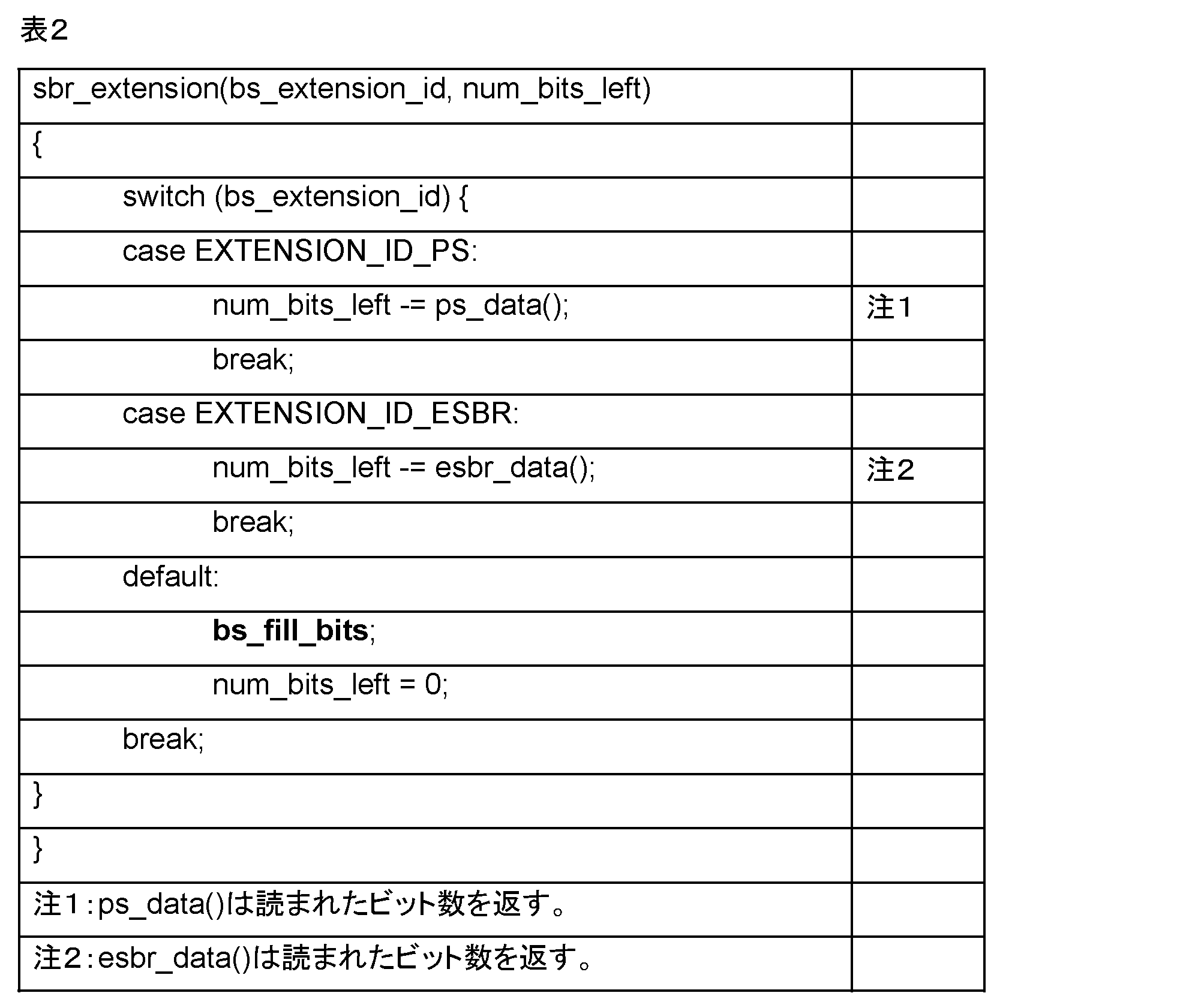
本発明のいくつかの実施形態によれば、eSBRメタデータを含む(エンコードされたオーディオ・ビットストリームの)充填要素は、eSBRメタデータが充填要素に含まれることおよび当該ブロックのオーディオ・コンテンツに対してeSBR処理が実行されるべきであることを合図する値(たとえばbs_extension_id=3)をもつパラメータ(たとえばbs_extension_idパラメータ)および/または充填要素のsbr_extension()コンテナがPSデータを含むことを合図する値(たとえばbs_extension_id=2)をもつパラメータ(たとえば同じbs_extension_idパラメータ)をも含む。たとえば、下記の表1に示されるように、値bs_extension_id=2をもつそのようなパラメータは、充填要素のsbr_extension()コンテナがPSデータを含むことを合図してもよく、値bs_extension_id=3をもつそのようなパラメータは、充填要素のsbr_extension()コンテナがeSBRメタデータを含むことを合図してもよい。

1.上記の一ビットのメタデータ・パラメータbs_sbr_preprocessing;および
2.デコードされるべきエンコードされたビットストリームのオーディオ・コンテンツの各チャネル(「ch」)について、上記のパラメータ:sbrPatchingMode[ch];sbrOversamplingFlag[ch];sbrPitchInBinsFlag[ch];およびsbrPitchInBins[ch]のそれぞれ。
According to some embodiments of the invention, a filler element (of an encoded audio bitstream) containing eSBR metadata also includes a parameter (e.g., the bs_extension_id parameter) with a value (e.g., bs_extension_id=3) signaling that eSBR metadata is included in the filler element and that eSBR processing should be performed on the audio content of that block and/or a parameter (e.g., the same bs_extension_id parameter) with a value (e.g., bs_extension_id=2) signaling that the sbr_extension() container of the filler element contains PS data. For example, as shown in Table 1 below, such a parameter with value bs_extension_id=2 may signal that the sbr_extension() container of the filler element contains PS data, and such a parameter with value bs_extension_id=3 may signal that the sbr_extension() container of the filler element contains eSBR metadata.
1. the one-bit metadata parameter bs_sbr_preprocessing as above; and 2. for each channel ("ch") of the encoded bitstream audio content to be decoded, each of the parameters sbrPatchingMode[ch]; sbrOversamplingFlag[ch]; sbrPitchInBinsFlag[ch]; and sbrPitchInBins[ch] as above.
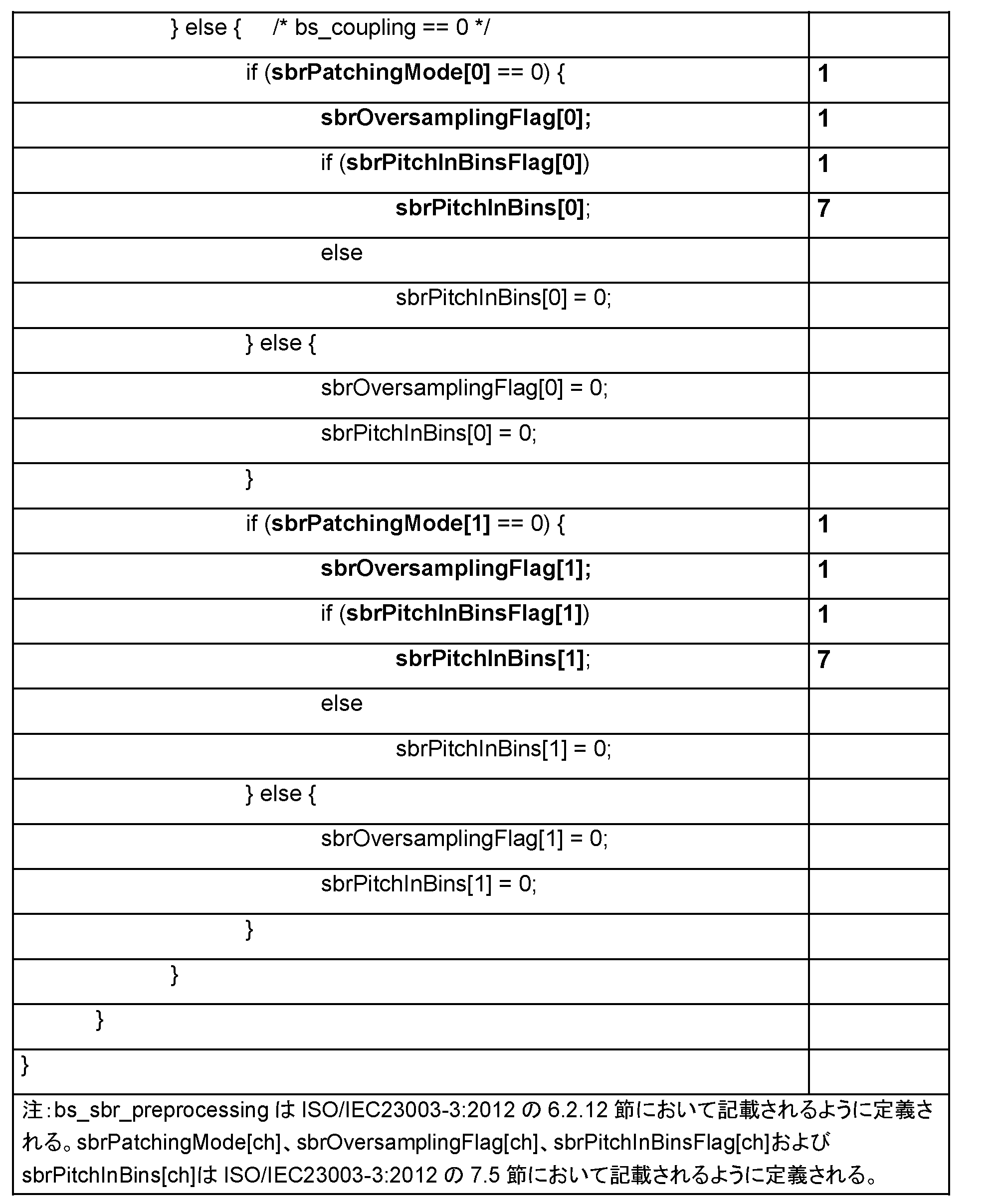
たとえば、いくつかの実施形態では、esbr_data()は、これらのメタデータ・パラメータを示すために、表3に示されるシンタックスを有していてもよい。

たとえば、MPEG-4 HE-AACまたはHE-AAC-v2準拠デコーダは、高調波転換のような向上した形のスペクトル帯域複製を含むよう拡張されてもよい。この向上した形のスペクトル帯域複製は、デコーダによってすでにサポートされている基本形のスペクトル帯域複製に加えてのものである。MPEG-4 HE-AACまたはHE-AAC-v2準拠デコーダのコンテキストでは、この基本形のスペクトル帯域複製は、MPEG-4 AAC規格の4.6.18節において定義されているQMFスペクトル・パッチングSBRツールである。 For example, an MPEG-4 HE-AAC or HE-AAC-v2 compliant decoder may be extended to include an improved form of spectral band replication, such as harmonic transformation, in addition to the basic form of spectral band replication already supported by the decoder. In the context of an MPEG-4 HE-AAC or HE-AAC-v2 compliant decoder, this basic form of spectral band replication is the QMF Spectral Patching SBR tool defined in clause 4.6.18 of the MPEG-4 AAC standard.
向上した形のスペクトル帯域複製を実行するとき、拡張されたHE-AACデコーダは、ビットストリームのSBR拡張ペイロードにすでに含まれているビットストリーム・パラメータの多くを再利用しうる。再利用されうる具体的なパラメータは、たとえば、マスター周波数帯域テーブルを決定するさまざまなパラメータを含む。これらのパラメータは、bs_start_freq(マスター周波数テーブル・パラメータの先頭を決定するパラメータ)、bs_stop_freq(マスター周波数テーブルの終わりを決定するパラメータ)、bs_freq_scale(オクターブ当たりの周波数帯域の数を決定するパラメータ)およびbs_alter_scale(周波数帯域のスケールを変更するパラメータ)を含む。再利用されうるパラメータは、ノイズ帯域テーブルを決定するパラメータ(bs_noise_bands)およびリミッター帯域テーブル・パラメータ(bs_limiter_bands)をも含む。よって、さまざまな実施形態において、USAC規格において指定されている等価なパラメータの少なくともいくつかがビットストリームから省略され、それによりビットストリームにおける制御オーバーヘッドを軽減する。典型的には、AAC規格において指定されているパラメータがUSAC規格において指定されている等価なパラメータをもつ場合には、USAC規格において指定されている等価なパラメータはAAC規格において指定されているパラメータと同じ名前をもつ。たとえば、包絡スケール因子(envelope scalefactor)EOrigMapped。しかしながら、USAC規格において指定されている等価なパラメータは典型的には、AAC規格において定義されているSBR処理のためではなくUSAC規格において定義されている向上SBR処理のために「チューニングされた」異なる値をもつ。 When performing the improved form of spectral band replication, the enhanced HE-AAC decoder may reuse many of the bitstream parameters already included in the SBR extension payload of the bitstream. Specific parameters that may be reused include, for example, various parameters that determine the master frequency band table. These parameters include bs_start_freq (a parameter that determines the start of the master frequency table parameters), bs_stop_freq (a parameter that determines the end of the master frequency table parameters), bs_freq_scale (a parameter that determines the number of frequency bands per octave), and bs_alter_scale (a parameter that alters the scale of the frequency bands). Parameters that may be reused also include parameters that determine the noise band table (bs_noise_bands) and the limiter band table parameters (bs_limiter_bands). Thus, in various embodiments, at least some of the equivalent parameters specified in the USAC standard are omitted from the bitstream, thereby reducing control overhead in the bitstream. Typically, if a parameter specified in the AAC standard has an equivalent parameter specified in the USAC standard, the equivalent parameter specified in the USAC standard has the same name as the parameter specified in the AAC standard, e.g., envelope scale factor E OrigMapped , but the equivalent parameter specified in the USAC standard typically has a different value that is "tuned" for the enhanced SBR process defined in the USAC standard rather than for the SBR process defined in the AAC standard.
前記の数多くのパラメータに加えて、他のデータ要素も、本発明の実施形態に従って向上した形のスペクトル帯域複製を実行するときに、拡張されたHE-AACデコーダによって再利用されてもよい。たとえば、包絡データおよびノイズ・フロア・データは、bs_data_env(包絡スケール因子)およびbs_noise_env(ノイズ・フロア・スケール因子)データから抽出されて、向上した形のスペクトル帯域複製の間に使われてもよい。 In addition to many of the parameters mentioned above, other data elements may also be reused by the enhanced HE-AAC decoder when performing the enhanced spectral band replication according to embodiments of the present invention. For example, envelope data and noise floor data may be extracted from the bs_data_env (envelope scale factor) and bs_noise_env (noise floor scale factor) data and used during the enhanced spectral band replication.
本質的には、これらの実施形態は、SBR拡張ペイロードにおいてレガシーのHE-AACまたはHE-AAC v2デコーダによってすでにサポートされている構成設定パラメータおよび包絡データを活用する。できるだけ追加的な伝送データを必要とせずに向上した形のスペクトル帯域複製を可能にするためである。前記メタデータはもともとは基本形のHFR(たとえばSBRのスペクトル・パッチング)のためにチューニングされたものだが、実施形態に基づき、向上した形のHFR(たとえばeSBRの高調波転換)のために使われる。先に論じたように、前記メタデータは一般に、基本形のHFR(たとえば線形並進)とともに使うためにチューニングされ、意図されている動作パラメータ(たとえば包絡スケール因子、ノイズ・フロア・スケール因子、時間/周波数格子パラメータ、正弦波を加える情報(sinusoid addition information)、可変クロスオーバー周波数/帯域、逆フィルタリング・モード、包絡分解能、平滑化モード、周波数補間モード)を表わす。しかしながら、このメタデータは、向上した形のHFR(たとえば高調波転換)に固有の追加的なメタデータ・パラメータと組み合わされて、向上した形のHFRを使ってオーディオ・データを効率的かつ効果的に処理するために使われてもよい。 Essentially, these embodiments leverage configuration parameters and envelope data already supported by legacy HE-AAC or HE-AAC v2 decoders in the SBR extension payload to enable enhanced spectral band replication with as little additional transmission data as possible. The metadata was originally tuned for basic HFR (e.g., SBR spectral patching) but is used for enhanced HFR (e.g., eSBR harmonic transformation) in accordance with the embodiment. As discussed above, the metadata is generally tuned for use with basic HFR (e.g., linear translation) and represents intended operating parameters (e.g., envelope scale factor, noise floor scale factor, time/frequency lattice parameters, sinusoid addition information, variable crossover frequencies/bands, inverse filtering mode, envelope resolution, smoothing mode, frequency interpolation mode). However, this metadata may be combined with additional metadata parameters specific to the enhanced form of HFR (e.g., harmonic conversion) and used to efficiently and effectively process audio data using the enhanced form of HFR.
よって、向上した形のスペクトル帯域複製をサポートする拡張されたデコーダは、すでに定義されたビットストリーム要素(たとえばSBR拡張ペイロード内のもの)に頼り、向上した形のスペクトル帯域複製をサポートするために必要とされるパラメータのみを(充填要素拡張ペイロード内に)追加することによって、非常に効率的な仕方で生成されうる。このデータ削減特徴は、新たに追加されたパラメータを拡張コンテナのようなリザーブされたデータ・フィールドに配置することと組み合わさって、ビットストリームが向上した形のスペクトル帯域複製をサポートしないレガシー・デコーダと後方互換であることを保証することによって、向上した形のスペクトル帯域複製をサポートするデコーダを作り出すことへの障壁を実質的に軽減する。 Thus, an enhanced decoder supporting the enhanced form of spectral band replication can be generated in a very efficient manner by relying on already defined bitstream elements (e.g., those in the SBR extension payload) and adding (in the filler element extension payload) only the parameters required to support the enhanced form of spectral band replication. This data reduction feature, combined with placing the newly added parameters in reserved data fields such as the extension container, substantially reduces the barrier to creating decoders that support the enhanced form of spectral band replication by ensuring that the bitstream is backward compatible with legacy decoders that do not support the enhanced form of spectral band replication.
表3では、右の列における数字は左の列における対応するパラメータのビット数を示す。 In Table 3, the numbers in the right column indicate the number of bits of the corresponding parameter in the left column.
いくつかの実施形態では、MPEG-4 AACにおいて定義されているSBRオブジェクト型が、SBR拡張要素(bs_extension_id==EXTENSION_ID_ESBR)において信号伝達されるように、SBR-Toolまたは向上SBR(eSBR)の諸側面を含むよう更新される。 In some embodiments, the SBR object type defined in MPEG-4 AAC is updated to include aspects of SBR-Tool or enhanced SBR (eSBR), as signaled in the SBR extension element (bs_extension_id==EXTENSION_ID_ESBR).
いくつかの実施形態では、本発明は、エンコードされたビットストリーム(たとえばMPEG-4 AACビットストリーム)を生成するためにオーディオ・データをエンコードする段階を含む方法である。該生成は、eSBRメタデータをエンコードされたビットストリームの少なくとも一つのブロックの少なくとも一つのセグメントに含め、オーディオ・データを前記ブロックの少なくとも一つの他のセグメントに含めることによることを含む。典型的な実施形態では、本方法は、エンコードされたビットストリームの各ブロックにおいてオーディオ・データをeSBRメタデータと多重化する段階を含む。eSBRデコーダにおける前記エンコードされたビットストリームの典型的なデコードでは、デコーダはeSBRメタデータをビットストリームから抽出し(これはeSBRメタデータおよびオーディオ・データをパースして多重分離することによることを含む)、eSBRメタデータを、オーディオ・データを処理してデコードされたオーディオ・データのストリームを生成するために使う。 In some embodiments, the invention is a method that includes encoding audio data to generate an encoded bitstream (e.g., an MPEG-4 AAC bitstream) by including eSBR metadata in at least one segment of at least one block of the encoded bitstream and audio data in at least one other segment of the block. In an exemplary embodiment, the method includes multiplexing audio data with the eSBR metadata in each block of the encoded bitstream. In an exemplary decoding of the encoded bitstream in an eSBR decoder, the decoder extracts the eSBR metadata from the bitstream (including by parsing and demultiplexing the eSBR metadata and audio data) and uses the eSBR metadata to process the audio data to generate a stream of decoded audio data.
本発明のもう一つの側面は、eSBRメタデータを含まないエンコードされたオーディオ・ビットストリーム(たとえばMPEG-4 AACビットストリーム)のデコードの間に、(たとえば高調波転換または前置平坦化として知られるeSBRツールの少なくとも一つを使って)eSBR処理を実行するよう構成されたeSBRデコーダである。そのようなデコーダの例について、図5を参照して述べる。 Another aspect of the invention is an eSBR decoder configured to perform eSBR processing (e.g., using at least one of the eSBR tools known as harmonic transformation or pre-flattening) during decoding of an encoded audio bitstream (e.g., an MPEG-4 AAC bitstream) that does not include eSBR metadata. An example of such a decoder is described with reference to FIG. 5.
図5のeSBRデコーダ(400)は、図のように接続された、バッファ・メモリ201(これは図3および図4のメモリ201と同一)と、ビットストリーム・ペイロード・フォーマット解除器215(これは図4のフォーマット解除器215と同一)と、オーディオ・デコード・サブシステム202(時に「コア」デコード段または「コア」デコード・サブシステムと称され、図3のコア・デコード・サブシステム202と同一)と、eSBR制御データ生成サブシステム401と、eSBR処理段203(これは図3の段203と同一)とを含む。典型的には、デコーダ400は他の処理要素(図示せず)も含む。
The eSBR decoder (400) of FIG. 5 includes, connected as shown, a buffer memory 201 (which is identical to
デコーダ400の動作においては、デコーダ400によって受領されたエンコードされたオーディオ・ビットストリーム(MPEG-4 AACビットストリーム)のブロックのシーケンスがバッファ201からフォーマット解除器215に呈される。
In operation of the
フォーマット解除器215は、ビットストリームの各ブロックを多重分離して、それからSBRメタデータ(量子化された包絡データを含む)を、典型的には他のメタデータも抽出するよう結合され、構成される。フォーマット解除器215は、少なくとも前記SBRメタデータをeSBR処理段203に呈するよう構成される。フォーマット解除器215は、ビットストリームの各ブロックからオーディオ・データを抽出し、抽出されたオーディオ・データをデコード・サブシステム(デコード段)202に呈するようにも結合され、構成される。
The
デコーダ400のオーディオ・デコード・サブシステム202は、フォーマット解除器215によって抽出されたオーディオ・データをデコードして(そのようなデコードは「コア」デコード動作と称されてもよい)、デコードされたオーディオ・データを生成し、デコードされたオーディオ・データをeSBR処理段203に呈するよう構成される。デコードは周波数領域で実行される。典型的には、サブシステム202における処理の最終段が、デコードされた周波数領域オーディオ・データに周波数領域から時間領域への変換を適用し、そのためサブシステムの出力は時間領域のデコードされたオーディオ・データである。段203は、(フォーマット解除器215によって抽出された)SBRメタデータおよびサブシステム401において生成されたeSBRメタデータによって示されるSBRツール(およびeSBRツール)を、デコードされたオーディオ・データに適用して(すなわち、SBRおよびeSBRメタデータを使ってデコード・サブシステム202の出力に対してSBRおよびeSBR処理を実行して)、デコーダ400から出力される完全にデコードされたオーディオ・データを生成するよう構成される。典型的には、デコーダ400は、フォーマット解除器215(および任意的にはサブシステム401)から出力されるフォーマット解除されたオーディオ・データおよびメタデータを記憶するメモリ(サブシステム202および段203によってアクセス可能)を含み、段203はSBRおよびeSBR処理の間に必要に応じてオーディオ・データおよびメタデータにアクセスするよう構成される。段203におけるSBR処理は、コア・デコード・サブシステム202の出力に対する後処理であると考えられてもよい。任意的に、デコーダ400は、最終的なアップミックス・サブシステム(これは、フォーマット解除器215によって抽出されたPSメタデータを使って、MPEG-4 AAC規格において定義されているパラメトリック・ステレオ(「PS」)ツールを適用しうる)をも含む。アップミックス・サブシステムは、段203の出力に対してアップミックスを実行して、APU 210から出力される、完全にデコードされた、アップミックスされたオーディオを生成するよう結合され、構成される。
The
図5の制御データ生成サブシステム401は、デコードされるべきエンコードされたオーディオ・ビットストリームの少なくとも一つの属性を検出し、検出段階の少なくとも一つの結果に応答してeSBR制御データ(これは、本発明の他の実施形態に従って、エンコードされたオーディオ・ビットストリームに含まれている型のうちいずれかの型のeSBRメタデータであってもく、それを含んでいてもよい)を生成するよう結合され、構成される。eSBR制御データは、段203に呈されて、ビットストリームの特定の属性(または複数の属性の組み合わせ)を検出したときに個々のeSBRツールまたはeSBRツールの組み合わせの適用を惹起するおよび/またはそのようなeSBRツールの適用を制御する。たとえば、高調波転換を使ったeSBR処理の実行を制御するために、制御データ生成サブシステム401のいくつかの実施形態は:ビットストリームが音楽を示すまたは示さないことを検出することに応答してsbrPatchingMode[ch]パラメータを設定する(そして設定されたパラメータを段203に呈する)ための音楽検出器(たとえば、通常の音楽検出器の単純化されたバージョン);ビットストリームによって示されるオーディオ・コンテンツにおける過渡成分の存在または不在を検出することに応答してsbrOversamplingFlag[ch]パラメータを設定する(そして設定されたパラメータを段203に呈する)ための過渡検出器;および/またはビットストリームによって示されるオーディオ・コンテンツのピッチを検出することに応答してsbrPitchInBinsFlag[ch]およびsbrPitchInBins[ch]パラメータを設定する(そして設定されたパラメータを段203に呈する)ためのピッチ検出器を含むことになる。本発明の他の側面は、この段落および前段落において述べた本発明のデコーダのいずれかの実施形態によって実行されるオーディオ・ビットストリーム・デコード方法である。
5 is coupled and configured to detect at least one attribute of the encoded audio bitstream to be decoded and to generate eSBR control data (which may be or include eSBR metadata of any type included in the encoded audio bitstream according to other embodiments of the present invention) in response to at least one result of the detection step. The eSBR control data is presented to stage 203 to trigger and/or control the application of individual eSBR tools or combinations of eSBR tools upon detection of a particular attribute (or combination of attributes) of the bitstream. For example, to control the execution of eSBR processing using harmonic conversion, some embodiments of the control
本発明の諸側面は、本発明のAPU、システムまたはデバイスのいずれかの実施形態が実行するよう構成される(たとえばプログラムされる)型のエンコードまたはデコード方法を含む。本発明の他の側面は、本発明の方法のいずれかの実施形態を実行するよう構成された(たとえばプログラムされた)システムまたはデバイスならびに本発明の方法のいずれかの実施形態もしくはその段階を実装するためのコードを(たとえば非一時的な仕方で)記憶するコンピュータ可読媒体(たとえばディスク)を含む。たとえば、本発明のシステムは、プログラム可能な汎用プロセッサ、デジタル信号プロセッサまたはマイクロプロセッサが、本発明の方法の実施形態またはその段階を含む多様な動作のいずれかをデータに対して実行するようソフトウェアもしくはファームウェアを用いてプログラムされたおよび/または他の仕方で構成されたものであるまたはそれを含むことができる。そのような汎用プロセッサは、入力装置、メモリおよび処理回路を含むコンピュータ・システムが、それに呈されるデータに応答して本発明の方法の実施形態(またはその段階)を実行するようプログラムされた(および/または他の仕方で構成された)ものであってもよく、あるいはそれを含んでいてもよい。 Aspects of the invention include encoding or decoding methods of the type that any of the embodiments of the APU, system or device of the invention are configured (e.g., programmed) to perform. Other aspects of the invention include systems or devices configured (e.g., programmed) to perform any of the embodiments of the methods of the invention, as well as computer readable media (e.g., disks) storing (e.g., in a non-transitory manner) code for implementing any of the embodiments or steps of the methods of the invention. For example, a system of the invention may be or include a programmable general purpose processor, digital signal processor or microprocessor programmed and/or otherwise configured with software or firmware to perform any of a variety of operations on data, including embodiments of the methods of the invention, or steps thereof. Such a general purpose processor may be or include a computer system including an input device, memory and processing circuitry programmed (and/or otherwise configured) to perform embodiments of the methods of the invention (or steps thereof) in response to data presented to it.
本発明の実施形態は、ハードウェア、ファームウェアまたはソフトウェアまたは両者の組み合わせにおいて(たとえばプログラム可能な論理アレイとして)実装されてもよい。特に断わりのない限り、本発明の一部として含まれるアルゴリズムまたはプロセスは、いかなる特定のコンピュータまたは他の装置にも本来的に関係していることはない。特に、さまざまな汎用機械が、本稿の教示に従って書かれたプログラムと一緒に使われてもよいし、あるいは要求される方法段階を実行するよう、より特化した装置(たとえば集積回路)を構築するほうが便利であることもありうる。このように本発明は、一つまたは複数のプログラム可能なコンピュータ・システム(たとえば、図1の要素または図2のエンコーダ100(またはそのある要素)または図3のデコーダ200(またはそのある要素)または図4のデコーダ210(またはそのある要素)または図5のデコーダ400(またはそのある要素)のいずれかの実装)上で実行される一つまたは複数のコンピュータ・プログラムにおいて実装されてもよい。各コンピュータ・システムは少なくとも一つのプロセッサと、少なくとも一つのデータ記憶システム(揮発性および不揮発性メモリおよび/または記憶要素を含む)と、少なくとも一つの入力装置またはポートと、少なくとも一つの出力装置またはポートとを有する。プログラム・コードは、本稿に記載される機能を実行して出力情報を生成するために、入力データに適用される。出力情報は、既知の仕方で一つまたは複数の出力装置に加えられる。 Embodiments of the invention may be implemented in hardware, firmware or software or a combination of both (e.g., as a programmable logic array). Unless otherwise specified, the algorithms or processes included as part of the invention are not inherently related to any particular computer or other apparatus. In particular, various general purpose machines may be used with programs written in accordance with the teachings of the present disclosure, or it may prove convenient to construct a more specialized apparatus (e.g., an integrated circuit) to perform the required method steps. Thus, the present invention may be implemented in one or more computer programs running on one or more programmable computer systems (e.g., an implementation of any of the elements of FIG. 1 or the encoder 100 (or an element thereof) of FIG. 2 or the decoder 200 (or an element thereof) of FIG. 3 or the decoder 210 (or an element thereof) of FIG. 4 or the decoder 400 (or an element thereof) of FIG. 5). Each computer system has at least one processor, at least one data storage system (including volatile and non-volatile memory and/or storage elements), at least one input device or port, and at least one output device or port. Program code is applied to input data to perform the functions described herein and generate output information. The output information is applied to one or more output devices, in known fashion.
そのような各プログラムは、コンピュータ・システムと連絡するためにいかなる所望されるコンピュータ言語(機械語、アセンブリーまたは高レベルの手続き型、論理的またはオブジェクト指向のプログラミング言語を含む)で実装されてもよい。いずれにせよ、言語はコンパイルまたはインタープリットされる言語でありうる。 Each such program may be implemented in any desired computer language (including machine, assembly, or a higher level procedural, logical, or object-oriented programming language) to communicate with a computer system. In any case, the language may be a compiled or interpreted language.
たとえば、コンピュータ・ソフトウェア命令シーケンスによって実装されるとき、本発明の実施形態のさまざまな機能および段階は、好適なデジタル信号処理ハードウェアにおいて走るマルチスレッド・ソフトウェア命令シーケンスによって実装されてもよく、その場合、実施形態のさまざまな装置、段階および機能はソフトウェア命令の諸部分に対応しうる。 For example, when implemented by computer software instruction sequences, various functions and steps of embodiments of the present invention may be implemented by multi-threaded software instruction sequences running on suitable digital signal processing hardware, with various units, steps and functions of the embodiments corresponding to portions of the software instructions.
そのような各コンピュータ・システムは、好ましくは、汎用または特殊目的のプログラム可能なコンピュータによって読み取り可能な記憶媒体またはデバイス(たとえば半導体メモリもしくはメディアまたは磁気もしくは光学式メディア)に記憶され、またはダウンロードされる。該記憶媒体またはデバイスがコンピュータ・システムによって読まれるときに、本稿に記載される手順を実行するようコンピュータを構成し、動作させるためである。本発明のシステムは、コンピュータ・プログラムをもって構成された(すなわちコンピュータ・プログラムを記憶している)コンピュータ可読記憶媒体として実装されてもよい。ここで、そのように構成された記憶媒体はコンピュータ・システムに、本稿に記載される機能を実行するよう、特定のあらかじめ定義された仕方で動作させる。 Each such computer system is preferably stored or downloaded onto a general-purpose or special-purpose programmable computer-readable storage medium or device (e.g., semiconductor memory or media or magnetic or optical media) which, when read by the computer system, configures and operates the computer to perform the procedures described herein. The system of the present invention may be implemented as a computer-readable storage medium configured with (i.e., having stored thereon) a computer program, where the storage medium so configured causes the computer system to operate in a specific, predefined manner to perform the functions described herein.
本発明のいくつかの実施形態を記述してきた。にもかかわらず、本発明の精神および範囲から外れることなくさまざまな修正がなしうることは理解されるであろう。上記の教示に照らして本発明の数多くの修正および変形が可能である。たとえば、効率的な実装を容易にするために、複素QMF分解および合成フィルタバンクと組み合わせて位相シフトが使われてもよい。分解フィルタバンクは、コア・デコーダによって生成された時間領域の低域信号をフィルタリングして複数のサブバンド(たとえばQMFサブバンド)にすることを受け持つ。合成フィルタバンクは、(受領されたsbrPatchingModeパラメータによって示される)選択されたHFR技法によって生成される再生された高域を、デコードされた低域と組み合わせて、広帯域出力オーディオ信号を生成することを受け持つ。しかしながら、ある種のサンプル・レート・モード、たとえば通常のデュアル・レート動作またはダウンサンプリングされたSBRモードで動作する所与のフィルタバンク実装は、ビットストリーム依存である位相シフトをもつべきではない。SBRにおいて使われるQMFバンクは、コサイン変調フィルタバンクの理論の複素指数拡張(complex-exponential extension)である。コサイン変調フィルタバンクを複素指数変調(complex-exponential modulation)を用いて拡張すると、エイリアス打ち消し制約条件が不要になることが示される。こうして、SBR QMFバンクについて、分解フィルタhk(n)および合成フィルタfk(n)はいずれも、次式によって定義されうる:

プロトタイプ・フィルタp0(n)の係数は、640という長さLで、下記の表4に示されるように定義されてもよい。
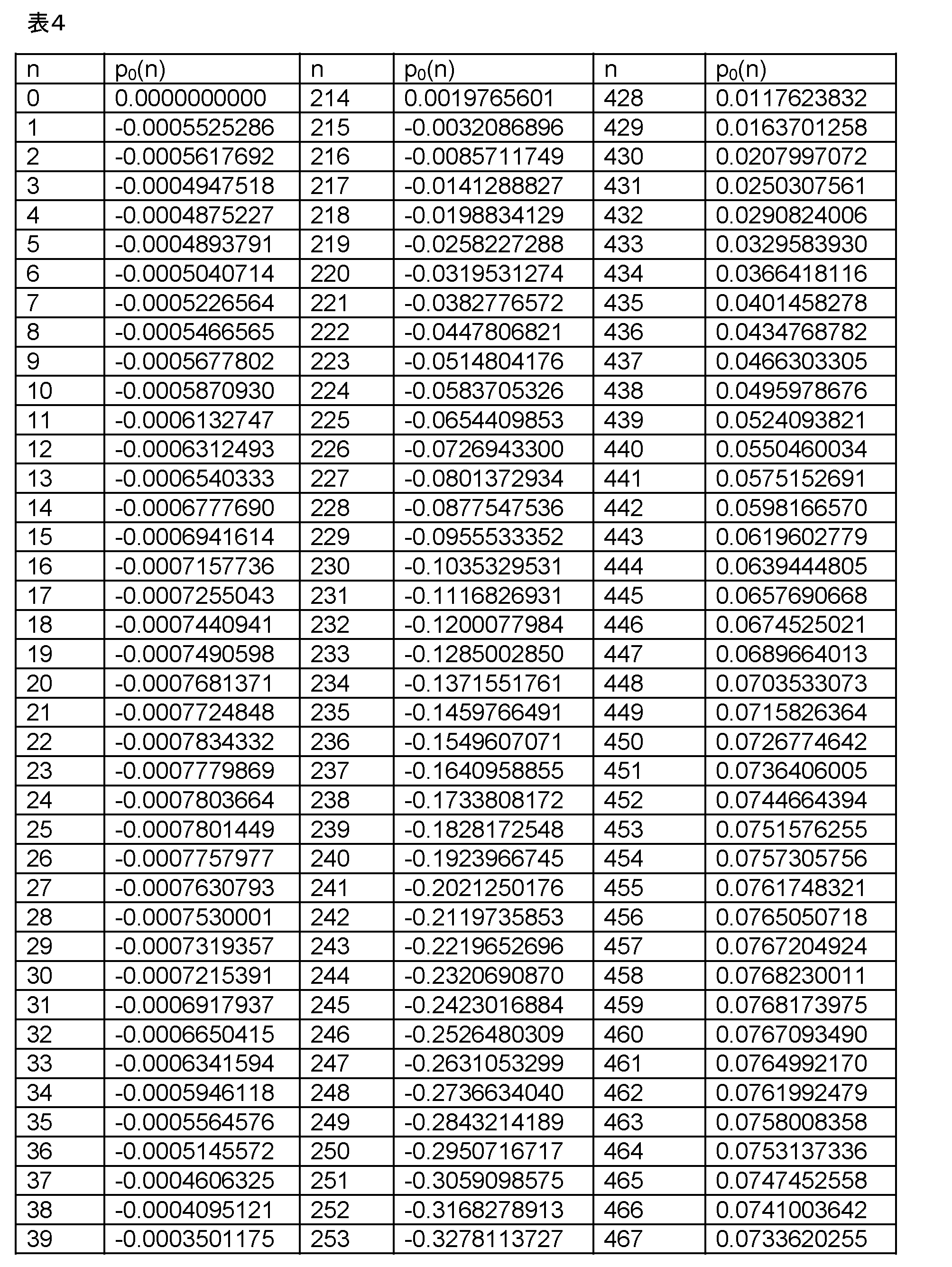
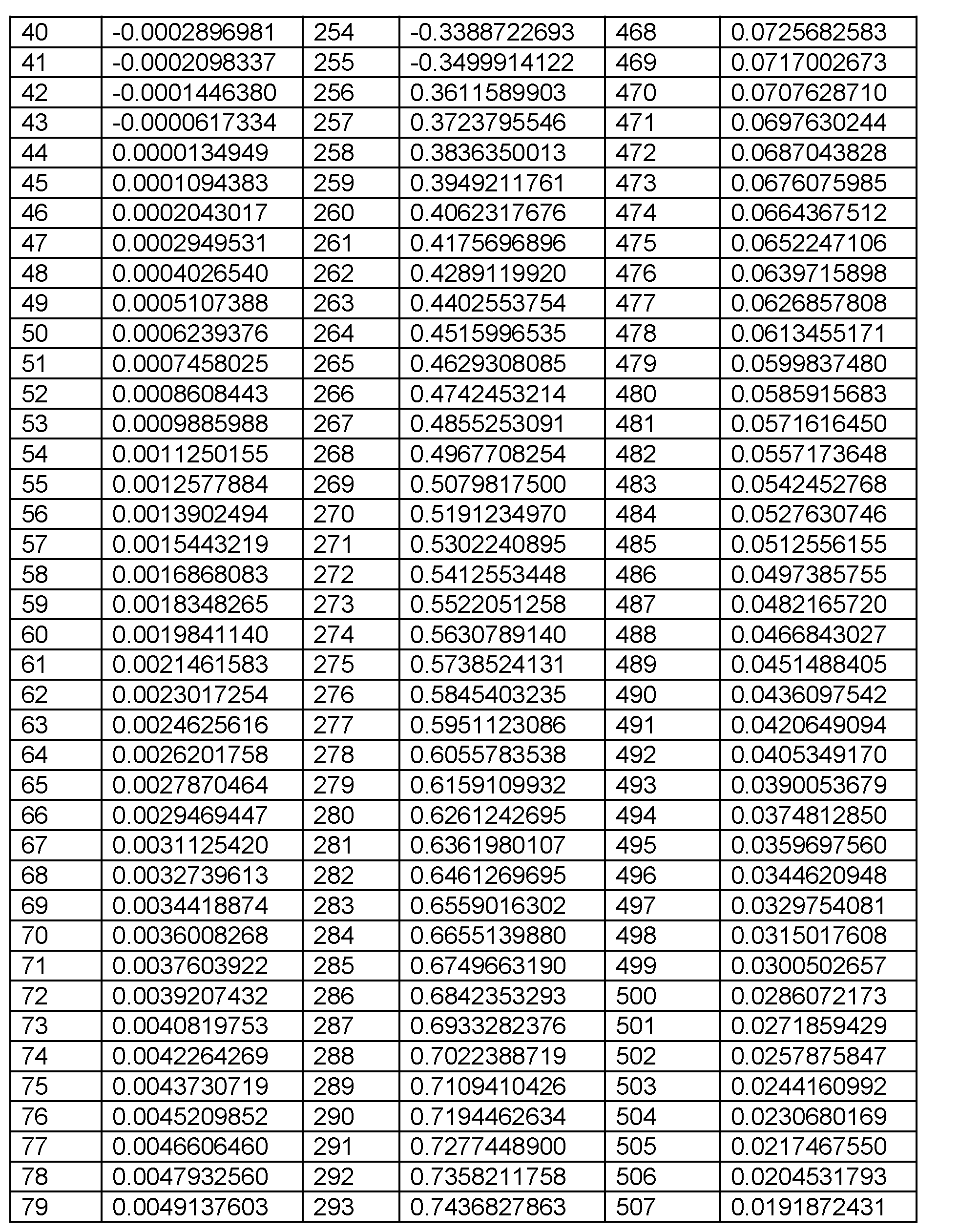
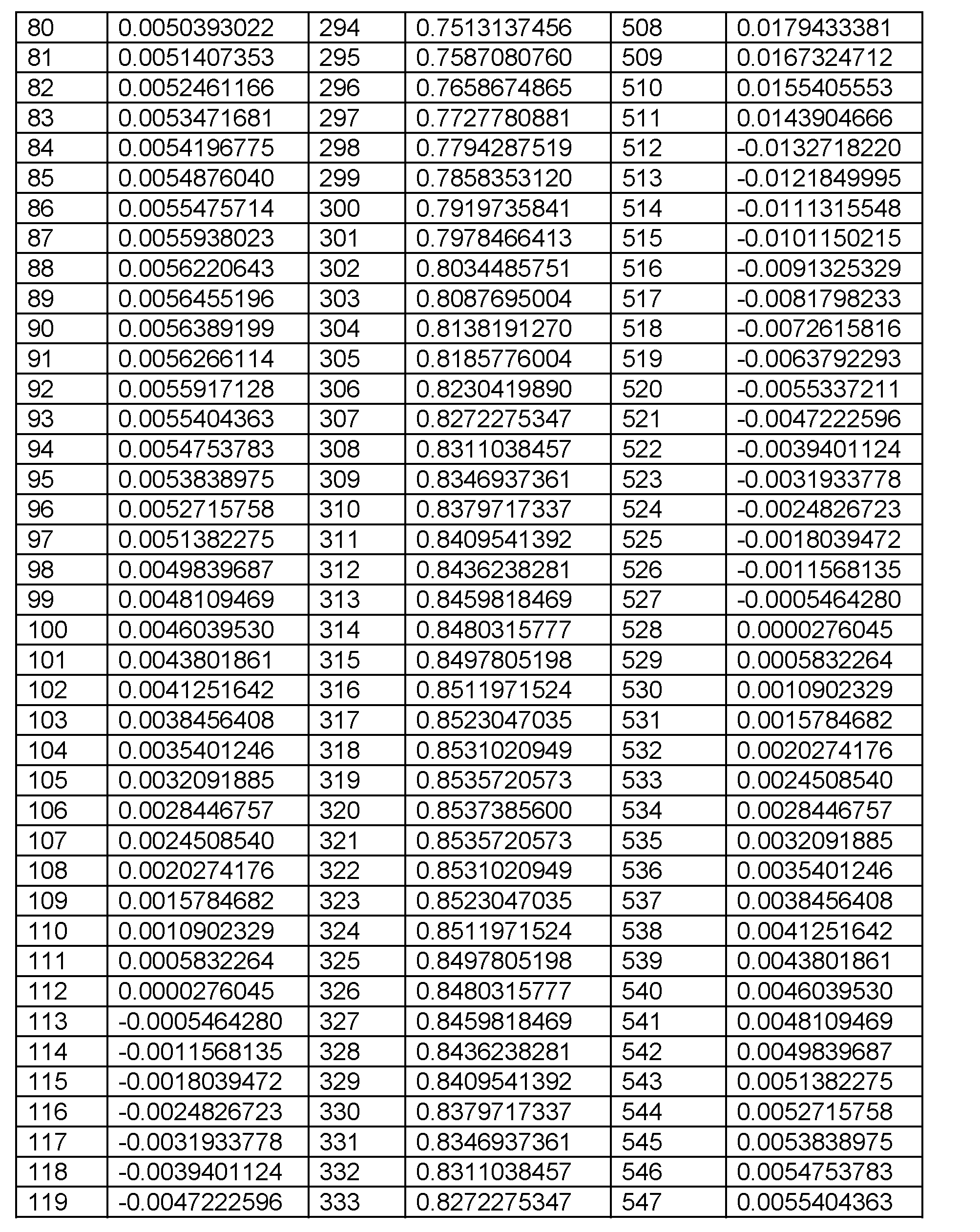

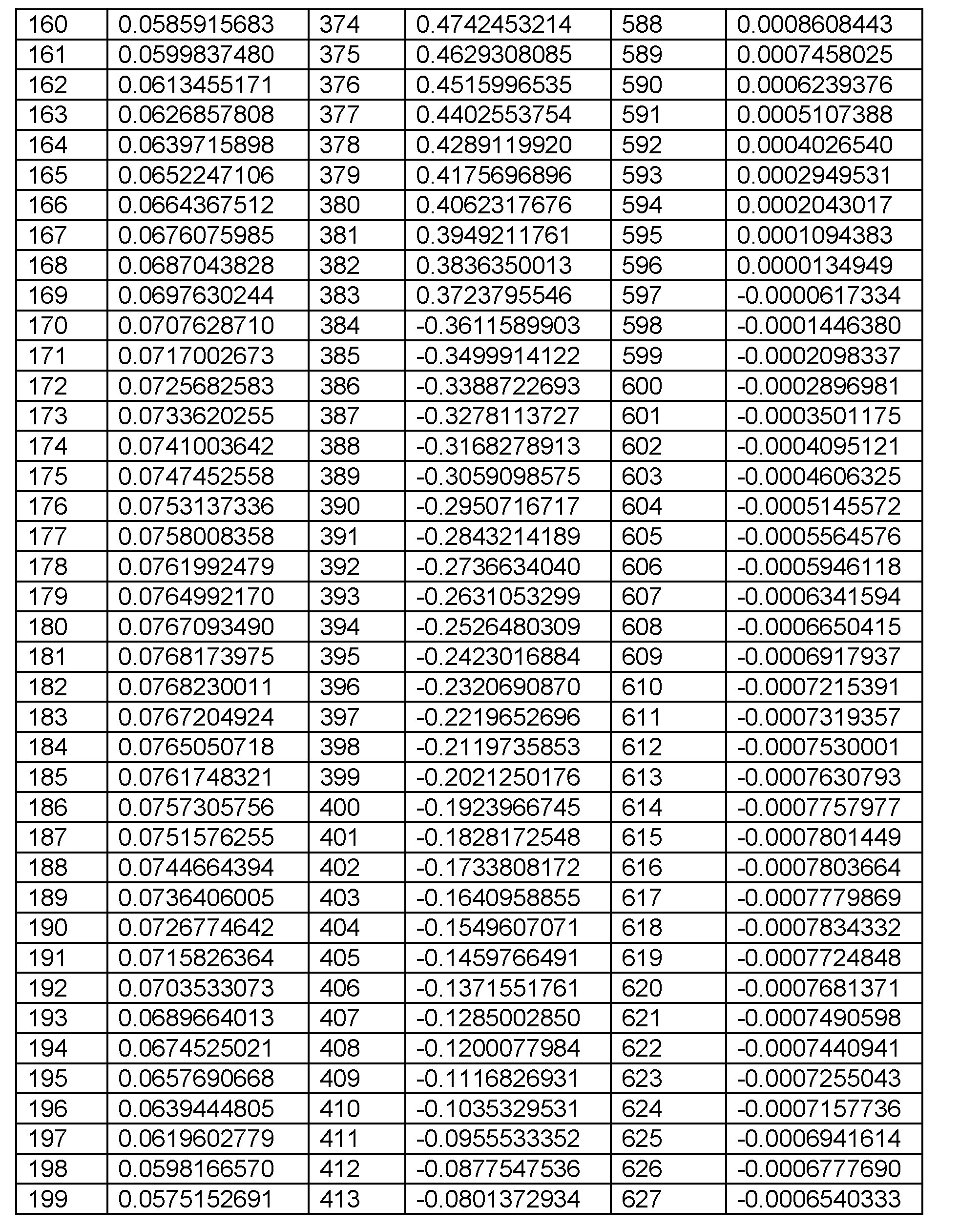
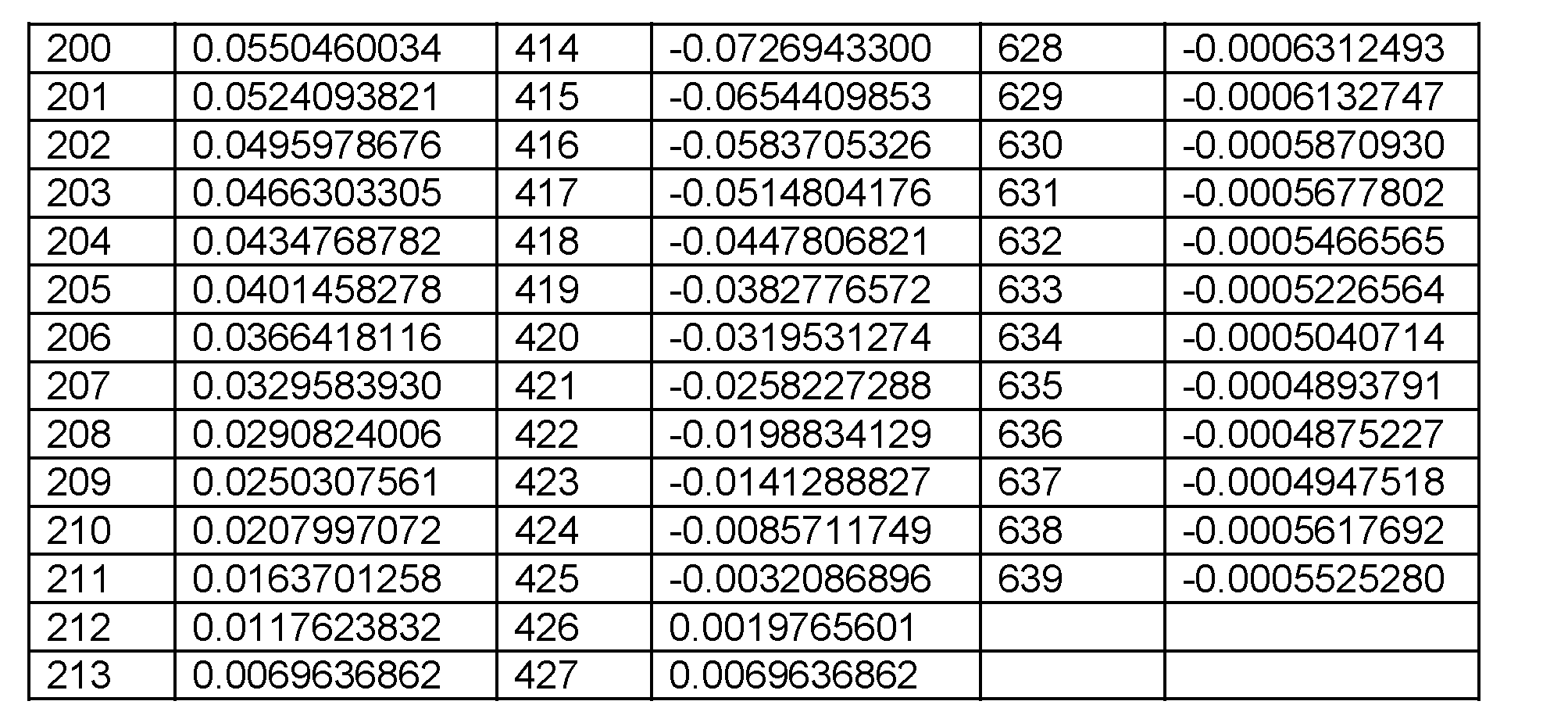
付属の請求項の範囲内で、本発明は、本稿に具体的に記述されている以外の仕方で実施されうることは理解される。請求項に含まれる参照符号があったとしても、単に例解目的のためであり、いかなる仕方であれ請求項を解釈したり限定したりするために使われるべきではない。 It is understood that within the scope of the appended claims, the invention may be practiced other than as specifically described herein. Any reference signs included in the claims are for illustrative purposes only and shall not be used to interpret or limit the claims in any manner.
いくつかの態様を記載しておく。
〔態様1〕
エンコードされたオーディオ・ビットストリームをデコードする方法であって、当該方法は:
エンコードされたオーディオ・ビットストリームを受領する段階であって、前記エンコードされたオーディオ・ビットストリームはオーディオ信号の低域部分を表わすオーディオ・データを含む、段階と;
前記オーディオ・データをデコードして、デコードされた低域オーディオ信号を生成する段階と;
前記エンコードされたオーディオ・ビットストリームから、高周波再構成メタデータを抽出する段階であって、前記高周波再構成メタデータは、前記オーディオ信号の低域部分から、連続するいくつかのサブバンドを前記オーディオ信号の高域部分に線形に並進させる高周波再構成プロセスのための動作パラメータを含む、段階と;
前記デコードされた低域オーディオ信号を分解フィルタバンクでフィルタリングして、フィルタリングされた低域オーディオ信号を生成する段階と;
前記エンコードされたオーディオ・ビットストリームから、線形並進または高調波転換のどちらが前記オーディオ・データに対して実行されるべきかを示すフラグを抽出する段階と;
前記フラグに従って、前記フィルタリングされた低域オーディオ信号および前記高周波再構成メタデータを使って前記オーディオ信号の高域部分を再生成する段階と;
前記フィルタリングされた低域オーディオ信号および再生成された高域部分を組み合わせて、広帯域オーディオ信号を形成する段階とを含む、
方法。
〔態様2〕
前記エンコードされたオーディオ・ビットストリームがさらに充填要素を含み、該充填要素は、該充填要素の先頭を示す識別子と、該識別子の後の充填データとをもち、前記充填データが前記フラグを含む、態様1記載の方法。
〔態様3〕
前記識別子が、0x6の値をもつ、三ビットの、最上位ビットが最初に伝送される符号なし整数である、態様2記載の方法。
〔態様4〕
前記充填データが拡張ペイロードを含み、前記拡張ペイロードがスペクトル帯域複製拡張データを含み、前記拡張ペイロードは、「1101」または「1110」の値をもつ、四ビットの、最上位ビットが最初に伝送される符号なし整数を用いて同定され、任意的には、
前記スペクトル帯域複製拡張データは:
任意的なスペクトル帯域複製ヘッダ、
前記ヘッダの後のスペクトル帯域複製データ、
前記スペクトル帯域複製データの後のスペクトル帯域複製拡張要素を含み、前記フラグは、前記スペクトル帯域複製拡張要素に含まれる、
態様2記載の方法。
〔態様5〕
前記高周波再構成メタデータが、包絡スケール因子、ノイズ・フロア・スケール因子、正弦波追加情報、時間/周波数格子情報、クロスオーバー周波数および逆フィルタリング・モードからなる群から選択される動作パラメータを含む、態様1ないし4のうちいずれか一項記載の方法。
〔態様6〕
前記分解フィルタバンクが、

〔態様7〕
前記プロトタイプ・フィルタp0(n)が表4の係数から導出される、態様6記載の方法。
〔態様8〕
前記プロトタイプ・フィルタp0(n)が表4の係数から、丸め、サブサンプリング、補間または間引きからなる群から選択される一つまたは複数の数学的演算によって導出される、態様6記載の方法。
〔態様9〕
前記フィルタリングされた低域オーディオ信号に対して、前記フィルタリングの後に位相シフトが加えられ、前記組み合わせることの前に補償される、態様1ないし8のうちいずれか一項記載の方法。
〔態様10〕
プロセッサによって実行されたときに態様1記載の方法を実行する命令を含む非一時的なコンピュータ可読媒体。
〔態様11〕
エンコードされたオーディオ・ビットストリームをデコードするためのデコーダであって、当該デコーダは:
エンコードされたオーディオ・ビットストリームを受領するための入力インターフェースであって、該エンコードされたオーディオ・ビットストリームは、オーディオ信号の低域部分を表わすオーディオ・データを含む、入力インターフェースと;
前記オーディオ・データをデコードして、デコードされた低域オーディオ信号を生成するコア・デコーダと;
前記エンコードされたオーディオ・ビットストリームから高周波再構成メタデータを抽出するためのフォーマット解除器であって、前記高周波再構成メタデータは、前記オーディオ信号の低域部分から、連続するいくつかのサブバンドを前記オーディオ信号の高域部分に線形に並進させる高周波再構成プロセスのための動作パラメータを含む、フォーマット解除器と;
前記デコードされた低域オーディオ信号をフィルタリングして、フィルタリングされた低域オーディオ信号を生成する分解フィルタバンクと;
前記エンコードされたオーディオ・ビットストリームから、線形並進または高調波転換のどちらが前記オーディオ・データに対して実行されるべきかを示すフラグを抽出するフォーマット解除器と;
前記フラグに従って、前記フィルタリングされた低域オーディオ信号および前記高周波再構成メタデータを使って前記オーディオ信号の高域部分を再生成する高周波再生成器と;
前記フィルタリングされた低域オーディオ信号および再生成された高域部分を組み合わせて、広帯域オーディオ信号を形成する合成フィルタバンクとを有する、
デコーダ。
〔態様12〕
前記エンコードされたオーディオ・ビットストリームがさらに充填要素を含み、該充填要素は、該充填要素の先頭を示す識別子と、該識別子の後の充填データとをもち、前記充填データが前記フラグを含む、態様11記載のデコーダ。
〔態様13〕
前記識別子が、0x6の値をもつ、三ビットの、最上位ビットが最初に伝送される符号なし整数である、態様12記載のデコーダ。
〔態様14〕
前記充填データが拡張ペイロードを含み、前記拡張ペイロードがスペクトル帯域複製拡張データを含み、前記拡張ペイロードは、「1101」または「1110」の値をもつ、四ビットの、最上位ビットが最初に伝送される符号なし整数を用いて同定され、任意的には、
前記スペクトル帯域複製拡張データは:
任意的なスペクトル帯域複製ヘッダ、
前記ヘッダの後のスペクトル帯域複製データ、
前記スペクトル帯域複製データの後のスペクトル帯域複製拡張要素を含み、前記フラグは、前記スペクトル帯域複製拡張要素に含まれる、
態様12記載のデコーダ。
〔態様15〕
前記高周波再構成メタデータが、包絡スケール因子、ノイズ・フロア・スケール因子、正弦波追加情報、時間/周波数格子情報、クロスオーバー周波数および逆フィルタリング・モードからなる群から選択される動作パラメータを含む、態様11ないし14のうちいずれか一項記載のデコーダ。
〔態様16〕
前記分解フィルタバンクが、

〔態様17〕
前記プロトタイプ・フィルタp0(n)が表4の係数から導出される、態様16記載のデコーダ。
〔態様18〕
前記プロトタイプ・フィルタp0(n)が表4の係数から、丸め、サブサンプリング、補間または間引きからなる群から選択される一つまたは複数の数学的演算によって導出される、態様16記載のデコーダ。
〔態様19〕
前記フィルタリングされた低域オーディオ信号に対して、前記フィルタリングの後に位相シフトが加えられ、前記組み合わせることの前に補償される、態様11ないし18のうちいずれか一項記載のデコーダ。
Several aspects will be described.
[Aspect 1]
1. A method for decoding an encoded audio bitstream, the method comprising:
receiving an encoded audio bitstream, the encoded audio bitstream including audio data representing a low-frequency portion of an audio signal;
decoding the audio data to generate a decoded lowband audio signal;
extracting high-frequency reconstruction metadata from the encoded audio bitstream, the high-frequency reconstruction metadata including operational parameters for a high-frequency reconstruction process that linearly translates a number of consecutive subbands from a lower-frequency portion of the audio signal into a higher-frequency portion of the audio signal;
filtering the decoded lowpass audio signal with a analysis filter bank to generate a filtered lowpass audio signal;
extracting from the encoded audio bitstream a flag indicating whether a linear translation or a harmonic transformation should be performed on the audio data;
regenerating a high-frequency portion of the audio signal using the filtered low-frequency audio signal and the high-frequency reconstruction metadata according to the flag;
combining the filtered low-band audio signal and the regenerated high-band portion to form a wideband audio signal.
method.
[Aspect 2]
2. The method of claim 1, wherein the encoded audio bitstream further includes a filler element, the filler element having an identifier indicating the beginning of the filler element and filler data following the identifier, the filler data including the flag.
[Aspect 3]
3. The method of
[Aspect 4]
the filler data comprises an extended payload, the extended payload comprises spectral band replication extension data, the extended payload being identified using a four-bit, most significant bit transmitted first unsigned integer having a value of "1101" or "1110", and optionally
The spectral band replication extension data includes:
Optional Spectral Band Replication Header;
spectral band replica data following said header;
a spectral band replication extension element following the spectral band replication data, the flag being included in the spectral band replication extension element;
The method of
[Aspect 5]
5. The method of any one of aspects 1 to 4, wherein the high frequency reconstruction metadata includes operational parameters selected from the group consisting of envelope scale factor, noise floor scale factor, sinusoidal additional information, time/frequency lattice information, crossover frequencies, and inverse filtering modes.
[Aspect 6]
the analysis filter bank being
[Aspect 7]
7. The method of embodiment 6, wherein the prototype filter p 0 (n) is derived from the coefficients in Table 4.
[Aspect 8]
7. The method of embodiment 6, wherein the prototype filter p 0 (n) is derived from the coefficients of Table 4 by one or more mathematical operations selected from the group consisting of rounding, subsampling, interpolation, or decimation.
[Aspect 9]
9. The method of any one of aspects 1 to 8, wherein a phase shift is applied to the filtered low-pass audio signal after the filtering and compensated for before the combining.
[Aspect 10]
A non-transitory computer readable medium comprising instructions that, when executed by a processor, perform the method of aspect 1.
[Aspect 11]
1. A decoder for decoding an encoded audio bitstream, the decoder comprising:
an input interface for receiving an encoded audio bitstream, the encoded audio bitstream including audio data representing a low-frequency portion of an audio signal;
a core decoder for decoding the audio data to generate a decoded lowband audio signal;
a deformatter for extracting high frequency reconstruction metadata from the encoded audio bitstream, the high frequency reconstruction metadata including operational parameters for a high frequency reconstruction process that linearly translates a number of successive subbands from a lower frequency portion of the audio signal into a higher frequency portion of the audio signal;
an analysis filter bank for filtering the decoded lowpass audio signal to generate a filtered lowpass audio signal;
a deformatter that extracts from the encoded audio bitstream a flag indicating whether a linear translation or a harmonic transformation should be performed on the audio data;
a high frequency regenerator for regenerating a high frequency portion of the audio signal using the filtered low frequency audio signal and the high frequency reconstruction metadata according to the flag;
a synthesis filterbank for combining the filtered low-pass audio signal and the regenerated high-pass portion to form a wideband audio signal.
decoder.
[Aspect 12]
12. The decoder of claim 11, wherein the encoded audio bitstream further comprises a filler element, the filler element having an identifier indicating the beginning of the filler element and filler data following the identifier, the filler data comprising the flag.
[Aspect 13]
13. The decoder of claim 12, wherein the identifier is a three-bit unsigned integer transmitted most significant bit first, having a value of 0x6.
Aspect 14
the filler data comprises an extended payload, the extended payload comprises spectral band replication extension data, the extended payload being identified using a four-bit, most significant bit transmitted first unsigned integer having a value of "1101" or "1110", and optionally
The spectral band replication extension data includes:
Optional Spectral Band Replication Header;
spectral band replica data following said header;
a spectral band replication extension element following the spectral band replication data, the flag being included in the spectral band replication extension element;
13. The decoder according to aspect 12.
Aspect 15
15. The decoder of any one of aspects 11 to 14, wherein the high frequency reconstruction metadata comprises operational parameters selected from the group consisting of: envelope scale factor, noise floor scale factor, sinusoidal additional information, time/frequency lattice information, crossover frequencies and inverse filtering modes.
Aspect 16
the analysis filter bank being
Aspect 17
17. The decoder of aspect 16, wherein the prototype filter p 0 (n) is derived from the coefficients in Table 4.
Aspect 18
17. The decoder of aspect 16, wherein the prototype filter p 0 (n) is derived from the coefficients of Table 4 by one or more mathematical operations selected from the group consisting of rounding, subsampling, interpolation, or decimation.
Aspect 19:
19. The decoder of any one of aspects 11 to 18, wherein a phase shift is applied to the filtered lowband audio signal after the filtering and compensated for before the combining.
Claims (4)
エンコードされたオーディオ・ビットストリームを受領する段階であって、前記エンコードされたオーディオ・ビットストリームはオーディオ信号の低域部分を表わすオーディオ・データを含む、段階と;
前記オーディオ・データをデコードして、デコードされた低域オーディオ信号を生成する段階と;
前記エンコードされたオーディオ・ビットストリームから、高周波再構成メタデータを抽出する段階であって、前記高周波再構成メタデータは、前記オーディオ信号の低域部分から、連続するいくつかのサブバンドを前記オーディオ信号の高域部分に線形並進する高周波再構成プロセスのためにチューニングされた線形並進動作パラメータを含み、前記線形並進動作パラメータは正弦波追加情報を含む、段階と;
前記エンコードされたオーディオ・ビットストリームから、信号適応的な周波数領域オーバーサンプリングを使用するかどうかを示すパラメータを抽出する段階と;
前記デコードされた低域オーディオ信号を分解フィルタバンクでフィルタリングして、フィルタリングされた低域オーディオ信号を生成する段階と;
前記エンコードされたオーディオ・ビットストリームから、線形並進または高調波転換のどちらが前記オーディオ・データに対して実行されるべきかを示すフラグを抽出する段階と;
前記フラグが、高調波転換が前記オーディオ・データに対して実行されるべきであることを示す場合:
前記フィルタリングされた低域オーディオ信号および前記正弦波追加情報を含む前記高周波再構成メタデータを使って高調波転換を実行することによって、前記オーディオ信号の高域部分を再生成する段階とを含み、
前記正弦波追加情報は、線形並進処理のためにエンコードされたものであるにもかかわらず高調波転換のために再利用される、
方法。 1. A method for decoding an encoded audio bitstream, the method comprising:
receiving an encoded audio bitstream, the encoded audio bitstream including audio data representing a low-frequency portion of an audio signal;
decoding the audio data to generate a decoded lowband audio signal;
extracting high-frequency reconstruction metadata from the encoded audio bitstream, the high-frequency reconstruction metadata comprising linear translation operation parameters tuned for a high-frequency reconstruction process of linearly translating a number of consecutive subbands from a low-frequency portion of the audio signal to a high-frequency portion of the audio signal, the linear translation operation parameters comprising sinusoidal additional information ;
extracting a parameter from the encoded audio bitstream indicating whether to use signal adaptive frequency domain oversampling;
filtering the decoded lowpass audio signal with a analysis filter bank to generate a filtered lowpass audio signal;
extracting from the encoded audio bitstream a flag indicating whether a linear translation or a harmonic transformation should be performed on the audio data;
If the flag indicates that harmonic transformation should be performed on the audio data:
and regenerating the high-frequency portion of the audio signal by performing a harmonic transformation using the filtered low-frequency audio signal and the high-frequency reconstruction metadata including the sinusoidal additional information ,
The sinusoidal additional information is reused for harmonic transformation , even though it was encoded for linear translation processing .
method.
エンコードされたオーディオ・ビットストリームを受領するための入力インターフェースであって、該エンコードされたオーディオ・ビットストリームは、オーディオ信号の低域部分を表わすオーディオ・データを含む、入力インターフェースと;
前記オーディオ・データをデコードして、デコードされた低域オーディオ信号を生成するコア・デコーダと;
前記エンコードされたオーディオ・ビットストリームから、高周波再構成メタデータを抽出する段階であって、前記高周波再構成メタデータは、前記オーディオ信号の低域部分から、連続するいくつかのサブバンドを前記オーディオ信号の高域部分に線形並進する高周波再構成プロセスのためにチューニングされた線形並進動作パラメータを含み、前記線形並進動作パラメータは正弦波追加情報を含む、段階と、前記エンコードされたオーディオ・ビットストリームから、信号適応的な周波数領域オーバーサンプリングを使用するかどうかを示すパラメータを抽出する段階とを実行するためのフォーマット解除器と;
前記デコードされた低域オーディオ信号をフィルタリングして、フィルタリングされた低域オーディオ信号を生成する分解フィルタバンクと;
前記エンコードされたオーディオ・ビットストリームから、線形並進または高調波転換のどちらが前記オーディオ・データに対して実行されるべきかを示すフラグを抽出するフォーマット解除器と;
前記フラグが、高調波転換が前記オーディオ・データに対して実行されるべきであることを示す場合、前記フィルタリングされた低域オーディオ信号および前記正弦波追加情報を含む前記高周波再構成メタデータを使って高調波転換を実行することによって、前記オーディオ信号の高域部分を再生成する高周波再生成器とを有しており、
前記正弦波追加情報は、線形並進処理のためにエンコードされたものであるにもかかわらず高調波転換のために再利用される、
デコーダ。 1. A decoder for decoding an encoded audio bitstream, the decoder comprising:
an input interface for receiving an encoded audio bitstream, the encoded audio bitstream including audio data representing a low-frequency portion of an audio signal;
a core decoder for decoding the audio data to generate a decoded lowband audio signal;
a deformatter for performing the steps of : extracting high-frequency reconstruction metadata from the encoded audio bitstream, the high-frequency reconstruction metadata including linear translation operation parameters tuned for a high-frequency reconstruction process that linearly translates several consecutive subbands from a low-pass part of the audio signal to a high-pass part of the audio signal, the linear translation operation parameters including sinusoidal additional information ; and extracting from the encoded audio bitstream a parameter indicating whether to use signal-adaptive frequency-domain oversampling ;
an analysis filter bank for filtering the decoded lowpass audio signal to generate a filtered lowpass audio signal;
a deformatter that extracts from the encoded audio bitstream a flag indicating whether a linear translation or a harmonic transformation should be performed on the audio data;
a high frequency regenerator for regenerating a high frequency portion of the audio signal by performing a harmonic transformation using the filtered low frequency audio signal and the high frequency reconstruction metadata including the sinusoidal additional information if the flag indicates that a harmonic transformation should be performed on the audio data,
The sinusoidal additional information is reused for harmonic transformation , even though it was encoded for linear translation processing .
decoder.
Priority Applications (3)
| Application Number | Priority Date | Filing Date | Title |
|---|---|---|---|
| JP2025054687A JP2025098213A (en) | 2017-03-23 | 2025-03-28 | Backward-compatible integration of harmonic transposer for high frequency reconstruction of audio signals |
| JP2025054686A JP2025098212A (en) | 2017-03-23 | 2025-03-28 | Backward-compatible integration of harmonic transposer for high frequency reconstruction of audio signals |
| JP2025079702A JP7809860B2 (en) | 2017-03-23 | 2025-05-12 | Backward-compatible synthesis of harmonic converters for high-frequency reconstruction of audio signals |
Applications Claiming Priority (4)
| Application Number | Priority Date | Filing Date | Title |
|---|---|---|---|
| US201762475619P | 2017-03-23 | 2017-03-23 | |
| US62/475,619 | 2017-03-23 | ||
| JP2020026248A JP2020074052A (en) | 2017-03-23 | 2020-02-19 | Backward compatible integration of harmonic converter for high frequency reconstruction of audio signal |
| JP2021172442A JP7413334B2 (en) | 2017-03-23 | 2021-10-21 | Backward-compatible integration of harmonic converters for high-frequency reconstruction of audio signals |
Related Parent Applications (1)
| Application Number | Title | Priority Date | Filing Date |
|---|---|---|---|
| JP2021172442A Division JP7413334B2 (en) | 2017-03-23 | 2021-10-21 | Backward-compatible integration of harmonic converters for high-frequency reconstruction of audio signals |
Related Child Applications (2)
| Application Number | Title | Priority Date | Filing Date |
|---|---|---|---|
| JP2025054686A Division JP2025098212A (en) | 2017-03-23 | 2025-03-28 | Backward-compatible integration of harmonic transposer for high frequency reconstruction of audio signals |
| JP2025054687A Division JP2025098213A (en) | 2017-03-23 | 2025-03-28 | Backward-compatible integration of harmonic transposer for high frequency reconstruction of audio signals |
Publications (2)
| Publication Number | Publication Date |
|---|---|
| JP2023181209A JP2023181209A (en) | 2023-12-21 |
| JP7669639B2 true JP7669639B2 (en) | 2025-04-30 |
Family
ID=63585721
Family Applications (6)
| Application Number | Title | Priority Date | Filing Date |
|---|---|---|---|
| JP2019536556A Active JP6665354B2 (en) | 2017-03-23 | 2018-03-19 | Backward compatible integration of harmonic converters for high frequency reconstruction of audio signals |
| JP2020026248A Pending JP2020074052A (en) | 2017-03-23 | 2020-02-19 | Backward compatible integration of harmonic converter for high frequency reconstruction of audio signal |
| JP2021172442A Active JP7413334B2 (en) | 2017-03-23 | 2021-10-21 | Backward-compatible integration of harmonic converters for high-frequency reconstruction of audio signals |
| JP2023173392A Active JP7669639B2 (en) | 2017-03-23 | 2023-10-05 | Backward-compatible synthesis of harmonic converters for high-frequency reconstruction of audio signals |
| JP2025054686A Pending JP2025098212A (en) | 2017-03-23 | 2025-03-28 | Backward-compatible integration of harmonic transposer for high frequency reconstruction of audio signals |
| JP2025054687A Pending JP2025098213A (en) | 2017-03-23 | 2025-03-28 | Backward-compatible integration of harmonic transposer for high frequency reconstruction of audio signals |
Family Applications Before (3)
| Application Number | Title | Priority Date | Filing Date |
|---|---|---|---|
| JP2019536556A Active JP6665354B2 (en) | 2017-03-23 | 2018-03-19 | Backward compatible integration of harmonic converters for high frequency reconstruction of audio signals |
| JP2020026248A Pending JP2020074052A (en) | 2017-03-23 | 2020-02-19 | Backward compatible integration of harmonic converter for high frequency reconstruction of audio signal |
| JP2021172442A Active JP7413334B2 (en) | 2017-03-23 | 2021-10-21 | Backward-compatible integration of harmonic converters for high-frequency reconstruction of audio signals |
Family Applications After (2)
| Application Number | Title | Priority Date | Filing Date |
|---|---|---|---|
| JP2025054686A Pending JP2025098212A (en) | 2017-03-23 | 2025-03-28 | Backward-compatible integration of harmonic transposer for high frequency reconstruction of audio signals |
| JP2025054687A Pending JP2025098213A (en) | 2017-03-23 | 2025-03-28 | Backward-compatible integration of harmonic transposer for high frequency reconstruction of audio signals |
Country Status (29)
| Country | Link |
|---|---|
| US (10) | US10818306B2 (en) |
| EP (6) | EP4528728B1 (en) |
| JP (6) | JP6665354B2 (en) |
| KR (8) | KR102749858B1 (en) |
| CN (8) | CN112863528B (en) |
| AR (6) | AR111047A1 (en) |
| AU (6) | AU2018237070B2 (en) |
| BR (2) | BR112019014125B1 (en) |
| CA (5) | CA3171727A1 (en) |
| CL (1) | CL2019001981A1 (en) |
| CO (1) | CO2019008431A2 (en) |
| EA (3) | EA202191156A1 (en) |
| EC (1) | ECSP19054232A (en) |
| ES (3) | ES3021383T3 (en) |
| GE (1) | GEP20217226B (en) |
| HU (2) | HUE073372T2 (en) |
| IL (7) | IL272690B2 (en) |
| MA (1) | MA47232A (en) |
| MX (7) | MX2022009313A (en) |
| NZ (2) | NZ755366A (en) |
| PE (4) | PE20241802A1 (en) |
| PH (1) | PH12019501658A1 (en) |
| PL (3) | PL4528729T3 (en) |
| SA (2) | SA519402434B1 (en) |
| SG (1) | SG11201906370TA (en) |
| TW (5) | TWI752166B (en) |
| UA (3) | UA126719C2 (en) |
| WO (1) | WO2018175347A1 (en) |
| ZA (8) | ZA201904559B (en) |
Families Citing this family (6)
| Publication number | Priority date | Publication date | Assignee | Title |
|---|---|---|---|---|
| TWI758146B (en) | 2015-03-13 | 2022-03-11 | 瑞典商杜比國際公司 | Decoding audio bitstreams with enhanced spectral band replication metadata in at least one fill element |
| TWI752166B (en) * | 2017-03-23 | 2022-01-11 | 瑞典商都比國際公司 | Backward-compatible integration of harmonic transposer for high frequency reconstruction of audio signals |
| TWI702594B (en) * | 2018-01-26 | 2020-08-21 | 瑞典商都比國際公司 | Backward-compatible integration of high frequency reconstruction techniques for audio signals |
| JP7314398B2 (en) * | 2019-08-15 | 2023-07-25 | ドルビー・インターナショナル・アーベー | Method and Apparatus for Modified Audio Bitstream Generation and Processing |
| CN113113032B (en) * | 2020-01-10 | 2024-08-09 | 华为技术有限公司 | Audio encoding and decoding method and audio encoding and decoding device |
| WO2022158943A1 (en) | 2021-01-25 | 2022-07-28 | 삼성전자 주식회사 | Apparatus and method for processing multichannel audio signal |
Citations (3)
| Publication number | Priority date | Publication date | Assignee | Title |
|---|---|---|---|---|
| JP2004533155A (en) | 2001-04-02 | 2004-10-28 | コーディング テクノロジーズ アクチボラゲット | Aliasing reduction using complex exponential modulation filterbank |
| JP2012518354A (en) | 2009-02-18 | 2012-08-09 | ドルビー インターナショナル アーベー | Low delay modulation filter bank |
| WO2016146492A1 (en) | 2015-03-13 | 2016-09-22 | Dolby International Ab | Decoding audio bitstreams with enhanced spectral band replication metadata in at least one fill element |
Family Cites Families (38)
| Publication number | Priority date | Publication date | Assignee | Title |
|---|---|---|---|---|
| JPS5527024A (en) | 1978-08-15 | 1980-02-26 | Mitsui Toatsu Chem Inc | Molded tableted catalysts showing high selectivity |
| SE0001926D0 (en) * | 2000-05-23 | 2000-05-23 | Lars Liljeryd | Improved spectral translation / folding in the subband domain |
| US6895375B2 (en) * | 2001-10-04 | 2005-05-17 | At&T Corp. | System for bandwidth extension of Narrow-band speech |
| US7469206B2 (en) * | 2001-11-29 | 2008-12-23 | Coding Technologies Ab | Methods for improving high frequency reconstruction |
| KR101217649B1 (en) * | 2003-10-30 | 2013-01-02 | 돌비 인터네셔널 에이비 | audio signal encoding or decoding |
| KR100571824B1 (en) | 2003-11-26 | 2006-04-17 | 삼성전자주식회사 | Method and apparatus for embedded MP-4 audio USB encoding / decoding |
| KR100587953B1 (en) * | 2003-12-26 | 2006-06-08 | 한국전자통신연구원 | High Band Error Concealment Device in Band-Segmentation Wideband Speech Codec and Bitstream Decoding System Using the Same |
| CN101247129B (en) * | 2004-09-17 | 2012-05-23 | 广州广晟数码技术有限公司 | Signal processing method |
| DE602004020765D1 (en) * | 2004-09-17 | 2009-06-04 | Harman Becker Automotive Sys | Bandwidth extension of band-limited tone signals |
| KR100956525B1 (en) * | 2005-04-01 | 2010-05-07 | 퀄컴 인코포레이티드 | Method and apparatus for split band encoding of speech signal |
| KR100818268B1 (en) | 2005-04-14 | 2008-04-02 | 삼성전자주식회사 | Apparatus and method for audio encoding/decoding with scalability |
| EP1938662B1 (en) | 2005-08-30 | 2016-09-28 | LG Electronics Inc. | Method, apparatus, computer-readable medium for decoding an audio signal |
| KR101565919B1 (en) | 2006-11-17 | 2015-11-05 | 삼성전자주식회사 | Method and apparatus for encoding and decoding high frequency signal |
| US20080208575A1 (en) * | 2007-02-27 | 2008-08-28 | Nokia Corporation | Split-band encoding and decoding of an audio signal |
| US7885819B2 (en) * | 2007-06-29 | 2011-02-08 | Microsoft Corporation | Bitstream syntax for multi-process audio decoding |
| CN101471072B (en) * | 2007-12-27 | 2012-01-25 | 华为技术有限公司 | High-frequency reconstruction method, encoding device and decoding module |
| KR101413968B1 (en) * | 2008-01-29 | 2014-07-01 | 삼성전자주식회사 | Method and apparatus for encoding and decoding an audio signal |
| EP2144230A1 (en) | 2008-07-11 | 2010-01-13 | Fraunhofer-Gesellschaft zur Förderung der angewandten Forschung e.V. | Low bitrate audio encoding/decoding scheme having cascaded switches |
| KR101239812B1 (en) | 2008-07-11 | 2013-03-06 | 프라운호퍼 게젤샤프트 쭈르 푀르데룽 데어 안겐반텐 포르슝 에. 베. | Apparatus and method for generating a bandwidth extended signal |
| BRPI0917762B1 (en) * | 2008-12-15 | 2020-09-29 | Fraunhofer-Gesellschaft zur Förderung der angewandten Forschung e.V | AUDIO ENCODER AND BANDWIDTH EXTENSION DECODER |
| MY208222A (en) * | 2009-01-16 | 2025-04-25 | Dolby Int Ab | Cross product enhanced harmonic transposition |
| TWI484481B (en) * | 2009-05-27 | 2015-05-11 | 杜比國際公司 | System and method for generating high frequency components of the signal from low frequency components of the signal, and its set top box, computer program product, software program and storage medium |
| US8515768B2 (en) * | 2009-08-31 | 2013-08-20 | Apple Inc. | Enhanced audio decoder |
| KR102691176B1 (en) * | 2010-01-19 | 2024-08-07 | 돌비 인터네셔널 에이비 | Improved subband block based harmonic transposition |
| BR112012022745B1 (en) * | 2010-03-09 | 2020-11-10 | Fraunhofer - Gesellschaft Zur Föerderung Der Angewandten Forschung E.V. | device and method for enhanced magnitude response and time alignment in a phase vocoder based on the bandwidth extension method for audio signals |
| US8886523B2 (en) * | 2010-04-14 | 2014-11-11 | Huawei Technologies Co., Ltd. | Audio decoding based on audio class with control code for post-processing modes |
| CA3025108C (en) | 2010-07-02 | 2020-10-27 | Dolby International Ab | Audio decoding with selective post filtering |
| SG10202107800UA (en) * | 2010-07-19 | 2021-09-29 | Dolby Int Ab | Processing of audio signals during high frequency reconstruction |
| TWI476761B (en) | 2011-04-08 | 2015-03-11 | Dolby Lab Licensing Corp | Audio encoding method and system for generating a unified bitstream decodable by decoders implementing different decoding protocols |
| PT3070713T (en) * | 2013-01-29 | 2018-04-24 | Fraunhofer Ges Forschung | Audio encoder, audio decoder, method for providing an encoded audio information, method for providing a decoded audio information, computer program and encoded representation using a signal-adaptive bandwidth extension |
| RU2631988C2 (en) * | 2013-01-29 | 2017-09-29 | Фраунхофер-Гезелльшафт Цур Фердерунг Дер Ангевандтен Форшунг Е.Ф. | Noise filling in audio coding with perception transformation |
| CN105637584B (en) * | 2013-09-12 | 2020-03-03 | 杜比国际公司 | Time Alignment of Processed Data Based on QMF |
| CN105761723B (en) * | 2013-09-26 | 2019-01-15 | 华为技术有限公司 | A kind of high-frequency excitation signal prediction technique and device |
| EP2881943A1 (en) * | 2013-12-09 | 2015-06-10 | Fraunhofer-Gesellschaft zur Förderung der angewandten Forschung e.V. | Apparatus and method for decoding an encoded audio signal with low computational resources |
| EP2980794A1 (en) * | 2014-07-28 | 2016-02-03 | Fraunhofer-Gesellschaft zur Förderung der angewandten Forschung e.V. | Audio encoder and decoder using a frequency domain processor and a time domain processor |
| TWI752166B (en) * | 2017-03-23 | 2022-01-11 | 瑞典商都比國際公司 | Backward-compatible integration of harmonic transposer for high frequency reconstruction of audio signals |
| TWI702594B (en) * | 2018-01-26 | 2020-08-21 | 瑞典商都比國際公司 | Backward-compatible integration of high frequency reconstruction techniques for audio signals |
| IL319703A (en) * | 2018-04-25 | 2025-05-01 | Dolby Int Ab | Integration of high frequency reconstruction techniques with reduced post-processing delay |
-
2018
- 2018-02-07 TW TW107104234A patent/TWI752166B/en active
- 2018-02-07 TW TW114112891A patent/TWI901543B/en active
- 2018-02-07 TW TW110149287A patent/TWI807562B/en active
- 2018-02-07 TW TW114112877A patent/TWI901542B/en active
- 2018-02-07 TW TW112122579A patent/TWI873683B/en active
- 2018-02-15 AR ARP180100361A patent/AR111047A1/en active IP Right Grant
- 2018-03-19 MX MX2022009313A patent/MX2022009313A/en unknown
- 2018-03-19 PE PE2024000133A patent/PE20241802A1/en unknown
- 2018-03-19 EA EA202191156A patent/EA202191156A1/en unknown
- 2018-03-19 ES ES18770254T patent/ES3021383T3/en active Active
- 2018-03-19 KR KR1020247029289A patent/KR102749858B1/en active Active
- 2018-03-19 CN CN202110086189.0A patent/CN112863528B/en active Active
- 2018-03-19 KR KR1020217020861A patent/KR102390360B1/en active Active
- 2018-03-19 KR KR1020247043384A patent/KR20250004187A/en active Pending
- 2018-03-19 PE PE2024002128A patent/PE20251019A1/en unknown
- 2018-03-19 EP EP25156638.6A patent/EP4528728B1/en active Active
- 2018-03-19 WO PCT/US2018/023183 patent/WO2018175347A1/en not_active Ceased
- 2018-03-19 NZ NZ755366A patent/NZ755366A/en unknown
- 2018-03-19 BR BR112019014125-1A patent/BR112019014125B1/en active IP Right Grant
- 2018-03-19 ES ES25156638T patent/ES3046367T3/en active Active
- 2018-03-19 NZ NZ759800A patent/NZ759800A/en unknown
- 2018-03-19 CA CA3171727A patent/CA3171727A1/en active Pending
- 2018-03-19 EA EA201991453A patent/EA036090B1/en unknown
- 2018-03-19 CA CA3133923A patent/CA3133923A1/en active Pending
- 2018-03-19 AU AU2018237070A patent/AU2018237070B2/en active Active
- 2018-03-19 GE GEAP201815136A patent/GEP20217226B/en unknown
- 2018-03-19 SG SG11201906370TA patent/SG11201906370TA/en unknown
- 2018-03-19 CA CA3133921A patent/CA3133921A1/en active Pending
- 2018-03-19 PL PL25156639.4T patent/PL4528729T3/en unknown
- 2018-03-19 ES ES25156639T patent/ES3048630T3/en active Active
- 2018-03-19 MA MA047232A patent/MA47232A/en unknown
- 2018-03-19 CN CN201880006745.5A patent/CN110178180B/en active Active
- 2018-03-19 CA CA3049600A patent/CA3049600C/en active Active
- 2018-03-19 KR KR1020207005362A patent/KR102275129B1/en active Active
- 2018-03-19 PL PL18770254.3T patent/PL3559821T3/en unknown
- 2018-03-19 KR KR1020247000374A patent/KR102834523B1/en active Active
- 2018-03-19 HU HUE25156639A patent/HUE073372T2/en unknown
- 2018-03-19 US US16/484,077 patent/US10818306B2/en active Active
- 2018-03-19 PE PE2024002127A patent/PE20251451A1/en unknown
- 2018-03-19 KR KR1020227013276A patent/KR102622804B1/en active Active
- 2018-03-19 KR KR1020237039405A patent/KR102702697B1/en active Active
- 2018-03-19 IL IL272690A patent/IL272690B2/en unknown
- 2018-03-19 PL PL25156638.6T patent/PL4528728T3/en unknown
- 2018-03-19 MX MX2019008349A patent/MX372634B/en active IP Right Grant
- 2018-03-19 EP EP25199315.0A patent/EP4636759A3/en active Pending
- 2018-03-19 EA EA202091313A patent/EA038268B1/en unknown
- 2018-03-19 PE PE2019001486A patent/PE20191288A1/en unknown
- 2018-03-19 IL IL305626A patent/IL305626B2/en unknown
- 2018-03-19 CN CN202410639044.2A patent/CN118380002A/en active Pending
- 2018-03-19 CN CN202410639086.6A patent/CN118380003A/en active Pending
- 2018-03-19 CN CN202410639310.1A patent/CN118380005A/en active Pending
- 2018-03-19 IL IL317234A patent/IL317234A/en unknown
- 2018-03-19 CA CA3171733A patent/CA3171733A1/en active Pending
- 2018-03-19 EP EP25156639.4A patent/EP4528729B1/en active Active
- 2018-03-19 UA UAA202100914A patent/UA126719C2/en unknown
- 2018-03-19 EP EP18770254.3A patent/EP3559821B1/en active Active
- 2018-03-19 CN CN202410639126.7A patent/CN118380004A/en active Pending
- 2018-03-19 JP JP2019536556A patent/JP6665354B2/en active Active
- 2018-03-19 CN CN202110086185.2A patent/CN112863527B/en active Active
- 2018-03-19 UA UAA201912129A patent/UA126401C2/en unknown
- 2018-03-19 EP EP25156641.0A patent/EP4550324B1/en active Active
- 2018-03-19 HU HUE18770254A patent/HUE070839T2/en unknown
- 2018-03-19 KR KR1020197019117A patent/KR102083768B1/en active Active
- 2018-03-19 IL IL296961A patent/IL296961B2/en unknown
- 2018-03-19 IL IL310208A patent/IL310208B2/en unknown
- 2018-03-19 UA UAA201907982A patent/UA126393C2/en unknown
- 2018-03-19 EP EP25210522.6A patent/EP4661002A2/en active Pending
- 2018-03-19 BR BR122019027754-0A patent/BR122019027754B1/en active IP Right Grant
- 2018-03-19 IL IL313477A patent/IL313477B2/en unknown
- 2018-03-19 CN CN202411227461.2A patent/CN118898997A/en active Pending
-
2019
- 2019-06-26 IL IL267666A patent/IL267666B/en active IP Right Grant
- 2019-07-11 MX MX2022015199A patent/MX2022015199A/en unknown
- 2019-07-11 MX MX2022015198A patent/MX2022015198A/en unknown
- 2019-07-11 MX MX2020005844A patent/MX2020005844A/en unknown
- 2019-07-11 MX MX2022015200A patent/MX2022015200A/en unknown
- 2019-07-11 ZA ZA2019/04559A patent/ZA201904559B/en unknown
- 2019-07-11 MX MX2022009312A patent/MX2022009312A/en unknown
- 2019-07-12 CL CL2019001981A patent/CL2019001981A1/en unknown
- 2019-07-17 PH PH12019501658A patent/PH12019501658A1/en unknown
- 2019-07-30 EC ECSENADI201954232A patent/ECSP19054232A/en unknown
- 2019-07-31 CO CONC2019/0008431A patent/CO2019008431A2/en unknown
- 2019-08-12 AR ARP190102291A patent/AR115947A2/en active IP Right Grant
- 2019-08-15 SA SA519402434A patent/SA519402434B1/en unknown
- 2019-08-15 SA SA521431037A patent/SA521431037B1/en unknown
- 2019-08-29 AU AU2019222906A patent/AU2019222906B2/en active Active
-
2020
- 2020-02-19 JP JP2020026248A patent/JP2020074052A/en active Pending
- 2020-10-23 US US17/078,113 patent/US11626123B2/en active Active
- 2020-11-13 AR ARP200103158A patent/AR120467A2/en active IP Right Grant
- 2020-11-13 AR ARP200103156A patent/AR120465A2/en active IP Right Grant
- 2020-11-13 AR ARP200103155A patent/AR120464A2/en active IP Right Grant
- 2020-11-13 AR ARP200103157A patent/AR120466A2/en active IP Right Grant
- 2020-12-02 ZA ZA2020/07510A patent/ZA202007510B/en unknown
-
2021
- 2021-08-13 AU AU2021215249A patent/AU2021215249B2/en active Active
- 2021-10-21 JP JP2021172442A patent/JP7413334B2/en active Active
- 2021-11-15 ZA ZA2021/09046A patent/ZA202109046B/en unknown
- 2021-11-15 ZA ZA2021/09047A patent/ZA202109047B/en unknown
- 2021-11-15 ZA ZA2021/09045A patent/ZA202109045B/en unknown
-
2022
- 2022-10-11 US US17/963,582 patent/US11763830B2/en active Active
- 2022-10-11 US US17/963,767 patent/US11605391B2/en active Active
- 2022-10-11 US US17/963,743 patent/US11676616B2/en active Active
- 2022-10-11 US US17/963,627 patent/US11621013B2/en active Active
- 2022-10-27 ZA ZA2022/11731A patent/ZA202211731B/en unknown
-
2023
- 2023-02-07 AU AU2023200619A patent/AU2023200619B2/en active Active
- 2023-07-31 US US18/228,109 patent/US12094480B2/en active Active
- 2023-10-05 JP JP2023173392A patent/JP7669639B2/en active Active
- 2023-10-09 ZA ZA2023/09398A patent/ZA202309398B/en unknown
- 2023-11-16 AU AU2023266360A patent/AU2023266360B2/en active Active
-
2024
- 2024-05-29 US US18/677,047 patent/US12175993B2/en active Active
- 2024-09-17 ZA ZA2024/07117A patent/ZA202407117B/en unknown
- 2024-10-17 AU AU2024227419A patent/AU2024227419B2/en active Active
- 2024-11-25 US US18/958,177 patent/US20250087226A1/en active Pending
- 2024-12-17 US US18/983,969 patent/US12308040B2/en active Active
-
2025
- 2025-03-28 JP JP2025054686A patent/JP2025098212A/en active Pending
- 2025-03-28 JP JP2025054687A patent/JP2025098213A/en active Pending
Patent Citations (3)
| Publication number | Priority date | Publication date | Assignee | Title |
|---|---|---|---|---|
| JP2004533155A (en) | 2001-04-02 | 2004-10-28 | コーディング テクノロジーズ アクチボラゲット | Aliasing reduction using complex exponential modulation filterbank |
| JP2012518354A (en) | 2009-02-18 | 2012-08-09 | ドルビー インターナショナル アーベー | Low delay modulation filter bank |
| WO2016146492A1 (en) | 2015-03-13 | 2016-09-22 | Dolby International Ab | Decoding audio bitstreams with enhanced spectral band replication metadata in at least one fill element |
Non-Patent Citations (1)
| Title |
|---|
| Information technology -Coding of audio-visual objects- Part 3: Audio,ISO/IEC 14496-3,2009年09月,p.112-116 |
Also Published As
Similar Documents
| Publication | Publication Date | Title |
|---|---|---|
| JP7713127B1 (en) | Integration of high frequency reconstruction techniques with post-processing delay reduction | |
| JP7669639B2 (en) | Backward-compatible synthesis of harmonic converters for high-frequency reconstruction of audio signals | |
| JP7589386B2 (en) | Method and audio processing unit for high frequency reconstruction of an audio signal - Patents.com | |
| JP7683138B2 (en) | Integration of high frequency reconstruction techniques with post-processing delay reduction | |
| JP7809860B2 (en) | Backward-compatible synthesis of harmonic converters for high-frequency reconstruction of audio signals | |
| RU2849025C1 (en) | Backward compatible integration of high-frequency restoration methods for audio signals | |
| HK40119603A (en) | Backward-compatible integration of harmonic transposer for high frequency reconstruction of audio signals | |
| HK40117523A (en) | Backward-compatible integration of harmonic transposer for high frequency reconstruction of audio signals |
Legal Events
| Date | Code | Title | Description |
|---|---|---|---|
| A621 | Written request for application examination |
Free format text: JAPANESE INTERMEDIATE CODE: A621 Effective date: 20231101 |
|
| A131 | Notification of reasons for refusal |
Free format text: JAPANESE INTERMEDIATE CODE: A131 Effective date: 20241022 |
|
| A521 | Request for written amendment filed |
Free format text: JAPANESE INTERMEDIATE CODE: A523 Effective date: 20241220 |
|
| TRDD | Decision of grant or rejection written | ||
| A01 | Written decision to grant a patent or to grant a registration (utility model) |
Free format text: JAPANESE INTERMEDIATE CODE: A01 Effective date: 20250318 |
|
| A61 | First payment of annual fees (during grant procedure) |
Free format text: JAPANESE INTERMEDIATE CODE: A61 Effective date: 20250328 |
|
| R150 | Certificate of patent or registration of utility model |
Ref document number: 7669639 Country of ref document: JP Free format text: JAPANESE INTERMEDIATE CODE: R150 |