JP7668255B2 - Methods and processes for non-invasive assessment of genetic mutations - Patents.com - Google Patents
Methods and processes for non-invasive assessment of genetic mutations - Patents.com Download PDFInfo
- Publication number
- JP7668255B2 JP7668255B2 JP2022163930A JP2022163930A JP7668255B2 JP 7668255 B2 JP7668255 B2 JP 7668255B2 JP 2022163930 A JP2022163930 A JP 2022163930A JP 2022163930 A JP2022163930 A JP 2022163930A JP 7668255 B2 JP7668255 B2 JP 7668255B2
- Authority
- JP
- Japan
- Prior art keywords
- density
- profile
- read
- test sample
- nucleic acid
- Prior art date
- Legal status (The legal status is an assumption and is not a legal conclusion. Google has not performed a legal analysis and makes no representation as to the accuracy of the status listed.)
- Active
Links
Classifications
-
- G—PHYSICS
- G16—INFORMATION AND COMMUNICATION TECHNOLOGY [ICT] SPECIALLY ADAPTED FOR SPECIFIC APPLICATION FIELDS
- G16B—BIOINFORMATICS, i.e. INFORMATION AND COMMUNICATION TECHNOLOGY [ICT] SPECIALLY ADAPTED FOR GENETIC OR PROTEIN-RELATED DATA PROCESSING IN COMPUTATIONAL MOLECULAR BIOLOGY
- G16B20/00—ICT specially adapted for functional genomics or proteomics, e.g. genotype-phenotype associations
- G16B20/20—Allele or variant detection, e.g. single nucleotide polymorphism [SNP] detection
-
- C—CHEMISTRY; METALLURGY
- C12—BIOCHEMISTRY; BEER; SPIRITS; WINE; VINEGAR; MICROBIOLOGY; ENZYMOLOGY; MUTATION OR GENETIC ENGINEERING
- C12Q—MEASURING OR TESTING PROCESSES INVOLVING ENZYMES, NUCLEIC ACIDS OR MICROORGANISMS; COMPOSITIONS OR TEST PAPERS THEREFOR; PROCESSES OF PREPARING SUCH COMPOSITIONS; CONDITION-RESPONSIVE CONTROL IN MICROBIOLOGICAL OR ENZYMOLOGICAL PROCESSES
- C12Q1/00—Measuring or testing processes involving enzymes, nucleic acids or microorganisms; Compositions therefor; Processes of preparing such compositions
- C12Q1/68—Measuring or testing processes involving enzymes, nucleic acids or microorganisms; Compositions therefor; Processes of preparing such compositions involving nucleic acids
- C12Q1/6876—Nucleic acid products used in the analysis of nucleic acids, e.g. primers or probes
- C12Q1/6883—Nucleic acid products used in the analysis of nucleic acids, e.g. primers or probes for diseases caused by alterations of genetic material
-
- G—PHYSICS
- G16—INFORMATION AND COMMUNICATION TECHNOLOGY [ICT] SPECIALLY ADAPTED FOR SPECIFIC APPLICATION FIELDS
- G16B—BIOINFORMATICS, i.e. INFORMATION AND COMMUNICATION TECHNOLOGY [ICT] SPECIALLY ADAPTED FOR GENETIC OR PROTEIN-RELATED DATA PROCESSING IN COMPUTATIONAL MOLECULAR BIOLOGY
- G16B20/00—ICT specially adapted for functional genomics or proteomics, e.g. genotype-phenotype associations
-
- G—PHYSICS
- G16—INFORMATION AND COMMUNICATION TECHNOLOGY [ICT] SPECIALLY ADAPTED FOR SPECIFIC APPLICATION FIELDS
- G16B—BIOINFORMATICS, i.e. INFORMATION AND COMMUNICATION TECHNOLOGY [ICT] SPECIALLY ADAPTED FOR GENETIC OR PROTEIN-RELATED DATA PROCESSING IN COMPUTATIONAL MOLECULAR BIOLOGY
- G16B20/00—ICT specially adapted for functional genomics or proteomics, e.g. genotype-phenotype associations
- G16B20/10—Ploidy or copy number detection
-
- G—PHYSICS
- G16—INFORMATION AND COMMUNICATION TECHNOLOGY [ICT] SPECIALLY ADAPTED FOR SPECIFIC APPLICATION FIELDS
- G16B—BIOINFORMATICS, i.e. INFORMATION AND COMMUNICATION TECHNOLOGY [ICT] SPECIALLY ADAPTED FOR GENETIC OR PROTEIN-RELATED DATA PROCESSING IN COMPUTATIONAL MOLECULAR BIOLOGY
- G16B30/00—ICT specially adapted for sequence analysis involving nucleotides or amino acids
-
- G—PHYSICS
- G16—INFORMATION AND COMMUNICATION TECHNOLOGY [ICT] SPECIALLY ADAPTED FOR SPECIFIC APPLICATION FIELDS
- G16B—BIOINFORMATICS, i.e. INFORMATION AND COMMUNICATION TECHNOLOGY [ICT] SPECIALLY ADAPTED FOR GENETIC OR PROTEIN-RELATED DATA PROCESSING IN COMPUTATIONAL MOLECULAR BIOLOGY
- G16B30/00—ICT specially adapted for sequence analysis involving nucleotides or amino acids
- G16B30/10—Sequence alignment; Homology search
-
- G—PHYSICS
- G16—INFORMATION AND COMMUNICATION TECHNOLOGY [ICT] SPECIALLY ADAPTED FOR SPECIFIC APPLICATION FIELDS
- G16B—BIOINFORMATICS, i.e. INFORMATION AND COMMUNICATION TECHNOLOGY [ICT] SPECIALLY ADAPTED FOR GENETIC OR PROTEIN-RELATED DATA PROCESSING IN COMPUTATIONAL MOLECULAR BIOLOGY
- G16B40/00—ICT specially adapted for biostatistics; ICT specially adapted for bioinformatics-related machine learning or data mining, e.g. knowledge discovery or pattern finding
-
- C—CHEMISTRY; METALLURGY
- C12—BIOCHEMISTRY; BEER; SPIRITS; WINE; VINEGAR; MICROBIOLOGY; ENZYMOLOGY; MUTATION OR GENETIC ENGINEERING
- C12Q—MEASURING OR TESTING PROCESSES INVOLVING ENZYMES, NUCLEIC ACIDS OR MICROORGANISMS; COMPOSITIONS OR TEST PAPERS THEREFOR; PROCESSES OF PREPARING SUCH COMPOSITIONS; CONDITION-RESPONSIVE CONTROL IN MICROBIOLOGICAL OR ENZYMOLOGICAL PROCESSES
- C12Q2600/00—Oligonucleotides characterized by their use
- C12Q2600/156—Polymorphic or mutational markers
-
- Y—GENERAL TAGGING OF NEW TECHNOLOGICAL DEVELOPMENTS; GENERAL TAGGING OF CROSS-SECTIONAL TECHNOLOGIES SPANNING OVER SEVERAL SECTIONS OF THE IPC; TECHNICAL SUBJECTS COVERED BY FORMER USPC CROSS-REFERENCE ART COLLECTIONS [XRACs] AND DIGESTS
- Y02—TECHNOLOGIES OR APPLICATIONS FOR MITIGATION OR ADAPTATION AGAINST CLIMATE CHANGE
- Y02A—TECHNOLOGIES FOR ADAPTATION TO CLIMATE CHANGE
- Y02A50/00—TECHNOLOGIES FOR ADAPTATION TO CLIMATE CHANGE in human health protection, e.g. against extreme weather
- Y02A50/30—Against vector-borne diseases, e.g. mosquito-borne, fly-borne, tick-borne or waterborne diseases whose impact is exacerbated by climate change
Landscapes
- Life Sciences & Earth Sciences (AREA)
- Physics & Mathematics (AREA)
- Health & Medical Sciences (AREA)
- Engineering & Computer Science (AREA)
- Bioinformatics & Cheminformatics (AREA)
- Chemical & Material Sciences (AREA)
- Medical Informatics (AREA)
- Biophysics (AREA)
- Biotechnology (AREA)
- General Health & Medical Sciences (AREA)
- Proteomics, Peptides & Aminoacids (AREA)
- Bioinformatics & Computational Biology (AREA)
- Evolutionary Biology (AREA)
- Spectroscopy & Molecular Physics (AREA)
- Theoretical Computer Science (AREA)
- Analytical Chemistry (AREA)
- Genetics & Genomics (AREA)
- Molecular Biology (AREA)
- Organic Chemistry (AREA)
- Artificial Intelligence (AREA)
- Bioethics (AREA)
- Data Mining & Analysis (AREA)
- Databases & Information Systems (AREA)
- Epidemiology (AREA)
- Evolutionary Computation (AREA)
- Public Health (AREA)
- Software Systems (AREA)
- Computer Vision & Pattern Recognition (AREA)
- Zoology (AREA)
- Wood Science & Technology (AREA)
- Microbiology (AREA)
- Immunology (AREA)
- Pathology (AREA)
- Biochemistry (AREA)
- General Engineering & Computer Science (AREA)
- Measuring Or Testing Involving Enzymes Or Micro-Organisms (AREA)
- Apparatus Associated With Microorganisms And Enzymes (AREA)
- Investigating Or Analysing Biological Materials (AREA)
Description
関連特許出願
当該特許出願は、2013年10月4日に出願され、「METHODS AND PR
OCESSES FOR NON-INVASIVE ASSESSMENT OF G
ENETIC VARIATIONS」との表題であり、発明者としてGregory
Hannumが記載され、整理番号としてSEQ-6073-PVによって指定される、
米国仮特許出願第61/887,081号の利益を主張する。上記出願の内容全体は、全
てのテキスト、表および図面を含めて、本明細書に参考として援用される。
Related Patent Application This patent application was filed on October 4, 2013, and is incorporated herein by reference in its entirety.
OCESSES FOR NON-INVASIVE ASSESSMENT OF G
The title is "ENETIC VARIATIONS" and the inventor is Gregory
Hannum and is designated by the reference number SEQ-6073-PV;
The benefit of U.S. Provisional Patent Application No. 61/887,081 is claimed, the entire contents of which are incorporated herein by reference, including all text, tables and figures.
本明細書において提供する技術は一つには、遺伝子の変異の非侵襲的な評価のための方
法、処理および機械に関する。
The technology provided herein relates in part to methods, processes and machines for the non-invasive assessment of genetic mutations.
生きている生物(例えば、動物、植物および微生物)ならびに遺伝情報を複製するその
他の形態(例えば、ウイルス)の遺伝情報は、デオキシリボ核酸(DNA)またはリボ核
酸(RNA)中にコードされる。遺伝情報は連続的なヌクレオチドまたは改変ヌクレオチ
ドであり、これらは化学的なまたは仮定上の核酸の一次構造を示す。ヒトの場合、完全な
ゲノムは、24本の染色体上に位置する約30,000個の遺伝子を含有する(非特許文
献1を参照されたい)。各遺伝子が特定のタンパク質をコードし、タンパク質は、生きて
いる細胞内で転写および翻訳を経て発現した後、特定の生化学的機能を果たす。
The genetic information of living organisms (e.g., animals, plants, and microorganisms) and other forms that replicate genetic information (e.g., viruses) is encoded in deoxyribonucleic acid (DNA) or ribonucleic acid (RNA). Genetic information is a sequence of nucleotides or modified nucleotides that represent a chemical or hypothetical primary structure of nucleic acids. In humans, the complete genome contains about 30,000 genes located on 24 chromosomes (see, e.g., J. Molecular Biology, 1999, 144:1331-1345). Each gene codes for a specific protein, which performs a specific biochemical function after expression via transcription and translation in living cells.
多くの医学的状態が、1つまたは複数の遺伝子の変異により引き起こされる。ある特定
の遺伝子の変異が医学的状態を引き起こし、これらとして、例えば、血友病、サラセミア
、デュシェンヌ型筋ジストロフィー(DMD)、ハンチントン病(HD)、アルツハイマ
ー病および嚢胞性線維症(CF)が挙げられる(非特許文献2)。そのような遺伝性疾患
は、特定の遺伝子のDNA中の単一ヌクレオチドの付加、置換または欠失の結果生じ得る
。例えば、ある特定の先天性欠損が、異数性とも呼ばれる染色体異常、例として、21ト
リソミー(ダウン症候群)、13トリソミー(パトー症候群)、18トリソミー(エドワ
ーズ症候群)、16トリソミーおよび22トリソミー、Xモノソミー(ターナー症候群)
、およびある特定の性染色体異数性、例として、クラインフェルター症候群(XXY)に
より引き起こされる。別の遺伝子の変異が胎仔の性別であり、これはしばしば、性染色体
のXおよびYに基づいて決定され得る。いくつかの遺伝子の変異により、例えば、糖尿病
、動脈硬化、肥満、種々の自己免疫疾患およびがん(例えば、結腸直腸がん、乳がん、卵
巣がん、肺がん)等のいくつかの疾患のうちのいずれかに、個体が、罹患しやすくなる恐
れ、またはそうした疾患を発症する恐れがある。
Many medical conditions are caused by mutations in one or more genes. Mutations in certain genes cause medical conditions, such as hemophilia, thalassemia, Duchenne muscular dystrophy (DMD), Huntington's disease (HD), Alzheimer's disease, and cystic fibrosis (CF) (Non-Patent Document 2). Such genetic diseases can result from the addition, substitution, or deletion of a single nucleotide in the DNA of a particular gene. For example, certain congenital defects are caused by chromosomal abnormalities, also called aneuploidies, such as trisomy 21 (Down syndrome), trisomy 13 (Patau syndrome), trisomy 18 (Edwards syndrome), trisomy 16 and trisomy 22, and monosomy X (Turner syndrome).
, and certain sex chromosome aneuploidies, such as Klinefelter's syndrome (XXY). Mutations in another gene are the sex of the fetus, which can often be determined based on the sex chromosomes X and Y. Mutations in some genes can predispose an individual to or develop any of a number of diseases, such as diabetes, arteriosclerosis, obesity, various autoimmune diseases, and cancer (e.g., colorectal, breast, ovarian, lung cancer).
1つまたは複数の遺伝子の変異または分散の同定が、特定の医学的状態の診断またはそ
うした状態に対する素因の決定につながり得る。遺伝子の分散の同定は、医学的決定の促
進および/または有用な医学的手順の利用をもたらすことができる。ある特定の実施形態
では、1つまたは複数の遺伝子の変異または分散の同定が、無細胞DNAの分析を含む。
無細胞DNA(CF-DNA)は、細胞死から生じ、抹消血中を循環するDNA断片から
構成される。高い濃度のCF-DNAは、ある特定の臨床状態、例として、がん、外傷、
熱傷、心筋梗塞、脳卒中、敗血症、感染およびその他の疾病の指標となり得る。さらに、
無細胞胎性DNA(CFF-DNA)を、母体の血流中で検出し、種々の非侵襲性の出生
前診断法のために使用することもできる。
Identification of one or more genetic mutations or variances may lead to the diagnosis of a particular medical condition or the determination of a predisposition to such a condition. Identification of genetic variances may facilitate medical decisions and/or provide access to useful medical procedures. In certain embodiments, identification of one or more genetic mutations or variances includes analysis of cell-free DNA.
Cell-free DNA (CF-DNA) consists of DNA fragments that arise from cell death and circulate in peripheral blood. High concentrations of CF-DNA are observed in certain clinical conditions, e.g., cancer, trauma,
It can be an indicator of burns, myocardial infarction, stroke, sepsis, infection and other diseases.
Cell-free fetal DNA (CFF-DNA) can also be detected in the maternal bloodstream and used for a variety of non-invasive prenatal diagnostic methods.
本明細書において、ある特定の態様では、メモリおよび1つまたは複数のマイクロプロ
セッサを含むシステムであって、1つまたは複数のマイクロプロセッサは、メモリ中のイ
ンストラクションに従って、試料の配列についてのリードの偏りを低減するための処理を
行うように構成されており、処理は、(a)試験試料の配列のリードについての(i)局
所的なゲノムの偏りの推定値と(ii)の偏り頻度との関係を生成し、それにより試料偏
り関係を生成するステップであって、配列のリードは、試験試料に由来する循環型無細胞
核酸のものであり、参照ゲノムに対してマッピングされるステップと、(b)試料偏り関
係と参照偏り関係を比較し、それにより比較を生成するステップであって、
参照偏り関係は、参照についての(i)局所的なゲノム偏りの推定値と(ii)偏り頻
度との間のものである、ステップと、(c)(b)で決定された比較に従って試料の配列
のリードのカウント数を正規化するステップであって、試料に関する配列のリードの偏り
が低減されるステップとを含む、システムを提供する。
Provided herein, in certain aspects, is a system comprising a memory and one or more microprocessors, the one or more microprocessors configured to perform a process for reducing bias in sequence reads of a sample according to instructions in the memory, the process comprising: (a) generating a relationship between (i) an estimate of local genomic bias and (ii) a bias frequency for sequence reads of a test sample, thereby generating a sample bias relationship, where the sequence reads are of circulating cell-free nucleic acid derived from the test sample and are mapped to a reference genome; and (b) comparing the sample bias relationship to the reference bias relationship, thereby generating a comparison,
The reference bias relationship is between (i) an estimate of local genomic bias and (ii) a bias frequency for the reference; and (c) normalizing the sample sequence read counts according to the comparison determined in (b), wherein sequence read bias for the sample is reduced.
本明細書において、ある特定の態様では、メモリおよび1つまたは複数のマイクロプロ
セッサを含むシステムであって、1つまたは複数のマイクロプロセッサは、メモリ中のイ
ンストラクションに従って、試料に関する配列のリード中の偏りを低減するための処理を
行うように構成されており、処理は、(a)試験試料の配列のリードについての(i)グ
アニンおよびシトシン(GC)密度と(ii)GC密度頻度との関係を生成し、それによ
り試料GC密度関係を生成するステップであって、配列のリードは、試験試料に由来する
循環型無細胞核酸のものであり、配列のリードは、参照ゲノムに対してマッピングされて
いる、ステップと、(b)試料GC密度関係と参照GC密度関係とを比較し、それにより
比較を生成するステップであって、参照GC密度関係は、参照についての(i)GC密度
と(ii)GC密度頻度との間のものである、ステップと、(c)(b)で決定された比
較に従って試料に関する配列のリードのカウント数を正規化し、それにより試料に関する
配列のリードの偏りが低減されるステップとを含む、システムを提供する。
Provided herein, in certain aspects, is a system including a memory and one or more microprocessors, the one or more microprocessors configured to perform a process for reducing bias in sequence reads for a sample according to instructions in the memory, the process comprising: (a) generating a relationship between (i) guanine and cytosine (GC) density and (ii) GC density frequency for sequence reads of a test sample, thereby generating a sample GC density relationship, wherein the sequence reads are of circulating cell-free nucleic acid derived from the test sample, and the sequence reads have been mapped to a reference genome; (b) comparing the sample GC density relationship to a reference GC density relationship, thereby generating a comparison, wherein the reference GC density relationship is between (i) GC density and (ii) GC density frequency for the reference; and (c) normalizing sequence read counts for the sample according to the comparison determined in (b), thereby reducing bias in sequence reads for the sample.
本明細書において、ある特定の態様では、メモリおよび1つまたは複数のマイクロプロ
セッサを含むシステムであって、1つまたは複数のマイクロプロセッサが、メモリ中のイ
ンストラクションに従って、試料についての異数性の存在または非存在を決定するための
処理を行うように構成されており、処理は、(a)リード密度分布に従って、参照ゲノム
の部分をフィルタリングし、それによりフィルタリングされた部分のリード密度を含む試
験試料についてのリード密度プロファイルを提供するステップであって、リード密度は、
妊娠中の雌に由来する試験試料に由来する循環型無細胞核酸の配列のリードを含み、リー
ド密度分布は、複数の試料についての部分のリード密度について決定される、ステップと
、(b)主成分分析により一連の既知の正倍数体試料から得られる1つまたは複数の主成
分に従って試験試料についてのリード密度プロファイルを調整し、それにより調整された
リード密度を含む試験試料プロファイルを提供するステップと、(c)試験試料プロファ
イルを参照プロファイルと比較し、それにより比較を提供するステップと、(d)比較に
従って試験試料についての染色体異数性の存在または非存在を決定するステップとを含む
、システムも提供する。
Provided herein, in certain aspects, is a system comprising a memory and one or more microprocessors, wherein the one or more microprocessors are configured to perform a process for determining the presence or absence of aneuploidy for a sample according to instructions in the memory, the process comprising: (a) filtering a portion of a reference genome according to a read density distribution, thereby providing a read density profile for the test sample comprising a read density of the filtered portion, the read density being:
The system also includes the steps of: (a) determining a read density distribution for a plurality of samples comprising sequence reads of circulating cell-free nucleic acid from a test sample from a pregnant female, the read density distribution being determined for partial read densities for the plurality of samples; (b) adjusting the read density profile for the test sample according to one or more principal components obtained from a series of known euploid samples by principal component analysis, thereby providing a test sample profile comprising the adjusted read densities; (c) comparing the test sample profile to a reference profile, thereby providing a comparison; and (d) determining the presence or absence of chromosomal aneuploidy for the test sample according to the comparison.
この技術のある特定の態様を、以下の説明、実施例、特許請求の範囲および図面におい
てさらに記載する。
Certain aspects of this technology are further described in the following description, examples, claims and figures.
図面は、本技術の実施形態を説明し、制限するものではない。説明を明確にし、また分
かりやすくするために、図面は一定の縮尺で作成されておらず、一部の事例では、様々な
態様が、特定の実施形態を理解しやすくするために、誇張または拡大して示される場合も
ある。
The drawings are intended to illustrate, but not to limit, embodiments of the present technology. For clarity and ease of illustration, the drawings have not been made to scale and, in some instances, various aspects may be shown exaggerated or enlarged to facilitate an understanding of particular embodiments.
次世代配列決定は、配列決定の伝統的な方法より速く、安価である方法によってゲノム
全体に及ぶスケールで核酸を配列決定することを可能にする。本明細書において提供され
る方法、システム、および製品は、先進的な配列決定技術を活用して遺伝子の変異ならび
に/または関連した疾患および障害を位置付け、同定することができる。本明細書におい
て提供される方法、システム、および製品はしばしば、血液試料またはその一部を使用し
て対象ゲノム(例えば、胎仔のゲノム)の非侵襲性評価をもたらすことができ、しばしば
、より侵襲性の技法(例えば、羊水穿刺、生検)より安全、速く、かつ/または安価であ
る。一部の実施形態では、本明細書において、一部では、試料中に存在する核酸の配列の
リードを得るステップであって、配列のリードはしばしば、参照配列に対してマッピング
される、ステップと、配列のリードのカウント数を処理するステップと、遺伝子の変異の
存在または非存在を決定するステップとを含む方法を提供する。本明細書において提供さ
れるシステム、方法、および製品は、遺伝子の変異を位置付け、かつ/または同定するの
に有用であり、ある特定の遺伝子の変異に関連した疾患、障害、および能力障害を診断お
よび処置するのに有用である。
Next generation sequencing allows for sequencing of nucleic acids on a genome-wide scale in a manner that is faster and less expensive than traditional methods of sequencing. The methods, systems, and products provided herein can utilize advanced sequencing technology to locate and identify genetic mutations and/or associated diseases and disorders. The methods, systems, and products provided herein can often provide a non-invasive assessment of a subject's genome (e.g., fetal genome) using a blood sample or a portion thereof, and are often safer, faster, and/or less expensive than more invasive techniques (e.g., amniocentesis, biopsy). In some embodiments, the present invention provides a method that includes, in part, obtaining sequence reads of nucleic acids present in a sample, where the sequence reads are often mapped to a reference sequence, processing the sequence read counts, and determining the presence or absence of genetic mutations. The systems, methods, and products provided herein are useful for locating and/or identifying genetic mutations, and are useful for diagnosing and treating diseases, disorders, and disabilities associated with certain genetic mutations.
また、本明細書において、一部の実施形態では、配列決定技術の様々な側面によって導
入される配列決定の偏りを低減および/または除去するためのデータ操作方法を提供する
。配列決定の偏りはしばしば、ゲノムまたはそのセグメントにわたるリードの不均一な分
布、および/またはリードの品質の変異の一因となる。配列決定の偏りは、ゲノム配列決
定データを破損し、有効なデータ分析を損ない、結果を汚染し、正確なデータ解釈を妨げ
得る。時には、配列決定の偏りは、配列決定カバレッジを増大させることによって低減す
ることができるが、この手法は、配列決定コストを膨らませることが多く、非常に限られ
た有効性を有する。本明細書に記載するデータ操作法は、配列決定の偏りを低減および/
または除去し、それによって配列決定コストを増大させることなく配列のリードデータの
品質を改善することができる。また、本明細書において、一部の実施形態では、本明細書
に記載する方法を実施するシステム、機械、装置、製品、およびモジュールを提供する。
Also provided herein, in some embodiments, are data manipulation methods for reducing and/or removing sequencing bias introduced by various aspects of sequencing technology. Sequencing bias often contributes to uneven distribution of reads across a genome or a segment thereof, and/or variation in read quality. Sequencing bias can corrupt genome sequencing data, impair effective data analysis, contaminate results, and prevent accurate data interpretation. Sometimes sequencing bias can be reduced by increasing sequencing coverage, but this approach often inflates sequencing costs and has very limited effectiveness. The data manipulation methods described herein can reduce and/or remove sequencing bias.
or removes, thereby improving the quality of sequence read data without increasing sequencing costs. Also provided herein, in some embodiments, are systems, machines, devices, articles of manufacture, and modules that perform the methods described herein.
試料
本明細書では、核酸を分析するための方法および組成を提供する。一部の実施形態では
、核酸断片の混合物中の核酸断片を分析する。核酸の混合物は、異なるヌクレオチド配列
、異なる断片長、異なる起源(例えば、ゲノム起源、胎仔起源対母体起源、細胞起源もし
くは組織起源、試料起源、対象起源等)、またはそれらの組合せを有する2つまたはそれ
超の核酸断片種を含むことができる。
Samples Provided herein are methods and compositions for analyzing nucleic acids. In some embodiments, nucleic acid fragments in a mixture of nucleic acid fragments are analyzed. The mixture of nucleic acids can include two or more nucleic acid fragment species with different nucleotide sequences, different fragment lengths, different origins (e.g., genomic origin, fetal origin vs. maternal origin, cell or tissue origin, sample origin, subject origin, etc.), or combinations thereof.
本明細書に記載する方法、システム、機械、および/または装置で活用される核酸また
は核酸混合物はしばしば、対象(例えば、試験対象)から得られる試料から単離される。
検体または試料が得られる対象は、時には試験対象と本明細書で呼ばれる。対象は、これ
らに限定されないが、ヒト、非ヒト動物、植物、細菌、真菌、ウイルスまたは原生生物を
含めた、任意の生きているまたは生きていない生物であり得る。これらに限定されないが
、哺乳動物、爬虫類、トリ、両生類、魚、有蹄動物、反芻動物、ウシ科(例えば、ウシ)
、ウマ科(例えば、ウマ)、ヤギ(caprine)およびヒツジ(ovine)(例え
ば、ヒツジ、ヤギ)、ブタ(swine)(例えば、ブタ)、ラクダ科(例えば、ラクダ
、ラマ、アルパカ)、サル、類人猿(例えば、ゴリラ、チンパンジー)、クマ科(例えば
、クマ)、家禽、イヌ、ネコ、マウス、ラット、魚、イルカ、クジラおよびサメを含めて
、任意のヒトまたは非ヒト動物を選択することができる。対象は、雄または雌(例えば、
女性、妊婦、妊娠中の雌)であり得る。対象は、任意の年齢(例えば、胚、胎仔、乳仔、
小児、成体)であり得る。
The nucleic acids or mixtures of nucleic acids utilized in the methods, systems, machines, and/or devices described herein are often isolated from a sample obtained from a subject (eg, a test subject).
The subject from which the specimen or sample is obtained is sometimes referred to herein as a test subject. A subject can be any living or non-living organism, including, but not limited to, a human, a non-human animal, a plant, a bacterium, a fungus, a virus, or a protozoan. This includes, but is not limited to, mammals, reptiles, birds, amphibians, fish, ungulates, ruminants, bovines (e.g., cattle), and the like.
Any human or non-human animal may be selected, including, for example, horses, caprines and ovines (e.g., sheep, goats), swines (e.g., pigs), camelids (e.g., camels, llamas, alpacas), monkeys, apes (e.g., gorillas, chimpanzees), ursidae (e.g., bears), poultry, dogs, cats, mice, rats, fish, dolphins, whales and sharks. The subject may be male or female (e.g.,
The subject may be of any age (e.g., embryo, fetus, infant,
The age group may be 18 or older (child, adult).
核酸を、任意のタイプの適切な生物学的検体または試料(例えば、試験試料)から単離
することができる。試料または試験試料は、対象またはその一部(例えば、ヒト対象、妊
娠中の雌、胎仔)から単離されるまたは得られる任意の検体であり得る。試験試料はしば
しば、試験対象から得られる。試験試料はしばしば、妊娠中の雌(例えば、妊娠中のヒト
雌)から得られる。検体の非限定的な例として、対象から得られた体液または組織が挙げ
られ、これらには、非限定的に、血液または血液生成物(例えば、血清、血漿等)、臍帯
血、絨毛膜絨毛、羊水、脳脊髄液、脊髄液、洗浄した液(例えば、気管支肺胞、胃、腹腔
、管、耳、関節鏡検査に由来するもの)、生検試料(例えば、着床前胚から得られた試料
)、腹腔穿刺試料、細胞(血液細胞、胎盤細胞、胚もしくは胎性細胞、胎性有核細胞もし
くは胎性細胞残余物)またはそれらの一部(例えば、ミトコンドリア、核、抽出物等)、
雌の生殖器系の洗浄物、尿、糞便、痰、唾液、鼻粘液、前立腺液、洗浄液、精液、リンパ
液、胆汁、涙、汗、乳汁、乳房液等、あるいはそれらの組合せが含まれる。試験試料は、
血液または血液生成物(例えば、血漿、血清、リンパ球、血小板、バフィーコート)を含
み得る。試験試料は時には、妊娠中の雌から得られる血清を含む。試験試料は時には、妊
娠中の雌から得られる血漿を含む。一部の実施形態では、生物学的試料は、対象から得ら
れた子宮頚部スワブである。一部の実施形態では、生物学的試料は、血液であり得、時に
は、血漿または血清であり得る。用語「血液」は、本明細書で使用する場合、対象(例え
ば、試験対象、例えば、妊婦中の女性または妊娠の可能性について試験されている女性)
からの血液試料または調製物を指す。この用語は、全血、血液生成物または血液の任意の
画分、例として、従来の定義に従う血清、血漿、バフィーコート等を包含する。血液また
はその画分はしばしば、ヌクレオソーム(例えば、母体および/または胎仔のヌクレオソ
ーム)を含む。ヌクレオソームは、核酸を含み、時には、無細胞または細胞内ヌクレオソ
ームである。血液はまた、バフィーコートも含む。バフィーコートを時には、フィコール
勾配を利用することによって単離する。バフィーコートは、白血球細胞(例えば、白血球
、T細胞、B細胞、血小板等)を含むことができる。ある特定の実施形態では、バフィー
コートは、母体核酸および/または胎仔核酸を含む。血漿は、抗凝固剤で処理した血液の
遠心分離の結果得られた、全血の画分を指す。血清は、血液試料が凝固した後に残存する
水性の液体部分を指す。体液または組織試料をしばしば、病院または外来が一般に従う標
準的なプロトコールに従って収集する。血液の場合、抹消血の適切な量(例えば、3~4
0ミリリットル)をしばしば収集し、調製する前または調製した後に標準的な手順に従っ
て保存することができる。核酸を抽出する体液または組織試料は、細胞を伴わない場合が
ある(例えば、無細胞)。一部の実施形態では、体液または組織試料は、細胞要素または
細胞残余物を含有する場合がある。一部の実施形態では、胎性細胞またはがん性細胞を、
試料中に含む場合がある。
Nucleic acids can be isolated from any type of suitable biological specimen or sample (e.g., test sample). A sample or test sample can be any specimen isolated or obtained from a subject or a portion thereof (e.g., human subject, pregnant female, fetus). A test sample is often obtained from a test subject. A test sample is often obtained from a pregnant female (e.g., pregnant human female). Non-limiting examples of specimens include bodily fluids or tissues obtained from a subject, including, but not limited to, blood or blood products (e.g., serum, plasma, etc.), umbilical cord blood, chorionic villi, amniotic fluid, cerebrospinal fluid, spinal fluid, lavage fluids (e.g., from bronchoalveolar, stomach, peritoneal, duct, ear, arthroscopy), biopsy samples (e.g., samples obtained from preimplantation embryos), peritoneal puncture samples, cells (blood cells, placental cells, embryonic or fetal cells, fetal nucleated cells or fetal cell remnants) or portions thereof (e.g., mitochondria, nuclei, extracts, etc.),
The test samples include female reproductive tract washings, urine, feces, sputum, saliva, nasal mucus, prostatic fluid, lavage fluid, semen, lymphatic fluid, bile, tears, sweat, milk, mammary fluid, and the like, or combinations thereof.
The test sample may include blood or blood products (e.g., plasma, serum, lymphocytes, platelets, buffy coat). The test sample sometimes includes serum obtained from a pregnant female. The test sample sometimes includes plasma obtained from a pregnant female. In some embodiments, the biological sample is a cervical swab obtained from a subject. In some embodiments, the biological sample may be blood, and sometimes may be plasma or serum. The term "blood" as used herein refers to the blood of a subject (e.g., a test subject, e.g., a pregnant woman or a woman being tested for possible pregnancy).
Blood samples or preparations from blood. The term encompasses whole blood, blood products, or any fraction of blood, such as serum, plasma, buffy coat, etc., according to conventional definitions. Blood or fractions thereof often contain nucleosomes (e.g., maternal and/or fetal nucleosomes). Nucleosomes contain nucleic acids, and sometimes are acellular or intracellular nucleosomes. Blood also contains buffy coats. Buffy coats are sometimes isolated by utilizing a Ficoll gradient. Buffy coats can contain white blood cells (e.g., white blood cells, T cells, B cells, platelets, etc.). In certain embodiments, buffy coats contain maternal and/or fetal nucleic acids. Plasma refers to the fraction of whole blood resulting from centrifugation of blood treated with an anticoagulant. Serum refers to the aqueous liquid portion remaining after a blood sample has clotted. Body fluid or tissue samples are often collected according to standard protocols commonly followed in hospitals or outpatient clinics. In the case of blood, an appropriate amount of peripheral blood (e.g., 3-4 ml) is isolated and then centrifugally separated.
Often, a volume of about 100 milliliters (about 100 ml) is collected and can be stored according to standard procedures before or after preparation. The fluid or tissue sample from which nucleic acid is extracted may be free of cells (e.g., acellular). In some embodiments, the fluid or tissue sample may contain cellular elements or cellular remnants. In some embodiments, fetal or cancerous cells may be extracted from the tissue or tissue sample.
It may be contained in the sample.
しばしば、試料は不均一であり、これは、1つ超のタイプの核酸種が試料中に存在する
ことを意味する。例えば、不均一核酸として、これらに限定されないが、(i)胎仔由来
の核酸および母体由来の核酸、(ii)がん性の核酸および非がん性の核酸、(iii)
病原体の核酸および宿主の核酸、より一般的には、(iv)突然変異した核酸および野生
型の核酸を挙げることができる。試料は、不均一であり得、これは、1つ超の細胞型、例
として、胎性細胞および母体細胞、がん性細胞および非がん性細胞、または病原体細胞お
よび宿主細胞が存在するからである。一部の実施形態では、少量の核酸種および多量の核
酸種が存在する。
Often, samples are heterogeneous, meaning that more than one type of nucleic acid species is present in the sample. For example, heterogeneous nucleic acids include, but are not limited to, (i) fetal and maternal nucleic acids, (ii) cancerous and non-cancerous nucleic acids, (iii)
Pathogen and host nucleic acids, and more generally, (iv) mutated and wild-type nucleic acids may be included. Samples may be heterogeneous because there are more than one cell type, such as fetal and maternal cells, cancerous and non-cancerous cells, or pathogen and host cells. In some embodiments, there are minor and major nucleic acid species.
本明細書に記載する技術を出生前に適用する場合、体液または組織試料を、試験するの
に適切な在胎週数において雌から、または妊娠の可能性について試験されている雌から収
集することができる。適切な在胎週数は、実施されている出生前試験に応じて変化し得る
。ある特定の実施形態では、妊娠中の雌の対象は、時には妊娠第一期にあり、時には妊娠
第二期にあり、または時には妊娠第三期にある。ある特定の実施形態では、体液または組
織を、妊娠中の雌から、在胎約1~約45週(例えば、在胎1~4、4~8、8~12、
12~16、16~20、20~24、24~28、28~32、32~36、36~4
0または40~44週)において、時には、在胎約5~約28週(例えば、在胎6、7、
8、9、10、11、12、13、14、15、16、17、18、19、20、21、
22、23、24、25、26または27週)において収集する。ある特定の実施形態で
は、体液または組織試料を、妊娠中の雌から、出産(例えば、経膣分娩または非経膣分娩
(例えば、外科的分娩))の間または直後(例えば、0~72時間後)に収集する。
In prenatal applications of the techniques described herein, bodily fluid or tissue samples can be collected from females at an appropriate gestational age for testing, or from females being tested for possible pregnancy. The appropriate gestational age may vary depending on the prenatal testing being performed. In certain embodiments, pregnant female subjects are sometimes in the first trimester, sometimes in the second trimester, or sometimes in the third trimester. In certain embodiments, bodily fluids or tissues are collected from pregnant females at about 1 to about 45 weeks gestation (e.g., 1-4, 4-8, 8-12,
12-16, 16-20, 20-24, 24-28, 28-32, 32-36, 36-4
0 or 40-44 weeks gestation), and sometimes from about 5 to about 28 weeks gestation (e.g., 6, 7,
8, 9, 10, 11, 12, 13, 14, 15, 16, 17, 18, 19, 20, 21,
In certain embodiments, bodily fluid or tissue samples are collected from pregnant females during or immediately after (e.g., 0-72 hours) delivery (e.g., vaginal or non-vaginal delivery (e.g., surgical delivery)).
血液試料の入手およびDNAの抽出
本明細書の方法はしばしば、妊娠中および時には妊娠後に、母体および/もしくは胎仔
の遺伝子の変異の存在または非存在を検出するため、ならびに/または胎仔および/もし
くは妊娠中の雌の健康状態をモニターするための非侵襲性手段として、母体の血液中に見
出される胎仔のDNAの分離、濃縮および分析を含む。したがって、本明細書のある特定
の方法を実行する最初のステップはしばしば、妊婦から血液試料を得ること、および試料
からDNAを抽出することを含む。
Obtaining a Blood Sample and Extracting DNA The methods herein often involve the isolation, enrichment and analysis of fetal DNA found in maternal blood as a non-invasive means to detect the presence or absence of maternal and/or fetal genetic mutations and/or to monitor the health of the fetus and/or pregnant female during and sometimes after pregnancy. Thus, the first step in carrying out certain methods herein often involves obtaining a blood sample from a pregnant woman and extracting DNA from the sample.
血液試料の入手
血液試料を、本技術による方法を使用して、妊婦から試験するのに適切な在胎週数にお
いて得ることができる。適切な在胎週数は、下記に論じるように、試験する障害に応じて
変化させることができる。女性からの血液の収集はしばしば、病院または外来が一般に従
う標準的なプロトコールに従って実施される。抹消血の適切な量、例えば、典型的には5
~50mlをしばしば収集し、さらに調製する前に、標準的な手順に従って保存すること
ができる。血液試料は、試料中に存在する核酸の品質の劣化を最小限に留める様式で、収
集し、保存し、または輸送することができる。
Obtaining a Blood Sample A blood sample can be obtained from a pregnant woman at a suitable gestational age for testing using the methods of the present technology. The suitable gestational age can vary depending on the disorder being tested, as discussed below. Collection of blood from a woman is often performed according to standard protocols commonly followed in hospitals or outpatient clinics. A suitable amount of peripheral blood, e.g., typically 500 mg/kg, is collected.
∼50 ml is often collected and can be stored according to standard procedures before further preparation. Blood samples can be collected, stored, or transported in a manner that minimizes degradation of the quality of the nucleic acids present in the sample.
血液試料の調製
母体の血液中に見出される胎仔のDNAの分析を、例えば、全血、血清または血漿を使
用して行うことができる。母体の血液から血清または血漿を調製する方法が公知である。
例えば、妊婦の血液を、Vacutainer SST(Becton Dickins
on、Franklin Lakes、N.J.)等の、EDTAまたは特殊な市販製品
を含有するチューブ中に入れて、血液凝固を阻止することができ、次いで、血漿を、全血
から遠心分離により得ることができる。血清は、血液凝固後の遠心分離の有無にかかわら
ず得ることができる。遠心分離を使用する場合には、典型的には、適切なスピード、例え
ば、1,500~3,000回gで実施するが、必ずしもそうではない。血漿または血清
を、DNA抽出のための新しいチューブに移す前に、追加の遠心分離のステップに付して
もよい。
Blood Sample Preparation Analysis of fetal DNA found in maternal blood can be performed using, for example, whole blood, serum or plasma. Methods for preparing serum or plasma from maternal blood are known.
For example, blood from a pregnant woman is collected using a Vacutainer SST (Becton Dickins
The blood may be placed in a tube containing EDTA or a specialized commercial product such as EDTA-Free (Eds. On, Franklin Lakes, N.J.) to inhibit clotting, and plasma may then be obtained from the whole blood by centrifugation. Serum may be obtained with or without centrifugation after clotting. If centrifugation is used, it is typically, but not necessarily, performed at a suitable speed, e.g., 1,500-3,000 times g. The plasma or serum may be subjected to an additional centrifugation step before being transferred to a new tube for DNA extraction.
全血の、細胞を伴わない部分に加えて、また、DNAも、細胞画分から回収し、バフィ
ーコート部分中で濃縮することができ、このバフィーコート部分は、女性から得られた全
血試料を遠心分離し、血漿を除去して得ることができる。
In addition to the cell-free portion of whole blood, DNA can also be recovered from the cellular fraction and concentrated in the buffy coat portion, which can be obtained by centrifuging a whole blood sample obtained from a woman and removing the plasma.
DNAの抽出
血液を含めた、生物学的試料からDNAを抽出するための多数の公知の方法がある。D
NAの調製の一般な方法(例えば、SambrookおよびRussell、Molec
ular Cloning:A Laboratory Manual 3d ed.2
001年による記載)に従うことができ、また、種々の市販されている試薬またはキット
、例として、QiagenのQIAamp Circulating Nucleic
Acid Kit、QiaAmp DNA Mini Kit、またはQiaAmp D
NA Blood Mini Kit(Qiagen、Hilden、ドイツ)、Gen
omicPrep(商標)Blood DNA Isolation Kit(Prom
ega、Madison、Wis.)、およびGFX(商標)Genomic Bloo
d DNA Purification Kit(Amersham、Piscataw
ay、N.J.)を使用して、妊婦から得られた血液試料からDNAを得ることもできる
。また、これらの方法のうちの1つ超の組合せを使用することもできる。
Extraction of DNA There are many known methods for extracting DNA from biological samples, including blood.
General methods for the preparation of NA (e.g., Sambrook and Russell, Molec
ular Cloning: A Laboratory Manual 3d ed. 2
001), or various commercially available reagents or kits, e.g., Qiagen's QIAamp Circulating Nucleic Acid Kit,
Acid Kit, QiaAmp DNA Mini Kit, or QiaAmp D
NA Blood Mini Kit (Qiagen, Hilden, Germany), Gen
omicPrep™ Blood DNA Isolation Kit (Prom
ega, Madison, Wis.), and GFX™ Genomic Bloo
d DNA Purification Kit (Amersham, Piscataw)
DNA can also be obtained from blood samples obtained from pregnant women using the method described in J. Immunol. 1999, 14:1391-1396 (1999), by ...
一部の実施形態では、最初に、1つまたは複数の方法により、試料を、胎仔核酸につい
て濃縮またはある程度まで濃縮することもできる。例えば、本技術の組成および処理を、
単独で、またはその他の識別因子と組み合わせて使用して、胎仔のDNAと母体のDNA
との識別を行うことができる。これらの因子の例として、X染色体とY染色体との間の単
一ヌクレオチドの差、Y染色体に特異的な配列、ゲノム中の他の箇所に位置する多型、胎
仔のDNAと母体のDNAとの間のサイズの差、および母体組織と胎仔組織との間のメチ
ル化パターンの差が挙げられるが、これらに限定されない。
In some embodiments, the sample may first be enriched or enriched to some extent for fetal nucleic acids by one or more methods. For example, the composition and processing of the present technology may be
Used alone or in combination with other distinguishing factors, fetal DNA and maternal DNA
Examples of these factors include, but are not limited to, single nucleotide differences between the X and Y chromosomes, sequences specific to the Y chromosome, polymorphisms located elsewhere in the genome, size differences between fetal and maternal DNA, and differences in methylation patterns between maternal and fetal tissues.
試料を核酸の特定の種について濃縮するためのその他の方法が、2007年5月30日
出願のPCT特許出願第PCT/US07/69991号、2007年6月15日出願の
PCT特許出願第PCT/US2007/071232号、米国仮出願第60/968,
876号および第60/968,878号(本出願人に譲渡)(2005年11月28日
出願のPCT特許出願第PCT/EP05/012707号)に記載されており、これら
は全て、参照により本明細書に組み込まれている。ある特定の実施形態では、母体核酸を
、試料から、選択的に(部分的、実質的、ほとんど完全、または完全に)除去する。
Other methods for enriching a sample for a particular species of nucleic acid are described in PCT Patent Application No. PCT/US07/69991, filed May 30, 2007; PCT Patent Application No. PCT/US2007/071232, filed June 15, 2007; U.S. Provisional Application No. 60/968,
Nos. 60/968,876 and 60/968,878 (assigned to the present applicant) (PCT Patent Application No. PCT/EP05/012707, filed Nov. 28, 2005), all of which are incorporated herein by reference. In certain embodiments, maternal nucleic acid is selectively removed (partially, substantially, almost completely, or completely) from the sample.
用語「核酸」および「核酸分子」を、本開示全体を通して交換可能に使用することがで
きる。これらの用語は、DNA(例えば、相補的DNA(cDNA)、ゲノムDNA(g
DNA)等)、RNA(例えば、メッセンジャーRNA(mRNA)、低分子干渉RNA
(siRNA)、リボゾームRNA(rRNA)、tRNA、マイクロRNA、胎仔また
は胎盤が高度に発現するRNA等)、ならびに/またはDNAもしくはRNAのアナログ
(例えば、塩基のアナログ、糖のアナログおよび/もしくは外から加えた骨格等を含有す
るもの等)、RNA/DNAのハイブリッドおよびポリアミド核酸(PNA)等に由来す
る任意の組成の核酸を指し、これらは全て、一本鎖または二本鎖の形態であり得、別段の
限定的がない限り、天然に存在するヌクレオチドに類似する様式で機能することができる
天然ヌクレオチドの公知のアナログを包含することができる。ある特定の実施形態では、
核酸は、プラスミド、ファージ、自律複製性配列(ARS)、セントロメア、人工染色体
、染色体、あるいはin vitroで、または宿主細胞、細胞、細胞核もしくは細胞の
細胞質中で、複製し得るまたは複製され得るその他の核酸であってもよく、あるいはそれ
らに由来してもよい。鋳型核酸は、一部の実施形態では、単一の染色体に由来し得る(例
えば、核酸試料は、二倍体生物から得られた試料の1つの染色体に由来し得る)。特段の
限定がない限り、この用語は、参照核酸に類似する結合特性を有し、天然に存在するヌク
レオチドに類似する様式で代謝される天然ヌクレオチドの公知のアナログを含有する核酸
を包含する。別段の記載がない限り、特定の核酸配列は、明確に示す配列のみならず、ま
た、その保存的改変バリアント(例えば、縮重コドン置換体)、対立遺伝子、オルソログ
、一塩基多型(SNP)および相補配列も暗に包含する。具体的には、1つまたは複数の
選択された(または全ての)コドンの第3の位置が、混合性塩基の残基および/またはデ
オキシイノシン残基で置換されている配列を生成することによって、縮重コドン置換体を
得ることができる。核酸という用語は、座位、遺伝子、cDNA、および遺伝子がコード
するmRNAと交換可能に使用する。この用語はまた、均等物として、ヌクレオチドのア
ナログから合成されたRNAまたはDNAの誘導体、バリアントおよびアナログ、一本鎖
(「センス」鎖または「アンチセンス」鎖、「プラス」鎖または「マイナス」鎖、「フォ
ワード」リーディングフレームまたは「リバース」リーディングフレーム)、および二本
鎖ポリヌクレオチドも含むことができる。用語「遺伝子」は、ポリペプチド鎖の生成に関
わるDNAのセグメントを意味し、これは、遺伝子産物の転写/翻訳および転写/翻訳の
調節に関わる、コード領域に先行する領域およびコード領域に続く領域(リーダーおよび
トレーラー)、ならびに個々のコードセグメント(エクソン)間の介在配列(イントロン
)を含む。
The terms "nucleic acid" and "nucleic acid molecule" can be used interchangeably throughout this disclosure. These terms refer to DNA, including, but not limited to, complementary DNA (cDNA), genomic DNA (gDNA), and nucleic acid molecules.
DNA), RNA (e.g., messenger RNA (mRNA), small interfering RNA
The term refers to nucleic acids of any composition derived from nucleic acids such as small interfering RNA (siRNA), ribosomal RNA (rRNA), tRNA, microRNA, RNA highly expressed by the fetus or placenta, and/or DNA or RNA analogs (e.g., those containing base analogs, sugar analogs, and/or exogenously added backbones, etc.), RNA/DNA hybrids, and polyamide nucleic acids (PNAs), all of which may be in single- or double-stranded form and, unless otherwise limited, can include known analogs of naturally occurring nucleotides that can function in a manner similar to naturally occurring nucleotides. In certain embodiments,
The nucleic acid may be or may be derived from a plasmid, a phage, an autonomously replicating sequence (ARS), a centromere, an artificial chromosome, a chromosome, or other nucleic acid that can be replicated or replicated in vitro or in a host cell, a cell, a cell nucleus, or a cell cytoplasm. In some embodiments, the template nucleic acid may be derived from a single chromosome (e.g., a nucleic acid sample may be derived from one chromosome of a sample obtained from a diploid organism). Unless otherwise limited, the term encompasses nucleic acids that have similar binding properties to the reference nucleic acid and contain known analogs of natural nucleotides that are metabolized in a manner similar to naturally occurring nucleotides. Unless otherwise stated, a particular nucleic acid sequence implicitly encompasses not only the sequence explicitly indicated, but also its conservatively modified variants (e.g., degenerate codon substitutions), alleles, orthologs, single nucleotide polymorphisms (SNPs), and complementary sequences. Specifically, degenerate codon substitutions can be obtained by generating sequences in which the third position of one or more selected (or all) codons is replaced with a mixed base residue and/or a deoxyinosine residue. The term nucleic acid is used interchangeably with locus, gene, cDNA, and mRNA encoded by a gene. The term can also include, as equivalents, derivatives, variants, and analogs of RNA or DNA synthesized from nucleotide analogs, single-stranded ("sense" or "antisense" strands, "plus" or "minus" strands, "forward" or "reverse" reading frames), and double-stranded polynucleotides. The term "gene" refers to a segment of DNA involved in the production of a polypeptide chain, including the regions preceding and following the coding region (leaders and trailers) involved in the transcription/translation of the gene product and the regulation of transcription/translation, as well as the intervening sequences (introns) between individual coding segments (exons).
デオキシリボヌクレオチドは、デオキシアデノシン、デオキシシチジン、デオキシグア
ノシン、およびデオキシチミジンを含む。RNAの場合、塩基シトシンが、ウラシルで置
き換えられる。対象から得られた核酸を鋳型として使用して、鋳型核酸を調製することが
できる。
Deoxyribonucleotides include deoxyadenosine, deoxycytidine, deoxyguanosine, and deoxythymidine. In the case of RNA, the base cytosine is replaced with uracil. The template nucleic acid can be prepared using a nucleic acid obtained from a subject as a template.
核酸の単離および処理
核酸を、1つまたは複数の供給源(例えば、細胞、血清、血漿、バフィーコート、リン
パ液、皮膚、土壌等)から、当技術分野で公知の方法により得ることができる。試験試料
から核酸がしばしば単離される。任意の適切な方法を使用して、生物学的試料(例えば、
血液または血液生成物)からのDNAの単離、抽出および/または精製を行うことができ
、それらの非限定的な例として、DNAの調製の方法(例えば、Sambrookおよび
Russell、Molecular Cloning:A Laboratory M
anual 3d ed.2001年による記載)、種々の市販されている試薬またはキ
ット、例として、QiagenのQIAamp Circulating Nuclei
c Acid Kit、QiaAmp DNA Mini Kit、またはQiaAmp
DNA Blood Mini Kit(Qiagen、Hilden、ドイツ)、G
enomicPrep(商標)Blood DNA Isolation Kit(Pr
omega、Madison、Wis.)、およびGFX(商標)Genomic Bl
ood DNA Purification Kit(Amersham、Piscat
away、N.J.)等、またはそれらの組合せが挙げられる。
Nucleic Acid Isolation and Processing Nucleic acid can be obtained from one or more sources (e.g., cells, serum, plasma, buffy coat, lymph fluid, skin, soil, etc.) by methods known in the art. Nucleic acid is often isolated from a test sample. Any suitable method can be used to isolate nucleic acid from a biological sample (e.g.,
DNA can be isolated, extracted and/or purified from blood or blood products, non-limiting examples of which include methods for the preparation of DNA (e.g., Sambrook and Russell, Molecular Cloning: A Laboratory Manual, 1999, 1999;
anal 3d ed. 2001), various commercially available reagents or kits, e.g., Qiagen's QIAamp Circulating Nuclei
c Acid Kit, QiaAmp DNA Mini Kit, or QiaAmp
DNA Blood Mini Kit (Qiagen, Hilden, Germany), G
nomicPrep™ Blood DNA Isolation Kit (Pro
omega, Madison, Wis.), and GFX™ Genomic Bl
ood DNA Purification Kit (Amersham, Piscat
away, N.J.), and the like, or combinations thereof.
細胞溶解の手順および試薬は、当技術分野で公知であり、一般に、化学的方法(例えば
、洗剤、低張溶液、酵素による手順等、もしくはそれらの組合せ)、物理的方法(例えば
、フレンチプレス、超音波処理等)、または電解質による溶解方法により行うことができ
る。任意の適切な溶解手順を利用することができる。例えば、化学的方法は一般に、溶解
剤を利用して、細胞を破壊し、細胞から核酸を抽出し、続いて、カオトロピック塩を用い
て処理する。物理的方法、例として、凍結/解凍、それに続く、粉砕;細胞プレスの使用
等もまた有用である。高い塩濃度による溶解の手順もまた、一般に使用される。例えば、
アルカリによる溶解の手順を利用することができる。後者の手順には従来、フェノール-
クロロホルム溶液の使用が組み込まれており、3つの溶液が関与する、代替のフェノール
-クロロホルムを用いない手順も利用することができる。後者の手順の場合、1つの溶液
が、15mMトリス、pH8.0;10mM EDTA、および100μg/mlリボヌ
クレアーゼAを含有することができ;第2の溶液が、0.2N NaOHおよび1%SD
Sを含有することができ;第3の溶液が、3M KOAc、pH5.5を含有することが
できる。これらの手順は、Current Protocols in Molecul
ar Biology,John Wiley & Sons、N.Y.、6.3.1~
6.3.6(1989年)に見出すことができ、その全体が本明細書に組み込まれている
。
Cell lysis procedures and reagents are known in the art and can generally be performed by chemical methods (e.g., detergents, hypotonic solutions, enzymatic procedures, etc., or combinations thereof), physical methods (e.g., French press, sonication, etc.), or electrolyte lysis methods. Any suitable lysis procedure can be utilized. For example, chemical methods generally utilize a lysis agent to disrupt the cells and extract nucleic acids from the cells, followed by treatment with chaotropic salts. Physical methods, such as freeze/thaw followed by trituration; use of a cell press, etc., are also useful. High salt lysis procedures are also commonly used. For example,
Alkaline dissolution procedures can be used. The latter procedure traditionally involves the use of phenol-
An alternative phenol-chloroform-free procedure is also available that incorporates the use of a chloroform solution and involves three solutions: one solution can contain 15 mM Tris, pH 8.0; 10 mM EDTA, and 100 μg/ml ribonuclease A; the second solution can contain 0.2 N NaOH and 1% SD
S; and the third solution may contain 3M KOAc, pH 5.5. These procedures are described in Current Protocols in Molecules.
ar Biology, John Wiley & Sons, N. Y. , 6.3.1~
6.3.6 (1989), which is incorporated herein in its entirety.
核酸を、別の核酸と比較する場合、異なる時点で単離することができ、試料のそれぞれ
が、同じ供給源または異なる供給源に由来する。例えば、核酸は、核酸ライブラリー、例
として、cDNAライブラリーまたはRNAライブラリーに由来し得る。核酸は、核酸の
精製もしくは単離、および/または試料から得られた核酸分子の増幅の結果であり得る。
本明細書に記載する処理に提供される核酸は、1つの試料に由来する核酸、あるいは2つ
またはそれ超の試料(例えば、1つもしくは複数、2つもしくはそれ超、3つもしくはそ
れ超、4つもしくはそれ超、5つもしくはそれ超、6つもしくはそれ超、7つもしくはそ
れ超、8つもしくはそれ超、9つもしくはそれ超、10個もしくはそれ超、11個もしく
はそれ超、12個もしくはそれ超、13個もしくはそれ超、14個もしくはそれ超、15
個もしくはそれ超、16個もしくはそれ超、17個もしくはそれ超、18個もしくはそれ
超、19個もしくはそれ超、または20個もしくはそれ超の試料)に由来する核酸を含有
することができる。
When comparing a nucleic acid to another nucleic acid, it can be isolated at different times, with each of the samples being from the same source or from different sources. For example, the nucleic acid can be from a nucleic acid library, such as a cDNA library or an RNA library. The nucleic acid can be the result of purification or isolation of a nucleic acid and/or amplification of a nucleic acid molecule obtained from a sample.
Nucleic acids provided for the processes described herein may be nucleic acids from one sample, or from two or more samples (e.g., one or more, two or more, three or more, four or more, five or more, six or more, seven or more, eight or more, nine or more, ten or more, eleven or more, twelve or more, thirteen or more, fourteen or more, fifteen or more).
The nucleic acid sequence may contain nucleic acid from 1 or more, 16 or more, 17 or more, 18 or more, 19 or more, or 20 or more samples.
ある特定の実施形態では、核酸は、細胞外核酸を含むことができる。用語「細胞外核酸
」は、本明細書で使用する場合、実質的に細胞を有さない供給源から単離された核酸を指
すことができ、また、「無細胞」核酸および/または「無細胞循環型」核酸とも呼ぶ。細
胞外核酸は、血液(例えば、妊娠中の雌の血液)中に存在し、そこから得ることができる
。細胞外核酸はしばしば、検出可能な細胞を含まず、細胞要素または細胞残余物を含有す
る場合がある。細胞外核酸を得るための、細胞を伴わない供給源の非限定的な例が、血液
、血漿、血清および尿である。本明細書で使用する場合、用語「無細胞循環型試料核酸を
得る」は、試料を直接得ること(例えば、試料、例えば、試験試料を収集すること)、ま
たは試料を収集した他者から試料を得ることを含む。理論により制限されることなく、細
胞外核酸は、細胞アポトーシスおよび細胞分解の産物であり得、これらは、スペクトル(
例えば、「ラダー」)にわたる一連の長さをしばしば有する細胞外核酸の基になる。
In certain embodiments, the nucleic acid can include extracellular nucleic acid. The term "extracellular nucleic acid" as used herein can refer to nucleic acid isolated from a source that is substantially free of cells, and is also referred to as "cell-free" and/or "cell-free circulating" nucleic acid. Extracellular nucleic acid can be present in and obtained from blood (e.g., blood of a pregnant female). Extracellular nucleic acid often does not contain detectable cells and may contain cellular elements or cellular remnants. Non-limiting examples of cell-free sources for obtaining extracellular nucleic acid are blood, plasma, serum, and urine. As used herein, the term "obtaining cell-free circulating sample nucleic acid" includes obtaining a sample directly (e.g., collecting a sample, e.g., a test sample) or obtaining a sample from another person who has collected the sample. Without being limited by theory, extracellular nucleic acid can be a product of cell apoptosis and cell degradation, which can be a spectrum (
These are the basis for extracellular nucleic acids that often have a series of lengths spanning the length of the nucleic acid (e.g., a "ladder").
ある特定の実施形態では、細胞外核酸は、異なる核酸種を含むことができ、したがって
、本明細書では、「不均一である」と呼ばれる。例えば、がんを有する人から得られた血
清または血漿は、がん性細胞に由来する核酸および非がん性細胞に由来する核酸を含む場
合がある。別の例では、妊娠中の雌から得られた血清または血漿は、母体核酸および胎仔
核酸を含む場合がある。一部の事例では、胎仔核酸は時には、核酸全体の約5%~約50
%である(例えば、全ての核酸の約4、5、6、7、8、9、10、11、12、13、
14、15、16、17、18、19、20、21、22、23、24、25、26、2
7、28、29、30、31、32、33、34、35、36、37、38、39、40
、41、42、43、44、45、46、47、48または49%が、胎仔核酸である)
。一部の実施形態では、核酸中の胎仔核酸の大半の長さが、約500塩基対もしくはそれ
未満、約250塩基対もしくはそれ未満、約200塩基対もしくはそれ未満、約150塩
基対もしくはそれ未満、約100塩基対もしくはそれ未満、約50塩基対もしくはそれ未
満、または約25塩基対もしくはそれ未満である。
In certain embodiments, extracellular nucleic acid can contain different nucleic acid species, and thus is referred to herein as "heterogeneous." For example, serum or plasma obtained from a person with cancer may contain nucleic acid derived from cancerous cells and nucleic acid derived from non-cancerous cells. In another example, serum or plasma obtained from a pregnant female may contain maternal and fetal nucleic acid. In some cases, fetal nucleic acid sometimes comprises about 5% to about 50% of the total nucleic acid.
% of all nucleic acids (e.g., about 4, 5, 6, 7, 8, 9, 10, 11, 12, 13,
14, 15, 16, 17, 18, 19, 20, 21, 22, 23, 24, 25, 26, 2
7, 28, 29, 30, 31, 32, 33, 34, 35, 36, 37, 38, 39, 40
, 41, 42, 43, 44, 45, 46, 47, 48 or 49% is fetal nucleic acid.
In some embodiments, the length of the majority of the fetal nucleic acids in the nucleic acid is about 500 base pairs or less, about 250 base pairs or less, about 200 base pairs or less, about 150 base pairs or less, about 100 base pairs or less, about 50 base pairs or less, or about 25 base pairs or less.
ある特定の実施形態では、核酸を含有する試料を処理せずに、核酸を提供して、本明細
書に記載する方法を実施することができる。一部の実施形態では、核酸を含有する試料を
処理してから、核酸を提供して、本明細書に記載する方法を実施する。例えば、核酸を、
試料から、抽出し、単離し、精製し、部分的に精製し、または増幅することができる。用
語「単離」は、本明細書で使用する場合、核酸をその元々の環境(例えば、天然に存在す
る場合の天然の環境、または外因性に発現させる場合の宿主細胞)から取り出すことを指
し、したがって、ヒトの介入により(例えば、「人の手により」)その元々の環境から離
されている点で、核酸は変化している。用語「単離核酸」は、本明細書で使用する場合、
対象(例えば、ヒト対象)から取り出された核酸を指すことができる。単離核酸は、供給
源の試料中に存在する成分の量よりも少ない非核酸成分(例えば、タンパク質、脂質)を
伴って提供され得る。単離核酸を含む組成は、その約50%~99%超が非核酸成分を含
有しない場合がある。単離核酸を含む組成は、その約90%、91%、92%、93%、
94%、95%、96%、97%、98%、99%または99%超が非核酸成分を含有し
ない場合がある。用語「精製」は、本明細書で使用する場合、核酸を精製手順に付す前に
存在した非核酸成分(例えば、タンパク質、脂質、炭水化物)の量よりも少ない非核酸成
分を含有する核酸を提供することを指すことができる。精製核酸を含む組成は、その約8
0%、81%、82%、83%、84%、85%、86%、87%、88%、89%、9
0%、91%、92%、93%、94%、95%、96%、97%、98%、99%また
は99%超がその他の非核酸成分を含有しない場合がある。用語「精製」は、本明細書で
使用する場合、核酸が由来する試料供給源中よりも少ない核酸種を含有する核酸を提供す
ることを指すことができる。精製核酸を含む組成は、その約90%、91%、92%、9
3%、94%、95%、96%、97%、98%、99%または99%超がその他の核酸
種を含有しない場合がある。例えば、胎仔核酸を、母体核酸および胎仔核酸を含む混合物
から精製することができる。ある特定の例では、胎仔核酸の小さな断片を含むヌクレオソ
ームを、母体核酸のより大きな断片を含むより大きなヌクレオソーム複合体の混合物から
精製することができる。
In certain embodiments, the sample containing the nucleic acid is not processed before providing the nucleic acid and carrying out the methods described herein. In some embodiments, the sample containing the nucleic acid is processed before providing the nucleic acid and carrying out the methods described herein. For example, the nucleic acid is
It can be extracted, isolated, purified, partially purified, or amplified from a sample. The term "isolated" as used herein refers to removing a nucleic acid from its original environment (e.g., the natural environment if it occurs in nature, or a host cell if expressed exogenously), and thus the nucleic acid is altered in that it has been removed from its original environment by human intervention (e.g., "by the hand of man"). The term "isolated nucleic acid" as used herein refers to
It can refer to nucleic acid that has been removed from a subject (e.g., a human subject). An isolated nucleic acid can be provided with non-nucleic acid components (e.g., proteins, lipids) that are less than the amount of those components present in the source sample. A composition that includes an isolated nucleic acid can be about 50% to more than 99% free of non-nucleic acid components. A composition that includes an isolated nucleic acid can be about 90%, 91%, 92%, 93%,
The nucleic acid may be 94%, 95%, 96%, 97%, 98%, 99% or greater than 99% free of non-nucleic acid components. The term "purified" as used herein can refer to providing a nucleic acid that contains less non-nucleic acid components (e.g., proteins, lipids, carbohydrates) than were present before the nucleic acid was subjected to a purification procedure. A composition containing purified nucleic acid has about 80% or less of the nucleic acid.
0%, 81%, 82%, 83%, 84%, 85%, 86%, 87%, 88%, 89%, 9
The term "purified" as used herein can refer to providing nucleic acid that contains fewer nucleic acid species than in the sample source from which the nucleic acid is derived. A composition that contains purified nucleic acid can be about 90%, 91%, 92%, 93%, 94%, 95%, 96%, 97%, 98%, 99%, or greater than 99% free of other non-nucleic acid components.
The nucleic acid may be 3%, 94%, 95%, 96%, 97%, 98%, 99%, or greater than 99% free of other nucleic acid species. For example, fetal nucleic acid can be purified from a mixture containing maternal and fetal nucleic acid. In certain instances, nucleosomes containing small fragments of fetal nucleic acid can be purified from a mixture of larger nucleosome complexes containing larger fragments of maternal nucleic acid.
一部の実施形態では、本明細書に記載する方法の前、間または後に、核酸を断片化また
は切断する。断片化または切断した核酸は、約5~約10,000塩基対、約100~約
1,000塩基対、約100~約500塩基対、または約10、15、20、25、30
、35、40、45、50、55、60、65、70、75、80、85、90、95、
100、200、300、400、500、600、700、800、900、1000
、2000、3000、4000、5000、6000、7000、8000もしくは9
000塩基対の名目上、平均値(average)または平均(mean)の長さを有す
ることができる。断片を、当技術分野で公知の適切な方法により生成することができ、核
酸断片の平均値、平均または名目上の長さを、適切な断片生成手順を選択することによっ
て制御することができる。
In some embodiments, the nucleic acid is fragmented or cleaved before, during, or after the methods described herein. The fragmented or cleaved nucleic acid may be fragmented to about 5 to about 10,000 base pairs, about 100 to about 1,000 base pairs, about 100 to about 500 base pairs, or about 10, 15, 20, 25, 30
, 35, 40, 45, 50, 55, 60, 65, 70, 75, 80, 85, 90, 95,
100, 200, 300, 400, 500, 600, 700, 800, 900, 1000
, 2000, 3000, 4000, 5000, 6000, 7000, 8000 or 9
The fragments can have a nominal, average or mean length of about 10,000 base pairs. The fragments can be generated by any suitable method known in the art, and the average, average or nominal length of the nucleic acid fragments can be controlled by selecting an appropriate fragment generation procedure.
核酸断片は、オーバーラップするヌクレオチド配列を含有することができ、そのような
オーバーラップする配列は、断片化されていない、対応する核酸のヌクレオチド配列、ま
たはそのセグメントの構築を促進することができる。例えば、1つの断片が、サブ配列x
およびyを有する場合があり、別の断片が、サブ配列yおよびzを有する場合があり、x
、yおよびzは、5ヌクレオチド長またはそれ超であり得るヌクレオチド配列である。あ
る特定の実施形態では、オーバーラップ配列yを利用して、試料に由来する核酸中のx-
y-zのヌクレオチド配列の構築を促進することができる。ある特定の実施形態では、核
酸は、部分的に(例えば、不完全なもしくは打ち切られた特定の切断反応から)断片化さ
せてもよく、または完全に断片化させてもよい。
Nucleic acid fragments can contain overlapping nucleotide sequences, and such overlapping sequences can facilitate the assembly of the nucleotide sequence of the corresponding unfragmented nucleic acid, or a segment thereof. For example, one fragment can contain the subsequence x
and y, and another fragment may have subsequences y and z, and x
, y and z are nucleotide sequences that may be 5 nucleotides in length or more. In certain embodiments, overlap sequence y is utilized to identify x-nucleotides in nucleic acid derived from a sample.
This can facilitate the assembly of a nucleotide sequence of yz. In certain embodiments, the nucleic acid may be partially fragmented (e.g., from an incomplete or aborted specific cleavage reaction) or completely fragmented.
一部の実施形態では、核酸を、適切な方法により断片化または切断し、それらの非限定
的な例として、物理的方法(例えば、せん断、例えば、超音波処理、フレンチプレス、加
熱、UV照射等)、酵素処理(例えば、酵素切断剤(例えば、適切なヌクレアーゼ、適切
な制限酵素、適切なメチル化感受性制限酵素))、化学的方法(例えば、アルキル化、D
MS、ピペリジン、酸加水分解、塩基加水分解、加熱等、もしくはそれらの組合せ)、米
国特許出願公開第20050112590号に記載されている処理等、またはそれらの組
合せが挙げられる。
In some embodiments, the nucleic acid is fragmented or cleaved by a suitable method, non-limiting examples of which include physical methods (e.g., shearing, e.g., sonication, French press, heating, UV irradiation, etc.), enzymatic treatment (e.g., using an enzymatic cleavage agent (e.g., a suitable nuclease, a suitable restriction enzyme, a suitable methylation-sensitive restriction enzyme)), chemical methods (e.g., alkylation, D
MS, piperidine, acid hydrolysis, base hydrolysis, heating, or the like, or a combination thereof), treatments described in US Patent Publication No. 20050112590, or the like, or a combination thereof.
本明細書で使用する場合、「断片化」または「切断」は、核酸分子、例として、核酸鋳
型遺伝子分子またはその増幅産物を、2つまたはそれ超のより小さな核酸分子に分断する
ことができる手順または条件を指す。そのような断片化または切断は、配列特異的、塩基
特異的、または非特異的であり得、例えば、化学的、酵素的、物理的断片化を含めた、多
様な方法、試薬または条件のうちのいずれかにより達成することができる。
As used herein, "fragmentation" or "cleavage" refers to a procedure or condition that can separate a nucleic acid molecule, e.g., a nucleic acid template gene molecule or an amplification product thereof, into two or more smaller nucleic acid molecules. Such fragmentation or cleavage can be sequence-specific, base-specific, or non-specific, and can be accomplished by any of a variety of methods, reagents, or conditions, including, for example, chemical, enzymatic, and physical fragmentation.
本明細書で使用する場合、「断片」、「切断産物」、「切断された産物」、またはそれ
らの文法上の変型は、核酸鋳型遺伝子分子の断片化もしくは切断の結果として得られた核
酸分子、またはそれらの増幅産物を指す。そのような断片または切断された産物は、切断
反応の結果として得られた全ての核酸分子を指す場合があるが、典型的には、そのような
断片または切断された産物は、核酸鋳型遺伝子分子のうちの対応するヌクレオチド配列を
含有する、核酸鋳型遺伝子分子の断片化もしくは切断の結果として得られた核酸分子また
はそれらの増幅産物セグメントのみを指す。用語「増幅」は、本明細書で使用する場合、
試料中の標的核酸を、標的核酸またはそのセグメントと同じまたは実質的に同じヌクレオ
チド配列を有するアンプリコン核酸を線形にまたは指数関数的に生成する処理に付すこと
を指す。ある特定の実施形態では、用語「増幅」は、ポリメラーゼ連鎖反応(PCR)を
含む方法を指す。例えば、増幅産物は、核酸鋳型配列の増幅されるヌクレオチド領域より
もヌクレオチドを1つまたは複数多く含有することができる(例えば、プライマーは、核
酸鋳型遺伝子分子に相補的なヌクレオチドに加えて、「余分な」ヌクレオチド、例として
、転写開始配列を含有することができ、その結果、「余分な」ヌクレオチド、または核酸
鋳型遺伝子分子のうちの増幅されるヌクレオチド領域に対応しないヌクレオチドを含有す
る増幅産物が生じる)。したがって、断片は、表示される核酸鋳型分子から得られたまた
はそれに基づくヌクレオチド配列情報を、少なくとも一部において含有する、増幅された
核酸分子のセグメントまたは一部から生じる断片を含むことができる。
As used herein, "fragment,""cleavageproduct,""cleavedproduct," or grammatical variations thereof, refer to a nucleic acid molecule resulting from fragmentation or cleavage of a nucleic acid template gene molecule, or an amplification product thereof. Although such fragments or cleaved products may refer to all nucleic acid molecules resulting from a cleavage reaction, typically such fragments or cleaved products refer only to nucleic acid molecules resulting from fragmentation or cleavage of a nucleic acid template gene molecule, or an amplification product segment thereof, that contain the corresponding nucleotide sequence of the nucleic acid template gene molecule. The term "amplification," as used herein, refers to
It refers to subjecting a target nucleic acid in a sample to a process that linearly or exponentially produces amplicon nucleic acids having the same or substantially the same nucleotide sequence as the target nucleic acid or a segment thereof. In certain embodiments, the term "amplification" refers to a method that includes polymerase chain reaction (PCR). For example, an amplification product can contain one or more more nucleotides than the amplified nucleotide region of the nucleic acid template sequence (e.g., a primer can contain "extra" nucleotides, such as a transcription initiation sequence, in addition to the nucleotides complementary to the nucleic acid template gene molecule, resulting in an amplification product that contains "extra" nucleotides, or nucleotides that do not correspond to the amplified nucleotide region of the nucleic acid template gene molecule). Thus, a fragment can include fragments resulting from a segment or part of an amplified nucleic acid molecule that contains, at least in part, nucleotide sequence information obtained from or based on the indicated nucleic acid template molecule.
本明細書で使用する場合、用語「補完的切断反応」は、異なる切断試薬を使用して、ま
たは同じ切断試薬の切断特異性を変化させることによって、同じ核酸に対して行われる切
断反応を指し、したがって、同じ標的または参照の核酸またはタンパク質の代替の切断パ
ターンを生成させる。ある特定の実施形態では、核酸を、1つまたは複数の反応槽中で、
1つまたは複数の特異的切断剤(例えば、1、2、3、4、5、6、7、8、9、10個
またはそれ超の特異的切断剤)を用いて処理することができる(例えば、核酸を、別個の
槽中でそれぞれの特異的切断剤を用いて処理する)。用語「特異的切断剤」は、本明細書
で使用する場合、核酸を1つまたは複数の特異的な部位において切断することができる作
用剤、時には、化学物質または酵素を指す。
As used herein, the term "complementary cleavage reactions" refers to cleavage reactions performed on the same nucleic acid using different cleavage reagents or by varying the cleavage specificity of the same cleavage reagent, thus generating alternative cleavage patterns of the same target or reference nucleic acid or protein. In certain embodiments, the nucleic acid is reacted in one or more reaction vessels with:
Treatment with one or more specific cleavage agents (e.g., 1, 2, 3, 4, 5, 6, 7, 8, 9, 10 or more specific cleavage agents) can be used (e.g., the nucleic acid is treated with each specific cleavage agent in a separate tank). The term "specific cleavage agent," as used herein, refers to an agent, sometimes a chemical or an enzyme, that can cleave a nucleic acid at one or more specific sites.
また、本明細書に記載する方法に核酸を提供する前に、核酸中のある特定のヌクレオチ
ドを改変する処理に、核酸を曝露させることができる。例えば、核酸をその中のヌクレオ
チドのメチル化状況に基づいて選択的に改変する処理を、核酸に適用することができる。
加えて、高温、紫外放射線、X放射線等の条件が、核酸分子の配列中に変化を引き起こす
ことができる。核酸を、適切な配列分析を行うのに有用な任意の適切な形態で提供するこ
とができる。
Additionally, the nucleic acid can be exposed to a treatment that modifies certain nucleotides in the nucleic acid prior to subjecting the nucleic acid to the methods described herein. For example, a treatment can be applied to the nucleic acid that selectively modifies the nucleic acid based on the methylation status of nucleotides therein.
In addition, conditions such as high temperature, ultraviolet radiation, X-radiation, etc. can induce changes in the sequence of a nucleic acid molecule. The nucleic acid can be provided in any suitable form useful for performing suitable sequence analysis.
核酸は、一本鎖であっても、または二本鎖であってもよい。例えば、二本鎖DNAを、
例えば、加熱またはアルカリを用いる処理により変性させることによって、一本鎖DNA
を生成することができる。ある特定の実施形態では、核酸は、二重鎖DNA分子の鎖へオ
リゴヌクレオチドを侵入させることによって形成されるD-ループ構造をとるか、または
DNA様分子、例として、ペプチド核酸(PNA)である。Dループの形成は、E.Co
li RecAタンパク質を添加すること、および/または塩濃度を、例えば、当技術分
野で公知の方法を使用して変化させることによって促進することができる。
Nucleic acids may be single-stranded or double-stranded. For example, double-stranded DNA may be
For example, single-stranded DNA can be denatured by heating or treatment with alkali.
In certain embodiments, the nucleic acid adopts a D-loop structure formed by intercalating an oligonucleotide into a strand of a double-stranded DNA molecule, or is a DNA-like molecule, such as a peptide nucleic acid (PNA). The formation of a D-loop can be achieved by the infiltration of an oligonucleotide into a strand of a double-stranded DNA molecule.
This can be facilitated by adding li RecA protein and/or varying salt concentration, for example, using methods known in the art.
胎仔核酸の含有量の決定
一部の実施形態では、核酸中の胎仔核酸の量(例えば、濃度、相対量、絶対量、コピー
数等)を決定する。ある特定の実施形態では、試料中の胎仔核酸の量を、「胎仔フラクシ
ョン」と呼ぶ。一部の実施形態では、「胎仔フラクション」は、妊娠中の雌から得られた
試料(例えば、血液試料、血清試料、血漿試料)中の循環型無細胞核酸中の胎仔核酸のフ
ラクションを指す。ある特定の実施形態では、雄の胎仔に特異的なマーカー(例えば、Y
染色体STRマーカー(例えば、DYS19、DYS385、DYS392マーカー);
RhD陰性の雌中のRhDマーカー)、多型配列の対立遺伝子の比に従って、または胎仔
核酸に特異的であり、母体核酸にはそうでない1つもしくは複数のマーカー(例えば、母
親と胎仔との間のエピジェネティックなバイオマーカーの差(例えば、メチル化;下記に
さらに詳細に記載する)、もしくは母体の血漿中の胎仔のRNAマーカー(例えば、Lo
、2005年、Journal of Histochemistry and Cyt
ochemistry、53巻(3号):293~296頁を参照されたい))に従って
、胎仔核酸の量を決定する。
Determining Fetal Nucleic Acid Content In some embodiments, the amount (e.g., concentration, relative amount, absolute amount, copy number, etc.) of fetal nucleic acid in a nucleic acid is determined. In certain embodiments, the amount of fetal nucleic acid in a sample is referred to as the "fetal fraction." In some embodiments, "fetal fraction" refers to the fraction of fetal nucleic acid in the circulating cell-free nucleic acid in a sample (e.g., blood sample, serum sample, plasma sample) obtained from a pregnant female. In certain embodiments, a marker specific for male fetuses (e.g., Y
Chromosomal STR markers (e.g., DYS19, DYS385, DYS392 markers);
RhD markers in RhD-negative females), according to the allelic ratio of a polymorphic sequence, or according to one or more markers that are specific to fetal nucleic acid and not maternal nucleic acid (e.g., differences in epigenetic biomarkers between the mother and fetus (e.g., methylation; described in more detail below), or fetal RNA markers in maternal plasma (e.g., Lo
, 2005, Journal of Histochemistry and Cyt.
The amount of fetal nucleic acid is determined according to the method described in J. Immunochemistry, 53(3):293-296.
胎仔核酸の含有量(例えば、胎仔フラクション)の決定は時には、例えば、参照により
本明細書に組み込まれている米国特許出願公開第2010/0105049号の記載に従
って、胎仔定量化アッセイ(fetal quantifier assay)(FQA
)を使用して行う。このタイプのアッセイにより、母体試料中の胎仔核酸を、試料中の核
酸のメチル化状況に基づいて検出および定量化することが可能になる。ある特定の実施形
態では、母体試料に由来する胎仔核酸の量を、存在する核酸の総量に比して決定すること
ができ、それにより、試料中の胎仔核酸のパーセントが得られる。ある特定の実施形態で
は、母体試料中の胎仔核酸のコピー数を決定することができる。ある特定の実施形態では
、配列特異的(または部分特異的)な様式で、時には、正確な染色体量分析を可能にする
(例えば、胎仔の異数性の存在または非存在を検出する)のに十分な感受性を伴って、胎
仔核酸の量を決定することができる。
Determination of fetal nucleic acid content (e.g., fetal fraction) is sometimes performed using a fetal quantifier assay (FQA), e.g., as described in U.S. Patent Application Publication No. 2010/0105049, which is incorporated herein by reference.
). This type of assay allows fetal nucleic acid in a maternal sample to be detected and quantified based on the methylation status of the nucleic acid in the sample. In certain embodiments, the amount of fetal nucleic acid from the maternal sample can be determined relative to the total amount of nucleic acid present, thereby providing the percentage of fetal nucleic acid in the sample. In certain embodiments, the copy number of fetal nucleic acid in the maternal sample can be determined. In certain embodiments, the amount of fetal nucleic acid can be determined in a sequence-specific (or part-specific) manner, sometimes with sufficient sensitivity to allow accurate chromosome dosage analysis (e.g., to detect the presence or absence of fetal aneuploidy).
胎仔定量化アッセイ(FQA)を、本明細書に記載する方法のうちのいずれかと併せて
行うことができる。任意の当技術分野で公知の方法、および/または米国特許出願公開第
2010/0105049号の記載により、例えば、メチル化状況の差に基づいて母体の
DNAと胎仔のDNAとを区別し、胎仔のDNAを定量化する(例えば、その量を決定す
る)ことができる方法等により、そのようなアッセイを行うことができる。メチル化状況
に基づいて核酸を差別化するための方法として、これらに限定されないが、メチル化感受
性による、例えば、MBD2-Fc断片(MBD2のメチル結合性ドメインが、抗体のF
c断片に融合している(MBD-FC))を使用する捕捉(Gebhardら(2006
年)Cancer Res.66巻(12号):6118~28頁);メチル化特異的抗
体;亜硫酸水素塩により変換する方法、例えば、MSP(メチル化感受性PCR)、CO
BRA、メチル化感受性単一ヌクレオチドによるプライマーの伸長(Ms-SNuPE)
、またはSequenom MassCLEAVE(商標)技術;およびメチル化感受性
制限酵素の使用(例えば、母体試料中の母体のDNAを、1つまたは複数のメチル化感受
性制限酵素を使用して消化し、それにより、胎仔のDNAを濃縮する)が挙げられる。ま
た、メチル感受性酵素を使用して、メチル化状況に基づいて核酸を差別化することもでき
、これらの酵素は、例えば、後者がメチル化されていない場合には、それらのDNA認識
配列において優先的または実質的に切断または消化を行うことができる。したがって、非
メチル化DNA試料は、メチル化DNA試料よりも小さな断片に切られ、高度メチル化D
NA試料は切断されない。明確な記述がない場合には、メチル化状況に基づいて核酸を差
別化するための任意の方法を、本明細書の技術の組成および方法と共に使用することがで
きる。胎仔のDNAの量を、増幅反応の間に、例えば、1つまたは複数の競合物質を既知
の濃度で導入することによって決定することができる。胎仔のDNAの量の決定はまた、
例えば、RT-PCR、プライマーの伸長、配列決定および/または計数により行うこと
もできる。ある特定の事例では、核酸の量は、米国特許出願公開第2007/00658
23号の記載に従ってBEAMing技術を使用して決定することができる。ある特定の
実施形態では、制限効率を決定することができ、効率の比率を使用して、胎仔のDNAの
量をさらに決定する。
A fetal quantification assay (FQA) can be performed in conjunction with any of the methods described herein. Such an assay can be performed by any method known in the art and/or as described in U.S. Patent Application Publication No. 2010/0105049, such as a method that can distinguish between maternal and fetal DNA based on differences in methylation status and quantify (e.g., determine the amount of) fetal DNA. Methods for differentiating nucleic acids based on methylation status include, but are not limited to, methylation-sensitive, e.g., binding to an MBD2-Fc fragment (wherein the methyl-binding domain of MBD2 is bound to the Fc of an antibody).
c fragment (MBD-FC)) (Gebhard et al. (2006
Cancer Res. 66(12):6118-28; methylation-specific antibodies; bisulfite-converted methods, e.g., MSP (methylation-sensitive PCR), CO
BRA, methylation-sensitive single nucleotide primer extension (Ms-SNuPE)
or Sequenom MassCLEAVE™ technology; and the use of methylation-sensitive restriction enzymes (e.g., maternal DNA in a maternal sample is digested with one or more methylation-sensitive restriction enzymes, thereby enriching for fetal DNA). Methyl-sensitive enzymes can also be used to differentiate nucleic acids based on methylation status, where the enzymes can preferentially or substantially cleave or digest at their DNA recognition sequences, e.g., when the latter are unmethylated. Thus, unmethylated DNA samples are cut into smaller fragments than methylated DNA samples, and highly methylated DNA samples are enriched for small fragments.
The NA sample is not cleaved. In the absence of explicit mention, any method for differentiating nucleic acids based on methylation status can be used with the compositions and methods of the technology herein. The amount of fetal DNA can be determined by, for example, introducing one or more competitors at known concentrations during the amplification reaction. The determination of the amount of fetal DNA can also be performed by:
For example, it may be performed by RT-PCR, primer extension, sequencing and/or counting. In certain cases, the amount of nucleic acid may be determined by the method of U.S. Patent Application Publication No. 2007/00658.
23. In certain embodiments, the restriction efficiency can be determined and the ratio of efficiencies used to further determine the amount of fetal DNA.
ある特定の実施形態では、胎仔定量化アッセイ(FQA)を使用して、母体試料中の胎
仔のDNAの濃度を、例えば、以下の方法により決定することができる:a)母体試料中
に存在するDNAの総量を決定し;b)母体試料中の母体のDNAを、1つまたは複数の
メチル化感受性制限酵素を使用して選択的に消化し、それにより、胎仔のDNAを濃縮し
;c)ステップb)から得られた胎仔のDNAの量を決定し;d)ステップc)から得ら
れた胎仔のDNAの量を、ステップa)から得られたDNAの総量と比較し、それにより
、母体試料中の胎仔のDNAの濃度を決定する。ある特定の実施形態では、母体試料中の
胎仔核酸の絶対コピー数を、例えば、質量分析および/または絶対コピー数を測定するた
めに競合PCRのアプローチを使用するシステムを使用して決定することができる。例え
ば、いずれも参照により本明細書に組み込まれているDingおよびCantor(20
03年)PNAS、USA、100巻:3059~3064頁、ならびに米国特許出願公
開第2004/0081993号を参照されたい。
In certain embodiments, fetal quantification assays (FQA) can be used to determine the concentration of fetal DNA in a maternal sample, for example, by the following methods: a) determining the total amount of DNA present in the maternal sample; b) selectively digesting the maternal DNA in the maternal sample using one or more methylation-sensitive restriction enzymes, thereby enriching for fetal DNA; c) determining the amount of fetal DNA obtained from step b); d) comparing the amount of fetal DNA obtained from step c) to the total amount of DNA obtained from step a), thereby determining the concentration of fetal DNA in the maternal sample. In certain embodiments, the absolute copy number of fetal nucleic acid in the maternal sample can be determined, for example, using a system that uses mass spectrometry and/or a competitive PCR approach to measure absolute copy number. See, for example, Ding and Cantor (2013), both of which are incorporated herein by reference.
2003) PNAS, USA, vol. 100:3059-3064, as well as U.S. Patent Application Publication No. 2004/0081993.
ある特定の実施形態では、多型配列(例えば、一塩基多型(SNP))の対立遺伝子の
比に基づいて、例えば、参照により本明細書に組み込まれている米国特許出願公開第20
11/0224087号に記載の方法等を使用して、胎仔フラクションを決定することが
できる。そのような方法では、ヌクレオチド配列のリードを、母体試料について得、参照
ゲノム中の情報を与える多型の部位(例えば、SNP)において、第1の対立遺伝子に対
してマッピングされるヌクレオチド配列のリードの総数と、第2の対立遺伝子に対してマ
ッピングされるヌクレオチド配列のリードの総数とを比較することによって、胎仔フラク
ションを決定する。ある特定の実施形態では、例えば、試料中の胎仔核酸と母体核酸との
混合物に対して、母体核酸はそうした混合物に大きく寄与し、これと比較して、胎仔の対
立遺伝子の寄与は相対的に小さいことにより、胎仔の対立遺伝子を同定する。したがって
、母体試料中の胎仔核酸の相対的な存在量を、多型の部位のそれら2つの対立遺伝子のそ
れぞれについての参照ゲノム上の標的核酸配列に対してマッピングしたユニークな配列の
リードの総数のパラメータとして決定することができる。
In certain embodiments, the allele ratio of a polymorphic sequence (e.g., a single nucleotide polymorphism (SNP)) is used to determine the degree of genomic variation, e.g., as described in U.S. Patent Application Publication No. 2005/013363, which is incorporated herein by reference.
The fetal fraction can be determined using the method described in US Pat. No. 5,999,333, 11/0224087. In such a method, nucleotide sequence reads are obtained for a maternal sample, and the fetal fraction is determined by comparing the total number of nucleotide sequence reads that map to a first allele at an informative polymorphism site (e.g., SNP) in a reference genome with the total number of nucleotide sequence reads that map to a second allele. In certain embodiments, for example, the fetal allele is identified by the large contribution of maternal nucleic acid to a mixture of fetal and maternal nucleic acid in a sample, compared to the relatively small contribution of the fetal allele. Thus, the relative abundance of fetal nucleic acid in a maternal sample can be determined as a parameter of the total number of unique sequence reads that map to a target nucleic acid sequence on a reference genome for each of the two alleles at the polymorphism site.
ある特定の実施形態では、胎仔フラクションは、1つまたは複数のレベルに基づいて決
定することができる。レベルに従う胎仔フラクションの決定結果は、例えば、その内容全
体が全ての文書、表、式、および図面を含めて参照により本明細書に組み込まれている国
際出願公開第WO2014/055774号に記載されている。一部の実施形態では、胎
仔フラクションを、母体および/または胎仔コピー数の変異を表示するものとして類別さ
れるレベルに従って決定する。例えば、胎仔フラクションの決定は、胎仔フラクションの
決定に活用される母体および/または胎仔のコピー数の変異についての期待レベルの評価
を含み得る。一部の実施形態では、胎仔フラクションを、同じタイプのコピー数の変異に
ついて決定された期待レベルの範囲に従ってコピー数の変異を表示するものとして類別さ
れたレベル(例えば、第1のレベル)について決定する。胎仔フラクションは、期待レベ
ルの範囲内にある観察レベルに従って決定することができ、それにより母体および/また
は胎仔のコピー数の変異として類別される。一部の実施形態では、胎仔フラクションを、
母体および/または胎仔のコピー数の変異として類別される観察レベル(例えば、第1の
レベル)が、同じ母体および/または胎仔のコピー数の変異について決定された期待レベ
ルと異なる場合に決定する。胎仔フラクションは、パーセントとして提供することができ
る。例えば、胎仔フラクションを、100で除算することができ、これにより、パーセン
ト値を求める。例えば、母体のホモ接合性の重複を表示し、155のレベルである第1の
レベルと、母体のホモ接合性の重複についての期待レベルであって、150のレベルであ
る期待レベルとでは、胎仔フラクションは、10%(例えば、(胎仔フラクション=2×
(155-150))として決定することができる。
In certain embodiments, the fetal fraction can be determined based on one or more levels. The results of determining the fetal fraction according to the level are described, for example, in International Publication No. WO 2014/055774, the entire contents of which are incorporated herein by reference, including all documents, tables, formulas, and figures. In some embodiments, the fetal fraction is determined according to a level categorized as indicative of maternal and/or fetal copy number variation. For example, determining the fetal fraction may include an evaluation of an expected level for the maternal and/or fetal copy number variation utilized in determining the fetal fraction. In some embodiments, the fetal fraction is determined for a level (e.g., a first level) categorized as indicative of copy number variation according to a range of expected levels determined for the same type of copy number variation. The fetal fraction can be determined according to an observed level that is within a range of expected levels, thereby categorized as maternal and/or fetal copy number variation. In some embodiments, the fetal fraction is determined according to a level (e.g., a first level) categorized as indicative of copy number variation.
A determination is made if an observed level (e.g., a first level) classified as a maternal and/or fetal copy number variation differs from an expected level determined for the same maternal and/or fetal copy number variation. The fetal fraction can be provided as a percentage. For example, the fetal fraction can be divided by 100 to obtain a percentage value. For example, for a first level representing a maternal homozygous duplication and having a level of 155, and an expected level for a maternal homozygous duplication and having a level of 150, the fetal fraction is 10% (e.g., (fetal fraction=2×
(155-150)).
本明細書に提供する方法と併せて、細胞外核酸中の胎仔核酸の量を、定量化し、使用す
ることができる。したがって、ある特定の実施形態では、本明細書に記載する技術の方法
は、胎仔核酸の量を決定する追加のステップを含む。対象から得られた核酸試料中の胎仔
核酸の量を、試料核酸を調製するための処理の前または後で決定することができる。ある
特定の実施形態では、試料核酸を処理し、調製した後で、試料中の胎仔核酸の量を決定し
、この量を利用して、さらなる評価を行う。一部の実施形態では、アウトカムは、試料核
酸中の胎仔核酸のフラクションを因子分解する(例えば、カウント数を調整する、試料を
除去する、判定を行う、または判定を行わない)ことを含む。ある特定の実施形態では、
本明細書に提供する方法は、胎仔フラクションを決定するための方法と併せて使用するこ
とができる。例えば、正規化処理を含む胎仔フラクションを決定するための方法は、本明
細書に提供する1つまたは複数の正規化法(例えば、主成分正規化)を含み得る。
The amount of fetal nucleic acid in extracellular nucleic acid can be quantified and used in conjunction with the methods provided herein. Thus, in certain embodiments, the methods of the technology described herein include an additional step of determining the amount of fetal nucleic acid. The amount of fetal nucleic acid in a nucleic acid sample obtained from a subject can be determined before or after processing to prepare the sample nucleic acid. In certain embodiments, after processing and preparing the sample nucleic acid, the amount of fetal nucleic acid in the sample is determined and this amount is used for further evaluation. In some embodiments, the outcome includes factoring the fraction of fetal nucleic acid in the sample nucleic acid (e.g., adjusting the count, removing the sample, making a determination, or not making a determination). In certain embodiments,
The methods provided herein can be used in conjunction with methods for determining the fetal fraction. For example, methods for determining the fetal fraction that include a normalization process can include one or more normalization methods provided herein (e.g., principal component normalization).
決定のステップを、本明細書に記載する方法の前、間、その中の任意の一点、または本
明細書に記載するある特定(例えば、異数性の検出、胎仔の性別の決定)の方法の後に行
うことができる。例えば、胎仔の性別または異数性の決定方法を所与の感受性または特異
性で行うために、胎仔核酸を定量化する方法を、胎仔の性別または異数性の決定の前、間
または後に実行して、約2%超、3%、4%、5%、6%、7%、8%、9%、10%、
11%、12%、13%、14%、15%、16%、17%、18%、19%、20%、
21%、22%、23%、24%、25%またはそれ超の胎仔核酸を有する試料を同定す
ることができる。一部の実施形態では、例えば、ある特定の閾値量の胎仔核酸(例えば、
約15%またはそれ超の胎仔核酸;約4%またはそれ超の胎仔核酸)を有すると決定され
た試料を、胎仔の性別または異数性の決定のために、あるいは異数性または遺伝子の変異
の存在または非存在について、さらに分析する。ある特定の実施形態では、試料が、ある
特定の閾値量の胎仔核酸(例えば、約15%またはそれ超の胎仔核酸;約4%またはそれ
超の胎仔核酸)を有する場合のみに、例えば、胎仔の性別または異数性の存在または非存
在の決定結果を選択する(例えば、選択し、患者に伝える)。
The determination step can be performed before, during, at any point in the methods described herein, or after a particular method described herein (e.g., detection of aneuploidy, determination of fetal sex). For example, to perform a fetal sex or aneuploidy determination method with a given sensitivity or specificity, a method of quantifying fetal nucleic acid can be performed before, during, or after fetal sex or aneuploidy determination to obtain a fetal sex or aneuploidy detection rate of greater than about 2%, 3%, 4%, 5%, 6%, 7%, 8%, 9%, 10%, 11%, 12%, 13%, 14%, 15%, 16%, 17%, 18%, 19%, 20%, 21%, 22%, 23%, 24%, 25%, 26%, 27%, 28%, 29%, 30%, 31%, 32%, 33%, 34%, 35%, 36%, 37%, 38%, 39%, 40%, 41%, 42%, 43%, 44%, 45%, 46%, 47%, 48%, 49%, 50%, 51%, 52%, 53%, 54%, 55%, 56%, 57%, 58%, 59%, 60%, 61%, 62%, 63%, 64%, 65%, 66%, 67%, 68%, 69%, 70%, 71%, 72%, 73%, 74%, 75%, 76%, 77%, 78%, 79%, 80%, 82%, 83%, 84%, 85%, 86%, 87%, 88%, 89%, 90%, 91%, 92%, 93%, 94%, 95%, 96%, 97%, 98%, 99%, 100%, 102%, 104
11%, 12%, 13%, 14%, 15%, 16%, 17%, 18%, 19%, 20%,
Samples having 21%, 22%, 23%, 24%, 25% or more fetal nucleic acid can be identified. In some embodiments, for example, a certain threshold amount of fetal nucleic acid (e.g.,
Samples determined to have about 15% or more fetal nucleic acid; about 4% or more fetal nucleic acid) are further analyzed for fetal sex or aneuploidy determination, or for the presence or absence of aneuploidy or genetic mutations. In certain embodiments, a determination of, for example, fetal sex or the presence or absence of aneuploidy is selected (e.g., selected and communicated to the patient) only if the sample has a certain threshold amount of fetal nucleic acid (e.g., about 15% or more fetal nucleic acid; about 4% or more fetal nucleic acid).
一部の実施形態では、染色体の異数性の存在または非存在を同定するために、胎仔フラ
クションの決定または胎仔核酸の量の決定が、要求されることも、必要になることもない
。一部の実施形態では、染色体の異数性の存在または非存在の同定が、胎仔のDNAと母
体のDNAとの配列の差別化を必要としない。ある特定の実施形態では、この理由は、特
定の染色体、染色体部分またはそのセグメントにおける母体配列および胎仔配列の両方の
合計された寄与を分析するからである。一部の実施形態では、染色体の異数性の存在また
は非存在の同定は、胎仔のDNAと母体のDNAとを区別するであろう先験的な配列情報
に依存しない。
In some embodiments, determining the fetal fraction or determining the amount of fetal nucleic acid is not required or necessary to identify the presence or absence of chromosomal aneuploidy. In some embodiments, identifying the presence or absence of chromosomal aneuploidy does not require differentiation of fetal DNA and maternal DNA sequences. In certain embodiments, this is because the combined contribution of both maternal and fetal sequences in a particular chromosome, chromosomal portion or segment is analyzed. In some embodiments, identifying the presence or absence of chromosomal aneuploidy does not depend on a priori sequence information that would distinguish fetal DNA from maternal DNA.
核酸の濃縮
一部の実施形態では、核酸(例えば、細胞外核酸)を、濃縮し、または相対的に濃縮し
て、核酸の亜集団または種を得る。核酸の亜集団は、例えば、胎仔核酸、母体核酸、特定
の長さもしくは範囲の長さの断片を含む核酸、または特定のゲノム領域(例えば、単一の
染色体、一連の染色体および/もしくはある特定の染色体領域)に由来する核酸を含むこ
とができる。そのような濃縮試料は、本明細書に提供する方法と併せて使用することがで
きる。したがって、ある特定の実施形態では、本技術の方法は、試料中の核酸の亜集団、
例えば、胎仔核酸等について濃縮する追加のステップを含む。ある特定の実施形態では、
濃縮して、胎仔核酸を得るために、上記に記載した、胎仔フラクションを決定するための
方法もまた使用することができる。ある特定の実施形態では、母体核酸を、試料から、選
択的に(部分的、実質的、ほとんど完全または完全に)除去する。ある特定の実施形態で
は、濃縮して、特定の低いコピー数の種の核酸(例えば、胎仔核酸)を得ることによって
、定量的感受性を改善することができる。試料を核酸の特定の種について濃縮するための
方法が、例えば、米国特許第6,927,028号、国際特許出願公開第WO2007/
140417号、国際特許出願公開第WO2007/147063号、国際特許出願公開
第WO2009/032779号、国際特許出願公開第WO2009/032781号、
国際特許出願公開第WO2010/033639号、国際特許出願公開第WO2011/
034631号、国際特許出願公開第WO2006/056480号および国際特許出願
公開第WO2011/143659号に記載されており、それぞれの内容全体は、全ての
文書、表、式、および図面を含めて参照により本明細書に組み込まれている。
Enrichment of Nucleic Acids In some embodiments, nucleic acids (e.g., extracellular nucleic acids) are enriched or relatively enriched to obtain subpopulations or species of nucleic acids. Subpopulations of nucleic acids can include, for example, fetal nucleic acids, maternal nucleic acids, nucleic acids containing fragments of a particular length or range of lengths, or nucleic acids derived from a particular genomic region (e.g., a single chromosome, a set of chromosomes, and/or a particular chromosomal region). Such enriched samples can be used in conjunction with the methods provided herein. Thus, in certain embodiments, the methods of the present technology enrich the subpopulations of nucleic acids in a sample,
For example, the method includes the additional step of enriching for fetal nucleic acids, etc.
To enrich for fetal nucleic acids, the methods for determining the fetal fraction described above can also be used. In certain embodiments, maternal nucleic acids are selectively removed (partially, substantially, almost completely or completely) from the sample. In certain embodiments, quantitative sensitivity can be improved by enriching for specific low copy number species of nucleic acid (e.g., fetal nucleic acid). Methods for enriching samples for specific species of nucleic acid are described, for example, in U.S. Pat. No. 6,927,028, International Patent Application Publication No. WO 2007/023363, and US ... and US Pat. No. 6,927,028, International Patent
No. 140417, International Patent Application Publication No. WO2007/147063, International Patent Application Publication No. WO2009/032779, International Patent Application Publication No. WO2009/032781,
International Patent Application Publication No. WO2010/033639, International Patent Application Publication No. WO2011/
No. 034631, International Patent Application Publication No. WO2006/056480 and International Patent Application Publication No. WO2011/143659, the entire contents of each of which are incorporated herein by reference, including all documents, tables, formulas, and figures.
一部の実施形態では、核酸を濃縮して、ある特定の標的断片種および/または参照断片
種を得る。ある特定の実施形態では、下記に記載する1つまたは複数の、長さに基づく分
離の方法を使用して、核酸を濃縮して、特定の核酸の断片長または範囲の断片長を得る。
ある特定の実施形態では、本明細書に記載するおよび/または当技術分野で公知である1
つまたは複数の、配列に基づく分離方法を使用して、核酸を濃縮して、選択されたゲノム
領域(例えば、染色体)に由来する断片を得る。下記に、試料中の核酸の亜集団(例えば
、胎仔核酸)について濃縮するためのある特定の方法を詳細に記載する。
In some embodiments, nucleic acids are enriched to obtain a particular target and/or reference fragment species, hi certain embodiments, nucleic acids are enriched to obtain a particular nucleic acid fragment length or range of fragment lengths using one or more of the length-based separation methods described below.
In certain embodiments, one or more of the methods described herein and/or known in the art may be used.
One or more sequence-based separation methods are used to enrich the nucleic acids to obtain fragments derived from selected genomic regions (e.g., chromosomes). Described in detail below is one particular method for enriching for a subpopulation of nucleic acids (e.g., fetal nucleic acids) in a sample.
本明細書に記載する方法と共に使用することができる、核酸の亜集団(例えば、胎仔核
酸)について濃縮するためのいくつかの方法は、母体核酸と胎仔核酸との間のエピジェネ
ティックな差を活用する方法を含む。例えば、メチル化の差に基づいて、胎仔核酸を、母
体核酸と差別化し、それから分離することができる。メチル化に基づく胎仔核酸の濃縮方
法が、参照により本明細書に組み込まれている米国特許出願公開第2010/01050
49号に記載されている。そのような方法は時には、試料核酸を、メチル化特異的結合剤
(メチル-CpG結合性タンパク質(MBD)、メチル化特異的抗体等)に結合させるス
テップと、メチル化状況の差に基づいて、未結合の核酸から、結合した核酸を分離するス
テップとを含む。そのような方法はまた、メチル化感受性制限酵素(上記に記載;例えば
、HhaIおよびHpaII)の使用を含むこともでき、この方法により、母体核酸を選
択的かつ完全または実質的に消化して、試料を少なくとも1つの胎仔核酸の領域について
濃縮する酵素を用いて、母体試料に由来する核酸を選択的に消化することによって、母体
試料中の胎仔核酸の領域の濃縮が可能になる。
Some methods for enriching for a subpopulation of nucleic acids (e.g., fetal nucleic acids) that can be used with the methods described herein include methods that exploit epigenetic differences between maternal and fetal nucleic acids. For example, fetal nucleic acids can be differentiated and separated from maternal nucleic acids based on differences in methylation. Methylation-based methods for enriching for fetal nucleic acids are described in U.S. Patent Application Publication No. 2010/01050, which is incorporated herein by reference.
49. Such methods sometimes include binding the sample nucleic acid to a methylation specific binding agent (such as methyl-CpG binding protein (MBD), a methylation specific antibody, etc.) and separating the bound from unbound nucleic acid based on differences in methylation status. Such methods can also include the use of methylation sensitive restriction enzymes (described above; e.g., HhaI and HpaII), which allow enrichment of regions of fetal nucleic acid in the maternal sample by selectively digesting nucleic acid from the maternal sample with an enzyme that selectively and completely or substantially digests maternal nucleic acid to enrich the sample for at least one region of fetal nucleic acid.
本明細書に記載する方法と共に使用することができる、核酸の亜集団(例えば、胎仔核
酸)について濃縮するための別の方法が、参照により本明細書に組み込まれている米国特
許出願公開第2009/0317818号に記載の方法等の制限エンドヌクレアーゼによ
り多型配列を増強するアプローチである。そのような方法は、非標的対立遺伝子を含む核
酸を、非標的対立遺伝子を含むが、標的対立遺伝子は含まない核酸を認識する制限エンド
ヌクレアーゼを用いて切断するステップと、切断された核酸は増幅せずに、未切断の核酸
を増幅するステップとを含み、未切断の、増幅された核酸は、非標的核酸(例えば、母体
核酸)と比べて濃縮された標的核酸(例えば、胎仔核酸)である。ある特定の実施形態で
は、例えば、切断剤による選択的消化を受けやすい多型の部位を有する対立遺伝子を含む
ように、核酸を選択することができる。
Another method for enriching for a subpopulation of nucleic acids (e.g., fetal nucleic acids) that can be used with the methods described herein is the approach of enhancing polymorphic sequences with restriction endonucleases, such as the method described in U.S. Patent Application Publication No. 2009/0317818, which is incorporated herein by reference. Such a method includes cleaving nucleic acids containing non-target alleles with a restriction endonuclease that recognizes nucleic acids containing non-target alleles but not target alleles, and amplifying uncleaved nucleic acids without amplifying the cleaved nucleic acids, where the uncleaved, amplified nucleic acids are enriched target nucleic acids (e.g., fetal nucleic acids) relative to non-target nucleic acids (e.g., maternal nucleic acids). In certain embodiments, the nucleic acids can be selected to contain alleles that have polymorphic sites that are susceptible to selective digestion by, for example, a cleavage agent.
本明細書に記載する方法と共に使用することができる、核酸の亜集団(例えば、胎仔核
酸)について濃縮するためのいくつかの方法は、選択的酵素分解のアプローチを含む。そ
のような方法は、エキソヌクレアーゼ消化から標的配列を保護し、それにより、試料中の
望まれない配列(例えば、母体のDNA)の排除を促進するステップを含む。例えば、1
つのアプローチでは、試料核酸を変性させて、一本鎖核酸を生成し、一本鎖核酸を、適切
なアニーリング条件下で、少なくとも1つの、標的特異的プライマーの対と接触させ、ア
ニールさせたプライマーを、ヌクレオチドの重合により伸長して、二本鎖標的配列を生成
し、一本鎖(例えば、非標的)の核酸を消化するヌクレアーゼを使用して、一本鎖核酸を
消化する。ある特定の実施形態では、少なくとも1回の追加のサイクルにおいて、この方
法を繰り返すことができる。ある特定の実施形態では、同じ、標的特異的プライマーの対
を使用して、第1サイクルおよび第2サイクルのそれぞれにおいてプライマーの伸長を行
い、ある特定の実施形態では、第1サイクルおよび第2サイクルのために、異なる、標的
特異的プライマーの対を使用する。
Some methods for enriching for a subpopulation of nucleic acids (e.g., fetal nucleic acids) that can be used with the methods described herein include selective enzymatic degradation approaches. Such methods include steps that protect target sequences from exonuclease digestion, thereby facilitating the elimination of unwanted sequences (e.g., maternal DNA) in the sample. For example,
In one approach, the sample nucleic acid is denatured to generate single-stranded nucleic acid, the single-stranded nucleic acid is contacted with at least one pair of target-specific primers under suitable annealing conditions, the annealed primers are extended by polymerization of nucleotides to generate a double-stranded target sequence, and the single-stranded nucleic acid is digested using a nuclease that digests single-stranded (e.g., non-target) nucleic acid. In certain embodiments, the method can be repeated for at least one additional cycle. In certain embodiments, the same pair of target-specific primers is used to perform primer extension in each of the first and second cycles, and in certain embodiments, different pairs of target-specific primers are used for the first and second cycles.
本明細書に記載する方法と共に使用することができる、核酸の亜集団(例えば、胎仔核
酸)について濃縮するためのいくつかの方法は、大規模並行シグネチャーシークエンシン
グ(MPSS)のアプローチを含む。MPSSは典型的には、アダプター(例えば、タグ
)のライゲーションを使用し、続いて、アダプターのデコーディングを行い、核酸配列を
小分けして読み取る固相法である。典型的には、タグを付けたPCR産物が増幅され、結
果として、それぞれの核酸から、ユニークなタグを有するPCR産物が生成する。しばし
ば、PCR産物をマイクロビーズにつなぐために、タグを使用する。ライゲーションに基
づく配列決定を数回行った後に、例えば、配列のシグネチャーを、それぞれのビーズから
同定することができる。MPSSデータセット中のそれぞれのシグネチャー配列(MPS
Sタグ)を、分析し、全てのその他のシグネチャーと比較し、全ての同一のシグネチャー
を計数する。
Some methods for enriching for subpopulations of nucleic acids (e.g., fetal nucleic acids) that can be used with the methods described herein include the approach of massively parallel signature sequencing (MPSS). MPSS is typically a solid-phase method that uses ligation of adaptors (e.g., tags) followed by decoding of the adaptors to read the nucleic acid sequences in small portions. Typically, tagged PCR products are amplified, resulting in PCR products with unique tags for each nucleic acid. Often, tags are used to link the PCR products to microbeads. After several rounds of ligation-based sequencing, for example, sequence signatures can be identified from each bead. Each signature sequence (MPSS) in the MPSS dataset is then sequenced using a sequence-based sequence analysis (SAS) algorithm.
S tag) are analyzed and compared to all other signatures and all identical signatures are counted.
ある特定の実施形態では、ある特定の濃縮方法(例えば、ある特定の、MPSおよび/
またはMPSSに基づく濃縮方法)は、増幅(例えば、PCR)に基づくアプローチを含
むことができる。ある特定の実施形態では、座位に特異的な増幅方法を使用することがで
きる(例えば、座位に特異的な増幅プライマーを使用する)。ある特定の実施形態では、
マルチプレックスSNP対立遺伝子PCRのアプローチを使用することができる。ある特
定の実施形態では、マルチプレックスSNP対立遺伝子PCRのアプローチを、ユニプレ
ックス配列決定と組み合わせて使用することができる。例えば、そのようなアプローチは
、マルチプレックスPCR(例えば、MASSARRAYシステム)の使用、および捕捉
プローブ配列のアンプリコン中への組込み、続いて、例えば、Illumina MPS
Sシステムを使用する配列決定を含むことができる。ある特定の実施形態では、マルチプ
レックスSNP対立遺伝子PCRのアプローチを、3つのプライマーからなるシステムお
よびインデックス配列決定と組み合わせて使用することができる。例えば、そのようなア
プローチは、例えば、Illumina MPSSシステムを使用する配列決定のために
、ある特定の座位に特異的なフォワードPCRプライマー中に組み込まれた第1の捕捉プ
ローブ、および座位に特異的なリバースPCRプライマー中に組み込まれたアダプター配
列を有するプライマーを用いる、マルチプレックスPCR(例えば、MASSARRAY
システム)を使用し、それにより、アンプリコンを生成し、続いて、リバース捕捉配列お
よび分子インデックスバーコードを組み込むための第2のPCRを行うことを含むことが
できる。ある特定の実施形態では、マルチプレックスSNP対立遺伝子PCRのアプロー
チを、4つのプライマーからなるシステムおよびインデックス配列決定と組み合わせて使
用することができる。例えば、そのようなアプローチは、例えば、Illumina M
PSSシステムを使用する配列決定のために、座位に特異的なフォワードPCRプライマ
ーおよび座位に特異的なリバースPCRプライマーの両方中に組み込まれたアダプター配
列を有するプライマーを用いる、マルチプレックスPCR(例えば、MASSARRAY
システム)を使用し、続いて、フォワード捕捉配列およびリバース捕捉配列の両方ならび
に分子インデックスバーコードを組み込むための第2のPCRを行うことを含むことがで
きる。ある特定の実施形態では、マイクロ流体技術のアプローチを使用することができる
。特定の実施形態では、アレイに基づくマイクロ流体技術のアプローチを使用することが
できる。例えば、そのようなアプローチは、マイクロ流体技術によるアレイ(例えば、F
luidigm)を使用して、低いプレックスでの増幅ならびにインデックスおよび捕捉
プローブの組込みを行い、続いて、配列決定を行うことを含むことができる。ある特定の
実施形態では、例えば、デジタル小滴PCR等のエマルジョンマイクロ流体技術のアプロ
ーチを使用することができる。
In certain embodiments, certain enrichment methods (e.g., certain MPS and/or
or MPSS-based enrichment methods) can include amplification (e.g., PCR) based approaches. In certain embodiments, locus-specific amplification methods can be used (e.g., using locus-specific amplification primers). In certain embodiments,
A multiplex SNP allele PCR approach can be used. In certain embodiments, a multiplex SNP allele PCR approach can be used in combination with uniplex sequencing. For example, such an approach can involve the use of multiplex PCR (e.g., the MASSARRAY system) and the incorporation of capture probe sequences into the amplicons, followed by sequencing using, for example, the Illumina MPS.
In certain embodiments, a multiplex SNP allele PCR approach can be used in combination with a three-primer system and index sequencing. For example, such an approach can include multiplex PCR (e.g., MASSARRAY S system) using a primer with a first capture probe incorporated in a forward PCR primer specific for a particular locus and an adapter sequence incorporated in a reverse PCR primer specific for the locus for sequencing using, for example, the Illumina MPSS system.
The method can include using a multiplex SNP allele PCR approach in combination with a four primer system and index sequencing, such as, for example, the Illumina M system, thereby generating amplicons, followed by a second PCR to incorporate the reverse capture sequence and the molecular index barcode. In certain embodiments, a multiplex SNP allele PCR approach can be used in combination with a four primer system and index sequencing. For example, such an approach can be used with, for example, the Illumina M system.
For sequencing using the PSS system, multiplex PCR (e.g., MASSARRAY) is used with primers that have adapter sequences incorporated into both the locus-specific forward PCR primer and the locus-specific reverse PCR primer.
In certain embodiments, a microfluidic technology approach can be used. In certain embodiments, an array-based microfluidic technology approach can be used. For example, such an approach can include using a microfluidic technology array (e.g., F
luidigm) for low plex amplification and incorporation of index and capture probes, followed by sequencing. In certain embodiments, emulsion microfluidic approaches such as digital droplet PCR can be used.
ある特定の実施形態では、(例えば、ユニバーサルプライマーまたは座位に特異的でな
い増幅プライマーを使用して)ユニバーサル増幅法を使用することができる。ある特定の
実施形態では、ユニバーサル増幅法を、プルダウンのアプローチと組み合わせて使用する
ことができる。ある特定の実施形態では、方法は、ユニバーサルに増幅された配列決定ラ
イブラリーからのビオチン化ウルトラマーによるプルダウン(例えば、Agilentま
たはIDT製のビオチン化プルダウンアッセイ)を含むことができる。例えば、そのよう
なアプローチは、標準ライブラリーの調製、プルダウンアッセイによる選択された領域に
ついての濃縮、および第2のユニバーサル増幅のステップを含むことができる。ある特定
の実施形態では、プルダウンのアプローチは、ライゲーションに基づく方法と組み合わせ
て使用することができる。ある特定の実施形態では、方法は、配列特異的アダプターのラ
イゲーションを用いるビオチン化ウルトラマーによるプルダウン(例えば、HALOPL
EX PCR、Halo Genomics)を含むことができる。例えば、そのような
アプローチは、制限酵素消化断片を捕捉するためのセレクタープローブの使用、続いて、
捕捉された産物のアダプターへのライゲーション、およびユニバーサル増幅、続いて、配
列決定を含むことができる。ある特定の実施形態では、プルダウンのアプローチを、伸長
およびライゲーションに基づく方法と組み合わせて使用することができる。ある特定の実
施形態では、方法は、分子反転プローブ(MIP)による伸長およびライゲーションを含
むことができる。例えば、そのようなアプローチは、配列アダプターと組み合わせた分子
反転プローブの使用、続いて、ユニバーサル増幅および配列決定を含むことができる。あ
る特定の実施形態では、相補的DNAを、合成し、増幅せずに配列決定することができる
。
In certain embodiments, a universal amplification method can be used (e.g., using universal primers or non-locus specific amplification primers). In certain embodiments, a universal amplification method can be used in combination with a pull-down approach. In certain embodiments, the method can include biotinylated ultramer pull-down from a universally amplified sequencing library (e.g., biotinylated pull-down assays from Agilent or IDT). For example, such an approach can include the steps of standard library preparation, enrichment for selected regions by pull-down assays, and a second universal amplification. In certain embodiments, the pull-down approach can be used in combination with a ligation-based method. In certain embodiments, the method can include biotinylated ultramer pull-down with ligation of sequence-specific adapters (e.g., HALOPL).
For example, such an approach can include the use of selector probes to capture restriction enzyme digest fragments, followed by
The captured product can be ligated to an adaptor and universally amplified, followed by sequencing. In certain embodiments, the pull-down approach can be used in combination with an extension and ligation-based method. In certain embodiments, the method can include extension and ligation with a molecular inversion probe (MIP). For example, such an approach can include the use of a molecular inversion probe in combination with a sequence adaptor, followed by universal amplification and sequencing. In certain embodiments, the complementary DNA can be synthesized and sequenced without amplification.
ある特定の実施形態では、伸長およびライゲーションのアプローチを、プルダウンのコ
ンポーネントなしで行うことができる。ある特定の実施形態では、方法は、座位に特異的
なフォワードプライマーおよびリバースプライマーによるハイブリダイゼーション、伸長
、ならびにライゲーションを含むことができる。そのような方法は、ユニバーサル増幅、
または増幅なしの相補的DNA合成、続いて、配列決定をさらに含むことができる。ある
特定の実施形態では、そのような方法は、分析の間のバックグラウンドの配列を低下させ
るまたは排除することができる。
In certain embodiments, the extension and ligation approach can be performed without the pull-down component. In certain embodiments, the method can include hybridization with locus-specific forward and reverse primers, extension, and ligation. Such methods include universal amplification,
Alternatively, the method may further include complementary DNA synthesis without amplification, followed by sequencing. In certain embodiments, such methods can reduce or eliminate background sequences during analysis.
ある特定の実施形態では、プルダウンのアプローチを、任意選択の増幅コンポーネント
を伴わせて、または増幅コンポーネントなしで使用することができる。ある特定の実施形
態では、方法は、改変されたプルダウンアッセイおよびライゲーションを含むことができ
、捕捉プローブを十分に組み込み、ユニバーサル増幅は行わない。例えば、そのようなア
プローチは、制限酵素消化断片を捕捉するための、改変されたセレクタープローブの使用
、続いて、捕捉された産物のアダプターへのライゲーション、任意選択の増幅、および配
列決定を含むことができる。ある特定の実施形態では、方法は、環状一本鎖ライゲーショ
ンと組み合わせた、アダプター配列の伸長およびライゲーションを伴う、ビオチン化プル
ダウンアッセイを含むことができる。例えば、そのようなアプローチは、目的の捕捉領域
(例えば、標的配列)に対するセレクタープローブの使用、プローブの伸長、アダプター
のライゲーション、一本鎖環状ライゲーション、任意選択の増幅、および配列決定を含む
ことができる。ある特定の実施形態では、配列決定結果の分析により、バックグラウンド
から標的配列を分離することができる。
In certain embodiments, the pull-down approach can be used with or without an optional amplification component. In certain embodiments, the method can include a modified pull-down assay and ligation, fully incorporating the capture probe and not universal amplification. For example, such an approach can include the use of a modified selector probe to capture the restriction enzyme digestion fragments, followed by ligation of the captured product to an adapter, optional amplification, and sequencing. In certain embodiments, the method can include a biotinylated pull-down assay with extension and ligation of the adapter sequence in combination with circular single-stranded ligation. For example, such an approach can include the use of a selector probe to the capture region of interest (e.g., target sequence), extension of the probe, ligation of the adapter, single-stranded circular ligation, optional amplification, and sequencing. In certain embodiments, analysis of the sequencing results can separate the target sequence from the background.
一部の実施形態では、本明細書に記載する1つまたは複数の、配列に基づく分離方法を
使用して、核酸を濃縮して、選択されたゲノム領域(例えば、染色体)に由来する断片を
得る。配列に基づく分離は一般に、ヌクレオチド配列が、目的の断片(例えば、標的およ
び/または参照の断片)中には存在し、試料のその他の断片中に実質的に存在しない、ま
たはその他の断片はごくわずかな量でしか存在しない(例えば、5%もしくはそれ未満)
ことに基づく。一部の実施形態では、配列に基づく分離は、標的断片の分離および/また
は参照断片の分離を行うことができる。分離された標的断片および/または分離された参
照断片をしばしば、核酸試料中の残存する断片から単離し、取り出す。ある特定の実施形
態では、また、分離された標的断片と分離された参照断片とを、相互に単離し、取り出す
(例えば、分離アッセイのコンパートメントとして単離する)。ある特定の実施形態では
、分離された標的断片と分離された参照断片とを、一緒に単離する(例えば、同じアッセ
イコンパートメントとして単離する)。一部の実施形態では、未結合断片を、示差的に除
去または分解または消化することができる。
In some embodiments, nucleic acids are enriched for fragments derived from selected genomic regions (e.g., chromosomes) using one or more sequence-based separation methods described herein. Sequence-based separation generally involves determining whether a nucleotide sequence is present in the fragments of interest (e.g., target and/or reference fragments) and is substantially absent or present in only minor amounts (e.g., 5% or less) in other fragments of the sample.
In some embodiments, sequence-based separation can perform separation of target fragments and/or separation of reference fragments. The separated target fragments and/or the separated reference fragments are often isolated and removed from the remaining fragments in the nucleic acid sample. In certain embodiments, the separated target fragments and the separated reference fragments are also isolated and removed from each other (e.g., isolated as separate assay compartments). In certain embodiments, the separated target fragments and the separated reference fragments are isolated together (e.g., isolated as the same assay compartment). In some embodiments, the unbound fragments can be differentially removed or degraded or digested.
一部の実施形態では、選択的に核酸を捕捉する処理を使用して、核酸試料から、標的断
片および/または参照断片を分離し、取り出す。市販されている、核酸を捕捉するシステ
ムとして、例えば、Nimblegen配列捕捉システム(Roche NimbleG
en、Madison、WI);Illumina BEADARRAYプラットフォー
ム(Illumina、San Diego、CA);Affymetrix GENE
CHIPプラットフォーム(Affymetrix、Santa Clara、CA);
Agilent SureSelect Target Enrichment Sys
tem(Agilent Technologies、Santa Clara、CA)
;および関連のプラットフォームが挙げられる。そのような方法は典型的には、標的断片
または参照断片のヌクレオチド配列のセグメントまたは全てに対する捕捉オリゴヌクレオ
チドのハイブリダイゼーションを含み、固相(例えば、固相アレイ)および/または溶液
に基づくプラットフォームの使用を含むことができる。選択されたゲノム領域または座位
(例えば、第21、18、13、XもしくはY染色体のうちの1つ、または参照の染色体
)に由来する核酸断片に優先的にハイブリダイズするように、捕捉オリゴヌクレオチド(
時には、「おとり」と呼ぶ)を、選択するまたは設計する。ある特定の実施形態では、(
例えば、オリゴヌクレオチドアレイを使用する)ハイブリダイゼーションに基づく方法を
使用し、濃縮して、ある特定の染色体(例えば、異数体の可能性がある染色体、参照の染
色体、もしくは目的のその他の染色体)、またはそれらの目的のセグメントに由来する核
酸配列を得ることができる。
In some embodiments, a selective nucleic acid capture process is used to separate and remove target and/or reference fragments from a nucleic acid sample. Commercially available nucleic acid capture systems include, for example, the Nimblegen sequence capture system (Roche NimbleGen).
Illumina BEADARRAY platform (Illumina, San Diego, Calif.); Affymetrix GENE
CHIP platform (Affymetrix, Santa Clara, CA);
Agilent SureSelect Target Enrichment System
tem (Agilent Technologies, Santa Clara, CA)
and related platforms. Such methods typically involve hybridization of capture oligonucleotides to segments or all of the nucleotide sequences of the target or reference fragments, and can include the use of solid-phase (e.g., solid-phase arrays) and/or solution-based platforms. The capture oligonucleotides (e.g., nucleotide sequences from one of the chromosomes 21, 18, 13, X, or Y, or a reference chromosome) are configured to preferentially hybridize to nucleic acid fragments derived from a selected genomic region or locus (e.g., one of the chromosomes 21, 18, 13, X, or Y, or a reference chromosome).
In certain embodiments, a target (sometimes called a "decoy") is selected or designed.
Hybridization-based methods (e.g., using oligonucleotide arrays) can be used to enrich for and obtain nucleic acid sequences derived from a particular chromosome (e.g., a potentially aneuploid chromosome, a reference chromosome, or other chromosome of interest), or segments thereof of interest.
一部の実施形態では、1つまたは複数の、長さに基づく分離の方法を使用して、核酸を
、特定の核酸断片の長さ、範囲の長さ、または特定の閾値もしくはカットオフを下回るも
しくは上回る長さについて濃縮する。核酸断片の長さは典型的には、断片中のヌクレオチ
ドの数を指す。また、核酸断片の長さは時には、核酸断片のサイズとも呼ぶ。一部の実施
形態では、長さに基づく分離の方法を、個々の断片の長さを測定することなく実施する。
一部の実施形態では、長さに基づく分離の方法を、個々の断片の長さを決定するための方
法と併せて実施する。一部の実施形態では、長さに基づく分離は、サイズ分画の手順を指
し、分画されたプールの全部または一部を、単離(例えば、留保)および/または分析す
ることができる。サイズ分画の手順は、当技術分野で公知である(例えば、アレイ上での
分離、分子ふるいによる分離、ゲル電気泳動による分離、カラムクロマトグラフィー(例
えば、分子ふるいカラム)による分離、およびマイクロ流体技術に基づくアプローチ)。
ある特定の実施形態では、長さに基づく分離のアプローチとして、例えば、断片の環状化
、化学物質による処理(例えば、ホルムアルデヒド、ポリエチレングリコール(PEG)
)、質量分析、および/またはサイズに特異的な核酸増幅を挙げることができる。
In some embodiments, one or more length-based separation methods are used to enrich nucleic acids for a specific nucleic acid fragment length, a range of lengths, or lengths below or above a specific threshold or cutoff.The length of a nucleic acid fragment typically refers to the number of nucleotides in the fragment.The length of a nucleic acid fragment is also sometimes referred to as the size of the nucleic acid fragment.In some embodiments, the length-based separation method is performed without measuring the length of each individual fragment.
In some embodiments, a method of length-based separation is performed in conjunction with a method for determining the length of individual fragments. In some embodiments, length-based separation refers to a size fractionation procedure, where all or a portion of the fractionated pool can be isolated (e.g., retained) and/or analyzed. Size fractionation procedures are known in the art (e.g., separation on arrays, separation by molecular sieving, separation by gel electrophoresis, separation by column chromatography (e.g., molecular sieving columns), and approaches based on microfluidics).
In certain embodiments, approaches to length-based separation include, for example, circularization of fragments, treatment with chemicals (e.g., formaldehyde, polyethylene glycol (PEG)
), mass spectrometry, and/or size specific nucleic acid amplification.
本明細書に記載する方法と共に使用することができる、ある特定の長さに基づく分離の
方法は、例えば、選択的な配列によるタグ付けのアプローチを利用する。用語「配列によ
るタグ付け」は、認識可能であり、かつ明確に異なる配列を、核酸または核酸の集団中に
組み込むことを指す。用語「配列によるタグ付け」は、本明細書で使用する場合、本明細
書で後に記載する用語「配列タグ」とは異なる意味を有する。そのような配列によるタグ
付けの方法では、ある断片サイズの種(例えば、短い断片)の核酸を、長い核酸および短
い核酸を含む試料中で、選択的な配列によるタグ付けに付す。そのような方法は典型的に
は、核酸増幅反応を、内側プライマーおよび外側プライマーを含むセットのネステッドプ
ライマーを使用して実施するステップを含む。ある特定の実施形態では、内側プライマー
の一方または両方にタグを付け、それにより、タグを標的の増幅産物上に導入することが
できる。外側プライマーは一般に、(内側の)標的配列を担持する短い断片にはアニール
しない。内側プライマーは、短い断片にアニールし、タグおよび標的配列を担持する増幅
産物を生成することができる。典型的には、長い断片のタグ付けは、例えば、外側プライ
マーの以前のアニーリングおよび伸長による、内側プライマーの伸長の遮断を含む、機構
の組合せを通して阻害される。例えば、一本鎖核酸のエキソヌクレアーゼ消化、および少
なくとも1つのタグに特異的な増幅プライマーを使用する、タグを付けた断片の増幅を含
めた、多様な方法のうちのいずれかにより、タグを付けた断片についての濃縮を行うこと
ができる。
Certain length-based separation methods that can be used with the methods described herein utilize, for example, a selective sequence tagging approach. The term "sequence tagging" refers to the incorporation of recognizable and distinct sequences into a nucleic acid or population of nucleic acids. The term "sequence tagging" as used herein has a different meaning from the term "sequence tag" described later in this specification. In such sequence tagging methods, nucleic acids of a certain fragment size species (e.g., short fragments) are subjected to selective sequence tagging in a sample containing long and short nucleic acids. Such methods typically include performing a nucleic acid amplification reaction using a set of nested primers including inner and outer primers. In certain embodiments, one or both of the inner primers can be tagged, thereby introducing the tag onto the target amplification product. The outer primers generally do not anneal to the short fragments carrying the (inner) target sequence. The inner primers can anneal to the short fragments and generate amplification products carrying the tag and the target sequence. Typically, tagging of long fragments is inhibited through a combination of mechanisms, including, for example, blocking of extension of inner primers by prior annealing and extension of outer primers. Enrichment for tagged fragments can be achieved by any of a variety of methods, including, for example, exonuclease digestion of single-stranded nucleic acids and amplification of tagged fragments using at least one tag-specific amplification primer.
本明細書に記載する方法と共に使用することができる、別の、長さに基づく分離の方法
は、核酸試料を、ポリエチレングリコール(PEG)沈殿に付すステップを含む。方法の
例として、国際特許出願公開第WO2007/140417号および第WO2010/1
15016号に記載されているものが挙げられ、それぞれの内容全体は、全ての文書、表
、式、および図面を含めて参照により本明細書に組み込まれている。この方法は一般に、
小さな(例えば、300ヌクレオチド未満の)核酸を実質的に沈澱させることなく、大き
な核酸を実質的に沈殿させるのに十分な条件下において、1つまたは複数の一価の塩の存
在下で、核酸試料をPEGと接触させることを必要とする。
Another method of length-based separation that can be used with the methods described herein involves subjecting the nucleic acid sample to polyethylene glycol (PEG) precipitation. Exemplary methods include those described in International Patent Application Publication Nos. WO 2007/140417 and WO 2010/1
No. 5,015,016, the entire contents of each of which are incorporated herein by reference, including all documents, tables, formulas, and figures. This method generally comprises:
This involves contacting the nucleic acid sample with PEG in the presence of one or more monovalent salts under conditions sufficient to substantially precipitate larger nucleic acids without substantially precipitating small (e.g., less than 300 nucleotides) nucleic acids.
本明細書に記載する方法と共に使用することができる、別の、サイズに基づく濃縮方法
は、ライゲーション、例えば、circligaseを使用するライゲーションによる環
状化を含む。短い核酸断片は典型的には、長い断片よりも高い効率で環状化させることが
できる。環状化しなかった配列を、環状化した配列から分離することができ、濃縮した短
い断片を使用して、さらなる分析を行うことができる。
Another size-based enrichment method that can be used with the methods described herein includes circularization by ligation, for example, by ligation using circligase. Short nucleic acid fragments can typically be circularized more efficiently than long fragments. Non-circularized sequences can be separated from circularized sequences, and the enriched short fragments can be used for further analysis.
核酸ライブラリー
一部の実施形態では、核酸ライブラリーは、特定の処理(それらの非限定的な例として
、固相(例えば、固体の支持体、例えば、フローセル、ビーズ)上への固定化、濃縮、増
幅、クローニング、検出が挙げられる)のために、および/または核酸の配列決定のため
に、調製され、集められ、かつ/または改変される複数のポリヌクレオチド分子(例えば
、核酸の試料)である。ある特定の実施形態では、核酸ライブラリーを、配列決定の処理
の前または間に調製する。核酸ライブラリー(例えば、配列決定ライブラリー)を、当技
術分野で公知の適切な方法により調製することができる。核酸ライブラリーを、標的化す
る調製処理または標的化しない調製処理により調製することができる。
Nucleic Acid Libraries In some embodiments, a nucleic acid library is a plurality of polynucleotide molecules (e.g., a sample of nucleic acids) that are prepared, collected, and/or modified for a particular process (non-limiting examples of which include immobilization on a solid phase (e.g., a solid support, e.g., a flow cell, a bead), enrichment, amplification, cloning, detection) and/or for nucleic acid sequencing. In certain embodiments, the nucleic acid library is prepared before or during the sequencing process. Nucleic acid libraries (e.g., sequencing libraries) can be prepared by suitable methods known in the art. Nucleic acid libraries can be prepared by targeted or non-targeted preparation processes.
一部の実施形態では、核酸のライブラリーを改変して、固体の支持体への核酸の固定化
のために構成される化学的部分(例えば、官能基)を含める。一部の実施形態では、核酸
のライブラリーを改変して、固体の支持体へのライブラリーの固定化のために構成される
、生物学的分子(例えば、官能基)および/または結合対のメンバーを含め、それらの非
限定的な例として、チロキシン結合性グロブリン、ステロイド結合性タンパク質、抗体、
抗原、ハプテン、酵素、レクチン、核酸、リプレッサー、プロテインA、プロテインG、
アビジン、ストレプトアビジン、ビオチン、補体成分C1q、核酸結合性タンパク質、受
容体、炭水化物、オリゴヌクレオチド、ポリヌクレオチド、相補的核酸配列等、およびそ
れらの組合せが挙げられる。特異的な結合対のいくつかの例として、非限定的に、アビジ
ン部分とビオチン部分;抗原性エピトープと、抗体もしくはその免疫学的反応性断片;抗
体とハプテン;ジゴキシゲニン(digoxigen)部分と抗ジゴキシゲニン(anti-digoxigen
)抗体;フルオレセイン部分と抗フルオレセイン抗体;オペレーターとリプレッサー;ヌ
クレアーゼとヌクレオチド;レクチンと多糖;ステロイドとステロイド結合性タンパク質
;活性化合物と活性化合物の受容体;ホルモンとホルモン受容体;酵素と基質;免疫グロ
ブリンとプロテインA;オリゴヌクレオチドもしくはポリヌクレオチドと、それに対応す
る相補体等、またはそれらの組合せが挙げられる。
In some embodiments, the library of nucleic acids is modified to include chemical moieties (e.g., functional groups) configured for immobilization of the nucleic acids to a solid support. In some embodiments, the library of nucleic acids is modified to include biological molecules (e.g., functional groups) and/or members of binding pairs configured for immobilization of the library to a solid support, non-limiting examples of which include thyroxine-binding globulin, steroid-binding proteins, antibodies,
Antigens, haptens, enzymes, lectins, nucleic acids, repressors, protein A, protein G,
Specific binding pairs include, but are not limited to, avidin, streptavidin, biotin, complement component C1q, nucleic acid binding proteins, receptors, carbohydrates, oligonucleotides, polynucleotides, complementary nucleic acid sequences, and the like, and combinations thereof. Some examples of specific binding pairs include, but are not limited to, an avidin moiety and a biotin moiety; an antigenic epitope and an antibody or immunologically reactive fragment thereof; an antibody and a hapten; a digoxigen moiety and an anti-digoxigenin moiety;
) antibodies; fluorescein moieties and anti-fluorescein antibodies; operators and repressors; nucleases and nucleotides; lectins and polysaccharides; steroids and steroid binding proteins; active compounds and receptors for active compounds; hormones and hormone receptors; enzymes and substrates; immunoglobulins and Protein A; oligonucleotides or polynucleotides and their corresponding complements, and the like, or combinations thereof.
一部の実施形態では、核酸のライブラリーを改変して、既知の組成の1つまたは複数の
ポリヌクレオチドを含め、それらの非限定的な例として、識別子(例えば、タグ、インデ
ックスタグ)、捕捉配列、標識、アダプター、制限酵素部位、プロモーター、エンハンサ
ー、複製開始点、ステムループ、相補配列(例えば、プライマー結合部位、アニーリング
部位)、適切な組入れ部位(例えば、トランスポゾン、ウイルス組入れ部位)、改変ヌク
レオチド等、またはそれらの組合せが挙げられる。既知の配列のポリヌクレオチドを、適
切な位置、例えば、核酸配列の5’末端、3’末端または内部に付加することができる。
既知の配列のポリヌクレオチドは、同じ配列であっても、または異なる配列であってもよ
い。一部の実施形態では、既知の配列のポリヌクレオチドを、表面(例えば、フローセル
中の表面)上に固定化された1つまたは複数のオリゴヌクレオチドにハイブリダイズする
ように構成する。例えば、5’既知配列を含む核酸分子を、第1の、複数のオリゴヌクレ
オチドにハイブリダイズさせることができ、一方、その分子の3’既知配列を、第2の、
複数のオリゴヌクレオチドにハイブリダイズさせることができる。一部の実施形態では、
核酸のライブラリーは、染色体に特異的なタグ、捕捉配列、標識および/またはアダプタ
ーを含むことができる。一部の実施形態では、核酸のライブラリーは、1つまたは複数の
検出可能な標識を含む。一部の実施形態では、1つまたは複数の検出可能な標識を、核酸
ライブラリー中に、5’末端において、3’末端において、かつ/またはライブラリー中
の核酸の内部の任意のヌクレオチドの位置において組み込むことができる。一部の実施形
態では、核酸のライブラリーは、ハイブリダイズさせたオリゴヌクレオチドを含む。ある
特定の実施形態では、ハイブリダイズさせたオリゴヌクレオチドは、標識されたプローブ
である。一部の実施形態では、核酸のライブラリーは、固相上への固定化の前にハイブリ
ダイズさせたオリゴヌクレオチドプローブを含む。
In some embodiments, a library of nucleic acids is modified to include one or more polynucleotides of known composition, non-limiting examples of which include identifiers (e.g., tags, index tags), capture sequences, labels, adaptors, restriction enzyme sites, promoters, enhancers, origins of replication, stem loops, complementary sequences (e.g., primer binding sites, annealing sites), suitable integration sites (e.g., transposons, viral integration sites), modified nucleotides, etc., or combinations thereof. Polynucleotides of known sequence can be added at any suitable location, for example, at the 5' end, 3' end, or internally, of the nucleic acid sequence.
The polynucleotides of known sequence may be the same or different sequences. In some embodiments, the polynucleotides of known sequence are configured to hybridize to one or more oligonucleotides immobilized on a surface (e.g., a surface in a flow cell). For example, a nucleic acid molecule containing a 5' known sequence can be hybridized to a first, plurality of oligonucleotides, while the 3' known sequence of the molecule is hybridized to a second, plurality of oligonucleotides.
It may hybridize to multiple oligonucleotides. In some embodiments,
The library of nucleic acids may include chromosome-specific tags, capture sequences, labels, and/or adapters. In some embodiments, the library of nucleic acids includes one or more detectable labels. In some embodiments, one or more detectable labels may be incorporated into the nucleic acid library at the 5' end, at the 3' end, and/or at any nucleotide position within the nucleic acid in the library. In some embodiments, the library of nucleic acids includes hybridized oligonucleotides. In certain embodiments, the hybridized oligonucleotides are labeled probes. In some embodiments, the library of nucleic acids includes hybridized oligonucleotide probes prior to immobilization on the solid phase.
一部の実施形態では、既知の配列のポリヌクレオチドは、ユニバーサル配列を含む。ユ
ニバーサル配列は、2つもしくはそれ超の核酸分子、または核酸分子の2つもしくはそれ
超のサブセット中に組み入れる特異的なヌクレオチド配列であり、ユニバーサル配列は、
それが組み入られている分子またはサブセットの分子全てについて同じである。ユニバー
サル配列はしばしば、ユニバーサル配列に対して相補性を示す単一のユニバーサルプライ
マーを使用して、複数の異なる配列にハイブリダイズし、かつ/またはそれらを増幅する
ように設計される。一部の実施形態では、2つ(例えば、対)またはそれ超のユニバーサ
ル配列および/またはユニバーサルプライマーを使用する。ユニバーサルプライマーはし
ばしば、ユニバーサル配列を含む。一部の実施形態では、アダプター(例えば、ユニバー
サルアダプター)は、ユニバーサル配列を含む。一部の実施形態では、1つまたは複数の
ユニバーサル配列を使用して、核酸の複数の種またはサブセットを、捕捉、同定および/
または検出する。
In some embodiments, the polynucleotide of known sequence comprises a universal sequence. A universal sequence is a specific nucleotide sequence for incorporation into two or more nucleic acid molecules, or into two or more subsets of nucleic acid molecules, the universal sequence being:
A universal sequence is often the same for all molecules of the molecule or subset in which it is incorporated. A universal sequence is often designed to hybridize to and/or amplify multiple different sequences using a single universal primer that exhibits complementarity to the universal sequence. In some embodiments, two (e.g., pairs) or more universal sequences and/or universal primers are used. A universal primer often comprises a universal sequence. In some embodiments, an adapter (e.g., a universal adapter) comprises a universal sequence. In some embodiments, one or more universal sequences are used to capture, identify and/or amplify multiple species or subsets of nucleic acids.
Or detect.
核酸ライブラリーの調製のある特定の実施形態では(例えば、合成の手順によるある特
定の配列決定の場合には)、核酸を、サイズにより、選択および/または断片化して、数
百塩基対またはそれ未満の長さを得る(例えば、ライブラリーの生成のための調製の場合
)。一部の実施形態では、ライブラリーの調製を、断片化せずに行う(例えば、ccfD
NAを使用する場合)。
In certain embodiments of nucleic acid library preparation (e.g., in the case of certain sequencing by synthesis procedures), the nucleic acids are size selected and/or fragmented to obtain lengths of a few hundred base pairs or less (e.g., in the case of preparation for library generation). In some embodiments, the library preparation is performed without fragmentation (e.g., ccfD
(When using NA).
ある特定の実施形態では、ライゲーションに基づくライブラリーの調製方法を使用する
(例えば、ILLUMINA TRUSEQ、Illumina、San Diego
CA)。ライゲーションに基づくライブラリーの調製方法はしばしば、アダプター(例え
ば、メチル化アダプター)の設計を活用し、この設計は、最初のライゲーションのステッ
プにおいて、インデックス配列を組み込むことができ、しばしば、単一末端から読む配列
決定、両末端配列決定、およびマルチプレックス配列決定のための試料を調製するために
使用することができる。例えば、fill-in反応、エキソヌクレアーゼ反応、または
それらの組合せにより、時には、核酸(例えば、断片化核酸またはccfDNA)の末端
の修復を行う。一部の実施形態では、次いで、得られた平滑末端修復核酸を、アダプター
/プライマーの3’末端上の単一ヌクレオチドのオーバーハングに対して相補性を示す単
一ヌクレオチドにより伸長することができる。任意のヌクレオチドを、伸長/オーバーハ
ングヌクレオチドのために使用することができる。一部の実施形態では、核酸ライブラリ
ーの調製は、アダプターオリゴヌクレオチドのライゲーションを含む。アダプターオリゴ
ヌクレオチドはしばしば、フローセルアンカーに対して相補性を示し、時には、例えば、
核酸ライブラリーを、固体の支持体、例として、フローセルの内側表面に固定化するため
に利用される。一部の実施形態では、アダプターオリゴヌクレオチドは、識別子、1つも
しくは複数の配列決定プライマーハイブリダイゼーション部位(例えば、ユニバーサル配
列決定プライマーに対して相補性を示す配列、単一末端配列決定プライマー、両末端配列
決定プライマー、マルチプレックス配列決定プライマー等)、またはそれらの組合せ(例
えば、アダプター/配列決定、アダプター/識別子、アダプター/識別子/配列決定)を
含む。
In certain embodiments, ligation-based library preparation methods are used (e.g., ILLUMINA TRUSEQ, Illumina, San Diego,
CA). Ligation-based library preparation methods often take advantage of the design of adapters (e.g., methylated adapters) that can incorporate index sequences in an initial ligation step and can often be used to prepare samples for single-end reading, double-end sequencing, and multiplex sequencing. End repair of the nucleic acid (e.g., fragmented nucleic acid or ccfDNA) is sometimes performed, for example, by a fill-in reaction, an exonuclease reaction, or a combination thereof. In some embodiments, the resulting blunt-end repaired nucleic acid can then be extended with a single nucleotide that exhibits complementarity to the single nucleotide overhang on the 3' end of the adapter/primer. Any nucleotide can be used for the extension/overhang nucleotide. In some embodiments, nucleic acid library preparation includes ligation of an adapter oligonucleotide. The adapter oligonucleotide often exhibits complementarity to a flow cell anchor and sometimes is, for example,
The nucleic acid library is used to immobilize on a solid support, for example, the inner surface of a flow cell. In some embodiments, the adapter oligonucleotide comprises an identifier, one or more sequencing primer hybridization sites (e.g., a sequence that exhibits complementarity to a universal sequencing primer, a single-end sequencing primer, a double-end sequencing primer, a multiplex sequencing primer, etc.), or a combination thereof (e.g., adapter/sequencing, adapter/identifier, adapter/identifier/sequencing).
識別子は、核酸(例えば、ポリヌクレオチド)中に組み込むまたはそれにつなぐ、適切
な検出可能な標識であり、識別子により、それを含む核酸の検出および/または同定が可
能になる。一部の実施形態では、識別子を、配列決定法の間に、(例えば、ポリメラーゼ
により)核酸中に組み込むまたはそれにつなぐ。識別子の非限定的な例として、核酸タグ
、核酸のインデックスもしくはバーコード、放射標識(例えば、同位体)、金属標識、蛍
光標識、化学発光標識、リン光標識、フルオロフォアクエンチャー、染料、タンパク質(
例えば、酵素、抗体もしくはその一部、リンカー、結合対のメンバー)等、またはそれら
の組合せが挙げられる。一部の実施形態では、識別子(例えば、核酸のインデックスまた
はバーコード)は、ユニークな、既知のおよび/または同定可能な配列のヌクレオチドま
たはヌクレオチド類似体である。一部の実施形態では、識別子は、6つまたはそれ超の近
接ヌクレオチドである。多様な異なる励起スペクトルおよび発光スペクトルを有する多数
のフルオロフォアが入手可能である。任意の適切なタイプおよび/または数のフルオロフ
ォアを、識別子として使用することができる。一部の実施形態では、1つもしくは複数、
2つもしくはそれ超、3つもしくはそれ超、4つもしくはそれ超、5つもしくはそれ超、
6つもしくはそれ超、7つもしくはそれ超、8つもしくはそれ超、9つもしくはそれ超、
10個もしくはそれ超、20個もしくはそれ超、30個もしくはそれ超、または50個も
しくはそれ超の異なる識別子が、本明細書に記載する方法(例えば、核酸の検出および/
または配列決定法)において利用される。一部の実施形態では、1つまたは2つのタイプ
の識別子(例えば、蛍光標識)を、ライブラリー中のそれぞれの核酸に連結する。識別子
の検出および/または定量化を、適切な方法、機械または装置により行うことができ、そ
れらの非限定的な例として、フローサイトメトリー、定量的ポリメラーゼ連鎖反応(qP
CR)、ゲル電気泳動、ルミノメーター、蛍光光度計、分光光度計、適切な遺伝子チップ
もしくはマイクロアレイによる分析、ウエスタンブロット、質量分析、クロマトグラフィ
ー、細胞蛍光測定法による分析、蛍光顕微鏡法、適切な蛍光法もしくはデジタル撮像法、
共焦点レーザー走査顕微鏡法、レーザー走査細胞数測定、親和性クロマトグラフィー、手
作業バッチモードによる分離、電場懸濁、適切な核酸配列決定法および/または核酸配列
決定装置等、ならびにそれらの組合せが挙げられる。
An identifier is a suitable detectable label that is incorporated into or tethered to a nucleic acid (e.g., a polynucleotide) such that the identifier allows for detection and/or identification of the nucleic acid that contains it. In some embodiments, the identifier is incorporated into or tethered to a nucleic acid (e.g., by a polymerase) during a sequencing method. Non-limiting examples of identifiers include nucleic acid tags, nucleic acid indexes or barcodes, radiolabels (e.g., isotopes), metal labels, fluorescent labels, chemiluminescent labels, phosphorescent labels, fluorophore quenchers, dyes, proteins (e.g., fluorophores ...
For example, an enzyme, an antibody or portion thereof, a linker, a member of a binding pair), etc., or a combination thereof. In some embodiments, the identifier (e.g., a nucleic acid index or barcode) is a nucleotide or nucleotide analog of a unique, known and/or identifiable sequence. In some embodiments, the identifier is six or more contiguous nucleotides. A large number of fluorophores are available with a variety of different excitation and emission spectra. Any suitable type and/or number of fluorophores can be used as the identifier. In some embodiments, one or more
2 or more, 3 or more, 4 or more, 5 or more,
6 or more, 7 or more, 8 or more, 9 or more,
Ten or more, twenty or more, thirty or more, or fifty or more distinct identifiers may be used in the methods described herein (e.g., detection of nucleic acids and/or
In some embodiments, one or two types of identifiers (e.g., fluorescent labels) are linked to each nucleic acid in the library. Detection and/or quantification of the identifiers can be performed by any suitable method, machine or device, non-limiting examples of which include flow cytometry, quantitative polymerase chain reaction (qPCR), or other techniques.
CR), gel electrophoresis, luminometer, fluorometer, spectrophotometer, analysis by suitable gene chips or microarrays, Western blot, mass spectrometry, chromatography, analysis by cytofluorometry, fluorescence microscopy, suitable fluorescence or digital imaging methods;
These include confocal laser scanning microscopy, laser scanning cytometry, affinity chromatography, manual batch mode separation, electric field suspension, suitable nucleic acid sequencing methods and/or instruments, and the like, as well as combinations thereof.
一部の実施形態では、トランスポゾンに基づくライブラリーの調製方法を使用する(例
えば、EPICENTRE NEXTERA、Epicentre、Madison W
I)。トランスポゾンに基づく方法は典型的には、in vitroでの転位を使用して
、単一チューブ中での反応においてDNAの断片化およびタグ付けを同時に行い(しばし
ば、プラットフォームに特異的なタグおよび任意選択のバーコードの組込みが可能である
)、配列決定装置で使用できるライブラリーを調製する。
In some embodiments, transposon-based library preparation methods are used (e.g., EPICENTRE NEXTERA, Epicentre, Madison W).
I). Transposon-based methods typically use in vitro transposition to simultaneously fragment and tag DNA in a single-tube reaction (often allowing the incorporation of platform-specific tags and optional barcodes) to prepare sequencing-ready libraries.
一部の実施形態では、核酸ライブラリーまたはその一部を増幅する(例えば、PCRに
基づく方法により増幅する)。一部の実施形態では、配列決定法は、核酸ライブラリーの
増幅を含む。核酸ライブラリーを、固体の支持体(例えば、フローセル中の固体の支持体
)上への固定化の前または後に増幅することができる。核酸増幅は、(例えば、核酸ライ
ブラリー中に)存在する核酸鋳型および/またはその相補体の数を、鋳型および/または
その相補体の1つまたは複数のコピーを生成することによって増幅するまたは増加させる
処理を含む。増幅は、適切な方法により行うことができる。核酸ライブラリーを、サーモ
サイクリング法または等温増幅法により増幅することができる。一部の実施形態では、ロ
ーリングサークル増幅法を使用する。一部の実施形態では、増幅は、核酸ライブラリーま
たはその部分が固定化されている、固体の支持体(例えば、フローセルの内部)上で起き
る。ある特定の配列決定法では、核酸ライブラリーを、フローセルに添加し、適切な条件
下でのアンカーへのハイブリダイゼーションによりに固定化する。このタイプの核酸増幅
をしばしば、固相増幅と呼ぶ。固相増幅の一部の実施形態では、全部または一部の増幅産
物を、固定化されたプライマーから開始する伸長により合成する。固相増幅反応は、増幅
オリゴヌクレオチド(例えば、プライマー)のうちの少なくとも1つを固体の支持体上に
固定化する点を除き、標準的な溶液相の増幅に類似する。
In some embodiments, the nucleic acid library or a portion thereof is amplified (e.g., amplified by a PCR-based method). In some embodiments, the sequencing method includes amplification of the nucleic acid library. The nucleic acid library can be amplified before or after immobilization on a solid support (e.g., a solid support in a flow cell). Nucleic acid amplification includes a process that amplifies or increases the number of nucleic acid templates and/or their complements present (e.g., in a nucleic acid library) by generating one or more copies of the templates and/or their complements. Amplification can be performed by any suitable method. The nucleic acid library can be amplified by thermocycling or isothermal amplification methods. In some embodiments, rolling circle amplification is used. In some embodiments, amplification occurs on a solid support (e.g., inside a flow cell) on which the nucleic acid library or a portion thereof is immobilized. In certain sequencing methods, the nucleic acid library is added to a flow cell and immobilized by hybridization to an anchor under suitable conditions. This type of nucleic acid amplification is often referred to as solid-phase amplification. In some embodiments of solid-phase amplification, all or part of the amplification products are synthesized by extension starting from the immobilized primers. Solid-phase amplification reactions are similar to standard solution-phase amplification, except that at least one of the amplification oligonucleotides (eg, primer) is immobilized on a solid support.
一部の実施形態では、固相増幅は、表面に固定化された、1つの種のオリゴヌクレオチ
ドプライマーのみを含む核酸増幅反応を含む。ある特定の実施形態では、固相増幅は、複
数の異なる固定化されたオリゴヌクレオチドプライマー種を含む。一部の実施形態では、
固相増幅は、固体表面上に固定化された1つの種のオリゴヌクレオチドプライマー、およ
び溶液中の第2の異なるオリゴヌクレオチドプライマー種を含む核酸増幅反応を含むこと
ができる。固定化されたプライマーまたは溶液に基づくプライマーの複数の異なる種を使
用することができる。固相核酸増幅反応の非限定的な例として、界面増幅、ブリッジ増幅
、エマルジョンPCR、WildFire増幅(例えば、米国特許公報第US20130
012399号)等、またはそれらの組合せが挙げられる。
In some embodiments, solid-phase amplification comprises a nucleic acid amplification reaction that comprises only one species of oligonucleotide primer immobilized on a surface. In certain embodiments, solid-phase amplification comprises a plurality of different immobilized oligonucleotide primer species. In some embodiments,
Solid-phase amplification can include nucleic acid amplification reactions that include one species of oligonucleotide primer immobilized on a solid surface and a second, different species of oligonucleotide primer in solution. Multiple different species of immobilized or solution-based primers can be used. Non-limiting examples of solid-phase nucleic acid amplification reactions include interface amplification, bridge amplification, emulsion PCR, WildFire amplification (see, e.g., U.S. Patent Publication No. US20130 ).
No. 012399, etc., or a combination thereof.
配列決定
一部の実施形態では、核酸(例えば、核酸断片、試料核酸、無細胞核酸)の配列決定を
行う。ある特定の実施形態では、完全または実質的に完全な配列を得、時には、部分的な
配列を得る。
Sequencing In some embodiments, nucleic acids (e.g., nucleic acid fragments, sample nucleic acids, cell-free nucleic acids) are sequenced. In certain embodiments, complete or substantially complete sequences are obtained, and sometimes partial sequences are obtained.
一部の実施形態では、試料中の一部または全部の核酸を、配列決定の前または間に(例
えば、非特異的に、例えば、PCRに基づく方法により)濃縮および/または増幅する。
ある特定の実施形態では、試料中の特異的な、核酸の部分またはサブセットを、配列決定
の前または間に濃縮および/または増幅する。一部の実施形態では、核酸のあらかじめ選
択されたプールの部分またはサブセットの配列決定をランダムに行う。一部の実施形態で
は、配列決定の前または間に、試料中の核酸の濃縮および/または増幅を行わない。
In some embodiments, some or all of the nucleic acids in a sample are enriched and/or amplified (eg, non-specifically, e.g., by PCR-based methods) before or during sequencing.
In certain embodiments, a specific portion or subset of nucleic acids in a sample is enriched and/or amplified before or during sequencing. In some embodiments, a portion or subset of a preselected pool of nucleic acids is randomly sequenced. In some embodiments, the nucleic acids in a sample are not enriched and/or amplified before or during sequencing.
本明細書で使用する場合、「リード」(reads)(例えば、「リード」(a re
ad)、「配列のリード」(a sequence read))は、本明細書に記載す
るまたは当技術分野で公知である、任意の配列決定の処理により生成された短いヌクレオ
チド配列である。リードは、核酸断片の一方の末端から生成させることができ(「単一末
端からのリード」)、時には、核酸の両方の末端から生成させる(例えば、両末端からの
リード、2つの末端からのリード)。
As used herein, "reads" (e.g., a
A "sequence read" (or "a sequence read") is a short nucleotide sequence generated by any sequencing process described herein or known in the art. A read can be generated from one end of a nucleic acid fragment (a "single-end read"), and sometimes is generated from both ends of a nucleic acid (e.g., a double-end read, a two-end read).
配列のリードの長さはしばしば、特定の配列決定技術と関連する。例えば、高スループ
ット法は、塩基対(bp)のサイズが数十から数百まで変化し得る配列のリードを提供す
る。例えば、ナノポアシークエンシングは、塩基対のサイズが数十から数百または数千ま
で変化し得る配列のリードを提供することができる。一部の実施形態では、配列のリード
の平均、中央値、平均値の長さまたは絶対長が、約15bp~約900bp長である。あ
る特定の実施形態では、配列のリードの平均、中央値、平均値の長さまたは絶対長が、約
1000bpまたはそれ超である。
The length of a sequence read is often associated with a particular sequencing technique. For example, high throughput methods provide sequence reads that may vary in size from tens to hundreds of base pairs (bp). For example, nanopore sequencing can provide sequence reads that may vary in size from tens to hundreds or thousands of base pairs. In some embodiments, the mean, median, average, or absolute length of the sequence reads is about 15 bp to about 900 bp long. In certain embodiments, the mean, median, average, or absolute length of the sequence reads is about 1000 bp or more.
一部の実施形態では、単一末端からのリードの名目上、平均値、平均の長さまたは絶対
長が、時には、約15個の近接ヌクレオチド~約50個もしくはそれ超の近接ヌクレオチ
ド、約15個の近接ヌクレオチド~約40個もしくはそれ超の近接ヌクレオチドであり、
時には、約15個の近接ヌクレオチド、または約36個もしくはそれ超の近接ヌクレオチ
ドである。ある特定の実施形態では、単一末端からのリードの名目上、平均値、平均の長
さまたは絶対長が、約20~約30塩基長、または約24~約28塩基長である。ある特
定の実施形態では、単一末端からのリードの名目上、平均値、平均の長さまたは絶対長が
、約1、約2、約3、約4、約5、約6、約7、約8、約9、約10、約11、約12、
約13、約14、約15、約16、約17、約18、約19、約21、約22、約23、
約24、約25、約26、約27、約28、もしくは約29塩基長またはそれ超である。
In some embodiments, the nominal, average, mean or absolute length of the reads from a single end is sometimes from about 15 contiguous nucleotides to about 50 or more contiguous nucleotides, from about 15 contiguous nucleotides to about 40 or more contiguous nucleotides;
Sometimes it is about 15 contiguous nucleotides, or about 36 or more contiguous nucleotides. In certain embodiments, the nominal, average, mean or absolute length of the reads from a single end is about 20 to about 30 bases in length, or about 24 to about 28 bases in length. In certain embodiments, the nominal, average, mean or absolute length of the reads from a single end is about 1, about 2, about 3, about 4, about 5, about 6, about 7, about 8, about 9, about 10, about 11, about 12, about 13, about 14, about 15, about 16, about 17, about 18, about 20, about 22, about 24, about 28, about 26, about 28, about 30, about 32, about 36, about 38, about 39, about 40, about 42, about 44, about 46, about 48, about 50, about 52, about 56, about 58, about 59, about 60, about 61, about 62, about 63, about 64, about 65, about 66, about 67, about 68, about 69, about 70, about 71, about 72, about 73, about 74, about 75, about 76, about 77, about 78, about 79, about 80, about 81, about 82, about 83, about 84, about 85, about 86, about 87, about 88, about 89, about 90, about 91, about 92, about 93, about 94, about 95, about 96, about 97, about 98, about 99, about 100, about 102, about 104,
About 13, about 14, about 15, about 16, about 17, about 18, about 19, about 21, about 22, about 23,
It is about 24, about 25, about 26, about 27, about 28, or about 29 bases in length or more.
ある特定の実施形態では、両末端からのリードの名目上、平均値、平均の長さまたは絶
対長が、時には、約10個の近接ヌクレオチド~約25個の近接ヌクレオチドもしくはそ
れ超(例えば、約10、約11、約12、約13、約14、約15、約16、約17、約
18、約19、約20、約21、約22、約23、約24もしくは約25ヌクレオチド長
もしくはそれ超)、約15個の近接ヌクレオチド~約20個の近接ヌクレオチドもしくは
それ超であり、時には、約17個の近接ヌクレオチド、または約18個の近接ヌクレオチ
ドである。
In certain embodiments, the nominal, average, mean or absolute length of the reads from both ends is sometimes about 10 contiguous nucleotides to about 25 contiguous nucleotides or more (e.g., about 10, about 11, about 12, about 13, about 14, about 15, about 16, about 17, about 18, about 19, about 20, about 21, about 22, about 23, about 24, or about 25 nucleotides long or more), about 15 contiguous nucleotides to about 20 contiguous nucleotides or more, and sometimes about 17 contiguous nucleotides, or about 18 contiguous nucleotides.
リードは一般に、ヌクレオチド配列の、物理的な核酸で示す表示である。例えば、AT
GCと描写される配列を含有するリードでは、物理的な核酸として、「A」はアデニンヌ
クレオチドを表示し、「T」はチミンヌクレオチドを表示し、「G」はグアニンヌクレオ
チドを表示し、「C」はシトシンヌクレオチドを表示する。妊娠中の雌の血液から得られ
た配列のリードは、胎仔核酸と母体核酸との混合物に由来するリードであり得る。比較的
短いリードの混合物を、本明細書に記載する処理により、妊娠中の雌および/または胎仔
中に存在するゲノム核酸の表示に転換することができる。比較的短いリードの混合物を、
例えば、コピー数の変異(例えば、母体および/もしくは胎仔のコピー数の変異)、遺伝
子の変異、または異数性の表示に転換することができる。母体核酸と胎仔核酸との混合物
のリードを、母体の染色体および胎仔の染色体の一方または両方の特徴を含む複合染色体
またはそのセグメントの表示に転換することができる。ある特定の実施形態では、対象か
ら得られた試料の核酸配列のリードを「得」、かつ/または1人もしくは複数の参照の人
から得られた生物学的検体の核酸配列のリードを「得る」には、核酸の配列決定を直接行
って、配列情報を得ることを含むことができる。一部の実施形態では、「得る」は、他者
が核酸から直接得た配列情報を受け取ることを含むことができる。
A read is generally a physical nucleic acid representation of a nucleotide sequence. For example, AT
In reads containing sequences depicted as GC, "A" represents an adenine nucleotide, "T" represents a thymine nucleotide, "G" represents a guanine nucleotide, and "C" represents a cytosine nucleotide, as physical nucleic acids. Sequence reads obtained from the blood of a pregnant female may be reads derived from a mixture of fetal and maternal nucleic acids. A mixture of relatively short reads can be converted by the processes described herein into a representation of genomic nucleic acids present in the pregnant female and/or fetus. A mixture of relatively short reads can be converted into a representation of genomic nucleic acids present in the pregnant female and/or fetus by the processes described herein.
For example, it can be converted into an indication of copy number variation (e.g., maternal and/or fetal copy number variation), genetic variation, or aneuploidy. Reads of a mixture of maternal and fetal nucleic acids can be converted into an indication of a composite chromosome or segment thereof that includes features of one or both maternal and fetal chromosomes. In certain embodiments, "obtaining" a nucleic acid sequence read of a sample obtained from a subject and/or "obtaining" a nucleic acid sequence read of a biological specimen obtained from one or more reference persons can include directly sequencing the nucleic acid to obtain sequence information. In some embodiments, "obtaining" can include receiving sequence information obtained directly from the nucleic acid by another person.
一部の実施形態では、ゲノムの表示される割合が、配列決定され、時には、「カバレッ
ジ」または「カバレッジ倍率」と呼ばれる。例えば、1倍のカバレッジは、ゲノムのヌク
レオチド配列のおおよそ100%が、リードにより表示されることを示す。一部の実施形
態では、「カバレッジ倍率」は、参照としての以前の配列決定のランを参照して比較する
用語である。例えば、第2の配列決定のランが、第1の配列決定のランのカバレッジの1
/2である場合がある。一部の実施形態では、冗長性をもたせて、ゲノムの配列決定を行
い、この場合、ゲノムの所与の領域を、2つもしくはそれ超のリード、またはオーバーラ
ップするリードがカバーすることができる(例えば、1超の「カバレッジ倍率」、例えば
、2倍のカバレッジ)。
In some embodiments, the represented percentage of the genome is sequenced, sometimes referred to as "coverage" or "coverage fold." For example, 1-fold coverage indicates that approximately 100% of the nucleotide sequence of the genome is represented by the reads. In some embodiments, "coverage fold" is a term that refers to and compares to a previous sequencing run as a reference. For example, if a second sequencing run has 1x the coverage of the first sequencing run, the coverage fold is 1x.
In some embodiments, the genome is sequenced with redundancy, where a given region of the genome can be covered by two or more reads or overlapping reads (e.g., a "coverage factor" of more than 1, e.g., 2x coverage).
一部の実施形態では、1つの個体から得られた1つの核酸試料の配列決定を行う。ある
特定の実施形態では、2つまたはそれ超の試料のそれぞれから得られた核酸の配列決定を
行い、この場合、試料は、1つの個体から得られるか、または異なる個体から得られる。
ある特定の実施形態では、2つまたはそれ超の生物学的試料から得られた核酸試料をプー
ルし、この場合、それぞれの生物学的試料が、1つの個体、または2つもしくはそれ超の
個体から得られ、プールした試料の配列決定を行う。後者の実施形態では、それぞれの生
物学的試料から得られた核酸試料をしばしば、1つまたは複数のユニークな識別子により
同定する。
In some embodiments, one nucleic acid sample obtained from one individual is sequenced. In certain embodiments, nucleic acids from each of two or more samples are sequenced, where the samples are obtained from one individual or from different individuals.
In certain embodiments, nucleic acid samples obtained from two or more biological samples are pooled, where each biological sample is obtained from one individual, or from two or more individuals, and the pooled sample is sequenced. In the latter embodiment, the nucleic acid samples obtained from each biological sample are often identified by one or more unique identifiers.
一部の実施形態では、配列決定法は、配列決定の処理における配列決定反応のマルチプ
レックス化を可能にする識別子を利用する。ユニークな識別子の数が多くなるほど、例え
ば、配列決定の処理においてマルチプレックス化することができる、検出される試料およ
び/または染色体の数が増える。任意の適切な数(例えば、4、8、12、24、48、
96個またはそれ超)のユニークな識別子を使用して、配列決定の処理を行うことができ
る。
In some embodiments, the sequencing method utilizes identifiers that allow for multiplexing of sequencing reactions in a sequencing process. The greater the number of unique identifiers, the greater the number of detected samples and/or chromosomes that can be multiplexed in a sequencing process, for example. Any suitable number (e.g., 4, 8, 12, 24, 48,
96 or more) unique identifiers can be used to process the sequence.
配列決定の処理は、時には固相を使用し、固相は、時にはフローセルを含み、その上に
、ライブラリーに由来する核酸をつなぐことができ、試薬を、流し、つなげた核酸と接触
させることができる。フローセルは時には、フローセルのレーンを含み、識別子の使用に
より、それぞれのレーン中のいくつかの試料の分析を促進することができる。フローセル
はしばしば、結合させた分析対象を保持し、かつ/または結合させた分析対象上を試薬溶
液が整然と通過するのを可能にするように構成することができる固体の支持体である。フ
ローセルは、多くの場合、平面形状をとり、光学的に透明であり、一般に、ミリメートル
のまたはミリメートルを下回るスケールであり、しばしば、チャネルまたはレーンを有し
、それらの中で、分析対象と試薬との相互作用が発生する。一部の実施形態では、フロー
セルの所与のレーン中の分析される試料の数は、ライブラリーの調製および/またはプロ
ーブの設計の間に利用されるユニークな識別子の数に依存する。単一のフローセルのレー
ン。例えば、12個の識別子を使用するマルチプレックス化により、8レーンのフローセ
ル中の(例えば、96ウェルのマイクロウェルプレート中のウェルの数に等しい)96個
の試料を同時に分析するのが可能になる。同様に、例えば、48個の識別子を使用するマ
ルチプレックス化により、8レーンのフローセル中の(例えば、384ウェルのマイクロ
ウェルプレート中のウェルの数に等しい)384個の試料を同時に分析するのも可能にな
る。市販されているマルチプレックス配列決定キットの非限定的な例として、Illum
inaのマルチプレックス化試料調製オリゴヌクレオチドキット、ならびにマルチプレッ
クス化配列決定プライマーおよびPhiX制御キット(例えば、それぞれ、Illumi
naのカタログ番号PE-400~1001およびPE-400~1002)が挙げられ
る。
The sequencing process sometimes uses a solid phase, which sometimes includes a flow cell, onto which the nucleic acids from the library can be tethered and reagents can flow and contact the tethered nucleic acids. The flow cell sometimes includes lanes of the flow cell, and the use of identifiers can facilitate the analysis of several samples in each lane. Flow cells are often solid supports that can be configured to hold bound analytes and/or allow reagent solutions to pass in an orderly fashion over the bound analytes. Flow cells often have a planar shape, are optically transparent, are generally millimeter or sub-millimeter scale, and often have channels or lanes in which the interaction of analytes with reagents occurs. In some embodiments, the number of samples analyzed in a given lane of a flow cell depends on the number of unique identifiers utilized during library preparation and/or probe design. Lanes of a single flow cell. For example, multiplexing using 12 identifiers allows for the simultaneous analysis of 96 samples in an 8-lane flow cell (e.g., equal to the number of wells in a 96-well microwell plate). Similarly, multiplexing using, for example, 48 identifiers, allows for the simultaneous analysis of 384 samples in an 8-lane flow cell (e.g., equivalent to the number of wells in a 384-well microwell plate).
multiplexed sample preparation oligonucleotide kits from Illumi, and multiplexed sequencing primer and PhiX control kits (e.g., Illumi,
Catalog numbers PE-400-1001 and PE-400-1002 from NA are also included.
核酸の配列決定を行う任意の適切な方法を使用することができ、それらの非限定的な例
として、Maxim & Gilbert、鎖停止法、合成による配列決定、ライゲーシ
ョンによる配列決定、質量分析による配列決定、顕微鏡法に基づく技法等、またはそれら
の組合せが挙げられる。一部の実施形態では、本明細書に提供する方法では、第1世代の
技術、例えば、サンガー配列決定法等(これらとして、マイクロ流体サンガー配列決定を
含めた、自動化サンガー配列決定法が挙げられる)を使用することができる。一部の実施
形態では、核酸の撮像技術(例えば、透過型電子顕微鏡法(TEM)および原子間力顕微
鏡法(AFM))の使用を含む配列決定技術を使用することができる。一部の実施形態で
は、高スループット配列決定法を使用する。高スループット配列決定法は一般に、DNA
鋳型または単一のDNA分子をクローン的に増幅することを含み、これらの鋳型または分
子の配列決定を、大規模に並行して、時にはフローセルの内部で行う。大規模に並行して
DNAの配列決定を行うことが可能な次世代(例えば、第2世代および第3世代)の配列
決定の技法を、本明細書に記載する方法のために使用することができ、本明細書では、こ
れらをまとめて「大規模並行シークエンシング」(MPS)と呼ぶ。一部の実施形態では
、MPSシークエンシングは、標的化のアプローチを利用し、この場合、特定の染色体、
遺伝子、または目的の領域の配列決定を行う。ある特定の実施形態では、標的化しないア
プローチを使用し、この場合、ランダムに、試料中のほとんどまたは全ての核酸の配列決
定を行い、それらを増幅し、かつ/または捕捉する。
Any suitable method of sequencing nucleic acids may be used, non-limiting examples of which include Maxim & Gilbert, chain termination, sequencing by synthesis, sequencing by ligation, sequencing by mass spectrometry, microscopy-based techniques, and the like, or combinations thereof. In some embodiments, the methods provided herein may use first generation techniques, such as Sanger sequencing, including automated Sanger sequencing, including microfluidic Sanger sequencing. In some embodiments, sequencing techniques may be used that include the use of nucleic acid imaging techniques, such as transmission electron microscopy (TEM) and atomic force microscopy (AFM). In some embodiments, high throughput sequencing methods are used. High throughput sequencing methods generally involve the imaging of DNA
This involves clonal amplification of templates or single DNA molecules, and sequencing of these templates or molecules in a massively parallel fashion, sometimes inside a flow cell. Next-generation (e.g., second and third generation) sequencing techniques capable of massively parallel DNA sequencing can be used for the methods described herein, and are collectively referred to herein as "massively parallel sequencing" (MPS). In some embodiments, MPS sequencing utilizes a targeted approach, in this case targeting specific chromosomes,
The gene or region of interest is sequenced. In certain embodiments, a non-targeted approach is used, in which most or all of the nucleic acids in a sample are sequenced, amplified, and/or captured in a random manner.
一部の実施形態では、濃縮、増幅および/または配列決定の標的化アプローチを使用す
る。標的化のアプローチはしばしば、試料中の核酸のサブセットを単離、選択および/ま
たは濃縮して、配列特異的なオリゴヌクレオチドの使用によりさらなる処理を行う。一部
の実施形態では、配列特異的なオリゴヌクレオチドのライブラリーを利用して、試料中の
核酸の1つまたは複数のセットを標的にする(例えば、それらにハイブリダイズさせる)
。しばしば、配列特異的なオリゴヌクレオチドおよび/またはプライマーに、目的の染色
体、遺伝子、エクソン、イントロンおよび/または調節領域の1つまたは複数中に存在す
る特定の配列(例えば、ユニークな核酸配列)を選択させる。任意の適切な方法または方
法の組合せを使用して、標的とされる核酸の1つまたは複数のサブセットの濃縮、増幅お
よび/または配列決定を行うことができる。一部の実施形態では、標的とされる配列を、
1つまたは複数の配列特異的アンカーを使用して固相(例えば、フローセル、ビーズ)に
捕捉することにより単離および/または濃縮する。一部の実施形態では、配列特異的なプ
ライマーおよび/またはプライマーセットを使用する、ポリメラーゼに基づく方法(例え
ば、ポリメラーゼに基づく任意の適切な伸長によるPCRに基づく方法)により、標的と
される配列を濃縮および/または増幅する。配列特異的アンカーはしばしば、配列特異的
プライマーとして使用することができる。
In some embodiments, targeted approaches to enrichment, amplification and/or sequencing are used. Targeted approaches often isolate, select and/or enrich a subset of nucleic acids in a sample for further processing through the use of sequence-specific oligonucleotides. In some embodiments, a library of sequence-specific oligonucleotides is utilized to target (e.g., hybridize to) one or more sets of nucleic acids in a sample.
Often, sequence-specific oligonucleotides and/or primers are used to select for particular sequences (e.g., unique nucleic acid sequences) present in one or more of the chromosomes, genes, exons, introns and/or regulatory regions of interest. Any suitable method or combination of methods can be used to enrich, amplify and/or sequence one or more subsets of targeted nucleic acids. In some embodiments, targeted sequences are selected from:
One or more sequence-specific anchors are used to isolate and/or enrich by capture on a solid phase (e.g., flow cells, beads). In some embodiments, targeted sequences are enriched and/or amplified by polymerase-based methods (e.g., PCR-based methods with any suitable polymerase-based extension) using sequence-specific primers and/or primer sets. Sequence-specific anchors can often be used as sequence-specific primers.
MPSシークエンシングは時には、合成による配列決定およびある特定の可視化処理を
使用する。本明細書に記載する方法において使用することができる核酸の配列決定技術は
、合成による配列決定および可逆的鎖停止ヌクレオチドに基づく配列決定(例えば、Il
luminaのGenome Analyzer;Genome Analyzer I
I;HISEQ2000;HISEQ2500(Illumina、San Diego
CA))である。この技術を用いれば、数百万個の核酸(例えば、DNA)断片に対し
て、並行して配列決定を行うことができる。このタイプの配列決定技術の1つの例では、
8つの個々のレーンを有する光学的に透明なスライドを含有するフローセルを使用し、そ
れらの表面上に、オリゴヌクレオチドアンカー(例えば、アダプタープライマー)が結合
している。フローセルはしばしば、結合させた分析対象を保持し、かつ/または結合させ
た分析対象上を試薬溶液が整然と通過するのを可能にするように構成することができる固
体の支持体である。フローセルは、多くの場合、平面形状をとり、光学的に透明であり、
一般に、ミリメートルのまたはミリメートルを下回るスケールであり、しばしば、チャネ
ルまたはレーンを有し、それらの中で、分析対象と試薬との相互作用が発生する。
MPS sequencing sometimes uses sequencing by synthesis and certain visualization processes. Nucleic acid sequencing techniques that can be used in the methods described herein include sequencing by synthesis and reversible chain-terminating nucleotide-based sequencing (e.g., Il
lumina's Genome Analyzer; Genome Analyzer I
I; HISEQ2000; HISEQ2500 (Illumina, San Diego
This technique allows for the sequencing of millions of nucleic acid (e.g., DNA) fragments in parallel. One example of this type of sequencing technique is
They use flow cells that contain optically clear slides with eight individual lanes, on whose surfaces oligonucleotide anchors (e.g., adapter primers) are bound. Flow cells are often solid supports that can be configured to hold bound analytes and/or allow reagent solutions to be passed in an orderly fashion over the bound analytes. Flow cells are often planar in shape, optically clear, and
They are generally on the millimeter or sub-millimeter scale and often have channels or lanes within which analyte-reagent interactions occur.
一部の実施形態では、合成による配列決定は、鋳型に導かれて、プライマーまたは既存
の核酸鎖に、ヌクレオチドを反復して(例えば、共有結合性の付加により)付加すること
を含む。ヌクレオチドが反復付加される度に、検出を行い、核酸鎖の配列が得られるまで
、この処理を複数回繰り返す。得られる配列の長さは一つには、実施される付加および検
出のステップの数に依存する。合成による配列決定の一部の実施形態では、1回のヌクレ
オチド付加で、同じタイプ(例えば、A、G、CまたはT)の1、2、3つまたはそれ超
のヌクレオチドを、付加し、検出する。ヌクレオチドは、任意の適切な(例えば、酵素ま
たは化学的)方法によりにより付加することができる。例えば、一部の実施形態では、ポ
リメラーゼまたはリガーゼが、鋳型に導かれて、プライマーまたは既存の核酸鎖にヌクレ
オチドを付加する。合成による配列決定の一部の実施形態では、異なるタイプのヌクレオ
チド、ヌクレオチド類似体および/または識別子を使用する。一部の実施形態では、可逆
的鎖停止ヌクレオチドおよび/または除去可能(例えば、切断可能)な識別子を使用する
。一部の実施形態では、蛍光標識されたヌクレオチドおよび/またはヌクレオチド類似体
を使用する。ある特定の実施形態では、合成による配列決定は、切断(例えば、識別子の
切断および除去)ならびに/または洗浄ステップを含む。一部の実施形態では、1つまた
は複数のヌクレオチドの付加を、本明細書に記載するまたは当技術分野で公知である適切
な方法により検出し、それらの非限定的な例として、任意の適切な撮像装置、適切なカメ
ラ、デジタルカメラ、CCD(チャージカップリングデバイス)に基づく撮像装置(例え
ば、CCDカメラ)、CMOS(相補型金属酸化膜半導体(Complementary
Metal Oxide Silicon))に基づく撮像装置(例えば、CMOSカ
メラ)、光ダイオード(例えば、光電子増倍管)、電子顕微鏡法、電界効果トランジスタ
(例えば、DNA電界効果トランジスタ)、ISFETイオンセンサー(例えば、CHE
MFETセンサー)等、またはそれらの組合せが挙げられる。本明細書の方法を実施する
ために使用することができるその他の配列決定法には、デジタルPCRおよびハイブリダ
イゼーションによる配列決定が含まれる。
In some embodiments, sequencing by synthesis involves the repeated addition (e.g., by covalent addition) of nucleotides to a primer or an existing nucleic acid strand in a template-guided manner. After each repeated addition of a nucleotide, detection is performed, and this process is repeated multiple times until the sequence of the nucleic acid strand is obtained. The length of the resulting sequence depends, in part, on the number of addition and detection steps performed. In some embodiments of sequencing by synthesis, one, two, three, or more nucleotides of the same type (e.g., A, G, C, or T) are added and detected in a single nucleotide addition. Nucleotides can be added by any suitable (e.g., enzymatic or chemical) method. For example, in some embodiments, a polymerase or ligase is template-guided to add nucleotides to a primer or an existing nucleic acid strand. In some embodiments of sequencing by synthesis, different types of nucleotides, nucleotide analogs, and/or identifiers are used. In some embodiments, reversible chain-terminating nucleotides and/or removable (e.g., cleavable) identifiers are used. In some embodiments, fluorescently labeled nucleotides and/or nucleotide analogs are used. In certain embodiments, sequencing by synthesis includes a cleavage (e.g., cleavage and removal of the identifier) and/or a washing step. In some embodiments, the addition of one or more nucleotides is detected by a suitable method described herein or known in the art, non-limiting examples of which include any suitable imaging device, suitable camera, digital camera, CCD (charge coupled device) based imaging device (e.g., CCD camera), CMOS (complementary metal oxide semiconductor ...
Imaging devices based on CMOS (e.g., CMOS cameras), photodiodes (e.g., photomultiplier tubes), electron microscopy, field effect transistors (e.g., DNA field effect transistors), ISFET ion sensors (e.g., CHE
MFET sensors), etc., or combinations thereof. Other sequencing methods that can be used to practice the methods herein include digital PCR and sequencing by hybridization.
本明細書の方法を実施するために使用することができるその他の配列決定法には、デジ
タルPCRおよびハイブリダイゼーションによる配列決定が含まれる。デジタルポリメラ
ーゼ連鎖反応(デジタルPCRまたはdPCR)を使用して、試料中の核酸の同定および
定量化を直接行うことができる。一部の実施形態では、デジタルPCRを、エマルジョン
中で行うことができる。例えば、個々の核酸を、例えば、マイクロ流体チャンバーデバイ
ス中で分離し、それぞれの核酸を、PCRにより個々に増幅する。1個のウェル当たり1
つの核酸のみが存在するように核酸を分離することができる。一部の実施形態では、異な
るプローブを使用して、種々の対立遺伝子(例えば、胎仔の対立遺伝子と母体の対立遺伝
子と)を区別することができる。対立遺伝子を数え上げて、コピー数を決定することがで
きる。
Other sequencing methods that can be used to carry out the methods herein include digital PCR and sequencing by hybridization. Digital polymerase chain reaction (digital PCR or dPCR) can be used to directly identify and quantify nucleic acids in a sample. In some embodiments, digital PCR can be performed in an emulsion. For example, individual nucleic acids can be separated, for example in a microfluidic chamber device, and each nucleic acid can be individually amplified by PCR. One per well can be used.
The nucleic acids can be separated such that only one nucleic acid is present. In some embodiments, different probes can be used to distinguish between different alleles (e.g., fetal and maternal alleles). The alleles can be enumerated to determine copy number.
ある特定の実施形態では、ハイブリダイゼーションによる配列決定を使用することがで
きる。この方法は、複数のポリヌクレオチド配列を、複数のポリヌクレオチドプローブと
接触させるステップを含み、複数のポリヌクレオチドプローブのそれぞれを、基材に任意
選択でつなぎ止めることができる。一部の実施形態では、基材は、既知のヌクレオチド配
列のアレイを有する平らな表面であり得る。アレイへのハイブリダイゼーションのパター
ンを使用して、試料中に存在するポリヌクレオチド配列を決定することができる。一部の
実施形態では、それぞれのプローブを、ビーズ、例えば、電磁ビーズ等につなぎ止める。
ビーズへのハイブリダイゼーションを同定し、試料内の複数のポリヌクレオチド配列を同
定するために使用することができる。
In certain embodiments, sequencing by hybridization can be used. The method includes contacting a plurality of polynucleotide sequences with a plurality of polynucleotide probes, each of which can be optionally tethered to a substrate. In some embodiments, the substrate can be a flat surface having an array of known nucleotide sequences. The pattern of hybridization to the array can be used to determine the polynucleotide sequences present in the sample. In some embodiments, each probe is tethered to a bead, such as a magnetic bead.
Hybridization to the beads can be identified and used to identify multiple polynucleotide sequences within the sample.
一部の実施形態では、本明細書に記載する方法において、ナノポアシークエンシングを
使用することができる。ナノポアシークエンシングは、単一分子の配列決定技術であり、
それにより、単一の核酸分子(例えば、DNA)がナノポアを通過する度に、その配列を
直接決定する。
In some embodiments, nanopore sequencing can be used in the methods described herein. Nanopore sequencing is a single molecule sequencing technique that
This directly determines the sequence of a single nucleic acid molecule (eg, DNA) each time it passes through the nanopore.
本明細書に記載する実施方法に適切なMPSの方法、システムまたは技術プラットフォ
ームを使用して、核酸配列のリードを得ることができる。MPSプラットフォームの非限
定的な例として、Illumina/Solex/HiSeq(例えば、Illumin
aのGenome Analyzer;Genome Analyzer II;HIS
EQ2000;HISEQ)、SOLiD、Roche/454、PACBIOおよび/
またはSMRT、Helicos True Single Molecule Seq
uencing、Ion Torrentおよびイオン半導体に基づく配列決定(例えば
、Life Technologiesが開発したもの)、WildFire、5500
、5500xl Wおよび/または5500xl W Genetic Analyze
rに基づく技術(例えば、Life Technologiesが開発し、販売するもの
、米国特許公報第US20130012399号);ポロニーシークエンシング、パイロ
シークエンシング、大規模並行シグネチャーシークエンシング(MPSS)、RNAポリ
メラーゼ(RNAP)シークエンシング、LaserGenのシステムおよび方法、ナノ
ポアに基づくプラットフォーム、化学感応性電界効果トランジスタ(CHEMFET)ア
レイ、電子顕微鏡法に基づくシークエンシング(例えば、ZS Genetics、Ha
lcyon Molecularが開発したもの)、ナノボールシークエンシング等、あ
るいはそれらの組合せが挙げられる。
Nucleic acid sequence reads can be obtained using any MPS method, system or technology platform suitable for the practice described herein. Non-limiting examples of MPS platforms include Illumina/Solex/HiSeq (e.g., Illumina
a Genome Analyzer; Genome Analyzer II; HIS
EQ2000; HISEQ), SOLiD, Roche/454, PACBIO and/
or SMRT, Helicos True Single Molecule Seq
uncing, Ion Torrent and ion semiconductor based sequencing (e.g., developed by Life Technologies), WildFire, 5500
, 5500xl W and/or 5500xl W Genetic Analyzer
r-based technologies (e.g., those developed and sold by Life Technologies, U.S. Patent Publication No. US20130012399); polony sequencing, pyrosequencing, massively parallel signature sequencing (MPSS), RNA polymerase (RNAP) sequencing, LaserGen systems and methods, nanopore-based platforms, chemically sensitive field effect transistor (CHEMFET) arrays, electron microscopy-based sequencing (e.g., those developed and sold by ZS Genetics, Ha
developed by Icyon Molecular), nanoball sequencing, etc., or a combination thereof.
一部の実施形態では、染色体に特異的な配列決定を行う。一部の実施形態では、DAN
SR(選択された領域のデジタル分析)を利用して、染色体に特異的な配列決定を行う。
PCR鋳型を形成するための、介在「ブリッジ」オリゴヌクレオチドを介する、2つの座
位特異的オリゴヌクレオチドのcfDNAに依存するカテネーションにより、選択された
領域のデジタル分析を行うことによって、数百個の座位を同時に定量化することが可能に
なる。一部の実施形態では、染色体に特異的な配列が濃縮されたライブラリーを生成する
ことによって、染色体に特異的な配列決定を行う。一部の実施形態では、配列のリードを
、選択された一連の染色体のみについて得る。一部の実施形態では、配列のリードを、第
21、18および13染色体のみについて得る。一部の実施形態では、配列のリードを、
参照ゲノムの全部またはゲノムのセグメントについて得、かつ/またはそれに対してマッ
ピングする。
In some embodiments, chromosome-specific sequencing is performed.
SR (digital analysis of selected regions) is used to perform chromosome-specific sequencing.
cfDNA-dependent catenation of two locus-specific oligonucleotides via an intervening "bridge" oligonucleotide to form a PCR template allows for the simultaneous quantification of hundreds of loci by digital analysis of selected regions. In some embodiments, chromosome-specific sequencing is performed by generating a library enriched for chromosome-specific sequences. In some embodiments, sequence reads are obtained for only a selected set of chromosomes. In some embodiments, sequence reads are obtained for only chromosomes 21, 18, and 13. In some embodiments, sequence reads are obtained for only chromosomes 21, 18, and 13.
Obtained and/or mapped to a reference genome or a segment of a genome.
一部の実施形態では、配列のリードを、配列モジュールにより生成、取得、収集、集積
、操作、変換、処理、および/または提供する。配列モジュールを含む機械は、当技術分
野で公知の配列決定技術を活用して核酸の配列を決定する適切な機械および/または装置
であり得る。一部の実施形態では、配列決定モジュールは、整列、集積、断片化、補完、
逆補完、および/またはエラーチェック(配列の読取をエラー修正)することができる。
In some embodiments, sequence reads are generated, acquired, collected, accumulated, manipulated, converted, processed, and/or provided by a sequence module. A machine including a sequence module may be any suitable machine and/or device that determines the sequence of a nucleic acid utilizing sequencing techniques known in the art. In some embodiments, the sequence module performs the following functions: aligning, accumulating, fragmenting, complementing,
It is possible to reverse complement and/or error check (correct error in the sequence read).
一部の実施形態では、試料から得られるヌクレオチド配列のリードは、部分的なヌクレ
オチド配列のリードである。本明細書において、「部分的なヌクレオチド配列のリード」
は、配列の曖昧さとも呼ばれる不完全な配列情報を伴った任意の長さの配列のリードを指
す。部分的なヌクレオチド配列のリードは、核酸塩基の同一性および/または核酸塩基の
位置もしくは順序に関する情報を欠く場合がある。部分的なヌクレオチド配列のリードは
一般に、不完全な配列情報のみ(または塩基の全て未満が配列決定もしくは決定されてい
る)が不慮のまたは意図していない配列決定エラーに由来する配列のリードを含まない。
このような配列決定エラーは、ある特定の配列決定処理に固有であり得、例えば、核酸塩
基の同一性、および欠損したまたは余分の核酸塩基についての不正確な判定を含み得る。
したがって、本明細書の部分的なヌクレオチド配列のリードについて、配列についてのあ
る特定の情報はしばしば、慎重に除外される。すなわち、核酸塩基の全て未満に関する、
または配列決定エラーとして別段に特徴付けられ得る、もしくはそれであり得る配列情報
が慎重に得られる。一部の実施形態では、部分的なヌクレオチド配列のリードは、核酸断
片の部分に広がり得る。一部の実施形態では、部分的なヌクレオチド配列のリードは、核
酸断片の全長に広がり得る。部分的なヌクレオチド配列のリードは、例えば、その内容全
体が全ての文書、表、式、および図面を含めて参照により本明細書に組み込まれている国
際特許出願公開第WO2013/052907号に記載されている。
In some embodiments, the nucleotide sequence reads obtained from the sample are partial nucleotide sequence reads. As used herein, a "partial nucleotide sequence read"
Partial nucleotide sequence reads refer to sequence reads of any length with incomplete sequence information, also referred to as sequence ambiguity. A partial nucleotide sequence read may lack information regarding the identity and/or position or order of nucleobases. A partial nucleotide sequence read generally does not include sequence reads with only incomplete sequence information (or less than all of the bases are sequenced or determined) resulting from accidental or unintended sequencing errors.
Such sequencing errors may be inherent to a particular sequencing process and may include, for example, inaccurate determination of nucleobase identities and missing or extra nucleobases.
Thus, for partial nucleotide sequence reads herein, certain information about the sequence is often deliberately left out, i.e., regarding less than all of the nucleic acid bases.
Or sequence information that may be otherwise characterized as or may be a sequencing error is carefully obtained. In some embodiments, the partial nucleotide sequence read can span a portion of the nucleic acid fragment. In some embodiments, the partial nucleotide sequence read can span the entire length of the nucleic acid fragment. Partial nucleotide sequence reads are described, for example, in International Patent Application Publication No. WO2013/052907, the entire contents of which are incorporated herein by reference, including all documents, tables, formulas, and figures.
リードのマッピング
配列のリードをマッピングすることができる。任意の適切なマッピングの方法(例えば
、処理、アルゴリズム、プログラム、ソフトウェア、モジュール等、またはそれらの組合
せ)を使用することができ、下記に、マッピング処理のある特定の態様を記載する。
Mapping of Reads The sequence reads can be mapped. Any suitable mapping method (e.g., process, algorithm, program, software, module, etc., or combination thereof) can be used, and certain aspects of the mapping process are described below.
ヌクレオチド配列のリード(例えば、ゲノムの物理的な位置が不明である断片から得ら
れた配列情報)のマッピングを、いくつかの方法で実施することができ、これはしばしば
、得られた配列のリードの、参照ゲノム中の一致する配列とのアラインメントを含む。そ
のようなアラインメントでは、配列のリードを一般に、参照配列に対して整列させ、整列
させたリードを、「マッピング」されている、「マッピングされた配列のリード」または
「マッピングされたリード」と呼ぶ。
Mapping of nucleotide sequence reads (e.g., sequence information obtained from fragments whose physical location in the genome is unknown) can be performed in several ways, and often involves aligning the obtained sequence reads with matching sequences in a reference genome. In such an alignment, the sequence reads are generally aligned to a reference sequence, and the aligned reads are referred to as "mapped" or "mapped sequence reads".
本明細書で使用する場合、用語「整列させた(aligned)」、「アラインメント
(alignment)」または「整列する(aligning)」により、一致(例え
ば、100%同一)または部分一致と同定され得る2つまたはそれ超の核酸配列について
言及する。アラインメントは、手作業でまたはコンピュータ(例えば、ソフトウェア、プ
ログラム、モジュールもしくはアルゴリズム)により行うことができ、それらの非限定的
な例として、Illumina Genomics Analysisパイプラインの一
部として流通されているEfficient Local Alignment of
Nucleotide Data(ELAND)コンピュータプログラムが挙げられる。
配列のリードのアラインメントは、100%配列一致であり得る。場合によっては、アラ
インメントは、100%配列一致よりも低い(例えば、不完全一致、部分一致、部分アラ
インメント)。一部の実施形態では、アラインメントは、約99%、98%、97%、9
6%、95%、94%、93%、92%、91%、90%、89%、88%、87%、8
6%、85%、84%、83%、82%、81%、80%、79%、78%、77%、7
6%または75%一致である。一部の実施形態では、アラインメントは、不一致を含む。
一部の実施形態では、アラインメントは、1、2、3、4または5つの不一致を含む。2
つまたはそれ超の配列は、いずれかの鎖を使用して整列させることができる。ある特定の
実施形態では、核酸配列を、別の核酸配列の逆相補体と整列させる。
As used herein, the terms "aligned,""alignment," or "aligning" refer to two or more nucleic acid sequences that can be identified as matching (e.g., 100% identical) or partial matching. Alignment can be performed manually or by a computer (e.g., software, program, module, or algorithm), non-limiting examples of which include the Efficient Local Alignment of Sequences distributed as part of the Illumina Genomics Analysis Pipeline.
and the Nucleotide Data (ELAND) computer program.
The alignment of the sequence reads can be 100% sequence identity. In some cases, the alignment is less than 100% sequence identity (e.g., incomplete, partial, partial alignment). In some embodiments, the alignment is about 99%, 98%, 97%, 98%, 9 ...
6%, 95%, 94%, 93%, 92%, 91%, 90%, 89%, 88%, 87%, 8
6%, 85%, 84%, 83%, 82%, 81%, 80%, 79%, 78%, 77%, 7
6% or 75% identity. In some embodiments, the alignment includes mismatches.
In some embodiments, the alignment contains 1, 2, 3, 4 or 5 mismatches.
One or more sequences can be aligned using either strand, hi certain embodiments, a nucleic acid sequence is aligned with the reverse complement of another nucleic acid sequence.
種々の計算方法を使用して、配列のリードを参照ゲノムに対してマッピングおよび/ま
たは整列することができる。配列を整列させるために使用することができるコンピュータ
アルゴリズムの非限定的な例として、BLAST、BLITZ、FASTA、BOWTI
E1、BOWTIE2、ELAND、MAQ、PROBEMATCH、SOAPもしくは
SEQMAP、またはそれらの変更形態もしくはそれらの組合せが挙げられるが、これら
に限定されない。一部の実施形態では、配列のリードを参照配列および/または参照ゲノ
ム中の配列と整列することができる。一部の実施形態では、配列のリードを、例えば、G
enBank、dbEST、dbSTS、EMBL(European Molecul
ar Biology Laboratory)およびDDBJ(DNA Databa
nk of Japan)を含めた、当技術分野で公知の核酸のデータベース中に見出し
、かつ/またはそれらの中の配列と整列させることができる。BLASTまたは類似のツ
ールを使用して、同定された配列を配列データベースに照らして検索することができる。
A variety of computational methods can be used to map and/or align sequence reads to a reference genome. Non-limiting examples of computer algorithms that can be used to align sequences include BLAST, BLITZ, FASTA, BOWTI, and others.
In some embodiments, the sequence reads can be aligned to a reference sequence and/or a sequence in a reference genome. In some embodiments, the sequence reads can be aligned to a reference sequence and/or a sequence in a reference genome.
enBank, dbEST, dbSTS, EMBL (European Molecular
ar Biology Laboratory) and DDBJ (DNA Databa
The sequences can be found and/or aligned with sequences in nucleic acid databases known in the art, including the Nucleic Acid Database of Japan (NDBJ), the Nucleic Acid Database of Japan (NDBJ), and the Nucleic Acid Database of Japan (NDBJ). The identified sequences can be searched against sequence databases using BLAST or a similar tool.
一部の実施形態では、マッピングされた配列のリードおよび/またはマッピングされた
配列のリードと関連する情報は、適切なコンピュータ可読フォーマットの非一時的なコン
ピュータ可読ストレージメディア上に記憶させ、かつ/またはそこからアクセスされる。
本明細書では、「コンピュータ可読フォーマット」は時には、大まかにフォーマットと呼
ぶ。一部の実施形態では、マッピングされた配列のリードは、適切なバイナリフォーマッ
ト、テキストフォーマット等またはそれらの組合せで記憶させ、かつ/またはアクセスさ
れる。バイナリフォーマットは時には、BAMフォーマットである。テキストフォーマッ
トは時には、配列アラインメント/マップ(SAM)フォーマットである。バイナリフォ
ーマットおよび/またはテキストフォーマットの非限定的な例として、BAM、SAM、
SRF、FASTQ、Gzip等、またはそれらの組合せが挙げられる。一部の実施形態
では、マッピングされた配列のリードは、従来のフォーマット(例えば、SAMフォーマ
ットまたはBAMフォーマット)よりも少ない記憶空間(例えば、より少ないバイト)を
必要とするフォーマットで記憶させ、かつ/またはそれに変換される。一部の実施形態で
は、第1のフォーマットのマッピングされた配列のリードは、第1のフォーマットよりも
少ない記憶空間を必要とする第2のフォーマットに圧縮される。用語「圧縮される」は、
本明細書で使用する場合、コンピュータ可読データファイルのサイズを低下させる、デー
タ圧縮、情報源符号化および/またはビットレート削減の処理を指す。一部の実施形態で
は、マッピングされた配列のリードは、バイナリフォーマットのSAMフォーマットから
圧縮される。ファイルを圧縮すると、いくつかのデータが時には失われる。時には、圧縮
処理でデータは失われない。ファイル圧縮の一部の実施形態では、いくつかのデータは、
マッピングされた配列のリードに関する情報を含む別のデータファイルへのインデックス
および/またはリファレンスで置き換えられる。一部の実施形態では、マッピングされた
配列のリードを、リードのカウント数、(例えば、リードがマッピングされる染色体を識
別する)染色体の識別子、および(例えば、リードがマッピングされる染色体上の位置を
識別する)染色体位置の識別子を含むまたはそれらからなるバイナリフォーマットで記憶
させる。一部の実施形態では、バイナリフォーマットは、20バイト配列、16バイト配
列、8バイト配列、4バイト配列または2バイト配列を含む。一部の実施形態では、マッ
ピングされたリード情報を、10バイトフォーマット、9バイトフォーマット、8バイト
フォーマット、7バイトフォーマット、6バイトフォーマット、5バイトフォーマット、
4バイトフォーマット、3バイトフォーマットまたは2バイトフォーマットの配列で記憶
させる。時には、マッピングされたリードデータを、5バイトフォーマットを含む4バイ
ト配列で記憶させる。一部の実施形態では、バイナリフォーマットは、1バイトの染色体
の順序数および4バイトの染色体の位置を含む5バイトのフォーマットを含む。一部の実
施形態では、マッピングされたリードを、配列アラインメント/マップ(SAM)フォー
マットの約1/100、約1/90、約1/80、約1/70、約1/60、約1/55
、約1/50、約1/45、約1/40または約1/30である圧縮されたバイナリフォ
ーマットで記憶させる。一部の実施形態では、マッピングされたリードを、GZipフォ
ーマットの約1/2~約1/50(例えば、約1/30、1/25、1/20、1/19
、1/18、1/17、1/16、1/15、1/14、1/13、1/12、1/11
、1/10、1/9、1/8、1/7、1/6または約1/5)である圧縮バイナリフォ
ーマットで記憶させる。
In some embodiments, the mapped sequence reads and/or information associated with the mapped sequence reads are stored on and/or accessed from a non-transitory computer readable storage medium in a suitable computer readable format.
As used herein, a "computer-readable format" is sometimes loosely referred to as a format. In some embodiments, the mapped sequence reads are stored and/or accessed in a suitable binary format, text format, or the like, or a combination thereof. The binary format is sometimes a BAM format. The text format is sometimes a Sequence Alignment/Map (SAM) format. Non-limiting examples of binary and/or text formats include BAM, SAM,
SRF, FASTQ, Gzip, etc., or combinations thereof. In some embodiments, the mapped sequence reads are stored in and/or converted to a format that requires less storage space (e.g., fewer bytes) than a conventional format (e.g., a SAM format or a BAM format). In some embodiments, the mapped sequence reads in a first format are compressed into a second format that requires less storage space than the first format. The term "compressed" refers to
As used herein, refers to the process of data compression, source coding and/or bit rate reduction that reduces the size of a computer readable data file. In some embodiments, the mapped sequence reads are compressed from a binary format SAM format. When compressing a file, some data is sometimes lost. Sometimes, no data is lost in the compression process. In some embodiments of file compression, some data is
In some embodiments, the mapped sequence reads are stored in a binary format that includes or consists of a read count, a chromosome identifier (e.g., identifying the chromosome to which the read is mapped), and a chromosome location identifier (e.g., identifying the location on the chromosome to which the read is mapped). In some embodiments, the binary format includes a 20 byte sequence, a 16 byte sequence, an 8 byte sequence, a 4 byte sequence, or a 2 byte sequence. In some embodiments, the mapped read information is stored in a 10 byte format, a 9 byte format, an 8 byte format, a 7 byte format, a 6 byte format, a 5 byte format,
In some embodiments, the mapped reads are stored in a 4-byte, 3-byte, or 2-byte format. Sometimes, the mapped read data is stored in a 4-byte format, including a 5-byte format. In some embodiments, the binary format includes a 5-byte format that includes a 1-byte chromosome ordinal number and a 4-byte chromosome position. In some embodiments, the mapped reads are stored in about 1/100, about 1/90, about 1/80, about 1/70, about 1/60, about 1/55, or ...
In some embodiments, the mapped reads are stored in a compressed binary format that is about 1/2 to about 1/50 (e.g., about 1/30, 1/25, 1/20, 1/19) times slower than the GZip format.
, 1/18, 1/17, 1/16, 1/15, 1/14, 1/13, 1/12, 1/11
, 1/10, 1/9, 1/8, 1/7, 1/6 or about 1/5).
一部の実施形態では、システムは、圧縮モジュールを含む(例えば、図10Aの4)。
一部の実施形態では、コンピュータ可読フォーマットの非一時的なコンピュータ可読スト
レージメディア上に記憶させたマッピングされた配列のリード情報を、圧縮モジュールに
より圧縮する。圧縮モジュールは時には、マッピングされた配列のリードを、適切なフォ
ーマットに変換したり、適切なフォーマットから変換したりする。一部の実施形態では、
圧縮モジュールは、第1のフォーマットのマッピングされた配列のリードを受け取り(例
えば、1)、これらを圧縮されたフォーマット(例えば、バイナリフォーマット、5)に
変換し、圧縮されたリードを別のモジュール(例えば、偏り密度モジュール、6)に移す
ことができる。圧縮モジュールはしばしば、配列のリードをバイナリフォーマット、5(
例えば、BReadsフォーマット)で提供する。圧縮モジュールの非限定的な例として
、GZIP、BGZFおよびBAM等、またはそれらの改変形態が挙げられる。
以下に、javaを使用する、整数の4バイト配列への変換の例を示す。

In some embodiments, the mapped sequence read information stored on the non-transitory computer readable storage medium in a computer readable format is compressed by a compression module. The compression module sometimes converts the mapped sequence reads to or from a suitable format. In some embodiments,
A compression module can receive mapped sequence reads in a first format (e.g., 1), convert them to a compressed format (e.g., binary format, 5), and pass the compressed reads to another module (e.g., bias density module, 6). Compression modules often convert sequence reads into a binary format, 5 (
For example, the compression module may be provided in a format such as BReads. Non-limiting examples of compression modules include GZIP, BGZF, and BAM, or modifications thereof.
Below is an example of converting an integer to a 4-byte array using java.
一部の実施形態では、リードを、参照ゲノムに対してユニークまたは非ユニークにマッ
ピングすることができる。参照ゲノム中の単一配列との整列の場合であれば、リードは、
「ユニークにマッピングされる」とみなされる。参照ゲノム中の2つまたはそれ超の配列
との整列の場合であれば、リードは、「非ユニークにマッピングされる」とみなされる。
一部の実施形態では、非ユニークにマッピングされたリードは、さらなる分析(例えば、
定量化)から排除される。ある特定の実施形態では、特定の、低い程度の不一致(0~1
つ)は、参照ゲノムと、マッピングされている、個々の試料から得られたリードとの間に
存在し得る一塩基多型であると説明することができる場合がある。一部の実施形態では、
参照配列に対してマッピングされるリードには、いかなる程度の不一致も許されない。
In some embodiments, a read can be uniquely or non-uniquely mapped to a reference genome. In the case of an alignment to a single sequence in a reference genome, the read is
A read is considered to be "uniquely mapped." If it aligns with two or more sequences in the reference genome, the read is considered to be "non-uniquely mapped."
In some embodiments, non-uniquely mapped reads may be subjected to further analysis (e.g.,
In certain embodiments, a specific, low degree of discrepancy (0-1
In some embodiments, one of the sequences may be described as a single nucleotide polymorphism that may exist between the reference genome and the reads obtained from the individual samples that are being mapped.
Reads that are mapped to a reference sequence are not allowed to have any degree of discrepancy.
本明細書で使用する場合、用語「参照ゲノム」は、部分配列であれ、完全配列であれ、
任意の生物またはウイルスの任意の特定の公知の配列決定されたまたは特徴付けられたゲ
ノムであって、対象由来の同定された配列を参照するために使用することができるゲノム
を指すことができる。参照ゲノムは時には、参照ゲノムのセグメント(例えば、染色体ま
たはその一部、例えば、参照ゲノムの1つまたは複数の部分)を指す。ヒトゲノム、ヒト
ゲノムアセンブリー、および/または任意の他の生物に由来するゲノムを、参照ゲノムと
して使用することができる。1つまたは複数のヒトゲノム、ヒトゲノムアセンブリー、お
よび他の生物のゲノムを、www.ncbi.nlm.nih.govにおけるNati
onal Center for Biotechnology Informatio
nにおいて見出すことができる。「ゲノム」は、核酸配列として表される、生物またはウ
イルスの完全な遺伝情報を指す。本明細書で使用する場合、参照配列または参照ゲノムは
しばしば、1つの個体または複数の個体から得られた、集められたまたは部分的に集めら
れたゲノム配列である。一部の実施形態では、参照ゲノムは、1つまたは複数のヒト個体
から得られた、集められたまたは部分的に集められたゲノム配列である。一部の実施形態
では、参照ゲノムは、染色体に割り当てられた配列を含む。用語「参照配列」は、本明細
書で使用する場合、1つまたは複数の参照試料の1つまたは複数のポリヌクレオチド配列
を指す。一部の実施形態では、参照配列は、参照試料から得られる配列のリードを含む。
一部の実施形態では、参照配列は、1つまたは複数の参照試料から得られる配列のリード
、リードのアセンブリー、コンセンサスDNA配列(例えば、配列コンティグ)、リード
密度、および/またはリード密度プロファイルを含む。参照試料から得られるリード密度
プロファイルは時には、参照プロファイルと本明細書で呼ばれる。試験試料および/また
は試験対象から得られるリード密度プロファイルは、時には、試験プロファイルと本明細
書で呼ばれる。一部の実施形態では、参照試料は、遺伝子の変異(例えば、問題の遺伝子
の変異)を実質的に含まない参照対象から得られる。一部の実施形態では、参照試料は、
既知の遺伝子の変異を含む参照対象から得られる。用語「参照」は、本明細書で使用する
場合、参照ゲノム、参照配列、参照試料、および/または参照対象を指すことができる。
As used herein, the term "reference genome" refers to a sequence, whether partial or complete,
It can refer to any particular known sequenced or characterized genome of any organism or virus that can be used to reference an identified sequence from a subject. A reference genome sometimes refers to a segment of a reference genome (e.g., a chromosome or a portion thereof, e.g., one or more portions of a reference genome). The human genome, the human genome assembly, and/or a genome from any other organism can be used as a reference genome. One or more human genomes, human genome assemblies, and genomes of other organisms can be referenced using the Natl. Computational Biology at www.ncbi.nlm.nih.gov.
onal Center for Biotechnology Information
n. "Genome" refers to the complete genetic information of an organism or virus, expressed as a nucleic acid sequence. As used herein, a reference sequence or reference genome is often a compiled or partially compiled genome sequence obtained from one individual or multiple individuals. In some embodiments, a reference genome is a compiled or partially compiled genome sequence obtained from one or more human individuals. In some embodiments, a reference genome comprises sequences assigned to chromosomes. The term "reference sequence" as used herein refers to one or more polynucleotide sequences of one or more reference samples. In some embodiments, a reference sequence comprises sequence reads obtained from a reference sample.
In some embodiments, the reference sequence comprises sequence reads, an assembly of reads, a consensus DNA sequence (e.g., sequence contigs), a read density, and/or a read density profile obtained from one or more reference samples. A read density profile obtained from a reference sample is sometimes referred to herein as a reference profile. A read density profile obtained from a test sample and/or test subject is sometimes referred to herein as a test profile. In some embodiments, a reference sample is obtained from a reference subject that is substantially free of a genetic mutation (e.g., a mutation in the gene of interest). In some embodiments, a reference sample is
Obtained from a reference subject that contains a known genetic mutation. The term "reference" as used herein can refer to a reference genome, a reference sequence, a reference sample, and/or a reference subject.
ある特定の実施形態では、試料核酸が妊娠中の雌に由来する場合、参照配列が時には、
胎仔にも、胎仔の母親にも、胎仔の父親にも由来せず、これを本明細書では「外部参照」
と呼ぶ。一部の実施形態では、母体の参照を準備し、使用することができる。外部参照に
基づいて、妊娠中の雌からの参照(「母体の参照配列」)を準備する場合、胎仔のDNA
を実質的に含有しない、妊娠中の雌のDNAから得られたリードをしばしば、外部参照配
列に対してマッピングし、集める。ある特定の実施形態では、外部参照は、妊娠中の雌と
実質的に同じ民族性を有する個体のDNAに由来する。母体の参照配列は、母体のゲノム
DNAを完全にはカバーしない場合があり(例えば、母体のゲノムDNAの約50%、6
0%、70%、80%、90%またはそれ超をカバーする場合がある)、母体の参照は、
母体のゲノムDNA配列と完全には一致しない場合がある(例えば、母体の参照配列は、
複数の不一致を含む場合がある)。
In certain embodiments, when the sample nucleic acid is from a pregnant female, the reference sequence is sometimes
The fetus does not originate from the fetus, the fetus's mother, or the fetus's father, and is referred to herein as an "external reference."
In some embodiments, a maternal reference can be prepared and used. When preparing a reference from a pregnant female based on an external reference ("maternal reference sequence"), the fetal DNA
Reads obtained from the pregnant female's DNA that is substantially free of gestational chromosomes are often mapped to and assembled against an external reference sequence. In certain embodiments, the external reference is derived from DNA of an individual of substantially the same ethnicity as the pregnant female. The maternal reference sequence may not completely cover the maternal genomic DNA (e.g., about 50%, 60%, or 100% of the maternal genomic DNA).
(which may cover 0%, 70%, 80%, 90% or more), the maternal reference is
The maternal genomic DNA sequence may not match perfectly (e.g., the maternal reference sequence may not match perfectly).
may contain multiple discrepancies).
ある特定の実施形態では、マッピング可能性を、ゲノム領域(例えば、部分、ゲノム部
分)について評価する。マッピング可能性は、ヌクレオチド配列のリードを、参照ゲノム
のある部分に対して、典型的には、例えば、0、1、2つまたはそれ超の不一致を含めた
、特定の数の不一致が存在するだけで、明確に整列させることができることである。一部
の実施形態では、マッピング可能性は、適切なマッピングアルゴリズムまたはコンピュー
タマッピングソフトウェアによって生成されるスコアまたは値として提供される。所与の
ゲノム領域について、事前にセットされた、リードの長さのスライディングウィンドウの
アプローチを使用し、得られた、リードレベルのマッピング可能性の値を平均化して、予
想されるマッピング可能性を推定することができる。ユニークなヌクレオチド配列のスト
レッチを含むゲノム領域が時には、高いマッピング可能性の値を有する。
In certain embodiments, mappability is evaluated for a genomic region (e.g., a portion, a genome part). Mappability is the ability to unequivocally align a nucleotide sequence read to a portion of a reference genome, typically with only a certain number of mismatches, including, for example, 0, 1, 2 or more mismatches. In some embodiments, mappability is provided as a score or value generated by a suitable mapping algorithm or computer mapping software. For a given genomic region, a sliding window approach of preset read length can be used and the obtained read-level mappability values can be averaged to estimate the expected mappability. Genomic regions that contain stretches of unique nucleotide sequences sometimes have high mappability values.
配列のリードは、マッピングモジュール、またはマッピングモジュールを含む機械によ
ってマッピングすることができ、マッピングモジュールは一般に、参照ゲノムまたはその
セグメントに対するリードをマッピングする。マッピングモジュールは、当技術分野で公
知の適切な方法によって配列のリードをマッピングすることができる。一部の実施形態で
は、マッピングモジュールまたはマッピングモジュールを含む機械は、マッピングされた
配列のリードを提供することが要求される。
The sequence reads can be mapped by a mapping module or a machine that includes a mapping module, which generally maps the reads to a reference genome or a segment thereof. The mapping module can map the sequence reads by any suitable method known in the art. In some embodiments, the mapping module or a machine that includes a mapping module is required to provide the mapped sequence reads.
カウント数
マッピングされた配列のリードを定量化して、参照ゲノムの領域または部分に対してマ
ッピングされたリードの数を決定することができる。ある特定の実施形態では、参照ゲノ
ム、またはその領域、部分、もしくはセグメントに対してマッピングするリードをカウン
ト数と呼ぶ。一部の実施形態では、カウント数は、値を含む。ある特定の実施形態では、
カウント数の値は、数学的処理により決定される。カウント数は、適切な方法、操作、ま
たは数学的処理によって決定することができる。ある特定の実施形態では、カウント数は
、重み付け、除去、フィルターをかけること、正規化、調整、平均化、加算もしくは減算
、またはそれらの組合せによる処理が行われる。ある特定の実施形態では、カウント数を
、本明細書に記載または当技術分野で公知の適切な方法、演算、または数学的処理により
処理または操作される配列のリードから誘導する。例えば、カウント数はしばしば、配列
のリードに関連した1つまたは複数の偏りによって正規化および/または重み付けされる
。一部の実施形態では、カウント数は、配列のリードに関連したGC偏りに従って正規化
および/または重み付けされる。一部の実施形態では、カウント数を、配列の未処理のリ
ードおよび/または配列の、フィルターをかけたリードから誘導する。一部の実施形態で
は、1つまたは複数のカウント数を数学的に操作しない。用語「未処理のカウント数(r
aw count)」および「未処理のカウント数(raw counts)」は、本明
細書で使用する場合、数学的に操作されていない1つまたは複数のカウント数を指す。
Counts The reads of the mapped sequences can be quantified to determine the number of reads that are mapped to a region or portion of the reference genome. In certain embodiments, the reads that map to the reference genome, or a region, portion, or segment thereof, are referred to as counts. In some embodiments, the counts include values. In certain embodiments,
The count values are determined by mathematical processing. The counts can be determined by any suitable method, operation, or mathematical processing. In certain embodiments, the counts are weighted, removed, filtered, normalized, adjusted, averaged, added or subtracted, or any combination thereof. In certain embodiments, the counts are derived from sequence reads that are processed or manipulated by any suitable method, operation, or mathematical processing described herein or known in the art. For example, the counts are often normalized and/or weighted by one or more biases associated with the sequence reads. In some embodiments, the counts are normalized and/or weighted according to a GC bias associated with the sequence reads. In some embodiments, the counts are derived from raw reads of the sequence and/or filtered reads of the sequence. In some embodiments, the one or more counts are not mathematically manipulated. The term "raw counts (r
"Raw count" and "raw counts," as used herein, refer to a count or counts that have not been mathematically manipulated.
一部の実施形態では、カウント数を、参照ゲノム、またはその領域、部分、もしくはセ
グメントに対してマッピングされた配列のリードの一部または全部について決定する。あ
る特定の実施形態では、カウント数を、マッピングされた配列のリードのあらかじめ規定
されたサブセットから決定する。マッピングされた配列のリードのあらかじめ規定された
サブセット(例えば、選択されたサブセット)は、任意の適切な特徴または変数を活用し
て定義または選択することができる。一部の実施形態では、マッピングされる配列のリー
ドのあらかじめ定義されたサブセットは、1~n個の配列のリードを含むことができ、こ
こで、nは、試験対象または参照対象の試料から生成された全ての配列のリードの合計に
等しい数を意味する。
In some embodiments, the counts are determined for some or all of the sequence reads mapped to the reference genome, or a region, portion, or segment thereof. In certain embodiments, the counts are determined from a predefined subset of the mapped sequence reads. The predefined subset (e.g., a selected subset) of the mapped sequence reads can be defined or selected with the aid of any suitable feature or variable. In some embodiments, the predefined subset of the mapped sequence reads can include 1 to n sequence reads, where n means a number equal to the sum of all sequence reads generated from a sample of the test subject or reference subject.
カウント数はしばしば、対象(例えば、試験対象)から得られた配列のリードから導出
される。カウント数は、時には、胎仔を出産する妊娠中の雌に由来する核酸試料から得ら
れる配列のリードから導出される。核酸配列のリードのカウント数はしばしば、胎仔およ
び胎仔の母親の両方を表示する(例えば、妊娠中の雌の対象の)カウント数である。ある
特定の実施形態では、対象が妊娠中の雌である場合、一部のカウント数は胎仔のゲノムに
由来し、一部のカウント数は、母体のゲノムに由来する。
The counts are often derived from sequence reads obtained from a subject (e.g., a test subject). The counts are sometimes derived from sequence reads obtained from a nucleic acid sample from a pregnant female giving birth to a fetus. The nucleic acid sequence read counts are often counts (e.g., of a pregnant female subject) that represent both the fetus and the mother of the fetus. In certain embodiments, when the subject is a pregnant female, some counts are derived from the genome of the fetus and some counts are derived from the genome of the mother.
リード密度
配列のリードのカウント数(例えば、重み付けされたカウント数)は、リード密度とし
て表示される。リード密度はしばしば、ゲノムの1つまたは複数の部分について決定およ
び/または生成される。ある特定の実施形態では、リード密度は、1つまたは複数の染色
体について決定および/または生成される。一部の実施形態では、リード密度は、参照ゲ
ノムの部分に対してマッピングされた配列のリードのカウント数の定量的な尺度を含む。
リード密度は、適切な処理により決定することができる。一部の実施形態では、リード密
度を、適切な分布および/または適切な分布関数によって決定する。分布関数の非限定的
な例には、確率関数、確率分布関数、確率密度関数(PDF)、カーネル密度関数(カー
ネル密度推定)、累積分布関数、確率質量関数、離散確率分布、絶対連続一変量分布など
、任意の適切な分布、またはそれらの組合せが含まれる。ある特定の実施形態では、PD
Fは、カーネル密度関数(カーネル密度推定)を含む。局所的なゲノムの偏りの推定値を
生成するのに使用することができるカーネル密度関数の非限定的な例には、均一カーネル
密度関数(均一カーネル)、ガウシアンカーネル密度関数(ガウシアンカーネル)、三角
形カーネル密度関数(三角形カーネル)、バイウェイトカーネル密度関数(バイウェイト
カーネル)、トリキューブカーネル密度関数(トリキューブカーネル)、トリウェイトカ
ーネル密度関数(トリウェイトカーネル)、コサインカーネル関数(コサインカーネル)
、Epanechnikovカーネル密度関数(Epanechnikovカーネル)、
通常のカーネル密度関数(通常のカーネル)など、またはこれらの組合せが含まれる。リ
ード密度はしばしば、適切な確率密度関数から導出される密度推定である。密度推定は、
基礎確率密度関数の、観察データに基づく推定の構築である。一部の実施形態では、リー
ド密度は、密度推定(例えば、確率密度推定、カーネル密度推定)を含む。密度推定はし
ばしば、カーネル密度推定を含む。一部の実施形態では、リード密度は、カーネル密度関
数に従って決定されるカーネル密度推定値である。リード密度はしばしば、ゲノムの1つ
または複数の部分のそれぞれについて密度推定を生成するステップであって、各部分は、
配列のリードのカウント数を含む、ステップを含む処理により生成される。リード密度は
しばしば、部分に対してマッピングされた正規化および/または重み付けされたカウント
数について生成される。一部の実施形態では、部分に対してマッピングされた各リードは
しばしば、リード密度、本明細書に記載する正規化処理から得られるその重み付けに等し
い値(例えば、カウント数)に寄与する。一部の実施形態では、1つまたは複数の部分に
ついてのリード密度を調整する。リード密度は、適切な方法により調整することができる
。例えば、1つまたは複数の部分についてのリード密度を重み付けおよび/または正規化
することができる。
Read density The count (e.g., weighted count) of reads of a sequence is displayed as read density. Read density is often determined and/or generated for one or more portions of a genome. In certain embodiments, read density is determined and/or generated for one or more chromosomes. In some embodiments, read density comprises a quantitative measure of the count of reads of a sequence mapped to a portion of a reference genome.
The lead density can be determined by a suitable process. In some embodiments, the lead density is determined by a suitable distribution and/or a suitable distribution function. Non-limiting examples of the distribution function include any suitable distribution, such as a probability function, a probability distribution function, a probability density function (PDF), a kernel density function (kernel density estimation), a cumulative distribution function, a probability mass function, a discrete probability distribution, an absolute continuous univariate distribution, or a combination thereof. In certain embodiments, the PD
F comprises a kernel density function (kernel density estimate). Non-limiting examples of kernel density functions that can be used to generate an estimate of local genomic bias include a uniform kernel density function (Uniform kernel), a Gaussian kernel density function (Gaussian kernel), a triangular kernel density function (Triangular kernel), a biweight kernel density function (Biweight kernel), a tricube kernel density function (Tricube kernel), a triweight kernel density function (Triweight kernel), and a cosine kernel function (Cosine kernel).
, Epanechnikov kernel density function (Epanechnikov kernel),
The lead density may be a density estimate derived from a suitable probability density function, such as a regular kernel density function (regular kernel), or a combination of these.
The read density is a construction of an estimate based on observed data of an underlying probability density function. In some embodiments, the read density comprises a density estimate (e.g., a probability density estimate, a kernel density estimate). The density estimate often comprises a kernel density estimate. In some embodiments, the read density is a kernel density estimate determined according to a kernel density function. The read density often comprises generating a density estimate for each of one or more portions of the genome, each portion being:
The read density is generated by a process including steps including counts of reads of the sequence. The read density is often generated for normalized and/or weighted counts mapped to the portions. In some embodiments, each read mapped to a portion often contributes to a read density, a value (e.g., count) equal to its weighting resulting from the normalization process described herein. In some embodiments, the read density for one or more portions is adjusted. The read density can be adjusted by any suitable method. For example, the read density for one or more portions can be weighted and/or normalized.
一部の実施形態では、システムは、分布モジュール12を含む。分布モジュールはしば
しば、ゲノムの部分(例えば、フィルタリングされた部分)についてのリード密度(例え
ば、22、24)を生成および/または提供する。分布モジュールは、1つまたは複数の
参照試料、訓練セット(例えば、3)、および/または試験試料についてのリード密度、
リード密度分布14、および/または不確定性の関連した尺度(例えば、MAD、クォン
タイル)を提供することができる。分布モジュールは、配列のリード(例えば、1、3、
5)および/またはカウント数(例えば、正規化されたカウント数11、重み付けされた
カウント数)を受容、回収、および/または保管し得る。分布モジュールはしばしば、部
分(例えば、フィルタリングされていないまたはフィルタリングされた部分)を受容(例
えば、部分についてのユーザー入力およびユーザーパラメータ)、回収、生成、および/
または保管する。時には、分布モジュールは、フィルタリングモジュール18から部分(
例えば、フィルタリングされた部分および/または選択された部分20)を受容および/
または回収する。一部の実施形態では、分布モジュールは、分布モジュールの関数を実施
するコードおよび/もしくはソースコード(例えば、標準スクリプトもしくはカスタムス
クリプトのコレクション)、ならびに/または1つもしくは複数のソフトウェアパッケー
ジ(例えば、統計ソフトウェアパッケージ)の形態でのマイクロプロセッサのためのイン
ストラクション(例えば、アルゴリズム、スクリプト)を含む。一部の実施形態では、分
布モジュールは、適切なパッケージ(例えば、Sパッケージ、Rパッケージ)を活用する
java、S、またはRで書かれたコード(例えば、スクリプト)を含む。分布モジュー
ルの非限定的な例を実施例2に提供する。
In some embodiments, the system includes a distribution module 12. The distribution module often generates and/or provides read densities (e.g., 22, 24) for portions (e.g., filtered portions) of the genome. The distribution module may generate and/or provide read densities (e.g., 22, 24) for one or more reference samples, training sets (e.g., 3), and/or test samples.
The distribution module can provide a read density distribution 14 and/or related measures of uncertainty (e.g., MAD, quantiles).
5) and/or counts (e.g., normalized counts 11, weighted counts). A distribution module often accepts (e.g., user input and user parameters for the portions), collects, generates, and/or stores portions (e.g., unfiltered or filtered portions).
Or store it. Sometimes, the distribution module may receive a portion (
For example, receiving and/or storing the filtered and/or selected portion 20)
or retrieve. In some embodiments, the distribution module comprises code and/or source code (e.g., a collection of standard or custom scripts) that implements the functions of the distribution module, and/or instructions for a microprocessor (e.g., algorithms, scripts) in the form of one or more software packages (e.g., statistical software packages). In some embodiments, the distribution module comprises code (e.g., scripts) written in java, S, or R that utilizes appropriate packages (e.g., S packages, R packages). Non-limiting examples of distribution modules are provided in Example 2.
一部の実施形態では、リード密度プロファイルを決定する。一部の実施形態では、リー
ド密度プロファイルは、少なくとも1つのリード密度を含み、しばしば、2つまたはそれ
超のリード密度を含む(例えば、リード密度プロファイルはしばしば、複数のリード密度
を含む)。一部の実施形態では、リード密度プロファイルは、適切な定量的値(例えば、
平均、中央値、Zスコアなど)を含む。リード密度プロファイルはしばしば、1つまたは
複数のリード密度の結果として得られる値を含む。リード密度プロファイルは、1つまた
は複数の調整(例えば、正規化)に基づくリード密度の1つまたは複数の操作の結果とし
て得られる値を含む。一部の実施形態では、リード密度プロファイルは、操作されていな
いリード密度を含む。一部の実施形態では、1つまたは複数のリード密度プロファイルは
、リード密度を含むデータセットまたはその派生形の多様な側面(例えば、当技術分野で
公知であり、かつ/または本明細書に記載する、1つまたは複数の数学的データ処理ステ
ップおよび/または統計学的データ処理ステップの成果)から生成される。ある特定の実
施形態では、リード密度プロファイルは、正規化されたリード密度を含む。一部の実施形
態では、リード密度プロファイルは、調整されたリード密度を含む。ある特定の実施形態
では、リード密度プロファイルは、未処理のリード密度(例えば、操作されていない、調
整もしくは正規化されていない)、正規化されたリード密度、重み付けされたリード密度
、フィルタリングされた部分のリード密度、リード密度のZスコア、リード密度のp値、
リード密度の整数値(例えば、曲線下面積)、リード密度の平均値、平均もしくは中央値
、主成分など、またはそれらの組合せを含む。リード密度プロファイルのリード密度およ
び/またはリード密度プロファイルは、不確定性の尺度(例えば、MAD)と関連するこ
とが多い。ある特定の実施形態では、リード密度プロファイルは、リード密度中央値の分
布を含む。一部の実施形態では、リード密度プロファイルは、複数のリード密度の関係(
例えば、適合させた関係、回帰など)を含む。例えば、時には、リード密度プロファイル
は、リード密度(例えば、リード密度値)とゲノムの場所(例えば、部分、部分の場所)
との関係を含む。一部の実施形態では、リード密度プロファイルは、静止したウィンドウ
処理を使用して生成され、ある特定の実施形態では、リード密度プロファイルは、スライ
ディングウィンドウ処理を使用して生成される。用語「密度リードプロファイル」は、本
明細書で使用する場合、大量の配列のリードデータ中のパターンおよび/または相関の識
別を促進することができる、リード密度の数学的操作および/または統計的操作の成果を
指す。
In some embodiments, a lead density profile is determined. In some embodiments, the lead density profile includes at least one lead density, and often includes two or more lead densities (e.g., the lead density profile often includes multiple lead densities). In some embodiments, the lead density profile is represented by a suitable quantitative value (e.g.,
A read density profile often includes one or more resulting values of read densities. A read density profile includes values resulting from one or more manipulations of read densities based on one or more adjustments (e.g., normalization). In some embodiments, a read density profile includes an unmanipulated read density. In some embodiments, one or more read density profiles are generated from various aspects of a dataset including a read density or a derivative thereof (e.g., the product of one or more mathematical and/or statistical data processing steps known in the art and/or described herein). In certain embodiments, a read density profile includes a normalized read density. In some embodiments, a read density profile includes an adjusted read density. In certain embodiments, a read density profile includes a raw read density (e.g., unmanipulated, unadjusted or normalized), a normalized read density, a weighted read density, a filtered portion of the read density, a read density Z-score, a read density p-value,
The lead density profile may include integer values of the lead density (e.g., area under the curve), the mean, average or median of the lead density, principal components, etc., or combinations thereof. The lead density of the lead density profile and/or the lead density profile is often associated with a measure of uncertainty (e.g., MAD). In certain embodiments, the lead density profile includes a distribution of median lead densities. In some embodiments, the lead density profile includes a relationship between multiple lead densities (e.g., MAD).
For example, sometimes a read density profile may include a relationship between read density (e.g., a read density value) and a genomic location (e.g., a portion, a portion location) of the genome.
In some embodiments, the read density profile is generated using stationary windowing, and in certain embodiments, the read density profile is generated using sliding windowing. The term "density read profile" as used herein refers to the outcome of mathematical and/or statistical manipulation of read density that can facilitate the identification of patterns and/or correlations in large amounts of sequence read data.
一部の実施形態では、リード密度プロファイルは、印刷および/またはディスプレイさ
れる(例えば、視覚表示、例えば、プロットまたはグラフとしてディスプレイされる)。
In some embodiments, the lead density profile is printed and/or displayed (eg, displayed as a visual representation, such as a plot or graph).
リード密度プロファイルはしばしば、複数のデータ点を含み、各データ点は、1つまた
は複数のリード密度の定量的値を表示する。任意の適切な数のデータ点を、データセット
の性格および/または複雑性に応じてリード密度プロファイルに組み入れることができる
。ある特定の実施形態では、リード密度プロファイルは、2もしくはそれ超のデータ点、
3もしくはそれ超のデータ点、5もしくはそれ超のデータ点、10もしくはそれ超のデー
タ点、24もしくはそれ超のデータ点、25もしくはそれ超のデータ点、50もしくはそ
れ超のデータ点、100もしくはそれ超のデータ点、500もしくはそれ超のデータ点、
1000もしくはそれ超のデータ点、5000もしくはそれ超のデータ点、10,000
もしくはそれ超のデータ点、100,000もしくはそれ超のデータ点、または1,00
0,000もしくはそれ超のデータ点を含み得る。一部の実施形態では、データ点は、1
つまたは複数の部分に対してマッピングされた、またはそれに関連した配列のリードのカ
ウント数の定量的値および/または推定値である。一部の実施形態では、リード密度プロ
ファイル中のデータ点は、1つまたは複数の部分に対してマッピングされたカウント数の
データ操作の結果を含む。ある特定の実施形態では、データ点はしばしば、1つまたは複
数のリード密度(例えば、平均リード密度)の定量的値および/または推定値である。リ
ード密度プロファイルはしばしば、参照ゲノムの複数の部分に関連した、かつ/またはこ
れらに対してマッピングされた複数のリード密度を含む。一部の実施形態では、リード密
度プロファイルは、2~約1,000,000の部分に由来するリード密度を含む。一部
の実施形態では、2~約500,000、2~約100,000、2~約50,000、
2~約40,000、2~約30,000、2~約20,000、2~約10,000、
2~約5000、2~約2500、2~約1250、2~約1000、2~約500、2
~約250、2~約100、または2~約60の部分に由来するリード密度が、リード密
度プロファイルを決定する。一部の実施形態では、約10~約50の部分に由来するリー
ド密度がリード密度プロファイルを決定する。
A lead density profile often includes multiple data points, with each data point representing one or more quantitative values of lead density. Any suitable number of data points can be incorporated into a lead density profile depending on the nature and/or complexity of the data set. In certain embodiments, a lead density profile includes two or more data points:
3 or more data points, 5 or more data points, 10 or more data points, 24 or more data points, 25 or more data points, 50 or more data points, 100 or more data points, 500 or more data points,
1000 or more data points, 5000 or more data points, 10,000
or more data points, 100,000 or more data points, or 1,00
In some embodiments, the data points may include 1, 0,000 or more data points.
In some embodiments, the data points in the read density profile comprise the results of data manipulation of the counts mapped to one or more portions. In certain embodiments, the data points are often quantitative values and/or estimates of one or more read densities (e.g., average read density). A read density profile often comprises multiple read densities associated with and/or mapped to multiple portions of a reference genome. In some embodiments, a read density profile comprises read densities from 2 to about 1,000,000 portions. In some embodiments, a read density profile comprises read densities from 2 to about 500,000, 2 to about 100,000, 2 to about 50,000,
2 to about 40,000, 2 to about 30,000, 2 to about 20,000, 2 to about 10,000,
2 to about 5000, 2 to about 2500, 2 to about 1250, 2 to about 1000, 2 to about 500, 2
The lead density from about 250, 2 to about 100, or 2 to about 60 portions determines the lead density profile. In some embodiments, the lead density from about 10 to about 50 portions determines the lead density profile.
一部の実施形態では、リード密度プロファイルは、一連の部分(例えば、参照ゲノムの
一連の部分、染色体の一連の部分、または染色体のセグメントの部分のサブセット)に対
応する。一部の実施形態では、リード密度プロファイルは、部分のコレクション(例えば
、セット、サブセット)に関連したリード密度および/またはカウント数を含む。一部の
実施形態では、リード密度プロファイルを、連続している部分のリード密度について決定
する。一部の実施形態では、連続的な部分は、密度プロファイルに含まれない参照配列お
よび/または配列のリードのセグメント(例えば、フィルタリングによって除去された部
分)を含むギャップを含む。時には、連続した部分(例えば、一連の部分)は、ゲノムの
隣接セグメントまたは染色体もしくは遺伝子の隣接セグメントを表示する。例えば、2つ
またはそれ超の連続的な部分は、部分を末端から末端へと統合することにより整列させる
場合、各部分より長いDNA配列の配列アセンブリーを表示する可能性がある。例えば、
2つまたはそれ超の連続的な部分は、無傷ゲノム、染色体、遺伝子、イントロン、エクソ
ン、またはそのセグメントを表示し得る。時には、リード密度プロファイルを、連続的な
部分および/または非連続的な部分のコレクション(例えば、セット、サブセット)から
決定する。一部の場合では、リード密度プロファイルは、1つまたは複数の部分であって
、重み付けするか、除外するか、フィルタリングするか、正規化するか、調整するか、平
均するか、平均として導出するか、加算するか、減算するか、処理するか、またはこれら
の任意の組合せにより変換しうる部分を含む。
In some embodiments, the read density profile corresponds to a series of portions (e.g., a series of portions of a reference genome, a series of portions of a chromosome, or a subset of portions of a segment of a chromosome). In some embodiments, the read density profile includes read densities and/or counts associated with a collection of portions (e.g., a set, a subset). In some embodiments, the read density profile is determined for read densities of contiguous portions. In some embodiments, the contiguous portions include gaps that include segments of the reference sequence and/or sequence reads that are not included in the density profile (e.g., portions that have been removed by filtering). Sometimes, contiguous portions (e.g., a series of portions) represent adjacent segments of a genome or adjacent segments of a chromosome or gene. For example, two or more contiguous portions may represent a sequence assembly of a DNA sequence that is longer than each portion when aligned by merging the portions end-to-end. For example,
The two or more contiguous portions may represent an intact genome, a chromosome, a gene, an intron, an exon, or a segment thereof. Sometimes, a read density profile is determined from a collection (e.g., a set, a subset) of contiguous and/or non-contiguous portions. In some cases, a read density profile includes one or more portions that may be weighted, excluded, filtered, normalized, adjusted, averaged, derived as an average, added, subtracted, processed, or transformed by any combination thereof.
一部の実施形態では、リード密度プロファイルは、遺伝子の変異を含むゲノムの部分に
ついてのリード密度を含む。一部の実施形態では、リード密度プロファイルは、遺伝子の
変異を含まないゲノムの部分(例えば、遺伝子の変異を実質的に含まないゲノムの部分)
についてのリード密度を含む。ある特定の実施形態では、リード密度プロファイルは、遺
伝子の変異を含むゲノムの部分についてのリード密度および遺伝子の変異を実質的に含ま
ないゲノムの部分についてのリード密度を含む。
In some embodiments, the read density profile comprises read densities for portions of the genome that contain genetic mutations. In some embodiments, the read density profile comprises read densities for portions of the genome that do not contain genetic mutations (e.g., portions of the genome that are substantially free of genetic mutations).
In certain embodiments, the read density profile comprises a read density for a portion of the genome that includes a genetic mutation and a read density for a portion of the genome that is substantially free of a genetic mutation.
リード密度プロファイルはしばしば、試料および/または参照(例えば、参照試料)に
ついて決定される。リード密度プロファイルは、時には、ゲノム全体、1つもしくは複数
の染色体について、またはゲノムもしくは染色体の一部もしくはセグメントについて生成
される。一部の実施形態では、1つまたは複数のリード密度プロファイルを、ゲノムまた
はそのセグメントについて決定する。一部の実施形態では、リード密度プロファイルは、
試料の一連のリード密度の全体の表示であり、ある特定の実施形態では、リード密度プロ
ファイルは、試料のリード密度の一部またはサブセットの表示である。すなわち、リード
密度プロファイルは、ある場合には、いかなるデータも除外するようにフィルタリングさ
れていないデータを表示するリード密度を含むかまたはこれらから生成されており、リー
ド密度プロファイルは、ある場合には、望ましくないデータを除外するようにフィルタリ
ングされたデータを表示するデータ点を含むかまたはこれらから生成されている。
A read density profile is often determined for a sample and/or a reference (e.g., a reference sample). A read density profile is sometimes generated for an entire genome, one or more chromosomes, or for a portion or segment of a genome or chromosome. In some embodiments, one or more read density profiles are determined for a genome or a segment thereof. In some embodiments, a read density profile is
A lead density profile is a representation of the entire set of lead densities of a sample, and in certain embodiments, a lead density profile is a representation of a portion or subset of the lead densities of a sample, i.e., a lead density profile may in some cases include or be generated from lead densities that represent data that has not been filtered to exclude any data, and a lead density profile may in some cases include or be generated from data points that represent data that has been filtered to exclude undesirable data.
一部の実施形態では、リード密度プロファイルを、参照(例えば、参照試料、訓練セッ
ト)について決定する。参照についてのリード密度プロファイルは、時には、参照プロフ
ァイルと本明細書で呼ばれる。一部の実施形態では、参照プロファイルは、1つまたは複
数の参照(例えば、参照配列、参照試料)から得られるリード密度を含む。一部の実施形
態では、参照プロファイルは、1つまたは複数の(例えば、一連の)公知の正倍数体試料
について決定されたリード密度を含む。一部の実施形態では、参照プロファイルは、フィ
ルタリングされた部分のリード密度を含む。一部の実施形態では、参照プロファイルは、
1つまたは複数の主成分により調整されたリード密度を含む。
In some embodiments, a read density profile is determined for a reference (e.g., a reference sample, a training set). A read density profile for a reference is sometimes referred to herein as a reference profile. In some embodiments, a reference profile comprises read densities obtained from one or more references (e.g., a reference sequence, a reference sample). In some embodiments, a reference profile comprises read densities determined for one or more (e.g., a set of) known euploid samples. In some embodiments, a reference profile comprises read densities of a filtered portion. In some embodiments, a reference profile comprises
Includes lead density adjusted by one or more principal components.
一部の実施形態では、システムは、プロファイル生成モジュール(例えば、26)を含
む。プロファイル生成モジュールはしばしば、リード密度(例えば、22、24)を受容
、回収、および/または保管する。プロファイル生成モジュールは、別の適切なモジュー
ル(例えば、分布モジュール)からリード密度(例えば、調整された、重み付けされた、
正規化された、平均、平均化された、中央値、および/または積分されたリード密度)を
受容および/または回収することができる。プロファイル生成モジュールは、適切な源(
例えば、1つまたは複数の参照対象、訓練セット、1つまたは複数の試験対象など)から
リード密度を受容および/または回収することができる。プロファイル生成モジュールは
しばしば、別の適切なモジュール(例えば、PCA統計モジュール33、部分重み付けモ
ジュール42、スコアリングモジュール46)、ならびに/またはユーザー(例えば、プ
ロット、グラフ化および/もしくは印刷することによって)に対してリード密度プロファ
イル(例えば、32、30、28)を生成ならびに/または提供する。プロファイル生成
モジュールの一例、またはその一部を実施例2に提供する。
In some embodiments, the system includes a profile generation module (e.g., 26). The profile generation module often receives, collects, and/or stores the lead densities (e.g., 22, 24). The profile generation module may generate the lead densities (e.g., adjusted, weighted, or randomized) from another suitable module (e.g., a distribution module).
The profile generation module may accept and/or retrieve data from an appropriate source (e.g., normalized, average, mean, median, and/or integrated read density).
For example, the profile generation module can receive and/or retrieve lead densities from one or more reference subjects, a training set, one or more test subjects, etc. The profile generation module often generates and/or provides a lead density profile (e.g., 32, 30, 28) to another appropriate module (e.g., PCA statistics module 33, partial weighting module 42, scoring module 46) and/or to a user (e.g., by plotting, graphing and/or printing). An example of a profile generation module, or a portion thereof, is provided in Example 2.
部分
一部の実施形態では、マッピングされた配列のリードおよび/またはカウント数を、種
々のパラメータに従って、一緒にしてグループ化し、「部分(portions)」また
は「部分(a portion)」と本明細書で呼ばれる参照ゲノムの特定のセグメント
および/または領域に割り当てる。一部の実施形態では、部分は、染色体全体、染色体の
セグメント、参照ゲノムのセグメント、複数の染色体に広がるセグメント、複数の、染色
体のセグメント、および/またはそれらの組合せである。一部の実施形態では、部分は、
特定のパラメータ(例えば、所定の長さ、所定の間隔、所定のGC含有量、または任意の
他の適切なパラメータ)に基づいてあらかじめ定義される。一部の実施形態では、部分は
、ゲノムのパーティショニング(例えば、サイズ、GC含有量、近接領域、恣意的に定義
されたサイズの近接領域等によるパーティショニング等)に基づいて恣意的に定義される
。一部の実施形態では、部分は、例えば、配列の長さまたは1つもしくは複数の特定の特
徴を含む、1つまたは複数のパラメータに基づいて描写される。一部の実施形態では、部
分は、ゲノム配列の特定の長さに基づく。部分はおよそ同じ長さであってもよく、または
部分は異なる長さであってもよい。一部の実施形態では、部分は、ほぼ等しい長さである
。一部の実施形態では、異なる長さの部分を調整する、またはそれらに重み付けする。部
分は、任意の適切な長さであり得る。一部の実施形態では、部分は、約10キロベース(
kb)~約100kb、約20kb~約80kb、約30kb~約70kb、約40kb
~約60kb、時には、約50kbである。一部の実施形態では、部分は、約10kb~
約20kbである。部分は、配列の近接するランに限定されない。したがって、部分は、
近接するおよび/または近接しない配列から構成され得る。
In some embodiments, the reads and/or counts of the mapped sequences are grouped together according to various parameters and assigned to specific segments and/or regions of the reference genome, referred to herein as "portions" or "a portion." In some embodiments, a portion is an entire chromosome, a segment of a chromosome, a segment of the reference genome, a segment spanning multiple chromosomes, a segment of multiple chromosomes, and/or a combination thereof. In some embodiments, a portion is:
The portions are predefined based on certain parameters (e.g., a predefined length, a predefined interval, a predefined GC content, or any other suitable parameter). In some embodiments, the portions are arbitrarily defined based on partitioning of the genome (e.g., partitioning by size, GC content, contiguous regions, contiguous regions of arbitrarily defined size, etc.). In some embodiments, the portions are delineated based on one or more parameters including, for example, the length of the sequence or one or more specific features. In some embodiments, the portions are based on a specific length of the genome sequence. The portions may be approximately the same length, or the portions may be different lengths. In some embodiments, the portions are approximately equal length. In some embodiments, portions of different lengths are adjusted or weighted. The portions may be any suitable length. In some embodiments, the portions are approximately 10 kilobases (
kb) ~ about 100kb, about 20kb - about 80kb, about 30kb - about 70kb, about 40kb
In some embodiments, the portion is from about 10 kb to about 60 kb, sometimes about 50 kb.
The length is approximately 20 kb. The portion is not limited to a contiguous run of sequences. Thus, the portion is
It may be composed of contiguous and/or non-contiguous sequences.
一部の実施形態では、部分は、あらかじめ選択された数の塩基を含むウィンドウを含む
。ウィンドウは、部分の長さによって決定される任意の適切な数の塩基を含み得る。一部
の実施形態では、ゲノムまたはそのセグメントを、複数のウィンドウへとパーティショニ
ングする。ゲノムの領域を包摂するウィンドウは、重複する場合もあり、重複しない場合
もある。一部の実施形態では、互いから等距離にウィンドウを配置する。一部の実施形態
では、互いから異なる距離にウィンドウを配置する。ある特定の実施形態では、ゲノムま
たはそのセグメントを、ウィンドウを、ゲノムまたはそのセグメントにわたり徐々にスラ
イドさせる、複数のスライディングウィンドウへとパーティショニングする。ウィンドウ
は、ゲノムにわたり、任意の適切なインクリメントで、または任意の数値パターンもしく
は任意の無主題の規定配列に従ってスライドさせることもできる。一部の実施形態では、
ウィンドウを、ゲノムまたはそのセグメントにわたり、約100,000bpもしくはそ
れ未満、約50,000bpもしくはそれ未満、約25,000bpもしくはそれ未満、
約10,000bpもしくはそれ未満、約5,000bpもしくはそれ未満、約1,00
0bpもしくはそれ未満、約500bpもしくはそれ未満、または約100bpもしくは
それ未満のインクリメントでスライドさせる。例えば、ウィンドウは、約100,000
bpを含む場合があり、50,000bpのインクリメント内でゲノムにわたりスライド
させてもよい。
In some embodiments, the portion comprises a window comprising a preselected number of bases. The window may comprise any suitable number of bases determined by the length of the portion. In some embodiments, the genome or a segment thereof is partitioned into a plurality of windows. The windows encompassing a region of the genome may or may not overlap. In some embodiments, the windows are placed equidistant from each other. In some embodiments, the windows are placed at different distances from each other. In certain embodiments, the genome or a segment thereof is partitioned into a plurality of sliding windows, where the window slides gradually across the genome or a segment thereof. The window may also slide across the genome in any suitable increment or according to any numerical pattern or any non-thematic defined sequence. In some embodiments,
The window can be about 100,000 bp or less, about 50,000 bp or less, about 25,000 bp or less, across a genome or a segment thereof.
About 10,000 bp or less, about 5,000 bp or less, about 1,00
The window may be slid in increments of 0 bp or less, about 500 bp or less, or about 100 bp or less. For example, the window may be slid in increments of about 100,000 bp or less.
bp and may slide across the genome in increments of 50,000 bp.
一部の実施形態では、部分は、目的の染色体、例えば、遺伝子の変異(例えば、第13
、18および/もしくは21染色体、または性染色体の異数性)を評価する染色体等中の
特定の染色体セグメントであり得る。部分は、単一の染色体に限定されない。一部の実施
形態では、1つまたは複数の部分は、1つの染色体の全部もしくは一部、または2つもし
くはそれ超の染色体の全部もしくは一部を含む。一部の実施形態では、1つまたは複数の
部分は、1、2つまたはそれ超の染色体全体に広がり得る。さらに、部分は、複数の染色
体のつながっているまたは散在する領域にも広がり得る。部分は、遺伝子、遺伝子の断片
、調節配列、イントロン、エクソン等であり得る。
In some embodiments, the portion is a chromosome of interest, e.g., a genetic mutation (e.g., chromosome 13).
The portion may be a specific chromosomal segment in a chromosome, such as a chromosome to be evaluated (aneuploidy of chromosomes 18 and/or 21, or sex chromosomes). The portion is not limited to a single chromosome. In some embodiments, the one or more portions include all or part of one chromosome, or all or part of two or more chromosomes. In some embodiments, the one or more portions may span one, two or more entire chromosomes. Additionally, the portions may span connected or interspersed regions of multiple chromosomes. The portion may be a gene, a fragment of a gene, a regulatory sequence, an intron, an exon, or the like.
一部の実施形態では、ゲノムのある特定の領域は、ゲノムまたはそのセグメントを部分
へとパーティショニングする前にフィルタリングされる。ゲノムの領域は、任意の適切な
方法を使用してパーティショニング処理から除外するために選択され得る。同様の領域(
例えば、同一または相同領域または配列、例えば、反復領域)を含む領域は、除去および
/またはフィルタリングされることが多い。時には、マッピングできない領域は、除外さ
れる。一部の実施形態では、ユニークな領域のみが保持される。パーティショニングする
間に除去される領域は、単一の染色体に属する場合または複数の染色体に広がる場合があ
る。一部の実施形態では、パーティショニングされたゲノムを、より迅速なアラインメン
トのために、切り詰め、最適化して、しばしば、ユニークに同定することが可能な配列に
焦点を当てるのを可能にする。一部の実施形態では、領域(例えば、染色体の限界を超え
る領域)へのゲノムのパーティショニングは、分類の文脈で生成される情報のゲインに基
づき得る。例えば、正常と確認された対象群と異常と確認された対象群と(例えば、それ
ぞれ、正倍数体の対象とトリソミーの対象と)を区別するための特定のゲノムの場所の有
意性を測定するp値プロファイルを使用して、情報内容を定量化することができる。一部
の実施形態では、領域(例えば、染色体の限界を超える領域)へのゲノムのパーティショ
ニングは、任意のその他の判断基準、例えば、リードを整列させる際のスピード/利便性
、GC含有量(例えば、高いもしくは低いGC含有量)、GC含有量の一様性、配列の含
有量のその他の尺度(例えば、個々のヌクレオチドの割合、ピリミジンもしくはプリンの
割合、天然核酸対非天然核酸の割合、メチル化ヌクレオチドの割合、およびCpG含有量
)、メチル化状況、二重鎖の融解温度、配列決定もしくはPCRに対する従順性、参照ゲ
ノムの個々の部分に割り当てられた不確実性の尺度、ならびに/または特定の特徴を標的
とする検索などに基づき得る。
In some embodiments, certain regions of the genome are filtered out prior to partitioning the genome or segments thereof into parts. Regions of the genome may be selected for exclusion from the partitioning process using any suitable method. Similar regions (
For example, regions containing identical or homologous regions or sequences (e.g., repetitive regions) are often removed and/or filtered. Sometimes, regions that cannot be mapped are excluded. In some embodiments, only unique regions are retained. Regions removed during partitioning may belong to a single chromosome or span multiple chromosomes. In some embodiments, the partitioned genome is truncated and optimized for more rapid alignment, often allowing for focusing on sequences that can be uniquely identified. In some embodiments, the partitioning of the genome into regions (e.g., regions beyond the limits of a chromosome) may be based on the gain of information generated in the context of classification. For example, information content can be quantified using p-value profiles that measure the significance of a particular genomic location for distinguishing between confirmed normal and confirmed abnormal subject groups (e.g., euploid and trisomic subjects, respectively). In some embodiments, partitioning of the genome into regions (e.g., regions beyond the limits of a chromosome) may be based on any other criteria, such as the speed/convenience of aligning reads, GC content (e.g., high or low GC content), uniformity of GC content, other measures of sequence content (e.g., percentage of individual nucleotides, percentage of pyrimidines or purines, percentage of natural versus non-natural nucleic acids, percentage of methylated nucleotides, and CpG content), methylation status, duplex melting temperature, amenability to sequencing or PCR, measures of uncertainty assigned to individual portions of the reference genome, and/or targeted searches for specific features, etc.
ゲノムの「セグメント」は、時には、1つもしくは複数の染色体、または染色体の一部
を含む領域である。「セグメント」は、典型的には、部分とは異なるゲノムの一部である
。ゲノムおよび/または染色体の「セグメント」は、時には部分とは異なるゲノムまたは
染色体の領域中にあり、時には部分とはポリヌクレオチドを共有せず、時には部分中にあ
るポリヌクレオチドを含む。ゲノムまたは染色体のセグメントは、しばしば部分よりも大
きな数のヌクレオチドを含有し(例えば、セグメントは、時には1つまたは複数の部分を
含む)、染色体のセグメントは、時には部分よりも小さな数のヌクレオチドを含有する(
例えば、セグメントは、時には部分の内部にある)。
A "segment" of a genome is sometimes a region that includes one or more chromosomes, or a portion of a chromosome. A "segment" is typically a part of a genome that is distinct from the portion. A "segment" of a genome and/or chromosome sometimes includes polynucleotides that are in a region of the genome or chromosome that is distinct from the portion, sometimes does not share polynucleotides with the portion, and sometimes is in the portion. A segment of a genome or chromosome often contains a greater number of nucleotides than a portion (e.g., a segment sometimes includes one or more portions), and a segment of a chromosome sometimes contains a smaller number of nucleotides than a portion (e.g., a segment sometimes includes one or more portions).
For example, a segment is sometimes internal to a part).
部分のフィルタリング
ある特定の実施形態では、1つまたは複数の部分(例えば、ゲノム部分)を、フィルタ
リング処理により検討から除外する。ある特定の実施形態では、1つまたは複数の部分を
フィルタリングし(例えば、フィルタリング処理にかけ)、これにより、フィルタリング
された部分を提示する。一部の実施形態では、フィルタリング処理により、ある特定の部
分を除外し、部分(例えば、部分のサブセット)を保持する。本明細書では、フィルタリ
ング処理の後で保持された部分を、フィルタリングされた部分と称することが多い。一部
の実施形態では、参照ゲノム部分をフィルタリングする。一部の実施形態では、フィルタ
リング処理により除外された参照ゲノム部分は、遺伝子の変異(例えば、染色体の異数性
)の存在または非存在の決定に含まれない。一部の実施形態では、参照ゲノム中の染色体
の部分をフィルタリングする。一部の実施形態では、リード密度と関連する部分(例えば
、リード密度が部分についてのリード密度である場合)は、フィルタリング処理により除
外され、除外された部分と関連するリード密度は、遺伝子の変異(例えば、染色体の異数
性)の存在または非存在の決定に含まれない。一部の実施形態では、リード密度プロファ
イルは、フィルタリングされた部分のリード密度を含み、かつ/またはこれからなる。部
分は、任意の適切な基準および/または当技術分野で公知の方法もしくは本明細書で記載
される方法を使用して、選択し、フィルタリングし、かつ/または検討から除外すること
ができる。部分のフィルタリングに使用される基準の非限定的な例は、冗長データ(例え
ば、マッピングしたリードの冗長または重複)、情報のないデータ(例えば、マッピング
したカウント数がゼロである参照ゲノム部分)、過大表示されている配列または過小表示
されている配列を有する参照ゲノム部分、GC含有量、ノイズデータ、マッピング可能性
、カウント数、カウント数の可変性、リード密度、リード密度の可変性、不確定性の尺度
、再現性の尺度など、または前出の組合せを含む。部分は、場合によって、カウント数の
分布および/またはリード密度の分布に従ってフィルタリングされる。一部の実施形態で
は、部分を、カウント数および/またはリード密度が、1つまたは複数の参照試料から得
られる場合の、カウント数の分布および/またはリード密度に従ってフィルタリングする
。本明細書では、場合によって、1つまたは複数の参照試料を、訓練セットと称する。一
部の実施形態では、部分を、カウント数および/またはリード密度が、1つまたは複数の
試験試料から得られる場合の、カウント数の分布および/またはリード密度に従ってフィ
ルタリングする。一部の実施形態では、部分を、リード密度分布についての不確定性の尺
度に従ってフィルタリングする。ある特定の実施形態では、リード密度の大きな偏差を裏
付ける部分を、フィルタリング処理により除外する。例えば、分布中の各リード密度が、
同じ部分へとマッピングされる場合は、リード密度の分布(例えば、リード密度の平均値
、リード密度の平均、またはリード密度の中央値の分布;例えば、図5Aの分布)を決定
することができる。ゲノムの各部分が、不確定性の尺度と関連する場合は、リード密度の
分布を複数の試料について比較することにより、不確定性の尺度(例えば、MAD)を決
定することができる。前出の例によれば、部分は、各部分と関連する不確定性の尺度(例
えば、標準偏差(SD)、MAD)および所定の閾値に従ってフィルタリングすることが
できる。図5Bは、部分についてのMAD値の分布であって、複数の試料についてのリー
ド密度分布に従って決定される分布を示す。所定の閾値を、許容可能なMAD値の範囲を
取り囲む垂直方向の破線で指し示す。図5Bの例では、許容可能な範囲中のMAD値を含
む部分を保持し、許容可能な範囲外のMAD値を含む部分を、フィルタリング処理により
検討から除外する。一部の実施形態では、前出の例に従って、所定の不確定性の尺度外の
リード密度値(例えば、リード密度の中央値、平均値、または平均)を含む部分を、フィ
ルタリング処理により検討から除外することが多い。一部の実施形態では、分布の四分位
範囲外のリード密度値(例えば、リード密度の中央値、平均値、または平均)を含む部分
を、フィルタリング処理により検討から除外する。一部の実施形態では、分布の四分位範
囲を2倍、3倍、4倍、または5倍を超えて外れるリード密度値を含む部分を、フィルタ
リング処理により検討から除外する。一部の実施形態では、2シグマ、3シグマ、4シグ
マ、5シグマ、6シグマ、7シグマ、または8シグマ(例えば、シグマが、標準偏差によ
り規定される範囲である場合)を超えて外れるリード密度値を含む部分を、フィルタリン
グ処理により検討から除外する。
Filtering of Parts In certain embodiments, one or more parts (e.g., genomic parts) are removed from consideration by a filtering process. In certain embodiments, one or more parts are filtered (e.g., subjected to a filtering process), thereby presenting filtered parts. In some embodiments, the filtering process removes certain parts and retains parts (e.g., a subset of parts). Parts retained after the filtering process are often referred to herein as filtered parts. In some embodiments, reference genome parts are filtered. In some embodiments, reference genome parts removed by the filtering process are not included in the determination of the presence or absence of a genetic variation (e.g., a chromosomal aneuploidy). In some embodiments, chromosomal parts in the reference genome are filtered. In some embodiments, parts associated with a read density (e.g., where the read density is a read density for a part) are removed by the filtering process, and the read density associated with the removed part is not included in the determination of the presence or absence of a genetic variation (e.g., a chromosomal aneuploidy). In some embodiments, the read density profile comprises and/or consists of the read density of the filtered parts. The portions can be selected, filtered, and/or removed from consideration using any suitable criteria and/or methods known in the art or described herein. Non-limiting examples of criteria used to filter the portions include redundant data (e.g., redundant or overlapping mapped reads), uninformative data (e.g., reference genome portions with zero mapped counts), reference genome portions with over- or under-represented sequences, GC content, noise data, mappability, counts, variability of counts, read density, variability of read density, measure of uncertainty, measure of reproducibility, etc., or combinations of the foregoing. The portions are optionally filtered according to the distribution of counts and/or the distribution of read densities. In some embodiments, the portions are filtered according to the distribution of counts and/or the read densities when the counts and/or the read densities are obtained from one or more reference samples. In some embodiments, the one or more reference samples are optionally referred to as a training set. In some embodiments, the portions are filtered according to the distribution of counts and/or the read densities when the counts and/or the read densities are obtained from one or more test samples. In some embodiments, the portions are filtered according to a measure of uncertainty about the lead density distribution. In certain embodiments, portions that support large deviations in lead density are filtered out. For example, if each lead density in the distribution is:
If they map to the same portion, a distribution of read densities (e.g., a mean read density, average read density, or median read density distribution; e.g., the distribution of FIG. 5A ) can be determined. If each portion of the genome is associated with a measure of uncertainty, the distribution of read densities can be compared for multiple samples to determine a measure of uncertainty (e.g., MAD). Following the previous example, the portions can be filtered according to the measure of uncertainty associated with each portion (e.g., standard deviation (SD), MAD) and a predefined threshold. FIG. 5B shows a distribution of MAD values for portions, determined according to the read density distribution for multiple samples. The predefined threshold is indicated by a vertical dashed line that encircles the range of acceptable MAD values. In the example of FIG. 5B , portions with MAD values within the acceptable range are retained, and portions with MAD values outside the acceptable range are filtered out from consideration. In some embodiments, following the previous example, portions with read density values (e.g., median read density, average, or mean) outside the predefined measure of uncertainty are often filtered out from consideration. In some embodiments, portions including lead density values (e.g., median, mean, or average lead density) outside the interquartile range of the distribution are filtered out from consideration. In some embodiments, portions including lead density values that fall outside the interquartile range of the distribution by more than 2-fold, 3-fold, 4-fold, or 5-fold are filtered out from consideration. In some embodiments, portions including lead density values that fall outside the interquartile range of the distribution by more than 2 sigma, 3 sigma, 4 sigma, 5 sigma, 6 sigma, 7 sigma, or 8 sigma (e.g., where sigma is the range defined by the standard deviation) are filtered out from consideration.
一部の実施形態では、システムは、フィルタリングモジュール18を含む。フィルタリ
ングモジュールは、部分(例えば、所定のサイズおよび/または重複の部分、参照ゲノム
中の部分の位置)および部分と関連するリード密度であって、別の適切なモジュール(例
えば、分布モジュール12)に由来することが多いリード密度を、受容、回収、および/
または保存することが多い。一部の実施形態では、選択部分(例えば、20、例えば、フ
ィルタリングされた部分)は、フィルタリングモジュールにより提示される。一部の実施
形態では、フィルタリングモジュールは、フィルタリングされた部分を提示し、かつ/ま
たは部分を検討から除外するように要請される。ある特定の実施形態では、リード密度が
除外された部分と関連する場合は、フィルタリングモジュールにより、リード密度を検討
から除外する。フィルタリングモジュールは、選択部分(例えば、フィルタリングされた
部分)を、別の適切なモジュール(例えば、分布モジュール21)へと提示することが多
い。フィルタリングモジュールの非限定的な例を、実施例3に提示する。
In some embodiments, the system includes a filtering module 18. The filtering module receives, retrieves, and/or filters the portions (e.g., portions of a predetermined size and/or overlap, the location of the portions in the reference genome) and the read densities associated with the portions, often from another suitable module (e.g., distribution module 12).
In some embodiments, the selected portion (e.g., 20, e.g., the filtered portion) is presented by a filtering module. In some embodiments, the filtering module is asked to present the filtered portion and/or remove the portion from consideration. In certain embodiments, the filtering module removes lead density from consideration if lead density is associated with the removed portion. The filtering module often presents the selected portion (e.g., the filtered portion) to another appropriate module (e.g., the distribution module 21). A non-limiting example of a filtering module is provided in Example 3.
偏りの推定値
配列決定技術は、複数の偏り発生源に対して脆弱でありうる。場合によって、配列決定
の偏りは、局所的な偏り(例えば、局所的なゲノムの偏り)である。局所的な偏りは、配
列のリードのレベルで顕在化することが多い。局所的なゲノムの偏りは、任意の適切な局
所的な偏りでありうる。局所的な偏りの非限定的な例は、配列の偏り(例えば、GCの偏
り、ATの偏りなど)、DNアーゼI感度、エントロピー、反復配列の偏り、クロマチン
構造の偏り、ポリメラーゼエラー率の偏り、回分配列の偏り、逆位リピートの偏り、PC
R関連の偏りなど、またはこれらの組合せと相関する偏りを含む。一部の実施形態では、
局所的な偏りの発生源は、決定されていないか、または公知ではない。
Bias Estimates Sequencing techniques can be vulnerable to multiple sources of bias. In some cases, the sequencing bias is a local bias (e.g., local genomic bias). Local bias often manifests at the level of sequence reads. The local genomic bias can be any suitable local bias. Non-limiting examples of local bias include sequence bias (e.g., GC bias, AT bias, etc.), DNase I sensitivity, entropy, repetitive sequence bias, chromatin structure bias, polymerase error rate bias, batch sequence bias, inverted repeat bias, PC bias, and the like.
In some embodiments, the bias includes a bias that is correlated with the R-related bias, or a combination thereof.
The source of the local bias is not determined or known.
一部の実施形態では、局所的なゲノムの偏りの推定値を決定する。本明細書では、場合
によって、局所的なゲノムの偏りの推定値を、局所的なゲノムの偏りの推定と称する。局
所的なゲノムの偏りの推定値は、参照ゲノム、そのセグメントまたは部分について決定す
ることができる。ある特定の実施形態では、局所的なゲノムの偏りの推定値を、参照ゲノ
ム中の1つまたは複数の染色体について決定する。一部の実施形態では、局所的なゲノム
の偏りの推定値を、1つまたは複数の配列のリード(例えば、試料の一部または全部の配
列のリード)について決定する。局所的なゲノムの偏りの推定値は、参照(例えば、参照
ゲノム、参照ゲノム中の染色体)の対応する位置および/または地点についての局所的な
ゲノムの偏りの推定に従って、配列のリードについて決定することが多い。一部の実施形
態では、局所的なゲノムの偏りの推定値は、配列(例えば、参照ゲノムの配列のリード、
配列)の偏りの定量的尺度を含む。局所的なゲノムの偏りの推定は、適切な方法または数
学的処理により決定することができる。一部の実施形態では、局所的なゲノムの偏りの推
定値を、適切な分布および/または適切な分布関数(例えば、PDF)により決定する。
一部の実施形態では、局所的なゲノムの偏りの推定値は、PDFの定量的表示を含む。一
部の実施形態では、局所的なゲノムの偏りの推定値(例えば、確率密度推定(PDE:p
robability density estimation)、カーネル密度推定)
を、局所的な偏りの含有量の確率密度関数(例えば、PDF:probability
density function、例えば、カーネル密度関数)により決定する。一部
の実施形態では、密度推定は、カーネル密度推定を含む。局所的なゲノムの偏りの推定値
は、場合によって、分布の平均値、平均、または中央値として表す。場合によって、局所
的なゲノムの偏りの推定値は、適切な分布の合計または積分(例えば、曲線下面積(AU
C:area under a curve)として表す。
In some embodiments, an estimate of local genomic bias is determined. The estimate of local genomic bias is sometimes referred to herein as an estimate of local genomic bias. The estimate of local genomic bias can be determined for a reference genome, a segment or a portion thereof. In certain embodiments, an estimate of local genomic bias is determined for one or more chromosomes in the reference genome. In some embodiments, an estimate of local genomic bias is determined for one or more sequence reads (e.g., sequence reads for some or all of the sample). The estimate of local genomic bias is often determined for a sequence read according to an estimate of local genomic bias for the corresponding position and/or point of the reference (e.g., reference genome, chromosome in the reference genome). In some embodiments, the estimate of local genomic bias is determined for a sequence (e.g., sequence reads of a reference genome,
The estimate of local genomic bias may be determined by any suitable method or mathematical treatment. In some embodiments, the estimate of local genomic bias is determined by a suitable distribution and/or a suitable distribution function (e.g., PDF).
In some embodiments, the estimate of local genomic bias comprises a quantitative representation of the PDF. In some embodiments, the estimate of local genomic bias (e.g., a probability density estimate (PDE: p
robustness density estimation), kernel density estimation
Let us define the probability density function (e.g., PDF) of the local bias content.
In some embodiments, the density estimation comprises a kernel density estimation. The estimate of local genomic bias is optionally expressed as the mean, average, or median of the distribution. In some embodiments, the estimate of local genomic bias is optionally expressed as the sum or integral of a suitable distribution (e.g., the area under the curve (AU
C: area under a curve).
PDF(例えば、カーネル密度関数、例えば、Epanechnikovカーネル密度
関数)は、バンド幅変数(例えば、バンド幅)を含むことが多い。バンド幅変数は、PD
Fを使用する場合の確率密度推定値(PDE)を導出するウィンドウのサイズおよび/ま
たは長さを規定することが多い。PDEを導出するウィンドウは、規定された長さのポリ
ヌクレオチドを含むことが多い。一部の実施形態では、PDEを導出するウィンドウは、
部分である。部分(例えば、部分のサイズ、部分の長さ)は、バンド幅変数に従って決定
することが多い。バンド幅変数により、局所的なゲノムの偏りの推定値を決定するのに使
用されるウィンドウの長さまたはサイズであって、そこから局所的なゲノムの偏りの推定
値を決定する、ポリヌクレオチドセグメントの長さ(例えば、ヌクレオチド塩基の連続的
なセグメント)である、ウィンドウの長さまたはサイズを決定する。その非限定的な例が
、約5塩基~約100,000塩基、約5塩基~約50,000塩基、約5塩基~約25
,000塩基、約5塩基~約10,000塩基、約5塩基~約5,000塩基、約5塩基
~約2,500塩基、約5塩基~約1000塩基、約5塩基~約500塩基、約5塩基~
約250塩基、約20塩基~約250塩基などのバンド幅を含む、任意の適切なバンド幅
を使用して、PDE(例えば、リード密度、局所的なゲノムの偏りの推定値(例えば、G
C密度))を決定することができる。一部の実施形態では、局所的なゲノムの偏りの推定
値(例えば、GC密度)は、約400塩基もしくはそれ未満、約350塩基もしくはそれ
未満、約300塩基もしくはそれ未満、約250塩基もしくはそれ未満、約225塩基も
しくはそれ未満、約200塩基もしくはそれ未満、約175塩基もしくはそれ未満、約1
50塩基もしくはそれ未満、約125塩基もしくはそれ未満、約100塩基もしくはそれ
未満、約75塩基もしくはそれ未満、約50塩基もしくはそれ未満、または約25塩基も
しくはそれ未満のバンド幅を使用して決定する。ある特定の実施形態では、局所的なゲノ
ムの偏りの推定値(例えば、GC密度)は、所与の対象および/または試料について得ら
れた配列のリードの平均値リード長さ、平均リード長さ、中央値リード長さ、または最大
リード長さに従って決定されたバンド幅を使用して決定する。場合によって、局所的なゲ
ノムの偏りの推定値(例えば、GC密度)は、所与の対象および/または試料について得
られた配列のリードの平均値リード長さ、平均リード長さ、中央値リード長さ、または最
大リード長さとほぼ等しいバンド幅を使用して決定する。一部の実施形態では、局所的な
ゲノムの偏りの推定値(例えば、GC密度)は、約250、240、230、220、2
10、200、190、180、160、150、140、130、120、110、1
00、90、80、70、60、50、40、30、20、または約10塩基のバンド幅
を使用して決定する。
PDFs (e.g., kernel density functions, e.g., Epanechnikov kernel density functions) often include a bandwidth variable (e.g., bandwidth).
In some embodiments, the method further includes defining a size and/or length of a window from which a probability density estimate (PDE) is derived for use with F. The window from which the PDE is derived often includes a polynucleotide of a defined length. In some embodiments, the window from which the PDE is derived includes a polynucleotide of a defined length.
The portion (e.g., portion size, portion length) is often determined according to a bandwidth variable. The bandwidth variable determines the length or size of the window used to determine the estimate of local genomic bias, which is the length of the polynucleotide segment (e.g., a contiguous segment of nucleotide bases) from which the estimate of local genomic bias is determined. Non-limiting examples include about 5 bases to about 100,000 bases, about 5 bases to about 50,000 bases, about 5 bases to about 25 bases, and the like.
,000 bases, about 5 bases to about 10,000 bases, about 5 bases to about 5,000 bases, about 5 bases to about 2,500 bases, about 5 bases to about 1000 bases, about 5 bases to about 500 bases, about 5 bases to
Any suitable bandwidth may be used to estimate PDEs (e.g., read density, local genomic bias estimates (e.g., G
In some embodiments, estimates of local genomic bias (e.g., GC density) can be determined from about 400 bases or less, about 350 bases or less, about 300 bases or less, about 250 bases or less, about 225 bases or less, about 200 bases or less, about 175 bases or less, about 100 bases or less, about 150 ...
The local genomic bias estimate (e.g., GC density) is determined using a bandwidth of 50 bases or less, about 125 bases or less, about 100 bases or less, about 75 bases or less, about 50 bases or less, or about 25 bases or less. In certain embodiments, the local genomic bias estimate (e.g., GC density) is determined using a bandwidth determined according to the average read length, average read length, median read length, or maximum read length of sequence reads obtained for a given subject and/or sample. In some cases, the local genomic bias estimate (e.g., GC density) is determined using a bandwidth approximately equal to the average read length, average read length, median read length, or maximum read length of sequence reads obtained for a given subject and/or sample. In some embodiments, the local genomic bias estimate (e.g., GC density) is determined using a bandwidth of approximately 250, 240, 230, 220, 240, 250, 260, 280, 290, 300, 310, 320, 330, 340, 350, 360, 370, 380, 390, 400, 410, 420, 430, 440, 450, 460, 470, 480, 490, 500, 510, 520, 530, 540, 550, 560, 570, 580, 590, 600, 610, 620, 630, 640, 650, 660, 670, 680, 690, 700, 710, 720, 730, 740, 750, 760, 7
10, 200, 190, 180, 160, 150, 140, 130, 120, 110, 1
Bandwidths of 00, 90, 80, 70, 60, 50, 40, 30, 20, or about 10 bases are used to determine the desired band width.
局所的なゲノムの偏りの推定値は、単一塩基分解で決定しうるが、局所的なゲノムの偏
りの推定値(例えば、局所的なGC含有量)は、低分解度でも決定することができる。一
部の実施形態では、局所的なゲノムの偏りの推定値を、局所的な偏りの含有量について決
定する。局所的なゲノムの偏りの推定値(例えば、PDFを使用して決定される)は、ウ
ィンドウを使用して決定することが多い。一部の実施形態では、局所的なゲノムの偏りの
推定値は、あらかじめ選択された数の塩基を含むウィンドウの使用を含む。場合によって
、ウィンドウは、連続的な塩基のセグメントを含む。場合によって、ウィンドウは、1つ
または複数の非連続的な塩基の部分を含む。場合によって、ウィンドウは、1つまたは複
数の部分(例えば、ゲノム部分)を含む。ウィンドウのサイズまたは長さは、バンド幅に
より、かつ、PDFに従って決定することが多い。一部の実施形態では、ウィンドウは、
バンド幅の長さの約10倍もしくはそれ超、8倍もしくはそれ超、7倍もしくはそれ超、
6倍もしくはそれ超、5倍もしくはそれ超、4倍もしくはそれ超、3倍もしくはそれ超、
または約2倍もしくはそれ超である。PDF(例えば、カーネル密度関数)を使用して、
密度推定値を決定する場合、ウィンドウは、場合によって、選択されたバンド幅の長さの
2倍である。ウィンドウは、任意の適切な数の塩基を含みうる。一部の実施形態では、ウ
ィンドウは、約5塩基~約100,000塩基、約5塩基~約50,000塩基、約5塩
基~約25,000塩基、約5塩基~約10,000塩基、約5塩基~約5,000塩基
、約5塩基~約2,500塩基、約5塩基~約1000塩基、約5塩基~約500塩基、
約5塩基~約250塩基、または約20塩基~約250塩基を含む。一部の実施形態では
、ゲノムまたはそのセグメントを、複数のウィンドウへとパーティショニングする。ゲノ
ムの領域を包摂するウィンドウは、重複する場合もあり、重複しない場合もある。一部の
実施形態では、互いから等距離にウィンドウを配置する。一部の実施形態では、互いから
異なる距離にウィンドウを配置する。ある特定の実施形態では、ゲノムまたはそのセグメ
ントを、ウィンドウを、ゲノムまたはそのセグメントにわたり徐々にスライドさせる、複
数のスライディングウィンドウへとパーティショニングする。各インクリメントの各ウィ
ンドウは、局所的なゲノムの偏りの推定値(例えば、局所GC密度)を含む。ウィンドウ
は、ゲノムにわたり、任意の適切なインクリメントでスライドさせることもでき、任意の
数値パターンに従ってスライドさせることもでき、任意の無主題の規定配列に従ってスラ
イドさせることもできる。一部の実施形態では、局所的なゲノムの偏りの推定値を決定す
るために、ゲノムまたはそのセグメントにわたり、約10,000bpまたはそれ超、約
5,000bpまたはそれ超、約2,500bpまたはそれ超、約1,000bpまたは
それ超、約750bpまたはそれ超、約500bpまたはそれ超、約400塩基またはそ
れ超、約250bpまたはそれ超、約100bpまたはそれ超、約50bpまたはそれ超
、または約25bpまたはそれ超のインクリメントでウィンドウをスライドさせる。一部
の実施形態では、局所的なゲノムの偏りの推定値を決定するために、ゲノムまたはそのセ
グメントにわたり、約25、24、23、22、21、20、19、18、17、16、
15、14、13、12、11、10、9、8、7、6、5、4、3、2、または約1b
pのインクリメントでウィンドウをスライドさせる。例えば、局所的なゲノムの偏りの推
定値を決定するために、ウィンドウは、約400bp(例えば、200bpのバンド幅)
を含むことが可能であり、1bpのインクリメントでゲノムにわたりスライドさせること
ができる。一部の実施形態では、カーネル密度関数および約200bpのバンド幅を使用
して、局所的なゲノムの偏りの推定値を、ゲノム内またはそのセグメント中の各塩基につ
いて決定する。
While local genomic bias estimates may be determined at single base resolution, local genomic bias estimates (e.g., local GC content) can also be determined at lower resolution. In some embodiments, local genomic bias estimates are determined in terms of local bias content. Local genomic bias estimates (e.g., determined using a PDF) are often determined using a window. In some embodiments, local genomic bias estimates include the use of a window that includes a preselected number of bases. In some cases, the window includes a segment of contiguous bases. In some cases, the window includes a portion of one or more non-contiguous bases. In some cases, the window includes one or more portions (e.g., genomic portions). The size or length of the window is often determined by a bandwidth and according to a PDF. In some embodiments, the window includes a segment of contiguous bases.
About 10 times or more, 8 times or more, 7 times or more, the length of the bandwidth;
6 times or more, 5 times or more, 4 times or more, 3 times or more,
or about twice as much or more. Using a PDF (e.g., a kernel density function),
When determining density estimates, the window is optionally twice the length of the selected bandwidth. The window may include any suitable number of bases. In some embodiments, the window is from about 5 bases to about 100,000 bases, from about 5 bases to about 50,000 bases, from about 5 bases to about 25,000 bases, from about 5 bases to about 10,000 bases, from about 5 bases to about 5,000 bases, from about 5 bases to about 2,500 bases, from about 5 bases to about 1000 bases, from about 5 bases to about 500 bases,
In some embodiments, the genome or a segment thereof is partitioned into a plurality of windows. The windows encompassing regions of the genome may or may not overlap. In some embodiments, the windows are placed equidistant from each other. In some embodiments, the windows are placed at different distances from each other. In certain embodiments, the genome or a segment thereof is partitioned into a plurality of sliding windows, where the window slides incrementally across the genome or a segment thereof. Each window in each increment includes an estimate of the local genomic bias (e.g., local GC density). The window may slide across the genome in any suitable increment, may slide according to any numerical pattern, or may slide according to any non-thematic defined sequence. In some embodiments, a window is slid across a genome or a segment thereof in increments of about 10,000 bp or more, about 5,000 bp or more, about 2,500 bp or more, about 1,000 bp or more, about 750 bp or more, about 500 bp or more, about 400 bases or more, about 250 bp or more, about 100 bp or more, about 50 bp or more, or about 25 bp or more to determine an estimate of local genomic bias.
15, 14, 13, 12, 11, 10, 9, 8, 7, 6, 5, 4, 3, 2, or about 1b
Slide the window in increments of p. For example, to determine an estimate of local genomic bias, the window is approximately 400 bp (e.g., 200 bp bandwidth).
and can be slid across the genome in 1 bp increments. In some embodiments, a kernel density function and a bandwidth of about 200 bp is used to determine an estimate of local genomic bias for each base in the genome or in a segment thereof.
一部の実施形態では、局所的なゲノムの偏りの推定値は、局所的なGC含有量および/
または局所的なGC含有量の表示である。本明細書で使用される「局所」という用語(例
えば、局所的な偏り、局所的な偏りの推定値、局所的な偏りの含有量、局所的なゲノムの
偏り、局所的なGC含有量などについて記載するのに使用される)は、10,000bp
またはそれ未満のポリヌクレオチドセグメントを指す。一部の実施形態では、「局所」と
いう用語は、5000bpまたはそれ未満、4000bpまたはそれ未満、3000bp
またはそれ未満、2000bpまたはそれ未満、1000bpまたはそれ未満、500b
pまたはそれ未満、250bpまたはそれ未満、200bpまたはそれ未満、175bp
またはそれ未満、150bpまたはそれ未満、100bpまたはそれ未満、75bpまた
はそれ未満、または50bpまたはそれ未満のポリヌクレオチドセグメントを指す。局所
的なGC含有量は、ゲノム、配列のリード、配列のリードアセンブリー(例えば、コンテ
ィグ、プロファイルなど)の局所セグメントについてのGC含有量の表示(例えば、数学
的表示、定量的表示)であることが多い。例えば、局所的なGC含有量は、局所的なGC
の偏りの推定値の場合もあり、局所的なGC密度の場合もある。
In some embodiments, the estimate of local genomic bias is determined by local GC content and/or
As used herein, the term "local" (e.g., as used to describe local bias, local bias estimates, local bias content, local genomic bias, local GC content, etc.) refers to a region of interest that is within a 10,000 bp region.
In some embodiments, the term "local" refers to a polynucleotide segment of 5000 bp or less, 4000 bp or less, 3000 bp or less,
or less, 2000 bp or less, 1000 bp or less, 500 bp
p or less, 250 bp or less, 200 bp or less, 175 bp
Local GC content refers to a polynucleotide segment of 100 bp or less, 150 bp or less, 100 bp or less, 75 bp or less, or 50 bp or less. Local GC content is often a representation (e.g., a mathematical representation, a quantitative representation) of the GC content of a local segment of a genome, a sequence read, or a sequence read assembly (e.g., a contig, a profile, etc.). For example, local GC content can be a representation of the local GC content of a sequence read, a sequence read assembly (e.g., a contig, a profile, etc.).
It may be an estimate of the bias of , or it may be the local GC density.
1つまたは複数のGC密度は、参照または試料(例えば、試験試料)のポリヌクレオチ
ドについて決定することが多い。一部の実施形態では、GC密度は、局所的なGC含有量
(例えば、5000bpまたはそれ未満のポリヌクレオチドセグメントについての)の表
示(例えば、数学的表示、定量的表示)である。一部の実施形態では、GC密度は、局所
的なゲノムの偏りの推定値である。GC密度は、本明細書で記載される適切な処理および
/または当技術分野で公知の適切な処理を使用して決定することができる。GC密度は、
適切なPDF(例えば、カーネル密度関数(例えば、Epanechnikovカーネル
密度関数、例えば、図1を参照されたい))を使用して決定することができる。一部の実
施形態では、GC密度は、PDE(例えば、カーネル密度推定)である。ある特定の実施
形態では、GC密度は、1つまたは複数のグアニン(G)ヌクレオチドおよび/またはシ
トシン(C)ヌクレオチドの存在または非存在により規定する。逆に、一部の実施形態で
は、GC密度は、1つまたは複数のアデニン(A)ヌクレオチドおよび/またはチミジン
(T)ヌクレオチドの存在または非存在により規定することもできる。一部の実施形態で
は、局所的なGC含有量についてのGC密度を、全ゲノムまたはそのセグメント(例えば
、常染色体、染色体のセット、単一の染色体、遺伝子;例えば、図2を参照されたい)に
ついて決定されたGC密度に従って正規化する。1つまたは複数のGC密度は、試料(例
えば、試験試料)または参照試料のポリヌクレオチドについて決定することができる。G
C密度は、参照ゲノムについて決定することが多い。一部の実施形態では、GC密度を、
参照ゲノムに従って、配列のリードについて決定する。リードのGC密度は、リードがマ
ッピングされる参照ゲノムの対応する位置および/または地点について決定されたGC密
度に従って決定することが多い。一部の実施形態では、参照ゲノム上の位置について決定
されたGC密度を、リードについて割り当て、かつ/または提示するが、ここで、リード
またはそのセグメントは、同じ参照ゲノム上の位置へとマッピングされる。任意の適切な
方法を使用して、リードについてのGC密度を生成する目的で、参照ゲノム上にマッピン
グしたリードの位置を決定することができる。一部の実施形態では、マッピングしたリー
ドの中央値地点により、参照ゲノム上の位置であって、それに由来するリードについての
GC密度を決定する位置が決定される。例えば、リードの中央値地点が、参照ゲノムの塩
基番号xにおける第12染色体へとマッピングされる場合、リードのGC密度は、参照ゲ
ノムの塩基番号xまたはその近傍における第12染色体上に位置する地点についてのカー
ネル密度推定により決定されるGC密度として提示されることが多い。一部の実施形態で
は、GC密度を、参照ゲノムに従った、リードの一部または全部の塩基地点について決定
する。場合によって、リードのGC密度は、参照ゲノム上の複数の塩基地点について決定
された、2つまたはそれ超のGC密度の平均値、合計、中央値、または積分を含む。
One or more GC densities are often determined for a reference or sample (e.g., test sample) polynucleotide. In some embodiments, the GC density is a representation (e.g., a mathematical representation, a quantitative representation) of the local GC content (e.g., for a polynucleotide segment of 5000 bp or less). In some embodiments, the GC density is an estimate of the local genomic bias. The GC density can be determined using suitable processes described herein and/or known in the art. The GC density can be determined by:
The GC density can be determined using an appropriate PDF (e.g., a kernel density function (e.g., Epanechnikov kernel density function, see e.g., FIG. 1 )). In some embodiments, the GC density is a PDE (e.g., a kernel density estimate). In certain embodiments, the GC density is defined by the presence or absence of one or more guanine (G) and/or cytosine (C) nucleotides. Conversely, in some embodiments, the GC density can also be defined by the presence or absence of one or more adenine (A) and/or thymidine (T) nucleotides. In some embodiments, the GC density for the local GC content is normalized according to the GC density determined for the entire genome or a segment thereof (e.g., an autosome, a set of chromosomes, a single chromosome, a gene; see e.g., FIG. 2 ). The one or more GC densities can be determined for the polynucleotides of the sample (e.g., the test sample) or the reference sample. The GC density can be determined according to the GC density determined for the entire genome or a segment thereof (e.g., an autosome, a set of chromosomes, a single chromosome, a gene; see e.g., FIG. 2 ).
The GC density is often determined for a reference genome. In some embodiments, the GC density is determined by:
The GC density of the read of the sequence is determined according to the reference genome. The GC density of the read is often determined according to the GC density determined for the corresponding position and/or point of the reference genome to which the read is mapped. In some embodiments, the GC density determined for the position on the reference genome is assigned and/or presented for the read, where the read or a segment thereof is mapped to a position on the same reference genome. Any suitable method can be used to determine the position of the read mapped on the reference genome for the purpose of generating the GC density for the read. In some embodiments, the median point of the mapped read determines the position on the reference genome from which the GC density for the read derived therefrom is determined. For example, if the median point of the read is mapped to chromosome 12 at base number x of the reference genome, the GC density of the read is often presented as the GC density determined by kernel density estimation for the point located on chromosome 12 at or near base number x of the reference genome. In some embodiments, the GC density is determined for some or all base points of the read according to the reference genome. In some cases, the GC density of a read comprises the average, sum, median, or integral of two or more GC densities determined for multiple base positions on the reference genome.
一部の実施形態では、局所的なゲノムの偏りの推定(例えば、GC密度)は、値として
定量化および/または提示される。局所的なゲノムの偏りの推定(例えば、GC密度)は
、場合によって、平均値、平均、および/または中央値として表される。局所的なゲノム
の偏りの推定(例えば、GC密度)は、場合によって、PDEの最大ピーク高さとして表
される。場合によって、局所的なゲノムの偏りの推定(例えば、GC密度)は、適切なP
DEの合計または積分(例えば、曲線下面積(AUC))として表される。一部の実施形
態では、GC密度は、カーネル重みを含む。ある特定の実施形態では、リードのGC密度
は、カーネル重みの平均値、平均、合計、中央値、最大ピーク高さ、または積分とほぼ等
しい値を含む。
In some embodiments, the local genomic bias estimate (e.g., GC density) is quantified and/or presented as a value. The local genomic bias estimate (e.g., GC density) is optionally expressed as an average, mean, and/or median. The local genomic bias estimate (e.g., GC density) is optionally expressed as a maximum peak height of a PDE. Optionally, the local genomic bias estimate (e.g., GC density) is quantified and/or presented as a value.
It is expressed as the sum or integral of the DE (e.g., area under the curve (AUC)). In some embodiments, the GC density comprises the kernel weights. In certain embodiments, the GC density of a lead comprises a value approximately equal to the mean, average, sum, median, maximum peak height, or integral of the kernel weights.
偏り頻度
偏り頻度は、場合によって、1つまたは複数の局所的なゲノムの偏りの推定値(例えば
、GC密度)に従って決定される。偏り頻度は、場合によって、試料、参照(例えば、参
照ゲノム、参照配列、参照ゲノム中の染色体)、またはこれらの一部についての局所的な
ゲノムの偏りの推定値の発生数のカウント数または合計である。偏り頻度は、場合によっ
て、試料、参照、またはこれらの一部についての、局所的なゲノムの偏りの推定値(例え
ば、各局所的なゲノムの偏りの推定値)の発生数のカウント数または合計である。一部の
実施形態では、偏り頻度は、GC密度頻度である。GC密度頻度は、1つまたは複数のG
C密度に従って決定することが多い。例えば、GC密度頻度は、値xのGC密度が全ゲノ
ムまたはそのセグメントにわたり表示される回数を表示しうる。偏り頻度は、局所的なゲ
ノムの偏りの推定値の分布であることが多く、ここで、各局所的なゲノムの偏りの推定値
の発生数は、偏り頻度として表示される(例えば、図3を参照されたい)。偏り頻度は、
場合によって、数学的に操作および/または正規化される。偏り頻度は、適切な方法によ
り数学的に操作および/または正規化することができる。一部の実施形態では、偏り頻度
を、試料、参照、またはこれらの一部についての、各局所的なゲノムの偏りの推定値(例
えば、常染色体、染色体のサブセット、単一の染色体、またはこれらのリード)の表示(
例えば、フラクション、百分率)に従って正規化する。偏り頻度は、試料または参照の、
一部または全部の局所的なゲノムの偏りの推定値について決定することができる。一部の
実施形態では、偏り頻度は、試験試料の、一部または全部の配列のリードについての、局
所的なゲノムの偏りの推定値について決定することができる。
Bias frequency The bias frequency is optionally determined according to one or more local genomic bias estimates (e.g., GC density). The bias frequency is optionally a count or sum of the occurrences of the local genomic bias estimates for a sample, a reference (e.g., a reference genome, a reference sequence, a chromosome in a reference genome), or a portion thereof. The bias frequency is optionally a count or sum of the occurrences of the local genomic bias estimates (e.g., each local genomic bias estimate) for a sample, a reference, or a portion thereof. In some embodiments, the bias frequency is a GC density frequency. The GC density frequency is optionally a count or sum of the occurrences of one or more G
The bias frequency is often determined according to the C density. For example, GC density frequency may represent the number of times a GC density value x is represented across the entire genome or a segment thereof. Bias frequency is often a distribution of local genomic bias estimates, where the number of occurrences of each local genomic bias estimate is represented as a bias frequency (see, e.g., FIG. 3). Bias frequency can be expressed as:
In some cases, the bias frequency is mathematically manipulated and/or normalized. The bias frequency can be mathematically manipulated and/or normalized by any suitable method. In some embodiments, the bias frequency is expressed as a representation (
The bias frequency is normalized according to the fraction (e.g., fraction, percentage) of the sample or reference.
An estimate of local genomic bias can be determined for some or all of the sequence reads of a test sample. In some embodiments, a bias frequency can be determined for an estimate of local genomic bias for some or all of the sequence reads of a test sample.
一部の実施形態では、システムは、偏り密度モジュール6を含む。偏り密度モジュール
は、マッピングした配列のリード5および参照配列2を、任意の適切なフォーマットで受
容、回収、および/または保存し、局所的なゲノムの偏りの推定値、局所的なゲノムの偏
り分布、偏り頻度、GC密度、GC密度分布、および/またはGC密度頻度(併せて、ボ
ックス7により表示された)を生成することが可能である。一部の実施形態では、偏り密
度モジュールにより、データおよび/または情報(例えば、7)を、別の適切なモジュー
ル(例えば、関係モジュール8)へと転送する。
In some embodiments, the system includes a bias density module 6. The bias density module can accept, collect, and/or store the mapped sequence reads 5 and the reference sequences 2 in any suitable format and generate local genomic bias estimates, local genomic bias distributions, bias frequencies, GC densities, GC density distributions, and/or GC density frequencies (collectively represented by box 7). In some embodiments, the bias density module forwards the data and/or information (e.g., 7) to another suitable module (e.g., relationship module 8).
関係
一部の実施形態では、1つまたは複数の関係を、局所的なゲノムの偏りの推定値と、偏
り頻度との間で生成する。本明細書で使用される「関係」という用語は、2つまたはそれ
超の変数または値の間の数学的関係および/またはグラフ的関係を指す。関係は、適切な
数学的処理および/またはグラフ的処理により生成することができる。関係の非限定的な
例は、関数、相関、分布、線形式または非線形式、直線、回帰、適合させた回帰など、ま
たはこれらの組合せの数学的表示および/またはグラフ表示を含む。場合によって、関係
は、適合させた関係を含む。一部の実施形態では、適合させた関係は、適合させた回帰を
含む。場合によって、関係は、2つまたはそれ超の変数または値であって、重み付き変数
または重み付き値を含む。一部の実施形態では、関係は、適合させた回帰を含み、ここで
、関係の1つまたは複数の変数または値が重み付けされている。場合によって、回帰は、
重み付き様式で適合させる。場合によって、回帰は、重み付けされずに適合させる。ある
特定の実施形態では、関係の生成は、プロッティングまたはグラフ作成を含む。
Relationships In some embodiments, one or more relationships are generated between local genomic bias estimates and bias frequencies. The term "relationship" as used herein refers to a mathematical and/or graphical relationship between two or more variables or values. The relationship can be generated by suitable mathematical and/or graphical processing. Non-limiting examples of relationships include mathematical and/or graphical representations of functions, correlations, distributions, linear or non-linear expressions, lines, regressions, fitted regressions, and the like, or combinations thereof. In some embodiments, the relationship comprises a fitted relationship. In some embodiments, the fitted relationship comprises a fitted regression. In some embodiments, the relationship comprises a weighted variable or weighted value between two or more variables or values. In some embodiments, the relationship comprises a fitted regression, where one or more variables or values of the relationship are weighted. In some embodiments, the regression comprises a weighted regression, where one or more variables or values of the relationship are weighted. In some embodiments, the regression comprises a weighted regression, where one or more variables or values of the relationship are weighted.
The regressions are fitted in a weighted manner. Optionally, the regressions are fitted in an unweighted manner. In certain embodiments, generating the relationships includes plotting or graphing.
一部の実施形態では、適切な関係を、局所的なゲノムの偏りの推定値と、偏り頻度との
間で決定する。一部の実施形態では、試料についての(i)局所的なゲノムの偏りの推定
値と、(ii)偏り頻度との関係を生成することにより、試料偏り関係を提示する。一部
の実施形態では、参照についての(i)局所的なゲノムの偏りの推定値と、(ii)偏り
頻度との関係を生成することにより、参照偏り関係を提示する。ある特定の実施形態では
、関係を、GC密度とGC密度頻度との間で生成する。一部の実施形態では、試料につい
ての(i)GC密度と、(ii)GC密度頻度との関係を生成することにより、試料GC
密度関係を提示する。一部の実施形態では、参照についての(i)GC密度と、(ii)
GC密度頻度との関係を生成することにより、参照GC密度関係を提示する。一部の実施
形態では、局所的なゲノムの偏りの推定値がGC密度である場合、試料偏り関係は、試料
GC密度関係であり、参照偏り関係は、参照GC密度関係である。参照GC密度関係およ
び/または試料GC密度関係のGC密度は、局所的なGC含有量についての表示(例えば
、数学的表示または定量的表示)であることが多い。一部の実施形態では、局所的なゲノ
ムの偏りの推定値と偏り頻度との関係は、分布を含む。一部の実施形態では、局所的なゲ
ノムの偏りの推定値と偏り頻度との関係は、適合させた関係(例えば、適合させた回帰)
を含む。一部の実施形態では、局所的なゲノムの偏りの推定値と偏り頻度との関係は、線
形適合回帰または非線形適合回帰(例えば、多項式回帰)を含む。ある特定の実施形態で
は、局所的なゲノムの偏りの推定値と偏り頻度との関係は、重み付き関係を含み、ここで
、局所的なゲノムの偏りの推定値および/または偏り頻度は、適切な処理により重み付け
される。一部の実施形態では、重み付き適合させた関係(例えば、重み付き適合)は、四
分位回帰、パラメータ付きの確率分布、または補間を有する経験的分布を含む処理により
得ることができる。ある特定の実施形態では、試験試料、参照、またはこれらの一部につ
いての、局所的なゲノムの偏りの推定値と偏り頻度との関係は、多項式回帰を含み、局所
的なゲノムの偏りの推定値は、重み付けされている。一部の実施形態では、重み付き適合
モデルは、分布値を重み付けすることを含む。分布値は、適切な処理により重み付けする
ことができる。一部の実施形態では、分布のテールの近傍に位置する値には、分布の中央
値に近い値より小さな重みを施す。例えば、局所的なゲノムの偏りの推定値(例えば、G
C密度)と、偏り頻度(例えば、GC密度頻度)との分布については、重みを、所与の局
所的なゲノムの偏りの推定値についての偏り頻度に従って決定し、ここで、分布の平均に
近接した偏り頻度を含む局所的なゲノムの偏りの推定値には、平均から遠い偏り頻度を含
む局所的なゲノムの偏りの推定値より大きな重みを施す。
In some embodiments, a suitable relationship is determined between local genomic bias estimates and bias frequencies. In some embodiments, a sample bias relationship is presented by generating a relationship between (i) local genomic bias estimates and (ii) bias frequencies for a sample. In some embodiments, a reference bias relationship is presented by generating a relationship between (i) local genomic bias estimates and (ii) bias frequencies for a reference. In certain embodiments, a relationship is generated between GC density and GC density frequency. In some embodiments, a sample GC bias relationship is presented by generating a relationship between (i) GC density and (ii) GC density frequency for a sample.
The density relationships are presented. In some embodiments, (i) GC density for the reference and (ii)
A reference GC density relationship is presented by generating a relationship with a GC density frequency. In some embodiments, when the local genomic bias estimate is a GC density, the sample bias relationship is a sample GC density relationship and the reference bias relationship is a reference GC density relationship. The GC density of the reference GC density relationship and/or the sample GC density relationship is often a representation (e.g., a mathematical or quantitative representation) of the local GC content. In some embodiments, the relationship between the local genomic bias estimate and the bias frequency comprises a distribution. In some embodiments, the relationship between the local genomic bias estimate and the bias frequency comprises a fitted relationship (e.g., a fitted regression).
In some embodiments, the relationship between the local genomic bias estimate and the bias frequency comprises a linear or non-linear fitted regression (e.g., polynomial regression). In certain embodiments, the relationship between the local genomic bias estimate and the bias frequency comprises a weighted relationship, where the local genomic bias estimate and/or the bias frequency are weighted by a suitable process. In some embodiments, the weighted fitted relationship (e.g., weighted fitting) can be obtained by a process comprising quartile regression, a parameterized probability distribution, or an empirical distribution with interpolation. In certain embodiments, the relationship between the local genomic bias estimate and the bias frequency for the test sample, the reference, or a portion thereof comprises a polynomial regression, where the local genomic bias estimate is weighted. In some embodiments, the weighted fitting model comprises weighting the distribution values. The distribution values can be weighted by a suitable process. In some embodiments, values located near the tails of the distribution are weighted less than values closer to the median of the distribution. For example, the local genomic bias estimate (e.g., G
For distributions of genomic density (e.g., C density frequency) and bias frequency (e.g., GC density frequency), weights are determined according to the bias frequency for a given local genomic bias estimate, where local genomic bias estimates with bias frequencies closer to the mean of the distribution are weighted more than local genomic bias estimates with bias frequencies further from the mean.
一部の実施形態では、システムは、関係モジュール8を含む。関係モジュールにより、
関係のほか、関係を規定する関数、係数、定数、および変数を生成することができる。関
係モジュールにより、データおよび/または情報(例えば、7)を、適切なモジュール(
例えば、偏り密度モジュール6)から受容、保存、および/または回収し、関係を生成す
ることができる。関係モジュールにより、局所的なゲノムの偏りの推定値の分布を生成お
よび比較することが多い。関係モジュールにより、データセットを比較し、場合によって
、回帰および/または適合させた関係を生成することができる。一部の実施形態では、関
係モジュールにより、1つまたは複数の分布(例えば、試料および/または参照の局所的
なゲノムの偏りの推定値の分布)を比較し、配列のリードのカウント数についての重み付
け係数および/または重み割当て9を、別の適切なモジュール(例えば、偏り補正モジュ
ール)へと提示する。場合によって、関係モジュールにより、正規化された配列のリード
のカウント数を、分布モジュール21へと直接提示し、ここで、カウント数を、関係およ
び/または比較に従って正規化する。
In some embodiments, the system includes a relationship module 8. The relationship module
Relationships can be generated, as well as functions, coefficients, constants, and variables that define the relationships. The relationship module allows data and/or information (e.g., 7) to be transferred to the appropriate module (
For example, the relationship module may receive, store, and/or retrieve from a bias density module 6) and generate relationships. The relationship module often generates and compares distributions of local genomic bias estimates. The relationship module may compare data sets and, optionally, generate regression and/or fitted relationships. In some embodiments, the relationship module compares one or more distributions (e.g., distributions of sample and/or reference local genomic bias estimates) and submits weighting factors and/or weight assignments 9 for sequence read counts to another appropriate module (e.g., a bias correction module). Optionally, the relationship module submits normalized sequence read counts directly to a distribution module 21, where the counts are normalized according to the relationships and/or comparisons.
比較の生成およびその使用
一部の実施形態では、配列のリード中の局所的な偏りを低減するための処理は、配列の
リードのカウント数を正規化することを含む。配列のリードのカウント数は、試験試料の
参照との比較に従って正規化されることが多い。例えば、場合によって、配列のリードの
カウント数は、試験試料の配列のリードの局所的なゲノムの偏りの推定値を、参照(例え
ば、参照ゲノムまたはその一部)の局所的なゲノムの偏りの推定値と比較することにより
正規化する。一部の実施形態では、配列のリードのカウント数は、試験試料の局所的なゲ
ノムの偏りの推定値の偏り頻度を、参照の局所的なゲノムの偏りの推定値の偏り頻度と比
較することにより正規化する。一部の実施形態では、配列のリードのカウント数は、試料
偏り関係と参照偏り関係とを比較することにより正規化し、これにより、比較を生成する
。
Generation of comparison and its use In some embodiments, the process for reducing local bias in sequence reads comprises normalizing sequence read counts. The sequence read counts are often normalized according to the comparison of the test sample with the reference. For example, in some cases, the sequence read counts are normalized by comparing the local genomic bias estimate of the sequence reads of the test sample with the local genomic bias estimate of the reference (e.g., a reference genome or a part thereof). In some embodiments, the sequence read counts are normalized by comparing the bias frequency of the local genomic bias estimate of the test sample with the bias frequency of the local genomic bias estimate of the reference. In some embodiments, the sequence read counts are normalized by comparing the sample bias relationship with the reference bias relationship, thereby generating the comparison.
配列のリードのカウント数は、2つまたはそれ超の関係の比較に従って正規化されるこ
とが多い。ある特定の実施形態では、2つまたはそれ超の関係について比較し、これによ
り、配列のリード中の局所的な偏りを低減する(例えば、カウント数を正規化する)ため
に使用される比較を提示する。適切な方法により、2つまたはそれ超の関係について比較
することができる。一部の実施形態では、比較は、第1の関係に第2の関係を加算するこ
と、第1の関係から第2の関係を減算すること、第1の関係に第2の関係を乗算すること
、および/または第1の関係を第2の関係で除算することを含む。ある特定の実施形態で
は、2つまたはそれ超の関係の比較は、適切な線形回帰および/または非線形回帰の使用
を含む。ある特定の実施形態では、2つまたはそれ超の関係の比較は、適切な多項式回帰
(例えば、三次多項式回帰)を含む。一部の実施形態では、比較は、第1の回帰に第2の
回帰を加算すること、第1の回帰から第2の回帰を減算すること、第1の回帰に第2の回
帰を乗算すること、および/または第1の回帰を第2の回帰で除算することを含む。一部
の実施形態では、2つまたはそれ超の関係について、多重回帰の推論フレームワークを含
む処理により比較する。一部の実施形態では、2つまたはそれ超の関係について、適切な
多変量分析を含む処理により比較する。一部の実施形態では、2つまたはそれ超の関係に
ついて、基底関数(例えば、ブレンディング関数、例えば、多項式基底、フーリエ基底な
ど)、スプライン、放射基底関数、および/またはウェーブレットを含む処理により比較
する。
The counts of the sequence reads are often normalized according to the comparison of two or more relationships. In certain embodiments, the comparison of two or more relationships is presented, which is used to reduce local bias in the sequence reads (e.g., normalize the counts). The comparison of two or more relationships can be performed by any suitable method. In some embodiments, the comparison includes adding the second relationship to the first relationship, subtracting the second relationship from the first relationship, multiplying the first relationship by the second relationship, and/or dividing the first relationship by the second relationship. In certain embodiments, the comparison of two or more relationships includes the use of a suitable linear and/or non-linear regression. In certain embodiments, the comparison of two or more relationships includes a suitable polynomial regression (e.g., a third order polynomial regression). In some embodiments, the comparison comprises adding the second regression to the first regression, subtracting the second regression from the first regression, multiplying the first regression by the second regression, and/or dividing the first regression by the second regression. In some embodiments, the two or more relationships are compared by a process comprising a multiple regression inference framework. In some embodiments, the two or more relationships are compared by a process comprising a suitable multivariate analysis. In some embodiments, the two or more relationships are compared by a process comprising a basis function (e.g., a blending function, e.g., a polynomial basis, a Fourier basis, etc.), a spline, a radial basis function, and/or a wavelet.
ある特定の実施形態では、試験試料および参照についての偏り頻度を含む、局所的なゲ
ノムの偏りの推定値の分布を、多項式回帰を含む処理により比較するが、ここで、局所的
なゲノムの偏りの推定値は、重み付けされている。一部の実施形態では、多項式回帰を、
(i)比の各々が、参照の局所的なゲノムの偏りの推定値の偏り頻度および試料の局所的
なゲノムの偏りの推定値の偏り頻度を含む比と、(ii)局所的なゲノムの偏りの推定値
との間で生成する。一部の実施形態では、多項式回帰を、(i)参照の局所的なゲノムの
偏りの推定値の偏り頻度の、試料の局所的なゲノムの偏りの推定値の偏り頻度に対する比
と、(ii)局所的なゲノムの偏りの推定値との間で生成する。一部の実施形態では、試
験試料および参照のリードについての局所的なゲノムの偏りの推定値の分布の比較は、参
照および試料についての、局所的なゲノムの偏りの推定値の偏り頻度の対数比(例えば、
log2比)を決定することを含む。一部の実施形態では、局所的なゲノムの偏りの推定
値の分布の比較は、参照についての、局所的なゲノムの偏りの推定値の偏り頻度の対数比
(例えば、log2比)を、試料についての局所的なゲノムの偏りの推定値の偏り頻度の
対数比(例えば、log2比)で除算することを含む(例えば、実施例1および図4を参
照されたい)。
In certain embodiments, the distributions of local genomic bias estimates, including bias frequencies, for the test sample and the reference are compared by a process including polynomial regression, where the local genomic bias estimates are weighted. In some embodiments, the polynomial regression is
(i) a ratio is generated between the bias frequency of the reference local genomic bias estimate and the bias frequency of the sample local genomic bias estimate, and (ii) the local genomic bias estimate. In some embodiments, a polynomial regression is generated between (i) a ratio of the bias frequency of the reference local genomic bias estimate to the bias frequency of the sample local genomic bias estimate, and (ii) the local genomic bias estimate. In some embodiments, the comparison of the distribution of the local genomic bias estimates for the test sample and the reference reads is performed by comparing the log ratio of the bias frequencies of the local genomic bias estimates for the reference and the sample (e.g.,
In some embodiments, comparing the distribution of local genomic bias estimates comprises dividing the log ratio (e.g., log 2 ratio) of the bias frequency of the local genomic bias estimate for the reference by the log ratio (e.g., log 2 ratio) of the bias frequency of the local genomic bias estimate for the sample (see, e.g., Example 1 and FIG. 4 ).
比較に従ったカウント数を正規化することでは、あるカウント数は調整されるが、他の
カウント数は調整されないことが典型的である。カウント数を正規化することでは、ある
場合には、全カウント数が調整され、ある場合には、いかなる配列のリードのカウント数
も調整されない。配列のリードについてのカウント数は、ある場合には、重み付け係数を
決定することを含む処理により正規化し、ある場合には、処理は、重み付け係数の直接的
な生成および活用を含まない。比較に従ったカウント数を正規化することは、場合によっ
て、各配列のリードのカウント数についての重み付け係数を決定することを含む。重み付
け係数は、配列のリードに特異的であり、特異的配列のリードのカウント数へと適用され
ることが多い。重み付け係数は、2つまたはそれ超の偏り関係の比較(例えば、参照偏り
関係と比較した試料偏り関係)に従って決定することが多い。正規化されたカウント数は
、カウント数値を、重み付け係数に従って調整することにより決定することが多い。重み
付け係数に従ったカウント数の調整は、場合によって、配列のリードについてのカウント
数に重み付け係数を加算すること、配列のリードについてのカウント数から重み付け係数
を減算すること、配列のリードについてのカウント数に重み付け係数を乗算すること、お
よび/または配列のリードについてのカウント数を重み付け係数で除算することを含む。
重み付け係数および/または正規化されたカウント数は、場合によって、回帰(例えば、
回帰直線)から決定する。正規化されたカウント数は、場合によって、参照の局所的なゲ
ノムの偏りの推定値の偏り頻度(例えば、参照ゲノム、参照ゲノム中の染色体)と、試験
試料の局所的なゲノムの偏りの推定値の偏り頻度との比較の結果として得られる、回帰直
線(例えば、適合させた回帰直線)から直接得る。一部の実施形態では、試料のリードの
各カウント数を、(i)リードの局所的なゲノムの偏りの推定値の偏り頻度の、(ii)
参照の局所的なゲノムの偏りの推定値の偏り頻度と比較した比較に従って、正規化された
カウント数値として提示する。ある特定の実施形態では、試料について得られる配列のリ
ードのカウント数を正規化し、配列のリード中の偏りを低減する。
Normalizing the counts according to the comparison typically involves adjusting some counts but not others. Normalizing the counts sometimes involves adjusting all counts and sometimes involves not adjusting any of the counts of any sequence reads. The counts for the sequence reads are sometimes normalized by a process that includes determining a weighting factor, and sometimes the process does not include the direct generation and application of a weighting factor. Normalizing the counts according to the comparison sometimes involves determining a weighting factor for the counts of each sequence read. The weighting factor is often specific to the sequence read and is applied to the counts of the specific sequence read. The weighting factor is often determined according to a comparison of two or more bias relationships (e.g., a sample bias relationship compared to a reference bias relationship). The normalized counts are often determined by adjusting the count values according to the weighting factor. Adjusting the counts according to the weighting factor optionally includes adding the weighting factor to the counts for the reads of the sequence, subtracting the weighting factor from the counts for the reads of the sequence, multiplying the counts for the reads of the sequence by the weighting factor, and/or dividing the counts for the reads of the sequence by the weighting factor.
The weighting coefficients and/or normalized counts may optionally be calculated using regression (e.g.,
The normalized counts are optionally obtained directly from a regression line (e.g., a fitted regression line) resulting from a comparison of the bias frequency of the reference local genomic bias estimate (e.g., a reference genome, a chromosome in the reference genome) with the bias frequency of the test sample local genomic bias estimate. In some embodiments, each count of the sample reads is determined by the product of (i) the bias frequency of the read's local genomic bias estimate, (ii)
The counts are presented as normalized numbers according to the comparison relative to the bias frequency of the reference local genomic bias estimate. In certain embodiments, the counts of sequence reads obtained for a sample are normalized to reduce bias in the sequence reads.
場合によって、システムは、偏り補正モジュール10を含む。一部の実施形態では、偏
り補正モジュールの機能は、関係モデル化モジュール8により果たされる。偏り補正モジ
ュールにより、マッピングした配列のリードおよび重み付け係数(例えば、9)を、適切
なモジュール(例えば、関係モジュール8、圧縮モジュール4)から受容、回収、および
/または保存することができる。一部の実施形態では、偏り補正モジュールにより、マッ
ピングしたリードへとカウント数を提示する。一部の実施形態では、偏り補正モジュール
により、重み割当ておよび/または偏り補正因子を、配列のリードのカウント数へと適用
し、これにより、正規化および/または調整されたカウント数を提示する。偏り補正モジ
ュールにより、正規化されたカウント数を、別の適切なモジュール(例えば、分布モジュ
ール21)へと提示することが多い。
In some cases, the system includes a bias correction module 10. In some embodiments, the function of the bias correction module is performed by the relationship modeling module 8. The bias correction module can accept, retrieve, and/or store the mapped sequence reads and weighting factors (e.g., 9) from an appropriate module (e.g., the relationship module 8, the compression module 4). In some embodiments, the bias correction module presents counts to the mapped reads. In some embodiments, the bias correction module applies weight assignments and/or bias correction factors to the sequence read counts, thereby presenting normalized and/or adjusted counts. The bias correction module often presents the normalized counts to another appropriate module (e.g., the distribution module 21).
ある特定の実施形態では、カウント数を正規化することは、GC密度に加えた、1つま
たは複数の特徴を因子分解することと、配列のリードのカウント数を正規化することとを
含む。ある特定の実施形態では、カウント数を正規化することは、1つまたは複数の異な
る局所的なゲノムの偏りの推定値を因子分解することと、配列のリードのカウント数を正
規化することとを含む。ある特定の実施形態では、配列のリードのカウント数を、1つま
たは複数の特徴(例えば、1つまたは複数の偏り)に従って決定された重み付けに従って
重み付けする。一部の実施形態では、カウント数を、1つまたは複数の組み合わされた重
みに従って正規化する。場合によって、1つまたは複数の組み合わされた重みに従って、
1つまたは複数の特徴を因子分解することおよび/またはカウント数を正規化することは
、多変量モデルの使用を含む処理を介する。任意の適切な多変量モデルを使用して、カウ
ント数を正規化することができる。多変量モデルの非限定的な例は、多変量線形回帰、多
変量四分位回帰、経験データの多変量補間、非線形多変量モデルなど、またはこれらの組
合せを含む。
In certain embodiments, normalizing the counts comprises factoring one or more features in addition to GC density and normalizing the sequence read counts. In certain embodiments, normalizing the counts comprises factoring one or more different local genomic bias estimates and normalizing the sequence read counts. In certain embodiments, the sequence read counts are weighted according to weights determined according to one or more features (e.g., one or more biases). In some embodiments, the counts are normalized according to one or more combined weights. Optionally, according to one or more combined weights:
Factoring one or more features and/or normalizing the counts is via a process that includes the use of a multivariate model. Any suitable multivariate model can be used to normalize the counts. Non-limiting examples of multivariate models include multivariate linear regression, multivariate quartile regression, multivariate interpolation of empirical data, non-linear multivariate models, etc., or combinations thereof.
一部の実施形態では、システムは、多変量補正モジュール13を含む。多変量補正モジ
ュールは、偏り密度モジュール6、関係モジュール8、および/または偏り補正モジュー
ル10の機能を、複数回にわたり果たし、これにより、複数の偏りについてのカウント数
を調整することができる。一部の実施形態では、多変量補正モジュールは、1つまたは複
数の偏り密度モジュール6、関係モジュール8、および/または偏り補正モジュール10
を含む。場合によって、多変量補正モジュールにより、正規化されたカウント数11を、
別の適切なモジュールへと提示する(例えば、分布モジュール21)。
In some embodiments, the system includes a multivariate correction module 13. The multivariate correction module performs the functions of the bias density module 6, the relationship module 8, and/or the bias correction module 10 multiple times, thereby adjusting the counts for multiple biases. In some embodiments, the multivariate correction module performs the functions of one or more of the bias density module 6, the relationship module 8, and/or the bias correction module 10.
Optionally, the normalized count number 11 may be calculated by a multivariate correction module as follows:
and submitting it to another appropriate module (eg, distribution module 21).
重み付き部分
一部の実施形態では、部分を、重み付けする。一部の実施形態では、1つまたは複数の
部分を、重み付けし、これにより、重み付き部分を提示する。重み付き部分は、場合によ
って、部分依存性を除去する。部分は、適切な処理により重み付けすることができる。一
部の実施形態では、1つまたは複数の部分を、固有関数(eigen function
(またはeigenfunction))により重み付けする。一部の実施形態では、固
有関数は、部分を直交固有部分により置き換えることを含む。一部の実施形態では、シス
テムは、部分重み付けモジュール42を含む。一部の実施形態では、重み付けモジュール
により、リード密度、リード密度プロファイル、および/または調整されたリード密度プ
ロファイルを受容、回収、および/または保存する。一部の実施形態では、重み付き部分
を、部分重み付けモジュールにより提示する。一部の実施形態では、重み付けモジュール
は、部分を重み付けするように要請される。重み付けモジュールでは、当技術分野で公知
であるかまたは本明細書で記載される1つまたは複数の重み付け法により、部分を重み付
けすることができる。重み付けモジュールにより、重み付き部分を、別の適切なモジュー
ル(例えば、スコアリングモジュール46、PCA統計モジュール33、プロファイル生
成モジュール26など)へと提示することが多い。
Weighted Parts In some embodiments, the parts are weighted. In some embodiments, one or more parts are weighted, thereby presenting a weighted part. The weighted part optionally removes part dependencies. The parts can be weighted by suitable processing. In some embodiments, one or more parts are weighted by an eigen function
(or eigenfunction). In some embodiments, the eigenfunction includes replacing the portions by orthogonal eigenportions. In some embodiments, the system includes a portion weighting module 42. In some embodiments, the weighting module receives, retrieves, and/or stores the lead density, lead density profile, and/or adjusted lead density profile. In some embodiments, the weighted portions are presented by the portion weighting module. In some embodiments, the weighting module is asked to weight the portions. The weighting module can weight the portions by one or more weighting methods known in the art or described herein. The weighting module often presents the weighted portions to another appropriate module (e.g., the scoring module 46, the PCA statistics module 33, the profile generation module 26, etc.).
主成分分析
一部の実施形態では、リード密度プロファイル(例えば、試験試料(例えば、図7A)
のリード密度プロファイル)を、主成分分析(PCA:principal compo
nent analysis)に従って調整する。1もしくは複数の参照試料のリード密
度プロファイルおよび/または試験対象のリード密度プロファイルは、PCAに従って調
整することができる。ゲノム、ゲノムの一部、染色体、または染色体のセグメントについ
てのリード密度プロファイルは、PCAにより調整することができる。本明細書では、場
合によって、PCA関連処理を介する、リード密度プロファイルからの偏りの除去を、プ
ロファイルの調整と称する。PCAは、適切なPCA法またはその変化形により実施する
ことができる。PCA法の非限定的な例は、カノニカル相関分析(CCA)、KL(Ka
rhunen-Loeve)変換(KLT)、ホテリング変換、固有直交分解(POD)
、Xの特異値分解(SVD)、XTXの固有値分解(EVD)、因子分析、エッカートヤ
ングの定理、シュミットミルスキーの定理、経験的直交関数(EOF)、経験的固有関数
分解、経験的成分分析、準調和モード、スペクトル分解、経験的モード分析など、これら
の変化形または組合せを含む。PCAにより、リード密度プロファイル中の1つまたは複
数の偏りを同定することが多い。本明細書では、場合によって、PCAにより同定された
偏りを、主成分と称する。一部の実施形態では、適切な方法を使用して、1つまたは複数
の主成分に従ってリード密度プロファイルを調整することにより、1つまたは複数の偏り
を除外することができる。リード密度プロファイルは、リード密度プロファイルに1つま
たは複数の主成分を加算すること、リード密度プロファイルから1つまたは複数の主成分
を減算すること、リード密度プロファイルに1つまたは複数の主成分を乗算すること、お
よび/またはリード密度プロファイルを1つまたは複数の主成分で除算することにより調
整することができる。一部の実施形態では、1つまたは複数の主成分を、リード密度プロ
ファイルから減算することにより、1つまたは複数の偏りを、リード密度プロファイルか
ら除外することができる。リード密度プロファイル中の偏りは、プロファイルのPCAに
より同定および/または定量化されることが多いが、主成分は、リード密度のレベルでプ
ロファイルから減算されることが多い。プロファイルのPCAにより同定および/または
定量化されるリード密度プロファイルの偏りまたは特徴には、これらに限定されないが、
胎仔の性別、配列の偏り(例えば、グアニンおよびシトシン(GC)の偏り)、胎仔フラ
クション、DNアーゼI感度に相関した偏り、エントロピー、反復配列の偏り、クロマチ
ン構造の偏り、ポリメラーゼエラー率の偏り、回分配列の偏り、逆位リピートの偏り、P
CR増幅の偏り、ならびに隠れたコピー数の変異が含まれる。
Principal Component Analysis In some embodiments, a read density profile (e.g., a test sample (e.g., FIG. 7A)
The lead density profile of each gene was analyzed by principal component analysis (PCA).
The read density profile of one or more reference samples and/or the read density profile of the test subject may be adjusted according to PCA. The read density profile for a genome, a portion of a genome, a chromosome, or a segment of a chromosome may be adjusted by PCA. Removal of bias from a read density profile through a PCA-related process is sometimes referred to herein as adjusting the profile. PCA may be performed by any suitable PCA method or variant thereof. Non-limiting examples of PCA methods include canonical correlation analysis (CCA), KL (Ka
Krönen-Loeve transform (KLT), Hotelling transform, proper orthogonal decomposition (POD)
, singular value decomposition (SVD) of X, eigenvalue decomposition (EVD) of XTX, factor analysis, Eckert-Young theorem, Schmidt-Mirski theorem, empirical orthogonal functions (EOF), empirical eigenfunction decomposition, empirical component analysis, quasi-harmonic modes, spectral decomposition, empirical mode analysis, and variations or combinations thereof. PCA often identifies one or more biases in the lead density profile. The biases identified by PCA are sometimes referred to herein as principal components. In some embodiments, one or more biases can be removed by adjusting the lead density profile according to one or more principal components using a suitable method. The lead density profile can be adjusted by adding one or more principal components to the lead density profile, subtracting one or more principal components from the lead density profile, multiplying the lead density profile by one or more principal components, and/or dividing the lead density profile by one or more principal components. In some embodiments, one or more biases can be removed from the lead density profile by subtracting one or more principal components from the lead density profile. Biases in a read density profile are often identified and/or quantified by PCA of the profile, while principal components are often subtracted from the profile at the level of read density. Biases or features of a read density profile that are identified and/or quantified by PCA of the profile include, but are not limited to:
Fetal sex, sequence bias (e.g., guanine and cytosine (GC) bias), fetal fraction, bias correlated with DNase I sensitivity, entropy, repetitive sequence bias, chromatin structure bias, polymerase error rate bias, batch sequence bias, inverted repeat bias, P
These include CR amplification bias, as well as hidden copy number variations.
PCAにより、1つまたは複数の主成分を同定することが多い。一部の実施形態では、
PCAにより、第1、第2、第3、第4、第5、第6、第7、第8、第9、および第10
、またはそれ超の順位の主成分を同定する。ある特定の実施形態では、1、2、3、4、
5、6、7、8、9、10またはそれ超の主成分を使用して、プロファイルを調整する。
ある特定の実施形態では、プロファイルを調整するのに5つの主成分を使用する。主成分
は、PCA中のそれらの出現の順序でプロファイルを調整するのに使用することが多い。
例えば、3つの主成分を、リード密度プロファイルから減算する場合、第1、第2、およ
び第3の主成分を使用する。場合によって、主成分により同定される偏りは、プロファイ
ルの特徴であって、プロファイルを調整するのに使用されない特徴を含む。例えば、PC
Aにより、主成分としての遺伝子の変異(例えば、異数性、欠失、転位、挿入)および/
または性差(例えば、図6Cで見られる)を同定し得る。したがって、一部の実施形態で
は、1つまたは複数の主成分は、プロファイルを調整するのに使用されない。例えば、場
合によって、第1、第2、および第4の主成分を使用して、プロファイルを調整するが、
ここで、第3の主成分は、プロファイルを調整するのに使用されない。主成分は、任意の
適切な試料または参照を使用して、PCAから得ることができる。一部の実施形態では、
主成分を、試験試料(例えば、試験対象)から得る。一部の実施形態では、主成分を、1
つまたは複数の参照(例えば、参照試料、参照配列、参照セット)から得る。例えば、図
6に示される通り、PCAは、第1の主成分(図6B)および第2の主成分(図6C)の
同定を結果としてもたらす複数の試料を含む訓練セット(図6A)から得られるリード密
度中央値プロファイルに対して実施される。一部の実施形態では、主成分を、問題の遺伝
子の変異を欠くことが既知である対象のセットから得る。一部の実施形態では、主成分を
、公知の正倍数体のセットから得る。主成分は、参照の1つまたは複数のリード密度プロ
ファイル(例えば、訓練セット)を使用して実施されるPCAに従って同定することが多
い。参照から得られる1つまたは複数の主成分を、試験対象のリード密度プロファイル(
例えば、図7B)から減じ、これにより、調整プロファイル(例えば、図7C)を提示す
ることが多い。
PCA often identifies one or more principal components. In some embodiments,
PCA results are: 1st, 2nd, 3rd, 4th, 5th, 6th, 7th, 8th, 9th, and 10th
, or more order principal components are identified. In certain embodiments, 1, 2, 3, 4,
Five, six, seven, eight, nine, ten or more principal components are used to refine the profile.
In one particular embodiment, five principal components are used to fit the profiles. Principal components are often used to fit the profiles in the order of their appearance in the PCA.
For example, if three principal components are subtracted from a lead density profile, the first, second, and third principal components are used. In some cases, the bias identified by the principal components includes features of the profile that are not used to adjust the profile. For example, PC
A identifies genetic mutations (e.g., aneuploidy, deletion, translocation, insertion) and/or
or gender differences (e.g., as seen in FIG. 6C). Thus, in some embodiments, one or more principal components are not used to adjust the profile. For example, in some cases, the first, second, and fourth principal components are used to adjust the profile, but
Here, the third principal component is not used to adjust the profile. The principal components can be obtained from PCA using any suitable sample or reference. In some embodiments,
The principal component is obtained from a test sample (e.g., a test subject). In some embodiments, the principal component is
The principal components are often identified following a PCA performed using one or more read density profiles of a reference (e.g., a reference sample, a reference sequence, a reference set). For example, as shown in FIG. 6, PCA is performed on a median read density profile obtained from a training set (FIG. 6A) comprising a plurality of samples, which results in the identification of a first principal component (FIG. 6B) and a second principal component (FIG. 6C). In some embodiments, the principal components are obtained from a set of subjects known to lack a mutation in the gene of interest. In some embodiments, the principal components are obtained from a set of known euploids. The principal components are often identified following a PCA performed using one or more read density profiles of a reference (e.g., a training set). One or more principal components obtained from a reference are compared to the read density profile (FIG. 6B) of a test subject.
7B), thereby presenting an adjusted profile (eg, FIG. 7C).
一部の実施形態では、システムは、PCA統計モジュール33を含む。PCA統計モジ
ュールにより、リード密度プロファイルを、別の適切なモジュール(例えば、プロファイ
ル生成モジュール26)から受容するおよび/または回収することができる。PCAは、
PCA統計モジュールにより実施することが多い。PCA統計モジュールにより、リード
密度プロファイルを受容、回収、および/または保存し、リード密度プロファイルを、参
照セット32、訓練セット30、および/または1もしくは複数の試験対象28から処理
することが多い。PCA統計モジュールにより、主成分を生成および/もしくは提示し、
かつ/または1つまたは複数の主成分に従って、リード密度プロファイルを調整すること
ができる。調整されたリード密度プロファイル(例えば、40、38)は、PCA統計モ
ジュールによりもたらされることが多い。PCA統計モジュールにより、調整されたリー
ド密度プロファイル(例えば、38、40)を、別の適切なモジュール(例えば、部分重
み付けモジュール42、スコアリングモジュール46)へと提示および/または転送する
ことができる。一部の実施形態では、PCA統計モジュールにより、性別判定36を提示
することができる。性別判定は、場合によって、PCAに従って、かつ/または1もしく
は複数の主成分に従って決定された、胎仔の性別の決定である。一部の実施形態では、P
CA統計モジュールは、下記に示されるRコードの一部、全部、または1つの修飾を含む
。主成分を計算するためのRコードは一般に、データのクリーニング(例えば、中央値を
減算すること、部分をフィルタリングすること、および極値をトリミングすること)で始
まる。

次いで、主成分は以下のように計算される:
最終的に、各試料のPCA調整プロファイルは、以下のように計算され得る:

This is often performed by a PCA statistics module, which receives, retrieves, and/or stores lead density profiles and often processes lead density profiles from the reference set 32, the training set 30, and/or one or more test subjects 28. The PCA statistics module generates and/or presents principal components,
The lead density profile may be adjusted according to PCA and/or one or more principal components. The adjusted lead density profile (e.g., 40, 38) is often provided by a PCA statistics module, which may present and/or forward the adjusted lead density profile (e.g., 38, 40) to another appropriate module (e.g., partial weighting module 42, scoring module 46). In some embodiments, the PCA statistics module may present a gender determination 36. The gender determination is a determination of the sex of the fetus, optionally determined according to PCA and/or according to one or more principal components. In some embodiments, the P
The CA Statistics module includes some, all, or a modification of the R code shown below: R code for computing principal components generally begins with cleaning the data (e.g., subtracting the median, filtering portions, and trimming extreme values).
The principal components are then calculated as follows:
Finally, the PCA adjusted profile for each sample can be calculated as follows:
プロファイルの比較
一部の実施形態では、アウトカムの決定は、比較を含む。ある特定の実施形態では、リ
ード密度プロファイルまたはその部分を活用して、アウトカムを提示する。ある特定の実
施形態では、ゲノム、ゲノムの一部、染色体、または染色体のセグメントについてのリー
ド密度プロファイルをアウトカムの提供に活用する。一部の実施形態では、アウトカムの
決定(例えば、遺伝子の変異の存在または非存在の決定)は、2つまたはそれ超のリード
密度プロファイルの比較を含む。リード密度プロファイルの比較は、選択されたゲノムの
セグメントについてなされたリード密度プロファイルの比較を含むことが多い。例えば、
試験プロファイルは、参照プロファイルと比較することが多く、試験プロファイルおよび
参照プロファイルを、実質的に同じセグメントであるゲノムのセグメント(例えば、参照
ゲノム)について決定した。リード密度プロファイルの比較は、場合によって、リード密
度プロファイルの部分の2つまたはそれ超のサブセットの比較を含む。リード密度プロフ
ァイルの部分のサブセットは、ゲノムのセグメント(例えば、染色体またはそのセグメン
ト)を表しうる。リード密度プロファイルは、部分の任意の量のサブセットを含みうる。
場合によって、リード密度プロファイルは、2つもしくはそれ超、3つもしくはそれ超、
4つもしくはそれ超、または5つもしくはそれ超のサブセットを含む。ある特定の実施形
態では、リード密度プロファイルは、部分の2つのサブセットを含み、ここで、各部分は
、隣接する参照ゲノムのセグメントを表示する。一部の実施形態では、試験プロファイル
を、参照プロファイルと比較することができ、ここで、試験プロファイルおよび参照プロ
ファイルはいずれも、部分の第1のサブセットおよび部分の第2のサブセットを含み、こ
こで、第1のサブセットおよび第2のサブセットは、ゲノムの異なるセグメントを表示す
る。リード密度プロファイルの部分のあるサブセットは、遺伝子の変異を含むことが可能
であり、他の部分のサブセットは、場合によって、遺伝子の変異を実質的に含まない。場
合によって、プロファイル(例えば、試験プロファイル)の部分の全てのサブセットは、
遺伝子の変異を実質的に含まない。場合によって、プロファイル(例えば、試験プロファ
イル)の部分の全てのサブセットは、遺伝子の変異を含む。一部の実施形態では、試験プ
ロファイルは、遺伝子の変異を含む部分の第1のサブセット、および遺伝子の変異を実質
的に含まない部分の第2のサブセットを含みうる。
Comparison of Profiles In some embodiments, determining the outcome involves a comparison. In certain embodiments, a read density profile or a portion thereof is utilized to present the outcome. In certain embodiments, a read density profile for a genome, a portion of a genome, a chromosome, or a segment of a chromosome is utilized to provide the outcome. In some embodiments, determining the outcome (e.g., determining the presence or absence of a genetic mutation) involves a comparison of two or more read density profiles. Comparison of read density profiles often involves a comparison of read density profiles made for selected segments of a genome. For example,
The test profile is often compared to a reference profile, where the test profile and the reference profile are determined for a segment of the genome that is substantially the same segment (e.g., a reference genome). The comparison of read density profiles optionally includes a comparison of two or more subsets of portions of the read density profile. The subsets of portions of the read density profile may represent segments of the genome (e.g., chromosomes or segments thereof). The read density profile may include any amount of subsets of portions.
In some cases, the lead density profile comprises two or more, three or more,
In some embodiments, the read density profile includes four or more, or five or more subsets. In certain embodiments, the read density profile includes two subsets of portions, where each portion represents an adjacent segment of the reference genome. In some embodiments, the test profile can be compared to a reference profile, where both the test profile and the reference profile include a first subset of portions and a second subset of portions, where the first subset and the second subset represent different segments of the genome. A subset of portions of the read density profile can include genetic mutations, and other subsets of portions are optionally substantially free of genetic mutations. Optionally, all subsets of portions of a profile (e.g., a test profile) include:
Substantially free of genetic variations. In some cases, all of the subsets of portions of a profile (e.g., a test profile) include genetic variations. In some embodiments, the test profile can include a first subset of portions that include genetic variations and a second subset of portions that are substantially free of genetic variations.
一部の実施形態では、本明細書で記載される方法は、比較(例えば、試験プロファイル
を参照プロファイルと比較すること)をあらかじめ形成することを含む。適切な方法によ
り、2つもしくはそれ超のデータセット、2つもしくはそれ超の関係、および/または2
つもしくはそれ超のプロファイルについて比較することができる。データセット、関係、
および/またはプロファイルの比較に適切な統計学的方法の非限定的な例は、ベーレンス
・フィッシャー法、ブートストラップ法、独立の有意性検定を組み合わせるためのフィッ
シャー法、ネイマンピアソン検定、確認的データ分析、探索的データ分析、正確検定、F
検定、Z検定、T検定、不確定性の尺度、帰無仮説、対立仮説(counternull
)などの計算および/もしくは比較、カイ二乗検定、オムニバス検定、有意性(例えば、
統計学的有意性)のレベルの計算および/もしくは比較、メタ分析、多変量分析、回帰、
単純線形回帰、ロバスト線形回帰など、または前出の組合せを含む。ある特定の実施形態
では、2つまたはそれ超のデータセット、関係、および/またはプロファイルの比較は、
不確定性の尺度の決定および/または比較を含む。本明細書で使用される「不確定性の尺
度」とは、有意性(例えば、統計学的有意性)の尺度、誤差の尺度、分散の尺度、信頼性
の尺度など、またはこれらの組合せを指す。不確定性の尺度は、値(例えば、閾値)の場
合もあり、値の範囲(例えば、区間、信頼区間、ベイズ信頼区間、閾値範囲)の場合もあ
る。不確定性の尺度の非限定的な例は、p値、偏差の適切な尺度(例えば、標準偏差、シ
グマ、絶対偏差、平均絶対偏差など)、適切な誤差の尺度(例えば、標準誤差、二乗平均
誤差、二乗平均平方根誤差など)、分散の適切な尺度、適切な標準スコア(例えば、標準
偏差、累積百分率、百分位数同等物、Zスコア、Tスコア、Rスコア、標準的9段階法(
スタナイン)、スタナインパーセントなど)など、またはこれらの組合せを含む。一部の
実施形態では、有意性のレベルの決定は、不確定性の尺度(例えば、p値)を決定するこ
とを含む。ある特定の実施形態では、2つまたはそれ超のデータセット、関係、および/
またはプロファイルは、複数の(例えば、2つまたはそれ超の)統計学的方法(例えば、
最小二乗回帰、主成分分析、線形判別分析、二次判別分析、バッギング、ニューラルネッ
トワーク、サポートベクターマシンモデル、ランダムフォレスト、分類木モデル、K近傍
法、ロジスティック回帰および/またはLOESSスムージング)、ならびに/または任
意の適切な数学的操作および/もしくは統計学的操作(例えば、本明細書では操作と称す
る)を活用することにより分析および/または比較することができる。
In some embodiments, the methods described herein include preforming a comparison (e.g., comparing a test profile to a reference profile).
You can compare one or more profiles.
Non-limiting examples of statistical methods suitable for comparing profiles include the Behrens-Fisher method, the bootstrap method, the Fisher method for combining independent significance tests, the Neyman-Pearson test, confirmatory data analysis, exploratory data analysis, exact tests, F
Tests, Z-tests, T-tests, measures of uncertainty, null hypothesis, alternative hypothesis
) and/or comparisons, chi-square tests, omnibus tests, significance (e.g.,
Calculation and/or comparison of levels of statistical significance, meta-analysis, multivariate analysis, regression,
In certain embodiments, the comparison of two or more data sets, relationships, and/or profiles includes: simple linear regression, robust linear regression, etc., or a combination of the foregoing.
The method includes determining and/or comparing measures of uncertainty. As used herein, "measure of uncertainty" refers to a measure of significance (e.g., statistical significance), a measure of error, a measure of variance, a measure of confidence, etc., or a combination thereof. The measure of uncertainty may be a value (e.g., a threshold) or a range of values (e.g., an interval, a confidence interval, a Bayesian confidence interval, a threshold range). Non-limiting examples of measures of uncertainty include a p-value, an appropriate measure of deviation (e.g., standard deviation, sigma, absolute deviation, mean absolute deviation, etc.), an appropriate measure of error (e.g., standard error, root mean squared error, root mean squared error, etc.), an appropriate measure of variance, an appropriate standard score (e.g., standard deviation, cumulative percentage, percentile equivalent, Z-score, T-score, R-score, a standard 9-point scale (
In some embodiments, determining the level of significance includes determining a measure of uncertainty (e.g., a p-value). In certain embodiments, the two or more data sets, relationships, and/or combinations thereof may include determining a level of significance based on a number of different methods.
Alternatively, the profile may be determined by multiple (e.g., two or more) statistical methods (e.g.,
The data may be analyzed and/or compared by utilizing techniques such as least squares regression, principal component analysis, linear discriminant analysis, quadratic discriminant analysis, bagging, neural networks, support vector machine models, random forests, classification tree models, K-nearest neighbors, logistic regression and/or LOESS smoothing), and/or any suitable mathematical and/or statistical manipulations (e.g., referred to herein as manipulations).
ある特定の実施形態では、2つまたはそれ超のリード密度プロファイルの比較は、2つ
またはそれ超のリード密度プロファイルについての、不確定性の尺度の決定および/また
は比較を含む。場合によって、リード密度プロファイルおよび/または関連する不確定性
の尺度を比較して、データセットの数学的操作および/もしくは統計学的操作の解釈を容
易とし、かつ/またはアウトカムを提示する。場合によって、試験対象について生成され
たリード密度プロファイルは、1つまたは複数の参照(例えば、参照試料、参照対象など
)について生成されたリード密度プロファイルと比較する。一部の実施形態では、アウト
カムを、試験対象に由来するリード密度プロファイルの、染色体、部分、またはこれらの
セグメントについての参照に由来するリード密度プロファイルとの比較により提示し、こ
こで、参照のリード密度プロファイルは、遺伝子の変異を保有しないことが既知である、
参照対象のセット(例えば、参照)から得る。一部の実施形態では、アウトカムを、試験
対象に由来するリード密度プロファイルの、染色体、部分、またはこれらのセグメントに
ついての参照に由来するリード密度プロファイルとの比較により提示し、ここで、参照の
リード密度プロファイルは、特異的遺伝子の変異(例えば、染色体の異数性、トリソミー
)を保有することが既知である、参照対象のセットから得られる。
In certain embodiments, the comparison of the two or more read density profiles includes determining and/or comparing a measure of uncertainty for the two or more read density profiles. Optionally, the read density profiles and/or associated measures of uncertainty are compared to facilitate interpretation of the mathematical and/or statistical manipulation of the data set and/or to provide an outcome. Optionally, the read density profile generated for the test subject is compared to a read density profile generated for one or more references (e.g., reference samples, reference subjects, etc.). In some embodiments, an outcome is provided by comparison of the read density profile from the test subject to a read density profile from a reference for a chromosome, portion, or segment thereof, where the reference read density profile is known not to harbor a genetic mutation.
Obtained from a set of reference subjects (e.g., reference). In some embodiments, the outcome is presented by comparing the read density profile from the test subject with the read density profile from the reference for the chromosome, part, or segment thereof, where the reference read density profile is obtained from a set of reference subjects known to carry a specific genetic mutation (e.g., chromosomal aneuploidy, trisomy).
ある特定の実施形態では、試験対象のリード密度プロファイルは、遺伝子の変異の非存
在を表示する所定の値と比較され、場合によって、遺伝子の変異が位置するゲノム位置に
対応する1つまたは複数のゲノム位置(例えば、部分)において、所定の値から逸脱する
。例えば、試験対象(例えば、遺伝子の変異と関連する医学的状態の危険性があるか、ま
たはこれを患っている対象)では、リード密度プロファイルは、試験対象が、問題の遺伝
子の変異を含む場合の選択部分について、参照のリード密度プロファイル(例えば、参照
配列、参照対象、参照セット)から有意に異なることが期待される。試験対象のリード密
度プロファイルは、試験対象が、問題の遺伝子の変異を含まない場合の選択部分について
、参照のリード密度プロファイル(例えば、参照配列、参照対象、参照セット)と実質的
に同じであることが多い。リード密度プロファイルは、所定の閾値および/または閾値範
囲と比較されることが多い(例えば、図8を参照されたい)。本明細書で使用される「閾
値」という用語は、定性的データセットを使用して計算され、遺伝子の変異(例えば、コ
ピー数の変異、異数性、染色体の異常など)についての診断の限界として用いられる、任
意の数を指す。ある特定の実施形態では、閾値は、本明細書で記載される方法により得ら
れる結果により超えられ、対象は、遺伝子の変異(例えば、トリソミー)を有すると診断
される。一部の実施形態では、閾値の値または閾値の値の範囲は、配列のリードデータ(
例えば、参照および/または対象に由来する)を、数学的および/または統計学的に操作
することを介して計算されることが多い。遺伝子の変異の存在または非存在を指し示す所
定の閾値または閾値の範囲は、遺伝子の変異の存在または非存在を決定するために有用な
アウトカムをやはり提示しながらも、変化しうる。ある特定の実施形態では、正規化され
たリード密度および/または正規化されたカウント数を含むリード密度プロファイルを生
成して、アウトカムの分類および/または提示を容易とする。アウトカムは、正規化され
たカウント数を含むリード密度プロファイルのプロットに基づき(例えば、このようなリ
ード密度プロファイルのプロットを使用して)提示することができる。
In certain embodiments, the read density profile of the test subject is compared to a predetermined value indicative of the absence of a genetic mutation, and optionally deviates from the predetermined value at one or more genomic locations (e.g., portions) corresponding to the genomic locations where the genetic mutation is located. For example, in a test subject (e.g., a subject at risk of or suffering from a medical condition associated with a genetic mutation), the read density profile is expected to be significantly different from the reference read density profile (e.g., a reference sequence, a reference subject, a reference set) for a selected portion where the test subject contains the genetic mutation in question. The read density profile of the test subject is often substantially the same as the reference read density profile (e.g., a reference sequence, a reference subject, a reference set) for a selected portion where the test subject does not contain the genetic mutation in question. The read density profile is often compared to a predetermined threshold and/or threshold range (see, e.g., FIG. 8). The term "threshold" as used herein refers to any number calculated using a qualitative data set and used as a diagnostic limit for a genetic mutation (e.g., copy number variation, aneuploidy, chromosomal abnormality, etc.). In certain embodiments, the threshold value is exceeded by the results obtained by the methods described herein, and the subject is diagnosed as having a genetic mutation (e.g., a trisomy). In some embodiments, the threshold value or range of threshold values is determined based on the sequence read data (e.g.,
For example, the thresholds are often calculated through mathematical and/or statistical manipulation of the reference and/or subject (e.g., derived from the reference and/or subject). The predefined thresholds or threshold ranges indicating the presence or absence of a genetic mutation may vary while still providing an outcome useful for determining the presence or absence of a genetic mutation. In certain embodiments, a read density profile including normalized read densities and/or normalized counts is generated to facilitate the classification and/or presentation of the outcome. The outcome may be presented based on (e.g., using) a plot of a read density profile including normalized counts.
一部の実施形態では、システムは、スコアリングモジュール46を含む。スコアリング
モジュールは、リード密度プロファイル(例えば、調整された、正規化されたリード密度
プロファイル)を、別の適切なモジュール(例えば、プロファイル生成モジュール26、
PCA統計モジュール33、部分重み付けモジュール42など)から受容、回収、および
/または保存しうる。スコアリングモジュールは、2つまたはそれ超のリード密度プロフ
ァイル(例えば、試験プロファイル、参照プロファイル、訓練セット、試験対象)を受容
、回収、保存、および/または比較しうる。スコアリングモジュールにより、スコア(例
えば、プロット、プロファイル統計、比較(例えば、2つまたはそれ超のプロファイルの
間の差違)、Zスコア、不確定性の尺度、判定域、試料判定50(例えば、遺伝子の変異
の存在または非存在の決定)、および/またはアウトカム)を提示しうることが多い。ス
コアリングモジュールにより、スコアを、末端使用者および/または別の適切なモジュー
ル(例えば、ディスプレイ、プリンターなど)へと提示することができる。一部の実施形
態では、スコアリングモジュールは、下記に示されるRコードであって、具体的な検定(
例えば、第21染色体カウント数が大きいこと)のためのカイ二乗統計を計算するための
R関数を含むRコードの一部、全部、または1つの修飾を含む。
3つのパラメータは、
x=試料のリードデータ(部分xの試料)
m=部分についての中央値
y=検定ベクター(例えば、第21染色体について真であることを除き、全ての部分に
ついて偽)
である。

The scoring module may receive, retrieve, and/or store results from a PCA statistics module 33, partial weighting module 42, etc. The scoring module may receive, retrieve, store, and/or compare two or more read density profiles (e.g., test profile, reference profile, training set, test subject). The scoring module may often present a score (e.g., a plot, profile statistics, comparison (e.g., difference between two or more profiles), Z-score, measure of uncertainty, decision range, sample call 50 (e.g., determination of the presence or absence of a genetic mutation), and/or outcome). The scoring module may present the score to an end user and/or to another appropriate module (e.g., a display, printer, etc.). In some embodiments, the scoring module may be the R code shown below that represents the specific test (
For example, the present invention includes modifications of some, all, or a portion of the R code including an R function for calculating the chi-square statistic for chromosome 21 (high chromosome 21 count).
The three parameters are:
x = sample read data (sample of part x)
m = median for the section y = test vector (e.g., false for all sections except true for chromosome 21)
It is.
実験条件
ある特定の実施形態では、主成分正規化処理を、実験条件に関連した偏りについて調整
することができる。実験条件を考慮したデータ処理は、例えば、その内容全体が全ての文
書、表、式、および図面を含めて参照により本明細書に組み込まれている、国際特許出願
公開第WO2013/109981号に記載されている。
Experimental Conditions In certain embodiments, the principal component normalization process can be adjusted for biases associated with the experimental conditions. Data processing that takes into account the experimental conditions is described, for example, in International Patent Application Publication No. WO2013/109981, the entire contents of which are incorporated herein by reference, including all documents, tables, formulas, and figures.
ある特定の場合では、試料は、共通の実験条件により影響を受け得る。実質的に同じ時
間に、または実質的に同じ条件および/もしくは試薬を使用して処理された試料は、時に
は、異なる条件および/または試薬を使用して異なる時間および/または同じ時間に処理
された他の試料と比較した場合、同様の実験条件(例えば、共通の実験条件)で誘発され
るデータ可変性(例えば、偏り)を呈する。実験手順中の任意の所与の時間で調製、処理
、および/または分析することができる試料の数を限定する実用上の考慮事項が存在する
ことが多い。ある特定の実施形態では、原料から試料を処理してアウトカムを生成するた
めの時間枠は、時には、数日、数週間、またはさらには数カ月である。単離と最終的な分
析との間の時間に起因して、多数の試料を分析するハイスループット実験は、バッチ効果
または実験条件誘発性データ可変性を生成する。実験条件誘発性データ可変性はしばしば
、試料単離、保管、調製、および/または分析の結果である任意のデータ可変性を含む。
実験条件誘発性可変性の非限定的な例には、配列の過剰表示または過少表示;ノイズの多
いデータ;偽のデータ点または異常値データ点、試薬効果、人員効果、実験室条件効果な
どを含むフローセルベース可変性および/またはプレートベース可変性が含まれる。実験
条件誘発性可変性は、時には、データセット中の試料の亜集団に起こる(例えば、バッチ
効果)。バッチはしばしば、実質的に同じ試薬を使用して処理された試料、同じ試料調製
プレート(例えば、試料調製;例えば、核酸単離のために使用されるマイクロウェルプレ
ート)で処理された試料、同じ展開プレート(例えば、フローセル上にロードする前に試
料を整理するのに使用されるマイクロウェルプレート)で分析のために展開された試料、
実質的に同じ時間に処理された試料、同じ人員によって処理された試料、および/または
実質的に同じ実験条件下(例えば、温度、CO2レベル、オゾンレベルなど、もしくはそ
れらの組合せ)で処理された試料である。実験条件バッチ効果は、時には、同じフローセ
ルで分析され、同じ試薬プレートもしくはマイクロウェルプレートで調製され、かつ/ま
たは同じ試薬プレートもしくはマイクロウェルプレートで分析のために展開された(例え
ば、配列決定のために核酸ライブラリーを調製して)試料に影響する。可変性の追加の源
として、単離される核酸の品質、単離される核酸の量、核酸単離後の保管までの時間、保
管中の時間、保管温度など、およびそれらの組合せを挙げることができる。バッチ(例え
ば、同じ時間に、かつ/または同じ試薬および/もしくは実験条件を使用して処理される
データセット中の試料の亜集団)中のデータ点の可変性は、時には、バッチ間で見られる
データ点の可変性より大きい。このデータ可変性は、時には、その規模がデータセット中
の一部または全部の他のデータの解釈を行い得る偽のデータまたは異常値データを含む。
データセットの部分または全部は、本明細書に記載する、および当技術分野で公知のデー
タ処理ステップ;例えば、フローセルで分析され、またはマイクロウェルプレートで処理
された全ての試料について計算された中央絶対偏差に対する正規化を使用して実験条件に
ついて調整することができる。実験条件を考慮したデータ処理は、例えば、その内容全体
が全ての文書、表、式、および図面を含めて参照により本明細書に組み込まれている、国
際特許出願公開第WO2013/109981号に記載されている。
In certain cases, samples may be affected by common experimental conditions. Samples processed at substantially the same time or using substantially the same conditions and/or reagents sometimes exhibit data variability (e.g., bias) induced by similar experimental conditions (e.g., common experimental conditions) when compared to other samples processed at different and/or the same time using different conditions and/or reagents. There are often practical considerations that limit the number of samples that can be prepared, processed, and/or analyzed at any given time during an experimental procedure. In certain embodiments, the time frame for processing samples from raw materials to generate outcomes is sometimes days, weeks, or even months. Due to the time between isolation and final analysis, high-throughput experiments that analyze a large number of samples generate batch effects or experimental condition-induced data variability. Experimental condition-induced data variability often includes any data variability that is a result of sample isolation, storage, preparation, and/or analysis.
Non-limiting examples of experimental condition-induced variability include flow cell-based variability and/or plate-based variability, including over- or under-representation of sequences; noisy data; spurious or outlier data points, reagent effects, personnel effects, laboratory condition effects, etc. Experimental condition-induced variability sometimes occurs in a subpopulation of samples in a dataset (e.g., batch effects). A batch often includes samples that have been processed using substantially the same reagents, samples that have been processed on the same sample preparation plate (e.g., a microwell plate used for sample preparation; e.g., nucleic acid isolation), samples that have been developed for analysis on the same development plate (e.g., a microwell plate used to organize samples prior to loading onto a flow cell), and the like.
Samples processed at substantially the same time, by the same personnel, and/or under substantially the same experimental conditions (e.g., temperature, CO2 levels, ozone levels, etc., or combinations thereof). Experimental condition batch effects sometimes affect samples analyzed in the same flow cell, prepared in the same reagent plate or microwell plate, and/or deployed for analysis in the same reagent plate or microwell plate (e.g., preparing a nucleic acid library for sequencing). Additional sources of variability can include the quality of the nucleic acid isolated, the amount of nucleic acid isolated, the time to storage after nucleic acid isolation, the time during storage, the storage temperature, etc., and combinations thereof. The variability of data points within a batch (e.g., a subpopulation of samples in a dataset processed at the same time and/or using the same reagents and/or experimental conditions) is sometimes greater than the variability of data points seen between batches. This data variability sometimes includes spurious or outlier data, the magnitude of which may affect the interpretation of some or all of the other data in the dataset.
Part or all of the data set can be adjusted for experimental conditions using data processing steps described herein and known in the art; for example, normalization to the median absolute deviation calculated for all samples analyzed in a flow cell or processed in a microwell plate. Data processing that takes into account experimental conditions is described, for example, in International Patent Application Publication No. WO2013/109981, the entire contents of which are incorporated herein by reference, including all documents, tables, formulas, and figures.
比較を使用する異数性の検出
一部の実施形態では、主成分正規化処理を、比較に従って異数性の存在または非存在を
決定するための方法と併せて使用する。比較を使用する異数性の検出は、例えば、その内
容全体が全ての文書、表、式、および図面を含めて参照により本明細書に組み込まれてい
る、国際特許出願公開第WO2014/116598号に記載されている。
Detection of aneuploidy using comparison In some embodiments, the principal component normalization process is used in conjunction with a method for determining the presence or absence of aneuploidy according to a comparison. Detection of aneuploidy using comparison is described, for example, in International Patent Application Publication No. WO2014/116598, the entire contents of which are incorporated herein by reference, including all documents, tables, formulas, and figures.
このセクションでは、比の比較、または比、または比の値、倍数性評価、および倍数性
評価値をまとめて、「比較」と呼ぶ。一部の実施形態では、対象における染色体異数性の
存在または非存在を、1つまたは複数の比較に従って決定する。一部の実施形態では、対
象における染色体異数性の存在または非存在を、3つの選択された常染色体についての1
つまたは複数の比較(例えば、3つの選択された常染色体の1つまたは複数が試験染色体
である場合)に従って決定する。一部の実施形態では、染色体異数性の存在または非存在
を、一連の異なる染色体、正倍数体の領域、異数体の領域、または正倍数体の領域と異数
体の領域について生成される1つまたは複数の比較に従って決定する。一部の実施形態で
は、染色体異数性(例えば、胎仔中の染色体異数性)の存在または非存在を、対象につい
て得られた比較ならびに正倍数体の領域および/または異数体の領域(例えば、参照セッ
トについて決定された正倍数体の領域および異数体の領域)に従って決定する。ある特定
の実施形態では、染色体異数性の存在または非存在を、対象について得られた比較と、正
倍数体の領域および/または異数体の領域との関係に従って決定する。例えば、染色体異
数性の存在または非存在を、一部の実施形態では、比較が正倍数体の領域もしくは異数体
の領域中にあるか否か、または倍数性評価値が正倍数体の領域もしくは異数体の領域から
どのぐらい遠く離れているかに従って決定する。一部の実施形態では、関係は、近接また
は距離(例えば、数学的な違いおよび/またはグラフ距離、例えば、点と領域との距離)
である。関係は、当技術分野で公知の、または本明細書に記載する適切な方法により決定
することができ、その非限定的な例には、確率分布、確率密度関数、累積分布関数、尤度
関数、ベイズモデル比較、ベイズ因子、逸脱度の情報量基準、カイ二乗検定、ユークリッ
ド距離、空間分析、マハラノビス距離、マンハッタン距離、チェビシェフ距離、ミンコフ
スキー距離、ブレグマン発散、バタチャリヤ距離、ヘリンガー距離、メトリック空間、キ
ャンベラ距離、凸包(例えば、偶奇屈曲規則)など、またはそれらの組合せが含まれる。
In this section, the comparison of ratios, or ratios, or ratio values, ploidy assessments, and ploidy assessment values are collectively referred to as "comparisons." In some embodiments, the presence or absence of a chromosomal aneuploidy in a subject is determined according to one or more comparisons. In some embodiments, the presence or absence of a chromosomal aneuploidy in a subject is determined according to one or more comparisons for three selected autosomes.
In some embodiments, the presence or absence of chromosomal aneuploidy is determined according to one or more comparisons (e.g., when one or more of the three selected autosomes are the test chromosomes). In some embodiments, the presence or absence of chromosomal aneuploidy is determined according to one or more comparisons made for a set of different chromosomes, euploid regions, aneuploid regions, or euploid and aneuploid regions. In some embodiments, the presence or absence of chromosomal aneuploidy (e.g., chromosomal aneuploidy in a fetus) is determined according to the comparison obtained for the subject and the euploid and/or aneuploid regions (e.g., the euploid and aneuploid regions determined for a reference set). In certain embodiments, the presence or absence of chromosomal aneuploidy is determined according to the relationship between the comparison obtained for the subject and the euploid and/or aneuploid regions. For example, the presence or absence of chromosomal aneuploidy is determined in some embodiments according to whether the comparison is in a euploid or aneuploid region, or how far away the ploidy evaluation value is from the euploid or aneuploid region. In some embodiments, the relationship may be a measure of proximity or distance (e.g., mathematical difference and/or graph distance, e.g., the distance between a point and a region).
The relationship can be determined by any suitable method known in the art or described herein, non-limiting examples of which include probability distributions, probability density functions, cumulative distribution functions, likelihood functions, Bayesian model comparison, Bayes factors, information criteria for deviance, chi-squared tests, Euclidean distance, spatial analysis, Mahalanobis distance, Manhattan distance, Chebyshev distance, Minkowski distance, Bregman divergence, Bhattacharya distance, Hellinger distance, metric spaces, Canberra distance, convex hulls (e.g., even-odd bending rule), and the like, or combinations thereof.
一部の実施形態では、染色体異数性の非存在を、比較および正倍数体の領域に従って決
定する。一部の実施形態では、染色体異数性の非存在を、比較と正倍数体の領域との関係
に従って決定する。一部の実施形態では、正倍数体の領域の範囲内、その領域中、または
その領域付近にある比較は、正倍数性染色体の決定(例えば、異数性染色体の非存在)で
ある。一部の実施形態では、正倍数体の領域中またはその領域付近にある比較は、比較が
決定された各染色体が正倍数体であることを指し示す。例えば、時には、ChrA、Ch
rB、およびChrCに対してマッピングされたカウント数に従って生成された比較は、
正倍数体の領域(例えば、ChrA、ChrB、およびChrCに対してマッピングされ
たカウント数に従って決定された正倍数体の領域)の範囲内にあり、染色体異数性の非存
在が決定される。一部の実施形態では、染色体異数性の非存在は、比較に従って決定され
る場合、各染色体(例えば、倍数性評価値が導出された各染色体)が正倍数体(例えば、
母親および/または胎仔において正倍数体)であることを指し示す。
In some embodiments, the absence of chromosomal aneuploidy is determined according to the comparison and the euploid region. In some embodiments, the absence of chromosomal aneuploidy is determined according to the relationship of the comparison to the euploid region. In some embodiments, a comparison that is within, in, or near the euploid region is a determination of euploid chromosomes (e.g., the absence of aneuploid chromosomes). In some embodiments, a comparison that is within or near the euploid region indicates that each chromosome for which the comparison is determined is euploid. For example, sometimes ChrA, ChrB, ChrC, ChrD, ChrE, ChrF, ChrF, ChrG, ChrG, ChrH, ChrI ...
Comparisons made according to the counts mapped to ChrB and ChrC:
In some embodiments, the absence of chromosomal aneuploidy is determined according to the comparison when each chromosome (e.g., each chromosome from which the ploidy score is derived) is euploid (e.g., within a region of euploidy (e.g., a region of euploidy determined according to the counts mapped to ChrA, ChrB, and ChrC), and the absence of chromosomal aneuploidy is determined. ...
This indicates that the chromosome is euploid in the mother and/or fetus.
一部の実施形態では、異数体の領域外にある比較は、1つまたは複数の正倍数体染色体
の決定である。一部の実施形態では、正倍数体の領域外にある比較は、比較が決定された
1つまたは複数の染色体が正倍数体であることを指し示す。例えば、時には、ChrA、
ChrB、およびChrCに対してマッピングされたカウント数に従って生成された比較
は、正倍数体の領域(例えば、ChrA、ChrB、およびChrCに対してマッピング
されたカウント数に従って決定された正倍数体の領域)の外にあり、染色体異数性の非存
在が決定される。一部の実施形態では、正倍数体の領域外にある比較は、比較または評価
のために使用され、比較が決定された3つの染色体のうちの2つが正倍数性であることを
指し示す。
In some embodiments, the comparison that is outside the region of aneuploidy is a determination of one or more euploid chromosomes. In some embodiments, the comparison that is outside the region of euploidy indicates that the one or more chromosomes for which the comparison is determined are euploid. For example, sometimes ChrA,
The comparison made according to the counts mapped to ChrB and ChrC is outside the euploid region (e.g., the euploid region determined according to the counts mapped to ChrA, ChrB, and ChrC), and the absence of chromosomal aneuploidy is determined. In some embodiments, the comparison that is outside the euploid region is used for comparison or evaluation, indicating that two of the three chromosomes for which the comparison was determined are euploid.
一部の実施形態では、比較は、異数体の領域の範囲内にあり、比較が決定された1つま
たは複数の染色体は、正倍数体である。例えば、時には、ChrA、ChrB、およびC
hrCに対してマッピングされたカウント数に従って生成された比較は、異数体の領域(
例えば、ChrA、ChrB、およびChrCに対してマッピングされたカウント数に従
って決定された異数体の領域)の範囲内にあり、染色体異数性の非存在が、3つの染色体
のうちの2つについて決定される。
In some embodiments, the comparison is within a region of aneuploidy, and one or more chromosomes for which the comparison is determined are euploid. For example, sometimes ChrA, ChrB, and ChrC are euploid.
Comparisons made according to the counts mapped to hrC showed that the aneuploid regions (
For example, within the region of aneuploidy determined according to the counts mapped to ChrA, ChrB, and ChrC, the absence of chromosomal aneuploidy is determined for two of the three chromosomes.
一部の実施形態では、染色体異数性の存在を比較および正倍数体の領域に従って決定す
る。ある特定の実施形態では、染色体異数性の存在を、比較と正倍数体の領域との関係に
従って決定する。一部の実施形態では、正倍数体の領域外にある比較は、異数体染色体の
決定(例えば、異数性体色体の存在)である。一部の実施形態では、正倍数体の領域外に
ある比較は、比較が決定された1つまたは複数の染色体は、異数体であることを指し示す
。例えば、時には、ChrA、ChrB、およびChrCに対してマッピングされたカウ
ント数に従って生成された比較は、正倍数体の領域(例えば、ChrA、ChrB、およ
びChrCに対してマッピングされたカウント数に従って決定された正倍数体の領域)の
外にあり、染色体異数性の存在が決定される。
In some embodiments, the presence of chromosomal aneuploidy is determined according to the comparison and the euploid region. In certain embodiments, the presence of chromosomal aneuploidy is determined according to the relationship between the comparison and the euploid region. In some embodiments, the comparison that is outside the euploid region is the determination of an aneuploid chromosome (e.g., the presence of an aneuploid chromosome). In some embodiments, the comparison that is outside the euploid region indicates that the chromosome or chromosomes that the comparison is determined to be aneuploid. For example, sometimes the comparison made according to the counts mapped to ChrA, ChrB, and ChrC is outside the euploid region (e.g., the euploid region determined according to the counts mapped to ChrA, ChrB, and ChrC), and the presence of chromosomal aneuploidy is determined.
一部の実施形態では、異数体の領域の範囲内、その領域中、またはその領域付近にある
比較は、異数体染色体の決定(例えば、異数体染色体の存在)である。一部の実施形態で
は、異数体の領域中またはその領域付近にある比較は、倍数性評価値が決定された1つま
たは複数の染色体が異数体であることを指し示す。一部の実施形態では、異数体の領域中
またはその領域付近にある比較は、比較が決定された1、2、3、4、および/または5
つの染色体が異数体であることを指し示す。一部の実施形態では、異数体の領域中または
その領域付近にある比較は、比較が決定された3つの染色体のうちの1つが異数体である
ことを指し示す。例えば、時には、ChrA、ChrB、およびChrCに対してマッピ
ングされたカウント数に従って生成された比較は、異数体の領域(例えば、ChrA、C
hrB、およびChrCに対してマッピングされたカウント数に従って決定された異数体
の領域)の範囲内にあり、染色体の1つが異数体染色体である。
In some embodiments, a comparison within, in, or near a region of aneuploidy is a determination of an aneuploid chromosome (e.g., the presence of an aneuploid chromosome). In some embodiments, a comparison within or near a region of aneuploidy indicates that one or more chromosomes for which a ploidy score was determined are aneuploid. In some embodiments, a comparison within or near a region of aneuploidy is a determination of one, two, three, four, and/or five chromosomes for which a comparison was determined.
In some embodiments, a comparison that is in or near a region of aneuploidy indicates that one of the three chromosomes for which the comparison was determined is aneuploid. For example, sometimes a comparison made according to the counts mapped to ChrA, ChrB, and ChrC indicates that a region of aneuploidy (e.g., ChrA, ChrC) is aneuploid.
The region of aneuploidy determined according to the counts mapped to ChrB, ChrC, and ChrD, and one of the chromosomes is the aneuploid chromosome.
一部の実施形態では、異数体の領域付近にある比較は、異数体染色体の決定(例えば、
異数性染色体の存在)である。一部の実施形態では、異数体の領域付近にある比較は、比
較が決定された1つまたは複数の染色体が異数体であることを指し示す。一部の実施形態
では、参照プロットは、規定された正倍数体の領域および3つの規定された異数体の領域
(例えば、Chr13、Chr18、またはChr21について異数体)を含み、異数性
の存在の決定が、異数体の領域の1つに最も近くにある比較に従って行われる。例えば、
別の領域(例えば、Chr13もしくはChr18についての異数体の領域、または正倍
数体の領域)よりChr21についての異数体の領域の近くにある比較は、Chr21に
ついての異数性の存在を指し示し得る。
In some embodiments, the comparison near the region of aneuploidy determines the aneuploid chromosome (e.g.,
In some embodiments, a comparison near an aneuploid region indicates that the chromosome or chromosomes for which the comparison is determined are aneuploid. In some embodiments, the reference plot includes a defined euploid region and three defined aneuploid regions (e.g., aneuploid for Chr13, Chr18, or Chr21), and a determination of the presence of aneuploidy is made according to the comparison that is closest to one of the aneuploid regions. For example,
A comparison closer to the region of aneuploidy for Chr21 than to another region (e.g., the region of aneuploidy for Chr13 or Chr18, or the region of euploidy) may indicate the presence of aneuploidy for Chr21.
一部の実施形態では、Chr13、Chr18、およびChr21に対してマッピング
されたカウント数に従って生成された比較は、異数体の領域(例えば、Chr13、Ch
r18、およびChr21に対してマッピングされたカウント数に従って決定された異数
体の領域)の範囲内にあり、染色体の1つは、異数体染色体である。一部の実施形態では
、Chr13、Chr18、およびChr21に対してマッピングされたカウント数に従
って生成された比較は、異数体の領域(例えば、Chr13、Chr18、およびChr
21に対してマッピングされたカウント数に従って決定された異数体の領域)の範囲内に
あり、Chr18およびChr21は、正倍数体であると決定され、Chr13は、異数
体であると決定される。一部の実施形態では、Chr13、Chr18、およびChr2
1に対してマッピングされたカウント数に従って生成された比較は、異数体の領域(例え
ば、Chr13、Chr18、およびChr21に対してマッピングされたカウント数に
従って決定された異数体の領域)の範囲内にあり、Chr13およびChr21は、正倍
数体であると決定され、Chr18は、異数体であると決定される。一部の実施形態では
、Chr13、Chr18、およびChr21に対してマッピングされたカウント数に従
って生成された比較は、異数体の領域(例えば、Chr13、Chr18、およびChr
21に対してマッピングされたカウント数に従って決定された異数体の領域)の範囲内に
あり、Chr18およびChr13は、正倍数体であると決定され、Chr21は、異数
体であると決定される。
In some embodiments, the comparison made according to the counts mapped to Chr13, Chr18, and Chr21 is based on the regions of aneuploidy (e.g., Chr13, Chr21,
In some embodiments, the comparison is made according to the counts mapped to Chr13, Chr18, and Chr21, and one of the chromosomes is an aneuploid chromosome. In some embodiments, the comparison is made according to the counts mapped to Chr13, Chr18, and Chr21, and one of the chromosomes is an aneuploid chromosome.
In some embodiments, Chr13, Chr18, and Chr21 are within a region of aneuploidy determined according to the number of counts mapped to Chr21, and Chr18 and Chr21 are determined to be euploid and Chr13 is determined to be aneuploid.
In some embodiments, the comparison made according to the counts mapped to Chr13, Chr18, and Chr21 falls within the aneuploid region (e.g., the aneuploid region determined according to the counts mapped to Chr13, Chr18, and Chr21), where Chr13 and Chr21 are determined to be euploid and Chr18 is determined to be aneuploid. In some embodiments, the comparison made according to the counts mapped to Chr13, Chr18, and Chr21 falls within the aneuploid region (e.g., the aneuploid region determined according to the counts mapped to Chr13, Chr18, and Chr21), where Chr13 and Chr21 are determined to be euploid and Chr18 is determined to be aneuploid.
The aneuploid regions are determined according to the counts mapped to Chr 21, with Chr 18 and Chr 13 being determined to be euploid and Chr 21 being determined to be aneuploid.
一部の実施形態では、染色体異数性の存在または非存在を、第1の比較および第2の比
較に従って決定する。ここで両比較は、2つまたはそれ超の染色体の同じセットに対して
マッピングされた配列のリードから生成された。一部の実施形態では、対象における染色
体異数性の存在または非存在を、対象について生成された第1の比較と第2の対象につい
て生成された第2の比較との関係(例えば、距離)に従って決定する。一部の実施形態で
は、第2の比較は、1つまたは複数の対象について生成された一連の比較(例えば、領域
)である。一部の実施形態では、対象における染色体異数性の存在または非存在を、対象
について生成された第1の比較と、1つまたは複数の対象について生成された比較の参照
セットとの関係(例えば、距離)に従って決定する。一部の実施形態では、第1の比較は
、対象についての比較であり、第2の比較は、1つまたは複数の正倍数体の胎仔を表示す
る比較または一連の比較である。一部の実施形態では、第2の比較は、正倍数体の胎仔に
ついて予想される値または一連の値(例えば、領域)である。一部の実施形態では、第2
の比較は、胎仔が、比較が生成された染色体の1つまたは複数について正倍数体であるこ
とが既知の対象(例えば、妊娠中の雌の対象)について生成された値または一連の値であ
る。一部の実施形態では、距離を、不確定値(例えば、標準偏差またはMAD)に従って
決定する。一部の実施形態では、第1の比較と第2の比較(例えば、1つまたは複数の正
倍数体の対象を表示する第2の比較)との距離は、関連した不確定性の1、2、3、4、
5、6倍、またはそれ超であり、第1の比較は、異数体であると決定される。一部の実施
形態では、第1の比較と第2の比較(例えば、1つまたは複数の正倍数体の対象を表示す
る第2の比較)との距離は、関連した不確定性の3倍、またはそれ超であり、第1の比較
は、異数体染色体を表示するように決定される。
In some embodiments, the presence or absence of a chromosomal aneuploidy is determined according to a first comparison and a second comparison, where both comparisons are generated from sequence reads mapped to the same set of two or more chromosomes. In some embodiments, the presence or absence of a chromosomal aneuploidy in a subject is determined according to a relationship (e.g., distance) between a first comparison generated for a subject and a second comparison generated for a second subject. In some embodiments, the second comparison is a set of comparisons (e.g., area) generated for one or more subjects. In some embodiments, the presence or absence of a chromosomal aneuploidy in a subject is determined according to a relationship (e.g., distance) between a first comparison generated for a subject and a reference set of comparisons generated for one or more subjects. In some embodiments, the first comparison is a comparison for a subject and the second comparison is a comparison or set of comparisons indicative of one or more euploid fetuses. In some embodiments, the second comparison is a value or set of values (e.g., area) expected for a euploid fetus. In some embodiments, the second comparison is a value or set of values (e.g., area) expected for a euploid fetus.
The comparison is a value or set of values generated for a subject (e.g., a pregnant female subject) whose fetus is known to be euploid for one or more of the chromosomes for which the comparison was generated. In some embodiments, the distance is determined according to an uncertainty value (e.g., standard deviation or MAD). In some embodiments, the distance between the first comparison and the second comparison (e.g., the second comparison representing one or more euploid subjects) is determined according to an associated uncertainty of 1, 2, 3, 4, 5, 6, 7, 8, 9, 10, 11, 12, 13, 14, 15, 16, 17, 18, 19, 20, 21, 22, 23, 24, 25, 26, 27, 28, 29, 30, 31, 32, 33, 34, 35, 36, 37, 38, 39, 40, 41, 42, 43, 44, 45, 46, 47, 48, 49, 50, 51, 52, 53, 54, 55, 56, 57, 58, 59, 60, 61, 62, 63, 64, 65, 66, 67, 68, 69, 70, 71, 72, 73, 74, 75, 76, 77, 78, 79, 80, 81, 82, 83, 84, 85, 86, 87, 88, 89, 90, 91, 92, 93, 94, 95, 96, 97, 98, 99, 100, 10
In some embodiments, the distance between the first comparison and the second comparison (e.g., the second comparison indicative of one or more euploid subjects) is 3 times or more of the associated uncertainty, and the first comparison is determined to be indicative of an aneuploid chromosome.
一部の実施形態では、染色体異数体の存在または非存在を、1つまたは複数の特定の染
色体に対してマッピングされたカウント数に従って生成された比較、および正倍数体の領
域、異数体の領域、または正倍数体の領域と異数体の領域に従って決定する。一部の実施
形態では、染色体異数体の存在または非存在を、1つまたは複数の特定の染色体に対して
マッピングされた配列のリードに従って生成された比較に従って決定し、他の染色体に対
してマッピングされた配列のリードは、決定のために要求されない。一部の実施形態では
、染色体異数体の存在または非存在を、2、3、4、5、または6つの異なる染色体に対
してマッピングされた配列のリードに従って生成された比較に従って決定し、他の染色体
に対してマッピングされたカウント数は、決定のために取得または要求されない。一部の
実施形態では、染色体異数体の存在または非存在を、3つの異なる染色体またはこれらの
セグメントに従って生成された比較に従って決定し、決定は、3つの異なる染色体のうち
の1つ以外の染色体に基づかない。例えば、ChrA、ChrB、およびChrCが3つ
の異なる染色体またはこれらのセグメントを表示する場合、染色体異数体の存在または非
存在は、時には、ChrA、ChrB、およびChrCに従って生成された比較に従って
決定され、決定は、ChrA、ChrB、またはChrC以外の染色体に基づかない。一
部の実施形態では、ChrA、ChrB、およびChrCは、それぞれChr13、Ch
r21、およびChr18を表示する。
In some embodiments, the presence or absence of chromosomal aneuploids is determined according to a comparison generated according to the counts mapped to one or more specific chromosomes, and according to euploid regions, aneuploid regions, or euploid and aneuploid regions. In some embodiments, the presence or absence of chromosomal aneuploids is determined according to a comparison generated according to the sequence reads mapped to one or more specific chromosomes, and the sequence reads mapped to other chromosomes are not required for the determination. In some embodiments, the presence or absence of chromosomal aneuploids is determined according to a comparison generated according to the sequence reads mapped to two, three, four, five, or six different chromosomes, and the counts mapped to other chromosomes are not obtained or required for the determination. In some embodiments, the presence or absence of chromosomal aneuploids is determined according to a comparison generated according to three different chromosomes or segments thereof, and the determination is not based on a chromosome other than one of the three different chromosomes. For example, where ChrA, ChrB, and ChrC represent three different chromosomes or segments thereof, the presence or absence of a chromosomal aneuploidy is sometimes determined according to a comparison made according to ChrA, ChrB, and ChrC, and the determination is not based on a chromosome other than ChrA, ChrB, or ChrC. In some embodiments, ChrA, ChrB, and ChrC represent Chr13, Chr2, Chr3, Chr4, Chr5, Chr6, Chr7, Chr8, Chr9, Chr10, Chr11, Chr12, Chr13, Chr14, Chr15, Chr16, Chr17, Chr18, Chr19, Chr20, Chr21, Chr22, Chr23, Chr24, Chr25, Chr26, Chr27, Chr28, Chr29, Chr30, Chr31, Chr32, Chr33, Chr34, Chr35, Chr36, Chr37, Chr38, Chr39, Chr31 ...1, Chr31, Chr32, Chr33, Chr34, Chr35, Chr36,
r21, and Chr18 are displayed.
性染色体核型
一部の実施形態では、主成分正規化処理を、性染色体核型を決定するための方法と併せ
て使用する。性染色体核型を決定するための方法は、例えば、その内容全体が全ての文書
、表、式、および図面を含めて参照により本明細書に組み込まれている、国際特許出願公
開第WO2013/192562号に記載されている。
In some embodiments, the principal component normalization process is used in conjunction with a method for determining a sex chromosome karyotype, such as described in International Patent Application Publication No. WO2013/192562, the entire contents of which are incorporated herein by reference, including all documents, tables, formulas, and figures.
一部の実施形態では、1つまたは複数の性染色体(すなわち、染色体X、染色体Y)に
対してマッピングする配列のリードのカウント数を正規化する。一部の実施形態では、正
規化は、主成分正規化を含む。一部の実施形態では、正規化は、参照ゲノムの部分につい
ての実験上の偏りを決定する。一部の実施形態では、実験上の偏りは、参照ゲノムの部分
のそれぞれについてマッピングされた配列のリードのカウント数と、部分のそれぞれにつ
いてのマッピング特徴(例えば、GC含有量)との、各試料についての第1の適合させた
関係(例えば、適合させた線形関係、適合させた非線形関係)から複数の試料について決
定することができる。適合させた関係(例えば、線形関係)の傾きは一般に、線形回帰に
よって決定される。一部の実施形態では、各実験上の偏りは、実験上の偏り係数によって
表示される。実験上の偏り係数は、例えば、(i)参照ゲノムの部分のそれぞれに対して
マッピングされた配列のリードのカウント数と、(ii)部分のそれぞれについてのマッ
ピング特徴との線形関係の傾きである。一部の実施形態では、実験上の偏りは、実験上の
偏りの曲率の推定を含み得る。
In some embodiments, the counts of reads of sequences mapping to one or more sex chromosomes (i.e., chromosome X, chromosome Y) are normalized. In some embodiments, the normalization comprises principal component normalization. In some embodiments, the normalization comprises determining an experimental bias for a portion of the reference genome. In some embodiments, the experimental bias can be determined for a plurality of samples from a first fitted relationship (e.g., a fitted linear relationship, a fitted non-linear relationship) for each sample between the counts of reads of sequences mapped to each of the portions of the reference genome and the mapping feature (e.g., GC content) for each of the portions. The slope of the fitted relationship (e.g., linear relationship) is generally determined by linear regression. In some embodiments, each experimental bias is represented by an experimental bias coefficient. The experimental bias coefficient is, for example, the slope of the linear relationship between (i) the counts of reads of sequences mapped to each of the portions of the reference genome and (ii) the mapping feature for each of the portions. In some embodiments, the experimental bias can include an estimate of the curvature of the experimental bias.
一部の実施形態では、方法は、実験上の偏りと、部分のそれぞれに対してマッピングさ
れた配列のリードのカウント数との第2の適合させた関係(例えば、適合させた線形関係
、適合させた非線形関係)からゲノム部分のそれぞれについてゲノム区分のレベル(例え
ば、上昇、レベル)を計算するステップをさらに含み、関係の傾きは、線形回帰により決
定することができる。例えば、第1の適合させた関係が線形であり、第2の適合させた関
係が線形である場合、ゲノム区分のレベルLiを、式αに従って参照ゲノムの部分のそれ
ぞれについて決定することができ:
Li=(mi-GiS)I-1 式α
In some embodiments, the method further comprises calculating a level (e.g., elevation, level) of genome partition for each of the genome portions from a second fitted relationship (e.g., fitted linear relationship, fitted non-linear relationship) between the experimental bias and the counts of sequence reads mapped to each of the portions, where the slope of the relationship can be determined by linear regression. For example, if the first fitted relationship is linear and the second fitted relationship is linear, then the level L i of genome partition can be determined for each of the portions of the reference genome according to the formula α:
L i = (m i −G i S)I −1 formula α
式中、Giは、実験上の偏りであり、Iは、第2の適合させた関係の切片であり、Sは、
第2の関係の傾きであり、miは、参照ゲノムの各部分に対してマッピングされた測定カ
ウント数であり、iは、試料である。
where G i is the experimental bias, I is the intercept of the second fitted relationship, and S is
is the slope of the second relationship, m i is the number of measurement counts mapped to each portion of the reference genome, i is the sample.
一部の実施形態では、二次的正規化処理を、1つまたは複数の計算されたゲノム区分の
レベルに適用する。一部の実施形態では、二次的正規化は、GC正規化を含み、時には、
PERUN法の使用を含む。一部の実施形態では、二次的正規化は、主成分正規化を含む
。
In some embodiments, a secondary normalization process is applied at the level of one or more calculated genome partitions. In some embodiments, the secondary normalization comprises GC normalization, sometimes
In some embodiments, the secondary normalization comprises using the PERUN method.
胎仔の倍数性の決定
一部の実施形態では、主成分正規化処理は、胎仔の倍数性を決定するための方法と併せ
て使用する。胎仔の倍数性を決定するための方法は、例えば、その内容全体が全ての文書
、表、式、および図面を含めて参照により本明細書に組み込まれている、米国特許出願公
開第2013/0288244号に記載されている。
Determining Fetal Ploidy In some embodiments, the principal component normalization process is used in conjunction with a method for determining fetal ploidy, such as that described in U.S. Patent Application Publication No. 2013/0288244, the entire contents of which are incorporated herein by reference, including all documents, tables, formulas, and figures.
胎仔の倍数性は、胎仔フラクションの尺度から部分的に決定することができ、胎仔の倍
数性の決定は、遺伝子の変異(例えば、染色体異数性、トリソミー)の存在または非存在
の決定を行うのに使用される。胎仔の倍数性は、本明細書に記載する方法を含む胎仔フラ
クションの決定の任意の適切な方法により決定される胎仔フラクションの尺度から部分的
に決定することができる。一部の実施形態では、この方法は、複数の試料について、ゲノ
ムの部分(すなわち、ビンi)について決定された計算参照カウント数Fi(場合によっ
て、fiとしても表示される)を要請し、ここで、ゲノムの部分iについての胎仔の倍数
性は、正倍数体であることが既知である。一部の実施形態では、不確定値(例えば、標準
偏差、σ)を、参照カウント数fiについて決定する。一部の実施形態では、参照カウン
ト数fi、不確定値、試験試料カウント数および/または測定された胎仔フラクション(
F)を、胎仔の倍数性を決定するのに使用する。一部の実施形態では、参照カウント数(
例えば、平均値、平均、または中央値による参照カウント数)を、主成分正規化および/
または他の正規化、例えば、ビンワイズ正規化、GC含有量による正規化、線形最小二乗
回帰および非線形最小二乗回帰、LOESS、GC LOESS、LOWESS、PER
UN、RM、GCRM、ならびに/またはそれらの組合せにより正規化する。一部の実施
形態では、参照カウント数を、主成分正規化により正規化する場合、正倍数体であること
が既知のゲノムのセグメントの参照カウント数は、1に等しい。一部の実施形態では、ゲ
ノムの部分またはセグメントについての参照カウント数(例えば、正倍数体であることが
既知の胎仔についての)および試験試料のカウント数の両方を、主成分正規化により正規
化し、参照カウント数は、1に等しい。一部の実施形態では、参照カウント数を、PER
UNにより正規化する場合、正倍数性であることが既知のゲノムのセグメントの参照カウ
ント数は、1に等しい。一部の実施形態では、ゲノムの部分またはセグメントについての
参照カウント数(例えば、正倍数体であることが既知の胎仔についての)および試験試料
のカウント数の両方を、PERUNにより正規化し、参照カウント数は、1に等しい。同
様に、一部の実施形態では、カウント数を、参照カウント数の中央値により正規化する(
すなわち、参照カウント数の中央値で除算する)場合も、正倍数体であることが既知のゲ
ノムの部分またはセグメントの参照カウント数は、1に等しい。例えば、一部の実施形態
では、ゲノムの部分またはセグメントについての、参照カウント数(例えば、正倍数体で
あることが既知の胎仔についての)および試験試料のカウント数の両方を、参照カウント
数中央値により正規化し、正規化された参照カウント数は、1に等しく、試験試料カウン
ト数は、参照カウント数中央値により正規化する(例えば、参照カウント数中央値で除算
する)。一部の実施形態では、ゲノムの部分またはセグメントについての、参照カウント
数(例えば、正倍数体であることが既知の胎仔についての)および試験試料のカウント数
の両方を、主成分正規化、GCRM、GC、RM、または適切な方法により正規化する。
一部の実施形態では、参照カウント数は、平均値、平均、または中央値による参照カウン
ト数である。参照カウント数は、ビンについての正規化されたカウント数(例えば、正規
化されたゲノム区分のレベル)であることが多い。一部の実施形態では、参照カウント数
および試験試料についてのカウント数は、未処理のカウント数である。一部の実施形態で
は、参照カウント数を、平均値、平均、または中央値によるカウント数プロファイルから
決定する。一部の実施形態では、参照カウント数は、計算されたゲノム区分のレベルであ
る。一部の実施形態では、参照試料の参照カウント数および試験試料のカウント数(例え
ば、患者試料、例えば、yi)を、同じ方法または処理により正規化する。
The fetal ploidy can be determined in part from a measure of the fetal fraction, and the determination of the fetal ploidy is used to determine the presence or absence of a genetic mutation (e.g., chromosomal aneuploidy, trisomy). The fetal ploidy can be determined in part from a measure of the fetal fraction determined by any suitable method of determining the fetal fraction, including the methods described herein. In some embodiments, the method requires a calculated reference count number F i (sometimes also denoted as f i ) determined for a portion of the genome (i.e., bin i ) for a plurality of samples, where the fetal ploidy for portion i of the genome is known to be euploid. In some embodiments, an uncertainty value (e.g., standard deviation, σ) is determined for the reference count number f i . In some embodiments, the reference count number f i , the uncertainty value, the test sample count number and/or the measured fetal fraction (
F) is used to determine the ploidy of the fetus. In some embodiments, the reference count (
For example, the mean, average, or median reference counts) using principal component normalization and/or
or other normalizations, such as bin-wise normalization, normalization by GC content, linear least squares regression and non-linear least squares regression, LOESS, GC LOESS, LOWESS, PER
In some embodiments, when the reference counts are normalized by principal component normalization, the reference counts for a segment of the genome known to be euploid are equal to 1. In some embodiments, both the reference counts for the portion or segment of the genome (e.g., for a fetus known to be euploid) and the counts for the test sample are normalized by principal component normalization, and the reference counts are equal to 1. In some embodiments, the reference counts are normalized by PER
When normalized by UN, the reference counts for segments of the genome known to be euploid are equal to 1. In some embodiments, both the reference counts for portions or segments of the genome (e.g., for fetuses known to be euploid) and the counts for the test sample are normalized by PERUN, and the reference counts are equal to 1. Similarly, in some embodiments, the counts are normalized by the median of the reference counts (
For example, in some embodiments, both the reference counts (e.g., for fetuses known to be euploid) and the test sample counts for the portion or segment of the genome known to be euploid are normalized by the median reference count, with the normalized reference counts equal to 1, and the test sample counts are normalized by the median reference count (e.g., divided by the median reference count). In some embodiments, both the reference counts (e.g., for fetuses known to be euploid) and the test sample counts for the portion or segment of the genome are normalized by principal component normalization, GCRM, GC, RM, or a suitable method.
In some embodiments, the reference counts are average, mean, or median reference counts. Often, the reference counts are normalized counts for the bins (e.g., normalized genome partition levels). In some embodiments, the reference counts and the counts for the test sample are raw counts. In some embodiments, the reference counts are determined from average, mean, or median count profiles. In some embodiments, the reference counts are at the calculated genome partition levels. In some embodiments, the reference sample reference counts and the test sample counts (e.g., patient samples, e.g., y i ) are normalized by the same method or process.
追加のデータ処理および正規化
本明細書では、計数されるに至った、マッピングされた配列のリードを、未処理データ
と呼び、その理由は、これらのデータが、操作されていないカウント数(例えば、未処理
カウント数)を表示するからである。一部の実施形態では、データセット中の配列のリー
ドのデータを、さらに処理し(例えば、数学的および/もしくは統計学的に操作し)、か
つ/または示して、アウトカムを得るのを促進することができる。ある特定の実施形態で
は、より大きなデータセットを含めて、データセットは、さらなる分析を促進するために
、前処理が役立つ場合がある。データセットの前処理は時には、重複し、かつ/または情
報を与えない部分または参照ゲノムの部分(例えば、情報を与えないデータを有する参照
ゲノムの部分、重複する、マッピングされたリード、カウント数の中央値がゼロである部
分、過大表示されているまたは過小表示されている配列)の除去を含む。理論により制限
されることなく、データの処理および/または前処理は、(i)ノイズの多いデータを除
去し、(ii)情報を与えないデータを除去し、(iii)重複するデータを除去し、(
iv)より大きなデータセットの複雑性を低下させ、かつ/または(v)データの1つの
形態から1つもしくは複数のその他の形態への転換を促進することができる。本明細書で
は、用語「前処理」および「処理」は、データまたはデータセットに関して用いる場合に
は、まとめて「処理」と呼ぶ。処理は、データをさらなる分析に、より適した状態になす
ことができ、一部の実施形態では、アウトカムをもたらすことができる。一部の実施形態
では、1つまたは複数または全ての処理方法(例えば、正規化の方法、部分フィルタリン
グ、マッピング、妥当性確認等、またはそれらの組合せ)が、メモリと併せたプロセッサ
、マイクロプロセッサ、コンピュータにより、かつ/またはマイクロプロセッサが制御す
る装置により行われる。
Additional Data Processing and Normalization In this specification, the mapped sequence reads that have been counted are referred to as raw data because they represent unmanipulated counts (e.g., raw counts). In some embodiments, the data of the sequence reads in the dataset can be further processed (e.g., mathematically and/or statistically manipulated) and/or displayed to facilitate an outcome. In certain embodiments, datasets, including larger datasets, may benefit from pre-processing to facilitate further analysis. Pre-processing of a dataset sometimes includes removing duplicated and/or uninformative portions or portions of the reference genome (e.g., portions of the reference genome with uninformative data, duplicated mapped reads, portions with zero median counts, over- or under-represented sequences). Without being limited by theory, data processing and/or pre-processing may include (i) removing noisy data, (ii) removing uninformative data, (iii) removing duplicated data, (iv) removing uninformative data, (v) removing uninformative data, (vi) removing uninformative data, (vii) removing uninformative data, (viii ...
iv) reduce the complexity of larger data sets, and/or (v) facilitate the conversion of data from one form to one or more other forms. As used herein, the terms "preprocessing" and "processing" are collectively referred to as "processing" when used in reference to data or data sets. Processing can make data more suitable for further analysis, and in some embodiments can result in an outcome. In some embodiments, one or more or all of the processing methods (e.g., methods of normalization, partial filtering, mapping, validation, etc., or combinations thereof) are performed by a processor, microprocessor, computer in conjunction with memory, and/or by a microprocessor-controlled device.
用語「ノイズの多いデータ」は、本明細書で使用する場合、(a)分析またはプロット
した場合にデータ点間に顕著な分散を示すデータ、(b)顕著な標準偏差を有する(例え
ば、3標準偏差よりも大きい)データ、(c)平均の顕著な標準誤差を有するデータ等、
および上記の組合せを指す。ノイズの多いデータは、時には出発物質(例えば、核酸試料
)の分量および/または品質に起因して発生し、時には配列のリードを得るために使用す
るDNAを調製または複製するための処理の一部から発生する。ある特定の実施形態では
、ノイズは、PCRに基づく方法を使用して調製する場合の、過大表示されているある特
定の配列から生じる。本明細書に記載する方法は、ノイズの多いデータの寄与を低減する
または排除することができ、したがって、ノイズの多いデータの、得られたアウトカムに
対する作用を低下させる。
The term "noisy data," as used herein, refers to: (a) data that, when analyzed or plotted, shows significant variance among data points; (b) data that has a significant standard deviation (e.g., greater than 3 standard deviations); (c) data that has a significant standard error of the mean, etc.
and combinations of the above. Noisy data sometimes arises due to the quantity and/or quality of the starting material (e.g., nucleic acid sample), and sometimes arises from part of the process to prepare or replicate the DNA used to obtain sequence reads. In certain embodiments, noise arises from over-representation of certain sequences when prepared using PCR-based methods. The methods described herein can reduce or eliminate the contribution of noisy data, thus reducing the effect of noisy data on the resulting outcome.
用語「情報を与えないデータ」、「情報を与えない、参照ゲノムの部分」、および「情
報を与えない部分」は、本明細書で使用する場合、所定の閾値の値とは顕著に異なる数値
、または値の所定の限界範囲の外側に存在する数値を有する部分、またはそこから誘導さ
れたデータを指す。用語「閾値」および「閾値の値」は、本明細書では、適格なデータセ
ットを使用して計算される任意の数を指し、遺伝子の変異(例えば、コピー数の変異、異
数性、微小重複、微小欠失、染色体異常等)の診断の限界として役立つ。ある特定の実施
形態では、本明細書に記載する方法により得られた結果が閾値を上回り、対象が、遺伝子
の変異(例えば、21トリソミー)を有すると診断される。一部の実施形態では、閾値の
値または値の範囲はしばしば、(例えば、参照および/または対象から得られた)配列の
リードのデータを数学的および/または統計学的に操作することによって計算され、ある
特定の実施形態では、閾値の値または値の範囲を得るために操作される配列のリードのデ
ータは、(例えば、参照および/または対象から得られた)配列のリードのデータである
。一部の実施形態では、不確実性の値を決定する。不確実性の値は、一般に分散または誤
差の尺度であり、分散または誤差の任意の適切な尺度であってよい。一部の実施形態では
、不確実性の値は、標準偏差、標準誤差、計算した分散、p値または平均絶対偏差(MA
D)である。一部の実施形態では、不確実性の値を、本明細書で記載される方式に従って
計算することができる。
The terms "non-informative data", "non-informative portion of the reference genome", and "non-informative portion" as used herein refer to portions or data derived therefrom having values significantly different from a predefined threshold value or values lying outside a predefined limit range of values. The terms "threshold" and "threshold value" as used herein refer to any number calculated using a qualified data set and serving as a limit for the diagnosis of a genetic variant (e.g., copy number variant, aneuploidy, microduplication, microdeletion, chromosomal abnormality, etc.). In certain embodiments, the results obtained by the methods described herein exceed the threshold value and the subject is diagnosed as having a genetic variant (e.g., trisomy 21). In some embodiments, the threshold value or range of values is often calculated by mathematically and/or statistically manipulating sequence read data (e.g., obtained from the reference and/or subject), and in certain embodiments, the sequence read data manipulated to obtain the threshold value or range of values is the sequence read data (e.g., obtained from the reference and/or subject). In some embodiments, an uncertainty value is determined. The uncertainty value is typically a measure of variance or error and may be any suitable measure of variance or error. In some embodiments, the uncertainty value may be a standard deviation, a standard error, a calculated variance, a p-value, or a mean absolute deviation (MA
D). In some embodiments, the uncertainty value can be calculated according to the schemes described herein.
本明細書に記載するデータセットを処理するために、任意の適切な手順を利用すること
ができる。データセットを処理するために使用するのに適切な手順の非限定的な例として
、フィルタリングすること、正規化すること、重み付けすること、ピークの高さをモニタ
リングすること、ピークの面積をモニタリングすること、ピークのエッジをモニタリング
すること、面積比を決定すること、データを数学的に処理すること、データを統計学的に
処理すること、統計学的アルゴリズムを適用すること、一定の変数を用いて分析すること
、最適化された変数を用いて分析すること、データをプロットし、パターンまたは傾向を
同定して、さらなる処理を行うこと等、および上記の組合せが挙げられる。一部の実施形
態では、種々の特徴(例えば、GC含有量、重複する、マッピングされたリード、セント
ロメア領域、テロメア領域等、およびそれらの組合せ)、ならびに/または変数(例えば
、胎仔の性別、母体の年齢、母体の倍数性、胎仔核酸のパーセント寄与等、またはそれら
の組合せ)に基づいて、データセットは処理される。ある特定の実施形態では、本明細書
の記載に従ってデータセットを処理することによって、大きいおよび/または複雑なデー
タセットの複雑性および/または次元性を低下させることができる。複雑なデータセット
の非限定的な例として、異なる年齢および民族性の背景の1つまたは複数の試験対象およ
び複数の参照対象から生成された配列のリードのデータが挙げられる。一部の実施形態で
は、データセットは、それぞれの試験対象および/または参照対象について、数千~数百
万個の配列のリードを含むことができる。
Any suitable procedure can be utilized to process the datasets described herein. Non-limiting examples of suitable procedures to use to process the datasets include filtering, normalizing, weighting, monitoring peak heights, monitoring peak areas, monitoring peak edges, determining area ratios, mathematically processing the data, statistically processing the data, applying statistical algorithms, analyzing with fixed variables, analyzing with optimized variables, plotting the data, identifying patterns or trends, and performing further processing, and the like, and combinations of the above. In some embodiments, the datasets are processed based on various features (e.g., GC content, overlapping, mapped reads, centromere regions, telomere regions, and the like, and combinations thereof) and/or variables (e.g., fetal sex, maternal age, maternal ploidy, percent contribution of fetal nucleic acid, and the like, or combinations thereof). In certain embodiments, the complexity and/or dimensionality of large and/or complex datasets can be reduced by processing the datasets as described herein. A non-limiting example of a complex dataset includes sequence read data generated from one or more test subjects and multiple reference subjects of different age and ethnicity backgrounds, hi some embodiments, the dataset can include thousands to millions of sequence reads for each test and/or reference subject.
ある特定の実施形態では、データ処理を、任意の数のステップで行うことができる。例
えば、一部の実施形態では、単一の処理手順のみを使用して、データを処理することがで
き、ある特定の実施形態では、1つもしくは複数、5つもしくはそれ超、10個もしくは
それ超、または20個もしくはそれ超の処理ステップ(例えば、1つもしくは複数の処理
ステップ、2つもしくはそれ超の処理ステップ、3つもしくはそれ超の処理ステップ、4
つもしくはそれ超の処理ステップ、5つもしくはそれ超の処理ステップ、6つもしくはそ
れ超の処理ステップ、7つもしくはそれ超の処理ステップ、8つもしくはそれ超の処理ス
テップ、9つもしくはそれ超の処理ステップ、10個もしくはそれ超の処理ステップ、1
1個もしくはそれ超の処理ステップ、12個もしくはそれ超の処理ステップ、13個もし
くはそれ超の処理ステップ、14個もしくはそれ超の処理ステップ、15個もしくはそれ
超の処理ステップ、16個もしくはそれ超の処理ステップ、17個もしくはそれ超の処理
ステップ、18個もしくはそれ超の処理ステップ、19個もしくはそれ超の処理ステップ
、または20個もしくはそれ超の処理ステップ)を使用して、データを処理することがで
きる。一部の実施形態では、処理ステップは、2回またはそれ超回繰り返される同じステ
ップであり得(例えば、2回またはそれ超回フィルタリングする、2回またはそれ超回正
規化する)、ある特定の実施形態では、処理ステップは、同時または順次に行われる2つ
またはそれ超の異なる処理ステップであり得る(例えば、フィルタリングし、正規化する
;正規化し、ピークの高さおよびエッジをモニタリングする;フィルタリングし、正規化
し、参照に対して正規化し、統計学的に操作して、p値を決定する等)。一部の実施形態
では、同じまたは異なる処理ステップの任意の適切な数および/または組合せを利用し、
配列のリードのデータを処理して、アウトカムを得るのを促進することができる。ある特
定の実施形態では、本明細書に記載する判断基準によりデータセットを処理することによ
って、データセットの複雑性および/または次元性を低下させることができる。
In certain embodiments, data processing can occur in any number of steps. For example, in some embodiments, data can be processed using only a single processing procedure, while in certain embodiments, data can be processed using one or more, five or more, ten or more, or twenty or more processing steps (e.g., one or more processing steps, two or more processing steps, three or more processing steps, four or more processing steps, or five or more processing steps).
one or more processing steps, five or more processing steps, six or more processing steps, seven or more processing steps, eight or more processing steps, nine or more processing steps, ten or more processing steps,
The data can be processed using 1 or more processing steps, 12 or more processing steps, 13 or more processing steps, 14 or more processing steps, 15 or more processing steps, 16 or more processing steps, 17 or more processing steps, 18 or more processing steps, 19 or more processing steps, or 20 or more processing steps. In some embodiments, the processing steps can be the same step repeated two or more times (e.g., filtering two or more times, normalizing two or more times), while in certain embodiments, the processing steps can be two or more different processing steps performed simultaneously or sequentially (e.g., filtering and normalizing; normalizing and monitoring peak heights and edges; filtering, normalizing, normalizing against a reference, statistically manipulating, determining p-values, etc.). In some embodiments, any suitable number and/or combination of the same or different processing steps is utilized,
The sequence read data can be processed to facilitate obtaining an outcome, in certain embodiments, the complexity and/or dimensionality of a dataset can be reduced by processing the dataset according to criteria described herein.
一部の実施形態では、1つまたは複数の処理ステップは、1つまたは複数のフィルタリ
ングステップを含むことができる。用語「フィルタリング」は、本明細書で使用する場合
、部分または参照ゲノムの部分を検討から除去することを指す。これらに限定されないが
、重複するデータ(例えば、重複またはオーバーラップする、マッピングされたリード)
、情報のないデータ(例えば、カウント数の中央値がゼロである参照ゲノムの部分)、過
大表示されているもしくは過小表示されている配列を有する参照ゲノムの部分、ノイズの
多いデータ等、または上記の組合せを含めた、任意の適切な判断基準に基づいて、参照ゲ
ノムの部分を選択して、除去することができる。フィルタリング処理はしばしば、参照ゲ
ノムの1つまたは複数の部分を検討から除去し、除去するために選択された参照ゲノムの
1つまたは複数の部分におけるカウント数を、検討中の参照ゲノム、1つもしくは複数の
染色体、またはゲノムの部分について計数または合計されたカウント数から減算すること
を含む。一部の実施形態では、参照ゲノムの部分を、逐次的に除去する(例えば、1つず
つ除去して、それぞれの個々の部分の除去の作用の評価を可能にする)ことができ、ある
特定の実施形態では、除去するためにマークされた、参照ゲノムの部分全てを、同時に除
去することができる。一部の実施形態では、ある特定のレベルを上回るまたは下回る分散
により特徴付けられた参照ゲノムの部分を除去し、本明細書では、これを時には、参照ゲ
ノムの「ノイズの多い」部分をフィルタリングすると呼ぶ。ある特定の実施形態では、フ
ィルタリング処理は、部分、染色体または染色体セグメントの平均プロファイルレベルか
ら、プロファイルの分散の所定の倍数だけ逸脱するデータ点を、データセットから得るこ
とを含み、ある特定の実施形態では、フィルタリング処理は、部分、染色体または染色体
セグメントの平均プロファイルレベルから、プロファイルの分散の所定の倍数だけ逸脱し
ないデータ点を、データセットから除去することを含む。一部の実施形態では、フィルタ
リング処理を利用して、遺伝子の変異の存在または非存在について分析する、参照ゲノム
の候補となる部分の数を低下させる。遺伝子の変異(例えば、微小欠失、微小重複)の存
在または非存在について分析する、参照ゲノムの候補となる部分の数を低下させることに
よって、しばしばデータセットの複雑性および/または次元性を低下させ、時には遺伝子
の変異および/または遺伝子異常の検索および/または同定のスピードを2桁またはそれ
超だけ増加させる。
In some embodiments, the one or more processing steps can include one or more filtering steps. The term "filtering" as used herein refers to removing portions or parts of a reference genome from consideration, including but not limited to, removing redundant data (e.g., duplicated or overlapping mapped reads).
Portions of the reference genome may be selected for removal based on any suitable criteria, including uninformative data (e.g., portions of the reference genome with a median count of zero), portions of the reference genome with over- or under-represented sequences, noisy data, etc., or combinations of the above. The filtering process often involves removing one or more portions of the reference genome from consideration and subtracting the counts in the one or more portions of the reference genome selected for removal from the counts counted or summed for the reference genome, one or more chromosomes, or portion of the genome under consideration. In some embodiments, portions of the reference genome may be removed sequentially (e.g., removed one at a time to allow evaluation of the effect of removing each individual portion), and in certain embodiments, all portions of the reference genome marked for removal may be removed simultaneously. In some embodiments, portions of the reference genome characterized by variance above or below a certain level are removed, sometimes referred to herein as filtering "noisy" portions of the reference genome. In certain embodiments, the filtering process includes obtaining data points from the dataset that deviate from the average profile level of the portion, chromosome, or chromosome segment by a predetermined multiple of the profile variance, and in certain embodiments, the filtering process includes removing data points from the dataset that do not deviate from the average profile level of the portion, chromosome, or chromosome segment by a predetermined multiple of the profile variance. In some embodiments, the filtering process is used to reduce the number of candidate portions of the reference genome that are analyzed for the presence or absence of genetic variations. Reducing the number of candidate portions of the reference genome that are analyzed for the presence or absence of genetic variations (e.g., microdeletions, microduplications) often reduces the complexity and/or dimensionality of the dataset, sometimes increasing the speed of searching for and/or identifying genetic variations and/or genetic abnormalities by two or more orders of magnitude.
一部の実施形態では、1つまたは複数の処理ステップは、1つまたは複数の正規化ステ
ップを含むことができる。正規化は、本明細書に記載するまたは当技術分野で公知である
適切な方法により行うことができる。ある特定の実施形態では、正規化は、異なるスケー
ルで測定された値を、概念的に共通のスケールに調整することを含む。ある特定の実施形
態では、正規化は、調整された値の確率分布をアラインメントにもち込むための高度な数
学的調整を含む。一部の実施形態では、正規化は、分布を正規分布に合わせることを含む
。ある特定の実施形態では、正規化は、ある特定の全体的な影響(例えば、誤差および異
常)の作用を排除する方法で、異なるデータセットについて正規化された対応する値を比
較するのを可能にする数学的調整を含む。ある特定の実施形態では、正規化は、スケーリ
ングを含む。正規化は時には、所定の変数または式による1つまたは複数のデータセット
の除算を含む。正規化は、時には、所定の変数または式による1つまたは複数のデータセ
ットの減算を含む。正規化の方法の非限定的な例として、部分に関する正規化、GC含有
量による正規化、カウント数中央値(ビンカウント数中央値、部分カウント数中央値)の
正規化、線形および非線形最小二乗回帰、LOESS、GC LOESS、LOWESS
(局所的な重み付け散布図平坦化)、PERUN、ChAI、主成分正規化、リピートマ
スクキング(RM)、GC正規化リピートマスクキング(GCRM)、cQn、ならびに
/またはそれらの組合せが挙げられる。一部の実施形態では、遺伝子の変異の存在または
非存在(例えば、異数性、微小重複、微小欠失)の決定は、正規化の方法(例えば、部分
に関する正規化、GC含有量による正規化、カウント数中央値(ビンカウント数中央値、
部分カウント数中央値)の正規化、線形および非線形最小二乗回帰、LOESS、GC
LOESS、LOWESS(局所的な重み付け散布図平坦化)、PERUN、ChAI、
主成分正規化、リピートマスクキング(RM)、GC正規化リピートマスクキング(GC
RM)、cQn、当技術分野で公知の正規化の方法、ならびに/またはそれらの組合せ)
を利用する。一部の実施形態では、遺伝子の変異(例えば、異数性、微小重複、微小欠失
)の存在または非存在の決定は、LOESS、カウント数中央値(ビンカウント数中央値
、部分カウント数中央値)の正規化、および主成分正規化の1つまたは複数を活用する。
一部の実施形態では、遺伝子の変異の存在または非存在の決定は、LOESSを活用し、
その後、カウント数中央値(ビンカウント数中央値、部分カウント数中央値)の正規化を
活用する。一部の実施形態では、遺伝子の変異の存在または非存在の決定は、LOESS
を活用し、その後、カウント数中央値(ビンカウント数中央値、部分カウント数中央値)
の正規化を活用し、その後、主成分正規化を活用する。
In some embodiments, one or more processing steps may include one or more normalization steps. Normalization may be performed by any suitable method described herein or known in the art. In certain embodiments, normalization involves adjusting values measured on different scales to a conceptually common scale. In certain embodiments, normalization involves advanced mathematical adjustments to bring the probability distributions of the adjusted values into alignment. In some embodiments, normalization involves fitting the distributions to a normal distribution. In certain embodiments, normalization involves mathematical adjustments that allow for comparison of corresponding normalized values for different data sets in a manner that eliminates the effects of certain global effects (e.g., errors and anomalies). In certain embodiments, normalization involves scaling. Normalization sometimes involves division of one or more data sets by a predetermined variable or formula. Normalization sometimes involves subtraction of one or more data sets by a predetermined variable or formula. Non-limiting examples of normalization methods include fractional normalization, GC content normalization, median count (median bin count, median fraction count) normalization, linear and non-linear least squares regression, LOESS, GC LOESS, LOWESS.
(locally weighted scatterplot flattening), PERUN, ChAI, principal component normalization, repeat masking (RM), GC normalized repeat masking (GCRM), cQn, and/or combinations thereof. In some embodiments, the determination of the presence or absence of a genetic mutation (e.g., aneuploidy, microduplication, microdeletion) is performed using a normalization method (e.g., part-wise normalization, GC content normalization, median counts (median bin counts,
Normalization of partial counts (median), linear and nonlinear least squares regression, LOESS, GC
LOESS, LOWESS (locally weighted scatterplot equalization), PERUN, ChAI,
Principal component normalization, repeat masking (RM), GC normalized repeat masking (GC
RM), cQn, methods of normalization known in the art, and/or combinations thereof)
In some embodiments, the determination of the presence or absence of a genetic variant (e.g., aneuploidy, microduplication, microdeletion) utilizes one or more of LOESS, median count (median bin count, median fractional count) normalization, and principal component normalization.
In some embodiments, determining the presence or absence of a mutation in a gene utilizes LOESS,
Then, a normalization of the median counts (median bin counts, median fractional counts) is utilized. In some embodiments, the determination of the presence or absence of a mutation in a gene is based on the LOESS
Then, the median count (median bin count, median partial count)
We utilize normalization of the θ and then principal component normalization.
任意の適切な数の正規化を使用することができる。一部の実施形態では、データセット
を、1回もしくは複数回、5回もしくはそれ超回、10回もしくはそれ超回、または20
回またはそれ超回さえ正規化することができる。データセットを、任意の適切な特徴また
は変数(例えば、試料データ、参照データ、または両方)を表示する値(例えば、正規化
値)に対して正規化することができる。使用することができるデータの正規化のタイプの
非限定的な例として、1つまたは複数の選択された試験部分または参照部分についての未
処理カウント数データを、その上で、選択された部分または区分がマッピングされる染色
体またはゲノム全体に対してマッピングされるカウント数の総数に対して正規化すること
;1つまたは複数の選択された部分についての未処理カウント数データを、その上で、選
択された部分またはセグメントがマッピングされる1つもしくは複数の部分または染色体
についての参照のカウント数の中央値に対して正規化すること;未処理カウント数データ
を、あらかじめ正規化されたデータまたはそれらの誘導値に対して正規化すること;およ
びあらかじめ正規化されたデータを、1つまたは複数のその他の所定の正規化変数に対し
て正規化することが挙げられる。データセットの正規化は時には、所定の正規化変数とし
て選択された特徴または特性に応じて、統計学的誤差を単離する作用を有する。また、デ
ータセットの正規化は時には、異なるスケールを有するデータのデータとしての特徴の比
較を、データに共通のスケール(例えば、所定の正規化変数)を与えることによって可能
にする。一部の実施形態では、統計学的に誘導された値に対する1回または複数回の正規
化を利用して、データの差を最小化し、異常値データの重要性を減少させることができる
。部分または参照ゲノムの部分を正規化値に関して正規化することを時には、「部分に関
する正規化」と呼ぶ。
Any suitable number of normalizations can be used. In some embodiments, the data set is normalized one or more times, five or more times, ten or more times, or twenty or more times.
The data set may be normalized once or even more than once. The data set may be normalized to a value (e.g., a normalization value) representing any suitable feature or variable (e.g., sample data, reference data, or both). Non-limiting examples of types of data normalization that may be used include: normalizing the raw count data for one or more selected test or reference portions to the total number of counts mapped to the entire genome or chromosome to which the selected portion or section is mapped; normalizing the raw count data for one or more selected portions to the median of the reference counts for the portion or portions or chromosomes to which the selected portion or segment is mapped; normalizing the raw count data to pre-normalized data or their derivatives; and normalizing the pre-normalized data to one or more other pre-defined normalization variables. Data set normalization sometimes has the effect of isolating statistical errors depending on the feature or characteristic selected as the pre-defined normalization variable. Data set normalization also sometimes allows comparison of features as data of data with different scales by giving the data a common scale (e.g., a pre-defined normalization variable). In some embodiments, one or more normalizations to statistically derived values can be used to minimize data differences and reduce the importance of outlier data. Normalizing a portion or portions of a reference genome with respect to a normalization value is sometimes referred to as "portion-wise normalization."
ある特定の実施形態では、正規化を含む処理ステップは、静止したウィンドウに対して
正規化することを含み、一部の実施形態では、正規化を含む処理ステップは、移動するウ
ィンドウまたはスライディングウィンドウに対して正規化することを含む。用語「ウィン
ドウ」は、本明細書で使用する場合、分析のために選ばれた1つまたは複数の部分を指し
、時には、比較のための参照として使用される(例えば、正規化および/またはその他の
数学的もしくは統計学的な操作のために使用される)。用語「静止したウィンドウに対し
て正規化する」は、本明細書で使用する場合、試験対象のデータセットと参照対象のデー
タセットとを比較するために選択された1つまたは複数の部分を使用する正規化の処理を
指す。一部の実施形態では、選択された部分を利用して、プロファイルを生成する。静止
したウィンドウは一般に、操作および/または分析の間に変化しない所定の一連の部分を
含む。用語「移動するウィンドウに対して正規化する」および「スライディングウィンド
ウに対して正規化する」は、本明細書で使用する場合、選択された試験部分のゲノム領域
に限局される部分(例えば、遺伝子の直近の周囲の、隣接する部分または区分等)に対し
て行われる正規化を指し、この場合、1つまたは複数の選択された試験部分は、選択され
た試験部分の直近の周囲の部分に対して正規化される。ある特定の実施形態では、選択さ
れた部分を利用して、プロファイルを生成する。スライディングウィンドウまたは移動す
るウィンドウの正規化はしばしば、隣接する試験部分に向けて繰り返し移動またはスライ
ディングさせ、新たに選択された試験部分を、新たに選択された試験部分の直近の周囲の
または新たに選択された試験部分に隣接する部分に対して正規化することを含み、この場
合、隣接するウィンドウは、共通する1つまたは複数の部分を有する。ある特定の実施形
態では、複数の選択された試験部分および/または染色体を、スライディングウィンドウ
処理により分析することができる。
In certain embodiments, the processing step including normalization includes normalizing to a stationary window, and in some embodiments, the processing step including normalization includes normalizing to a moving or sliding window. The term "window" as used herein refers to one or more portions chosen for analysis, and sometimes used as a reference for comparison (e.g., for normalization and/or other mathematical or statistical operations). The term "normalizing to a stationary window" as used herein refers to a normalization process that uses one or more portions selected to compare a test dataset with a reference dataset. In some embodiments, the selected portions are utilized to generate a profile. A stationary window generally includes a predetermined set of portions that do not change during manipulation and/or analysis. The terms "normalizing to a moving window" and "normalizing to a sliding window" as used herein refer to normalization performed to portions localized to a genomic region of the selected test portion (e.g., adjacent portions or sections immediately surrounding a gene, etc.), where one or more selected test portions are normalized to portions immediately surrounding the selected test portion. In certain embodiments, the selected portions are utilized to generate a profile. Sliding window or moving window normalization often involves repeatedly moving or sliding toward adjacent test portions and normalizing the newly selected test portion to portions immediately surrounding or adjacent to the newly selected test portion, where the adjacent windows have one or more portions in common. In certain embodiments, multiple selected test portions and/or chromosomes can be analyzed by sliding window processing.
一部の実施形態では、スライディングウィンドウまたは移動するウィンドウに対して正
規化することによって、1つまたは複数の値を生成することができ、この場合、それぞれ
の値は、ゲノムの異なる領域(例えば、染色体)から選択された異なる一連の参照部分に
対する正規化の結果を表示する。ある特定の実施形態では、生成された1つまたは複数の
値は、累積合計(例えば、選択された部分、ドメイン(例えば、染色体の一部)または染
色体にわたり正規化されたカウント数プロファイルの積分の数的な推定値)である。スラ
イディングウィンドウまたは移動するウィンドウの処理により生成された値を使用して、
プロファイルを生成し、アウトカムに到達するのを促進することができる。一部の実施形
態では、1つまたは複数の部分の累積合計を、ゲノムの位置の関数として示すことができ
る。時には、移動するウィンドウまたはスライディングウィンドウの分析を使用して、ゲ
ノムを微小欠失および/または微小挿入の存在または非存在について分析する。ある特定
の実施形態では、1つまたは複数の部分の累積合計を示すことを使用して、遺伝子の変異
(例えば、微小欠失、微小重複)の領域の存在または非存在を同定する。一部の実施形態
では、移動するウィンドウまたはスライディングウィンドウの分析を使用して、微小欠失
を含有するゲノム領域を同定し、ある特定の実施形態では、移動するウィンドウまたはス
ライディングウィンドウの分析を使用して、微小重複を含有するゲノム領域を同定する。
In some embodiments, one or more values can be generated by normalizing over a sliding or moving window, where each value represents the result of normalization over a different set of reference portions selected from different regions (e.g., chromosomes) of the genome. In certain embodiments, the one or more values generated are cumulative sums (e.g., a numerical estimate of the integral of the normalized count profile over a selected portion, domain (e.g., part of a chromosome) or chromosome). The values generated by the sliding or moving window process can be used to:
It can generate a profile and facilitate reaching an outcome. In some embodiments, the cumulative sum of one or more parts can be shown as a function of genomic location. Sometimes, a moving window or sliding window analysis is used to analyze the genome for the presence or absence of microdeletions and/or microinsertions. In certain embodiments, showing the cumulative sum of one or more parts is used to identify the presence or absence of regions of genetic mutations (e.g., microdeletions, microduplications). In some embodiments, a moving window or sliding window analysis is used to identify genomic regions that contain microdeletions, and in certain embodiments, a moving window or sliding window analysis is used to identify genomic regions that contain microduplications.
下記に、利用することができる正規化の処理のある特定の例、例えば、LOESS、P
ERUN、ChAIおよび主成分正規化の方法等をより詳細に記載する。
Below are some specific examples of normalization processes that can be utilized, e.g., LOESS, P
The methods of ERUN, ChAI and principal component normalization are described in more detail.
一部の実施形態では、処理ステップは、重み付けを含む。用語「重み付けされる」、「
重み付けする」もしくは「重み付け関数」、またはそれらの文法上の派生語もしくは相当
語句は、本明細書で使用する場合、ある特定のデータセットの特徴または変数の影響を、
その他のデータセットの特徴または変数に比して変化させる(例えば、1つもしくは複数
の部分または参照ゲノムの部分中に含有されるデータの有意性および/または寄与を、参
照ゲノムの選択された1つまたは複数の部分中のデータの品質または有用性に基づいて増
加または減少させる)ために利用することがあるデータセットの一部または全部の数学的
操作を指す。一部の実施形態では、重み付け関数を使用して、比較的小さな測定値の分散
を有するデータの影響を増加させること、および/または比較的大きな測定値の分散を有
するデータの影響を減少させることができる。例えば、過小表示されているまたは低い品
質の配列データを有する参照ゲノムの部分の「重み付けを減らし」て、データセットに対
する影響を最小化することができ、一方、参照ゲノムの選択された部分の「重み付けを増
やし」て、データセットに対する影響を増加させることもできる。重み付け関数の非限定
的な例が、[1/(標準偏差)2]である。重み付けステップは時には、正規化ステップ
に実質的に類似する様式で行われる。一部の実施形態では、データセットは、所定の変数
(例えば、重み付け変数)により除算される。しばしば、所定の変数(例えば、最小化目
的関数、Phi)を選択して、データセットの異なる一部に異なる重み付けを加える(例
えば、ある特定のデータのタイプの影響を増加させ、一方、その他のデータのタイプの影
響を減少させる)。
In some embodiments, the processing step includes weighting.
"Weight" or "weighting function" or grammatical derivatives or equivalents thereof, as used herein, refers to a method for determining the influence of features or variables of a particular data set.
It refers to a mathematical manipulation of part or all of a dataset that may be utilized to change (e.g., increase or decrease the significance and/or contribution of data contained in one or more portions or portions of the reference genome based on the quality or usefulness of the data in the selected portion or portions of the reference genome) relative to other dataset features or variables. In some embodiments, a weighting function may be used to increase the influence of data with a relatively small measurement variance and/or decrease the influence of data with a relatively large measurement variance. For example, a portion of the reference genome that is under-represented or has low quality sequence data may be "weighted down" to minimize its influence on the dataset, while a selected portion of the reference genome may be "weighted up" to increase its influence on the dataset. A non-limiting example of a weighting function is [1/(standard deviation) 2 ]. The weighting step is sometimes performed in a manner substantially similar to the normalization step. In some embodiments, the dataset is divided by a predetermined variable (e.g., a weighting variable). Often, a given variable (e.g., the minimizing objective function, Phi) is selected to weight different portions of the data set differently (e.g., to increase the influence of certain types of data while decreasing the influence of other types of data).
ある特定の実施形態では、処理ステップは、1つまたは複数の数学的および/または統
計学的な操作を含むことができる。任意の適切な数学的および/または統計学的な操作を
、単独でまたは組み合わせて使用して、本明細書に記載するデータセットを分析および/
操作することができる。任意の適切な数の数学的および/または統計学的な操作を使用す
ることができる。一部の実施形態では、データセットを、数学的および/または統計学的
に、1回もしくは複数回、5回もしくはそれ超回、10回もしくはそれ超回、または20
回もしくはそれ超回操作することができる。使用することができる数学的および統計学的
な操作の非限定的な例として、加算、減算、乗算、除算、代数関数、最小二乗推定量、曲
線近似、微分方程式、有理多項式、二重多項式、直交多項式、zスコア、p値、カイ値、
phi値、ピークレベルの分析、ピークのエッジの場所の決定、ピーク面積比の計算、染
色体レベルの中央値の分析、平均絶対偏差の計算、残余の二乗の合計、平均、標準偏差、
標準誤差等、またはそれらの組合せが挙げられる。数学的および/または統計学的な操作
を、配列のリードのデータまたはそれらの処理された生成物の全部または一部に対して行
うことができる。統計学的に操作することができるデータセットの変数または特徴の非限
定的な例として、未処理カウント数、フィルタリングしたカウント数、正規化されたカウ
ント数、ピークの高さ、ピークの幅、ピークの面積、ピークのエッジ、ラテラルトレラン
ス(lateral tolerance)、P値、レベルの中央値、平均レベル、ゲノ
ム領域内のカウント数の分布、核酸種の相対的な表示等、またはそれらの組合せが挙げら
れる。
In certain embodiments, the processing step may include one or more mathematical and/or statistical operations. Any suitable mathematical and/or statistical operations, alone or in combination, may be used to analyze and/or process the data sets described herein.
Any suitable number of mathematical and/or statistical manipulations can be used. In some embodiments, the data set can be mathematically and/or statistically manipulated one or more times, five or more times, ten or more times, or twenty or more times.
Non-limiting examples of mathematical and statistical operations that can be used include addition, subtraction, multiplication, division, algebraic functions, least squares estimators, curve fitting, differential equations, rational polynomials, double polynomials, orthogonal polynomials, z-scores, p-values, chi-values,
phi value, peak level analysis, peak edge location determination, peak area ratio calculation, chromosome level median analysis, mean absolute deviation calculation, sum of squared residuals, mean, standard deviation,
Mathematical and/or statistical manipulations can be performed on all or part of the sequence read data or their processed products. Non-limiting examples of variables or features of a dataset that can be statistically manipulated include raw counts, filtered counts, normalized counts, peak heights, peak widths, peak areas, peak edges, lateral tolerances, P-values, median levels, mean levels, distribution of counts within a genomic region, relative representation of nucleic acid species, etc., or combinations thereof. ...
一部の実施形態では、処理ステップは、1つまたは複数の統計学的アルゴリズムの使用
を含むことができる。任意の適切な統計学的アルゴリズムを、単独でまたは組み合わせて
使用して、本明細書に記載するデータセットを分析および/操作することができる。任意
の適切な数の統計学的アルゴリズムを使用することができる。一部の実施形態では、1つ
もしくは複数、5つもしくはそれ超、10個もしくはそれ超、または20個もしくはそれ
超の統計学的アルゴリズムを使用して、データセットを分析することができる。本明細書
に記載する方法と共に使用するのに適切な統計学的アルゴリズムの非限定的な例として、
決定木、対立仮説、多重比較、オムニバス検定、ベーレンス・フィッシャー検定、ブート
ストラップ法、独立の有意性検定を組み合わせるためのフィッシャー法、帰無仮説、第一
種過誤、第二種過誤、正確検定、1標本Z検定、2標本Z検定、1標本t検定、対応のあ
るt検定、等分散を有する2標本併合型t検定、不等分散を有する2標本非併合型t検定
、1比率z検定、2比率z検定併合型、2比率z検定非併合型、1標本カイ二乗検定、分
散の一様性についての2標本F検定、信頼区間、信頼区間(credible inte
rval)、有意性、メタ分析、単純線形回帰、ロバスト線形回帰等、または上記の組合
せが挙げられる。統計学的アルゴリズムを使用して分析することができるデータセットの
変数または特徴の非限定的な例として、未処理カウント数、フィルタリングしたカウント
数、正規化されたカウント数、ピークの高さ、ピークの幅、ピークのエッジ、ラテラルト
レランス、P値、レベルの中央値、平均レベル、ゲノム領域内のカウント数の分布、核酸
種の相対的な表示等、またはそれらの組合せが挙げられる。
In some embodiments, the processing step can include the use of one or more statistical algorithms. Any suitable statistical algorithms can be used, alone or in combination, to analyze and/or manipulate the datasets described herein. Any suitable number of statistical algorithms can be used. In some embodiments, one or more, five or more, ten or more, or twenty or more statistical algorithms can be used to analyze the dataset. Non-limiting examples of statistical algorithms suitable for use with the methods described herein include:
decision trees, alternative hypothesis, multiple comparisons, omnibus test, Behrens-Fisher test, bootstrap method, Fisher's method for combining independent significance tests, null hypothesis, type I error, type II error, exact test, one sample Z test, two sample Z test, one sample t test, paired t test, two sample pooled t test with equal variances, two sample unpooled t test with unequal variances, one proportion z test, two proportions z test pooled, two proportions z test unpooled, one sample chi-square test, two sample F test for homogeneity of variances, confidence interval, confidence interval
rval), significance, meta-analysis, simple linear regression, robust linear regression, etc., or combinations of the above. Non-limiting examples of variables or features of a dataset that can be analyzed using statistical algorithms include raw counts, filtered counts, normalized counts, peak heights, peak widths, peak edges, lateral tolerance, P-values, median levels, mean levels, distribution of counts within a genomic region, relative representation of nucleic acid species, etc., or combinations thereof.
ある特定の実施形態では、複数(例えば、2つもしくはそれ超)の統計学的アルゴリズ
ム(例えば、最小二乗回帰、主成分分析、線形判別分析、二次判別分析、バッギング、ニ
ューラルネットワーク、サポートベクターマシンモデル、ランダムフォレスト、分類木モ
デル、K近傍法、ロジスティック回帰および/もしくはlossスムージング)、ならび
に/または(例えば、本明細書では操作と呼ぶ)数学的および/もしくは統計学的な操作
を利用することによって、データセットを分析することができる。一部の実施形態では、
複数の操作の使用により、アウトカムをもたらすために使用することができるN次元空間
を生成することができる。ある特定の実施形態では、複数の操作を利用することによりデ
ータセットを分析することによって、データセットの複雑性および/または次元性を低下
させることができる。例えば、複数の操作を参照データセットに対して使用することによ
って、参照試料の遺伝子の状況(例えば、選択された遺伝子の変異について陽性または陰
性)に応じて、遺伝子の変異の存在または非存在を表示するために使用することができる
N次元空間(例えば、確率プロット)を生成することができる。実質的に類似する一連の
操作を使用する試験試料の分析を使用して、試験試料のそれぞれについてN次元の点を生
成することができる。試験対象のデータセットの複雑性および/または次元性は時には、
参照データから生成されたN次元空間と容易に比較することができる単一の値またはN次
元の点に単純化される。参照対象のデータが存在するN次元空間に属する試験試料データ
は、参照対象の遺伝子の状況に実質的に類似する遺伝子の状況を示す。参照対象のデータ
が存在するN次元空間の外側に存在する試験試料データは、参照対象の遺伝子の状況に実
質的に類似しない遺伝子の状況を示す。一部の実施形態では、参照は、正倍数体であり、
別段に、遺伝子の変異も医学的状態も有しない。
In certain embodiments, the dataset can be analyzed by utilizing multiple (e.g., two or more) statistical algorithms (e.g., least squares regression, principal component analysis, linear discriminant analysis, quadratic discriminant analysis, bagging, neural networks, support vector machine models, random forests, classification tree models, K-nearest neighbors, logistic regression, and/or loss smoothing) and/or mathematical and/or statistical operations (e.g., referred to herein as operations). In some embodiments,
The use of multiple operations can generate an N-dimensional space that can be used to generate an outcome. In certain embodiments, the complexity and/or dimensionality of a dataset can be reduced by analyzing the dataset by utilizing multiple operations. For example, multiple operations can be used on a reference dataset to generate an N-dimensional space (e.g., a probability plot) that can be used to display the presence or absence of a genetic mutation depending on the genetic status of the reference sample (e.g., positive or negative for a selected genetic mutation). Analysis of test samples using a substantially similar set of operations can be used to generate an N-dimensional point for each of the test samples. The complexity and/or dimensionality of the dataset to be tested can sometimes be reduced by:
The genetic context is simplified to a single value or N-dimensional point that can be easily compared to the N-dimensional space generated from the reference data. Test sample data that falls within the N-dimensional space in which the reference data resides exhibits a genetic context that is substantially similar to the genetic context of the reference. Test sample data that falls outside the N-dimensional space in which the reference data resides exhibits a genetic context that is substantially dissimilar to the genetic context of the reference. In some embodiments, the reference is euploid;
They do not otherwise have a genetic mutation or medical condition.
一部の実施形態では、データセットが、計数され、任意選択でフィルタリングされ正規
化された後で、フィルタリングし、かつ/または正規化する1つまたは複数の手順により
、これらの処理されたデータセットをさらに操作することができる。ある特定の実施形態
では、フィルタリングし、かつ/または正規化する1つまたは複数の手順によりさらに操
作されているデータセットを使用して、プロファイルを生成することができる。一部の実
施形態では、時には、フィルタリングし、かつ/または正規化する1つまたは複数の手順
により、データセットの複雑性および/または次元性を低下させることができる。低下さ
せた複雑性および/または次元性のデータセットに基づいて、アウトカムをもたらすこと
ができる。
In some embodiments, after the datasets have been counted and optionally filtered and normalized, these processed datasets can be further manipulated by one or more filtering and/or normalizing procedures. In certain embodiments, the datasets that have been further manipulated by one or more filtering and/or normalizing procedures can be used to generate a profile. In some embodiments, sometimes the complexity and/or dimensionality of the dataset can be reduced by one or more filtering and/or normalizing procedures. An outcome can be provided based on the dataset of reduced complexity and/or dimensionality.
一部の実施形態では、誤差の尺度(例えば、標準偏差、標準誤差、計算した分散、p値
、平均絶対誤差(mean absolute error)(MAE)、平均値絶対偏
差および/または平均絶対偏差(MAD))に従って、部分をフィルタリングすることが
できる。ある特定の実施形態では、誤差の尺度は、カウント数の可変性を指す。一部の実
施形態では、カウント数の可変性に従って、部分をフィルタリングする。ある特定の実施
形態では、カウント数の可変性は、複数の試料(例えば、複数の対象、例えば、50人/
匹もしくはそれ超、100人/匹もしくはそれ超、500人/匹もしくはそれ超、100
0人/匹もしくはそれ超、5000人/匹もしくはそれ超、または10,000人/匹も
しくはそれ超の対象から得られた複数の試料)について、参照ゲノムのある部分(すなわ
ち、部分)に対してマッピングされたカウント数について決定した誤差の尺度である。一
部の実施形態では、所定の上範囲を上回るカウント数の可変性を有する部分をフィルタリ
ングする(例えば、検討から排除する)。一部の実施形態では、所定の上範囲は、約50
に等しいもしくはそれ超、約52に等しいもしくはそれ超、約54に等しいもしくはそれ
超、約56に等しいもしくはそれ超、約58に等しいもしくはそれ超、約60に等しいも
しくはそれ超、約62に等しいもしくはそれ超、約64に等しいもしくはそれ超、約66
に等しいもしくはそれ超、約68に等しいもしくはそれ超、約70に等しいもしくはそれ
超、約72に等しいもしくはそれ超、約74に等しいもしくはそれ超、または約76に等
しいもしくはそれ超のMAD値である。一部の実施形態では、所定の下範囲を下回るカウ
ント数の可変性を有する部分をフィルタリングする(例えば、検討から排除する)。一部
の実施形態では、所定の下範囲は、約40に等しいもしくはそれ未満、約35に等しいも
しくはそれ未満、約30に等しいもしくはそれ未満、約25に等しいもしくはそれ未満、
約20に等しいもしくはそれ未満、約15に等しいもしくはそれ未満、約10に等しいも
しくはそれ未満、約5に等しいもしくはそれ未満、約1に等しいもしくはそれ未満、また
は約0に等しいもしくはそれ未満のMAD値である。一部の実施形態では、所定の範囲の
外側にあるカウント数の可変性を有する部分をフィルタリングする(例えば、検討から排
除する)。一部の実施形態では、所定の範囲は、ゼロ超から、約76未満、約74未満、
約73未満、約72未満、約71未満、約70未満、約69未満、約68未満、約67未
満、約66未満、約65未満、約64未満、約62未満、約60未満、約58未満、約5
6未満、約54未満、約52未満または約50未満までのMAD値である。一部の実施形
態では、所定の範囲は、ゼロ超から約67.7未満までのMAD値である。一部の実施形
態では、所定の範囲内のカウント数の可変性を有する部分を選択する(例えば、遺伝子の
変異の存在または非存在を決定するために使用する)。
In some embodiments, the portions can be filtered according to a measure of error (e.g., standard deviation, standard error, calculated variance, p-value, mean absolute error (MAE), mean absolute deviation and/or mean absolute deviation (MAD)). In certain embodiments, the measure of error refers to the variability of the counts. In some embodiments, the portions are filtered according to the variability of the counts. In certain embodiments, the variability of the counts is measured across multiple samples (e.g., multiple subjects, e.g., 50/100 samples).
100 or more per animal, 500 or more per animal, 100
The measure of error is determined for counts mapped to a portion (i.e., a portion) of the reference genome for multiple samples from 0 or more, 5000 or more, or 10,000 or more subjects. In some embodiments, portions having variability in counts above a predetermined upper range are filtered (e.g., removed from consideration). In some embodiments, the predetermined upper range is about 50
equal to or greater than about 52, equal to or greater than about 54, equal to or greater than about 56, equal to or greater than about 58, equal to or greater than about 60, equal to or greater than about 62, equal to or greater than about 64, equal to or greater than about 66
In some embodiments, the MAD value is equal to or greater than about 68, equal to or greater than about 70, equal to or greater than about 72, equal to or greater than about 74, or equal to or greater than about 76. In some embodiments, the portion having variability in counts below a predetermined lower range is filtered (e.g., removed from consideration). In some embodiments, the predetermined lower range is equal to or less than about 40, equal to or less than about 35, equal to or less than about 30, equal to or less than about 25,
MAD values of less than or equal to about 20, less than or equal to about 15, less than or equal to about 10, less than or equal to about 5, less than or equal to about 1, or less than or equal to about 0. In some embodiments, portions of the variability in counts that are outside of a predetermined range are filtered (e.g., removed from consideration). In some embodiments, the predetermined range is from greater than zero to less than about 76, less than about 74,
Less than about 73, less than about 72, less than about 71, less than about 70, less than about 69, less than about 68, less than about 67, less than about 66, less than about 65, less than about 64, less than about 62, less than about 60, less than about 58, less than about 5
In some embodiments, the predetermined range is a MAD value of less than 6, less than about 54, less than about 52, or less than about 50. In some embodiments, the predetermined range is a MAD value of greater than zero to less than about 67.7. In some embodiments, a portion having variability in counts within the predetermined range is selected (e.g., for use in determining the presence or absence of a genetic mutation).
一部の実施形態では、部分のカウント数の可変性が、分布(例えば、正規分布)を示す
。一部の実施形態では、部分は、分布のクォンタイル内で選択される。一部の実施形態で
は、分布の約99.9%に等しいもしくはそれ未満、約99.8%に等しいもしくはそれ
未満、約99.7%に等しいもしくはそれ未満、約99.6%に等しいもしくはそれ未満
、約99.5%に等しいもしくはそれ未満、約99.4%に等しいもしくはそれ未満、約
99.3%に等しいもしくはそれ未満、約99.2%に等しいもしくはそれ未満、約99
.1%に等しいもしくはそれ未満、約99.0%に等しいもしくはそれ未満、約98.9
%に等しいもしくはそれ未満、約98.8%に等しいもしくはそれ未満、約98.7%に
等しいもしくはそれ未満、約98.6%に等しいもしくはそれ未満、約98.5%に等し
いもしくはそれ未満、約98.4%に等しいもしくはそれ未満、約98.3%に等しいも
しくはそれ未満、約98.2%に等しいもしくはそれ未満、約98.1%に等しいもしく
はそれ未満、約98.0%に等しいもしくはそれ未満、約97%に等しいもしくはそれ未
満、約96%に等しいもしくはそれ未満、約95%に等しいもしくはそれ未満、約94%
に等しいもしくはそれ未満、約93%に等しいもしくはそれ未満、約92%に等しいもし
くはそれ未満、約91%に等しいもしくはそれ未満、約90%に等しいもしくはそれ未満
、約85%に等しいもしくはそれ未満、約80%に等しいもしくはそれ未満、または約7
5%に等しいもしくはそれ未満のクォンタイル内の部分が選択される。一部の実施形態で
は、カウント数の可変性の分布の99%クォンタイル内の部分が選択される。一部の実施
形態では、99%クォンタイル内で、MAD>0の部分およびMAD<67.725の部
分が選択され、その結果、参照ゲノムの一連の安定な部分が同定される。
In some embodiments, the variability of the counts of the portions exhibits a distribution (e.g., a normal distribution). In some embodiments, the portions are selected within a quantile of the distribution. ...
.1% or less, about 99.0% or less, about 98.9
%, equal to or less than about 98.8%, equal to or less than about 98.7%, equal to or less than about 98.6%, equal to or less than about 98.5%, equal to or less than about 98.4%, equal to or less than about 98.3%, equal to or less than about 98.2%, equal to or less than about 98.1%, equal to or less than about 98.0%, equal to or less than about 97%, equal to or less than about 96%, equal to or less than about 95%, about 94%
less than about 93%, less than about 92%, less than about 91%, less than about 90%, less than about 85%, less than about 80%, or less than about 7
A portion within the quantile equal to or less than 5% is selected. In some embodiments, a portion within the 99% quantile of the distribution of variability in counts is selected. In some embodiments, a portion within the 99% quantile with MAD>0 and a portion with MAD<67.725 are selected, thereby identifying a set of stable portions of the reference genome.
PERUNに関する、部分をフィルタリングすることの非限定的な例が、例えば、本明
細書および国際特許出願第PCT/US12/59123(WO2013/052913
)号に示されており、後者は、全ての文書、表、式および図面を含めた、その内容全体が
、参照により本明細書に組み込まれている。誤差の尺度に基づいて、または誤差の尺度の
一部に基づいて、部分をフィルタリングすることができる。ある特定の実施形態では、R
因子等の偏差の絶対値を含む誤差の尺度を使用して、部分の除去または部分への重み付け
を行うことができる。R因子は、一部の実施形態では、実際の測定値から予測されるカウ
ント数の値の絶対偏差の合計を、実際の測定値から予測されるカウント数の値で除算した
結果と定義する。偏差の絶対値を含む誤差の尺度を使用することができるが、誤差の適切
な尺度もそれに代わって利用することができる。ある特定の実施形態では、偏差の絶対値
を含まない誤差の尺度、例として、二乗に基づくばらつきを利用することができる。一部
の実施形態では、マッピング可能性の尺度(例えば、マッピング可能性スコア)に従って
、部分をフィルタリングするまたは重み付けする。時には、部分に対してマッピングされ
た、比較的低い数の配列のリード(例えば、部分に対してマッピングされた、0、1、2
、3、4、5つのリード)に従って、その部分をフィルタリングするまたは重み付けする
。実施している分析のタイプに従って、部分をフィルタリングするまたは重み付けするこ
とができる。例えば、第13、18および/または21染色体の異数性の分析の場合、性
染色体をフィルタリングすることができ、常染色体のみまたは常染色体のサブセットを分
析することができる。
Non-limiting examples of filtering portions with respect to PERUN are described, for example, in this specification and in International Patent Application No. PCT/US12/59123 (WO2013/052913).
), the entire contents of which are incorporated herein by reference, including all documents, tables, formulas, and figures. Portions can be filtered based on an error measure, or based on a portion of an error measure. In certain embodiments, R
An error measure including the absolute value of the deviation, such as an R factor, can be used to remove or weight the parts. The R factor is defined in some embodiments as the sum of the absolute deviations of the count values predicted from the actual measurements divided by the count values predicted from the actual measurements. An error measure including the absolute value of the deviation can be used, although any suitable error measure can be used instead. In certain embodiments, an error measure that does not include the absolute value of the deviation, for example, a square-based variability, can be used. In some embodiments, the parts are filtered or weighted according to a mappability measure (e.g., a mappability score). Sometimes, a relatively low number of sequence reads mapped to the part (e.g., 0, 1, 2, 3, 4, 5, 6, 7, 8, 9, 10, 11, 12, 13, 14, 15, 16, 17, 18, 19, 20, 21, 22, 23, 24, 25, 26, 27, 28, 29, 30, 31, 32, 33, 34, 35, 36, 37, 38, 39, 40, 41, 42, 43, 44, 45, 46, 47, 48, 49, 50, 51, 52, 53, 54, 55, 56, 57, 58, 59, 60, 61, 62, 63, 64, 65, 66, 67, 68, 69, 70, 71, 72, 73, 74, 75, 76, 77, 78, 79, 80, 81, 82, 83, 84, 85, 86, 87
The portions are filtered or weighted according to the number of reads (1, 2, 3, 4, 5, 6, 7, 8, 9, 10, 11, 12, 13, 14, 15, 16, 17, 18, 20, 21, 22, 23, 24, 25, 26, 27, 28, 29, 30, 31, 32, 33, 34, 35, 36, 37, 38, 39, 40, 41, 42, 43, 44, 45, 46, 47, 48, 49, 50, 51, 52, 53, 54, 55, 56, 57, 58, 59, 60, 61, 62, 63, 64, 65, 66, 67, 68, 69, 70, 71, 72, 73, 74, 75, 76, 77, 78, 79, 80, 81, 82, 83, 84, 85, 86, 87, 88, 89, 90, 91, 92, 93, 94, 95, 96, 97, 98, 99, 100, 101, 102, 103, 104, 105, 106, 107, 108, 109, 109, 108, 109, 109, 108, 109, 110, 111, 112, 113, 114, 115, 116
特定の実施形態では、以下のフィルタリング処理を利用することができる。所与の染色
体(例えば、第21染色体)内の同じ一連の部分(例えば、参照ゲノムの部分)を選択し
、リードの数を、罹患試料と非罹患試料とで比較する。ギャップにより、21トリソミー
試料と正倍数体試料とを関係付け、これには、ほとんどの第21染色体をカバーする一連
の部分を含める。これらの一連の部分は、正倍数体試料とT21試料との間で同じである
。部分を定義することができるので、一連の部分と単一区分との区別はあまり重要でない
。同じゲノム領域を、異なる患者において比較する。この処理を、トリソミーの分析、例
として、T21に加えてまたはその代わりに、T13またはT18のために利用すること
ができる。
In certain embodiments, the following filtering process can be used: Select the same series of parts (e.g., parts of the reference genome) in a given chromosome (e.g., chromosome 21) and compare the number of reads between affected and non-affected samples. Gaps link trisomy 21 samples to euploid samples, including series of parts covering most of chromosome 21. These series of parts are the same between euploid and T21 samples. The distinction between series of parts and single sections is less important, since the parts can be defined. The same genomic region is compared in different patients. This process can be used for the analysis of trisomies, e.g., T13 or T18 in addition to or instead of T21.
一部の実施形態では、データセットが、計数され、任意選択でフィルタリングされ正規
化された後で、重み付けすることによって、これらの処理されたデータセットを操作する
ことができる。ある特定の実施形態では、1つまたは複数の部分を選択し、それらに重み
付けして、選択された部分中に含有されるデータ(例えば、ノイズの多いデータ、情報を
与えないデータ)の影響を低下させることができ、一部の実施形態では、1つまたは複数
の部分を選択し、それらに重み付けして、選択された部分中に含有されるデータ(例えば
、小さな分散が測定されたデータ)の影響を増強または増大させることができる。一部の
実施形態では、大きな分散を有するデータの影響を減少させ、小さな分散を有するデータ
の影響を増加させる単一の重み付け関数を利用して、データセットに重み付けする。時に
は、重み付け関数を使用して、大きな分散を有するデータの影響を低下させ、小さな分散
を有するデータの影響を増大させる(例えば、[1/(標準偏差)2])。一部の実施形
態では、重み付けによりさらに操作して処理したデータのプロファイルのプロットを生成
して、分類、および/またはアウトカムの提供を促進する。重み付けされたデータのプロ
ファイルのプロットに基づいて、アウトカムをもたらすことができる。
In some embodiments, after the data sets are counted and optionally filtered and normalized, these processed data sets can be manipulated by weighting. In certain embodiments, one or more portions can be selected and weighted to reduce the influence of data contained in the selected portions (e.g., noisy data, uninformative data), and in some embodiments, one or more portions can be selected and weighted to enhance or increase the influence of data contained in the selected portions (e.g., data with small measured variances). In some embodiments, a single weighting function is utilized to weight the data set, which reduces the influence of data with large variances and increases the influence of data with small variances. Sometimes, a weighting function is used to reduce the influence of data with large variances and increase the influence of data with small variances (e.g., [1/(standard deviation) 2 ]). In some embodiments, a plot of the profile of the processed data further manipulated by weighting is generated to facilitate classification and/or providing an outcome. An outcome can be provided based on the plot of the profile of the weighted data.
部分をフィルタリングすることまたは重み付けすることは、分析における1つまたは複
数の適切な点で行うことができる。例えば、配列のリードを、参照ゲノムの部分に対して
マッピングする前または後に、部分をフィルタリングするまたは重み付けすることができ
る。一部の実施形態では、個々のゲノム部分についての実験の偏りを決定する前または後
に、部分をフィルタリングするまたは重み付けすることができる。ある特定の実施形態で
は、ゲノム区分のレベルを計算する前または後に、部分をフィルタリングするまたは重み
付けすることができる。
Filtering or weighting the part can be performed at one or more suitable points in the analysis. For example, the part can be filtered or weighted before or after mapping the sequence reads to the part of the reference genome. In some embodiments, the part can be filtered or weighted before or after determining the experimental bias for each genome part. In certain embodiments, the part can be filtered or weighted before or after calculating the level of genome division.
一部の実施形態では、データセットが、計数され、任意選択でフィルタリングされ、正
規化され、任意選択で重み付けされた後に、これらの処理されたデータセットを、1つま
たは複数の数学的および/または統計学的な(例えば、統計学的関数または統計学的アル
ゴリズムによる)操作により操作することができる。ある特定の実施形態では、1つまた
は複数の選択された部分、染色体、または染色体の部分についてZスコアを計算すること
によって、処理されたデータセットをさらに操作することができる。一部の実施形態では
、P値を計算することによって、処理されたデータセットをさらに操作することができる
。ある特定の実施形態では、数学的および/または統計学的な操作は、倍数性および/ま
たは胎仔フラクションに関する1つまたは複数の仮定を含む。一部の実施形態では、1つ
または複数の統計学的および/または数学的な操作によりさらに操作して処理したデータ
のプロファイルのプロットを生成して、分類、および/またはアウトカムの提供を促進す
る。統計学的および/または数学的に操作したデータのプロファイルのプロットに基づい
て、アウトカムをもたらすことができる。統計学的および/または数学的に操作したデー
タのプロファイルのプロットに基づいてもたらされたアウトカムはしばしば、倍数性およ
び/または胎仔フラクションに関する1つまたは複数の仮定を含む。
In some embodiments, after the datasets have been counted, optionally filtered, normalized, and optionally weighted, these processed datasets can be manipulated by one or more mathematical and/or statistical (e.g., by statistical functions or statistical algorithms) manipulations. In certain embodiments, the processed datasets can be further manipulated by calculating Z-scores for one or more selected portions, chromosomes, or portions of chromosomes. In some embodiments, the processed datasets can be further manipulated by calculating P-values. In certain embodiments, the mathematical and/or statistical manipulations include one or more assumptions regarding ploidy and/or fetal fraction. In some embodiments, a plot of a profile of the processed data further manipulated by one or more statistical and/or mathematical manipulations is generated to facilitate classification and/or providing an outcome. An outcome can be provided based on the plot of the profile of the statistically and/or mathematically manipulated data. The outcome provided based on the plot of the profile of the statistically and/or mathematically manipulated data often includes one or more assumptions regarding ploidy and/or fetal fraction.
ある特定の実施形態では、データセットが、計数され、任意選択でフィルタリングされ
正規化された後で、複数の操作を、処理されたデータセットに対して行って、N次元空間
および/またはN次元の点を生成する。N次元で分析したデータセットのプロファイルの
プロットに基づいて、アウトカムをもたらすことができる。
In certain embodiments, after the dataset is counted and optionally filtered and normalized, multiple operations are performed on the processed dataset to generate an N-dimensional space and/or N-dimensional points. An outcome can be provided based on a plot of the profile of the dataset analyzed in the N dimensions.
一部の実施形態では、データセットの処理および/または操作の一部としてまたはその
後に、1つまたは複数のピークレベルの分析、ピーク幅の分析、ピークのエッジの場所の
分析、ピークのラテラルトレランス等、それらの誘導物、または上記の組合せを利用して
、データセットを処理する。一部の実施形態では、1つまたは複数のピークレベルの分析
、ピーク幅の分析、ピークのエッジの場所の分析、ピークのラテラルトレランス等、それ
らの誘導物、または上記の組合せを利用して処理したデータのプロファイルのプロットを
生成して、分類、および/またはアウトカムの提供を促進する。1つまたは複数のピーク
レベルの分析、ピーク幅の分析、ピークのエッジの場所の分析、ピークのラテラルトレラ
ンス等、それらの誘導物、または上記の組合せを利用して処理してあるデータのプロファ
イルのプロットに基づいて、アウトカムをもたらすことができる。
In some embodiments, as part of or after processing and/or manipulation of the dataset, the dataset is processed using one or more of peak level analysis, peak width analysis, peak edge location analysis, peak lateral tolerance, etc., derivatives thereof, or combinations of the above. In some embodiments, a profile plot of the processed data using one or more of peak level analysis, peak width analysis, peak edge location analysis, peak lateral tolerance, etc., derivatives thereof, or combinations of the above is generated to facilitate classification and/or provision of an outcome. An outcome can be provided based on a profile plot of the processed data using one or more of peak level analysis, peak width analysis, peak edge location analysis, peak lateral tolerance, etc., derivatives thereof, or combinations of the above.
一部の実施形態では、問題の遺伝子の変異を実質的に含有しない1つまたは複数の参照
試料を使用して、参照カウント数中央値プロファイルを得ることができ、このプロファイ
ルは、遺伝子の変異の不在を表示する所定の値になり得、しばしば、もし試験対象が遺伝
子の変異を保有するならば、その遺伝子の変異が試験対象において位置するゲノムの場所
に対応する領域における所定の値から、当該プロファイルは逸脱する。遺伝子の変異と関
連する医学的状態のリスクがある、またはそうした医学的状態に罹患している試験対象に
おいて、選択された部分または区分についての数値は、罹患していない場合のゲノムの場
所についての所定の値とは顕著に異なるものになることが予想される。ある特定の実施形
態では、問題の遺伝子の変異を担持することが分かっている1つまたは複数の参照試料を
使用して、参照カウント数中央値プロファイルを得ることができ、このプロファイルは、
遺伝子の変異の存在を表示する所定の値になり得、しばしば、試験対象がその遺伝子の変
異を担持しないゲノムの場所に対応する領域における所定の値から、当該プロファイルは
逸脱する。遺伝子の変異と関連する医学的状態のリスクがない、またはそうした医学的状
態に罹患していない試験対象においては、選択された部分または区分についての数値は、
罹患している場合のゲノムの場所についての所定の値とは顕著に異なるものになることが
予想される。
In some embodiments, one or more reference samples that are substantially free of the genetic mutation in question can be used to obtain a median reference count profile, which can be a predetermined value indicative of the absence of the genetic mutation, and often deviates from a predetermined value in the region corresponding to the genomic location where the genetic mutation is located in the test subject if the test subject carries the genetic mutation. In test subjects at risk of or suffering from a medical condition associated with the genetic mutation, the numerical value for the selected portion or section is expected to be significantly different from the predetermined value for the genomic location in the unaffected case. In certain embodiments, one or more reference samples known to carry the genetic mutation in question can be used to obtain a median reference count profile, which can be a predetermined value indicative of the absence of the genetic mutation, and often deviates from a predetermined value in the region corresponding to the genomic location where the genetic mutation is located in the test subject if the test subject carries the genetic mutation.
The profile may be a predetermined value indicative of the presence of a genetic mutation, and often the profile deviates from the predetermined value in a region corresponding to a location of the genome where the test subject does not carry the genetic mutation. In test subjects who are not at risk for or do not suffer from a medical condition associated with the genetic mutation, the numerical value for the selected portion or section may be:
It is expected that the affected cases will differ significantly from the given values for the genomic locations.
一部の実施形態では、データの分析および処理は、1つまたは複数の仮定の使用を含む
ことができる。適切な数またはタイプの仮定を利用して、データセットを分析または処理
することができる。データの処理および/または分析のために使用することができる仮定
の非限定的な例として、母体の倍数性、胎仔の寄与、参照集団中のある特定の配列の存在
率、民族性背景、血縁の家族における選択された医学的状態の存在率、異なる患者から得
られた未処理カウント数のプロファイル間の平行度および/またはGC正規化リピートマ
スクキング(例えば、GCRM)後のラン、PCRの不自然な結果を意味する同一の一致
(例えば、同一塩基の位置)、胎仔定量化アッセイ(例えば、FQA)に固有の仮定、双
子に関する仮定(例えば、双子の両方のうち、一方のみが罹患している場合、有効な胎仔
フラクションは、測定された全胎仔フラクションの50%のみである(三つ子、四つ子等
についても同様))、ゲノム全体を一様にカバーする胎性の無細胞DNA(例えば、cf
DNA)等、ならびにそれらの組合せが挙げられる。
In some embodiments, the analysis and processing of data can include the use of one or more assumptions. Any suitable number or type of assumptions can be utilized to analyze or process the data set. Non-limiting examples of assumptions that can be used for processing and/or analyzing data include maternal ploidy, fetal contribution, the prevalence of certain sequences in a reference population, ethnic background, the prevalence of selected medical conditions in related family members, parallelism between profiles of raw counts obtained from different patients and/or runs after GC normalization repeat masking (e.g., GCRM), identical matches (e.g., identical base positions) signifying unnatural results of PCR, assumptions specific to fetal quantification assays (e.g., FQA), assumptions regarding twins (e.g., if only one of both twins is affected, the valid fetal fraction is only 50% of the total fetal fraction measured (similar for triplets, quadruplets, etc.)), fetal cell-free DNA covering the entire genome uniformly (e.g., cf
DNA), and the like, as well as combinations thereof.
正規化されたカウント数プロファイルに基づいて、遺伝子の変異の存在または非存在の
アウトカムを信頼性の所望のレベル(例えば、95%またはそれ超の信頼性のレベル)で
予測することが、マッピングされた配列のリードの品質および/または深さでは可能でな
い事例では、1つまたは複数の追加の数学的操作のアルゴリズムおよび/または統計学的
予測アルゴリズムを利用して、データ分析および/またはアウトカムの提供に有用な追加
の数値を生成することができる。用語「正規化されたカウント数プロファイル」は、本明
細書で使用する場合、正規化されたカウント数を使用して生成されたプロファイルを指す
。正規化されたカウント数および正規化されたカウント数プロファイルを生成するために
使用することができる方法の例を、本明細書に記載する。上記で述べたように、計数され
るに至った、マッピングされた配列のリードを、試験試料のカウント数または参照試料の
カウント数に関して正規化することができる。一部の実施形態では、正規化されたカウン
ト数プロファイルは、プロットして示すことができる。
In cases where the quality and/or depth of the mapped sequence reads does not allow for predicting the outcome of the presence or absence of a genetic mutation based on the normalized count profile with a desired level of confidence (e.g., a confidence level of 95% or more), one or more additional mathematical manipulation algorithms and/or statistical prediction algorithms can be utilized to generate additional numerical values useful for data analysis and/or providing outcomes. The term "normalized count profile" as used herein refers to a profile generated using normalized counts. Examples of methods that can be used to generate normalized counts and normalized count profiles are described herein. As mentioned above, the mapped sequence reads that result in the counts can be normalized with respect to the test sample counts or the reference sample counts. In some embodiments, the normalized count profile can be plotted and shown.
LOESS正規化
LOESSとは、当技術分野で公知の回帰モデル化法であって、多重回帰モデルを、k
最近傍法ベースのメタモデル内で組み合わせる回帰モデル化法である。LOESSは、場
合によって、局所重み付け多項式回帰と称する。一部の実施形態では、GC LOESS
では、LOESSモデルを、断片のカウント数(例えば、配列のリード、配列のカウント
数)と、参照ゲノム部分についてのGC組成との関係へと適用する。データ点のセットを
通る滑らかな曲線のプロッティングであって、LOESSを使用するプロッティングは、
場合によって、LOESS曲線と呼ばれ、特に、各平滑値が、y軸の散布図基準変数の値
の区間にわたる、重み付き二次最小二乗回帰により与えられる場合、そう呼ばれる。デー
タセット中の各点について、LOESS法は、低次多項式を、説明変数値がその応答が推
定される点の近傍にあるデータのサブセットへと適合させる。多項式は、その応答が推定
される点の近傍の点には大きな重みを与え、遠く離れた点には小さな重みを与える、重み
付き最小二乗法を使用して適合させる。次いで、点についての回帰関数値を、そのデータ
点についての説明変数値を使用して、局所多項式の値を求めることにより得る。LOES
S適合は、場合によって、回帰関数値を、データ点の各々について計算した後において、
完全であると考えられる。多項式モデルの次数および重みなど、この方法の詳細の多くは
、適応性がある。
LOESS Regularization LOESS is a regression modeling method known in the art that regularizes multiple regression models using k
GC LOESS is a regression modeling method that combines in a nearest neighbor based meta-model. LOESS is sometimes referred to as locally weighted polynomial regression. In some embodiments, GC LOESS
Now apply the LOESS model to the relationship between fragment counts (e.g., sequence reads, sequence counts) and GC composition for a portion of the reference genome. Plotting a smooth curve through a set of data points using LOESS is:
Sometimes called a LOESS curve, especially when each smoothed value is given by a weighted quadratic least squares regression over the interval of values of the scatterplot criterion variable on the y-axis. For each point in the data set, the LOESS method fits a low-order polynomial to the subset of data whose explanatory variable values are in the neighborhood of the point at which the response is estimated. The polynomial is fitted using a weighted least squares method that gives greater weight to points in the neighborhood of the point at which the response is estimated and less weight to points further away. The regression function value for the point is then obtained by evaluating the local polynomial using the explanatory variable values for that data point. LOES
The S-fit may be performed by, in some cases, calculating the regression function value for each of the data points,
Many of the details of the method, such as the degree and weights of the polynomial model, are adaptive.
PERUN正規化
本明細書では、核酸指標と関連する誤差を低減するための正規化法を、PERUN(p
arameterized error removal and unbiased
normalization)と称するが、これは、本明細書ならびに本文、表、式、お
よび図面の全てを含むその全内容が参照により本明細書に組み込まれる、国際特許出願公
開第WO2013/052913において記載されている。PERUN法は、このような
指標に基づく予測を交絡させる誤差の影響を低減する目的で、様々な核酸指標(例えば、
核酸配列のリード)へと適用することができる。
PERUN Normalization As used herein, the normalization method for reducing errors associated with nucleic acid indicators is referred to as PERUN(p
arameterized error removal and unbiased
This method is referred to as "normalization," which is described in the present specification and in International Patent Application Publication No. WO2013/052913, the entire contents of which are incorporated herein by reference, including all text, tables, formulas, and figures. The PERUN method uses a variety of nucleic acid indicators (e.g.,
The present invention can be applied to the detection of nucleic acid sequences.
ある特定の実施形態では、PERUN法は、参照ゲノム部分についてのゲノム区分のレ
ベルを、(a)試験試料についての、参照ゲノム部分へとマッピングした配列のリードの
カウント数、(b)試験試料についての、実験上の偏り(例えば、GCの偏り)、および
(c)(i)配列のリードがマッピングされる参照ゲノム部分についての実験上の偏りと
、(ii)部分へとマッピングした配列のリードのカウント数との適合させた関係につい
ての、1つまたは複数の適合させたパラメータ(例えば、適合の推定値)から計算するス
テップを含む。参照ゲノム部分の各々についての実験上の偏りは、複数の試料にわたり、
各試料についての適合させた関係であって、(i)参照ゲノム部分の各々へとマッピング
した配列のリードのカウント数と、(ii)参照ゲノム部分の各々についてのマッピング
特徴との関係に従って決定することができる。この各試料についての適合させた関係は、
複数の試料について、三次元でアセンブルすることができる。ある特定の実施形態では、
アセンブリーを、実験上の偏りに従って整序することもできるが、PERUN法は、実験
上の偏りに従ってアセンブリーを整序することなく実施することもできる。各試料につい
ての適合させた関係と、参照ゲノムの各部分についての適合させた関係とは、当技術分野
で公知の適切な適合させた処理により、線形関数または非線形関数へと独立に適合させる
ことができる。
In certain embodiments, the PERUN method includes calculating a level of genome partition for a reference genome portion from (a) the number of sequence reads mapped to the reference genome portion for the test sample, (b) an experimental bias (e.g., GC bias) for the test sample, and (c) one or more fitted parameters (e.g., fit estimates) for the fitted relationship between (i) the experimental bias for the reference genome portion to which the sequence reads are mapped and (ii) the number of sequence reads mapped to the portion. The experimental bias for each of the reference genome portions is calculated across multiple samples as follows:
A matched relationship for each sample can be determined according to (i) the relationship between the read counts of the sequence mapped to each of the reference genome portions and (ii) the mapping features for each of the reference genome portions. The matched relationship for each sample can be determined according to:
Multiple samples can be assembled in three dimensions. In certain embodiments,
The assembly can be ordered according to experimental bias, but the PERUN method can also be performed without ordering the assembly according to experimental bias. The fitted relationships for each sample and the fitted relationships for each portion of the reference genome can be independently fitted to linear or non-linear functions by suitable fitting procedures known in the art.
回帰のハイブリッド正規化
一部の実施形態では、ハイブリッド正規化法を使用する。一部の実施形態では、ハイブ
リッド正規化法により、偏り(例えば、GCの偏り)を低減する。一部の実施形態では、
ハイブリッド正規化は、(i)2つの変数(例えば、カウント数およびGC含有量)の関
係についての分析と、(ii)分析に従った正規化法の選択および適用とを含む。ある特
定の実施形態では、ハイブリッド正規化は、(i)回帰(例えば、回帰分析)と、(ii
)回帰に従った正規化法の選択および適用とを含む。一部の実施形態では、第1の試料に
ついて得られたカウント数(例えば、第1の試料セット)を、別の試料(例えば、第2の
試料セット)から得られるカウント数とは異なる方法により正規化する。一部の実施形態
では、第1の試料について得られたカウント数(例えば、第1の試料セット)を、第1の
正規化法により正規化し、第2の試料(例えば、第2の試料セット)から得られるカウン
ト数を、第2の正規化法により正規化する。例えば、ある特定の実施形態では、第1の正
規化法は、線形回帰の使用を含み、第2の正規化法は、非線形回帰(例えば、LOESS
、GC-LOESS、LOWESS回帰、LOESSスムージング)の使用を含む。
Hybrid Regularization for Regression In some embodiments, a hybrid regularization method is used. In some embodiments, the hybrid regularization method reduces bias (e.g., GC bias). In some embodiments,
Hybrid normalization involves (i) analysis of the relationship between two variables (e.g., counts and GC content) and (ii) selection and application of a normalization method according to the analysis. In certain embodiments, hybrid normalization involves (i) regression (e.g., regression analysis) and (ii)
and selecting and applying a normalization method according to a linear regression. In some embodiments, the counts obtained for a first sample (e.g., a first set of samples) are normalized by a different method than the counts obtained from another sample (e.g., a second set of samples). In some embodiments, the counts obtained for a first sample (e.g., a first set of samples) are normalized by a first normalization method, and the counts obtained from a second sample (e.g., a second set of samples) are normalized by a second normalization method. For example, in certain embodiments, the first normalization method includes the use of linear regression and the second normalization method includes the use of non-linear regression (e.g., LOESS regression).
, GC-LOESS, LOWESS regression, LOESS smoothing).
一部の実施形態では、ハイブリッド正規化法を使用して、ゲノムまたは染色体の部分へ
とマッピングした配列のリード(例えば、カウント数、マッピングしたカウント数、マッ
ピングしたリード)を正規化する。ある特定の実施形態では、未処理のカウント数を正規
化し、一部の実施形態では、調整されるか、重み付けされるか、フィルタリングされるか
、または既に正規化されたカウント数を、ハイブリッド正規化法により正規化する。ある
特定の実施形態では、ゲノム区分のレベルまたはZスコアを、正規化する。一部の実施形
態では、選択されたゲノム部分または染色体へとマッピングしたカウント数を、ハイブリ
ッド正規化法により正規化する。カウント数は、ゲノムの部分へとマッピングした配列の
リードの適切な尺度であって、その非限定的な例が、未処理のカウント数(例えば、処理
されていないカウント数)、正規化されたカウント数(例えば、PERUN、ChAI、
主成分正規化、または適切な方法により正規化された)、部分レベル(例えば、平均値レ
ベル、平均レベル、中央値レベルなど)、Zスコアなど、またはこれらの組合せを含む尺
度を指す場合がある。カウント数は、1つまたは複数の試料(例えば、試験試料、妊娠中
の雌による試料)に由来する未処理のカウント数の場合もあり、処理されたカウント数の
場合もある。一部の実施形態では、カウント数を、1つまたは複数の対象から得られる1
つまたは複数の試料から得る。
In some embodiments, a hybrid normalization method is used to normalize sequence reads (e.g., counts, mapped counts, mapped reads) that are mapped to portions of the genome or chromosomes. In certain embodiments, raw counts are normalized, and in some embodiments, adjusted, weighted, filtered, or already normalized counts are normalized by the hybrid normalization method. In certain embodiments, the level or Z-score of the genome partition is normalized. In some embodiments, the counts that are mapped to selected genome portions or chromosomes are normalized by the hybrid normalization method. The counts are a suitable measure of the sequence reads that are mapped to portions of the genome, non-limiting examples of which include raw counts (e.g., unprocessed counts), normalized counts (e.g., PERUN, ChAI,
Counts may refer to measures including: principal component normalized, or normalized by an appropriate method), part levels (e.g., mean levels, average levels, median levels, etc.), Z-scores, etc., or combinations thereof. Counts may be raw counts from one or more samples (e.g., test samples, pregnant female samples) or processed counts. In some embodiments, counts are calculated from one or more subjects.
The nucleic acid sequence may be obtained from one or more samples.
一部の実施形態では、正規化法(例えば、正規化法の種類)を、回帰(例えば、回帰分
析)および/または相関係数に従って選択する。回帰分析とは、変数(例えば、カウント
数およびGC含有量)間の関係を推定するための統計学的技法を指す。一部の実施形態で
は、回帰を、参照ゲノムの複数の部分のうちの各部分についてのGC含有量のカウント数
および尺度に従って生成する。GC含有量の適切な尺度であって、その非限定的な例が、
グアニン含有量、シトシン含有量、アデニン含有量、チミン含有量、プリン(GC)含有
量、またはピリミジン(ATまたはATU)含有量の尺度、融解温度(Tm)(例えば、
変性温度、アニーリング温度、ハイブリダイゼーション温度)、自由エネルギーの尺度な
ど、またはこれらの組合せを含む尺度を使用することができる。グアニン(G)含有量、
シトシン(C)含有量、アデニン(A)含有量、チミン(T)含有量、プリン(GC)含
有量、またはピリミジン(ATまたはATU)含有量の尺度は、比または百分率として表
すことができる。一部の実施形態では、任意の適する比または百分率であって、その非限
定的な例が、GC/AT、GC/全ヌクレオチド、GC/A、GC/T、AT/全ヌクレ
オチド、AT/GC、AT/G、AT/C、G/A、C/A、G/T、G/A、G/AT
、C/Tなど、またはこれらの組合せを含む比または百分率を使用する。一部の実施形態
では、GC含有量の尺度は、GC含有量の、全ヌクレオチド含有量に対する比または百分
率である。一部の実施形態では、GC含有量の尺度は、参照ゲノムの部分へとマッピング
した配列のリードについての、GC含有量の、全ヌクレオチド含有量に対する比または百
分率である。ある特定の実施形態では、GC含有量は、各参照ゲノム部分へとマッピング
した配列のリードに従って、かつ/または各参照ゲノム部分へとマッピングした配列のリ
ードから決定し、配列のリードは、試料(例えば、妊娠中の雌から得られた試料)から得
る。一部の実施形態では、GC含有量の尺度は、配列のリードに従って、かつ/または配
列のリードから決定されない。ある特定の実施形態では、GC含有量の尺度を、1つまた
は複数の対象から得られる1つまたは複数の試料について決定する。
In some embodiments, the normalization method (e.g., type of normalization method) is selected according to a regression (e.g., regression analysis) and/or a correlation coefficient. Regression analysis refers to a statistical technique for estimating the relationship between variables (e.g., counts and GC content). In some embodiments, the regression is generated according to the counts and a measure of GC content for each portion of the multiple portions of the reference genome. Suitable measures of GC content, non-limiting examples of which are:
a measure of guanine content, cytosine content, adenine content, thymine content, purine (GC) content, or pyrimidine (AT or ATU) content; melting temperature (T m ) (e.g.,
denaturation temperature, annealing temperature, hybridization temperature), free energy measures, etc., or combinations thereof, can be used.
Measures of cytosine (C), adenine (A), thymine (T), purine (GC), or pyrimidine (AT or ATU) content can be expressed as a ratio or percentage. In some embodiments, any suitable ratio or percentage, non-limiting examples of which are GC/AT, GC/total nucleotides, GC/A, GC/T, AT/total nucleotides, AT/GC, AT/G, AT/C, G/A, C/A, G/T, G/A, G/AT.
, C/T, etc., or a combination thereof. In some embodiments, the measure of GC content is a ratio or percentage of GC content relative to the total nucleotide content. In some embodiments, the measure of GC content is a ratio or percentage of GC content relative to the total nucleotide content for the sequence reads mapped to the portion of the reference genome. In certain embodiments, the GC content is determined according to and/or from the sequence reads mapped to each reference genome portion, the sequence reads being obtained from a sample (e.g., a sample obtained from a pregnant female). In some embodiments, the measure of GC content is not determined according to and/or from the sequence reads. In certain embodiments, the measure of GC content is determined for one or more samples obtained from one or more subjects.
一部の実施形態では、回帰を生成することは、回帰分析または相関分析を生成すること
を含む。その非限定的な例が、回帰分析、(例えば、線形回帰分析)、適合の良さについ
ての分析、ピアソン相関分析、ランク相関、説明されていない分散の割合、NS(Nas
h-Sutcliffe)モデルによる効率解析、回帰モデルの妥当性の確認、PRL(
proportional reduction in loss)、二乗平均平方根偏
差など、またはこれらの組合せを含む、適切な回帰を使用することができる。一部の実施
形態では、回帰直線を生成する。ある特定の実施形態では、回帰を生成することは、線形
回帰を生成することを含む。ある特定の実施形態では、回帰を生成することは、非線形回
帰(例えば、LOESS回帰、LOWESS回帰)を生成することを含む。
In some embodiments, generating a regression includes generating a regression analysis or a correlation analysis, non-limiting examples of which include regression analysis (e.g., linear regression analysis), goodness of fit analysis, Pearson correlation analysis, rank correlation, percent unexplained variance, NS (Nas sigma), and correlation analysis.
Efficiency analysis using the h-Sutcliffe model, validation of the regression model, PRL (
Any suitable regression may be used, including linear regression, proportional reduction in loss, root mean square deviation, etc., or a combination thereof. In some embodiments, a regression line is generated. In certain embodiments, generating the regression includes generating a linear regression. In certain embodiments, generating the regression includes generating a non-linear regression (e.g., LOESS regression, LOWESS regression).
一部の実施形態では、回帰により、例えば、GC含有量のカウント数および尺度の間の
相関(例えば、線形相関)の存在または非存在を決定する。一部の実施形態では、回帰(
例えば、線形回帰)を生成し、相関係数を決定する。一部の実施形態では、その非限定的
な例が、決定係数、R2値、ピアソン相関係数などを含む、適切な相関係数を決定する。
In some embodiments, the regression determines, for example, the presence or absence of a correlation (e.g., a linear correlation) between the counts and the measure of GC content.
In some embodiments, a suitable correlation coefficient is determined, non-limiting examples of which include the coefficient of determination, the R value, the Pearson correlation coefficient, etc.
一部の実施形態では、適合の良さを、回帰(例えば、回帰分析、線形回帰)について決
定する。適合の良さは、場合によって、目視分析または数学的分析により決定する。評価
は、場合によって、適合の良さが、非線形回帰で大きいのか、線形回帰で大きいのかにつ
いて決定することを含む。一部の実施形態では、相関係数は、適合の良さの尺度である。
一部の実施形態では、回帰についての適合の良さの評価を、相関係数および/または相関
係数のカットオフ値に従って決定する。一部の実施形態では、適合の良さの評価は、相関
係数と相関係数のカットオフ値との比較を含む。一部の実施形態では、回帰についての適
合の良さの評価は、線形回帰を指し示す。例えば、ある特定の実施形態では、適合の良さ
は、非線形回帰についてより、線形回帰について大きく、適合の良さの評価は、線形回帰
を指し示す。一部の実施形態では、評価は、線形回帰を指し示し、線形回帰を使用して、
カウント数を正規化する。一部の実施形態では、回帰についての適合の良さの評価は、非
線形回帰を指し示す。例えば、ある特定の実施形態では、適合の良さは、線形回帰につい
てより、非線形回帰について大きく、適合の良さの評価は、非線形回帰を指し示す。一部
の実施形態では、評価は、非線形回帰を指し示し、非線形回帰を使用して、カウント数を
正規化する。
In some embodiments, the goodness of fit is determined for a regression (e.g., regression analysis, linear regression). The goodness of fit is optionally determined by visual analysis or mathematical analysis. The evaluation optionally includes determining whether the goodness of fit is greater for a non-linear regression or a linear regression. In some embodiments, the correlation coefficient is a measure of the goodness of fit.
In some embodiments, the assessment of goodness of fit for the regression is determined according to a correlation coefficient and/or a cutoff value for the correlation coefficient. In some embodiments, the assessment of goodness of fit includes a comparison of the correlation coefficient to a cutoff value for the correlation coefficient. In some embodiments, the assessment of goodness of fit for the regression is indicative of a linear regression. For example, in certain embodiments, the goodness of fit is greater for a linear regression than for a non-linear regression, and the assessment of goodness of fit is indicative of a linear regression. In some embodiments, the assessment is indicative of a linear regression, and the linear regression is used to:
The counts are normalized. In some embodiments, the assessment of goodness of fit for the regression is indicative of a non-linear regression. For example, in certain embodiments, the goodness of fit is greater for a non-linear regression than for a linear regression, and the assessment of goodness of fit is indicative of a non-linear regression. In some embodiments, the assessment is indicative of a non-linear regression, and the non-linear regression is used to normalize the counts.
一部の実施形態では、適合の良さの評価は、相関係数が、相関係数カットオフに等しい
かまたはそれ超の場合に線形回帰を指し示す。一部の実施形態では、適合の良さの評価は
、相関係数が相関係数カットオフ未満である場合に非線形回帰を指し示す。一部の実施形
態では、相関係数カットオフは、所定のカットオフである。一部の実施形態では、相関係
数カットオフは、約0.5もしくはそれ超、約0.55もしくはそれ超、約0.6もしく
はそれ超、約0.65もしくはそれ超、約0.7もしくはそれ超、約0.75もしくはそ
れ超、約0.8もしくはそれ超、または約0.85もしくはそれ超である。
In some embodiments, the assessment of goodness of fit indicates a linear regression when the correlation coefficient is equal to or greater than the correlation coefficient cutoff. In some embodiments, the assessment of goodness of fit indicates a non-linear regression when the correlation coefficient is less than the correlation coefficient cutoff. In some embodiments, the correlation coefficient cutoff is a pre-determined cutoff. In some embodiments, the correlation coefficient cutoff is about 0.5 or more, about 0.55 or more, about 0.6 or more, about 0.65 or more, about 0.7 or more, about 0.75 or more, about 0.8 or more, or about 0.85 or more.
例えば、ある特定の実施形態では、相関係数が、約0.6に等しいかまたはそれ超の場
合に、線形回帰を含む正規化法を使用する。ある特定の実施形態では、相関係数が、0.
6の相関係数カットオフに等しいかまたはそれ超の場合は、試料(例えば、参照ゲノム部
分1つ当たりのカウント数、部分1つ当たりのカウント数)のカウント数を、線形回帰に
従って正規化し、そうでない場合は、カウント数を、非線形回帰に従って正規化する(例
えば、係数が、0.6の相関係数カットオフ未満である場合)。一部の実施形態では、正
規化処理は、(i)カウント数および(ii)GC含有量、参照ゲノムの複数の部分のう
ちの各部分についての、線形回帰または非線形回帰を生成することを含む。ある特定の実
施形態では、相関係数が、0.6の相関係数カットオフ未満である場合に、非線形回帰(
例えば、LOWESS、LOESS)を含む正規化法を使用する。一部の実施形態では、
相関係数(例えば、相関係数)が約0.7、約0.65未満、約0.6未満、約0.55
未満、または約0.5未満の相関係数カットオフ未満である場合に、非線形回帰(例えば
、LOWESS)を含む正規化法を使用する。例えば、一部の実施形態では、相関係数が
約0.6の相関係数カットオフ未満である場合に、非線形回帰(例えば、LOWESS、
LOESS)を含む正規化法を使用する。
For example, in certain embodiments, a normalization method involving linear regression is used when the correlation coefficient is equal to or greater than about 0.6.
If the correlation coefficient is equal to or exceeds a correlation coefficient cutoff of 0.6, the counts of the sample (e.g., counts per reference genome portion, counts per portion) are normalized according to a linear regression, otherwise the counts are normalized according to a non-linear regression (e.g., if the coefficient is less than a correlation coefficient cutoff of 0.6). In some embodiments, the normalization process includes generating a linear or non-linear regression of (i) the counts and (ii) the GC content, for each portion of the multiple portions of the reference genome. In certain embodiments, if the correlation coefficient is less than a correlation coefficient cutoff of 0.6, a non-linear regression (
For example, normalization methods including LOWESS, LOESS, etc. are used. In some embodiments,
A correlation coefficient (e.g., a correlation coefficient) of about 0.7, less than about 0.65, less than about 0.6, or about 0.55
For example, in some embodiments, a normalization method including non-linear regression (e.g., LOWESS) is used when the correlation coefficient is less than a correlation coefficient cutoff of about 0.6, or less than about 0.5.
Normalization methods including LOESS are used.
一部の実施形態では、回帰の具体的な種類(例えば、線形または非線形回帰)を選択し
、回帰を生成した後で、回帰をカウント数から減算することにより、カウント数を正規化
する。一部の実施形態では、回帰をカウント数から減算することにより、偏り(例えば、
GCの偏り)の低減された、正規化されたカウント数を提示する。一部の実施形態では、
線形回帰をカウント数から減算する。一部の実施形態では、非線形回帰(例えば、LOE
SS、GC-LOESS、LOWESS回帰)をカウント数から減算する。任意の適切な
方法を使用して、回帰直線をカウント数から減算することができる。例えば、カウント数
xを、0.5のGC含有量を含む部分iから導出し、回帰直線により、GC含有量を0.
5とするときのカウント数yを決定し、よって、x-y=部分iについての正規化された
カウント数である。一部の実施形態では、回帰を減算する前に、かつ/または回帰を減算
した後で、カウント数を正規化する。一部の実施形態では、ハイブリッド正規化法により
正規化されたカウント数を使用して、ゲノム区分のレベル、Zコア、ゲノムまたはそのセ
グメントのレベルおよび/またはプロファイルを生成する。ある特定の実施形態では、ハ
イブリッド正規化法により正規化されたカウント数を、本明細書で記載される方法により
分析して、遺伝子の変異(例えば、胎仔における)の存在または非存在を決定する。
In some embodiments, after a particular type of regression (e.g., linear or non-linear regression) is selected and the regression is generated, the counts are normalized by subtracting the regression from the counts. In some embodiments, subtracting the regression from the counts normalizes the counts by eliminating bias (e.g.,
In some embodiments, the normalized counts are presented, which have been reduced by GC bias.
A linear regression is subtracted from the counts. In some embodiments, a non-linear regression (e.g., LOE
The regression line (GC-LOESS, GC-LOESS, LOWESS regression) is subtracted from the counts. Any suitable method can be used to subtract the regression line from the counts. For example, counts x are derived from portion i containing a GC content of 0.5 and the regression line subtracts the GC content from 0.
5, then determine the count y for portion i, so x-y=normalized count for portion i. In some embodiments, the counts are normalized before subtracting the regression and/or after subtracting the regression. In some embodiments, the hybrid normalized counts are used to generate a level of genome partition, Z core, genome or segment thereof level and/or profile. In certain embodiments, the hybrid normalized counts are analyzed by methods described herein to determine the presence or absence of genetic mutations (e.g., in the fetus).
一部の実施形態では、ハイブリッド正規化法は、正規化の前または後における、1つま
たは複数の部分をフィルタリングすることまたは重み付けすることを含む。本明細書で記
載される部分(例えば、参照ゲノム部分)のフィルタリング法を含む、適切な部分のフィ
ルタリング法を使用することができる。一部の実施形態では、部分(例えば、参照ゲノム
部分)は、ハイブリッド正規化法を適用する前にフィルタリングする。一部の実施形態で
は、選択部分(例えば、カウント数の可変性に従って選択された部分)へとマッピングし
た配列決定リードのカウント数だけを、ハイブリッド正規化により正規化する。一部の実
施形態では、ハイブリッド正規化法を活用する前に、フィルタリングされた参照ゲノム部
分(例えば、カウント数の可変性に従ってフィルタリングされた部分)へとマッピングし
た配列決定リードのカウント数を除外する。一部の実施形態では、ハイブリッド正規化法
は、適切な方法(例えば、本明細書で記載される方法)に従った、部分(例えば、参照ゲ
ノム部分)を選択することまたはフィルタリングすることを含む。一部の実施形態では、
ハイブリッド正規化法は、複数の試験試料について部分の各々へとマッピングしたカウン
ト数についての不確定値に従った、部分(例えば、参照ゲノム部分)を選択することまた
はフィルタリングすることを含む。一部の実施形態では、ハイブリッド正規化法は、カウ
ント数の可変性に従った、部分(例えば、参照ゲノム部分)を選択することまたはフィル
タリングすることを含む。一部の実施形態では、ハイブリッド正規化法は、GC含有量、
反復エレメント、反復配列、イントロン、エクソンなど、またはこれらの組合せに従った
、部分(例えば、参照ゲノム部分)を選択することまたはフィルタリングすることを含む
。
In some embodiments, the hybrid normalization method includes filtering or weighting one or more portions before or after normalization. Any suitable portion filtering method can be used, including portion (e.g., reference genome portion) filtering methods described herein. In some embodiments, the portions (e.g., reference genome portions) are filtered before applying the hybrid normalization method. In some embodiments, only the counts of sequencing reads that map to selected portions (e.g., portions selected according to the variability of the counts) are normalized by hybrid normalization. In some embodiments, the counts of sequencing reads that map to filtered reference genome portions (e.g., portions filtered according to the variability of the counts) are excluded before utilizing the hybrid normalization method. In some embodiments, the hybrid normalization method includes selecting or filtering portions (e.g., reference genome portions) according to a suitable method (e.g., methods described herein). In some embodiments,
The hybrid normalization method includes selecting or filtering portions (e.g., reference genome portions) according to the uncertainty value for the number of counts mapped to each of the portions for a plurality of test samples. In some embodiments, the hybrid normalization method includes selecting or filtering portions (e.g., reference genome portions) according to the variability of the number of counts. In some embodiments, the hybrid normalization method includes selecting or filtering portions (e.g., reference genome portions) according to the variability of the number of counts. In some embodiments, the hybrid normalization method includes selecting or filtering portions (e.g., reference genome portions) according to the GC content,
This includes selecting or filtering portions (e.g., portions of a reference genome) according to repetitive elements, repetitive sequences, introns, exons, etc., or combinations thereof.
例えば、一部の実施形態では、複数の妊娠中の雌対象に由来する複数の試料を分析し、
部分(例えば、参照ゲノム部分)のサブセットを、カウント数の可変性に従って選択する
。ある特定の実施形態では、線形回帰を使用して、(i)カウント数および(ii)GC
含有量についての相関係数を、妊娠中の雌対象から得られた試料についての選択部分の各
々について決定する。一部の実施形態では、所定の相関カットオフ値(例えば、約0.6
の相関カットオフ値)を超える相関係数を決定し、適合の良さの評価により、線形回帰を
指し示し、線形回帰をカウント数から減算することによりカウント数を正規化する。ある
特定の実施形態では、所定の相関カットオフ値(例えば、約0.6の相関カットオフ値)
未満の相関係数を決定し、適合の良さの評価により、非線形回帰を指し示し、LOESS
回帰を生成し、LOESS回帰をカウント数から減算することによりカウント数を正規化
する。
For example, in some embodiments, multiple samples from multiple pregnant female subjects are analyzed;
A subset of portions (e.g., reference genome portions) is selected according to the variability of the counts. In certain embodiments, linear regression is used to determine (i) the counts and (ii) the GC
A correlation coefficient for the content is determined for each of the selected portions for the samples obtained from the pregnant female subject. In some embodiments, a predetermined correlation cutoff value (e.g., about 0.6
A correlation coefficient above a predetermined correlation cutoff value (e.g., a correlation cutoff value of about 0.6) is determined, a goodness of fit assessment indicates a linear regression, and the counts are normalized by subtracting the linear regression from the counts. In certain embodiments, a correlation coefficient above a predetermined correlation cutoff value (e.g., a correlation cutoff value of about 0.6) is determined, and a goodness of fit assessment indicates a linear regression.
A correlation coefficient less than 0.05 was determined, indicating a nonlinear regression by assessing the goodness of fit, and LOESS
A regression is generated and the counts are normalized by subtracting the LOESS regression from the counts.
プロファイル
一部の実施形態では、処理するステップは、データセットまたはその派生形の多様な側
面(例えば、当技術分野で公知であり、かつ/または本明細書で記載される、1つまたは
複数の数学的データ処理ステップおよび/または統計学的データ処理ステップの成果)か
らの、1つまたは複数のプロファイルの生成(例えば、プロファイルのプロット)を含み
うる。
Profiles In some embodiments, the processing step may include the generation of one or more profiles (e.g., plots of the profiles) from various aspects of the dataset or derivatives thereof (e.g., the outcome of one or more mathematical and/or statistical data processing steps known in the art and/or described herein).
本明細書で使用される「プロファイル」という用語は、大量のデータ中のパターンおよ
び/または相関の同定を容易としうるデータに対する数学的操作および/または統計学的
操作の成果を指す。「プロファイル」は、データまたはデータセットに対する、1つまた
は複数の参照基準に基づく、1つまたは複数の操作から結果として得られる値を含むこと
が多い。プロファイルは、複数のデータ点を含むことが多い。データセットの性格および
/または複雑性に応じて、任意の適切な数のデータ点を、プロファイルに組み入れること
ができる。ある特定の実施形態では、プロファイルには、2つまたはそれ超のデータ点、
3つもしくはそれ超のデータ点、5つもしくはそれ超のデータ点、10もしくはそれ超の
データ点、24もしくはそれ超のデータ点、25もしくはそれ超のデータ点、50もしく
はそれ超のデータ点、100もしくはそれ超のデータ点、500もしくはそれ超のデータ
点、1000もしくはそれ超のデータ点、5000もしくはそれ超のデータ点、10,0
00もしくはそれ超のデータ点、または100,000もしくはそれ超のデータ点を組み
入れることができる。
The term "profile" as used herein refers to the outcome of mathematical and/or statistical manipulations on data that may facilitate the identification of patterns and/or correlations in large amounts of data. A "profile" often includes values resulting from one or more manipulations on a data or data set, based on one or more reference standards. A profile often includes multiple data points. Any suitable number of data points can be incorporated into a profile, depending on the nature and/or complexity of the data set. In certain embodiments, a profile includes two or more data points,
3 or more data points, 5 or more data points, 10 or more data points, 24 or more data points, 25 or more data points, 50 or more data points, 100 or more data points, 500 or more data points, 1000 or more data points, 5000 or more data points, 10,0
00 or more data points, or 100,000 or more data points may be incorporated.
一部の実施形態では、プロファイルは、データセットの全体を表示し、ある特定の実施
形態では、プロファイルは、データセットの一部またはサブセットを表示する。すなわち
、プロファイルは、ある場合には、いかなるデータも除外するようにフィルタリングされ
ていないデータを表示するデータ点を含むかまたはこれらから生成されており、プロファ
イルは、ある場合には、望ましくないデータを除外するようにフィルタリングされたデー
タを表示するデータ点を含むかまたはこれらから生成されている。一部の実施形態では、
プロファイル中のデータ点は、部分についてのデータ操作の結果を表示する。ある特定の
実施形態では、プロファイル中のデータ点は、部分の群についてのデータ操作の結果を含
む。一部の実施形態では、部分の群は、互いと隣接することが可能であり、ある特定の実
施形態では、部分の群は、染色体またはゲノムの異なる部分に由来しうる。
In some embodiments, a profile represents an entirety of a data set, and in certain embodiments, a profile represents a portion or subset of a data set, i.e., a profile may in some cases include or be generated from data points that represent data that has not been filtered to exclude any data, and a profile may in some cases include or be generated from data points that represent data that has been filtered to exclude undesirable data.
A data point in a profile represents the results of data manipulation for a portion. In certain embodiments, a data point in a profile includes the results of data manipulation for a group of portions. In some embodiments, the group of portions can be adjacent to each other, and in certain embodiments, the group of portions can be from different portions of a chromosome or genome.
データセットから導出されたプロファイル中のデータ点は、任意の適切なデータの類別
を表示しうる。プロファイルデータ点を生成するようにデータを群分けしうる部類の非限
定的な例は、サイズに基づく部分、配列特徴(例えば、GC含有量、AT含有量、染色体
上の地点(例えば、短腕部、長腕部、セントロメア、テロメア)など)に基づく部分、発
現のレベル、染色体など、またはこれらの組合せを含む。一部の実施形態では、プロファ
イルは、別のプロファイルから得られるデータ点から生成することができる(例えば、再
正規化データプロファイルを生成するように、異なる正規化値に従って再正規化された正
規化データプロファイル)。ある特定の実施形態では、別のプロファイルから得られるデ
ータ点から生成されたプロファイルにより、データ点の数および/またはデータセットの
複雑性を低減する。データ点の数および/またはデータセットの複雑性の低減により、デ
ータの解釈が容易となり、かつ/またはアウトカムの提示が容易となることが多い。
The data points in a profile derived from a dataset may represent any suitable categorization of data. Non-limiting examples of categories into which data may be grouped to generate profile data points include portions based on size, portions based on sequence features (e.g., GC content, AT content, chromosomal location (e.g., short arm, long arm, centromere, telomere), etc.), levels of expression, chromosomes, etc., or combinations thereof. In some embodiments, a profile can be generated from data points obtained from another profile (e.g., a normalized data profile renormalized according to different normalization values to generate a renormalized data profile). In certain embodiments, a profile generated from data points obtained from another profile reduces the number of data points and/or the complexity of the dataset. Reducing the number of data points and/or the complexity of the dataset often makes it easier to interpret the data and/or present outcomes.
プロファイル(例えば、ゲノムプロファイル、染色体プロファイル、染色体のセグメン
トのプロファイル)は、2つまたはそれ超の部分の正規化されたカウント数または正規化
されていないカウント数のコレクションであることが多い。プロファイルは、少なくとも
1つのレベル(例えば、ゲノム区分のレベル)を含むことが多く、2つまたはそれ超のレ
ベルを含むことが多い(例えば、プロファイルは、複数のレベルを有することが多い)。
レベルは一般に、ほぼ同じカウント数または正規化されたカウント数を有する部分のセッ
トについてのレベルである。レベルについては、本明細書でより詳細に記載される。ある
特定の実施形態では、プロファイルは、1つまたは複数の部分であって、重み付けするか
、除外するか、フィルタリングするか、正規化するか、調整するか、平均するか、平均と
して導出するか、加算するか、減算するか、処理するか、またはこれらの任意の組合せに
より変換しうる部分を含む。プロファイルは、2つまたはそれ超のレベルを規定する部分
へとマッピングした正規化されたカウント数を含むことが多く、ここで、カウント数は、
適切な方法により、レベルのうちの1つに従ってさらに正規化される。プロファイル(例
えば、プロファイルレベル)のカウント数は、不確定値と関連することが多い。
A profile (e.g., a genomic profile, a chromosomal profile, a profile of a segment of a chromosome) is often a collection of normalized or non-normalized counts of two or more parts. A profile often includes at least one level (e.g., the level of a genomic partition), and often includes two or more levels (e.g., a profile often has multiple levels).
A level is generally a level for a set of portions having approximately the same counts or normalized counts. Levels are described in more detail herein. In certain embodiments, a profile includes one or more portions that may be weighted, excluded, filtered, normalized, adjusted, averaged, derived as an average, added, subtracted, processed, or transformed by any combination thereof. A profile often includes normalized counts mapped to portions defining two or more levels, where the counts are:
The counts are further normalized according to one of the levels in an appropriate manner. The counts of a profile (eg, a profile level) are often associated with an uncertainty value.
1つまたは複数のレベルを含むプロファイルは、場合によって、穴埋め(例えば、ホー
ルの穴埋め)される。穴埋め(例えば、ホールの穴埋め)とは、母体の微小欠失または母
体の重複(例えば、コピー数の変異)に起因するプロファイル中のレベルを同定および調
整する処理を指す。一部の実施形態では、胎仔の微小重複または胎仔の微小欠失に起因す
るレベルを穴埋めする。一部の実施形態では、プロファイル中の微小重複または微小欠失
により、プロファイル(例えば、染色体プロファイル)の全体的なレベルを人工的に上昇
または低下させ、染色体の異数性(例えば、トリソミー)についての、偽陽性または偽陰
性の決定をもたらすことができる。一部の実施形態では、微小重複および/または欠失に
起因するプロファイル中のレベルを同定し、場合によって、穴埋めまたはホールの穴埋め
と称する処理により調整する(例えば、穴埋めおよび/または除外する)。ある特定の実
施形態では、プロファイルは、プロファイル中の第2のレベルと有意に異なる、1つまた
は複数の第1のレベルを含み、1つまたは複数の第1のレベルの各々は、母体のコピー数
の変異、胎仔のコピー数の変異、または母体のコピー数の変異および胎仔のコピー数の変
異を含み、第1のレベルのうちの1または複数を調整する。
A profile comprising one or more levels is optionally filled (e.g., hole filling). Filling (e.g., hole filling) refers to a process of identifying and adjusting levels in a profile due to maternal microdeletions or maternal duplications (e.g., copy number variations). In some embodiments, levels due to fetal microduplications or fetal microdeletions are filled. In some embodiments, microduplications or microdeletions in a profile can artificially increase or decrease the overall levels of a profile (e.g., a chromosomal profile), resulting in false positive or false negative determinations for chromosomal aneuploidies (e.g., trisomies). In some embodiments, levels in a profile due to microduplications and/or deletions are identified and optionally adjusted (e.g., filled and/or excluded) by a process referred to as filling or hole filling. In certain embodiments, the profile comprises one or more first levels that are significantly different from a second level in the profile, wherein each of the one or more first levels comprises maternal copy number variation, fetal copy number variation, or maternal copy number variation and fetal copy number variation, and modulates one or more of the first levels.
1つまたは複数のレベルを含むプロファイルは、第1のレベルおよび第2のレベルを含
みうる。一部の実施形態では、第1のレベルは、第2のレベルと異なる(例えば、有意に
異なる)。一部の実施形態では、第1のレベルは、第1の部分のセットを含み、第2のレ
ベルは、第2の部分のセットを含み、第1の部分のセットは、第2の部分のセットのサブ
セットではない。ある特定の実施形態では、第1の部分のセットは、第2の部分のセット
と異なり、これらから第1のレベルおよび第2のレベルが決定される。一部の実施形態で
は、プロファイルは、プロファイル中の第2のレベルと異なる(例えば、有意に異なる、
例えば、有意に異なる値を有する)複数の第1のレベルを有しうる。一部の実施形態では
、プロファイルは、プロファイル中の第2のレベルと有意に異なる、1つまたは複数の第
1のレベルを含み、第1のレベルのうちの1または複数を調整する。一部の実施形態では
、プロファイルは、プロファイル中の第2のレベルと有意に異なる、1つまたは複数の第
1のレベルを含み、1つまたは複数の第1のレベルの各々は、母体のコピー数の変異、胎
仔のコピー数の変異、または母体のコピー数の変異および胎仔のコピー数の変異を含み、
第1のレベルのうちの1または複数を調整する。一部の実施形態では、プロファイル中の
第1のレベルを、プロファイルから除外するかまたは調整する(例えば、穴埋めする)。
プロファイルは、1つまたは複数の第2のレベルと有意に異なる、1つまたは複数の第1
のレベルを含む複数のレベルを含むことが可能であり、プロファイル中のレベルの大半は
、互いとほぼ等しい第2のレベルであることが多い。一部の実施形態では、プロファイル
中のレベルのうちの50%超、60%超、70%超、80%超、90%超または95%超
は、第2のレベルである。
A profile comprising one or more levels may comprise a first level and a second level. In some embodiments, the first level is distinct (e.g., significantly different) from the second level. In some embodiments, the first level comprises a first set of portions and the second level comprises a second set of portions, where the first set of portions is not a subset of the second set of portions. In certain embodiments, the first set of portions is distinct from the second set of portions from which the first and second levels are determined. In some embodiments, the profile is distinct (e.g., significantly different,
In some embodiments, the profile may have a plurality of first levels (e.g., having significantly different values). In some embodiments, the profile includes one or more first levels that are significantly different from a second level in the profile, and one or more of the first levels are adjusted. In some embodiments, the profile includes one or more first levels that are significantly different from a second level in the profile, and each of the one or more first levels includes a maternal copy number variation, a fetal copy number variation, or a maternal copy number variation and a fetal copy number variation;
Adjusting one or more of the first levels: In some embodiments, the first levels in the profile are removed from the profile or adjusted (e.g., filled in).
The profile includes one or more first levels that are significantly different from one or more second levels.
and often the majority of the levels in the profile are at the second level that are approximately equal to each other. In some embodiments, more than 50%, more than 60%, more than 70%, more than 80%, more than 90%, or more than 95% of the levels in the profile are at the second level.
プロファイルは、場合によって、プロットとして示される。例えば、部分のカウント数
(例えば、正規化されたカウント数)を表示する1つまたは複数のレベルは、プロットし
、視覚化することができる。生成されうるプロファイルのプロットの非限定的な例は、未
処理のカウント数(例えば、未処理のカウント数プロファイルまたは未処理のプロファイ
ル)、正規化されたカウント数、部分重み、zスコア、p値、適合させた倍数性と対比し
た面積比、適合させた胎仔フラクションと測定胎仔フラクションとの比と対比した中央値
レベル、主成分など、またはこれらの組合せを含む。一部の実施形態では、プロファイル
のプロットにより、操作データの視覚化が可能となる。ある特定の実施形態では、プロフ
ァイルのプロットを活用して、アウトカム(例えば、適合させた倍数性と対比した面積比
、適合させた胎仔フラクションと測定胎仔フラクションとの比と対比した中央値レベル、
主成分)を提示することができる。本明細書で使用される「未処理のカウント数プロファ
イルのプロット」または「未処理のプロファイルのプロット」という用語は、領域中の全
カウント数に従って正規化された、領域中の各部分(例えば、ゲノム、部分、染色体、参
照ゲノムの染色体部分、または染色体のセグメント)中のカウント数のプロットを指す。
一部の実施形態では、プロファイルは、スタティックウィンドウ処理を使用して生成する
ことができ、ある特定の実施形態では、プロファイルは、スライディングウィンドウ処理
を使用して生成することができる。
Profiles are sometimes shown as plots. For example, one or more levels displaying fractional counts (e.g., normalized counts) can be plotted and visualized. Non-limiting examples of profile plots that may be generated include raw counts (e.g., raw count profile or raw profile), normalized counts, fractional weights, z-scores, p-values, area ratios versus matched ploidy, median levels versus matched fetal fraction versus measured fetal fraction, principal components, and the like, or combinations thereof. In some embodiments, profile plots allow visualization of operational data. In certain embodiments, profile plots are utilized to visualize outcomes (e.g., area ratios versus matched ploidy, median levels versus matched fetal fraction versus measured fetal fraction,
As used herein, the term "raw count profile plot" or "raw profile plot" refers to a plot of the counts in each portion (e.g., genome, portion, chromosome, chromosomal portion of a reference genome, or segment of a chromosome) in a region normalized according to the total counts in the region.
In some embodiments, the profile may be generated using static windowing, and in certain embodiments, the profile may be generated using sliding windowing.
試験対象について生成されたプロファイルは、場合によって、1つまたは複数の参照対
象について生成されたプロファイルと比較して、データセットの数学的操作および/もし
くは統計学的操作の解釈を容易とし、かつ/またはアウトカムを提示する。一部の実施形
態では、プロファイルは、1つまたは複数の出発仮定(例えば、母体の核酸寄与(例えば
、母体のフラクション)、胎仔の核酸寄与(例えば、胎仔フラクション)、参照試料の倍
数性など、またはこれらの組合せ)に基づき生成する。ある特定の実施形態では、試験プ
ロファイルは、遺伝子の変異の非存在を表示する所定の値を中心とすることが多く、試験
対象が遺伝子の変異を保有したとする場合に、試験対象において遺伝子の変異が位置する
ゲノム位置に対応するエリア中の所定の値からは逸脱することが多い。遺伝子の変異と関
連する医学的状態の危険性があるか、またはこれを患っている試験対象では、選択部分に
ついての数値が、罹患していないゲノム位置についての所定の値から有意に変化すること
が期待される。出発仮定(例えば、一定の倍数性もしくは最適化された倍数性、一定の胎
仔フラクションもしくは最適化された胎仔フラクション、またはこれらの組合せ)に応じ
て、遺伝子の変異の存在または非存在を指し示す所定の閾値もしくはカットオフ値または
閾値の範囲は、遺伝子の変異の存在または非存在を決定するために有用なアウトカムをや
はり提示しながらも、変化しうる。一部の実施形態では、プロファイルは、表現型を指し
示し、かつ/またはこれを表示する。
The profile generated for the test subject is optionally compared to a profile generated for one or more reference subjects to facilitate interpretation of the mathematical and/or statistical manipulation of the data set and/or to provide an outcome. In some embodiments, the profile is generated based on one or more starting assumptions, such as maternal nucleic acid contribution (e.g., maternal fraction), fetal nucleic acid contribution (e.g., fetal fraction), ploidy of the reference sample, or the like, or a combination thereof. In certain embodiments, the test profile is often centered around a predetermined value indicative of the absence of a genetic mutation, and often deviates from a predetermined value in an area corresponding to the genomic location where the genetic mutation is located in the test subject if the test subject were to carry the genetic mutation. In test subjects at risk for or suffering from a medical condition associated with the genetic mutation, the numerical values for the selected portion are expected to change significantly from the predetermined values for the unaffected genomic locations. Depending on the starting assumptions (e.g., a constant or optimized ploidy, a constant or optimized fetal fraction, or a combination thereof), the pre-defined threshold or cut-off value or threshold range indicating the presence or absence of a genetic mutation may vary while still providing an outcome useful for determining the presence or absence of a genetic mutation. In some embodiments, the profile is indicative of and/or indicative of a phenotype.
非限定的な例として述べると、正規化された試料および/または参照カウント数プロフ
ァイルは、(a)遺伝子の変異を保有しないことが既知である参照のセットから選択され
た染色体、部分、またはこれらのセグメントについての、参照カウント数中央値を計算す
ること、(b)情報をもたらさない部分の、参照試料の未処理のカウント数からの除外(
例えば、フィルタリング)、(c)残りの全ての参照ゲノム部分についての参照カウント
数を、参照試料、選択された染色体、または選択されたゲノム位置についての、残りカウ
ント数の総数(例えば、情報を与えない参照ゲノム部分を除外した後の残りのカウント数
の合計)に従って正規化し、これにより、正規化された参照対象プロファイルを生成する
こと、(d)対応する部分を試験対象試料から除外すること、および(e)1つまたは複
数の選択されたゲノム位置についての、残りの試験対象カウント数を、選択されたゲノム
位置を含有する1つまたは複数の染色体についての、残りの参照カウント数中央値の合計
に従って正規化し、これにより、正規化された試験対象プロファイルを生成することによ
り、未処理の配列のリードデータから得ることができる。ある特定の実施形態では、(b
)における部分のフィルタリングにより縮減された全ゲノムに関する、さらなる正規化ス
テップを、(c)と(d)との間に組み入れることができる。
As a non-limiting example, normalized sample and/or reference count profiles can be calculated by (a) calculating the median reference counts for chromosomes, portions, or segments thereof selected from a set of references known to not harbor genetic mutations; (b) removing non-informative portions from the raw counts of the reference samples (
(e.g., filtering), (c) normalizing the reference counts for all remaining reference genome portions according to the total number of remaining counts (e.g., the sum of the remaining counts after excluding non-informative reference genome portions) for the reference sample, selected chromosome, or selected genome location, thereby generating a normalized reference subject profile, (d) excluding the corresponding portions from the test subject sample, and (e) normalizing the remaining test subject counts for one or more selected genome locations according to the sum of the median remaining reference counts for one or more chromosomes containing the selected genome location, thereby generating a normalized test subject profile. In certain embodiments, (b)
A further normalization step on the whole genome reduced by filtering the portion in (c) can be incorporated between (c) and (d).
データセットプロファイルは、カウントされたマッピングした配列のリードデータに対
する1つまたは複数の操作により生成することができる。一部の実施形態は、以下を含む
:配列のリードをマッピングし、各ゲノム部分へとマッピングされる配列タグの数を決定
する(例えば、カウントする)。未処理のカウント数プロファイルを、カウントされたマ
ッピングした配列のリードから生成する。ある特定の実施形態では、試験対象に由来する
未処理のカウント数プロファイルを、遺伝子の変異を保有しないことが既知である、参照
対象のセットに由来する、染色体、部分、またはこれらのセグメントについての、参照カ
ウント数中央値プロファイルと比較することにより、アウトカムを提示する。
The dataset profile can be generated by one or more operations on the counted mapped sequence read data. Some embodiments include: mapping the sequence reads and determining (e.g., counting) the number of sequence tags that map to each genome portion. A raw count profile is generated from the counted mapped sequence reads. In certain embodiments, the raw count profile from the test subject is compared to a reference median count profile for the chromosome, portion, or segment thereof from a set of reference subjects that are known not to carry the genetic mutation to provide an outcome.
一部の実施形態では、配列のリードデータは、ノイズデータまたは情報をもたらさない
部分を除外するように、任意選択でフィルタリングする。フィルタリングの後、残りのカ
ウント数を足し合わせて、フィルタリングされたデータセットを生成することが典型的で
ある。ある特定の実施形態では、フィルタリングされたカウント数プロファイルを、フィ
ルタリングされたデータセットから生成する。
In some embodiments, the sequence read data is optionally filtered to remove noise data or non-informative parts. After filtering, the remaining counts are typically added together to generate a filtered data set. In certain embodiments, a filtered count profile is generated from the filtered data set.
配列のリードデータをカウントし、任意選択でフィルタリングした後で、データセット
を正規化して、レベルまたはプロファイルを生成することができる。1つまたは複数の選
択部分を、適切な正規化された参照値に従って正規化することにより、データセットを正
規化することができる。一部の実施形態では、正規化された参照値は、部分が選択される
1つまたは複数の染色体についての全カウント数を表示する。ある特定の実施形態では、
正規化された参照値は、遺伝子の変異を保有しないことが既知である、参照対象のセット
から調製された、参照データセットに由来する1つまたは複数の染色体の部分である、1
つまたは複数の対応する部分を表示する。一部の実施形態では、正規化された参照値は、
遺伝子の変異の存在または非存在について分析される試験対象から調製された、試験対象
データセットに由来する、1つまたは複数の染色体の部分である、1つまたは複数の対応
する部分を表示する。ある特定の実施形態では、正規化処理は、スタティックウィンドウ
法を活用して実施し、一部の実施形態では、正規化処理は、ムービングウィンドウ法また
はスライディングウィンドウ法を活用して実施する。ある特定の実施形態では、正規化さ
れたカウント数を含むプロファイルを生成して、アウトカムの分類および/または提示を
容易とする。アウトカムは、正規化されたカウント数を含むプロファイルのプロットに基
づき(例えば、このようなプロファイルのプロットを使用して)提示することができる。
After counting and optionally filtering the sequence read data, the dataset can be normalized to generate a level or profile. The dataset can be normalized by normalizing one or more selected portions according to an appropriate normalized reference value. In some embodiments, the normalized reference value represents the total counts for the one or more chromosomes from which the portions are selected. In certain embodiments,
The normalized reference value is a portion of one or more chromosomes from a reference dataset prepared from a set of reference subjects known to not carry a genetic mutation.
In some embodiments, the normalized reference value is
The one or more corresponding portions are displayed, which are portions of one or more chromosomes from a test subject dataset prepared from a test subject analyzed for the presence or absence of genetic mutations. In certain embodiments, the normalization process is performed utilizing a static window method, and in some embodiments, the normalization process is performed utilizing a moving window method or a sliding window method. In certain embodiments, a profile including the normalized counts is generated to facilitate classification and/or presentation of outcomes. Outcomes can be presented based on (e.g., using) a plot of a profile including the normalized counts.
レベル
一部の実施形態では、値(例えば、数、定量的値)を、レベルに帰する。レベルは、適
切な方法、演算、または数学的処理(例えば、処理されたレベル)により決定することが
できる。レベルは、部分のセットについてのカウント数(例えば、正規化されたカウント
数)であるか、またはこれから導出されることが多い。一部の実施形態では、部分のレベ
ルは、部分へとマッピングしたカウント数(例えば、カウント数、正規化されたカウント
数)の総数と実質的に等しい。レベルは、当技術分野で公知の適切な方法、演算、または
数学的処理により処理、変換、または操作されたカウント数から決定することが多い。一
部の実施形態では、レベルは、処理されたカウント数から導出し、処理されたカウント数
の非限定的な例は、重み付けされるか、除外されるか、フィルタリングされるか、正規化
されるか、調整されるか、平均されるか、平均として導出される(例えば、平均レベル)
か、加算されるか、減算されるか、変換されたカウント数、またはこれらの組合せを含む
。一部の実施形態では、レベルは、正規化されたカウント数(例えば、部分の正規化され
たカウント数)を含む。レベルは、その非限定的な例が、部分に関する正規化、GC含有
量による正規化、カウント数中央値正規化、線形最小二乗回帰および非線形最小二乗回帰
、LOESS(例えば、GC LOESS)、LOWESS、PERUN、ChAI、主
成分正規化、RM、GCRM、cQnなど、および/またはこれらの組合せを含む、適切
な処理により正規化されたカウント数についてのレベルでありうる。レベルは、正規化さ
れたカウント数またはカウント数の相対量を含みうる。一部の実施形態では、レベルは、
平均された、2つもしくはそれ超の部分のカウント数または正規化されたカウント数につ
いてのレベルであり、レベルを、平均値レベルと称する。一部の実施形態では、レベルは
、平均カウント数または正規化されたカウント数の平均を有する部分のセットについての
レベルであり、これを、平均レベルと称する。一部の実施形態では、レベルを、未処理の
カウント数および/またはフィルタリングされたカウント数を含む部分について導出する
。一部の実施形態では、レベルは、未処理のカウント数であるカウント数に基づく。一部
の実施形態では、レベルは、不確定値(例えば、標準偏差、MAD)と関連する。一部の
実施形態では、レベルを、Zスコアまたはp値により表示する。本明細書では、1つまた
は複数の部分についてのレベルは、「ゲノム区分のレベル」と同義である。
Levels In some embodiments, a value (e.g., a number, a quantitative value) is ascribed to a level. The level can be determined by a suitable method, operation, or mathematical processing (e.g., a processed level). A level is often or is derived from a count number for a set of moieties (e.g., a normalized count number). In some embodiments, the level of a moiety is substantially equal to the total number of counts (e.g., count number, normalized count number) that map to the moiety. A level is often determined from count numbers that have been processed, transformed, or manipulated by a suitable method, operation, or mathematical processing known in the art. In some embodiments, a level is derived from processed count numbers, non-limiting examples of processed count numbers are weighted, filtered, filtered, normalized, adjusted, averaged, or derived as an average (e.g., an average level).
In some embodiments, the level includes normalized counts (e.g., fraction normalized counts). The level may be for counts normalized by appropriate processing, non-limiting examples of which include fraction normalization, GC content normalization, median count normalization, linear least squares regression and non-linear least squares regression, LOESS (e.g., GC LOESS), LOWESS, PERUN, ChAI, principal component normalization, RM, GCRM, cQn, etc., and/or combinations thereof. The level may include normalized counts or relative amounts of counts. In some embodiments, the level includes normalized counts (e.g., fraction normalized counts).
The level is for two or more parts of counts that are averaged or normalized, and the level is referred to as the mean level. In some embodiments, the level is for a set of parts with the average count or the average of the normalized counts, and this is referred to as the mean level. In some embodiments, the level is derived for parts that include raw counts and/or filtered counts. In some embodiments, the level is based on a count that is a raw count. In some embodiments, the level is associated with an uncertainty value (e.g., standard deviation, MAD). In some embodiments, the level is expressed by a Z-score or p-value. As used herein, a level for one or more parts is synonymous with "a level of a genome partition."
1つまたは複数の部分についてのレベルは、本明細書の「ゲノム区分のレベル」と同義
である。用語「レベル」は、本明細書で使用する場合、時には、用語「上昇」と同義であ
る。用語「レベル」の意味の決定は、それが使用されている文脈から決定することができ
る。例えば、用語「レベル」は、ゲノム区分、プロファイル、リード、および/またはカ
ウント数という文脈で使用される場合、上昇を意味することが多い。用語「レベル」は、
物質または組成物(例えば、RNAのレベル、プレックス化レベル)という文脈で使用さ
れる場合、量を指すことが多い。用語「レベル」は、不確定性(例えば、エラーのレベル
、信頼度、偏差のレベル、不確定性のレベル)という文脈で使用される場合、量を指すこ
とが多い。
A level for one or more portions is synonymous with the "level of a genomic segment" herein. The term "level" as used herein is sometimes synonymous with the term "elevation." Determining the meaning of the term "level" can be determined from the context in which it is used. For example, the term "level" often means elevated when used in the context of a genomic segment, profile, read, and/or count number. The term "level" can also mean elevated.
When used in the context of a substance or composition (e.g., levels of RNA, levels of plexing), it often refers to an amount. When used in the context of uncertainty (e.g., levels of error, confidence, levels of deviation, levels of uncertainty), the term "level" often refers to an amount.
2つまたはそれ超のレベル(例えば、2つまたはそれ超のプロファイル中のレベル)に
ついての正規化されたカウント数または正規化されていないカウント数は、場合によって
、レベルに従って、数学的に操作する(例えば、これに加算する、これに乗算する、これ
を平均する、これを正規化するなど、またはこれらの組合せ)ことができる。例えば、2
つまたはそれ超のレベルについての正規化されたカウント数または正規化されていないカ
ウント数は、プロファイル中のレベルの1つ、一部、または全部に従って正規化すること
ができる。一部の実施形態では、プロファイル中の全てのレベルについての正規化された
カウント数または正規化されていないカウント数を、プロファイル中の1つのレベルに従
って正規化する。一部の実施形態では、プロファイル中の第1のレベルについての正規化
されたカウント数または正規化されていないカウント数を、プロファイル中の第2のレベ
ルについての正規化されたカウント数または正規化されていないカウント数に従って正規
化する。
Normalized or non-normalized counts for two or more levels (e.g., levels in two or more profiles) can optionally be mathematically manipulated (e.g., added to, multiplied to, averaged to, normalized to, etc., or combinations thereof) according to the level. For example,
The normalized or non-normalized counts for one or more levels can be normalized according to one, some, or all of the levels in the profile. In some embodiments, the normalized or non-normalized counts for all levels in the profile are normalized according to one level in the profile. In some embodiments, the normalized or non-normalized counts for a first level in the profile are normalized according to the normalized or non-normalized counts for a second level in the profile.
レベル(例えば、第1のレベル、第2のレベル)の非限定的な例は、処理されたカウン
ト数を含む部分のセットについてのレベル、カウント数の平均、中央値、もしくは平均値
を含む部分のセットについてのレベル、正規化されたカウント数を含む部分のセットにつ
いてのレベルなど、またはこれらの任意の組合せである。一部の実施形態では、プロファ
イル中の第1のレベルおよび第2のレベルは、同じ染色体へとマッピングした部分のカウ
ント数から導出する。一部の実施形態では、プロファイル中の第1のレベルおよび第2の
レベルは、異なる染色体へとマッピングした部分のカウント数から導出する。
Non-limiting examples of levels (e.g., first level, second level) are a level for a set of portions that includes processed counts, a level for a set of portions that includes the average, median, or mean of counts, a level for a set of portions that includes normalized counts, etc., or any combination thereof. In some embodiments, the first level and the second level in the profile are derived from counts of portions that map to the same chromosome. In some embodiments, the first level and the second level in the profile are derived from counts of portions that map to different chromosomes.
一部の実施形態では、レベルを、1つまたは複数の部分へとマッピングした正規化され
たカウント数または正規化されていないカウント数から決定する。一部の実施形態では、
レベルを、2つまたはそれ超の部分へとマッピングした正規化されたカウント数または正
規化されていないカウント数から決定するが、ここで、各部分の正規化されたカウント数
は、ほぼ同じであることが多い。レベルについての部分のセット中のカウント数(例えば
、正規化されたカウント数)には、ばらつきが見られる場合がある。レベルについての部
分のセット内には、セットの他の部分(例えば、ピークおよび/またはディップ)内とは
、カウント数が有意に異なる1つまたは複数の部分が見られる場合がある。任意の適切な
数の部分と関連する、任意の適切な数の正規化されたカウント数または正規化されていな
いカウント数は、レベルを規定しうる。
In some embodiments, the level is determined from normalized or non-normalized counts mapped to one or more portions.
A level is determined from normalized or non-normalized counts that map to two or more portions, where the normalized counts for each portion are often approximately the same. There may be variation in the counts (e.g., normalized counts) within a set of portions for a level. Within a set of portions for a level, there may be one or more portions with significantly different counts than within other portions of the set (e.g., peaks and/or dips). Any suitable number of normalized or non-normalized counts associated with any suitable number of portions may define a level.
一部の実施形態では、1つまたは複数のレベルは、ゲノムの部分の全部または一部の正
規化されたカウント数または正規化されていないカウント数から決定することができる。
レベルは、染色体またはそのセグメントの正規化されたカウント数または正規化されてい
ないカウント数の全部または一部から決定しうることが多い。一部の実施形態では、2つ
またはそれ超の部分(例えば、部分のセット)から導出された、2つまたはそれ超のカウ
ント数により、レベルを決定する。一部の実施形態では、2つまたはそれ超のカウント数
(例えば、2つまたはそれ超の部分に由来するカウント数)により、レベルを決定する。
一部の実施形態では、2~約100,000の部分に由来するカウント数により、レベル
を決定する。一部の実施形態では、2~約50,000、2~約40,000、2~約3
0,000、2~約20,000、2~約10,000、2~約5000、2~約250
0、2~約1250、2~約1000、2~約500、2~約250、2~約100、ま
たは2~約60の部分に由来するカウント数により、レベルを決定する。一部の実施形態
では、約10~約50の部分に由来するカウント数により、レベルを決定する。一部の実
施形態では、約20~約40またはそれ超の部分に由来するカウント数により、レベルを
決定する。一部の実施形態では、レベルは、約2、3、4、5、6、7、8、9、10、
11、12、13、14、15、16、17、18、19、20、21、22、23、2
4、25、26、27、28、29、30、31、32、33、34、35、36、37
、38、39、40、45、50、55、60またはそれ超の部分に由来するカウント数
を含む。一部の実施形態では、レベルは、部分のセット(例えば、参照ゲノムの部分のセ
ット、染色体の部分のセット、または染色体のセグメントの部分のセット)に対応する。
In some embodiments, the level or levels may be determined from normalized or non-normalized counts of all or a portion of a portion of the genome.
The level can often be determined from all or part of the normalized or non-normalized counts of a chromosome or a segment thereof. In some embodiments, the level is determined by two or more counts derived from two or more portions (e.g., a set of portions). In some embodiments, the level is determined by two or more counts (e.g., counts from two or more portions).
In some embodiments, the level is determined by a count derived from a fraction of 2 to about 100,000. In some embodiments, the level is determined by a count derived from a fraction of 2 to about 50,000, 2 to about 40,000, 2 to about 3
0,000, 2 to about 20,000, 2 to about 10,000, 2 to about 5000, 2 to about 250
The level is determined by a count derived from 0, 2 to about 1250, 2 to about 1000, 2 to about 500, 2 to about 250, 2 to about 100, or 2 to about 60 portions. In some embodiments, the level is determined by a count derived from about 10 to about 50 portions. In some embodiments, the level is determined by a count derived from about 20 to about 40 or more portions. In some embodiments, the level is determined by a count derived from about 2, 3, 4, 5, 6, 7, 8, 9, 10,
11, 12, 13, 14, 15, 16, 17, 18, 19, 20, 21, 22, 23, 2
4, 25, 26, 27, 28, 29, 30, 31, 32, 33, 34, 35, 36, 37
, 38, 39, 40, 45, 50, 55, 60 or more portions. In some embodiments, the level corresponds to a set of portions (e.g., a set of portions of a reference genome, a set of portions of a chromosome, or a set of portions of a segment of a chromosome).
一部の実施形態では、レベルを、連続的な部分の正規化されたカウント数または正規化
されていないカウント数について決定する。一部の実施形態では、連続的な部分(例えば
、部分のセット)は、ゲノムの隣接セグメントまたは染色体もしくは遺伝子の隣接セグメ
ントを表示する。例えば、2つまたはそれ超の連続的な部分は、部分を末端から末端へと
統合することにより整列させる場合、各部分より長いDNA配列の配列アセンブリーを表
示する可能性がある。例えば、2つまたはそれ超の連続的な部分は、無傷ゲノム、染色体
、遺伝子、イントロン、エクソン、またはそのセグメントを表示しうる。一部の実施形態
では、レベルを、連続的な部分および/または非連続的な部分のコレクション(例えば、
セット)から決定する。
In some embodiments, the level is determined for normalized or non-normalized counts of contiguous portions. In some embodiments, the contiguous portions (e.g., a set of portions) represent adjacent segments of a genome or adjacent segments of a chromosome or gene. For example, two or more contiguous portions, when aligned by joining the portions end-to-end, may represent a sequence assembly of a DNA sequence that is longer than each portion. For example, two or more contiguous portions may represent an intact genome, a chromosome, a gene, an intron, an exon, or a segment thereof. In some embodiments, the level is determined for a collection of contiguous and/or non-contiguous portions (e.g.,
The set is determined.
アウトカム
本明細書で記載される方法により、試料についての、遺伝子の変異の存在または非存在
の決定(例えば、胎仔の異数性)をもたらすことができ、これにより、アウトカムを提示
する(例えば、これにより、遺伝子の変異(例えば、胎仔の異数性)の存在または非存在
を決定するアウトカムを提示する)ことができる。遺伝子の変異は、遺伝子情報(例えば
、染色体、染色体のセグメント、多型領域、転座領域、ヌクレオチド配列の変化など、ま
たは前出の組合せ)の獲得、喪失、および/または変化(例えば、重複、欠失、統合、挿
入、突然変異、再構成、置換、またはメチル化の異常)であって、参照に対する、試験対
象のゲノム情報または遺伝子情報の検出可能な変化を結果としてもたらす、遺伝子情報の
獲得、喪失、および/または変化を含むことが多い。遺伝子の変異の存在または非存在は
、部分へとマッピングした配列のリード(例えば、カウント数、参照ゲノムのゲノムの部
分のカウント数)を変換、分析、および/または操作することにより決定することができ
る。一部の実施形態では、アウトカムを決定することは、妊娠中の雌に由来する核酸を分
析することを含む。ある特定の実施形態では、アウトカムを、妊娠中の雌から得られたカ
ウント数(例えば、正規化されたカウント数、リード密度、リード密度プロファイル)で
あって、妊娠中の雌から得られた核酸によるカウント数に従って決定する。
Outcome The methods described herein can result in the determination of the presence or absence of a genetic mutation (e.g., fetal aneuploidy) for a sample, thereby providing an outcome (e.g., providing an outcome determining the presence or absence of a genetic mutation (e.g., fetal aneuploidy)). A genetic mutation often includes a gain, loss, and/or change (e.g., duplication, deletion, integration, insertion, mutation, rearrangement, substitution, or methylation abnormality) of genetic information (e.g., chromosome, chromosomal segment, polymorphic region, translocation region, nucleotide sequence change, etc., or combinations of the above) that results in a detectable change in the genomic or genetic information of the test subject relative to the reference. The presence or absence of a genetic mutation can be determined by converting, analyzing, and/or manipulating sequence reads (e.g., counts, counts of a portion of a genome of a reference genome) that map to the portion. In some embodiments, determining the outcome includes analyzing nucleic acid from a pregnant female. In certain embodiments, the outcome is determined according to the counts (e.g., normalized counts, read density, read density profile) obtained from a pregnant female, where the counts are from nucleic acids obtained from the pregnant female.
本明細書で記載される方法は、場合によって、胎仔を出産する妊娠中の雌による試験試
料について、胎仔の異数性の存在または非存在(例えば、完全な染色体異数性、部分的な
染色体異数性、またはセグメント的な染色体異常(例えば、モザイク、欠失、および/ま
たは挿入))を決定する。ある特定の実施形態では、本明細書で記載される方法により、
胎仔を出産する妊娠中の雌による試料について、正倍数性または正倍数性の欠如(非正倍
数性)を検出する。本明細書で記載される方法では、場合によって、1つもしくは複数の
染色体(例えば、第13染色体、第18染色体、第21染色体またはこれらの組合せ)ま
たはそのセグメントについて、トリソミーを検出する。
The methods described herein optionally determine the presence or absence of fetal aneuploidy (e.g., complete chromosomal aneuploidy, partial chromosomal aneuploidy, or segmental chromosomal abnormality (e.g., mosaicism, deletion, and/or insertion)) for a test sample from a pregnant female giving birth to a fetus. In certain embodiments, the methods described herein determine:
For samples from pregnant females giving birth to fetuses, euploidy or lack of euploidy (aneuploidy) is detected. The methods described herein optionally detect trisomy for one or more chromosomes (e.g., chromosome 13, chromosome 18, chromosome 21, or a combination thereof) or segments thereof.
一部の実施形態では、遺伝子の変異(例えば、胎仔の異数性)の存在または非存在を、
本明細書で記載される方法、当技術分野で公知の方法、またはこれらの組合せにより決定
する。遺伝子の変異の存在または非存在は一般に、参照ゲノム部分へとマッピングした配
列のリードのカウント数から決定する。
In some embodiments, the presence or absence of a genetic mutation (e.g., fetal aneuploidy) is determined by:
The presence or absence of a genetic mutation is generally determined from the counts of sequence reads mapped to a reference genome portion.
参照からのリード密度は、時には、試験試料が得られる同じ妊娠中の雌に由来する核酸
試料についてのものである。ある特定の実施形態では、参照からのリード密度は、試験試
料が得られた雌と異なる1つまたは複数の妊娠中の雌に由来する核酸試料についてのもの
である。一部の実施形態では、試験対象に由来する部分の第1のセットからのリード密度
および/またはリード密度プロファイルを、部分の第2のセットからのリード密度および
/またはリード密度プロファイルと比較し、ここで部分の第2のセットは、部分の第1の
セットと異なる。一部の実施形態では、試験対象に由来する部分の第1のセットからのリ
ード密度および/またはリード密度プロファイルを、部分の第2のセットからのリード密
度および/またはリード密度プロファイルと比較し、ここで部分の第2のセットは、試験
対象に由来し、または試験対象ではない参照対象に由来する。第1の部分のセットが、第
21染色体中またはそのセグメント中にある、非限定的な例では、第2の部分のセットは
、別の染色体(例えば、第1染色体、第13染色体、第14染色体、第18染色体、第1
9染色体、そのセグメント、または前出の組合せ)中にあることが多い。参照は、正倍数
体であることが典型的な染色体中またはそのセグメント中に位置することが多い。例えば
、第1染色体および第19染色体は、胎仔では、第1染色体異数性および第19染色体異
数性と関連する、早期の胎仔の死亡率が高率であることに起因して、正倍数体であること
が多い。試験対象に由来するリード密度および/またはリード密度プロファイルと参照と
の間の不確定性の尺度は、生成および/または比較することができる。遺伝子の変異(例
えば、胎仔の異数性)の存在または非存在は、時には、試験対象に由来するリード密度お
よび/またはリード密度プロファイルを参照と比較することなく決定される。
The read density from the reference is sometimes for a nucleic acid sample from the same pregnant female from which the test sample is obtained. In certain embodiments, the read density from the reference is for a nucleic acid sample from one or more pregnant females different from the female from which the test sample is obtained. In some embodiments, the read density and/or read density profile from a first set of portions from the test subject is compared to a read density and/or read density profile from a second set of portions, where the second set of portions is different from the first set of portions. In some embodiments, the read density and/or read density profile from a first set of portions from the test subject is compared to a read density and/or read density profile from a second set of portions, where the second set of portions is from the test subject or from a reference subject that is not the test subject. In a non-limiting example where the first set of portions is in or a segment of chromosome 21, the second set of portions is compared to a read density and/or read density profile from another chromosome (e.g., chromosome 1, chromosome 13, chromosome 14, chromosome 18, chromosome 19, chromosome 20, chromosome 21, chromosome 22, chromosome 23, chromosome 24, chromosome 25, chromosome 26, chromosome 27, chromosome 28, chromosome 29, chromosome 30, chromosome 31, chromosome 32, chromosome 33, chromosome 34, chromosome 35, chromosome 36, chromosome 37, chromosome 38, chromosome 39, chromosome 40, chromosome 41, chromosome 42, chromosome 43, chromosome 44, chromosome 45, chromosome 46, chromosome 47, chromosome 48, chromosome 49, chromosome 50, chromosome 51, chromosome 52, chromosome 53, chrom
The reference is often located in a chromosome or a segment thereof that is typically euploid. For example, chromosomes 1 and 19 are often euploid in fetuses due to the high rate of early fetal mortality associated with chromosome 1 and chromosome 19 aneuploidy. A measure of uncertainty between the read density and/or read density profile from the test subject and the reference can be generated and/or compared. The presence or absence of a genetic mutation (e.g., fetal aneuploidy) is sometimes determined without comparing the read density and/or read density profile from the test subject to a reference.
ある特定の実施形態では、参照は、試験対象についてと同じ部分のセットについてのリ
ード密度および/またはリードプロファイルを含み、この場合、参照についてのリード密
度は、1つまたは複数の参照試料(例えば、しばしば、複数の参照対象に由来する複数の
参照試料)に由来する。参照試料は、試験試料を得る雌と異なる、1例または複数例の妊
娠中の雌に由来することが多い。
In certain embodiments, the reference comprises a read density and/or read profile for the same set of portions as for the test subject, where the read density for the reference is derived from one or more reference samples (e.g., often multiple reference samples derived from multiple reference subjects). The reference samples are often derived from one or more pregnant females different from the female from which the test sample is obtained.
試験対象および/または参照のリード密度および/またはリードプロファイルについて
の不確定性の尺度は、生成することができる。一部の実施形態では、不確定性の尺度を、
試験対象のリード密度および/またはリードプロファイルについて決定する。一部の実施
形態では、不確定性の尺度を、参照対象のリード密度および/またはリードプロファイル
について決定する。一部の実施形態では、不確定性の尺度を、リード密度プロファイル全
体、またはリード密度プロファイルの範囲内の部分のサブセットから決定する。
A measure of uncertainty for the read density and/or read profile of the test subject and/or reference can be generated. In some embodiments, the measure of uncertainty can be calculated by:
The lead density and/or lead profile of the test subject is determined. In some embodiments, a measure of uncertainty is determined for the lead density and/or lead profile of a reference subject. In some embodiments, the measure of uncertainty is determined from the entire lead density profile or a subset of portions within the lead density profile.
一部の実施形態では、参照試料は、ゲノムの選択されたセグメントについて正倍数体で
あり、試験プロファイルと参照プロファイルとの間の不確定性の尺度を、選択されたセグ
メントについて評価する。一部の実施形態では、遺伝子の変異の存在または非存在の決定
は、ゲノムの選択されたセグメント(例えば、染色体またはそのセグメント)についての
試験プロファイルと参照プロファイルとの偏差(例えば、偏差の尺度、MAD)の数に従
う。一部の実施形態では、試験プロファイルと参照プロファイルとの偏差の数が、約1超
、約1.5超、約2超、約2.5超、約2.6超、約2.7超、約2.8超、約2.9超
、約3超、約3.1超、約3.2超、約3.3超、約3.4超、約3.5超、約4超、約
5超、または約6超である場合に、遺伝子の変異の存在を決定する。例えば、場合によっ
て、試験プロファイルと参照プロファイルが、偏差の尺度(例えば、3シグマ、3MAD
)で3超異なれば、遺伝子の変異の存在を決定する。一部の実施形態では、妊娠中の雌か
ら得られる試験プロファイルが、参照プロファイルより、偏差の尺度(例えば、3シグマ
、3MAD)で3超大きければ、胎仔の染色体異数性(例えば、胎仔のトリソミー)の存
在が決定される。試験プロファイルと参照プロファイルとの3超の偏差は、ゲノムの選択
されたセグメントについて非正倍数体の試験対象(例えば、遺伝子の変異の存在)を指し
示すことが多い。場合によって、参照が選択されたセグメントについて正倍数体である、
ゲノムの選択されたセグメントについての参照プロファイルを有意に上回る試験プロファ
イルにより、トリソミーが決定される。一部の実施形態では、妊娠中の雌から得られるリ
ード密度プロファイルが、選択されたセグメントについての参照プロファイルより偏差の
尺度(例えば、3シグマ、3MAD)で3超小さければ、胎仔の染色体異数性(例えば、
胎仔のモノソミー)の存在が決定される。場合によって、正倍数性を指し示す参照プロフ
ァイルを有意に下回る試験プロファイルにより、モノソミーが決定される。
In some embodiments, the reference sample is euploid for a selected segment of the genome, and a measure of uncertainty between the test profile and the reference profile is evaluated for the selected segment. In some embodiments, the determination of the presence or absence of a genetic mutation is according to the number of deviations (e.g., a measure of deviation, MAD) between the test profile and the reference profile for the selected segment of the genome (e.g., a chromosome or a segment thereof). In some embodiments, the presence of a genetic mutation is determined when the number of deviations between the test profile and the reference profile is greater than about 1, greater than about 1.5, greater than about 2, greater than about 2.5, greater than about 2.6, greater than about 2.7, greater than about 2.8, greater than about 2.9, greater than about 3, greater than about 3.1, greater than about 3.2, greater than about 3.3, greater than about 3.4, greater than about 3.5, greater than about 4, greater than about 5, or greater than about 6. For example, in some cases, the test profile and the reference profile are compared to a measure of deviation (e.g., 3 sigma, 3 MAD).
) differ by more than 3, the presence of a genetic mutation is determined. In some embodiments, the presence of a fetal chromosomal aneuploidy (e.g., fetal trisomy) is determined if the test profile obtained from the pregnant female is greater than 3 on a deviation measure (e.g., 3 sigma, 3 MAD) than the reference profile. Deviations of more than 3 between the test profile and the reference profile often indicate a test subject that is non-euploid for the selected segment of the genome (e.g., the presence of a genetic mutation). In some cases, the reference is euploid for the selected segment,
A test profile that is significantly greater than the reference profile for the selected segment of the genome determines a trisomy. In some embodiments, a read density profile from a pregnant female that is greater than 3 deviation measures (e.g., 3 sigma, 3 MAD) less than the reference profile for the selected segment determines a fetal chromosomal aneuploidy (e.g.,
The presence of fetal monosomy is determined. In some cases, monosomy is determined by a test profile that is significantly below a reference profile indicating euploidy.
一部の実施形態では、ゲノムの選択されたセグメントについての試験プロファイルと参
照プロファイルとの偏差の数が、約3.5未満、約3.4未満、約3.3未満、約3.2
未満、約3.1未満、約3.0未満、約2.9未満、約2.8未満、約2.7未満、約2
.6未満、約2.5未満、約2.0未満、約1.5未満、または約1.0未満である場合
に、遺伝子の変異の非存在を決定する。例えば、場合によって、試験プロファイルが参照
プロファイルと、偏差の尺度(例えば、3シグマ、3MAD)で3未満異なれば、遺伝子
の変異の非存在が決定される。一部の実施形態では、妊娠中の雌から得られる試験プロフ
ァイルが、参照プロファイルと、偏差の尺度(例えば、3シグマ、3MAD)で3未満異
なれば、胎仔の染色体異数性の非存在(例えば、胎仔の正倍数体)が決定される。一部の
実施形態では、(例えば、試験プロファイルと参照プロファイルとの3未満の偏差(例え
ば、標準偏差では、3シグマ)は、正倍数体であるゲノムのセグメント(例えば、遺伝子
の変異の非存在)を指し示すことが多い。試験試料についての試験プロファイルと、1つ
または複数の参照対象についての参照プロファイルとの偏差の尺度は、プロットし、視覚
化する(例えば、zスコアプロット)ことができる。
In some embodiments, the number of deviations between the test profile and the reference profile for the selected segment of the genome is less than about 3.5, less than about 3.4, less than about 3.3, less than about 3.2
less than about 3.1, less than about 3.0, less than about 2.9, less than about 2.8, less than about 2.7, less than about 2
.6, less than about 2.5, less than about 2.0, less than about 1.5, or less than about 1.0, the absence of a genetic mutation is determined. For example, in some cases, the absence of a genetic mutation is determined if the test profile differs from the reference profile by less than 3 on a deviation scale (e.g., 3 sigma, 3 MAD). In some embodiments, the absence of a fetal chromosomal aneuploidy (e.g., fetal euploidy) is determined if the test profile obtained from the pregnant female differs from the reference profile by less than 3 on a deviation scale (e.g., 3 sigma, 3 MAD). In some embodiments, a deviation of less than 3 (e.g., 3 sigma for standard deviations) between the test profile and the reference profile often indicates a segment of the genome that is euploid (e.g., the absence of a genetic mutation). The deviation scale between the test profile for the test sample and the reference profile for one or more reference subjects can be plotted and visualized (e.g., z-score plot).
他の任意の適切な参照は、試験試料の試験領域(例えば、試験されるゲノムのセグメン
ト)について、遺伝子の変異の存在または非存在を決定する(または正倍数体もしくは非
正倍数体の決定の)ための試験プロファイルで因子分解することができる。一部の実施形
態では、胎仔フラクションの決定は、配列のリードのカウント数(例えば、リード密度)
で因子分解して、遺伝子の変異の存在または非存在を決定することができる。例えば、リ
ード密度および/またはリード密度プロファイルを、アウトカムを比較および/または決
定する前に、胎仔フラクションに従って正規化することができる。胎仔フラクションを定
量化するための適切な処理であって、その非限定的な例が、質量分析処理、配列決定処理
、またはこれらの組合せを含む処理を活用することができる。
Any other suitable references can be factored into the test profile for determining the presence or absence of a genetic mutation (or determining euploidy or non-euploidy) for a test region (e.g., a segment of the genome being tested) of a test sample. In some embodiments, the determination of the fetal fraction is based on the sequence read count (e.g., read density).
To determine the presence or absence of a genetic mutation, the read density and/or read density profile can be normalized according to the fetal fraction before comparing and/or determining the outcome. A suitable process for quantifying the fetal fraction can be utilized, non-limiting examples of which include mass spectrometry, sequencing, or a combination thereof.
一部の実施形態では、遺伝子の変異の存在または非存在の決定(例えば、胎仔の異数性
)を、判定域に従って決定する。ある特定の実施形態では、値(例えば、リード密度プロ
ファイルおよび/もしくは不確定性の尺度)または値のコレクションが、あらかじめ規定
された範囲(例えば、帯域、判定域)内にある場合に、判定(例えば、遺伝子の変異の存
在または非存在を決定する判定、例えば、アウトカム)を下す。一部の実施形態では、判
定域を、同じ患者試料から得られる値のコレクション(例えば、リード密度プロファイル
および/もしくは不確定性の尺度)に従って規定する。ある特定の実施形態では、判定域
を、同じ染色体またはそのセグメントから導出される値のコレクションに従って規定する
。一部の実施形態では、遺伝子の変異の決定に基づく判定域を、不確定性の尺度(例えば
、高い信頼性レベル、例えば、低い不確定性の尺度)および/または胎仔フラクションに
従って規定する。
In some embodiments, the determination of the presence or absence of a genetic mutation (e.g., fetal aneuploidy) is determined according to a decision range. In certain embodiments, a decision (e.g., a decision determining the presence or absence of a genetic mutation, e.g., an outcome) is made if a value (e.g., a read density profile and/or a measure of uncertainty) or a collection of values is within a predefined range (e.g., a band, decision range). In some embodiments, the decision range is defined according to a collection of values (e.g., a read density profile and/or a measure of uncertainty) obtained from the same patient sample. In certain embodiments, the decision range is defined according to a collection of values derived from the same chromosome or a segment thereof. In some embodiments, the decision range based on the determination of a genetic mutation is defined according to a measure of uncertainty (e.g., a high confidence level, e.g., a low measure of uncertainty) and/or a fetal fraction.
一部の実施形態では、判定域を、遺伝子の変異の決定および約2.0%もしくはそれ超
、約2.5%もしくはそれ超、約3%もしくはそれ超、約3.25%もしくはそれ超、約
3.5%もしくはそれ超、約3.75%もしくはそれ超、または約4.0%もしくはそれ
超の胎仔フラクションに従って規定する。例えば、一部の実施形態では、試験プロファイ
ルが導出された試験試料が、胎仔を出産する妊娠中の雌から得られた試験試料についての
、2%もしくはそれ超または4%もしくはそれ超の胎仔フラクションの決定を含む場合、
試験プロファイルと参照プロファイルとの比較に基づき、胎仔は、21トリソミーを含む
という判定を下す。例えば、一部の実施形態では、試験プロファイルが導出された試験試
料が、胎仔を出産する妊娠中の雌から得られた試験試料についての、2%もしくはそれ超
または4%もしくはそれ超の胎仔フラクションの決定を含む場合、試験プロファイルと参
照プロファイルとの比較に基づき、胎仔は、正倍数体であるという判定を下す。一部の実
施形態では、判定域は、約99%もしくはそれ超、約99.1%もしくはそれ超、約99
.2%もしくはそれ超、約99.3%もしくはそれ超、約99.4%もしくはそれ超、約
99.5%もしくはそれ超、約99.6%もしくはそれ超、約99.7%もしくはそれ超
、約99.8%もしくはそれ超、または約99.9%もしくはそれ超の信頼性レベルによ
り規定する。一部の実施形態では、判定域を使用せずに判定を下す。一部の実施形態では
、判定域およびさらなるデータまたは情報を使用して判定を下す。一部の実施形態では、
判定域の使用を伴わずに、比較に基づき判定を下す。一部の実施形態では、プロファイル
の目視(例えば、リード密度の目視)に基づき判定を下す。
In some embodiments, the decision band is defined according to a genetic mutation determination and a fetal fraction of about 2.0% or more, about 2.5% or more, about 3% or more, about 3.25% or more, about 3.5% or more, about 3.75% or more, or about 4.0% or more. For example, in some embodiments, when the test sample from which the test profile is derived includes a determination of a fetal fraction of 2% or more or 4% or more for a test sample obtained from a pregnant female giving birth to a fetus,
Based on a comparison of the test profile to the reference profile, a determination is made that the fetus contains trisomy 21. For example, in some embodiments, if the test sample from which the test profile was derived includes a determination of a fetal fraction of 2% or more, or 4% or more for a test sample obtained from a pregnant female giving birth to a fetus, based on a comparison of the test profile to the reference profile, a determination is made that the fetus is euploid. In some embodiments, the determination range is about 99% or more, about 99.1% or more, about 99.
2%, about 99.3%, about 99.4%, about 99.5%, about 99.6%, about 99.7%, about 99.8%, or about 99.9% or more. In some embodiments, the decision is made without the use of decision ranges. In some embodiments, the decision is made using decision ranges and additional data or information. In some embodiments,
The decision is made based on the comparison without the use of a decision band. In some embodiments, the decision is made based on visual inspection of the profile (e.g., visual inspection of read density).
一部の実施形態では、判定を下さない場合、判定域は存在しない。一部の実施形態では
、無判定域は、低い精度、高い危険性、大きな誤差、低い信頼性レベル、高い不確定性の
尺度など、またはこれらの組合せを指し示す値または値のコレクションにより規定される
。一部の実施形態では、無判定域は、約5%もしくはそれ未満、約4%もしくはそれ未満
、約3%もしくはそれ未満、約2.5%もしくはそれ未満、約2.0%もしくはそれ未満
、約1.5%もしくはそれ未満、または約1.0%もしくはそれ未満の胎仔フラクション
により部分的に規定される。
In some embodiments, when no decision is made, there is no decision range. In some embodiments, the no decision range is defined by a value or collection of values indicating low precision, high risk, large error, low confidence level, high measure of uncertainty, etc., or a combination thereof. In some embodiments, the no decision range is defined in part by a fetal fraction of about 5% or less, about 4% or less, about 3% or less, about 2.5% or less, about 2.0% or less, about 1.5% or less, or about 1.0% or less.
遺伝子の変異は、場合によって、医学的状態と関連する。遺伝子の変異を決定するアウ
トカムは、場合によって、状態(例えば、医学的状態)、疾患、症候群、もしくは異常の
存在または非存在を決定するアウトカムであるか、または状態、疾患、症候群、もしくは
異常(例えば、表1に列挙された非限定的な例)の検出を含む。ある特定の実施形態では
、診断は、アウトカムについての評価を含む。本明細書で記載される方法により状態(例
えば、医学的状態)、疾患、症候群、または異常の存在または非存在を決定するアウトカ
ムは、場合によって、さらに調べることにより(例えば、核型分析および/または羊水穿
刺により)、独立に検証することができる。データの分析および処理は、1つまたは複数
のアウトカムを提示しうる。本明細書で使用される「アウトカム」という用語は、遺伝子
の変異(例えば、異数性、コピー数の変異)の存在または非存在を決定することを容易と
する、データ処理の結果を指す場合がある。ある特定の実施形態では、本明細書で使用さ
れる「アウトカム」という用語は、遺伝子の変異(例えば、異数性、コピー数の変異)の
存在または非存在を予測および/または決定する結論を指す。ある特定の実施形態では、
本明細書で使用される「アウトカム」という用語は、対象(例えば、胎仔)における遺伝
子の変異の存在または非存在(例えば、異数性、コピー数の変異)の危険性または確率を
予測および/または決定する結論を指す。診断は、場合によって、アウトカムの使用を含
む。例えば、医療関係者は、アウトカムを分析し、アウトカムに基づくか、またはアウト
カムに部分的に基づき、診断を提示することができる。一部の実施形態では、状態、症候
群、または異常(例えば、表1に列挙された)についての決定、検出、または診断は、遺
伝子の変異の存在または非存在を決定するアウトカムの使用を含む。一部の実施形態では
、カウントされた、マッピングした配列のリードまたはその変換に基づくアウトカムは、
遺伝子の変異の存在または非存在を決定する。ある特定の実施形態では、本明細書で記載
される1つまたは複数の方法(例えば、データ処理法)を活用して生成されたアウトカム
は、表1に列挙された1つまたは複数の状態、症候群、または異常の存在または非存在を
決定する。ある特定の実施形態では、診断は、状態、症候群、または異常の存在または非
存在の決定を含む。診断は、状態、症候群、または異常の性質および/または原因として
の遺伝子の変異の決定を含むことが多い。ある特定の実施形態では、アウトカムは、診断
ではない。1つまたは複数の確率の検討の文脈では、アウトカムは、本明細書で記載され
る処理法を使用して生成される1つまたは複数の数値を含むことが多い。危険性または確
率の検討は、不確定性の尺度、信頼性レベル、感度、特異度、標準偏差、変異係数(CV
)および/または信頼性レベル、Zスコア、カイ値、phi値、倍数性値、適合させた胎
仔フラクション、面積比、中央値レベルなど、またはこれらの組合せを含みうるがこれら
に限定されない。確率の検討は、対象に遺伝子の変異を有する危険性があるかまたは対象
が遺伝子の変異を有するのかどうかを決定することを容易とすることが可能であり、遺伝
子障害の存在または非存在を決定するアウトカムは、このような検討を含むことが多い。
Genetic variations are sometimes associated with medical conditions. The outcome determining the genetic variation is sometimes an outcome determining the presence or absence of a condition (e.g., a medical condition), disease, syndrome, or abnormality, or includes the detection of a condition, disease, syndrome, or abnormality (e.g., the non-limiting examples listed in Table 1). In certain embodiments, diagnosis includes an evaluation of the outcome. The outcome determining the presence or absence of a condition (e.g., a medical condition), disease, syndrome, or abnormality by the methods described herein can sometimes be independently verified by further investigation (e.g., by karyotyping and/or amniocentesis). The analysis and processing of data can present one or more outcomes. The term "outcome" as used herein may refer to the result of data processing that facilitates the determination of the presence or absence of a genetic variation (e.g., aneuploidy, copy number variation). In certain embodiments, the term "outcome" as used herein refers to a conclusion that predicts and/or determines the presence or absence of a genetic variation (e.g., aneuploidy, copy number variation). In certain embodiments,
The term "outcome" as used herein refers to a conclusion that predicts and/or determines the risk or probability of the presence or absence of a genetic variation (e.g., aneuploidy, copy number variation) in a subject (e.g., fetus). Diagnosis optionally involves the use of an outcome. For example, a medical professional can analyze the outcome and provide a diagnosis based on, or based in part on, the outcome. In some embodiments, the determination, detection, or diagnosis of a condition, syndrome, or abnormality (e.g., listed in Table 1) involves the use of an outcome that determines the presence or absence of a genetic variation. In some embodiments, an outcome based on counted mapped sequence reads or a conversion thereof includes:
Determine the presence or absence of a genetic mutation. In certain embodiments, an outcome generated utilizing one or more methods (e.g., data processing methods) described herein determines the presence or absence of one or more conditions, syndromes, or abnormalities listed in Table 1. In certain embodiments, a diagnosis includes a determination of the presence or absence of a condition, syndrome, or abnormality. A diagnosis often includes a determination of a genetic mutation as the nature and/or cause of a condition, syndrome, or abnormality. In certain embodiments, an outcome is not a diagnosis. In the context of one or more probability studies, an outcome often includes one or more numerical values generated using the processing methods described herein. A risk or probability study may include a measure of uncertainty, a confidence level, a sensitivity, a specificity, a standard deviation, a coefficient of variation (CV
) and/or confidence levels, Z-scores, chi values, phi values, ploidy values, matched fetal fractions, area ratios, median levels, etc., or combinations thereof. Probability considerations can facilitate determining whether a subject is at risk of having a genetic mutation or whether a subject has a genetic mutation, and outcomes determining the presence or absence of a genetic disorder often include such considerations.
アウトカムは、場合によって、表現型である。アウトカムは、場合によって、関連する
信頼性レベル(例えば、不確定の尺度、例えば、胎仔は、99%の信頼性レベルで21ト
リソミーについて陽性であり、試験対象は、95%の信頼性レベルで、遺伝子の変異と関
連するがんについて陰性である)を有する表現型である。アウトカム値を生成する異なる
方法は、場合によって、異なる種類の結果をもたらしうる。一般に、本明細書で記載され
る方法を使用して生成されるアウトカム値に基づき下されうる4種類の可能なスコアまた
は判定:真陽性、偽陽性、真陰性、および偽陰性が存在する。本明細書で使用される「ス
コア(score)」、「スコア(scores)」、「判定(call)」、および「
判定(calls)」という用語は、特定の遺伝子の変異が、対象/試料に存在するかま
たは非存在である確率を計算することを指す。スコアの値を使用して、例えば、遺伝子の
変異に対応しうる、マッピングした配列のリードの変異、差違、または比を決定すること
ができる。例えば、データセットに由来する、選択された遺伝子の変異または部分につい
て、参照ゲノムに対して正のスコアを計算することにより、場合によって、医学的状態と
関連する、遺伝子の変異(例えば、がん、子癇前症、トリソミー、モノソミーなど)の存
在または非存在の同定をもたらすことができる。一部の実施形態では、アウトカムは、リ
ード密度、リード密度プロファイル、および/またはプロット(例えば、プロファイルの
プロット)を含む。アウトカムが、プロファイルを含む実施形態では、適切なプロファイ
ルまたはプロファイルの組合せを、アウトカムのために使用することができる。アウトカ
ムのために使用されうる、プロファイルの非限定的な例は、zスコアプロファイル、p値
プロファイル、カイ値プロファイル、phi値プロファイルなど、およびこれらの組合せ
を含む。
The outcome is optionally a phenotype. The outcome is optionally a phenotype with an associated confidence level (e.g., a measure of uncertainty, e.g., the fetus is positive for trisomy 21 at a 99% confidence level and the test subject is negative for a cancer associated with a genetic mutation at a 95% confidence level). Different methods of generating outcome values may optionally result in different types of results. In general, there are four possible scores or calls that can be made based on outcome values generated using the methods described herein: true positive, false positive, true negative, and false negative. As used herein, "score,""scores,""call," and "call" refer to a set of terms that may be used to describe a condition or condition.
The term "calls" refers to calculating the probability that a particular genetic mutation is present or absent in a subject/sample. The score value can be used to determine, for example, mutations, differences, or ratios of mapped sequence reads that may correspond to genetic mutations. For example, calculating a positive score for a selected genetic mutation or portion from a dataset relative to a reference genome can result in the identification of the presence or absence of a genetic mutation (e.g., cancer, pre-eclampsia, trisomy, monosomy, etc.) that is, in some cases, associated with a medical condition. In some embodiments, the outcome includes read density, read density profile, and/or plot (e.g., a plot of a profile). In embodiments where the outcome includes a profile, an appropriate profile or combination of profiles can be used for the outcome. Non-limiting examples of profiles that can be used for the outcome include z-score profiles, p-value profiles, chi-value profiles, phi-value profiles, etc., and combinations thereof.
遺伝子の変異の存在または非存在を決定するために生成されたアウトカムは、場合によ
って、ヌルの結果(例えば、2つのクラスター間のデータ点、遺伝子の変異の存在および
非存在の両方についての値を包摂する標準偏差を有する数値、探索される遺伝子の変異を
有するかまたは含まない対象についてのプロファイルのプロットと同様ではないプロファ
イルのプロットを有するデータセット)を含む。一部の実施形態では、ヌルの結果を指し
示すアウトカムもやはり決定をもたらす結果であり、決定は、遺伝子の変異の存在または
非存在を決定するためのさらなる情報および/またはデータ生成の反復および/または分
析に対する必要を含みうる。
The outcome generated to determine the presence or absence of a genetic mutation optionally includes a null result (e.g., a data point between two clusters, a numerical value with a standard deviation that encompasses values for both the presence and absence of a genetic mutation, a data set with a profile plot that is not similar to the profile plot for subjects with or without the genetic mutation being sought). In some embodiments, an outcome that indicates a null result is still a result that leads to a decision, which may include a need for further information and/or repeated data generation and/or analysis to determine the presence or absence of a genetic mutation.
一部の実施形態では、アウトカムは、本明細書で記載される、1つまたは複数の処理ス
テップを実施した後で生成することができる。ある特定の実施形態では、アウトカムは、
本明細書で記載される処理ステップのうちの1つの結果として生成し、一部の実施形態で
は、アウトカムは、データセットの各統計学的操作および/または各数学的操作を実施し
た後で生成することができる。遺伝子の変異の存在または非存在の決定に関するアウトカ
ムは、限定せずに述べると、確率(例えば、オッズ比、p値)、尤度、クラスター中また
はクラスター外の値、閾値を上回る値または閾値を下回る値、範囲(例えば、閾値範囲)
内の値、分散の尺度または信頼性を有する値、または対象もしくは試料についての遺伝子
の変異の存在もしくは非存在と関連する危険性因子を含む、適切な形態で表すことができ
る。ある特定の実施形態では、試料間の比較は、試料の識別の確認を可能とする(例えば
、反復された試料および/または混合された試料(例えば、誤表示された試料、組み合わ
された試料など)の同定を可能とする)。
In some embodiments, the outcome may be generated after performing one or more processing steps described herein. In certain embodiments, the outcome may be:
Generated as a result of one of the processing steps described herein, in some embodiments an outcome can be generated after performing each statistical and/or mathematical manipulation of the data set. Outcomes related to determining the presence or absence of a genetic mutation include, without limitation, probability (e.g., odds ratio, p-value), likelihood, value in or out of a cluster, value above or below a threshold, range (e.g., threshold range), etc.
The results may be expressed in any suitable form, including values within a range, values with a measure of variance or confidence, or risk factors associated with the presence or absence of a genetic mutation for a subject or sample. In certain embodiments, comparison between samples allows for confirmation of sample identity (e.g., allowing identification of replicated and/or mixed samples (e.g., mislabeled samples, combined samples, etc.)).
一部の実施形態では、アウトカムは、所定の閾値またはカットオフ値を上回るかまたは
下回る値、および/または値と関連する不確定性のレベルもしくは信頼性レベルを含む。
ある特定の実施形態では、所定の閾値またはカットオフ値は、期待レベルまたは期待レベ
ルの範囲である。アウトカムはまた、データ処理において使用される仮定についても記載
しうる。ある特定の実施形態では、アウトカムは、所定の値の範囲(例えば、閾値範囲)
内または範囲外にある値、および範囲内または範囲外にあるその値についての、関連する
不確定性のレベルまたは信頼性レベルを含む。一部の実施形態では、アウトカムは、所定
の値に等しい(例えば、1に等しい、ゼロに等しい)か、または所定の値の範囲内の値に
等しい値、および等しいかまたは範囲内にあるかもしくは範囲外にあるその値についての
、その関連する不確定性のレベルまたは信頼性レベルを含む。アウトカムは、場合によっ
て、プロット(例えば、プロファイルのプロット)としてグラフ的に表される。
In some embodiments, the outcome comprises a value above or below a predetermined threshold or cutoff value, and/or a level of uncertainty or confidence associated with the value.
In certain embodiments, the predetermined threshold or cutoff value is an expected level or a range of expected levels. The outcome may also describe assumptions used in data processing. In certain embodiments, the outcome may be a predetermined range of values (e.g., a threshold range).
In some embodiments, the outcome includes a value equal to a predetermined value (e.g., equal to one, equal to zero) or equal to a value within a predetermined range of values, and an associated level of uncertainty or confidence level for the value being equal to, or within, or outside of the range. The outcome is sometimes represented graphically as a plot (e.g., a profile plot).
上記で注目した通り、アウトカムは、真陽性、真陰性、偽陽性、または偽陰性として特
徴づけることができる。本明細書で使用される「真陽性」という用語は、遺伝子の変異を
有する対象と正しく診断された対象を指す。本明細書で使用される「偽陽性」という用語
は、遺伝子の変異を有する対象として誤って同定された対象を指す。本明細書で使用され
る「真陰性」という用語は、遺伝子の変異を有さない対象として正しく同定された対象を
指す。本明細書で使用される「偽陰性」という用語は、遺伝子の変異を有さない対象とし
て誤って同定された対象を指す。任意の所与の方法についての効能の2つの尺度は、(i
)一般に、予測された陽性の割合であって、陽性として正しく同定された割合である感度
値;および(ii)一般に、予測された陰性の割合であって、陰性として正しく同定され
た割合である特異度値の発生比に基づき計算することができる。
As noted above, outcomes can be characterized as true positive, true negative, false positive, or false negative. As used herein, the term "true positive" refers to a subject who is correctly diagnosed as having a genetic mutation. As used herein, the term "false positive" refers to a subject who is incorrectly identified as having a genetic mutation. As used herein, the term "true negative" refers to a subject who is correctly identified as not having a genetic mutation. As used herein, the term "false negative" refers to a subject who is incorrectly identified as not having a genetic mutation. The two measures of efficacy for any given method are (i
) a sensitivity value, which is generally the proportion of predicted positives that are correctly identified as positive; and (ii) a specificity value, which is generally the proportion of predicted negatives that are correctly identified as negative.
ある特定の実施形態では、感度、特異度、および/または信頼性レベルのうちの1また
は複数は、百分率として表される。一部の実施形態では、百分率は、各変数について独立
に、約90%超(例えば、約90、91、92、93、94、95、96、97、98、
もしくは99%、または99%超(例えば、約99.5%またはそれ超、約99.9%ま
たはそれ超、約99.95%またはそれ超、約99.99%またはそれ超))である。一
部の実施形態では、変異係数(CV)は、百分率として表され、場合によって、百分率は
、約10%またはそれ未満(例えば、約10、9、8、7、6、5、4、3、2、もしく
は1%、または1%未満(例えば、約0.5%またはそれ未満、約0.1%またはそれ未
満、約0.05%またはそれ未満、約0.01%またはそれ未満))である。ある特定の
実施形態では、確率(例えば、特定のアウトカムが、偶然に起因しない確率)は、Zスコ
ア、p値、またはt検定の結果として表される。一部の実施形態では、アウトカムについ
ての、測定された分散、信頼区間、感度、特異度など(例えば、併せて、信頼性パラメー
タと称する)は、本明細書で記載される、1つまたは複数のデータ処理操作を使用して生
成することができる。アウトカムおよび関連する信頼性レベルを生成することの具体例は
、実施例節ならびに本文、表、式、および図面の全てを含むその全内容が参照により本明
細書に組み込まれる、国際特許出願第PCT/US12/59123号(WO2013/
052913)において記載されている。
In certain embodiments, one or more of the sensitivity, specificity, and/or confidence level are expressed as a percentage. In some embodiments, the percentage is greater than about 90% (e.g., about 90, 91, 92, 93, 94, 95, 96, 97, 98,
or 99%, or greater than 99% (e.g., about 99.5% or greater, about 99.9% or greater, about 99.95% or greater, about 99.99% or greater). In some embodiments, the coefficient of variation (CV) is expressed as a percentage, and in some cases the percentage is about 10% or less (e.g., about 10, 9, 8, 7, 6, 5, 4, 3, 2, or 1%, or less than 1% (e.g., about 0.5% or less, about 0.1% or less, about 0.05% or less, about 0.01% or less). In certain embodiments, the probability (e.g., the probability that a particular outcome is not due to chance) is expressed as a Z-score, p-value, or the result of a t-test. In some embodiments, the measured variance, confidence interval, sensitivity, specificity, etc. (e.g., collectively referred to as confidence parameters) for the outcomes can be generated using one or more data processing operations described herein. Specific examples of generating outcomes and associated confidence levels are described in International Patent Application No. PCT/US12/59123 (WO2013/113322), the entire contents of which are incorporated herein by reference, including the Examples section and all of the text, tables, formulas, and figures.
052913).
本明細書で使用される「感度」という用語は、真陽性の数を、真陽性の数に偽陰性の数
を加算して得た数で除算して得た数を指し、ここで感度(sens)は、0≦sens≦
1の範囲内でありうる。本明細書で使用される「特異度」という用語は、真陰性の数を、
真陰性の数に偽陽性の数を加算して得た数で除算して得た数を指し、ここで感度(spe
c)は、0≦spec≦1の範囲内でありうる。一部の実施形態では、場合によって、感
度および特異度が1もしくは100%に等しいか、または1の近傍にある(例えば、約9
0%~約99%間にある)方法を選択する。一部の実施形態では、感度が1または100
%に等しい方法を選択し、ある特定の実施形態では、感度が1の近傍にある(例えば、約
90%の感度、約91%の感度、約92%の感度、約93%の感度、約94%の感度、約
95%の感度、約96%の感度、約97%の感度、約98%の感度、または約99%の感
度である)方法を選択する。一部の実施形態では、特異度が1または100%に等しい方
法を選択し、ある特定の実施形態では、特異度が1の近傍にある(例えば、約90%の特
異度、約91%の特異度、約92%の特異度、約93%の特異度、約94%の特異度、約
95%の特異度、約96%の特異度、約97%の特異度、約98%の特異度、または約9
9%の特異度である)方法を選択する。
As used herein, the term "sensitivity" refers to the number of true positives divided by the number of true positives plus the number of false negatives, where sensitivity (sens) is 0≦sens≦
The term "specificity" as used herein refers to the number of true negatives, which may be in the range of 1.
It refers to the number obtained by adding the number of true negatives to the number of false positives and dividing it by the number obtained, where sensitivity (spe
c) may be in the range of 0≦spec≦1. In some embodiments, the sensitivity and specificity may be equal to or close to 1 or 100% (e.g., about 9
In some embodiments, a method is selected that has a sensitivity of 1 or 100.
%, and in certain embodiments, methods are selected that have a sensitivity close to 1 (e.g., about 90% sensitivity, about 91% sensitivity, about 92% sensitivity, about 93% sensitivity, about 94% sensitivity, about 95% sensitivity, about 96% sensitivity, about 97% sensitivity, about 98% sensitivity, or about 99% sensitivity). In some embodiments, methods are selected that have a specificity close to 1 or 100%, and in certain embodiments, methods are selected that have a specificity close to 1 (e.g., about 90% specificity, about 91% specificity, about 92% specificity, about 93% specificity, about 94% specificity, about 95% specificity, about 96% specificity, about 97% specificity, about 98% specificity, or about 99% specificity).
9% specificity) is selected.
一部の実施形態では、遺伝子の変異の存在または非存在(例えば、染色体異数性)を、
胎仔について決定する。このような実施形態では、胎仔の遺伝子の変異(例えば、胎仔の
染色体異数性)の存在または非存在を決定する。
In some embodiments, the presence or absence of a genetic mutation (e.g., a chromosomal aneuploidy) can be determined by:
In such embodiments, the presence or absence of a genetic mutation in the fetus (e.g., a chromosomal aneuploidy in the fetus) is determined.
ある特定の実施形態では、試料についての、遺伝子の変異の存在または非存在(例えば
、染色体異数性)を決定する。このような実施形態では、試料核酸(例えば、染色体異数
性)中の、遺伝子の変異の存在または非存在を決定する。一部の実施形態では、検出され
る変異または検出されない変異は、1つの供給源に由来する試料核酸中には存在するが、
別の供給源に由来する試料核酸中には存在しない。供給源の非限定的な例は、胎盤の核酸
、胎仔核酸、母体核酸、がん細胞の核酸、がん細胞以外の核酸など、およびこれらの組合
せを含む。非限定的な例では、特定の遺伝子の検出される変異または検出されない変異は
、(i)胎盤の核酸中には存在するが、胎仔核酸中には存在せず、母体核酸中にも存在し
ないか、(ii)胎仔核酸中には存在するが、母体核酸中には存在しないか、または(i
ii)母体核酸中には存在するが、胎仔核酸中には存在しない。
In certain embodiments, the presence or absence of a genetic mutation (e.g., chromosomal aneuploidy) is determined for a sample. In such embodiments, the presence or absence of a genetic mutation in a sample nucleic acid (e.g., chromosomal aneuploidy) is determined. In some embodiments, the detected or undetected mutation is present in a sample nucleic acid derived from one source, but is not present in the sample nucleic acid derived from another source.
Not present in sample nucleic acid from another source. Non-limiting examples of sources include placental nucleic acid, fetal nucleic acid, maternal nucleic acid, cancer cell nucleic acid, non-cancer cell nucleic acid, etc., and combinations thereof. In non-limiting examples, a detected or undetected mutation in a particular gene is (i) present in placental nucleic acid but not present in fetal nucleic acid and not present in maternal nucleic acid, (ii) present in fetal nucleic acid but not present in maternal nucleic acid, or (iii) present in placental nucleic acid but not present in maternal nucleic acid.
ii) It is present in maternal nucleic acid but not in fetal nucleic acid.
遺伝子の変異の存在もしくは非存在および/または関連した医学的状態(例えば、アウ
トカム)は、アウトカムモジュールにより提供されることが多い。遺伝子の変異(例えば
、異数性、胎仔の異数性、コピー数の変異)の存在または非存在は、一部の実施形態では
、アウトカムモジュールまたはアウトカムモジュールを含む機械により同定する。アウト
カムモジュールは、特異的な遺伝子の変異(例えば、トリソミー、21トリソミー、18
トリソミー)の決定に特化し得る。例えば、21トリソミーを同定するアウトカムモジュ
ールは、18トリソミーを同定するアウトカムモジュールとは異なり得、かつ/または相
違し得る。一部の実施形態では、アウトカムモジュールまたはアウトカムモジュールを含
む機械は、遺伝子の変異または遺伝子の変異の決定的なアウトカム(例えば、異数性、コ
ピー数の変異)を同定するように要求される。ある特定の実施形態では、アウトカムをア
ウトカムモジュールからディスプレイモジュールに移送し、そこで、アウトカムがディス
プレイモジュールにより提供される。
The presence or absence of a genetic mutation and/or an associated medical condition (e.g., outcome) is often provided by an outcome module. The presence or absence of a genetic mutation (e.g., aneuploidy, fetal aneuploidy, copy number mutation) is, in some embodiments, identified by an outcome module or a machine that includes an outcome module. An outcome module may provide information about a specific genetic mutation (e.g., trisomy, trisomy 21, trisomy 18, trisomy 19, trisomy 20, trisomy 21, trisomy 22, trisomy 23, trisomy 24, trisomy 25, trisomy 26, trisomy 27, trisomy 28, trisomy 29, trisomy 30, trisomy 31, trisomy 32, trisomy 33, trisomy 34, trisomy 35, trisomy 36, trisomy 37, trisomy
For example, an outcome module that identifies trisomy 21 may be different and/or distinct from an outcome module that identifies trisomy 18. In some embodiments, an outcome module or a machine that includes an outcome module is required to identify a genetic mutation or a definitive outcome of a genetic mutation (e.g., aneuploidy, copy number mutation). In certain embodiments, the outcome is transferred from the outcome module to a display module, where it is provided by the display module.
本明細書に記載する方法により同定される遺伝子の変異または遺伝子の変異の決定的な
アウトカムは、さらなる試験により(例えば、母体核酸および/または胎仔核酸の標的化
配列決定により)独立して検証され得る。アウトカムは、医療従事者(例えば、検査室技
師または管理者;医師または助手)へと提供することが典型的である。ある特定の実施形
態では、アウトカムを、適切な可視的メディア(例えば、機械の周辺機器またはコンポー
ネント、例えば、プリンターまたはディスプレイ)で提供する。一部の実施形態では、遺
伝子の変異の存在または非存在を決定するアウトカムは、医療従事者へと、報告書の形態
で提示され、ある特定の実施形態では、報告書は、アウトカム値および関連する信頼性パ
ラメータの提示を含む。一般に、アウトカムは、遺伝子の変異の存在もしくは非存在およ
び/または医学的状態の決定を容易とする、適切なフォーマットで示すことができる。デ
ータセットを報告および/もしくは提示するか、またはアウトカムを報告するための使用
に適するフォーマットの非限定的な例は、デジタルデータ、グラフ、2Dグラフ、3Dグ
ラフ、および4Dグラフ、写真(例えば、jpg、bitmap(例えば、bmp)、p
df、tiff、gif、raw、pngなど、または適切なフォーマット)、統計図表
、図表、表、棒グラフ、円グラフ、概略図、フローチャート、散布図、マップ、ヒストグ
ラム、密度図、関数グラフ、回路図、ブロック図、バブルマップ、信号空間ダイアグラム
、コンターダイアグラム、カルトグラム、レーダーチャート、ベン図、ノモグラムなど、
および前出の組合せを含む。アウトカム表示の多様な例については、図面で示し、実施例
で記載する。
The genetic mutation or the definitive outcome of the genetic mutation identified by the method described herein can be independently verified by further testing (e.g., by targeted sequencing of maternal and/or fetal nucleic acid). The outcome is typically provided to a medical professional (e.g., a laboratory technician or administrator; a physician or assistant). In certain embodiments, the outcome is provided in a suitable visual medium (e.g., a machine peripheral or component, such as a printer or display). In some embodiments, the outcome that determines the presence or absence of a genetic mutation is presented to a medical professional in the form of a report, and in certain embodiments, the report includes the presentation of the outcome value and associated reliability parameters. In general, the outcome can be presented in a suitable format that facilitates the determination of the presence or absence of a genetic mutation and/or medical condition. Non-limiting examples of formats suitable for use in reporting and/or presenting a dataset or reporting an outcome include digital data, graphs, 2D graphs, 3D graphs, and 4D graphs, photographs (e.g., jpg, bitmap (e.g., bmp), p
df, tiff, gif, raw, png, etc. or appropriate format), statistical charts, diagrams, tables, bar graphs, pie charts, schematic diagrams, flow charts, scatter plots, maps, histograms, density plots, function graphs, circuit diagrams, block diagrams, bubble maps, signal space diagrams, contour diagrams, cartograms, radar charts, Venn diagrams, nomograms, etc.
and combinations of the foregoing. Various examples of outcome displays are shown in the figures and described in the Examples.
ある特定の実施形態では、アウトカムの生成は、核酸配列のリードデータなどの、対象
の細胞内核酸の表示への変換と考えることができる。例えば、対象に由来する核酸の配列
のリードを分析し、染色体のプロファイルおよび/またはアウトカムを生成することは、
比較的小さな配列のリード断片の、比較的大きな染色体構造の表示への変換と考えること
ができる。一部の実施形態では、アウトカムは、対象(例えば、妊娠中の雌)に由来する
配列のリードの、対象(例えば、母体核酸および/または胎仔核酸)内に存在する既存の
構造(例えば、ゲノム、染色体またはそのセグメント)の表示への変換の結果として得ら
れる。一部の実施形態では、アウトカムは、第1の対象(例えば、妊娠中の雌)に由来す
る配列のリードの、構造(例えば、ゲノム、染色体またはそのセグメント)の複合表示へ
の変換、ならびに第1の対象(例えば、妊娠中の雌)内および/または第2の対象(例え
ば、胎仔)内に存在する構造の表示をもたらす複合表示の第2の変換を含む。
In certain embodiments, generating an outcome can be thought of as converting a representation of the subject's cellular nucleic acid, such as nucleic acid sequence read data. For example, analyzing nucleic acid sequence reads from a subject to generate a chromosomal profile and/or outcome can include:
It can be thought of as the conversion of relatively small sequence read fragments into a representation of relatively large chromosomal structures. In some embodiments, the outcome is obtained as a result of the conversion of sequence reads from a subject (e.g., a pregnant female) into a representation of existing structures (e.g., genomes, chromosomes or segments thereof) present in the subject (e.g., maternal and/or fetal nucleic acids). In some embodiments, the outcome includes the conversion of sequence reads from a first subject (e.g., a pregnant female) into a composite representation of structures (e.g., genomes, chromosomes or segments thereof) and a second conversion of the composite representation resulting in a representation of structures present in the first subject (e.g., a pregnant female) and/or in a second subject (e.g., a fetus).
性染色体に関するアウトカム
一部の実施形態では、アウトカムは、性染色体の遺伝子の変異に関する。性染色体の遺
伝子の変異は、例えば、その内容全体が全ての文書、表、式、および図面を含めて参照に
より本明細書に組み込まれている、国際特許出願公開第WO2013/192562号に
記載されている。一部の実施形態では、アウトカムは、性染色体核型の決定、性染色体異
数性の検出、および/または胎仔性別の決定である。いくつかの性染色体異数性(SCA
)状態には、ターナー症候群[45,X]、トリソミーX[47,XXX]、クラインフ
ェルター症候群[47,XXY]、および[47,XYY]症候群(時にはジェイコブス
症候群と呼ばれる)が含まれるが、これらに限定されない。
Sex chromosome outcomes In some embodiments, the outcomes are related to mutations in genes of sex chromosomes. Mutations in genes of sex chromosomes are described, for example, in International Patent Application Publication No. WO2013/192562, the entire contents of which are incorporated herein by reference, including all documents, tables, formulas, and figures. In some embodiments, the outcomes are the determination of sex chromosome karyotype, the detection of sex chromosome aneuploidy, and/or the determination of fetal sex. Some sex chromosome aneuploidies (SCA
) conditions include, but are not limited to, Turner syndrome [45,X], Trisomy X [47,XXX], Klinefelter syndrome [47,XXY], and [47,XYY] syndrome (sometimes called Jacobs syndrome).
性染色体の変異の評価は、一部の実施形態では、染色体Xおよび染色体Yについての配
列のリードのカウント数の変換の分離に基づく。配列のリードのカウント数の変換は、例
えば、染色体Xの表示、および染色体Yの表示、ならびに/またはこのような表示に基づ
くZスコアを含み得る。種々の核型(例えば、XX、XY、XXX、X、XXY、XYY
)を有する試料の群についての染色体X対染色体Yについてのヌクレオチド配列のリード
のカウント数の変換(例えば、PERUN正規化されたリードのカウント数または主成分
正規化されたリードのカウント数に基づくZスコア)の2次元プロットは、それぞれ特定
の核型に特異的な領域に刻むことができるプロット点の平面場を生成する。例えば、所与
の試料についての性染色体核型の決定は、平面場のどの領域中にその試料についてのプロ
ット点があるかを決定することによって実現され得る。
Assessment of sex chromosome mutations is, in some embodiments, based on the separation of sequence read count transformations for chromosome X and chromosome Y. The sequence read count transformations may include, for example, a chromosome X designation and a chromosome Y designation, and/or a Z-score based on such designations. Various karyotypes (e.g., XX, XY, XXX, X, XXY, XYY) may be used to assess the sex chromosome mutations.
A two-dimensional plot of the transformation of nucleotide sequence read counts for chromosome X versus chromosome Y for a group of samples with chromosome X, Y ...
本明細書に記載するある特定の方法は、特定の核型の変異について明確に規定された領
域(例えば、鋭い境界、高分解能を伴った)を有するプロットを生成するのに有用であり
得る。高分解能プロットを生成するのに役立ち得る方法には、配列のリードのカウント数
の正規化、染色体Xおよび染色体Yについての情報を与える部分(すなわち、ビン)の選
択、報告義務のないもの(すなわち、「無判定」域)の確立、ならびに染色体Xおよび染
色体Yレベルの追加の正規化が含まれる。配列のリードの正規化およびレベルのさらなる
正規化は、本明細書に記載されており、例えば、染色体Xおよび/もしくは染色体Yに対
してマッピングされた配列のリード、ならびに/または染色体Xおよび/もしくはYにつ
いてのレベル(例えば、染色体表示)のPERUN正規化ならびに/または主成分正規化
を含み得る。染色体Xおよび染色体Yについての情報を与える部分の選択は、例えば、国
際特許出願公開第WO2013/192562号に記載されており、例えば、フィルタリ
ングパラメータ、例えば、交差検証パラメータ、マッピング可能性、再現性、および/ま
たは雄対雌の分別などの評価を含み得る。
Certain methods described herein may be useful for generating plots with clearly defined regions (e.g., with sharp boundaries, high resolution) for certain karyotypic variations. Methods that may be useful for generating high-resolution plots include normalization of sequence read counts, selection of informative portions (i.e., bins) for chromosome X and chromosome Y, establishment of non-reportable (i.e., "no call" regions), and additional normalization of chromosome X and chromosome Y levels. Further normalization of sequence reads and levels is described herein and may include, for example, PERUN normalization and/or principal component normalization of sequence reads mapped to chromosome X and/or chromosome Y, and/or levels (e.g., chromosome representation) for chromosome X and/or Y. Selection of informative portions for chromosome X and chromosome Y is described, for example, in International Patent Application Publication No. WO2013/192562, and may include, for example, evaluation of filtering parameters, such as cross-validation parameters, mappability, reproducibility, and/or male vs. female separation.
アウトカムの使用
1つまたは複数の遺伝子の変異の存在または非存在を決定するアウトカムを含む報告書
を受け取る医療従事者または他の有資格者は、報告書内に示されたデータを使用して、試
験対象または患者の状態についての判定を下すことができる。一部の実施形態では、医療
従事者は、提示されたアウトカムに基づき、推奨を行うことができる。一部の実施形態で
は、医療従事者または有資格者は、報告書で提示された、1つまたは複数のアウトカム値
および関連する信頼性パラメータに基づき、試験対象または患者に、遺伝子の変異の存在
または非存在に関する判定またはスコアを提示することができる。ある特定の実施形態で
は、提示された報告書の目視観察を使用して、医療従事者または有資格者が、手作業でス
コアを作成するかまたは判定を下す。ある特定の実施形態では、場合によって、ソフトウ
ェア内に埋め込まれた自動式のルーチンにより、スコアを作成するかまたは判定を下し、
試験対象または患者へと情報を提供する前に、医療従事者または有資格者が、精度につい
て再検討する。本明細書で使用される「報告書を受け取ること」という用語は、再検討さ
れると、医療従事者または他の有資格者が、試験対象または患者における遺伝子の変異の
存在または非存在について決定することを可能とする、アウトカムを含む通信手段、文章
表示、および/またはグラフ表示を介して得ることを指す。報告書は、コンピュータによ
り作成することもでき、手作業によるデータ入力により作成することもでき、電子的手段
(例えば、インターネットを介する、コンピュータを介する、ファックスを介する、同じ
物理的施設または異なる物理的施設における1つのネットワーク拠点から別の拠点への)
を使用して通信することもでき、データを送付または受領する別の方法(例えば、郵便、
宅配便など)により通信することもできる。一部の実施形態では、アウトカムは、限定せ
ずに述べると、音声言語形態、文書形態、またはファイル形態を含む適切な媒体により、
医療従事者へと伝送する。ファイルは、例えば、音声ファイル、コンピュータ可読ファイ
ル、書類ファイル、検査室ファイル、または医療記録ファイルでありうるがこれらに限定
されない。
Use of Outcomes A medical practitioner or other qualified person who receives a report containing an outcome determining the presence or absence of one or more genetic mutations can use the data presented in the report to make a decision about the condition of the test subject or patient. In some embodiments, the medical practitioner can make a recommendation based on the presented outcome. In some embodiments, the medical practitioner or qualified person can present the test subject or patient with a decision or score regarding the presence or absence of a genetic mutation based on one or more outcome values and associated reliability parameters presented in the report. In certain embodiments, the medical practitioner or qualified person manually creates the score or makes the decision using visual observation of the presented report. In certain embodiments, the score or makes the decision is optionally created or made by an automated routine embedded in the software,
A medical professional or qualified person reviews the information for accuracy before providing it to the test subject or patient. As used herein, the term "receiving a report" refers to obtaining via communication, textual and/or graphical display including the outcome that, upon review, allows a medical professional or other qualified person to determine the presence or absence of a genetic mutation in the test subject or patient. The report may be computer generated, generated by manual data entry, or transmitted via electronic means (e.g., via the Internet, via computer, via fax, from one network location to another in the same physical facility or different physical facilities).
You may also communicate using other methods of sending or receiving data (e.g., postal mail,
In some embodiments, the outcome may be communicated in a suitable medium, including, but not limited to, in spoken language, written form, or file form.
The file may be, for example, but is not limited to, an audio file, a computer readable file, a paper file, a laboratory file, or a medical record file.
本明細書で使用される、「アウトカムを提示すること」という用語およびその文法的な
同等物はまた、このような情報を得るための方法であって、限定せずに述べると、情報を
検査室から得る(例えば、検査室ファイル)ステップを含む方法も指す場合がある。検査
室ファイルは、1つまたは複数のアッセイを実行した検査室により作成することもでき、
医学的状態の存在または非存在を決定する、1つまたは複数のデータ処理ステップにより
作成することもできる。検査室は、医学的状態の存在または非存在を検査室ファイルから
同定する医療関係者と同じ場所にある場合もあり、異なる場所(例えば、別の国内)にあ
る場合もある。例えば、検査室ファイルは、1つの場所で作成し、その中の情報が妊娠中
の雌対象へと伝送される別の場所へと伝送することができる。ある特定の実施形態では、
検査室ファイルは、実体的形態の場合もあり、電子的形態(例えば、コンピュータ可読形
態)の場合もある。
As used herein, the term "presenting an outcome" and its grammatical equivalents may also refer to methods for obtaining such information, including, but not limited to, obtaining the information from a laboratory (e.g., a laboratory file). A laboratory file may be generated by a laboratory that performed one or more assays,
The laboratory file may also be generated by one or more data processing steps that determine the presence or absence of a medical condition. The laboratory may be at the same location as the medical personnel who identify the presence or absence of a medical condition from the laboratory file, or may be at a different location (e.g., within another country). For example, the laboratory file may be generated at one location and transmitted to another location where the information therein is transmitted to the pregnant female subject. In certain embodiments,
The laboratory file may be in tangible or electronic form (eg, computer readable form).
一部の実施形態では、アウトカムは、検査室から、医療従事者、医師、または有資格者
へと提示することができ、医療従事者、医師、または有資格者は、アウトカムに基づき、
診断を下すことができる。一部の実施形態では、アウトカムは、検査室から、医療従事者
、医師、または有資格者へと提示することができ、医療従事者、医師、または有資格者は
、さらなるデータおよび/または情報、ならびに他のアウトカムと共に、アウトカムに部
分的に基づき、診断を下すことができる。
In some embodiments, the outcome may be presented from the laboratory to a medical professional, physician, or licensed individual, who may then provide a recommendation based on the outcome:
In some embodiments, the outcome can be presented from the laboratory to a medical practitioner, doctor, or licensed individual, who can make a diagnosis based in part on the outcome, along with further data and/or information, and other outcomes.
医療従事者または有資格者は、報告書で提示された1つまたは複数のアウトカムに基づ
き、適切な推奨を提示することができる。提示されたアウトカム報告書に基づき提示され
うる、推奨の非限定的な例は、手術、放射線療法、化学療法、遺伝子カウンセリング、生
後処置ソリューション(例えば、人生設計、長期にわたる介護ケア、医薬、対症的処置)
、妊娠中絶、臓器移植、輸血など、または前出の組合せを含む。一部の実施形態では、推
奨は、提示されたアウトカムベースの分類(例えば、ダウン症候群、ターナー症候群、T
13における遺伝子の変異と関連する医学的状態、T18における遺伝子の変異と関連す
る医学的状態)に依存する。
A medical professional or licensed individual may provide appropriate recommendations based on one or more outcomes presented in the report. Non-limiting examples of recommendations that may be provided based on the presented outcome report include surgery, radiation therapy, chemotherapy, genetic counseling, postnatal care solutions (e.g., life planning, long-term nursing care, medicines, symptomatic treatments).
, abortion, organ transplant, blood transfusion, etc., or a combination of the above. In some embodiments, the recommendation is based on the presented outcome-based classification (e.g., Down's syndrome, Turner's syndrome, T
The medical conditions associated with mutations in the gene for CR2016-1301 and CR2016-1311 and CR2016-1321 and CR2016-1821 are dependent on the medical conditions associated with mutations in the gene for CR2016-1301 and CR2016-1821.
検査室関係者(例えば、検査室管理者)は、遺伝子の変異の存在または非存在の決定(
または試験領域についての正倍数体もしくは非正倍数体の決定)の根底をなす値(例えば
、試験プロファイル、参照プロファイル、偏差のレベル)を分析することができる。遺伝
子の変異の存在または非存在に関する判定であって、微妙であるかまたは問題含みである
判定のために、検査室関係者は、同じ試験を再発注することもでき、かつ/または試験対
象に由来する同じ試料核酸または異なる試料核酸を使用する、異なる試験(例えば、胎仔
の異数性の決定の場合における核型分析および/または羊水穿刺)を発注することもでき
る。
Laboratory personnel (e.g., laboratory management) may determine the presence or absence of a genetic mutation (
The values (e.g., test profile, reference profile, level of deviation) underlying the determination of the presence or absence of a genetic mutation (or euploid or non-euploid determination for a test region) can be analyzed. For subtle or questionable determinations regarding the presence or absence of a genetic mutation, laboratory personnel can reorder the same test and/or order a different test (e.g., karyotype analysis and/or amniocentesis in the case of fetal aneuploidy determination) using the same or a different sample nucleic acid from the test subject.
遺伝子の変異および医学的状態
遺伝子の差異の存在または非存在は、本明細書に記載する方法、機械または装置を使用
して決定することができる。ある特定の実施形態では、1つまたは複数の遺伝子の変異の
存在または非存在は、本明細書に記載する方法、機械および装置により提供される結果に
より判定される。遺伝子の変異は、一般的に、ある特定の個体中に存在する特定の遺伝的
表現型であり、多くの場合、遺伝子の変異は、個体の統計的に有意な部分母集団の中に存
在する。一部の実施形態では、遺伝子の変異は、染色体異常(例えば、異数性、1つまた
は複数の染色体の重複、1つまたは複数の染色体の喪失)、部分的染色体異常またはモザ
イク症(例えば、染色体の1つまたは複数のセグメントの喪失または増加)、転座、反転
であり、そのそれぞれを、本明細書でより詳細に記載する。遺伝子の変異の非限定的な例
として、1つまたは複数の欠失(例えば、微小欠失)、重複(例えば、微小重複)、挿入
、突然変異、多型(例えば、一塩基多型)、融合、リピート(例えば、短いタンデムリピ
ート)、異なるメチル化部位、異なるメチル化パターン等、およびその組合せが挙げられ
る。挿入、リピート、欠失、重複、突然変異、または多型は、任意の長さのものであり得
、一部の実施形態では、長さ約1塩基または塩基対(bp)~約250メガ塩基(Mb)
である。一部の実施形態では、挿入、リピート、欠失、重複、突然変異、または多型は、
長さ約1塩基または塩基対(bp)~約50,000キロ塩基(kb)である(例えば、
長さ約10bp、50bp、100bp、500bp、1kb、5kb、10kb、50
kb、100kb、500kb、1000kb、5000kb、または10,000kb
)。
Genetic Mutations and Medical Conditions The presence or absence of genetic differences can be determined using the methods, machines, or devices described herein. In certain embodiments, the presence or absence of one or more genetic mutations is determined by the results provided by the methods, machines, and devices described herein. A genetic mutation is generally a specific genetic phenotype present in a particular individual, and in many cases, the genetic mutation is present in a statistically significant subpopulation of individuals. In some embodiments, the genetic mutation is a chromosomal abnormality (e.g., aneuploidy, duplication of one or more chromosomes, loss of one or more chromosomes), partial chromosomal abnormality or mosaicism (e.g., loss or gain of one or more segments of a chromosome), translocation, inversion, each of which is described in more detail herein. Non-limiting examples of genetic mutations include one or more deletions (e.g., microdeletions), duplications (e.g., microduplications), insertions, mutations, polymorphisms (e.g., single nucleotide polymorphisms), fusions, repeats (e.g., short tandem repeats), differential methylation sites, differential methylation patterns, and the like, and combinations thereof. The insertions, repeats, deletions, duplications, mutations, or polymorphisms can be of any length, and in some embodiments are from about 1 base or base pair (bp) to about 250 megabases (Mb) in length.
In some embodiments, the insertion, repeat, deletion, duplication, mutation, or polymorphism is:
From about 1 base or base pair (bp) to about 50,000 kilobases (kb) in length (e.g.,
Lengths of about 10 bp, 50 bp, 100 bp, 500 bp, 1 kb, 5 kb, 10 kb, 50
kb, 100 kb, 500 kb, 1000 kb, 5000 kb, or 10,000 kb
).
遺伝子の変異は、欠失の場合もある。ある特定の実施形態では、欠失は染色体またはD
NA配列の一部が欠損している突然変異である(例えば、遺伝子異常)。欠失は、多くの
場合、遺伝物質の喪失である。任意の数のヌクレオチドが欠失し得る。欠失は、1つもし
くは複数の染色体全体、染色体のセグメント、対立遺伝子、遺伝子、イントロン、エクソ
ン、任意の非コード領域、任意のコード領域、そのセグメント、またはその組合せの欠失
を含み得る。欠失は、微小欠失を含み得る。欠失は、単一塩基の欠失を含み得る。
The genetic mutation may also be a deletion. In certain embodiments, the deletion is a chromosomal or D
A deletion is a mutation in which a portion of a NA sequence is missing (e.g., a genetic abnormality). A deletion is often a loss of genetic material. Any number of nucleotides may be deleted. A deletion may include the deletion of one or more entire chromosomes, segments of chromosomes, alleles, genes, introns, exons, any non-coding regions, any coding regions, segments thereof, or combinations thereof. A deletion may include a microdeletion. A deletion may include the deletion of a single base.
遺伝子の変異は、遺伝子の重複の場合もある。ある特定の実施形態では、重複は染色体
またはDNA配列の一部がコピーされ、ゲノムに再挿入される突然変異(例えば、遺伝子
異常)である。ある特定の実施形態では、遺伝子の重複(例えば、重複)は、DNA領域
の任意の重複である。一部の実施形態では、重複は、ゲノムまたは染色体内の、多くの場
合タンデムに反復した核酸配列である。一部の実施形態では、重複は、1つもしくは複数
の染色体全体、染色体のセグメント、対立遺伝子、遺伝子、イントロン、エクソン、任意
の非コード領域、任意のコード領域、そのセグメント、またはその組み合わせのコピーを
含み得る。重複は、微小重複を含み得る。重複は、1つまたは複数の重複した核酸のコピ
ーを含む場合もある。重複は、1回または複数回反復した(例えば、1、2、3、4、5
、6、7、8、9、または10回反復した)遺伝子領域として特徴付けられる場合もある
。重複は、小領域(数千塩基対)から一部の事例では染色体全体の範囲であり得る。重複
は、相同的組換えにおける誤差の結果として、またはレトロトランスポゾンイベントに起
因して高頻度で生ずる。重複は、ある特定の種の増殖性疾患と関連していた。重複は、ゲ
ノムマイクロアレイまたは比較遺伝子交雑法(CGH)を使用して特徴付けできる。
A genetic mutation may also be a genetic duplication. In certain embodiments, a duplication is a mutation (e.g., a genetic abnormality) in which a portion of a chromosome or DNA sequence is copied and reinserted into a genome. In certain embodiments, a genetic duplication (e.g., a duplication) is any duplication of a DNA region. In some embodiments, a duplication is a nucleic acid sequence, often tandemly repeated, within a genome or chromosome. In some embodiments, a duplication may include copies of one or more entire chromosomes, segments of chromosomes, alleles, genes, introns, exons, any non-coding regions, any coding regions, segments thereof, or combinations thereof. A duplication may include microduplications. A duplication may also include one or more duplicated copies of a nucleic acid. A duplication may include a single or multiple repeated (e.g., 1, 2, 3, 4, 5, 6, 7, 8, 9, 10, 11, 12, 13, 14, 15, 16, 17, 18, 19, 20, 21, 22, 23, 24, 25, 26, 27, 28, 29, 30, 31, 32, 33, 34, 35, 36, 37, 38, 39, 40, 41, 42, 43, 44, 45, 46, 47, 48, 49, 50, 51, 52, 53, 54, 55, 56, 57, 58, 59, 60, 61, 62, 63, 64, 65, 65, 66, 67, 68, 69, 70, 71, 72, 73, 74, 75, 76,
Duplications may be characterized as genetic regions that are repeated 1, 2, 3, 4, 5, 6, 7, 8, 9, or 10 times. Duplications can range from small regions (thousands of base pairs) to entire chromosomes in some cases. Duplications frequently occur as a result of errors in homologous recombination or due to retrotransposon events. Duplications have been associated with certain types of proliferative disorders. Duplications can be characterized using genomic microarrays or comparative genetic hybridization (CGH).
遺伝子の変異は、挿入の場合もある。挿入は、1つまたは複数のヌクレオチド塩基対の
核酸配列への付加の場合もある。挿入は、微小挿入の場合もある。ある特定の実施形態で
は、挿入は、染色体のセグメントのゲノム、染色体、またはそのセグメントへの付加を含
む。ある特定の実施形態では、挿入は、対立遺伝子、遺伝子、イントロン、エクソン、任
意の非コード領域、任意のコード領域、そのセグメントまたはその組合せの、ゲノムまた
はそのセグメントへの付加を含む。ある特定の実施形態では、挿入は、起源が不明の核酸
の、ゲノム、染色体、またはそのセグメントへの付加(例えば、挿入)を含む。ある特定
の実施形態では、挿入は、単一塩基の付加(例えば、挿入)を含む。
The genetic mutation may be an insertion. The insertion may be an addition of one or more nucleotide base pairs to a nucleic acid sequence. The insertion may be a microinsertion. In certain embodiments, the insertion comprises the addition of a chromosomal segment to a genome, chromosome, or segment thereof. In certain embodiments, the insertion comprises the addition of an allele, gene, intron, exon, any non-coding region, any coding region, segment thereof, or combinations thereof to a genome or segment thereof. In certain embodiments, the insertion comprises the addition (e.g., insertion) of a nucleic acid of unknown origin to a genome, chromosome, or segment thereof. In certain embodiments, the insertion comprises the addition (e.g., insertion) of a single base.
本明細書で使用する場合、「コピー数の変異」は、一般的に遺伝子の変異または染色体
異常のクラスまたは種類である。コピー数の変異は、欠失(例えば、微小欠失)、重複(
例えば、微小重複)、または挿入(例えば、微小挿入)であり得る。多くの場合、本明細
書で時に使用される接頭辞「微小」は、長さ5Mb未満の核酸のセグメントである。コピ
ー数の変異は、染色体のセグメントの1つまたは複数の欠失(例えば、微小欠失)、重複
、および/または挿入(例えば、微小重複、微小挿入)を含み得る。ある特定の実施形態
では、重複は挿入を含む。ある特定の実施形態では、挿入は重複である。ある特定の実施
形態では、挿入は重複ではない。
As used herein, a "copy number variation" generally refers to a class or type of genetic mutation or chromosomal abnormality. Copy number variations include deletions (e.g., microdeletions), duplications (
For example, a copy number variation may be a deletion (e.g., a microduplication), or an insertion (e.g., a microinsertion). Often, the prefix "micro" as sometimes used herein refers to a segment of nucleic acid less than 5 Mb in length. A copy number variation may include one or more deletions (e.g., a microdeletion), duplications, and/or insertions (e.g., a microduplication, a microinsertion) of a segment of a chromosome. In certain embodiments, a duplication includes an insertion. In certain embodiments, an insertion is a duplication. In certain embodiments, an insertion is not a duplication.
一部の実施形態では、コピー数の変異は、胎仔のコピー数の変異である。多くの場合、
胎仔のコピー数の変異は、胎仔のゲノム内のコピー数の変異である。一部の実施形態では
、コピー数の変異は、母体および/または胎仔のコピー数の変異である。ある特定の実施
形態では、母体および/または胎仔のコピー数の変異は、妊娠中の雌(例えば、胎仔を有
する雌の対象)、分娩経験のある雌の対象、または胎仔を有する能力を有する雌のゲノム
内のコピー数の変異である。コピー数の変異は、ヘテロ接合性のコピー数の変異であり得
、この場合、変異(例えば、重複または欠失)は、ゲノムの1方の対立遺伝子上に存在す
る。コピー数の変異は、ホモ接合性のコピー数の変異であり得、この場合、変異は、ゲノ
ムの両方の対立遺伝子に存在する。一部の実施形態では、コピー数の変異はヘテロ接合性
またはホモ接合性の胎仔のコピー数の変異である。一部の実施形態では、コピー数の変異
は、ヘテロ接合性またはホモ接合性の母体および/または胎仔のコピー数の変異である。
コピー数の変異は、母体ゲノムおよび胎仔ゲノムに存在する、母体ゲノムに存在するが胎
仔ゲノムに存在しない、または胎仔ゲノムに存在するが母体ゲノムに存在しない場合があ
る。
In some embodiments, the copy number variation is a fetal copy number variation.
The fetal copy number variation is a copy number variation in the genome of the fetus. In some embodiments, the copy number variation is a maternal and/or fetal copy number variation. In certain embodiments, the maternal and/or fetal copy number variation is a copy number variation in the genome of a pregnant female (e.g., a female subject having a fetus), a parturient female subject, or a female capable of having a fetus. The copy number variation can be a heterozygous copy number variation, where a variation (e.g., a duplication or deletion) is present on one allele of the genome. The copy number variation can be a homozygous copy number variation, where a variation is present on both alleles of the genome. In some embodiments, the copy number variation is a heterozygous or homozygous fetal copy number variation. In some embodiments, the copy number variation is a heterozygous or homozygous maternal and/or fetal copy number variation.
Copy number variations may be present in the maternal and fetal genomes, present in the maternal genome but not in the fetal genome, or present in the fetal genome but not in the maternal genome.
「倍数性」とは、胎仔または母親中に存在する染色体の数を指す。ある特定の実施形態
では、「倍数性」は、「染色体倍数性」と同じである。ヒトでは、例えば常染色体は、多
くの場合、対で存在する。例えば、遺伝子の変異が存在しない場合、ほとんどのヒトは各
常染色体(例えば、第1~22染色体)を2つ有する。ヒトでは2つの常染色体について
正常な補体が存在し、これは多くの場合、正倍数体または二倍体と呼ばれる。「微小倍数
性」は、意味上では、倍数性に類似する。「微小倍数性」は、多くの場合、染色体のセグ
メントの倍数性を指す。用語「微小倍数性」とは、染色体内のコピー数の変異(例えば、
欠失、重複、および/または挿入)の存在または非存在(例えば、ホモ接合性またはヘテ
ロ接合性の欠失、重複、または挿入等またはその不存在)を指す場合もある。
"Ploidy" refers to the number of chromosomes present in the fetus or mother. In certain embodiments, "ploidy" is the same as "chromosome ploidy." In humans, for example, autosomes often exist in pairs. For example, in the absence of genetic mutations, most humans have two of each autosome (e.g., chromosomes 1-22). There is a normal complement of two autosomes in humans, which is often referred to as euploid or diploid. "Microploidy" is similar in meaning to polyploidy. "Microploidy" often refers to the ploidy of a segment of a chromosome. The term "microploidy" refers to copy number variation within a chromosome (e.g.,
The term may also refer to the presence or absence of a sequence (e.g., a homozygous or heterozygous deletion, duplication, or insertion, etc.) that is absent or that is a deletion, duplication, or insertion.
ある特定の実施形態では、胎仔の微小倍数性は、胎仔の母親(例えば、妊娠中の雌の対
象)の微小倍数性と一致する。ある特定の実施形態では、胎仔の微小倍数性は、胎仔の母
親の微小倍数性と一致し、母親および胎仔いずれも、同一のヘテロ接合性のコピー数の変
異、ホモ接合性のコピー数の変異を担持する、または両方とも正倍数体である。ある特定
の実施形態では、胎仔の微小倍数性は、胎仔の母親の微小倍数性と異なる。例えば、胎仔
の微小倍数性は、コピー数の変異についてヘテロ接合性であり、母親は、コピー数の変異
についてホモ接合性であり、胎仔の微小倍数性は、特定のコピー数の変異に関して母親の
微小倍数性と一致しない(例えば、等しくない)場合もある。
In certain embodiments, the microploidy of the fetus matches the microploidy of the fetus's mother (e.g., a pregnant female subject). In certain embodiments, the microploidy of the fetus matches the microploidy of the fetus's mother, and both the mother and fetus carry the same heterozygous copy number mutation, homozygous copy number mutation, or are both euploid. In certain embodiments, the microploidy of the fetus is different from the microploidy of the fetus's mother. For example, the microploidy of the fetus is heterozygous for the copy number mutation and the mother is homozygous for the copy number mutation, and the microploidy of the fetus may not match (e.g., be equal to) the microploidy of the mother for a particular copy number mutation.
対象について存在または非存在が同定された遺伝子の変異は、ある特定の実施形態では
医学的状態と関連する。したがって、本明細書に記載する技術は、医学的状態または病状
と関連する1つまたは複数の遺伝子の変異の存在または非存在を同定するのに使用するこ
とができる。医学的状態の非限定的な例として、知的障害(例えば、ダウン症候群)、細
胞増殖異常(例えば、がん)、微生物核酸(例えば、ウイルス、細菌、真菌、酵母)の存
在、および子癇前症と関連した状態が挙げられる。
In certain embodiments, the genetic mutations identified as present or absent for a subject are associated with a medical condition.Thus, the technology described herein can be used to identify the presence or absence of one or more genetic mutations associated with a medical condition or disease state.Non-limiting examples of medical conditions include intellectual disability (e.g., Down's syndrome), cell proliferation disorder (e.g., cancer), the presence of microbial nucleic acid (e.g., virus, bacteria, fungus, yeast), and conditions associated with pre-eclampsia.
遺伝子の変異、医学的状態および病状の非限定的な例は、以下に記載されている。 Non-limiting examples of genetic mutations, medical conditions and disease states are described below.
胎仔の性別
一部の実施形態では、胎仔の性別または性別関連の障害(例えば、性染色体異数性)の
予測は、本明細書に記載する方法、機械および/または装置により決定することができる
。性別の決定は、性染色体に一般的に基づく。ヒトでは、2つの性染色体、XおよびY染
色体が存在する。Y染色体は、雄として胚が発生する契機となる遺伝子、SRYを含有す
る。ヒトおよび他の哺乳動物のY染色体は、正常な精子産生に必要とされる他の遺伝子も
含有する。XXを有する個体は雌であり、XYは雄であり、多くの場合、性染色体異数性
と呼ばれる非限定的な変異として、X0、XYY、XXX、およびXXYが挙げられる。
ある特定の実施形態では、雄は、2つのX染色体および1つのY染色体(XXY;クライ
ンフェルター症候群)、または1つのX染色体および2つのY染色体(XYY症候群;ジ
ェイコブス症候群)を有し、ならびに一部の雌は、3つのX染色体(XXX;トリプルX
症候群)または2つではなく単一のX染色体(X0;ターナー症候群)を有する。ある特
定の実施形態では、個体内の一部の細胞のみが、性染色体異数性により影響を受け、モザ
イク症(例えば、ターナーモザイク症)と呼ばれる場合もある。他の症例として、SRY
が損傷を受けている症例(XYの雌となる)、またはXにコピーされた症例(XXの雄と
なる)が挙げられる。
Gender of the fetus In some embodiments, the gender of the fetus or prediction of gender-related disorders (e.g., sex chromosome aneuploidy) can be determined by the methods, machines and/or devices described herein. Gender determination is generally based on sex chromosomes. In humans, there are two sex chromosomes, X and Y chromosomes. The Y chromosome contains a gene, SRY, that triggers the embryo to develop as a male. The Y chromosome of humans and other mammals also contains other genes required for normal sperm production. Individuals with XX are female and XY are male, and non-limiting variations often referred to as sex chromosome aneuploidies include X0, XYY, XXX, and XXY.
In certain embodiments, males have two X chromosomes and one Y chromosome (XXY; Klinefelter syndrome), or one X and two Y chromosomes (XYY syndrome; Jacobs syndrome), and some females have three X chromosomes (XXX; triple X
Syndrome) or a single X chromosome instead of two (X0; Turner syndrome). In certain embodiments, only a portion of the cells in an individual are affected by sex chromosome aneuploidy, sometimes referred to as mosaicism (e.g., Turner mosaicism). Other cases include SRY syndrome,
Examples include cases in which the gene is damaged (resulting in an XY female) or copied to an X (resulting in an XX male).
ある特定の症例では、子宮内の胎仔の性別を決定することが有益な場合もある。例えば
、1つまたは複数の性関連障害の家族歴を有する患者(例えば、妊娠中の雌)は、かかる
障害を受け継ぐ胎仔のリスクを評価するのに役立つように、身ごもっている胎仔の性別を
決定したいと欲する場合がある。性関連障害として、非限定的に、X連鎖およびY連鎖障
害が挙げられる。X連鎖障害として、X連鎖劣性障害およびX連鎖優性障害が挙げられる
。X連鎖劣性障害の例として、非限定的に、免疫障害(例えば、慢性肉芽腫性疾患(CY
BB)、ヴィスコット・アルドリッチ症候群、X連鎖重症複合型免疫欠損、X連鎖無ガン
マグロブリン血症、1型高IgM症候群、IPEX、X連鎖リンパ増殖性疾患、プロパー
ジン欠損症)、血液障害(例えば、血友病A、血友病B、X連鎖担鉄赤芽球性貧血)、内
分泌障害(例えば、アンドロゲン不感性症候群/ケネディ病、KAL1カルマン症候群、
X連鎖先天性副腎低形成)、代謝障害(例えば、オルニチントランスカルバミラーゼ欠損
症、眼脳腎症候群、副腎白質ジストロトフィー、グルコース-6-リン酸デヒドロゲナー
ゼ欠損症、ピルビン酸デヒドロゲナーゼ欠損症、ダノン病/IIb型グリコーゲン蓄積症
、ファブリー病、ハンター症候群、レッシュ-ナイハン症候群、メンケス病/オクシピタ
ル・ホーン症候群)、神経系障害(例えば、コフィン-ローリー症候群、MASA症候群
、X連鎖アルファサラセミア精神遅滞症候群、シデリウスX連鎖精神遅滞症候群、色盲、
眼球白子症、ノリエ病、コロイデレミア、シャルコー-マリー-トゥース病(CMTX2
-3)、ペリツェウス-メルツバッハー病、SMAX2)、皮膚および関連の組織障害(
例えば、先天性角化異常症、無汗性外胚葉形成不全(EDA)、X連鎖魚鱗癬、X連鎖角
膜内皮変性症)、神経筋障害(例えば、ベッカー型筋ジストロフィー/デュシェンヌ型筋
ジストロフィー、中心核ミオパシー(MTM1)、コンラーディ-ヒューネルマン症候群
、エメリー-ドレフュス型筋ジストロフィー1)、泌尿器系障害(例えば、アルポート症
候群、デント病、X連鎖腎性尿崩症)、骨/歯の障害(例えば、AMELXエナメル質形
成不全症)、および他の障害(例えば、バース症候群、マクロード症候群、スミス-ファ
インマン-マイヤーズ症候群、シンプソン-ゴラビ-ベーメル症候群、Mohr-Tra
nebjaerg症候群、鼻指聴覚症候群)。X連鎖優性障害の例として、非限定的に、
X連鎖低リン酸血症、巣状皮膚低形成、脆弱X症候群、アイカルディ症候群、色素失調症
、Rett症候群、CHILD症候群、Lujan-Fryns症候群、および口腔・顔
面・指趾症候群1が挙げられる。Y連鎖障害の例として、非限定的に、雄不妊症、網膜色
素変性、および無精子症が挙げられる。
In certain cases, it may be beneficial to determine the sex of the fetus in utero. For example, a patient (e.g., a pregnant female) with a family history of one or more gender-linked disorders may wish to determine the sex of the fetus she is carrying to help assess the risk of the fetus inheriting such disorders. Gender-linked disorders include, but are not limited to, X-linked and Y-linked disorders. X-linked disorders include X-linked recessive disorders and X-linked dominant disorders. Examples of X-linked recessive disorders include, but are not limited to, immune disorders (e.g., chronic granulomatous disease (CYD)).
BB), Wiskott-Aldrich syndrome, X-linked severe combined immunodeficiency, X-linked agammaglobulinemia, type 1 hyper IgM syndrome, IPEX, X-linked lymphoproliferative disease, properdin deficiency), blood disorders (e.g., hemophilia A, hemophilia B, X-linked sideroblastic anemia), endocrine disorders (e.g., androgen insensitivity syndrome/Kennedy disease, KAL1 Kallmann syndrome,
X-linked congenital adrenal hypoplasia), metabolic disorders (e.g., ornithine transcarbamylase deficiency, oculocerebrorenal syndrome, adrenoleukodystrophy, glucose-6-phosphate dehydrogenase deficiency, pyruvate dehydrogenase deficiency, Danon disease/type IIb glycogen storage disease, Fabry disease, Hunter syndrome, Lesch-Nyhan syndrome, Menkes disease/Occupypal-Horn syndrome), nervous system disorders (e.g., Coffin-Lowry syndrome, MASA syndrome, X-linked alpha thalassemia mental retardation syndrome, Siderius X-linked mental retardation syndrome, color blindness,
Ocular albinism, Norrie's disease, Choroideremia, Charcot-Marie-Tooth disease (CMTX2
-3), Pelizaeus-Merzbacher disease, SMAX2), skin and related tissue disorders (
For example, dyskeratosis congenita, anhidrotic ectodermal dysplasia (EDA), X-linked ichthyosis, X-linked endothelial corneal dystrophy), neuromuscular disorders (e.g., Becker/Duchenne muscular dystrophy, centronuclear myopathy (MTM1), Conradi-Hünermann syndrome, Emery-Dreifuss muscular dystrophy 1), urinary system disorders (e.g., Alport syndrome, Dent's disease, X-linked nephrogenic diabetes insipidus), bone/dental disorders (e.g., AMELX amelogenesis imperfecta), and other disorders (e.g., Barth syndrome, McLeod syndrome, Smith-Feynman-Myers syndrome, Simpson-Golabi-Behmel syndrome, Mohr-Travis syndrome,
Examples of X-linked dominant disorders include, but are not limited to:
These include X-linked hypophosphatemia, focal cutaneus hypoplasia, fragile X syndrome, Aicardi syndrome, incontinentia pigmenti, Rett syndrome, CHILD syndrome, Lujan-Fryns syndrome, and oral-facial-digital syndrome 1. Examples of Y-linked disorders include, but are not limited to, male infertility, retinitis pigmentosa, and azoospermia.
染色体異常
一部の実施形態では、胎仔染色体異常の存在または非存在は、本明細書に記載する方法
、機械および/または装置を使用して決定することができる。染色体異常として、非限定
的に、染色体全体または1つもしくは複数の遺伝子を含む染色体の領域の取得または喪失
が挙げられる。染色体異常には、モノソミー、トリソミー、ポリソミー、ヘテロ接合性の
喪失、転座、不均衡な転座により引き起こされた欠失および重複を含む、1つまたは複数
のヌクレオチド配列(例えば、1つまたは複数の遺伝子)の欠失および/または重複が含
まれる。用語「染色体異常」または「染色体異数性」は、本明細書で使用する場合、対象
の染色体構造と正常な相同染色体構造の間の乖離を指す。用語「正常」とは、特定の種の
健康な個体に見出される優勢な核型またはバンディングパターン、例えば正倍数体ゲノム
(例えば、ヒトでは二倍体、例えば、46、XXまたは46、XY)を指す。生物が異な
れば染色体の補体も幅広く変化し、用語「染色体異数性」は特定の染色体の数を指すもの
ではなく、生物の所与の細胞の1つまたは複数内の染色体含有量が異常である状況を指す
。一部の実施形態では、用語「染色体異数性」は、本明細書では、染色体の全部または染
色体の一部の喪失または取得により引き起こされた遺伝物質の不均衡を指す。「染色体異
数性」は、染色体のセグメントの1つまたは複数の欠失および/または挿入を指し得る。
用語「正倍数体」は、一部の実施形態では、染色体の正常な補体を指す。
Chromosomal abnormalities In some embodiments, the presence or absence of fetal chromosomal abnormalities can be determined using the methods, machines and/or devices described herein. Chromosomal abnormalities include, but are not limited to, the gain or loss of an entire chromosome or a region of a chromosome that includes one or more genes. Chromosomal abnormalities include the deletion and/or duplication of one or more nucleotide sequences (e.g., one or more genes), including monosomy, trisomy, polysomy, loss of heterozygosity, translocation, and deletions and duplications caused by unbalanced translocations. The term "chromosomal abnormality" or "chromosomal aneuploidy" as used herein refers to the deviation between a chromosomal structure of interest and the normal homologous chromosomal structure. The term "normal" refers to the predominant karyotype or banding pattern found in healthy individuals of a particular species, such as a euploid genome (e.g., diploid in humans, e.g., 46,XX or 46,XY). Different organisms have widely varying chromosomal complements, and the term "chromosomal aneuploidy" does not refer to a specific number of chromosomes, but rather to a situation in which the chromosomal content within one or more of a given cell of an organism is abnormal. In some embodiments, the term "chromosomal aneuploidy" as used herein refers to an imbalance of genetic material caused by the loss or gain of an entire chromosome or a portion of a chromosome. "Chromosomal aneuploidy" may refer to one or more deletions and/or insertions of segments of a chromosome.
The term "euploid" refers, in some embodiments, to a normal complement of chromosomes.
用語「モノソミー」は、本明細書で使用する場合、正常な補体の1つの染色体が欠如し
ていることを指す。単一のコピー内に染色体のセグメントのみが存在する、不均衡な転座
または欠失においては、部分的モノソミーが生じ得る。性染色体のモノソミー(45、X
)は、例えばターナー症候群を引き起こす。用語「ダイソミー」は、染色体のコピーが2
つ存在することを指す。各染色体の2つのコピーを有するヒト等の生物(二倍体または「
正倍数体」の生物)の場合、ダイソミーは正常な状態である。各染色体の3つまたはそれ
超のコピーを通常有する生物(三倍体またはそれ超の生物)の場合、ダイソミーは異数体
染色体の状態である。片親性のダイソミーでは、染色体の両方のコピーは同一の親に由来
する(他方の親の寄与はない)。
The term "monosomy" as used herein refers to the absence of one chromosome of the normal complement. Partial monosomy can occur in unbalanced translocations or deletions where only a segment of a chromosome is present in a single copy. Monosomy of the sex chromosomes (45, X
) causes, for example, Turner syndrome. The term "disomy" refers to the absence of two copies of a chromosome.
Organisms such as humans that have two copies of each chromosome (diploid or
In organisms that normally have three or more copies of each chromosome (triploid or higher organisms), disomy is the normal state. In organisms that normally have three or more copies of each chromosome (triploid or higher organisms), disomy is the state of an aneuploid chromosome. In uniparental disomy, both copies of a chromosome come from the same parent (with no contribution from the other parent).
用語「トリソミー」は、本明細書で使用する場合、特定の染色体の2つのコピーではな
く3つのコピーが存在することを指す。ヒトのダウン症候群に見出される余分な第21染
色体の存在は、「21トリソミー」と呼ばれる。18トリソミーおよび13トリソミーは
、他の2つのヒト常染色体トリソミーである。性染色体のトリソミーは、雌(例えば、ト
リプルX症候群の47、XXX)または雄(例えば、クラインフェルター症候群の47、
XXY;またはジェイコブス症候群の47、XYY)に認められる場合がある。一部の実
施形態では、トリソミーは、ほとんどまたは全ての常染色体の重複である。ある特定の実
施形態では、トリソミーは全染色体異数性であり、特定の種類の染色体について3つのイ
ンスタンス(例えば、3つのコピー)をもたらす(例えば、正倍数体についての特定の種
類の染色体の2つのインスタンス(例えば対)ではなく)。
The term "trisomy" as used herein refers to the presence of three copies rather than two of a particular chromosome. The presence of an extra chromosome 21 found in humans in Down's syndrome is referred to as "trisomy 21". Trisomy 18 and trisomy 13 are the other two human autosomal trisomies. Trisomies of sex chromosomes can occur in females (e.g., 47, XXX in triple X syndrome) or males (e.g., 47, XXX in Klinefelter syndrome).
XXY; or 47,XYY in Jacobs syndrome. In some embodiments, the trisomy is a duplication of most or all of the autosomes. In certain embodiments, the trisomy is a total chromosomal aneuploidy, resulting in three instances (e.g., three copies) of a particular type of chromosome (rather than, e.g., two instances (e.g., pairs) of a particular type of chromosome for a euploid).
用語「テトラソミー」および「ペンタソミー」は、本明細書で使用する場合、4つまた
は5つの染色体のコピーがそれぞれ存在することを指す。常染色体ではほとんど認められ
ないが、性染色体のテトラソミーおよびペンタソミーが、XXXX、XXXY、XXYY
、XYYY、XXXXX、XXXXY、XXXYY、XXYYY、およびXYYYYを含
め、ヒトで報告されている。
The terms "tetrasomy" and "pentasomy" as used herein refer to the presence of four or five copies of a chromosome, respectively. Although rarely observed in autosomes, tetrasomy and pentasomy of sex chromosomes are common, including XXXX, XXXY, XXYY, and XXYY.
Many gene variants have been reported in humans, including XYYY, XXXXX, XXXXY, XXXYY, XXYYY, and XYYYY.
染色体異常は、様々な機構により引き起こされ得る。機構には、(i)有糸分裂チェッ
クポイントが脆弱化した結果として生ずる染色体不分離、(ii)複数の染色体において
染色体不分離を引き起こす不活性な有糸分裂チェックポイント、(iii)1つの動原体
が両方の有糸分裂紡錘体極に結合したときに生ずるメロテリック結合、(iv)2つ超の
紡錘体極が形成されたときの多極紡錘体形成、(v)単一の紡錘体極しか形成されなかっ
たときの単極紡錘体形成、および(vi)単極紡錘体機構の最終結果として生ずる四倍体
中間体が含まれるが、これらに限定されない。
Chromosomal abnormalities can be caused by a variety of mechanisms, including, but not limited to, (i) nondisjunction resulting from a weakened mitotic checkpoint, (ii) an inactive mitotic checkpoint causing nondisjunction in multiple chromosomes, (iii) merotelic attachment resulting when one kinetochore is attached to both mitotic spindle poles, (iv) multipolar spindle formation when more than two spindle poles are formed, (v) monopolar spindle formation when only a single spindle pole is formed, and (vi) tetraploid intermediates resulting from the end result of the monopolar spindle mechanism.
用語「部分的モノソミー」および「部分的トリソミー」は、本明細書で使用する場合、
染色体の一部の喪失または取得により引き起こされた遺伝物質の不均衡を指す。部分的モ
ノソミーまたは部分的トリソミーは、不均衡な転座に起因し得るが、この場合、個体は2
つの異なる染色体の破断および融合により形成された誘導染色体を担持する。この状況で
は、個体は1つの染色体の一部の3つのコピー(2つの正常なコピー、および誘導染色体
上に存在するセグメント)、および誘導染色体に含まれる他の染色体の一部の1つのコピ
ーのみを有することになる。
The terms "partial monosomy" and "partial trisomy" as used herein mean
Refers to an imbalance of genetic material caused by the loss or gain of a portion of a chromosome. Partial monosomy or partial trisomy can result from an unbalanced translocation, in which case the individual has two
In this situation, the individual will have three copies of a portion of one chromosome (the two normal copies and the segment present on the derivative chromosome) and only one copy of the portion of the other chromosome contained in the derivative chromosome.
用語「モザイク症」は、本明細書で使用する場合、生物の全ての細胞ではなく、一部の
細胞内の染色体異数性を指す。ある特定の染色体異常は、モザイク性および非モザイク性
の染色体異常として存在し得る。例えば、ある特定の21トリソミー個体はモザイクダウ
ン症候群を有し、一部は非モザイクダウン症候群を有する。異なる機構が、モザイク症を
引き起こしている可能性がある。例えば、(i)最初の接合体は、3つの第21染色体を
有すると考えられ、これは単純な21トリソミーを通常もたらすが、細胞分裂の過程で、
1つまたは複数の細胞系統が、第21染色体の1つを喪失する;および(ii)最初の接
合体は、2つの第21染色体を有すると考えられるが、細胞分裂の過程で、第21染色体
の1つが重複した。体細胞モザイク症は、完全なまたはモザイク性の染色体異数性を伴う
遺伝的症候群と一般的に関連する機構とは異なる機構を通じて生ずる可能性がある。体細
胞モザイク症は、例えばある特定の種類のがんやニューロンにおいて同定された。ある特
定の事例では、12トリソミーは、慢性リンパ球性白血病(CLL)において同定され、
8トリソミーは、急性骨髄性白血病(AML)において同定された。また、個体が染色体
の破断しやすい傾向を有するような遺伝的症候群(染色体不安定症候群)では、様々な種
類のがんに対するリスクの増大と高頻度で関連し、したがって発癌性における体細胞染色
体異数性の役割が注目される。本明細書に記載する方法およびプロトコールは、非モザイ
ク性およびモザイク性の染色体異常の存在または非存在を同定することができる。
The term "mosaicism" as used herein refers to chromosomal aneuploidy in some cells, but not all cells, of an organism. Certain chromosomal abnormalities can exist as mosaic and non-mosaic chromosomal abnormalities. For example, certain trisomy 21 individuals have mosaic Down syndrome and some have non-mosaic Down syndrome. Different mechanisms may cause mosaicism. For example, (i) the initial zygote is considered to have three chromosomes 21, which usually results in a simple trisomy 21, but during the process of cell division,
One or more cell lineages lose one of chromosomes 21; and (ii) the original zygote appears to have two chromosomes 21, but during cell division, one of the chromosomes 21 is duplicated. Somatic mosaicism may arise through mechanisms different from those typically associated with genetic syndromes involving complete or mosaic chromosomal aneuploidies. Somatic mosaicism has been identified, for example, in certain types of cancer and neurons. In one particular case, trisomy 12 has been identified in chronic lymphocytic leukemia (CLL),
Trisomy 8 was identified in acute myeloid leukemia (AML). Also, genetic syndromes in which individuals have a predisposition to chromosomal breaks (chromosomal instability syndromes) are frequently associated with increased risk for various types of cancer, thus highlighting the role of somatic chromosomal aneuploidies in carcinogenesis. The methods and protocols described herein can identify the presence or absence of non-mosaic and mosaic chromosomal abnormalities.
表1Aおよび1Bは、本明細書に記載する方法、機械および/または装置により同定さ
れる可能性があり得る染色体の状態、症候群、および/または異常の非限定的なリストを
提示する。表1Bは、2011年10月6日時点のDECIPHERデータベースに由来
する(例えば、バージョン5.1、GRCh37に対してマッピングされた位置に基づく
;ユニフォームリソースロケーター(URL)dechipher.sanger.ac
.ukにて入手可能)。


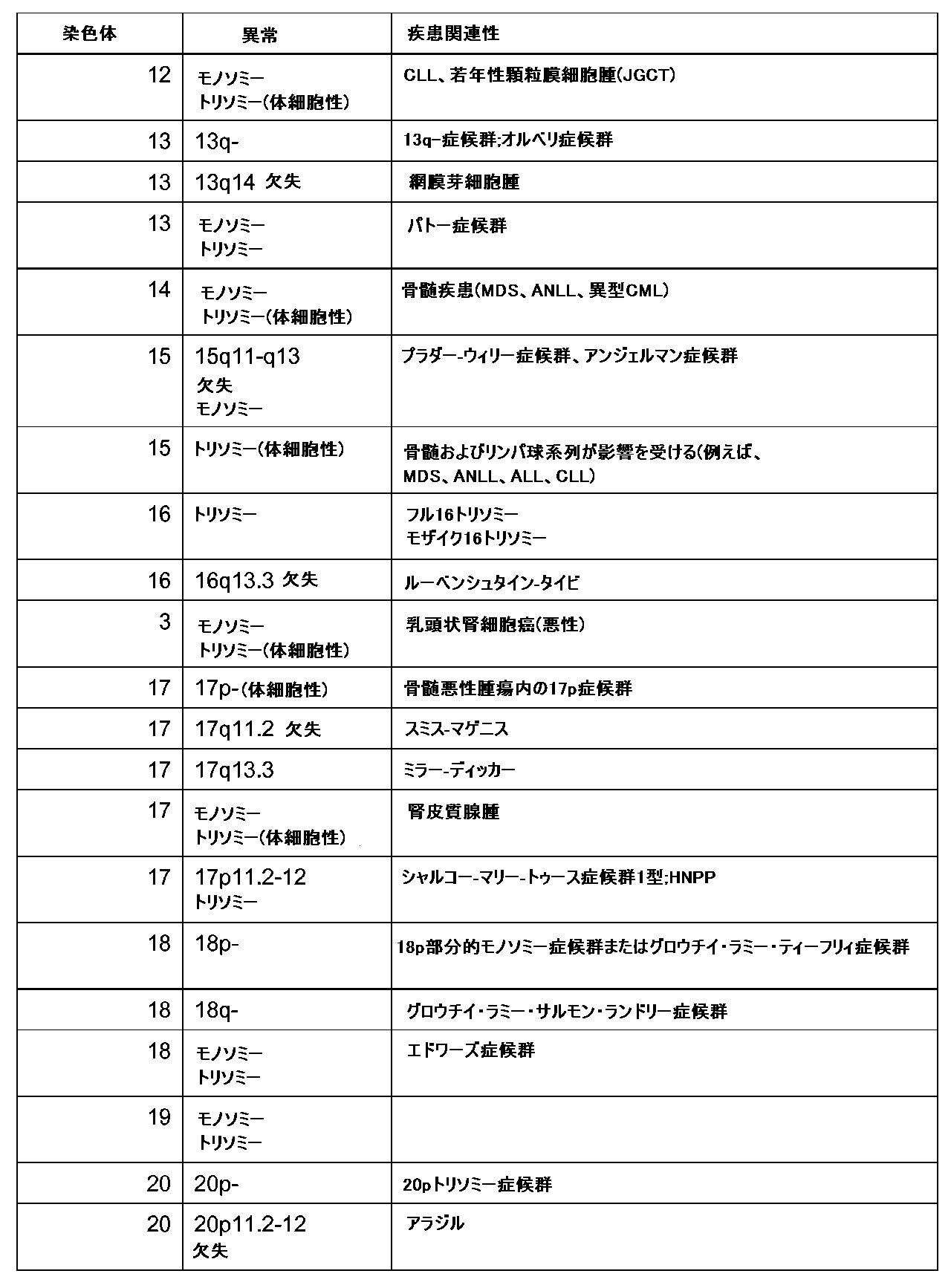

(Available at: http://www.ncbi.nlm.nih.gov/pubmed/2132346


グレード1の状態は、多くの場合、1つまたは複数の以下の特徴を有する;病原的異常
;遺伝学者の間で強く合意されている;高い浸透性;なおも多様な表示型を有し得るが、
いくつかの一般的な特性も有する;文献中の全ての症例は臨床表示型を有する;異常を有
する健康な個体の症例を認めない;DVGデータベースに報告されていない、または健常
母集団では見出されない;単一遺伝子または多重遺伝子の量的効果を確認する機能的デー
タ;確認済みまたは強固な候補遺伝子;臨床マネジメント案が規定済み;がんのリスクが
公知でサーベイの案を有する;複数の情報源(OMIM、Gene reviews、O
rphanet、Unique、Wikipedia);および/または診断用途で利用
可能(妊娠カウンセリング)。
Grade 1 conditions often have one or more of the following characteristics: pathogenic abnormality; strong agreement among geneticists; high penetrance; may have yet diverse presentations;
They also have several common characteristics; all cases in the literature have a clinical phenotype; no cases of healthy individuals with the abnormality are known; they are not reported in the DVG database or found in the healthy population; functional data confirming single gene or multigene dosage effects; confirmed or robust candidate genes; clinical management proposals defined; known cancer risk and survey proposals; multiple sources of information (OMIM, Gene reviews, O
rphanet, Unique, Wikipedia); and/or available for diagnostic purposes (pregnancy counseling).
グレード2の状態は、多くの場合、1つまたは複数の下記の特徴を有する;病原的異常
の可能性;高い浸透性;DDを除き一貫した特性を有さない多様な表示型;文献では症例
/報告の数が少ない;報告された全ての症例は臨床表示型を有する;機能的データまたは
確認済みの病原性遺伝子を認めない;複数の情報源(OMIM、Gene review
s、Orphanet、Unique、Wikipedia);および/または診断目的
および妊娠カウンセリングのために使用できる。
Grade 2 conditions often have one or more of the following characteristics: possible pathogenic abnormality; high penetrance; diverse phenotypes with no consistent characteristics except for DD; few cases/reports in the literature; all reported cases have a clinical phenotype; no functional data or identified pathogenic genes; multiple sources (OMIM, Gene review,
s, Orphanet, Unique, Wikipedia); and/or for diagnostic purposes and pregnancy counseling.
グレード3の状態は、多くの場合、1つまたは複数の下記の特徴を有する;感受性遺伝
子座;健常な個体または発端者の未罹患の両親が記載されている;対照母集団中に存在す
る;非浸透性;表示型が軽度で特異的ではない;特性はあまり一貫していない;機能的デ
ータまたは確認済みの病原性遺伝子を認めない;データの原典がより限定的;大部分から
乖離している症例に関して、または新規臨床所見が存在する場合、第2の診断の可能性は
、可能性の状態のままである;および/または診断目的で使用する際には要注意、および
妊娠カウンセリングの場合、助言には慎重を期す。
Grade 3 conditions often have one or more of the following characteristics: a susceptibility locus; healthy individuals or unaffected parents of the proband have been documented; present in control populations; non-penetrant; mild and non-specific phenotype; less consistent characteristics; no functional data or confirmed pathogenicity genes; more limited data source; for cases that are disparate from the majority or when novel clinical findings exist, the possibility of a second diagnosis remains a possibility; and/or caution is advised when using for diagnostic purposes and, in the case of pregnancy counseling, caution is advised.
子癇前症
一部の実施形態では、子癇前症の存在または非存在は、本明細書に記載する方法、機械
または装置を使用して決定される。子癇前症は、妊娠中に高血圧症が発生する状態(例え
ば、妊娠誘発性高血圧症)であり、尿中の相当量のタンパク質と関連する。ある特定の実
施形態では、子癇前症は、細胞外核酸のレベル上昇および/またはメチル化パターン変化
とも関連する。例えば、細胞外の胎仔由来過剰メチル化RASSF1Aレベルと子癇前症
の重症度の間に正の相関が認められた。ある特定の例では、子癇前症の胎盤内のH19遺
伝子について、正常な対照と比較してDNAのメチル化の増加が認められる。
Pre-eclampsia In some embodiments, the presence or absence of pre-eclampsia is determined using the method, machine or device described herein. Pre-eclampsia is a condition in which hypertension occurs during pregnancy (e.g., pregnancy-induced hypertension) and is associated with a significant amount of protein in urine. In certain embodiments, pre-eclampsia is also associated with elevated levels of extracellular nucleic acids and/or altered methylation patterns. For example, a positive correlation has been found between extracellular fetal-derived hypermethylated RASSF1A levels and the severity of pre-eclampsia. In certain instances, increased DNA methylation is found for the H19 gene in pre-eclamptic placentas compared to normal controls.
子癇前症は、世界的に、母体および胎仔/新生児の死亡率および疾病率の主因の1つで
ある。血漿および血清中の循環型無細胞核酸は新規バイオマーカーであり、出生前診断を
含む異なる医学分野における臨床用途として有望である。母体血漿中の無細胞胎仔(cf
f)DNAについて、例えば雄特異的SRYまたはDYS14遺伝子座に関するリアルタ
イム定量的PCRを使用して定量したとき、その変化が急迫した子癇前症に関する指標と
なることが、異なる試験で報告されている。早期発症型の子癇前症の症例では、妊娠初期
にレベルの上昇が認められる場合がある。症状発現前のcffDNAのレベルの上昇は、
組織の酸化ストレスおよび胎盤アポトーシスの増加および壊死を引き起こす絨毛間腔内の
低酸素状態/再酸素負荷に起因する場合もある。cffDNAの母体循環への流出増加に
関する証拠に加えて、子癇前症では、cffDNAの腎臓排出の低下に関する証拠も存在
する。胎仔DNAの量は、現在のところ、Y-染色体特異的配列の定量により決定される
ので、代替的アプローチ、例えば無細胞総DNAの測定または性別に依存しない胎仔エピ
ジェネティックマーカー、例えばDNAメチル化の使用により、代替法が提供される。胎
盤由来の無細胞RNAは、臨床診療において子癇前症をスクリーニングおよび診断するの
に使用できる別の代替的バイオマーカーである。胎仔RNAは、これを分解から保護する
細胞内胎盤粒子と関連する。胎仔のRNAレベルは、対照と比較して子癇前症の妊娠中の
雌では10倍高い場合があり、したがって、臨床診療において子癇前症をスクリーニング
および診断するのに使用できる代替的バイオマーカーである。
Preeclampsia is one of the leading causes of maternal and fetal/neonatal mortality and morbidity worldwide. Circulating cell-free nucleic acids in plasma and serum are novel biomarkers with promising clinical applications in different medical fields, including prenatal diagnosis. Cell-free fetal (CF) nucleic acids in maternal plasma are
f) Different studies have reported that changes in DNA, when quantified using real-time quantitative PCR for example for the male-specific SRY or DYS14 locus, are indicative of impending pre-eclampsia. Elevated levels may be observed early in pregnancy in cases of early-onset pre-eclampsia. Elevated levels of cffDNA prior to the onset of symptoms may be indicative of impending pre-eclampsia.
It may also be due to hypoxia/reoxygenation in the intervillous space causing tissue oxidative stress and increased placental apoptosis and necrosis. In addition to evidence for increased efflux of cffDNA into the maternal circulation, there is also evidence for decreased renal excretion of cffDNA in pre-eclampsia. As the amount of fetal DNA is currently determined by quantification of Y-chromosome specific sequences, alternative approaches, such as measurement of cell-free total DNA or the use of sex-independent fetal epigenetic markers, such as DNA methylation, provide alternatives. Cell-free RNA from the placenta is another alternative biomarker that can be used to screen and diagnose pre-eclampsia in clinical practice. Fetal RNA is associated with intracellular placental particles that protect it from degradation. Fetal RNA levels can be 10-fold higher in pregnant females with pre-eclampsia compared to controls and are therefore an alternative biomarker that can be used to screen and diagnose pre-eclampsia in clinical practice.
病原体
一部の実施形態では、病態の存在または非存在は、本明細書に記載する方法、機械また
は装置により決定される。病態は、細菌、ウイルス、または真菌を含むが、これらに限定
されない病原体に宿主が感染することにより引き起こされ得る。病原体は宿主の核酸と区
別可能な核酸(例えば、ゲノムDNA、ゲノムRNA、mRNA)を一般的に有するので
、本明細書において提供される方法、機械および装置が、病原体の存在または非存在を決
定するのに使用できる。多くの場合、病原体は、例えばエピジェネティックな状態および
/または1つもしくは複数の配列の変異、重複、および/または欠失等の、特定の病原体
に固有の特徴を持つ核酸を有する。したがって、本明細書において提供される方法は、特
定の病原体または病原体の変異体(例えば、株)を同定するのに使用できる。
Pathogens In some embodiments, the presence or absence of a pathology is determined by the methods, machines, or devices described herein. A pathology can be caused by a host being infected with a pathogen, including, but not limited to, a bacterium, a virus, or a fungus. Because pathogens generally have nucleic acids (e.g., genomic DNA, genomic RNA, mRNA) that are distinguishable from the nucleic acids of the host, the methods, machines, and devices provided herein can be used to determine the presence or absence of a pathogen. In many cases, pathogens have nucleic acids that have characteristics unique to the particular pathogen, such as, for example, an epigenetic state and/or one or more sequence mutations, duplications, and/or deletions. Thus, the methods provided herein can be used to identify a particular pathogen or a variant (e.g., strain) of a pathogen.
がん
一部の実施形態では、細胞増殖障害(例えば、がん)の存在または非存在が、本明細書
に記載する方法、機械または装置を使用して決定される。例えば、血清中の無細胞核酸の
レベルは、健康な患者と比較して様々な種類のがんを有する患者で上昇し得る。例えば、
転移性の疾患を有する患者は、非転移性の患者の約2倍高い血清DNAレベルを有する場
合があり得る。転移性の疾患を有する患者は、がん特異的マーカー、および/または、例
えばある特定の一塩基多型または短いタンデムリピートによっても同定される可能性があ
る。循環型DNAのレベル上昇と正に相関し得るがんの種類の非限定的な例として、乳が
ん、結腸直腸がん、胃腸がん、肝細胞がん、肺がん、メラノーマ、非ホジキンリンパ腫、
白血病、多発性骨髄腫、膀胱がん、ヘパトーマ、子宮頚がん、食道がん、膵臓がん、およ
び前立腺がんが挙げられる。様々ながんは、非がん性の健康な細胞に由来する核酸から区
別可能な特徴、例えばエピジェネティックな状態、ならびに/または配列の変異、重複、
および/もしくは欠失等を伴う核酸を有し得、時にはこれを血流中に放出し得る。かかる
特徴は、例えば特定の種類のがんに固有であり得る。したがって、本明細書において提供
される方法は、特定の種類のがんを同定するのに使用できることがさらに考えられる。
In some embodiments, the presence or absence of a cell proliferation disorder (e.g., cancer) is determined using the methods, machines, or devices described herein. For example, the level of cell-free nucleic acid in serum may be elevated in patients with various types of cancer compared to healthy patients. For example,
Patients with metastatic disease may have serum DNA levels approximately twice as high as non-metastatic patients. Patients with metastatic disease may also be identified by cancer-specific markers and/or by, for example, certain single nucleotide polymorphisms or short tandem repeats. Non-limiting examples of cancer types that may be positively correlated with elevated levels of circulating DNA include breast cancer, colorectal cancer, gastrointestinal cancer, hepatocellular carcinoma, lung cancer, melanoma, non-Hodgkin's lymphoma, and the like.
These include leukemia, multiple myeloma, bladder cancer, hepatoma, cervical cancer, esophageal cancer, pancreatic cancer, and prostate cancer. Various cancers have characteristics that distinguish them from nucleic acids derived from non-cancerous healthy cells, such as epigenetic status and/or sequence mutations, duplications,
and/or may have nucleic acids with deletions, etc., which may sometimes be released into the bloodstream. Such characteristics may be unique to, for example, a particular type of cancer. Thus, it is further contemplated that the methods provided herein can be used to identify a particular type of cancer.
本明細書において以後より詳細に記載するように、ソフトウェアが、本明細書に記載す
るプロセスにおいて、下記を含むが、これに限定されない1つまたは複数のステップを行
うために使用できる;カウント数計測、データ処理、結果の生成、および/または生成さ
れた結果に基づく1つもしくは複数の勧告案の提供。
As described in more detail hereinafter, software may be used to perform one or more steps in the processes described herein, including, but not limited to, counting, processing the data, generating results, and/or providing one or more recommendations based on the results generated.
機械、ソフトウェア、およびインターフェース
本明細書に記載するある特定のプロセスおよび方法は、多くの場合、コンピュータ、プ
ロセッサ、ソフトウェア、モジュールまたは他の装置なしで行うことができない。本明細
書に記載する方法は、一般的にコンピュータが実施する方法であり、方法の1つまたは複
数の部分が、1つまたは複数のプロセッサ(例えば、マイクロプロセッサ)、コンピュー
タ、またはマイクロプロセッサ制御式装置により行われる場合がある。一部の実施形態で
は、公知または本明細書に記載する1つもしくは複数または全ての処理方法(例えば、マ
ッピング、データ圧縮、局所的なゲノムの偏りの推定値の決定、関係の決定、関係の比較
、カウント数の正規化、リード密度および/もしくはリード密度プロファイルの生成、P
CA、プロファイル調整、部分のフィルタリング、部分の重み付け、プロファイルの比較
、プロファイルのスコアリング、アウトカムの決定など、またはそれらの組合せ)が、メ
モリと併せたプロセッサ、マイクロプロセッサ、コンピュータにより、かつ/またはマイ
クロプロセッサが制御する装置により行われる。本文書に記載されている方法に関連する
実施形態は、一般的に、本明細書に記載するシステム、装置、およびコンピュータプログ
ラム製品でインストラクションにより実施される同一のまたは関連するプロセスに適用可
能である。一部の実施形態では、本明細書に記載するプロセスおよび方法(例えば、定量
、カウント数計測、ならびに/または配列のリード、カウント数、レベル、および/もし
くはプロファイルの決定)は、自動化された方法により行われる。一部の実施形態では、
本明細書に記載する1つまたは複数のステップおよび方法は、プロセッサおよび/もしく
はコンピュータにより行われる、および/またはメモリと併せて行われる。一部の実施形
態では、自動化された方法は、配列のリード、カウント数、マッピング、マッピングされ
た配列タグ、レベル、プロファイル、正規化、比較、範囲の設定、分類、調整、プロッテ
ィング、結果、変換、および同定を決定するソフトウェア、モジュール、プロセッサ、周
辺機器、および/またはそのようなものを含む機械に組み込まれる。本明細書で使用する
場合、ソフトウェアとは、本明細書に記載するように、プロセッサにより実行されたとき
にコンピュータの操作を行う、コンピュータ可読プログラムインストラクションを指す。
Machines, Software, and Interfaces Certain processes and methods described herein often cannot be performed without a computer, processor, software, module, or other device. The methods described herein are generally computer-implemented methods, and one or more portions of the method may be performed by one or more processors (e.g., microprocessors), computers, or microprocessor-controlled devices. In some embodiments, one or more or all of the processing methods known or described herein (e.g., mapping, data compression, determining estimates of local genomic bias, determining relationships, comparing relationships, normalizing counts, generating read density and/or read density profiles, P
CA, profile adjustment, filtering portions, weighting portions, comparing profiles, scoring profiles, determining outcomes, etc., or combinations thereof, are performed by a processor, microprocessor, computer in conjunction with memory, and/or by a microprocessor-controlled device. Method-related embodiments described herein are generally applicable to the same or related processes performed by instructions in the systems, devices, and computer program products described herein. In some embodiments, the processes and methods described herein (e.g., quantification, count counting, and/or determining sequence reads, counts, levels, and/or profiles) are performed by automated methods. In some embodiments,
One or more steps and methods described herein are performed by a processor and/or computer and/or in conjunction with memory.In some embodiments, the automated method is incorporated into a machine that includes software, modules, processors, peripherals, and/or the like, that determines sequence reads, counts, mapping, mapped sequence tags, levels, profiles, normalization, comparison, range setting, classification, adjustment, plotting, results, conversion, and identification.As used herein, software refers to computer-readable program instructions that, when executed by a processor, perform computer operations, as described herein.
試験対象(例えば、患者、妊娠中の雌)に由来する、および/または参照対象に由来す
る配列のリード、カウント数、リード密度、およびリード密度プロファイルは、遺伝子の
変異の存在または非存在を決定するためにさらに分析および処理することができる。配列
のリード、カウント数、レベル、および/またはプロファイルは、「データ」または「デ
ータセット」と呼ばれる場合もある。一部の実施形態では、データまたはデータセットは
、1つまたは複数の特性または変数(例えば、配列に基づく[例えば、GC含有量、特異
的ヌクレオチド配列等]、機能特異的[例えば、発現した遺伝子、がん遺伝子等]、場所
に基づく[ゲノム特異的、染色体特異的、部分または部分特異的]特性または変数等およ
びその組合せ)により特徴付けることができる。ある特定の実施形態では、データまたは
データセットは、1つまたは複数の特性または変数に基づく2次元またはそれ超の次元を
有するマトリックスに組織化され得る。マトリックスに組織化されたデータは、任意の適
する特性または変数を使用して組織化され得る。マトリックス中のデータの非限定的な例
として、母体の年齢、母体の倍数性、および胎仔の寄与により組織化されるデータが挙げ
られる。ある特定の実施形態では、1つまたは複数の特性または変数により特徴付けられ
るデータセットは、カウント数計測後に処理される場合もある。
The sequence reads, counts, read densities, and read density profiles from the test subject (e.g., patient, pregnant female) and/or from the reference subject can be further analyzed and processed to determine the presence or absence of genetic mutations. The sequence reads, counts, levels, and/or profiles may also be referred to as "data" or "datasets". In some embodiments, the data or datasets can be characterized by one or more features or variables (e.g., sequence-based [e.g., GC content, specific nucleotide sequence, etc.], function-specific [e.g., expressed genes, cancer genes, etc.], location-based [genome-specific, chromosome-specific, part or part-specific] features or variables, etc. and combinations thereof). In certain embodiments, the data or datasets can be organized into matrices with two or more dimensions based on one or more features or variables. The data organized into the matrix can be organized using any suitable features or variables. Non-limiting examples of data in a matrix include data organized by maternal age, maternal ploidy, and fetal contribution. In certain embodiments, a data set characterized by one or more properties or variables may be processed after counting.
装置(装置(apparatus)として複数形でも本明細書で呼ばれる複数の装置(
multiple apparatuses))、ソフトウェア、およびインターフェー
スが、本明細書に記載する方法を実施するのに使用できる。装置、ソフトウェア、および
インターフェースを使用して、ユーザーは、特定の情報、プログラム、またはプロセス(
例えば、配列のリードのマッピング、マッピングされたデータの処理、および/または結
果の提供)を使用するためのオプションを入力、要求、照会、または決定することができ
、例えば統計分析アルゴリズム、統計的有意性アルゴリズム、統計的分散アルゴリズム、
比較、反復ステップ、妥当性の確認アルゴリズム、および図形表示の実施が含まれ得る。
一部の実施形態では、データセットは、インプット情報としてユーザーが入力可能であり
、ユーザーは、適するハードウェアメディア(例えば、フラッシュドライブ)により1つ
もしくは複数のデータセットをダウンロードすることができ、ならびに/またはユーザー
は、後続する処理のために、および/もしくは結果を得るために、1つのシステムから別
のシステムにデータセットを送信することができる(例えば、シーケンサーからコンピュ
ータシステムに、配列のリードのマッピング用として配列のリードデータを送信する;マ
ッピングされた配列データを、処理用として、ならびに結果および/またはレポートの取
得用としてコンピュータシステムに送信する)。
Apparatus (apparatuses)
The devices, software, and interfaces may be used to implement the methods described herein. Using the devices, software, and interfaces, a user may select specific information, programs, or processes (
For example, options for using a statistical analysis algorithm, a statistical significance algorithm, a statistical variance algorithm, a statistical analysis method ...
Comparisons, iterative steps, validation algorithms, and graphical display implementations may be included.
In some embodiments, the datasets can be entered by a user as input information, the user can download one or more datasets via a suitable hardware medium (e.g., a flash drive), and/or the user can transmit the datasets from one system to another system for subsequent processing and/or to obtain results (e.g., transmitting sequence read data from a sequencer to a computer system for mapping of sequence reads; transmitting the mapped sequence data to a computer system for processing and obtaining results and/or reports).
システムは、典型的には、1つまたは複数の装置を含む。一部の実施形態では、装置は
、機械である。一部の実施形態では、装置は、機械を含む。装置は、メモリ、1つまたは
複数のプロセッサ、および/またはインストラクションのうちの1つまたは複数を含み得
る。システムが2つまたはそれ超の装置を含む場合、装置の一部または全部は同一の場所
に位置し得る、装置の一部または全部は異なる場所に位置し得る、全ての装置は1つの場
所に位置し得る、および/または全ての装置は異なる場所に位置し得る。システムが2つ
またはそれ超の装置を含む場合、装置の一部もしくは全部はユーザーと同じ場所に位置し
得る、装置の一部もしくは全部はユーザーと異なる場所に位置し得る、全ての装置はユー
ザーと同じ場所に位置し得る、および/または全ての装置はユーザーとは異なる1つもし
くは複数の場所に位置し得る。本明細書に記載するシステムの装置は、適切な方法により
1つまたは複数のリモートコンピューティングサーバーおよび/またはコンピュータ(例
えば、クラウド、クラウドコンピューティングサービス)とインターフェースをとること
ができる。用語「クラウド」は、本明細書で使用する場合、機能の部分がネットワーク内
の複数のコンピュータにより共有されている集中型の機能(例えば、本明細書に記載の方
法)を行うことができるリアルタイム通信ネットワーク(例えば、インターネット)によ
って接続されている2つまたはそれ超のコンピュータ(例えば、しばしば、複数のコンピ
ュータ)を部分的に指す。「クラウド」はしばしば、同時に複数の接続されたコンピュー
タ上で1つまたは複数のプログラム(例えば、ソフトウェアプログラム、モジュール)を
ランさせることができる。一部の実施形態では、本明細書に記載するシステムおよび/ま
たは装置は、クラウド(例えば、クラウドサーバー、クラウドコンピュータ、クラウドコ
ンピューティングサービス)を含む。本明細書に記載するシステムおよび/または装置の
1つまたは複数の機能を、クラウドにより行うことができる。データおよび/または情報
を、適切な方法を使用して装置およびクラウドに、かつ/またはこれらから移送すること
ができる。用語「コンピュータ」は、本明細書で使用する場合、算術的演算および論理的
演算を行うことができるマイクロプロセッサを含む電気的な人工デバイスを指す。コンピ
ュータは、時には、インストラクション、ソフトウェア(例えば、モジュール)、メモリ
、ディスプレイ、1つまたは複数の周辺機器および/またはストレージメディアを含む。
一部の実施形態では、機械は、コンピュータを含む。一部の実施形態では、機械は、コン
ピュータである。コンピュータはしばしば、他のコンピュータ(例えば、インターネット
、ネットワーク、クラウド)とインターフェースをとり、かつ/またはそれに接続されて
いる。
A system typically includes one or more devices. In some embodiments, the device is a machine. In some embodiments, the device includes a machine. The device may include one or more of a memory, one or more processors, and/or instructions. When a system includes two or more devices, some or all of the devices may be located at the same location, some or all of the devices may be located at different locations, all of the devices may be located at one location, and/or all of the devices may be located at different locations. When a system includes two or more devices, some or all of the devices may be located at the same location as the user, some or all of the devices may be located at a different location than the user, all of the devices may be located at the same location as the user, and/or all of the devices may be located at one or more locations different from the user. The devices of the systems described herein may interface with one or more remote computing servers and/or computers (e.g., cloud, cloud computing services) in an appropriate manner. The term "cloud" as used herein refers in part to two or more computers (e.g., often multiple computers) connected by a real-time communication network (e.g., the Internet) that can perform centralized functions (e.g., the methods described herein) where parts of the functionality are shared by multiple computers in the network. A "cloud" often allows one or more programs (e.g., software programs, modules) to run on multiple connected computers at the same time. In some embodiments, the systems and/or devices described herein include a cloud (e.g., a cloud server, a cloud computer, a cloud computing service). One or more functions of the systems and/or devices described herein can be performed by the cloud. Data and/or information can be transported to and/or from the devices and clouds using suitable methods. The term "computer" as used herein refers to an electrical artificial device that includes a microprocessor that can perform arithmetic and logical operations. A computer sometimes includes instructions, software (e.g., modules), memory, a display, one or more peripheral devices and/or storage media.
In some embodiments, the machine includes a computer. In some embodiments, the machine is a computer. Computers often interface with and/or are connected to other computers (e.g., the Internet, networks, cloud).
システムは、時には、演算装置もしくは配列決定装置、または演算装置および配列決定
装置(すなわち、配列決定機および/または計算機)を含む。配列決定装置は一般に、物
理的な核酸を受け取り、核酸のヌクレオチド塩基に対応するシグナルを生成するように構
成されている。配列決定装置はしばしば、核酸を含む試料を「ロードされ」、配列決定装
置にロードされた試料の核酸は一般に、核酸配列決定処理に付される。用語「配列装置に
ロードすること」は、本明細書で使用する場合、配列決定装置の部分(例えば、フローセ
ル)を核酸試料と接触させることを指し、配列決定装置の部分は、核酸配列決定処理を実
施するために試料を受け取るように構成されている。一部の実施形態では、配列決定装置
に試料核酸の変異体をロードする。変異体は、時には、試料核酸を修飾して核酸を配列決
定するのに適した形態にする処理により(例えば、ライゲーション(例えば、ライゲーシ
ョンにより試料核酸の末端にアダプターを付加して)、増幅、制限消化など、またはそれ
らの組合せにより)生成される。配列決定装置はしばしば、ロードされた核酸のヌクレオ
チド塩基に対応するシグナル(例えば、電子シグナル、検出器シグナル、画像など、また
はそれらの組合せ)を生成する適切なDNA配列決定法を行うように部分的に構成されて
いる。
The system sometimes includes a computing device or a sequencing device, or a computing device and a sequencing device (i.e., a sequencer and/or a computer). A sequencing device is generally configured to receive a physical nucleic acid and generate a signal corresponding to a nucleotide base of the nucleic acid. A sequencing device is often "loaded" with a sample containing nucleic acid, and the nucleic acid of the sample loaded into the sequencing device is generally subjected to a nucleic acid sequencing process. The term "loading a sequencing device" as used herein refers to contacting a portion of a sequencing device (e.g., a flow cell) with a nucleic acid sample, the portion of the sequencing device being configured to receive the sample to perform a nucleic acid sequencing process. In some embodiments, a variant of the sample nucleic acid is loaded into the sequencing device. The variant is sometimes generated by a process that modifies the sample nucleic acid to make it suitable for sequencing (e.g., by ligation (e.g., by adding adapters to the ends of the sample nucleic acid by ligation), amplification, restriction digestion, etc., or a combination thereof). The sequencing instrument is often configured in part to perform a suitable DNA sequencing method that generates a signal (e.g., an electronic signal, a detector signal, an image, etc., or a combination thereof) that corresponds to the nucleotide bases of the loaded nucleic acid.
DNA配列の各塩基に対応する1つまたは複数のシグナルはしばしば、適切な処理によ
り処理および/または変換されて塩基判定(例えば、特異的なヌクレオチド塩基、例えば
、グアニン、シトシン、チミン、ウラシル、アデニンなど)にされる。ロードされた核酸
に由来する塩基判定のコレクションはしばしば、処理および/または集積されて1つまた
は複数の配列のリードにされる。複数の試料核酸が同時に配列決定される(すなわち、マ
ルチプレックス化)実施形態では、適切なデマルチプレックス化処理を活用して、特定の
リードをこれらが起源とした試料核酸と関連付けることができる。本明細書に記載するよ
うに、配列のリードを適切な処理により参照ゲノムに対して整列させることができ、参照
ゲノムの部分に対して整列されたリードをカウントすることができる。
One or more signals corresponding to each base of a DNA sequence are often processed and/or converted by appropriate processing into a base call (e.g., a specific nucleotide base, e.g., guanine, cytosine, thymine, uracil, adenine, etc.). The collection of base calls derived from the loaded nucleic acid is often processed and/or aggregated into one or more sequence reads. In embodiments where multiple sample nucleic acids are sequenced simultaneously (i.e., multiplexed), appropriate demultiplexing processing can be utilized to associate specific reads with the sample nucleic acid from which they originated. As described herein, sequence reads can be aligned to a reference genome by appropriate processing, and reads aligned to portions of the reference genome can be counted.
配列決定装置は、時には、システム内の1つまたは複数の演算装置と関連し、かつ/ま
たはこれらを含む。1つまたは複数の演算装置は、時には、以下の処理の1つまたは複数
を行うように構成されている:配列決定装置シグナルからの塩基判定の生成、リードの集
積(例えば、リードの生成)、リードのデマルチプレックス化、参照ゲノムに対するリー
ドの整列、参照ゲノム中のゲノム部分に対して整列されたリードのカウントなど。1つま
たは複数の演算装置は、時には、以下の追加の処理の1つまたは複数を行うように構成さ
れている:リードのカウント数の正規化(例えば、偏りの低減または除去)、1つまたは
複数の決定(例えば、胎仔フラクション、胎仔の倍数性、胎仔の性別、胎仔染色体のカウ
ント数、アウトカム、遺伝子の変異の存在または非存在(例えば、胎仔の染色体異数性(
例えば、染色体13、18、および/または21トリソミー)の存在または非存在の決定
)の生成など。
The sequencing device is sometimes associated with and/or includes one or more computing devices in the system. The one or more computing devices are sometimes configured to perform one or more of the following processes: generating base calls from the sequencing device signal, collecting reads (e.g., generating reads), demultiplexing the reads, aligning the reads to a reference genome, counting the reads aligned to genomic portions in the reference genome, etc. The one or more computing devices are sometimes configured to perform one or more of the following additional processes: normalizing the read counts (e.g., reducing or removing bias), determining one or more (e.g., fetal fraction, fetal ploidy, fetal sex, fetal chromosome counts, outcome, presence or absence of genetic mutations (e.g., fetal chromosomal aneuploidy (
For example, determining the presence or absence of chromosome trisomies 13, 18, and/or 21).
一部の実施形態では、1つの演算装置は、配列決定装置と関連しており、ある特定の実
施形態では、1つの演算装置は、以下の処理の大部分または全てを行う:配列決定装置シ
グナルからの塩基判定の生成、リードの集積、リードのデマルチプレックス化、参照ゲノ
ムのゲノム部分に対するリードの整列およびこのゲノム部分に対して整列されたリードの
カウント、リードのカウント数の正規化、ならびに1つまたは複数のアウトカム(例えば
、胎仔フラクション、特定の遺伝子の変異の存在または非存在)の生成など。1つの演算
装置が配列決定装置と関連している後者の実施形態では、演算装置はしばしば、1つまた
は複数のプロセッサ(例えば、マイクロプロセッサ)、および処理を行うのに1つまたは
複数のプロセッサにより実施されるインストラクションを有するメモリを含む。一部の実
施形態では、1つの演算装置は、配列決定装置にローカルな(例えば、同じ場所(例えば
、同じ住所、同じ建築物、同じフロア、同じ部屋など)に位置した)シングルコア演算デ
バイスまたはマルチコア演算デバイスであり得る。一部の実施形態では、1つの演算装置
は、配列決定装置に組み入れられている。
In some embodiments, a computing device is associated with a sequencing device, and in certain embodiments, a computing device performs most or all of the following operations: generating base calls from the sequencing device signal, accumulating reads, demultiplexing reads, aligning reads to genomic portions of a reference genome and counting the aligned reads to the genomic portions, normalizing the read counts, and generating one or more outcomes (e.g., fetal fraction, presence or absence of a mutation in a particular gene). In the latter embodiment, where a computing device is associated with a sequencing device, the computing device often includes one or more processors (e.g., microprocessors) and a memory having instructions executed by the one or more processors to perform the operations. In some embodiments, a computing device can be a single-core or multi-core computing device that is local to the sequencing device (e.g., located in the same location (e.g., same address, same building, same floor, same room, etc.)). In some embodiments, a computing device is incorporated into the sequencing device.
一部の実施形態では、システム内の複数の演算装置は、配列決定装置と関連しており、
システムにより行われる全処理のサブセットは、システムの特定の演算装置に配分され、
またはその中で分割されている場合がある。処理の総数のサブセットは、2つもしくはそ
れ超の演算装置またはその群の中で、任意の適切な組合せで分割され得る。ある特定の実
施形態では、配列決定装置シグナルからの塩基判定の生成、リードの集積、およびリード
のデマルチプレックス化は、第1の演算装置またはその群により行われ、参照ゲノムの部
分に対してマッピングされたリードの整列およびカウントは、第2の演算装置またはその
群により行われ、リードのカウント数の正規化および1つまたは複数のアウトカムの提供
は、第3の演算装置またはその群により行われる。2つもしくはそれ超の演算装置または
その群を含むシステムでは、それぞれの特定の演算装置は、メモリ、1つまたは複数のプ
ロセッサ、またはそれらの組合せを含み得る。マルチ演算装置システムは、時には、配列
決定装置にローカルな1つまたは複数の適切なサーバーを含み、時には、配列決定装置に
ローカルでない1つまたは複数の適切なサーバー(例えば、ウェブサーバー、オンライン
サーバー、アプリケーションサーバー、リモートファイルサーバー、クラウドクラウドサ
ーバー(例えば、クラウド環境、クラウドコンピューティング))を含む。
In some embodiments, the plurality of computing devices in the system are associated with a sequencing device,
A subset of the total processing performed by the system is allocated to a particular computing device of the system;
or may be divided among them. A subset of the total number of processes may be divided among two or more computing devices or groups thereof in any suitable combination. In certain embodiments, the generation of base calls from the sequencer signal, the accumulation of reads, and the demultiplexing of reads are performed by a first computing device or groups thereof, the alignment and counting of the reads mapped to the portion of the reference genome are performed by a second computing device or groups thereof, and the normalization of the counts of the reads and the provision of one or more outcomes are performed by a third computing device or groups thereof. In a system including two or more computing devices or groups thereof, each particular computing device may include a memory, one or more processors, or a combination thereof. A multi-computing device system sometimes includes one or more suitable servers that are local to the sequencing device, and sometimes includes one or more suitable servers that are not local to the sequencing device (e.g., web servers, online servers, application servers, remote file servers, cloud cloud servers (e.g., cloud environments, cloud computing)).
異なるシステム構成中の装置は、異なるタイプの出力データを生成し得る。例えば、配
列決定装置は、塩基シグナルを出力することができ、塩基シグナル出力データは、塩基シ
グナルデータを塩基判定に変換する演算装置に移送することができる。一部の実施形態で
は、塩基判定は、1つの演算装置からの出力データであり、配列のリードを生成するため
に別の演算装置に移送される。ある特定の実施形態では、塩基判定は、特定の装置からの
出力データではなく、代わりに、配列決定装置の塩基シグナルを受信して配列のリードを
生成した同じ装置内で活用される。一部の実施形態では、1つの装置は、配列決定装置の
塩基シグナルを受信し、塩基判定、配列のリードを生成し、配列のリードをデマルチプレ
ックス化し、配列のリードを参照ゲノムに対して整列させる別の装置またはその群に移送
することができる、試料についてのデマルチプレックス化された配列のリードを出力する
。一部の実施形態では、1つの装置またはその群は、参照ゲノムの部分に対してマッピン
グされた整列された配列のリードを出力することができ(例えば、SAMファイルまたは
BAMファイル)、このような出力データは、配列のリードを正規化し(例えば、配列の
リードのカウント数を正規化し)、アウトカム(例えば、胎仔フラクションおよび/また
は胎仔のトリソミーの存在もしくは非存在)を生成する第2の演算装置またはその群に移
送することができる。1つの装置からの出力データは、任意の適切な様式で第2の装置に
移送することができる。例えば、1つの装置からの出力データは、時には、物理的なスト
レージデバイス上に配置され、ストレージデバイスは、出力データが移送される第2の装
置に輸送および接続される。出力データは、時には、データベース中に1つの装置により
保管され、第2の装置は、同じデータベースから出力データにアクセスする。
The devices in different system configurations may generate different types of output data. For example, a sequencing device can output base signals, and the base signal output data can be transferred to a computing device that converts the base signal data into base calls. In some embodiments, the base calls are output data from one computing device and are transferred to another computing device to generate sequence reads. In certain embodiments, the base calls are not output data from a particular device, but are instead utilized within the same device that received the sequencing device base signals and generated the sequence reads. In some embodiments, one device receives the sequencing device base signals and outputs demultiplexed sequence reads for the sample that can be transferred to another device or group of devices that generate base calls, sequence reads, demultiplex the sequence reads, and align the sequence reads to a reference genome. In some embodiments, one or a group of devices can output aligned sequence reads mapped to portions of the reference genome (e.g., SAM or BAM files), and such output data can be transferred to a second computing device or a group of devices that normalize the sequence reads (e.g., normalize sequence read counts) and generate an outcome (e.g., fetal fraction and/or the presence or absence of fetal trisomy). The output data from one device can be transferred to the second device in any suitable manner. For example, the output data from one device is sometimes placed on a physical storage device, and the storage device is transported and connected to the second device to which the output data is transferred. The output data is sometimes stored by one device in a database, and the second device accesses the output data from the same database.
システムは、時には、偏り低減機を含む。偏り低減機は、時には、1つまたは複数のコ
ンピュータを含む。一部の実施形態では、偏り低減機は、配列のリードをマッピングし、
かつ/またはリード(例えば、マッピングされた配列のリード)を圧縮する。偏り低減機
は、時には、配列のリードを圧縮して適切な圧縮フォーマット(例えば、BReadsフ
ォーマット)にする。一部の実施形態では、偏り低減機は、リード密度、密度プロファイ
ル、調整されたリード密度プロファイル、および/またはアウトカムを生成する。偏り低
減機の1つまたは複数の機能は、ネットワークおよび/またはクラウド(例えば、クラウ
ドコンピューティングネットワーク)により行われ得る。偏り低減機は、マイクロプロセ
ッサ、メモリおよびストレージメディア、モジュール、データおよび/もしくは情報(例
えば、参照、参照配列のリード、参照リード密度、参照密度プロファイルなど)、ならび
に/またはソフトウェアを含む複数のサーバー(例えば、クラウドサーバー)とインター
フェースをとることができる。偏り低減機は、データおよび/または情報をクラウドに移
送することができ、そこで偏り低減機の1つまたは複数の機能が行われる。処理されたデ
ータおよび/または情報は、クラウドから偏り低減機に移送することができる。
The system sometimes includes a bias reducer. The bias reducer sometimes includes one or more computers. In some embodiments, the bias reducer maps the sequence reads,
and/or compress the reads (e.g., mapped sequence reads). The bias reducer sometimes compresses the sequence reads into a suitable compressed format (e.g., BReads format). In some embodiments, the bias reducer generates a read density, density profile, adjusted read density profile, and/or outcome. One or more functions of the bias reducer may be performed by a network and/or a cloud (e.g., a cloud computing network). The bias reducer can interface with multiple servers (e.g., cloud servers) that contain microprocessors, memory and storage media, modules, data and/or information (e.g., references, reference sequence reads, reference read densities, reference density profiles, etc.), and/or software. The bias reducer can transfer data and/or information to the cloud, where one or more functions of the bias reducer are performed. Processed data and/or information can be transferred from the cloud to the bias reducer.
システムは、時には、配列決定機および偏り低減機を含み、配列決定機は、試料核酸か
ら配列のリードを生成し、時には配列のリードをマッピングし、マッピングされていない
配列またはマッピングされた配列のリードを偏り低減機に提供および/または移送する。
配列決定機は、任意の適切な方法により偏り低減機にリードを提供または移送することが
できる。配列決定機および偏り低減機は、時には、適切なハードウェアインターフェース
により一緒に接続されている。一部の実施形態では、配列決定機および偏り低減機は、ネ
ットワークおよび/またはクラウドに接続されている。一部の実施形態では、配列決定機
および偏り低減機は、ネットワークおよび/またはクラウドにより一緒に接続されている
。配列決定機および/または偏り低減機の一部または全部の方法および/または機能は、
クラウドにより行われ得る。配列決定機は、一時的および/または非一時的なコンピュー
タ可読メディアを使用することにより、リードを偏り低減機に移送することができる。例
えば、配列のリードは、有線ケーブルおよび/または無線シグナルにより移転されたデジ
タルシグナルまたはアナログシグナルにより移送することができる。一部の実施形態では
、配列のリードを、非一時的なコンピュータ可読ストレージメディアを使用して配列決定
機から偏り低減機に移送する。
The system sometimes includes a sequencer and a bias reduction machine, where the sequencer generates sequence reads from the sample nucleic acid, sometimes maps the sequence reads, and provides and/or transfers unmapped or mapped sequence reads to the bias reduction machine.
The sequencer may provide or transfer reads to the bias reduction machine by any suitable method. The sequencer and bias reduction machine are sometimes connected together by a suitable hardware interface. In some embodiments, the sequencer and bias reduction machine are connected to a network and/or cloud. In some embodiments, the sequencer and bias reduction machine are connected together by a network and/or cloud. Some or all of the methods and/or functions of the sequencer and/or bias reduction machine may include:
The sequencer can transfer the reads to the bias reduction machine by using a temporary and/or non-transitory computer readable medium. For example, the sequence reads can be transferred by digital or analog signals transferred by wired cables and/or wireless signals. In some embodiments, the sequence reads are transferred from the sequencer to the bias reduction machine using a non-transitory computer readable storage medium.
偏り低減機は、偏り低減機の機能の一部または全部を実施することができる本明細書に
記載する1つまたは複数のモジュールを含み得る。一部の実施形態では、偏り低減機は、
圧縮モジュールを含み、圧縮モジュールの機能を実施する。一部の実施形態では、偏り低
減機は、偏り密度モジュール、関係モジュール、偏り補正モジュール、および/または多
変量補正モジュールのうちの1つまたは複数を含む。偏り補正機は、リードから偏り(例
えば、GC偏り)を除去し、かつ/または試料のリードの正規化されたカウント数を提供
するのに1つまたは複数のモジュールを使用することができる。一部の実施形態では、偏
り補正機は、分布モジュール、フィルタリングモジュール、および/またはプロファイル
生成モジュールのうちの1つまたは複数を含む。偏り補正機はしばしば、訓練セットまた
は参照からの配列のリード、および試験試料からの配列のリードを処理することができる
。一部の実施形態では、偏り補正機は、PCA統計モジュールおよび/または部分重み付
けモジュールのうちの1つまたは複数を含む。偏り補正機はしばしば、マッピングされた
リードおよび複数のモジュールを活用し、リード密度、密度プロファイル、および/また
は調整されたリード密度プロファイルを、スコアリングモジュール、エンドユーザー、コ
ンピュータ周辺機器(例えば、ディスプレイ、プリンター)、またはアウトカム生成機に
提供する。一部の実施形態では、偏り低減機は、アウトカムを提供する。時には、偏り低
減機は、アウトカムを提供しない。一部の実施形態では、偏り低減機は、アウトカム生成
機を含む。時には、偏り低減機は、正規化されたリード、リード密度、密度プロファイル
、および/または調整されたリード密度プロファイルをアウトカム生成機に移送する。偏
り低減機は、データおよび/または情報(例えば、リード密度プロファイル)を、任意の
適切な方法によりアウトカム生成機に移送することができる。一部の実施形態では、シス
テムは、配列決定機、偏り低減機、および/またはアウトカム生成機のうちの1つまたは
複数を含む。アウトカム生成機は、リードの正規化されたカウント数、リード密度、密度
プロファイル、および/または調整されたリード密度プロファイルを、偏り補正機から受
信することができる。アウトカム生成機はしばしば、判定またはアウトカム(例えば、遺
伝子の変異の存在または非存在の決定)を提供する。アウトカム生成機はしばしば、判定
またはアウトカムをエンドユーザーおよび/またはコンピュータ周辺機器(例えば、ディ
スプレイ、プリンター)に提供する。アウトカム生成機は、時には、フィルタリングモジ
ュール、分布モジュール、プロファイル生成モジュール、PCA統計モジュール、部分重
み付けモジュール、スコアリングモジュール、および/または1つもしくは複数の他の適
切なモジュールのうちの1つまたは複数を含む。
The bias reducer may include one or more modules described herein that may perform some or all of the functions of the bias reducer. In some embodiments, the bias reducer includes:
The bias corrector includes a compression module and performs the functions of the compression module. In some embodiments, the bias reducer includes one or more of a bias density module, a relationship module, a bias correction module, and/or a multivariate correction module. The bias corrector can use one or more modules to remove bias (e.g., GC bias) from the reads and/or provide a normalized count number of reads of the sample. In some embodiments, the bias corrector includes one or more of a distribution module, a filtering module, and/or a profile generation module. The bias corrector often can process sequence reads from a training set or a reference and sequence reads from a test sample. In some embodiments, the bias corrector includes one or more of a PCA statistics module and/or a partial weighting module. The bias corrector often utilizes the mapped reads and multiple modules to provide a read density, density profile, and/or an adjusted read density profile to a scoring module, an end user, a computer peripheral (e.g., a display, a printer), or an outcome generator. In some embodiments, the bias reducer provides an outcome. Sometimes, the bias reducer does not provide an outcome. In some embodiments, the bias reducer includes an outcome generator. Sometimes, the bias reducer transfers normalized reads, read densities, density profiles, and/or adjusted read density profiles to the outcome generator. The bias reducer can transfer data and/or information (e.g., read density profiles) to the outcome generator by any suitable method. In some embodiments, the system includes one or more of a sequencing machine, a bias reducer, and/or an outcome generator. The outcome generator can receive normalized counts of reads, read densities, density profiles, and/or adjusted read density profiles from the bias corrector. The outcome generator often provides a decision or outcome (e.g., a decision of the presence or absence of a genetic mutation). The outcome generator often provides a decision or outcome to an end user and/or a computer peripheral (e.g., a display, a printer). The outcome generator sometimes includes one or more of a filtering module, a distribution module, a profile generation module, a PCA statistics module, a partial weighting module, a scoring module, and/or one or more other suitable modules.
一部の実施形態では、ユーザーは、装置(例えば、演算装置、配列決定装置)と交流す
る。一部の実施形態では、ユーザーは、システム、コンピュータ、またはモジュールに照
会を行うことができ、これは、次にインターネットアクセス(例えば、クラウド)を介し
てデータセットを取得することができ、ある特定の実施形態では、プログラム可能なプロ
セッサは、与えられたパラメータに基づいて、適切なデータセットを取得するように催促
され得る。また、プログラム可能なプロセッサは、与えられたパラメータに基づいてプロ
セッサにより選択された1つまたは複数のデータセットオプションを選択するようにユー
ザーを催促する場合もある。プログラム可能なプロセッサは、インターネット、他の内部
または外部の情報等を経由して見出される情報に基づき、プロセッサにより選択された1
つまたは複数のデータセットオプションを選択するようにユーザーを催促し得る。オプシ
ョンは、1つまたは複数のデータ特性セレクション、1つまたは複数の統計的アルゴリズ
ム、1つまたは複数の統計分析アルゴリズム、1つまたは複数の統計的有意性アルゴリズ
ム、反復ステップ、1つまたは複数の妥当性確認アルゴリズム、ならびに方法、装置、ま
たはコンピュータプログラムの1つまたは複数の図形表示を選択するために選ばれ得る。
In some embodiments, a user interacts with the device (e.g., computing device, sequencing device). In some embodiments, the user can query a system, computer, or module, which can then retrieve data sets via internet access (e.g., cloud), and in certain embodiments, the programmable processor can be prompted to retrieve an appropriate data set based on given parameters. The programmable processor may also prompt the user to select one or more data set options selected by the processor based on given parameters. The programmable processor may select one or more data set options selected by the processor based on information found via the internet, other internal or external information, etc.
The user may be prompted to select one or more data set options, which may be chosen to select one or more data characteristic selections, one or more statistical algorithms, one or more statistical analysis algorithms, one or more statistical significance algorithms, iterative steps, one or more validation algorithms, and one or more graphical representations of the method, apparatus, or computer program.
本明細書が取り上げるシステムは、コンピュータシステムの一般的なコンポーネント、
例えばネットワークサーバー、ラップトップシステム、デスクトップシステム、ハンドヘ
ルドシステム、パーソナルデジタルアシスタント、公衆コンピュータ(computin
g kiosk)等を含み得る。コンピュータシステムは、ユーザーがデータをシステム
に入力できるようにする1つまたは複数のインプット手段、例えばキーボード、タッチス
クリーン、マウス、音声認識手段、または他の手段等を含み得る。システムは、ディスプ
レイスクリーン(例えば、CRTまたはLCD)、スピーカー、ファックス機、プリンタ
ー(例えば、レーザー式、インクジェット式、インパクト式、白黒またはカラープリンタ
ー)、または情報の視覚的、聴覚的および/もしくはハードコピーアウトプットを提供す
るのに有用な他のアウトプット(例えば、アウトカムおよび/またはレポート)を含むが
、これらに限定されない、1つまたは複数のアウトプットをさらに含み得る。一部の実施
形態では、ディスプレイモジュールは、適切なディスプレイ(例えば、モニター、LED
、LCD、CRTなど、もしくはそれらの組合せ)、プリンター、適切な周辺機器または
デバイス上に提示するために適切な可視的メディア中にデータおよび/または情報を処理
、変換、および/または移送する。ある特定の実施形態では、ディスプレイモジュールは
、関係、プロファイル、またはアウトカムの可視的表示を提供する。適切な可視的メディ
アおよび/またはディスプレイの非限定的な例には、チャート、プロット、グラフなど、
またはそれらの組合せが含まれる。一部の実施形態では、ディスプレイモジュールは、デ
ータおよび/または情報を処理、変換して、胎仔および/または母体のゲノムまたはその
セグメント(例えば、染色体またはその一部)の視覚表示にする。一部の実施形態では、
ディスプレイモジュールまたはディスプレイモジュールを含む機械に、適切な可視的表示
を提供することを要求する。
The system discussed in this specification includes the following general components of a computer system:
For example, network servers, laptop systems, desktop systems, handheld systems, personal digital assistants, public computers,
The computer system may include one or more input means, such as a keyboard, touch screen, mouse, voice recognition means, or other means, that allow a user to input data into the system. The system may further include one or more outputs, including, but not limited to, a display screen (e.g., CRT or LCD), a speaker, a fax machine, a printer (e.g., laser, inkjet, impact, black and white or color printer), or other output useful for providing visual, audible and/or hardcopy output of information (e.g., outcomes and/or reports). In some embodiments, the display module includes a suitable display (e.g., monitor, LED,
The data and/or information may be processed, transformed, and/or transported into a suitable visual medium for presentation on a display (e.g., a display, LCD, CRT, etc., or a combination thereof), printer, suitable peripheral, or device. In certain embodiments, the display module provides a visual representation of the relationship, profile, or outcome. Non-limiting examples of suitable visual media and/or displays include charts, plots, graphs, etc.
or a combination thereof. In some embodiments, the display module processes and converts the data and/or information into a visual representation of the fetal and/or maternal genome or a segment thereof (e.g., a chromosome or a portion thereof).
Requires the display module, or a machine containing a display module, to provide an appropriate visual indication.
システムでは、インプットおよびアウトプット手段は、コンポーネントの中でもとりわ
け、プログラムインストラクションを実行するマイクロプロセッサ、ならびにプログラム
コードおよびデータを保管するメモリを含み得る中央処理ユニットと接続され得る。一部
の実施形態では、プロセスは、単一の地理的箇所に所在する単一のユーザーシステムとし
て実施され得る。ある特定の実施形態では、プロセスは、マルチユーザーシステムとして
実施され得る。マルチユーザーで実施される場合、複数の中央処理ユニットが、ネットワ
ークによって接続され得る。ネットワークは、建物の一部内の一部門、建物全体に波及す
るようにローカルであり、複数の建物にまたがり、1つの領域にまたがり、国全体にまた
がり、または世界規模であり得る。ネットワークは個人的であり、プロバイダーにより所
有、および管理され得る、またはユーザーが情報を入力および取り出すためにウェブペー
ジにアクセスするような、インターネットに基づくサービスとして実施され得る。したが
って、ある特定の実施形態では、システムは、ユーザーにとってローカルまたはリモート
であり得る1つまたは複数の機械を含む。1つの場所または複数の場所にある1つ超の機
械に、ユーザーはアクセスでき、データは、連続しておよび/または並行してマッピング
および/または処理され得る。したがって、適する構成および制御法が、ローカルネット
ワーク、リモートネットワーク、および/または「クラウド」コンピューティングプラッ
トフォーム等において、複数の機械を使用してデータをマッピングおよび/または処理す
るのに利用できる。
In the system, the input and output means may be connected to a central processing unit, which may include, among other components, a microprocessor that executes program instructions and a memory that stores program code and data. In some embodiments, the process may be implemented as a single user system located at a single geographic location. In certain embodiments, the process may be implemented as a multi-user system. When implemented in a multi-user manner, multiple central processing units may be connected by a network. The network may be local, such as spanning a department within a portion of a building, an entire building, spanning multiple buildings, spanning a region, spanning an entire country, or worldwide. The network may be private, owned and managed by a provider, or may be implemented as an internet-based service, such as where a user accesses a web page to input and retrieve information. Thus, in certain embodiments, the system includes one or more machines that may be local or remote to the user. A user may access more than one machine at one location or multiple locations, and data may be mapped and/or processed in series and/or in parallel. Thus, suitable configurations and control methods may be utilized to map and/or process data using multiple machines, such as in a local network, a remote network, and/or a "cloud" computing platform.
システムは、一部の実施形態では、コミュニケーションインターフェースを含み得る。
コミュニケーションインターフェースは、コンピュータシステムと1つまたは複数の外部
デバイスの間で、ソフトウェアおよびデータを移送できるようにする。コミュニケーショ
ンインターフェースの非限定的な例として、モデム、ネットワークインターフェース(イ
ーサーネットカード等)、コミュニケーションポート、PCMCIAスロットとカード等
が挙げられる。コミュニケーションインターフェース経由で移送したソフトウェアおよび
データは、一般的にシグナルの形態を取り、これは、電子シグナル、電磁気シグナル、光
学シグナル、および/またはコミュニケーションインターフェースにより受信される他の
シグナルであり得る。シグナルは、多くの場合、チャネルを介してコミュニケーションイ
ンターフェースに提供される。チャネルは、多くの場合、シグナルを担持し、ワイヤーま
たはケーブル、ファイバーオプティックス、電話線、携帯電話リンク、RFリンク、およ
び/または他のコミュニケーションチャネルを使用して実施され得る。したがって、1つ
の例では、コミュニケーションインターフェースは、シグナル検出モジュールにより検出
できるシグナル情報を受信するのに使用できる。
The system, in some embodiments, may include a communications interface.
A communications interface allows software and data to be transferred between a computer system and one or more external devices. Non-limiting examples of communications interfaces include modems, network interfaces (such as Ethernet cards), communications ports, PCMCIA slots and cards, and the like. The software and data transferred via a communications interface typically takes the form of a signal, which may be an electronic, electromagnetic, optical, and/or other signal that is received by the communications interface. The signal is often provided to the communications interface via a channel. The channel often carries the signal and may be implemented using wire or cable, fiber optics, phone lines, cellular phone links, RF links, and/or other communications channels. Thus, in one example, the communications interface can be used to receive signal information that can be detected by a signal detection module.
データは、マニュアルインプットデバイスまたはダイレクトデータ入力デバイス(DD
E)を含むが、これらに限定されない、適するデバイスおよび/または方法によりインプ
ットできる。マニュアルデバイスの非限定的な例として、キーボード、コンセプトキーボ
ード、タッチ感応式スクリーン、ライトペン、マウス、トラックボール、ジョイスティッ
ク、グラフィックタブレット、スキャナー、デジタルカメラ、ビデオデジタイザー、およ
び音声認識デバイスが挙げられる。DDEの非限定的な例として、バーコードリーダー、
磁気ストリップコード、スマートカード、磁気インク文字認識、光学式文字認識、光学式
マーク認識、およびターンアラウンドドキュメントが挙げられる。
Data is input from a manual input device or a direct data input device (DD
Input may be provided by any suitable device and/or method, including, but not limited to, a keyboard, a concept keyboard, a touch-sensitive screen, a light pen, a mouse, a trackball, a joystick, a graphic tablet, a scanner, a digital camera, a video digitizer, and a voice recognition device. Non-limiting examples of DDEs include barcode readers,
These include magnetic strip codes, smart cards, magnetic ink character recognition, optical character recognition, optical mark recognition, and turnaround documents.
一部の実施形態では、配列決定装置からのアウトプットは、インプットデバイス経由の
インプットとなり得るデータとしての役割を果たすことができる。ある特定の実施形態で
は、マッピングされた配列のリードは、インプットデバイス経由のインプットとなり得る
データとしての役割を果たすことができる。ある特定の実施形態では、シミュレーション
データは、インシリコプロセスにより生成され、またシミュレーション後のデータは、イ
ンプットデバイス経由のインプットとなり得るデータとしての役割を果たすことができる
。用語「インシリコ」とは、コンピュータを使用して行う研究および実験を指す。インシ
リコプロセスは、本明細書に記載するプロセスにより、配列のリードをマッピングするこ
と、およびマッピングされた配列のリードを処理することを含むが、これらに限定されな
い。
In some embodiments, the output from the sequencing device can serve as data that can be input via the input device. In certain embodiments, the mapped sequence reads can serve as data that can be input via the input device. In certain embodiments, the simulated data is generated by an in silico process, and the simulated data can serve as data that can be input via the input device. The term "in silico" refers to research and experimentation performed using a computer. In silico processes include, but are not limited to, mapping sequence reads and processing the mapped sequence reads by the processes described herein.
システムには、本明細書に記載するプロセスを行うために有用なソフトウェアを含むこ
とができ、ソフトウェアは、かかるプロセスを行う1つまたは複数のモジュールを含み得
る(例えば、配列決定モジュール、偏り補正モジュール、ディスプレイモジュール)。用
語「ソフトウェア」は、コンピュータにより実行されると、コンピュータ操作を行う、コ
ンピュータ可読プログラムのインストラクションを指す。1つまたは複数のプロセッサに
より実行可能なインストラクションは、実行されると、1つまたは複数のプロセッサに本
明細書に記載する方法を実施させることができる実行可能なコードとして提供される場合
もある。本明細書に記載するモジュールは、ソフトウェアとして存在し得、ソフトウェア
に組み込まれたインストラクション(例えば、プロセス、ルーチン、サブルーチン)が、
プロセッサにより実施または行われ得る。例えば、モジュール(例えば、ソフトウェアモ
ジュール)は、特定のプロセスまたはタスクを行うプログラムの一部であり得る。用語「
モジュール」は、より大型の装置またはソフトウェアシステムで使用できる自己完結型の
機能ユニットを指す。モジュールは、1つまたは複数のマイクロプロセッサによりモジュ
ールの機能を実施するための一連のインストラクションを含み得る。モジュールのインス
トラクションは、その非限定的な例が、UNIX(登録商標)、Linux(登録商標)
、oracle、windows、Ubuntu、ActionScript、C、C+
+、C#、Haskell、Java(登録商標)、JavaScript(登録商標)
、Objective-C、Perl、Python、Ruby、Smalltalk、
SQL、Visual Basic、COBOL、Fortran、UML、HTML(
例えば、PHPによる)、PGP、G、R、S、など、またはそれらの組合せを含む、適
切な言語(例えば、当技術分野で公知のコンピュータプログラミング言語)および/また
はオペレーティングシステムで書かれた適切なプログラミング言語、適切なソフトウェア
、および/またはコードを使用することにより演算環境内で実施することができる。一部
の実施形態では、本明細書に記載するモジュールは、適切なパッケージ(例えば、Sパッ
ケージ、Rパッケージ)を活用するSまたはRで書かれたコード(例えば、スクリプト)
を含む。CRANまたはCRANミラーサイト(インターネット<URL:*>http
://cran.us.r-project.org/<>から検索されるThe Co
mprehensive R Archive Network(CRAN)[onli
ne]、[2013-04-24に検索した])からのダウンロードのためには、R、R
ソースコード、Rプログラム、Rパッケージ、およびRドキュメンテーションが利用可能
である。CRANは、Rのためのコードおよびドキュメンテーションの、同一の最新バー
ジョンを保管する、世界中のftpサーバーおよびウェブサーバーのネットワークである
。
The system may include software useful for performing the processes described herein, and the software may include one or more modules for performing such processes (e.g., a sequencing module, a bias correction module, a display module). The term "software" refers to computer-readable program instructions that, when executed by a computer, perform computer operations. Instructions executable by one or more processors may be provided as executable code that, when executed, causes one or more processors to perform the methods described herein. The modules described herein may exist as software, and instructions (e.g., processes, routines, subroutines) embodied in the software may include, but are not limited to, the following:
For example, a module (e.g., a software module) may be a portion of a program that performs a particular process or task.
A "module" refers to a self-contained functional unit that can be used in a larger device or software system. A module may contain a set of instructions for implementing the module's functions with one or more microprocessors. Non-limiting examples of the instructions for a module are UNIX, Linux,
, oracle, windows, Ubuntu, ActionScript, C, C+
+, C#, Haskell, Java (registered trademark), JavaScript (registered trademark)
, Objective-C, Perl, Python, Ruby, Smalltalk,
SQL, Visual Basic, COBOL, Fortran, UML, HTML (
The modules described herein may be implemented within a computing environment by using suitable programming languages, suitable software, and/or code written in a suitable language (e.g., computer programming languages known in the art) and/or operating system, including, for example, PHP, PGP, G, R, S, etc., or combinations thereof. In some embodiments, the modules described herein may be implemented within a computing environment by using code (e.g., scripts) written in S or R utilizing appropriate packages (e.g., S packages, R packages).
CRAN or a CRAN mirror site (Internet <URL: * > http
Retrieved from: //cran.us.r-project.org/<>
mprehensive R Archive Network (CRAN) [only
ne], [Retrieved 2013-04-24]) to download from R, R
Source code, R programs, R packages, and R documentation are available. CRAN is a network of ftp and web servers worldwide that store identical, up-to-date versions of code and documentation for R.
モジュールは、データおよび/または情報を変換することができる。データおよび/ま
たは情報は、適する形態であり得る。例えば、データおよび/または情報は、デジタルま
たはアナログであり得る。ある特定の実施形態では、データおよび/または情報は、パケ
ット、バイト、符号、またはビットであり得る。一部の実施形態では、データおよび/ま
たは情報は、任意の収集、集積された、または使用可能なデータまたは情報であり得る。
データおよび/または情報の非限定的な例として、適切なメディア、ファイル、写真、ビ
デオ、音声(例えば、周波数、可聴または非可聴)、番号、定数、値、物体、時間、文書
、機能、インストラクション、コンピュータコード、マップ、参照、配列、リード、マッ
ピングされたリード、リード密度、リード密度プロファイル、範囲、閾値、ディスプレイ
、表示、アウトカム、変換など、またはそれらの組合せが挙げられる。モジュールは、デ
ータおよび/または情報を受容または受信し、データおよび/または情報を第2の形態に
変換し、第2の形態を機械、周辺機器、コンポーネント、または別のモジュールに提供ま
たは移送することができる。モジュールは、1つまたは複数の下記の非限定的な機能を行
うことができる:例えば、配列のリードをマッピングする、ファイル(例えば、マッピン
グされたリードデータ)を圧縮する、部分をフィルタリングする、部分を選択する、PC
Aを行う、主成分を提供する、リード密度および/もしくはリード密度プロファイルを調
整する、部分を重み付ける、スコアを付ける、カウント数を提供する、部分を集積する、
カウント数を正規化する、局所的なゲノムの偏りの推定値 局所的なゲノムの偏りの推定
値を提供する、偏り頻度を提供する、リード密度を提供する、リード密度プロファイルを
提供する、判定域および/もしくは判定域無しを提供する、不確実性の尺度を提供する、
予想される範囲(例えば、閾値範囲および閾値レベル)を提供するもしくは決定する、か
つ/またはアウトカムを決定する。プロセッサは、ある特定の実施形態では、モジュール
内でインストラクションを実施することができる。一部の実施形態では、1つまたは複数
のプロセッサは、モジュールまたはモジュール群内でインストラクションを実施するよう
に要求される。モジュールは、データおよび/または情報を別のモジュール、装置、また
はソースに提供することができ、ならびにデータおよび/または情報を別のモジュール、
装置、またはソースから受信することができる。
The modules can convert the data and/or information. The data and/or information can be in any suitable form. For example, the data and/or information can be digital or analog. In certain embodiments, the data and/or information can be packets, bytes, codes, or bits. In some embodiments, the data and/or information can be any collected, aggregated, or usable data or information.
Non-limiting examples of data and/or information include suitable media, files, pictures, videos, sounds (e.g., frequencies, audible or non-audible), numbers, constants, values, objects, time, documents, functions, instructions, computer code, maps, references, sequences, reads, mapped reads, read densities, read density profiles, ranges, thresholds, displays, indications, outcomes, transformations, and the like, or combinations thereof. A module can accept or receive data and/or information, convert data and/or information to a second form, and provide or transfer the second form to a machine, peripheral, component, or another module. A module can perform one or more of the following non-limiting functions: for example, map sequence reads, compress a file (e.g., mapped read data), filter portions, select portions, convert to a PC
perform A, provide principal components, adjust read density and/or read density profile, weight portions, score, provide counts, aggregate portions;
normalize counts; estimate of local genomic bias; provide estimate of local genomic bias; provide bias frequency; provide read density; provide read density profile; provide decision interval and/or no decision interval; provide uncertainty measure;
Provide or determine expected ranges (e.g., threshold ranges and threshold levels) and/or determine outcomes. A processor, in certain embodiments, may implement instructions within a module. In some embodiments, one or more processors are called upon to implement instructions within a module or modules. A module may provide data and/or information to another module, device, or source, and may transmit data and/or information to another module, device, or source.
It may be received from a device or a source.
非一時的なコンピュータ可読ストレージメディアは、時には、自己に保管された実行可
能プログラムを含み、時には、プログラムは、マイクロプロセッサに機能(例えば、本明
細書に記載の方法)を行うように指示する。コンピュータプログラム製品は、実体的なコ
ンピュータ可読メディアに組み込まれる場合もあれば、また非一時的なコンピュータ可読
メディアに実体的に組み込まれる場合もある。モジュールは、コンピュータ可読メディア
(例えば、ディスク、ドライブ)上またはメモリ(例えば、ランダムアクセスメモリ)内
に保管される場合もある。モジュールからのインストラクションを実施する能力を有する
モジュールおよびプロセッサは、機械または異なる装置内に所在し得る。モジュールに関
するインストラクションを実施する能力を有するモジュールおよび/またはプロセッサは
、ユーザーと同じ場所(例えば、ローカルネットワーク)、またはユーザーとは異なる場
所(例えば、リモートネットワーク、クラウドシステム)に所在し得る。方法が、2つま
たはそれ超のモジュールと併せて実施される複数の実施形態では、モジュールは、同一装
置内に所在してもよく、1つまたは複数のモジュールは、物理的な場所が同一である異な
る装置内に所在してもよく、1つまたは複数のモジュールは、物理的な場所が異なる、異
なる装置内に所在してもよい。
A non-transitory computer-readable storage medium sometimes includes an executable program stored thereon, and sometimes the program instructs a microprocessor to perform a function (e.g., the methods described herein). A computer program product may be embodied in a tangible computer-readable medium, or may be tangibly embodied in a non-transitory computer-readable medium. A module may be stored on a computer-readable medium (e.g., disk, drive) or in a memory (e.g., random access memory). A module and a processor capable of carrying out instructions from a module may be located in a machine or in a different device. A module and/or a processor capable of carrying out instructions for a module may be located in the same location as a user (e.g., local network) or in a different location than a user (e.g., remote network, cloud system). In embodiments in which a method is implemented with two or more modules, the modules may be located in the same device, one or more modules may be located in different devices with the same physical location, and one or more modules may be located in different devices with different physical locations.
機械は、一部の実施形態では、モジュール内のインストラクションを実施する少なくと
も1つのプロセッサを含む。参照ゲノムの部分に対してマッピングされた配列のリードの
カウント数には、本明細書に記載する方法を実施するように構成されたインストラクショ
ンを実行するプロセッサからアクセスする場合がある。プロセッサがアクセスするカウン
ト数は、システムのメモリ内にあってもよく、カウント数は、その取得後にアクセス可能
およびシステムのメモリ内に配置可能である。一部の実施形態では、機械はプロセッサ(
例えば、1つまたは複数のプロセッサ)を含み、同プロセッサは、モジュールからの1つ
または複数のインストラクション(例えば、プロセス、ルーチン、および/またはサブル
ーチン)を行うおよび/また実施することができる。一部の実施形態では、機械は、並行
同調化作動型のプロセッサ等の複数のプロセッサを含む。一部の実施形態では、機械は、
1つまたは複数の外部プロセッサ(例えば、内部または外部のネットワーク、サーバー、
保管デバイス、および/または保管ネットワーク(例えば、クラウド))と共に稼働する
。一部の実施形態では、機械はモジュールを含む。ある特定の実施形態では、機械は、1
つまたは複数のモジュールを含む。モジュールを含む機械は、多くの場合、1つまたは複
数のデータおよび/または情報を、他のモジュールから受信し、またそれに対して移送す
ることができる。ある特定の実施形態では、機械は周辺機器および/またはコンポーネン
トを含む。ある特定の実施形態では、機械は、データおよび/または情報を、他のモジュ
ール、周辺機器、および/またはコンポーネントに対して、およびこれらから移送するこ
とができる1つまたは複数の周辺機器またはコンポーネントを含み得る。ある特定の実施
形態では、機械は、データおよび/または情報を提供する周辺機器および/またはコンポ
ーネントと相互作動する。ある特定の実施形態では、周辺機器およびコンポーネントは、
機械がある機能を実施するのを支援する、またはモジュールと直接相互作動する。周辺機
器および/またはコンポーネントの非限定的な例として、適したコンピュータ周辺機器、
I/Oもしくは保管方法、またはデバイス挙げられ、これにはスキャナー、プリンター、
ディスプレイ(例えば、モニター、LED、LCT、またはCRT)、カメラ、マイクロ
フォン、パッド(例えば、ipad、タブレット)、タッチスクリーン、スマートフォン
、携帯電話、USB I/Oデバイス、USB大容量ストレージデバイス、キーボード、
コンピュータマウス、デジタルペン、モデム、ハードドライブ、ジャンプドライブ、フラ
ッシュドライブ、プロセッサ、サーバー、CD、DVD、グラフィックカード、特殊I/
Oデバイス(例えば、シーケンサー、フォトセル、光電子増倍管、光学リード装置、セン
サー等)、1つまたは複数のフローセル、流体ハンドリングコンポーネント、ネットワー
クインターフェースコントローラー、ROM、RAM、無線転送方法およびデバイス(ブ
ルートゥース(登録商標)、WiFi等)、ワールドワイドウェブ(www)、インター
ネット、コンピュータおよび/または別のモジュールが含まれるが、これらに限定されな
い。
The machine, in some embodiments, includes at least one processor that executes instructions in the modules. The counts of sequence reads mapped to portions of the reference genome may be accessed by a processor executing instructions configured to perform the methods described herein. The counts accessed by the processor may be in the memory of the system, and the counts are accessible and placeable in the memory of the system after their acquisition. In some embodiments, the machine includes a processor (
For example, one or more processors that can execute and/or perform one or more instructions (e.g., processes, routines, and/or subroutines) from a module. In some embodiments, the machine includes multiple processors, such as processors operating in parallel and synchronized fashion. In some embodiments, the machine includes:
One or more external processors (e.g., internal or external networks, servers,
In some embodiments, the machine includes a module. In certain embodiments, the machine includes a storage device, a storage network (e.g., cloud), and/or a storage network (e.g., cloud).
A machine that includes a module can often receive and transfer one or more pieces of data and/or information from other modules. In certain embodiments, the machine includes peripherals and/or components. In certain embodiments, the machine may include one or more peripherals or components that can transfer data and/or information to and from other modules, peripherals, and/or components. In certain embodiments, the machine interoperates with peripherals and/or components that provide data and/or information. In certain embodiments, the peripherals and components include:
Assist the machine in performing a function or interact directly with the module. Non-limiting examples of peripherals and/or components include suitable computer peripherals;
I/O or storage methods or devices, including scanners, printers,
Displays (e.g., monitors, LEDs, LCTs, or CRTs), cameras, microphones, pads (e.g., ipads, tablets), touch screens, smartphones, mobile phones, USB I/O devices, USB mass storage devices, keyboards,
Computer mice, digital pens, modems, hard drives, jump drives, flash drives, processors, servers, CDs, DVDs, graphics cards, special I/F
These include, but are not limited to, O devices (e.g., sequencers, photocells, photomultiplier tubes, optical read devices, sensors, etc.), one or more flow cells, fluid handling components, network interface controllers, ROM, RAM, wireless transfer methods and devices (Bluetooth, WiFi, etc.), the World Wide Web (www), the Internet, a computer, and/or another module.
ソフトウェアは、多くの場合、コンピュータ可読メディア(例えば、非一時的なコンピ
ュータ可読メディア)に記録されているプログラムインストラクションを含有するプログ
ラム製品上に提供され、そのようなメディアとして、フロッピー(登録商標)ディスク、
ハードディスク、および磁気テープを含む磁気メディア;ならびにCD-ROMディスク
、DVDディスク、光磁気ディスクを含む光学式メディア、ソリッドステートドライブ、
フラッシュドライブ、RAM、ROM、BUS、フロッピー(登録商標)ディスク等、お
よびプログラムインストラクションが記録可能である他のそのようなメディアが挙げられ
るが、これらに限定されない。オンラインで実施する際には、組織により維持されるサー
バーおよびウェブサイトは、ソフトウェアダウンロードをリモートユーザーに提供するよ
うに構成され得る、またはリモートユーザーは、組織により維持されるリモートシステム
にアクセスして、遠隔的にソフトウェアにアクセスすることができる。ソフトウェアはイ
ンプット情報を取得または受信することができる。ソフトウェアは、データを具体的に取
得または受信するモジュール(例えば、配列のリードデータおよび/またはマッピングさ
れたリードデータを受信するデータ受信モジュール)を含み得、データを具体的に処理す
るモジュール(例えば、受信したデータを処理する処理モジュール(例えば、結果および
/またはレポートをフィルタリングする、正規化する、提供する))を含み得る。用語、
インプット情報を「取得する」および「受信する」とは、ローカルもしくはリモートサイ
トからコンピュータコミュニケーション手段により、ヒトがデータ入力することにより、
または任意の他のデータ受信方法により、データ(例えば、配列のリード、マッピングさ
れたリード)を受信することを指す。インプット情報は、受信した場所と同一の場所で生
成される場合もあれば、異なる場所で生成され、受信場所に移転される場合もある。一部
の実施形態では、インプット情報は、処理される前に修正される(例えば、処理しやすい
フォーマット(例えば、表形式)に配置される)。
The software is often provided on a program product containing program instructions recorded on a computer-readable medium (e.g., a non-transitory computer-readable medium), such as a floppy disk,
Magnetic media, including hard disks and magnetic tapes; and optical media, including CD-ROM disks, DVD disks, magneto-optical disks, solid-state drives,
These include, but are not limited to, flash drives, RAM, ROM, BUS, floppy disks, etc., and other such media on which program instructions can be recorded. When implemented online, servers and websites maintained by the organization can be configured to provide software downloads to remote users, or remote users can access the software remotely by accessing a remote system maintained by the organization. The software can obtain or receive input information. The software can include modules that specifically obtain or receive data (e.g., a data receiving module that receives sequence read data and/or mapped read data) and modules that specifically process data (e.g., a processing module that processes the received data (e.g., filtering, normalizing, providing results and/or reports)). The term,
"Acquiring" and "receiving" input information means data input by a human being through computer communication means from a local or remote site.
or any other method of receiving data (e.g., sequence reads, mapped reads). The input information may be generated at the same location where it is received, or may be generated at a different location and transferred to the receiving location. In some embodiments, the input information is modified (e.g., placed into a format (e.g., tabular) that is easy to process) before it is processed.
ある特定の実施形態では、ソフトウェアは1つまたは複数のアルゴリズムを含み得る。
アルゴリズムは、データを処理するのに、および/または有限列のインストラクションに
より、結果またはレポートを得るのに使用できる。アルゴリズムは、多くの場合、タスク
を完了するための規定されたインストラクションのリストである。初期状態から開始し、
インストラクションは、規定された一連の連続した状態を経由して進行し、最終的に最終
エンディング状態で終了する演算について記載し得る。1つの状態から次の状態への移行
は必ずしも確定的ではない(例えば、一部のアルゴリズムには、偶然性が取り込まれる)
。例として、アルゴリズムは、非限定的にサーチアルゴリズム、ソーティングアルゴリズ
ム、統合アルゴリズム、数値アルゴリズム、グラフアルゴリズム、ストリングアルゴリズ
ム、モデリングアルゴリズム、計算型幾何アルゴリズム、コンビナトリアルアルゴリズム
、機械学習アルゴリズム、クリプトグラフィーアルゴリズム、データ圧縮アルゴリズム、
パージングアルゴリズム等であり得る。アルゴリズムは、1つのアルゴリズムまたは組み
合わせて作動する2つもしくはそれ超のアルゴリズムを含み得る。アルゴリズムは、任意
の適する複雑性クラス、および/またはパラメータ化された複雑性のものであってもよい
。アルゴリズムは計算および/またはデータ処理するのに使用することができ、一部の実
施形態では、確定的または確率的/予測的なアプローチで使用することができる。アルゴ
リズムは、適するプログラミング言語を使用することにより、演算環境内で実施可能であ
り、そのような言語の非限定的な例として、C、C++、Java(登録商標)、Per
l、R、S、Python、Fortran等がある。一部の実施形態では、アルゴリズ
ムは、許容誤差、統計分析、統計的有意性、不確定性の尺度、および/または他の情報も
しくはデータセットとの比較(例えば、ニューラルネットまたはクラスタリングアルゴリ
ズムを使用する際に適用可能)を含むように構成または修正され得る。
In certain embodiments, the software may include one or more algorithms.
An algorithm can be used to process data and/or obtain a result or report by a finite sequence of instructions. An algorithm is often a prescribed list of instructions for completing a task. Starting from an initial state,
The instructions may describe an operation that progresses through a specified series of successive states and ultimately terminates in a final ending state. The transition from one state to the next is not necessarily deterministic (e.g., some algorithms introduce randomness).
By way of example, and without limitation, algorithms may include search algorithms, sorting algorithms, integration algorithms, numerical algorithms, graph algorithms, string algorithms, modeling algorithms, computational geometry algorithms, combinatorial algorithms, machine learning algorithms, cryptography algorithms, data compression algorithms,
The algorithm may be a parsing algorithm, etc. The algorithm may include one algorithm or two or more algorithms working in combination. The algorithm may be of any suitable complexity class and/or parameterized complexity. The algorithm may be used for calculations and/or data processing, and in some embodiments may be used in a deterministic or probabilistic/predictive approach. The algorithm may be implemented within the computing environment by using a suitable programming language, non-limiting examples of such languages include C, C++, Java, Perl, etc.
, R, S, Python, Fortran, etc. In some embodiments, the algorithms may be configured or modified to include margin of error, statistical analysis, statistical significance, measures of uncertainty, and/or comparison with other information or data sets (e.g., as may be applicable when using neural nets or clustering algorithms).
ある特定の実施形態では、いくつかのアルゴリズムが、ソフトウェア内で使用するため
に実施され得る。これらのアルゴリズムは、一部の実施形態では、生データを用いて訓練
可能である。新しい生データ試料毎に、訓練されたアルゴリズムは、代表的な処理済みデ
ータセットまたは結果を生成し得る。処理済みのデータセットは、処理された親データセ
ットと比較して複雑性が低減されたものの場合もある。処理済みのセットに基づき、一部
の実施形態では、感度および特異性に基づき訓練されたアルゴリズムの性能を評価するこ
とができる。最高の感度および/または特異性を有するアルゴリズムが、ある特定の実施
形態では、同定および利用され得る。
In certain embodiments, several algorithms may be implemented for use within the software. These algorithms may, in some embodiments, be trainable using the raw data. For each new raw data sample, the trained algorithm may generate a representative processed data set or result. The processed data set may be of reduced complexity compared to the parent data set that was processed. Based on the processed set, in some embodiments, the performance of the trained algorithm may be evaluated based on sensitivity and specificity. The algorithm with the highest sensitivity and/or specificity may, in certain embodiments, be identified and utilized.
ある特定の実施形態では、シミュレーションされた(またはシミュレーション)データ
が、例えばアルゴリズムを訓練するまたはアルゴリズムを試験することによりデータ処理
を補助することができる。一部の実施形態では、シミュレーションされたデータには、配
列のリードの異なるグルーピングの、仮想的な様々なサンプリングが含まれる。シミュレ
ーションされたデータでは、何が真の母集団から予想され得るか、またはアルゴリズムを
試験する、および/または正しい分類を割り当てる際に何に歪みが生じ得るか、が基準と
なり得る。また、シミュレーションされたデータは、本明細書では、「仮想」データとも
呼ばれる。シミュレーションは、ある特定の実施形態では、コンピュータプログラムによ
り行われ得る。シミュレーションされたデータセットを使用する際の1つの考え得るステ
ップは、同定された結果の信頼度を評価すること、例えばランダムサンプリングが、どの
くらい良好にオリジナルデータと一致するか、またはオリジナルデータを最も良好に表す
か、評価することである。1つのアプローチは、確率値(p値)を計算することであり、
この値は、ランダム試料が選択された試料より良好なスコアを有する確率を推定する。一
部の実施形態では、経験的モデルが評価される場合があり、この場合、少なくとも1つの
試料が参照試料と一致することを前提とする(分解変異の存在または非存在を問わない)
。一部の実施形態では、例えばポアソン分布等の別の分布が、確率分布を規定するのに使
用することができる。
In certain embodiments, simulated (or simulation) data can aid in data processing, for example by training or testing an algorithm. In some embodiments, the simulated data includes a hypothetical variety of samplings of different groupings of sequence reads. The simulated data can be a reference for what might be expected from a true population, or what distortions might occur in testing an algorithm and/or assigning the correct classification. The simulated data is also referred to herein as "virtual" data. The simulation can be performed by a computer program in certain embodiments. One possible step in using a simulated data set is to evaluate the confidence of the identified results, for example, how well a random sampling matches or best represents the original data. One approach is to calculate a probability value (p-value),
This value estimates the probability that a random sample will have a better score than the selected sample. In some embodiments, empirical models may be evaluated, assuming that at least one sample matches the reference sample (with or without degradation mutations).
In some embodiments, another distribution, such as, for example, a Poisson distribution, can be used to define the probability distribution.
システムは、ある特定の実施形態では、1つまたは複数のプロセッサを含み得る。プロ
セッサは、コミュニケーションバスと接続され得る。コンピュータシステムは、メインメ
モリ、多くの場合ランダムアクセスメモリ(RAM)を含み得、二次メモリも含むことが
できる。一部の実施形態では、メモリは、非一時的なコンピュータ可読ストレージメディ
アを含む。二次メモリは、例えばハードディスクドライブおよび/またはリムーバブルス
トレージドライブを含み、フロッピー(登録商標)ディスクドライブ、磁気テープドライ
ブ、光学式ディスクドライブ、メモリカード等がこれに該当し得る。リムーバブルストレ
ージドライブは、多くの場合、リムーバブルストレージユニットから読み取る、および/
またはこれに書き込む。リムーバブルストレージユニットの非限定的な例として、フロッ
ピー(登録商標)ディスク、磁気テープ、光学式ディスク等が挙げられ、例えばリムーバ
ブルストレージドライブにより、リードおよび書き込み可能である。リムーバブルストレ
ージユニットは、コンピュータソフトウェアおよび/またはデータを内蔵するコンピュー
タ使用可能ストレージメディアを含み得る。
The system, in certain embodiments, may include one or more processors. The processors may be coupled to a communications bus. A computer system may include a main memory, often a random access memory (RAM), and may also include a secondary memory. In some embodiments, the memory includes a non-transitory computer-readable storage medium. The secondary memory may include, for example, a hard disk drive and/or a removable storage drive, which may be a floppy disk drive, a magnetic tape drive, an optical disk drive, a memory card, etc. The removable storage drive often reads from and/or stores data on a removable storage unit.
Non-limiting examples of removable storage units include floppy disks, magnetic tapes, optical disks, etc. that can be read and written to, for example, by a removable storage drive. A removable storage unit may include computer usable storage media having computer software and/or data embedded therein.
プロセッサは、システム内でソフトウェアを実施可能である。一部の実施形態では、プ
ロセッサは、ユーザーが行うことができる、本明細書に記載するタスクを自動的に行うよ
うにプログラムされ得る。したがって、プロセッサまたはかかるプロセッサにより実施さ
れるアルゴリズムは、ユーザーによる監視またはインプットを、ほとんどまたはまったく
必要としないと考えられる(例えば、ソフトウェアは、機能を自動的に実施するようにプ
ログラムされ得る)。一部の実施形態では、プロセスはあまりにも複雑であり、一人の個
人であっても、また個人の群であっても、遺伝子の変異の存在または非存在を決定するの
に十分短いタイムフレーム内でプロセスを行うことは不可能である。
The processor can implement the software within the system. In some embodiments, the processor can be programmed to automatically perform tasks described herein that can be performed by a user. Thus, the processor or algorithms implemented by such a processor may require little or no user supervision or input (e.g., the software can be programmed to perform the functions automatically). In some embodiments, the process is too complex to perform within a time frame short enough to determine the presence or absence of a genetic mutation in a single individual or group of individuals.
一部の実施形態では、二次メモリは、コンピュータプログラムまたは他のインストラク
ションをコンピュータシステムにロードできるようにするために、他の類似した手段を含
み得る。例えば、システムは、リムーバブルストレージユニットおよびインターフェース
デバイスを含み得る。かかるシステムの非限定的な例として、プログラムカートリッジお
よびカートリッジインターフェース(ビデオゲームデバイスに見出されるもの等)、リム
ーバブルメモリチップ(EPROMまたはPROM等)、および関連するソケット、なら
びにソフトウェアおよびデータをリムーバブルストレージユニットからコンピュータシス
テムに移動できるようにする、他のリムーバブルストレージユニットおよびインターフェ
ースが挙げられる。
In some embodiments, the secondary memory may include other similar means for allowing computer programs or other instructions to be loaded into the computer system. For example, the system may include removable storage units and interface devices. Non-limiting examples of such systems include program cartridges and cartridge interfaces (such as those found in video game devices), removable memory chips (such as EPROMs or PROMs) and associated sockets, and other removable storage units and interfaces that allow software and data to be moved from the removable storage unit to the computer system.
一部の実施形態では、1つの実体は、配列のリードのカウント数を生成すること、配列
のリードを部分に対してマッピングすること、マッピングされたリードをカウント数計測
すること、およびカウント数計測後のマッピングされたリードを、本明細書に記載する方
法、システム、機械、またはコンピュータプログラム製品において利用することができる
。ある特定の実施形態では、部分に対してマッピングされた配列のリードのカウント数は
、本明細書に記載する方法、システム、機械、またはコンピュータプログラム製品におい
て、第2の実体が使用するために、1つの実体により、第2の実体に移動される場合もあ
る。
In some embodiments, one entity can generate sequence read counts, map sequence reads to portions, count the mapped reads, and utilize the mapped reads after counting in a method, system, machine, or computer program product described herein. In certain embodiments, sequence read counts mapped to portions may be transferred by one entity to a second entity for use by the second entity in a method, system, machine, or computer program product described herein.
一部の実施形態では、1つの実体は配列のリードを生成し、一部の実施形態では、第2
の実体はその配列のリードを参照ゲノム内の部分に対してマッピングする。第2の実体は
、マッピングされたリードをカウント数計測し、カウント数計測後のマッピングされたリ
ードを、本明細書に記載する方法、システム、機械、またはコンピュータプログラム製品
において利用する場合がある。ある特定の実施形態では、第2の実体は、マッピングされ
たリードを第3の実体に移送し、第3の実体は、マッピングされたリードをカウント数計
測し、マッピングされたリードを、本明細書に記載する方法、システム、機械、またはコ
ンピュータプログラム製品において利用する。ある特定の実施形態では、第2の実体は、
マッピングされたリードをカウント数計測し、カウント数計測後のマッピングされたリー
ドを第3の実体に移送し、第3の実体は、カウント数計測後のマッピングされたリードを
、本明細書に記載する方法、システム、機械、またはコンピュータプログラム製品におい
て利用する。第3の実体が関与する実施形態では、第3の実体は、第1の実体と同一であ
る場合もある。すなわち、第1の実体は、配列のリードを第2の実体に移送する場合があ
り、この第2の実体は、参照ゲノム内の部分に対して配列のリードをマッピングする、お
よび/またはマッピングされたリードをカウント数計測することができ、第2の実体は、
マッピング後および/またはカウント数計測後のリードを第3の実体に移送することがで
きる。第3の実体は、マッピング後および/またはカウント数計測後のリードを本明細書
に記載する方法、システム、機械、またはコンピュータプログラム製品において利用する
ことができる場合もあり、この場合、第3の実体は第1の実体と同一である場合もあれば
、第3の実体は第1または第2の実体とは異なる場合もある。
In some embodiments, one entity generates sequence reads, and in some embodiments, a second entity
The second entity maps the sequence reads to portions in the reference genome. The second entity may count the mapped reads and utilize the counted mapped reads in a method, system, machine, or computer program product described herein. In certain embodiments, the second entity transfers the mapped reads to a third entity, which counts the mapped reads and utilizes the mapped reads in a method, system, machine, or computer program product described herein. In certain embodiments, the second entity transfers the mapped reads to a third entity, which counts the mapped reads and utilizes the mapped reads in a method, system, machine, or computer program product described herein.
The mapped reads are counted and the counted mapped reads are transferred to a third entity, which utilizes the counted mapped reads in a method, system, machine, or computer program product described herein. In embodiments involving a third entity, the third entity may be the same as the first entity. That is, the first entity may transfer sequence reads to a second entity, which may map the sequence reads to portions in the reference genome and/or count the mapped reads, and the second entity may:
The mapped and/or counted reads may be transferred to a third entity that may utilize the mapped and/or counted reads in a method, system, machine, or computer program product described herein, where the third entity may be the same as the first entity or the third entity may be different from the first or second entity.
一部の実施形態では、1つの実体は、妊娠中の雌から血液を取得し、任意選択で血液か
ら(例えば、血漿または血清から)核酸を単離し、核酸から配列のリードを生成する第2
の実体に血液または核酸を移送する。
In some embodiments, one entity obtains blood from a pregnant female, optionally isolates nucleic acid from the blood (e.g., from plasma or serum), and generates sequence reads from the nucleic acid.
The blood or nucleic acid is transferred to the entity.
図11は、本明細書に記載する様々なシステム、方法、アルゴリズム、およびデータ構
造の実施が可能である演算環境510の非限定的な例を示す。演算環境510は、適する
演算環境の1つの例に過ぎず、本明細書に記載するシステム、方法、およびデータ構造の
使用の範囲または機能性について何らかの制限を示唆するようには意図されない。また、
演算環境510は、演算環境510に示すコンポーネントの任意の1つまたはその組合せ
と関連する何らかの依存性または要件を有するものと解釈してはならない。図11に示す
システム、方法、およびデータ構造のサブセットは、ある特定の実施形態で利用可能であ
る。本明細書に記載するシステム、方法、およびデータ構造は、非常に多くの他の汎用ま
たは専用の演算システム環境またはコンフィギュレーションと共に運用可能である。適す
ると考えられる公知の演算システム、環境、および/またはコンフィギュレーションの例
として、パーソナルコンピュータ、サーバーコンピュータ、シンクライアント、シックク
ライアント、携帯式またはラップトップデバイス、マルチプロセッサシステム、マイクロ
プロセッサに基づくシステム、セットトップボックス、プログラム可能な民生用電子機器
、ネットワークPC、ミニコンピュータ、メインフレームコンピュータ、上記システムま
たはデバイスのいずれかを含む分散型演算環境等が挙げられるが、これらに限定されない
。
11 illustrates a non-limiting example of a computing environment 510 in which the various systems, methods, algorithms, and data structures described herein may be implemented. The computing environment 510 is only one example of a suitable computing environment and is not intended to suggest any limitation as to the scope of use or functionality of the systems, methods, and data structures described herein.
The computing environment 510 should not be interpreted as having any dependency or requirement relating to any one or combination of components illustrated in the computing environment 510. A subset of the systems, methods, and data structures illustrated in FIG. 11 may be utilized in certain embodiments. The systems, methods, and data structures described herein are operational with numerous other general purpose or special purpose computing system environments or configurations. Examples of known computing systems, environments, and/or configurations that may be suitable include, but are not limited to, personal computers, server computers, thin clients, thick clients, handheld or laptop devices, multiprocessor systems, microprocessor-based systems, set-top boxes, programmable consumer electronics devices, network PCs, minicomputers, mainframe computers, distributed computing environments that include any of the above systems or devices, and the like.
図11のオペレーティング環境510はコンピュータ520の形態の汎用演算デバイス
を含み、これには、処理ユニット521、システムメモリ522、およびシステムメモリ
522を含む様々なシステムコンポーネントを処理ユニット521に作動可能に連結させ
るシステムバス523が含まれる。コンピュータ520のプロセッサが、単一の中央処理
ユニット(CPU)または並列処理環境と一般的に呼ばれる複数の処理ユニットを含むよ
うに、処理ユニット521は1つのみ存在し得る、または1つ超存在し得る。コンピュー
タ520は、従来型コンピュータ、分散型コンピュータ、またはあらゆる他の種類のコン
ピュータであり得る。
11 includes a general-purpose computing device in the form of a computer 520, which includes a processing unit 521, a system memory 522, and a system bus 523 that operatively couples various system components including the system memory 522 to the processing unit 521. There may be only one processing unit 521, or there may be more than one, such that the processor of the computer 520 may include a single central processing unit (CPU) or multiple processing units, commonly referred to as a parallel processing environment. The computer 520 may be a conventional computer, a distributed computer, or any other type of computer.
システムバス523は、メモリバスまたはメモリコントローラー、周辺バス、および様
々なバスアーキテクチャーのいずれかを使用するローカルバスを含む、任意の数種類のバ
ス構造であり得る。また、システムメモリは、単にメモリと呼ばれる場合もあり、リード
オンリメモリ(ROM)524およびランダムアクセスメモリ(RAM)を含む。立ち上
げ時等に、コンピュータ520内のエレメント間の情報移送に役立つ基本ルーチンを含む
基本入出力システム(BIOS)526は、ROM524に保管される。コンピュータ5
20は、図示しないがハードディスクから読み出し、これに書き込むハードディスクドラ
イブインターフェース527、リムーバブル磁気ディスク529から読み出し、これに書
き込む磁気ディスクドライブ528、およびリムーバブル光学式ディスク531、例えば
CD ROMまたは他の光学式メディアから読み出し、これに書き込む光学式ディスクド
ライブ530をさらに含み得る。
The system bus 523 may be any of several types of bus structures including a memory bus or memory controller, a peripheral bus, and a local bus using any of a variety of bus architectures. The system memory, sometimes simply referred to as memory, also includes read-only memory (ROM) 524 and random access memory (RAM). A basic input/output system (BIOS) 526, containing the basic routines that help to transfer information between elements within the computer 520, such as during start-up, is stored in ROM 524.
20 may further include a hard disk drive interface 527, not shown, which reads from and writes to a hard disk, a magnetic disk drive 528 which reads from and writes to a removable magnetic disk 529, and an optical disk drive 530 which reads from and writes to a removable optical disk 531, e.g., a CD ROM or other optical media.
ハードディスクドライブ527、磁気ディスクドライブ528、および光学式ディスク
ドライブ530は、ハードディスクドライブインターフェース532、磁気ディスクドラ
イブインターフェース533、および光学式ディスクドライブインターフェース534に
より、システムバス523とそれぞれ接続される。ドライブおよびその関連するコンピュ
ータ可読メディアは、コンピュータ可読インストラクション、データ構造、プログラムモ
ジュール、およびコンピュータ520用の他のデータの不揮発性の保管を提供する。コン
ピュータがアクセス可能なデータを保管することができる、あらゆる種類のコンピュータ
可読メディア、例えば磁気カセット、フラッシュメモリカード、デジタルビデオディスク
、ベルヌーイカートリッジ、ランダムアクセスメモリ(RAM)、リードオンリーメモリ
(ROM)等が、オペレーティング環境内で使用することができる。
The hard disk drive 527, magnetic disk drive 528, and optical disk drive 530 are connected to the system bus 523 by a hard disk drive interface 532, a magnetic disk drive interface 533, and an optical disk drive interface 534, respectively. The drives and their associated computer-readable media provide non-volatile storage of computer-readable instructions, data structures, program modules, and other data for the computer 520. Any type of computer-readable media capable of storing computer-accessible data may be used within the operating environment, such as magnetic cassettes, flash memory cards, digital video disks, Bernoulli cartridges, random access memory (RAM), read-only memory (ROM), and the like.
いくつかのプログラムモジュールが、オペレーティングシステム535、1つまたは複
数のアプリケーションプログラム536、他のプログラムモジュール537、およびプロ
グラムデータ538を含む、ハードディスク、磁気ディスク529、光学式ディスク53
1、ROM524、またはRAM上に保管され得る。ユーザーは、コマンドおよび情報を
、インプットデバイス、キーボード540およびポインティングデバイス542等を通じ
てパーソナルコンピュータ520に入力することができる。他のインプットデバイス(図
示せず)として、マイクロフォン、ジョイスティック、ゲームパッド、サテライトディシ
ュ、スキャナー等を挙げることができる。これらおよび他のインプットデバイスが、多く
の場合、システムバスに連結したシリアルポートインターフェース546を経由して処理
ユニット521と接続されるが、他のインターフェース、例えばパラレルポート、ゲーム
ポート、またはユニバーサルシリアルバス(USB)により接続される場合もある。モニ
ター547または他の種類のディスプレイデバイスも、インターフェース、例えばビデオ
アダプター548を介してシステムバス523と接続される。モニターに加えて、コンピ
ュータは、他の周辺アウトプットデバイス(図示せず)、例えばスピーカーおよびプリン
ターを一般的に含む。
A number of program modules may be stored on the hard disk, magnetic disk 529, optical disk 530, or the like, including an operating system 535, one or more application programs 536, other program modules 537, and program data 538.
1, ROM 524, or RAM. A user can enter commands and information into the personal computer 520 through input devices such as a keyboard 540 and a pointing device 542. Other input devices (not shown) can include a microphone, joystick, game pad, satellite dish, scanner, and the like. These and other input devices are often connected to the processing unit 521 through a serial port interface 546 coupled to the system bus, but may be connected by other interfaces such as a parallel port, game port, or universal serial bus (USB). A monitor 547 or other type of display device is also connected to the system bus 523 through an interface such as a video adapter 548. In addition to a monitor, computers typically include other peripheral output devices (not shown), such as speakers and printers.
コンピュータ520は、1つまたは複数のリモートコンピュータ、例えばリモートコン
ピュータ549との論理接続を使用して、ネットワーク化した環境内で作動可能である。
これらの論理接続は、コンピュータ520もしくはその一部と連結しているコミュニケー
ションデバイスにより、または他の方式で達成され得る。図11ではメモリストレージデ
バイス550しか示さなかったが、リモートコンピュータ549は、別のコンピュータ、
サーバー、ルーター、ネットワークPC、クライアント、ピアデバイス、もしくは他の一
般的なネットワークノードであり得、コンピュータ520と関連して上記エレメントの多
くまたは全てを一般的に含む。図11に示す論理接続として、ローカルエリアネットワー
ク(LAN)551およびワイドエリアネットワーク(WAN)552が挙げられる。か
かるネットワーク環境は、オフィスネットワーク、全社的コンピュータネットワーク、イ
ントラネット、およびインターネットでは普通であり、そのいずれも典型的なネットワー
クである。
The computer 520 can operate in a networked environment using logical connections to one or more remote computers, such as remote computer 549 .
These logical connections may be achieved by means of communications devices coupled to or part of the computer 520, or in other ways. Although only a memory storage device 550 is shown in FIG. 11, the remote computer 549 may be another computer,
A computer 520 may be a server, a router, a network PC, a client, a peer device, or other common network node, and typically includes many or all of the above elements in association with the computer 520. The logical connections shown in Figure 11 include a local area network (LAN) 551 and a wide area network (WAN) 552. Such networking environments are commonplace in office networks, enterprise-wide computer networks, intranets, and the Internet, all of which are exemplary networks.
LAN-ネットワーク環境で使用する場合、コンピュータ520は、コミュニケーショ
ンデバイスの一種であるローカルネットワーク551と、ネットワークインターフェース
またはアダプター553を介して接続される。WAN-ネットワーク環境で使用する場合
、コンピュータ520は、多くの場合、コミュニケーションデバイスの一種であるモデム
554、またはワイドエリアネットワーク552全体にわたりコミュニケーションを確立
するために他の任意の種類のコミュニケーションデバイスを含む。モデム554は、内部
または外部であってもよいが、シリアルポートインターフェース546を介してシステム
バス523と接続される。ネットワーク化された環境では、パーソナルコンピュータ52
0またはその一部と関連して示されるプログラムモジュールは、リモートメモリストレー
ジデバイス内に保管され得る。示すようなネットワーク接続は非限定的な例であり、また
コンピュータ間のコミュニケーションリンクを確立するための他のコミュニケーションデ
バイスも使用することができると認識される。
When used in a LAN-networking environment, the computer 520 is connected to the local area network 551, which is one type of communications device, through a network interface or adapter 553. When used in a WAN-networking environment, the computer 520 often includes a modem 554, which is one type of communications device, or any other type of communications device for establishing communications over the wide area network 552. The modem 554, which may be internal or external, is connected to the system bus 523 through a serial port interface 546. In a networked environment, the personal computer 52
The program modules depicted in connection with the present invention or portions thereof may be stored in a remote memory storage device. It will be appreciated that the network connections shown are non-limiting examples and that other communications devices may be used to establish a communications link between the computers.
一部の実施形態では、システムは、1つまたは複数のマイクロプロセッサおよびメモリ
を含み、メモリは、1つまたは複数のマイクロプロセッサにより実行可能なインストラク
ションを含み、1つまたは複数のマイクロプロセッサにより実行可能なインストラクショ
ンは、(a)試験試料の配列のリードについての(i)局所的なゲノムの偏りの推定値と
、(ii)偏り頻度との関係を生成し、それにより試料偏り関係を生成し(配列のリード
は、試験試料に由来する循環型無細胞核酸のものであり、参照ゲノムに対してマッピング
されている)、(b)試料偏り関係と参照偏り関係とを比較し、それにより比較を生成し
(参照偏り関係は、参照についての(i)局所的なゲノムの偏りの推定値と(ii)偏り
頻度との間のものである)、(c)(b)で決定された比較に従って試料に関する配列の
リードのカウント数を正規化し、それにより試料に関する配列のリードの偏りが低減され
るように構成されている。
In some embodiments, the system comprises one or more microprocessors and a memory, the memory comprising instructions executable by the one or more microprocessors, the instructions executable by the one or more microprocessors being configured to: (a) generate a relationship between (i) a local genomic bias estimate and (ii) a bias frequency for sequence reads of a test sample, thereby generating a sample bias relationship, where the sequence reads are of circulating cell-free nucleic acid from the test sample and have been mapped to a reference genome; (b) compare the sample bias relationship to a reference bias relationship, thereby generating a comparison, where the reference bias relationship is between the (i) local genomic bias estimate and (ii) a bias frequency for the reference; and (c) normalize sequence read counts for the sample according to the comparison determined in (b), thereby reducing bias of the sequence reads for the sample.
一部の実施形態では、システムは、1つまたは複数のマイクロプロセッサおよびメモリ
を含み、メモリは、1つまたは複数のマイクロプロセッサにより実行可能なインストラク
ションを含み、1つまたは複数のマイクロプロセッサにより実行可能なインストラクショ
ンは、(a)試験試料の配列のリードについての(i)グアニンおよびシトシン(GC)
密度と(ii)GC密度頻度との関係を生成し、それにより試料GC密度関係を生成し(
配列のリードは、試験試料に由来する循環型無細胞核酸のものであり、参照ゲノムに対し
てマッピングされている)、(b)試料GC密度関係と参照GC密度関係とを比較し、そ
れにより比較を生成し(参照GC密度関係は、参照についての(i)GC密度と(ii)
GC密度頻度との間のものである)、(c)(b)で決定された比較に従って試料に関す
る配列のリードのカウント数を正規化し、それにより試料に関する配列のリードの偏りが
低減されるように構成されている。
In some embodiments, the system includes one or more microprocessors and a memory, the memory including instructions executable by the one or more microprocessors, the instructions executable by the one or more microprocessors including: (a) determining whether a sequence read from a test sample is a matched sequence for (i) guanine and cytosine (GC) sequences;
density and (ii) a GC density frequency relationship, thereby generating a sample GC density relationship (
(b) comparing the sample GC density relationship to a reference GC density relationship, thereby generating a comparison, where the reference GC density relationship is a GC density relationship of (i) the reference GC density and (ii) the reference GC density relationship.
(c) normalizing the counts of sequence reads for the sample according to the comparison determined in (b), thereby reducing bias in the sequence reads for the sample.
一部の実施形態では、システムは、1つまたは複数のマイクロプロセッサおよびメモリ
を含み、メモリは、1つまたは複数のマイクロプロセッサにより実行可能なインストラク
ションを含み、1つまたは複数のマイクロプロセッサにより実行可能なインストラクショ
ンは、(a)リード密度分布に従って、参照ゲノムの部分をフィルタリングし、それによ
りフィルタリングされた部分のリード密度を含む試験試料についてのリード密度プロファ
イルを提供し(リード密度は、参照ゲノムに対してマッピングされた妊娠中の雌に由来す
る試験試料に由来する循環型無細胞核酸の配列のリードを使用して決定され、リード密度
分布は、複数の試料についての部分のリード密度について決定される)、(b)マイクロ
プロセッサを使用して、主成分分析により一連の既知の正倍数体試料から得られる1つま
たは複数の主成分に従って試験試料についてのリード密度プロファイルを調整し、それに
より調整されたリード密度を含む試験試料プロファイルを提供し、(c)試験試料プロフ
ァイルを参照プロファイルと比較し、それにより比較を提供し、(d)比較に従って試験
試料についての染色体異数性の存在または非存在を決定するように構成されている。
In some embodiments, the system comprises one or more microprocessors and a memory, the memory comprising instructions executable by the one or more microprocessors, the instructions executable by the one or more microprocessors being configured to: (a) filter a portion of the reference genome according to a read density distribution, thereby providing a read density profile for the test sample comprising the read densities of the filtered portion, where the read densities are determined using sequence reads of circulating cell-free nucleic acid from a test sample derived from a pregnant female mapped to the reference genome, and the read density distribution is determined for the read densities of the portion for the plurality of samples; (b) adjust, using the microprocessor, the read density profile for the test sample according to one or more principal components obtained from a set of known euploid samples by principal component analysis, thereby providing a test sample profile comprising the adjusted read densities; (c) compare the test sample profile to the reference profile, thereby providing a comparison; and (d) determine the presence or absence of chromosomal aneuploidy for the test sample according to the comparison.
一部の実施形態では、自己に保管された実行可能プログラムを含む非一時的なコンピュ
ータ可読ストレージメディアを本明細書に提示する。一部の実施形態では、自己に保管さ
れた実行可能プログラムを含む非一時的なコンピュータ可読ストレージメディアは、コン
ピュータプログラム製品を含む。一部の実施形態では、自己に保管された実行可能プログ
ラムを含む非一時的なコンピュータ可読ストレージメディアは、ソフトウェアを指す。コ
ンピュータプログラム製品はしばしば、ソフトウェアである。一部の実施形態では、自己
に保管された実行可能プログラムを含む非一時的なコンピュータ可読ストレージメディア
であって、プログラムは、マイクロプロセッサに、(a)試験試料の配列のリードについ
ての(i)グアニンおよびシトシン(GC)密度と(ii)GC密度頻度との関係を生成
し、それにより試料GC密度関係を生成し(配列のリードは、試験試料に由来する循環型
無細胞核酸のものであり、参照ゲノムに対してマッピングされている)、(b)試料GC
密度関係と参照GC密度関係とを比較し、それにより比較を生成し(参照GC密度関係は
、参照についての(i)GC密度と(ii)GC密度頻度との間のものである)、(c)
(b)で決定された比較に従って試料に関する配列のリードのカウント数を正規化し、そ
れにより試料に関する配列のリードの偏りが低減されることを行うように指示する、非一
時的なコンピュータ可読ストレージメディアを本明細書に提示する。
In some embodiments, a non-transitory computer readable storage medium is provided herein that includes an executable program stored thereon. In some embodiments, the non-transitory computer readable storage medium that includes an executable program stored thereon includes a computer program product. In some embodiments, the non-transitory computer readable storage medium that includes an executable program stored thereon refers to software. A computer program product is often software. In some embodiments, a non-transitory computer readable storage medium that includes an executable program stored thereon is provided herein, the program being configured to cause a microprocessor to (a) generate a relationship between (i) guanine and cytosine (GC) density and (ii) GC density frequency for sequence reads of a test sample, thereby generating a sample GC density relationship, the sequence reads being of circulating cell-free nucleic acid derived from the test sample and mapped to a reference genome, and (b) generate a relationship between the sample GC density frequency and the sample GC density frequency.
(c) comparing the density relationship to a reference GC density relationship, thereby generating a comparison, where the reference GC density relationship is between (i) the GC density and (ii) the GC density frequency for the reference;
Presented herein is a non-transitory computer-readable storage medium that instructs the method of normalizing the counts of sequence reads for the sample according to the comparison determined in (b), thereby reducing bias in the sequence reads for the sample.
一部の実施形態では、自己に保管された実行可能プログラムを含む非一時的なコンピュ
ータ可読ストレージメディアであって、プログラムは、マイクロプロセッサに、(a)リ
ード密度分布に従って、参照ゲノムの部分をフィルタリングし、それにより、フィルタリ
ングされた部分のリード密度を含む試験試料についてのリード密度プロファイルを提供し
(リード密度は、妊娠中の雌に由来する試験試料に由来する循環型無細胞核酸の配列のリ
ードを含み、リード密度分布は、複数の試料についての部分のリード密度について決定さ
れる)、(b)主成分分析により一連の既知の正倍数体試料から得られる1つまたは複数
の主成分に従って試験試料についてのリード密度プロファイルを調整し、それにより調整
されたリード密度を含む試験試料プロファイルを提供し、(c)試験試料プロファイルを
参照プロファイルと比較し、それにより比較を提供し、(d)比較に従って試験試料につ
いての染色体異数性の存在または非存在を決定することを行うように指示する、非一時的
なコンピュータ可読ストレージメディアも本明細書に提示する。
Also provided herein in some embodiments is a non-transitory computer readable storage medium comprising an executable program stored thereon, the program instructing a microprocessor to: (a) filter a portion of a reference genome according to a read density distribution, thereby providing a read density profile for the test sample comprising the read densities of the filtered portion, where the read densities comprise reads of sequences of circulating cell-free nucleic acids derived from a test sample derived from a pregnant female, and the read density distribution is determined for the read densities of the portions for the plurality of samples; (b) adjust the read density profile for the test sample according to one or more principal components obtained from a series of known euploid samples by principal component analysis, thereby providing a test sample profile comprising the adjusted read densities; (c) compare the test sample profile to the reference profile, thereby providing a comparison; and (d) determine the presence or absence of chromosomal aneuploidy for the test sample according to the comparison.
モジュール
1つまたは複数のモジュールを、本明細書に記載する方法で活用することができ、モジ
ュールの非限定的な例には、圧縮モジュール、配列決定モジュール、マッピングモジュー
ル、フィルタリングモジュール、偏り密度モジュール、関係モジュール、偏り補正モジュ
ール、多変量補正モジュール、分布モジュール、プロファイル生成モジュール、PCA統
計モジュール、部分重み付けモジュール、スコアリングモジュール、アウトカムモジュー
ル、ディスプレイモジュールなど、またはそれらの組合せが含まれる。一部の実施形態で
は、モジュールは、一連のインストラクションを含む非一時的なコンピュータ可読メディ
ア(例えば、コンピュータプログラム製品、例えば、ソフトウェア、プログラム)であり
、一連のインストラクションは、1つまたは複数のマイクロプロセッサに機能を行うよう
に指示する。一部の実施形態では、モジュールは、適切なコンピュータコード(例えば、
ソースコード)の形態でインストラクションを含む。ソースコードは、時には、プログラ
ムを含む。コンピュータコードは、時には、1つまたは複数のファイル(例えば、テキス
トファイル)を含む。コンピュータコードは、適切な非一時的なストレージメディア(例
えば、コンピュータのハードディスク上の、例えば、メモリ)に保管することができる。
コンピュータコードファイルはしばしば、並べられてディレクトリツリー(例えば、ソー
スツリー)にされる。モジュールのコンピュータコードは、適切なプログラミング言語で
書くことができ、これらの非限定的な例には、Cプログラミング言語、ベーシック、R、
R++、S、java、HTMLなど、またはそれらの組合せが含まれる。一部の実施形
態では、適切な主プログラムは、コンピュータコードのインタープリタとして作用する。
一部の実施形態では、モジュールは、メモリを含み、かつ/またはメモリへのアクセスを
有する。モジュールは、マイクロプロセッサにより管理される場合もある。ある特定の実
施形態では、モジュールまたは1つもしくは複数のモジュールを含む機械は、別のモジュ
ール、機械、コンポーネント、周辺機器、または機械のオペレーターに、またはそれらか
ら、データおよび/または情報を収集、集積、受信、取得、アクセス、回収、提供、およ
び/または移送する。一部の実施形態では、データおよび/または情報(例えば、配列の
リード、カウント数等)は、下記の1つまたは複数を含む機械によりモジュールに提供さ
れる:1つまたは複数のフローセル、カメラ、検出器(例えば、光検出器、フォトセル、
電気的検出器(例えば、振幅変調検出器、周波数および位相変調検出器、位相ロックルー
プ検出器)、カウンター、センサー(例えば、圧力、温度、容積、フロー、重量のセンサ
ー)、流体ハンドリングデバイス、プリンター、ディスプレイ(例えば、LED、LCT
、またはCRT)等またはその組合せ。機械のオペレーターは、定数、閾値、式、または
事前に決定された値をモジュールに提供する場合もある。モジュールは、多くの場合、デ
ータおよび/または情報を、別のモジュールもしくは機械に、またはそれから移送するよ
うに構成される。モジュールは、別のモジュールからデータおよび/または情報を受信す
ることができ、別のモジュールの非限定的な例には、圧縮モジュール、配列決定モジュー
ル、マッピングモジュール、フィルタリングモジュール、偏り密度モジュール、関係モジ
ュール、偏り補正モジュール、多変量補正モジュール、分布モジュール、プロファイル生
成モジュール、PCA統計モジュール、部分重み付けモジュール、スコアリングモジュー
ル、アウトカムモジュール、ディスプレイモジュールなど、またはそれらの組合せが含ま
れる。モジュールは、データおよび/または情報を操作および/または変換することがで
きる。モジュールにより導出または変換されたデータおよび/または情報は、別の適切な
機械および/またはモジュールに移送することができ、別の適切な機械および/またはモ
ジュールの非限定的な例には、圧縮モジュール、配列決定モジュール、マッピングモジュ
ール、フィルタリングモジュール、偏り密度モジュール、関係モジュール、偏り補正モジ
ュール、多変量補正モジュール、分布モジュール、プロファイル生成モジュール、PCA
統計モジュール、部分重み付けモジュール、スコアリングモジュール、アウトカムモジュ
ール、ディスプレイモジュールなど、またはそれらの組合せが含まれる。モジュールを含
む機械は、少なくとも1つのプロセッサを含み得る。一部の実施形態では、データおよび
/または情報は、モジュールを含む機械により受信および/または提供される。モジュー
ルを含む機械は、プロセッサを含むことができ(例えば、1つまたは複数のプロセッサ)
、そのようなプロセッサは、モジュールの1つまたは複数のインストラクション(例えば
、プロセス、ルーチン、および/またはサブルーチン)を行うおよび/または実施するこ
とができる。一部の実施形態では、モジュールは、1つまたは複数の外部プロセッサ(例
えば、内部または外部のネットワーク、サーバー、ストレージデバイス、および/または
ストレージネットワーク(例えば、クラウド))と共に作動する。一部の実施形態では、
システム(例えば、図10に示したシステムの実施形態)は、圧縮モジュール、配列決定
モジュール、マッピングモジュール、フィルタリングモジュール、偏り密度モジュール、
関係モジュール、偏り補正モジュール、多変量補正モジュール、分布モジュール、プロフ
ァイル生成モジュール、PCA統計モジュール、部分重み付けモジュール、スコアリング
モジュール、アウトカムモジュール、ディスプレイモジュールなど、またはそれらの組合
せのうちの1つまたは複数を含む。
Modules One or more modules may be utilized in the methods described herein, non-limiting examples of modules include a compression module, a sequencing module, a mapping module, a filtering module, a bias density module, a relationship module, a bias correction module, a multivariate correction module, a distribution module, a profile generation module, a PCA statistics module, a partial weighting module, a scoring module, an outcome module, a display module, and the like, or combinations thereof. In some embodiments, a module is a non-transitory computer readable medium (e.g., a computer program product, e.g., software, program) that includes a set of instructions that direct one or more microprocessors to perform a function. In some embodiments, a module is a suitable computer code (e.g.,
A computer program may include instructions in the form of a program code (such as source code). Source code sometimes includes a program. Computer code sometimes includes one or more files (such as text files). Computer code may be stored in a suitable non-transitory storage medium (such as memory, for example on a computer's hard disk).
Computer code files are often arranged in a directory tree (e.g., a source tree). The computer code for the modules can be written in any suitable programming language, non-limiting examples of which include the C programming language, BASIC, R,
R++, S, java, HTML, etc., or a combination thereof. In some embodiments, a suitable main program acts as an interpreter of the computer code.
In some embodiments, a module includes and/or has access to memory. A module may also be managed by a microprocessor. In certain embodiments, a module or a machine including one or more modules collects, accumulates, receives, obtains, accesses, retrieves, provides, and/or transfers data and/or information to or from another module, machine, component, peripheral, or machine operator. In some embodiments, data and/or information (e.g., sequence reads, counts, etc.) is provided to a module by a machine including one or more of the following: one or more flow cells, a camera, a detector (e.g., photodetector, photocell,
Electrical detectors (e.g., amplitude modulation detectors, frequency and phase modulation detectors, phase locked loop detectors), counters, sensors (e.g., pressure, temperature, volume, flow, weight sensors), fluid handling devices, printers, displays (e.g., LEDs, LCTs,
, or CRT), etc. or combinations thereof. An operator of the machine may also provide constants, thresholds, formulas, or pre-determined values to the module. A module is often configured to transfer data and/or information to or from another module or machine. A module can receive data and/or information from another module, non-limiting examples of which include a compression module, a sequencing module, a mapping module, a filtering module, a bias density module, a relationship module, a bias correction module, a multivariate correction module, a distribution module, a profile generation module, a PCA statistics module, a partial weighting module, a scoring module, an outcome module, a display module, etc., or combinations thereof. A module can manipulate and/or transform the data and/or information. Data and/or information derived or transformed by a module can be transferred to another suitable machine and/or module, non-limiting examples of which include a compression module, a sequencing module, a mapping module, a filtering module, a bias density module, a relationship module, a bias correction module, a multivariate correction module, a distribution module, a profile generation module, a PCA statistics module, a partial weighting module, a scoring module, an outcome module, a display module, etc., or combinations thereof.
The modules may include a statistical module, a partial weighting module, a scoring module, an outcome module, a display module, etc., or a combination thereof. A machine that includes a module may include at least one processor. In some embodiments, the data and/or information is received and/or provided by a machine that includes a module. A machine that includes a module may include a processor (e.g., one or more processors).
Such a processor may perform and/or implement one or more instructions (e.g., processes, routines, and/or subroutines) of the module. In some embodiments, the module works in conjunction with one or more external processors (e.g., internal or external networks, servers, storage devices, and/or storage networks (e.g., cloud)). In some embodiments,
The system (e.g., the embodiment of the system shown in FIG. 10) may include a compression module, a sequencing module, a mapping module, a filtering module, a bias density module,
The modules may include one or more of a relationship module, a bias correction module, a multivariate correction module, a distribution module, a profile generation module, a PCA statistics module, a partial weighting module, a scoring module, an outcome module, a display module, and the like, or combinations thereof.
変換
上記のように、データは1つの形態から別の形態に変換される場合もある。用語「変換
された」、「変換」、およびその文法的な派生物または同等物は、本明細書で使用する場
合、物理的な出発物質(例えば、試験対象および/または参照対象試料の核酸)から物理
的な出発物質のデジタル表示(例えば、配列のリードデータ)へのデータの変更を指し、
一部の実施形態では、結果を提供するのに利用できる1つもしくは複数の数値への、また
はデジタル表示の図形表示へのさらなる変換を含む。ある特定の実施形態では、1つまた
は複数の数値および/またはデジタル的に表示されたデータの図形表示は、試験対象の物
理的なゲノムの状況を表すのに利用できる(例えば、ゲノムの挿入、重複、または欠失の
存在または非存在を仮想的に表すおよび/または可視的に表す;医学的状態と関連した配
列の物理量の変異の存在または非存在を表す)。仮想表示は、1つもしくは複数の数値、
または出発物質のデジタル表示の図形表示にさらに変換される場合もある。これらの方法
は、物理的な出発物質を、数値もしくは図形表示に、または試験対象ゲノムの物理的状況
表示に変換することができる。
Conversion As noted above, data may be converted from one form to another. The terms "converted,""conversion," and grammatical derivatives or equivalents thereof, as used herein, refer to the modification of data from a physical starting material (e.g., nucleic acid of a test subject and/or reference subject sample) to a digital representation of the physical starting material (e.g., sequence read data);
In some embodiments, this includes further conversion to one or more numerical values, or to a graphical representation of the digital representation, that can be used to provide a result. In certain embodiments, the one or more numerical values and/or the graphical representation of the digitally displayed data can be used to represent the physical genomic context of the test subject (e.g., to virtually represent and/or visually represent the presence or absence of genomic insertions, duplications, or deletions; to represent the presence or absence of physical quantity mutations of sequences associated with medical conditions). The virtual representation can be one or more numerical values,
or a graphical representation of the digital representation of the starting material. These methods can convert physical starting materials into a numerical or graphical representation or into a representation of the physical context of the genome being tested.
一部の実施形態では、本明細書の方法およびシステムは、妊娠中の雌の血液中に見出さ
れる多数のポリヌクレオチド断片の混合物を、胎仔、母体、または胎盤の細胞内に存在す
る特定の微視的構造および/または特定の超微視的構造(例えば、染色体またはそのセグ
メント)の1つまたは複数の表示に変換する。これらのポリヌクレオチド断片は一般に、
異なる細胞および組織(例えば、母体の、胎盤の、胎仔の、例えば、筋肉、心臓、肝臓、
リンパ球、腫瘍)、異なる染色体、ならびに異なる遺伝子エレメントおよび/または場所
(例えば、動原体領域、反復エレメント、GCリッチ領域、超可変領域、異なる遺伝子、
異なる制御エレメント、イントロン、エクソンなど)から生じる。一部の実施形態では、
本明細書に記載するシステムは、配列決定機を使用することにより、ポリヌクレオチド断
片を配列のリードに変換する。一部の実施形態では、本明細書に記載するシステムは、偏
りを含む配列のリードを、正規化された配列のカウント数、リード密度、および/または
プロファイルに変換する。配列のリードはしばしば、正規化された配列のカウント数、リ
ード密度、および/またはプロファイルに変換され、ここで偏りはしばしば、偏り低減機
、ならびに/または1つもしくは複数の適切な処理および/もしくはモジュール(例えば
、マッピングモジュール、偏り密度モジュール、関係モジュール、偏り補正モジュール、
および/または多変量補正モジュール)を使用することにより有意に低減される。正規化
された配列のリード、ならびに偏りが低減された正規化された配列のリードから生成され
るリード密度および/またはリード密度プロファイルは、より確信的なアウトカムを生成
するのに有用である。配列のリードはしばしば、特定の配列のリードパラメータを変化さ
せ、偏りを低減する変換によって変更され、それにより時には、プロファイルおよびアウ
トカムに変換される正規化された配列のリードを提供する。
In some embodiments, the methods and systems herein convert a mixture of multiple polynucleotide fragments found in the blood of a pregnant female into one or more representations of specific microscopic and/or submicroscopic structures (e.g., chromosomes or segments thereof) present in fetal, maternal, or placental cells. These polynucleotide fragments generally include:
Different cells and tissues (e.g., maternal, placental, fetal, e.g., muscle, heart, liver,
lymphocytes, tumors), different chromosomes, and different genetic elements and/or locations (e.g., centromeric regions, repetitive elements, GC-rich regions, hypervariable regions, different genes,
In some embodiments, the sequences are derived from different regulatory elements (e.g., different regulatory elements, introns, exons, etc.).
The systems described herein convert polynucleotide fragments into sequence reads by using a sequencer. In some embodiments, the systems described herein convert sequence reads containing bias into normalized sequence counts, read densities, and/or profiles. Sequence reads are often converted into normalized sequence counts, read densities, and/or profiles, where bias is often reduced by a bias reducer and/or one or more suitable processing and/or modules (e.g., a mapping module, a bias density module, a relationship module, a bias correction module,
and/or multivariate correction modules). Normalized sequence reads, and read densities and/or read density profiles generated from the reduced bias normalized sequence reads, are useful for generating more confident outcomes. Sequence reads are often modified by transformations that change specific sequence read parameters and reduce bias, thereby providing normalized sequence reads that are sometimes converted into profiles and outcomes.
一部の実施形態では、データセットを変換すると、データの複雑性および/またはデー
タの次元数が低減し、これにより結果の提供がし易くなる。データセットの複雑性は、物
理的な出発物質を出発物質の仮想表示に変換するプロセスの際に低減する場合もある(例
えば、物理的な出発物質を表す配列のリード)。適する特性または変数が、データセット
の複雑性および/または次元数を低減するのに利用できる。データ処理するための標的特
性として使用するのに選択できる特性の非限定的な例として、GC含有量、胎仔の性別予
測、染色体異数性の同定、特定の遺伝子またはタンパク質の同定、がん、疾患、遺伝性の
遺伝子/特性、染色体異常の同定、生物学的カテゴリー、化学的カテゴリー、生化学的カ
テゴリー、遺伝子またはタンパク質のカテゴリー、遺伝子オントロジー、タンパク質オン
トロジー、同時制御された遺伝子、細胞シグナル伝達遺伝子、細胞周期遺伝子、上記遺伝
子に関連するタンパク質、遺伝子変異体、タンパク質変異体、同時制御された遺伝子、同
時制御されたタンパク質、アミノ酸配列、ヌクレオチド配列、タンパク質構造データ等、
および上記組合せが挙げられる。データセットの複雑性および/または次元数の低減に関
する非限定的な例として;複数の配列リードをプロファイルプロットに低減化すること、
複数の配列リードを数値に低減化すること(例えば、値、Zスコア、p値の正規化);複
数の分析方法を確率プロットまたは単一ポイントに低減化すること;導き出された数量の
主成分分析等、またはその組合せが挙げられる。
In some embodiments, transforming a dataset reduces the complexity and/or dimensionality of the data, which makes it easier to provide results. The complexity of a dataset may also be reduced during the process of transforming a physical starting material into a virtual representation of the starting material (e.g., sequence reads representing the physical starting material). Suitable features or variables can be utilized to reduce the complexity and/or dimensionality of a dataset. Non-limiting examples of features that can be selected to be used as target features for data processing include GC content, fetal sex prediction, identification of chromosomal aneuploidies, identification of specific genes or proteins, cancer, disease, inherited genes/traits, identification of chromosomal abnormalities, biological categories, chemical categories, biochemical categories, gene or protein categories, gene ontology, protein ontology, co-regulated genes, cell signaling genes, cell cycle genes, proteins associated with the genes, gene variants, protein variants, co-regulated genes, co-regulated proteins, amino acid sequences, nucleotide sequences, protein structure data, etc.
and combinations of the above. Non-limiting examples of reducing the complexity and/or dimensionality of a dataset include: reducing multiple sequence reads to a profile plot;
These include reducing multiple sequence reads to a numerical value (e.g., normalization of values, Z-scores, p-values); reducing multiple analytical methods to a probability plot or single point; principal component analysis of derived quantities, etc., or combinations thereof.
下記の実施例は、もっぱら実例として提示されていて、制限するものではない。したが
って、下記の実施例はある特定の実施形態について説明し、本技術に制限を設けるもので
はない。当業者は、本質的に同一または類似の結果を得るために変更または修正可能な様
々な非クリティカルパラメータを容易に認識する。
The following examples are provided solely for illustrative purposes and are not limiting. Therefore, the following examples describe certain embodiments and are not intended to limit the present technology. Those skilled in the art will readily recognize a variety of non-critical parameters that can be changed or modified to obtain essentially the same or similar results.
(実施例1)
ChAI
ChAIは、試験対象(例えば、妊娠中の雌)から得られた配列のリードから胎仔にお
ける染色体異数性の存在または非存在を決定するための例示的なシステムである。ChA
Iに関するシステムのフロー図の例を、図10Aおよび10Bに示す。妊娠中の雌の試験
対象、および本明細書で訓練セットと呼ぶときもある、1例または複数例の参照対象から
、配列のリードを取得した。訓練セットの妊娠中の雌対象は、他の試験法により正倍数体
であることが確認された胎仔を有した。
Example 1
ChAI
ChAI is an exemplary system for determining the presence or absence of chromosomal aneuploidies in a fetus from sequence reads obtained from a test subject (e.g., a pregnant female).
An example system flow diagram for I is shown in Figures 10A and 10B. Sequence reads were obtained from pregnant female test subjects and one or more reference subjects, sometimes referred to herein as the training set. The pregnant female subjects in the training set had fetuses that were confirmed to be euploid by other testing methods.
配列のリードを、ChAIが一層迅速に稼働できるように、まずSAMまたはBAMフ
ォーマットからバイナリリードフォーマット(BReadフォーマット)に圧縮した。B
Readフォーマットは、染色体および参照ゲノムにより決定された塩基対の位置を含め
、リード毎にゲノムの場所を保管し、他の情報を廃棄する。BReadファイルは、含有
されるリードのカウント数から開始する。これにより、メモリのリロケーションが不要と
なり、ローディング時間が改善する。値をディスク上に4バイトアレイとして保管した。
リードを、次に5バイトフォーマットを使用して保管し、1つは染色体序数(1~22、
X、Y、Mのゼロ-インデックス)、4つは染色体位置に関する。最初の4バイトから配
列のリードカウント数を最初に読み取って、BReadファイルをロードした。各配列の
リードを、次に一度に5バイトずつロードし、最初のバイトは染色体序数を示し、次の4
バイトは整数位置に変換する。リードのランダムサンプリングは、特定のリードインデッ
クスに対するディスク-スキップコマンドを使用することにより、迅速に行うことができ
る。
The sequence reads were first compressed from SAM or BAM format into a binary read format (BRead format) to allow ChAI to run more quickly.
The Read format stores the genomic location for each read, including chromosome and base pair position as determined by the reference genome, and discards other information. BRead files start with a count of the number of reads they contain. This eliminates the need for memory relocations and improves loading times. Values were stored on disk as a 4-byte array.
The reads were then stored using a 5-byte format, one for the chromosome ordinal (1-22,
The BRead file was loaded by first reading the sequence read count from the first 4 bytes. Each sequence read was then loaded 5 bytes at a time, with the first byte indicating the chromosome ordinal and the next 4 bytes indicating the chromosome ordinal.
Bytes are converted to integer positions. Random sampling of reads can be done quickly by using a disk-skip command to a particular read index.
例として、マッピングされたリード、17,673,732について、異なるフォーマ
ットのディスク使用状況を、BReadフォーマットのディスク使用状況と表Iで比較す
る。
As an example, for the mapped reads, 17,673,732, the disk usage of the different formats is compared in Table I with the disk usage of the BRead format.

BReadフォーマットは、オリジナルのSAMファイルよりも約1/50ほど小さく
、その使用スペースは、GZipフォーマットよりも約12%小さい。BReadは、ワ
ンタイムメモリアロケーションの冒頭部で、リード数を保管するという長所も有し、また
リードは順番に読み取られる必要はないので、迅速にサンプリング可能である。これらの
特性は他のフォーマットでは不可能であった。
The BRead format is approximately 50 times smaller than the original SAM file and uses approximately 12% less space than the GZip format. BRead also has the advantage of storing the number of reads at the beginning of a one-time memory allocation, and since reads do not have to be read sequentially, they can be sampled quickly - properties not possible with other formats.
GCの偏りのモデリング
各試料についてGCの偏りモデルを次に習得した。部分フィルターを作成するために、
およびGCの偏り単独では十分に説明されない他のゲノムの偏りを習得するために、訓練
用に指定された試料を、部分的に使用した。最終的に、訓練統計量を、試験試料をフィル
タリングおよびスコア化するのに使用した。
GC Bias Modeling A GC bias model was then trained for each sample. To create the partial filters,
The samples designated for training were used in part to account for GC bias and other genomic biases not fully explained by GC bias alone. Finally, the training statistics were used to filter and score the test samples.
ChAIにより、局所的なGC含有量の密度推定値を使用して、GCの偏りをモデル化
した。Epanechnikovカーネル等のカーネル機能を使用して、参照ゲノムから
GC密度を見積もった(図1)。ガウシアンまたはトリウェイトカーネル(triwei
ght kernel)を含む、他のカーネルも適する。バンド幅を200bpとして選
択したが、バンド幅パラメータはフレキシブルである。
ChAI used density estimates of local GC content to model GC bias. Kernel functions such as the Epanechnikov kernel were used to estimate GC density from the reference genome (Figure 1). Gaussian or triweight kernels were used.
Other kernels are suitable, including the ght kernel. The bandwidth was chosen as 200 bp, but the bandwidth parameter is flexible.
カーネルを使用して、参照ゲノムについてGC密度を塩基対分解能で見積もった(例え
ば、図2に示す通り)。参照のGC密度推定値を使用して、試料に由来する各リードの局
所的なGC含有量を決定した。試料に関するGC密度推定値の分布を、次に参照ゲノム全
体にわたる分布と比較して、GCの偏りを決定した(図3)。AT-リッチ領域(GC密
度=0)に対してマッピングするリードおよび参照値を廃棄した。
A kernel was used to estimate GC density at base pair resolution for the reference genome (e.g., as shown in Figure 2). The GC density estimates of the reference were used to determine the local GC content of each read from the sample. The distribution of GC density estimates for the sample was then compared to the distribution across the entire reference genome to determine GC bias (Figure 3). Reads and references mapping to AT-rich regions (GC density = 0) were discarded.
試料のGC密度分布と参照の同分布との間の差異を、試料の分布密度で除算した参照の
分布密度の対数比に適合した多項式を使用してモデル化した(図4)。重み付けの方式で
モデルを適合させ、各重みには、所与ののGC密度値に対する試料の分布密度値が採用さ
れた。こうすることにより、分布のテールによって、適合が過剰になりすぎないことを保
証した。他の適合モデル、例えば分位点回帰分析モデルまたはパラメータ付きの確率分布
が、偏りの分布に適するのと同様に使用することができる。
The difference between the GC density distribution of the sample and the reference was modeled using a polynomial fitted to the log ratio of the distribution density of the reference divided by the distribution density of the sample (Figure 4). The model was fitted in a weighted manner, with each weight taken from the distribution density value of the sample for a given GC density value. This ensured that the tails of the distribution were not overfitted. Other fitting models, such as quantile regression models or parameterized probability distributions, could be used as well, as appropriate for the distribution of bias.
参照と比較して試料が過剰にまたは過少に表示される場合、これを調整するために、G
C適合モデルを使用して、試料に関する配列のリードの各カウント数を重み付けした。こ
れらの重みをリード密度の推定値に組み込むことにより、ChAIアルゴリズムは、GC
の偏りを補正することができた。
If a sample is over- or under-represented compared to the reference, G
The C-fit model was used to weight each count of sequence reads for a sample. By incorporating these weights into the estimate of read density, the ChAI algorithm was able to estimate the GC
The bias could be corrected.
多次元偏り補正
GCの偏りは、ゲノム内のリードパターンに影響を及ぼすいくつかの偏りの1つに過ぎ
なかった。一般化された多変量モデルを使用してリードの重みを見積もるために、さらな
る偏りをモデル化および補正する場合もあった。この補正は以下のように行った:
Multidimensional bias correction GC bias was only one of several biases that affect read patterns within a genome. In some cases, additional biases were modeled and corrected for to estimate read weights using a generalized multivariate model. This correction was performed as follows:
1.ゲノム位置のサブセットのそれぞれについて、試験試料および参照ゲノムについて、
N偏り値を見積もった。
1. For each of a subset of genomic positions, for the test sample and the reference genome,
The N bias value was estimated.
2.N次元平滑化カーネルまたは適するパラメトリック機能を使用して、偏り値の密度を
モデル化した。
2. An N-dimensional smoothing kernel or suitable parametric function was used to model the density of the bias values.
3.参照および試験密度から得た一連の密度値について、対数比を計算した。 3. Log ratios were calculated for the set of density values obtained from the reference and test densities.
4.選択したポイントを使用して、多変量モデルにより、密度の対数比をモデル化した(
例えば、各次元について重み付きの3次多項式)。
4. Using the selected points, the log-ratio of density was modeled using a multivariate model (
For example, a weighted cubic polynomial for each dimension.
5.参照と比較して所与のリードに関する頻度の比を見積もるのに当該モデルを使用し、
そしてしかるべき重みを割り当てた。
5. Using the model to estimate the ratio of frequencies for a given read compared to a reference;
and assigned due weight.
部分のフィルタリング
ゲノム上の配列のリード(例えば、カウント数)の表示に基づき、試料を染色体異常に
ついてスコア化した。この表示は、局所的なGCの推定で使用したものと類似した密度関
数を使用して決定した。リード密度カーネルは、一般的にはるかに大きなバンド幅を有し
、デフォルトは50,000bpである。リードの各カウント数は、GCの偏りモデルに
由来するその重みに等しい値である密度に寄与する。リード密度は、任意または全部の塩
基対において評価され得るが、演算性能上の理由から、ある特定の場所のみを使用した。
この位置を「部分」と呼んだ。部分は、リード密度を見積もるのに最も重要であればどこ
にも位置し得る。染色体異数性を分類する場合、部分には、最初に(例えば、フィルタリ
ング前に)、ゲノム全体にわたり均等な間隔が設けられる。各部分は、50,000bp
ウィンドウから構成され、これを、フィルタリング前に、隣接する次の部分と25,00
0bp分重複させた。
Partial filtering Samples were scored for chromosomal abnormalities based on the representation of sequence reads (e.g., counts) on the genome. This representation was determined using a density function similar to that used for local GC estimation. The read density kernel generally has a much larger bandwidth, with a default of 50,000 bp. Each count of a read contributes to a density whose value is equal to its weight derived from the GC bias model. Read density can be evaluated at any or all base pairs, but for computational performance reasons, only certain locations were used.
This position was called a "piece". Pieces can be located wherever is most important for estimating read density. When classifying chromosomal aneuploidies, pieces are first (e.g., before filtering) evenly spaced across the genome. Each piece is 50,000 bp long.
A window is constructed, which is separated by 25,000 pixels from the next adjacent part before filtering.
There was a 0 bp overlap.
一部の部分は、十分にマッピングされないゲノム領域を含み、試料から試料へとリード
密度に極度の乱れを引き起こした。ChAIは、訓練セットを使用したフィルタリングプ
ロセスにより、この部分を同定および除去した。中央値(例えば、図5A)および/また
はMAD値(例えば、図5B)において大きな偏差を示した部分は、検討から除去した。
この偏差の閾値は、訓練母集団の四分位値の外側に、四分位数範囲の4倍を超えて存在す
るあらゆる値として設定した(図5)。この閾値は、ChAIパラメータの特定のセット
について試験成績が最大化するように微調整可能である。
Some parts contained poorly mapped genomic regions, causing extreme variations in read density from sample to sample. ChAI identified and removed these parts through a filtering process using the training set. Parts that showed large deviations in median (e.g., FIG. 5A) and/or MAD values (e.g., FIG. 5B) were removed from consideration.
This deviation threshold was set as any value lying outside the interquartiles of the training population by more than four times the interquartile range (Figure 5). This threshold can be fine-tuned to maximize test performance for a particular set of ChAI parameters.
訓練およびスコアリング
フィルタリングされた部分に対してマッピングするリードのみを使用して、各試料のゲ
ノムリード密度プロファイルを計算した。訓練セットの一部であった試料を、次に訓練統
計量を見積もるのに使用したが、同統計量は試験セットをスコア化するのに使用された。
この統計量は、部分中央値、主成分、およびスコアリング検定統計量に関するヌル分布か
らなった。部分中央値および主成分を、任意の数の生物学的および技術的アーチファクト
に由来して存在し得る、ゲノム全体に及ぶリードの偏りをモデリングするのに使用した(
図6A~C)。極端な部分値が他の試料に与える影響を最低限に抑えるために、試料中の
他の部分にまたがり、4×IQRの外部にある各値は、4×IQRまで切り捨てた。
Training and Scoring: Only reads mapping to the filtered portion were used to calculate the genomic read density profile for each sample. Samples that were part of the training set were then used to estimate the training statistics, which were used to score the test set.
The statistics consisted of partial medians, principal components, and null distributions for the scoring test statistics. Partial medians and principal components were used to model genome-wide read biases that may exist from any number of biological and technical artifacts (
(Figures 6A-C). To minimize the influence of extreme fractional values on other samples, values that overlap other fractions in the sample and fall outside of 4xIQR were truncated to 4xIQR.
最初に訓練された中央値を試験部分の値から減じることにより、試験試料を隠れた偏り
について補正した。トップ訓練された主成分と相関性を有する試料値のコンポーネントも
除去した。これは、主成分の項に基づき、多変量直線回帰を使用して、部分の値をモデリ
ングすることにより実施した(図7)。モデルにより予測された値を試料の値から差し引
き、偏りのない残差のみを残した。使用される主成分の数は任意選択であり、デフォルト
は8である。
Test samples were corrected for hidden bias by first subtracting the trained median value from the test part values. Components of the sample values that were correlated with the top trained principal components were also removed. This was done by modeling the part values using multivariate linear regression based on the principal component terms (Figure 7). The model predicted values were subtracted from the sample values, leaving only unbiased residuals. The number of principal components used is optional, the default is 8.
補正後、試料を、フィッシャー直接検定法を使用してスコア化した。この検定では、目
的の染色体領域内の訓練された中央値よりも大きいまたは小さい値を有する部分の数を比
較した。このカウント数を、ゲノム内の残りの部分に対して評価した。スコアリング統計
量を、-log10(p値)として設定した。他のスコアリング統計量、例えばウィルコ
クソン符号順位検定またはF検定も、このステップで使用することができる。
After correction, samples were scored using the Fisher exact test, which compares the number of regions in the chromosomal region of interest with values greater or less than a trained median. This count was evaluated against the rest of the genome. The scoring statistic was set as -log 10 (p-value). Other scoring statistics, such as the Wilcoxon signed rank test or F-test, can also be used in this step.
部分間の残差相関に起因して、検定統計量が、訓練および試験試料の両方において増大
した。この増大を、訓練セットのブートストラップから見積もった(図8)。
Due to residual correlation between parts, the test statistic was increased in both the training and test samples, which was estimated from bootstrapping the training set (Figure 8).
試験試料に関するスコアを、実験的バックグラウンドとしてこのヌル分布を使用して補
正した。実験的分布内のスコアよりはるかに大きなスコアを、ヌル分布のテール部につい
てパレート外挿を使用して補正した。
Scores for test samples were corrected using this null distribution as the experimental background. Scores much larger than those in the experimental distribution were corrected using Pareto extrapolation for the tails of the null distribution.
性別の判定
性別を、試料の主成分プロファイルから決定した。訓練データセットでは、第2の主成
分(例えば、PC2)が性別と高度に相関した。このコンポーネントの回帰係数を検定統
計量として使用すると、それは非常に正確な性別検定となった(図9A~9B)。
Gender determination Gender was determined from the principal component profile of the samples. In the training dataset, the second principal component (e.g., PC2) was highly correlated with gender. When the regression coefficient of this component was used as the test statistic, it resulted in a very accurate gender test (Figures 9A-9B).
部分依存性の除去
本アプローチの予知力を向上させるために、ChAI作動期間中にさらなるステップを
実施した。これは、部分-試料マトリックス内の相関構造の量を低減することを含み、可
変独立性の検定仮説をより適切に裏付け、ヌル順列内の有意スコア頻度を抑制した。本ア
プローチは、部分を、ほぼ全ての同一情報を含有するが相関構造を有さない直交した固有
部分と置き換えることを含んだ。
第1のステップは、一連の訓練部分Mについて、変換マトリックスMeigを習得する
ことであった:
1.SVD分解:M=U*D*VT
2.独立した固有部分Nの数を選択する:(例えば、DのN対角エレメントの積算分画が
95%を上回るように)
3.一般逆行列を計算する:Meig=pinv(U[…,1:N]*D[1:N,1:
N])
Removal of Partial Dependence To improve the predictive power of the approach, further steps were taken during ChAI operation. This involved reducing the amount of correlation structure in the part-sample matrix to better support the variable independence test hypothesis and suppress the frequency of significant scores in the null permutation. The approach involved replacing the parts with orthogonal unique parts that contained nearly all the same information but without the correlation structure.
The first step was to learn the transformation matrix Meig for a set of training parts M:
1. SVD decomposition: M=U*D*VT
2. Select the number of independent unique portions N: (e.g., such that the cumulative fraction of the N diagonal elements of D is greater than 95%)
3. Calculate the general inverse: Meig = pinv(U[...,1:N] * D[1:N,1:
N]
部分マトリックスMの任意のサブセットについて、その対応するMeigにより左乗法
を行うと、その結果、当該サブセットにつき、次元が低下した相関を有さない表示が得ら
れた。このように、Meigは、訓練データセットに基づき導出され、さらに修正を加え
ずに試験試料に適用した。
For any subset of the submatrix M, left-multiplication with its corresponding Meig resulted in a reduced-dimensional, uncorrelated representation for that subset. Thus, Meig was derived based on the training data set and applied to the test samples without further modification.
Meigは、試験変数を変換する際にも使用した。試験変数を全てのゼロからなるベク
トルとして表し、ゼロを予想される偏差の場所に配置した(例えば、Chr21部分)。
変換された部分データが適正に一致するように、このベクトルを、左乗法によるMeig
を用いて変換した。
Meig was also used to transform the test variables: they were represented as vectors of all zeros, with zeros placed at the expected deviation locations (e.g., Chr 21 portion).
To ensure that the transformed partial data matches properly, this vector is multiplied by Meig's left multiplication.
was used for the conversion.
このアプローチが構築し得る独立した固有部分の多さは、せいぜい訓練セット内に存在
する試料と同じほどに過ぎない。例えば、50,000個の部分および1,000個の試
料からなる訓練セットでは、変換されたデータは、最大でも1,000個の部分しか含有
しない。これは過剰補正の可能性があり、部分の数が大幅に低下する。本アプローチは、
部分データのより小さなサブセットについて、個別のMeig変換を計算し、これを個別
に適用することにより、より緩やかに行うことができる。これは、隣接した部分から局所
的な相関構造を除去するのに特に有用であった。
This approach can only build as many independent unique parts as there are samples in the training set. For example, with a training set of 50,000 parts and 1,000 samples, the transformed data will contain at most 1,000 parts. This can lead to overcorrection, greatly reducing the number of parts. This approach
This can be done more gently by computing separate Meig transforms on smaller subsets of the local data and applying them separately, which has been particularly useful for removing local correlation structures from adjacent parts.
他のアプローチも、部分の相関構造を低減するのに使用することができる。例えば、多
くのクラスタリング法が、部分をグループ化し、そしてこれを集合した部分のより小さな
セットに置き換えるのに使用することができる(例えば、群の平均値またはセントロイド
に基づき)。
Other approaches can also be used to reduce the correlation structure of the moieties, for example, many clustering methods can be used to group moieties and replace them with smaller sets of aggregated moieties (e.g., based on group means or centroids).
(実施例2)
分布/プロファイル生成モジュール
配列のリードデータ(例えば、BRead)からリード密度プロファイルを生成するた
めに、スクリプトをjava形式で書いた。下記のコードは、各配列のリードについてリ
ードデータを収集し、また適するリード密度ウィンドウ(例えば、部分に関する個々のリ
ード密度)で密度プロファイルを更新するように設計されており、部分中央値または中間
点からのリードの距離によって重み付けがなされ、試料のGCの偏り補正に基づいた(実
施例4を参照)。下記のスクリプトは、関連性モジュールまたは偏り補正モジュールから
生成された重み付きのカウント数および/または正規化されたカウント数を判定または利
用することができる(実施例4)。一部の実施形態では、分布モジュールは、以下に示す
javaスクリプトの一部もしくは全部、またその変形形態を含み得る。一部の実施形態
では、プロファイル生成モジュールは、以下に示すjavaスクリプトの一部もしくは全
部、またその変形形態を含み得る:

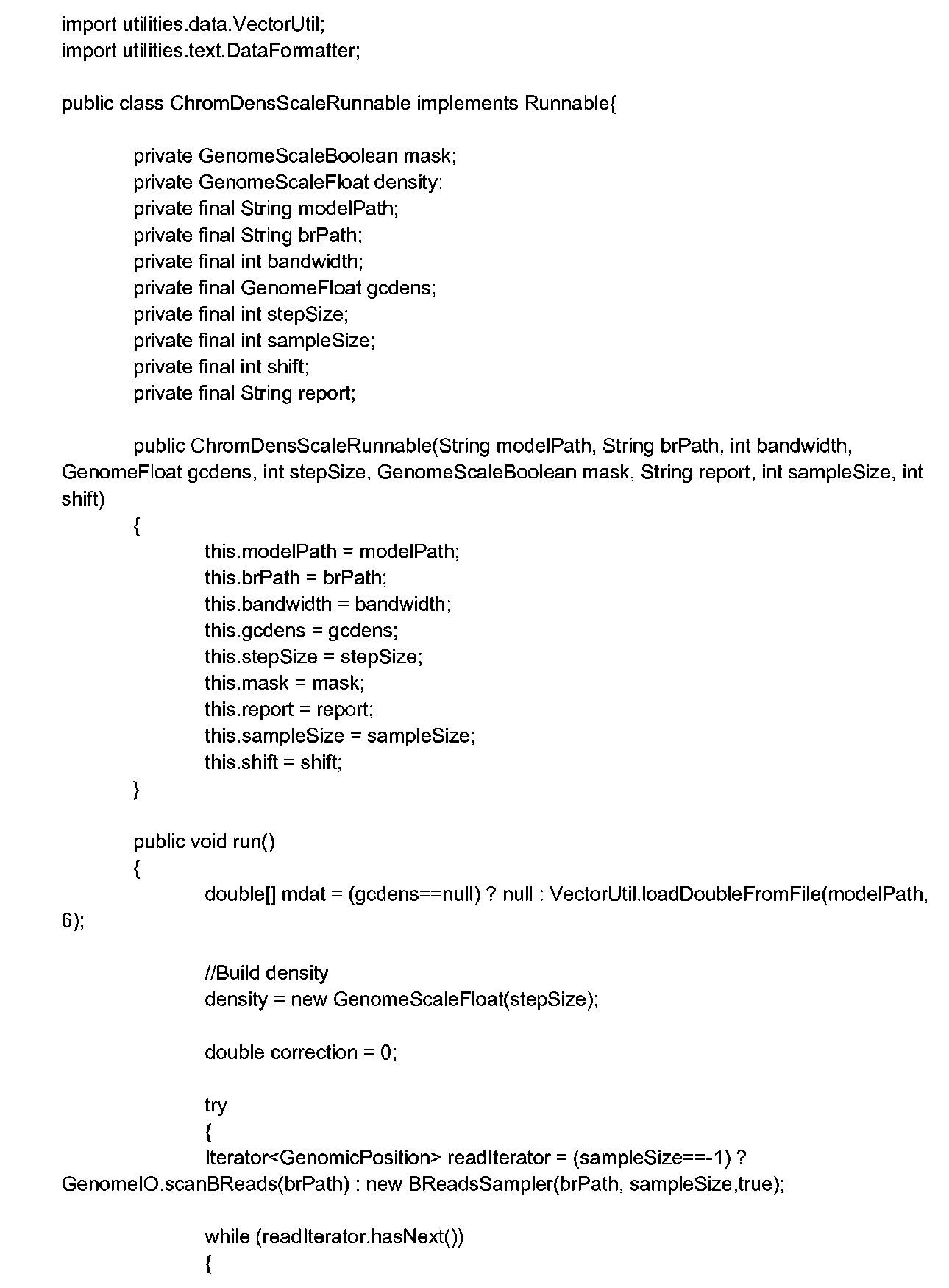


Distribution/Profile Generation Module A script was written in java to generate a read density profile from sequence read data (e.g., BRead). The code below is designed to collect read data for each sequence read and update the density profile with a suitable read density window (e.g., individual read density for a portion), weighted by the distance of the read from the portion median or midpoint, and based on GC bias correction of the sample (see Example 4). The script below can determine or utilize the weighted and/or normalized counts generated from the association or bias correction modules (Example 4). In some embodiments, the distribution module can include some or all of the following java scripts, or variations thereof:
(実施例3)
フィルタリングモジュール
リード密度プロファイルの部分をフィルタリングするために、スクリプトをR形式で書
いた。このコードは、試料全体にわたりリード密度プロファイルを検査し、そして保持さ
れる部分および/または廃棄される(例えば、分析から除去される)部分を四分位数間範
囲に基づき同定する。一部の実施形態では、フィルタリングモジュールは、以下に示すR
スクリプトの一部もしくは全部、またその変形形態を含む:

Filtering Module A script was written in R to filter portions of the read density profile. This code examines the read density profile across samples and identifies portions to be retained and/or discarded (e.g., removed from the analysis) based on interquartile range. In some embodiments, the filtering module is written in R as shown below.
Scripts, in whole or in part, including variations:
(実施例4)
偏り密度モジュール、関連性モジュール、偏り補正モジュールおよびプロッティングモジ
ュール
偏り密度を生成し、関連性を生成および比較し、配列のリード内の偏りを補正するため
に、スクリプトをR形式で書いた。このコードは、各試料および参照について、局所的な
ゲノムの偏りの推定値(例えば、GC密度)に基づき、1つまたは複数の試料を分析する
ように、ならびに偏りモデル(例えば、関連性および/または関連性の比較)を構築する
ように、一般的にマイクロプロセッサに指示する。下記のスクリプトは、全てではないが
、下記事項を目的として、1つまたは複数のプロセッサに指示する:試験試料の配列のリ
ードに関して、(i)グアニンおよびシトシン(GC)密度と(ii)GC密度頻度との
間の関連性を生成し、それにより、試料のGC密度関連性を生成する、(b)試料のGC
密度関連性と参照のGC密度関連性を比較し、それにより、比較を生成するが、この場合
、参照のGC密度関連性は、参照に関する(i)GC密度と(ii)GC密度頻度との間
の関連性であり、スクリプトのしかるべき修正を含む、(c)(b)で決定した比較によ
り、試料に関する配列のリードのカウント数を正規化するが、この場合、試料に関する配
列のリードの偏りは低下している。一部の実施形態では、偏り密度モジュール、関連性モ
ジュール、偏り補正モジュール、および/またはプロッティングモジュールは、以下に示
す一部または全部のスクリプトについて、その一部もしくは全部、またその変形形態を含
む:


Bias Density Module, Association Module, Bias Correction Module, and Plotting Module Scripts were written in R format to generate bias densities, generate and compare associations, and correct for bias in sequence reads. This code generally directs the microprocessor to analyze one or more samples based on local genomic bias estimates (e.g., GC density) for each sample and reference, and to build bias models (e.g., associations and/or association comparisons). The scripts below, although not all of them, direct one or more processors to: generate associations between (i) guanine and cytosine (GC) densities and (ii) GC density frequencies for sequence reads of a test sample, thereby generating GC density associations for the sample; (b) generate associations between GC densities and GC densities for the sample; (c) generate associations between GC densities and GC densities for the sample; (d) generate associations between GC densities and GC densities for the sample; (e) generate associations between GC densities and GC densities for the sample; (f) generate associations between GC densities and GC densities for the sample; (g) generate associations between GC densities and GC densities for the sample; (h) generate associations between GC densities and GC densities for the sample; (i) generate associations between GC densities and GC densities for the sample; (i) generate associations between GC densities and GC densities for the sample; (ii ...ii) generate associations between GC densities and GC densities for the sample; (iii) generate associations between GC densities and GC
(c) normalizing the counts of sequence reads for the sample by the comparison determined in (b), where the bias of the sequence reads for the sample is reduced, by comparing the density associations with the GC density associations of the reference, thereby generating a comparison, where the GC density associations of the reference are associations between (i) the GC density and (ii) the GC density frequency for the reference, including appropriate modifications of the script. In some embodiments, the bias density module, association module, bias correction module, and/or plotting module include some or all of the following scripts, or variations thereof:
(実施例5)
実施形態の例
下記の例は、ある特定の実施形態について説明し、本技術に制限を設けるものではない
。
Example 5
Example Embodiments The following examples describe certain specific embodiments and are not intended to limit the present technology.
A1.メモリおよび1つまたは複数のマイクロプロセッサを含むシステムであって、1つ
または複数のマイクロプロセッサは、メモリ中のインストラクションに従って、試料に関
する配列のリード中の偏りを低減するための処理を行うように構成されており、処理は、
A1. A system including a memory and one or more microprocessors, the one or more microprocessors configured to perform a process for reducing bias in sequence reads for a sample according to instructions in the memory, the process comprising:
(a)試験試料の配列のリードについての(i)グアニンおよびシトシン(GC)密度
と(ii)GC密度頻度との関係を生成し、それにより試料GC密度関係を生成するステ
ップであって、
配列のリードは、試験試料に由来する循環型無細胞核酸のものであり、
配列のリードは、参照ゲノムに対してマッピングされている、ステップと、
(b)試料GC密度関係と参照GC密度関係とを比較し、それにより比較を生成するス
テップであって、
参照GC密度関係は、参照についての(i)GC密度と(ii)GC密度頻度との間の
ものである、ステップと、
(a) generating a relationship between (i) guanine and cytosine (GC) density and (ii) GC density frequency for sequence reads of a test sample, thereby generating a sample GC density relationship;
the sequence reads are of circulating cell-free nucleic acid from the test sample;
the sequence reads are mapped to a reference genome; and
(b) comparing the sample GC density relationship to a reference GC density relationship, thereby generating a comparison;
the reference GC density relationship is between (i) the GC density and (ii) the GC density frequency for the reference;
(c)(b)で決定された比較に従って試料に関する配列のリードのカウント数を正規
化し、それにより試料に関する配列のリードの偏りが低減されるステップと
を含む、システム。
(c) normalizing the counts of sequence reads for the sample according to the comparison determined in (b), thereby reducing bias in the sequence reads for the sample.
A1.1.配列決定装置および1つまたは複数の演算装置を含むシステムであって、
配列決定装置は、配列決定装置にロードされる核酸のヌクレオチド塩基に対応するシグ
ナルを生成するように構成されており、核酸は、胎仔を出産する妊娠中の雌の血液に由来
する循環型無細胞核酸であり、または配列決定装置にロードされる核酸は、循環型無細胞
核酸の修飾変異体であり、
1つまたは複数の演算装置は、メモリおよび1つまたは複数のプロセッサを含み、メモ
リは、1つまたは複数のプロセッサにより実行可能なインストラクションを含み、1つま
たは複数のプロセッサにより実行可能なインストラクションは、
シグナルから配列のリードを生成し、参照ゲノムに対して配列のリードをマッピングし
、
(a)試験試料の配列のリードについての(i)グアニンおよびシトシン(GC)密度
と(ii)GC密度頻度との関係を生成し、それにより試料GC密度関係を生成し、
(b)試料GC密度関係と、参照GC密度関係とを比較し、それにより比較を生成し
(参照GC密度関係は、参照についての(i)GC密度と(ii)GC密度頻度との間
のものである)、
A1.1. A system comprising a sequencing device and one or more computing devices,
the sequencing device is configured to generate signals corresponding to nucleotide bases of a nucleic acid loaded onto the sequencing device, the nucleic acid being circulating cell-free nucleic acid derived from the blood of a pregnant female giving birth to a fetus, or the nucleic acid loaded onto the sequencing device being a modified variant of the circulating cell-free nucleic acid;
The one or more computing devices include a memory and one or more processors, the memory including instructions executable by the one or more processors, the instructions executable by the one or more processors including:
generating sequence reads from the signals and mapping the sequence reads to a reference genome;
(a) generating a relationship between (i) guanine and cytosine (GC) density and (ii) GC density frequency for sequence reads of a test sample, thereby generating a sample GC density relationship;
(b) comparing the sample GC density relationship to a reference GC density relationship, thereby generating a comparison, wherein the reference GC density relationship is between (i) the GC density and (ii) the GC density frequency for the reference;
(c)(b)で決定された比較に従って試料に関する配列のリードのカウント数を正規
化し、それにより試料に関する配列のリードの偏りが低減されるように構成されている、
システム。
(c) normalizing the sample sequence read counts according to the comparison determined in (b), thereby reducing bias in the sample sequence reads;
system.
A1.2.(c)における正規化が、正規化されたカウント数を提供することを含む、実
施形態A1またはA1.1に記載のシステム。
A1.2. The system of embodiment A1 or A1.1, wherein the normalizing in (c) includes providing a normalized count number.
A2.GC密度のそれぞれが、カーネル密度推定の使用を含む処理により決定される、実
施形態A1からA1.2のいずれか1つに記載のシステム。
A2. The system of any one of embodiments A1 to A1.2, wherein each of the GC densities is determined by a process that includes the use of kernel density estimation.
A2.1.参照GC密度関係および試料GC密度関係についてのGC密度のそれぞれが、
局所的なGC含有量の表示である、実施形態A1からA2のいずれか1つに記載のシステ
ム。
A2.1. Each of the GC densities for the reference GC density relationship and the sample GC density relationship is
The system of any one of embodiments A1 to A2, which is an indication of local GC content.
A2.2.局所的なGC含有量が、5000bpまたはそれ未満のポリヌクレオチドセグ
メントについてのものである、実施形態A2.1に記載のシステム。
A2.2. The system of embodiment A2.1, wherein the local GC content is for a polynucleotide segment of 5000 bp or less.
A3.GC密度のそれぞれが、スライディングウィンドウ分析の使用を含む処理によって
決定される、実施形態A1からA2.2のいずれか1つに記載のシステム。
A3. The system of any one of embodiments A1 to A2.2, wherein each of the GC densities is determined by a process that includes the use of sliding window analysis.
A4.ウィンドウが、約5の連続したヌクレオチド~約5000の連続したヌクレオチド
であり、スライディングウィンドウ分析において約1塩基~約10塩基を同時にスライド
される、実施形態A3に記載のシステム。
A4. The system of embodiment A3, wherein the window is from about 5 contiguous nucleotides to about 5000 contiguous nucleotides and is slid from about 1 base to about 10 bases simultaneously in the sliding window analysis.
A5.ウィンドウが、約200の連続したヌクレオチドであり、スライディングウィンド
ウ分析において約1塩基を同時にスライドされる、実施形態A3に記載のシステム。
A5. The system of embodiment A3, wherein the window is about 200 contiguous nucleotides and is slid about one base at a time in the sliding window analysis.
A6.(b)が、(i)それぞれがGC密度のそれぞれについての試料GC密度関係頻度
および参照GC密度関係頻度を含む比と、(ii)GC密度との適合させた関係を生成す
ることを含む、実施形態A1からA5のいずれか1つに記載のシステム。
A6. The system of any one of embodiments A1 to A5, wherein (b) comprises generating (i) ratios each comprising a sample GC density-related frequency and a reference GC density-related frequency for each of the GC densities, and (ii) fitted relationships with the GC densities.
A7.(a)における適合させた関係が、重み付き適合から得られる、実施形態A6に記
載のシステム。
A7. The system of embodiment A6, wherein the fitted relationship in (a) is obtained from a weighted fit.
A8.試料に関する配列のリードのそれぞれが、バイナリフォーマットおよび/またはテ
キストフォーマットで表示される、実施形態A1からA7のいずれか1つに記載のシステ
ム。
A8. The system of any one of embodiments A1 to A7, wherein each of the sequence reads for the sample is displayed in binary and/or text format.
A9.配列のリードのそれぞれについてのバイナリフォーマットが、リードがマッピング
されている染色体およびリードがマッピングされている染色体位置を含む、実施形態A8
に記載のシステム。
A9. Embodiment A8, in which the binary format for each of the sequence reads includes the chromosome to which the read is mapped and the chromosomal location to which the read is mapped
The system described in
A10.バイナリフォーマットが、1バイトの染色体の順序数および4バイトの染色体の
位置を含む5バイトのフォーマットにおけるものである、実施形態A9に記載のシステム
。
A10. The system of embodiment A9, wherein the binary format is in a 5-byte format including a 1-byte chromosomal ordinal number and a 4-byte chromosomal position.
A11.バイナリフォーマットが、配列アラインメント/マップ(SAM)フォーマット
より50分の1小さく、かつ/またはGZipフォーマットより約13%小さい、実施形
態A8からA10のいずれか1つに記載のシステム。
A11. The system of any one of embodiments A8 to A10, wherein the binary format is 50 times smaller than a Sequence Alignment/Map (SAM) format and/or about 13% smaller than a GZip format.
A12.(c)における正規化が、GC密度以外の1つまたは複数の特徴を因子分解する
ことと、配列のリードを正規化することとを含む、実施形態A1からA11のいずれか1
つに記載のシステム。
A12. Any one of embodiments A1 to A11, wherein the normalization in (c) comprises factoring one or more features other than GC density and normalizing the sequence reads.
The system according to claim 1.
A13.1つまたは複数の特徴の因子分解が、多変量モデルの使用を含む処理によるもの
である、実施形態A12に記載のシステム。
A13. The system of embodiment A12, in which factorization of one or more features is by a process including the use of a multivariate model.
A14.多変量モデルの使用を含む処理が、多変量モジュールによって行われる、A13
に記載のシステム。
A14. Processing involving the use of multivariate models is performed by a multivariate module, A13.
The system described in
A14.1.配列のリードのカウント数が、(c)における正規化、および1つまたは複
数の特徴の因子分解に従って正規化される、実施形態A12からA14のいずれか1つに
記載のシステム。
A14.1. The system of any one of embodiments A12 to A14, wherein sequence read counts are normalized according to the normalization in (c) and factorization of one or more features.
A15.(c)の後に、(c)において正規化された配列のリードのカウント数を含む1
つまたは複数の部分のそれぞれについて確率密度推定を生成することを含む処理に従って
、ゲノムの1つもしくは複数の部分またはそのセグメントについてのリード密度を生成す
ることを含む、実施形態A1からA14.1のいずれか1つに記載のシステム。
A15. After (c), a column containing the counts of the reads of the sequence normalized in (c)
The system of any one of embodiments A1 to A14.1, comprising generating read densities for one or more portions of the genome or segments thereof according to a process that includes generating a probability density estimate for each of the or each of the portions.
A16.確率密度推定が、カーネル密度推定である、実施形態A15に記載のシステム。 A16. The system of embodiment A15, wherein the probability density estimation is kernel density estimation.
A17.ゲノムまたはそのセグメントについてのリード密度プロファイルを生成するステ
ップを含む、実施形態A15またはA16に記載のシステム。
A17. The system of embodiment A15 or A16, comprising generating a read density profile for the genome or a segment thereof.
A18.リード密度プロファイルが、ゲノムの1つもしくは複数の部分またはそのセグメ
ントについてのリード密度を含む、実施形態A17に記載のシステム。
A18. The system of embodiment A17, wherein the read density profile comprises read densities for one or more portions of the genome or segments thereof.
A19.1つまたは複数の部分についてのリード密度のそれぞれを調整するステップを含
む、実施形態A15からA18のいずれか1つに記載のシステム。
A19. A system according to any one of embodiments A15 to A18, comprising adjusting each of the read densities for one or more portions.
A20.1つまたは複数の部分がフィルタリングされ、それによりフィルタリングされた
部分が提供される、実施形態A15からA19のいずれか1つに記載のシステム。
A20. The system of any one of embodiments A15 to A19, wherein one or more portions are filtered, thereby providing a filtered portion.
A21.1つまたは複数の部分が重み付けされ、それにより重み付き部分が提供される、
実施形態A15からA20のいずれか1つに記載のシステム。
A21. One or more portions are weighted, thereby providing a weighted portion;
A system described in any one of embodiments A15 to A20.
A22.1つまたは複数の部分が、固有関数により重み付けられる、実施形態A21に記
載のシステム。
A22. The system of embodiment A21, in which one or more portions are weighted by an eigenfunction.
A23.(a)に先立って、配列のリードを得ることを含む、実施形態A1からA22の
いずれか1つに記載のシステム。
A23. The system of any one of embodiments A1 to A22, comprising, prior to (a), obtaining sequence reads.
A24.配列のリードが、超並列シークエンシング(MPS)によって生成される、実施
形態A23に記載のシステム。
A24. The system of embodiment A23, wherein the sequence reads are generated by massively parallel sequencing (MPS).
A25.参照ゲノムの全部またはゲノムのセグメントに対してマッピングされた配列のリ
ードを得るステップを含む、実施形態A1からA24のいずれか1つに記載のシステム。
A25. The system of any one of embodiments A1 to A24, comprising obtaining sequence reads mapped to the entire reference genome or a segment of the genome.
A26.ゲノムのセグメントが、染色体またはそのセグメントを含む、実施形態A25に
記載のシステム。
A26. The system of embodiment A25, wherein the segment of the genome comprises a chromosome or a segment thereof.
A27.参照ゲノムに対してマッピングされた配列のリードのカウント数が、(a)に先
立って正規化される、実施形態A25またはA26に記載のシステム。
A27. The system of embodiment A25 or A26, wherein the read counts of the sequences mapped to the reference genome are normalized prior to (a).
A28.参照ゲノムに対してマッピングされた配列のリードのカウント数が、GC含有量
、ビンワイズ正規化、GC LOESS、PERUN、GCRM、またはこれらの組合せ
により正規化される、実施形態A27に記載のシステム。
A28. The system of embodiment A27, wherein the read counts of sequences mapped to the reference genome are normalized by GC content, bin-wise normalization, GC LOESS, PERUN, GCRM, or a combination thereof.
A29.参照ゲノムに対してマッピングされた配列のリードのカウント数が、未処理のカ
ウント数である、実施形態A27またはA28のいずれか1つに記載のシステム。
A29. The system of any one of embodiments A27 or A28, wherein the counts of sequence reads mapped to the reference genome are raw counts.
A30.参照ゲノムの各部分が、およそ等しい長さの連続したヌクレオチドを含む、実施
形態A15からA29のいずれか1つに記載のシステム。
A30. The system of any one of embodiments A15 to A29, wherein each portion of the reference genome comprises approximately equal lengths of contiguous nucleotides.
A31.参照ゲノムの各部分が、約50kbを構成する、実施形態A15またはA30の
いずれか1つに記載のシステム。
A31. The system of any one of embodiments A15 or A30, wherein each portion of the reference genome comprises about 50 kb.
A32.参照ゲノムの各部分が、約100kbを構成する、実施形態A15からA31の
いずれか1つに記載のシステム。
A32. The system of any one of embodiments A15 to A31, wherein each portion of the reference genome comprises about 100 kb.
A33.参照ゲノムの各部分が、参照ゲノムの隣接する部分と共通した連続したヌクレオ
チドのセグメントを含む、実施形態A15からA32のいずれか1つに記載のシステム。
A33. The system of any one of embodiments A15 to A32, wherein each portion of the reference genome comprises a segment of contiguous nucleotides in common with an adjacent portion of the reference genome.
A34.試験試料が、妊娠中の雌から得られる、実施形態A1からA33のいずれか1つ
に記載のシステム。
A34. The system of any one of embodiments A1 to A33, wherein the test sample is obtained from a pregnant female.
A35.試験試料が、妊娠中の雌に由来する血液を含む、実施形態A1からA34のいず
れか1つに記載のシステム。
A35. The system of any one of embodiments A1 to A34, wherein the test sample comprises blood from a pregnant female.
A36.試験試料が、妊娠中の雌に由来する血漿を含む、実施形態A1からA35のいず
れか1つに記載のシステム。
A36. The system of any one of embodiments A1 to A35, wherein the test sample comprises plasma from a pregnant female.
A37.試験試料が、妊娠中の雌に由来する血清を含む、A1からA36のいずれか1つ
に記載のシステム。
A37. The system of any one of A1 to A36, wherein the test sample comprises serum from a pregnant female.
A38.試験試料から核酸が単離される、実施形態A1からA37のいずれか1つに記載
のシステム。
A38. The system of any one of embodiments A1 to A37, wherein nucleic acid is isolated from the test sample.
A39.(a)における参照ゲノムに対してマッピングされた配列のリードを、配列アラ
インメントフォーマットからバイナリフォーマットに圧縮するステップを含む、実施形態
A8からA38のいずれか1つに記載のシステム。
A39. The system of any one of embodiments A8 to A38, comprising compressing the sequence reads mapped to the reference genome in (a) from a sequence alignment format to a binary format.
A40.圧縮が、圧縮モジュールにより行われる、実施形態A39に記載のシステム。 A40. The system of embodiment A39, wherein compression is performed by a compression module.
A41.試験試料の配列のリードについて、および参照についてのGC密度およびGC密
度頻度が、偏り密度モジュールにより提供される、実施形態A1からA40のいずれか1
つに記載のシステム。
A41. Any one of embodiments A1 to A40, wherein the GC density and GC density frequency for the test sample sequence reads and for the reference are provided by a biased density module.
The system according to claim 1.
A42.(b)における比較が、関係モジュールにより生成される、実施形態A1からA
41のいずれか1つに記載のシステム。
A42. The embodiment A1 to A2, wherein the comparison in (b) is generated by a relation module
41. The system according to any one of claims 1 to 41.
A43.(c)における正規化が、偏り補正モジュールにより行われる、実施形態A1か
らA42のいずれか1つに記載のシステム。
A43. The system of any one of embodiments A1 to A42, wherein the normalization in (c) is performed by a bias correction module.
A44.リード密度が、分布モジュールにより提供される、実施形態A15からA43の
いずれか1つに記載のシステム。
A44. The system of any one of embodiments A15 to A43, wherein the lead density is provided by a distribution module.
A45.フィルタリングされた部分が、フィルタリングモジュールにより提供される、実
施形態A20からA44のいずれか1つに記載のシステム。
A45. The system of any one of embodiments A20 to A44, wherein the filtered portion is provided by a filtering module.
A46.調整されたリード密度が、リード密度調整モジュールにより提供される、実施形
態A21からA45のいずれか1つに記載のシステム。
A46. The system of any one of embodiments A21 to A45, wherein the adjusted lead density is provided by a lead density adjustment module.
A46.1.重み付き部分が、部分重み付けモジュールにより提供される、実施形態A2
1からA46のいずれか1つに記載のシステム。
A46.1. Embodiment A2 in which the weighted portion is provided by a partial weighting module
1 to A46. A system according to any one of claims 1 to A46.
A47.圧縮モジュール、偏り密度モジュール、関係モジュール、偏り補正モジュール、
分布モジュール、フィルタリングモジュール、リード密度調整モジュール、および部分重
み付けモジュールのうちの1つまたは複数を含む、実施形態A46.1に記載のシステム
。
A47. Compression module, bias density module, relationship module, bias correction module,
The system of embodiment A46.1, including one or more of a distribution module, a filtering module, a lead density adjustment module, and a partial weighting module.
A48.システムのメモリが、参照ゲノムに対してマッピングされる試験試料に由来する
循環型無細胞核酸の配列のリードを含む、実施形態A1からA47のいずれか1つに記載
のシステム。
A48. The system of any one of embodiments A1 to A47, wherein the memory of the system comprises sequence reads of circulating cell-free nucleic acid from the test sample that are mapped to a reference genome.
B1.メモリおよび1つまたは複数のマイクロプロセッサを含むシステムであって、1つ
または複数のマイクロプロセッサが、メモリ中のインストラクションに従って、試料につ
いての異数性の存在または非存在を決定するための処理を行うように構成されており、処
理は、
B1. A system including a memory and one or more microprocessors, the one or more microprocessors configured to perform a process for determining the presence or absence of aneuploidy for a sample according to instructions in the memory, the process comprising:
(a)リード密度分布に従って、参照ゲノムの部分をフィルタリングし、それによりフ
ィルタリングされた部分のリード密度を含む試験試料についてのリード密度プロファイル
を提供するステップであって、
リード密度は、妊娠中の雌に由来する試験試料に由来する循環型無細胞核酸の配列のリ
ードを含み、
リード密度分布は、複数の試料についての部分のリード密度について決定される、ステ
ップと、
(b)主成分分析により一連の既知の正倍数体試料から得られる1つまたは複数の主成
分に従って試験試料についてのリード密度プロファイルを調整し、それにより調整された
リード密度を含む試験試料プロファイルを提供するステップと、
(c)試験試料プロファイルを参照プロファイルと比較し、それにより比較を提供する
ステップと、
(a) filtering a portion of a reference genome according to a read density distribution, thereby providing a read density profile for the test sample comprising the read density of the filtered portion,
The read density comprises reads of sequences of circulating cell-free nucleic acid from a test sample from a pregnant female;
A read density distribution is determined for the read densities of portions of the plurality of samples;
(b) adjusting the read density profile for the test sample according to one or more principal components obtained from the set of known euploid samples by principal component analysis, thereby providing a test sample profile comprising the adjusted read densities;
(c) comparing the test sample profile to a reference profile, thereby providing a comparison;
(d)比較に従って試験試料についての染色体異数性の存在または非存在を決定するス
テップと
を含む、システム。
(d) determining the presence or absence of chromosomal aneuploidy for the test sample according to the comparison.
B1.1.配列決定装置および1つまたは複数の演算装置を含むシステムであって、
配列決定装置は、配列決定装置にロードされた核酸のヌクレオチド塩基に対応するシグ
ナルを生成するように構成されており、核酸は、胎仔を出産する妊娠中の雌の血液に由来
する循環型無細胞核酸であり、または配列決定装置にロードされた核酸は、循環型無細胞
核酸の修飾変異体であり、
1つまたは複数の演算装置は、メモリおよび1つまたは複数のプロセッサを含み、メモ
リは、1つまたは複数のプロセッサにより実行可能なインストラクションを含み、1つま
たは複数のプロセッサにより実行可能なインストラクションは、
シグナルから配列のリードを生成し、参照ゲノムに対して配列のリードをマッピングし
、
a)リード密度分布に従って、参照ゲノムの部分をフィルタリングし、それによりフィ
ルタリングされた部分のリード密度を含む試験試料についてのリード密度プロファイルを
提供し
(リード密度は、妊娠中の雌に由来する試験試料に由来する循環型無細胞核酸の配列の
リードを含み、
リード密度分布は、複数の試料についての部分のリード密度について決定される)、
(b)主成分分析により一連の既知の正倍数体試料から得られる1つまたは複数の主成
分に従って試験試料についてのリード密度プロファイルを調整し、それにより調整された
リード密度を含む試験試料プロファイルを提供し、
(c)試験試料プロファイルを参照プロファイルと比較し、それにより比較を提供し、
B1.1. A system comprising a sequencing device and one or more computing devices,
the sequencing device is configured to generate signals corresponding to nucleotide bases of a nucleic acid loaded onto the sequencing device, the nucleic acid being a circulating cell-free nucleic acid derived from the blood of a pregnant female giving birth to a fetus, or the nucleic acid loaded onto the sequencing device being a modified variant of the circulating cell-free nucleic acid;
The one or more computing devices include a memory and one or more processors, the memory including instructions executable by the one or more processors, the instructions executable by the one or more processors including:
generating sequence reads from the signals and mapping the sequence reads to a reference genome;
a) filtering a portion of a reference genome according to a read density distribution, thereby providing a read density profile for the test sample comprising a read density of the filtered portion, wherein the read density comprises reads of sequences of circulating cell-free nucleic acid from the test sample from a pregnant female;
A read density distribution is determined for the read densities of the portions for the plurality of samples.
(b) adjusting the read density profile for the test sample according to one or more principal components obtained from the set of known euploid samples by principal component analysis, thereby providing a test sample profile comprising an adjusted read density;
(c) comparing the test sample profile to a reference profile, thereby providing a comparison;
(d)比較に従って試験試料についての染色体異数性の存在または非存在を決定するよ
うに構成されている、システム。
(d) determining the presence or absence of chromosomal aneuploidy for the test sample according to the comparison.
B2.比較が、有意性のレベルを決定することを含む、実施形態B1またはB1.1に記
載のシステム。
B2. The system of embodiment B1 or B1.1, wherein the comparison comprises determining a level of significance.
B3.有意性のレベルの決定が、p値を決定することを含む、実施形態B1からB2のい
ずれか1つに記載のシステム。
B3. The system of any one of embodiments B1 to B2, wherein determining the level of significance comprises determining a p-value.
B4.参照プロファイルが、一連の既知の正倍数体試料から得られるリード密度プロファ
イルを含む、実施形態B1からB3のいずれか1つに記載のシステム。
B4. The system of any one of embodiments B1 to B3, wherein the reference profile comprises read density profiles obtained from a set of known euploid samples.
B5.参照プロファイルが、フィルタリングされた部分のリード密度を含む、実施形態B
1からB4のいずれか1つに記載のシステム。
B5. Embodiment B in which the reference profile comprises the read density of the filtered portion
1. A system according to any one of claims 1 to B4.
B6.参照プロファイルが、1つまたは複数の主成分に従って調整されたリード密度を含
む、実施形態B1からB5のいずれか1つに記載のシステム。
B6. The system of any one of embodiments B1 to B5, wherein the reference profile comprises read densities adjusted according to one or more principal components.
B7.有意性のレベルが、試験試料プロファイルと参照プロファイルとの間の統計的に有
意な差異を指し示し、染色体異数性の存在が決定される、実施形態B2からB6のいずれ
か1つに記載のシステム。
B7. The system of any one of embodiments B2 to B6, wherein the level of significance indicates a statistically significant difference between the test sample profile and the reference profile, and the presence of a chromosomal aneuploidy is determined.
B8.複数の試料が、一連の既知の正倍数体試料を含む、実施形態B1からB7のいずれ
か1つに記載のシステム。
B8. The system of any one of embodiments B1 to B7, wherein the plurality of samples comprises a set of known euploid samples.
B9.複数の試料についての部分のリード密度が、リード密度中央値である、実施形態B
1からB8のいずれか1つに記載のシステム。
B9. Embodiment B, in which the read density of the portion for the plurality of samples is the median read density
1. A system according to any one of claims 1 to B8.
B10.試験試料についてのフィルタリングされた部分のリード密度が、リード密度中央
値である、実施形態B1からB9のいずれか1つに記載のシステム。
B10. The system of any one of embodiments B1 to B9, wherein the read density of the filtered portion for the test sample is a median read density.
B11.参照プロファイルについてのリード密度プロファイルが、リード密度中央値を含
む、実施形態B4からB10のいずれか1つに記載のシステム。
B11. The system of any one of embodiments B4 to B10, wherein the read density profile for the reference profile comprises a median read density.
B12.試験試料プロファイル、複数の試料、および参照プロファイルについてのリード
密度が、カーネル密度推定の使用を含む処理に従って決定される、実施形態B4からB1
1のいずれか1つに記載のシステム。
B12. The method of any one of embodiments B4 to B1, wherein the read densities for the test sample profile, the plurality of samples, and the reference profile are determined according to a process that includes the use of kernel density estimation.
1. A system according to any one of claims 1 to 9.
B13.試験試料プロファイルが、試験試料についてのリード密度中央値に従って決定さ
れる、実施形態B10からB12のいずれか1つに記載のシステム。
B13. The system of any one of embodiments B10 to B12, wherein the test sample profile is determined according to a median read density for the test sample.
B14.参照プロファイルが、参照についてのリード密度中央値分布に従って決定される
、実施形態B11からB13のいずれか1つに記載のシステム。
B14. The system of any one of embodiments B11 to B13, wherein the reference profile is determined according to a median read density distribution for the reference.
B15.リード密度分布についての不確定性の尺度に従って参照ゲノムの部分をフィルタ
リングすることを含む、実施形態B1からB14のいずれか1つに記載のシステム。
B15. The system of any one of embodiments B1 to B14, comprising filtering portions of the reference genome according to a measure of uncertainty about the read density distribution.
B16.不確定性の尺度が、MADである、実施形態B15に記載のシステム。 B16. The system of embodiment B15, wherein the measure of uncertainty is MAD.
B17.試験試料についてのフィルタリングされた部分に対してマッピングされた配列の
リードのカウント数が、
(I)試験試料の配列のリードについての(i)局所的なゲノムの偏りの推定値と(i
i)偏り頻度との関係を生成し、それにより試料偏り関係を生成することであって、
配列のリードが、試験試料に由来する循環型無細胞核酸のものであり、
配列のリードが、参照ゲノムに対してマッピングされる、ことと、
(II)試料偏り関係と参照偏り関係とを比較し、それにより比較を生成することであ
って、
参照偏り関係が、参照についての(i)局所的なゲノムの偏りの推定値と(ii)偏
り頻度との間のものである、ことと、
B17. The number of reads of sequences mapped to the filtered portion for the test sample is
(I) (i) an estimate of local genomic bias for sequence reads of a test sample; and
i) generating a bias frequency relationship, thereby generating a sample bias relationship;
the sequence reads are of circulating cell-free nucleic acid from a test sample;
The sequence reads are mapped to a reference genome; and
(II) comparing the sample bias relationship to the reference bias relationship, thereby generating a comparison,
The reference bias relationship is between (i) a local genomic bias estimate and (ii) a bias frequency for the reference; and
(III)(II)で決定された比較に従って試料に関する配列のリードのカウント数
を正規化し、それにより、試料に関する配列のリードの偏りが低減される、ことと
を含む(a)に先立って行われる処理により正規化される、実施形態B1からB16のい
ずれか1つに記載のシステム。
(III) Normalizing the counts of sequence reads for the sample according to the comparison determined in (II), thereby reducing bias in the sequence reads for the sample. The system of any one of embodiments B1 to B16, wherein the normalization is performed by processing performed prior to (a), the processing comprising: normalizing the counts of sequence reads for the sample according to the comparison determined in (II), thereby reducing bias in the sequence reads for the sample.
B18.(III)における正規化が、正規化されたカウント数を提供することを含む、
実施形態B17に記載のシステム。
B18. The normalization in (III) includes providing a normalized count number;
The system described in embodiment B17.
B19.局所的なゲノムの偏りの推定値のそれぞれが、カーネル密度推定の使用を含む処
理によって決定される、実施形態B17またはB18に記載のシステム。
B19. The system of embodiment B17 or B18, wherein each of the local genomic bias estimates is determined by a process that includes the use of kernel density estimation.
B20.局所的なゲノムの偏りの推定値のそれぞれが、スライディングウィンドウ分析の
使用を含む処理により決定される、実施形態B17からB19のいずれか1つに記載のシ
ステム。
B20. The system of any one of embodiments B17 to B19, wherein each of the local genomic bias estimates is determined by a process that includes the use of sliding window analysis.
B21.ウィンドウが、約5の連続したヌクレオチド~約5000の連続したヌクレオチ
ドであり、スライディングウィンドウ分析において約1塩基~約10塩基を同時にスライ
ドされる、実施形態B20に記載のシステム。
B21. The system of embodiment B20, wherein the window is from about 5 contiguous nucleotides to about 5000 contiguous nucleotides and is slid from about 1 base to about 10 bases simultaneously in the sliding window analysis.
B22.ウィンドウが、約200の連続したヌクレオチドであり、スライディングウィン
ドウ分析において約1塩基を同時にスライドされる、実施形態B20に記載のシステム。
B22. The system of embodiment B20, wherein the window is about 200 contiguous nucleotides and is slid about one base at a time in the sliding window analysis.
B23.(II)が、(i)それぞれが局所的なゲノムの偏りの推定値のそれぞれについ
ての試料偏り関係頻度および参照偏り関係頻度を含む比と、(ii)局所的なゲノムの偏
りの推定値との適合させた関係を生成することを含む、実施形態B17からB22のいず
れか1つに記載のシステム。
B23. The system of any one of embodiments B17 to B22, wherein (II) comprises generating a fitted relationship between (i) ratios each comprising a sample bias association frequency and a reference bias association frequency for each of the local genomic bias estimates, and (ii) the local genomic bias estimates.
B24.(I)における適合させた関係が、重み付き適合から得られる、実施形態B23
に記載のシステム。
B24. The embodiment B23 in which the fitted relationship in (I) is obtained from a weighted fit.
The system described in
B25.試料に関する配列のリードのそれぞれが、バイナリフォーマットで表示される、
実施形態B17からB24のいずれか1つに記載のシステム。
B25. Each sequence read for a sample is displayed in binary format;
A system described in any one of embodiments B17 to B24.
B26.配列のリードのそれぞれについてのバイナリフォーマットが、リードがマッピン
グされている染色体およびリードがマッピングされている染色体位置を含む、実施形態B
25に記載のシステム。
B26. The embodiment B, in which the binary format for each of the sequence reads includes the chromosome to which the read is mapped and the chromosomal location to which the read is mapped.
25. The system described in 25.
B27.バイナリフォーマットが、1バイトの染色体の順序数および4バイトの染色体の
位置を含む5バイトのフォーマットにおけるものである、実施形態B26に記載のシステ
ム。
B27. The system of embodiment B26, wherein the binary format is in a 5-byte format including a 1-byte chromosomal ordinal number and a 4-byte chromosomal position.
B28.バイナリフォーマットが、配列アラインメント/マップ(SAM)フォーマット
より50分の1小さく、かつ/またはGZipフォーマットより約13%小さい、実施形
態B25からB27のいずれか1つに記載のシステム。
B28. The system of any one of embodiments B25 to B27, wherein the binary format is 50 times smaller than the Sequence Alignment/Map (SAM) format and/or about 13% smaller than the GZip format.
B29.(III)における正規化が、偏り以外の1つまたは複数の特徴を因子分解する
ことと、配列のリードのカウント数を正規化することとを含む、実施形態B17からB2
8のいずれか1つに記載のシステム。
B29. The method of any one of embodiments B17 to B2, wherein the normalization in (III) includes factoring out one or more features other than bias and normalizing the counts of sequence reads.
8. A system according to any one of claims 1 to 8.
B30.1つまたは複数の特徴の因子分解が、多変量モデルの使用を含む処理によるもの
である、実施形態B29に記載のシステム。
B30. The system of embodiment B29, wherein factoring the one or more features is by a process that includes the use of a multivariate model.
B31.多変量モデルの使用を含む処理が、多変量モジュールによって行われる、実施形
態B30に記載のシステム。
B31. The system of embodiment B30, wherein the processing involving the use of a multivariate model is performed by a multivariate module.
B32.配列のリードのカウント数が、(III)における正規化、および1つまたは複
数の特徴の因子分解に従って正規化される、実施形態B29からB31のいずれか1つに
記載のシステム。
B32. The system of any one of embodiments B29 to B31, wherein sequence read counts are normalized according to the normalization in (III) and factorization of one or more features.
B33.(III)の後に、(III)において正規化された配列のリードのカウント数
を含む1つまたは複数の部分のそれぞれについて確率密度推定を生成することを含む処理
に従って、ゲノムの1つもしくは複数の部分またはそのセグメントについてのリード密度
を生成することを含む、実施形態B17からB32のいずれか1つに記載のシステム。
B33. The system of any one of embodiments B17 to B32, comprising generating read densities for one or more portions of the genome or segments thereof according to a process that includes, after (III), generating a probability density estimate for each of the one or more portions that comprise the counts of reads of the normalized sequences in (III).
B34.確率密度推定が、カーネル密度推定である、実施形態B33に記載のシステム。 B34. The system of embodiment B33, wherein the probability density estimation is kernel density estimation.
B35.ゲノムまたはそのセグメントについてのリード密度プロファイルを生成するステ
ップを含む、実施形態B33またはB34に記載のシステム。
B35. The system of embodiment B33 or B34, comprising generating a read density profile for the genome or a segment thereof.
B36.リード密度プロファイルが、ゲノムの1つもしくは複数の部分またはそのセグメ
ントについてのリード密度を含む、実施形態B35に記載のシステム。
B36. The system of embodiment B35, wherein the read density profile comprises read density for one or more portions of the genome or segments thereof.
B37.1つまたは複数の部分についてのリード密度のそれぞれを調整するステップを含
む、実施形態B33からB36のいずれか1つに記載のシステム。
B37. The system of any one of embodiments B33 to B36, comprising adjusting each of the read densities for the one or more portions.
B38.1つまたは複数の部分がフィルタリングされ、それによりフィルタリングされた
部分が提供される、実施形態B33からB37のいずれか1つに記載のシステム。
B38. The system of any one of embodiments B33 to B37, wherein one or more portions are filtered, thereby providing a filtered portion.
B39.1つまたは複数の部分が重み付けされ、それにより重み付き部分が提供される、
実施形態B33からB38のいずれか1つに記載のシステム。
B39. One or more portions are weighted, thereby providing a weighted portion;
The system of any one of embodiments B33 to B38.
B40.1つまたは複数の部分が、固有関数により重み付けられる、実施形態B39に記
載のシステム。
B40. The system of embodiment B39, wherein one or more portions are weighted by an eigenfunction.
B41.局所的なゲノムの偏りの推定値が局所的なGC密度であり、偏り頻度がGC偏り
頻度である、実施形態B17からB40のいずれか1つに記載のシステム。
B41. The system of any one of embodiments B17 to B40, wherein the estimate of local genomic bias is a local GC density and the bias frequency is a GC bias frequency.
B42.試験試料についてのフィルタリングされた部分に対してマッピングされた配列の
リードのカウント数が、
B42. The number of reads of sequences mapped to the filtered portion for the test sample is
(1)試験試料の配列のリードについての(i)グアニンおよびシトシン(GC)密度
と(ii)GC密度頻度との適合させた関係を生成し、それにより試料GC密度関係を生
成することであって、配列のリードは、参照ゲノムに対してマッピングされる、ことと、
(2)試料GC密度関係と参照GC密度関係とを比較し、それにより比較を生成するこ
とであって、
参照GC密度関係は、参照についての(i)GC密度と(ii)GC密度頻度との間
のものである、ことと
(1) generating a fitted relationship between (i) guanine and cytosine (GC) density and (ii) GC density frequency for sequence reads of a test sample, thereby generating a sample GC density relationship, wherein the sequence reads are mapped to a reference genome;
(2) comparing the sample GC density relationship to a reference GC density relationship, thereby generating a comparison;
The reference GC density relationship is between (i) the GC density and (ii) the GC density frequency for the reference;
(3)(b)で決定された比較に従って試料に関する配列のリードのカウント数を正規
化し、それにより試料に関する配列のリードの偏りが低減されることと
を含む、(a)に先立って行われる処理によって正規化される、実施形態B1からB16
のいずれか1つに記載のシステム。
(3) normalizing the sample sequence read counts according to the comparison determined in (b), thereby reducing bias in the sample sequence reads;
13. The system according to claim 12,
B43.(3)における正規化が、正規化されたカウント数を提供することを含む、実施
形態B42に記載のシステム。
B43. The system of embodiment B42, in which the normalizing in (3) includes providing a normalized count number.
B44.GC密度のそれぞれが、カーネル密度推定の使用を含む処理により決定される、
実施形態B42またはB43に記載のシステム。
B44. Each of the GC densities is determined by a process that includes the use of kernel density estimation.
The system described in embodiment B42 or B43.
B44.1.参照GC密度関係および試料GC密度関係についてのGC密度のそれぞれが
、局所的なGC含有量の表示である、実施形態B42からB44のいずれか1つに記載の
システム。
B44.1. The system of any one of embodiments B42 to B44, wherein each of the GC densities for the reference GC density relationship and the sample GC density relationship is an indication of local GC content.
B44.2.局所的なGC含有量が、5000bpまたはそれ未満のポリヌクレオチドセ
グメントについてのものである、実施形態B44.1に記載のシステム。
B44.2. The system of embodiment B44.1, wherein the local GC content is for a polynucleotide segment of 5000 bp or less.
B45.GC密度のそれぞれが、スライディングウィンドウ分析の使用を含む処理によっ
て決定される、実施形態B42からB44.2のいずれか1つに記載のシステム。
B45. The system of any one of embodiments B42 to B44.2, wherein each of the GC densities is determined by a process that includes the use of sliding window analysis.
B46.ウィンドウが、約5の連続したヌクレオチド~約5000の連続したヌクレオチ
ドであり、スライディングウィンドウ分析において約1塩基~約10塩基を同時にスライ
ドされる、実施形態B45に記載のシステム。
B46. The system of embodiment B45, wherein the window is from about 5 contiguous nucleotides to about 5000 contiguous nucleotides and is slid from about 1 base to about 10 bases simultaneously in the sliding window analysis.
B47.ウィンドウが、約200の連続したヌクレオチドであり、スライディングウィン
ドウ分析において約1塩基を同時にスライドされる、実施形態B46に記載のシステム。
B47. The system of embodiment B46, wherein the window is about 200 contiguous nucleotides and is slid about one base at a time in the sliding window analysis.
B48.(2)が、(i)それぞれがGC密度のそれぞれについての試料GC密度関係頻
度および参照GC密度関係頻度を含む比と、(ii)GC密度との適合させた関係を生成
することを含む、実施形態B42からB47のいずれか1つに記載のシステム。
B48. The system of any one of embodiments B42 to B47, wherein (2) comprises generating (i) ratios each comprising a sample GC density-related frequency and a reference GC density-related frequency for each of the GC densities, and (ii) fitted relationships with the GC densities.
B49.(1)における適合させた関係が、重み付き適合から得られる、実施形態B48
に記載のシステム。
B49. The embodiment B48 in which the fitted relationship in (1) is obtained from a weighted fit.
The system described in
B50.試料に関する配列のリードのそれぞれが、バイナリフォーマットで表示される、
実施形態B42からB49のいずれか1つに記載のシステム。
B50. Each sequence read for a sample is displayed in binary format;
A system described in any one of embodiments B42 to B49.
B51.配列のリードのそれぞれについてのバイナリフォーマットが、リードがマッピン
グされている染色体およびリードがマッピングされている染色体位置を含む、実施形態B
50に記載のシステム。
B51. The embodiment B, in which the binary format for each of the sequence reads includes the chromosome to which the read is mapped and the chromosomal location to which the read is mapped.
50. The system described in 50.
B52.バイナリフォーマットが、1バイトの染色体の順序数および4バイトの染色体の
位置を含む5バイトのフォーマットにおけるものである、実施形態B51に記載のシステ
ム。
B52. The system of embodiment B51, wherein the binary format is in a 5-byte format including a 1-byte chromosomal ordinal number and a 4-byte chromosomal position.
B53.バイナリフォーマットが、配列アラインメント/マップ(SAM)フォーマット
より50分の1小さく、かつ/またはGZipフォーマットより約13%小さい、実施形
態B50からB52のいずれか1つに記載のシステム。
B53. The system of any one of embodiments B50 to B52, wherein the binary format is 50 times smaller than a Sequence Alignment/Map (SAM) format and/or about 13% smaller than a GZip format.
B54.(c)における正規化が、GC密度以外の1つまたは複数の特徴を因子分解する
ことと、配列のリードを正規化することとを含む、実施形態B42からB53のいずれか
1つに記載のシステム。
B54. The system of any one of embodiments B42 to B53, wherein the normalization in (c) comprises factoring one or more features other than GC density and normalizing the sequence reads.
B55.1つまたは複数の特徴の因子分解が、多変量モデルの使用を含む処理によるもの
である、実施形態B54に記載のシステム。
B55. The system of embodiment B54, wherein factoring the one or more features is by a process that includes the use of a multivariate model.
B56.多変量モデルの使用を含む処理が、多変量モジュールによって行われる、実施形
態B55に記載のシステム。
B56. The system of embodiment B55, wherein the processing involving the use of a multivariate model is performed by a multivariate module.
B57.試験試料についてのフィルタリングされた部分が重み付けられる、実施形態B4
2からB56のいずれか1つに記載のシステム。
B57. Embodiment B4 in which the filtered portions for the test samples are weighted
2 to B56.
B58.試験試料についてのフィルタリングされた部分が、固有関数を含む処理によって
重み付けられる、実施形態B57に記載のシステム。
B58. The system of embodiment B57, wherein the filtered portions for the test samples are weighted by a process including an eigenfunction.
B59.(a)に先立って、配列のリードを得ることを含む、実施形態B1からB58の
いずれか1つに記載のシステム。
B59. The system of any one of embodiments B1 to B58, comprising, prior to (a), obtaining sequence reads.
B60.配列のリードが、超並列シークエンシング(MPS)によって生成される、実施
形態B59に記載のシステム。
B60. The system of embodiment B59, wherein the sequence reads are generated by massively parallel sequencing (MPS).
B61.参照ゲノムの全部またはゲノムのセグメントに対してマッピングされた配列のリ
ードを得るステップを含む、実施形態B1からB60のいずれか1つに記載のシステム。
B61. The system of any one of embodiments B1 to B60, comprising obtaining sequence reads mapped to an entire reference genome or a segment of a genome.
B62.ゲノムのセグメントが、染色体またはそのセグメントを含む、実施形態B61に
記載のシステム。
B62. The system of embodiment B61, wherein the segment of the genome comprises a chromosome or a segment thereof.
B63.参照ゲノムに対してマッピングされた配列のリードのカウント数が、(1)に先
立って正規化される、実施形態B61またはB62に記載のシステム。
B63. The system of embodiment B61 or B62, wherein the read counts of the sequences mapped to the reference genome are normalized prior to (1).
B64.参照ゲノムに対してマッピングされた配列のリードのカウント数が、GC含有量
、ビンワイズ正規化、GC LOESS、PERUN、GCRM、またはこれらの組合せ
により正規化される、実施形態B63に記載のシステム。
B64. The system of embodiment B63, wherein the read counts of sequences mapped to the reference genome are normalized by GC content, bin-wise normalization, GC LOESS, PERUN, GCRM, or a combination thereof.
B65.参照ゲノムに対してマッピングされた配列のリードのカウント数が、未処理のカ
ウント数である、実施形態B61またはB62に記載のシステム。
B65. The system of embodiment B61 or B62, wherein the counts of sequence reads mapped to the reference genome are raw counts.
B66.参照ゲノムの各部分が、およそ等しい長さの連続したヌクレオチドを含む、実施
形態B1からB65のいずれか1つに記載のシステム。
B66. The system of any one of embodiments B1 to B65, wherein each portion of the reference genome comprises approximately equal lengths of contiguous nucleotides.
B67.参照ゲノムの各部分が、約50kbを構成する、実施形態B1からB66のいず
れか1つに記載のシステム。
B67. The system of any one of embodiments B1 to B66, wherein each portion of the reference genome comprises about 50 kb.
B68.参照ゲノムの各部分が、約100kbを構成する、実施形態B1からB67のい
ずれか1つに記載のシステム。
B68. The system of any one of embodiments B1 to B67, wherein each portion of the reference genome comprises about 100 kb.
B69.参照ゲノムの各部分が、参照ゲノムの隣接する部分と共通した連続したヌクレオ
チドのセグメントを含む、実施形態B1からB68のいずれか1つに記載のシステム。
B69. The system of any one of embodiments B1 to B68, wherein each portion of the reference genome comprises a segment of contiguous nucleotides in common with an adjacent portion of the reference genome.
B70.試験試料が、妊娠中の雌に由来する血液を含む、実施形態B1からB69のいず
れか1つに記載のシステム。
B70. The system of any one of embodiments B1 to B69, wherein the test sample comprises blood from a pregnant female.
B71.試験試料が、妊娠中の雌に由来する血漿を含む、実施形態B1からB70のいず
れか1つに記載のシステム。
B71. The system of any one of embodiments B1 to B70, wherein the test sample comprises plasma from a pregnant female.
B72.試験試料が、妊娠中の雌に由来する血清を含む、実施形態B1からB71のいず
れか1つに記載のシステム。
B72. The system of any one of embodiments B1 to B71, wherein the test sample comprises serum from a pregnant female.
B73.試験試料から核酸が単離される、実施形態B1からB72のいずれか1つに記載
のシステム。
B73. The system of any one of embodiments B1 to B72, wherein nucleic acid is isolated from the test sample.
B74.(1)における参照ゲノムに対してマッピングされた配列のリードを、配列アラ
インメントフォーマットからバイナリフォーマットに圧縮するステップを含む、実施形態
B50からB73のいずれか1つに記載のシステム。
B74. The system of any one of embodiments B50 to B73, comprising compressing the sequence reads mapped to the reference genome in (1) from a sequence alignment format to a binary format.
B75.圧縮が、圧縮モジュールにより行われる、実施形態B74に記載のシステム。 B75. The system of embodiment B74, wherein the compression is performed by a compression module.
B76.試験試料の配列のリードについて、および参照についてのGC密度およびGC密
度頻度が、偏り密度モジュールにより提供される、実施形態B42からB75のいずれか
1つに記載のシステム。
B76. The system of any one of embodiments B42 to B75, wherein GC densities and GC density frequencies for the test sample sequence reads and for the reference are provided by a biased density module.
B77.(2)における比較が、関係モジュールにより生成される、実施形態B42から
B76のいずれか1つに記載のシステム。
B77. The system of any one of embodiments B42 to B76, wherein the comparison in (2) is generated by a relational module.
B78.(3)における正規化が、偏り補正モジュールにより行われる、実施形態B44
からB77のいずれか1つに記載のシステム。
B78. The embodiment B44 in which the normalization in (3) is performed by a bias correction module.
A system according to any one of claims 1 to 7.
B79.リード密度が、分布モジュールにより提供される、実施形態B1からB78のい
ずれか1つに記載のシステム。
B79. The system of any one of embodiments B1 to B78, wherein the lead density is provided by a distribution module.
B80.フィルタリングされた部分が、フィルタリングモジュールにより提供される、実
施形態B1からB79のいずれか1つに記載のシステム。
B80. The system of any one of embodiments B1 to B79, wherein the filtered portion is provided by a filtering module.
B81.試験試料についてのフィルタリングされた部分が、部分重み付けモジュールによ
り重み付けられる、実施形態B57からB80のいずれか1つに記載のシステム。
B81. The system of any one of embodiments B57 to B80, wherein the filtered portions for the test sample are weighted by a portion weighting module.
B81.1.リード密度が、リード密度調整モジュールにより調整される、実施形態B5
7からB81のいずれか1つに記載のシステム。
B81.1. Embodiment B5 in which the lead density is adjusted by a lead density adjustment module
7 to B81. A system according to any one of claims 1 to 7.
B82.装置が、圧縮モジュール、偏り密度モジュール、関係モジュール、偏り補正モジ
ュール、分布モジュール、フィルタリングモジュール、リード密度調整モジュール、およ
び部分重み付けモジュールのうちの1つまたは複数を含む、実施形態B81.1に記載の
システム。
The system of embodiment B81.1, in which the apparatus includes one or more of a compression module, a bias density module, a relationship module, a bias correction module, a distribution module, a filtering module, a lead density adjustment module, and a partial weighting module.
B83.試験試料プロファイルが、染色体またはそのセグメントのプロファイルを含む、
実施形態B1からB82のいずれか1つに記載のシステム。
B83. The test sample profile comprises a profile of a chromosome or a segment thereof.
The system of any one of embodiments B1 to B82.
B84.参照プロファイルが、染色体またはそのセグメントのプロファイルを含む、実施
形態B1からB83のいずれか1つに記載のシステム。
B84. The system of any one of embodiments B1 to B83, wherein the reference profile comprises a profile of a chromosome or a segment thereof.
B85.(d)における決定が、90%に等しいかまたはそれ超の特異性および90%に
等しいかまたはそれ超の感度で提供される、実施形態B1からB84のいずれか1つに記
載のシステム。
B85. The system of any one of embodiments B1 to B84, wherein the determination in (d) is provided with a specificity of equal to or greater than 90% and a sensitivity of equal to or greater than 90%.
B86.異数性がトリソミーである、実施形態B1からB85のいずれか1つに記載のシ
ステム。
B86. The system of any one of embodiments B1 to B85, wherein the aneuploidy is a trisomy.
B87.トリソミーが、21トリソミー、18トリソミー、または13トリソミーである
、実施形態B86に記載のシステム。
B87. The system of embodiment B86, wherein the trisomy is trisomy 21, trisomy 18, or trisomy 13.
B88.システムのメモリが、参照ゲノムに対してマッピングされる試験試料に由来する
循環型無細胞核酸の配列のリードを含む、実施形態B17からB87のいずれか1つに記
載のシステム。
B88. The system of any one of embodiments B17 to B87, wherein the memory of the system comprises sequence reads of circulating cell-free nucleic acid from the test sample that are mapped to a reference genome.
C1.1つまたは複数の機械に組み込まれる、実施形態A1からA48およびB1からB
88のいずれか1つに記載のシステム。
C1. Embodiments A1 to A48 and B1 to B incorporated into one or more machines
88. A system according to any one of claims 88 to 88.
C2.1つの機械に組み込まれる、実施形態C1に記載のシステム。 C2. A system as described in embodiment C1 incorporated into a single machine.
C3.核酸を配列決定し、配列のリードを生成するように構成された機械を含む、実施形
態C1またはC2に記載のシステム。
C3. The system of embodiment C1 or C2, comprising a machine configured to sequence the nucleic acid and generate sequence reads.
D1.試料に関する配列のリードの偏りを低減するための方法であって、
(a)マイクロプロセッサを使用して、試験試料の配列のリードについての(i)グア
ニンおよびシトシン(GC)密度と(ii)GC密度頻度との関係を生成し、それにより
試料GC密度関係を生成するステップであって、
配列のリードは、試験試料に由来する循環型無細胞核酸のものであり、
配列のリードは、参照ゲノムに対してマッピングされる、ステップと、
(b)試料GC密度関係と参照GC密度関係とを比較し、それにより比較を生成するス
テップであって、
参照GC密度関係は、参照についての(i)GC密度と(ii)GC密度頻度との間の
ものである、ステップと、
D1. A method for reducing sequence read bias for a sample, comprising:
(a) using a microprocessor to generate a relationship between (i) guanine and cytosine (GC) density and (ii) GC density frequency for sequence reads of the test sample, thereby generating a sample GC density relationship;
the sequence reads are of circulating cell-free nucleic acid from the test sample;
mapping the sequence reads to a reference genome;
(b) comparing the sample GC density relationship to a reference GC density relationship, thereby generating a comparison;
the reference GC density relationship is between (i) the GC density and (ii) the GC density frequency for the reference;
(c)(b)で決定された比較に従って試料に関する配列のリードのカウント数を正規
化し、それにより試料に関する配列のリードの偏りが低減されるステップと
を含む、方法。
(c) normalizing the counts of sequence reads for the sample according to the comparison determined in (b), thereby reducing bias in the sequence reads for the sample.
D1.1.試料に関する配列のリードの偏りを低減するための方法であって、
胎仔を出産する妊娠中の雌の血液に由来する循環型無細胞核酸を配列決定装置にロード
し、または核酸の修飾変異体を配列決定装置にロードするステップであって、配列決定装
置は、核酸のヌクレオチド塩基に対応するシグナルを生成する、ステップと、
1つまたは複数の演算装置を含むシステムにより、任意選択でシグナルをシステムに移
送した後、核酸のシグナルから配列のリードを生成するステップであって、システム中の
1つまたは複数の演算装置は、メモリおよび1つまたは複数のプロセッサを含み、
システム中の1つの演算装置または演算装置の組合せは、
参照ゲノムに対して配列のリードをマッピングし、
(a)試験試料の配列のリードについての(i)グアニンおよびシトシン(GC)密度
と(ii)GC密度頻度との関係を生成し、それにより試料GC密度関係を生成し
(配列のリードは、試験試料に由来する循環型無細胞核酸のものであり、
配列のリードは、参照ゲノムに対してマッピングされる)、
(b)試料GC密度関係と参照GC密度関係とを比較し、それにより比較を生成し
(参照GC密度関係は、参照についての(i)GC密度と(ii)GC密度頻度との間
のものである)、
D1.1. A method for reducing sequence read bias for a sample, comprising:
loading circulating cell-free nucleic acid from the blood of a pregnant female giving birth to a fetus, or loading modified variants of the nucleic acid, into a sequencing device, the sequencing device generating signals corresponding to nucleotide bases of the nucleic acid;
generating sequence reads from the nucleic acid signals by a system comprising one or more computing devices, optionally after transmitting the signals to the system, wherein the one or more computing devices in the system comprise a memory and one or more processors;
A computing device or combination of computing devices in the system may
Mapping the sequence reads against a reference genome;
(a) generating a relationship between (i) guanine and cytosine (GC) density and (ii) GC density frequency for sequence reads of a test sample, thereby generating a sample GC density relationship, wherein the sequence reads are of circulating cell-free nucleic acid derived from the test sample;
The sequence reads are mapped to a reference genome.
(b) comparing the sample GC density relationship to a reference GC density relationship, thereby generating a comparison, wherein the reference GC density relationship is between (i) the GC density and (ii) the GC density frequency for the reference;
(c)(b)で決定された比較に従って試料に関する配列のリードのカウント数を正規
化し、それにより試料に関する配列のリードの偏りが低減される
ように構成されている、ステップと
を含む、方法。
and (c) normalizing the counts of sequence reads for the sample according to the comparison determined in (b), thereby reducing bias in the sequence reads for the sample.
D1.2.(c)における正規化が、正規化されたカウント数を提供することを含む、実
施形態D1またはD1.1に記載の方法。
D1.2. The method of embodiment D1 or D1.1, wherein the normalizing in (c) includes providing a normalized count number.
D2.GC密度のそれぞれが、カーネル密度推定の使用を含む処理により決定される、実
施形態D1からD1.2のいずれか1つに記載の方法。
D2. The method of any one of embodiments D1 to D1.2, wherein each of the GC densities is determined by a process that includes the use of kernel density estimation.
D2.1.参照GC密度関係および試料GC密度関係についてのGC密度のそれぞれが、
局所的なGC含有量の表示である、実施形態D1からD2のいずれか1つに記載の方法。
D2.1. Each of the GC densities for the reference GC density relationship and the sample GC density relationship is
The method of any one of embodiments D1 to D2, which is an indication of local GC content.
D2.2.局所的なGC含有量が、5000bpまたはそれ未満のポリヌクレオチドセグ
メントについてのものである、実施形態D2.1に記載の方法。
D2.2. The method of embodiment D2.1, wherein the local GC content is for a polynucleotide segment of 5000 bp or less.
D3.GC密度のそれぞれが、スライディングウィンドウ分析の使用を含む処理によって
決定される、実施形態D1からD2.2のいずれか1つに記載の方法。
D3. The method of any one of embodiments D1 to D2.2, wherein each of the GC densities is determined by a process that includes the use of sliding window analysis.
D4.ウィンドウが、約5の連続したヌクレオチド~約5000の連続したヌクレオチド
であり、スライディングウィンドウ分析において約1塩基~約10塩基を同時にスライド
される、実施形態D3に記載の方法。
D4. The method of embodiment D3, wherein the window is from about 5 contiguous nucleotides to about 5000 contiguous nucleotides and is slid from about 1 base to about 10 bases simultaneously in the sliding window analysis.
D5.ウィンドウが、約200の連続したヌクレオチドであり、スライディングウィンド
ウ分析において約1塩基を同時にスライドされる、実施形態D3に記載の方法。
D5. The method of embodiment D3, wherein the window is about 200 contiguous nucleotides and is slid about one base at a time in the sliding window analysis.
D6.(b)が、(i)それぞれがGC密度のそれぞれについての試料GC密度関係頻度
および参照GC密度関係頻度を含む比と、(ii)GC密度との適合させた関係を生成す
ることを含む、実施形態D1からD5のいずれか1つに記載の方法。
D6. The method of any one of embodiments D1 to D5, wherein (b) comprises generating (i) ratios each comprising a sample GC density-related frequency and a reference GC density-related frequency for each of the GC densities, and (ii) fitted relationships with the GC densities.
D7.(a)における適合させた関係が、重み付き適合から得られる、実施形態D6に記
載の方法。
D7. The method of embodiment D6, in which the fitted relationship in (a) is obtained from a weighted fit.
D8.試料に関する配列のリードのそれぞれが、バイナリフォーマットで表示される、実
施形態D1からD7のいずれか1つに記載の方法。
D8. The method of any one of embodiments D1 to D7, wherein each of the sequence reads for the sample is displayed in binary format.
D9.配列のリードのそれぞれについてのバイナリフォーマットが、リードがマッピング
されている染色体およびリードがマッピングされている染色体位置を含む、実施形態D8
に記載の方法。
D9. The embodiment D8, wherein the binary format for each of the sequence reads includes the chromosome to which the read is mapped and the chromosomal location to which the read is mapped.
The method described above.
D10.バイナリフォーマットが、1バイトの染色体の順序数および4バイトの染色体の
位置を含む5バイトのフォーマットにおけるものである、実施形態D9に記載の方法。
D10. The method of embodiment D9, wherein the binary format is in a 5-byte format including a 1-byte chromosomal ordinal number and a 4-byte chromosomal position.
D11.バイナリフォーマットが、配列アラインメント/マップ(SAM)フォーマット
より50分の1小さく、かつ/またはGZipフォーマットより約13%小さい、実施形
態D8からD10のいずれか1つに記載の方法。
D11. The method of any one of embodiments D8 to D10, wherein the binary format is 50 times smaller than the Sequence Alignment/Map (SAM) format and/or about 13% smaller than the GZip format.
D12.(c)における正規化が、GC密度以外の1つまたは複数の特徴を因子分解する
ことと、配列のリードのカウント数を正規化することとを含む、実施形態D1からD11
のいずれか1つに記載の方法。
D12. The embodiment D1 to D11, wherein the normalization in (c) includes factoring one or more features other than GC density and normalizing the read counts of the sequences.
2. The method according to claim 1 ,
D13.1つまたは複数の特徴の因子分解が、多変量モデルの使用を含む処理によるもの
である、実施形態D12に記載の方法。
D13. The method of embodiment D12, wherein factoring the one or more features is by a process that includes the use of a multivariate model.
D14.多変量モデルの使用を含む処理が、多変量モジュールによって行われる、D13
に記載の方法。
D14. Processing involving the use of multivariate models is performed by a multivariate module, D13
The method described above.
D14.1.配列のリードのカウント数が、(c)における正規化、および1つまたは複
数の特徴の因子分解に従って正規化される、実施形態D12からD14のいずれか1つに
記載の方法。
D14.1. The method of any one of embodiments D12 to D14, wherein sequence read counts are normalized according to the normalization in (c) and factorization of one or more features.
D15.(c)の後に、(c)において正規化された配列のリードのカウント数を含む1
つまたは複数の部分のそれぞれについて確率密度推定を生成することを含む処理に従って
、ゲノムの1つもしくは複数の部分またはそのセグメントについてのリード密度を生成す
ることを含む、実施形態D1からD14.1のいずれか1つに記載の方法。
D15. After (c), a column containing the counts of the reads of the normalized sequence in (c)
The method of any one of embodiments D1 to D14.1 comprising generating read densities for one or more portions of the genome or segments thereof according to a process that includes generating a probability density estimate for each of the or each of the portions.
D16.確率密度推定が、カーネル密度推定である、実施形態D15に記載の方法。 D16. The method of embodiment D15, wherein the probability density estimation is kernel density estimation.
D17.ゲノムまたはそのセグメントについてのリード密度プロファイルを生成するステ
ップを含む、実施形態D15またはD16に記載の方法。
D17. The method of embodiment D15 or D16, comprising generating a read density profile for the genome or a segment thereof.
D18.リード密度プロファイルが、ゲノムの1つもしくは複数の部分またはそのセグメ
ントについてのリード密度を含む、実施形態D17に記載の方法。
D18. The method of embodiment D17, wherein the read density profile comprises read densities for one or more portions of the genome or segments thereof.
D19.1つまたは複数の部分についてのリード密度のそれぞれを調整するステップを含
む、実施形態D15からD18のいずれか1つに記載の方法。
D19. The method of any one of embodiments D15 to D18, comprising adjusting each of the read densities for one or more portions.
D20.1つまたは複数の部分がフィルタリングされ、それによりフィルタリングされた
部分が提供される、実施形態D15からD19のいずれか1つに記載の方法。
D20. The method of any one of embodiments D15 to D19, wherein one or more portions are filtered, thereby providing a filtered portion.
D21.1つまたは複数の部分が重み付けされ、それにより重み付き部分が提供される、
実施形態D15からD20のいずれか1つに記載の方法。
D21. One or more portions are weighted, thereby providing a weighted portion;
The method of any one of embodiments D15 to D20.
D22.1つまたは複数の部分が、固有関数により重み付けられる、実施形態D21に記
載の方法。
D22. The method of embodiment D21, in which one or more portions are weighted by an eigenfunction.
D23.(a)に先立って、配列のリードを得ることを含む、実施形態D1からD22の
いずれか1つに記載の方法。
D23. The method of any one of embodiments D1 to D22, comprising, prior to (a), obtaining sequence reads.
D24.配列のリードが、超並列シークエンシング(MPS)によって生成される、実施
形態D23に記載の方法。
D24. The method of embodiment D23, in which the sequence reads are generated by massively parallel sequencing (MPS).
D25.参照ゲノムの全部またはゲノムのセグメントに対してマッピングされた配列のリ
ードを得るステップを含む、実施形態D1からD24のいずれか1つに記載の方法。
D25. The method of any one of embodiments D1 to D24, comprising obtaining sequence reads mapped to the entire reference genome or a segment of the genome.
D26.ゲノムのセグメントが、染色体またはそのセグメントを含む、実施形態D25に
記載の方法。
D26. The method of embodiment D25, wherein the segment of the genome comprises a chromosome or a segment thereof.
D27.参照ゲノムに対してマッピングされた配列のリードのカウント数が、(a)に先
立って正規化される、実施形態D25またはD26に記載の方法。
D27. The method of embodiment D25 or D26, wherein the read counts of the sequences mapped to the reference genome are normalized prior to (a).
D28.参照ゲノムに対してマッピングされた配列のリードのカウント数が、GC含有量
、ビンワイズ正規化、GC LOESS、PERUN、GCRM、またはこれらの組合せ
により正規化される、実施形態D27に記載の方法。
D28. The method of embodiment D27, wherein the read counts of sequences mapped to the reference genome are normalized by GC content, bin-wise normalization, GC LOESS, PERUN, GCRM, or a combination thereof.
D29.参照ゲノムに対してマッピングされた配列のリードのカウント数が、未処理のカ
ウント数である、実施形態D27またはD28のいずれか1つに記載の方法。
D29. The method of any one of embodiments D27 or D28, wherein the counts of sequence reads mapped to the reference genome are raw counts.
D30.参照ゲノムの各部分が、およそ等しい長さの連続したヌクレオチドを含む、実施
形態D15からD29のいずれか1つに記載の方法。
D30. The method of any one of embodiments D15 to D29, wherein each portion of the reference genome comprises approximately equal lengths of contiguous nucleotides.
D31.参照ゲノムの各部分が、約50kbを構成する、実施形態D15またはD30の
いずれか1つに記載の方法。
D31. The method of any one of embodiments D15 or D30, wherein each portion of the reference genome comprises about 50 kb.
D32.参照ゲノムの各部分が、約100kbを構成する、実施形態D15からD31の
いずれか1つに記載の方法。
D32. The method of any one of embodiments D15 to D31, wherein each portion of the reference genome comprises about 100 kb.
D33.参照ゲノムの各部分が、参照ゲノムの隣接する部分と共通した連続したヌクレオ
チドのセグメントを含む、実施形態D15からD32のいずれか1つに記載の方法。
D33. The method of any one of embodiments D15 to D32, wherein each portion of the reference genome comprises a segment of contiguous nucleotides in common with an adjacent portion of the reference genome.
D34.試験試料が、妊娠中の雌から得られる、実施形態D1からD33のいずれか1つ
に記載の方法。
D34. The method of any one of embodiments D1 to D33, wherein the test sample is obtained from a pregnant female.
D35.試験試料が、妊娠中の雌に由来する血液を含む、実施形態D1からD34のいず
れか1つに記載の方法。
D35. The method of any one of embodiments D1 to D34, wherein the test sample comprises blood from a pregnant female.
D36.試験試料が、妊娠中の雌に由来する血漿を含む、実施形態D1からD35のいず
れか1つに記載の方法。
D36. The method of any one of embodiments D1 to D35, wherein the test sample comprises plasma from a pregnant female.
D37.試験試料が、妊娠中の雌に由来する血清を含む、実施形態D1からD36のいず
れか1つに記載の方法。
D37. The method of any one of embodiments D1 to D36, wherein the test sample comprises serum from a pregnant female.
D38.試験試料から核酸が単離される、実施形態D1からD37のいずれか1つに記載
の方法。
D38. The method of any one of embodiments D1 to D37, wherein nucleic acid is isolated from the test sample.
D39.(a)における参照ゲノムに対してマッピングされた配列のリードを、配列アラ
インメントフォーマットからバイナリフォーマットに圧縮するステップを含む、実施形態
D8からD38のいずれか1つに記載の方法。
D39. The method of any one of embodiments D8 to D38, comprising compressing the sequence reads mapped to the reference genome in (a) from a sequence alignment format to a binary format.
D40.圧縮が、圧縮モジュールにより行われる、実施形態D39に記載の方法。 D40. The method of embodiment D39, in which the compression is performed by a compression module.
D41.試験試料の配列のリードについて、および参照についてのGC密度およびGC密
度頻度が、偏り密度モジュールにより提供される、実施形態D1からD40のいずれか1
つに記載の方法。
D41. Any one of embodiments D1 to D40, wherein the GC density and GC density frequency for the test sample sequence reads and for the reference are provided by a biased density module.
The method according to claim 1.
D42.(b)における比較が、関係モジュールにより生成される、実施形態D1からD
41のいずれか1つに記載の方法。
D42. The embodiment D1 to D, wherein the comparison in (b) is generated by a relation module
41. The method according to any one of claims 1 to 41.
D43.(c)における正規化が、偏り補正モジュールにより行われる、実施形態D1か
らD42のいずれか1つに記載の方法。
D43. The method of any one of embodiments D1 to D42, wherein the normalization in (c) is performed by a bias correction module.
D44.リード密度が、分布モジュールにより提供される、実施形態D15からD43の
いずれか1つに記載の方法。
D44. The method of any one of embodiments D15 to D43, wherein the lead density is provided by a distribution module.
D45.フィルタリングされた部分が、フィルタリングモジュールにより提供される、実
施形態D20からD44のいずれか1つに記載の方法。
D45. The method of any one of embodiments D20 to D44, wherein the filtered portion is provided by a filtering module.
D46.重み付き部分が、部分重み付けモジュールにより提供される、実施形態D21か
らD45のいずれか1つに記載の方法。
D46. The method of any one of embodiments D21 to D45, wherein the weighted portion is provided by a partial weighting module.
D46.1.リード密度が、リード密度調整モジュールにより調整される、実施形態D2
1からD46のいずれか1つに記載の方法。
D46.1. The lead density is adjusted by a lead density adjustment module, embodiment D2
The method according to any one of claims 1 to D46.
D47.圧縮モジュール、偏り密度モジュール、関係モジュール、偏り補正モジュール、
分布モジュール、フィルタリングモジュール、リード密度調整モジュール、および部分重
み付けモジュールのうちの1つまたは複数を含む、実施形態D46.1に記載の方法。
D47. Compression module, bias density module, relationship module, bias correction module,
The method of embodiment D46.1, including one or more of a distribution module, a filtering module, a read density adjustment module, and a partial weighting module.
E0.試料についての異数性の存在または非存在を決定するための方法であって、
(a)リード密度分布に従って、参照ゲノムの部分をフィルタリングし、それによりフ
ィルタリングされた部分のリード密度を含む試験試料についてのリード密度プロファイル
を提供するステップであって、
リード密度は、妊娠中の雌に由来する試験試料に由来する循環型無細胞核酸の配列の
リードを含み、
リード密度分布は、複数の試料についての部分のリード密度について決定される、ス
テップと、
(b)主成分分析により一連の既知の正倍数体試料から得られる1つまたは複数の主成
分に従って試験試料についてのリード密度プロファイルを調整し、それにより調整された
リード密度を含む試験試料プロファイルを提供するステップと、
(c)試験試料プロファイルを参照プロファイルと比較し、それにより比較を提供する
ステップと、
E0. A method for determining the presence or absence of aneuploidy in a sample, comprising:
(a) filtering a portion of a reference genome according to a read density distribution, thereby providing a read density profile for the test sample comprising the read density of the filtered portion,
The read density comprises reads of sequences of circulating cell-free nucleic acid from a test sample from a pregnant female;
A read density distribution is determined for the read densities of portions of the plurality of samples;
(b) adjusting the read density profile for the test sample according to one or more principal components obtained from the set of known euploid samples by principal component analysis, thereby providing a test sample profile comprising the adjusted read densities;
(c) comparing the test sample profile to a reference profile, thereby providing a comparison;
(d)比較に従って試験試料についての染色体異数性の存在または非存在を決定するス
テップと
を含む、方法。
(d) determining the presence or absence of chromosomal aneuploidy for the test sample according to the comparison.
E0.1.試料についての異数性の存在または非存在を決定するための方法であって、
(a)リード密度分布に従って、参照ゲノム中の染色体の部分をフィルタリングし、そ
れによりフィルタリングされた部分のリード密度を含む試験試料についてのリード密度プ
ロファイルを提供するステップであって、
リード密度は、妊娠中の雌に由来する試験試料に由来する循環型無細胞核酸の配列の
リードを含み、
リード密度分布は、複数の試料についての部分のリード密度について決定される、ス
テップと、
(b)主成分分析により一連の既知の正倍数体試料から得られる1つまたは複数の主成
分に従って試験試料についての染色体のリード密度プロファイルを調整し、それにより調
整されたリード密度を含む試験試料染色体プロファイルを提供するステップと、
(c)試験試料染色体プロファイルを参照プロファイルと比較し、それにより比較を提
供するステップと、
E0.1. A method for determining the presence or absence of aneuploidy in a sample, comprising:
(a) filtering portions of chromosomes in a reference genome according to a read density distribution, thereby providing a read density profile for the test sample comprising read densities of the filtered portions,
The read density comprises reads of sequences of circulating cell-free nucleic acid from a test sample from a pregnant female;
A read density distribution is determined for the read densities of portions of the plurality of samples;
(b) adjusting the chromosomal read density profile for the test sample according to one or more principal components obtained from a set of known euploid samples by principal component analysis, thereby providing a test sample chromosomal profile comprising adjusted read densities;
(c) comparing the test sample chromosomal profile with a reference profile, thereby providing a comparison;
(d)比較に従って試験試料についての染色体異数性の存在または非存在を決定するス
テップと
を含む、方法。
(d) determining the presence or absence of chromosomal aneuploidy for the test sample according to the comparison.
E1.試料についての異数性の存在または非存在を決定するための方法であって、
(a)リード密度分布に従って、参照ゲノムの部分をフィルタリングし、それによりフ
ィルタリングされた部分のリード密度を含む試験試料についてのリード密度プロファイル
を提供するステップであって、
リード密度は、妊娠中の雌に由来する試験試料に由来する循環型無細胞核酸の配列の
リードを含み、
リード密度分布は、複数の試料についての部分のリード密度について決定される、ス
テップと、
(b)マイクロプロセッサを使用して、主成分分析により一連の既知の正倍数体試料か
ら得られる1つまたは複数の主成分に従って試験試料についてのリード密度プロファイル
を調整し、それにより調整されたリード密度を含む試験試料プロファイルを提供するステ
ップと、
(c)試験試料プロファイルを参照プロファイルと比較し、それにより比較を提供する
ステップと、
E1. A method for determining the presence or absence of aneuploidy in a sample, comprising:
(a) filtering a portion of a reference genome according to a read density distribution, thereby providing a read density profile for the test sample comprising the read density of the filtered portion,
The read density comprises reads of sequences of circulating cell-free nucleic acid from a test sample from a pregnant female;
A read density distribution is determined for the read densities of portions of the plurality of samples;
(b) using a microprocessor to adjust the read density profile for the test sample according to one or more principal components obtained from the series of known euploid samples by principal component analysis, thereby providing a test sample profile comprising the adjusted read densities;
(c) comparing the test sample profile to a reference profile, thereby providing a comparison;
(d)比較に従って試験試料についての染色体異数性の存在または非存在を決定するス
テップと
を含む、方法。
(d) determining the presence or absence of chromosomal aneuploidy for the test sample according to the comparison.
E1.1.試料についての異数性の存在または非存在を決定するための方法であって、
胎仔を出産する妊娠中の雌の血液に由来する循環型無細胞核酸を配列決定装置にロード
し、または核酸の修飾変異体を配列決定装置にロードするステップであって、配列決定装
置は、核酸のヌクレオチド塩基に対応するシグナルを生成する、ステップと、
1つまたは複数の演算装置を含むシステムにより、任意選択でシグナルをシステムに移
送した後、核酸のシグナルから配列のリードを生成するステップであって、システム中の
1つまたは複数の演算装置は、メモリおよび1つまたは複数のプロセッサを含み、
システム中の1つの演算装置または演算装置の組合せは、参照ゲノムに対して配列のリ
ードをマッピングし、
(a)リード密度分布に従って、参照ゲノムの部分をフィルタリングし、それによりフ
ィルタリングされた部分のリード密度を含む試験試料についてのリード密度プロファイル
を提供し
(リード密度は、妊娠中の雌に由来する試験試料に由来する循環型無細胞核酸の配列
のリードを含み、
リード密度分布は、複数の試料についての部分のリード密度について決定される)、
(b)マイクロプロセッサを使用して、主成分分析により一連の既知の正倍数体試料か
ら得られる1つまたは複数の主成分に従って試験試料についてのリード密度プロファイル
を調整し、それにより調整されたリード密度を含む試験試料プロファイルを提供し、
(c)試験試料プロファイルを参照プロファイルと比較し、それにより比較を提供し、
E1.1. A method for determining the presence or absence of aneuploidy in a sample, comprising:
loading circulating cell-free nucleic acid from the blood of a pregnant female giving birth to a fetus, or loading modified variants of the nucleic acid, into a sequencing device, the sequencing device generating signals corresponding to nucleotide bases of the nucleic acid;
generating sequence reads from the nucleic acid signals by a system comprising one or more computing devices, optionally after transmitting the signals to the system, wherein the one or more computing devices in the system comprise a memory and one or more processors;
A computing device or combination of computing devices in the system maps the sequence reads to a reference genome;
(a) filtering a portion of a reference genome according to a read density distribution, thereby providing a read density profile for the test sample comprising a read density of the filtered portion, wherein the read density comprises reads of sequences of circulating cell-free nucleic acid from the test sample from a pregnant female;
A read density distribution is determined for the read densities of the portions for the plurality of samples.
(b) using a microprocessor to adjust the read density profile for the test sample according to one or more principal components obtained from the series of known euploid samples by principal component analysis, thereby providing a test sample profile comprising the adjusted read densities;
(c) comparing the test sample profile to a reference profile, thereby providing a comparison;
(d)比較に従って試験試料についての染色体異数性の存在または非存在を決定する
ように構成されている、ステップを含む、方法。
(d) determining the presence or absence of chromosomal aneuploidy for the test sample according to the comparison.
E1.2.試料に関する配列のリードの偏りを低減するための方法であって、
胎仔を出産する妊娠中の雌の血液に由来する循環型無細胞核酸を配列決定装置にロード
し、または核酸の修飾変異体を配列決定装置にロードするステップであって、配列決定装
置は、核酸のヌクレオチド塩基に対応するシグナルを生成する、ステップと、
1つまたは複数の演算装置を含むシステムにより、任意選択でシグナルをシステムに移
送した後、核酸のシグナルから配列のリードを生成するステップであって、システム中の
1つまたは複数の演算装置は、メモリおよび1つまたは複数のプロセッサを含み、
システム中の1つの演算装置または演算装置の組合せは、参照ゲノムに対して配列のリ
ードをマッピングし、
(a)リード密度分布に従って、参照ゲノムの部分をフィルタリングし、それによりフ
ィルタリングされた部分のリード密度を含む試験試料についてのリード密度プロファイル
を提供し
(リード密度は、妊娠中の雌に由来する試験試料に由来する循環型無細胞核酸の配列
のリードを含み、
リード密度分布は、複数の試料についての部分のリード密度について決定される)、
(b)マイクロプロセッサを使用して、主成分分析により一連の既知の正倍数体試料か
ら得られる1つまたは複数の主成分に従って試験試料についてのリード密度プロファイル
を調整し、それにより調整されたリード密度を含む試験試料プロファイルを提供し、
(c)試験試料プロファイルを参照プロファイルと比較し、それにより比較を提供し、
E1.2. A method for reducing sequence read bias for a sample, comprising:
loading circulating cell-free nucleic acid from the blood of a pregnant female giving birth to a fetus, or loading modified variants of the nucleic acid, into a sequencing device, the sequencing device generating signals corresponding to nucleotide bases of the nucleic acid;
generating sequence reads from the nucleic acid signals by a system comprising one or more computing devices, optionally after transmitting the signals to the system, wherein the one or more computing devices in the system comprise a memory and one or more processors;
A computing device or combination of computing devices in the system maps the sequence reads to a reference genome;
(a) filtering a portion of a reference genome according to a read density distribution, thereby providing a read density profile for the test sample comprising a read density of the filtered portion, wherein the read density comprises reads of sequences of circulating cell-free nucleic acid from the test sample from a pregnant female;
A read density distribution is determined for the read densities of the portions for the plurality of samples.
(b) using a microprocessor to adjust the read density profile for the test sample according to one or more principal components obtained from the series of known euploid samples by principal component analysis, thereby providing a test sample profile comprising the adjusted read densities;
(c) comparing the test sample profile to a reference profile, thereby providing a comparison;
(d)比較に従って試験試料についての染色体異数性の存在または非存在を決定する
ように構成されている、ステップを含む、方法。
(d) determining the presence or absence of chromosomal aneuploidy for the test sample according to the comparison.
E1.3.リード密度プロファイルが、1~10の主成分により(b)において調整され
る、実施形態E0からE1.2のいずれか1つに記載の方法。
The method of any one of embodiments E0 to E1.2, wherein the lead density profile is adjusted in (b) by 1 to 10 principal components.
E1.4.リード密度プロファイルが、5つの主成分により(b)において調整される、
実施形態E0からE1.3のいずれか1つに記載の方法。
E1.4. The lead density profile is adjusted in (b) by five principal components;
The method of any one of embodiments E0 to E1.3.
E1.5.1つまたは複数の主成分が、リード密度プロファイル中の1つまたは複数の特
徴について調整し、特徴が、胎仔の性別、配列の偏り、胎仔フラクション、DNアーゼI
感度に相関した偏り、エントロピー、反復配列の偏り、クロマチン構造の偏り、ポリメラ
ーゼエラー率の偏り、回分配列の偏り、逆位リピートの偏り、PCR増幅の偏り、および
隠れたコピー数の変異から選択される、実施形態E0からE1.4のいずれか1つに記載
の方法。
E1.5. One or more principal components adjust for one or more features in the read density profile, the features being fetal sex, sequence bias, fetal fraction, DNase I.
The method of any one of embodiments E0 to E1.4, wherein the bias is selected from sensitivity-correlated bias, entropy, repetitive sequence bias, chromatin structure bias, polymerase error rate bias, batch sequence bias, inverted repeat bias, PCR amplification bias, and hidden copy number variation.
E1.6.配列の偏りが、グアニンおよびシトシン(GC)の偏りを含む、実施形態E1
.5に記載の方法。
E1.6. The embodiment E1, wherein the sequence bias comprises a guanine and cytosine (GC) bias.
5. The method according to claim 5.
E2.比較が、有意性のレベルを決定することを含む、実施形態E0からE1.6のいず
れか1つに記載の方法。
E2. The method of any one of embodiments E0 to E1.6, wherein the comparing comprises determining a level of significance.
E3.有意性のレベルの決定が、p値を決定することを含む、実施形態E0からE2のい
ずれか1つに記載の方法。
E3. The method of any one of embodiments E0 to E2, wherein determining the level of significance comprises determining a p-value.
E4.参照プロファイルが、一連の既知の正倍数体試料から得られるリード密度プロファ
イルを含む、実施形態E0からE3のいずれか1つに記載の方法。
E4. The method of any one of embodiments E0 to E3, wherein the reference profile comprises read density profiles obtained from a set of known euploid samples.
E5.参照プロファイルが、フィルタリングされた部分のリード密度を含む、実施形態E
0からE4のいずれか1つに記載の方法。
E5. Embodiment E in which the reference profile comprises the read density of the filtered portion
The method according to any one of claims 0 to E4.
E6.参照プロファイルが、1つまたは複数の主成分に従って調整されたリード密度を含
む、実施形態E0からE5のいずれか1つに記載の方法。
The method of any one of embodiments E0 to E5, wherein the reference profile comprises read densities adjusted according to one or more principal components.
E7.有意性のレベルが、試験試料プロファイルと参照プロファイルとの間の統計的に有
意な差異を指し示し、染色体異数性の存在が決定される、実施形態E2からE6のいずれ
か1つに記載の方法。
E7. The method of any one of embodiments E2 to E6, wherein the level of significance indicates a statistically significant difference between the test sample profile and the reference profile, and the presence of a chromosomal aneuploidy is determined.
E8.複数の試料が、一連の既知の正倍数体試料を含む、実施形態E1からE7のいずれ
か1つに記載の方法。
E8. The method of any one of embodiments E1 to E7, wherein the plurality of samples comprises a set of known euploid samples.
E9.複数の試料についての部分のリード密度が、リード密度中央値である、実施形態E
0からE8のいずれか1つに記載の方法。
E9. Embodiment E, in which the read density of the portion for the plurality of samples is the median read density
The method according to any one of claims 0 to E8.
E10.試験試料についてのフィルタリングされた部分のリード密度が、リード密度中央
値である、実施形態E0からE9のいずれか1つに記載の方法。
E10. The method of any one of embodiments E0 to E9, wherein the read density of the filtered portion for the test sample is the median read density.
E11.参照プロファイルについてのリード密度プロファイルが、リード密度中央値を含
む、実施形態E4からE10のいずれか1つに記載の方法。
E11. The method of any one of embodiments E4 to E10, wherein the read density profile for the reference profile comprises a median read density.
E12.試験試料プロファイル、複数の試料、および参照プロファイルについてのリード
密度が、カーネル密度推定の使用を含む処理に従って決定される、実施形態E4からE1
1のいずれか1つに記載の方法。
E12. The method of embodiments E4 to E1, wherein the read densities for the test sample profile, the plurality of samples, and the reference profile are determined according to a process that includes the use of kernel density estimation.
1. The method according to any one of claims 1 to 9.
E13.試験試料プロファイルが、試験試料についてのリード密度中央値に従って決定さ
れる、実施形態E10からE12のいずれか1つに記載の方法。
E13. The method of any one of embodiments E10 to E12, wherein the test sample profile is determined according to the median read density for the test sample.
E14.参照プロファイルが、参照についてのリード密度中央値分布に従って決定される
、実施形態E11からE13のいずれか1つに記載の方法。
The method of any one of embodiments E11 to E13, wherein the reference profile is determined according to a median read density distribution for the reference.
E15.リード密度分布についての不確定性の尺度に従って参照ゲノムの部分をフィルタ
リングすることを含む、実施形態E0からE14のいずれか1つに記載の方法。
The method of any one of embodiments E0 to E14, comprising filtering portions of the reference genome according to a measure of uncertainty about the read density distribution.
E16.不確定性の尺度が、MADである、実施形態E15に記載の方法。 E16. The method of embodiment E15, wherein the measure of uncertainty is MAD.
E16.1.試験試料プロファイルが、試験試料についての染色体量の表示である、実施
形態E0からE16のいずれか1つに記載の方法。
E16.1. The method of any one of embodiments E0 to E16, wherein the test sample profile is an indication of chromosomal dosage for the test sample.
E16.2.試験試料プロファイルについての染色体量を参照プロファイルについての染
色体量と比較し、それにより染色体量の比較を生成するステップを含む、実施形態E16
.1に記載の方法。
E16.2. Embodiment E16 comprising comparing the chromosomal doses for the test sample profile with the chromosomal doses for the reference profile, thereby generating comparative chromosomal doses.
.1. The method according to claim 1.
E16.3.試験試料についての染色体異数性の存在または非存在の決定が、染色体量の
比較に従う、実施形態E16.2に記載の方法。
E16.3. The method of embodiment E16.2, wherein determining the presence or absence of chromosomal aneuploidy for the test sample is according to a comparison of chromosomal dosages.
E16.4.試験試料についての染色体異数性の存在または非存在の決定が、染色体の1
つのコピー、染色体の2つのコピー、染色体の3つのコピー、染色体の4つのコピー、染
色体の5つのコピー、染色体の1つまたは複数のセグメントの欠失、または染色体の1つ
または複数のセグメントの挿入の存在または非存在を同定することを含む、実施形態E0
からE16.3のいずれか1つに記載の方法。
E16.4. Determining the presence or absence of chromosomal aneuploidy for a test sample involves determining whether one of the chromosomes
and identifying the presence or absence of one copy of a chromosome, two copies of a chromosome, three copies of a chromosome, four copies of a chromosome, five copies of a chromosome, a deletion of one or more segments of a chromosome, or an insertion of one or more segments of a chromosome.
A method according to any one of claims 1 to 16.3.
E17.試験試料についてのフィルタリングされた部分に対してマッピングされた配列の
リードのカウント数が、
(I)試験試料の配列のリードについての(i)局所的なゲノムの偏りの推定値と(i
i)偏り頻度との関係を生成し、それにより試料偏り関係を生成することであって、
配列のリードが、試験試料に由来する循環型無細胞核酸のものであり、
配列のリードが、参照ゲノムに対してマッピングされる、ことと、
(II)試料偏り関係と参照偏り関係とを比較し、それにより比較を生成することであ
って、
参照偏り関係が、参照についての(i)局所的なゲノムの偏りの推定値と(ii)偏
り頻度との間のものである、ことと、
E17. The number of reads of sequences mapped to the filtered portion for the test sample is
(I) (i) an estimate of local genomic bias for sequence reads of a test sample; and
i) generating a bias frequency relationship, thereby generating a sample bias relationship;
the sequence reads are of circulating cell-free nucleic acid from a test sample;
The sequence reads are mapped to a reference genome; and
(II) comparing the sample bias relationship to the reference bias relationship, thereby generating a comparison,
The reference bias relationship is between (i) a local genomic bias estimate and (ii) a bias frequency for the reference; and
(III)(II)で決定された比較に従って試料に関する配列のリードのカウント数
を正規化し、それにより、試料に関する配列のリードの偏りが低減される、ことと
を含む(a)に先立って行われる処理により正規化される、実施形態E0からE16.4
のいずれか1つに記載の方法。
(III) normalizing the sample sequence read counts according to the comparison determined in (II), thereby reducing bias in the sample sequence reads.
2. The method according to claim 1 ,
E18.(III)における正規化が、正規化されたカウント数を提供することを含む、
実施形態E17に記載の方法。
E18. The normalization in (III) includes providing a normalized count number;
The method of embodiment E17.
E19.局所的なゲノムの偏りの推定値のそれぞれが、カーネル密度推定の使用を含む処
理によって決定される、実施形態E17またはE18に記載の方法。
E19. The method of embodiment E17 or E18, wherein each of the local genomic bias estimates is determined by a process that includes the use of kernel density estimation.
E19.1.参照偏り関係および試料偏り関係についての局所的なゲノムの偏りの推定値
のそれぞれが、局所的な偏りの含有量の表示である、実施形態E17からE19のいずれ
か1つに記載の方法。
E19.1. The method of any one of embodiments E17 to E19, wherein each of the local genomic bias estimates for the reference bias and sample bias relationships is an indication of local bias content.
E19.2.局所的な偏りの含有量が、5000bpまたはそれ未満のポリヌクレオチド
セグメントについてのものである、実施形態E19.1に記載の方法。
E19.2. The method of embodiment E19.1, wherein the local bias content is for a polynucleotide segment of 5000 bp or less.
E20.局所的なゲノムの偏りの推定値のそれぞれが、スライディングウィンドウ分析の
使用を含む処理により決定される、実施形態E17からE19.2のいずれか1つに記載
の方法。
The method of any one of embodiments E17 to E19.2, wherein each of the local genomic bias estimates is determined by a process that includes the use of sliding window analysis.
E21.ウィンドウが、約5の連続したヌクレオチド~約5000の連続したヌクレオチ
ドであり、スライディングウィンドウ分析において約1塩基~約10塩基を同時にスライ
ドされる、実施形態E20に記載の方法。
The method of embodiment E20, wherein the window is from about 5 contiguous nucleotides to about 5000 contiguous nucleotides and is slid from about 1 base to about 10 bases simultaneously in the sliding window analysis.
E22.ウィンドウが、約200の連続したヌクレオチドであり、スライディングウィン
ドウ分析において約1塩基を同時にスライドされる、実施形態E20に記載の方法。
The method of embodiment E20, wherein the window is about 200 contiguous nucleotides and is slid about one base at a time in the sliding window analysis.
E23.(II)が、(i)それぞれが局所的なゲノムの偏りの推定値のそれぞれについ
ての試料偏り関係頻度および参照偏り関係頻度を含む比と、(ii)局所的なゲノムの偏
りの推定値との適合させた関係を生成することを含む、実施形態E17からE22のいず
れか1つに記載の方法。
E23. The method of any one of embodiments E17 to E22, wherein (II) comprises generating a fitted relationship between (i) a ratio comprising a sample bias association frequency and a reference bias association frequency for each of the local genomic bias estimates, and (ii) the local genomic bias estimates.
E24.(I)における適合させた関係が、重み付き適合から得られる、実施形態E23
に記載の方法。
E24. The embodiment E23 in which the fitted relationship in (I) is obtained from a weighted fit.
The method according to
E25.試料に関する配列のリードのそれぞれが、バイナリフォーマットで表示される、
実施形態E17からE24のいずれか1つに記載の方法。
E25. Each sequence read for a sample is displayed in binary format;
The method of any one of embodiments E17 to E24.
E26.配列のリードのそれぞれについてのバイナリフォーマットが、リードがマッピン
グされている染色体およびリードがマッピングされている染色体位置を含む、実施形態E
25に記載の方法。
E26. The embodiment E, in which the binary format for each of the sequence reads includes the chromosome to which the read is mapped and the chromosomal location to which the read is mapped.
25. The method according to claim 25.
E27.バイナリフォーマットが、1バイトの染色体の順序数および4バイトの染色体の
位置を含む5バイトのフォーマットにおけるものである、実施形態E26に記載の方法。
The method of embodiment E26, wherein the binary format is in a 5-byte format including 1 byte chromosomal ordinal number and 4 byte chromosomal position.
E28.バイナリフォーマットが、配列アラインメント/マップ(SAM)フォーマット
より50分の1小さく、かつ/またはGZipフォーマットより約13%小さい、実施形
態E25からE27のいずれか1つに記載の方法。
The method of any one of embodiments E25 to E27, wherein the binary format is 50 times smaller than the Sequence Alignment/Map (SAM) format and/or about 13% smaller than the GZip format.
E29.(III)における正規化が、偏り以外の1つまたは複数の特徴を因子分解する
ことと、配列のリードのカウント数を正規化することとを含む、実施形態E17からE2
8のいずれか1つに記載の方法。
E29. The method of any one of embodiments E17 to E2, wherein the normalization in (III) includes factoring out one or more features other than bias and normalizing the counts of sequence reads.
8. The method according to any one of claims 1 to 7.
E30.1つまたは複数の特徴の因子分解が、多変量モデルの使用を含む処理によるもの
である、実施形態E29に記載の方法。
The method of embodiment E29, wherein factoring one or more features is by a process including the use of a multivariate model.
E31.多変量モデルの使用を含む処理が、多変量モジュールによって行われる、E30
に記載の方法。
E31. Processing involving the use of multivariate models is performed by the multivariate module. E30.
The method according to
E32.配列のリードのカウント数が、(III)における正規化、および1つまたは複
数の特徴の因子分解に従って正規化される、実施形態E29からE31のいずれか1つに
記載の方法。
The method of any one of embodiments E29 to E31, wherein sequence read counts are normalized according to the normalization in (III) and factorization of one or more features.
E33.(III)の後に、(III)で正規化された配列のリードのカウント数の1つ
または複数を含む1つまたは複数の部分のそれぞれについて確率密度推定を生成すること
を含む処理に従って、ゲノムの1つもしくは複数の部分またはそのセグメントについての
リード密度を生成することを含む、実施形態E17からE32のいずれか1つに記載の方
法。
E33. The method of any one of embodiments E17 to E32, comprising generating read densities for one or more portions of the genome or segments thereof, following a process that includes generating a probability density estimate for each of the one or more portions that include one or more of the normalized sequence read counts in (III).
E34.確率密度推定が、カーネル密度推定である、実施形態E33に記載の方法。 E34. The method of embodiment E33, wherein the probability density estimation is a kernel density estimation.
E35.ゲノムまたはそのセグメントについてのリード密度プロファイルを生成するステ
ップを含む、実施形態E33またはE34に記載の方法。
E35. The method of embodiment E33 or E34, comprising generating a read density profile for the genome or a segment thereof.
E36.リード密度プロファイルが、ゲノムの1つもしくは複数の部分またはそのセグメ
ントについてのリード密度を含む、実施形態E35に記載の方法。
E36. The method of embodiment E35, wherein the read density profile comprises read densities for one or more portions of the genome or segments thereof.
E37.1つまたは複数の部分についてのリード密度のそれぞれを調整するステップを含
む、実施形態E33からE36のいずれか1つに記載の方法。
E37. The method of any one of embodiments E33 to E36 comprising adjusting each of the read densities for one or more portions.
E38.1つまたは複数の部分がフィルタリングされ、それによりフィルタリングされた
部分が提供される、実施形態E33からE37のいずれか1つに記載の方法。
E38. The method of any one of embodiments E33 to E37, wherein one or more portions are filtered, thereby providing a filtered portion.
E39.1つまたは複数の部分が重み付けされ、それにより重み付き部分が提供される、
実施形態E33からE38のいずれか1つに記載の方法。
E39. One or more portions are weighted, thereby providing a weighted portion;
The method of any one of embodiments E33 to E38.
E40.1つまたは複数の部分が、固有関数により重み付けられる、実施形態E39に記
載の方法。
E40. The method of embodiment E39, wherein one or more portions are weighted by an eigenfunction.
E41.局所的なゲノムの偏りの推定値が局所的なGC密度であり、偏り頻度がGC偏り
頻度である、実施形態E17からE40のいずれか1つに記載の方法。
The method of any one of embodiments E17 to E40, wherein the estimate of local genomic bias is a local GC density and the bias frequency is a GC bias frequency.
E42.試験試料についてのフィルタリングされた部分に対してマッピングされた配列の
リードのカウント数が、
E42. The number of reads of sequences mapped to the filtered portion for the test sample is
(1)試験試料の配列のリードについての(i)グアニンおよびシトシン(GC)密度
と(ii)GC密度頻度との適合させた関係を生成し、それにより試料GC密度関係を生
成することであって、配列のリードは、参照ゲノムに対してマッピングされる、ことと、
(2)試料GC密度関係と参照GC密度関係とを比較し、それにより比較を生成するこ
とであって、
参照GC密度関係は、参照についての(i)GC密度と(ii)GC密度頻度との間
のものである、ことと、
(1) generating a fitted relationship between (i) guanine and cytosine (GC) density and (ii) GC density frequency for sequence reads of a test sample, thereby generating a sample GC density relationship, wherein the sequence reads are mapped to a reference genome;
(2) comparing the sample GC density relationship to a reference GC density relationship, thereby generating a comparison;
The reference GC density relationship is between (i) the GC density and (ii) the GC density frequency for the reference; and
(3)(b)で決定された比較に従って試料に関する配列のリードのカウント数を正規
化し、それにより試料に関する配列のリードの偏りが低減されることと
を含む、(a)に先立って行われる処理によって正規化される、実施形態E0からE16
のいずれか1つに記載の方法。
Embodiments E0 to E16, wherein the normalization is performed by processing performed prior to (a), including: (3) normalizing the sample sequence read counts according to the comparison determined in (b), thereby reducing bias in the sample sequence reads.
2. The method according to claim 1 ,
E43.(3)における正規化が、正規化されたカウント数を提供することを含む、実施
形態E42に記載の方法。
E43. The method of embodiment E42, in which the normalizing in (3) includes providing a normalized count number.
E44.GC密度のそれぞれが、カーネル密度推定の使用を含む処理によって決定される
、実施形態E42またはE43に記載の方法。
E44. The method of embodiment E42 or E43, wherein each of the GC densities is determined by a process that includes the use of kernel density estimation.
E45.GC密度のそれぞれが、スライディングウィンドウ分析の使用を含む処理によっ
て決定される、実施形態E42からE44のいずれか1つに記載の方法。
The method of any one of embodiments E42 to E44, wherein each of the GC densities is determined by a process that includes the use of sliding window analysis.
E46.ウィンドウが、約5の連続したヌクレオチド~約5000の連続したヌクレオチ
ドであり、スライディングウィンドウ分析において約1塩基~約10塩基を同時にスライ
ドされる、実施形態E45に記載の方法。
The method of embodiment E45, wherein the window is from about 5 contiguous nucleotides to about 5000 contiguous nucleotides and is slid from about 1 base to about 10 bases simultaneously in the sliding window analysis.
E47.ウィンドウが、約200の連続したヌクレオチドであり、スライディングウィン
ドウ分析において約1塩基を同時にスライドされる、実施形態E46に記載の方法。
E47. The method of embodiment E46, wherein the window is about 200 contiguous nucleotides and is slid about one base at a time in the sliding window analysis.
E48.(2)が、(i)それぞれがGC密度のそれぞれについての試料GC密度関係頻
度および参照GC密度関係頻度を含む比と、(ii)GC密度との適合させた関係を生成
することを含む、実施形態E42からE47のいずれか1つに記載の方法。
E48. The method of any one of embodiments E42 to E47, wherein (2) comprises generating (i) ratios each comprising a sample GC density-related frequency and a reference GC density-related frequency for each of the GC densities, and (ii) fitted relationships with the GC densities.
E49.(1)における適合させた関係が、重み付き適合から得られる、実施形態E48
に記載の方法。
E49. The embodiment E48 in which the fitted relationship in (1) is obtained from a weighted fit.
The method according to
E50.試料に関する配列のリードのそれぞれが、バイナリフォーマットで表示される、
実施形態E42からE49のいずれか1つに記載の方法。
E50. Each sequence read for a sample is displayed in binary format;
The method of any one of embodiments E42 to E49.
E51.配列のリードのそれぞれについてのバイナリフォーマットが、リードがマッピン
グされている染色体およびリードがマッピングされている染色体位置を含む、実施形態E
50に記載の方法。
E51. The embodiment E, in which the binary format for each of the sequence reads includes the chromosome to which the read is mapped and the chromosomal location to which the read is mapped.
50. The method according to claim 50.
E52.バイナリフォーマットが、1バイトの染色体の順序数および4バイトの染色体の
位置を含む5バイトのフォーマットにおけるものである、実施形態E51に記載の方法。
The method of embodiment E51, in which the binary format is in a 5-byte format including a 1-byte chromosomal ordinal number and a 4-byte chromosomal position.
E53.バイナリフォーマットが、配列アラインメント/マップ(SAM)フォーマット
より50分の1小さく、かつ/またはGZipフォーマットより約13%小さい、実施形
態E50からE52のいずれか1つに記載の方法。
The method of any one of embodiments E50 to E52, wherein the binary format is 50 times smaller than the Sequence Alignment/Map (SAM) format and/or about 13% smaller than the GZip format.
E54.(c)における正規化が、GC密度以外の1つまたは複数の特徴を因子分解する
ことと、配列のリードを正規化することとを含む、実施形態E42からE53のいずれか
1つに記載の方法。
E54. The method of any one of embodiments E42 to E53, wherein the normalizing in (c) comprises factoring one or more features other than GC density and normalizing the sequence reads.
E55.1つまたは複数の特徴の因子分解が、多変量モデルの使用を含む処理によるもの
である、実施形態E54に記載の方法。
The method of embodiment E54, wherein factoring one or more features is by a process including the use of a multivariate model.
E56.多変量モデルの使用を含む処理が、多変量モジュールによって行われる、実施形
態E55に記載の方法。
The method of embodiment E55, wherein the processing involving the use of a multivariate model is performed by a multivariate module.
E57.試験試料についてのフィルタリングされた部分が重み付けられる、実施形態E4
2からE56のいずれか1つに記載の方法。
E57. The filtered portion for the test sample is weighted.
2 to E56.
E58.試験試料についてのフィルタリングされた部分が、固有関数を含む処理によって
重み付けられる、実施形態E57に記載の方法。
E58. The method of embodiment E57, wherein the filtered portions for the test sample are weighted by a process including an eigenfunction.
E59.(a)に先立って、配列のリードを得ることを含む、実施形態E0からE58の
いずれか1つに記載の方法。
E59. The method of any one of embodiments E0 to E58, comprising, prior to (a), obtaining sequence reads.
E60.配列のリードが、超並列シークエンシング(MPS)によって生成される、実施
形態E59に記載の方法。
E60. The method of embodiment E59, wherein the sequence reads are generated by massively parallel sequencing (MPS).
E61.参照ゲノムの全部またはゲノムのセグメントに対してマッピングされた配列のリ
ードを得るステップを含む、実施形態E0からE60のいずれか1つに記載の方法。
The method of any one of embodiments E0 to E60, comprising obtaining sequence reads mapped to an entire reference genome or a segment of a genome.
E62.ゲノムのセグメントが、染色体またはそのセグメントを含む、実施形態E61に
記載の方法。
E62. The method of embodiment E61, wherein the segment of the genome comprises a chromosome or a segment thereof.
E63.参照ゲノムに対してマッピングされた配列のリードのカウント数が、(1)に先
立って正規化される、実施形態E61またはE62に記載の方法。
The method of embodiment E61 or E62, wherein the read counts of the sequences mapped to the reference genome are normalized prior to (1).
E64.参照ゲノムに対してマッピングされた配列のリードのカウント数が、GC含有量
、ビンワイズ正規化、GC LOESS、PERUN、GCRM、またはこれらの組合せ
により正規化される、実施形態E63に記載の方法。
E64. The method of embodiment E63, wherein read counts of sequences mapped to the reference genome are normalized by GC content, bin-wise normalization, GC LOESS, PERUN, GCRM, or a combination thereof.
E65.参照ゲノムに対してマッピングされた配列のリードのカウント数が、未処理のカ
ウント数である、実施形態E61またはE62に記載の方法。
E65. The method of embodiment E61 or E62, wherein the counts of sequence reads mapped to the reference genome are raw counts.
E66.参照ゲノムの各部分が、およそ等しい長さの連続したヌクレオチドを含む、実施
形態E0からE65のいずれか1つに記載の方法。
The method of any one of embodiments E0 to E65, wherein each portion of the reference genome comprises approximately equal lengths of contiguous nucleotides.
E67.参照ゲノムの各部分が、約50kbを構成する、実施形態E0からE66のいず
れか1つに記載の方法。
The method of any one of embodiments E0 to E66, wherein each portion of the reference genome comprises about 50 kb.
E68.参照ゲノムの各部分が、約100kbを構成する、実施形態E0からE67のい
ずれか1つに記載の方法。
E68. The method of any one of embodiments E0 to E67, wherein each portion of the reference genome comprises about 100 kb.
E69.参照ゲノムの各部分が、参照ゲノムの隣接する部分と共通した連続したヌクレオ
チドのセグメントを含む、実施形態E0からE68のいずれか1つに記載の方法。
The method of any one of embodiments E0 to E68, wherein each portion of the reference genome comprises a segment of contiguous nucleotides in common with an adjacent portion of the reference genome.
E70.試験試料が、妊娠中の雌に由来する血液を含む、実施形態E0からE69のいず
れか1つに記載の方法。
E70. The method of any one of embodiments E0 to E69, wherein the test sample comprises blood from a pregnant female.
E71.試験試料が、妊娠中の雌に由来する血漿を含む、実施形態E0からE70のいず
れか1つに記載の方法。
The method of any one of embodiments E0 to E70, wherein the test sample comprises plasma from a pregnant female.
E72.試験試料が、妊娠中の雌に由来する血清を含む、実施形態E0からE71のいず
れか1つに記載の方法。
E72. The method of any one of embodiments E0 to E71, wherein the test sample comprises serum from a pregnant female.
E73.試験試料から核酸が単離される、実施形態E0からE72のいずれか1つに記載
の方法。
E73. The method of any one of embodiments E0 to E72, wherein nucleic acid is isolated from the test sample.
E74.(1)における参照ゲノムに対してマッピングされた配列のリードを、配列アラ
インメントフォーマットからバイナリフォーマットに圧縮するステップを含む、実施形態
E50からE73のいずれか1つに記載の方法。
E74. The method of any one of embodiments E50 to E73, comprising compressing the sequence reads mapped to the reference genome in (1) from a sequence alignment format to a binary format.
E75.圧縮が、圧縮モジュールにより行われる、実施形態E74に記載の方法。 E75. The method of embodiment E74, wherein the compression is performed by a compression module.
E76.試験試料の配列のリードについて、および参照についてのGC密度およびGC密
度頻度が、偏り密度モジュールにより提供される、実施形態E42からE75のいずれか
1つに記載の方法。
E76. The method of any one of embodiments E42 to E75, wherein GC densities and GC density frequencies for the test sample sequence reads and for the reference are provided by a biased density module.
E77.(2)における比較が、関係モジュールにより生成される、実施形態E42から
E76のいずれか1つに記載の方法。
E77. The method of any one of embodiments E42 to E76, wherein the comparison in (2) is generated by a relational module.
E78.(3)における正規化が、偏り補正モジュールにより行われる、実施形態E44
からE77のいずれか1つに記載の方法。
E78. The embodiment E44 in which the normalization in (3) is performed by a bias correction module.
A method according to any one of claims 1 to 7.
E79.リード密度が、分布モジュールにより提供される、実施形態E0からE78のい
ずれか1つに記載の方法。
The method of any one of embodiments E0 to E78, wherein the lead density is provided by a distribution module.
E80.フィルタリングされた部分が、フィルタリングモジュールにより提供される、実
施形態E0からE79のいずれか1つに記載の方法。
E80. The method of any one of embodiments E0 to E79, wherein the filtered portion is provided by a filtering module.
E81.試験試料についてのフィルタリングされた部分が、部分重み付けモジュールによ
り重み付けられる、実施形態E57からE80のいずれか1つに記載の方法。
The method of any one of embodiments E57 to E80, wherein the filtered portion for the test sample is weighted by a portion weighting module.
E81.1.リード密度が、リード密度調整モジュールにより調整される、実施形態E5
7からE81のいずれか1つに記載の方法。
E81.1. Embodiment E5 in which the lead density is adjusted by a lead density adjustment module
7 to E81.
E82.装置が、圧縮モジュール、偏り密度モジュール、関係モジュール、偏り補正モジ
ュール、分布モジュール、フィルタリングモジュール、リード密度調整モジュール、およ
び部分重み付けモジュールのうちの1つまたは複数を含む、実施形態E81.1に記載の
方法。
The method of embodiment E81.1, in which the apparatus includes one or more of a compression module, a bias density module, a relationship module, a bias correction module, a distribution module, a filtering module, a lead density adjustment module, and a partial weighting module.
E83.試験試料プロファイルが、染色体またはそのセグメントのプロファイルを含む、
実施形態E0からE82のいずれか1つに記載の方法。
E83. The test sample profile comprises a profile of a chromosome or a segment thereof;
The method of any one of embodiments E0 to E82.
E84.参照プロファイルが、染色体またはそのセグメントのプロファイルを含む、実施
形態E0からE83のいずれか1つに記載の方法。
E84. The method of any one of embodiments E0 to E83, wherein the reference profile comprises a profile of a chromosome or a segment thereof.
E85.(d)における決定が、90%に等しいかまたはそれ超の特異性および90%に
等しいかまたはそれ超の感度で提供される、実施形態E0からE84のいずれか1つに記
載の方法。
E85. The method of any one of embodiments E0 to E84, wherein the determination in (d) is provided with a specificity of equal to or greater than 90% and a sensitivity of equal to or greater than 90%.
E86.異数性がトリソミーである、実施形態E0からE85のいずれか1つに記載の方
法。
E86. The method of any one of embodiments E0 to E85, wherein the aneuploidy is a trisomy.
E87.トリソミーが、21トリソミー、18トリソミー、または13トリソミーである
、実施形態E86に記載の方法。
The method of embodiment E86, wherein the trisomy is trisomy 21, trisomy 18, or trisomy 13.
F1.自己に保管された実行可能プログラムを含む非一時的なコンピュータ可読ストレー
ジメディアであって、プログラムはマイクロプロセッサに、
(a)試験試料の配列のリードについての(i)グアニンおよびシトシン(GC)密度
と(ii)GC密度頻度との関係を生成し、それにより試料GC密度関係を生成すること
であって、
配列のリードは、試験試料に由来する循環型無細胞核酸のものであり、
配列のリードは、参照ゲノムに対してマッピングされる、ことと、
(b)試料GC密度関係と、参照GC密度関係とを比較し、それにより比較を生成する
ことであって、参照GC密度関係は、参照についての(i)GC密度と(ii)GC密度
頻度との間のものである、ことと、
F1. A non-transitory computer readable storage medium having stored thereon an executable program, the program causing a microprocessor to:
(a) generating a relationship between (i) guanine and cytosine (GC) density and (ii) GC density frequency for sequence reads of a test sample, thereby generating a sample GC density relationship;
the sequence reads are of circulating cell-free nucleic acid from the test sample;
The sequence reads are mapped to a reference genome; and
(b) comparing the sample GC density relationship to a reference GC density relationship, thereby generating a comparison, the reference GC density relationship being between (i) the GC density and (ii) the GC density frequency for the reference;
(c)(b)で決定された比較に従って試料に関する配列のリードのカウント数を正規
化し、それにより試料に関する配列のリードの偏りが低減されることと
を行うように指示する、非一時的なコンピュータ可読ストレージメディア。
(c) normalizing the counts of sequence reads for the sample according to the comparison determined in (b), thereby reducing bias in the sequence reads for the sample.
F1.1.(c)における正規化が、リードの正規化されたカウント数を提供することを
含む、実施形態F1に記載のストレージメディア。
F1.1. The storage medium of embodiment F1, wherein the normalizing in (c) includes providing a normalized count of reads.
F2.GC密度のそれぞれが、カーネル密度推定の使用を含む処理により決定される、実
施形態F1またはF1.1に記載のストレージメディア。
F2. The storage medium of embodiment F1 or F1.1, wherein each of the GC densities is determined by a process that includes use of kernel density estimation.
F2.1.参照GC密度関係および試料GC密度関係についてのGC密度のそれぞれが、
局所的なGC含有量の表示である、実施形態F1からF2のいずれか1つに記載のストレ
ージメディア。
F2.1. Each of the GC densities for the reference GC density relationship and the sample GC density relationship is
A storage medium of any one of embodiments F1 to F2, which is an indication of local GC content.
F2.2.局所的なGC含有量が、5000bpまたはそれ未満のポリヌクレオチドセグ
メントについてのものである、実施形態F2.1に記載のストレージメディア。
The storage medium of embodiment F2.1, wherein the local GC content is for a polynucleotide segment of 5000 bp or less.
F3.GC密度のそれぞれが、スライディングウィンドウ分析の使用を含む処理によって
決定される、実施形態F1からF2.2のいずれか1つに記載のストレージメディア。
F3. The storage medium of any one of embodiments F1 to F2.2, wherein each of the GC densities is determined by a process that includes the use of sliding window analysis.
F4.ウィンドウが、約5の連続したヌクレオチド~約5000の連続したヌクレオチド
であり、スライディングウィンドウ分析において約1塩基~約10塩基を同時にスライド
される、実施形態F3に記載のストレージメディア。
F4. The storage medium of embodiment F3, wherein the window is from about 5 contiguous nucleotides to about 5000 contiguous nucleotides and is slid from about 1 base to about 10 bases simultaneously in the sliding window analysis.
F5.ウィンドウが、約200の連続したヌクレオチドであり、スライディングウィンド
ウ分析において約1塩基を同時にスライドされる、実施形態F3に記載のストレージメデ
ィア。
F5. The storage medium of embodiment F3, wherein the window is about 200 contiguous nucleotides and is slid about one base at a time in the sliding window analysis.
F6.(b)が、(i)それぞれがGC密度のそれぞれについての試料GC密度関係頻度
および参照GC密度関係頻度を含む比と、(ii)GC密度との適合させた関係を生成す
ることを含む、実施形態F1からF5のいずれか1つに記載のストレージメディア。
F6. The storage medium of any one of embodiments F1 to F5, wherein (b) comprises generating (i) ratios each comprising a sample GC density-related frequency and a reference GC density-related frequency for each of the GC densities, and (ii) fitted relationships with the GC densities.
F7.(a)における適合させた関係が、重み付き適合から得られる、実施形態F6に記
載のストレージメディア。
F7. The storage medium of embodiment F6, wherein the matched relationship in (a) is obtained from a weighted match.
F8.試料に関する配列のリードのそれぞれが、バイナリフォーマットで表示される、実
施形態F1からF7のいずれか1つに記載のストレージメディア。
F8. The storage medium of any one of embodiments F1 to F7, wherein each of the sequence reads for the sample is represented in binary format.
F9.配列のリードのそれぞれについてのバイナリフォーマットが、リードがマッピング
されている染色体およびリードがマッピングされている染色体位置を含む、実施形態F8
に記載のストレージメディア。
F9. The embodiment F8, wherein the binary format for each of the sequence reads includes the chromosome to which the read is mapped and the chromosomal location to which the read is mapped.
2. The storage medium according to claim 1 .
F10.バイナリフォーマットが、1バイトの染色体の順序数および4バイトの染色体の
位置を含む5バイトのフォーマットにおけるものである、実施形態F9に記載のストレー
ジメディア。
F10. The storage medium of embodiment F9, wherein the binary format is in a 5-byte format including a 1-byte chromosomal ordinal number and a 4-byte chromosomal position.
F11.バイナリフォーマットが、配列アラインメント/マップ(SAM)フォーマット
より50分の1小さく、かつ/またはGZipフォーマットより約13%小さい、実施形
態F8からF10のいずれか1つに記載のストレージメディア。
F11. The storage medium of any one of embodiments F8 to F10, wherein the binary format is 50 times smaller than a Sequence Alignment/Map (SAM) format and/or about 13% smaller than a GZip format.
F12.(c)における正規化が、GC密度以外の1つまたは複数の特徴を因子分解する
ことと、配列のリードを正規化することとを含む、実施形態F1からF11のいずれか1
つに記載のストレージメディア。
F12. Any one of embodiments F1 to F11, wherein the normalization in (c) comprises factoring one or more features other than GC density and normalizing the sequence reads.
10. The storage medium according to claim 1 .
F13.1つまたは複数の特徴の因子分解が、多変量モデルの使用を含む処理によるもの
である、実施形態F12に記載のストレージメディア。
F13. The storage medium of embodiment F12, wherein factoring the one or more features is by a process that includes the use of a multivariate model.
F14.多変量モデルの使用を含む処理が、多変量モジュールによって行われる、F13
に記載のストレージメディア。
F14. Processing involving the use of multivariate models is performed by a multivariate module, F13
2. The storage medium according to claim 1 .
F14.1.配列のリードのカウント数が、(c)における正規化、および1つまたは複
数の特徴の因子分解に従って正規化される、実施形態F12からF14のいずれか1つに
記載のストレージメディア。
The storage medium of any one of embodiments F12 to F14, wherein sequence read counts are normalized according to the normalization in (c) and the factorization of one or more features.
F15.プログラムがマイクロプロセッサに、(c)の後に、(c)において正規化され
た配列のリードのカウント数を含む1つまたは複数の部分のそれぞれについて確率密度推
定を生成することを含む処理に従って、ゲノムの1つもしくは複数の部分またはそのセグ
メントについてのリード密度を生成するように指示する、実施形態F1からF14.1の
いずれか1つに記載のストレージメディア。
F15. The storage medium of any one of embodiments F1 to F14.1, wherein the program instructs the microprocessor to generate read densities for one or more portions of the genome or segments thereof according to a process that includes, after (c), generating a probability density estimate for each of the one or more portions that include counts of reads of the normalized sequences in (c).
F16.確率密度推定が、カーネル密度推定である、実施形態F15に記載のストレージ
メディア。
F16. The storage medium of embodiment F15, wherein the probability density estimation is a kernel density estimation.
F17.プログラムがマイクロプロセッサに、ゲノムまたはそのセグメントについてのリ
ード密度プロファイルを生成するように指示する、実施形態F15またはF16に記載の
ストレージメディア。
F17. The storage medium of embodiment F15 or F16, wherein the program instructs the microprocessor to generate a read density profile for the genome or a segment thereof.
F18.リード密度プロファイルが、ゲノムの1つもしくは複数の部分またはそのセグメ
ントについてのリード密度を含む、実施形態F17に記載のストレージメディア。
F18. The storage medium of embodiment F17, wherein the read density profile comprises read densities for one or more portions of a genome or segments thereof.
F19.プログラムがマイクロプロセッサに、1つまたは複数の部分についてのリード密
度のそれぞれを調整するように指示する、実施形態F15からF18のいずれか1つに記
載のストレージメディア。
The storage medium of any one of embodiments F15 to F18, wherein the program instructs the microprocessor to adjust each of the read densities for the one or more portions.
F20.1つまたは複数の部分がフィルタリングされ、それによりフィルタリングされた
部分が提供される、実施形態F15からF19のいずれか1つに記載のストレージメディ
ア。
F20. The storage medium of any one of embodiments F15 to F19, wherein one or more portions are filtered, thereby providing a filtered portion.
F21.プログラムがマイクロプロセッサに、1つまたは複数の部分を重み付け、それに
より重み付き部分を提供するように指示する、実施形態F15からF20のいずれか1つ
に記載のストレージメディア。
F21. The storage medium of any one of embodiments F15 to F20, wherein the program instructs the microprocessor to weight one or more portions, thereby providing a weighted portion.
F22.1つまたは複数の部分が、固有関数により重み付けられる、実施形態F21に記
載のストレージメディア。
F22. The storage medium of embodiment F21, wherein one or more portions are weighted by an intrinsic function.
F23.プログラムがマイクロプロセッサに、(a)に先立って、配列のリードを得るよ
うに指示する、実施形態F1からF22のいずれか1つに記載のストレージメディア。
F23. The storage medium of any one of embodiments F1 to F22, wherein the program instructs the microprocessor to, prior to (a), obtain sequence reads.
F24.配列のリードが、超並列シークエンシング(MPS)によって生成される、実施
形態F23に記載のストレージメディア。
F24. The storage medium of embodiment F23, wherein the sequence reads are generated by massively parallel sequencing (MPS).
F25.得られる配列のリードが、参照ゲノムの全部またはゲノムのセグメントに対して
マッピングされた配列のリードである、実施形態F23またはF24に記載のストレージ
メディア。
F25. The storage medium of embodiment F23 or F24, wherein the obtained sequence reads are sequence reads mapped to an entire reference genome or a segment of a genome.
F26.ゲノムのセグメントが、染色体またはそのセグメントを含む、実施形態F25に
記載のストレージメディア。
F26. The storage medium of embodiment F25, wherein the segment of the genome comprises a chromosome or a segment thereof.
F27.参照ゲノムに対してマッピングされた配列のリードのカウント数が、配列のリー
ドの正規化されたカウント数である、実施形態F25またはF26に記載のストレージメ
ディア。
F27. The storage medium of embodiment F25 or F26, wherein the counts of sequence reads mapped to the reference genome are normalized counts of sequence reads.
F28.参照ゲノムに対してマッピングされた配列のリードのカウント数が、GC含有量
、ビンワイズ正規化、GC LOESS、PERUN、GCRM、またはこれらの組合せ
により正規化される、実施形態F27に記載のストレージメディア。
F28. The storage medium of embodiment F27, wherein the read counts of sequences mapped to the reference genome are normalized by GC content, bin-wise normalization, GC LOESS, PERUN, GCRM, or a combination thereof.
F29.参照ゲノムに対してマッピングされた配列のリードのカウント数が、未処理のカ
ウント数である、実施形態F25またはF26に記載のストレージメディア。
F29. The storage medium of embodiment F25 or F26, wherein the counts of sequence reads mapped to the reference genome are raw counts.
F30.参照ゲノムの各部分が、およそ等しい長さの連続したヌクレオチドを含む、実施
形態F15からF29のいずれか1つに記載のストレージメディア。
F30. The storage medium of any one of embodiments F15 to F29, wherein each portion of the reference genome comprises approximately equal lengths of contiguous nucleotides.
F31.参照ゲノムの各部分が、約50kbを構成する、実施形態F15またはF30の
いずれか1つに記載のストレージメディア。
F31. The storage medium of any one of embodiments F15 or F30, wherein each portion of the reference genome comprises about 50 kb.
F32.参照ゲノムの各部分が、約100kbを構成する、実施形態F15からF31の
いずれか1つに記載のストレージメディア。
F32. The storage medium of any one of embodiments F15 to F31, wherein each portion of the reference genome comprises about 100 kb.
F33.参照ゲノムの各部分が、参照ゲノムの隣接する部分と共通した連続したヌクレオ
チドのセグメントを含む、実施形態F15からF32のいずれか1つに記載のストレージ
メディア。
F33. The storage medium of any one of embodiments F15 to F32, wherein each portion of the reference genome comprises a segment of contiguous nucleotides in common with an adjacent portion of the reference genome.
F34.試験試料が、妊娠中の雌から得られる、実施形態F1からF33のいずれか1つ
に記載のストレージメディア。
F34. The storage medium of any one of embodiments F1 to F33, wherein the test sample is obtained from a pregnant female.
F35.試験試料が、妊娠中の雌に由来する血液を含む、実施形態F1からF34のいず
れか1つに記載のストレージメディア。
F35. The storage medium of any one of embodiments F1 to F34, wherein the test sample comprises blood from a pregnant female.
F36.試験試料が、妊娠中の雌に由来する血漿を含む、実施形態F1からF35のいず
れか1つに記載のストレージメディア。
F36. The storage medium of any one of embodiments F1 to F35, wherein the test sample comprises plasma from a pregnant female.
F37.試験試料が、妊娠中の雌に由来する血清を含む、実施形態F1からF36のいず
れか1つに記載のストレージメディア。
F37. The storage medium of any one of embodiments F1 to F36, wherein the test sample comprises serum from a pregnant female.
F38.試験試料が単離核酸を含む、実施形態F1からF37のいずれか1つに記載のス
トレージメディア。
F38. The storage medium of any one of embodiments F1 to F37, wherein the test sample comprises an isolated nucleic acid.
F39.プログラムがマイクロプロセッサに、(a)において参照ゲノムに対してマッピ
ングされた配列のリードを、配列アラインメントフォーマットからバイナリフォーマット
に圧縮するように指示する、実施形態F8からF38のいずれか1つに記載のストレージ
メディア。
F39. The storage medium of any one of embodiments F8 to F38, wherein the program instructs the microprocessor to compress the sequence reads mapped to the reference genome in (a) from a sequence alignment format to a binary format.
F40.圧縮が、圧縮モジュールにより行われる、実施形態F39に記載のストレージメ
ディア。
F40. The storage medium of embodiment F39, wherein the compression is performed by a compression module.
F41.試験試料の配列のリードについて、および参照についてのGC密度およびGC密
度頻度が、偏り密度モジュールにより提供される、実施形態F1からF40のいずれか1
つに記載のストレージメディア。
F41. Any one of embodiments F1 to F40, wherein the GC density and GC density frequency for the test sample sequence reads and for the reference are provided by a biased density module.
10. The storage medium according to claim 1 .
F42.(b)における比較が、関係モジュールにより生成される、実施形態F1からF
41のいずれか1つに記載のストレージメディア。
F42. The embodiment F1 to F, wherein the comparison in (b) is generated by a relation module.
41. A storage medium according to any one of claims 1 to 41.
F43.(c)における正規化が、偏り補正モジュールにより行われる、実施形態F1か
らF42のいずれか1つに記載のストレージメディア。
F43. The storage medium of any one of embodiments F1 to F42, wherein the normalization in (c) is performed by a bias correction module.
F44.リード密度が、分布モジュールにより提供される、実施形態F15からF43の
いずれか1つに記載のストレージメディア。
The storage medium of any one of embodiments F15 to F43, wherein the read density is provided by a distribution module.
F45.フィルタリングされた部分が、フィルタリングモジュールにより提供される、実
施形態F20からF44のいずれか1つに記載のストレージメディア。
F45. The storage medium of any one of embodiments F20 to F44, wherein the filtered portion is provided by a filtering module.
F46.重み付き部分が、部分重み付けモジュールにより提供される、実施形態F21か
らF45のいずれか1つに記載のストレージメディア。
The storage medium of any one of embodiments F21 to F45, wherein the weighted portions are provided by a portion weighting module.
F46.1.調整されたリード密度が、リード密度調整モジュールによって提供される、
実施形態F21からF45のいずれか1つに記載のストレージメディア。
F46.1. The adjusted lead density is provided by a lead density adjustment module;
A storage medium described in any one of embodiments F21 to F45.
F47.圧縮モジュール、偏り密度モジュール、関係モジュール、偏り補正モジュール、
分布モジュール、フィルタリングモジュール、リード密度調整モジュール、および部分重
み付けモジュールのうちの1つまたは複数を含む、実施形態F46に記載のストレージメ
ディア。
F47. Compression module, bias density module, relationship module, bias correction module,
The storage medium of embodiment F46, comprising one or more of a distribution module, a filtering module, a read density adjustment module, and a partial weighting module.
G1.自己に保管された実行可能プログラムを含む非一時的なコンピュータ可読ストレー
ジメディアであって、プログラムはマイクロプロセッサに、
(a)リード密度分布に従って、参照ゲノムの部分をフィルタリングし、それによりフ
ィルタリングされた部分のリード密度を含む試験試料についてのリード密度プロファイル
を提供することであり、
リード密度は、妊娠中の雌に由来する試験試料に由来する循環型無細胞核酸の配列のリ
ードを含み、
リード密度分布は、複数の試料についての部分のリード密度について決定される、こと
と、
(b)主成分分析により一連の既知の正倍数体試料から得られる1つまたは複数の主成
分に従って試験試料についてのリード密度プロファイルを調整し、それにより調整された
リード密度を含む試験試料プロファイルを提供することと、
(c)試験試料プロファイルを参照プロファイルと比較し、それにより比較を提供する
ことと、
G1. A non-transitory computer readable storage medium having stored thereon an executable program, the program causing a microprocessor to:
(a) filtering a portion of a reference genome according to a read density distribution, thereby providing a read density profile for the test sample comprising the read density of the filtered portion;
The read density comprises reads of sequences of circulating cell-free nucleic acid from a test sample from a pregnant female;
A read density distribution is determined for the read densities of the portions for the plurality of samples; and
(b) adjusting the read density profile for the test sample according to one or more principal components obtained from the set of known euploid samples by principal component analysis, thereby providing a test sample profile comprising the adjusted read densities;
(c) comparing the test sample profile to a reference profile, thereby providing a comparison;
(d)比較に従って試験試料についての染色体異数性の存在または非存在を決定するこ
とと
を行うように指示する、非一時的なコンピュータ可読ストレージメディア。
(d) determining the presence or absence of chromosomal aneuploidy for the test sample according to the comparison.
G2.比較が、有意性のレベルを決定することを含む、実施形態G1に記載のストレージ
メディア。
G2. The storage medium of embodiment G1, wherein the comparison comprises determining a level of significance.
G3.有意性のレベルの決定が、p値を決定することを含む、実施形態G2に記載のスト
レージメディア。
G3. The storage medium of embodiment G2, wherein determining the level of significance comprises determining a p-value.
G4.参照プロファイルが、一連の既知の正倍数体試料から得られるリード密度プロファ
イルを含む、実施形態G1からG3のいずれか1つに記載のストレージメディア。
G4. The storage medium of any one of embodiments G1 to G3, wherein the reference profile comprises read density profiles obtained from a set of known euploid samples.
G5.参照プロファイルが、フィルタリングされた部分のリード密度を含む、実施形態G
1からG4のいずれか1つに記載のストレージメディア。
G5. The embodiment G in which the reference profile comprises the read density of the filtered portion
1 to G4. A storage medium according to any one of claims 1 to G4.
G6.参照プロファイルが、1つまたは複数の主成分に従って調整されたリード密度を含
む、実施形態G1からG5のいずれか1つに記載のストレージメディア。
G6. The storage medium of any one of embodiments G1 to G5, wherein the reference profile comprises read densities adjusted according to one or more principal components.
G7.有意性のレベルが、試験試料プロファイルと参照プロファイルとの間の統計的に有
意な差異を指し示し、染色体異数性の存在が決定される、実施形態G2からG6のいずれ
か1つに記載のストレージメディア。
G7. The storage medium of any one of embodiments G2 to G6, wherein the level of significance indicates a statistically significant difference between the test sample profile and the reference profile, and the presence of a chromosomal aneuploidy is determined.
G8.複数の試料が、一連の既知の正倍数体試料を含む、実施形態G1からG7のいずれ
か1つに記載のストレージメディア。
G8. The storage medium of any one of embodiments G1 to G7, wherein the plurality of samples comprises a set of known euploid samples.
G9.複数の試料についての部分のリード密度が、リード密度中央値である、実施形態G
1からG8のいずれか1つに記載のストレージメディア。
G9. The embodiment G in which the read density of the portion for the plurality of samples is the median read density.
1 to G8. A storage medium according to any one of claims 1 to G8.
G10.試験試料についてのフィルタリングされた部分のリード密度が、リード密度中央
値である、実施形態G1からG9のいずれか1つに記載のストレージメディア。
G10. The storage medium of any one of embodiments G1 to G9, wherein the read density of the filtered portion for the test sample is a median read density.
G11.参照プロファイルについてのリード密度プロファイルが、リード密度中央値を含
む、実施形態G4からG10のいずれか1つに記載のストレージメディア。
G11. The storage medium of any one of embodiments G4 to G10, wherein the lead density profile for the reference profile comprises a median lead density.
G12.試験試料プロファイル、複数の試料、および参照プロファイルについてのリード
密度が、カーネル密度推定の使用を含む処理に従って決定される、実施形態G4からG1
1のいずれか1つに記載のストレージメディア。
G12. The method of any one of embodiments G4 to G1, wherein the read densities for the test sample profile, the plurality of samples, and the reference profile are determined according to a process that includes the use of kernel density estimation.
1. A storage medium according to any one of claims 1 to 9.
G13.試験試料プロファイルが、試験試料についてのリード密度中央値に従って決定さ
れる、実施形態G10からG12のいずれか1つに記載のストレージメディア。
G13. The storage medium of any one of embodiments G10 to G12, wherein the test sample profile is determined according to a median read density for the test sample.
G14.参照プロファイルが、参照についてのリード密度中央値分布に従って決定される
、実施形態G11からG13のいずれか1つに記載のストレージメディア。
G14. The storage medium of any one of embodiments G11 to G13, wherein the reference profile is determined according to a median read density distribution for the reference.
G15.プログラムがマイクロプロセッサに、リード密度分布についての不確定性の尺度
に従って参照ゲノムの部分をフィルタリングするように指示する、実施形態G1からG1
4のいずれか1つに記載のストレージメディア。
G15. The embodiment G1 to G1, in which the program instructs the microprocessor to filter portions of the reference genome according to a measure of uncertainty about the read density distribution.
5. A storage medium according to any one of claims 4 to 4.
G15.1.不確定性の尺度がMADである、実施形態G14.1に記載のストレージメ
ディア。
The storage medium of embodiment G14.1, wherein the measure of uncertainty is MAD.
G16.プログラムがマイクロプロセッサに、 G16. The program is stored in the microprocessor.
(1)試験試料の配列のリードについての(i)グアニンおよびシトシン(GC)密度
と(ii)GC密度頻度との適合させた関係を生成し、それにより試料GC密度関係を生
成することであって、配列のリードは、参照ゲノムに対してマッピングされる、ことと、
(2)試料GC密度関係と参照GC密度関係とを比較し、それにより比較を生成するこ
とであって、
参照GC密度関係は、参照についての(i)GC密度と(ii)GC密度頻度との間の
ものである、ことと、
(1) generating a fitted relationship between (i) guanine and cytosine (GC) density and (ii) GC density frequency for sequence reads of a test sample, thereby generating a sample GC density relationship, wherein the sequence reads are mapped to a reference genome;
(2) comparing the sample GC density relationship to a reference GC density relationship, thereby generating a comparison;
The reference GC density relationship is between (i) the GC density and (ii) the GC density frequency for the reference; and
(3)(b)で決定された比較に従って試料に関する配列のリードのカウント数を正規
化し、それにより試料に関する配列のリードの偏りが低減されること
を含む、(a)に先立って行われる処理によって試験試料についてのフィルタリングされ
た部分に対してマッピングされた配列のリードのカウント数を重み付けるように指示する
、実施形態G1からG15.1のいずれか1つに記載のストレージメディア。
(3) A storage medium according to any one of embodiments G1 to G15.1, which instructs the processing performed prior to (a) to weight the number of sequence read counts mapped to the filtered portion for the test sample, including normalizing the number of sequence read counts for the sample according to the comparison determined in (b), thereby reducing bias in the number of sequence reads for the sample.
G16.1.(3)における正規化が、正規化されたカウント数を提供することを含む、
実施形態G16に記載のストレージメディア。
G16.1. The normalization in (3) includes providing a normalized count number;
A storage medium as described in embodiment G16.
G17.GC密度のそれぞれが、カーネル密度推定の使用を含む処理により決定される、
実施形態G16またはG16.1に記載のストレージメディア。
G17. Each of the GC densities is determined by a process that includes the use of kernel density estimation;
A storage medium according to embodiment G16 or G16.1.
G17.1.参照GC密度関係および試料GC密度関係についてのGC密度のそれぞれが
、局所的なGC含有量の表示である、実施形態G16からG17のいずれか1つに記載の
ストレージメディア。
The storage medium of any one of embodiments G16 to G17, wherein each of the GC densities for the reference GC density relationship and the sample GC density relationship is an indication of local GC content.
G17.2.局所的なGC含有量が、5000bpまたはそれ未満のポリヌクレオチドセ
グメントについてのものである、実施形態G17.1に記載のストレージメディア。
The storage medium of embodiment G17.1, wherein the local GC content is for a polynucleotide segment of 5000 bp or less.
G18.GC密度のそれぞれが、スライディングウィンドウ分析の使用を含む処理によっ
て決定される、実施形態G16からG17.2のいずれか1つに記載のストレージメディ
ア。
The storage medium of any one of embodiments G16 to G17.2, wherein each of the GC densities is determined by a process that includes the use of sliding window analysis.
G19.ウィンドウが、約5の連続したヌクレオチド~約5000の連続したヌクレオチ
ドであり、スライディングウィンドウ分析において約1塩基~約10塩基を同時にスライ
ドされる、実施形態G18に記載のストレージメディア。
G19. The storage medium of embodiment G18, wherein the window is from about 5 contiguous nucleotides to about 5000 contiguous nucleotides and is slid from about 1 base to about 10 bases simultaneously in the sliding window analysis.
G20.ウィンドウが、約200の連続したヌクレオチドであり、スライディングウィン
ドウ分析において約1塩基を同時にスライドされる、実施形態G19に記載のストレージ
メディア。
G20. The storage medium of embodiment G19, wherein the window is about 200 contiguous nucleotides and is slid about one base at a time in the sliding window analysis.
G21.(2)が、(i)それぞれがGC密度のそれぞれについての試料GC密度関係頻
度および参照GC密度関係頻度を含む比と、(ii)GC密度との適合させた関係を生成
することを含む、実施形態G16からG20のいずれか1つに記載のストレージメディア
。
G21. The storage medium of any one of embodiments G16 to G20, wherein (2) comprises generating (i) ratios each comprising a sample GC density-related frequency and a reference GC density-related frequency for each of the GC densities, and (ii) fitted relationships with the GC densities.
G22.(1)における適合させた関係が、重み付き適合から得られる、実施形態G21
に記載のストレージメディア。
G22. The embodiment G21, in which the fitted relationship in (1) is obtained from a weighted fit.
2. The storage medium according to claim 1 .
G23.試料に関する配列のリードのそれぞれが、バイナリフォーマットで表示される、
実施形態G16からG22のいずれか1つに記載のストレージメディア。
G23. Each sequence read for a sample is displayed in binary format;
A storage medium described in any one of embodiments G16 to G22.
G24.配列のリードのそれぞれについてのバイナリフォーマットが、リードがマッピン
グされている染色体およびリードがマッピングされている染色体位置を含む、実施形態G
23に記載のストレージメディア。
G24. The embodiment G, in which the binary format for each of the sequence reads includes the chromosome to which the read is mapped and the chromosomal location to which the read is mapped.
24. A storage medium according to claim 23.
G25.バイナリフォーマットが、1バイトの染色体の順序数および4バイトの染色体の
位置を含む5バイトのフォーマットにおけるものである、実施形態G24に記載のストレ
ージメディア。
The storage medium of embodiment G24, wherein the binary format is in a 5-byte format including a 1-byte chromosome ordinal number and a 4-byte chromosome position.
G26.バイナリフォーマットが、配列アラインメント/マップ(SAM)フォーマット
より50分の1小さく、かつ/またはGZipフォーマットより約13%小さい、実施形
態G23からG25のいずれか1つに記載のストレージメディア。
The storage medium of any one of embodiments G23 to G25, wherein the binary format is 50 times smaller than a Sequence Alignment/Map (SAM) format and/or about 13% smaller than a GZip format.
G27.(c)における正規化が、GC密度以外の1つまたは複数の特徴を因子分解する
ことと、配列のリードのカウント数を正規化することとを含む、実施形態G16からG2
6のいずれか1つに記載のストレージメディア。
G27. The method of any one of embodiments G16 to G2, wherein the normalization in (c) includes factoring out one or more features other than GC density and normalizing the counts of the reads of the sequences.
7. A storage medium according to any one of claims 6 to 6.
G28.1つまたは複数の特徴の因子分解が、多変量モデルの使用を含む処理によるもの
である、実施形態G27に記載のストレージメディア。
G28. The storage medium of embodiment G27, wherein factorization of one or more features is by a process including the use of a multivariate model.
G29.多変量モデルの使用を含む処理が、多変量モジュールによって行われる、実施形
態G28に記載のストレージメディア。
The storage medium of embodiment G28, wherein the processing involving the use of a multivariate model is performed by a multivariate module.
G29.1.プログラムがマイクロプロセッサに、試験試料についてのフィルタリングさ
れた部分を重み付けするように指示する、実施形態G16からG29のいずれか1つに記
載のストレージメディア。
The storage medium of any one of embodiments G16 to G29, wherein the program instructs the microprocessor to weight the filtered portions for the test sample.
G29.2.試験試料についてのフィルタリングされた部分が、固有関数を含む処理によ
って重み付けられる、実施形態G29.1に記載のストレージメディア。
The storage medium of embodiment G29.1, wherein the filtered portions for the test samples are weighted by a process that includes an eigenfunction.
G30.プログラムがマイクロプロセッサに、(a)に先立って、配列のリードを得るよ
うに指示する、実施形態G1からG29.2のいずれか1つに記載のストレージメディア
。
The storage medium of any one of embodiments G1 to G29.2, wherein the program instructs the microprocessor to, prior to (a), obtain sequence reads.
G31.配列のリードが、超並列シークエンシング(MPS)によって生成される、実施
形態G30に記載のストレージメディア。
G31. The storage medium of embodiment G30, wherein the sequence reads are generated by massively parallel sequencing (MPS).
G32.参照ゲノムの全部またはゲノムのセグメントに対してマッピングされた配列のリ
ードを得るステップを含む、実施形態G1からG31のいずれか1つに記載のストレージ
メディア。
G32. The storage medium of any one of embodiments G1 to G31, comprising obtaining sequence reads mapped to an entire reference genome or a segment of a genome.
G33.ゲノムのセグメントが、染色体またはそのセグメントを含む、実施形態G32に
記載のストレージメディア。
The storage medium of embodiment G32, wherein the segment of the genome comprises a chromosome or a segment thereof.
G34.参照ゲノムに対してマッピングされた配列のリードのカウント数が、(1)に先
立って正規化される、実施形態G32またはG33に記載のストレージメディア。
G34. The storage medium of embodiment G32 or G33, wherein the read counts of the sequences mapped to the reference genome are normalized prior to (1).
G35.参照ゲノムに対してマッピングされた配列のリードのカウント数が、GC含有量
、ビンワイズ正規化、GC LOESS、PERUN、GCRM、またはこれらの組合せ
により正規化される、実施形態G34に記載のストレージメディア。
G35. The storage medium of embodiment G34, wherein the read counts of sequences mapped to the reference genome are normalized by GC content, bin-wise normalization, GC LOESS, PERUN, GCRM, or a combination thereof.
G36.参照ゲノムに対してマッピングされた配列のリードのカウント数が、未処理のカ
ウント数である、実施形態G32またはG33に記載のストレージメディア。
G36. The storage medium of embodiment G32 or G33, wherein the counts of sequence reads mapped to the reference genome are raw counts.
G37.参照ゲノムの各部分が、およそ等しい長さの連続したヌクレオチドを含む、実施
形態G1からG36のいずれか1つに記載のストレージメディア。
The storage medium of any one of embodiments G1 to G36, wherein each portion of the reference genome comprises approximately equal lengths of contiguous nucleotides.
G38.参照ゲノムの各部分が、約50kbを構成する、実施形態G1からG37のいず
れか1つに記載のストレージメディア。
G38. The storage medium of any one of embodiments G1 to G37, wherein each portion of the reference genome comprises about 50 kb.
G39.参照ゲノムの各部分が、約100kbを構成する、実施形態G1からG38のい
ずれか1つに記載のストレージメディア。
G39. The storage medium of any one of embodiments G1 to G38, wherein each portion of the reference genome comprises about 100 kb.
G40.参照ゲノムの各部分が、参照ゲノムの隣接する部分と共通した連続したヌクレオ
チドのセグメントを含む、実施形態G1からG39のいずれか1つに記載のストレージメ
ディア。
G40. The storage medium of any one of embodiments G1 to G39, wherein each portion of the reference genome comprises a segment of contiguous nucleotides in common with an adjacent portion of the reference genome.
G41.試験試料が、妊娠中の雌に由来する血液を含む、実施形態G1からG40のいず
れか1つに記載のストレージメディア。
G41. The storage medium of any one of embodiments G1 to G40, wherein the test sample comprises blood from a pregnant female.
G42.試験試料が、妊娠中の雌に由来する血漿を含む、実施形態G1からG41のいず
れか1つに記載のストレージメディア。
G42. The storage medium of any one of embodiments G1 to G41, wherein the test sample comprises plasma from a pregnant female.
G43.試験試料が、妊娠中の雌に由来する血清を含む、実施形態G1からG42のいず
れか1つに記載のストレージメディア。
G43. The storage medium of any one of embodiments G1 to G42, wherein the test sample comprises serum from a pregnant female.
G44 試験試料から核酸が単離される、実施形態G1からG43のいずれか1つに記載
のストレージメディア。
G44. The storage medium of any one of embodiments G1 to G43, wherein nucleic acid is isolated from a test sample.
G45.プログラムがマイクロプロセッサに、(1)において参照ゲノムに対してマッピ
ングされた配列のリードを、配列アラインメントフォーマットからバイナリフォーマット
に圧縮するように指示する、実施形態G23からG44のいずれか1つに記載のストレー
ジメディア。
G45. The storage medium of any one of embodiments G23 to G44, wherein the program instructs the microprocessor to compress the sequence reads mapped to the reference genome in (1) from a sequence alignment format to a binary format.
G46.圧縮が、圧縮モジュールにより行われる、実施形態G45に記載のストレージメ
ディア。
The storage medium of embodiment G45, wherein the compression is performed by a compression module.
G47.試験試料の配列のリードについて、および参照についてのGC密度およびGC密
度頻度が、偏り密度モジュールにより提供される、実施形態G16からG46のいずれか
1つに記載のストレージメディア。
G47. The storage medium of any one of embodiments G16 to G46, wherein the GC density and GC density frequency for the test sample sequence reads and for the reference are provided by a biased density module.
G48.(2)における比較が、関係モジュールにより生成される、実施形態G16から
G47のいずれか1つに記載のストレージメディア。
G48. The storage medium of any one of embodiments G16 to G47, wherein the comparison in (2) is generated by a relational module.
G49.(3)における正規化が、偏り補正モジュールにより行われる、実施形態G17
からG48のいずれか1つに記載のストレージメディア。
G49. The embodiment G17 in which the normalization in (3) is performed by a bias correction module
2. A storage medium according to claim 1, wherein the storage medium is a
G50.リード密度が、分布モジュールにより提供される、実施形態G1からG49のい
ずれか1つに記載のストレージメディア。
The storage medium of any one of embodiments G1 to G49, wherein the lead density is provided by a distribution module.
G51.フィルタリングされた部分が、フィルタリングモジュールにより提供される、実
施形態G1からG50のいずれか1つに記載のストレージメディア。
The storage medium of any one of embodiments G1 to G50, wherein the filtered portion is provided by a filtering module.
G51.1.試験試料についてのフィルタリングされた部分が、部分重み付けモジュール
により重み付けられる、実施形態G29.1からG51のいずれか1つに記載のストレー
ジメディア。
The storage medium of any one of embodiments G29.1 to G51, wherein the filtered portions for the test sample are weighted by a portion weighting module.
G51.1.調整されたリード密度が、リード密度調整モジュールによって提供される、
実施形態G29.1からG51のいずれか1つに記載のストレージメディア。
G51.1. The adjusted lead density is provided by a lead density adjustment module;
A storage medium described in any one of embodiments G29.1 to G51.
G52.装置が、圧縮モジュール、偏り密度モジュール、関係モジュール、偏り補正モジ
ュール、分布モジュール、フィルタリングモジュール、リード密度調整モジュール、およ
び部分重み付けモジュールのうちの1つまたは複数を含む、実施形態G51.1に記載の
ストレージメディア。
The storage medium of embodiment G51.1, in which the apparatus includes one or more of a compression module, a bias density module, a relationship module, a bias correction module, a distribution module, a filtering module, a lead density adjustment module, and a partial weighting module.
G53.試験試料プロファイルが、染色体またはそのセグメントのプロファイルを含む、
実施形態G1からG52のいずれか1つに記載のストレージメディア。
G53. The test sample profile comprises a profile of a chromosome or a segment thereof;
A storage medium described in any one of embodiments G1 to G52.
G54.参照プロファイルが、染色体またはそのセグメントのプロファイルを含む、実施
形態G1からG53のいずれか1つに記載のストレージメディア。
G54. The storage medium of any one of embodiments G1 to G53, wherein the reference profile comprises a profile of a chromosome or a segment thereof.
G55.(d)における決定が、90%に等しいかまたはそれ超の特異性および90%に
等しいかまたはそれ超の感度で提供される、実施形態G1からG54のいずれか1つに記
載のストレージメディア。
G55. The storage medium of any one of embodiments G1 to G54, wherein the determination in (d) is provided with a specificity of equal to or greater than 90% and a sensitivity of equal to or greater than 90%.
G56.異数性がトリソミーである、実施形態G1からG55のいずれか1つに記載のス
トレージメディア。
G56. The storage medium of any one of embodiments G1 to G55, wherein the aneuploidy is a trisomy.
G57.トリソミーが、21トリソミー、18トリソミー、または13トリソミーである
、実施形態G56に記載のストレージメディア。
G57. The storage medium of embodiment G56, wherein the trisomy is trisomy 21, trisomy 18, or trisomy 13.
H1.メモリおよび1つまたは複数のマイクロプロセッサを含むシステムであって、1つ
または複数のマイクロプロセッサは、メモリ中のインストラクションに従って、試料に関
する配列のリード中の偏りを低減するための処理を行うように構成されており、処理は、
(a)試験試料の配列のリードについての(i)局所的なゲノムの偏りの推定値と(i
i)偏り頻度との関係を生成し、それにより試料偏り関係を生成するステップであって、
配列のリードは、試験試料に由来する循環型無細胞核酸のものであり、
配列のリードは、参照ゲノムに対してマッピングされる、ステップと、
(b)試料偏り関係と参照偏り関係とを比較し、それにより比較を生成するステップで
あって、
参照偏り関係は、参照についての(i)局所的なゲノムの偏りの推定値と(ii)偏り
頻度との間のものである、ステップと、
H1. A system including a memory and one or more microprocessors, the one or more microprocessors configured to perform a process for reducing bias in sequence reads for a sample according to instructions in the memory, the process comprising:
(a) (i) an estimate of local genomic bias and (i)
i) generating a bias frequency relationship, thereby generating a sample bias relationship,
the sequence reads are of circulating cell-free nucleic acid from the test sample;
mapping the sequence reads to a reference genome;
(b) comparing the sample bias relationship to the reference bias relationship, thereby generating a comparison,
The reference bias relationship is between (i) the local genomic bias estimate and (ii) the bias frequency for the reference;
(c)(b)で決定された比較に従って試料に関する配列のリードのカウント数を正規
化し、それにより試料に関する配列のリードの偏りが低減されるステップと
を含む、システム。
(c) normalizing the counts of sequence reads for the sample according to the comparison determined in (b), thereby reducing bias in the sequence reads for the sample.
H1.1.配列決定装置および1つまたは複数の演算装置を含むシステムであって、
配列決定装置は、配列決定装置にロードされた核酸のヌクレオチド塩基に対応するシグ
ナルを生成するように構成されており、核酸は、胎仔を出産する妊娠中の雌の血液に由来
する循環型無細胞核酸であり、または配列決定装置にロードされた核酸は、循環型無細胞
核酸の修飾変異体であり、
1つまたは複数の演算装置は、メモリおよび1つまたは複数のプロセッサを含み、メモ
リは、1つまたは複数のプロセッサにより実行可能なインストラクションを含み、1つま
たは複数のプロセッサにより実行可能なインストラクションは、
シグナルから配列のリードを生成し、配列のリードをマッピングし、
(a)試験試料の配列のリードについての(i)局所的なゲノム偏りの推定値と(ii
)偏り頻度との関係を生成し、それにより試料偏り関係を生成し、
(b)試料偏り関係と参照偏り関係とを比較し、それにより比較を生成し (参照偏り
関係は、参照についての(i)局所的なゲノム偏りの推定値と(ii)偏り頻度との間の
ものである)、
H1.1. A system including a sequencing device and one or more computing devices,
the sequencing device is configured to generate signals corresponding to nucleotide bases of a nucleic acid loaded onto the sequencing device, the nucleic acid being a circulating cell-free nucleic acid derived from the blood of a pregnant female giving birth to a fetus, or the nucleic acid loaded onto the sequencing device being a modified variant of the circulating cell-free nucleic acid;
The one or more computing devices include a memory and one or more processors, the memory including instructions executable by the one or more processors, the instructions executable by the one or more processors including:
Generate sequence reads from the signals, map the sequence reads,
(a) determining (i) an estimate of local genomic bias for sequence reads of a test sample; and (ii)
) generating a bias frequency relationship, thereby generating a sample bias relationship;
(b) comparing the sample bias relationship with a reference bias relationship, thereby generating a comparison, where the reference bias relationship is between (i) the local genomic bias estimate and (ii) the bias frequency for the reference;
(c)(b)で決定された比較に従って試料に関する配列のリードのカウント数を正規
化し、それにより試料に関する配列のリードの偏りが低減される
ように構成されている、システム。
(c) A system configured to normalize the counts of sequence reads for the sample according to the comparison determined in (b), thereby reducing bias in the sequence reads for the sample.
H1.2.(c)における正規化が、正規化されたカウント数を提供することを含む、実
施形態H1またはH1.1に記載のシステム。
H1.2. The system of embodiment H1 or H1.1, wherein the normalizing in (c) includes providing a normalized count number.
H2.局所的なゲノムの偏りの推定値のそれぞれが、カーネル密度推定の使用を含む処理
によって決定される、実施形態H1またはH1.2に記載のシステム。
H2. The system of embodiment H1 or H1.2, wherein each of the local genomic bias estimates is determined by a process that includes the use of kernel density estimation.
H2.1.参照偏り関係および試料偏り関係についての局所的なゲノムの偏りの推定値の
それぞれが、局所的な偏りの含有量の表示である、実施形態H1からH2のいずれか1つ
に記載のシステム。
H2.1. The system of any one of embodiments H1 to H2, wherein each of the local genomic bias estimates for the reference bias and sample bias relationships is an indication of local bias content.
H2.2.局所的な偏りの含有量が、5000bpまたはそれ未満のポリヌクレオチドセ
グメントについてのものである、実施形態H2.1に記載のシステム。
H2.2. The system of embodiment H2.1, wherein the local bias content is for polynucleotide segments of 5000 bp or less.
H3.局所的なゲノムの偏りの推定値のそれぞれが、スライディングウィンドウ分析の使
用を含む処理により決定される、実施形態H1からH2.2のいずれか1つに記載のシス
テム。
H3. The system of any one of embodiments H1 to H2.2, wherein each of the local genomic bias estimates is determined by a process that includes the use of sliding window analysis.
H4.ウィンドウが、約5の連続したヌクレオチド~約5000の連続したヌクレオチド
であり、スライディングウィンドウ分析において約1塩基~約10塩基を同時にスライド
される、実施形態H3に記載のシステム。
H4. The system of embodiment H3, wherein the window is from about 5 contiguous nucleotides to about 5000 contiguous nucleotides and is slid from about 1 base to about 10 bases simultaneously in the sliding window analysis.
H5.ウィンドウが、約200の連続したヌクレオチドであり、スライディングウィンド
ウ分析において約1塩基を同時にスライドされる、実施形態H3に記載のシステム。
H5. The system of embodiment H3, wherein the window is about 200 contiguous nucleotides and is slid about one base at a time in the sliding window analysis.
H6.(b)が、(i)それぞれが局所的なゲノムの偏りの推定値のそれぞれについての
試料偏り関係頻度および参照偏り関係頻度を含む比と、(ii)局所的なゲノムの偏りの
推定値との適合させた関係を生成することを含む、実施形態H1からH5のいずれか1つ
に記載のシステム。
H6. The system of any one of embodiments H1 to H5, wherein (b) comprises generating a fitted relationship between (i) a ratio comprising a sample bias association frequency and a reference bias association frequency for each of the local genomic bias estimates, and (ii) the local genomic bias estimates.
H7.(a)における適合させた関係が、重み付き適合から得られる、実施形態H6に記
載のシステム。
H7. The system of embodiment H6, wherein the fitted relationship in (a) is obtained from a weighted fit.
H8.試料に関する配列のリードのそれぞれが、バイナリフォーマットで表示される、実
施形態H1からH7のいずれか1つに記載のシステム。
H8. The system of any one of embodiments H1 to H7, wherein each of the sequence reads for the sample is displayed in binary format.
H9.配列のリードのそれぞれについてのバイナリフォーマットが、リードがマッピング
されている染色体およびリードがマッピングされている染色体位置を含む、実施形態H8
に記載のシステム。
H9. The embodiment H8, wherein the binary format for each of the sequence reads includes the chromosome to which the read is mapped and the chromosomal location to which the read is mapped.
The system described in
H10.バイナリフォーマットが、1バイトの染色体の順序数および4バイトの染色体の
位置を含む5バイトのフォーマットにおけるものである、実施形態H9に記載のシステム
。
H10. The system of embodiment H9, wherein the binary format is in a 5-byte format including a 1-byte chromosome ordinal number and a 4-byte chromosome position.
H11.バイナリフォーマットが、配列アラインメント/マップ(SAM)フォーマット
より50分の1小さく、かつ/またはGZipフォーマットより約13%小さい、実施形
態H8からH10のいずれか1つに記載のシステム。
H11. The system of any one of embodiments H8 to H10, wherein the binary format is 50 times smaller than a Sequence Alignment/Map (SAM) format and/or about 13% smaller than a GZip format.
H12.(c)における正規化が、偏り以外の1つまたは複数の特徴を因子分解すること
と、配列のリードのカウント数を正規化することとを含む、実施形態H1からH11のい
ずれか1つに記載のシステム。
H12. The system of any one of embodiments H1 to H11, wherein the normalization in (c) comprises factoring one or more features other than bias and normalizing sequence read counts.
H13.1つまたは複数の特徴の因子分解が、多変量モデルの使用を含む処理によるもの
である、実施形態H12に記載のシステム。
H13. The system of embodiment H12, wherein factoring the one or more features is by a process that includes the use of a multivariate model.
H14.多変量モデルの使用を含む処理が、多変量モジュールによって行われる、H13
に記載のシステム。
H14. Processing involving the use of multivariate models is performed by a multivariate module, H13
The system described in
H14.1.配列のリードのカウント数が、(c)における正規化、および1つまたは複
数の特徴の因子分解に従って正規化される、実施形態H12からH14のいずれか1つに
記載のシステム。
The system of any one of embodiments H12 to H14, wherein sequence read counts are normalized according to the normalization in (c) and factorization of one or more features.
H15.(c)の後に、(c)において正規化された配列のリードのカウント数を含む1
つまたは複数の部分のそれぞれについて確率密度推定を生成することを含む処理に従って
、ゲノムの1つもしくは複数の部分またはそのセグメントについてのリード密度を生成す
ることを含む、実施形態H1からH14.1のいずれか1つに記載のシステム。
H15. After (c), a column containing the counts of the reads of the normalized sequence in (c)
The system of any one of embodiments H1 to H14.1, comprising generating read densities for one or more portions of the genome or segments thereof according to a process that includes generating a probability density estimate for each of the or each of the portions.
H16.確率密度推定が、カーネル密度推定である、実施形態H15に記載のシステム。 H16. The system of embodiment H15, wherein the probability density estimation is kernel density estimation.
H17.ゲノムまたはそのセグメントについてのリード密度プロファイルを生成するステ
ップを含む、実施形態H15またはH16に記載のシステム。
H17. The system of embodiment H15 or H16, comprising generating a read density profile for the genome or a segment thereof.
H18.リード密度プロファイルが、ゲノムの1つもしくは複数の部分またはそのセグメ
ントについてのリード密度を含む、実施形態H17に記載のシステム。
H18. The system of embodiment H17, wherein the read density profile comprises read densities for one or more portions of the genome or segments thereof.
H19.1つまたは複数の部分についてのリード密度のそれぞれを調整するステップを含
む、実施形態H15からH18のいずれか1つに記載のシステム。
H19. The system of any one of embodiments H15 to H18, comprising a step of adjusting each of the read densities for the one or more portions.
H20.1つまたは複数の部分がフィルタリングされ、それによりフィルタリングされた
部分が提供される、実施形態H15からH19のいずれか1つに記載のシステム。
H20. The system of any one of embodiments H15 to H19, wherein one or more portions are filtered, thereby providing a filtered portion.
H21.1つまたは複数の部分が重み付けされ、それにより重み付き部分が提供される、
実施形態H15からH20のいずれか1つに記載のシステム。
H21. One or more portions are weighted, thereby providing a weighted portion;
The system of any one of embodiments H15 to H20.
H22.1つまたは複数の部分が、固有関数により重み付けられる、実施形態H21に記
載のシステム。
H22. The system of embodiment H21, wherein one or more portions are weighted by an eigenfunction.
H23.局所的なゲノムの偏りの推定値が、局所的なGC密度を含み、偏り頻度が、GC
偏り頻度を含む、実施形態H1からH22のいずれか1つに記載のシステム。
H23. The estimate of local genomic bias includes the local GC density, and the bias frequency is the GC
The system of any one of embodiments H1 to H22, comprising a biased frequency.
H24.(a)リード密度分布に従って、参照ゲノムの部分をフィルタリングし、それに
よりフィルタリングされた部分のリード密度を含む試験試料についてのリード密度プロフ
ァイルを提供するステップであって、
リード密度が、妊娠中の雌に由来する試験試料に由来する循環型無細胞核酸の配列の
リードを含み、
リード密度分布が、複数の試料についての部分のリード密度について決定される、ス
テップと、
(b)主成分分析により一連の既知の正倍数体試料から得られる1つまたは複数の主成
分に従って試験試料についてのリード密度プロファイルを調整し、それにより調整された
リード密度を含む試験試料プロファイルを提供するステップと、
(c)試験試料プロファイルを参照プロファイルと比較し、それにより比較を提供する
ステップと、
H24. (a) filtering a portion of a reference genome according to a read density distribution, thereby providing a read density profile for the test sample comprising the read density of the filtered portion,
the read density comprises reads of sequences of circulating cell-free nucleic acid from a test sample from a pregnant female;
A read density distribution is determined for the read densities of the portions for the plurality of samples;
(b) adjusting the read density profile for the test sample according to one or more principal components obtained from the set of known euploid samples by principal component analysis, thereby providing a test sample profile comprising the adjusted read densities;
(c) comparing the test sample profile with a reference profile, thereby providing a comparison;
(d)比較に従って試験試料についての染色体異数性の存在または非存在を決定するス
テップと
を含む、実施形態H1からH23のいずれか1つに記載のシステム。
(d) determining the presence or absence of chromosomal aneuploidy for the test sample according to the comparison. The system of any one of embodiments H1 to H23.
H25.比較が、有意性のレベルを決定することを含む、実施形態H24に記載のシステ
ム。
H25. The system of embodiment H24, wherein the comparing includes determining a level of significance.
H26.有意性のレベルの決定が、p値を決定することを含む、実施形態H25に記載の
システム。
H26. The system of embodiment H25, wherein determining the level of significance comprises determining a p-value.
H27.参照プロファイルが、一連の既知の正倍数体試料から得られるリード密度プロフ
ァイルを含む、実施形態H24からH26のいずれか1つに記載のシステム。
H27. The system of any one of embodiments H24 to H26, wherein the reference profile comprises read density profiles obtained from a set of known euploid samples.
H28.参照プロファイルが、フィルタリングされた部分のリード密度を含む、実施形態
H24からH27のいずれか1つに記載のシステム。
H28. The system of any one of embodiments H24 to H27, wherein the reference profile comprises a read density of the filtered portion.
H29.参照プロファイルが、1つまたは複数の主成分に従って調整されたリード密度を
含む、実施形態H24からH28のいずれか1つに記載のシステム。
H29. The system of any one of embodiments H24 to H28, wherein the reference profile comprises read densities adjusted according to one or more principal components.
H30.有意性のレベルが、試験試料プロファイルと参照プロファイルとの間の統計的に
有意な差異を指し示し、染色体異数性の存在が決定される、実施形態H25からH29の
いずれか1つに記載のシステム。
H30. The system of any one of embodiments H25 to H29, wherein the level of significance indicates a statistically significant difference between the test sample profile and the reference profile, and the presence of a chromosomal aneuploidy is determined.
H31.複数の試料が、一連の既知の正倍数体試料を含む、実施形態H24からH30の
いずれか1つに記載のシステム。
H31. The system of any one of embodiments H24 to H30, wherein the plurality of samples comprises a set of known euploid samples.
H32.複数の試料についての部分のリード密度が、リード密度中央値である、実施形態
H24からH31のいずれか1つに記載のシステム。
H32. The system of any one of embodiments H24 to H31, wherein the portion read density for the plurality of samples is a median read density.
H33.試験試料についてのフィルタリングされた部分のリード密度が、リード密度中央
値である、実施形態H24からH32のいずれか1つに記載のシステム。
H33. The system of any one of embodiments H24 to H32, wherein the read density of the filtered portion for the test sample is a median read density.
H34.参照プロファイルについてのリード密度プロファイルが、リード密度中央値を含
む、実施形態H27からH33のいずれか1つに記載のシステム。
H34. The system of any one of embodiments H27 to H33, wherein the read density profile for the reference profile comprises a median read density.
H35.試験試料プロファイル、複数の試料、および参照プロファイルについてのリード
密度が、カーネル密度推定の使用を含む処理に従って決定される、実施形態H27からH
34のいずれか1つに記載のシステム。
H35. Any of embodiments H27 to H, wherein the read densities for the test sample profile, the plurality of samples, and the reference profile are determined according to a process that includes the use of kernel density estimation.
34. The system according to any one of claims 34 to 34.
H36.試験試料プロファイルが、試験試料についてのリード密度中央値に従って決定さ
れる、実施形態H33からH35のいずれか1つに記載のシステム。
H36. The system of any one of embodiments H33 to H35, wherein the test sample profile is determined according to a median read density for the test sample.
H37.参照プロファイルが、参照についてのリード密度中央値分布に従って決定される
、実施形態H34からH36のいずれか1つに記載のシステム。
H37. The system of any one of embodiments H34 to H36, wherein the reference profile is determined according to a median read density distribution for the reference.
H38.リード密度分布についての不確定性の尺度に従って参照ゲノムの部分をフィルタ
リングすることを含む、実施形態H24からH37のいずれか1つに記載のシステム。
H38. The system of any one of embodiments H24 to H37, comprising filtering portions of the reference genome according to a measure of uncertainty about the read density distribution.
H39.不確定性の尺度が、MADである、実施形態H38に記載のシステム。 H39. The system of embodiment H38, wherein the measure of uncertainty is MAD.
H40.システムのメモリが、参照ゲノムに対してマッピングされる試験試料に由来する
循環型無細胞核酸の配列のリードを含む、実施形態H1からH39のいずれか1つに記載
のシステム。
H40. The system of any one of embodiments H1 to H39, wherein the memory of the system comprises sequence reads of circulating cell-free nucleic acid from the test sample that are mapped to a reference genome.
I1.試料に関する配列のリードの偏りを低減するための方法であって、
(a)マイクロプロセッサを使用して試験試料の配列のリードについての(i)局所的
なゲノムの偏りの推定値と(ii)偏り頻度との関係を生成し、それにより試料偏り関係
を生成するステップであって、
配列のリードは、試験試料に由来する循環型無細胞核酸のものであり、
配列のリードは、参照ゲノムに対してマッピングされる、ステップと、
(b)試料偏り関係と参照偏り関係とを比較し、それにより比較を生成するステップで
あって、
参照偏り関係は、参照についての(i)局所的なゲノムの偏りの推定値と(ii)偏
り頻度との間のものである、ステップと、
I1. A method for reducing sequence read bias for a sample, comprising:
(a) generating a relationship between (i) local genomic bias estimates and (ii) bias frequencies for sequence reads of a test sample using a microprocessor, thereby generating a sample bias relationship;
the sequence reads are of circulating cell-free nucleic acid from the test sample;
mapping the sequence reads to a reference genome;
(b) comparing the sample bias relationship to the reference bias relationship, thereby generating a comparison,
The reference bias relationship is between (i) the local genomic bias estimate and (ii) the bias frequency for the reference;
(c)(b)で決定された比較に従って試料に関する配列のリードのカウント数を正規
化し、それにより、試料に関する配列のリードの偏りが低減される、ステップと
を含む、方法。
(c) normalizing the counts of sequence reads for the sample according to the comparison determined in (b), thereby reducing bias in the sequence reads for the sample.
I1.1.試料に関する配列のリードの偏りを低減するための方法であって、
胎仔を出産する妊娠中の雌の血液に由来する循環型無細胞核酸を配列決定装置にロード
し、または核酸の修飾変異体を配列決定装置にロードするステップであって、配列決定装
置は、核酸のヌクレオチド塩基に対応するシグナルを生成する、ステップと、
1つまたは複数の演算装置を含むシステムにより、任意選択でシグナルをシステムに移
送した後、核酸のシグナルから配列のリードを生成するステップであって、システム中の
1つまたは複数の演算装置は、メモリおよび1つまたは複数のプロセッサを含み、
システム中の1つの演算装置または演算装置の組合せは、参照ゲノムに対して配列のリ
ードをマッピングし、
(a)マイクロプロセッサを使用して、試験試料の配列のリードについての(i)局
所的なゲノムの偏りの推定値と(ii)偏り頻度との関係を生成し、それにより試料偏り
関係を生成し
(配列のリードは、試験試料に由来する循環型無細胞核酸のものであり、
配列のリードは、参照ゲノムに対してマッピングされる)、
(b)試料偏り関係と参照偏り関係とを比較し、それにより比較を生成し
(参照偏り関係は、参照についての(i)局所的なゲノムの偏りの推定値と(ii)
偏り頻度の間のものである)、
I1.1. A method for reducing sequence read bias for a sample, comprising:
loading circulating cell-free nucleic acid from the blood of a pregnant female giving birth to a fetus, or loading modified variants of the nucleic acid, into a sequencing device, the sequencing device generating signals corresponding to nucleotide bases of the nucleic acid;
generating sequence reads from the nucleic acid signals by a system comprising one or more computing devices, optionally after transmitting the signals to the system, wherein the one or more computing devices in the system comprise a memory and one or more processors;
A computing device or combination of computing devices in the system maps the sequence reads to a reference genome;
(a) using a microprocessor to generate a relationship between (i) an estimate of local genomic bias and (ii) a bias frequency for sequence reads from the test sample, thereby generating a sample bias relationship, wherein the sequence reads are of circulating cell-free nucleic acid derived from the test sample;
The sequence reads are mapped to a reference genome.
(b) comparing the sample bias relation to a reference bias relation, thereby generating a comparison,
between the bias frequencies),
(c)(b)で決定された比較に従って試料に関する配列のリードのカウント数を正規
化し、それにより、試料に関する配列のリードの偏りが低減される
ように構成されている、ステップと
を含む、方法。
and (c) normalizing the counts of sequence reads for the sample according to the comparison determined in (b), thereby reducing bias in the sequence reads for the sample.
I1.2.(c)における正規化が、正規化されたカウント数を提供することを含む、実
施形態I1またはI1.1に記載の方法。
The method of embodiment I1 or I1.1, wherein the normalizing in (c) includes providing a normalized count number.
I2.局所的なゲノムの偏りの推定値が、カーネル密度推定の使用を含む処理によって決
定される、実施形態I1、I1.1またはI1.2に記載の方法。
I2. The method of embodiment I1, I1.1 or I1.2, wherein the estimate of local genomic bias is determined by a process that includes the use of kernel density estimation.
I2.1.参照偏り関係および試料偏り関係についての局所的なゲノムの偏りの推定値の
それぞれが、局所的な偏りの含有量の表示である、実施形態I1からI2のいずれか1つ
に記載の方法。
I2.1. The method of any one of embodiments I1 to I2, wherein each of the local genomic bias estimates for the reference bias and sample bias relationships is an indication of the content of local bias.
I2.2.局所的な偏りの含有量が、5000bpまたはそれ未満のポリヌクレオチドセ
グメントについてのものである、実施形態I2.1に記載の方法。
The method of embodiment I2.1, wherein the local bias content is for a polynucleotide segment of 5000 bp or less.
I3.局所的なゲノムの偏りの推定値のそれぞれが、スライディングウィンドウ分析の使
用を含む処理により決定される、実施形態I1からI2.2のいずれか1つに記載の方法
。
I3. The method of any one of embodiments I1 to I2.2, wherein each of the local genomic bias estimates is determined by a process that includes the use of a sliding window analysis.
I4.ウィンドウが、約5の連続したヌクレオチド~約5000の連続したヌクレオチド
であり、スライディングウィンドウ分析において約1塩基~約10塩基を同時にスライド
される、実施形態I3に記載の方法。
I4. The method of embodiment I3, wherein the window is from about 5 contiguous nucleotides to about 5000 contiguous nucleotides and is slid from about 1 base to about 10 bases simultaneously in the sliding window analysis.
I5.ウィンドウが、約200の連続したヌクレオチドであり、スライディングウィンド
ウ分析において約1塩基を同時にスライドされる、実施形態I3に記載の方法。
I5. The method of embodiment I3, wherein the window is about 200 contiguous nucleotides and is slid about one base at a time in the sliding window analysis.
I6.(b)が、(i)それぞれが局所的なゲノムの偏りの推定値のそれぞれについての
試料偏り関係頻度および参照偏り関係頻度を含む比と、(ii)局所的なゲノムの偏りの
推定値との適合させた関係を生成することを含む、実施形態I1からI5のいずれか1つ
に記載の方法。
I6. The method of any one of embodiments I1 to I5, wherein (b) comprises generating a fitted relationship between (i) a ratio comprising a sample bias association frequency and a reference bias association frequency for each of the local genomic bias estimates, and (ii) the local genomic bias estimates.
I7.(a)における適合させた関係が、重み付き適合から得られる、実施形態I6に記
載の方法。
I7. The method of embodiment I6, wherein the fitted relationship in (a) is obtained from a weighted fit.
I8.試料に関する配列のリードのそれぞれが、バイナリフォーマットで表示される、実
施形態I1からI7のいずれか1つに記載の方法。
I8. The method of any one of embodiments I1 to I7, wherein each of the sequence reads for the sample is displayed in binary format.
I9.配列のリードのそれぞれについてのバイナリフォーマットが、リードがマッピング
されている染色体およびリードがマッピングされている染色体位置を含む、実施形態I8
に記載の方法。
I9. The embodiment I8, wherein the binary format for each of the sequence reads includes the chromosome to which the read is mapped and the chromosomal location to which the read is mapped.
The method according to
I10.バイナリフォーマットが、1バイトの染色体の順序数および4バイトの染色体の
位置を含む5バイトのフォーマットにおけるものである、実施形態I9に記載の方法。
I10. The method of embodiment I9, wherein the binary format is in a 5-byte format including 1 byte chromosomal ordinal number and 4 byte chromosomal position.
I11.バイナリフォーマットが、配列アラインメント/マップ(SAM)フォーマット
より50分の1小さく、かつ/またはGZipフォーマットより約13%小さい、実施形
態I8からI10のいずれか1つに記載の方法。
I11. The method of any one of embodiments I8 to I10, wherein the binary format is 50 times smaller than the Sequence Alignment/Map (SAM) format and/or about 13% smaller than the GZip format.
I12.(c)における正規化が、偏り以外の1つまたは複数の特徴を因子分解すること
と、配列のリードのカウント数を正規化することとを含む、実施形態I1からI11のい
ずれか1つに記載の方法。
I12. The method of any one of embodiments I1 to I11, wherein the normalization in (c) comprises factoring one or more features other than bias and normalizing sequence read counts.
I13.1つまたは複数の特徴の因子分解が、多変量モデルの使用を含む処理によるもの
である、実施形態I12に記載の方法。
I13. The method of embodiment I12, wherein factoring the one or more features is by a process including the use of a multivariate model.
I14.多変量モデルの使用を含む処理が、多変量モジュールによって行われる、実施形
態I13に記載の方法。
I14. The method of embodiment I13, wherein the processing involving the use of a multivariate model is performed by a multivariate module.
I14.1.配列のリードのカウント数が、(c)における正規化、および1つまたは複
数の特徴の因子分解に従って正規化される、実施形態I12からI14のいずれか1つに
記載の方法。
The method of any one of embodiments I12 to I14, wherein the sequence read counts are normalized according to the normalization in (c) and the factorization of one or more features.
I15.(c)の後に、(c)において正規化された配列のリードのカウント数を含む1
つまたは複数の部分のそれぞれについて確率密度推定を生成することを含む処理に従って
、ゲノムの1つもしくは複数の部分またはそのセグメントについてのリード密度を生成す
ることを含む、実施形態I1からI14.1のいずれか1つに記載の方法。
I15. After (c), a column containing the counts of the reads of the normalized sequence in (c)
The method of any one of embodiments I1 to I14.1, comprising generating read densities for one or more portions of the genome, or segments thereof, according to a process that includes generating a probability density estimate for each of the or each of the portions.
I16.確率密度推定が、カーネル密度推定である、実施形態I15に記載の方法。 I16. The method of embodiment I15, wherein the probability density estimation is kernel density estimation.
I17.ゲノムまたはそのセグメントについてのリード密度プロファイルを生成するステ
ップを含む、実施形態I15またはI16に記載の方法。
The method of embodiment I15 or I16, comprising generating a read density profile for the genome or a segment thereof.
I18.リード密度プロファイルが、ゲノムの1つもしくは複数の部分またはそのセグメ
ントについてのリード密度を含む、実施形態I17に記載の方法。
I18. The method of embodiment I17, wherein the read density profile comprises read densities for one or more portions of the genome or segments thereof.
I19.1つまたは複数の部分についてのリード密度のそれぞれを調整するステップを含
む、実施形態I15からI18のいずれか1つに記載の方法。
I19. The method of any one of embodiments I15 to I18, comprising adjusting each of the read densities for the one or more portions.
I20.1つまたは複数の部分がフィルタリングされ、それによりフィルタリングされた
部分が提供される、実施形態I15からI19のいずれか1つに記載の方法。
I20. The method of any one of embodiments I15 to I19, wherein one or more portions are filtered, thereby providing a filtered portion.
I21.1つまたは複数の部分が重み付けされ、それにより重み付き部分が提供される、
実施形態I15からI20のいずれか1つに記載の方法。
I21. One or more portions are weighted, thereby providing a weighted portion;
The method of any one of embodiments I15 to I20.
I22.1つまたは複数の部分が、固有関数により重み付けられる、実施形態I21に記
載の方法。
I22. The method of embodiment I21, wherein the one or more portions are weighted by an eigenfunction.
I23.局所的なゲノムの偏りの推定値が、局所的なGC密度を含み、偏り頻度が、GC
偏り頻度を含む、実施形態I1からI22のいずれか1つに記載の方法。
I23. The estimate of local genomic bias includes the local GC density, and the bias frequency is the GC
The method of any one of embodiments I1 to I22, comprising a biased frequency.
I23.1.
(a)リード密度分布に従って、参照ゲノム中の染色体の部分をフィルタリングし、そ
れによりフィルタリングされた部分のリード密度を含む試験試料についてのリード密度プ
ロファイルを提供するステップであって、
リード密度は、妊娠中の雌に由来する試験試料に由来する循環型無細胞核酸の配列のリ
ードを含み、
リード密度分布は、複数の試料についての部分のリード密度について決定される、ステ
ップと、
(b)主成分分析により一連の既知の正倍数体試料から得られる1つまたは複数の主成
分に従って試験試料についての染色体のリード密度プロファイルを調整し、それにより調
整されたリード密度を含む試験試料染色体プロファイルを提供するステップと、
(c)試験試料染色体プロファイルを参照プロファイルと比較し、それにより比較を提
供するステップと、
I23.1.
(a) filtering portions of chromosomes in a reference genome according to a read density distribution, thereby providing a read density profile for the test sample comprising the read densities of the filtered portions,
The read density comprises reads of sequences of circulating cell-free nucleic acid from a test sample from a pregnant female;
A read density distribution is determined for the read densities of portions of the plurality of samples;
(b) adjusting the chromosomal read density profile for the test sample according to one or more principal components obtained from a set of known euploid samples by principal component analysis, thereby providing a test sample chromosomal profile comprising adjusted read densities;
(c) comparing the test sample chromosomal profile with a reference profile, thereby providing a comparison;
(d)比較に従って試験試料についての染色体異数性の存在または非存在を決定するス
テップと
を含む、実施形態I1からI23のいずれか1つに記載の方法。
(d) determining the presence or absence of chromosomal aneuploidy for the test sample according to the comparison.
I24.
(a)リード密度分布に従って、参照ゲノムの部分をフィルタリングし、それによりフィ
ルタリングされた部分のリード密度を含む試験試料についてのリード密度プロファイルを
提供するステップであって、
リード密度が、妊娠中の雌に由来する試験試料に由来する循環型無細胞核酸の配列の
リードを含み、
リード密度分布が、複数の試料についての部分のリード密度について決定される、ス
テップと、
(b)主成分分析により一連の既知の正倍数体試料から得られる1つまたは複数の主成
分に従って試験試料についてのリード密度プロファイルを調整し、それにより調整された
リード密度を含む試験試料プロファイルを提供するステップと、
(c)試験試料プロファイルを参照プロファイルと比較し、それにより比較を提供する
ステップと、
I24.
(a) filtering a portion of a reference genome according to a read density distribution, thereby providing a read density profile for the test sample comprising the read density of the filtered portion,
the read density comprises reads of sequences of circulating cell-free nucleic acid from a test sample from a pregnant female;
A read density distribution is determined for the read densities of portions for a plurality of samples;
(b) adjusting the read density profile for the test sample according to one or more principal components obtained from the set of known euploid samples by principal component analysis, thereby providing a test sample profile comprising the adjusted read densities;
(c) comparing the test sample profile to a reference profile, thereby providing a comparison;
(d)比較に従って試験試料についての染色体異数性の存在または非存在を決定するステ
ップと
を含む、実施形態I1からI23のいずれか1つに記載の方法。
(d) determining the presence or absence of chromosomal aneuploidy for the test sample according to the comparison.
I24.1.リード密度プロファイルが、1~10の主成分により(b)において調整さ
れる、実施形態I23.1またはI24に記載の方法。
The method of embodiment I23.1 or I24, wherein the lead density profile is adjusted in (b) by 1 to 10 principal components.
I24.2.リード密度プロファイルが、5つの主成分により(b)において調整される
、実施形態I23.1、I24またはI24.1に記載の方法。
The method of embodiment I23.1, I24 or I24.1, wherein the lead density profile is adjusted in (b) by five principal components.
I24.3.1つまたは複数の主成分が、リード密度プロファイル中の1つまたは複数の
特徴について調整し、特徴が、胎仔の性別、配列の偏り、胎仔フラクション、DNアーゼ
I感度に相関した偏り、エントロピー、反復配列の偏り、クロマチン構造の偏り、ポリメ
ラーゼエラー率の偏り、回分配列の偏り、逆位リピートの偏り、PCR増幅の偏り、およ
び隠れたコピー数の変異から選択される、実施形態I23.1からI24.2のいずれか
1つに記載の方法。
I24.3. The method of any one of embodiments I23.1 to I24.2, wherein the one or more principal components adjust for one or more features in the read density profile, the features being selected from fetal sex, sequence bias, fetal fraction, bias correlated with DNase I sensitivity, entropy, repetitive sequence bias, chromatin structure bias, polymerase error rate bias, batch sequence bias, inverted repeat bias, PCR amplification bias, and hidden copy number variation.
I24.4.配列の偏りが、グアニンおよびシトシン(GC)の偏りを含む、実施形態I
24.3に記載の方法。
I24.4. The embodiment I, wherein the sequence bias comprises a guanine and cytosine (GC) bias.
The method described in 24.3.
I25.比較が、有意性のレベルを決定することを含む、実施形態I23.1からI24
.4のいずれか1つに記載の方法。
I25. The embodiment I23.1 to I24, wherein the comparison includes determining a level of significance.
4. The method according to any one of claims 1 to 3.
I26.有意性のレベルの決定が、p値を決定することを含む、実施形態I25に記載の
方法。
I26. The method of embodiment I25, wherein determining the level of significance comprises determining a p-value.
I27.参照プロファイルが、一連の既知の正倍数体試料から得られるリード密度プロフ
ァイルを含む、実施形態I23.1からI26のいずれか1つに記載の方法。
I27. The method of any one of embodiments I23.1 to I26, wherein the reference profile comprises read density profiles obtained from a set of known euploid samples.
I28.参照プロファイルが、フィルタリングされた部分のリード密度を含む、実施形態
I23.1からI27のいずれか1つに記載の方法。
The method of any one of embodiments I23.1 to I27, wherein the reference profile comprises the read density of the filtered portion.
I29.参照プロファイルが、1つまたは複数の主成分に従って調整されたリード密度を
含む、実施形態I23.1からI28のいずれか1つに記載の方法。
The method of any one of embodiments I23.1 to I28, wherein the reference profile comprises read densities adjusted according to one or more principal components.
I30.有意性のレベルが、試験試料プロファイルと参照プロファイルとの間の統計的に
有意な差異を指し示し、染色体異数性の存在が決定される、実施形態I25からI29の
いずれか1つに記載の方法。
I30. The method of any one of embodiments I25 to I29, wherein the level of significance indicates a statistically significant difference between the test sample profile and the reference profile, and the presence of a chromosomal aneuploidy is determined.
I31.複数の試料が、一連の既知の正倍数体試料を含む、実施形態I23.1からI3
0のいずれか1つに記載の方法。
I31. The method of any one of embodiments I23.1 to I3, wherein the plurality of samples comprises a series of known euploid samples.
10. The method according to any one of claims 1 to 9.
I32.複数の試料についての部分のリード密度が、リード密度中央値である、実施形態
I23.1からI31のいずれか1つに記載の方法。
I32. The method of any one of embodiments I23.1 to I31, wherein the portion read density for the plurality of samples is a median read density.
I33.試験試料についてのフィルタリングされた部分のリード密度が、リード密度中央
値である、実施形態I23.1からI32のいずれか1つに記載の方法。
The method of any one of embodiments I23.1 to I32, wherein the read density of the filtered portion for the test sample is the median read density.
I34.参照プロファイルについてのリード密度プロファイルが、リード密度中央値を含
む、実施形態I27からI33のいずれか1つに記載の方法。
I34. The method of any one of embodiments I27 to I33, wherein the read density profile for the reference profile comprises a median read density.
I35.試験試料プロファイル、複数の試料、および参照プロファイルについてのリード
密度が、カーネル密度推定の使用を含む処理に従って決定される、実施形態I27からI
34のいずれか1つに記載の方法。
I35. The read density for the test sample profile, the plurality of samples, and the reference profile is determined according to a process that includes the use of kernel density estimation.
34. The method according to any one of claims 34 to 34.
I36.試験試料プロファイルが、試験試料についてのリード密度中央値に従って決定さ
れる、実施形態I33からI35のいずれか1つに記載の方法。
I36. The method of any one of embodiments I33 to I35, wherein the test sample profile is determined according to a median read density for the test sample.
I37.参照プロファイルが、参照についてのリード密度中央値分布に従って決定される
、実施形態I34からI36のいずれか1つに記載の方法。
I37. The method of any one of embodiments I34 to I36, wherein the reference profile is determined according to a median read density distribution for the reference.
I38.リード密度分布についての不確定性の尺度に従って参照ゲノムの部分をフィルタ
リングすることを含む、実施形態I23.1からI37のいずれか1つに記載の方法。
The method of any one of embodiments I23.1 to I37, comprising filtering portions of the reference genome according to a measure of uncertainty about the read density distribution.
I39.不確定性の尺度が、MADである、実施形態I38に記載の方法。 I39. The method of embodiment I38, wherein the measure of uncertainty is MAD.
I40.試験試料プロファイルが、試験試料についての染色体量の表示である、実施形態
I23.1からI39のいずれか1つに記載の方法。
I40. The method of any one of embodiments I23.1 to I39, wherein the test sample profile is an indication of chromosomal dosage for the test sample.
I41.試験試料プロファイルについての染色体量を参照プロファイルについての染色体
量と比較し、それにより染色体量の比較を生成するステップを含む、実施形態I40に記
載の方法。
I41. The method of embodiment I40, comprising comparing the chromosomal doses for the test sample profile to the chromosomal doses for the reference profile, thereby generating a comparative chromosomal dose.
I42.試験試料についての染色体異数性の存在または非存在の決定が、染色体量の比較
に従う、実施形態I41に記載の方法。
I42. The method of embodiment I41, wherein determining the presence or absence of chromosomal aneuploidy for the test sample is according to a comparison of chromosomal dosages.
I43.試験試料についての染色体異数性の存在または非存在の決定が、染色体の1つの
コピー、染色体の2つのコピー、染色体の3つのコピー、染色体の4つのコピー、染色体
の5つのコピー、染色体の1つまたは複数のセグメントの欠失、または染色体の1つまた
は複数のセグメントの挿入の存在または非存在を同定することを含む、実施形態I42に
記載の方法。
I43. The method of embodiment I42, wherein determining the presence or absence of a chromosomal aneuploidy for the test sample comprises identifying the presence or absence of one copy of a chromosome, two copies of a chromosome, three copies of a chromosome, four copies of a chromosome, five copies of a chromosome, a deletion of one or more segments of a chromosome, or an insertion of one or more segments of a chromosome.
J1.異数性の存在または非存在を決定するための方法であって、
(a)参照ゲノムのゲノム部分に対してマッピングされた部分的なヌクレオチド配列の
リードのカウント数を得るステップであって、部分的なヌクレオチド配列のリードは、妊
娠中の雌に由来する試験試料に由来する循環型無細胞核酸のリードであり、部分的なヌク
レオチド配列のリードの少なくとも一部は、
i)同定された核酸塩基間の複数の核酸塩基ギャップ、もしくは
ii)それぞれが、試料核酸中に存在する核酸塩基のサブセットを含む、1つまたは複
数の核酸塩基クラス、または
(i)と(ii)との組合せ
を含む、ステップと、
(b)リード密度分布に従って、参照ゲノムの部分をフィルタリングし、それによりフ
ィルタリングされた部分のリード密度を含む試験試料についてのリード密度プロファイル
を提供するステップであって、
リード密度は、試験試料に由来する部分的なヌクレオチド配列のリードを含み、
リード密度分布は、複数の試料についての部分のリード密度について決定される、ステ
ップと、
(c)主成分分析により一連の既知の正倍数体試料から得られる1つまたは複数の主成
分に従って試験試料についてのリード密度プロファイルを調整し、それにより調整された
リード密度を含む試験試料プロファイルを提供するステップと、
(d)試験試料プロファイルを参照プロファイルと比較し、それにより比較を提供する
ステップと、
J1. A method for determining the presence or absence of aneuploidy, comprising:
(a) obtaining counts of partial nucleotide sequence reads mapped to a genomic portion of a reference genome, the partial nucleotide sequence reads being circulating cell-free nucleic acid reads from a test sample from a pregnant female, at least a portion of the partial nucleotide sequence reads being:
i) a plurality of nucleobase gaps between the identified nucleobases, or ii) one or more nucleobase classes, each of which comprises a subset of the nucleobases present in the sample nucleic acid, or a combination of (i) and (ii);
(b) filtering a portion of the reference genome according to a read density distribution, thereby providing a read density profile for the test sample comprising the read density of the filtered portion,
The read density includes partial nucleotide sequence reads derived from the test sample;
A read density distribution is determined for the read densities of portions of the plurality of samples;
(c) adjusting the read density profile for the test sample according to one or more principal components obtained from the set of known euploid samples by principal component analysis, thereby providing a test sample profile comprising the adjusted read densities;
(d) comparing the test sample profile with a reference profile, thereby providing a comparison;
(e)比較に従って試験試料についての異数性の存在または非存在を決定するステップ
と
を含む、方法。
(e) determining the presence or absence of aneuploidy for the test sample according to the comparison.
J2.コピー数の変異に基づいて胎仔フラクションを決定するための方法であって、
(a)参照ゲノムのゲノム部分に対してマッピングされた核酸配列のリードのカウント
数を得るステップであって、配列のリードは、妊娠中の雌に由来する試験試料に由来する
循環型無細胞核酸のリードである、ステップと、
(b)参照ゲノムのゲノム部分に対してマッピングされたカウント数を正規化し、それ
によりゲノム部分についての正規化されたカウント数を提供するステップであって、
J2. A method for determining fetal fraction based on copy number variation, comprising:
(a) obtaining counts of nucleic acid sequence reads mapped to a genomic portion of a reference genome, the sequence reads being circulating cell-free nucleic acid reads from a test sample from a pregnant female;
(b) normalizing the mapped counts to the genomic portion of the reference genome, thereby providing a normalized count for the genomic portion;
(i)リード密度分布に従って、参照ゲノムの部分をフィルタリングし、それにより
フィルタリングされた部分のリード密度を含む試験試料についてのリード密度プロファイ
ルを提供することであり、
リード密度は、試験試料に由来するヌクレオチド配列のリードを含み、
リード密度分布は、複数の試料についての部分のリード密度について決定される、こ
とと、
(i) filtering a portion of the reference genome according to a read density distribution, thereby providing a read density profile for the test sample comprising the read density of the filtered portion;
The read density comprises nucleotide sequence reads derived from the test sample;
A read density distribution is determined for the read densities of the portions for the plurality of samples; and
(ii)主成分分析により一連の既知の正倍数体試料から得られる1つまたは複数の
主成分に従って試験試料についてのリード密度プロファイルを調整し、それにより調整さ
れたリード密度を含む試験試料プロファイルを提供することと
を含む、ステップと、
(ii) adjusting the read density profile for the test sample according to one or more principal components obtained from a set of known euploid samples by principal component analysis, thereby providing a test sample profile comprising the adjusted read density;
(c)正規化されたカウント数の第2のレベルと有意に異なる正規化されたカウント数
の第1のレベルを同定するステップであって、第1のレベルは、ゲノム部分の第1のセッ
トについてのものであり、第2のレベルは、ゲノム部分の第2のセットについてのもので
ある、ステップと、
(d)コピー数の変異を第1のレベルに割り当て、それにより分類を提供するステップ
と、
(c) identifying a first level of normalized counts that is significantly different from a second level of normalized counts, the first level being for the first set of genomic portions and the second level being for the second set of genomic portions;
(d) assigning copy number variations to a first level, thereby providing a classification;
(e)分類に従って循環型無細胞核酸の胎仔フラクションを決定し、それにより胎仔フラ
クションが核酸配列のリードから生成されるステップと
を含む、方法。
(e) determining a fetal fraction of the circulating cell-free nucleic acid according to the classification, whereby a fetal fraction is generated from the nucleic acid sequence reads.
J3.妊娠中の雌の血液に由来する循環型無細胞核酸中の胎仔核酸のフラクションを決定
するための方法であって、
(a)参照ゲノムのゲノム部分に対してマッピングされた核酸配列のリードのカウント
数を得るステップであって、配列のリードは、雄の胎仔を出産する妊娠中の雌に由来する
試験試料に由来する循環型無細胞核酸のリードである、ステップと、
(b)実験的なX染色体表示を生成するステップであって、実験的なX染色体表示は、
(i)X染色体中の参照ゲノムのゲノム部分に対してマッピングされた配列のリードのカ
ウント数と、(ii)ゲノム中の参照ゲノムのゲノム部分またはそのセグメントに対して
マッピングされた配列のリードのカウント数との比である、ステップと、
J3. A method for determining the fraction of fetal nucleic acid in circulating cell-free nucleic acid derived from the blood of a pregnant female, comprising:
(a) obtaining counts of nucleic acid sequence reads mapped to a genomic portion of a reference genome, the sequence reads being circulating cell-free nucleic acid reads from a test sample from a pregnant female giving birth to a male fetus;
(b) generating an experimental X-chromosome representation, the experimental X-chromosome representation comprising:
(i) a ratio of the number of reads of sequences mapped to a genomic portion of the reference genome in the X chromosome to (ii) a number of reads of sequences mapped to a genomic portion or segment of the reference genome in the genome;
(c)実験的なX染色体表示から、実験的なX染色体表示および予想されるX染色体表
示に従って妊娠中の雌の血液中の胎仔核酸のフラクションを決定するステップであって、
予想されるX染色体表示は、(i)X染色体中の参照ゲノムのゲノム部分の数と、(ii
)ゲノム中の参照ゲノムのゲノム部分またはそのセグメントの数との比であり、(b)に
おけるカウント数は、
(c) determining from the experimental X chromosome signature a fraction of fetal nucleic acid in the blood of the pregnant female according to the experimental X chromosome signature and the expected X chromosome signature,
The expected X chromosome representation is determined by (i) the number of genomic portions of the reference genome in the X chromosome, and (ii)
) the number of genome parts or segments of a reference genome in the genome, and the number of counts in (b) is
(1)リード密度分布に従って、参照ゲノムの部分をフィルタリングし、それにより
フィルタリングされた部分のリード密度を含む試験試料についてのリード密度プロファイ
ルを提供することであり、
リード密度は、試験試料に由来するヌクレオチド配列のリードを含み、
リード密度分布は、複数の試料についての部分のリード密度について決定される、こ
とと、
(1) filtering a portion of a reference genome according to a read density distribution, thereby providing a read density profile for the test sample comprising the read density of the filtered portion;
The read density comprises nucleotide sequence reads derived from the test sample;
A read density distribution is determined for the read densities of the portions for the plurality of samples; and
(2)主成分分析により一連の既知の正倍数体試料から得られる1つまたは複数の主
成分に従って試験試料についてのリード密度プロファイルを調整し、それにより調整され
たリード密度を含む試験試料プロファイルを提供することと
を含む処理によって正規化される、ステップと
を含む、方法。
(2) normalizing the read density profile for the test sample according to one or more principal components obtained from a series of known euploid samples by principal component analysis, thereby providing a test sample profile comprising an adjusted read density.
J4.核酸配列のリードに従って胎仔の倍数性を決定するための方法であって、
(a)試験試料中の胎仔核酸のフラクションを決定するステップであって、試験試料は
、妊娠中の雌に由来する循環型無細胞核酸を含む、ステップと、
(b)参照ゲノムの部分に対してマッピングされた配列のリードのカウント数を得るス
テップであって、配列のリードは、試料中の核酸に由来する、ステップと、
(c)参照ゲノムの部分のそれぞれについてゲノム区分のレベルを計算し、それにより
計算されたゲノム区分のレベルを提供するステップと、
(d)(i)参照ゲノムの部分のサブセットについて計算されたゲノム区分のレベルと
、(ii)(a)で決定された胎仔核酸のフラクションとの関係に従って胎仔の倍数性を
決定するステップであって、(b)におけるカウント数は、
J4. A method for determining ploidy of a fetus according to a nucleic acid sequence read, comprising:
(a) determining a fraction of fetal nucleic acid in a test sample, the test sample comprising circulating cell-free nucleic acid from a pregnant female;
(b) obtaining counts of sequence reads mapped to portions of a reference genome, the sequence reads being derived from nucleic acids in the sample; and
(c) calculating a level of genome partition for each of the portions of the reference genome, thereby providing a calculated level of genome partition;
(d) (i) determining the ploidy of the fetus according to a relationship between the level of genome partition calculated for the subset of portions of the reference genome and (ii) the fraction of fetal nucleic acid determined in (a), wherein the counts in (b) are:
(1)リード密度分布に従って、参照ゲノムの部分をフィルタリングし、それにより
フィルタリングされた部分のリード密度を含む試験試料についてのリード密度プロファイ
ルを提供することであり、
リード密度は、試験試料に由来するヌクレオチド配列のリードを含み、
リード密度分布は、複数の試料についての部分のリード密度について決定される、こ
とと、
(1) filtering a portion of a reference genome according to a read density distribution, thereby providing a read density profile for the test sample comprising the read density of the filtered portion;
The read density comprises nucleotide sequence reads derived from the test sample;
A read density distribution is determined for the read densities of the portions for the plurality of samples; and
(2)主成分分析により一連の既知の正倍数体試料から得られる1つまたは複数の主
成分に従って試験試料についてのリード密度プロファイルを調整し、それにより調整され
たリード密度を含む試験試料プロファイルを提供することと
を含む処理によって正規化される、ステップと
を含む、方法。
(2) normalizing the read density profile for the test sample according to one or more principal components obtained from a series of known euploid samples by principal component analysis, thereby providing a test sample profile comprising an adjusted read density.
J5.胎仔異数性の存在または非存在を決定するための方法であって、
(a)参照ゲノム部分に対してマッピングされたヌクレオチド配列のリードのカウント
数を得るステップであって、ヌクレオチド配列のリードは、妊娠中の雌に由来する試験試
料に由来する循環型無細胞核酸のリードである、ステップと、
(b)第1のゲノム部分についてのカウント数から予想されるカウント数を減算し、そ
れにより減算値を生成することと、減算値をカウント数の可変性の推定値で除算すること
を含む処理により第1のゲノム部分についてのカウント数を正規化し、またはマイクロプ
ロセッサを使用して、第1のゲノム部分についてのカウント数の導関数を正規化し、それ
により正規化された試料カウント数を得るステップであって、
予想されるカウント数、または予想されるカウント数の導関数は、1つまたは複数の共
通の実験条件に曝露された試料、参照、または試料と参照を含む群について得られる、ス
テップと、
(c)正規化された試料カウント数に基づいて胎仔異数性の存在または非存在を決定す
るステップとを含み、(b)におけるカウント数の正規化は、
J5. A method for determining the presence or absence of fetal aneuploidy, comprising:
(a) obtaining counts of nucleotide sequence reads mapped to a reference genome portion, the nucleotide sequence reads being circulating cell-free nucleic acid reads from a test sample from a pregnant female;
(b) normalizing the counts for the first genome portion by a process that includes subtracting the expected counts from the counts for the first genome portion, thereby generating a subtraction value, and dividing the subtraction value by an estimate of the variability of the counts, or normalizing, using a microprocessor, a derivative of the counts for the first genome portion, thereby obtaining a normalized sample count;
Expected counts, or a derivative of expected counts, are obtained for samples, references, or groups including samples and references exposed to one or more common experimental conditions;
(c) determining the presence or absence of fetal aneuploidy based on the normalized sample counts, wherein the normalization of the counts in (b) comprises:
(1)リード密度分布に従って、参照ゲノムの部分をフィルタリングし、それによりフ
ィルタリングされた部分のリード密度を含む試験試料についてのリード密度プロファイル
を提供することであり、
リード密度は、試験試料に由来するヌクレオチド配列のリードを含み、
リード密度分布は、複数の試料についての部分のリード密度について決定される、こと
と、
(1) filtering a portion of a reference genome according to a read density distribution, thereby providing a read density profile for the test sample comprising the read density of the filtered portion;
The read density comprises nucleotide sequence reads derived from the test sample;
A read density distribution is determined for the read densities of the portions for the plurality of samples; and
(2)主成分分析により一連の既知の正倍数体試料から得られる1つまたは複数の主成
分に従って試験試料についてのリード密度プロファイルを調整し、それにより調整された
リード密度を含む試験試料プロファイルを提供することと
をさらに含む、方法。
(2) adjusting the read density profile for the test sample according to one or more principal components obtained from a series of known euploid samples by principal component analysis, thereby providing a test sample profile comprising the adjusted read density.
J6.胎仔中の性染色体核型を決定するための方法であって、
(a)参照ゲノムの部分に対してマッピングされたヌクレオチド配列のリードのカウン
ト数を得るステップであって、配列のリードは、妊娠中の雌に由来する試験試料に由来す
る循環型無細胞核酸のリードである、ステップと、
(b)(i)参照ゲノムの部分のそれぞれに対してマッピングされた配列のリードのカ
ウント数と、(ii)部分のそれぞれについてのマッピング特徴との各試料についての適
合させた関係から複数の試料について参照ゲノムの部分のそれぞれについての実験上の偏
りを決定するステップと、
(c)実験上の偏りと、参照ゲノムの部分のそれぞれに対してマッピングされた配列の
リードのカウント数との適合させた関係から参照ゲノムの部分のそれぞれについてゲノム
区分のレベルを計算し、それにより計算されたゲノム区分のレベルを提供するステップと
、
(d)計算されたゲノム区分のレベルに従って胎仔についての性染色体核型を決定する
ステップを含み、(b)における実験上の偏りの決定は、
J6. A method for determining the sex chromosome karyotype in a fetus, comprising:
(a) obtaining counts of nucleotide sequence reads mapped to a portion of a reference genome, wherein the sequence reads are circulating cell-free nucleic acid reads from a test sample from a pregnant female;
(b) determining an experimental bias for each of the portions of the reference genome for the plurality of samples from a fitted relationship for each sample between (i) the number of sequence reads mapped to each of the portions of the reference genome, and (ii) the mapping features for each of the portions;
(c) calculating a level of genome partitioning for each of the portions of the reference genome from a fitted relationship between the experimental bias and the counts of the reads of the sequences mapped to each of the portions of the reference genome, thereby providing a calculated level of genome partitioning;
(d) determining a sex chromosome karyotype for the fetus according to the calculated level of genome partitioning, wherein the determination of experimental bias in (b) comprises:
(1)リード密度分布に従って、参照ゲノムの部分をフィルタリングし、それによりフ
ィルタリングされた部分のリード密度を含む試験試料についてのリード密度プロファイル
を提供することであり、
リード密度は、試験試料に由来するヌクレオチド配列のリードを含み、
リード密度分布は、複数の試料についての部分のリード密度について決定される、こと
と、
(1) filtering a portion of a reference genome according to a read density distribution, thereby providing a read density profile for the test sample comprising the read density of the filtered portion;
The read density comprises nucleotide sequence reads derived from the test sample;
A read density distribution is determined for the read densities of the portions for the plurality of samples; and
(2)主成分分析により一連の既知の正倍数体試料から得られる1つまたは複数の主成
分に従って試験試料についてのリード密度プロファイルを調整し、それにより調整された
リード密度を含む試験試料プロファイルを提供することと
をさらに含む、方法。
(2) adjusting the read density profile for the test sample according to one or more principal components obtained from a series of known euploid samples by principal component analysis, thereby providing a test sample profile comprising the adjusted read density.
J7.異数性の存在または非存在を決定するための方法であって、
(a)参照ゲノム中の染色体13、18、および21、またはそのセグメントに対して
マッピングされた配列のリードのカウント数を得るステップであって、配列のリードは、
妊娠中の雌に由来する試験試料に由来する循環型無細胞核酸のリードである、ステップと
、
(b)3つの比または比の値を決定するステップであって、3つの比のそれぞれは、(
i)染色体13、18、および21、またはそのセグメントのそれぞれに対してマッピン
グされたカウント数と(ii)他の染色体13、18、および21、またはそのセグメン
トのそれぞれに対してマッピングされたカウント数との比である、ステップと、
(c)3つの比または比の値を比較し、それにより比較を生成するステップと、
J7. A method for determining the presence or absence of aneuploidy, comprising:
(a) obtaining counts of sequence reads mapped to chromosomes 13, 18, and 21, or segments thereof, in a reference genome, the sequence reads comprising:
a circulating cell-free nucleic acid read from a test sample from a pregnant female;
(b) determining three ratios or ratio values, each of the three ratios being:
i) the ratio of the number of counts mapped to chromosomes 13, 18, and 21, or segments thereof, to (ii) the number of counts mapped to other chromosomes 13, 18, and 21, or segments thereof,
(c) comparing the three ratios or ratio values, thereby generating a comparison;
(d)(c)で生成された比較および(d)での決定は、染色体13、18、および2
1中のもの以外のゲノムのセグメントに基づかないという条件で、(c)で生成された比
較に基づいて染色体異数性の存在または非存在を決定し、それにより染色体異数性の存在
または非存在の決定が配列のリードから生成されるステップであって、染色体13、18
、および21、またはそのセグメントに対してマッピングされた配列のリードのカウント
数は、
(d) The comparison made in (c) and the determination in (d) shows that chromosomes 13, 18, and 2
determining the presence or absence of a chromosomal aneuploidy based on the comparison generated in (c), provided that the comparison is not based on any segment of the genome other than those in chromosomes 13, 18, 19, 20, 21, 22, 23, 24, 25, 26, 27, 28, 29, 30, 31, 32, 33, 34, 35, 36,
, and 21, or the count of sequence reads mapped to the segment is
(1)リード密度分布に従って、参照ゲノムの部分をフィルタリングし、それによりフ
ィルタリングされた部分のリード密度を含む試験試料についてのリード密度プロファイル
を提供することであり、
リード密度は、試験試料に由来するヌクレオチド配列のリードを含み、
リード密度分布は、複数の試料についての部分のリード密度について決定される、こと
と、
(1) filtering a portion of a reference genome according to a read density distribution, thereby providing a read density profile for the test sample comprising the read density of the filtered portion;
The read density comprises nucleotide sequence reads derived from the test sample;
A read density distribution is determined for the read densities of the portions for the plurality of samples; and
(2)主成分分析により一連の既知の正倍数体試料から得られる1つまたは複数の主成
分に従って試験試料についてのリード密度プロファイルを調整し、それにより調整された
リード密度を含む試験試料プロファイルを提供することと
を含む処理により正規化される、ステップと
を含む、方法。
(2) normalizing the read density profile for the test sample according to one or more principal components obtained from a series of known euploid samples by principal component analysis, thereby providing a test sample profile comprising an adjusted read density.
本明細書において参照される特許、特許出願、出版物、および文書それぞれについて、
その全体を、本明細書により参照によって援用する。上記特許、特許出願、出版物、およ
び文書の引用は、上記資料のいずれかが、関連する先行技術であることを承認するもので
はなく、またこれらの出版物または文書の内容または日付に関して何らかの承認となるも
のでもない。
Each patent, patent application, publication, and document referenced herein is hereby incorporated by reference in its entirety.
Citation of the above patents, patent applications, publications, and documents is not an admission that any of the above materials are pertinent prior art, nor does it constitute any admission as to the contents or date of such publications or documents.
本技術の基本的な態様から逸脱せずに、上記について修正を行うことができる。本技術
は、1つまたは複数の特定の実施形態を参照しながら、かなり詳細に記載されており、当
業者は、本出願で具体的に開示されている実施形態に変更を行うことが可能であると認識
するであろうが、これらの修正および改良は、依然として本技術の範囲および精神内であ
る。
Modifications can be made to the above without departing from the fundamental aspects of the present technology. The present technology has been described in considerable detail with reference to one or more specific embodiments, and those skilled in the art will recognize that changes can be made to the embodiments specifically disclosed in this application, but these modifications and improvements will still be within the scope and spirit of the present technology.
本明細書に実例として記載する本技術は、本明細書に特に開示されないエレメント(複
数可)のいずれかが存在しなくても好適に実践可能である。したがって、例えば、本明細
書の各事例において、用語「を含む(comprising)」、「本質的に~からなる
(consisting essentially of)」、および「からなる(co
nsisting of)」のいずれも、他方の2つの用語と置き換え可能である。採用
された用語および語句は、制限ではなく説明の用語として使用され、またかかる用語およ
び語句の使用が、示され記載された特性、またはそのセグメントと等価なものをいずれも
除外するものではなく、様々な修正が、特許請求された技術の範囲内で可能である。用語
「1つの(a)」または「1つの(an)」は、エレメントのうちの1つ、またはエレメ
ントのうちの1つ超が記載されていることが文脈上明白でない限り、それが修飾する1つ
または複数のエレメントを指し得る(例えば、「試薬(a reagent)」は、1つ
または複数の試薬を意味し得る)。用語「約(about)」は、本明細書で使用する場
合、基礎となるパラメータの10%以内の値を指す(例えば、プラスまたはマイナス10
%)、および連なった値の最初で用語「約」を使用する場合、その用語は値のそれぞれを
修飾する(例えば、「約1、2、および3」は、約1、約2、および約3を指す)。例え
ば、「約100グラム」の重量は、90グラム~110グラムの間の重量を含み得る。さ
らに、値の列挙が本明細書に記載される場合(例えば、約50%、60%、70%、80
%、85%、または86%)、列挙には、全ての中間の値およびその分数の値(例えば、
54%、85.4%)が含まれる。したがって、本技術は、代表的な実施形態および任意
選択的な特性により具体的に開示されているものの、本明細書で開示する概念の修正およ
び変更は当業者により実施可能であると理解すべきであり、かかる修正および変更は本技
術の範囲内とみなされる。
The technology illustratively described herein may suitably be practiced in the absence of any element or elements not specifically disclosed herein. Thus, for example, in each instance herein, the terms "comprising,""consisting essentially of," and "consisting of" may be used interchangeably.
Any of the terms "a" and "b" referring to "an" or "an" can be substituted for the other two terms. The terms and phrases employed are used as terms of description rather than limitation, and the use of such terms and phrases does not exclude any equivalents of the properties shown and described, or segments thereof, and various modifications are possible within the scope of the claimed technology. The terms "a" or "an" can refer to one or more of the elements it modifies (e.g., "a reagent" can mean one or more reagents), unless the context is clear that one of the elements or more than one of the elements is being described. The term "about" as used herein refers to a value within 10% of the underlying parameter (e.g., plus or minus 10%).
%), and when the term "about" is used at the beginning of a series of values, the term modifies each of the values (e.g., "about 1, 2, and 3" refers to about 1, about 2, and about 3). For example, a weight of "about 100 grams" can include weights between 90 grams and 110 grams. Additionally, when a list of values is described herein (e.g., about 50%, 60%, 70%, 80%, 90%, 100%, 110%, 120%, 130%, 140%, 150%, 160%, 170%, 180%, 190%, 200%, 210%, 220%, 230%, 240%, 250%, 260%, 270%, 280%, 290%, 300%, 310%, 320%, 330%, 340%, 350%, 360%, 370%, 380%, 390%, 400%, 410%, 420%, 430%, 440%, 450%, 460%, 470%, 480%, 490%, 500%, 510%, 520%, 530%, 540%, 550%, 560%, 570%, 580%, 590%, 600%, 610%, 620%, 630%, 640%, 650%, 660%, 670%, 680%, 700%, 700%, 710%, 720%, 730%, 740%, 750%, 760%, 770%, 780%, 800%, 810%, 820%, 830%, 840%, 850%, 860%, 8
%, 85%, or 86%), the enumeration includes all intermediate values and fractional values thereof (e.g.,
54%, 85.4%). Thus, although the present technology has been specifically disclosed with exemplary embodiments and optional features, it should be understood that modifications and variations of the concepts disclosed herein may be practiced by those skilled in the art, and such modifications and variations are deemed to be within the scope of the present technology.
本技術のある特定の実施形態を、後続する特許請求の範囲(複数可)に記載する。
例えば、本発明は以下の項目を提供する。
(項目1)
試料についての異数性の存在または非存在を決定するための方法であって、
(a)リード密度分布に従って、参照ゲノムの部分をフィルタリングし、それによりフ
ィルタリングされた部分のリード密度を含む試験試料についてのリード密度プロファイル
を提供するステップであって、
前記リード密度は、妊娠中の雌に由来する試験試料に由来する循環型無細胞核酸の配
列のリードを含み、
前記リード密度分布は、複数の試料についての部分のリード密度について決定される
、ステップと、
(b)主成分分析により一連の既知の正倍数体試料から得られる1つまたは複数の主成
分に従って前記試験試料についての前記リード密度プロファイルを調整し、それにより調
整されたリード密度を含む試験試料プロファイルを提供するステップと、
(c)前記試験試料プロファイルを参照プロファイルと比較し、それにより比較を提供
するステップと、
(d)前記比較に従って前記試験試料についての染色体異数性の存在または非存在を決
定するステップと
を含む、方法。
(項目2)
(b)における前記調整が、マイクロプロセッサを使用して行われる、項目1に記載の
方法。
(項目3)
試料についての異数性の存在または非存在を決定するための方法であって、
胎仔を出産する妊娠中の雌の血液に由来する循環型無細胞核酸を配列決定装置にロード
し、または前記核酸の修飾変異体を前記配列決定装置にロードするステップであって、前
記配列決定装置は、前記核酸のヌクレオチド塩基に対応するシグナルを生成する、ステッ
プと、
1つまたは複数の演算装置を含むシステムにより、任意選択で前記シグナルをシステム
に移送した後、前記核酸の前記シグナルから配列のリードを生成するステップであって、
前記システム中の前記1つまたは複数の演算装置は、メモリおよび1つまたは複数のプロ
セッサを含み、
前記システム中の1つの演算装置または演算装置の組合せは、参照ゲノムに対して前記
配列のリードをマッピングし、
(a)リード密度分布に従って、参照ゲノムの部分をフィルタリングし、それによりフ
ィルタリングされた部分のリード密度を含む試験試料についてのリード密度プロファイル
を提供し
(前記リード密度は、妊娠中の雌に由来する試験試料に由来する循環型無細胞核酸の
配列のリードを含み、
前記リード密度分布は、複数の試料についての部分のリード密度について決定される
)、
(b)マイクロプロセッサを使用して、主成分分析により一連の既知の正倍数体試料か
ら得られる1つまたは複数の主成分に従って前記試験試料についての前記リード密度プロ
ファイルを調整し、それにより調整されたリード密度を含む試験試料プロファイルを提供
し、
(c)前記試験試料プロファイルを参照プロファイルと比較し、それにより比較を提供
し、
(d)前記比較に従って前記試験試料についての染色体異数性の存在または非存在を決
定する
ように構成されている、ステップを含む、方法。
(項目4)
前記リード密度プロファイルが、1~10の主成分により(b)において調整される、
項目1、2、または3に記載の方法。
(項目5)
前記リード密度プロファイルが、5つの主成分により(b)において調整される、項目
1、2、または3に記載の方法。
(項目6)
前記1つまたは複数の主成分が、リード密度プロファイル中の1つまたは複数の特徴に
ついて調整し、前記特徴が、胎仔の性別、配列の偏り、胎仔フラクション、DNアーゼI
感度に相関した偏り、エントロピー、反復配列の偏り、クロマチン構造の偏り、ポリメラ
ーゼエラー率の偏り、回分配列の偏り、逆位リピートの偏り、PCR増幅の偏り、および
隠れたコピー数の変異から選択される、項目1から5のいずれか一項に記載の方法。
(項目7)
配列の偏りが、グアニンおよびシトシン(GC)の偏りを含む、項目6に記載の方法。
(項目8)
前記比較が、有意性のレベルを決定することを含む、項目1から7のいずれか一項に記
載の方法。
(項目9)
前記有意性のレベルの決定が、p値を決定することを含む、項目1から8のいずれか一
項に記載の方法。
(項目10)
前記参照プロファイルが、一連の既知の正倍数体試料から得られるリード密度プロファ
イルを含む、項目1から9のいずれか一項に記載の方法。
(項目11)
前記参照プロファイルが、フィルタリングされた部分のリード密度を含む、項目1から
10のいずれか一項に記載の方法。
(項目12)
前記参照プロファイルが、前記1つまたは複数の主成分に従って調整されたリード密度
を含む、項目1から11のいずれか一項に記載の方法。
(項目13)
前記有意性のレベルが、前記試験試料プロファイルと前記参照プロファイルとの間の統
計的に有意な差異を指し示し、染色体異数性の前記存在が決定される、項目8から12の
いずれか一項に記載の方法。
(項目14)
前記複数の試料が、一連の既知の正倍数体試料を含む、項目1から13のいずれか一項
に記載の方法。
(項目15)
前記複数の試料についての部分の前記リード密度が、リード密度中央値である、項目1
から14のいずれか一項に記載の方法。
(項目16)
前記試験試料についてのフィルタリングされた部分の前記リード密度が、リード密度中
央値である、項目1から15のいずれか一項に記載の方法。
(項目17)
前記参照プロファイルについての前記リード密度プロファイルが、リード密度中央値を
含む、項目10から16のいずれか一項に記載の方法。
(項目18)
前記試験試料プロファイル、前記複数の試料、および前記参照プロファイルについての
前記リード密度が、カーネル密度推定の使用を含む処理に従って決定される、項目10か
ら17のいずれか一項に記載の方法。
(項目19)
前記試験試料プロファイルが、前記試験試料についての前記リード密度中央値に従って
決定される、項目16から18のいずれか一項に記載の方法。
(項目20)
前記参照プロファイルが、前記参照についての前記リード密度中央値分布に従って決定
される、項目17から19のいずれか一項に記載の方法。
(項目21)
前記リード密度分布についての不確定性の尺度に従って参照ゲノムの部分をフィルタリ
ングすることを含む、項目1から20のいずれか一項に記載の方法。
(項目22)
前記不確定性の尺度が、MADである、項目21に記載の方法。
(項目23)
前記試験試料プロファイルが、前記試験試料についての染色体量の表示である、項目1
から22のいずれか一項に記載の方法。
(項目24)
試験試料プロファイルについての染色体量を参照プロファイルについての染色体量と比
較し、それにより染色体量の比較を生成するステップを含む、項目23に記載の方法。
(項目25)
前記試験試料についての染色体異数性の前記存在または非存在の決定が、前記染色体量
の比較に従う、項目24に記載の方法。
(項目26)
前記試験試料についての染色体異数性の前記存在または非存在の決定が、染色体の1つ
のコピー、染色体の2つのコピー、染色体の3つのコピー、染色体の4つのコピー、染色
体の5つのコピー、染色体の1つまたは複数のセグメントの欠失、または染色体の1つま
たは複数のセグメントの挿入の存在または非存在を同定することを含む、項目1から25
のいずれか一項に記載の方法。
(項目27)
前記試験試料についてのフィルタリングされた部分に対してマッピングされた前記配列
のリードのカウント数が、
(I)試験試料の配列のリードについての(i)局所的なゲノムの偏りの推定値と(i
i)偏り頻度との関係を生成し、それにより試料偏り関係を生成することであって、
前記配列のリードが、前記試験試料に由来する循環型無細胞核酸のものであり、
前記配列のリードが、参照ゲノムに対してマッピングされる、ことと、
(II)前記試料偏り関係と参照偏り関係とを比較し、それにより比較を生成すること
であって、
前記参照偏り関係が、参照についての(i)局所的なゲノムの偏りの推定値と(ii
)前記偏り頻度との間のものである、ことと、
(III)(II)で決定された前記比較に従って前記試料に関する前記配列のリード
のカウント数を正規化し、それにより、前記試料に関する前記配列のリードの偏りが低減
される、ことと
を含む(a)に先立って行われる処理により正規化される、項目1から26のいずれか一
項に記載の方法。
(項目28)
(III)における前記正規化が、正規化されたカウント数を提供することを含む、項
目27に記載の方法。
(項目29)
前記局所的なゲノムの偏りの推定値のそれぞれが、カーネル密度推定の使用を含む処理
によって決定される、項目27または28に記載の方法。
(項目30)
前記参照偏り関係および前記試料偏り関係についての前記局所的なゲノムの偏りの推定
値のそれぞれが、局所的な偏りの含有量の表示である、項目27から29のいずれか一項
に記載の方法。
(項目31)
前記局所的な偏りの含有量が、5000bpまたはそれ未満のポリヌクレオチドセグメ
ントについてのものである、項目30に記載の方法。
(項目32)
前記局所的なゲノムの偏りの推定値のそれぞれが、スライディングウィンドウ分析の使
用を含む処理により決定される、項目27から31のいずれか一項に記載の方法。
(項目33)
前記ウィンドウが、約5の連続したヌクレオチド~約5000の連続したヌクレオチド
であり、前記スライディングウィンドウ分析において約1塩基~約10塩基を同時にスラ
イドされる、項目32に記載の方法。
(項目34)
前記ウィンドウが、約200の連続したヌクレオチドであり、前記スライディングウィ
ンドウ分析において約1塩基を同時にスライドされる、項目32に記載の方法。
(項目35)
(II)が、(i)それぞれが前記局所的なゲノムの偏りの推定値のそれぞれについて
の試料偏り関係頻度および参照偏り関係頻度を含む比と、(ii)局所的なゲノムの偏り
の推定値との適合させた関係を生成することを含む、項目27から34のいずれか一項に
記載の方法。
(項目36)
(I)における前記適合させた関係が、重み付き適合から得られる、項目35に記載の
方法。
(項目37)
前記試料に関する前記配列のリードのそれぞれが、バイナリフォーマットで表示される
、項目27から36のいずれか一項に記載の方法。
(項目38)
前記配列のリードのそれぞれについての前記バイナリフォーマットが、前記リードがマ
ッピングされている染色体および前記リードがマッピングされている染色体位置を含む、
項目37に記載の方法。
(項目39)
前記バイナリフォーマットが、1バイトの染色体の順序数および4バイトの染色体の位
置を含む5バイトのフォーマットにおけるものである、項目38に記載の方法。
(項目40)
前記バイナリフォーマットが、配列アラインメント/マップ(SAM)フォーマットよ
り50分の1小さく、かつ/またはGZipフォーマットより約13%小さい、項目37
から39のいずれか一項に記載の方法。
(項目41)
(III)における前記正規化が、偏り以外の1つまたは複数の特徴を因子分解するこ
とと、前記配列のリードのカウント数を正規化することとを含む、項目27から40のい
ずれか一項に記載の方法。
(項目42)
1つまたは複数の特徴の前記因子分解が、多変量モデルの使用を含む処理によるもので
ある、項目41に記載の方法。
(項目43)
前記多変量モデルの使用を含む前記処理が、多変量モジュールによって行われる、42
に記載の方法。
(項目44)
前記配列のリードのカウント数が、(III)における前記正規化、および前記1つま
たは複数の特徴の前記因子分解に従って正規化される、項目41から43のいずれか一項
に記載の方法。
(項目45)
(III)の後に、(III)で正規化された配列のリードのカウント数の1つまたは
複数を含む1つまたは複数の部分のそれぞれについて確率密度推定を生成することを含む
処理に従って、ゲノムの1つもしくは複数の部分またはそのセグメントについてのリード
密度を生成することを含む、項目27から44のいずれか一項に記載の方法。
(項目46)
前記確率密度推定が、カーネル密度推定である、項目45に記載の方法。
(項目47)
前記ゲノムまたはその前記セグメントについてのリード密度プロファイルを生成するス
テップを含む、項目45または46に記載の方法。
(項目48)
前記リード密度プロファイルが、前記ゲノムの前記1つもしくは複数の部分またはその
前記セグメントについての前記リード密度を含む、項目47に記載の方法。
(項目49)
前記1つまたは複数の部分についての前記リード密度のそれぞれを調整するステップを
含む、項目45から48のいずれか一項に記載の方法。
(項目50)
前記1つまたは複数の部分がフィルタリングされ、それによりフィルタリングされた部
分が提供される、項目45から49のいずれか一項に記載の方法。
(項目51)
前記1つまたは複数の部分が重み付けされ、それにより重み付き部分が提供される、項
目45から50のいずれか一項に記載の方法。
(項目52)
前記1つまたは複数の部分が、固有関数により重み付けられる、項目51に記載の方法
。
(項目53)
前記局所的なゲノムの偏りの推定値が局所的なGC密度であり、前記偏り頻度がGC偏
り頻度である、項目27から52のいずれか一項に記載の方法。
(項目54)
前記試験試料についてのフィルタリングされた部分に対してマッピングされた前記配列
のリードのカウント数が、
(1)前記試験試料の前記配列のリードについての(i)グアニンおよびシトシン(G
C)密度と(ii)GC密度頻度との適合させた関係を生成し、それにより試料GC密度
関係を生成することであって、前記配列のリードは、前記参照ゲノムに対してマッピング
される、ことと、
(2)前記試料GC密度関係と参照GC密度関係とを比較し、それにより比較を生成す
ることであって、
前記参照GC密度関係は、参照についての(i)GC密度と(ii)前記GC密度頻
度との間のものである、ことと、
(3)(2)で決定された前記比較に従って前記試料に関する前記配列のリードのカウ
ント数を正規化し、それにより前記試料に関する前記配列のリードの偏りが低減されるこ
とと
を含む、(a)に先立って行われる処理によって正規化される、項目1から26のいずれ
か一項に記載の方法。
(項目55)
(3)における前記正規化が、正規化されたカウント数を提供することを含む、項目5
4に記載の方法。
(項目56)
前記GC密度のそれぞれが、カーネル密度推定の使用を含む処理によって決定される、
項目54または55に記載の方法。
(項目57)
前記GC密度のそれぞれが、スライディングウィンドウ分析の使用を含む処理によって
決定される、項目54から56のいずれか一項に記載の方法。
(項目58)
前記ウィンドウが、約5の連続したヌクレオチド~約5000の連続したヌクレオチド
であり、前記スライディングウィンドウ分析において約1塩基~約10塩基を同時にスラ
イドされる、項目57に記載の方法。
(項目59)
前記ウィンドウが、約200の連続したヌクレオチドであり、前記スライディングウィ
ンドウ分析において約1塩基を同時にスライドされる、項目58に記載の方法。
(項目60)
(2)が、(i)それぞれが前記GC密度のそれぞれについての試料GC密度関係頻度
および参照GC密度関係頻度を含む比と、(ii)GC密度との適合させた関係を生成す
ることを含む、項目54から59のいずれか一項に記載の方法。
(項目61)
(1)における前記適合させた関係が、重み付き適合から得られる、項目60に記載の
方法。
(項目62)
前記試料に関する前記配列のリードのそれぞれが、バイナリフォーマットで表示される
、項目54から61のいずれか一項に記載の方法。
(項目63)
前記配列のリードのそれぞれについての前記バイナリフォーマットが、前記リードがマ
ッピングされている染色体および前記リードがマッピングされている染色体位置を含む、
項目62に記載の方法。
(項目64)
前記バイナリフォーマットが、1バイトの染色体の順序数および4バイトの染色体の位
置を含む5バイトのフォーマットにおけるものである、項目63に記載の方法。
(項目65)
前記バイナリフォーマットが、配列アラインメント/マップ(SAM)フォーマットよ
り50分の1小さく、かつ/またはGZipフォーマットより約13%小さい、項目62
から64のいずれか一項に記載の方法。
(項目66)
(c)における前記正規化が、GC密度以外の1つまたは複数の特徴を因子分解するこ
とと、前記配列のリードを正規化することとを含む、項目54から65のいずれか一項に
記載の方法。
(項目67)
1つまたは複数の特徴の前記因子分解が、多変量モデルの使用を含む処理によるもので
ある、項目66に記載の方法。
(項目68)
前記多変量モデルの使用を含む前記処理が、多変量モジュールによって行われる、項目
67に記載の方法。
(項目69)
前記試験試料についての前記フィルタリングされた部分が重み付けられる、項目54か
ら68のいずれか一項に記載の方法。
(項目70)
前記試験試料についての前記フィルタリングされた部分が、固有関数を含む処理によっ
て重み付けられる、項目69に記載の方法。
(項目71)
(a)に先立って、前記配列のリードを得ることを含む、項目1から70のいずれか一
項に記載の方法。
(項目72)
前記配列のリードが、超並列シークエンシング(MPS)によって生成される、項目7
1に記載の方法。
(項目73)
参照ゲノムの全部またはゲノムのセグメントに対してマッピングされた配列のリードを
得るステップを含む、項目1から72のいずれか一項に記載の方法。
(項目74)
前記ゲノムの前記セグメントが、染色体またはそのセグメントを含む、項目73に記載
の方法。
(項目75)
前記参照ゲノムに対してマッピングされた前記配列のリードの前記カウント数が、(1
)に先立って正規化される、項目73または74に記載の方法。
(項目76)
前記参照ゲノムに対してマッピングされた前記配列のリードの前記カウント数が、GC
含有量、ビンワイズ正規化、GC LOESS、PERUN、GCRM、またはこれらの
組合せにより正規化される、項目75に記載の方法。
(項目77)
前記参照ゲノムに対してマッピングされた前記配列のリードの前記カウント数が、未処
理のカウント数である、項目73または74に記載の方法。
(項目78)
前記参照ゲノムの各部分が、およそ等しい長さの連続したヌクレオチドを含む、項目1
から77のいずれか一項に記載の方法。
(項目79)
前記参照ゲノムの各部分が、約50kbを構成する、項目1から78のいずれか一項に
記載の方法。
(項目80)
前記参照ゲノムの各部分が、約100kbを構成する、項目1から78のいずれか一項
に記載の方法。
(項目81)
前記参照ゲノムの各部分が、前記参照ゲノムの隣接する部分と共通した連続したヌクレ
オチドのセグメントを含む、項目1から80のいずれか一項に記載の方法。
(項目82)
前記試験試料が、妊娠中の雌に由来する血液を含む、項目1から81のいずれか一項に
記載の方法。
(項目83)
前記試験試料が、妊娠中の雌に由来する血漿を含む、項目1から81のいずれか一項に
記載の方法。
(項目84)
前記試験試料が、妊娠中の雌に由来する血清を含む、項目1から81のいずれか一項に
記載の方法。
(項目85)
前記試験試料から核酸が単離される、項目1から84のいずれか一項に記載の方法。
(項目86)
(1)における前記参照ゲノムに対してマッピングされた前記配列のリードを、配列ア
ラインメントフォーマットからバイナリフォーマットに圧縮するステップを含む、項目6
2から85のいずれか一項に記載の方法。
(項目87)
前記圧縮が、圧縮モジュールにより行われる、項目86に記載の方法。
(項目88)
前記試験試料の前記配列のリードについて、および前記参照についての前記GC密度お
よび前記GC密度頻度が、偏り密度モジュールにより提供される、項目54から87のい
ずれか一項に記載の方法。
(項目89)
(2)における前記比較が、関係モジュールにより生成される、項目54から87のい
ずれか一項に記載の方法。
(項目90)
(3)における前記正規化が、偏り補正モジュールにより行われる、項目54から89
のいずれか一項に記載の方法。
(項目91)
前記リード密度が、分布モジュールにより提供される、項目1から90のいずれか一項
に記載の方法。
(項目92)
フィルタリングされた部分が、フィルタリングモジュールにより提供される、項目1か
ら91のいずれか一項に記載の方法。
(項目93)
前記試験試料についての前記フィルタリングされた部分が、部分重み付けモジュールに
より重み付けられる、項目69から92のいずれか一項に記載の方法。
(項目94)
前記リード密度が、リード密度調整モジュールにより調整される、項目69から93の
いずれか一項に記載の方法。
(項目95)
圧縮モジュール、偏り密度モジュール、関係モジュール、偏り補正モジュール、分布モ
ジュール、フィルタリングモジュール、リード密度調整モジュール、および部分重み付け
モジュールのうちの1つまたは複数を含む装置を使用して行われる、項目1から94のい
ずれか一項に記載の方法。
(項目96)
前記試験試料プロファイルが、染色体またはそのセグメントのプロファイルを含む、項
目1から95のいずれか一項に記載の方法。
(項目97)
前記参照プロファイルが、染色体またはそのセグメントのプロファイルを含む、項目1
から96のいずれか一項に記載の方法。
(項目98)
(d)における前記決定が、90%に等しいかまたはそれ超の特異性および90%に等
しいかまたはそれ超の感度で提供される、項目1から97のいずれか一項に記載の方法。
(項目99)
前記異数性がトリソミーである、項目1から98のいずれか一項に記載の方法。
(項目100)
前記トリソミーが、21トリソミー、18トリソミー、または13トリソミーである、
項目99に記載の方法。
(項目101)
試料についての異数性の存在または非存在を決定するための方法であって、
(a)参照ゲノムに対してマッピングされた配列のリードのカウント数を正規化するス
テップであって、前記配列のリードは、妊娠中の雌に由来する試験試料に由来する循環型
無細胞核酸のリードであり、前記正規化は、
(1)前記試験試料の前記配列のリードについての(i)グアニンおよびシトシン(
GC)密度および(ii)GC密度頻度との適合させた関係を生成し、それにより試料G
C密度関係を生成することであって、前記配列のリードは、前記参照ゲノムに対してマッ
ピングされる、ことと、
(2)前記試料GC密度関係と参照GC密度関係とを比較し、それにより比較を生成
することであって、
前記参照GC密度関係は、参照についての(i)GC密度と(ii)前記GC密度頻
度との間のものである、ことと、
(3)(2)で決定された前記比較に従って前記試料に関する前記配列のリードのカ
ウント数を正規化し、それにより前記試料に関する前記配列のリードの偏りが低減される
ことと、を含むステップと、
(b)リード密度分布に従って、前記参照ゲノムの部分をフィルタリングし、それによ
りフィルタリングされた部分のリード密度を含む前記試験試料についてのリード密度プロ
ファイルを提供するステップであって、
前記リード密度は、前記試験試料に由来する配列のリードを含み、
前記リード密度分布は、複数の試料についての部分のリード密度について決定される
、ステップと、
(c)主成分分析により一連の既知の正倍数体試料から得られる1つまたは複数の主成
分に従って前記試験試料についての前記リード密度プロファイルを調整し、それにより調
整されたリード密度を含む試験試料プロファイルを提供するステップと、
(d)前記試験試料プロファイルを参照プロファイルと比較し、それにより比較を提供
するステップと、
(e)前記比較に従って前記試験試料についての染色体異数性の存在または非存在を決
定するステップと
を含む、方法。
(項目102)
試料に関する配列のリードの偏りを低減するための方法であって、
(a)試験試料の配列のリードについての(i)局所的なゲノムの偏りの推定値と(i
i)偏り頻度との関係を生成し、それにより試料偏り関係を生成するステップであって、
前記配列のリードは、前記試験試料に由来する循環型無細胞核酸のものであり、
前記配列のリードは、参照ゲノムに対してマッピングされる、ステップと、
(b)前記試料偏り関係と参照偏り関係とを比較し、それにより比較を生成するステッ
プであって、
前記参照偏り関係は、参照についての(i)局所的なゲノムの偏りの推定値と(ii
)前記偏り頻度との間のものである、ステップと、
(c)(b)で決定された前記比較に従って前記試料に関する前記配列のリードのカウ
ント数を正規化し、それにより、前記試料に関する前記配列のリードの偏りが低減される
、ステップと
を含む、方法。
(項目103)
前記試料偏り関係が、マイクロプロセッサを使用して生成される、項目102に記載の
方法。
(項目104)
試料に関する配列のリードの偏りを低減するための方法であって、
胎仔を出産する妊娠中の雌の血液に由来する循環型無細胞核酸を配列決定装置にロード
し、または前記核酸の修飾変異体を前記配列決定装置にロードするステップであって、前
記配列決定装置は、前記核酸のヌクレオチド塩基に対応するシグナルを生成する、ステッ
プと、
1つまたは複数の演算装置を含むシステムにより、任意選択で前記シグナルをシステム
に移送した後、前記核酸の前記シグナルから配列のリードを生成するステップであって、
前記システム中の前記1つまたは複数の演算装置は、メモリおよび1つまたは複数のプロ
セッサを含み、
前記システム中の1つの演算装置または演算装置の組合せは、参照ゲノムに対して前記
配列のリードをマッピングし、
(a)マイクロプロセッサを使用して、試験試料の配列のリードについての(i)局
所的なゲノムの偏りの推定値と(ii)偏り頻度との関係を生成し、それにより試料偏り
関係を生成し
(前記配列のリードは、前記試験試料に由来する循環型無細胞核酸のものであり、
前記配列のリードは、参照ゲノムに対してマッピングされる)、
(b)前記試料偏り関係と参照偏り関係とを比較し、それにより比較を生成し
(前記参照偏り関係は、参照についての(i)局所的なゲノムの偏りの推定値と(i
i)前記偏り頻度の間のものである)、
(c)(b)で決定された前記比較に従って前記試料に関する前記配列のリードのカ
ウント数を正規化し、それにより、前記試料に関する前記配列のリードの偏りが低減され
る
ように構成されている、ステップと
を含む、方法。
(項目105)
(c)における前記正規化が、正規化されたカウント数を提供することを含む、項目1
02、103または104に記載の方法。
(項目106)
前記局所的なゲノムの偏りの推定値のそれぞれが、カーネル密度推定の使用を含む処理
によって決定される、項目102から105のいずれか一項に記載の方法。
(項目107)
前記参照偏り関係および前記試料偏り関係についての前記局所的なゲノムの偏りの推定
値のそれぞれが、局所的な偏りの含有量の表示である、項目102から106のいずれか
一項に記載の方法。
(項目108)
前記局所的な偏りの含有量が、5000bpまたはそれ未満のポリヌクレオチドセグメ
ントについてのものである、項目107に記載の方法。
(項目109)
前記局所的なゲノムの偏りの推定値のそれぞれが、スライディングウィンドウ分析の使
用を含む処理により決定される、項目102から108のいずれか一項に記載の方法。
(項目110)
前記ウィンドウが、約5の連続したヌクレオチド~約5000の連続したヌクレオチド
であり、前記スライディングウィンドウ分析において約1塩基~約10塩基を同時にスラ
イドされる、項目109に記載の方法。
(項目111)
前記ウィンドウが、約200の連続したヌクレオチドであり、前記スライディングウィ
ンドウ分析において約1塩基を同時にスライドされる、項目109に記載の方法。
(項目112)
(b)が、(i)それぞれが前記局所的なゲノムの偏りの推定値のそれぞれについての
試料偏り関係頻度および参照偏り関係頻度を含む比と、(ii)局所的なゲノムの偏りの
推定値との適合させた関係を生成することを含む、項目102から111のいずれか一項
に記載の方法。
(項目113)
(a)における前記適合させた関係が、重み付き適合から得られる、項目112に記載
の方法。
(項目114)
前記試料に関する前記配列のリードのそれぞれが、バイナリフォーマットで表示される
、項目102から113のいずれか一項に記載の方法。
(項目115)
前記配列のリードのそれぞれについての前記バイナリフォーマットが、前記リードがマ
ッピングされている染色体および前記リードがマッピングされている染色体位置を含む、
項目114に記載の方法。
(項目116)
前記バイナリフォーマットが、1バイトの染色体の順序数および4バイトの染色体の位
置を含む5バイトのフォーマットにおけるものである、項目115に記載の方法。
(項目117)
前記バイナリフォーマットが、配列アラインメント/マップ(SAM)フォーマットよ
り50分の1小さく、かつ/またはGZipフォーマットより約13%小さい、項目11
4から116のいずれか一項に記載の方法。
(項目118)
(c)における前記正規化が、偏り以外の1つまたは複数の特徴を因子分解することと
、前記配列のリードのカウント数を正規化することとを含む、項目102から117のい
ずれか一項に記載の方法。
(項目119)
1つまたは複数の特徴の前記因子分解が、多変量モデルの使用を含む処理によるもので
ある、項目118に記載の方法。
(項目120)
前記多変量モデルの使用を含む前記処理が、多変量モジュールによって行われる、項目
119に記載の方法。
(項目121)
前記配列のリードのカウント数が、(c)における前記正規化、および前記1つまたは
複数の特徴の前記因子分解に従って正規化される、項目118から120のいずれか一項
に記載の方法。
(項目122)
(c)の後に、(c)において正規化された前記配列のリードの前記カウント数を含む
前記1つまたは複数の部分のそれぞれについて確率密度推定を生成することを含む処理に
従って、ゲノムの1つもしくは複数の部分またはそのセグメントについてのリード密度を
生成することを含む、項目102から121のいずれか一項に記載の方法。
(項目123)
前記確率密度推定が、カーネル密度推定である、項目122に記載の方法。
(項目124)
前記ゲノムまたはその前記セグメントについてのリード密度プロファイルを生成するス
テップを含む、項目122または123に記載の方法。
(項目125)
前記リード密度プロファイルが、前記ゲノムの前記1つもしくは複数の部分またはその
前記セグメントについての前記リード密度を含む、項目124に記載の方法。
(項目126)
前記1つまたは複数の部分についての前記リード密度のそれぞれを調整するステップを
含む、項目122から125のいずれか一項に記載の方法。
(項目127)
前記1つまたは複数の部分がフィルタリングされ、それによりフィルタリングされた部
分が提供される、項目122から126のいずれか一項に記載の方法。
(項目128)
前記1つまたは複数の部分が重み付けされ、それにより重み付き部分が提供される、項
目122から127のいずれか一項に記載の方法。
(項目129)
前記1つまたは複数の部分が、固有関数により重み付けられる、項目128に記載の方
法。
(項目130)
前記局所的なゲノムの偏りの推定値が、局所的なGC密度を含み、前記偏り頻度が、G
C偏り頻度を含む、項目102から129のいずれか一項に記載の方法。
(項目131)
(d)リード密度分布に従って、参照ゲノムの部分をフィルタリングし、それによりフ
ィルタリングされた部分のリード密度を含む試験試料についてのリード密度プロファイル
を提供するステップであって、
前記リード密度が、妊娠中の雌に由来する試験試料に由来する循環型無細胞核酸の配
列のリードを含み、
前記リード密度分布が、複数の試料についての部分のリード密度について決定される
、ステップと、
(e)主成分分析により一連の既知の正倍数体試料から得られる1つまたは複数の主成
分に従って前記試験試料についての前記リード密度プロファイルを調整し、それにより調
整されたリード密度を含む試験試料プロファイルを提供するステップと、
(f)前記試験試料プロファイルを参照プロファイルと比較し、それにより比較を提供
するステップと、
(g)前記比較に従って前記試験試料についての染色体異数性の存在または非存在を決
定するステップと
をさらに含む、項目102から130のいずれか一項に記載の方法。
(項目132)
前記リード密度プロファイルが、1~10の主成分により(b)において調整される、
項目131に記載の方法。
(項目133)
前記リード密度プロファイルが、5つの主成分により(b)において調整される、項目
131に記載の方法。
(項目134)
前記1つまたは複数の主成分が、リード密度プロファイル中の1つまたは複数の特徴に
ついて調整し、前記特徴が、胎仔の性別、配列の偏り、胎仔フラクション、DNアーゼI
感度に相関した偏り、エントロピー、反復配列の偏り、クロマチン構造の偏り、ポリメラ
ーゼエラー率の偏り、回分配列の偏り、逆位リピートの偏り、PCR増幅の偏り、および
隠れたコピー数の変異から選択される、項目131から133のいずれか一項に記載の方
法。
(項目135)
配列の偏りが、グアニンおよびシトシン(GC)の偏りを含む、項目134に記載の方
法。
(項目136)
前記比較が、有意性のレベルを決定することを含む、項目131から135のいずれか
一項に記載の方法。
(項目137)
前記有意性のレベルの決定が、p値を決定することを含む、項目136に記載の方法。
(項目138)
前記参照プロファイルが、一連の既知の正倍数体試料から得られるリード密度プロファ
イルを含む、項目131から137のいずれか一項に記載の方法。
(項目139)
前記参照プロファイルが、フィルタリングされた部分のリード密度を含む、項目131
から138のいずれか一項に記載の方法。
(項目140)
前記参照プロファイルが、前記1つまたは複数の主成分に従って調整されたリード密度
を含む、項目131から139のいずれか一項に記載の方法。
(項目141)
前記有意性のレベルが、前記試験試料プロファイルと前記参照プロファイルとの間の統
計的に有意な差異を指し示し、染色体異数性の前記存在が決定される、項目136から1
40のいずれか一項に記載の方法。
(項目142)
前記複数の試料が、一連の既知の正倍数体試料を含む、項目131から141のいずれ
か一項に記載の方法。
(項目143)
前記複数の試料についての部分の前記リード密度が、リード密度中央値である、項目1
31から142のいずれか一項に記載の方法。
(項目144)
前記試験試料についてのフィルタリングされた部分の前記リード密度が、リード密度中
央値である、項目131から143のいずれか一項に記載の方法。
(項目145)
前記参照プロファイルについての前記リード密度プロファイルが、リード密度中央値を
含む、項目138から144のいずれか一項に記載の方法。
(項目146)
前記試験試料プロファイル、前記複数の試料、および前記参照プロファイルについての
前記リード密度が、カーネル密度推定の使用を含む処理に従って決定される、項目138
から145のいずれか一項に記載の方法。
(項目147)
前記試験試料プロファイルが、前記試験試料についての前記リード密度中央値に従って
決定される、項目144から146のいずれか一項に記載の方法。
(項目148)
前記参照プロファイルが、前記参照についての前記リード密度中央値分布に従って決定
される、項目145から147のいずれか一項に記載の方法。
(項目149)
前記リード密度分布についての不確定性の尺度に従って参照ゲノムの部分をフィルタリ
ングすることを含む、項目131から148のいずれか一項に記載の方法。
(項目150)
前記不確定性の尺度が、MADである、項目149に記載の方法。
(項目151)
前記試験試料プロファイルが、前記試験試料についての染色体量の表示である、項目1
31から150のいずれか一項に記載の方法。
(項目152)
試験試料プロファイルについての染色体量を参照プロファイルについての染色体量と比
較し、それにより染色体量の比較を生成するステップを含む、項目151に記載の方法。
(項目153)
前記試験試料についての染色体異数性の前記存在または非存在の決定が、前記染色体量
の比較に従う、項目152に記載の方法。
(項目154)
前記試験試料についての染色体異数性の前記存在または非存在の決定が、染色体の1つ
のコピー、染色体の2つのコピー、染色体の3つのコピー、染色体の4つのコピー、染色
体の5つのコピー、染色体の1つまたは複数のセグメントの欠失、または染色体の1つま
たは複数のセグメントの挿入の存在または非存在を同定することを含む、項目131から
153のいずれか一項に記載の方法。
(項目155)
試料についての異数性の存在または非存在を決定するための方法であって、
(a)リード密度分布に従って、参照ゲノム中の染色体の部分をフィルタリングし、そ
れによりフィルタリングされた部分のリード密度を含む試験試料についてのリード密度プ
ロファイルを提供するステップであって、
前記リード密度は、妊娠中の雌に由来する試験試料に由来する循環型無細胞核酸の配
列のリードを含み、
前記リード密度分布は、複数の試料についての部分のリード密度について決定される
、ステップと、
(b)主成分分析により一連の既知の正倍数体試料から得られる1つまたは複数の主成
分に従って前記試験試料についての染色体の前記リード密度プロファイルを調整し、それ
により調整されたリード密度を含む試験試料染色体プロファイルを提供するステップと、
(c)前記試験試料染色体プロファイルを参照プロファイルと比較し、それにより比較
を提供するステップと、
(d)前記比較に従って前記試験試料についての染色体異数性の存在または非存在を決
定するステップと
を含む、方法。
Certain embodiments of the present technology are set forth in the following claim(s).
For example, the present invention provides the following:
(Item 1)
1. A method for determining the presence or absence of aneuploidy in a sample, comprising:
(a) filtering a portion of a reference genome according to a read density distribution, thereby providing a read density profile for the test sample comprising the read density of the filtered portion,
the read density comprises reads of sequences of circulating cell-free nucleic acid from a test sample from a pregnant female;
The read density distribution is determined for a portion of the read density for a plurality of samples;
(b) adjusting the read density profile for the test sample according to one or more principal components obtained from a series of known euploid samples by principal component analysis, thereby providing a test sample profile comprising adjusted read densities;
(c) comparing the test sample profile to a reference profile, thereby providing a comparison;
(d) determining the presence or absence of chromosomal aneuploidy for said test sample according to said comparison.
(Item 2)
2. The method of claim 1, wherein the adjusting in (b) is performed using a microprocessor.
(Item 3)
1. A method for determining the presence or absence of aneuploidy in a sample, comprising:
loading circulating cell-free nucleic acid from the blood of a pregnant female giving birth to a fetus into a sequencing device, or loading modified variants of said nucleic acid into said sequencing device, said sequencing device generating signals corresponding to nucleotide bases of said nucleic acid;
generating sequence reads from said signals of said nucleic acids by a system comprising one or more computing devices, optionally after transmitting said signals to the system;
the one or more computing devices in the system include a memory and one or more processors;
a computing device or combination of computing devices in the system maps the sequence reads to a reference genome;
(a) filtering a portion of a reference genome according to a read density distribution, thereby providing a read density profile for the test sample comprising a read density of the filtered portion, wherein said read density comprises reads of sequences of circulating cell-free nucleic acid from a test sample from a pregnant female;
the read density distribution is determined for the read densities of portions of the samples;
(b) using a microprocessor to adjust the read density profile for the test sample according to one or more principal components obtained from a series of known euploid samples by principal component analysis, thereby providing a test sample profile comprising adjusted read densities;
(c) comparing the test sample profile to a reference profile, thereby providing a comparison;
(d) determining the presence or absence of chromosomal aneuploidy for the test sample according to the comparison.
(Item 4)
The lead density profile is adjusted in (b) by 1 to 10 principal components;
The method according to items 1, 2, or 3.
(Item 5)
4. The method of claim 1, 2, or 3, wherein the lead density profile is adjusted in (b) by five principal components.
(Item 6)
The one or more principal components adjust for one or more features in the read density profile, the features being fetal sex, sequence bias, fetal fraction, DNase I,
6. The method of any one of items 1 to 5, wherein the bias is selected from sensitivity-correlated bias, entropy, repetitive sequence bias, chromatin structure bias, polymerase error rate bias, batch sequence bias, inverted repeat bias, PCR amplification bias, and hidden copy number variation.
(Item 7)
7. The method of claim 6, wherein the sequence bias comprises a guanine and cytosine (GC) bias.
(Item 8)
8. The method of any one of the preceding claims, wherein the comparison comprises determining a level of significance.
(Item 9)
9. The method of any one of items 1 to 8, wherein determining the level of significance comprises determining a p-value.
(Item 10)
10. The method of any one of items 1 to 9, wherein the reference profile comprises read density profiles obtained from a set of known euploid samples.
(Item 11)
11. The method of any one of claims 1 to 10, wherein the reference profile comprises a read density of a filtered portion.
(Item 12)
12. The method of any one of claims 1 to 11, wherein the reference profile comprises a read density adjusted according to the one or more principal components.
(Item 13)
13. The method of any one of items 8 to 12, wherein the level of significance indicates a statistically significant difference between the test sample profile and the reference profile, and the presence of a chromosomal aneuploidy is determined.
(Item 14)
14. The method of any one of items 1 to 13, wherein the plurality of samples comprises a set of known euploid samples.
(Item 15)
Item 1, wherein the read density of the portion for the plurality of samples is a median read density.
15. The method according to any one of claims 1 to 14.
(Item 16)
16. The method of any one of claims 1 to 15, wherein the read density of the filtered portion for the test sample is a median read density.
(Item 17)
17. The method of any one of claims 10 to 16, wherein the lead density profile for the reference profile comprises a median lead density.
(Item 18)
18. The method of any one of claims 10 to 17, wherein the read densities for the test sample profile, the plurality of samples, and the reference profile are determined according to a process that includes the use of kernel density estimation.
(Item 19)
19. The method of any one of claims 16 to 18, wherein the test sample profile is determined according to the median read density for the test sample.
(Item 20)
20. The method of any one of items 17 to 19, wherein the reference profile is determined according to the median read density distribution for the reference.
(Item 21)
21. The method of any one of items 1 to 20, comprising filtering a portion of the reference genome according to a measure of uncertainty about the read density distribution.
(Item 22)
22. The method of claim 21, wherein the measure of uncertainty is MAD.
(Item 23)
Item 1, wherein the test sample profile is a representation of chromosomal dosage for the test sample.
23. The method according to any one of claims 1 to 22.
(Item 24)
24. The method of claim 23, comprising comparing the chromosomal doses for the test sample profile to the chromosomal doses for the reference profile, thereby generating a comparative chromosomal dose.
(Item 25)
25. The method of claim 24, wherein the determining of the presence or absence of chromosomal aneuploidy for the test sample is according to a comparison of the chromosomal dosages.
(Item 26)
25. The method of claim 1, wherein determining the presence or absence of chromosomal aneuploidy for the test sample comprises identifying the presence or absence of one copy of a chromosome, two copies of a chromosome, three copies of a chromosome, four copies of a chromosome, five copies of a chromosome, a deletion of one or more segments of a chromosome, or an insertion of one or more segments of a chromosome.
2. The method according to claim 1 .
(Item 27)
the number of reads of the sequence that are mapped to the filtered portion for the test sample is
(I) (i) an estimate of local genomic bias for sequence reads of a test sample; and
i) generating a bias frequency relationship, thereby generating a sample bias relationship;
the sequence reads are of circulating cell-free nucleic acid from the test sample;
The sequence reads are mapped to a reference genome; and
(II) comparing the sample bias relationship to a reference bias relationship, thereby generating a comparison,
The reference bias relationship is a function of (i) an estimate of local genomic bias for a reference; and (ii)
) between said bias frequency;
(III) normalizing the counts of the sequence reads for the sample according to the comparison determined in (II), thereby reducing bias in the sequence reads for the sample. The method of any one of items 1 to 26, comprising normalizing the counts of the sequence reads for the sample according to the comparison determined in (II), thereby reducing bias in the sequence reads for the sample.
(Item 28)
28. The method of claim 27, wherein the normalizing in (III) comprises providing a normalized count number.
(Item 29)
29. The method of claim 27 or 28, wherein each of the local genomic bias estimates is determined by a process that includes the use of kernel density estimation.
(Item 30)
30. The method of any one of items 27 to 29, wherein each of the local genomic bias estimates for the reference bias relationship and the sample bias relationship is an indication of local bias content.
(Item 31)
31. The method of claim 30, wherein the local bias content is for a polynucleotide segment of 5000 bp or less.
(Item 32)
32. The method of any one of items 27 to 31, wherein each of the local genomic bias estimates is determined by a process that includes the use of sliding window analysis.
(Item 33)
33. The method of claim 32, wherein the window is from about 5 contiguous nucleotides to about 5000 contiguous nucleotides, and from about 1 base to about 10 bases are slid simultaneously in the sliding window analysis.
(Item 34)
33. The method of claim 32, wherein the window is about 200 contiguous nucleotides and is slid about one base at a time in the sliding window analysis.
(Item 35)
35. The method of any one of items 27 to 34, wherein (II) comprises generating a fitted relationship between (i) ratios each comprising a sample bias relation frequency and a reference bias relation frequency for each of said local genomic bias estimates, and (ii) local genomic bias estimates.
(Item 36)
Item 36. The method of item 35, wherein the fitted relationship in (I) is obtained from a weighted fit.
(Item 37)
37. The method of any one of claims 27 to 36, wherein each of the sequence reads for the sample is displayed in binary format.
(Item 38)
the binary format for each of the sequence reads includes a chromosome to which the read is mapped and a chromosomal location to which the read is mapped;
38. The method according to item 37.
(Item 39)
39. The method of claim 38, wherein the binary format is in a 5-byte format including a 1-byte chromosome ordinal number and a 4-byte chromosome position.
(Item 40)
Item 37. The binary format is 50 times smaller than the sequence alignment/map (SAM) format and/or about 13% smaller than the GZip format.
40. The method according to any one of claims 1 to 39.
(Item 41)
41. The method of any one of items 27 to 40, wherein the normalization in (III) comprises factoring one or more features other than bias and normalizing the read counts of the sequences.
(Item 42)
42. The method of claim 41, wherein the factorization of one or more features is by a process including the use of a multivariate model.
(Item 43)
42. The processing including the use of the multivariate model is performed by a multivariate module.
The method according to
(Item 44)
44. The method of any one of items 41 to 43, wherein the sequence read counts are normalized according to the normalization in (III) and the factorization of the one or more features.
(Item 45)
45. The method of any one of items 27 to 44, comprising generating read densities for one or more portions of the genome or segments thereof according to a process that includes, after (III), generating a probability density estimate for each of the one or more portions that comprise one or more of the normalized sequence read counts in (III).
(Item 46)
46. The method of claim 45, wherein the probability density estimation is a kernel density estimation.
(Item 47)
47. The method of claim 45 or 46, comprising generating a read density profile for the genome or the segment thereof.
(Item 48)
48. The method of claim 47, wherein the read density profile comprises the read density for the one or more portions or segments of the genome.
(Item 49)
49. The method of any one of claims 45 to 48, comprising adjusting each of the read densities for the one or more portions.
(Item 50)
50. The method of any one of claims 45 to 49, wherein the one or more portions are filtered, thereby providing a filtered portion.
(Item 51)
51. The method of any one of items 45 to 50, wherein the one or more portions are weighted, thereby providing a weighted portion.
(Item 52)
52. The method of claim 51, wherein the one or more portions are weighted by an eigenfunction.
(Item 53)
53. The method of any one of items 27 to 52, wherein the estimate of local genomic bias is a local GC density and the bias frequency is a GC bias frequency.
(Item 54)
the number of reads of the sequence that are mapped to the filtered portion for the test sample is
(1) determining whether the sequence reads of the test sample are identical to those of the test sample;
C) generating a fitted relationship between density and (ii) GC density frequency, thereby generating a sample GC density relationship, wherein the sequence reads are mapped to the reference genome; and
(2) comparing the sample GC density relationship to a reference GC density relationship, thereby generating a comparison;
the reference GC density relationship is between (i) a GC density and (ii) the GC density frequency for a reference;
27. The method of any one of items 1 to 26, further comprising: (3) normalizing the counts of the sequence reads for the sample according to the comparison determined in (2), thereby reducing bias in the sequence reads for the sample, the normalization being performed by processing performed prior to (a).
(Item 55)
Item 5. The method of claim 3, wherein the normalization comprises providing a normalized count number.
5. The method according to claim 4.
(Item 56)
each of the GC densities is determined by a process that includes the use of kernel density estimation;
56. The method according to item 54 or 55.
(Item 57)
57. The method of any one of items 54 to 56, wherein each of the GC densities is determined by a process that includes the use of sliding window analysis.
(Item 58)
58. The method of claim 57, wherein the window is from about 5 contiguous nucleotides to about 5000 contiguous nucleotides, and from about 1 base to about 10 bases are slid simultaneously in the sliding window analysis.
(Item 59)
59. The method of claim 58, wherein the window is about 200 contiguous nucleotides and is slid about one base at a time in the sliding window analysis.
(Item 60)
60. The method of any one of items 54 to 59, wherein (2) comprises generating (i) ratios each comprising a sample GC density related frequency and a reference GC density related frequency for each of said GC densities, and (ii) fitted relationships with the GC densities.
(Item 61)
Item 61. The method of item 60, wherein the fitted relationship in (1) is obtained from a weighted fit.
(Item 62)
62. The method of any one of items 54 to 61, wherein each of the sequence reads for the sample is displayed in binary format.
(Item 63)
the binary format for each of the sequence reads includes a chromosome to which the read is mapped and a chromosomal location to which the read is mapped;
Item 63. The method according to item 62.
(Item 64)
64. The method of claim 63, wherein the binary format is in a 5-byte format including a 1-byte chromosome ordinal number and a 4-byte chromosome position.
(Item 65)
Item 62. The binary format is 50 times smaller than the sequence alignment/map (SAM) format and/or about 13% smaller than the GZip format.
65. The method of any one of claims 1 to 64.
(Item 66)
66. The method of any one of items 54 to 65, wherein the normalization in (c) comprises factoring one or more features other than GC density and normalizing the sequence reads.
(Item 67)
67. The method of claim 66, wherein the factorization of one or more features is by a process including the use of a multivariate model.
(Item 68)
68. The method of claim 67, wherein the processing involving the use of the multivariate model is performed by a multivariate module.
(Item 69)
69. The method of any one of items 54 to 68, wherein the filtered portions for the test sample are weighted.
(Item 70)
70. The method of claim 69, wherein the filtered portions for the test sample are weighted by a process including an eigenfunction.
(Item 71)
71. The method of any one of items 1 to 70, comprising, prior to (a), obtaining reads of said sequence.
(Item 72)
Item 7. The sequence reads are generated by massively parallel sequencing (MPS).
2. The method according to claim 1.
(Item 73)
73. The method of any one of items 1 to 72, comprising obtaining sequence reads mapped to a whole reference genome or a segment of a genome.
(Item 74)
74. The method of claim 73, wherein the segment of the genome comprises a chromosome or a segment thereof.
(Item 75)
The count of reads of the sequence mapped to the reference genome is (1
75. The method according to claim 73 or 74, wherein the signal is normalized prior to the step of
(Item 76)
The count of reads of the sequence mapped to the reference genome is
76. The method of claim 75, wherein the normalization is by content, bin-wise normalization, GC LOESS, PERUN, GCRM, or a combination thereof.
(Item 77)
75. The method of claim 73 or 74, wherein the counts of reads of the sequence mapped to the reference genome are raw counts.
(Item 78)
Item 1, wherein each portion of the reference genome comprises approximately equal lengths of contiguous nucleotides.
78. A method according to any one of claims 1 to 77.
(Item 79)
79. The method of any one of items 1 to 78, wherein each portion of the reference genome comprises about 50 kb.
(Item 80)
79. The method of any one of items 1 to 78, wherein each portion of the reference genome comprises about 100 kb.
(Item 81)
81. The method of any one of items 1 to 80, wherein each portion of the reference genome comprises a segment of contiguous nucleotides in common with an adjacent portion of the reference genome.
(Item 82)
82. The method of any one of the preceding claims, wherein the test sample comprises blood from a pregnant female.
(Item 83)
82. The method of any one of the preceding claims, wherein the test sample comprises plasma from a pregnant female.
(Item 84)
82. The method of any one of the preceding claims, wherein the test sample comprises serum from a pregnant female.
(Item 85)
85. The method of any one of the preceding claims, wherein nucleic acid is isolated from the test sample.
(Item 86)
Item 6. The method of claim 6, further comprising compressing the sequence reads mapped to the reference genome in (1) from a sequence alignment format to a binary format.
86. The method of any one of claims 2 to 85.
(Item 87)
Item 87. The method of item 86, wherein the compression is performed by a compression module.
(Item 88)
88. The method of any one of items 54 to 87, wherein the GC densities and the GC density frequencies for the sequence reads of the test sample and for the reference are provided by a biased density module.
(Item 89)
88. The method according to any one of items 54 to 87, wherein the comparison in (2) is generated by a relational module.
(Item 90)
89. The normalization in (3) is performed by a bias correction module.
2. The method according to claim 1 .
(Item 91)
91. The method of any one of the preceding claims, wherein the lead density is provided by a distribution module.
(Item 92)
Item 92. The method according to any one of items 1 to 91, wherein the filtered portion is provided by a filtering module.
(Item 93)
93. The method of any one of items 69 to 92, wherein the filtered portions for the test sample are weighted by a portion weighting module.
(Item 94)
94. The method of any one of claims 69 to 93, wherein the lead density is adjusted by a lead density adjustment module.
(Item 95)
95. The method of any one of the preceding claims, performed using an apparatus including one or more of a compression module, a bias density module, a relationship module, a bias correction module, a distribution module, a filtering module, a lead density adjustment module, and a partial weighting module.
(Item 96)
96. The method of any one of the preceding claims, wherein the test sample profile comprises a profile of a chromosome or a segment thereof.
(Item 97)
Item 1, wherein the reference profile comprises a profile of a chromosome or a segment thereof.
96. The method of any one of claims 1 to 96.
(Item 98)
98. The method of any one of the preceding claims, wherein the determining in (d) is provided with a specificity of equal to or greater than 90% and a sensitivity of equal to or greater than 90%.
(Item 99)
99. The method of any one of the preceding claims, wherein the aneuploidy is a trisomy.
(Item 100)
The trisomy is trisomy 21, trisomy 18, or trisomy 13;
The method according to item 99.
(Item 101)
1. A method for determining the presence or absence of aneuploidy in a sample, comprising:
(a) normalizing counts of sequence reads mapped to a reference genome, wherein the sequence reads are circulating cell-free nucleic acid reads from a test sample from a pregnant female, the normalization comprising:
(1) determining whether the sequence reads of the test sample are identical to those of the test sample;
(ii) a fitted relationship between the GC density and the GC density frequency, thereby
generating a C-density relationship, wherein the sequence reads are mapped to the reference genome; and
(2) comparing the sample GC density relationship to a reference GC density relationship, thereby generating a comparison;
the reference GC density relationship is between (i) a GC density and (ii) the GC density frequency for a reference;
(3) normalizing the counts of the sequence reads for the sample according to the comparison determined in (2), thereby reducing bias in the sequence reads for the sample;
(b) filtering a portion of the reference genome according to a read density distribution, thereby providing a read density profile for the test sample comprising the read densities of the filtered portions,
The read density comprises sequence reads derived from the test sample;
The read density distribution is determined for a portion of the read density for a plurality of samples;
(c) adjusting the read density profile for the test sample according to one or more principal components obtained from a series of known euploid samples by principal component analysis, thereby providing a test sample profile comprising adjusted read densities;
(d) comparing the test sample profile with a reference profile, thereby providing a comparison;
(e) determining the presence or absence of chromosomal aneuploidy for said test sample according to said comparison.
(Item 102)
1. A method for reducing sequence read bias for a sample, comprising:
(a) (i) an estimate of local genomic bias and (i)
i) generating a bias frequency relationship, thereby generating a sample bias relationship,
the sequence reads are of circulating cell-free nucleic acid from the test sample;
the sequence reads are mapped to a reference genome;
(b) comparing the sample bias relationship to a reference bias relationship, thereby generating a comparison,
The reference bias relationship is a function of (i) an estimate of local genomic bias for a reference and (ii)
) the bias frequency; and
(c) normalizing the counts of the sequence reads for the sample according to the comparison determined in (b), thereby reducing bias in the sequence reads for the sample.
(Item 103)
13. The method of claim 102, wherein the sample bias relationship is generated using a microprocessor.
(Item 104)
1. A method for reducing sequence read bias for a sample, comprising:
loading circulating cell-free nucleic acid from the blood of a pregnant female giving birth to a fetus into a sequencing device, or loading modified variants of said nucleic acid into said sequencing device, said sequencing device generating signals corresponding to nucleotide bases of said nucleic acid;
generating sequence reads from said signals of said nucleic acids by a system comprising one or more computing devices, optionally after transferring said signals to the system;
the one or more computing devices in the system include a memory and one or more processors;
a computing device or combination of computing devices in the system maps the sequence reads to a reference genome;
(a) using a microprocessor to generate a relationship between (i) an estimate of local genomic bias and (ii) a bias frequency for sequence reads of a test sample, wherein said sequence reads are of circulating cell-free nucleic acid derived from said test sample, thereby generating a sample bias relationship;
the sequence reads are mapped to a reference genome;
(b) comparing the sample bias relation to a reference bias relation, thereby generating a comparison, the reference bias relation being a function of (i) a local genomic bias estimate and (i
i) between the bias frequencies,
and (c) normalizing the counts of the sequence reads for the sample according to the comparison determined in (b), thereby reducing bias in the sequence reads for the sample.
(Item 105)
Item 1. The method of claim 1, wherein the normalizing in (c) comprises providing a normalized count number.
The method according to claim 02, 103 or 104.
(Item 106)
106. The method of any one of items 102 to 105, wherein each of the local genomic bias estimates is determined by a process that includes the use of kernel density estimation.
(Item 107)
107. The method of any one of items 102 to 106, wherein each of the local genomic bias estimates for the reference bias relationship and the sample bias relationship is an indication of local bias content.
(Item 108)
108. The method of claim 107, wherein the local bias content is for a polynucleotide segment of 5000 bp or less.
(Item 109)
109. The method of any one of items 102 to 108, wherein each of the local genomic bias estimates is determined by a process that includes the use of a sliding window analysis.
(Item 110)
110. The method of claim 109, wherein the window is from about 5 contiguous nucleotides to about 5000 contiguous nucleotides, and from about 1 base to about 10 bases are slid simultaneously in the sliding window analysis.
(Item 111)
110. The method of claim 109, wherein the window is about 200 contiguous nucleotides and is slid about one base at a time in the sliding window analysis.
(Item 112)
112. The method of any one of items 102 to 111, wherein (b) comprises generating a fitted relationship between (i) ratios each comprising a sample bias relation frequency and a reference bias relation frequency for each of said local genomic bias estimates, and (ii) local genomic bias estimates.
(Item 113)
Item 113. The method of item 112, wherein the fitted relationship in (a) is obtained from a weighted fit.
(Item 114)
114. The method of any one of claims 102 to 113, wherein each of the sequence reads for the sample is displayed in binary format.
(Item 115)
the binary format for each of the sequence reads includes a chromosome to which the read is mapped and a chromosomal location to which the read is mapped;
The method according to item 114.
(Item 116)
116. The method of claim 115, wherein the binary format is in a 5-byte format including a 1-byte chromosome ordinal number and a 4-byte chromosome position.
(Item 117)
Item 11. The binary format is 50 times smaller than the Sequence Alignment/Map (SAM) format and/or about 13% smaller than the GZip format.
116. The method of any one of claims 4 to 116.
(Item 118)
118. The method of any one of items 102 to 117, wherein the normalization in (c) comprises factoring one or more features other than bias and normalizing read counts of the sequences.
(Item 119)
Item 119. The method of item 118, wherein the factorization of one or more features is by a process including the use of a multivariate model.
(Item 120)
120. The method of claim 119, wherein the processing involving the use of the multivariate model is performed by a multivariate module.
(Item 121)
121. The method of any one of items 118 to 120, wherein the sequence read counts are normalized according to the normalization in (c) and the factorization of the one or more features.
(Item 122)
122. The method of any one of items 102 to 121, comprising generating read densities for one or more portions of a genome or segments thereof according to a process that includes, after (c), generating a probability density estimate for each of the one or more portions that comprise the counts of reads for the sequence normalized in (c).
(Item 123)
Item 123. The method of item 122, wherein the probability density estimation is a kernel density estimation.
(Item 124)
124. The method of claim 122 or 123, comprising generating a read density profile for the genome or the segment thereof.
(Item 125)
125. The method of claim 124, wherein the read density profile comprises the read density for the one or more portions of the genome or the segments thereof.
(Item 126)
126. The method of any one of claims 122 to 125, comprising adjusting each of the read densities for the one or more portions.
(Item 127)
Item 127. The method of any one of items 122 to 126, wherein the one or more portions are filtered, thereby providing a filtered portion.
(Item 128)
128. The method of any one of claims 122 to 127, wherein the one or more portions are weighted to provide a weighted portion.
(Item 129)
Item 129. The method of item 128, wherein the one or more portions are weighted by an eigenfunction.
(Item 130)
The estimate of local genomic bias comprises a local GC density, and the bias frequency is
130. The method of any one of items 102 to 129, comprising a C-biased frequency.
(Item 131)
(d) filtering a portion of the reference genome according to the read density distribution, thereby providing a read density profile for the test sample comprising the read density of the filtered portion,
the read density comprises reads of sequences of circulating cell-free nucleic acid from a test sample from a pregnant female;
The read density distribution is determined for a portion of the read density for a plurality of samples;
(e) adjusting the read density profile for the test sample according to one or more principal components obtained from a series of known euploid samples by principal component analysis, thereby providing a test sample profile comprising adjusted read densities;
(f) comparing the test sample profile to a reference profile, thereby providing a comparison;
(g) determining the presence or absence of chromosomal aneuploidy for the test sample according to said comparison.
(Item 132)
The lead density profile is adjusted in (b) by 1 to 10 principal components;
Item 132. The method according to item 131.
(Item 133)
132. The method of claim 131, wherein the lead density profile is adjusted in (b) by five principal components.
(Item 134)
The one or more principal components adjust for one or more features in the read density profile, the features being fetal sex, sequence bias, fetal fraction, DNase I,
134. The method of any one of items 131 to 133, wherein the bias is selected from sensitivity-correlated bias, entropy, repetitive sequence bias, chromatin structure bias, polymerase error rate bias, batch sequence bias, inverted repeat bias, PCR amplification bias, and hidden copy number variation.
(Item 135)
135. The method of claim 134, wherein the sequence bias comprises a guanine and cytosine (GC) bias.
(Item 136)
136. The method of any one of claims 131 to 135, wherein the comparing comprises determining a level of significance.
(Item 137)
137. The method of claim 136, wherein determining the level of significance comprises determining a p-value.
(Item 138)
138. The method of any one of claims 131 to 137, wherein the reference profile comprises read density profiles obtained from a set of known euploid samples.
(Item 139)
Item 131. The reference profile includes a read density of the filtered portion.
138. The method of claim 138,
(Item 140)
140. The method of any one of claims 131 to 139, wherein the reference profile comprises a read density adjusted according to the one or more principal components.
(Item 141)
136-14. The method of claim 136, wherein the level of significance indicates a statistically significant difference between the test sample profile and the reference profile, and the presence of a chromosomal aneuploidy is determined.
40. The method of any one of claims 1 to 40.
(Item 142)
142. The method of any one of claims 131 to 141, wherein the plurality of samples comprises a set of known euploid samples.
(Item 143)
Item 1, wherein the read density of the portion for the plurality of samples is a median read density.
31 to 142.
(Item 144)
144. The method of any one of claims 131 to 143, wherein the read density of the filtered portion for the test sample is a median read density.
(Item 145)
145. The method of any one of claims 138 to 144, wherein the lead density profile for the reference profile comprises a median lead density.
(Item 146)
Item 138. The read densities for the test sample profile, the plurality of samples, and the reference profile are determined according to a process that includes the use of kernel density estimation.
145. The method of claim 13, wherein
(Item 147)
147. The method of any one of claims 144 to 146, wherein the test sample profile is determined according to the median read density for the test sample.
(Item 148)
148. The method of any one of claims 145 to 147, wherein the reference profile is determined according to the median read density distribution for the reference.
(Item 149)
149. The method of any one of items 131 to 148, comprising filtering portions of the reference genome according to a measure of uncertainty about the read density distribution.
(Item 150)
Item 150. The method of item 149, wherein the measure of uncertainty is MAD.
(Item 151)
Item 1, wherein the test sample profile is a representation of chromosomal dosage for the test sample.
31 to 150. A method according to any one of claims 31 to 150.
(Item 152)
152. The method of claim 151, comprising the step of comparing the chromosomal doses for the test sample profile with the chromosomal doses for the reference profile, thereby generating a comparative chromosomal dose.
(Item 153)
153. The method of claim 152, wherein the determining of the presence or absence of chromosomal aneuploidy for the test sample is according to a comparison of the chromosomal dosages.
(Item 154)
154. The method of any one of paragraphs 131 to 153, wherein determining the presence or absence of chromosomal aneuploidy for the test sample comprises identifying the presence or absence of one copy of a chromosome, two copies of a chromosome, three copies of a chromosome, four copies of a chromosome, five copies of a chromosome, a deletion of one or more segments of a chromosome, or an insertion of one or more segments of a chromosome.
(Item 155)
1. A method for determining the presence or absence of aneuploidy in a sample, comprising:
(a) filtering portions of chromosomes in a reference genome according to a read density distribution, thereby providing a read density profile for the test sample comprising the read densities of the filtered portions,
the read density comprises reads of sequences of circulating cell-free nucleic acid from a test sample from a pregnant female;
The read density distribution is determined for a portion of the read density for a plurality of samples;
(b) adjusting the chromosomal read density profile for the test sample according to one or more principal components obtained from a series of known euploid samples by principal component analysis, thereby providing a test sample chromosomal profile comprising adjusted read densities;
(c) comparing the test sample chromosomal profile to a reference profile, thereby providing a comparison;
(d) determining the presence or absence of chromosomal aneuploidy for said test sample according to said comparison.
Claims (21)
(a)リード密度分布に従って、参照ゲノムの部分をフィルタリングし、それによりフィルタリングされた部分のリード密度を含む前記試験試料についてのリード密度プロファイルを提供するステップであって、
前記リード密度は、対象に由来する前記試験試料に由来する核酸の配列のリードを含み、
前記リード密度分布は、複数の試料についての部分のリード密度について決定される、ステップと、
(b)1つまたは複数の主成分を、前記リード密度プロファイル中の1つまたは複数のリード密度から減算することによって前記試験試料についての前記リード密度プロファイルを調整するステップであって、ここで、
前記1つまたは複数の主成分が、主成分分析により一連の既知の正常試料から得られ、
前記1つまたは複数の主成分が、リード密度プロファイル中の1つまたは複数の偏りを表し、それにより、調整されたリード密度を含む試験試料プロファイルを提供し、
前記減算が、前記リード密度プロファイルから前記1つまたは複数の偏りを除外する、ステップと、
(c)前記試験試料プロファイルを参照プロファイルと比較し、それにより比較を提供するステップと、
(d)前記比較に従って前記試験試料についての前記コピー数の変異の存在または非存在を決定するステップと
を含む、方法。 1. A method for determining the presence or absence of copy number variations in a test sample, comprising:
(a) filtering a portion of a reference genome according to a read density distribution, thereby providing a read density profile for the test sample comprising read densities of the filtered portion,
the read density comprises reads of sequences of nucleic acids from the test sample from a subject;
The read density distribution is determined for a portion of the read density for a plurality of samples;
(b) adjusting the lead density profile for the test sample by subtracting one or more principal components from one or more lead densities in the lead density profile, wherein:
the one or more principal components are obtained from a set of known normal samples by principal component analysis;
the one or more principal components represent one or more biases in the read density profile, thereby providing a test sample profile comprising an adjusted read density;
the subtraction removing the one or more biases from the lead density profile;
(c) comparing the test sample profile to a reference profile, thereby providing a comparison;
(d) determining the presence or absence of said copy number variation for said test sample according to said comparison.
(i)一連の既知の正常試料から得られるリード密度プロファイル;
(ii)フィルタリングされた部分のリード密度;および/または
(iii)前記1つまたは複数の主成分に従って調整されたリード密度
を含む、請求項1から6のいずれか一項に記載の方法。 The reference profile is
(i) read density profiles obtained from a set of known normal samples;
7. The method of claim 1 , further comprising: (ii) a read density of the filtered portion; and/or (iii) a read density adjusted according to said one or more principal components.
(ii)前記試験試料についてのフィルタリングされた部分の前記リード密度が、リード密度中央値である;および/または
(iii)前記参照プロファイルについての前記リード密度プロファイルが、リード密度中央値を含む、
請求項1から9のいずれか一項に記載の方法。 (i) the read density of the portion for the plurality of samples is a median read density;
(ii) the read density of the filtered portion for the test sample is a median read density; and/or (iii) the read density profile for the reference profile comprises a median read density.
10. The method according to any one of claims 1 to 9 .
(a)参照ゲノムに対してマッピングされた配列のリードのカウント数を正規化するステップであって、前記配列のリードは、対象に由来する前記試験試料に由来する核酸のリードであり、前記正規化は、
(1)前記試験試料の前記配列のリードについての(i)グアニンおよびシトシン(GC)密度と(ii)GC密度頻度との間の適合させた関係を生成し、それにより試料GC密度関係を生成することであって、前記配列のリードは、前記参照ゲノムに対してマッピングされる、ことと、
(2)前記試料GC密度関係と参照GC密度関係とを比較し、それにより比較を生成することであって、
前記参照GC密度関係は、参照についての(i)GC密度と(ii)GC密度頻度との間のものである、ことと、
(3)(2)で決定された前記比較に従って前記試験試料に関する前記配列のリードのカウント数を正規化し、それにより前記試験試料に関する前記配列のリードの偏りが低減されることと、を含むステップと、
(b)リード密度分布に従って、前記参照ゲノムの部分をフィルタリングし、それによりフィルタリングされた部分のリード密度を含む前記試験試料についてのリード密度プロファイルを提供するステップであって、
前記リード密度は、前記試験試料に由来する配列のリードを含み、
前記リード密度分布は、複数の試料についての部分のリード密度について決定される、ステップと、
(c)1つまたは複数の主成分を、前記プロファイル中の1つまたは複数のリード密度から減算することによって前記試験試料についての前記リード密度プロファイルを調整するステップであって、ここで、
前記1つまたは複数の主成分が、主成分分析により一連の既知の正常試料から得られ、
前記1つまたは複数の主成分が、リード密度プロファイル中の1つまたは複数の偏りを表し、それにより、調整されたリード密度を含む試験試料プロファイルを提供し、
前記減算が、前記リード密度プロファイルから前記1つまたは複数の偏りを除外する、ステップと、
(d)前記試験試料プロファイルを参照プロファイルと比較し、それにより比較を提供するステップと、
(e)前記比較に従って前記試験試料についてのコピー数の変異の存在または非存在を決定するステップと
を含む、方法。 1. A method for determining the presence or absence of copy number variations in a test sample, comprising:
(a) normalizing counts of sequence reads mapped to a reference genome, the sequence reads being nucleic acid reads from the test sample from a subject, the normalization comprising:
(1) generating a fitted relationship between (i) guanine and cytosine (GC) density and (ii) GC density frequency for the sequence reads of the test sample, thereby generating a sample GC density relationship, wherein the sequence reads are mapped to the reference genome;
(2) comparing the sample GC density relationship to a reference GC density relationship, thereby generating a comparison;
the reference GC density relationship is between (i) GC density and (ii) GC density frequency for the reference;
(3) normalizing the counts of the sequence reads for the test sample according to the comparison determined in (2), thereby reducing bias of the sequence reads for the test sample;
(b) filtering a portion of the reference genome according to a read density distribution, thereby providing a read density profile for the test sample comprising read densities of the filtered portions,
The read density comprises sequence reads derived from the test sample;
The read density distribution is determined for a portion of the read density for a plurality of samples;
(c) adjusting the lead density profile for the test sample by subtracting one or more principal components from one or more lead densities in the profile, wherein:
the one or more principal components are obtained from a set of known normal samples by principal component analysis;
the one or more principal components represent one or more biases in the read density profile, thereby providing a test sample profile comprising an adjusted read density;
the subtraction removing the one or more biases from the lead density profile;
(d) comparing the test sample profile with a reference profile, thereby providing a comparison;
(e) determining the presence or absence of copy number variation for said test sample according to said comparison.
(a)リード密度分布に従って、参照ゲノム中の染色体の部分をフィルタリングし、それによりフィルタリングされた部分のリード密度を含む前記試験試料についてのリード密度プロファイルを提供するステップであって、
前記リード密度は、対象に由来する前記試験試料に由来する核酸の配列のリードを含み、
前記リード密度分布は、複数の試料についての部分のリード密度について決定される、ステップと、
(b)1つまたは複数の主成分を、前記プロファイル中の1つまたは複数のリード密度から減算することによって前記試験試料についての染色体の前記リード密度プロファイルを調整するステップであって、ここで、
前記1つまたは複数の主成分が、主成分分析により一連の既知の正常試料から得られ、
前記1つまたは複数の主成分が、リード密度プロファイル中の1つまたは複数の偏りを表し、それにより、調整されたリード密度を含む試験試料プロファイルを提供し、
前記減算が、前記リード密度プロファイルから前記1つまたは複数の偏りを除外する、ステップと、
(c)前記試験試料プロファイルを参照プロファイルと比較し、それにより比較を提供するステップと、
(d)前記比較に従って前記試験試料についての前記コピー数の変異の存在または非存在を決定するステップと
を含む、方法。 1. A method for determining the presence or absence of copy number variations in a test sample, comprising:
(a) filtering portions of chromosomes in a reference genome according to a read density distribution, thereby providing a read density profile for the test sample comprising read densities of the filtered portions,
the read density comprises reads of sequences of nucleic acids from the test sample from a subject;
The read density distribution is determined for a portion of the read density for a plurality of samples;
(b) adjusting the chromosomal read density profile for the test sample by subtracting one or more principal components from one or more read densities in the profile, wherein:
the one or more principal components are obtained from a set of known normal samples by principal component analysis;
the one or more principal components represent one or more biases in the read density profile, thereby providing a test sample profile comprising an adjusted read density;
the subtraction removing the one or more biases from the lead density profile;
(c) comparing the test sample profile to a reference profile, thereby providing a comparison;
(d) determining the presence or absence of said copy number variation for said test sample according to said comparison.
Priority Applications (1)
| Application Number | Priority Date | Filing Date | Title |
|---|---|---|---|
| JP2025066232A JP2025108574A (en) | 2013-10-04 | 2025-04-14 | Methods and processes for non-invasive assessment of genetic mutations - Patents.com |
Applications Claiming Priority (3)
| Application Number | Priority Date | Filing Date | Title |
|---|---|---|---|
| US201361887081P | 2013-10-04 | 2013-10-04 | |
| US61/887,081 | 2013-10-04 | ||
| JP2020207311A JP7159270B2 (en) | 2013-10-04 | 2020-12-15 | Methods and procedures for non-invasive evaluation of genetic mutations |
Related Parent Applications (1)
| Application Number | Title | Priority Date | Filing Date |
|---|---|---|---|
| JP2020207311A Division JP7159270B2 (en) | 2013-10-04 | 2020-12-15 | Methods and procedures for non-invasive evaluation of genetic mutations |
Related Child Applications (1)
| Application Number | Title | Priority Date | Filing Date |
|---|---|---|---|
| JP2025066232A Division JP2025108574A (en) | 2013-10-04 | 2025-04-14 | Methods and processes for non-invasive assessment of genetic mutations - Patents.com |
Publications (2)
| Publication Number | Publication Date |
|---|---|
| JP2023002631A JP2023002631A (en) | 2023-01-10 |
| JP7668255B2 true JP7668255B2 (en) | 2025-04-24 |
Family
ID=51842830
Family Applications (5)
| Application Number | Title | Priority Date | Filing Date |
|---|---|---|---|
| JP2016519380A Active JP6525434B2 (en) | 2013-10-04 | 2014-10-02 | Methods and processes for non-invasive assessment of gene mutations |
| JP2018226432A Active JP6854272B2 (en) | 2013-10-04 | 2018-12-03 | Methods and treatments for non-invasive evaluation of gene mutations |
| JP2020207311A Active JP7159270B2 (en) | 2013-10-04 | 2020-12-15 | Methods and procedures for non-invasive evaluation of genetic mutations |
| JP2022163930A Active JP7668255B2 (en) | 2013-10-04 | 2022-10-12 | Methods and processes for non-invasive assessment of genetic mutations - Patents.com |
| JP2025066232A Pending JP2025108574A (en) | 2013-10-04 | 2025-04-14 | Methods and processes for non-invasive assessment of genetic mutations - Patents.com |
Family Applications Before (3)
| Application Number | Title | Priority Date | Filing Date |
|---|---|---|---|
| JP2016519380A Active JP6525434B2 (en) | 2013-10-04 | 2014-10-02 | Methods and processes for non-invasive assessment of gene mutations |
| JP2018226432A Active JP6854272B2 (en) | 2013-10-04 | 2018-12-03 | Methods and treatments for non-invasive evaluation of gene mutations |
| JP2020207311A Active JP7159270B2 (en) | 2013-10-04 | 2020-12-15 | Methods and procedures for non-invasive evaluation of genetic mutations |
Family Applications After (1)
| Application Number | Title | Priority Date | Filing Date |
|---|---|---|---|
| JP2025066232A Pending JP2025108574A (en) | 2013-10-04 | 2025-04-14 | Methods and processes for non-invasive assessment of genetic mutations - Patents.com |
Country Status (15)
| Country | Link |
|---|---|
| US (4) | US10964409B2 (en) |
| EP (2) | EP4258269A3 (en) |
| JP (5) | JP6525434B2 (en) |
| KR (5) | KR102384620B1 (en) |
| CN (2) | CN105814574B (en) |
| AU (3) | AU2014329493B2 (en) |
| BR (1) | BR112016007401B1 (en) |
| CA (2) | CA2925528C (en) |
| DK (1) | DK3053071T3 (en) |
| ES (1) | ES2968644T3 (en) |
| FI (1) | FI3053071T3 (en) |
| IL (6) | IL295860B2 (en) |
| MY (1) | MY181069A (en) |
| PL (1) | PL3053071T3 (en) |
| WO (1) | WO2015051163A2 (en) |
Families Citing this family (75)
| Publication number | Priority date | Publication date | Assignee | Title |
|---|---|---|---|---|
| US20140235474A1 (en) | 2011-06-24 | 2014-08-21 | Sequenom, Inc. | Methods and processes for non invasive assessment of a genetic variation |
| US20140242588A1 (en) | 2011-10-06 | 2014-08-28 | Sequenom, Inc | Methods and processes for non-invasive assessment of genetic variations |
| US9984198B2 (en) | 2011-10-06 | 2018-05-29 | Sequenom, Inc. | Reducing sequence read count error in assessment of complex genetic variations |
| US9367663B2 (en) | 2011-10-06 | 2016-06-14 | Sequenom, Inc. | Methods and processes for non-invasive assessment of genetic variations |
| US10424394B2 (en) | 2011-10-06 | 2019-09-24 | Sequenom, Inc. | Methods and processes for non-invasive assessment of genetic variations |
| US10196681B2 (en) | 2011-10-06 | 2019-02-05 | Sequenom, Inc. | Methods and processes for non-invasive assessment of genetic variations |
| HUE059847T2 (en) | 2012-01-20 | 2023-01-28 | Sequenom Inc | Diagnostic processes that factor experimental conditions |
| US9920361B2 (en) | 2012-05-21 | 2018-03-20 | Sequenom, Inc. | Methods and compositions for analyzing nucleic acid |
| US10504613B2 (en) | 2012-12-20 | 2019-12-10 | Sequenom, Inc. | Methods and processes for non-invasive assessment of genetic variations |
| US10497461B2 (en) | 2012-06-22 | 2019-12-03 | Sequenom, Inc. | Methods and processes for non-invasive assessment of genetic variations |
| US10482994B2 (en) | 2012-10-04 | 2019-11-19 | Sequenom, Inc. | Methods and processes for non-invasive assessment of genetic variations |
| US20130309666A1 (en) | 2013-01-25 | 2013-11-21 | Sequenom, Inc. | Methods and processes for non-invasive assessment of genetic variations |
| ES2939547T3 (en) | 2013-04-03 | 2023-04-24 | Sequenom Inc | Methods and procedures for the non-invasive evaluation of genetic variations |
| CA3189752A1 (en) | 2013-05-24 | 2014-11-27 | Sequenom, Inc. | Methods and processes for non-invasive assessment of genetic variations |
| KR20220133309A (en) | 2013-06-21 | 2022-10-04 | 시쿼넘, 인코포레이티드 | Methods and processes for non-invasive assessment of genetic variations |
| MY181069A (en) | 2013-10-04 | 2020-12-17 | Sequenom Inc | Methods and processes for non-invasive assessment of genetic variations |
| CN105874082B (en) | 2013-10-07 | 2020-06-02 | 塞昆纳姆股份有限公司 | Methods and processes for non-invasive assessment of chromosomal changes |
| EP3117011B1 (en) | 2014-03-13 | 2020-05-06 | Sequenom, Inc. | Methods and processes for non-invasive assessment of genetic variations |
| WO2015183872A1 (en) | 2014-05-30 | 2015-12-03 | Sequenom, Inc. | Chromosome representation determinations |
| US10490299B2 (en) | 2014-06-06 | 2019-11-26 | Battelle Memorial Institute | Identification of traits associated with DNA samples using epigenetic-based patterns detected via massively parallel sequencing |
| EP3760739B1 (en) | 2014-07-30 | 2025-09-03 | Sequenom, Inc. | Methods and processes for non-invasive assessment of genetic variations |
| CA2964158A1 (en) | 2014-10-10 | 2016-04-14 | Sequenom, Inc. | Methods and processes for non-invasive assessment of genetic variations |
| US9544321B2 (en) * | 2015-01-30 | 2017-01-10 | Securonix, Inc. | Anomaly detection using adaptive behavioral profiles |
| US10395759B2 (en) | 2015-05-18 | 2019-08-27 | Regeneron Pharmaceuticals, Inc. | Methods and systems for copy number variant detection |
| EP3303663A4 (en) * | 2015-05-28 | 2019-07-03 | Genepeeks, Inc. | Systems and methods for providing improved prediction of carrier status for spinal muscular atrophy |
| US10551302B2 (en) * | 2015-08-13 | 2020-02-04 | Halliburton Energy Services, Inc. | Calibration of optical computing devices using traceable filters |
| CA2996426A1 (en) | 2015-10-05 | 2017-04-13 | Cedars-Sinai Medical Center | Method of classifying and diagnosing cancer |
| US9848301B2 (en) * | 2015-11-20 | 2017-12-19 | At&T Intellectual Property I, L.P. | Facilitation of mobile device geolocation |
| CA3014292A1 (en) | 2016-02-12 | 2017-08-17 | Regeneron Pharmaceuticals, Inc. | Methods and systems for detection of abnormal karyotypes |
| EP4043581A1 (en) | 2016-05-27 | 2022-08-17 | Sequenom, Inc. | Method for generating a paralog assay system |
| WO2018017949A1 (en) * | 2016-07-22 | 2018-01-25 | Verily Life Sciences Llc | Quantitative massively parallel proteomics |
| US9998876B2 (en) | 2016-07-27 | 2018-06-12 | At&T Intellectual Property I, L.P. | Inferring user equipment location data based on sector transition |
| CA3030890A1 (en) | 2016-07-27 | 2018-02-01 | Sequenom, Inc. | Genetic copy number alteration classifications |
| US11515003B2 (en) | 2016-07-27 | 2022-11-29 | Sequenom, Inc. | Copy number alteration and reference genome mapping |
| WO2018057770A1 (en) * | 2016-09-22 | 2018-03-29 | Illumina, Inc. | Somatic copy number variation detection |
| US11205103B2 (en) | 2016-12-09 | 2021-12-21 | The Research Foundation for the State University | Semisupervised autoencoder for sentiment analysis |
| CN106845154B (en) * | 2016-12-29 | 2022-04-08 | 浙江安诺优达生物科技有限公司 | A device for FFPE sample copy number variation detects |
| CN106650312B (en) * | 2016-12-29 | 2022-05-17 | 浙江安诺优达生物科技有限公司 | A device for detection of copy number variation in circulating tumor DNA |
| US11352662B2 (en) | 2017-01-20 | 2022-06-07 | Sequenom, Inc. | Sequence adapter manufacture and use |
| CA3198931A1 (en) | 2017-01-20 | 2018-07-26 | Sequenom, Inc. | Methods for non-invasive assessment of genetic alterations |
| EP3571614A1 (en) | 2017-01-20 | 2019-11-27 | Sequenom, Inc. | Methods for non-invasive assessment of copy number alterations |
| WO2018140521A1 (en) | 2017-01-24 | 2018-08-02 | Sequenom, Inc. | Methods and processes for assessment of genetic variations |
| IL269202B2 (en) | 2017-03-17 | 2025-08-01 | Sequenom Inc | Methods and processes for assessing genetic mosaicism |
| JP6979280B2 (en) * | 2017-04-11 | 2021-12-08 | 株式会社日本バイオデータ | How to analyze transcriptome data |
| WO2019028556A1 (en) * | 2017-08-09 | 2019-02-14 | Enrich Bioscience Inc. | Method and system for analysis of dna methylation and use of same to detect cancer |
| KR102728799B1 (en) | 2017-09-25 | 2024-11-11 | 삼성전자주식회사 | Method and apparatus of artificial neural network quantization |
| US11532391B2 (en) * | 2017-10-05 | 2022-12-20 | Koninklijke Philips N.V. | System and a method for improving reliability of medical imaging devices |
| JP2021503922A (en) * | 2017-11-28 | 2021-02-15 | グレイル, インコーポレイテッドGrail, Inc. | Model for target sequencing |
| US10146914B1 (en) * | 2018-03-01 | 2018-12-04 | Recursion Pharmaceuticals, Inc. | Systems and methods for evaluating whether perturbations discriminate an on target effect |
| WO2019213810A1 (en) * | 2018-05-07 | 2019-11-14 | 深圳市真迈生物科技有限公司 | Method, apparatus, and system for detecting chromosome aneuploidy |
| US11039856B2 (en) | 2018-05-10 | 2021-06-22 | Verily Life Sciences Llc | Surgical laparoscopic ports for implanting medical systems |
| CA3107467A1 (en) | 2018-09-07 | 2020-03-12 | Sequenom, Inc. | Methods, and systems to detect transplant rejection |
| CN110265087A (en) * | 2018-10-05 | 2019-09-20 | 中国医药大学附设医院 | Chromosome abnormality detection model, its detection system and chromosome abnormality detection method |
| CN109471053B (en) * | 2018-10-18 | 2020-01-31 | 电子科技大学 | An Iterative Imaging Method of Dielectric Properties Based on Double Constraints |
| US20220093208A1 (en) | 2019-02-19 | 2022-03-24 | Sequenom, Inc. | Compositions, methods, and systems to detect hematopoietic stem cell transplantation status |
| WO2020180424A1 (en) | 2019-03-04 | 2020-09-10 | Iocurrents, Inc. | Data compression and communication using machine learning |
| US11551102B2 (en) * | 2019-04-15 | 2023-01-10 | International Business Machines Corporation | Bias detection for unstructured text |
| EP3987525A1 (en) | 2019-06-21 | 2022-04-27 | CooperSurgical, Inc. | System and method for determining genetic relationships between a sperm provider, oocyte provider, and the respective conceptus |
| CA3143759A1 (en) * | 2019-06-21 | 2020-12-24 | Coopersurgical, Inc. | Systems and methods for determining genome ploidy |
| US11752700B2 (en) * | 2019-10-01 | 2023-09-12 | Massachusetts Institute Of Technology | Systems and methods for formulating material in a data-driven manner |
| CA3159786A1 (en) | 2019-10-31 | 2021-05-06 | Sequenom, Inc. | Application of mosaicism ratio in multifetal gestations and personalized risk assessment |
| CN111008356B (en) * | 2019-11-13 | 2023-06-16 | 成都理工大学 | Gamma energy spectrum set analysis method for deducting background based on WTS VD algorithm |
| CN111145831B (en) * | 2019-12-31 | 2023-11-24 | 广州市妇女儿童医疗中心 | Methods, devices and computer equipment for constructing genetic subtype prediction models |
| WO2021174079A2 (en) | 2020-02-28 | 2021-09-02 | Laboratory Corporation Of America Holdings | Compositions, methods, and systems for paternity determination |
| CN112582022B (en) * | 2020-07-21 | 2021-11-23 | 序康医疗科技(苏州)有限公司 | System and method for non-invasive embryo transfer priority rating |
| US20220139498A1 (en) * | 2020-11-04 | 2022-05-05 | Basf Corporation | Apparatuses, systems, and methods for extracting meaning from dna sequence data using natural language processing (nlp) |
| CN112749429B (en) * | 2020-12-01 | 2023-09-01 | 重庆大学 | A design method for offshore wind power fixed foundation structure based on multivariate interpolation |
| CN112464149A (en) * | 2020-12-15 | 2021-03-09 | 北京百奥智汇科技有限公司 | Method, apparatus, device, and medium for determining probability density distribution of data |
| KR102704709B1 (en) * | 2021-11-24 | 2024-09-10 | 지놈케어 주식회사 | Method for detecting aneuploidy of fetus based on synthetic data |
| EP4536845A1 (en) * | 2022-06-13 | 2025-04-16 | Freenome Holdings, Inc. | Sequence process validation methods and compositions |
| CN114841294B (en) * | 2022-07-04 | 2022-10-28 | 杭州德适生物科技有限公司 | Classifier model training method and device for detecting chromosome structure abnormality |
| EP4659249A1 (en) * | 2023-01-30 | 2025-12-10 | IdentiGEN Limited | A system and method for element traceability |
| WO2024186778A1 (en) | 2023-03-03 | 2024-09-12 | Laboratory Corporation Of America Holdings | Methods and systems for positive cfdna screening on genetic variations using mosaicism ratio |
| WO2024238593A1 (en) | 2023-05-15 | 2024-11-21 | Laboratory Corporation Of America Holdings | Machine-learning approaches to pan-cancer screening in whole genome sequencing |
| US20250111892A1 (en) * | 2023-09-28 | 2025-04-03 | Integrated Dna Technologies, Inc. | Copy number variant detection |
Citations (7)
| Publication number | Priority date | Publication date | Assignee | Title |
|---|---|---|---|---|
| WO2012141712A1 (en) | 2011-04-14 | 2012-10-18 | Verinata Health, Inc. | Normalizing chromosomes for the determination and verification of common and rare chromosomal aneuploidies |
| WO2013000100A1 (en) | 2011-06-29 | 2013-01-03 | Bgi Shenzhen Co., Limited | Noninvasive detection of fetal genetic abnormality |
| WO2013015793A1 (en) | 2011-07-26 | 2013-01-31 | Verinata Health, Inc. | Method for determining the presence or absence of different aneuploidies in a sample |
| WO2013052913A2 (en) | 2011-10-06 | 2013-04-11 | Sequenom, Inc. | Methods and processes for non-invasive assessment of genetic variations |
| US20130096011A1 (en) | 2010-01-19 | 2013-04-18 | Verinata Health, Inc. | Detecting and classifying copy number variation |
| US20130150253A1 (en) | 2012-01-20 | 2013-06-13 | Sequenom, Inc. | Diagnostic processes that factor experimental conditions |
| US20130261983A1 (en) | 2012-06-22 | 2013-10-03 | Sequenom, Inc. | Methods and processes for non-invasive assessment of genetic variations |
Family Cites Families (156)
| Publication number | Priority date | Publication date | Assignee | Title |
|---|---|---|---|---|
| US4683195A (en) | 1986-01-30 | 1987-07-28 | Cetus Corporation | Process for amplifying, detecting, and/or-cloning nucleic acid sequences |
| US4683202A (en) | 1985-03-28 | 1987-07-28 | Cetus Corporation | Process for amplifying nucleic acid sequences |
| US5720928A (en) | 1988-09-15 | 1998-02-24 | New York University | Image processing and analysis of individual nucleic acid molecules |
| US5075212A (en) | 1989-03-27 | 1991-12-24 | University Of Patents, Inc. | Methods of detecting picornaviruses in biological fluids and tissues |
| US5143854A (en) | 1989-06-07 | 1992-09-01 | Affymax Technologies N.V. | Large scale photolithographic solid phase synthesis of polypeptides and receptor binding screening thereof |
| US5641628A (en) | 1989-11-13 | 1997-06-24 | Children's Medical Center Corporation | Non-invasive method for isolation and detection of fetal DNA |
| DK0463151T3 (en) | 1990-01-12 | 1996-07-01 | Cell Genesys Inc | Generation of xenogenic antibodies |
| US5091652A (en) | 1990-01-12 | 1992-02-25 | The Regents Of The University Of California | Laser excited confocal microscope fluorescence scanner and method |
| US5432054A (en) | 1994-01-31 | 1995-07-11 | Applied Imaging | Method for separating rare cells from a population of cells |
| DK0699687T3 (en) | 1994-08-31 | 2004-04-26 | Mitsubishi Pharma Corp | Process for purifying recombinant human serum albumin |
| US5846719A (en) | 1994-10-13 | 1998-12-08 | Lynx Therapeutics, Inc. | Oligonucleotide tags for sorting and identification |
| ATE199571T1 (en) | 1994-12-23 | 2001-03-15 | Imperial College | AUTOMATIC SEQUENCING METHOD |
| US5795782A (en) | 1995-03-17 | 1998-08-18 | President & Fellows Of Harvard College | Characterization of individual polymer molecules based on monomer-interface interactions |
| US5670325A (en) | 1996-08-14 | 1997-09-23 | Exact Laboratories, Inc. | Method for the detection of clonal populations of transformed cells in a genomically heterogeneous cellular sample |
| IL126544A (en) | 1996-04-25 | 2004-08-31 | Genicon Sciences Inc | Analyte assay using scattered-light detectable particles |
| US5786146A (en) | 1996-06-03 | 1998-07-28 | The Johns Hopkins University School Of Medicine | Method of detection of methylated nucleic acid using agents which modify unmethylated cytosine and distinguishing modified methylated and non-methylated nucleic acids |
| US5928870A (en) | 1997-06-16 | 1999-07-27 | Exact Laboratories, Inc. | Methods for the detection of loss of heterozygosity |
| US6100029A (en) | 1996-08-14 | 2000-08-08 | Exact Laboratories, Inc. | Methods for the detection of chromosomal aberrations |
| US6300077B1 (en) | 1996-08-14 | 2001-10-09 | Exact Sciences Corporation | Methods for the detection of nucleic acids |
| US6403311B1 (en) | 1997-02-12 | 2002-06-11 | Us Genomics | Methods of analyzing polymers using ordered label strategies |
| GB9704444D0 (en) | 1997-03-04 | 1997-04-23 | Isis Innovation | Non-invasive prenatal diagnosis |
| US6566101B1 (en) | 1997-06-16 | 2003-05-20 | Anthony P. Shuber | Primer extension methods for detecting nucleic acids |
| US6570001B1 (en) | 1997-06-20 | 2003-05-27 | Institut Pasteur | Polynucleotides and their use for detecting resistance to streptogramin A or to streptogramin B and related compounds |
| DE69928265T3 (en) | 1998-07-30 | 2013-11-28 | Illumina Cambridge Ltd. | MATRICES OF BIOMOLECULES AND THEIR USE IN SEQUENCING |
| US6263286B1 (en) | 1998-08-13 | 2001-07-17 | U.S. Genomics, Inc. | Methods of analyzing polymers using a spatial network of fluorophores and fluorescence resonance energy transfer |
| US6818395B1 (en) | 1999-06-28 | 2004-11-16 | California Institute Of Technology | Methods and apparatus for analyzing polynucleotide sequences |
| US20050287592A1 (en) | 2000-08-29 | 2005-12-29 | Yeda Research And Development Co. Ltd. | Template-dependent nucleic acid polymerization using oligonucleotide triphosphates building blocks |
| EP1218543A2 (en) | 1999-09-29 | 2002-07-03 | Solexa Ltd. | Polynucleotide sequencing |
| DE60027040T2 (en) | 1999-10-29 | 2006-11-23 | Stratagene California, La Jolla | COMPOSITIONS AND METHODS FOR USE OF DNA POLYMERASES |
| US20010049102A1 (en) | 2000-02-24 | 2001-12-06 | Huang Xiaohua C. | Methods for determining single nucleotide variations |
| US6664056B2 (en) | 2000-10-17 | 2003-12-16 | The Chinese University Of Hong Kong | Non-invasive prenatal monitoring |
| WO2002042496A2 (en) | 2000-11-27 | 2002-05-30 | The Regents Of The University Of California | Methods and devices for characterizing duplex nucleic acid molecules |
| DE10112515B4 (en) | 2001-03-09 | 2004-02-12 | Epigenomics Ag | Method for the detection of cytosine methylation patterns with high sensitivity |
| JP2004523243A (en) | 2001-03-12 | 2004-08-05 | カリフォルニア インスティチュート オブ テクノロジー | Method and apparatus for analyzing polynucleotide sequences by asynchronous base extension |
| AU2002318386A1 (en) | 2001-06-21 | 2003-01-08 | Agilent Technologies, Inc. | Methods for characterization of nucleic acid molecules |
| US6927028B2 (en) | 2001-08-31 | 2005-08-09 | Chinese University Of Hong Kong | Non-invasive methods for detecting non-host DNA in a host using epigenetic differences between the host and non-host DNA |
| US20030157489A1 (en) | 2002-01-11 | 2003-08-21 | Michael Wall | Recursive categorical sequence assembly |
| US6977162B2 (en) | 2002-03-01 | 2005-12-20 | Ravgen, Inc. | Rapid analysis of variations in a genome |
| DE60310697D1 (en) | 2002-03-15 | 2007-02-08 | Epigenomics Ag | DISCOVERY AND DIAGNOSIS PROCEDURE WITH 5-METHYLCYTOSINE DNA GLYCOSYLASE |
| US20040110208A1 (en) | 2002-03-26 | 2004-06-10 | Selena Chan | Methods and device for DNA sequencing using surface enhanced Raman scattering (SERS) |
| US7744816B2 (en) | 2002-05-01 | 2010-06-29 | Intel Corporation | Methods and device for biomolecule characterization |
| US7005264B2 (en) | 2002-05-20 | 2006-02-28 | Intel Corporation | Method and apparatus for nucleic acid sequencing and identification |
| US20050019784A1 (en) | 2002-05-20 | 2005-01-27 | Xing Su | Method and apparatus for nucleic acid sequencing and identification |
| US6952651B2 (en) | 2002-06-17 | 2005-10-04 | Intel Corporation | Methods and apparatus for nucleic acid sequencing by signal stretching and data integration |
| US8034567B2 (en) | 2002-09-06 | 2011-10-11 | Trustees Of Boston University | Quantification of gene expression |
| AU2003298733B2 (en) | 2002-11-27 | 2009-06-18 | Agena Bioscience, Inc. | Fragmentation-based methods and systems for sequence variation detection and discovery |
| US8048627B2 (en) | 2003-07-05 | 2011-11-01 | The Johns Hopkins University | Method and compositions for detection and enumeration of genetic variations |
| US7846738B2 (en) | 2003-08-15 | 2010-12-07 | President And Fellows Of Harvard College | Study of polymer molecules and conformations with a nanopore |
| WO2005023091A2 (en) | 2003-09-05 | 2005-03-17 | The Trustees Of Boston University | Method for non-invasive prenatal diagnosis |
| ATE435301T1 (en) | 2003-10-16 | 2009-07-15 | Sequenom Inc | NON-INVASIVE DETECTION OF FETAL GENETIC CHARACTERISTICS |
| US20050095599A1 (en) | 2003-10-30 | 2005-05-05 | Pittaro Richard J. | Detection and identification of biopolymers using fluorescence quenching |
| US7169560B2 (en) | 2003-11-12 | 2007-01-30 | Helicos Biosciences Corporation | Short cycle methods for sequencing polynucleotides |
| US20050147980A1 (en) | 2003-12-30 | 2005-07-07 | Intel Corporation | Nucleic acid sequencing by Raman monitoring of uptake of nucleotides during molecular replication |
| US20100216153A1 (en) | 2004-02-27 | 2010-08-26 | Helicos Biosciences Corporation | Methods for detecting fetal nucleic acids and diagnosing fetal abnormalities |
| US20100216151A1 (en) | 2004-02-27 | 2010-08-26 | Helicos Biosciences Corporation | Methods for detecting fetal nucleic acids and diagnosing fetal abnormalities |
| US20060046258A1 (en) | 2004-02-27 | 2006-03-02 | Lapidus Stanley N | Applications of single molecule sequencing |
| US7279337B2 (en) | 2004-03-10 | 2007-10-09 | Agilent Technologies, Inc. | Method and apparatus for sequencing polymers through tunneling conductance variation detection |
| US7238485B2 (en) | 2004-03-23 | 2007-07-03 | President And Fellows Of Harvard College | Methods and apparatus for characterizing polynucleotides |
| WO2006020775A2 (en) | 2004-08-13 | 2006-02-23 | Harvard University | An ultra high-throughput opti-nanopore dna readout platform |
| ATE443161T1 (en) | 2004-11-29 | 2009-10-15 | Univ Regensburg Klinikum | MEANS AND METHODS FOR DETECTING METHYLATED DNA |
| JP5219516B2 (en) * | 2005-03-18 | 2013-06-26 | ザ チャイニーズ ユニバーシティー オブ ホンコン | Chromosome aneuploidy detection method |
| WO2007065025A2 (en) | 2005-11-29 | 2007-06-07 | Wisconsin Alumni Research Foundation | Method of dna analysis using micro/nanochannel |
| SI1981995T2 (en) | 2006-02-02 | 2019-08-30 | The Board Of Trustees Of The Leland Stanford Junior University | Non-invasive fetal genetic screening by digital analysis |
| CA2647793C (en) | 2006-02-28 | 2016-07-05 | University Of Louisville Research Foundation | Detecting fetal chromosomal abnormalities using tandem single nucleotide polymorphisms |
| JP5297207B2 (en) | 2006-03-10 | 2013-09-25 | コーニンクレッカ フィリップス エレクトロニクス エヌ ヴィ | DNA pattern identification method and system through spectral analysis |
| US7282337B1 (en) | 2006-04-14 | 2007-10-16 | Helicos Biosciences Corporation | Methods for increasing accuracy of nucleic acid sequencing |
| US20090075252A1 (en) | 2006-04-14 | 2009-03-19 | Helicos Biosciences Corporation | Methods for increasing accuracy of nucleic acid sequencing |
| EP4524246A3 (en) | 2006-05-31 | 2025-06-25 | Sequenom, Inc. | Methods and compositions for the extraction and amplification of nucleic acid from a sample |
| US8137912B2 (en) | 2006-06-14 | 2012-03-20 | The General Hospital Corporation | Methods for the diagnosis of fetal abnormalities |
| WO2007147074A2 (en) | 2006-06-14 | 2007-12-21 | Living Microsystems, Inc. | Use of highly parallel snp genotyping for fetal diagnosis |
| US20080096766A1 (en) | 2006-06-16 | 2008-04-24 | Sequenom, Inc. | Methods and compositions for the amplification, detection and quantification of nucleic acid from a sample |
| US20080081330A1 (en) | 2006-09-28 | 2008-04-03 | Helicos Biosciences Corporation | Method and devices for analyzing small RNA molecules |
| US8262900B2 (en) | 2006-12-14 | 2012-09-11 | Life Technologies Corporation | Methods and apparatus for measuring analytes using large scale FET arrays |
| EP1944273A1 (en) | 2007-01-15 | 2008-07-16 | Rockwool International A/S | Process and apparatus for making mineral fibers |
| US8003319B2 (en) | 2007-02-02 | 2011-08-23 | International Business Machines Corporation | Systems and methods for controlling position of charged polymer inside nanopore |
| AU2008232616B2 (en) | 2007-03-28 | 2014-08-07 | Bionano Genomics, Inc. | Methods of macromolecular analysis using nanochannel arrays |
| CA2684801C (en) | 2007-04-04 | 2017-10-10 | The Regents Of The University Of California | Compositions, devices, systems, and methods for using a nanopore |
| WO2008157264A2 (en) | 2007-06-15 | 2008-12-24 | Sequenom, Inc. | Combined methods for the detection of chromosomal aneuploidy |
| GB0713143D0 (en) | 2007-07-06 | 2007-08-15 | Ucl Business Plc | Nucleic acid detection method |
| US12180549B2 (en) | 2007-07-23 | 2024-12-31 | The Chinese University Of Hong Kong | Diagnosing fetal chromosomal aneuploidy using genomic sequencing |
| HRP20140009T4 (en) | 2007-07-23 | 2019-03-08 | The Chinese University Of Hong Kong | Diagnosing fetal chromosomal aneuploidy using genomic sequencing |
| WO2009032779A2 (en) | 2007-08-29 | 2009-03-12 | Sequenom, Inc. | Methods and compositions for the size-specific seperation of nucleic acid from a sample |
| EP2195452B1 (en) | 2007-08-29 | 2012-03-14 | Sequenom, Inc. | Methods and compositions for universal size-specific polymerase chain reaction |
| US20100331195A1 (en) | 2007-10-04 | 2010-12-30 | William Andregg | Sequencing Nucleic Acid Polymers with Electron Microscopy |
| US7767400B2 (en) | 2008-02-03 | 2010-08-03 | Helicos Biosciences Corporation | Paired-end reads in sequencing by synthesis |
| EP2271772B1 (en) | 2008-03-11 | 2014-07-16 | Sequenom, Inc. | Nucleic acid-based tests for prenatal gender determination |
| US8206926B2 (en) | 2008-03-26 | 2012-06-26 | Sequenom, Inc. | Restriction endonuclease enhanced polymorphic sequence detection |
| US8628919B2 (en) | 2008-06-30 | 2014-01-14 | Bionano Genomics, Inc. | Methods and devices for single-molecule whole genome analysis |
| WO2011050147A1 (en) | 2009-10-21 | 2011-04-28 | Bionanomatrix, Inc . | Methods and related devices for single molecule whole genome analysis |
| CN103695530B (en) | 2008-07-07 | 2016-05-25 | 牛津纳米孔技术有限公司 | Enzyme-hole construct |
| CN102144037A (en) | 2008-07-07 | 2011-08-03 | 牛津纳米孔技术有限公司 | Base-detecting pore |
| CA3209378A1 (en) | 2008-09-16 | 2025-04-11 | Sequenom, Inc. | Processes and compositions for methylation-based enrichment of fetal nucleic acid from a maternal sample useful for non-invasive prenatal diagnoses |
| US8476013B2 (en) | 2008-09-16 | 2013-07-02 | Sequenom, Inc. | Processes and compositions for methylation-based acid enrichment of fetal nucleic acid from a maternal sample useful for non-invasive prenatal diagnoses |
| SI2562268T1 (en) | 2008-09-20 | 2017-05-31 | The Board of Trustees of the Leland Stanford Junior University Office of the General Counsel Building 170 | Noninvasive diagnosis of fetal aneuploidy by sequencing |
| CA2739459A1 (en) * | 2008-10-31 | 2010-05-06 | Abbott Laboratories | Genomic classification of colorectal cancer based on patterns of gene copy number alterations |
| EP4335932A3 (en) | 2008-11-07 | 2024-06-26 | Adaptive Biotechnologies Corporation | Methods of monitoring conditions by sequence analysis |
| WO2010056728A1 (en) | 2008-11-11 | 2010-05-20 | Helicos Biosciences Corporation | Nucleic acid encoding for multiplex analysis |
| JP5846703B2 (en) | 2008-11-18 | 2016-01-20 | バイオナノ ジェノミックス、インク. | Polynucleotide mapping and sequencing |
| WO2010065470A2 (en) | 2008-12-01 | 2010-06-10 | Consumer Genetics, Inc. | Compositions and methods for detecting background male dna during fetal sex determination |
| CN102325901A (en) | 2008-12-22 | 2012-01-18 | 赛卢拉有限公司 | Methods and Genotyping Profiles for Detecting Alleles, Genomes, and Transcriptomes |
| US8455260B2 (en) | 2009-03-27 | 2013-06-04 | Massachusetts Institute Of Technology | Tagged-fragment map assembly |
| WO2010115016A2 (en) | 2009-04-03 | 2010-10-07 | Sequenom, Inc. | Nucleic acid preparation compositions and methods |
| US8426133B2 (en) * | 2009-05-26 | 2013-04-23 | Quest Diagnostics Investments Incorporated | Methods for detecting gene dysregulation by intragenic differential expression |
| US8246799B2 (en) | 2009-05-28 | 2012-08-21 | Nabsys, Inc. | Devices and methods for analyzing biomolecules and probes bound thereto |
| KR101779625B1 (en) | 2009-06-05 | 2017-09-18 | 가부시키가이샤 오사카소다 | Rubber-Resin Laminate |
| US20100330557A1 (en) | 2009-06-30 | 2010-12-30 | Zohar Yakhini | Genomic coordinate system |
| US8563242B2 (en) * | 2009-08-11 | 2013-10-22 | The Chinese University Of Hong Kong | Method for detecting chromosomal aneuploidy |
| CN102666946B (en) | 2009-09-28 | 2017-09-05 | 生物纳米基因组公司 | Nanochannel arrays and near-field illumination device for polymer analysis and associated method |
| SI3241914T1 (en) | 2009-11-05 | 2019-07-31 | The Chinese University Of Hong Kong | Fetal genomic analysis from a maternal biological sample |
| EP2516680B1 (en) | 2009-12-22 | 2016-04-06 | Sequenom, Inc. | Processes and kits for identifying aneuploidy |
| EP2848703A1 (en) | 2010-01-19 | 2015-03-18 | Verinata Health, Inc | Simultaneous determination of aneuploidy and fetal fraction |
| US20120270739A1 (en) | 2010-01-19 | 2012-10-25 | Verinata Health, Inc. | Method for sample analysis of aneuploidies in maternal samples |
| EP2513341B1 (en) | 2010-01-19 | 2017-04-12 | Verinata Health, Inc | Identification of polymorphic sequences in mixtures of genomic dna by whole genome sequencing |
| WO2011090556A1 (en) | 2010-01-19 | 2011-07-28 | Verinata Health, Inc. | Methods for determining fraction of fetal nucleic acid in maternal samples |
| AU2011207561B2 (en) * | 2010-01-19 | 2014-02-20 | Verinata Health, Inc. | Partition defined detection methods |
| US10388403B2 (en) | 2010-01-19 | 2019-08-20 | Verinata Health, Inc. | Analyzing copy number variation in the detection of cancer |
| US20110312503A1 (en) | 2010-01-23 | 2011-12-22 | Artemis Health, Inc. | Methods of fetal abnormality detection |
| WO2011143659A2 (en) | 2010-05-14 | 2011-11-17 | Fluidigm Corporation | Nucleic acid isolation methods |
| CA3207599A1 (en) | 2010-05-18 | 2011-11-24 | Natera, Inc. | Methods for non-invasive prenatal ploidy calling |
| WO2012006291A2 (en) | 2010-07-06 | 2012-01-12 | Life Technologies Corporation | Systems and methods to detect copy number variation |
| JP5565164B2 (en) | 2010-07-21 | 2014-08-06 | オムロンヘルスケア株式会社 | Electronic blood pressure monitor |
| SG186787A1 (en) | 2010-07-23 | 2013-02-28 | Esoterix Genetic Lab Llc | Identification of differentially represented fetal or maternal genomic regions and uses thereof |
| EP2656263B1 (en) | 2010-12-22 | 2019-11-06 | Natera, Inc. | Methods for non-invasive prenatal paternity testing |
| AU2011348267A1 (en) * | 2010-12-23 | 2013-08-01 | Sequenom, Inc. | Fetal genetic variation detection |
| US20120190021A1 (en) | 2011-01-25 | 2012-07-26 | Aria Diagnostics, Inc. | Detection of genetic abnormalities |
| CA2824387C (en) | 2011-02-09 | 2019-09-24 | Natera, Inc. | Methods for non-invasive prenatal ploidy calling |
| WO2012118745A1 (en) | 2011-02-28 | 2012-09-07 | Arnold Oliphant | Assay systems for detection of aneuploidy and sex determination |
| GB2484764B (en) | 2011-04-14 | 2012-09-05 | Verinata Health Inc | Normalizing chromosomes for the determination and verification of common and rare chromosomal aneuploidies |
| HUE031239T2 (en) | 2011-05-31 | 2017-07-28 | Berry Genomics Co Ltd | A device for detecting copy number of fetal chromosomes or tumor cell chromosomes |
| US20140235474A1 (en) | 2011-06-24 | 2014-08-21 | Sequenom, Inc. | Methods and processes for non invasive assessment of a genetic variation |
| US9139874B2 (en) | 2011-07-07 | 2015-09-22 | Life Technologies Corporation | Bi-directional sequencing compositions and methods |
| US8907611B2 (en) | 2011-07-14 | 2014-12-09 | Texas Instruments Incorporated | Method and apparatus for space vector pulse width modulation of a three-phase current construction with single DC-link shunt |
| US8574023B2 (en) | 2011-08-29 | 2013-11-05 | Mattel, Inc. | Toy vehicle track set |
| US10196681B2 (en) | 2011-10-06 | 2019-02-05 | Sequenom, Inc. | Methods and processes for non-invasive assessment of genetic variations |
| US20140242588A1 (en) | 2011-10-06 | 2014-08-28 | Sequenom, Inc | Methods and processes for non-invasive assessment of genetic variations |
| US10424394B2 (en) | 2011-10-06 | 2019-09-24 | Sequenom, Inc. | Methods and processes for non-invasive assessment of genetic variations |
| US9984198B2 (en) | 2011-10-06 | 2018-05-29 | Sequenom, Inc. | Reducing sequence read count error in assessment of complex genetic variations |
| US9367663B2 (en) | 2011-10-06 | 2016-06-14 | Sequenom, Inc. | Methods and processes for non-invasive assessment of genetic variations |
| US8688388B2 (en) | 2011-10-11 | 2014-04-01 | Sequenom, Inc. | Methods and processes for non-invasive assessment of genetic variations |
| EP3243908B1 (en) | 2011-10-11 | 2019-01-02 | Sequenom, Inc. | Methods and processes for non-invasive assessment of genetic variations |
| US9892230B2 (en) | 2012-03-08 | 2018-02-13 | The Chinese University Of Hong Kong | Size-based analysis of fetal or tumor DNA fraction in plasma |
| WO2013138527A1 (en) | 2012-03-13 | 2013-09-19 | The Chinese University Of Hong Kong | Methods for analyzing massively parallel sequencing data for noninvasive prenatal diagnosis |
| ES2772029T3 (en) | 2012-05-21 | 2020-07-07 | Sequenom Inc | Methods and processes for the non-invasive evaluation of genetic variations |
| US10504613B2 (en) | 2012-12-20 | 2019-12-10 | Sequenom, Inc. | Methods and processes for non-invasive assessment of genetic variations |
| GB2533006B (en) | 2012-09-04 | 2017-06-07 | Guardant Health Inc | Systems and methods to detect copy number variation |
| US10482994B2 (en) | 2012-10-04 | 2019-11-19 | Sequenom, Inc. | Methods and processes for non-invasive assessment of genetic variations |
| WO2014055790A2 (en) | 2012-10-04 | 2014-04-10 | Sequenom, Inc. | Methods and processes for non-invasive assessment of genetic variations |
| US20130309666A1 (en) | 2013-01-25 | 2013-11-21 | Sequenom, Inc. | Methods and processes for non-invasive assessment of genetic variations |
| ES2939547T3 (en) | 2013-04-03 | 2023-04-24 | Sequenom Inc | Methods and procedures for the non-invasive evaluation of genetic variations |
| CA3189752A1 (en) | 2013-05-24 | 2014-11-27 | Sequenom, Inc. | Methods and processes for non-invasive assessment of genetic variations |
| KR20220133309A (en) | 2013-06-21 | 2022-10-04 | 시쿼넘, 인코포레이티드 | Methods and processes for non-invasive assessment of genetic variations |
| US10174375B2 (en) | 2013-09-20 | 2019-01-08 | The Chinese University Of Hong Kong | Sequencing analysis of circulating DNA to detect and monitor autoimmune diseases |
| MY181069A (en) | 2013-10-04 | 2020-12-17 | Sequenom Inc | Methods and processes for non-invasive assessment of genetic variations |
| CN105874082B (en) | 2013-10-07 | 2020-06-02 | 塞昆纳姆股份有限公司 | Methods and processes for non-invasive assessment of chromosomal changes |
| WO2015183872A1 (en) | 2014-05-30 | 2015-12-03 | Sequenom, Inc. | Chromosome representation determinations |
| EP3760739B1 (en) | 2014-07-30 | 2025-09-03 | Sequenom, Inc. | Methods and processes for non-invasive assessment of genetic variations |
-
2014
- 2014-10-02 MY MYPI2016000585A patent/MY181069A/en unknown
- 2014-10-02 KR KR1020167012038A patent/KR102384620B1/en active Active
- 2014-10-02 CN CN201480066706.6A patent/CN105814574B/en active Active
- 2014-10-02 ES ES14790884T patent/ES2968644T3/en active Active
- 2014-10-02 US US14/505,423 patent/US10964409B2/en active Active
- 2014-10-02 IL IL295860A patent/IL295860B2/en unknown
- 2014-10-02 FI FIEP14790884.2T patent/FI3053071T3/en active
- 2014-10-02 CA CA2925528A patent/CA2925528C/en active Active
- 2014-10-02 IL IL289974A patent/IL289974B/en unknown
- 2014-10-02 PL PL14790884.2T patent/PL3053071T3/en unknown
- 2014-10-02 JP JP2016519380A patent/JP6525434B2/en active Active
- 2014-10-02 DK DK14790884.2T patent/DK3053071T3/en active
- 2014-10-02 BR BR112016007401-7A patent/BR112016007401B1/en active IP Right Grant
- 2014-10-02 WO PCT/US2014/058885 patent/WO2015051163A2/en not_active Ceased
- 2014-10-02 KR KR1020217042936A patent/KR102514024B1/en active Active
- 2014-10-02 IL IL320112A patent/IL320112A/en unknown
- 2014-10-02 EP EP23194525.4A patent/EP4258269A3/en active Pending
- 2014-10-02 KR KR1020257026638A patent/KR20250126862A/en active Pending
- 2014-10-02 IL IL304949A patent/IL304949B2/en unknown
- 2014-10-02 AU AU2014329493A patent/AU2014329493B2/en active Active
- 2014-10-02 KR KR1020237009730A patent/KR102700888B1/en active Active
- 2014-10-02 KR KR1020247028649A patent/KR102846299B1/en active Active
- 2014-10-02 CA CA3205430A patent/CA3205430A1/en active Pending
- 2014-10-02 EP EP14790884.2A patent/EP3053071B1/en active Active
- 2014-10-02 CN CN201910378737.XA patent/CN110176273B/en active Active
-
2016
- 2016-03-24 IL IL244748A patent/IL244748B/en active IP Right Grant
-
2018
- 2018-12-03 JP JP2018226432A patent/JP6854272B2/en active Active
-
2020
- 2020-09-28 AU AU2020244389A patent/AU2020244389B2/en active Active
- 2020-10-20 IL IL278195A patent/IL278195B/en unknown
- 2020-11-19 US US16/952,847 patent/US12198786B2/en active Active
- 2020-12-15 JP JP2020207311A patent/JP7159270B2/en active Active
-
2022
- 2022-10-12 JP JP2022163930A patent/JP7668255B2/en active Active
-
2023
- 2023-02-27 AU AU2023201148A patent/AU2023201148B2/en active Active
-
2024
- 2024-12-05 US US18/970,335 patent/US20250157577A1/en active Pending
-
2025
- 2025-01-16 US US19/024,571 patent/US20250157579A1/en active Pending
- 2025-04-14 JP JP2025066232A patent/JP2025108574A/en active Pending
Patent Citations (8)
| Publication number | Priority date | Publication date | Assignee | Title |
|---|---|---|---|---|
| US20130096011A1 (en) | 2010-01-19 | 2013-04-18 | Verinata Health, Inc. | Detecting and classifying copy number variation |
| WO2012141712A1 (en) | 2011-04-14 | 2012-10-18 | Verinata Health, Inc. | Normalizing chromosomes for the determination and verification of common and rare chromosomal aneuploidies |
| WO2013000100A1 (en) | 2011-06-29 | 2013-01-03 | Bgi Shenzhen Co., Limited | Noninvasive detection of fetal genetic abnormality |
| WO2013015793A1 (en) | 2011-07-26 | 2013-01-31 | Verinata Health, Inc. | Method for determining the presence or absence of different aneuploidies in a sample |
| WO2013052913A2 (en) | 2011-10-06 | 2013-04-11 | Sequenom, Inc. | Methods and processes for non-invasive assessment of genetic variations |
| US20130150253A1 (en) | 2012-01-20 | 2013-06-13 | Sequenom, Inc. | Diagnostic processes that factor experimental conditions |
| WO2013109981A1 (en) | 2012-01-20 | 2013-07-25 | Sequenom, Inc. | Diagnostic processes that factor experimental conditions |
| US20130261983A1 (en) | 2012-06-22 | 2013-10-03 | Sequenom, Inc. | Methods and processes for non-invasive assessment of genetic variations |
Also Published As
Similar Documents
| Publication | Publication Date | Title |
|---|---|---|
| JP7668255B2 (en) | Methods and processes for non-invasive assessment of genetic mutations - Patents.com | |
| JP7667825B2 (en) | Determination of chromosome representation | |
| JP7773301B2 (en) | Methods and processes for non-invasive assessment of genetic variation | |
| JP6561046B2 (en) | Methods and treatments for non-invasive assessment of genetic variation | |
| HK40093249A (en) | Methods and processes for non-invasive assessment of genetic variations |
Legal Events
| Date | Code | Title | Description |
|---|---|---|---|
| A621 | Written request for application examination |
Free format text: JAPANESE INTERMEDIATE CODE: A621 Effective date: 20221012 |
|
| A131 | Notification of reasons for refusal |
Free format text: JAPANESE INTERMEDIATE CODE: A131 Effective date: 20231207 |
|
| A601 | Written request for extension of time |
Free format text: JAPANESE INTERMEDIATE CODE: A601 Effective date: 20240304 |
|
| A601 | Written request for extension of time |
Free format text: JAPANESE INTERMEDIATE CODE: A601 Effective date: 20240502 |
|
| A521 | Request for written amendment filed |
Free format text: JAPANESE INTERMEDIATE CODE: A523 Effective date: 20240607 |
|
| A131 | Notification of reasons for refusal |
Free format text: JAPANESE INTERMEDIATE CODE: A131 Effective date: 20240925 |
|
| A521 | Request for written amendment filed |
Free format text: JAPANESE INTERMEDIATE CODE: A523 Effective date: 20241225 |
|
| TRDD | Decision of grant or rejection written | ||
| A01 | Written decision to grant a patent or to grant a registration (utility model) |
Free format text: JAPANESE INTERMEDIATE CODE: A01 Effective date: 20250314 |
|
| A61 | First payment of annual fees (during grant procedure) |
Free format text: JAPANESE INTERMEDIATE CODE: A61 Effective date: 20250414 |
|
| R150 | Certificate of patent or registration of utility model |
Ref document number: 7668255 Country of ref document: JP Free format text: JAPANESE INTERMEDIATE CODE: R150 |