JP7662112B1 - Method for producing hydroxide containing nickel and cobalt - Google Patents
Method for producing hydroxide containing nickel and cobalt Download PDFInfo
- Publication number
- JP7662112B1 JP7662112B1 JP2024569793A JP2024569793A JP7662112B1 JP 7662112 B1 JP7662112 B1 JP 7662112B1 JP 2024569793 A JP2024569793 A JP 2024569793A JP 2024569793 A JP2024569793 A JP 2024569793A JP 7662112 B1 JP7662112 B1 JP 7662112B1
- Authority
- JP
- Japan
- Prior art keywords
- nickel
- cobalt
- leaching
- hydroxide
- washing
- Prior art date
- Legal status (The legal status is an assumption and is not a legal conclusion. Google has not performed a legal analysis and makes no representation as to the accuracy of the status listed.)
- Active
Links
Images

Classifications
-
- Y—GENERAL TAGGING OF NEW TECHNOLOGICAL DEVELOPMENTS; GENERAL TAGGING OF CROSS-SECTIONAL TECHNOLOGIES SPANNING OVER SEVERAL SECTIONS OF THE IPC; TECHNICAL SUBJECTS COVERED BY FORMER USPC CROSS-REFERENCE ART COLLECTIONS [XRACs] AND DIGESTS
- Y02—TECHNOLOGIES OR APPLICATIONS FOR MITIGATION OR ADAPTATION AGAINST CLIMATE CHANGE
- Y02P—CLIMATE CHANGE MITIGATION TECHNOLOGIES IN THE PRODUCTION OR PROCESSING OF GOODS
- Y02P10/00—Technologies related to metal processing
- Y02P10/20—Recycling
Landscapes
- Inorganic Compounds Of Heavy Metals (AREA)
- Manufacture And Refinement Of Metals (AREA)
Abstract

【課題】 多様な不純物を含む原料であっても正極活物質の前駆体として利用可能なニッケル(Ni)及びコバルト(Co)を含有する水酸化物を製造可能な方法を提供する。
【解決手段】 Ni及びCoを含有する水酸化物の製造方法であって、NiCo混合水酸化物を水洗する工程と、該水洗されたNiCo混合水酸化物を所定の濃度及び液温の塩基性水溶液を用いて所定の洗浄時間をかけて洗浄する第1アルカリ洗浄工程と、該洗浄済みのNiCo混合水酸化物を所定の炭酸アンモニウム及び/又は炭酸水素アンモニウム濃度のアンモニア水溶液を用いて所定の温度で浸出処理する工程と、得られたNi及びCoを含有する浸出液を所定の温度で加熱することでこれらNi及びCoを水酸化物として析出させる熱分解沈殿工程と、該析出させた水酸化物を所定の濃度及び液温の塩基性水溶液を用いて所定の洗浄時間をかけて洗浄する第2アルカリ洗浄工程とを含む。
【選択図】 図1
The present invention provides a method for producing a hydroxide containing nickel (Ni) and cobalt (Co) that can be used as a precursor for a positive electrode active material, even if the raw material contains various impurities.
[Solution] A method for producing a hydroxide containing Ni and Co, comprising the steps of: washing a NiCo mixed hydroxide with water; a first alkaline washing step of washing the washed NiCo mixed hydroxide with a basic aqueous solution of a predetermined concentration and liquid temperature for a predetermined washing time; a step of leaching the washed NiCo mixed hydroxide with an aqueous ammonia solution of a predetermined ammonium carbonate and/or ammonium bicarbonate concentration at a predetermined temperature; a thermal decomposition precipitation step of heating the obtained leachate containing Ni and Co at a predetermined temperature to precipitate these Ni and Co as hydroxides; and a second alkaline washing step of washing the precipitated hydroxide with a basic aqueous solution of a predetermined concentration and liquid temperature for a predetermined washing time.
[Selected Figure] Figure 1
Description
本発明は、ニッケル及びコバルトを含有する水酸化物の製造方法に関する。 The present invention relates to a method for producing hydroxides containing nickel and cobalt.
正極と負極の間をリチウムイオンが移動することで充放電を行なうリチウムイオン二次電池は、エネルギー密度が高く且つ繰り返し充放電しても劣化しにくいので、携帯電話やノートパソコン等の電子機器用の電池のほか、電気自動車等の駆動用電源、スマートグリットの蓄電池等として近年需要が増加している。リチウムイオン二次電池は、セパレーターを挟んで対向する正極及び負極と、それらの間に満たした有機電解液からなる電解質とからなる基本構造を有している。Lithium-ion secondary batteries, which charge and discharge by the movement of lithium ions between the positive and negative electrodes, have a high energy density and do not deteriorate easily even when repeatedly charged and discharged, so in recent years demand has been increasing for them as batteries for electronic devices such as mobile phones and laptops, as power sources for electric vehicles and other devices, and as storage batteries for smart grids. A lithium-ion secondary battery has a basic structure consisting of a positive electrode and a negative electrode facing each other with a separator between them, and an electrolyte made of an organic electrolyte solution filled between them.
上記の正極に含まれる活物質材料には、リチウムを含んだ層状岩塩型又はスピネル型の結晶構造を有する金属酸化物が用いられている。具体的には、コバルト酸リチウム(LiCoO2)、ニッケル酸リチウム(LiNiO2)、三元系のニッケルコバルトマンガン酸リチウム(NCM)、ニッケルコバルトアルミニウム酸リチウム(NCA)、マンガン酸リチウム(LiMn2O4)等を挙げることができ、用途や目的に応じて使い分けられている。これら活物質材料は、前駆体としての金属水酸化物粒子に水酸化リチウム粒子を混合して焼成することで製造することができる。 The active material contained in the positive electrode is a metal oxide having a layered rock salt type or spinel type crystal structure containing lithium. Specifically, lithium cobalt oxide (LiCoO 2 ), lithium nickel oxide (LiNiO 2 ), ternary lithium nickel cobalt manganese oxide (NCM), lithium nickel cobalt aluminum oxide (NCA), lithium manganese oxide (LiMn 2 O 4 ), etc. can be mentioned, and they are used according to the application and purpose. These active materials can be produced by mixing lithium hydroxide particles with metal hydroxide particles as a precursor and baking the mixture.
上記の金属水酸化物粒子は、目的とする金属塩を含む溶液のpHを調整することで晶析により生成することができる。例えばニッケルコバルトマンガン酸リチウムの前駆体の生成では、原料の硫酸ニッケル、硫酸コバルト、及び硫酸マンガンを含む水溶液に水酸化ナトリウム水溶液を添加し、これにより生じる中和反応により水酸化ニッケル、水酸化コバルト及び水酸化マンガンを含む混合水酸化物を生成することができる。ところで、上記の硫酸ニッケル原料の中和反応では、下記式1に示すように水酸化ニッケルと等モル量で副生する硫酸ナトリウム(芒硝)が問題になることがあった。すなわち、硫酸ナトリウムは、地域によっては排水中の総量規制が定められているため、排水基準を満たすようにコストをかけて処理設備を設けるか、あるいは硫酸ナトリウムの排出量を抑えるために水酸化ニッケルの生産量を制限せざるを得ない場合があった。
[式1]
NiSO4+2NaOH→Ni(OH)2+Na2SO4
The metal hydroxide particles can be produced by crystallization by adjusting the pH of a solution containing a target metal salt. For example, in the production of a precursor of lithium nickel cobalt manganese oxide, an aqueous solution of sodium hydroxide is added to an aqueous solution containing nickel sulfate, cobalt sulfate, and manganese sulfate as raw materials, and a mixed hydroxide containing nickel hydroxide, cobalt hydroxide, and manganese hydroxide can be produced by a neutralization reaction that occurs as a result. However, in the neutralization reaction of the nickel sulfate raw material, sodium sulfate (mirabilite) produced as a by-product in an equimolar amount with nickel hydroxide as shown in the following formula 1 can be a problem. That is, since sodium sulfate is subject to total amount restrictions in wastewater in some areas, it may be necessary to install a treatment facility at a cost to meet the wastewater standard, or to limit the production amount of nickel hydroxide to suppress the discharge of sodium sulfate.
[Formula 1]
NiSO 4 +2NaOH→Ni(OH) 2 +Na 2 SO 4
上記の問題を回避するため、硫酸ナトリウムを副生しない水酸化ニッケルの製造方法が提案されている。例えば特許文献1には、金属ニッケルの粉末を含むアンモニア水溶液に酸素を導入することで該アンモニア水溶液中に該金属ニッケルを浸出させ、得られたニッケル及び水酸基のイオンを含むアンモニア水溶液に対して必要に応じて種結晶を添加した後、大気圧下又は減圧下でアンモニア水溶液を蒸留することで水酸化ニッケルを沈殿回収する技術が提案されている。To avoid the above problems, a method for producing nickel hydroxide that does not produce sodium sulfate as a by-product has been proposed. For example, Patent Document 1 proposes a technique in which oxygen is introduced into an aqueous ammonia solution containing powder of metallic nickel to leach the metallic nickel into the aqueous ammonia solution, seed crystals are added as necessary to the resulting aqueous ammonia solution containing nickel and hydroxyl ions, and the aqueous ammonia solution is distilled under atmospheric pressure or reduced pressure to precipitate and recover nickel hydroxide.
上記特許文献1の技術を用いることにより、硫酸ナトリウムを副生させることなく水酸化ニッケルを製造することができるが、この特許文献1の技術は金属ニッケルを前駆体の原料に用いるので経済的な観点から有利とはいえない。すなわち、金属ニッケルは一般的にニッケル鉱石を処理することで得たマット、硫化物、又は水酸化物などの中間原料に対して酸や塩素などを用いてニッケルを浸出した後、該ニッケルと共に浸出される不純物を精製処理により分離してから電解採取することによって製造されるため、最終的に得られる金属ニッケルの形状は板状や塊状になる。従って、金属ニッケルをアンモニア水溶液で効率よく浸出させるために、板状又は塊状の金属ニッケルを粉末状に加工する工程が必要になる。 By using the technology of Patent Document 1, nickel hydroxide can be produced without producing sodium sulfate as a by-product, but the technology of Patent Document 1 uses metallic nickel as the precursor raw material, which is not economically advantageous. In other words, metallic nickel is generally produced by leaching nickel from intermediate raw materials such as matte, sulfide, or hydroxide obtained by processing nickel ore using acid or chlorine, and then separating impurities leached together with the nickel through a refining process before electrowinning, so that the metallic nickel finally obtained has a plate or lump shape. Therefore, in order to efficiently leach metallic nickel with an aqueous ammonia solution, a process is required to process the plate or lump metallic nickel into a powder.
また、上記のNCMやNCA等のように、正極活物質にはコバルトを含むものがあり、この場合は正極活物質の前駆体にニッケルのほかコバルトが含まれていても特に問題はなく、むしろある程度コバルトを含んでいるのが好ましい場合が多い。しかしながら、上記の金属ニッケルの製造に用いる原料の多くは、一般的にコバルトを含んでいるにもかかわらず、電解採取の前工程において溶媒抽出などの精製法によりニッケルからコバルトが分離除去されており、結果的に無駄な分離コストをかけていることになる。このように、精製された金属ニッケルを原料として水酸化ニッケルを製造する方法は、コスト増の要因となる多くの処理を要するので、これに代わる原料として、例えばニッケル酸化鉱石やスクラップを処理して得た多種多様な不純物を含んだ未精製の原料を用いても、リチウムイオン二次電池の正極活物質の前駆体として利用可能なニッケル及びコバルトを含有する水酸化物を製造することができれば製造コストの観点から好ましい。 In addition, some positive electrode active materials, such as the above-mentioned NCM and NCA, contain cobalt. In this case, there is no particular problem if the precursor of the positive electrode active material contains cobalt in addition to nickel, and in many cases it is preferable for the precursor to contain a certain amount of cobalt. However, although many of the raw materials used in the production of the above-mentioned metallic nickel generally contain cobalt, the cobalt is separated and removed from the nickel by a refining method such as solvent extraction in a process prior to electrowinning, resulting in unnecessary separation costs. In this way, since the method of producing nickel hydroxide using refined metallic nickel as a raw material requires many processes that cause cost increases, it is preferable from the viewpoint of production costs to use unrefined raw materials containing a wide variety of impurities obtained by processing nickel oxide ore or scrap as an alternative raw material, if it is possible to produce a hydroxide containing nickel and cobalt that can be used as a precursor of the positive electrode active material of a lithium-ion secondary battery.
本発明は、上記事情に鑑みてなされたものであり、精製された金属ニッケルよりも多様な不純物を多く含む原料であっても、リチウムイオン二次電池の正極活物質の前駆体として利用可能なニッケル及びコバルトを含有する水酸化物を製造可能な方法を提供することを目的とする。The present invention has been made in consideration of the above circumstances, and aims to provide a method for producing a hydroxide containing nickel and cobalt that can be used as a precursor for the positive electrode active material of lithium-ion secondary batteries, even if the raw material contains a greater variety of impurities than refined metallic nickel.
上記目的を達成するため、本発明に係るニッケル及びコバルトを含有する水酸化物の製造方法は、粒子状の形態を有するニッケルコバルト混合水酸化物を水洗する水洗工程と、前記水洗されたニッケルコバルト混合水酸化物を水酸化ナトリウム濃度が1.0mol/L以上8.0mol/L以下で且つ液温10℃以上90℃以下の水酸化ナトリウム水溶液を用いて0.50時間以上2.0時間以下かけて洗浄する第1アルカリ洗浄工程と、前記第1アルカリ洗浄工程で洗浄されたニッケルコバルト混合水酸化物を炭酸アンモニウム及び/又は炭酸水素アンモニウム濃度が0.50mol/L以上4.1mol/L以下のアンモニア水を含むアンモニア含有水溶液を用いて温度0℃以上60℃以下のスラリーの状態で浸出処理する浸出工程と、前記浸出処理により得たニッケル及びコバルトを含有する浸出液を60℃以上100℃以下で0.50時間以上2.0時間以下かけて加熱することでこれらニッケル及びコバルトを水酸化物として析出させる熱分解沈殿工程と、前記析出させた水酸化物を水酸化ナトリウム濃度が1.0mol/L以上8.0mol/L以下で且つ液温10℃以上90℃以下の水酸化ナトリウム水溶液を用いて0.50時間以上2.0時間以下かけて洗浄する第2アルカリ洗浄工程とを含むことを特徴とする。In order to achieve the above object, the method for producing a hydroxide containing nickel and cobalt according to the present invention comprises a water washing step of washing a particulate nickel-cobalt mixed hydroxide with water, a first alkali washing step of washing the washed nickel-cobalt mixed hydroxide with an aqueous sodium hydroxide solution having a sodium hydroxide concentration of 1.0 mol/L or more and 8.0 mol/L or less and a liquid temperature of 10°C or more and 90°C or less for 0.50 hours or more and 2.0 hours or less, and a second alkali washing step of washing the nickel-cobalt mixed hydroxide washed in the first alkali washing step with an aqueous sodium hydroxide solution having an ammonium carbonate and/or ammonium hydrogen carbonate concentration of 0.50 mol/L or more and 4.1 mol/L or less. the leaching step of performing a leaching treatment in a slurry state at a temperature of 0° C. to 60° C. using an ammonia-containing aqueous solution containing the ammonia water; a thermal decomposition precipitation step of heating the leachate containing nickel and cobalt obtained by the leaching treatment at a temperature of 60° C. to 100° C. for 0.50 to 2.0 hours to precipitate the nickel and cobalt as hydroxides; and a second alkali washing step of washing the precipitated hydroxides with an aqueous sodium hydroxide solution having a sodium hydroxide concentration of 1.0 mol/L to 8.0 mol/L and a liquid temperature of 10° C. to 90° C. for 0.50 to 2.0 hours.
本発明によれば、精製された金属ニッケルよりも不純物を多く含む原料であっても、リチウムイオン二次電池の正極活物質の前駆体として利用可能なニッケル及びコバルトを含有する水酸化物を製造することができる。According to the present invention, even if the raw material contains more impurities than refined metallic nickel, it is possible to produce a hydroxide containing nickel and cobalt that can be used as a precursor for the positive electrode active material of a lithium ion secondary battery.
以下、本発明に係るニッケル及びコバルトを含有する水酸化物の製造方法の実施形態について図1を参照しながら説明する。本発明の実施形態の水酸化物の製造方法は、リチウムイオン二次電池の正極活物質の前駆体として利用可能なニッケル及びコバルトを含む水酸化物(以下、精製ニッケルコバルト混合水酸化物とも称する)の製造方法であり、ここで原料として利用されるニッケル及びコバルトを含む混合水酸化物は、目的金属であるニッケル及びコバルトのほか、不純物として例えばカルシウム、マグネシウム、亜鉛、硫黄、ケイ素、マンガン、鉄、アルミニウムなどを含んでいる。このような様々な不純物を含んだニッケル及びコバルトの混合水酸化物(以下、単にニッケルコバルト混合水酸化物とも称する)は、混合水酸化物沈殿物(MHP:Mixed Hydroxide Precipitate)と称することがある。Hereinafter, an embodiment of the method for producing a hydroxide containing nickel and cobalt according to the present invention will be described with reference to FIG. 1. The method for producing a hydroxide according to the embodiment of the present invention is a method for producing a hydroxide containing nickel and cobalt that can be used as a precursor of a positive electrode active material of a lithium ion secondary battery (hereinafter also referred to as a purified nickel-cobalt mixed hydroxide). The mixed hydroxide containing nickel and cobalt used as a raw material here contains, in addition to the target metals nickel and cobalt, impurities such as calcium, magnesium, zinc, sulfur, silicon, manganese, iron, and aluminum. The mixed hydroxide of nickel and cobalt containing such various impurities (hereinafter also simply referred to as nickel-cobalt mixed hydroxide) is sometimes called a mixed hydroxide precipitate (MHP).
具体的に説明すると、本発明の実施形態のニッケル及びコバルトを含有する水酸化物の製造方法は、粒子状の形態を有するニッケルコバルト混合水酸化物を好適には常温の水で水洗する水洗工程と、該水洗されたニッケルコバルト混合水酸化物を所定のアルカリ濃度を有する所定の液温のアルカリ洗浄液で所定の時間をかけて洗浄する第1アルカリ洗浄工程と、該第1アルカリ洗浄工程で洗浄されたニッケルコバルト混合水酸化物を炭酸アンモニウム又は炭酸水素アンモニウムを所定の濃度で含有するアンモニア水からなる所定の液温のアンモニア含有水溶液を用いて浸出処理してこれらニッケル及びコバルトをアンミン錯体の形態で浸出させる浸出工程と、該浸出処理により得たニッケル及びコバルトを含有する浸出液を所定の条件で加熱して該アンミン錯体をアンモニア及び炭酸に熱分解すると共に、ニッケル及びコバルトを水酸化物として析出させる熱分解沈殿工程と、該析出させた水酸化物を所定のアルカリ濃度を有する所定の液温のアルカリ洗浄液で所定の時間をかけて洗浄する第2アルカリ洗浄工程とを有している。以下、これら一連の工程の各々についてより具体的に説明する。Specifically, the method for producing a nickel- and cobalt-containing hydroxide according to an embodiment of the present invention includes a water washing step in which a particulate nickel-cobalt mixed hydroxide is washed with water, preferably at room temperature, a first alkaline washing step in which the washed nickel-cobalt mixed hydroxide is washed with an alkaline washing solution having a predetermined alkaline concentration and a predetermined liquid temperature for a predetermined time, a leaching step in which the nickel-cobalt mixed hydroxide washed in the first alkaline washing step is leached with an ammonia-containing aqueous solution having a predetermined liquid temperature and containing ammonium carbonate or ammonium hydrogen carbonate at a predetermined concentration to leach the nickel and cobalt in the form of an ammine complex, a thermal decomposition precipitation step in which the leaching solution containing nickel and cobalt obtained by the leaching process is heated under predetermined conditions to thermally decompose the ammine complex into ammonia and carbonic acid and precipitate nickel and cobalt as hydroxides, and a second alkaline washing step in which the precipitated hydroxide is washed with an alkaline washing solution having a predetermined alkaline concentration and a predetermined liquid temperature for a predetermined time. Each of these steps will be described in more detail below.
[水洗工程]
水洗工程は、粒子状の形態を有する原料のニッケルコバルト混合水酸化物に不純物として含まれる主としてカルシウム及びマグネシウムを洗浄水を用いて除去する工程である。この水洗工程に用いる洗浄水の液温は10℃以上90℃以下が好ましく、常温がより好ましい。具体的な洗浄方法については特に限定はないが、例えば撹拌機付きの容器に予め装入しておいた洗浄水にニッケルコバルト混合水酸化物を投入し、該撹拌機で撹拌しながらスラリーの形態で0.50~1.0時間程度保持する方法を挙げることができる。洗浄後は該スラリーを、遠心分離機や濾過器などの固液分離装置に導入して固液分離することで、水洗済みの湿潤状態のニッケルコバルト混合水酸化物を回収することができる。
[Water washing process]
The water washing step is a step of removing mainly calcium and magnesium contained as impurities in the raw material nickel-cobalt mixed hydroxide having a particulate form, using washing water. The liquid temperature of the washing water used in this water washing step is preferably 10°C or higher and 90°C or lower, and more preferably room temperature. There is no particular limitation on the specific washing method, but for example, a method can be mentioned in which the nickel-cobalt mixed hydroxide is added to washing water that has been placed in a container equipped with a stirrer in advance, and the mixture is held in the form of a slurry for about 0.50 to 1.0 hours while being stirred with the stirrer. After washing, the slurry is introduced into a solid-liquid separation device such as a centrifuge or a filter for solid-liquid separation, whereby the washed nickel-cobalt mixed hydroxide in a wet state can be recovered.
[第1アルカリ洗浄工程]
第1アルカリ洗浄工程は、前工程の上記水洗工程では除去が困難な不純物である主として亜鉛、硫黄及び珪素をアルカリ洗浄液を用いて除去する工程である。この第1アルカリ洗浄工程で用いるアルカリ洗浄液の種類は特に限定はなく、苛性ソーダ水溶液を好適に用いることができる。苛性ソーダを用いる場合は、アルカリ洗浄液中の水酸化ナトリウム濃度が1.0mol/L以上8.0mol/L以下であることが好ましい。後述の参考例3に、第1アルカリ洗浄工程の具体的態様について例示した。
[First alkaline cleaning step]
The first alkaline washing step is a step in which impurities that are difficult to remove in the preceding water washing step, mainly zinc, sulfur and silicon, are removed by using an alkaline washing solution. There is no particular limitation on the type of alkaline washing solution used in this first alkaline washing step, and an aqueous solution of caustic soda can be preferably used. When caustic soda is used, it is preferable that the concentration of sodium hydroxide in the alkaline washing solution is 1.0 mol/L or more and 8.0 mol/L or less. A specific embodiment of the first alkaline washing step is illustrated in Reference Example 3 described below.
上記の水酸化ナトリウム濃度が1.0mol/L未満では、亜鉛、硫黄及び珪素の除去が不十分になるおそれがある。特に、亜鉛は後工程の熱分解沈殿工程において、沈殿物として回収されるニッケルとコバルトの混合水酸化物中に包含される形態になるので、この熱分解沈殿工程の次工程の第2アルカリ洗浄工程において洗浄を行っても、アルカリ洗浄液が該混合水酸化物内部の亜鉛に接触する機会が阻害され、除去が難しくなりやすいので、この第1アルカリ洗浄工程において十分に除去しておくことが望ましい。If the sodium hydroxide concentration is less than 1.0 mol/L, the removal of zinc, sulfur, and silicon may be insufficient. In particular, zinc is contained in the mixed hydroxide of nickel and cobalt recovered as a precipitate in the subsequent pyrolysis precipitation step. Even if zinc is washed in the second alkaline washing step following this pyrolysis precipitation step, the alkaline washing solution will not have the opportunity to come into contact with the zinc inside the mixed hydroxide, making removal difficult. Therefore, it is desirable to thoroughly remove zinc in this first alkaline washing step.
逆に、上記の水酸化ナトリウムの濃度が8.0mol/Lを超えると、亜鉛、硫黄及び珪素を十分に除去できるという利点があるが、水酸化ニッケルや水酸化コバルトが酸化されて酸化物になるおそれがある。このように水酸化物が酸化物に変化すると後工程の浸出工程においてニッケルやコバルトを浸出するのが困難になる不都合が生じやすい。なお、水酸化ナトリウムの濃度が4.0mol/L以上8.0mol/L以下であれば、亜鉛及び硫黄の除去を行いながら酸化を抑制し、浸出工程における上記不都合を回避しやすいため、より好ましい。一方、水酸化ナトリウムの濃度が1.0mol/L以上4.0mol/L未満であれば、4.0mol/L以上である場合と比べて亜鉛の除去率が低下するが、酸化については抑制される傾向に働くため、ニッケル及びコバルトのロスを低減する観点からはむしろ好都合である。よって、リチウムイオン二次電池の正極活物質材料の前駆体としてのニッケル及びコバルトを含有する水酸化物(即ち、精製ニッケルコバルト混合水酸化物)の用途や目的に応じて水酸化ナトリウムの濃度を適宜使い分けるのが好ましい。On the other hand, if the concentration of the sodium hydroxide exceeds 8.0 mol/L, there is an advantage that zinc, sulfur and silicon can be sufficiently removed, but there is a risk that nickel hydroxide and cobalt hydroxide will be oxidized to oxides. If the hydroxides are converted to oxides in this way, it is likely to cause inconveniences such as difficulty in leaching nickel and cobalt in the subsequent leaching process. It is more preferable that the concentration of sodium hydroxide is 4.0 mol/L or more and 8.0 mol/L or less, because oxidation is suppressed while removing zinc and sulfur, and the above-mentioned inconveniences in the leaching process are easily avoided. On the other hand, if the concentration of sodium hydroxide is 1.0 mol/L or more and less than 4.0 mol/L, the zinc removal rate is lower than when the concentration is 4.0 mol/L or more, but oxidation tends to be suppressed, so it is rather advantageous from the viewpoint of reducing the loss of nickel and cobalt. Therefore, it is preferable to appropriately select the concentration of sodium hydroxide depending on the use and purpose of the hydroxide containing nickel and cobalt (i.e., purified nickel-cobalt mixed hydroxide) as a precursor of the positive electrode active material of the lithium ion secondary battery.
この第1アルカリ洗浄工程で用いるアルカリ洗浄液は、液温が10℃以上90℃以下であるのが好ましく、70℃以上90℃以下であるのがより好ましい。この液温が10℃未満では、亜鉛、硫黄、及び珪素の除去が不十分になるおそれがあり、70℃を超えることで、亜鉛、硫黄及び珪素の除去率を高く維持することができる。しかしながら、この液温が90℃を超えてもこれら亜鉛、硫黄及び珪素の除去率が大きく向上しなくなり、かえって蒸発による水分の消失が過度になるのでコスト的に不利になる。The alkaline cleaning solution used in the first alkaline cleaning step preferably has a liquid temperature of 10°C to 90°C, more preferably 70°C to 90°C. If the liquid temperature is less than 10°C, there is a risk that the removal of zinc, sulfur, and silicon will be insufficient, and if the liquid temperature exceeds 70°C, the removal rates of zinc, sulfur, and silicon can be maintained at a high level. However, if the liquid temperature exceeds 90°C, the removal rates of zinc, sulfur, and silicon will not be significantly improved, and instead, excessive loss of water due to evaporation will occur, which is disadvantageous in terms of costs.
また、第1アルカリ洗浄工程の洗浄時間は0.50時間以上2.0時間以下が好ましく、0.50時間以上1.0時間以下の範囲内がより好ましい。このように洗浄時間を0.50時間以上にすることで、亜鉛、硫黄、及び珪素に対して所望の除去率を達成することができる。一方、洗浄時間が1.0時間を超えてもこれらの除去率は大きく向上しなくなるので、洗浄時間を1.0時間以下にすることにより低コストで効率的に亜鉛、硫黄及び珪素を除去することができる。なお、前工程の水洗工程で洗浄済みのニッケルコバルト混合水酸化物の粒子同士は凝集して凝集体を形成していることが多いため、この洗浄時間が0.50時間未満では、撹拌しながらアルカリ洗浄を行ってもこの凝集体の内部にアルカリ洗浄液を到達させにくく、結果的に所望の除去率が得られなくなる。逆にこの洗浄時間が2.0時間を超えると、水酸化ニッケルや水酸化コバルトが酸化されやすくなり、これにより生成したニッケルやコバルトの酸化物は、次工程の浸出工程において浸出させるのが困難になる不都合が生じるおそれがある。 In addition, the washing time of the first alkaline washing step is preferably 0.50 hours or more and 2.0 hours or less, and more preferably 0.50 hours or more and 1.0 hours or less. By setting the washing time to 0.50 hours or more in this way, the desired removal rate for zinc, sulfur, and silicon can be achieved. On the other hand, even if the washing time exceeds 1.0 hours, these removal rates do not improve significantly, so by setting the washing time to 1.0 hours or less, zinc, sulfur, and silicon can be removed efficiently at low cost. In addition, since the particles of the nickel-cobalt mixed hydroxide washed in the previous water washing step often aggregate to form aggregates, if the washing time is less than 0.50 hours, it is difficult to make the alkaline washing solution reach the inside of the aggregates even if the alkaline washing is performed while stirring, and as a result, the desired removal rate cannot be obtained. On the other hand, if the washing time exceeds 2.0 hours, nickel hydroxide and cobalt hydroxide are easily oxidized, and the oxides of nickel and cobalt generated by this may be difficult to leach in the next leaching step.
前述したように、亜鉛は熱分解沈殿工程で生成されるニッケル及びコバルトの混合水酸化物中に包含されやすく、この場合は熱分解沈殿工程の次工程の第2アルカリ洗浄工程において洗浄を行っても亜鉛の除去が困難になるので、第2アルカリ洗浄工程における亜鉛の除去率を考慮してこの第1アルカリ洗浄工程の各種洗浄条件、すなわち、水酸化ナトリウム濃度、洗浄温度、及び洗浄時間を定めることが望ましい。具体的には、第2アルカリ洗浄工程を経て得られるニッケル及びコバルトを含有する水酸化物の亜鉛品位が所望の品位となるように、この第1アルカリ洗浄工程では、例えば亜鉛の除去率として好ましくは15%以上、より好ましくは50%以上、更に好ましくは80~90%程度が達成されることを目途にして除去することが好ましい。As mentioned above, zinc is easily included in the mixed hydroxide of nickel and cobalt produced in the thermal decomposition precipitation step, and in this case, even if washing is performed in the second alkaline washing step following the thermal decomposition precipitation step, it is difficult to remove zinc. Therefore, it is desirable to determine the various washing conditions of this first alkaline washing step, i.e., sodium hydroxide concentration, washing temperature, and washing time, taking into consideration the zinc removal rate in the second alkaline washing step. Specifically, in order to ensure that the zinc quality of the hydroxide containing nickel and cobalt obtained through the second alkaline washing step is the desired quality, it is preferable to remove zinc in this first alkaline washing step with the aim of achieving a zinc removal rate of preferably 15% or more, more preferably 50% or more, and even more preferably about 80 to 90%.
すなわち、第1アルカリ洗浄工程において、亜鉛及び硫黄の除去率がそれぞれ15%以上及び75%以上であれば、後工程を経ることで得られるリチウムイオン二次電池の正極活物質の前駆体としてのニッケル及びコバルトを含有する水酸化物(即ち、精製ニッケルコバルト混合水酸化物)において一般的に求められる所望の品位を達成することができる。リチウムイオン二次電池の正極活物質の前駆体としてより高い品位が求められる場合は、この第1アルカリ洗浄工程において亜鉛及び硫黄の除去率がそれぞれ50%以上及び90%以上となる条件を採用することが望ましい。That is, if the zinc and sulfur removal rates in the first alkaline washing step are 15% or more and 75% or more, respectively, the desired quality generally required for the hydroxide containing nickel and cobalt (i.e., purified nickel-cobalt mixed hydroxide) as a precursor of the positive electrode active material of a lithium ion secondary battery obtained through a subsequent step can be achieved. If a higher quality is required as a precursor of the positive electrode active material of a lithium ion secondary battery, it is desirable to adopt conditions in this first alkaline washing step that result in the zinc and sulfur removal rates of 50% or more and 90% or more, respectively.
アルカリ洗浄液を用いた具体的な洗浄方法について特に限定はないが、例えば撹拌機及びジャケットを備えた容器内に予め装入しておいたアルカリ洗浄液にニッケルコバルト混合水酸化物を投入し、ジャケットに例えばスチームを導入して温調しながら撹拌することでスラリーの状態で所定時保持する方法を挙げることができる。アルカリ洗浄後は、該スラリーを遠心分離機や濾過器などの固液分離装置に導入して固液分離することで、アルカリ洗浄済み湿潤状態のニッケルコバルト混合水酸化物を回収することができる。There are no particular limitations on the specific washing method using an alkaline washing solution, but an example is a method in which nickel-cobalt mixed hydroxide is added to an alkaline washing solution that has been placed in advance in a container equipped with a stirrer and a jacket, and the solution is stirred while controlling the temperature by introducing, for example, steam into the jacket, thereby maintaining the solution in a slurry state for a predetermined period of time. After alkaline washing, the slurry is introduced into a solid-liquid separation device such as a centrifuge or filter for solid-liquid separation, whereby the alkaline-washed wet nickel-cobalt mixed hydroxide can be recovered.
上記のアルカリ洗浄後の固液分離において液相側に排出される洗浄排液には亜鉛、硫黄、ケイ素などの不純物が含まれるため、沈殿法などの不純物除去法によりこれら不純物を洗浄排液から除去するのが好ましい。これにより、この洗浄排液を上記アルカリ洗浄液として繰り返すことができる。ここで、沈殿法とは、溶液中に溶解している溶質を沈殿粒子として取り出す手法であり、例えば、上記洗浄排液を不飽和な状態から過飽和な状態とし、これにより結晶核の生成及びその成長を促して上記沈殿粒子を得るものである。 The washing effluent discharged to the liquid phase side in the solid-liquid separation after the above-mentioned alkaline washing contains impurities such as zinc, sulfur, and silicon, so it is preferable to remove these impurities from the washing effluent by an impurity removal method such as a precipitation method. This allows the washing effluent to be repeatedly used as the above-mentioned alkaline washing liquid. Here, the precipitation method is a method of extracting solutes dissolved in a solution as precipitated particles, for example, by changing the above-mentioned washing effluent from an unsaturated state to a supersaturated state, thereby promoting the generation and growth of crystal nuclei to obtain the above-mentioned precipitated particles.
[浸出工程]
浸出工程は、前工程の第1アルカリ洗浄工程においてアルカリ洗浄したニッケルコバルト混合水酸化物をアンモニア含有水溶液で浸出処理する工程である。具体的には、撹拌機及びジャケットを備えた容器内に水を装入し、そこにアンモニア水(NH4OH)及び炭酸アンモニウム((NH4)2CO3)を添加することで、先ずアンモニア含有水溶液を調製する。このアンモニア含有水溶液の調製には、炭酸アンモニウムに代えて、あるいは炭酸アンモニウムに加えて炭酸水素アンモニウム(NH4HCO3)を用いてもよい。なお、図1には炭酸水素アンモニウムだけを用いる場合が例示されている。次に、上記のようにして調製したアンモニア含有水溶液が入った容器内に前工程の第1アルカリ洗浄工程で洗浄されたニッケルコバルト混合水酸化物粒子を投入し、該撹拌機で撹拌混合することで均質な濃度を有するスラリーを調製する。
[Leaching process]
The leaching step is a step of leaching the nickel-cobalt mixed hydroxide washed with an alkali in the first alkali washing step in the previous step with an ammonia-containing aqueous solution. Specifically, water is charged into a vessel equipped with a stirrer and a jacket, and ammonia water (NH 4 OH) and ammonium carbonate ((NH 4 ) 2 CO 3 ) are added thereto to prepare an ammonia-containing aqueous solution. To prepare this ammonia-containing aqueous solution, ammonium hydrogen carbonate (NH 4 HCO 3 ) may be used instead of ammonium carbonate or in addition to ammonium carbonate. Note that FIG. 1 illustrates a case where only ammonium hydrogen carbonate is used. Next, the nickel-cobalt mixed hydroxide particles washed in the first alkali washing step in the previous step are put into the vessel containing the ammonia-containing aqueous solution prepared as described above, and the mixture is stirred and mixed with the stirrer to prepare a slurry having a uniform concentration.
この状態でスラリー温度を0℃以上60℃以下、好ましくは20℃以上50℃以下の温度条件下に保持することで浸出処理を行なう。これにより、後述する参考例4に示すように、該ニッケルコバルト混合水酸化物粒子からニッケルイオン及びコバルトイオンを浸出させることができる。他方、この浸出工程でほとんど浸出されないマンガン、鉄、アルミニウムは浸出残渣として残留する。浸出処理後はスラリーを遠心分離機や濾過器などの固液分離装置に導入することで、浸出液を浸出残渣から分離することができる。上記のスラリー温度が0℃未満では、水に対する炭酸アンモニウムや炭酸水素アンモニウムの溶解度が低下し、過飽和となって析出するので良好に浸出させることが困難になる。逆にスラリー温度が60℃を超えると、炭酸アンモニウムや炭酸水素アンモニウムが熱分解し、ニッケル及びコバルトがいずれもアンミン錯体の形態を維持しにくくなるので、この場合も良好に浸出させることが困難になる。なお、スラリー温度を20℃以上とすると反応速度を高めることができるので、単位時間当たりの生産量を増大させることができる。In this state, the slurry temperature is maintained at 0°C or higher and 60°C or lower, preferably 20°C or higher and 50°C or lower, to perform the leaching treatment. As a result, nickel ions and cobalt ions can be leached from the nickel-cobalt mixed hydroxide particles, as shown in Reference Example 4 described later. On the other hand, manganese, iron, and aluminum, which are hardly leached in this leaching process, remain as leaching residue. After the leaching treatment, the slurry can be introduced into a solid-liquid separation device such as a centrifuge or a filter, so that the leaching solution can be separated from the leaching residue. If the above-mentioned slurry temperature is less than 0°C, the solubility of ammonium carbonate and ammonium hydrogen carbonate in water decreases, and they become supersaturated and precipitate, making it difficult to leach them well. Conversely, if the slurry temperature exceeds 60°C, ammonium carbonate and ammonium hydrogen carbonate are thermally decomposed, and both nickel and cobalt become difficult to maintain the form of an ammine complex, making it difficult to leach them well in this case as well. In addition, if the slurry temperature is set to 20°C or higher, the reaction rate can be increased, so that the production volume per unit time can be increased.
上記のアンモニア含有水溶液の調製に炭酸アンモニウムを用いる場合は、上記アンモニア含有水溶液中の炭酸アンモニウム濃度は0.50mol/L以上4.1mol/L以下の範囲内が好ましく、1.5mol/L以上3.5mol/L以下の範囲内がより好ましく、2.0mol/L以上3.0mol/L以下の範囲内が最も好ましい。この炭酸アンモニウム濃度が0.50mol/L未満ではほとんど浸出させることができず、1.5mol/L未満では浸出率が低下するおそれがある。逆に、炭酸アンモニウム濃度が3.5mol/L程度を超えても浸出率はほとんど向上しなくなり、かえって薬剤コストが増加するので好ましくない。更に、炭酸アンモニウム濃度が4.1mol/Lを超えると、炭酸アンモニウムが過飽和になって析出するので、浸出処理に悪影響を及ぼすおそれがある。なお、炭酸アンモニウム濃度は、吸光光度法、イオンクロマト法等により測定することができ、その結果、炭酸アンモニウム濃度が上記の範囲から外れたときは、炭酸アンモニウムの添加量で調整することができる。When ammonium carbonate is used to prepare the above-mentioned ammonia-containing aqueous solution, the ammonium carbonate concentration in the above-mentioned ammonia-containing aqueous solution is preferably in the range of 0.50 mol/L to 4.1 mol/L, more preferably in the range of 1.5 mol/L to 3.5 mol/L, and most preferably in the range of 2.0 mol/L to 3.0 mol/L. If the ammonium carbonate concentration is less than 0.50 mol/L, it is almost impossible to leach, and if it is less than 1.5 mol/L, the leaching rate may decrease. On the other hand, even if the ammonium carbonate concentration exceeds about 3.5 mol/L, the leaching rate hardly improves, and the chemical cost increases, which is not preferable. Furthermore, if the ammonium carbonate concentration exceeds 4.1 mol/L, the ammonium carbonate becomes supersaturated and precipitates, which may have a negative effect on the leaching treatment. The ammonium carbonate concentration can be measured by absorptiometry, ion chromatography, etc., and if the ammonium carbonate concentration is outside the above range, it can be adjusted by adjusting the amount of ammonium carbonate added.
なお、上記のアンモニア含有水溶液の調製に炭酸アンモニウムに代えて炭酸水素アンモニウムを用いる場合においても、上記と同様にアンモニア含有水溶液中の炭酸水素アンモニウム濃度は0.50mol/L以上4.1mol/L以下の範囲内が好ましく、1.5mol/L以上3.5mol/L以下の範囲内がより好ましく、2.0mol/L以上3.0mol/L以下の範囲内が最も好ましい。In addition, even when ammonium bicarbonate is used instead of ammonium carbonate to prepare the above-mentioned ammonia-containing aqueous solution, the ammonium bicarbonate concentration in the ammonia-containing aqueous solution is preferably in the range of 0.50 mol/L to 4.1 mol/L, more preferably in the range of 1.5 mol/L to 3.5 mol/L, and most preferably in the range of 2.0 mol/L to 3.0 mol/L.
また、上記の浸出処理に用いるアンモニア含有水溶液は遊離アンモニア濃度が0.10~1.3mol/Lの範囲内であることが好ましく、これによりニッケルやコバルトをアンミン錯体の形態で安定的に浸出させることができる。この遊離アンモニア濃度が0.10mol/L未満ではアンミン錯体の形成が不安定になるおそれがあり、逆に1.3mol/Lを超えても上記のアミン錯体の形態での安定的な浸出にはほとんど影響がなく、かえってコスト増になるうえ、排水処理への負荷が増加するので好ましくない。なお、遊離アンモニアとは分子状のアンモニア(NH3)のことであり、その濃度は蒸留法で分離した後、NH3の形態をNH4 +に変換し、吸光光度法により測定することができる。遊離アンモニア濃度が上記の範囲から外れたときは、アンモニア水の添加量により調整することができる。 In addition, the ammonia-containing aqueous solution used in the leaching treatment preferably has a free ammonia concentration in the range of 0.10 to 1.3 mol/L, which allows nickel and cobalt to be leached stably in the form of ammine complexes. If the free ammonia concentration is less than 0.10 mol/L, the formation of the ammine complexes may become unstable, and conversely, if the free ammonia concentration exceeds 1.3 mol/L, it has almost no effect on the stable leaching in the form of the amine complexes, and instead increases costs and the load on wastewater treatment, which is not preferable. Note that free ammonia refers to molecular ammonia (NH 3 ), and its concentration can be measured by separating it by distillation, converting the form of NH 3 to NH 4 + , and measuring it by absorptiometry. If the free ammonia concentration is outside the above range, it can be adjusted by adding an amount of ammonia water.
なお、本発明の実施形態のニッケル及びコバルトを含有する水酸化物の製造方法は、除去対象の様々な不純物を含んだニッケル及びコバルトの混合水酸化物を原料としているため、浸出工程では、前工程の第1アルカリ洗浄工程においてアルカリ洗浄を施したニッケルコバルト混合水酸化物をアンモニア含有水溶液で浸出処理することを前提としている。しかし、これに限定されるものではなく、後述の参考例5に示すように、例えば、ニッケルコバルト混合水酸化物に代えてニッケル及びコバルトを含有する混合硫化物を対象に浸出処理を行なうこともできる。この場合のニッケル及びコバルトを含有する混合硫化物は、例えばニッケル酸化鉱石に対して高温高圧下で硫酸を添加して酸浸出を行なうHPAL(High Pressure Acid Leach)法と称する高圧酸浸出法により生成することができる。このような混合硫化物を対象に浸出処理を行った場合でも、ニッケル及びコバルトはいずれもアンミン錯体を形成するので、後述の参考例6に示すように、この浸出処理の後工程の熱分解沈殿工程で熱分解処理することにより、ニッケル及びコバルトを水酸化物として析出させ、沈殿物として回収することができる。In addition, the manufacturing method of the nickel- and cobalt-containing hydroxide of the embodiment of the present invention uses a mixed hydroxide of nickel and cobalt containing various impurities to be removed as a raw material, and therefore, in the leaching process, the nickel-cobalt mixed hydroxide that has been subjected to alkaline washing in the first alkaline washing process in the previous process is assumed to be leached with an ammonia-containing aqueous solution. However, this is not limited to this, and as shown in Reference Example 5 described later, for example, the leaching process can be performed on a mixed sulfide containing nickel and cobalt instead of a nickel-cobalt mixed hydroxide. In this case, the mixed sulfide containing nickel and cobalt can be produced by a high-pressure acid leaching method called HPAL (High Pressure Acid Leach) method, in which sulfuric acid is added to nickel oxide ore under high temperature and high pressure to perform acid leaching. Even when such a mixed sulfide is subjected to a leaching treatment, both nickel and cobalt form ammine complexes. Therefore, as shown in Reference Example 6 described later, by subjecting the mixed sulfide to a thermal decomposition precipitation step subsequent to the leaching treatment, nickel and cobalt can be precipitated as hydroxides and recovered as a precipitate.
具体的には、先ず撹拌機を備えた容器内に水を装入し、そこにアンモニア水(NH4OH)、及び炭酸アンモニウム((NH4)2CO3)を添加することで、アンモニア含有水溶液を調製する。あるいは、炭酸アンモニウムに代えて、又は炭酸アンモニウムに加えて炭酸水素アンモニウム(NH4HCO3)を添加することで、アンモニア含有水溶液を調製してもよい。このようにして調製したアンモニア含有水溶液が入った上記容器内に、ニッケルコバルト混合硫化物粒子を投入し、該撹拌機で撹拌混合することで、均質な濃度を有するスラリーを調製する。この状態で該スラリーに空気又は酸素ガスを吹き込んで酸化条件にすることで浸出処理を行なう。これにより、該ニッケルコバルト混合硫化物粒子からニッケルイオン及びコバルトイオンを浸出させることができる。 Specifically, water is first charged into a vessel equipped with a stirrer, and ammonia water (NH 4 OH) and ammonium carbonate ((NH 4 ) 2 CO 3 ) are added thereto to prepare an ammonia-containing aqueous solution. Alternatively, the ammonia-containing aqueous solution may be prepared by adding ammonium hydrogen carbonate (NH 4 HCO 3 ) instead of or in addition to ammonium carbonate. Nickel-cobalt mixed sulfide particles are charged into the vessel containing the ammonia-containing aqueous solution prepared in this manner, and the mixture is stirred and mixed with the stirrer to prepare a slurry having a uniform concentration. In this state, air or oxygen gas is blown into the slurry to create an oxidizing condition, thereby performing a leaching treatment. This allows nickel ions and cobalt ions to be leached from the nickel-cobalt mixed sulfide particles.
上記浸出処理においては、上記スラリーの温度を20℃以上50℃以下の温度条件下に保持することが好ましく、これにより浸出反応を促進させることができる。上記の浸出処理に際して、炭酸アンモニウムの添加によってアンモニア含有水溶液を調製する場合は、上記アンモニア含有水溶液中の炭酸アンモニウム濃度を0.50mol/L以上4.1mol/L以下の範囲内に調製するのが好ましく、1.5mol/L以上3.5mol/L以下の範囲内に調製するのがより好ましく、2.0mol/L以上3.0mol/L以下の範囲内に調製するのが最も好ましい。In the above leaching treatment, it is preferable to maintain the temperature of the slurry at a temperature condition of 20°C or more and 50°C or less, thereby accelerating the leaching reaction. When preparing an ammonia-containing aqueous solution by adding ammonium carbonate in the above leaching treatment, it is preferable to prepare the ammonium carbonate concentration in the ammonia-containing aqueous solution within the range of 0.50 mol/L or more and 4.1 mol/L or less, more preferably within the range of 1.5 mol/L or more and 3.5 mol/L or less, and most preferably within the range of 2.0 mol/L or more and 3.0 mol/L or less.
[熱分解沈殿工程]
熱分解沈殿工程は、前工程の浸出処理で生成した浸出液を加熱し、これによりニッケル及びコバルトのアンミン錯体を熱分解してこれらニッケル及びコバルトを水酸化物として析出させ、沈殿物として回収する工程である。この熱分解沈殿工程では例えば空気などの酸化剤を吹き込みながら撹拌することが好ましく、これによりコバルトの酸化が促進されるので、後述する参考例1に示すように、ニッケル及びコバルトをいずれも水酸化物として各々90%以上の回収率で回収することが可能となる。すなわち、コバルトのアンミン錯体は、通常は熱分解により2価のコバルトとなるが、これを3価のコバルトに酸化することで水酸化物としての回収が促進される。なお、この熱分解沈殿工程における熱分解で発生するアンモニア及び炭酸は、回収して前工程の浸出工程の炭酸アンモニウム又は炭酸水素アンモニウムを含むアンモニア水として再利用するのが好ましい。
[Pyrolysis and precipitation process]
The thermal decomposition precipitation step is a step in which the leachate produced in the previous leaching step is heated, and the nickel and cobalt ammine complexes are thermally decomposed to precipitate the nickel and cobalt as hydroxides, which are then recovered as a precipitate. In this thermal decomposition precipitation step, it is preferable to stir the mixture while blowing in an oxidizing agent such as air, which promotes the oxidation of cobalt, and as shown in Reference Example 1 described below, it is possible to recover both nickel and cobalt as hydroxides with a recovery rate of 90% or more. That is, the cobalt ammine complex is usually converted to divalent cobalt by thermal decomposition, but by oxidizing it to trivalent cobalt, the recovery of the hydroxides is promoted. It is preferable to recover the ammonia and carbonic acid generated by the thermal decomposition in this thermal decomposition precipitation step and reuse them as ammonia water containing ammonium carbonate or ammonium hydrogen carbonate in the previous leaching step.
この熱分解沈殿工程では、液温が60℃以上100℃以下となるように加熱することが好ましい。この液温が60℃未満ではニッケルやコバルトのアンミン錯体を分解することが困難になり、これらアンミン錯体の形態のまま安定するものの割合が高くなって沈殿物が生成されにくくなる。なお、これらニッケルやコバルトのアンミン錯体は高温であればあるほど効率的に分解されるが、100℃を超える液温では設備コストや消費エネルギーコストがかさむので経済的な観点から好ましくない。In this thermal decomposition precipitation process, it is preferable to heat the liquid so that the temperature is 60°C or higher and 100°C or lower. If the liquid temperature is below 60°C, it becomes difficult to decompose the nickel and cobalt ammine complexes, and the proportion of these ammine complexes that remain stable in their form increases, making it difficult to produce precipitates. The higher the temperature, the more efficiently these nickel and cobalt ammine complexes are decomposed, but a liquid temperature above 100°C is undesirable from an economic point of view because of the high equipment and energy costs.
上記のように熱分解沈殿工程において液温を60℃以上100℃以下の温度範囲内に調整しても、その保持時間が短すぎると熱分解反応の進行が不十分になり、所望の回収率を達成するのが困難になる。従って、この熱分解沈殿工程では、液温を60℃以上100℃以下の温度範囲内を維持したまま0.50時間以上2.0時間以下に保持することが好ましい。これにより熱分解沈殿工程後の処理液中にニッケルやコバルトがアンミン錯体の形態で多量に残存する問題を防ぐことができ、ニッケルコバルト混合水酸化物の回収率を高めることができる。Even if the liquid temperature is adjusted to within the temperature range of 60°C to 100°C in the thermal decomposition precipitation process as described above, if the holding time is too short, the thermal decomposition reaction will not proceed sufficiently, making it difficult to achieve the desired recovery rate. Therefore, in this thermal decomposition precipitation process, it is preferable to hold the liquid temperature within the temperature range of 60°C to 100°C for 0.50 hours to 2.0 hours. This prevents the problem of large amounts of nickel and cobalt remaining in the form of ammine complexes in the treatment liquid after the thermal decomposition precipitation process, and increases the recovery rate of nickel-cobalt mixed hydroxide.
ところで、熱分解沈殿工程の前工程の浸出工程では、浸出条件によってはマンガンが浸出されることがあり、この場合は浸出液中においてニッケル及びコバルトと同様に不純物のマンガンもアンミン錯体を形成することになる。このマンガンのアンミン錯体は、ニッケルやコバルトのアンミン錯体よりも熱分解温度が低いため、ニッケル及びコバルトに比べてマンガンの方が先に熱分解反応を起こして沈殿物を生成しやすくなる。従って上記のように60℃以上100℃以下の温度範囲内では、上記の温度範囲内のうち下限値の温度に到達してから0.50時間未満の時間内に生成される沈殿物にはマンガンがより多く含まれやすいので、この0.50時間未満の時間内に生成される沈殿物は破棄するか、回収して浸出工程の原料として繰り返すのが好ましい。一方、上記保持時間が2.0時間を超えても、ニッケルコバルト混合水酸化物として沈殿する量はほとんど増加しない。In the leaching process, which is a process preceding the thermal decomposition precipitation process, manganese may be leached depending on the leaching conditions. In this case, the impurity manganese will form an ammine complex in the leaching solution, as well as nickel and cobalt. Since the thermal decomposition temperature of this manganese ammine complex is lower than that of nickel and cobalt ammine complexes, manganese is more likely to undergo a thermal decomposition reaction and form a precipitate than nickel and cobalt. Therefore, as described above, within the temperature range of 60°C to 100°C, the precipitate formed within less than 0.50 hours after reaching the lower limit of the above temperature range is likely to contain more manganese, so it is preferable to discard or recover the precipitate formed within this time period and use it again as a raw material for the leaching process. On the other hand, even if the above retention time exceeds 2.0 hours, the amount of precipitated nickel-cobalt mixed hydroxide hardly increases.
[第2アルカリ洗浄工程]
第2アルカリ洗浄工程は、前工程の熱分解沈殿工程で回収したニッケルコバルト混合水酸化物をアルカリ洗浄液で洗浄する工程であり、これにより上記の第1アルカリ洗浄工程で除去しきれなかった亜鉛、硫黄及び珪素のほか、浸出工程で添加される炭酸アンモニウムや炭酸水素アンモニウム由来の炭素分が除去され、リチウムイオン二次電池の正極活物質用として好適に使用可能な不純物が極めて少ない高純度のニッケル及びコバルトを含む水酸化物(即ち、精製ニッケルコバルト混合水酸化物)を製造することができる。
[Second alkaline cleaning step]
The second alkaline washing step is a step in which the nickel-cobalt mixed hydroxide recovered in the previous pyrolysis precipitation step is washed with an alkaline washing solution. This removes zinc, sulfur, and silicon that could not be completely removed in the above-mentioned first alkaline washing step, as well as carbon derived from the ammonium carbonate and ammonium hydrogen carbonate added in the leaching step, and makes it possible to produce a hydroxide containing high-purity nickel and cobalt with extremely few impurities that can be suitably used as a positive electrode active material for lithium-ion secondary batteries (i.e., a purified nickel-cobalt mixed hydroxide).
この第2アルカリ洗浄工程で用いるアルカリ洗浄液の種類には特に限定はなく、前述した第1アルカリ洗浄工程と同様に、苛性ソーダ水溶液を好適に用いることができる。苛性ソーダを用いる場合は、アルカリ洗浄液中の水酸化ナトリウムの濃度が1.0mol/L以上8.0mol/L以下であることが好ましく、特に水酸化ナトリウム濃度の下限値は2.0mol/L以上であることがより好ましい。これにより、後述する参考例2に示すように、不純物の炭素及び硫黄の除去率を高く維持することができる。There is no particular limitation on the type of alkaline cleaning solution used in this second alkaline cleaning step, and as in the first alkaline cleaning step described above, an aqueous caustic soda solution can be suitably used. When using caustic soda, it is preferable that the concentration of sodium hydroxide in the alkaline cleaning solution is 1.0 mol/L or more and 8.0 mol/L or less, and it is particularly preferable that the lower limit of the sodium hydroxide concentration is 2.0 mol/L or more. This makes it possible to maintain a high removal rate of carbon and sulfur impurities, as shown in Reference Example 2 described below.
また、亜鉛が含まれる場合は、前述したように熱分解沈殿工程で生成されるニッケルコバルト混合水酸化物中に主として包含された形態で存在しているため、第1アルカリ洗浄工程と比べて除去率が低くなるものの、水酸化ナトリウムの濃度を高めに設定することでこの亜鉛の除去率をある程度向上させることができる。この水酸化ナトリウムの濃度が1.0mol/L未満では、亜鉛、硫黄及び炭素の除去が不十分になるおそれがあり、逆に8.0mol/Lを超えると、亜鉛及び硫黄を十分に除去できるという利点があるが、水酸化ニッケルや水酸化コバルトが酸化されて酸化物になるおそれがあり、この場合は水酸化物としての回収率が低下するうえ、精製ニッケル及びコバルト混合水酸化物前駆体の品位が悪化するおそれがある。 In addition, when zinc is contained, it is present mainly in the form contained in the nickel-cobalt mixed hydroxide produced in the thermal decomposition precipitation step as described above, and therefore the removal rate is lower than in the first alkaline washing step, but the zinc removal rate can be improved to some extent by setting the sodium hydroxide concentration higher. If the sodium hydroxide concentration is less than 1.0 mol/L, there is a risk that the removal of zinc, sulfur, and carbon will be insufficient, and conversely, if it exceeds 8.0 mol/L, there is an advantage that zinc and sulfur can be sufficiently removed, but there is a risk that nickel hydroxide and cobalt hydroxide will be oxidized to oxides, in which case the recovery rate as hydroxide will decrease and the quality of the refined nickel and cobalt mixed hydroxide precursor will deteriorate.
この第2アルカリ洗浄工程においても、第1アルカリ洗浄工程と同様に、アルカリ洗浄液の液温は10℃以上90℃以下であるのが好ましく、70℃以上90℃以下であるのがより好ましい。この液温が10℃未満では、第1アルカリ洗浄工程で除去しきれなかった亜鉛及び硫黄の除去や浸出工程で添加した炭酸アンモニウム等由来の炭素分の除去が不十分になるおそれがあり、70℃を超えることでこれら亜鉛、硫黄及び炭素分の除去率を高く維持することができる。しかしながら、液温が90℃を超えると、これら亜鉛、硫黄及び炭素分の除去率が大きく向上しなくなり、かえって蒸発による水分の消失が過度になるのでコスト的に不利になる。In this second alkaline washing step, as in the first alkaline washing step, the temperature of the alkaline washing solution is preferably 10°C or higher and 90°C or lower, and more preferably 70°C or higher and 90°C or lower. If the liquid temperature is less than 10°C, the removal of zinc and sulfur that were not completely removed in the first alkaline washing step and the removal of carbon derived from ammonium carbonate, etc. added in the leaching step may be insufficient, and by exceeding 70°C, the removal rate of these zinc, sulfur and carbon contents can be maintained at a high level. However, if the liquid temperature exceeds 90°C, the removal rate of these zinc, sulfur and carbon contents will not be significantly improved, and instead, the loss of moisture due to evaporation will be excessive, which is disadvantageous in terms of cost.
また、第2アルカリ洗浄工程の洗浄時間も第1アルカリ洗浄工程と同様に0.50時間以上2.0時間以下が好ましく、0.75時間以上1.0時間以下がより好ましい。熱分解沈殿工程で生成したニッケルコバルト混合水酸化物の粒子同士は凝集して凝集体を形成していることが多いため、洗浄時間が0.50時間未満では撹拌しながらアルカリ洗浄を行っても凝集体の内部にアルカリ洗浄液を到達させにくく、結果的に所望の除去率が得られにくくなる。逆に、この洗浄時間が2.0時間を超えると、水酸化ニッケルや水酸化コバルトが酸化されることで酸化物を生成しやすくなり、水酸化物としての回収率が低下するおそれがある。 The washing time of the second alkaline washing step is preferably 0.50 hours or more and 2.0 hours or less, and more preferably 0.75 hours or more and 1.0 hours or less, similar to the first alkaline washing step. Since the particles of nickel-cobalt mixed hydroxide generated in the thermal decomposition precipitation step often aggregate to form aggregates, if the washing time is less than 0.50 hours, it is difficult to allow the alkaline washing solution to reach the inside of the aggregates even if the alkaline washing is performed while stirring, and as a result, it is difficult to obtain the desired removal rate. Conversely, if the washing time exceeds 2.0 hours, nickel hydroxide and cobalt hydroxide are oxidized to easily generate oxides, and there is a risk that the recovery rate as hydroxides will decrease.
アルカリ洗浄液を用いた具体的な洗浄方法について特に限定はないが、第1アルカリ洗浄工程と同様に撹拌機及びジャケットを備えた容器内に予め装入しておいたアルカリ洗浄液にニッケルコバルト混合水酸化物を投入し、ジャケットに例えばスチームを導入して温調しながら撹拌することでスラリーの状態で所望時間保持する方法を挙げることができる。アルカリ洗浄後は、該スラリーを遠心分離機や濾過器などの固液分離装置に導入して固液分離することで、アルカリ洗浄済み湿潤状態のニッケルコバルト混合水酸化物を回収することができる。There are no particular limitations on the specific washing method using an alkaline washing solution, but an example is a method in which nickel-cobalt mixed hydroxide is added to an alkaline washing solution that has been placed in advance in a container equipped with a stirrer and a jacket, as in the first alkaline washing step, and the solution is stirred while controlling the temperature by introducing, for example, steam into the jacket, so that the solution is held in a slurry state for a desired period of time. After alkaline washing, the slurry is introduced into a solid-liquid separation device such as a centrifuge or filter for solid-liquid separation, whereby the alkaline-washed wet nickel-cobalt mixed hydroxide can be recovered.
上記のアルカリ洗浄後の固液分離において液相側に排出される洗浄排液は、その液温が下がれば該洗浄排液中の炭素分の溶解度が低下するため、この場合も前述した第1アルカリ洗浄工程と同様に沈殿法を用いることで、該洗浄排液中の炭素分を炭酸ナトリウムとして沈殿させることが可能になる。このようにして炭酸ナトリウムを除去した後の洗浄排液は、アルカリ洗浄液として繰り返すことができる。 When the temperature of the washing effluent discharged to the liquid phase in the solid-liquid separation after the above-mentioned alkaline washing is lowered, the solubility of the carbon in the washing effluent decreases, so in this case too, by using a precipitation method similar to the first alkaline washing step described above, it is possible to precipitate the carbon in the washing effluent as sodium carbonate. The washing effluent from which the sodium carbonate has been removed in this way can be reused as an alkaline washing liquid.
以上説明したように、本発明の実施形態のニッケル及びコバルトを含有する水酸化物の製造方法を採用することで、硫酸ナトリウムを副生させることなく例えばニッケルコバルト混合水酸化物沈殿物(MHP)に代表される粗原料のニッケルコバルト混合水酸化物からニッケル及びコバルトを含有する不純物の極めて少ない高純度の水酸化物を製造することができる。特に、該粗原料にマンガン、鉄、アルミニウムなどの様々な不純物が含まれる場合であっても、これら不純物を簡易に分離除去できるので、精製された高価な金属ニッケルを原料とする場合に比べて安価に水酸化物を製造することができる。As described above, by adopting the method for producing hydroxides containing nickel and cobalt according to an embodiment of the present invention, it is possible to produce high-purity hydroxides containing nickel and cobalt with very few impurities from a crude raw material nickel-cobalt mixed hydroxide, such as nickel-cobalt mixed hydroxide precipitate (MHP), without producing sodium sulfate as a by-product. In particular, even if the crude raw material contains various impurities such as manganese, iron, and aluminum, these impurities can be easily separated and removed, so that hydroxides can be produced at a lower cost than when expensive refined metallic nickel is used as a raw material.
また、本発明の実施形態のニッケル及びコバルトを含有する水酸化物の製造方法では、熱分解沈殿工程で処理する前に、原料を水洗工程及び第1アルカリ洗浄工程において異なる洗浄液を用いて2段階に分けて洗浄するので、原料にMHPを用いる場合は、該MHPに一般的に含まれるカルシウム、マグネシウム、亜鉛、硫黄、ケイ素などの不純物のほとんどを除去することができる。このため、熱分解沈殿工程を経て得られるニッケル及びコバルトの混合水酸化物の品位を、原料のMHPと比較して大幅に高めることができる。次に、参考例及び実施例を挙げて本発明をより具体的に説明するが、本発明は以下の参考例や実施例により何ら限定されるものではない。In addition, in the method for producing hydroxides containing nickel and cobalt according to an embodiment of the present invention, the raw material is washed in two stages using different washing solutions in the water washing step and the first alkaline washing step before being treated in the pyrolysis precipitation step. Therefore, when MHP is used as the raw material, most of the impurities such as calcium, magnesium, zinc, sulfur, and silicon generally contained in the MHP can be removed. Therefore, the quality of the mixed hydroxide of nickel and cobalt obtained through the pyrolysis precipitation step can be significantly improved compared to the raw material MHP. Next, the present invention will be described in more detail with reference to reference examples and examples, but the present invention is not limited in any way by the following reference examples and examples.
[参考例1](熱分解沈殿工程における空気の吹き込み試験)
容器内に装入した純水185mL及び濃度25質量%のアンモニア水15mLに、炭酸アンモニウム((NH4)2CO3)を28.82g含む水溶液を添加し、炭酸アンモニウム濃度1.5mol/Lの炭酸アンモニウム溶液を調製した。得られた炭酸アンモニウム溶液に、ニッケルコバルト混合水酸化物を20g添加してスラリー状にした後、撹拌機で撹拌すると共に、その液温を20℃で温調しながら2.0時間保持することで、浸出処理を行なった。
[Reference Example 1] (Air blowing test in the pyrolysis precipitation process)
An aqueous solution containing 28.82 g of ammonium carbonate (( NH4 ) 2CO3 ) was added to 185 mL of pure water and 15 mL of 25% ammonia water placed in a container to prepare an ammonium carbonate solution with an ammonium carbonate concentration of 1.5 mol/L. 20 g of nickel-cobalt mixed hydroxide was added to the resulting ammonium carbonate solution to make it into a slurry, which was then stirred with a stirrer and maintained at 20°C for 2.0 hours while controlling the liquid temperature, thereby carrying out a leaching treatment.
上記の浸出処理後は濾過による固液分離で浸出残渣を除去し、得られた浸出液を500mLのセパラブルフラスコに入れて液量が確認できるようにマーキングし、温度が80℃以上になるようにホットスターラーで昇温しながら撹拌を開始すると共に、蒸発した水は純水で補給するようにし、80℃まで昇温した時点で空気の流量1.0L/minでの吹き込みを開始し、この状態で6時間かけて熱分解処理を行った。得られた沈殿物を含むスラリーをフィルターで濾過して固相側に試料1のニッケルコバルト混合水酸化物を回収した。得られた試料1のニッケルコバルト混合水酸化物を乾燥した後、誘導結合プラズマ発光分光分析法(ICP-AES)により定量分析することでニッケル及びコバルトの各々の回収率を求めた。After the above leaching treatment, the leaching residue was removed by solid-liquid separation through filtration, the resulting leaching solution was placed in a 500 mL separable flask and marked so that the liquid volume could be confirmed, and stirring was started while heating with a hot stirrer so that the temperature reached 80°C or higher, while replenishment of evaporated water with pure water was made. When the temperature reached 80°C, air injection was started at a flow rate of 1.0 L/min, and pyrolysis treatment was carried out in this state for 6 hours. The resulting slurry containing the precipitate was filtered through a filter to recover the nickel-cobalt mixed hydroxide of sample 1 on the solid phase side. The resulting nickel-cobalt mixed hydroxide of sample 1 was dried and then quantitatively analyzed by inductively coupled plasma atomic emission spectrometry (ICP-AES) to determine the recovery rates of nickel and cobalt.
比較のため、熱分解処理の際に空気の吹き込みを行なわなかったこと以外は上記と同様にして沈殿物を生成し、これを上記と同様に濾過して試料2のニッケルコバルト混合水酸化物を回収した。得られた試料2のニッケルコバルト混合水酸化物に対して上記と同様に乾燥及び定量分析することでニッケル及びコバルトの各々の回収率を求めた。これら試料1及び2のニッケル及びコバルトの回収率を下記表1に示す。For comparison, a precipitate was produced in the same manner as above, except that air was not blown in during the thermal decomposition treatment, and this was filtered in the same manner as above to recover the nickel-cobalt mixed hydroxide of sample 2. The nickel-cobalt mixed hydroxide of sample 2 obtained was dried and quantitatively analyzed in the same manner as above to determine the recovery rates of nickel and cobalt. The recovery rates of nickel and cobalt for samples 1 and 2 are shown in Table 1 below.

上記表1の結果から分かるように、試料1では試料2に比べてコバルトの回収率が著しく高くなっており、これは熱分解処理の際に空気を吹き込みながら撹拌することで、アンミン錯体の熱分解が行われた後の2価のコバルトが効率的に3価に酸化され、その結果、コバルトの水酸化物としての回収が促進されたものと考えられる。As can be seen from the results in Table 1 above, the cobalt recovery rate in sample 1 was significantly higher than that in sample 2. This is thought to be because by blowing air into the sample while stirring during the thermal decomposition treatment, the divalent cobalt after the thermal decomposition of the ammine complex was efficiently oxidized to trivalent cobalt, thereby promoting the recovery of cobalt hydroxide.
[参考例2](第2アルカリ洗浄工程におけるアルカリ洗浄試験)
(実験A1)
水酸化ナトリウム濃度4.0mol/Lの苛性ソーダ水溶液50mLをビーカーに入れた後、上記参考例1の熱分解処理で回収したニッケルとコバルトの混合水酸化物5gを添加してスラリー状にし、攪拌混合しながら液温80℃で温調する状態を1.0時間保持することで該混合水酸化物のアルカリ洗浄を行った。このアルカリ洗浄後にスラリーを濾過により固液分離し、不純物を含む洗浄排液を除去してニッケル及びコバルトを含有する水酸化物を得た。
[Reference Example 2] (Alkaline cleaning test in the second alkaline cleaning step)
(Experiment A1)
50 mL of an aqueous caustic soda solution with a sodium hydroxide concentration of 4.0 mol/L was placed in a beaker, and 5 g of the mixed hydroxide of nickel and cobalt recovered by the thermal decomposition treatment in Reference Example 1 was added to form a slurry, which was then kept at a liquid temperature of 80° C. for 1.0 hour while stirring and mixing. After this alkaline washing, the slurry was subjected to solid-liquid separation by filtration, and the washing effluent containing impurities was removed to obtain a hydroxide containing nickel and cobalt.
(実験A2)
水酸化ナトリウム濃度4.0mol/Lに代えて6.0mol/Lの苛性ソーダ水溶液50mLを用いたこと以外は上記実験A1と同様にしてニッケルとコバルトの混合水酸化物を処理した。
(Experiment A2)
The mixed hydroxide of nickel and cobalt was treated in the same manner as in Experiment A1 above, except that 50 mL of an aqueous solution of caustic soda having a concentration of 6.0 mol/L was used instead of the 4.0 mol/L sodium hydroxide.
(実験A3)
水酸化ナトリウム濃度4.0mol/Lに代えて8.0mol/Lの苛性ソーダ水溶液50mLを用いたこと以外は上記実験A1と同様にしてニッケルとコバルトの混合水酸化物を処理した。
(Experiment A3)
The mixed hydroxide of nickel and cobalt was treated in the same manner as in Experiment A1 above, except that 50 mL of an aqueous solution of caustic soda having a concentration of 8.0 mol/L was used instead of the 4.0 mol/L sodium hydroxide.
上記実験A1~A3のアルカリ洗浄条件、並びに該アルカリ洗浄による亜鉛、硫黄、及び炭素の各々の除去率及びアルカリ洗浄後の混合水酸化物中の亜鉛、硫黄、及び炭素の含有率を下記表2に示す。表2に示す除去率は、洗浄後液(洗浄排液)及び洗浄後の混合水酸化物(NiCo混合水酸化物)をそれぞれ定量分析することで得た亜鉛、硫黄、炭素含有量の物質収支から求めた。例えば亜鉛では、洗浄後液を定量分析して求めた亜鉛の濃度に該洗浄後液の量をかけて亜鉛の含有量LZnを求めると共に、洗浄後の混合水酸化物(乾物)を定量分析して求めた亜鉛の含有率に該混合水酸化物の乾物質量をかけて亜鉛の含有量SZnを求め、これら両含有量LZn、SZnを下記式2に代入することで除去率を算出した。
[式2]
除去率=LZn/(LZn+SZn)・100
The alkaline washing conditions of the above experiments A1 to A3, the removal rates of zinc, sulfur, and carbon by the alkaline washing, and the zinc, sulfur, and carbon contents in the mixed hydroxide after the alkaline washing are shown in Table 2 below. The removal rates shown in Table 2 were obtained from the mass balance of the zinc, sulfur, and carbon contents obtained by quantitatively analyzing the post-washing liquid (washing wastewater) and the mixed hydroxide after washing (NiCo mixed hydroxide). For example, in the case of zinc, the zinc content L Zn was obtained by multiplying the zinc concentration obtained by quantitatively analyzing the post-washing liquid by the amount of the post-washing liquid, and the zinc content S Zn was obtained by multiplying the zinc content obtained by quantitatively analyzing the mixed hydroxide (dry matter) after washing by the dry matter amount of the mixed hydroxide, and these two contents L Zn and S Zn were substituted into the following formula 2 to calculate the removal rate.
[Formula 2]
Removal rate = L Zn / (L Zn + S Zn )・100

上記表2から分かるように、水酸化ナトリウムの濃度4.0mol/L以上8.0mol/L以下の苛性ソーダ水溶液を用いてアルカリ洗浄を行なうことで、炭素及び硫黄においては80%以上の除去率を維持できるうえ、亜鉛においては水酸化ナトリウムの濃度を高めることで除去率を向上させることができる。亜鉛の除去率については、後述の参考例3における亜鉛の除去率と比べて劣る結果となった。その理由として、亜鉛が熱分解沈殿工程で回収したニッケルとコバルトの混合水酸化物中に包含される形態で存在することに起因してアルカリ洗浄液が亜鉛に接触し難くなったことが考えられる。なお、実験A1~A3のいずれの混合水酸化物においても、リチウムイオン二次電池の正極活物質の材料として利用可能な品位を有していた。As can be seen from Table 2 above, by performing alkaline cleaning using a caustic soda solution with a sodium hydroxide concentration of 4.0 mol/L to 8.0 mol/L, it is possible to maintain a carbon and sulfur removal rate of 80% or more, and by increasing the concentration of sodium hydroxide, it is possible to improve the zinc removal rate. The zinc removal rate was inferior to that in Reference Example 3 described below. This is thought to be because zinc is present in a form contained in the mixed hydroxide of nickel and cobalt recovered in the thermal decomposition precipitation process, making it difficult for the alkaline cleaning solution to come into contact with the zinc. Note that all of the mixed hydroxides in Experiments A1 to A3 had a quality that could be used as a material for the positive electrode active material of lithium-ion secondary batteries.
[参考例3](第1アルカリ洗浄工程におけるアルカリ洗浄試験)
(実験B1)
原料として400g(乾燥重量)のMHPと、1.85Lの純水とをビーカーに入れた後、撹拌混合しながらスラリーの温度を20℃に維持する状態を30分間保持することで水洗処理を行なった。水洗処理後は濾過により洗浄液を分離除去し、固形分のニッケルコバルト混合水酸化物のうちの14gを6.0mol/Lの水酸化ナトリウム濃度を有する苛性ソーダ水溶液が140mL入ったビーカー内に添加し、攪拌混合しながら液温20℃で温調する状態を2.0時間保持することでアルカリ洗浄を行った。このアルカリ洗浄後にスラリーを濾過により固液分離し、不純物を含む洗浄排液を除去してニッケルコバルト混合水酸化物を得た。
[Reference Example 3] (Alkaline cleaning test in the first alkaline cleaning step)
(Experiment B1)
After 400 g (dry weight) of MHP and 1.85 L of pure water were placed in a beaker as raw materials, the slurry was washed by maintaining the temperature at 20° C. for 30 minutes while stirring and mixing. After the washing, the washing liquid was separated and removed by filtration, and 14 g of the solid nickel-cobalt mixed hydroxide was added to a beaker containing 140 mL of a caustic soda solution having a sodium hydroxide concentration of 6.0 mol/L, and the liquid temperature was adjusted to 20° C. while stirring and mixing for 2.0 hours to perform alkaline washing. After this alkaline washing, the slurry was separated into solid and liquid by filtration, and the washing wastewater containing impurities was removed to obtain nickel-cobalt mixed hydroxide.
(実験B2)
アルカリ洗浄時の液温を20℃に代えて80℃とした以外は実験B1と同様にして、ニッケルコバルト混合水酸化物を水洗処理及びアルカリ洗浄処理した。
(Experiment B2)
The nickel-cobalt mixed hydroxide was subjected to water washing treatment and alkali washing treatment in the same manner as in Experiment B1, except that the liquid temperature during the alkali washing was changed from 20°C to 80°C.
(実験B3)
水酸化ナトリウム濃度6.0mol/Lに代えて4.0mol/Lの苛性ソーダ水溶液140mLを用い、アルカリ洗浄時の温度を20℃に代えて80℃とし、アルカリ洗浄の保持時間を2.0時間に代えて1.0時間とした以外は実験B1と同様にして、ニッケルコバルト混合水酸化物を水洗処理及びアルカリ洗浄処理した。
(Experiment B3)
The nickel-cobalt mixed hydroxide was subjected to water-washing treatment and alkali-washing treatment in the same manner as in Experiment B1, except that 140 mL of a caustic soda solution having a sodium hydroxide concentration of 4.0 mol/L was used instead of 6.0 mol/L, the temperature during the alkali washing was changed to 80°C instead of 20°C, and the retention time of the alkali washing was changed to 1.0 hour instead of 2.0 hours.
(実験B4)
アルカリ洗浄時の液温を20℃に代えて80℃とし、アルカリ洗浄の保持時間を2.0時間に代えて1.0時間とした以外は実験B1と同様にして、ニッケルコバルト混合水酸化物を水洗処理及びアルカリ洗浄処理した。
(Experiment B4)
The nickel-cobalt mixed hydroxide was subjected to water washing and alkaline washing in the same manner as in Experiment B1, except that the liquid temperature during alkaline washing was changed to 80° C. instead of 20° C., and the holding time of the alkaline washing was changed to 1.0 hour instead of 2.0 hours.
(実験B5)
水酸化ナトリウム濃度6.0mol/Lに代えて8.0mol/Lの苛性ソーダ水溶液140mLを用いた以外は実験B4と同様にして、ニッケルコバルト混合水酸化物を水洗処理及びアルカリ洗浄処理した。
(Experiment B5)
The nickel-cobalt mixed hydroxide was subjected to water washing treatment and alkali washing treatment in the same manner as in Experiment B4, except that 140 mL of an aqueous caustic soda solution having a concentration of 8.0 mol/L was used instead of the sodium hydroxide concentration of 6.0 mol/L.
(実験B6)
アルカリ洗浄の保持時間を1.0時間に代えて0.50時間とした以外は実験B3と同様にして、ニッケルコバルト混合水酸化物を水洗処理及びアルカリ洗浄処理した。
(Experiment B6)
The nickel-cobalt mixed hydroxide was subjected to water washing and alkaline washing in the same manner as in Experiment B3, except that the holding time for alkaline washing was changed to 0.50 hours instead of 1.0 hour.
(実験B7)
アルカリ洗浄の保持時間を1.0時間に代えて2.0時間とした以外は実験B3と同様にして、ニッケルコバルト混合水酸化物を水洗処理及びアルカリ洗浄処理した。
(Experiment B7)
The nickel-cobalt mixed hydroxide was subjected to water washing and alkaline washing in the same manner as in Experiment B3, except that the holding time for alkaline washing was changed to 2.0 hours instead of 1.0 hour.
(実験B8)
アルカリ洗浄の保持時間を1.0時間に代えて0.50時間とした以外は実験B4と同様にして、ニッケルコバルト混合水酸化物を水洗処理及びアルカリ洗浄処理した。
(Experiment B8)
The nickel-cobalt mixed hydroxide was subjected to water washing and alkaline washing in the same manner as in Experiment B4, except that the holding time for alkaline washing was changed to 0.50 hours instead of 1.0 hour.
(実験B9)
アルカリ洗浄の保持時間を1.0時間に代えて2.0時間とした以外は実験B4と同様にして、ニッケルコバルト混合水酸化物を水洗処理及びアルカリ洗浄処理した。
(Experiment B9)
The nickel-cobalt mixed hydroxide was subjected to water washing and alkali washing in the same manner as in Experiment B4, except that the retention time for the alkali washing was changed to 2.0 hours instead of 1.0 hour.
(実験B10)
アルカリ洗浄の保持時間を1.0時間に代えて0.50時間とした以外は実験B5と同様にして、ニッケルコバルト混合水酸化物を水洗処理及びアルカリ洗浄処理した。
(Experiment B10)
The nickel-cobalt mixed hydroxide was subjected to water washing and alkaline washing in the same manner as in Experiment B5, except that the holding time for alkaline washing was changed to 0.50 hours instead of 1.0 hour.
(実験B11)
アルカリ洗浄の保持時間を1.0時間に代えて2.0時間とした以外は実験B5と同様にして、ニッケルコバルト混合水酸化物を水洗処理及びアルカリ洗浄処理した。
(Experiment B11)
The nickel-cobalt mixed hydroxide was subjected to water washing and alkaline washing in the same manner as in Experiment B5, except that the retention time for alkaline washing was changed to 2.0 hours instead of 1.0 hour.
上記実験B1~B11のアルカリ洗浄条件、並びに該アルカリ洗浄による亜鉛及び硫黄の各々の除去率、及びアルカリ洗浄後混合水酸化物(NiCo混合水酸化物)中の亜鉛、硫黄、及び炭素の含有率を下記表3に示す。なお表3中の除去率及び含有率は上記参考例2と同様にして求めたものである。The alkaline washing conditions for the above experiments B1 to B11, the respective removal rates of zinc and sulfur by the alkaline washing, and the contents of zinc, sulfur, and carbon in the mixed hydroxide (NiCo mixed hydroxide) after alkaline washing are shown in Table 3 below. The removal rates and contents in Table 3 were determined in the same manner as in Reference Example 2 above.
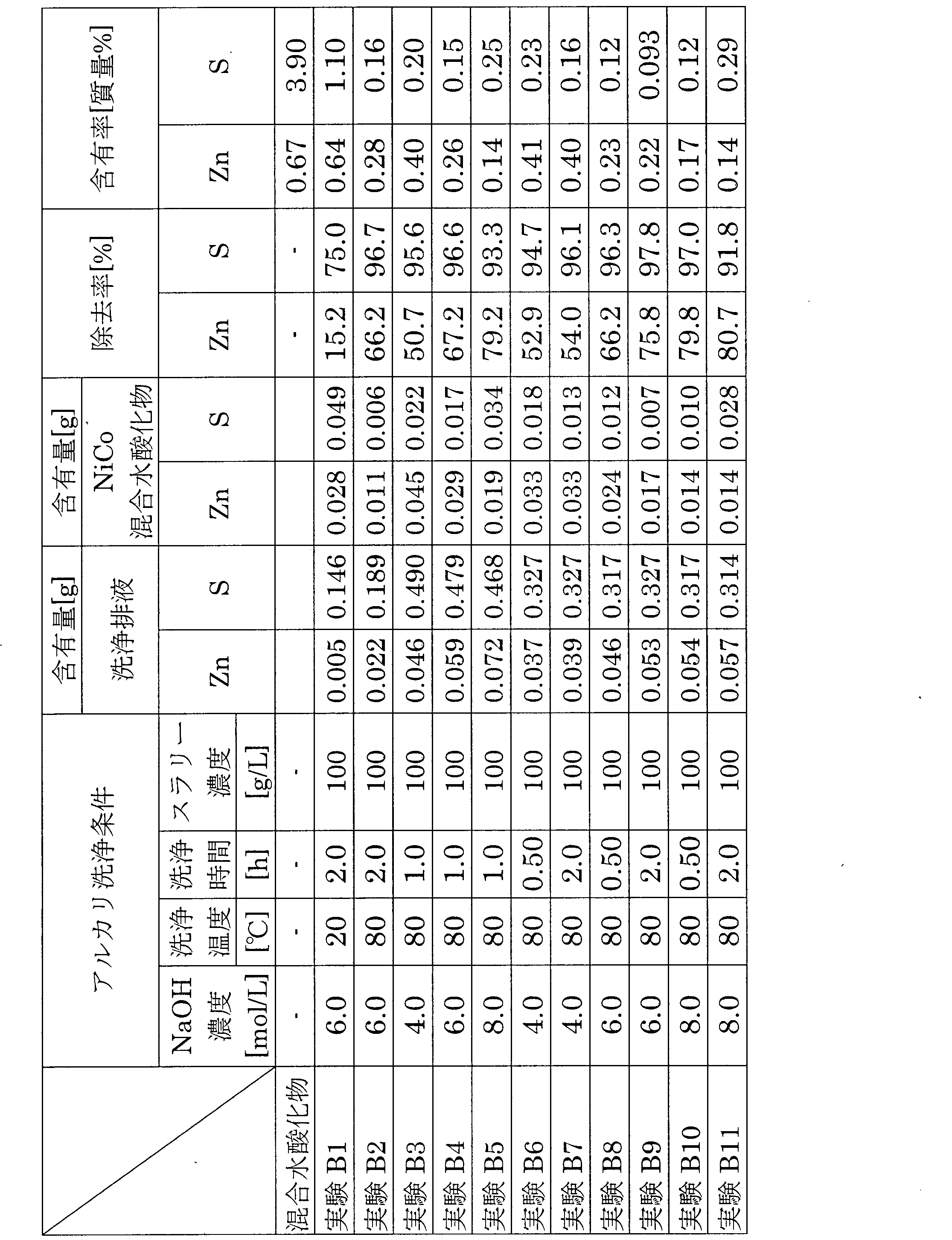
上記表3から分かるように、水酸化ナトリウム濃度4.0mol/L以上8.0mol/L以下の苛性ソーダ水溶液を使用し、洗浄時の液温が20℃以上80℃以下で且つ洗浄時間0.50時間以上2.0時間以下の条件でアルカリ洗浄することで、亜鉛は15%以上、硫黄は75%以上の除去率で除去することができる。As can be seen from Table 3 above, by using a caustic soda solution with a sodium hydroxide concentration of 4.0 mol/L or more and 8.0 mol/L or less, and performing alkaline cleaning under conditions where the liquid temperature during cleaning is 20°C or more and 80°C or less and the cleaning time is 0.50 hours or more and 2.0 hours or less, zinc can be removed at a removal rate of 15% or more and sulfur at a removal rate of 75% or more.
[参考例4](浸出工程における炭酸アンモニウム浸出試験)
(実験C1)
容器内に装入した純水185mL及び濃度25質量%のアンモニア水15mLに、炭酸アンモニウム((NH4)2CO3)を28.82g含む水溶液を添加し、炭酸アンモニウム濃度1.5mol/Lのアンモニア含有水溶液を調製した。得られたアンモニア含有水溶液に、下記表4に示す組成を有する粉末状のニッケルコバルト混合水酸化物(MHP)の20gを混合してスラリーとし、撹拌機で撹拌すると共にその液温を20℃に維持した状態で2.0時間保持することで浸出処理を行った。
[Reference Example 4] (Ammonium carbonate leaching test in the leaching process)
(Experiment C1)
An aqueous solution containing 28.82 g of ammonium carbonate (( NH4 ) 2CO3 ) was added to 185 mL of pure water and 15 mL of 25% ammonia water placed in a container to prepare an aqueous solution containing ammonia with an ammonium carbonate concentration of 1.5 mol/L. 20 g of powdered nickel-cobalt mixed hydroxide (MHP) having the composition shown in Table 4 below was mixed with the resulting aqueous solution containing ammonia to prepare a slurry, which was stirred with a stirrer while maintaining the liquid temperature at 20°C for 2.0 hours to carry out a leaching treatment.

上記の浸出処理後は濾過により固液分離を行ったところ、乾燥質量10.8gの浸出残渣及び270mLの浸出液が得られた。これら浸出残渣及び浸出液の元素濃度を誘導結合プラズマ発光分光分析法(ICP-AES)により測定し、各元素の浸出率を下記式3により求めた。
[式3]
元素αの浸出率=浸出液中の元素αの質量/(浸出液中の元素αの質量+浸出残渣中の元素αの質量)×100
After the above leaching treatment, solid-liquid separation was performed by filtration to obtain a leaching residue with a dry mass of 10.8 g and a leaching solution of 270 mL. The element concentrations of the leaching residue and the leaching solution were measured by inductively coupled plasma atomic emission spectrometry (ICP-AES), and the leaching rate of each element was calculated by the following formula 3.
[Formula 3]
Leaching rate of element α=mass of element α in leaching solution/(mass of element α in leaching solution+mass of element α in leaching residue)×100
その結果、ニッケルの浸出率は71.2%、コバルトの浸出率は65.3%となり、ニッケルイオン及びコバルトイオンを多く含有するアンモニア水溶液からなる浸出液を製造することができた。As a result, the nickel leaching rate was 71.2% and the cobalt leaching rate was 65.3%, and a leachate consisting of an ammonia aqueous solution containing a large amount of nickel ions and cobalt ions was produced.
(実験C2)
炭酸アンモニウム((NH4)2CO3)の添加量を28.82gに代えて57.65gとすることで炭酸アンモニウム濃度3.0mol/Lのアンモニア含有水溶液を調製した以外は実験C1と同様にしてMHPの浸出処理及びその後の固液分離を行ったところ、乾燥質量6.30gの浸出残渣及び310mLの浸出液が得られた。得られた浸出残渣及び浸出液の元素濃度を実験C1と同様に測定したところ、ニッケルの浸出率は90.3%、コバルトの浸出率は84.6%となり、ニッケルイオン及びコバルトイオンを多く含有するアンモニア水溶液からなる浸出液を製造することができた。
(Experiment C2)
The leaching treatment of MHP and the subsequent solid- liquid separation were carried out in the same manner as in experiment C1, except that an ammonia-containing aqueous solution with an ammonium carbonate concentration of 3.0 mol/L was prepared by changing the amount of ammonium carbonate ((NH4)2CO3) added from 28.82 g to 57.65 g, resulting in a leaching residue with a dry mass of 6.30 g and a leachate of 310 mL. The element concentrations of the obtained leachate residue and leachate were measured in the same manner as in experiment C1, and the leachate rate of nickel was 90.3% and the leachate rate of cobalt was 84.6%, indicating that a leachate consisting of an aqueous ammonia solution containing large amounts of nickel ions and cobalt ions was produced.
(実験C3)
炭酸アンモニウム((NH4)2CO3)の添加量を28.82gに代えて115.30gとすることで炭酸アンモニウム濃度4.1mol/Lのアンモニア含有水溶液を調製した以外は実験C1と同様にしてMHPの浸出処理及びその後の固液分離を行ったところ、乾燥質量5.53gの浸出残渣及び355mLの浸出液が得られた。得られた浸出残渣及び浸出液の元素濃度を実験C1と同様に測定したところ、ニッケルの浸出率は94.4%、コバルトの浸出率は88.9%となり、ニッケルイオン及びコバルトイオンを多く含有するアンモニア水溶液からなる浸出液を製造することができた。
(Experiment C3)
The leaching treatment of MHP and the subsequent solid-liquid separation were carried out in the same manner as in experiment C1, except that the amount of ammonium carbonate (( NH4 ) 2CO3 ) added was changed from 28.82 g to 115.30 g to prepare an ammonia-containing aqueous solution with an ammonium carbonate concentration of 4.1 mol/L. A leaching residue with a dry mass of 5.53 g and a leachate of 355 mL were obtained. The element concentrations of the obtained leachate residue and leachate were measured in the same manner as in experiment C1, and the leachate rate of nickel was 94.4% and the leachate rate of cobalt was 88.9%, indicating that a leachate consisting of an aqueous ammonia solution containing large amounts of nickel ions and cobalt ions was produced.
(実験C4)
浸出処理時の液温を20℃に代えて50℃にした以外は実験C1と同様にしてMHPの浸出処理及びその後の固液分離を行ったところ、乾燥質量6.07gの浸出残渣及び203mLの浸出液が得られた。得られた浸出残渣及び浸出液の元素濃度を実験C1と同様に測定したところ、ニッケルの浸出率は73.9%、コバルトの浸出率は73.6%となり、ニッケルイオン及びコバルトイオンを多く含有するアンモニア水溶液からなる浸出液を製造することができた。
(Experiment C4)
Leaching of MHP and subsequent solid-liquid separation were carried out in the same manner as in Experiment C1, except that the liquid temperature during the leaching treatment was changed from 20° C. to 50° C., resulting in a leaching residue with a dry mass of 6.07 g and 203 mL of leachate. The element concentrations of the obtained leachate residue and leachate were measured in the same manner as in Experiment C1, and the leaching rate of nickel was 73.9%, and the leaching rate of cobalt was 73.6%, indicating that a leachate consisting of an aqueous ammonia solution containing large amounts of nickel ions and cobalt ions could be produced.
(実験C5)
浸出処理時の液温を20℃に代えて50℃にした以外は実験C2と同様にしてMHPの浸出処理及びその後の固液分離を行ったところ、乾燥質量3.57gの浸出残渣及び235mLの浸出液が得られた。得られた浸出残渣及び浸出液の元素濃度を実験C1と同様に測定したところ、ニッケルの浸出率は92.5%、コバルトの浸出率は87.3%となり、ニッケルイオン及びコバルトイオンを多く含有するアンモニア水溶液からなる浸出液を製造することができた。
(Experiment C5)
Leaching of MHP and subsequent solid-liquid separation were carried out in the same manner as in Experiment C2, except that the liquid temperature during the leaching treatment was changed from 20° C. to 50° C., resulting in a leaching residue with a dry mass of 3.57 g and 235 mL of leachate. The element concentrations of the obtained leachate residue and leachate were measured in the same manner as in Experiment C1, and the leaching rate of nickel was 92.5%, and the leaching rate of cobalt was 87.3%, indicating that a leachate consisting of an aqueous ammonia solution containing large amounts of nickel ions and cobalt ions could be produced.
(実験C6)
浸出処理時の液温を20℃に代えて50℃にした以外は実験C3と同様にしてMHPの浸出処理及びその後の固液分離を行ったところ、乾燥質量5.05gの浸出残渣及び415mLの浸出液が得られた。得られた浸出残渣及び浸出液の元素濃度を実験C1と同様に測定したところ、ニッケルの浸出率は95.2%、コバルトの浸出率は89.2%となり、ニッケルイオン及びコバルトイオンを多く含有するアンモニア水溶液からなる浸出液を製造することができた。
(Experiment C6)
Leaching of MHP and subsequent solid-liquid separation were carried out in the same manner as in Experiment C3, except that the liquid temperature during the leaching treatment was changed from 20° C. to 50° C., resulting in a leaching residue with a dry mass of 5.05 g and 415 mL of leachate. The element concentrations of the obtained leachate residue and leachate were measured in the same manner as in Experiment C1, and the leaching rate of nickel was 95.2%, and the leaching rate of cobalt was 89.2%, indicating that a leachate consisting of an aqueous ammonia solution containing large amounts of nickel ions and cobalt ions could be produced.
(実験C7)
容器内に装入した濃度25%のアンモニア水に、上記表4に示す組成を有する粉末状のニッケルコバルト混合水酸化物(MHP)の20gを混合してスラリーとし、撹拌機で撹拌すると共にその液温を20℃に調節しながら2.0時間保持することで浸出処理を行った。以降は実験C1と同様に固液分離して150mLの浸出液を得た。この浸出液の元素濃度を実験C1と同様に測定して各元素の浸出率を求めた。
(Experiment C7)
20 g of powdered nickel-cobalt mixed hydroxide (MHP) having the composition shown in Table 4 above was mixed with 25% ammonia water placed in a container to form a slurry, which was stirred with a stirrer and held at 20°C for 2.0 hours to carry out a leaching treatment. Thereafter, solid-liquid separation was carried out in the same manner as in Experiment C1 to obtain 150 mL of leachate. The element concentrations of this leachate were measured in the same manner as in Experiment C1 to determine the leaching rate of each element.
その結果、ニッケルの浸出率は14.6%、コバルトの浸出率は0.2%となり、同じ温度で浸出処理を行った実験C1~3に比べてニッケルイオンの浸出が不十分となり、コバルトイオンはほとんど浸出されなかった。なお、この実験C7では各元素の浸出率を下記式4により求めた。
[式4]
元素αの浸出率=浸出液中の元素αの質量/MHP中の元素αの質量×100
As a result, the leaching rate of nickel was 14.6%, and the leaching rate of cobalt was 0.2%, which was insufficient compared to experiments C1 to C3, in which the leaching treatment was performed at the same temperature, and almost no cobalt ions were leached. In this experiment C7, the leaching rate of each element was calculated using the following formula 4.
[Formula 4]
Leaching rate of element α=mass of element α in leaching solution/mass of element α in MHP×100
(実験C8)
浸出処理時の液温を20℃に代えて50℃にした以外は実験C7と同様にしてMHPの浸出処理及びその後の固液分離と濃度測定を行なったところ、ニッケルの浸出率は17.5%、コバルトの浸出率は0.3%となり、同じ温度で浸出処理を行なった実験C4~6に比べてニッケルイオンの浸出が不十分となり、コバルトイオンはほとんど浸出されなかった。なお、この浸出率は実験C7と同じ方法で算出した。上記実験C1~8の測定結果をまとめて下記表5に示す。
(Experiment C8)
The leaching of MHP and the subsequent solid-liquid separation and concentration measurement were carried out in the same manner as in Experiment C7, except that the liquid temperature during the leaching treatment was changed from 20°C to 50°C. The nickel leaching rate was 17.5%, and the cobalt leaching rate was 0.3%, which means that the leaching of nickel ions was insufficient compared to Experiments C4 to C6, in which the leaching treatment was carried out at the same temperature, and almost no cobalt ions were leached. This leaching rate was calculated in the same way as in Experiment C7. The measurement results of Experiments C1 to C8 are summarized in Table 5 below.

[参考例5](NiCo混合硫化物(MS)の酸素吹き込み浸出試験)
(実験D1)
容器内に装入した純水185mL及び濃度25質量%のアンモニア水15mLに、炭酸アンモニウム((NH4)2CO3)を28.82g含む水溶液を添加し、炭酸アンモニウム濃度1.5mol/Lのアンモニア含有水溶液を調製した。得られたアンモニア含有水溶液に、下記表6に示す組成を有する粉末状のニッケルコバルト混合硫化物(MS)の18gを混合してスラリーとした。このスラリー中に酸素ボンベから酸素ガスを1L/minの流量で吹き込みながら、撹拌機で撹拌すると共にその液温を50℃に維持した状態で2時間保持することで浸出処理を行った。
[Reference Example 5] (Oxygen blowing leaching test of NiCo mixed sulfide (MS))
(Experiment D1)
An aqueous solution containing 28.82 g of ammonium carbonate (( NH4 ) 2CO3 ) was added to 185 mL of pure water and 15 mL of ammonia water with a concentration of 25% by mass placed in a container, to prepare an aqueous solution containing ammonia with an ammonium carbonate concentration of 1.5 mol/L. 18 g of powdered nickel-cobalt mixed sulfide ( MS ) having the composition shown in Table 6 below was mixed with the resulting aqueous solution containing ammonia to prepare a slurry. While blowing oxygen gas from an oxygen cylinder into the slurry at a flow rate of 1 L/min, the mixture was stirred with a stirrer and held at a liquid temperature of 50°C for 2 hours to perform a leaching treatment.

上記の浸出処理後は濾過により固液分離を行ったところ、乾燥質量15.2gの浸出残渣及び205mLの浸出液が得られた。これら浸出残渣及び浸出液の元素濃度を誘導結合プラズマ発光分光分析法(ICP-AES)により測定し、各元素の浸出率を下記式5により求めた。
[式5]
元素αの浸出率=浸出液中の元素αの質量/(浸出液中の元素αの質量+浸出残渣中の元素αの質量)×100
After the above leaching treatment, solid-liquid separation was performed by filtration to obtain a leaching residue with a dry mass of 15.2 g and a leaching solution of 205 mL. The element concentrations of the leaching residue and the leaching solution were measured by inductively coupled plasma atomic emission spectrometry (ICP-AES), and the leaching rate of each element was calculated by the following formula 5.
[Formula 5]
Leaching rate of element α=mass of element α in leaching solution/(mass of element α in leaching solution+mass of element α in leaching residue)×100
その結果、ニッケルの浸出率は18.3%、コバルトの浸出率は7.2%となり、ニッケルイオン及びコバルトイオンを多く含有するアンモニア水溶液からなる浸出液を製造することができた。As a result, the nickel leaching rate was 18.3% and the cobalt leaching rate was 7.2%, and a leachate consisting of an ammonia aqueous solution containing a large amount of nickel ions and cobalt ions was produced.
(実験D2)
炭酸アンモニウム((NH4)2CO3)の添加量を28.82gに代えて57.65gとすることで炭酸アンモニウム濃度3.0mol/Lのアンモニア含有水溶液を調製した以外は実験D1と同様にしてMSの浸出処理及びその後の固液分離を行ったところ、乾燥質量9.80gの浸出残渣及び238mLの浸出液が得られた。得られた浸出残渣及び浸出液の元素濃度を実験D1と同様に測定したところ、ニッケルの浸出率は44.7%、コバルトの浸出率は24.5%となり、ニッケルイオン及びコバルトイオンを多く含有するアンモニア水溶液からなる浸出液を製造することができた。
(Experiment D2)
Leaching of MS and subsequent solid-liquid separation were carried out in the same manner as in Experiment D1, except that the amount of ammonium carbonate (( NH4 ) 2CO3 ) added was changed from 28.82 g to 57.65 g to prepare an ammonia-containing aqueous solution with an ammonium carbonate concentration of 3.0 mol/L. A leaching residue with a dry mass of 9.80 g and a leachate of 238 mL were obtained. The element concentrations of the obtained leachate residue and leachate were measured in the same manner as in Experiment D1, and the leachate rate of nickel was 44.7% and the leachate rate of cobalt was 24.5%, indicating that a leachate consisting of an aqueous ammonia solution containing large amounts of nickel ions and cobalt ions was produced.
(実験D3)
炭酸アンモニウム((NH4)2CO3)の添加量を28.82gに代えて115.30gとすることで炭酸アンモニウム濃度4.1mol/Lのアンモニア含有水溶液を調製した以外は実験D1と同様にしてMSの浸出処理及びその後の固液分離を行ったところ、乾燥質量7.84gの浸出残渣及び200mLの浸出液が得られた。得られた浸出残渣及び浸出液の元素濃度を実験D1と同様に測定したところ、ニッケルの浸出率は45.1%、コバルトの浸出率は39.4%となり、ニッケルイオン及びコバルトイオンを多く含有するアンモニア水溶液からなる浸出液を製造することができた。
(Experiment D3)
Leaching of MS and subsequent solid-liquid separation were carried out in the same manner as in Experiment D1, except that the amount of ammonium carbonate (( NH4 ) 2CO3 ) added was changed from 28.82 g to 115.30 g to prepare an ammonia-containing aqueous solution with an ammonium carbonate concentration of 4.1 mol/L. A leaching residue with a dry mass of 7.84 g and 200 mL of leachate were obtained. The element concentrations of the obtained leachate residue and leachate were measured in the same manner as in Experiment D1, and the leachate rate of nickel was 45.1% and the leachate rate of cobalt was 39.4%, indicating that a leachate consisting of an aqueous ammonia solution containing large amounts of nickel ions and cobalt ions was produced.
(実験D4)
浸出処理時の液温を50℃に代えて20℃にした以外は実験D2と同様にしてMSの浸出処理及びその後の固液分離を行ったところ、乾燥質量12.6gの浸出残渣及び220mLの浸出液が得られた。得られた浸出残渣及び浸出液の元素濃度を実験D1と同様に測定したところ、ニッケルの浸出率は27.7%、コバルトの浸出率は21.6%となり、ニッケルイオン及びコバルトイオンを多く含有するアンモニア水溶液からなる浸出液を製造することができた。
(Experiment D4)
Leaching of MS and subsequent solid-liquid separation were carried out in the same manner as in Experiment D2, except that the liquid temperature during the leaching treatment was changed to 20° C. instead of 50° C., and a leaching residue with a dry mass of 12.6 g and a leachate of 220 mL were obtained. The element concentrations of the obtained leachate residue and leachate were measured in the same manner as in Experiment D1, and the leaching rate of nickel was 27.7%, and the leaching rate of cobalt was 21.6%, indicating that a leachate consisting of an aqueous ammonia solution containing large amounts of nickel ions and cobalt ions could be produced.
(実験D5)
実験D1では、浸出処理において炭酸アンモニウムを使用したが、これを炭酸水素アンモニウムに代えた以外は、実験D1と同様に行った。その結果、実験D1とほぼ同等のニッケルイオン及びコバルトイオンを多く含有するアンモニア水溶液からなる浸出液を得られることが確認できた。
(Experiment D5)
In Experiment D1, ammonium carbonate was used in the leaching treatment, but this was replaced with ammonium bicarbonate, and the same procedure was followed as in Experiment D1. As a result, it was confirmed that a leachate consisting of an aqueous ammonia solution containing large amounts of nickel ions and cobalt ions, almost equivalent to that in Experiment D1, was obtained.
(実験D6)
浸出液に炭酸アンモニウムを含んだアンモニア含有水溶液を用いることに代えて、濃度25%のアンモニア水200mLを用いたこと以外は実験D1と同様にしてMSの浸出処理及びその後の固液分離を行ったところ、200mLの浸出液を得た。この浸出液の元素濃度を実験D1と同様に測定して各元素の浸出率を求めた。その結果、ニッケルの浸出率は14.6%、コバルトの浸出率は0.2%となり、同じ温度で浸出処理を行なった実験D1~3に比べてニッケルイオンの浸出が不十分となり、コバルトイオンはほとんど浸出されなかった。なお、この実験D6では各元素の浸出率を下記式6により求めた。
[式6]
元素αの浸出率=浸出液中の元素αの質量/MS中の元素αの質量×100
(Experiment D6)
The leaching of MS and the subsequent solid-liquid separation were carried out in the same manner as in Experiment D1, except that 200 mL of 25% ammonia water was used as the leaching solution instead of the ammonia-containing aqueous solution containing ammonium carbonate, and 200 mL of leaching solution was obtained. The element concentrations of this leaching solution were measured in the same manner as in Experiment D1 to determine the leaching rate of each element. As a result, the leaching rate of nickel was 14.6%, and the leaching rate of cobalt was 0.2%, which was insufficient for nickel ions compared to Experiments D1 to D3 in which the leaching treatment was carried out at the same temperature, and almost no cobalt ions were leached. In this Experiment D6, the leaching rate of each element was calculated using the following formula 6.
[Formula 6]
Leaching rate of element α=mass of element α in leaching solution/mass of element α in MS×100
(実験D7)
浸出処理時の液温を50℃に代えて20℃にした以外は実験D6と同様にしてMSの浸出処理及びその後の固液分離と濃度測定を行なったところ、ニッケルの浸出率は14.6%、コバルトの浸出率は0.2%となり、同じ温度で浸出処理を行なった実験D4に比べてニッケルイオンの浸出が不十分となり、コバルトイオンはほとんど浸出されなかった。なお、この浸出率は実験D6と同じ方法で算出した。上記実験D5を除いた実験D1~7の測定結果をまとめて下記表7に示す。
(Experiment D7)
The leaching of MS and the subsequent solid-liquid separation and concentration measurement were carried out in the same manner as in experiment D6, except that the liquid temperature during the leaching treatment was changed from 50°C to 20°C. The nickel leaching rate was 14.6%, and the cobalt leaching rate was 0.2%, which means that the leaching of nickel ions was insufficient compared to experiment D4, in which the leaching treatment was carried out at the same temperature, and almost no cobalt ions were leached. The leaching rates were calculated in the same way as in experiment D6. The measurement results of experiments D1 to D7, excluding experiment D5, are shown in Table 7 below.

[参考例6](NiCo混合硫化物(MS)の浸出液の熱分解沈殿試験)
容器内に装入した純水185mL及び濃度25質量%のアンモニア水15mLに、炭酸アンモニウム((NH4)2CO3)を28.82g含む水溶液を添加し、炭酸アンモニウム濃度1.5mol/Lのアンモニア含有水溶液を調製した。得られたアンモニア含有水溶液に、上記表6に示す組成を有する粉末状のニッケルコバルト混合硫化物(MS)の18gを混合してスラリーとした。得られたスラリーを撹拌機で撹拌すると共に、その液温を20℃に維持した状態で2時間保持することで浸出処理を行った。
[Reference Example 6] (Pyrolysis and precipitation test of NiCo mixed sulfide (MS) leachate)
An aqueous solution containing 28.82 g of ammonium carbonate (( NH4 ) 2CO3 ) was added to 185 mL of pure water and 15 mL of ammonia water with a concentration of 25 mass % placed in a container, to prepare an aqueous solution containing ammonia with an ammonium carbonate concentration of 1.5 mol/L. 18 g of powdered nickel-cobalt mixed sulfide (MS) having the composition shown in Table 6 above was mixed with the resulting aqueous solution containing ammonia to prepare a slurry. The resulting slurry was stirred with a stirrer and held at a liquid temperature of 20°C for 2 hours to carry out a leaching treatment.
上記の浸出処理後は濾過による固液分離で浸出残渣を除去し、得られたニッケルとコバルトのアンモニア溶液からなる浸出液を500mLのセパラブルフラスコに入れて液量が確認できるようマーキングし、温度が80℃以上になるようにホットスターラーで昇温しながら撹拌を開始すると共に、蒸発した水は純水で補給した。80℃まで昇温したのを確認した時点から6時間かけて熱分解処理を行なった。得られた沈殿物を含むスラリーをフィルターで濾過することで、ニッケルとコバルトの水酸化物を分解後液から分離して回収した。得られた水酸化物を乾燥した後、誘導結合プラズマ発光分光分析法(ICP-AES)により定量分析した結果、ニッケルとコバルトの水酸化物の回収率は、それぞれ70.8%及び85.8%であった。After the above leaching treatment, the leaching residue was removed by solid-liquid separation through filtration, and the resulting leaching solution consisting of an ammonia solution of nickel and cobalt was placed in a 500 mL separable flask and marked so that the liquid volume could be confirmed. Stirring was started while heating with a hot stirrer so that the temperature reached 80°C or higher, and the evaporated water was replenished with pure water. Once it was confirmed that the temperature had risen to 80°C, the thermal decomposition treatment was carried out over 6 hours. The resulting slurry containing the precipitate was filtered through a filter, and the nickel and cobalt hydroxides were separated and recovered from the decomposition liquid. The resulting hydroxides were dried and then quantitatively analyzed by inductively coupled plasma atomic emission spectroscopy (ICP-AES). The recovery rates of nickel and cobalt hydroxides were 70.8% and 85.8%, respectively.
[実施例1]
図1のブロックフロー図に沿って原料のニッケルコバルトの混合水酸化物(MHP)を処理した。具体的には、先ず水洗工程において、原料として400g(乾燥重量)のMHPと、1.85Lの純水とをビーカーに入れ、水温を20℃に維持しながら撹拌混合することで水洗処理を行なった。
[Example 1]
The raw material nickel-cobalt mixed hydroxide (MHP) was treated according to the block flow diagram in Figure 1. Specifically, first, in the water washing process, 400 g (dry weight) of MHP as the raw material and 1.85 L of pure water were placed in a beaker, and the water was washed by stirring and mixing while maintaining the water temperature at 20°C.
次に第1アルカリ洗浄工程において、上記水洗処理により得た381.4g(乾燥重量)のMHPを、8.0mol/Lの水酸化ナトリウム水溶液1.55Lと共にビーカーに入れ、温度20℃に調整しながら撹拌混合してアルカリ洗浄を行なった。洗浄時間は0.50時間とした。Next, in the first alkaline washing step, 381.4 g (dry weight) of MHP obtained by the above water washing process was placed in a beaker together with 1.55 L of an 8.0 mol/L aqueous sodium hydroxide solution, and alkaline washing was performed by stirring and mixing while adjusting the temperature to 20°C. The washing time was 0.50 hours.
次に浸出工程において、上記の第1アルカリ洗浄工程でアルカリ洗浄された183g(乾燥重量)のMHPを、濃度25%のアンモニア水溶液1.0L、0.6Lの純水、及び253gの炭酸水素アンモニウムと共にビーカーに入れて温度20℃に調整すると共に撹拌混合して浸出処理を行なった。このときの炭酸水素アンモニウム濃度は2.0mol/Lであった。Next, in the leaching process, 183 g (dry weight) of MHP that had been alkaline washed in the first alkaline washing process was placed in a beaker together with 1.0 L of 25% aqueous ammonia solution, 0.6 L of pure water, and 253 g of ammonium bicarbonate, and the temperature was adjusted to 20°C while stirring and mixing to carry out the leaching process. The ammonium bicarbonate concentration at this time was 2.0 mol/L.
次に熱分解沈殿工程において、上記浸出処理により得た浸出液1.6Lをビーカーに入れ、温度80℃に加熱してこの温度で2.0時間保持する熱分解処理を行なうことで、ニッケルとコバルトの混合水酸化物を生成させた。上記の加熱温度での保持中は撹拌操作を継続した。その後、固液分離を行なうことで、固相側にニッケルとコバルトの混合水酸化物、液相側に固液分離後液を得た。Next, in the thermal decomposition precipitation process, 1.6 L of the leachate obtained by the above leaching process was placed in a beaker, heated to a temperature of 80°C, and held at this temperature for 2.0 hours to generate a mixed hydroxide of nickel and cobalt. Stirring was continued while the mixture was held at the above heating temperature. After that, solid-liquid separation was performed, yielding a mixed hydroxide of nickel and cobalt on the solid phase side and a liquid after solid-liquid separation on the liquid phase side.
最後に第2アルカリ洗浄工程において、上記熱分解沈殿工程で得た89g(乾燥重量)のニッケルとコバルトの混合水酸化物を、8.0mol/Lの水酸化ナトリウム水溶液0.83Lと共にビーカーに入れ、温度20℃に調整しながら撹拌混合してアルカリ洗浄を行なった。洗浄時間は0.50時間とした。原料として用いたMHP及び上記の一連の工程の各々において生成される中間生成物に対して誘導結合プラズマ発光分光分析法(ICP-AES)により定量分析することで求めた組成(品位)を下記表8に示す。Finally, in the second alkaline washing process, 89 g (dry weight) of the mixed hydroxide of nickel and cobalt obtained in the above thermal decomposition precipitation process was placed in a beaker together with 0.83 L of an 8.0 mol/L aqueous sodium hydroxide solution, and alkaline washing was carried out by stirring and mixing while adjusting the temperature to 20°C. The washing time was 0.50 hours. The composition (quality) determined by quantitative analysis by inductively coupled plasma atomic emission spectroscopy (ICP-AES) of the MHP used as the raw material and the intermediate products produced in each of the above series of processes is shown in Table 8 below.

上記表8の結果から、本発明の要件を満たす水洗工程、第1アルカリ洗浄工程、浸出工程、熱分解沈殿工程、及び第2アルカリ洗浄工程を順次経ることで、目的金属であるニッケル及びコバルトのほかに不純物を比較的多く含む原料であっても、リチウムイオン電池正極活物質の前駆体として利用可能な品位を有するニッケル及びコバルトを含有する水酸化物を製造可能であることが分かった。From the results in Table 8 above, it was found that by sequentially going through the water washing process, the first alkaline washing process, the leaching process, the thermal decomposition precipitation process, and the second alkaline washing process that satisfy the requirements of the present invention, it is possible to produce hydroxides containing nickel and cobalt with a quality that can be used as a precursor for the positive electrode active material of lithium ion batteries, even if the raw material contains a relatively large amount of impurities in addition to the target metals nickel and cobalt.
[実施例2]
実施例1では、浸出工程において炭酸水素アンモニウムを使用したが、これを炭酸アンモニウムに代えた以外は、実施例1と同様に行った。その結果、第2アルカリ洗浄工程を経て得られたニッケルとコバルトの混合水酸化物は上記表8とほぼ同等の品位を有していることを確認できた。
[Example 2]
In Example 1, ammonium hydrogen carbonate was used in the leaching step, but except for replacing this with ammonium carbonate, the same procedure was carried out as in Example 1. As a result, it was confirmed that the mixed hydroxide of nickel and cobalt obtained through the second alkali washing step had a quality almost equivalent to that shown in Table 8 above.
このように、炭酸水素アンモニウムに代えて、炭酸アンモニウムを用いた場合でも、本発明の要件を満たす水洗工程、第1アルカリ洗浄工程、浸出工程、熱分解沈殿工程、及び第2アルカリ洗浄工程を順次経ることで、目的金属であるニッケル及びコバルトのほかに不純物を比較的多く含む原料であっても、リチウムイオン電池正極活物質の前駆体として利用可能なニッケル及びコバルトを含有する水酸化物を製造可能であることが分かる。
In this way, even when ammonium carbonate is used instead of ammonium hydrogen carbonate, it is possible to produce a hydroxide containing nickel and cobalt that can be used as a precursor of a positive electrode active material for a lithium ion battery by sequentially going through the water washing step, the first alkali washing step, the leaching step, the thermal decomposition precipitation step, and the second alkali washing step that satisfy the requirements of the present invention, even if the raw material contains a relatively large amount of impurities in addition to the target metals nickel and cobalt.
Claims (3)
前記水洗されたニッケルコバルト混合水酸化物を水酸化ナトリウム濃度が1.0mol/L以上8.0mol/L以下で且つ液温10℃以上90℃以下の水酸化ナトリウム水溶液を用いて0.50時間以上2.0時間以下かけて洗浄する第1アルカリ洗浄工程と、
前記第1アルカリ洗浄工程で洗浄されたニッケルコバルト混合水酸化物を炭酸アンモニウム及び/又は炭酸水素アンモニウム濃度が0.50mol/L以上4.1mol/L以下のアンモニア水を含むアンモニア含有水溶液を用いて温度0℃以上60℃以下のスラリーの状態で浸出処理する浸出工程と、
前記浸出処理により得たニッケル及びコバルトを含有する浸出液を60℃以上100℃以下で0.50時間以上2.0時間以下かけて加熱することでこれらニッケル及びコバルトを水酸化物として析出させる熱分解沈殿工程と、
前記析出させた水酸化物を水酸化ナトリウム濃度が1.0mol/L以上8.0mol/L以下で且つ液温10℃以上90℃以下の水酸化ナトリウム水溶液を用いて0.50時間以上2.0時間以下かけて洗浄する第2アルカリ洗浄工程とを含むニッケル及びコバルトを含有する水酸化物の製造方法。 A water washing step of washing the particulate nickel-cobalt mixed hydroxide with water;
A first alkali washing step in which the water-washed nickel-cobalt mixed hydroxide is washed with an aqueous sodium hydroxide solution having a sodium hydroxide concentration of 1.0 mol/L to 8.0 mol/L and a liquid temperature of 10° C. to 90° C. for 0.50 hours to 2.0 hours;
a leaching step in which the nickel-cobalt mixed hydroxide washed in the first alkaline washing step is leached in a slurry state at a temperature of 0° C. to 60° C. using an ammonia-containing aqueous solution containing ammonia water having an ammonium carbonate and/or ammonium hydrogen carbonate concentration of 0.50 mol/L to 4.1 mol/L;
a thermal decomposition and precipitation step in which the leachate containing nickel and cobalt obtained by the leaching treatment is heated at 60° C. to 100° C. for 0.50 hours to 2.0 hours to precipitate the nickel and cobalt as hydroxides;
and a second alkali washing step of washing the precipitated hydroxide with an aqueous sodium hydroxide solution having a sodium hydroxide concentration of 1.0 mol/L or more and 8.0 mol/L or less and a liquid temperature of 10°C or more and 90°C or less for 0.50 hours or more and 2.0 hours or less.
Applications Claiming Priority (3)
| Application Number | Priority Date | Filing Date | Title |
|---|---|---|---|
| JP2023102878 | 2023-06-22 | ||
| JP2023102878 | 2023-06-22 | ||
| PCT/JP2024/022135 WO2024262504A1 (en) | 2023-06-22 | 2024-06-18 | Method for producing hydroxide containing nickel and cobalt |
Publications (2)
| Publication Number | Publication Date |
|---|---|
| JPWO2024262504A1 JPWO2024262504A1 (en) | 2024-12-26 |
| JP7662112B1 true JP7662112B1 (en) | 2025-04-15 |
Family
ID=93935524
Family Applications (1)
| Application Number | Title | Priority Date | Filing Date |
|---|---|---|---|
| JP2024569793A Active JP7662112B1 (en) | 2023-06-22 | 2024-06-18 | Method for producing hydroxide containing nickel and cobalt |
Country Status (2)
| Country | Link |
|---|---|
| JP (1) | JP7662112B1 (en) |
| WO (1) | WO2024262504A1 (en) |
Citations (3)
| Publication number | Priority date | Publication date | Assignee | Title |
|---|---|---|---|---|
| JP2006522866A (en) * | 2003-04-11 | 2006-10-05 | ビーエイチピー・ビリトン・エスエスエム・テクノロジー・ピーティーワイ・リミテッド | Reductive ammonia leaching of nickel and cobalt support materials. |
| WO2012020768A1 (en) * | 2010-08-10 | 2012-02-16 | Agcセイミケミカル株式会社 | Production method for a composite compound comprising nickel and cobalt |
| WO2020196046A1 (en) * | 2019-03-26 | 2020-10-01 | 住友金属鉱山株式会社 | Method for manufacturing nickel and cobalt-containing solution from hydroxide containing nickel and cobalt |
Family Cites Families (1)
| Publication number | Priority date | Publication date | Assignee | Title |
|---|---|---|---|---|
| US5824283A (en) | 1997-04-28 | 1998-10-20 | Inco Limited | Process for producing nickel hydroxide from elemental nickel |
-
2024
- 2024-06-18 WO PCT/JP2024/022135 patent/WO2024262504A1/en active Pending
- 2024-06-18 JP JP2024569793A patent/JP7662112B1/en active Active
Patent Citations (3)
| Publication number | Priority date | Publication date | Assignee | Title |
|---|---|---|---|---|
| JP2006522866A (en) * | 2003-04-11 | 2006-10-05 | ビーエイチピー・ビリトン・エスエスエム・テクノロジー・ピーティーワイ・リミテッド | Reductive ammonia leaching of nickel and cobalt support materials. |
| WO2012020768A1 (en) * | 2010-08-10 | 2012-02-16 | Agcセイミケミカル株式会社 | Production method for a composite compound comprising nickel and cobalt |
| WO2020196046A1 (en) * | 2019-03-26 | 2020-10-01 | 住友金属鉱山株式会社 | Method for manufacturing nickel and cobalt-containing solution from hydroxide containing nickel and cobalt |
Also Published As
| Publication number | Publication date |
|---|---|
| JPWO2024262504A1 (en) | 2024-12-26 |
| WO2024262504A1 (en) | 2024-12-26 |
Similar Documents
| Publication | Publication Date | Title |
|---|---|---|
| US12243993B2 (en) | Processing method of positive electrode active substance waste of lithium ion secondary battery | |
| TWI905083B (en) | Process for the recycling of spent lithium ion cells | |
| CN116096929A (en) | Cobalt and nickel separation method | |
| CA3086627C (en) | Method for separating copper, and nickel and cobalt | |
| WO2020212546A1 (en) | Process for the preparation of precursor compounds for lithium battery cathodes | |
| KR20220127893A (en) | How to deal with alloys | |
| JP7121885B2 (en) | Cobalt and nickel separation method | |
| US10501334B2 (en) | Aqueous cobalt chloride solution refinement method | |
| JP6201905B2 (en) | Method for recovering valuable metals from waste nickel metal hydride batteries | |
| JP2023150694A (en) | Cobalt and nickel separation method | |
| JP7662112B1 (en) | Method for producing hydroxide containing nickel and cobalt | |
| CN117509689A (en) | Preparation method of lithium carbonate | |
| JP2023150686A (en) | Method for leaching electrode materials, separation method for cobalt and nickel | |
| US20180148344A1 (en) | Aqueous cobalt chloride solution purification method | |
| WO2024262505A1 (en) | Method for producing leachate from hydroxide containing nickel and cobalt | |
| WO2024262506A1 (en) | Method for producing leach solution from hydroxide including nickel and cobalt | |
| WO2024262507A1 (en) | Method for producing leachate from mixed sulfide containing nickel and cobalt | |
| CN119242943B (en) | Leaching methods for high-grade nickel matte, precursors for cathode materials, preparation methods, and applications | |
| Azmi et al. | Precipitation of nickel-manganese-cobalt sulphate from pregnant leach solution of spent lithium-ion batteries | |
| WO2023156448A1 (en) | Process for the recovery of li, ni and co | |
| TW202414885A (en) | Process for recycling aluminum hydroxide from a black mass | |
| CA3268978A1 (en) | Process for recycling aluminum hydroxide from a black mass | |
| EA043878B1 (en) | METHOD FOR RECOVERING METALS FROM LI-CONTAINING START MATERIAL | |
| EA043847B1 (en) | METHOD FOR OBTAINING STARTING COMPOUNDS FOR LITHIUM BATTERY CATHODES |
Legal Events
| Date | Code | Title | Description |
|---|---|---|---|
| A621 | Written request for application examination |
Free format text: JAPANESE INTERMEDIATE CODE: A621 Effective date: 20241204 |
|
| A871 | Explanation of circumstances concerning accelerated examination |
Free format text: JAPANESE INTERMEDIATE CODE: A871 Effective date: 20241204 |
|
| TRDD | Decision of grant or rejection written | ||
| A01 | Written decision to grant a patent or to grant a registration (utility model) |
Free format text: JAPANESE INTERMEDIATE CODE: A01 Effective date: 20250304 |
|
| A61 | First payment of annual fees (during grant procedure) |
Free format text: JAPANESE INTERMEDIATE CODE: A61 Effective date: 20250317 |
|
| R150 | Certificate of patent or registration of utility model |
Ref document number: 7662112 Country of ref document: JP Free format text: JAPANESE INTERMEDIATE CODE: R150 |