JP7657961B2 - Hybridization Buffer Formulation - Google Patents
Hybridization Buffer Formulation Download PDFInfo
- Publication number
- JP7657961B2 JP7657961B2 JP2023558810A JP2023558810A JP7657961B2 JP 7657961 B2 JP7657961 B2 JP 7657961B2 JP 2023558810 A JP2023558810 A JP 2023558810A JP 2023558810 A JP2023558810 A JP 2023558810A JP 7657961 B2 JP7657961 B2 JP 7657961B2
- Authority
- JP
- Japan
- Prior art keywords
- hybridization buffer
- total volume
- buffer formulation
- reaction mixture
- chloride
- Prior art date
- Legal status (The legal status is an assumption and is not a legal conclusion. Google has not performed a legal analysis and makes no representation as to the accuracy of the status listed.)
- Active
Links
Classifications
-
- C—CHEMISTRY; METALLURGY
- C12—BIOCHEMISTRY; BEER; SPIRITS; WINE; VINEGAR; MICROBIOLOGY; ENZYMOLOGY; MUTATION OR GENETIC ENGINEERING
- C12Q—MEASURING OR TESTING PROCESSES INVOLVING ENZYMES, NUCLEIC ACIDS OR MICROORGANISMS; COMPOSITIONS OR TEST PAPERS THEREFOR; PROCESSES OF PREPARING SUCH COMPOSITIONS; CONDITION-RESPONSIVE CONTROL IN MICROBIOLOGICAL OR ENZYMOLOGICAL PROCESSES
- C12Q1/00—Measuring or testing processes involving enzymes, nucleic acids or microorganisms; Compositions therefor; Processes of preparing such compositions
- C12Q1/68—Measuring or testing processes involving enzymes, nucleic acids or microorganisms; Compositions therefor; Processes of preparing such compositions involving nucleic acids
- C12Q1/6806—Preparing nucleic acids for analysis, e.g. for polymerase chain reaction [PCR] assay
-
- C—CHEMISTRY; METALLURGY
- C12—BIOCHEMISTRY; BEER; SPIRITS; WINE; VINEGAR; MICROBIOLOGY; ENZYMOLOGY; MUTATION OR GENETIC ENGINEERING
- C12Q—MEASURING OR TESTING PROCESSES INVOLVING ENZYMES, NUCLEIC ACIDS OR MICROORGANISMS; COMPOSITIONS OR TEST PAPERS THEREFOR; PROCESSES OF PREPARING SUCH COMPOSITIONS; CONDITION-RESPONSIVE CONTROL IN MICROBIOLOGICAL OR ENZYMOLOGICAL PROCESSES
- C12Q1/00—Measuring or testing processes involving enzymes, nucleic acids or microorganisms; Compositions therefor; Processes of preparing such compositions
- C12Q1/68—Measuring or testing processes involving enzymes, nucleic acids or microorganisms; Compositions therefor; Processes of preparing such compositions involving nucleic acids
- C12Q1/6813—Hybridisation assays
Landscapes
- Chemical & Material Sciences (AREA)
- Organic Chemistry (AREA)
- Life Sciences & Earth Sciences (AREA)
- Zoology (AREA)
- Proteomics, Peptides & Aminoacids (AREA)
- Health & Medical Sciences (AREA)
- Engineering & Computer Science (AREA)
- Wood Science & Technology (AREA)
- Analytical Chemistry (AREA)
- Microbiology (AREA)
- Physics & Mathematics (AREA)
- Molecular Biology (AREA)
- Immunology (AREA)
- Biotechnology (AREA)
- Biophysics (AREA)
- Biochemistry (AREA)
- Bioinformatics & Cheminformatics (AREA)
- General Engineering & Computer Science (AREA)
- General Health & Medical Sciences (AREA)
- Genetics & Genomics (AREA)
- Chemical Kinetics & Catalysis (AREA)
- Measuring Or Testing Involving Enzymes Or Micro-Organisms (AREA)
Description
本開示の背景
ハイブリダイゼーションは、一本鎖デオキシリボ核酸(DNA)またはリボ核酸(RNA)分子が相補的DNAまたはRNAにアニールする現象である。二本鎖DNA配列は一般に生理的条件下において安定であるが、(一般的には、周囲の温度を上昇させることによって)実験室でこれらの条件を変化させると、分子が一本鎖に分離する。これらの鎖は互いに相補的であるが、これらの鎖の周囲に存在する他の配列に相補的であることもあり得る。周囲の温度を低下させることにより、一本鎖分子は互いにアニールする、または「ハイブリダイズする」ことが可能になる。
Context of the Disclosure Hybridization is the phenomenon whereby single-stranded deoxyribonucleic acid (DNA) or ribonucleic acid (RNA) molecules anneal to complementary DNA or RNA. Double-stranded DNA sequences are generally stable under physiological conditions, but altering these conditions in the laboratory (typically by increasing the temperature of the surroundings) causes the molecules to separate into single strands. The strands are complementary to each other, but may also be complementary to other sequences present around them. Reducing the temperature of the surroundings allows the single-stranded molecules to anneal, or "hybridize," to each other.
ハイブリダイゼーションは、サザンブロット、ノーザンブロット、プライマー伸長、ポリメラーゼ連鎖反応(PCR)、標的濃縮、次世代シーケンシング(NGS)のためのライブラリ調製およびDNAシーケンシングへのほとんどのアプローチを含む多くの分子生物学技術において有用である。全体として、2つの種の遺伝的関連性は、それらのDNAのセグメントをハイブリダイズさせること(DNA-DNAハイブリダイゼーション)によって決定することができる。ポリメラーゼ連鎖反応(PCR)を含む様々な異なる方法が、DNA試料の起源を正確に特定するためにハイブリダイゼーションを使用する。別の技術では、発現された遺伝子を同定するために、短いDNA配列を細胞mRNAにハイブリダイズさせる。研究者らはまた、望ましくないmRNAに結合し、リボソームがmRNAをタンパク質に翻訳するのを防ぐためのアンチセンスRNAの使用を探求している。 Hybridization is useful in many molecular biology techniques, including Southern blots, Northern blots, primer extension, polymerase chain reaction (PCR), target enrichment, library preparation for next generation sequencing (NGS) and most approaches to DNA sequencing. Overall, the genetic relatedness of two species can be determined by hybridizing segments of their DNA (DNA-DNA hybridization). A variety of different methods, including polymerase chain reaction (PCR), use hybridization to pinpoint the origin of a DNA sample. Another technique hybridizes short DNA sequences to cellular mRNA to identify expressed genes. Researchers are also exploring the use of antisense RNA to bind to undesired mRNA and prevent ribosomes from translating the mRNA into protein.
ハイブリダイゼーション緩衝剤は、ハイブリダイゼーションがその中で起こり得る緩衝剤である。ホルムアミドは、ハイブリダイゼーション緩衝剤中の変性剤として一般的に使用される。ホルムアミドは有効な変性剤であるが、非常に毒性が高く(欧州化学品庁(ECHA)によって、その生殖毒性について非常に懸念される物質として特定されている)、輸送が危険である(米国運輸省はホルムアミド含有溶液の二重封入を要求する)。「化学物質の登録、評価、認可および制限」(REACH)に不適合である毒性物質を回避しながら、特異性および感度を維持するハイブリダイゼーション緩衝剤を調製することが望ましい。沈殿物の形成を受けにくいハイブリダイゼーション緩衝剤を調製し、使用することも望ましい。 Hybridization buffers are buffers in which hybridization may occur. Formamide is commonly used as a denaturing agent in hybridization buffers. Although formamide is an effective denaturing agent, it is highly toxic (identified by the European Chemicals Agency (ECHA) as a substance of very high concern for its reproductive toxicity) and dangerous to transport (the U.S. Department of Transportation requires double sealing of formamide-containing solutions). It would be desirable to prepare hybridization buffers that maintain specificity and sensitivity while avoiding toxic substances that are incompatible with the "Registration, Evaluation, Authorization and Restriction of Chemicals" (REACH). It would also be desirable to prepare and use hybridization buffers that are less susceptible to the formation of precipitates.
本開示の簡単な概要
出願人は、ハイブリダイゼーション化学を実質的に妨害せず、沈殿なしに約15℃未満の温度で利用することができ、および/またはREACH準拠であるハイブリダイゼーション緩衝調合物を開発した。
BRIEF SUMMARY OF THE DISCLOSURE Applicants have developed hybridization buffer formulations that do not substantially interfere with hybridization chemistry, can be utilized at temperatures below about 15° C. without precipitation, and/or are REACH compliant.
出願人は、ジメチルスルホキシド(DMSO)がハイブリダイゼーション緩衝剤中でホルムアミドの代替物として作用し得ることを発見した。出願人は、DMSOを含む本明細書に開示されるハイブリダイゼーション緩衝剤が安定であり、約10℃未満(例えば、約5℃未満、約0℃未満、約-5℃未満、約-10℃未満、約-15℃未満、約-20℃未満)の温度で保存された場合または自動液体処理機器(例えば、Roche Molecular Systems,Inc.、Pleasanton、CAから入手可能なAVENIO Edge機器)において使用された場合に沈殿物を形成しないことも発見した。 Applicants have discovered that dimethyl sulfoxide (DMSO) can act as a substitute for formamide in hybridization buffers. Applicants have also discovered that hybridization buffers disclosed herein that include DMSO are stable and do not form precipitates when stored at temperatures below about 10° C. (e.g., below about 5° C., below about 0° C., below about −5° C., below about −10° C., below about −15° C., below about −20° C.) or when used in automated liquid handling equipment (e.g., AVENIO Edge equipment available from Roche Molecular Systems, Inc., Pleasanton, Calif.).
本開示の第1の局面は、ハイブリダイゼーション緩衝調合物であって、(i)ハイブリダイゼーション緩衝調合物の総体積に対して約36%~約50%の間のDMSO;(ii)ハイブリダイゼーション緩衝調合物の総体積に対して約0.0008%~約0.0016%の間の1つ以上の界面活性剤;(iii)ハイブリダイゼーション緩衝調合物の総体積に対して約20%~約26%の間の1つ以上の第4級アンモニウム塩;(iv)ハイブリダイゼーション緩衝調合物の総体積に対して約5%~約6.5%の間の1つ以上の緩衝剤;および(v)ハイブリダイゼーション緩衝調合物の総体積に対して25%~約32%の間の1つ以上の第2の塩を含む、ハイブリダイゼーション緩衝調合物である。いくつかの態様において、ハイブリダイゼーション緩衝調合物は、沈殿物、例えば2-(N-モルホリノ)エタンスルホン酸に由来する沈殿物を実質的に含まない。いくつかの態様において、ハイブリダイゼーション緩衝調合物はホルムアミドを含まない。いくつかの態様において、ハイブリダイゼーション緩衝調合物は、沈殿物、例えば2-(N-モルホリノ)エタンスルホン酸に由来する沈殿物を含まない。 A first aspect of the present disclosure is a hybridization buffer formulation comprising: (i) between about 36% and about 50% DMSO by total volume of the hybridization buffer formulation; (ii) between about 0.0008% and about 0.0016% of one or more surfactants by total volume of the hybridization buffer formulation; (iii) between about 20% and about 26% of one or more quaternary ammonium salts by total volume of the hybridization buffer formulation; (iv) between about 5% and about 6.5% of one or more buffering agents by total volume of the hybridization buffer formulation; and (v) between 25% and about 32% of one or more second salts by total volume of the hybridization buffer formulation. In some embodiments, the hybridization buffer formulation is substantially free of precipitates, e.g., precipitates derived from 2-(N-morpholino)ethanesulfonic acid. In some embodiments, the hybridization buffer formulation is free of formamide. In some embodiments, the hybridization buffer formulation does not contain precipitates, such as precipitates derived from 2-(N-morpholino)ethanesulfonic acid.
いくつかの態様において、1つ以上の界面活性剤はアニオン性界面活性剤である。いくつかの態様において、1つ以上の界面活性剤は、ポリソルベート20、ポリソルベート40、ポリソルベート60、ポリソルベート80およびこれらの組み合わせからなる群から選択される。いくつかの態様において、1つ以上の界面活性剤はポリソルベート20である。 In some embodiments, the one or more surfactants are anionic surfactants. In some embodiments, the one or more surfactants are selected from the group consisting of polysorbate 20, polysorbate 40, polysorbate 60, polysorbate 80, and combinations thereof. In some embodiments, the one or more surfactants are polysorbate 20.
いくつかの態様において、1つ以上の第4級アンモニウム塩は、テトラメチルアンモニウムクロリド、テトラエチルアンモニウムクロリド、テトラブチルアンモニウムクロリド、トリメチルアンモニウムクロリド、テトラ-n-ブチルアンモニウムクロリドおよびこれらの組み合わせからなる群から選択される。いくつかの態様において、1つ以上の第4級アンモニウム塩はテトラメチルアンモニウムクロリドである。 In some embodiments, the one or more quaternary ammonium salts are selected from the group consisting of tetramethylammonium chloride, tetraethylammonium chloride, tetrabutylammonium chloride, trimethylammonium chloride, tetra-n-butylammonium chloride, and combinations thereof. In some embodiments, the one or more quaternary ammonium salts are tetramethylammonium chloride.
いくつかの態様において、1つ以上の緩衝剤は、2-モルホリノエタンスルホン酸、3-(N-モルホリノ)プロパンスルホン酸、スクシナート、カコジラート、4-(2-ヒドロキシエチル)-1-ピペラジンエタンスルホン酸およびこれらの組み合わせからなる群から選択される。いくつかの態様において、1つ以上の緩衝剤は、2-モルホリノエタンスルホン酸である。 In some embodiments, the one or more buffering agents are selected from the group consisting of 2-morpholinoethanesulfonic acid, 3-(N-morpholino)propanesulfonic acid, succinate, cacodylate, 4-(2-hydroxyethyl)-1-piperazineethanesulfonic acid, and combinations thereof. In some embodiments, the one or more buffering agents is 2-morpholinoethanesulfonic acid.
いくつかの態様において、1つ以上の第2の塩は、N,N,N-トリメチルグリシン、テトラメチルアンモニウムクロリド、テトラメチルアンモニウムブロミド、テトラメチルアンモニウムヨージド、N,N,N-トリメチルメチオニン、N,N,N-トリメチルイソロイシン、N,N,N-トリメチルバリン、N,N,N-トリメチルアラニンおよびこれらの組み合わせからなる群から選択される。いくつかの態様において、1つ以上の第2の塩はN,N,N-トリメチルグリシンである。 In some embodiments, the one or more second salts are selected from the group consisting of N,N,N-trimethylglycine, tetramethylammonium chloride, tetramethylammonium bromide, tetramethylammonium iodide, N,N,N-trimethylmethionine, N,N,N-trimethylisoleucine, N,N,N-trimethylvaline, N,N,N-trimethylalanine, and combinations thereof. In some embodiments, the one or more second salts are N,N,N-trimethylglycine.
いくつかの態様において、1つ以上の界面活性剤はポリソルベート20を含み、1つ以上の第4級アンモニウム塩はテトラメチルアンモニウムクロリドを含み、1つ以上の緩衝剤は2-モルホリノエタンスルホン酸を含み、1つ以上の第2の塩はN,N,N-トリメチルグリシンを含む。いくつかの態様において、ハイブリダイゼーション緩衝剤は、ポリソルベート20、テトラメチルアンモニウムクロリド、2-モルホリノエタンスルホン酸およびN,N,N-トリメチルグリシンから本質的になる。 In some embodiments, the one or more surfactants include polysorbate 20, the one or more quaternary ammonium salts include tetramethylammonium chloride, the one or more buffers include 2-morpholinoethanesulfonic acid, and the one or more second salts include N,N,N-trimethylglycine. In some embodiments, the hybridization buffer consists essentially of polysorbate 20, tetramethylammonium chloride, 2-morpholinoethanesulfonic acid, and N,N,N-trimethylglycine.
いくつかの態様において、ハイブリダイゼーション緩衝調合物は、(i)ハイブリダイゼーション緩衝調合物の総体積に対して約48%~約52%の間のDMSO;(ii)ハイブリダイゼーション緩衝調合物の総体積に対して約0.0008%~約0.0016%の間の1つ以上の界面活性剤;(iii)ハイブリダイゼーション緩衝調合物の総体積に対して約18%~約22%の間の1つ以上の第4級アンモニウム塩;(iv)ハイブリダイゼーション緩衝調合物の総体積に対して約4%~約6%の間の1つ以上の緩衝剤;および(v)ハイブリダイゼーション緩衝調合物の総体積に対して24%~約26%の間の1つ以上の第2の塩を含む。いくつかの態様において、ハイブリダイゼーション緩衝剤は、約40%のDMSOを含む。いくつかの態様において、1つ以上の界面活性剤はアニオン性界面活性剤である。いくつかの態様において、1つ以上の界面活性剤は、ポリソルベート20、ポリソルベート40、ポリソルベート60、ポリソルベート80およびこれらの組み合わせからなる群から選択される。いくつかの態様において、1つ以上の界面活性剤はポリソルベート20である。いくつかの態様において、1つ以上の第4級アンモニウム塩は、テトラメチルアンモニウムクロリド、テトラエチルアンモニウムクロリド、テトラブチルアンモニウムクロリド、トリメチルアンモニウムクロリド、テトラ-n-ブチルアンモニウムクロリドおよびこれらの組み合わせからなる群から選択される。いくつかの態様において、1つ以上の第4級アンモニウム塩はテトラメチルアンモニウムクロリドを含む。いくつかの態様において、1つ以上の緩衝剤は、2-モルホリノエタンスルホン酸、3-(N-モルホリノ)プロパンスルホン酸、スクシナート、カコジラート、4-(2-ヒドロキシエチル)-1-ピペラジンエタンスルホン酸およびこれらの組み合わせからなる群から選択される。いくつかの態様において、1つ以上の緩衝剤は、2-モルホリノエタンスルホン酸である。いくつかの態様において、1つ以上の第2の塩は、N,N,N-トリメチルグリシン、テトラメチルアンモニウムクロリド、テトラメチルアンモニウムブロミド、テトラメチルアンモニウムヨージド、N,N,N-トリメチルメチオニン、N,N,N-トリメチルイソロイシン、N,N,N-トリメチルバリン、N,N,N-トリメチルアラニンおよびこれらの組み合わせからなる群から選択される。いくつかの態様において、1つ以上の第2の塩はN,N,N-トリメチルグリシンである。いくつかの態様において、1つ以上の界面活性剤はポリソルベート20を含み、1つ以上の第4級アンモニウム塩はテトラメチルアンモニウムクロリドであり、1つ以上の緩衝剤は2-モルホリノエタンスルホン酸を含み、1つ以上の第2の塩はN,N,N-トリメチルグリシンを含む。いくつかの態様において、ハイブリダイゼーション緩衝剤は、ポリソルベート20、テトラメチルアンモニウムクロリド、2-モルホリノエタンスルホン酸およびN,N,N-トリメチルグリシンから本質的になる。 In some embodiments, the hybridization buffer formulation comprises (i) between about 48% and about 52% DMSO by total volume of the hybridization buffer formulation; (ii) between about 0.0008% and about 0.0016% of one or more surfactants by total volume of the hybridization buffer formulation; (iii) between about 18% and about 22% of one or more quaternary ammonium salts by total volume of the hybridization buffer formulation; (iv) between about 4% and about 6% of one or more buffering agents by total volume of the hybridization buffer formulation; and (v) between 24% and about 26% of one or more second salts by total volume of the hybridization buffer formulation. In some embodiments, the hybridization buffer comprises about 40% DMSO. In some embodiments, the one or more surfactants are anionic surfactants. In some embodiments, the one or more surfactants are selected from the group consisting of polysorbate 20, polysorbate 40, polysorbate 60, polysorbate 80, and combinations thereof. In some embodiments, the one or more surfactants are polysorbate 20. In some embodiments, the one or more quaternary ammonium salts are selected from the group consisting of tetramethylammonium chloride, tetraethylammonium chloride, tetrabutylammonium chloride, trimethylammonium chloride, tetra-n-butylammonium chloride, and combinations thereof. In some embodiments, the one or more quaternary ammonium salts comprise tetramethylammonium chloride. In some embodiments, the one or more buffering agents are selected from the group consisting of 2-morpholinoethanesulfonic acid, 3-(N-morpholino)propanesulfonic acid, succinate, cacodylate, 4-(2-hydroxyethyl)-1-piperazineethanesulfonic acid, and combinations thereof. In some embodiments, the one or more buffering agents are 2-morpholinoethanesulfonic acid. In some embodiments, the one or more second salts are selected from the group consisting of N,N,N-trimethylglycine, tetramethylammonium chloride, tetramethylammonium bromide, tetramethylammonium iodide, N,N,N-trimethylmethionine, N,N,N-trimethylisoleucine, N,N,N-trimethylvaline, N,N,N-trimethylalanine, and combinations thereof. In some embodiments, the one or more second salts are N,N,N-trimethylglycine. In some embodiments, the one or more surfactants include polysorbate 20, the one or more quaternary ammonium salts are tetramethylammonium chloride, the one or more buffers include 2-morpholinoethanesulfonic acid, and the one or more second salts include N,N,N-trimethylglycine. In some embodiments, the hybridization buffer consists essentially of polysorbate 20, tetramethylammonium chloride, 2-morpholinoethanesulfonic acid, and N,N,N-trimethylglycine.
いくつかの態様において、ハイブリダイゼーション緩衝調合物は、(i)ハイブリダイゼーション緩衝調合物の総体積に対して約38%~約42%の間のDMSO;(ii)ハイブリダイゼーション緩衝調合物の総体積に対して約0.0008%~約0.0016%の間の1つ以上の界面活性剤;(iii)ハイブリダイゼーション緩衝調合物の総体積に対して約22%~約26%の間の1つ以上の第4級アンモニウム塩;(iv)ハイブリダイゼーション緩衝調合物の総体積に対して約5%~約7%の間の1つ以上の緩衝剤;および(v)ハイブリダイゼーション緩衝調合物の総体積に対して28%~約31%の間の1つ以上の第2の塩を含む。いくつかの態様において、ハイブリダイゼーション緩衝剤は、約50%のDMSOを含む。いくつかの態様において、1つ以上の界面活性剤はアニオン性界面活性剤である。いくつかの態様において、1つ以上の界面活性剤は、ポリソルベート20、ポリソルベート40、ポリソルベート60、ポリソルベート80およびこれらの組み合わせからなる群から選択される。いくつかの態様において、1つ以上の界面活性剤はポリソルベート20である。いくつかの態様において、1つ以上の第4級アンモニウム塩は、テトラメチルアンモニウムクロリド、テトラエチルアンモニウムクロリド、テトラブチルアンモニウムクロリド、トリメチルアンモニウムクロリド、テトラ-n-ブチルアンモニウムクロリドおよびこれらの組み合わせからなる群から選択される。いくつかの態様において、1つ以上の第4級アンモニウム塩はテトラメチルアンモニウムクロリドである。いくつかの態様において、1つ以上の緩衝剤は、2-モルホリノエタンスルホン酸、3-(N-モルホリノ)プロパンスルホン酸、スクシナート、カコジラート、4-(2-ヒドロキシエチル)-1-ピペラジンエタンスルホン酸およびこれらの組み合わせからなる群から選択される。いくつかの態様において、1つ以上の緩衝剤は、2-モルホリノエタンスルホン酸を含む。いくつかの態様において、1つ以上の第2の塩は、N,N,N-トリメチルグリシン、テトラメチルアンモニウムクロリド、テトラメチルアンモニウムブロミド、テトラメチルアンモニウムヨージド、N,N,N-トリメチルメチオニン、N,N,N-トリメチルイソロイシン、N,N,N-トリメチルバリン、N,N,N-トリメチルアラニンおよびこれらの組み合わせからなる群から選択される。いくつかの態様において、1つ以上の第2の塩はN,N,N-トリメチルグリシンである。いくつかの態様において、1つ以上の界面活性剤はポリソルベート20を含み、1つ以上の第4級アンモニウム塩はテトラメチルアンモニウムクロリドを含み、1つ以上の緩衝剤は2-モルホリノエタンスルホン酸を含み、1つ以上の第2の塩はN,N,N-トリメチルグリシンを含む。いくつかの態様において、ハイブリダイゼーション緩衝剤は、ポリソルベート20、テトラメチルアンモニウムクロリド、2-モルホリノエタンスルホン酸およびN,N,N-トリメチルグリシンから本質的になる。 In some embodiments, the hybridization buffer formulation comprises (i) between about 38% and about 42% DMSO by total volume of the hybridization buffer formulation; (ii) between about 0.0008% and about 0.0016% of one or more surfactants by total volume of the hybridization buffer formulation; (iii) between about 22% and about 26% of one or more quaternary ammonium salts by total volume of the hybridization buffer formulation; (iv) between about 5% and about 7% of one or more buffering agents by total volume of the hybridization buffer formulation; and (v) between 28% and about 31% of one or more second salts by total volume of the hybridization buffer formulation. In some embodiments, the hybridization buffer comprises about 50% DMSO. In some embodiments, the one or more surfactants are anionic surfactants. In some embodiments, the one or more surfactants are selected from the group consisting of polysorbate 20, polysorbate 40, polysorbate 60, polysorbate 80, and combinations thereof. In some embodiments, the one or more surfactants are polysorbate 20. In some embodiments, the one or more quaternary ammonium salts are selected from the group consisting of tetramethylammonium chloride, tetraethylammonium chloride, tetrabutylammonium chloride, trimethylammonium chloride, tetra-n-butylammonium chloride, and combinations thereof. In some embodiments, the one or more quaternary ammonium salts are tetramethylammonium chloride. In some embodiments, the one or more buffering agents are selected from the group consisting of 2-morpholinoethanesulfonic acid, 3-(N-morpholino)propanesulfonic acid, succinate, cacodylate, 4-(2-hydroxyethyl)-1-piperazineethanesulfonic acid, and combinations thereof. In some embodiments, the one or more buffering agents include 2-morpholinoethanesulfonic acid. In some embodiments, the one or more second salts are selected from the group consisting of N,N,N-trimethylglycine, tetramethylammonium chloride, tetramethylammonium bromide, tetramethylammonium iodide, N,N,N-trimethylmethionine, N,N,N-trimethylisoleucine, N,N,N-trimethylvaline, N,N,N-trimethylalanine, and combinations thereof. In some embodiments, the one or more second salts are N,N,N-trimethylglycine. In some embodiments, the one or more surfactants include polysorbate 20, the one or more quaternary ammonium salts include tetramethylammonium chloride, the one or more buffers include 2-morpholinoethanesulfonic acid, and the one or more second salts include N,N,N-trimethylglycine. In some embodiments, the hybridization buffer consists essentially of polysorbate 20, tetramethylammonium chloride, 2-morpholinoethanesulfonic acid, and N,N,N-trimethylglycine.
いくつかの態様において、ハイブリダイゼーション緩衝調合物は、(i)ハイブリダイゼーション緩衝調合物の総体積に対して約48%~約52%の間のDMSO;(ii)ハイブリダイゼーション緩衝調合物の総体積に対して約0.0008%~約0.0016%の間の1つ以上の界面活性剤;(iii)ハイブリダイゼーション緩衝調合物の総体積に対して約18%~約22%の間の1つ以上の第4級アンモニウム塩;(iv)ハイブリダイゼーション緩衝調合物の総体積に対して約4%~約6%の間の1つ以上の緩衝剤;および(v)ハイブリダイゼーション緩衝調合物の総体積に対して24%~約26%の間の1つ以上の第2の塩からなる。いくつかの態様において、ハイブリダイゼーション緩衝剤は、約40%のDMSOを含む。いくつかの態様において、1つ以上の界面活性剤はアニオン性界面活性剤である。いくつかの態様において、1つ以上の界面活性剤は、ポリソルベート20、ポリソルベート40、ポリソルベート60、ポリソルベート80およびこれらの組み合わせからなる群から選択される。いくつかの態様において、1つ以上の界面活性剤はポリソルベート20である。いくつかの態様において、1つ以上の第4級アンモニウム塩は、テトラメチルアンモニウムクロリド、テトラエチルアンモニウムクロリド、テトラブチルアンモニウムクロリド、トリメチルアンモニウムクロリド、テトラ-n-ブチルアンモニウムクロリドおよびこれらの組み合わせからなる群から選択される。いくつかの態様において、1つ以上の第4級アンモニウム塩はテトラメチルアンモニウムクロリドである。いくつかの態様において、1つ以上の緩衝剤は、2-モルホリノエタンスルホン酸、3-(N-モルホリノ)プロパンスルホン酸、スクシナート、カコジラート、4-(2-ヒドロキシエチル)-1-ピペラジンエタンスルホン酸およびこれらの組み合わせからなる群から選択される。いくつかの態様において、1つ以上の緩衝剤は、2-モルホリノエタンスルホン酸である。いくつかの態様において、1つ以上の第2の塩は、N,N,N-トリメチルグリシン、テトラメチルアンモニウムクロリド、テトラメチルアンモニウムブロミド、テトラメチルアンモニウムヨージド、N,N,N-トリメチルメチオニン、N,N,N-トリメチルイソロイシン、N,N,N-トリメチルバリン、N,N,N-トリメチルアラニンおよびこれらの組み合わせからなる群から選択される。いくつかの態様において、1つ以上の第2の塩はN,N,N-トリメチルグリシンを含む。いくつかの態様において、1つ以上の界面活性剤はポリソルベート20であり、1つ以上の第4級アンモニウム塩はテトラメチルアンモニウムクロリドを含み、1つ以上の緩衝剤は2-モルホリノエタンスルホン酸を含み、1つ以上の第2の塩はN,N,N-トリメチルグリシンを含む。いくつかの態様において、ハイブリダイゼーション緩衝剤は、ポリソルベート20、テトラメチルアンモニウムクロリド、2-モルホリノエタンスルホン酸およびN,N,N-トリメチルグリシンから本質的になる。 In some embodiments, the hybridization buffer formulation comprises (i) between about 48% and about 52% DMSO by total volume of the hybridization buffer formulation; (ii) between about 0.0008% and about 0.0016% of one or more surfactants by total volume of the hybridization buffer formulation; (iii) between about 18% and about 22% of one or more quaternary ammonium salts by total volume of the hybridization buffer formulation; (iv) between about 4% and about 6% of one or more buffering agents by total volume of the hybridization buffer formulation; and (v) between 24% and about 26% of one or more second salts by total volume of the hybridization buffer formulation. In some embodiments, the hybridization buffer comprises about 40% DMSO. In some embodiments, the one or more surfactants are anionic surfactants. In some embodiments, the one or more surfactants are selected from the group consisting of polysorbate 20, polysorbate 40, polysorbate 60, polysorbate 80, and combinations thereof. In some embodiments, the one or more surfactants are polysorbate 20. In some embodiments, the one or more quaternary ammonium salts are selected from the group consisting of tetramethylammonium chloride, tetraethylammonium chloride, tetrabutylammonium chloride, trimethylammonium chloride, tetra-n-butylammonium chloride, and combinations thereof. In some embodiments, the one or more quaternary ammonium salts are tetramethylammonium chloride. In some embodiments, the one or more buffering agents are selected from the group consisting of 2-morpholinoethanesulfonic acid, 3-(N-morpholino)propanesulfonic acid, succinate, cacodylate, 4-(2-hydroxyethyl)-1-piperazineethanesulfonic acid, and combinations thereof. In some embodiments, the one or more buffering agents are 2-morpholinoethanesulfonic acid. In some embodiments, the one or more second salts are selected from the group consisting of N,N,N-trimethylglycine, tetramethylammonium chloride, tetramethylammonium bromide, tetramethylammonium iodide, N,N,N-trimethylmethionine, N,N,N-trimethylisoleucine, N,N,N-trimethylvaline, N,N,N-trimethylalanine, and combinations thereof. In some embodiments, the one or more second salts comprise N,N,N-trimethylglycine. In some embodiments, the one or more surfactants are polysorbate 20, the one or more quaternary ammonium salts comprise tetramethylammonium chloride, the one or more buffers comprise 2-morpholinoethanesulfonic acid, and the one or more second salts comprise N,N,N-trimethylglycine. In some embodiments, the hybridization buffer consists essentially of polysorbate 20, tetramethylammonium chloride, 2-morpholinoethanesulfonic acid, and N,N,N-trimethylglycine.
本開示の第2の局面は、(i)反応混合物の総体積に対して約18%~約38%の間のDMSO;(ii)反応混合物の総体積に対して約0.0008%~約0.002%の間の1つ以上の界面活性剤;(iii)反応混合物の総体積に対して約22%~約33%の間の1つ以上の第4級アンモニウム塩;(iv)反応混合物の総体積に対して約5%~約8%の間の1つ以上の緩衝剤;(v)反応混合物の総体積に対して28%~約42%の間の1つ以上の第2の塩;および(vi)約0%~約0.04%の間の水を含む、反応混合物である。いくつかの態様において、反応混合物はホルムアミドを含まない。いくつかの態様において、反応混合物は、沈殿物、例えば、2-(N-モルホリノ)エタンスルホン酸に由来する沈殿物を実質的に含まない。いくつかの態様において、反応混合物は、沈殿物、例えば2-(N-モルホリノ)エタンスルホン酸に由来する沈殿物を含まない。 A second aspect of the present disclosure is a reaction mixture comprising: (i) between about 18% and about 38% DMSO, based on the total volume of the reaction mixture; (ii) between about 0.0008% and about 0.002% of one or more surfactants, based on the total volume of the reaction mixture; (iii) between about 22% and about 33% of one or more quaternary ammonium salts, based on the total volume of the reaction mixture; (iv) between about 5% and about 8% of one or more buffers, based on the total volume of the reaction mixture; (v) between 28% and about 42% of one or more second salts, based on the total volume of the reaction mixture; and (vi) between about 0% and about 0.04% water. In some embodiments, the reaction mixture is free of formamide. In some embodiments, the reaction mixture is substantially free of precipitates, e.g., precipitates derived from 2-(N-morpholino)ethanesulfonic acid. In some embodiments, the reaction mixture is free of precipitates, e.g., precipitates derived from 2-(N-morpholino)ethanesulfonic acid.
いくつかの態様において、1つ以上の界面活性剤はアニオン性界面活性剤である。いくつかの態様において、1つ以上の界面活性剤は、ポリソルベート20、ポリソルベート40、ポリソルベート60、ポリソルベート80およびこれらの組み合わせからなる群から選択される。いくつかの態様において、1つ以上の界面活性剤はポリソルベート20である。 In some embodiments, the one or more surfactants are anionic surfactants. In some embodiments, the one or more surfactants are selected from the group consisting of polysorbate 20, polysorbate 40, polysorbate 60, polysorbate 80, and combinations thereof. In some embodiments, the one or more surfactants are polysorbate 20.
いくつかの態様において、1つ以上の第4級アンモニウム塩は、テトラメチルアンモニウムクロリド、テトラエチルアンモニウムクロリド、テトラブチルアンモニウムクロリド、トリメチルアンモニウムクロリド、テトラ-n-ブチルアンモニウムクロリドおよびこれらの組み合わせからなる群から選択される。いくつかの態様において、1つ以上の第4級アンモニウム塩はテトラメチルアンモニウムクロリドを含む。 In some embodiments, the one or more quaternary ammonium salts are selected from the group consisting of tetramethylammonium chloride, tetraethylammonium chloride, tetrabutylammonium chloride, trimethylammonium chloride, tetra-n-butylammonium chloride, and combinations thereof. In some embodiments, the one or more quaternary ammonium salts include tetramethylammonium chloride.
いくつかの態様において、1つ以上の緩衝剤は、2-モルホリノエタンスルホン酸、3-(N-モルホリノ)プロパンスルホン酸、スクシナート、カコジラート、4-(2-ヒドロキシエチル)-1-ピペラジンエタンスルホン酸およびこれらの組み合わせからなる群から選択される。いくつかの態様において、1つ以上の緩衝剤は、2-モルホリノエタンスルホン酸を含む。当分野は、2-モルホリノエタンスルホン酸はDMSO中にあまり溶解しないことを教示した(例えば、Taha and Coutinho,“Organic-phase biological buffers for biochemical and biological research in organic media,”Journal of Molecular Liquids 221:197-205(2016)を参照)。したがって、当技術分野は、2-モルホリノエタンスルホン酸およびDMSOの両方を含有する緩衝剤を避けるように教示した。 In some embodiments, the one or more buffering agents are selected from the group consisting of 2-morpholinoethanesulfonic acid, 3-(N-morpholino)propanesulfonic acid, succinate, cacodylate, 4-(2-hydroxyethyl)-1-piperazineethanesulfonic acid, and combinations thereof. In some embodiments, the one or more buffering agents include 2-morpholinoethanesulfonic acid. The art has taught that 2-morpholinoethanesulfonic acid is poorly soluble in DMSO (see, e.g., Taha and Coutinho, “Organic-phase biological buffers for biochemical and biological research in organic media,” Journal of Molecular Liquids 221:197-205 (2016)). Thus, the art has taught to avoid buffers that contain both 2-morpholinoethanesulfonic acid and DMSO.
いくつかの態様において、1つ以上の第2の塩は、N,N,N-トリメチルグリシン、テトラメチルアンモニウムクロリド、テトラメチルアンモニウムブロミド、テトラメチルアンモニウムヨージド、N,N,N-トリメチルメチオニン、N,N,N-トリメチルイソロイシン、N,N,N-トリメチルバリン、N,N,N-トリメチルアラニンおよびこれらの組み合わせからなる群から選択される。いくつかの態様において、1つ以上の第2の塩はN,N,N-トリメチルグリシンを含む。 In some embodiments, the one or more second salts are selected from the group consisting of N,N,N-trimethylglycine, tetramethylammonium chloride, tetramethylammonium bromide, tetramethylammonium iodide, N,N,N-trimethylmethionine, N,N,N-trimethylisoleucine, N,N,N-trimethylvaline, N,N,N-trimethylalanine, and combinations thereof. In some embodiments, the one or more second salts include N,N,N-trimethylglycine.
いくつかの態様において、1つ以上の界面活性剤はポリソルベート20であり、1つ以上の第4級アンモニウム塩はテトラメチルアンモニウムクロリドを含み、1つ以上の緩衝剤は2-モルホリノエタンスルホン酸であり、1つ以上の第2の塩はN,N,N-トリメチルグリシンである。いくつかの態様において、ハイブリダイゼーション緩衝剤は、ポリソルベート20、テトラメチルアンモニウムクロリド、2-モルホリノエタンスルホン酸、N,N,N-トリメチルグリシンおよび水から本質的になる。 In some embodiments, the one or more surfactants are polysorbate 20, the one or more quaternary ammonium salts include tetramethylammonium chloride, the one or more buffers are 2-morpholinoethanesulfonic acid, and the one or more second salts are N,N,N-trimethylglycine. In some embodiments, the hybridization buffer consists essentially of polysorbate 20, tetramethylammonium chloride, 2-morpholinoethanesulfonic acid, N,N,N-trimethylglycine, and water.
いくつかの態様において、反応混合物は、(i)反応混合物の総体積に対して約21%~約36%の間のDMSO;(ii)反応混合物の総体積に対して約0.0008%~約0.002%の間の1つ以上の界面活性剤;(iii)反応混合物の総体積に対して約24%~約32%の間の1つ以上の第4級アンモニウム塩;(iv)反応混合物の総体積に対して約5%~約8%の間の1つ以上の緩衝剤;(v)反応混合物の総体積に対して28%~約42%の間の1つ以上の第2の塩;および(vi)約0%~約0.04%の間の水を含む。いくつかの態様において、1つ以上の界面活性剤はポリソルベート20であり、1つ以上の第4級アンモニウム塩はテトラメチルアンモニウムクロリドを含み、1つ以上の緩衝剤は2-モルホリノエタンスルホン酸を含み、1つ以上の第2の塩はN,N,N-トリメチルグリシンを含む。いくつかの態様において、ハイブリダイゼーション緩衝剤は、ポリソルベート20、テトラメチルアンモニウムクロリド、2-モルホリノエタンスルホン酸、N,N,N-トリメチルグリシンおよび水から本質的になる。 In some embodiments, the reaction mixture comprises (i) between about 21% and about 36% DMSO by total volume of the reaction mixture; (ii) between about 0.0008% and about 0.002% of one or more surfactants by total volume of the reaction mixture; (iii) between about 24% and about 32% of one or more quaternary ammonium salts by total volume of the reaction mixture; (iv) between about 5% and about 8% of one or more buffering agents by total volume of the reaction mixture; (v) between 28% and about 42% of one or more second salts by total volume of the reaction mixture; and (vi) between about 0% and about 0.04% water. In some embodiments, the one or more surfactants are polysorbate 20, the one or more quaternary ammonium salts comprise tetramethylammonium chloride, the one or more buffering agents comprise 2-morpholinoethanesulfonic acid, and the one or more second salts comprise N,N,N-trimethylglycine. In some embodiments, the hybridization buffer consists essentially of polysorbate 20, tetramethylammonium chloride, 2-morpholinoethanesulfonic acid, N,N,N-trimethylglycine, and water.
いくつかの態様において、反応混合物は、(i)反応混合物の総体積に対して約21%~約36%の間のDMSO;(ii)反応混合物の総体積に対して約0.0008%~約0.002%の間の1つ以上の界面活性剤;(iii)反応混合物の総体積に対して約24%~約32%の間の1つ以上の第4級アンモニウム塩;(iv)反応混合物の総体積に対して約5%~約8%の間の1つ以上の緩衝剤;(v)反応混合物の総体積に対して28%~約42%の間の1つ以上の第2の塩;および(vi)約0%~約0.04%の間の水から本質的になる。いくつかの態様において、1つ以上の界面活性剤はポリソルベート20を含み、1つ以上の第4級アンモニウム塩はテトラメチルアンモニウムクロリドを含み、1つ以上の緩衝剤は2-モルホリノエタンスルホン酸を含み、1つ以上の第2の塩はN,N,N-トリメチルグリシンを含む。いくつかの態様において、ハイブリダイゼーション緩衝剤は、ポリソルベート20、テトラメチルアンモニウムクロリド、2-モルホリノエタンスルホン酸、N,N,N-トリメチルグリシンおよび水から本質的になる。 In some embodiments, the reaction mixture consists essentially of: (i) between about 21% and about 36% DMSO, based on the total volume of the reaction mixture; (ii) between about 0.0008% and about 0.002% of one or more surfactants, based on the total volume of the reaction mixture; (iii) between about 24% and about 32% of one or more quaternary ammonium salts, based on the total volume of the reaction mixture; (iv) between about 5% and about 8% of one or more buffering agents, based on the total volume of the reaction mixture; (v) between 28% and about 42% of one or more second salts, based on the total volume of the reaction mixture; and (vi) between about 0% and about 0.04% water. In some embodiments, the one or more surfactants include polysorbate 20, the one or more quaternary ammonium salts include tetramethylammonium chloride, the one or more buffering agents include 2-morpholinoethanesulfonic acid, and the one or more second salts include N,N,N-trimethylglycine. In some embodiments, the hybridization buffer consists essentially of polysorbate 20, tetramethylammonium chloride, 2-morpholinoethanesulfonic acid, N,N,N-trimethylglycine, and water.
いくつかの態様において、反応混合物は、(i)反応混合物の総体積に対して約21%~約36%の間のDMSO;(ii)反応混合物の総体積に対して約0.0008%~約0.002%の間の1つ以上の界面活性剤;(iii)反応混合物の総体積に対して約24%~約32%の間の1つ以上の第4級アンモニウム塩;(iv)反応混合物の総体積に対して約5%~約8%の間の1つ以上の緩衝剤;(v)反応混合物の総体積に対して28%~約42%の間の1つ以上の第2の塩;および(vi)約0%~約0.04%の間の水からなる。いくつかの態様において、1つ以上の界面活性剤はポリソルベート20であり、1つ以上の第4級アンモニウム塩はテトラメチルアンモニウムクロリドを含み、1つ以上の緩衝剤は2-モルホリノエタンスルホン酸を含み、1つ以上の第2の塩はN,N,N-トリメチルグリシンを含む。いくつかの態様において、ハイブリダイゼーション緩衝剤は、ポリソルベート20、テトラメチルアンモニウムクロリド、2-モルホリノエタンスルホン酸、N,N,N-トリメチルグリシンおよび水から本質的になる。 In some embodiments, the reaction mixture comprises: (i) between about 21% and about 36% DMSO, based on the total volume of the reaction mixture; (ii) between about 0.0008% and about 0.002% of one or more surfactants, based on the total volume of the reaction mixture; (iii) between about 24% and about 32% of one or more quaternary ammonium salts, based on the total volume of the reaction mixture; (iv) between about 5% and about 8% of one or more buffering agents, based on the total volume of the reaction mixture; (v) between 28% and about 42% of one or more second salts, based on the total volume of the reaction mixture; and (vi) between about 0% and about 0.04% water. In some embodiments, the one or more surfactants are polysorbate 20, the one or more quaternary ammonium salts include tetramethylammonium chloride, the one or more buffering agents include 2-morpholinoethanesulfonic acid, and the one or more second salts include N,N,N-trimethylglycine. In some embodiments, the hybridization buffer consists essentially of polysorbate 20, tetramethylammonium chloride, 2-morpholinoethanesulfonic acid, N,N,N-trimethylglycine, and water.
本開示の第3の局面は、マスターミックスであって、(a)マスターミックスの総重量に対して約65%~約75%の間の反応混合物であって、反応混合物は、i)反応混合物の総体積に対して約21%~約36%の間のDMSO;(ii)反応混合物の総体積に対して約0.0008%~約0.002%の間の1つ以上の界面活性剤;(iii)反応混合物の総体積に対して約24%~約32%の間の1つ以上の第4級アンモニウム塩;(iv)反応混合物の総体積に対して約5%~約8%の間の1つ以上の緩衝剤;(v)反応混合物の総体積に対して28%~約42%の間の1つ以上の第2の塩;および(vi)約0%~約0.04%の間の水を含む、反応混合物と;(b)マスターミックスの総体積に対して約25%~約35%の間のオリゴヌクレオチドとを含む、マスターミックスである。いくつかの態様において、マスターミックスは、約67%~約71%の間の反応混合物を含む。いくつかの態様において、マスターミックスは、約70%の反応混合物を含む。いくつかの態様において、マスターミックスはホルムアミドを含まない。いくつかの態様において、反応混合物は、沈殿物、例えば、2-(N-モルホリノ)エタンスルホン酸に由来する沈殿物を実質的に含まない。いくつかの態様において、マスターミックスは、沈殿物、例えば、2-(N-モルホリノ)エタンスルホン酸に由来する沈殿物を含まない。 A third aspect of the present disclosure is a master mix comprising: (a) between about 65% and about 75% of a reaction mixture by total weight of the master mix, the reaction mixture comprising: i) between about 21% and about 36% DMSO by total volume of the reaction mixture; (ii) between about 0.0008% and about 0.002% of one or more surfactants by total volume of the reaction mixture; (iii) between about 24% and about 32% of one or more quaternary ammonium salts by total volume of the reaction mixture; (iv) between about 5% and about 8% of one or more buffers by total volume of the reaction mixture; (v) between 28% and about 42% of one or more second salts by total volume of the reaction mixture; and (vi) between about 0% and about 0.04% water; and (b) between about 25% and about 35% of an oligonucleotide by total volume of the master mix. In some embodiments, the master mix comprises between about 67% and about 71% of the reaction mixture. In some embodiments, the master mix comprises about 70% of the reaction mixture. In some embodiments, the master mix does not comprise formamide. In some embodiments, the reaction mixture is substantially free of precipitates, e.g., precipitates derived from 2-(N-morpholino)ethanesulfonic acid. In some embodiments, the master mix does not comprise precipitates, e.g., precipitates derived from 2-(N-morpholino)ethanesulfonic acid.
本開示の第4の局面は、マスターミックスであって、(a)マスターミックスの総体積に対して約65%~約75%の間の反応混合物であって、反応混合物は、i)反応混合物の総体積に対して約21%~約36%の間のDMSO;(ii)反応混合物の総体積に対して約0.0008%~約0.002%の間の1つ以上の界面活性剤;(iii)反応混合物の総体積に対して約24%~約32%の間の1つ以上の第4級アンモニウム塩;(iv)反応混合物の総体積に対して約5%~約8%の間の1つ以上の緩衝剤;(v)反応混合物の総体積に対して28%~約42%の間の1つ以上の第2の塩;および(vi)約0%~約0.04%の間の水を含む、反応混合物と;(b)マスターミックスの総体積に対して約25%~約35%の間のオリゴヌクレオチドとから本質的になる、マスターミックスである。いくつかの態様において、マスターミックスは、約67%~約71%の間の反応混合物を含む。いくつかの態様において、マスターミックスは、約70%の反応混合物を含む。 A fourth aspect of the present disclosure is a master mix consisting essentially of: (a) between about 65% and about 75% of a reaction mixture by total volume of the master mix, the reaction mixture comprising: i) between about 21% and about 36% DMSO by total volume of the reaction mixture; (ii) between about 0.0008% and about 0.002% of one or more surfactants by total volume of the reaction mixture; (iii) between about 24% and about 32% of one or more quaternary ammonium salts by total volume of the reaction mixture; (iv) between about 5% and about 8% of one or more buffers by total volume of the reaction mixture; (v) between 28% and about 42% of one or more second salts by total volume of the reaction mixture; and (vi) between about 0% and about 0.04% water; and (b) between about 25% and about 35% of oligonucleotide by total volume of the master mix. In some embodiments, the master mix comprises between about 67% and about 71% of the reaction mixture. In some embodiments, the master mix comprises about 70% of the reaction mixture.
本開示の第5の局面は、マスターミックスであって、(a)マスターミックスの総重量に対して約65%~約75%の間の反応混合物であって、反応混合物は、i)反応混合物の総体積に対して約21%~約36%の間のDMSO;(ii)反応混合物の総体積に対して約0.0008%~約0.002%の間の1つ以上の界面活性剤;(iii)反応混合物の総体積に対して約24%~約32%の間の1つ以上の第4級アンモニウム塩;(iv)反応混合物の総体積に対して約5%~約8%の間の1つ以上の緩衝剤;(v)反応混合物の総体積に対して28%~約42%の間の1つ以上の第2の塩;および(vi)約0%~約0.04%の間の水を含む、反応混合物と;(b)マスターミックスの総重量に対して約25%~約35%の間のオリゴヌクレオチドとからなる、マスターミックスである。いくつかの態様において、マスターミックスは、約67%~約71%の間の反応混合物を含む。いくつかの態様において、マスターミックスは、約70%の反応混合物を含む。 A fifth aspect of the present disclosure is a master mix comprising: (a) between about 65% and about 75% of a reaction mixture by weight of the master mix, the reaction mixture comprising: i) between about 21% and about 36% of DMSO by total volume of the reaction mixture; (ii) between about 0.0008% and about 0.002% of one or more surfactants by total volume of the reaction mixture; (iii) between about 24% and about 32% of one or more quaternary ammonium salts by total volume of the reaction mixture; (iv) between about 5% and about 8% of one or more buffers by total volume of the reaction mixture; (v) between 28% and about 42% of one or more second salts by total volume of the reaction mixture; and (vi) between about 0% and about 0.04% of water; and (b) between about 25% and about 35% of oligonucleotide by total weight of the master mix. In some embodiments, the master mix comprises between about 67% and about 71% of the reaction mixture. In some embodiments, the master mix comprises about 70% of the reaction mixture.
本開示の特徴の一般的な理解のために、図面を参照する。図面では、同一の要素を特定するために、全体を通して同様の参照番号が使用されている。本特許または出願ファイルは、カラーで作成された少なくとも1つの図面を含む。カラー図面を含む本特許または特許出願公開の写しは、請求に応じて、必要な手数料を支払うことにより、特許庁によって提供される。 For a general understanding of the features of the present disclosure, reference is made to the drawings, in which like reference numerals are used throughout to identify identical elements. The patent or application file contains at least one drawing executed in color. Copies of this patent or patent application publication with color drawing(s) will be provided by the Office upon request and payment of the necessary fee.
詳細な説明
反対であることが明確に示されない限り、複数の工程または行為を含む本明細書において特許請求の範囲に記載される任意の方法において、方法の工程または行為の順序は、必ずしも方法の工程または行為が記載される順序に限定されないことも理解されたい。
DETAILED DESCRIPTION [0033] It is also to be understood that, unless expressly indicated to the contrary, in any method claimed herein that includes more than one step or act, the order of the method steps or acts is not necessarily limited to the order in which the method steps or acts are described.
定義 Definition
本明細書で使用される場合、単数形「a」、「an」および「the」は、文脈が別途明確に指示しない限り、複数の指示対象を含む。同様に、「または」という単語は、文脈が別途明確に指示しない限り、「および」を含むことを意図している。「含む」という用語は、「AまたはBを含む」がA、B、またはAおよびBを含むことを意味するように、包括的に定義される。 As used herein, the singular forms "a," "an," and "the" include plural referents unless the context clearly dictates otherwise. Similarly, the word "or" is intended to include "and" unless the context clearly dictates otherwise. The term "comprising" is defined inclusively, such that "including A or B" means including A, B, or A and B.
本明細書および特許請求の範囲で使用される場合、「または」は、上記で定義された「および/または」と同じ意味を有することを理解されたい。例えば、リスト内の項目を区切る場合、「または」または「および/または」は、包括的であるとして、例えば、少なくとも1つのいくつかの要素または要素のリストを包含するが、1つより多くのいくつかの要素または要素のリストも含み、任意に、リストに記載されていない追加の項目を含むものとして解釈されるものとする。「のうちの1つのみ」または「のうちの正確に1つ」、または特許請求の範囲で使用される場合、「からなる」など、反対であることが明確に示される用語のみが、いくつかの要素または要素のリストのうちの正確に1つの要素を包含することを指す。一般に、ここで使用される「または」という用語は、「いずれか」、「のうちの1つ」、「のうちの1つのみ」または「のうちの正確に1つ」など、排他性の用語が先行する場合にのみ、排他的選択(例えば、「一方または他方であるが双方ではない」)を示すものとしてのみ解釈されるものとする。「から本質的になる」は、特許請求の範囲で使用される場合、特許法の分野で使用される通常の意味を有するものとする。 As used herein and in the claims, "or" should be understood to have the same meaning as "and/or" as defined above. For example, when separating items in a list, "or" or "and/or" shall be interpreted as inclusive, e.g., including at least one of a number of elements or lists of elements, but also including more than one of a number of elements or lists of elements, and optionally including additional items not listed. Only terms clearly indicated to the contrary, such as "only one of" or "exactly one of," or, when used in the claims, "consisting of," refer to the inclusion of exactly one element of a number of elements or lists of elements. In general, the term "or" as used herein shall only be interpreted as indicating exclusive selection (e.g., "one or the other but not both") when preceded by a term of exclusivity, such as "either," "one of," "only one of," or "exactly one of." "Consisting essentially of," when used in the claims, shall have its ordinary meaning as used in the field of patent law.
「備える(comprising)」、「含む(including)」、「有する(having)」などの用語は、交換可能に使用され、同じ意味を有する。同様に、「備える(comprises)」、「含む(includes)」、「有する(has)」などは、交換可能に使用され、同じ意味を有する。具体的には、これらの用語の各々は、「含む、備える(comprising)」の一般的な米国特許法の定義と一致して定義され、したがって、「少なくとも以下のもの(at least the following)」を意味する非限定的な用語であると解釈され、また、追加の特徴、制限、局面などを除外しないように解釈される。したがって、例えば、「構成要素a、bおよびcを有するデバイス」は、そのデバイスが少なくとも構成要素a、bおよびcを含むことを意味する。同様に、文言:「工程a、bおよびcを含む方法」は、その方法が少なくとも工程a、bおよびcを含むことを意味する。さらに、工程および過程は、本明細書において特定の順序で概説され得るが、当業者は、順序付けられた工程および過程が変化し得ることを認識するであろう。 Terms such as "comprising," "including," "having," etc. are used interchangeably and have the same meaning. Similarly, "comprises," "includes," "has," etc. are used interchangeably and have the same meaning. Specifically, each of these terms is defined consistent with the general U.S. patent law definition of "comprising," and therefore is to be interpreted as an open-ended term meaning "at least the following," and not to exclude additional features, limitations, aspects, etc. Thus, for example, "a device having components a, b, and c" means that the device includes at least components a, b, and c. Similarly, the phrase: "a method including steps a, b, and c" means that the method includes at least steps a, b, and c. Additionally, although steps and processes may be outlined in a particular order herein, one of ordinary skill in the art will recognize that the ordered steps and processes may vary.
本明細書および特許請求の範囲で使用される場合、1つ以上の要素のリストを参照する「少なくとも1つ」という句は、要素のリスト内の任意の1つ以上の要素から選択される少なくとも1つの要素を意味すると理解されるべきであるが、要素のリスト内に具体的に列記されているありとあらゆる要素の少なくとも1つを含むとは必ずしも限らず、要素のリスト内の要素の任意の組み合わせを除外するものではない。この定義はまた、「少なくとも1つ」という句が参照する要素のリスト内で具体的に特定される要素以外の要素が、具体的に特定されるそれらの要素に関連するかまたは関連しないかにかかわらず、任意に存在し得ることを許容する。したがって、非限定的な例として、「AおよびBの少なくとも1つ」(または、同等に、「AまたはBの少なくとも1つ」、または同等に「Aおよび/またはBの少なくとも1つ」)は、一態様においては、Bが存在しない(および任意に、B以外の要素を含む)、任意に1つより多くを含む少なくとも1つのAを指すことができ、別の態様においては、Aが存在しない(および任意に、A以外の要素を含む)、任意に1つより多くを含む少なくとも1つのBを指すことができ、さらに別の態様においては、任意に1つより多くを含む少なくとも1つのAおよび任意に1つより多くを含む少なくとも1つのB(および任意に、他の要素を含む)を指すことができるなどである。 As used herein and in the claims, the phrase "at least one" referring to a list of one or more elements should be understood to mean at least one element selected from any one or more elements in the list of elements, but not necessarily including at least one of each and every element specifically listed in the list of elements, and not excluding any combination of elements in the list of elements. This definition also allows that elements other than those specifically identified in the list of elements to which the phrase "at least one" refers may optionally be present, whether related or unrelated to those elements specifically identified. Thus, as a non-limiting example, "at least one of A and B" (or, equivalently, "at least one of A or B" or, equivalently, "at least one of A and/or B") can refer in one aspect to at least one A, optionally including more than one, with no B present (and optionally including elements other than B); in another aspect to at least one B, optionally including more than one, with no A present (and optionally including elements other than A); in yet another aspect to at least one A, optionally including more than one, and at least one B, optionally including more than one (and optionally including other elements); etc.
本明細書全体を通して「一態様」または「1つの態様」への言及は、その態様に関連して記載される特定の特徴、構造または特性が少なくとも1つの態様に含まれることを意味する。したがって、本明細書全体を通して種々の場所における「一態様において」または「1つの態様において」という句の出現は、必ずしもすべてが同じ態様を指すとは限らない。さらに、特定の特徴、構造または特性は、1つ以上の態様において、任意の適切な様式で組み合わされ得る。 References throughout this specification to "one embodiment" or "one embodiment" mean that a particular feature, structure, or characteristic described in connection with that embodiment is included in at least one embodiment. Thus, the appearances of the phrase "one embodiment" or "in one embodiment" in various places throughout this specification do not necessarily all refer to the same embodiment. Furthermore, particular features, structures, or characteristics may be combined in any suitable manner in one or more embodiments.
本明細書で使用される場合、「増幅」または「増幅する」という用語は、コピー数が増加するプロセスを指す。増幅は、複製が経時的に繰り返し起こり、鋳型の複数のコピーを形成するプロセスであり得る。増幅は、増幅が進行するにつれてコピー数の指数関数的または線形的な増加をもたらし得る。例示的な増幅戦略には、ポリメラーゼ連鎖反応(PCR)、ループ媒介等温増幅(LAMP)、ローリングサークル複製(RCA)、カスケードRCA、核酸に基づく増幅(NASBA)などが含まれる。また、増幅は、直鎖または環状鋳型を利用することができる。増幅は、熱サイクルまたは等温などを用いて任意の適切な温度条件下で行われ得る。さらに、増幅は、混合物中に核酸標的が存在する場合に、核酸標的を増幅することができる任意の調合物である増幅混合物(または試薬混合物)中で行われ得る。PCR増幅は、連続した複製ラウンドを達成するための加熱および冷却の反復サイクル(すなわち、熱サイクル)に依存する。PCRはより高い変性温度およびより低いアニーリング/伸長温度などの2つ以上の温度設定点間、またはとりわけ、より高い変性温度、より低いアニーリング温度、および中間伸長温度などの3つ以上の温度設定点間での熱サイクルによって行うことができる。PCRは、Taq DNAポリメラーゼなどの耐熱性ポリメラーゼを用いて行うことができる。PCRは一般に、連続サイクルにわたって産物アンプリコンの量の指数関数的増加をもたらす。 As used herein, the term "amplification" or "amplifying" refers to a process in which copy number increases. Amplification can be a process in which replication occurs repeatedly over time to form multiple copies of a template. Amplification can result in an exponential or linear increase in copy number as amplification progresses. Exemplary amplification strategies include polymerase chain reaction (PCR), loop-mediated isothermal amplification (LAMP), rolling circle replication (RCA), cascade RCA, nucleic acid-based amplification (NASBA), and the like. Amplification can also utilize linear or circular templates. Amplification can be performed under any suitable temperature conditions, such as with thermal cycling or isothermal. Furthermore, amplification can be performed in an amplification mixture (or reagent mixture), which is any formulation capable of amplifying a nucleic acid target when a nucleic acid target is present in the mixture. PCR amplification relies on repeated cycles of heating and cooling (i.e., thermal cycling) to achieve successive rounds of replication. PCR can be performed by thermal cycling between two or more temperature set points, such as a higher denaturation temperature and a lower annealing/extension temperature, or between three or more temperature set points, such as a higher denaturation temperature, a lower annealing temperature, and an intermediate extension temperature, among others. PCR can be performed using a thermostable polymerase, such as Taq DNA polymerase. PCR generally results in an exponential increase in the amount of product amplicon over successive cycles.
本明細書で使用される場合、「相補的」という用語は、一般に、2つのヌクレオチド間の正確な対形成能を指す。「相補的」という用語は、適切な温度およびイオン緩衝条件で2つのヌクレオチドの塩基間に好ましい熱力学的安定性および特異的対形成を形成する能力を指す。相補性は、核酸塩基アデニン、チミン(RNAにおいてはウラシル)、グアニンおよびシトシン間の異なる相互作用によって達成され、アデニンはチミンまたはウラシルと対を形成し、グアニンはシトシンと対を形成する。例えば、核酸の所与の位置におけるヌクレオチドが別の核酸のヌクレオチドと水素結合することができる場合、その2つの核酸は、その位置において互いに相補的であると考えられる。2つの一本鎖核酸分子間の相補性は、ヌクレオチドの一部のみが結合する「部分的」であり得、または一本鎖分子間に全相補性が存在する場合は完全であり得る。第1のヌクレオチド配列は、第1のヌクレオチド配列が第2のヌクレオチド配列に相補的である場合、第2の配列の「相補体(complement)」であると言うことができる。第1のヌクレオチド配列は、第1のヌクレオチド配列が第2の配列の逆である(すなわち、ヌクレオチドの順序が逆である)配列に相補的である場合、第2の配列の「逆相補体」であると言うことができる。 As used herein, the term "complementary" generally refers to the ability to form precise pairing between two nucleotides. The term "complementary" refers to the ability to form favorable thermodynamic stability and specific pairing between the bases of two nucleotides at appropriate temperature and ionic buffer conditions. Complementarity is achieved by differential interactions between the nucleic acid bases adenine, thymine (uracil in RNA), guanine and cytosine, with adenine pairing with thymine or uracil and guanine pairing with cytosine. For example, if a nucleotide at a given position of a nucleic acid can hydrogen bond with a nucleotide of another nucleic acid, the two nucleic acids are considered to be complementary to each other at that position. Complementarity between two single-stranded nucleic acid molecules can be "partial," where only a portion of the nucleotides bind, or complete, where there is total complementarity between the single-stranded molecules. A first nucleotide sequence can be said to be the "complement" of a second sequence if the first nucleotide sequence is complementary to the second nucleotide sequence. A first nucleotide sequence can be said to be the "reverse complement" of a second sequence if the first nucleotide sequence is complementary to a sequence that is the reverse of the second sequence (i.e., the order of the nucleotides is reversed).
本明細書で使用される場合、「核酸」または「ポリヌクレオチド」(本明細書で互換的に使用される)という用語は、デオキシリボヌクレオチドもしくはリボヌクレオチドのいずれかまたはそれらの類似体である、任意の長さのヌクレオチドのポリマー形態を指す。ポリヌクレオチドは、任意の三次元構造を有し得、既知または未知の任意の機能を果たし得る。具体的に限定されない限り、この用語は、参照核酸と同様の結合特性を有し、天然に存在するヌクレオチドと同様の様式で代謝される天然ヌクレオチドの既知の類似体を含む核酸またはポリヌクレオチドを包含する。ポリヌクレオチドの非限定的な例としては、遺伝子または遺伝子断片のコード領域または非コード領域、連鎖解析から定義される遺伝子座(単数または複数)、エクソン、イントロン、メッセンジャーRNA(mRNA)、トランスファーRNA、リボソームRNA、リボザイム、cDNA、合成ポリヌクレオチド、組換えポリヌクレオチド、分枝ポリヌクレオチド、プラスミド、ベクター、任意の配列の単離されたDNA、任意の配列の単離されたRNA、核酸プローブおよびプライマーが挙げられる。ポリヌクレオチドは、メチル化ヌクレオチドおよびヌクレオチド類似体などの修飾されたヌクレオチドを含み得る。存在する場合には、ヌクレオチド構造に対する修飾は、ポリマーの構築の前または後に付与され得る。ヌクレオチドの配列は、非ヌクレオチド成分によって中断され得る。ポリヌクレオチドは、標識成分とのコンジュゲーションなどによってさらに修飾され得る。特に示されない限り、特定の核酸配列はまた、明示された配列のみならず、それらの保存的に修飾されたバリアント(例えば、縮重コドン置換体)、対立遺伝子、オルソログ、SNPおよび相補的配列を黙示に包含する。具体的には、縮重コドン置換体は、1つ以上の選択された(または、すべての)コドンの第3の位置が、混合塩基および/またはデオキシイノシン残基で置換された配列を生成することによって達成され得る(Batzer et al.,Nucleic Acid Res.19:5081(1991)、Ohtsuka et al.,J.Biol.Chem.260:2605-2608(1985)およびRossolini et al.,Mol.Cell.Probes 8:91-98(1994))。 As used herein, the term "nucleic acid" or "polynucleotide" (used interchangeably herein) refers to a polymeric form of nucleotides of any length, either deoxyribonucleotides or ribonucleotides or their analogs. Polynucleotides can have any three-dimensional structure and can perform any function, known or unknown. Unless specifically limited, the term encompasses nucleic acids or polynucleotides that contain known analogs of natural nucleotides that have similar binding properties as the reference nucleic acid and are metabolized in a manner similar to naturally occurring nucleotides. Non-limiting examples of polynucleotides include coding or non-coding regions of a gene or gene fragment, locus(s) defined from linkage analysis, exons, introns, messenger RNA (mRNA), transfer RNA, ribosomal RNA, ribozymes, cDNA, synthetic polynucleotides, recombinant polynucleotides, branched polynucleotides, plasmids, vectors, isolated DNA of any sequence, isolated RNA of any sequence, nucleic acid probes and primers. Polynucleotides can include modified nucleotides, such as methylated nucleotides and nucleotide analogs. Modifications to the nucleotide structure, if present, can be imparted before or after assembly of the polymer. The sequence of nucleotides may be interrupted by non-nucleotide components. Polynucleotides may be further modified, such as by conjugation with a labeling component. Unless otherwise indicated, a particular nucleic acid sequence also implicitly encompasses not only the sequence explicitly indicated, but also conservatively modified variants thereof (e.g., degenerate codon substitutions), alleles, orthologs, SNPs and complementary sequences. Specifically, degenerate codon substitutions can be achieved by generating sequences in which the third position of one or more selected (or all) codons is substituted with mixed base and/or deoxyinosine residues (Batzer et al., Nucleic Acid Res. 19:5081 (1991), Ohtsuka et al., J. Biol. Chem. 260:2605-2608 (1985) and Rossolini et al., Mol. Cell. Probes 8:91-98 (1994)).
本明細書で使用される場合、「オリゴヌクレオチド」という用語は、ヌクレオチドまたはヌクレオシドモノマー単位のオリゴマーを指し、オリゴマーは、非ヌクレオチドモノマー単位、ならびに/またはオリゴマーの内部および/もしくは外部位置に結合した他の化学基を任意に含む。オリゴマーは天然または合成であり得、天然に存在するオリゴヌクレオチド、または天然に存在しない(または修飾された)塩基、糖部分、ホスホジエステル-類似体結合ならびに/もしくは代替のモノマー単位キラリティーおよび異性体構造(例えば、5’→2’-結合、L-ヌクレオシド、α-アノマーヌクレオシド、β-アノマーヌクレオシド、ロックド核酸(LNA)、ペプチド核酸(PNA))を有するヌクレオシドを含むオリゴマーを含むことができる。 As used herein, the term "oligonucleotide" refers to an oligomer of nucleotide or nucleoside monomeric units, optionally including non-nucleotide monomeric units and/or other chemical groups attached to internal and/or external positions of the oligomer. Oligomers can be natural or synthetic and can include naturally occurring oligonucleotides or oligomers containing nucleosides with non-naturally occurring (or modified) bases, sugar moieties, phosphodiester-analog linkages and/or alternative monomeric unit chirality and isomeric structures (e.g., 5'→2'-linkages, L-nucleosides, α-anomeric nucleosides, β-anomeric nucleosides, locked nucleic acids (LNA), peptide nucleic acids (PNA)).
本明細書で使用される場合、「実質的に」という用語は、関心対象の特徴または特性の完全なまたはほぼ完全な程度または度合いを呈する定性的な条件を意味する。いくつかの態様において、「実質的に」は、約2.5%以内を意味する。いくつかの態様において、「実質的に」は、約5%以内を意味する。いくつかの態様において、「実質的に」は、約7.5%以内を意味する。いくつかの態様において、「実質的に」は、約10%以内を意味する。いくつかの態様において、「実質的に」は、約12.5%以内を意味する。いくつかの態様において、「実質的に」は、約15%以内を意味する。いくつかの態様において、「実質的に」は、約20%以内を意味する。 As used herein, the term "substantially" refers to the qualitative condition of exhibiting a complete or nearly complete extent or degree of a characteristic or property of interest. In some embodiments, "substantially" means within about 2.5%. In some embodiments, "substantially" means within about 5%. In some embodiments, "substantially" means within about 7.5%. In some embodiments, "substantially" means within about 10%. In some embodiments, "substantially" means within about 12.5%. In some embodiments, "substantially" means within about 15%. In some embodiments, "substantially" means within about 20%.
概要 overview
本開示は、DNAオリゴヌクレオチドの濃縮に適したハイブリダイゼーション緩衝剤、反応混合物およびマスターミックスに関する。本明細書に記載されるように、出願人は、開示されたハイブリダイゼーション緩衝調合物が、ハイブリダイゼーション化学を妨害せず、沈殿なしに約15℃未満の温度で利用することができ、および/またはREACH準拠であることを発見した。出願人は、DMSOを含む本明細書に開示されるハイブリダイゼーション緩衝剤が、約15℃以下、約10℃以下、約5℃以下、約0℃以下、約-5℃以下、約-10℃以下、約-15℃以下、約-20℃以下などの温度で保存された場合に安定であり、沈殿物を形成しないことも発見した。 The present disclosure relates to hybridization buffers, reaction mixtures and master mixes suitable for concentrating DNA oligonucleotides. As described herein, applicants have discovered that the disclosed hybridization buffer formulations do not interfere with hybridization chemistry, can be utilized at temperatures below about 15°C without precipitation, and/or are REACH compliant. Applicants have also discovered that the hybridization buffers disclosed herein, including DMSO, are stable and do not form precipitates when stored at temperatures below about 15°C, below about 10°C, below about 5°C, below about 0°C, below about -5°C, below about -10°C, below about -15°C, below about -20°C, etc.
ハイブリダイゼーション緩衝調合物 Hybridization buffer formulation
いくつかの態様において、本開示のハイブリダイゼーション緩衝調合物は、ジメチルスルホキシド(DMSO)、1つ以上の第4級アンモニウム塩、1つ以上の第2の塩、1つ以上の緩衝剤および1つ以上の界面活性剤を含む。他の態様において、本開示のハイブリダイゼーション緩衝調合物は、ジメチルスルホキシド(DMSO)、1つ以上の第4級アンモニウム塩、1つ以上の第2の塩、1つ以上の緩衝剤、1つ以上の界面活性剤および水を含む。さらに他の態様において、本開示のハイブリダイゼーション緩衝調合物は、ジメチルスルホキシド(DMSO)、1つ以上の第4級アンモニウム塩、1つ以上の第2の塩、1つ以上の緩衝剤、1つ以上の界面活性剤および水から本質的になる。さらに他の態様において、本開示のハイブリダイゼーション緩衝調合物は、ジメチルスルホキシド(DMSO)、1つ以上の第4級アンモニウム塩、1つ以上の第2の塩、1つ以上の緩衝剤、1つ以上の界面活性剤および水からなる。 In some embodiments, the hybridization buffer formulation of the present disclosure comprises dimethyl sulfoxide (DMSO), one or more quaternary ammonium salts, one or more secondary salts, one or more buffering agents, and one or more surfactants. In other embodiments, the hybridization buffer formulation of the present disclosure comprises dimethyl sulfoxide (DMSO), one or more quaternary ammonium salts, one or more secondary salts, one or more buffering agents, one or more surfactants, and water. In yet other embodiments, the hybridization buffer formulation of the present disclosure consists essentially of dimethyl sulfoxide (DMSO), one or more quaternary ammonium salts, one or more secondary salts, one or more buffering agents, one or more surfactants, and water. In yet other embodiments, the hybridization buffer formulation of the present disclosure consists of dimethyl sulfoxide (DMSO), one or more quaternary ammonium salts, one or more secondary salts, one or more buffering agents, one or more surfactants, and water.
いくつかの態様において、ハイブリダイゼーション緩衝調合物は、実質的に沈殿物を形成することなく、約-20℃~約-15℃の範囲の温度で約3~約18ヶ月間保存され得る。他の態様において、ハイブリダイゼーション緩衝調合物は、実質的に沈殿物を形成することなく、約-20℃~約-15℃の範囲の温度で約3~約12ヶ月間保存され得る。さらに他の態様において、ハイブリダイゼーション緩衝調合物は、実質的に沈殿物を形成することなく、約-20℃~約-15℃の範囲の温度で約3~約6ヶ月間保存され得る。 In some embodiments, the hybridization buffer formulation may be stored at a temperature ranging from about -20°C to about -15°C for about 3 to about 18 months without forming a substantial precipitate. In other embodiments, the hybridization buffer formulation may be stored at a temperature ranging from about -20°C to about -15°C for about 3 to about 12 months without forming a substantial precipitate. In yet other embodiments, the hybridization buffer formulation may be stored at a temperature ranging from about -20°C to about -15°C for about 3 to about 6 months without forming a substantial precipitate.
いくつかの態様において、本開示のハイブリダイゼーション緩衝調合物は、2-(N-モルホリノ)エタンスルホン酸の沈殿なしに約18℃未満の温度で保存され得る。いくつかの態様において、本開示のハイブリダイゼーション緩衝調合物は、2-(N-モルホリノ)エタンスルホン酸の沈殿なしに約15℃未満の温度で保存され得る。いくつかの態様において、本開示のハイブリダイゼーション緩衝調合物は、2-(N-モルホリノ)エタンスルホン酸の沈殿なしに約10℃未満の温度で保存され得る。いくつかの態様において、本開示のハイブリダイゼーション緩衝調合物は、2-(N-モルホリノ)エタンスルホン酸の沈殿なしに約5℃未満の温度で保存され得る。いくつかの態様において、本開示のハイブリダイゼーション緩衝調合物は、2-(N-モルホリノ)エタンスルホン酸の沈殿なしに約0℃未満の温度で保存され得る。いくつかの態様において、本開示のハイブリダイゼーション緩衝調合物は、2-(N-モルホリノ)エタンスルホン酸の沈殿なしに約-5℃未満の温度で保存され得る。いくつかの態様において、本開示のハイブリダイゼーション緩衝調合物は、2-(N-モルホリノ)エタンスルホン酸の沈殿なしに約-10℃未満の温度で保存され得る。いくつかの態様において、本開示のハイブリダイゼーション緩衝調合物は、2-(N-モルホリノ)エタンスルホン酸の沈殿なしに約-15℃未満の温度で保存され得る。いくつかの態様において、本開示のハイブリダイゼーション緩衝調合物は、2-(N-モルホリノ)エタンスルホン酸の沈殿なしに約-20℃未満の温度で保存され得る。いくつかの態様において、本開示のハイブリダイゼーション緩衝調合物は、2-(N-モルホリノ)エタンスルホン酸の沈殿なしにー25℃未満の温度で保存され得る。 In some embodiments, the hybridization buffer formulations of the present disclosure may be stored at temperatures below about 18° C. without precipitation of 2-(N-morpholino)ethanesulfonic acid. In some embodiments, the hybridization buffer formulations of the present disclosure may be stored at temperatures below about 15° C. without precipitation of 2-(N-morpholino)ethanesulfonic acid. In some embodiments, the hybridization buffer formulations of the present disclosure may be stored at temperatures below about 10° C. without precipitation of 2-(N-morpholino)ethanesulfonic acid. In some embodiments, the hybridization buffer formulations of the present disclosure may be stored at temperatures below about 5° C. without precipitation of 2-(N-morpholino)ethanesulfonic acid. In some embodiments, the hybridization buffer formulations of the present disclosure may be stored at temperatures below about 0° C. without precipitation of 2-(N-morpholino)ethanesulfonic acid. In some embodiments, the hybridization buffer formulations of the present disclosure may be stored at temperatures below about −5° C. without precipitation of 2-(N-morpholino)ethanesulfonic acid. In some embodiments, the hybridization buffer formulations of the present disclosure may be stored at temperatures below about −10° C. without precipitation of 2-(N-morpholino)ethanesulfonic acid. In some embodiments, the hybridization buffer formulations of the present disclosure may be stored at temperatures below about −15° C. without precipitation of 2-(N-morpholino)ethanesulfonic acid. In some embodiments, the hybridization buffer formulations of the present disclosure may be stored at temperatures below about −20° C. without precipitation of 2-(N-morpholino)ethanesulfonic acid. In some embodiments, the hybridization buffer formulations of the present disclosure may be stored at temperatures below −25° C. without precipitation of 2-(N-morpholino)ethanesulfonic acid.
ジメチルスルホキシド(DMSO) Dimethyl sulfoxide (DMSO)
いくつかの態様において、ハイブリダイゼーション緩衝調合物はDMSOを含む。DMSOは、式(CH3)2SOを有する有機硫黄化合物である。この無色の液体は、極性化合物および非極性化合物の両方を溶解し、広範囲の有機溶媒および水に混和性である極性非プロトン性溶媒である。いくつかの態様において、DMSOは、DNA鋳型またはDNAプライマー中の二次構造を阻害するためにポリメラーゼ連鎖反応(PCR)において使用される。 In some embodiments, the hybridization buffer formulation comprises DMSO. DMSO is an organosulfur compound with the formula ( CH3 ) 2SO . This colorless liquid is a polar aprotic solvent that dissolves both polar and non-polar compounds and is miscible with a wide range of organic solvents and water. In some embodiments, DMSO is used in polymerase chain reaction (PCR) to inhibit secondary structures in DNA templates or DNA primers.
あるいは、いくつかの態様において、DMSOは、核酸(例えば、DNA、RNA)標的濃縮における変性剤としても利用され得、標的濃縮は、カスタムプローブ(例えば、1つ以上の核酸配列を含む試料内の1つ以上の標的配列に結合するように設計されたオリゴヌクレオチド)を使用して、核酸配列(例えば、DNA)が結合および単離され得るプロセスである。いくつかの態様において、効果的な結合のために、プローブは、標的に結合することができる適切な条件を有さなければならず、条件は、プローブの代わりに非標的配列または半相補的配列が結合しないように十分にストリンジェントでなければならない。いくつかの態様において、これらの条件は、温かい温度を通じておよび化学変性剤の使用を通じて作り出される。いくつかの態様において、DMSOは、所与の温度で結合するために必要とされる配列特異性を増加させることを可能にする。温かい温度と組み合わせて、いくつかの態様において、核酸配列が互いにおよび/または1つ以上のプローブにハイブリダイズし得るように、長さおよびおよその配列特異性は操作され得る。標的濃縮のシステムおよび方法の例は、米国特許出願公開第2018/0016630号、同第2020/0048694号、同第2017/0037459号および同第2018/0087108号に開示されており、これらの開示はその全体が参照により本明細書に組み入れられる。 Alternatively, in some embodiments, DMSO may also be utilized as a denaturing agent in nucleic acid (e.g., DNA, RNA) target enrichment, a process in which nucleic acid sequences (e.g., DNA) may be bound and isolated using custom probes (e.g., oligonucleotides designed to bind to one or more target sequences in a sample containing one or more nucleic acid sequences). In some embodiments, for effective binding, the probe must have the appropriate conditions under which it can bind to the target, and the conditions must be stringent enough that non-target or semi-complementary sequences do not bind in place of the probe. In some embodiments, these conditions are created through warm temperatures and through the use of chemical denaturants. In some embodiments, DMSO allows for increased sequence specificity required for binding at a given temperature. In combination with warm temperatures, in some embodiments, the length and approximate sequence specificity may be manipulated so that nucleic acid sequences can hybridize to each other and/or to one or more probes. Examples of target enrichment systems and methods are disclosed in U.S. Patent Application Publication Nos. 2018/0016630, 2020/0048694, 2017/0037459, and 2018/0087108, the disclosures of which are incorporated by reference in their entireties.
いくつかの態様において、ハイブリダイゼーション緩衝調合物は、ハイブリダイゼーション緩衝調合物の総体積に対して約25%~約60%の間のDMSOを含む。いくつかの態様において、ハイブリダイゼーション緩衝調合物は、ハイブリダイゼーション緩衝調合物の総体積に対して約28%~約59%の間のDMSOを含む。いくつかの態様において、ハイブリダイゼーション緩衝調合物は、ハイブリダイゼーション緩衝調合物の総体積に対して約28%~約58%の間のDMSOを含む。いくつかの態様において、ハイブリダイゼーション緩衝調合物は、ハイブリダイゼーション緩衝調合物の総体積に対して約28%~約57%の間のDMSOを含む。いくつかの態様において、ハイブリダイゼーション緩衝調合物は、ハイブリダイゼーション緩衝調合物の総体積に対して約28%~約56%の間のDMSOを含む。いくつかの態様において、ハイブリダイゼーション緩衝調合物は、ハイブリダイゼーション緩衝調合物の総体積に対して約29%~約55%の間のDMSOを含む。いくつかの態様において、ハイブリダイゼーション緩衝調合物は、ハイブリダイゼーション緩衝調合物の総体積に対して約30%~約55%の間のDMSOを含む。いくつかの態様において、ハイブリダイゼーション緩衝調合物は、ハイブリダイゼーション緩衝調合物の総体積に対して約31%~約55%の間のDMSOを含む。いくつかの態様において、ハイブリダイゼーション緩衝調合物は、ハイブリダイゼーション緩衝調合物の総体積に対して約32%~約54%の間のDMSOを含む。いくつかの態様において、ハイブリダイゼーション緩衝調合物は、ハイブリダイゼーション緩衝調合物の総体積に対して約33%~約53%の間のDMSOを含む。いくつかの態様において、ハイブリダイゼーション緩衝調合物は、ハイブリダイゼーション緩衝調合物の総体積に対して約33%~約52%の間のDMSOを含む。いくつかの態様において、ハイブリダイゼーション緩衝調合物は、ハイブリダイゼーション緩衝調合物の総体積に対して約34%~約51%の間のDMSOを含む。いくつかの態様において、ハイブリダイゼーション緩衝調合物は、ハイブリダイゼーション緩衝調合物の総体積に対して約33%~約52%の間のDMSOを含む。いくつかの態様において、ハイブリダイゼーション緩衝調合物は、ハイブリダイゼーション緩衝調合物の総体積に対して約35%~約50%の間のDMSOを含む。いくつかの態様において、ハイブリダイゼーション緩衝調合物は、ハイブリダイゼーション緩衝調合物の総体積に対して約36%~約50%の間のDMSOを含む。 In some embodiments, the hybridization buffer formulation comprises between about 25% and about 60% DMSO relative to the total volume of the hybridization buffer formulation. In some embodiments, the hybridization buffer formulation comprises between about 28% and about 59% DMSO relative to the total volume of the hybridization buffer formulation. In some embodiments, the hybridization buffer formulation comprises between about 28% and about 58% DMSO relative to the total volume of the hybridization buffer formulation. In some embodiments, the hybridization buffer formulation comprises between about 28% and about 57% DMSO relative to the total volume of the hybridization buffer formulation. In some embodiments, the hybridization buffer formulation comprises between about 28% and about 56% DMSO relative to the total volume of the hybridization buffer formulation. In some embodiments, the hybridization buffer formulation comprises between about 29% and about 55% DMSO relative to the total volume of the hybridization buffer formulation. In some embodiments, the hybridization buffer formulation comprises between about 30% and about 55% DMSO relative to the total volume of the hybridization buffer formulation. In some embodiments, the hybridization buffer formulation comprises between about 31% and about 55% DMSO relative to the total volume of the hybridization buffer formulation. In some embodiments, the hybridization buffer formulation comprises between about 32% and about 54% DMSO relative to the total volume of the hybridization buffer formulation. In some embodiments, the hybridization buffer formulation comprises between about 33% and about 53% DMSO relative to the total volume of the hybridization buffer formulation. In some embodiments, the hybridization buffer formulation comprises between about 33% and about 52% DMSO relative to the total volume of the hybridization buffer formulation. In some embodiments, the hybridization buffer formulation comprises between about 34% and about 51% DMSO relative to the total volume of the hybridization buffer formulation. In some embodiments, the hybridization buffer formulation comprises between about 33% and about 52% DMSO relative to the total volume of the hybridization buffer formulation. In some embodiments, the hybridization buffer formulation comprises between about 35% and about 50% DMSO relative to the total volume of the hybridization buffer formulation. In some embodiments, the hybridization buffer formulation comprises between about 36% and about 50% DMSO relative to the total volume of the hybridization buffer formulation.
いくつかの態様において、ハイブリダイゼーション緩衝調合物は、ハイブリダイゼーション緩衝調合物の総体積に対して約35%の間のDMSOを含む。いくつかの態様において、ハイブリダイゼーション緩衝調合物は、ハイブリダイゼーション緩衝調合物の総体積に対して約37%の間のDMSOを含む。いくつかの態様において、ハイブリダイゼーション緩衝調合物は、ハイブリダイゼーション緩衝調合物の総体積に対して約38%の間のDMSOを含む。いくつかの態様において、ハイブリダイゼーション緩衝調合物は、ハイブリダイゼーション緩衝調合物の総体積に対して約39%の間のDMSOを含む。いくつかの態様において、ハイブリダイゼーション緩衝調合物は、ハイブリダイゼーション緩衝調合物の総体積に対して約40%の間のDMSOを含む。いくつかの態様において、ハイブリダイゼーション緩衝調合物は、ハイブリダイゼーション緩衝調合物の総体積に対して約41%の間のDMSOを含む。いくつかの態様において、ハイブリダイゼーション緩衝調合物は、ハイブリダイゼーション緩衝調合物の総体積に対して約43%の間のDMSOを含む。いくつかの態様において、ハイブリダイゼーション緩衝調合物は、ハイブリダイゼーション緩衝調合物の総体積に対して約43%の間のDMSOを含む。 In some embodiments, the hybridization buffer formulation comprises between about 35% DMSO relative to the total volume of the hybridization buffer formulation. In some embodiments, the hybridization buffer formulation comprises between about 37% DMSO relative to the total volume of the hybridization buffer formulation. In some embodiments, the hybridization buffer formulation comprises between about 38% DMSO relative to the total volume of the hybridization buffer formulation. In some embodiments, the hybridization buffer formulation comprises between about 39% DMSO relative to the total volume of the hybridization buffer formulation. In some embodiments, the hybridization buffer formulation comprises between about 40% DMSO relative to the total volume of the hybridization buffer formulation. In some embodiments, the hybridization buffer formulation comprises between about 41% DMSO relative to the total volume of the hybridization buffer formulation. In some embodiments, the hybridization buffer formulation comprises between about 43% DMSO relative to the total volume of the hybridization buffer formulation. In some embodiments, the hybridization buffer formulation comprises between about 43% DMSO by total volume of the hybridization buffer formulation.
いくつかの態様において、ハイブリダイゼーション緩衝調合物は、ハイブリダイゼーション緩衝調合物の総体積に対して約45%の間のDMSOを含む。いくつかの態様において、ハイブリダイゼーション緩衝調合物は、ハイブリダイゼーション緩衝調合物の総体積に対して約47%の間のDMSOを含む。いくつかの態様において、ハイブリダイゼーション緩衝調合物は、ハイブリダイゼーション緩衝調合物の総体積に対して約48%の間のDMSOを含む。いくつかの態様において、ハイブリダイゼーション緩衝調合物は、ハイブリダイゼーション緩衝調合物の総体積に対して約49%の間のDMSOを含む。いくつかの態様において、ハイブリダイゼーション緩衝調合物は、ハイブリダイゼーション緩衝調合物の総体積に対して約50%の間のDMSOを含む。いくつかの態様において、ハイブリダイゼーション緩衝調合物は、ハイブリダイゼーション緩衝調合物の総体積に対して約51%の間のDMSOを含む。いくつかの態様において、ハイブリダイゼーション緩衝調合物は、ハイブリダイゼーション緩衝調合物の総体積に対して約52%の間のDMSOを含む。いくつかの態様において、ハイブリダイゼーション緩衝調合物は、ハイブリダイゼーション緩衝調合物の総体積に対して約54%の間のDMSOを含む。いくつかの態様において、ハイブリダイゼーション緩衝調合物は、ハイブリダイゼーション緩衝調合物の総体積に対して約55%の間のDMSOを含む。 In some embodiments, the hybridization buffer formulation comprises between about 45% DMSO relative to the total volume of the hybridization buffer formulation. In some embodiments, the hybridization buffer formulation comprises between about 47% DMSO relative to the total volume of the hybridization buffer formulation. In some embodiments, the hybridization buffer formulation comprises between about 48% DMSO relative to the total volume of the hybridization buffer formulation. In some embodiments, the hybridization buffer formulation comprises between about 49% DMSO relative to the total volume of the hybridization buffer formulation. In some embodiments, the hybridization buffer formulation comprises between about 50% DMSO relative to the total volume of the hybridization buffer formulation. In some embodiments, the hybridization buffer formulation comprises between about 51% DMSO relative to the total volume of the hybridization buffer formulation. In some embodiments, the hybridization buffer formulation comprises between about 52% DMSO relative to the total volume of the hybridization buffer formulation. In some embodiments, the hybridization buffer formulation comprises between about 54% DMSO by total volume of the hybridization buffer formulation. In some embodiments, the hybridization buffer formulation comprises between about 55% DMSO by total volume of the hybridization buffer formulation.
界面活性剤 Surfactants
いくつかの態様において、ハイブリダイゼーション緩衝調合物は、ハイブリダイゼーション緩衝調合物の総体積に対して約0.0001%~約0.02%の間の1つ以上の界面活性剤を含む。いくつかの態様において、ハイブリダイゼーション緩衝調合物は、ハイブリダイゼーション緩衝調合物の総体積に対して約0.0008%~約0.002%の間の1つ以上の界面活性剤を含む。いくつかの態様において、ハイブリダイゼーション緩衝調合物は、ハイブリダイゼーション緩衝調合物の総体積に対して約0.0008%~約0.002%の間の1つ以上の界面活性剤を含む。いくつかの態様において、ハイブリダイゼーション緩衝調合物は、ハイブリダイゼーション緩衝調合物の総体積に対して約0.0008%~約0.0017%の間の1つ以上の界面活性剤を含む。いくつかの態様において、ハイブリダイゼーション緩衝調合物は、ハイブリダイゼーション緩衝調合物の総体積に対して約0.0008%~約0.0016%の間の1つ以上の界面活性剤を含む。いくつかの態様において、ハイブリダイゼーション緩衝調合物は、ハイブリダイゼーション緩衝調合物の総体積に対して約0.0009%~約0.0015%の間の1つ以上の界面活性剤を含む。 In some embodiments, the hybridization buffer formulation comprises between about 0.0001% and about 0.02% of one or more surfactants relative to the total volume of the hybridization buffer formulation. In some embodiments, the hybridization buffer formulation comprises between about 0.0008% and about 0.002% of one or more surfactants relative to the total volume of the hybridization buffer formulation. In some embodiments, the hybridization buffer formulation comprises between about 0.0008% and about 0.002% of one or more surfactants relative to the total volume of the hybridization buffer formulation. In some embodiments, the hybridization buffer formulation comprises between about 0.0008% and about 0.0017% of one or more surfactants relative to the total volume of the hybridization buffer formulation. In some embodiments, the hybridization buffer formulation comprises between about 0.0008% and about 0.0016% of one or more surfactants relative to the total volume of the hybridization buffer formulation. In some embodiments, the hybridization buffer formulation comprises between about 0.0009% and about 0.0015% of one or more surfactants by total volume of the hybridization buffer formulation.
いくつかの態様において、ハイブリダイゼーション緩衝調合物は、ハイブリダイゼーション緩衝調合物の総体積に対して約0.0009%の間の1つ以上の界面活性剤を含む。いくつかの態様において、ハイブリダイゼーション緩衝調合物は、ハイブリダイゼーション緩衝調合物の総体積に対して約0.001%の間の1つ以上の界面活性剤を含む。いくつかの態様において、ハイブリダイゼーション緩衝調合物は、ハイブリダイゼーション緩衝調合物の総体積に対して約0.0012%の間の1つ以上の界面活性剤を含む。いくつかの態様において、ハイブリダイゼーション緩衝調合物は、ハイブリダイゼーション緩衝調合物の総体積に対して約0.00125%の間の1つ以上の界面活性剤を含む。いくつかの態様において、ハイブリダイゼーション緩衝調合物は、ハイブリダイゼーション緩衝調合物の総体積に対して約0.0013%の間の1つ以上の界面活性剤を含む。いくつかの態様において、ハイブリダイゼーション緩衝調合物は、ハイブリダイゼーション緩衝調合物の総体積に対して約0.0015%の間の1つ以上の界面活性剤を含む。いくつかの態様において、ハイブリダイゼーション緩衝調合物は、ハイブリダイゼーション緩衝調合物の総体積に対して約0.0015%の間の1つ以上の界面活性剤を含む。 In some embodiments, the hybridization buffer formulation comprises between about 0.0009% of one or more surfactants relative to the total volume of the hybridization buffer formulation. In some embodiments, the hybridization buffer formulation comprises between about 0.001% of one or more surfactants relative to the total volume of the hybridization buffer formulation. In some embodiments, the hybridization buffer formulation comprises between about 0.0012% of one or more surfactants relative to the total volume of the hybridization buffer formulation. In some embodiments, the hybridization buffer formulation comprises between about 0.00125% of one or more surfactants relative to the total volume of the hybridization buffer formulation. In some embodiments, the hybridization buffer formulation comprises between about 0.0013% of one or more surfactants relative to the total volume of the hybridization buffer formulation. In some embodiments, the hybridization buffer formulation comprises between about 0.0015% of one or more surfactants relative to the total volume of the hybridization buffer formulation. In some embodiments, the hybridization buffer formulation comprises between about 0.0015% of one or more surfactants by total volume of the hybridization buffer formulation.
いくつかの態様において、ハイブリダイゼーション緩衝調合物は、ハイブリダイゼーション緩衝調合物の総体積に対して約0.0009%の間の1つ以上のアニオン性界面活性剤を含む。いくつかの態様において、ハイブリダイゼーション緩衝調合物は、ハイブリダイゼーション緩衝調合物の総体積に対して約0.001%の間の1つ以上のアニオン性界面活性剤を含む。いくつかの態様において、ハイブリダイゼーション緩衝調合物は、ハイブリダイゼーション緩衝調合物の総体積に対して約0.0012%の間の1つ以上のアニオン性界面活性剤を含む。いくつかの態様において、ハイブリダイゼーション緩衝調合物は、ハイブリダイゼーション緩衝調合物の総体積に対して約0.00125%の間の1つ以上のアニオン性界面活性剤を含む。いくつかの態様において、ハイブリダイゼーション緩衝調合物は、ハイブリダイゼーション緩衝調合物の総体積に対して約0.0013%の間の1つ以上のアニオン性界面活性剤を含む。いくつかの態様において、ハイブリダイゼーション緩衝調合物は、ハイブリダイゼーション緩衝調合物の総体積に対して約0.0015%の間の1つ以上のアニオン性界面活性剤を含む。いくつかの態様において、ハイブリダイゼーション緩衝調合物は、ハイブリダイゼーション緩衝調合物の総体積に対して約0.0015%の間の1つ以上のアニオン性界面活性剤を含む。 In some embodiments, the hybridization buffer formulation comprises between about 0.0009% of one or more anionic surfactants relative to the total volume of the hybridization buffer formulation. In some embodiments, the hybridization buffer formulation comprises between about 0.001% of one or more anionic surfactants relative to the total volume of the hybridization buffer formulation. In some embodiments, the hybridization buffer formulation comprises between about 0.0012% of one or more anionic surfactants relative to the total volume of the hybridization buffer formulation. In some embodiments, the hybridization buffer formulation comprises between about 0.00125% of one or more anionic surfactants relative to the total volume of the hybridization buffer formulation. In some embodiments, the hybridization buffer formulation comprises between about 0.0013% of one or more anionic surfactants relative to the total volume of the hybridization buffer formulation. In some embodiments, the hybridization buffer formulation comprises between about 0.0015% of one or more anionic surfactants relative to the total volume of the hybridization buffer formulation. In some embodiments, the hybridization buffer formulation comprises between about 0.0015% of one or more anionic surfactants by total volume of the hybridization buffer formulation.
いくつかの態様において、界面活性剤はアニオン性界面活性剤である。アニオン性界面活性剤は、一般に、サルファート、スルホナート、ホスファートまたはカルボキシラートをベースとし、水溶性カチオンを含有する。スルホナートの代表的な式はR-SO3-Mであり、式中、Rは、アルコキシまたはオキシアルコキシを介してスルホナート官能基に連結され得る約5~22個の炭素原子の炭化水素基であり、Mはアルカリ金属などの水溶性カチオンである。いくつかの態様において、アニオン性界面活性剤としては、アルキルエーテルサルファート、アルキルサルファートおよびスルホナート、アルキルカルボキシラート、アルキルフェニルエーテルサルファート、アルキルポリ(オキシエチレン)スルホナートのナトリウム塩、アルキルベンジルスルホナートのナトリウム塩、例えばドデシルベンジルスルホナートのナトリウム塩およびラウリルエーテル硫酸ナトリウムが挙げられる。いくつかの態様において、アニオン性界面活性剤はアニオン性ホスファートエステルも含む。 In some embodiments, the surfactant is an anionic surfactant. Anionic surfactants are generally based on sulfates, sulfonates, phosphates or carboxylates and contain a water-soluble cation. A representative formula for a sulfonate is R-SO 3 -M, where R is a hydrocarbon group of about 5 to 22 carbon atoms which may be linked to the sulfonate functional group via alkoxy or oxyalkoxy, and M is a water-soluble cation such as an alkali metal. In some embodiments, anionic surfactants include alkyl ether sulfates, alkyl sulfates and sulfonates, alkyl carboxylates, alkyl phenyl ether sulfates, sodium salts of alkyl poly(oxyethylene)sulfonates, sodium salts of alkyl benzyl sulfonates, such as sodium dodecyl benzyl sulfonate, and sodium lauryl ether sulfate. In some embodiments, anionic surfactants also include anionic phosphate esters.
いくつかの態様において、アニオン性界面活性剤としては、ポリオキシエチレンアルキルエーテルが挙げられるが、これに限定されず、アルキルは(CH2)Sであり、オキシエチレンは(C2H4O)Tであり、Sは5~16、8~14または10~12の整数であり、Tは、10~40、15~30または20~28の整数である。一態様において、アニオン性界面活性剤は、式(C2H4O)23C12H25OHを有するポリオキシエチレンラウリルエーテルである。別の態様において、アニオン性界面活性剤は、ポリオキシエチレン(20)ソルビタンモノアルキラートであり、モノアルキラートは、8~14個の炭素を含む。別の態様において、アニオン性界面活性剤は、式C12-14H25-29O(CH2CH2O]xを有する直鎖二級アルコールポリオキシエチレンであり、式中、xは2~12の範囲の整数である。さらに別の態様において、アニオン性界面活性剤は、ポリオキシエチレンオクチルフェニルエーテルである。例示的な界面活性剤は、以下の名称で販売されている:Brij(登録商標)35(例えば、ポリオキシエチレンラウリルエーテル)、TWEEN(登録商標)、Tergitol(商標)、Triton(商標)(例えば、ポリエチレングリコールp-(1,1,3,3-テトラメチルブチル)-フェニルエーテル)、Ecosurf(商標)、Dowfax(商標)、ポリソルベート20(Tween20)ポリソルベート80(商標)(例えば、ポリエチレングリコールソルビタンモノラウート)、BigCHAP(例えば、3-{ジメチル[3-(4-{5,9,16-トリヒドロキシ-2,15-ジメチルテトラシクロ[8.7.0.02,7.011.15])、デオキシBigCHAP(例えば、N,N-ビス-(3-D-グルコンアミドプロピル)デオキシコールアミド)、IGEPAL(登録商標)(例えば、オクチルフェノキシポリエトキシエタノール)、サポニン(例えば、トリテルペングリコシド)、Thesit(登録商標)(例えば、ヒドロキシポリエトキシドデカン)、Nonidet(登録商標)(例えば、オクチルフェノキシポリエトキシエタノール)、Pluronic F-68(例えば、ポリオキシエチレン-ポリオキシプロピレンブロックコポリマー)、ジギトニン、デオキシコラート(例えば、3α,12α-ジヒドロキシ-5β-コラン酸ナトリウム塩)など。いくつかの態様において、アニオン性界面活性剤は、Brij(登録商標)35、TWEEN(登録商標)、Tergitol(商標)、Triton(商標)から選択される。 In some embodiments, the anionic surfactants include, but are not limited to, polyoxyethylene alkyl ethers, where alkyl is (CH 2 ) S and oxyethylene is (C 2 H 4 O) T , where S is an integer from 5 to 16, 8 to 14, or 10 to 12, and T is an integer from 10 to 40, 15 to 30, or 20 to 28. In one embodiment, the anionic surfactant is a polyoxyethylene lauryl ether having the formula (C 2 H 4 O) 23 C 12 H 25 OH. In another embodiment, the anionic surfactant is a polyoxyethylene (20) sorbitan monoalkylate, where the monoalkylate contains from 8 to 14 carbons. In another embodiment, the anionic surfactant is a polyoxyethylene (20) sorbitan monoalkylate, where the monoalkylate contains from 8 to 14 carbons. In another embodiment, the anionic surfactant is a polyoxyethylene (20 ) sorbitan monoalkylate , where the monoalkylate contains from 8 to 14 carbons. and x is an integer ranging from 2 to 12. In yet another embodiment, the anionic surfactant is polyoxyethylene octylphenyl ether. Exemplary surfactants are sold under the following names: Brij® 35 (e.g., polyoxyethylene lauryl ether), TWEEN®, Tergitol™, Triton™ (e.g., polyethylene glycol p-(1,1,3,3-tetramethylbutyl)-phenyl ether), Ecosurf™, Dowfax™, Polysorbate 20 (Tween 20) Polysorbate 80™ (e.g., , polyethylene glycol sorbitan monolaurate), BigCHAP (e.g., 3-{dimethyl[3-(4-{5,9,16-trihydroxy-2,15-dimethyltetracyclo[8.7.0.02,7.011.15]), deoxy BigCHAP (e.g., N,N-bis-(3-D-gluconamidopropyl)deoxycholamide), IGEPAL® (e.g., octylphenoxypolyethoxyethanol), saponins (e.g., triterpene glycosides), Thesit® (e.g., hydroxypolyethoxydodecane), Nonidet® (e.g., octylphenoxypolyethoxyethanol), Pluronic F-68 (e.g., polyoxyethylene-polyoxypropylene block copolymers), digitonin, deoxycholate (e.g., 3α,12α-dihydroxy-5β-cholanic acid sodium salt), etc. In some embodiments, the anionic surfactant is selected from Brij® 35, TWEEN®, Tergitol™, Triton™.
いくつかの態様において、界面活性剤はカチオン性界面活性剤である。本開示の調合物において有用なカチオン性界面活性剤としては、アミノまたは第4級アンモニウム部分が挙げられる。カチオン性界面活性剤の中でも本明細書で有用なものは、以下の文献に開示されている。M.C.Publishing Co.,McCutcheon’s,Detergents&Emulsifiers,(North American edition 1979);Schwartz et al.;Surface Active Agents,Their Chemistry and Technology,New York:Interscience Publishers,1949;米国特許第3,155,591号、Hilfer、1964年11月3日発行;米国特許第3,929,678号、Laughlinら、1975年12月30日発行;米国特許第3,959,461号、Baileyら、1976年5月25日発行;および米国特許第4,387,090号、Bolich,Jr.、1983年6月7日発行。 In some embodiments, the surfactant is a cationic surfactant. Cationic surfactants useful in the formulations of the present disclosure include amino or quaternary ammonium moieties. Cationic surfactants useful herein are disclosed in the following references: M. C. Publishing Co., McCutcheon's, Detergents & Emulsifiers, (North American edition 1979); Schwartz et al. ; Surface Active Agents, Their Chemistry and Technology, New York: Interscience Publishers, 1949; U.S. Patent No. 3,155,591, Hilfer, issued November 3, 1964; U.S. Patent No. 3,929,678, Laughlin et al., issued December 30, 1975; U.S. Patent No. 3,959,461, Bailey et al., issued May 25, 1976; and U.S. Patent No. 4,387,090, Bolich, Jr., issued June 7, 1983.
いくつかの態様において、本明細書で有用な第4級アンモニウム含有カチオン性界面活性剤材料は、一般式:
(式中、R1~R4は、それぞれ独立して、約1~約22個の炭素原子の脂肪族基、または約1~約22個の炭素原子を有する芳香族、アルコキシ、ポリオキシアルキレン、アルキルアミド、ヒドロキシアルキル、アリールもしくはアルキルアリール基であり、Xは、ハロゲン、(例えば、塩化物、臭化物)、アセタート、シトラート、ラクタート、グリコラート、ホスフェートニトラート、サルファートおよびアルキルサルファート基から選択されるものなどの塩形成アニオンである)
のものである。いくつかの態様において、脂肪族基は、炭素原子および水素原子に加えて、エーテル結合、およびアミノ基などの他の基を含み得る。いくつかの態様において、より長鎖の脂肪族基、例えば、約12個以上の炭素の脂肪族基は、飽和または不飽和であり得る。いくつかの態様において、カチオン性界面活性剤は、モノ長鎖(例えば、モノC12~C22またはC12~C18)ジ短鎖(例えば、C1~C3アルキル)第4級アンモニウム塩である。
wherein R 1 -R 4 are each independently an aliphatic group of about 1 to about 22 carbon atoms, or an aromatic, alkoxy, polyoxyalkylene, alkylamido, hydroxyalkyl, aryl or alkylaryl group having about 1 to about 22 carbon atoms, and X is a salt-forming anion such as one selected from halogen, (e.g., chloride, bromide), acetate, citrate, lactate, glycolate, phosphate nitrate, sulfate and alkyl sulfate groups.
In some embodiments, the aliphatic groups may contain, in addition to carbon and hydrogen atoms, ether linkages, and other groups such as amino groups. In some embodiments, the longer chain aliphatic groups, e.g., aliphatic groups of about 12 carbons or more, may be saturated or unsaturated. In some embodiments, the cationic surfactants are mono-long chain (e.g., mono C12 - C22 or C12 - C18 ) di-short chain (e.g., C1 - C3 alkyl) quaternary ammonium salts.
いくつかの態様において、第1級、第2級および第3級脂肪アミンの塩も適切なカチオン性界面活性剤材料である。いくつかの態様において、このようなアミンのアルキル基は、約12~約22個の炭素原子を有し、置換されていてもよく、または置換されていなくてもよい。このようなアミンには、ステアラミドプロピルジメチルアミン、ジエチルアミノエチルステアラミド、ジメチルステアラミン、ジメチルソイアミン、ソイアミン、ミリスチルアミン、トリデシルアミン、エチルステアリルアミン、N-獣脂プロパンジアミン、(5モルのエチレンオキシドで)エトキシル化されたステアリルアミン、ジヒドロキシエチルステアリルアミンおよびアラキジルベヘニルアミンが含まれるが、これらに限定されない。適切なアミン塩としては、ハロゲン、酢酸塩、リン酸塩、硝酸塩、クエン酸塩、乳酸塩およびアルキル硫酸塩が挙げられる。そのような塩としては、限定されないが、ステアリルアミン塩酸塩、ソイアミンクロリド、ギ酸ステアリルアミン、N-獣脂プロパンジアミンジクロリド、クエン酸ステアラミドプロピルジメチルアミン、セチルトリメチルアンモニウムクロリドおよびジセチルジアンモニウムクロリドが挙げられる。いくつかの態様において、カチオン性界面活性剤は、セチルトリメチルアンモニウムクロリド、ステアリルトリメチルアンモニウムクロリド、テトラデシルトリメチルアンモニウムクロリド、ジセチルジメチルアンモニウムクロリド、ジココジメチルアンモニウムクロリドおよびこれらの混合物である。他の態様において、カチオン性界面活性剤は、セチルトリメチルアンモニウムクロリドである。 In some embodiments, salts of primary, secondary and tertiary fatty amines are also suitable cationic surfactant materials. In some embodiments, the alkyl groups of such amines have from about 12 to about 22 carbon atoms and may be substituted or unsubstituted. Such amines include, but are not limited to, stearamidopropyl dimethylamine, diethylaminoethyl stearamide, dimethyl stearamine, dimethyl soyamine, soyamine, myristylamine, tridecylamine, ethylstearylamine, N-tallow propane diamine, ethoxylated (with 5 moles of ethylene oxide), dihydroxyethylstearylamine and arachidylbehenylamine. Suitable amine salts include halogen, acetate, phosphate, nitrate, citrate, lactate and alkyl sulfate salts. Such salts include, but are not limited to, stearylamine hydrochloride, soyamine chloride, stearylamine formate, N-tallow propane diamine dichloride, stearamidopropyl dimethylamine citrate, cetyltrimethylammonium chloride, and dicetyldiammonium chloride. In some embodiments, the cationic surfactant is cetyltrimethylammonium chloride, stearyltrimethylammonium chloride, tetradecyltrimethylammonium chloride, dicetyldimethylammonium chloride, dicocodimethylammonium chloride, and mixtures thereof. In other embodiments, the cationic surfactant is cetyltrimethylammonium chloride.
いくつかの態様において、界面活性剤は非イオン性界面活性剤である。好適な非イオン性界面活性剤としては、C8~C30アルコールと糖またはデンプンポリマーとの縮合生成物がある。これらの化合物は、式(S)n-O-Rによって表すことができ、式中、Sは、グルコース、フルクトース、マンノースおよびガラクトースなどの糖部分であり、nは約1~約1000の整数であり、RはC8~C30アルキルである。R基が由来し得る好適なC8~C30アルコールの例としては、デシルアルコール、セチルアルコール、ステアリルアルコール、ラウリルアルコール、ミリスチルアルコール、オレイルアルコールなどが挙げられる。このような界面活性剤の好適な例としては、デシルポリグルコシドおよびラウリルポリグルコシドが挙げられる。 In some embodiments, the surfactant is a non-ionic surfactant. Suitable non-ionic surfactants include the condensation products of C 8 -C 30 alcohols with sugar or starch polymers. These compounds can be represented by the formula (S) n -O-R, where S is a sugar moiety such as glucose, fructose, mannose and galactose, n is an integer from about 1 to about 1000, and R is a C 8 -C 30 alkyl. Examples of suitable C 8 -C 30 alcohols from which the R group can be derived include decyl alcohol, cetyl alcohol, stearyl alcohol, lauryl alcohol, myristyl alcohol, oleyl alcohol, and the like. Suitable examples of such surfactants include decyl polyglucoside and lauryl polyglucoside.
他の適切な非イオン性界面活性剤としては、アルキレンオキシドと脂肪酸との縮合生成物(すなわち、脂肪酸のアルキレンオキシドエステル)が挙げられる。これらの材料は、一般式RCO(X)nOHを有し、式中、Rは、C10~C30アルキルであり、Xは、-OCH2CH2-(エチレンオキシドから誘導される)または-OCH2CHCH3-(プロピレンオキシドから誘導される)であり、nは、約1~約200の整数である。 Other suitable nonionic surfactants include the condensation products of alkylene oxides with fatty acids (i.e., alkylene oxide esters of fatty acids). These materials have the general formula RCO(X) nOH , where R is a C10 - C30 alkyl, X is -OCH2CH2- (derived from ethylene oxide) or -OCH2CHCH3- (derived from propylene oxide), and n is an integer from about 1 to about 200 .
さらに他の適切な非イオン性界面活性剤は、式RCO(X)nOOCRを有する、アルキレンオキシドと脂肪酸との縮合生成物(すなわち、脂肪酸のアルキレンオキシドジエステル)であり、式中、Rは、C10~C30アルキルであり、Xは、-OCH2CH2-(エチレンオキシドから誘導される)または-OCH2CHCH3-(プロピレンオキシドから誘導される)であり、nは、約1~約200の整数である。さらに他の非イオン性界面活性剤は、一般式R(X)nOR’を有する、アルキレンオキシドと脂肪アルコールとの縮合生成物(すなわち、脂肪アルコールのアルキレンオキシドエーテル)であり、Rは、C10~C30アルキルであり、nは、約1~約200の整数であり、R’は、HまたはC10~C30アルキルである。 Still other suitable nonionic surfactants are the condensation products of alkylene oxides and fatty acids (i.e., alkylene oxide diesters of fatty acids) having the formula RCO(X) nOOCR , where R is a C10 - C30 alkyl, X is -OCH2CH2- (derived from ethylene oxide) or -OCH2CHCH3- (derived from propylene oxide ), and n is an integer from about 1 to about 200. Still other nonionic surfactants are the condensation products of alkylene oxides and fatty alcohols (i.e., alkylene oxide ethers of fatty alcohols) having the general formula R(X) nOR ', where R is a C10 - C30 alkyl, n is an integer from about 1 to about 200, and R' is H or a C10 - C30 alkyl.
さらなる非イオン性界面活性剤は、式RCO(X)nOR’を有する化合物であり、式中、RおよびR’は、C10~C30アルキルであり、Xは、-OCH2CH2-(エチレンオキシド由来)または-OCH2CHCH3-(プロピレンオキシド由来)であり、nは、約1~約200の整数である)。アルキレンオキシド由来の非イオン性界面活性剤の例としては、セテス-1、セテス-2、セテス-6、セテス-10、セテス-12、セテアレス(ceteraeth)-2、セテアレス6、セテアレス-10、セテアレス-12、ステアレス-1、ステアレス-2、ステアレス(stearteth)-6、ステアレス-10、ステアレス-12、ステアリン酸PEG-2、ステアリン酸PEG4、ステアリン酸PEG6、ステアリン酸PEG-10、ステアリン酸PEG-12、ステアリン酸PEG-20グリセリル、牛脂脂肪酸PEG-80グリセリル、ステアリン酸PPG-10グリセリル、ココ酸PEG-30グリセリル、ココ酸PEG-80グリセリル、牛脂脂肪酸PEG-200グリセリル、ジラウリン酸PEG-8、ジステアリン酸PEG-10およびこれらの混合物が挙げられる。さらに他の有用な非イオン性界面活性剤としては、例えば、参照により本明細書に組み入れられる米国特許第2,965,576号、同第2,703,798号および同第1,985,424号に開示されているポリヒドロキシ脂肪酸アミドが挙げられる。 Further nonionic surfactants are compounds having the formula RCO(X) nOR ', where R and R' are C10 - C30 alkyl, X is -OCH2CH2- (derived from ethylene oxide) or -OCH2CHCH3- (derived from propylene oxide), and n is an integer from about 1 to about 200. Examples of alkylene oxide derived nonionic surfactants include ceteth-1 , ceteth-2, ceteth-6, ceteth-10, ceteth-12, ceteareth- 2 , ceteareth-6, ceteareth-10, ceteareth-12, steareth-1, steareth- 2 , steareth- 6 , steareth-10, steareth-12, PEG-2 stearate, PEG-4 stearate, PEG-5 stearate, PEG-6 stearate, PEG-7 stearate, PEG-8 stearate, PEG-9 stearate, PEG-10 stearate, PEG-11 stearate, PEG-12 stearate, PEG-13 stearate, PEG-14 stearate, PEG-15 stearate, PEG-16 stearate, PEG-17 stearate, PEG-18 stearate, PEG-19 stearate, PEG-21 stearate, PEG-22 stearate, PEG-23 stearate, PEG-24 stearate, PEG-25 stearate, PEG-26 stearate, PEG-27 stearate, PEG-28 stearate, PEG-29 stearate, PEG-21 stearate, PEG-23 stearate, PEG-24 stearate, PEG-25 stearate, PEG-26 stearate, PEG-27 s , PEG-6 stearate, PEG-10 stearate, PEG-12 stearate, PEG-20 glyceryl stearate, PEG-80 glyceryl tallowate, PPG-10 glyceryl stearate, PEG-30 glyceryl cocoate, PEG-80 glyceryl cocoate, PEG-200 glyceryl tallowate, PEG-8 dilaurate, PEG-10 distearate, and mixtures thereof. Still other useful nonionic surfactants include the polyhydroxy fatty acid amides, for example, as disclosed in U.S. Patent Nos. 2,965,576, 2,703,798, and 1,985,424, which are incorporated herein by reference.
界面活性剤の非限定的な例としては、Tomadol 1200(Air Products)、Tomadol 900(Air Products)、Tomadol 91-8(Air Products)、Tomadol 1-9(Air Products)、Tergitol 15-S-9(Sigma)、Tergitol 15-S-12(Sigma)、Masurf NRW-N(Pilot Chemical)、Bio-Soft N91-6(Stepan)およびBrij-35(ポリエチレングリコールドデシルエーテル)(Sigma)が挙げられる。 Non-limiting examples of surfactants include Tomadol 1200 (Air Products), Tomadol 900 (Air Products), Tomadol 91-8 (Air Products), Tomadol 1-9 (Air Products), Tergitol 15-S-9 (Sigma), Tergitol 15-S-12 (Sigma), Masurf NRW-N (Pilot Chemical), Bio-Soft N91-6 (Stepan), and Brij-35 (polyethylene glycol dodecyl ether) (Sigma).
いくつかの態様において、界面活性剤は、ポリヒドロキシエチルアルコキシアルキレンオキシド、ポリオキシエチレン-ポリオキシプロピレン(polyoxyprolyene)ブロックコポリマー、エーテル化されたポリオキシエチレン-ポリオキシプロピレン(polyoxyprolyene)ブロックコポリマー、修飾されたアルキル化ポリオール、修飾された/メチルキャップされたブロックコポリマー、非イオン性ポリオール、非イオン性界面活性剤、アルコキシル化されたポリオール、アルキルポリグリコシド、グルコエーテル、アルコキシル化されたアルコール、アルコールエトキシラート、ポリオキシエチレン(Polyoxytheylene)、アニオン性ブレンド、エチレンオキシド、ノニルフェノールエトキシラート、ラウレス硫酸ナトリウム、ラウレスサルフェート、ラウレス硫酸アンモニウム、ラウリル硫酸TEA、スルホコハク酸ジエチルヘキシルナトリウム、ラウロイルサルコシン酸ナトリウム、ステアリン酸ナトリウム、オレフィンスルホン酸ナトリウム、ラウレススルホコハク酸二ナトリウム、オレアミンスルホコハク酸二ナトリウム、ジオクチルスルホコハク酸ナトリウムココイルイセチオン酸ナトリウム、カプリロイルイセチオン酸ナトリウム、カプロイルイセチオン酸ナトリウム、ラウロイルイセチオン酸ナトリウム、パルミトイルイセチオン酸ナトリウム、アクリラート/ステアレス-20イタコナートコポリマー、カプリレス硫酸アンモニウム、パレス-25硫酸アンモニウム、ミレス硫酸アンモニウム、セテアレス-20、コカミドプロピルベタイン、ジステアレス-75 IPDI、-100 IPDI、乳化ワックスNF、イソステアレス-20、ステアレス-2、-4、10、16、-20、21、イソステアレス-2、-10、-20、ラウレス硫酸マグネシウム、オレス硫酸マグネシウム、ポリエチレングリコール、PEG-20、PEG-40、フェノキシエタノール、ポリオキシエチレン(olyoxyethylene)、ポリソルベート-20、-40、-60、-80、ステアレス-2、-4、-10、-16、-20、-21、コセス硫酸ナトリウム、デセス硫酸ナトリウム、オレス硫酸ナトリウム、ラウレス硫酸ナトリウム、シレス(syreth)硫酸ナトリウム、トリデセス硫酸ナトリウム、コセス硫酸亜鉛、2-ドデシルベンゼンスルホン酸、4-ドデシルベンゼンスルホン酸、アルキルベンゼンスルホナート、グルコヘプトナート、グルコヘプトン酸ナトリウム(odium)、グルコヘプトン酸カリウム、グルコヘプトン酸カルシウム、グルコヘプトン酸マグネシウム、グルコヘプトン酸ホウ素、グルコヘプトン酸塩素、グルコヘプトン酸銅、グルコヘプトン酸鉄、グルコヘプトン酸マンガン、グルコヘプトン酸モリブデン、グルコヘプトン酸亜鉛、メタン酸、エタン酸、プロパン酸、ブタン酸、ペンタン酸、ヘキサン酸、ヘプタン酸、オクタン酸、ノナン酸、デカン酸、ウンデカン酸、ドデカン酸、トリデカン酸、テトラデカン酸、ペンタデカン酸、ヘキサデカン酸、ヘプタデカン酸、オクタデカン酸、ノナデカン酸、イコサン酸、1,2,3-トリヒドロキシプロパン、ジエチレングリコール、アルキルフェノールエトキシラート、3-オキサペンタン-1,5-ジオール、プロパン-1,2,3-トリオール、アルキルフェノールエトキシラート、ポリジメチルシロキサン、1,2-プロパンジオール、ジメチルポリシロキサン、脂肪アルコールおよびブトキシエタノール、ブトキシエタノール、ホスファートエステル界面活性剤、アルキルアリールアルコキシラート、ヒドロキシカルボン酸、クエン酸、酒石酸、グルコン酸、シュウ酸、プロピオン酸、リン酸エステル、硫酸アンモニウム、エトキシ化界面活性剤、水酸化ナトリウム、防食化合物、金属イオン封鎖剤、非イオン性およびイオン性界面活性剤、ヒドロキシカルボキシラート、ポリアクリラート、糖アクリラート、アミノカルボン酸塩基、ホスファート、ホスホナート、ヘキサメタリン酸ナトリウム、ポリリン酸ナトリウム、トリポリリン酸ナトリウム、トリメタリン酸ナトリウム、ピロリン酸ナトリウム、ホスホン酸化されたアミノポリカルボキシラート、アミノポリカルボキシラート、EDTMP、DETMP、ATMP、HEDP、DTPMP、ポリエーテル-ポリメチルシロキサンコポリマー、エトキシ化されたアルキルリン酸エステル、C16~C28アルカノアート、パラフィン系石油、農業パラフィン油、アルカノールアミド界面活性剤、アルキルアリールポリエトキシエタノールサルファート、アルキルアリールポリオキシエチレングリコールリン酸エステル界面活性剤、リン酸エステル界面活性剤、石油、ポリオール脂肪酸エステル、メチル化された種子油、パラフィン系油、カルボニルジアミドポリオキシアルキル化グリコール付加物、カルボニルジアミン、ポリオキシエチレン-ポリオキシプロピレンポリマー、メチル化された植物油、トウモロコシ由来界面活性剤、遊離脂肪酸、イソプロポナール、アルキルアリールポリオキシエチレングリコール、硫酸水素塩、脂肪族炭化水素油、ポリアクリル酸塩、ポリシロキサンポリエーテルコポリマー、ポリアルキレンオキシド修飾されたポリジメチルシロキサン、トール油脂肪酸、オルガノシリコーン界面活性剤、ポリアルキレン修飾されたヘプタメチルトリシロキサン、修飾されたアルカノアート、ポリ脂肪酸エステル、炭酸塩、ポリシロキサン、リモネン、アリルオキシポリエチレングリコールメチルエーテル、植物性無刺激性基油(Phytobland base oil)、ジメチルポリシロキサン、鉱油、ポリエーテルポリメチルシロキサンコポリマー、非イオン性炭水化物界面活性剤、ポリオキシエチレン(Polyoxythylene)ポリオキシエチレン-ポリオキシプロピレングリコール、モノカルバミド硫酸二水素塩、消泡剤、作物ベースのエラストポリマー、ジアンモニウム塩およびこれらの任意の組み合わせから選択される。 In some embodiments, the surfactant is a polyhydroxyethyl alkoxyalkylene oxide, polyoxyethylene-polyoxypropylene block copolymer, etherified polyoxyethylene-polyoxypropylene block copolymer, modified alkylated polyol, modified/methyl-capped block copolymer, nonionic polyol, nonionic surfactant, alkoxylated polyol, alkyl polyglycoside, glucoether, alkoxylated alcohol, alcohol ethoxylate, polyoxytheylene, anionic blend, ethylene oxide, nonylphenol ethoxylate, sodium laureth sulfate. Sodium Laureth Sulfate, Ammonium Laureth Sulfate, Triethanolamine Lauryl Sulfate, Sodium Diethylhexyl Sulfosuccinate, Sodium Lauroyl Sarcosinate, Sodium Stearate, Sodium Olefin Sulfonate, Disodium Laureth Sulfosuccinate, Disodium Oleamine Sulfosuccinate, Sodium Dioctyl Sulfosuccinate, Sodium Cocoyl Isethionate, Sodium Capryloyl Isethionate, Sodium Caproyl Isethionate, Sodium Lauroyl Isethionate, Sodium Palmitoyl Isethionate, Acrylates/Steareth-20 Itaconate Copolymer, Ammonium Capryleth Sulfate, Pareth-25 Ammonium Sulfate, Ammonium Myreth Sulfate, Ceteareth-20, Cocamidopropyl Betaine, Disteareth-75 IPDI, -100 IPDI, emulsifying wax NF, isosteareth-20, steareth-2, -4, 10, 16, -20, 21, isosteareth-2, -10, -20, magnesium laureth sulfate, magnesium oleth sulfate, polyethylene glycol, PEG-20, PEG-40, phenoxyethanol, polyoxyethylene, polysorbate-20, -40, -60, -80, steareth-2, -4, -10, -16, -20, -21, Sodium coceth sulfate, sodium deceth sulfate, sodium oleth sulfate, sodium laureth sulfate, sodium syreth sulfate, sodium trideceth sulfate, zinc coceth sulfate, 2-dodecylbenzenesulfonic acid, 4-dodecylbenzenesulfonic acid, alkylbenzenesulfonate, glucoheptonate, sodium (odium) glucoheptonate, potassium glucoheptonate, calcium glucoheptonate, magnesium glucoheptonate, Boron glucoheptonate, chlorine glucoheptonate, copper glucoheptonate, iron glucoheptonate, manganese glucoheptonate, molybdenum glucoheptonate, zinc glucoheptonate, methanoic acid, ethanoic acid, propanoic acid, butanoic acid, pentanoic acid, hexanoic acid, heptanoic acid, octanoic acid, nonanoic acid, decanoic acid, undecanoic acid, dodecanoic acid, tridecanoic acid, tetradecanoic acid, pentadecanoic acid, hexadecanoic acid, heptadecanoic acid, octadecanoic acid, nonadecanoic acid, icos ... dimethylpolysiloxane, fatty alcohols and butoxyethanol, butoxyethanol, phosphate ester surfactants, alkylarylalkoxylates, hydroxypropyl ethers, 1,2,3-trihydroxypropane, diethylene glycol, alkylphenol ethoxylates, 3-oxapentane-1,5-diol, propane-1,2,3-triol, alkylphenol ethoxylates, polydimethylsiloxane, 1,2-propanediol, ...1,2,3-trihydroxypropane, diethylene glycol, alkylphenol ethoxylates, polydimethylsiloxane, 1,2-propanediol, dimethylpolysiloxane, fatty alcohols and butoxyethanol, butoxypropyl ethers, phosphate ester surfactants, alkylarylalkoxylates, hydroxypropyl ethers, 1,2,3-trihydroxypropane, diethylene glycol, alkylphenol ethoxylates, polydimethylsiloxane, carboxylic acids, citric acid, tartaric acid, gluconic acid, oxalic acid, propionic acid, phosphate esters, ammonium sulfate, ethoxylated surfactants, sodium hydroxide, corrosion inhibitors, sequestering agents, non-ionic and ionic surfactants, hydroxycarboxylates, polyacrylates, sugar acrylates, aminocarboxylate groups, phosphates, phosphonates, sodium hexametaphosphate, sodium polyphosphate, sodium tripolyphosphate, sodium trimetaphosphate, sodium pyrophosphate, phosphonated aminopolycarboxylates, aminopolycarboxylates, EDTMP, DETMP, ATMP, HEDP, DTPMP, polyether-polymethylsiloxane copolymers, ethoxylated alkyl phosphate esters, C16-C28 alkanoates, paraffinic petroleum oils, agricultural paraffin oils, alkanolamide surfactants, alkylarylpolyethoxyethanolsulfates, alkyl Aryl polyoxyethylene glycol phosphate surfactants, phosphate ester surfactants, petroleum, polyol fatty acid esters, methylated seed oils, paraffinic oils, carbonyl diamide polyoxyalkylated glycol adducts, carbonyl diamines, polyoxyethylene-polyoxypropylene polymers, methylated vegetable oils, corn derived surfactants, free fatty acids, isoproponal, alkylaryl polyoxyethylene glycols, hydrogen sulfates, aliphatic hydrocarbon oils, polyacrylates, polysiloxane polyether copolymers, polyalkylene oxide modified polydimethylsiloxanes, tall oil fatty acids, organosilicone surfactants, polyalkylene modified heptamethyltrisiloxanes, modified alkanoates, polyfatty acid esters, carbonates, polysiloxanes, limonene, allyloxypolyethylene glycol methyl ethers, vegetable non-irritating base oils (Phytobrand base oil), dimethylpolysiloxane, mineral oil, polyether polymethylsiloxane copolymer, nonionic carbohydrate surfactant, polyoxyethylene polyoxyethylene-polyoxypropylene glycol, monocarbamide dihydrogen sulfate, antifoaming agent, crop-based elastopolymer, diammonium salt, and any combination thereof.
いくつかの態様において、界面活性剤は、ポリヒドロキシエチルアルコキシアルキレンオキシドである。いくつかの態様において、界面活性剤は、ポリオキシエチレン-ポリオキシプロピレン(polyoxyprolyene)ブロックコポリマーである。いくつかの態様において、界面活性剤は、エーテル化されたポリオキシエチレン-ポリオキシプロピレン(polyoxyprolyene)ブロックコポリマーである。いくつかの態様において、界面活性剤は、修飾されたアルキル化ポリオールである。いくつかの態様において、界面活性剤は、修飾された/メチルキャップされたブロックコポリマーである。いくつかの態様において、界面活性剤は、非イオン性ポリオールである。いくつかの態様において、界面活性剤は、アルコキシル化されたポリオールである。いくつかの態様において、界面活性剤は、アルキルポリグリコシドである。いくつかの態様において、界面活性剤は、グルコエーテルである。いくつかの態様において、界面活性剤は、アルコキシル化されたアルコールである。いくつかの態様において、界面活性剤は、アルコールエトキシラートである。いくつかの態様において、界面活性剤は、ポリオキシエチレンである。いくつかの態様において、界面活性剤は、アニオン性ブレンドである。 In some embodiments, the surfactant is a polyhydroxyethyl alkoxyalkylene oxide. In some embodiments, the surfactant is a polyoxyethylene-polyoxypropylene block copolymer. In some embodiments, the surfactant is an etherified polyoxyethylene-polyoxypropylene block copolymer. In some embodiments, the surfactant is a modified alkylated polyol. In some embodiments, the surfactant is a modified/methyl-capped block copolymer. In some embodiments, the surfactant is a nonionic polyol. In some embodiments, the surfactant is an alkoxylated polyol. In some embodiments, the surfactant is an alkyl polyglycoside. In some embodiments, the surfactant is a glucoether. In some embodiments, the surfactant is an alkoxylated alcohol. In some embodiments, the surfactant is an alcohol ethoxylate. In some embodiments, the surfactant is a polyoxyethylene. In some embodiments, the surfactant is an anionic blend.
いくつかの態様において、界面活性剤は、ポリソルベート20である。他の態様において、界面活性剤は、ポリソルベート40である。さらに他の態様において、界面活性剤は、ポリソルベート60である。さらなる態様において、界面活性剤は、ポリソルベート80である。いくつかの態様において、ハイブリダイゼーション緩衝調合物は、ハイブリダイゼーション緩衝調合物の総体積に対して約0.0009%の間のポリソルベート20、ポリソルベート40、ポリソルベート60またはポリソルベート80のうちの1つを含む。いくつかの態様において、ハイブリダイゼーション緩衝調合物は、ハイブリダイゼーション緩衝調合物の総体積に対して約0.001%の間のポリソルベート20、ポリソルベート40、ポリソルベート60またはポリソルベート80のうちの1つを含む。いくつかの態様において、ハイブリダイゼーション緩衝調合物は、ハイブリダイゼーション緩衝調合物の総体積に対して約0.0012%の間のポリソルベート20、ポリソルベート40、ポリソルベート60またはポリソルベート80のうちの1つを含む。いくつかの態様において、ハイブリダイゼーション緩衝調合物は、ハイブリダイゼーション緩衝調合物の総体積に対して約0.00125%の間のポリソルベート20、ポリソルベート40、ポリソルベート60またはポリソルベート80のうちの1つを含む。いくつかの態様において、ハイブリダイゼーション緩衝調合物は、ハイブリダイゼーション緩衝調合物の総体積に対して約0.0013%の間のポリソルベート20、ポリソルベート40、ポリソルベート60またはポリソルベート80のうちの1つを含む。いくつかの態様において、ハイブリダイゼーション緩衝調合物は、ハイブリダイゼーション緩衝調合物の総体積に対して約0.0015%の間のポリソルベート20、ポリソルベート40、ポリソルベート60またはポリソルベート80のうちの1つを含む。いくつかの態様において、ハイブリダイゼーション緩衝調合物は、ハイブリダイゼーション緩衝調合物の総体積に対して約0.0015%の間のポリソルベート20、ポリソルベート40、ポリソルベート60またはポリソルベート80のうちの1つを含む。 In some embodiments, the surfactant is polysorbate 20. In other embodiments, the surfactant is polysorbate 40. In yet other embodiments, the surfactant is polysorbate 60. In further embodiments, the surfactant is polysorbate 80. In some embodiments, the hybridization buffer formulation comprises between about 0.0009% of one of polysorbate 20, polysorbate 40, polysorbate 60, or polysorbate 80, based on the total volume of the hybridization buffer formulation. In some embodiments, the hybridization buffer formulation comprises between about 0.001% of one of polysorbate 20, polysorbate 40, polysorbate 60, or polysorbate 80, based on the total volume of the hybridization buffer formulation. In some embodiments, the hybridization buffer formulation comprises between about 0.0012% of one of polysorbate 20, polysorbate 40, polysorbate 60, or polysorbate 80, based on the total volume of the hybridization buffer formulation. In some embodiments, the hybridization buffer formulation comprises between about 0.00125% of one of polysorbate 20, polysorbate 40, polysorbate 60, or polysorbate 80, based on the total volume of the hybridization buffer formulation. In some embodiments, the hybridization buffer formulation comprises between about 0.0013% of one of polysorbate 20, polysorbate 40, polysorbate 60, or polysorbate 80, based on the total volume of the hybridization buffer formulation. In some embodiments, the hybridization buffer formulation comprises between about 0.0015% of one of polysorbate 20, polysorbate 40, polysorbate 60, or polysorbate 80, based on the total volume of the hybridization buffer formulation. In some embodiments, the hybridization buffer formulation comprises between about 0.0015% of one of polysorbate 20, polysorbate 40, polysorbate 60, or polysorbate 80, based on the total volume of the hybridization buffer formulation.
第4級アンモニウム塩 Quaternary ammonium salts
いくつかの態様において、ハイブリダイゼーション緩衝調合物は、ハイブリダイゼーション緩衝調合物の総体積に対して約15%~約33%の間の1つ以上の第4級アンモニウム塩を含む。いくつかの態様において、ハイブリダイゼーション緩衝調合物は、ハイブリダイゼーション緩衝調合物の総体積に対して約15%~約32%の間の1つ以上の第4級アンモニウム塩を含む。いくつかの態様において、ハイブリダイゼーション緩衝調合物は、ハイブリダイゼーション緩衝調合物の総体積に対して約16%~約31%の間の1つ以上の第4級アンモニウム塩を含む。いくつかの態様において、ハイブリダイゼーション緩衝調合物は、ハイブリダイゼーション緩衝調合物の総体積に対して約17%~約30%の間の1つ以上の第4級アンモニウム塩を含む。いくつかの態様において、ハイブリダイゼーション緩衝調合物は、ハイブリダイゼーション緩衝調合物の総体積に対して約17%~約29%の間の1つ以上の第4級アンモニウム塩を含む。いくつかの態様において、ハイブリダイゼーション緩衝調合物は、ハイブリダイゼーション緩衝調合物の総体積に対して約18%~約28%の間の1つ以上の第4級アンモニウム塩を含む。いくつかの態様において、ハイブリダイゼーション緩衝調合物は、ハイブリダイゼーション緩衝調合物の総体積に対して約19%~約27%の間の1つ以上の第4級アンモニウム塩を含む。いくつかの態様において、ハイブリダイゼーション緩衝調合物は、ハイブリダイゼーション緩衝調合物の総体積に対して約20%~約26%の間の1つ以上の第4級アンモニウム塩を含む。 In some embodiments, the hybridization buffer formulation comprises between about 15% and about 33% of one or more quaternary ammonium salts relative to the total volume of the hybridization buffer formulation. In some embodiments, the hybridization buffer formulation comprises between about 15% and about 32% of one or more quaternary ammonium salts relative to the total volume of the hybridization buffer formulation. In some embodiments, the hybridization buffer formulation comprises between about 16% and about 31% of one or more quaternary ammonium salts relative to the total volume of the hybridization buffer formulation. In some embodiments, the hybridization buffer formulation comprises between about 17% and about 30% of one or more quaternary ammonium salts relative to the total volume of the hybridization buffer formulation. In some embodiments, the hybridization buffer formulation comprises between about 17% and about 29% of one or more quaternary ammonium salts relative to the total volume of the hybridization buffer formulation. In some embodiments, the hybridization buffer formulation comprises between about 18% and about 28% of one or more quaternary ammonium salts relative to the total volume of the hybridization buffer formulation. In some embodiments, the hybridization buffer formulation comprises between about 19% and about 27% of one or more quaternary ammonium salts relative to the total volume of the hybridization buffer formulation. In some embodiments, the hybridization buffer formulation comprises between about 20% and about 26% of one or more quaternary ammonium salts relative to the total volume of the hybridization buffer formulation.
いくつかの態様において、ハイブリダイゼーション緩衝調合物は、ハイブリダイゼーション緩衝調合物の総体積に対して約16%の1つ以上の第4級アンモニウム塩を含む。いくつかの態様において、ハイブリダイゼーション緩衝調合物は、ハイブリダイゼーション緩衝調合物の総体積に対して約18%の1つ以上の第4級アンモニウム塩を含む。いくつかの態様において、ハイブリダイゼーション緩衝調合物は、ハイブリダイゼーション緩衝調合物の総体積に対して約19%の1つ以上の第4級アンモニウム塩を含む。いくつかの態様において、ハイブリダイゼーション緩衝調合物は、ハイブリダイゼーション緩衝調合物の総体積に対して約20%の1つ以上の第4級アンモニウム塩を含む。いくつかの態様において、ハイブリダイゼーション緩衝調合物は、ハイブリダイゼーション緩衝調合物の総体積に対して約21%の1つ以上の第4級アンモニウム塩を含む。いくつかの態様において、ハイブリダイゼーション緩衝調合物は、ハイブリダイゼーション緩衝調合物の総体積に対して約22%の1つ以上の第4級アンモニウム塩を含む。いくつかの態様において、ハイブリダイゼーション緩衝調合物は、ハイブリダイゼーション緩衝調合物の総体積に対して約23%の1つ以上の第4級アンモニウム塩を含む。いくつかの態様において、ハイブリダイゼーション緩衝調合物は、ハイブリダイゼーション緩衝調合物の総体積に対して約24%の1つ以上の第4級アンモニウム塩を含む。いくつかの態様において、ハイブリダイゼーション緩衝調合物は、ハイブリダイゼーション緩衝調合物の総体積に対して約25%の1つ以上の第4級アンモニウム塩を含む。いくつかの態様において、ハイブリダイゼーション緩衝調合物は、ハイブリダイゼーション緩衝調合物の総体積に対して約26%の1つ以上の第4級アンモニウム塩を含む。いくつかの態様において、ハイブリダイゼーション緩衝調合物は、ハイブリダイゼーション緩衝調合物の総体積に対して約28%の1つ以上の第4級アンモニウム塩を含む。いくつかの態様において、ハイブリダイゼーション緩衝調合物は、ハイブリダイゼーション緩衝調合物の総体積に対して約30%の1つ以上の第4級アンモニウム塩を含む。 In some embodiments, the hybridization buffer formulation comprises about 16% of one or more quaternary ammonium salts relative to the total volume of the hybridization buffer formulation. In some embodiments, the hybridization buffer formulation comprises about 18% of one or more quaternary ammonium salts relative to the total volume of the hybridization buffer formulation. In some embodiments, the hybridization buffer formulation comprises about 19% of one or more quaternary ammonium salts relative to the total volume of the hybridization buffer formulation. In some embodiments, the hybridization buffer formulation comprises about 20% of one or more quaternary ammonium salts relative to the total volume of the hybridization buffer formulation. In some embodiments, the hybridization buffer formulation comprises about 21% of one or more quaternary ammonium salts relative to the total volume of the hybridization buffer formulation. In some embodiments, the hybridization buffer formulation comprises about 22% of one or more quaternary ammonium salts relative to the total volume of the hybridization buffer formulation. In some embodiments, the hybridization buffer formulation comprises about 23% of one or more quaternary ammonium salts relative to the total volume of the hybridization buffer formulation. In some embodiments, the hybridization buffer formulation comprises about 24% of one or more quaternary ammonium salts relative to the total volume of the hybridization buffer formulation. In some embodiments, the hybridization buffer formulation comprises about 25% of one or more quaternary ammonium salts relative to the total volume of the hybridization buffer formulation. In some embodiments, the hybridization buffer formulation comprises about 26% of one or more quaternary ammonium salts relative to the total volume of the hybridization buffer formulation. In some embodiments, the hybridization buffer formulation comprises about 28% of one or more quaternary ammonium salts relative to the total volume of the hybridization buffer formulation. In some embodiments, the hybridization buffer formulation comprises about 30% of one or more quaternary ammonium salts relative to the total volume of the hybridization buffer formulation.
本明細書で使用される場合、「第4級アンモニウム塩」という用語は、窒素上の正電荷および対イオンを有する4価窒素含有分子を指す。このような第4級アンモニウム塩には、脂肪族および芳香族置換基が含まれる。脂肪族第4級アンモニウム塩の例としては、テトラメチルアンモニウムクロリド、テトラエチルアンモニウムクロリドなどのテトラアルキルアンモニウムクロリドが挙げられる。芳香族第4級アンモニウム塩の例としては、ベンザルコニウムクロリド、ベンゼトニウムクロリドなどが挙げられる。 As used herein, the term "quaternary ammonium salt" refers to a tetravalent nitrogen-containing molecule having a positive charge on the nitrogen and a counterion. Such quaternary ammonium salts include aliphatic and aromatic substituents. Examples of aliphatic quaternary ammonium salts include tetraalkylammonium chlorides such as tetramethylammonium chloride, tetraethylammonium chloride, etc. Examples of aromatic quaternary ammonium salts include benzalkonium chloride, benzethonium chloride, etc.
いくつかの態様において、第4級アンモニウム塩は、式:
式中、R1は、HおよびC1~C12直鎖または分岐鎖アルキルからなる群から選択され;R2およびR3は、それぞれ独立して、-CH3、-CH2OHおよび-CH2CH2OHであり;R4は、(a)-CH3、(b)C2~C22直鎖もしくは分岐鎖アルキル、(c)C2~C22直鎖もしくは分岐鎖アルケニル、または(d)[CH2CH2O-]n-R5
(ここで、nは1~3の範囲の整数であり、R5は、H、C1~C12直鎖もしくは分岐鎖アルキル、C2~C22直鎖もしくは分岐アルケニル;もしくは式:
wherein n is an integer ranging from 1 to 3, and R 5 is H, C 1 -C 12 straight or branched chain alkyl, C 2 -C 22 straight or branched chain alkenyl; or a group of the formula:
(ここで、R6は、Hおよび-CH3から選択され、R7は、C1~C22直鎖もしくは分岐鎖アルキルおよびC2~C22直鎖もしくは分岐鎖アルケニルから選択される)
ならびに(e)-(CH2)mNOCR7または-(CH2)mCONR
(ここで、mは1~3の範囲の整数であり、R7は上記の通りである)
であり;Xは、薬学的に許容され得る対イオンである
を有する化合物である。
wherein R 6 is selected from H and —CH 3 , and R 7 is selected from C 1 -C 22 straight or branched chain alkyl and C 2 -C 22 straight or branched chain alkenyl.
and (e) -(CH 2 ) m NOCR 7 or -(CH 2 ) m CONR
where m is an integer ranging from 1 to 3, and R 7 is as defined above.
and X is a compound having a pharma- ceutically acceptable counterion.
いくつかの態様において、第4級アンモニウム塩はベンザルコニウムクロリド;ベンザルコニウムサッカリナート;ベヘナルコニウムクロリド;セタルコニウムクロリド;エルカルコニウムクロリド;ラウラルコニウムクロリド;ミリスタルコニウムクロリド;ミリスタルコニウムサッカリナート(Quaternium-3);ステアラルコニウムクロリド;オレアルコニウム;タロウアルコニウムクロリド;ドデシルベンジル(benzyt)トリメチルアンモニウムクロリド(Quaternium-28);ドデシルベンジルトリメチルアンモニウム2-エチルヘキサノアート;エチルベンジルアルキルジメチルアンモニウムシクロヘキシルスルファナマート(Quaternium-8);エチルベンジルジメチルドデシルアンモニウムクロリド(Quaternium-14);ドデシルベンジルジメチルオクタデシルアンモニウムクロリド;ドデシルベンジルトリエタノールアンモニウムクロリド(Quaternium-30);ベンゾキソニウムクロリド;ベンジルビス(2-ヒドロキシエチル)(2-ドデシルオキシエチル)アンモニウムブロミド;ベンジルビス(2-ヒドロキシエチル)(2-ドデシルオキシエチル)アンモニウムクロリド;ベンゼトニウムクロリド;メチルベンゼトニウムクロリド;N,N-(ジエチル-N-[2-[4-(1,1,3,3-テトラメチルブチル)フェノキシ]エチル]ベンゼンメタンアミニウムクロリド(フェノクチド);ドデカルボニウムクロリド;ババスアミドプロパルコニウムクロリド;および小麦胚芽アミドプロプパルコニウムクロリドであり得る。 In some embodiments, the quaternary ammonium salt is benzalkonium chloride; benzalkonium saccharinate; behenalkonium chloride; cetalkonium chloride; erucalkonium chloride; lauralkonium chloride; myristalkonium chloride; myristalkonium saccharinate (Quaternium-3); stearalkonium chloride; olealkonium; tallowalkonium chloride; dodecylbenzyl(benzyt)trimethylammonium chloride (Quaternium-28); dodecylbenzyltrimethylammonium 2-ethylhexanoate; ethylbenzylalkyldimethylammoniumcyclohexylsulfanamate (Quaternium-8); ethylbenzyldimethyldodecylammonium chloride (Quaternium-9); quaternium-14); dodecylbenzyldimethyloctadecylammonium chloride; dodecylbenzyltriethanolammonium chloride (quaternium-30); benzoxonium chloride; benzylbis(2-hydroxyethyl)(2-dodecyloxyethyl)ammonium bromide; benzylbis(2-hydroxyethyl)(2-dodecyloxyethyl)ammonium chloride; benzethonium chloride; methylbenzethonium chloride; N,N-(diethyl-N-[2-[4-(1,1,3,3-tetramethylbutyl)phenoxy]ethyl]benzenemethanaminium chloride (phenoctide); dodecylcarbonium chloride; babassuamidopropalkonium chloride; and wheatgermamidopropalkonium chloride.
いくつかの態様において、第4級アンモニウムは、ベンザルコニウムクロリド、ステアラルコニウム、ベヘナルコニウムクロリド、オレアルコニウムクロリド、エルカルコニウムクロリド、ベンゼトニウムクロリド、メチルベンゼトニウムクロリド、フェノクチド、小麦麦芽アミドプロパルコニウムクロリドおよびババスアミドプロパルコニウムクロリド、またはこれらの混合物である。いくつかの態様において、第4級アンモニウム塩エンハンサーは、ベンゼトニウムクロリドである。本発明のさらなる局面において、第4級アンモニウム塩はメチルベンゼトニウムクロリドである。いくつかの態様において、第4級アンモニウム塩は、ベンザルコニウムクロリドである。いくつかの態様において、第4級アンモニウム塩は、オレアルコニウムクロリドである。いくつかの態様において、第4級アンモニウム塩は、フェノクチドである。 In some embodiments, the quaternary ammonium is benzalkonium chloride, stearalkonium, behenalkonium chloride, olealkonium chloride, erucalkonium chloride, benzethonium chloride, methylbenzethonium chloride, phenoctide, wheat germ amide propalkonium chloride, and babassuamide propalkonium chloride, or mixtures thereof. In some embodiments, the quaternary ammonium salt enhancer is benzethonium chloride. In further aspects of the invention, the quaternary ammonium salt is methylbenzethonium chloride. In some embodiments, the quaternary ammonium salt is benzalkonium chloride. In some embodiments, the quaternary ammonium salt is olealkonium chloride. In some embodiments, the quaternary ammonium salt is phenoctide.
いくつかの態様において、第4級アンモニウム塩は、アルキル-、ジメチルベンゼンメタンアミニウム塩;アシル-、ジメチルベンゼンメタンアミニウム塩;混合アシル-/アルキル-、ジメチルベンゼンメタンアミニウム塩;エチルベンジルドデシルジメチルアンモニウムクロリド、ドデシルベンジルトリメチルアンモニウムクロリド、ドデシルベンジルトリエタノールアンモニウムクロリド、ベンゾキソニウムクロリド、ベンゼトニウムクロリド;メチルベンゼトニウムクロリド;フェノクチド;ドデカルボニウムクロリド;および混合アルキル-/アシル-、アミドプロパルコニウム塩、またはこれらの混合物からなる群から選択されるメンバーである。 In some embodiments, the quaternary ammonium salt is a member selected from the group consisting of alkyl-, dimethylbenzenemethanaminium salts; acyl-, dimethylbenzenemethanaminium salts; mixed acyl-/alkyl-, dimethylbenzenemethanaminium salts; ethylbenzyldodecyldimethylammonium chloride, dodecylbenzyltrimethylammonium chloride, dodecylbenzyltriethanolammonium chloride, benzoxonium chloride, benzethonium chloride; methylbenzethonium chloride; phenoctide; dodecacarbonium chloride; and mixed alkyl-/acyl-, amidopropalkonium salts, or mixtures thereof.
いくつかの態様において、第4級アンモニウム塩は、ベンゼトニウムクロリド、ベンザルコニウムクロリド、メチルベンゼトニウムクロリド、セタルコニウムクロリド、セチルピリジニウムクロリド、セトリモニウム、セトリミド、ドファニウムクロリド、テトラエチルアンモニウムブロミド、ジデシルジメチルアンモニウムクロリドまたはドミフェンブロミドである。いくつかの態様において、アゾールは、ビフォナゾール、ブトコナゾール、クロトリマゾール、エコナゾール、フェンチコナゾール、イソコナゾール、ケトコナゾール、ミコナゾール、オモコナゾール、オキシコナゾール、セルタコナゾール、スルコナゾールまたはチオコナゾールなどのイミダゾールである。他の態様において、アゾールは、アルバコナゾール、フルコナゾール、イサブコナゾール、イトラコナゾール、ポサコナゾール、ラブコナゾール、テルコナゾールまたはボリコナゾールなどのトリアゾールである。さらに他の態様において、アゾールは、アバファンギンなどのチアゾールである。いくつかの態様において、第4級アンモニウム塩はベンゼトニウムクロリドであり、アゾールはフルコナゾールである。2つ以上の第4級アンモニウム塩の、2つ以上のアゾールとの組み合わせを含む調合物も本開示の範囲内である。 In some embodiments, the quaternary ammonium salt is benzethonium chloride, benzalkonium chloride, methylbenzethonium chloride, cetalkonium chloride, cetylpyridinium chloride, cetrimonium, cetrimide, dophanium chloride, tetraethylammonium bromide, didecyldimethylammonium chloride, or domiphen bromide. In some embodiments, the azole is an imidazole, such as bifonazole, butoconazole, clotrimazole, econazole, fenticonazole, isoconazole, ketoconazole, miconazole, omoconazole, oxiconazole, sertaconazole, sulconazole, or tioconazole. In other embodiments, the azole is a triazole, such as albaconazole, fluconazole, isavuconazole, itraconazole, posaconazole, ravuconazole, terconazole, or voriconazole. In yet other embodiments, the azole is a thiazole, such as abafungin. In some embodiments, the quaternary ammonium salt is benzethonium chloride and the azole is fluconazole. Formulations including combinations of two or more quaternary ammonium salts with two or more azoles are also within the scope of the present disclosure.
いくつかの態様において、第4級アンモニウム塩はテトラメチルアンモニウムクロリドである。いくつかの態様において、第4級アンモニウム塩はテトラメチルアンモニウムブロミドである。いくつかの態様において、第4級アンモニウム塩はテトラメチルアンモニウムヨージドである。 In some embodiments, the quaternary ammonium salt is tetramethylammonium chloride. In some embodiments, the quaternary ammonium salt is tetramethylammonium bromide. In some embodiments, the quaternary ammonium salt is tetramethylammonium iodide.
いくつかの態様において、第4級アンモニウム塩はテトラエチルアンモニウムクロリドである。いくつかの態様において、第4級アンモニウム塩はテトラエチルアンモニウムブロミドである。いくつかの態様において、第4級アンモニウム塩はテトラエチルアンモニウムヨージドである。 In some embodiments, the quaternary ammonium salt is tetraethylammonium chloride. In some embodiments, the quaternary ammonium salt is tetraethylammonium bromide. In some embodiments, the quaternary ammonium salt is tetraethylammonium iodide.
いくつかの態様において、第4級アンモニウム塩はテトラブチルアンモニウムクロリドである。いくつかの態様において、第4級アンモニウム塩はテトラブチルアンモニウムブロミドである。いくつかの態様において、第4級アンモニウム塩はテトラブチルアンモニウムヨージドである。 In some embodiments, the quaternary ammonium salt is tetrabutylammonium chloride. In some embodiments, the quaternary ammonium salt is tetrabutylammonium bromide. In some embodiments, the quaternary ammonium salt is tetrabutylammonium iodide.
いくつかの態様において、第4級アンモニウム塩はテトラ-n-ブチルアンモニウムクロリドである。いくつかの態様において、第4級アンモニウム塩はテトラ-n-ブチルアンモニウムブロミドである。いくつかの態様において、第4級アンモニウム塩はテトラ-n-ブチルアンモニウムヨージドである。 In some embodiments, the quaternary ammonium salt is tetra-n-butylammonium chloride. In some embodiments, the quaternary ammonium salt is tetra-n-butylammonium bromide. In some embodiments, the quaternary ammonium salt is tetra-n-butylammonium iodide.
いくつかの態様において、第4級アンモニウム塩はトリメチルアンモニウムクロリドである。いくつかの態様において、第4級アンモニウム塩はトリメチルアンモニウムブロミドである。いくつかの態様において、第4級アンモニウム塩はトリメチルアンモニウムヨージドである。 In some embodiments, the quaternary ammonium salt is trimethylammonium chloride. In some embodiments, the quaternary ammonium salt is trimethylammonium bromide. In some embodiments, the quaternary ammonium salt is trimethylammonium iodide.
いくつかの態様において、ハイブリダイゼーション緩衝調合物は、ハイブリダイゼーション緩衝調合物の総体積に対して約18%の、テトラメチルアンモニウムクロリド、テトラエチルアンモニウムクロリド、テトラブチルアンモニウムクロリド、トリメチルアンモニウムクロリド、テトラ-n-ブチルアンモニウムクロリドおよびこれらの組み合わせからなる群から選択される1つ以上の第4級アンモニウム塩を含む。いくつかの態様において、ハイブリダイゼーション緩衝調合物は、ハイブリダイゼーション緩衝調合物の総体積に対して約19%の、テトラメチルアンモニウムクロリド、テトラエチルアンモニウムクロリド、テトラブチルアンモニウムクロリド、トリメチルアンモニウムクロリド、テトラ-n-ブチルアンモニウムクロリドおよびこれらの組み合わせからなる群から選択される1つ以上の第4級アンモニウム塩を含む。いくつかの態様において、ハイブリダイゼーション緩衝調合物は、ハイブリダイゼーション緩衝調合物の総体積に対して約20%の、テトラメチルアンモニウムクロリド、テトラエチルアンモニウムクロリド、テトラブチルアンモニウムクロリド、トリメチルアンモニウムクロリド、テトラ-n-ブチルアンモニウムクロリドおよびこれらの組み合わせからなる群から選択される1つ以上の第4級アンモニウム塩を含む。いくつかの態様において、ハイブリダイゼーション緩衝調合物は、ハイブリダイゼーション緩衝調合物の総体積に対して約21%の、テトラメチルアンモニウムクロリド、テトラエチルアンモニウムクロリド、テトラブチルアンモニウムクロリド、トリメチルアンモニウムクロリド、テトラ-n-ブチルアンモニウムクロリドおよびこれらの組み合わせからなる群から選択される1つ以上の第4級アンモニウム塩を含む。いくつかの態様において、ハイブリダイゼーション緩衝調合物は、ハイブリダイゼーション緩衝調合物の総体積に対して約22%の、テトラメチルアンモニウムクロリド、テトラエチルアンモニウムクロリド、テトラブチルアンモニウムクロリド、トリメチルアンモニウムクロリド、テトラ-n-ブチルアンモニウムクロリドおよびこれらの組み合わせからなる群から選択される1つ以上の第4級アンモニウム塩を含む。いくつかの態様において、ハイブリダイゼーション緩衝調合物は、ハイブリダイゼーション緩衝調合物の総体積に対して約23%の、テトラメチルアンモニウムクロリド、テトラエチルアンモニウムクロリド、テトラブチルアンモニウムクロリド、トリメチルアンモニウムクロリド、テトラ-n-ブチルアンモニウムクロリドおよびこれらの組み合わせからなる群から選択される1つ以上の第4級アンモニウム塩を含む。いくつかの態様において、ハイブリダイゼーション緩衝調合物は、ハイブリダイゼーション緩衝調合物の総体積に対して約24%の、テトラメチルアンモニウムクロリド、テトラエチルアンモニウムクロリド、テトラブチルアンモニウムクロリド、トリメチルアンモニウムクロリド、テトラ-n-ブチルアンモニウムクロリドおよびこれらの組み合わせからなる群から選択される1つ以上の第4級アンモニウム塩を含む。いくつかの態様において、ハイブリダイゼーション緩衝調合物は、ハイブリダイゼーション緩衝調合物の総体積に対して約25%の、テトラメチルアンモニウムクロリド、テトラエチルアンモニウムクロリド、テトラブチルアンモニウムクロリド、トリメチルアンモニウムクロリド、テトラ-n-ブチルアンモニウムクロリドおよびこれらの組み合わせからなる群から選択される1つ以上の第4級アンモニウム塩を含む。いくつかの態様において、ハイブリダイゼーション緩衝調合物は、ハイブリダイゼーション緩衝調合物の総体積に対して約26%の、テトラメチルアンモニウムクロリド、テトラエチルアンモニウムクロリド、テトラブチルアンモニウムクロリド、トリメチルアンモニウムクロリド、テトラ-n-ブチルアンモニウムクロリドおよびこれらの組み合わせからなる群から選択される1つ以上の第4級アンモニウム塩を含む。いくつかの態様において、ハイブリダイゼーション緩衝調合物は、ハイブリダイゼーション緩衝調合物の総体積に対して約28%の、テトラメチルアンモニウムクロリド、テトラエチルアンモニウムクロリド、テトラブチルアンモニウムクロリド、トリメチルアンモニウムクロリド、テトラ-n-ブチルアンモニウムクロリドおよびこれらの組み合わせからなる群から選択される1つ以上の第4級アンモニウム塩を含む。 In some embodiments, the hybridization buffer formulation comprises about 18% of one or more quaternary ammonium salts selected from the group consisting of tetramethylammonium chloride, tetraethylammonium chloride, tetrabutylammonium chloride, trimethylammonium chloride, tetra-n-butylammonium chloride, and combinations thereof, based on the total volume of the hybridization buffer formulation. In some embodiments, the hybridization buffer formulation comprises about 19% of one or more quaternary ammonium salts selected from the group consisting of tetramethylammonium chloride, tetraethylammonium chloride, tetrabutylammonium chloride, trimethylammonium chloride, tetra-n-butylammonium chloride, and combinations thereof, based on the total volume of the hybridization buffer formulation. In some embodiments, the hybridization buffer formulation comprises about 20% of one or more quaternary ammonium salts selected from the group consisting of tetramethylammonium chloride, tetraethylammonium chloride, tetrabutylammonium chloride, trimethylammonium chloride, tetra-n-butylammonium chloride, and combinations thereof, based on the total volume of the hybridization buffer formulation. In some embodiments, the hybridization buffer formulation comprises about 21% of one or more quaternary ammonium salts selected from the group consisting of tetramethylammonium chloride, tetraethylammonium chloride, tetrabutylammonium chloride, trimethylammonium chloride, tetra-n-butylammonium chloride, and combinations thereof, based on the total volume of the hybridization buffer formulation. In some embodiments, the hybridization buffer formulation comprises about 22% of one or more quaternary ammonium salts selected from the group consisting of tetramethylammonium chloride, tetraethylammonium chloride, tetrabutylammonium chloride, trimethylammonium chloride, tetra-n-butylammonium chloride, and combinations thereof, based on the total volume of the hybridization buffer formulation. In some embodiments, the hybridization buffer formulation comprises about 23% of one or more quaternary ammonium salts selected from the group consisting of tetramethylammonium chloride, tetraethylammonium chloride, tetrabutylammonium chloride, trimethylammonium chloride, tetra-n-butylammonium chloride, and combinations thereof, based on the total volume of the hybridization buffer formulation. In some embodiments, the hybridization buffer formulation comprises about 24% of one or more quaternary ammonium salts selected from the group consisting of tetramethylammonium chloride, tetraethylammonium chloride, tetrabutylammonium chloride, trimethylammonium chloride, tetra-n-butylammonium chloride, and combinations thereof, based on the total volume of the hybridization buffer formulation. In some embodiments, the hybridization buffer formulation comprises about 25% of one or more quaternary ammonium salts selected from the group consisting of tetramethylammonium chloride, tetraethylammonium chloride, tetrabutylammonium chloride, trimethylammonium chloride, tetra-n-butylammonium chloride, and combinations thereof, based on the total volume of the hybridization buffer formulation. In some embodiments, the hybridization buffer formulation comprises about 26% of one or more quaternary ammonium salts selected from the group consisting of tetramethylammonium chloride, tetraethylammonium chloride, tetrabutylammonium chloride, trimethylammonium chloride, tetra-n-butylammonium chloride, and combinations thereof, based on the total volume of the hybridization buffer formulation. In some embodiments, the hybridization buffer formulation comprises about 28% of one or more quaternary ammonium salts selected from the group consisting of tetramethylammonium chloride, tetraethylammonium chloride, tetrabutylammonium chloride, trimethylammonium chloride, tetra-n-butylammonium chloride, and combinations thereof, based on the total volume of the hybridization buffer formulation.
緩衝剤 Buffering agent
いくつかの態様において、ハイブリダイゼーション緩衝調合物は、ハイブリダイゼーション緩衝調合物の総体積に対して約2%~約10%の間の1つ以上の緩衝剤を含む。いくつかの態様において、ハイブリダイゼーション緩衝調合物は、ハイブリダイゼーション緩衝調合物の総体積に対して約2%~約8%の間の1つ以上の緩衝剤を含む。いくつかの態様において、ハイブリダイゼーション緩衝調合物は、ハイブリダイゼーション緩衝調合物の総体積に対して約3%~約7%の間の1つ以上の緩衝剤を含む。いくつかの態様において、ハイブリダイゼーション緩衝調合物は、ハイブリダイゼーション緩衝調合物の総体積に対して約4%~約7%の間の1つ以上の緩衝剤を含む。いくつかの態様において、ハイブリダイゼーション緩衝調合物は、ハイブリダイゼーション緩衝調合物の総体積に対して約5%~約7%の間の1つ以上の緩衝剤を含む。 In some embodiments, the hybridization buffer formulation comprises between about 2% and about 10% of one or more buffering agents relative to the total volume of the hybridization buffer formulation. In some embodiments, the hybridization buffer formulation comprises between about 2% and about 8% of one or more buffering agents relative to the total volume of the hybridization buffer formulation. In some embodiments, the hybridization buffer formulation comprises between about 3% and about 7% of one or more buffering agents relative to the total volume of the hybridization buffer formulation. In some embodiments, the hybridization buffer formulation comprises between about 4% and about 7% of one or more buffering agents relative to the total volume of the hybridization buffer formulation. In some embodiments, the hybridization buffer formulation comprises between about 5% and about 7% of one or more buffering agents relative to the total volume of the hybridization buffer formulation.
いくつかの態様において、ハイブリダイゼーション緩衝調合物は、ハイブリダイゼーション緩衝調合物の総体積に対して約4%の1つ以上の緩衝剤を含む。いくつかの態様において、ハイブリダイゼーション緩衝調合物は、ハイブリダイゼーション緩衝調合物の総体積に対して約4.5%の1つ以上の緩衝剤を含む。いくつかの態様において、ハイブリダイゼーション緩衝調合物は、ハイブリダイゼーション緩衝調合物の総体積に対して約5%の1つ以上の緩衝剤を含む。いくつかの態様において、ハイブリダイゼーション緩衝調合物は、ハイブリダイゼーション緩衝調合物の総体積に対して約5.5%の1つ以上の緩衝剤を含む。いくつかの態様において、ハイブリダイゼーション緩衝調合物は、ハイブリダイゼーション緩衝調合物の総体積に対して約6%の1つ以上の緩衝剤を含む。いくつかの態様において、ハイブリダイゼーション緩衝調合物は、ハイブリダイゼーション緩衝調合物の総体積に対して約6.5%の1つ以上の緩衝剤を含む。いくつかの態様において、ハイブリダイゼーション緩衝調合物は、ハイブリダイゼーション緩衝調合物の総体積に対して約7%の1つ以上の緩衝剤を含む。 In some embodiments, the hybridization buffer formulation comprises about 4% of one or more buffering agents relative to the total volume of the hybridization buffer formulation. In some embodiments, the hybridization buffer formulation comprises about 4.5% of one or more buffering agents relative to the total volume of the hybridization buffer formulation. In some embodiments, the hybridization buffer formulation comprises about 5% of one or more buffering agents relative to the total volume of the hybridization buffer formulation. In some embodiments, the hybridization buffer formulation comprises about 5.5% of one or more buffering agents relative to the total volume of the hybridization buffer formulation. In some embodiments, the hybridization buffer formulation comprises about 6% of one or more buffering agents relative to the total volume of the hybridization buffer formulation. In some embodiments, the hybridization buffer formulation comprises about 6.5% of one or more buffering agents relative to the total volume of the hybridization buffer formulation. In some embodiments, the hybridization buffer formulation comprises about 7% of one or more buffering agents relative to the total volume of the hybridization buffer formulation.
緩衝剤の非限定的な例としては、クエン酸、リン酸二水素カリウム、ホウ酸、ジエチルバルビツール酸、ピペラジン-N,N’-ビス(2-エタンスルホン酸)、ジメチルアルシン酸、2-(N-モルホリノ)エタンスルホン酸、トリス(ヒドロキシメチル)メチルアミン(TRIS)、2-(N-モルホリノ)エタンスルホン酸(TAPS)、N,N-ビス(2-ヒドロキシエチル)グリシン(ビシン)、N-トリス(ヒドロキシメチル)メチルグリシン(トリシン)、4-2-ヒドロキシエチル-1-ピペラジンエタンスルホン酸(HEPES)、2-{[トリス(ヒドロキシメチル)メチル]アミノ}エタンスルホン酸(TES)およびこれらの組み合わせが挙げられる。他の態様において、緩衝剤は、トリス(ヒドロキシメチル)メチルアミン(TRIS)、2-(N-モルホリノ)エタンスルホン酸(TAPS)、N,N-ビス(2-ヒドロキシエチル)グリシン(ビシン)、N-トリス(ヒドロキシメチル)メチルグリシン(トリシン)、4-2-ヒドロキシエチル-1-ピペラジンエタンスルホン酸(HEPES)、2-{[トリス(ヒドロキシメチル)メチル]アミノ}エタンスルホン酸(TES)またはこれらの組み合わせから構成され得る。 Non-limiting examples of buffering agents include citric acid, potassium dihydrogen phosphate, boric acid, diethylbarbituric acid, piperazine-N,N'-bis(2-ethanesulfonic acid), dimethylarsinic acid, 2-(N-morpholino)ethanesulfonic acid, tris(hydroxymethyl)methylamine (TRIS), 2-(N-morpholino)ethanesulfonic acid (TAPS), N,N-bis(2-hydroxyethyl)glycine (bicine), N-tris(hydroxymethyl)methylglycine (tricine), 4-2-hydroxyethyl-1-piperazineethanesulfonic acid (HEPES), 2-{[tris(hydroxymethyl)methyl]amino}ethanesulfonic acid (TES), and combinations thereof. In other embodiments, the buffer may be comprised of tris(hydroxymethyl)methylamine (TRIS), 2-(N-morpholino)ethanesulfonic acid (TAPS), N,N-bis(2-hydroxyethyl)glycine (bicine), N-tris(hydroxymethyl)methylglycine (tricine), 4-2-hydroxyethyl-1-piperazineethanesulfonic acid (HEPES), 2-{[tris(hydroxymethyl)methyl]amino}ethanesulfonic acid (TES), or combinations thereof.
いくつかの態様において、緩衝剤は、2-モルホリノエタンスルホン酸である。いくつかの態様において、緩衝剤は、3-(N-モルホリノ)プロパンスルホン酸(「MOPS」)である。いくつかの態様において、緩衝剤は、スクシナート(PK2)である。いくつかの態様において、界面活性剤は、マレアート(PK2)である。いくつかの態様において、緩衝剤は、カコジラートである。いくつかの態様において、緩衝剤は、HEPES(4-(2-ヒドロキシエチル)-1-ピペラジンエタンスルホン酸)である。 In some embodiments, the buffering agent is 2-morpholinoethanesulfonic acid. In some embodiments, the buffering agent is 3-(N-morpholino)propanesulfonic acid ("MOPS"). In some embodiments, the buffering agent is succinate (PK2). In some embodiments, the surfactant is maleate (PK2). In some embodiments, the buffering agent is cacodylate. In some embodiments, the buffering agent is HEPES (4-(2-hydroxyethyl)-1-piperazineethanesulfonic acid).
いくつかの態様において、ハイブリダイゼーション緩衝調合物は、ハイブリダイゼーション緩衝調合物の総体積に対して約4%の2-モルホリノエタンスルホン酸を含む。いくつかの態様において、ハイブリダイゼーション緩衝調合物は、ハイブリダイゼーション緩衝調合物の総体積に対して約4.5%の2-モルホリノエタンスルホン酸を含む。いくつかの態様において、ハイブリダイゼーション緩衝調合物は、ハイブリダイゼーション緩衝調合物の総体積に対して約5%の2-モルホリノエタンスルホン酸を含む。いくつかの態様において、ハイブリダイゼーション緩衝調合物は、ハイブリダイゼーション緩衝調合物の総体積に対して約5.5%の2-モルホリノエタンスルホン酸を含む。いくつかの態様において、ハイブリダイゼーション緩衝調合物は、ハイブリダイゼーション緩衝調合物の総体積に対して約6%の2-モルホリノエタンスルホン酸を含む。いくつかの態様において、ハイブリダイゼーション緩衝調合物は、ハイブリダイゼーション緩衝調合物の総体積に対して約6.5%の2-モルホリノエタンスルホン酸を含む。いくつかの態様において、ハイブリダイゼーション緩衝調合物は、ハイブリダイゼーション緩衝調合物の総体積に対して約7%の2-モルホリノエタンスルホン酸を含む。 In some embodiments, the hybridization buffer formulation comprises about 4% 2-morpholinoethanesulfonic acid based on the total volume of the hybridization buffer formulation. In some embodiments, the hybridization buffer formulation comprises about 4.5% 2-morpholinoethanesulfonic acid based on the total volume of the hybridization buffer formulation. In some embodiments, the hybridization buffer formulation comprises about 5% 2-morpholinoethanesulfonic acid based on the total volume of the hybridization buffer formulation. In some embodiments, the hybridization buffer formulation comprises about 5.5% 2-morpholinoethanesulfonic acid based on the total volume of the hybridization buffer formulation. In some embodiments, the hybridization buffer formulation comprises about 6% 2-morpholinoethanesulfonic acid based on the total volume of the hybridization buffer formulation. In some embodiments, the hybridization buffer formulation comprises about 6.5% 2-morpholinoethanesulfonic acid by total volume of the hybridization buffer formulation. In some embodiments, the hybridization buffer formulation comprises about 7% 2-morpholinoethanesulfonic acid by total volume of the hybridization buffer formulation.
第2の塩 Second salt
いくつかの態様において、ハイブリダイゼーション緩衝調合物は、ハイブリダイゼーション緩衝調合物の総体積に対して20%~約35%の間の1つ以上の第2の塩を含む。いくつかの態様において、ハイブリダイゼーション緩衝調合物は、ハイブリダイゼーション緩衝調合物の総体積に対して21%~約35%の間の1つ以上の第2の塩を含む。いくつかの態様において、ハイブリダイゼーション緩衝調合物は、ハイブリダイゼーション緩衝調合物の総体積に対して21%~約34%の間の1つ以上の第2の塩を含む。いくつかの態様において、ハイブリダイゼーション緩衝調合物は、ハイブリダイゼーション緩衝調合物の総体積に対して22%~約33%の間の1つ以上の第2の塩を含む。いくつかの態様において、ハイブリダイゼーション緩衝調合物は、ハイブリダイゼーション緩衝調合物の総体積に対して23%~約32%の間の1つ以上の第2の塩を含む。いくつかの態様において、ハイブリダイゼーション緩衝調合物は、ハイブリダイゼーション緩衝調合物の総体積に対して24%~約32%の間の1つ以上の第2の塩を含む。いくつかの態様において、ハイブリダイゼーション緩衝調合物は、ハイブリダイゼーション緩衝調合物の総体積に対して25%~約32%の間の1つ以上の第2の塩を含む。 In some embodiments, the hybridization buffer formulation comprises between 20% and about 35% of one or more second salts relative to the total volume of the hybridization buffer formulation. In some embodiments, the hybridization buffer formulation comprises between 21% and about 35% of one or more second salts relative to the total volume of the hybridization buffer formulation. In some embodiments, the hybridization buffer formulation comprises between 21% and about 34% of one or more second salts relative to the total volume of the hybridization buffer formulation. In some embodiments, the hybridization buffer formulation comprises between 22% and about 33% of one or more second salts relative to the total volume of the hybridization buffer formulation. In some embodiments, the hybridization buffer formulation comprises between 23% and about 32% of one or more second salts relative to the total volume of the hybridization buffer formulation. In some embodiments, the hybridization buffer formulation comprises between 24% and about 32% of one or more second salts relative to the total volume of the hybridization buffer formulation. In some embodiments, the hybridization buffer formulation comprises between 25% and about 32% of one or more second salts by total volume of the hybridization buffer formulation.
いくつかの態様において、ハイブリダイゼーション緩衝調合物は、ハイブリダイゼーション緩衝調合物の総体積に対して約23%の1つ以上の第2の塩を含む。いくつかの態様において、ハイブリダイゼーション緩衝調合物は、ハイブリダイゼーション緩衝調合物の総体積に対して約24%の1つ以上の第2の塩を含む。いくつかの態様において、ハイブリダイゼーション緩衝調合物は、ハイブリダイゼーション緩衝調合物の総体積に対して約24.5%の1つ以上の第2の塩を含む。いくつかの態様において、ハイブリダイゼーション緩衝調合物は、ハイブリダイゼーション緩衝調合物の総体積に対して約25%の1つ以上の第2の塩を含む。いくつかの態様において、ハイブリダイゼーション緩衝調合物は、ハイブリダイゼーション緩衝調合物の総体積に対して約26%の1つ以上の第2の塩を含む。いくつかの態様において、ハイブリダイゼーション緩衝調合物は、ハイブリダイゼーション緩衝調合物の総体積に対して約28%の1つ以上の第2の塩を含む。いくつかの態様において、ハイブリダイゼーション緩衝調合物は、ハイブリダイゼーション緩衝調合物の総体積に対して約28.5%の1つ以上の第2の塩を含む。いくつかの態様において、ハイブリダイゼーション緩衝調合物は、ハイブリダイゼーション緩衝調合物の総体積に対して約29%の1つ以上の第2の塩を含む。いくつかの態様において、ハイブリダイゼーション緩衝調合物は、ハイブリダイゼーション緩衝調合物の総体積に対して約29.5%の1つ以上の第2の塩を含む。いくつかの態様において、ハイブリダイゼーション緩衝調合物は、ハイブリダイゼーション緩衝調合物の総体積に対して約30%の1つ以上の第2の塩を含む。いくつかの態様において、ハイブリダイゼーション緩衝調合物は、ハイブリダイゼーション緩衝調合物の総体積に対して約30.5%の1つ以上の第2の塩を含む。いくつかの態様において、ハイブリダイゼーション緩衝調合物は、ハイブリダイゼーション緩衝調合物の総体積に対して約31%の1つ以上の第2の塩を含む。 In some embodiments, the hybridization buffer formulation comprises about 23% of one or more second salts relative to the total volume of the hybridization buffer formulation. In some embodiments, the hybridization buffer formulation comprises about 24% of one or more second salts relative to the total volume of the hybridization buffer formulation. In some embodiments, the hybridization buffer formulation comprises about 24.5% of one or more second salts relative to the total volume of the hybridization buffer formulation. In some embodiments, the hybridization buffer formulation comprises about 25% of one or more second salts relative to the total volume of the hybridization buffer formulation. In some embodiments, the hybridization buffer formulation comprises about 26% of one or more second salts relative to the total volume of the hybridization buffer formulation. In some embodiments, the hybridization buffer formulation comprises about 28% of one or more second salts relative to the total volume of the hybridization buffer formulation. In some embodiments, the hybridization buffer formulation comprises about 28.5% of one or more second salts relative to the total volume of the hybridization buffer formulation. In some embodiments, the hybridization buffer formulation comprises about 29% of one or more second salts relative to the total volume of the hybridization buffer formulation. In some embodiments, the hybridization buffer formulation comprises about 29.5% of one or more second salts relative to the total volume of the hybridization buffer formulation. In some embodiments, the hybridization buffer formulation comprises about 30% of one or more second salts relative to the total volume of the hybridization buffer formulation. In some embodiments, the hybridization buffer formulation comprises about 30.5% of one or more second salts relative to the total volume of the hybridization buffer formulation. In some embodiments, the hybridization buffer formulation comprises about 31% of one or more second salts relative to the total volume of the hybridization buffer formulation.
いくつかの態様において、アミノ酸の第2の塩は、N,N,N-トリメチルアラニンである。いくつかの態様において、第2の塩は、N,N,N-トリメチルバリンである。いくつかの態様において、アミノ酸の第2の塩は、N,N,N-トリメチルグリシン(ベタイン)である。いくつかの態様において、アミノ酸の第2の塩は、N,N,N-トリメチルイソロイシンである。いくつかの態様において、アミノ酸の第2の塩は、N,N,N-トリメチルメチオニンである。 In some embodiments, the second salt of the amino acid is N,N,N-trimethylalanine. In some embodiments, the second salt is N,N,N-trimethylvaline. In some embodiments, the second salt of the amino acid is N,N,N-trimethylglycine (betaine). In some embodiments, the second salt of the amino acid is N,N,N-trimethylisoleucine. In some embodiments, the second salt of the amino acid is N,N,N-trimethylmethionine.
いくつかの態様において、第2の塩は、テトラメチルアンモニウムクロリドである。いくつかの態様において、第2の塩は、テトラメチルアンモニウムブロミドである。いくつかの態様において、第2の塩は、テトラメチルアンモニウムヨージドである。 In some embodiments, the second salt is tetramethylammonium chloride. In some embodiments, the second salt is tetramethylammonium bromide. In some embodiments, the second salt is tetramethylammonium iodide.
いくつかの態様において、ハイブリダイゼーション緩衝調合物は、ハイブリダイゼーション緩衝調合物の総体積に対して約23%の、N,N,N-トリメチルグリシン、テトラメチルアンモニウムクロリド、テトラメチルアンモニウムブロミド、テトラメチルアンモニウムヨージド、N,N,N-トリメチルメチオニン、N,N,N-トリメチルイソロイシン、N,N,N-トリメチルバリン、N,N,N-トリメチルアラニンおよびこれらの組み合わせからなる群から選択される1つ以上の第2の塩を含む。いくつかの態様において、ハイブリダイゼーション緩衝調合物は、ハイブリダイゼーション緩衝調合物の総体積に対して約24%の、N,N,N-トリメチルグリシン、テトラメチルアンモニウムクロリド、テトラメチルアンモニウムブロミド、テトラメチルアンモニウムヨージド、N,N,N-トリメチルメチオニン、N,N,N-トリメチルイソロイシン、N,N,N-トリメチルバリン、N,N,N-トリメチルアラニンおよびこれらの組み合わせからなる群から選択される1つ以上の第2の塩を含む。いくつかの態様において、ハイブリダイゼーション緩衝調合物は、ハイブリダイゼーション緩衝調合物の総体積に対して約24.5%の、N,N,N-トリメチルグリシン、テトラメチルアンモニウムクロリド、テトラメチルアンモニウムブロミド、テトラメチルアンモニウムヨージド、N,N,N-トリメチルメチオニン、N,N,N-トリメチルイソロイシン、N,N,N-トリメチルバリン、N,N,N-トリメチルアラニンおよびこれらの組み合わせからなる群から選択される1つ以上の第2の塩を含む。いくつかの態様において、ハイブリダイゼーション緩衝調合物は、ハイブリダイゼーション緩衝調合物の総体積に対して約25%の、N,N,N-トリメチルグリシン、テトラメチルアンモニウムクロリド、テトラメチルアンモニウムブロミド、テトラメチルアンモニウムヨージド、N,N,N-トリメチルメチオニン、N,N,N-トリメチルイソロイシン、N,N,N-トリメチルバリン、N,N,N-トリメチルアラニンおよびこれらの組み合わせからなる群から選択される1つ以上の第2の塩を含む。いくつかの態様において、ハイブリダイゼーション緩衝調合物は、ハイブリダイゼーション緩衝調合物の総体積に対して約26%の、N,N,N-トリメチルグリシン、テトラメチルアンモニウムクロリド、テトラメチルアンモニウムブロミド、テトラメチルアンモニウムヨージド、N,N,N-トリメチルメチオニン、N,N,N-トリメチルイソロイシン、N,N,N-トリメチルバリン、N,N,N-トリメチルアラニンおよびこれらの組み合わせからなる群から選択される1つ以上の第2の塩を含む。いくつかの態様において、ハイブリダイゼーション緩衝調合物は、ハイブリダイゼーション緩衝調合物の総体積に対して約28%の、N,N,N-トリメチルグリシン、テトラメチルアンモニウムクロリド、テトラメチルアンモニウムブロミド、テトラメチルアンモニウムヨージド、N,N,N-トリメチルメチオニン、N,N,N-トリメチルイソロイシン、N,N,N-トリメチルバリン、N,N,N-トリメチルアラニンおよびこれらの組み合わせからなる群から選択される1つ以上の第2の塩を含む。いくつかの態様において、ハイブリダイゼーション緩衝調合物は、ハイブリダイゼーション緩衝調合物の総体積に対して約28.5%の1つ以上の第2の塩を含む。いくつかの態様において、ハイブリダイゼーション緩衝調合物は、ハイブリダイゼーション緩衝調合物の総体積に対して約29%の、N,N,N-トリメチルグリシン、テトラメチルアンモニウムクロリド、テトラメチルアンモニウムブロミド、テトラメチルアンモニウムヨージド、N,N,N-トリメチルメチオニン、N,N,N-トリメチルイソロイシン、N,N,N-トリメチルバリン、N,N,N-トリメチルアラニンおよびこれらの組み合わせからなる群から選択される1つ以上の第2の塩を含む。いくつかの態様において、ハイブリダイゼーション緩衝調合物は、ハイブリダイゼーション緩衝調合物の総体積に対して約29.5%の、N,N,N-トリメチルグリシン、テトラメチルアンモニウムクロリド、テトラメチルアンモニウムブロミド、テトラメチルアンモニウムヨージド、N,N,N-トリメチルメチオニン、N,N,N-トリメチルイソロイシン、N,N,N-トリメチルバリン、N,N,N-トリメチルアラニンおよびこれらの組み合わせからなる群から選択される1つ以上の第2の塩を含む。いくつかの態様において、ハイブリダイゼーション緩衝調合物は、ハイブリダイゼーション緩衝調合物の総体積に対して約30%の1つ以上の第2の塩を含む。いくつかの態様において、ハイブリダイゼーション緩衝調合物は、ハイブリダイゼーション緩衝調合物の総体積に対して約30.5%の、N,N,N-トリメチルグリシン、テトラメチルアンモニウムクロリド、テトラメチルアンモニウムブロミド、テトラメチルアンモニウムヨージド、N,N,N-トリメチルメチオニン、N,N,N-トリメチルイソロイシン、N,N,N-トリメチルバリン、N,N,N-トリメチルアラニンおよびこれらの組み合わせからなる群から選択される1つ以上の第2の塩を含む。いくつかの態様において、ハイブリダイゼーション緩衝調合物は、ハイブリダイゼーション緩衝調合物の総体積に対して約31%の、N,N,N-トリメチルグリシン、テトラメチルアンモニウムクロリド、テトラメチルアンモニウムブロミド、テトラメチルアンモニウムヨージド、N,N,N-トリメチルメチオニン、N,N,N-トリメチルイソロイシン、N,N,N-トリメチルバリン、N,N,N-トリメチルアラニンおよびこれらの組み合わせからなる群から選択される1つ以上の第2の塩を含む。 In some embodiments, the hybridization buffer formulation comprises about 23% of one or more second salts selected from the group consisting of N,N,N-trimethylglycine, tetramethylammonium chloride, tetramethylammonium bromide, tetramethylammonium iodide, N,N,N-trimethylmethionine, N,N,N-trimethylisoleucine, N,N,N-trimethylvaline, N,N,N-trimethylalanine, and combinations thereof, based on the total volume of the hybridization buffer formulation. In some embodiments, the hybridization buffer formulation comprises about 24% of one or more second salts selected from the group consisting of N,N,N-trimethylglycine, tetramethylammonium chloride, tetramethylammonium bromide, tetramethylammonium iodide, N,N,N-trimethylmethionine, N,N,N-trimethylisoleucine, N,N,N-trimethylvaline, N,N,N-trimethylalanine, and combinations thereof, based on the total volume of the hybridization buffer formulation. In some embodiments, the hybridization buffer formulation comprises about 24.5% of one or more second salts selected from the group consisting of N,N,N-trimethylglycine, tetramethylammonium chloride, tetramethylammonium bromide, tetramethylammonium iodide, N,N,N-trimethylmethionine, N,N,N-trimethylisoleucine, N,N,N-trimethylvaline, N,N,N-trimethylalanine, and combinations thereof, based on the total volume of the hybridization buffer formulation. In some embodiments, the hybridization buffer formulation comprises about 25% of one or more second salts selected from the group consisting of N,N,N-trimethylglycine, tetramethylammonium chloride, tetramethylammonium bromide, tetramethylammonium iodide, N,N,N-trimethylmethionine, N,N,N-trimethylisoleucine, N,N,N-trimethylvaline, N,N,N-trimethylalanine, and combinations thereof, based on the total volume of the hybridization buffer formulation. In some embodiments, the hybridization buffer formulation comprises about 26% of one or more second salts selected from the group consisting of N,N,N-trimethylglycine, tetramethylammonium chloride, tetramethylammonium bromide, tetramethylammonium iodide, N,N,N-trimethylmethionine, N,N,N-trimethylisoleucine, N,N,N-trimethylvaline, N,N,N-trimethylalanine, and combinations thereof, based on the total volume of the hybridization buffer formulation. In some embodiments, the hybridization buffer formulation comprises about 28% of one or more second salts selected from the group consisting of N,N,N-trimethylglycine, tetramethylammonium chloride, tetramethylammonium bromide, tetramethylammonium iodide, N,N,N-trimethylmethionine, N,N,N-trimethylisoleucine, N,N,N-trimethylvaline, N,N,N-trimethylalanine, and combinations thereof, based on the total volume of the hybridization buffer formulation. In some embodiments, the hybridization buffer formulation comprises about 28.5% of the one or more second salts, based on the total volume of the hybridization buffer formulation. In some embodiments, the hybridization buffer formulation comprises about 29% of the one or more second salts selected from the group consisting of N,N,N-trimethylglycine, tetramethylammonium chloride, tetramethylammonium bromide, tetramethylammonium iodide, N,N,N-trimethylmethionine, N,N,N-trimethylisoleucine, N,N,N-trimethylvaline, N,N,N-trimethylalanine, and combinations thereof, based on the total volume of the hybridization buffer formulation. In some embodiments, the hybridization buffer formulation comprises about 29.5% of one or more second salts selected from the group consisting of N,N,N-trimethylglycine, tetramethylammonium chloride, tetramethylammonium bromide, tetramethylammonium iodide, N,N,N-trimethylmethionine, N,N,N-trimethylisoleucine, N,N,N-trimethylvaline, N,N,N-trimethylalanine, and combinations thereof, based on the total volume of the hybridization buffer formulation. In some embodiments, the hybridization buffer formulation comprises about 30% of one or more second salts, based on the total volume of the hybridization buffer formulation. In some embodiments, the hybridization buffer formulation comprises about 30.5% of one or more second salts selected from the group consisting of N,N,N-trimethylglycine, tetramethylammonium chloride, tetramethylammonium bromide, tetramethylammonium iodide, N,N,N-trimethylmethionine, N,N,N-trimethylisoleucine, N,N,N-trimethylvaline, N,N,N-trimethylalanine, and combinations thereof, based on the total volume of the hybridization buffer formulation. In some embodiments, the hybridization buffer formulation comprises about 31% of one or more second salts selected from the group consisting of N,N,N-trimethylglycine, tetramethylammonium chloride, tetramethylammonium bromide, tetramethylammonium iodide, N,N,N-trimethylmethionine, N,N,N-trimethylisoleucine, N,N,N-trimethylvaline, N,N,N-trimethylalanine, and combinations thereof, based on the total volume of the hybridization buffer formulation.
ハイブリダイゼーション緩衝剤の例 Examples of hybridization buffers
いくつかの態様において、ハイブリダイゼーション緩衝調合物は、(i)ハイブリダイゼーション緩衝調合物の総体積に対して約31%~約55%の間のDMSO;(ii)ハイブリダイゼーション緩衝調合物の総体積に対して約0.0008%~約0.0016%の間の1つ以上の界面活性剤;(iii)ハイブリダイゼーション緩衝調合物の総体積に対して約17%~約30%の間の1つ以上の第4級アンモニウム塩;(iv)ハイブリダイゼーション緩衝調合物の総体積に対して約2%~約8%の間の1つ以上の緩衝剤;および(v)ハイブリダイゼーション緩衝調合物の総体積に対して約20%~約35%の間の1つ以上の第2の塩を含む。いくつかの態様において、1つ以上の界面活性剤はアニオン性界面活性剤である。いくつかの態様において、界面活性剤は、ポリソルベート20、ポリソルベート40、ポリソルベート60、ポリソルベート80およびこれらの組み合わせからなる群から選択される。いくつかの態様、1つ以上の第4級アンモニウム塩は、テトラメチルアンモニウムクロリド、テトラエチルアンモニウムクロリド、テトラブチルアンモニウムクロリド、トリメチルアンモニウムクロリド、テトラ-n-ブチルアンモニウムクロリドおよびこれらの組み合わせからなる群から選択される。いくつかの態様において、1つ以上の緩衝剤は、2-モルホリノエタンスルホン酸(MES/MES塩)を含む。いくつかの態様において、1つ以上の第2の塩は、N,N,N-トリメチルグリシン、テトラメチルアンモニウムクロリド、テトラメチルアンモニウムブロミド、テトラメチルアンモニウムヨージド、N,N,N-トリメチルメチオニン、N,N,N-トリメチルイソロイシン、N,N,N-トリメチルバリン、N,N,N-トリメチルアラニンおよびこれらの組み合わせからなる群から選択される。 In some embodiments, the hybridization buffer formulation comprises (i) between about 31% and about 55% DMSO by total volume of the hybridization buffer formulation; (ii) between about 0.0008% and about 0.0016% of one or more surfactants by total volume of the hybridization buffer formulation; (iii) between about 17% and about 30% of one or more quaternary ammonium salts by total volume of the hybridization buffer formulation; (iv) between about 2% and about 8% of one or more buffering agents by total volume of the hybridization buffer formulation; and (v) between about 20% and about 35% of one or more second salts by total volume of the hybridization buffer formulation. In some embodiments, the one or more surfactants are anionic surfactants. In some embodiments, the surfactant is selected from the group consisting of polysorbate 20, polysorbate 40, polysorbate 60, polysorbate 80, and combinations thereof. In some embodiments, the one or more quaternary ammonium salts are selected from the group consisting of tetramethylammonium chloride, tetraethylammonium chloride, tetrabutylammonium chloride, trimethylammonium chloride, tetra-n-butylammonium chloride, and combinations thereof. In some embodiments, the one or more buffers include 2-morpholinoethanesulfonic acid (MES/MES salts). In some embodiments, the one or more second salts are selected from the group consisting of N,N,N-trimethylglycine, tetramethylammonium chloride, tetramethylammonium bromide, tetramethylammonium iodide, N,N,N-trimethylmethionine, N,N,N-trimethylisoleucine, N,N,N-trimethylvaline, N,N,N-trimethylalanine, and combinations thereof.
他の態様において、ハイブリダイゼーション緩衝調合物は、(i)ハイブリダイゼーション緩衝調合物の総体積に対して約36%~約50%の間のDMSO;(ii)ハイブリダイゼーション緩衝調合物の総体積に対して約0.0008%~約0.0016%の間の1つ以上の界面活性剤;(iii)ハイブリダイゼーション緩衝調合物の総体積に対して約20%~約26%の間の1つ以上の第4級アンモニウム塩;(iv)ハイブリダイゼーション緩衝調合物の総体積に対して約5%~約6.5%の間の1つ以上の緩衝剤;および(v)ハイブリダイゼーション緩衝調合物の総体積に対して約25%~約32%の間の1つ以上の第2の塩を含む。いくつかの態様において、1つ以上の界面活性剤はアニオン性界面活性剤である。いくつかの態様において、1つ以上の界面活性剤は、ポリソルベート20、ポリソルベート40、ポリソルベート60、ポリソルベート80およびこれらの組み合わせからなる群から選択される。いくつかの態様において、1つ以上の第4級アンモニウム塩は、テトラメチルアンモニウムクロリド、テトラエチルアンモニウムクロリド、テトラブチルアンモニウムクロリド、トリメチルアンモニウムクロリド、テトラ-n-ブチルアンモニウムクロリドおよびこれらの組み合わせからなる群から選択される。いくつかの態様において、1つ以上の緩衝剤は、2-モルホリノエタンスルホン酸(MES/MES塩)を含む。いくつかの態様において、1つ以上の第2の塩は、N,N,N-トリメチルグリシン、テトラメチルアンモニウムクロリド、テトラメチルアンモニウムブロミド、テトラメチルアンモニウムヨージド、N,N,N-トリメチルメチオニン、N,N,N-トリメチルイソロイシン、N,N,N-トリメチルバリン、N,N,N-トリメチルアラニンおよびこれらの組み合わせからなる群から選択される。 In other embodiments, the hybridization buffer formulation comprises (i) between about 36% and about 50% DMSO, based on the total volume of the hybridization buffer formulation; (ii) between about 0.0008% and about 0.0016% of one or more surfactants, based on the total volume of the hybridization buffer formulation; (iii) between about 20% and about 26% of one or more quaternary ammonium salts, based on the total volume of the hybridization buffer formulation; (iv) between about 5% and about 6.5% of one or more buffering agents, based on the total volume of the hybridization buffer formulation; and (v) between about 25% and about 32% of one or more second salts, based on the total volume of the hybridization buffer formulation. In some embodiments, the one or more surfactants are anionic surfactants. In some embodiments, the one or more surfactants are selected from the group consisting of polysorbate 20, polysorbate 40, polysorbate 60, polysorbate 80, and combinations thereof. In some embodiments, the one or more quaternary ammonium salts are selected from the group consisting of tetramethylammonium chloride, tetraethylammonium chloride, tetrabutylammonium chloride, trimethylammonium chloride, tetra-n-butylammonium chloride, and combinations thereof. In some embodiments, the one or more buffers include 2-morpholinoethanesulfonic acid (MES/MES salts). In some embodiments, the one or more second salts are selected from the group consisting of N,N,N-trimethylglycine, tetramethylammonium chloride, tetramethylammonium bromide, tetramethylammonium iodide, N,N,N-trimethylmethionine, N,N,N-trimethylisoleucine, N,N,N-trimethylvaline, N,N,N-trimethylalanine, and combinations thereof.
他の態様において、ハイブリダイゼーション緩衝調合物は、(i)ハイブリダイゼーション緩衝調合物の総体積に対して約48%~約52%の間のDMSO;(ii)ハイブリダイゼーション緩衝調合物の総体積に対して約0.0008%~約0.0016%の間の1つ以上の界面活性剤;(iii)ハイブリダイゼーション緩衝調合物の総体積に対して約18%~約22%の間の1つ以上の第4級アンモニウム塩;(iv)ハイブリダイゼーション緩衝調合物の総体積に対して約4%~約6%の間の1つ以上の緩衝剤;および(v)ハイブリダイゼーション緩衝調合物の総体積に対して24%~約26%の間の1つ以上の第2の塩を含む。いくつかの態様において、1つ以上の界面活性剤はアニオン性界面活性剤である。いくつかの態様において、界面活性剤は、ポリソルベート20、ポリソルベート40、ポリソルベート60、ポリソルベート80およびこれらの組み合わせからなる群から選択される。いくつかの態様において、1つ以上の第4級アンモニウム塩は、テトラメチルアンモニウムクロリド、テトラエチルアンモニウムクロリド、テトラブチルアンモニウムクロリド、トリメチルアンモニウムクロリド、テトラ-n-ブチルアンモニウムクロリドおよびこれらの組み合わせからなる群から選択される。いくつかの態様において、1つ以上の緩衝剤は、2-モルホリノエタンスルホン酸(MES/MES塩)を含む。いくつかの態様において、1つ以上の第2の塩は、N,N,N-トリメチルグリシン、テトラメチルアンモニウムクロリド、テトラメチルアンモニウムブロミド、テトラメチルアンモニウムヨージド、N,N,N-トリメチルメチオニン、N,N,N-トリメチルイソロイシン、N,N,N-トリメチルバリン、N,N,N-トリメチルアラニンおよびこれらの組み合わせからなる群から選択される。 In other embodiments, the hybridization buffer formulation comprises (i) between about 48% and about 52% DMSO, based on the total volume of the hybridization buffer formulation; (ii) between about 0.0008% and about 0.0016% of one or more surfactants, based on the total volume of the hybridization buffer formulation; (iii) between about 18% and about 22% of one or more quaternary ammonium salts, based on the total volume of the hybridization buffer formulation; (iv) between about 4% and about 6% of one or more buffering agents, based on the total volume of the hybridization buffer formulation; and (v) between 24% and about 26% of one or more second salts, based on the total volume of the hybridization buffer formulation. In some embodiments, the one or more surfactants are anionic surfactants. In some embodiments, the surfactant is selected from the group consisting of polysorbate 20, polysorbate 40, polysorbate 60, polysorbate 80, and combinations thereof. In some embodiments, the one or more quaternary ammonium salts are selected from the group consisting of tetramethylammonium chloride, tetraethylammonium chloride, tetrabutylammonium chloride, trimethylammonium chloride, tetra-n-butylammonium chloride, and combinations thereof. In some embodiments, the one or more buffers include 2-morpholinoethanesulfonic acid (MES/MES salts). In some embodiments, the one or more second salts are selected from the group consisting of N,N,N-trimethylglycine, tetramethylammonium chloride, tetramethylammonium bromide, tetramethylammonium iodide, N,N,N-trimethylmethionine, N,N,N-trimethylisoleucine, N,N,N-trimethylvaline, N,N,N-trimethylalanine, and combinations thereof.
他の態様において、ハイブリダイゼーション緩衝調合物は、(i)ハイブリダイゼーション緩衝調合物の総体積に対して約38%~約42%の間のDMSO;(ii)ハイブリダイゼーション緩衝調合物の総体積に対して約0.0008%~約0.0016%の間の1つ以上の界面活性剤;(iii)ハイブリダイゼーション緩衝調合物の総体積に対して約22%~約26%の間の1つ以上の第4級アンモニウム塩;(iv)ハイブリダイゼーション緩衝調合物の総体積に対して約5%~約7%の間の1つ以上の緩衝剤;および(v)ハイブリダイゼーション緩衝調合物の総体積に対して28%~約31%の間の1つ以上の第2の塩を含む。いくつかの態様において、1つ以上の界面活性剤はアニオン性界面活性剤である。いくつかの態様において、界面活性剤は、ポリソルベート20、ポリソルベート40、ポリソルベート60、ポリソルベート80およびこれらの組み合わせからなる群から選択される。いくつかの態様において、1つ以上の第4級アンモニウム塩は、テトラメチルアンモニウムクロリド、テトラエチルアンモニウムクロリド、テトラブチルアンモニウムクロリド、トリメチルアンモニウムクロリド、テトラ-n-ブチルアンモニウムクロリドおよびこれらの組み合わせからなる群から選択される。いくつかの態様において、1つ以上の緩衝剤は、2-モルホリノエタンスルホン酸(MES/MES塩)を含む。いくつかの態様において、1つ以上の第2の塩は、N,N,N-トリメチルグリシン、テトラメチルアンモニウムクロリド、テトラメチルアンモニウムブロミド、テトラメチルアンモニウムヨージド、N,N,N-トリメチルメチオニン、N,N,N-トリメチルイソロイシン、N,N,N-トリメチルバリン、N,N,N-トリメチルアラニンおよびこれらの組み合わせからなる群から選択される。 In other embodiments, the hybridization buffer formulation comprises (i) between about 38% and about 42% DMSO by total volume of the hybridization buffer formulation; (ii) between about 0.0008% and about 0.0016% of one or more surfactants by total volume of the hybridization buffer formulation; (iii) between about 22% and about 26% of one or more quaternary ammonium salts by total volume of the hybridization buffer formulation; (iv) between about 5% and about 7% of one or more buffering agents by total volume of the hybridization buffer formulation; and (v) between 28% and about 31% of one or more second salts by total volume of the hybridization buffer formulation. In some embodiments, the one or more surfactants are anionic surfactants. In some embodiments, the surfactant is selected from the group consisting of polysorbate 20, polysorbate 40, polysorbate 60, polysorbate 80, and combinations thereof. In some embodiments, the one or more quaternary ammonium salts are selected from the group consisting of tetramethylammonium chloride, tetraethylammonium chloride, tetrabutylammonium chloride, trimethylammonium chloride, tetra-n-butylammonium chloride, and combinations thereof. In some embodiments, the one or more buffers include 2-morpholinoethanesulfonic acid (MES/MES salts). In some embodiments, the one or more second salts are selected from the group consisting of N,N,N-trimethylglycine, tetramethylammonium chloride, tetramethylammonium bromide, tetramethylammonium iodide, N,N,N-trimethylmethionine, N,N,N-trimethylisoleucine, N,N,N-trimethylvaline, N,N,N-trimethylalanine, and combinations thereof.
他の態様において、ハイブリダイゼーション緩衝調合物は、(i)ハイブリダイゼーション緩衝調合物の総体積に対して38%~42%の間のDMSO;(ii)ハイブリダイゼーション緩衝調合物の総体積に対して0.0008%~0.0016%の間の1つ以上の界面活性剤;(iii)ハイブリダイゼーション緩衝調合物の総体積に対して22%~26%の間の1つ以上の第4級アンモニウム塩;(iv)ハイブリダイゼーション緩衝調合物の総体積に対して5%~7%の間の1つ以上の緩衝剤;および(v)ハイブリダイゼーション緩衝調合物の総体積に対して28%~31%の間の1つ以上の第2の塩を含む。いくつかの態様において、1つ以上の界面活性剤はアニオン性界面活性剤である。いくつかの態様において、界面活性剤は、ポリソルベート20、ポリソルベート40、ポリソルベート60、ポリソルベート80およびこれらの組み合わせからなる群から選択される。いくつかの態様において、1つ以上の第4級アンモニウム塩は、テトラメチルアンモニウムクロリド、テトラエチルアンモニウムクロリド、テトラブチルアンモニウムクロリド、トリメチルアンモニウムクロリド、テトラ-n-ブチルアンモニウムクロリドおよびこれらの組み合わせからなる群から選択される。いくつかの態様において、1つ以上の緩衝剤は、2-モルホリノエタンスルホン酸(MES/MES塩)を含む。いくつかの態様において、1つ以上の第2の塩は、N,N,N-トリメチルグリシン、テトラメチルアンモニウムクロリド、テトラメチルアンモニウムブロミド、テトラメチルアンモニウムヨージド、N,N,N-トリメチルメチオニン、N,N,N-トリメチルイソロイシン、N,N,N-トリメチルバリン、N,N,N-トリメチルアラニンおよびこれらの組み合わせからなる群から選択される。 In other embodiments, the hybridization buffer formulation comprises (i) between 38% and 42% DMSO, based on the total volume of the hybridization buffer formulation; (ii) between 0.0008% and 0.0016% of one or more surfactants, based on the total volume of the hybridization buffer formulation; (iii) between 22% and 26% of one or more quaternary ammonium salts, based on the total volume of the hybridization buffer formulation; (iv) between 5% and 7% of one or more buffering agents, based on the total volume of the hybridization buffer formulation; and (v) between 28% and 31% of one or more second salts, based on the total volume of the hybridization buffer formulation. In some embodiments, the one or more surfactants are anionic surfactants. In some embodiments, the surfactant is selected from the group consisting of polysorbate 20, polysorbate 40, polysorbate 60, polysorbate 80, and combinations thereof. In some embodiments, the one or more quaternary ammonium salts are selected from the group consisting of tetramethylammonium chloride, tetraethylammonium chloride, tetrabutylammonium chloride, trimethylammonium chloride, tetra-n-butylammonium chloride, and combinations thereof. In some embodiments, the one or more buffers include 2-morpholinoethanesulfonic acid (MES/MES salts). In some embodiments, the one or more second salts are selected from the group consisting of N,N,N-trimethylglycine, tetramethylammonium chloride, tetramethylammonium bromide, tetramethylammonium iodide, N,N,N-trimethylmethionine, N,N,N-trimethylisoleucine, N,N,N-trimethylvaline, N,N,N-trimethylalanine, and combinations thereof.
適切なハイブリダイゼーション緩衝調合物のさらに他の例を以下の表1に示す。 Further examples of suitable hybridization buffer formulations are shown in Table 1 below.
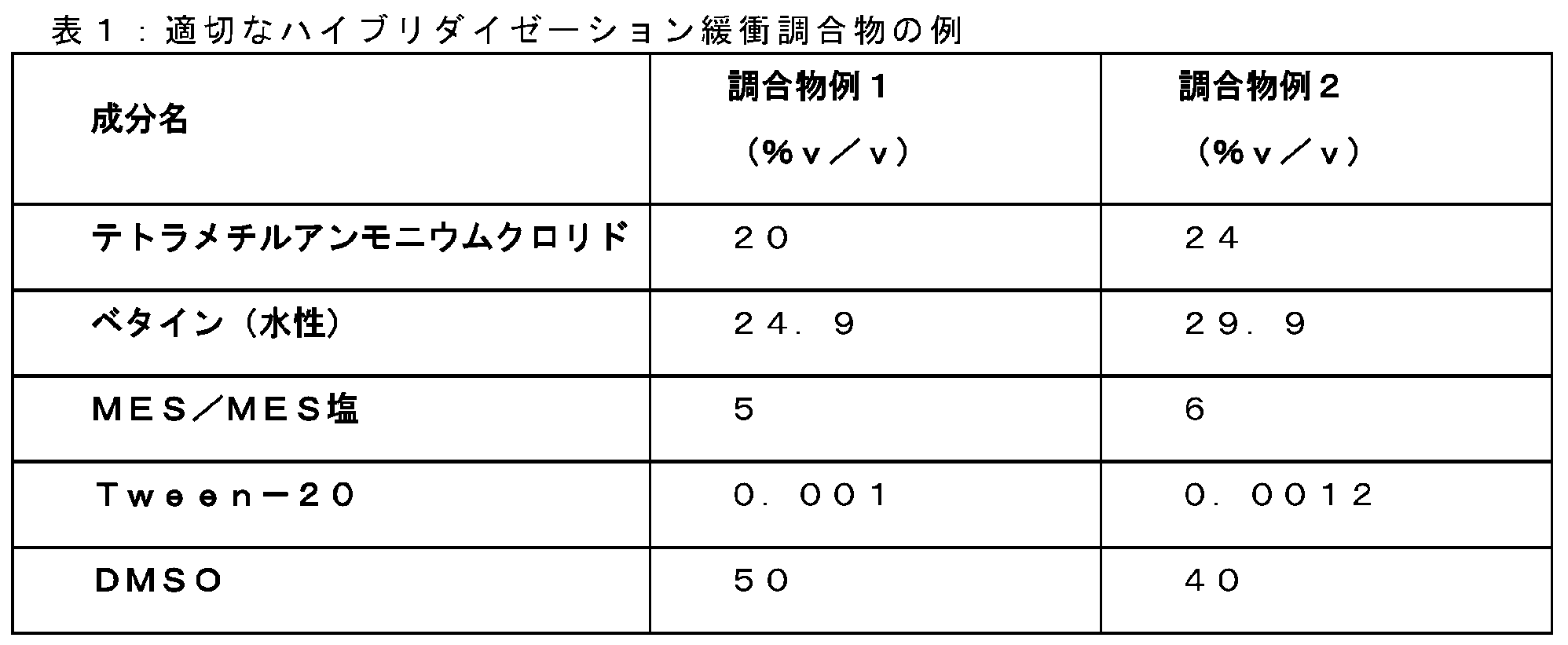
反応混合物 Reaction mixture
本開示の別の局面は、本明細書に記載されるハイブリダイゼーション緩衝調合物のいずれか(例えば、調合物例1および2)および少なくとも1つの追加の成分を含む反応混合物である。いくつかの態様において、少なくとも1つの追加の成分は、第4級アンモニウム塩、第2の塩、緩衝剤、界面活性剤および水から選択される。 Another aspect of the present disclosure is a reaction mixture comprising any of the hybridization buffer formulations described herein (e.g., formulation examples 1 and 2) and at least one additional component. In some embodiments, the at least one additional component is selected from a quaternary ammonium salt, a second salt, a buffering agent, a surfactant, and water.
いくつかの態様において、反応混合物は、1つ以上の第4級アンモニウム塩、1つ以上の第2の塩、1つ以上の緩衝剤、1つ以上の界面活性剤および水のうちの1つ以上の少なくとも1つと組み合わされた開示されたハイブリダイゼーション緩衝剤のいずれかを含む。他の態様において、反応混合物は、1つ以上の第4級アンモニウム塩、1つ以上の第2の塩、1つ以上の緩衝剤、1つ以上の界面活性剤および水のうちの1つ以上の追加量の少なくとも2つと組み合わされた開示されたハイブリダイゼーション緩衝剤のいずれかを含む。さらに他の態様において、反応混合物は、1つ以上の第4級アンモニウム塩、1つ以上の第2の塩、1つ以上の緩衝剤、1つ以上の界面活性剤および水のうちの1つ以上の追加量の少なくとも3つと組み合わされた開示されたハイブリダイゼーション緩衝剤のいずれかを含む。いくつかの態様において、反応混合物は、本明細書に記載されるハイブリダイゼーション緩衝剤のいずれかの組み合わせであり、1つ以上の第4級アンモニウム塩、1つ以上の第2の塩、1つ以上の緩衝剤、1つ以上の界面活性剤および水のうちの1つ以上のそれぞれをさらに含む。 In some embodiments, the reaction mixture comprises any of the disclosed hybridization buffers in combination with at least one of one or more of the following: one or more quaternary ammonium salts, one or more secondary salts, one or more buffering agents, one or more surfactants, and water. In other embodiments, the reaction mixture comprises any of the disclosed hybridization buffers in combination with at least two of one or more quaternary ammonium salts, one or more secondary salts, one or more buffering agents, one or more surfactants, and water. In yet other embodiments, the reaction mixture comprises any of the disclosed hybridization buffers in combination with at least three of one or more quaternary ammonium salts, one or more secondary salts, one or more buffering agents, one or more surfactants, and water. In some embodiments, the reaction mixture is a combination of any of the hybridization buffers described herein, further comprising each of one or more of one or more of the following: one or more quaternary ammonium salts, one or more secondary salts, one or more buffering agents, one or more surfactants, and water.
いくつかの態様において、反応混合物は、実質的に沈殿物を形成することなく、約-20℃~約-15℃の範囲の温度で約3~約18ヶ月間保存され得る。他の態様において、反応混合物は、実質的に沈殿物を形成することなく、約-20℃~約-15℃の範囲の温度で約3~約12ヶ月間保存され得る。 In some embodiments, the reaction mixture can be stored at a temperature ranging from about -20°C to about -15°C for about 3 to about 18 months without forming a substantial precipitate. In other embodiments, the reaction mixture can be stored at a temperature ranging from about -20°C to about -15°C for about 3 to about 12 months without forming a substantial precipitate.
いくつかの態様において、本開示の反応混合物は、2-(N-モルホリノ)エタンスルホン酸の沈殿なしに約18℃未満の温度で使用され得る。いくつかの態様において、本開示の反応混合物は、2-(N-モルホリノ)エタンスルホン酸の沈殿なしに約15℃未満の温度で使用され得る。いくつかの態様において、本開示の反応混合物は、2-(N-モルホリノ)エタンスルホン酸の沈殿なしに約10℃未満の温度で使用され得る。いくつかの態様において、本開示の反応混合物は、2-(N-モルホリノ)エタンスルホン酸の沈殿なしに約5℃未満の温度で使用され得る。いくつかの態様において、本開示の反応混合物は、2-(N-モルホリノ)エタンスルホン酸の沈殿なしに約0℃未満の温度で使用され得る。いくつかの態様において、本開示の反応混合物は、2-(N-モルホリノ)エタンスルホン酸の沈殿なしに約-5℃未満の温度で使用され得る。いくつかの態様において、本開示の反応混合物は、2-(N-モルホリノ)エタンスルホン酸の沈殿なしに約-10℃未満の温度で使用され得る。いくつかの態様において、本開示の反応混合物は、2-(N-モルホリノ)エタンスルホン酸の沈殿なしに約-15℃未満の温度で使用され得る。いくつかの態様において、本開示の反応混合物は、2-(N-モルホリノ)エタンスルホン酸の沈殿なしに約-20℃未満の温度で使用され得る。いくつかの態様において、本開示の反応混合物は、2-(N-モルホリノ)エタンスルホン酸の沈殿なしに約-25℃未満の温度で使用され得る。 In some embodiments, the reaction mixtures of the present disclosure may be used at temperatures less than about 18° C. without precipitation of 2-(N-morpholino)ethanesulfonic acid. In some embodiments, the reaction mixtures of the present disclosure may be used at temperatures less than about 15° C. without precipitation of 2-(N-morpholino)ethanesulfonic acid. In some embodiments, the reaction mixtures of the present disclosure may be used at temperatures less than about 10° C. without precipitation of 2-(N-morpholino)ethanesulfonic acid. In some embodiments, the reaction mixtures of the present disclosure may be used at temperatures less than about 5° C. without precipitation of 2-(N-morpholino)ethanesulfonic acid. In some embodiments, the reaction mixtures of the present disclosure may be used at temperatures less than about 0° C. without precipitation of 2-(N-morpholino)ethanesulfonic acid. In some embodiments, the reaction mixtures of the present disclosure may be used at temperatures less than about −5° C. without precipitation of 2-(N-morpholino)ethanesulfonic acid. In some embodiments, the reaction mixtures of the present disclosure may be used at temperatures below about -10°C without precipitation of 2-(N-morpholino)ethanesulfonic acid. In some embodiments, the reaction mixtures of the present disclosure may be used at temperatures below about -15°C without precipitation of 2-(N-morpholino)ethanesulfonic acid. In some embodiments, the reaction mixtures of the present disclosure may be used at temperatures below about -20°C without precipitation of 2-(N-morpholino)ethanesulfonic acid. In some embodiments, the reaction mixtures of the present disclosure may be used at temperatures below about -25°C without precipitation of 2-(N-morpholino)ethanesulfonic acid.
いくつかの態様において、反応混合物は、反応混合物の総体積に対して約15%~約40%の間のDMSOを含む。いくつかの態様において、反応混合物は、反応混合物の総体積に対して約17%~約39%の間のDMSOを含む。いくつかの態様において、反応混合物は、反応混合物の総体積に対して約19%~約37%の間のDMSOを含む。いくつかの態様において、反応混合物は、反応混合物の総体積に対して約21%~約36%の間のDMSOを含む。 In some embodiments, the reaction mixture comprises between about 15% and about 40% DMSO based on the total volume of the reaction mixture. In some embodiments, the reaction mixture comprises between about 17% and about 39% DMSO based on the total volume of the reaction mixture. In some embodiments, the reaction mixture comprises between about 19% and about 37% DMSO based on the total volume of the reaction mixture. In some embodiments, the reaction mixture comprises between about 21% and about 36% DMSO based on the total volume of the reaction mixture.
いくつかの態様において、反応混合物は、反応混合物の総体積に対して約20%の間のDMSOを含む。いくつかの態様において、反応混合物は、反応混合物の総体積に対して約21%の間のDMSOを含む。いくつかの態様において、反応混合物は、反応混合物の総体積に対して約22%の間のDMSOを含む。いくつかの態様において、反応混合物は、反応混合物の総体積に対して約23%の間のDMSOを含む。いくつかの態様において、反応混合物は、反応混合物の総体積に対して約24%の間のDMSOを含む。いくつかの態様において、反応混合物は、反応混合物の総体積に対して約25%の間のDMSOを含む。いくつかの態様において、反応混合物は、反応混合物の総体積に対して約26%の間のDMSOを含む。いくつかの態様において、反応混合物は、反応混合物の総体積に対して約27%の間のDMSOを含む。いくつかの態様において、反応混合物は、反応混合物の総体積に対して約28%の間のDMSOを含む。いくつかの態様において、反応混合物は、反応混合物の総体積に対して約29%の間のDMSOを含む。いくつかの態様において、反応混合物は、反応混合物の総体積に対して約30%の間のDMSOを含む。いくつかの態様において、反応混合物は、反応混合物の総体積に対して約31%の間のDMSOを含む。いくつかの態様において、反応混合物は、反応混合物の総体積に対して約32%の間のDMSOを含む。いくつかの態様において、反応混合物は、反応混合物の総体積に対して約33%の間DMSOを含む。いくつかの態様において、反応混合物は、反応混合物の総体積に対して約34%の間のDMSOを含む。いくつかの態様において、反応混合物は、反応混合物の総体積に対して約35%の間のDMSOを含む。いくつかの態様において、反応混合物は、反応混合物の総体積に対して約36%の間のDMSOを含む。いくつかの態様において、反応混合物は、反応混合物の総体積に対して約37%の間のDMSOを含む。いくつかの態様において、反応混合物は、反応混合物の総体積に対して約38%の間のDMSOを含む。 In some embodiments, the reaction mixture comprises between about 20% DMSO relative to the total volume of the reaction mixture. In some embodiments, the reaction mixture comprises between about 21% DMSO relative to the total volume of the reaction mixture. In some embodiments, the reaction mixture comprises between about 22% DMSO relative to the total volume of the reaction mixture. In some embodiments, the reaction mixture comprises between about 23% DMSO relative to the total volume of the reaction mixture. In some embodiments, the reaction mixture comprises between about 24% DMSO relative to the total volume of the reaction mixture. In some embodiments, the reaction mixture comprises between about 25% DMSO relative to the total volume of the reaction mixture. In some embodiments, the reaction mixture comprises between about 26% DMSO relative to the total volume of the reaction mixture. In some embodiments, the reaction mixture comprises between about 27% DMSO relative to the total volume of the reaction mixture. In some embodiments, the reaction mixture comprises between about 28% DMSO relative to the total volume of the reaction mixture. In some embodiments, the reaction mixture comprises between about 29% DMSO relative to the total volume of the reaction mixture. In some embodiments, the reaction mixture comprises between about 30% DMSO relative to the total volume of the reaction mixture. In some embodiments, the reaction mixture comprises between about 31% DMSO relative to the total volume of the reaction mixture. In some embodiments, the reaction mixture comprises between about 32% DMSO relative to the total volume of the reaction mixture. In some embodiments, the reaction mixture comprises between about 33% DMSO relative to the total volume of the reaction mixture. In some embodiments, the reaction mixture comprises between about 34% DMSO relative to the total volume of the reaction mixture. In some embodiments, the reaction mixture comprises between about 35% DMSO relative to the total volume of the reaction mixture. In some embodiments, the reaction mixture comprises between about 36% DMSO relative to the total volume of the reaction mixture. In some embodiments, the reaction mixture comprises between about 37% DMSO relative to the total volume of the reaction mixture. In some embodiments, the reaction mixture comprises between about 38% DMSO relative to the total volume of the reaction mixture.
いくつかの態様において、反応混合物は、反応混合物の総体積に対して約0.0008%~約0.002%の間の1つ以上の界面活性剤を含む。いくつかの態様において、反応混合物は、反応混合物の総体積に対して約0.001%~約0.002%の間の1つ以上の界面活性剤を含む。いくつかの態様において、反応混合物は、反応混合物の総体積に対して約0.0011%~約0.0018%の間の1つ以上の界面活性剤を含む。いくつかの態様において、反応混合物は、反応混合物の総体積に対して約0.0011%の1つ以上の界面活性剤を含む。いくつかの態様において、反応混合物は、反応混合物の総体積に対して約0.0012%の1つ以上の界面活性剤を含む。いくつかの態様において、反応混合物は、反応混合物の総体積に対して約0.00125%の間の1つ以上の界面活性剤を含む。いくつかの態様において、反応混合物は、反応混合物の総体積に対して約0.0013%の1つ以上の界面活性剤を含む。いくつかの態様において、反応混合物は、反応混合物の総体積に対して約0.0014%の1つ以上の界面活性剤を含む。いくつかの態様において、反応混合物は、反応混合物の総体積に対して約0.0015%の1つ以上の界面活性剤を含む。いくつかの態様において、反応混合物は、反応混合物の総体積に対して約0.00155%の1つ以上の界面活性剤を含む。いくつかの態様において、反応混合物は、反応混合物の総体積に対して約0.0016%の1つ以上の界面活性剤を含む。いくつかの態様において、反応混合物は、反応混合物の総体積に対して約0.0017%の1つ以上の界面活性剤を含む。 In some embodiments, the reaction mixture comprises between about 0.0008% and about 0.002% of one or more surfactants relative to the total volume of the reaction mixture. In some embodiments, the reaction mixture comprises between about 0.001% and about 0.002% of one or more surfactants relative to the total volume of the reaction mixture. In some embodiments, the reaction mixture comprises between about 0.0011% and about 0.0018% of one or more surfactants relative to the total volume of the reaction mixture. In some embodiments, the reaction mixture comprises about 0.0011% of one or more surfactants relative to the total volume of the reaction mixture. In some embodiments, the reaction mixture comprises about 0.0012% of one or more surfactants relative to the total volume of the reaction mixture. In some embodiments, the reaction mixture comprises between about 0.00125% of one or more surfactants relative to the total volume of the reaction mixture. In some embodiments, the reaction mixture comprises about 0.0013% of one or more surfactants relative to the total volume of the reaction mixture. In some embodiments, the reaction mixture comprises about 0.0014% of one or more surfactants relative to the total volume of the reaction mixture. In some embodiments, the reaction mixture comprises about 0.0015% of one or more surfactants relative to the total volume of the reaction mixture. In some embodiments, the reaction mixture comprises about 0.00155% of one or more surfactants relative to the total volume of the reaction mixture. In some embodiments, the reaction mixture comprises about 0.0016% of one or more surfactants relative to the total volume of the reaction mixture. In some embodiments, the reaction mixture comprises about 0.0017% of one or more surfactants relative to the total volume of the reaction mixture.
いくつかの態様において、反応混合物は、反応混合物の総体積に対して20%~約35%の間の1つ以上の第4級アンモニウム塩を含む。いくつかの態様において、反応混合物は、反応混合物の総体積に対して21%~約34%の間の1つ以上の第4級アンモニウム塩を含む。いくつかの態様において、反応混合物は、反応混合物の総体積に対して22%~約33%の間の1つ以上の第4級アンモニウム塩を含む。いくつかの態様において、反応混合物は、反応混合物の総体積に対して23%~約32%の間の1つ以上の第4級アンモニウム塩を含む。いくつかの態様において、反応混合物は、反応混合物の総体積に対して24%~約32%の間の1つ以上の第4級アンモニウム塩を含む。 In some embodiments, the reaction mixture comprises between 20% and about 35% of one or more quaternary ammonium salts relative to the total volume of the reaction mixture. In some embodiments, the reaction mixture comprises between 21% and about 34% of one or more quaternary ammonium salts relative to the total volume of the reaction mixture. In some embodiments, the reaction mixture comprises between 22% and about 33% of one or more quaternary ammonium salts relative to the total volume of the reaction mixture. In some embodiments, the reaction mixture comprises between 23% and about 32% of one or more quaternary ammonium salts relative to the total volume of the reaction mixture. In some embodiments, the reaction mixture comprises between 24% and about 32% of one or more quaternary ammonium salts relative to the total volume of the reaction mixture.
いくつかの態様において、反応混合物は、反応混合物の総体積に対して約22%の1つ以上の第4級アンモニウム塩を含む。いくつかの態様において、反応混合物は、反応混合物の総体積に対して約23%の1つ以上の第4級アンモニウム塩を含む。いくつかの態様において、反応混合物は、反応混合物の総体積に対して約24%の1つ以上の第4級アンモニウム塩を含む。いくつかの態様において、反応混合物は、反応混合物の総体積に対して約25%の1つ以上の第4級アンモニウム塩を含む。いくつかの態様において、反応混合物は、反応混合物の総体積に対して約26%の1つ以上の第4級アンモニウム塩を含む。いくつかの態様において、反応混合物は、反応混合物の総体積に対して約27%の1つ以上の第4級アンモニウム塩を含む。いくつかの態様において、反応混合物は、反応混合物の総体積に対して約28%の1つ以上の第4級アンモニウム塩を含む。いくつかの態様において、反応混合物は、反応混合物の総体積に対して約29%の1つ以上の第4級アンモニウム塩を含む。いくつかの態様において、反応混合物は、反応混合物の総体積に対して約30%の1つ以上の第4級アンモニウム塩を含む。いくつかの態様において、反応混合物は、反応混合物の総体積に対して約31%の1つ以上の第4級アンモニウム塩を含む。いくつかの態様において、反応混合物は、反応混合物の総体積に対して約32%の1つ以上の第4級アンモニウム塩を含む。いくつかの態様において、反応混合物は、反応混合物の総体積に対して約33%の1つ以上の第4級アンモニウム塩を含む。 In some embodiments, the reaction mixture comprises about 22% of one or more quaternary ammonium salts relative to the total volume of the reaction mixture. In some embodiments, the reaction mixture comprises about 23% of one or more quaternary ammonium salts relative to the total volume of the reaction mixture. In some embodiments, the reaction mixture comprises about 24% of one or more quaternary ammonium salts relative to the total volume of the reaction mixture. In some embodiments, the reaction mixture comprises about 25% of one or more quaternary ammonium salts relative to the total volume of the reaction mixture. In some embodiments, the reaction mixture comprises about 26% of one or more quaternary ammonium salts relative to the total volume of the reaction mixture. In some embodiments, the reaction mixture comprises about 27% of one or more quaternary ammonium salts relative to the total volume of the reaction mixture. In some embodiments, the reaction mixture comprises about 28% of one or more quaternary ammonium salts relative to the total volume of the reaction mixture. In some embodiments, the reaction mixture comprises about 29% of one or more quaternary ammonium salts relative to the total volume of the reaction mixture. In some embodiments, the reaction mixture comprises about 30% of one or more quaternary ammonium salts relative to the total volume of the reaction mixture. In some embodiments, the reaction mixture comprises about 31% of one or more quaternary ammonium salts by total volume of the reaction mixture. In some embodiments, the reaction mixture comprises about 32% of one or more quaternary ammonium salts by total volume of the reaction mixture. In some embodiments, the reaction mixture comprises about 33% of one or more quaternary ammonium salts by total volume of the reaction mixture.
いくつかの態様において、反応混合物は、反応混合物の総体積に対して3%~約10%の間の1つ以上の緩衝剤を含む。いくつかの態様において、反応混合物は、反応混合物の総体積に対して4%~約10%の間の1つ以上の緩衝剤を含む。いくつかの態様において、反応混合物は、反応混合物の総体積に対して4%~約9%の間の1つ以上の緩衝剤を含む。いくつかの態様において、反応混合物は、反応混合物の総体積に対して5%~約9%の間の1つ以上の緩衝剤を含む。いくつかの態様において、反応混合物は、反応混合物の総体積に対して5%~約8%の間の1つ以上の緩衝剤を含む。いくつかの態様において、反応混合物は、反応混合物の総体積に対して6%~約8%の間の1つ以上の緩衝剤を含む。 In some embodiments, the reaction mixture comprises between 3% and about 10% of one or more buffering agents relative to the total volume of the reaction mixture. In some embodiments, the reaction mixture comprises between 4% and about 10% of one or more buffering agents relative to the total volume of the reaction mixture. In some embodiments, the reaction mixture comprises between 4% and about 9% of one or more buffering agents relative to the total volume of the reaction mixture. In some embodiments, the reaction mixture comprises between 5% and about 9% of one or more buffering agents relative to the total volume of the reaction mixture. In some embodiments, the reaction mixture comprises between 5% and about 8% of one or more buffering agents relative to the total volume of the reaction mixture. In some embodiments, the reaction mixture comprises between 6% and about 8% of one or more buffering agents relative to the total volume of the reaction mixture.
いくつかの態様において、反応混合物は、反応混合物の総体積に対して約5%の1つ以上の緩衝剤を含む。いくつかの態様において、反応混合物は、反応混合物の総体積に対して約5.5%の1つ以上の緩衝剤を含む。いくつかの態様において、反応混合物は、反応混合物の総体積に対して約6%の1つ以上の緩衝剤を含む。いくつかの態様において、反応混合物は、反応混合物の総体積に対して約6.5%の1つ以上の緩衝剤を含む。いくつかの態様において、反応混合物は、反応混合物の総体積に対して約7%の1つ以上の緩衝剤を含む。いくつかの態様において、反応混合物は、反応混合物の総体積に対して約7.5%の1つ以上の緩衝剤を含む。いくつかの態様において、反応混合物は、反応混合物の総体積に対して約8%の1つ以上の緩衝剤を含む。いくつかの態様において、反応混合物は、反応混合物の総体積に対して約8.5%の1つ以上の緩衝剤を含む。 In some embodiments, the reaction mixture comprises about 5% of one or more buffering agents relative to the total volume of the reaction mixture. In some embodiments, the reaction mixture comprises about 5.5% of one or more buffering agents relative to the total volume of the reaction mixture. In some embodiments, the reaction mixture comprises about 6% of one or more buffering agents relative to the total volume of the reaction mixture. In some embodiments, the reaction mixture comprises about 6.5% of one or more buffering agents relative to the total volume of the reaction mixture. In some embodiments, the reaction mixture comprises about 7% of one or more buffering agents relative to the total volume of the reaction mixture. In some embodiments, the reaction mixture comprises about 7.5% of one or more buffering agents relative to the total volume of the reaction mixture. In some embodiments, the reaction mixture comprises about 8% of one or more buffering agents relative to the total volume of the reaction mixture. In some embodiments, the reaction mixture comprises about 8.5% of one or more buffering agents relative to the total volume of the reaction mixture.
いくつかの態様において、反応混合物は、反応混合物の総体積に対して26%~約44%の間の1つ以上の第2の塩を含む。いくつかの態様において、反応混合物は、反応混合物の総体積に対して27%~約43%の間の1つ以上の第2の塩を含む。いくつかの態様において、反応混合物は、反応混合物の総体積に対して28%~約42%の間の1つ以上の第2の塩を含む。いくつかの態様において、反応混合物は、反応混合物の総体積に対して29%~約41%の間の1つ以上の第2の塩を含む。いくつかの態様において、反応混合物は、反応混合物の総体積に対して30%~約40%の間の1つ以上の第2の塩を含む。 In some embodiments, the reaction mixture comprises between 26% and about 44% of one or more second salts relative to the total volume of the reaction mixture. In some embodiments, the reaction mixture comprises between 27% and about 43% of one or more second salts relative to the total volume of the reaction mixture. In some embodiments, the reaction mixture comprises between 28% and about 42% of one or more second salts relative to the total volume of the reaction mixture. In some embodiments, the reaction mixture comprises between 29% and about 41% of one or more second salts relative to the total volume of the reaction mixture. In some embodiments, the reaction mixture comprises between 30% and about 40% of one or more second salts relative to the total volume of the reaction mixture.
いくつかの態様において、反応混合物は、反応混合物の総体積に対して約28%の1つ以上の第2の塩を含む。いくつかの態様において、反応混合物は、反応混合物の総体積に対して約30%の1つ以上の第2の塩を含む。いくつかの態様において、反応混合物は、反応混合物の総体積に対して約32%の1つ以上の第2の塩を含む。いくつかの態様において、反応混合物は、反応混合物の総体積に対して約34%の1つ以上の第2の塩を含む。いくつかの態様において、反応混合物は、反応混合物の総体積に対して約36%の1つ以上の第2の塩を含む。いくつかの態様において、反応混合物は、反応混合物の総体積に対して約38%の1つ以上の第2の塩を含む。いくつかの態様において、反応混合物は、反応混合物の総体積に対して約40%の1つ以上の第2の塩を含む。いくつかの態様において、反応混合物は、反応混合物の総体積に対して約42%の1つ以上の第2の塩を含む。 In some embodiments, the reaction mixture comprises about 28% of the one or more second salts relative to the total volume of the reaction mixture. In some embodiments, the reaction mixture comprises about 30% of the one or more second salts relative to the total volume of the reaction mixture. In some embodiments, the reaction mixture comprises about 32% of the one or more second salts relative to the total volume of the reaction mixture. In some embodiments, the reaction mixture comprises about 34% of the one or more second salts relative to the total volume of the reaction mixture. In some embodiments, the reaction mixture comprises about 36% of the one or more second salts relative to the total volume of the reaction mixture. In some embodiments, the reaction mixture comprises about 38% of the one or more second salts relative to the total volume of the reaction mixture. In some embodiments, the reaction mixture comprises about 40% of the one or more second salts relative to the total volume of the reaction mixture. In some embodiments, the reaction mixture comprises about 42% of the one or more second salts relative to the total volume of the reaction mixture.
いくつかの態様において、反応混合物は、反応混合物の総体積に対して0%~約0.05%の間の水を含む。いくつかの態様において、反応混合物は、反応混合物の総体積に対して0%~約0.04%の間の水を含む。いくつかの態様において、反応混合物は、反応混合物の総体積に対して0%~約0.03%の間の水を含む。いくつかの態様において、反応混合物は、反応混合物の総体積に対して0%~約0.02%の間の水を含む。いくつかの態様において、反応混合物は、反応混合物の総体積に対して0%~約0.01%の間の水を含む。 In some embodiments, the reaction mixture comprises between 0% and about 0.05% water based on the total volume of the reaction mixture. In some embodiments, the reaction mixture comprises between 0% and about 0.04% water based on the total volume of the reaction mixture. In some embodiments, the reaction mixture comprises between 0% and about 0.03% water based on the total volume of the reaction mixture. In some embodiments, the reaction mixture comprises between 0% and about 0.02% water based on the total volume of the reaction mixture. In some embodiments, the reaction mixture comprises between 0% and about 0.01% water based on the total volume of the reaction mixture.
反応混合物の例 Example of a reaction mixture
他の態様において、反応混合物は、(i)前記反応混合物の総体積に対して約18%~約38%の間のDMSO;(ii)前記反応混合物の総体積に対して約0.0008%~約0.002%の間の1つ以上の界面活性剤;(iii)前記反応混合物の総体積に対して約22%~約33%の間の1つ以上の第4級アンモニウム塩;(iv)前記反応混合物の総体積に対して約5%~約8%の間の1つ以上の緩衝剤;(v)前記反応混合物の総体積に対して約28%~約42%の間の1つ以上の第2の塩;および(vi)約0%~約0.04%の間の水を含む。いくつかの態様において、1つ以上の界面活性剤はアニオン性界面活性剤である。いくつかの態様において、界面活性剤は、ポリソルベート20、ポリソルベート40、ポリソルベート60、ポリソルベート80、およびそれらの組み合わせからなる群から選択される。いくつかの態様において、1つ以上の第4級アンモニウム塩は、テトラメチルアンモニウムクロリド、テトラエチルアンモニウムクロリド、テトラブチルアンモニウムクロリド、トリメチルアンモニウムクロリド、テトラ-n-ブチルアンモニウムクロリドおよびこれらの組み合わせからなる群から選択される。いくつかの態様において、1つ以上の緩衝剤は、2-モルホリノエタンスルホン酸(MES/MES塩)を含む。いくつかの態様において、1つ以上の第2の塩は、N,N,N-トリメチルグリシン、テトラメチルアンモニウムクロリド、テトラメチルアンモニウムブロミド、テトラメチルアンモニウムヨージド、N,N,N-トリメチルメチオニン、N,N,N-トリメチルイソロイシン、N,N,N-トリメチルバリン、N,N,N-トリメチルアラニンおよびこれらの組み合わせからなる群から選択される。 In other embodiments, the reaction mixture comprises: (i) between about 18% and about 38% DMSO, based on the total volume of the reaction mixture; (ii) between about 0.0008% and about 0.002% of one or more surfactants, based on the total volume of the reaction mixture; (iii) between about 22% and about 33% of one or more quaternary ammonium salts, based on the total volume of the reaction mixture; (iv) between about 5% and about 8% of one or more buffering agents, based on the total volume of the reaction mixture; (v) between about 28% and about 42% of one or more second salts, based on the total volume of the reaction mixture; and (vi) between about 0% and about 0.04% water. In some embodiments, the one or more surfactants are anionic surfactants. In some embodiments, the surfactant is selected from the group consisting of polysorbate 20, polysorbate 40, polysorbate 60, polysorbate 80, and combinations thereof. In some embodiments, the one or more quaternary ammonium salts are selected from the group consisting of tetramethylammonium chloride, tetraethylammonium chloride, tetrabutylammonium chloride, trimethylammonium chloride, tetra-n-butylammonium chloride, and combinations thereof. In some embodiments, the one or more buffers include 2-morpholinoethanesulfonic acid (MES/MES salts). In some embodiments, the one or more second salts are selected from the group consisting of N,N,N-trimethylglycine, tetramethylammonium chloride, tetramethylammonium bromide, tetramethylammonium iodide, N,N,N-trimethylmethionine, N,N,N-trimethylisoleucine, N,N,N-trimethylvaline, N,N,N-trimethylalanine, and combinations thereof.
さらに他の態様において、反応混合物は、(i)前記反応混合物の総体積に対して約21%~約36%の間のDMSO;(ii)前記反応混合物の総体積に対して約0.0008%~約0.002%の間の1つ以上の界面活性剤;(iii)前記反応混合物の総体積に対して約24%~約32%の間の1つ以上の第4級アンモニウム塩;(iv)前記反応混合物の総体積に対して約5%~約8%の間の1つ以上の緩衝剤;(v)前記反応混合物の総体積に対して約28%~約42%の間の1つ以上の第2の塩;および(vi)約0%~約0.04%の間の水を含む。いくつかの態様において、1つ以上の界面活性剤はアニオン性界面活性剤である。いくつかの態様において、界面活性剤は、ポリソルベート20、ポリソルベート40、ポリソルベート60、ポリソルベート80、およびそれらの組み合わせからなる群から選択される。いくつかの態様において、1つ以上の第4級アンモニウム塩は、テトラメチルアンモニウムクロリド、テトラエチルアンモニウムクロリド、テトラブチルアンモニウムクロリド、トリメチルアンモニウムクロリド、テトラ-n-ブチルアンモニウムクロリドおよびこれらの組み合わせからなる群から選択される。いくつかの態様において、1つ以上の緩衝剤は、2-モルホリノエタンスルホン酸(MES/MES塩)を含む。いくつかの態様において、1つ以上の第2の塩は、N,N,N-トリメチルグリシン、テトラメチルアンモニウムクロリド、テトラメチルアンモニウムブロミド、テトラメチルアンモニウムヨージド、N,N,N-トリメチルメチオニン、N,N,N-トリメチルイソロイシン、N,N,N-トリメチルバリン、N,N,N-トリメチルアラニンおよびこれらの組み合わせからなる群から選択される。 In yet other embodiments, the reaction mixture comprises: (i) between about 21% and about 36% DMSO, based on the total volume of the reaction mixture; (ii) between about 0.0008% and about 0.002% of one or more surfactants, based on the total volume of the reaction mixture; (iii) between about 24% and about 32% of one or more quaternary ammonium salts, based on the total volume of the reaction mixture; (iv) between about 5% and about 8% of one or more buffering agents, based on the total volume of the reaction mixture; (v) between about 28% and about 42% of one or more second salts, based on the total volume of the reaction mixture; and (vi) between about 0% and about 0.04% water. In some embodiments, the one or more surfactants are anionic surfactants. In some embodiments, the surfactant is selected from the group consisting of polysorbate 20, polysorbate 40, polysorbate 60, polysorbate 80, and combinations thereof. In some embodiments, the one or more quaternary ammonium salts are selected from the group consisting of tetramethylammonium chloride, tetraethylammonium chloride, tetrabutylammonium chloride, trimethylammonium chloride, tetra-n-butylammonium chloride, and combinations thereof. In some embodiments, the one or more buffers include 2-morpholinoethanesulfonic acid (MES/MES salts). In some embodiments, the one or more second salts are selected from the group consisting of N,N,N-trimethylglycine, tetramethylammonium chloride, tetramethylammonium bromide, tetramethylammonium iodide, N,N,N-trimethylmethionine, N,N,N-trimethylisoleucine, N,N,N-trimethylvaline, N,N,N-trimethylalanine, and combinations thereof.
さらに他の態様において、反応混合物は、(i)反応混合物の総体積に対して21%~36%の間のDMSO;(ii)反応混合物の総体積に対して0.0008%~0.002%の間の1つ以上の界面活性剤;(iii)反応混合物の総体積に対して24%~32%の間の1つ以上の第4級アンモニウム塩;(iv)反応混合物の総体積に対して5%~8%の間の1つ以上の緩衝剤;(v)反応混合物の総体積に対して28%~42%の間の1つ以上の第2の塩;および(vi)0%~0.04%の間の水を含む。いくつかの態様において、1つ以上の界面活性剤はアニオン性界面活性剤である。いくつかの態様において、界面活性剤は、ポリソルベート20、ポリソルベート40、ポリソルベート60、ポリソルベート80、およびそれらの組み合わせからなる群から選択される。いくつかの態様において、1つ以上の第4級アンモニウム塩は、テトラメチルアンモニウムクロリド、テトラエチルアンモニウムクロリド、テトラブチルアンモニウムクロリド、トリメチルアンモニウムクロリド、テトラ-n-ブチルアンモニウムクロリドおよびこれらの組み合わせからなる群から選択される。いくつかの態様において、1つ以上の緩衝剤は、2-モルホリノエタンスルホン酸(MES/MES塩)を含む。いくつかの態様において、1つ以上の第2の塩は、N,N,N-トリメチルグリシン、テトラメチルアンモニウムクロリド、テトラメチルアンモニウムブロミド、テトラメチルアンモニウムヨージド、N,N,N-トリメチルメチオニン、N,N,N-トリメチルイソロイシン、N,N,N-トリメチルバリン、N,N,N-トリメチルアラニンおよびこれらの組み合わせからなる群から選択される。 In yet other embodiments, the reaction mixture comprises (i) between 21% and 36% DMSO, based on the total volume of the reaction mixture; (ii) between 0.0008% and 0.002% of one or more surfactants, based on the total volume of the reaction mixture; (iii) between 24% and 32% of one or more quaternary ammonium salts, based on the total volume of the reaction mixture; (iv) between 5% and 8% of one or more buffers, based on the total volume of the reaction mixture; (v) between 28% and 42% of one or more second salts, based on the total volume of the reaction mixture; and (vi) between 0% and 0.04% water. In some embodiments, the one or more surfactants are anionic surfactants. In some embodiments, the surfactant is selected from the group consisting of polysorbate 20, polysorbate 40, polysorbate 60, polysorbate 80, and combinations thereof. In some embodiments, the one or more quaternary ammonium salts are selected from the group consisting of tetramethylammonium chloride, tetraethylammonium chloride, tetrabutylammonium chloride, trimethylammonium chloride, tetra-n-butylammonium chloride, and combinations thereof. In some embodiments, the one or more buffers include 2-morpholinoethanesulfonic acid (MES/MES salts). In some embodiments, the one or more second salts are selected from the group consisting of N,N,N-trimethylglycine, tetramethylammonium chloride, tetramethylammonium bromide, tetramethylammonium iodide, N,N,N-trimethylmethionine, N,N,N-trimethylisoleucine, N,N,N-trimethylvaline, N,N,N-trimethylalanine, and combinations thereof.
適切な反応混合物のさらに他の例を以下に示す。 Further examples of suitable reaction mixtures are given below:

マスターミックス Master Mix
本開示の別の局面は、(i)本明細書に記載される反応混合物の任意の1つ(例えば、調合物例3および4);および(ii)1つ以上のオリゴヌクレオチドを含むマスターミックスである。 Another aspect of the present disclosure is a master mix that includes (i) any one of the reaction mixtures described herein (e.g., formulation examples 3 and 4); and (ii) one or more oligonucleotides.
いくつかの態様において、マスター混合物は、約60%~約80%の間の本明細書に記載される反応混合物の任意の1つを含む。いくつかの態様において、マスター混合物は、約62%~約78%の間の本明細書に記載される反応混合物の任意の1つを含み、マスターミックスの残りは、オリゴヌクレオチドまたはオリゴヌクレオチドの混合物を含む。いくつかの態様において、マスター混合物は、約64%~約80%の間の本明細書に記載される反応混合物の任意の1つを含み、マスターミックスの残りは、オリゴヌクレオチドまたはオリゴヌクレオチドの混合物を含む。いくつかの態様において、マスター混合物は、約76%~約80%の間の本明細書に記載される反応混合物の任意の1つを含み、マスターミックスの残りは、オリゴヌクレオチドまたはオリゴヌクレオチドの混合物を含む。いくつかの態様において、マスター混合物は、約66%~約80%の間の本明細書に記載される反応混合物の任意の1つを含み、マスターミックスの残りは、オリゴヌクレオチドまたはオリゴヌクレオチドの混合物を含む。いくつかの態様において、マスター混合物は、約74%~約80%の間の本明細書に記載される反応混合物の任意の1つを含み、マスターミックスの残りは、オリゴヌクレオチドまたはオリゴヌクレオチドの混合物を含む。いくつかの態様において、マスター混合物は、約68%~約72%の間の本明細書に記載される反応混合物の任意の1つを含み、マスターミックスの残りは、オリゴヌクレオチドまたはオリゴヌクレオチドの混合物を含む。いくつかの態様において、マスター混合物は、約60%の本明細書に記載される反応混合物の任意の1つを含み、マスターミックスの残りは、オリゴヌクレオチドまたはオリゴヌクレオチドの混合物を含む。 In some embodiments, the master mix comprises between about 60% and about 80% of any one of the reaction mixtures described herein. In some embodiments, the master mix comprises between about 62% and about 78% of any one of the reaction mixtures described herein, with the remainder of the master mix comprising an oligonucleotide or a mixture of oligonucleotides. In some embodiments, the master mix comprises between about 64% and about 80% of any one of the reaction mixtures described herein, with the remainder of the master mix comprising an oligonucleotide or a mixture of oligonucleotides. In some embodiments, the master mix comprises between about 76% and about 80% of any one of the reaction mixtures described herein, with the remainder of the master mix comprising an oligonucleotide or a mixture of oligonucleotides. In some embodiments, the master mix comprises between about 66% and about 80% of any one of the reaction mixtures described herein, with the remainder of the master mix comprising an oligonucleotide or a mixture of oligonucleotides. In some embodiments, the master mix comprises between about 74% and about 80% of any one of the reaction mixtures described herein, with the remainder of the master mix comprising an oligonucleotide or a mixture of oligonucleotides. In some embodiments, the master mix comprises between about 68% and about 72% of any one of the reaction mixtures described herein, with the remainder of the master mix comprising an oligonucleotide or a mixture of oligonucleotides. In some embodiments, the master mix comprises about 60% of any one of the reaction mixtures described herein, with the remainder of the master mix comprising an oligonucleotide or a mixture of oligonucleotides.
いくつかの態様において、マスター混合物は、60%~80%の間の本明細書に記載される反応混合物の任意の1つを含む。いくつかの態様において、マスター混合物は、62%~78%の間の本明細書に記載される反応混合物の任意の1つを含み、マスターミックスの残りは、オリゴヌクレオチドまたはオリゴヌクレオチドの混合物を含む。いくつかの態様において、マスター混合物は、64%~80%の間の本明細書に記載される反応混合物の任意の1つを含み、マスターミックスの残りは、オリゴヌクレオチドまたはオリゴヌクレオチドの混合物を含む。いくつかの態様において、マスター混合物は、76%~80%の間の本明細書中に記載される反応混合物のいずれか1つを含み、残りのマスターミックスは、オリゴヌクレオチドまたはオリゴヌクレオチドの混合物を含む。いくつかの態様において、マスター混合物は、66%~80%の間の本明細書に記載される反応混合物の任意の1つを含み、マスターミックスの残りは、オリゴヌクレオチドまたはオリゴヌクレオチドの混合物を含む。いくつかの態様において、マスター混合物は、74%~80%の間の本明細書に記載される反応混合物の任意の1つを含み、マスターミックスの残りは、オリゴヌクレオチドまたはオリゴヌクレオチドの混合物を含む。いくつかの態様において、マスター混合物は、68%~72%の間の本明細書に記載される反応混合物の任意の1つを含み、マスターミックスの残りは、オリゴヌクレオチドまたはオリゴヌクレオチドの混合物を含む。いくつかの態様において、マスター混合物は、60%の本明細書に記載される反応混合物の任意の1つを含み、マスターミックスの残りは、オリゴヌクレオチドまたはオリゴヌクレオチドの混合物を含む。 In some embodiments, the master mix comprises between 60% and 80% of any one of the reaction mixtures described herein. In some embodiments, the master mix comprises between 62% and 78% of any one of the reaction mixtures described herein, with the remainder of the master mix comprising an oligonucleotide or a mixture of oligonucleotides. In some embodiments, the master mix comprises between 64% and 80% of any one of the reaction mixtures described herein, with the remainder of the master mix comprising an oligonucleotide or a mixture of oligonucleotides. In some embodiments, the master mix comprises between 76% and 80% of any one of the reaction mixtures described herein, with the remainder of the master mix comprising an oligonucleotide or a mixture of oligonucleotides. In some embodiments, the master mix comprises between 66% and 80% of any one of the reaction mixtures described herein, with the remainder of the master mix comprising an oligonucleotide or a mixture of oligonucleotides. In some embodiments, the master mix comprises between 74% and 80% of any one of the reaction mixtures described herein, with the remainder of the master mix comprising an oligonucleotide or a mixture of oligonucleotides. In some embodiments, the master mix comprises between 68% and 72% of any one of the reaction mixtures described herein, with the remainder of the master mix comprising an oligonucleotide or a mixture of oligonucleotides. In some embodiments, the master mix comprises 60% of any one of the reaction mixtures described herein, with the remainder of the master mix comprising an oligonucleotide or a mixture of oligonucleotides.
いくつかの態様において、マスター混合物は、約60%~約80%の間の本明細書に記載される反応混合物の任意の1つから本質的になる。いくつかの態様において、マスター混合物は、約62%~約78%の間の本明細書に記載される反応混合物の任意の1つから本質的になり、マスターミックスの残りは、オリゴヌクレオチドまたはオリゴヌクレオチドの混合物を含む。いくつかの態様において、マスター混合物は、約64%~約80%の間の本明細書に記載される反応混合物の任意の1つから本質的になり、マスターミックスの残りは、オリゴヌクレオチドまたはオリゴヌクレオチドの混合物を含む。いくつかの態様において、マスター混合物は、約76%~約80%の間の本明細書に記載される反応混合物の任意の1つから本質的になり、マスターミックスの残りは、オリゴヌクレオチドまたはオリゴヌクレオチドの混合物を含む。いくつかの態様において、マスター混合物は、約66%~約80%の間の本明細書に記載される反応混合物の任意の1つから本質的になり、マスターミックスの残りは、オリゴヌクレオチドまたはオリゴヌクレオチドの混合物を含む。いくつかの態様において、マスター混合物は、約74%~約80%の間の本明細書に記載される反応混合物の任意の1つから本質的になり、マスターミックスの残りは、オリゴヌクレオチドまたはオリゴヌクレオチドの混合物を含む。いくつかの態様において、マスター混合物は、約68%~約72%の間の本明細書に記載される反応混合物の任意の1つから本質的になり、マスターミックスの残りは、オリゴヌクレオチドまたはオリゴヌクレオチドの混合物を含む。いくつかの態様において、マスター混合物は、約60%の本明細書に記載される反応混合物の任意の1つから本質的になり、マスターミックスの残りは、オリゴヌクレオチドまたはオリゴヌクレオチドの混合物を含む。 In some embodiments, the master mix consists essentially of between about 60% and about 80% of any one of the reaction mixtures described herein. In some embodiments, the master mix consists essentially of between about 62% and about 78% of any one of the reaction mixtures described herein, with the remainder of the master mix comprising an oligonucleotide or a mixture of oligonucleotides. In some embodiments, the master mix consists essentially of between about 64% and about 80% of any one of the reaction mixtures described herein, with the remainder of the master mix comprising an oligonucleotide or a mixture of oligonucleotides. In some embodiments, the master mix consists essentially of between about 76% and about 80% of any one of the reaction mixtures described herein, with the remainder of the master mix comprising an oligonucleotide or a mixture of oligonucleotides. In some embodiments, the master mix consists essentially of between about 66% and about 80% of any one of the reaction mixtures described herein, with the remainder of the master mix comprising an oligonucleotide or a mixture of oligonucleotides. In some embodiments, the master mix consists essentially of between about 74% and about 80% of any one of the reaction mixtures described herein, with the remainder of the master mix comprising an oligonucleotide or a mixture of oligonucleotides. In some embodiments, the master mix consists essentially of between about 68% and about 72% of any one of the reaction mixtures described herein, with the remainder of the master mix comprising an oligonucleotide or a mixture of oligonucleotides. In some embodiments, the master mix consists essentially of about 60% of any one of the reaction mixtures described herein, with the remainder of the master mix comprising an oligonucleotide or a mixture of oligonucleotides.
いくつかの態様において、マスター混合物は、約60%~約80%の間の本明細書に記載される反応混合物の任意の1つからなる。いくつかの態様において、マスター混合物は、約62%~約78%の間の本明細書に記載される反応混合物の任意の1つからなり、マスターミックスの残りは、オリゴヌクレオチドまたはオリゴヌクレオチドの混合物を含む。いくつかの態様において、マスター混合物は、約64%~約80%の間の本明細書に記載される反応混合物の任意の1つからなり、マスターミックスの残りは、オリゴヌクレオチドまたはオリゴヌクレオチドの混合物を含む。いくつかの態様において、マスター混合物は、約76%~約80%の間の本明細書に記載される反応混合物の任意の1つからなり、マスターミックスの残りは、オリゴヌクレオチドまたはオリゴヌクレオチドの混合物を含む。いくつかの態様において、マスター混合物は、約66%~約80%の間の本明細書に記載される反応混合物の任意の1つからなり、マスターミックスの残りは、オリゴヌクレオチドまたはオリゴヌクレオチドの混合物を含む。いくつかの態様において、マスター混合物は、約74%~約80%の間の本明細書に記載される反応混合物の任意の1つからなり、マスターミックスの残りは、オリゴヌクレオチドまたはオリゴヌクレオチドの混合物を含む。いくつかの態様において、マスター混合物は、約68%~約72%の間の本明細書に記載される反応混合物の任意の1つからなり、マスターミックスの残りは、オリゴヌクレオチドまたはオリゴヌクレオチドの混合物を含む。いくつかの態様において、マスター混合物は、約60%の本明細書に記載される反応混合物の任意の1つからなり、マスターミックスの残りは、オリゴヌクレオチドまたはオリゴヌクレオチドの混合物を含む。 In some embodiments, the master mix consists of between about 60% and about 80% of any one of the reaction mixtures described herein. In some embodiments, the master mix consists of between about 62% and about 78% of any one of the reaction mixtures described herein, with the remainder of the master mix comprising an oligonucleotide or a mixture of oligonucleotides. In some embodiments, the master mix consists of between about 64% and about 80% of any one of the reaction mixtures described herein, with the remainder of the master mix comprising an oligonucleotide or a mixture of oligonucleotides. In some embodiments, the master mix consists of between about 76% and about 80% of any one of the reaction mixtures described herein, with the remainder of the master mix comprising an oligonucleotide or a mixture of oligonucleotides. In some embodiments, the master mix consists of between about 66% and about 80% of any one of the reaction mixtures described herein, with the remainder of the master mix comprising an oligonucleotide or a mixture of oligonucleotides. In some embodiments, the master mix consists of between about 74% and about 80% of any one of the reaction mixtures described herein, with the remainder of the master mix comprising an oligonucleotide or a mixture of oligonucleotides. In some embodiments, the master mix consists of between about 68% and about 72% of any one of the reaction mixtures described herein, with the remainder of the master mix comprising an oligonucleotide or a mixture of oligonucleotides. In some embodiments, the master mix consists of about 60% of any one of the reaction mixtures described herein, with the remainder of the master mix comprising an oligonucleotide or a mixture of oligonucleotides.
いくつかの態様において、マスター混合物は、60%~80%の間の本明細書に記載される反応混合物の任意の1つからなる。いくつかの態様において、マスター混合物は、62%~78%の間の本明細書に記載される反応混合物の任意の1つからなり、マスターミックスの残りは、オリゴヌクレオチドまたはオリゴヌクレオチドの混合物を含む。いくつかの態様において、マスター混合物は、64%~80%の間の本明細書に記載される反応混合物の任意の1つからなり、マスターミックスの残りは、オリゴヌクレオチドまたはオリゴヌクレオチドの混合物を含む。いくつかの態様において、マスター混合物は、76%~80%の間の本明細書に記載される反応混合物の任意の1つからなり、マスターミックスの残りは、オリゴヌクレオチドまたはオリゴヌクレオチドの混合物を含む。いくつかの態様において、マスター混合物は、66%~80%の間の本明細書に記載される反応混合物の任意の1つからなり、マスターミックスの残りは、オリゴヌクレオチドまたはオリゴヌクレオチドの混合物を含む。いくつかの態様において、マスター混合物は、74%~80%の間の本明細書に記載される反応混合物の任意の1つからなり、マスターミックスの残りは、オリゴヌクレオチドまたはオリゴヌクレオチドの混合物を含む。いくつかの態様において、マスター混合物は、68%~72%の間の本明細書に記載される反応混合物の任意の1つからなり、マスターミックスの残りは、オリゴヌクレオチドまたはオリゴヌクレオチドの混合物を含む。いくつかの態様において、マスター混合物は、60%の本明細書に記載される反応混合物の任意の1つからなり、マスターミックスの残りは、オリゴヌクレオチドまたはオリゴヌクレオチドの混合物を含む。 In some embodiments, the master mix consists of between 60% and 80% of any one of the reaction mixtures described herein. In some embodiments, the master mix consists of between 62% and 78% of any one of the reaction mixtures described herein, with the remainder of the master mix comprising an oligonucleotide or a mixture of oligonucleotides. In some embodiments, the master mix consists of between 64% and 80% of any one of the reaction mixtures described herein, with the remainder of the master mix comprising an oligonucleotide or a mixture of oligonucleotides. In some embodiments, the master mix consists of between 76% and 80% of any one of the reaction mixtures described herein, with the remainder of the master mix comprising an oligonucleotide or a mixture of oligonucleotides. In some embodiments, the master mix consists of between 66% and 80% of any one of the reaction mixtures described herein, with the remainder of the master mix comprising an oligonucleotide or a mixture of oligonucleotides. In some embodiments, the master mix consists of between 74% and 80% of any one of the reaction mixtures described herein, with the remainder of the master mix comprising an oligonucleotide or a mixture of oligonucleotides. In some embodiments, the master mix consists of between 68% and 72% of any one of the reaction mixtures described herein, with the remainder of the master mix comprising an oligonucleotide or a mixture of oligonucleotides. In some embodiments, the master mix consists of 60% of any one of the reaction mixtures described herein, with the remainder of the master mix comprising an oligonucleotide or a mixture of oligonucleotides.
いくつかの態様において、オリゴヌクレオチドは、プローブ、得られた試料からの核酸(または得られた試料からの核酸の断片)およびブロッキングオリゴヌクレオチドを含む。いくつかの態様において、オリゴヌクレオチドは、オリゴヌクレオチドプローブのプールなどの1つ以上のオリゴヌクレオチドプローブを含む。いくつかの態様において、オリゴヌクレオチドプローブは、ゲノム試料または核酸断片の集団(得られたゲノム試料から生成された核酸断片など)内の相補的核酸配列にハイブリダイズすることができる核酸配列の参照集団である。いくつかの態様において、オリゴヌクレオチドプローブは、ゲノム試料または核酸断片の集団内の所望の遺伝子、エクソンおよび/または関心対象の他のゲノム領域を標的とするように設計される。いくつかの態様において、オリゴヌクレオチドプローブは、オリゴヌクレオチドプローブが、非限定的な例として、関心対象の遺伝子のセット、ゲノムのエクソンのすべて、特定の関心対象の遺伝子領域、疾患または生理学的状態などに関連するように選択される。 In some embodiments, the oligonucleotides include a probe, a nucleic acid from the obtained sample (or a fragment of a nucleic acid from the obtained sample), and a blocking oligonucleotide. In some embodiments, the oligonucleotides include one or more oligonucleotide probes, such as a pool of oligonucleotide probes. In some embodiments, the oligonucleotide probes are a reference population of nucleic acid sequences that can hybridize to complementary nucleic acid sequences within a genomic sample or a population of nucleic acid fragments (such as nucleic acid fragments generated from a obtained genomic sample). In some embodiments, the oligonucleotide probes are designed to target desired genes, exons, and/or other genomic regions of interest within the genomic sample or population of nucleic acid fragments. In some embodiments, the oligonucleotide probes are selected such that the oligonucleotide probes are associated with a set of genes of interest, all of the exons of a genome, a particular genetic region of interest, a disease or physiological condition, etc., as non-limiting examples.
いくつかの態様において、オリゴヌクレオチドプローブは、DNA捕捉プローブである。いくつかの態様において、DNA捕捉プローブは、Roche SeqCap EZ Probes(Roche Sequencing and Life Sciences、Indianapolis、INDから入手可能)のプールを含む。いくつかの態様においては、Roche SeqCap EZ Probesのプールは、それぞれが特定の配列を有する、溶液中の異なるビオチン化一本鎖DNAオリゴヌクレオチドの混合物を含み、個々のオリゴヌクレオチドの長さは、約50ヌクレオチドから約100ヌクレオチドの範囲とすることができ、典型的なサイズは約75ヌクレオチドである。いくつかの態様において、Roche SeqCap EZ Probe Poolは、配列捕捉実験において、DNA配列決定ライブラリの標的とされた相補的断片にハイブリダイズし、したがって、配列決定の前に、同じDNA配列決定ライブラリの標的とされていない断片と比較して標的とされた相補的断片を捕捉および濃縮するために使用され得る。DNA配列決定ライブラリは、ゲノム分析のためにゲノムDNAから、またはトランスクリプトーム分析のためにRNAから調製されたcDNAもしくはmRNAから構築され得、DNA配列決定ライブラリは、これらの核酸をそこから抽出することができる任意の生物種のDNAまたはcDNAから構築され得る。 In some embodiments, the oligonucleotide probe is a DNA capture probe. In some embodiments, the DNA capture probe comprises a pool of Roche SeqCap EZ Probes (available from Roche Sequencing and Life Sciences, Indianapolis, IND). In some embodiments, the pool of Roche SeqCap EZ Probes comprises a mixture of different biotinylated single-stranded DNA oligonucleotides in solution, each having a specific sequence, and the length of each individual oligonucleotide can range from about 50 nucleotides to about 100 nucleotides, with a typical size of about 75 nucleotides. In some embodiments, the Roche SeqCap EZ Probe Pool can be used in sequence capture experiments to hybridize to targeted complementary fragments of a DNA sequencing library, and thus capture and enrich the targeted complementary fragments relative to non-targeted fragments of the same DNA sequencing library prior to sequencing. DNA sequencing libraries can be constructed from genomic DNA for genome analysis, or cDNA or mRNA prepared from RNA for transcriptome analysis, and DNA sequencing libraries can be constructed from DNA or cDNA of any species from which these nucleic acids can be extracted.
本明細書で使用される場合、「ブロッキングオリゴヌクレオチド」は、操作された一本鎖核酸配列である。いくつかの態様において、ブロッキングオリゴヌクレオチドは、一本鎖DNA、RNA、ペプチド核酸またはロックド核酸のうちの1つであり得る。好ましくは、ブロッキングオリゴヌクレオチドはDNAオリゴヌクレオチドである。いくつかの態様において、ブロッキングオリゴヌクレオチドは、一般に、10~40個のヌクレオチドを含む。他の態様において、ブロッキングオリゴヌクレオチドは、約15~30個のヌクレオチドを含む。適切なブロッキングオリゴヌクレオチドの例は、米国特許出願公開第2016/0076089号および同第2016/0177372号に記載されており、これらの開示は、その全体が参照により本明細書に組み入れられる。 As used herein, a "blocking oligonucleotide" is an engineered single-stranded nucleic acid sequence. In some embodiments, the blocking oligonucleotide can be one of single-stranded DNA, RNA, peptide nucleic acid, or locked nucleic acid. Preferably, the blocking oligonucleotide is a DNA oligonucleotide. In some embodiments, the blocking oligonucleotide generally comprises 10-40 nucleotides. In other embodiments, the blocking oligonucleotide comprises about 15-30 nucleotides. Examples of suitable blocking oligonucleotides are described in U.S. Patent Application Publication Nos. 2016/0076089 and 2016/0177372, the disclosures of which are incorporated herein by reference in their entireties.
いくつかの態様において、オリゴヌクレオチドは、得られたゲノム試料などの得られた試料からの核酸を含む。いくつかの態様において、得られたゲノム試料は、哺乳動物対象、例えばヒト対象に由来する試料である。いくつかの態様において、得られたゲノム試料は、哺乳動物対象から得られた血液試料または血漿試料、例えば、ヒト対象から得られた血液試料または血漿試料である。いくつかの態様において、得られたゲノム試料は、細胞外核酸の形態である。いくつかの態様において、細胞外核酸の形態の得られたゲノム試料は、DNAおよび/またはRNAを含む。いくつかの態様において、細胞外DNAは、典型的には、約200bp~約130bpの範囲のサイズである。いくつかの態様において、細胞外DNAは、典型的には、約190bp~約140bpの範囲のサイズである。いくつかの態様において、細胞外DNAは、典型的には、約180bp~約150bpの範囲のサイズである。細胞外核酸の非限定的な例としては、母体の血液および血漿中に存在する循環腫瘍DNA(ctDNA)および胎児細胞外DNAが挙げられる。いくつかの態様において、本開示は、様々なタイプの細胞外RNAの単離も包含する。 In some embodiments, the oligonucleotide comprises nucleic acid from a obtained sample, such as a obtained genomic sample. In some embodiments, the obtained genomic sample is a sample from a mammalian subject, e.g., a human subject. In some embodiments, the obtained genomic sample is a blood or plasma sample obtained from a mammalian subject, e.g., a blood or plasma sample obtained from a human subject. In some embodiments, the obtained genomic sample is in the form of extracellular nucleic acid. In some embodiments, the obtained genomic sample in the form of extracellular nucleic acid comprises DNA and/or RNA. In some embodiments, the extracellular DNA is typically in the size range of about 200 bp to about 130 bp. In some embodiments, the extracellular DNA is typically in the size range of about 190 bp to about 140 bp. In some embodiments, the extracellular DNA is typically in the size range of about 180 bp to about 150 bp. Non-limiting examples of extracellular nucleic acid include circulating tumor DNA (ctDNA) and fetal extracellular DNA present in maternal blood and plasma. In some embodiments, the present disclosure also encompasses the isolation of various types of extracellular RNA.
いくつかの態様において、得られたゲノム試料は、標的および非標的核酸配列を含む。本明細書で使用される場合、「標的核酸」という用語は、その存在が検出され、測定され、増幅され、ならびに/またはさらなるアッセイおよび分析の対象となる核酸を指す。標的核酸は、任意の一本鎖および/または二本鎖核酸を含み得る。標的核酸は、単離された核酸断片として存在することができるか、またはより大きな核酸断片の一部であることができる。標的核酸は、培養微生物、非培養微生物、複合生物学的混合物、生物学的試料、組織、血清、古代のまたは保存された組織または試料、環境単離株などの本質的に任意の供給源から誘導または単離され得る。さらに、標的核酸は、cDNA、RNA、ゲノムDNA、クローニングされたゲノムDNA、ゲノムDNAライブラリ、酵素的に断片化されたDNAもしくはRNA、化学的に断片化されたDNAもしくはRNA、物理的に断片化されたDNAもしくはRNAなどを含むか、またはそれらに由来する。いくつかの態様において、標的核酸は、全ゲノムを含み得る。例示的な態様において、標的核酸は、試料および/または生物学的試料の核酸含有量全体を含み得る。例示的な態様において、標的核酸は、循環DNAまたは細胞外DNA、例えば、癌を有する個体に存在する循環腫瘍DNA(「ctDNA」)または妊婦の血漿もしくは血清中に存在する循環胎児DNAもしくは循環母体DNA(「cfDNA」)断片を含み得る。標的核酸は、例えば単純なもしくは複雑な混合物を含む、様々な異なる形態または実質的に精製された形態となることができる。例えば、標的核酸は、他の成分を含有する試料の一部であり得、または試料の唯一のもしくは主要な成分であり得る。また、標的核酸は、既知または未知の配列のいずれかを有することができる。 In some embodiments, the genomic sample obtained includes target and non-target nucleic acid sequences. As used herein, the term "target nucleic acid" refers to a nucleic acid whose presence is to be detected, measured, amplified, and/or subjected to further assays and analysis. Target nucleic acid may include any single-stranded and/or double-stranded nucleic acid. Target nucleic acid may exist as an isolated nucleic acid fragment or may be part of a larger nucleic acid fragment. Target nucleic acid may be derived or isolated from essentially any source, such as cultured microorganisms, uncultured microorganisms, complex biological mixtures, biological samples, tissues, serum, ancient or preserved tissues or samples, environmental isolates, etc. Additionally, target nucleic acid may include or be derived from cDNA, RNA, genomic DNA, cloned genomic DNA, genomic DNA libraries, enzymatically fragmented DNA or RNA, chemically fragmented DNA or RNA, physically fragmented DNA or RNA, etc. In some embodiments, target nucleic acid may include the entire genome. In exemplary embodiments, target nucleic acid may include the entire nucleic acid content of a sample and/or biological sample. In exemplary aspects, the target nucleic acid may include circulating DNA or extracellular DNA, such as circulating tumor DNA ("ctDNA") present in individuals with cancer or circulating fetal DNA or circulating maternal DNA ("cfDNA") fragments present in the plasma or serum of pregnant women. The target nucleic acid may be in a variety of different forms, including, for example, simple or complex mixtures, or in substantially purified form. For example, the target nucleic acid may be part of a sample that contains other components, or may be the only or major component of the sample. Also, the target nucleic acid may have either a known or unknown sequence.
いくつかの態様において、得られたゲノム試料は、断片化された核酸配列を含む。いくつかの態様において、生成された核酸断片は、約1000塩基対未満の長さを有する。他の態様において、生成された核酸断片は、長さが約100~約1000塩基対の範囲の配列サイズを有する配列断片を含む。さらに他の態様において、生成された核酸断片は、長さが約500~約750塩基対の範囲の配列サイズを有する配列断片を含む。 In some embodiments, the resulting genomic sample comprises fragmented nucleic acid sequences. In some embodiments, the generated nucleic acid fragments have lengths less than about 1000 base pairs. In other embodiments, the generated nucleic acid fragments comprise sequence fragments having sequence sizes ranging from about 100 to about 1000 base pairs in length. In yet other embodiments, the generated nucleic acid fragments comprise sequence fragments having sequence sizes ranging from about 500 to about 750 base pairs in length.
キット Kit
本開示の別の局面は、キットであって、(i)本明細書に記載されるハイブリダイゼーション緩衝調合物(例えば、調合物例1および2)のいずれか、および(ii)複数のビーズを含むキットである。いくつかの態様において、ビーズは磁性ビーズである。他の態様において、ビーズは非磁性ビーズである。適切な非磁性ビーズの例としては、シリカビーズ、アルギナートヒドロゲルビーズ、アガロースヒドロゲルビーズ、ポリ(N-イソプロピルアクリルアミド)(NIPAM)ゲルビーズ、セルロースビーズ、ポリエチレン(PE)ビーズ、ポリプロピレン(PP)ビーズ、ポリメチルメタクリラート(PMMA)ビーズ、ナイロン(PA)ビーズ、ポリウレタンビーズ、アクリラートコポリマービーズ、ポリクオタニウムビーズ、ポリソルベートビーズおよびポリエチレングリコール(PEG)ビーズが挙げられる。 Another aspect of the present disclosure is a kit that includes (i) any of the hybridization buffer formulations described herein (e.g., formulation examples 1 and 2), and (ii) a plurality of beads. In some embodiments, the beads are magnetic beads. In other embodiments, the beads are non-magnetic beads. Examples of suitable non-magnetic beads include silica beads, alginate hydrogel beads, agarose hydrogel beads, poly(N-isopropylacrylamide) (NIPAM) gel beads, cellulose beads, polyethylene (PE) beads, polypropylene (PP) beads, polymethylmethacrylate (PMMA) beads, nylon (PA) beads, polyurethane beads, acrylate copolymer beads, polyquaternium beads, polysorbate beads, and polyethylene glycol (PEG) beads.
本開示の別の局面は、キットであって、(i)本明細書に記載される反応混合物(例えば、調合物例3および4)のいずれか、および(ii)複数のビーズを含むキットである。いくつかの態様において、ビーズは磁性ビーズである。他の態様において、ビーズは非磁性ビーズである。 Another aspect of the present disclosure is a kit that includes (i) any of the reaction mixtures described herein (e.g., formulation examples 3 and 4) and (ii) a plurality of beads. In some embodiments, the beads are magnetic beads. In other embodiments, the beads are non-magnetic beads.
本開示のさらに別の局面は、キットであって、(i)本明細書に記載されるマスターミックスのいずれか、および(ii)複数のビーズを含むキットである。いくつかの態様において、ビーズは磁性ビーズである。他の態様において、ビーズは非磁性ビーズである。 Yet another aspect of the present disclosure is a kit comprising (i) any of the master mixes described herein and (ii) a plurality of beads. In some embodiments, the beads are magnetic beads. In other embodiments, the beads are non-magnetic beads.
本開示のなおさらなる局面は、(i)本明細書に記載されている反応混合物のいずれか、および(ii)dPCRチップを含む。いくつかの態様において、dPCRチップは、例えば、ナノスケールのまたはより小さな反応ウェルでエッチングされたシリコン基板を含み得る。いくつかの態様において、dPCRチップは、低い熱質量を有する。例えば、チップは、熱エネルギーを貯蔵しない薄い高導電性材料で構築されてもよい。いくつかの態様において、dPCRチップは、約50mm2~約150mm2の表面積を有する。いくつかの態様において、dPCRチップは約100mm2の表面積を有する。表面積を制限することにより、溶融分析中のチップの加熱のより大きな均一性、および溶融硬化分析における実行間変動の低減、溶融曲線作成における誤差の低減、および分析における溶融曲線の識別の向上を可能にし得る。他のdPCRチップは、国際公開第2016/133783号に記載されており、その開示は、その全体が参照により本明細書に組み入れられる。 Yet further aspects of the disclosure include (i) any of the reaction mixtures described herein, and (ii) a dPCR chip. In some embodiments, the dPCR chip may include, for example, a silicon substrate etched with nanoscale or smaller reaction wells. In some embodiments, the dPCR chip has a low thermal mass. For example, the chip may be constructed of a thin, highly conductive material that does not store thermal energy. In some embodiments, the dPCR chip has a surface area of about 50 mm 2 to about 150 mm 2. In some embodiments, the dPCR chip has a surface area of about 100 mm 2. Limiting the surface area may allow for greater uniformity of heating of the chip during melt analysis, and reduced run-to-run variability in melt curing analysis, reduced errors in melt curve generation, and improved discrimination of melt curves in the analysis. Other dPCR chips are described in WO 2016/133783, the disclosure of which is incorporated herein by reference in its entirety.
標的濃縮方法 Target enrichment methods
本開示はまた、核酸試料内の1つ以上の特定の核酸標的配列を濃縮することによって核酸試料の複雑性を低下させる方法であって、本明細書に記載されているハイブリダイゼーション緩衝剤または反応混合物調合物のいずれかなどの、本明細書に記載されている調合物のいずれかを利用する方法に関する。いくつかの態様において、本開示は、オリゴヌクレオチドプローブのライブラリを使用して核酸試料中の1つ以上の特定の標的配列を濃縮する方法に関する。いくつかの態様において、次いで、特異的標的配列が濃縮された核酸試料は、下流の配列決定動作において使用され得る。いくつかの態様において、特定の核酸標的配列を濃縮する方法は、1つ以上の熱変性およびハイブリダイゼーション工程を含む。いくつかの態様において、標的濃縮の1つ以上の熱変性および/またはハイブリダイゼーション工程は、本明細書に記載されているハイブリダイゼーション緩衝剤、反応混合物またはマスターミックスのいずれかを利用し得る。標的濃縮のシステムおよび方法の例は、米国特許出願公開第2018/0016630号、同第2020/0048694号、同第2017/0037459号および同第2018/0087108号に開示されており、これらの開示はその全体が参照により本明細書に組み入れられる。 The present disclosure also relates to methods of reducing the complexity of a nucleic acid sample by enriching for one or more specific nucleic acid target sequences within the nucleic acid sample, the methods utilizing any of the formulations described herein, such as any of the hybridization buffer or reaction mixture formulations described herein. In some embodiments, the present disclosure relates to methods of enriching for one or more specific target sequences in a nucleic acid sample using a library of oligonucleotide probes. In some embodiments, the nucleic acid sample enriched for specific target sequences may then be used in downstream sequencing operations. In some embodiments, the method of enriching for specific nucleic acid target sequences includes one or more heat denaturation and hybridization steps. In some embodiments, the one or more heat denaturation and/or hybridization steps of target enrichment may utilize any of the hybridization buffers, reaction mixtures, or master mixes described herein. Examples of target enrichment systems and methods are disclosed in U.S. Patent Application Publication Nos. 2018/0016630, 2020/0048694, 2017/0037459, and 2018/0087108, the disclosures of which are incorporated by reference in their entireties.
例として、およびいくつかの態様において、標的濃縮は、ゲノム試料を得ることを含む。いくつかの態様において、得られたゲノム試料は、哺乳動物対象、例えばヒト対象に由来する試料である。いくつかの態様において、得られたゲノム試料は、哺乳動物対象から得られた血液試料または血漿試料、例えば、ヒト対象から得られた血液試料または血漿試料である。いくつかの態様において、得られたゲノム試料は、細胞外核酸の形態である。いくつかの態様において、細胞外核酸の形態の得られたゲノム試料は、DNAおよび/またはRNAを含む。いくつかの態様において、細胞外DNAは、典型的には、約200bp~約130bpの範囲のサイズである。いくつかの態様において、細胞外DNAは、典型的には、約190bp~約140bpの範囲のサイズである。いくつかの態様において、細胞外DNAは、典型的には、約180bp~約150bpの範囲のサイズである。細胞外核酸の非限定的な例としては、母体の血液および血漿中に存在する循環腫瘍DNA(ctDNA)および胎児細胞外DNAが挙げられる。いくつかの態様において、本開示は、様々なタイプの細胞外RNAの単離も包含する。 By way of example, and in some embodiments, target enrichment includes obtaining a genomic sample. In some embodiments, the obtained genomic sample is a sample derived from a mammalian subject, e.g., a human subject. In some embodiments, the obtained genomic sample is a blood or plasma sample obtained from a mammalian subject, e.g., a blood or plasma sample obtained from a human subject. In some embodiments, the obtained genomic sample is in the form of extracellular nucleic acid. In some embodiments, the obtained genomic sample in the form of extracellular nucleic acid includes DNA and/or RNA. In some embodiments, the extracellular DNA is typically in the size range of about 200 bp to about 130 bp. In some embodiments, the extracellular DNA is typically in the size range of about 190 bp to about 140 bp. In some embodiments, the extracellular DNA is typically in the size range of about 180 bp to about 150 bp. Non-limiting examples of extracellular nucleic acid include circulating tumor DNA (ctDNA) and fetal extracellular DNA present in maternal blood and plasma. In some embodiments, the present disclosure also encompasses the isolation of various types of extracellular RNA.
あるいは、いくつかの態様においては、標的濃縮は、ゲノム試料、例えばヒト患者から取得されたゲノムDNA試料を得ることを含む。いくつかの態様において、得られたゲノム試料は、核酸断片の集団を提供するために断片に剪断される。いくつかの態様において、得られたゲノム試料の剪断は、機械的断片化(例えば、噴霧または音波処理)および/または酵素的断片化(例えば、制限エンドヌクレアーゼ)を使用して達成される。 Alternatively, in some embodiments, target enrichment involves obtaining a genomic sample, e.g., a genomic DNA sample obtained from a human patient. In some embodiments, the obtained genomic sample is sheared into fragments to provide a population of nucleic acid fragments. In some embodiments, shearing of the obtained genomic sample is accomplished using mechanical fragmentation (e.g., nebulization or sonication) and/or enzymatic fragmentation (e.g., restriction endonucleases).
いくつかの態様において、生成された核酸断片は、ランダムなサイズである。いくつかの態様において、生成された核酸断片は、約1000塩基対未満の長さを有する。他の態様において、生成された核酸断片は、長さが約100~約1000塩基対の範囲の配列サイズを有する配列断片を含む。さらに他の態様において、生成された核酸断片は、長さが約500~約750塩基対の範囲の配列サイズを有する配列断片を含む。いくつかの態様において、次いで、特定のバーコード配列を含むものなどのアダプタが、ライゲーション反応を介して核酸の集団に付加される。 In some embodiments, the generated nucleic acid fragments are randomly sized. In some embodiments, the generated nucleic acid fragments have a length of less than about 1000 base pairs. In other embodiments, the generated nucleic acid fragments include sequence fragments having a sequence size ranging from about 100 to about 1000 base pairs in length. In yet other embodiments, the generated nucleic acid fragments include sequence fragments having a sequence size ranging from about 500 to about 750 base pairs in length. In some embodiments, adaptors, such as those containing specific barcode sequences, are then added to the population of nucleic acids via a ligation reaction.
ゲノム試料の取得(および/または得られたゲノム試料の任意の断片化)に続いて、いくつかの態様において、オリゴヌクレオチドプローブのプール、例えば一対の特異的結合体の第1のメンバーにコンジュゲートさせたオリゴヌクレオチドプローブが、得られたゲノム試料または核酸断片の集団に導入される。いくつかの態様において、オリゴヌクレオチドプローブプールは、得られたゲノム試料または核酸断片の集団を含む緩衝溶液、ハイブリダイゼーション緩衝溶液(本明細書に記載されるもののいずれをも含む)または反応混合物(本明細書に記載されるもののいずれをも含む)に導入される。いくつかの態様において、オリゴヌクレオチドプローブは、ゲノム試料または集団核酸断片内の相補的核酸配列にハイブリダイズすることができる核酸配列の参照集団である。いくつかの態様において、オリゴヌクレオチドプローブは、ゲノム試料または核酸断片の集団内の所望の遺伝子、エクソンおよび/または関心対象の他のゲノム領域を標的とするように設計される。いくつかの態様において、オリゴヌクレオチドプローブは、オリゴヌクレオチドプローブが、非限定的な例として、関心対象の遺伝子のセット、ゲノムのエクソンのすべて、特定の関心対象の遺伝子領域、疾患または生理学的状態などに関連するように選択される。 Following acquisition of the genomic sample (and/or any fragmentation of the resulting genomic sample), in some embodiments, a pool of oligonucleotide probes, e.g., oligonucleotide probes conjugated to a first member of a pair of specific binders, is introduced to the resulting genomic sample or population of nucleic acid fragments. In some embodiments, the oligonucleotide probe pool is introduced to a buffer solution, hybridization buffer solution (including any of those described herein) or reaction mixture (including any of those described herein) that includes the resulting genomic sample or population of nucleic acid fragments. In some embodiments, the oligonucleotide probes are a reference population of nucleic acid sequences that can hybridize to complementary nucleic acid sequences within the genomic sample or population of nucleic acid fragments. In some embodiments, the oligonucleotide probes are designed to target desired genes, exons and/or other genomic regions of interest within the genomic sample or population of nucleic acid fragments. In some embodiments, the oligonucleotide probes are selected such that the oligonucleotide probes are associated with a set of genes of interest, all of the exons of the genome, a particular genetic region of interest, a disease or physiological condition, etc., as non-limiting examples.
いくつかの態様において、オリゴヌクレオチドプローブは、DNA捕捉プローブである。いくつかの態様において、DNA捕捉プローブは、Roche SeqCap EZ Probes(Roche Sequencing and Life Sciences、Indianapolis、INDから入手可能)のプールを含む。いくつかの態様においては、Roche SeqCap EZ Probesのプールは、それぞれが特定の配列を有する、溶液中の異なるビオチン化一本鎖DNAオリゴヌクレオチドの混合物を含み、個々のオリゴヌクレオチドの長さは、約50ヌクレオチドから約100ヌクレオチドの範囲とすることができ、典型的なサイズは約75ヌクレオチドである。いくつかの態様において、Roche SeqCap EZ Probe Poolは、配列捕捉実験において、DNA配列決定ライブラリの標的とされた相補的断片にハイブリダイズし、したがって、配列決定の前に、同じDNA配列決定ライブラリの標的とされていない断片と比較して標的とされた相補的断片を捕捉および濃縮するために使用され得る。DNA配列決定ライブラリは、ゲノム分析のためにゲノムDNAから、またはトランスクリプトーム分析のためにRNAから調製されたcDNAもしくはmRNAから構築され得、DNA配列決定ライブラリは、これらの核酸をそこから抽出することができる任意の生物種のDNAまたはcDNAから構築され得る。 In some embodiments, the oligonucleotide probe is a DNA capture probe. In some embodiments, the DNA capture probe comprises a pool of Roche SeqCap EZ Probes (available from Roche Sequencing and Life Sciences, Indianapolis, IND). In some embodiments, the pool of Roche SeqCap EZ Probes comprises a mixture of different biotinylated single-stranded DNA oligonucleotides in solution, each having a specific sequence, and the length of each individual oligonucleotide can range from about 50 nucleotides to about 100 nucleotides, with a typical size of about 75 nucleotides. In some embodiments, the Roche SeqCap EZ Probe Pool can be used in sequence capture experiments to hybridize to targeted complementary fragments of a DNA sequencing library, and thus capture and enrich the targeted complementary fragments relative to non-targeted fragments of the same DNA sequencing library prior to sequencing. DNA sequencing libraries can be constructed from genomic DNA for genome analysis, or cDNA or mRNA prepared from RNA for transcriptome analysis, and DNA sequencing libraries can be constructed from DNA or cDNA of any species from which these nucleic acids can be extracted.
いくつかの態様において、オリゴヌクレオチドプローブは、ゲノム試料内の相補的核酸または所望の遺伝子、エクソンおよび/もしくは関心対象のその他のゲノム領域を含む核酸断片の集団内の核酸断片の第1のサブセットにハイブリダイズして、特異的結合体の対の第1のメンバーを有する標的-プローブ複合体を形成する。いくつかの態様において、所望の遺伝子、エクソンおよび/またはその他の関心対象のゲノム領域を含まない、それぞれ得られたゲノム試料または核酸断片の溶液内の核酸または核酸断片の第2のサブセットは、標的-プローブ複合体を形成せず、「標的外核酸」または「標的外断片」と呼ばれる。したがって、オリゴヌクレオチドプローブの導入後、濃縮のための任意の溶液は、形成された標的-プローブ複合体、標的外核酸もしくは標的外断片、および/または遊離プローブを含み得る(過剰量のオリゴヌクレオチドプローブが、アダプタを連結されたDNA断片を含む任意の溶液に提供されると仮定する)。いくつかの態様において、濃縮のための溶液は、緩衝溶液中で提供される。 In some embodiments, the oligonucleotide probe hybridizes to a first subset of complementary nucleic acids in the genomic sample or nucleic acid fragments in the population of nucleic acid fragments that contain the desired genes, exons and/or other genomic regions of interest to form a target-probe complex with a first member of a specific binder pair. In some embodiments, a second subset of nucleic acids or nucleic acid fragments in the resulting genomic sample or solution of nucleic acid fragments, respectively, that do not contain the desired genes, exons and/or other genomic regions of interest do not form a target-probe complex and are referred to as "non-target nucleic acids" or "non-target fragments". Thus, after introduction of the oligonucleotide probe, any solution for enrichment may contain formed target-probe complexes, non-target nucleic acids or non-target fragments, and/or free probes (assuming that an excess of oligonucleotide probes is provided to any solution containing adaptor-ligated DNA fragments). In some embodiments, the solution for enrichment is provided in a buffer solution.
続いて、形成された標的-プローブ複合体、標的外核酸および/または標的外断片を含む濃縮用溶液は、磁気ビーズなどの複数のビーズ、例えば約10~約10,000個のビーズが予め充填された装置(または装置内のチャンバ)に導入する。いくつかの態様において、ビーズは、オリゴヌクレオチドプローブ上の第1の反応性基がビーズの第2の反応性基と結合するように官能化される。このようにして、標的-プローブ複合体はビーズに結合し、したがって装置(または装置内のチャンバ)内に固定化される。 The enrichment solution containing the formed target-probe complexes, non-target nucleic acids and/or non-target fragments is then introduced into a device (or a chamber within the device) that is pre-loaded with a plurality of beads, such as magnetic beads, for example, about 10 to about 10,000 beads. In some embodiments, the beads are functionalized such that a first reactive group on the oligonucleotide probe binds to a second reactive group on the bead. In this manner, the target-probe complexes bind to the beads and are thus immobilized within the device (or a chamber within the device).
標的-プローブ複合体の官能化ビーズへの結合および/または遊離プローブのビーズへの結合に続いて、次いで、未結合の標的外核酸、標的外断片、試薬および/または不純物が装置(または装置のチャンバ)から除去される。いくつかの態様において、未結合核酸は、洗浄、例えば1つ以上の緩衝溶液での洗浄によって除去される。いくつかの態様において、濃縮のために溶液に導入されたオリゴヌクレオチドプローブのいずれにも相補的でなかった標的外断片の除去は、残りの固定化された標的ゲノム材料を濃縮する。 Following binding of the target-probe complexes to the functionalized beads and/or binding of free probes to the beads, unbound off-target nucleic acids, off-target fragments, reagents and/or impurities are then removed from the device (or chambers of the device). In some embodiments, unbound nucleic acids are removed by washing, e.g., washing with one or more buffer solutions. In some embodiments, removal of off-target fragments that were not complementary to any of the oligonucleotide probes introduced into the solution for enrichment enriches the remaining immobilized target genomic material.
装置(または装置のチャンバ)から実質的にすべての標的外核酸、標的外断片、試薬および/または不純物を除去した後、標的分子を除去し(すなわち、ビーズから放出される)、続いて収集する。いくつかの態様において、標的分子または標的分子複合体は、粒子またはビーズから標的分子または標的分子複合体を放出するのに適した装置(または装置のチャンバ)中に流体または試薬を流すことによって放出される。いくつかの態様において、標的分子は、処理導管を通して加熱された流体を流すことによってチャンバから除去される。 After removing substantially all non-target nucleic acids, non-target fragments, reagents and/or impurities from the device (or chambers of the device), the target molecules are removed (i.e., released from the beads) and subsequently collected. In some embodiments, the target molecules or target molecule complexes are released by flowing a fluid or reagent through the device (or chambers of the device) suitable for releasing the target molecules or target molecule complexes from the particles or beads. In some embodiments, the target molecules are removed from the chambers by flowing a heated fluid through a processing conduit.
例えば、放出を達成するために、予熱された流体が装置(または装置のチャンバ)に導入され得る。いくつかの態様において、予熱された流体の温度は、約4℃~約150℃の範囲であり得る。他の態様において、予熱された流体の温度は、約20℃~約95℃の範囲であり得る。さらに他の態様において、予熱された流体の温度は、約37℃~約65℃の範囲であり得る。いくつかの態様において、加熱された流体は、標的-プローブ複合体の変性を可能にする。いくつかの態様において、流体は、加熱された緩衝剤である。緩衝剤の非限定的な例としては、クエン酸、リン酸二水素カリウム、ホウ酸、ジエチルバルビツール酸、ピペラジン-N,N’-ビス(2-エタンスルホン酸)、ジメチルアルシン酸、2-(N-モルホリノ)エタンスルホン酸、トリス(ヒドロキシメチル)メチルアミン(TRIS)、2-(N-モルホリノ)エタンスルホン酸(TAPS)、N,N-ビス(2-ヒドロキシエチル)グリシン(ビシン)、N-トリス(ヒドロキシメチル)メチルグリシン(トリシン)、4-2-ヒドロキシエチル-1-ピペラジンエタンスルホン酸(HEPES)、2-{[トリス(ヒドロキシメチル)メチル]アミノ}エタンスルホン酸(TES)およびこれらの組み合わせが挙げられる。いくつかの態様において、マスキング解除剤は水である。他の態様において、緩衝溶液は、トリス(ヒドロキシメチル)メチルアミン(TRIS)、2-(N-モルホリノ)エタンスルホン酸(TAPS)、N,N-ビス(2-ヒドロキシエチル)グリシン(ビシン)、N-トリス(ヒドロキシメチル)メチルグリシン(トリシン)、4-2-ヒドロキシエチル-1-ピペラジンエタンスルホン酸(HEPES)、2-{[トリス(ヒドロキシメチル)メチル]アミノ}エタンスルホン酸(TES)またはこれらの組み合わせから構成され得る。いくつかの態様において、緩衝剤は、約5~約9の範囲のpHを有する。 For example, a preheated fluid may be introduced into the device (or a chamber of the device) to effect release. In some embodiments, the temperature of the preheated fluid may range from about 4° C. to about 150° C. In other embodiments, the temperature of the preheated fluid may range from about 20° C. to about 95° C. In yet other embodiments, the temperature of the preheated fluid may range from about 37° C. to about 65° C. In some embodiments, the heated fluid allows for denaturation of the target-probe complex. In some embodiments, the fluid is a heated buffer. Non-limiting examples of buffering agents include citric acid, potassium dihydrogen phosphate, boric acid, diethylbarbituric acid, piperazine-N,N'-bis(2-ethanesulfonic acid), dimethylarsinic acid, 2-(N-morpholino)ethanesulfonic acid, tris(hydroxymethyl)methylamine (TRIS), 2-(N-morpholino)ethanesulfonic acid (TAPS), N,N-bis(2-hydroxyethyl)glycine (bicine), N-tris(hydroxymethyl)methylglycine (tricine), 4-2-hydroxyethyl-1-piperazineethanesulfonic acid (HEPES), 2-{[tris(hydroxymethyl)methyl]amino}ethanesulfonic acid (TES), and combinations thereof. In some embodiments, the unmasking agent is water. In other embodiments, the buffer solution may be composed of tris(hydroxymethyl)methylamine (TRIS), 2-(N-morpholino)ethanesulfonic acid (TAPS), N,N-bis(2-hydroxyethyl)glycine (bicine), N-tris(hydroxymethyl)methylglycine (tricine), 4-2-hydroxyethyl-1-piperazineethanesulfonic acid (HEPES), 2-{[tris(hydroxymethyl)methyl]amino}ethanesulfonic acid (TES), or combinations thereof. In some embodiments, the buffer has a pH in the range of about 5 to about 9.
他の態様では、放出を達成するために試薬(例えば、酵素)が導入される。好適な酵素の例としては、(リジン残基およびアルギニン残基のカルボキシル末端でペプチド結合を切断する)トリプシンおよび(アルギニン残基のカルボキシル側で切断する)クロストリパインが挙げられる。 In other embodiments, a reagent (e.g., an enzyme) is introduced to achieve release. Examples of suitable enzymes include trypsin (which cleaves peptide bonds at the carboxyl terminus of lysine and arginine residues) and clostripain (which cleaves at the carboxyl side of arginine residues).
次いで、放出された標的分子は、1つ以上の下流過程、例えば配列決定、増幅、1つ以上のさらなる化学反応などにおいて使用され得る。いくつかの態様において、配列決定は、当業者に公知の任意の方法に従って行われ得る。いくつかの態様において、配列決定方法には、サンガー配列決定法および色素ターミネーター配列決定法、ならびに次世代配列決定技術が含まれる。配列決定の装置および方法は、例えば、国際公開第2014144478号、国際公開第2015058093号、国際公開第2014106076号および国際公開第2013068528号に開示されており、これらの開示は参照によりその全体が本明細書に組み入れられる。 The released target molecules can then be used in one or more downstream processes, such as sequencing, amplification, one or more additional chemical reactions, etc. In some embodiments, sequencing can be performed according to any method known to those of skill in the art. In some embodiments, sequencing methods include Sanger sequencing and dye terminator sequencing, as well as next-generation sequencing techniques. Sequencing apparatus and methods are disclosed, for example, in WO2014144478, WO2015058093, WO2014106076, and WO2013068528, the disclosures of which are incorporated herein by reference in their entireties.
「次世代配列決定(NGS)」という用語は、配列決定過程が並行して実行され、例えば一度に数千または数百万の比較的小さな配列リードを生成する、従来のサンガーアプローチおよびキャピラリー電気泳動に基づくアプローチと比較してハイスループット配列決定を有する配列決定技術を指す。次世代配列決定技術のいくつかの例は、これらに限定されないが、合成による配列決定、ライゲーションによる配列決定およびハイブリダイゼーションによる配列決定を含む。これらの技術は、より短いリード(約25~約500bpのどこか)を生成するが、比較的短い時間で数十万または数百万のリードを生成する。 The term "next-generation sequencing (NGS)" refers to sequencing technologies that have high-throughput sequencing compared to traditional Sanger and capillary electrophoresis-based approaches, where the sequencing process is performed in parallel, generating, for example, thousands or millions of relatively small sequence reads at a time. Some examples of next-generation sequencing technologies include, but are not limited to, sequencing-by-synthesis, sequencing-by-ligation, and sequencing-by-hybridization. These technologies generate shorter reads (anywhere from about 25 to about 500 bp), but generate hundreds of thousands or millions of reads in a relatively short amount of time.
Illumina(San Diego、CA)から入手可能なこのような配列決定装置の例は、iSEQ、MiniSEQ、MiSEQ、NextSEQ、NoveSEQを含むが、これらに限定されない。迅速な配列決定を可能にするために、Illuminaの次世代配列決定技術は、クローン増幅および合成による配列決定(SBS)化学を使用すると考えられる。この過程は、DNA塩基を核酸鎖中に組み込みながら、同時にDNA塩基を同定する。各塩基は、成長中の鎖に付加されると固有の蛍光シグナルを放出し、これを用いてDNA配列の順序を決定する。 Examples of such sequencing devices available from Illumina (San Diego, CA) include, but are not limited to, iSEQ, MiniSEQ, MiSEQ, NextSEQ, and NoveSEQ. To enable rapid sequencing, Illumina's next-generation sequencing technology will use clonal amplification and sequencing by synthesis (SBS) chemistry. This process simultaneously identifies DNA bases as they are incorporated into a nucleic acid strand. Each base emits a unique fluorescent signal as it is added to the growing strand, which is used to determine the order of the DNA sequence.
ThermoFisher Scientific(Waltham、MA)から入手可能な配列決定装置の非限定的な例は、Ion Personal Genome Machine(商標)(PGM(商標))Systemを含む。Ion Torrent配列決定は、DNAポリメラーゼによる個々の塩基の取り込みからのH+(プロトン)の直接放出を測定すると考えられる。Pacific Biosciences(Menlo Park、CA)から入手可能な配列決定装置の非限定的な例としては、PacBio Sequel Systemsが挙げられる。Roche(Pleasanton、CA)から入手可能な配列決定装置の非限定的な例は、Roche454である。 A non-limiting example of a sequencing device available from ThermoFisher Scientific (Waltham, MA) includes the Ion Personal Genome Machine™ (PGM™) System. Ion Torrent sequencing is believed to measure the direct release of H+ (protons) from the incorporation of individual bases by DNA polymerase. A non-limiting example of a sequencing device available from Pacific Biosciences (Menlo Park, CA) includes the PacBio Sequel Systems. A non-limiting example of a sequencing device available from Roche (Pleasanton, CA) is the Roche 454.
次世代配列決定法は、ナノポア配列決定法も含み得る。一般に、3つのナノポア配列決定アプローチが追求されてきた:DNAの塩基がナノポアを順次通過するときに識別されるストランド配列決定、ヌクレオチドが、DNA分子から1つずつ酵素的に切断され、ナノポアによって捕捉されてナノポアを通過するときに監視される、エキソヌクレアーゼベースのナノポア配列決定、および識別可能なポリマータグがヌクレオチドに付着されて、酵素で触媒されたDNA合成中にナノポアに登録される合成によるナノポア配列決定(SBS)アプローチ。これらすべての方法に共通するのは、各塩基が順番に決定されるように、反応速度を正確に制御する必要があることである。 Next-generation sequencing methods can also include nanopore sequencing. In general, three nanopore sequencing approaches have been pursued: strand sequencing, in which the bases of DNA are identified as they pass sequentially through the nanopore; exonuclease-based nanopore sequencing, in which nucleotides are enzymatically cleaved one-by-one from the DNA molecule, captured by the nanopore and monitored as they pass through the nanopore; and nanopore sequencing by synthesis (SBS) approaches, in which identifiable polymer tags are attached to nucleotides and registered in the nanopore during enzyme-catalyzed DNA synthesis. Common to all these methods is the need for precise control of the reaction rate so that each base is determined in sequence.
ストランド配列決定は、ナノポアを通るDNAの通過を遅くし、チャネル内の複数の塩基をデコードする方法を必要とし、この目的のために、分子モーターを利用したラチェットアプローチが開発された。エキソヌクレアーゼベースの配列決定では、有効なイオン電流信号を取得するのに十分遅い速度で、各ヌクレオチドの捕捉および各ヌクレオチドの細孔の通過を保証するために、細孔の十分近くでの各ヌクレオチドの放出が必要とされる。さらに、これらの方法はいずれも、4つの天然塩基、2つの比較的に類似したプリンと2つの類似したピリミジンの相違に依存している。ナノポアSBSアプローチは、配列決定のためのユニークで容易に区別することができるイオン電流遮断シグネチャを生成するように特別に設計されたヌクレオチドに取り付けられた合成ポリマータグを利用する。いくつかの態様において、ナノポア配列決定による核酸の配列決定は、ナノポア配列決定複合体を調製することおよびポリヌクレオチド配列を決定することを含む。ナノポアを調製する方法およびナノポア配列決定は、米国特許出願公開第2017/0268052号、ならびに国際公開第2014/074727号、国際公開第2006/028508号、国際公開第2012/083249号、および国際公開第2014/074727号に記載されており、これらの開示は、その全体が参照により本明細書に組み入れられる。いくつかの態様において、タグ化ヌクレオチドが、ポリヌクレオチド配列の決定において使用され得る(例えば、国際公開第2020/131759号、国際公開第2013/191793号および国際公開第2015/148402号を参照、これらの開示は、その全体が参照により本明細書に組み入れられる)。 Strand sequencing requires a method to slow down the passage of DNA through the nanopore and decode multiple bases in the channel, and for this purpose, a ratchet approach utilizing molecular motors has been developed. Exonuclease-based sequencing requires the release of each nucleotide close enough to the pore to ensure its capture and passage through the pore at a rate slow enough to obtain a valid ionic current signal. Furthermore, both of these methods rely on differences in the four natural bases, two relatively similar purines and two similar pyrimidines. The nanopore SBS approach utilizes synthetic polymer tags attached to nucleotides that are specifically designed to generate unique and easily distinguishable ionic current blockade signatures for sequencing. In some embodiments, sequencing of nucleic acids by nanopore sequencing includes preparing a nanopore sequencing complex and determining a polynucleotide sequence. Methods of preparing nanopores and nanopore sequencing are described in U.S. Patent Application Publication No. 2017/0268052, as well as WO 2014/074727, WO 2006/028508, WO 2012/083249, and WO 2014/074727, the disclosures of which are incorporated by reference in their entireties. In some embodiments, tagged nucleotides may be used in determining polynucleotide sequences (see, e.g., WO 2020/131759, WO 2013/191793, and WO 2015/148402, the disclosures of which are incorporated by reference in their entireties).
いくつかの態様において、本開示のキットのいずれの1つも、得られた配列決定データを分析するためのソフトウェアを含み得る。配列決定によって生成されたデータの解析は、一般に、様々なデータ変換、例えばシグナル放出のベースコールへの変換、ベースコールの核酸鋳型のコンセンサス配列への変換などを行うソフトウェアおよび/または統計アルゴリズムを使用して行われる。そのようなソフトウェア、統計アルゴリズムおよびそのようなソフトウェア、統計アルゴリズムの使用は、米国特許出願公開第2009/0024331 2017/0044606号および国際公開第2018/034745号に詳細に記載されており、これらの開示は、その全体が参照により本明細書に組み入れられる。 In some embodiments, any one of the kits of the present disclosure may include software for analyzing the resulting sequencing data. Analysis of the data generated by sequencing is generally performed using software and/or statistical algorithms that perform various data transformations, such as converting signal emissions to base calls, converting base calls to consensus sequences of nucleic acid templates, etc. Such software, statistical algorithms, and the use of such software, statistical algorithms are described in detail in U.S. Patent Application Publication Nos. 2009/0024331 and 2017/0044606 and WO 2018/034745, the disclosures of which are incorporated herein by reference in their entireties.
標的配列を増幅する1つの方法は、ポリメラーゼ連鎖反応(PCR)と呼ばれるポリメラーゼによって媒介される技術を用いる。一般に、PCRは、クローニングまたは精製を行うことなく、ゲノムDNAの混合物中の標的配列のセグメントの濃度を高めるための方法である。ポリメラーゼ連鎖反応(「PCR」)は、例えば、米国特許第4,683,202号;米国特許第4,683,195号;米国特許第4,000,159号;米国特許第4,965,188号;米国特許第5,176,995号に記載されており、それぞれの開示は、その全体が参照により本明細書に組み入れられる。使用され得るPCR技術の例としては、定量的PCR、定量的蛍光PCR(QF-PCR)、マルチプレックス蛍光PCR(MF-PCR)、リアルタイムPCR(RT-PCR)、単一細胞PCR、制限断片長多型PCR(PCR-RFLP)、PCR-RFLP/RT-PCR-RFLP、ホットスタートPCR、ネステッドPCR、インサイチュポロニーPCR、インサイチュローリングサークル増幅(RCA)、ブリッジPCR、ピコタイターPCR、デジタルPCR、液滴デジタルPCRおよびエマルジョンPCRが挙げられるが、これらに限定されない。液滴およびデジタル液滴PCRシステムは、米国特許第9,822,393号および米国特許第10,676,778号にさらに記載されており、その開示は、その全体が参照により本明細書に組み入れられる。いくつかの態様において、生成されたライゲーション産物は、逆PCRおよびローリングサークル増幅の一方または両方を使用して増幅される。 One method of amplifying a target sequence uses a polymerase-mediated technique called the polymerase chain reaction (PCR). In general, PCR is a method for increasing the concentration of a segment of a target sequence in a mixture of genomic DNA without cloning or purification. Polymerase chain reaction ("PCR") is described, for example, in U.S. Pat. Nos. 4,683,202; 4,683,195; 4,000,159; 4,965,188; and 5,176,995, the disclosures of each of which are incorporated herein by reference in their entireties. Examples of PCR techniques that may be used include, but are not limited to, quantitative PCR, quantitative fluorescent PCR (QF-PCR), multiplex fluorescent PCR (MF-PCR), real-time PCR (RT-PCR), single-cell PCR, restriction fragment length polymorphism PCR (PCR-RFLP), PCR-RFLP/RT-PCR-RFLP, hot-start PCR, nested PCR, in situ polony PCR, in situ rolling circle amplification (RCA), bridge PCR, picotiter PCR, digital PCR, droplet digital PCR, and emulsion PCR. Droplet and digital droplet PCR systems are further described in U.S. Pat. Nos. 9,822,393 and 10,676,778, the disclosures of which are incorporated herein by reference in their entireties. In some embodiments, the generated ligation products are amplified using one or both of inverse PCR and rolling circle amplification.
実施例 Example
背景および目的 Background and objectives
ゲノムの特定の領域の高いカバレッジが必要とされる用途では、これらの標的のシグナルを増加させるために標的濃縮法が使用される。デオキシリボース核酸(DNA)ハイブリダイゼーションは、そのような標的濃縮を達成するための一般的な技術である。手短に言えば、この技術は、関心対象の領域を選択し、プローブに結合しない標的外領域のその後の除去を可能にするカスタムDNAプローブ(パネルと呼ばれる)を使用する。 In applications where high coverage of specific regions of the genome is required, target enrichment methods are used to increase the signal of these targets. Deoxyribose nucleic acid (DNA) hybridization is a common technique to achieve such target enrichment. Briefly, this technique uses custom DNA probes (called panels) that select regions of interest and allow for the subsequent removal of off-target regions that do not bind to the probes.
成功したDNAハイブリダイゼーション反応のためにはいくつかの必須成分が存在し、その1つはDNA変性剤である。DNA変性剤は、二本鎖DNAの一本鎖分子への分離を容易にする化学物質である。これは、パネルと鋳型間での正確な一致のみが結合され、ミスマッチがパネルに結合されないようにするのに役立つ。 There are several essential components for a successful DNA hybridization reaction, one of which is a DNA denaturant. A DNA denaturant is a chemical that facilitates the separation of double-stranded DNA into single-stranded molecules. This helps ensure that only exact matches between the panel and the template are bound and that mismatches are not bound to the panel.
純粋なジメチルスルホキシド(DMSO)は、極めて有用なDNA変性剤であり、他のすべてのことが等しければ、ハイブリダイゼーション反応におけるDMSOがより多いほど、通例、より好ましい相補性を有するストランド(stands)にDNA二重鎖を維持させる(配列相補性、GC含有量および長さもすべて役割を果たす)。この挙動のために、DMSOは、いくつかのDNA Hybrid捕捉アッセイにおいて一般的な試薬である。 Pure dimethylsulfoxide (DMSO) is an extremely useful DNA denaturing agent, and all other things being equal, more DMSO in a hybridization reaction will typically maintain the DNA duplex in those stands with more favorable complementarity (sequence complementarity, GC content, and length all play a role). Because of this behavior, DMSO is a common reagent in some DNA Hybrid capture assays.
DMSOは、その純粋な形態では、約19℃(66°F)で凍結し、周囲温度に近い凍結の危険性があることを意味する。これは、DMSOまたは他のDNA変性剤のような試薬の温度を積極的に制御しないことが多い自動化された液体処理ロボットシステムに対してリスクをもたらす。多くの場合、自動化ソリューションは、試薬が使用前に液体であることを確保することをユーザに要求する。これは、ユーザエラー由来のリスクをもたらすのみならず、完全なウォークアウェイのオートメーションを困難にする。 DMSO, in its pure form, freezes at approximately 19°C (66°F), meaning there is a risk of freezing close to ambient temperature. This poses a risk to automated liquid handling robotic systems, which often do not actively control the temperature of reagents such as DMSO or other DNA denaturants. Often, automated solutions require the user to ensure that reagents are liquid before use. This not only introduces risks from user error, but also makes full walk-away automation difficult.
本実験は、DNA変性剤として自動化プラットフォームで使用するための、純粋なDMSOおよび代替試薬の性能を試験した。これらの3つの調合物は、本出願において同じように機能する試薬の群として論述される場合、本明細書ではハイブリダイゼーション緩衝剤2と呼ばれる。 This experiment tested the performance of pure DMSO and alternative reagents for use in an automated platform as DNA denaturants. These three formulations, when discussed in this application as a group of reagents that function similarly, are referred to herein as Hybridization Buffer 2.
設計 Design
本発明者らのハイブリダイゼーション緩衝剤2調合物および各反応中にある有効量の純粋なDMSOを試験するために、本実験を6つの条件(条件あたりn=8反復)に分割した。条件を以下に列挙する(表3)。 The experiment was divided into six conditions (n=8 replicates per condition) to test our Hybridization Buffer 2 formulation and the effective amount of pure DMSO in each reaction. The conditions are listed below (Table 3).
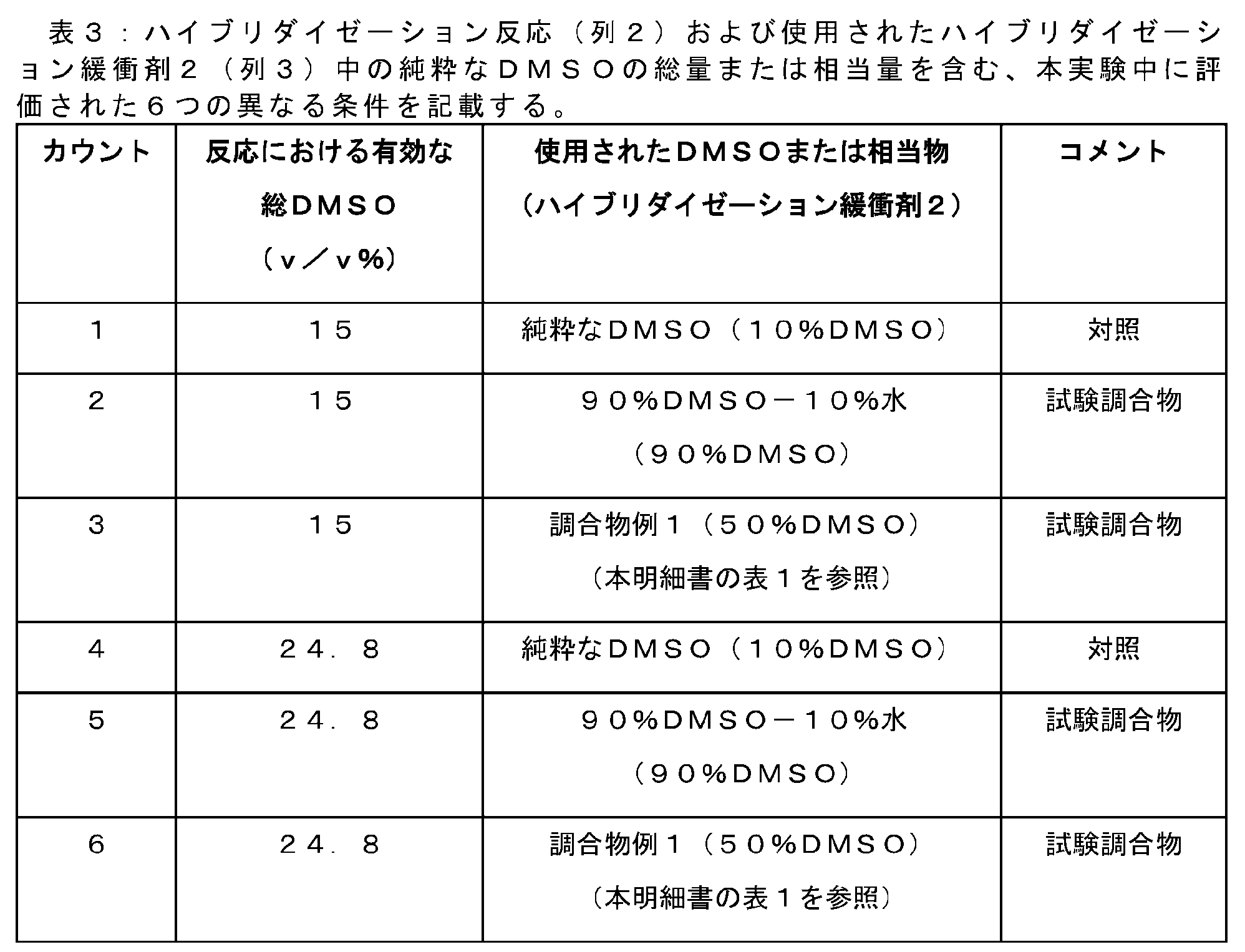
新しいDMSO置き換え試薬が現在および将来のDNAハイブリダイゼーションワークフローに対して最も低いリスクを確実にもたらすように、代替DMSO調合物を選択した。基準には、以下が含まれた。
〇 約13℃以下で液体状態を保つ
〇 ハイブリダイゼーション反応に新しい試薬を導入してはならない
〇 約-15~約-20℃の貯蔵温度で安定性リスクをもたらさない
〇 適切に添加された場合、純粋なDMSOと同じことを行う(対照)
To ensure that the new DMSO replacement reagent poses the lowest risk to current and future DNA hybridization workflows, an alternative DMSO formulation was selected.
o Stays in a liquid state below about 13°C o Does not introduce new reagents to the hybridization reaction o Poses no stability risks at storage temperatures of about -15 to about -20°C o Does the same thing as pure DMSO when added appropriately (control)
本実験では、使用された2つの純粋なDMSO代替物は、調合物を2つの成分のv/v%として直接記載する「90%DMSO-10%水」として特定された。このDMSO混合物は、特に寒冷環境における、純粋なDMSOに対する一般的な代替物である。調合物例1(本明細書に記載され、表1に示されている)は、ハイブリダイゼーションのために以前に最適化された調合物をより容易に模倣するので選択された。 In this experiment, the two pure DMSO alternatives used were identified as "90% DMSO-10% water," directly describing the formulation as the v/v % of the two components. This DMSO mixture is a common alternative to pure DMSO, especially in cold environments. Formulation Example 1 (described herein and shown in Table 1) was chosen because it more easily mimics formulations previously optimized for hybridization.
方法 Methods
核酸調製 Nucleic acid preparation
HyperPure(登録商標)ビーズ(Roche)を使用して、細胞株DNA(Corriell Inst.からのNA12878)を緩衝剤交換し、PCRグレードの水に溶出した。次いで、溶出された生成物を約50ng投入量(約30.5μL中)に対して正規化した。 Cell line DNA (NA12878 from Corriell Inst.) was buffer exchanged and eluted into PCR grade water using HyperPure® beads (Roche). The eluted product was then normalized to approximately 50 ng input (in approximately 30.5 μL).
ライブラリ調製および標的濃縮 Library preparation and target enrichment
KAPA NGHC製品/ワークフローv3.0(Roche)からの試薬および修正されたワークフロー工程を使用して試料を処理した。ハイブリダイゼーションに備えて、30μLの反応液中の1μgのDNAに対して二重インデックス付きライブラリを正規化した。ハイブリダイゼーション設定は、一般に、以下の重要な修正を伴って、同じKAPA NGHCワークフローに従った:
〇 ハイブリダイゼーション前またはハイブリダイゼーション中に反応物を多重化しなかった(但し、所望であれば、多重化することができる);
〇 ハイブリダイゼーション成分Hに代えて、DMSOまたは同等の試薬の使用;
〇 ハイブリダイゼーションマスターミックスは以下のように作製された(表4参照);
〇 パネル(Twist Biosystems);
〇 カスタム腫瘍学パネル314Kbを使用した;
〇 反応あたり5μLを添加した(0.23fmol/プローブ/4μL反応)
Samples were processed using reagents and modified workflow steps from the KAPA NGHC product/workflow v3.0 (Roche). In preparation for hybridization, dual-indexed libraries were normalized to 1 μg of DNA in a 30 μL reaction. Hybridization setup generally followed the same KAPA NGHC workflow with the following key modifications:
o Reactions were not multiplexed prior to or during hybridization (although they can be multiplexed if desired);
Use of DMSO or an equivalent reagent instead of hybridization component H;
A hybridization master mix was made as follows (see Table 4):
Panel (Twist Biosystems);
o Custom oncology panel 314Kb was used;
○ 5 μL was added per reaction (0.23 fmol/probe/4 μL reaction)
次いで、反応物を約55℃で約16時間ハイブリダイズさせ、再びKAP NGHCワークフローおよび試薬を使用して、標的濃縮および最終ライブラリ増幅を通じて処理した。 The reactions were then hybridized at about 55°C for about 16 hours and processed through target enrichment and final library amplification, again using the KAP NGHC workflow and reagents.
試料を4nMに希釈し、等しい体積でプールした。この適用のために、配列決定の準備として最大24個の反応をプールした。 Samples were diluted to 4 nM and pooled in equal volumes. For this application, up to 24 reactions were pooled in preparation for sequencing.
配列決定および分析 Sequencing and analysis
High-output 300サイクルキット(illumine Inc.)を使用して、NextSeq550/500機器で試料を配列決定した。BCLファイルをfastqフォーマットに変換し、逆多重化した。すべての反応物を、2×10+07個の総リードにサブサンプリングした。生ファイルを生殖系列分析のための内部パイプラインに供給して、配列決定QC測定基準を生成した。

結果 Results
これらのハイブリダイゼーション緩衝剤2調合物の性能評価は、ハイブリダイゼーション効率および捕捉の均一性に焦点を当てた。全体的なハイブリダイゼーション効率は、典型的には、関心対象のゲノムにマッピングされたすべてのリードの一部として標的領域をカバーするリードの割合によって測定される。この測定基準は、しばしば、オンターゲット率またはオンターゲット百分率と呼ばれる。この測定基準の場合、より高い値は、全体的なより効率的なハイブリダイゼーション反応を示す。本実験では、ハイブリダイゼーション反応において、オンターゲット率はDMSO含有量に正比例して増加した。本実験はハイブリダイゼーション反応において主要変性剤を操作したので、この測定基準は性能モニタリングのために不可欠であった。この実験では、より高いハイブリダイゼーション緩衝剤2条件(24.8%)は、より低いハイブリダイゼーション緩衝剤2成分(15%)を用いた反応よりも約15~約20パーセンテージポイントの増加を示した。さらに、ハイブリダイゼーション緩衝剤2のパーセンテージが固定されると(24.8または15%のいずれか)、異なる調合物との識別可能な捕捉性能の差はほとんどまたは全く存在しなかった(図1参照)。 The performance evaluation of these Hybridization Buffer 2 formulations focused on hybridization efficiency and capture uniformity. Overall hybridization efficiency is typically measured by the percentage of reads that cover the target region as a fraction of all reads mapped to the genome of interest. This metric is often referred to as the on-target rate or on-target percentage. For this metric, higher values indicate an overall more efficient hybridization reaction. In this experiment, the on-target rate increased directly proportional to the DMSO content in the hybridization reactions. Since this experiment manipulated the primary denaturant in the hybridization reaction, this metric was essential for performance monitoring. In this experiment, the higher Hybridization Buffer 2 condition (24.8%) showed an increase of about 15 to about 20 percentage points over reactions with the lower Hybridization Buffer 2 component (15%). Furthermore, once the percentage of Hybridization Buffer 2 was fixed (either 24.8 or 15%), there was little to no discernible capture performance difference with the different formulations (see Figure 1).
ハイブリダイゼーション反応におけるDMSO含有量を増加させることは全体的な効率を改善することができるが、すべての標的が十分な深度で配列決定されていることも極めて重要である。DNAハイブリダイゼーションのための測定基準の別の重要なクラスは、捕捉均一性である。これにアプローチするための多くの異なる方法が存在する(例としては、カバレッジの深度中央値から+/-25%以内のリードのパーセント、GC含有量によるカバレッジなどが挙げられる。)。この測定基準を計算するために使用されるパイプラインツールが無料公開されているので、ここでは、Fold80ベースペナルティを使用した(Broad Institute)(図2参照)。Fold80ベースペナルティは、(非ゼロカバレッジ領域に対してのみ適用される)現在のカバレッジの平均深度で、またはそれを上回って、すべての標的領域の80%を取得するために必要とされる追加のリードの数(または倍数)を示す無単位の値である。数字が小さいほどより良く、1の値はランが完全に均一であることを示す。このデータセットでは、均一性は、選択された条件にかかわらず良好に制御されているように見受けられたが、24.8%のハイブリダイゼーション緩衝剤2は、わずかにより良い均一性を有していた。 While increasing the DMSO content in the hybridization reaction can improve overall efficiency, it is also crucial that all targets are sequenced to sufficient depth. Another important class of metrics for DNA hybridization is capture uniformity. There are many different ways to approach this (examples include percent of reads within +/- 25% of median depth of coverage, coverage by GC content, etc.). Here, we used the Fold80 base penalty, as the pipeline tool used to calculate this metric is freely available (Broad Institute) (see Figure 2). The Fold80 base penalty is a unitless value indicating the number (or multiple) of additional reads required to obtain 80% of all target regions at or above the current average depth of coverage (applied only to non-zero coverage regions). The lower the number, the better, with a value of 1 indicating a perfectly uniform run. In this data set, uniformity appeared to be well controlled regardless of the conditions chosen, although Hybridization Buffer 2 at 24.8% had slightly better uniformity.
Fold80ベースペナルティは単一の数であり、これはfold80ベースペナルティが均一性を評価するための迅速かつ簡単な方法であることを意味するが、その変数のこのような単純な表現を使用することによって、なんらかの最適に満たない挙動が隠されることがあり得る。fold80ベースペナルティ測定基準を補うために、GC含有量カバレッジ(%)に基づいて、これらのハイブリダイゼーション条件の均一性を調べた。(使用した5%ビン中の)すべての連続した標的領域にわたるGC含有量に基づいて、すべてのパネル標的を測定した。これらのビン内の正規化されたカバレッジを測定することにより、所与のGC含有量を有するすべての標的の挙動を定量化することができる。すべてのハイブリダイゼーション成分条件についてこの挙動を説明するために、単一の最良適合線を使用した。参考として、(理想的には)平均があるべき場所を示すために点線a1を追加した。最後に、プロット内の異なるカバレッジによっていくつの標的が影響を受け得るかについてより多くの情報を与えるために、所与のGCビン内の標的の総量も提供される。正規化されたGCカバレッジを見ると、以前の均一性についての知見を裏付けることができた。より多くのハイブリダイゼーション緩衝剤2を添加することは、高いGC含有量を有する標的のカバレッジを増加させるようであり、これは、低いGC含有量の標的についてすべての条件で見られるより低いカバレッジを相殺する。これは、約55%のGCビンにおいて始まることが最も顕著である。そのGC含有量以上の標的の数が比較的小さい(全標的の約20%を占める)ことに鑑みると、これは全体的な均一性に対して軽微な影響しかもたらさない(図3Aおよび図3B参照)。 The Fold80 base penalty is a single number, which means that it is a quick and easy way to assess uniformity, but some suboptimal behavior may be hidden by using such a simple representation of the variable. To complement the Fold80 base penalty metric, we looked at the uniformity of these hybridization conditions based on GC content coverage (%). All panel targets were measured based on GC content across all contiguous target regions (in the 5% bins used). By measuring the normalized coverage within these bins, we can quantify the behavior of all targets with a given GC content. A single best-fit line was used to describe this behavior for all hybridization component conditions. As a reference, we added a dotted line a1 to show where the average should (ideally) be. Finally, the total amount of targets in a given GC bin is also provided to give more information about how many targets may be affected by different coverages in the plot. Looking at the normalized GC coverage, we were able to confirm previous findings about uniformity. Adding more Hybridization Buffer 2 appears to increase coverage of targets with high GC content, offsetting the lower coverage seen in all conditions for targets with low GC content. This is most noticeable starting at about the 55% GC bin. Given that the number of targets above that GC content is relatively small (representing about 20% of all targets), this has only a minor effect on overall uniformity (see Figures 3A and 3B).
これらの標的濃縮測定基準を調べることにより、2つの代替ハイブリダイゼーション緩衝剤2調合物は、少なくとも対照(純粋なDMSO)と同様に機能することが示された。これは、すべての捕捉測定基準にわたって、およびこの技術について予想されるハイブリダイゼーションミックス調合物の範囲内において当てはまった。結論として、本実施例は、2つのハイブリダイゼーション緩衝剤2調合物が、試薬の融点を>>10℃低下させるという追加の利点を有しながら(データは示さず)、純粋なDMSOの特徴を保持することを示す。この情報は、類似のワークフローの自動化された開発を先導し、この空間におけるウォークアウェイ能力を劇的に改善するために使用することができる。 By examining these target enrichment metrics, the two alternative Hybridization Buffer 2 formulations were shown to perform at least as well as the control (pure DMSO). This was true across all capture metrics and within the range of hybridization mix formulations expected for this technology. In conclusion, this example shows that the two Hybridization Buffer 2 formulations retain the characteristics of pure DMSO while having the added benefit of lowering the melting point of the reagents by >>10°C (data not shown). This information can be used to guide the automated development of similar workflows and dramatically improve walk-away capabilities in this space.
本開示は、いくつかの例示的な態様を参照して説明されてきたが、本開示の原理の精神および範囲内に含まれるであろう多くの他の変更および態様が当業者によって考案され得ることを理解されたい。より具体的には、本開示の精神から逸脱することなく、前述の開示、図面および添付の特許請求の範囲の範囲内で、主題の組み合わせ構成の構成部分および/または配置の合理的な変形および変更が可能である。構成部分および/または配置の変形および変更に加えて、代替の使用法も当業者にとって明らかであろう。 Although the present disclosure has been described with reference to certain exemplary embodiments, it should be understood that many other modifications and embodiments may be devised by those skilled in the art that would fall within the spirit and scope of the principles of the present disclosure. More specifically, reasonable variations and modifications of the components and/or arrangements of the subject combination configurations are possible within the scope of the foregoing disclosure, the drawings, and the appended claims without departing from the spirit of the present disclosure. In addition to the modifications and modifications of the components and/or arrangements, alternative uses will also be apparent to those skilled in the art.
Claims (15)
Applications Claiming Priority (3)
| Application Number | Priority Date | Filing Date | Title |
|---|---|---|---|
| US202163166324P | 2021-03-26 | 2021-03-26 | |
| US63/166,324 | 2021-03-26 | ||
| PCT/EP2022/057732 WO2022200485A1 (en) | 2021-03-26 | 2022-03-24 | Hybridization buffer formulations |
Publications (2)
| Publication Number | Publication Date |
|---|---|
| JP2024511628A JP2024511628A (en) | 2024-03-14 |
| JP7657961B2 true JP7657961B2 (en) | 2025-04-07 |
Family
ID=81384719
Family Applications (1)
| Application Number | Title | Priority Date | Filing Date |
|---|---|---|---|
| JP2023558810A Active JP7657961B2 (en) | 2021-03-26 | 2022-03-24 | Hybridization Buffer Formulation |
Country Status (5)
| Country | Link |
|---|---|
| US (1) | US20250146055A1 (en) |
| EP (1) | EP4314330A1 (en) |
| JP (1) | JP7657961B2 (en) |
| CN (1) | CN117098854A (en) |
| WO (1) | WO2022200485A1 (en) |
Citations (6)
| Publication number | Priority date | Publication date | Assignee | Title |
|---|---|---|---|---|
| US20020187476A1 (en) | 2001-05-16 | 2002-12-12 | Koroulis Melanie C. | Methods and compositions for arraying nucleic acids onto a solid support |
| US20050136413A1 (en) | 2003-12-22 | 2005-06-23 | Briggs Michael W. | Reagent systems for biological assays |
| JP2006519977A (en) | 2002-11-11 | 2006-08-31 | アフィメトリックス インコーポレイテッド | Method for identifying DNA copy number changes |
| JP2009284783A (en) | 2008-05-27 | 2009-12-10 | Fujifilm Corp | Method for preparing solution for hybridization |
| CN104062426A (en) | 2014-06-18 | 2014-09-24 | 兰州大学第一医院 | Overall embryo immunostaining kit as well as use method and application thereof |
| WO2020021084A1 (en) | 2018-07-27 | 2020-01-30 | F. Hoffmann-La Roche Ag | Formamide free target enrichment compositions for next-generation sequencing applications |
Family Cites Families (37)
| Publication number | Priority date | Publication date | Assignee | Title |
|---|---|---|---|---|
| US1985424A (en) | 1933-03-23 | 1934-12-25 | Ici Ltd | Alkylene-oxide derivatives of polyhydroxyalkyl-alkylamides |
| US2703798A (en) | 1950-05-25 | 1955-03-08 | Commercial Solvents Corp | Detergents from nu-monoalkyl-glucamines |
| BE557103A (en) | 1956-05-14 | |||
| US3155591A (en) | 1961-12-06 | 1964-11-03 | Witco Chemical Corp | Hair rinse compostions of polyoxypropylene quaternary ammonium compounds |
| US3959461A (en) | 1974-05-28 | 1976-05-25 | The United States Of America As Represented By The Secretary Of Agriculture | Hair cream rinse formulations containing quaternary ammonium salts |
| US4000159A (en) | 1974-06-28 | 1976-12-28 | Phillips Petroleum Company | Preparation of n,n-disubstituted thioamides |
| DE2437090A1 (en) | 1974-08-01 | 1976-02-19 | Hoechst Ag | CLEANING SUPPLIES |
| US4387090A (en) | 1980-12-22 | 1983-06-07 | The Procter & Gamble Company | Hair conditioning compositions |
| US4683202A (en) | 1985-03-28 | 1987-07-28 | Cetus Corporation | Process for amplifying nucleic acid sequences |
| US4965188A (en) | 1986-08-22 | 1990-10-23 | Cetus Corporation | Process for amplifying, detecting, and/or cloning nucleic acid sequences using a thermostable enzyme |
| US4683195A (en) | 1986-01-30 | 1987-07-28 | Cetus Corporation | Process for amplifying, detecting, and/or-cloning nucleic acid sequences |
| US5176995A (en) | 1985-03-28 | 1993-01-05 | Hoffmann-La Roche Inc. | Detection of viruses by amplification and hybridization |
| EP1276702A2 (en) * | 2000-03-31 | 2003-01-22 | Genentech, Inc. | Compositions and methods for detecting and quantifying gene expression |
| US7238485B2 (en) | 2004-03-23 | 2007-07-03 | President And Fellows Of Harvard College | Methods and apparatus for characterizing polynucleotides |
| AU2008261935B2 (en) | 2007-06-06 | 2013-05-02 | Pacific Biosciences Of California, Inc. | Methods and processes for calling bases in sequence by incorporation methods |
| CN107083421A (en) | 2010-12-17 | 2017-08-22 | 纽约哥伦比亚大学理事会 | The DNA detected using the nucleotides through modification and nano-pore is sequenced in synthesis |
| GB2497510A (en) | 2011-11-10 | 2013-06-19 | Harry Cuppens | Methods for determining mononucleotide sequence repeats |
| US20150119259A1 (en) | 2012-06-20 | 2015-04-30 | Jingyue Ju | Nucleic acid sequencing by nanopore detection of tag molecules |
| US9605309B2 (en) | 2012-11-09 | 2017-03-28 | Genia Technologies, Inc. | Nucleic acid sequencing using tags |
| WO2014106076A2 (en) | 2012-12-28 | 2014-07-03 | Quest Diagnostics Investments Incorporated | Universal sanger sequencing from next-gen sequencing amplicons |
| CN105189785B (en) | 2013-03-08 | 2018-04-20 | 伯乐生命医学产品有限公司 | Compositions, methods and systems for polymerase chain reaction assays |
| US20140278461A1 (en) | 2013-03-15 | 2014-09-18 | Memorial Sloan-Kettering Cancer Center | System and method for integrating a medical sequencing apparatus and laboratory system into a medical facility |
| JP6652693B2 (en) | 2013-04-29 | 2020-02-26 | キアゲン ゲーエムベーハー | Method of DNA amplification using blocking oligonucleotide |
| JP2017500004A (en) | 2013-10-18 | 2017-01-05 | セブン ブリッジズ ジェノミクス インコーポレイテッド | Methods and systems for genotyping gene samples |
| WO2015148402A1 (en) | 2014-03-24 | 2015-10-01 | The Trustees Of Columbia Univeristy In The City Of New York | Chemical methods for producing tagged nucleotides |
| EP2940136A1 (en) * | 2014-04-30 | 2015-11-04 | QIAGEN GmbH | Method for isolating poly(A) nucleic acids |
| US9909169B2 (en) | 2014-12-17 | 2018-03-06 | Roche Molecular Systems, Inc. | Allele-specific amplification of nucleic acids using blocking oligonucleotides for wild type suppression |
| WO2016133783A1 (en) | 2015-02-17 | 2016-08-25 | Zalous, Inc. | Microdroplet digital pcr system |
| JP6847496B2 (en) | 2015-08-06 | 2021-03-24 | エフ.ホフマン−ラ ロシュ アーゲーF. Hoffmann−La Roche Aktiengesellschaft | Target enrichment by single probe primer extension |
| CA2995422A1 (en) | 2015-08-12 | 2017-02-16 | The Chinese University Of Hong Kong | Single-molecule sequencing of plasma dna |
| EP3423574B1 (en) | 2016-02-29 | 2021-03-17 | Genia Technologies, Inc. | Polymerase-template complexes for nanopore sequencing |
| EP3464629B1 (en) | 2016-06-01 | 2021-09-08 | F. Hoffmann-La Roche AG | Immuno-pete |
| WO2018013710A1 (en) | 2016-07-12 | 2018-01-18 | F. Hoffman-La Roche Ag | Primer extension target enrichment |
| US12385899B2 (en) | 2016-08-18 | 2025-08-12 | The Regents Of The University Of California | Nanopore sequencing base calling |
| JP6970205B2 (en) | 2017-03-08 | 2021-11-24 | エフ.ホフマン−ラ ロシュ アーゲーF. Hoffmann−La Roche Aktiengesellschaft | Primer extension target enrichment, including simultaneous enrichment of DNA and RNA, and improvements to it |
| CN112639130B (en) * | 2018-05-18 | 2024-08-09 | 特韦斯特生物科学公司 | Polynucleotides, reagents and methods for nucleic acid hybridization |
| US11440933B2 (en) | 2018-12-19 | 2022-09-13 | Roche Sequencing Solutions, Inc. | 3′ protected nucleotides |
-
2022
- 2022-03-24 JP JP2023558810A patent/JP7657961B2/en active Active
- 2022-03-24 US US18/865,814 patent/US20250146055A1/en active Pending
- 2022-03-24 CN CN202280023876.0A patent/CN117098854A/en active Pending
- 2022-03-24 WO PCT/EP2022/057732 patent/WO2022200485A1/en not_active Ceased
- 2022-03-24 EP EP22718118.7A patent/EP4314330A1/en active Pending
Patent Citations (6)
| Publication number | Priority date | Publication date | Assignee | Title |
|---|---|---|---|---|
| US20020187476A1 (en) | 2001-05-16 | 2002-12-12 | Koroulis Melanie C. | Methods and compositions for arraying nucleic acids onto a solid support |
| JP2006519977A (en) | 2002-11-11 | 2006-08-31 | アフィメトリックス インコーポレイテッド | Method for identifying DNA copy number changes |
| US20050136413A1 (en) | 2003-12-22 | 2005-06-23 | Briggs Michael W. | Reagent systems for biological assays |
| JP2009284783A (en) | 2008-05-27 | 2009-12-10 | Fujifilm Corp | Method for preparing solution for hybridization |
| CN104062426A (en) | 2014-06-18 | 2014-09-24 | 兰州大学第一医院 | Overall embryo immunostaining kit as well as use method and application thereof |
| WO2020021084A1 (en) | 2018-07-27 | 2020-01-30 | F. Hoffmann-La Roche Ag | Formamide free target enrichment compositions for next-generation sequencing applications |
Also Published As
| Publication number | Publication date |
|---|---|
| JP2024511628A (en) | 2024-03-14 |
| EP4314330A1 (en) | 2024-02-07 |
| US20250146055A1 (en) | 2025-05-08 |
| CN117098854A (en) | 2023-11-21 |
| WO2022200485A1 (en) | 2022-09-29 |
Similar Documents
| Publication | Publication Date | Title |
|---|---|---|
| Quail et al. | A large genome center's improvements to the Illumina sequencing system | |
| EP3714064B1 (en) | Methods and kits for amplification of double stranded dna | |
| CN103492588A (en) | Methods and systems for haplotype determination | |
| EP3990920B1 (en) | Methods and compositions for proximity ligation | |
| US20230242907A1 (en) | Methods of Producing Nucleic Acid Libraries and Compositions and Kits for Practicing Same | |
| US10041106B2 (en) | Methods and compositions for isothermal whole genome amplification | |
| JP2022511255A (en) | Compositions and Methods for Improving Library Enrichment | |
| WO2012118802A9 (en) | Kit and method for sequencing a target dna in a mixed population | |
| US20190169603A1 (en) | Compositions and Methods for Labeling Target Nucleic Acid Molecules | |
| EP4271804A1 (en) | Methods and compositions for sequencing library preparation | |
| JP7657961B2 (en) | Hybridization Buffer Formulation | |
| US20220145359A1 (en) | Methods for targeted depletion of nucleic acids | |
| US20230374574A1 (en) | Compositions and methods for highly sensitive detection of target sequences in multiplex reactions | |
| KR20250022682A (en) | Methods and compositions for preparing sequencing libraries | |
| WO2025085821A1 (en) | Methods, systems, and compositions for cell storage and analysis | |
| KR20120132428A (en) | Dry reagent, dry reagent kit, reagent container, and method for producing dry reagent |
Legal Events
| Date | Code | Title | Description |
|---|---|---|---|
| A621 | Written request for application examination |
Free format text: JAPANESE INTERMEDIATE CODE: A621 Effective date: 20230925 |
|
| A977 | Report on retrieval |
Free format text: JAPANESE INTERMEDIATE CODE: A971007 Effective date: 20240913 |
|
| A131 | Notification of reasons for refusal |
Free format text: JAPANESE INTERMEDIATE CODE: A131 Effective date: 20241008 |
|
| A521 | Request for written amendment filed |
Free format text: JAPANESE INTERMEDIATE CODE: A523 Effective date: 20241121 |
|
| A131 | Notification of reasons for refusal |
Free format text: JAPANESE INTERMEDIATE CODE: A131 Effective date: 20250121 |
|
| A521 | Request for written amendment filed |
Free format text: JAPANESE INTERMEDIATE CODE: A523 Effective date: 20250214 |
|
| TRDD | Decision of grant or rejection written | ||
| A01 | Written decision to grant a patent or to grant a registration (utility model) |
Free format text: JAPANESE INTERMEDIATE CODE: A01 Effective date: 20250311 |
|
| A61 | First payment of annual fees (during grant procedure) |
Free format text: JAPANESE INTERMEDIATE CODE: A61 Effective date: 20250326 |
|
| R150 | Certificate of patent or registration of utility model |
Ref document number: 7657961 Country of ref document: JP Free format text: JAPANESE INTERMEDIATE CODE: R150 |