JP7643340B2 - IMAGE PROCESSING METHOD, IMAGE PROCESSING APPARATUS, AND IMAGE PROCESSING SYSTEM - Google Patents
IMAGE PROCESSING METHOD, IMAGE PROCESSING APPARATUS, AND IMAGE PROCESSING SYSTEM Download PDFInfo
- Publication number
- JP7643340B2 JP7643340B2 JP2021558198A JP2021558198A JP7643340B2 JP 7643340 B2 JP7643340 B2 JP 7643340B2 JP 2021558198 A JP2021558198 A JP 2021558198A JP 2021558198 A JP2021558198 A JP 2021558198A JP 7643340 B2 JP7643340 B2 JP 7643340B2
- Authority
- JP
- Japan
- Prior art keywords
- image
- image processing
- filter
- processing device
- medical
- Prior art date
- Legal status (The legal status is an assumption and is not a legal conclusion. Google has not performed a legal analysis and makes no representation as to the accuracy of the status listed.)
- Active
Links
Images




Classifications
-
- G—PHYSICS
- G02—OPTICS
- G02B—OPTICAL ELEMENTS, SYSTEMS OR APPARATUS
- G02B21/00—Microscopes
- G02B21/36—Microscopes arranged for photographic purposes or projection purposes or digital imaging or video purposes including associated control and data processing arrangements
- G02B21/365—Control or image processing arrangements for digital or video microscopes
- G02B21/367—Control or image processing arrangements for digital or video microscopes providing an output produced by processing a plurality of individual source images, e.g. image tiling, montage, composite images, depth sectioning, image comparison
-
- G—PHYSICS
- G02—OPTICS
- G02B—OPTICAL ELEMENTS, SYSTEMS OR APPARATUS
- G02B21/00—Microscopes
- G02B21/36—Microscopes arranged for photographic purposes or projection purposes or digital imaging or video purposes including associated control and data processing arrangements
- G02B21/365—Control or image processing arrangements for digital or video microscopes
-
- G—PHYSICS
- G06—COMPUTING OR CALCULATING; COUNTING
- G06T—IMAGE DATA PROCESSING OR GENERATION, IN GENERAL
- G06T5/00—Image enhancement or restoration
- G06T5/20—Image enhancement or restoration using local operators
-
- G—PHYSICS
- G06—COMPUTING OR CALCULATING; COUNTING
- G06T—IMAGE DATA PROCESSING OR GENERATION, IN GENERAL
- G06T5/00—Image enhancement or restoration
- G06T5/50—Image enhancement or restoration using two or more images, e.g. averaging or subtraction
-
- G—PHYSICS
- G06—COMPUTING OR CALCULATING; COUNTING
- G06T—IMAGE DATA PROCESSING OR GENERATION, IN GENERAL
- G06T5/00—Image enhancement or restoration
- G06T5/70—Denoising; Smoothing
-
- G—PHYSICS
- G06—COMPUTING OR CALCULATING; COUNTING
- G06T—IMAGE DATA PROCESSING OR GENERATION, IN GENERAL
- G06T5/00—Image enhancement or restoration
- G06T5/73—Deblurring; Sharpening
-
- G—PHYSICS
- G06—COMPUTING OR CALCULATING; COUNTING
- G06T—IMAGE DATA PROCESSING OR GENERATION, IN GENERAL
- G06T7/00—Image analysis
- G06T7/0002—Inspection of images, e.g. flaw detection
- G06T7/0012—Biomedical image inspection
-
- G—PHYSICS
- G06—COMPUTING OR CALCULATING; COUNTING
- G06T—IMAGE DATA PROCESSING OR GENERATION, IN GENERAL
- G06T2207/00—Indexing scheme for image analysis or image enhancement
- G06T2207/10—Image acquisition modality
- G06T2207/10004—Still image; Photographic image
- G06T2207/10012—Stereo images
-
- G—PHYSICS
- G06—COMPUTING OR CALCULATING; COUNTING
- G06T—IMAGE DATA PROCESSING OR GENERATION, IN GENERAL
- G06T2207/00—Indexing scheme for image analysis or image enhancement
- G06T2207/10—Image acquisition modality
- G06T2207/10056—Microscopic image
-
- G—PHYSICS
- G06—COMPUTING OR CALCULATING; COUNTING
- G06T—IMAGE DATA PROCESSING OR GENERATION, IN GENERAL
- G06T2207/00—Indexing scheme for image analysis or image enhancement
- G06T2207/20—Special algorithmic details
- G06T2207/20004—Adaptive image processing
- G06T2207/20008—Globally adaptive
-
- G—PHYSICS
- G06—COMPUTING OR CALCULATING; COUNTING
- G06T—IMAGE DATA PROCESSING OR GENERATION, IN GENERAL
- G06T2207/00—Indexing scheme for image analysis or image enhancement
- G06T2207/20—Special algorithmic details
- G06T2207/20172—Image enhancement details
- G06T2207/20182—Noise reduction or smoothing in the temporal domain; Spatio-temporal filtering
-
- G—PHYSICS
- G06—COMPUTING OR CALCULATING; COUNTING
- G06T—IMAGE DATA PROCESSING OR GENERATION, IN GENERAL
- G06T2207/00—Indexing scheme for image analysis or image enhancement
- G06T2207/20—Special algorithmic details
- G06T2207/20172—Image enhancement details
- G06T2207/20192—Edge enhancement; Edge preservation
-
- G—PHYSICS
- G06—COMPUTING OR CALCULATING; COUNTING
- G06T—IMAGE DATA PROCESSING OR GENERATION, IN GENERAL
- G06T2207/00—Indexing scheme for image analysis or image enhancement
- G06T2207/20—Special algorithmic details
- G06T2207/20212—Image combination
-
- G—PHYSICS
- G06—COMPUTING OR CALCULATING; COUNTING
- G06T—IMAGE DATA PROCESSING OR GENERATION, IN GENERAL
- G06T2207/00—Indexing scheme for image analysis or image enhancement
- G06T2207/20—Special algorithmic details
- G06T2207/20212—Image combination
- G06T2207/20221—Image fusion; Image merging
-
- G—PHYSICS
- G06—COMPUTING OR CALCULATING; COUNTING
- G06T—IMAGE DATA PROCESSING OR GENERATION, IN GENERAL
- G06T2207/00—Indexing scheme for image analysis or image enhancement
- G06T2207/30—Subject of image; Context of image processing
- G06T2207/30004—Biomedical image processing
-
- G—PHYSICS
- G06—COMPUTING OR CALCULATING; COUNTING
- G06T—IMAGE DATA PROCESSING OR GENERATION, IN GENERAL
- G06T2207/00—Indexing scheme for image analysis or image enhancement
- G06T2207/30—Subject of image; Context of image processing
- G06T2207/30004—Biomedical image processing
- G06T2207/30024—Cell structures in vitro; Tissue sections in vitro
-
- G—PHYSICS
- G06—COMPUTING OR CALCULATING; COUNTING
- G06T—IMAGE DATA PROCESSING OR GENERATION, IN GENERAL
- G06T2207/00—Indexing scheme for image analysis or image enhancement
- G06T2207/30—Subject of image; Context of image processing
- G06T2207/30168—Image quality inspection
Landscapes
- Engineering & Computer Science (AREA)
- Physics & Mathematics (AREA)
- General Physics & Mathematics (AREA)
- Theoretical Computer Science (AREA)
- Multimedia (AREA)
- Computer Vision & Pattern Recognition (AREA)
- Chemical & Material Sciences (AREA)
- Analytical Chemistry (AREA)
- Optics & Photonics (AREA)
- Quality & Reliability (AREA)
- Radiology & Medical Imaging (AREA)
- Nuclear Medicine, Radiotherapy & Molecular Imaging (AREA)
- Medical Informatics (AREA)
- General Health & Medical Sciences (AREA)
- Health & Medical Sciences (AREA)
- Image Processing (AREA)
Description
本発明は、画像処理方法、画像処理装置および画像処理システムに関する。 The present invention relates to an image processing method, an image processing device and an image processing system.
細胞組織を観察する顕微鏡装置を用いて、細胞組織を撮像し医療画像として保存し、医療画像の画像データを用いて病理診断などを行うデジタル顕微鏡装置や画像表示装置がある。デジタル顕微鏡装置では、検体の全体を観察するために、スライドガラス上の検体を含む領域を区画する小領域を拡大撮像系により撮像し、小領域毎の複数の像を繋ぎ合わせて1枚の巨大な医療画像を作成する。There are digital microscopes and image display devices that use microscopes to observe cellular tissue, capture images of the tissue and store them as medical images, and use the image data of the medical images to perform pathological diagnoses and other similar purposes. In digital microscopes, in order to observe the entire specimen, images of small areas that define the area containing the specimen on a glass slide are captured using a magnifying imaging system, and multiple images of each small area are stitched together to create a single large medical image.
拡大撮像系の対物レンズの焦点を撮像対象である細胞組織に合わせる合焦方式にはオートフォーカス(AF:AutoFocus)を採用する。例えば、拡大撮像系の対物レンズの焦点位置を光軸方向に所定間隔毎に移動させ、各々の移動位置で撮像を行い、撮像された各々の画像のうち最もコントラストが高い画像を撮像したときの位置を合焦位置として検出する合焦方式などが提案されている(例えば、特許文献1参照)。この種の合焦方式は「コントラストAF」と呼ばれる。 Autofocus (AF) is used as a focusing method for adjusting the focus of the objective lens of the magnification imaging system to the cellular tissue to be imaged. For example, a focusing method has been proposed in which the focal position of the objective lens of the magnification imaging system is moved at predetermined intervals along the optical axis, images are captured at each of the moved positions, and the position at which the image with the highest contrast among the captured images is captured is detected as the in-focus position (see, for example, Patent Document 1). This type of focusing method is called "contrast AF."
このようにして撮像された細胞組織画像は、比較的高い焦点精度が得られるものの、光学顕微鏡を通して医師など観察者が観察する光学顕微鏡像とは、見え方が異なっている。 Although the cell tissue images captured in this way have a relatively high degree of focusing accuracy, they look different from optical microscope images observed by a doctor or other observer through an optical microscope.
このように、デジタル顕微鏡装置では、細胞組織の画像を高い品質で取得したいという要望があるものの、未だ十分な解決には至っていない。 Thus, although there is a demand for digital microscope devices to obtain high-quality images of cell tissue, this has not yet been satisfactorily resolved.
以上のような事情に鑑み、本技術の目的は、細胞組織の画像を高い品質で取得することのできるデジタル顕微鏡装置、その撮像方法およびプログラムを提供することにある。In view of the above circumstances, the object of this technology is to provide a digital microscope device, an imaging method, and a program capable of acquiring high-quality images of cellular tissue.
本願に係る画像処理方法は、撮像装置により撮像された医療画像を取得し、医療画像の合焦度合いに応じて、医療画像に適用するフィルタの強度を決定することを特徴とする。The image processing method of the present application is characterized by acquiring a medical image captured by an imaging device and determining the strength of a filter to be applied to the medical image depending on the degree of focus of the medical image.
以下に、本願に係る画像処理方法、画像処理装置及び画像処理システムを実施するための形態(以下、「実施形態」と呼ぶ)について図面を参照しつつ詳細に説明する。なお、この実施形態により本願に係る画像処理方法、画像処理装置及び画像処理システムが限定されるものではない。また、以下の各実施形態において同一の部位には同一の符号を付し、重複する説明は省略される。 Below, the image processing method, image processing device, and image processing system according to the present application will be described in detail with reference to the drawings. Note that the image processing method, image processing device, and image processing system according to the present application are not limited to these embodiments. In addition, the same parts in the following embodiments will be given the same reference numerals, and duplicated explanations will be omitted.
以下に示す項目順序に従って本開示を説明する。
1.光学顕微鏡の特徴
2.画像処理システムの構成
3.情報処理の一例
4.処理のバリエーション
4-1.タップの範囲
4-2.レイヤーの数
4-3.フィルタの種類
4-4.複数の画素でブロックを構成
4-5.被写体
4-6.撮像装置
4-7.合焦位置
4-8.特徴量の算出方法
4-9.装置の一体
5.撮像装置の構成
6.画像処理装置の構成
7.情報処理のフロー
8.変形例
9.ハードウェア構成
10.その他
The present disclosure will be described in the following order.
1. Features of
(実施形態)
〔1.光学顕微鏡の特徴〕
図1は、光学顕微鏡像の特徴を示す。光学顕微鏡像は、デジタル顕微鏡装置を通して観察される像とは異なる特徴を有する。図1に示すように、光学顕微鏡像の画質に関する指標はいくつかある。図1に示す指標を用いて、光学顕微鏡像の特徴を説明する。例えば、画質の明るさを示す指標(本実施形態では、「きらきら感」と表記する場合がある)がある。例えば、画質のエッジの度合を示す指標(本実施形態では、「くっきり感」と表記する場合がある)がある。図1では、光学顕微鏡像の特徴を示す指標は、例えば、「立体的/平面的」、「透明/くすみ」、「くっきり/ボケ」などである。
(Embodiment)
[1. Characteristics of optical microscopes]
FIG. 1 shows the characteristics of an optical microscope image. An optical microscope image has different characteristics from an image observed through a digital microscope device. As shown in FIG. 1, there are several indexes related to the image quality of an optical microscope image. The characteristics of an optical microscope image are explained using the indexes shown in FIG. 1. For example, there is an index indicating the brightness of the image quality (in this embodiment, it may be written as "sparkle"). For example, there is an index indicating the degree of edge of the image quality (in this embodiment, it may be written as "sharpness"). In FIG. 1, the indexes indicating the characteristics of an optical microscope image are, for example, "three-dimensional/flat", "transparent/dull", "sharp/blurred", etc.
実施形態に係るボケ(ぼやけ)とは、画像が鮮鋭でない状態を示す。具体的には、実施形態に係るボケとは、被写界深度の範囲を超えて、画像の焦点が合わず、鮮鋭でない状態を示す。なお、実施形態に係る合焦とは、被写界深度の範囲内で焦点が合う状態を示す。なお、実施形態に係る合焦度合いとは、焦点がどの程度合っているかをスコア化した値である。 Blur (fuzziness) according to the embodiment refers to a state in which an image is not sharp. Specifically, blur according to the embodiment refers to a state in which an image is out of focus and not sharp beyond the range of the depth of field. In addition, focus according to the embodiment refers to a state in which an image is in focus within the range of the depth of field. In addition, the degree of focus according to the embodiment refers to a value that scores the degree of focus.
図1に示すように、光学顕微鏡像は立体的である。ここで、実施形態に係る立体的とは、ボケと合焦との視覚的な対比(コントラスト)に関する品質を示す。As shown in Figure 1, an optical microscope image is three-dimensional. Here, in this embodiment, three-dimensional refers to the quality of the visual contrast between blur and focus.
光学顕微鏡像は、透明感がある。ここで、実施形態に係る透明感とは、ノイズに関する品質を示す。なお、実施形態に係るノイズとは、被写体以外の不要な情報である。具体的には、光学顕微鏡像は、デジタル化をしないため、ノイズの強調などが起こらず、透明感がある。 Optical microscope images have a sense of transparency. Here, transparency in the embodiment refers to quality related to noise. Note that noise in the embodiment is unnecessary information other than the subject. Specifically, because optical microscope images are not digitized, there is no emphasis on noise, and so the images have a sense of transparency.
光学顕微鏡像は、きらきら感がある。ここで、実施形態に係るきらきら感とは、被写体に対して光を当てた際に散乱光によって生じる干渉縞による明るさに関する品質を示す。具体的には、光学顕微鏡像は、干渉縞によって物体に当てた光よりも明るい光を発するため、きらきら感がある。 Optical microscope images have a sparkling appearance. Here, the sparkling appearance according to the embodiment refers to the quality of brightness caused by interference fringes that are generated by scattered light when light is shone on a subject. Specifically, optical microscope images have a sparkling appearance because the interference fringes cause light to be emitted that is brighter than the light shone on the object.
光学顕微鏡像は、くっきり感がある。ここで、実施形態に係るくっきり感とは、鮮鋭度に関する品質を示す。The optical microscope image is crisp. Here, the crispness in this embodiment refers to the quality related to sharpness.
光学顕微鏡像は、立体的で、明るく、鮮鋭度が高いため、対象を識別する性能(以下、適宜、「対象識別性能」とする。)が高い。 Optical microscope images are three-dimensional, bright, and highly sharp, providing high object identification performance (hereinafter referred to as "object identification performance" for convenience).
光学顕微鏡像は、立体的で、明るく、鮮鋭度が高いため、対象を認識する性能(以下、適宜、「対象認識性能」とする。)が高い。 Optical microscope images are three-dimensional, bright, and highly sharp, providing high object recognition performance (hereinafter referred to as "object recognition performance" where appropriate).
以下、デジタル顕微鏡装置で取得した画像を、光学顕微鏡像に近づける方法を説明する。検体は、スライドガラスに載置される。検体は、スライドの厚みの方向を示すZ軸方向(以下、適宜、「Z方向」とする。)に細胞などが分布しており、デジタル顕微鏡装置で取得した医療画像は、焦点が合っている領域と焦点があっていない領域が混在している。例えば、この医療画像全体に対し、高域強調フィルタを適用すると、低周波部分(例えば、ノイズ)も強調され、焦点があっていない領域の鮮鋭度も上がる。高周波成分が多い画像となり、対象識別性能が悪化する。また、フィルタの強度を下げた場合、強調したい領域の強調も弱まることになる。 Below, we will explain a method for making an image acquired by a digital microscope device closer to an optical microscope image. The specimen is placed on a glass slide. The specimen has cells and other parts distributed in the Z-axis direction (hereinafter referred to as the "Z direction" as appropriate) that indicates the direction of the thickness of the slide, and the medical image acquired by the digital microscope device has a mixture of in-focus and out-of-focus areas. For example, if a high-frequency emphasis filter is applied to the entire medical image, the low-frequency parts (e.g., noise) are also emphasized, and the sharpness of the out-of-focus areas increases. The image becomes more high-frequency components, and the object identification performance deteriorates. Furthermore, if the strength of the filter is reduced, the emphasis of the areas to be emphasized will also be weakened.
光学顕微鏡像に近い像とは、図1に示す特徴を有する像であり、合焦度の異なる像により形成される像である。以下、光学顕微鏡像に近づける効果を説明する。An image close to an optical microscope image is an image that has the characteristics shown in Figure 1 and is formed from images with different degrees of focus. The effect of approaching an optical microscope image is explained below.
例えば、デジタル顕微鏡装置で取得した医療画像を光学顕微鏡像に近づけることにより、細胞の構造が見えやすくなる。これにより、診断への利用を促進させることができる。例えば、医療画像を光学顕微鏡像に近づけることにより、細胞の場所を判別しやすくなる。これにより、病理医による診断のスピードが上がり疲労を軽減できる。例えば、医療画像を光学顕微鏡像に近づけることにより、重なった細胞の視認性が高まる。これにより、重なった細胞の識別が重要な病種の診断が行えるようになる。例えば、医療画像を光学顕微鏡像に近づけることにより、病理医が医療画像を用いた診断に適応しやすくなる。例えば、光学顕微鏡像に近づけることにより、ピロリ菌などの小物体がノイズに埋もれないようにすることができる。例えば、光学顕微鏡像に近づけることにより、領域限定強調による高い圧縮効率を確保することができる。For example, by making the medical image obtained by the digital microscope device closer to the optical microscope image, the structure of the cell becomes easier to see. This can promote the use in diagnosis. For example, by making the medical image closer to the optical microscope image, the location of the cell becomes easier to distinguish. This can increase the speed of diagnosis by the pathologist and reduce fatigue. For example, by making the medical image closer to the optical microscope image, the visibility of overlapping cells increases. This makes it possible to diagnose diseases in which identification of overlapping cells is important. For example, by making the medical image closer to the optical microscope image, pathologists can more easily adapt to diagnosis using medical images. For example, by making it closer to the optical microscope image, small objects such as Helicobacter pylori can be prevented from being buried in noise. For example, by making it closer to the optical microscope image, high compression efficiency can be ensured by area-limited emphasis.
図2は、撮像用のスライドの一例を示す。図2は、撮像用のスライドを垂直方向から見た図である。図2に示すように、Z方向とは、スライドの厚みの方向である。言い替えると、Z方向とは、被写体の厚みの方向である。また、被写体をスライドガラスの上から撮像するため、Z方向とは、医療画像に対して垂直方向である。また、Z方向とは、撮像する際の光軸方向である。図2では、被写体をスライドガラスの上に載置しカバーガラスにより覆う場合を示す。図2は、被写体が組織の切片である場合を示す。図2では、組織に含まれるリンパ球やマクロファージなどの検体を撮像する場合を示す。 Figure 2 shows an example of a slide for imaging. Figure 2 shows the slide for imaging viewed from the vertical direction. As shown in Figure 2, the Z direction is the direction of the thickness of the slide. In other words, the Z direction is the direction of the thickness of the subject. Furthermore, since the subject is imaged from above the glass slide, the Z direction is perpendicular to the medical image. Furthermore, the Z direction is the optical axis direction when imaging. Figure 2 shows a case where the subject is placed on a glass slide and covered with a cover glass. Figure 2 shows a case where the subject is a slice of tissue. Figure 2 shows a case where a specimen such as lymphocytes or macrophages contained in tissue is imaged.
図2に示すように、リンパ球は重なり合うため厚みがある。また、リンパ球の下にマクロファージが存在する。撮像される被写界深度が浅いため、リンパ球やマクロファージなどの全体に焦点をあわせて撮像することができない。以下、デジタル化による視認性の低下を是正する処理として、画像処理装置100による情報処理を説明する。As shown in FIG. 2, lymphocytes overlap each other and are therefore thick. Macrophages are also present underneath the lymphocytes. Because the depth of field is shallow, it is not possible to focus on and image the entire lymphocytes, macrophages, etc. Below, information processing by the
〔2.画像処理システムの構成〕
図3を用いて画像処理システム1の構成について説明する。図3は、実施形態に係る画像処理システムの構成例を示す図である。図3に示すように、画像処理システム1には、撮像装置10と、画像処理装置100とが含まれる。撮像装置10と、画像処理装置100とは所定の通信網(ネットワークN)を介して、有線または無線により通信可能に接続される。図3は、実施形態に係る画像処理システムの構成例を示す図である。なお、図3に示した画像処理システム1には、複数台の撮像装置10や、複数台の画像処理装置100が含まれてもよい。
2. Image Processing System Configuration
The configuration of the
撮像装置10は、顕微鏡などの撮像装置であり、検体を撮像するために用いられる。
The
画像処理装置100は、被写体の合焦度合いに応じたフィルタに関する情報を決定するために用いられる。画像処理装置100は、例えば、PC、WS(Work Station)等の情報処理装置であり、撮像装置10等からネットワークNを介して送信されてきた情報に基づいて処理を行う。The
〔3.情報処理の一例〕
以下、画像処理装置100が、被写体の合焦度合いに応じてフィルタの強度を決定する場合を説明する。以下、細胞などの検体を被写体の一例として説明する。
[3. An example of information processing]
A case will be described below in which the
なお、実施形態に係るフィルタとは、医療画像の画質を向上させるフィルタである。また、実施形態に係るフィルタは、被写体を撮像した医療画像に適用される。また、実施形態に係るフィルタの種類は、どのようなものであってもよい。すなわち、実施形態に係るフィルタが強調する領域に制限はないものとする。例えば、実施形態に係るフィルタには、高域強調、中域強調、低域強調、負の強調フィルタすなわち平滑フィルタなどのフィルタが含まれる。 The filter according to the embodiment is a filter that improves the image quality of a medical image. The filter according to the embodiment is applied to a medical image obtained by capturing an image of a subject. The type of filter according to the embodiment may be any type. In other words, there is no limit to the area that the filter according to the embodiment emphasizes. For example, the filter according to the embodiment includes filters such as high-frequency emphasis, mid-frequency emphasis, low-frequency emphasis, and negative emphasis filters, i.e., smoothing filters.
画像処理装置100は、ボケ関数(以下、適宜、「ボケ判定関数」又は「ボケ量判定関数」とする。)を用いて合焦度合いを算出する。以下、画像処理装置100が、ボケ関数を生成する処理を説明する。The
ボケ関数は、隣接差分2乗和をローレンツ(Lorentz)関数で近似して逆数を算出することにより生成される。なお、実施形態に係る近似とは、グラフのフィッティング(カーブフィッティング)である。ここで、式(1)は、実施形態に係る隣接差分2乗和を示す。The blur function is generated by approximating the sum of squared adjacent differences with a Lorentz function and calculating the inverse. Note that the approximation in the embodiment is graph fitting (curve fitting). Here, Equation (1) shows the sum of squared adjacent differences in the embodiment.

図4は、隣接差分2乗和のグラフGR1を示す。図4は、医療画像中の全ての画素について、所定の画素と所定の関係を有する画素との差分の合計値を特徴量とし、Z方向の値(以下、適宜、「Z値」とする。)を変数としてプロットしたグラフGR1を示す。なお、この特徴量は、適宜、「ボケ特徴量」とする。ここで、所定の関係を有する画素とは、所定の画素と隣接する画素である。この場合、図4は、医療画像中の全ての画素について、所定の画素と隣接する画素との差分の合計値をプロットしたグラフを示す。図4では、グラフGR1の横軸(X軸)がスライドのZ値である。また、グラフGR1の縦軸(Y軸)が特徴量を示す。なお、図4では、隣接差分2乗和の出力値をs(z)で示す。また、図4では、特徴量が最大となるZ値が0になるようにプロットする。言い替えると、隣接差分2乗和の出力値の最大値がs(0)になるようにプロットする。また、図4は、この特徴量が大きいほど、合焦度合いが高いことを示す。 Figure 4 shows a graph GR1 of the sum of squared adjacent differences. Figure 4 shows a graph GR1 in which the sum of the differences between a specific pixel and a pixel having a specific relationship is plotted as a feature for all pixels in a medical image, and the value in the Z direction (hereinafter, referred to as "Z value" as appropriate) is plotted as a variable. Note that this feature is referred to as a "blur feature" as appropriate. Here, the pixel having a specific relationship is a pixel adjacent to the specific pixel. In this case, Figure 4 shows a graph in which the sum of the differences between a specific pixel and an adjacent pixel is plotted for all pixels in a medical image. In Figure 4, the horizontal axis (X axis) of graph GR1 is the Z value of the slide. Also, the vertical axis (Y axis) of graph GR1 indicates the feature. Note that in Figure 4, the output value of the sum of squared adjacent differences is indicated as s(z). Also, in Figure 4, the Z value at which the feature is maximized is plotted to be 0. In other words, the maximum output value of the sum of squared adjacent differences is plotted to be s(0). Also, Figure 4 indicates that the greater the feature, the higher the degree of focus.
なお、図4は、隣接差分2乗和をローレンツ関数で近似したグラフを示してもよい。ここで、式(2)は、実施形態に係るローレンツ関数を示す。 Note that FIG. 4 may also show a graph in which the sum of adjacent squared differences is approximated by a Lorentz function. Here, equation (2) shows the Lorentz function according to the embodiment.

この場合、図4のグラフGR1のY軸はf(z)であってもよい。すなわち、図4のグラフGR1のY軸を、ローレンツ関数の出力値としてf(z)で示してもよい。In this case, the Y-axis of the graph GR1 in Fig. 4 may be f(z). That is, the Y-axis of the graph GR1 in Fig. 4 may be represented by f(z) as the output value of the Lorentz function.
図5は、ローレンツ関数f(z)の逆数であるグラフGR2を示す。図5は、ローレンツ関数f(z)の逆数をプロットしたグラフGR2を示す。なお、グラフGR2は、2次曲線である。ここで、式(3)は、実施形態に係る2次曲線を示す。 Figure 5 shows a graph GR2 which is the inverse of the Lorentz function f(z). Figure 5 shows a graph GR2 which plots the inverse of the Lorentz function f(z). Note that the graph GR2 is a quadratic curve. Here, equation (3) shows the quadratic curve according to the embodiment.

なお、グラフGR2の頂点は合焦位置を示す。なお、実施形態に係る合焦位置とは、合焦度合いが最大となるZ値である。The apex of graph GR2 indicates the in-focus position. In this embodiment, the in-focus position is the Z value at which the degree of in-focus is maximum.
画像処理装置100は、所定の合焦画像の画像情報を取得する。画像処理装置100は、所定の合焦画像とともに、その所定の合焦画像を基準としてZ値が異なる位置に焦点をあわせた所定の枚数の画像情報を取得する。例えば、画像処理装置100は、所定の合焦画像のZ値に対してZ方向に数マイクロメートル異なる位置に焦点を合わせた画像情報を取得する。具体的な例を挙げると、画像処理装置100は、所定の合焦画像とともに、所定の合焦画像のZ値に対してZ方向に数マイクロメートル異なる位置に焦点を合わせた画像2枚の計3枚の画像情報を取得する。The
画像処理装置100は、隣接差分2乗和を用いて、取得した画像情報のボケ特徴量を算出する。具体的には、画像処理装置100は、隣接差分2乗和をローレンツ関数に近似することによって、取得した画像情報のボケ特徴量を算出する。The
画像処理装置100は、算出されたボケ特徴量の逆数を算出する。画像処理装置100は、算出されたボケ特徴量の逆数に基づいて、2次曲線へのフィッティングを行う。画像処理装置100は、フィッティングされた2次曲線に基づいて、合焦位置を推定する。具体的には、画像処理装置100は、フィッティングされた2次曲線の頂点を、画像全体の合焦位置として推定する。The
画像処理装置100は、推定した合焦位置に基づいて取得した画像情報の合焦度合いを算出する。具体的には、画像処理装置100は、推定した合焦位置と、ボケ関数に用いられたZ値との差に基づいて取得した画像情報の合焦度合いを算出する。The
画像処理装置100は、算出された合焦度合いに応じて、フィルタの強度を決定する。The
以下、画像処理装置100が、ボケ特徴量を算出する処理について図6を用いて説明する。Below, the process by which the
画像処理装置100は、医療画像中の所定の画素を基準として、所定の画素を中心にタップをはり、隣接差分2乗和を用いて、ボケ特徴量を算出する。ここで、実施形態に係るタップとは、所定の画素を中心とした画素の範囲を示す。すなわち、実施形態に係るタップとは、注目画素の周辺画素の範囲を示す。例えば、実施形態に係るタップは、フィルタが適用される注目画素の周辺画素の範囲を示す。例えば、3×3のタップとは、画像の縦と横の画素が3画素ずつの計9画素の範囲を示す。画像処理装置100は、異なるZ値で取得した画像それぞれについて同様のタップをはり隣接差分2乗和をボケ特徴量として算出する。図6では、画像処理装置100は、3×3のタップTA1をはる例を一例として示す。図6では、画像処理装置100は、S0を所定の画素として、S0を中心にボケ特徴量を算出する。この場合、画像処理装置100は、式(4)に基づいてボケ特徴量を算出する。The

具体的には、画像処理装置100が所定の合焦画像と、所定の合焦画像のZ値に対してZ方向に異なる位置に焦点をあわせた画像2枚の計3枚の画像情報を取得した場合、画像処理装置100は、その3枚の各々から3×3のタップをはり中心から隣接差分2乗和を用いて、ボケ特徴量を算出する。この場合、画像処理装置100は、式(5)に基づいてボケ特徴量を算出する。Specifically, when the

画像処理装置100は、取得した画像情報のうち所定のZ値に位置するレイヤーの画像情報を用いてボケ特徴量を算出する。例えば、画像処理装置100は、取得した3枚の画像情報のうち上位のレイヤーの画像情報を用いてボケ特徴量F2を算出する。例えば、画像処理装置100は、取得した3枚の画像情報のうち中位のレイヤーの画像情報を用いてボケ特徴量F1を算出する。例えば、画像処理装置100は、取得した3枚の画像情報のうち下位のレイヤーの画像情報を用いてボケ特徴量F0を算出する。The
図7は、画像処理装置100により算出された3つの値の逆数を2次曲線へフィッティングさせたグラフGR3を示す。画像処理装置100は、フィッティングに基づいて合焦位置を推定する。画像処理装置100は、フィッティングされた2次曲線の頂点を合焦位置として推定する。図7では、Zcが合焦位置である。図7では、Zcがボケ特徴量により推定された合焦位置である。図7では、Z1が画像全体で最も合焦した位置である。図7では、Zcから最も近いZ1が画像全体で最も合焦した位置である。また、画像処理装置100は、Zcに適用すべきフィルタを適用した結果と同等の結果となるような強さのフィルタをZ1に適用してもよい。また、画像処理装置100は、Zcと同等であるとみなされる所定の範囲内にZ1がある場合、Zcと同等の強さのフィルタをZ1に適用してもよい。
Figure 7 shows a graph GR3 in which the reciprocals of the three values calculated by the
画像処理装置100は、合焦位置からの距離に応じて合焦度合いを算出する。図7では、画像処理装置100は、Zcからの距離に応じて合焦度合いを算出する。The
画像処理装置100は、算出された合焦度合いに応じて、適用するフィルタの強度を決定する。そして、画像処理装置100は、決定された強度に応じたフィルタを適用する。具体的には、画像処理装置100は、画素ごとにフィルタの強度を決定し、その画素に対してフィルタ処理を行う。これにより、画像処理装置100は、画素ごとに処理を繰り返すことでその像に最も適したフィルタ処理を施す。The
これにより、画像処理装置100は、合焦度合いに応じてフィルタの強度を変えることができる。これにより、画像処理装置100は、画像の合焦している領域のみに強度100%相当のフィルタを適用することができる。画像全体に強度100%のフィルタを適用すると、焦点があっていない領域やノイズも鮮鋭度が上がる。しかし、画像処理装置100は、合焦している領域のみに対しフィルタを適用するため、合焦している領域のみ鮮鋭度が向上する。焦点があっていない領域の鮮鋭度が強調されないため、画像の奥行き感は下がらず、細胞の重なりを認識しやすい。ノイズの鮮鋭度が強調されないため、ピロリ菌等の微細な被写体がノイズに埋もれることを抑制することができる。これにより、画像処理装置100は、ローカルコントラストを調整することができる。これにより、画像処理装置100は、撮像光学系によりコントラストが低下した画像を補正することができる。これにより、画像処理装置100は、コントラストを部分的に調整することができる。これにより、画像処理装置100は、細胞核の中に粘液などが混ざり込み遺伝子情報が細胞核の中心にないような場合にも、その状況を確認でき、診断の精度を向上させることができる。
This allows the
〔4.処理のバリエーション〕
〔4-1.タップの範囲〕
上述した例では、画像処理装置100が、所定の画素を中心として正方形のタップを選択する例を示したが、選択されるタップの範囲は3×3などの正方形に限らず、どのような範囲をタップとして選択してもよい。例えば、画像処理装置100は、図8に示すような、S0を中心とした十字形のタップの範囲を選択してもよい。また、選択される範囲の縦と横の画素数は3画素に限られなくてもよい。画像処理装置100は、縦と横の画素が11画素ずつの11×11の範囲をタップとして選択してもよい。
4. Processing Variations
[4-1. Tap range]
In the above example, the
〔4-2.レイヤーの数〕
上述した例では、画像処理装置100が、Z方向が異なる3枚の画像情報を用いて算出された3つの値の逆数を用いて合焦位置を推定する場合を示したが、合焦位置を推定するための画像情報の数は3以上であれば制限はないものとする。例えば、画像処理装置100は、Z方向が異なる4枚の画像情報を用いて算出された4つの値の逆数を用いて合焦位置を推定してもよい。
[4-2. Number of layers]
In the above example, the
〔4-3.フィルタの種類〕
上述した例では、画像処理装置100が、合焦度合いに応じてフィルタの強度を決定する例を示したが、画像処理装置100は、合焦度合いに応じてフィルタの種類を決定してもよい。例えば、画像処理装置100は、推定された合焦位置に応じてフィルタの種類を決定する。例えば、画像処理装置100は、合焦度合いが所定の条件を満たす場合、対応する特定のフィルタの種類を決定する。例えば、画像処理装置100は、合焦度合いが所定の条件を満たす場合、対応する所定の領域を強調するフィルタの種類を決定する。例えば、画像処理装置100は、合焦度合いが所定の閾値以上の場合、中域強調フィルタを適用すると決定する。例えば、画像処理装置100は、合焦度合いが所定の閾値より小さい場合、高域強調フィルタを適用すると決定する。若しくは、画像処理装置100は、負の強調フィルタすなわち平滑フィルタを適用すると決定する。
[4-3. Types of filters]
In the above example, the
なお、画像処理装置100は、合焦度合いに応じてフィルタの強度と種類とを決定してもよい。画像処理装置100は、合焦度合いに応じてフィルタの強度と種類との双方を同時に決定してもよい。この場合、画像処理装置100は、決定した強度と種類のフィルタを医療画像に適用してもよい。これにより、画像処理装置100は、合焦度合いに応じて、最適なフィルタを最適な強度で適用することができる。
The
〔4-4.複数の画素でブロックを構成〕
上述した例では、画像処理装置100が、画素ごとにフィルタの強度や種類を決定する場合を示したが、画像処理装置100は、複数の画素でブロックを構成して、ブロックごとにフィルタの強度や種類を決定してもよい。この場合、画像処理装置100は、ブロックを構成するための複数の画素を決定する。画像処理装置100は、どのようにブロックを構成するための複数の画素を決定してもよい。例えば、画像処理装置100は、隣接する複数の画素でブロックを構成する。例えば、画像処理装置100は、予め定められた複数の画素でブロックを構成する。
[4-4. Composing a block with multiple pixels]
In the above example, the
〔4-5.被写体〕
上述した例では、画像処理装置100が、細胞などの検体を被写体とした医療画像を取得する場合を示すが、生物、または生物から採取したものであればどのようなものを被写体とした画像を取得してもよい。例えば、画像処理装置100は、医療分野における生体、生物、材料、病理などに関する検体を被写体とした画像を取得する。
[4-5. Subject]
In the above example, the
〔4-6.撮像装置〕
なお、実施形態に係る撮像装置は、被写体を撮像できる装置であれば、どのようなものであってもよいものとする。例えば、実施形態に係る撮像装置は、顕微鏡である。なお、実施形態に係る撮像装置が顕微鏡である場合、どのような顕微鏡であってもよい。
4-6. Imaging device
The imaging device according to the embodiment may be any device capable of capturing an image of a subject. For example, the imaging device according to the embodiment may be a microscope. When the imaging device according to the embodiment is a microscope, it may be any microscope.
〔4-7.合焦位置〕
上述した例では、画像処理装置100が、フィッティングされた2次曲線の頂点を、画像全体の合焦位置として推定する場合を示したが、フィッティングされた2次曲線の頂点から所定の範囲内の位置を、画像全体の合焦位置として推定してもよい。
[4-7. Focus position]
In the above example, the
〔4-8.特徴量の算出方法〕
上記実施形態では、所定の関係を有する画素とは、所定の画素と隣接する画素である場合を示したが、この例に限られない。すなわち、所定の関係を有する画素は、必ずしも隣接する画素に限られない。例えば、所定の関係を有する画素は、一画素おきや2画素おきなどの画素であってもよい。例えば、画像処理装置100は、所定の画素と一画素おきの画素との差分の合計値を特徴量として、合焦度合いを算出してもよい。この場合、画像処理装置100は、所定の画素と一画素おきの画素との差分の合計値を特徴量として算出された合焦度合いに応じて、医療画像に適用するフィルタの強度を決定する。
4-8. Calculation method of feature amount
In the above embodiment, the pixel having the predetermined relationship is a pixel adjacent to the predetermined pixel, but this is not limited to this example. That is, the pixel having the predetermined relationship is not necessarily limited to an adjacent pixel. For example, the pixel having the predetermined relationship may be a pixel every other pixel or every third pixel. For example, the
〔4-9.装置の一体〕
上記実施形態では、撮像装置10と画像処理装置100とは、別装置である場合を示したが、撮像装置10と画像処理装置100とが一体であってもよい。例えば、画像処理装置100の機能は、撮像装置10の動作を制御するコンピュータに実装されていてもよいし、撮像装置10の筐体内に設けられた任意のコンピュータに実装されていてもよい。また、画像処理装置100の機能は、撮像装置10の動作を制御するコンピュータにダウンロードされてもよいし、撮像装置10の筐体内に設けられた任意のコンピュータにダウンロードされてもよい。これにより、画像処理装置100の機能を有する撮像装置10を販売することもできる。
[4-9. Integration of the device]
In the above embodiment, the
〔5.撮像装置の構成〕
次に、図9を用いて、実施形態に係る撮像装置10の構成について説明する。図9は、実施形態に係る撮像装置10の構成例を示す図である。図9に示すように、撮像装置10は、通信部11と、記憶部12と、制御部13とを有する。なお、撮像装置10は、撮像装置10の管理者から各種操作を受け付ける入力部(例えば、キーボードやマウス等)や、各種情報を表示するための表示部(例えば、液晶ディスプレイ等)を有してもよい。
5. Configuration of the imaging device
Next, the configuration of the
(通信部11)
通信部11は、例えば、NIC(Network Interface Card)等によって実現される。そして、通信部11は、所定のネットワークNと有線又は無線で接続され、所定のネットワークNを介して、画像処理装置100等との間で情報の送受信を行う。
(Communication unit 11)
The communication unit 11 is realized by, for example, a network interface card (NIC) etc. The communication unit 11 is connected to a predetermined network N by wire or wirelessly, and transmits and receives information to and from the
(記憶部12)
記憶部12は、例えば、RAM、フラッシュメモリ等の半導体メモリ素子、または、ハードディスク、光ディスク等の記憶装置によって実現される。記憶部12は、医療画像に関する情報を記憶する。具体的には、記憶部12は、撮像された被写体の医療画像に関する情報を記憶する。
(Memory unit 12)
The storage unit 12 is realized by, for example, a semiconductor memory element such as a RAM or a flash memory, or a storage device such as a hard disk or an optical disk. The storage unit 12 stores information related to medical images. Specifically, the storage unit 12 stores information related to medical images of an imaged subject.
(制御部13)
制御部13は、コントローラであり、例えば、CPUやMPU等によって、撮像装置10内部の記憶装置に記憶されている各種プログラムがRAMを作業領域として実行されることにより実現される。また、制御部13は、コントローラであり、例えば、ASICやFPGA等の集積回路により実現される。
(Control unit 13)
The control unit 13 is a controller, and is realized, for example, by a CPU, an MPU, or the like, executing various programs stored in a storage device inside the
図9に示すように、制御部13は、撮像部141を有し、以下に説明する情報処理の作用を実現または実行する。なお、制御部13の内部構成は、図9に示した構成に限られず、後述する情報処理を行う構成であれば他の構成であってもよい。As shown in Fig. 9, the control unit 13 has an
(撮像部141)
撮像部141は、各種情報を撮像する。撮像部141は、スライド上の被写体を撮像する。撮像部141は、各種情報を取得する。撮像部141は、撮像された医療画像を取得する。
(Imaging unit 141)
The
〔6.画像処理装置の構成〕
次に、図10を用いて、実施形態に係る画像処理装置100の構成について説明する。図10は、実施形態に係る画像処理装置100の構成例を示す図である。図10に示すように、画像処理装置100は、通信部110と、記憶部120と、制御部130とを有する。なお、画像処理装置100は、画像処理装置100の管理者から各種操作を受け付ける入力部(例えば、キーボードやマウス等)や、各種情報を表示するための表示部(例えば、液晶ディスプレイ等)を有してもよい。
6. Configuration of Image Processing Device
Next, the configuration of the
(通信部110)
通信部110は、例えば、NIC等によって実現される。そして、通信部110は、ネットワークNと有線又は無線で接続され、ネットワークNを介して、撮像装置10等との間で情報の送受信を行う。
(Communication unit 110)
The
(記憶部120)
記憶部120は、例えば、RAM、フラッシュメモリ等の半導体メモリ素子、または、ハードディスク、光ディスク等の記憶装置によって実現される。図10に示すように、記憶部120は、医療画像記憶部121と、強調フィルタ記憶部122とを有する。
(Memory unit 120)
The
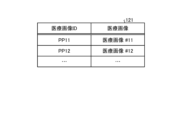
医療画像記憶部121は、医療画像に関する情報を記憶する。ここで、図11に、実施形態に係る医療画像記憶部121の一例を示す。図11に示すように、医療画像記憶部121は、「医療画像ID」、「医療画像」といった項目を有する。The medical
「医療画像ID」は、医療画像を識別するための識別情報を示す。「医療画像」は、被写体を撮像した医療画像を示す。例えば、「医療画像」は、撮像装置10により撮像された医療画像を示す。図11に示す例では、「医療画像」に「医療画像#11」や「医療画像#12」といった概念的な情報が格納される例を示したが、実際には、静止画像や動画像などが格納される。また、静止画像や動画像は画像処理装置とは異なるサーバーやクラウドに保存し、「医療画像」には、医療画像のコンテンツが所在するURL(Uniform Resource Locator)、または、これらの格納場所を示すファイルパス名などが格納されてもよい。
"Medical image ID" indicates identification information for identifying a medical image. "Medical image" indicates a medical image of a subject. For example, "medical image" indicates a medical image captured by imaging
強調フィルタ記憶部122は、医療画像に適用するための強調フィルタに関する情報を記憶する。ここで、図12に、実施形態に係る強調フィルタ記憶部122の一例を示す。図12に示すように、強調フィルタ記憶部122は、「強調フィルタID」、「強調フィルタ」といった項目を有する。The emphasis
「強調フィルタID」は、強調フィルタを識別するための識別情報を示す。「強調フィルタ」は、強調フィルタに関する情報を示す。図12に示す例では、「強調フィルタ」に「強調フィルタ#11」や「強調フィルタ#12」といった概念的な情報が格納される例を示したが、実際には、強調フィルタの強度や種類、強調フィルタが適用される画素の範囲などが格納される。 "Emphasis filter ID" indicates identification information for identifying an emphasis filter. "Emphasis filter" indicates information related to the emphasis filter. In the example shown in Figure 12, conceptual information such as "Emphasis filter #11" and "Emphasis filter #12" is stored in "Emphasis filter", but in reality, the strength and type of the emphasis filter, the range of pixels to which the emphasis filter is applied, etc. are stored.
(制御部130)
制御部130は、コントローラであり、例えば、CPUやMPU等によって、画像処理装置100内部の記憶装置に記憶されている各種プログラムがRAMを作業領域として実行されることにより実現される。また、制御部130は、コントローラであり、例えば、ASICやFPGA等の集積回路により実現される。
(Control unit 130)
The
図10に示すように、制御部130は、取得部131と、算出部132と、決定部133とを有し、以下に説明する情報処理の作用を実現または実行する。なお、制御部130の内部構成は、図10に示した構成に限られず、後述する情報処理を行う構成であれば他の構成であってもよい。As shown in Fig. 10, the
(取得部131)
取得部131は、各種情報を取得する。取得部131は、外部の情報処理装置から各種情報を取得する。取得部131は、撮像装置10等の他の情報処理装置から各種情報を取得する。
(Acquisition unit 131)
The acquisition unit 131 acquires various types of information. The acquisition unit 131 acquires various types of information from an external information processing device. The acquisition unit 131 acquires various types of information from another information processing device such as the
取得部131は、記憶部120から各種情報を取得する。取得部131は、医療画像記憶部121や強調フィルタ記憶部122から各種情報を取得する。The acquisition unit 131 acquires various information from the
取得部131は、取得した各種情報を記憶部120に格納する。取得部131は、医療画像記憶部121や強調フィルタ記憶部122に各種情報を格納する。The acquisition unit 131 stores the acquired various information in the
取得部131は、他の機能構成により算出、決定された各種情報を取得する。 The acquisition unit 131 acquires various information calculated and determined by other functional configurations.
取得部131は、被写体の医療画像を取得する。例えば、取得部131は、撮像装置10により撮像された被写体の医療画像を取得する。例えば、取得部131は、医療分野における生体、生物、材料、又は病理に関する被写体の医療画像を取得する。例えば、取得部131は、顕微鏡により撮像された医療画像を取得する。The acquisition unit 131 acquires a medical image of a subject. For example, the acquisition unit 131 acquires a medical image of a subject captured by the
(算出部132)
算出部132は、各種情報を算出する。算出部132は、記憶部120から各種情報を算出する。算出部132は、医療画像記憶部121や強調フィルタ記憶部122から各種情報を算出する。
(Calculation Unit 132)
The
算出部132は、算出した各種情報を記憶部120に格納する。算出部132は、医療画像記憶部121や強調フィルタ記憶部122に各種情報を格納する。The
算出部132は、他の機能構成により取得、決定された各種情報を算出する。算出部132は、他の機能構成により取得、決定された各種情報に基づいて、各種情報を算出する。The
算出部132は、取得された画像情報を用いて隣接差分2乗和を算出する。算出部132は、所定の画素を中心として決定されたタップの範囲で隣接差分2乗和を算出する。例えば、算出部132は、医療画像中の所定の画素と隣接する画素との差分を合計して得られる特徴量に基づいて隣接差分2乗和を算出する。The
算出部132は、算出された隣接差分2乗和からローレンツ関数を算出する。算出部132は、算出された隣接差分2乗和からローレンツ関数の近似値を算出する。算出部132は、算出された隣接差分2乗和をローレンツ関数に近似する。The
算出部132は、算出されたローレンツ関数からローレンツ関数の逆数を算出する。算出部132は、ローレンツ関数の逆数から合焦位置を推定する。算出部132は、ローレンツ関数の逆数の頂点を合焦位置として推定する。The
算出部132は、合焦度合いを算出する。算出部132は、推定された合焦位置を用いて合焦度合いを算出する。算出部132は、推定された合焦位置からの距離に応じて合焦度合いを算出する。算出部132は、算出されたローレンツ関数の逆数に対応するZ値と、推定された合焦位置との距離に応じて合焦度合いを算出する。The
(決定部133)
決定部133は、各種情報を決定する。決定部133は、記憶部120から各種情報を決定する。決定部133は、医療画像記憶部121や強調フィルタ記憶部122から各種情報を決定する。
(Determination unit 133)
The determination unit 133 determines various pieces of information. The determination unit 133 determines various pieces of information from the
決定部133は、決定した各種情報を記憶部120に格納する。決定部133は、医療画像記憶部121や強調フィルタ記憶部122に各種情報を格納する。The determination unit 133 stores the determined various information in the
決定部133は、他の機能構成により取得、算出された各種情報を決定する。決定部133は、他の機能構成により取得、算出された各種情報に基づいて、各種情報を決定する。The determination unit 133 determines various pieces of information acquired and calculated by other functional configurations. The determination unit 133 determines various pieces of information based on various pieces of information acquired and calculated by other functional configurations.
決定部133は、フィルタを適用する画素を選択する。決定部133は、フィルタを適用する最初の画素を選択する。例えば、決定部133は、所定の画素に対してフィルタが適用された適用後の次の画素を選択する。例えば、決定部133は、フィルタを適用する画素を所定のアルゴリズムに基づいて選択する。The determination unit 133 selects a pixel to which the filter is applied. The determination unit 133 selects the first pixel to which the filter is applied. For example, the determination unit 133 selects the next pixel after the filter is applied to a specified pixel. For example, the determination unit 133 selects the pixel to which the filter is applied based on a specified algorithm.
決定部133は、算出された合焦度合いに応じて、医療画像に適用するフィルタの強度を決定する。決定部133は、算出された合焦度合いに応じて、強度が異なる複数のフィルタに応じた医療画像の合成の割合を示す合成率を決定する。決定部133は、算出された合焦度合いに応じて、医療画像に適用する複数のフィルタを選択的に決定する。The determination unit 133 determines the strength of the filter to be applied to the medical image according to the calculated degree of focus. The determination unit 133 determines a synthesis rate indicating the ratio of synthesis of the medical image according to multiple filters with different strengths according to the calculated degree of focus. The determination unit 133 selectively determines multiple filters to be applied to the medical image according to the calculated degree of focus.
決定部133は、算出された合焦度合いに応じて、医療画像に適用するフィルタの種類を決定する。決定部133は、算出された合焦度合いに応じて、種類が異なる複数のフィルタに応じた医療画像の合成の割合を示す合成率を決定する。The determination unit 133 determines the type of filter to be applied to the medical image according to the calculated degree of focus. The determination unit 133 determines a synthesis rate indicating the ratio of synthesis of the medical image according to multiple filters of different types according to the calculated degree of focus.
決定部133は、決定した強度のフィルタを医療画像に適用する。決定部133は、決定した種類のフィルタを医療画像に適用する。The determination unit 133 applies a filter of the determined strength to the medical image. The determination unit 133 applies a filter of the determined type to the medical image.
決定部133は、算出された合焦度合いに応じて、Z値が異なる複数の医療画像に対して決定された強度のフィルタをそれぞれの医療画像に適用する。そして、決定部133は、算出された合焦度合いに応じてフィルタが適用されたそれぞれの医療画像の合成の割合を示す合成率を決定する。そして、決定部133は、算出された合焦度合いに応じて決定された合成率に基づいて、それぞれの医療画像を合成する。The determination unit 133 applies a filter of a determined strength to each of a plurality of medical images having different Z values according to the calculated degree of focus. The determination unit 133 then determines a synthesis rate indicating the ratio of synthesis of each of the medical images to which the filter has been applied according to the calculated degree of focus. The determination unit 133 then synthesizes each of the medical images based on the synthesis rate determined according to the calculated degree of focus.
決定部133は、全画素に対してフィルタを適用したかを判定する。決定部133は、医療画像中の全画素に対してフィルタ処理を行ったかを判定する。決定部133は、医療画像中の所定の範囲に含まれる全画素に対してフィルタ処理を行ったかを判定する。The determination unit 133 determines whether a filter has been applied to all pixels. The determination unit 133 determines whether filter processing has been performed on all pixels in the medical image. The determination unit 133 determines whether filter processing has been performed on all pixels included in a specified range in the medical image.
〔7.情報処理のフロー〕
次に、図13を用いて、実施形態に係る画像処理システム1による情報処理の手順について説明する。図13は、実施形態に係る画像処理システム1による情報処理の手順を示すフローチャートである。
[7. Information processing flow]
Next, the procedure of information processing by the
図13に示すように、画像処理装置100は、医療画像を取得する(ステップS101)。画像処理装置100は、フィルタ処理を行うための所定の画素を選択する(ステップS102)。画像処理装置100は、ボケ関数を用いて合焦度合いを推定する(ステップS103)。画像処理装置100は、推定された合焦度合いからフィルタの種類と強度とを決定する(ステップS104)。画像処理装置100は、決定された種類と強度のフィルタを適用する(ステップS105)。画像処理装置100は、全画素に対してフィルタ処理を行ったかを判定する(ステップS106)。画像処理装置100は、全画素に対してフィルタ処理を行っていないと判定した場合(ステップS106;No)、ステップS102の処理に戻る。例えば、画像処理装置100は、ステップS102の処理に戻り、先に選択された画素以外の画素を選択する。一方、画像処理装置100は、全画素に対してフィルタ処理を行ったと判定した場合(ステップS106;Yes)、情報処理を終了する。
As shown in FIG. 13, the
〔8.変形例〕
上述した実施形態に係る画像処理システム1は、上記実施形態以外にも種々の異なる形態にて実施されてよい。そこで、以下では、画像処理システム1の他の実施形態について説明する。
8. Modifications
The
上記実施形態では、Z値が異なる複数の医療画像に対して最適なフィルタを画素ごとに適用する処理を説明した。ここで、図14及び15を用いて、Z値が異なる複数の医療画像に対して最適なフィルタを画素ごとに適用する処理と同等の効果が得られる処理を説明する。In the above embodiment, a process for applying an optimal filter to each pixel of multiple medical images with different Z values has been described. Here, a process for obtaining the same effect as the process for applying an optimal filter to each pixel of multiple medical images with different Z values will be described with reference to Figures 14 and 15.
図14は、画像処理装置100が、取得した医療画像に対して1枚の強調フィルタを適用する場合を示す。図14では、画像KG1がフィルタ適用前の画像を示し、画像KG2がフィルタ適用後の画像を示す。この場合、注目したい対象以外の対象も含めて、画像全体のコントラストや解像感が向上した画像が生成される。
Figure 14 shows a case where the
ここで、画像処理装置100は、取得した医療画像に対して複数の強調フィルタを適用してもよい。画像処理装置100は、合焦度合いに応じて強度が異なる複数のフィルタを適用した合成画像を生成してもよい。Here, the
図15は、画像処理装置100が、取得した医療画像に対して複数の強調フィルタを適用した画像を合成する場合を示す。図15では、画像KG11が第一のフィルタを適用した画像を示し、画像KG22が第一のフィルタとは強度が異なる第二のフィルタを適用した画像を示す。図15に示すように、画像KG11の方が画像KG22よりもボケを有する画像である。また、画像KG33が、画像KG11と画像KG22とを合成した合成画像を示す。図15では、対象SJ11が画像の注目領域を示す第一の領域であり、対象SJ22が注目領域ではない第二の領域を示す。例えば、対象SJ22は、医療画像中のノイズの部分である。
Figure 15 shows a case where the
画像処理装置100は、医療画像の合成の割合を示す合成率を決定してもよい。例えば、画像処理装置100は、第一の領域と、第二の領域とで、合成率を決定してもよい。図15では、画像処理装置100は、対象SJ11の領域に対して、画像KG11と画像KG22とを1対9の合成率で合成する。なお、対象SJ11の領域に対する合成率の割合は、画像KG22の方が画像KG11よりも高い割合であれば、どのような割合であってもよい。また、図15では、画像処理装置100は、対象SJ22の領域に対して、画像KG11と画像KG22とを9対1の合成率で合成する。なお、対象SJ22の領域に対する合成率の割合は、画像KG11の方が画像KG22よりも高い割合であれば、どのような割合であってもよい。The
なお、図15では、強調フィルタを適用した2枚の画像を合成する場合を示したが、画像処理装置100が合成する画像の枚数に制限はないものとする。また、画像処理装置100は、合成する枚数を選択的に決定してもよいし、合成する画像を選択的に決定してもよい。例えば、画像処理装置100は、第一のフィルタを適用した画像では判別できない領域がある場合、他のフィルタを適用した複数の画像と第一のフィルタを適用した画像とを選択的に合成させることによって、第一のフィルタのみを適用した画像よりも視認性や識別性が向上した画像を生成する。
Note that while FIG. 15 shows a case where two images to which an emphasis filter has been applied are combined, there is no limit to the number of images that the
これにより、画像処理装置100は、強度の異なる強調フィルタの処理画像を合成することで、ローカルコントラストの調整を行うことができる。これにより、画像処理装置100は、適応的に最適なフィルタを適用することによりグローバル及びローカルなコントラストが調整されて、光学顕微鏡の様に視認性を向上できる。
This allows the
図15では、一枚の画像に異なる複数のフィルタを適用した画像を合成する例を示した。このように、画像処理装置100は、一枚の画像に異なる複数のフィルタを適用した画像を合成することで、合成画像を生成してもよい。また、上記実施形態のように、画像処理装置100は、Z値が異なる複数の医療画像に対して、それぞれの合焦度合いに応じて最適なフィルタが適用された画像を、合焦度合いに応じて合成することで、合成画像を生成してもよい。
Figure 15 shows an example of synthesizing images to which different filters have been applied to a single image. In this way, the
〔9.ハードウェア構成〕
また、上述してきた実施形態に係る撮像装置10および画像処理装置100は、例えば、図16に示すような構成のコンピュータ1000によって実現される。図16は、撮像装置10および画像処理装置100の機能を実現するコンピュータの一例を示すハードウェア構成図である。コンピュータ1000は、CPU1100、RAM1200、ROM1300、HDD1400、通信インターフェイス(I/F)1500、入出力インターフェイス(I/F)1600、及びメディアインターフェイス(I/F)1700を有する。
9. Hardware Configuration
Moreover, the
CPU1100は、ROM1300またはHDD1400に格納されたプログラムに基づいて動作し、各部の制御を行う。ROM1300は、コンピュータ1000の起動時にCPU1100によって実行されるブートプログラムや、コンピュータ1000のハードウェアに依存するプログラム等を格納する。The CPU 1100 operates based on a program stored in the
HDD1400は、CPU1100によって実行されるプログラム、及び、かかるプログラムによって使用されるデータ等を格納する。通信インターフェイス1500は、所定の通信網を介して他の機器からデータを受信してCPU1100へ送り、CPU1100が生成したデータを所定の通信網を介して他の機器へ送信する。
CPU1100は、入出力インターフェイス1600を介して、ディスプレイやプリンタ等の出力装置、及び、キーボードやマウス等の入力装置を制御する。CPU1100は、入出力インターフェイス1600を介して、入力装置からデータを取得する。また、CPU1100は、生成したデータを入出力インターフェイス1600を介して出力装置へ出力する。 The CPU 1100 controls output devices such as a display and a printer, and input devices such as a keyboard and a mouse, via the input/output interface 1600. The CPU 1100 acquires data from the input devices via the input/output interface 1600. The CPU 1100 also outputs the generated data to the output devices via the input/output interface 1600.
メディアインターフェイス1700は、記録媒体1800に格納されたプログラムまたはデータを読み取り、RAM1200を介してCPU1100に提供する。CPU1100は、かかるプログラムを、メディアインターフェイス1700を介して記録媒体1800からRAM1200上にロードし、ロードしたプログラムを実行する。記録媒体1800は、例えばDVD(Digital Versatile Disc)、PD(Phase change rewritable Disk)等の光学記録媒体、MO(Magneto-Optical disk)等の光磁気記録媒体、テープ媒体、磁気記録媒体、または半導体メモリ等である。The
例えば、コンピュータ1000が実施形態に係る撮像装置10および画像処理装置100として機能する場合、コンピュータ1000のCPU1100は、RAM1200上にロードされたプログラムを実行することにより、制御部13および130の機能を実現する。コンピュータ1000のCPU1100は、これらのプログラムを記録媒体1800から読み取って実行するが、他の例として、他の装置から所定の通信網を介してこれらのプログラムを取得してもよい。For example, when the
〔10.その他〕
また、上記実施形態および変形例において説明した各処理のうち、自動的に行われるものとして説明した処理の全部または一部を手動的に行うこともでき、あるいは、手動的に行われるものとして説明した処理の全部または一部を公知の方法で自動的に行うこともできる。この他、上記文書中や図面中で示した処理手順、具体的名称、各種のデータやパラメータを含む情報については、特記する場合を除いて任意に変更することができる。例えば、各図に示した各種情報は、図示した情報に限られない。
10. Other
In addition, among the processes described in the above embodiments and modifications, all or part of the processes described as being performed automatically can be performed manually, or all or part of the processes described as being performed manually can be performed automatically by a known method. In addition, the information including the processing procedures, specific names, various data and parameters shown in the above documents and drawings can be changed arbitrarily unless otherwise specified. For example, the various information shown in each drawing is not limited to the illustrated information.
また、図示した各装置の各構成要素は機能概念的なものであり、必ずしも物理的に図示の如く構成されていることを要しない。すなわち、各装置の分散・統合の具体的形態は図示のものに限られず、その全部または一部を、各種の負荷や使用状況などに応じて、任意の単位で機能的または物理的に分散・統合して構成することができる。 In addition, each component of each device shown in the figure is a functional concept, and does not necessarily have to be physically configured as shown in the figure. In other words, the specific form of distribution and integration of each device is not limited to that shown in the figure, and all or part of it can be functionally or physically distributed and integrated in any unit depending on various loads, usage conditions, etc.
また、上述してきた実施形態および変形例は、処理内容を矛盾させない範囲で適宜組み合わせることが可能である。 In addition, the above-described embodiments and variations can be combined as appropriate to the extent that they do not cause any contradiction in the processing content.
以上、本願の実施形態のいくつかを図面に基づいて詳細に説明したが、これらは例示であり、発明の開示の欄に記載の態様を始めとして、当業者の知識に基づいて種々の変形、改良を施した他の形態で本発明を実施することが可能である。Although some of the embodiments of the present application have been described in detail above with reference to the drawings, these are merely examples, and it is possible to implement the present invention in other forms with various modifications and improvements based on the knowledge of those skilled in the art, including the aspects described in the Disclosure of the Invention section.
また、上述してきた「部(section、module、unit)」は、「手段」や「回路」などに読み替えることができる。例えば、取得部は、取得手段や取得回路に読み替えることができる。 In addition, the above-mentioned "section, module, unit" can be read as "means" or "circuit." For example, an acquisition unit can be read as an acquisition means or an acquisition circuit.
なお、本技術は以下のような構成も取ることができる。
(1)
コンピュータが
撮像装置により撮像された医療画像を取得し、
前記医療画像の合焦度合いに応じて、前記医療画像に適用するフィルタの強度を決定する
画像処理方法。
(2)
前記医療画像のボケ度合を示すボケ関数により算出された前記合焦度合いに応じて、前記医療画像に適用するフィルタの強度を決定する
(1)に記載の画像処理方法。
(3)
前記医療画像に対して垂直方向であって前記被写体の厚みの方向に応じた前記ボケ関数により算出された前記合焦度合いに応じて、前記医療画像に適用するフィルタの強度を決定する
(1)または(2)に記載の画像処理方法。
(4)
前記医療画像中の所定の画素と周辺画素との差分を合計して得られた特徴量により算出される前記合焦度合いに応じて、前記医療画像に適用するフィルタの強度を決定する
(1)~(3)のいずれか1項に記載の画像処理方法。
(5)
前記ボケ関数に基づいて推定された推定合焦度合いと、前記医療画像中の所定の画素と周辺画素との差分を合計して得られた特徴量により算出される前記合焦度合いに基づいて、前記医療画像に適用するフィルタの強度を決定する
(1)~(4)のいずれか1項に記載の画像処理方法。
(6)
前記被写体の合焦度合いに応じて、前記医療画像に異なる複数のフィルタを適用することで生成される合成画像の合成の割合を示す合成率を決定する
(1)~(5)のいずれか1項に記載の画像処理方法。
(7)
所定の前記医療画像に前記強度が異なる複数のフィルタを適用することで生成される前記合成画像の前記合成率を決定する
(1)~(6)のいずれか1項に記載の画像処理方法。
(8)
Z値が異なる複数の前記医療画像に対して、前記被写体の合焦度合いに応じたフィルタを適用することで生成される前記合成画像の前記合成率を決定する
(1)~(7)のいずれか1項に記載の画像処理方法。
(9)
前記被写体の合焦度合いに応じて、前記合成画像を生成するための、前記医療画像に適用する前記複数のフィルタを選択的に決定する
(1)~(8)のいずれか1項に記載の画像処理方法。
(10)
前記被写体の合焦度合いに応じて、前記フィルタが強調する領域の種類として、高域強調、中域強調、低域強調、または、負の強調フィルタすなわち平滑フィルタを決定する
(1)~(9)のいずれか1項に記載の画像処理方法。
(11)
医療分野における生体、生物、材料、又は病理に関する被写体の前記医療画像を取得する
(1)~(10)のいずれか1項に記載の画像処理方法。
(12)
前記撮像装置として、顕微鏡により撮像された前記医療画像を取得する
(1)~(11)のいずれか1項に記載の画像処理方法。
(13)
顕微鏡により撮像された被写体の医療画像を取得する取得部と、
前記被写体の合焦度合いに応じて、前記医療画像に適用するフィルタであって、当該医療画像の画質を向上させるフィルタの強度を決定する決定部と、
を備える画像処理装置。
(14)
被写体を撮像する撮像装置と、
前記撮像装置により撮像される対象物に対応する医療画像の処理に使われるソフトウェアとを含んで構成される画像処理システムであって、
前記ソフトウェアは、前記被写体の合焦度合いに応じて、前記撮像装置により撮像された医療画像に適用するフィルタの強度を決定する画像処理装置と、
を含む画像処理システム。
The present technology can also be configured as follows.
(1)
A computer acquires a medical image captured by an imaging device,
An image processing method comprising: determining a strength of a filter to be applied to the medical image in accordance with a degree of focus of the medical image.
(2)
The image processing method according to (1), further comprising determining a strength of a filter to be applied to the medical image according to the degree of focus calculated using a blur function indicating a degree of blur of the medical image.
(3)
The image processing method according to
(4)
The image processing method according to any one of (1) to (3), further comprising determining a strength of a filter to be applied to the medical image according to the degree of focus calculated from a feature obtained by summing up the difference between a specified pixel in the medical image and surrounding pixels.
(5)
The image processing method according to any one of (1) to (4), further comprising determining a strength of a filter to be applied to the medical image based on an estimated degree of focus estimated based on the blur function and a degree of focus calculated from a feature obtained by summing up the difference between a specified pixel and surrounding pixels in the medical image.
(6)
The image processing method according to any one of (1) to (5), further comprising determining a synthesis rate indicating a synthesis ratio of a synthetic image generated by applying a plurality of different filters to the medical image depending on a degree of focus of the subject.
(7)
The image processing method according to any one of (1) to (6), further comprising determining the synthesis rate of the synthetic image generated by applying a plurality of filters having different strengths to a predetermined medical image.
(8)
The image processing method according to any one of (1) to (7), further comprising determining the synthesis rate of the synthetic image generated by applying a filter according to the degree of focus of the subject to a plurality of the medical images having different Z values.
(9)
The image processing method according to any one of (1) to (8), further comprising selectively determining the plurality of filters to be applied to the medical image in order to generate the composite image, depending on a degree of focus of the subject.
(10)
The image processing method according to any one of (1) to (9), further comprising determining, depending on a degree of focus of the subject, whether the type of region to be emphasized by the filter is high-frequency emphasis, mid-frequency emphasis, low-frequency emphasis, or a negative emphasis filter, i.e., a smoothing filter.
(11)
The image processing method according to any one of (1) to (10), further comprising acquiring the medical image of a subject relating to a living body, a living organism, a material, or a pathology in the medical field.
(12)
The image processing method according to any one of (1) to (11), wherein the medical image is acquired by using a microscope as the imaging device.
(13)
an acquisition unit for acquiring a medical image of a subject captured by a microscope;
a determination unit that determines a strength of a filter to be applied to the medical image in accordance with a degree of focus of the subject, the filter improving image quality of the medical image;
An image processing device comprising:
(14)
An imaging device that captures an image of a subject;
and software used to process medical images corresponding to the object imaged by the imaging device,
the software includes an image processing device that determines a filter strength to be applied to a medical image captured by the imaging device in accordance with a degree of focus of the subject;
An image processing system comprising:
1 画像処理システム
10 撮像装置
100 画像処理装置
110 通信部
120 記憶部
121 医療画像記憶部
122 強調フィルタ記憶部
130 制御部
131 取得部
132 算出部
133 決定部
N ネットワーク
REFERENCE SIGNS
Claims (6)
撮像装置により撮像された被写体の医療画像を取得し、
前記医療画像に対して第1フィルタを適用した第1画像が、前記医療画像に対して当該第1フィルタとは強度が異なる第2フィルタを適用した第2画像より低い割合となるように、注目領域に対する合成率を決定し、
前記第1画像が前記第2画像よりも高い割合となるように、前記注目領域でないノイズ領域に対する合成率を決定する
画像処理方法。 A computer acquires a medical image of a subject captured by an imaging device,
determining a synthesis rate for the region of interest such that a first image obtained by applying a first filter to the medical image has a lower ratio than a second image obtained by applying a second filter to the medical image, the second filter having a different strength from the first filter;
determining a synthesis rate for a noise region other than the region of interest such that the first image has a higher ratio than the second image .
ことを特徴とする請求項1に記載の画像処理方法。2. The image processing method according to claim 1.
ことを特徴とする請求項1に記載の画像処理方法。 The image processing method according to claim 1 , further comprising acquiring the medical image of a subject relating to a living body, a living organism, a material, or a pathology in the medical field.
ことを特徴とする請求項1に記載の画像処理方法。 The image processing method according to claim 1 , wherein the medical image is acquired by capturing an image using a microscope as the imaging device.
前記医療画像に対して第1フィルタを適用した第1画像が、前記医療画像に対して当該第1フィルタとは強度が異なる第2フィルタを適用した第2画像より低い割合となるように、注目領域に対する合成率を決定し、
前記第1画像が前記第2画像よりも高い割合となるように、前記注目領域でないノイズ領域に対する合成率を決定する決定部と、
を備える画像処理装置。 an acquisition unit for acquiring a medical image of a subject captured by a microscope;
determining a synthesis rate for the region of interest such that a first image obtained by applying a first filter to the medical image has a lower ratio than a second image obtained by applying a second filter to the medical image, the second filter having a different strength from the first filter;
a determination unit that determines a synthesis rate for a noise region other than the attention region such that the first image has a higher ratio than the second image ;
An image processing device comprising:
被写体を撮像する前記撮像装置と、
前記ソフトウェアにより、前記医療画像に対して第1フィルタを適用した第1画像が、前記医療画像に対して当該第1フィルタとは強度が異なる第2フィルタを適用した第2画像より低い割合となるように、注目領域に対する合成率を決定し、
前記第1画像が前記第2画像よりも高い割合となるように、前記注目領域でないノイズ領域に対する合成率を決定する画像処理装置と、
を含む画像処理システム。
An image processing system including software used to process medical images corresponding to a subject captured by an imaging device,
The imaging device for imaging a subject;
The software determines a synthesis rate for the region of interest such that a first image obtained by applying a first filter to the medical image has a lower ratio than a second image obtained by applying a second filter to the medical image, the second filter having a different strength from the first filter;
an image processing device that determines a synthesis rate for a noise region other than the attention region such that the first image has a higher ratio than the second image ;
An image processing system comprising:
Applications Claiming Priority (3)
| Application Number | Priority Date | Filing Date | Title |
|---|---|---|---|
| JP2019211390 | 2019-11-22 | ||
| JP2019211390 | 2019-11-22 | ||
| PCT/JP2020/037068 WO2021100328A1 (en) | 2019-11-22 | 2020-09-30 | Image processing method, image processing device, and image processing system |
Publications (2)
| Publication Number | Publication Date |
|---|---|
| JPWO2021100328A1 JPWO2021100328A1 (en) | 2021-05-27 |
| JP7643340B2 true JP7643340B2 (en) | 2025-03-11 |
Family
ID=75980520
Family Applications (1)
| Application Number | Title | Priority Date | Filing Date |
|---|---|---|---|
| JP2021558198A Active JP7643340B2 (en) | 2019-11-22 | 2020-09-30 | IMAGE PROCESSING METHOD, IMAGE PROCESSING APPARATUS, AND IMAGE PROCESSING SYSTEM |
Country Status (5)
| Country | Link |
|---|---|
| US (1) | US20220392031A1 (en) |
| EP (1) | EP4047408A4 (en) |
| JP (1) | JP7643340B2 (en) |
| CN (1) | CN114730070B (en) |
| WO (1) | WO2021100328A1 (en) |
Families Citing this family (1)
| Publication number | Priority date | Publication date | Assignee | Title |
|---|---|---|---|---|
| JP7280107B2 (en) * | 2019-05-10 | 2023-05-23 | 株式会社エビデント | Image processing method, program, image processing device, image processing system, and microscope system |
Citations (4)
| Publication number | Priority date | Publication date | Assignee | Title |
|---|---|---|---|---|
| JP2011090221A (en) | 2009-10-23 | 2011-05-06 | Sony Corp | Microscope, focusing position detecting method, and focusing position detecting program |
| JP2017158764A (en) | 2016-03-09 | 2017-09-14 | ソニー株式会社 | Image processing apparatus, image processing method, and recording medium |
| JP2019114250A (en) | 2017-12-21 | 2019-07-11 | 株式会社ニコン | Image processing device, image processing program, image processing method, and imaging device |
| JP2019149719A (en) | 2018-02-27 | 2019-09-05 | キヤノン株式会社 | Image processing apparatus and method, and imaging apparatus |
Family Cites Families (15)
| Publication number | Priority date | Publication date | Assignee | Title |
|---|---|---|---|---|
| JPS5994712A (en) * | 1982-11-22 | 1984-05-31 | Olympus Optical Co Ltd | Focusing detecting method |
| JPH10243289A (en) * | 1997-02-27 | 1998-09-11 | Olympus Optical Co Ltd | Image adder |
| JP2011197283A (en) | 2010-03-18 | 2011-10-06 | Sony Corp | Focusing device, focusing method, focusing program, and microscope |
| JP5657375B2 (en) * | 2010-12-24 | 2015-01-21 | オリンパス株式会社 | Endoscope apparatus and program |
| JP5705096B2 (en) * | 2011-12-02 | 2015-04-22 | キヤノン株式会社 | Image processing apparatus and image processing method |
| US9942534B2 (en) * | 2011-12-20 | 2018-04-10 | Olympus Corporation | Image processing system and microscope system including the same |
| US8994809B2 (en) * | 2012-07-19 | 2015-03-31 | Sony Corporation | Method and apparatus for simulating depth of field (DOF) in microscopy |
| US8928772B2 (en) * | 2012-09-21 | 2015-01-06 | Eastman Kodak Company | Controlling the sharpness of a digital image |
| JP2014071207A (en) * | 2012-09-28 | 2014-04-21 | Canon Inc | Image processing apparatus, imaging system, and image processing system |
| US9897792B2 (en) * | 2012-11-30 | 2018-02-20 | L&T Technology Services Limited | Method and system for extended depth of field calculation for microscopic images |
| EP2975444B1 (en) * | 2013-03-13 | 2023-04-26 | Sony Group Corporation | Information processing device, information processing method, and information processing program |
| WO2017042812A2 (en) * | 2015-09-10 | 2017-03-16 | Magentiq Eye Ltd. | A system and method for detection of suspicious tissue regions in an endoscopic procedure |
| US10419698B2 (en) * | 2015-11-12 | 2019-09-17 | Canon Kabushiki Kaisha | Image processing apparatus and image processing method |
| WO2017144482A1 (en) * | 2016-02-22 | 2017-08-31 | Koninklijke Philips N.V. | System for generating a synthetic 2d image with an enhanced depth of field of a biological sample |
| US10466332B2 (en) * | 2017-02-21 | 2019-11-05 | General Electric Company | Systems and methods for an interleaved RF coil acquisition scheme |
-
2020
- 2020-09-30 JP JP2021558198A patent/JP7643340B2/en active Active
- 2020-09-30 CN CN202080079048.XA patent/CN114730070B/en active Active
- 2020-09-30 EP EP20890703.0A patent/EP4047408A4/en active Pending
- 2020-09-30 WO PCT/JP2020/037068 patent/WO2021100328A1/en not_active Ceased
- 2020-09-30 US US17/776,985 patent/US20220392031A1/en not_active Abandoned
Patent Citations (4)
| Publication number | Priority date | Publication date | Assignee | Title |
|---|---|---|---|---|
| JP2011090221A (en) | 2009-10-23 | 2011-05-06 | Sony Corp | Microscope, focusing position detecting method, and focusing position detecting program |
| JP2017158764A (en) | 2016-03-09 | 2017-09-14 | ソニー株式会社 | Image processing apparatus, image processing method, and recording medium |
| JP2019114250A (en) | 2017-12-21 | 2019-07-11 | 株式会社ニコン | Image processing device, image processing program, image processing method, and imaging device |
| JP2019149719A (en) | 2018-02-27 | 2019-09-05 | キヤノン株式会社 | Image processing apparatus and method, and imaging apparatus |
Also Published As
| Publication number | Publication date |
|---|---|
| JPWO2021100328A1 (en) | 2021-05-27 |
| WO2021100328A1 (en) | 2021-05-27 |
| EP4047408A4 (en) | 2022-12-28 |
| CN114730070B (en) | 2024-11-05 |
| EP4047408A1 (en) | 2022-08-24 |
| CN114730070A (en) | 2022-07-08 |
| US20220392031A1 (en) | 2022-12-08 |
Similar Documents
| Publication | Publication Date | Title |
|---|---|---|
| US9881373B2 (en) | Image generating apparatus and image generating method | |
| US8265362B2 (en) | Pathological tissue image capturing system, method, and program | |
| US9332190B2 (en) | Image processing apparatus and image processing method | |
| JP7622203B2 (en) | COMPUTER IMPLEMENTED METHOD FOR QUALITY CONTROL OF DIGITAL IMAGES OF SAMPLES - Patent application | |
| US8044974B2 (en) | Image creating apparatus and image creating method | |
| US20150279033A1 (en) | Image data generating apparatus and image data generating method | |
| EP3830749B1 (en) | Enhanced extended depth of focusing on biological samples | |
| EP2992814A1 (en) | Ophthalmologic apparatus and ophthalmologic apparatus control method | |
| US20140169655A1 (en) | Method for automatically adjusting a focal plane of a digital pathology image | |
| JP2015108837A (en) | Image processing apparatus and image processing method | |
| JP6362062B2 (en) | Image generating apparatus and image generating method | |
| CN109001902B (en) | Microscope focusing method based on image fusion | |
| JP7687907B2 (en) | IMAGE PROCESSING APPARATUS, IMAGE PROCESSING SYSTEM, IMAGE SHARPENING METHOD, AND PROGRAM | |
| JP7643340B2 (en) | IMAGE PROCESSING METHOD, IMAGE PROCESSING APPARATUS, AND IMAGE PROCESSING SYSTEM | |
| JP5344073B2 (en) | Pathological tissue imaging system, pathological tissue imaging method, and pathological tissue imaging program | |
| JP2015057682A (en) | Image generating apparatus and image generating method | |
| US11050931B2 (en) | Control device and control method | |
| JP7722757B2 (en) | Image processing to improve the resolution of images taken of specimens | |
| KR100983548B1 (en) | A 3d shape reconstruction method considering point spread function of a microscope | |
| JP7030986B2 (en) | Image generator, image generator and image generator | |
| CN116263535A (en) | Method for determining z-stack boundaries of an image of an object | |
| CN103487928A (en) | Defocus amount estimation method, imaging apparatus, and transparent member | |
| Garud et al. | Volume visualization approach for depth-of-field extension in digital pathology | |
| Pronichev et al. | Cytology 3D structure formation based on optical microscopy images | |
| JP2025176397A (en) | All-in-focus image generating method, all-in-focus image generating device, and all-in-focus image generating program |
Legal Events
| Date | Code | Title | Description |
|---|---|---|---|
| A621 | Written request for application examination |
Free format text: JAPANESE INTERMEDIATE CODE: A621 Effective date: 20230818 |
|
| A131 | Notification of reasons for refusal |
Free format text: JAPANESE INTERMEDIATE CODE: A131 Effective date: 20240305 |
|
| A521 | Request for written amendment filed |
Free format text: JAPANESE INTERMEDIATE CODE: A523 Effective date: 20240402 |
|
| A131 | Notification of reasons for refusal |
Free format text: JAPANESE INTERMEDIATE CODE: A131 Effective date: 20240806 |
|
| A521 | Request for written amendment filed |
Free format text: JAPANESE INTERMEDIATE CODE: A523 Effective date: 20240820 |
|
| A131 | Notification of reasons for refusal |
Free format text: JAPANESE INTERMEDIATE CODE: A131 Effective date: 20241126 |
|
| A521 | Request for written amendment filed |
Free format text: JAPANESE INTERMEDIATE CODE: A523 Effective date: 20250115 |
|
| TRDD | Decision of grant or rejection written | ||
| A01 | Written decision to grant a patent or to grant a registration (utility model) |
Free format text: JAPANESE INTERMEDIATE CODE: A01 Effective date: 20250128 |
|
| A61 | First payment of annual fees (during grant procedure) |
Free format text: JAPANESE INTERMEDIATE CODE: A61 Effective date: 20250210 |
|
| R150 | Certificate of patent or registration of utility model |
Ref document number: 7643340 Country of ref document: JP Free format text: JAPANESE INTERMEDIATE CODE: R150 |