JP7638935B2 - Anti-CCR8 antibody - Google Patents
Anti-CCR8 antibody Download PDFInfo
- Publication number
- JP7638935B2 JP7638935B2 JP2022119632A JP2022119632A JP7638935B2 JP 7638935 B2 JP7638935 B2 JP 7638935B2 JP 2022119632 A JP2022119632 A JP 2022119632A JP 2022119632 A JP2022119632 A JP 2022119632A JP 7638935 B2 JP7638935 B2 JP 7638935B2
- Authority
- JP
- Japan
- Prior art keywords
- ccr8
- antibody
- antibodies
- seq
- human
- Prior art date
- Legal status (The legal status is an assumption and is not a legal conclusion. Google has not performed a legal analysis and makes no representation as to the accuracy of the status listed.)
- Active
Links
Images


Classifications
-
- C—CHEMISTRY; METALLURGY
- C07—ORGANIC CHEMISTRY
- C07K—PEPTIDES
- C07K16/00—Immunoglobulins [IGs], e.g. monoclonal or polyclonal antibodies
- C07K16/18—Immunoglobulins [IGs], e.g. monoclonal or polyclonal antibodies against material from animals or humans
- C07K16/28—Immunoglobulins [IGs], e.g. monoclonal or polyclonal antibodies against material from animals or humans against receptors, cell surface antigens or cell surface determinants
- C07K16/2866—Immunoglobulins [IGs], e.g. monoclonal or polyclonal antibodies against material from animals or humans against receptors, cell surface antigens or cell surface determinants against receptors for cytokines, lymphokines, interferons
-
- A—HUMAN NECESSITIES
- A61—MEDICAL OR VETERINARY SCIENCE; HYGIENE
- A61P—SPECIFIC THERAPEUTIC ACTIVITY OF CHEMICAL COMPOUNDS OR MEDICINAL PREPARATIONS
- A61P35/00—Antineoplastic agents
-
- C—CHEMISTRY; METALLURGY
- C07—ORGANIC CHEMISTRY
- C07K—PEPTIDES
- C07K16/00—Immunoglobulins [IGs], e.g. monoclonal or polyclonal antibodies
- C07K16/18—Immunoglobulins [IGs], e.g. monoclonal or polyclonal antibodies against material from animals or humans
- C07K16/28—Immunoglobulins [IGs], e.g. monoclonal or polyclonal antibodies against material from animals or humans against receptors, cell surface antigens or cell surface determinants
-
- C—CHEMISTRY; METALLURGY
- C12—BIOCHEMISTRY; BEER; SPIRITS; WINE; VINEGAR; MICROBIOLOGY; ENZYMOLOGY; MUTATION OR GENETIC ENGINEERING
- C12N—MICROORGANISMS OR ENZYMES; COMPOSITIONS THEREOF; PROPAGATING, PRESERVING, OR MAINTAINING MICROORGANISMS; MUTATION OR GENETIC ENGINEERING; CULTURE MEDIA
- C12N15/00—Mutation or genetic engineering; DNA or RNA concerning genetic engineering, vectors, e.g. plasmids, or their isolation, preparation or purification; Use of hosts therefor
- C12N15/09—Recombinant DNA-technology
- C12N15/63—Introduction of foreign genetic material using vectors; Vectors; Use of hosts therefor; Regulation of expression
- C12N15/79—Vectors or expression systems specially adapted for eukaryotic hosts
- C12N15/85—Vectors or expression systems specially adapted for eukaryotic hosts for animal cells
-
- A—HUMAN NECESSITIES
- A61—MEDICAL OR VETERINARY SCIENCE; HYGIENE
- A61K—PREPARATIONS FOR MEDICAL, DENTAL OR TOILETRY PURPOSES
- A61K39/00—Medicinal preparations containing antigens or antibodies
- A61K2039/505—Medicinal preparations containing antigens or antibodies comprising antibodies
-
- A—HUMAN NECESSITIES
- A61—MEDICAL OR VETERINARY SCIENCE; HYGIENE
- A61K—PREPARATIONS FOR MEDICAL, DENTAL OR TOILETRY PURPOSES
- A61K39/00—Medicinal preparations containing antigens or antibodies
- A61K2039/545—Medicinal preparations containing antigens or antibodies characterised by the dose, timing or administration schedule
-
- A—HUMAN NECESSITIES
- A61—MEDICAL OR VETERINARY SCIENCE; HYGIENE
- A61K—PREPARATIONS FOR MEDICAL, DENTAL OR TOILETRY PURPOSES
- A61K39/00—Medicinal preparations containing antigens or antibodies
- A61K2039/55—Medicinal preparations containing antigens or antibodies characterised by the host/recipient, e.g. newborn with maternal antibodies
-
- C—CHEMISTRY; METALLURGY
- C07—ORGANIC CHEMISTRY
- C07K—PEPTIDES
- C07K2317/00—Immunoglobulins specific features
- C07K2317/20—Immunoglobulins specific features characterized by taxonomic origin
- C07K2317/24—Immunoglobulins specific features characterized by taxonomic origin containing regions, domains or residues from different species, e.g. chimeric, humanized or veneered
-
- C—CHEMISTRY; METALLURGY
- C07—ORGANIC CHEMISTRY
- C07K—PEPTIDES
- C07K2317/00—Immunoglobulins specific features
- C07K2317/40—Immunoglobulins specific features characterized by post-translational modification
- C07K2317/41—Glycosylation, sialylation, or fucosylation
-
- C—CHEMISTRY; METALLURGY
- C07—ORGANIC CHEMISTRY
- C07K—PEPTIDES
- C07K2317/00—Immunoglobulins specific features
- C07K2317/50—Immunoglobulins specific features characterized by immunoglobulin fragments
- C07K2317/52—Constant or Fc region; Isotype
-
- C—CHEMISTRY; METALLURGY
- C07—ORGANIC CHEMISTRY
- C07K—PEPTIDES
- C07K2317/00—Immunoglobulins specific features
- C07K2317/50—Immunoglobulins specific features characterized by immunoglobulin fragments
- C07K2317/56—Immunoglobulins specific features characterized by immunoglobulin fragments variable (Fv) region, i.e. VH and/or VL
-
- C—CHEMISTRY; METALLURGY
- C07—ORGANIC CHEMISTRY
- C07K—PEPTIDES
- C07K2317/00—Immunoglobulins specific features
- C07K2317/50—Immunoglobulins specific features characterized by immunoglobulin fragments
- C07K2317/56—Immunoglobulins specific features characterized by immunoglobulin fragments variable (Fv) region, i.e. VH and/or VL
- C07K2317/565—Complementarity determining region [CDR]
-
- C—CHEMISTRY; METALLURGY
- C07—ORGANIC CHEMISTRY
- C07K—PEPTIDES
- C07K2317/00—Immunoglobulins specific features
- C07K2317/70—Immunoglobulins specific features characterized by effect upon binding to a cell or to an antigen
- C07K2317/73—Inducing cell death, e.g. apoptosis, necrosis or inhibition of cell proliferation
- C07K2317/732—Antibody-dependent cellular cytotoxicity [ADCC]
-
- C—CHEMISTRY; METALLURGY
- C07—ORGANIC CHEMISTRY
- C07K—PEPTIDES
- C07K2317/00—Immunoglobulins specific features
- C07K2317/70—Immunoglobulins specific features characterized by effect upon binding to a cell or to an antigen
- C07K2317/76—Antagonist effect on antigen, e.g. neutralization or inhibition of binding
-
- C—CHEMISTRY; METALLURGY
- C07—ORGANIC CHEMISTRY
- C07K—PEPTIDES
- C07K2317/00—Immunoglobulins specific features
- C07K2317/90—Immunoglobulins specific features characterized by (pharmaco)kinetic aspects or by stability of the immunoglobulin
- C07K2317/92—Affinity (KD), association rate (Ka), dissociation rate (Kd) or EC50 value
Landscapes
- Health & Medical Sciences (AREA)
- Chemical & Material Sciences (AREA)
- Organic Chemistry (AREA)
- Life Sciences & Earth Sciences (AREA)
- Immunology (AREA)
- Genetics & Genomics (AREA)
- General Health & Medical Sciences (AREA)
- Medicinal Chemistry (AREA)
- Biophysics (AREA)
- Molecular Biology (AREA)
- Biochemistry (AREA)
- Proteomics, Peptides & Aminoacids (AREA)
- Engineering & Computer Science (AREA)
- Animal Behavior & Ethology (AREA)
- Chemical Kinetics & Catalysis (AREA)
- Pharmacology & Pharmacy (AREA)
- General Chemical & Material Sciences (AREA)
- Public Health (AREA)
- Veterinary Medicine (AREA)
- Nuclear Medicine, Radiotherapy & Molecular Imaging (AREA)
- Biotechnology (AREA)
- Biomedical Technology (AREA)
- General Engineering & Computer Science (AREA)
- Bioinformatics & Cheminformatics (AREA)
- Wood Science & Technology (AREA)
- Zoology (AREA)
- Physics & Mathematics (AREA)
- Plant Pathology (AREA)
- Microbiology (AREA)
- Peptides Or Proteins (AREA)
- Medicines Containing Antibodies Or Antigens For Use As Internal Diagnostic Agents (AREA)
- Preparation Of Compounds By Using Micro-Organisms (AREA)
- Micro-Organisms Or Cultivation Processes Thereof (AREA)
Description
本出願は、SL-ANTI-CCR8ANTIBODIESと名付けられた、2022年7月25日に作成され、17キロバイトのサイズを有するxmlファイルとして電子的に提出された配列表を含む。配列表は、参照により本明細書に組み込む。 This application contains a sequence listing entitled SL-ANTI-CCR8ANTIBODIES, which was created on July 25, 2022 and was submitted electronically as an xml file having a size of 17 kilobytes. The sequence listing is hereby incorporated by reference.
本出願は、米国特許法第119条(e)の下、2021年7月27日に出願された米国特許仮出願第63/226,118号の利益を主張し、この開示は、その全体を参照により本明細書に組み込む。 This application claims the benefit under 35 U.S.C. § 119(e) of U.S. Provisional Patent Application No. 63/226,118, filed July 27, 2021, the disclosure of which is incorporated herein by reference in its entirety.
本出願は、とりわけ、新規の抗CCR8抗体並びにこれを作製及び使用する方法に関する。 This application relates, inter alia, to novel anti-CCR8 antibodies and methods of making and using same.
腫瘍において、制御性T細胞(Treg)は、抗腫瘍免疫応答を防ぐことで知られる鍵となる抑制性集団である。腫瘍内Tregの存在の増加は、いくつかのがんにおいて患者の転帰が不良となることに関連している(Shangら、Nature Sci.Reports、2015;Fridmanら、Nat Rev Clin Oncol.2017;Bruniら、Nat Rev Cancer.2020)。ケモカイン受容体8(CCR8)は、いくつかのヒトがんにおいて腫瘍内Tregによってユニークに発現する細胞表面タンパク質である(Plitasら、Immunity 2016;DeSimoneら、Immunity 2016)。このためCCR8は、抗体依存性細胞性細胞傷害(ADCC)を介して腫瘍内Tregの選択的枯渇を媒介し、抗腫瘍免疫を増強する魅力的な標的となる。 In tumors, regulatory T cells (Tregs) are a key suppressive population known to prevent antitumor immune responses. Increased presence of intratumoral Tregs is associated with poor patient outcomes in several cancers (Shang et al., Nature Sci. Reports, 2015; Fridman et al., Nat Rev Clin Oncol. 2017; Bruni et al., Nat Rev Cancer. 2020). Chemokine receptor 8 (CCR8) is a cell surface protein uniquely expressed by intratumoral Tregs in several human cancers (Plitas et al., Immunity 2016; DeSimone et al., Immunity 2016). This makes CCR8 an attractive target for mediating selective depletion of intratumoral Tregs via antibody-dependent cellular cytotoxicity (ADCC) and enhancing antitumor immunity.
Treg枯渇は長い間、研究されているが、このような治療のほとんどが、腫瘍浸潤エフェクターT細胞集団及び/又は腫瘍環境外部のTreg上で標的発現するために有効性が限られている。腫瘍微小環境における他の鍵となるエフェクターT細胞集団又は末梢Tregを枯渇させずに腫瘍内免疫抑制性Tregの死を引き起こす、モノクローナル抗体治療薬に対する当技術分野における必要性が残存している。 Treg depletion has long been studied, but most such therapies have limited efficacy due to targeting expression on tumor-infiltrating effector T cell populations and/or Tregs outside the tumor environment. There remains a need in the art for monoclonal antibody therapeutics that trigger the death of intratumoral immunosuppressive Tregs without depleting other key effector T cell populations or peripheral Tregs in the tumor microenvironment.
(発明の要旨)
抗CCR8モノクローナル抗体は、抗体依存性細胞性細胞傷害(ADCC)を介して腫瘍内Tregの選択的枯渇を媒介することがわかっている。CCR8が、腫瘍浸潤Tregにより優先的に発現し、末梢血Tregにおいて又は有益なエフェクターT細胞集団により高度には発現しないため、抗CCR8抗体は、腫瘍内Tregを枯渇させ、抗腫瘍免疫を増強する。抗CCR8抗体単独療法は、独立して有効であるが、腫瘍におけるTregの特異的除去によって、抗腫瘍免疫応答の同時刺激を目標とした適切な併用療法の手段に適した環境がもたらされる。例えば、抗PD-1などのチェックポイント阻害剤との組合せが、Treg枯渇時に潜在的抗腫瘍免疫を十分に駆動するのに必要とされ得る。
(Summary of the Invention)
Anti-CCR8 monoclonal antibodies have been shown to mediate selective depletion of intratumoral Tregs via antibody-dependent cellular cytotoxicity (ADCC). As CCR8 is preferentially expressed by tumor-infiltrating Tregs and not highly expressed in peripheral blood Tregs or by beneficial effector T cell populations, anti-CCR8 antibodies deplete intratumoral Tregs and enhance antitumor immunity. Although anti-CCR8 antibody monotherapy is independently effective, specific depletion of Tregs in tumors provides an environment suitable for the implementation of appropriate combination therapies aimed at co-stimulating antitumor immune responses. For example, combination with checkpoint inhibitors such as anti-PD-1 may be required to fully drive potential antitumor immunity upon Treg depletion.
したがって、CCR8に特異的に結合し、CCR8発現TregのADCCを媒介する、モノクローナルヒト化抗体のためのアミノ酸配列を提供する。抗体は構造的に、CCR8に特異的に結合する相補性決定領域(CDR)を含む、可変重鎖及び可変軽鎖からなる。また、抗体は、結晶化可能断片領域(Fc)を含むヒト重鎖定常領域、及び軽鎖定常領域を含む。抗体のアミノ酸配列によりコードされる、このような構造的エレメントは、患者における固形腫瘍の治療において有効な医薬組成物を、単独療法として又は他の治療薬と組み合わせて含む。 Thus, there is provided an amino acid sequence for a monoclonal humanized antibody that specifically binds to CCR8 and mediates ADCC of CCR8-expressing Tregs. The antibody structurally consists of a variable heavy chain and a variable light chain that contain complementarity determining regions (CDRs) that specifically bind to CCR8. The antibody also contains a human heavy chain constant region that contains a fragment crystallizable region (Fc), and a light chain constant region. Such structural elements encoded by the amino acid sequence of the antibody comprise a pharmaceutical composition effective in treating solid tumors in patients, either as a monotherapy or in combination with other therapeutic agents.
Tregは、腫瘍内免疫抑制作用を有するCD4+T細胞のサブセットである。Tregは、CD4+T細胞及びCD8+T細胞の活性化、増殖及びサイトカイン産生を抑制して、有害な自己免疫応答を防ぐ。しかし、Tregは、腫瘍免疫をも抑制し、高レベルの腫瘍内Tregは、いくつかのがんにおいて負の転帰と関連している。 Tregs are a subset of CD4+ T cells with intratumoral immunosuppressive properties. They suppress the activation, proliferation, and cytokine production of CD4+ and CD8+ T cells to prevent harmful autoimmune responses. However, Tregs also suppress tumor immunity, and high levels of intratumoral Tregs are associated with negative outcomes in several cancers.
CCR8は、2型ヘルパーT(Th2)リンパ球免疫応答及び皮膚へのT細胞輸送の関連において走化性及び細胞/細胞相互作用を媒介する7回膜貫通タンパク質からなるC-Cモチーフケモカイン受容体である。CCR8欠損マウスは、特定のTh2関連前臨床モデルにおいて強固なTh2応答を開始することができないことを除いて、生存可能、繁殖性であり、ほとんどの場合は正常である(Chensueら、J Exp Med5、2001)。CCR8と主に結合するリガンドはCCL1であるが、CCL18(ヒト)及びCCL8(マウス)も、この受容体のリガンドである。 CCR8 is a C-C motif chemokine receptor consisting of a seven-span transmembrane protein that mediates chemotaxis and cell/cell interactions in the context of type 2 helper T (Th2) lymphocyte immune responses and T cell trafficking to the skin. CCR8-deficient mice are viable, fertile, and mostly normal, except for their inability to mount robust Th2 responses in certain Th2-related preclinical models (Chensue et al., J Exp Med 5, 2001). The primary ligand binding to CCR8 is CCL1, but CCL18 (human) and CCL8 (mouse) are also ligands for this receptor.
腫瘍に浸潤するCCR8発現Tregは、高度に活性化され、免疫抑制性の表現型を示す。CCR8ノックアウトマウスにおける腫瘍研究では、CCR8発現の減少は、腫瘍微小環境へのTregの動員、活性化状態又は抑制能に影響しないことが示されている(VanDammeら、J Immunother Cancer.9(2)、2021)。むしろ、CCR8発現は、高度に抑制性のTregのマーカーである。したがって、CCR8発現Tregの枯渇は、抗腫瘍の利益をもたらす。 CCR8-expressing Tregs that infiltrate tumors are highly activated and display an immunosuppressive phenotype. Tumor studies in CCR8 knockout mice have shown that reduced CCR8 expression does not affect Treg recruitment to the tumor microenvironment, activation status, or suppressive capacity (VanDamme et al., J Immunother Cancer. 9(2), 2021). Rather, CCR8 expression is a marker of highly suppressive Tregs. Thus, depletion of CCR8-expressing Tregs provides antitumor benefits.
CCR8特異的代替抗体は、ADCCを介して腫瘍内Tregの選択的枯渇を媒介する。加えて、抗CCR8代替抗体は、腫瘍特異的CD8+エフェクターTリンパ球の循環の頻度を著しく増強する。このような作用は、同系腫瘍マウスモデルにおいて、有効性と相関する(Campbellら、Cancer Research 81、2021)。 CCR8-specific surrogate antibodies mediate selective depletion of intratumoral Tregs via ADCC. In addition, anti-CCR8 surrogate antibodies significantly enhance the frequency of circulating tumor-specific CD8+ effector T lymphocytes. Such effects correlate with efficacy in syngeneic tumor mouse models (Campbell et al., Cancer Research 81, 2021).
本発明者らは、例えば、腫瘍内Tregなどの細胞表面上で発現するCCR8に特異的に結合するモノクローナル治療抗体を開発した。実施形態では、抗体は、重鎖1つ及び軽鎖1つの2つの可変鎖からなる。各可変鎖上には、抗体がCCR8に結合することが可能となる3つのCDRが存在する。両可変鎖上には、合計6つの異なるCDRが存在する。加えて、抗体は、免疫グロブリンクラスG1(IgG1)のヒトFcを含むヒト重鎖定常領域を含む。本明細書に記載の抗CCR8抗体は、フコシル化又は脱フコシル化されて、インビトロでの機能性、免疫安全性及び薬物様特性を実証することができる。 The inventors have developed a monoclonal therapeutic antibody that specifically binds to CCR8 expressed on the cell surface, e.g., intratumoral Tregs. In an embodiment, the antibody consists of two variable chains, one heavy and one light. On each variable chain, there are three CDRs that enable the antibody to bind to CCR8. There are a total of six different CDRs on both variable chains. In addition, the antibody comprises a human heavy chain constant region that includes a human Fc of immunoglobulin class G1 (IgG1). The anti-CCR8 antibodies described herein can be fucosylated or defucosylated to demonstrate in vitro functionality, immune safety, and drug-like properties.
一部の実施形態では、抗体は、脱フコシル化されているIgG Fc定常領域を含む。実施形態では、脱フコシル化Fc定常領域は、IgG1である。脱フコシル化は、当技術分野において公知の技術により実行し得る。例えば、Mol Cancer Ther(2020)19(5):1102~1109及びPNAS(2013)110(14)5404~5409を参照されたい。例えば、GDP-マンノース4,6-デヒドラターゼの欠乏により、例えば、GDP-フコース形成が欠損した細胞株における抗体の産生、フコシルトランスフェラーゼのレベルが低下した細胞における抗体の産生、GDP-フコース輸送体のレベルが低下した細胞における抗体の産生、β-1,4-マンノシル-糖タンパク質4-β-N-アセチルグルコサミニルトランスフェラーゼ(GnT-III)を高発現する細胞における抗体の産生、又は細菌GDP-6-デオキシ-D-リキソ-4-ヘキスロースレダクターゼ(RMD)を発現する細胞における抗体の産生が挙げられる。実施形態では、本発明の脱フコシル化抗CCR8抗体の産生に使用する細胞は、シュードモナス(Pseudomonas)RMDを発現するように改変したCHO細胞である。抗体の脱フコシル化の程度は、当技術分野において公知の技術により定量することができる。 In some embodiments, the antibody comprises an IgG Fc constant region that is defucosylated. In embodiments, the defucosylated Fc constant region is IgG1. Defucosylation may be performed by techniques known in the art. See, e.g., Mol Cancer Ther (2020) 19(5):1102-1109 and PNAS (2013) 110(14) 5404-5409. For example, production of antibodies in cell lines deficient in GDP-fucose formation, e.g., due to a deficiency in GDP-mannose 4,6-dehydratase, production of antibodies in cells with reduced levels of fucosyltransferase, production of antibodies in cells with reduced levels of GDP-fucose transporter, production of antibodies in cells with high expression of β-1,4-mannosyl-glycoprotein 4-β-N-acetylglucosaminyltransferase (GnT-III), or production of antibodies in cells expressing bacterial GDP-6-deoxy-D-lyxo-4-hexulose reductase (RMD). In an embodiment, the cells used to produce the defucosylated anti-CCR8 antibodies of the invention are CHO cells modified to express Pseudomonas RMD. The extent of defucosylation of the antibody can be quantified by techniques known in the art.
ヒト及びカニクイザルCCR8と交差反応する抗CCR8抗体を得るために、ヒト又はカニクイザルのいずれかのCCR8を高発現するジャーカット細胞に結合するマウス-ヒト(ラット/hIgG1)キメラ抗体の能力を評価した。結果は、当技術分野において公知の技術により実行するフローサイトメトリーによって分析した。結果として、最終抗CCR8抗体は、ヒト及びカニクイザルCCR8と交差反応し、両方の種においてADCCを媒介するが、マウス、ラット又はウサギCCR8には結合しない。 To obtain an anti-CCR8 antibody that cross-reacts with human and cynomolgus CCR8, the ability of mouse-human (rat/hIgG1) chimeric antibodies to bind to Jurkat cells highly expressing either human or cynomolgus CCR8 was evaluated. Results were analyzed by flow cytometry performed by techniques known in the art. As a result, the final anti-CCR8 antibody cross-reacts with human and cynomolgus CCR8 and mediates ADCC in both species, but does not bind to mouse, rat or rabbit CCR8.
特定の実施形態では、本発明の脱フコシル化抗体は、この抗体のフコシル化形態と比較して、IgGの受容体の活性化に対する高い親和性、並びに精製ナチュラルキラー細胞又は末梢血単核細胞(PBMC)ADCCアッセイにおける活性の増強を有する。抗CCR8抗体のADCC活性は、当技術分野において公知のADCCバイオアッセイ技術を使用して実証することができる。例えば、ヒト又はカニクイザルCCR8発現ジャーカット細胞と培養したヒトFcγRIIIaV158又はF158アレルバリアントレポーター株では、抗CCR8抗体は、当技術分野において公知の技術を使用する発光誘導により測定した場合、ADCCを引き起こした。 In certain embodiments, the defucosylated antibodies of the invention have higher affinity for activating IgG receptors as well as enhanced activity in purified natural killer cell or peripheral blood mononuclear cell (PBMC) ADCC assays compared to the fucosylated forms of the antibodies. ADCC activity of anti-CCR8 antibodies can be demonstrated using ADCC bioassay techniques known in the art. For example, in human FcγRIIIaV158 or F158 allelic variant reporter strains cultured with human or cynomolgus CCR8-expressing Jurkat cells, the anti-CCR8 antibodies triggered ADCC as measured by luminescence induction using techniques known in the art.
加えて、本明細書に記載の抗体は、CCR8にも結合するが、結合又はADCC活性に対するものよりも実質的に高いEC50でのみ結合するCCL1などの天然に存在する他のリガンドの有効性に干渉する。この検査は、当技術分野において公知の技術、例えば、ベータ-アレスチンレポーターアッセイにより実行した。 In addition, the antibodies described herein interfere with the efficacy of other naturally occurring ligands, such as CCL1, which also bind to CCR8, but only with a substantially higher EC50 than for binding or ADCC activity. This testing was performed by techniques known in the art, e.g., beta-arrestin reporter assays.
本明細書において使用する場合、「抗体」(Ab)の用語は、特定の抗原、例えば、CCR8に特異的に結合する、免疫グロブリン分子を指す。本開示の抗CCR8抗体は、Treg上のヒトCCR8に結合し、これにより免疫系を調節する。本開示の抗CCR8抗体は、軽鎖及び重鎖の両可変ドメイン内に、超可変領域としても知られる相補性決定領域(CDR)を含む。可変ドメインのさらに高度に保存された部分は、フレームワーク(FR)と呼ぶ。当技術分野において公知のように、抗体の超可変領域を描くアミノ酸部分/境界は、これらの関連及び当技術分野における公知の種々の定義に応じて異なり得る。可変ドメイン内の一部の位置は、このような位置が、一連のある基準の下では超可変領域内に存在すると思われるが、一連の別の基準の下では超可変領域の外部に存在すると思われるため、ハイブリッド高頻度可変位置であると考えることができる。また、このような位置の1つ以上は、伸長した超可変領域において見出すことができる。本開示は、このようなハイブリッド超可変位置において修飾を含む抗体を提供する。天然の重鎖及び軽鎖の可変ドメインは、ほとんどの場合では、βシート構造に連結する、及び一部の場合ではβシート構造の部分を形成するループを形成している、3つのCDRにより連結したβシート構造を組み入れた、4つのFR領域をそれぞれ含む。各鎖のCDRは、FR領域によってごく近接して結合し、他の鎖のCDRとともに、抗体の標的結合部位の形成に寄与する。Kabatら、Sequences of Proteins of Immunological Interest(National Institute of Health、Bethesda、Md.1987)を参照されたい。 As used herein, the term "antibody" (Ab) refers to an immunoglobulin molecule that specifically binds to a particular antigen, e.g., CCR8. The anti-CCR8 antibodies of the present disclosure bind to human CCR8 on Tregs, thereby modulating the immune system. The anti-CCR8 antibodies of the present disclosure contain complementarity determining regions (CDRs), also known as hypervariable regions, in both the light and heavy chain variable domains. The more highly conserved portions of the variable domains are referred to as frameworks (FRs). As is known in the art, the amino acid portions/boundaries that delineate the hypervariable regions of an antibody may vary depending on their association and the various definitions known in the art. Some positions within a variable domain may be considered hybrid hypervariable positions, since such positions may be considered to be within a hypervariable region under one set of criteria, but outside of a hypervariable region under another set of criteria. Also, one or more of such positions may be found in an extended hypervariable region. The present disclosure provides antibodies that contain modifications at such hybrid hypervariable positions. Natural heavy and light chain variable domains each contain four FR regions incorporating a β-sheet structure connected in most cases by three CDRs forming loops that connect and in some cases form part of the β-sheet structure. The CDRs of each chain are held in close proximity by the FR regions and, together with the CDRs of the other chain, contribute to the formation of the target binding site of the antibody. See Kabat et al., Sequences of Proteins of Immunological Interest (National Institute of Health, Bethesda, Md. 1987).
本開示の抗体は、ポリクローナル、モノクローナル、遺伝子改変及び/又はその他天然に修飾された抗体であり、キメラ抗体、ヒト化抗体、ヒト抗体、一本鎖抗体等を含み得るが、これらに限定されない。種々の実施形態では、抗体は、抗体の定常領域のすべて又は部分を含む。一部の実施形態では、定常領域は、IgA(例えば、IgA1又はIgA2)、IgD、IgE、IgG(例えば、IgG1、IgG2、IgG3又はIgG4)及びIgMから選択されるアイソタイプである。特定の実施形態では、本明細書に記載の抗CCR8抗体は、IgG1を含む。他の実施形態では、抗CCR8抗体は、IgG2を含む。さらに他の実施形態では、抗CCR8抗体は、IgG4を含む。本明細書において使用する場合、抗体の「定常領域」は、天然定常領域、アロタイプ又はバリアントを含む。 The antibodies of the present disclosure may be polyclonal, monoclonal, genetically engineered and/or otherwise naturally modified antibodies, including, but not limited to, chimeric antibodies, humanized antibodies, human antibodies, single chain antibodies, and the like. In various embodiments, the antibody comprises all or a portion of an antibody constant region. In some embodiments, the constant region is an isotype selected from IgA (e.g., IgA1 or IgA2), IgD, IgE, IgG (e.g., IgG1, IgG2, IgG3 or IgG4), and IgM. In certain embodiments, the anti-CCR8 antibodies described herein comprise IgG1. In other embodiments, the anti-CCR8 antibodies comprise IgG2. In yet other embodiments, the anti-CCR8 antibodies comprise IgG4. As used herein, the "constant region" of an antibody includes native constant regions, allotypes, or variants.
抗CCR8抗体の軽鎖定常領域は、カッパ(κ)軽鎖領域又はラムダ(λ)領域であり得る。λ軽鎖領域は、公知のサブタイプ、例えば、λ1、λ2、λ3又はλ4のいずれか1つであり得る。一部の実施形態では、抗CCR8抗体は、カッパ(κ)軽鎖領域を含む。 The light chain constant region of the anti-CCR8 antibody can be a kappa (κ) light chain region or a lambda (λ) region. The λ light chain region can be any one of the known subtypes, e.g., λ1, λ2, λ3, or λ4. In some embodiments, the anti-CCR8 antibody comprises a kappa (κ) light chain region.
「モノクローナル抗体」の用語は、本明細書において使用する場合、ハイブリドーマ技術により産生された抗体に限定されない。モノクローナル抗体は、利用可能な任意の手段による又は当技術分野において公知の、任意の真核、原核又はファージクローンを含む、単一クローンに由来する。本開示により有用なモノクローナル抗体は、ハイブリドーマ、組換え及びファージディスプレイ技術又はこれらの組合せの使用を含む、当技術分野において公知の多種多様な技術を使用して調製することができる。 The term "monoclonal antibody" as used herein is not limited to antibodies produced by hybridoma technology. A monoclonal antibody is derived from a single clone, including any eukaryotic, prokaryotic, or phage clone, by any means available or known in the art. Monoclonal antibodies useful according to the present disclosure can be prepared using a wide variety of techniques known in the art, including the use of hybridoma, recombinant, and phage display technologies, or a combination thereof.
「キメラ」抗体の用語は、本明細書において使用する場合、ラット又はマウス抗体などの非ヒト免疫グロブリンに由来する可変配列を有する抗体、及びヒト免疫グロブリン鋳型から典型的に選択されるヒト免疫グロブリン定常領域を有する抗体を指す。 The term "chimeric" antibody, as used herein, refers to an antibody having variable sequences derived from a non-human immunoglobulin, such as a rat or mouse antibody, and a human immunoglobulin constant region that is typically selected from a human immunoglobulin template.
非ヒト(例えば、マウス)抗体の「ヒト化」形態は、少なくとも1つ及び典型的には2つの可変ドメインの実質的にすべてを含み、このCDR領域のすべて又は実質的にすべては非ヒト免疫グロブリンのCDR領域に対応し、このFR領域のすべて又は実質的にすべては、ヒト免疫グロブリン配列のFR領域である。また、ヒト化抗体は、免疫グロブリン定常領域(Fc)の少なくとも一部、典型的には、ヒト免疫グロブリンコンセンサス配列の少なくとも一部を含み得る。 "Humanized" forms of non-human (e.g., murine) antibodies comprise substantially all of at least one, and typically two, variable domains, all or substantially all of whose CDR regions correspond to those of a non-human immunoglobulin, and all or substantially all of whose FR regions are those of a human immunoglobulin sequence. A humanized antibody may also comprise at least a portion of an immunoglobulin constant region (Fc), typically at least a portion of a human immunoglobulin consensus sequence.
「ヒト抗体」は、ヒト免疫グロブリンのアミノ酸配列を有する抗体を含み、ヒト免疫グロブリンライブラリーから、又は1つ以上のヒト免疫グロブリンを遺伝子導入し、機能性の内因性免疫グロブリンを発現しない動物から単離した抗体を含む。ヒト抗体は、ヒト免疫グロブリン配列に由来する抗体ライブラリーを使用するファージディスプレイ方法を含む、当技術分野において公知の種々の方法により作製することができる。 "Human antibodies" include antibodies having the amino acid sequence of a human immunoglobulin, including antibodies isolated from a human immunoglobulin library or from an animal transgenic for one or more human immunoglobulins that does not express functional endogenous immunoglobulins. Human antibodies can be made by a variety of methods known in the art, including phage display methods using antibody libraries derived from human immunoglobulin sequences.
本開示の抗CCR8抗体は、完全長(インタクト)抗体分子を含む。 The anti-CCR8 antibodies of the present disclosure include full-length (intact) antibody molecules.
抗CCR8抗体は、定常領域により媒介される少なくとも1つの生物学的エフェクター機能を変化させるように配列が修飾されている抗体であり得る。例えば、本明細書に記載の抗CCR8抗体は、定常領域により媒介される少なくとも1つの生物学的エフェクター機能を獲得又は非修飾抗体と比較して向上させて、例えば、FcγR相互作用を増強(例えば、米国特許出願第2006/0134709号を参照)又はADCCを媒介する抗体の能力を増強するように修飾されている抗体を含む。例えば、本開示の抗CCR8抗体は、FcγRI、FcγRIIA、FcγRIIB、FcγRIIIA及び/又はFcγRIIIBに、対応する非修飾定常領域よりも高い親和性で結合する定常領域を有し得る。本開示の抗CCR8抗体は、修飾Fc領域を有し、ADCC応答の増強を媒介する抗体であってもよく、この場合、ADCC応答は、同一の可変領域(すなわち、VH及びVL)及び野生型IgG1Fc領域(すなわち、野生型CL、CH1、CH2及びCH3)を有する抗体に関して増強される。ADCCの増強が可能なFc修飾、例えば、アミノ酸配列変異は、当技術分野において公知であり、次の組の変異:S239D/I332E;F243L/R292P/Y300L/V305I/P396L;S239D/I332E/A330L;及びS298A/E333A/K334Aを含み得る。 Anti-CCR8 antibodies can be antibodies whose sequences have been modified to alter at least one biological effector function mediated by the constant region. For example, the anti-CCR8 antibodies described herein include antibodies that have been modified to gain or improve at least one biological effector function mediated by the constant region compared to an unmodified antibody, e.g., to enhance FcγR interaction (see, e.g., U.S. Patent Application Publication No. 2006/0134709) or to enhance the ability of the antibody to mediate ADCC. For example, an anti-CCR8 antibody of the present disclosure can have a constant region that binds FcγRI, FcγRIIA, FcγRIIB, FcγRIIIA and/or FcγRIIIB with higher affinity than the corresponding unmodified constant region. The anti-CCR8 antibodies of the present disclosure may be antibodies having a modified Fc region and mediating an enhanced ADCC response, where the ADCC response is enhanced relative to an antibody having the same variable region (i.e., VH and VL) and a wild-type IgG1 Fc region (i.e., wild-type CL, CH1, CH2 and CH3). Fc modifications, e.g., amino acid sequence mutations, capable of enhancing ADCC are known in the art and may include the following set of mutations: S239D/I332E; F243L/R292P/Y300L/V305I/P396L; S239D/I332E/A330L; and S298A/E333A/K334A.
ヒトIgG4定常領域を含む抗CCR8抗体は、Fabアーム交換を防ぐことが報告されているS228P変異を含み得る。例えば、Silva,JPらJournal of Biological Chemistry、290(9)、5462~5469(2015)を参照されたい。 Anti-CCR8 antibodies containing a human IgG4 constant region may contain the S228P mutation, which has been reported to prevent Fab arm exchange. See, e.g., Silva, JP et al. Journal of Biological Chemistry, 290(9), 5462-5469 (2015).
一部の実施形態では、抗CCR8抗体は、例えば、FcRn相互作用に関与する特定の領域における免疫グロブリン定常領域セグメントを変異させることにより、胎児性Fc受容体、FcRnに対するこれらの結合親和性を上昇又は低下させる修飾を含む。特定の実施形態では、IgGクラスの抗CCR8抗体は、重鎖定常領域のアミノ酸残基250、314及び428の少なくとも1つを単独又はこれらの任意の組合せで置換するように変異させる。250番目では、置換するアミノ酸残基は、スレオニン以外の任意のアミノ酸残基であってもよく、アラニン、システイン、アスパラギン酸、グルタミン酸、フェニルアラニン、グリシン、ヒスチジン、イソロイシン、リジン、ロイシン、メチオニン、アスパラギン、プロリン、グルタミン、アルギニン、セリン、バリン、トリプトファン又はチロシンを含むが、これらに限定されない。314番目では、置換するアミノ酸残基は、ロイシン以外の任意のアミノ酸残基であってもよく、アラニン、システイン、アスパラギン酸、グルタミン酸、フェニルアラニン、グリシン、ヒスチジン、イソロイシン、リジン、メチオニン、アスパラギン、プロリン、グルタミン、アルギニン、セリン、スレオニン、バリン、トリプトファン又はチロシンを含むが、これらに限定されない。428番目では、置換するアミノ酸残基は、メチオニン以外の任意のアミノ酸残基であってもよく、アラニン、システイン、アスパラギン酸、グルタミン酸、フェニルアラニン、グリシン、ヒスチジン、イソロイシン、リジン、ロイシン、アスパラギン、プロリン、グルタミン、アルギニン、セリン、スレオニン、バリン、トリプトファン又はチロシンを含むが、これらに限定されない。Fcエフェクター機能を修飾することで知られている、例となる置換は、Fc置換M428Lであり、これは、Fc置換T250Qと併せて生じ得る。適するアミノ酸置換のさらなる特異的組合せは、米国特許第7,217,797号の表1に同定されている。このような変異によってFcRnへの結合が向上し、これにより抗体が分解から保護され、この半減期が向上する。 In some embodiments, anti-CCR8 antibodies include modifications that increase or decrease their binding affinity to the fetal Fc receptor, FcRn, for example by mutating immunoglobulin constant region segments in specific regions involved in FcRn interactions. In certain embodiments, anti-CCR8 antibodies of the IgG class are mutated to substitute at least one of amino acid residues 250, 314, and 428 of the heavy chain constant region, either alone or in any combination thereof. At position 250, the substituted amino acid residue may be any amino acid residue other than threonine, including, but not limited to, alanine, cysteine, aspartic acid, glutamic acid, phenylalanine, glycine, histidine, isoleucine, lysine, leucine, methionine, asparagine, proline, glutamine, arginine, serine, valine, tryptophan, or tyrosine. At position 314, the substituting amino acid residue may be any amino acid residue other than leucine, including, but not limited to, alanine, cysteine, aspartic acid, glutamic acid, phenylalanine, glycine, histidine, isoleucine, lysine, methionine, asparagine, proline, glutamine, arginine, serine, threonine, valine, tryptophan, or tyrosine. At position 428, the substituting amino acid residue may be any amino acid residue other than methionine, including, but not limited to, alanine, cysteine, aspartic acid, glutamic acid, phenylalanine, glycine, histidine, isoleucine, lysine, leucine, asparagine, proline, glutamine, arginine, serine, threonine, valine, tryptophan, or tyrosine. An exemplary substitution known to modify Fc effector function is the Fc substitution M428L, which may occur in conjunction with the Fc substitution T250Q. Further specific combinations of suitable amino acid substitutions are identified in Table 1 of U.S. Patent No. 7,217,797. Such mutations improve binding to FcRn, thereby protecting the antibody from degradation and improving its half-life.
ヒトCCR8に対する高親和性を有する抗CCR8抗体は、治療的及び診断的使用に望まれ得る。したがって、本開示は、ヒトCCR8に対する高い結合親和性を有する抗体を企図する。特定の実施形態では、抗CCR8抗体は、少なくとも約100nMの親和性でヒトCCR8に結合するが、例えば、少なくとも約90nM、80nM、70nM、60nM、50nM、40nM、30nM、25nM、20nM、15nM、10nM、7nM、6nM、5nM、4nM、3nM、2nM、1nM、0.1nM、0.01nMの高い親和性又はこれらよりさらに高い親和性を示し得る。一部の実施形態では、抗体は、約1pM~約10nM、約100pM~約10nM、約100pM~約1nMの範囲の親和性、又は前述の値のいずれかの間の範囲に及ぶ親和性でヒトCCR8に結合する。 Anti-CCR8 antibodies with high affinity for human CCR8 may be desirable for therapeutic and diagnostic uses. Thus, the present disclosure contemplates antibodies with high binding affinity for human CCR8. In certain embodiments, the anti-CCR8 antibodies bind to human CCR8 with an affinity of at least about 100 nM, but may exhibit higher affinities, e.g., at least about 90 nM, 80 nM, 70 nM, 60 nM, 50 nM, 40 nM, 30 nM, 25 nM, 20 nM, 15 nM, 10 nM, 7 nM, 6 nM, 5 nM, 4 nM, 3 nM, 2 nM, 1 nM, 0.1 nM, 0.01 nM, or even higher affinities. In some embodiments, the antibody binds to human CCR8 with an affinity ranging from about 1 pM to about 10 nM, from about 100 pM to about 10 nM, from about 100 pM to about 1 nM, or an affinity ranging between any of the foregoing values.
一部の実施形態では、6つの異なる相補性決定領域(CDR)を2組、2つの異なる可変領域を2組、2つの完全重鎖、2つの完全軽鎖及びヒト重鎖定常領域を含む、モノクローナル抗CCR8抗体を本発明において提供する。 In some embodiments, the present invention provides a monoclonal anti-CCR8 antibody that includes two sets of six different complementarity determining regions (CDRs), two sets of two different variable regions, two complete heavy chains, two complete light chains, and a human heavy chain constant region.
一部の実施形態では、抗体は、ケモカイン受容体8に結合する組換え、脱フコシル化、ヒト化、IgG1カッパモノクローナル抗体である。 In some embodiments, the antibody is a recombinant, defucosylated, humanized, IgG1 kappa monoclonal antibody that binds to chemokine receptor 8.
実施形態では、抗体は、次の配列を含むCDR6つを含む。 In an embodiment, the antibody comprises six CDRs having the following sequences:

一部の実施形態では、本開示の抗体は、配列番号1として示されるアミノ酸配列を有するCDR-H1、配列番号2として示されるアミノ酸配列を有するCDR-H2、配列番号3として示されるアミノ酸配列を有するCDR-H3、配列番号4として示されるアミノ酸配列を有するCDR-L1、配列番号5として示されるアミノ酸配列を有するCDR-L2及び配列番号6として示されるアミノ酸配列を有するCDR-L3を含む。 In some embodiments, the antibodies of the present disclosure include a CDR-H1 having the amino acid sequence shown as SEQ ID NO:1, a CDR-H2 having the amino acid sequence shown as SEQ ID NO:2, a CDR-H3 having the amino acid sequence shown as SEQ ID NO:3, a CDR-L1 having the amino acid sequence shown as SEQ ID NO:4, a CDR-L2 having the amino acid sequence shown as SEQ ID NO:5, and a CDR-L3 having the amino acid sequence shown as SEQ ID NO:6.
一部の実施形態では、本開示の抗体は、配列番号7として示されるアミノ酸配列: In some embodiments, the antibody of the present disclosure has the amino acid sequence shown as SEQ ID NO:7:


一部の実施形態では、本開示の抗体は、配列番号9として示されるアミノ酸配列(定常領域は太字、可変重鎖ドメインは下線、CDRは下線を引いた太字のイタリック体(表示順にそれぞれ配列番号1~3として開示)): In some embodiments, the antibody of the present disclosure has the amino acid sequence shown as SEQ ID NO:9 (constant region in bold, variable heavy domain in underlined, CDRs in bold and underlined italics (disclosed as SEQ ID NOs:1-3, respectively, in order of appearance):


実施形態では、本開示の抗体は、配列番号10による軽鎖、及びC末端のリジンが切断された重鎖、例えば、C末端のリジンが切断された配列番号9による重鎖: In embodiments, the antibody of the present disclosure comprises a light chain according to SEQ ID NO: 10 and a heavy chain with a C-terminal lysine truncated, e.g., a heavy chain according to SEQ ID NO: 9 with a C-terminal lysine truncated:
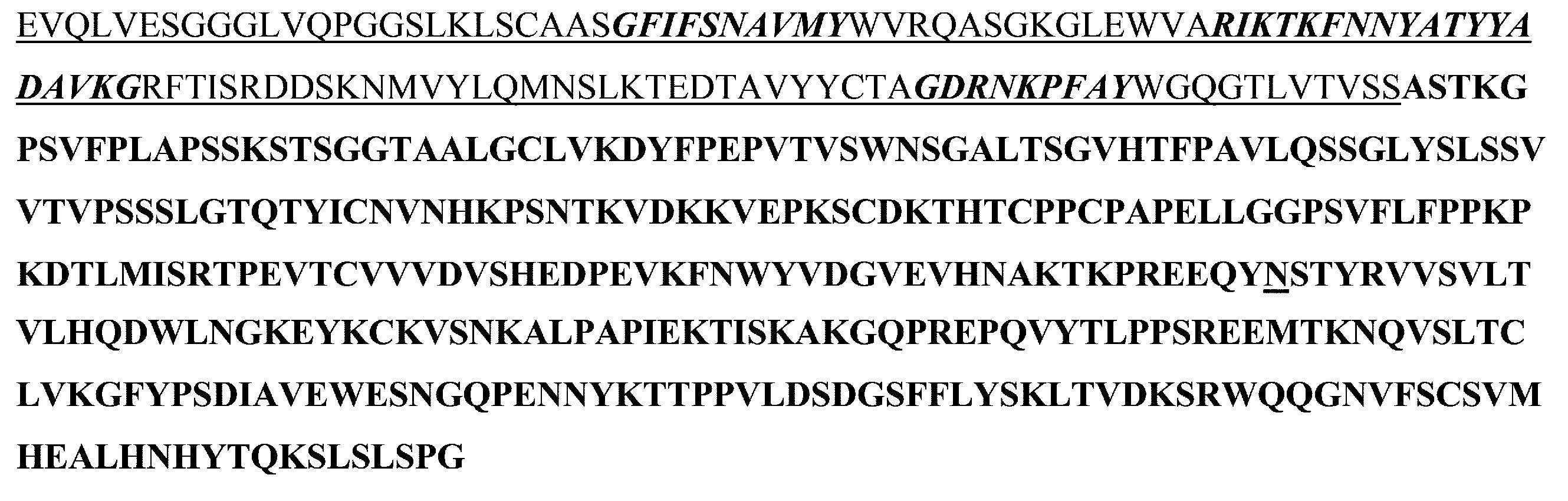
一実施形態では、本開示の抗体の重鎖は、次のヌクレオチド配列(配列番号12として開示される完全長配列)によりコードされる。 In one embodiment, the heavy chain of the antibody of the present disclosure is encoded by the following nucleotide sequence (full length sequence disclosed as SEQ ID NO:12):

一実施形態では、本開示の抗体の軽鎖は、次のヌクレオチド配列(配列番号13として開示される完全長配列)によりコードされる。 In one embodiment, the light chain of the antibody of the present disclosure is encoded by the following nucleotide sequence (full length sequence disclosed as SEQ ID NO:13):

一部の実施形態では、抗体は、ヒトCH1、ヒトヒンジ、ヒトCH2及びヒトCH3ドメインを含むヒト重鎖定常領域を含む。一部の実施形態では、コードされる重鎖定常領域は、Fc部分を含み、この場合、Fc部分は、ヒトIgG1、IgG2、IgG3、IgG4又はIgMアイソタイプである。実施形態では、FcはIgG1であり、アロタイプはz non aである。実施形態では、軽鎖は、カッパ軽鎖である。 In some embodiments, the antibody comprises a human heavy chain constant region comprising a human CH1, human hinge, human CH2 and human CH3 domains. In some embodiments, the encoded heavy chain constant region comprises an Fc portion, where the Fc portion is a human IgG1, IgG2, IgG3, IgG4 or IgM isotype. In embodiments, the Fc is IgG1 and the allotype is z non a. In embodiments, the light chain is a kappa light chain.
一部の実施形態では、抗体は、脱フコシル化されているIgG1 Fc定常領域を含む。脱フコシル化は、当技術分野において公知の技術により実行し得る。例えば、GDP-マンノース4,6-デヒドラターゼの欠乏により、例えば、GDP-フコース形成が欠損した細胞株における抗体の産生、フコシルトランスフェラーゼのレベルが低下した細胞における抗体の産生、GDP-フコース輸送体のレベルが低下した細胞における抗体の産生、β-1,4-マンノシル-糖タンパク質4-β-N-アセチルグルコサミニルトランスフェラーゼ(GnT-III)を高発現する細胞における抗体の産生、又は細菌GDP-6-デオキシ-D-リキソ-4-ヘキスロースレダクターゼ(RMD)を発現する細胞における抗体の産生が挙げられる。本発明の脱フコシル化抗CCR8抗体の産生に使用する細胞は、シュードモナスRMDを発現するように改変したCHO細胞である。抗体の脱フコシル化の程度は、当技術分野において公知の技術により定量することができる。典型的には、抗体は、70%以上、80%以上、90%以上又は約99%又は約100%脱フコシル化されている。好ましくは、脱フコシル化の程度は、80%以上である。一部の実施形態では、抗体は、ASN-300(EU:ASN-297)の位置において70%以上、80%以上、90%以上又は約100%脱フコシル化されている。脱フコシル化は、親水性相互作用クロマトグラフィー(HILIC)アッセイ技術により定量することができ、この脱フコシル化の程度は、断片化抗体の極性依存的分離により定量する。 In some embodiments, the antibody comprises an IgG1 Fc constant region that is defucosylated. Defucosylation may be performed by techniques known in the art, such as production of the antibody in a cell line that is deficient in GDP-fucose formation, e.g., due to a deficiency in GDP-mannose 4,6-dehydratase, production of the antibody in a cell with reduced levels of fucosyltransferase, production of the antibody in a cell with reduced levels of GDP-fucose transporter, production of the antibody in a cell that highly expresses β-1,4-mannosyl-glycoprotein 4-β-N-acetylglucosaminyltransferase (GnT-III), or production of the antibody in a cell that expresses bacterial GDP-6-deoxy-D-lyxo-4-hexulose reductase (RMD). Cells used to produce the defucosylated anti-CCR8 antibodies of the invention are CHO cells modified to express Pseudomonas RMD. The degree of defucosylation of an antibody can be quantified by techniques known in the art. Typically, the antibody is 70% or more, 80% or more, 90% or more, or about 99% or about 100% defucosylated. Preferably, the degree of defucosylation is 80% or more. In some embodiments, the antibody is 70% or more, 80% or more, 90% or more, or about 100% defucosylated at the ASN-300 (EU:ASN-297) position. Defucosylation can be quantified by a hydrophilic interaction chromatography (HILIC) assay technique, where the degree of defucosylation is quantified by polarity-dependent separation of fragmented antibodies.
実施形態では、脱フコシル化グリカン種の総量は、蛍光検出を用いたHILICによる遊離N連鎖グリカンの分析によって定量する。グリカンは、ペプチドN-グリコシダーゼF(PNGaseF)を使用して遊離させた後、蛍光タグで標識する。蛍光標識N連鎖グリカンは、蛍光検出を用いたHILICにより分析する。パーセント脱フコシル化グリカン種は、すべての脱フコシル化グリカンピークのピーク領域の和に基づいて、クロマトグラムにおけるすべてのグリカンピークの全ピーク領域と比較して定量する。0.5%以上の相対存在量によるすべてのピークは、パーセント脱フコシル化グリカン種の定量に含まれる。 In an embodiment, the total amount of defucosylated glycan species is quantified by analysis of released N-linked glycans by HILIC with fluorescence detection. Glycans are labeled with a fluorescent tag after release using peptide N-glycosidase F (PNGaseF). The fluorescently labeled N-linked glycans are analyzed by HILIC with fluorescence detection. The percent defucosylated glycan species is quantified based on the sum of the peak areas of all defucosylated glycan peaks compared to the total peak area of all glycan peaks in the chromatogram. All peaks with a relative abundance of 0.5% or greater are included in the quantification of the percent defucosylated glycan species.
7.1.抗CCR8抗体をコードするポリヌクレオチド、発現系及び抗体を作製する方法
本開示は、抗CCR8抗体の免疫グロブリン軽鎖及び重鎖遺伝子をコードするポリヌクレオチド分子、このようなポリヌクレオチドを含むベクター及び本開示の抗CCR8抗体を産生可能な宿主細胞を包含する。
7.1. Polynucleotides Encoding Anti-CCR8 Antibodies, Expression Systems, and Methods of Producing Antibodies The present disclosure encompasses polynucleotide molecules encoding the immunoglobulin light and heavy chain genes of anti-CCR8 antibodies, vectors containing such polynucleotides, and host cells capable of producing the anti-CCR8 antibodies of the present disclosure.
本開示の抗CCR8抗体は、宿主細胞における免疫グロブリン軽鎖及び重鎖遺伝子の組換え発現により調製することができる。抗体を組換えにより発現させるために、宿主細胞に、抗体の免疫グロブリン軽鎖及び重鎖をコードするDNA断片を保有する1つ以上の組換え発現ベクターをトランスフェクトすることにより、宿主細胞において軽鎖及び重鎖を発現させ、任意選択で、宿主細胞を培養した培地中に分泌させて、この培地から抗体を回収することができる。 The anti-CCR8 antibodies of the present disclosure can be prepared by recombinant expression of immunoglobulin light and heavy chain genes in a host cell. To recombinantly express an antibody, the host cell can be transfected with one or more recombinant expression vectors carrying DNA fragments encoding the immunoglobulin light and heavy chains of the antibody, thereby allowing the light and heavy chains to be expressed in the host cell and, optionally, secreted into the medium in which the host cell is cultured, from which the antibody can be recovered.
このような抗CCR8抗体をコードするポリヌクレオチドを生成するために、軽鎖及び重鎖可変領域をコードするDNA断片を最初に得る。このようなDNAは、例えば、ポリメラーゼ連鎖反応(PCR)を使用した、軽鎖及び重鎖可変配列をコードする生殖系列DNA又はcDNAの増幅及び修飾により得ることができる。 To generate a polynucleotide encoding such an anti-CCR8 antibody, DNA fragments encoding the light and heavy chain variable regions are first obtained. Such DNA can be obtained, for example, by amplification and modification of germline DNA or cDNA encoding the light and heavy chain variable sequences using the polymerase chain reaction (PCR).
抗CCR8抗体関連VH及びVLセグメントをコードするDNA断片が得られると、このようなDNA断片を、標準的組換えDNA技術によってさらに操作して、例えば、可変領域遺伝子を完全長抗体鎖遺伝子、Fab断片遺伝子又はscFv遺伝子に変換することができる。このような操作では、VL又はVHコードDNA断片は、別のタンパク質、例えば、抗体定常領域又は可動性リンカーをコードする別のDNA断片に動作可能に連鎖する。「動作可能に連鎖」の用語は、この文脈において使用する場合、DNA断片2つによりコードされるアミノ酸配列がインフレームのままであるようにDNA断片2つを連結することを意味することを意図する。 Once DNA fragments encoding anti-CCR8 antibody-related VH and VL segments are obtained, such DNA fragments can be further manipulated by standard recombinant DNA techniques, for example, to convert the variable region genes into full-length antibody chain genes, Fab fragment genes, or scFv genes. In such manipulations, the VL- or VH-encoding DNA fragment is operably linked to another DNA fragment encoding another protein, for example, an antibody constant region or a flexible linker. The term "operably linked" as used in this context is intended to mean joining two DNA fragments such that the amino acid sequences encoded by the two DNA fragments remain in frame.
VHコードDNAを、重鎖定常領域(CH1、CH2、CH3及び任意選択で、CH4)をコードする別のDNA分子に動作可能に連鎖させることにより、VH領域をコードする単離DNAを、完全長重鎖遺伝子に変換することができる。ヒト重鎖定常領域遺伝子の配列は、当技術分野において公知であり(例えば、Kabat,E.A.,ら、1991、Sequences of Proteins of Immunological Interest、Fifth Edition、U.S.Department of Health and Human Services、NIH Publication No.91~3242を参照)、このような領域を包含するDNA断片は、標準的PCR増幅により得ることができる。重鎖定常領域は、IgG1、IgG2、IgG3、IgG4、IgA、IgE、IgM又はIgD定常領域であり得るが、特定の実施形態では、IgG1又はIgG4である。Fab断片重鎖遺伝子では、VHコードDNAは、重鎖CH1定常領域のみをコードする別のDNA分子に動作可能に連鎖し得る。 The isolated DNA encoding the VH region can be converted into a full-length heavy chain gene by operably linking the VH-encoding DNA to another DNA molecule encoding the heavy chain constant region (CH1, CH2, CH3 and, optionally, CH4). Sequences of human heavy chain constant region genes are known in the art (see, e.g., Kabat, E.A., et al., 1991, Sequences of Proteins of Immunological Interest, Fifth Edition, U.S. Department of Health and Human Services, NIH Publication No. 91-3242), and DNA fragments encompassing such regions can be obtained by standard PCR amplification. The heavy chain constant region can be an IgG1, IgG2, IgG3, IgG4, IgA, IgE, IgM, or IgD constant region, but in certain embodiments is IgG1 or IgG4. In a Fab fragment heavy chain gene, the VH-encoding DNA can be operably linked to another DNA molecule encoding only the heavy chain CH1 constant region.
VLコードDNAを、軽鎖定常領域CLをコードする別のDNA分子に動作可能に連鎖させることにより、VL領域をコードする単離DNAを、完全長軽鎖遺伝子(並びにFab軽鎖遺伝子)に変換することができる。ヒト軽鎖定常領域遺伝子の配列は、当技術分野において公知であり(例えば、Kabatら、1991、Sequences of Proteins of Immunological Interest、Fifth Edition、U.S.Department of Health and Human Services、NIH Publication No.91~3242を参照)、このような領域を包含するDNA断片は、標準的PCR増幅により得ることができる。軽鎖定常領域は、カッパ又はラムダ定常領域であり得るが、特定の実施形態では、カッパ定常領域である。 The isolated DNA encoding the VL region can be converted into a full-length light chain gene (as well as a Fab light chain gene) by operably linking the VL-encoding DNA to another DNA molecule encoding the light chain constant region CL. Sequences of human light chain constant region genes are known in the art (see, e.g., Kabat et al., 1991, Sequences of Proteins of Immunological Interest, Fifth Edition, U.S. Department of Health and Human Services, NIH Publication No. 91-3242), and DNA fragments encompassing such regions can be obtained by standard PCR amplification. The light chain constant region can be a kappa or lambda constant region, but in certain embodiments is a kappa constant region.
本開示の抗CCR8抗体を発現させるために、上記のように得られる部分的又は完全長軽鎖及び重鎖をコードするDNAは、発現ベクターに挿入することにより、遺伝子を転写及び翻訳調節配列に動作可能に連鎖させる。この文脈では、「動作可能に連鎖」の用語は、ベクター内の転写及び翻訳調節配列が、これらの意図する、抗体遺伝子の転写及び翻訳を制御する機能に役立つように、抗体遺伝子をベクター内にライゲーションすることを意味することを意図する。発現ベクター及び発現調節配列は、使用する発現宿主細胞と適合するように選択する。抗体軽鎖遺伝子及び抗体重鎖遺伝子は、別々のベクターに挿入することができ、又はより典型的には、両遺伝子は、同一の発現ベクターに挿入する。 To express the anti-CCR8 antibody of the present disclosure, DNA encoding the partial or full-length light and heavy chains obtained as described above is inserted into an expression vector, thereby operably linking the genes to transcriptional and translational regulatory sequences. In this context, the term "operably linked" is intended to mean that the antibody gene is ligated into a vector such that the transcriptional and translational regulatory sequences in the vector serve their intended function of controlling the transcription and translation of the antibody gene. The expression vector and expression regulatory sequences are selected to be compatible with the expression host cell to be used. The antibody light chain gene and the antibody heavy chain gene can be inserted into separate vectors, or more typically, both genes are inserted into the same expression vector.
抗体遺伝子は、標準的方法(例えば、抗体遺伝子断片及びベクター上の相補性制限部位のライゲーション、又は制限部位が存在しない場合、平滑末端ライゲーション)により発現ベクターに挿入する。抗CCR8抗体関連軽鎖又は重鎖配列の挿入前には、発現ベクターは、抗体定常領域配列を既に保有し得る。例えば、抗CCR8モノクローナル抗体関連VH及びVL配列の完全長抗体遺伝子への変換のための一手法は、これらを、重鎖定常及び軽鎖定常領域を既にコードする発現ベクターにそれぞれ挿入することにより、VHセグメントを、ベクター内のCHセグメント(複数可)に動作可能に連鎖させ、VLセグメントを、ベクター内のCLセグメントに動作可能に連鎖させることである。加えて又は代替的に、組換え発現ベクターは、宿主細胞からの抗体鎖の分泌を容易とするシグナルペプチドをコードし得る。抗体鎖遺伝子をベクター内にクローニングすることにより、シグナルペプチドを抗体鎖遺伝子のアミノ末端にインフレームで連鎖し得る。シグナルペプチドは、免疫グロブリンシグナルペプチド又は異種シグナルペプチド(すなわち、非免疫グロブリンタンパク質由来のシグナルペプチド)であり得る。 The antibody genes are inserted into the expression vector by standard methods (e.g., ligation of complementary restriction sites on the antibody gene fragment and the vector, or blunt-end ligation if no restriction sites are present). Prior to insertion of the anti-CCR8 antibody-related light or heavy chain sequences, the expression vector may already carry antibody constant region sequences. For example, one approach for converting the anti-CCR8 monoclonal antibody-related VH and VL sequences into full-length antibody genes is to insert them into an expression vector that already encodes the heavy and light chain constant regions, respectively, such that the VH segment is operably linked to the CH segment(s) in the vector, and the VL segment is operably linked to the CL segment in the vector. Additionally or alternatively, the recombinant expression vector may encode a signal peptide that facilitates secretion of the antibody chain from the host cell. Cloning the antibody chain gene into the vector may link the signal peptide in frame to the amino terminus of the antibody chain gene. The signal peptide can be an immunoglobulin signal peptide or a heterologous signal peptide (i.e., a signal peptide from a non-immunoglobulin protein).
抗体鎖遺伝子に加えて、本開示の組換え発現ベクターは、宿主細胞における抗体鎖遺伝子の発現を調節する制御配列を保有する。「制御配列」の用語は、プロモーター、エンハンサー及び抗体鎖遺伝子の転写又は翻訳を調節する他の発現調節エレメント(例えば、ポリアデニル化シグナル)を含むことを意図する。 In addition to the antibody chain genes, the recombinant expression vectors of the disclosure carry control sequences that regulate the expression of the antibody chain genes in a host cell. The term "control sequence" is intended to include promoters, enhancers, and other expression control elements (e.g., polyadenylation signals) that regulate the transcription or translation of the antibody chain genes.
抗体鎖遺伝子及び制御配列に加えて、本開示の組換え発現ベクターは、宿主細胞におけるベクターの複製を制御する配列(例えば、複製起点)及び選択可能なマーカー遺伝子などのさらなる配列を保有し得る。選択的マーカー遺伝子は、ベクターが導入された宿主細胞の選択を容易とする。軽鎖及び重鎖の発現では、重鎖及び軽鎖をコードする発現ベクター(複数可)は、標準的技術により宿主細胞にトランスフェクトする。「トランスフェクション」の用語の種々の形態は、原核又は真核宿主細胞への外因性DNAの導入に一般に使用される多種多様な技術、例えば、エレクトロポレーション、リポフェクション、リン酸カルシウム沈降、DEAE-デキストラントランスフェクション等を包含することを意図する。 In addition to the antibody chain genes and control sequences, the recombinant expression vectors of the present disclosure may carry additional sequences, such as sequences that control replication of the vector in a host cell (e.g., origins of replication) and selectable marker genes. The selectable marker genes facilitate selection of host cells into which the vector has been introduced. For expression of light and heavy chains, the expression vector(s) encoding the heavy and light chains are transfected into a host cell by standard techniques. The various forms of the term "transfection" are intended to encompass a wide variety of techniques commonly used for the introduction of exogenous DNA into prokaryotic or eukaryotic host cells, such as electroporation, lipofection, calcium phosphate precipitation, DEAE-dextran transfection, etc.
原核又は真核のいずれかの宿主細胞において本開示の抗体を発現させることが可能である。特定の実施形態では、抗体の発現は、適切に折り畳まれかつ免疫学的に活性な抗体の分泌に最適な、真核細胞、例えば、哺乳動物宿主細胞において実施する。本開示の組換え抗体を発現させるための哺乳動物宿主細胞の例としては、チャイニーズハムスター卵巣(CHO)細胞(例えば、Kaufman and Sharp、1982、Mol.Biol.159:601~621に記載のDHFR選択可能マーカーとともに使用される、Urlaub and Chasin、1980、Proc.Natl.Acad.Sci.USA77:4216~4220に記載のDHFR-CHO細胞を含む)、NSO骨髄腫細胞、COS細胞及びSP2細胞が挙げられる。抗体遺伝子をコードする組換え発現ベクターを哺乳動物宿主細胞に導入する場合、抗体は、宿主細胞における抗体の発現、又は宿主細胞を増殖させる培養培地中への抗体の分泌が可能となるのに十分な期間、宿主細胞を培養することにより産生される。抗体は、標準的タンパク質精製方法を使用して培養培地から回収することができる。また、宿主細胞を使用して、インタクトな抗体の部分、例えば、Fab断片又はscFv分子を産生することができる。上記の手順の変形形態は、本開示の範囲内であることが理解される。例えば、宿主細胞に、本開示の抗CCR8抗体の軽鎖又は重鎖のいずれか(両方ではなく)をコードするDNAをトランスフェクトすることが望まれ得る。 The antibodies of the present disclosure can be expressed in either prokaryotic or eukaryotic host cells. In certain embodiments, expression of the antibodies is carried out in eukaryotic cells, e.g., mammalian host cells, that are optimal for secretion of properly folded and immunologically active antibodies. Examples of mammalian host cells for expressing recombinant antibodies of the present disclosure include Chinese hamster ovary (CHO) cells (including, for example, DHFR-CHO cells described in Urlaub and Chasin, 1980, Proc. Natl. Acad. Sci. USA 77:4216-4220, used with the DHFR selectable marker described in Kaufman and Sharp, 1982, Mol. Biol. 159:601-621), NSO myeloma cells, COS cells, and SP2 cells. When a recombinant expression vector encoding an antibody gene is introduced into a mammalian host cell, the antibody is produced by culturing the host cell for a period of time sufficient to allow expression of the antibody in the host cell or secretion of the antibody into the culture medium in which the host cell is grown. The antibody can be recovered from the culture medium using standard protein purification methods. The host cell can also be used to produce portions of intact antibodies, such as Fab fragments or scFv molecules. It is understood that variations of the above procedures are within the scope of the present disclosure. For example, it may be desirable to transfect the host cell with DNA encoding either the light chain or the heavy chain (but not both) of the anti-CCR8 antibody of the present disclosure.
また、組換えDNA技術を使用して、ヒトCCR8に結合させるのに不必要な軽鎖及び重鎖のいずれか又は両方をコードするDNAの一部又は全部を除去することができる。また、このような切断DNA分子から発現する分子は、本開示の抗体に包含する。 Recombinant DNA techniques can also be used to remove some or all of the DNA encoding either or both of the light and heavy chains that is not necessary for binding to human CCR8. Molecules expressed from such truncated DNA molecules are also encompassed by the antibodies of the present disclosure.
本開示の抗CCR8抗体の組換え発現では、宿主細胞は、本開示の発現ベクター2つと同時トランスフェクトすることができ、第1のベクターは、重鎖由来ポリペプチドをコードし、第2のベクターは、軽鎖由来ポリペプチドをコードする。2つのベクターは、同一の選択可能なマーカーを含んでもよく、又はこれらは、別々の選択可能なマーカーを含み得る。代替的に、重鎖及び軽鎖の両ポリペプチドをコードする、単一のベクターを使用することができる。 For recombinant expression of the anti-CCR8 antibodies of the present disclosure, a host cell can be co-transfected with two expression vectors of the present disclosure, the first vector encoding a heavy chain derived polypeptide and the second vector encoding a light chain derived polypeptide. The two vectors may contain the same selectable marker, or they may contain separate selectable markers. Alternatively, a single vector can be used that encodes both heavy and light chain polypeptides.
抗CCR8抗体の1つ以上の部分をコードするポリヌクレオチドが得られると、さらなる変化又は変異をコード配列に導入して、例えば、種々のCDR配列を有する抗体、Fc受容体に対する親和性が低下した抗体、又は種々のサブクラスの抗体をコードするポリヌクレオチドを生成することができる。 Once a polynucleotide encoding one or more portions of an anti-CCR8 antibody is obtained, further changes or mutations can be introduced into the coding sequence to generate polynucleotides encoding, for example, antibodies with different CDR sequences, antibodies with reduced affinity for Fc receptors, or different subclasses of antibodies.
また、本開示の抗CCR8抗体は、化学合成により又は無細胞プラットフォームを使用することにより産生することができる。 The anti-CCR8 antibodies of the present disclosure can also be produced by chemical synthesis or by using a cell-free platform.
7.2.抗CCR8抗体の精製
本開示のポリペプチドを組換え発現により産生すると、タンパク質の精製のための当技術分野において公知の任意の方法により、これを精製することができる。単離すると、抗CCR8抗体は、さらに精製することができる。
7.2 Purification of Anti-CCR8 Antibodies Once the polypeptides of the present disclosure have been produced by recombinant expression, they can be purified by any method known in the art for purifying proteins. Upon isolation, the anti-CCR8 antibodies can be further purified.
7.3.組成物
本開示の抗体は、対象への投与に適する組成物として提供し得る。一部の実施形態では、抗体組成物は、本開示の抗体及び薬学的に許容される担体を含む医薬組成物である。
7.3. Compositions The antibodies of the present disclosure may be provided in a composition suitable for administration to a subject. In some embodiments, the antibody composition is a pharmaceutical composition comprising an antibody of the present disclosure and a pharma- ceutically acceptable carrier.
実施形態では、複数の抗CCR8抗体及び薬学的に許容される担体を含む医薬組成物を提供する。実施形態では、医薬組成物の複数の抗CCR8抗体は、脱フコシル化されている。典型的には、複数の抗体は、70%以上、80%以上、90%以上又は約99%又は約100%脱フコシル化されている。好ましくは、脱フコシル化の程度は、90%以上である。一部の実施形態では、複数の抗体は、ASN-300(EU:ASN-297)の位置において70%以上、80%以上、90%以上又は約100%脱フコシル化されている。抗体の脱フコシル化の程度は、当技術分野において公知の技術により定量することができる。脱フコシル化は、親水性相互作用クロマトグラフィー(HILIC)アッセイ技術により定量することができ、この脱フコシル化の程度は、断片化抗体の極性依存的分離により定量する。実施形態では、脱フコシル化グリカン種の総量は、蛍光検出を用いたHILICによる遊離N連鎖グリカンの分析によって定量する。グリカンは、ペプチドN-グリコシダーゼF(PNGaseF)を使用して遊離させた後、蛍光タグで標識する。蛍光標識N連鎖グリカンは、蛍光検出を用いたHILICにより分析する。パーセント脱フコシル化グリカン種は、すべての脱フコシル化グリカンピークのピーク領域の和に基づいて、クロマトグラムにおけるすべてのグリカンピークの全ピーク領域と比較して定量する。0.5%以上の相対存在量によるすべてのピークは、パーセント脱フコシル化グリカン種の定量に含まれる。 In an embodiment, a pharmaceutical composition is provided that includes a plurality of anti-CCR8 antibodies and a pharma- ceutically acceptable carrier. In an embodiment, the plurality of anti-CCR8 antibodies of the pharmaceutical composition are defucosylated. Typically, the plurality of antibodies are 70% or more, 80% or more, 90% or more, or about 99% or about 100% defucosylated. Preferably, the degree of defucosylation is 90% or more. In some embodiments, the plurality of antibodies are 70% or more, 80% or more, 90% or more, or about 100% defucosylated at the ASN-300 (EU:ASN-297) position. The degree of defucosylation of the antibody can be quantified by techniques known in the art. Defucosylation can be quantified by a hydrophilic interaction chromatography (HILIC) assay technique, in which the degree of defucosylation is quantified by polarity-dependent separation of fragmented antibodies. In an embodiment, the total amount of defucosylated glycan species is quantified by analysis of released N-linked glycans by HILIC with fluorescence detection. Glycans are labeled with a fluorescent tag after release using peptide N-glycosidase F (PNGaseF). The fluorescently labeled N-linked glycans are analyzed by HILIC with fluorescence detection. The percent defucosylated glycan species is quantified based on the sum of the peak areas of all defucosylated glycan peaks compared to the total peak area of all glycan peaks in the chromatogram. All peaks with a relative abundance of 0.5% or greater are included in the quantification of the percent defucosylated glycan species.
7.4.主題の抗体の特性の要約
ABBV-514により例証するが、これに限定されない主題の抗体の特性は、以下を含む。
7.4. SUMMARY OF PROPERTIES OF THE SUBJECT ANTIBODIES Properties of the subject antibodies, exemplified but not limited by ABBV-514, include the following:
CCR8に対する高親和性結合、例えば、TALL-1細胞上に内因的に発現したCCR8により定量した場合(ヒト成人T-ALL;RRID:CVCL 1736)、FACS結合平均EC50が2μg/mL以下、1μg/mL以下、0.3~0.7μg/mL、0.4~0.6μg/mL、約0.5μg/mL、若しくは0.55μg/mL;又はジャーカット細胞上で高発現したヒトCCR8に対するFACS結合平均EC50が2μg/mL以下、1μg/mL以下、0.3~0.8μg/mL、0.4~0.7μg/mL、約0.5μg/mL、若しくは0.6μg/mL;又はヒト血中CD45RA low Treg上で発現したCCR8に対するFACS結合平均EC50が2μg/mL以下、1μg/mL以下、0.2~0.6μg/mL、0.3~0.5μg/mL、約0.5μg/mL、若しくは0.48μg/mLである。 High affinity binding to CCR8, e.g., as determined by CCR8 endogenously expressed on TALL-1 cells (human adult T-ALL; RRID:CVCL 1736), a FACS binding mean EC50 of 2 μg/mL or less, 1 μg/mL or less, 0.3-0.7 μg/mL, 0.4-0.6 μg/mL, about 0.5 μg/mL, or 0.55 μg/mL; or a FACS binding mean EC50 of 2 μg/mL or less, 1 μg/mL or less, 0.3-0.8 μg/mL, 0.4-0.7 μg/mL, about 0.5 μg/mL, or 0.6 μg/mL to human CCR8 highly expressed on Jurkat cells; or a FACS binding mean EC50 of 2 μg/mL or less, 1 μg/mL or less, 0.3-0.8 μg/mL, 0.4-0.7 μg/mL, about 0.5 μg/mL, or 0.6 μg/mL to CCR8 expressed on human blood CD45RA low Tregs 50 is 2 μg/mL or less, 1 μg/mL or less, 0.2 to 0.6 μg/mL, 0.3 to 0.5 μg/mL, about 0.5 μg/mL, or 0.48 μg/mL.
ヒトCCR8に対する高特異性結合、例えば、TALL-1 CCR8ノックアウト細胞又は親ジャーカット細胞に対する非特異的FACS結合。 High specificity binding to human CCR8, e.g., non-specific FACS binding to TALL-1 CCR8 knockout cells or parental Jurkat cells.
カニクイザルCCR8との交差反応性、例えば、ジャーカット細胞上で高発現したcynoCCR8に対するFACS結合平均EC50が5μg/mL以下、3μg/mL以下、2μg/mL以下、およそ1.5μg/mL、若しくは1.82μg/mL;又はcyno血中CD45RA low Treg上で発現したCCR8に対するFACS結合平均EC50が5μg/mL以下、3μg/mL以下、2μg/mL以下、およそ1.5μg/mL、若しくは1.62μg/mLである。 Cross-reactivity with cynomolgus monkey CCR8, e.g., a FACS binding mean EC50 for cyno CCR8 highly expressed on Jurkat cells of 5 μg/mL or less, 3 μg/mL or less, 2 μg/mL or less, approximately 1.5 μg/mL, or 1.82 μg/mL; or a FACS binding mean EC50 for CCR8 expressed on cyno blood CD45RA low Tregs of 5 μg/mL or less, 3 μg/mL or less, 2 μg/mL or less, approximately 1.5 μg/mL, or 1.62 μg/mL.
CCL1/CCR8相互作用を遮断する能力が弱いこと、例えば、CCL1/CCR8遮断活性におけるEC50が、ヒトCCR8に対する結合におけるEC50よりも少なくとも30×高く、少なくとも40×高く、30×~70×高く、少なくとも50×高く、又は少なくとも約50×高い。 Weak ability to block CCL1/CCR8 interaction, e.g., the EC50 for CCL1/CCR8 blocking activity is at least 30x higher, at least 40x higher, 30x-70x higher, at least 50x higher, or at least about 50x higher than the EC50 for binding to human CCR8.
同一の可変領域及び野生型フコシル化IgG1を有する抗体に関するADCCを誘導する能力の増強。 Enhanced ability to induce ADCC for antibodies with identical variable regions and wild-type fucosylated IgG1.
同一の可変領域及び野生型フコシル化IgG1を有する抗体に関するFcγ受容体に対する結合の増強。 Enhanced binding to Fcγ receptors for antibodies with identical variable regions and wild-type fucosylated IgG1.
サイトカイン放出アッセイにより定量した免疫安全性が良好であること。 Good immune safety as quantified by cytokine release assay.
7.5.使用の方法
実施形態では、本明細書に記載の方法は、固形腫瘍を有する患者を本発明の抗CCR8抗体により治療するステップを含む。実施形態では、抗CCR8抗体を含む組成物は、これを必要とする対象に投与する。
7.5. Methods of Use In embodiments, the methods described herein comprise treating a patient having a solid tumor with an anti-CCR8 antibody of the invention. In embodiments, a composition comprising an anti-CCR8 antibody is administered to a subject in need thereof.
PD-1抵抗性Pan02マウスモデルでは、CCR8及びPD-1標的化抗体の組合せにより、いずれかの抗体による単独療法に対してインビボでの有効性の向上が示された。免疫抑制CCR8+Tregの枯渇は、PD-1/PDリガンド1(PD-L1)遮断と協同して、さらに強力なCD8+エフェクターT細胞応答を促進し、抗腫瘍免疫を増強し得る。実施形態では、抗CCR8抗体を含む組成物は、PD-1又はPD-L1標的化抗体の投与を含む併用療法の一部として投与する。実施形態では、抗CCR8抗体を含む組成物は、ペムブロリズマブ、ブディガリマブ(budigalimab)、ニボルマブ、セミプリマブ又はドスタルリマブ(dostarlimab)とともに併用療法として投与する。実施形態では、抗CCR8抗体を含む組成物は、アテゾリズマブ、アベルマブ、デュルバルマブとともに併用療法として投与する。 In the PD-1-resistant Pan02 mouse model, the combination of CCR8 and PD-1 targeted antibodies showed improved efficacy in vivo versus monotherapy with either antibody. Depletion of immunosuppressive CCR8+ Tregs may synergize with PD-1/PD ligand 1 (PD-L1) blockade to promote more potent CD8+ effector T cell responses and enhance anti-tumor immunity. In embodiments, a composition comprising an anti-CCR8 antibody is administered as part of a combination therapy that includes administration of a PD-1 or PD-L1 targeted antibody. In embodiments, a composition comprising an anti-CCR8 antibody is administered as a combination therapy with pembrolizumab, budigalimab, nivolumab, cemiplimab, or dostarlimab. In embodiments, a composition comprising an anti-CCR8 antibody is administered as a combination therapy with atezolizumab, avelumab, or durvalumab.
本明細書に記載の抗体及び結合断片の例となる実施形態の特定の特徴及び特性を強調する、以下の実施例は、例示の目的のために提供する。 The following examples are provided for illustrative purposes, highlighting particular features and characteristics of exemplary embodiments of the antibodies and binding fragments described herein.
8.1.[実施例1]ラットハイブリドーマの産生
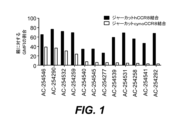
ラットを2つの異なる完全長ヒトCCR8c DNAベクターにより免疫化した(各ベクターに対してラット6匹)。リンパ節細胞を単離し、NS0に融合させてハイブリドーマを生成した。増殖後、ハイブリドーマ上清を、HEK293細胞上で高発現したヒト又はカニクイザル(「cyno」又は「cy」)CCR8への結合についてスクリーニングした。46種のラット/hIgG1キメラmAbが、ハイスループット抗体産生により発現し、21種が、ヒトCCR8に結合することが確認された(図1)。AC-254290、AC-254532、AC-254546及びAC-254259の4つのキメラmAbを、完全ヒト化のために、ジャーカットCCR8高発現株における最も高いcyno交差反応性に基づいて選択した。
8.1. Example 1: Generation of Rat Hybridomas Rats were immunized with two different full-length human CCR8 cDNA vectors (six rats for each vector). Lymph node cells were isolated and fused to NSO to generate hybridomas. After expansion, hybridoma supernatants were screened for binding to human or cynomolgus monkey ("cyno" or "cy") CCR8 highly expressed on HEK293 cells. Forty-six rat/hIgG1 chimeric mAbs were expressed by high-throughput antibody production, and 21 were confirmed to bind to human CCR8 (Figure 1). Four chimeric mAbs, AC-254290, AC-254532, AC-254546, and AC-254259, were selected for full humanization based on highest cyno cross-reactivity in the Jurkat CCR8 high expresser line.
8.2.[実施例2]huCCR8に対する競合結合によるエピトープマッピング
選択したキメラ抗体を、ジャーカット細胞上のヒトCCR8への結合について、BD Biosciences社(クローン433H)及びBiolegend社(クローンL263G8)のヒトCCR8抗体とともに細胞エピトープマッピングアッセイにより検査した。市販の両抗体は、ヒトCCR8トランスフェクタントによるマウスの免疫化により生成されたものとして報告され、いずれもcynoCCR8と交差反応性ではなかった。抗体は、飽和濃度の抗体1で染色した細胞と対で検査、洗浄し、次いで、抗体2で染色し、又はこの逆を行った。
8.2. Example 2: Epitope mapping by competitive binding to huCCR8 Selected chimeric antibodies were tested for binding to human CCR8 on Jurkat cells in a cellular epitope mapping assay along with human CCR8 antibodies from BD Biosciences (clone 433H) and Biolegend (clone L263G8). Both commercial antibodies were reported to have been generated by immunization of mice with human CCR8 transfectants, and neither was cross-reactive with cynoCCR8. Antibodies were tested in pairs with cells stained with saturating concentrations of
AC-254290及びAC-254532のmAbは、いずれかの順序で結合に干渉し、これらが同一のエピトープ(エピトープA)に結合することを示唆した(図2)。AC-254546は、AC-254290及びAC-254532と中程度のエピトープ結合干渉を示すが、同一エピトープへの結合の証拠はなく、したがって、AC-254546は、ユニークであるがエピトープAに近い、エピトープBに結合する。AC-254259は、他のいかなる抗体との結合干渉も有せず、ユニークなエピトープであり得る(エピトープC)。BD Biosciences社のクローン433Hは、AC-254290と同一のエピトープ結合を有し、AC-254532、AC-254546及びBiolegend社のクローンL263G8との一部の干渉結合を有し、したがって、エピトープAとビニングされる。BD Biosciences社のクローン433H及び他の抗体による干渉データに基づいて、Biolegend社のクローンL263G8は、ユニークであるがエピトープBではなくエピトープAに近い、エピトープDとしてビニングされる。 AC-254290 and AC-254532 mAbs interfered with binding in either order, suggesting that they bind to the same epitope (epitope A) (Figure 2). AC-254546 shows moderate epitope binding interference with AC-254290 and AC-254532, but there is no evidence of binding to the same epitope, therefore AC-254546 binds to epitope B, which is unique but close to epitope A. AC-254259 does not have binding interference with any other antibodies and may be a unique epitope (epitope C). BD Biosciences clone 433H has identical epitope binding as AC-254290 and some interference binding with AC-254532, AC-254546, and Biolegend clone L263G8, and is therefore binned as epitope A. Based on interference data with BD Biosciences clone 433H and other antibodies, Biolegend clone L263G8 is binned as epitope D, which is unique but closer to epitope A than epitope B.
8.3.[実施例3]ラット可変ドメイン/ヒトIgG1 Fcキメラのヒト化
4つのキメラ抗体AC-254290、AC-254532、AC-254546及びAC-254259を、(i)げっ歯類抗体配列を同定し、(ii)CDR及び抗体フレームワークを同定し、(iii)VH-VL構造モデルを作出し、(iv)復帰変異のフレームワーク残基を同定して、げっ歯類抗体の機能を維持し、(v)高い同一性を有するヒト生殖系列、最も類似するCDR正準構造及び必要とされる最小復帰変異を選択し、(vi)CDR移植及び選択した復帰変異の組込みによりVH/VL配列を生成することによりヒト化した。
8.3. Example 3 Humanization of Rat Variable Domain/Human IgG1 Fc Chimeras Four chimeric antibodies, AC-254290, AC-254532, AC-254546, and AC-254259, were humanized by (i) identifying rodent antibody sequences, (ii) identifying the CDRs and antibody frameworks, (iii) generating a VH-VL structural model, (iv) identifying framework residues for backmutations to maintain rodent antibody function, (v) selecting human germline with high identity, the most similar CDR canonical structures, and the minimum backmutations required, and (vi) generating the VH/VL sequences by CDR grafting and incorporation of the selected backmutations.
ヒト化抗体4つは、選択した各抗体について作出した。AC-254290は、配列及び構造の両方に基づくヒト化の手法を必要とした。ストレートCDR移植により、ヒトCCR8発現ジャーカット細胞への結合が弱い抗体が生じた。予想されたげっ歯類VH/VL構造/界面に基づく復帰変異を検査した。HCDR3の前の三つ組の残基はCTAであり、これは非定型であった。94番目(CTAのA)は、ほとんどの場合、アルギニン(R)である。CTRを有するヒト化バージョン2つは、ヒトCCR8発現ジャーカット細胞への結合が弱いことを示し、EC50は3.96及び5.61μg/mLであった。対照的に、HCDR3の前にCTAを有するヒト化バージョン(CTAGDRNKPFAY(配列番号14))2つは、このうちの1つはAC-264700であるが、強力な結合を実証し、EC50は0.2559及び0.2302μg/mLであり、AC-254290親抗体に引けを取らないものだった(EC50は0.4538μg/mL)。 Four humanized antibodies were generated for each selected antibody. AC-254290 required both sequence and structure based humanization approaches. Straight CDR grafting resulted in an antibody with weak binding to human CCR8 expressing Jurkat cells. Back mutations based on the predicted rodent VH/VL structure/interface were examined. The triad of residues before HCDR3 was a CTA, which was atypical. The 94th (A in CTA) is most often an arginine (R). Two humanized versions with CTR showed weak binding to human CCR8 expressing Jurkat cells with EC50 of 3.96 and 5.61 μg/mL. In contrast, two humanized versions with a CTA in front of HCDR3 (CTAGDRNKPFAY (SEQ ID NO: 14)), one of which is AC-264700, demonstrated strong binding with EC50s of 0.2559 and 0.2302 μg/mL, which were comparable to the AC-254290 parent antibody ( EC50 of 0.4538 μg/mL).
ヒト化抗体は、ヒト又はカニクイザルCCR8に結合する能力について評価した。EC50は、5×希釈で30μg/mLから開始する8つの濃度の抗体を、ヒト又はカニクイザルCCR8高発現ジャーカット細胞への結合について検査することにより定量した。CCR8検査抗体とのインキュベーション後、細胞を洗浄し、蛍光色素標識二次抗体とともにインキュベート、洗浄して、フローサイトメトリーにより分析した。 Humanized antibodies were evaluated for their ability to bind to human or cynomolgus CCR8. EC50 was determined by testing eight concentrations of antibody starting at 30 μg/mL at 5× dilutions for binding to human or cynomolgus CCR8 highly expressing Jurkat cells. After incubation with CCR8 test antibody, cells were washed, incubated with fluorochrome-labeled secondary antibody, washed, and analyzed by flow cytometry.
AC-254259及びAC-254532は、cynoCCR8への結合の低下及びHEK293細胞への高い非特異的結合をそれぞれ示した。AC-264711(ヒト化AC-254546)及びAC-264700(ヒト化AC-254290)は、優れた標的結合、非特異的結合の非存在及びライアビリティ改変のための要件が限定的であることにより、進歩的であった。 AC-254259 and AC-254532 showed reduced binding to cynoCCR8 and high non-specific binding to HEK293 cells, respectively. AC-264711 (humanized AC-254546) and AC-264700 (humanized AC-254290) were advanced by superior target binding, absence of non-specific binding and limited requirements for liability modification.
8.4.[実施例4]AC-264700のライアビリティ改変
AC-264700は、HCDR2及びLCDR1のアミノ酸61~62及び27~28(kabat)において、異性化のリスクであるDSモチーフをそれぞれ有し、LCDR3のアミノ酸94~95番目(kabat)において、潜在的に断片化させるDPモチーフを有した。HCDR2のDSライアビリティは、これまでの抗体による経験に基づいてDAに変異させた。DPモチーフの除去によって結合は破壊されたが、DPモチーフを保持する抗体の断片化は、ストレス検査下で現れなかった。LCDR1 DSバリアント抗体22種を作出し、これらの結合特性を、huCCR8又はcyCCR8高発現ジャーカット細胞に対してフローサイトメトリーを使用して評価した。ジャーカット親細胞への非特異的結合をフローサイトメトリーにより評価した。バリアント抗体10種は、好ましい機能及び薬物様特性に基づいて、さらなる特性決定のために選択した。2つは、結合、自己相互作用の低下、非特異性の欠如、cyno交差反応性及びhFcγRIIIa VバリアントADCCレポーターバイオアッセイ(Promega社)における活性を含む、特性の全組合せに基づいて、進歩的利点のために選択した。
8.4. [Example 4] Liability modification of AC-264700 AC-264700 has a DS motif at amino acids 61-62 and 27-28 (Kabat) of HCDR2 and LCDR1, respectively, which is a risk of isomerization, and a DP motif at amino acids 94-95 (Kabat) of LCDR3, which potentially causes fragmentation. The DS liability of HCDR2 was mutated to DA based on past experience with antibodies. Although removal of the DP motif destroyed binding, fragmentation of the antibody that retained the DP motif did not appear under stress testing. 22 LCDR1 DS variant antibodies were generated and their binding properties were evaluated using flow cytometry against huCCR8 or cyCCR8 highly expressing Jurkat cells. Non-specific binding to Jurkat parental cells was evaluated by flow cytometry. Ten variant antibodies were selected for further characterization based on favorable functional and drug-like properties, and two were selected for progressive advantage based on a full combination of properties including binding, reduced self-interactions, lack of non-specificity, cyno cross-reactivity, and activity in the hFcγRIIIa V variant ADCC reporter bioassay (Promega).
候補分子は、ジャーカット細胞表面上の高発現したhuCCR8又はcyCCR8に対し、公知の方法によりフローサイトメトリーを使用して、結合能について評価した。例となる抗体は、自己相互作用し、huCCR8及びcyCCR8に結合する能力、レポーターバイオアッセイを使用したADCCの能力、並びにHEK293細胞への非特異的結合について検査した。AC-277357は、親及び他の候補抗体と比較した場合、huCCR8及びcyCCR8の両ジャーカット細胞について優れた結合能を有した(表1)。各候補のAC-SINS自己相互作用スコアは、<1であった。100μg/mLでは、非特異的結合最大値は、97~144GMFIの範囲に及んだ。10μg/mLでは、非特異的結合最大値は、94~111GMFIの範囲に及んだ。1μg/mLでは、非特異的結合最大値は、87~102GMFIの範囲に及んだ。AC-277357は、HEK293細胞に対して100μg/mLにおいて最も低い非特異的結合最大値を有し、huCCR8及びcyCCR8ジャーカット細胞への最も強力な結合を有し、ADCCレポーターバイオアッセイにおいてhuCCR8及びcyCCR8の両ジャーカット細胞による最大倍率のシグナル誘導を有した。加えて、AC-277357は、親抗体と比較した場合、最も低い自己相互作用スコアのうちの1つを有した。 Candidate molecules were evaluated for binding to highly expressed huCCR8 or cyCCR8 on the surface of Jurkat cells using flow cytometry by known methods. Exemplary antibodies were tested for their ability to self-interact and bind to huCCR8 and cyCCR8, ADCC using reporter bioassays, and non-specific binding to HEK293 cells. AC-277357 had superior binding to both huCCR8 and cyCCR8 Jurkat cells when compared to the parent and other candidate antibodies (Table 1). The AC-SINS self-interaction score for each candidate was <1. At 100 μg/mL, non-specific binding maxima ranged from 97 to 144 GMFI. At 10 μg/mL, non-specific binding maxima ranged from 94 to 111 GMFI. At 1 μg/mL, nonspecific binding maxima ranged from 87 to 102 GMFI. AC-277357 had the lowest nonspecific binding maxima at 100 μg/mL to HEK293 cells, the strongest binding to huCCR8 and cyCCR8 Jurkat cells, and the highest fold signal induction with both huCCR8 and cyCCR8 Jurkat cells in the ADCC reporter bioassay. In addition, AC-277357 had one of the lowest self-interaction scores when compared to the parent antibody.

8.5.[実施例5]AC-264711のライアビリティ改変
AC-264711は、HCDR2領域のアミノ酸60~61(kabat)において、脱アミノ化のリスクを呈するNSモチーフを有した。加えて、HCDR3のM100c残基は、ストレス検査中に高レベルの酸化を示した。
8.5. [Example 5] Liability modification of AC-264711 AC-264711 had an NS motif at amino acids 60-61 (Kabat) in the HCDR2 region, which presented a risk of deamination. In addition, the M100c residue in HCDR3 showed a high level of oxidation during stress testing.
ライアビリティを除去するNS変異を有するAC-264711候補バリアントは、自己相互作用し、HEK293細胞に非特異的に結合し、huCCR8及びcyCCR8ジャーカット細胞に結合し、標的としてのhuCCR8発現ジャーカット細胞によりADCCレポーターバイオアッセイにおいてシグナルを誘導する能力について検査した。NSモチーフの除去は、耐容性を示した。NSバリアント29種を作出し、これらの結合特性を、ジャーカット親細胞及び高発現huCCR8又はcyCCR8ジャーカット細胞に対してフローサイトメトリーを使用して評価した。最良の結合及び薬物様特性プロファイルを有する抗体5つをADCCレポーターバイオアッセイにおいて検査したところ、特性の最良の組合せを有する抗体3つ、AC-275889、AC-275896及びAC-275898は、酸化を防ぐM100c変異のために進歩的であった。 AC-264711 candidate variants with NS mutations that ablate liability were tested for their ability to self-interact, bind nonspecifically to HEK293 cells, bind to huCCR8 and cyCCR8 Jurkat cells, and induce a signal in an ADCC reporter bioassay with huCCR8 expressing Jurkat cells as targets. Removal of the NS motif was tolerated. 29 NS variants were generated and their binding properties were evaluated using flow cytometry on Jurkat parental cells and highly expressing huCCR8 or cyCCR8 Jurkat cells. Five antibodies with the best binding and drug-like property profiles were tested in the ADCC reporter bioassay, and three antibodies with the best combination of properties, AC-275889, AC-275896, and AC-275898, were advanced due to the M100c mutation that prevents oxidation.
M100c変異を有するAC-275889、AC-275896及びAC-275898のバリアントを生成し、NS変異体として同一のアッセイにおいて検査した。このようなアッセイのデータを使用して、薬物様特性検査について抗体8つの優先順位をつけた。AC-291774及びAC-291790は、それぞれ8.38及び6.75の最も高い自己相互作用AC-SINSスコアを有した。残りの候補は、1.73~2.79の範囲に及ぶ同等のAC-SINSスコアを有した。AC-275896及びAC-275898は、それぞれ1780及び1065GFMIのHEK293細胞に対する最も高い非特異的結合を有した。AC-291790、AC-275889及びAC-275898は、それぞれ335、148及び141の非特異的結合最大値を有した。10及び1μg/mLでは、すべての候補分子は、それぞれ61~67及び57~60の範囲に及ぶ同等の非特異的結合最大値を有した。AC-291774及びAC-291790は、ジャーカット親細胞への結合及び疎水性相互作用クロマトグラフィーにより示す場合、AC-275889、AC-275896及びAC-275898と比較して、最も低い非特異的結合を有したが、huCCR8及びcyCCR8発現ジャーカット細胞への強力な結合、並びにhuCCR8及びcyCCR8発現両ジャーカット細胞によるADCCレポーターシグナルの同等のEC50及び倍率誘導を維持した(表2)。 Variants of AC-275889, AC-275896 and AC-275898 with the M100c mutation were generated and tested in the same assay as the NS mutants. Data from such assays were used to prioritize eight antibodies for drug-like property testing. AC-291774 and AC-291790 had the highest self-interaction AC-SINS scores of 8.38 and 6.75, respectively. The remaining candidates had comparable AC-SINS scores ranging from 1.73 to 2.79. AC-275896 and AC-275898 had the highest nonspecific binding to HEK293 cells with a GFMI of 1780 and 1065, respectively. AC-291790, AC-275889 and AC-275898 had nonspecific binding maxima of 335, 148 and 141, respectively. At 10 and 1 μg/mL, all candidate molecules had comparable nonspecific binding maxima ranging from 61-67 and 57-60, respectively. AC-291774 and AC-291790 had the lowest nonspecific binding compared to AC-275889, AC-275896 and AC-275898 as demonstrated by binding to parental Jurkat cells and hydrophobic interaction chromatography, but maintained strong binding to huCCR8 and cyCCR8 expressing Jurkat cells, as well as comparable EC 50 and fold induction of ADCC reporter signal by both huCCR8 and cyCCR8 expressing Jurkat cells (Table 2).

8.6.[実施例6]最終候補抗体の選択
AC-277357、AC-277371、AC-291774及びAC-291790を選択して、さらなる薬物様特性及びインビトロでの免疫安全性実験においてさらに評価した。特性決定のための脱フコシル化バリアントを生成するために、AC-277357を発現する細胞にプラスミドをトランスフェクトしてシュードモナス酵素GDP-6-デオキシ-D-リキソ-4-ヘキスロースレダクターゼ(RMD)を発現させた。これにより、フコースのデノボ合成において中間体が最終産物に変換され、脱フコシル化AC-277357の産生が生じる。
8.6. Example 6: Selection of Final Candidate Antibodies AC-277357, AC-277371, AC-291774 and AC-291790 were selected for further evaluation in additional drug-like properties and in vitro immune safety experiments. To generate defucosylated variants for characterization, cells expressing AC-277357 were transfected with a plasmid to express the Pseudomonas enzyme GDP-6-deoxy-D-lyxo-4-hexulose reductase (RMD), which converts an intermediate in the de novo synthesis of fucose to the final product, resulting in the production of defucosylated AC-277357.
候補分子を、ジャーカットhuCCR8、ジャーカットcyCCR8及びTALL-1結合活性、標的としてのTALL-1によるhPBMC ADCC活性、標的としてのhuCCR8高発現ジャーカット細胞によるF158エフェクター細胞及び標的としてのhuCCR8高発現ジャーカット細胞によるV158エフェクター細胞におけるADCC活性について評価した。AC-277357(PR-1925514とも呼ぶ)は、TALL-1細胞上のCCR8発現の内因的レベルへの結合の向上を示し、脱フコシル化バージョンは、初代細胞ADCCアッセイにおいてさらに活性であった(データ非表示)。AC-277357/PR-1925514は、AC-291774(PR-1928444とも呼ぶ)よりも強力にヒトTreg上のCCR8に結合し、サイトカイン放出アッセイにおいて、より良好なプロファイルを有する(データ非表示)。最良のインビトロでの機能性及びインビトロでの免疫安全性(INIS)プロファイル、並びに卓越した薬物様特性を有したため、脱フコシル化ヒトIgG1 Fcを有するAC-277357/PR-1925514を主要抗体として選択した。 Candidate molecules were evaluated for Jurkat huCCR8, Jurkat cyCCR8 and TALL-1 binding activity, hPBMC ADCC activity with TALL-1 as target, ADCC activity in F158 effector cells with huCCR8 highly expressing Jurkat cells as target and V158 effector cells with huCCR8 highly expressing Jurkat cells as target. AC-277357 (also called PR-1925514) showed improved binding to endogenous levels of CCR8 expression on TALL-1 cells and the defucosylated version was more active in primary cell ADCC assays (data not shown). AC-277357/PR-1925514 binds more potently to CCR8 on human Tregs than AC-291774 (also called PR-1928444) and has a better profile in cytokine release assays (data not shown). AC-277357/PR-1925514 with defucosylated human IgG1 Fc was selected as the lead antibody because it had the best in vitro functionality and in vitro immune safety (INIS) profile, as well as excellent drug-like properties.
8.7.[実施例7]結合及び機能的能力アッセイ
抗体を単一点のフローサイトメトリーによりスクリーニングして、ヒト又はカニクイザルCCR8を高発現するジャーカット細胞株への結合を評価した。EC50は、5×希釈で30μg/mLから開始する8つの濃度の抗体を、ジャーカットヒトCCR8、ジャーカットcynoCCR8及び親ジャーカット細胞への結合について、フローサイトメトリーにより検査することによって定量した。検査CCR8抗体とのインキュベーション後、細胞を洗浄して蛍光色素標識二次抗体とともにインキュベートし、洗浄してフローサイトメトリーにより分析した。
8.7. Example 7 Binding and Functional Capacity Assays Antibodies were screened by single point flow cytometry to assess binding to Jurkat cell lines highly expressing human or cynomolgus CCR8. EC50 was determined by testing eight concentrations of antibody starting at 30 μg/mL at 5× dilutions for binding to Jurkat human CCR8, Jurkat cynoCCR8 and parental Jurkat cells by flow cytometry. After incubation with the test CCR8 antibodies, cells were washed and incubated with fluorochrome-labeled secondary antibodies, washed and analyzed by flow cytometry.
ヒトFcγRIIIa Vバリアントコアキット又はヒトFcγRIIIa Fバリアント細胞増殖モデルをPromega社から購入し、指示通りに使用した。ヒト若しくはカニクイザルCCR8を高発現するジャーカット標的細胞株又は親ジャーカット対照細胞をADCCアッセイ緩衝液中で1回洗浄し、ADCCアッセイ緩衝液中1mLあたり6×10⁶細胞に希釈して、白壁の96ウェルアッセイプレート(Costar社)内に1ウェルあたり25μLで播種した。抗体は、ADCCアッセイ緩衝液中3×最終濃度で希釈して、1ウェルあたり25μLを追加した(1μg/mL~0.000064μg/mLの範囲に及ぶ1:5倍7点希釈を検査した)。エフェクター細胞(ヒトFcγRIIIa V158バリアント、ヒトFcγRIIIa F158バリアント又はマウスFcγRIVのいずれか、及びホタルルシフェラーゼの発現を駆動するNFAT応答エレメントを安定に発現する)を解凍し、最終エフェクター対標的比1:2:5で加えた。37℃、5%CO2で6時間のインキュベーション後、BioGlo試薬(Promega社)を指示通りに混合して加え、発光シグナルを測定した。 Human FcγRIIIa V variant core kit or human FcγRIIIa F variant cell proliferation model were purchased from Promega and used as directed. Jurkat target cell lines highly expressing human or cynomolgus CCR8 or parental Jurkat control cells were washed once in ADCC assay buffer, diluted to 6x10⁶ cells per mL in ADCC assay buffer and plated at 25μL per well in white-walled 96-well assay plates (Costar). Antibodies were diluted to 3x final concentration in ADCC assay buffer and 25μL was added per well (1:5 7-point dilutions were tested ranging from 1μg/mL to 0.000064μg/mL). Effector cells (stably expressing either human FcγRIIIa V158 variant, human FcγRIIIa F158 variant or mouse FcγRIV and the NFAT response element driving expression of firefly luciferase) were thawed and added at a final effector to target ratio of 1:2:5. After 6 hours of incubation at 37° C., 5% CO2, BioGlo reagent (Promega) was added with mixing as directed and luminescent signal was measured.
8.8.[実施例8]ABBV-514の用量応答曲線
AC-277357/PR-1925514のフコシル化及び脱フコシル化(ABBV-514と再命名)バージョンを、ヒト又はcynoCCR8を高発現するジャーカット細胞株及び内因的レベルのCCR8を発現するTALL-1細胞に結合する細胞について評価した。細胞結合は、上記の類似の方法を使用したフローサイトメトリーにより評価した。加えて、結合を、親ジャーカット(CCR8無発現)及びCCR8ノックアウト(KO)TALL-1対照株について評価した。ABBV-514は、ジャーカット細胞では、高発現したヒト及びcynoの両CCR8への結合を示したが、親ジャーカット又はCCR8 KO TALL-1細胞では示さなかった(図4A)。また、ABBV-514は、フコシル化(WT)AC-277357/PR-1925514と同様に、TALL-1細胞上の内因性CCR8に結合した(図4B)。
8.8. Example 8 Dose-Response Curve of ABBV-514 Fucosylated and defucosylated (renamed ABBV-514) versions of AC-277357/PR-1925514 were evaluated for cell binding to Jurkat cell lines highly expressing human or cyno CCR8 and to TALL-1 cells expressing endogenous levels of CCR8. Cell binding was assessed by flow cytometry using similar methods as described above. In addition, binding was assessed to the parental Jurkat (no CCR8 expression) and CCR8 knockout (KO) TALL-1 control lines. ABBV-514 demonstrated binding to both highly expressed human and cyno CCR8 in Jurkat cells, but not to parental Jurkat or CCR8 KO TALL-1 cells (Figure 4A). ABBV-514 also bound to endogenous CCR8 on TALL-1 cells, similar to fucosylated (WT) AC-277357/PR-1925514 ( Fig. 4B ).
ヒト(図5A、5B)又はcyno(図5C、5D)CCR8高発現ジャーカット細胞と同時培養したFcγRIIIa V158(図5A、5C)又はF158(図5B、5D)アレルバリアントレポーター株のいずれかを使用した、ヒトFcγRIIIaレポーター細胞に基づくバイオアッセイにおいて発光誘導により測定した場合、フコシル化WT PR-1925514及びABBV-514の両方は、ADCCを媒介する。無処理同時培養物と比較した発光の倍率変化は、2~5回の独立した実験の平均±SEMとして示す。ABBV-514は、フコシル化WT PR-1925514と比較してADCCレポーターバイオアッセイにより示す場合、ADCC活性の上昇を示した。μg/mLで表す濃度との比較目的では、1μg/mLの抗体の濃度は、6.76nMと等しい。 Both fucosylated WT PR-1925514 and ABBV-514 mediate ADCC as measured by induction of luminescence in a human FcγRIIIa reporter cell-based bioassay using either FcγRIIIa V158 (Fig. 5A, 5C) or F158 (Fig. 5B, 5D) allele variant reporter lines cocultured with human (Fig. 5A, 5B) or cyno (Fig. 5C, 5D) CCR8-high expressing Jurkat cells. Fold change in luminescence compared to untreated cocultures is shown as mean ± SEM of 2-5 independent experiments. ABBV-514 showed increased ADCC activity as shown by the ADCC reporter bioassay compared to fucosylated WT PR-1925514. For comparison purposes with concentrations expressed in μg/mL, a concentration of 1 μg/mL of antibody is equivalent to 6.76 nM.
8.9.[実施例9]ABBV-514の初代細胞ADCCアッセイデータ
ABBV-514の活性を、TALL-1細胞を標的として及びヒト初代NK細胞をエフェクターとして使用する細胞の細胞傷害性に基づくADCCアッセイにおいて、さらに評価した。NK細胞のドナーソース6つを標的細胞として使用し、TALL-1標的細胞の細胞死を、上記の類似の方法を使用したフローサイトメトリーにより評価した。ABBV-514は、ドナーNK細胞検体6つすべてによるCCR8発現TALL-1細胞のADCCを媒介した(図6)。ヒト全血培養物におけるADCC活性を、上記の適応手順を使用したフローサイトメトリーにより評価した。48時間後、ABBV-514を有するヒト全血の培養物を分析して、CD45+造血細胞の総量におけるCD45RA low Tregの割合を評価した。CD45RA low Tregは、CD45+、CD3+、CD4+、CD25+、CD127 low、Foxp3+、CD45RA low生細胞を含み、これらは、CCR8発現において濃縮されることで知られている。健常ドナー11人のヒト全血細胞データを評価した。各ドナーにおいて、ABBV-514は、CD45+生細胞のCD45RA low Tregの量のパーセンテージが低下した(データ非表示)。
8.9. Example 9 Primary Cell ADCC Assay Data for ABBV-514 The activity of ABBV-514 was further evaluated in a cellular cytotoxicity-based ADCC assay using TALL-1 cells as targets and human primary NK cells as effectors. Six donor sources of NK cells were used as target cells, and cell death of TALL-1 target cells was evaluated by flow cytometry using a similar method as described above. ABBV-514 mediated ADCC of CCR8-expressing TALL-1 cells by all six donor NK cell samples (Figure 6). ADCC activity in human whole blood cultures was evaluated by flow cytometry using an adapted procedure as described above. After 48 hours, cultures of human whole blood with ABBV-514 were analyzed to evaluate the percentage of CD45RA low Tregs in the total amount of CD45+ hematopoietic cells. CD45RA low Tregs include CD45+, CD3+, CD4+, CD25+, CD127 low, Foxp3+, CD45RA low live cells, which are known to be enriched in CCR8 expression. Human whole blood cell data from 11 healthy donors were evaluated. In each donor, ABBV-514 reduced the amount of CD45RA low Tregs as a percentage of live CD45+ cells (data not shown).
8.10.[実施例10]ABBV-514によるCCL1リガンド遮断の評価
CCR8ベータ-アレスチンレポーターアッセイを使用して、ABBV-514が、CCR8とこのリガンドCCL1との相互作用を遮断するかどうかを判定した(図7)。ABBV-514存在下でのCCL1媒介レポーター活性の阻害が、結合又はADCC活性が観察された濃度よりも実質的に高い濃度の抗体のみにおいて観察され、CCL1遮断におけるEC50が23.1μg/mL観察された。
8.10. Example 10 Evaluation of CCL1 Ligand Blockade by ABBV-514 A CCR8 beta-arrestin reporter assay was used to determine whether ABBV-514 blocks the interaction of CCR8 with its ligand CCL1 (Figure 7). Inhibition of CCL1-mediated reporter activity in the presence of ABBV-514 was observed only at concentrations of antibody substantially higher than those at which binding or ADCC activity was observed, with an EC50 for CCL1 blockade of 23.1 μg/mL.
例となる実施形態
種々の特定の実施形態を例示及び開示しており、一部を以下に述べるが、本発明(複数可)の趣旨及び範囲から逸脱することなく種々の変更を行うことができることが理解される。
EXEMPLARY EMBODIMENTS Various specific embodiments have been illustrated and disclosed, some of which are described below, but it will be understood that various modifications can be made without departing from the spirit and scope of the invention(s).
1.(i)3つのCDRを含むVH鎖及び(ii)3つのCDRを含むVL鎖を含む、抗CCR8抗体であって、
VH CDR#1が、GFIFSNAVMY(配列番号1)であり、
VH CDR#2が、RIKTKFNNYATYYADAVKG(配列番号2)であり、
VH CDR#3が、GDRNKPFAY(配列番号3)であり、
VL CDR#1が、RASTSVITLLH(配列番号4)であり、
VL CDR#2が、GASNLES(配列番号5)であり、
VL CDR#3が、QQSWNDPYT(配列番号6)である、抗CCR8抗体。
2.アミノ酸配列CTAをVH CDR#3の直前に含み、これによりアミノ酸配列CTAGDRNKPFAY(配列番号14)を含む、実施形態1に記載の抗CCR8抗体。
3.配列番号7として記載されるアミノ酸配列を含む重鎖可変領域及び配列番号8として記載されるアミノ酸配列を含む軽鎖可変領域を含む、実施形態1に記載の抗CCR8抗体。
4.配列番号9として記載されるアミノ酸配列を含む重鎖及び配列番号10として記載されるアミノ酸配列を含む軽鎖を含む、実施形態1に記載の抗CCR8抗体。
5.脱フコシル化されている、実施形態3に記載の抗CCR8抗体。
6.実施形態1に記載の複数の抗CCR8抗体を含む、組成物。
7.組成物中の抗CCR8抗体の80%超が、脱フコシル化されている、実施形態6に記載の組成物。
8.IgGである、実施形態1に記載の抗CCR8抗体。
9.Fc部分を含むヒト重鎖定常領域を含み、前記Fc部分が、ヒトIgG1、IgG2、IgG3、IgG4又はIgMアイソタイプである、実施形態1に記載の抗CCR8抗体。
10.カッパ軽鎖定常領域を含む、実施形態9に記載の抗CCR8抗体。
11.重鎖のC末端のリジンが切断されている、実施形態4に記載の抗CCR8抗体。
12.ヒト化抗体である、実施形態1に記載の抗CCR8抗体。
13.実施形態6に記載の組成物を、これを必要とする患者に投与するステップを含む、固形腫瘍を治療する方法。
14.抗CCR8抗体をコードするヌクレオチド配列を含む、ポリヌクレオチドであって、前記抗体が、(i)3つのCDRを含むVH鎖及び(ii)3つのCDRを含むVL鎖を含み、
VH CDR#1が、GFIFSNAVMY(配列番号1)であり、
VH CDR#2が、RIKTKFNNYATYYADAVKG(配列番号2)であり、
VH CDR#3が、GDRNKPFAY(配列番号3)であり、
VL CDR#1が、RASTSVITLLH(配列番号4)であり、
VL CDR#2が、GASNLES(配列番号5)であり、
VL CDR#3が、QQSWNDPYT(配列番号6)である、ポリヌクレオチド。
15.実施形態14に記載のポリヌクレオチドを含む、発現ベクター。
16.実施形態15に記載のベクターをトランスフェクトした、真核宿主細胞。
17.哺乳動物宿主細胞である、実施形態16に記載の真核宿主細胞。
18.(a)実施形態15に記載の真核宿主細胞を培養するステップ及び(b)抗CCR8抗体を回収するステップを含む、抗CCR8抗体を産生する方法。
19.実施形態6に記載の組成物を、これを必要とする患者に投与するステップを含む、固形腫瘍を治療する方法。
20.次の特性:
(a)カニクイザルCCR8との交差反応性、
(b)CCL1/CCR8相互作用を遮断する能力が弱いこと、
(c)ADCCを誘導する能力の増強、
(d)Fcγ受容体に対する結合の増強、及び
(e)サイトカイン放出アッセイにより定量した免疫安全性が良好であること
の1つ以上を有する抗CCR8抗体。
21.次の特性:
(a)カニクイザルCCR8との交差反応性、
(b)CCL1/CCR8相互作用を遮断する能力が弱いこと、
(c)ADCCを誘導する能力の増強、
(d)Fcγ受容体に対する結合の増強、及び
(e)サイトカイン放出アッセイにより定量した免疫安全性が良好であること
を有する抗CCR8抗体。
22.次の特性:
(a)カニクイザルCCR8との交差反応性、
(b)CCL1/CCR8相互作用を遮断する能力が弱いこと、
(c)ADCCを誘導する能力の増強
を有する抗CCR8抗体。
23.(i)3つのCDRを含むVH鎖及び(ii)3つのCDRを含むVL鎖を含む、実施形態19~21のいずれか一項に記載の抗CCR8抗体であって、
VH CDR#1が、GFIFSNAVMY(配列番号1)であり、
VH CDR#2が、RIKTKFNNYATYYADAVKG(配列番号2)であり、
VH CDR#3が、GDRNKPFAY(配列番号3)であり、
VL CDR#1が、RASTSVITLLH(配列番号4)であり、
VL CDR#2が、GASNLES(配列番号5)であり、
VL CDR#3が、QQSWNDPYT(配列番号6)である、抗CCR8抗体。
24.配列番号7として記載されるアミノ酸配列を含む重鎖可変領域及び配列番号8として記載されるアミノ酸配列を含む軽鎖可変領域を含む、実施形態20~22のいずれか一項に記載の抗CCR8抗体。
25.配列番号9として記載されるアミノ酸配列を含む重鎖及び配列番号10として記載されるアミノ酸配列を含む軽鎖を含む、実施形態20~22のいずれか一項に記載の抗CCR8抗体。
26.脱フコシル化されている、実施形態20~22のいずれか一項に記載の抗CCR8抗体。
27.(i)3つのCDRを含むVH鎖及び(ii)3つのCDRを含むVL鎖を含む、実施形態20~22のいずれか一項に記載の抗CCR8抗体であって、
VH CDR#1が、GFIFSNAVMY(配列番号1)であり、
VH CDR#2が、RIKTKFNNYATYYADAVKG(配列番号2)であり、
VH CDR#3が、GDRNKPFAY(配列番号3)であり、
VL CDR#1が、RASTSVITLLH(配列番号4)であり、
VL CDR#2が、GASNLES(配列番号5)であり、
VL CDR#3が、QQSWNDPYT(配列番号6)であり、
前記抗体が、脱フコシル化されている、抗CCR8抗体。
28.実施形態6に記載の組成物及び抗PD-1抗体を含む組成物の組合せを、これを必要とする患者に投与するステップを含む、固形腫瘍を治療する方法。
29.抗PD-1抗体が、ブディガリマブ、ペムブロリズマブ、ニボルマブ、セミプリマブ及びドスタルリマブからなる群から選択される、実施形態28に記載の方法。
30.抗PD-1抗体が、ブディガリマブである、実施形態29に記載の方法。
31.抗PD-1抗体が、ペムブロリズマブである、実施形態29に記載の方法。
32.実施形態6に記載の組成物及び抗PD-L1抗体を含む組成物の組合せを、これを必要とする患者に投与するステップを含む、固形腫瘍を治療する方法。
33.抗PD-L1抗体が、アテゾリズマブ、アベルマブ、デュルバルマブからなる群から選択される、実施形態32に記載の方法。
34.抗PD-L1抗体が、アテゾリズマブである、実施形態33に記載の方法。
35.組成物中の抗CCR8抗体の約70%以上、約80%以上、約90%以上又は約100%以上が、脱フコシル化されている、実施形態6に記載の組成物。
36.脱フコシル化されている、実施形態2~4のいずれか一項に記載の抗CCR8抗体。
37.実施形態36に記載の複数の抗CCR8抗体を含む、組成物。
38.組成物中の抗CCR8抗体の約70%以上、約80%以上、約90%以上又は約100%以上が、脱フコシル化されている、実施形態37に記載の組成物。
39.それぞれが、配列番号9として記載されるアミノ酸配列を含む2つの重鎖、及びそれぞれが、配列番号10として記載されるアミノ酸配列を含む2つの軽鎖を含む、抗CCR8抗体であって、脱フコシル化されている、抗CCR8抗体。
40.実施形態39に記載の複数の抗CCR8抗体を含む、組成物。
41.組成物中の抗CCR8抗体の約70%以上、約80%以上、約90%以上又は約100%以上が、脱フコシル化されている、実施形態40に記載の組成物。
1. An anti-CCR8 antibody comprising (i) a VH chain comprising three CDRs and (ii) a VL chain comprising three CDRs,
VH CDR#2 is RIKTKFNNYATYYADAVKG (SEQ ID NO:2);
VH CDR#3 is GDRNKPFAY (SEQ ID NO:3);
VL CDR#2 is GASNLES (SEQ ID NO:5);
An anti-CCR8 antibody in which VL CDR#3 is QQSWNDPYT (SEQ ID NO:6).
2. The anti-CCR8 antibody of
3. The anti-CCR8 antibody of
4. The anti-CCR8 antibody of
5. The anti-CCR8 antibody of embodiment 3, which is defucosylated.
6. A composition comprising a plurality of anti-CCR8 antibodies according to
7. The composition of embodiment 6, wherein greater than 80% of the anti-CCR8 antibodies in the composition are defucosylated.
8. The anti-CCR8 antibody of
9. The anti-CCR8 antibody of
10. The anti-CCR8 antibody of embodiment 9, comprising a kappa light chain constant region.
11. The anti-CCR8 antibody of embodiment 4, wherein the C-terminal lysine of the heavy chain is truncated.
12. The anti-CCR8 antibody of
13. A method of treating a solid tumor, comprising administering the composition of embodiment 6 to a patient in need thereof.
14. A polynucleotide comprising a nucleotide sequence encoding an anti-CCR8 antibody, the antibody comprising (i) a VH chain comprising three CDRs and (ii) a VL chain comprising three CDRs;
VH CDR#2 is RIKTKFNNYATYYADAVKG (SEQ ID NO:2);
VH CDR#3 is GDRNKPFAY (SEQ ID NO:3);
VL CDR#2 is GASNLES (SEQ ID NO:5);
A polynucleotide in which VL CDR#3 is QQSWNDPYT (SEQ ID NO:6).
15. An expression vector comprising the polynucleotide of embodiment 14.
16. A eukaryotic host cell transfected with the vector of embodiment 15.
17. The eukaryotic host cell of embodiment 16, which is a mammalian host cell.
18. A method for producing an anti-CCR8 antibody, comprising the steps of: (a) culturing the eukaryotic host cell of embodiment 15; and (b) recovering the anti-CCR8 antibody.
19. A method of treating a solid tumor, comprising administering the composition of embodiment 6 to a patient in need thereof.
20. The following characteristics:
(a) cross-reactivity with cynomolgus CCR8;
(b) a weak ability to block the CCL1/CCR8 interaction;
(c) enhanced ability to induce ADCC;
(d) enhanced binding to Fcγ receptors; and (e) favorable immune safety as quantified by a cytokine release assay.
21. The following characteristics:
(a) cross-reactivity with cynomolgus CCR8;
(b) a weak ability to block the CCL1/CCR8 interaction;
(c) enhanced ability to induce ADCC;
(d) an anti-CCR8 antibody with enhanced binding to Fcγ receptors, and (e) favorable immune safety as quantified by a cytokine release assay.
22. The following characteristics:
(a) cross-reactivity with cynomolgus CCR8;
(b) a weak ability to block the CCL1/CCR8 interaction;
(c) An anti-CCR8 antibody with enhanced ability to induce ADCC.
23. The anti-CCR8 antibody of any one of embodiments 19 to 21, comprising (i) a VH chain comprising three CDRs and (ii) a VL chain comprising three CDRs,
VH CDR#2 is RIKTKFNNYATYYADAVKG (SEQ ID NO:2);
VH CDR#3 is GDRNKPFAY (SEQ ID NO:3);
VL CDR#2 is GASNLES (SEQ ID NO:5);
An anti-CCR8 antibody in which VL CDR#3 is QQSWNDPYT (SEQ ID NO:6).
24. The anti-CCR8 antibody of any one of embodiments 20-22, comprising a heavy chain variable region comprising the amino acid sequence set forth as SEQ ID NO:7 and a light chain variable region comprising the amino acid sequence set forth as SEQ ID NO:8.
25. The anti-CCR8 antibody of any one of embodiments 20-22, comprising a heavy chain comprising the amino acid sequence set forth as SEQ ID NO:9 and a light chain comprising the amino acid sequence set forth as SEQ ID NO:10.
26. The anti-CCR8 antibody of any one of
27. The anti-CCR8 antibody of any one of embodiments 20-22, comprising (i) a VH chain comprising three CDRs and (ii) a VL chain comprising three CDRs,
VH CDR#2 is RIKTKFNNYATYYADAVKG (SEQ ID NO:2);
VH CDR#3 is GDRNKPFAY (SEQ ID NO:3);
VL CDR#2 is GASNLES (SEQ ID NO:5);
VL CDR#3 is QQSWNDPYT (SEQ ID NO:6);
An anti-CCR8 antibody, wherein the antibody is defucosylated.
28. A method of treating a solid tumor comprising administering to a patient in need thereof a combination of the composition of embodiment 6 and a composition comprising an anti-PD-1 antibody.
29. The method of embodiment 28, wherein the anti-PD-1 antibody is selected from the group consisting of budigalimab, pembrolizumab, nivolumab, cemiplimab, and dostarlimab.
30. The method of embodiment 29, wherein the anti-PD-1 antibody is budigalimab.
31. The method of embodiment 29, wherein the anti-PD-1 antibody is pembrolizumab.
32. A method of treating a solid tumor comprising administering to a patient in need thereof a combination of the composition of embodiment 6 and a composition comprising an anti-PD-L1 antibody.
33. The method of embodiment 32, wherein the anti-PD-L1 antibody is selected from the group consisting of atezolizumab, avelumab, and durvalumab.
34. The method of embodiment 33, wherein the anti-PD-L1 antibody is atezolizumab.
35. The composition of embodiment 6, wherein about 70% or more, about 80% or more, about 90% or more, or about 100% or more of the anti-CCR8 antibodies in the composition are defucosylated.
36. The anti-CCR8 antibody of any one of embodiments 2 to 4, which is defucosylated.
37. A composition comprising a plurality of anti-CCR8 antibodies according to embodiment 36.
38. The composition of embodiment 37, wherein about 70% or more, about 80% or more, about 90% or more, or about 100% or more of the anti-CCR8 antibodies in the composition are defucosylated.
39. An anti-CCR8 antibody comprising two heavy chains, each comprising the amino acid sequence set forth as SEQ ID NO:9, and two light chains, each comprising the amino acid sequence set forth as SEQ ID NO:10, wherein the anti-CCR8 antibody is defucosylated.
40. A composition comprising a plurality of anti-CCR8 antibodies according to embodiment 39.
41. The composition of
Claims (6)
VH CDR#1が、GFIFSNAVMY(配列番号1)であり、
VH CDR#2が、RIKTKFNNYATYYADAVKG(配列番号2)であり、
VH CDR#3が、GDRNKPFAY(配列番号3)であり、
VL CDR#1が、RASTSVITLLH(配列番号4)であり、
VL CDR#2が、GASNLES(配列番号5)であり、及び
VL CDR#3が、QQSWNDPYT(配列番号6)である、抗CCR8抗体。 (i) a VH chain comprising three CDRs; and (ii) a VL chain comprising three CDRs,
VH CDR#1 is GFIFSNAVMY (SEQ ID NO:1);
VH CDR#2 is RIKTKFNNYATYYADAVKG (SEQ ID NO:2);
VH CDR#3 is GDRNKPFAY (SEQ ID NO:3);
VL CDR#1 is RASTSVITLLH (SEQ ID NO:4);
An anti-CCR8 antibody in which VL CDR#2 is GASNLES (SEQ ID NO:5) and VL CDR#3 is QQSWNDPYT (SEQ ID NO:6).
Priority Applications (1)
| Application Number | Priority Date | Filing Date | Title |
|---|---|---|---|
| JP2025023976A JP2025081477A (en) | 2021-07-27 | 2025-02-18 | Anti-ccr8 antibodies |
Applications Claiming Priority (2)
| Application Number | Priority Date | Filing Date | Title |
|---|---|---|---|
| US202163226118P | 2021-07-27 | 2021-07-27 | |
| US63/226,118 | 2021-07-27 |
Related Child Applications (1)
| Application Number | Title | Priority Date | Filing Date |
|---|---|---|---|
| JP2025023976A Division JP2025081477A (en) | 2021-07-27 | 2025-02-18 | Anti-ccr8 antibodies |
Publications (3)
| Publication Number | Publication Date |
|---|---|
| JP2023018678A JP2023018678A (en) | 2023-02-08 |
| JP2023018678A5 JP2023018678A5 (en) | 2024-09-09 |
| JP7638935B2 true JP7638935B2 (en) | 2025-03-04 |
Family
ID=82898810
Family Applications (2)
| Application Number | Title | Priority Date | Filing Date |
|---|---|---|---|
| JP2022119632A Active JP7638935B2 (en) | 2021-07-27 | 2022-07-27 | Anti-CCR8 antibody |
| JP2025023976A Pending JP2025081477A (en) | 2021-07-27 | 2025-02-18 | Anti-ccr8 antibodies |
Family Applications After (1)
| Application Number | Title | Priority Date | Filing Date |
|---|---|---|---|
| JP2025023976A Pending JP2025081477A (en) | 2021-07-27 | 2025-02-18 | Anti-ccr8 antibodies |
Country Status (27)
| Country | Link |
|---|---|
| US (1) | US11639393B2 (en) |
| EP (2) | EP4491635A3 (en) |
| JP (2) | JP7638935B2 (en) |
| KR (2) | KR20250135339A (en) |
| CN (1) | CN117425677A (en) |
| AR (1) | AR126578A1 (en) |
| AU (1) | AU2022317803A1 (en) |
| BR (1) | BR112023024837A2 (en) |
| CA (1) | CA3220121A1 (en) |
| CO (1) | CO2023015915A2 (en) |
| DK (1) | DK4214240T3 (en) |
| ES (1) | ES2995868T3 (en) |
| FI (1) | FI4214240T3 (en) |
| HR (1) | HRP20241561T1 (en) |
| HU (1) | HUE069018T2 (en) |
| IL (2) | IL307533B2 (en) |
| LT (1) | LT4214240T (en) |
| MX (1) | MX2023014154A (en) |
| PL (1) | PL4214240T3 (en) |
| PT (1) | PT4214240T (en) |
| RS (1) | RS66234B1 (en) |
| SA (1) | SA523451582B1 (en) |
| SI (1) | SI4214240T1 (en) |
| SM (1) | SMT202400483T1 (en) |
| TW (1) | TW202321304A (en) |
| WO (1) | WO2023010054A1 (en) |
| ZA (1) | ZA202309516B (en) |
Families Citing this family (8)
| Publication number | Priority date | Publication date | Assignee | Title |
|---|---|---|---|---|
| PH12022552122A1 (en) | 2020-02-14 | 2024-01-29 | Jounce Therapeutics Inc | Antibodies and fusion proteins that bind to ccr8 and uses thereof |
| CN120076829A (en) | 2022-10-18 | 2025-05-30 | 明治制果药业株式会社 | Therapeutic agent for T cell tumor |
| WO2024165470A1 (en) | 2023-02-06 | 2024-08-15 | Bayer Aktiengesellschaft | Combinations of dgk (diacylglycerol kinase) inhibitors |
| WO2024248037A1 (en) | 2023-05-30 | 2024-12-05 | 塩野義製薬株式会社 | Bispecific antibody that recognizes ccr8 as antigen |
| WO2025113643A1 (en) | 2023-12-01 | 2025-06-05 | Gilead Sciences Inc. | Anti-fap-light fusion protein and use thereof |
| WO2025145207A1 (en) | 2023-12-29 | 2025-07-03 | Bristol-Myers Squibb Company | Combination therapy of kras inhibitor and treg-depleting agent |
| WO2025186043A1 (en) | 2024-03-06 | 2025-09-12 | Bayer Aktiengesellschaft | Pharmaceutical formulation for anti-ccr8 antibodies |
| WO2025259871A1 (en) | 2024-06-14 | 2025-12-18 | Gilead Sciences, Inc. | Anti-ccr8 antibodies and uses thereof |
Citations (2)
| Publication number | Priority date | Publication date | Assignee | Title |
|---|---|---|---|---|
| WO2020138489A1 (en) | 2018-12-27 | 2020-07-02 | 塩野義製薬株式会社 | Novel anti-ccr8 antibody |
| WO2021142002A1 (en) | 2020-01-06 | 2021-07-15 | Vaccinex, Inc. | Anti-ccr8 antibodies and uses thereof |
Family Cites Families (16)
| Publication number | Priority date | Publication date | Assignee | Title |
|---|---|---|---|---|
| US7217797B2 (en) | 2002-10-15 | 2007-05-15 | Pdl Biopharma, Inc. | Alteration of FcRn binding affinities or serum half-lives of antibodies by mutagenesis |
| CA2587766A1 (en) | 2004-11-10 | 2007-03-01 | Macrogenics, Inc. | Engineering fc antibody regions to confer effector function |
| US10087259B1 (en) | 2014-04-28 | 2018-10-02 | Memorial Sloan Kettering Cancer Center | Depleting tumor-specific tregs |
| WO2017198631A1 (en) | 2016-05-16 | 2017-11-23 | Istituto Nazionale Di Genetica Molecolare - Ingm | Markers selectively deregulated in tumor-infiltrating regulatory t cells |
| WO2018112033A1 (en) | 2016-12-13 | 2018-06-21 | President And Fellows Of Harvard College | Methods and compositions for targeting tumor-infiltrating tregs |
| PL3616720T3 (en) * | 2017-03-29 | 2021-09-20 | Shionogi & Co., Ltd. | Pharmaceutical composition for cancer treatment |
| PH12022552122A1 (en) | 2020-02-14 | 2024-01-29 | Jounce Therapeutics Inc | Antibodies and fusion proteins that bind to ccr8 and uses thereof |
| EP4114862A4 (en) | 2020-03-05 | 2024-07-03 | Memorial Sloan Kettering Cancer Center | ANTI-CCR8 ACTIVE AGENTS |
| CA3172697A1 (en) | 2020-03-23 | 2021-09-30 | Ruth Yin-Zong LAN | Anti-ccr8 antibodies for treating cancer |
| TW202216771A (en) | 2020-06-26 | 2022-05-01 | 德商拜耳廠股份有限公司 | Ccr8 antibodies for therapeutic applications |
| WO2022003156A1 (en) | 2020-07-02 | 2022-01-06 | Oncurious Nv | Ccr8 non-blocking binders |
| EP4186926A4 (en) | 2020-08-28 | 2024-06-05 | Harbour Biomed US, Inc. | Ccr8 antibody and application thereof |
| US20230416382A1 (en) | 2020-10-14 | 2023-12-28 | Five Prime Therapeutics, Inc. | Anti-c-c chemokine receptor 8 (ccr8) antibodies and methods of use thereof |
| IL302078A (en) | 2020-10-16 | 2023-06-01 | Lanova Medicines Ltd | Anti-CCR8 monoclonal antibodies and their uses |
| EP4267617A1 (en) | 2020-12-24 | 2023-11-01 | Vib Vzw | Human ccr8 binders |
| CA3206124A1 (en) | 2020-12-24 | 2022-06-30 | Vib Vzw | Non-blocking human ccr8 binders |
-
2022
- 2022-07-27 CN CN202280040102.9A patent/CN117425677A/en active Pending
- 2022-07-27 JP JP2022119632A patent/JP7638935B2/en active Active
- 2022-07-27 BR BR112023024837A patent/BR112023024837A2/en active Search and Examination
- 2022-07-27 PT PT227547528T patent/PT4214240T/en unknown
- 2022-07-27 KR KR1020257028953A patent/KR20250135339A/en active Pending
- 2022-07-27 AU AU2022317803A patent/AU2022317803A1/en active Pending
- 2022-07-27 MX MX2023014154A patent/MX2023014154A/en unknown
- 2022-07-27 HU HUE22754752A patent/HUE069018T2/en unknown
- 2022-07-27 IL IL307533A patent/IL307533B2/en unknown
- 2022-07-27 TW TW111128155A patent/TW202321304A/en unknown
- 2022-07-27 CA CA3220121A patent/CA3220121A1/en active Pending
- 2022-07-27 KR KR1020237041895A patent/KR102860769B1/en active Active
- 2022-07-27 ES ES22754752T patent/ES2995868T3/en active Active
- 2022-07-27 US US17/815,505 patent/US11639393B2/en active Active
- 2022-07-27 PL PL22754752.8T patent/PL4214240T3/en unknown
- 2022-07-27 FI FIEP22754752.8T patent/FI4214240T3/en active
- 2022-07-27 RS RS20241306A patent/RS66234B1/en unknown
- 2022-07-27 EP EP24198142.2A patent/EP4491635A3/en active Pending
- 2022-07-27 IL IL319478A patent/IL319478A/en unknown
- 2022-07-27 EP EP22754752.8A patent/EP4214240B1/en active Active
- 2022-07-27 LT LTEPPCT/US2022/074214T patent/LT4214240T/en unknown
- 2022-07-27 HR HRP20241561TT patent/HRP20241561T1/en unknown
- 2022-07-27 WO PCT/US2022/074214 patent/WO2023010054A1/en not_active Ceased
- 2022-07-27 AR ARP220101985A patent/AR126578A1/en unknown
- 2022-07-27 SI SI202230078T patent/SI4214240T1/en unknown
- 2022-07-27 SM SM20240483T patent/SMT202400483T1/en unknown
- 2022-07-27 DK DK22754752.8T patent/DK4214240T3/en active
-
2023
- 2023-10-11 ZA ZA2023/09516A patent/ZA202309516B/en unknown
- 2023-11-19 SA SA523451582A patent/SA523451582B1/en unknown
- 2023-11-22 CO CONC2023/0015915A patent/CO2023015915A2/en unknown
-
2025
- 2025-02-18 JP JP2025023976A patent/JP2025081477A/en active Pending
Patent Citations (2)
| Publication number | Priority date | Publication date | Assignee | Title |
|---|---|---|---|---|
| WO2020138489A1 (en) | 2018-12-27 | 2020-07-02 | 塩野義製薬株式会社 | Novel anti-ccr8 antibody |
| WO2021142002A1 (en) | 2020-01-06 | 2021-07-15 | Vaccinex, Inc. | Anti-ccr8 antibodies and uses thereof |
Also Published As
Similar Documents
| Publication | Publication Date | Title |
|---|---|---|
| JP7638935B2 (en) | Anti-CCR8 antibody | |
| JP6903188B2 (en) | Monoclonal antibody against BCMA | |
| CN111138542B (en) | Bispecific antibodies and their uses | |
| EP3464367B1 (en) | Bispecific binding proteins binding an immunomodulatory protein and a tumor antigen | |
| US11660340B2 (en) | Combination therapy using T cell redirection antigen binding molecule against cell having immunosuppressing function | |
| US11505605B2 (en) | T cell-redirected antigen-binding molecule for cells having immunosuppression function | |
| JP2023051968A (en) | Multispecific NKp46 binding protein | |
| KR20210143192A (en) | Modified Fc fragments, antibodies comprising same, and applications thereof | |
| JP2016508496A (en) | Method for the selection of antibodies against BCMA | |
| JP2019530661A (en) | CD20 antibody | |
| WO2022166846A1 (en) | Anti-tnfr2 antibody and use thereof | |
| JP2025525438A (en) | Methods and compositions for treating autoimmune, allergic, and inflammatory diseases | |
| HK40100657B (en) | Anti-ccr8 antibodies | |
| HK40100657A (en) | Anti-ccr8 antibodies | |
| BR122024013309B1 (en) | Anti-CCR8 antibodies and composition comprising the same | |
| BR122025022218A2 (en) | Anti-CCR8 Antibody and Pharmaceutical Composition | |
| BR122024013309A2 (en) | ANTI-CCR8 ANTIBODIES AND COMPOSITION COMPRISING THEM | |
| WO2025083273A1 (en) | Binding molecules | |
| CN121127496A (en) | anti-Vβ17/anti-CD123 bispecific antibody |
Legal Events
| Date | Code | Title | Description |
|---|---|---|---|
| A521 | Request for written amendment filed |
Free format text: JAPANESE INTERMEDIATE CODE: A523 Effective date: 20240830 |
|
| A621 | Written request for application examination |
Free format text: JAPANESE INTERMEDIATE CODE: A621 Effective date: 20240830 |
|
| A871 | Explanation of circumstances concerning accelerated examination |
Free format text: JAPANESE INTERMEDIATE CODE: A871 Effective date: 20240830 |
|
| A131 | Notification of reasons for refusal |
Free format text: JAPANESE INTERMEDIATE CODE: A131 Effective date: 20240924 |
|
| A521 | Request for written amendment filed |
Free format text: JAPANESE INTERMEDIATE CODE: A523 Effective date: 20241004 |
|
| A131 | Notification of reasons for refusal |
Free format text: JAPANESE INTERMEDIATE CODE: A131 Effective date: 20241119 |
|
| TRDD | Decision of grant or rejection written | ||
| A01 | Written decision to grant a patent or to grant a registration (utility model) |
Free format text: JAPANESE INTERMEDIATE CODE: A01 Effective date: 20250204 |
|
| A61 | First payment of annual fees (during grant procedure) |
Free format text: JAPANESE INTERMEDIATE CODE: A61 Effective date: 20250219 |
|
| R150 | Certificate of patent or registration of utility model |
Ref document number: 7638935 Country of ref document: JP Free format text: JAPANESE INTERMEDIATE CODE: R150 |